DAVID HOCKNEY
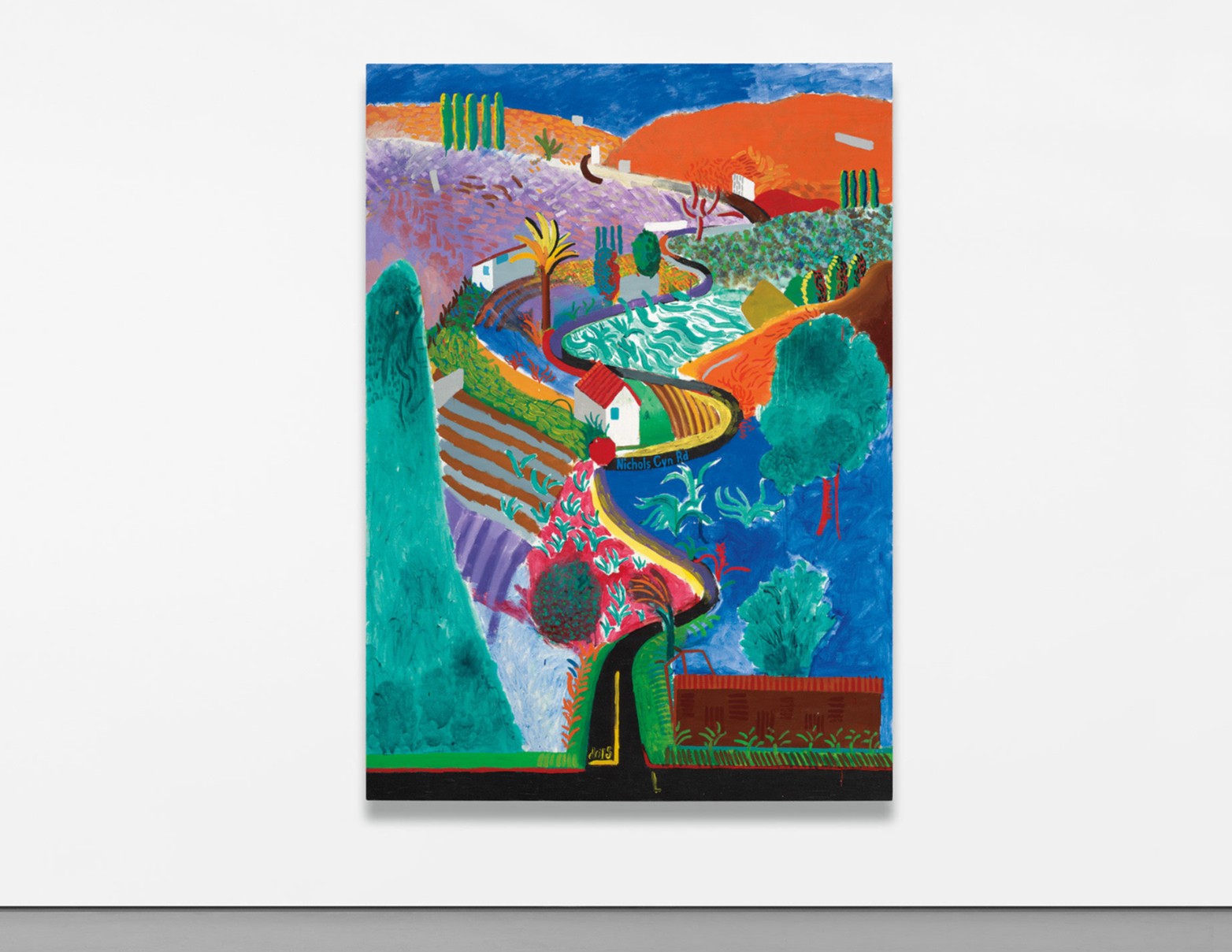
Nichols Canyon, 1980
Acrylic on canvas
84×60 inches (213.4 x 152.4 cm)
Provenance
The Artist
André Emmerich Gallery, New York
Acquired from the above by the present owner in January 1982
Phillips New-York: 7 December 2020
USD 41,067,500
Source: Phillips
David Hockney – 20th c. & Contempor… Lot 10 December 2020 | Phillips
Depicting the winding titular road in Los Angeles, Nichols Canyon is one of David Hockney’s greatest masterpieces—and unequivocally the most important landscape by the artist in private hands. Executed in a pivotal year in the artist’s career, 1980, the tour de force is considered by contemporary scholarship to be Hockney’s first mature landscape, and has been exhibited as such in both of his major travelling retrospectives. Nichols Canyon is one of his most recognizable paintings, having graced the cover of the 1994 monograph David Hockney and was reproduced on the poster for the Metropolitan Museum leg of his retrospective in 1988.
What makes the image so iconic is its fusion of two of Hockney’s themes that have appeared and reappeared time and again throughout his entire career: the natural world and the theater. One of the most refined paintings from a very small body of work depicting the Los Angeles terrain—other examples of which are in the Los Angeles County Museum of Art, Walker Art Center in Minneapolis, and Museum Ludwig, Cologne—Nichols Canyon marks the beginning of his decades-long panoramic landscapes series spanning California, the Grand Canyon, and the United Kingdom.
In fact, at first, Hockney was exceptionally pleased with the composition and had decided to keep this homage to his idol for himself; he only agreed to part with it when André Emmerich offered to buy him a late Picasso that he had fallen in love with at Claude Bernard’s Gallery in Paris in exchange for Nichols Canyon and another of Hockney’s paintings, The Conversation, 1980. The present owner purchased the work from Emmerich in January 1982, and it has not changed hands since—exceptionally rare provenance for a work of this caliber.
A Love Affair With Los Angeles
One of the artist’s most iconic subjects, the Los Angeles lifestyle and landscape enthralled Hockney since his first trip to California in January 1964. Upon arriving, he sent a telegram to his friend proclaiming “Venice California more beautiful than Venice Italy.”i He was attracted to the swimming pools, the warm climate, as well as to the glitz and glamor of the L.A. that he had seen in films, magazines, and John Rechy novels throughout his life—he had fantasized about California, idealized it as an Eden of sunshine and palm trees straight out of an Henri Matisse painting, and upon arrival believed that his daydreams had come true.
Over the next 15 years, Hockney lived off and on in California, playing heavily into the cultural iconography of Los Angeles in his most celebrated works, such as Portrait of an Artist (Pool with Two Figures), 1972 and A Bigger Splash, 1967, Tate, London. In 1978 he decided to make the city his permanent home, and the following year he moved into a secluded residence in the Hollywood Hills with partner Gregory Evans.
David Hockney is perhaps the first painter in history to turn driving into an art form. He gets a mention in Alex Ross’s new book Wagnerism for his carefully programmed motorised excursions through the uplands of Southern California, in which each turn and climb in the route was carefully timed to coincide with a crescendo or leitmotif in Tristan or the Ring, played at volume on twelve on-board loudspeakers. And if art and music have got into his personal transport, the reverse is also true: driving and roads have profoundly affected his pictures.
Nichols Canyon is local, a picture of his own neighbourhood. Indeed, it’s more intimately personal than that: this is a depiction of the artist’s daily route to work. When he began to live in the Hollywood Hills, Hockney continued to work on the plain below in his studio in a former warehouse on Santa Monica Boulevard. At the time he made the painting, he was making this journey, Hockney remembered, “two, three, four times a day.” Subsequently he had a large games room adjoining his new dwelling converted into a studio and started to work there.
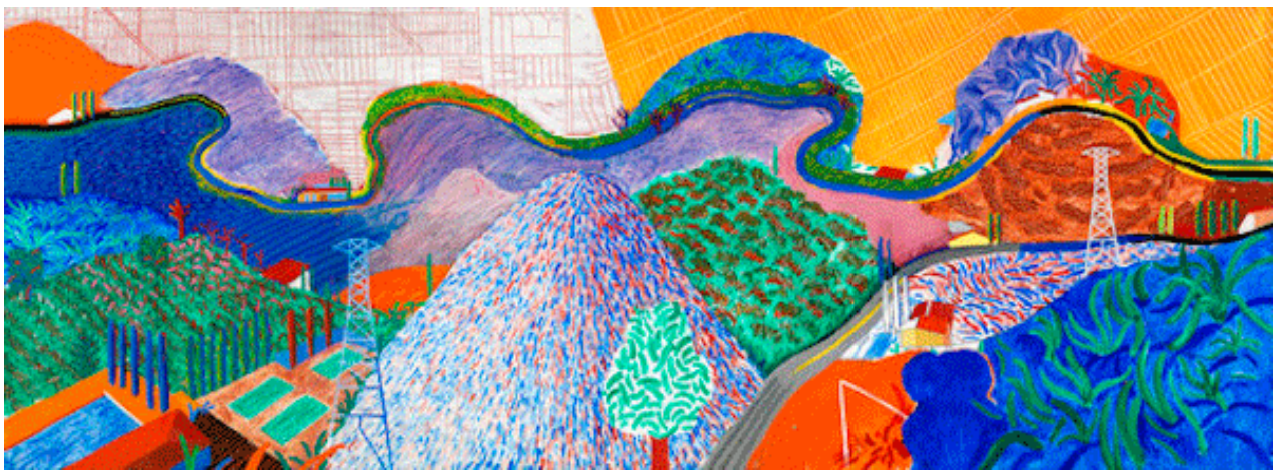
For a while though, this short commute was a significant part of his routine, and this picture is a depiction of the journey. Hockney was quite explicit about it. When discussing the companion piece to Nichols Canyon, Mulholland Drive: The Road to the Studio, he explained that the “Drive” in the title refers not to “the name of the road but to the act of driving.” Both landscapes are depictions of motor-transport, images of moving through a landscape powered by an internal combustion engine.
Of course, this has been one of the most universal of human experiences for the last century at least, yet one of curiously little interest to modernist artists. Even the motor car is a rare subject, though painted for example by Richard Hamilton. But Hockney is almost alone in attempting to convey the experience of driving in visual media.
There have been a succession of “road pictures” (to borrow a term, suitably enough, from movies) through his long career. Others include the early Flight into Italy – Swiss Landscape, 1962, Garrowby Hill, 1988, and the nine camera films made on Woldgate, East Yorkshire in 2010-11. Hockney is delighted and enthralled by the experience of moving through a landscape. He suggested, in the case of Nichols Canyon and Mulholland Drive, that the viewer’s eye moves “around the painting at about the same speed as a car drives along the road.”
It seems likely that the octagonal red blob in the centre of Nichols Canyon, resembling to a casual glance a giant strawberry by Hieronymus Bosch, actually stands for Hockney’s car of the time: a vintage two-seater, chrome-red Mercedes convertible. If so, it’s at crucial point, near the centre of the picture, swinging round a bend; that curve too is crucial to the experience of the journey, and this to the picture.
Instinctively and aesthetically, Hockney dislikes straight lines, especially when they recede towards a fixed-point of recession. These feelings affect his attitude towards particular places. Several times recently he has referred to New York as a “perspective nightmare” in which he could never live and work. By that he meant that it is a geometric grid of high-rise, rectilinear structures like a 15th century Tuscan city grown gigantically huge.
Manhattan was perfect for Piet Mondrian but impossible for Hockney, who insists he likes “to live on the ground” and to travel along winding curves that never stop in a single, inescapable vanishing-point. He has long been suspicious of that kind of geometric perspective, with all lines receding into the distance like railway tracks, which was codified in the Italian Renaissance by the architect Leon Battista Alberti. That’s why he loves Chinese scrolls, where the eye just carries on moving as the picture is unwound, and also why he took immediately to the Hollywood Hills.
Previously, Hockney recalled, although he had spent a good deal of time in LA, he had not ventured up from the coastal plain. In the Hills, “the roads aren’t straight and you don’t know which one goes down the hill and which one doesn’t.” But once he’d made the move, he became “fascinated by all these wiggly lanes and they began to enter the paintings.” He drove along them, and as he did so he “actually felt” them.
“Wiggly” is a word signifying approval in Hockney’s terms; similarly, his favoured word for his new house and studio, an ancient wood-beamed farmhouse in Normandy, is “higgledy-piggledy.” It is, he muses, “like the house where the Seven Dwarves live in the Disney film.” When he began Nichols Canyon forty years ago, he “took a large canvas and drew a wiggly line done the middle which is what the roads seemed to be.”
The wiggly line therefore is the beginning and essence of the painting: a trajectory through space and time. It is also a point of inflection in Hockney’s career. In the autumn of 1980, when this picture and also Mulholland Drive were painted, he had just had two powerful experiences. One was seeing the great Picasso exhibition at the Museum of Modern Art in New York; the other was designing the production of a triple bill of modernist French music for the Metropolitan Opera.
The latter consisted of Parade by Eric Satie, Francis Poulenc’s Les mamelles de Tirésias, and Ravel’s L’enfant et les sortilèges. Thinking about these, and the period in which they were composed, made him reflect on what he called, “French Marks.” This was his phrase for the beautiful painterly and graphic calligraphy—the flowing brush and pen strokes which he felt were the hallmark of Parisian masters such as Picasso, Matisse, and Dufy.
“You have to have a variety of marks,” he told me. While designing the Ravel opera, he made a number of “French Marks,” created by “letting my arm flow free, exploring ways of bring together French painting and music.” He also explored Fauvist chromatic exuberance in the same designs, and carried it back to his new house in the Hollywood Hills, painting the terrace a Matisse blue. “The painters thought I was quite mad. But when they finished, they saw how good it was.”
Nichols Canyon is full of French marks, and strong Matisse-like reds, greens, and yellows as well as blues. It’s an expression of excitement in the discovery of new place and a fresh way of painting and depicting space. It is also, Hockney points out, “more realistic than you might think.” Not only does it convey the feeling of winding up, down and around on the roads of the Hollywood Hills; its Fauvism is almost naturalistic.
This area is rus in urbe, countryside within a great city. The vegetation of the canyon bottom is lush: there are places that resemble rain forest. That’s part of Hockney’s message too. He is an artist who finds “the world is very, very beautiful.” Indeed, he is in love with it. But, as he also likes to point out, “reality is a slippery thing.” There are many ways to represent it. One may be a wiggly line, freely brushed down a canvas.