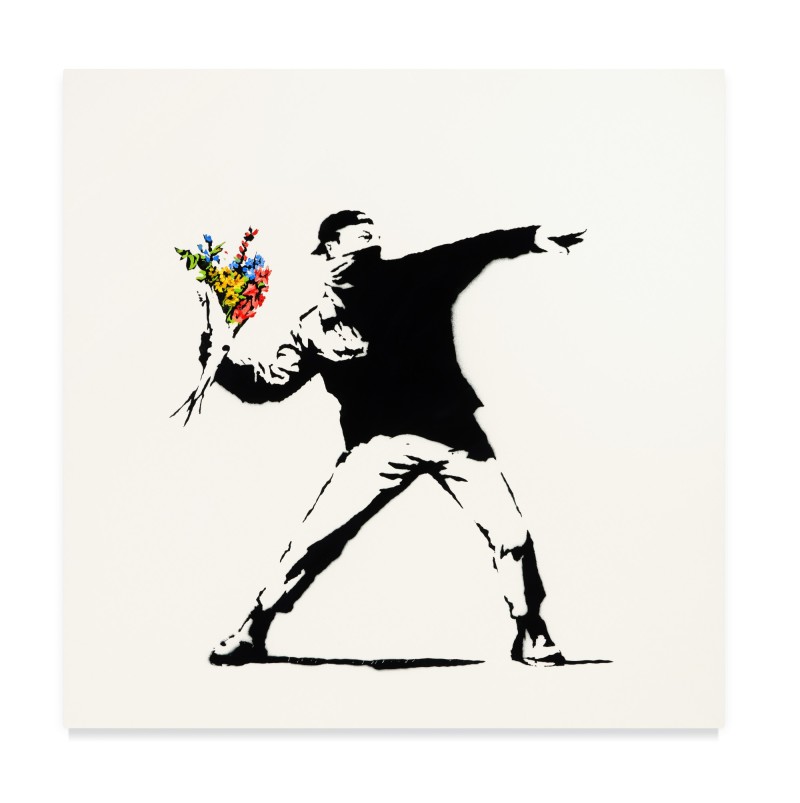
BANKSY
Love is in the Air, 2005
Oil and spray paint on canvas
90×90 cm (35.4 x 36.4 inches)
Signed on the overlap; signed and dated 06/05/05 on the stretcher
Provenance
Lazarides Gallery, London
Acquired by the present owner from the above in 2006
Sotheby’s New-York: 12 May 2021
USD 12,903,000
Source: Sotheby’s
Love is in the Air | Contemporary Art Evening Auction | | Sotheby’s (sothebys.com)
“I like to think I have the guts to stand up anonymously in a Western democracy and call for things no-one else believes in – like peace and justice and freedom.”
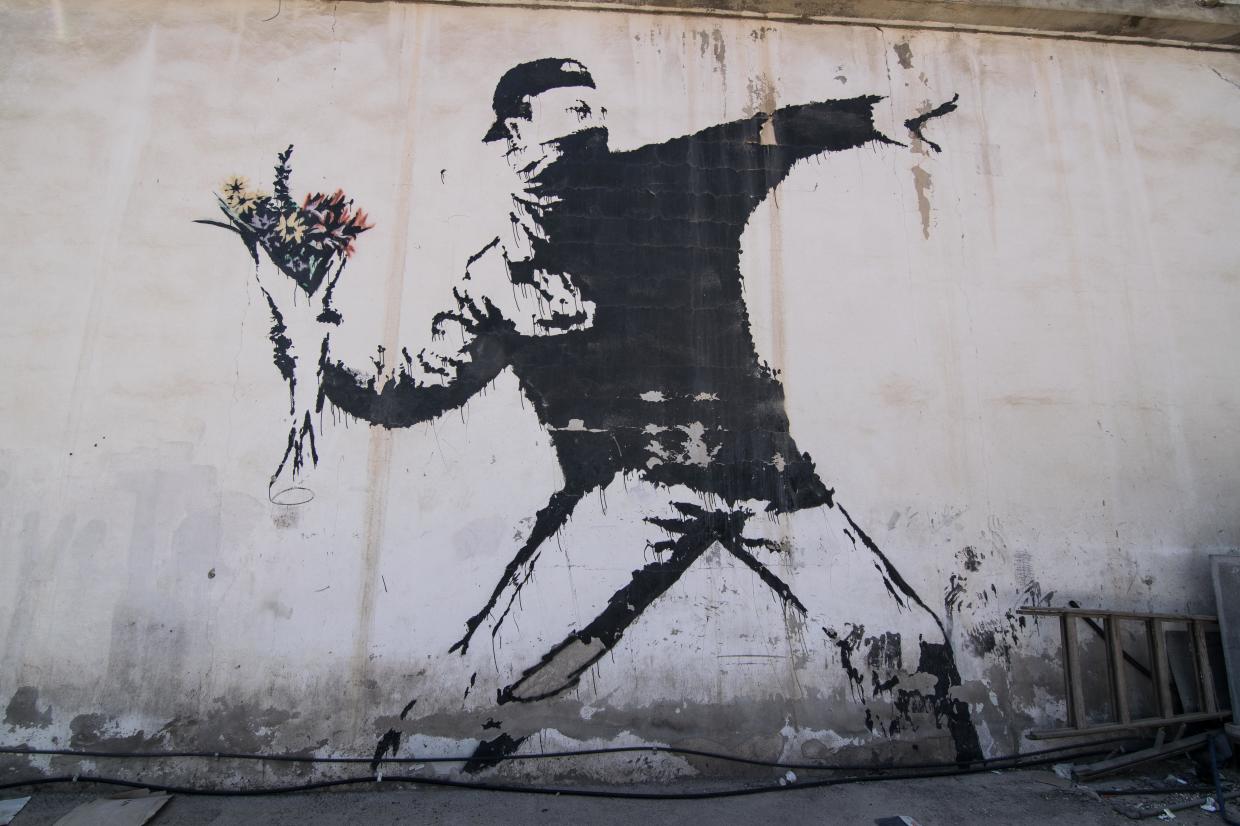
Love is in the Air is a quintessential Banksy painting: instantly recognizable, the image has become synonymous with the artist’s indelible graphic style, wry humor and galvanizing political commentary. Banksy’s subject adopts the archetypal pose of civic unrest, preparing to hurl a brick or bomb towards an unseen foe, however the artist replaces his projectile with a bunch of flowers, disarming this image of violent unrest to create a work that is both a call for change and advocation of peace. This work was notably chosen to be illustrated in Banksy’s 2005 monograph, Wall and Piece, and the street intervention upon which it is based was chosen for the front cover. One of the artist’s most cherished works on canvas, further distinguished by the inclusion of hand painted flowers in oil, Love is in the Air is a work that reminds us of the injustice and inequality that exists around us, and offers a simple message of hope. In the tradition of other iconic images that have gone before it, such as Leonardo’s Mona Lisa, Andy Warhol’s Marylin Diptych or Alfred Leete’s Lord Kitchener Wants You poster, Love is in the Air has been referenced, replicated and imitated countless times in a testament to its visual power. It is indisputable that this bold and declarative work helped to establish Banksy’s place in art history, cementing his reputation as a pivotal and universally heard artistic voice.
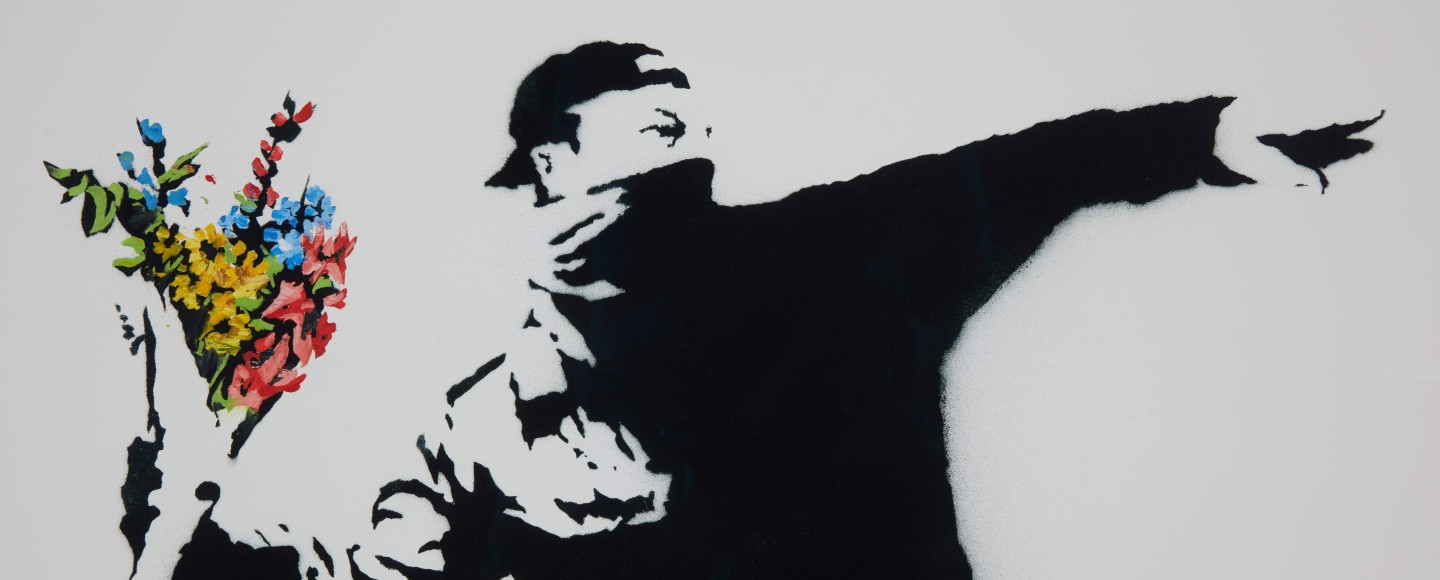
The present work features a bouquet of brightly colored flowers hand painted in oils by the artist, a unique feature rarely seen in Banksy’s oeuvre. The incorporation of these richly painted flowers brings to mind the long tradition of floral still life paintings; yet in typical Banksy fashion, these vivid blooms are a far cry from the somber beauty of a 17th century Dutch floral arrangement, or indeed the symbolic incorporation of flowers by Medieval, Renaissance and Victorian artists, but rather appear as if they may have been have been snatched from a local gas station to be hurled at an unseen enemy. Banksy understands his lineage as a social commentator and satirist and – much like Honoré Daumier and William Hogarth before him – uses the power of familiar symbols juxtaposed with incompatible references to create absurd and provocative images which convey potent political messages. His tongue-in-cheek tone is reflected the fact the work shares a title with a crooning 1978 John Paul Young hit. While humorously incongruous with the subject matter of the work, this double entendre gives the painting a sense of vitality, pre-empting the moment the flowers, symbolizing love, are flung forward by the subject.
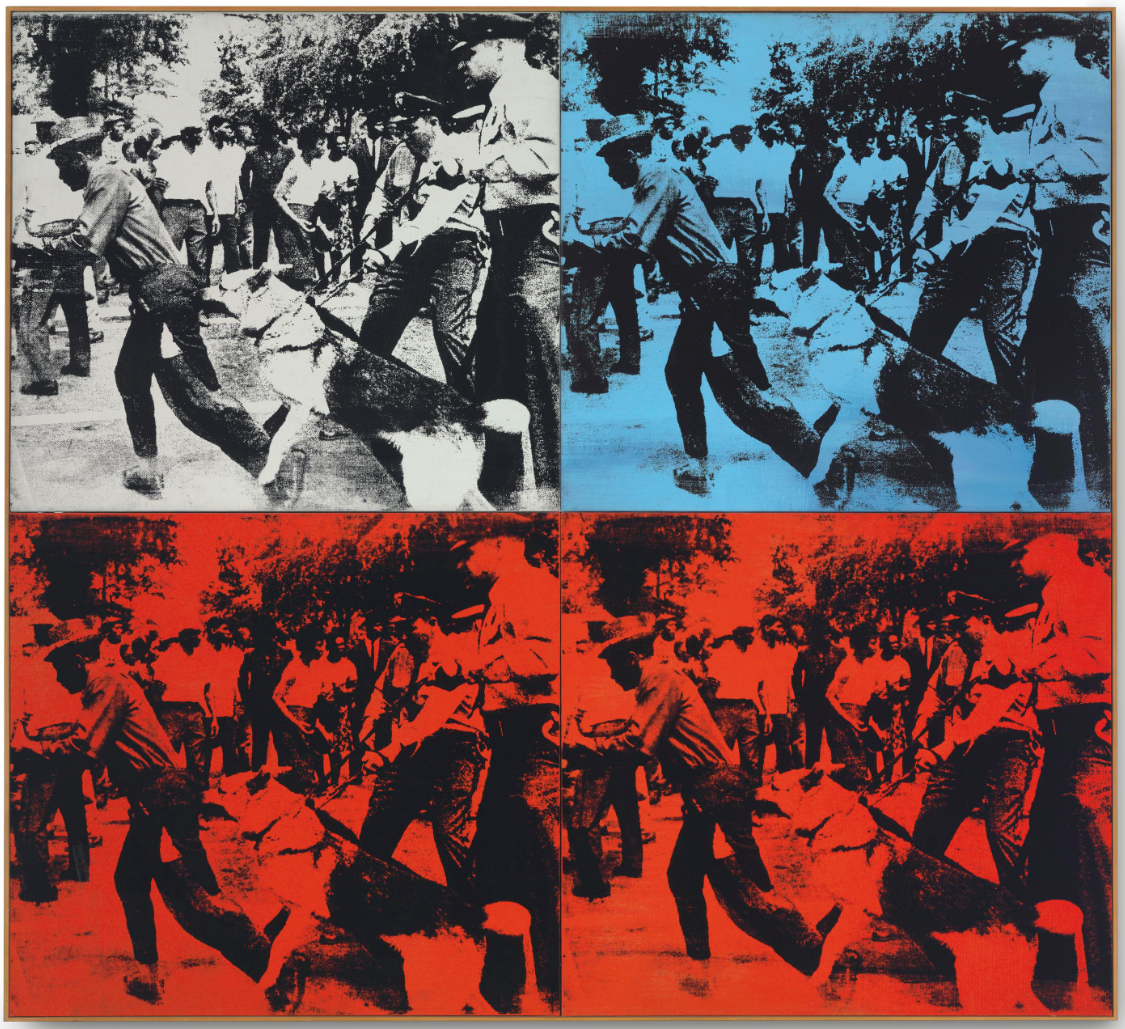
The oil painted flowers act as a tender counterpoint to the crispness of the stenciled figure, reminding us of the artist’s hand in the quasi-mechanized process of creating stenciled images. Whilst in many ways a revolutionary figure, Banksy’s decision to include this hand-finished detail as part of the stenciled piece serves as a nod to his artistic forebears, recalling Warhol’s use of stencils combined with a fluid application of color to subvert totemic – and often, highly political—images from popular culture. This is exemplified by Warhol’s portraits of Chairman Mao, in which he uses technicolor inks to playfully transform Mao’s carefully controlled likeness, often with the effect of making it appear as though the imposing leader is wearing garish makeup. Similarly, Banksy uses the colorful bouquet of flowers to create an image of violence disarmed, disrupting the stark image of a young militant caught in an act of violence by replacing his Molotov cocktail with a symbol of peace.
Banksy is well known for his distinctive use of stenciling, a technique he started using widely in the late 1990s in order to create complex graffiti works very rapidly in public spaces. The use of stenciling allowed the artist to reduce the window in which he risked being caught ‘vandalizing’ by the police, but without compromising the intricacy of the images. Banksy’s choice of stenciling as a technique has significance beyond pragmatic considerations: the practice has long been associated with underground political movements and punk culture, as it enables people to create visually striking images that can be reproduced quickly, cheaply and by anyone. These characteristics lend the technique to grassroots activism and speak to the DIY, anti-establishment, traditions of punk.
READ MORE ABOUT LOVE IS IN THE AIR
ON BANKSY EXPLAINED
Love Is In The Air, 2005 – Banksy Explained