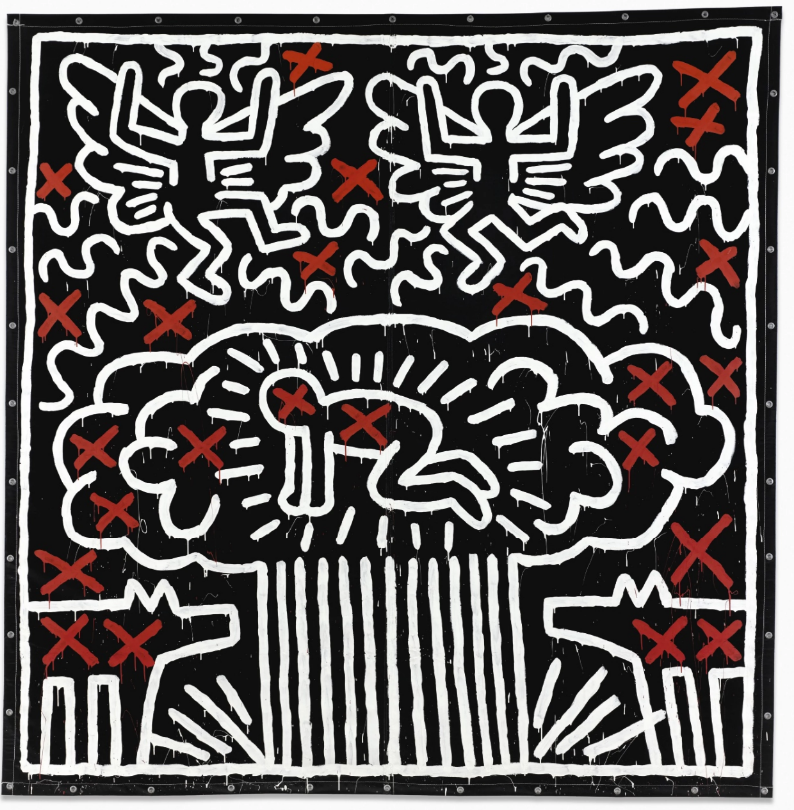
 KEITH HARING
Untitled, 1982
Acrylic on vinyl tarpaulin with metal grommets
121.5 x 118.7 inches (308.6 x 301.6 cm)
Tony Shafrazi Gallery, New York
Private Collection (acquired from the above in 1982)
Private Collection, Switzerland
Acquired by the present owner from the above
USD 6,537,500
Untitled epitomizes Haring’s inimitable aptitude for conveying pulsating movement through forms distilled to their most basic, essential components. Haring’s confident hand draws bold, self-assured strokes, eschewing a pre-meditated schematic plan for spontaneous genius; never erasing or reworking, Haring’s virtuosic gestural ingenuity flows directly through his brush onto the canvas. Unmistakably charged by the explosion in the painting’s epicenter, the present work harnesses the conceptual framework of a “blast” to comment on parallel outbreaks within the cultural and political lexicon of Haring’s current day. Of utmost importance to Haring during this time was the concept of technological revolution, which precipitated conflicting feelings of awe-struck beguilement and trepidation, and is most immediately referenced through Haring’s attentiveness to the thunderous growth of 1980s computer and television culture and the consequential implications of mass media in a rapidly globalizing society. Having long viewed himself as a child of the atomic age, the present work furthermore describes Haring’s fears over humanity’s increasing use of nuclear power and recalls the famous nuclear disarmament rally that Haring organized in Central Park in 1982. As interpreted through Haring’s rapid intertwinement and fascination with the polemic social and political absorptions of the early 80s, the present work thus manifests a crucial representation of Haring’s preoccupation with cultural ‘explosions.’ The amplitude of Haring’s energized linear framework in the present work specifically underscores the notion of technological growth leading to exponential expansion of the mind and brain, practically toward utter explosion. For Haring at this precise cultural moment, the mind was becoming progressively less dependent on its own faculties, while increasingly overtaken by technological advancement.
In Untitled, the crawling baby centered in the heart of the composition is Haring’s most famous “tag,” or logo, that has become a synonymous representation of Haring himself. With rays emanating from around its body, this figure is known as the “radiant baby,” symbolizing youthful innocence, purity, goodness, and potential. Haring’s larger than life dog figures bark at each other from opposite ends of the lower portion of the canvas, resembling contemporary reimaginations of the half-human half-jackal Egyptian deity Anubis, and formally emulating the ancient iconography that depicted figures within narratives as two-dimensionally flattened and walking linearly in side profile. By placing two barking dogs beneath the baby and two angels above the baby, Haring delineates a clear distinction between symbols good and evil, paralleling the visual representation of heaven and hell in the verticality of the composition. The recurring barking dogs stand for authoritarian government, abuse of power, police force, and oppressive regimes; opposite the dogs, the celestial angels underscore Haring’s joyous embrace of life and hope for salvation. In the intermittent space between the angels and dogs, Haring uses a combined proliferation of wavy lines and red Xs to suggest a confrontational link between the two zones. Metaphorical allusions to heaven and hell remained a critical theme throughout Haring’s work, reflecting the artist’s ceaseless preoccupation with life and death. Substantiating his many references to heaven and hell, as particularly evident in the present work, there is an underlying “background of questions about the meaning of life in the face of power, fear, misery, illness, and in the end the absurdity of death. Fluctuation between hope and hopelessness did not allow his creative energy to flag, but spurred him on, as far as it was possible, to paint not only against the hell of others but also against his own decline.” (Ralph Melcher, Exh. Cat., Freiburg and Rotterdam, Keith Haring: Heaven and Hell, 2001, p. 20)
This vibrant painting is notable for its exceptionally sumptuous drips, as cascades of fluid ink and acrylic exude from Haring’s red Xs and white linear flourishes. While Haring here deploys similar forms as in his formative subway chalk drawings, the expressive joie de vivre of the drips juxtaposed with the hard-edged lines of his archetypal bold shapes exemplify Haring’s mastery over the painterly medium, bridging his Pop language with the critical gravitas of Abstract Expressionism. Just as we can visualize Pollock vigorously taking paint to canvas, revealing his heroic genius with every gestural flair, Untitled analogously conjures Haring’s performance of painting—the ineluctable motion of the image parallels Haring’s own instinctive, primal dance with brush and canvas. Energetically and poignantly expressing Haring’s concern for the state of the world, in spite of his own ill-fated sentence, the present work is an ever-relevant socio-political directive in today’s modern age, serving as a tragically beautiful summation of the artist’s insistence on freedom, the virtue of humanity, and hope for deliverance.