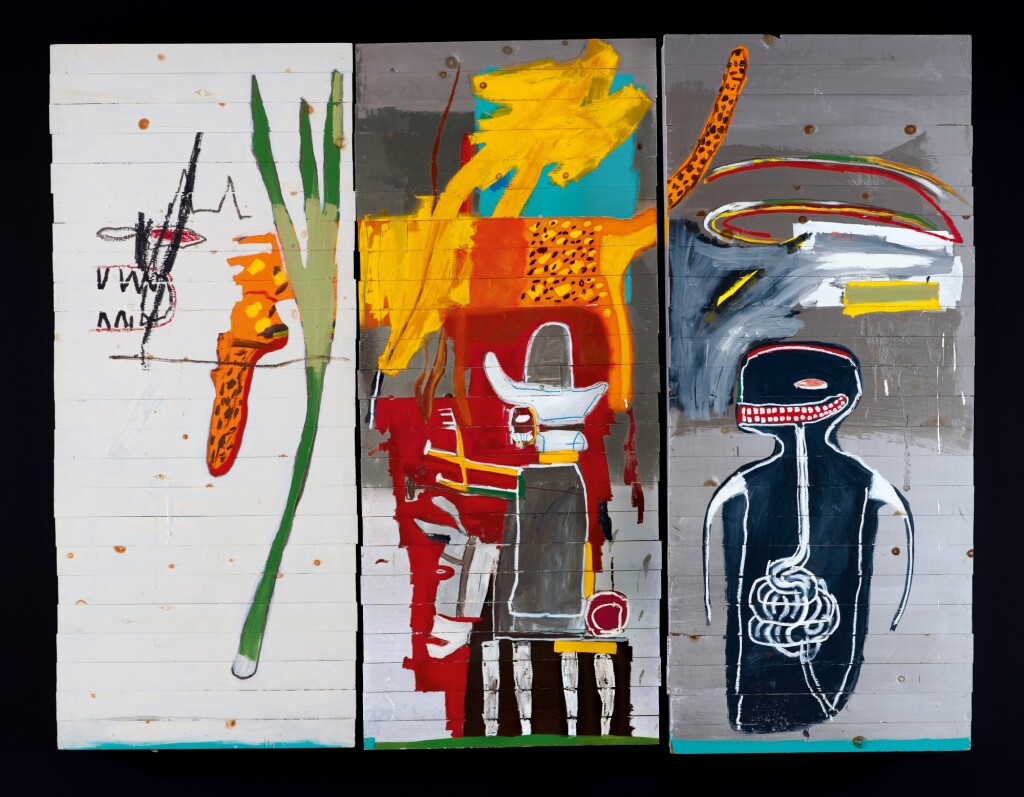
Untitled, 1985
Acrylic and oilstick on wood, in three parts
85.5 x 108.5 x 12 inches (217.2 x 275.6 x 30.5 cm)
Signed and dated 85 on the reverse
Provenance
Galerie Bruno Bischofberger, Zurich
Private Collection
Christie’s, New York, 4 May 1994, Lot 46
Collection of Carmen Riera, Barcelona (acquired from the above sale)
Christie’s, London, 9 February 2005, Lot 25 (consigned by the above)
Private Collection, USA
Acquired from the above by the present owner
Sotheby’s Hong-Kong: 18 June 2021
HKD 289,316,000 / USD 37,271,134
Source: Sotheby’s
Jean-Michel Basquiat 尚・米榭・巴斯基亞 | Untitled 無題 | Contemporary Curated: Asia | JAY CHOU x SOTHEBY’S | Evening Sale | | Sotheby’s (sothebys.com)
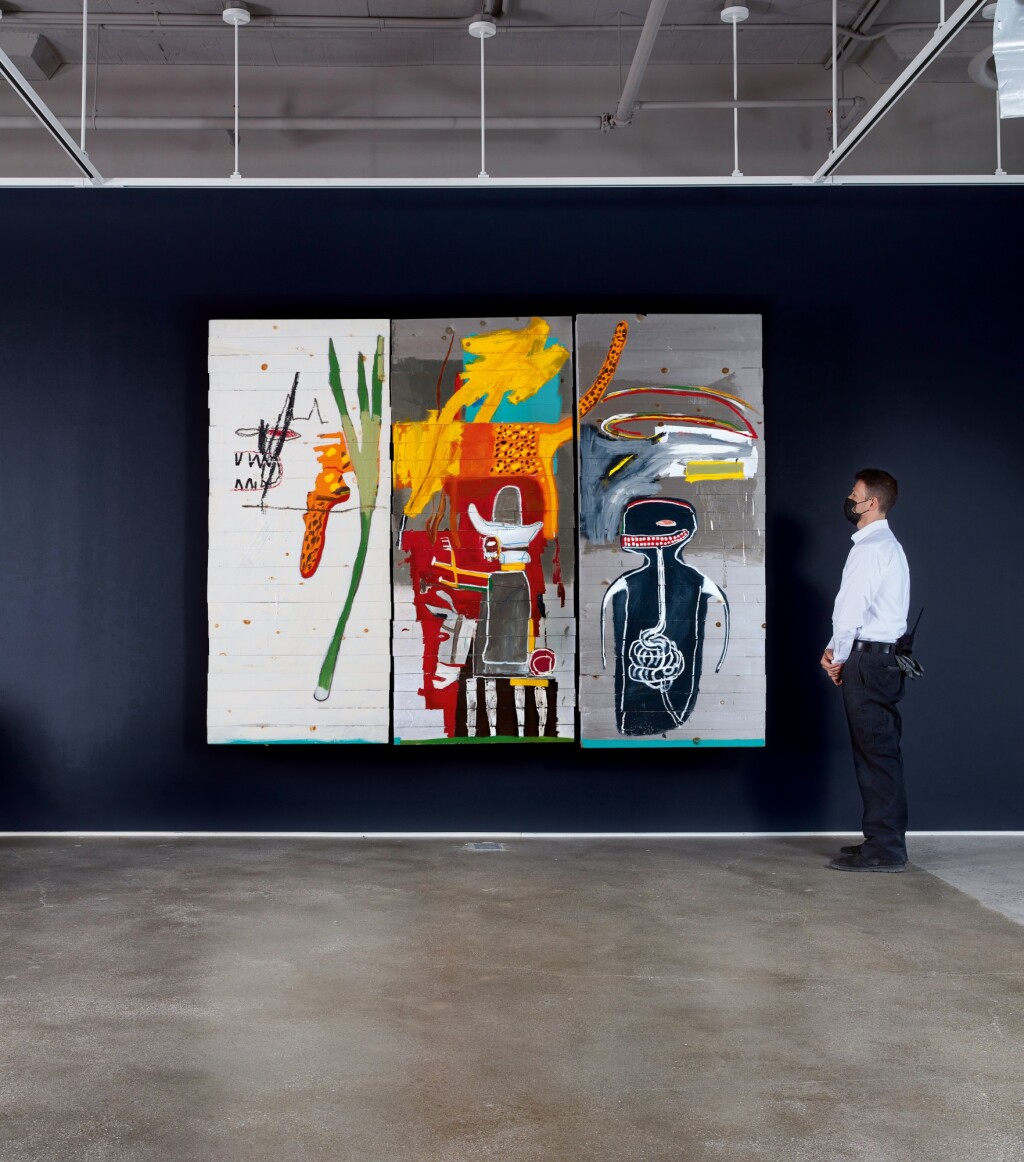
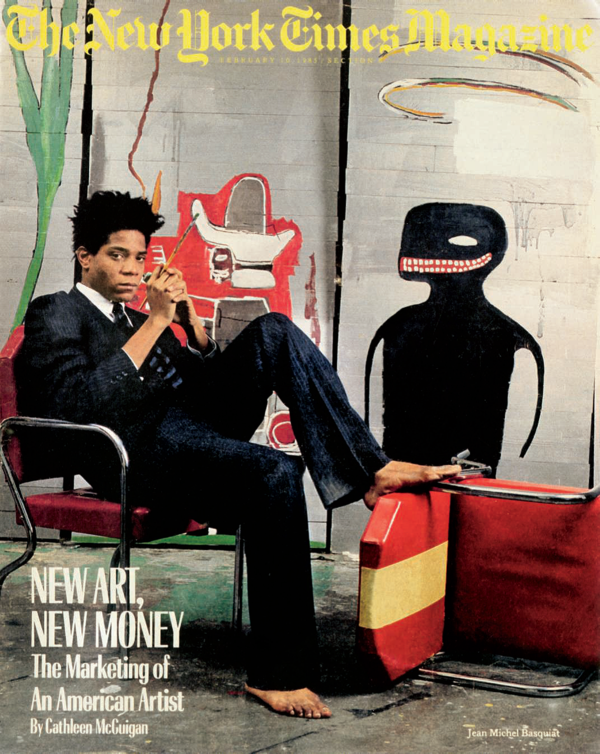
Arresting, monumental, and tremendously emblematic, Jean-Michel Basquiat’s towering masterwork Untitled typifies the graphic ferocity, referential intricacy, and explosive painterly fervor that characterizes the artist’s truly singular oeuvre. Painted at the absolute zenith of his success and international visibility, Untitled powerfully embodies the apogee of Basquiat’s creative output. Exemplifying his ability to draw upon disparate cultural narratives within his own searing visual vernacular, Basquiat’s iconic pantheon of heroic figures are potently present within the present work, testifying to his unique positioning at the nexus of tradition and the contemporary art world. Executed in the early months of 1985, Untitled is notably and inexorably tied to Basquiat’s famous February 1985 New York Times Magazine cover, in which he sits positioned directly in front of the work. Wearing a sharp suit and wielding a paintbrush, sitting barefoot before the present work with legs akimbo, the photograph has become one of the most famous images of the young artist, and is reproduced in virtually every major monograph and exhibition catalogue to cover his work. That Basquiat chose to feature the present work in that image – which would appear on the cover of such a prominent and widely disseminated publication – underscores the poignancy and vital symbolism present in the work and positions it as an encapsulation of all Basquiat represented artistically and culturally at the peak of his practice in the 1980’s.
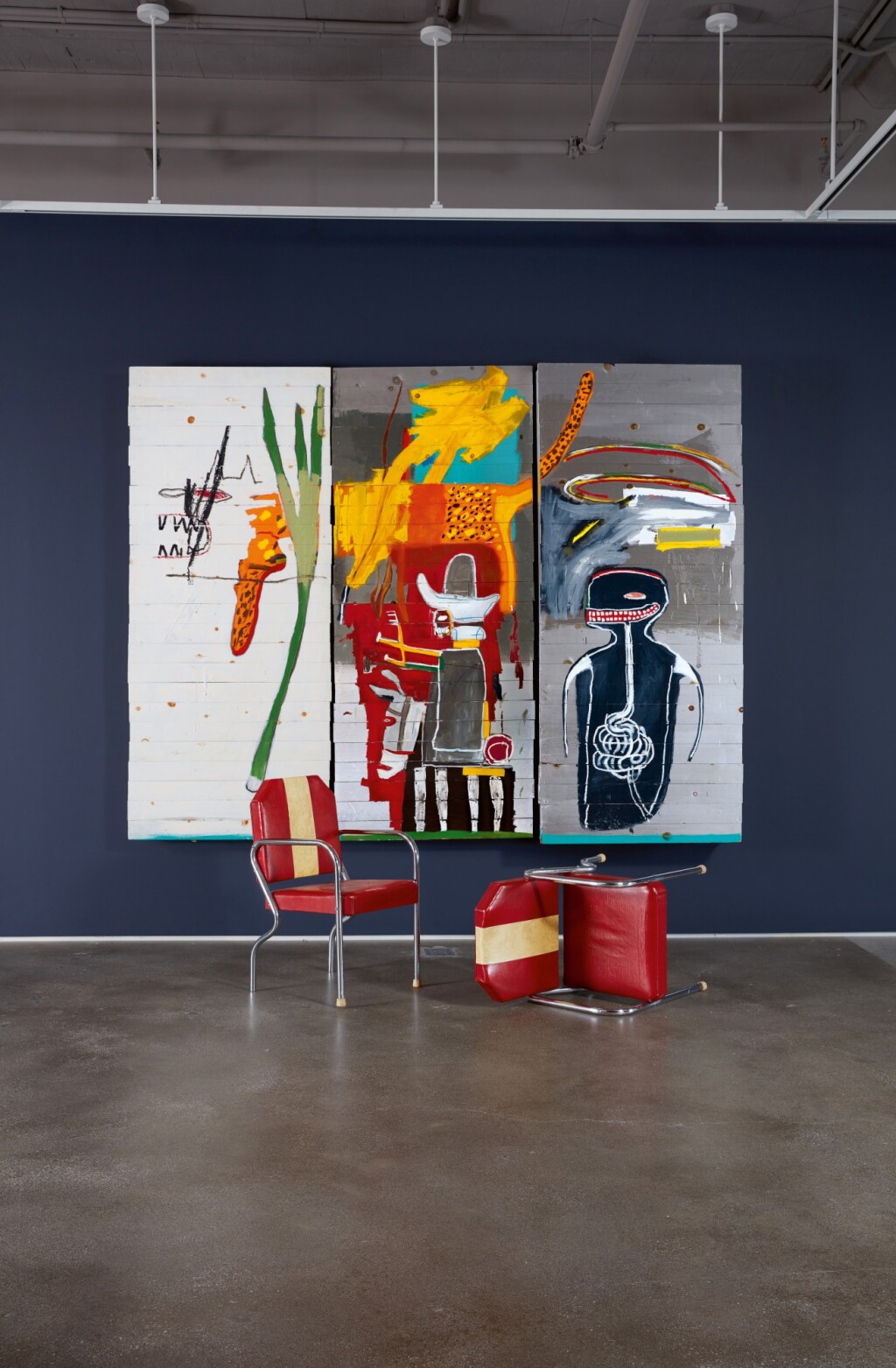
Original chairs from Jean-Michel Basquiat’s studio that were photographed and featured on the New York Times Magazine Cover
The significance of the present work’s inclusion in The New York Times Magazine cover cannot be overstated. This cover story, entitled “New Art New Money: the Marketing of an American Artist,” represented not only Basquiat’s pre-eminence amongst his artistic peers, but also his widespread visibility and relevance in more mainstream spheres. The radiant child, an artistic prodigy seemingly born of the street, now graced the cover of a household magazine, a publication that embodied what is most relevant in hegemonic culture. This cover encapsulates the double-consciousness Basquiat was always navigating: that of a young black man in a predominantly white space; a bohemian spirit who amassed tremendous wealth, fame and market legitimacy; a former street artist whose work was featured on the walls of the most prestigious institutions worldwide. In this way, Untitled serves not only as a totemic signifier for this pivotal moment in Basquiat’s life, but also of these dichotomies, which lie at the very heart of his oeuvre and practice.
Against an elegant slate-gray backdrop of three wooden panels, a flurry of brilliant hues and gestural brushwork speak to the virtuosic ability to apply, execute, shift, and render paint that distinguished Basquiat as an undisputed master within the vanguard of young and ambitious image-makers working in the 1980s. Exemplifying his singular command as a master colorist, Basquiat layers dazzling orange, scarlet, and bright teal hues to spectacular effect, most notably in the center panel of the present work. Describing Basquiat’s innate natural ability, Marc Mayer notes, “With direct and theatrically ham-fisted brushwork, he used unmixed color structurally, like a seasoned abstractionist, but in the service of a figurative and narrative agenda. Basquiat deployed his color architecturally, at times like so much tinted mortar to bind a composition, at other times like opaque plaster to embody it. Color holds his pictures together, and through it they command a room.” (Marc Mayer, “Basquiat in History,” in Exh. Cat., New York, Brooklyn Museum, Basquiat, 2005, p. 46) Intermingling oil-stick with paintbrush, fine lines with gestural smears, Basquiat builds his figures up before him, sealing the immediacy of his composition with specific touches of a bright, searing white. While the furious speed of Basquiat’s paint application conjures a vision of chaotic yet remarkably controlled movement, the conceptual intricacy of Untitled suggests the painting’s careful and deliberate creation.
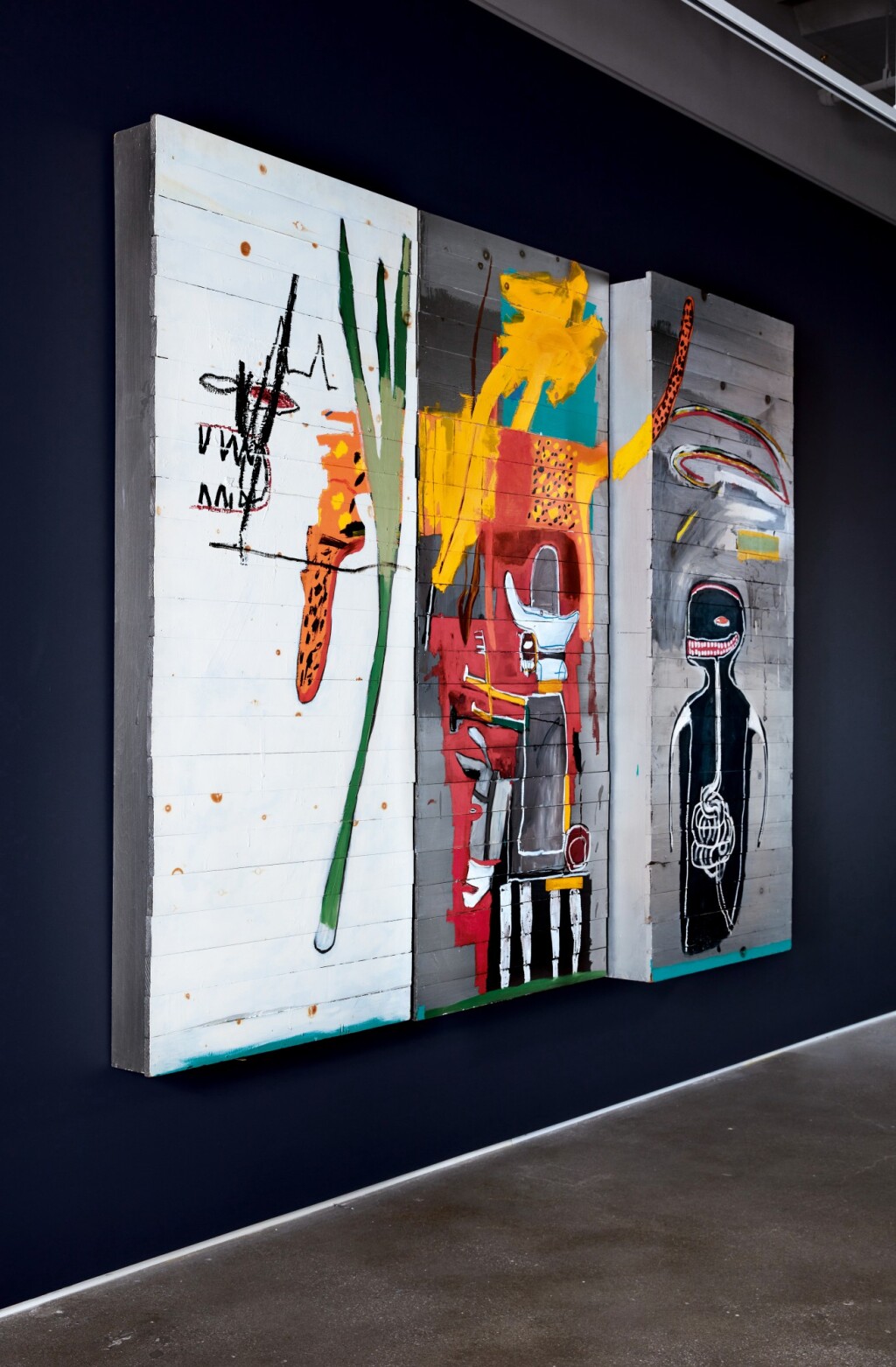
Rendered as a triptych across three wooden panels, Untitled depicts a triad of distinct characters all executed in Basquiat’s signature kinesthetic, crackling style. Depicted at far right, a dark figure familiar from other of Basquiat’ best known paintings powerfully evokes traditional African masks, his wide mouth concurrently recalling a winning grin and fearsome, bared teeth. While the dark silhouette offers few identifying features, the figure’s internal organs are brightly illuminated, recalling the anatomical preoccupation of artists like Leonardo da Vinci. Through this radical approach to figuration, Basquiat breaks down the dichotomy between the external and internal, revealing the cacophonous innermost aspects of psychic life with breathtaking vitality. The depiction of mask-like figures in his work also represents Basquiat’s relentless exploration of cultural identity; born to a Haitian father and Puerto-Rican mother, Basquiat often expressed his feelings of racialized otherness in a white-dominated art world in this manner.
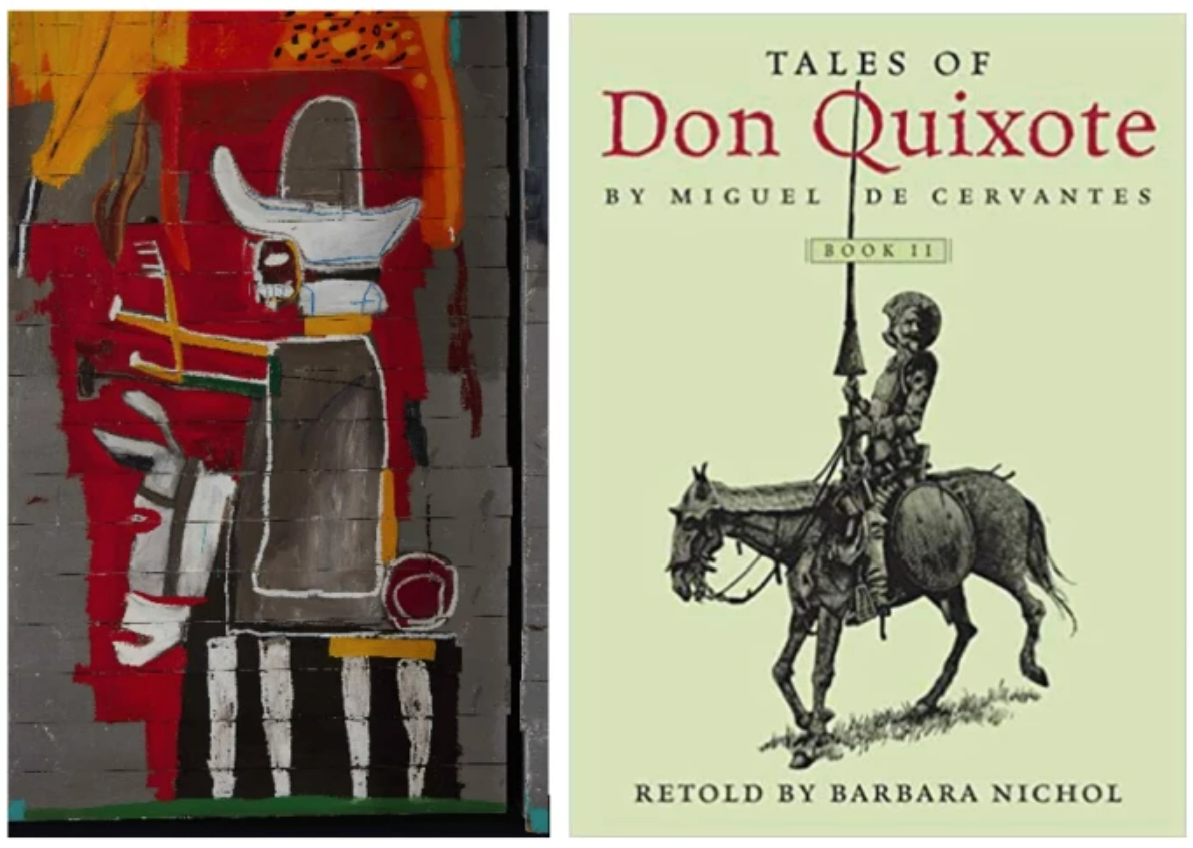
LEFT: DETAIL OF CURRENT LOT
RIGHT: COVER OF TALES OF DON QUIXOTE BY MIGUEL DE CERVANTES
Likewise, Basquiat’s references to African masks invokes his lifelong reverence for Pablo Picasso, whose incorporation of African mask imagery features prominently within his oeuvre, particularly in such seminal works as Les Demoiselles d’Avignon from 1907. To the left of the dark figure, a hatted figure on horseback conjures the silhouette of Don Quixote, the fabled knight-errant and protagonist of Miguel de Cervantes famed novel of the 17th century – a story that Basquiat’s mother often shared the young Basquiat when he was a child. Both humorous and tragic, the story of Don Quixote and his sidekick Sancho Panza carries the polarizing complexities that also characterize so much of Basquiat’s work and personal narrative. A tale of unbridled pursuit of individualism and the prioritization of the tenets of selfhood above the rules and norms of society, the story of Don Quixote encompasses themes that can be seen as closely paralleling many of the most indelible threads of Basquiat’s life. Notably, the figure of Quixote was also famously depicted by Picasso, and Basquiat’s reference to Quixote pays homage once again to one of his greatest heroes and further testifies to his extraordinary fluency across a multiplicity of cultural traditions and narratives. Indeed, it was growing up in New York City visiting art museums with his mother as a child that Basquiat educated himself on the art historical canon and developed his tremendous appreciation for the work of Picasso. It is arguably Picasso’s full embrace of the avant-garde attitude, one that persistently challenged conventional standards of beauty, which influenced Basquiat to follow a similar path, resulting in striking, bold and aggressive works such as Untitled. Finally, stretching across all three panels is the painting’s third and final figure, a ferocious Jaguar, which bares its teeth in savage intensity and majestic exuberance. The Jaguar was a ubiquitous symbol of strength and excellence in battle for the Aztecs whose military elite were referred to as Jaguar Warriors or Jaguar Knights. This creature is unabashedly powerful, aggressive and postured for attack. Certainly the most overtly offensive of the three figures, the Jaguar brings a deeply palpable raw power to the work.
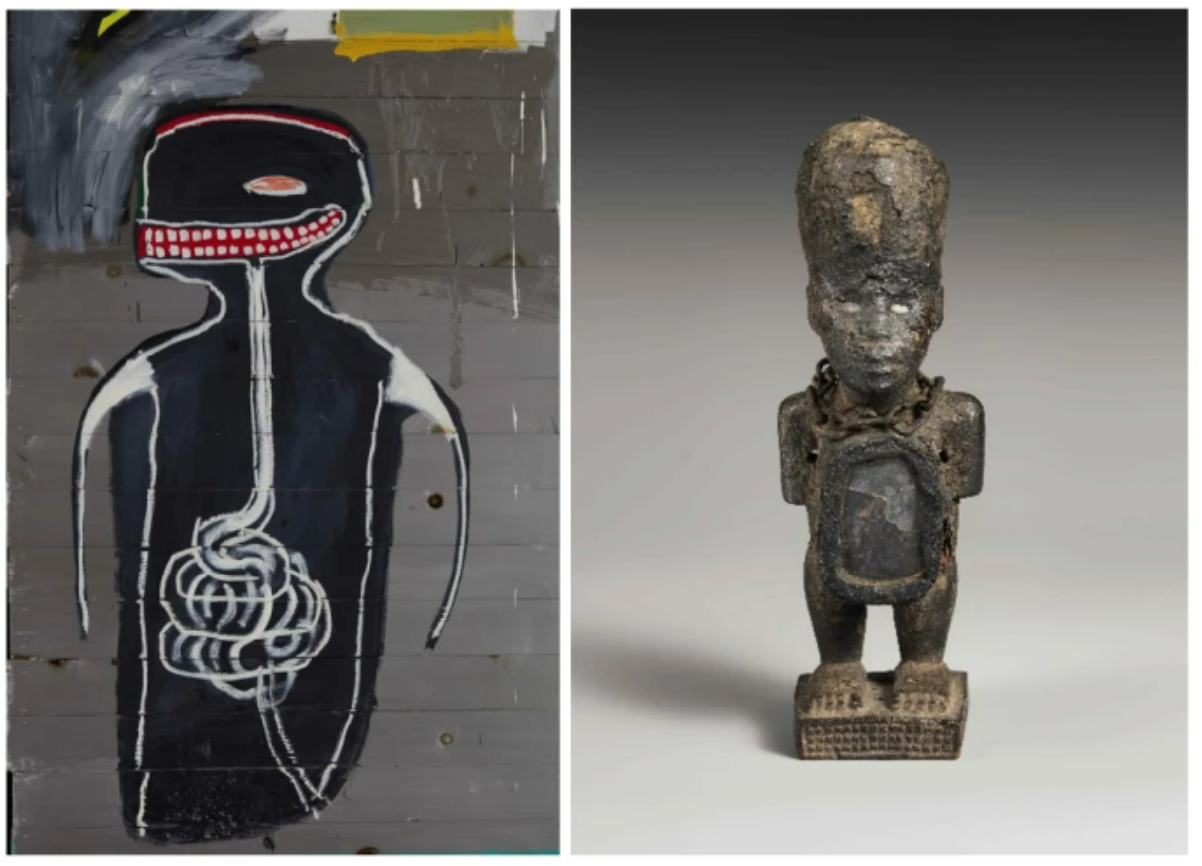
LEFT: DETAIL OF CURRENT LOT
RIGHT: POWER FIGURE: MALE (NKISI). 19TH – 20TH CENTURY. DEMOCRATIC REPUBLIC OF THE CONGO, KONGO PEOPLES. WOOD, GLASS, METAL, CLOTH, ORGANIC MATTER. H. 7 3/4 X W. 2 1/2 X D. 2 1/2 IN (19.7 X 6.4 X 6.4 CM), THE MICHAEL C. ROCKEFELLER MEMORIAL COLLECTION, PURCHASE, NELSON A. ROCKEFELLER GIFT, 1968 (1978.412.574) NEW YORK, METROPOLITAN MUSEUM OF ART © 2021. IMAGE COPYRIGHT THE METROPOLITAN MUSEUM OF ART/ART RESOURCE/SCALA, FLORENCE
In these three, searing figures, Untitled both unites and juxtaposes cultures in Basquiat’s signature hybridized lexicon. Rendered in this iconic triptych format, Untitled sets the iconic black warrior, which draws on the visual vocabulary of African masks, and the Jaguar, an important Aztec warrior symbol, with a figure resembling Don Quixote, Cervantes’ farcical knight errant. In doing so, Basquiat contrasts the raw ferocity of African and Mesoamerican visual cultures with the pomposity of European chivalry and tradition. Immortalized for eternity in the iconic New York Times photograph, Untitled is an indisputable and unforgettable masterwork that embodies not only this seminal moment in Basquiat’s career, but his larger project. Indeed, in positioning himself in front of these figures on the cover of The New York Times magazine at the apex of his fame, Basquiat positions himself as the fourth figure within this mythic drama: a warrior-hero of synthesis who draws from multicultural influences, his own heritage, imagination and the brash energy of the street.