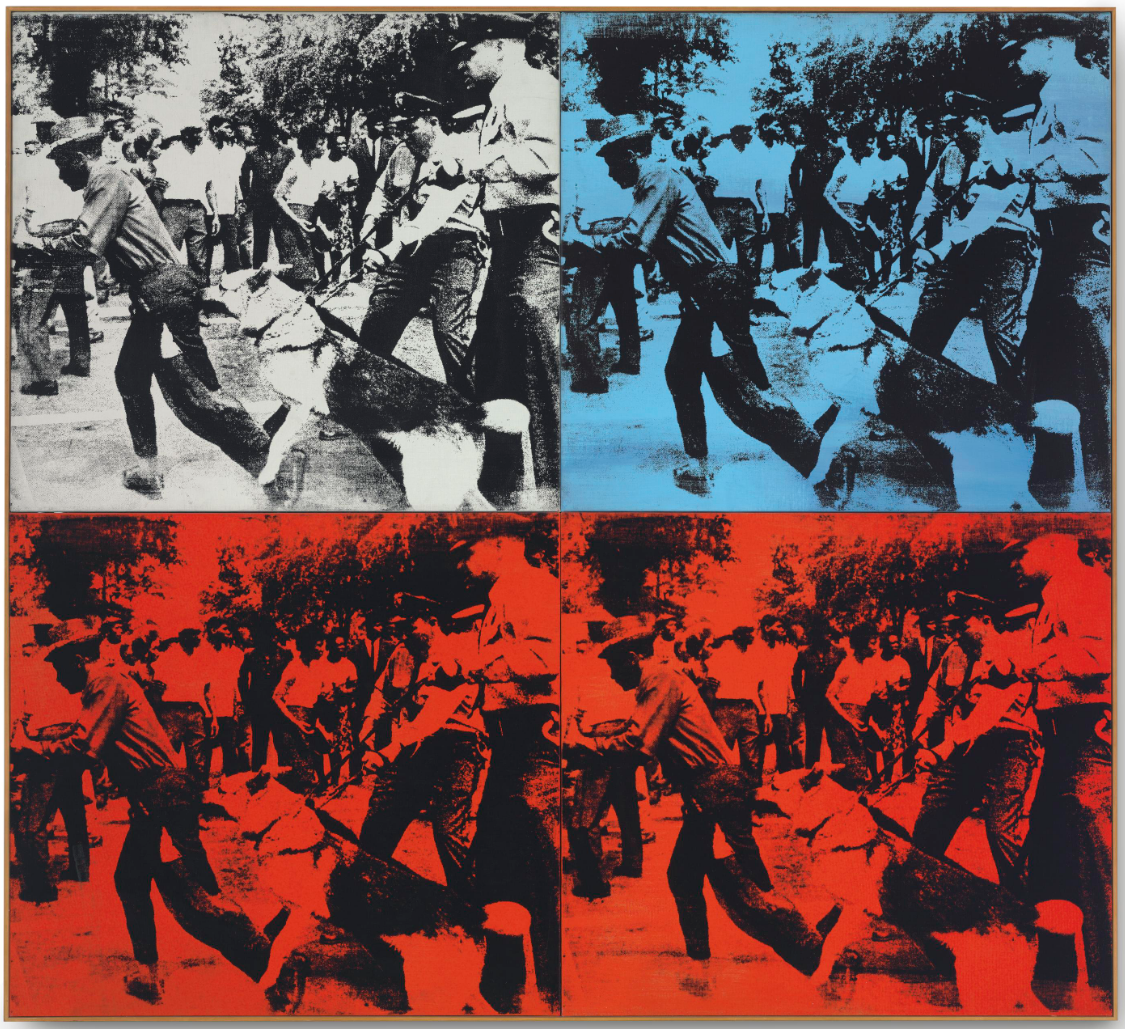
Race Riot, 1964
Acrylic and silkscreen ink on linen, in four parts
Overall: 60 x 66 inches (152.4 x 167.6 cm)
Signed and dated ‘Andy Warhol 64’ (on the overlap of the upper left panel)
Provenance
Leo Castelli Gallery, New York
Sam Wagstaff, New York
Robert Mapplethorpe, New York
The Estate of Robert Mapplethorpe, New York
Their sale; Christie’s, New York, 7 November 1989, lot 74
Bruno Bischofberger, Zurich
Mr. and Mrs. Oliver Stahel, Zurich
Their sale; Christie’s, New York, 18 November 1992, lot 48
Private collection, Monaco
Acquired from the above by the present owner
Christie’s New-York: 12 May 2014
USD 62,885,000
Source: Christie’s
Andy Warhol (1928-1987) (christies.com)
“It was just something that caught my eye.”
Warhol responded somewhat typically when asked about the seemingly contentious political subject matter of his Race Riot paintings. Of all of the subjects in Warhol’s vast and varied catalogue, the so-called Race Riot paintings with their manifest display of political violence and racial oppression are seemingly the least ambiguous and most partisan images in his oeuvre. Repeatedly showing the image of a black Civil Rights protester being savaged by the dogs of a group of white uniformed policemen, this memorable and extremely rare series of paintings seems to demonstrate the famously apolitical Warhol actively engaging in contemporary politics and making a rare, if not indeed unique, “liberal statement” with his art. But, as Warhol himself was at pains to point out, engaging with 1960s politics was not really his intention. As he told fellow “Pop” artist Claes Oldenburg it was, largely “indifference” that had characterized and determined his choice of this graphic and provocative subject matter.
A unique red, white and blue, multiple-image painting of the Birmingham race riots of 1963, Race Riot is one of the comparatively rare group of only ten silkscreen paintings of this dramatic confrontation that Warhol made between 1963 and 1964. Comprising four square canvases–two red, one white and one blue–and each depicting the same repeated image of two Birmingham policemen setting their attack dogs on a lone, fleeing black man, Race Riot is the only multi-colored work belonging to this now historic series of paintings and at nearly six feet square is also the largest and most impressive of the series of six 1964 paintings.
First executed in the spring of 1963, Warhol’s Race Riot paintings were created as part of a series of works based on the theme of Death in America that he was preparing for an exhibition to be held under the same title at the Sonnabend Gallery in Paris in 1964. Consisting of what is now known more accurately as his Death and Disaster series of paintings, the Death in America exhibition was to consist of a number of large-scale works on the theme of various typically American ways to die. Foremost among these images were of course, Warhol’s graphic and shocking images of car crashes. These were accompanied by a select group of paintings of suicides, gangster funerals and electric chairs. The image of the Race Riot was, while not an image of death per se, a provocative and powerful image of a peculiarly American form of violence, segregation and political oppression.
In the first days of May 1963, the long, burgeoning but also often unseen struggle for civil rights in the United States suddenly exploded into full public view. All at once, it seemed, stark and disturbing images of young American black men, women and children being assaulted by firehoses and police attack dogs on the streets of Birmingham, Alabama, began appearing across the world’s media engines when a peaceful organized mass protest against Southern segregation laws turned violent and ugly. The result of these events, and of the shocking images they generated, was that almost overnight one of the great lies about America–the so-called “land of the free”–was made plain for all to see. Suddenly, the discomforting truth that, at the heart of the world’s richest, most powerful and technologically advanced society–the self-proclaimed “leader of the free world”–lay an entire race of its own citizens who were themselves not free, but legally and violently oppressed by its rulers, was graphically and embarrassingly exposed.
The glaring injustice and moral hypocrisy, known to every black person then living in the United States but so often overlooked or ignored by others, was now visually manifesting itself day after day on the front pages of both the country’s and the world’s media in such a way that it could no longer be denied. “The events in Birmingham,” President John F. Kennedy was to say in June 1963, “have so increased the cries for equality that no city or state or legislative body can prudently choose to ignore them” (quoted in David J Garrow, Birmingham Alabama, 1956-63: The Black Struggle for Civil Rights, New York, 1989, p. 239). Not only did the violence in Birmingham ultimately force important changes in the law however, but it also seems to have marked a turning point in American history, inaugurating a new phase in the struggle for civil rights and galvanizing black youth across the whole of the American South to such an extent that it led directly to the historic march on Washington that took place three months later.
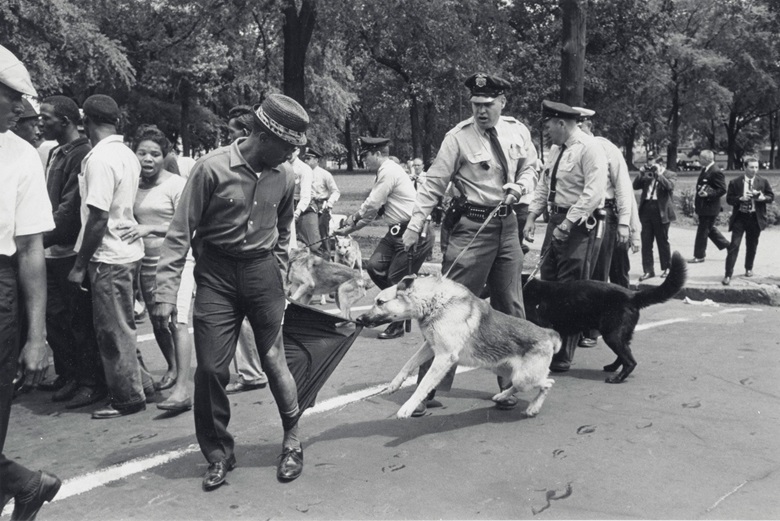 The original photograph by Charles Moore, a celebrated chronicler of the Civil Rights movement, of a demonstration in Birmingham, Alabama in 1963 which Warhol used to create his silkscreen, Race Riot. Photo: Charles Moore / Getty Images
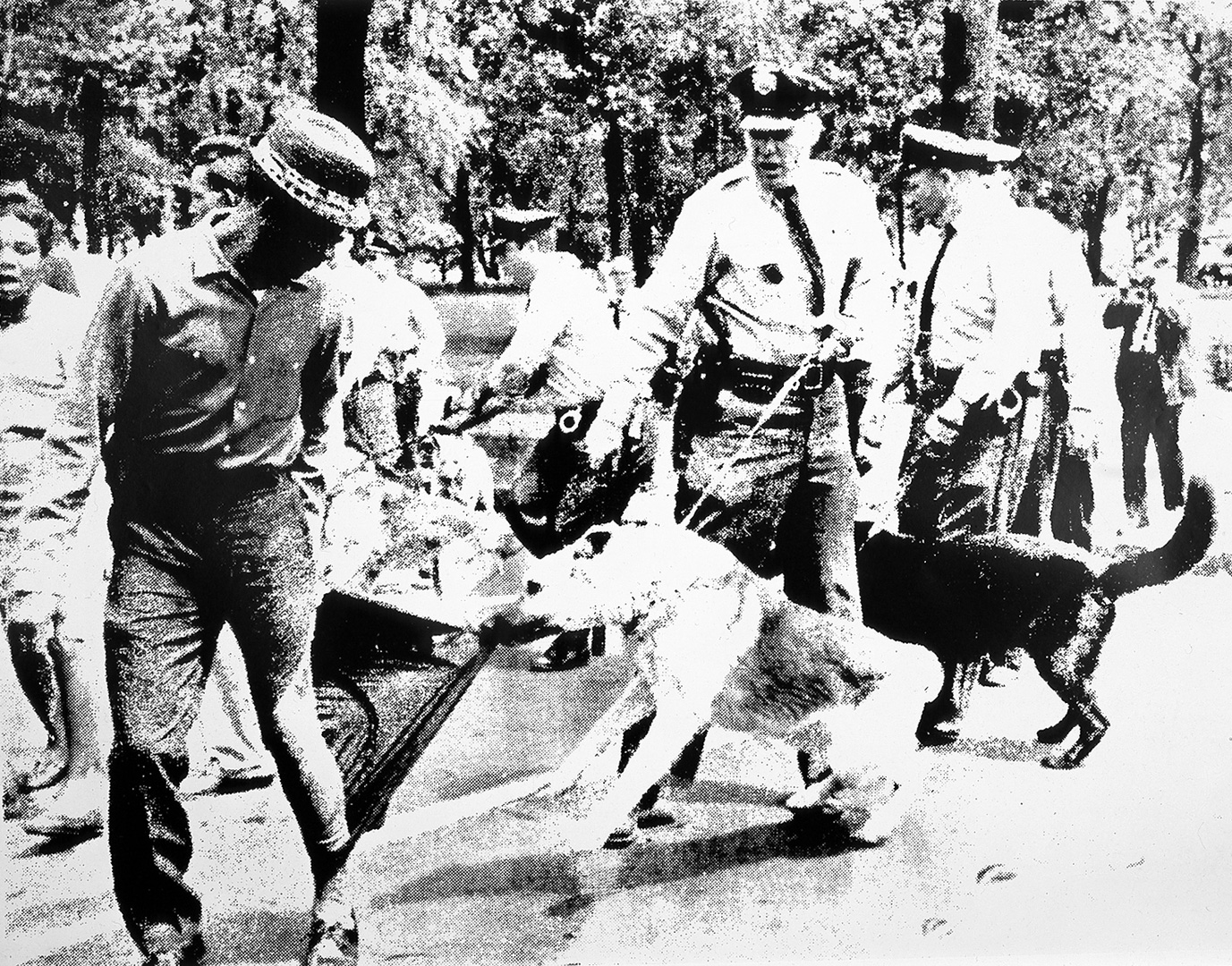
In particular, it was a series of photographs shot on May 3rd by a young Associated Press photographer, Charles Moore, that best encapsulated the moment and which most effectively caught the public imagination by doing exactly what Martin Luther King had wanted and forcing anyone who saw them to take a side in the conflict. Moore’s picture of young black children being blasted by the jet of a fire hose for example, was seen as a picture that appeared to implicate the entire nation. The cutting of the figure of the fireman firing the hose from view bestowed a disturbing anonymity upon the white line of force blasting these kids in a way that for many viewers seemed to implicate them in the violence. Similarly, Moore’s image of a lone black man fleeing from two policeman setting their attack dogs him, is one that clearly divides the conflict into a simple case of victim and aggressor, forcing its audience to side with one or the other.
Warhol’s choice of subject matter was also a continuation of a theme that had first surfaced while he was painting the Marilyns. It was around this time that he first recognized how the constant repetition of imagery ultimately seems to nullify the shocking effect of even the most horrific of images.
“When you see a gruesome picture over and over again it doesn’t really have any effect.”
The exploration of the desensitizing of the audience and the nullification of meaning through repeated imagery is what distinguishes Warhol’s Death and Disaster series most. It is also primarily this feature of these still disturbing and justly famous works that lends them their troubling ambiguity. As with his Campell Soup cans, the viewer is left in front of these powerful paintings wondering whether the artist is celebrating or criticizing his subject matter. No answer is given because, through the impersonal anonymity of the silkscreen-painting technique, the artist’s presence and authorship remains seemingly absent or at best indifferent.

In his Race Riot paintings Warhol was taking this feature of his work to an extreme, imbuing one of the most contentious, up-to-the minute and also divisive, subjects in 1960s American politics with the same ambiguity and sense of authorless indifference he bestowed on the Soup Can, Brillo Box or other consumer products. At the same time, however, these paintings again reveal Warhol’s unerring, almost prophetic ability to select, isolate and transform a single image into a provocative and quizzical icon that stands as a symbol for an entire area of contemporary culture.
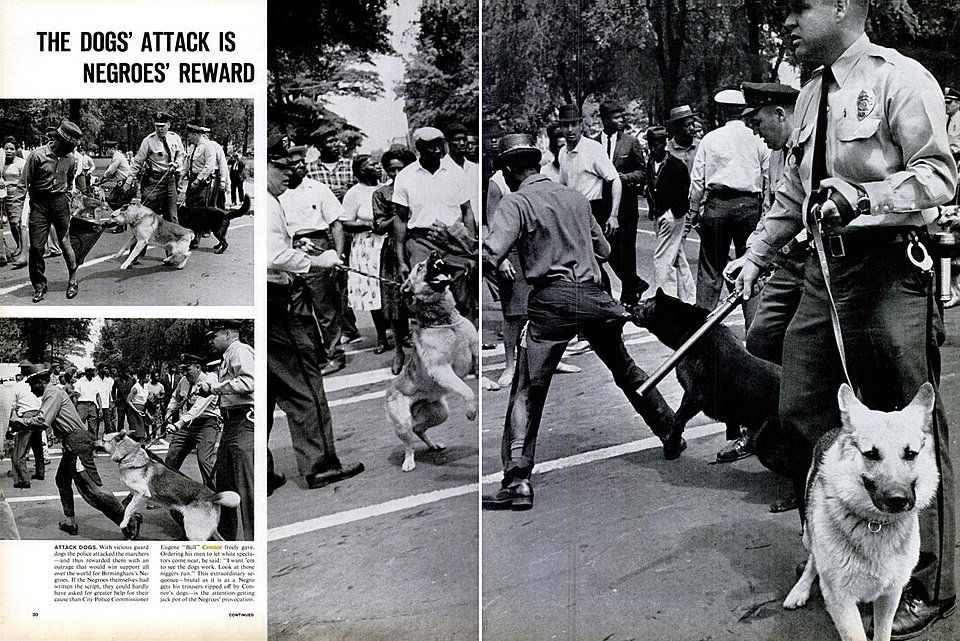
The photographs that Charles Moore took on the 3rd May 1963 encapsulate all these aspects of this unique moment in United States history in a way that serves almost as a modern kind of history painting. All this discussion about the power of such imagery would have intrigued Andy Warhol who, on seeing Moore’s photographs in Life magazine immediately adopted them as the source for what would become his own Race Riot paintings of 1963 and ’64. Like the story of Moore’s photographs, Warhol’s startling silkscreened paintings pose important questions about the nature and function of media imagery, about how we see and react to the news and how its images can also be used to provoke and manipulate us. How, also, the power of even the most shocking and provocative of “realist” imagery disintegrates under constant repetition or alternatively, how the same images can be employed, as in advertising, to manipulate an audience and even government policy into any given direction.
All of this is encapsulated in the story of the images that the Birmingham riots generated and was an aspect of these pictures that Warhol, with his long experience of the manipulation of imagery in the advertising industry, was all-too aware of. In fact, Warhol was one of the first artists to fully understand the power of the photographic image in this way. With his flat, empty, silkscreen way of painting and his sphinx-like pose of indifference, he was also among the first not to just question such imagery but also to reveal to us, in a new pictorial form, its innate and disturbing vacancy.
Warhol’s first four first Race Riot paintings (Pink Race Riot, Museum Ludwig Cologne, Mustard Race Riot, Museum Brandhorst, Munich and two other examples whose whereabouts are currently unknown) were made in direct response to the Life magazine spread in the spring of 1963 and employed all three of the Charles Moore photographs. These works, made as part of Warhol’s preparation for an important exhibition in Paris on the theme of “Death in America” were ones that essentially continued the formal logic of Warhol’s large Car-Crash paintings by representing Moore’s three photographs repeatedly as a kind of disjunctive filmic montage of troubling and traumatic imagery.
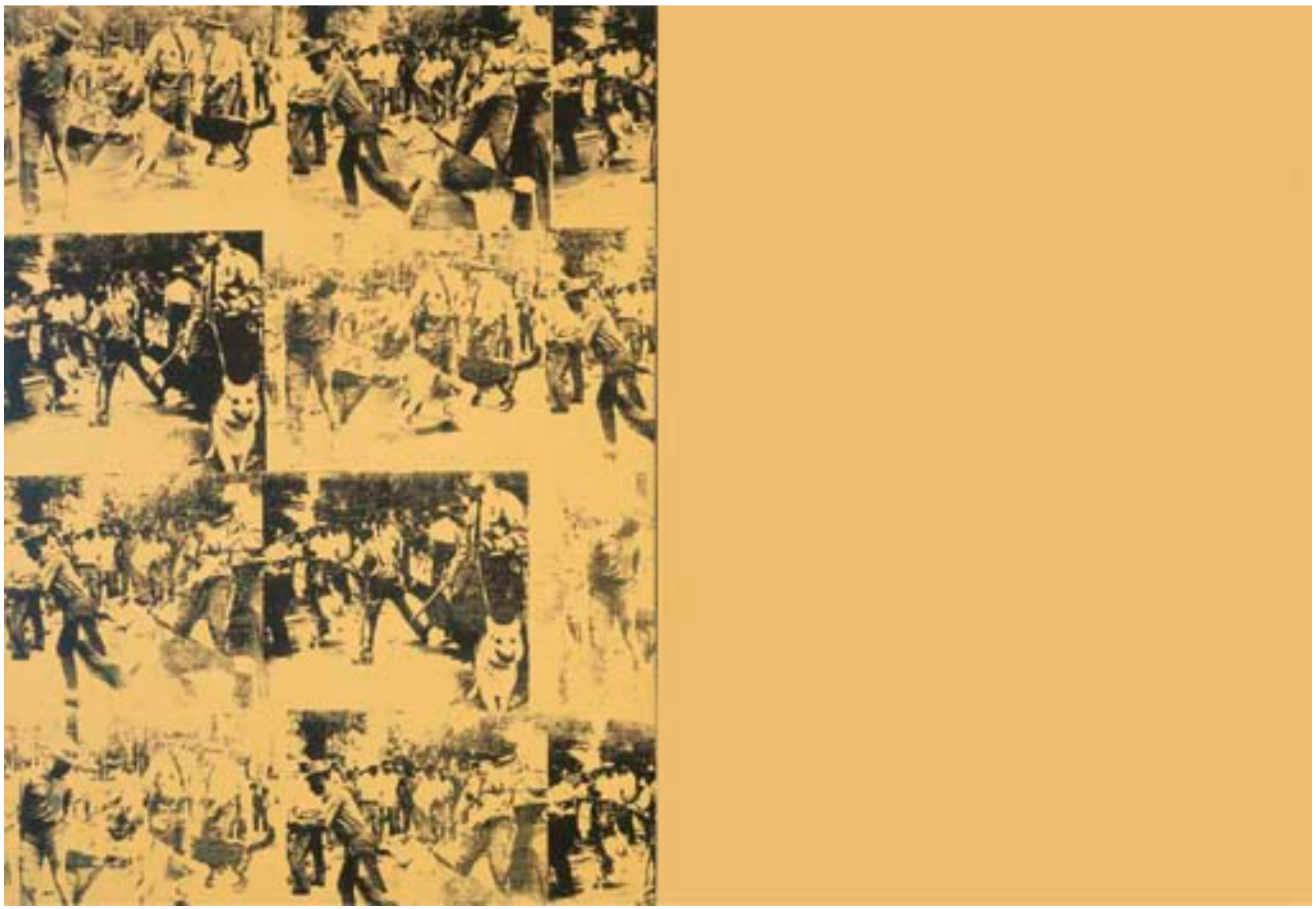
ANDY WARHOL
Mustard Race Riot, 1963
Acrylic, silkscreen ink and graphite on canvas, on 2 panels
Panel with images: 113.9 x 82 inches (289.3 x 208.3 cm)
Monochrome panel: 113.2 x 82 inches (287.7 x 208.3 cm)
Overall: 113.9 x 164 inches (289.3 x 416.6 cm)
Christie’s New-York: 9 November 2004
USD 15,127,500
Mustard Race Riot is the major example from Warhol’s Race Riot series and conceptually the closest to his other Death and Disaster paintings. A double canvas image, blank mustard color on one side and fully saturated mustard-backed imagery on the other, it relates closely to Warhol’s other double-canvas paintings that incorporate a monochrome canvas alongside a silk-screened one. David Bourdon has pointed out that these “diptychs” were first created at Warhol’s Firehouse studio after Warhol had asked his friends,
“Wouldn’t it be a good idea to add a blank panel? It would make the painting twice as big and twice as expensive.”
As with the Death and Disaster series the concept of a diptych consisting of one screened and one blank canvas seems to have originated while Warhol was working on the Marilyns and was inaugurated with his Gold Marilyn tondo diptych. It is however primarily with the car crashes and the electric chairs of the Death and Disaster series that Warhol makes use of this new technique. Apart from any pleasure Warhol may have gained from being able to sell abstract monochrome canvases, it is clear from these works that the blank canvas also performs an added and important function. Contrasting the emptiness of one canvas with the fullness of the provocative and disturbing imagery on the other underscores Warhol’s intention of exposing the artifice of even the most horrific images and lends these “diptychs” a powerful existential gravitas that is less evident in his single-canvas images. As both a design feature and as a reinforcement of Warhol’s conceptual concerns, the play between empty space and dense repetitive silk-screened imagery in these works, visually reiterates the sense of shallowness and artifice that underlies all Warhol’s work.
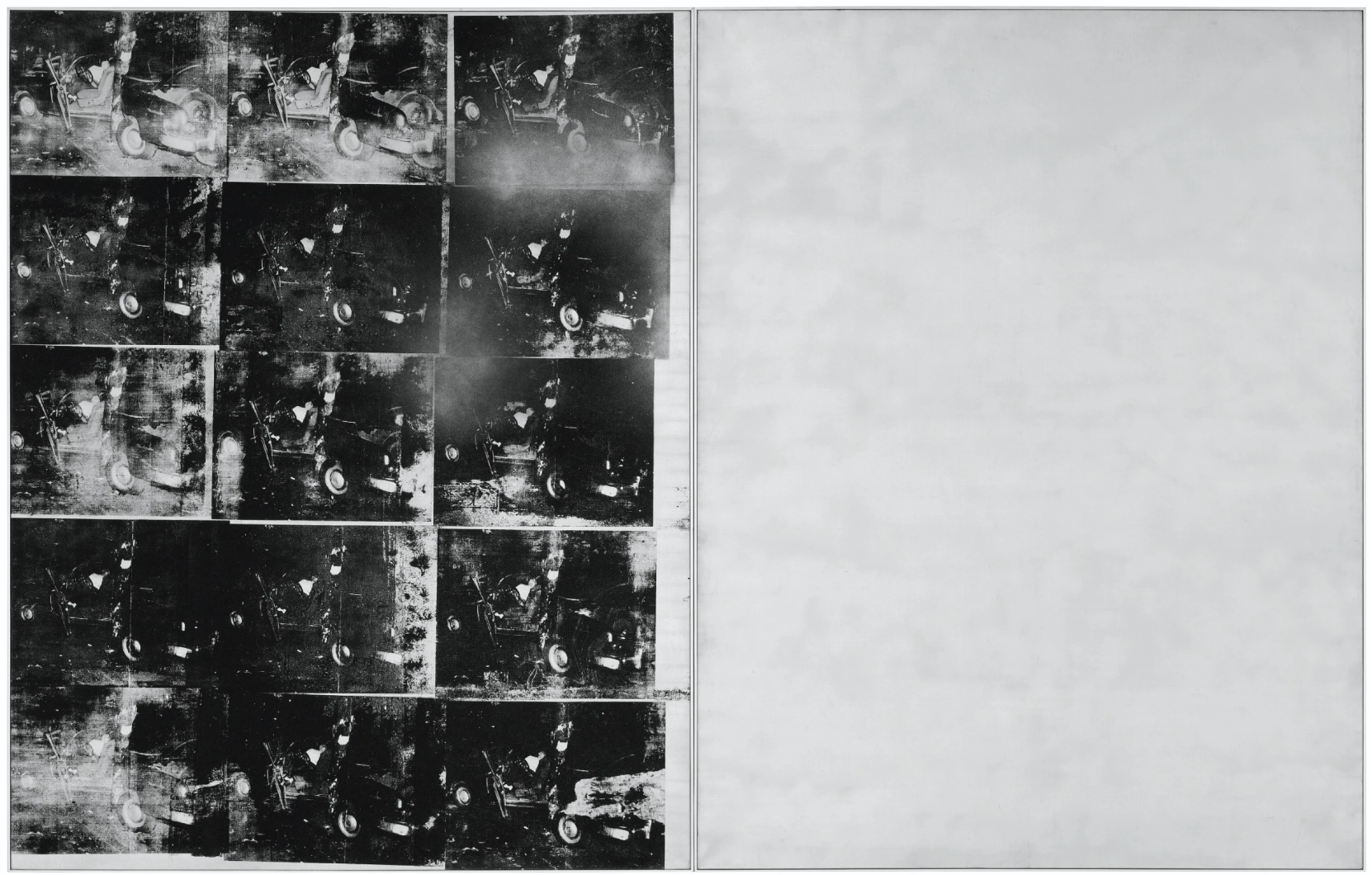
In Mustard Race Riot this contrast is extreme throwing into opposition a completely covered left-hand panel with an empty monochrome right one. Sequentially layering the three different images of the Birmingham riot, the violent images are bricked together covering the entire left-hand canvas so that they appear like wallpaper. In the juxtaposition of the dense, frantic, sensational, shocking contemporary imagery on the first panel with absolutely nothing on the second, Warhol appears to pose an existential question about the nature of the difference between the two.