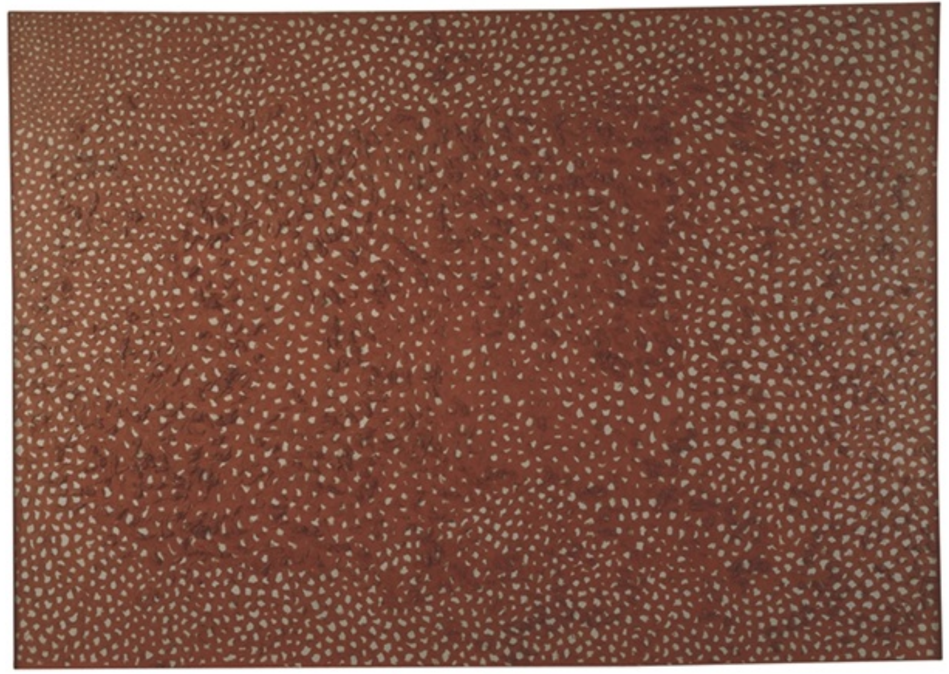
No. Red. Q., 1960
Oil on canvas
110×157 cm (41.2×61.7 inches)
Signed, titled and dated ‘YAYOI KUSAMA NO. RED. Q. 1960’ (on the reverse)
Provenance
Grace Borgenicht Gallery, New York
Private collection, New York, 1961
Anon. sale; Sotheby’s New York, 18 November 1998, lot 299
D’Amelio Terras, New York
Acquired from the above by the present owner
Christie’s New-York: 10 May 2010
USD 1,426,500
Source: Christie’s
Yayoi Kusama (b. 1929) (christies.com)
Although Yayoi Kusama produced her Infinity Nets in a range of different colors, red was the one she returned to again and again. For Kusama the color held unique qualities that resonated with her both on an artistic and personal level and enabled her to produce a work of incredible power and intensity. Red had a particular significance for Kusama because, according to Japanese folk tradition, it is the color for expelling demons and illness. As a young woman Kusama had been diagnosed with an obsessive-compulsive disorder after suffering years of powerful hallucinations in which she would see the world covered in a series of vivid net-like patterns. These demons lead her to paint obsessively, sometimes for forty or fifty hours without a break. Kusama insisted that the process of creating the Infinity Nets was integral to the works themselves.
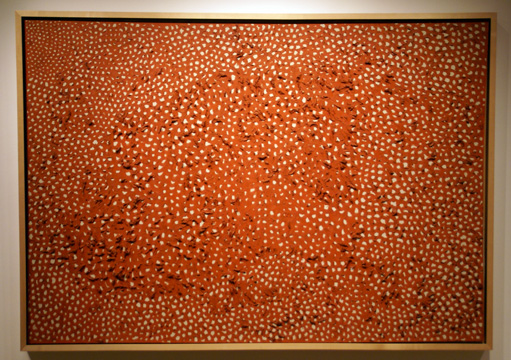
Kusama executed her Infinity Nets in a variety of colors including green, yellow and blue but it is her red versions that fully resonate with the intensity of their execution. Not only did they replicate her Mother’s red tablecloth which Kusama claimed had started off her hallucinations, but they also matched the fiery energy of the artists working methods. The deep red enhances Kusama’s blurring of the line between illusion and reality. At first glance, the impasto imparts a sense of solidity, but over time the plane that peeks through openings in the red net of paint recedes, suggesting a net that veils a deeper void. Moreover, Kusama’s subtle variations in the impasto create patterns within the all-over field of dots, which coalesce and drift as one’s eyes meander across the painting’s wide expanse.