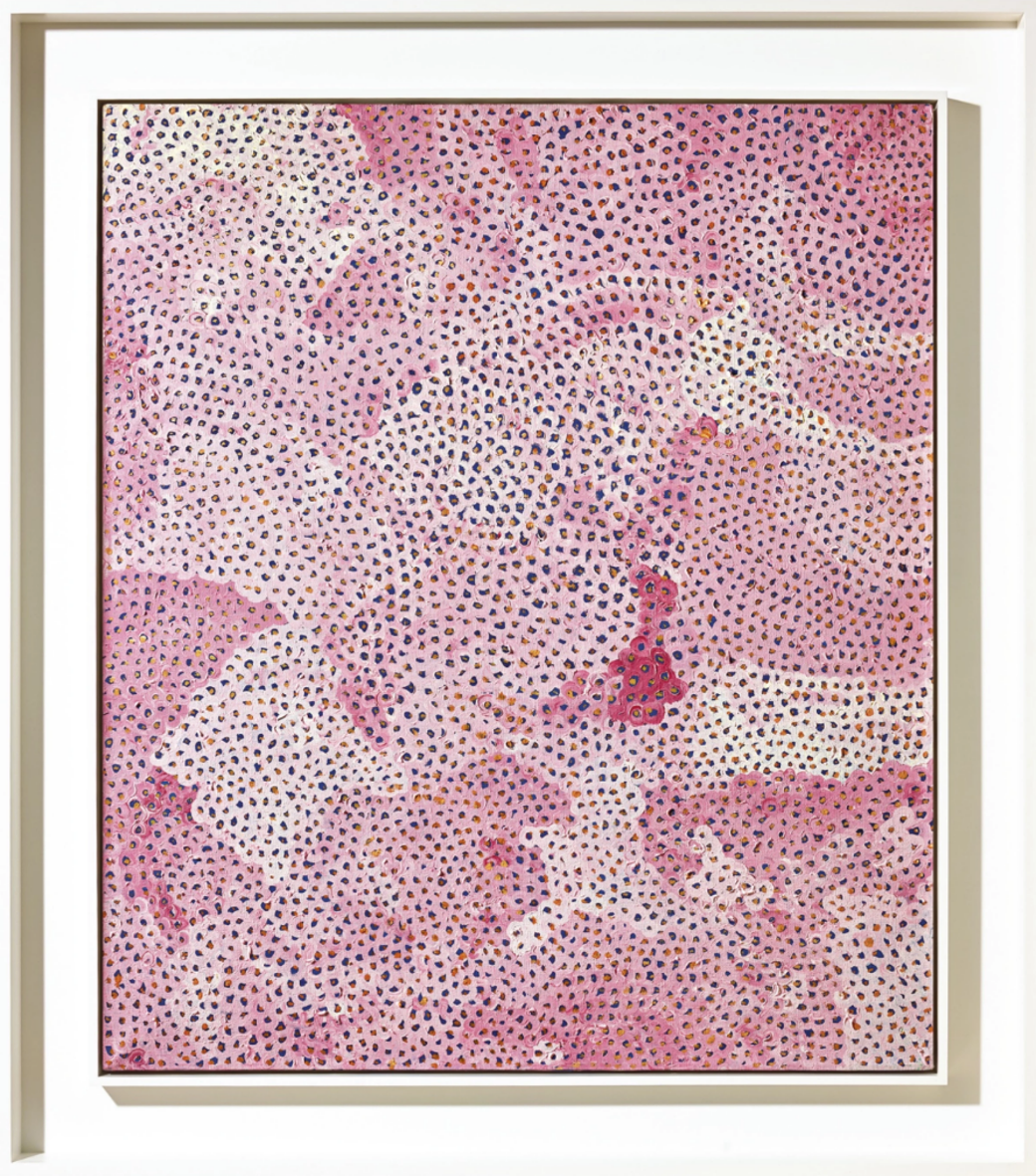
UNTITLED, 1972
Oil on canvas
106.7×91.8 cm (42×36.1 inches)
Signed in English and dated 1972 on the reverse, framed
Provenance
Beatrice Perry Collection (acquired directly from the artist in 1972)
Paula Cooper Gallery, New York
Private Collection
Christie’s, New York, 11 May 2011, lot 64
Acquired by the present owner from the above sale
Sotheby’s Hong-Kong: 30 September 2017
HKD 42,287,500 / USD 5,413,493
Source: Sotheby’s
(#1067) Kusama Yayoi (sothebys.com)
In terms of aesthetics alone, Untitled (1972) is exceptional on many levels, imbuing it with extraordinary personal and historical significance. First, whilst exhibiting overarching cherry blossom hues, Untitled is composed of a highly complex palette comprising deep blue, white, varying layers of pink as well as yellow maize, rendering it possibly the very first multi-colored infinity net on canvas to appear in Kusama’s oeuvre, as her previous nets in the 1960s exhibited only dual colors.
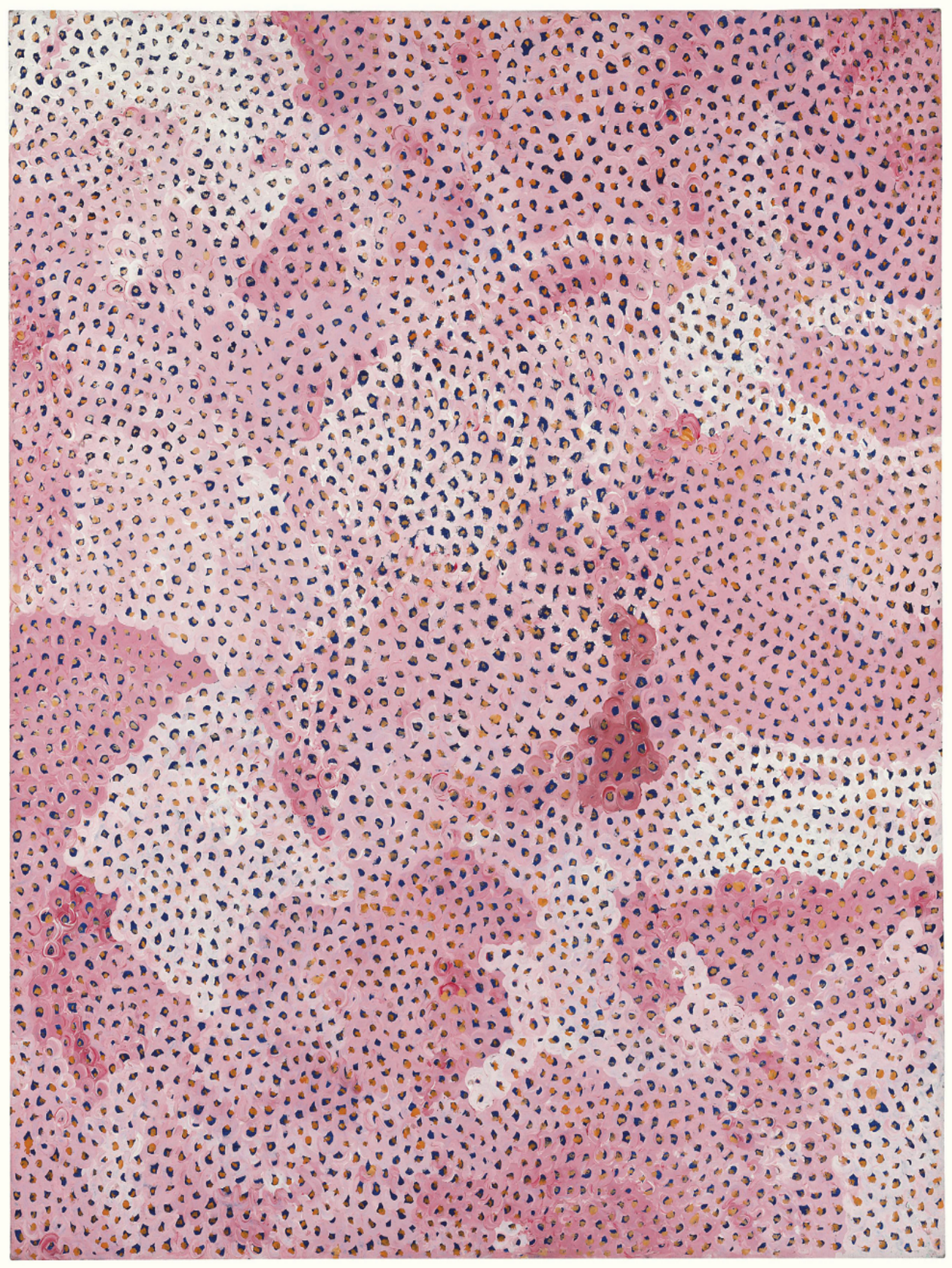
Second, the predominant color of pink, coupled with the softly lyrical aesthetic of the piece, is significant in that it is the only significant New York period net that harkens back to the artist’s early formative years in Japan, during which her works were distinctly more literary. In this sense, Untitled, created at the very end of Kusama’s New York period just before the artist’s return to Japan, is not only a graceful curtain call to the artist’s explosive and epochal 1960s decade, but also an incredible foreshadowing of her ensuing 1970s Japan era, a work that straddles the aesthetics and artistic mind-sets of the first two significant decades of the artist’s legendary career. Thirdly, and most remarkably, woven into the net, hovering slightly off-center, seems to be a vague abstract impression of the figure of a little girl. Elusive, ambiguous yet impossible to ignore, the abstract impression seems to anticipate the later figurative works that Kusama became preoccupied with after returning to Japan. Furthermore, for viewers, the abstract figure may also allude to the artist’s profound and unshakeable loneliness. For all the fame and recognition, the artist gained during her one and a half decades in New York, and for all the public attention she garnered for her highly publicized performances, live events and radical Happenings, Kusama was never able to rid herself of intense feelings of isolation and lonesomeness.
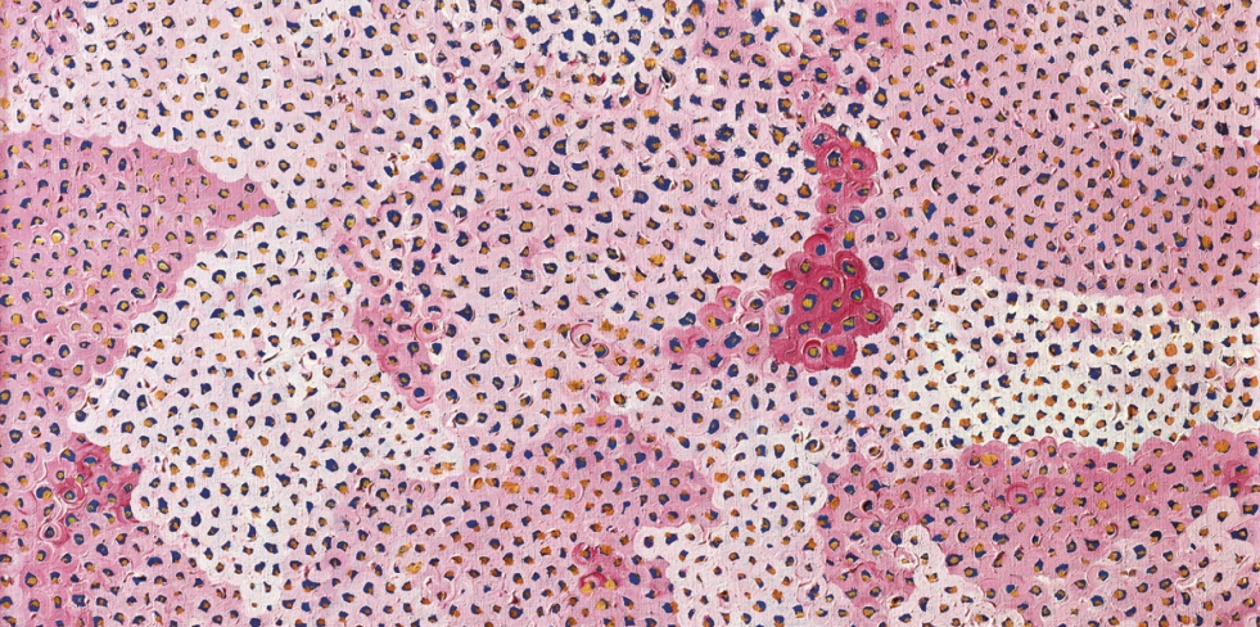
Finally, and perhaps most significantly, in terms of Kusama’s life story, the present lot coincides with a year of intense personal loss. 1972 marked the year of the death of fellow artist Joseph Cornell, a relationship that Kusama describes as her closest, most passionate (albeit platonic) relationship. During their relationship, Kusama spent days at Cornell’s home in Queens, and the two artists sketched each other. Indeed, viewers may observe the coinciding of the pink hues of the present lot with that of a portrait of Kusama by Cornell dated 1965, in which a female figure hovers amidst a gentle pink background. At once pensive and electric, meditative yet intensely alluring, the present lot thus arouses manifold symbolic meanings: a form of mourning and an expression of love for the American artist; a sublime bridging point between the artist’s New York and Japan periods; and an elegant and graceful ode to the transcendent power of healing via art that is so central to Kusama’s everlasting, extraordinary oeuvre.