KAWS
GIANT COMPANIONS

“Companion is a figure in the world now, and it’s not all great out there,” KAWS has explained. “Even though I use a comic language, my figures are not always reflecting the idealistic cartoon view that I grew up on…Companion is more real in dealing with contemporary human circumstances. I think when I’m making work it also often mirrors what’s going on with me at that time” (KAWS, quoted in KAWS: WHERE THE END STARTS, exh. cat., Modern Art Museum of Fort Worth, Fort Worth, 2016, p. 5). If KAWS’ Companion was caught in a state of isolation with PASSING THROUGH, here he marches resolutely forward with two smaller child-like Companions in his arms in a manner that embodies the optimism and dynamism its very title “CLEAN SLATE” suggests. Like GOOD INTENTIONS, 2005, a large-scale sculpture comprised of a large and small, toddler-like Companions, this sculpture offers a highly intimate portrait of parenthood that, not unlike Henry Moore’s Mother and Child sculptures, is likely reflective of KAWS’s own experience of becoming a father at that time. As Andrea Karnes noted, his Companions “seemingly empathize with us while we emphasize with them – plodding through life” (Andrea Karnes, KAWS: WHERE THE END STARTS, exh. cat., Modern Art Museum of Fort Worth, Fort Worth, 2016, p. 49).
CLEAN SLATE
It has been with large-scale sculptures such as CLEAN SLATE that KAWS has in recent years claimed his position among the most forward-looking contemporary sculptors of our present age. Like his artistic idols Claes Oldenburg and Jeff Koons before him, he scales up pop cultural motifs with an irreverent nod to the grand tradition of sculpture. CLEAN SLATE perfectly demonstrates how KAWS re-contextualizes the role of mass culture in art, based as it is on the Companion character that initially took the form of small-scale figurines starting in 1999.
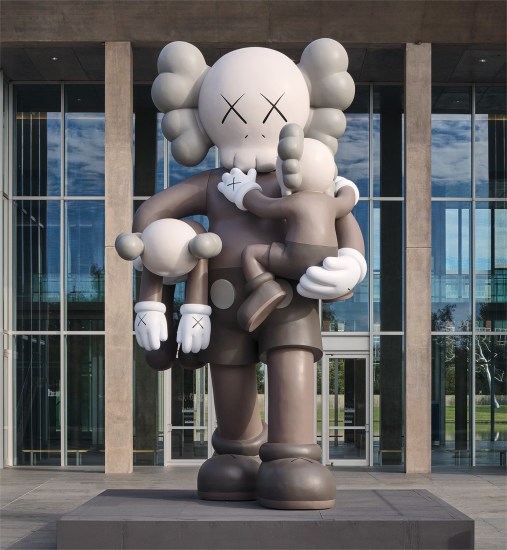
CLEAN SLATE, 2014
Fiberglass, metal structure and paint
275 5/8 x 216 x 216 inches (700.1 x 548.6 x 548.6 cm)
Edition: 3 with unique color variants
Phillips New-York, 15 November 2018
USD 1,995,000
KAWS, then largely known as a graffiti provocateur, began collaborating with the Japanese apparel line Bounty Hunter to create a limited edition of vinyl toys. What began as toy versions radically expanded in the past decade to become supersize works of sculpture, deliberately aimed at dismantling distinctions between high and low art. As KAWS explained, speaking of his strategy of blurring the lines between toys and sculptures, “to me they involve the same thought process, so it’s funny that when I work big in bronze, it’s called a sculpture, but something I do that’s small and plastic is called a toy” (KAWS, quoted in Carlo McCormick, “From the Streets to TV to Fine Art Galleries, KAWS Is Everywhere”, Paper, November 4, 2013, online). As the present work exemplifies, KAWS still manages to convey toy-like plushness in the sculptural surface of his monumental works in a manner that echoes Jef Koons’s “Play-doh” sculptures.
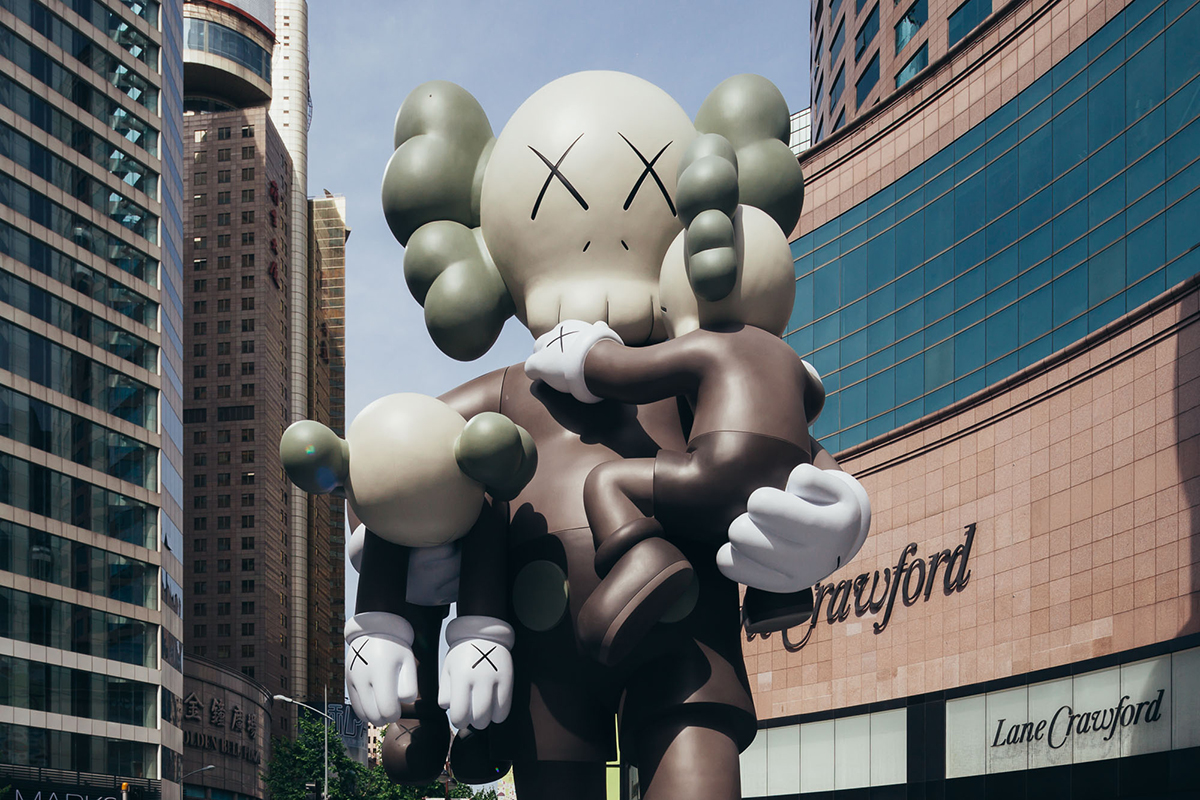
Towering over its viewers and animating its surroundings with a uniquely uncanny presence, KAWS’ CLEAN SLATE, 2014, comprises the ultimate monument to the artist’s trademark Companion figure. Recreated in fiberglass at a colossal scale, the Companion is captured midstride, holding two smaller, cloned child-like versions of itself in its arms as it moves forward with a resolution and confidence that seems to reflect the notion of starting with a “Clean Slate” as its title suggests. Since its unveiling in Hong Kong in 2014 as one of KAWS’ largest public sculptures, CLEAN SLATE has taken a prominent position as the artist’s most recognizable figure. Not only was it the first KAWS sculpture of that magnitude to be exhibited in mainland China when it was subsequently erected in Shanghai Times Square in 2015, it was also the key highlight of KAWS’ major museum exhibition KAWS: WHERE THE END STARTS where it was displayed outside of the Modern Art Museum of Fort Worth in 2016 and 2017. With the figure inspiring the artist to create smaller versions, both for exhibitions at such seminal venues as the Yorkshire Sculpture Park as well as in the form of limited edition toys, it has become a truly global icon of our time that captures the way in which KAWS has irrevocably changed the relationship between fine art and pop culture.
TOGETHER
Stunningly realized in meticulously painted bronze, TOGETHER depicts two of KAWS’s instantly recognizable COMPANION figures, which since their inception in 1999, have come to be recognized as among his most prized motifs. Differing from the other large-scale bronze works by the artist that have appeared on the market, most of which feature a solitary COMPANION rendered in various poses, here, KAWS presents us with a pair who are caught in a firm embrace – their arms tightly wrapped around one another in a manner that powerfully injects notions of humanity into the composition, juxtaposing the materiality of the solid sculptural piece.
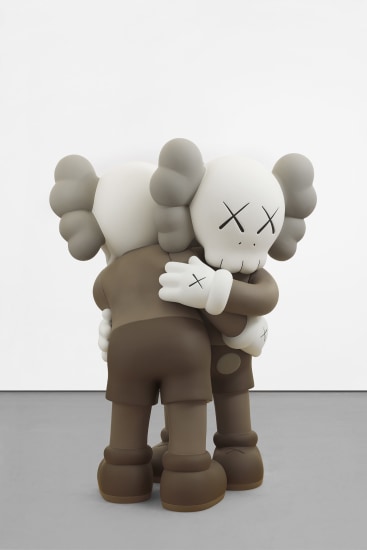
TOGETHER, 2017
Painted bronze
71 x 50 x 30 inches (180 x 126 x 77 cm)
Edition: 7 + 2APs
Phillips Hong-Kong, 8 June 2021
USD 1,373,213
Testament to the importance of this work, TOGETHER made its museum debut in 2017 at the esteemed Contemporary Art Museum St. Louis, United States, where it was installed in the heart of the museum’s impressive courtyard, set against a backdrop of KAWS’s immense site-specific painting on the museum’s Project Wall. Despite the enormity of the space, it was TOGETHER that demanded the full attention of visitors – the COMPANION’s warm embrace evoking emotions and triggering a sense of childlike reverie.
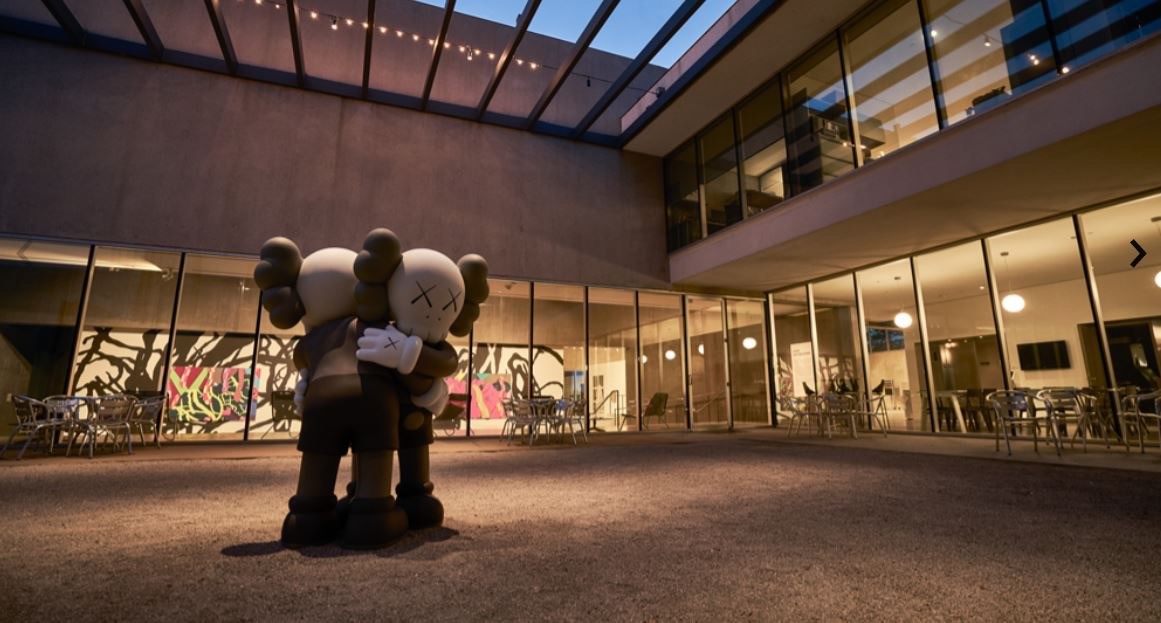
TOGETHER installed in St. Louis, Contemporary Art Museum St. Louis, 2017
Indeed, with further editions of the work featured in major exhibitions hosted by leading institutions around the world, including the National Gallery of Victoria in Melbourne, the Hong Kong Contemporary Art Foundation, and Qatar Museum’s Doha Fire Station, TOGETHER is a prime and rare example from KAWS’s unique practice that perfectly embodies the very best of his impressive oeuvre.
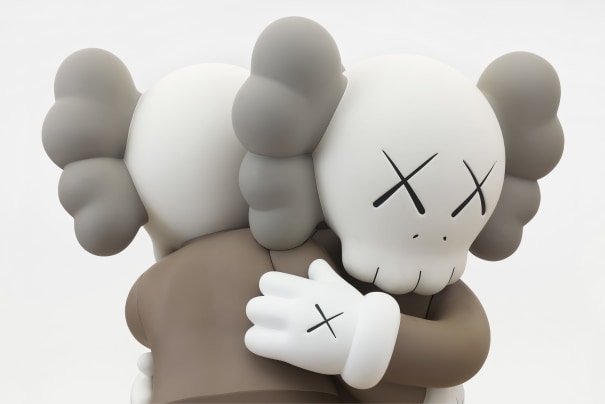
At the same time, KAWS follows in the longstanding tradition of sculpting in bronze, creating figures that stand firmly rooted to the ground yet appear animated, about to move at any time. His materiality brings to mind the working methods of Henry Moore, the famous English artist who became well-known for his large-scale bronze sculptures which frequently depicted abstract forms of reclining figures. Indeed, his work is interesting to consider in relation to KAWS, as like Moore, KAWS is deftly able to capture the intimacies of a relationship through the medium of bronze on a large-scale, demonstrating an adroit understanding of the medium that only few have mastered. Works such as Family Group (1949) by Moore demonstrate the English artist’s ability to evoke a lightness and dynamism despite the heaviness of its material, beautifully representing the trio’s tender emotional connection. In a similar manner, KAWS is able to uniquely portray a poignant moment in TOGETHER, stimulating the emotions of the viewer as we look on as an outsider to the intimate gesture.
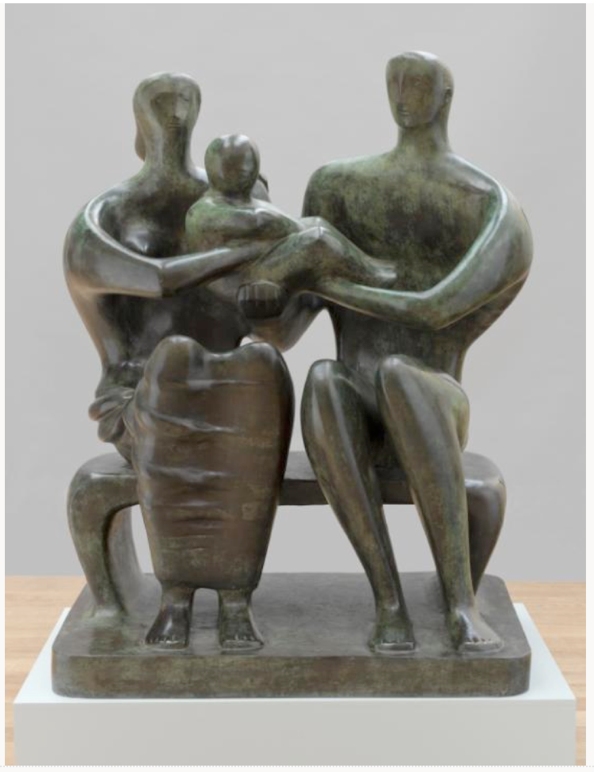
Henry Moore, Family Group, 1949
Collection of Tate, London
In making a more contemporary comparison, the work of Jeff Koons is prescient to consider in relation to that of KAWS, as he too references pop culture imagery in his work, manipulating his influences through scale and material. For example, Koons’ life-size Hulks from his acclaimed Hulk Elvis series (2004-14) are made from bronze, but appear weightless, their materiality curiously resembling that of inflatable toys. Working in a similar vein, KAWS’s TOGETHER also retains the smooth, toy-like appearance of his original vinyl miniatures blurring the lines between high art and low art in his juxtaposition of materiality.
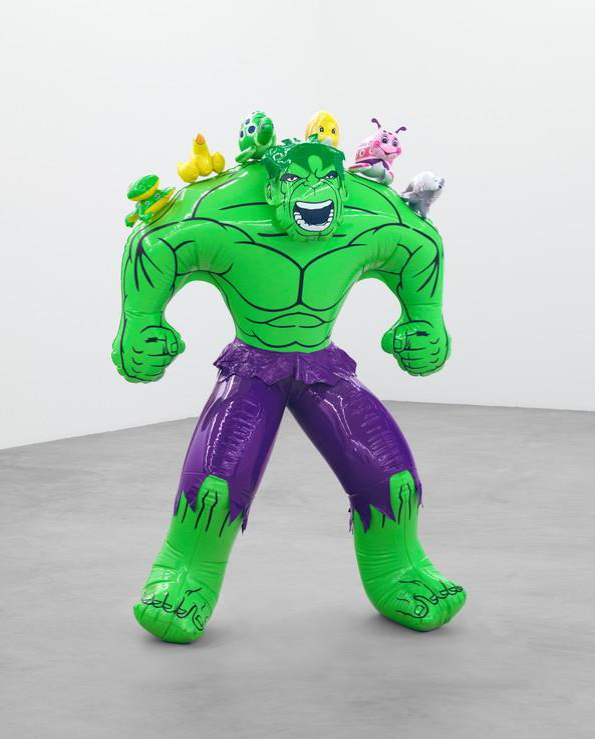
Jeff Koons, Hulk (Organ), 2004-14
TOGETHER is engaging and enigmatic in equal measure, however, and differs from Koon’s Hulk in the intriguingly human aura each COMPANION figure evokes. Although COMPANION is often portrayed seeming sad, overwhelmed, or tired, hunched over or shying away from the world, here, the two COMPANION figures hug tightly, looking out at the viewer from over the other’s shoulder. As they are positioned together, we, the viewer, look on alone. Though conveying a playful disposition through their cartoon language which introduces a nostalgic potency, working to harness our childhood memories, both their body language and size is distinctly human, marking a strange shift in perspective that makes us feel as if it is we who have entered into their toy world.
Contrasting this, however, are each figure’s pair of X-ed out eyes that eerily confront us, reminiscent of the image of cartoons after a character has drunk from a vial of poison. The inclusion of his signature detail gives a slightly sinister edge to the otherwise sweet work as KAWS blends playful wit with more morbid undertones, evoking empathy, humor, as well as a meditative reflection on fragility, ultimately presenting the viewer with a powerful exploration of the human condition.
FINAL DAYS
A colossal portrayal of the hybrid between a cartoon Smurf and KAWS’s signature COMPANION figure, FINAL DAYS, 2013, epitomizes the artist’s capacity to create images that are simultaneously humorous and disturbing in order to subvert conventional distinctions between high art and street culture. Meticulously executed in Afrormosia wood, the same medium as ALONG THE WAY, 2013, Brooklyn Museum, the subject is captured midstride with his arms outstretched, perpendicular to his body, in an eerie pose reminiscent of the iconic stalk of Frankenstein’s monster in the 1931 film adaptation. Through KAWS’s repeated use of its iconography, FINAL DAYS has become a motif in his oeuvre that epitomizes his astute ability to reimagine nostalgic symbols for the contemporary era.
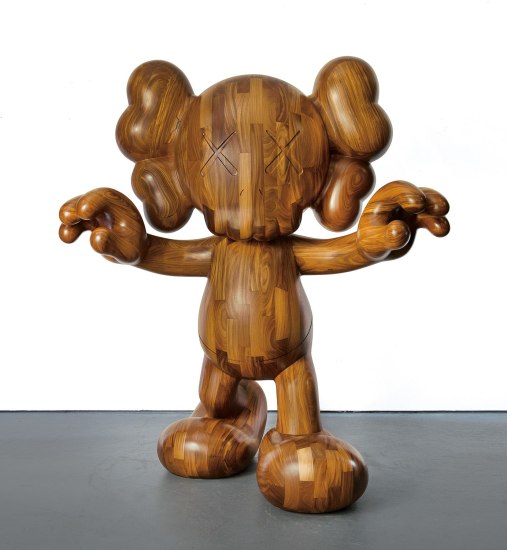
FINAL DAYS, 2013
Afrormosia wood
82 5/8 x 76 3/4 x 53 7/8 inches (210 x 195 x 137 cm)
Edition: 3 + 2APs
Phillips New-York, 14 November 2019
USD 1,460,000
In a sharp divergence to the art historical canon of mythological and biblical depictions rendered in the classical medium of sculpture, FINAL DAYS confronts the viewer with an uncanny, hybrid character that is emblematic of the visual tactic of cartoon appropriation KAWS has become internationally renowned for. A sardonic portrayal of a cross between a Smurf and Mickey Mouse—perhaps the most instantly identifiable cartoon character of all time—FINAL DAYS employs a ubiquitous subject matter that was previously utilized by Pop masters such as Andy Warhol and Roy Lichtenstein, such as in the latter’s Look Mickey, 1961, National Gallery of Art, Washington, D.C. However, the imperturbable ebullience typically associated with these childhood characters is subverted here by KAWS’s supplanting of Mickey’s three-circled head with his trademark sinister skull, a derisive supplanting that exudes a disconcerting sense of the uncanny. Simultaneously nostalgic and regal, FINAL DAYS exemplifies KAWS’s ability to manipulate the evocative faculty of hybridity as a means of challenging and deconstructing cultural boundaries. In exploiting the sentimental potency of universally treasured cartoon characters, KAWS imbues them with emotionally charged undercurrents to reinvent them in a contemporary context.
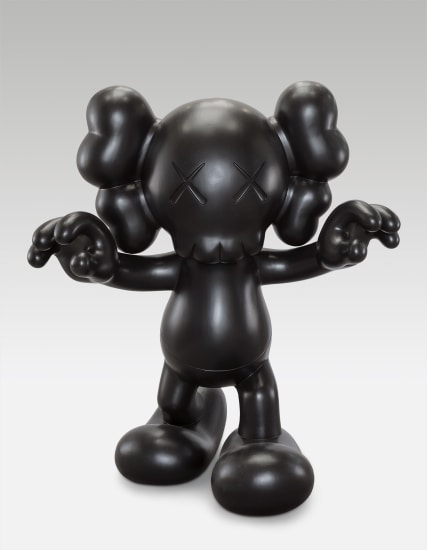
FINAL DAYS, 2014
Afrormosia wood
210 x 195 x 137 cm (82 5/8 x 76 3/4 x 53 7/8 inches)
Edition: 3 + 2APs
Phillips Hong-Kong, 26 May 2018
USD 1,460,000
Sculpted from a gorgeous dark brown African hardwood and weighing in at a half tonne, FINAL DAYS is an exemplary work by the intrepid KAWS. The artist’s classic revisions of iconic popular culture characters are not only immediately recognisable but are also in the spotlight now more than ever. Featuring KAWS’s idolised alterations applied to a hatless Kurf, the present lot showcases the unmistakable crossed-out eyes, bones imitating hair and ears, distorted mouth and impeccable fabrication that characterize the artist’s signature work. Though he is internationally known for his compelling cross-pollination of distinct imagery, materials, and cultural references, KAWS raises the stakes considerably incorporating for the first time the richly coloured, extremely durable afrormosia to articulate FINAL DAYS. Imbued with the spiritual energy of the historic lumber, this novel combination of timeless dark hardwood and contemporary iconography first debuted at the artist’s major 2014 exhibition of the same name at the Contemporary Art Centre of Málaga.
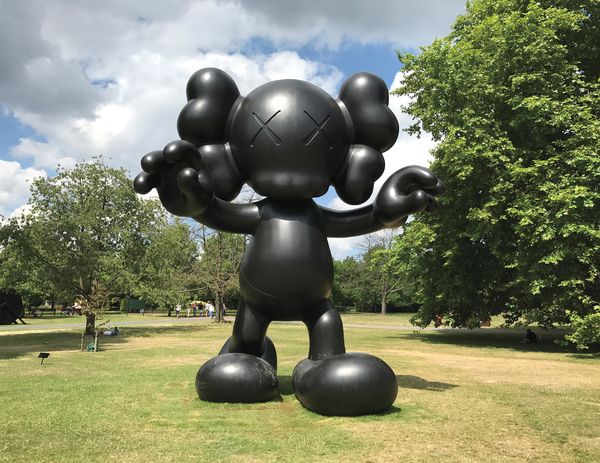
FINAL DAYS 2013. 6 meters tall, this example was exhibited at Frieze Sculpture, London, 5 July-8 October 2017. Photo: Danielle So
The charisma of FINAL DAYS emanates from its uncanny relatability as the work represents one of the artist’s most convincing explorations into the inner-world of humanity. Lumbering towards the viewer with its arms held out, the character featured in the work adopts a gait and expression that distances the piece from any association with the innocent world of fantasy and childhood. Eliciting sensations of melancholy and loss, FINAL DAYS conveys feelings inherent to the human condition that are balanced with the artist’s sophisticated sense of humour and charming cartoon aesthetic. Though KAWS states that his work “is a mirror of his own state of mind… and a way of understanding the world around him,” (KAWS quoted by Arie Bouman, “KAWS at the Modern Art Museum of Fort Worth,” 11 January 2017) he further elucidates, “it’s not important for me to impose those thoughts on the viewer. I would much rather have the work find new meaning to the people that take the time to view it. I don’t make work with any specific audience in mind.” (KAWS interviewed by Grace Banks, “Kanye West-favourite KAWS Exhibits His Sculptures at Yorkshire Sculpture Park,” Forbes, 29 February 2016)
AT THIS TIME
Animating its surroundings with an uncannily ambivalent presence, AT THIS TIME, 2013, presents KAWS’ signature COMPANION figure, standing alone with his head tilted backwards and his eyes sunk in his hands. Exquisitely crafted from afromosia wood, AT THIS TIME is at once monumental and imposing, playful and psychologically charged, inviting viewers into a visual universe that is infused with KAWS’ instantly recognizable cartoon imagery. Selected for inclusion in the artist’s career-defining exhibition KAWS: WHERE THE END STARTS, which began in 2016 at the Modern Art Museum of Fort Worth and later travelled to the Yuz Museum in Shanghai, AT THIS TIME is an icon of our time that exemplifies KAWS’ rise to the canon of contemporary art, encapsulating the artist’s visual language that oscillates between popular culture and fine art.
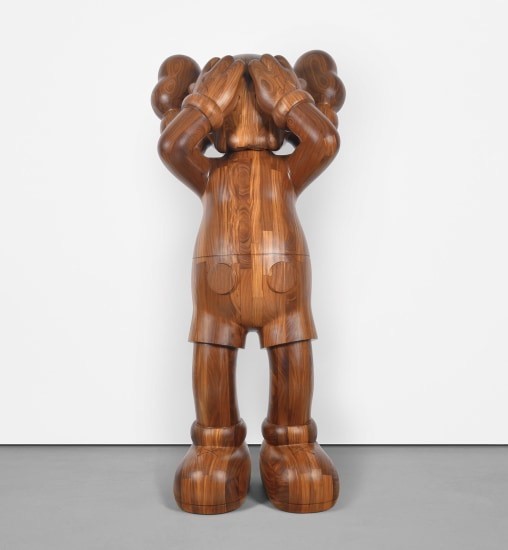
AT THIS TIME, 2013
Afrormosia wood
103 7/8 x 44 1/8 x 39 3/8 inches (264 x 112 x 100 cm)
Edition: 3 + 2APs
Phillips London, 2 October 2019
USD 1,791,430
Executed in a rich, natural colour with exposed wood grain, AT THIS TIME illustrates KAWS’ enduring fascination and experimentation with materiality. In 2005, KAWS began collaborating with the Japanese furniture company Karimoku to create his first small wooden COMPANION, a partnership which would invigorate the artist’s notions about the material possibilities of wood. ‘We use a lot of technology with the sculptures we make’, the artist has said. ‘You know the large, wooden sculptures? Even though they’re wood, they go from small maquettes that are ten to fifteen inches to being digitized and built out on a CNC machine, which is sort of like 3-D printing’ (KAWS, quoted in ‘Pharrell Williams Interviews KAWS’, KAWS: WHERE THE END STARTS, exh. cat., Modern Art Museum of Fort Worth, Fort Worth, 2016, p. 85). A long-time admirer of H. C. Westermann’s intense approach to wood carving derived from carpentry, KAWS furthermore sought to follow the late American artist’s footsteps by developing new processes that would incorporate the traditional medium. In AT THIS TIME, this is exemplified by the natural striations of the wood grain that produce a mesmerising, swirling pattern along the polished surface of the sculpture. Drawing upon the centuries-old technique of marquetry, each strip of wood is meticulously fabricated to follow the contour lines of the COMPANION’s body, creating a marked contrast between the traditional wooden medium and character’s distinctly contemporary appearance.
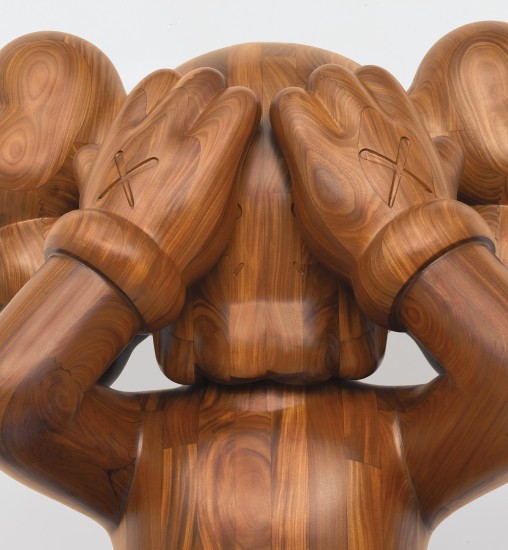
KAWS has furthermore bridged his appreciation of the materiality of wood with his love of toys, explaining that when creating the wood works, ‘I was thinking of the relationship I’ve had to wood toys growing up and the warmth and feeling they have when you hold them in your hand or place them on a shelf or table and stare at them. I wanted to expand on that, to create a wooden sculpture that makes you feel small but at the same time I want the viewer to feel like they should somehow help or console the work, despite its towering size’ (KAWS, quoted in ‘KAWS: The Story Behind an Artwork, in the Artist’s Own Words’, Blouin Modern Painters, February 2016). Like Urs Fischer’s monumental Untitled (Lamp/Bear), 2005-06, AT THIS TIME celebrates the very object that defines a young child’s experience, here bringing to mind the familiar Disney cartoon Pinocchio, who was created as a wooden puppet with dreams of becoming a real boy. Exuding a distinct intimate feel despite monumental scale, AT THIS TIME taps into the nostalgic potency of beloved childhood characters that resonate across audiences around the globe.
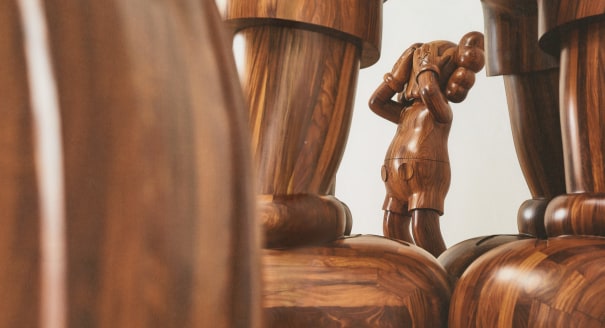
Enamored with the world of cartoons to the point of creating his own graphic figures, it was in 1999 that KAWS designed his first COMPANION character, which initially took the form of a small-scale figurine. Inspired by the iconic character of Mickey Mouse, COMPANION was named for the kind of lovable partner we all seek to feel cared for, fulfilled and not alone. COMPANION soon became a hallmark of KAWS’ visual lexicon, one that he would continue to hone and develop for the next two decades. In AT THIS TIME, the sculpted COMPANION’s posture conveys myriad, contradicting emotions, spanning disbelief, rest, isolation and playfulness. Captured in a state of isolation, COMPANION appears sad and alone – in a complete paradox to his name. Yet when seen from a child’s eyes, the character’s pose transforms into a playful expression, redolent of the childhood game of hide-and-seek. From play to retreat, invitation to isolation, the sculpted protagonist’s pose conjures a poignant vulnerability that summons empathy from its viewers. As such, AT THIS TIME is acutely relatable and universal, embodying the very essence of what KAWS has aimed to achieve throughout his oeuvre.
PASSING THROUGH
Seated with eyes covered, head resting in hands, COMPANION (PASSING THROUGH), 2011, captures KAWS’ signature COMPANION figure in an isolated state of introspection. Conjuring a myriad of emotions ranging from sadness, to fatigue, to complete overwhelm, the figure’s familiar posture invites empathy from its viewers.
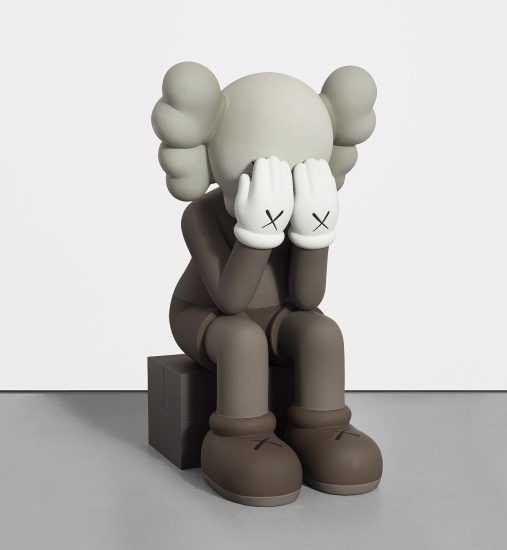
PASSING THROUGH, 2011
Painted bronze
47 1/8 x 31 3/8 x 28 in. (119.7 x 79.7 x 71.1 cm.)
Edition: 10 + 2APs
Phillips New-York, 13 November 2019
USD 836,000
KAWS created his first COMPANION figure in 1999 as a small-scale figurine and, over the next two decades, this character has become a cornerstone of his celebrated oeuvre. Inspired by the enduring celebrity of the iconic cartoon character, Mickey Mouse, COMPANION is replete with white gloves, shorts with buttons, and globular cartoon-shoes. Yet in quintessential KAWS fashion, the artist has replaced Mickey’s head with his signature skull with X’ed out eyes. Of his COMPANIONS, KAWS explains, “Even though I use a comic language, my figures are not always reflecting the idealistic cartoon view that I grew up on… COMPANION is more real in dealing with contemporary human circumstances” (KAWS, quoted in KAWS: WHERE THE END STARTS, exh. cat., Modern Art Museum of Fort Worth, Fort Worth, 2016, p. 5). Equally personal as it is universal, somber as it is playful, COMPANION (PASSING THROUGH) is a poignant reflection of the modern-day human condition, inviting viewers to ponder the fragility of personal circumstances and the universality of emotion.
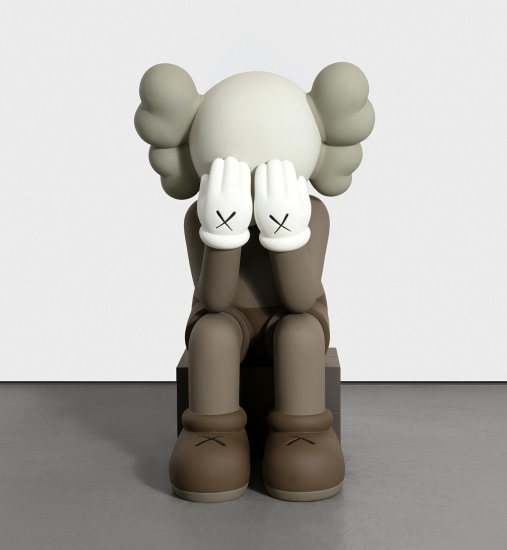
In COMPANION (PASSING THROUGH), KAWS astutely bridges the gap between popular culture and fine art, paying homage to a rich lineage of art historical predecessors. While establishing an instantly recognizable visual lexicon that is uniquely his own, the figure’s seated, contemplative posture is reminiscent of August Rodin’s The Thinker, 1903. Like Rodin’s figure, COMPANION seems lost in thought, introspectively contemplating the very circumstances of his own being. KAWS also cites Jeff Koons and Claes Oldenburg as his artistic idols, whose playful sculptures equally oscillate between kitsch and high art. In recent years, KAWS has claimed his own position amongst the most ambitious and celebrated sculptors of the contemporary age, with works such as COMPANION (PASSING THROUGH) standing as a testament to the strength and breadth of his cultural influence.