2026 Fall New-York Marquee Auctions
Francis Bacon
Auction Results
Self-Portrait, 1972
Shaping Modernity: Property from a Private American Collection
Sotheby’s New-York: 16 November 2026
Estimated: USD 10,000,000 – 15,000,000
Francis Bacon | Self-Portrait | The Now and Contemporary Evening
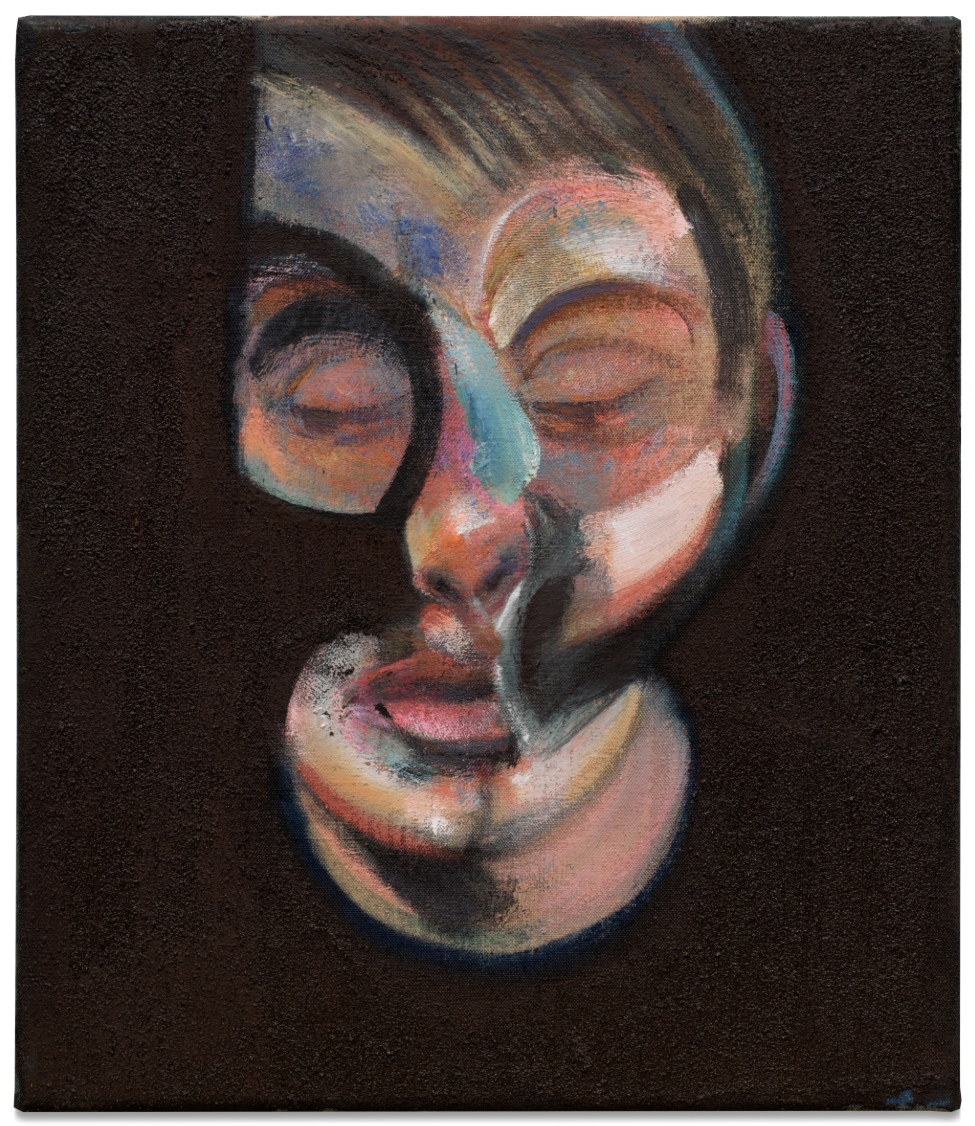
FRANCIS BACON (1909 – 1992)
Self-Portrait, 1972
Oil on canvas
14×12 inches (35.5 x 30.5 cm)
Signed, titled and dated 1972 (on the reverse)
Study for Portrait X, 1957
Christie’s New-York: 17 November 2026
Estimated: USD 7,000,000 – 10,000,000
FRANCIS BACON (1909-1992), Study for Portrait X | Christie’s
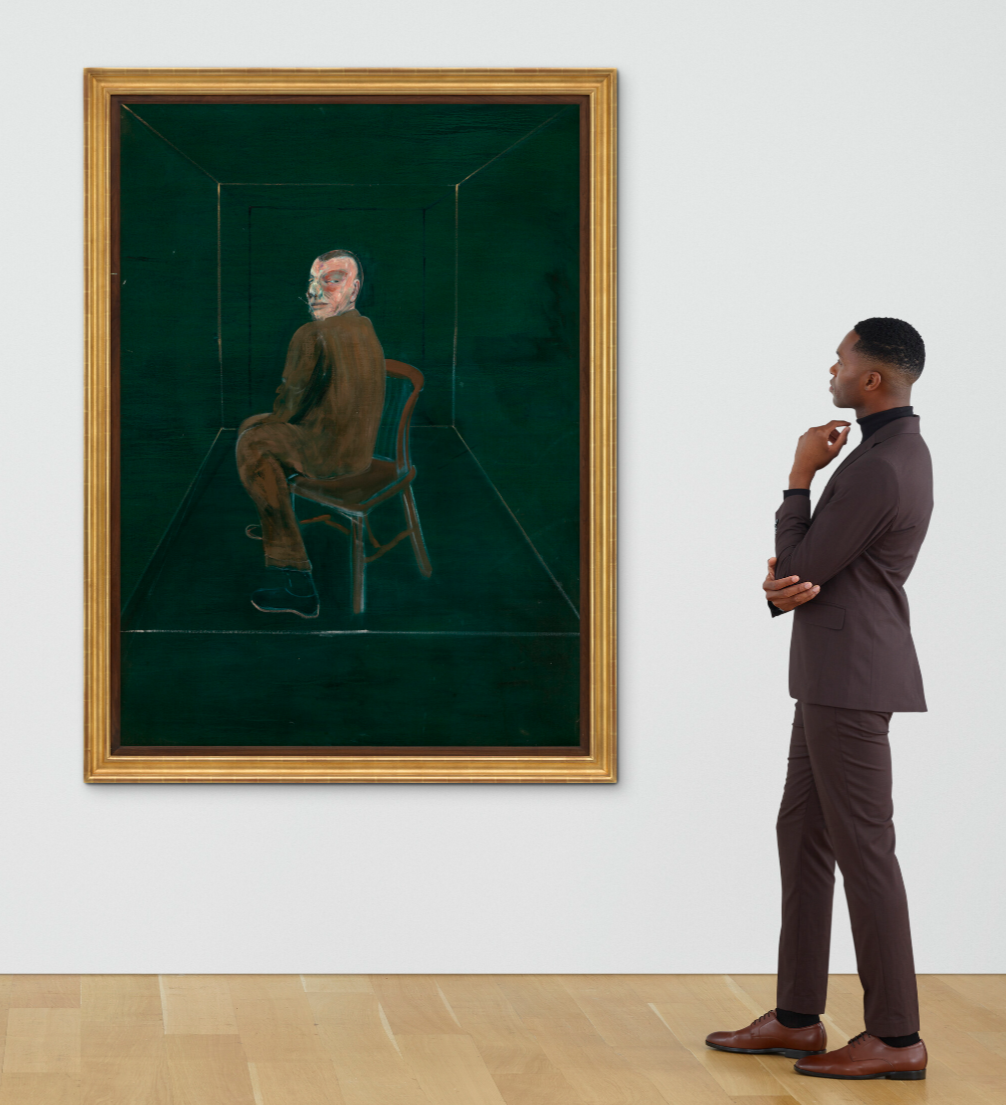
FRANCIS BACON (1909-1992)
Study for Portrait X, 1957
Oil on canvas
78×56 inches (198.1 x 142.2 cm)
Self-Portrait, 1972
Self-Portrait, 1972
Shaping Modernity: Property from a Private American Collection
Sotheby’s New-York: 16 November 2026
Estimated: USD 10,000,000 – 15,000,000
Francis Bacon | Self-Portrait | The Now and Contemporary Evening
FRANCIS BACON (1909 – 1992)
Self-Portrait, 1972
Oil on canvas
14×12 inches (35.5 x 30.5 cm)
Signed, titled and dated 1972 (on the reverse)
Languished and haunting, Francis Bacon’s Self-Portrait from 1972 is among the most significant works from the most prolific year of the artist’s self-portraiture, a painting that distills his psychological torment and artistic refuge with extraordinary force. Soon after the death of George Dyer and three close friends, Bacon embarked upon more self-portraits than in any other year of his oeuvre, remarking, “I’ve done a lot of self-portraits, really because people have been dying around me like flies and I’ve had nobody else to paint but myself.” (The artist quoted in: David Sylvester, Looking Back at Francis Bacon, London 2000, p. 129) The present work is one of fifteen paintings executed in this seminal year and one of seven single-panel self-portraits. Grieving the loss of those closest to him while simultaneously finding therapeutic release via the canvas, Bacon meditated upon his own mortality in these works, each renewed with tenderness and visual intensity. The present work constitutes, in many respects, an experiment in and negotiation with death itself. Exemplifying the artist’s unmatched command of visual impact, these confessional images bear witness to his anguish and resilience, and among them the present work stands as one of the most intimate and raw of his career.
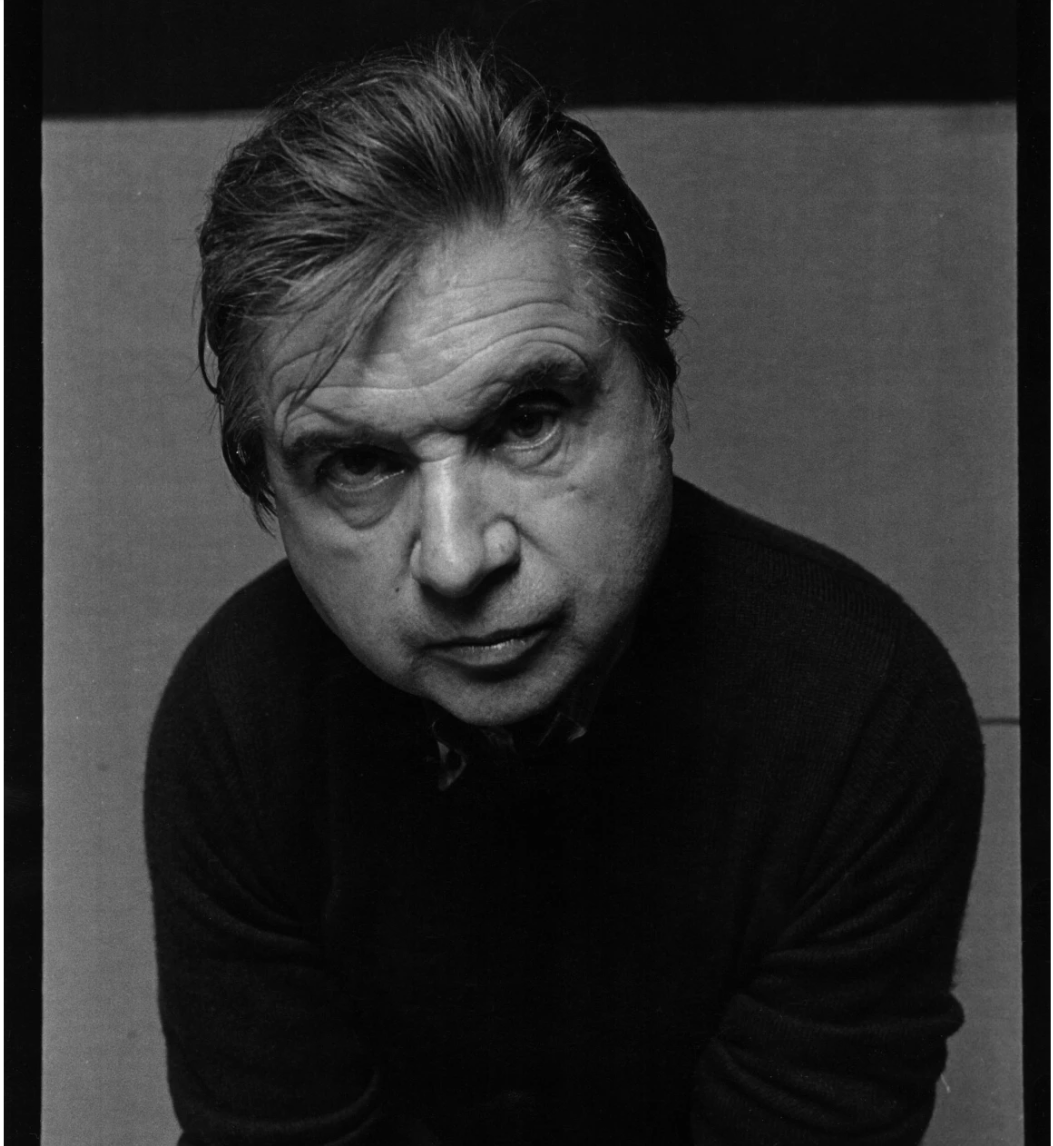
The artist poses for his portrait in his studio in London, 1975. Photo by Arnold Newman Properties/Getty Images
Of this limited suite, the present work is an exceptionally rounded form. While the other portraits from 1972 exhibit an angular face, sliced by various dark swathes, the present painting is distinguished by the unusual fluidity of its contours, the enveloping black passages and the complete absence of a discernible body. Such unique compositional choices lend the image an extraordinary sense of isolation, setting it apart within an already exceptional body of work. Formally, light and gesture are paramount in this work. Across the face, a spiraling current of brushwork almost bifurcates the visage, one half overtaking the other in an enveloping swirl. As though folding into itself, the face appears on the verge of disappearing completely, its contours dissolving beneath the force of Bacon’s gestural movement. Accompanying this centrifugal motion is his inimitable command of color. With a palette of pastels, striking cerulean, peach, violet, and tangerine, Bacon achieves a remarkable complexity of color, light, and form at an intimate scale. Peppiatt recalled Bacon in 1972 as “almost translucent, with a strange bluish hue as if he were deathly cold,” an observation that seems to echo the chilled, blue-inflected tonality coursing through the present work. (Mark Stevens and Annalyn Swan, eds., Francis Bacon: Revelations, London 2021, p. 566) Bacon’s characteristic diagonal inflection across the brow lends the face a fatal punctuation. Michel Leiris, Surrealist writer and Bacon’s close friend, famously described this motif as “a reckless comma staunchly inscribed across his brow.” (Michel Leiris, Francis Bacon: Full Face and in Profile, New York, 1983, p. 12) Against this luminous chromatic field, the black passages assume an almost visceral intensity, their stark incisions interrupting the delicate interplay of hues and transforming the face into a site of both physical and psychological rupture.
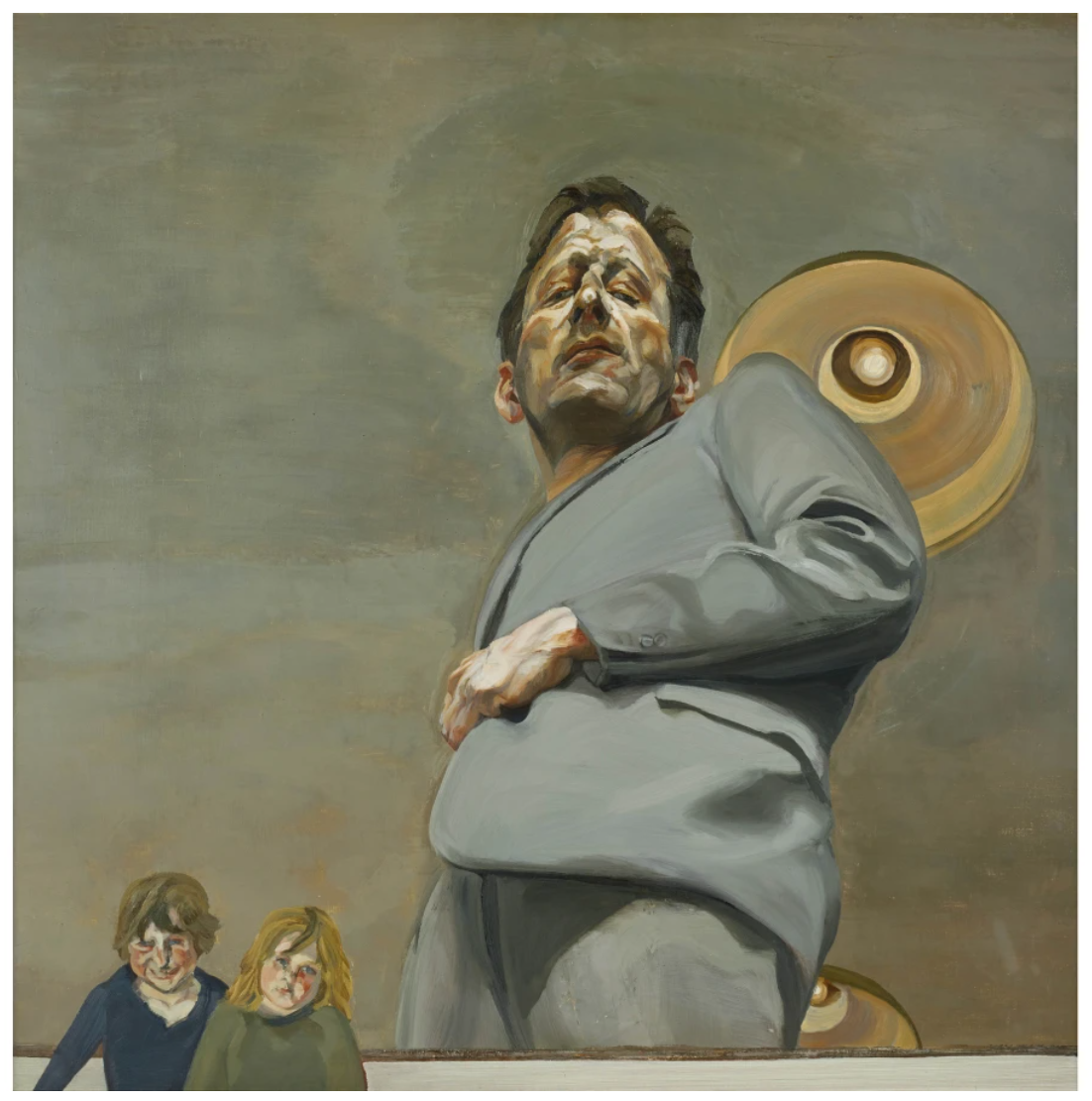
Lucien Freud, Reflection with Two Children (Self Portrait), 1965. Thyssen-Bornemisza National Museum, Madrid. Image and Art © The Lucian Freud Archive. All Rights Reserved 2026 / Bridgeman Images
1972 was, moreover, a period Bacon later framed as one of inward extremity. As noted by Anne Dunn, “He was shattered by George’s death. He felt tremendously responsible – he hadn’t realized that George was in the state that he was.” (Mark Stevens and Annalyn Swan, eds., Francis Bacon: Revelations, London 2021, p. 565) Even returning to the room at the Hotel des Saints-Pères where Dyer died months before, Bacon attempted to exorcise the trauma of his death, making 1972 a year of stark self-reflection and contemplation. Bacon did not, however, romanticize bereavement: “Time does not heal. There isn’t an hour of the day that I don’t think about him.” (The artist quoted in: Exh. Cat., Lugano, Museo d’Arte Moderna di Lugano, Francis Bacon, 1993, p. 44) This portrait’s great achievement is its naked portrayal of the sorrow that consumed Bacon in his life without Dyer. The violence of the present image resonates with Bacon’s medical record from 1972. The artist’s long-term physician, Dr. Paul Brass, treated Bacon in early 1972 as he had “slipped on the stairs and one of the metal strips hit the right of his eye and put it half out.” (Mark Stevens and Annalyn Swan, eds., Francis Bacon: Revelations, London 2021, p. 566) In the doctor’s report from the time, Brass notes that “Fell 10 days ago – knocked out for 20 minutes – injured left side of face – laceration of left cheek and outer end of eyebrow Followed by left facial and frontal headaches.” (Martin Harrison and Sophie Pretorius, eds., Revisions: Francis Bacon in the Act of Painting, London 2024, p. 48) However, it is notable that Brass often used ‘fallen’ as a euphemism for Bacon’s injuries acquired during sex. (Martin Harrison and Sophie Pretorius, eds., Revisions: Francis Bacon in the Act of Painting, London 2024, p. 51) Brushstrokes slashing across his face, Self-Portrait acts in some ways as Bacon’s proxy for the pain he sought in the wake of such tragedy and loss. Bacon, who often experimented with masochism and violence, could find therapeutic satisfaction upon these canvases that materialized in the slices and contortions upon the body. Thus, Bacon’s works from 1972 are imbued with a palpable sense of cyclical pain and relief.
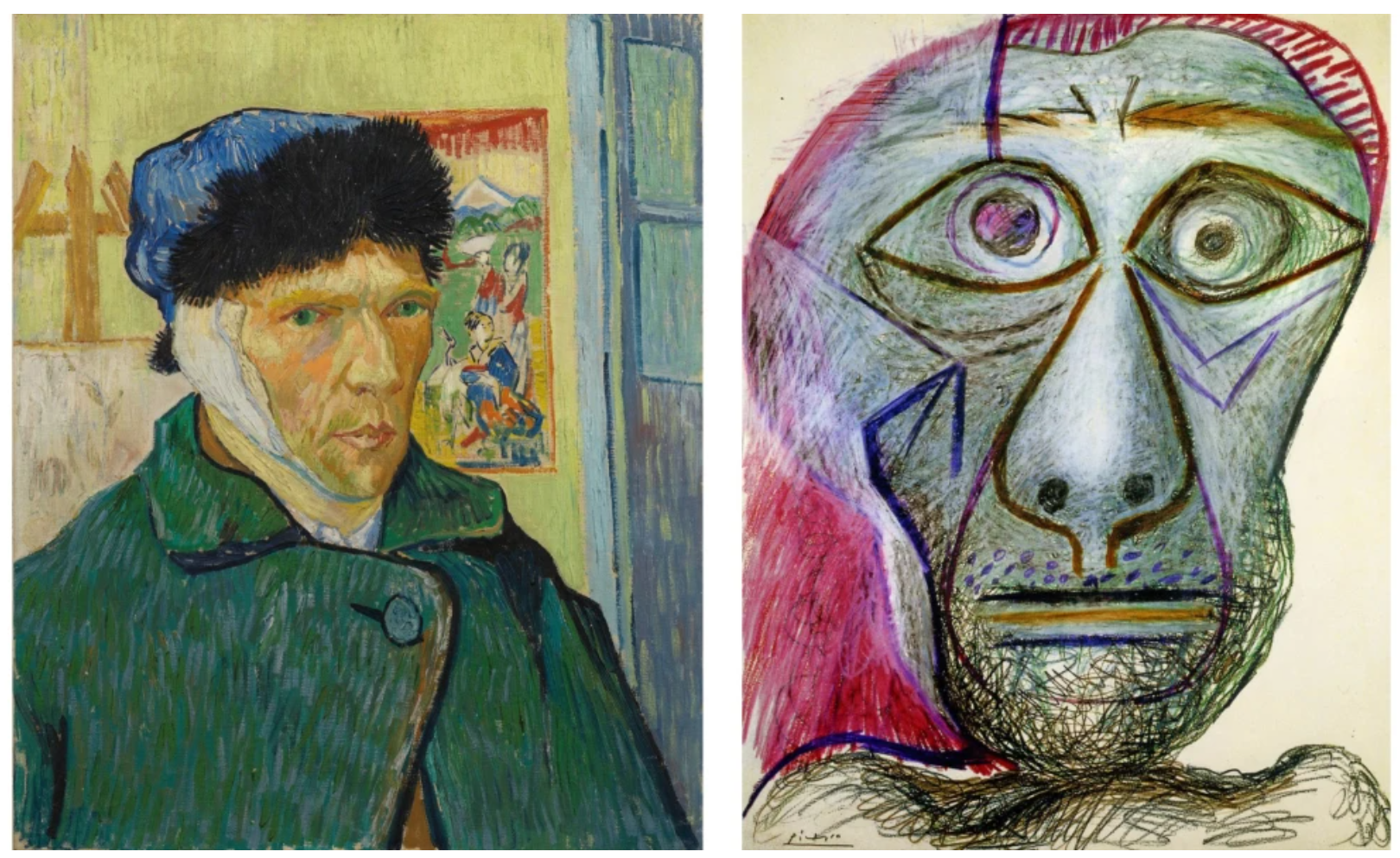
Left: Vincent van Gogh, Self Portrait with Bandaged Ear, 1889. Courtauld Gallery, London. Image © Courtauld / Bridgeman Images.
Right: Pablo Picasso, Self Portrait Facing Death, 1972. Fuji Television Gallery, Tokyo. Image © Fine Art Images / Bridgeman Images. Image © RMN-Grand Palais / Art Resource, NY. Art © 2026 Estate of Pablo Picasso / Artists Rights Society (ARS), New York
From the most prolific year of Bacon’s self-portraits, the present work from 1972 is one of the most significant works by the artist from this pivotal period. Soon after the death of Bacon’s partner George Dyer, Bacon embarked on more self portraits than any other year in his oeuvre, remarking he simply “had nobody else to paint” but himself. The present work is one of fifteen works created in this seminal year, and one of only seven single panel self-portraits.
Francis Bacon’s Single Panel Self-Portraits from 1972
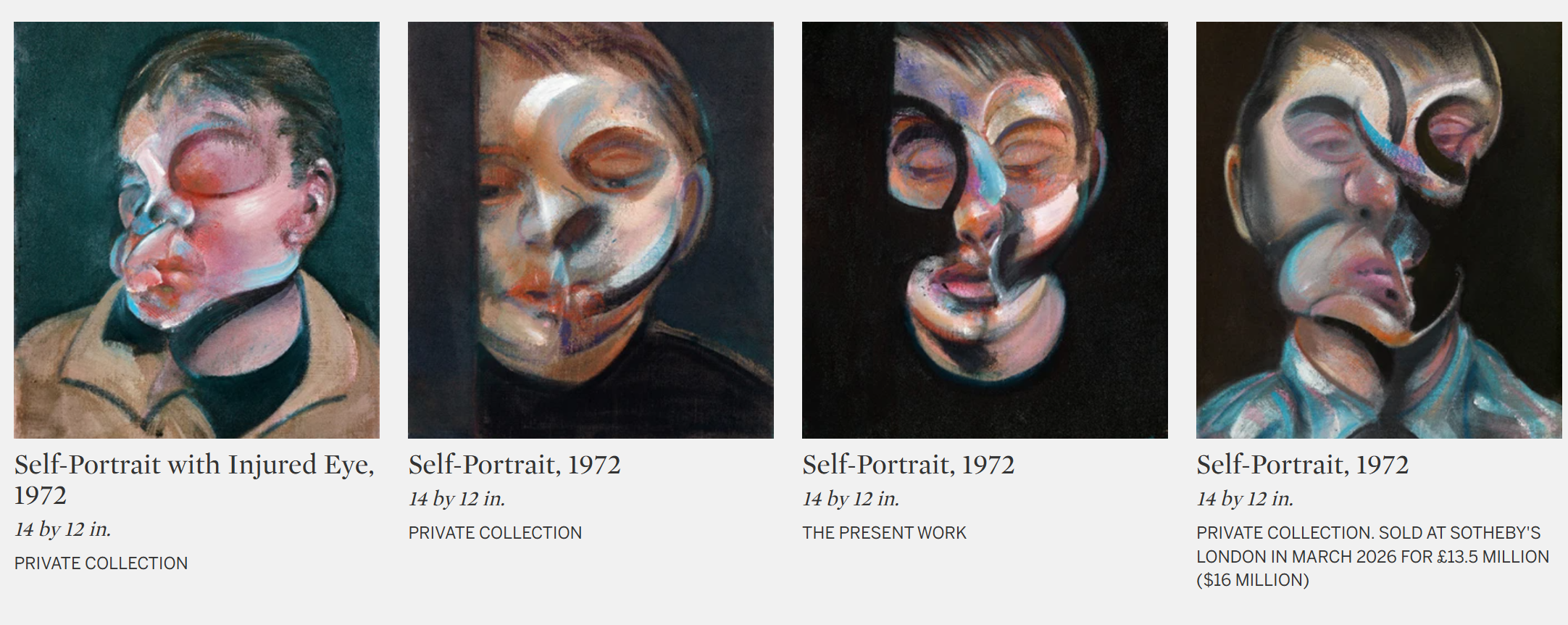
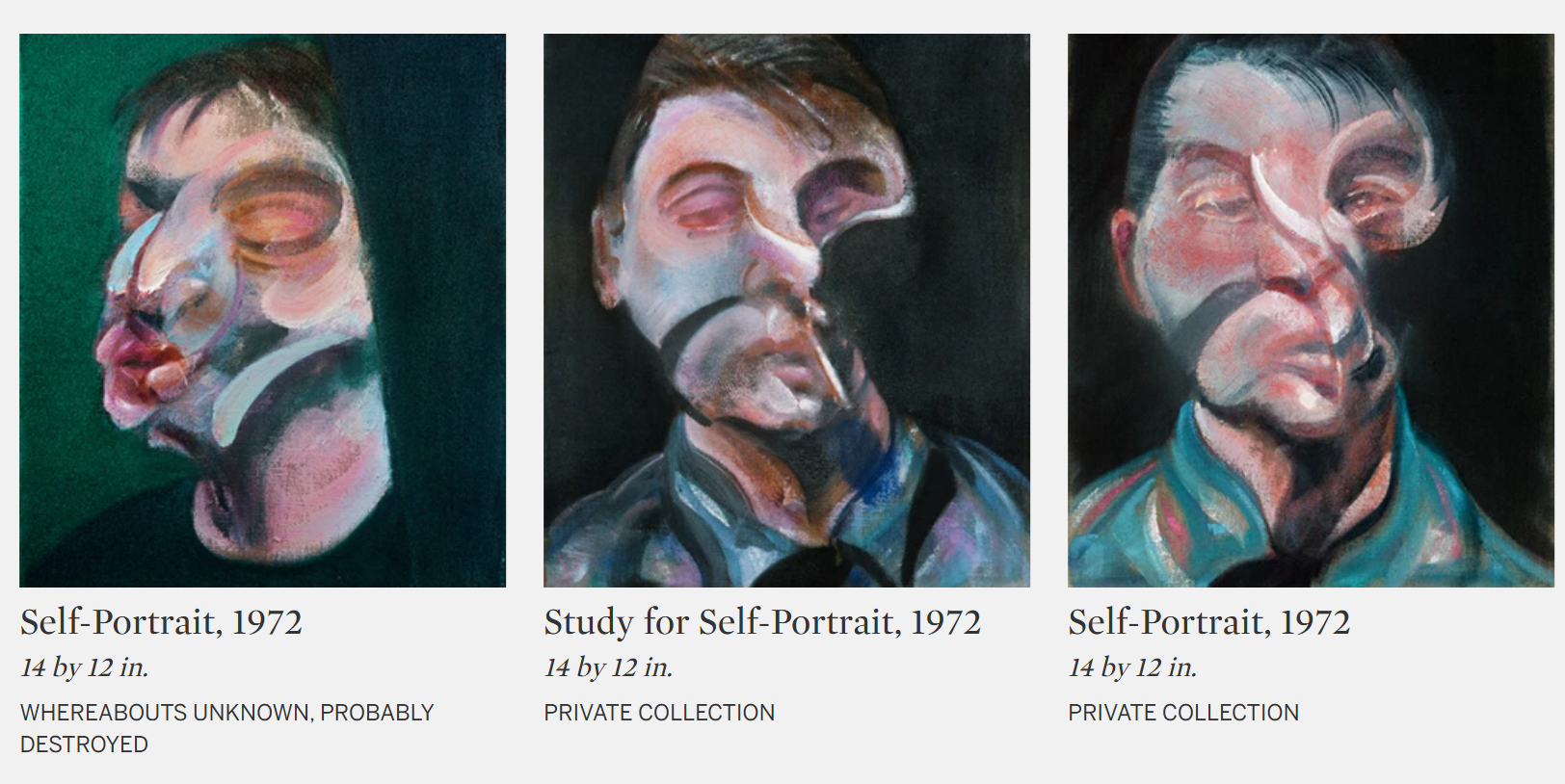
All Art © 2026 Estate of Francis Bacon / Artists Rights Society (ARS), New York / DACS, London
In some ways, this was expressed through Bacon’s repetitive reworking of these works. As Sophie Pretorius notes, “of the ten paintings of his face that Bacon made within two years of this injury, he had five of them returned to his studio to wound some more.” (Martin Harrison and Sophie Pretorius, eds., Revisions: Francis Bacon in the Act of Painting, London 2024, p. 48) The present work was modified after April of 1972, in which Bacon added the dark shadow beneath his chin as well as the black “screen” across the left register of the work, which is present in only one other existing self-portrait from this year. Most notably, Bacon added the black circle encircling his eye. In no other work from this year is Bacon’s face so starkly incised with this black void, which continuously fills the composition surrounding the face. These reworkings were deliberate artistic modifications intended to intensify the image’s psychological charge. Such revisions included “violating his face… Bacon darkened and thickened many of the black areas, a mannered kind of chiaroscuro. He also tended to revise the corners of mouths, so they bled into an area of darkness, perhaps an evocation of the abject drool and fluids leaving the body in death.” (Martin Harrison and Sophie Pretorius, eds., Revisions: Francis Bacon in the Act of Painting, London 2024, p. 51) As in the present work, Bacon often added further strokes of black paint to the hollow of the cheek or the crease of the eye socket, partially erasing and reconstituting the image in the same act. Within this context, the encroaching dark passages assume a distinctly corporeal urgency, transforming the self-portrait into an image of vulnerability in which Bacon turns himself inside out, with grief and guilt inscribed where stable likeness might traditionally reside.
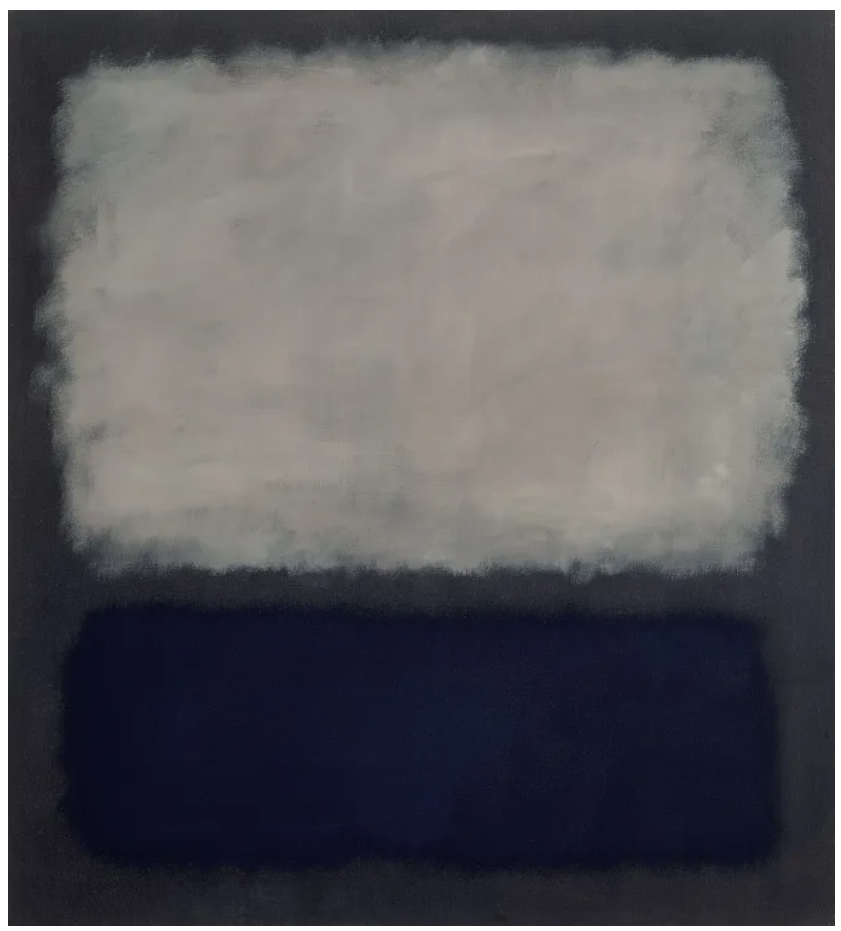
Mark Rothko, Blue and Gray, 1962. Fondation Beyeler, Riehen/Basel.
Art © 1998 Kate Rothko Prizel & Christopher Rothko / Artists Rights Society (ARS), New York
The small scale intensifies rather than diminishes the painting’s ambition, confirming John Russell’s observation that Bacon’s fourteen-by-twelve-inch heads were “the scene of some of Bacon’s most ferocious investigations,” images that “carry their ghosts within them.” (John Russell, Francis Bacon, London 1993, p. 99) Bacon’s self-portraits from this period are also strikingly reminiscent of Oscar Wilde’s The Portrait of Dorian Gray in which its namesake, tempted by hedonistic pleasures and pains, chooses to stay young and beautiful for eternity while a portrait of him ages instead. Conceptually, to call upon an avatar of oneself to bear the burden of physical aging or surface flaws finds a foil in Bacon’s self-portraits as they endure the chiaroscuro-like hollows and slashes of Bacon’s brush. In the sloth and dejection that followed in the months after Dyer’s death, Bacon’s painting granted him the only resolve he could find, offering an exorcism of sorts, purging him of his inescapable grief. These portraits thus became surrogates not for the means of keeping Bacon beautiful like Dorian Gray, but rather, keeping him sane.
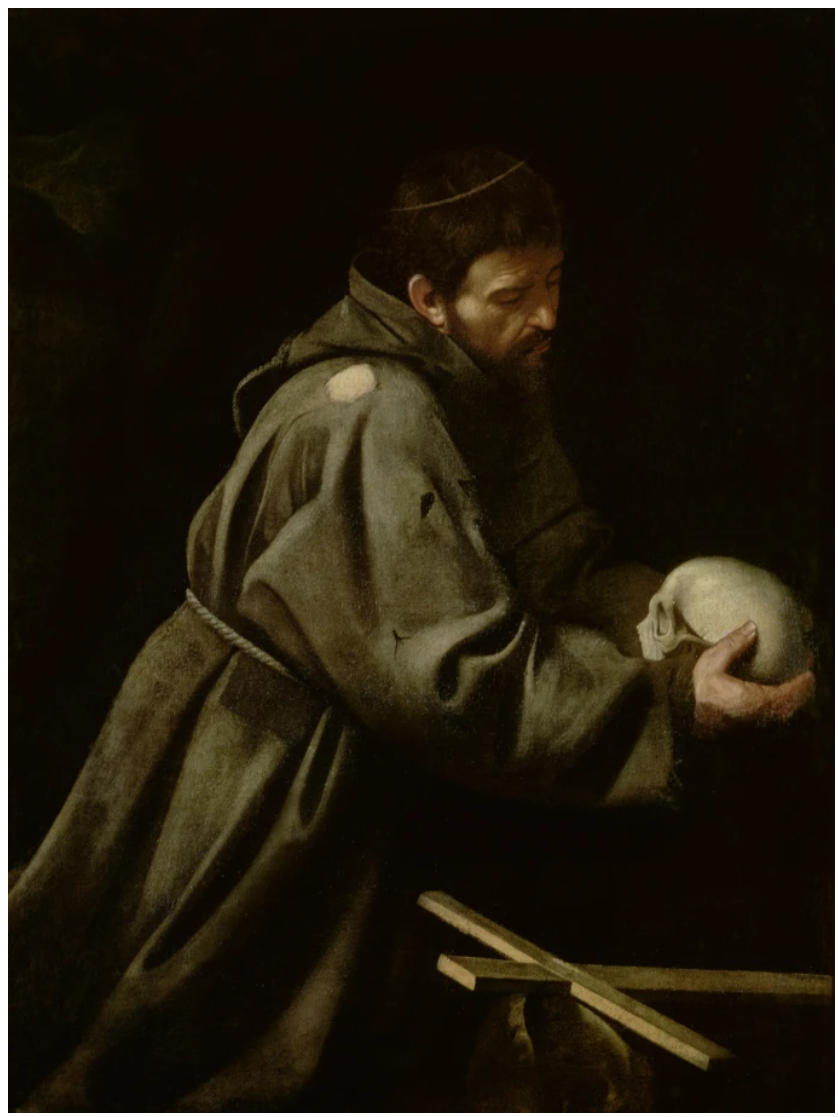
Michelangelo Caravaggio, Saint Francis in Meditation, 1604-1908.
Gallerie Nazionali di Arte Antica, Barberini Corsini, Palazzo Barberini, Rome. Image © Bridgeman Images
In Self-Portrait, the extraordinary convergence of painterly violence, chromatic refinement and psychological exposure elevates an intimate likeness into an image of almost unbearable emotional force. Its rounded visage, encircled by an abyss of black and suspended within a luminous field of shifting color, seems caught between corporeal presence and complete dissolution. Among the single-panel self-portraits executed in 1972, the work is distinguished not only by its singular formal construction but by the intensity of its successive revisions, through which Bacon transformed his own image into an enduring testament to grief. Neither a conventional likeness nor a straightforward act of remembrance, the painting stands as a profound meditation on the fragility of the self and one’s physical vessel, its striking beauty inseparable from the violence of its making. A rare and deeply affecting achievement from one of the most consequential years of Bacon’s career, the present work establishes itself as a definitive masterwork, capturing with extraordinary immediacy the anguish of a man channeling his maddening loss onto the refuge of the canvas.
Study for Portrait X, 1957
Study for Portrait X, 1957
Christie’s New-York: 17 November 2026
Estimated: USD 7,000,000 – 10,000,000
FRANCIS BACON (1909-1992), Study for Portrait X | Christie’s
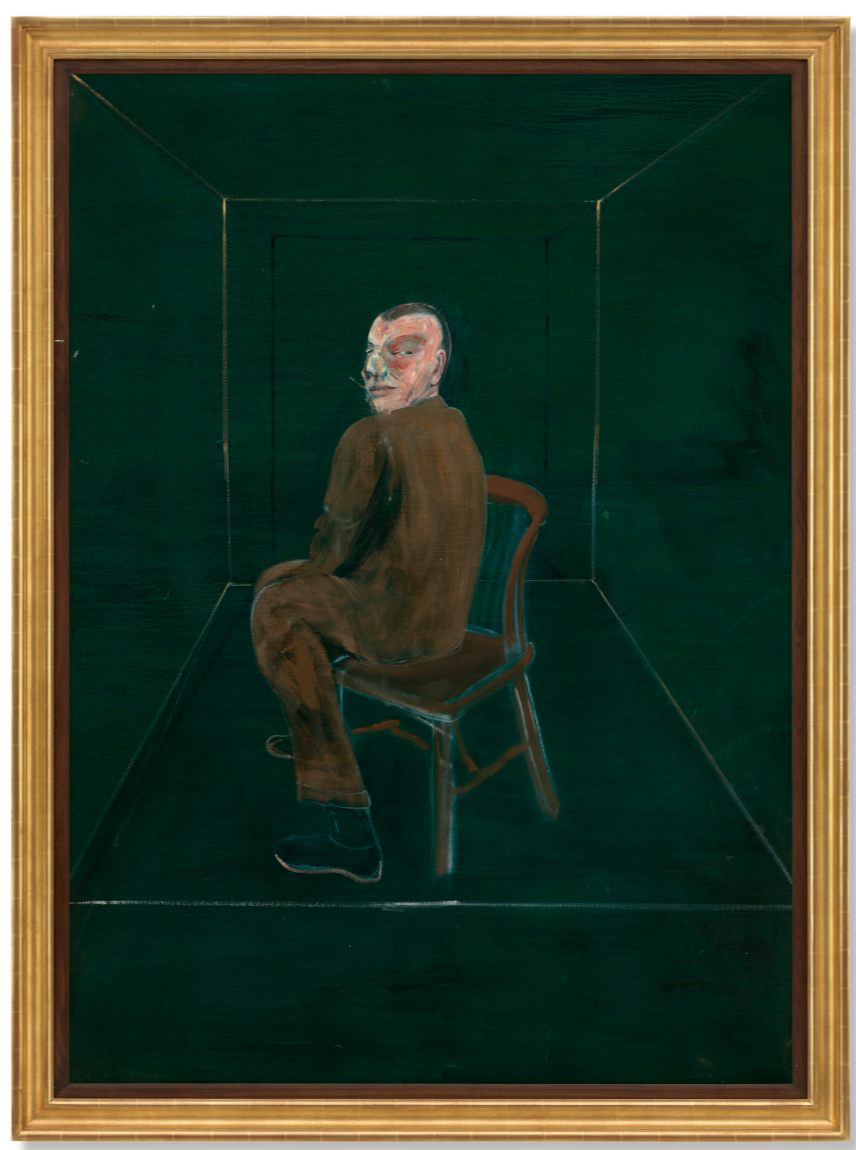
FRANCIS BACON (1909-1992)
Study for Portrait X, 1957
Oil on canvas
78×56 inches (198.1 x 142.2 cm)
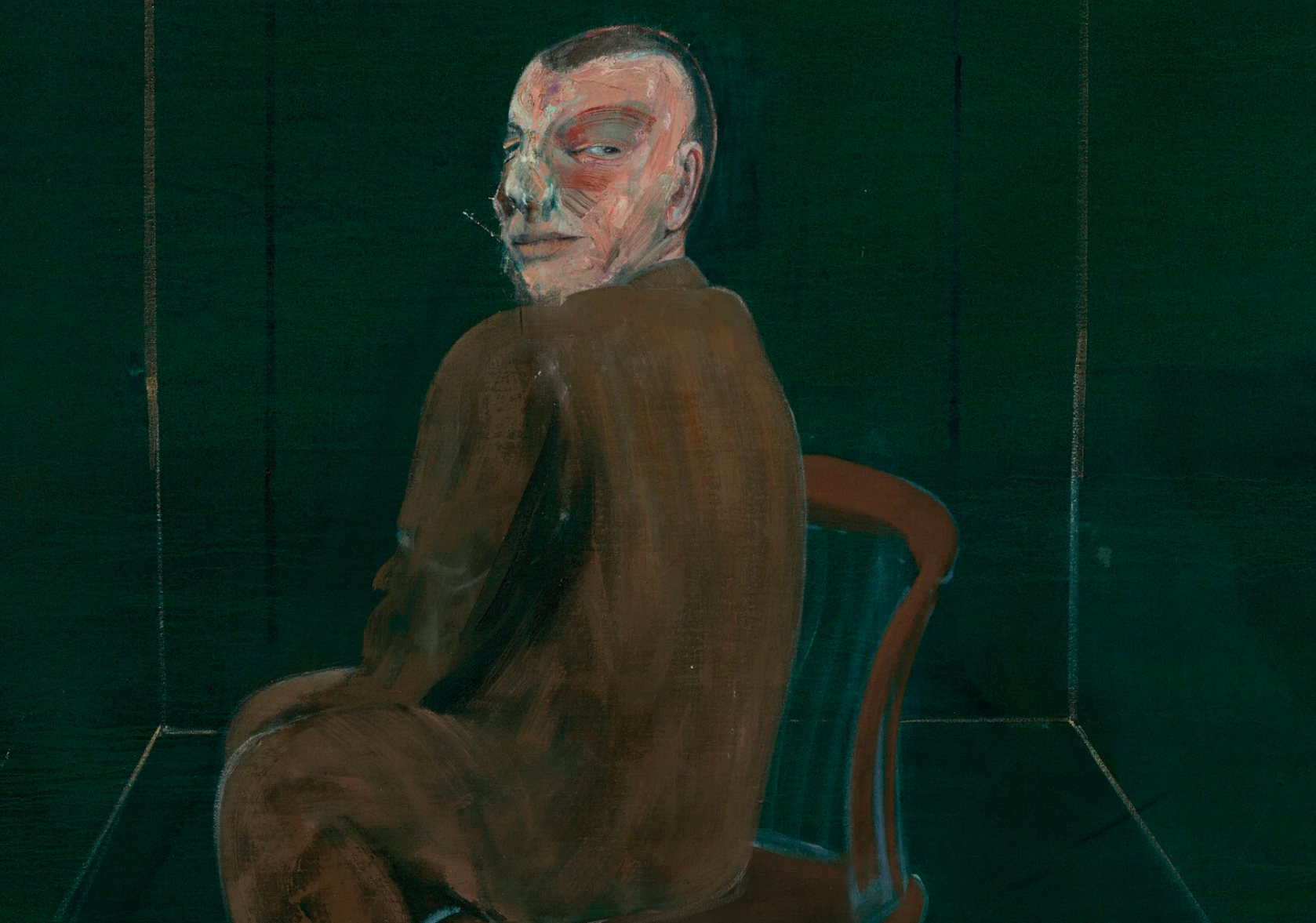
Painted at the peak of a personally and creatively transformative decade, Francis Bacon’s Study for Portrait of X is a haunting portrait of the artist’s greatest love, Peter Lacy. Seated on a chair within an unremittingly dark and empty room, Bacon’s lover twists to turn his face towards the viewer, his gaze confident and implacable. While undoubtedly a painting of a deeply personal nature, the looming void within which the isolated man sits evokes the existential angst of the postwar years. It resonated with contemporary audiences; shortly after it was made, Study for Portrait of X was exhibited widely, including at Bacon’s first solo exhibition in Paris at the Galerie Rive Droite, and at London’s Hanover Gallery also in 1957. The following year, it was included in solo exhibitions for the artist in Turin, Milan, and Rome. Bacon painted Peter Lacy on a number of occasions, but few capture the extraordinary clarity and directness with which he has rendered the face in the present work.
Executed in assured brushstrokes of intuitive flesh-tones, Bacon has rendered his subject’s head with a striking sense of solidity that lies in stark contrast to the rest of the figure, which is comprised of swifter, almost translucent marks. Set against the empty green-black backdrop, the sensitively observed features in Study for Portrait of X speak of a precious individuality: the way, for instance, the full lips of the mouth are subtly turned up at the corner in a knowing, almost-smile; or how the almond shaped eye penetrates so powerfully through the layers of bruised green-blues and bloody reds and pinks. The body of the figure itself, meanwhile, seems to be in restless motion, as though on the cusp of surrendering to the darkness and vanishing altogether.
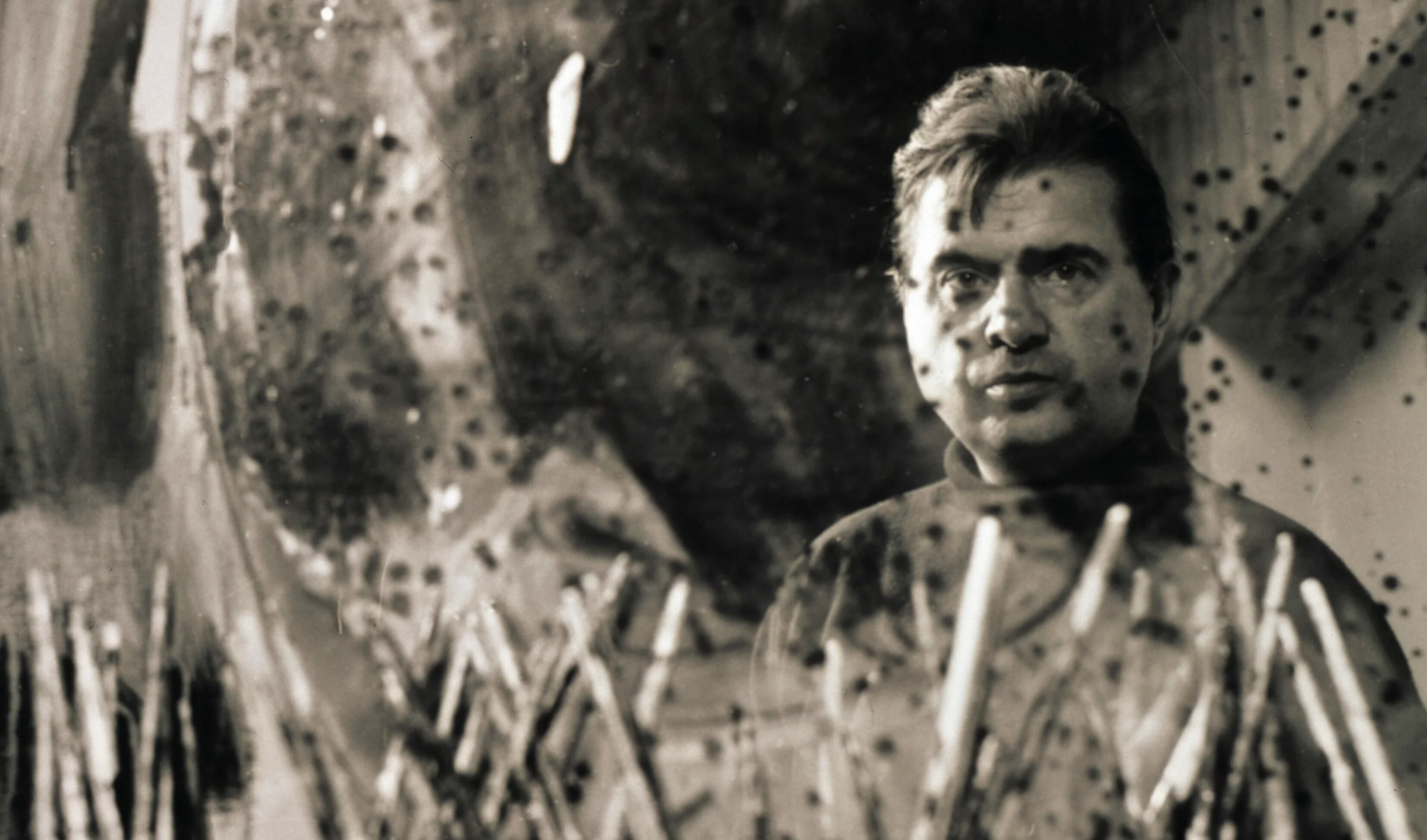
Jorge Lewinski, Francis Bacon, 1963. Photo: © The Lewinski Archive at Chatsworth / Bridgeman Images.
The distinctive precision with which Bacon has handled the paint in Study for Portrait of X bestows it with an unusual verisimilitude. It contrasts with the many of the emotionally charged, near-abstract portraits that precede it, where Bacon has rendered individual features anonymous in pursuit of his question for truth to sensation. As noted by the authors of the artist’s catalogue raisonné, Study for Portrait of X “seems to have been approached in a calmer, more objective mood; the limbs, for example, are more conscientiously delineated, the contours not violated.” It is also “atypical,” they point out, that the figure’s suit, ankles, and shoes have been outlined in a similar way to the chair and the box or cube-like structure visible in the background (M. Harrison and R. Daniels, eds., Francis Bacon, Catalogue Raisonné, Volume II: 1929-57, London, 2016, p. 490).
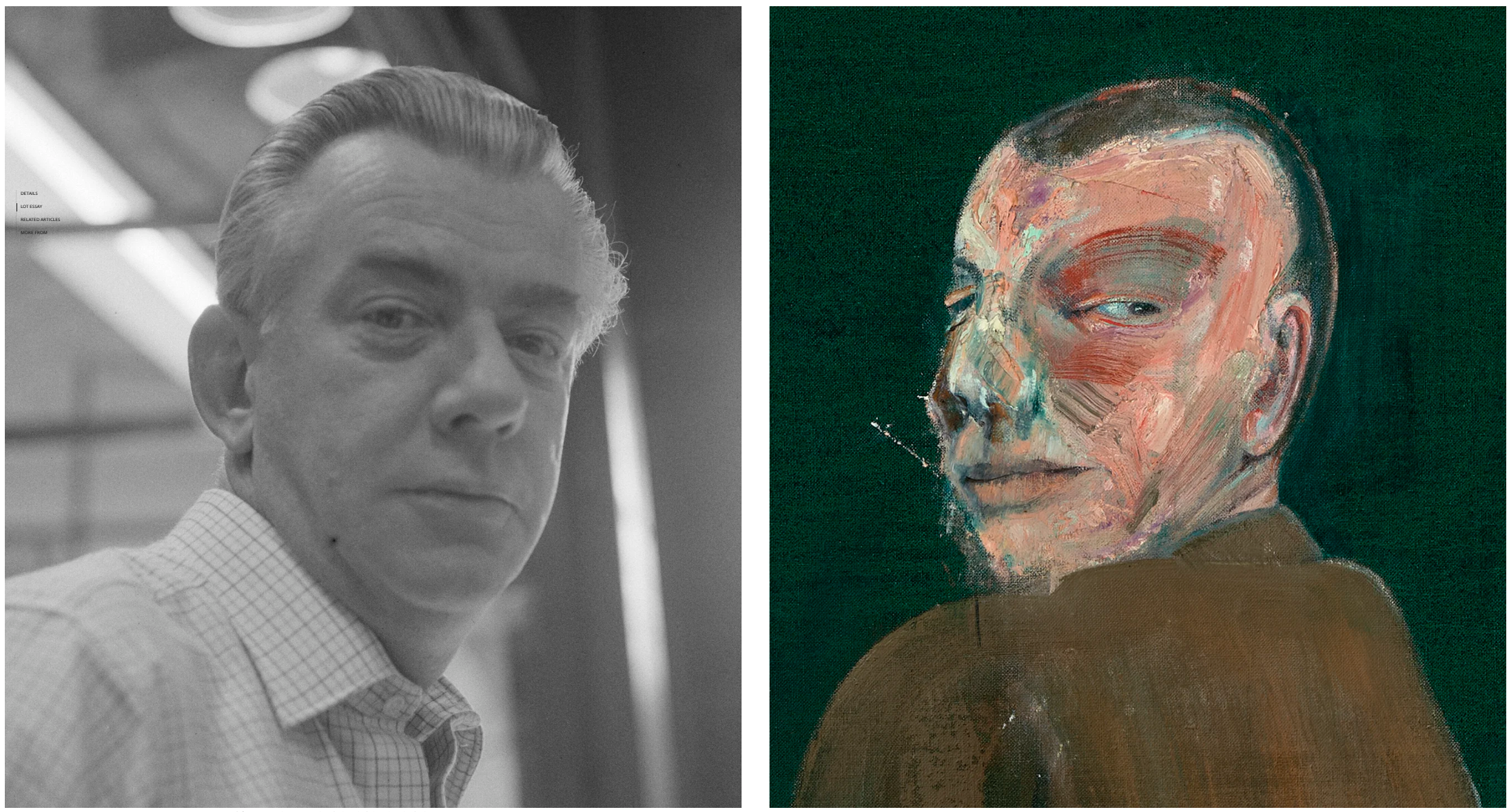
Left: Peter Lacy, London, circa 1950s. Photo: © John Deakin / John Deakin Archive / Bridgeman Images.
Right: Present lot illustrated (detail).
Bacon had met Peter Lacy five years before Study for Portrait of X was painted, in the Colony Room in Soho, a favorite haunt of the artist. A former RAF pilot and passionate jazz pianist, Lacy became the great love of Bacon’s life.
“I’d never really fallen in love with anyone until then. He was marvelous-looking, you see. He had this extraordinary physique … He played the piano marvelously and he had a real kind of natural wit.”
In the mid-1950s, Lacy moved to Tangier—which was more tolerant of homosexuality than England at that time—where he played piano in a local bar. Bacon made long visits there during the summers of 1956 and 1957, but over time the relationship deteriorated, strained by Lacy’s increasing dependency on alcohol and the violent nature of their passion for each other.
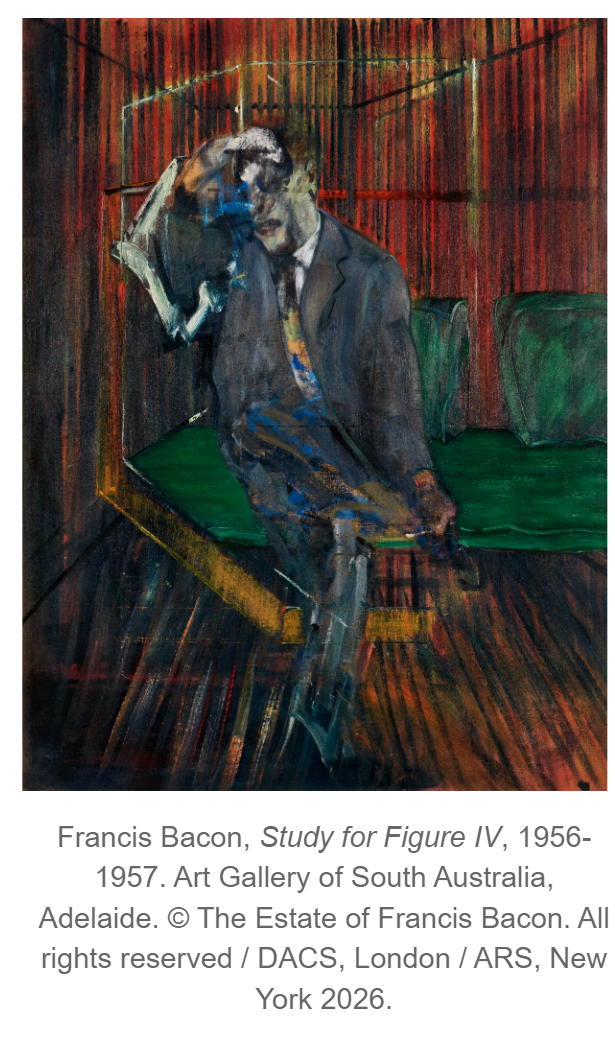
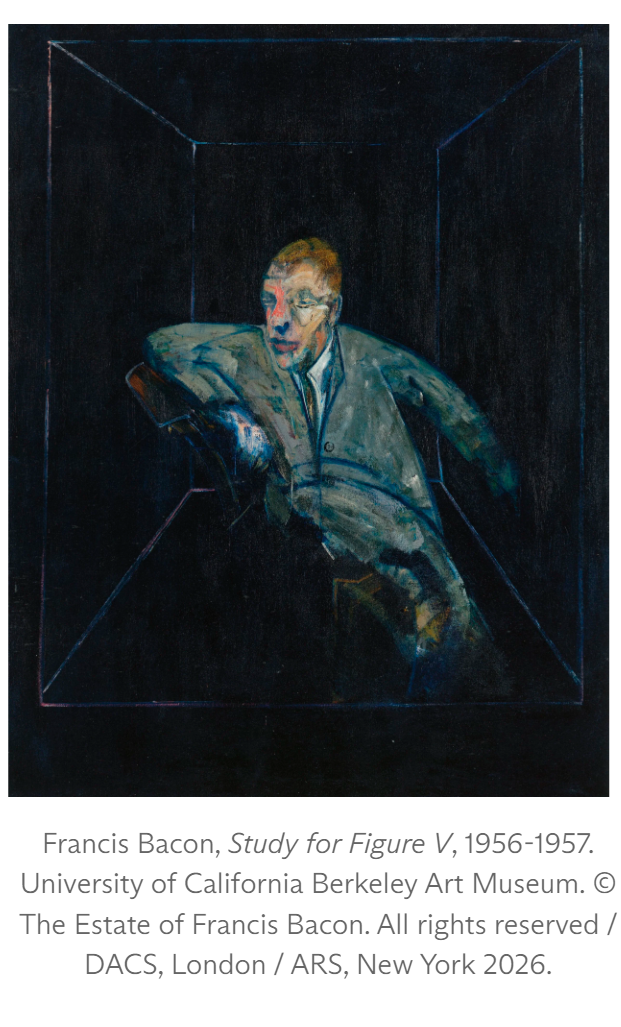
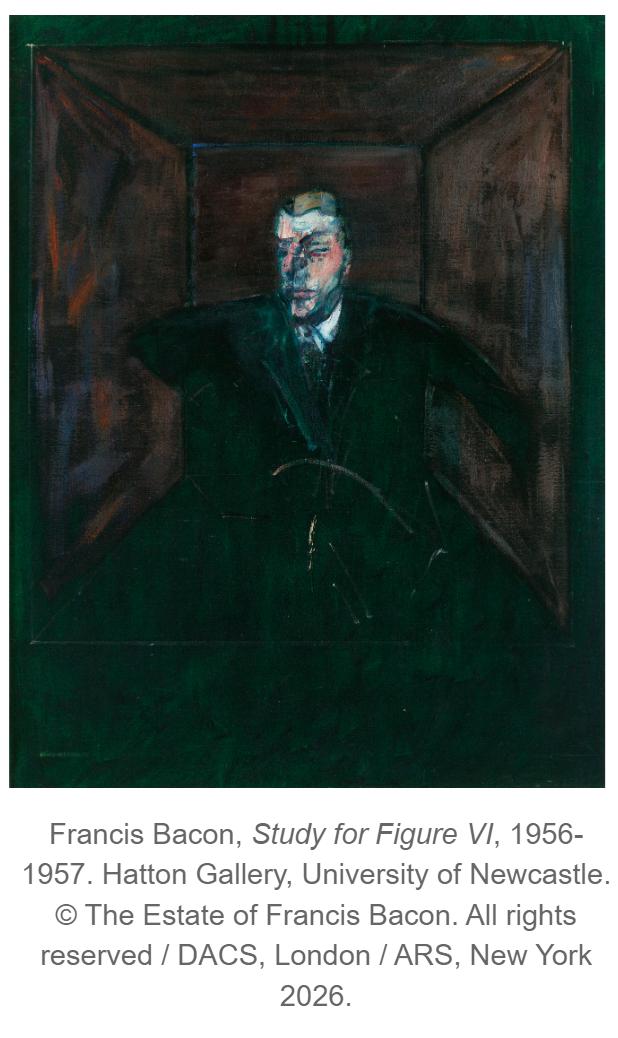
“Being in love that way, being absolutely physically obsessed by someone, is like an illness. It’s like a disease, a disease so ghastly I wouldn’t wish it on my worst enemy… I couldn’t live with him, and I couldn’t live without him.”
The relationship ultimately ended in tragedy. In 1962, on the day of the artist’s Tate retrospective, the most important exhibition of his career, Bacon sent Lacy a telegram to tell him of its success. The reply informed him that Lacy had died of alcohol-related causes the day before.
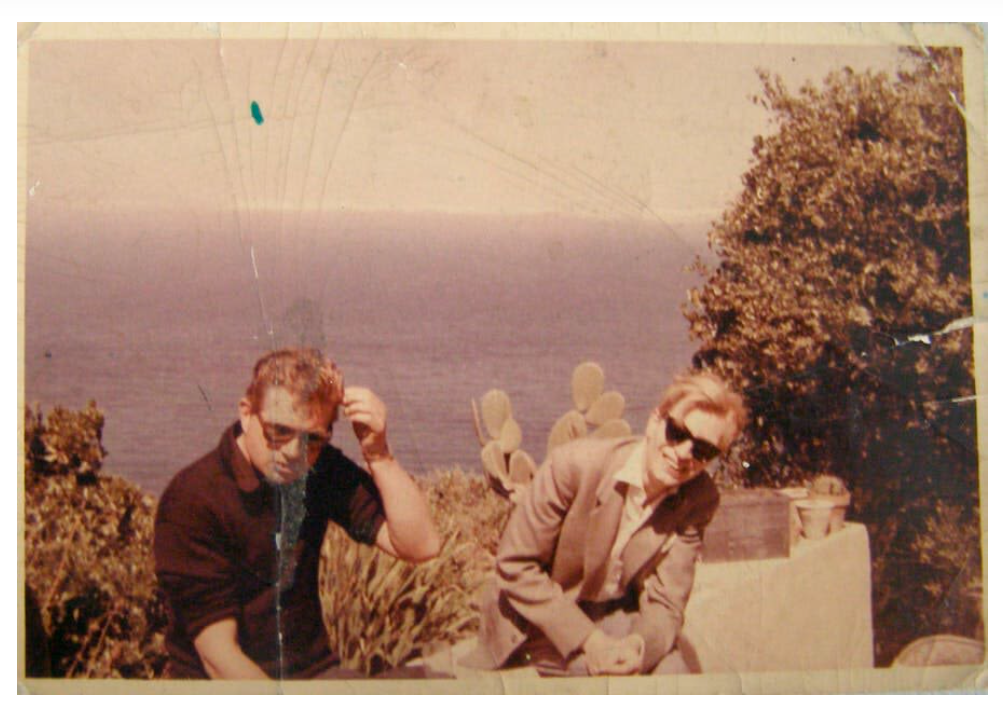
Francis Bacon and Peter Lacy, Tangier, circa 1958-1961. Photographer unknown.
Alongside this personal tumult, the 1950s saw Bacon produce some of the most significant and inventive paintings of his career. The year that Study for Portrait of X was painted, he became obsessed with the work of Vincent Van Gogh – especially the “The Painter on the Road to Tarascon” (1888), which was presumed destroyed during the Second World War in an air raid in Germany. The epitome of a tragic artistic genius, Van Gogh’s “haunted figure on the road” appealed enormously to Bacon (F. Bacon, quoted in J. Russell, Francis Bacon, London, Paris and Berlin 1971, 2nd ed. London and New York 1979, 3rd ed. 1993, p.51). It stimulated what one contemporary critic called a “completely new departure” in his work, contrasting his earlier “somber colors and … meager, sparing manner: with the new paintings, which “are violent in color, thickly impastoed, and have obviously been painted in an intensity of excitement” – observations that could equally apply to the way in which Bacon has rendered the head in Study for Portrait of X. (J. Golding, “Lust for Death,” New Statesman and Nation, vol. 53, no.136, 6 April 1957, p. 438).
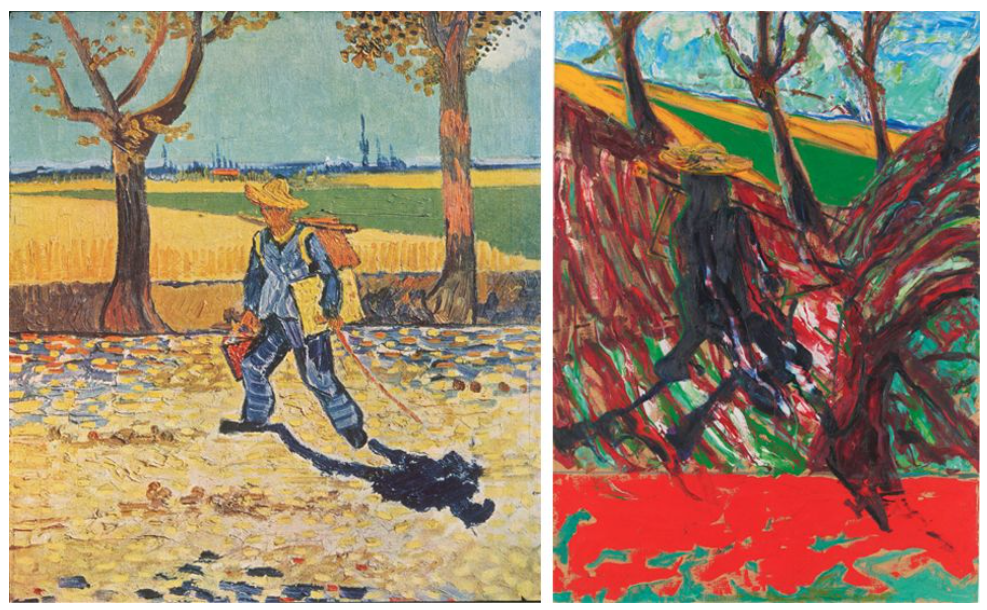
Left: Vincent van Gogh, The Painter on the Road to Tarascon, 1888. Kaiser Fredrich Museum, Stassfurt (until 1945; presumed destroyed during the Second World War).
Right: Francis Bacon, Study for Portrait of Van Gogh II, 1957. Private collection. © The Estate of Francis Bacon. All rights reserved / DACS, London / ARS, New York 2026.
The other fundamental development within Bacon’s work in the 1950s was his exploration of portraiture. He created his first portrait of an identified sitter in 1951 – his friend the painter Lucian Freud—while his earliest surviving self-portrait dates from 1956. As with the Van Gogh, which he knew only from photographs, he preferred secondary sources to working from life. “Even in the case of friends who will come and pose,” he said, “I’ve had photographs taken for portraits because I very much prefer working from the photographs than from them” (quoted in D. Sylvester, The Brutality of Fact: Interviews with Francis Bacon, London 1990, p. 38).
A decade of experimentation and risk-taking, the 1950s would see Bacon push the timeless motif of the human figure into unchartered territories. As Michael Peppiatt, Bacon’s biographer, has said, “It was during those years [the 1950s], filled with rebuffs and reversals of fortune, but also with extraordinary invention and daring, that Bacon began to explore in depth all his great themes while trying out a number of others that he eventually discarded. It was, in my view, the most fertile single decade of his career. Never again would the Baconian world be so rich and diverse” (M. Peppiatt, Francis Bacon in the 1950s, exh. cat., Sainsbury Centre for Visual Arts, Norwich, 2006, p. 14).