Fall 2026 New-York Marquee Auctions
Jean-Michel Basquiat
Upcoming Lots
Leonardo and His Five Grotesque Heads, 1983
Property from a Distinguished European Collector
Christie’s New-York: 19 November 2026
Estimated: USD 30,000,000 – 50,000,000
THIRD PARTY GUARANTEE
JEAN-MICHEL BASQUIAT (1960-1988), Untitled (Leonardo and His Five Grotesque Heads) | Christie’s
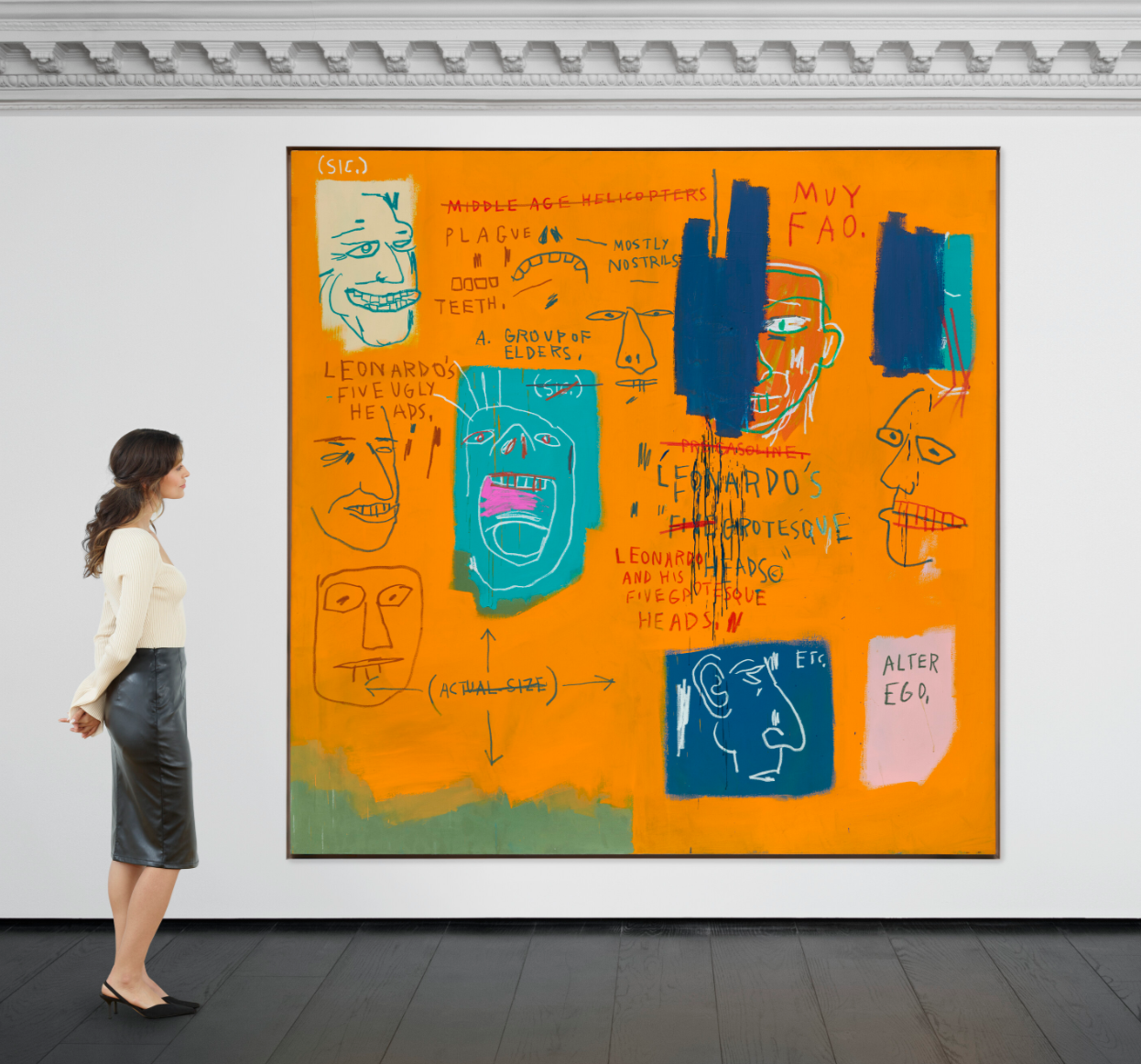
JEAN-MICHEL BASQUIAT (1960-1988)
Untitled (Leonardo and His Five Grotesque Heads), 1983
Acrylic and oilstick on canvas
84×84 inches (213.4 x 213.4 cm)
La Vieja, 1984
Property from a Prestigious European Collection
Sotheby’s New-York: 16 November 2026
Estimated: USD 6,000,000 – 8,000,000
Jean-Michel Basquiat | La Vieja | The Now and Contemporary Evening
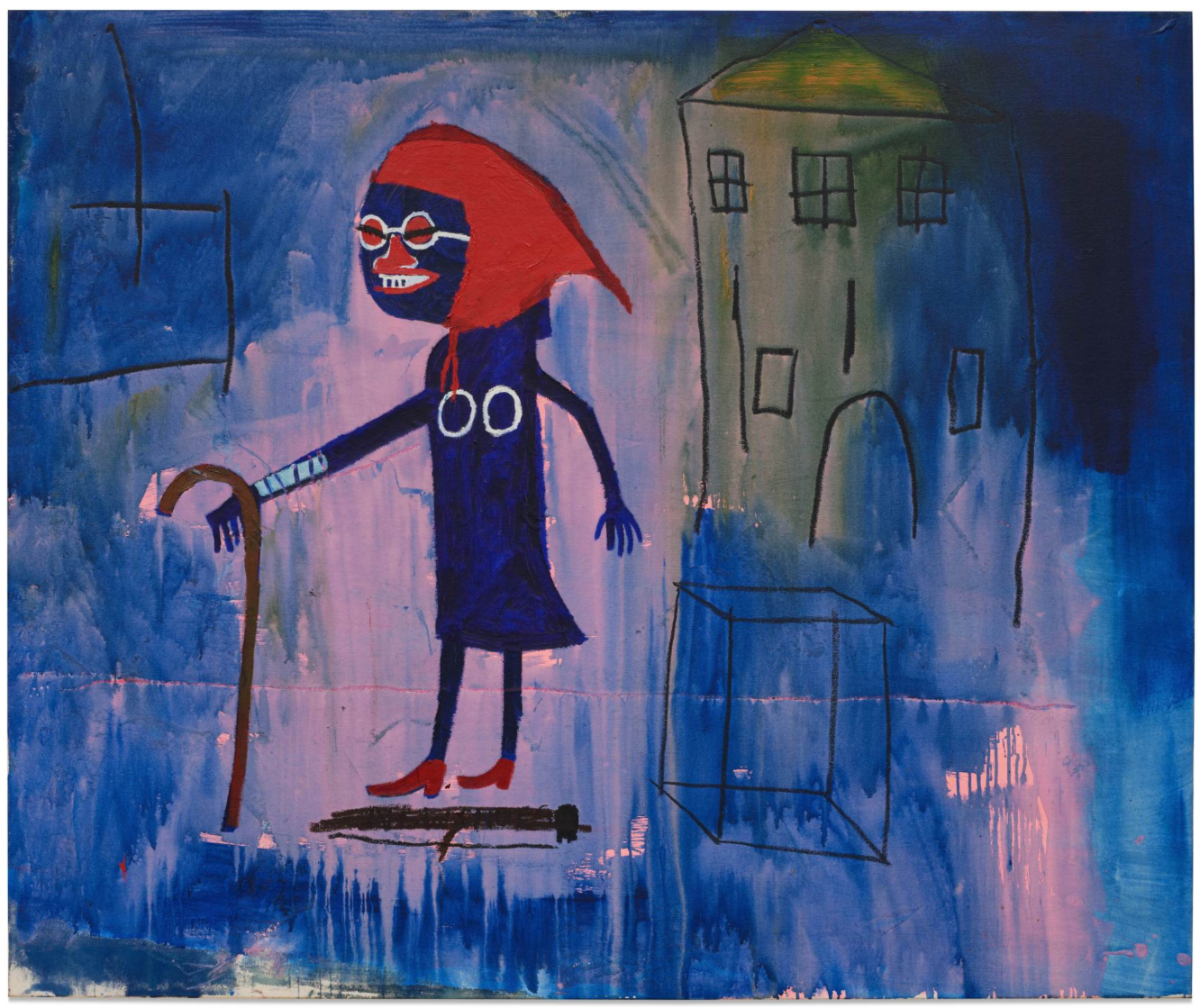
JEAN-MICHEL BASQUIAT (1960 – 1988)
La Vieja, 1984
Acrylic and oilstick on canvas
59-7/8 x 72 inches (152.1 x 182.9 cm)
Signed, titled and dated 1984 (on the reverse)
Untitled (Fist), 1986
The Clive Davis Collection
Christie’s New-York: 17 November 2026
Estimated: USD 4,000,000 – 6,000,000
JEAN-MICHEL BASQUIAT (1960-1988), Untitled (Fist) | Christie’s
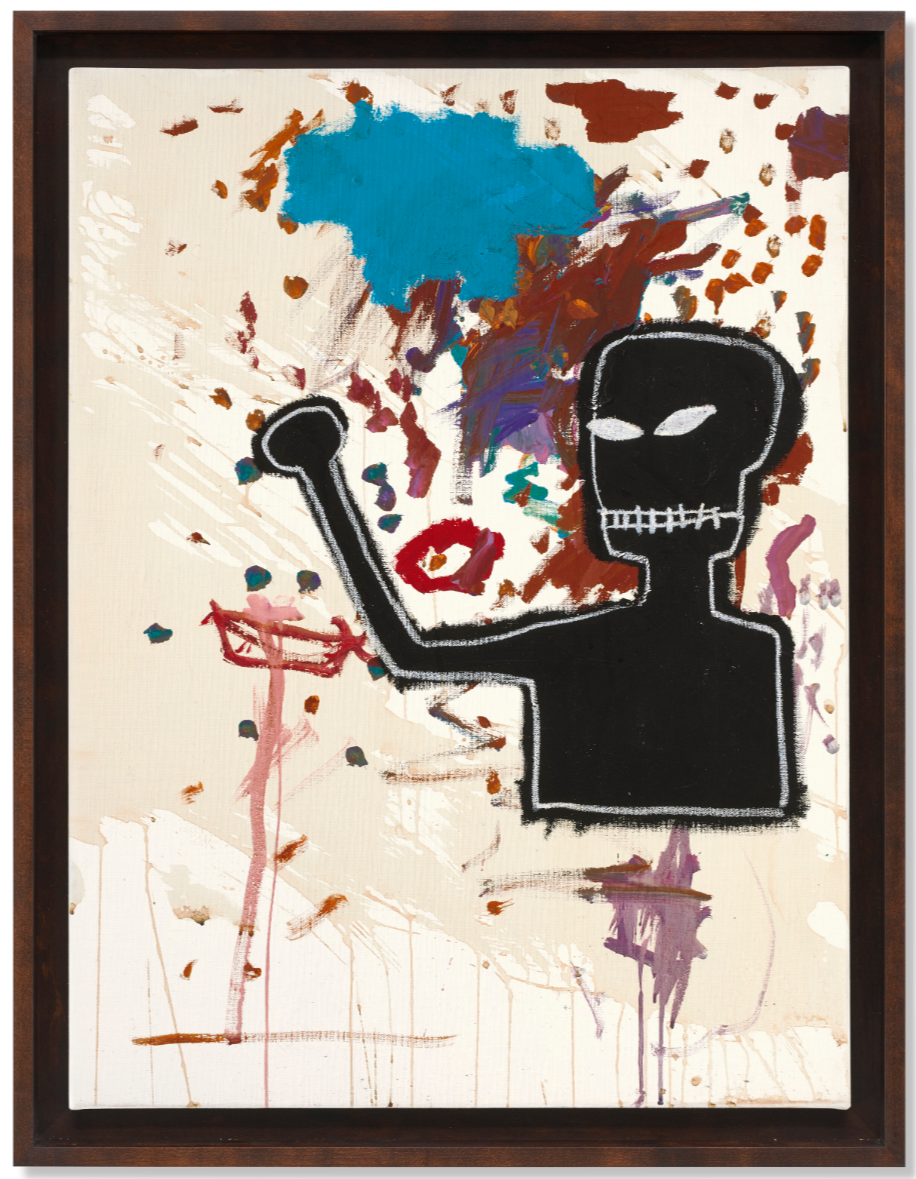
JEAN-MICHEL BASQUIAT (1960-1988)
Untitled (Fist), 1986
Acrylic, oilstick and coffee on canvas
31-1/2 x 23-5/8 inches (80×60 cm)
Signed and dated ‘Jean-Michel Basquiat 1986’ (on the reverse)
Untitled (Sin Hueso), 1982-83
Property from the Collection of Enrico Navarra
Sotheby’s New-York: 16 November 2026
Estimated: USD 1,800,000 – 2,500,000
WORK ON PAPER
GUARANTEED PROPERTY
Jean-Michel Basquiat | Untitled (Sin Hueso) | The Now and
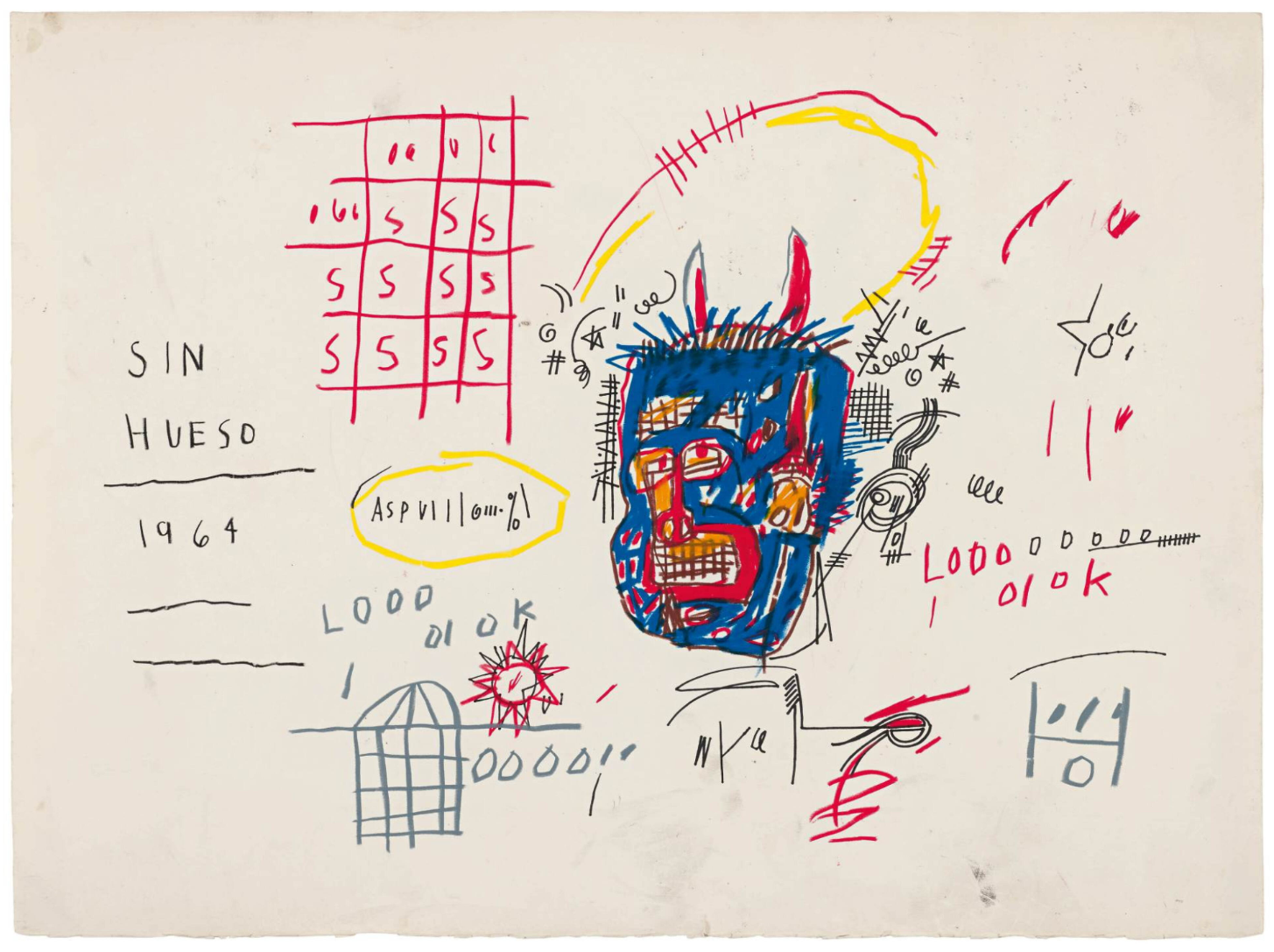
JEAN-MICHEL BASQUIAT (1960 – 1988)
Untitled (Sin Hueso), 1982-83
Oilstick and pen on paper
22×30 inches (55.9 x 76.2 cm)
Titled (center left)
Leverage, 1985
Sotheby’s New-York: 17 November 2026
Estimated: USD 1,000,000 – 1,500,000
WORK ON PAPER
Jean-Michel Basquiat | Leverage | Contemporary Day Auction | 2026 |
JEAN-MICHEL BASQUIAT (1960 – 1988)
Leverage, 1985
Graphite, charcoal, paper collage and acrylic on paper
30 x 22-1/4 inches (76.2 x 56.5 cm)
Untitled, circa 1986
Sotheby’s New-York: 17 November 2026
Estimated: USD 600,000 – 800,000
Jean-Michel Basquiat | Untitled | Contemporary Day Auction | 2026 |
JEAN-MICHEL BASQUIAT (1960 – 1988)
Untitled, circa 1986
Oilstick, acrylic and charcoal on paper
30 x 22-1/4 inches (76.2 x 56.5 cm)
Untitled, 1987
Christie’s New-York: 20 November 2026
Estimated: USD 600,000 – 800,000
JEAN-MICHEL BASQUIAT (1960-1988), Untitled | Christie’s
REPEAT SALE
Sotheby’s New-York: 20 May 2022
Estimated: USD 450,000 – 550,000
USD 529,200
Untitled | Contemporary Day Auction | 2022 | Sotheby’s (sothebys.com)
JEAN-MICHEL BASQUIAT (1960-1988)
Untitled, 1987
Wax crayon, colored pencil and graphite on paper
30 x 22-1/4 inches (76.2 x 56.5 cm)
Signed and dated ‘Jean-Michel Basquiat 87’ (on the reverse)
Leonardo and His Five Grotesque Heads, 1983
Leonardo and His Five Grotesque Heads, 1983
Property from a Distinguished European Collector
Christie’s New-York: 19 November 2026
Estimated: USD 30,000,000 – 50,000,000
THIRD PARTY GUARANTEE
JEAN-MICHEL BASQUIAT (1960-1988), Untitled (Leonardo and His Five Grotesque Heads) | Christie’s
JEAN-MICHEL BASQUIAT (1960-1988)
Untitled (Leonardo and His Five Grotesque Heads), 1983
Acrylic and oilstick on canvas
84×84 inches (213.4 x 213.4 cm)
A dramatic meeting across five centuries of art history, Jean-Michel Basquiat’s Untitled (Leonardo and His Five Grotesque Heads) is a very personal homage to perhaps the greatest artists in history, by perhaps the most celebrated painter of our time. Basquiat was a consummate student of art history and took inspiration from many artists, but it was with Leonardo da Vinci that he had the greatest affinity. Both men were considered outsiders by their peers, and both had to fight against an art world that was stacked against them. Yet both artists produced a body of work which redefined the art-historical canon.
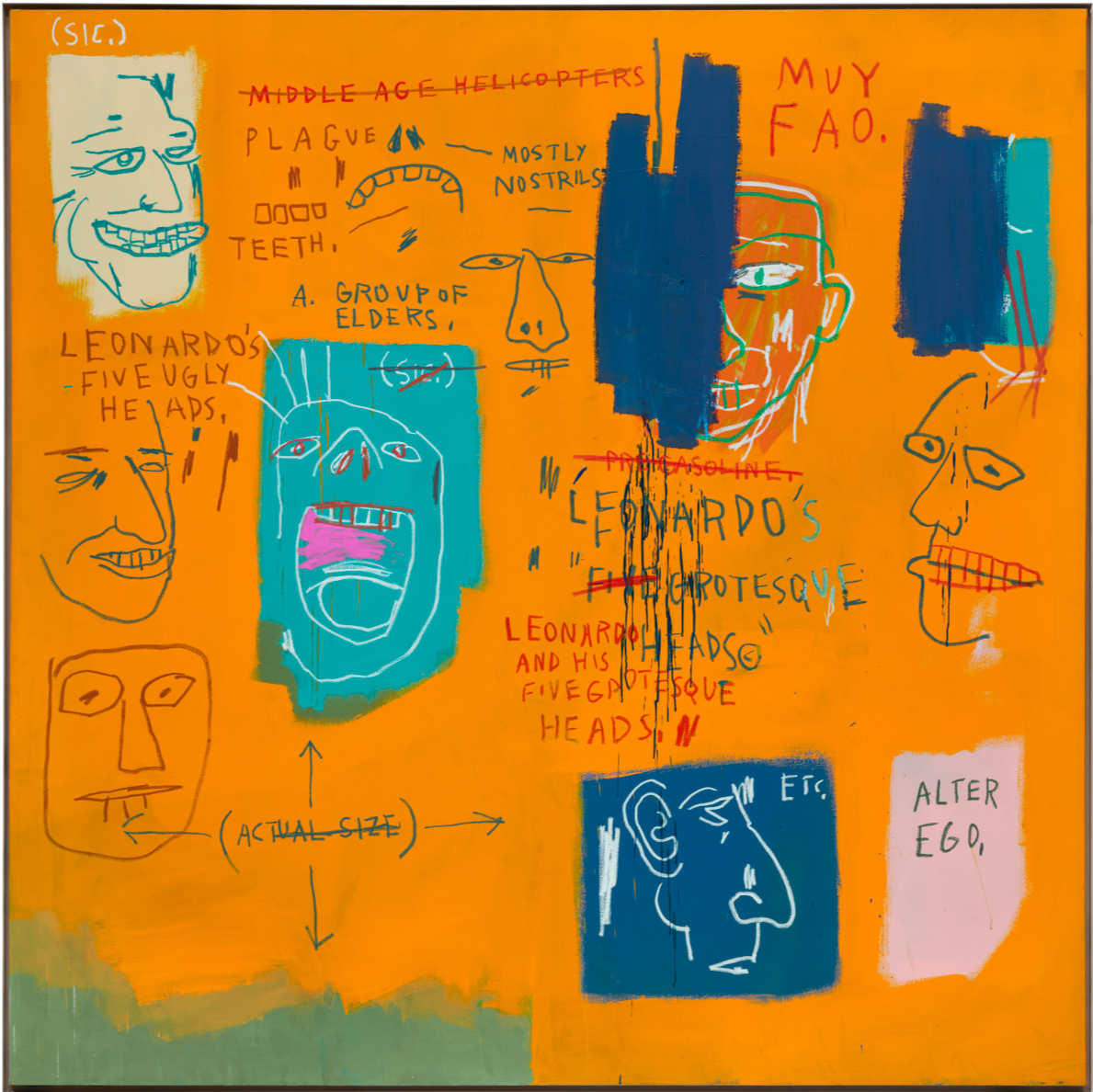
In Untitled (Leonardo and His Five Grotesque Heads), Basquiat takes inspiration from one of da Vinci’s most famous drawings, a 1493 pen-and-ink work on paper for centuries known as Five grotesque heads but now officially known by the title A man tricked by Gypsies. Now housed in the Royal Collection at Windsor Castle in England, da Vinci’s meticulously detailed drawing presents a gaggle of characterful men each drawn with exquisitely detailed faces. In da Vinci’s drawing, the delight is in the detail, but in Basquiat’s rendering, the figures parade their visceral nature, drawn in the younger artist’s uniquely expressive way.
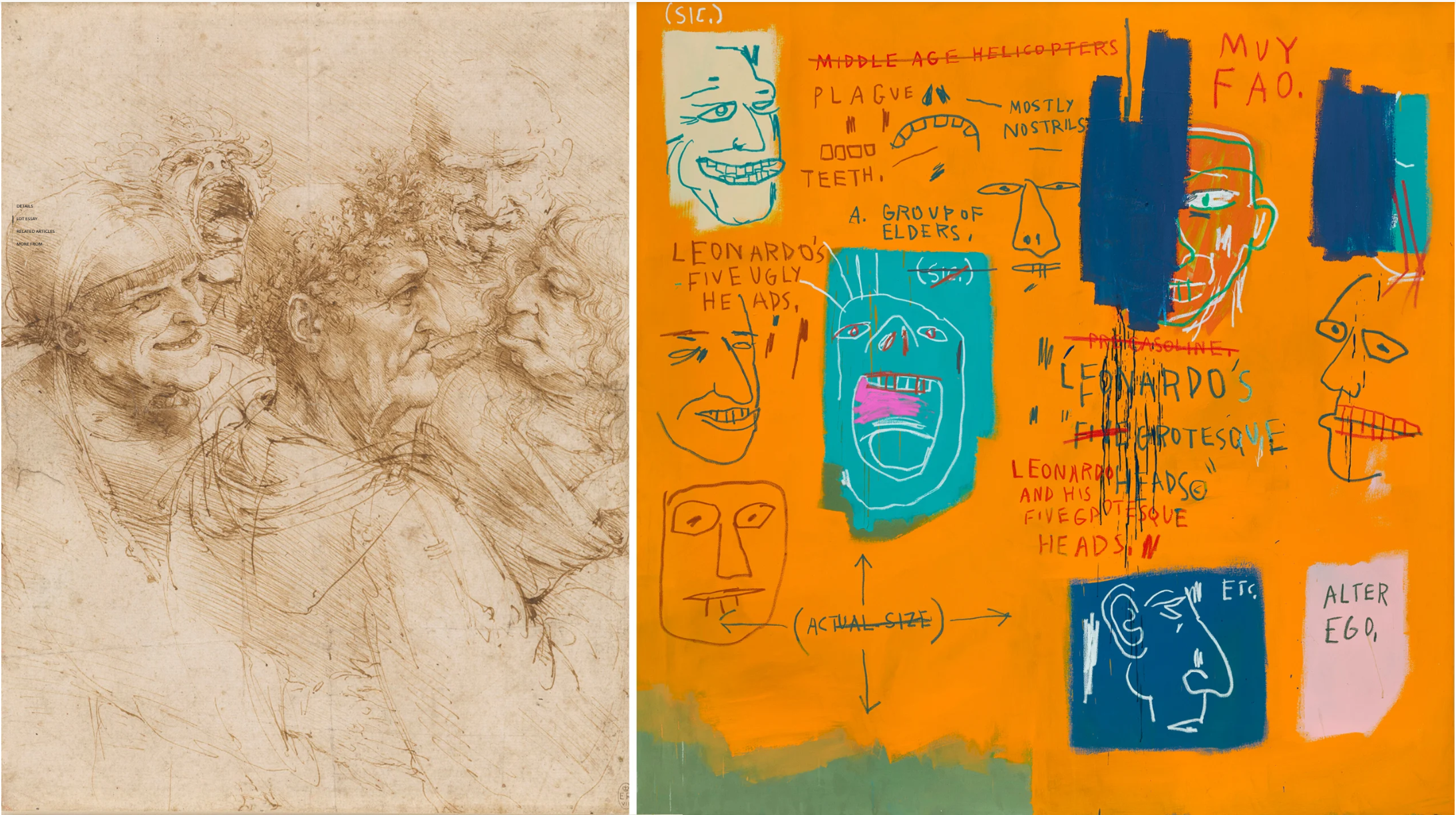
Left: Leonardo da Vinci, A man tricked by Gypsies, 1493. Royal Collection Trust, London.
Right: Present lot illustrated.
Set against a blazing orange ground, the figures in Basquiat’s painting populate the entire surface of this monumental canvas. Basquiat takes each of the figures in da Vinci’s drawing and transcribes them using his rapid style of mark-making. Where da Vinci celebrates verisimilitude, lavishing each of his characters with intimate and exhaustive details, Basquiat’s more intuitive approach uses restrained mark-making to render his rudimentary, but identifiable, figures. Swift movements of his trusted oilstick render facial features that mimic da Vinci’s drawings to such an extent that each of Basquiat’s figures matches one drawn by his Renaissance counterpart. Interspersed among these is a series of notations by Basquiat. Some are descriptive, such as “MOSTLY NOSTRILS,” “PLAGUE” and “TEETH,” while others appear to be more oblique references to other da Vinci drawings, such as “MIDDLE AGE HELICOPTERS.” Finally, “MUY FAO” is Basquiat’s remembered Spanish for the phrase “very ugly.”
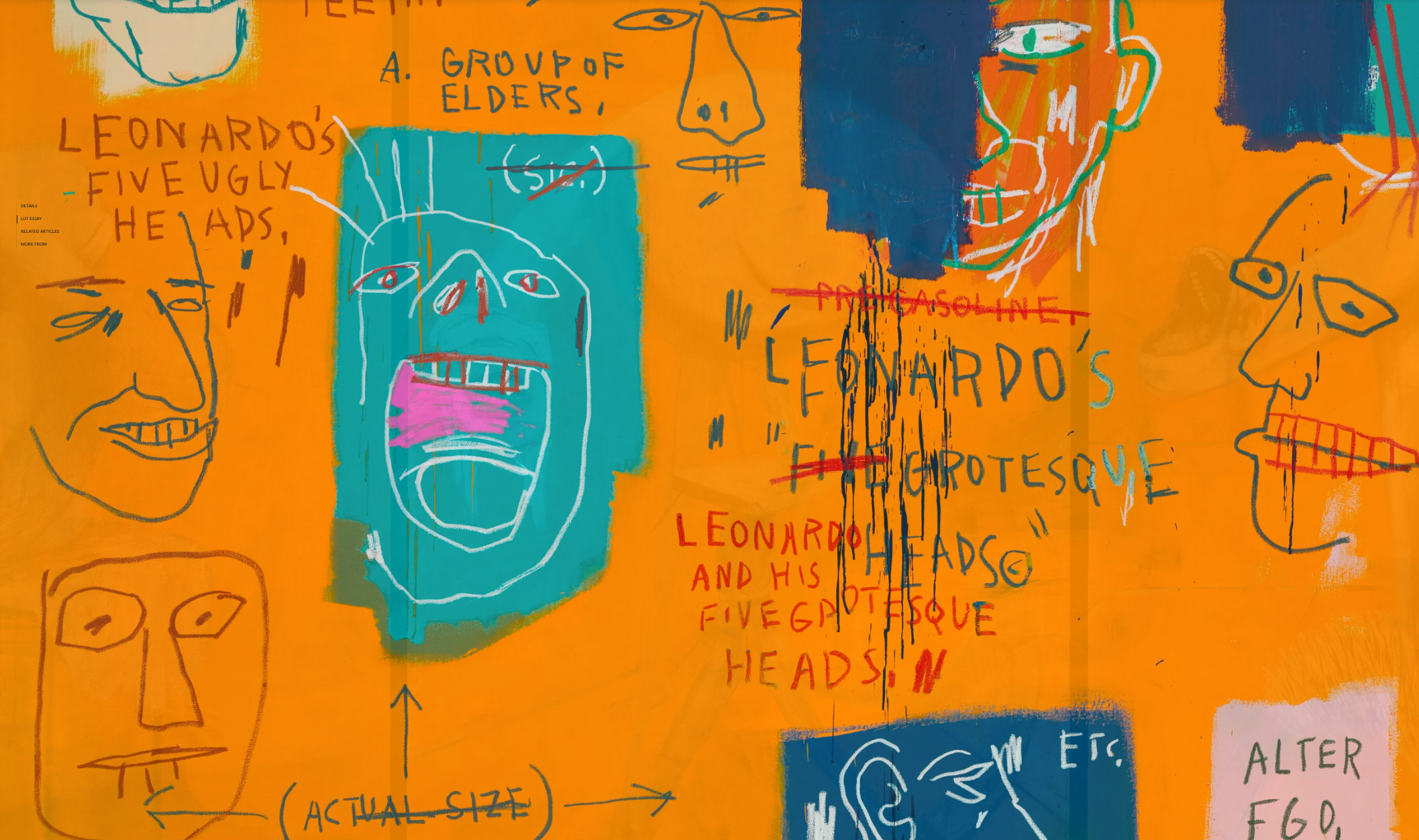
Unlike da Vinci’s drawing, which is executed purely in ink and has now aged to a mellow, muted tone, Basquiat paints Untitled (Leonardo and His Five Grotesque Heads) with a rich array of vibrant and warm colors. Primary among these is the bold orange ground which covers the picture plane except for a small patch of the green underpainting which Basquiat leaves visible in the lower left corner. A particular favorite of the artist (Untitled (Orange Sports Figure), 1982; Orange Joy, 1984; Offensive Orange, 1982), the color orange acts as a dramatic foundational layer to any painting, but in the case of the present work could also be Basquiat’s response to the aged appearance of the fifteenth-century paper sheet that supports da Vinci’s drawing. Onto this field of orange, the artist then applies blocks of solid, darker colors, including navy blue, cyan, a darker orange, flesh-toned pink and a warm cream. He then populates each of these blocks with his interpretation of one of the figures taken from Leonardo’s drawing. Just as the Fauves had done at the turn of the twentieth century, Basquiat chose his colors primarily for their chromatic resonance. “Color was one of Basquiat’s great strengths,” writes Marc Mayer in his essay for the 2005 retrospective on the artist at the Brooklyn Museum. “Few American artists deserve as much attention for their manipulation of color… Basquiat deployed his color architecturally… Color holds his pictures together, and through it they command a room” (M. Mayer, “Basquiat in History,” in Basquiat, exh. cat., Brooklyn Museum, New York, 2005, p. 46).
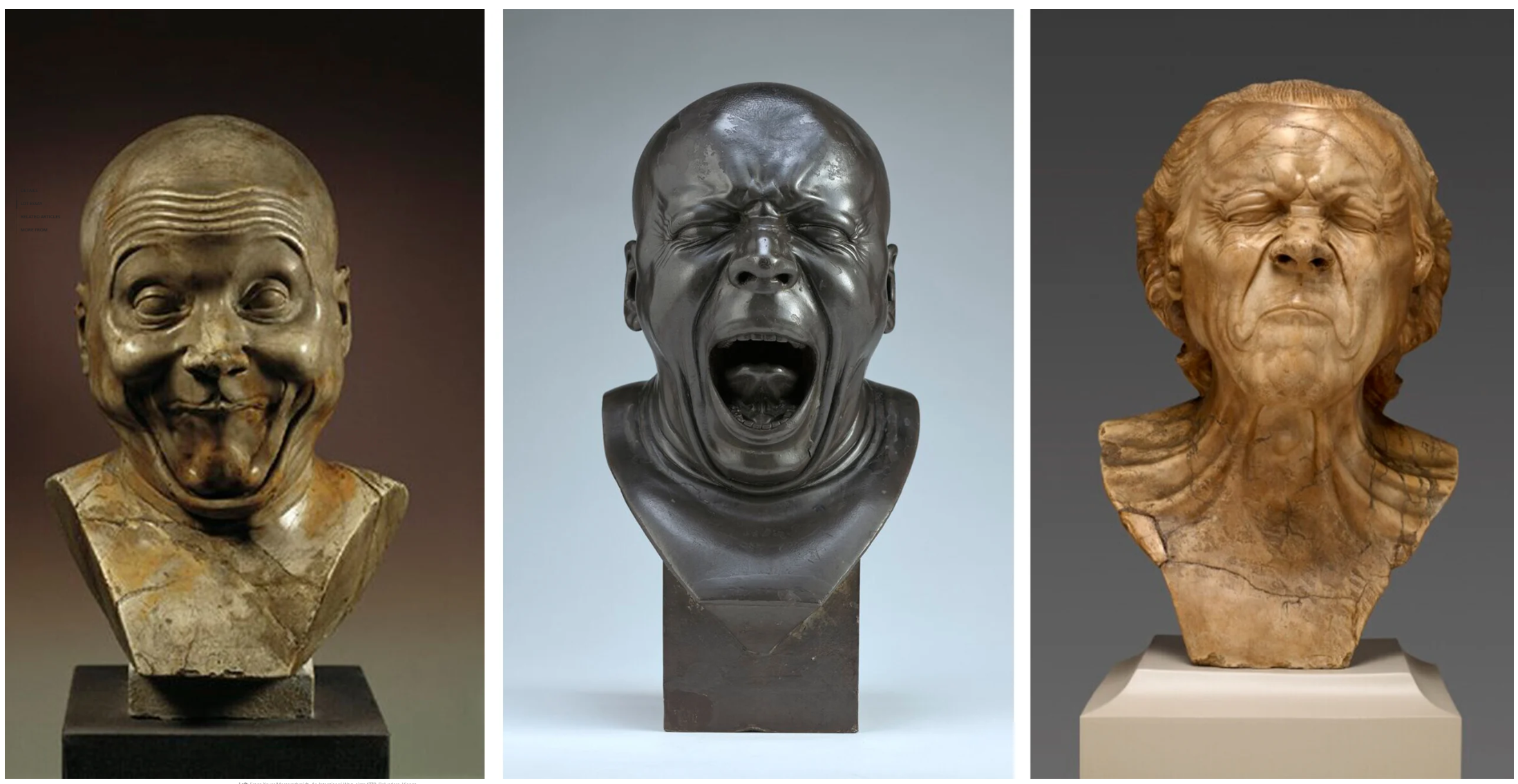
Left: Franz Xaver Messerschmidt, An Intentional Wag, circa 1770. Belvedere, Vienna.
Middle: Franz Xaver Messerschmidt, The Yawner, 1771-1783. Belvedere, Vienna.
Right: Franz Xaver Messerschmidt, The Vexed Man, after 1770. J. Paul Getty Museum, Los Angeles.
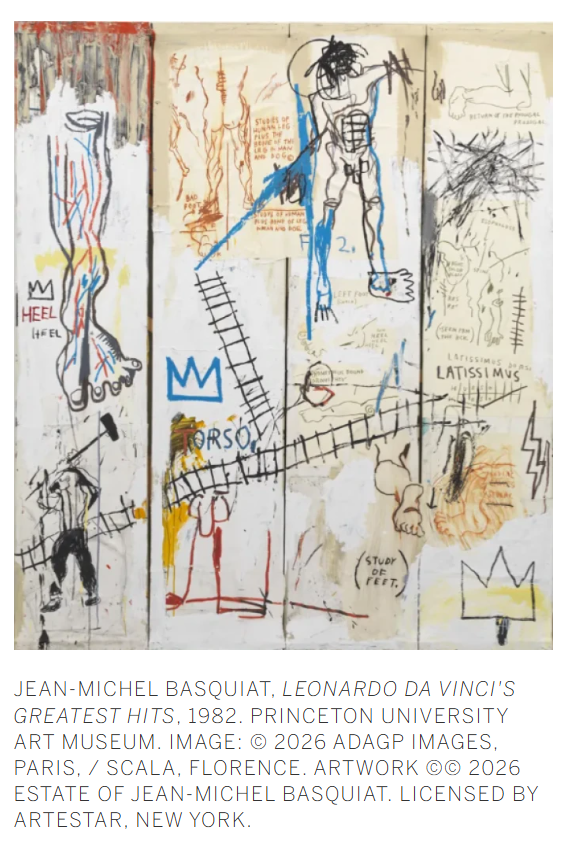
Basquiat was a consummate student of art history. A voracious reader, he owned many artists’ monographs (including a well-used copy of the Artabras monograph on da Vinci published in 1980, which contains an image of the Five grotesque heads). In addition, he was a regular visitor to many of New York’s museums, in particular the Brooklyn Museum, which was close to his childhood home. Throughout his oeuvre there are direct references to Modernism, Primitivism, and even Surrealism, but it was Leonardo da Vinci who occupied much of Basquiat’s attention during the course of his career. His epic painting Leonardo da Vinci’s Greatest Hits (1982, Princeton University Art Museum) is arguably his most well-known riff on the Renaissance master’s work. A clear homage to da Vinci’s anatomical studies, it is also a highly personal work for Basquiat due to his childhood accident which left him in the hospital for a month, with only the copy of Gray’s Anatomy that his mother had given him to entertain him. Other major paintings with da Vinci references include Notary (1983, Princeton University Art Museum), which includes configurations that have been likened to da Vinci’s drawings of rolling mills and other technical devices; Untitled (1985), which adopts a “Maria lactans” motif and an excerpt from da Vinci’s discourse on painting within the composition; and finally, Riding with Death (1988)—one of Basquiat’s last great works before his untimely death in August 1988—a direct reference to da Vinci’s drawing Two Allegories of Envy (circa 1494-1497, Christ Church, Oxford).
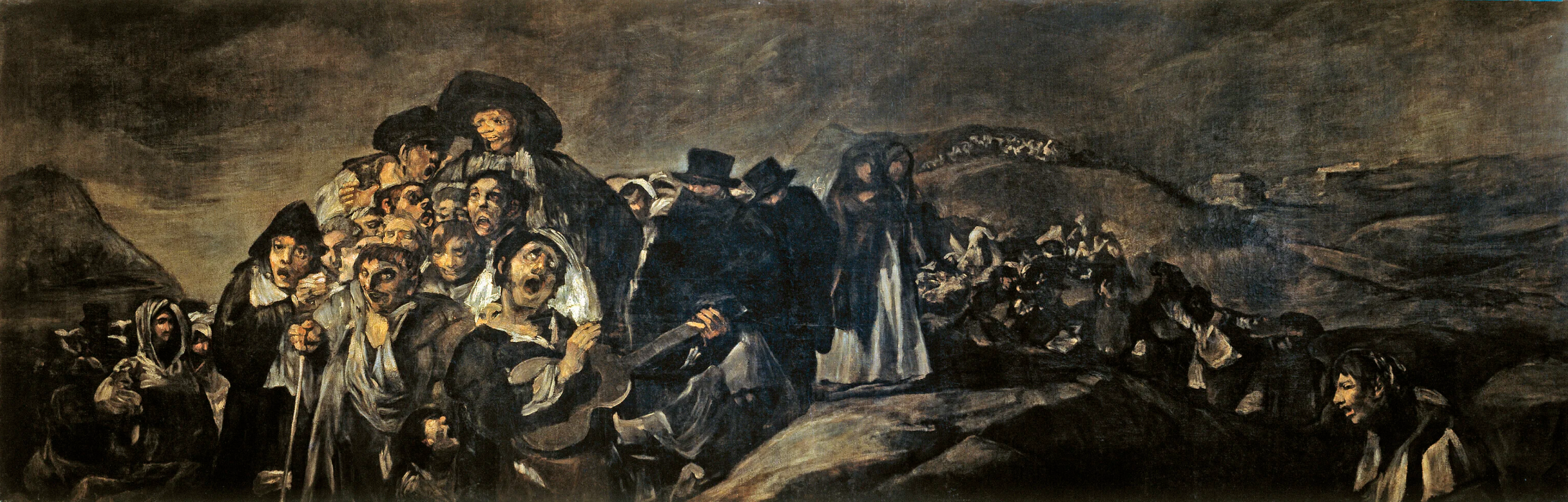
Francisco Goya, A Pilgrimage to San Isidro, 1819-1823. Museo del Prado, Madrid.
A man tricked by Gypsies is the most elaborate of da Vinci’s drawings of figures and their exaggerated faces. In the late 1400s, Leonardo sketched numerous figures in a similar fashion, in what scholars regard as a counterpart to his more usual investigations into the ideal human form, such as Vitruvian Man (circa 1490, Galleria dell’Accademia, Venice). The origins of da Vinci’s composition that so inspired Basquiat can be found in the arrival of gypsies in western Europe around 1420. They originally claimed to be penitent pilgrims from Egypt, but soon acquired a reputation for fortune-telling and theft. Originally da Vinci’s composition contained an image of a woman reading the palm of the central figure with his right arm raised; at some point in its early life, however, that part of the sheet was trimmed off. After it left Leonardo’s possession the drawing became one of his best-known compositions and served as the basis for numerous other paintings, including examples by Giorgione (La Vecchia [The Old Woman], 1510, Galleria dell’Accademia, Venice), possibly works by Albrecht Dürer completed during his second stay in Venice (1505-1507), and finally Quentin Massys in Antwerp. Da Vinci’s drawing was eventually taken to England by Thomas Howard, 15th Earl of Arundel by 1630, and by 1690 it had been acquired by King Charles II for the Royal Collection.
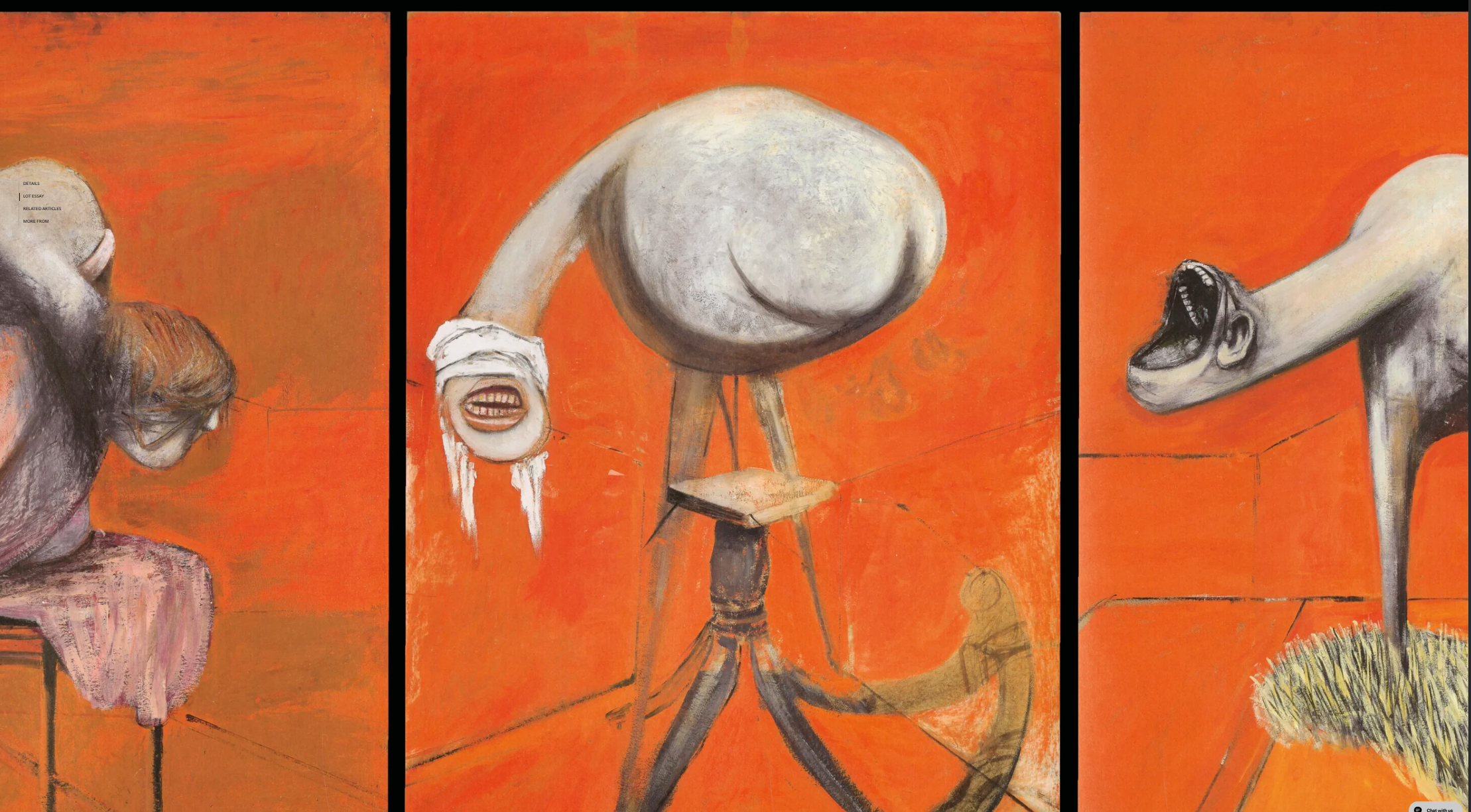
Francis Bacon, Three Studies for Figures at the Base of a Crucifixion, 1944. Tate Gallery, London.
© The Estate of Francis Bacon. All rights reserved / DACS, London / ARS, New York 2026.
Throughout art history, the role of the grotesque has served many purposes. Originally, it might have been decorative (there was an established tradition of “monstrous fantasy” in medieval art, as in Hieronymus Bosch’s The Garden of Earthly Delights , c. 1490–1510), or it might have served as a counterpart to the idealized beauty traditionally depicted in art. According to scholar Martin Clayton, da Vinci’s grotesque heads “were clearly meant to be entertaining and the degree of elaboration of some of the drawings [including A man tricked by Gypsies] would suggest that they were created not only for Leonardo’s amusement but for an audience” (M. Clayton, Leonardo da Vinci: The Divine and the Grotesque, exh. cat., The Royal Collection, London, 2002, p. 74). In the nineteenth and twentieth centuries, artists such as Goya, the German Expressionists Otto Dix and Ernst Ludwig Kirchner, and even Francis Bacon adopted a distorted human form in their critique of contemporary society and its descent into violence and war.
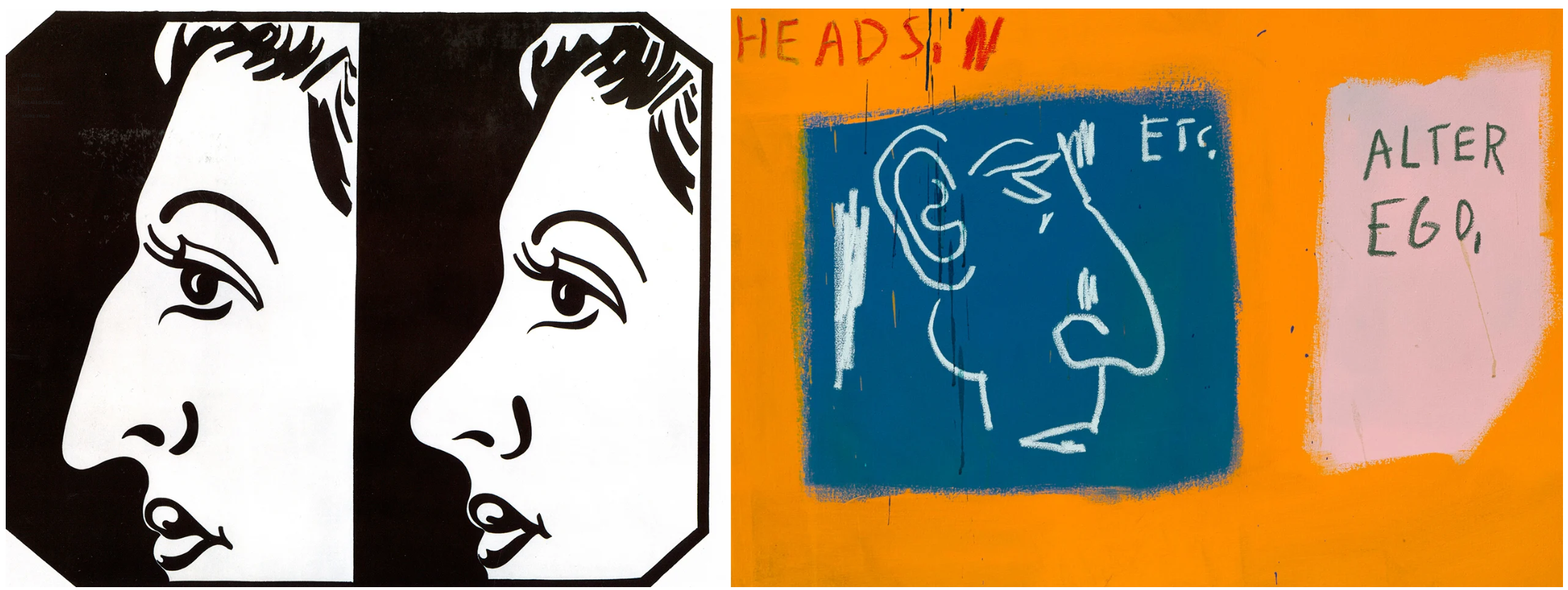
Left: Andy Warhol, Before and After (4), 1962. Whitney Museum of American Art, New York. © 2026 The Andy Warhol Foundation for the Visual Arts, Inc. / Licensed by DACS, London.
Right: Present lot illustrated (detail).
1983, the year his painting was executed, was a volatile one for the artist. He was at the height of his artistic fame, but despite being championed by many in the art world, he still often found it difficult to hail a taxi due to the inherent racism in the city. It was also the year that saw the death of his close friend and fellow artist, Michael Stewart, beaten to death by police in New York City. The younger artist’s restless imagination meant that his inspiration came from a wide array of sources: newspapers, magazines, music, TV, posters, and the advertisements and signs he saw on the streets. Having probably seen the drawing in a book, and attracted by the impressive draftsmanship of the original, Basquiat set about reimagining his hero’s work in his own unique way.
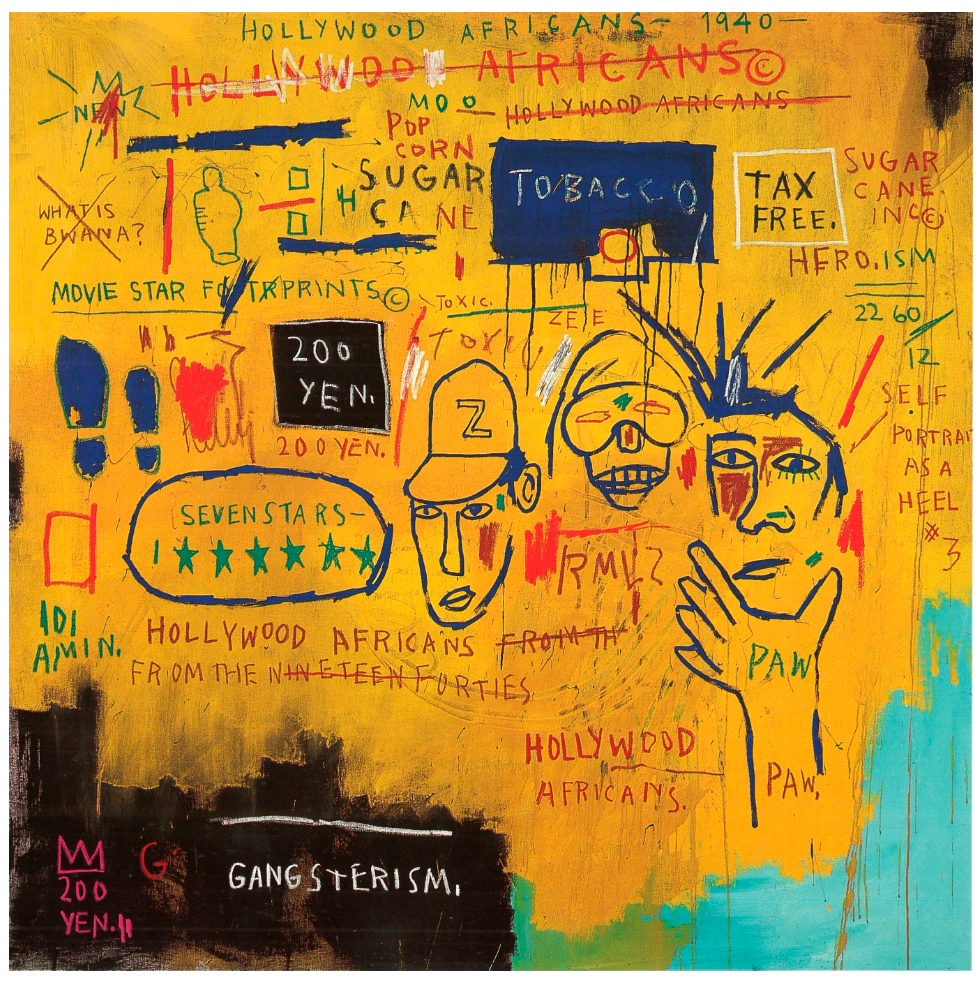
Jean-Michel Basquiat, Hollywood Africans, 1983. Whitney Museum of American Art, New York.
© Estate of Jean-Michel Basquiat. Licensed by Artestar, New York.
Despite being separated by 500 years, there are strong parallels between Leonardo da Vinci and Jean-Michel Basquiat on an artistic level, but also on a personal one. Both artists possessed a remarkable talent to observe, to absorb, and to record their respective periods of history. When realized through the medium of drawing, these observations result in viscerally powerful images. This rare talent is due, in part, to both men being outsiders. Da Vinci was born out of wedlock and thus barred from the elite professions of Renaissance society, and without any formal education he was unable to pursue the traditional routes to becoming an artist. Basquiat, too, dropped out of school early, and forged his own artistic language through direct observation and innovation rather than academic instruction. In addition, as a Black artist in a predominantly white art world, Basquiat was acutely aware of his outsider status. Untitled (Leonardo and His Five Grotesque Heads) brings both these artists together. The painting stands as an extraordinary homage to da Vinci, reflecting not only Basquiat’s admiration for the Renaissance master, but also his own interrogation of the nature of what it means to be an artist.
La Vieja, 1984
La Vieja, 1984
Property from a Prestigious European Collection
Sotheby’s New-York: 16 November 2026
Estimated: USD 6,000,000 – 8,000,000
Jean-Michel Basquiat | La Vieja | The Now and Contemporary Evening
JEAN-MICHEL BASQUIAT (1960 – 1988)
La Vieja, 1984
Acrylic and oilstick on canvas
59-7/8 x 72 inches (152.1 x 182.9 cm)
Signed, titled and dated 1984 (on the reverse)
Set against an active, aqueous backdrop of rich blues, pinks and reds, La Vieja from 1984 presents one of the rarest and most tenderly rendered depictions of a woman in Jean-Michel Basquiat’s oeuvre. For Basquiat, raised by a Puerto Rican mother in a multilingual household, his works with Spanish titles hold immense importance in his oeuvre, for their reference to his upbringing, family, and domestic life. One of only 28 paintings listed in the artist’s catalogue raisonné with a Spanish title, the present work’s exceptionally rare depiction of a female subject further heightens the picture’s association with the people closest to him—even suggesting a loving portrait of the artist’s mother. Perhaps nowhere else is the importance of his youth so literalized and monumentalized than in the present work, in which La Vieja intimates a moving and extraordinary depiction of the figure who shaped his work and nurtured his life.
“I’d say my mother gave me all the primary things. The art came from her.”
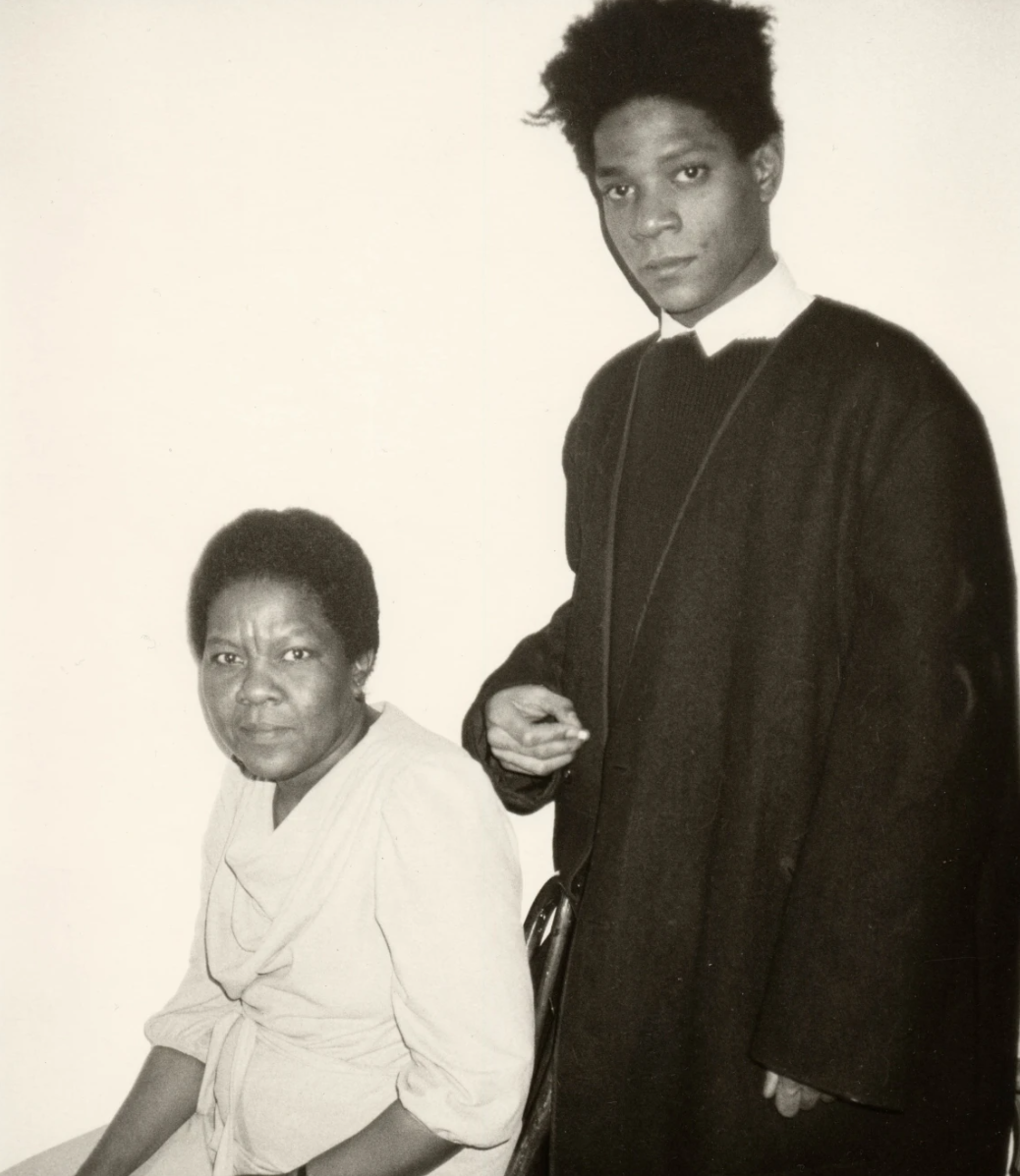
Photo of Jean-Michel Basquiat, and his mother, Matilde. Photo by Andy Warhol.
Art © 2026 Andy Warhol Foundation for the Visual Arts / Artists Rights Society (ARS), New York
In La Vieja, the female protagonist smiles as she clutches her cane, walking in fashionable, red heeled shoes. His subject floats suspended in the ethereal washes of ultramarine, cerulean, and airy pink, as though the memory of this woman and her house materialize in a dream.
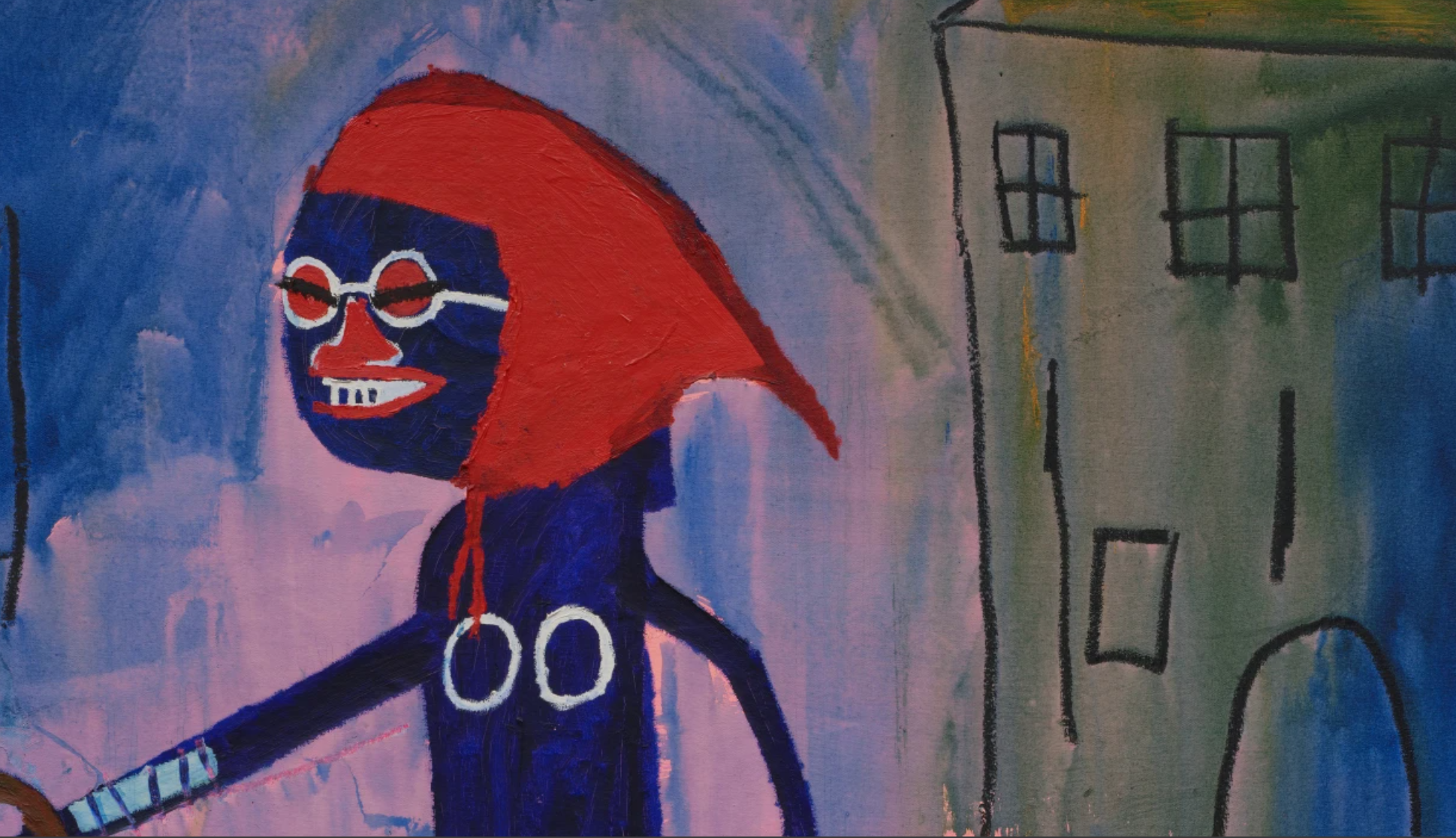
As opposed to other canvases, which are packed with text, iconography, ciphers, and symbols, La Vieja exhibits a remarkable visual clarity and exceptional focus on the singularity of his subject; in this way, Basquiat’s other works might be legible as images of his mind, where the present work stands as one of the heart. This effect is heightened by the title: since birth, the Spanish language and culture have shaped Basquiat and intertwined with his artistry, as the language was native to Basquiat, inherited from his mother.
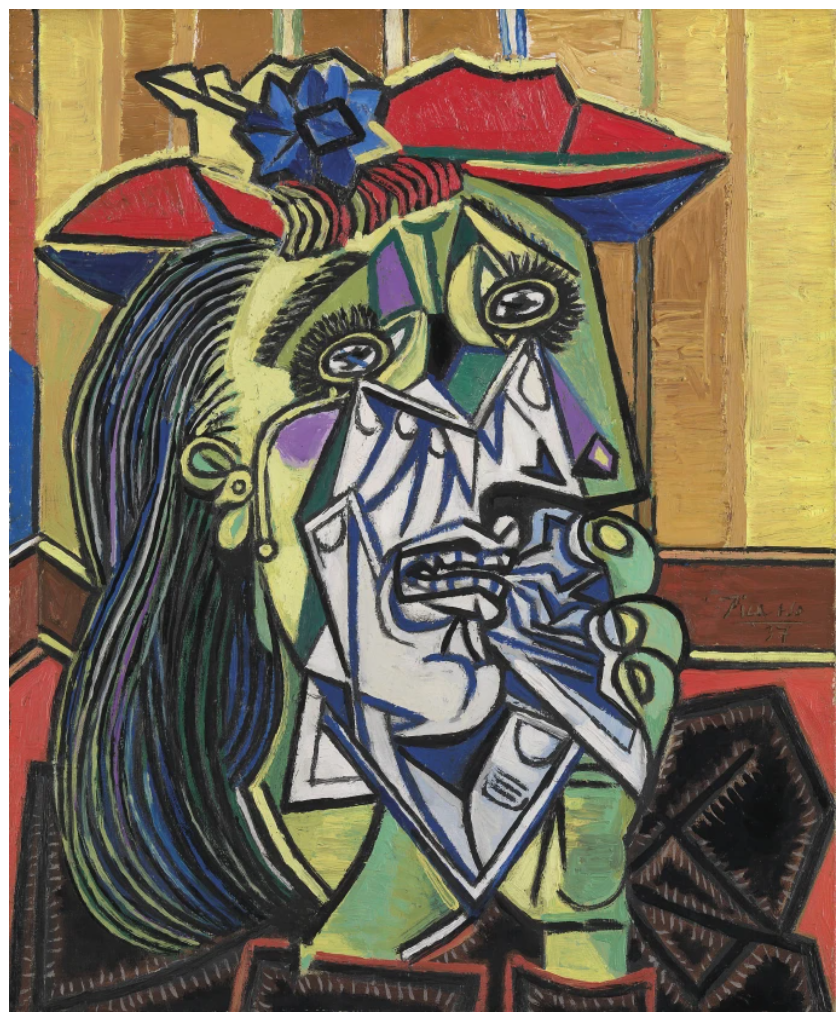
Pablo Picasso, Femme en pleurs, 1937. Tate Gallery, London. Image © Tate, London / Art Resource, NY.
Art © 2026 Estate of Pablo Picasso / Artists Rights Society (ARS), New York
The invocation of Spanish and his mother tongue threads together many of the most important works in Basquiat’s oeuvre: Crowns (Peso Neto), Pollo Frito, Dos Cabezas, Sabado por la Noche, and Despues De Un Puno, among others. Furthermore, many of the most important motifs, themes, and concerns that constitute Basquiat’s corpus originate from adolescence—from Basquiat’s mother gifting him a copy of Gray’s Anatomy, the seminal medical tome that sparked an early interest in diagrams and the body, to the ancient painted Roman or Egyptian frescoes Basquiat first encountered during childhood visits to museums like The Metropolitan Museum of Art in New York.
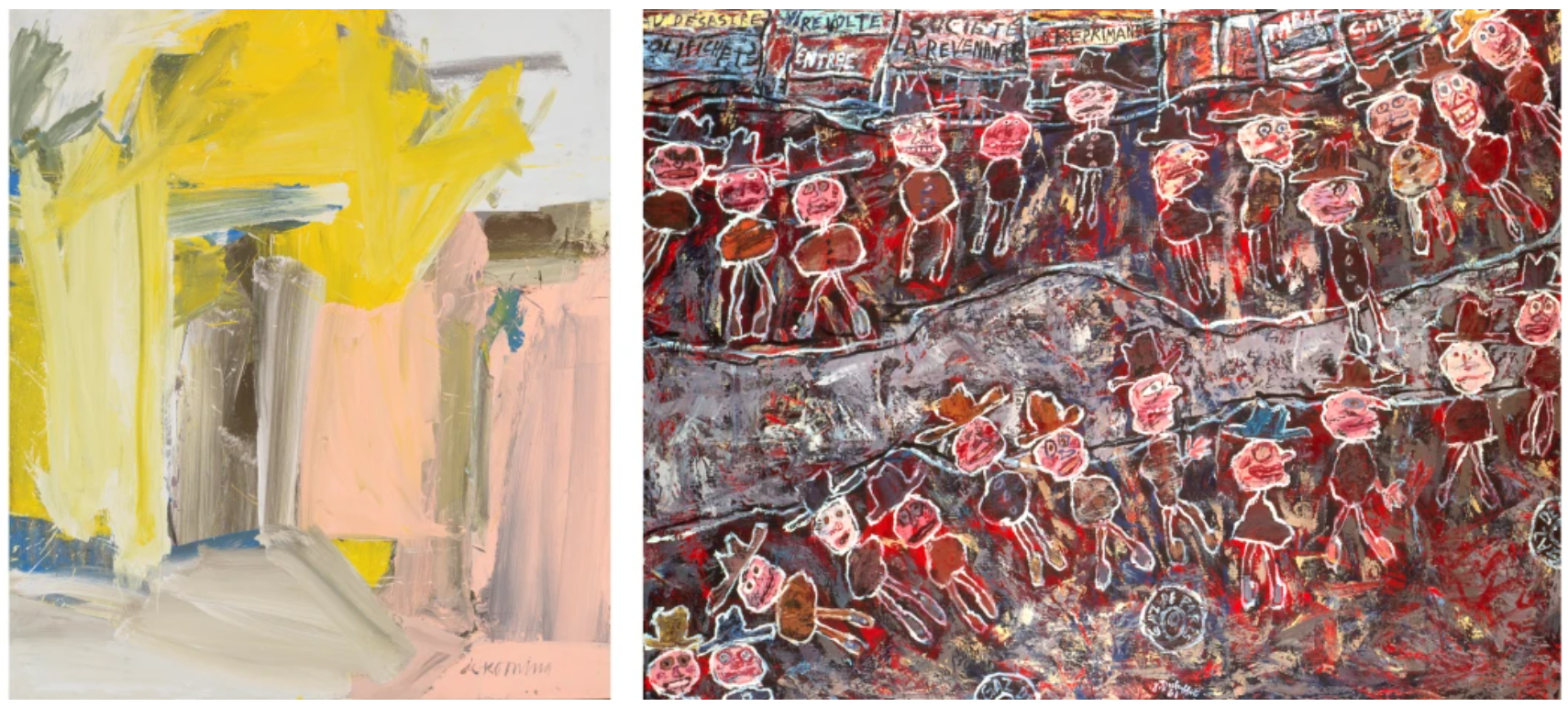
Left: Willem de Kooning, Door to the River, 1960. Whitney Museum of American Art, New York. Digital image © Whitney Museum of American Art / Licensed by Scala / Art Resource, NY. Art © 2026 The Willem de Kooning Foundation / Artists Rights Society (ARS), New York. Right: Jean Dubuffet, Spinning Round, 1961. Tate Gallery, London. Image © Tate, London / Art Resource, NY. Art © 2026 Artists Rights Society (ARS), New York / ADAGP, Paris
The vivid, jewel-toned field that underlies the entire composition paints a beguiling stage for this scene laced with meaning and memory. In this violascent field, Basquiat ignites this female figure with blazing strokes of scarlet, adding a highly stylized touch to the headscarf and footwear donned by his subject. As Marc Mayer notes, “With direct and theatrically ham-fisted brushwork, he used unmixed color structurally, like a seasoned abstractionist, but in the service of a figurative and narrative agenda. Basquiat deployed his color architecturally, at times like so much tinted mortar to bind a composition, at other times like opaque plaster to embody it. Color holds his pictures together, and through it they command a room.” (Marc Mayer, “Basquiat in History,” in: Exh. Cat., New York, Brooklyn Museum (and traveling), Jean-Michel Basquiat, 2005, p. 46) Rhythms of color and shape emerge within the painting and softly fade out or dissipate in a cacophonous burst, only to emerge again and recombine with new forms in concordant and discordant harmonies. Amidst this flurry of active, emotive brushwork emerges the smiling Vieja: the source of inspiration from which the painting gains its title.
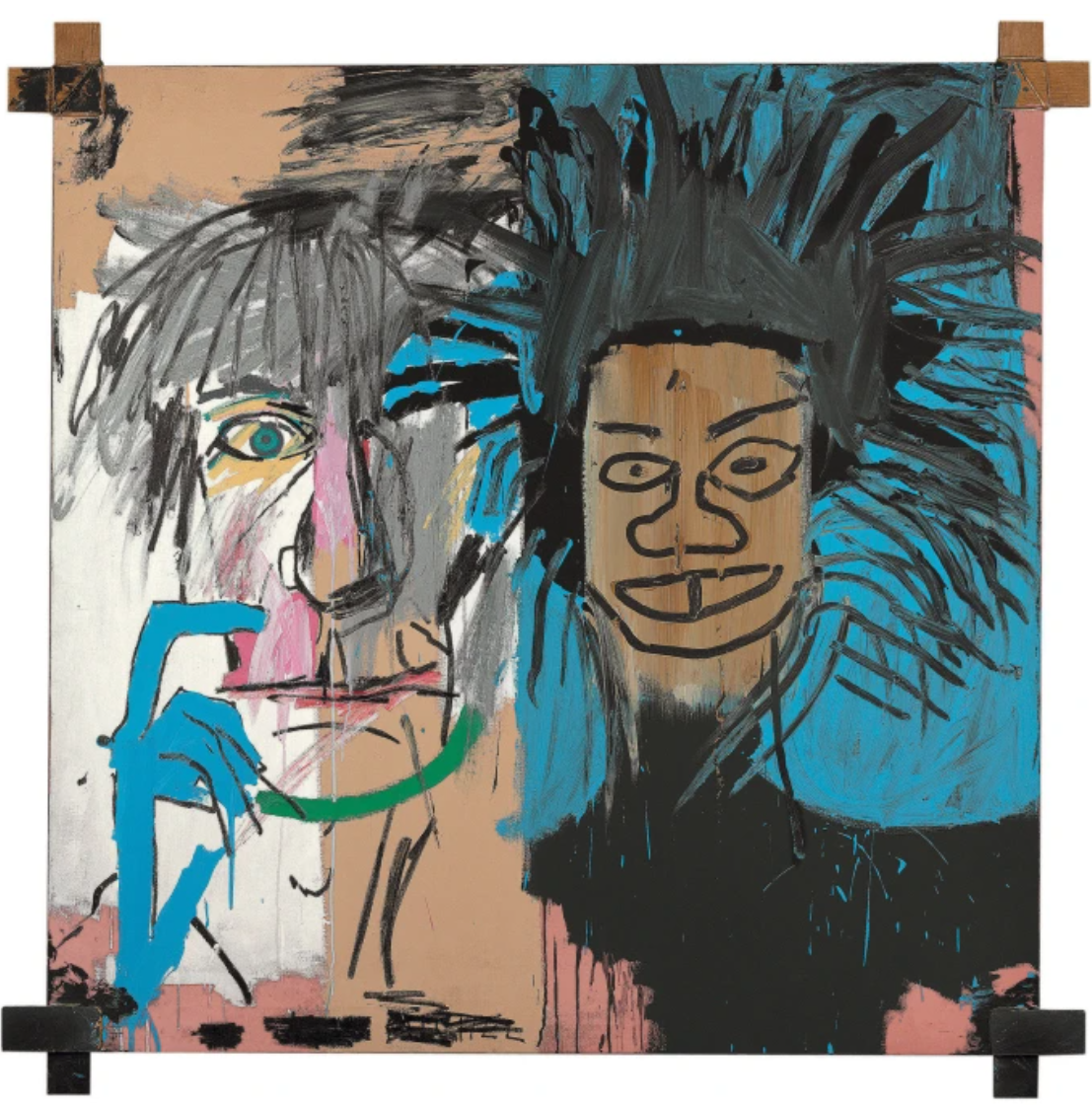
Jean-Michel Basquiat, Dos Cabezas, 1982. Private Collection. Art © 2026 Estate of Jean-Michel Basquiat. Licensed by Artestar, New York
La Vieja belongs to a rarefied camp of Basquiat paintings featuring a female subject. From Billie Holiday, the Mona Lisa, to Dinah Washington, La Vieja is upheld as a heroine, one painted with extraordinary tenderness and vulnerability. Set against the opalescent field of violets, rose, and cobalt, here the ingenuity—that inimitable, instinctual, and unstoppable mastery of paint—that defined Basquiat’s meteoric rise manifests in a canvas of incredible significance and uncharacteristic softness. Indeed, La Vieja stands both as a triumphant expression of artistic achievement and maturity while also traveling back to the purest source of inspiration.
Untitled (Fist), 1986
Untitled (Fist), 1986
The Clive Davis Collection
Christie’s New-York: 17 November 2026
Estimated: USD 4,000,000 – 6,000,000
JEAN-MICHEL BASQUIAT (1960-1988), Untitled (Fist) | Christie’s
JEAN-MICHEL BASQUIAT (1960-1988)
Untitled (Fist), 1986
Acrylic, oilstick and coffee on canvas
31-1/2 x 23-5/8 inches (80×60 cm)
Signed and dated ‘Jean-Michel Basquiat 1986’ (on the reverse)
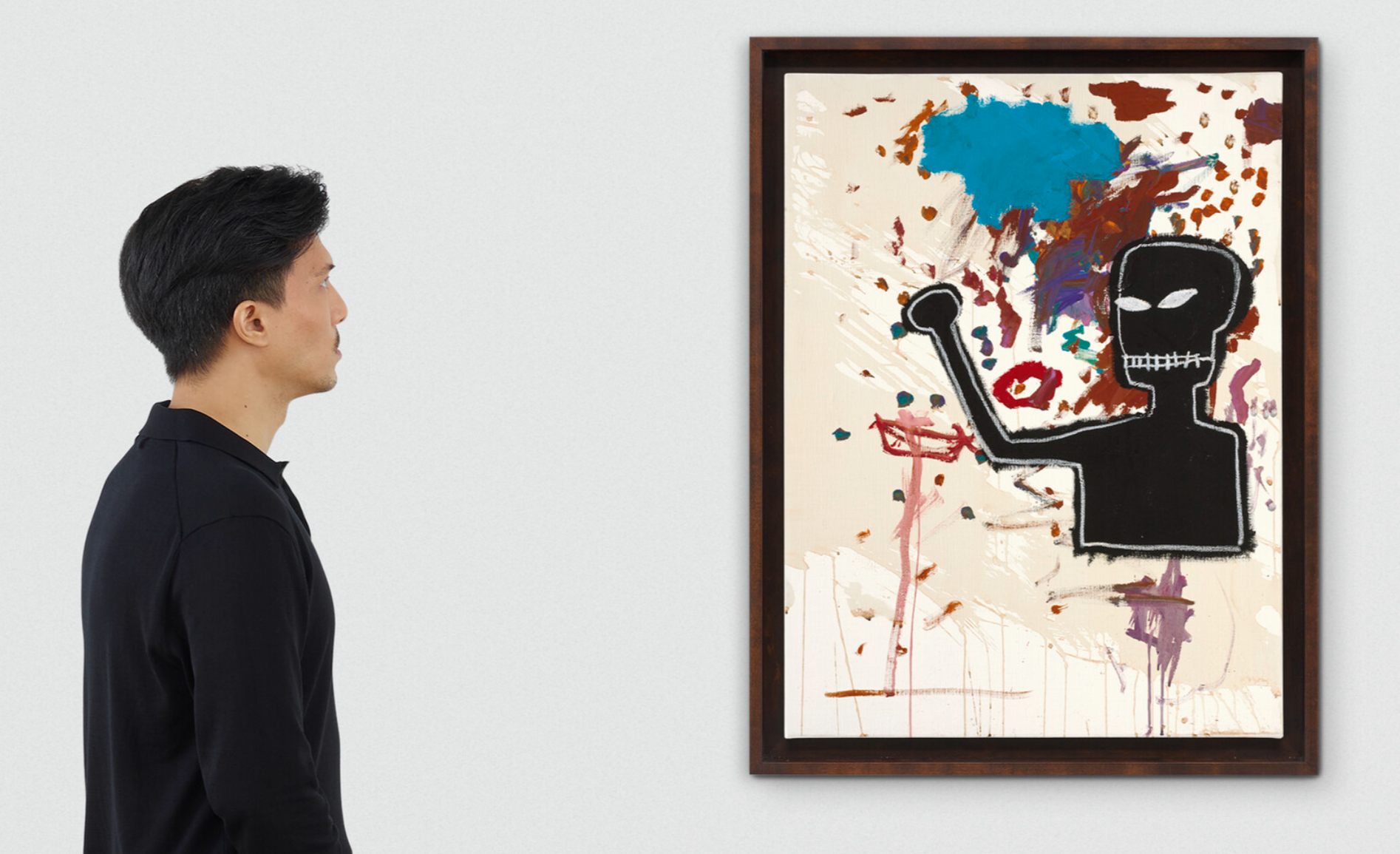
Standing with a fist raised in defiant salute, the figure in this arresting portrait by Jean-Michel Basquiat embodies the message that runs through many of the artist’s most celebrated works. This proud symbol assumes the role of a modern everyman, a totemic figure that evokes the athletes, musicians, cultural icons, and historical figures that the artist revered throughout his career. In Untitled (Fist), this iconic figure is surrounded by the full array of the artist’s expressive gestures—energetic brushwork, expressive use of color, and the sophisticated employment of positive and negative space, which work together to create a painting of exceptional compositional accomplishment.
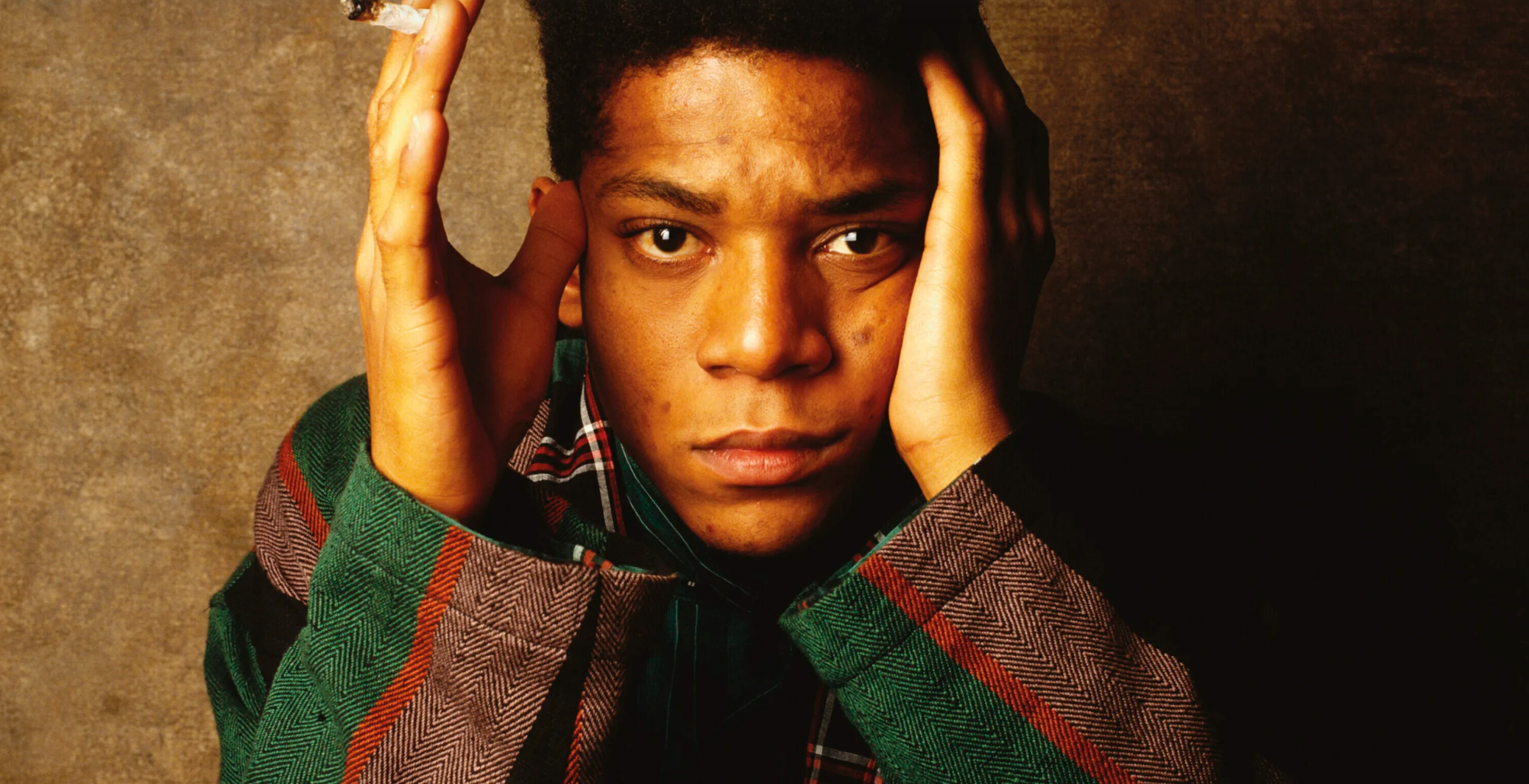
Jean-Michel Basquiat in his New York studio, 1986. Photo: © William Coupon.
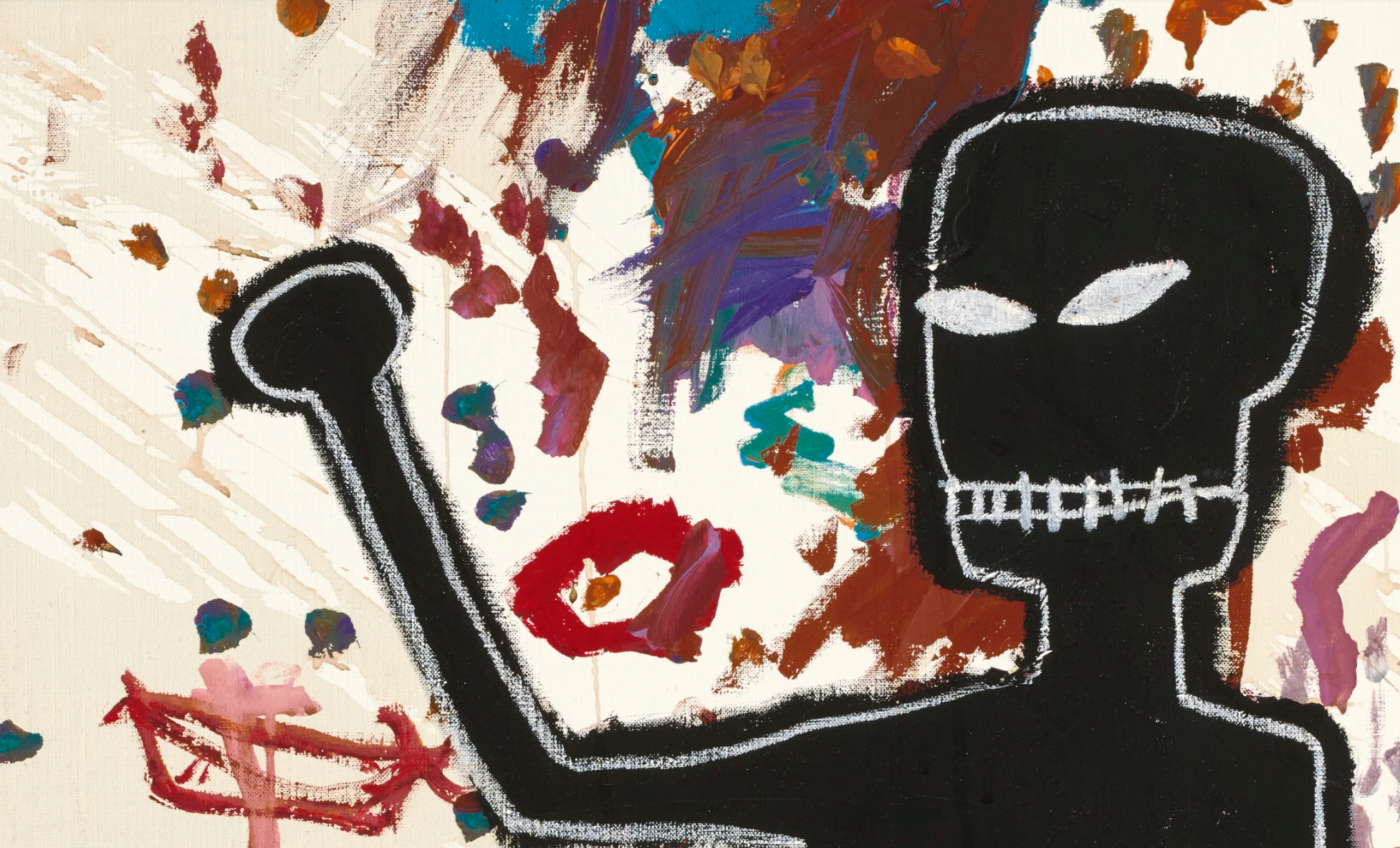
The present work is dominated by the powerful presence of a black figure. This is one of the most important motifs in the artist’s oeuvre, appearing many times, in many guises. But in the case of the present work, the power of the figure lies in its simplicity. Depicted in three-quarter profile, the commanding silhouette is enhanced only by a pair of glowing eyes and a fierce grimace. A white line traces the outline of the figure, both emphasizing its presence and creating a sense of depth and border. Surrounding it, Basquiat choreographs a surplus of drips, daubs, and pools of color, all enveloped by a broad wave of cream-colored ground, interrupted by splashes of a medium unusual in painting but omnipresent in daily life—coffee. By combining figurative and abstract elements, Basquiat transforms the image from a straightforward portrait into a psychologically charged emblem of strength, identity, resilience, and unity.
The painting’s most potent visual symbol is undoubtedly the raised fist. In this respect it evokes a famous photograph of athletes Tommie Smith and John Carlos taken during a medal ceremony at the 1968 Mexico Olympics. Smith had just won the 200-meter race, achieving a new world record in the process, with Carlos winning bronze. During the presentation of the medals, Smith and Carlos each raised a gloved fist in what became one of the defining images of the twentieth-century civil rights movement.
Alongside musicians, civil rights campaigners, and historical figures, athletes held a special place among Basquiat’s heroes. As Klaus Kertess observed, the artist’s repeated elevation of athletes and cultural figures, “at once celebrates and satirizes one of the few professions in which blacks are permitted to excel” (K. Kertess, “Brushes with Beatitude” in R. Marshall, Jean-Michel Basquiat, exh. cat., Whitney Museum of American Art, 1992, p. 50). Indeed, as Tommie Smith noted wryly after his Olympics win, “If I win I am an American, not a black American. But if I did something bad then they would say ‘a Negro’. We are black and we are proud of being black… Black America will understand what we did tonight” (“1968: Black athletes make silent protest,” BBC, online [accessed: 10/9/2026]).
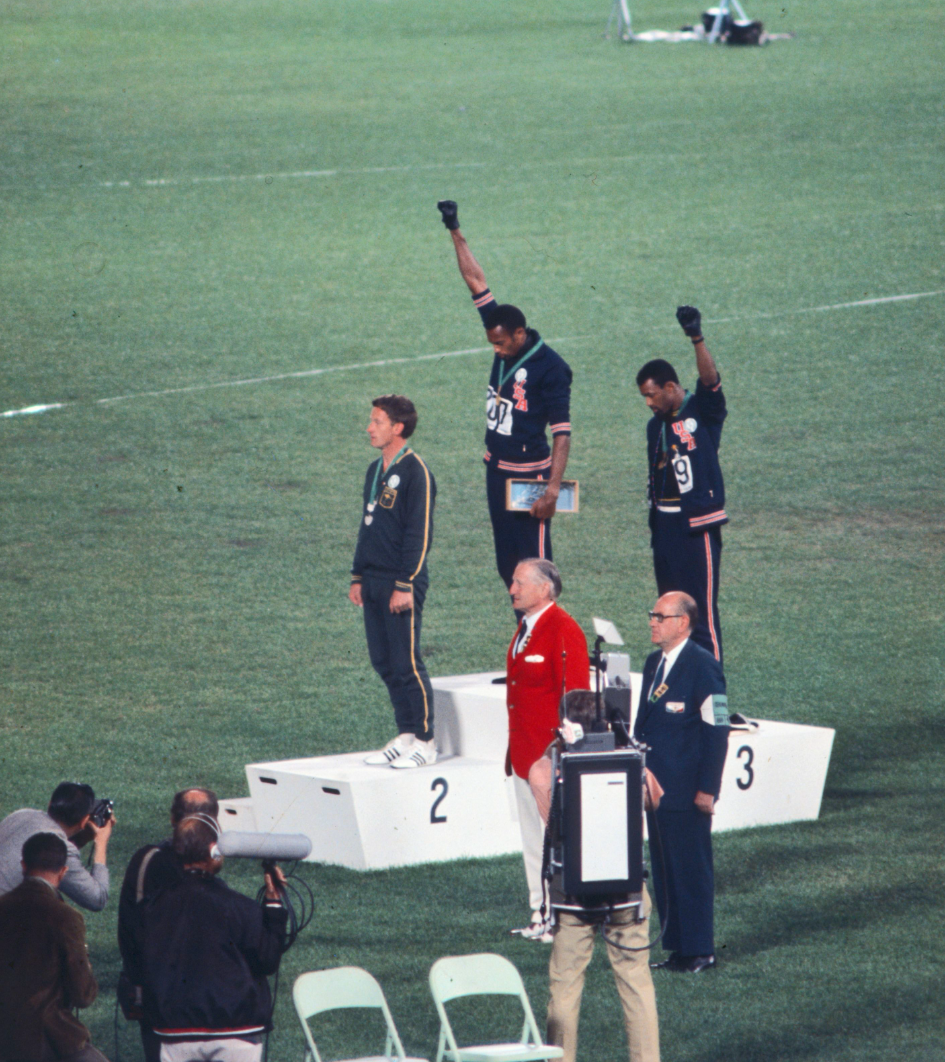
American sprinters Tommie Smith and John Carlos during the award ceremony of the 200-meter race at the 1968 Mexico City Olympic games, raising their fists with black gloves in protest against racial discrimination. Photo: Angelo Cozzi / Archivio Angelo Cozzi / Mondadori via Getty Images.
Growing up in 1960s and 1970s New York, Basquiat would have been only too aware of this inequity. The son of a Haitian father and a Brooklyn-born mother of Puerto Rican descent, he would have experienced the same racial inequalities that were experienced by Smith, Carlos, and many of his generation. By 1986, the artist had established himself as the wunderkind of the art world, yet as a Black man in a city that was plagued by social unrest he still faced discrimination in his day-to-day life. Even as his paintings commanded increasingly greater prices, and his art was celebrated around the world, the young artist often had trouble hailing a cab in his Lower East Side neighborhood. In the present work, Basquiat pays homage to the civil rights leaders that came before him, while also positioning himself and his generation as the future of the movement. It is a composition of struggle, but also of hope.
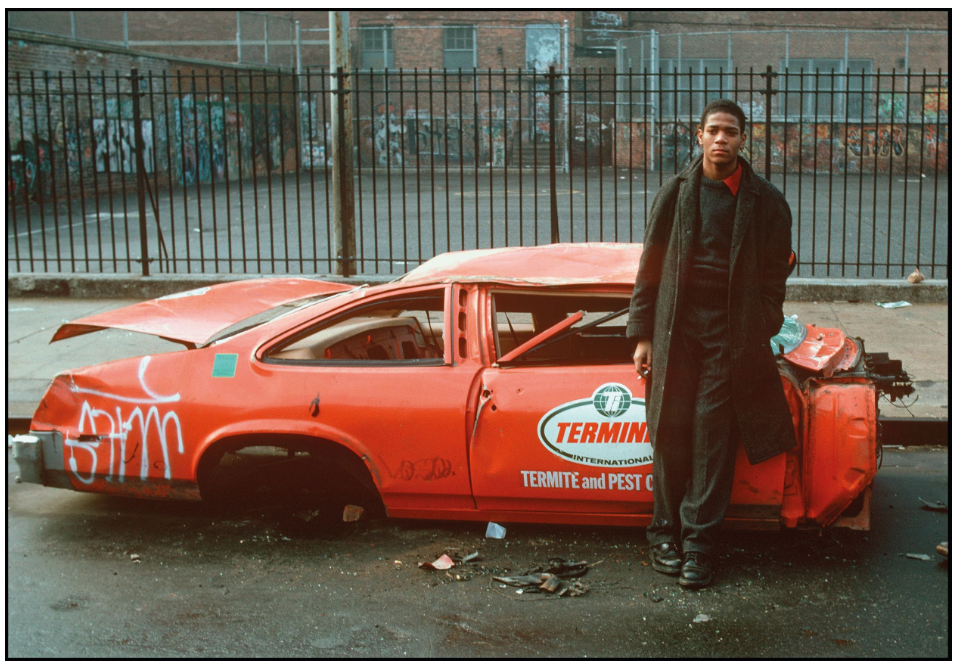
Film still, Jean-Michel Basquiat, New York, 1980-1981 in Downtown 81, 2000. Directed by Edo Bertoglio. Photo by Edo Bertoglio © New York Beat Film LLC. By permission of Estate of Jean-Michel Basquiat.
Across his brief and turbulent career, Basquiat’s work was defined by his desire to confront his own lived experience and search for self-identity, and in doing so, elucidate a more universal truth. In Untitled (Fist), that search is distilled to a symbol of resistance, solidarity, and bravery. It is in this icon that Basquiat’s practice finds one of its most concentrated and powerful expressions.
Untitled (Sin Hueso), 1982-83
Untitled (Sin Hueso), 1982-83
Property from the Collection of Enrico Navarra
Sotheby’s New-York: 16 November 2026
Estimated: USD 1,800,000 – 2,500,000
WORK ON PAPER
GUARANTEED PROPERTY
Jean-Michel Basquiat | Untitled (Sin Hueso) | The Now and
JEAN-MICHEL BASQUIAT (1960 – 1988)
Untitled (Sin Hueso), 1982-83
Oilstick and pen on paper
22×30 inches (55.9 x 76.2 cm)
Titled (center left)
A self-referential skull of deep sapphire blue and cherry red, surrounded by lattices and curling linear forms, crowned with horns, stares out, confronting its viewer with a grimacing and devilish grin; Sin Hueso, executed in 1982-83, at the pinnacle of his career, is one of Jean-Michel Basquiat’s most accomplished works on paper, showcasing the iconic visual language that made Basquiat one of contemporary visual culture’s most iconic and influential voices. Created when the artist was just twenty-two, Sin Hueso belongs to a larger early-career body of expressive skulls, faces, and heads; these explorations of humanity and anatomy remain among Basquiat’s most powerful and lasting contributions to the artistic canon.
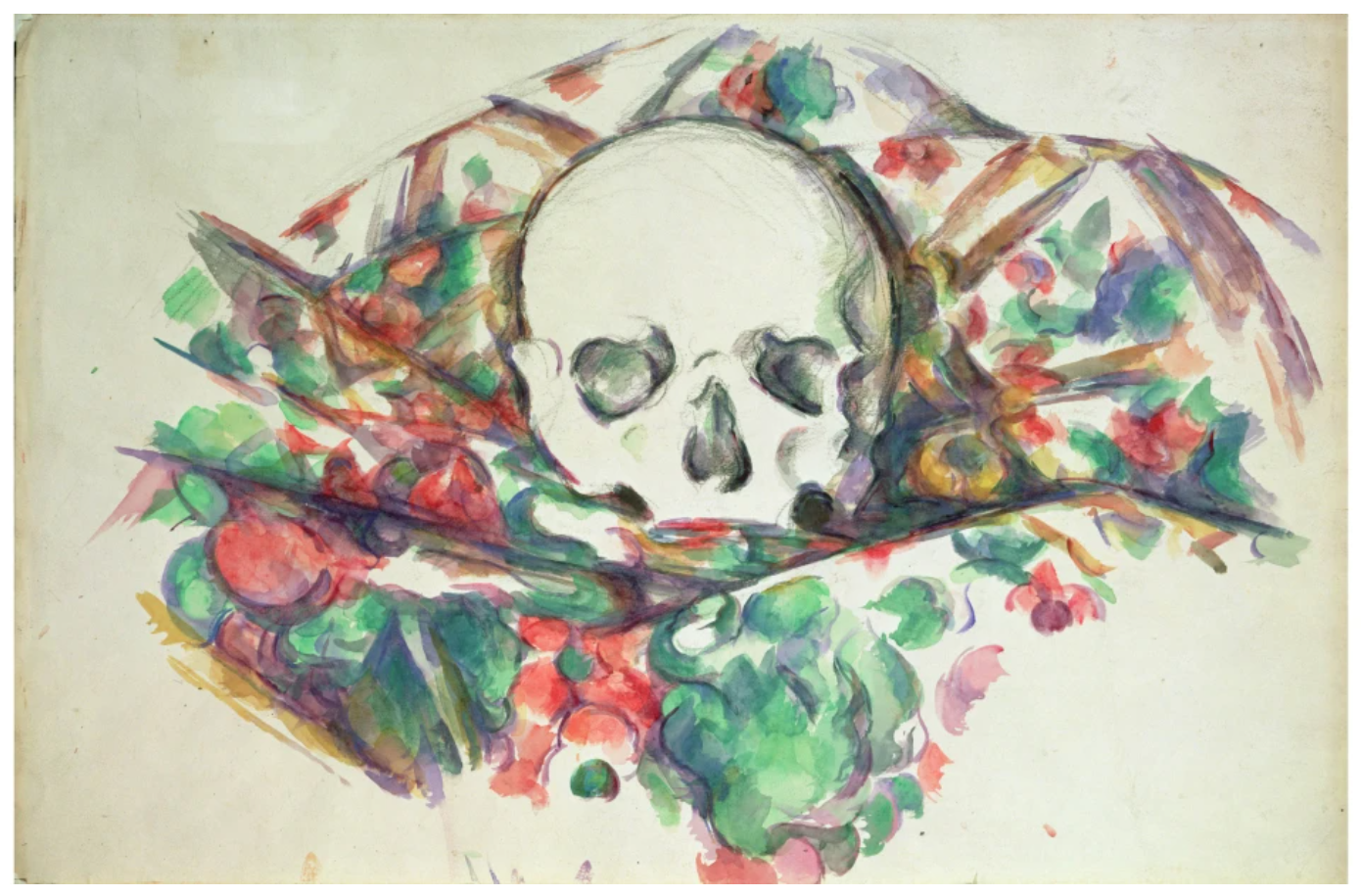
Paul Cezanne, Skull on Drapery, c. 1902-06. Private Collection. Image © Christie’s Images / Bridgeman Images
At the very core of Basquiat’s electric yet calamitously brief career was a spectacularly individuated lexicon, one anchored by the visuals and verbiage through which Basquiat communicated his worldview. To the left of the Devilish character, Basquiat inscribed the words Sin Hueso, the efficient, powerful phrase that translates to “without bones” or “no bones” in English, one of his most common written motifs of this period.
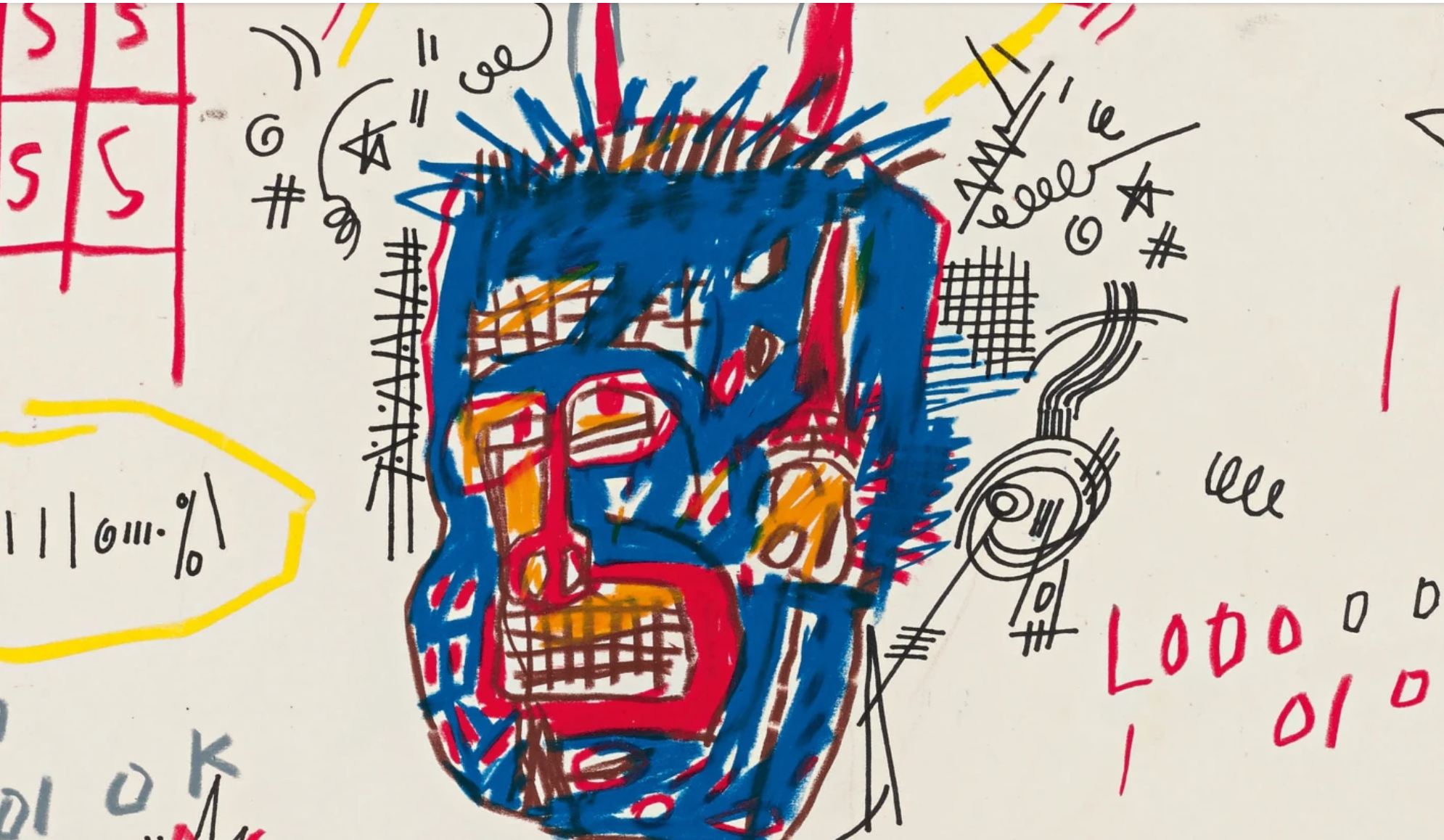
The anatomical and linguistic fragment is an expression of the artist’s vulnerability, as he reflects on the relationship between internal and external forms and, more broadly, the disjunction between fame, iconization, celebrity, and wealth, and the limited and unsettlingly surveilled access of Black art, artists, and culture in the very commercial and institutional spaces into which Basquiat was suddenly thrust.
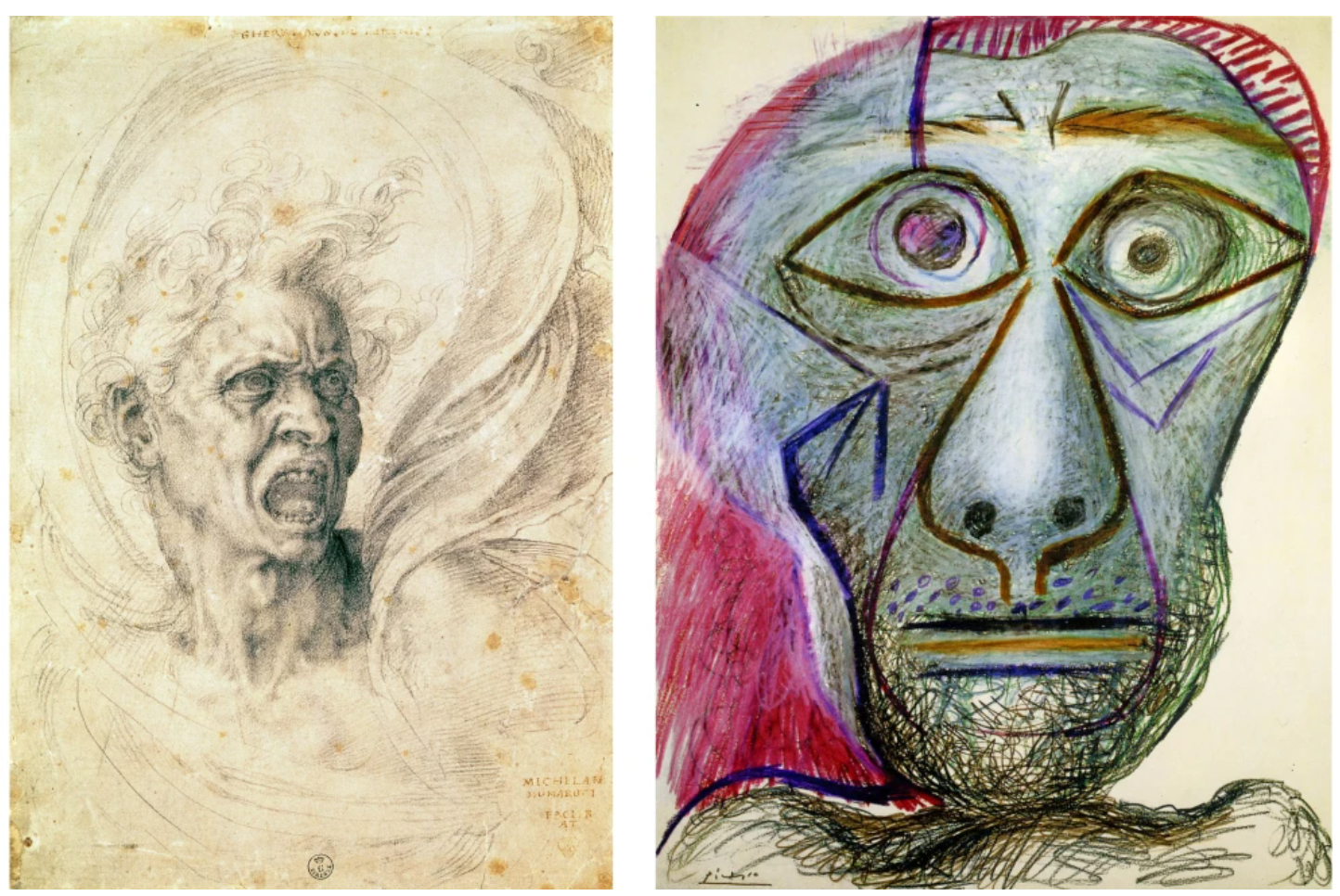
Left: Michelangelo Buonarroti, Study of a Man Shouting, 15th- 16th century. Gabinetto dei Disegni e Stampe, Galleria Degli Uffizi, Florence. Image © Bridgeman Images. Right: Pablo Picasso, Self Portrait Facing Death, 1972. Fuji Television Gallery, Tokyo. Image © Fine Art Images / Bridgeman Images. Art © 2026 Estate of Pablo Picasso / Artists Rights Society (ARS), New York
Jean-Michel Basquiat’s heritage, both his familial origins and his artistic beginnings, was always on display throughout his incandescent artistic career. Born to a Haitian father and Puerto Rican mother, Basquiat inherited a richly hybrid cultural identity that informed every work he created. He began his artistic journey as a graffiti artist in New York City, tagging cryptic phrases and symbolic codes across the facades of the Lower East Side. Language, especially his mother’s native Spanish, became his first canvas, and it remained the foundation of his art. Across Sin Hueso’s page, repetitions of fractured words and phonetic distortions form a rhythmic refrain, as if language itself becomes an incantation. The text does not merely describe; it performs. It chants, interrupts, and provokes, mirroring the syncopated energy of jazz—a soundscape Basquiat often invoked in his paintings and drawings alike.
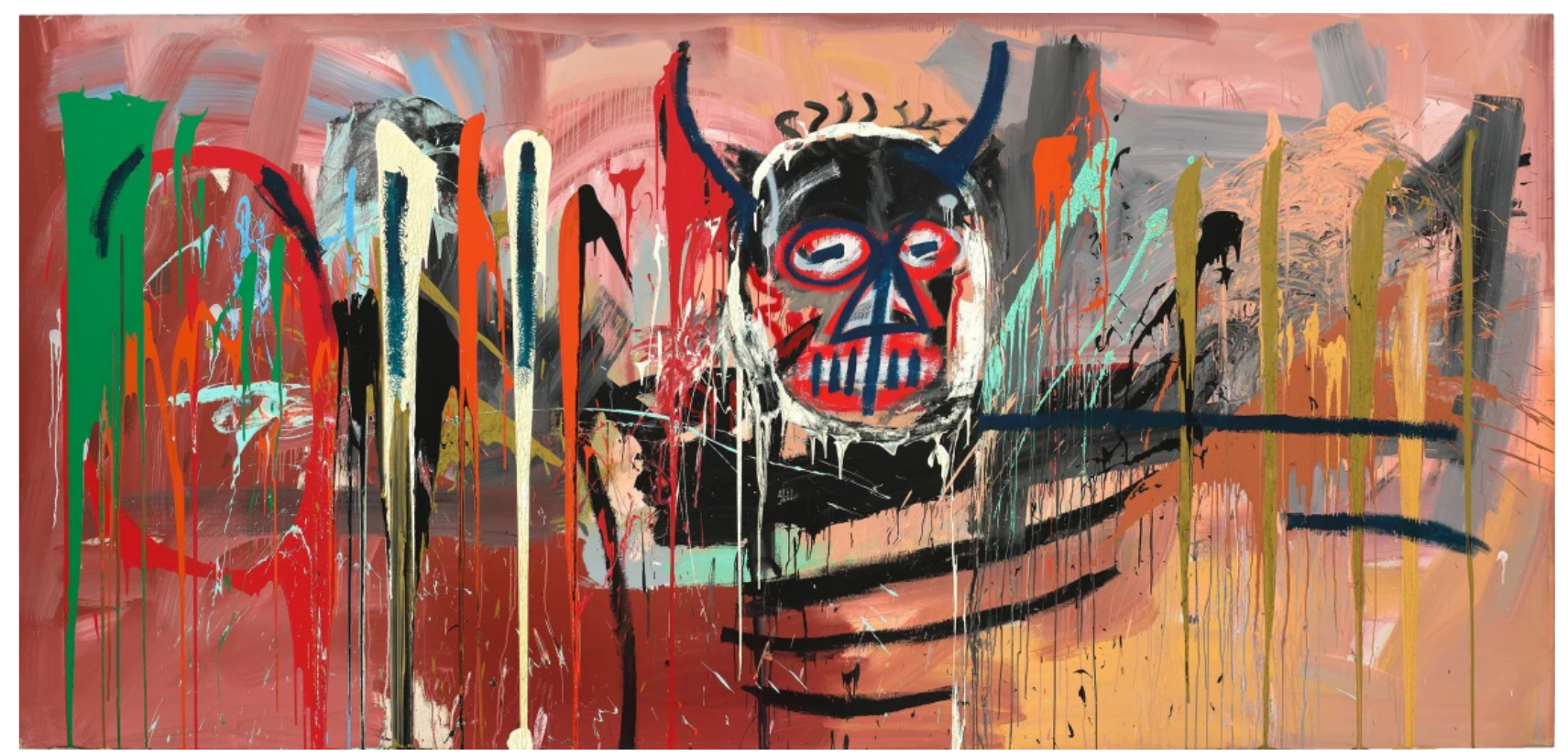
Jean-Michel Basquiat, Untitled, 1982. Private Collection. Art © 2026 Estate of Jean-Michel Basquiat. Licensed by Artestar, New York
As an artist constantly on the move, Basquiat found in drawing the perfect medium for immediacy and reflection. Bending over sheets of paper that filled his studio floor, he treated drawing as both private meditation and public declaration. The spontaneity of line, the layering of marks, the interplay between drawn image and written word all contribute to the work’s urgency. The composition does not resolve into harmony; instead, it holds together disparate signs, inviting interpretation while resisting closure. This tension is what makes Basquiat’s works on paper so resonant, offering a direct view into the restless energy of his imagination. In Sin Hueso, his stream-of-consciousness humorously explores the religious iconography of the devil and its contemporary depictions and implications, flowing seamlessly between the poetic and the pictorial, the personal and the cultural.
Leverage, 1985
Leverage, 1985
Sotheby’s New-York: 17 November 2026
Estimated: USD 1,000,000 – 1,500,000
WORK ON PAPER
Jean-Michel Basquiat | Leverage | Contemporary Day Auction | 2026 |
JEAN-MICHEL BASQUIAT (1960 – 1988)
Leverage, 1985
Graphite, charcoal, paper collage and acrylic on paper
30 x 22-1/4 inches (76.2 x 56.5 cm)
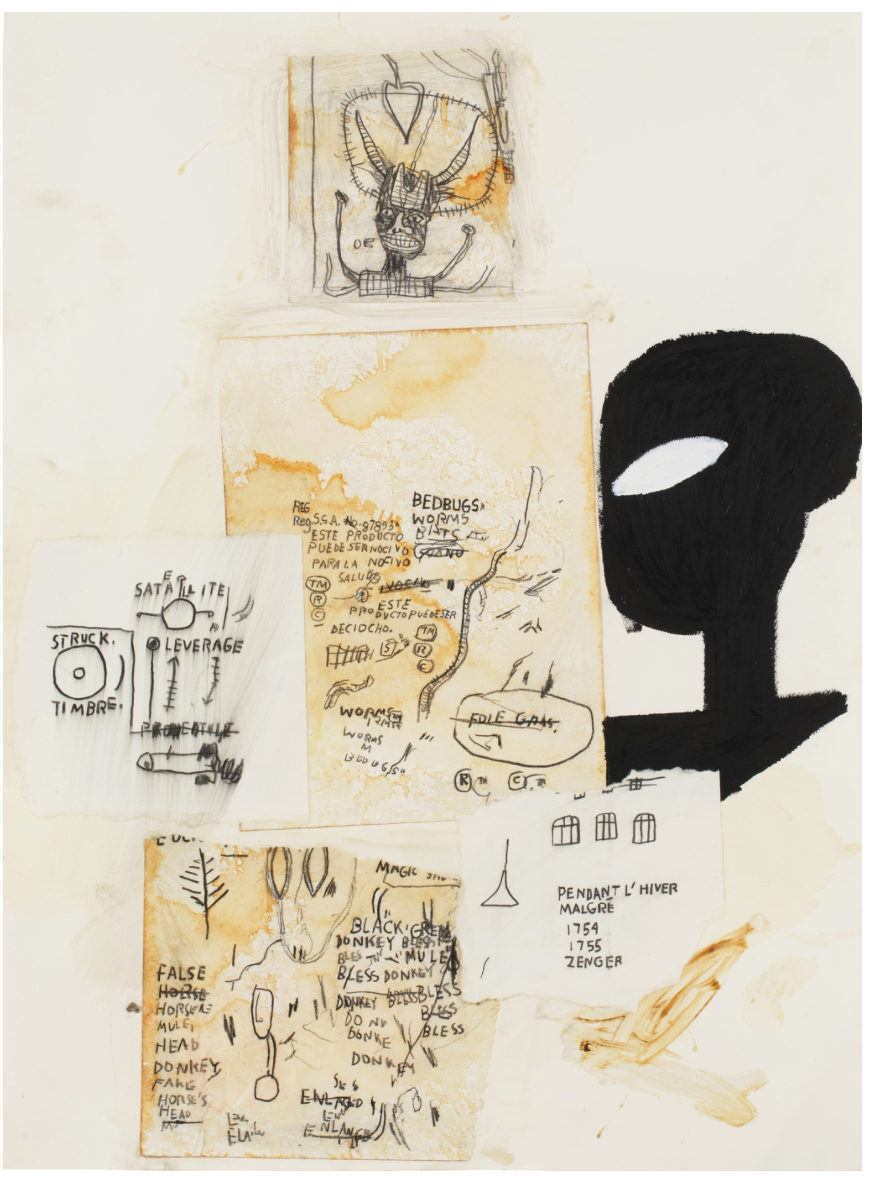
In Leverage, Jean-Michel Basquiat combines graphite, charcoal, acrylic, and paper collage into a richly layered constellation of images, words, and symbols. Executed in 1985, the work exemplifies the artist’s unparalleled ability to transform disparate fragments of visual and cultural information into a coherent yet open-ended pictorial language. Characteristic of Basquiat’s mature practice, Leverage resists singular interpretation, instead revealing the restless, associative intelligence that animated his work throughout the 1980s. Dominated by the profile of a Black figure with a striking white elliptical eye, the composition unfolds across a field of handwritten text, schematic drawings, and sepia washes of color. In its fusion of image and language, observation and invention, personal memory and collective history, the present work demonstrates Basquiat’s singular capacity to collapse conventional boundaries between seeing, reading, and remembering.
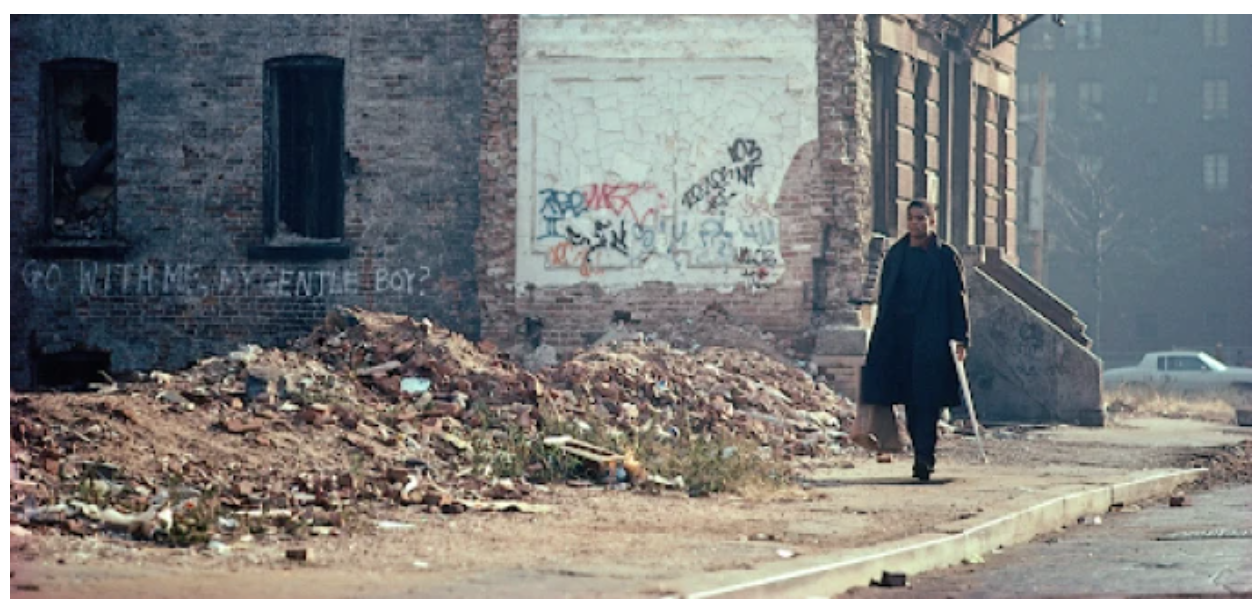
The artist featured in Edo Bertoglio’s 2000 documentary, Downtown 81, walking down Fifth Avenue, New York, 1981. Photo © Edo Bertoglio
Anchoring the composition is the commanding profile of a Black head positioned at the right edge of the sheet. Reduced to its essential forms, the figure recalls some of the most iconic protagonists of Basquiat’s mature oeuvre. The oversized white eye, sharply contrasted against the darker contours of the face, lends the figure an arresting psychological intensity. Neither portrait nor caricature, the head functions as an emblematic presence through which Basquiat explored questions of identity, authorship, and cultural memory. Throughout the 1980s, he repeatedly returned to depictions of Black figures, elevating them within a visual and historical landscape that had long rendered such subjects peripheral. In Leverage, the figure appears less as an individual than as a witness, surveying the accumulation of signs, images, and fragments that animate the surrounding field.
The title itself offers an intriguing point of entry. “Leverage” evokes ideas of power, influence, negotiation, and exchange, concepts that increasingly informed Basquiat’s position within the art world during the mid-1980s. As his international visibility accelerated, the artist found himself navigating systems of cultural and economic value that were often at odds with his own experiences and ambitions. Yet, like many of Basquiat’s textual interventions, the title does not function as a straightforward interpretive key. Rather, it operates suggestively, generating a network of possible meanings that reverberate throughout the composition. Basquiat’s words rarely resolve ambiguity; instead, they create it, encouraging viewers to forge connections between ostensibly unrelated elements.
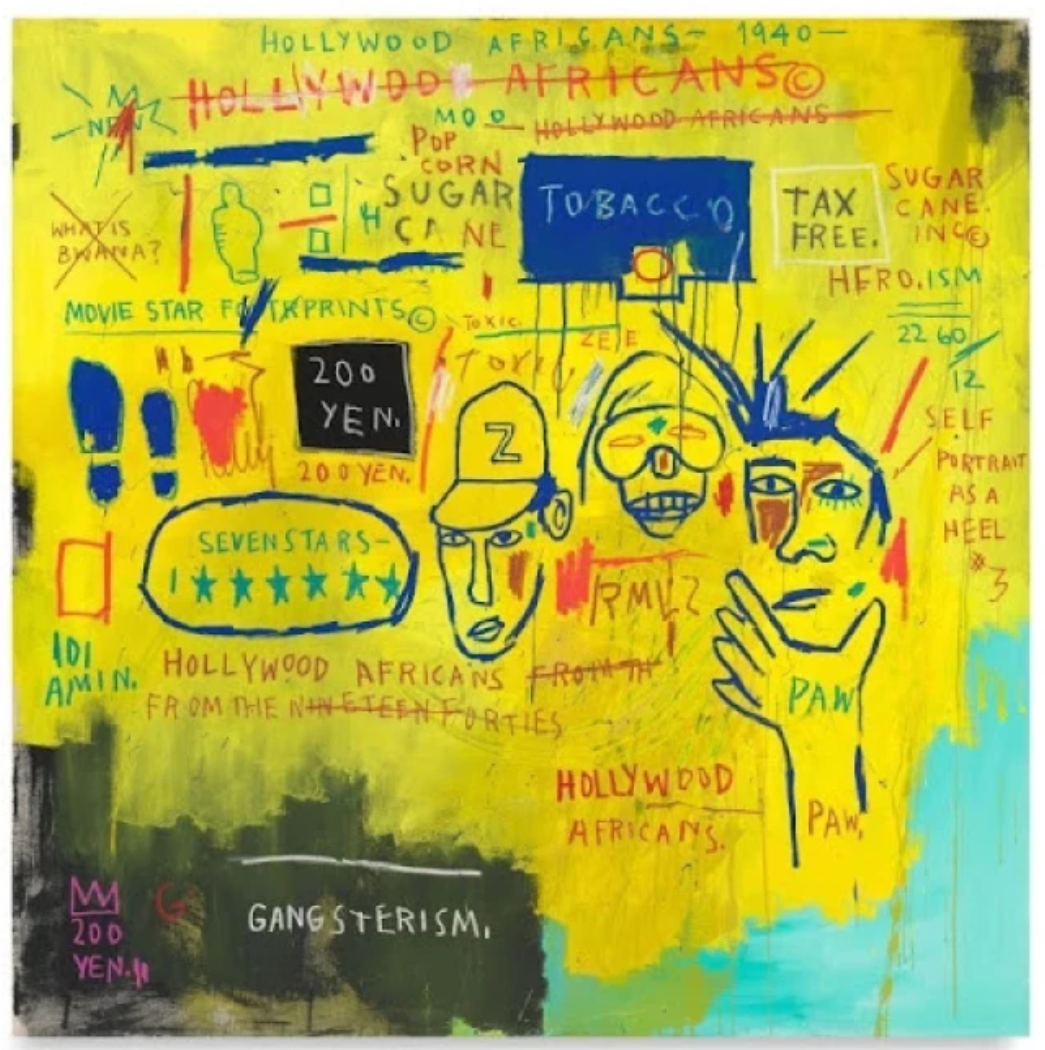
Jean-Michel Basquiat, Hollywood Africans, 1983. Whitney Museum of American Art, New York. Image © Whitney Museum of American Art / Licensed by Scala / Art Resource, NY. Art © Estate of Jean-Michel Basquiat. Licensed by Artestar, New York.
Scattered across the sheet is an array of enigmatic motifs, including worms, a donkey or mule, a satellite, a turntable, pendant lights, a tree, and fire alarms. Such juxtapositions exemplify Basquiat’s method of visual accumulation. Rather than constructing a linear narrative, he assembled images in much the same way he collected information from books, television, records, newspapers, and daily urban life. Within this expansive system, all forms of knowledge coexist on equal footing, capable of entering into unexpected dialogue with one another. The satellite and turntable suggest systems of communication and transmission, recurring concerns for an artist deeply immersed in music, language, and popular culture. Elsewhere, more humble creatures such as worms and mules introduce associations of labor, burden, endurance, and decay. The phrase “false horse,” juxtaposed with references to mules, further complicates these readings, hinting at substitution, hybridity, and the instability of appearances. As throughout Basquiat’s oeuvre, meaning emerges not from any single image but from the charged relationships established between them.
Language occupies an equally vital role within the composition, recalling Basquiat’s origins as the elusive downtown graffiti poet SAMO, whose cryptic inscriptions first appeared across the streets and subway corridors of New York. In Leverage, words drift across the surface in English, French, and Spanish, reflecting the artist’s multilingual upbringing and voracious appetite for language as both information and image. Phrases such as “Pendant l’hiver,” “foie gras,” and the cautionary warning “este producto puede ser nocivo” coexist within the same visual field, each carrying distinct cultural resonances while simultaneously dissolving into gesture, rhythm, and mark-making. For Basquiat, language was never merely descriptive; words functioned as pictorial elements endowed with texture, weight, and visual force. Some inscriptions are emphatically declared, while others appear faint, crossed through, or partially obscured. This continual oscillation between revelation and concealment reflects one of the artist’s most sophisticated strategies: drawing attention to language while frustrating any attempt at complete comprehension. As Basquiat famously remarked, crossing out words does not diminish their importance, but compels the viewer to read them more closely. In Leverage, text becomes both subject and medium, transforming the sheet into a site where meaning remains perpetually in flux.
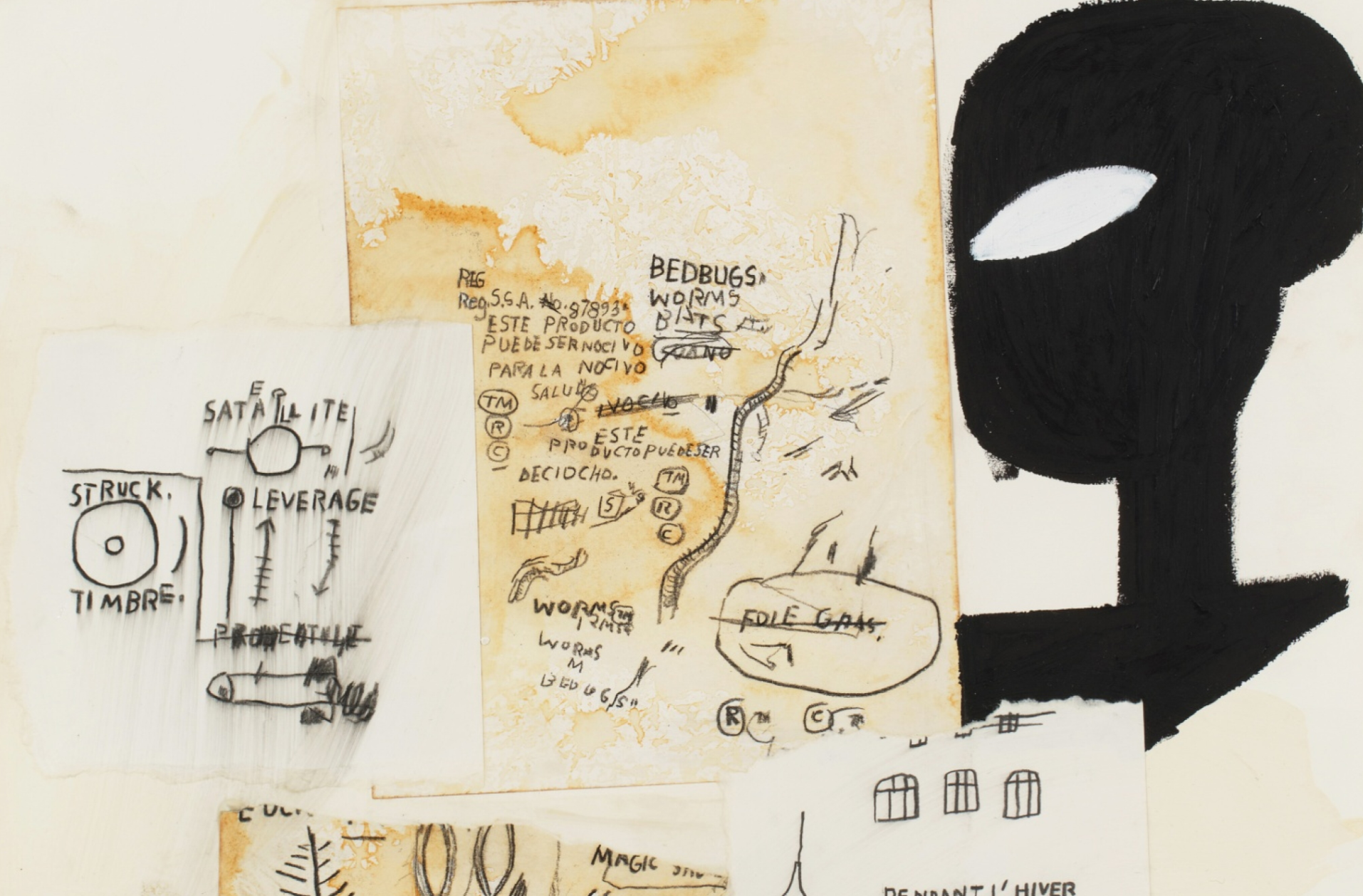
The collage elements further reinforce the improvisational character of the work. Throughout the 1980s, Basquiat frequently incorporated found materials into his compositions, collapsing distinctions between fine art and the visual debris of everyday life. These interventions underscore the work’s status as an evolving surface, a site in which disparate fragments are continually assembled, revised, and reconfigured. Sepia washes drift across the sheet, unifying the composition while lending it an almost aged, archaeological quality. Images and words appear to surface and recede like traces recovered from a larger archive, reinforcing the sense that memory itself serves as both subject and medium.
By 1985, Basquiat stood at the height of his meteoric ascent. International exhibitions, critical acclaim, and high-profile collaborations had transformed him from downtown prodigy into one of the most visible artists of his generation. Yet at the center of his practice remained the same intellectual curiosity and voracious appetite for information that had defined his earliest years as a poet, musician, and observer of city life. Leverage exemplifies the remarkable freedom with which Basquiat moved between disciplines, languages, and cultural traditions, constructing images that remain perpetually open to reinterpretation.
More than a drawing, Leverage functions as a map of consciousness itself. The monumental profile, cryptic inscriptions, and dispersed symbols combine to create a dynamic field in which ideas circulate, collide, and transform. The work encapsulates Basquiat’s singular gift for converting the fragments of contemporary experience into a deeply poetic visual language, one capable of addressing questions of power, identity, communication, and history without ever surrendering its essential mystery. In this regard, Leverage stands as a compelling testament to the intellectual rigor, formal daring, and imaginative freedom that distinguish the finest works on paper of Basquiat’s career.
Untitled, circa 1986
Untitled, circa 1986
Sotheby’s New-York: 17 November 2026
Estimated: USD 600,000 – 800,000
Jean-Michel Basquiat | Untitled | Contemporary Day Auction | 2026 |
JEAN-MICHEL BASQUIAT (1960 – 1988)
Untitled, circa 1986
Oilstick, acrylic and charcoal on paper
30 x 22-1/4 inches (76.2 x 56.5 cm)
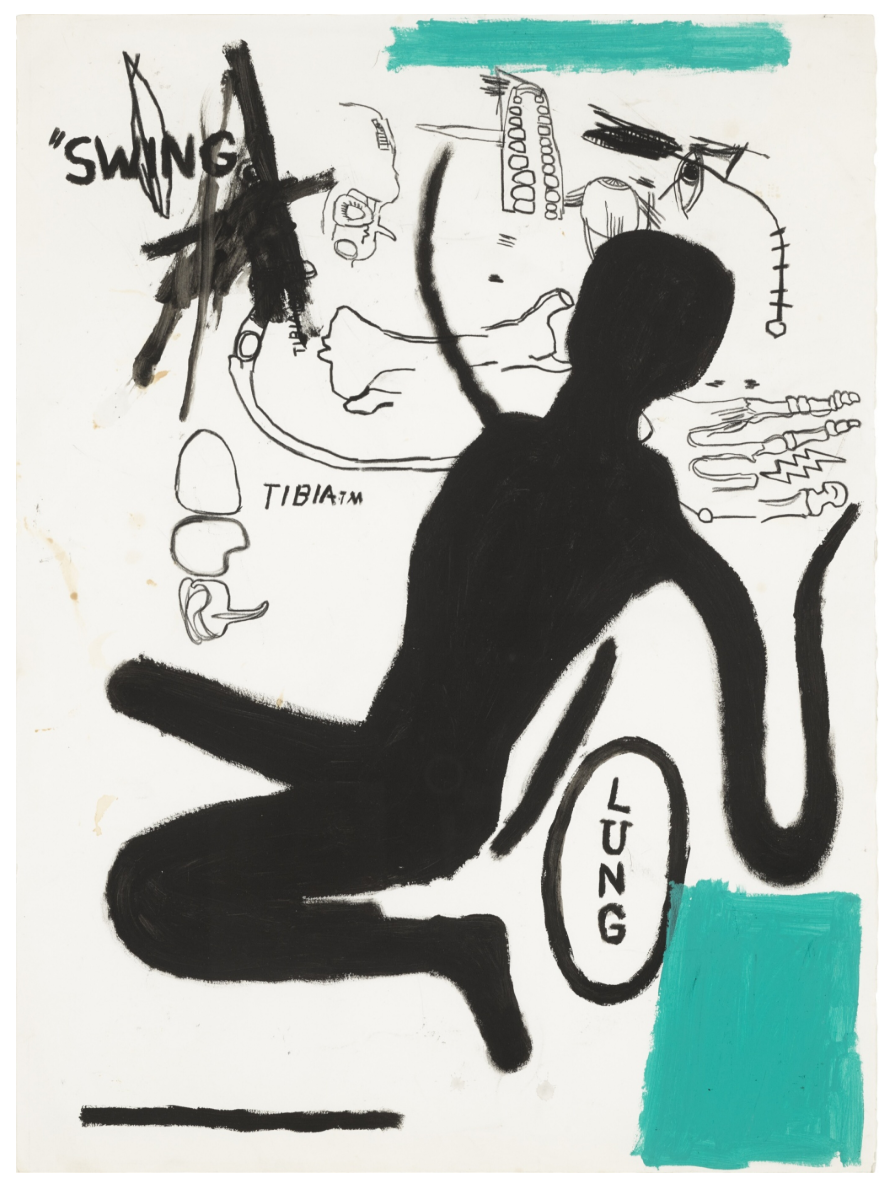
A black silhouette stands at the center of Jean-Michel Basquiat’s Untitled, circa 1986, its form at once unmistakably human and strikingly incomplete. Defined by sweeping contours rather than anatomical precision, the figure’s arms dissolve into sinuous lines while one leg appears abruptly truncated. Surrounding this enigmatic presence is a constellation of diagrams, annotations, and anatomical studies: teeth, vertebrae, bones, nerves, an isolated eye, and a cross-section of a mouth. Against this accumulation of scientific imagery, Basquiat stages a powerful encounter between embodiment and classification, transforming the sheet into a space where the human body becomes both subject and system of knowledge.
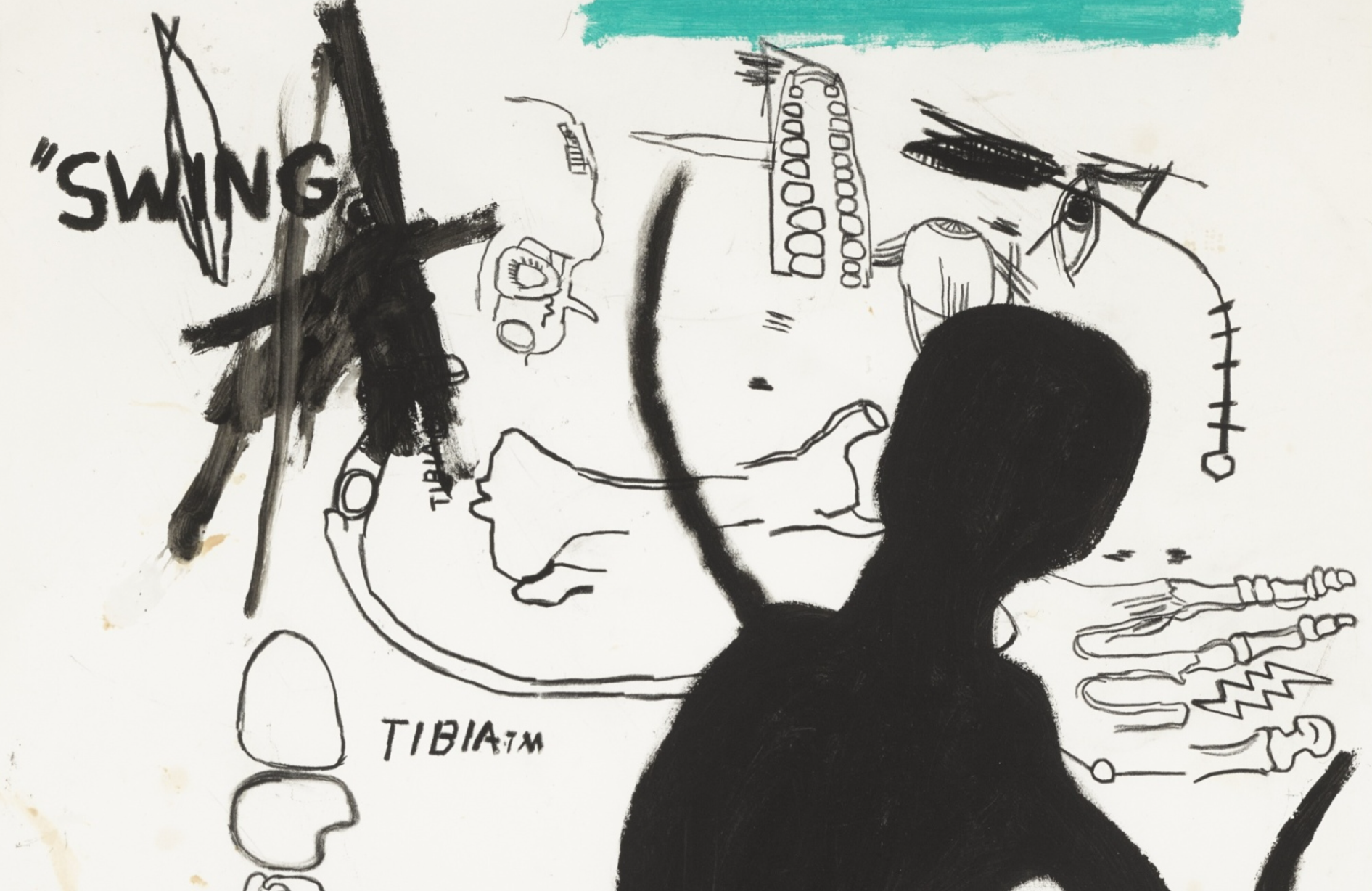
Executed during one of the most accomplished moments of the artist’s career, the present work draws upon a visual language that Basquiat had spent years refining. Throughout the 1980s, he developed a uniquely personal vocabulary that fused drawing, writing, and figuration, collapsing distinctions between image and text, intuition and analysis. This visual language is particularly outstanding in Basquiat’s works on paper as marks appear to unfold with the speed of thought itself, as though the artist were mapping associations directly onto the surface. The present composition possesses precisely this quality: a dynamic field in which words, symbols, and images circulate freely, generating meaning through their proximity and collision.
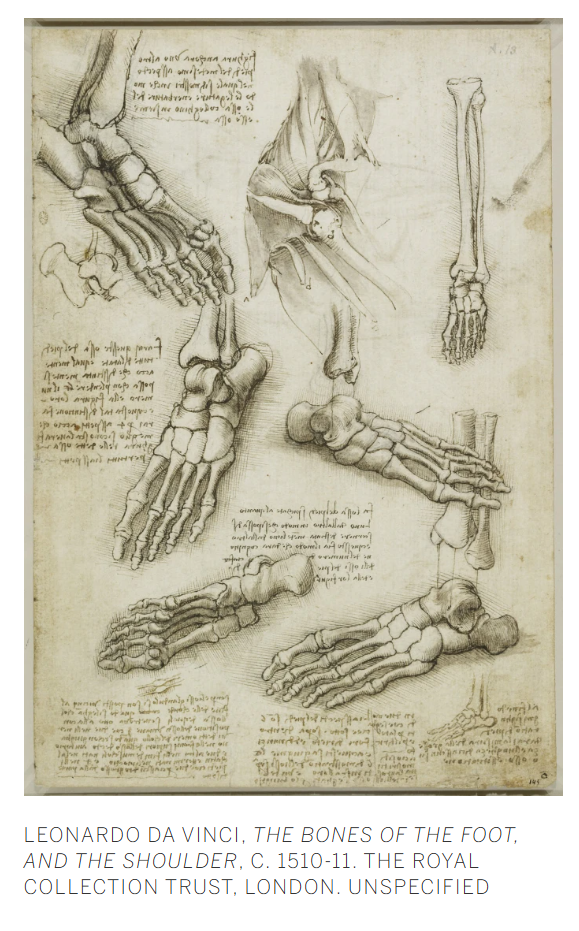
Anatomical imagery occupies a key place within Basquiat’s oeuvre. From skeletal structures and exposed organs to dissected heads and isolated body parts, the artist repeatedly returned to the body as both a visual motif and a conceptual framework. The source of this fascination is often linked to the copy of Gray’s Anatomy that Basquiat received while recovering from a childhood accident, a book whose diagrams would leave a lasting imprint on his imagination. Yet anatomy interested Basquiat for reasons extending beyond medical illustration. In his hands, anatomical drawings become a means of interrogating how the body is studied, categorized, and understood.
That tension is central to the present work. While the surrounding diagrams offer analytical fragments of the body, the central silhouette resists such dissection. Its dark form is unified, expressive, and irreducible, refusing to yield the kind of knowledge promised by the labeled anatomical details that encircle it. Words such as “LUNG” and “TIBIA” invoke the clinical language of medicine, while the insertion of a trademark symbol beside the latter introduces a note of irony. Throughout his career, Basquiat demonstrated a keen awareness of the ways language constructs meaning and authority. Here, the juxtaposition of anatomical terminology with the visual shorthand of branding suggests that systems of classification are themselves cultural constructions, no less coded than the symbols of commerce and popular culture.
The composition’s vivid turquoise accents further animate this dialogue. Appearing as geometric interruptions within the predominantly black-and-white field, they lend the sheet a striking formal rhythm, punctuating the surface without resolving its tensions. Like many of Basquiat’s most successful works on paper, Untitled balances spontaneity and structure, immediacy and deliberation. The result is a composition that feels simultaneously diagrammatic and improvisational.
By 1986, Basquiat had emerged as one of the defining artistic voices of his generation. Yet his work remained rooted in the act of questioning inherited systems of value and knowledge. In the present work, the body appears not as a fixed entity but as an accumulation of signs, fragments, and coded information. Through the interplay of anatomy, language, and figuration, Basquiat transforms these disparate elements into a powerful meditation on what it means to represent human experience, asserting the vitality of the individual against the forces that seek to define, classify, and contain it.
Untitled, 1987
Untitled, 1987
Christie’s New-York: 20 November 2026
Estimated: USD 600,000 – 800,000
JEAN-MICHEL BASQUIAT (1960-1988), Untitled | Christie’s
REPEAT SALE
Sotheby’s New-York: 20 May 2022
Estimated: USD 450,000 – 550,000
USD 529,200
Untitled | Contemporary Day Auction | 2022 | Sotheby’s (sothebys.com)
JEAN-MICHEL BASQUIAT (1960-1988)
Untitled, 1987
Wax crayon, colored pencil and graphite on paper
30 x 22-1/4 inches (76.2 x 56.5 cm)
Signed and dated ‘Jean-Michel Basquiat 87’ (on the reverse)
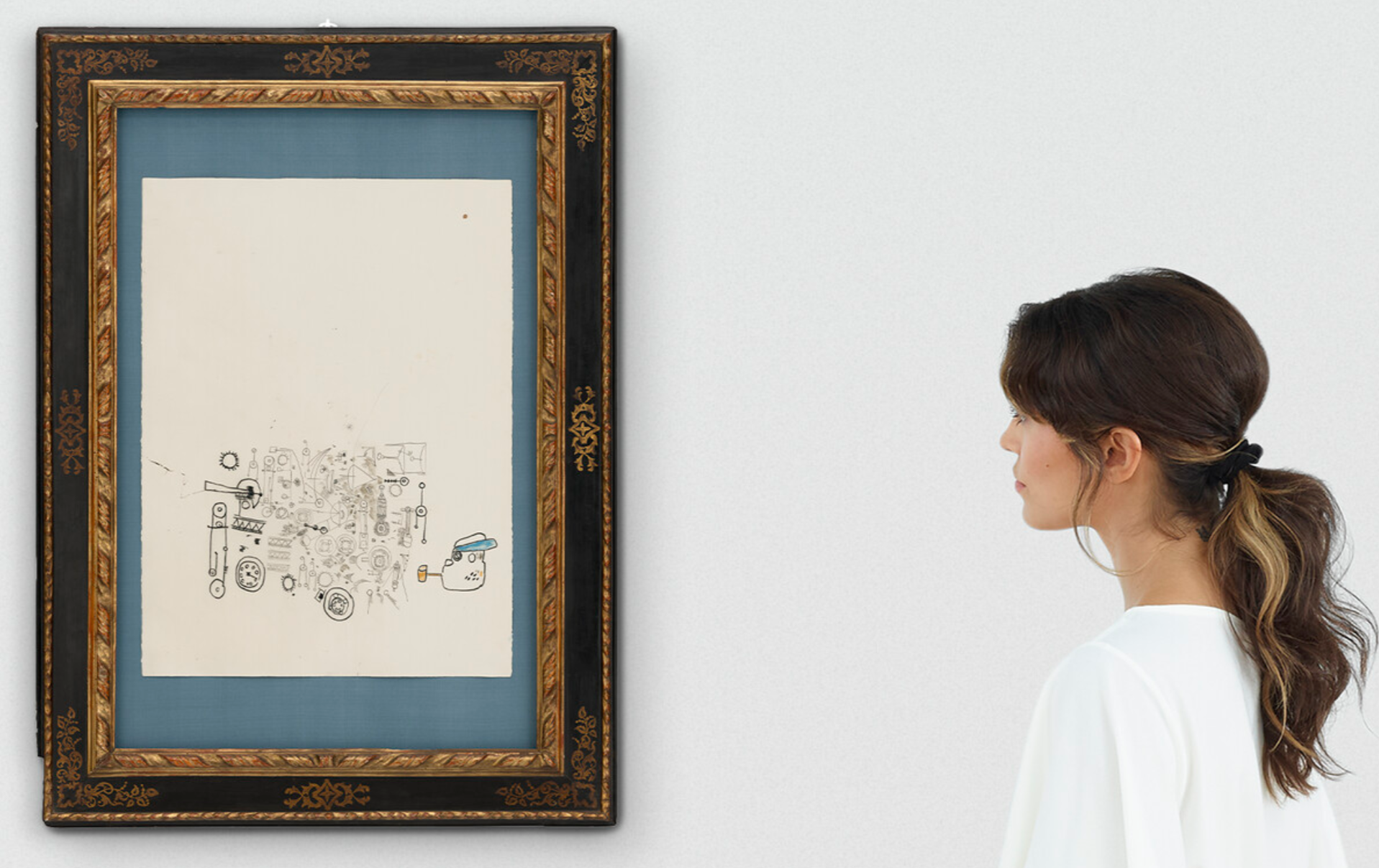
n Untitled, Jean-Michel Basquiat refines his visual language through a complex system of signs and symbols that reflect the artist’s highly active imagination. What at first seems easily recognizable takes on new meanings in his palimpsest. The wheel on the lower left is situated not far from what looks like a decorative zig-zag patterns; the gears, pulleys, and mechanical imagery suggest technical diagrams. Known to source inspiration from Leonardo da Vinci’s engineering studies and anatomical drawings from the classic medical textbook Gray Anatomy, Basquiat fuses the two into the present drawing’s schematic grammar.
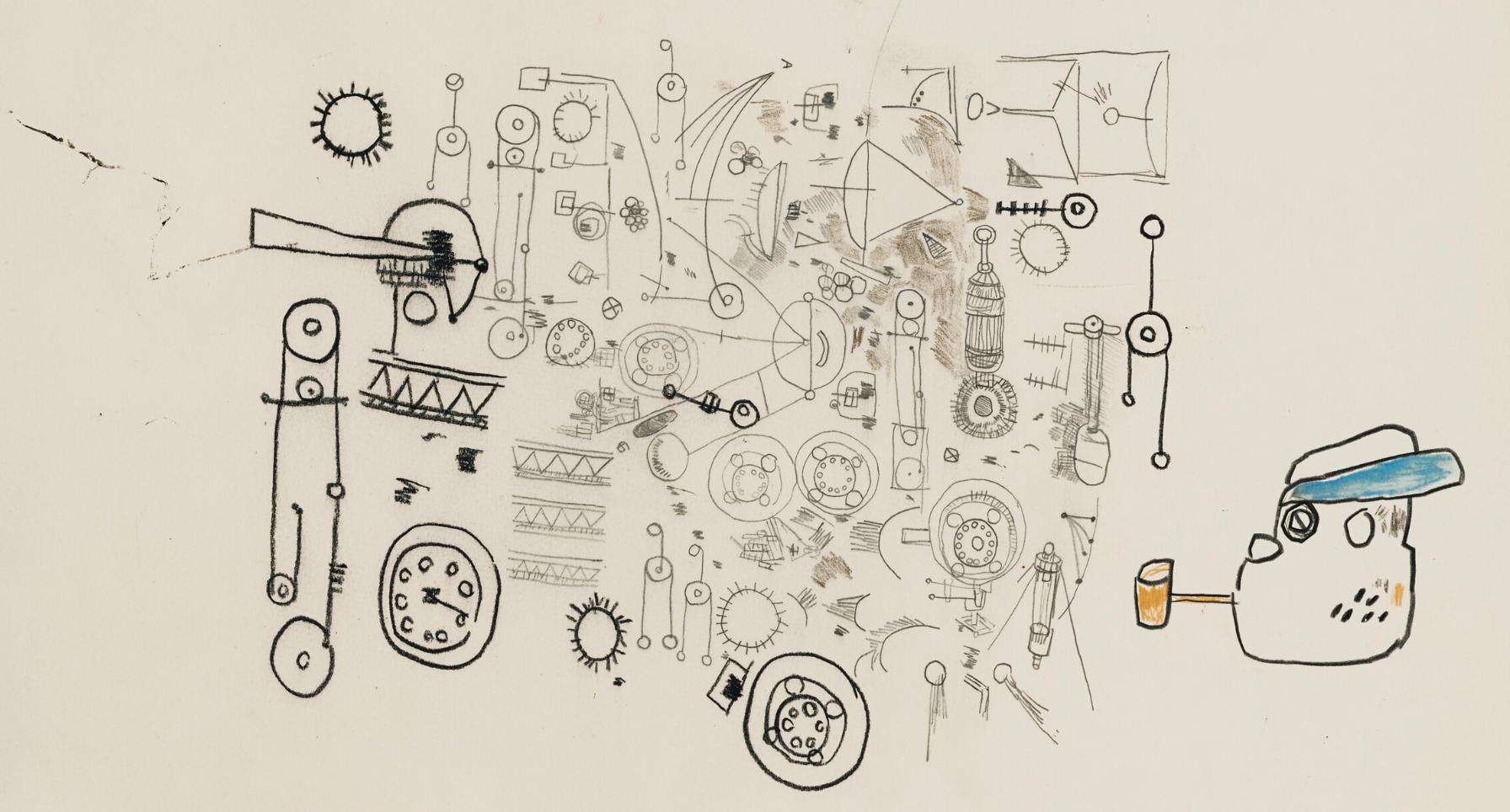
Freed from language, the present work lets line alone carry meaning, and in doing so, reveals the draftsmanship at the core of Basquiat’s practice. Art critic René Ricard, an early champion of Basquiat, described him as making “work that is information, not work that is about information” (quoted in “The Radiant Child”, Artforum, vol. 20, no. 4, December 1981). The observation has rarely been truer than in Untitled, where Basquiat sets aside his celebrated wordplay entirely in favor of a composition that relies exclusively on the visual to be decoded. His work has been likened to “an eye and a voice” (D. Davvetas quoted in “Lines, Chapters and Verses: The Art of Jean-Michel Basquiat”, in E. Navarra (ed.), Jean-Michel Basquiat, Paris 2000, p. 59). In Untitled, the voice falls quiet, and the eye takes over. What remains is the racing engine of the artist’s imagination, fueling endless intrigue and interpretation.
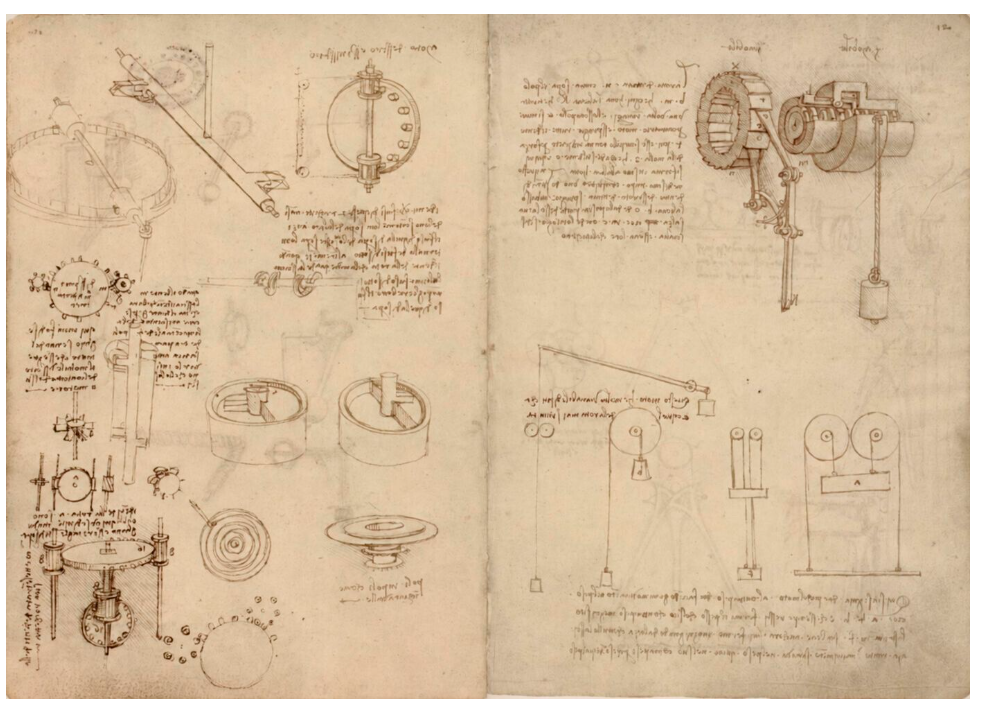
Leonardo da Vinci, Studies of Mechanical Devices, from Codex Madrid I, circa 1490-1499. Biblioteca Nacional de España, Madrid.
Executed in 1987, just a few months before his premature death, Untitled provides evidence that Jean-Michel Basquiat was still at the height of his creative powers. His rich graphic lexicon, rendered here in exacting detail, acts like a complex narrative speaking to the artist’s wide ranging social and artistic concerns including tensions of race, class, identity, and culture. Thus, Basquiat became the voice of a new generation of artists struggling to escape the dogma of Minimalism. “Basquiat’s status as a famous over-acknowledged artist in the media limelight had given American art what has so long been devolved to European artists: the artiste maudit, a sort of absolute criteria, from another world and another society that imposes a language that is so very different that it seems to be the last link of the chain” (J. Prat, The “Child King” of the Eighties, in Jean-Michel Basquiat, exh. cat., Galerie Enrico Navarra, Paris, 2000, p. 12). With the present work Basquiat helped discover a unique vocabulary for American art through his own form of visual communication, and as such Untitled encapsulates the artist’s brief yet vibrantly expressive and extraordinarily significant career.