Fall 2026 New-York Marquee Auctions
Gerhard Richter
Upcoming Lots
Abstraktes Bild, 1991
Property from a Prestigious American Collection
Christie’s New-York: 19 November 2026
Estimated: USD 7,000,000 – 10,000,000
GERHARD RICHTER (B. 1932), Abstraktes Bild | Christie’s
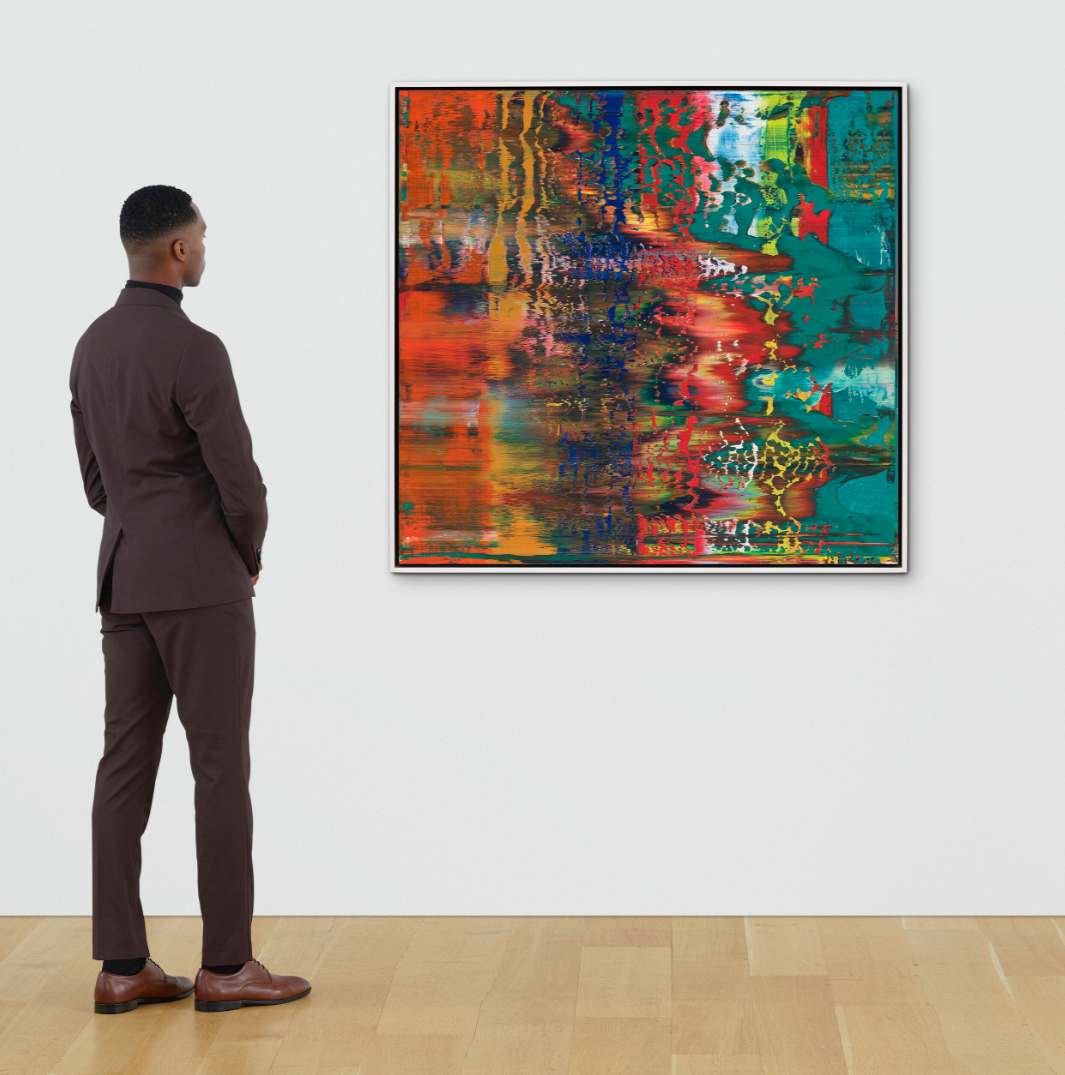
GERHARD RICHTER (B. 1932)
Abstraktes Bild, 1991
Oil on wood
95×100 cm (37-3/8 x 39-3/8 inches)
Signed, dated and inscribed ‘Richter 1991 746-2’ (on the reverse)
Abstraktes Bild, 1990
Breaking Ground: The Private Collection of Marian Goodman
Christie’s New-York: 19 November 2026
Estimated: USD 6,000,000 – 8,000,000
GERHARD RICHTER (B. 1932), Abstraktes Bild | Christie’s
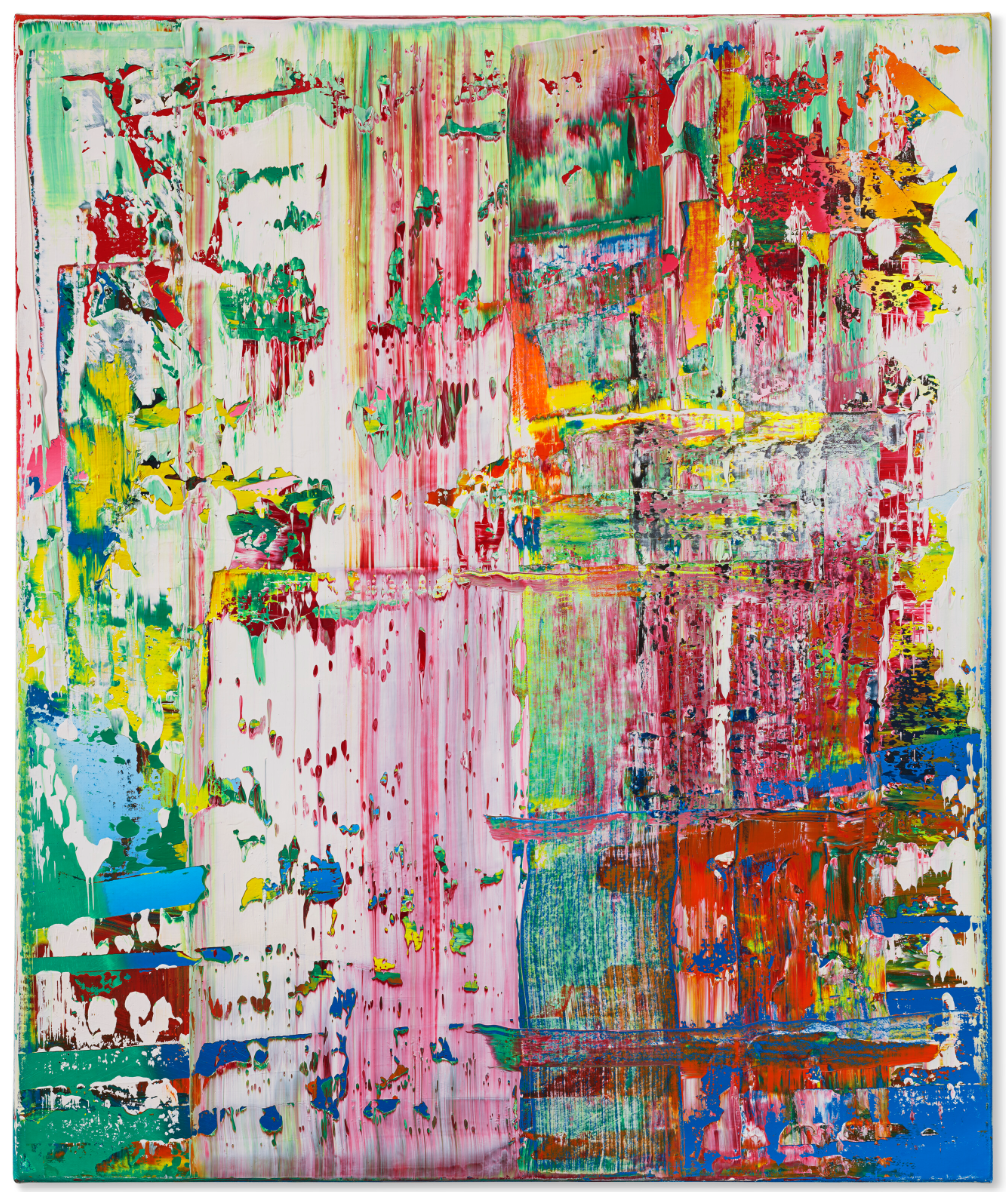
GERHARD RICHTER (B. 1932)
Abstraktes Bild, 1990
Oil on canvas
62.2 x 51.8 cm (24-1/2 x 20-3/8 inches)
Signed, dated and inscribed ‘723-1 Richter 1990’ (on the reverse)
Spanische Seeschlacht, 1984
Property from an Esteemed Private Collection
Sotheby’s New-York: 16 November 2026
Estimated: USD 5,000,000 – 7,000,000
GUARANTEED PROPERTY
Gerhard Richter | Spanische Seeschlacht | The Now and Contemporary
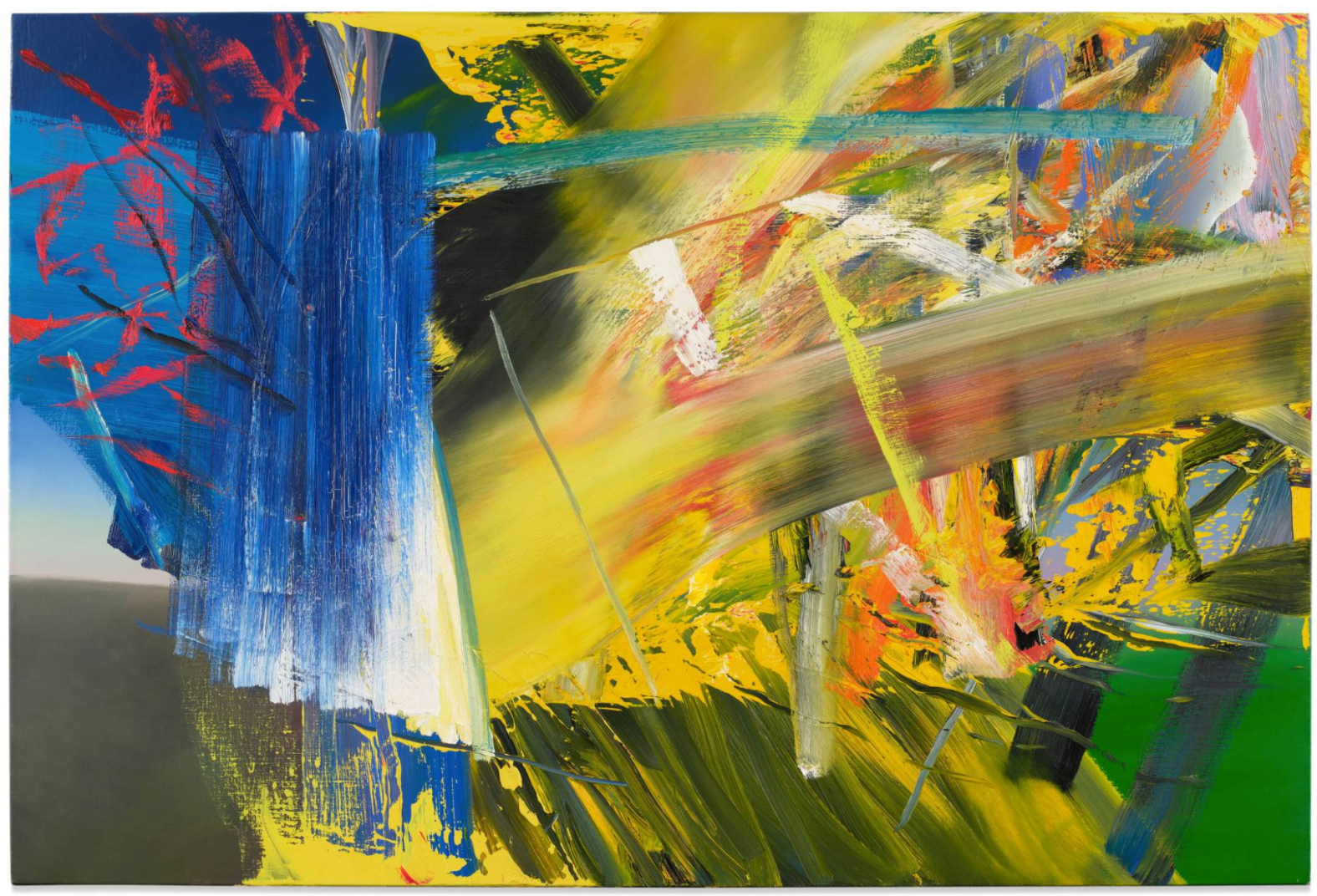
GERHARD RICHTER (b. 1932)
Spanische Seeschlacht, 1984
Oil on canvas
120.7 x 180.3 cm (47-1/2 x 71 inches)
Signed, numbered 570-1 and dated 1984 (on the reverse)
Grat 3, 1989
Vision: The Extraordinary Collection of Theodore and Ruth Baum
Sotheby’s New-York: 16 November 2026
Estimated: USD 3,000,000 – 4,000,000
GUARANTEED PROPERTY
Gerhard Richter | Grat 3 | Vision: The Extraordinary Collection of
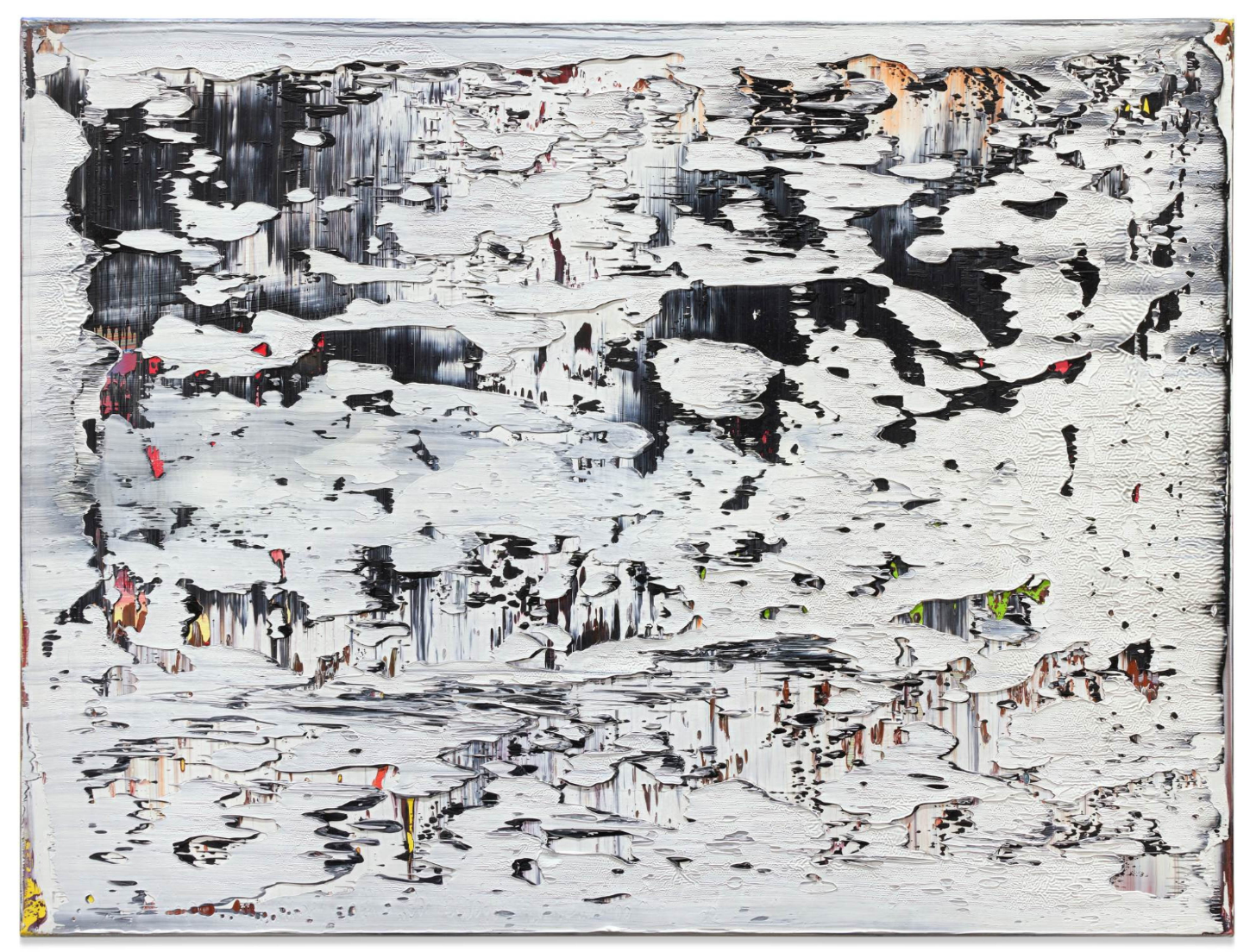
GERHARD RICHTER (b. 1932)
Grat 3, 1989
Oil on canvas
61.6 x 81.9 cm (24-1/4 x 32-1/4 inches)
Signed, dated 1989 and numbered 689-3 (on the reverse)
Gebirge, 1968
Vision: The Extraordinary Collection of Theodore and Ruth Baum
Sotheby’s New-York: 16 November 2026
Estimated: USD 2,000,000 – 3,000,000
GUARANTEED PROPERTY
Gerhard Richter | Gebirge | Vision: The Extraordinary Collection of
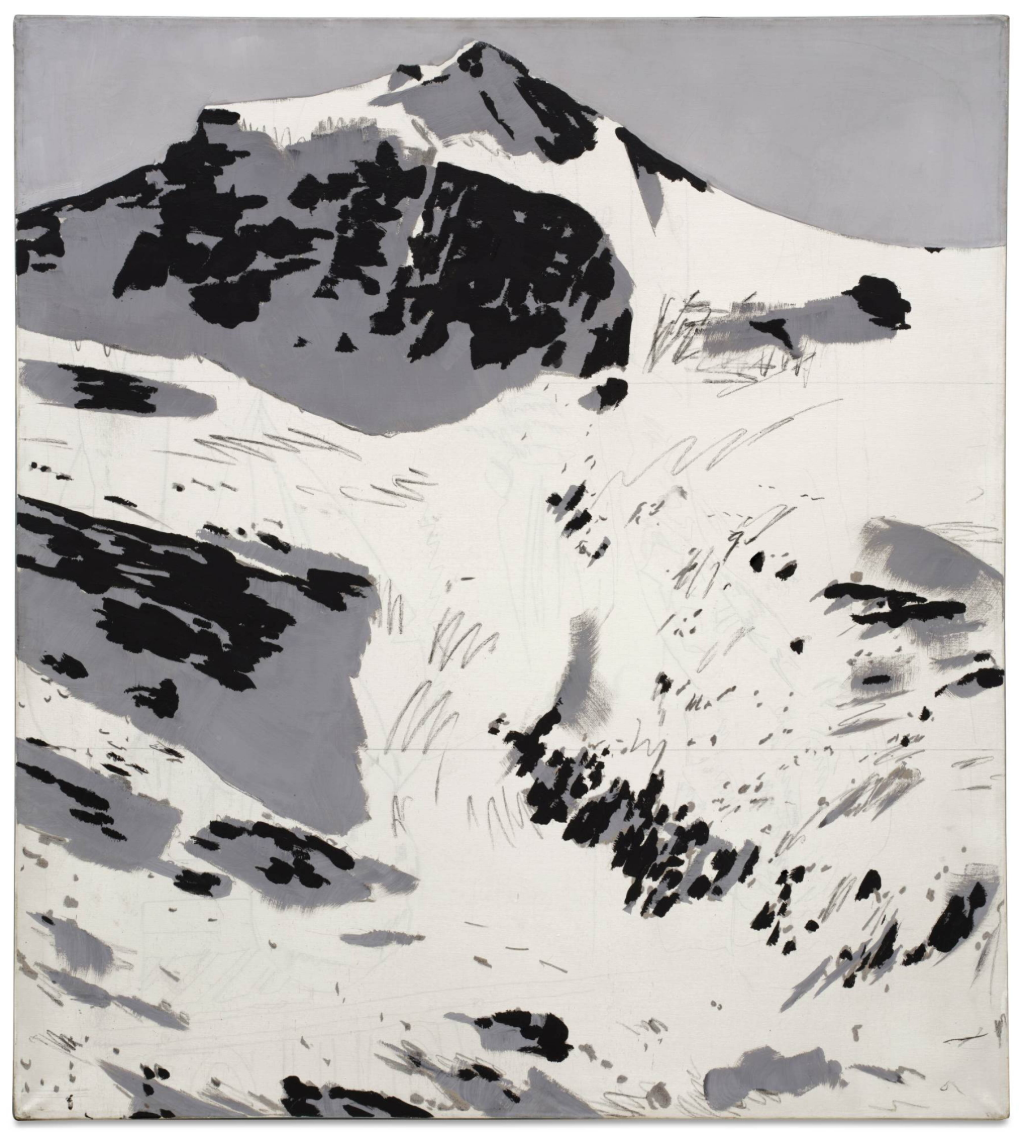
GERHARD RICHTER (b. 1932)
Gebirge, 1968
Acrylic and charcoal on canvas
102×92 cm (40-1/4 x 36-1/4 inches)
Signed, dated 68 and incorrectly numbered 179/2 (on the reverse)
Abstraktes Bild, 2000
Breaking Ground: The Private Collection of Marian Goodman
Christie’s New-York: 20 November 2026
Estimated: USD 1,000,000 – 1,500,000
THIRD PARTY GUARANTEE
GERHARD RICHTER (B. 1932), Abstraktes Bild | Christie’s
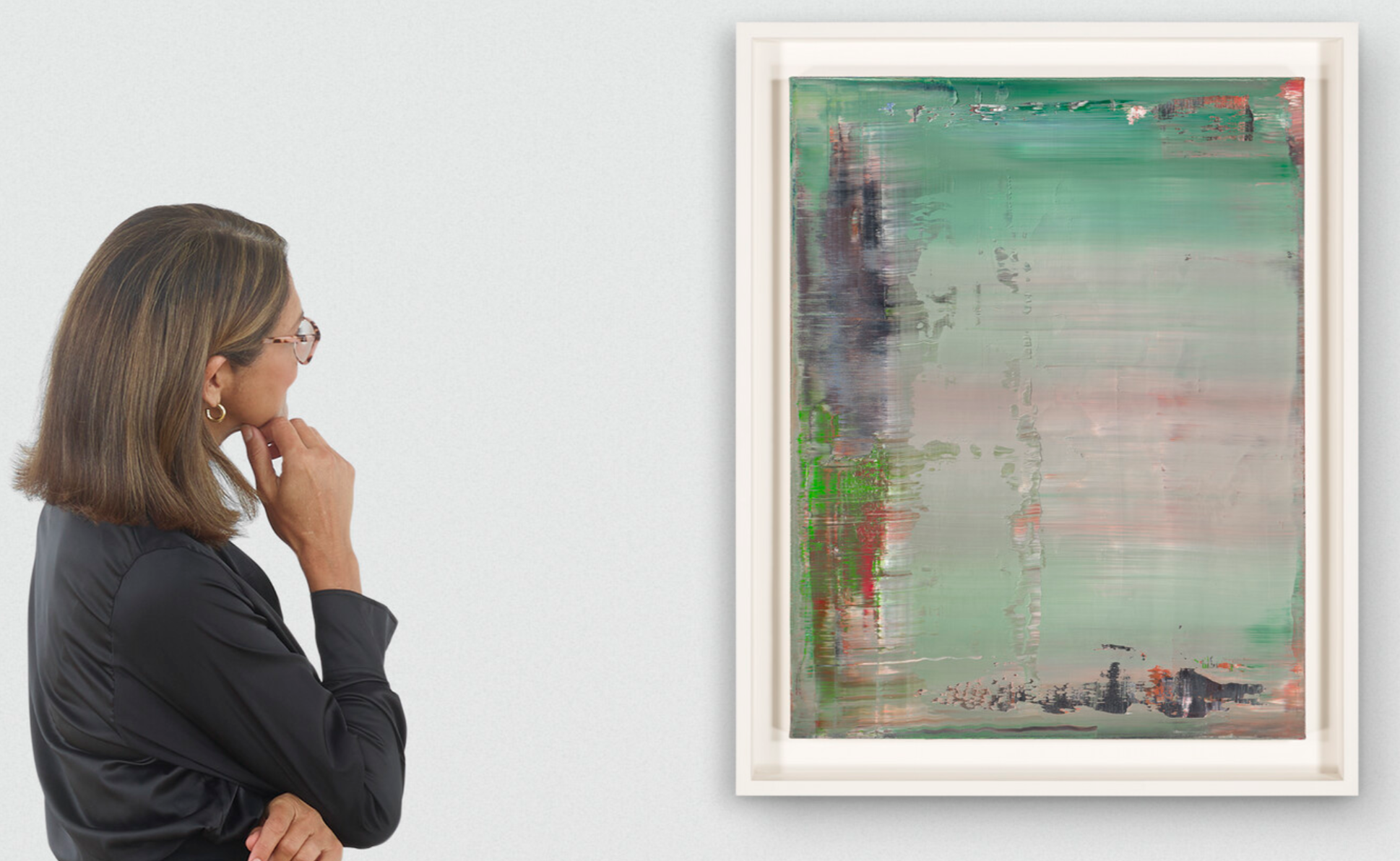
GERHARD RICHTER (B. 1932)
Abstraktes Bild, 2000
Oil on canvas
67 x 52.1 cm (26-3/8 x 20-5/8 inches)
Signed, inscribed and dated ‘864-5 Richter 2000’ (on the reverse)
Inscribed again ‘864-5’ (on the overlap)
Abstraktes Bild, 1999
Breaking Ground: The Private Collection of Marian Goodman
Christie’s New-York: 20 November 2026
Estimated: USD 700,000 – 1,000,000
THIRD PARTY GUARANTEE
GERHARD RICHTER (B. 1932), Abstraktes Bild | Christie’s
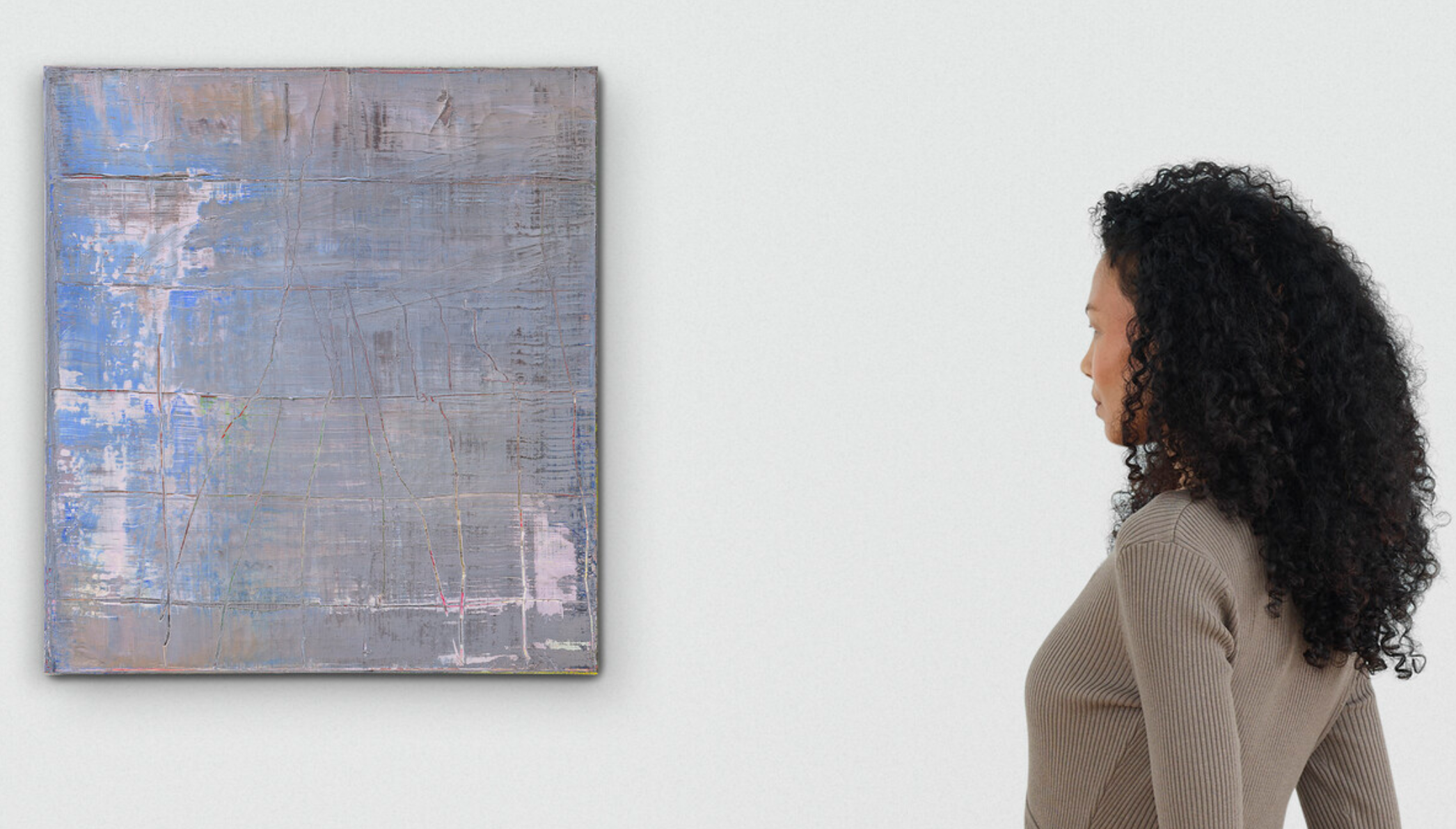
GERHARD RICHTER (B. 1932)
Abstraktes Bild, 1999
Oil on canvas
55.9 x 50,8 cm (22×20 inches)
Signed, inscribed and dated ‘861-3 Richter 1999’ (on the reverse)
Portrait Luntz, 1965
Vision: The Extraordinary Collection of Theodore and Ruth Baum
Sotheby’s New-York: 17 November 2026
Estimated: USD 700,000 – 900,000
Gerhard Richter | Portrait Luntz | Vision: The Extraordinary
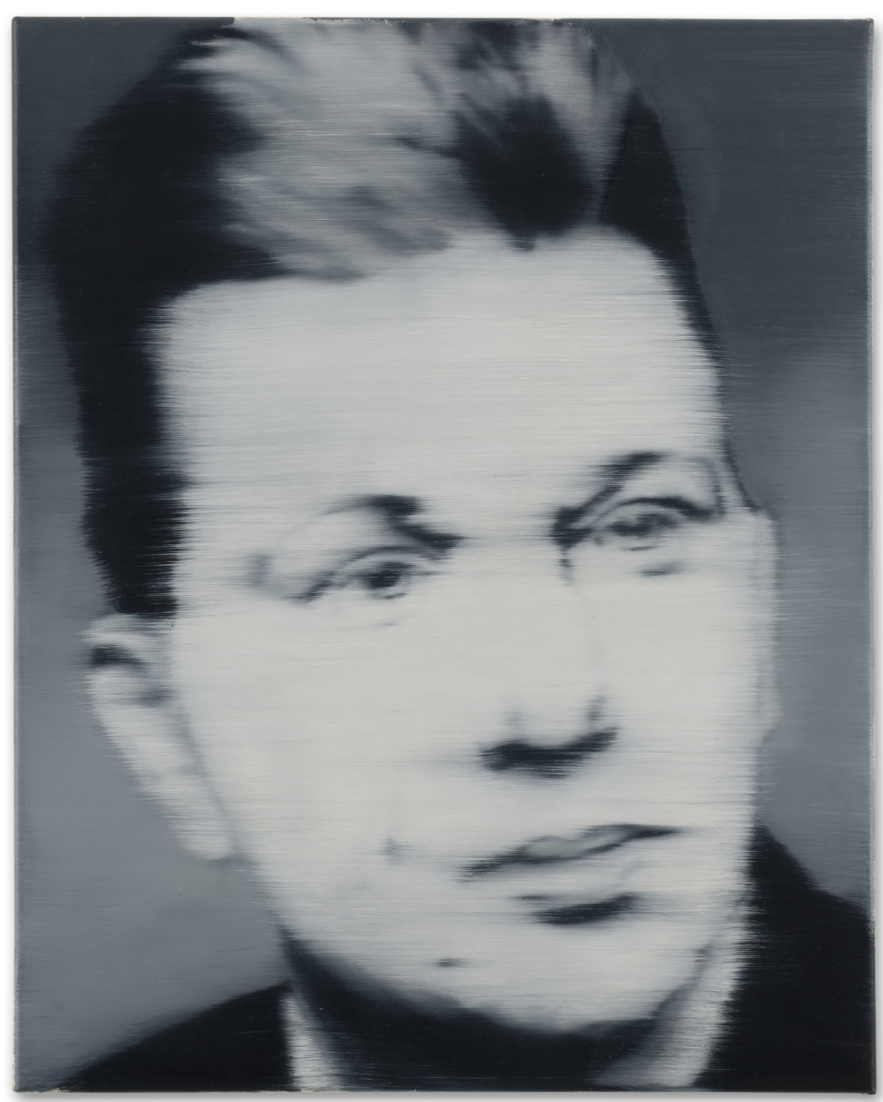
GERHARD RICHTER (b. 1932)
Portrait Luntz, 1965
Oil on canvas
50.2 x 40 cm (19-3/4 x 15-3/4 inches)
Signed and dated 65 (on the reverse)
Abstraktes Bild, 1991
Abstraktes Bild, 1991
Property from a Prestigious American Collection
Christie’s New-York: 19 November 2026
Estimated: USD 7,000,000 – 10,000,000
GERHARD RICHTER (B. 1932), Abstraktes Bild | Christie’s
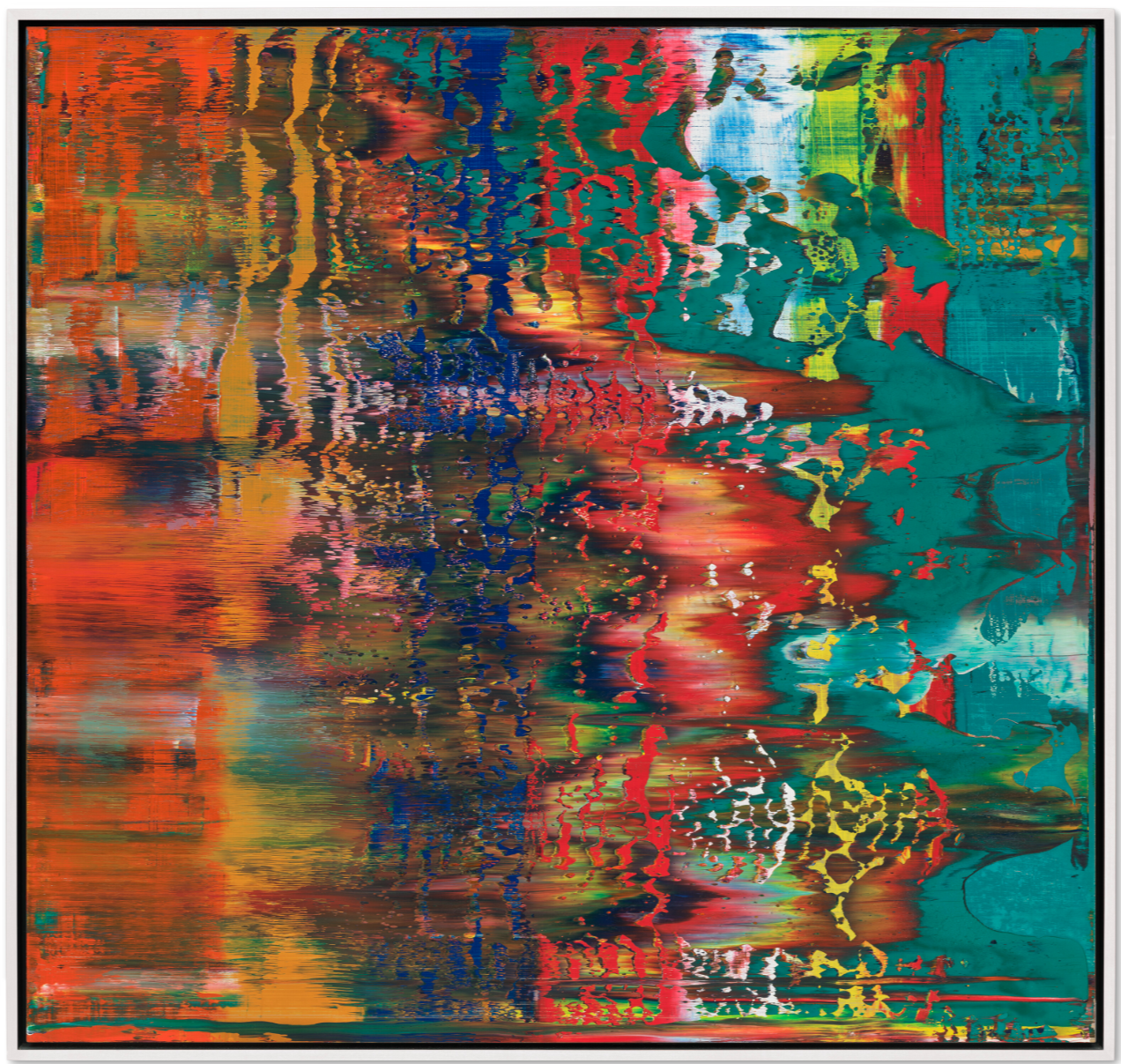
GERHARD RICHTER (B. 1932)
Abstraktes Bild, 1991
Oil on wood
95×100 cm (37-3/8 x 39-3/8 inches)
Signed, dated and inscribed ‘Richter 1991 746-2’ (on the reverse)
Dating from a pivotal moment in Gerhard Richter’s storied career, Abstraktes Bild demonstrates the artist’s mastery of color, texture and kineticism. It also provides a window into a tessellating, multi-layered world of pigment, along with a rare instance of the artist painting on wood rather than canvas, a medium that connects Richter to the panel painters of the German Renaissance such as Albrecht Dürer and Matthias Grünewald.
Held in the same prestigious American collection for nearly twenty years, it was executed the same year as Richter’s Tate Gallery retrospective (1991), which would entrench the international reputation of his abstract painting.
“Each picture has to evolve out of a painterly or visual logic: it has to emerge as if inevitably. And by not planning the outcome, I hope to achieve the same coherence and objectivity that a random slice of Nature (or a Readymade) always possesses.”
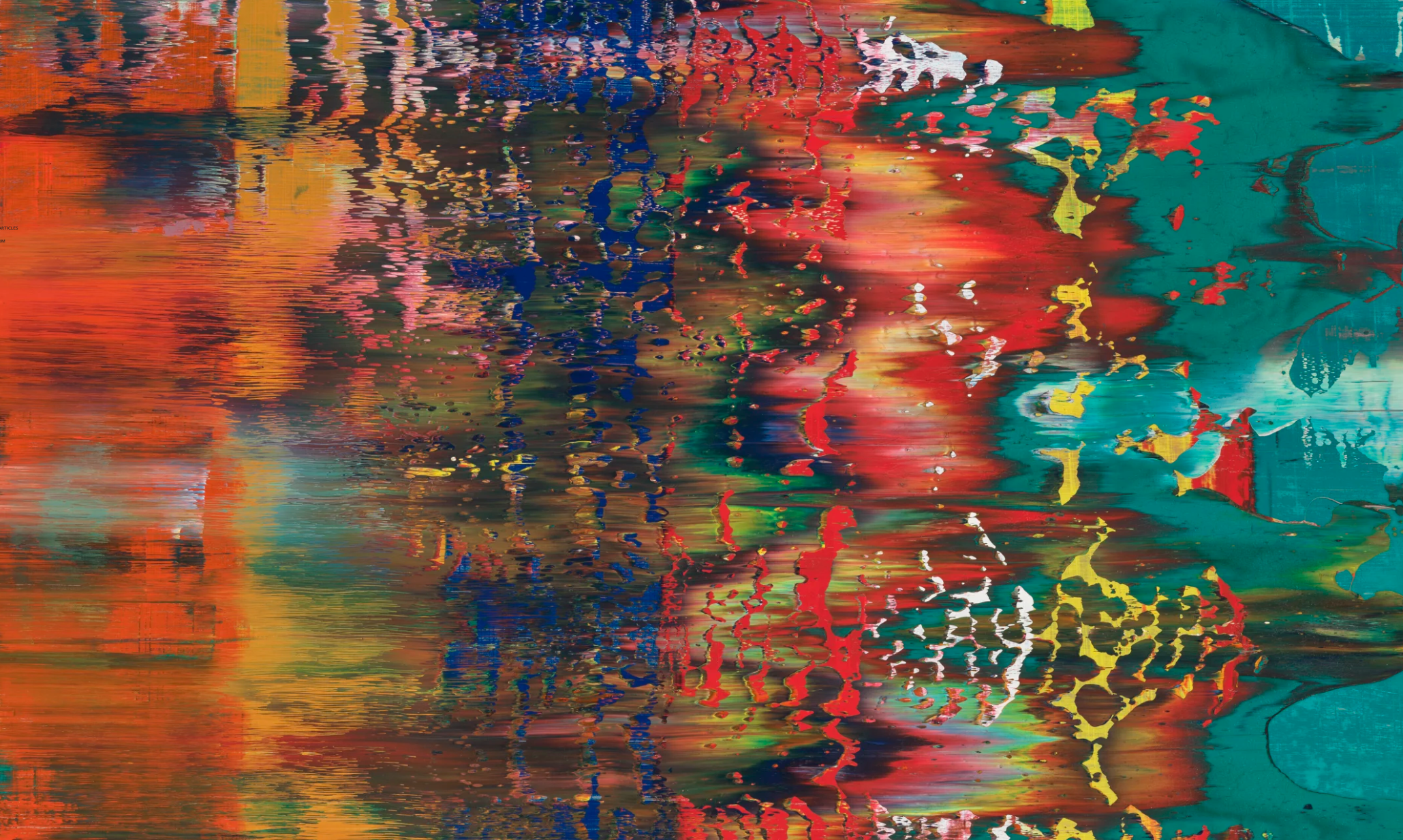
In the present work Richter conjures up a roiling sea of ever-shifting color and texture, spanning almost the whole chromatic spectrum. Pigments leap and fizz across the wooden panel with explosive energy. Viewed from afar, Abstraktes Bild appears structured as a series of vertical columns of different hues, from orange on one side to turquoise on the other. Yet Richter disrupts any clear linearity. Some passages are gossamer light, such as a cyan and white patch near the top-right. Others, such as the aquamarine that pools over the right-hand side, have a viscous materiality. There are soft planes of color where paint appears to flow like water and tiny, jagged crystalline shards that feel propelled by unseen force. Crumbling fragments of one color reveal other layers beneath: yellow strands transition into pink, a sea-green field glares out of a fiery orange, and lustrous white patches float above rich crimson. New details and fissures constantly reveal themselves. “Congruent or contrasting,” wrote curator Klaus Honnef of Richter’s abstracts, “they unfold their captivating power whose source is not only in the bright colors, but also in the conflict of the open color forms. They are fleeting, barely solidifying—as if occupied in a constant state of becoming” (Gerhard Richter, Cologne, 2019, p. 72).
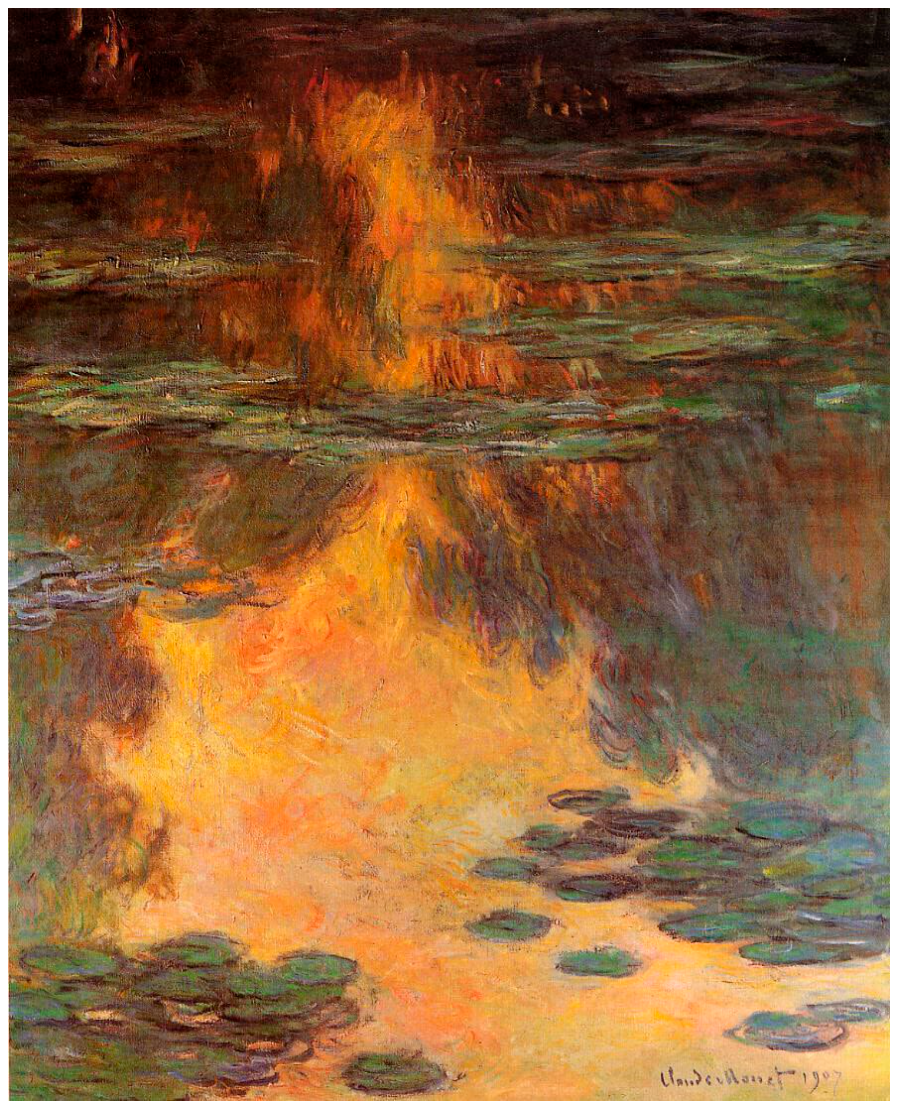
Claude Monet, Water Lilies, 1907.
Often considered the most significant painter working today, Richter rose to prominence in the 1960s with paintings that minutely replicated and then blurred images drawn from photography. He developed his interest in abstraction in parallel to these seminal works. In 1966 he commenced the Color Chart series, arranging precise hues into grid-like arrangements, while from 1968 he created several sets of monochrome Grey Paintings. It was with the first work titled Abstraktes Bild in 1976, however, that Richter launched into his project of colorful, expressive abstracts. A decade later he refined his technique. He adopted a process of meticulous layering, coating his canvases and boards in sheet after sheet of color. In 1991 he started using a long plastic spatula filled with paint to fracture the painting’s surface, as if excavating his own marks. Richter often uses a hand-made squeegee to scrape, smear, and smudge paint, removing a level of sovereignty over the final image. As Robert Storr explains, “Richter has taken to flatting the painted skin of his canvases with a spatula in broad strokes or long, wavering stripes leaving behind abraded, shimmering surfaces that at their clearest and most luminous look like the Aurora Borealis” (R. Storr, Gerhard Richter: Forty Years of Painting, exh. cat., The Museum of Modern Art, New York, 2002, p. 81).
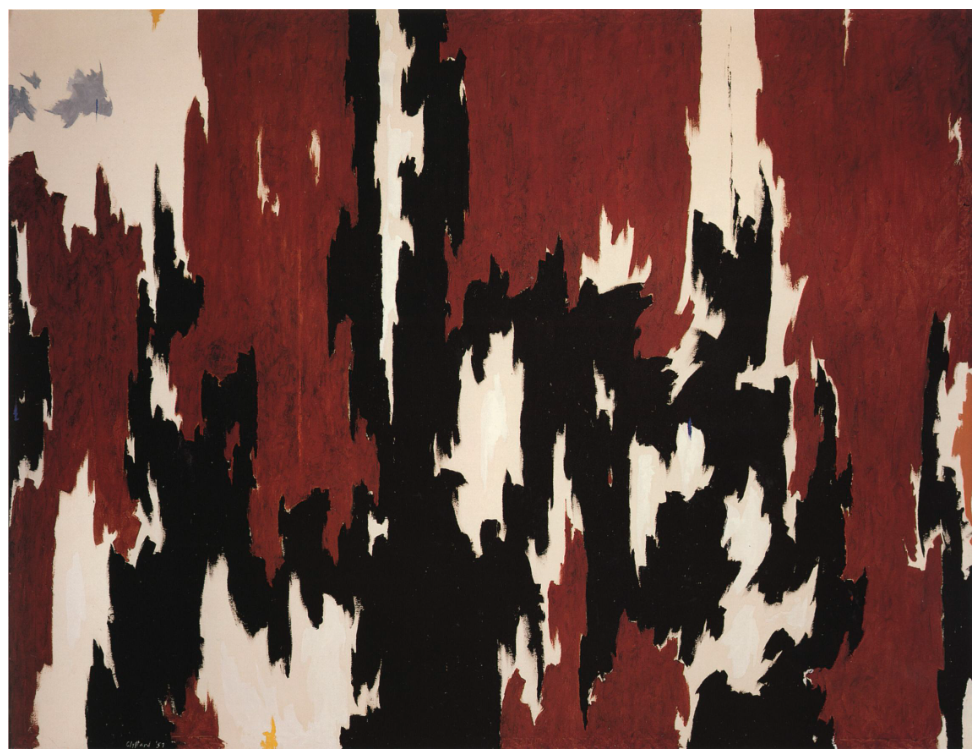
Clyfford Still, 1957-J No. 1, 1957. Anderson Collection, Stanford University.
© City and County of Denver, courtesy the Clyfford Still Museum.
The painterliness, vibrant colors and visible methodology of Abstraktes Bild bear resemblance to midcentury Abstract Expressionists such as Barnett Newman and Mark Rothko. Like those predecessors, Richter reveals himself as a consummate master of color and its emotive effects. Yet Richter differs from those predecessors in his willingness to sacrifice control in favor of chance. “I want to end up with a picture that I haven’t planned,” he explained in 1990. “This method of arbitrary choice, chance, inspiration and destruction may produce a specific type of picture, but it never produces a predetermined picture. Each picture has to evolve out of a painterly or visual logic: it has to emerge as if inevitably” (quoted in D. Elger, Gerhard Richter: A Life in Painting, Chicago, 2010, p. 312).
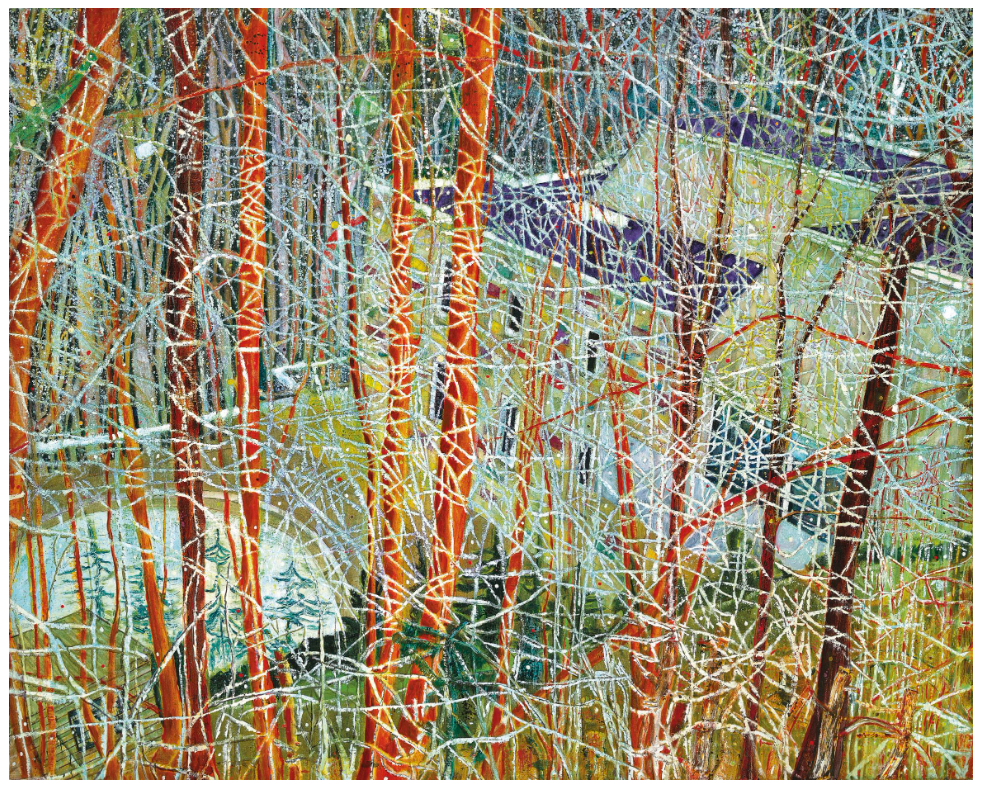
Peter Doig, The Architect’s Home in the Ravine, 1991. Private collection. © 2026 Artists Rights Society (ARS), New York / DACS, London.
Richter also initially rejected the Abstract Expressionist notion that a painting could be a portal to the sublime. A witness to both the devastation of World War II and Germany’s postwar sundering, he refused the idea that art could teach transcendent truths. It was instead an accretion of one substance onto another, a purely material activity. Yet he gradually came to see abstractions as depicting a mysterious realm beyond material reality. “Abstract paintings are fictitious models because they visualize a reality which we can neither see nor describe but we may nevertheless conclude to exist,” he said in 1982. “We attach negative names to this reality: the un-known, the ungraspable, the in-finite. With abstract painting we created a better means of approaching what can neither be seen nor understood” (quoted in L. Lambrecht (ed.), Gerhard Richter: Panorama, exh. cat., Cultuurcentrum Strombeek, Grimbergen, Belgium, 2008, p. i). The present Abstraktes Bild at once provides a window into this place beyond the limits of human perception and demonstrates Richter’s distinctive and virtuosic manipulation of the painted surface.
Abstraktes Bild, 1990
Abstraktes Bild, 1990
Breaking Ground: The Private Collection of Marian Goodman
Christie’s New-York: 19 November 2026
Estimated: USD 6,000,000 – 8,000,000
GERHARD RICHTER (B. 1932), Abstraktes Bild | Christie’s
GERHARD RICHTER (B. 1932)
Abstraktes Bild, 1990
Oil on canvas
62.2 x 51.8 cm (24-1/2 x 20-3/8 inches)
Signed, dated and inscribed ‘723-1 Richter 1990’ (on the reverse)
With their kaleidoscopic eruptions of color and movement, Gerhard Richter’s Abstrakte Bilder unlock the emotive and sensorial potential of pure abstraction. This prismatic example comes from the personal collection of the late gallerist Marian Goodman, who acquired it directly from the artist soon after it was painted. Goodman, who introduced numerous European painters to American audiences, was a fervent champion of Richter and did much to elevate his work to the level of global recognition that it enjoys today. Thus, this exceptional example of his oeuvre represents not only the heights of Richter’s painterly achievements, but also the decades-long friendship that the pair experienced.
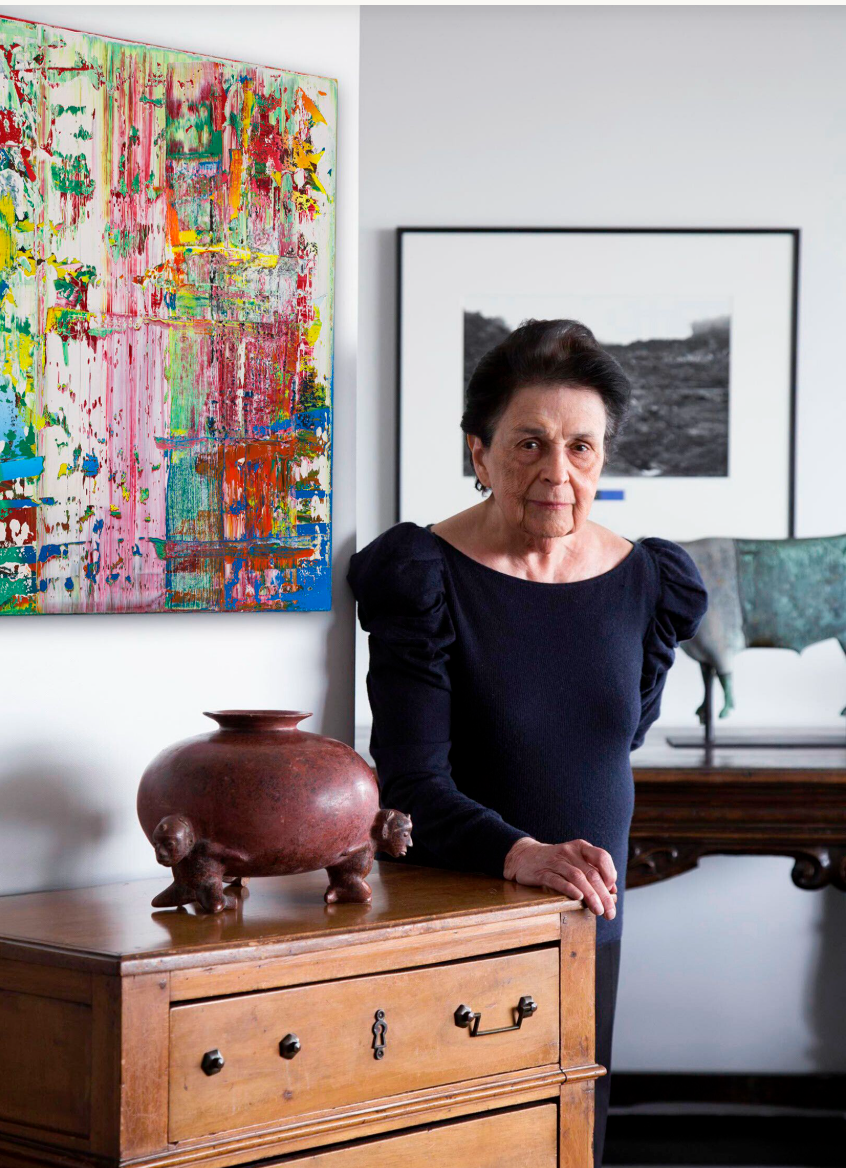
Marian Goodman in her New York apartment (present lot illustrated).
Photograph by Jean-Francois Jaussaud, from For Art’s Sake: Inside the Homes of Art Dealers by Tiqui Atencio Demirjian.
Abstraktes Bild has a distinctive lightness of palette, with rose pinks, mint greens and bright shocks of mustard yellow. Striated lines of paint furrow vertically down parts of the canvas, interrupted by horizontal streams, craggy patches and scree-like specks. Some colors clash with delightful intensity, while others smoothly gradate, such as in the mottled area of pink and orange on the right of the painting. There are sections where countless layers of pigment coalesce into thick impasto, and parts with a lustrous lightness, where the grain of the canvas seems to emerge from beneath the paint. Even here, however, Richter leaves a suggestion of myriad further colors hidden beneath the visible picture plane.
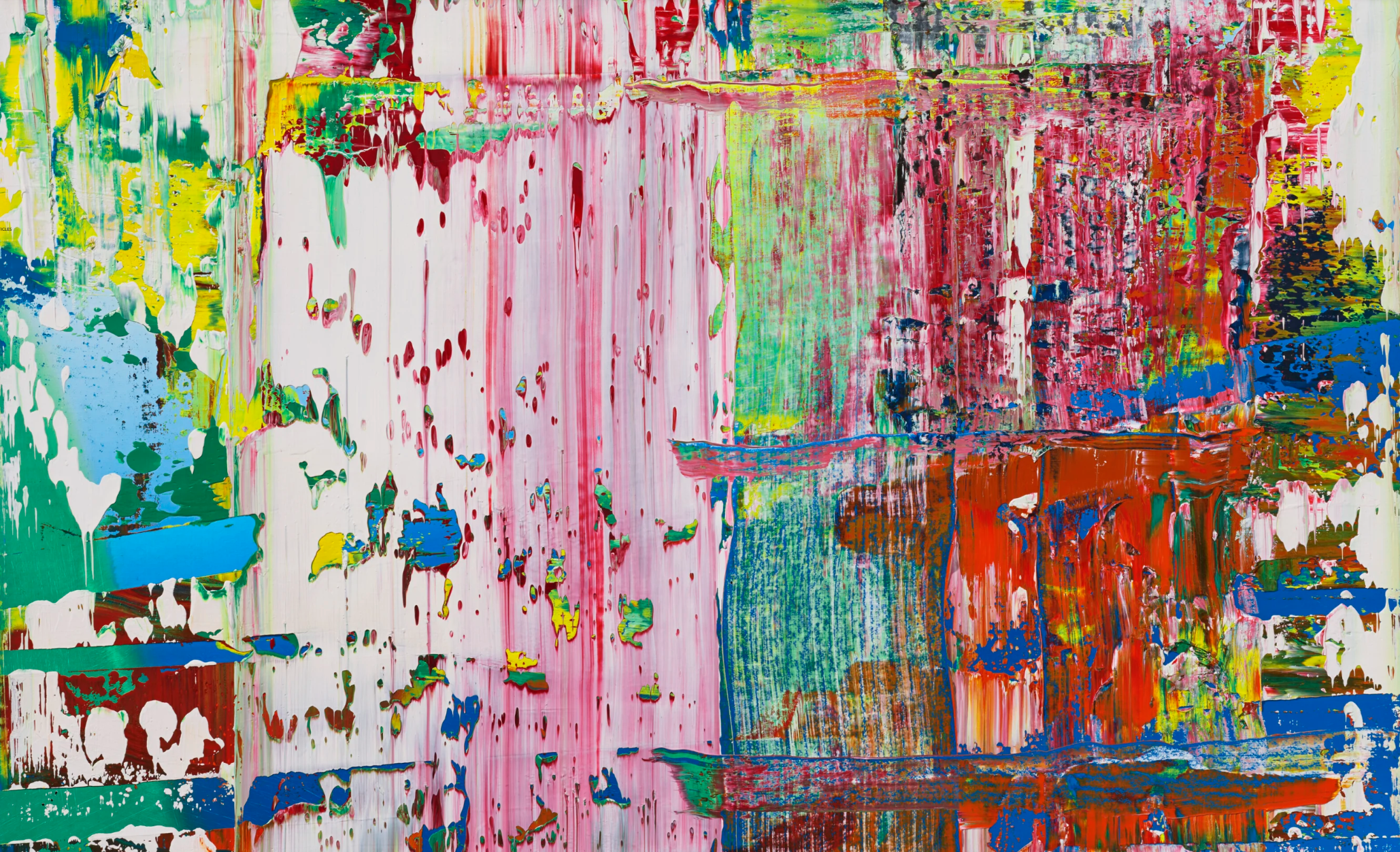
The entire painting is a symphonic assemblage of discrete parts, working together to create an image of surpassing richness and depth. The vibrant colors would later surface in paintings such as Mohn (Poppy) (1995), which was also owned by Goodman. Some of Richter’s abstracts are named for natural features such as forests, rivers and flowers. While parts of Abstraktes Bild bear resemblance to forms from nature—a pink, white and blue patch to the right of the canvas has the grain of a tree trunk—some of the painting’s lurid, contrasting hues seem bracingly unnatural. As Robert Storr later claimed: “Seldom have colors so luxurious and so punishing appeared in the same painting, and seldom has the medium’s hedonistic potential been so closely tied to its capacity for creating discomfort” (quoted in Gerhard Richter: Forty Years of Painting, exh. cat., The Museum of Modern Art, New York, 2002, pp. 81–82).
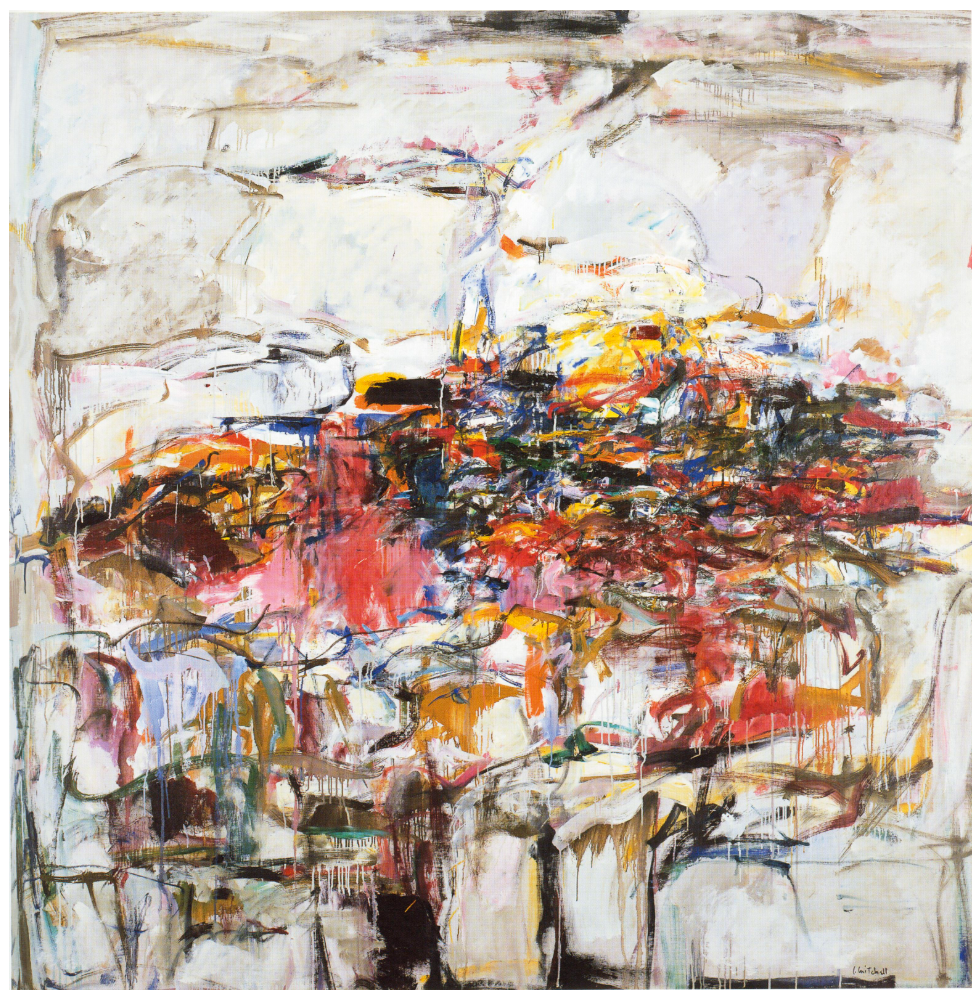
Joan Mitchell, City Landscape, 1955. Art Institute of Chicago. © Estate of Joan Mitchell.
The present work was executed at a watershed moment in Richter’s decades-long investigation into the possibilities of painting. It is among his first abstracts following the milestone figurative series 18. Oktober 1977 (1988)—now in the collection of the Museum of Modern Art, New York—that depicted the deaths of three members of the Baader-Meinhof terrorist group. After completing these monumental grayscale modern history paintings, Richter was creatively exhausted. He re-emerged by moving in almost the opposite direction. Richter’s abstracts became even more elaborate and polychromatic while achieving a numinous beauty. He broke with his earlier practice of using photographs as the bedrock of his abstracts. The period saw him further develop his technique of dragging a custom-made squeegee across a canvas already wet with paint, creating unforeseeable, multifarious forms and effects. In the following years he would cement his reputation with a Tate survey (1991), a triumphant appearance at Documenta IX (1992), and the milestone touring retrospective Gerhard Richter: Peinture 1962–1993 (1993–94).
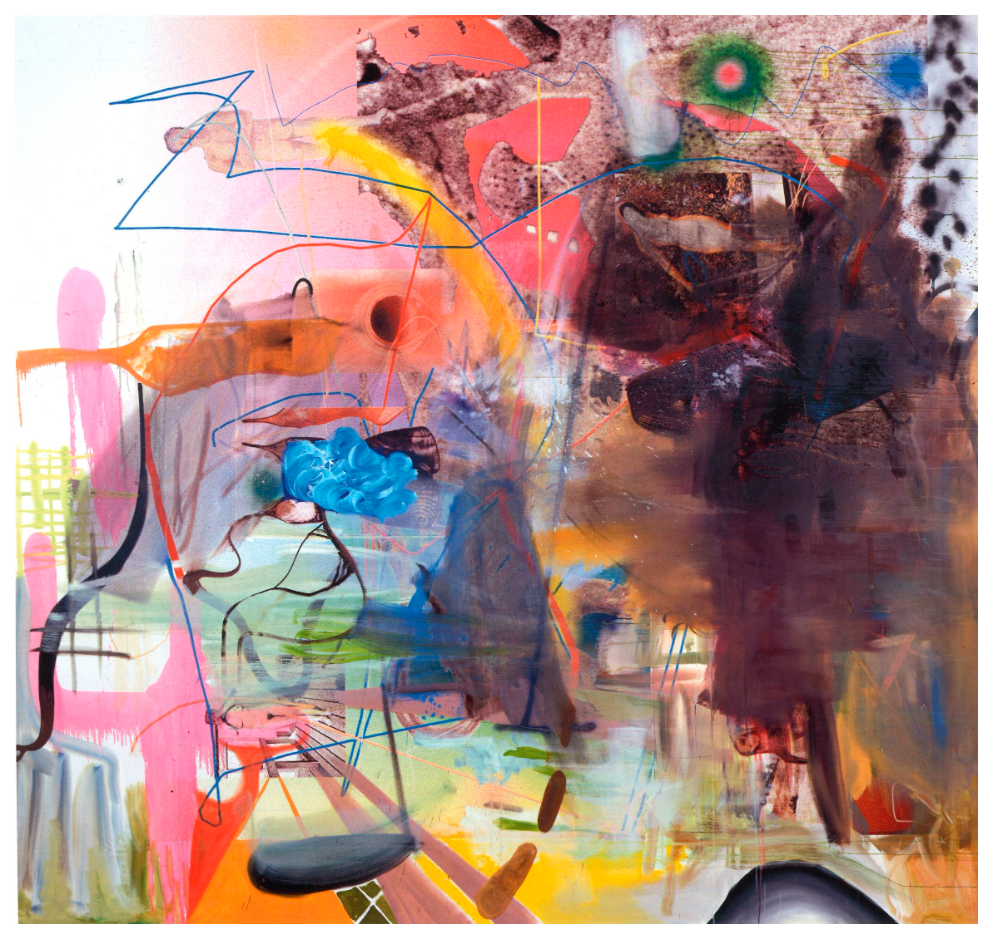
Albert Oehlen, Ziggy Stargast, 2001. The Broad, Los Angeles. © 2026 Artists Rights Society (ARS), New York / DACS, London.
Although Richter rose to acclaim in the 1960s for his figurative photo-paintings, he developed an interest in abstraction early on. In Tisch (1962) he painted a photograph of a minimalistic modern table, then covered it with a gestural whirl of gray paint. In the years since, his work bifurcated, alternating figurative scenes and landscapes with abstraction. His abstracts developed their churning surfaces and pictorial intensity throughout the 1980s, while eschewing the psychological claims of Abstract Expressionism. “Even where colors grow or swinging brushstrokes bring alive before our eyes the movement of the painting hand,” writes Beate Söntgen, “we are never vociferously addressed, never drawn into the turbulences of artistic or psychic excitement. There are no expressive gestures in wild lineament, seeking and finding their expressive channel” (quoted in U. Wilmes (ed.), Gerhard Richter: Large Abstracts, exh. cat., Museum Ludwig, Cologne, 2008, p. 35).
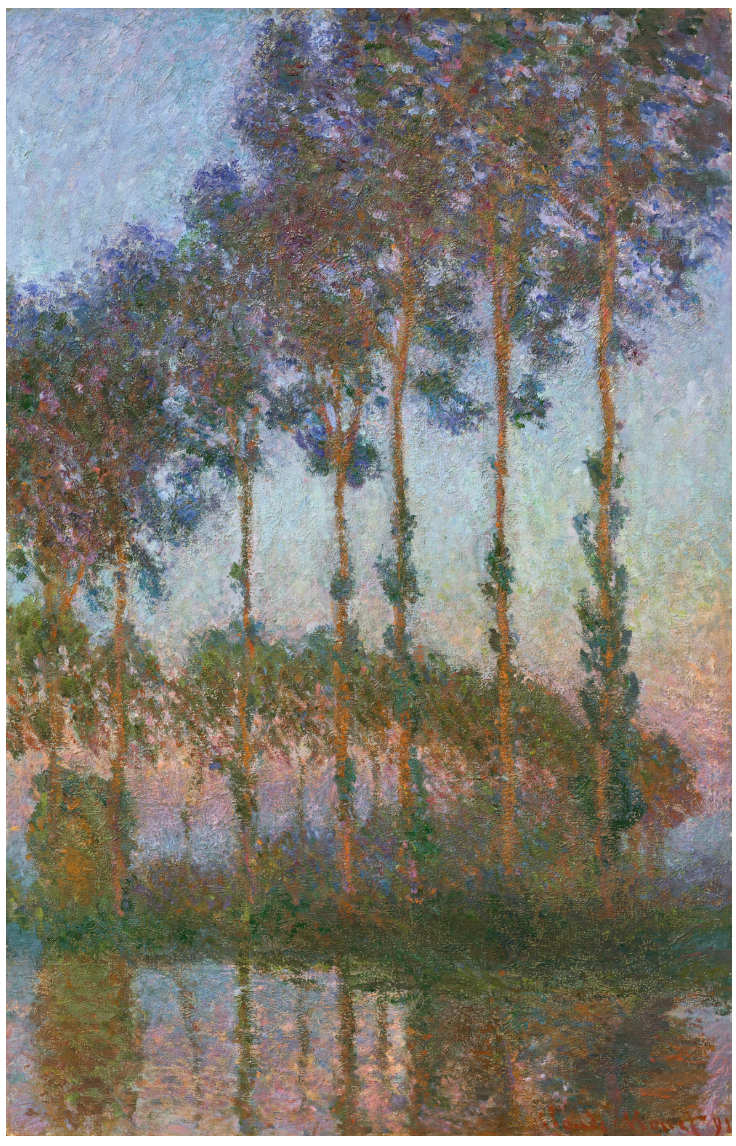
Claude Monet, Peupliers au bord de l’Epte, crépuscule, 1891. Sold at Christie’s New York, 12 May 2025 for $42,960,000.
Yet despite Richter’s rejection of expressivity, Abstraktes Bild emanates a near-euphoric joy in the freedom of the abstract painter, unshackled by the demands of representation and able to celebrate the medium and the painted surface. Richter approached his mature abstracts like a game of chess, making moves against himself. “At the beginning,” he explained, “I feel totally free, and it’s fun, like being a child. The paintings can look good for a day or an hour. Over time, they change. In the end, you become like a chess player. It takes me longer than some people to recognize their quality, their situation – to realize when they are finished. Finally, one day I enter the room and say, ‘Checkmate.’ Then sometimes I need a break, a quiet job, like a landscape. But I always need to paint abstracts again” (quoted in M. Kimmelman, ‘Gerhard Richter: An Artist Beyond Isms’, The New York Times, 27 January 2002). This Abstraktes Bild is a coruscating artifact of this meticulous process by the most important abstract painter of his age.
Spanische Seeschlacht, 1984
Spanische Seeschlacht, 1984
Property from an Esteemed Private Collection
Sotheby’s New-York: 16 November 2026
Estimated: USD 5,000,000 – 7,000,000
GUARANTEED PROPERTY
Gerhard Richter | Spanische Seeschlacht | The Now and Contemporary
GERHARD RICHTER (b. 1932)
Spanische Seeschlacht, 1984
Oil on canvas
120.7 x 180.3 cm (47-1/2 x 71 inches)
Signed, numbered 570-1 and dated 1984 (on the reverse)
In the 1960s, Richter embarked on a project which would serve as an anchor to his creative output through to the present day: the idea of the painted photograph. In part a reaction against the facsimiles of life that were produced out of the Socialist Realist style in which he was trained, mandated by East Germany’s Communist government, and a response to the commercialized essentialism of American Pop, Richter attempted, as the artist himself explained, to “equalize, neutralize what is depicted, attempt[ing] to retain the anonymous gloss of the photograph, to replace the craftsmanly-artistic with the technical.” (Roald Nasgaard, Gerhard Richter, London 1988, p. 49)
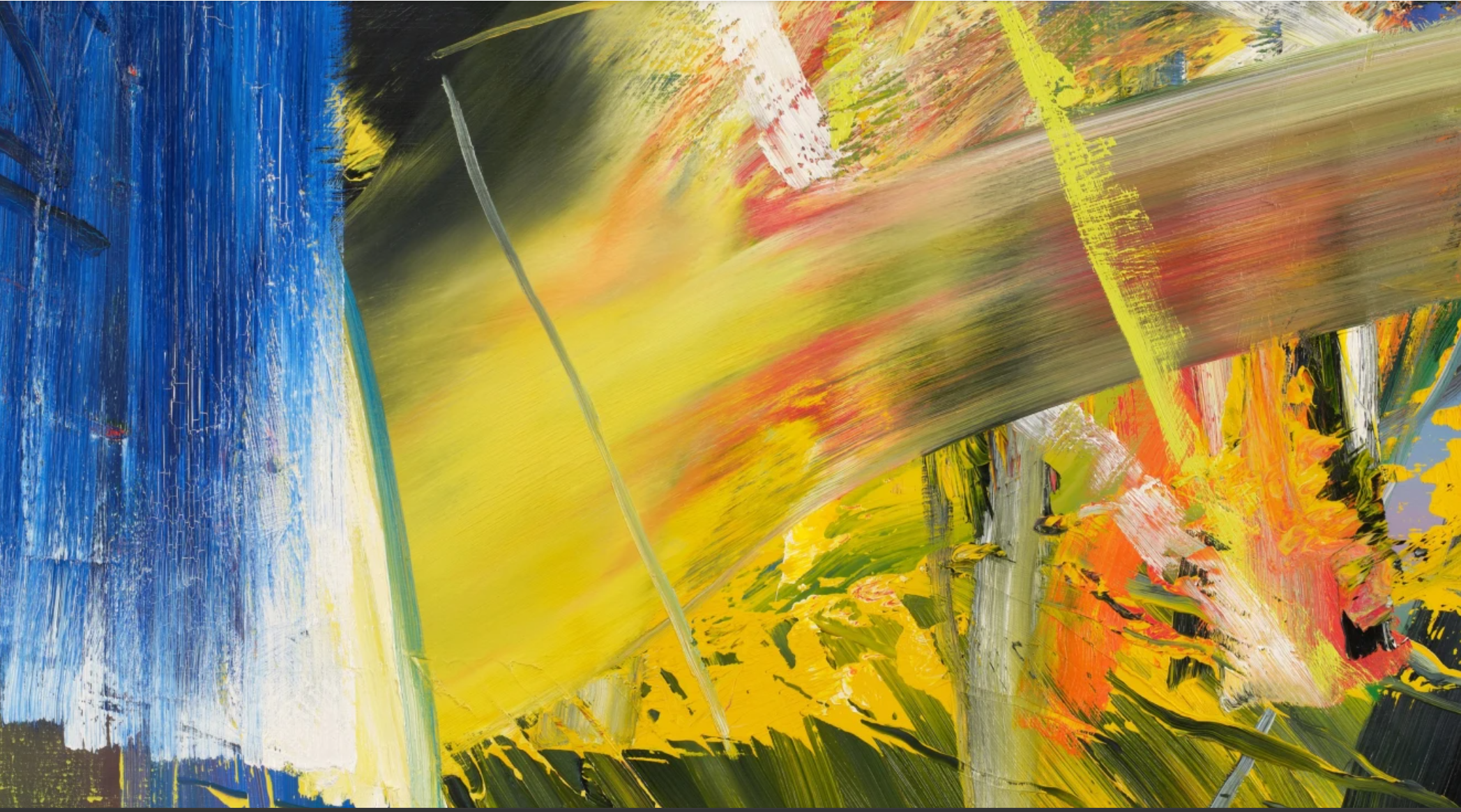
Beginning in 1968, Richter began to adopt the subject of the seascape as a vehicle for that investigation – a subject that he would return to in various iterations until 1998. Early works from the series stand as mesmerizing examples of the way in which Richter employed the act of painting asa form of replication and distortion, and used his virtuosic photorealist technique to visualize the effect of the passage of time on our perception and recollection of an image.
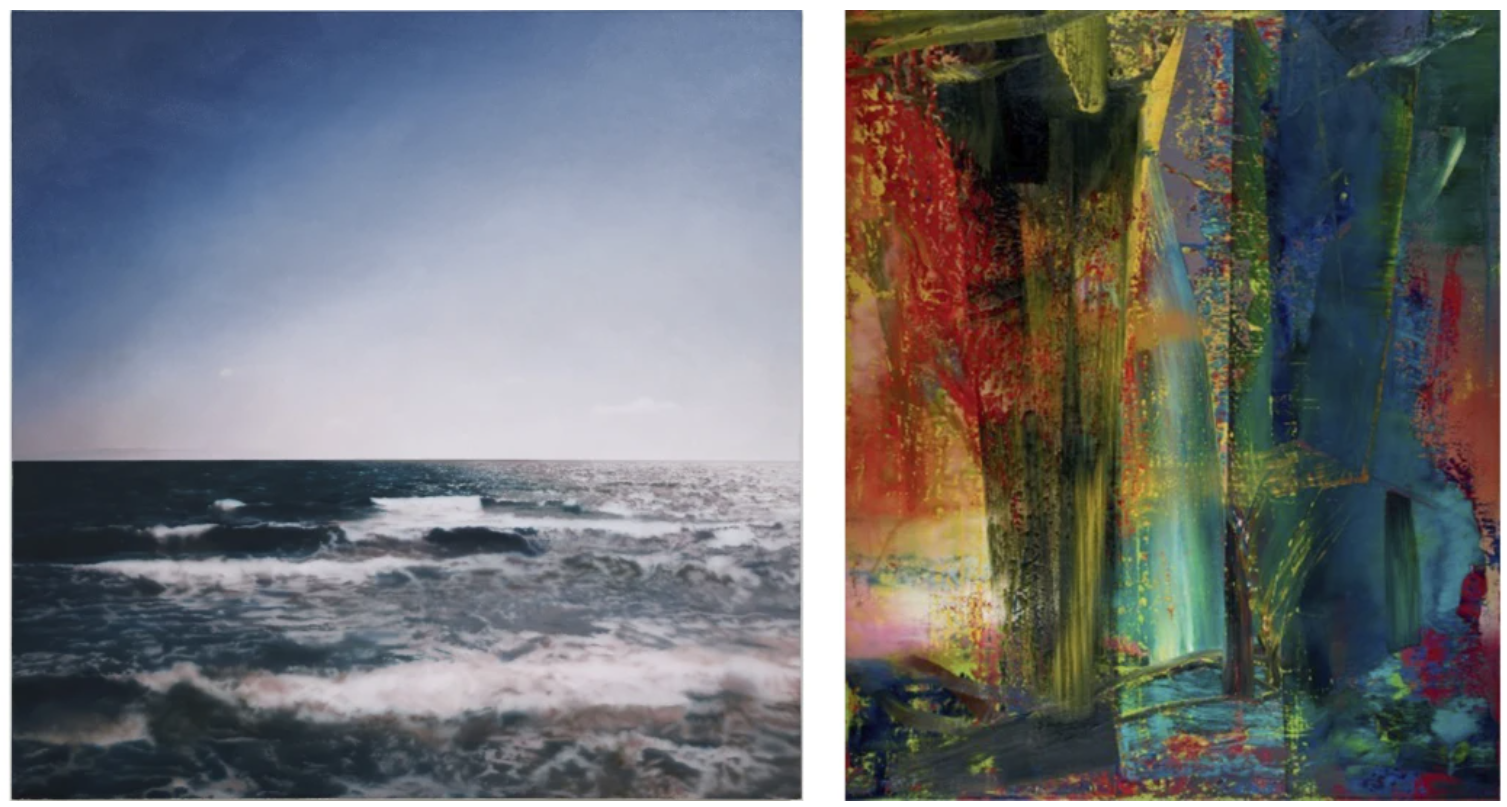
Left: Gerhard Richter, Seestück, 1998. Guggenheim Bilbao Museoa. Art © 2026 Gerhard Richter. Right: Gerhard Richter, Abstraktes Bild, 1986. Private Collection. Sold at Sotheby’s London in February 2015 for £30.4 million ($46.3 million). Art © 2026 Gerhard Richter
In choosing the seascape, Richter not only reflects upon the genre of scientific photography which his compositions make reference to, but likewise places his work within a genealogy of landscape paintings that takes root through the entire canon of Western painting. These early canvases are made all the more enchanting by their awe-inspiring quality of the sublime, an effect pioneered by the atmospheric, enveloping landscapes of the German Romantic painters who proceeded him. Within the present work, a glimpse of his characteristically hazy hyper-realist landscape is legible in the horizon line which peaks out in the lower left corner, untouched by the swaths of paint that surround it. But when taken as a whole, Spanische Seeschlacht, painted nearly 15 years after he completed his first Seascape, marks a distinctly contemporary iteration of that visual effect – a material sublime.
“I’m not trying to imitate a photograph… I’m trying to make one. And if I disregard the assumption that a photograph is a piece of paper exposed to light, then I am practicing photography by other means…”
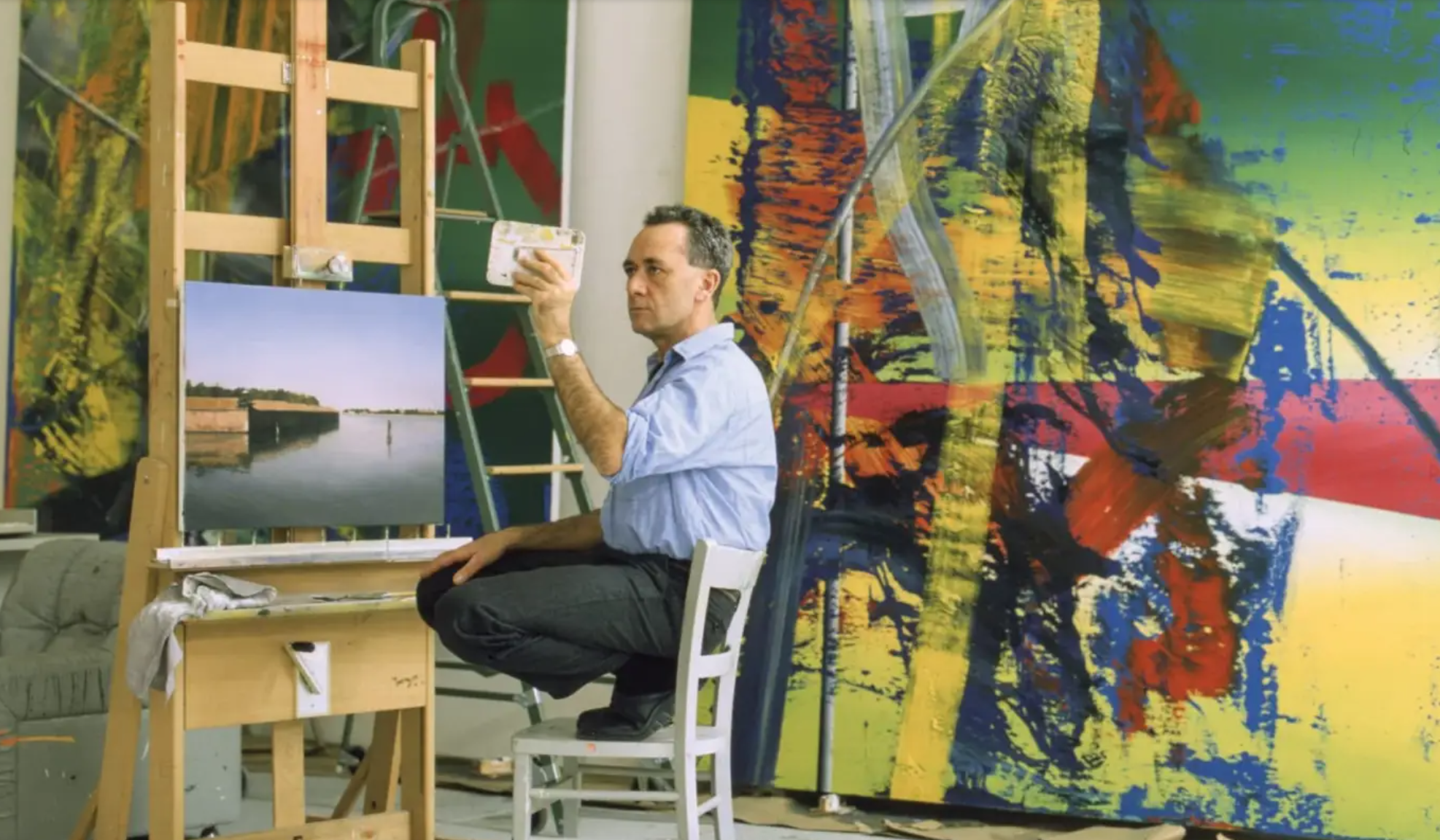
Gerhard Richter in his studio, 1985. Photographer unknown. Art © 2026 Gerhard Richter
Executed in 1984, the present work stands as a commanding early example of the unflinching voice and technical renaissance which Richter championed within the abstract language. Just three years earlier, in 1981, Richter was included among the likes of Philip Guston, Georg Baselitz and Anselm Kiefer at an exhibition at the Royal Academy in London titled A New Spirit in Painting. In tandem with his inclusion in German Art Today at Musée d’art moderne de la Ville de Paris and a solo exhibition in Munich that same year, the beginning of the decade ushered a new tenor in the artist’s critical reception and popular recognition that continues to proliferate into the present day. The start of the 1980s likewise marked a pivotal turning point in the artist’s practice, with the close of the preceding decade establishing in a new, concerted direction in his approach to abstraction. It was not until 1980, however, that Richter made his first squeegee painting.
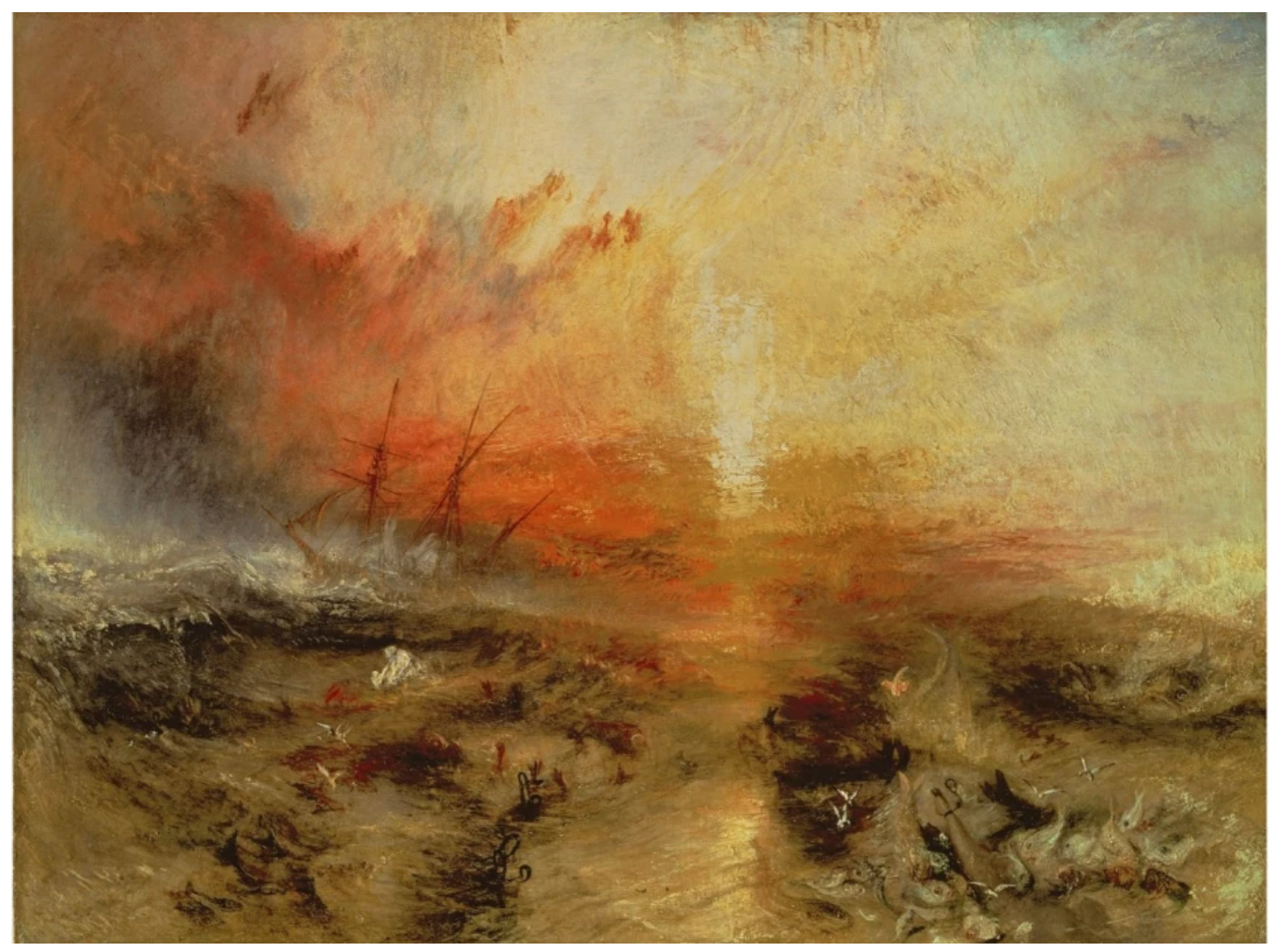
Joseph Turner, Slave Ship (Slavers Throwing Overboard the Dead and Dying, Typhoon Coming On), 1840. Museum of Fine Arts, Boston. Image © 2026 Museum of Fine Arts, Boston. All rights reserved. / Henry Lillie Pierce Fund / Bridgeman Images
Despite the control he ceded to this tool, Richter was incisive in how and where the squeegee was employed, creating layers which oscillate between windows and veils over the painted field. The result, as in the present work, is a matrix in which painterly elements both spar against and complement each other while the paint’s chromatic value injects this piece with an undisputed brilliance. Spanisches Seeschlacht is particularly striking evidence to the fact that even as Richter committed himself to a more abstract mode of painting, the application of this abstraction within his work was in service of the same aesthetic investigation as his most precise photorealist compositions. Here, the visual becomes conceptual, as Richter literally obscures the distinction between the photographic and the painted.
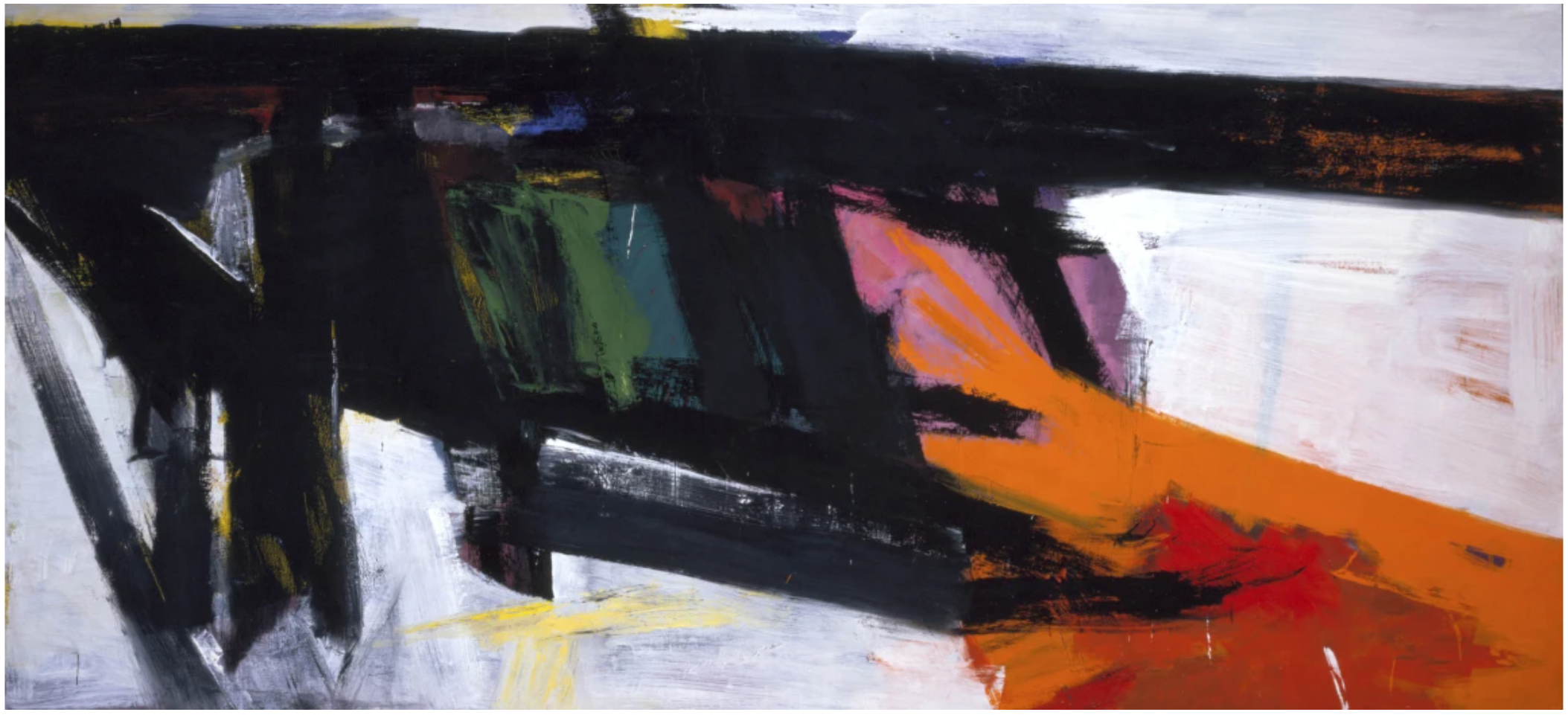
Franz Kline, Orange and Black Wall, 1959. Museum of Fine Arts, Houston. Image © Museum of Fine Arts, Houston / Bequest of Caroline Wiess Law / Bridgeman Images. Art © 2026 The Franz Kline Estate / Artists Rights Society (ARS), New York
Abstraction quickly returns to abstraction and the eye becomes engaged in Richter’s command of medium, technique, and, most demonstrably in the present work, his mastery of color. Despite the aesthetic opposition between Spanische Seeschlacht and the photorealism of Seascapes series, their art historical parity testifies to Richter’s unrelenting pursuit, interrogation, and exposure of honesty and deceit in painting and representation. By his own admission, within his practice Richter was not creating paintings but instead making images. As made explicit by Kaja Silverman, Richter made claims to paint “like a camera” even when photographic content is absent from his work. Speaking in overarching terms of his wider painterly project, in 1972 Richter explained: “I’m not trying to imitate a photograph… I’m trying to make one. And if I disregard the assumption that a photograph is a piece of paper exposed to light, then I am practicing photography by other means… [T]hose of my paintings that have no photographic source (the abstracts, etc.) are also photographs.” (Hans Ulrich Obrist, Ed., Gerhard Richter The Daily Practice of Painting: Writings 1962-1993, London 1995, p. 73) Indeed, the balance between form and content, sign and signifier, the material and the ephemeral, photographic and the abstract, finds an apogee in this enveloping work.
Grat 3, 1989
Grat 3, 1989
Vision: The Extraordinary Collection of Theodore and Ruth Baum
Sotheby’s New-York: 16 November 2026
Estimated: USD 3,000,000 – 4,000,000
GUARANTEED PROPERTY
Gerhard Richter | Grat 3 | Vision: The Extraordinary Collection of
GERHARD RICHTER (b. 1932)
Grat 3, 1989
Oil on canvas
61.6 x 81.9 cm (24-1/4 x 32-1/4 inches)
Signed, dated 1989 and numbered 689-3 (on the reverse)
Executed in 1989 and one of only five works from this group, Grat 3 stands as an exceptionally rare synthesis of Gerhard Richter’s twin artistic pursuits of landscape and abstraction. Occupying a pivotal position within the artist’s oeuvre, the present work belongs to a body of paintings that bridges the distance between Richter’s celebrated photorealistic landscapes and the revolutionary abstract paintings that would define his mature practice. Featured alongside three other works from the series in the artist’s landmark 1993 retrospective at the Musée d’Art Moderne de la Ville de Paris, Grat 3 exemplifies the inventive complexity, technical mastery, and intellectual ambition that have established Richter as one of the most influential painters of the postwar era. Further distinguished by its exceptional provenance, having remained in a single private collection for nearly three decades, the present work bears witness to one of the most significant and consequential moments in the artist’s career.
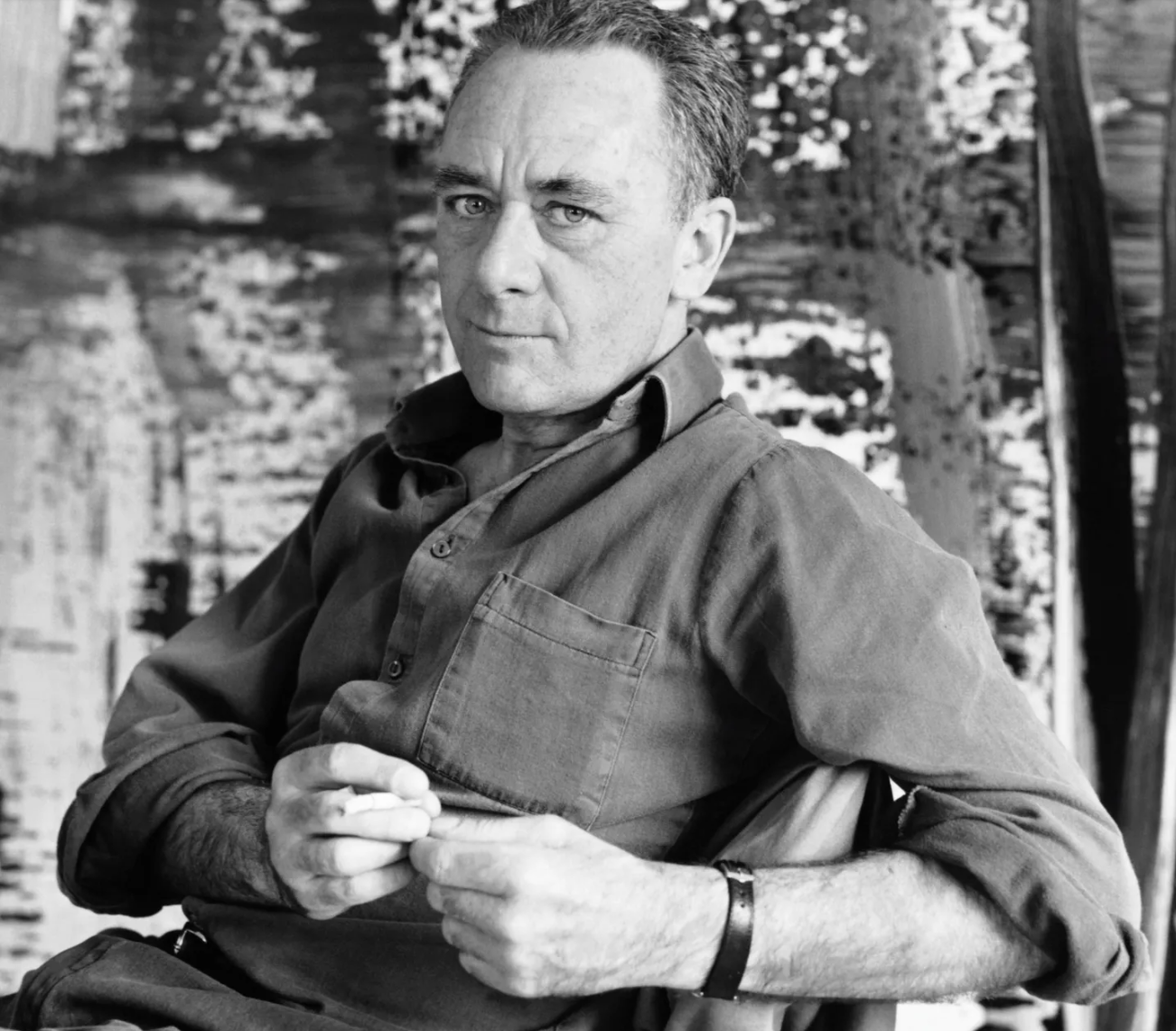
Gerhard Richter photographed in Cologne, Germany, 1989. Photo by Chris Felver/Getty Images. Art © 2026 Gerhard Richter
Executed using Richter’s signature squeegee technique, the present demonstrates the extraordinary balance between control and chance that came to define his mature abstraction. Methodical layers of paint are pulled, scraped, and revealed across the surface, creating the impression of a limitless pictorial space, seemingly unencumbered by scale and absent any overt trace of the artist’s hand. The implement facilitated his desire to introduce spontaneity and chance into his creative approach, as the artist himself stated, “it is a good technique for switching off thinking.” (Dietmar Elger, Gerhard Richter, A Life in Painting, Chicago, 2009, p. 251) and “letting a thing come, rather than creating it—no assertions, constructions, formulations, inventions, ideologies—in order to gain access to all that is genuine, richer, more alive: to what is beyond my understanding.” (the artist quoted in: Hans Ulrich Obrist, ed., The Daily Practice of Painting: Writings and Interviews work 1962-1993, London, 1993, pp. 119-20)
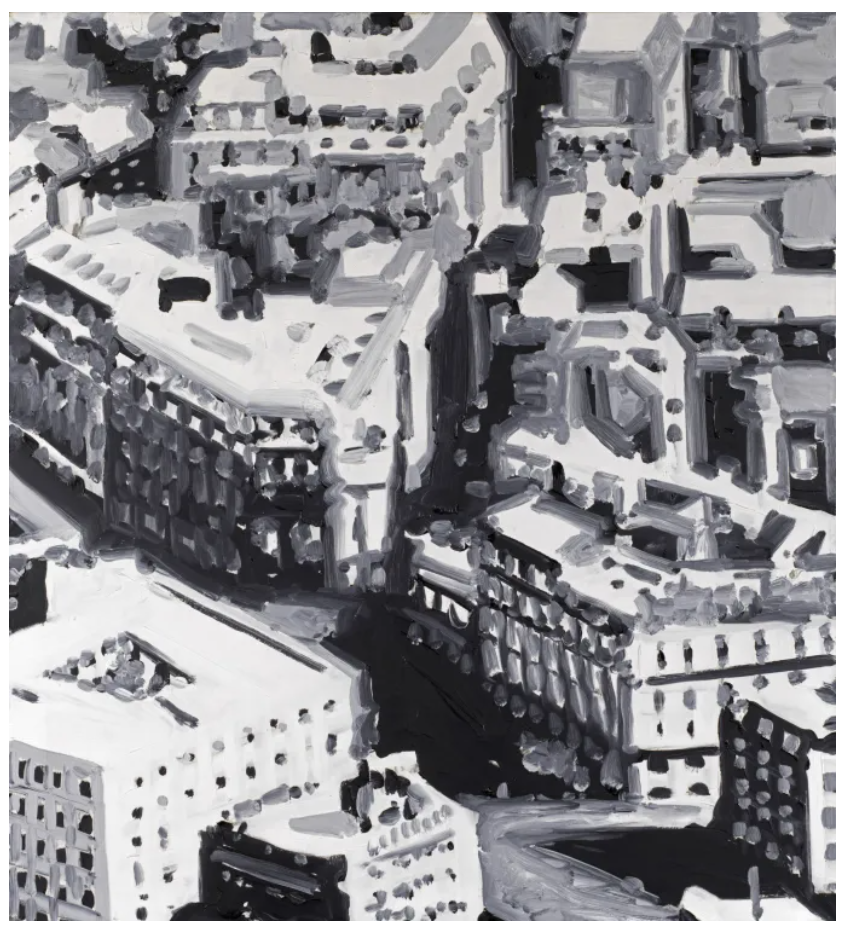
Gerhard Richter, Townscape (P1) [Stabtbild (P1)], 1968. The Art Institute of Chicago.
Image © The Art Institute of Chicago / Art Resource, NY. Art © 2026 Gerhard Richter
The movements of the squeegee “seem strangely empty, since they behave visibly indifferently to what they uncover, pull along, wipe, and cause to emerge.” (Gregor Stemmrich quoted in: Exh. Cat., Cologne, Museum Ludwig (and traveling), Gerhard Richter Large Abstracts, 2009, p. 31) Entitled after the natural form of a ridge, whether mountainous or minuscule, Grat 3 occupies the terrain between two of Richter’s most important bodies of work: the photorealistic landscapes that established his early reputation and the monumental abstractions that secured his place among the most influential painters of the twentieth century.
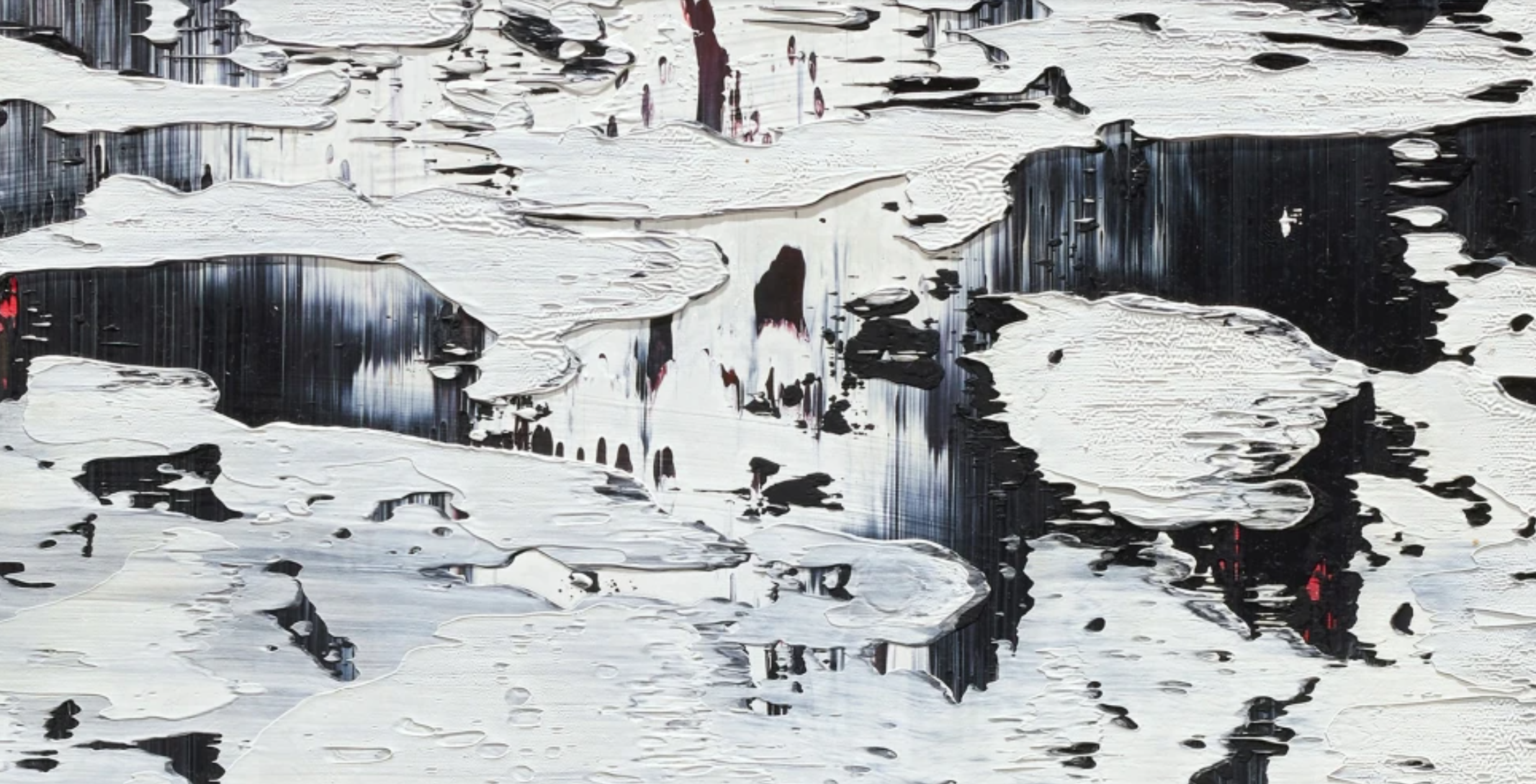
The Grat series accomplishes the best of both approaches, distilling the essence of landscape into a kaleidoscopic field of color, texture, and movement that remains wholly distinct within Richter’s wider corpus. The significance of the series was affirmed in 1993, when the artist’s Paris retrospective, featuring four of the five Grat paintings, received widespread critical acclaim. Reviewing the exhibition, critic Doris von Drathen observed that “there are exhibitions that, like great milestones, reset the standards in contemporary art. Richter’s retrospective, launching now at the ARC in Paris, is of this quality.” (Doris von Drathen quoted in: Dietmar Elger, Gerhard Richter: A Life in Painting, Cologne, 2002, p. 323) Presented within this landmark retrospective, Grat 3 belongs to a body of work that encapsulates the innovation, ambition, and restless experimentation that characterize Richter’s greatest achievements.
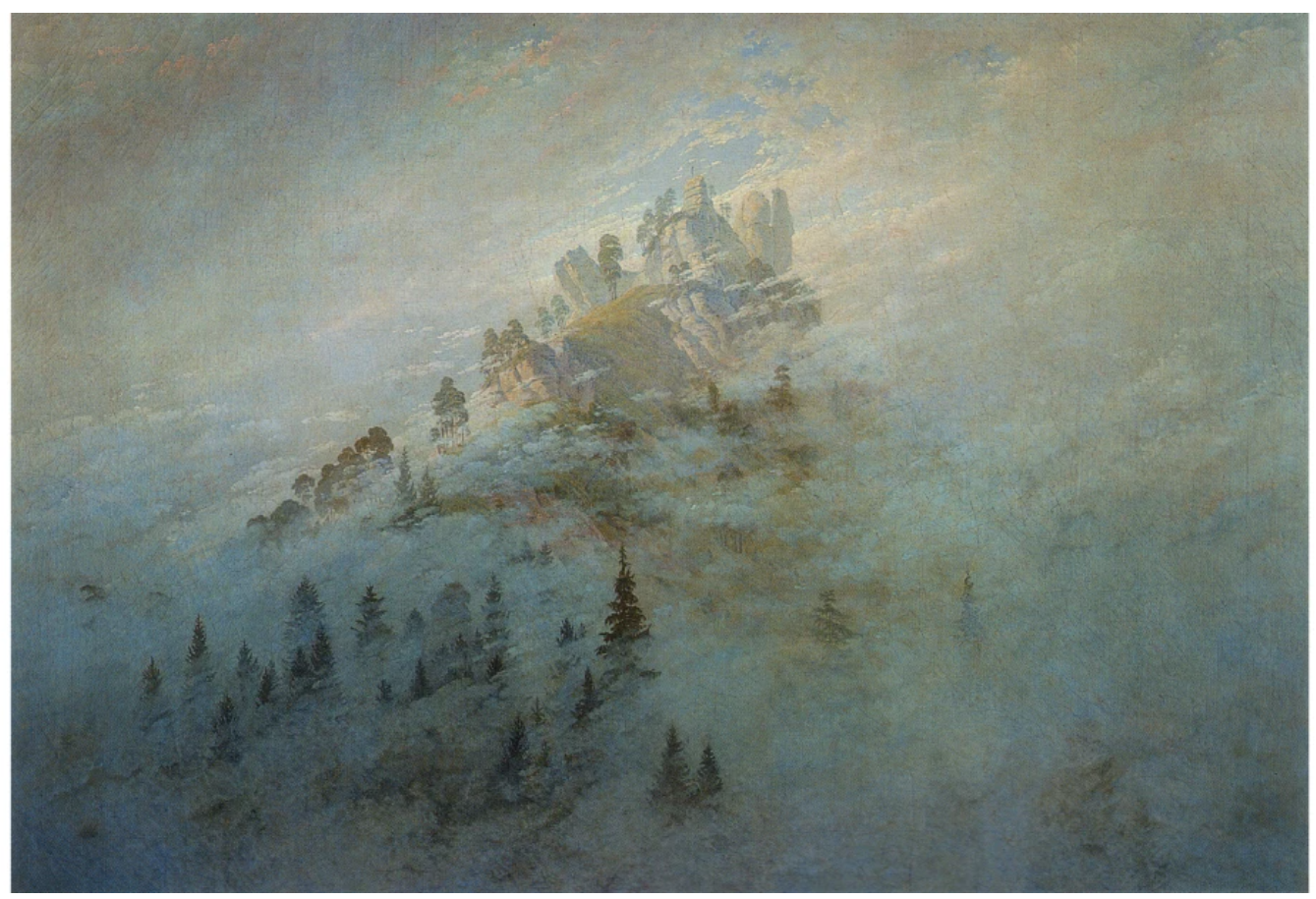
David Caspar Friedrich, Morning Mist in the Mountains, 1808. Staatliche Museen Heidecksburg Rudolstadt.
Image © HIP / Art Resource, NY
Celebrated as a pioneer of abstract art, Richter’s approach is revered for its progressive vision that signified a critical departure from the iconic geometricity that is the characteristic manifestation of modernist abstraction and a rejection of the expressionistic intentions of the movement’s Postwar practitioners. Richter’s unique painterly abstraction is the remarkable product of a deep and clear understanding of these modes of abstraction and a response to the tension between them and their contrasting histories. Whereas the fundamental roots of the abstraction of Kandinsky and Malevich, for example, were founded on linear and systematic qualities in terms of conception and production, Richter’s introduction of chance into his creative process radically undermines these relatively contrived approaches. He does not, however, rely entirely on gestural techniques as had been introduced by the action painting of Jackson Pollock, but maintains a consistent structure and attention to minute detail in his noncompositional works, essentially producing a sort of calculated chaos. “Richter’s deployment of texture, structure, and gesture in painting deliberately suspends itself between scientific and expressive conceptions of painterly process. It is oscillating with the same deliberation, between painting as an act and painting as an accident, between composition as a result of mere chance encounters of materials and structures, and composition as the tracing of a subject’s residual intentionality.” (Benjamin Buchloh, “Working on the Picture: The Discretion of Gerhard Richter” in: Exh. Cat., Cologne, Museum Ludwig (and traveling), Gerhard Richter Large Abstracts, 2009, p. 11)
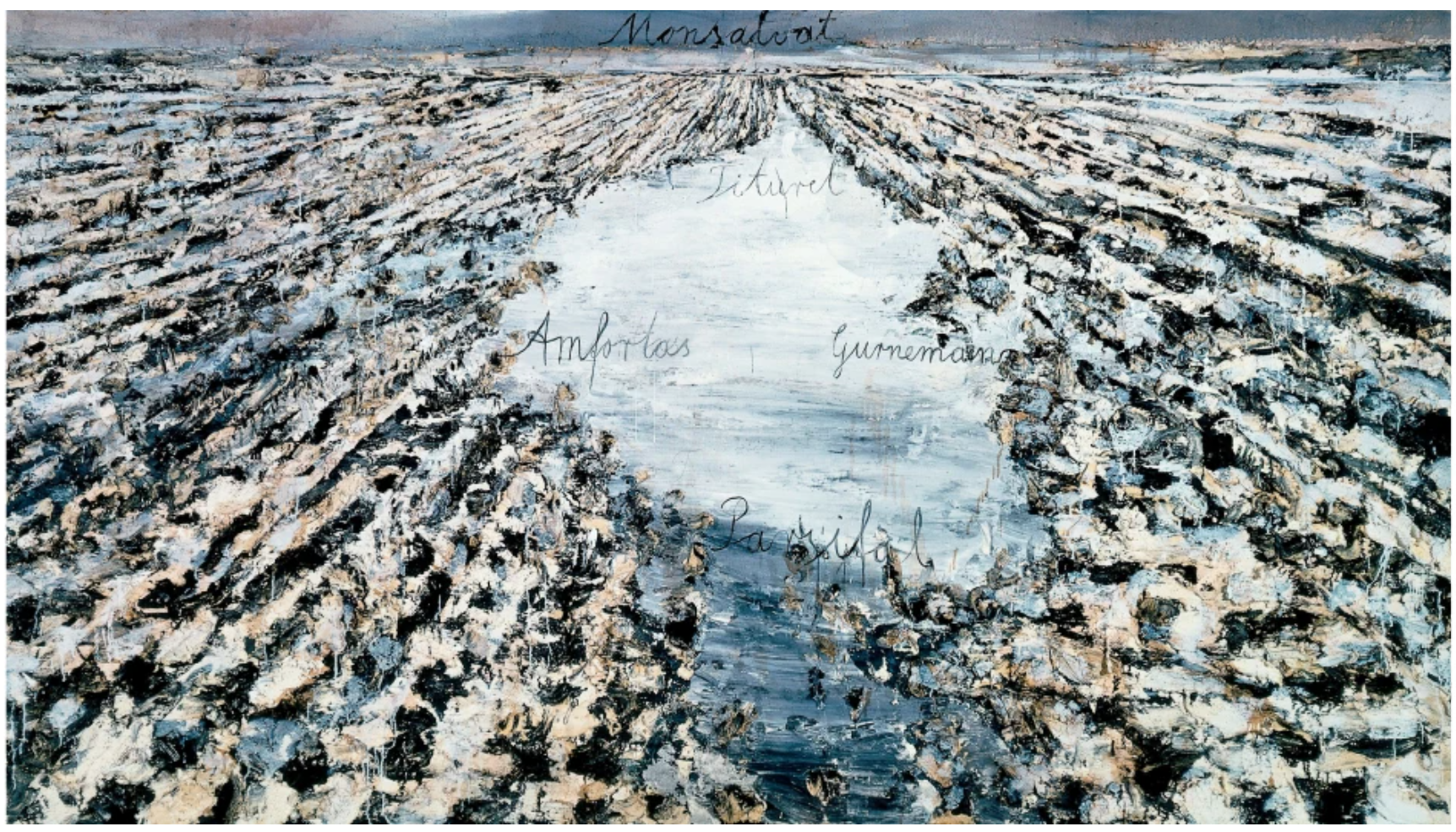
Anselm Kiefer, Monsalvat, 1996. Cincinnati Art Museum.
Image © Cincinnati Art Museum / John J. Emery Fund / Bridgeman Images. Art © Anselm Kiefer
In this celebrated example from a pivotal moment within the artist’s oeuvre, Grat 3 crystallizes Richter’s enduring pursuit of bringing seemingly irreconcilable representation and abstraction, nature and artifice, control and chance. The painting distills the artist’s transition from the hyperrealistic visions of landscape that first earned him acclaim to the abstract languages that would come to define his mature practice. As Richter explained in a 1986 interview with Buchloh, “What I am trying to do in each picture is to bring together the most disparate and mutually contradictory elements, alive and viable, in the greatest possible freedom.” (the artist quoted in: Dietmar Elger and Hans Ulrich Obrist, eds., Gerhard Richter – Text: Writings, Interviews and Letters 1961 – 2007, London, 2009, p. 187) More restrained in palette than the chromatically charged abstractions of the following decades, the Grat series pays subtle homage to the mountains, clouds, and oceans that serve as the artist’s enduring muses. Neither wholly landscape nor wholly abstraction, Grat 3 announces an artist forging a radically new understanding of painterly possibility, transforming the visual memory of nature into a composition of extraordinary depth and possibility.
Gebirge, 1968
Gebirge, 1968
Vision: The Extraordinary Collection of Theodore and Ruth Baum
Sotheby’s New-York: 16 November 2026
Estimated: USD 2,000,000 – 3,000,000
GUARANTEED PROPERTY
Gerhard Richter | Gebirge | Vision: The Extraordinary Collection of
GERHARD RICHTER (b. 1932)
Gebirge, 1968
Acrylic and charcoal on canvas
102×92 cm (40-1/4 x 36-1/4 inches)
Signed, dated 68 and incorrectly numbered 179/2 (on the reverse)
A remarkable example Gerhard Richter’s first mountain inspired landscapes in 1968, Gebirge captures a transformative moment in the artist’s engagement with the natural world. Through its highly abstracted forms and restrained grisaille Gebirge distills the elements of a landscape into its most essential forms, creating an image that hovers between abstraction and realism. Other examples from the Gebirge series have been included in distinguished exhibitions at the 1972 Venice Biennale and the Centre Georges Pompidou, Paris, while the present work has been held in the esteemed Baum Collection for over two decades.
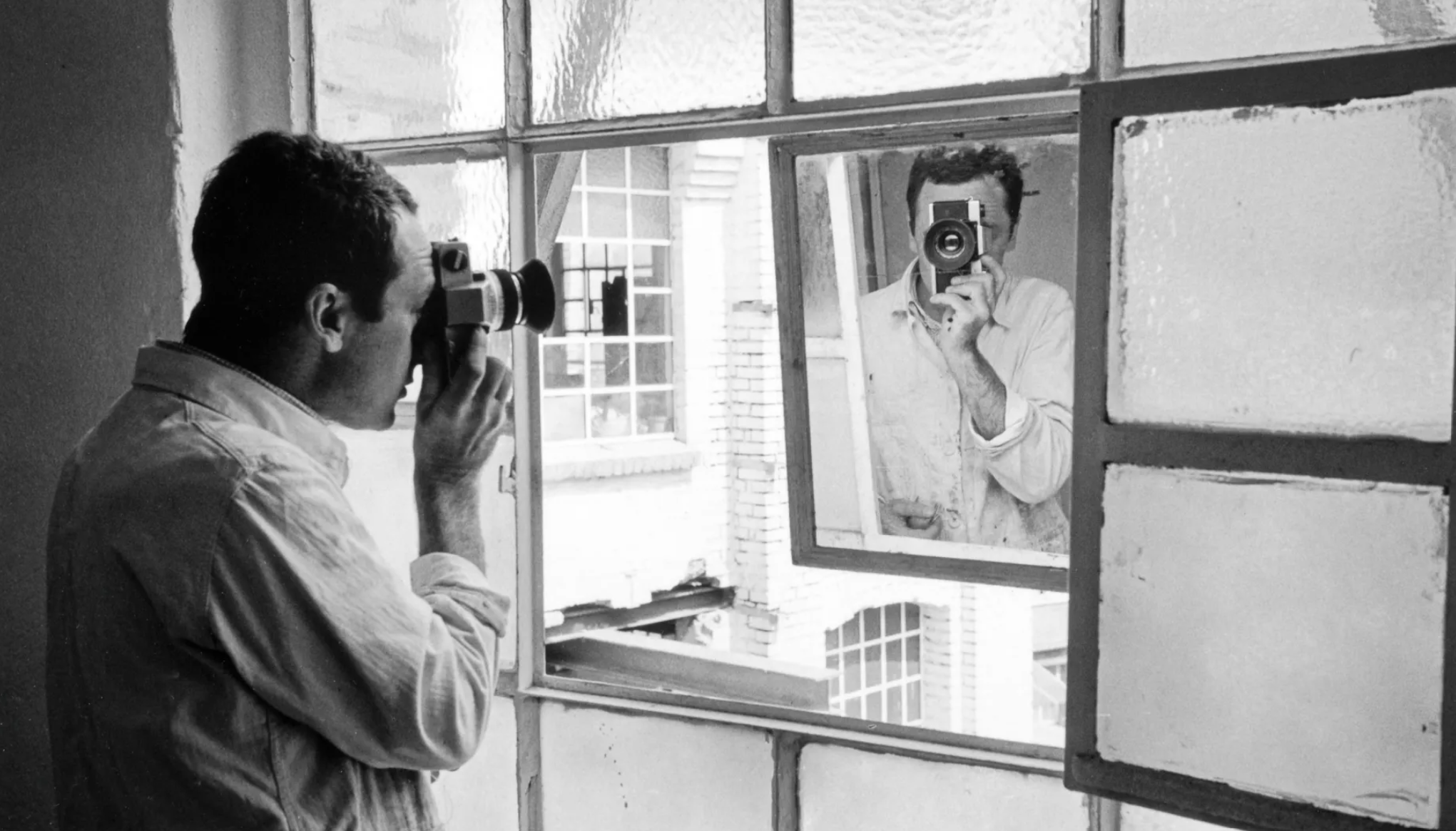
Gerhard Richter in Düsseldorf, 1971. Photo © bpk / Angelika Platen / Art Resource, NY
At once austere and deeply evocative, Gebirge exemplifies Richter’s extraordinary ability to reimagine the conventions of landscape from painting, translating a time-honored artistic tradition into the modern day. While Richter’s landscapes range from photorealistic to abstract, he always worked from a photograph. For Gebirge, Richter drew upon an image cut from a book; however, throughout his palette, career, the artist employed found imagery from a wide variety of sources, including magazines, newspapers, postcards, family albums, and his own photography. As art historian Hubertus Butin notes, “these paintings and drawings are not based on the direct, immediate experience of a real landscape but on the foundation of reality mediated by…photography as the primary medium of the production of images in our society.” (Hubertus Butin, “Gerhard Richter’s Landscapes,” in: Exh. Cat. Kunsthaus Zurich, Gerhard Richter: Landscape, 2021, p. 14)
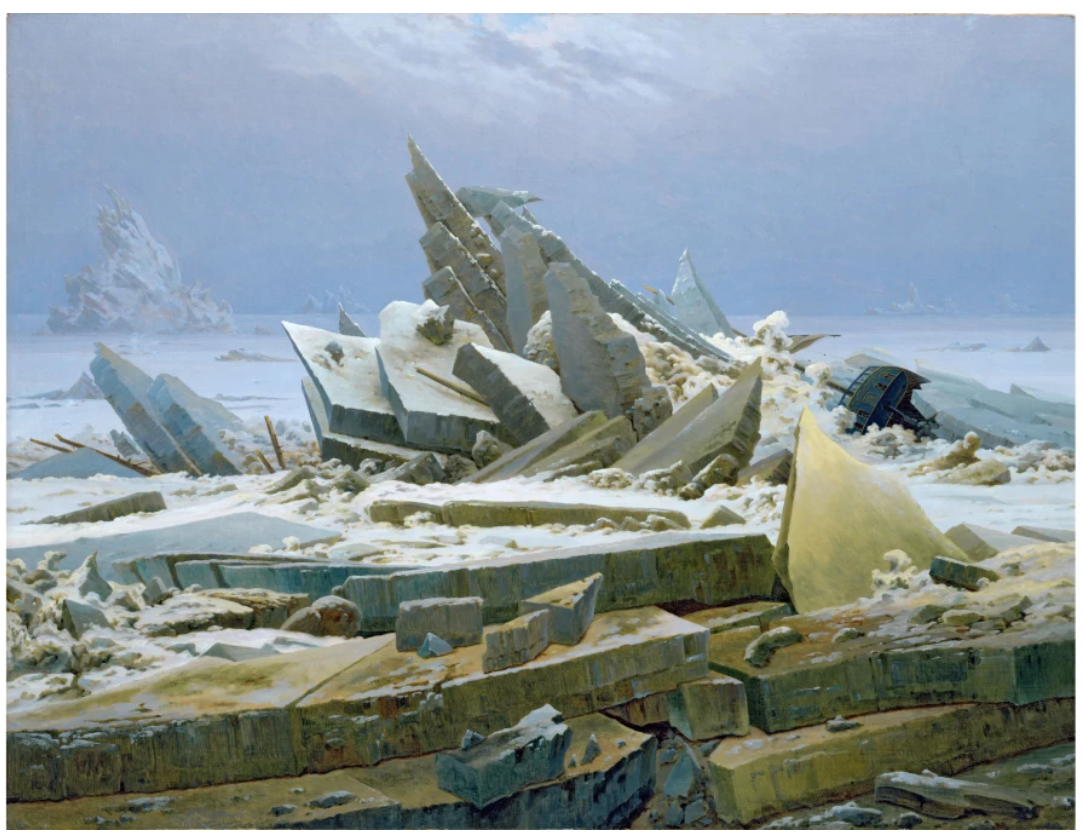
Casper David Friedrich, The Polar Sea, 1824. Hamburger Kunsthalle. Image © Bridgeman Images
Through this process, Richter expands the traditional understanding of visualization and representation. The layered transformation from nature, to photograph, to reproduced image, to paintings reveals a complex path between reality and its pictorial construction. In Gebirge, this multi-stage abstraction underlies the work’s existence on canvas, transforming a borrowed image into a meditation on perception, memory, and representation. Unlike his artistic predecessors, Richter’s engagement with landscape was not intended to communicate a fixed message or moral to the viewer. Instead, the artist’s work both responds to and subverts the conventions of German Romantic landscape painters, such as Caspar David Friedrich, who sought to imbue the natural world with spiritual and religious significance.
“I don’t believe in the absolute picture. There can only be approximations, experiments and beginnings, over and over again.”
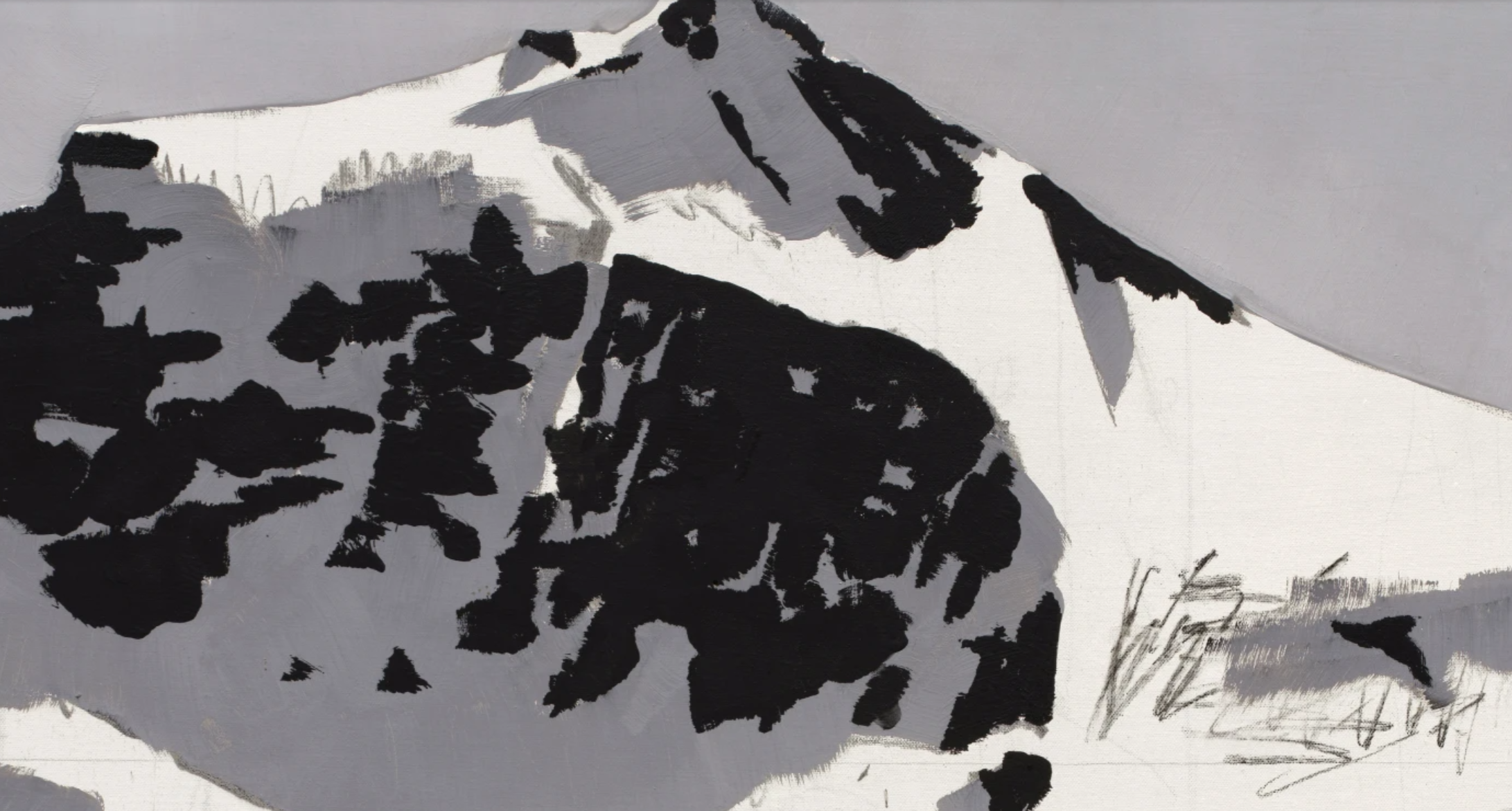
Richter’s approach retains the historical resonance of the landscape tradition while challenging its capacity to convey a singular, predetermined meaning. Using only white, grey, and black, Richter is able to create a dimensional and atmospheric depiction of a mountain scene. His meticulous articulation of light and shadow creates an image of striking immediacy, transporting the viewer to this vast, frozen expanse. The composition’s forced perspective further magnifies the mountain’s imposing presence. Its craggy surface, blurred through Richter’s controlled brushwork, occupies the majority of the canvas, leaving only a narrow area of cloudless grey sky along the upper edge of the canvas. The mountain’s peak nearly touches the top of the composition, and the tightly cropped perspective gives the impression of a boundless, monumental terrain.
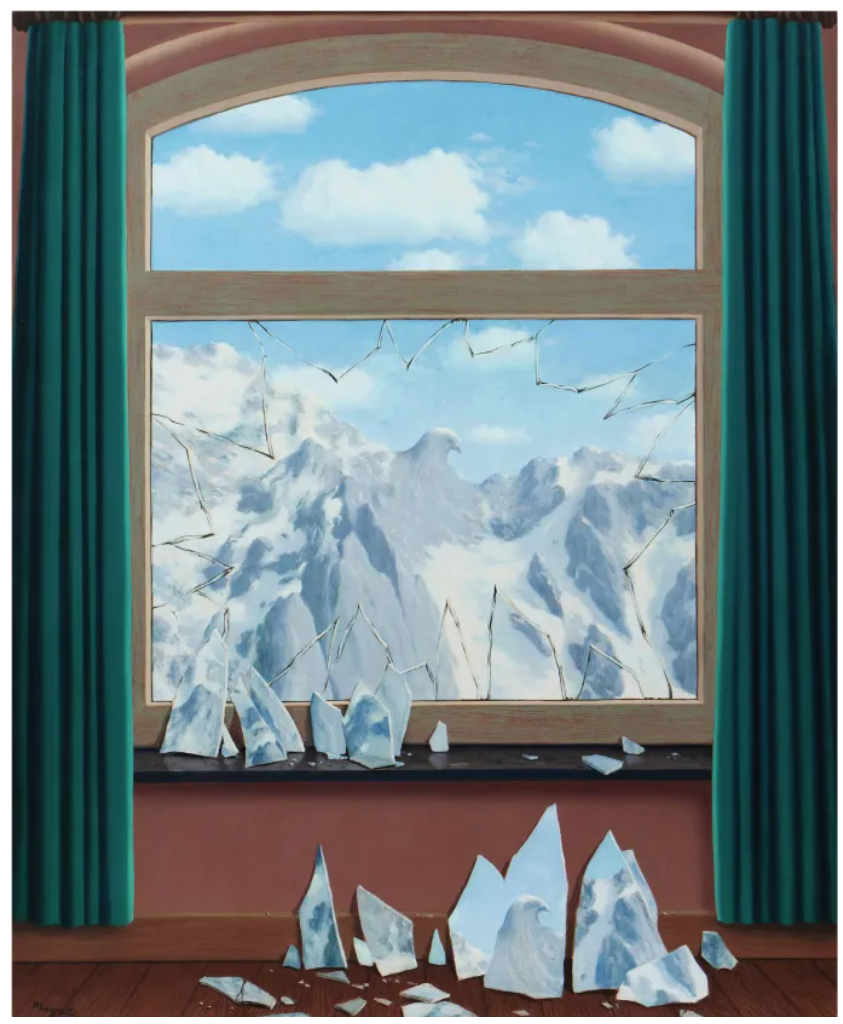
René Magritte, Le Domaine d’Arnheim, 1949. Private Collection. Sold at Sotheby’s New York in May 2023 for $19 million. Art © 2026 C. Herscovici, Brussels / Artists Rights Society (ARS), New York
Richter’s exceptional ability to simultaneously replicate and abstract his source material shines in Gebirge. The painting unmistakably recalls the photographic image upon which it is based, yet a close examination reveals the artist’s deliberate process of construction. The snowy layer resting atop the mountain’s rocky surface was painted first, with the underlying rock formations carefully added afterward. By reversing the expected order of depiction, Richter demonstrates an extraordinary painterly understanding of visual perception. The artist states, “I don’t believe in the absolute picture. There can only be approximations, experiments and beginnings, over and over again.” (the artist quoted in: Hans Ulrich Obrist, ed., Gerhard Richter: The Daily Practice of Painting, London, 1995, p. 199) An exemplary work from Richter’s earliest exploration of the mountain landscape, Gebirge encapsulates the beginning of a lifelong engagement with the natural world and the possibilities of its representation. As both a significant work within Richter’s oeuvre and a work of the development of Postmodernism, Gebirge challenges traditional notions of originality, authenticity, and perception. Oscillating between recognition and dissolution, Gebirge demonstrates Richter’s investigation into the dynamism of pictorial representation, ultimately reconstructing the very mechanism of vision itself.
Abstraktes Bild, 2000
Abstraktes Bild, 2000
Breaking Ground: The Private Collection of Marian Goodman
Christie’s New-York: 20 November 2026
Estimated: USD 1,000,000 – 1,500,000
THIRD PARTY GUARANTEE
GERHARD RICHTER (B. 1932), Abstraktes Bild | Christie’s
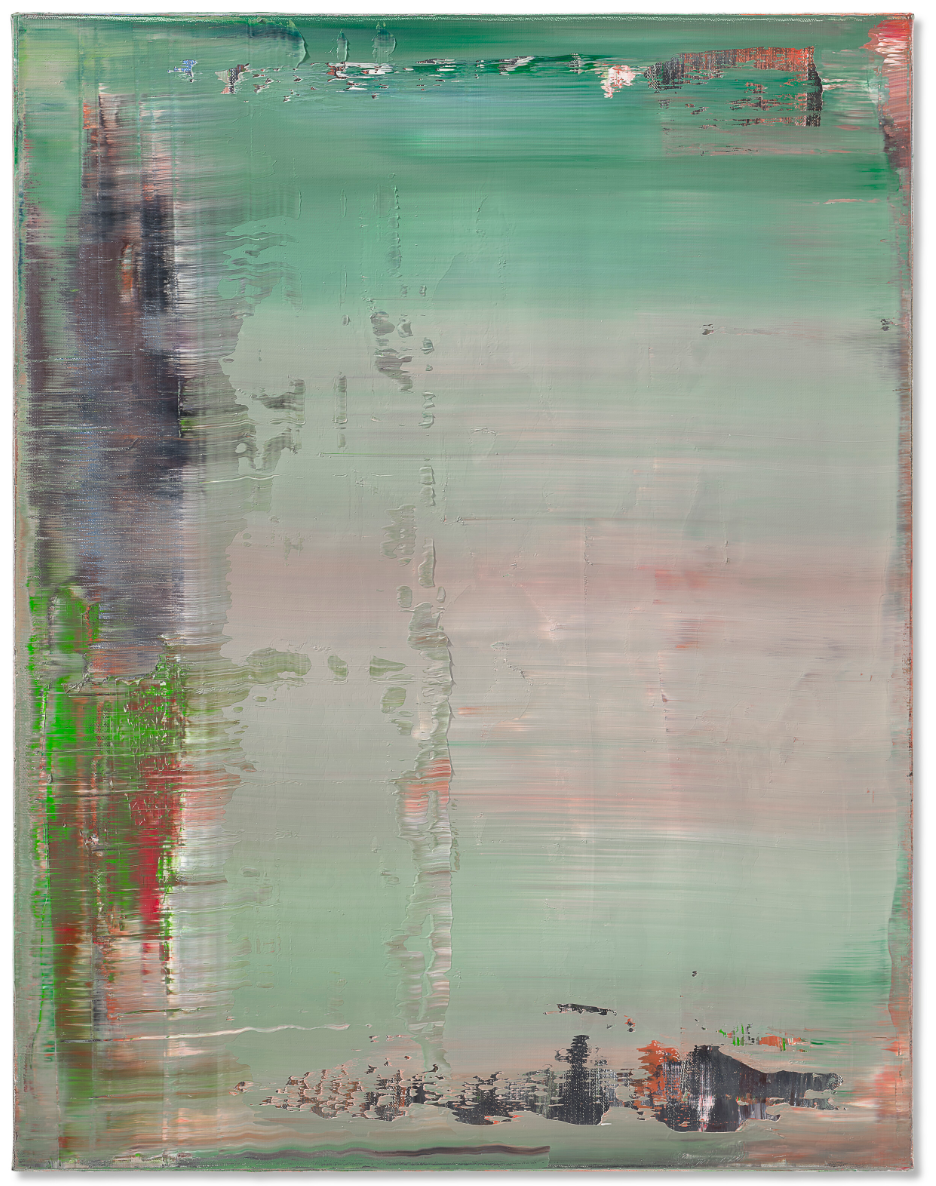
GERHARD RICHTER (B. 1932)
Abstraktes Bild, 2000
Oil on canvas
67 x 52.1 cm (26-3/8 x 20-5/8 inches)
Signed, inscribed and dated ‘864-5 Richter 2000’ (on the reverse)
Inscribed again ‘864-5’ (on the overlap)
Abstraktes Bild is a jewel-like scaled example of what has become Gerhard Richter’s iconic practice of surface handling and represents the artist’s ability to explore issues of chance and the legacy of Abstract Expressionism within an entirely new framework.
Hailing from the innovative series of the same name begun in the 1980s, the present work represents an absolutely new type of non-representational canvas that was born out of the artist’s early experiments with abstract landscapes and color studies.Relinquishing the control that brushes afford, his highly manipulative approach to these dynamic canvases established an intimate dialogue between the artist and the materials themselves.
“With abstract painting we create a better means of approaching what can neither be seen nor understood because abstract painting illustrates with the greatest clarity, that is to say, with all the means at the disposal of art, ‘nothing’ … we allow ourselves to see the unseeable, that which has never before been seen and indeed is not visible.”
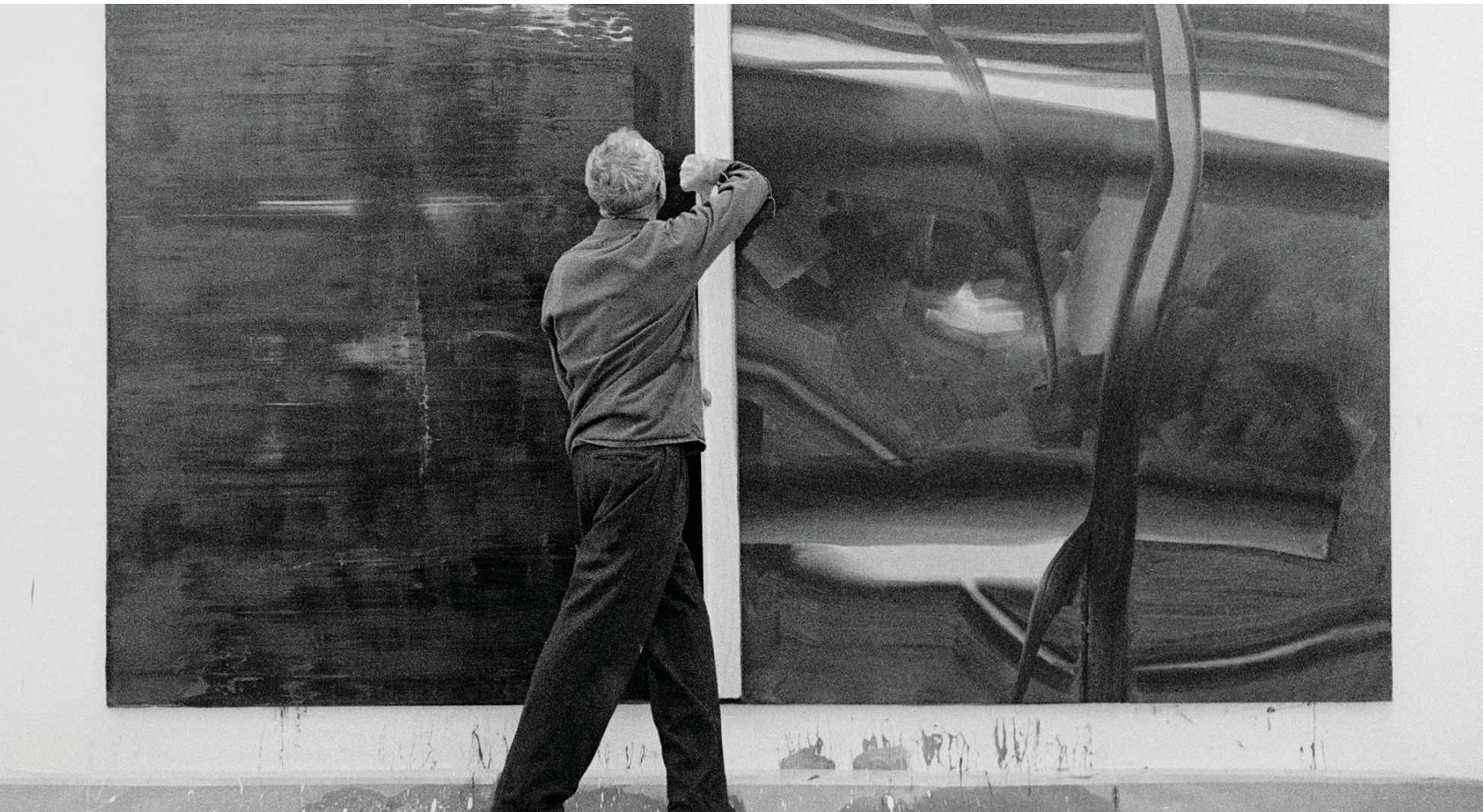
Gerhard Richter in his studio, 1994. Photo: Benjamin Katz. © 2026 Artists Rights Society (ARS), New York / VG Bild-kunst, Bonn.
Artwork: © Gerhard Richter 2026 (02112026).
Held in the personal collection of Marian Goodman, the legendary art dealer and close friend of the artist, for over twenty-five years, it represents not only a fine example of this important series, but also one of the most enduring partnerships in contemporary art.
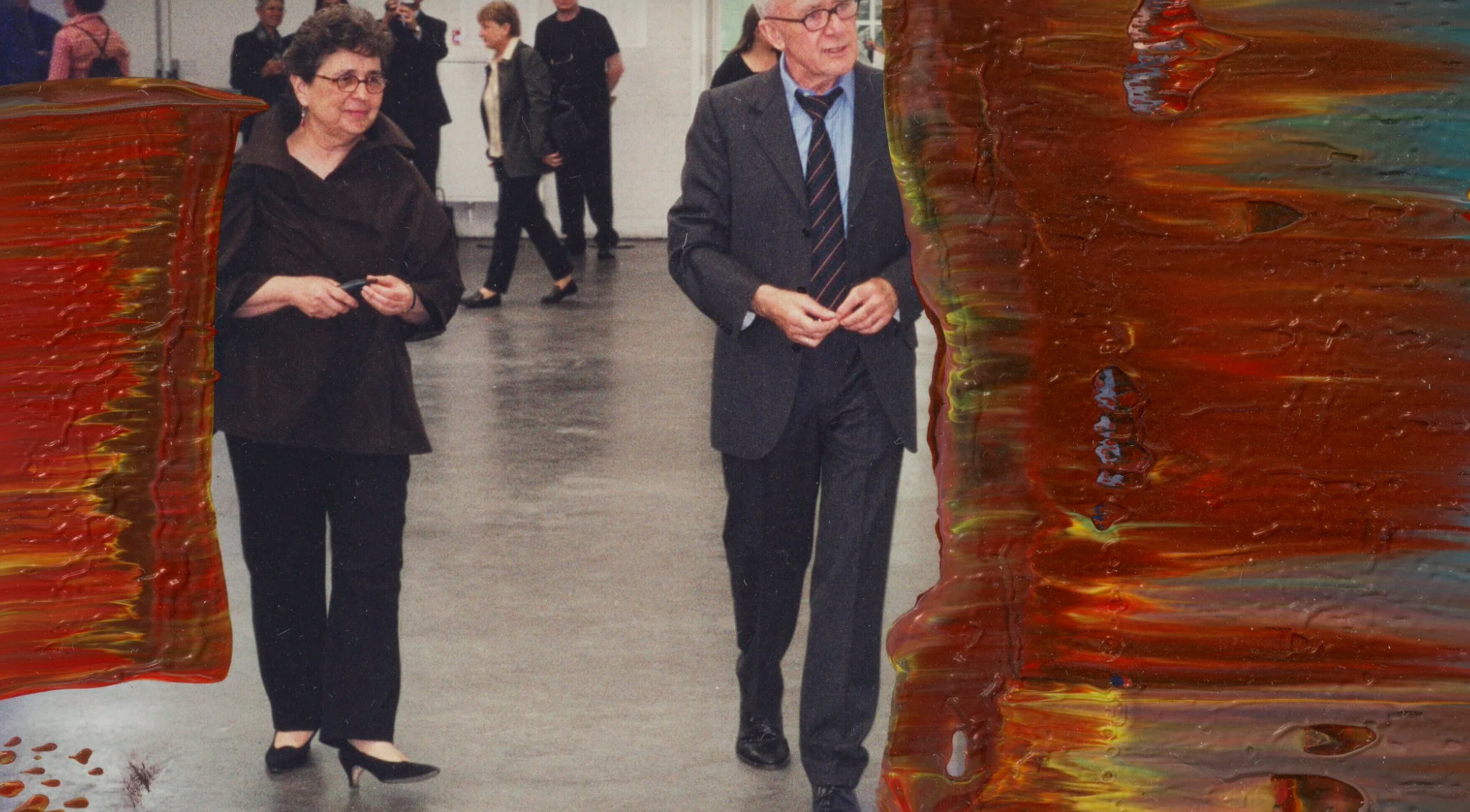
Gerhard Richter, 18. Juni 2009, 2009 (detail). © Gerhard Richter 2026 (02112026).
Richter’s restrained yet complex palette unfolds through a delicate interplay of cool mint green, pale celadon and silvery grey, softened by translucent passages of blush pink and warm ivory. These muted hues establish an atmospheric field in which colour appears to hover between opacity and transparency, at once luminous and elusive. Along the left edge, vertical accumulations of charcoal, deep plum and earthy red introduce a darker counterpoint, their saturated intensity punctuated by flashes of vivid green. Fleeting traces of coral and rust emerge at the upper and lower margins, lending warmth to the otherwise cool tonality, while thin, scraped passages expose underlying layers and interrupt the painting’s horizontal expanses. The resulting chromatic tension between the ethereal central field and the more densely worked edges imbues the canvas with a subtle sense of depth and movement. Neither wholly abstract nor entirely atmospheric, the composition derives its expressive force from the continual negotiation of colour, light and material, as each hue seems to recede beneath or resurface through the successive layers of paint.
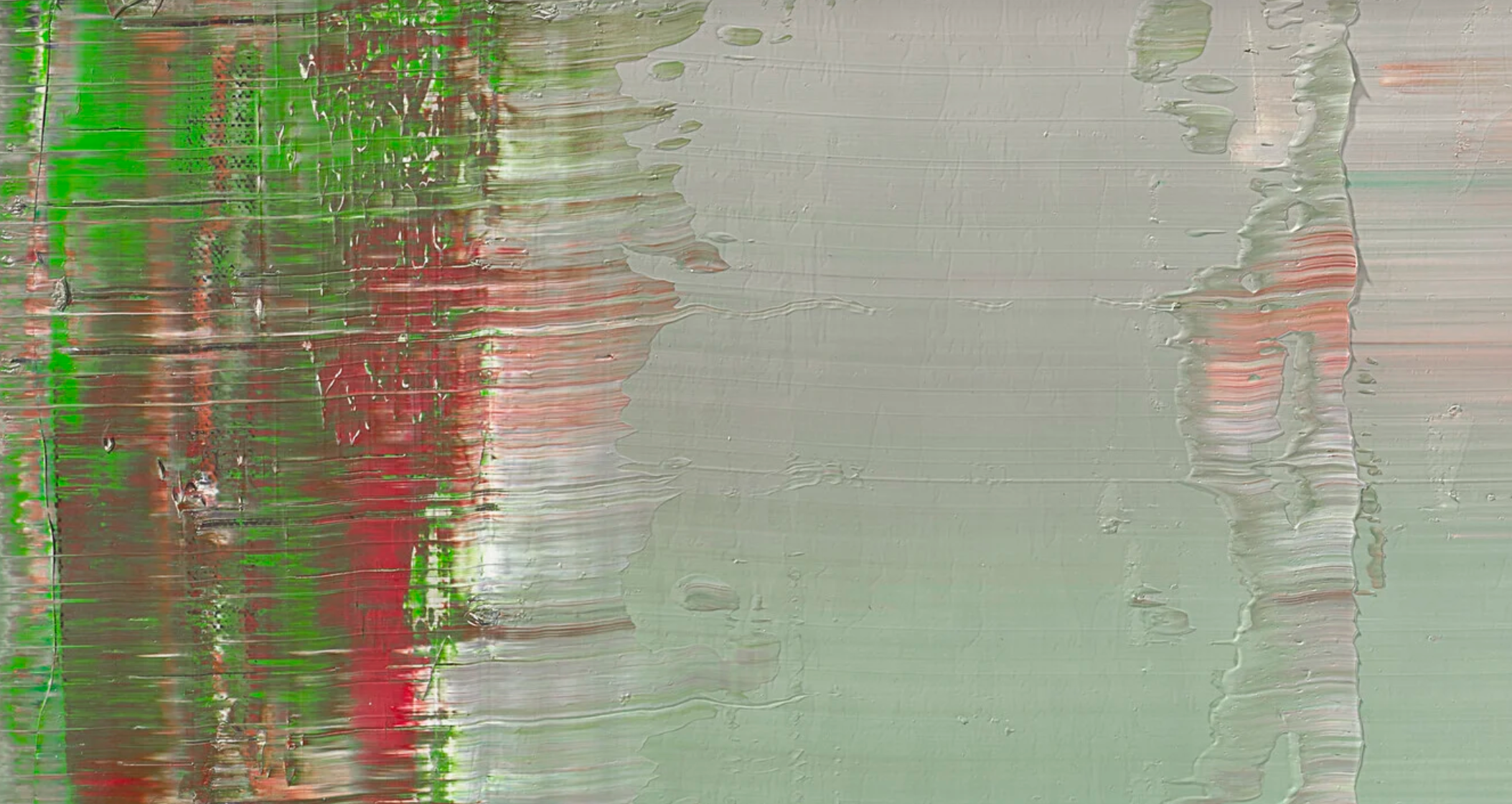
Two faint vertical trails of translucent grey-green paint run through the middle of the canvas, resembling reflections on the surface of still water. The effect is similar to Monet’s late Water Lilies, where the surface of the pond becomes a field of reflected color without a clear horizon. Whereas Monet’s evocations of water emerged from sustained observation of a specific natural environment, Richter’s lines arise not from direct representation but from the contingent effects of his painterly process, as the rigid edge of his chosen implement displaces, drags and redistributes the pigment across the canvas.
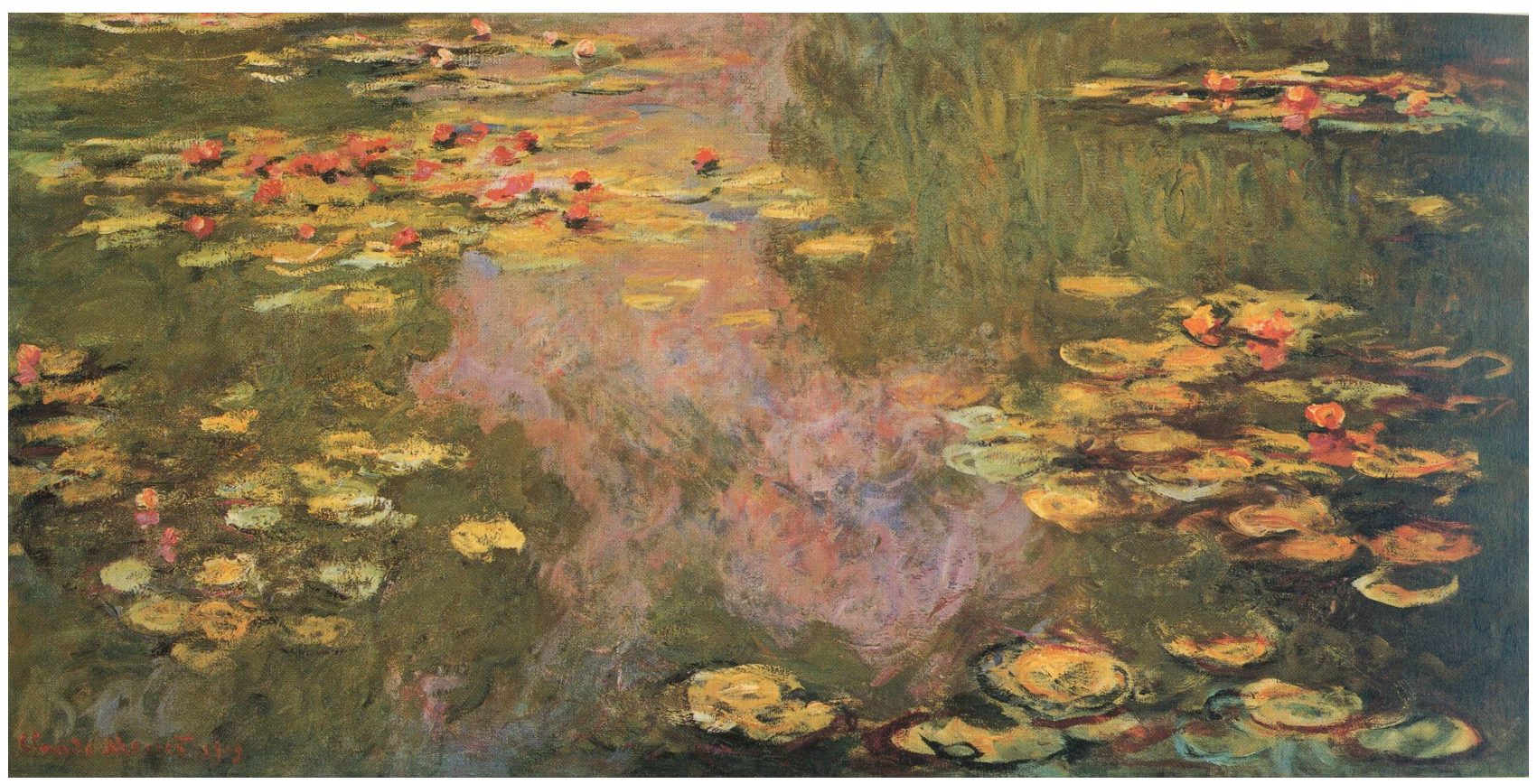
Claude Monet, Water Lilies, 1919. Metropolitan Museum of Art, New York.
This canvas exemplifies Richter’s ability to evoke a sense of aqueous depth, luminosity and spatial recession through the material language of painting alone, as successive layers of pigment are transformed by the measured yet unpredictable action of the squeegee. Its subdued chromatic register and incidental traces reward sustained contemplation, revealing the intricate interplay of concealment and emergence that lies at the heart of his abstract practice. In its synthesis of technical rigor and painterly contingency, the work affirms the enduring significance of the Abstraktes Bild series and its fundamental interrogation of painting’s capacity to generate meaning, atmosphere and illusion without recourse to representation.
Abstraktes Bild, 1999
Abstraktes Bild, 1999
Breaking Ground: The Private Collection of Marian Goodman
Christie’s New-York: 20 November 2026
Estimated: USD 700,000 – 1,000,000
THIRD PARTY GUARANTEE
GERHARD RICHTER (B. 1932), Abstraktes Bild | Christie’s
GERHARD RICHTER (B. 1932)
Abstraktes Bild, 1999
Oil on canvas
55.9 x 50,8 cm (22×20 inches)
Signed, inscribed and dated ‘861-3 Richter 1999’ (on the reverse)
erhard Richter’s Abstraktes Bilder stand among the most influential achievements of postwar painting. The series embodies the artist’s lifelong journey into capturing and depicting chance, control, and the limits of representation. Richter initiated the series in the 1970s and developed his works over the following decades. These abstractions are created through layering different colors of paint and then Richter drags a squeegee across the canvas, where he blends, reveals, and then conceals the colors.
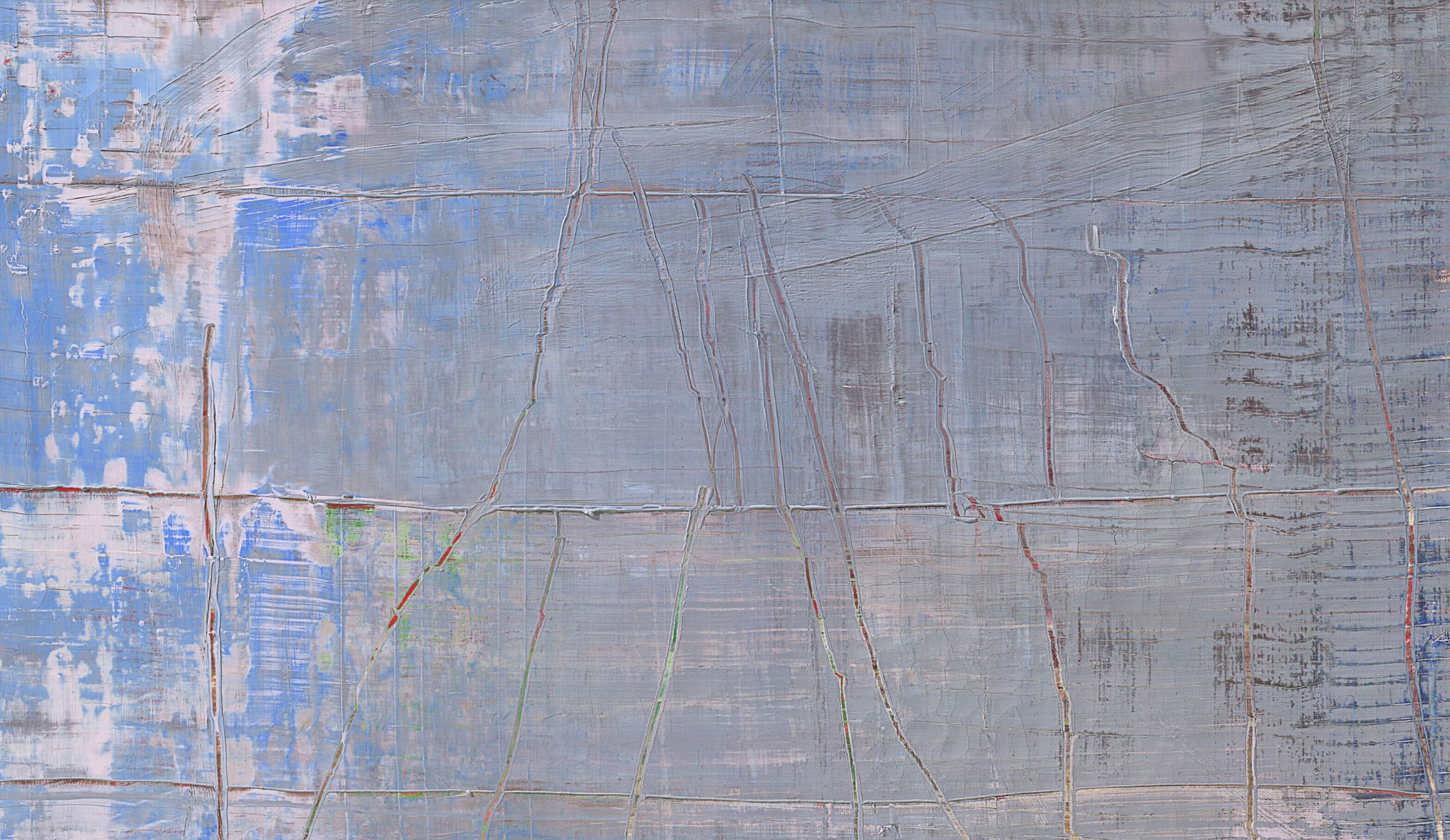
Richter orchestrates a restrained yet richly modulated palette in which cool slate grey forms the dominant chromatic field, animated by luminous passages of cerulean, powder blue and silvery white that emerge through successive layers of scraped pigment. The expansive grey surface is neither uniform nor static; instead, it is inflected with subtle shifts of lavender, taupe and warm ash, creating an atmosphere of remarkable depth and optical complexity. Thus, Richter transforms his painting into a site of perpetual visual discovery, where each squeegee mark or scrape of paint that creates a surface that alternates between depth and flatness, order and unpredictability. The work exemplifies Richter’s ability to push abstraction beyond pure composition, creating a painting that is simultaneously intellectually and visually compelling.
Portrait Luntz, 1965
Portrait Luntz, 1965
Vision: The Extraordinary Collection of Theodore and Ruth Baum
Sotheby’s New-York: 17 November 2026
Estimated: USD 700,000 – 900,000
Gerhard Richter | Portrait Luntz | Vision: The Extraordinary
GERHARD RICHTER (b. 1932)
Portrait Luntz, 1965
Oil on canvas
50.2 x 40 cm (19-3/4 x 15-3/4 inches)
Signed and dated 65 (on the reverse)
Executed in 1965, Portrait Luntz is an early example of Gerhard Richter’s Photo Paintings, the body of work on which his reputation was founded. By painting from a photograph rather than from life, Richter set aside the traditional process of portraiture and gave his canvas the objectivity associated with the photographic medium. The sitter’s pale face stands out against the black of his hair and shirt and the even grey of the background. Richter renders the brows and eyes with particular firmness, so the gaze stays direct even as the contours around it soften. The present work was acquired by the sitter from the Düsseldorf gallery of Alfred Schmela. It was Schmela who prompted Richter to take portrait commissions, a natural continuation of the photographic source material he had used since 1962, and the artist went on to paint numerous dealers and collectors.
“A portrait must not express anything of the sitter’s ‘soul’, essence or character. For this reason, among others, it is far better to paint a portrait from a photograph, because no one can ever paint a specific person.”
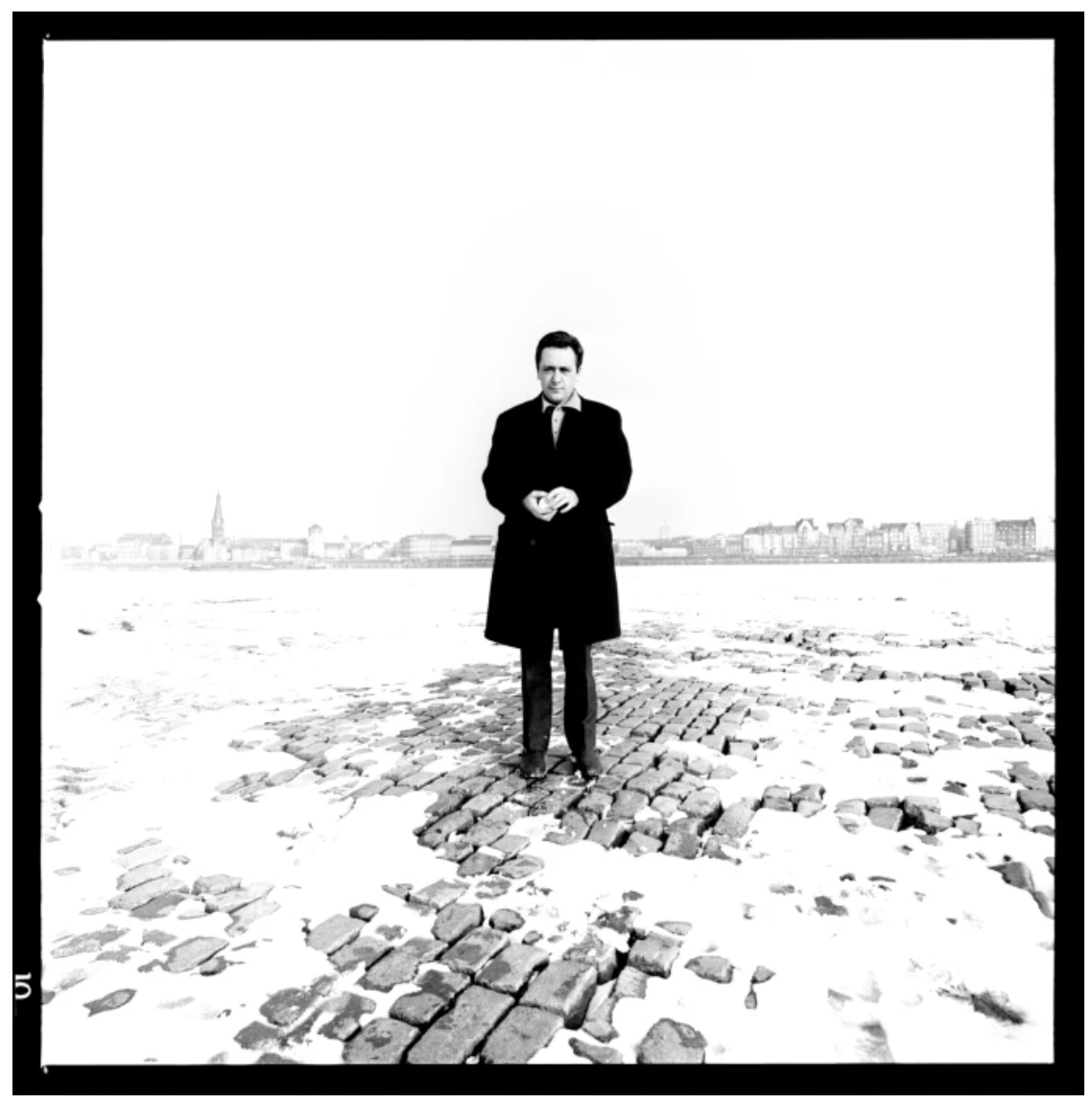
Richter created his first Photo Painting, Tisch, in 1962. He drew on press images and family photographs, material he would later compile in his Atlas. In the enlarged photograph rendered in oil he found a device for exposing the illusory nature of both photography’s and painting’s claims to verisimilitude. In Tisch, the sharply defined form of the table is complicated by fluid overpainting, a combination of approaches developed with far greater refinement in the present work. Retaining something of the quality of the photograph, Richter’s painterly translations establish a kind of visual equivalence, and the blur allows him “to make everything equally important and equally unimportant” (Gerhard Richter, Gerhard Richter: Writings, Interviews and Letters 1961 – 2007, London, 2009, p. 33). Oscillating between figuration and abstraction, these paintings undo the descriptive qualities conventionally associated with Realism, emphasising instead the inscrutable nature of reality itself.
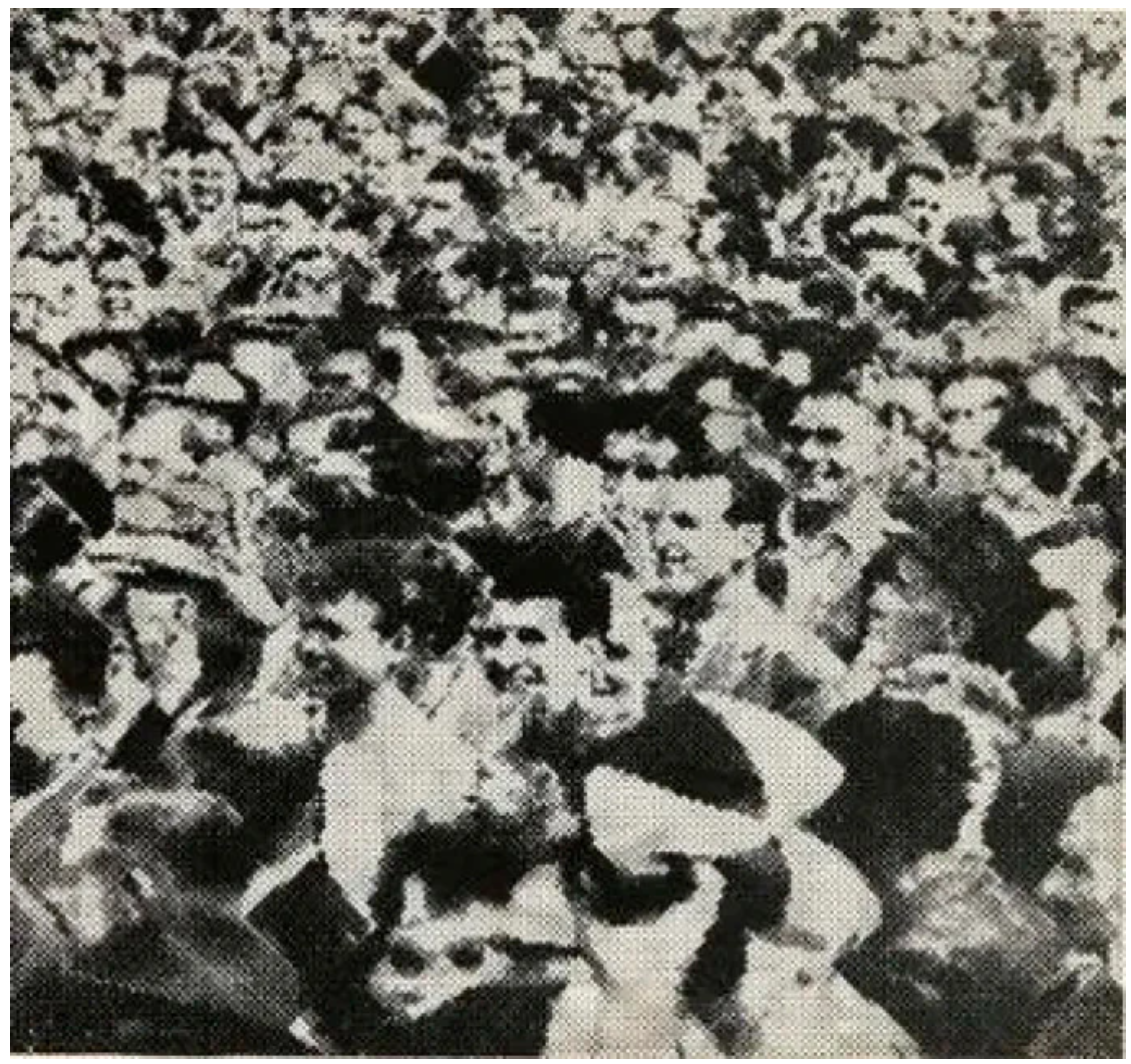
Sigmar Polke, Menschenmenge, 1969, Kunstmuseum Bonn. Image © Reni Hansen – ARTOTHEK. Art © 2026 Estate of Sigmar Polke / Artists Rights Society (ARS), New York / VG Bild-Kunst, Bonn, German
The blur defines these paintings. Richter worked a soft brush across the wet surface, leaving the image slightly out of focus and removing almost every trace of his hand. As Margrit Behm observes, “In a formal sense the technique is employed to create distance between reality and painting; in terms of content, it is the expression of a painter’s doubt about the possibility of really saying anything about reality” (Margrit Behm, ‘The Constitution of Visual Truth During Painting’, in: Jochen Poetter, ed., Richter, Polke, Rainer, Baden-Baden 1996, p. 51). Wavering between clarity and obscurity, the blurred image offered Richter “an opportunity to express the fleetingness of our ability to perceive” (Richard Calvocoressi, ‘Young Gerd’, Gagosian Quarterly, Spring 2020, online).
 In the wake of the Second World War, it was a significant position to take in relation to visual culture, and one that reflects on the fragility of memory itself. Such restraint carried weight for an artist trained in Dresden under the dogma of Socialist Realism. After emigrating to West Germany in 1961, Richter joined Sigmar Polke in championing Kapitalistischer Realismus (Capitalist Realism), which used popular imagery to examine how ideology could be presented as reality on both sides of the Iron Curtain. In Portrait Luntz he brings the same detachment to a commissioned likeness, declining to flatter or interpret his sitter.
The approach found its fullest expression in 48 Portraits, shown in the German Pavilion when Richter represented Germany at the 1972 Venice Biennale. From an initial selection of 270 encyclopaedia photographs of writers, composers, scientists and philosophers, he chose forty-eight, among them Albert Einstein, Pyotr Ilyich Tchaikovsky, Oscar Wilde and Franz Kafka. He painted each in the same format and hung them in a single row, their gazes turned outward from the centre, in an arrangement that evoked a mausoleum. Richter wanted these figures to become anonymous, their literary and intellectual weight cancelled by the painting (Gerhard Richter quoted in: Exh. Cat., New York, The Museum of Modern Art (and travelling), Gerhard Richter: Forty Years of Painting, 2002, p. 63). Portrait Luntz anticipates that ambition by seven years. Painted from a photograph of a living man known to the artist, it holds its sitter at the same measured distance and marks an early stage in Richter’s lifelong enquiry into what a painted image can claim to know.