Fall 2026 New-York Marquee Auctions
George Condo
Upcoming Lots
Big Face, 2015
Bonhams New-York: 18 November 2026
Estimated: USD 2,800,000 – 3,500,000
Bonhams : GEORGE CONDO (B.1957) Big Face 78 x 74 in (198 x 188 cm) (Painted in 2015)
GEORGE CONDO (B.1957)
Big Face, 2015
Oil on linen
78×74 inches (198×188 cm)
Signed and dated ‘Condo 2015’ (upper left)
Signed and dated again (on the overlap)
Double Heads on Blue and Silver, 2014
Property from the Edlis Neeson Foundation to support art and cultural initiatives
Christie’s New-York: 19 November 2026
Estimated: USD 2,500,000 – 3,500,000
MINIMUM PRICE GUARANTEE
GEORGE CONDO (B. 1957), Double Heads on Blue and Silver | Christie’s
GEORGE CONDO (B. 1957)
Double Heads on Blue and Silver, 2014
Acrylic, metallic paint, charcoal and pastel on linen
78×110 inches (198.1 x 279.4 cm)
Signed and dated ‘Condo 2014’ (on the reverse)
Signed and dated again ‘Condo 2014’ (on the stretcher)
Untitled, 2018
Christie’s New-York: 20 November 2026
Estimated: USD 1,000,000 – 1,500,000
GEORGE CONDO (B. 1957), Untitled | Christie’s
GEORGE CONDO (B. 1957)
Untitled, 2018
Oil, acrylic, pigment stick and pastel on linen
52×45 inches (132.2 x 114.2 cm)
Signed and dated ‘Condo 2018’ (upper left)
Hemazoids, 2009
Sotheby’s New-York: 17 November 2026
Estimated: USD 800,000 – 1,200,000
GUARANTEED PROPERTY
George Condo | Hemazoids | Contemporary Day Auction | 2026 | Sotheby’s
GEORGE CONDO (b. 1957)
Hemazoids, 2009
Oil on canvas
85×75 inches (215.9 x 190.5 cm)
Signed, titled and dated 09 (on the reverse)
On the Corner, 2017
The Clive Davis Collection
Christie’s New-York: 20 November 2026
Estimated: USD 800,000 – 1,200,000
WORK ON PAPER
MINIMUM PRICE GUARANTEE
GEORGE CONDO (B. 1957), On the Corner | Christie’s
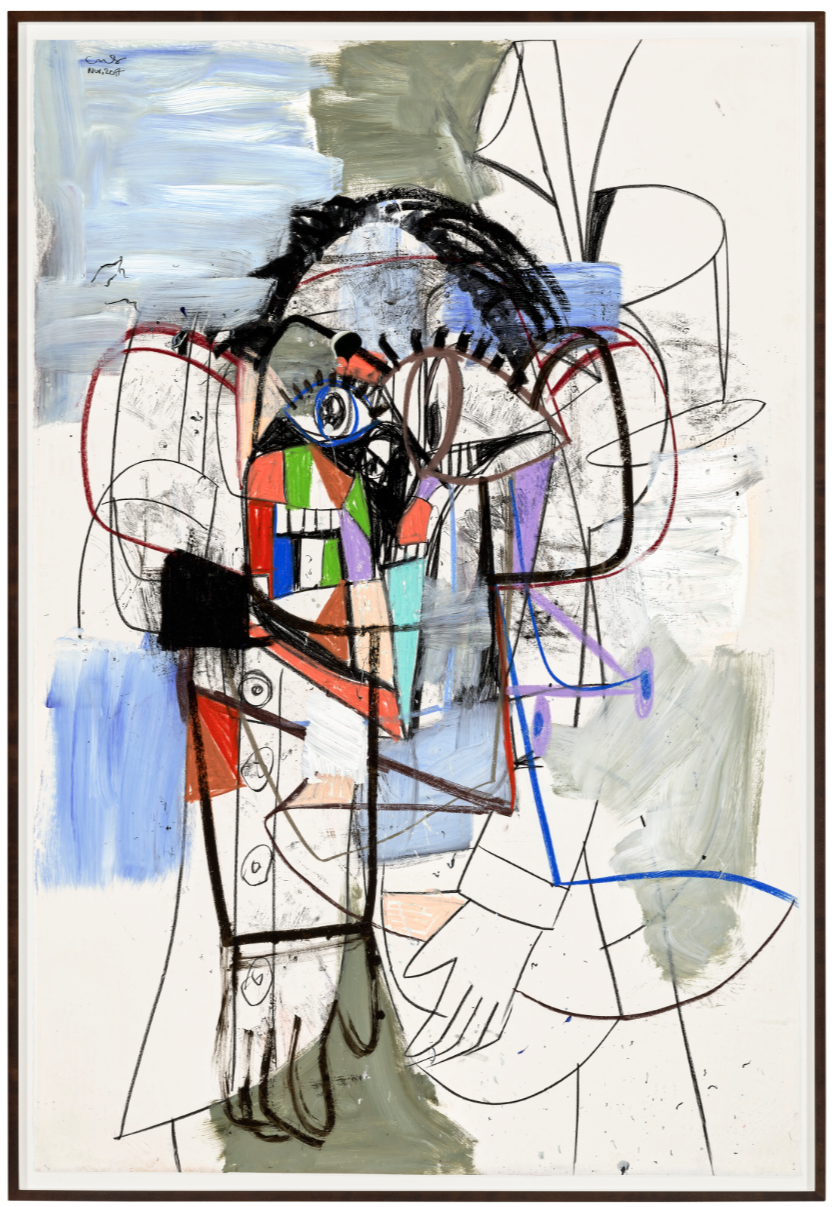
GEORGE CONDO (B. 1957)
On the Corner, 2017
Acrylic, gesso, pigment stick, pastel and charcoal on paper
77-1/2 x 52 inches (196.9 x 132.1 cm)
Signed and dated ‘Condo Nov. 2017’ (upper left)
Sailors and Maidens, 2008
Christie’s New-York: 20 November 2026
Estimated: USD 600,000 – 800,000
WORK ON PAPER
MINIMUM PRICE GUARANTEE
GEORGE CONDO (B. 1957), Sailors and Maidens | Christie’s
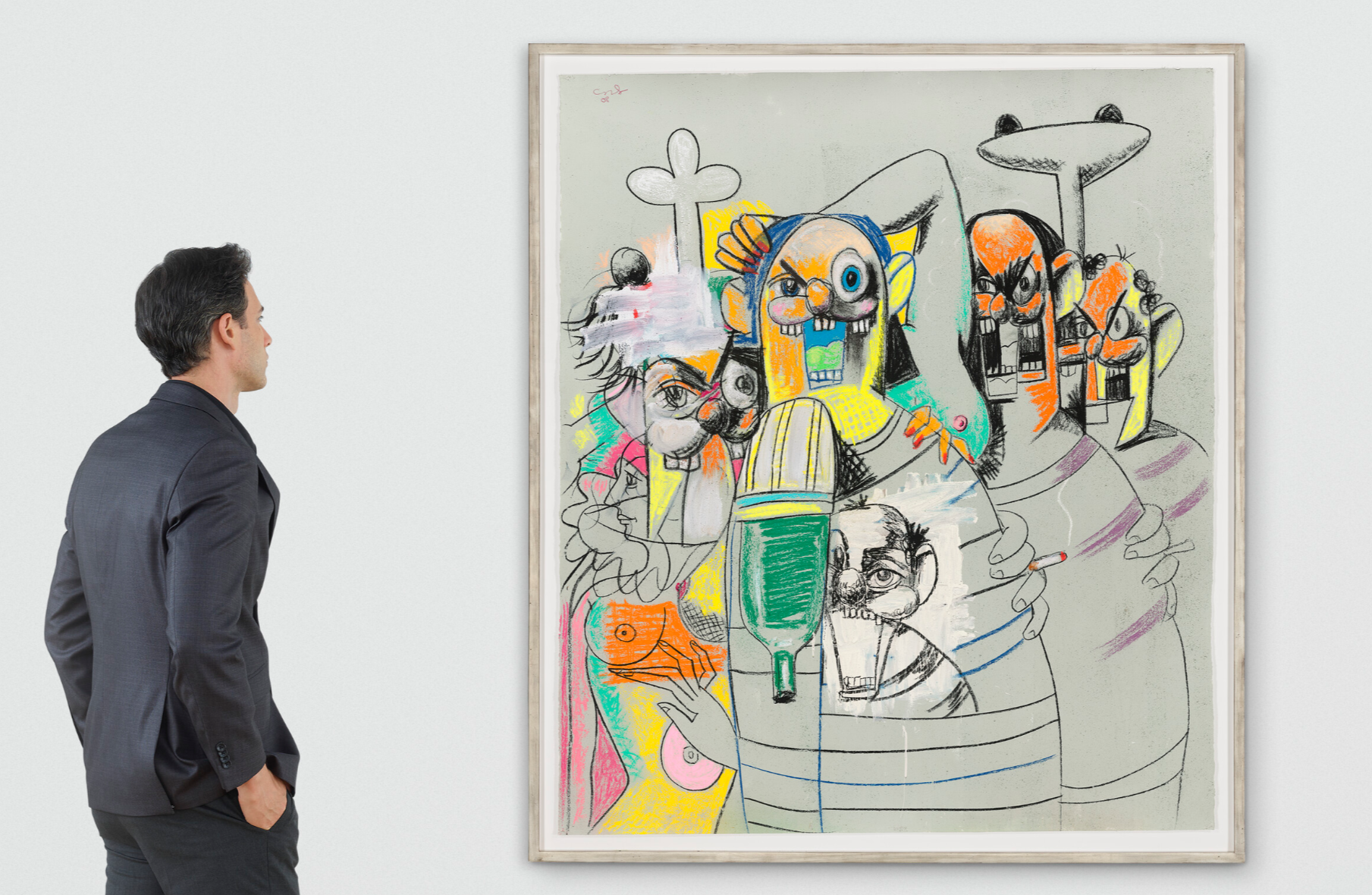
GEORGE CONDO (B. 1957)
Sailors and Maidens, 2008
Acrylic, charcoal, pastel and sand on paper
60 x 51-1/2 inches (152.4 x 130.8 cm)
Signed and dated ‘Condo 08’ (upper left)
Untitled, 2007
The Clive Davis Collection
Christie’s New-York: 20 November 2026
Estimated: USD 500,000 – 700,000
MINIMUM PRICE GUARANTEE
GEORGE CONDO (B. 1957), Untitled | Christie’s
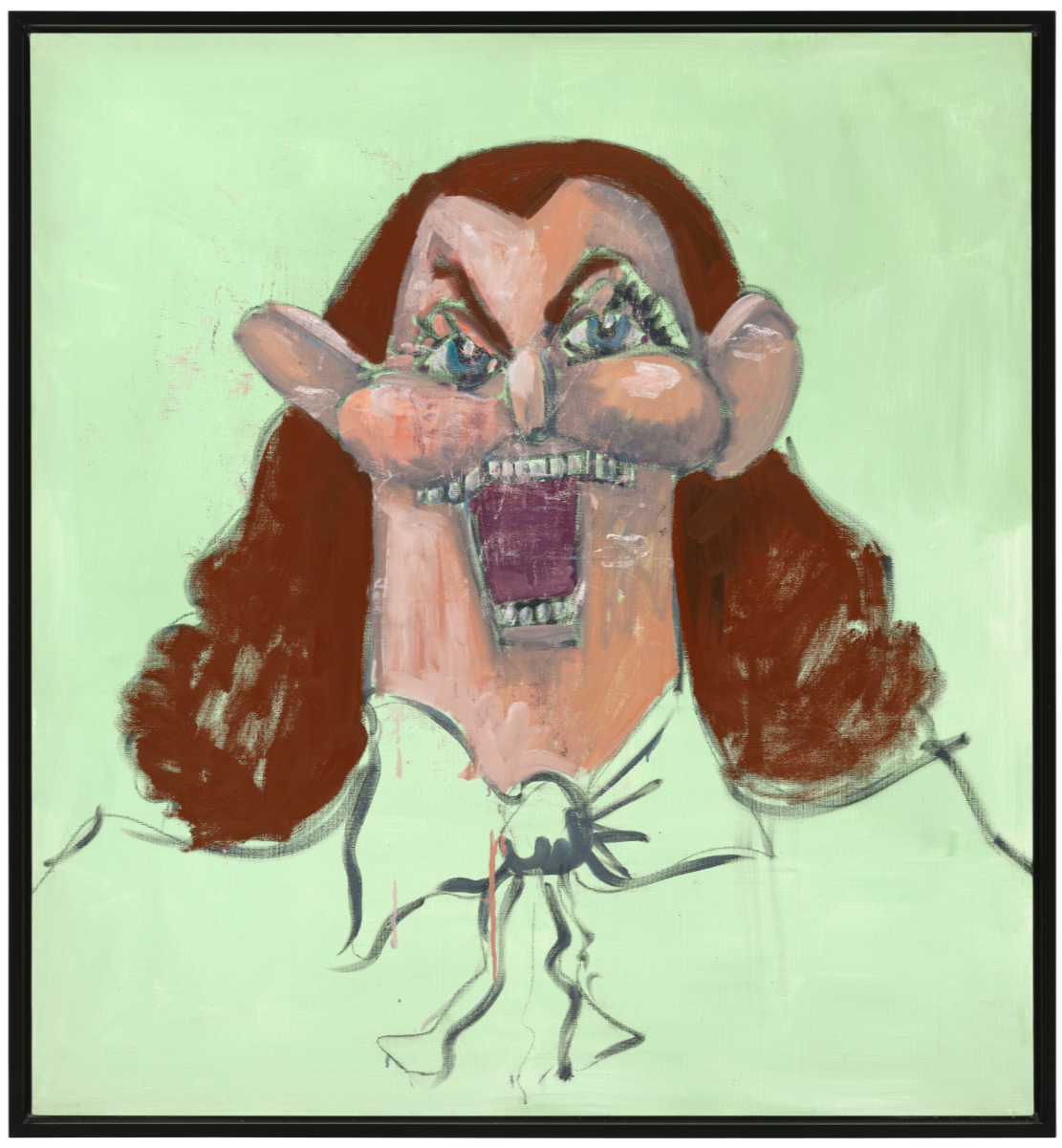
GEORGE CONDO (B. 1957)
Untitled, 2007
Acrylic on canvas
52×48 inches (132.1 x 121.9 cm)
Smiling Woman, 2020
Estimated: USD 400,000 – 600,000
WORK ON PAPER
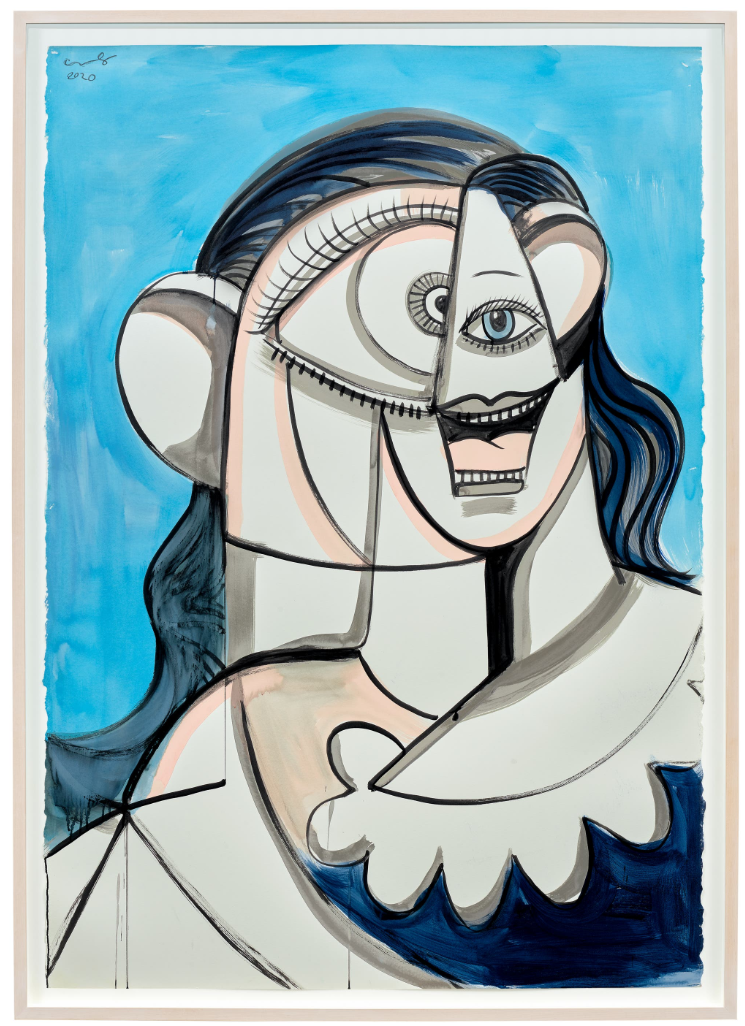
Smiling Woman, 2020
Ink on paper
59-3/4 x 41-1/2 inches (151.8 x 105.4 cm)
Signed and dated “Condo 2020” upper left
Female Composition, 2006
Estimated: USD 400,000 – 600,000

Female Composition, 2006
Oil on canvas
65×60 inches (165.1 x 152.4 cm)
Signed and dated ‘Condo 06’ (on the reverse)
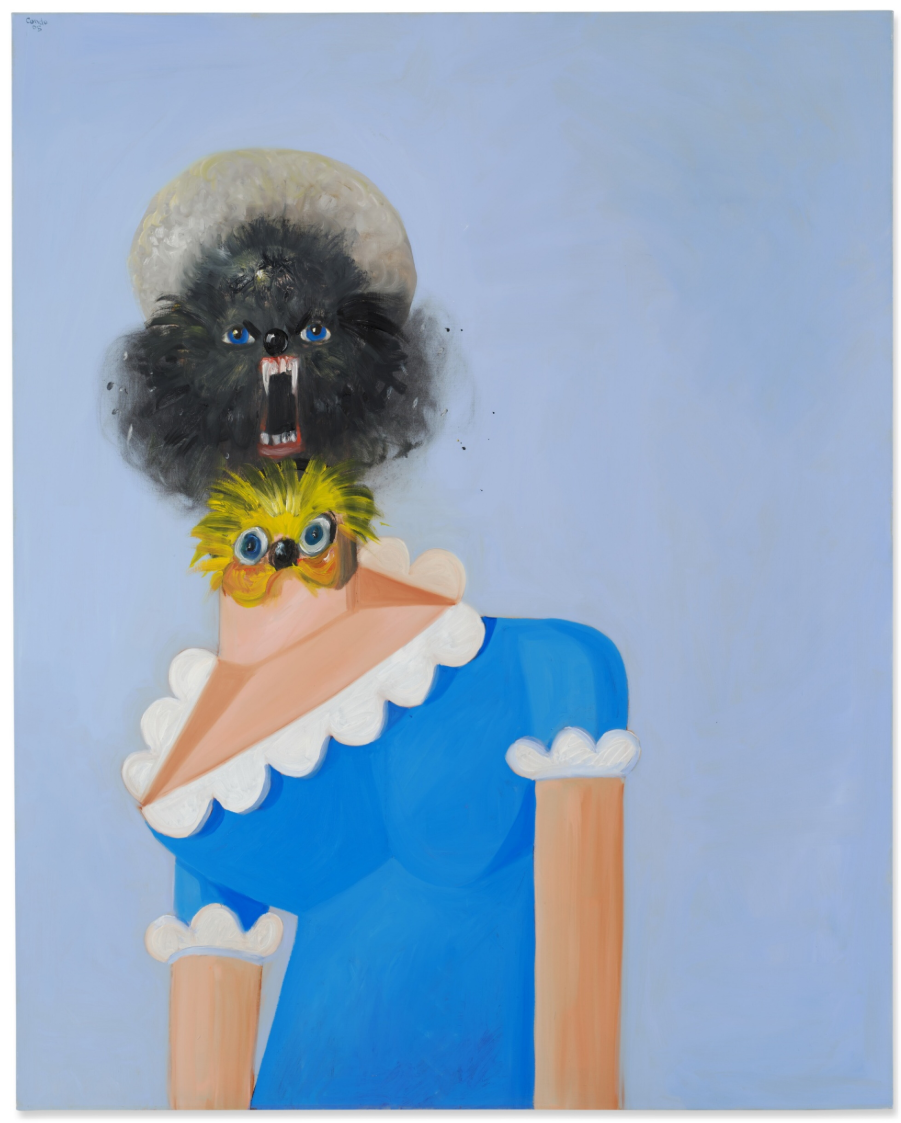
Jean-Louis’ Girlfriend, 2005
Estimated: USD 400,000 – 600,000
GUARANTEED PROPERTY
GEORGE CONDO (b. 1957)
Jean-Louis’ Girlfriend, 2005
Oil on canvas
60×48 inches (152.5 x 122 cm)
Signed and dated 05 (upper left)
Signed, titled and dated 05 (on the reverse)
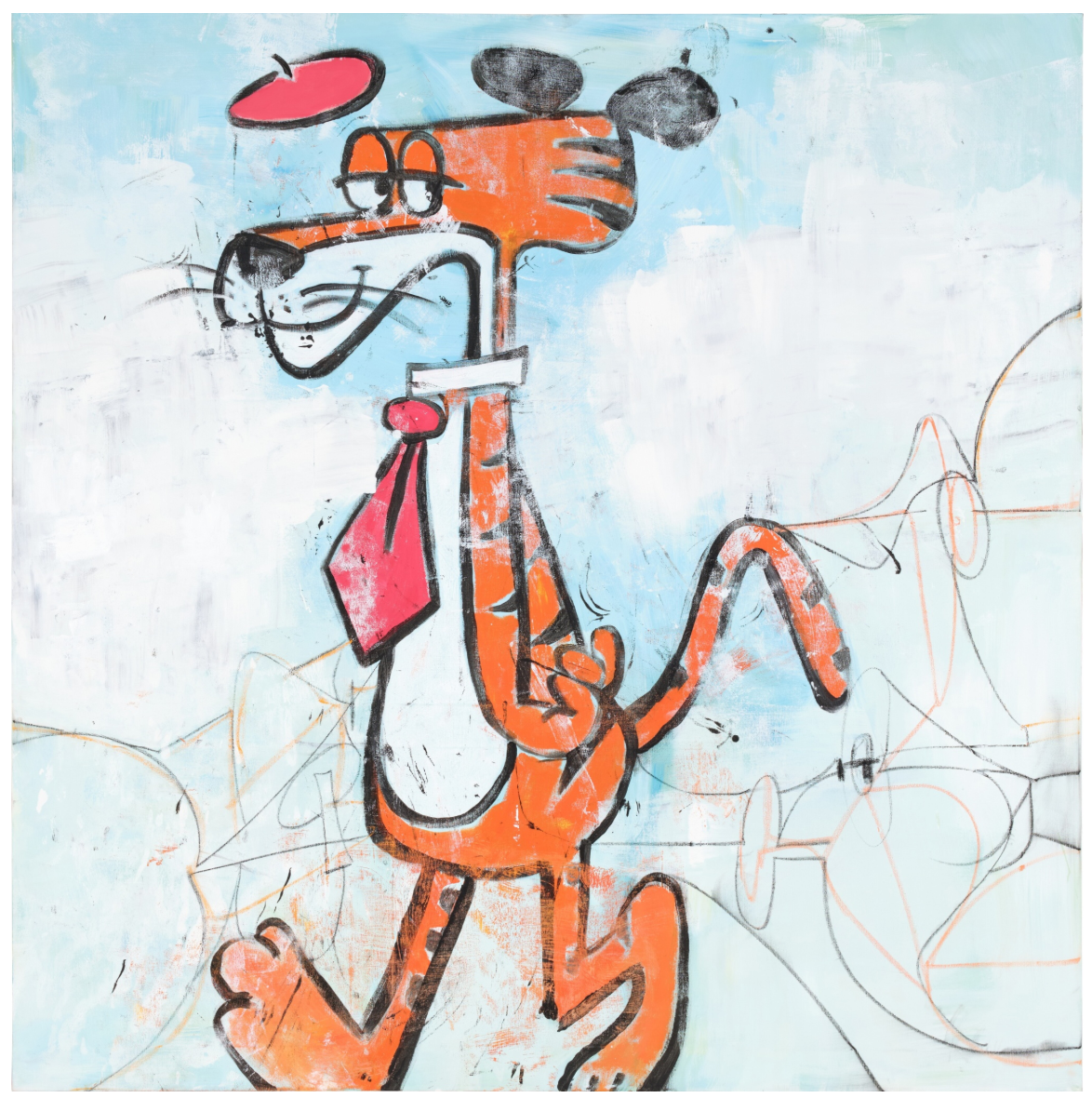
Cool Cat, 2010
Estimated: USD 350,000 – 450,000
GEORGE CONDO (b. 1957)
Cool Cat, 2010
Acrylic and charcoal on canvas
65-1/8 x 65-1/8 inches (165.4 x 165.4 cm)
Signed and dated 2010 (on the reverse)
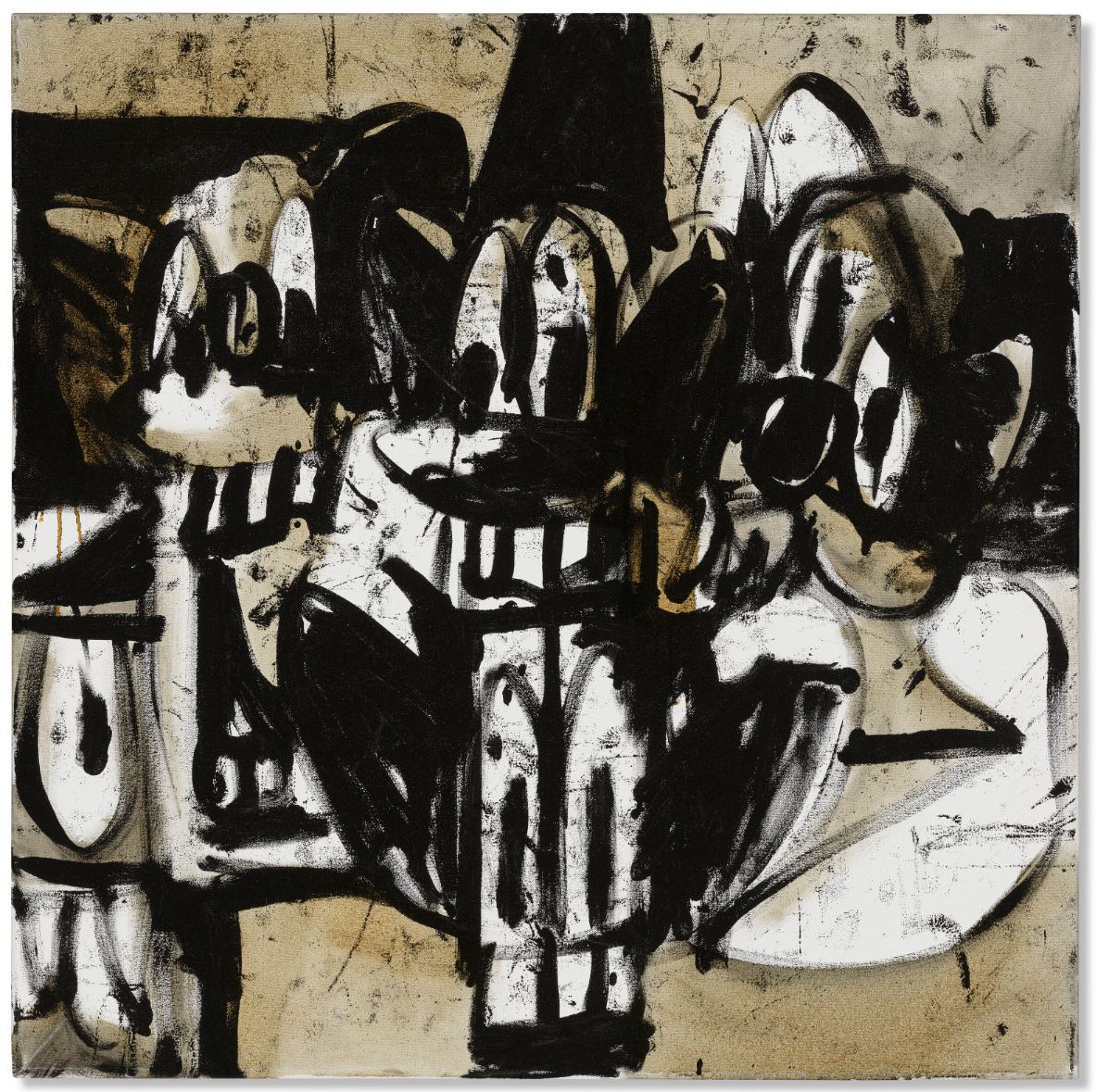
Mental States 2, 2000
Property from a Private New York Collection
Christie’s New-York: 20 November 2026
Estimated: USD 150,000 – 250,000
GEORGE CONDO (B. 1957), Mental States 2 | Christie’s
GEORGE CONDO (B. 1957)
Mental States 2, 2000
Oil and acrylic on canvas
35-3/4 x 36 inches (90.8 x 91.4 cm)
Signed, titled and dated ‘Condo 2000 Mental States 2’ (on the reverse)
Young Girl, 2007
Estimated: USD 150,000 – 200,000
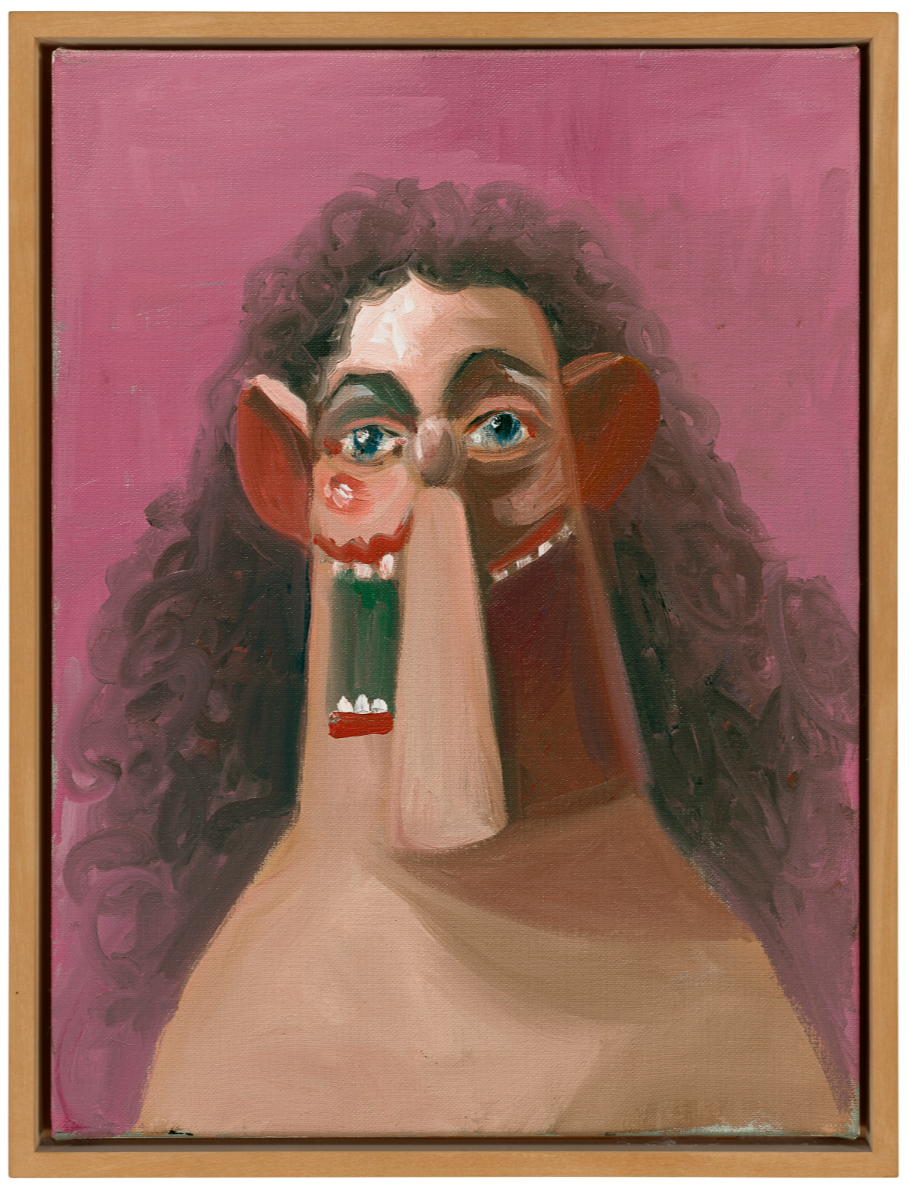
Young Girl, 2007
Oil on canvas
16×12 inches (40.6 x 30.5 cm)
Signed and dated ‘Condo 07’ (on the reverse)
The Liquor Store Attendant, 2012
Christie’s New-York: 20 November 2026
Estimated: USD 100,000 – 150,000
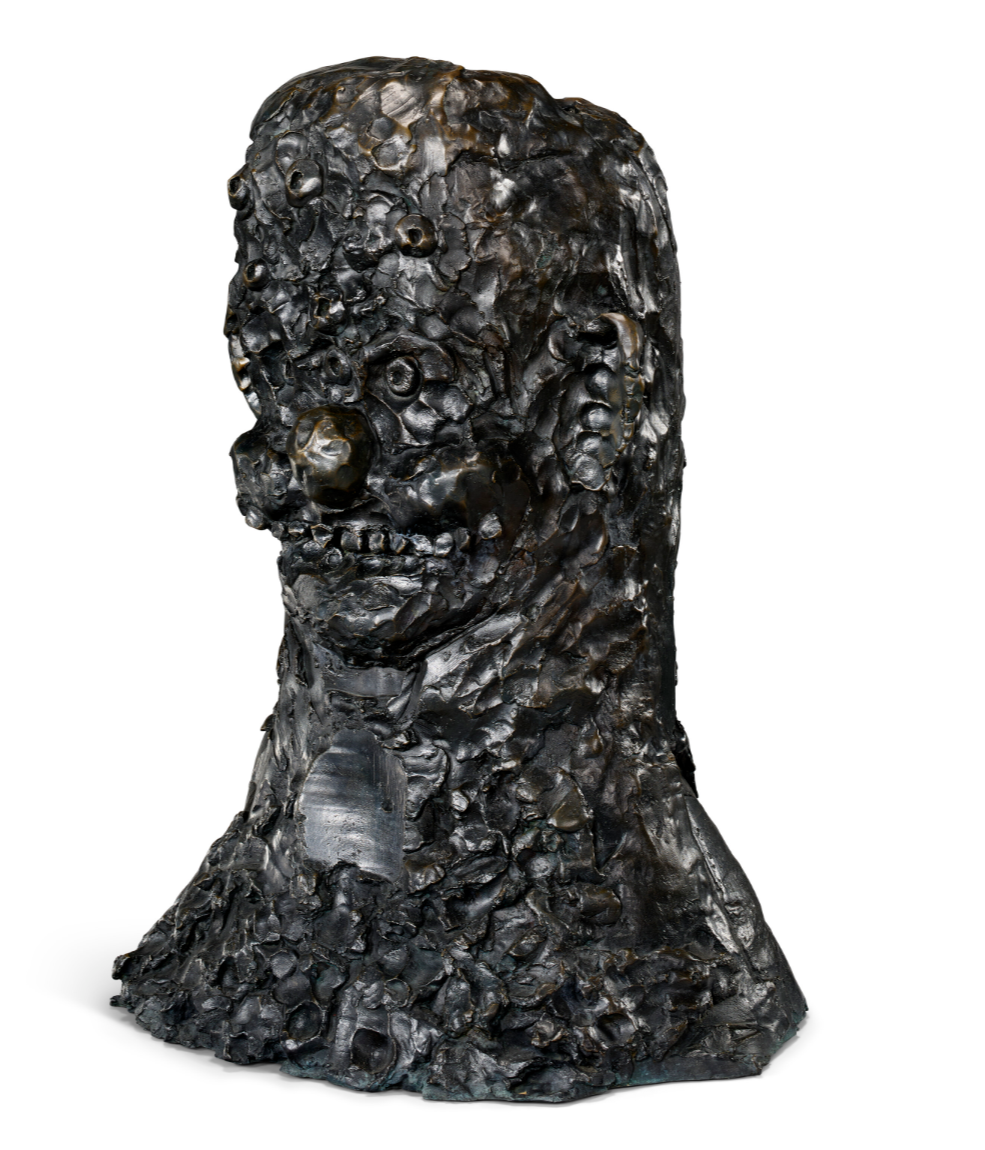
The Liquor Store Attendant, 2012
Patinated bronze
25x19x14 inches (63.5 x 48.3 x 35.6 cm)
Stamped with the artist’s initials, number, date and foundry mark ‘G.C. 1⁄3 2012’ (lower edge)
This work is number one from an edition of three plus one artist’s proof
Big Face, 2015
Big Face, 2015
Bonhams New-York: 18 November 2026
Estimated: USD 2,800,000 – 3,500,000
Bonhams : GEORGE CONDO (B.1957) Big Face 78 x 74 in (198 x 188 cm) (Painted in 2015)
GEORGE CONDO (B.1957)
Big Face, 2015
Oil on linen
78×74 inches (198×188 cm)
Signed and dated ‘Condo 2015’ (upper left)
Signed and dated again (on the overlap)
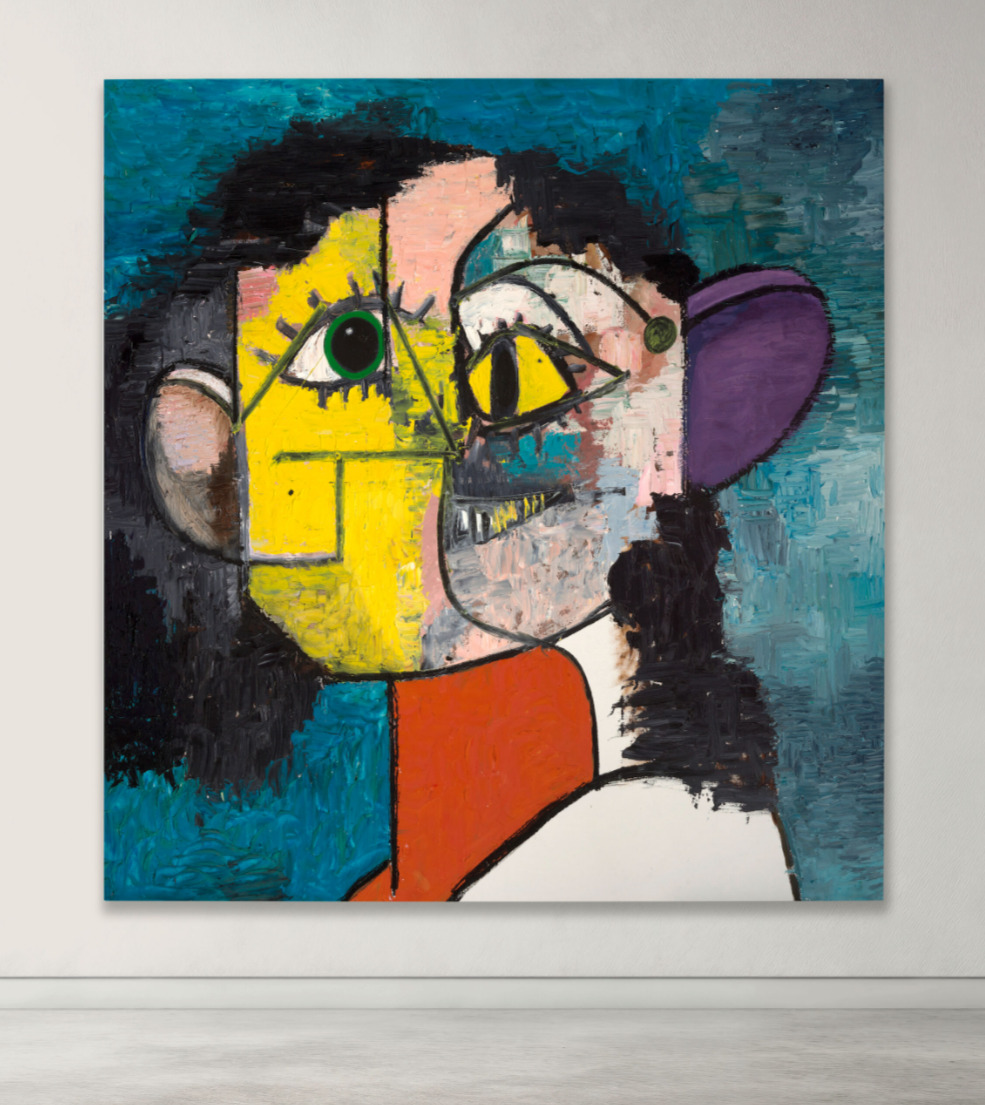
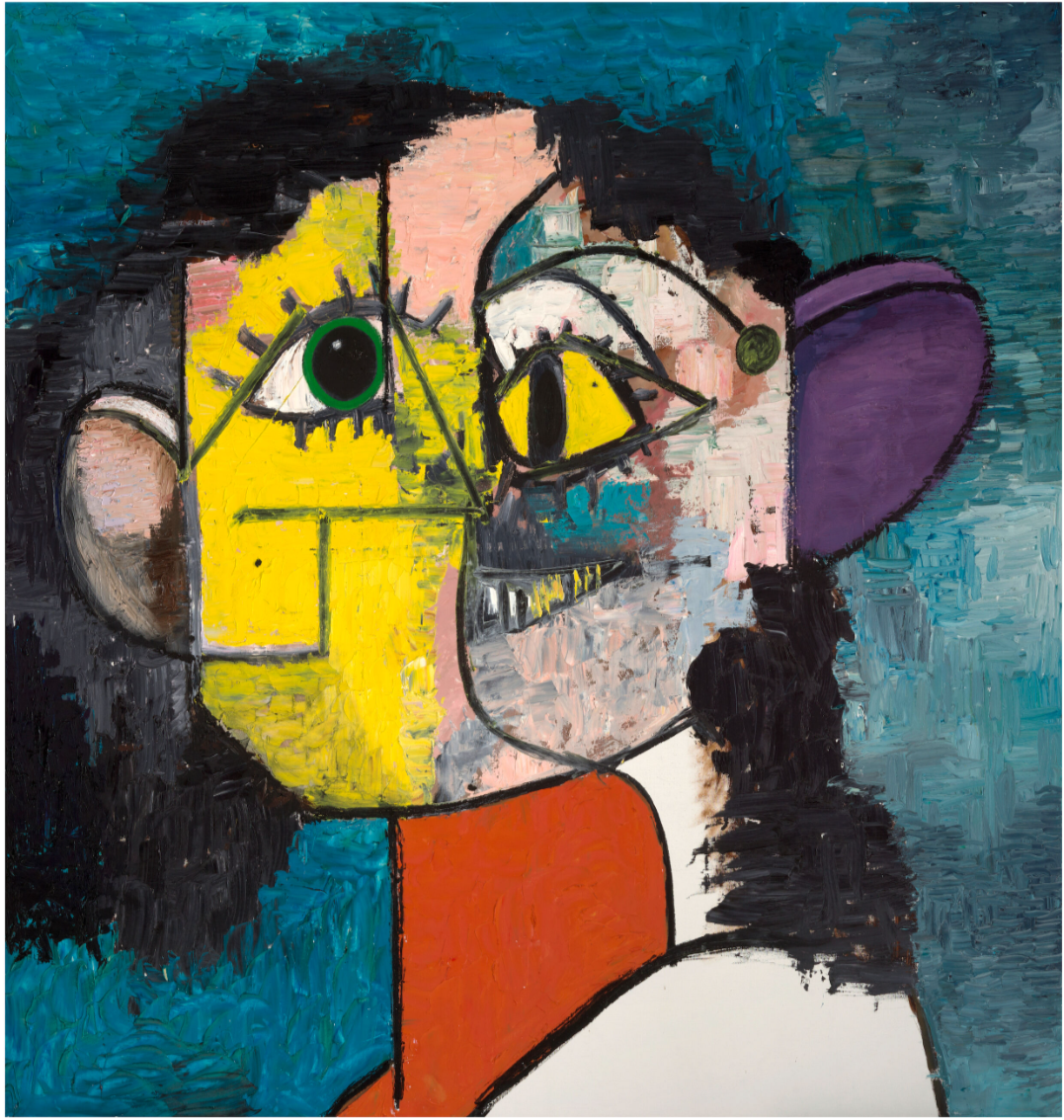
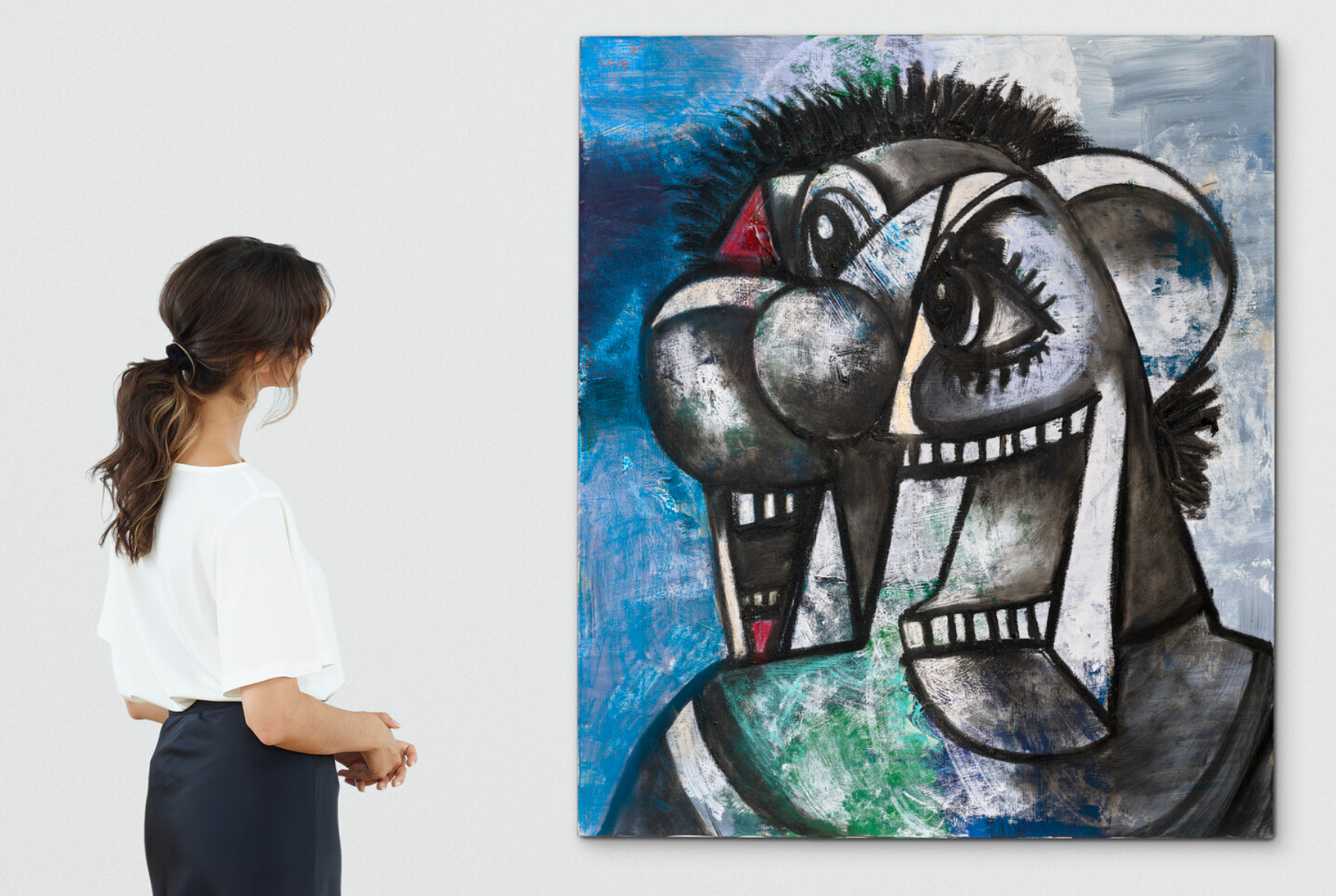
Painted in 2015, George Condo’s Big Face depicts a monumental head, its features divided into angular planes of varying color held together by assertive black contours. Fully occupying its subjecthood by way of scale, centrality, and the cinematic close-up nature of its composition, the face is at once familiar and uncanny, hinting at but never settling into resolute identity. One eye is wide and circular, the other narrow and sharply elongated; the mouth exposes a row of teeth that seems caught between a grin and a grimace. These formal paradoxes are some of the tactics used by Condo to reflect the contradictions of human consciousness in our time, proposing a multi-faceted and kaleidoscopic answer to what it means to approach portraiture in the twenty-first Century.
The figure in Big Face appears to embody several emotional states simultaneously, with none sufficiently dominant to fully occupy a single one for even an instant. This seems to mirror our mental states in the Information Age, where we are constantly bombarded with a diverse array of stimuli that our emotional states can never quite catch up to. Laura Hoptman, writing in George Condo: Mental States, describes the artist’s work as expressing a “dystopic, humorous, empathetic and critical take on the human animal at the turn of the second millennium” (quoted in ‘Abstraction as a State of Mind,’ London, 2011, p. 23). Condo’s paintings show us how these scattered psychological states eventually become us as we ourselves become distorted by them. “For Condo,” Hoptman continues, “his representational works – particularly his portraits – are the result of breaking into everyday consciousness” (ibid., p. 24).
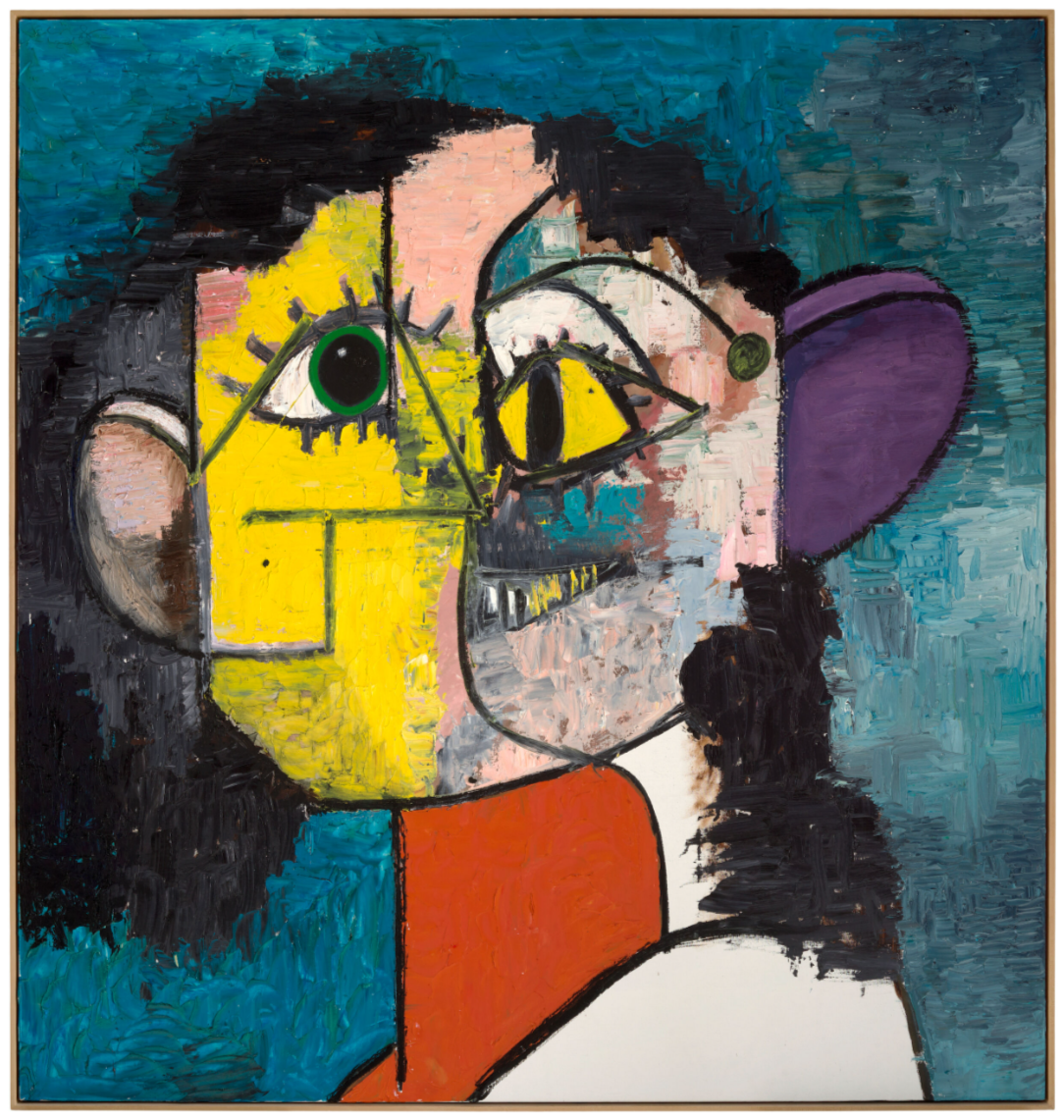
In Big Face this process is evident with recognizable anatomical features then subjected to a continuous series of transformations. Employing his signature psychological cubism, the eyes, nose, mouth, and ears remain identifiable, yet their proportions, orientations, and relationships are disrupted. The face appears to have been assembled from incompatible perspectives, as though its features belonged to several different portraits superimposed upon one another. The yellow plane of the left cheek competes with the pink and white passages of the opposite side, while turquoise strokes interrupt the illusion of fleshy skin. Condo therefore uses abstraction to dissolve the internal logic of a coherent representational image. What emerges is a portrait of consciousness as a fragmented and contradictory experience.
Condo’s relationship to art history is inseparable from his practice. While evidently reinterpreting the formal strategies of Picasso, Condo’s figures also recall the work of Willem de Kooning, whose expressive depictions of the human figure similarly oscillate between recognition and disintegration. Like de Kooning, Condo adopts a visceral approach to portraiture as a way of modernizing its meaning. As Hoptman writes, “[Condo] is more like a philologist – a collector, admirer, and lover of languages – in this case, languages of representation… Just as Manet would emulate – and send up – Titian, and Picasso would furiously tackle the subjects of Velázquez and Manet, Condo reimagines Picasso’s portraits and de Kooning’s human-scapes as a challenge” (ibid., p. 27). He absorbs their innovations while translating them into a visual language responsive to contemporary culture.
The visual exaggeration, alteration and distortion of physical features as a way of highlighting certain aspects of the self is traceable in art history over millennia. One notable example which intentionally overemphasizes deformity as a reflection of inner character for allegorical purposes is Quinten Massys’ An Old Woman (‘The Ugly Duchess’), circa 1513. In it the Flemish painter portrays a woman through intentionally grotesque caricature, including a headdress that implies the existence of hidden horns, to exacerbate and satirize an obsession with youth and beauty. Condo, whose affinity for and incorporation of the Old Masters into his work is well known and documented, integrates techniques throughout his career to achieve a similar effect through the lens of our time, fundamentally focusing on the distorted psyche.
In Big Face, the legacy of Cubism is stylistically evident in the fragmentation of the head into intersecting planes and competing viewpoints. Yet Condo’s engagement with Cubism is not primarily concerned with representing the formal changes of light as it strikes a surface over time or even physical dimensionality. The fractured anatomy externalizes the difficulty of understanding a subject whose inner life cannot be reduced to a unified image. Simon Baker describes this process as the transposition of “impenetrability in the psychological field into fragmentation and abstraction in the visual field” (quoted in ‘Sweeping the Interpreter’s Parlour,’ George Condo: Painting Reconfigured, London 2015, p. 104). In other words, the face is divided into varying perspectives because the self resists complete comprehension.
Condo’s concept of artificial realism provides a broader framework for understanding this transformation. In his 2015 statement on painting, he describes reality as increasingly compromised by artificial components, proposing that the languages of art and reality might be brought together to create a new form of representation.
“I ultimately consider it to be just about the knowledge of painting. I want to reach a point where your work is the sum total of everything that ever happened before you”
For Condo, painting advances by absorbing and recombining its own history. Taking a vast array of source material from Old Master paintings to popular culture and cartoon characters, Condo reconstructs reality with the varying bits of information gathered, echoing the way identity is constructed in the post-internet era. The vivid color and rare impasto seen in Big Face give this construction its emotional and material force. Condo works the surface with a visibly loaded, tactile application of paint, allowing individual strokes and ridges to remain legible rather than smoothing them into an illusionistic finish. Across the face, the paint alternates between thicker, almost sculptural deposits and more loosely brushed areas. Condo’s texture remains closely tied to the construction of the face: the material irregularities reinforce the sense of an identity assembled from incompatible parts. The background’s restless blue strokes prevent the figure from settling into a neutral space, while the red-orange garment provides a final burst of chromatic intensity. The surface seems to register competing impulses, as though the painting were continually negotiating between the desire to form an image and the desire to undo it.
Ultimately, Big Face presents an encounter with the limits of representation of the self. Drawing upon centuries of painting to produce an image that is unmistakably contemporary, Condo demonstrates how the inherited languages of art can be translated into experience of our own era. Its contradictions are its subject and Condo’s method, forcing us to grapple with the complex meaning of identity in our time.
Double Heads on Blue and Silver, 2014
Double Heads on Blue and Silver, 2014
Property from the Edlis Neeson Foundation to support art and cultural initiatives
Christie’s New-York: 19 November 2026
Estimated: USD 2,500,000 – 3,500,000
MINIMUM PRICE GUARANTEE
GEORGE CONDO (B. 1957), Double Heads on Blue and Silver | Christie’s
GEORGE CONDO (B. 1957)
Double Heads on Blue and Silver, 2014
Acrylic, metallic paint, charcoal and pastel on linen
78×110 inches (198.1 x 279.4 cm)
Signed and dated ‘Condo 2014’ (on the reverse)
Signed and dated again ‘Condo 2014’ (on the stretcher)
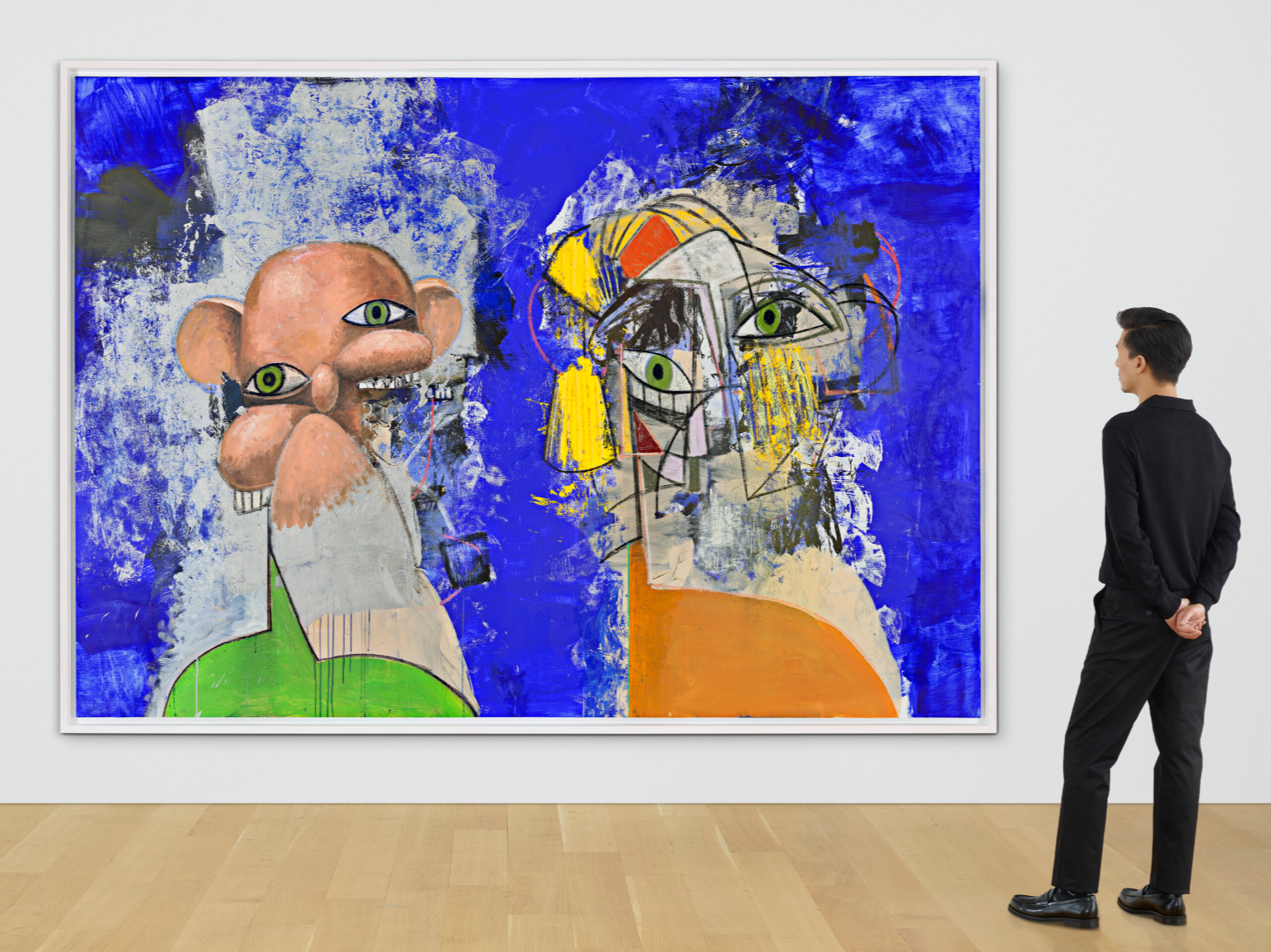
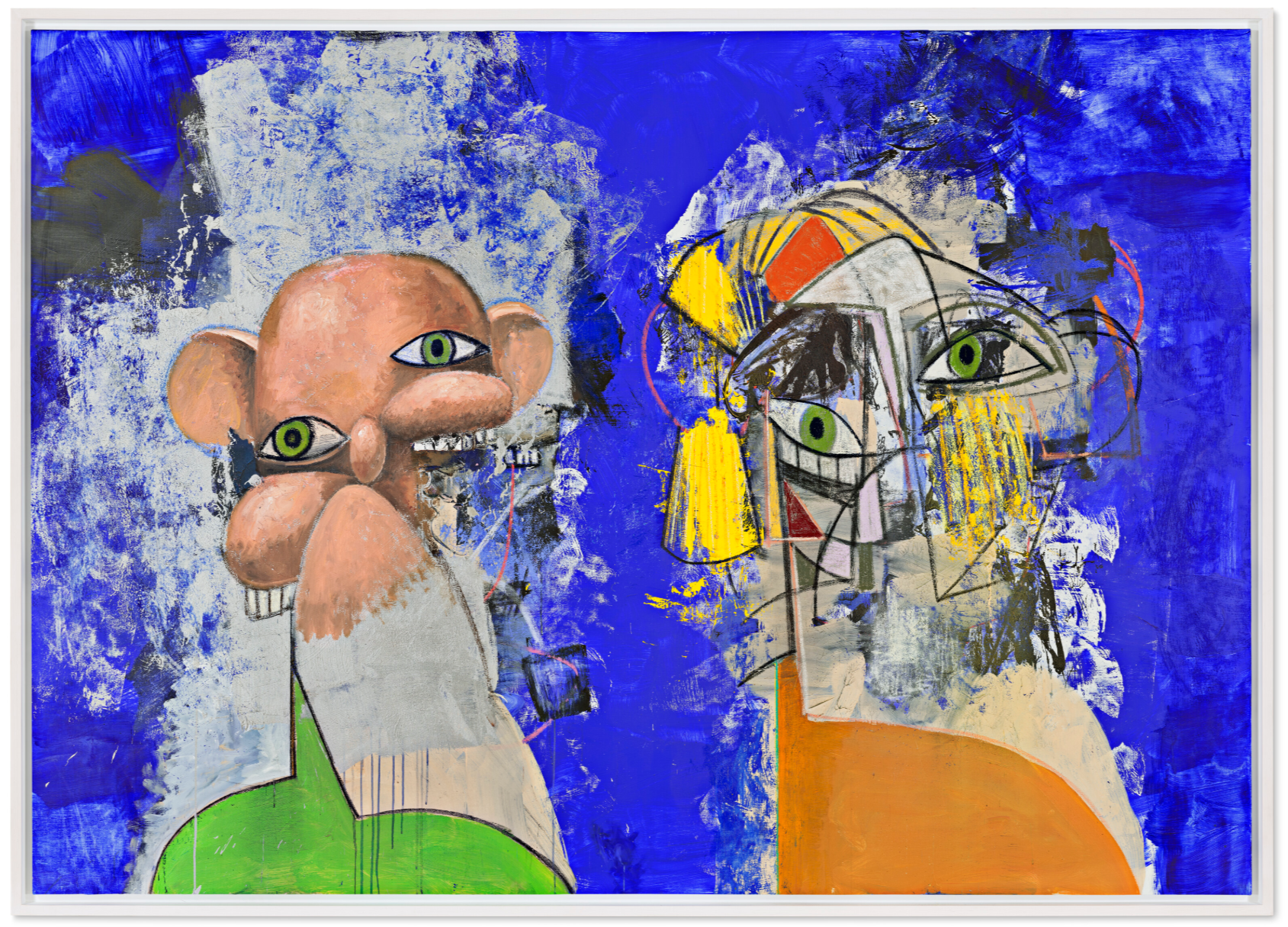
Double Heads on Blue and Silver unifies two different strands in George Condo’s distinctive oeuvre. Monumental in scale, it presents a pair of portrait heads, both distorted beyond any orthodox representation of reality. The male head on the left challenges the verisimilitude of Old Master painting, while its female companion on the right metamorphoses Cubism. The painting is part of a series where Condo adapted the idea of “action painting”—a term coined by critic Harold Rosenberg to describe the energetic, gestural painting of Abstract Expressionism—to his characteristic portraiture.
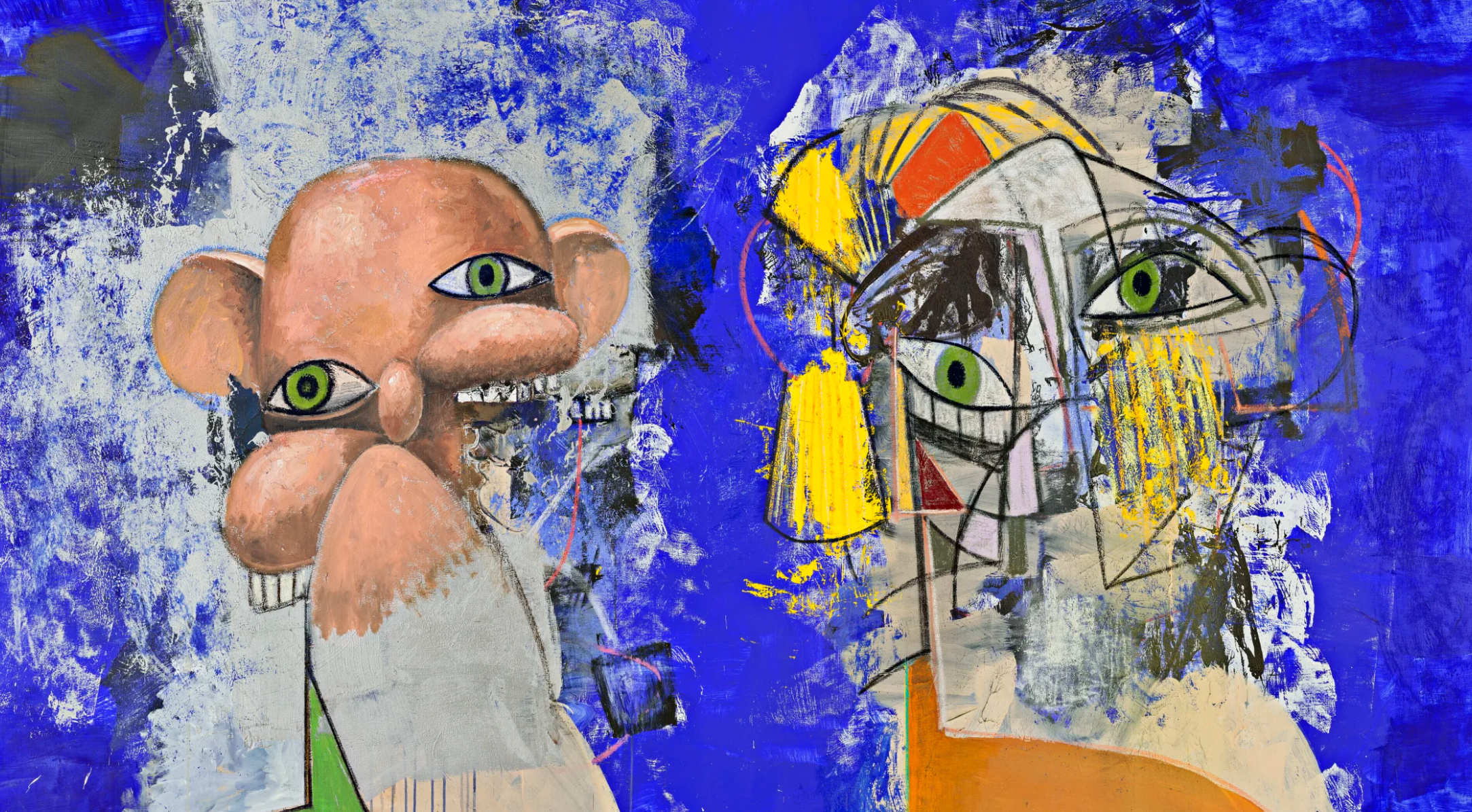
As with these great American precedents, Condo paints with animation and dynamism, allowing remnants of his frenetic processes to remain in the completed image. Condo’s painting has a tempestuous surface, with drips, dabs and patches of thick impasto, which add a three-dimensionality to the image. The left-hand head, astutely conjured in dappled pink flesh tones, is surrounded by a burst of powder-white. The portrait has the semblance of a man, but Condo twists and contorts his features. He has a button nose, huge featureless ears, a bulbous chin and swollen cheeks, the last of which stand atop rows of jagged teeth. His companion is even more dissolved, with an angular face fragmented by thick black charcoal lines.
Her segmented visage has patches of lilac, orange, white and burgundy, framed by a shock of yellow hair. Red pastel lines dance around the duo’s faces. Both figures share huge elliptical green irises, each at a different height of their face, reminiscent of Picasso. Everything is in motion; even the ultramarine background, redolent of the skies in Italian Renaissance portraiture, features visible sweeps of paint. Patches of metallic paint create a coruscating sheen. Condo spent several months as a young man working in Andy Warhol’s Factory, and this shine might reference Warhol’s silver screens such as Double Elvis (1963).
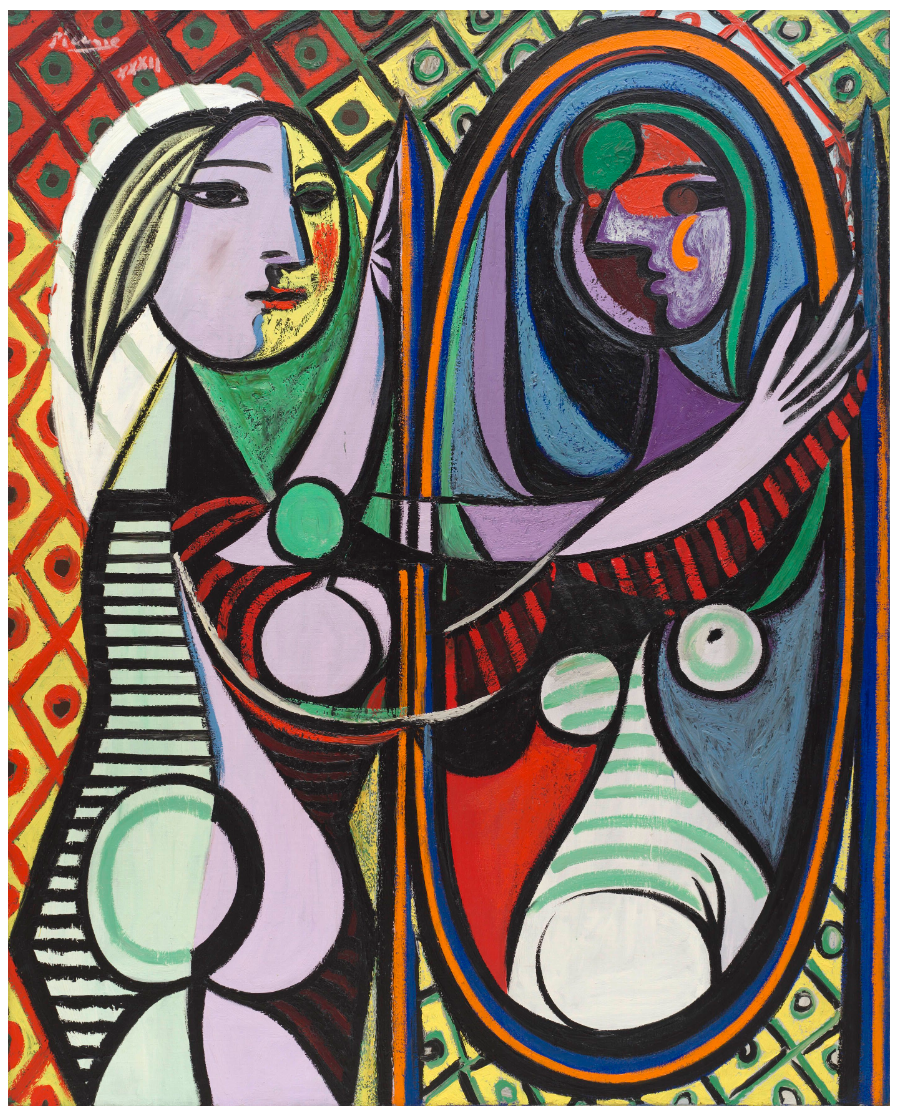
Pablo Picasso, Girl Before a Mirror, 1932. Museum of Modern Art, New York. © 2026 Estate of Pablo Picasso / Artists Rights Society (ARS), New York. Photo: © The Museum of Modern Art / Licensed by SCALA / Art Resource, New York.
At once cartoonish and acutely observed, Condo’s characters meld art historical references and the aesthetics of popular culture with a look entirely his own. Trained in music theory and art history rather than fine art, his approach to painting is unshackled by conventional mores. Condo subverts the rudiments of the portrait genre by depicting absurdist beings of his own creation rather than real humans. While living in Paris between 1985 and 1995, Condo shared an apartment building with the eminent psychoanalyst and theorist Félix Guattari. According to Condo, “Felix said I was the only portrait painter who ever painted entirely imaginary subjects. Picasso was always painting Dora Maar or whoever, Bacon’s portraits could always be traced to some existing person. But not my portraits. They were all imaginary” (quoted in S. Jeffries, ‘George Condo: “I was delirious. Nearly Died”’, The Guardian, 10 February 2014).
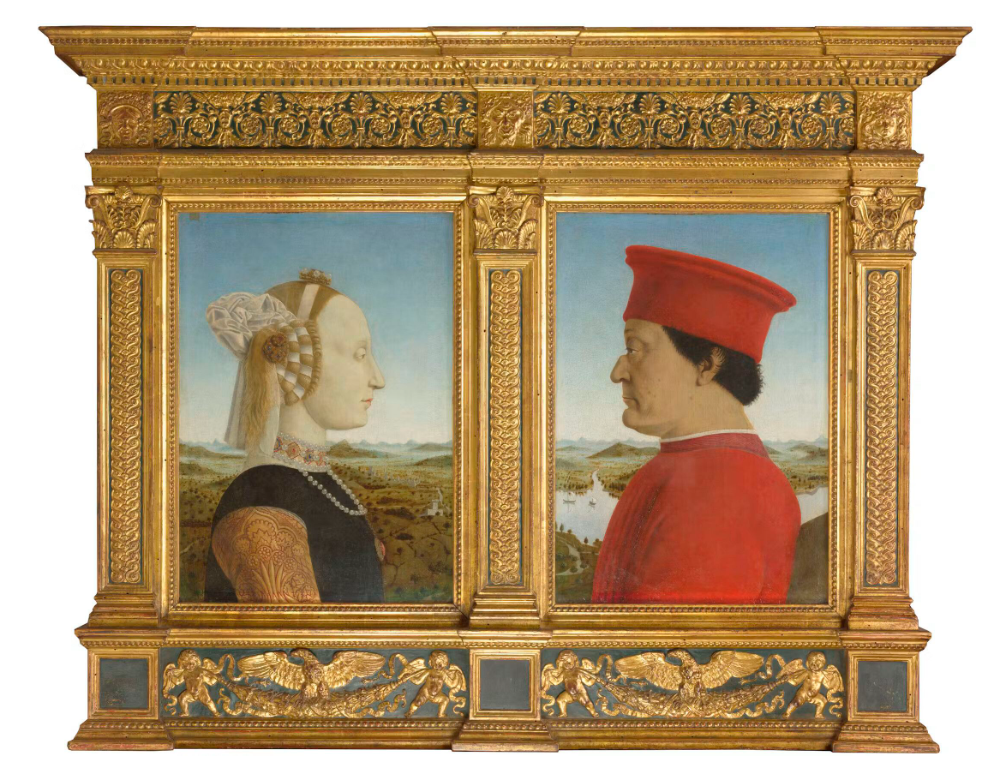
Piero della Francesca, Portraits of Duke Federico da Montefeltro and Battista Sforza, circa 1465. Galeria degla Uffizi, Florence.
In 2013 Condo contracted Legionnaires’ disease and pneumonia. The near-death experience that followed saw him dream up a new legion of these fictive characters, pushing his repertoire in new directions. In the aftermath, he expanded his ‘Drawing Paintings’, a hybrid form which blurs the hierarchies between drawing and painting by allowing the two to work in tandem. “The idea of uniting drawing and painting on a single canvas,” writes art historian Simon Baker, “arose from Condo’s recognition of the need for immediacy and improvisation with line and gesture but can also be understood as contingent upon the increasing importance of the contrapuntal balance of working at different speeds and rhythms on the same work” (‘Abstraction/Figuration’ in S. Baker, George Condo: Painting Reconfigured, London, 2015, p. 152). In this, Condo’s process can be compared to free jazz improvisation, binding together rhythms and melodies into something exploratory.
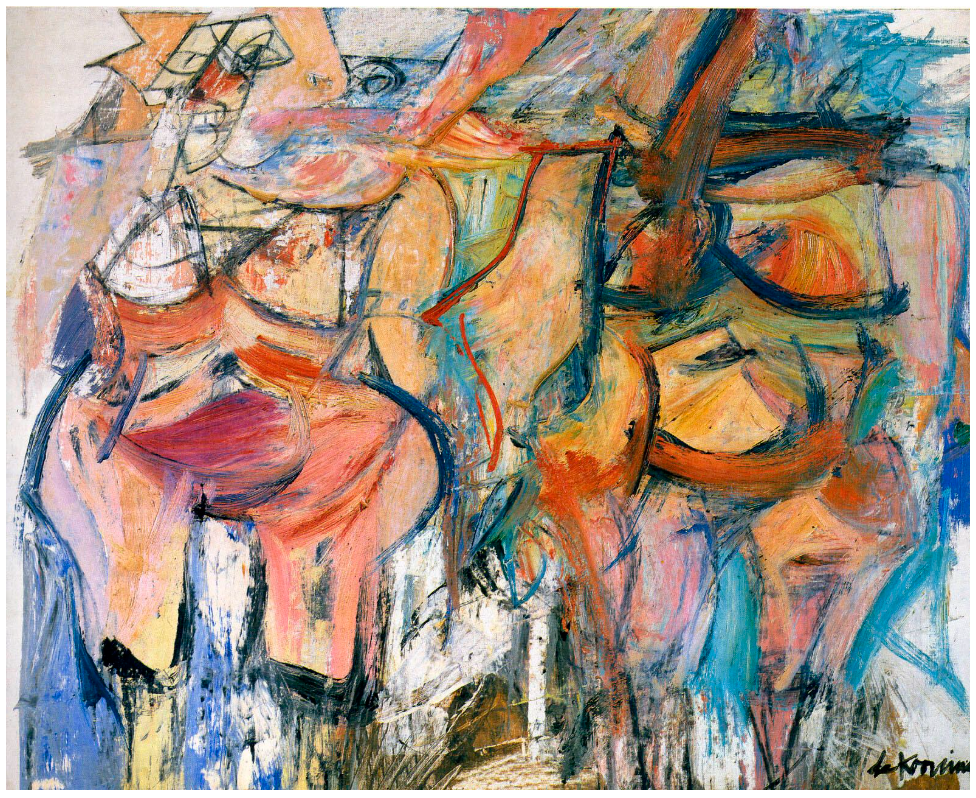
Willem de Kooning, Two Women, 1954-1955. © 2026 The Willem de Kooning Foundation / Artists Rights Society (ARS), New York.
Double Heads on Blue and Silver demonstrates two concepts that have animated Condo’s oeuvre: artificial realism and psychological Cubism. The former, which Condo started using in the late 1970s, is a fusion of various painterly techniques to draw focus not to the representation of reality but to the image presented on the canvas. The latter uses the techniques of Cubism to capture psychological turmoil. As Condo explained to Simon Baker, “Picasso wanted to show multiple sides of an object simultaneously. That was a kind of perspectival Cubism: not being limited to a single view in one view where you can see all four sides of a box. But what if you could see all four sides of human nature? That’s what I call psychological Cubism” (G. Condo quoted in S. Baker, ‘Memories of Rembrandt’, in ibid., p. 194). Fluctuating between the empathetic and the comic, Condo’s Double Heads deftly captures the turbulence of unsettled emotions.
Untitled, 2018
Untitled, 2018
Christie’s New-York: 20 November 2026
Estimated: USD 1,000,000 – 1,500,000
GEORGE CONDO (B. 1957), Untitled | Christie’s
GEORGE CONDO (B. 1957)
Untitled, 2018
Oil, acrylic, pigment stick and pastel on linen
52×45 inches (132.2 x 114.2 cm)
Signed and dated ‘Condo 2018’ (upper left)
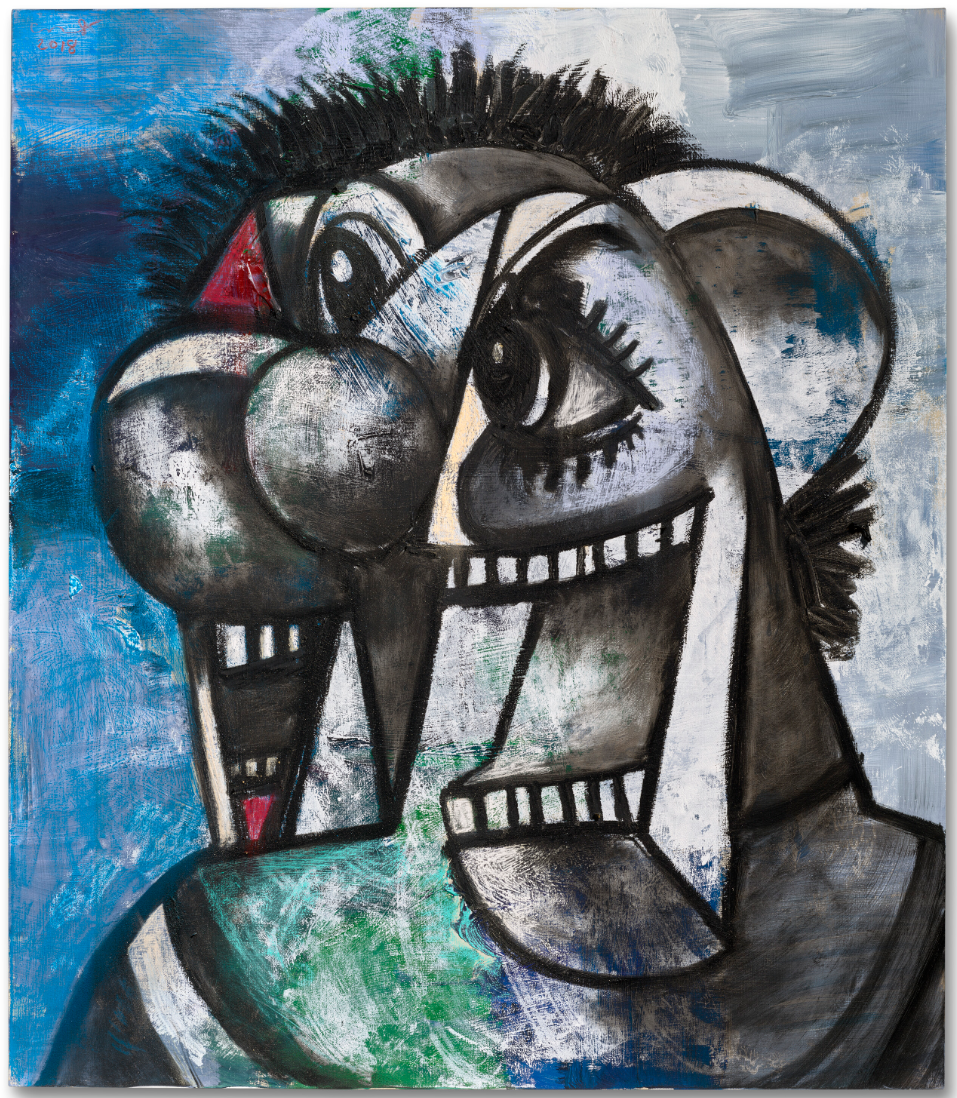
George Condo’s untitled 2018 painting stands as a persuasive essay on the continued relevance of figurative painting in the twenty-first century. Using a process of addition and subtraction (creating his backdrops by applying paint to the surface of the canvas before wiping or scraping it off to revel the previous layers), Condo conjures up enigmatic figures that expand to fil the canvas. This striking portrait exemplifies the artist’s unparalleled ability to fuse the grand traditions of portraiture with the fractured realities of the contemporary experience. Set against an enigmatic field of blues, grays, and whites, the composition is dominated by a monumental head rendered through an intricate arrangement of overlapping forms, exaggerated features, and boldly articulated contours. Two eyes, two ears, and a single nose would indicate that we are looking at a single head, but four rows of teeth framing two open mouths would indicate that we are, in fact, looking at two heads merged into one.
Known for his dynamic approach to the seemingly-antiquated genre of portraiture, Condo pushes traditional notions of the figure through a blender of art historical styles. Coming of age in New York in the 1980s with his postmodern contemporaries like Julian Schnabel and David Salle, artists who were then relying on fitting and composing a bevy of visual pastiches with disparate elements borrowed from across history, Condo instead sought to combine and fuse components into something decidedly singular. Donald Kuspit wrote about this convergence, noting, “Instead of pushing one style to an extreme, he revitalizes different styles by using each to inform the others—even as he readdresses the old modernist problem of the relationship of painting and drawing, modes that Matisse thought were inseparable if not entirely one and the same.
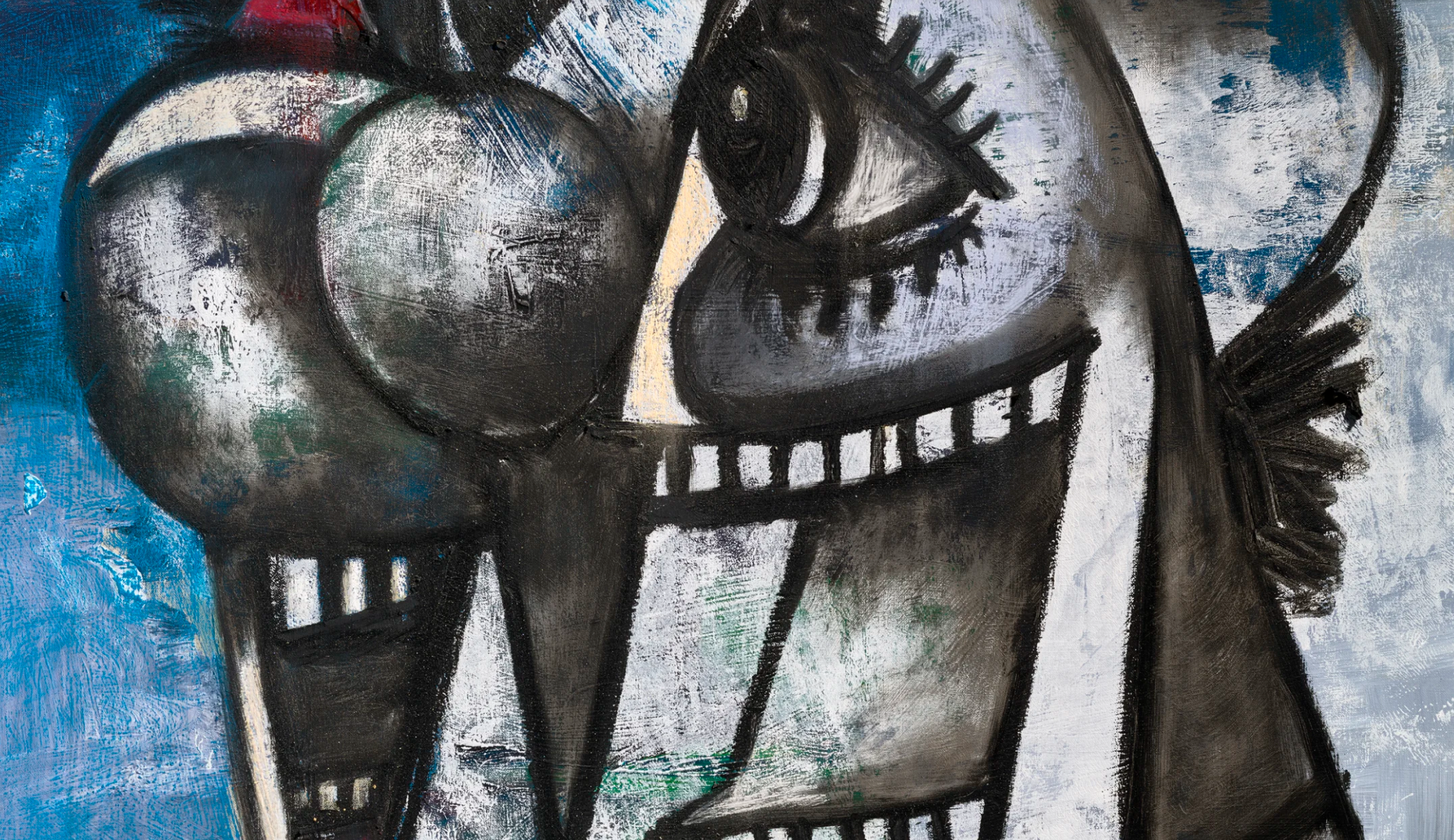
Expressionism and Surrealism had already converged in Abstract Expressionism, particularly Willem de Kooning’s, but Condo’s integration of them produces even more absurdly (and comically) monstrous and menacing figures than de Kooning’s women. The snarling white teeth of Condo’s human grotesques seem to allude to those de Kooning’s sometimes also possess, but Condo’s seem more biting, and there are more of them” (D. Kuspit, “George Condo: Skarstedt Gallery,” Artforum, May 2010, p. 252). This additive method allows Condo to start a conversation about the various artforms existing alongside and on top of each other throughout the latter half of the twentieth century and pushing into the twenty-first. Works such as the present example conflate visual elements of Cubism with the brushwork of Abstract Expressionism while continuing to slyly hint toward Pop.
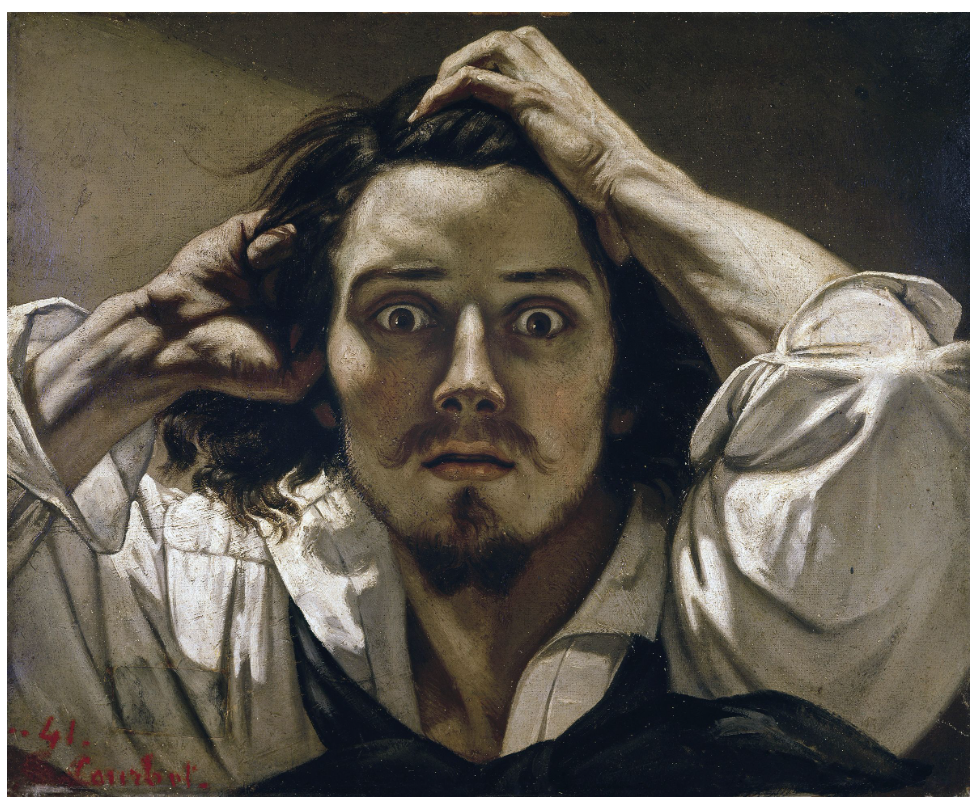
Gustave Courbet, The Desperate Man (Self Portrait), 1843-1845.
Surveying his body of work over the years, the painter’s splintered countenance smiles back at us from the canvas. By working with this fusion of styles and periods, he came to better understand the importance of portraiture and further refined his approach.
“I believe that painting needs to transform in order for it to become interesting for each and every generation, but I think of it more in terms of being liberated by history. Liberated by what has come before.”
Within Condo’s dismantling of the Western portrait tradition resides an abiding love and respect for those artists who pushed the boundaries before him. From their revolutionary ideas sprang the new generation, just as Condo’s work continues to inspire the next.
Hemazoids, 2009
Hemazoids, 2009
Sotheby’s New-York: 17 November 2026
Estimated: USD 800,000 – 1,200,000
GUARANTEED PROPERTY
George Condo | Hemazoids | Contemporary Day Auction | 2026 | Sotheby’s
GEORGE CONDO (b. 1957)
Hemazoids, 2009
Oil on canvas
85×75 inches (215.9 x 190.5 cm)
Signed, titled and dated 09 (on the reverse)
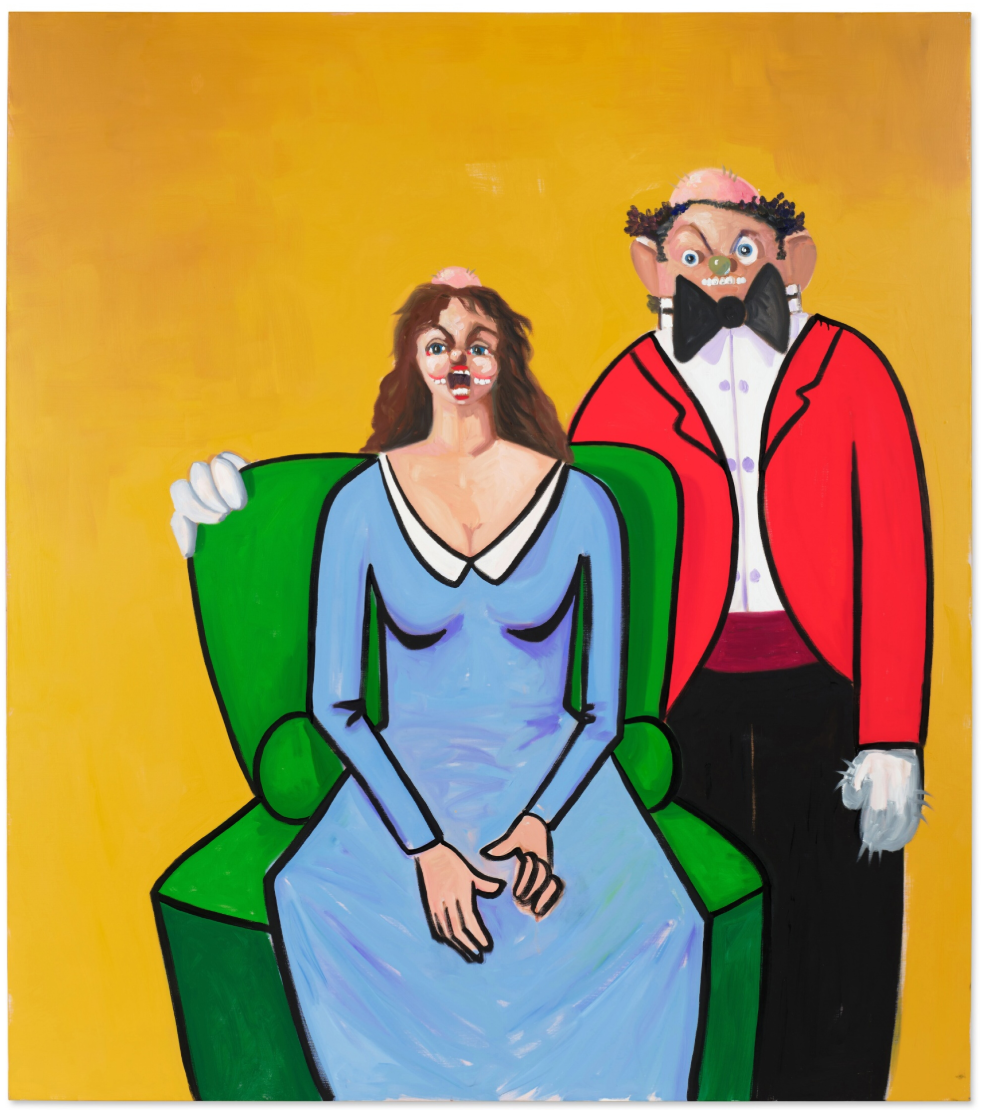
Exhibiting the wit, theatricality, and psychological intensity that define George Condo’s signature portraiture, Hemazoids is a strikingly elusive and deeply seductive composition. Two figures, caught in the midst of a carefully staged pose, confront the viewer head-on. Their distorted physiognomies oscillate between recognition and abstraction, reflecting enduring human essences despite being visually fragmented. Executed in 2009, at a moment when Condo’s mature style had achieved its fullest expression, Hemazoids distills many of the central concerns of his oeuvre, foremost among them the artist’s concept of “Psychological Cubism,” a mode of representation that seeks to illuminate the simultaneous and often contradictory states that comprise human consciousness. The figures’ warped visages become an unfiltered account of the paradoxes of identity and interpersonal connection, exposing a psychological rawness seldom encountered in traditional portraiture.

George Condo in his studio. Photo by Melissa Brice Shea.
Emerging in New York in the late 1970s, Condo developed a visual language that synthesized the lessons of European Old Master painting with the radical formal innovations of twentieth-century modernism. Drawing equally from Velázquez, Picasso and Willem de Kooning, he forged a singular approach that collapses centuries of art history into a single image. While deeply informed by the traditions of portraiture, Condo does not seek to depict specific sitters in Hemazoids. Rather, this portraits functions as an inventions of the mind: composite beings that embody the instability, absurdity and complexity of the modern self. Through distortion, fragmentation and exaggeration, his portraits reinvigorated one of art history’s oldest and most explored genres, transforming portraiture from an expression of outward appearance into a vehicle for examining inner psychological states.
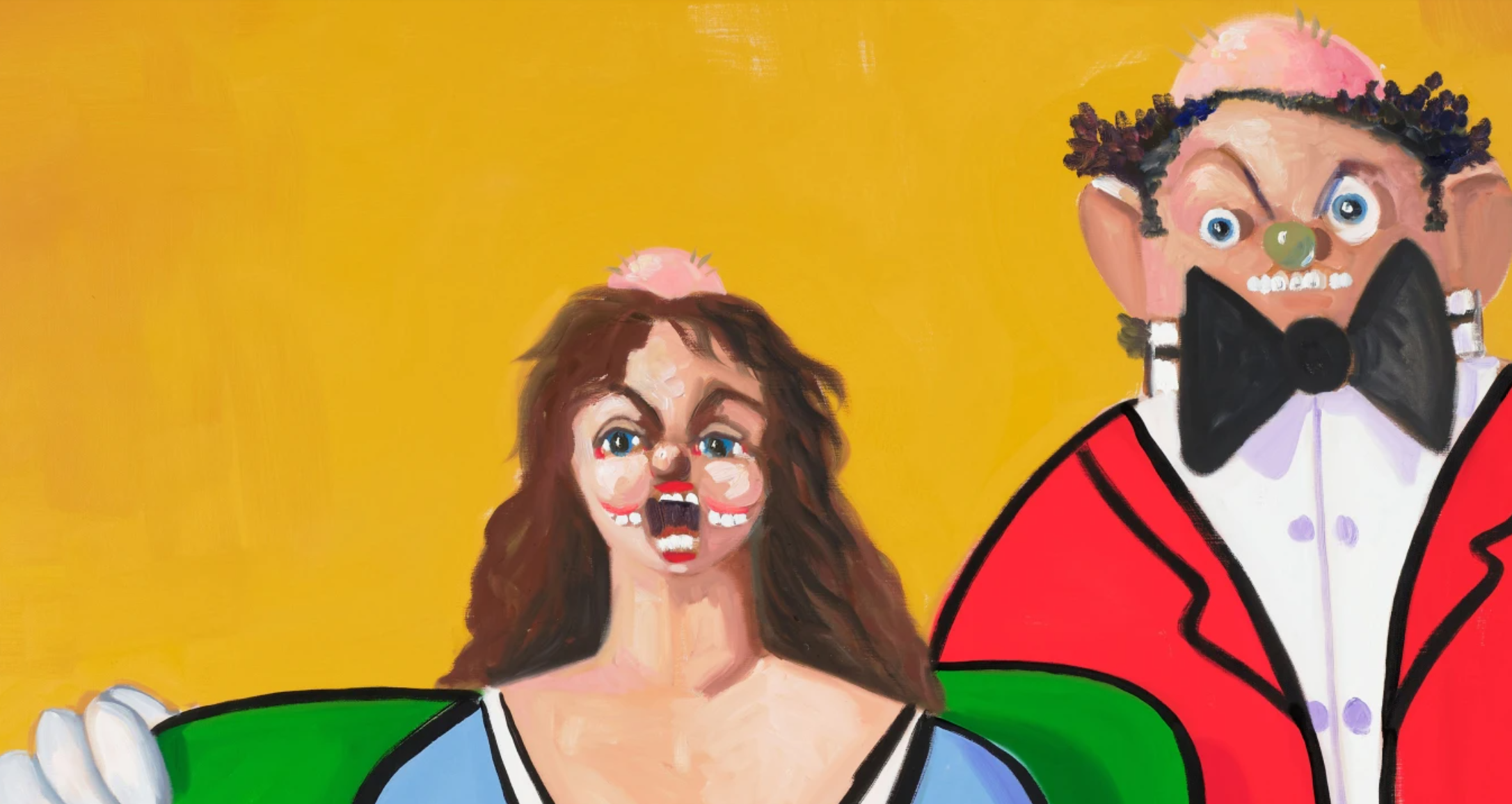
Set against a luminous monochromatic yellow ground, the figures appear suspended in an indeterminate space, detached from any narrative setting. The bright green chair and sharply contrasting passages of red, blue and black lend the painting a disarming visual clarity, yet this compositional order is continually undermined by the destabilized features of the protagonists. Their exposed scalps, disjointed mouths and uneasy eyes all reveal his fascination with the simultaneous and often conflicting dimensions of the human psyche. Condo’s rendering of the couple’s features is particularly striking, using more nuanced and layered brushstrokes to depict their exposed skin whilst employing harsh, bold outlines to depict other objects of the portrait. This alternating between dimensional painting and an almost cartoon-like figuration signals Condo’s characteristic balance of humor, unease and psychological truth that all coexist within Hemazoids. The artist rejects the notion of a singular, fixed self, presenting his subjects instead as composite beings whose contradictions, anxieties and desires remain perpetually in flux.
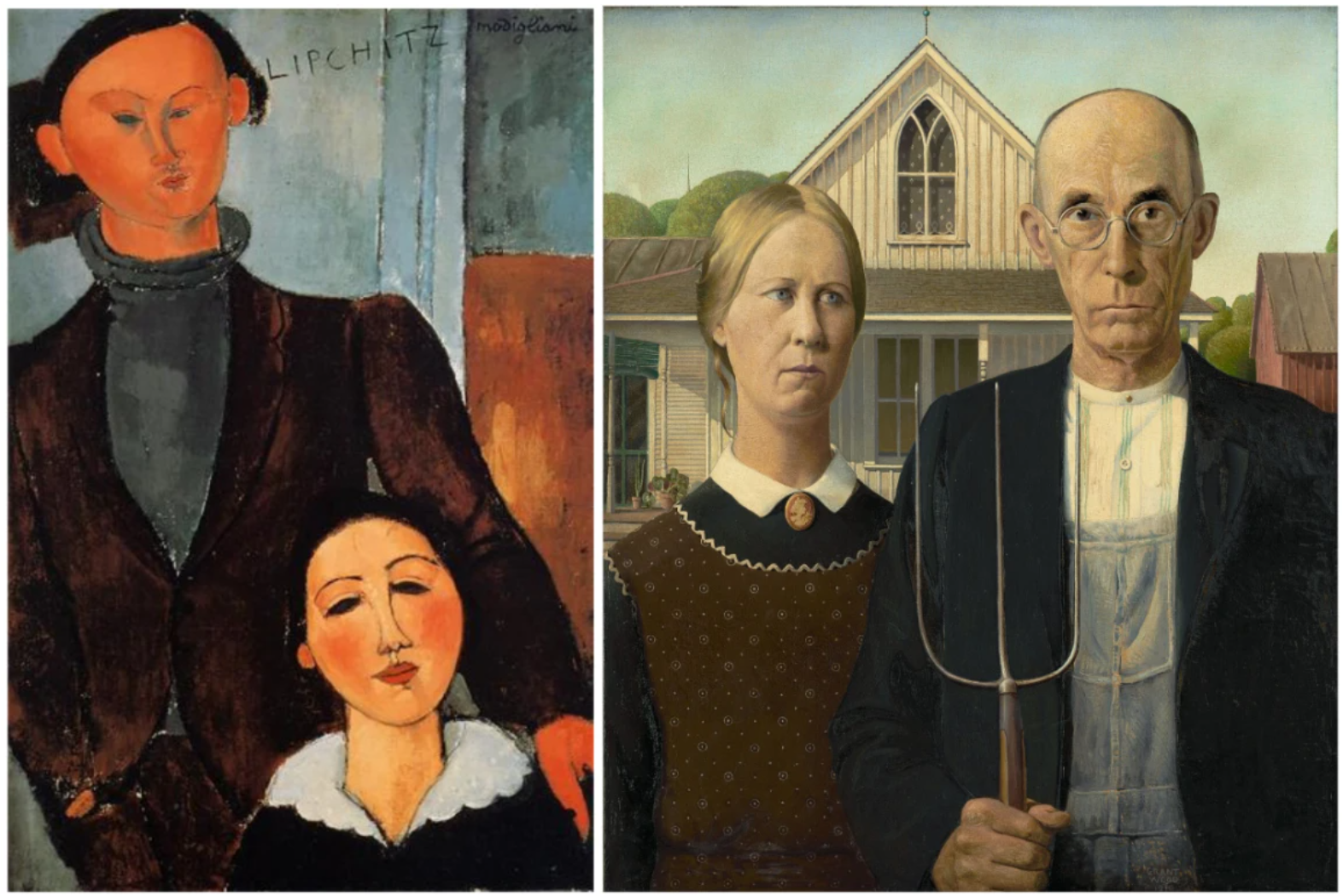
LEFT: Amedeo Modigliani, Jacques and Berthe Lipchitz, 1916. Art Institute of Chicago.
RIGHT: Grant Wood, American Gothic, 1930. Art Institute of Chicago.
The double portrait has long served as a powerful means of defining the relationship between two individuals, transforming the depiction of likeness into an examination of human connection itself. Yet in Hemazoids, the nature of the two figures’ relationship remains tantalizingly unresolved. The seated figure occupies the foreground, poised yet vulnerable, while a second figure looms immediately behind, creating a dynamic of both protection and intrusion. Their proximity suggests intimacy, but their dislocated gazes and unprepared poses introduce emotional ambiguity into the composition. The result is a distinctly contemporary double portrait, one in which attraction and alienation coexist within the same pictorial space.
“I believe that painting needs to transform in order for it to become interesting for each and every generation, but I think of it more in terms of being liberated by history. Liberated by what has come before.”
Through the simultaneous embrace of comedy and psychological inquiry, Hemazoids achieves a lasting power. Bringing together the artist’s virtuosic command of portraiture, and his deeply personal exploration of Psychological Cubism, Hemazoids stands as a compelling example of Condo’s mature practice. At once humorous, unsettling and profoundly affecting, the work transforms the conventions of the double portrait into a searching examination of human consciousness, embodying the intellectual rigor, emotional complexity and visual immediacy that define the artist’s most sought-after paintings.
Smiling Woman, 2020
Smiling Woman, 2020
Estimated: USD 400,000 – 600,000
WORK ON PAPER
Smiling Woman, 2020
Ink on paper
59-3/4 x 41-1/2 inches (151.8 x 105.4 cm)
Signed and dated “Condo 2020” upper left
A cyclopean eye peeks from behind a mask-like visage of a grinning woman, punctuated by simian ears and cascading black locks. Smiling Woman, 2020, exemplifies the fractured psychological style that has cemented George Condo into art history. The figure’s omniscient gaze appears to lurk beneath an outward display of warmth, its conflicting personas made visible through a face physically divided against itself. What is ordinarily concealed within the psyche emerges here as a tangible, pictorial reality.
“There are characters that live within your mind, and I want to bring them to light. If you think about how the mind as opposed to the eyes see people, that is the image I want to create.”
The present work encapsulates emotions of joy and mania; there is something unnerving lurking beneath the woman’s smile. A compelling example of Condo’s hallmark psychological cubism, Smiling Woman translates the complexities of the human condition in the contemporary world through a vivid blue palette and fluid swaths of ink. The woman outwardly bears an exaggerated smile, though her disposition seems unsteady and artificial. Condo collapses the boundary between inner and outer workings, constructing and destabilizing the figure in equal measure.
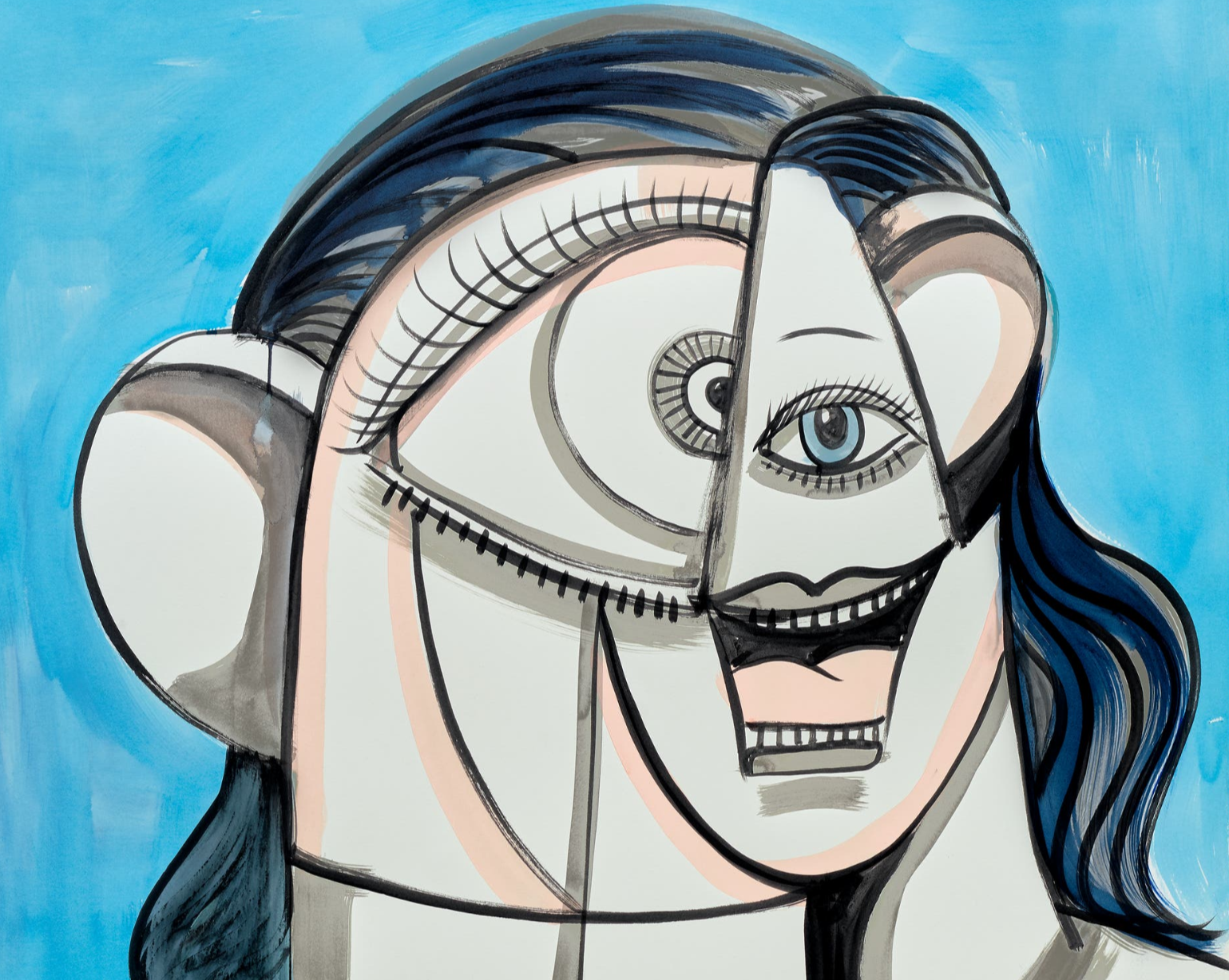
Drawing on the visual language of Cubism, Condo subjects the tradition to playful reinterpretation, infusing its fractured compositions with cartoon-like protagonists who serve as vehicles for exploring the absurdities and follies of human behavior. Condo brings Pablo Picasso’s multiple perspectives into a humorous and astute work of the contemporary moment. Smiling Woman closely resembles Picasso’s Head of a Woman, 1960, using the pictorial language derived from its antecedent to portray an entirely new vantage of the subject. Much of the picture is the same: the navy clothing, voluminous hair tucked behind lopsided ears, and even the placement of the artist’s signature. The sitter’s ruffled collar subtly recalls the sartorial flourishes of seventeenth-century portraiture, evoking artists such as Frans Hals and further anchoring the work within the broader history of Western representation. Condo, however, defines the woman’s ambiguous expression into a multiplicity of emotion that extends beyond the unnamed subject.
Through a style he coins artificial realism, George Condo depicts his reality of the human-perceived world, noting “our own experiences of the world are all we can really go off of… and the world we live in is man-made.” At first glance Smiling Woman seems foreign and non-human, yet it represents the grotesque and quotidian preoccupations we wish to suppress. A compelling visualization of consciousness, the work is a paradigm of Condo’s radical reconception of portraiture.
Cool Cat, 2010
Cool Cat, 2010
Estimated: USD 350,000 – 450,000
GEORGE CONDO (b. 1957)
Cool Cat, 2010
Acrylic and charcoal on canvas
65-1/8 x 65-1/8 inches (165.4 x 165.4 cm)
Signed and dated 2010 (on the reverse)
Executed in 2010, Cool Cat belongs to George Condo’s celebrated Cartoon Abstraction series, a body of work in which the artist transforms iconic figures from mid-century American animation through the lens of what he has termed “Artificial Realism.” Drawing upon the eponymous Looney Tunes character, Condo reimagines a familiar cultural image through distortion, improvisation, and painterly invention. Set against a luminous sky-blue ground, the beret-clad tiger strides confidently across the canvas, retaining the effortless swagger of his animated counterpart while assuming a new pictorial presence.
Throughout the Cartoon Abstraction paintings, Condo turned to the visual language of American cartoons as raw material for experimentation. Rather than reproducing recognizable characters, he dismantles and reconstructs them through gestural brushwork, restless contours, and spontaneous mark-making, collapsing the distinction between popular iconography and ambitious contemporary painting.
“I believe that painting needs to transform in order for it to become interesting for each and every generation, but I think of it more in terms of being liberated by history. Liberated by what has come before.”

George Condo in his studio. Photograph by Tina Barney. Art © 2026 George Condo / Artists Rights Society (ARS), New York
In the present work, Cool Cat‘s beret, necktie, and feline profile remain immediately legible, yet the character has been liberated from the fixed boundaries of animation. Subtle alterations underscore Condo’s reinvention of the cartoon icon, as Cool Cat’s signature green tie and beret are recast in brilliant red, creating a striking contrast with the painting’s backdrop. Bold black outlines and passages of charcoal drawing activate the surface, while an array of floating linear forms drift in the distance, at once suggestive of mechanical fragments, birds, and fleeting thoughts. These elements destabilize the pictorial space, creating a dynamic interplay between figuration and abstraction and lending the work the immediacy of drawing on a monumental scale.
Like much of Condo’s oeuvre, Cool Cat reflects a practice rooted equally in art history and popular culture. Since the 1980s, the artist has synthesized influences ranging from Old Master portraiture and Cubism to Pop Art and Abstract Expressionism, forging a visual language in which high and low cultural references coexist. Here, a seemingly lighthearted cartoon protagonist becomes the vehicle for a sophisticated exploration of line, form, and perception.
Vibrant, irreverent, and formally inventive, Cool Cat exemplifies Condo’s singular ability to transform a familiar image into something at once recognizable and entirely new, revealing the rich possibilities that emerge when the language of mass culture is translated into paint.