MAY 2026 NEW-YORK AUCTIONS
David Hockney
Auction Results
#1. The Valley, Mountains in Var (Near La Garde Freinet), 1970
Property from The Sheryl and Harvey White Trust Collection
Sotheby’s New-York: 14 May 2026
Estimated: USD 6,000,000 – 8,000,000
USD 6,586,000
David Hockney | The Valley, Mountains in Var (Near La Garde Freinet)
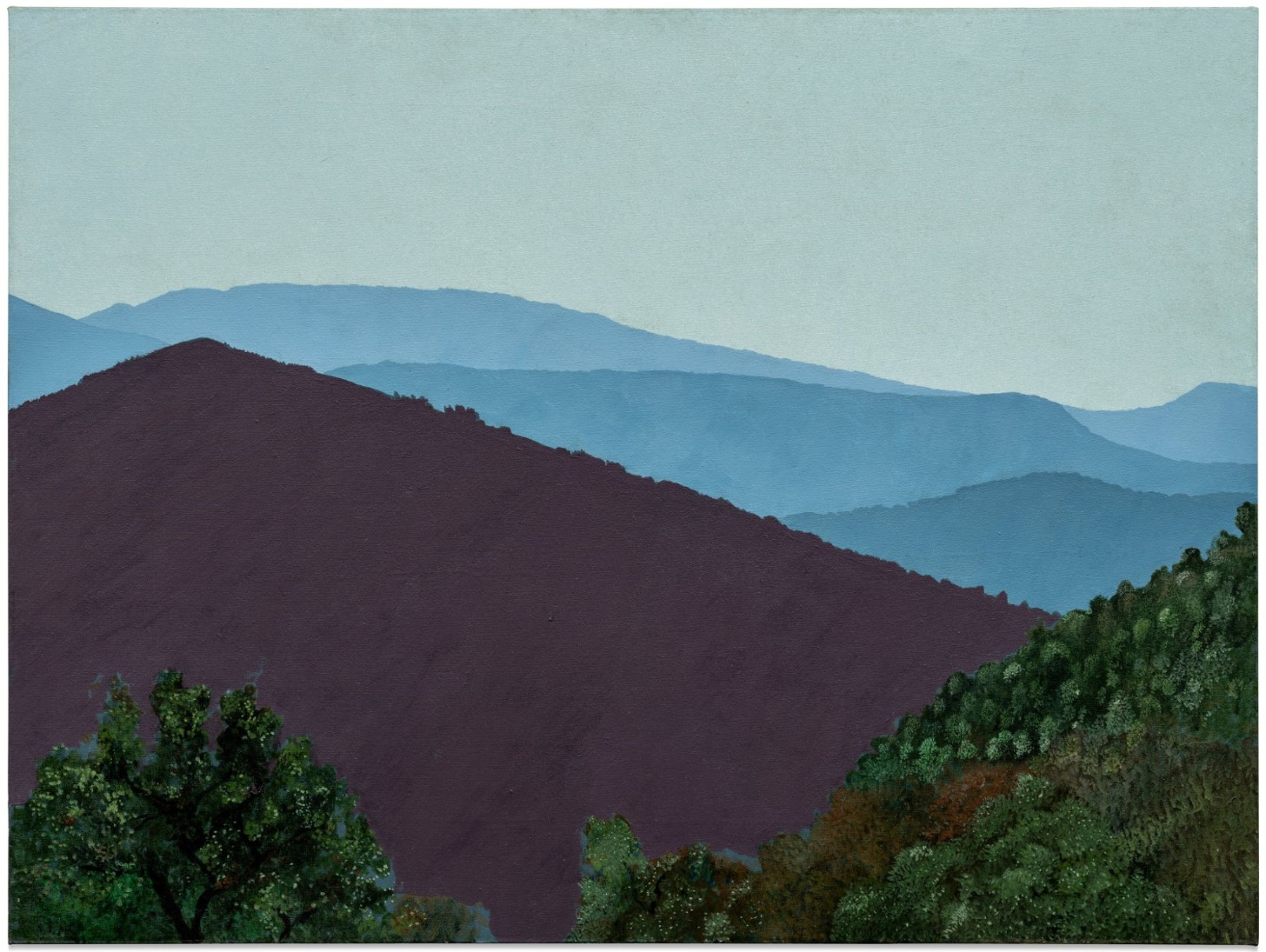
DAVID HOCKNEY (b. 1937)
The Valley, Mountains in Var (Near La Garde Freinet), 1970
Acrylic on canvas
36×48 inches (91.4 x 121.9 cm)
Signed, titled and dated 1970 (on the reverse)
#2. 18th-27th June 2021, La Dorette Winding its Way, 2021
Sotheby’s New-York: 14 May 2026
Estimated: USD 500,000 – 700,000
USD 1,984,000
David Hockney | 18th-27th June 2021, La Dorette Winding its Way | The
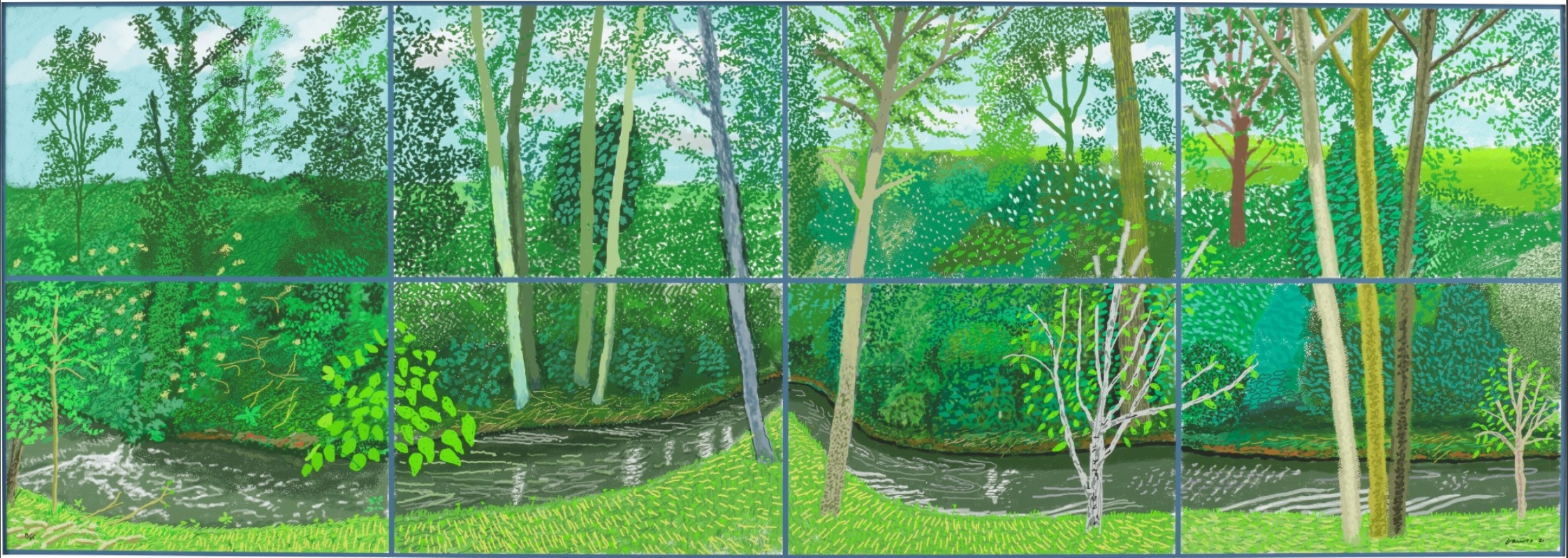
DAVID HOCKNEY (b. 1937)
18th-27th June 2021, La Dorette Winding its Way, 2021
Eight iPad paintings printed in colors on one sheet of paper, mounted on Dibond (as issued)
39-/4 x 111 inches (99.7 x 281.9 cm)
Signed and dated 21 (lower right)
Numbered 16/25 (lower left)
This work is number 16 from the edition of 25
#3. Celia II, 1984
Christie’s New-York: 21 May 2026
Estimated: USD 450,000 – 650,000
USD 952,500
DAVID HOCKNEY (B. 1937), Celia II | Christie’s
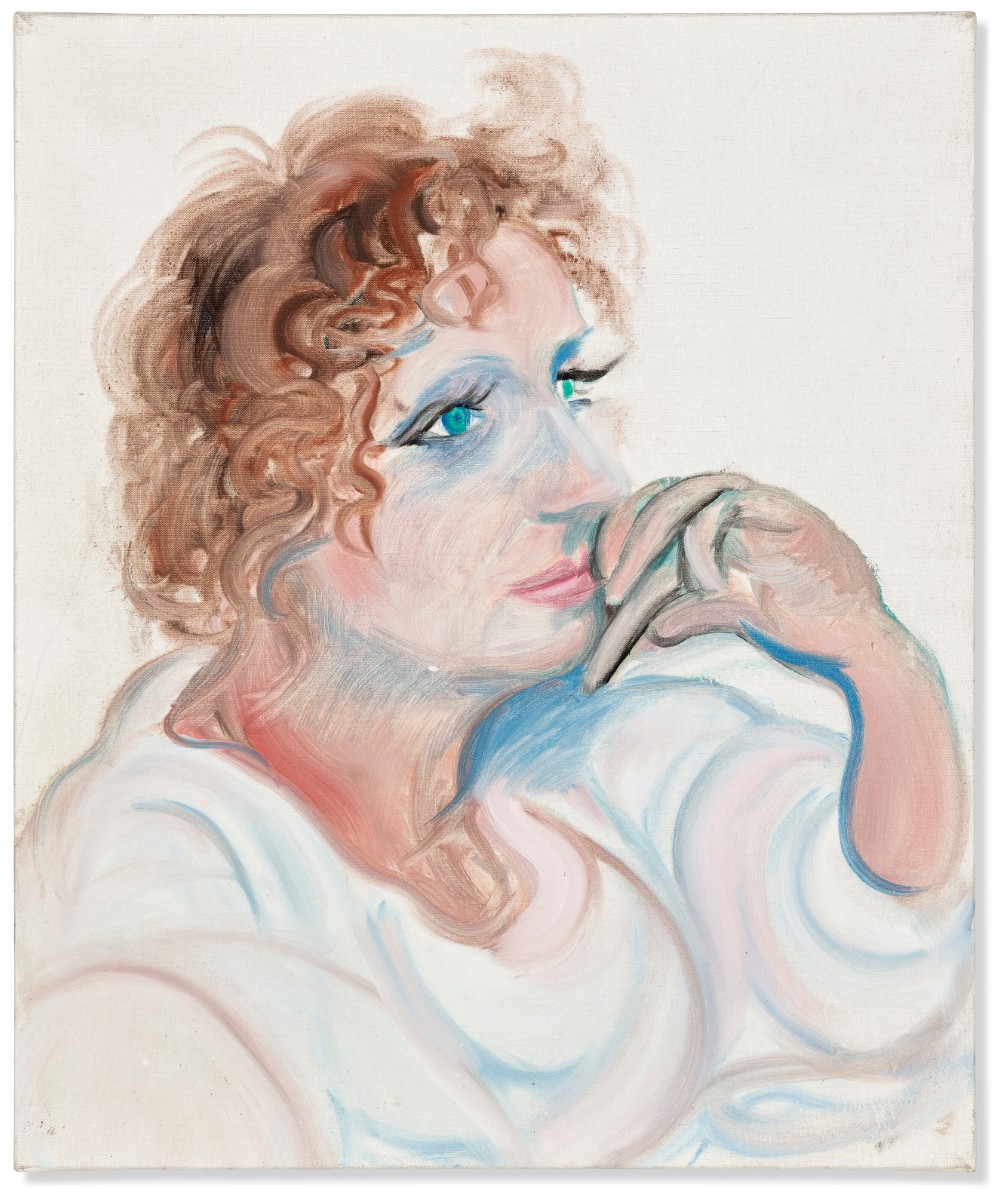
DAVID HOCKNEY (B. 1937)
Celia II, 1984
Oil on canvas
25-5/8 x 21-1/4 inches (65.1 x 54 cm)
Signed, titled and dated ‘Celia II May 1984 David Hockney’ (on the reverse)
#4. The Arrival of Spring in Woldgate – 29 January 2011
Christie’s New-York: 21 May 2026
Estimated: USD 400,000 – 600,000
USD 635,000
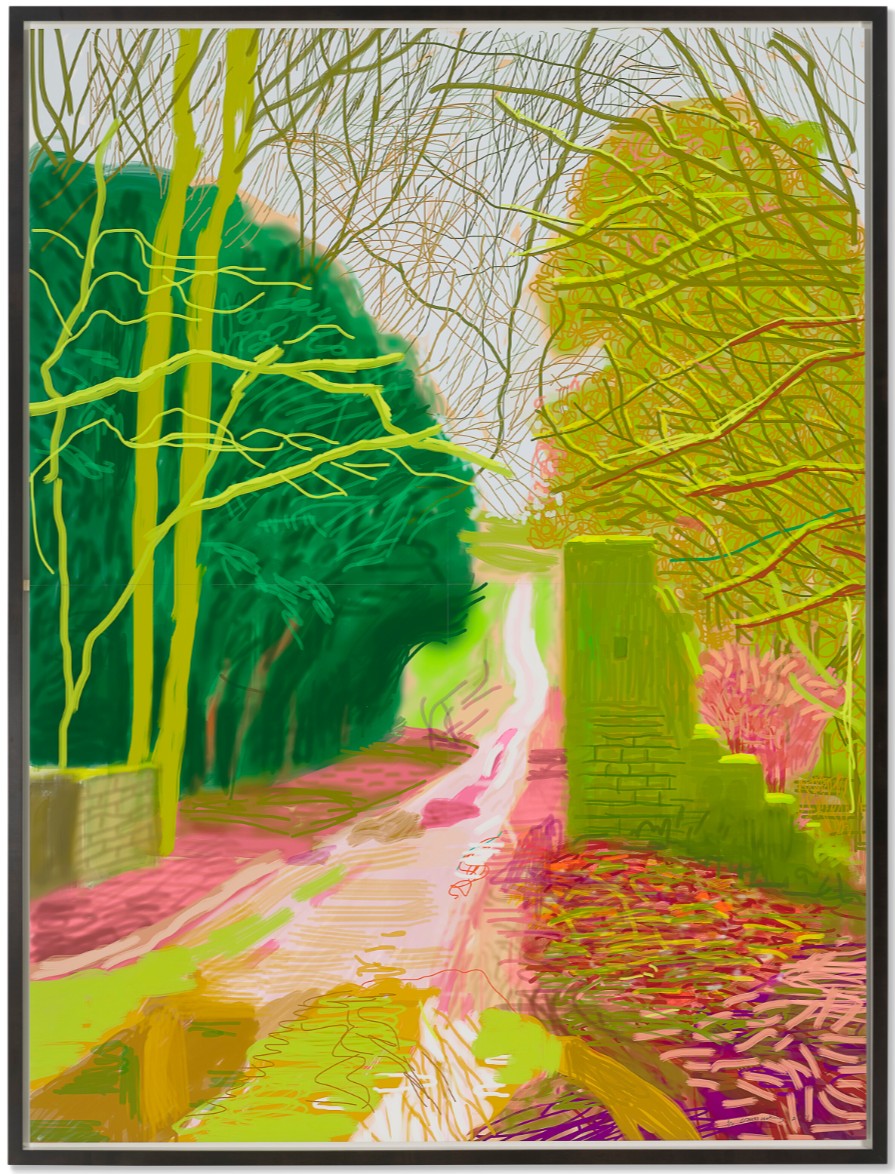
DAVID HOCKNEY (B. 1937)
The Arrival of Spring in Woldgate, East Yorkshire in 2011 (twenty eleven) – 29 January 2011
iPad drawing in colors printed on four sheets of paper mounted to Dibond
93×70 inches (236.2 x 177.8 cm)
Signed, numbered and dated ‘6⁄10 David Hockney 2011’ (lower right)
This work is number six from an edition of ten
#5. Autumn Leaves, 2008
Christie’s New-York: 21 May 2026
Estimated: USD 200,000 – 300,000
USD 482,600
DAVID HOCKNEY (B. 1937), Autumn Leaves | Christie’s
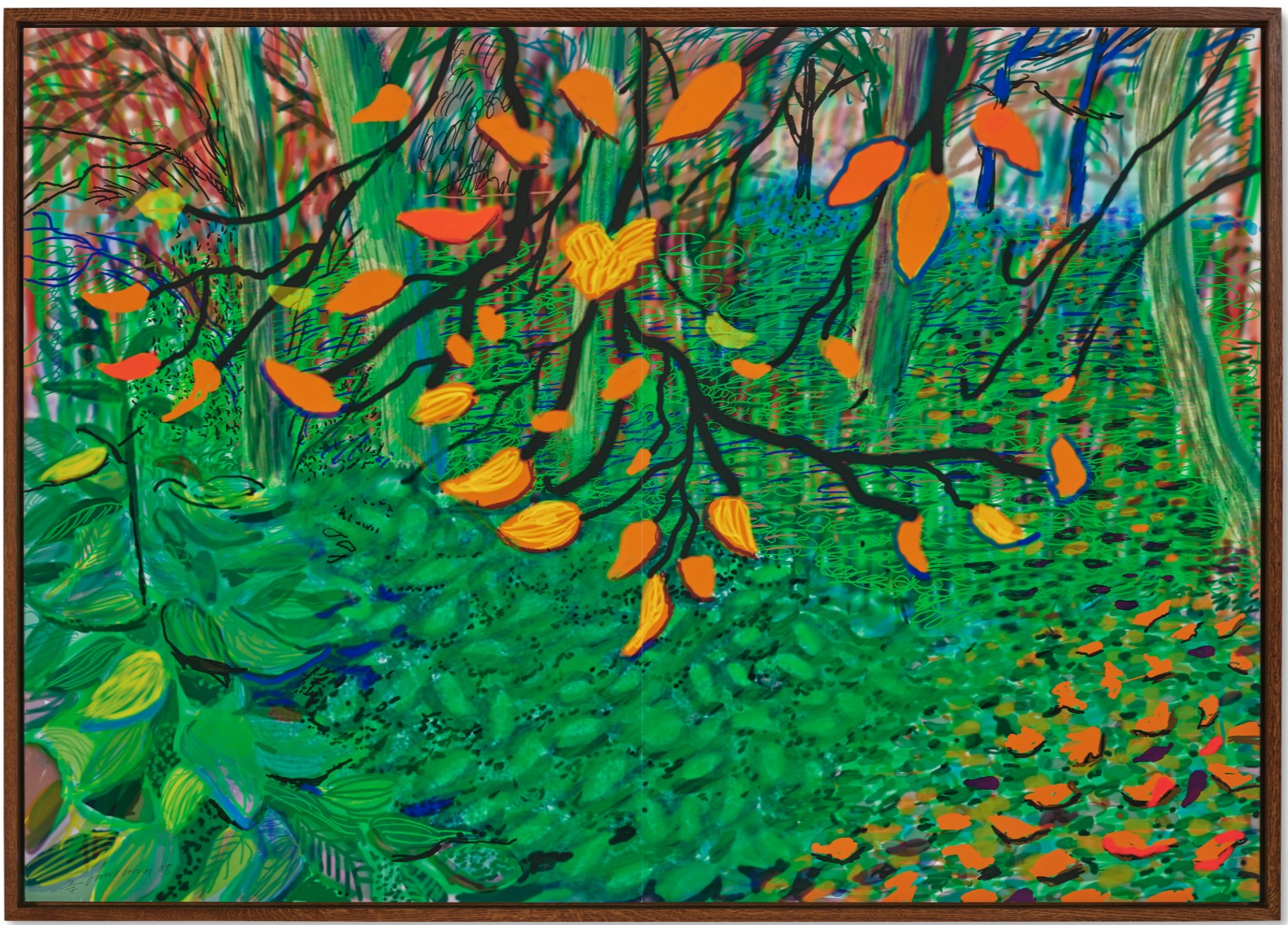
DAVID HOCKNEY (B. 1937)
Autumn Leaves, 2008
inkjet printed computer drawing on two sheets of paper mounted to Dibond
60-3/4 x 86 inches (153.2 x 218.4 cm)
Signed, numbered and dated ‘7⁄7 David Hockney 08’ (lower left)
This work is number seven from an edition of seven
#6. The Arrival of Spring in Woldgate – 15 March, 2021
Property from an Ambassadorial Collection
Sotheby’s New-York: 15 May 2026
Estimated: USD 120,000 – 180,000
USD 217,600
David Hockney | The Arrival of Spring in Woldgate, East Yorkshire in
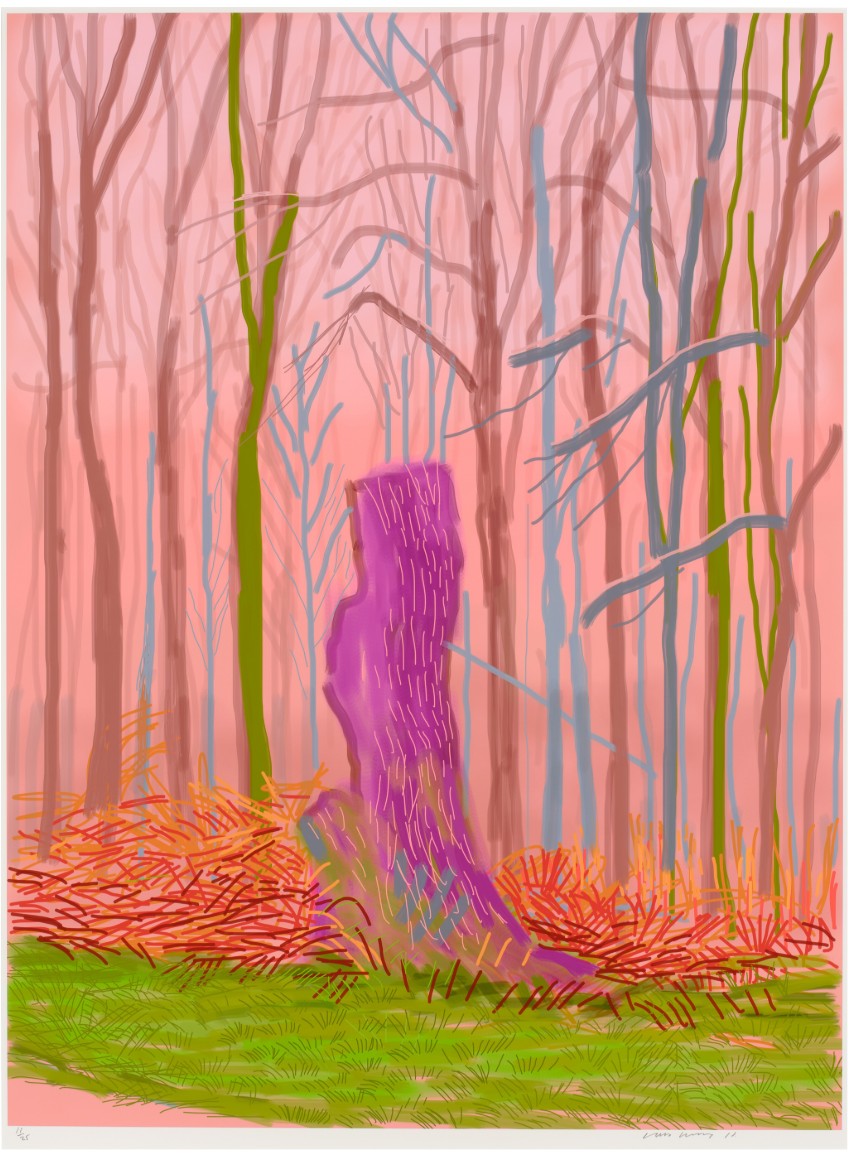
DAVID HOCKNEY (b. 1937)
The Arrival of Spring in Woldgate, East Yorkshire in 2011 (twenty eleven) – 15 March, 2021
IPad drawing printed in colors on wove paper
55-1/8 x 41-1/2 inches (140 x 105.5 cm)
Signed and dated (lower right)
Numbered 11/25 (lower left)
This impression is number 11 from the edition of 25
Published by the artist
The Valley, Mountains in Var, 1970
The Valley, Mountains in Var (Near La Garde Freinet), 1970
Property from The Sheryl and Harvey White Trust Collection
Sotheby’s New-York: 14 May 2026
Estimated: USD 6,000,000 – 8,000,000
USD 6,586,000
David Hockney | The Valley, Mountains in Var (Near La Garde Freinet)
DAVID HOCKNEY (b. 1937)
The Valley, Mountains in Var (Near La Garde Freinet), 1970
Acrylic on canvas
36×48 inches (91.4 x 121.9 cm)
Signed, titled and dated 1970 (on the reverse)
Dating to a pivotal early period in David Hockney’s legendary practice, The Valley (Mountains in Var, Near La Garde Freinet) offers a resplendent vista of the French Riviera’s verdant terrain. Distinguished for its exceptional provenance, the present work comes from the collection of Sheryl and Harvey White, where it has been cherished in their esteemed collection for over two decades.
“Anything that interests me I take photographs of… I usually carry a little camera in my pocket and then I have a bigger camera, so I’m always clicking away at things.”
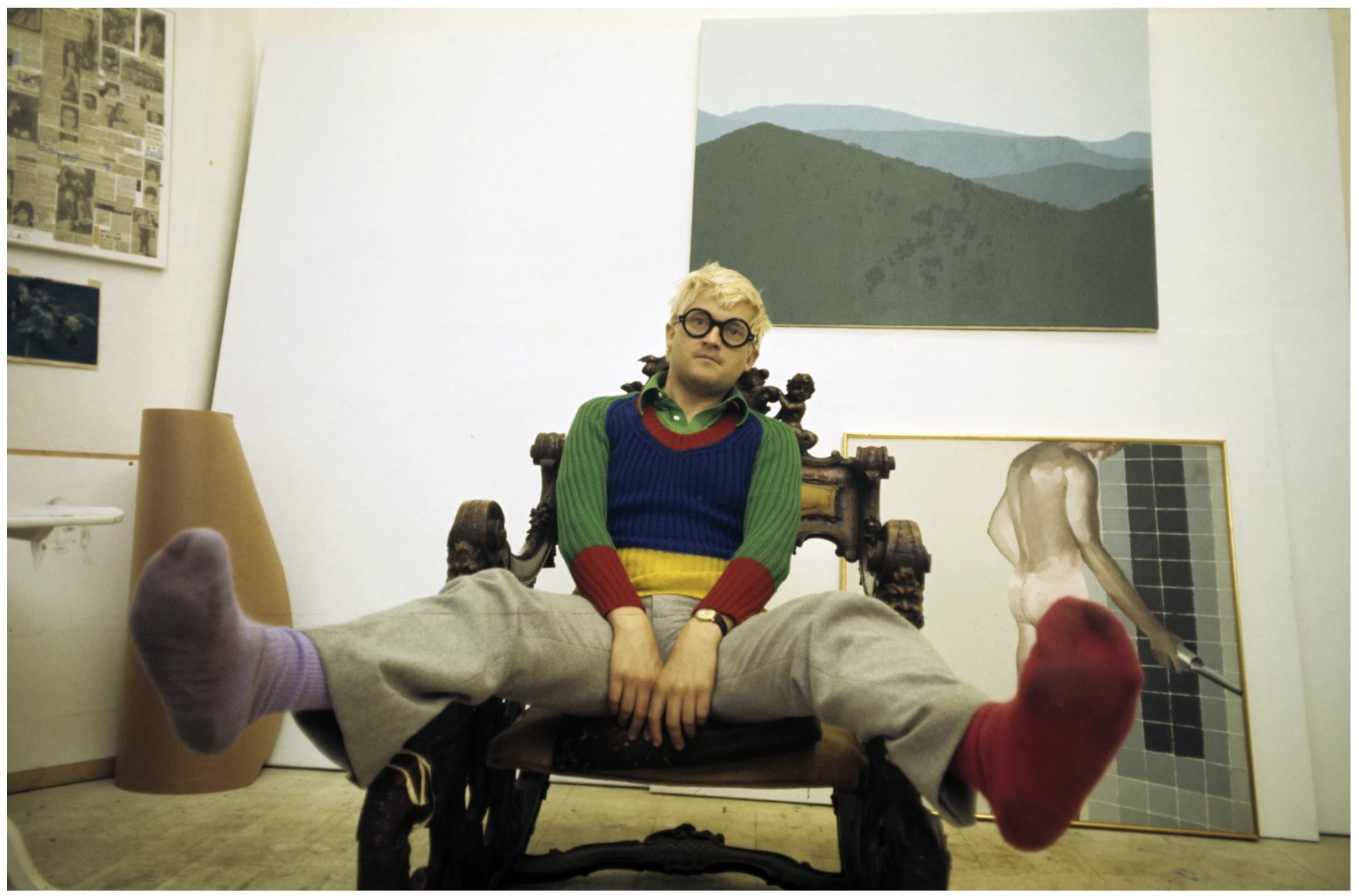
David Hockney in his studio with the present work in progress, May 1970.
Photo by Jack Garofalo/Paris Match via Getty Images. Art © 2026 David Hockney
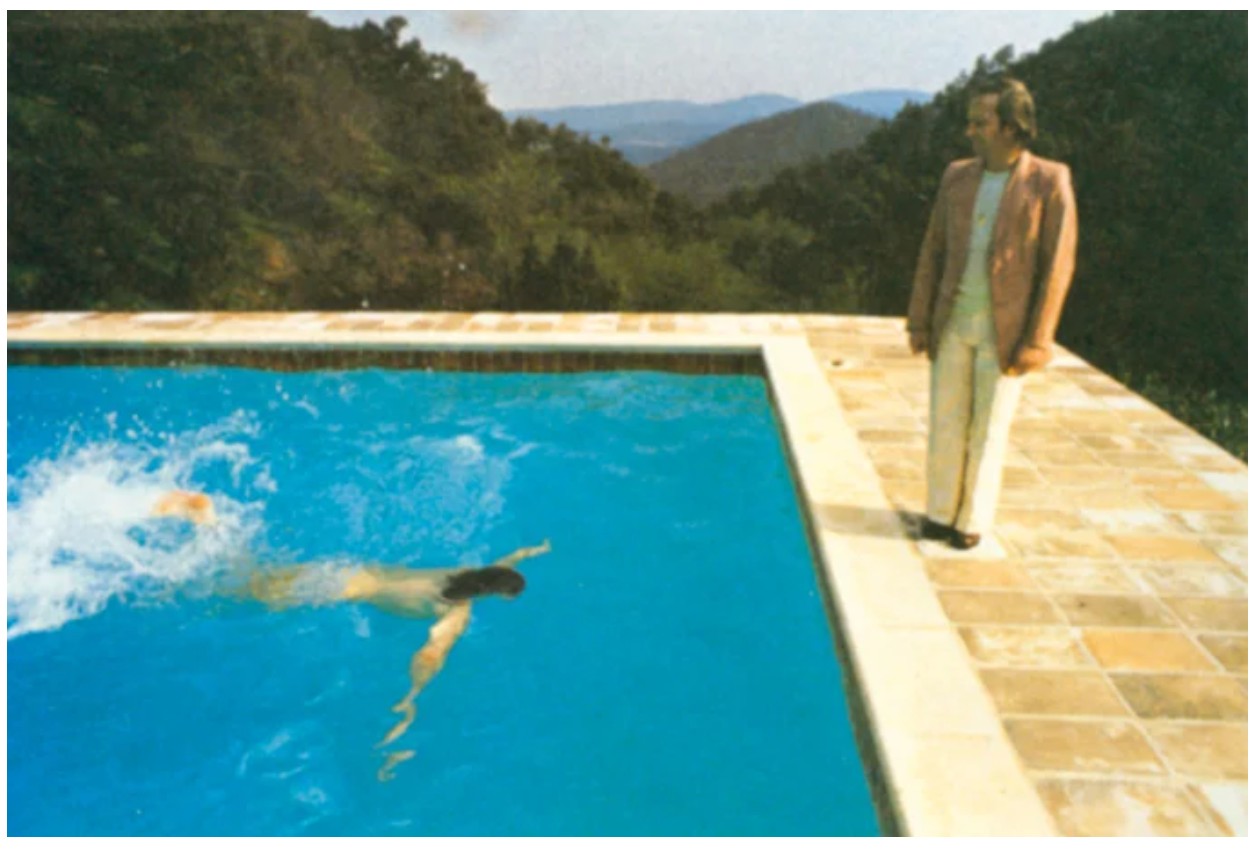
Painted after the success of Hockney’s ten-year retrospective exhibition at the Whitechapel Gallery in London in 1970, the present work captures a moment of deep personal and professional fulfillment for the young artist. The crystalline light and utter chromatic clarity of this minutely observed painting would prefigure one of the most significant works of Hockney’s entire career, Portrait of An Artist (Two Figures by a Pool), serving as a reference for the landscape depicted in the background. Distinguished by its crisp, meticulous detail and unique relation to the world record painting for the artist, The Valley (Mountains in Var, Near La Garde Freinet) is a rare and paradigmatic example of the artist’s celebrated naturalistic style of the late 1960s and early 1970s.
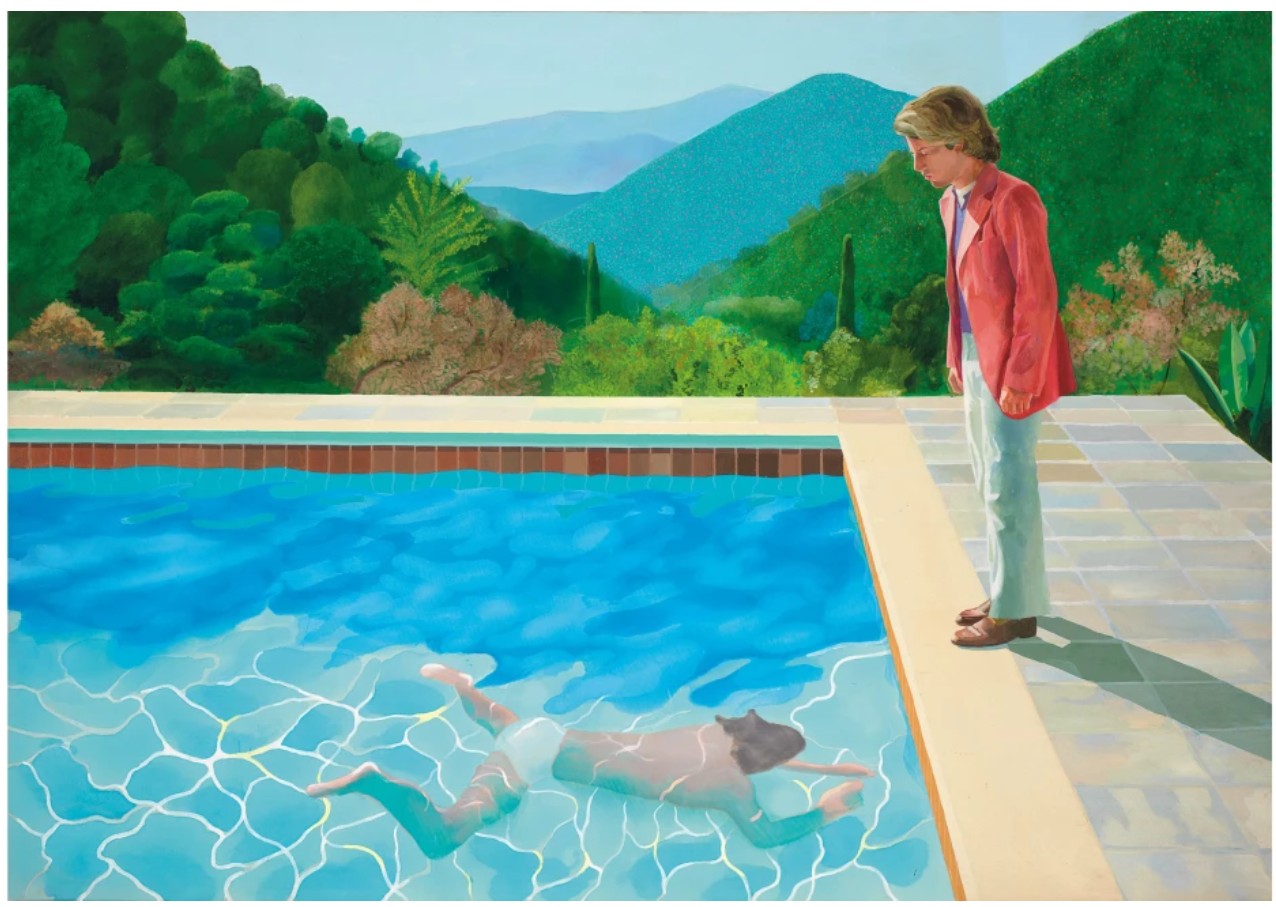
David Hockney, Portrait of an Artist (Pool with Two Figures), 1972. Private Collection. Art © 2026 David Hockney
The present work captures the view from the pool of film director Tony Richardson’s villa, Le Nid du Duc, in the south of France, where Hockney was staying with Peter Schlesinger. Here, the artist carefully composes the stippled, lush foliage of the foreground against the rolling, atmospheric hills of the Côte d’Azur. In 1970, Hockney’s output was limited while he prepared for the Whitechapel exhibition and traveled around Europe; in this year, he would paint only: Le Parc des Sources, Vichy, Mr. and Mrs. Clark and Percy, Three Chairs with a Section of a Picasso Mural and A Chair with a Horse Drawn by Picasso, as well as the present work.
“I began working on [Le Parc des Sources, Vichy], in January and it took me much longer than expected… I think the difficulties stemmed from the acrylic paint and the naturalism, the fight to achieve naturalistic effect, the difficulty of blending colors, things like that.”
Reference photo taken by the artist in Le Nid Du Duc. Photo by David Hockney
During this time, the artist’s romance with Schlesinger was growing increasingly strained, eventually dissolving in an infamous row the following year. The figure is absent from many of the works the artist started later in 1970, with the key motif of the empty chair populating Le Parc de Sources, Vichy and again in Three Chairs with a Section of a Picasso Mural—a theme that culminates in the vacant quietude of the present work.
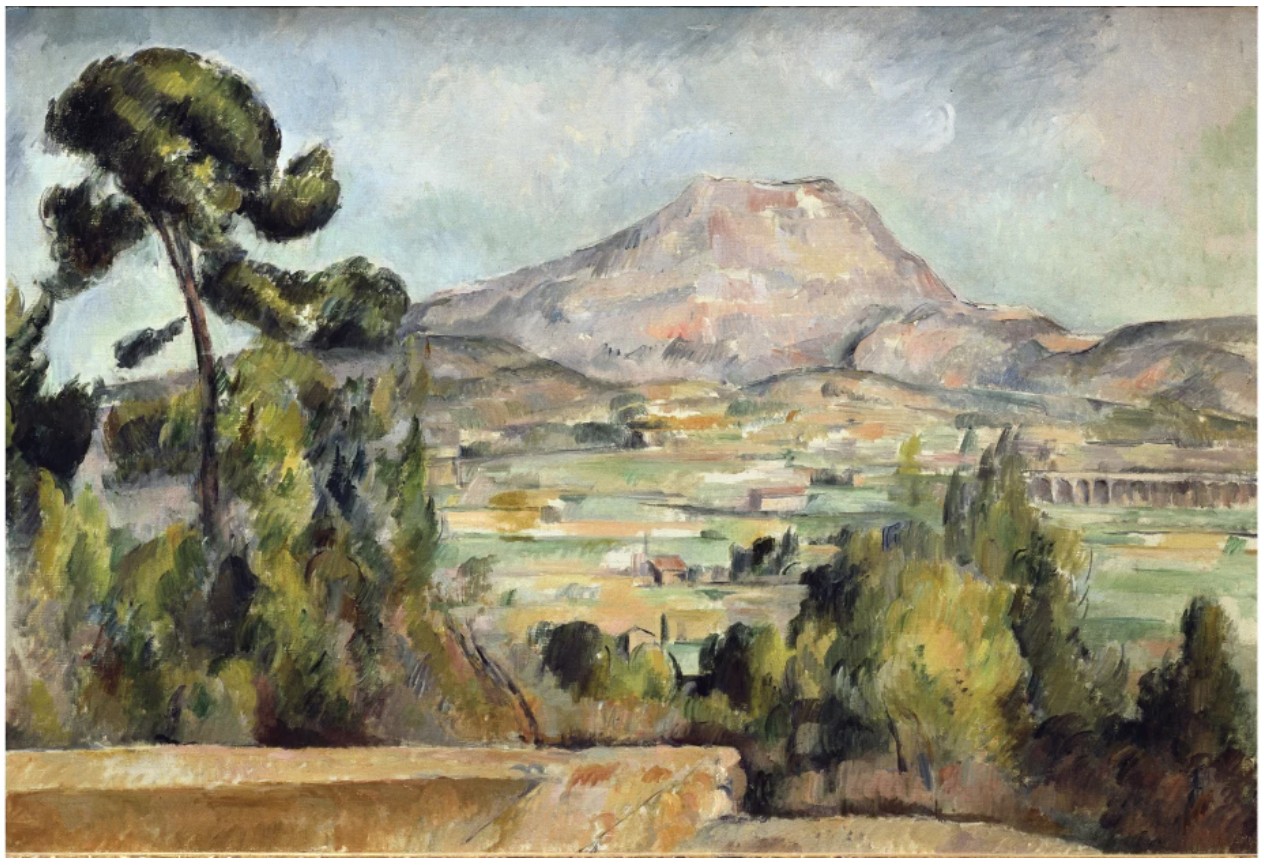
Paul Cézanne, Montagne Sainte-Victoire, 1890. Musee d’Orsay, Paris. Image © Luisa Ricciarini / Bridgeman Images
The South of France, with its languid mountains, brilliant light, and endless summers, became an instant draw for David Hockney and Peter Schlesinger and would play a pivotal role in their relationship. As Peter Webb describes, the couple “quickly bonded: … the couple were traveling again, this time to the film director Tony Richardson’s home in the south of France … [Hockney] discovered that they shared not only common roots and a northern sense of humor but also a love of sunshine and the clear light of the south.” (Peter Webb, Portrait of David Hockney, New York 1988, p. 100) Hockney and Schlesinger often attended Richardson’s extravagant parties at Le Nid du Duc, the director’s spectacular house in the mountains near La Garde-Freinet.
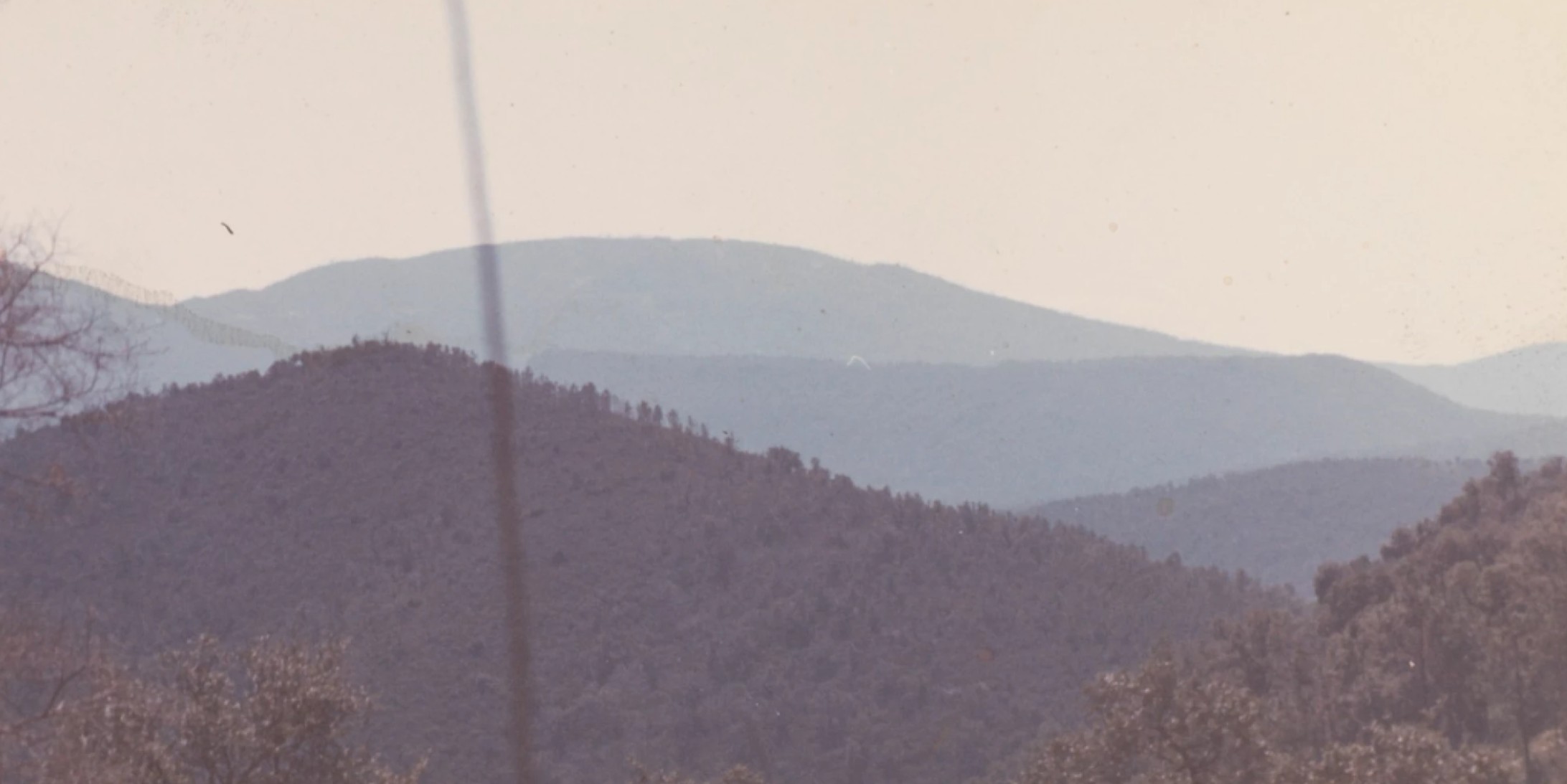
Reference photo taken by the artist in Le Nid Du Duc. Photo by David Hockney
Hockney traveled throughout the area around Richardson’s home and began to use photography in earnest, not merely for snapshots but for visual information that would help him with his compositions. He voraciously photographed the rolling hills and sparkling sea, the inspiration for the present work. The Côte d’Azur, long an artistic haven, had attracted painters like Pablo Picasso, Claude Monet, Paul Signac, and Henri Matisse, who were drawn by its luminous light. In the 1960s, it became a glamorous center for filmmakers, as the romantic backdrop for Alfred Hitchcock’s To Catch a Thief (1955) with Grace Kelly and Cary Grant, and was popularized by stars like Brigitte Bardot. In this birthplace of modern art and cinema, Hockney would also leave his mark. Following Hockney and Schlesinger’s tumultuous break-up in 1971, the present work’s setting became the setting for some of Hockney’s most profound and cathartic paintings, including Portrait of an Artist (Pool with Two Figures). Although, when The Valley (Mountains in Var, Near La Garde Freinet) was painted, the couple were very much in love.
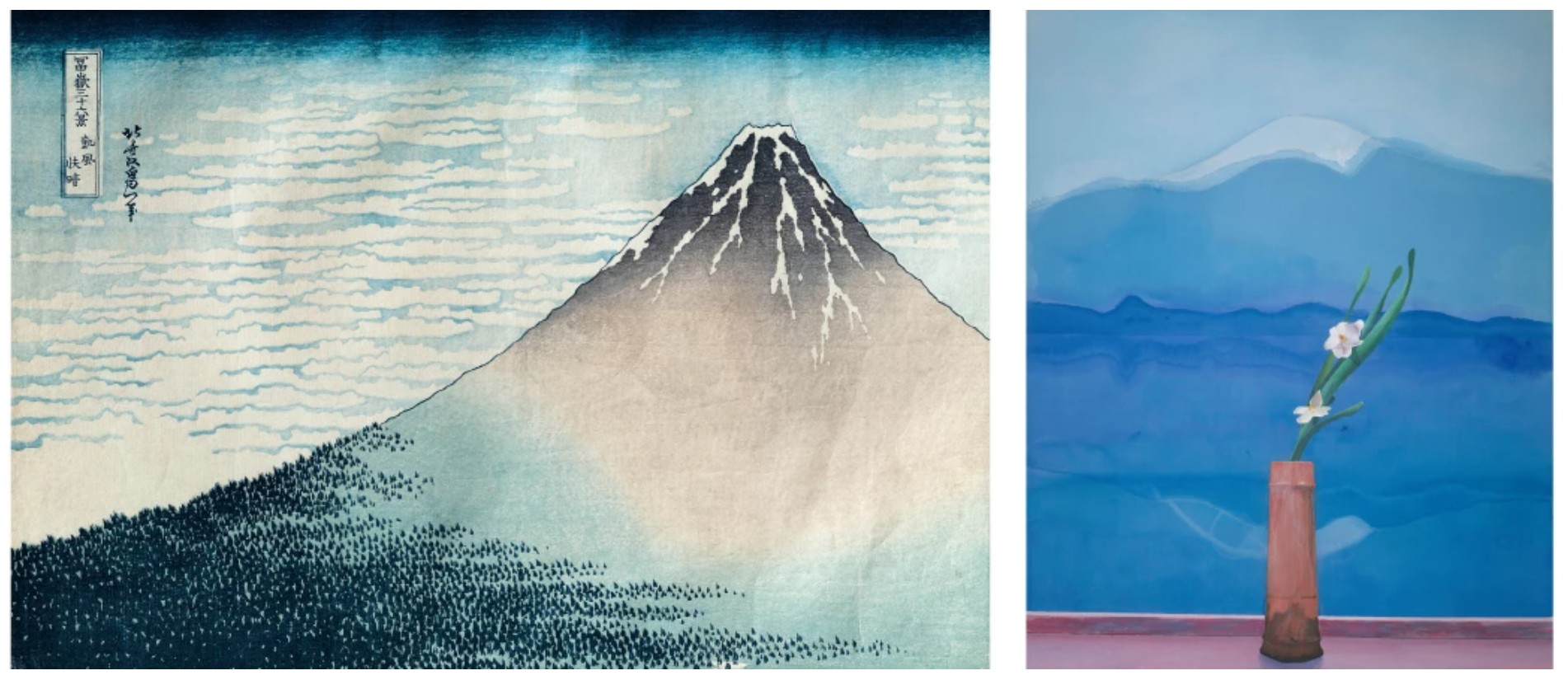
Left: Hokusai, Katsushika, Fuji in Clear Weather, 19th century. Musée Guimet, Paris. Image © Bridgeman Images.
Right: David Hockney, Mount Fuji and Flowers, 1972. The Metropolitan Museum of Art, New York. Image © The Metropolitan Museum of Art. Image source: Art Resource, NY
In The Valley (Mountains in Var, Near La Garde Freinet), the rolling mountains, rendered in subtle gradients of cobalt, are set against a vivid plum, contoured by lush, verdant foliage that captures the glistening light and shimmering perspectives of a sun-kissed day in the French landscape. Suffused with the optimism and tenderness of a summer’s day and an enchanting romance in a glorious setting, the present work captures that moment of intimacy and exhilaration with remarkable poignancy. Confronted with deeply pigmented forms of luscious foliage set against the elegant geometry of the almost abstracted landscape, we are transported to a space that is at once an aesthetically seductive and finely composed mise-en-scène: informed by photographic, cinematic, and art historical precedent, The Valley (Mountains in Var, Near La Garde Freinet) is a perfect expression of Hockney’s unique Pop dialect.
La Dorette Winding its Way, 2021
18th-27th June 2021, La Dorette Winding its Way, 2021
Sotheby’s New-York: 14 May 2026
Estimated: USD 500,000 – 700,000
USD 1,984,000
David Hockney | 18th-27th June 2021, La Dorette Winding its Way | The
DAVID HOCKNEY (b. 1937)
18th-27th June 2021, La Dorette Winding its Way, 2021
Eight iPad paintings printed in colors on one sheet of paper, mounted on Dibond (as issued)
39-/4 x 111 inches (99.7 x 281.9 cm)
Signed and dated 21 (lower right)
Numbered 16/25 (lower left)
This work is number 16 from the edition of 25
The present work encapsulates one of Hockney’s most ambitious and celebrated technological undertakings to date: the iPad painting. Hockney renders here an expansive view of the River Dorette winding through the Norman countryside. Eight individual iPad paintings operate in concert, coalescing into a single panoramic composition. Harnessing the medium’s potential for precision, Hockney achieves remarkable detail—fluid, gestural strokes evoke the movement of water, while short, deliberate marks lend texture and density to the surrounding grass.
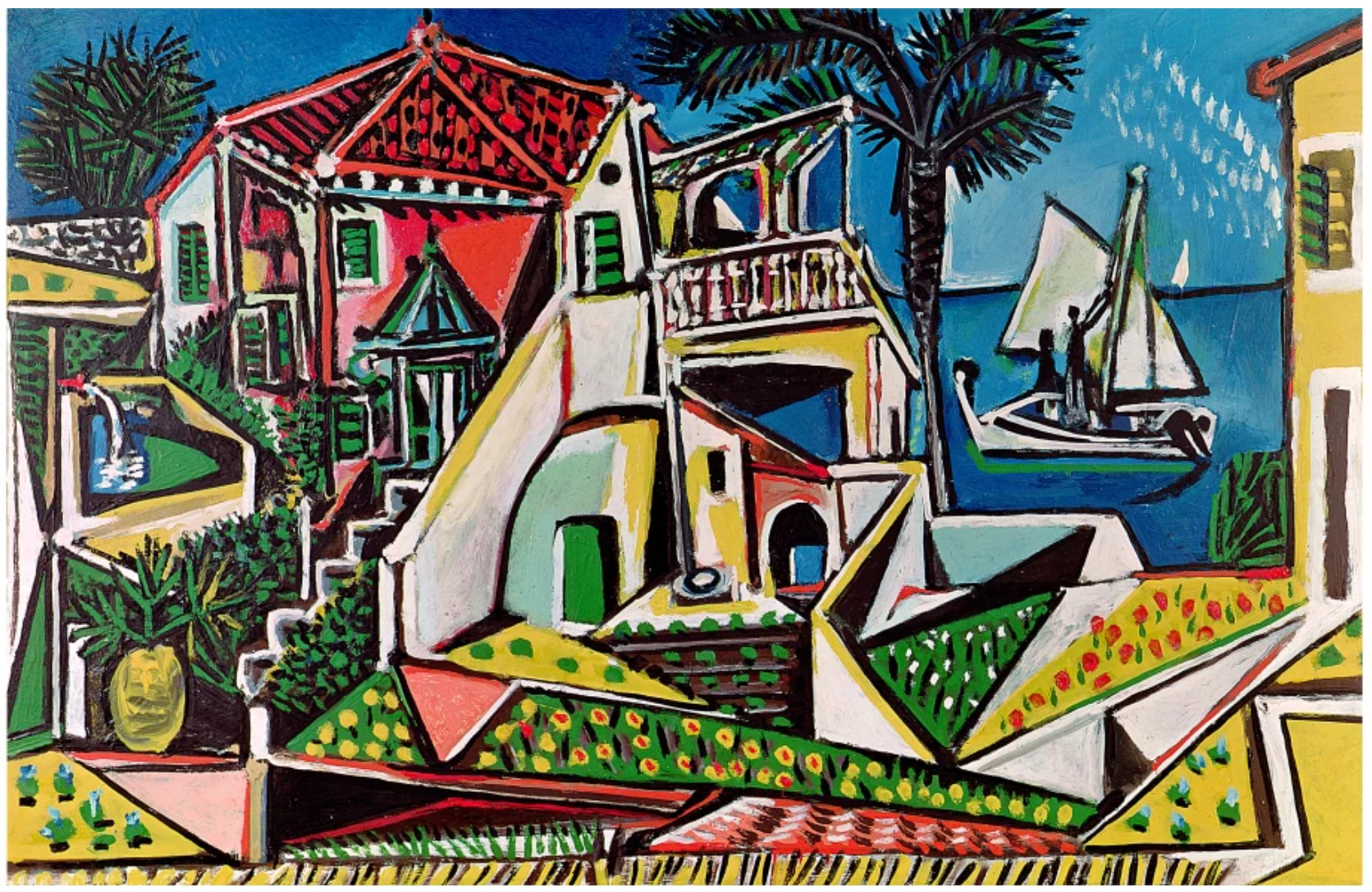
Pablo Picasso, Mediterranean Landscape, 1952. Albertina Museum, Vienna.
Image © Bridgeman Images. Art © 2026 Estate of Pablo Picasso / Artists Rights Society (ARS), New York
Hockney’s experimentation with technology dates back to 1982 when he began exhibiting fragmented collages formed from Polaroid photographs. This approach persisted in his “fax art,” wherein images transmitted via fax and reproduced through photocopying were assembled into monumental compositions.
“I do think the iPad is a new art form. Much better than a lithograph. Inkjet printing is more vivid, the color stays exactly the same. The prints use an awful lot of pigment. But the bigger they get, they don’t fade, don’t pixelate.”
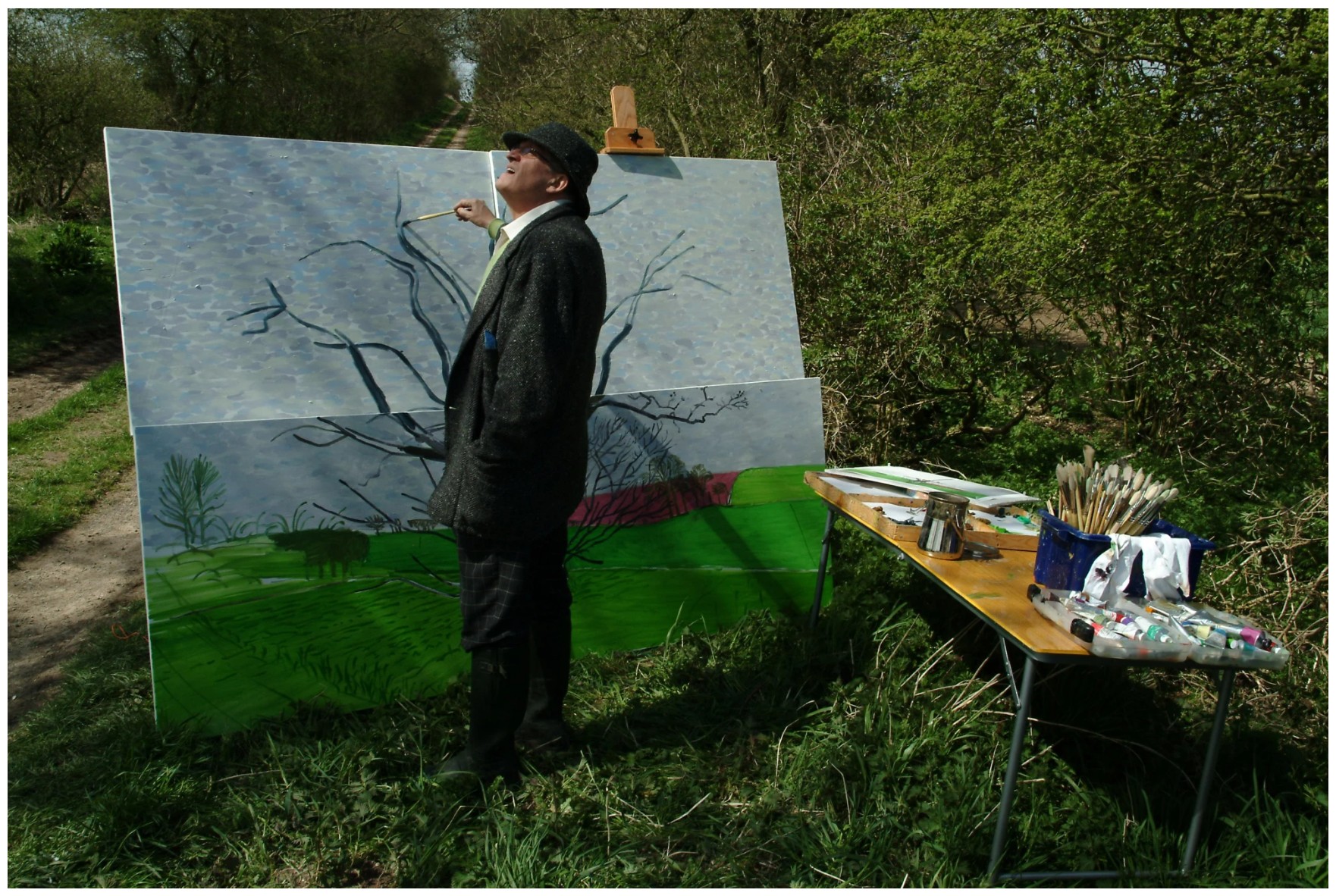
David Hockney painting Tree off the Track, 2006. Photo by Jean-Pierre Gonçalves de Lima. Art © David Hockney
A similar conceptual framework underpins the present work: each panel exists as an autonomous image, together forming a richly layered and immersive landscape, inviting the viewer to navigate its breadth both in parts and as a whole.
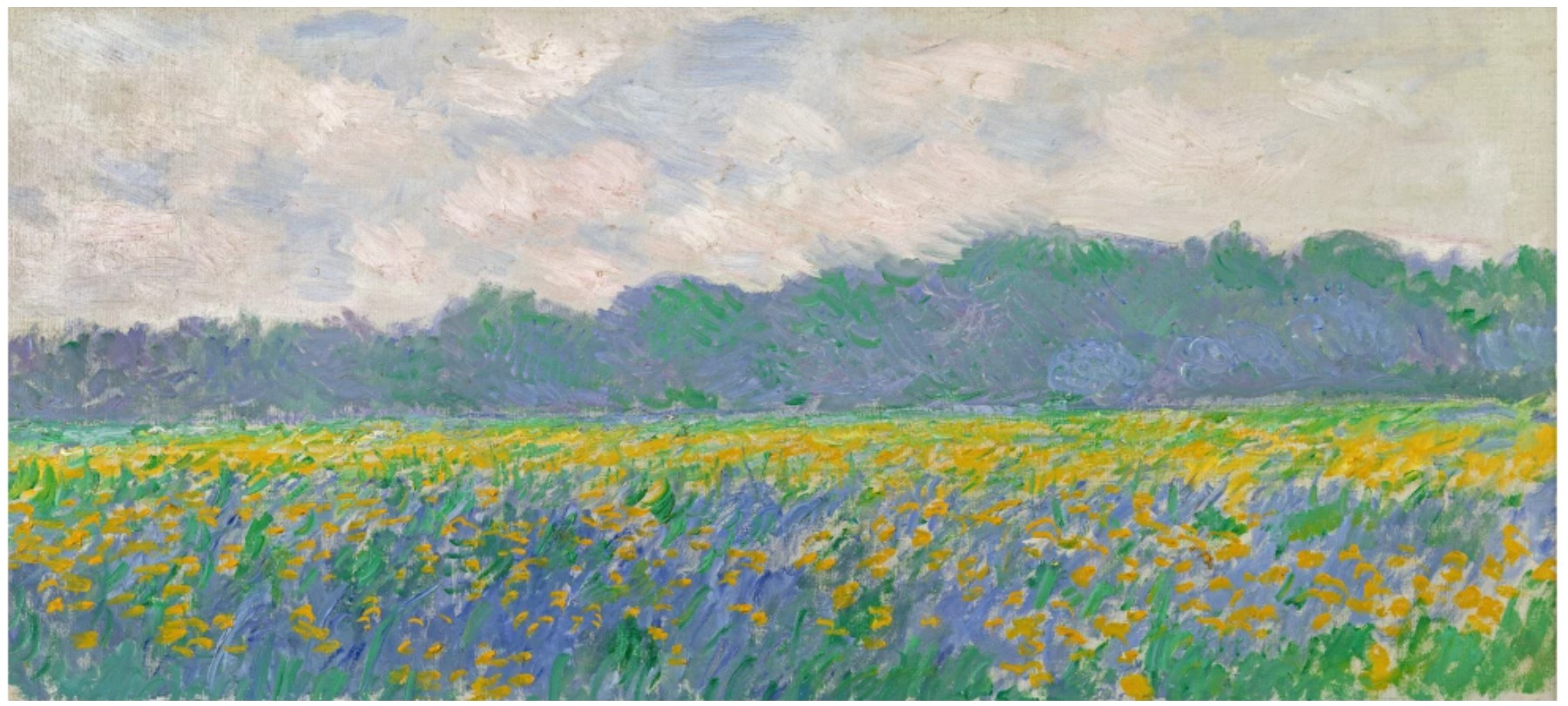
Claude Monet, Field of Yellow Irises at Giverny, 1887. Musee Marmottan Monet, Paris. Image © Bridgeman Images
Upon purchasing the first iteration of the iPhone in 2007, Hockney grew enamored with the “Brushes” app, experimenting with drawing on the small screen with limited range. As he observed, “Despite the scale, you can draw majestic things; majestic mountains can be drawn quite small.” (Robyn Farrell, “Hockney’s Perpetual Spring: The Embrace of Digital Tools,” The Art Institute of Chicago, 30 August 2022 (online)) The broader “canvas” of the later released iPad only piqued the artist’s interest further.
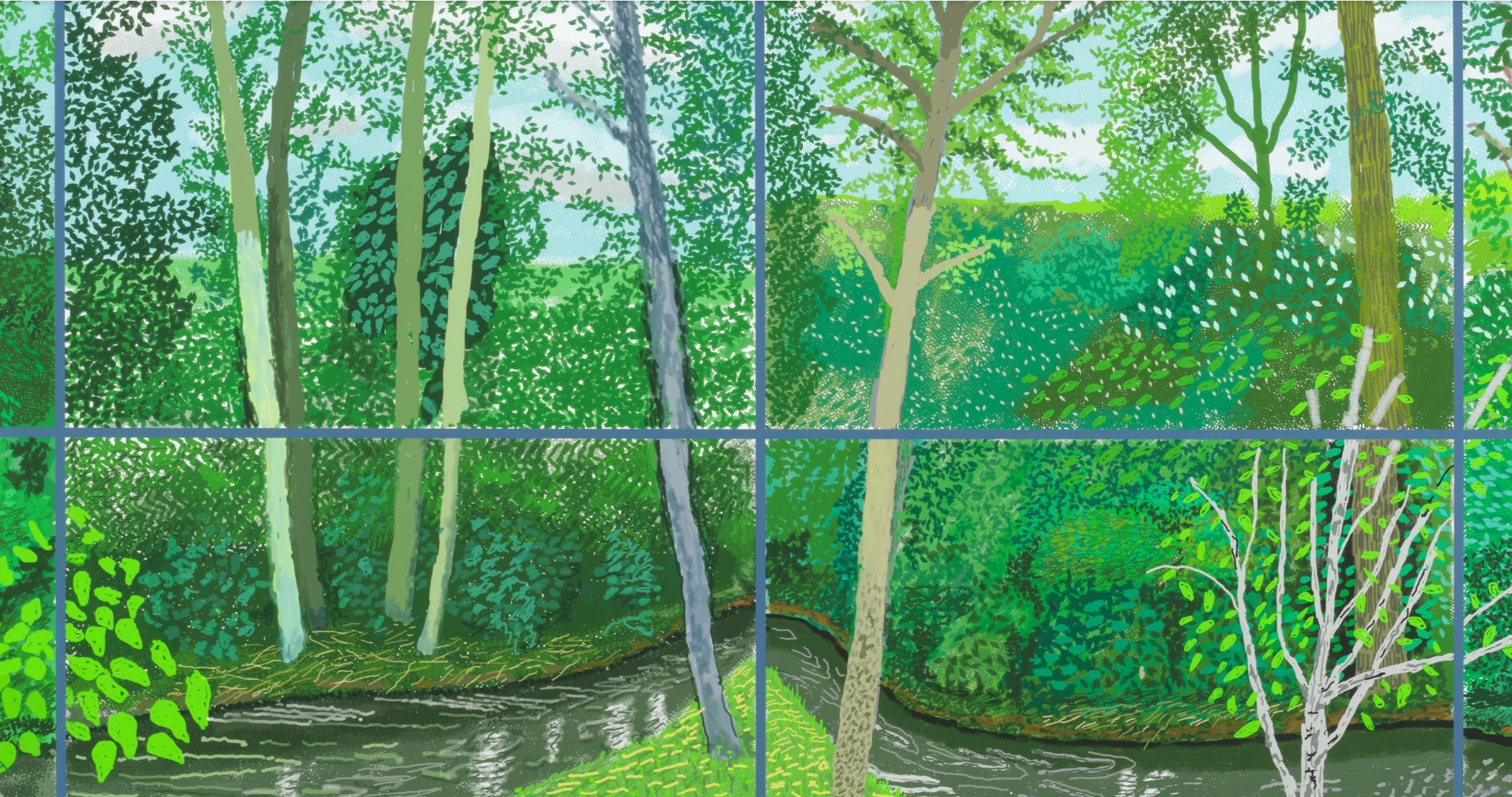
In 2011, he produced his renowned The Arrival of Spring, a comprehensive series capturing subtle transitions in light, color, and atmosphere. The present work extends this sustained engagement, reflecting his enduring fascination with the natural world: “You’ve endless subjects in nature,” Hockney remarked in a 2023 interview, “if you really look.” (Alex Marshall, “David Hockney Goes High-Tech,” The New York Times, 22 February 2023 (online))
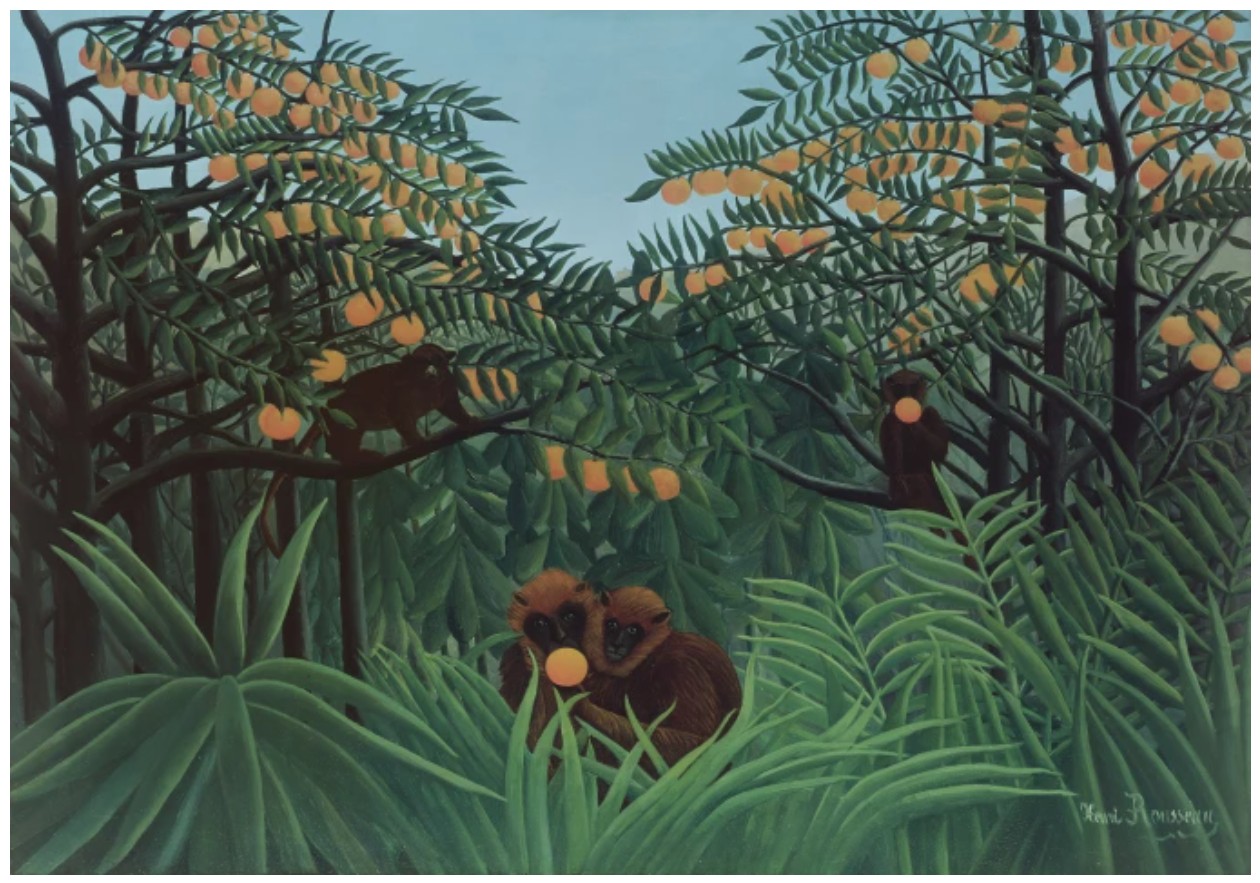
Henri Rousseau, Monkeys in the Jungle (or The Tropics), 1910. Private Collection. Image © Bridgeman Images
After relocating to Normandy in 2019, Hockney’s practice became increasingly infused with the luminous character of the French landscape that once graced the canvases of Impressionist painters. Masterful in detail and technique, Hockney regards these works created in Normandy between 2020 and 2023 as paintings, adopting the term “iPad paintings.” Executed en plein air, these images establish a dialogue with impressionist masters in both subject and technique, firmly situating Hockney’s practice within the continuum of 20th and 21st century art history while simultaneously championing the expressive and innovative potential of digital media.
Celia II, 1984
Celia II, 1984
Christie’s New-York: 21 May 2026
Estimated: USD 450,000 – 650,000
USD 952,500
DAVID HOCKNEY (B. 1937), Celia II | Christie’s
DAVID HOCKNEY (B. 1937)
Celia II, 1984
Oil on canvas
25-5/8 x 21-1/4 inches (65.1 x 54 cm)
Signed, titled and dated ‘Celia II May 1984 David Hockney’ (on the reverse)
“Celia has a beautiful face, a very rare face with lots of things in it which appeal to me. It shows aspects of her, like her intuitive knowledge and her kindness, which I think is the greatest virtue. To me she’s such a special person.”
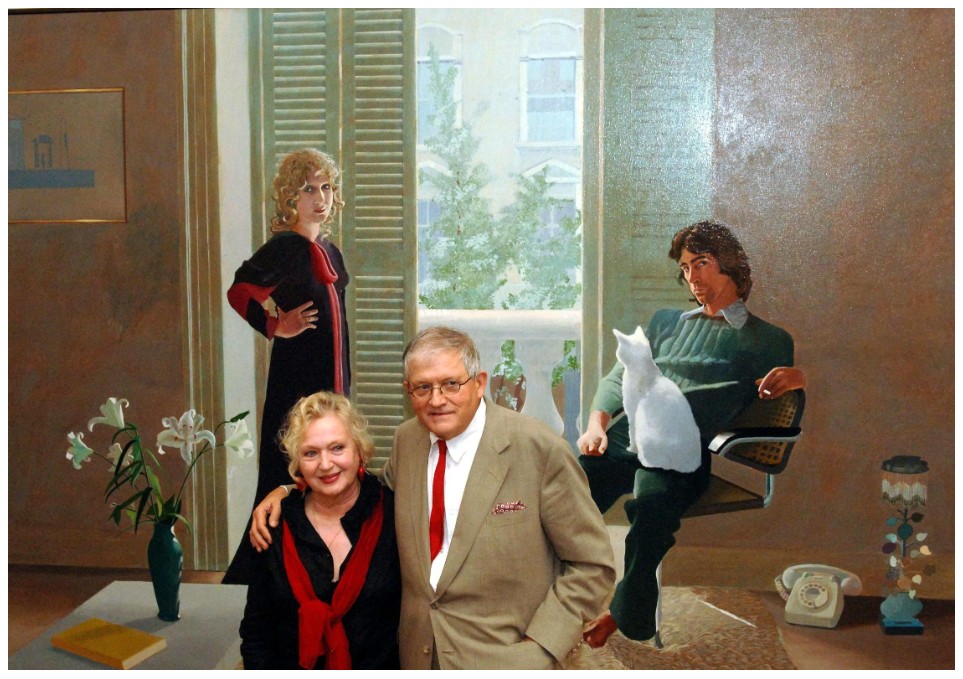
British artist David Hockney stands in front of his painting Mr & Mrs Clark and Percy, painted in 1970, with Celia Birtwell,
who modelled for the picture, at the National Portrait Gallery in London.
Photo: Steve Parsons – PA Images/PA Images via Getty Images. Artwork: © David Hockney.
The Arrival of Spring in Woldgate – 15 March, 2021
The Arrival of Spring in Woldgate – 15 March, 2021
Property from an Ambassadorial Collection
Sotheby’s New-York: 15 May 2026
Estimated: USD 120,000 – 180,000
USD 217,600
David Hockney | The Arrival of Spring in Woldgate, East Yorkshire in
DAVID HOCKNEY (b. 1937)
The Arrival of Spring in Woldgate, East Yorkshire in 2011 (twenty eleven) – 15 March, 2021
IPad drawing printed in colors on wove paper
55-1/8 x 41-1/2 inches (140 x 105.5 cm)
Signed and dated (lower right)
Numbered 11/25 (lower left)
This impression is number 11 from the edition of 25
Published by the artist
The present iPad drawings are from the series of 49 works of this scale from David Hockney’s celebrated Arrival of Spring in Woldgate, East Yorkshire in 2011 series. One of the artist’s most vibrant and ambitious explorations of landscape, perception, and technological possibility, the series comprises dozens of images, each documenting subtle shifts in color, light and atmosphere. Instead of presenting a single, authoritative view of spring, Hockney constructs a visual diary of its progress by returning repeatedly to the same stretch of Woldgate and showing the landscape as something experienced over time rather than frozen in an instant.
“It was a wonderful Spring, and we always planned to record it;
I just didn’t realize the iPad would be part of it then.”
Hockney was first struck by the drama and excitement of the Northern European spring in 2002, when he walked through Holland Park each day from his London studio to Lucian Freud’s, where he was sitting for a portrait. He had spent the previous 20 years in Southern California where seasonal changes are much less marked. In England, Hockney realized, every day is different: leaves and flowers unfurl, vegetation burgeons, the light alters, and so too does the shade.
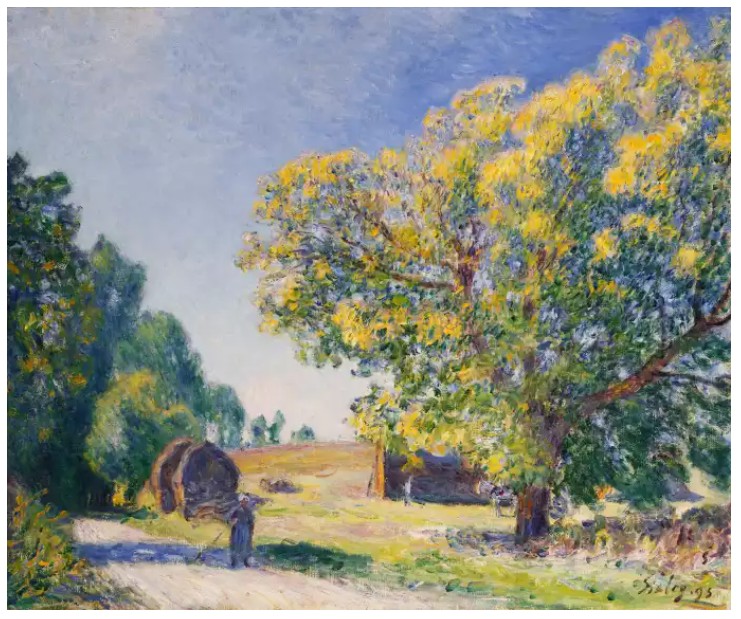
Alfred Sisley, Autour de la forêt, une clairière, 1895, © Christie’s Image / Bridgeman Images
Hockney’s adoption of digital media was essential to capturing the rapidly changing landscape. The iPad allowed him to work directly from observation with unprecedented speed, layering and revising the same image without needing to start anew. Hockney has always pushed the boundaries of using new technology in his work and his interest in the present medium dates to 2009, when he began to sketch on his iPhone. Subsequently anyone visiting the artist in Bridlington – then his center of operations – would hear him extol the virtues and possibilities of the device as a tool for drawing. In process, subject and execution, the series is innovative in every way. Although depicting spring is a time-honored tradition in European art, no artist has ever observed it so closely, with such fascinated and loving attention, nor recorded it in such detail as an evolving process. Viewed either individually or as a whole, the works in the series are a testament to Hockney’s ability to expose the beauty and nuance of the mundane.