MAY 2026 NEW-YORK AUCTIONS
Alex Katz
Boquerón, 1979
Boquerón, 1979
Property from the Collection of Annabelle and Bernard Fishman
Sotheby’s New-York: 15 May 2026
Estimated: USD 800,000 – 1,200,000
USD 1,216,000
Alex Katz | Boquerón | Contemporary Day Auction | 2026 | Sotheby’s

ALEX KATZ (b. 1927)
Boquerón, 1979
Oil on linen
72×96 inches (182.9 x 243.8 cm)
Sun-drenched and exquisitely composed, Boquerón from 1979 exemplifies Alex Katz’s singular ability to transform the fleeting pleasures of modern life into images of enduring elegance and quiet mystery. Painted at a moment when Katz had fully refined the crisp visual language that would make him one of the most distinctive painters of the postwar period, the present work offers a luminous tableau of leisure, intimacy, and observation. Set in Balneario de Boquerón in Cabo Rojo, Puerto Rico, against a tropical landscape of swaying palms, brilliant sky, and bands of deep green foliage, three figures occupy the foreground in a composition at once casual and highly orchestrated, their apparent ease countered by the taut stillness that gives Katz’s finest paintings their psychological charge. Acquired by Annabelle and Bernard Fishman in 1984, Boquerón has been cherished in their collection ever since, returning to the market for the first time in over four decades.

Katz’s art is so often celebrated for its immediacy that it can be easy to overlook just how carefully constructed his paintings are. In Boquerón, every element has been pared down and clarified, yet the work feels anything but simple. A woman in white turns toward the center of the canvas; beside her, a second woman in a vivid red swimsuit and blue headscarf faces outward behind mirrored sunglasses; at right, a shirtless man with silver hair leans in profile, his body filling the frame with monumental calm. Behind them, the fronds of palm trees arc rhythmically against a sky of unmodulated blue, while the white band of sand and surf provides a shallow, luminous stage on which the figures appear suspended. The scene is unmistakably one of tropical ease, yet Katz resists anecdote. There is no narrative resolution, only the charged interval between glance, presence, and atmosphere.

Alex Katz, Round Hill, 1977. Los Angeles County Museum of Art.
Art © 2026 Alex Katz / Licensed by VAGA at Artists Rights Society (ARS), NY.
Since the 1950s, Katz has forged a highly individualized mode of realism that stands apart from both the painterly drama of Abstract Expressionism and the cool detachment of Pop. His figures, often drawn from family, friends, and the social world around him, are rendered with an economy that makes them feel at once utterly specific and strangely elusive. In Boquerón, the sitters are not presented as psychological case studies so much as embodiments of a moment stylized, self-possessed, and suspended in time. Katz has often spoken of wanting to paint “contemporary gestures, contemporary clothes and contemporary people,” and it is precisely this devotion to the lived present that gives his work its freshness. Yet for all their apparent naturalness, his figures are never merely documentary. They are heightened by selection, cropping, and scale into something closer to icons of seeing itself.
The setting of Boquerón is integral to that effect. Throughout his career, Katz has returned to landscape not as backdrop alone but as an active participant in the mood and structure of the painting. Just as the light and atmosphere of coastal Maine shaped his most celebrated outdoor scenes, here the tropical environment of Puerto Rico sharpens the work’s languid glamour and chromatic brilliance. The palm trees do more than situate the composition geographically; they provide a vertical rhythm that echoes the elongated framing of the figures, while their broad green fronds offset the flattened planes of flesh, fabric, and sky. Katz’s handling of light is particularly masterful. The skin of the figures glows in warm expanses of ochre and peach, broken only by the most economical indications of shadow. This selective modeling intensifies the image’s flatness even as it heightens its sensual immediacy.
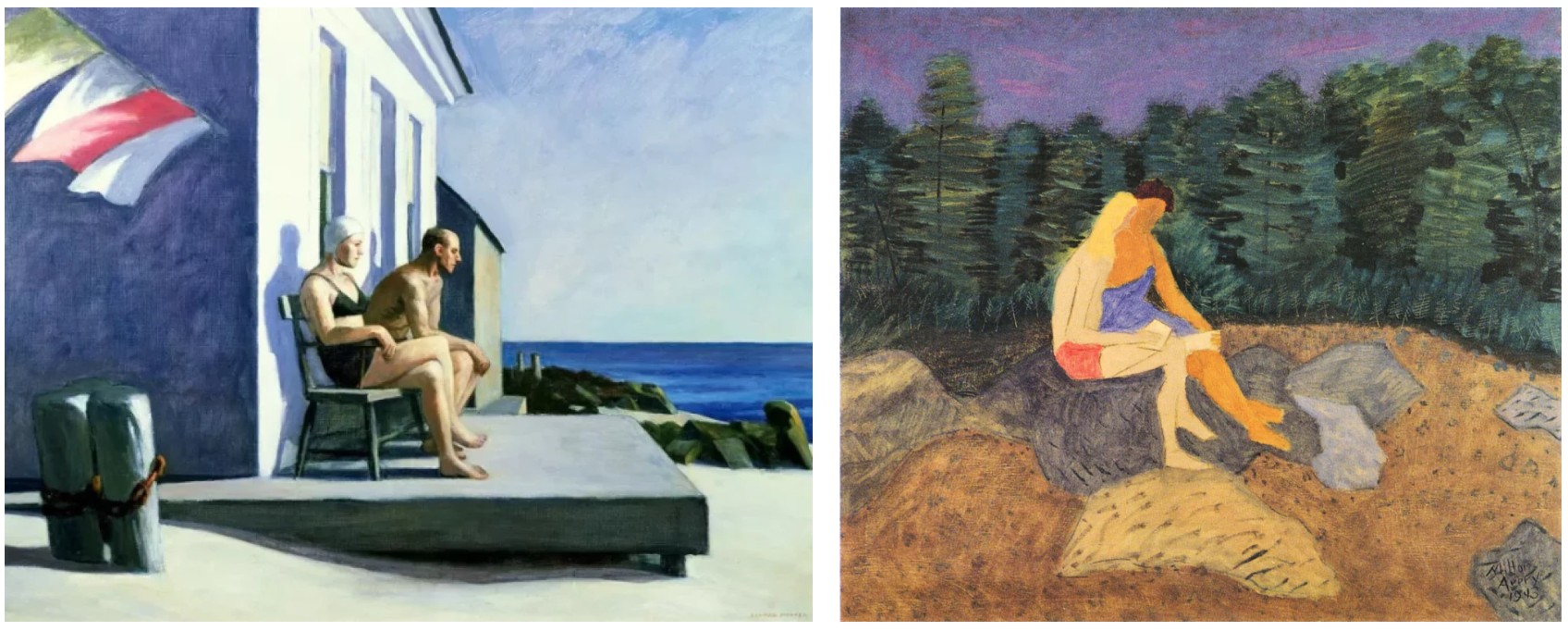
Left: Edward Hopper. Sea Watchers, 1952. Private Collection.
Right: Milton Avery, Sketchers on the Rock, 1943. Neuberger Museum of Art, Purchase College, State University of New York.
Painted in 1979, Boquerón belongs to a mature period in Katz’s career when his portraits and group scenes had achieved a new level of scale, confidence, and compositional daring. By this point, Katz had long established himself as a critical counterpoint to dominant postwar tendencies, developing a figurative language that absorbed lessons from billboard design, cinema, fashion photography, and art history alike. One senses in Boquerón the elegant leisure of Manet, the cropped immediacy of photography, and the cool, clear light of modern advertising, all reconfigured into a pictorial language entirely Katz’s own. His radical simplification of form and suppression of extraneous detail do not diminish the painting’s emotional resonance; rather, they intensify it. What remains is distilled, essential, and quietly enigmatic.
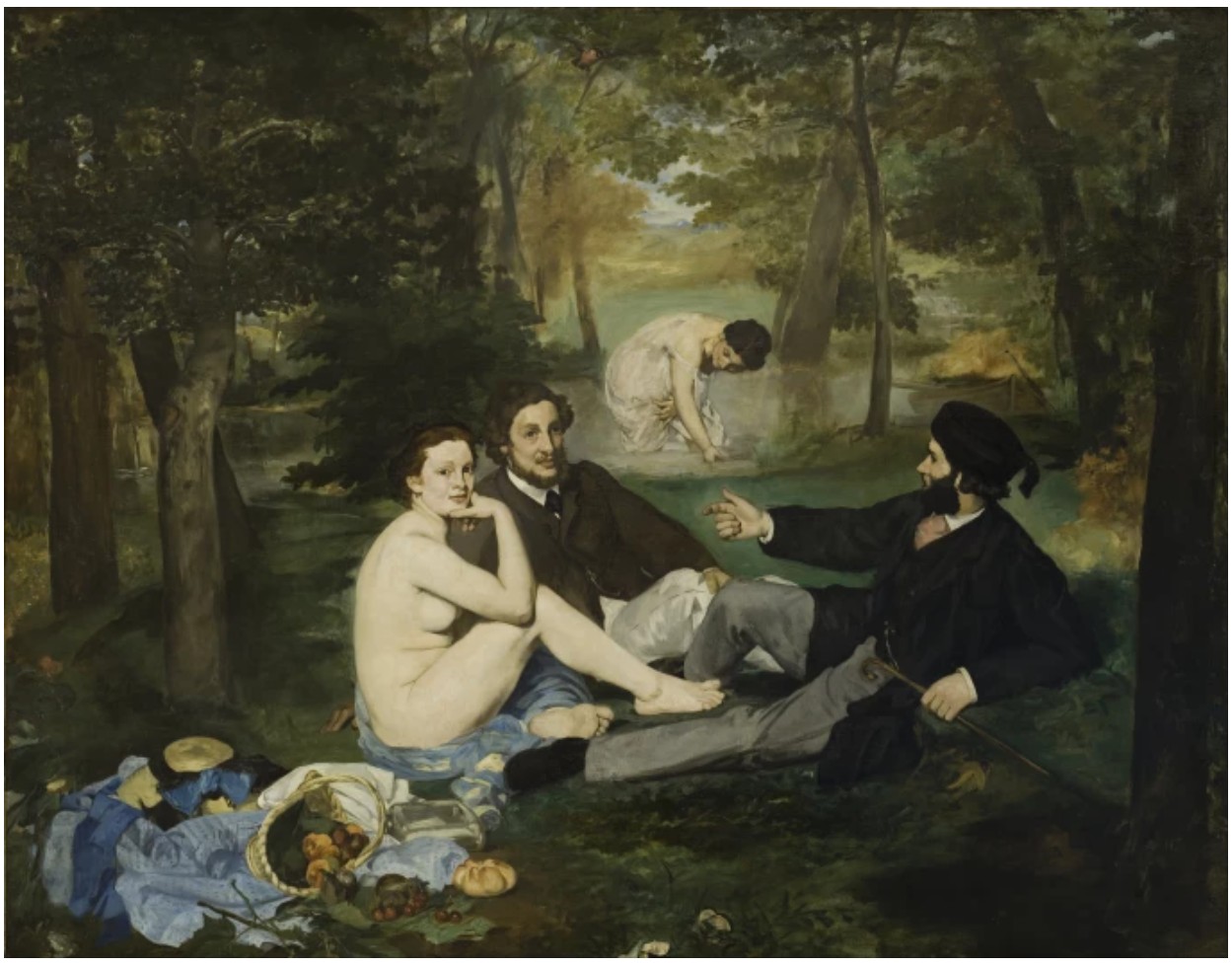
Édouard Manet, Le Déjeuner sur l’herbe, 1863. Musée d’Orsay, Paris
That enigmatic quality has long been recognized as one of Katz’s greatest strengths. His paintings depict people who are near to him, yet they retain an air of distance, as though each were caught in the act of becoming an image. In Boquerón, the central woman’s sunglasses, the man’s profile, and the partial turn of the woman at left all contribute to this sense of withheld interiority. We are close to them, yet never fully admitted. Katz thus captures a distinctly modern condition: the paradox of intimacy without disclosure, presence without full access. The painting’s mood is one of bright leisure, but it is also one of suspension, of consciousness held just below the surface. A superb example of Katz’s mature figuration, Boquerón reveals the artist’s ability to imbue scenes of contemporary life with both graphic brilliance and introspective depth. In its tropical palette, elegant compression, and subtle psychological tension, the painting transforms an image of sunlit leisure into something far more enduring: a meditation on beauty, presence, and the fleeting clarity of a moment seen whole.
Emma, 2015
Emma, 2015
Property from an Ambassadorial Collection
Sotheby’s New-York: 15 May 2026
Estimated: USD 600,000 – 800,000
USD 960,000
Alex Katz | Emma | Contemporary Day Auction | 2026 | Sotheby’s
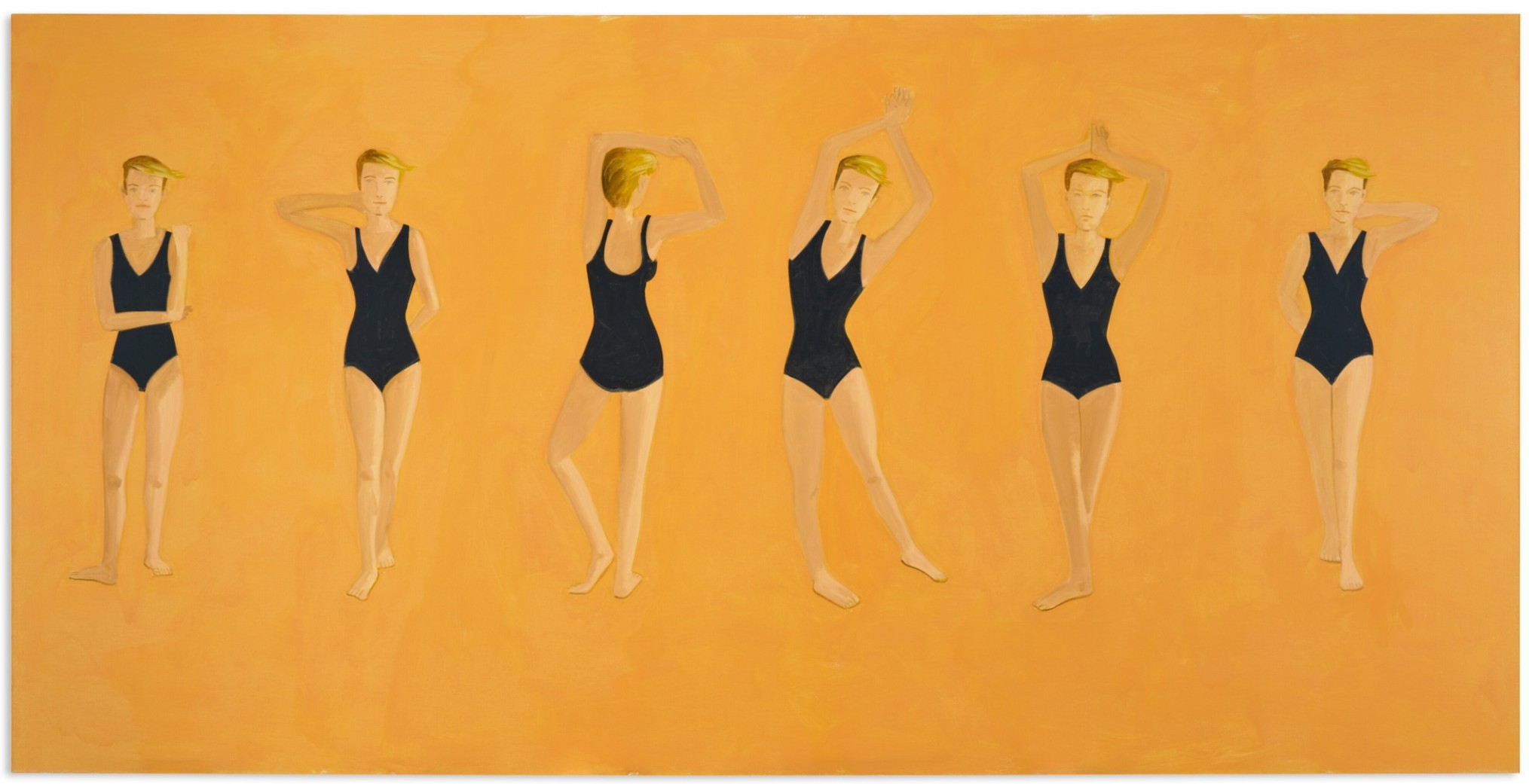
ALEX KATZ (b. 1927)
Emma, 2015
Oil on linen
84×148 inches (213.4 x 375.9 cm)
Signed and dated 15 (on the overlap)
Executed in 2015, Emma belongs to a vital late chapter in Alex Katz’s long engagement with dancers, a subject that has animated his practice since the late 1950s and one that has repeatedly allowed him to merge portraiture with rhythm, repetition, and staged presence. Against an electrifying ground of saturated orange pigment, the same figure appears in successive poses, recording elegant motion through repetition and spacing. In Emma, his allegiance to live art is felt with particular clarity: the painting is not simply a portrait, but an arrangement of movement gracefully unfolding across space.
“I’ve been involved with dancing since the late 50s, with Paul Taylor. When you see a dancer on the stage they’re about one inch high, and what you experience in my paintings is life-size. I did a series of dancers with the torsos about four or five years ago, so this time I thought I’d do the faces and try to apply to them the emotion and experience you have when you see the dancers on stage.”
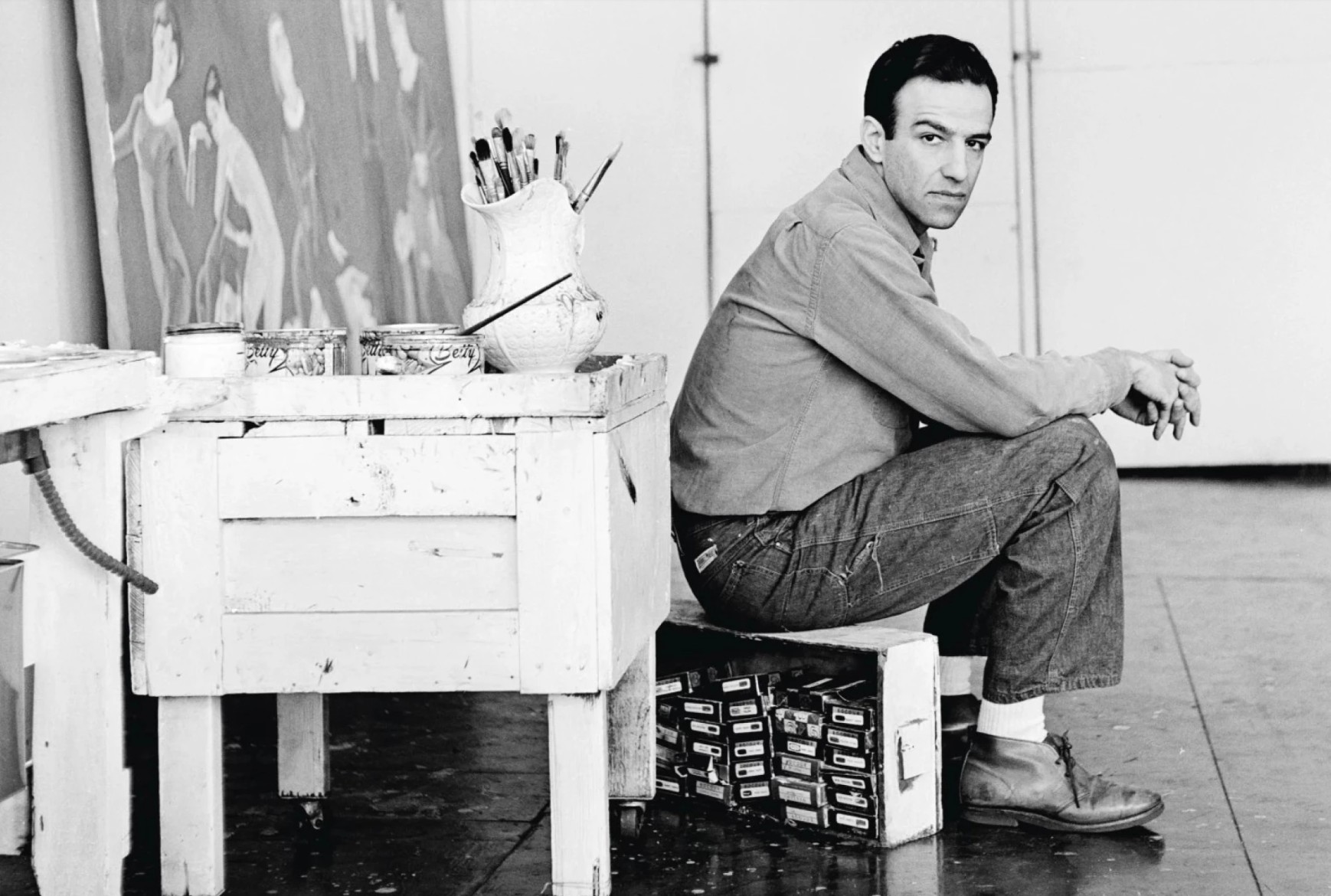
Katz’s interest in dance was never incidental. Over six decades, he painted dancers and designed sets and costumes for theater and dance productions, most notably in sustained collaboration with the Paul Taylor Dance Company. What drew Katz to dancers was their command of instantaneous gesture. Throughout his career he sought to capture the immediacy of visual experience, compressing swift movements into a condensed image of heightened awareness. Dancers offered a perfect analogue for that ambition: they are figures whose identities are inseparable from motion, balance, timing, and poise. In Emma, Katz renders those qualities with characteristic economy through his portrayal of a dancer in her preparatory ballet poses. The composition is built from broad planes of color and crisp contours rather than descriptive nuance, yet the effect is anything but static. Each figure appears suspended at a threshold between stillness and movement, so that the painting holds in tension the instantaneous and the continuous, the single pose and the larger choreography it implies.
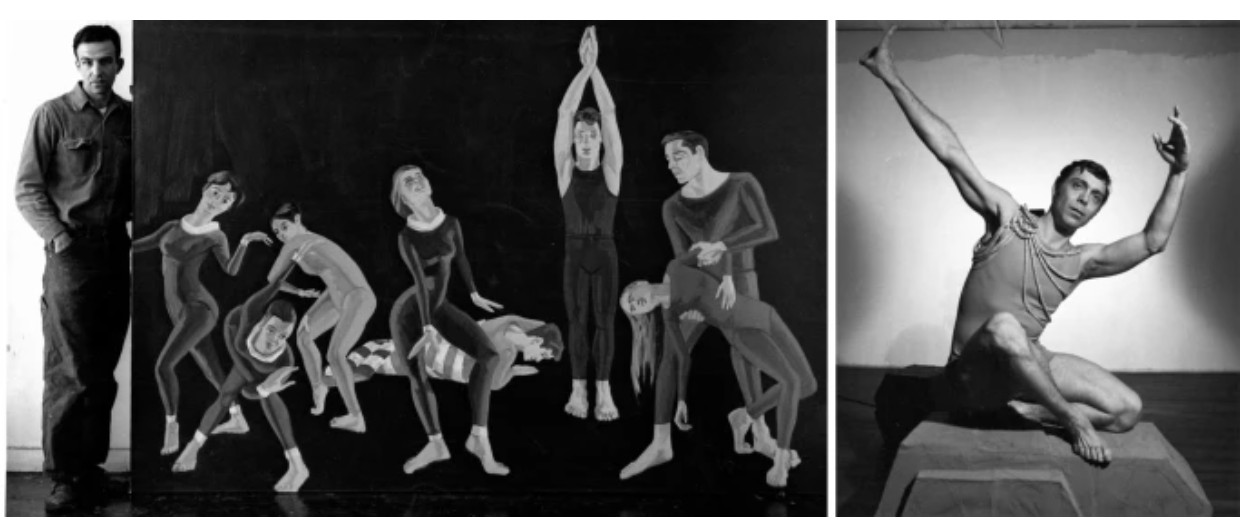
LEFT: Alex Katz with his painting of the Paul Taylor dance company in 1966. Photograph by Jack Mitchell/Getty Images.
RIGHT: Paul Taylor performing Foreign Exchange in a setting by Alex Katz in 1970. Photograph by Jack Mitchell/Getty Images.
Reflecting back on Katz’s artistic engagement with Peter Paul Dance Company, Michael Novak said: “There’s something very, very unique about dancing in an Alex work: the environment feels so specific and immersive for the performer. It wasn’t just Alex’s sense of color and scale, and the vibrancy of how he used tone within his work, that, I think, caught Paul’s eye. There was also an element of the “obstacle.” Through the 15 dances that the two of them created together, Paul would often turn to Alex to create an environment that was a challenge.” (Paul Taylor Dance Company, 1963–64, The Guggenheim, October 2022 (online)).
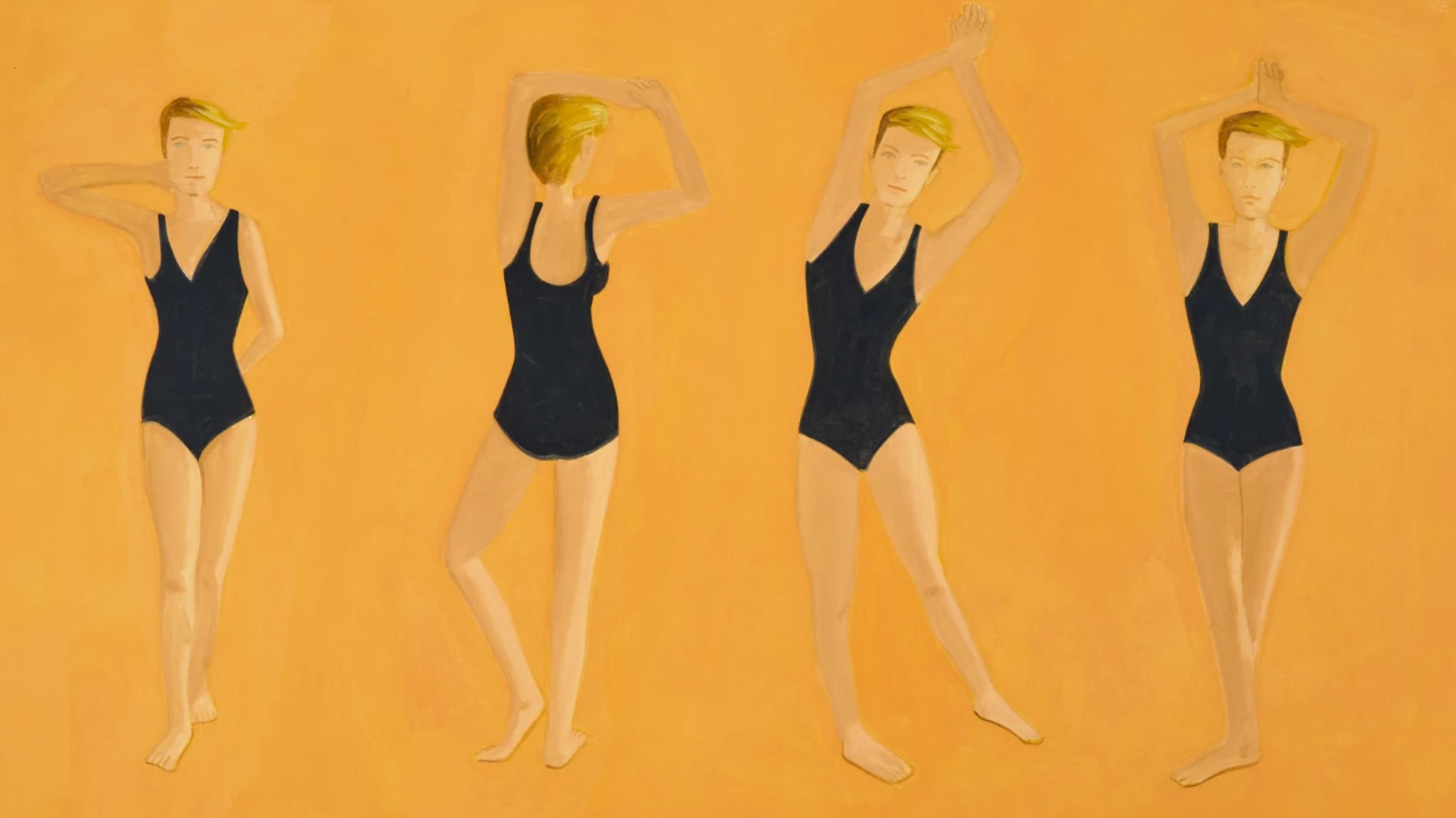
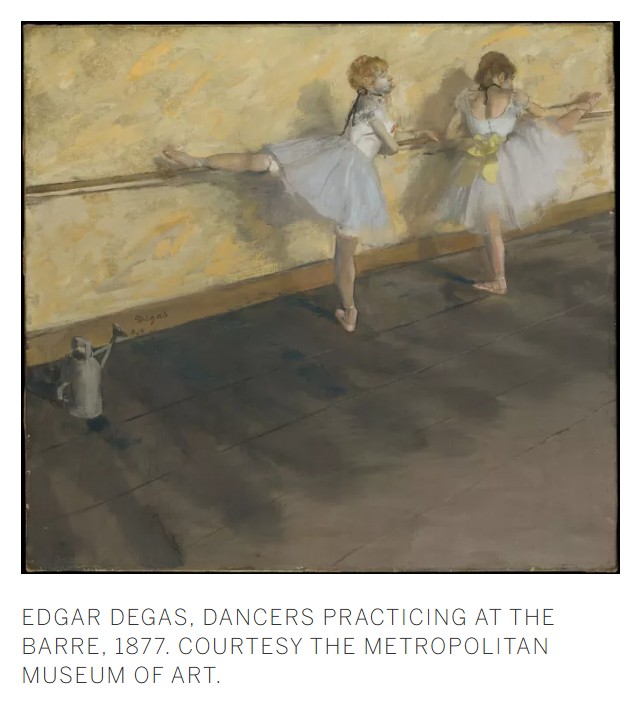
In Emma, the intrigue of this monumental arrangement lies in the figure’s absence of a defined choreography or recognizable dance sequence. Spread across an expansive field of warm, luminous orange, six renderings of the same female figure, Emma, appear in subtly varied poses. Katz does not present her as a fixed likeness so much as a sequence of intervals: an arm lifted, a torso turned, a stance of pensiveness, a gaze redirected. More than a dance sequence, Katz captures Emma at a warm-up stage, a limbo between a full-fledged performance and a static position. The work recalls Degas’s dancers, often shown not in climactic motion but in rehearsal, stretching, adjusting, or waiting in the wings. As with Degas, Katz is less interested in spectacle than in the suspended, private moments that precede performance, when the body is most revealing in its concentration, informality, and quiet self-possession.

The recent exhibition Alex Katz: Theater and Dance, organized by the Colby College Museum of Art, was the first comprehensive museum presentation devoted to this dimension of his work, underscoring just how deeply choreography has shaped Katz’s visual imagination. Emma stands as a superb example of Katz’s mature ability to fuse the immediacy of portraiture with the temporal logic of dance. Monumental yet airy, sensual yet rigorously composed, the present work reveals how profoundly live arts, and its most personal, intimate moments, informed much of Katz’s oeuvre.