MAY 2026 NEW-YORK AUCTIONS
Richard Prince
Auction Results
#1. Sexual Behavior of American Nurses, 2009-2011
Christie’s New-York: 20 May 2026
Estimated: USD 4,000,000 – 6,000,000
USD 4,589,000
RICHARD PRINCE (B. 1949), Sexual Behavior of American Nurses | Christie’s
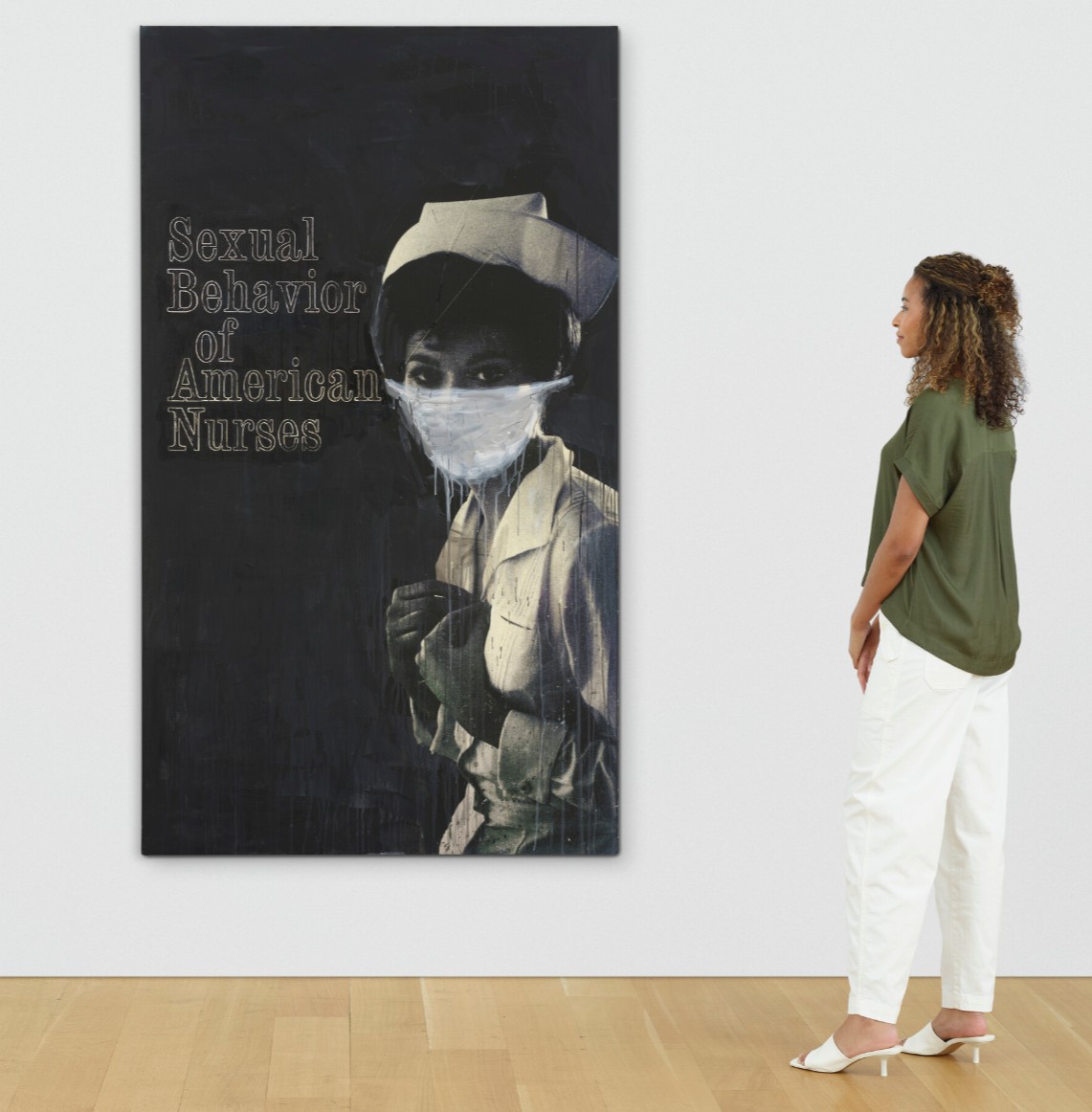
RICHARD PRINCE (B. 1949)
Sexual Behavior of American Nurses, 2009-2011
Acrylic and inkjet on canvas
83-1/4 x 48 inches (211.5 x 121.9 cm)
Signed and dated ‘R. Prince 2009-2011’ (on the overlap)
#2. High Times, 2017
Property from an Important European Collection
Phillips New-York: 21 May 2026
Estimated: USD 600,000 – 800,000
USD 838,500
Richard Prince Modern & Contemporary Art: Afternoon Session
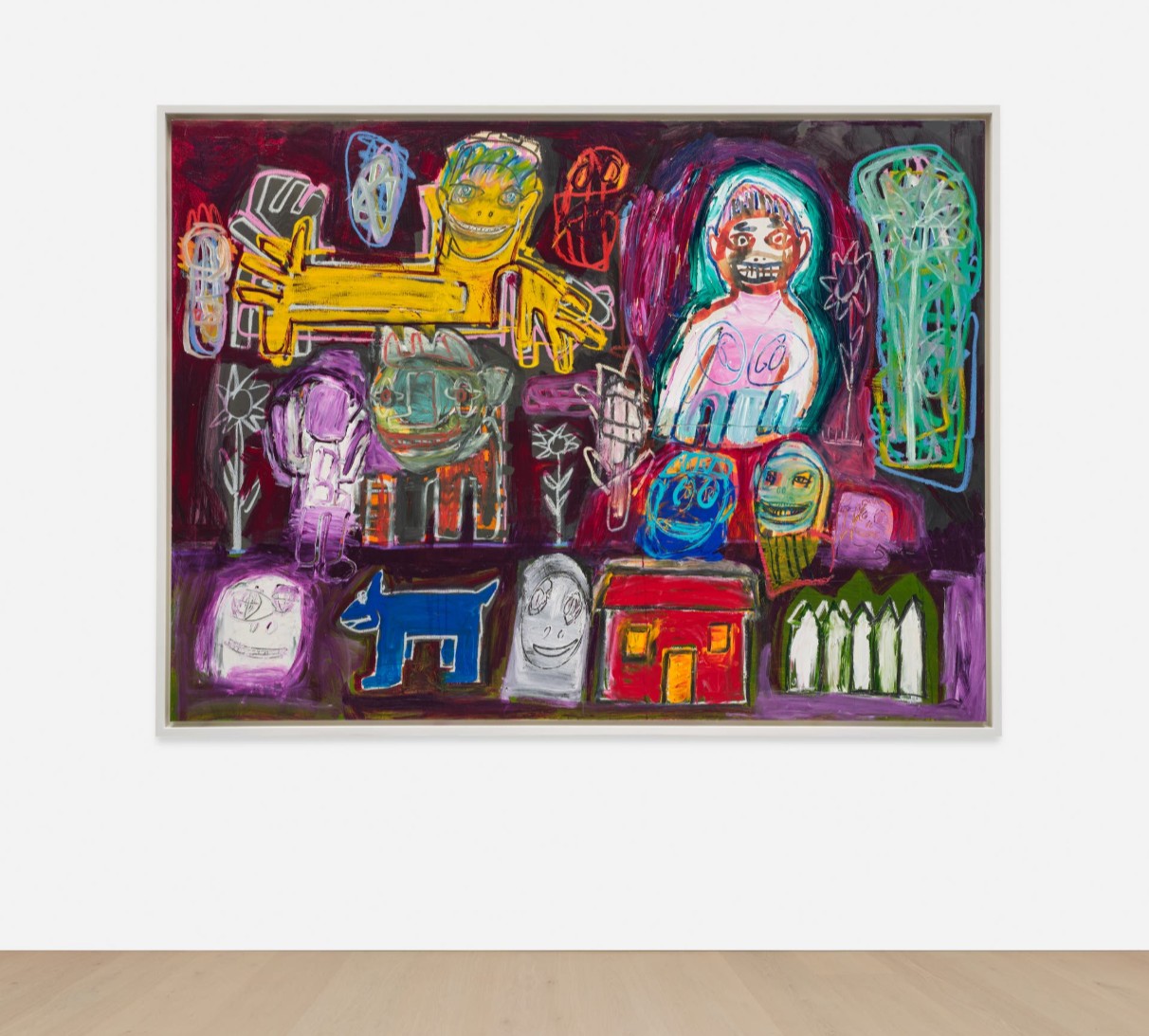
Acrylic, oilstick, inkjet and collage on canvas
55 x 74-1/4 inches (139.7 x 188.6 cm)
Signed, titled and dated “Richard Prince HIGH TIMES 2017” on the reverse
Stamped by the artist’s studio on the overlap
#3. I’m Not Linda, 1991-1992
Christie’s New-York: 21 May 2026
Estimated: USD 500,000 – 700,000
USD 762,000
RICHARD PRINCE (B. 1949), I’m Not Linda | Christie’s
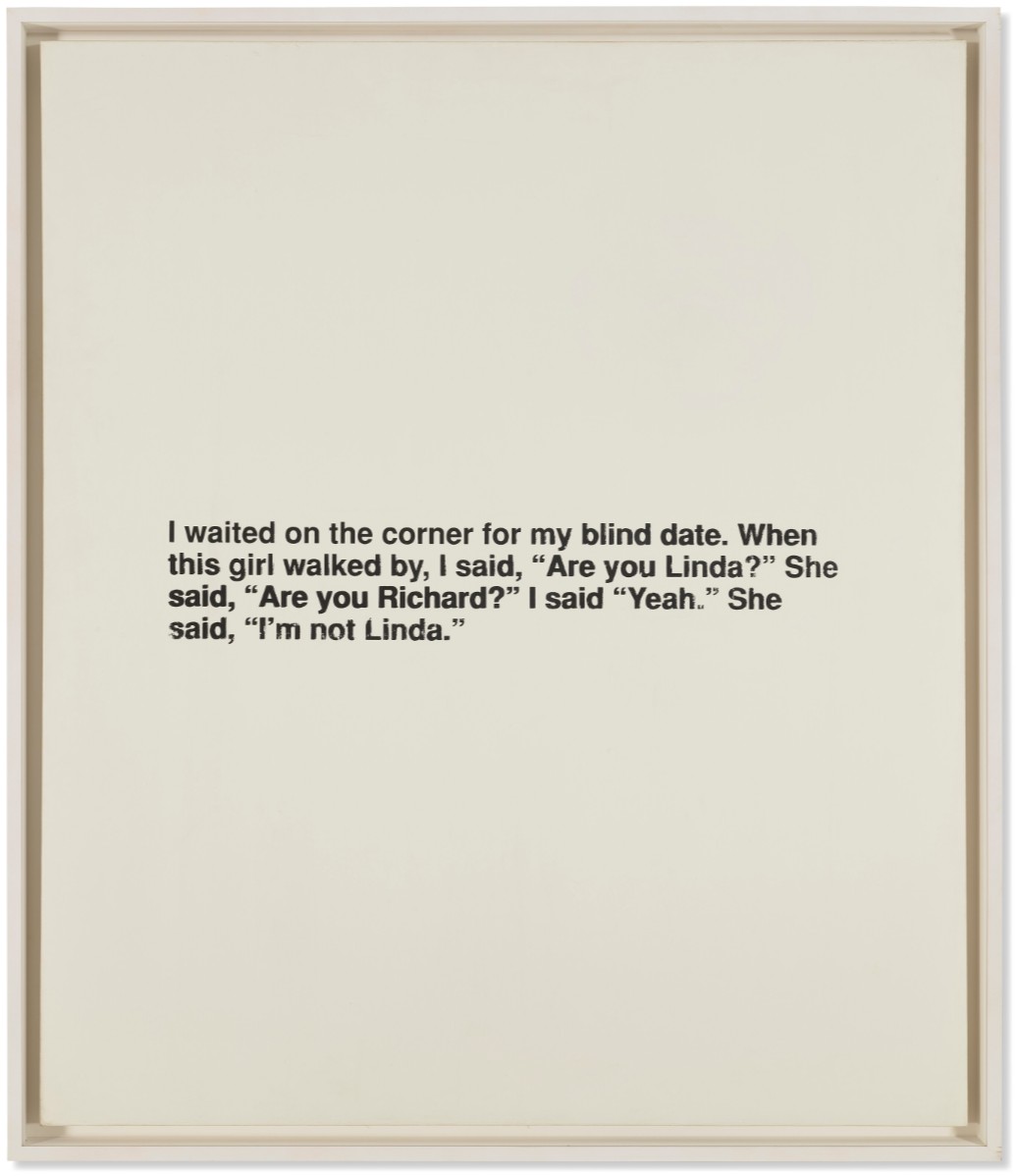
RICHARD PRINCE (B. 1949)
I’m Not Linda, 1991-1992
Silkscreen and acrylic on canvas
56-1/4 x 47-7/8 inches (142.9 x 121.6 cm)
Signed and dated ‘R Prince. 91-92’ (on the overlap)
#4. Back to the Garden, 2008
Edlis Neeson Collection
Christie’s New-York: 20 May 2026
Estimated: USD 500,000 – 700,000
USD 533,400
RICHARD PRINCE (B. 1949), Back to the Garden | Christie’s
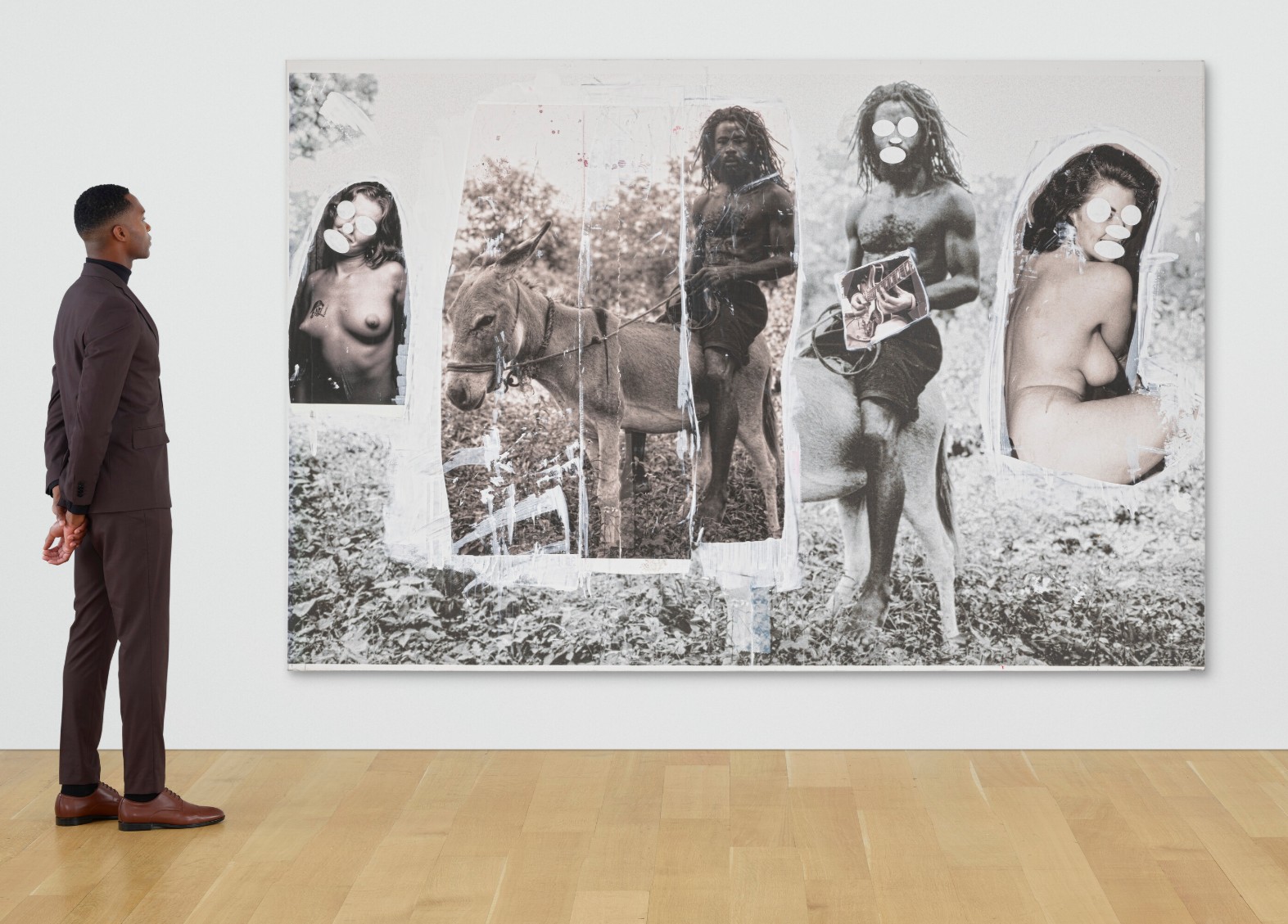
RICHARD PRINCE (B. 1949)
Back to the Garden, 2008
Acrylic, inkjet and canvas collage on canvas
80×120 inches (203.2 x 304.8 cm)
Signed, titled and dated ‘Richard Prince 2008 BACK TO THE GARDEN’ (on the overlap)
#5. Spiritual America IV, 2005
Property Sold to Benefit the Yale School of Art
Sotheby’s New-York: 15 May 2026
Estimated: USD 500,000 – 700,000
USD 384,000
Richard Prince | Spiritual America IV | Contemporary Day Auction |
RICHARD PRINCE (b. 1949)
Spiritual America IV, 2005
Ektacolor print in artist’s chosen frame
90-1/2 x 72 inches (229.9 x 182.9 cm)
Signed, dated 2005 and numbered ap #2 (on the backing board)
This work is artist’s proof number 2 of 2 from an edition of 6 plus 2 artist’s proofs
#6. My Mother-In-Law, 2005
Christie’s New-York: 21 May 2026
Estimated: USD 120,000 – 180,000
USD 381,000
RICHARD PRINCE (B. 1949), My Mother-In-Law | Christie’s
RICHARD PRINCE (B. 1949)
My Mother-In-Law, 2005
Acrylic and paper collage on canvas
30×40 inches (76.2 x 101.5 cm)
Signed, titled and dated ‘Richard Prince 2005 MY MOTHER-IN-LAW’ (on the reverse)
#7. Untitled (de Kooning), 2007
Christie’s New-York: 21 May 2026
Estimated: USD 250,000 – 350,000
USD 304,800
RICHARD PRINCE (B. 1949), Untitled (de Kooning) | Christie’s
RICHARD PRINCE (B. 1949)
Untitled (de Kooning), 2007
Acrylic, inkjet, oil stick and canvas collage on canvas
100×132 inches (254 x 335.3 cm)
Signed, titled and dated ‘Richard Prince 2007 Untitled (de Kooning)’ (on the reverse)
Lots Withdrawn
Untitled (Cowboy), 2012
Sotheby’s New-York: 15 May 2026
Estimated: USD 700,000 – 1,000,000
WITHDRAWN
Richard Prince | Untitled (Cowboy) | Contemporary Day Auction | 2026
RICHARD PRINCE (b. 1949)
Untitled (Cowboy), 2012
Inkjet and acrylic on canvas
62-3/4 x 36 inches (159.4 x 91.4 cm)
Signed and dated 2012 (on the overlap)
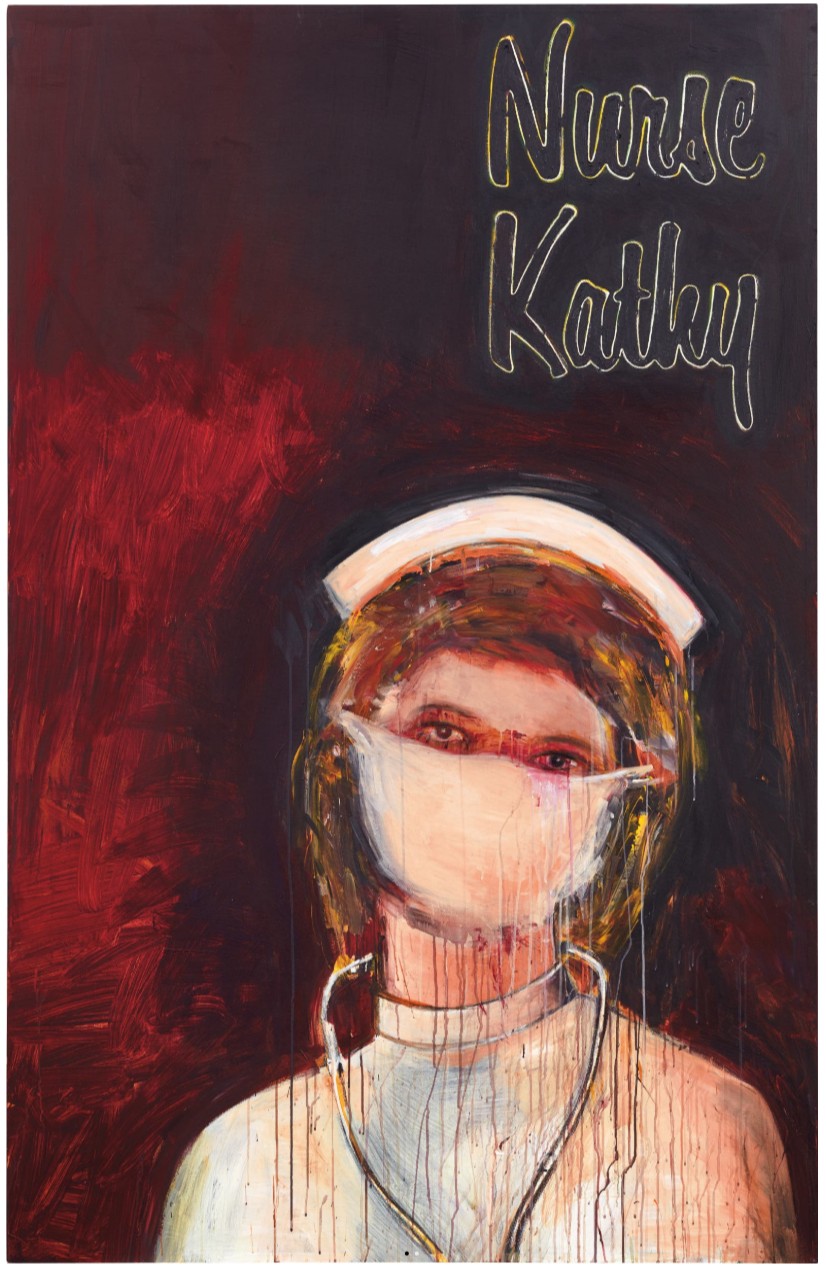
Nurse Kathy, 2006-2008
Phillips New-York: 19 May 2026
Estimated: USD 2,000,000 – 3,000,000
WITHDRAWN
Richard Prince Modern & Contemporary Art Evening Sale
Inkjet and acrylic on canvas
84×54 inches (213.4 x 137.2 cm)
Signed, titled and dated “”Nurse Kathy” R Prince 2006-08″ on the reverse
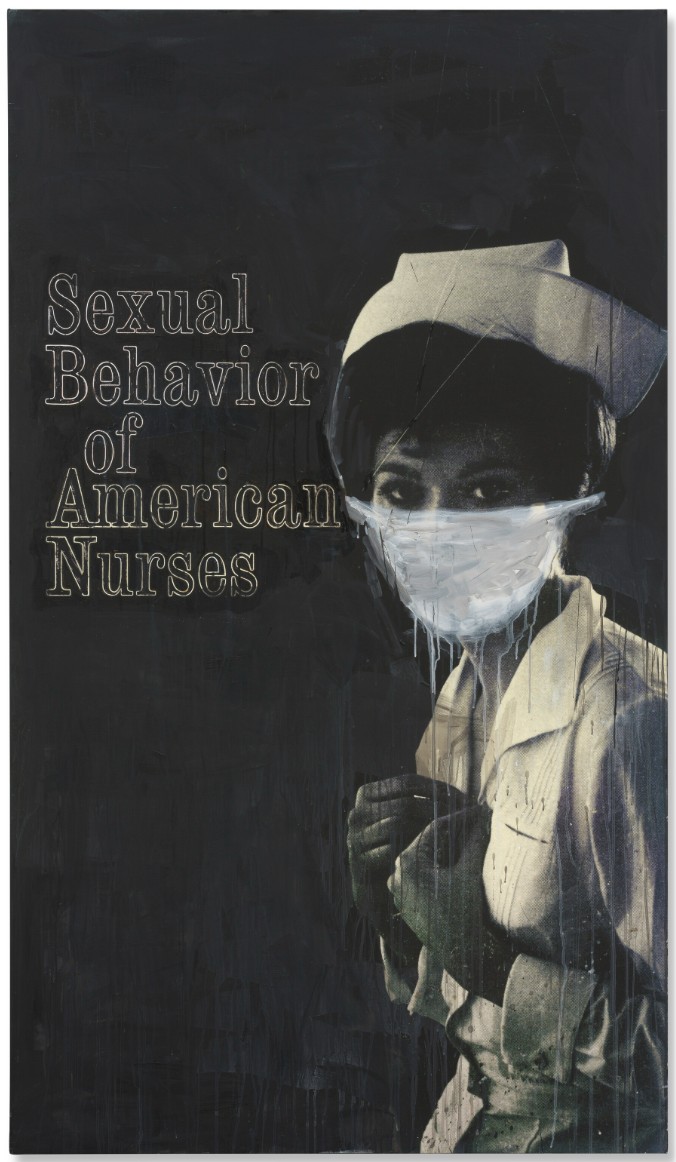
Sexual Behavior of American Nurses, 2009-2011
Sexual Behavior of American Nurses, 2009-2011
Christie’s New-York: 20 May 2026
Estimated: USD 4,000,000 – 6,000,000
USD 4,589,000
RICHARD PRINCE (B. 1949), Sexual Behavior of American Nurses | Christie’s
RICHARD PRINCE (B. 1949)
Sexual Behavior of American Nurses, 2009-2011
Acrylic and inkjet on canvas
83-1/4 x 48 inches (211.5 x 121.9 cm)
Signed and dated ‘R. Prince 2009-2011’ (on the overlap)
An exceptional example from Richard Prince’s most celebrated series, Sexual Behavior of American Nurses presents the American artist’s most recognizable motif in a more elegant key, the work’s monochrome palette achieving a simultaneously beguiling and seductive appearance. Prince’s Nurse series emerged from the artist’s earlier explorations with appropriated material. One of the original appropriation artists, Prince, along with contemporaries including Barbara Kruger and Cindy Sherman, first developed appropriation as a strategy for capturing and manipulating products of mass culture.
Prince’s first works on canvas, his Joke paintings, appropriated the text of popular Borscht Belt jokes and projected them across large canvases. Here, Prince employs a similar technique, requisitioning the title of a long out-of-print book, while including a figural element with the addition of the nurse who appears on the cover of the pulp novel. As the curator Nancy Spector describes the series, “With each image, Prince conflates the various sociosexual stereotypes embodied by the figure of the nurse: Good Samaritan, naughty seductress, old battle-ax, and devil incarnate. He depicts each figure as both vamp and victim, undone by desire” (“Nowhere Man,” in Richard Prince: Spiritual America, exh. cat., Solomon R. Guggenheim Museum, New York, 2007, pp. 52-53). Sexual Behavior of American Nurses functions self-referentially; the work’s title and text recall Prince’s previous painted incarnations, while the nurse’s powerful direct gaze serves as both indictment and invitation.
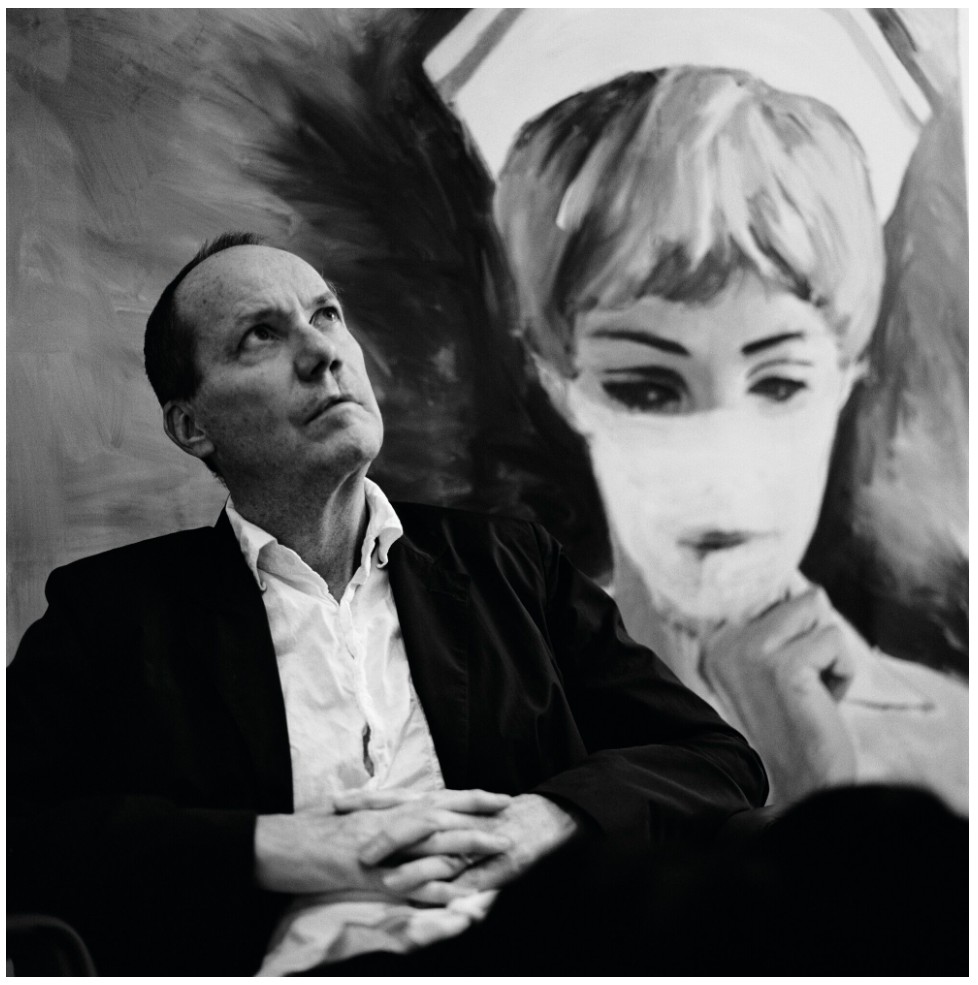
Richard Prince, New York, 2010. Photo: Anton Corbijn / Contour by Getty Images. Artwork: © Richard Prince.
Prince used the 1963 sensationalist pulp non-fiction book Sexual Behavior of American Nurses, written by the supposed “W.D. Sprague, Ph.D.,” as the source material for the present work. However, Sprague is a pseudonym—the book was authored by Bela W. von Block, probably alongside his wife Sylvia von Block, and the Ph.D. is itself a fiction, with the publisher appropriating the credentials of an academic authority in order to give their mass-market pseudo-psychoanalytical studies apparent legitimacy. This book is thus the perfect target for Prince’s appropriative method—the source material itself appropriated the legitimacy of the medical profession as well as the popularity of psychoanalytical studies in order to lure readers, while Prince borrows elements from the book’s cover for his own artistic project.
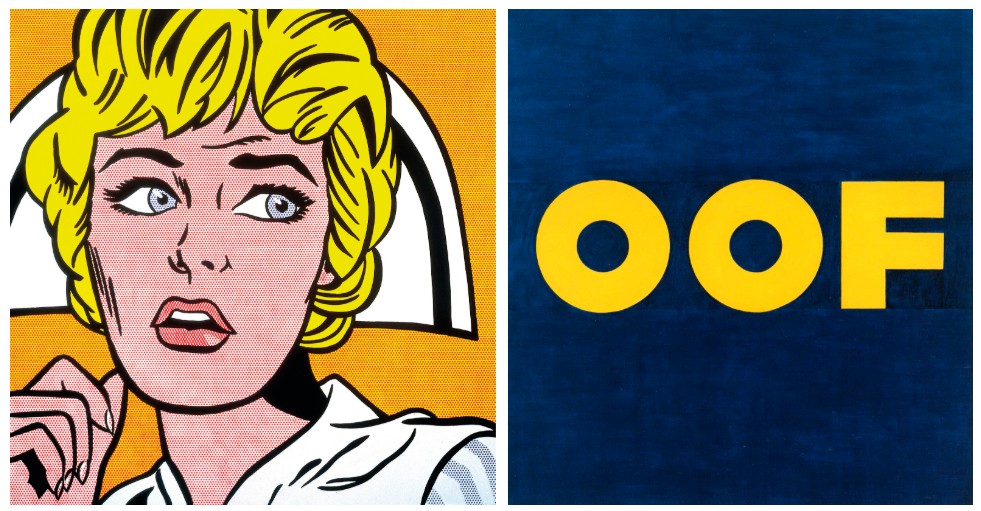
Left: Roy Lichtenstein, Nurse, 1964. © 2026 Estate of Roy Lichtenstein / DACS.
Right: Ed Ruscha, OOF, 1962. Museum of Modern Art, New York. © Ed Ruscha
Using an inkjet printer, Prince blew up the cover onto his large canvas before covering the majority of the composition with luxurious strokes of black and white paint. With his brush, Prince obscures the publication details as well as the cover’s composition, save for the nurse. The text itself is completely painted over, as are any auxiliary characters, such as the male protagonist appearing in the source image. Prince meticulously recreates the serifed title font, leaving each letter merely outlined in white against the black background. The many layers of paint are evidenced by the oozing drips and runs, which cascade down the canvas in a satire of Abstract Expressionist painting. As the critic David Rimanelli writes in his review of Nurse series first exhibition in 2003, the paintings are a “bloody, drippy splatter sampling of AbEx gesturalism… these sumptuous canvases were a return to form—smart, cheap, expensive, snide” (“Best of 2003,” Artforum, vol. 42, no. 4, December 2003, p. 116). Prince’s most significant painterly intervention in the present work is the boldly expressive paint which he uses to articulate the nurse’s surgical mask. Using white, blue, and grey-tinged paint, Prince recreates here the original gestural achievement that demarcates the origin of the series. As the artist recounted in his now-famous 2018 deposition—which served the basis for his 2025 work Deposition—while working on the earliest Nurse paintings, “I remember one day I was adding white to the figure of the nurse, more acrylic white, and to try and ghost her out. I remember wiping some of the paint away and as I wiped… a shape appeared on her face. And I stood back and I looked at it, and I said that looks like a surgical mask… And that’s when I realized that’s what I’m looking for. That’s my contribution” (quoted in “Deposition of Richard Prince” in Donald Graham V. Richard Prince, United States District Court, Southern District of New York, pp. 76-77). With the addition of the mask, Nancy Spector notes, “lends a menacing air to the whole affair. The nurses become sinister hospital bandits, terrifying in their proximity to blood, bodily processes, and death” (N. Spector, op. cit., p. 52).
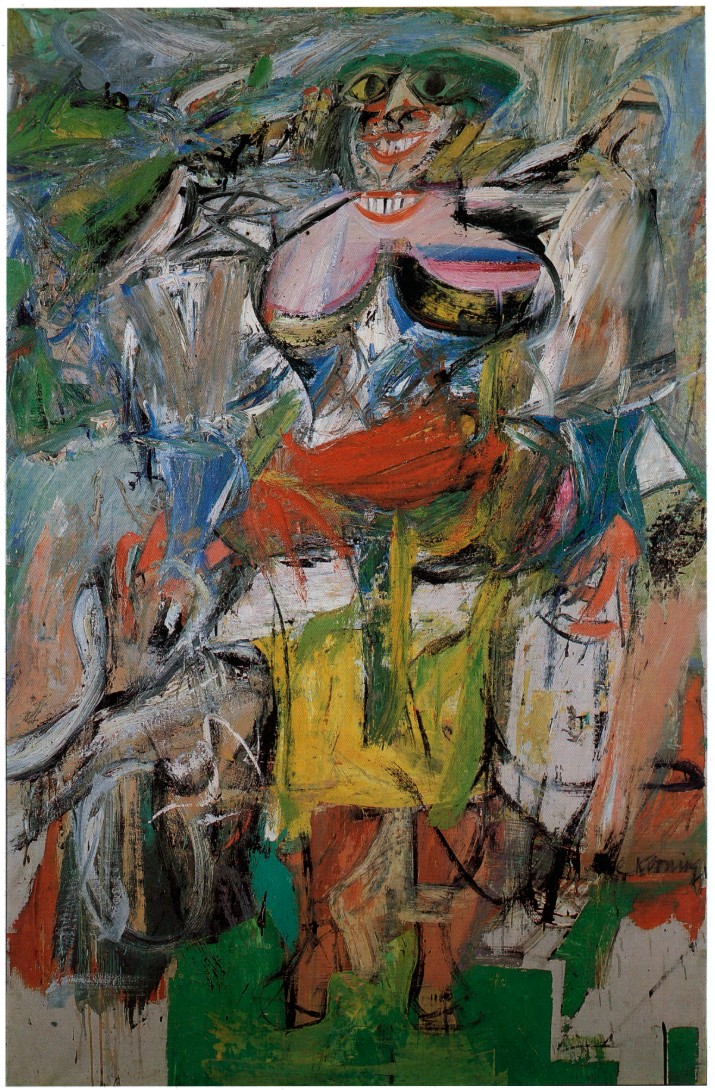
Willem de Kooning, Woman and Bicycle, 1952-1953. Whitney Museum of American Art, New York.
© 2026 The Willem de Kooning Foundation / Artists Rights Society (ARS), New York.
The writer Glenn O’Brien notes how “Richard Prince’s amazing nurse painting series changed the face of painting… Richard was so into the nurses that he was addicted” (“Richard Prince Toasted at the Friar’s Club,” in Richard Prince: Monochromatic Jokes, exh. cat., Nahmad Contemporary, New York, 2014, n.p.). Sexual Behavior of American Nurses is a poignant demonstration of Prince’s long-term commitment to his series, commenting on his own obsession with the sexualized depictions of nurses in pulp literature. Spector comments how “Prince’s work is an extended self-portrait of a self that cannot be defined,” and the present work retains an autobiographical tenor, recapitulating the sum of his most cherished series in one canvas. “Prince’s nurses are a seductive lot,” Spector continues. “You can just imagine them forming a retinue of hospital playmates, femme fatales, and angels of mercy across one of his library shelves, waiting for their moment in the spotlight” (N. Spector, op. cit., p. 52). Sexual Behavior of American Nurses reveals that Prince is in on his joke, knowingly returning to a subject that refuses exhaustion. At once self-reflective and confrontational, the work crystallizes the tensions that have long animated the Nurse series—desire and danger, authorship and theft, seduction and critique—into a singular, darkly luminous statement.
Nurse Kathy, 2006-2008
Nurse Kathy, 2006-2008
Phillips New-York: 19 May 2026
Estimated: USD 2,000,000 – 3,000,000
PASSED
Richard Prince Modern & Contemporary Art Evening Sale
Inkjet and acrylic on canvas
84×54 inches (213.4 x 137.2 cm)
Signed, titled and dated “”Nurse Kathy” R Prince 2006-08″ on the reverse
Richard Prince’s Nurse paintings are among the most coveted and celebrated of his career. These eerie depictions of stereotyped nurse figures—culled from the covers of vintage romance novels—tap into the central concerns of Prince’s oeuvre: mass culture, appropriation, American mythology, and desire. Executed in 2006–2007, Nurse Kathy emblematizes these themes by rendering a dime store book cover on a monumental scale, transforming a familiar trope of seduction into one of pulp horror. Standing in her classic white uniform and matching cap, the subject dons a concealing face mask and stethoscope around her neck, threateningly approaching the viewer with blood red paint drips down her visage. In this work, Prince’s signature strategies of appropriation are pressed toward a uniquely painterly register.
“Some people say the nurse paintings are all about desire—but isn’t that more to do with their proximity to life and death? Isn’t that why we find nurses sexy—because they embody this ultimate contradiction?”
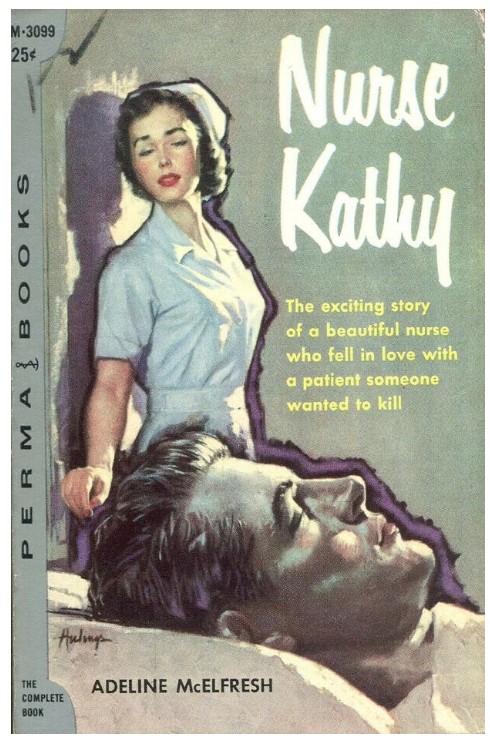
Cover of Nurse Kathy, by Adeline McElfresh,1956.
Prince’s employment of popular, “low” culture in Nurse Kathy stems from an early period in his career, when he worked as an archivist for Time and Life magazines in the 1970s. It was there that he first had the idea to reach for print advertising imagery as artistic source material. An avid bibliophile, Prince turned to his wide collection of 1950s and 1960s pulp romance novels to begin his Nurse series in 2003.
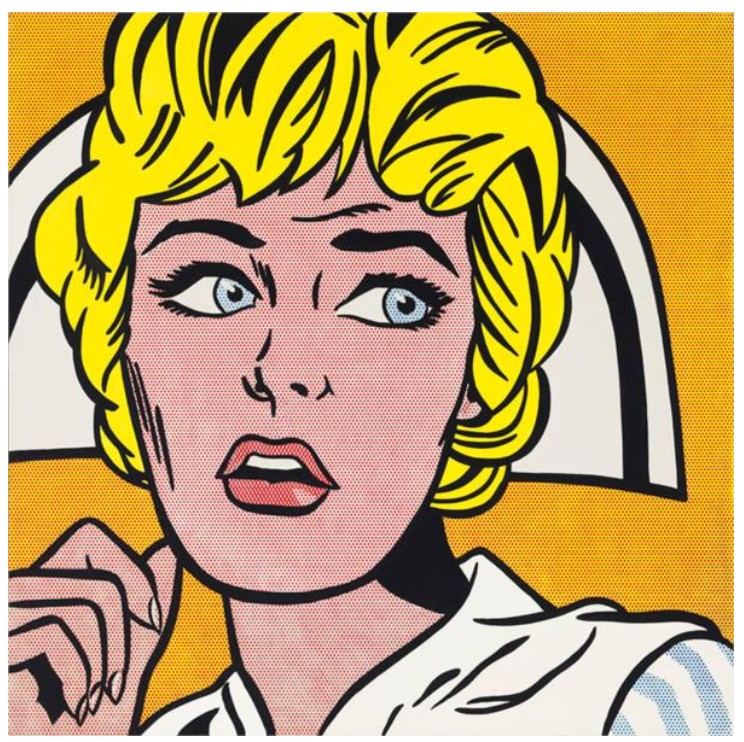
Roy Lichtenstein, Nurse, 1964. Private Collection. Sold for $95,365,000 at Christie’s New York in 2015.
Artwork: © Estate of Roy Lichtenstein
Nurse Kathy takes its title from a cheap fiction paperback by the writer Adeline McElfresh, who authored dozens of books on the doctor/nurse romance genre. The artist digitally scanned, projected, and printed the title from the cover of the novel onto the present canvas. All other aspects of the cover image are removed, including the original blurb promising “the exciting story of a beautiful nurse who fell in love with a patient someone wanted to kill”; in its place is a representation of a nurse drawn from a different source. Prince’s process of appropriation conspicuously harkens back to the post-war interventions of Pop Art, especially Andy Warhol and Roy Lichtenstein’s adoption of printed mass media. Yet in Nurse Kathy the borrowed image is substantially reconstituted: its surface animated by a remarkably gestural handling of paint and its iconography unsettled by the addition of viscous drips and the obfuscating mask.
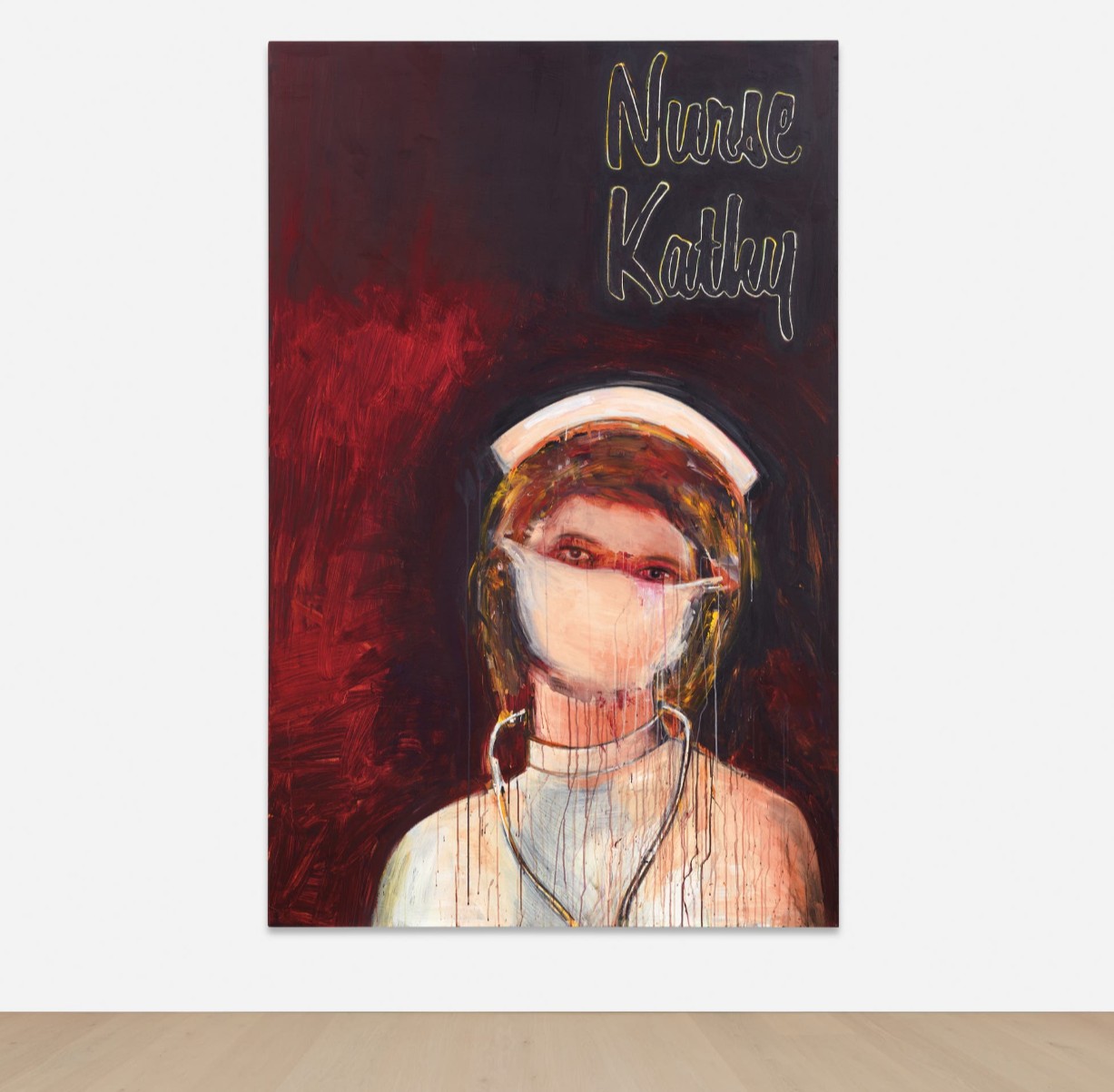
Pointing to the irony of the fetishization of the profession, Prince recast the figure as something ominous and potentially murderous—metamorphosing her from an object of fantasy into the visual language of pulp horror. As workers who are conventionally associated with care yet inextricably bound to experiences of illness and mortality, nurses occupy a charged symbolic position that the artist brings into relief in Nurse Kathy. According to the curator Mia Fineman, “[Prince’s] is an art of cultural quotation: His cowboys are always ‘cowboys,’ his nurses are always ‘nurses,’ his paintings are always ‘paintings.’” Nurse Kathy does not render a stock image of a nurse, however; it is a composition that Prince has deliberately reworked, most notably through the addition of the mask and the construction of the painting’s atmospheric, expressive ground. The masks in the Nurse series, which muddy and complicate the figures’ legibility, emerged from a moment of chance.
“I made a mistake painting all this white… After I had wiped off some of the painting, it looked like a mask on the nurse’s face and suddenly it was one of those moments… It was a way of unifying and also talking about identity.”
A similar ambiguity imbues the background, an expanse of darkened red that appears overtly painterly. While many have likened these hazy, chromatic surfaces to the diffuse fields of Mark Rothko, Prince’s apparently gestural approach remains equivocal. Is it simply a calculated citation of Abstract Expressionist painting, a style reframed as just another appropriable idiom? These additions destabilize the image and foreground questions about authenticity and ambiguity that have underlain Prince’s entire practice.
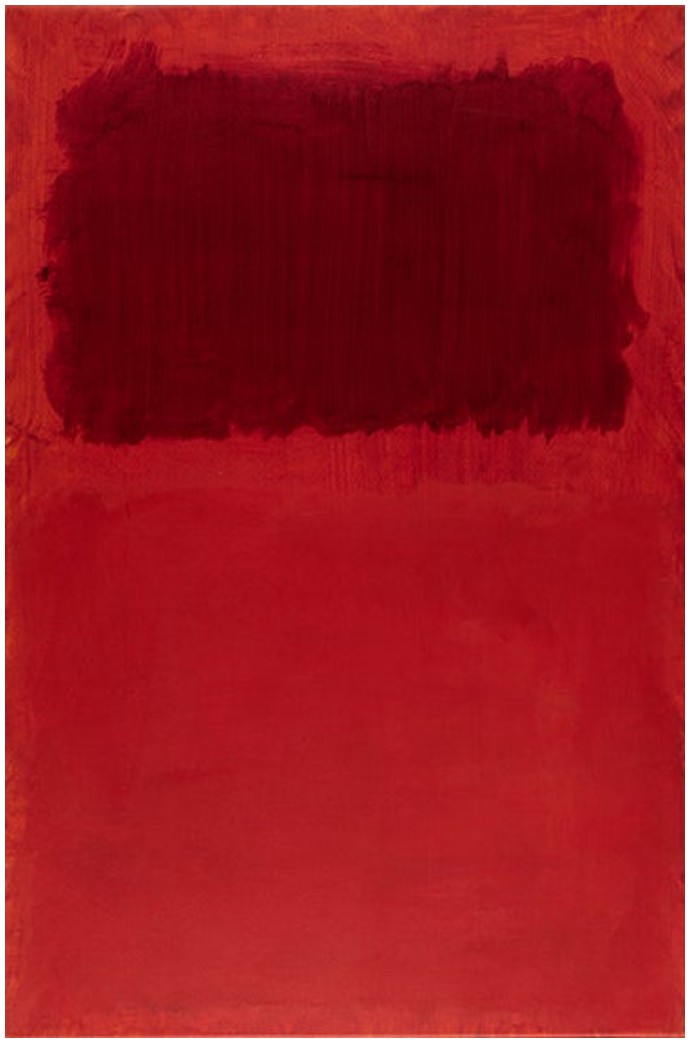
Mark Rothko, Untitled (Maroon Over Red), 1968. Pennsylvania Academy of Fine Arts. Artwork: © 1998 Kate Rothko Prizel & Christopher Rothko / Artists Rights Society (ARS), New York
Nurse Kathy demonstrates the artist’s sustained interest in how identities are constructed through borrowed and mediated imagery. By drawing upon the visual codes of both the romance and horror genres, Prince exposed how the social roles of nurses are culturally produced and endlessly re-scripted through repetition and circulation. Indicative of their centrality with his practice, the Nurse paintings have been exhibited extensively and are held in major museum collections, such as the Whitney Museum of American Art, New York, and the Rubell Collection, Miami. This institutional presence underscores not only their importance within Prince’s oeuvre but also how they crystallize his reworking of found imagery into forms that consider how perception and meaning is shaped by visual culture. Nurse Kathy distills this approach into a single, disquieting figure in which mythology and desire are refracted through the lens of his iconoclastic post-modern brilliance.
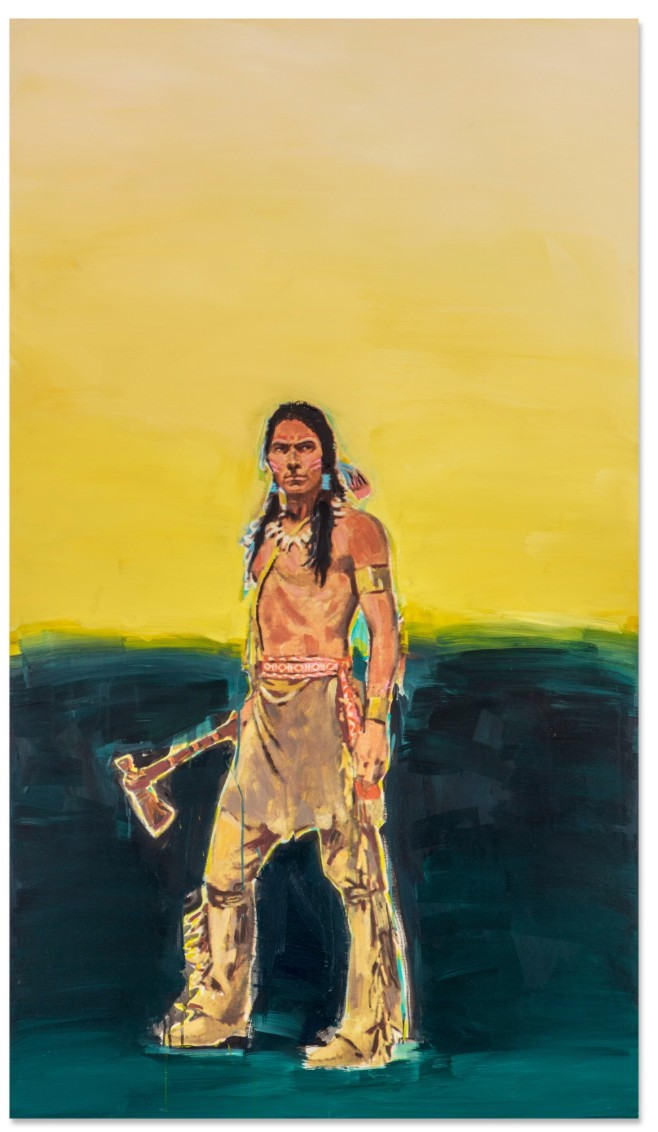
Untitled (Cowboy), 2012
Untitled (Cowboy), 2012
Sotheby’s New-York: 15 May 2026
Estimated: USD 700,000 – 1,000,000
WITHDRAWN
Richard Prince | Untitled (Cowboy) | Contemporary Day Auction | 2026
RICHARD PRINCE (b. 1949)
Untitled (Cowboy), 2012
Inkjet and acrylic on canvas
62-3/4 x 36 inches (159.4 x 91.4 cm)
Signed and dated 2012 (on the overlap)
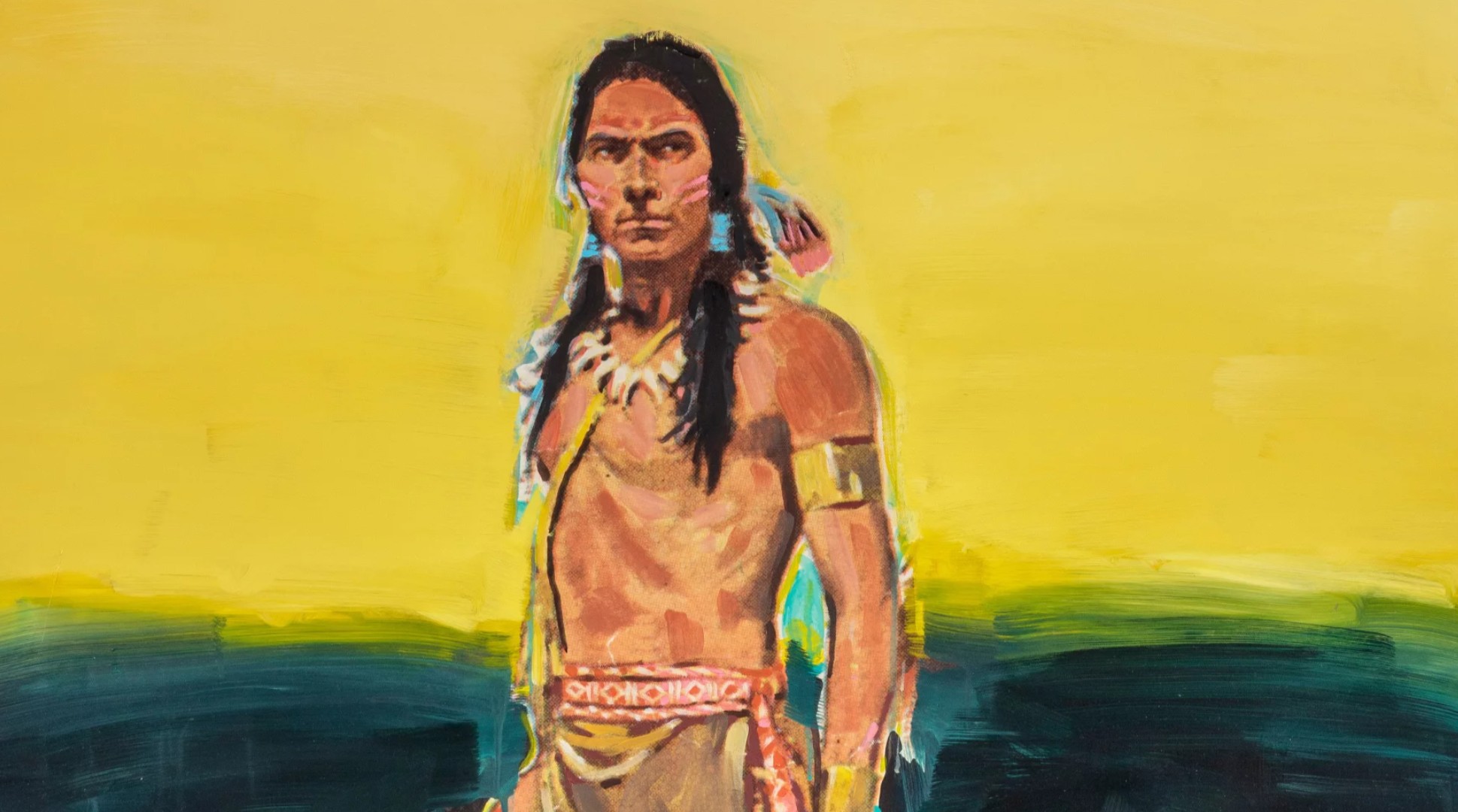
Radiant in chromatic intensity and arresting in its iconographic charge, Richard Prince’s Untitled (Cowboy) reimagines one of the foundational myths of the American West through a figure far rarer within the artist’s celebrated corpus: not the cowboy, but the Indian. If Prince’s Cowboy paintings have long stood among the most incisive meditations on American masculinity, fantasy, and media mythology, the present work expands that investigation into more unstable and historically charged territory. Here, a lone Native figure stands against a luminous field of yellow and deep blue-green, his body at once monumental and solitary, his silhouette sharpened by Prince’s characteristically electric painterly interventions. In this powerful deviation from the better-known cowboy motif, Prince turns toward the other figure upon which the mythology of the West was built, exposing with renewed clarity the exclusions, projections, and fictions that underwrite America’s self-image.
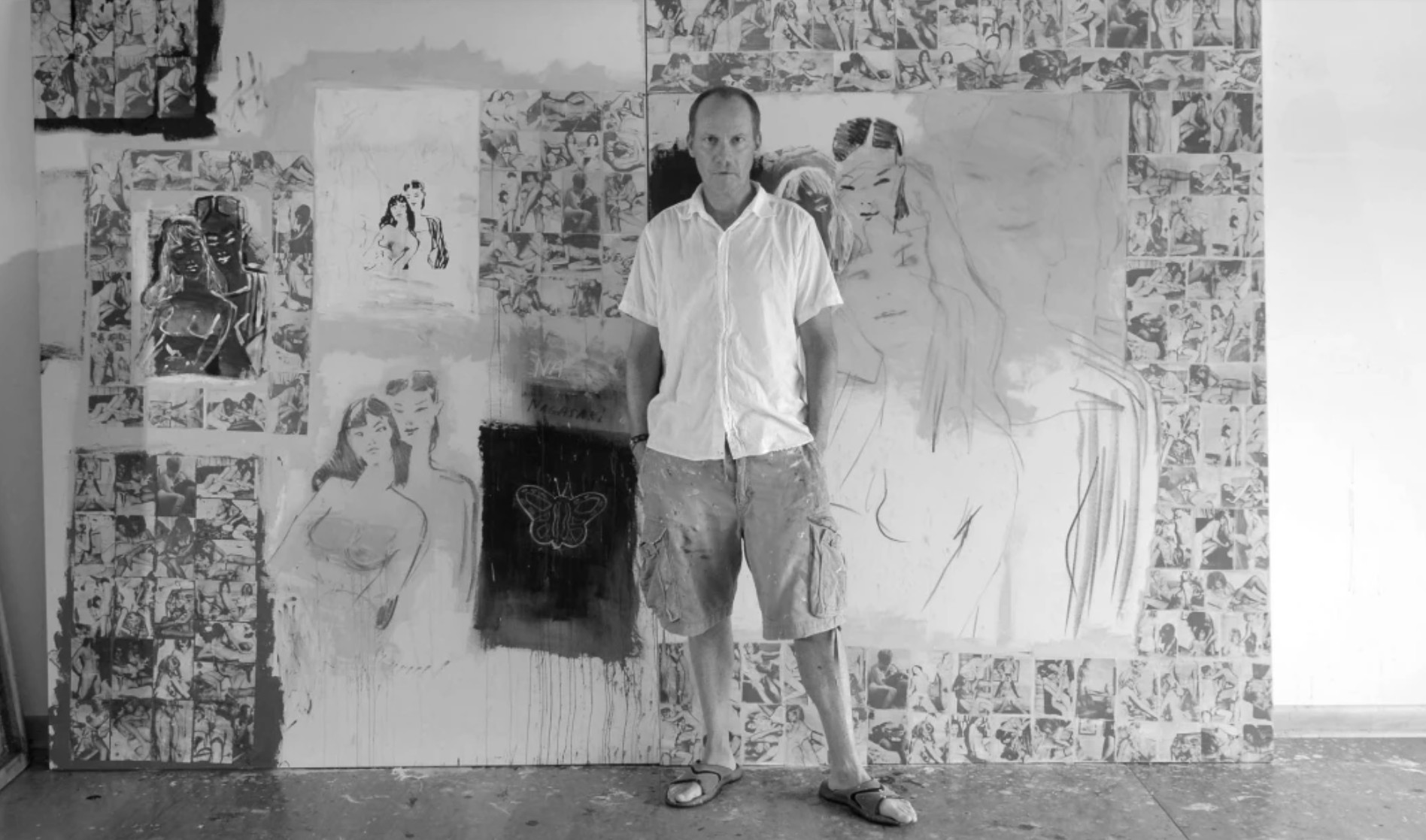
Richard Prince in the studio at his home in Sagaponack, NY. Photo by Gordon M. Grant/The New York Times/Redux
The visual economy of the work is central to its force. The figure is placed low within the vertical format, isolated against an immense expanse of pale yellow sky that presses downward with near-metaphysical intensity. Beneath him, a darkened horizon of saturated blue-green anchors the composition, while the body itself—painted in warm browns, ochres, and fleshy pinks—seems to flicker between photographic source and painterly apparition. Prince’s interventions are crucial here. Bright, almost phosphorescent accents around the contours of the figure create a hovering aura, as though the subject were both emerging from and dissolving into the image. The tomahawk, braids, armband, and fringed leggings sharpen the figure’s legibility as a constructed type, but the directness of the face and stance resists reduction to stereotype. He appears at once staged and self-possessed, iconic and estranged. Prince has long been drawn to images that oscillate, in Nancy Spector’s words, between “the utterly familiar and the eerily strange,” and that instability is especially palpable here: the figure is recognizable as an artifact of mass culture, yet the painting grants him an authority that exceeds his source (Nancy Spector, Richard Prince, New York 2008, p. 33).
This tension distinguishes the work within Prince’s broader practice. His engagement with Western iconography began in the late 1970s, when, working in the Time-Life building, he became fascinated by the authorless, endlessly repeated images circulating through advertising and mass media. The cowboy, most famously through Marlboro advertisements, became a central subject through which Prince interrogated the manufacture of masculinity and American heroism. In the later painterly phase of that project, he turned away from the Marlboro image itself and toward vintage Western paperback covers, which he scanned, enlarged, cropped, and overpainted, producing works that were at once homage, détournement, and critique. In those paintings, the cowboy appears as a condensed emblem of fortitude, solitude, and myth. But if the cowboy is the heralder of the American frontier myth, the Indian is its suppressed mirror—equally central to the imagination of the West, yet far less often granted independent pictorial authority.
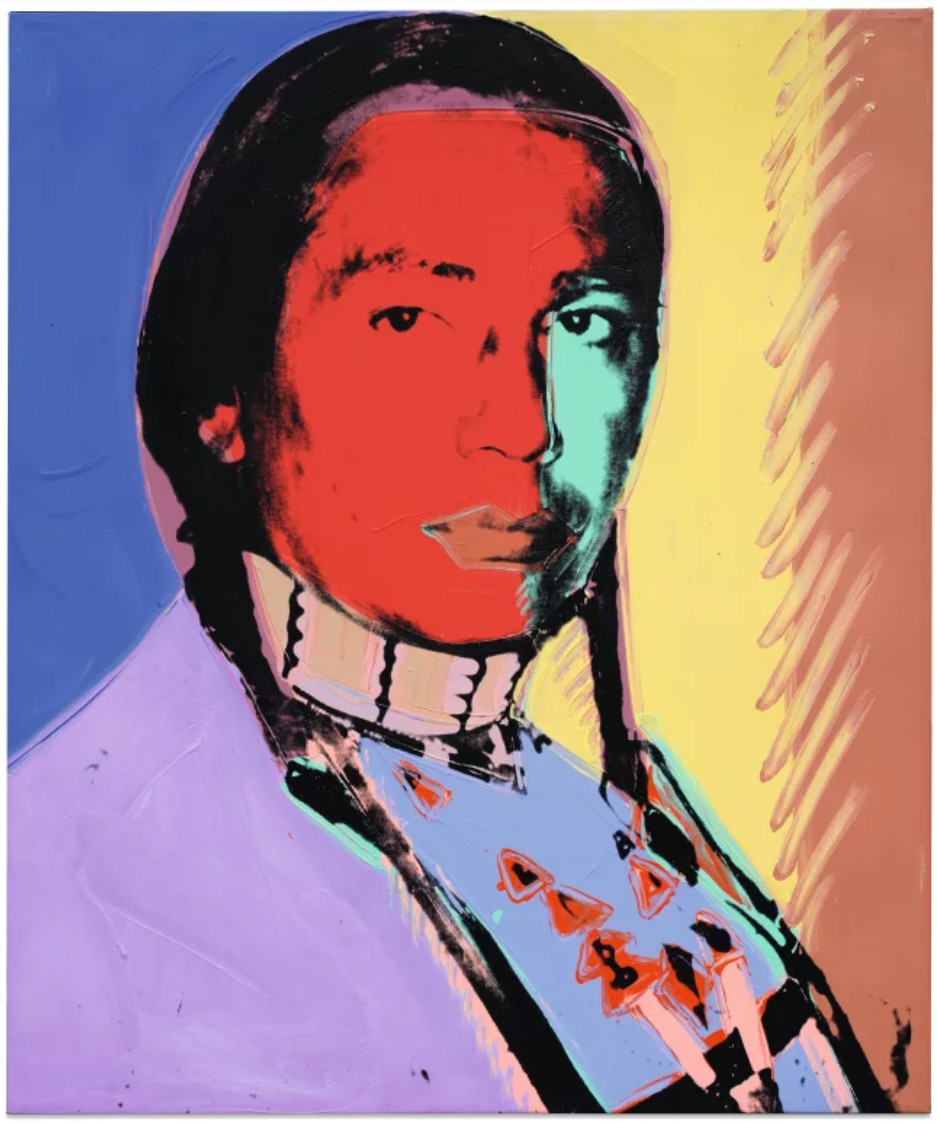
Andy Warhol, The American Indian (Russel Means), 1977. Private Collection. Sold at Sotheby’s New York for $4 million in November 2025. Art © 2026 Andy Warhol Foundation for the Visual Arts / Artists Rights Society (ARS), New York
It is precisely here that the present work becomes so compelling. Cowboys and Indians are inseparable within the visual mythology of the American West; together they form one of the most deeply embedded binaries in American popular culture. Yet while the cowboy was elevated by Hollywood, advertising, and pulp fiction into a near-universal symbol of freedom and masculine self-determination, the Indian was more often reduced to a foil—romanticized, demonized, or erased altogether. Prince’s decision to isolate the Indian in the place usually occupied by the cowboy therefore carries real conceptual weight. Rather than reinforcing the familiar hierarchy of the genre, the painting quietly destabilizes it. The figure is no longer incidental to the myth but placed at its center, confronting the viewer with the fact that the American West was always a contested fiction built upon unequal visibility. In this sense, the work does not merely broaden Prince’s Western imagery; it sharpens its stakes. The mythology he has always interrogated becomes more historically charged when the subject is the figure through whom that mythology concealed its violence.
At the same time, the work remains wholly characteristic of Prince’s painterly method. Like the later Cowboy paintings, Prince transforms its source through color and surface rather than simply reproducing it. The figure is lifted from the realm of cheap printed narrative into something far more unstable and seductive. Prince’s painted passages do not merely embellish the image; they estrange it, severing it from its original certainty and turning it into an object of reflection. The immense yellow field is especially important in this regard. It lends the composition an atmosphere of revelation, but also of emptiness—as though the surrounding world had been burned away, leaving only the figure and the ideological residue he carries. Where some of Prince’s cowboy paintings revel in mountainous terrain, blazing skies, and cinematic bravado, this work is more austere, even haunted. The emptiness around the figure becomes part of the meaning: a stage for projection, a field of erasure, a void in which the politics of representation become newly visible.
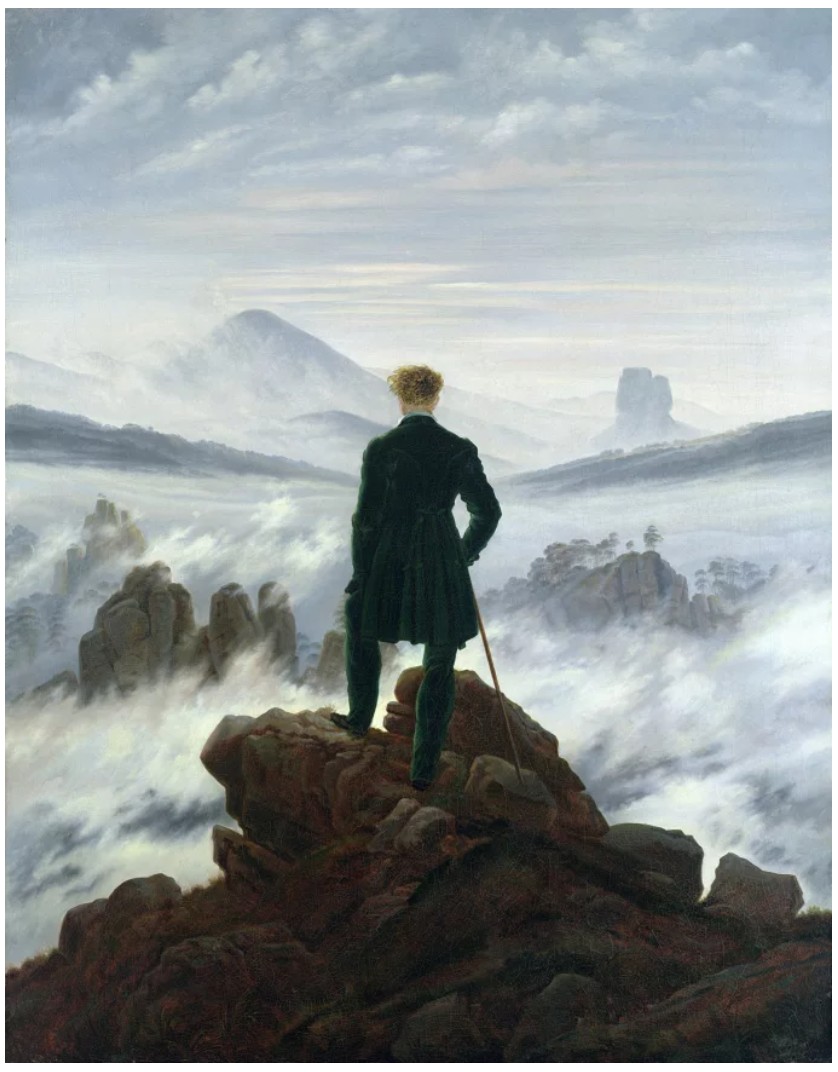
CASPAR DAVID FRIEDRICH, THE WANDERER ABOVE THE SEA OF FOG, 1818.
HAMBURGER KUNSTHALLE, HAMBURG, GERMANY. IMAGE © BRIDGEMAN IMAGES.
Within Prince’s oeuvre, this distinction matters. His great subject has always been the familiar image and the cultural machinery that makes it familiar. Whether nurses, girlfriends, jokes, or cowboys, his appropriated figures expose the ways fantasy is circulated, internalized, and naturalized. The present work extends that inquiry with unusual poignancy. By focusing on the Indian rather than the cowboy, Prince redirects attention from the triumphant protagonist of the Western myth to the figure through whom that myth was defined and distorted. He reveals, in other words, not only how America imagined itself, but also how it imagined its others.
What emerges is a painting of unusual complexity and force. It is visually seductive, yes—its luminous palette and commanding verticality make it immediately compelling—but it is also conceptually exacting. It asks us to reconsider a familiar genre by shifting its center of gravity. In doing so, it affirms what has always made Prince’s best work so enduring: his ability to take images that seem exhausted by repetition and return them to us as unstable, uncanny, and newly consequential. In this Untitled, the mythology of the American West is not simply quoted or revived; it is held up to scrutiny, turned inside out, and made to speak in a more troubling register. Rare in subject and potent in implication, Untitled (Cowboy) stands as a significant and distinguished contribution to Prince’s ongoing reckoning with the images that shape American consciousness.
High Times, 2017
High Times, 2017
Property from an Important European Collection
Phillips New-York: 21 May 2026
Estimated: USD 600,000 – 800,000
USD 838,500
Richard Prince Modern & Contemporary Art: Afternoon Session
Acrylic, oilstick, inkjet and collage on canvas
55 x 74-1/4 inches (139.7 x 188.6 cm)
Signed, titled and dated “Richard Prince HIGH TIMES 2017” on the reverse
Stamped by the artist’s studio on the overlap
A significant example from one of Richard Prince’s most acclaimed recent series, High Times, 2017, belongs to a body of work that cuts against the grain of late-career retrospection—canvases of ambitious scale, brimming with the energy of an artist still inventing new stylistic modalities. Channeling the spirit of his Downtown New York years, Prince riffs on Surrealism, Art Brut, and Outsider Art, or, “Basquiat meets Dubuffet,” as Roberta Smith characterized the series. Notorious for absorbing and reframing the work of others, Prince here performs his most unexpected act of appropriation: of himself. The compositions amalgamate elements from his own Hippie Drawings (1998–2000), first published as a book in 2005 and elevated onto canvas in the present series.
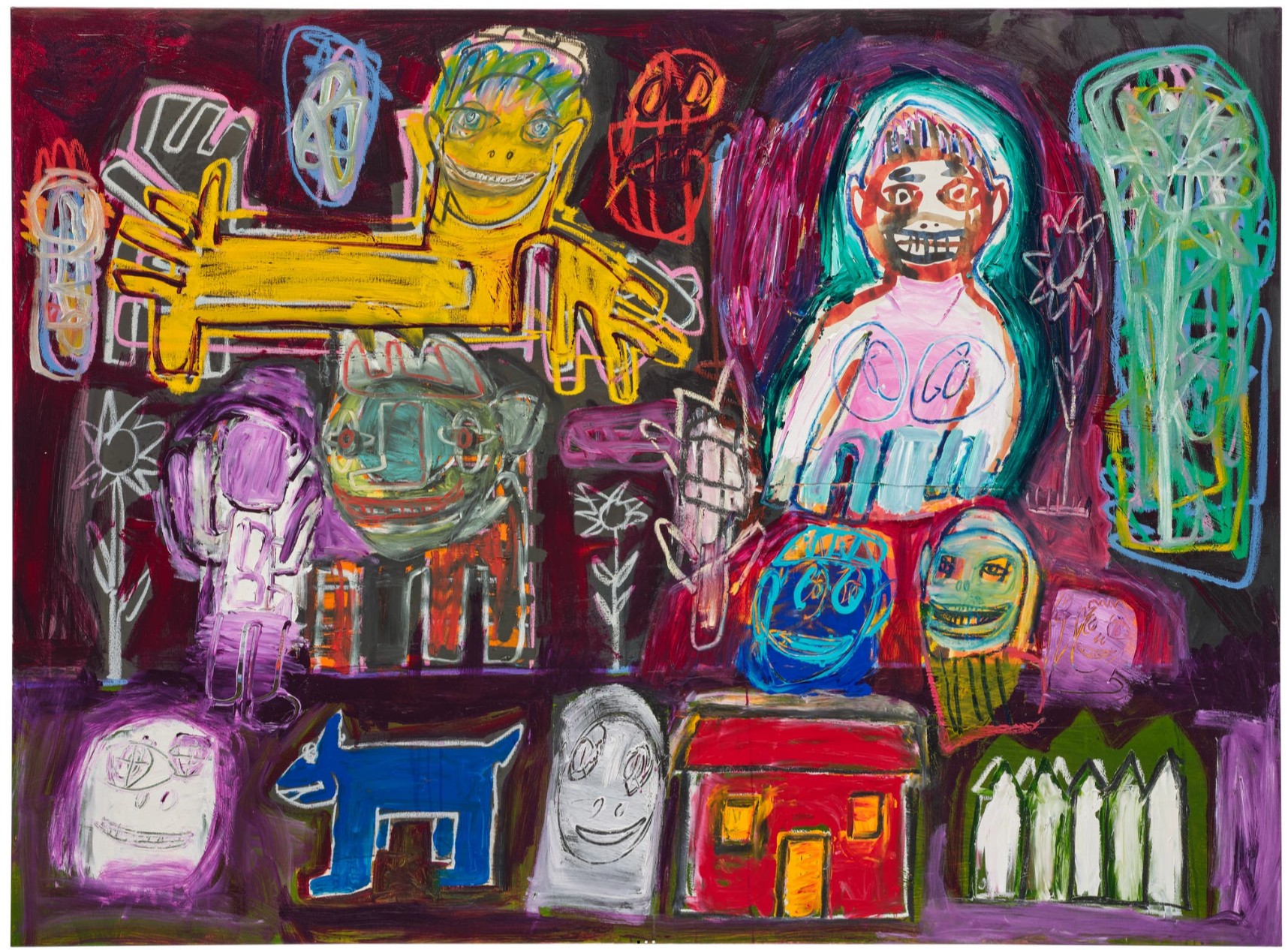
Prince made High Times roughly four decades after emerging as a breakout figure of the Pictures Generation, when his rephotographed Marlboro advertisements featuring cowboys established appropriation as his hallmark approach. By 2017, he had cycled through the bodies of work that would come to define his reputation, the Cowboys, Jokes, Nurses, and Instagram-sourced New Portraits, each probing how images circulate and what it means to make them. High Times marks a distinct pivot: rather than mining mass culture, Prince turns inward, directing his signature strategy toward his own archive. The Hippie Drawings themselves refer back to earlier Bic pen sketches made by the artist in 1972 and 1973 as a young man in Los Angeles, where he briefly lived before settling in New York.
“Yeah, I kind of looked like a hippie, but I wasn’t a hippie. They were probably the first things I did that ever had any soul.”
He recalls an ambivalent relationship to these early drawings, which he was reticent to put out into the world: “He knew the heads were the real thing, but he didn’t want the real thing” (High Times, Gagosian, 2018, press release). Prince had all but forgotten these early drawings until, in the late 1990s, he encountered his own children’s artwork. The spontaneity of their rendered shapes summoned his own 1970s drawings back into view. Rather than working from his own perspective, Prince made the drawing by imagining what a hippie might draw: appropriating a persona, rather than a specific image. 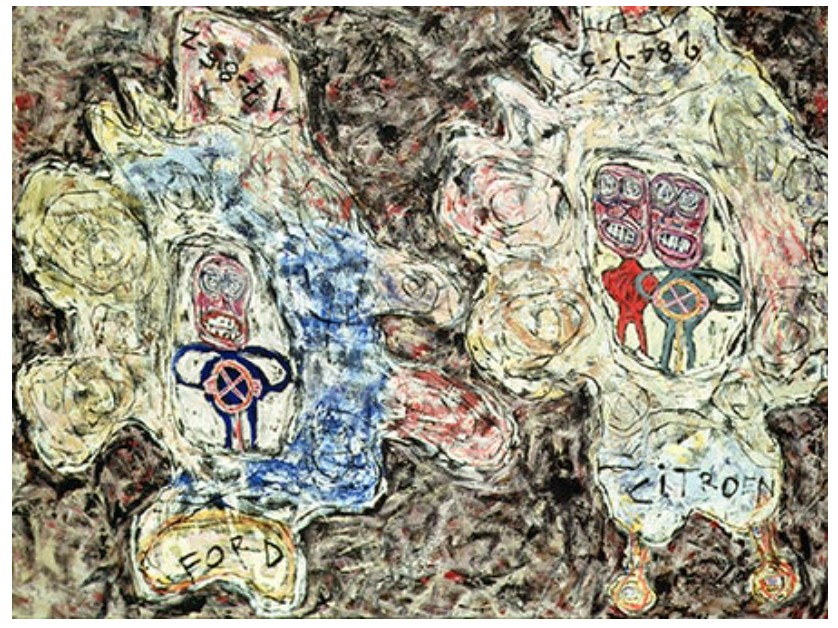 Jean Dubuffet, Automobile, Fleur de L’Industrie, 1961. Private Collection. Image: Bridgeman Images, Artwork: © 2026 Artists Rights Society (ARS), New York / ADAGP, Paris
In High Times, he enlarges and recomposes elements from the Hippie Drawings across the canvas, working over transferred forms with acrylic and oil stick. Both familiar and fanciful, the figures appear against expanses of black, often haloed in ultraviolet purple. Smiling faces greet the viewer, eerie yet disarming with their wide grins. The elements are discrete but accumulate toward an elusive narrative. As Prince has put it, “I’ve always liked it when something ‘way out’ is presented in an orderly fashion” (Richard Prince in conversation with Steve Miller, “Richard Prince,” Musée Magazine, no. 11, April 2015, online).
A white picket fence and a red house. A blue dog and a yellow figure with its arm outstretched—or is it its body, lying supine? Spiky flowers stand alone and in tangles of gestural lines, rendered in aquamarine and yellow. The forms carry the openhearted pathos of neon head-shop posters and bend it toward the schematic whimsy of a Dubuffet. Where progenitor-of-cool Eve Babitz—whose essay on Sixties counterculture is reprinted in the 2018 Gagosian catalogue—dismissed the Magic Marker aesthetic of hippiedom as synthetic and vile, Prince embraces it with an unguarded nostalgia rather than irony. After a career spent interrogating how images operate across high art and the vernacular, he remains acutely attuned to their cultural afterlives. Here, by appropriating his own repertoire, he produces a composition that invites the viewer in while maintaining a certain distance from its associative logic. High Times gathers this constellation of figures into one of his most fully realized statements—a self-portrait by way of a hippie who never was.
Back to the Garden, 2008
Back to the Garden, 2008
Edlis Neeson Collection
Christie’s New-York: 20 May 2026
Estimated: USD 500,000 – 700,000
USD 533,400
RICHARD PRINCE (B. 1949), Back to the Garden | Christie’s
RICHARD PRINCE (B. 1949)
Back to the Garden, 2008
Acrylic, inkjet and canvas collage on canvas
80×120 inches (203.2 x 304.8 cm)
Signed, titled and dated ‘Richard Prince 2008 BACK TO THE GARDEN’ (on the overlap)
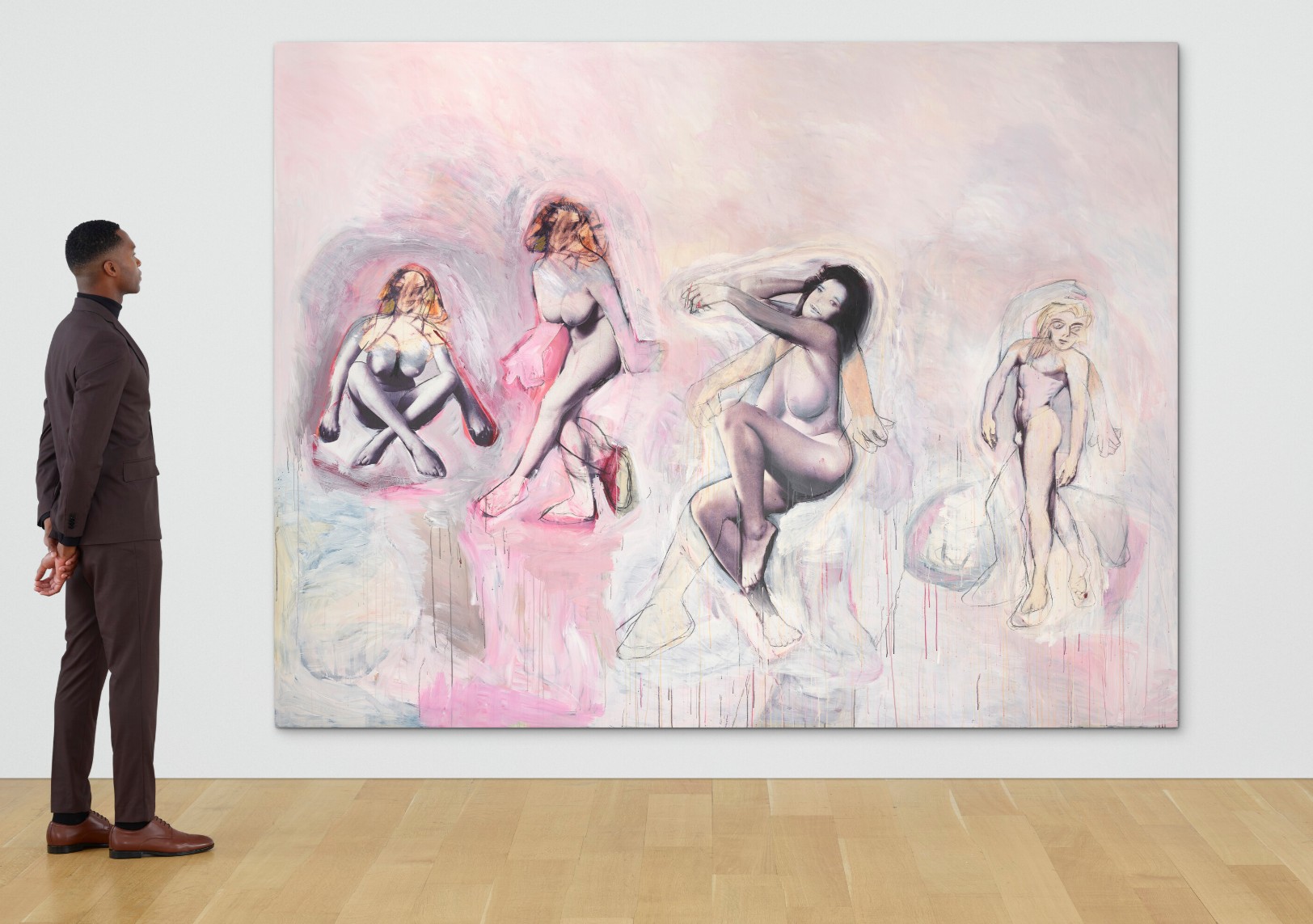
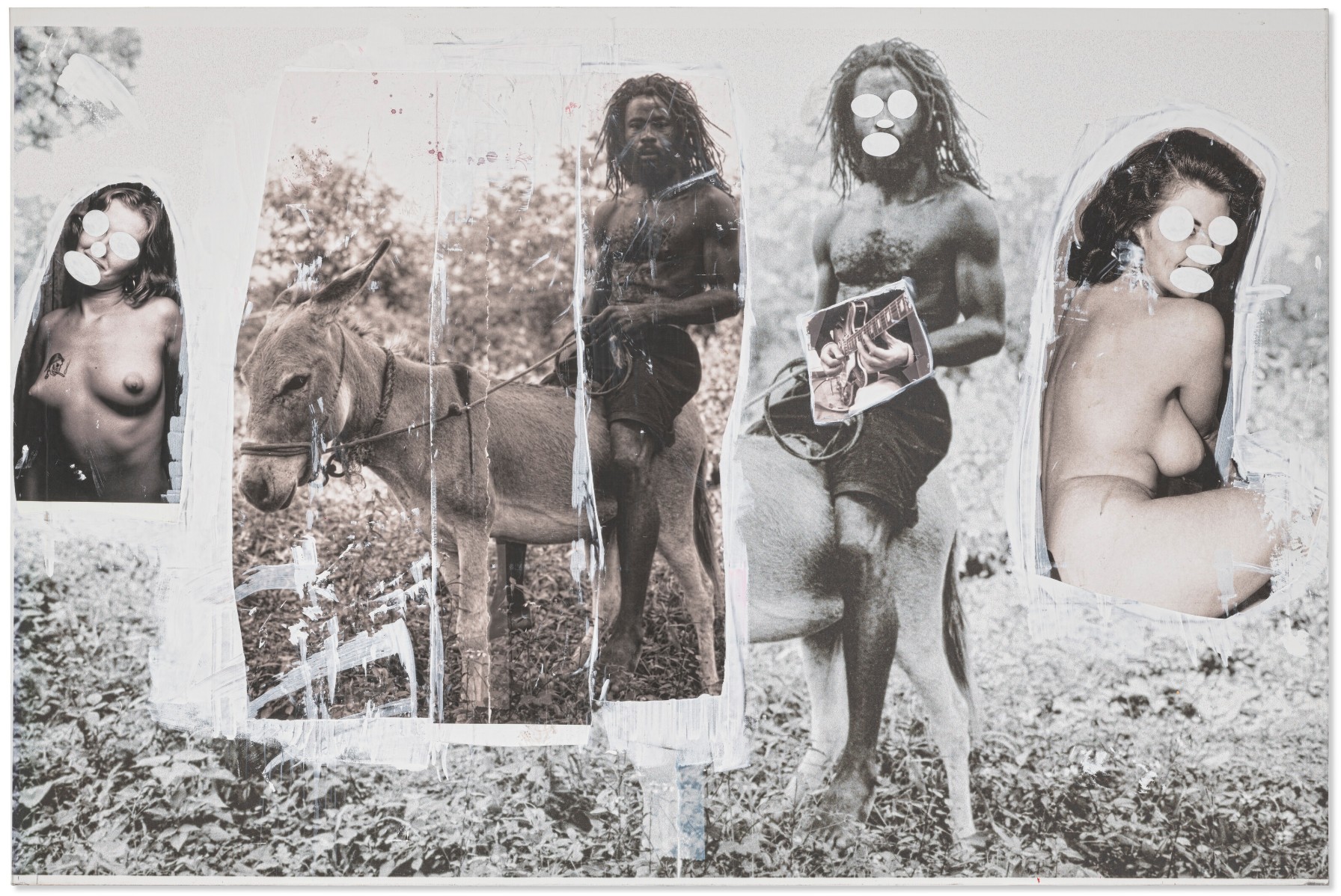
Executed in 2008, Richard Prince’s Back to the Garden belongs to a series of visually striking works that have become known as the artist’s Canal Zone paintings. Featuring figures in a lush, verdant setting, and rendered on a panoramic scale, the present work is a bold canvas in the grand tradition of the artist’s Cowboys and Nurse appropriation works. Using photographic imagery of nude women, their faces obscured with painted white lozenges, alongside a bare-chested Rastafarian seen riding a donkey, Prince manipulates their meaning as a biting commentary on our image-infatuated society. The photographs used in the present work were taken by the French photographer Patrick Cariou, and the artist’s use of them are part of his ongoing dialogue of how we use and understand images. Having spent his career culling imagery from books and magazines, Back to the Garden is a powerful postmodern critique of a vast, wide-ranging set of influences.
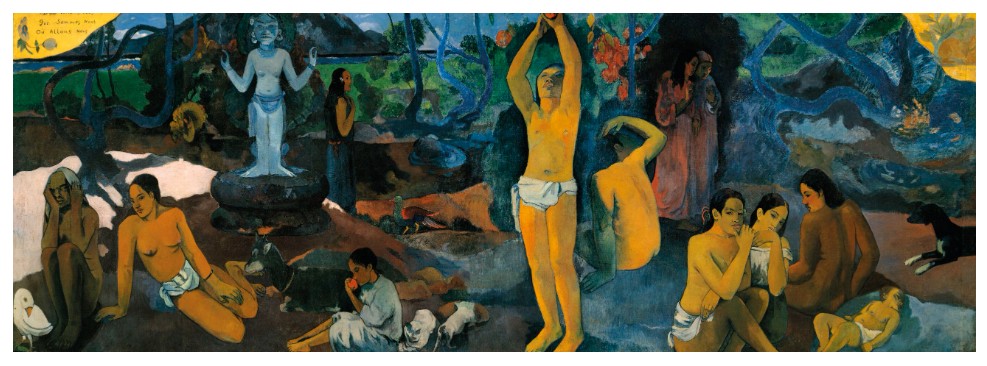
Paul Gauguin, Where Do We Come From? What Are We? Where Are We Going?, 1897 – 1898. Museum of Fine Arts, Boston.
In 2007, Richard Prince purchased a book of photographs by Cariou. The publication, called Yes Rasta, was shot on location in Jamaica and featured dozens of black-and-white photographs of Rastafarians living there. Prince created a collage from images in Cariou’s book, which he titled “Canal Zone,” a reference to the sub-tropical landscape of Panama, where Prince was born. The following year, Prince expanded upon the theme, appropriating more pictures from Yes Rasta into a new series of large-scale paintings, of which the present work is an example.
To create the present work, Prince used an inkjet printer to create large-scale, black-and-white copies which he then applied directly to the canvas surface, using white paint instead of glue. Prince let the excess paint seep and drip, leaving them as evidence of his working process. He covered the women’s faces with white, leaving them completely anonymous, a technique which ratchets up the evocative quality of the already sexualized imagery. The women were all nude, their bodies contorted into strange poses that seemed to emphasize and exaggerate their own nakedness. Alongside these women were the Rastafarians from Cariou’s book, also applied to the canvas in the same manner, with the white paint dripping down the surface.
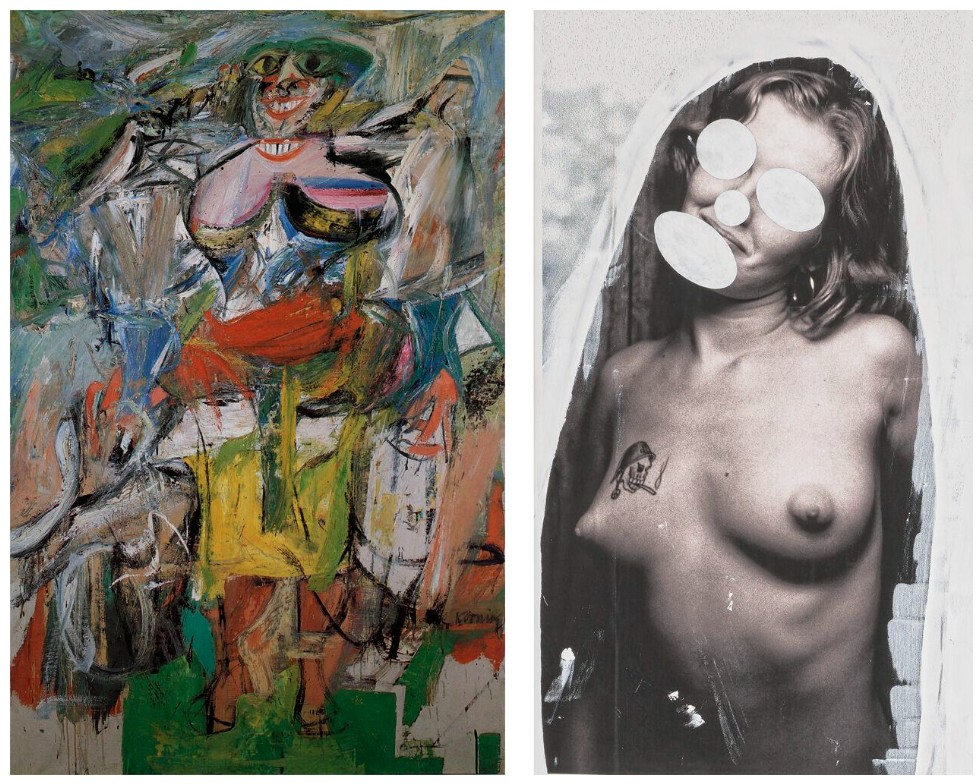
Left: Willem de Kooning, Woman and Bicycle, 1952 – 1953. Whitney Museum of American Art, New York. © 2026 The Willem de Kooning Foundation / Artists Rights Society (ARS), New York.
Right: Present lot illustrated (detail).
In 2011, the Canal Zone paintings became the subject of a lawsuit when Patrick Cariou sued Richard Prince, claiming copyright infringement. A court in the Southern District of New York ruled in Cariou’s favor, stating that Prince did not modify or transform the imagery significantly enough to constitute “fair use.” This high-profile copyright case sent shock waves through the art world, as it had implications for many artists who obtained their source imagery from a variety of different media. This strategy of “appropriation” was a hallmark of 1980s Postmodernism, a movement which Richard Prince pioneered when he re-photographed magazine ads and exhibited them as new work. His iconic Cowboys and Nurse paintings are two of the most well-known series that relied on this strategy. In 2014, an appeal brought to the United States Court of Appeals for the Second Circuit reversed the decision of the lower court, ruling largely in favor of Prince. They found that the Canal Zone paintings were permissible under “fair use” because they had a “different character” from the source material and gave it a “new expression”. This appeals ruling meant a great deal to many artists in America.
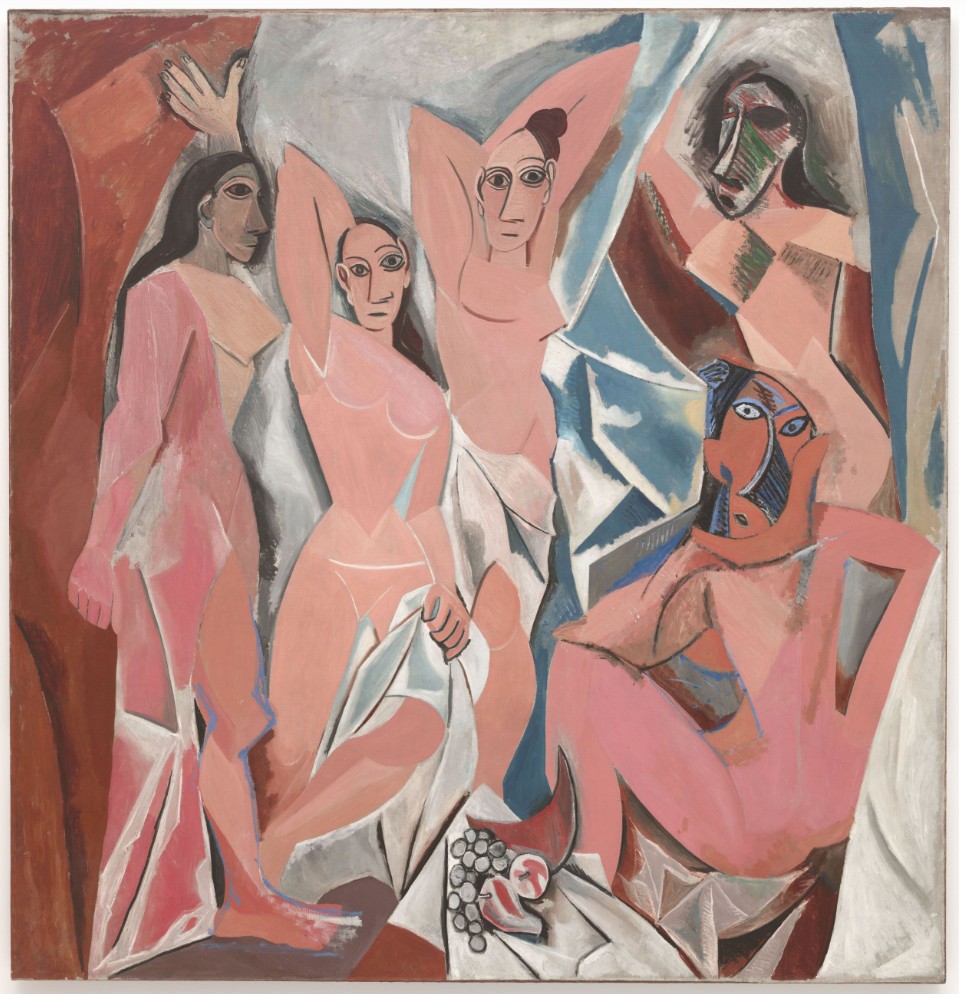
Pablo Picasso, Les Demoiselles d’Avignon, 1907. Museum of Modern Art, New York.
© 2026 Estate of Pablo Picasso / Artists Rights Society (ARS), New York.
Back to the Garden stands as a postmodern critique of an extensive, far-reaching set of influences, ranging from Paul Gauguin’s paintings of Tahitian girls and women, to Picasso’s Demoiselles d’Avignon, to de Kooning’s distorted female figures. Picasso, in his use of African masks, and Gauguin, in his sexualized paintings of Tahitian girls, exaggerated the concept of the “exotic other,” and used these visual motifs as shorthand for a sexualized libido, which they associated with Africa and the South Pacific. Back to the Garden mimics much of these earlier motifs, with subtle twists. The vibrant, colorful jungles of Gauguin’s landscapes are bleached out, leached of all color and warmth. The African masks are the white lozenge shapes, mimicking the black bars used by censors to mask the sitter’s identity. The painting’s title implies a return to Eden, but instead presents an unfamiliar world in which we are challenged to rethink our assumptions and not just passively consume the deluge of daily images that wash over us.
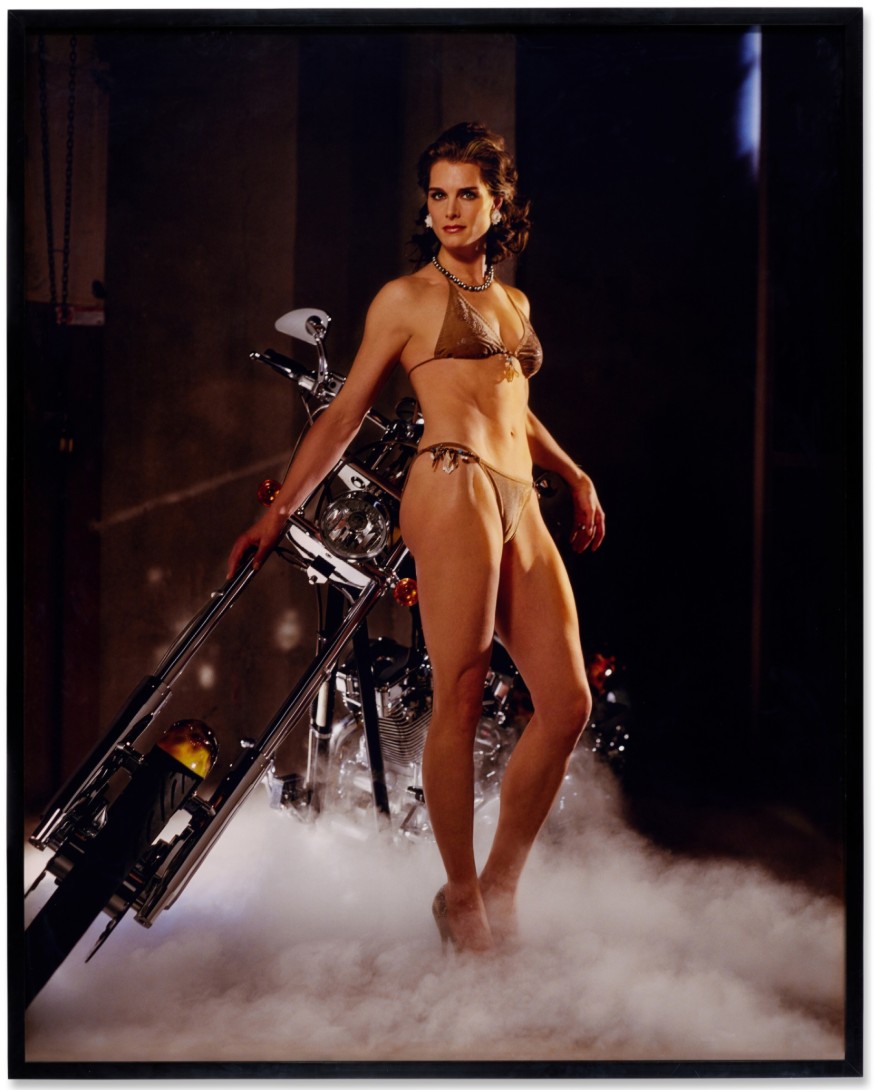
Spiritual America IV, 2005
Spiritual America IV, 2005
Property Sold to Benefit the Yale School of Art
Sotheby’s New-York: 15 May 2026
Estimated: USD 500,000 – 700,000
USD 384,000
Richard Prince | Spiritual America IV | Contemporary Day Auction |
RICHARD PRINCE (b. 1949)
Spiritual America IV, 2005
Ektacolor print in artist’s chosen frame
90-1/2 x 72 inches (229.9 x 182.9 cm)
Signed, dated 2005 and numbered ap #2 (on the backing board)
This work is artist’s proof number 2 of 2 from an edition of 6 plus 2 artist’s proofs
Executed in 2005, Spiritual America IV belongs to the late, self-reflexive phase of Richard Prince’s practice, when the artist turned back upon the images that had defined his early career. Monumental in scale, the present photo-portrait revisits the charged legacy of Prince’s 1983 Spiritual America, arguably his most recognized and audacious act of photographic appropriation. Whereas the 1983 work posed questions about innocence, authorship and the ethics of looking, Spiritual America IV returns to that same visual and cultural terrain with a new degree of theatricality and self-awareness. In the present work, Prince transforms an image once rooted in shock and provocation into a more layered meditation on the afterlife of images.
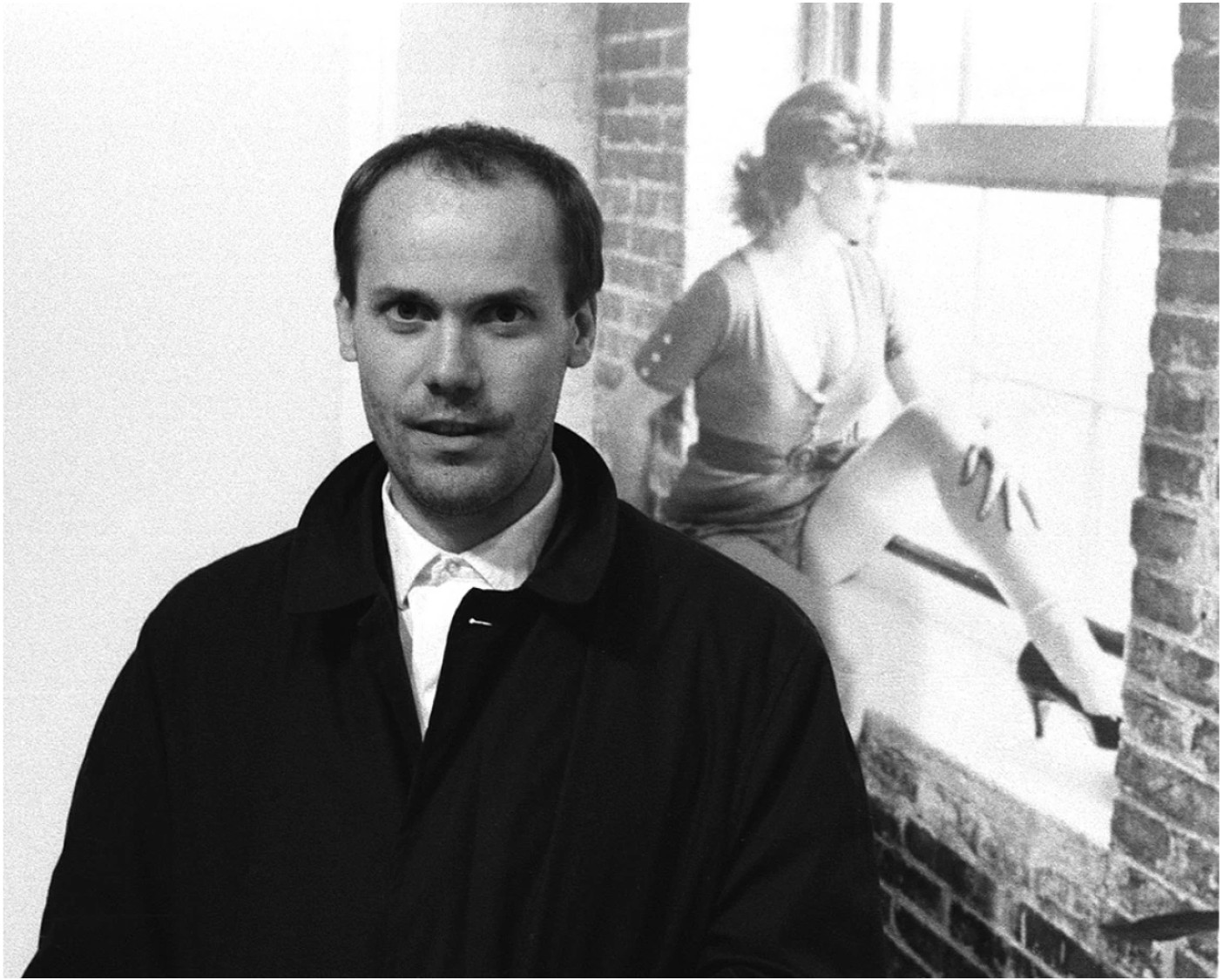
Richard Prince In Front Of Cindy Sherman’s Work, 1984. Photograph by Eleftheria Lialios.
In the 2005 work, Brooke Shields reappears not as the ambiguous child of the earlier image but as a fully self-aware adult, posed beside a motorcycle in a haze of theatrical vapor. If the original picture was among the artist’s most notorious interrogations of innocence and consent, Spiritual America IV transforms into an exploration about agency and participation. In the current work, photographed by acclaimed celebrity photographer Sante D’Orazio, the body is no longer passively implicated but actively staged, foregrounding questions of context and the viewer’s role in sustaining the image’s power. Spiritual America IV further captures the ways American culture recycles desire and transgression into an ever more stylized spectacle where fantasy and self-conscious performance become inseparable.
Richard Prince, Spiritual America, 1983. Private Collection. Art © 2026 Richard Prince.
Prince’s artistic achievement has long resided in his ability to make appropriation feel less like repetition than like diagnosis. His work resides at the very center of postwar American art, in dialogue with Duchamp’s readymade, Warhol’s serial coolness, and the broader Pictures Generation critique of media construction. Yet Spiritual America IV is not merely a return to an infamous motif; it is a mature restaging of authorship itself. That self-consciousness is precisely what gives the present work its extraordinary charge. Shields is no longer the unwitting subject of an image authorized by her mother and taken by a commercial photographer, Gary Gross; she is the knowing participant in her own recording.
Francisco Goya, La maja vestida, 1800-07. Museo del Prado, Madrid. Image © Photo Josse / Bridgeman Images
Women recur throughout Prince’s oeuvre as potent vessels for the fantasies, desires and projections of American image culture. Ranging from the seductive masquerade of the Nurses to the pulp heroines and magazine models, the female figure is never simply represented in his work. Rather, she becomes a charged site where sexuality, performance and power are simultaneously constructed and scrutinized. In this context, Spiritual America IV occupies a particularly significant place, revisiting one of the most provocative female images in Prince’s practice and recasting it with a heightened sense of theatricality. The result is a work that is at once seductive and unsettling, exposing the unstable boundary between desire, spectacle and complicity that lies at the core of Prince’s art.
The significance of Spiritual America IV was crystallized by another version’s presentation at Tate Modern in 2009, when the museum replaced the original Spiritual America with the 2005 version amid controversy. This substitution revealed the later work as Prince’s own mature reconsideration of one of his most contentious images, shifting the terms of debate from appropriation alone to questions of agency and historical afterlife. In this context, Spiritual America IV emerges as a pivotal work within Prince’s practice, one that demonstrates how his images continue to test the boundaries of representation, while reaffirming the enduring volatility and cultural force of the Spiritual America motif.
I’m Not Linda, 1991-1992
I’m Not Linda, 1991-1992
Christie’s New-York: 21 May 2026
Estimated: USD 500,000 – 700,000
USD 762,000
RICHARD PRINCE (B. 1949), I’m Not Linda | Christie’s
RICHARD PRINCE (B. 1949)
I’m Not Linda, 1991-1992
Silkscreen and acrylic on canvas
56-1/4 x 47-7/8 inches (142.9 x 121.6 cm)
Signed and dated ‘R Prince. 91-92’ (on the overlap)
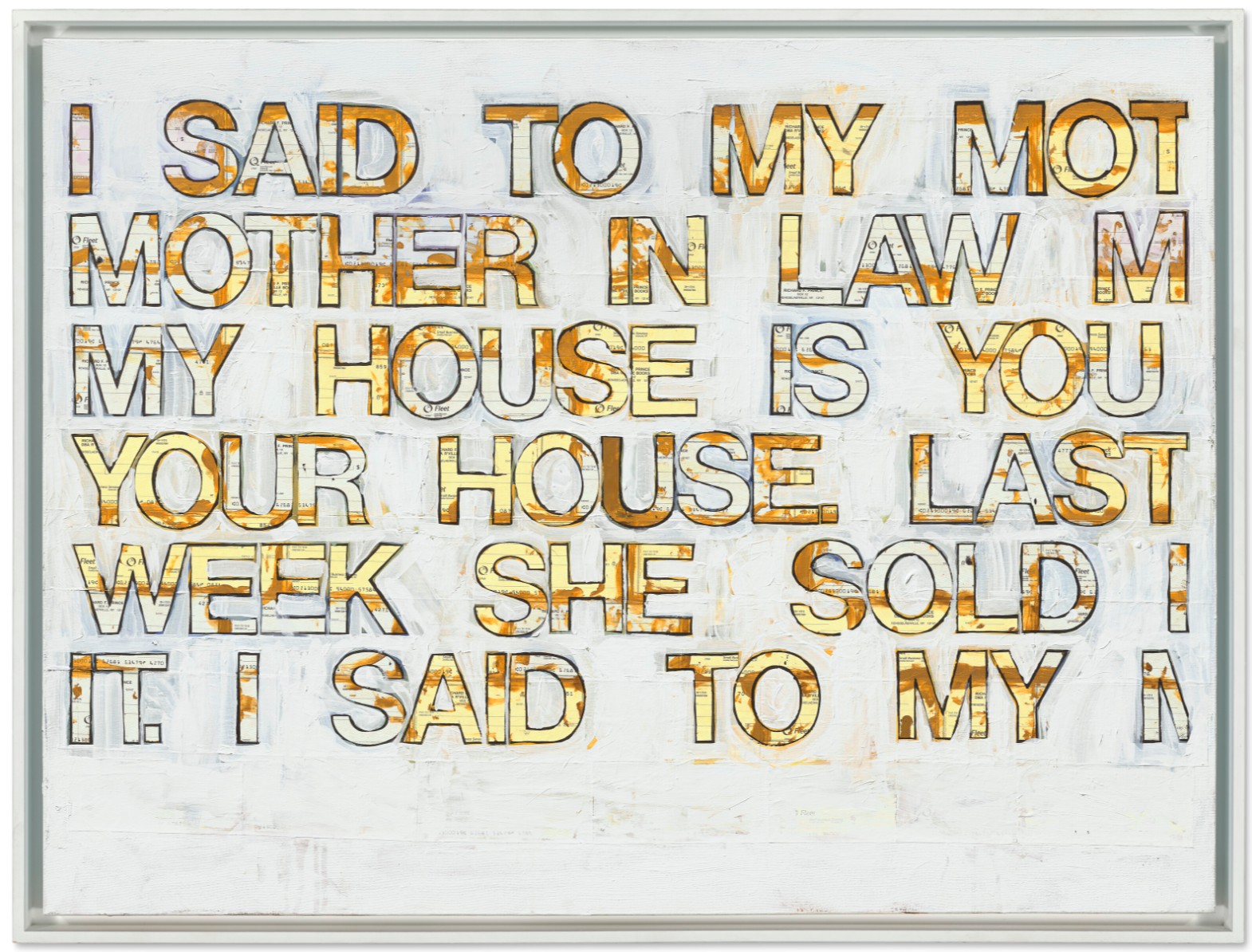
Richard Prince’s joke paintings are more than gags, they are in fact manifestations of artistic labor.
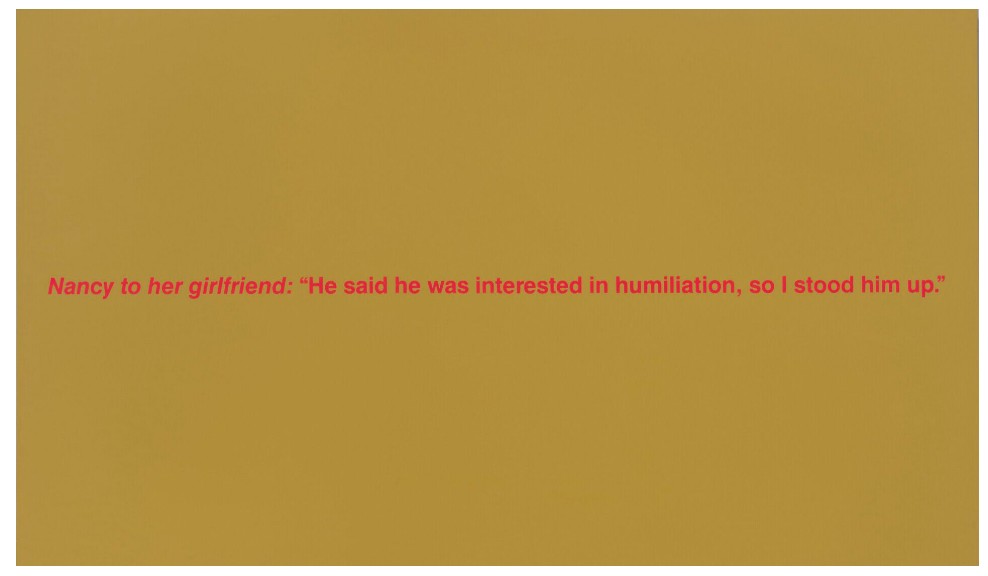
Richard Prince, Nancy to Her Girlfriend, (RP288), 1988. Whitney Museum of Art, New York.
© 2026 Richard Prince. Photo: © 2026 Whitney Museum of American Art / Licensed by Scala / Art Resource, NY.
New York Times co-chief art critic Roberta Smith has called the Joke paintings “portraits of the artist at work, sweating it out, honing his material and timing, egging himself on to come up with another one and then another one until he gets our full attention, cracks us up and, in stand-up parlance, kills.” (R. Smith, “Pilfering a Culture Out of Joint,” New York Times, September 28, 2007.)