MAY 2026 NEW-YORK AUCTIONS
Keith Haring
Auction Results
25 lots sold for a total turnover of USD 17,703,940. This includes 20 lots from The Collection of Kermit Oswald, generating USD 9,854,240. With no lot failing to sell the sell-through rate is 100%.
XXXXXXXXXX
#1. Untitled (June 1st a Milano), 1984
Christie’s New-York: 20 May 2026
Estimated: USD 4,000,000 – 6,000,000
USD 4,955,000
KEITH HARING (1958-1990), Untitled (June 1st a Milano) | Christie’s
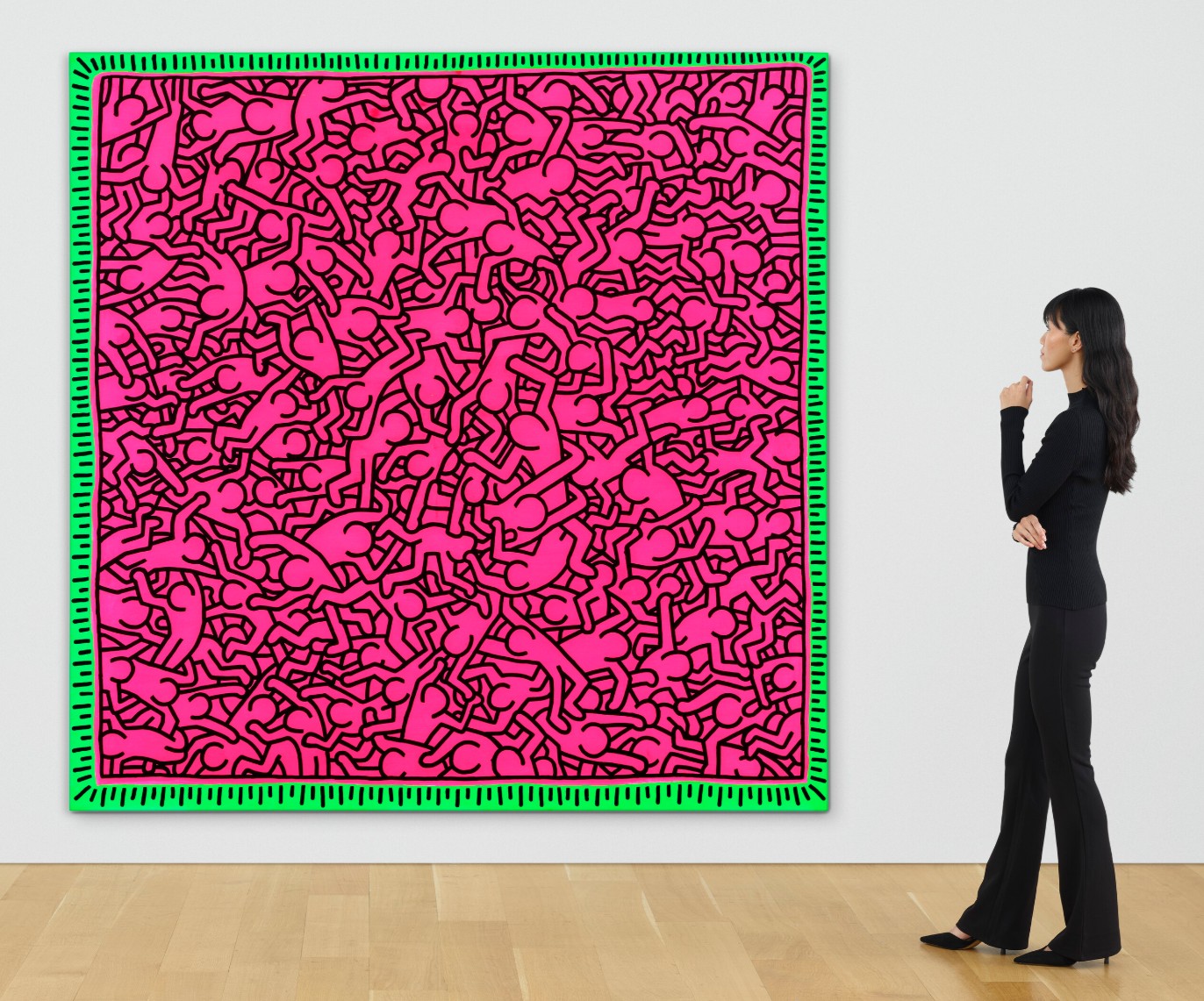
KEITH HARING (1958-1990)
Untitled (June 1st a Milano), 1984
Acrylic and fluorescent acrylic on canvas
94-3/8 x 94-3/8 inches (239.7 x 239.7 cm)
Signed, titled and dated ‘K. HARING JUN 1 1984 A MILANO’ (on the overlap)
#2. Self-Portrait, 1985
Haring’s House: Works from the Collection of Kermit Oswald
Sotheby’s New-York: 14 May 2026
Estimated: USD 3,000,000 – 5,000,000
USD 4,340,000
Keith Haring | Self-Portrait | The Now & Contemporary Evening Auction
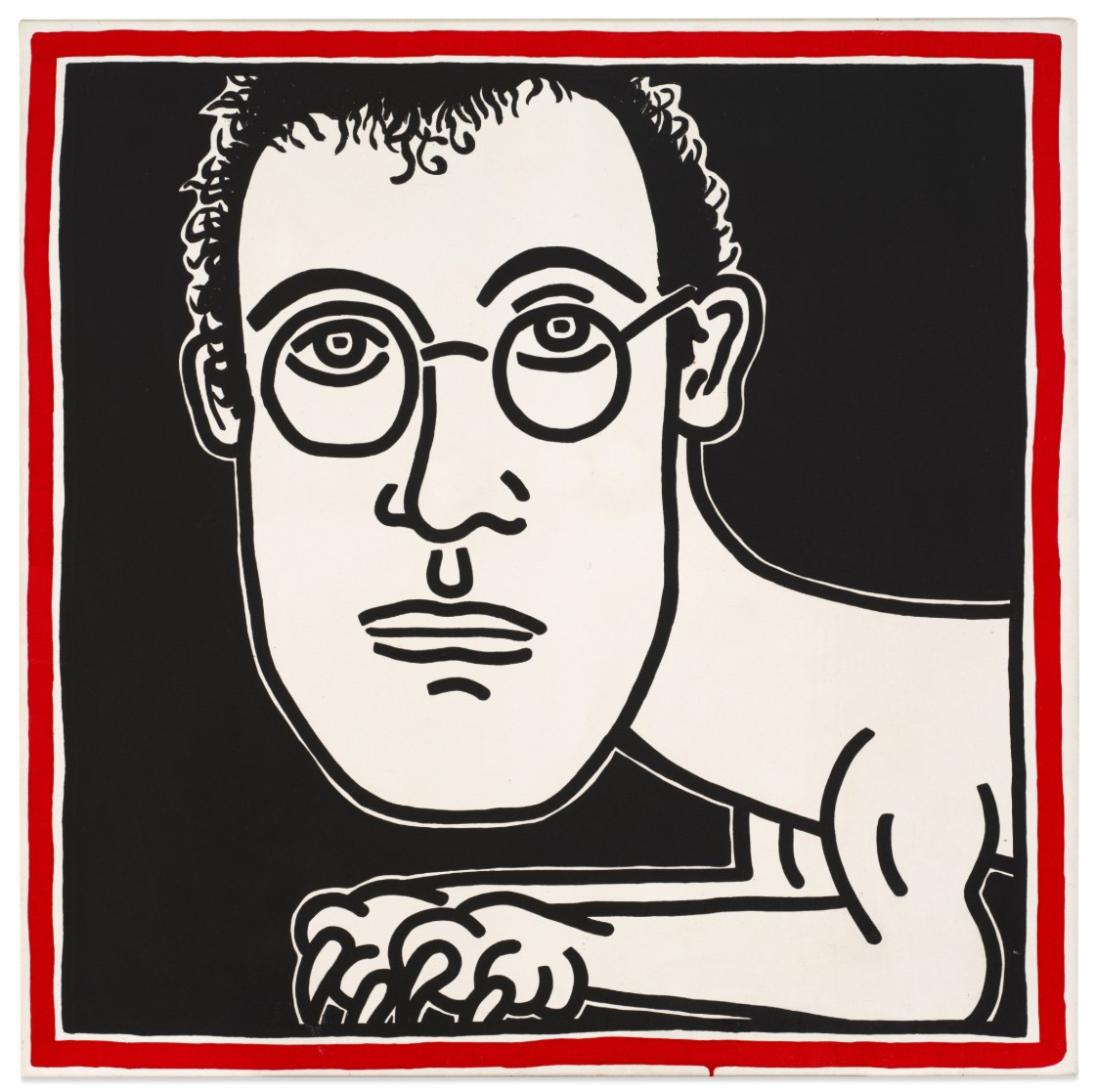
KEITH HARING (1958 – 1990)
Self-Portrait, 1985
Acrylic on canvas
48X48 inches (121.9 x 121.9 cm)
Signed, titled, dated FEB. 4 – 85 and dedicated HAPPY BIRTHDAY – FOR KERMIT (on the overlap)
#3. Untitled (Grace Jones Mask), 1987
Phillips New-York: 19 May 2026
Estimated: USD 1,500,000 – 2,000,000
USD 2,322,000
Keith Haring Modern & Contemporary Art Evening Sale
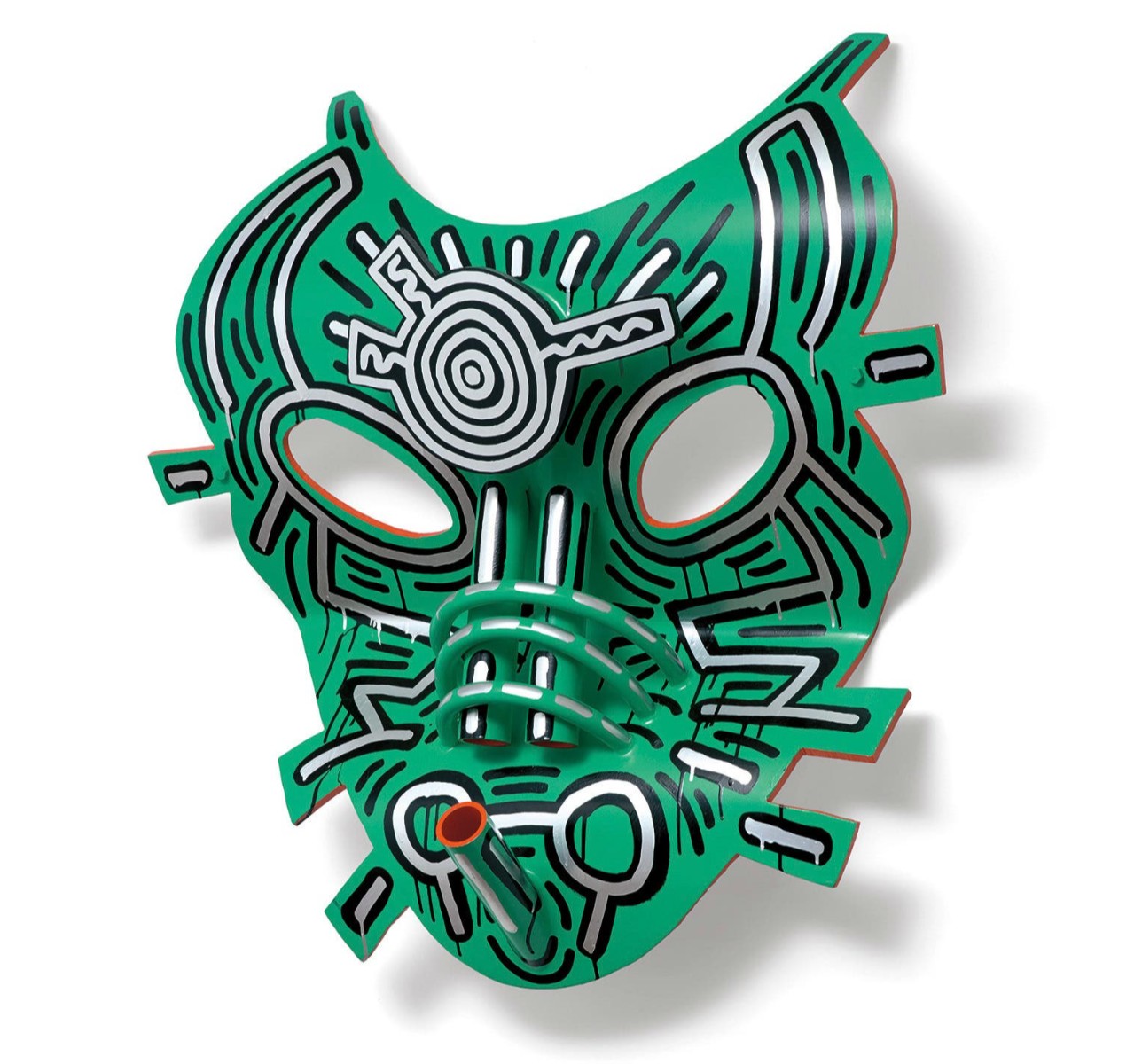
Enamel on aluminum
44-1/2 x 43-1/2 x 12-1/2 inches (113 x 110.5 x 31.8 cm)
Signed, inscribed and dated “© K. Haring 1987 ⨁” on the reverse
#4. Untitled, 1983
Haring’s House: Works from the Collection of Kermit Oswald
Sotheby’s New-York: 15 May 2026
Estimated: USD 600,000 – 800,000
USD 832,000
Keith Haring | Untitled | Contemporary Day Auction | 2026 | Sotheby’s
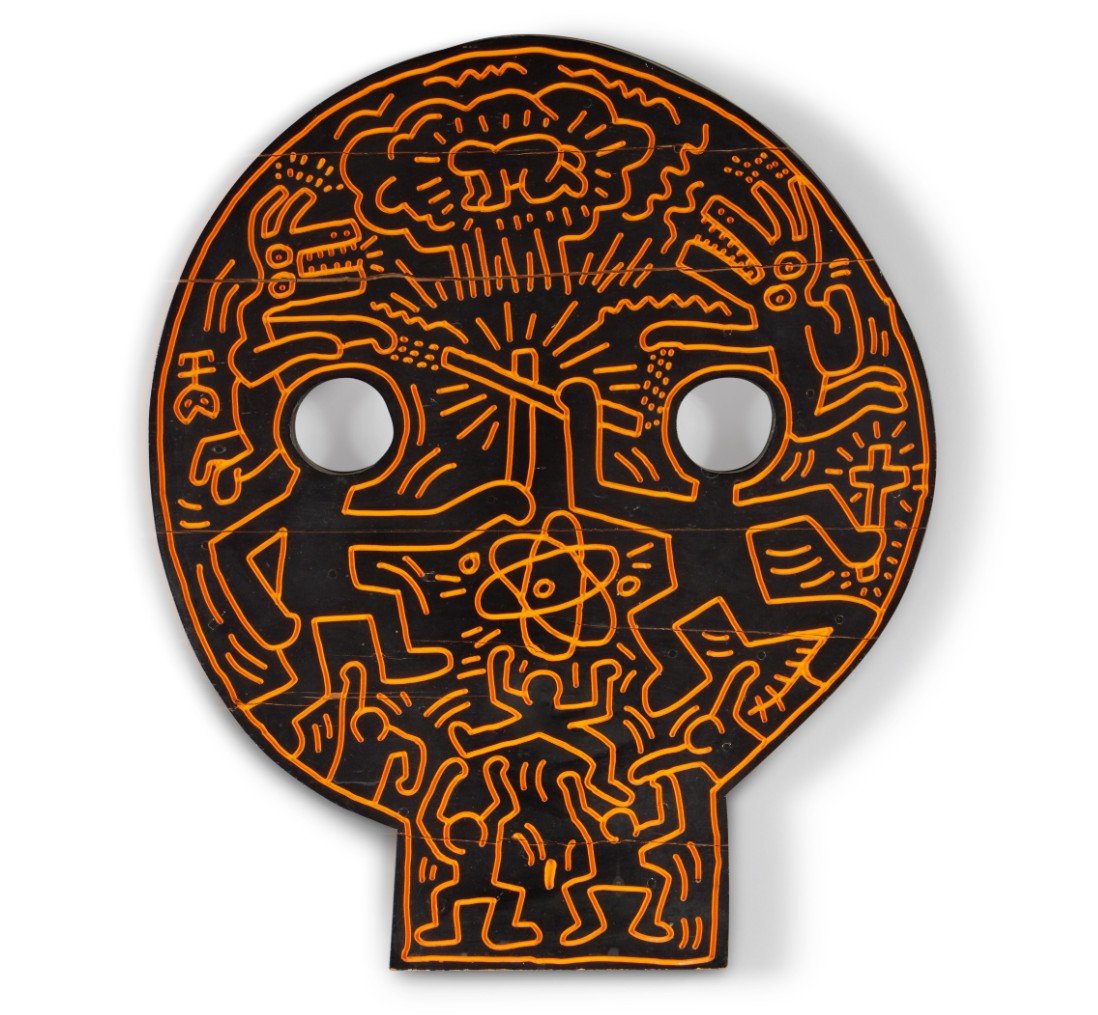
KEITH HARING (1958 – 1990)
Untitled, 1983
Enamel on carved wood
41-3/4 x 35 x 2-3/8 inches (106 x 88.9 x 6 cm)
Incised with the artist’s signature and date Nov. 83 (on the reverse)
Signed and dated 1983 by Kermit Oswald (on the reverse)
#5. Untitled, 1983
Haring’s House: Works from the Collection of Kermit Oswald
Sotheby’s New-York: 15 May 2026
Estimated: USD 200,000 – 300,000
USD 793,600
Keith Haring | Untitled | Contemporary Day Auction | 2026 | Sotheby’s
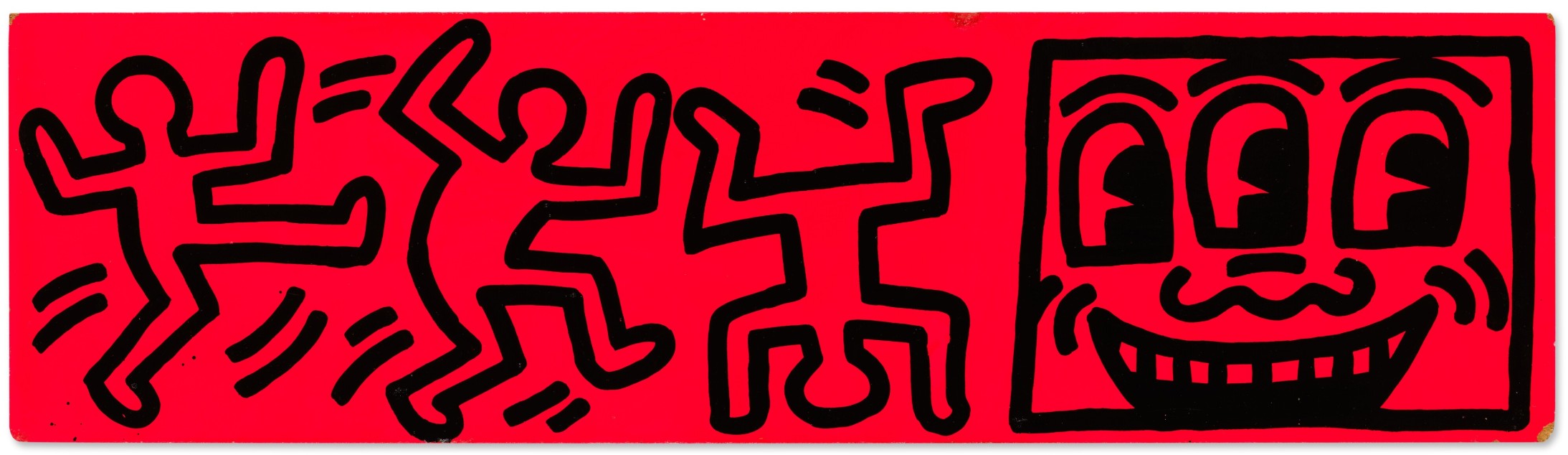
KEITH HARING (1958 – 1990)
Untitled, 1983
Acrylic on particle board
12-3/8 x 44-5/8 inches (31.4 x 113.3 cm)
Signed and dated Nov. 83 (on the reverse)
#6. The Blueprint Drawings, 1990
Haring’s House: Works from the Collection of Kermit Oswald
Sotheby’s New-York: 15 May 2026
Estimated: USD 300,000 – 500,000
USD 486,400
PRINTS
COMPLETE SET
Keith Haring | The Blueprint Drawings [17 works] | Contemporary Day
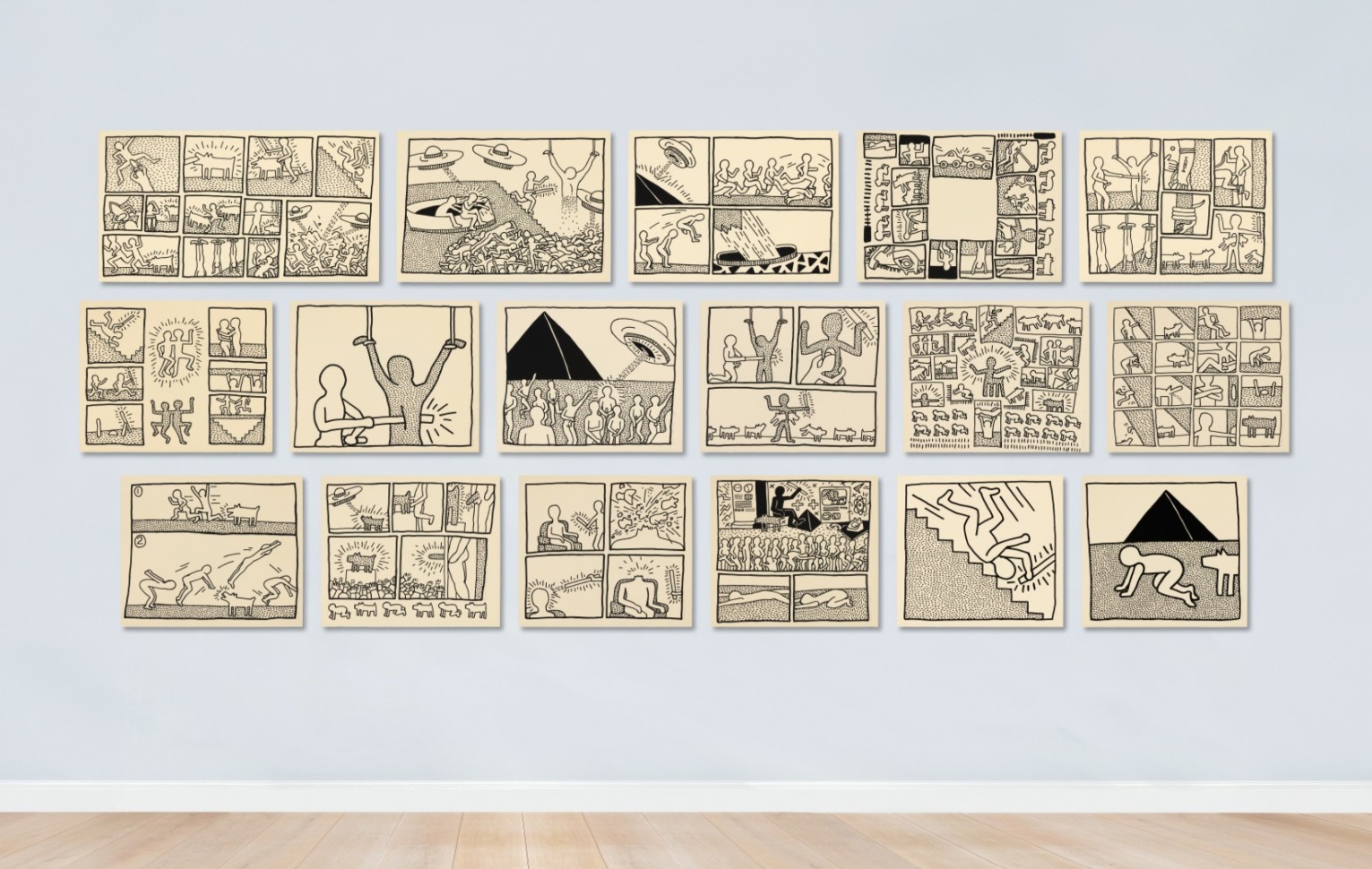
KEITH HARING (1958 – 1990)
The Blueprint Drawings [17 works], 1990
(Klaus Littmann, pp. 174-183)
The complete set of 17 screenprints, on Arches Cover paper
With the justification page, loose (as issued)
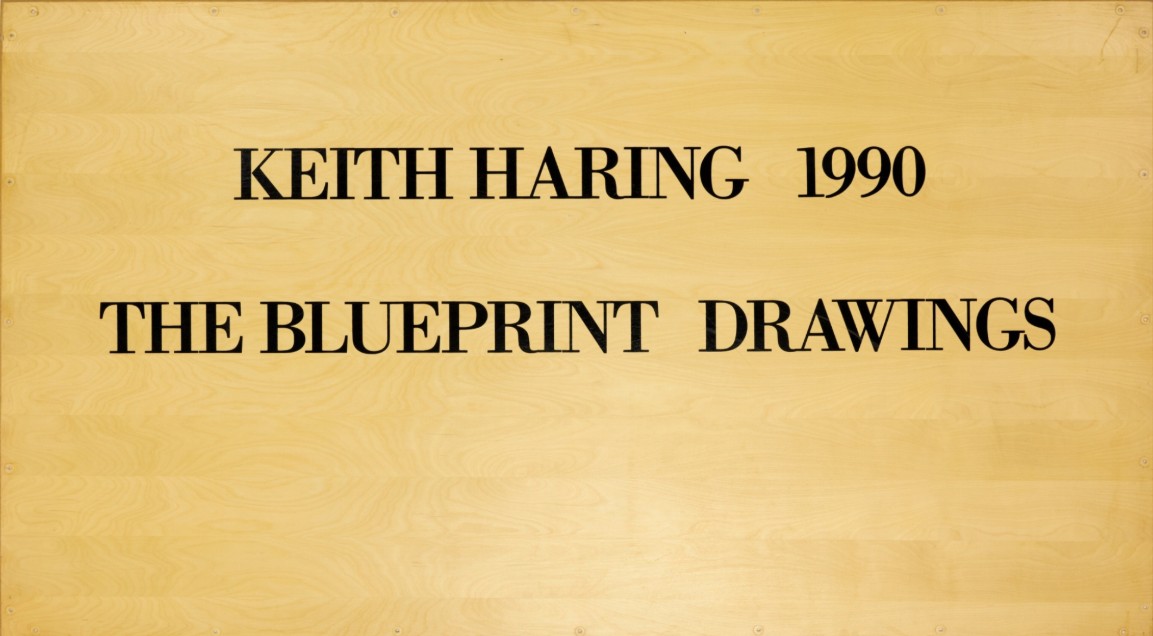
Contained in the original wood portfolio box with screenprinted artist’s name, title and date
Signed, dated ’90 and inscribed For Kermit + Lisa (lower right of each)
This set is a proof set aside from the numbered edition of 33 plus 5 artist’s proof sets
Each with the blindstamp of the printer, Martin Lawrence Limited Editions
Published by Durham Press.
#7. Untitled, 1982
Haring’s House: Works from the Collection of Kermit Oswald
Sotheby’s New-York: 15 May 2026
Estimated: USD 150,000 – 200,000
USD 448,000
Keith Haring | Untitled | Contemporary Day Auction | 2026 | Sotheby’s
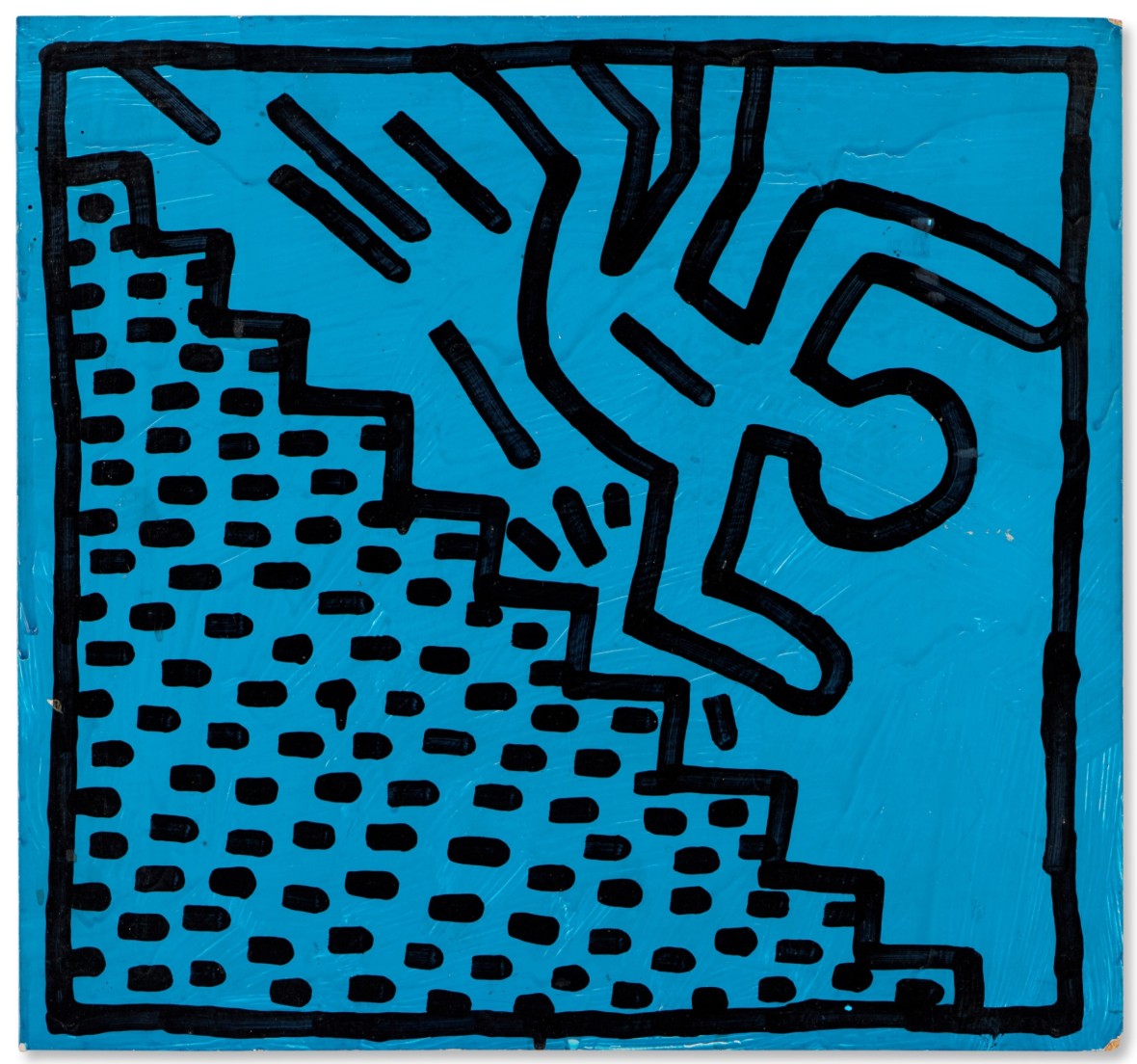
KEITH HARING (1958 – 1990)
Untitled, 1982
Acrylic on particle board
17-7/8 x 19 inches (45.4 x 48.3 cm)
Signed and dated January 1982 (on the reverse)
#8. Untitled, 1983
Haring’s House: Works from the Collection of Kermit Oswald
Sotheby’s New-York: 15 May 2026
Estimated: USD 250,000 – 350,000
USD 435,200
WORK ON PAPER
Keith Haring | Untitled | Contemporary Day Auction | 2026 | Sotheby’s
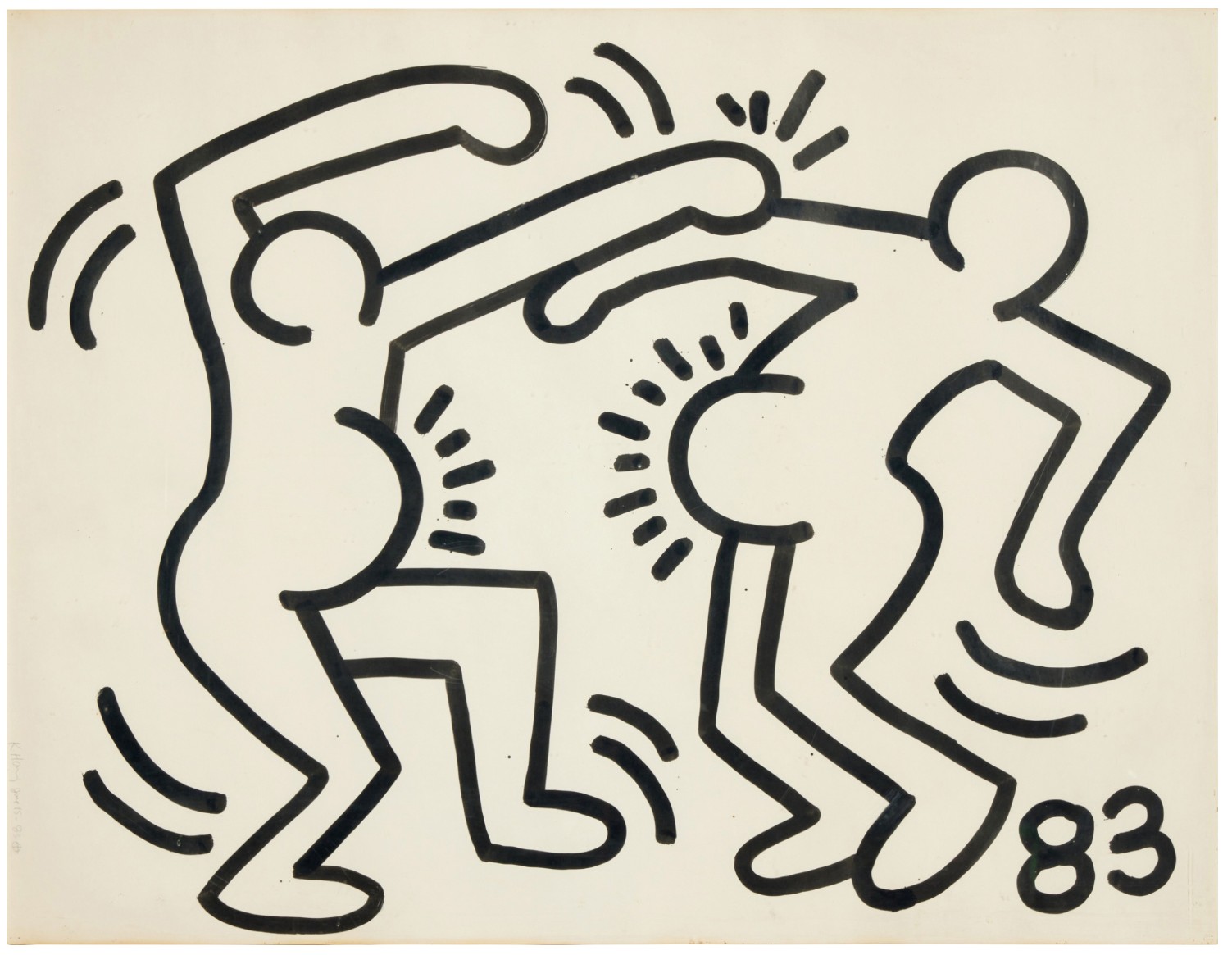
KEITH HARING (1958 – 1990)
Untitled, 1983
Sumi ink on paper
45 x 58-1/4 inches (114.3 x 148 cm)
Dated 83 (lower right)
Signed and dated June 15 – 83 (left edge)
#9. Untitled, 1983
Haring’s House: Works from the Collection of Kermit Oswald
Sotheby’s New-York: 14 May 2026
Estimated: USD 100,000 – 150,000
USD 358,400
Keith Haring | Untitled | Contemporary Day Auction | 2026 | Sotheby’s
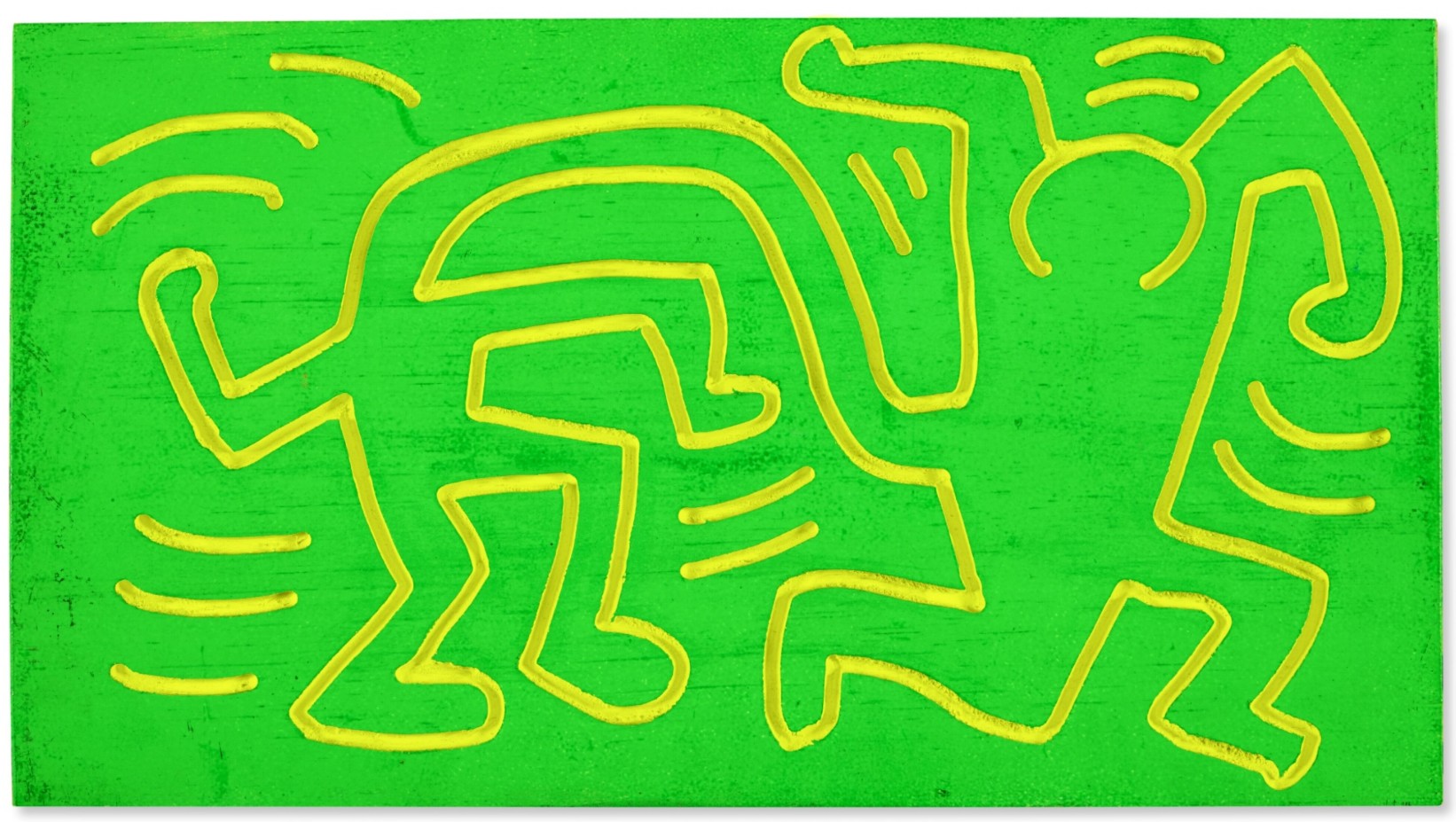
KEITH HARING (1958 – 1990)
Untitled, 1983
Enamel and DayGlo on carved wood
11-1/4 x 20-1/4 inches (28.6 x 51.4 cm)
Incised with the artist’s signature and date ♡83, and dedicated
“For Lisa, Merry Christmas, Love – Keith” (on the reverse)
#10. Untitled, 1983
Haring’s House: Works from the Collection of Kermit Oswald
Sotheby’s New-York: 15 May 2026
Estimated: USD 250,000 – 350,000
USD 345,600
WORK ON PAPER
Keith Haring | Untitled | Contemporary Day Auction | 2026 | Sotheby’s
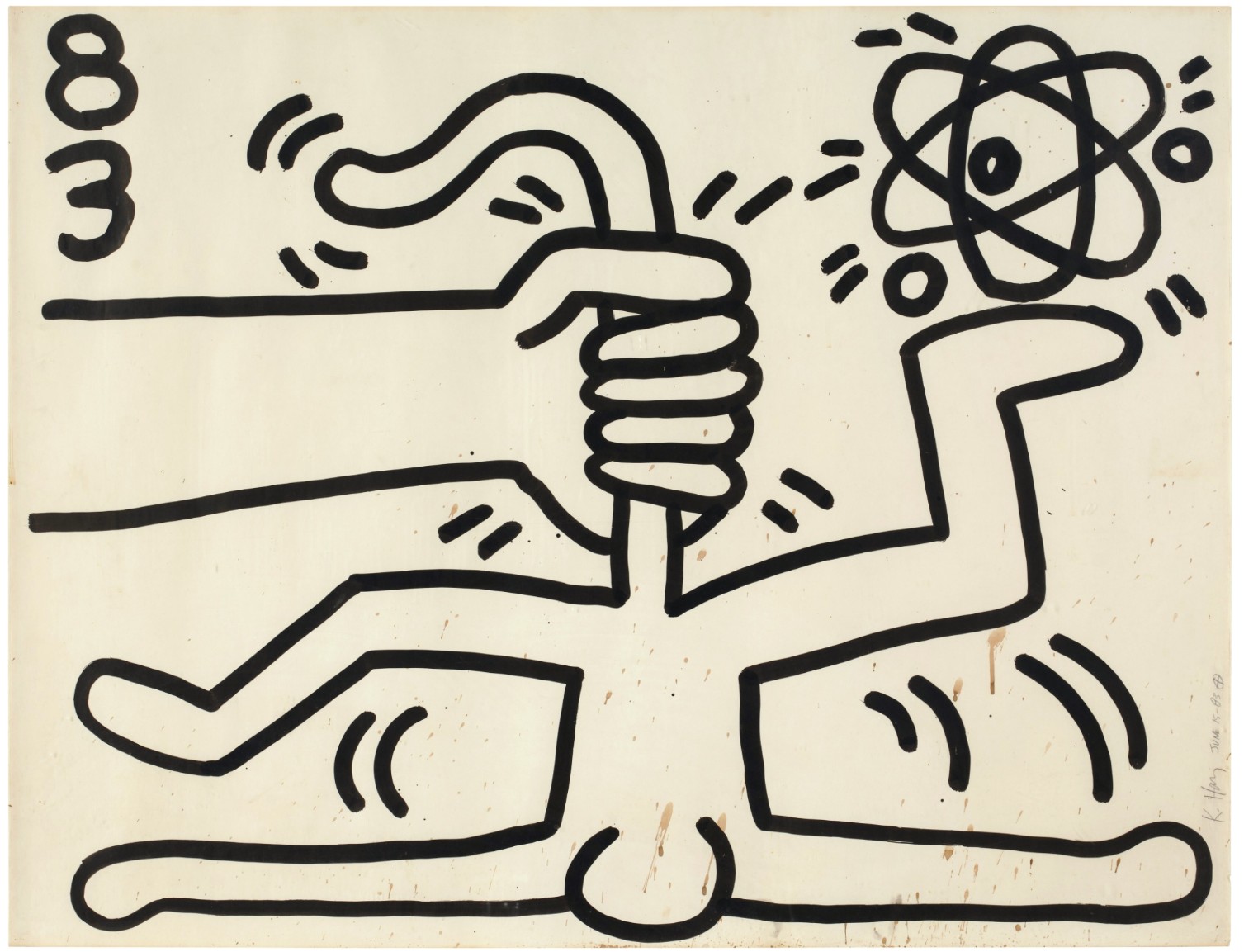
KEITH HARING (1958 – 1990)
Untitled, 1983
Sumi ink on paper
45 x 58-1/4 inches (114.3 x 148 cm)
Dated 83 (upper left)
Signed and dated June 15 – 83 (right edge)
#11. Untitled, 1983-84
Haring’s House: Works from the Collection of Kermit Oswald
Sotheby’s New-York: 15 May 2026
Estimated: USD 150,000 – 200,000
USD 281,600
Keith Haring | Untitled | Contemporary Day Auction | 2026 | Sotheby’s
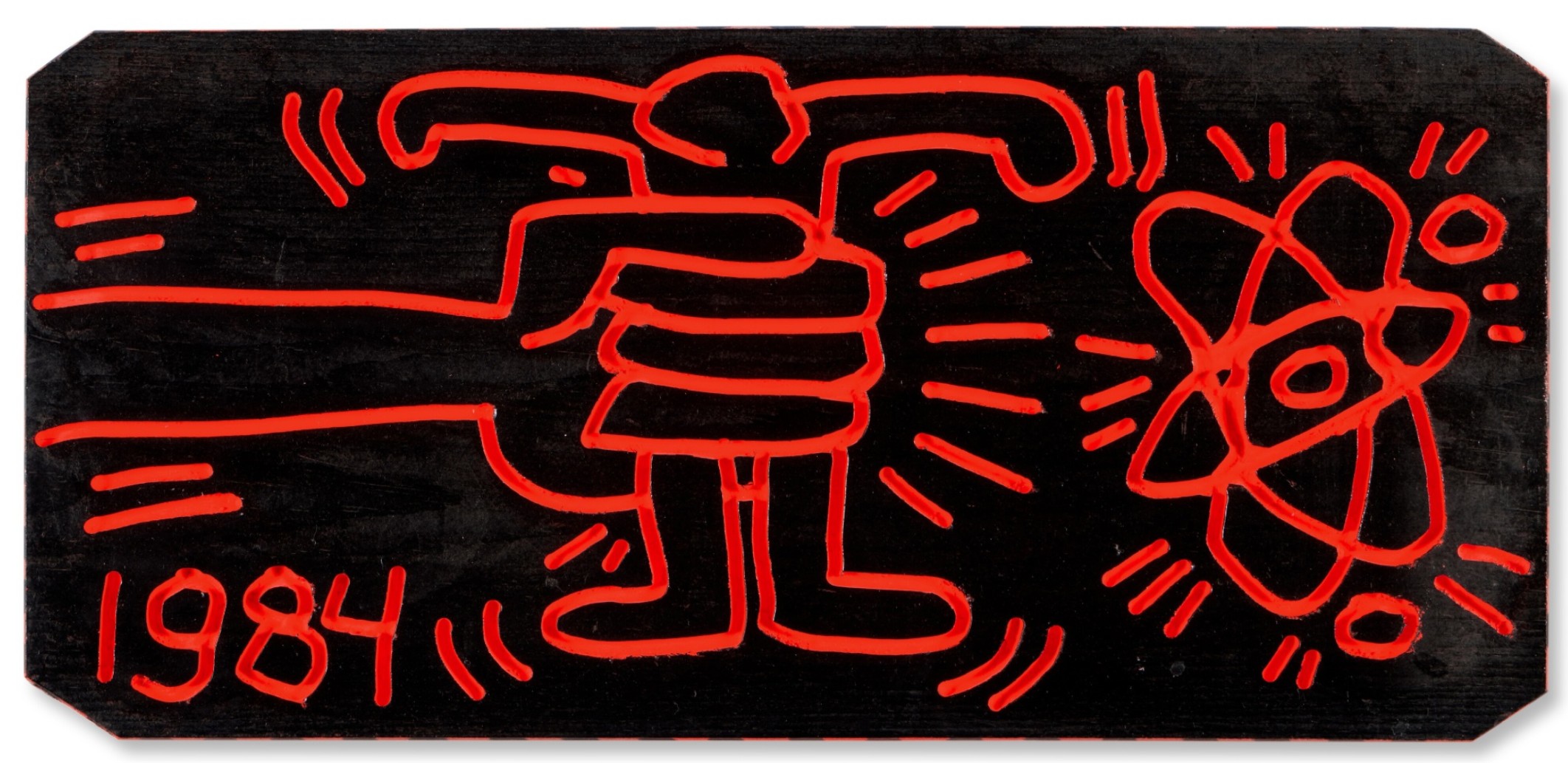
KEITH HARING (1958 – 1990)
Untitled, 1983-84
Enamel and DayGlo on carved wood
11-1/4 x 23-7/8 inches (28.6 x 60.6 cm)
Incised with the date 1984 (lower left)
Incised with the artist’s signature, date 83♡ and dedicated
“For Kermit and Lisa, Merry Christmas, Love, Keith” (on the reverse)
#12. Imagine the Other Side, 1985
Christie’s New-York: 21 May 2026
Estimated: USD 120,000 – 180,000
USD 266,700
KEITH HARING (1958-1990), Imagine the Other Side | Christie’s
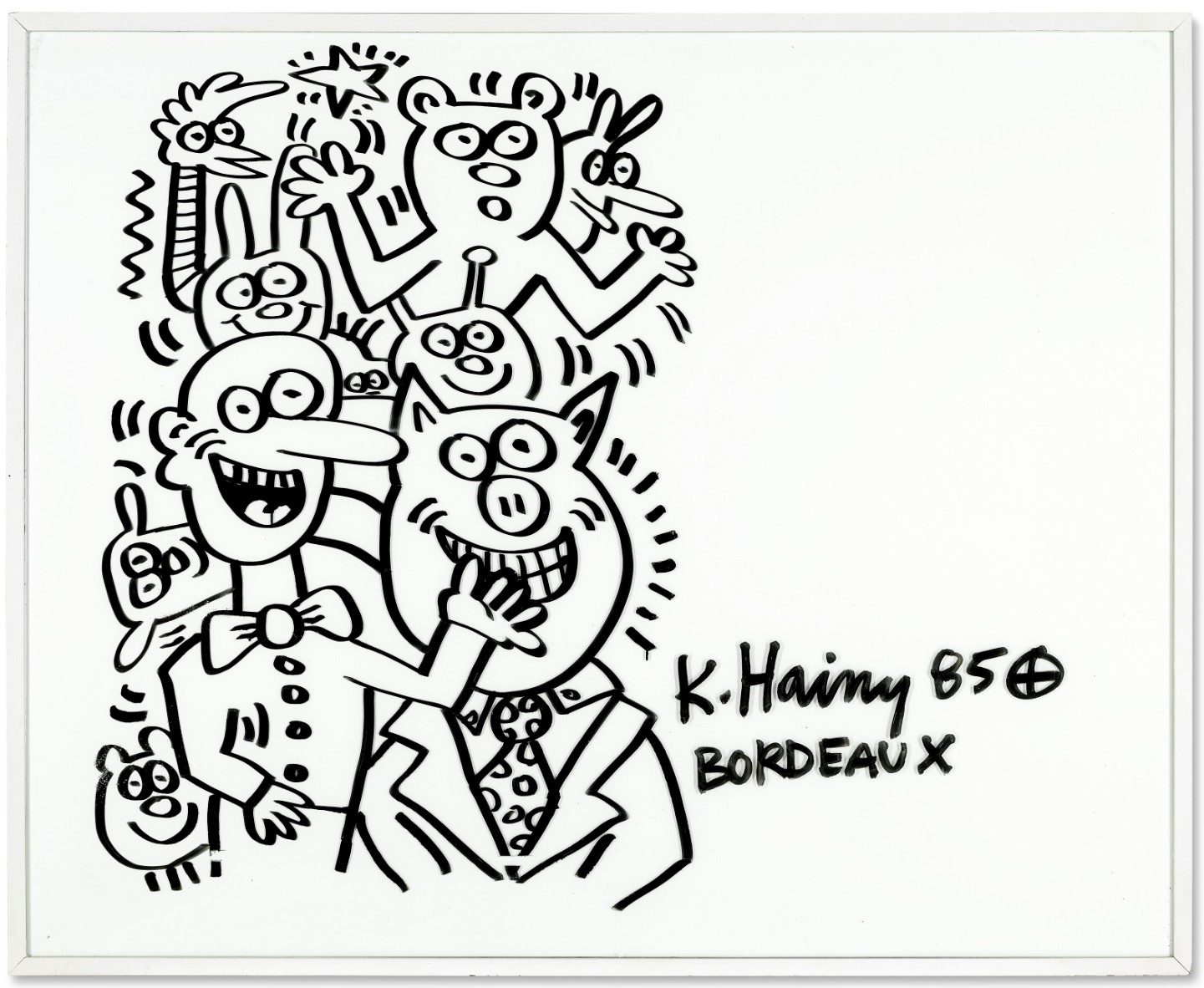
KEITH HARING (1958-1990)
Imagine the Other Side, 1985
Marker on glass
41 x 50-7/8 inches (104.1 x 128.8 cm)
Signed, inscribed and dated ‘K. Haring 85 BORDEAUX’ (lower right)
#13. Untitled, 1981
Haring’s House: Works from the Collection of Kermit Oswald
Sotheby’s New-York: 14 May 2026
Estimated: USD 300,000 – 400,000
USD 256,000
Keith Haring | Untitled | Contemporary Day Auction | 2026 | Sotheby’s
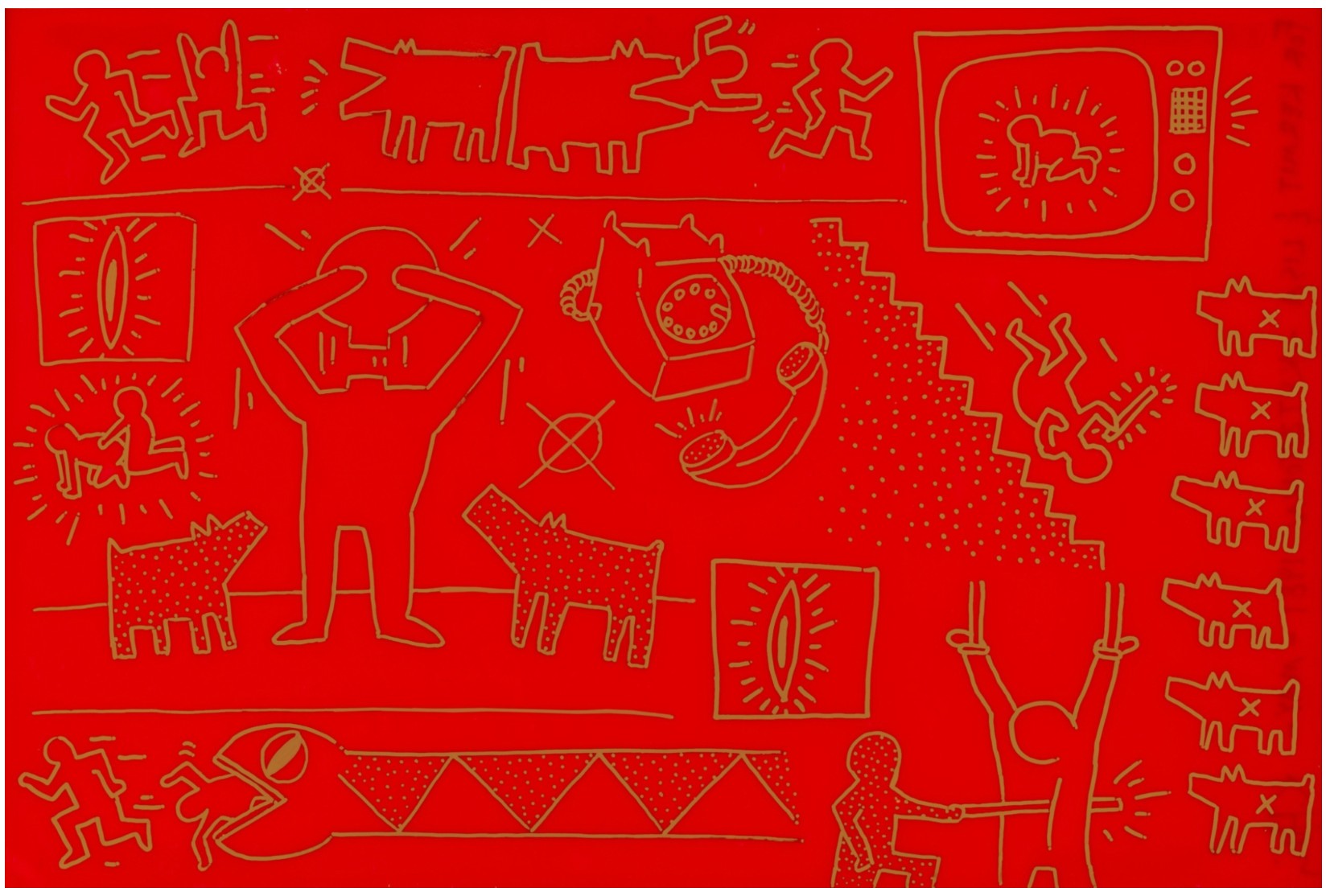
KEITH HARING (1958 – 1990)
Untitled, 1981
Gold marker on plastic
24×36 inches (61 x 91.4 cm)
Signed, dated 1981 – May and dedicated For Kermit & Lisa – Kutztown (on the reverse)
#14. Untitled, 1989
Haring’s House: Works from the Collection of Kermit Oswald
Sotheby’s New-York: 15 May 2026
Estimated: USD 200,000 – 300,000
USD 217,600
Keith Haring | Untitled | Contemporary Day Auction | 2026 | Sotheby’s
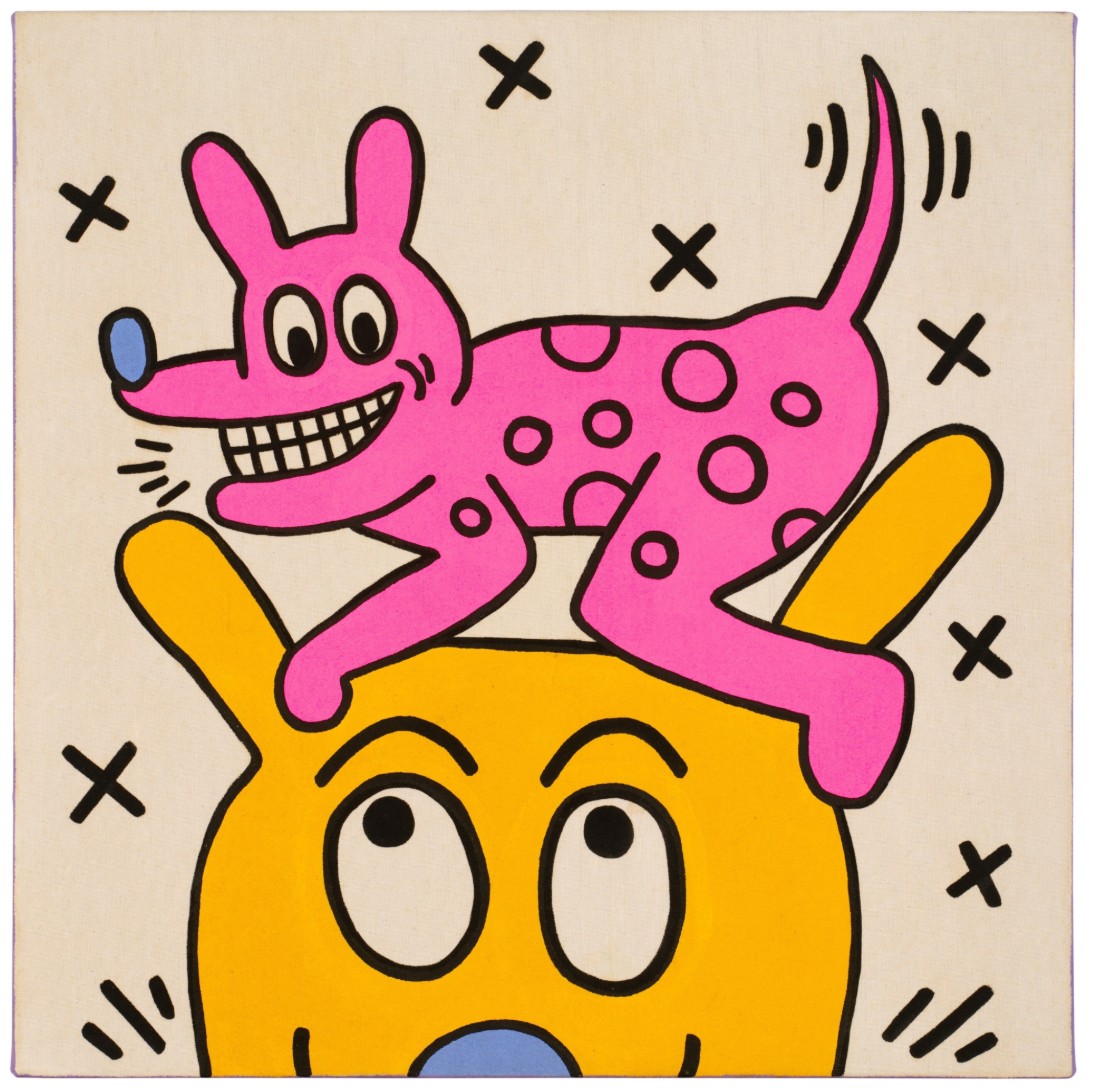
KEITH HARING (1958 – 1990)
Untitled, 1989
Acrylic on canvas
24 x 24 x 3-1/2 inches (61 x 61 x 8.9 cm)
Signed, dated May 7 1989 and dedicated “2 Dogs For Woody” Love, Keith (on the overlap)
#15. Andy Mouse, 1986
Sotheby’s New-York: 15 May 2026
Estimated: USD 150,000 – 250,000
USD 204,800
PRINT
Keith Haring | Andy Mouse | Contemporary Day Auction | 2026 |
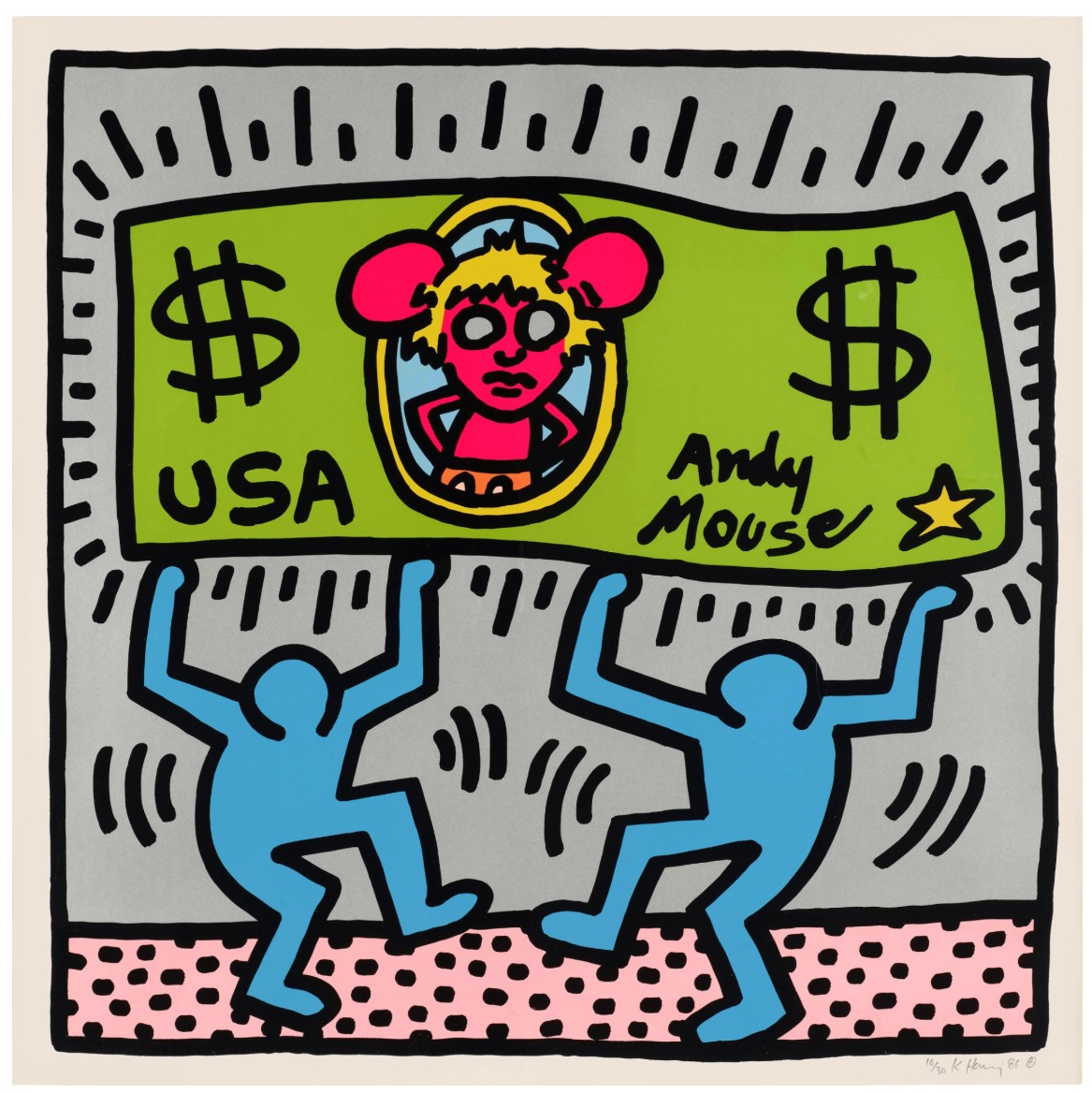
KEITH HARING (1958 – 1990)
Andy Mouse, 1986
(Littmann p. 65)
Screenprint in colors on Lenox Museum Board
Signed, dated 86 and numbered 10/30 (lower right)
This impression is number 10 from the edition of 30 plus 10 artist’s proofs
With the blindstamp of the printer, Rupert Jasen Smith
Published by George Mulder Fine Art
#16. Untitled, 1986
Haring’s House: Works from the Collection of Kermit Oswald
Sotheby’s New-York: 15 May 2026
Estimated: USD 250,000 – 350,000
USD 192,000
Keith Haring | Untitled | Contemporary Day Auction | 2026 | Sotheby’s
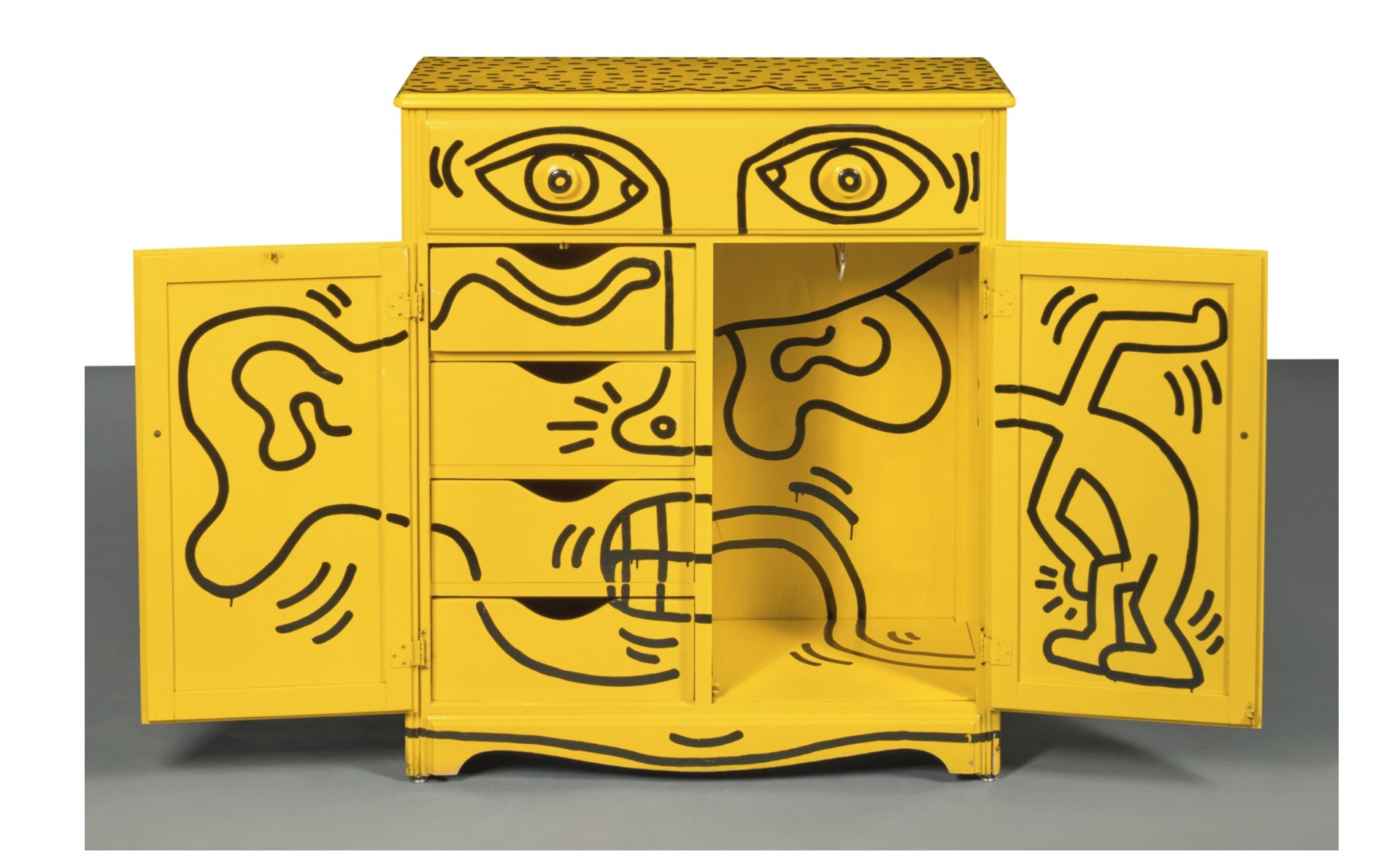
KEITH HARING (1958 – 1990)
Untitled, 1986
Enamel on wooden dresser
Open: 42-3/4 x 67-5/8 x 16 inches (108.6 x 95.6 x 171.8 cm)
Closed: 42-3/4 x 37-5/8 x 16 inches (108.6 x 95.6 x 40.6 cm)
Signed, dated June 1986 and dedicated For Lily, Love Keith (on the reverse)
#17. Untitled, 1986
Haring’s House: Works from the Collection of Kermit Oswald
Sotheby’s New-York: 15 May 2026
Estimated: USD 250,000 – 350,000
USD 192,000
Keith Haring | Untitled | Contemporary Day Auction | 2026 | Sotheby’s
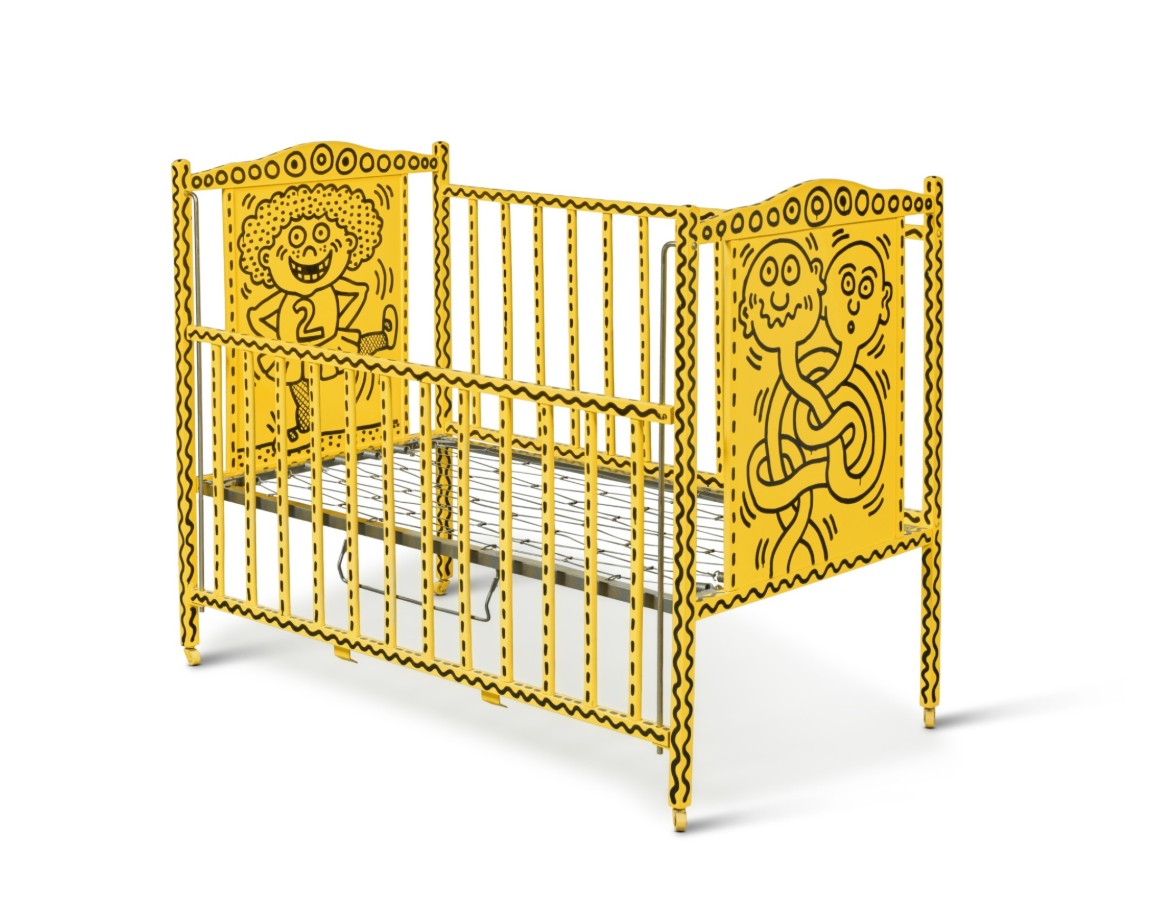
KEITH HARING (1958 – 1990)
Untitled, 1986
Enamel on wooden crib
42 x 53-1/4 x 29-3/8 inches (106.7 x 135.3 x 74.6 cm)
#18. Untitled, 1980
Haring’s House: Works from the Collection of Kermit Oswald
Sotheby’s New-York: 15 May 2026
Estimated: USD 80,000 – 120,000
USD 192,000
WORK ON PAPER
Keith Haring | Untitled | Contemporary Day Auction | 2026 | Sotheby’s
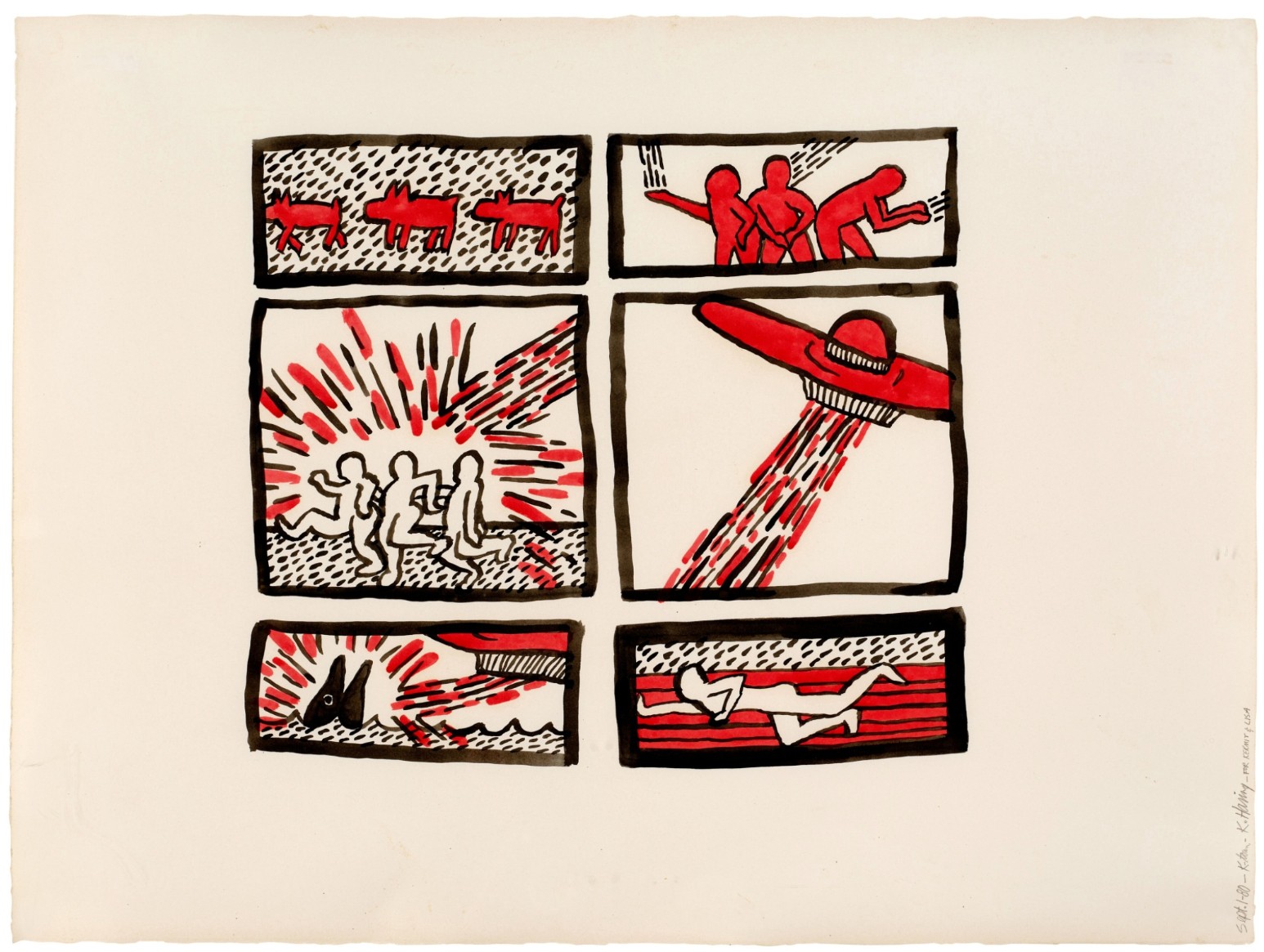
KEITH HARING (1958 – 1990)
Untitled, 1980
Sumi ink and marker on paper
22-1/4 x 30 inches (56.5 x 76.2 cm)
Signed twice, dated sept. 1-80 and dedicated FOR KERMIT & LISA (right edge)
#19. Untitled, 1980
Haring’s House: Works from the Collection of Kermit Oswald
Sotheby’s New-York: 15 May 2026
Estimated: USD 120,000 – 180,000
USD 153,600
WORK ON PAPER
Keith Haring | Untitled | Contemporary Day Auction | 2026 | Sotheby’s
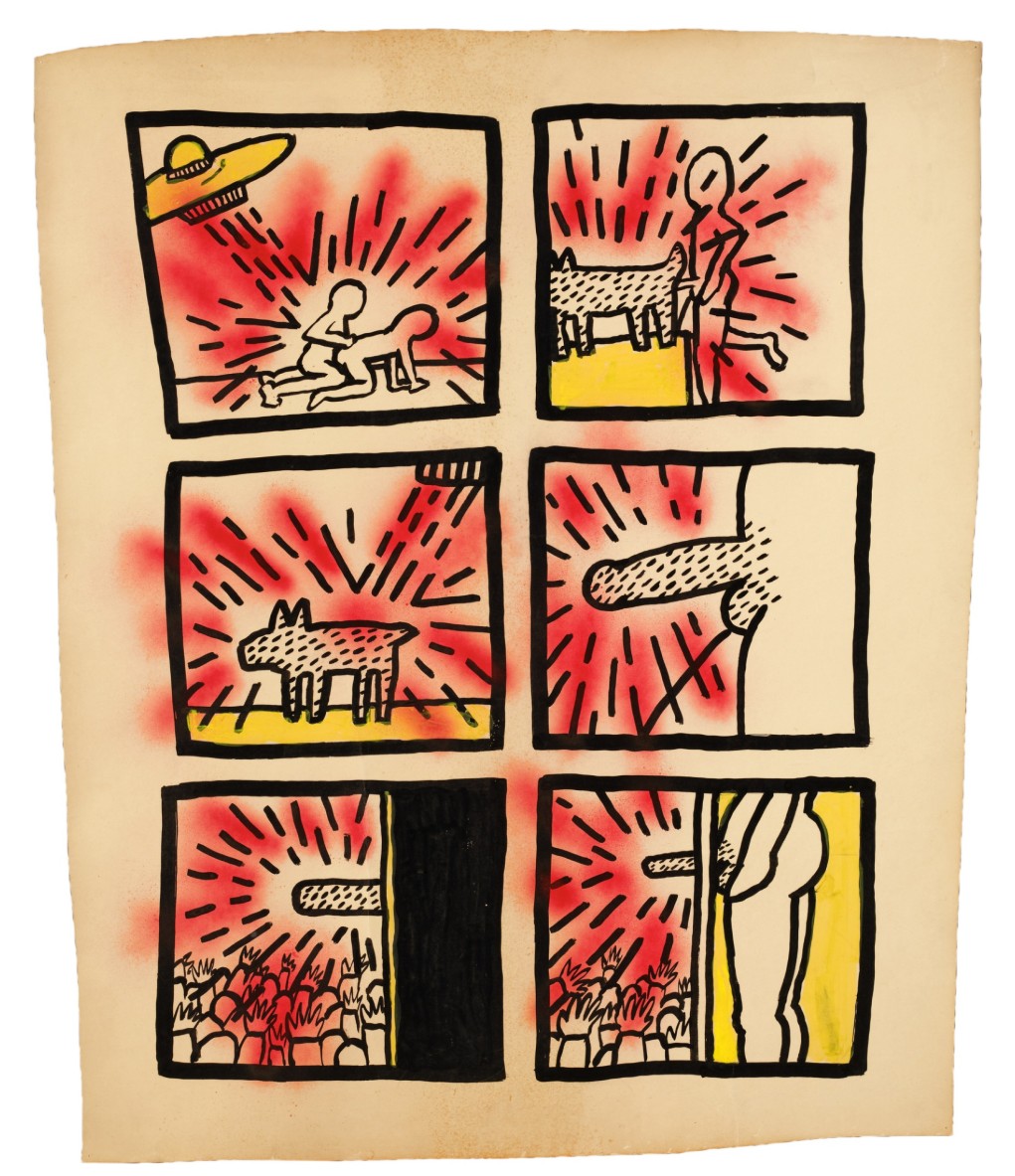
KEITH HARING (1958 – 1990)
Untitled, 1980
Sumi ink, acrylic and spray paint on paper
40-1/8 x 34-3/4 inches (101.9 x 88.3 cm)
Signed and dated Aug-80 (on the verso)
#20. Untitled, 1983
Haring’s House: Works from the Collection of Kermit Oswald
Sotheby’s New-York: 15 May 2026
Estimated: USD 80,000 – 120,000
USD 115,200
Keith Haring | Untitled | Contemporary Day Auction | 2026 | Sotheby’s
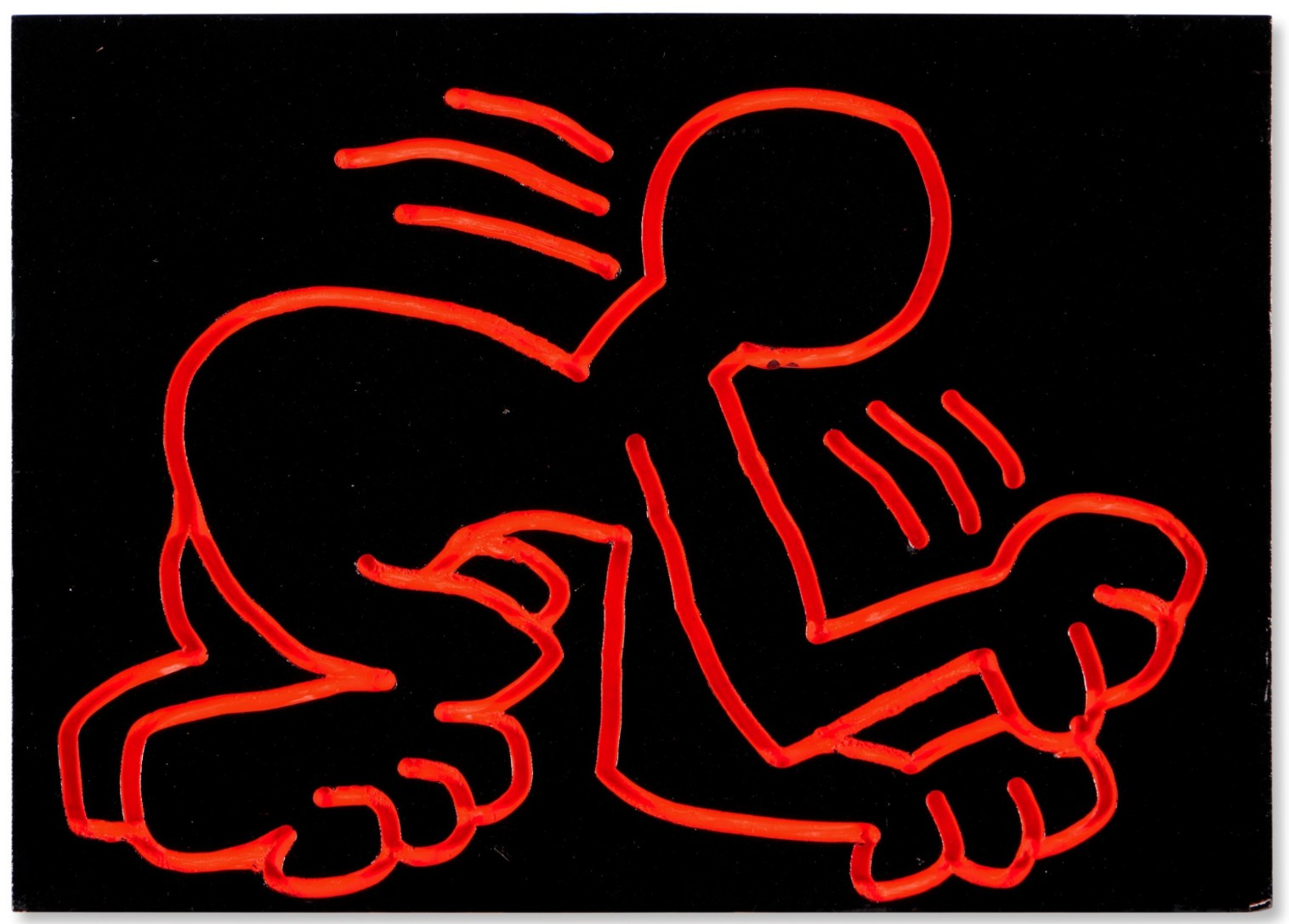
KEITH HARING (1958 – 1990)
Untitled, 1983
Enamel and DayGlo on carved wood
11-1/8 x 15-5/8 inches (28.3 x 39.7 cm)
Incised with the artist’s signature and date ♡83 (on the reverse)
#21. Untitled (Painted Man), 1983
Haring’s House: Works from the Collection of Kermit Oswald
Sotheby’s New-York: 15 May 2026
Estimated: USD 40,000 – 60,000
USD 96,000
Keith Haring | Untitled (Painted Man) | Contemporary Day Auction |
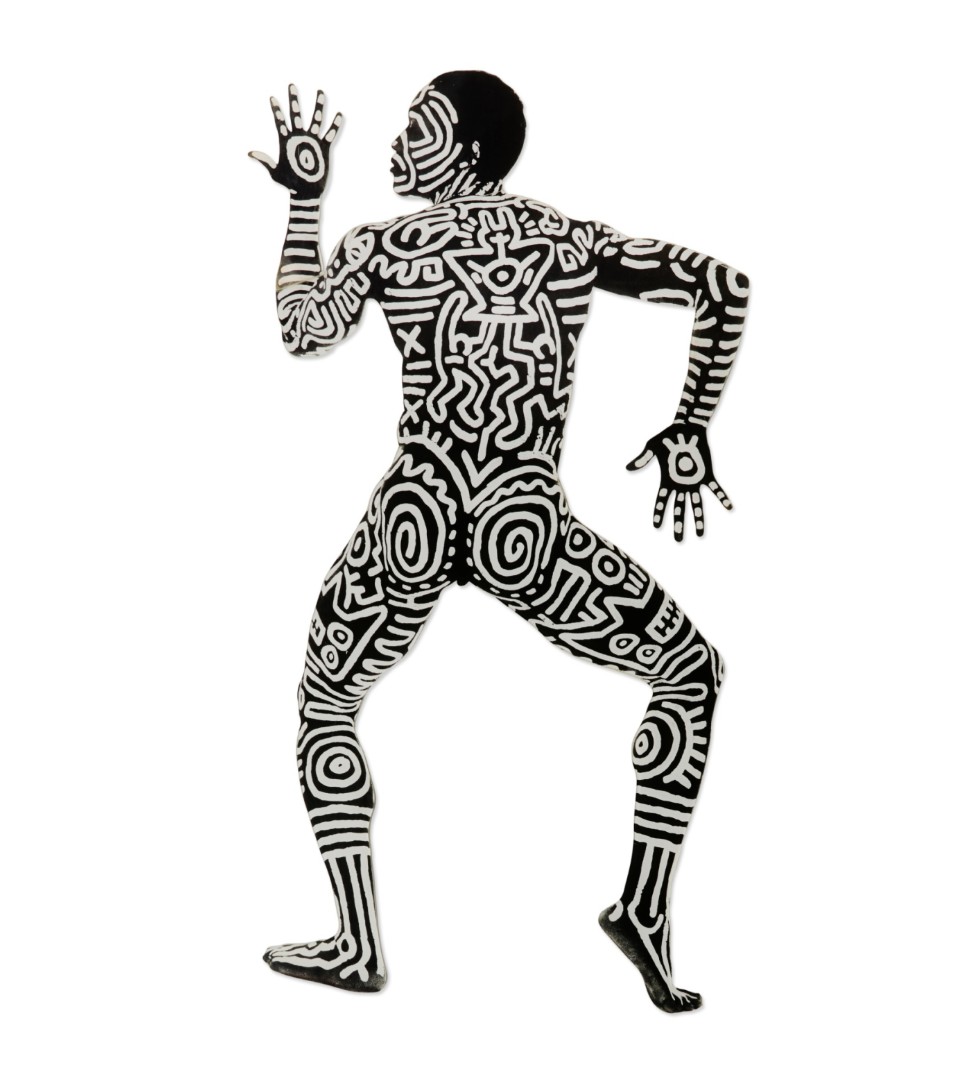
KEITH HARING (1958 – 1990)
Untitled (Painted Man), 1983
Photograph mounted on Plexiglas
62-3/4 x 34-3/4 inches (159.4 x 88.3 cm)
#22. Untitled (Elvis Presley), 1981
Phillips New-York: 21 May 2026
Estimated: USD 80,000 – 120,000
USD 90,300
Keith Haring Modern & Contemporary Art: Afternoon Session
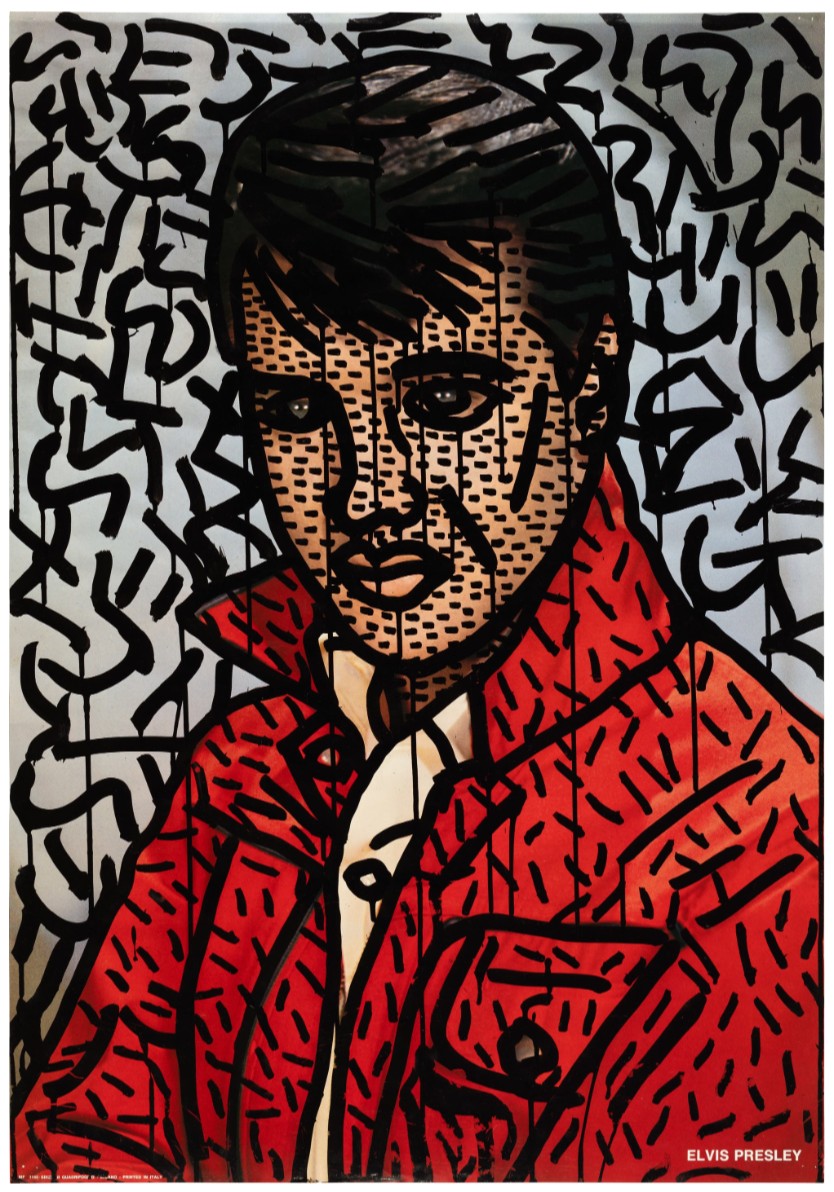
KEITH HARING
Untitled (Elvis Presley), 1981
Sumi ink on printed paper
38-1/2 x 26-3/4 inches (97.8 x 67.9 cm)
Signed “K Haring” on the reverse
Executed on July 2, 1981
#23. Untitled, 1988
Haring’s House: Works from the Collection of Kermit Oswald
Sotheby’s New-York: 15 May 2026
Estimated: USD 50,000 – 70,000
USD 61,440
WORK ON PAPER
Keith Haring | Untitled | Contemporary Day Auction | 2026 | Sotheby’s
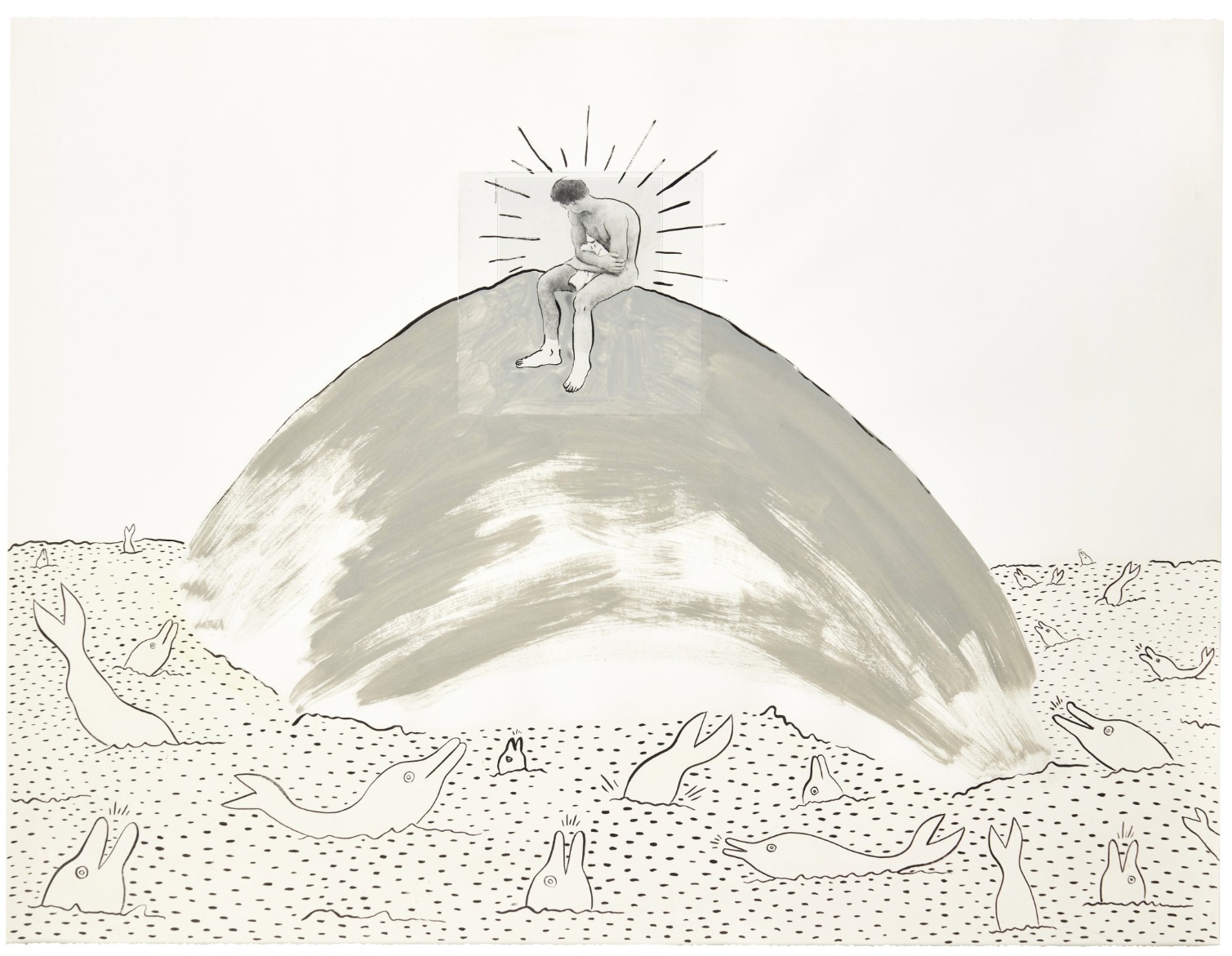
KEITH HARING (1958 – 1990)
Untitled, 1988
Gouache, Sumi ink and printed paper collage on paper
38-1/2 x 50 inches (97.8 x 127 cm)
Signed and dated Nov. 17 1988 (on the verso)
#24. Untitled, 1986
Haring’s House: Works from the Collection of Kermit Oswald
Sotheby’s New-York: 15 May 2026
Estimated: USD 70,000 – 100,000
USD 38,400
Keith Haring | Untitled | Contemporary Day Auction | 2026 | Sotheby’s
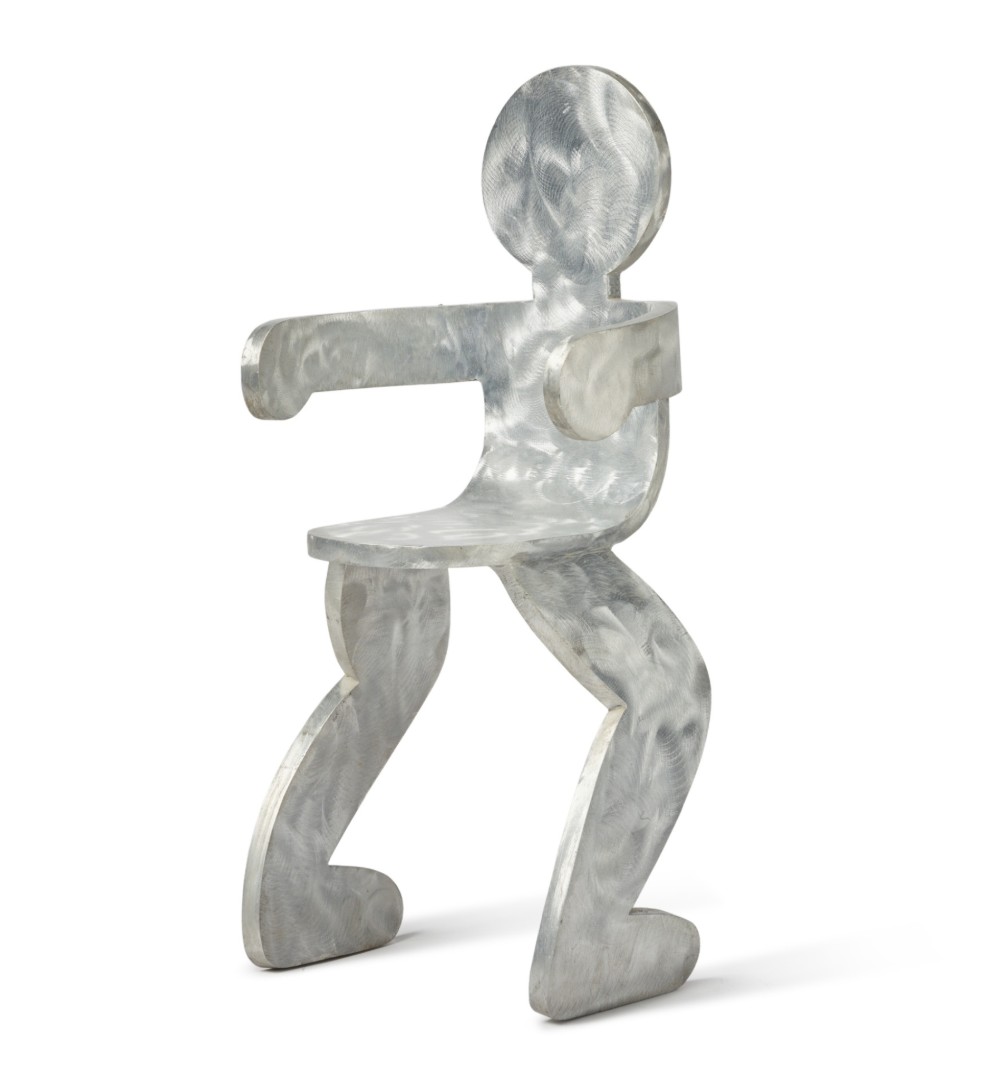
KEITH HARING (1958 – 1990)
Untitled, 1986
Aluminum
20-1/4 x 10 x 8-1/2 inches (51.4 x 25.4 x 21.6 cm)
Incised with the artist’s signature, date 86 and dedication For Lily (on the underside)
#25. Untitled, 1980
Haring’s House: Works from the Collection of Kermit Oswald
Sotheby’s New-York: 15 May 2026
Estimated: USD 5,000 – 7,000
USD 19,200
WORK ON PAPER
Keith Haring | Untitled | Contemporary Day Auction | 2026 | Sotheby’s
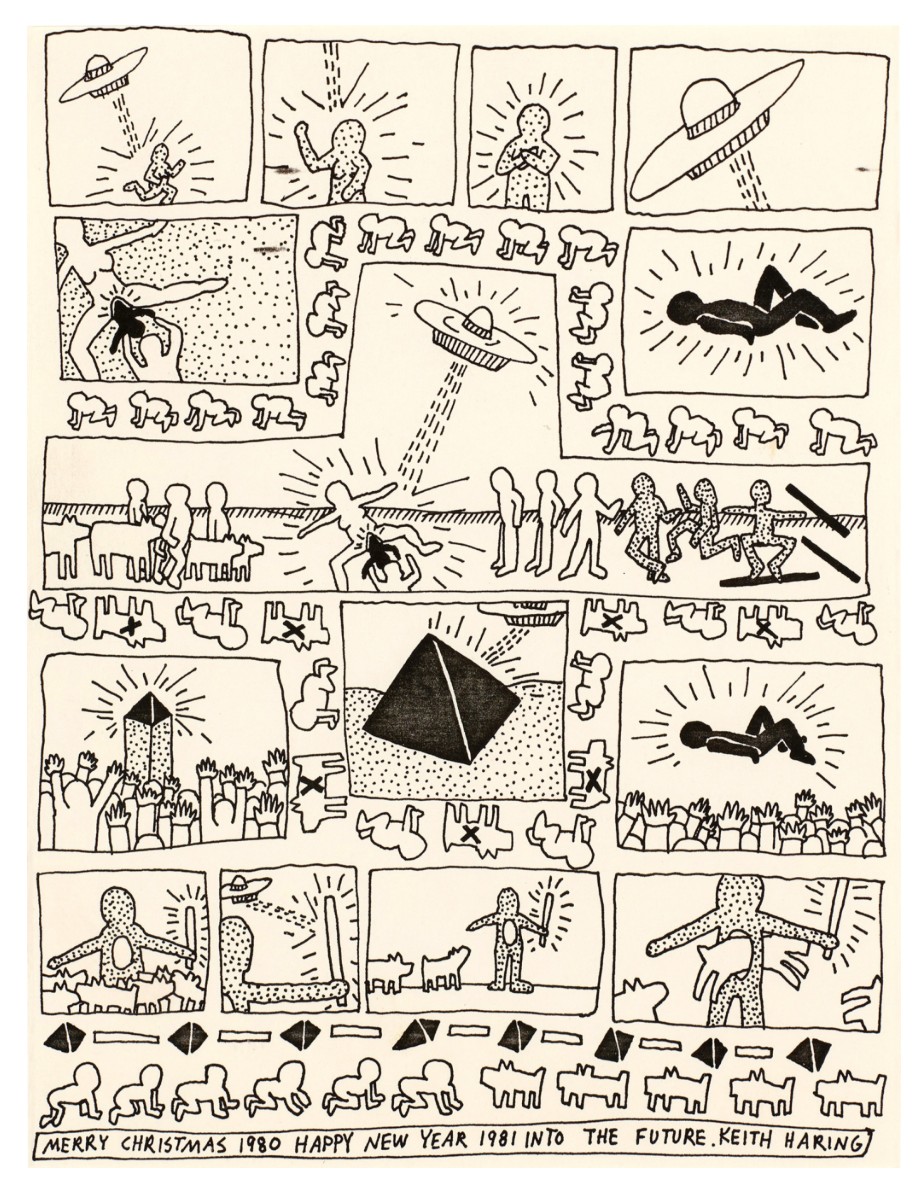
KEITH HARING (1958 – 1990)
Untitled, 1980
Xerox on paper
11 x 8-1/2 inches (27.9 x 21.6 cm)
XXXXXXXXXX
Untitled (Subway Drawing), circa 1982
Sotheby’s New-York: 15 May 2026
Estimated: USD 500,000 – 700,000
WITHDRAWN
Keith Haring | Untitled (Subway Drawing) | Contemporary Day Auction |
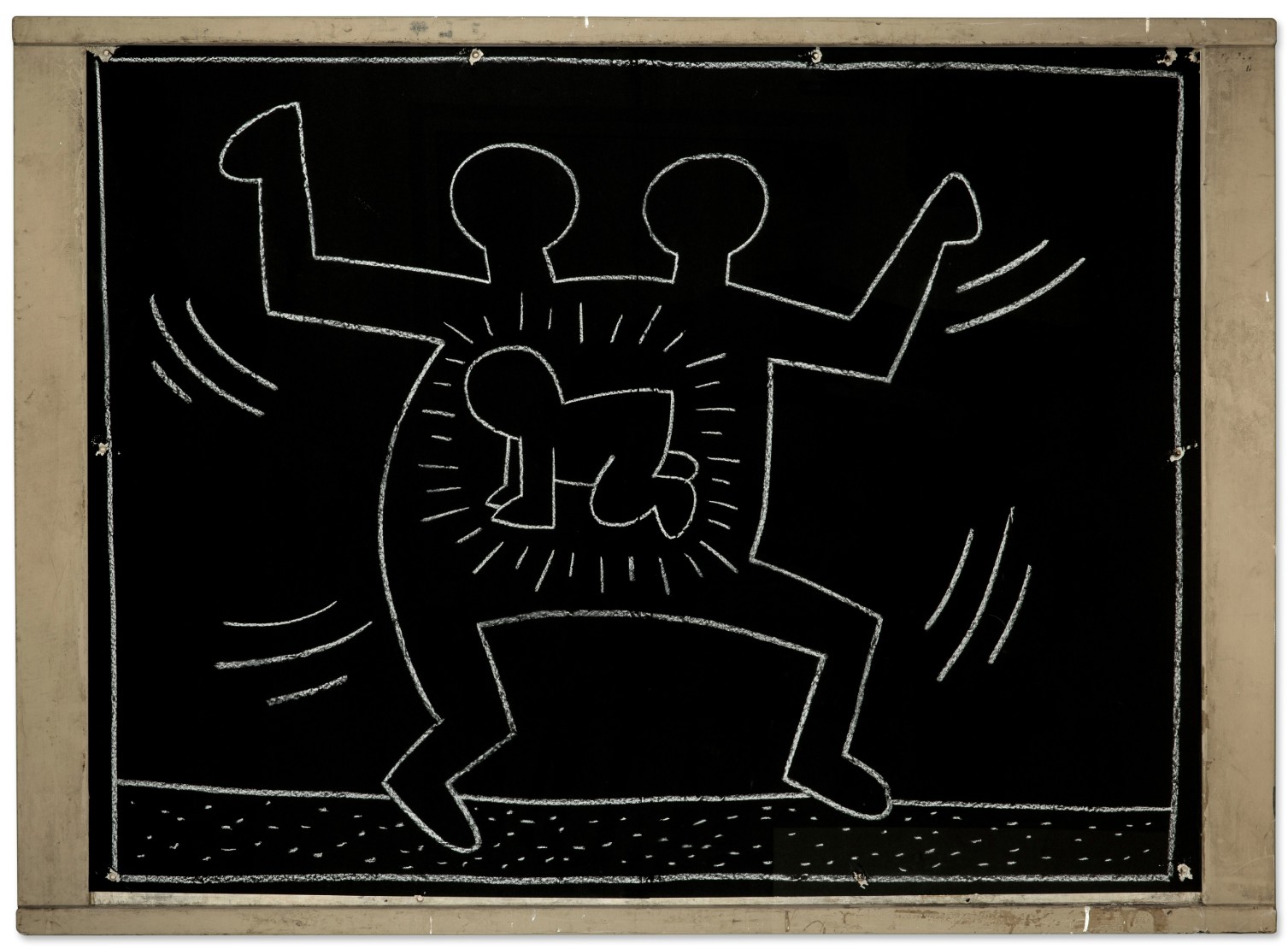
KEITH HARING (1958 – 1990)
Untitled (Subway Drawing), circa 1982
Chalk on 2 joined sheets of black paper on original aluminum MTA mount
Sheet: 44-1/2 x 60 inches (113 x 152.4 cm)
Mount: 48-1/2 x 68 inches (123.2 by 172.7 cm)
Untitled (June 1st a Milano), 1984
Untitled (June 1st a Milano), 1984
Christie’s New-York: 20 May 2026
Estimated: USD 4,000,000 – 6,000,000
USD 4,955,000
KEITH HARING (1958-1990), Untitled (June 1st a Milano) | Christie’s
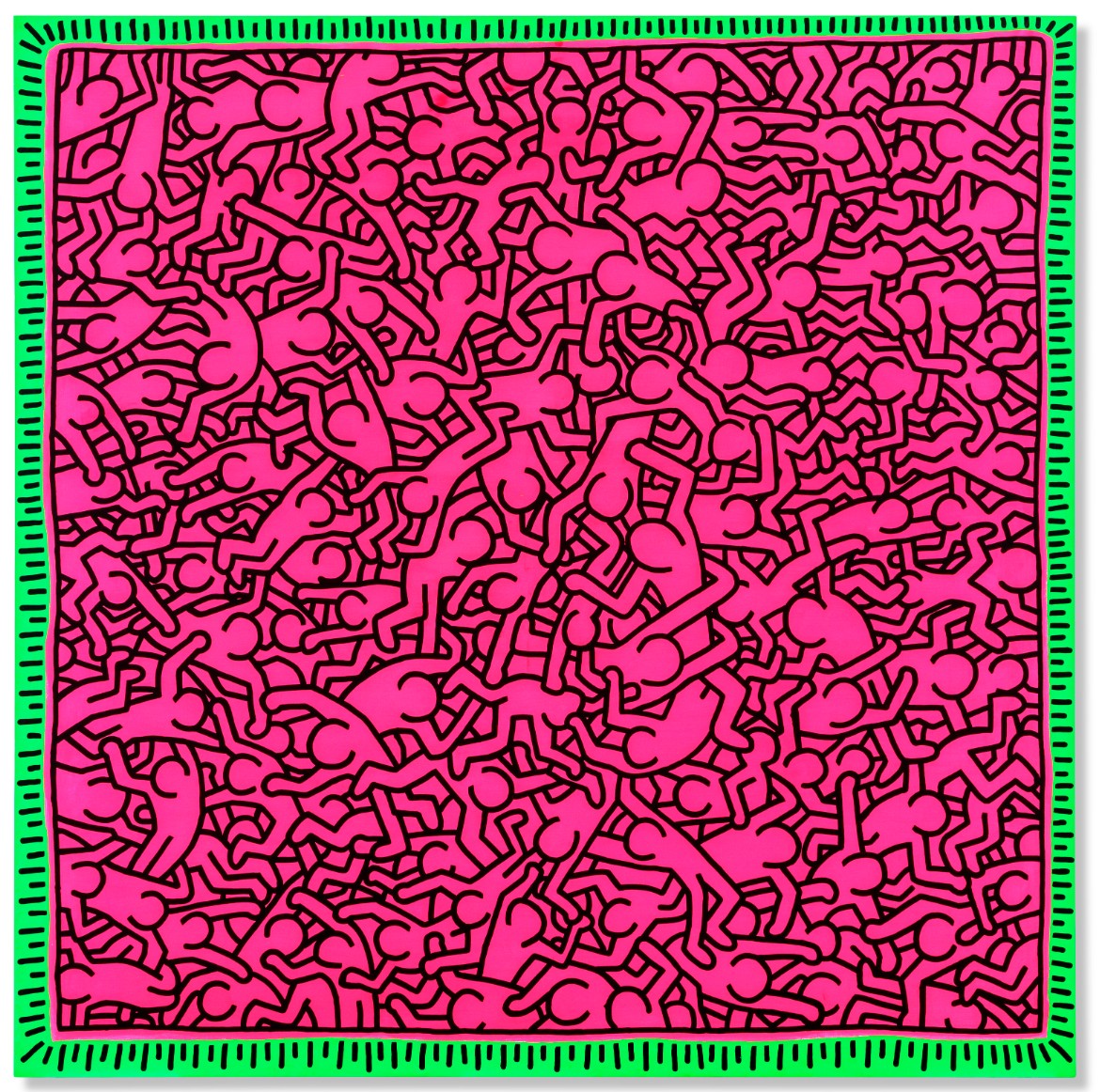
KEITH HARING (1958-1990)
Untitled (June 1st a Milano), 1984
Acrylic and fluorescent acrylic on canvas
94-3/8 x 94-3/8 inches (239.7 x 239.7 cm)
Signed, titled and dated ‘K. HARING JUN 1 1984 A MILANO’ (on the overlap)
An electrifying field of interlocking bodies, Untitled (June 1st a Milano) stands among the most ambitious and resolved paintings of Keith Haring’s career. Spanning nearly eight feet square and executed in his signature Day-Glo palette, the composition unfolds as a dense choreography of radiant figures, their limbs braided into a continuous, pulsating rhythm that seems to expand beyond the edges of the canvas.
Unlike the pared immediacy of Haring’s subway drawings, the present work achieves an extraordinary level of compositional complexity: each figure is locked into a larger system, creating a unified, all-over structure that is at once spontaneous and rigorously controlled. The eye finds no resting point; instead, it is carried ceaselessly across the surface in a visual equivalent of music, euphoria, and relentlessness.
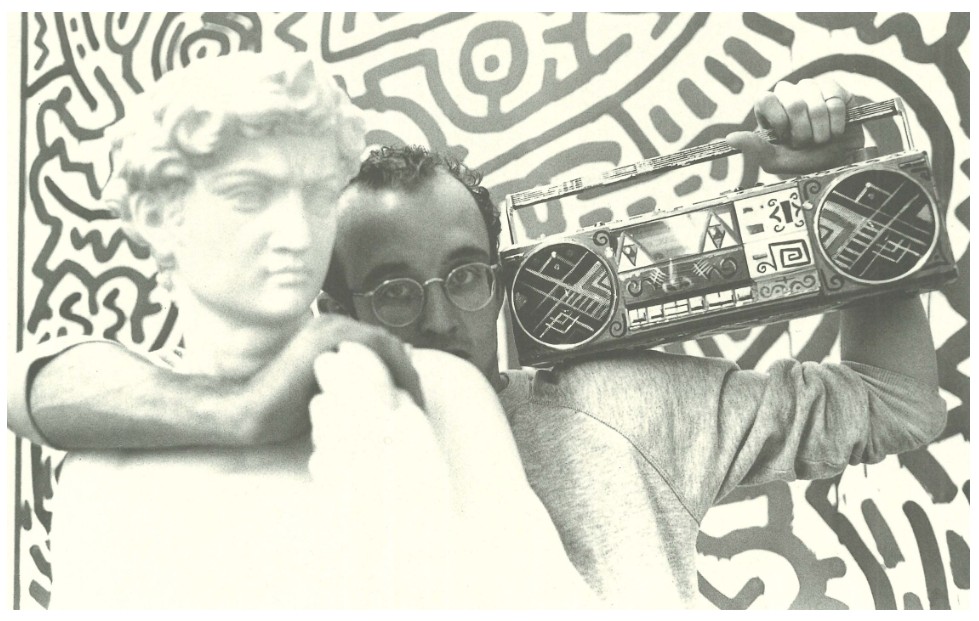
Keith Haring with his radio cassette player painted by Kenny Scharf, Milan, 1984. Photo: Roberto Tomasin.
Painted in situ at the Galleria Salvatore Ala during a three-week period of intense activity, the work became the centerpiece of Haring’s landmark 1984 Milan exhibition, marking his decisive emergence onto the international stage. The scale, ambition, and formal resolution of June 1st distinguish it within this pivotal body of work. Above all, the work demonstrates Haring’s ability to sustain compositional precision across an immense surface without a single corrective gesture, underscoring both the speed of execution and the extraordinary clarity of his visual thinking. If earlier works capture the immediacy of gesture, this painting sustains that immediacy across a vast surface without diminution of force, achieving a rare synthesis of speed and control that few artists have matched.
“I work surrounded by music. My companion in New York is a disc Jockey. Music in New York is part of daily life. It’s everywhere. And for me, it’s freedom: anyone can listen to it, you don’t have to pay for it, it makes you feel good, it inspires you, it uplifts you. For me, this is the artist’s role.”
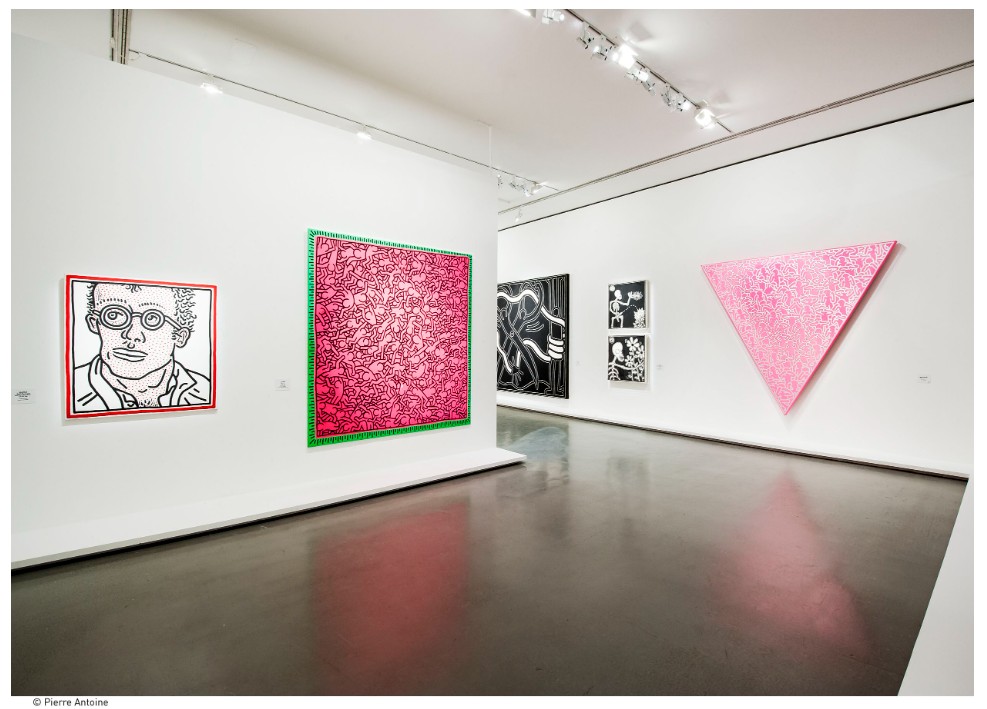
Installation view, Keith Haring: The Political Line, April 19 – August 18, 2013, Musée d’Art Moderne de la Ville de Paris (present lot illustrated). Photograph by Pierre Antoine. Artwork: © The Keith Haring Foundation.
This extraordinary formal control was achieved through a working method that bordered on the performative. Recalling Haring’s working method for the present work, Ala, the gallerist, describes: “Keith was like a human dynamo, he painted without making any corrections, his gestures were fluid, and he never did preparatory sketches, always preferring to work directly on his supports. I remember him using canvases composed of one or more panels measuring 2.40 x 2.40 m. [94 x 94 in.], which he fixed to the walls. Then he climbed the ladder and, starting from the top, began painting directly on the canvas, with music playing at full blast” (quoted in A. Galasso, “Keith, the Pied Piper,” op. cit., p. 19). The resulting surface retains the immediacy of execution, each line a direct trace of the artist’s movement, yet the overall composition possesses a coherence that suggests an almost instinctive sense of structure. In this respect, Haring’s practice recalls the automatism of Surrealism, while simultaneously aligning with the Venetian tradition of painting directly on canvas.
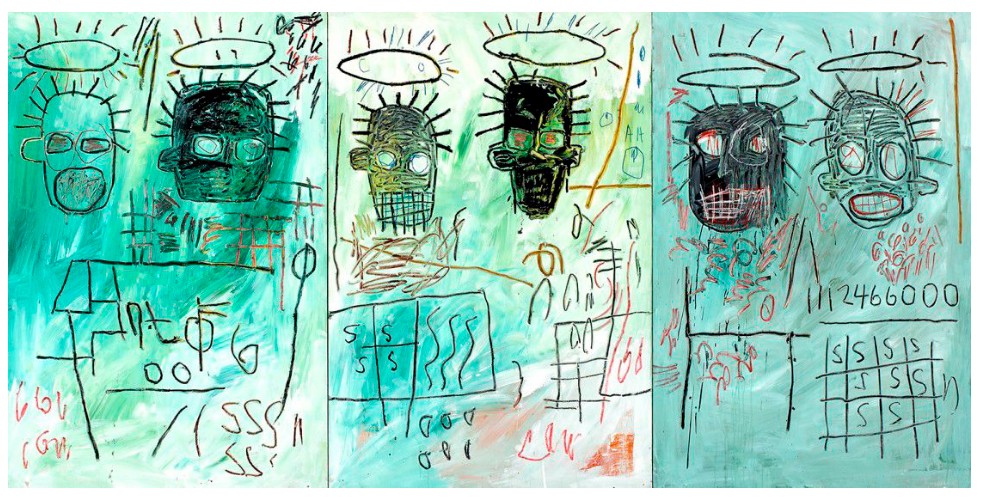
Jean-Michel Basquiat, Six Crimee, 1982. Museum of Contemporary Art, Los Angeles.
© Estate of Jean-Michel Basquiat. Licensed by Artestar, New York.
The work is equally inseparable from the lived experience of Milan in 1984, a period that proved transformative for the twenty-six-year-old artist. Immersed in the city’s vibrant cultural and nightlife scenes, Haring absorbed the rhythms of music, dance, and social exchange that would find direct expression in the present painting. He spent his nights at the legendary club Plastic. “In Milano I discovered new ideas and images that went directly into my work,” Haring wrote in his journal. “I stayed in the gallery until late every night, painting until my hands hurt from holding the brush, and then I went to Plastic to unwind. Plastic is my favorite club in Europe. Nicola [Guiducci] plays music that makes me feel like I was in New York” (quoted in “Some Excerpts from Keith Haring’s Journals,” op. cit., pp. 13-14).
At the same time, Haring’s engagement with Italy’s artistic heritage opened new dimensions within his work. While he famously reinterpreted canonical forms such as Michelangelo’s David in sculptural form during the exhibition, the present painting reflects a more subtle dialogue with the past. The densely interwoven bodies recall the compressed dynamism of Michelangelo’s Lapiths and Centaurs, an early relief sculpture, shows a similar scene of frantic movement, jumbled limbs, and chaotic action, which Haring recapitulates in the present work. “It was the idea of making movements I was doing into a kind of choreography—a kind of dance” Haring explained of his instantly recognizable style, “I was thinking that the very act of painting placed you in an exhilarated state” (quoted in J. Gruen, Keith Haring: The Authorized Biography, New York, 1991, p. 40). This same exhilaration recalls Matisse’s Dance I (1909), where five figures lock hands in a ring, their bodies abandoned to collective rhythm — a compositional logic Haring understood instinctively, translating Matisse’s primal circle into the interlocking, electrified bodies that surge across his own canvases, ancient ritual reborn in the neon vocabulary of the twentieth century.
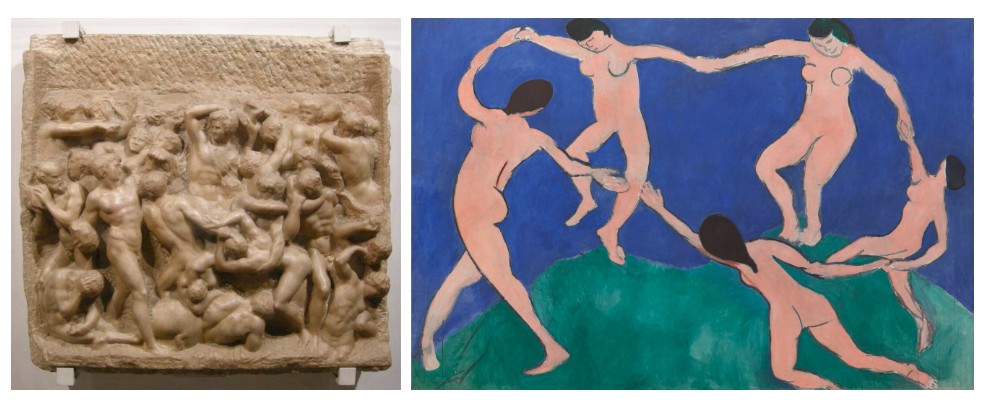
Left: Michelangelo, Battle of the Centaurs, 1492. Casa Buonarroti, Florence.
Right: Henri Matisse, Dance I, 1909. The Museum of Modern Art, New York. © 2022 Succession H. Matisse / Artists Rights Society (ARS), New York. Photo: © The Museum of Modern Art / Licensed by SCALA / Art Resource, NY.
The significance of Untitled (June 1st a Milano) is further underscored by its central role within the 1984 exhibition itself, an event that assumed near-mythic status in the artist’s career. . The opening of the show became a city-wide phenomenon, with over 3,000 people attending. “It was as if a rock star had arrived in Milan,” the gallerist, Salvatore Ala, recalled (quoted in A. Galasso, “Keith, the Pied Piper: Interview with Salvatore Ala,” in A. Galasso, ed., Keith Haring a Milano, Milan, 2005, p. 18). Haring wrote in his journal of the day: “lots of people came, lots of fun people, fashion people and art-lovers and even the mayor of Milano” (quoted in “Some Excerpts from Keith Haring’s Journals,” in ibid., p. 14). Critics and contemporaries alike recognized the magnitude of his achievement. Roy Lichtenstein, then a living legend as one of the inventors of the Pop movement, praised the works when he viewed them in Milan: “I stopped by the gallery a couple of days before the opening, and there was Keith creating his show right there, on the spot!… It was extraordinary! Keith, composing in an amazing way… what I like about Haring’s work is that when he’s finished a piece, there’s nothing you could think of that you’d want to change. Even if he did something all at once—without standing back and changing anything—there just isn’t a false move. It’s all so beautifully drawn—and there’s such a sense of relatedness. The stuff is beautiful! He’s really done some gorgeous things!” (quoted in A. Galasso, op. cit., pp. 29-30).
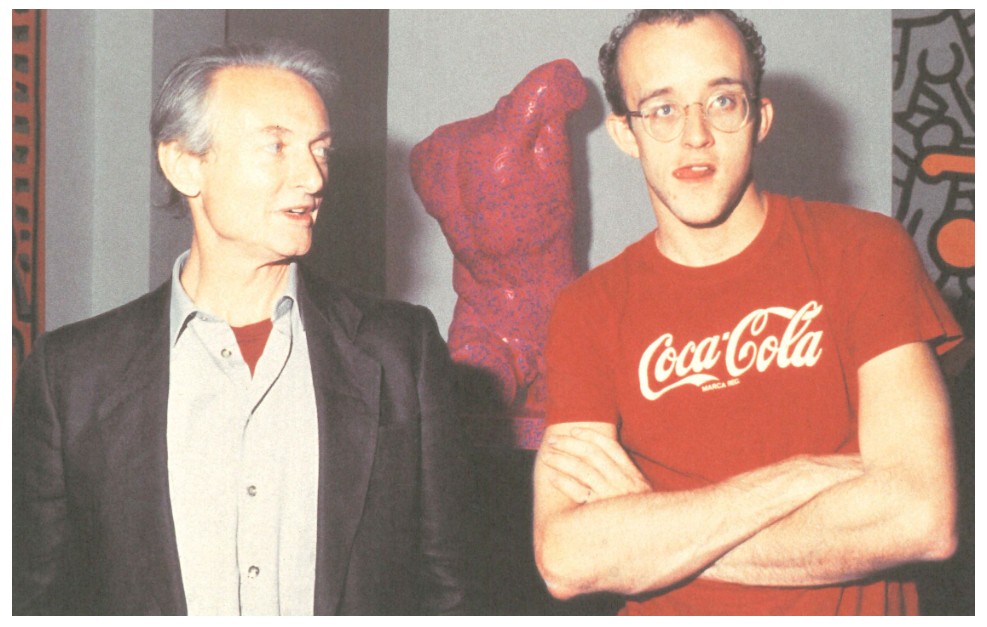
Roy Lichtenstein and Keith Haring, Milan, 1984. Photo: Roberto Tomasin. KHMILAN1984-5
Illustrated on both the front and back covers of the 2005 monograph dedicated to the Milan exhibition, the present work has long been recognized as its defining image. Its subsequent inclusion in major institutional exhibitions, including the 2005–2006 presentation at the Triennale di Milano and the 2013 retrospective The Political Line at the Musée d’Art Moderne de la Ville de Paris, has only reinforced its status as a cornerstone of Haring’s oeuvre. More than a document of a pivotal moment, it stands as the culmination of that moment: a painting in which context, energy, and invention coalesce into a single, unified statement.
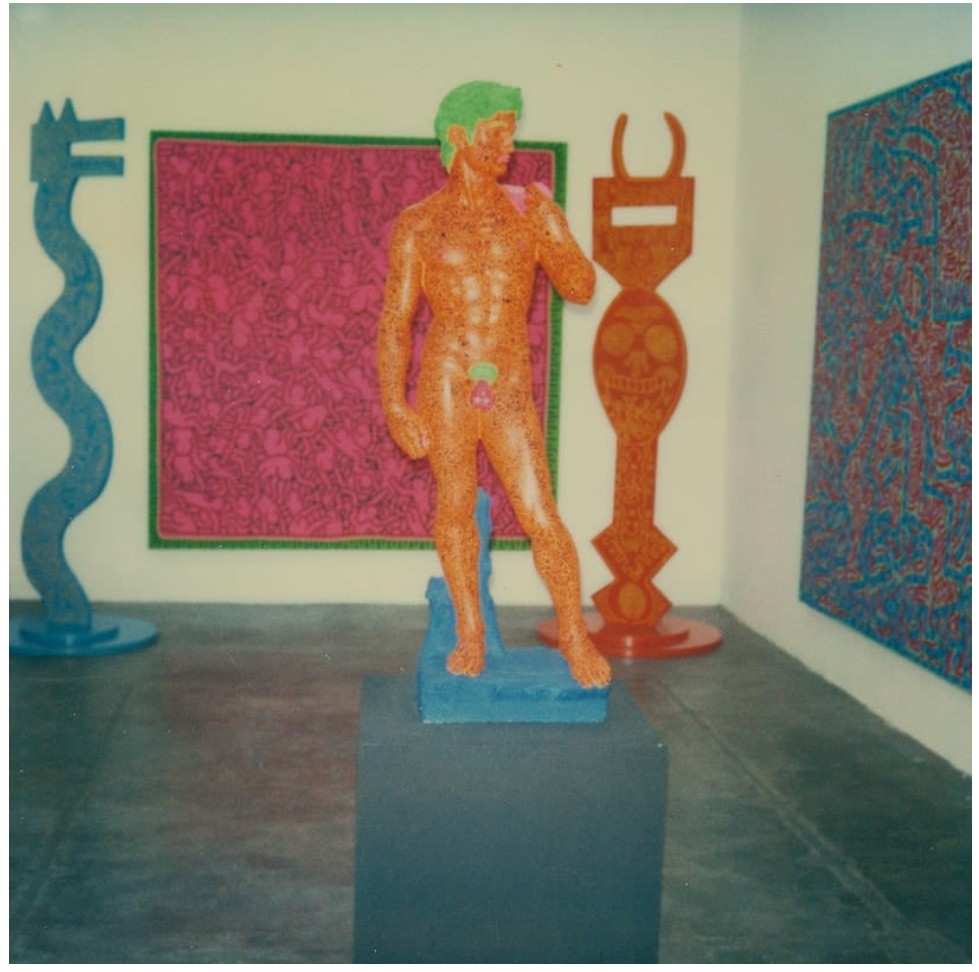
Installation view, Keith Haring: Milan, the present work illustrated. Photo: Roberto Tomasin.
In Untitled (June 1st a Milano), Haring achieves what few artists accomplish. The translation of an entire cultural atmosphere into a singular visual form. At once immediate and monumental, spontaneous and fully resolved, the work represents the moment at which his visual language reaches its fullest and most authoritative expression. It is not simply among his finest works; it is one of the paintings that defines the very height of his achievement.
Self-Portrait, 1985
Self-Portrait, 1985
Haring’s House: Works from the Collection of Kermit Oswald
Sotheby’s New-York: 14 May 2026
Estimated: USD 3,000,000 – 5,000,000
USD 4,340,000
Keith Haring | Self-Portrait | The Now & Contemporary Evening Auction
KEITH HARING (1958 – 1990)
Self-Portrait, 1985
Acrylic on canvas
48X48 inches (121.9 x 121.9 cm)
Signed, titled, dated FEB. 4 – 85 and dedicated HAPPY BIRTHDAY – FOR KERMIT (on the overlap)
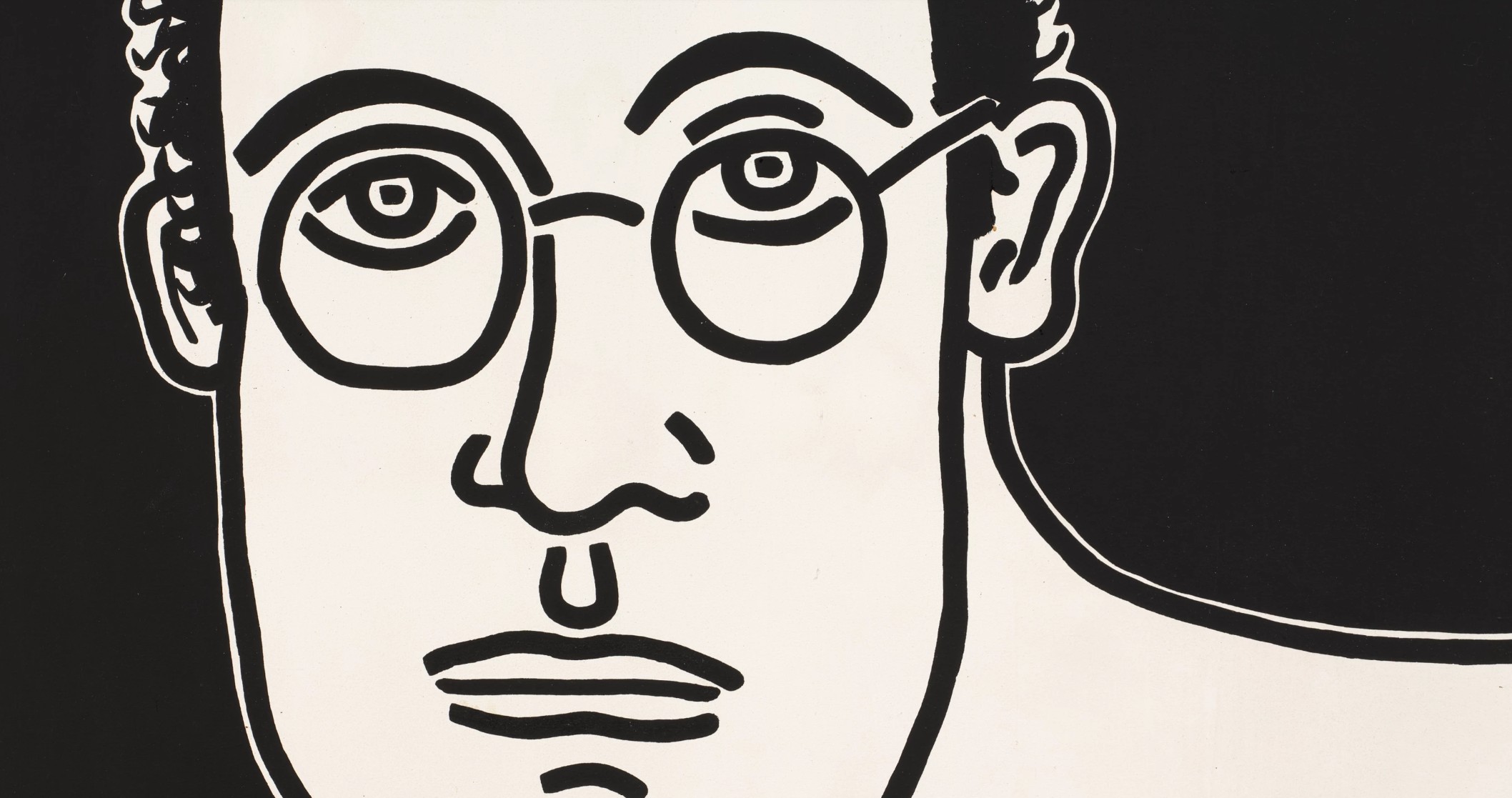
In Keith Haring’s Self-Portrait, he renders himself as a sphinx-human hybrid, playfully emboldening his legacy as part myth, part man, while underscoring his engagement with themes of authorship and artistry. Distinguished by its bold, saturated coloration, emphatic framing device, and exceptional pictorial resolution, the present work is remarkably rare within Haring’s oeuvre.
“It takes enormous control, ability, talent, and skill to make works that become whole paintings… [Haring] really has a terrific eye! And he doesn’t go back and correct—this is in itself amazing.”
ROY LICHTENSTEIN
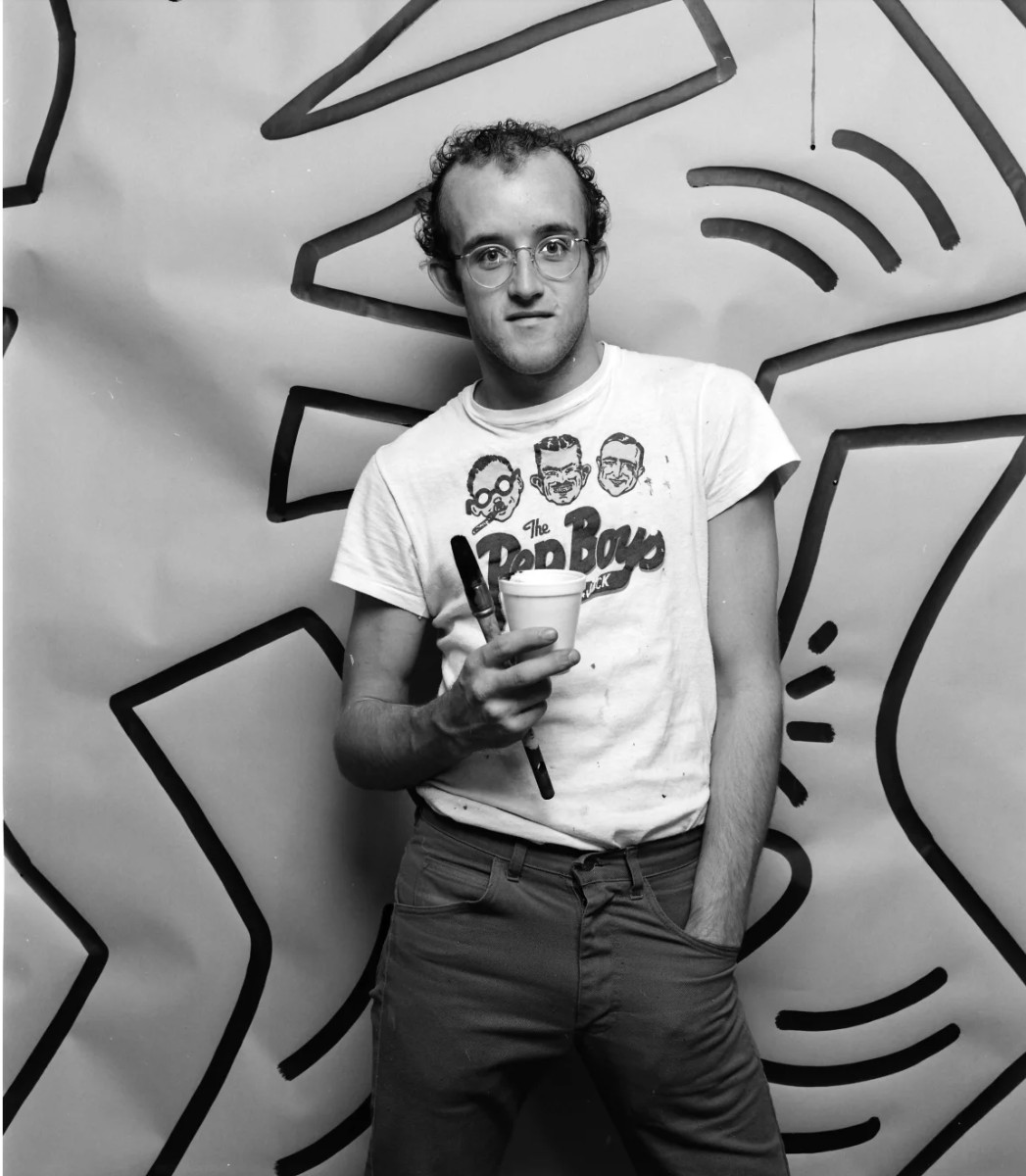
Keith Haring in April 1984. Photo by Jack Mitchell/Getty Images. Art © 2026 Keith Haring Foundation
Our research indicates that Haring produced only six self-portraits on canvas, making this image an unusually introspective departure for an artist more often associated with collective symbols than self-representation. The invocation of the sphinx reflects Haring’s long-standing fascination with Egyptology, mythology, and the timeless authority of ancient forms—here conflated with his own image to assert both artistic authorship and enduring cultural presence. Harings’s figures are instantly recognizable precisely because they resist individuality; they are iconic, universal, genderless figures. The present work, in turn, is a radical act of self-representation, in which Haring aligns himself with a mythological creature above the mortal plane.
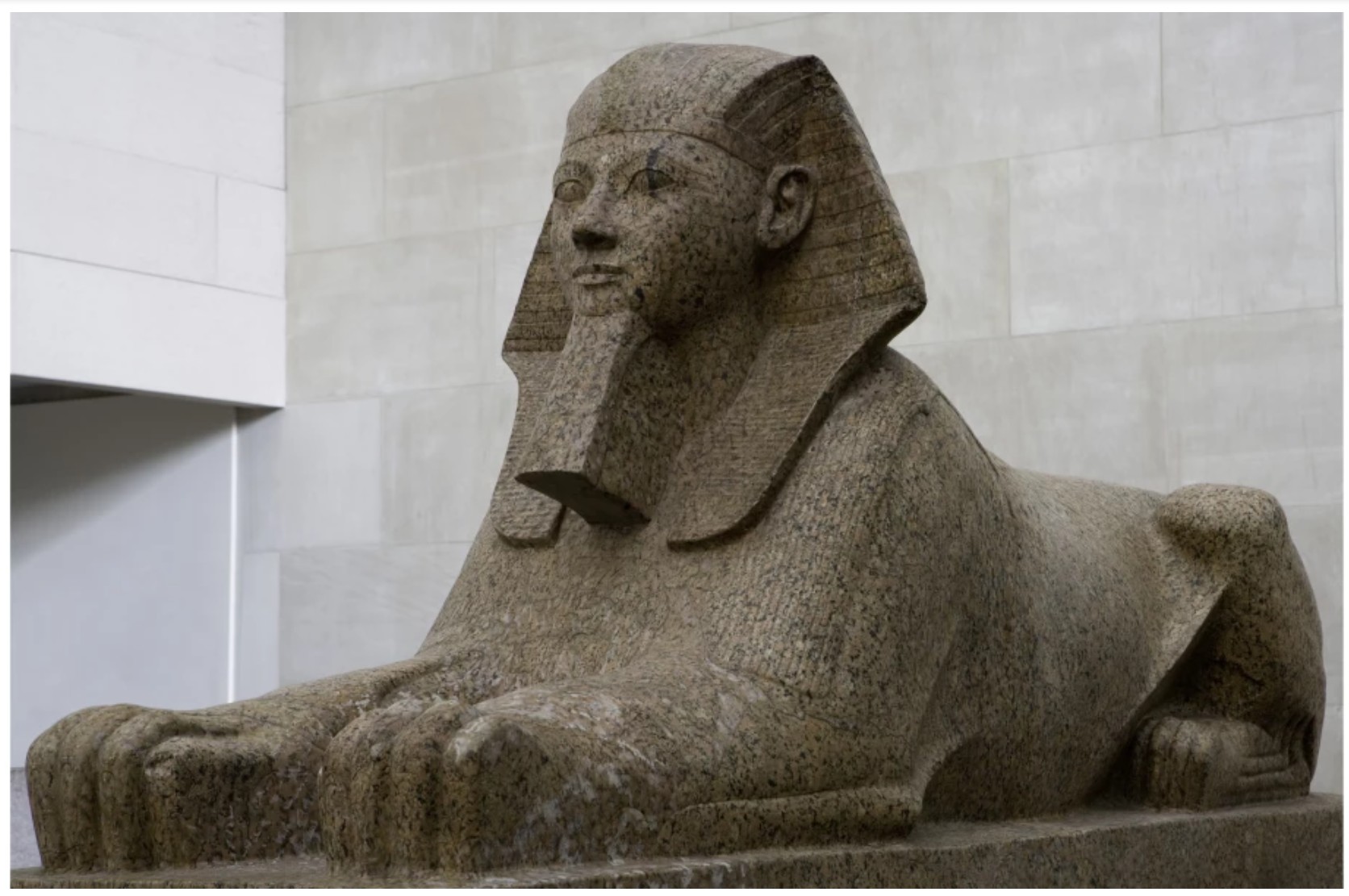
Sphinx of Hatshepsut, Egyptian, ca. 1479-458. The Metropolitan Museum of Art, New York.
Image © The Metropolitan Museum of Art. Image source: Art Resource, NY
Haring has produced a clear, iconic style that reaches its apex in Self-Portrait. Haring rarely depicted a recognizable likeness in his work; he dissolved himself into the collective beat of New York City. In 1985, he produced a handful of self-portraits, all on square 48-inch canvases, three of which feature the distinctive red outline in the present work. In this work, Haring has stepped outside of his universal visual lexicon in favor of an intimate depiction and reflection of himself. He initially used this work as an invitation to a dinner hosted at the Michael Todd Room at the Palladium in his honor, which was co-hosted by gallerists Tony Shafrazi and Leo Castelli. By using a rare stripped-down reflection of himself on a public scale, Haring became intimately introduced to his guests, stepping out of his confident line work and mythical worlds to reveal his present state.
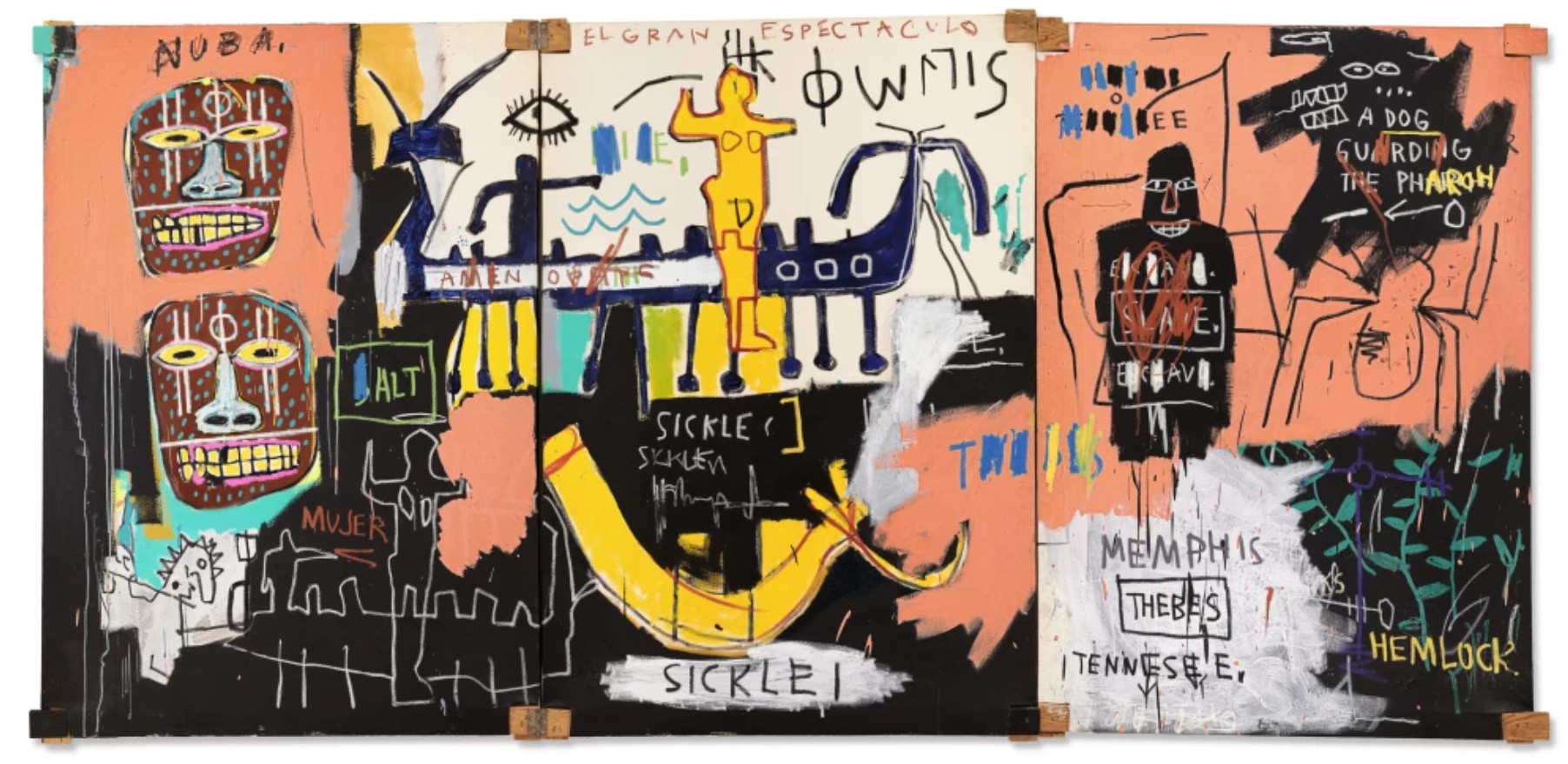
Jean-Michel Basquiat, El Gran Espectaculo (The Nile), 1983.
Private Collection. Art © 2026 Estate of Jean-Michel Basquiat. Licensed by Artestar, New York
Enrolling at the School of Visual Arts and plunging headfirst into the downtown underground of music, clubs, and street culture, Keith Haring discovered all that New York had to offer and its never-ending possibilities for artistic expression. Within a few years of his arrival, he began his immersive Subway Drawings, using chalk to cover the blank black panels of empty subway advertising space and fill them with his active, moving figures.
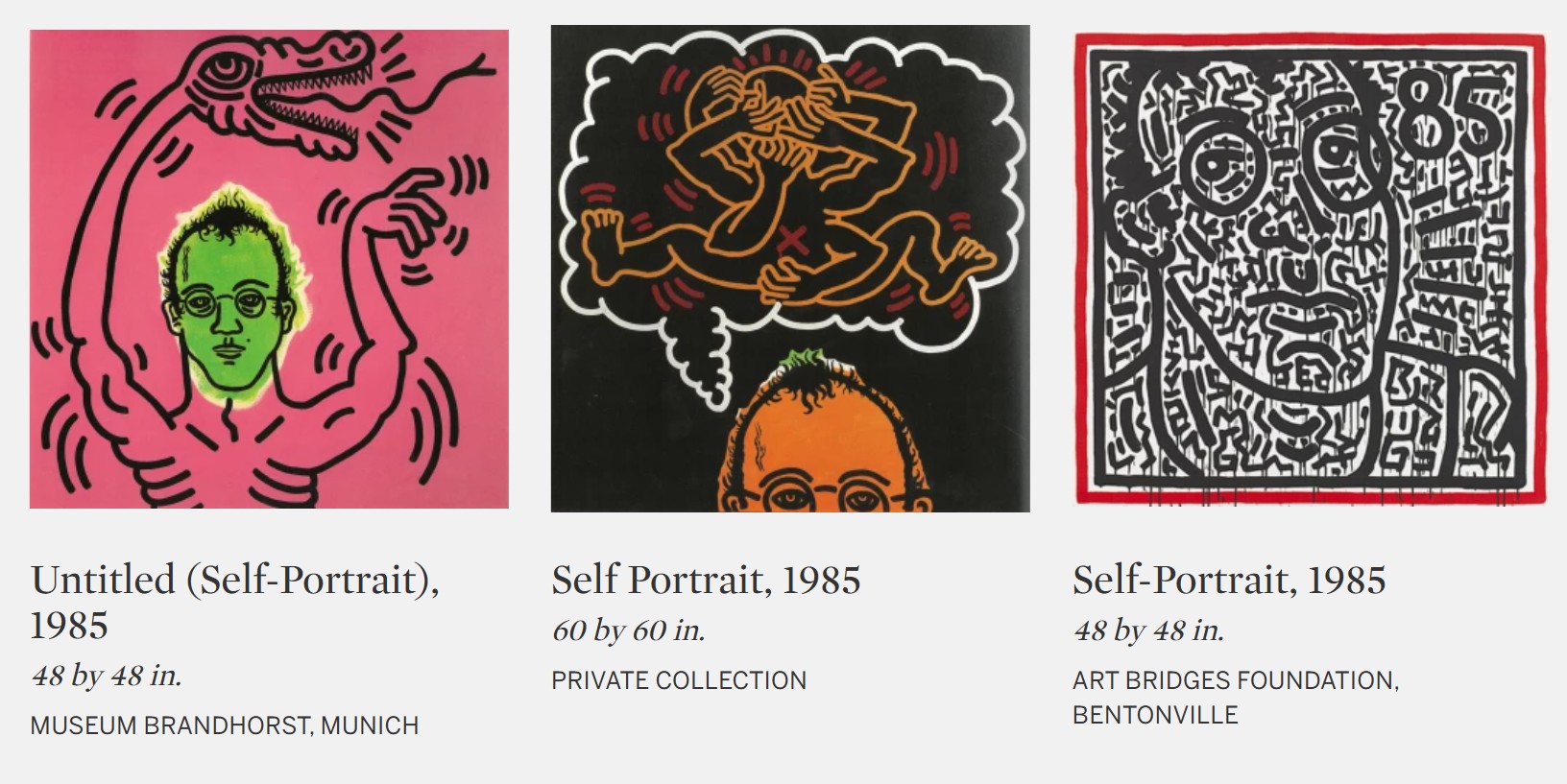
Those subway drawings, produced obsessively between 1980 and 1985, form the foundational layer of his corpus. They were a genuine proposition to the art world; he was exploring the power of art outside a gallery or museum, bringing it to millions of commuters and into people’s everyday environments. The present work dates to a period that bridges Haring’s start as a street artist, his fame working with the gallerist Tony Shafrazi starting in 1982, and finally his grappling with mortality after his AIDS diagnosis in 1987.
“I always knew, since I was young, that I would die young…
I live every day as if it were the last.”
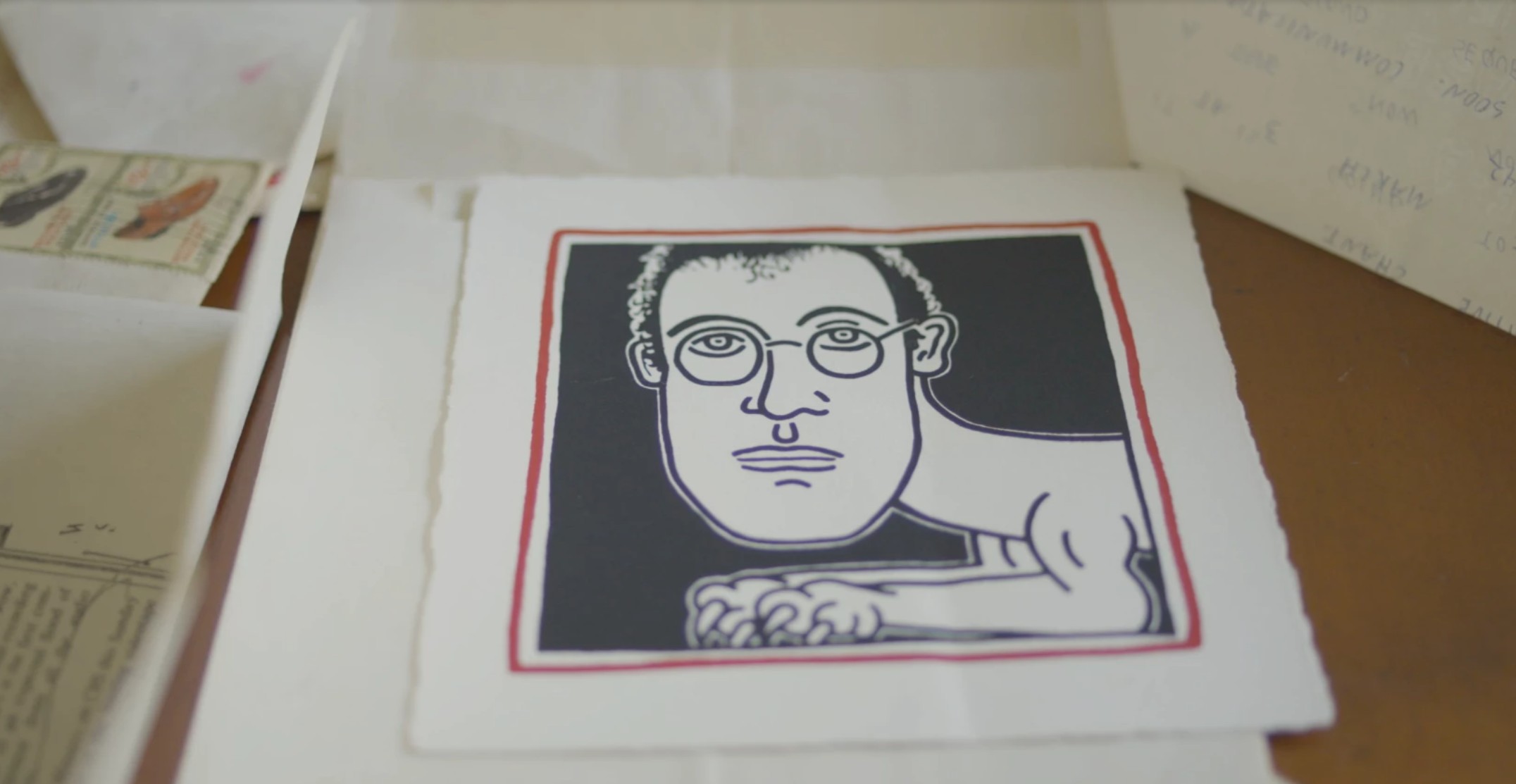
Letters exchanged between Keith Haring and Kermit Oswald, including a print based on the image of the present work.
Art © 2026 Keith Haring Foundation
The over-enlargement of his face to dominate the canvas is reminiscent of works by Haring’s contemporary and friend, Andy Warhol. In Warhol’s Self-Portrait (Fright Wig) (1986), his face is the composition; he stares at the viewer with an uncomfortable intensity. Haring painted himself in a monochrome composition, his skin a stark, bright white, with his outline and the composition’s background a deep, piercing black. The juxtaposition of the two extremes makes all of Haring’s features captivating and exaggerated; it intensifies his gaze from behind his glasses and focuses the viewer’s attention. The portrait has a bright red outline, a color more familiar to his other compositions. His jaw juts comically low, almost perched on his ‘paws,’ and his neck is rubbery as it curves and extends into an inhuman posture. Despite the lack of human hands, Haring included overly defined biceps muscles.
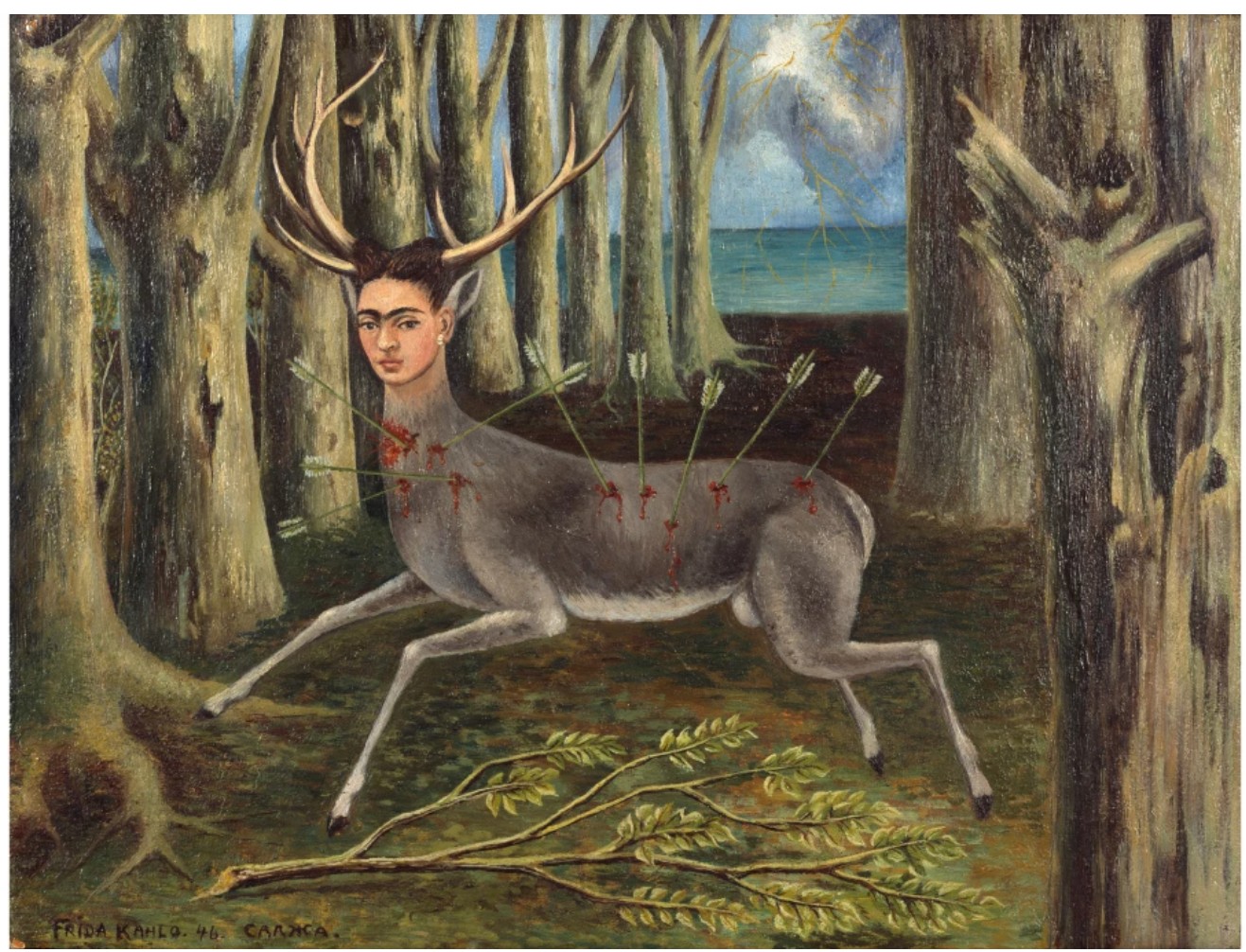
Frida Kahlo, El venado herido, 1946. Private Collection. Image © Fine Art Images / Bridgeman Images. Art © 2026 Banco de México Diego Rivera Frida Kahlo Museums Trust, Mexico, D.F. / Artists Rights Society (ARS), New York
Despite Haring’s tragic passing at just 32 and the brief span of his artistic career, he made an oeuvre of profound importance and enduring significance. In this pivotal part of his career, as his commercial success was skyrocketing, Haring felt it was important to differentiate himself from his work. The present work is profoundly evocative and perhaps the most insistent and intimate portrait of the artist’s oeuvre, Self Portrait, which illustrates the artist’s unique appreciation of human relationships and intense celebration of life.
Untitled (Grace Jones Mask), 1987
Untitled (Grace Jones Mask), 1987
Phillips New-York: 19 May 2026
Estimated: USD 1,500,000 – 2,000,000
USD 2,322,000
Keith Haring Modern & Contemporary Art Evening Sale
Enamel on aluminum
44-1/2 x 43-1/2 x 12-1/2 inches (113 x 110.5 x 31.8 cm)
Signed, inscribed and dated “© K. Haring 1987 ⨁” on the reverse
Among the most arresting and iconographically charged objects in Keith Haring’s mature practice, Untitled (Grace Jones Mask), 1987, occupies a singular position within an exceptionally finite corpus. In 1987, Haring produced eight aluminum masks finished in enamel paint—a definitive group he never expanded—each animated by distinct imagery culled from his graphic vocabulary. Conceived on a heroic scale that thwarts the diminutive intimacy traditionally associated with the mask form, the present work measures over three and a half feet in height, its commanding dimensions amplifying the totemic presence of an object historically scaled to the human face. A field of saturated mint green provides the ground for a dense lattice of looping silver lines, contoured by Haring’s signature black graffiti drawing. Cartoonish strokes radiate from the cavernous oval eyes, while at the lower apex of the mask’s tapering, shield-like silhouette, a small, vivid red excrescence projects forward to articulate the figure’s mouth—the sole intrusion of warm color into an otherwise cool chromatic register, and a rare instance in which Haring permits the work to physically breach the viewer’s space.
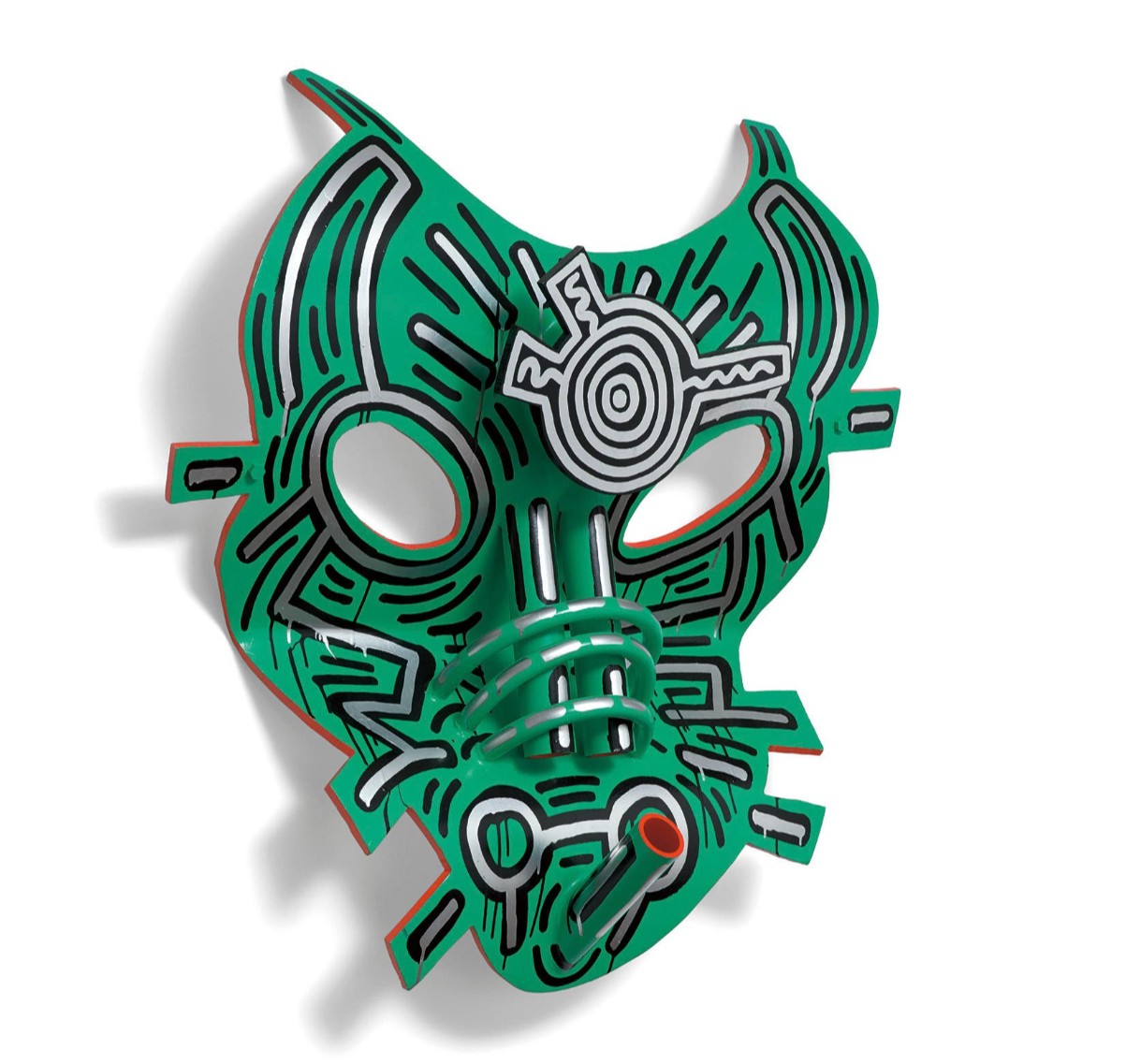
The mask occupies a peculiar position within Haring’s oeuvre, at once anomalous and entirely consistent. Where his canvases and murals operate primarily as flat fields, the masks demand sculptural inhabitation, their planes bowed and notched into projecting tabs that read alternately as ears, feathers, or ritual ornaments. Still, the surface treatment remains unmistakably Haring’s, the enamel applied with the velocity of a draughtsman rather than the deliberation of a sculptor. Drips at the lower edge betray the immediacy of the gesture. Each of the eight masks carries its own iconographic charge, encompassing skulls, beasts, and hybrid physiognomies, yet Untitled (Grace Jones Mask) is among the most legible in its address, its dedication declared in the title itself. The historical significance of the corpus is underscored by the placement of Large Goon Mask, 1987, in the collection of the Museum für Gegenwart, Berlin, on permanent loan from the Marx Collection, and by the present work’s early inclusion in Haring’s important winter 1987 exhibition of sculpture and painting at the Tony Shafrazi Gallery, 163 Mercer Street, SoHo, New York.
“I am intrigued with the shapes people choose as their symbols to create a language.”
To frame the masks solely as formal departures, however, is to overlook the ethnographic project animating them. Haring’s engagement with the mask aligns him with a venerable modernist genealogy that includes Pablo Picasso, Georges Braque, and Constantin Brancusi, all of whom turned to traditional masks and totems as conduits to a primal pictorial energy. That Haring was conscious of this lineage is made explicit by another work in the series, Egg Head, conceived as a homage to Picasso. If for the early modernists the mask served as a screen onto which European anxieties about figuration were projected, for Haring it became something more personal: an instrument of disguise, of costuming, perhaps a means of veiling interior turmoil beneath an exuberant graphic skin. The duality is essential. Beneath the buoyant chromatics and the cartoon vocabulary lies an awareness, sharpened by the epidemic encircling Haring’s community in the late 1980s, of the mask’s older office as an interlocutor between the visible and the unseen.
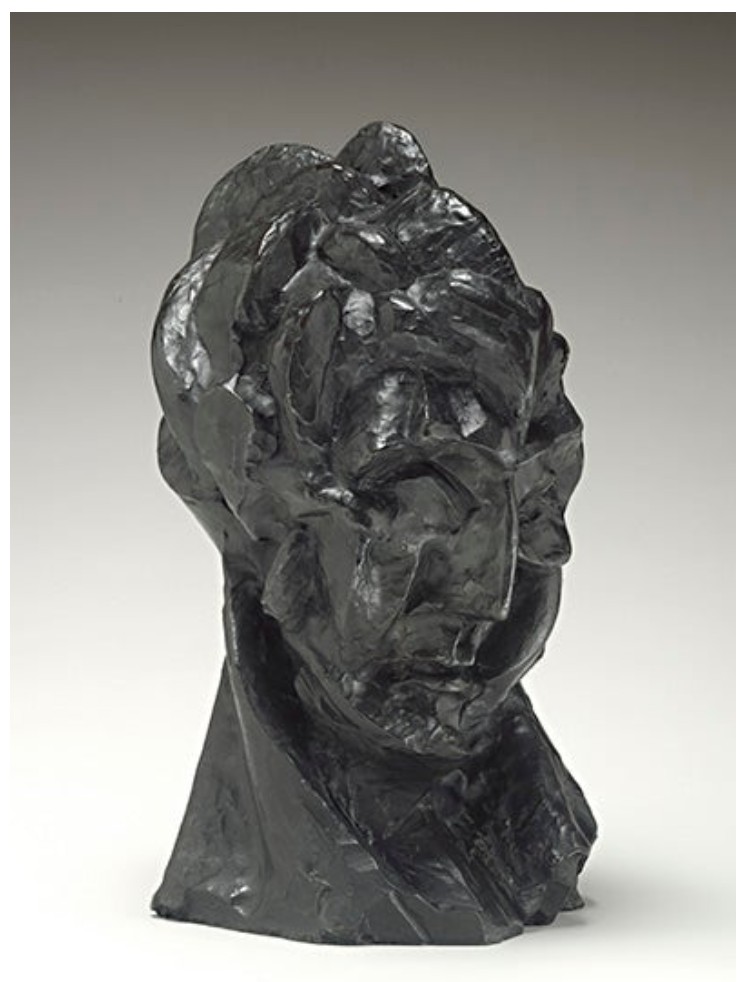
Pablo Picasso, Head of a Woman (Fernande), 1909, cast before 1932. National Gallery of Art, Washington, D. C.
Image: National Gallery of Art, Washington, D.C., Patrons’ Permanent Fund and Gift of Mitchell P. Rales, 2002.1.1,
Artwork: © 2026 Estate of Pablo Picasso / Artists Rights Society (ARS), New York
That Haring should dedicate one of only two named masks within the series to Grace Jones—the other being his Picasso homage—signals the depth of an artistic kinship that had unfolded across the preceding three years. Their first encounter, in 1984, was orchestrated by Andy Warhol for a shoot destined for Interview Magazine and immortalized through the lens of Robert Mapplethorpe. From this seminal meeting flowed an extended series of body-painting sessions, performances, and music-video collaborations, including the 1986 video for Jones’s single I’m Not Perfect (But I’m Perfect for You). Haring saw in Jones the consummate avatar of a metropolitan moment, a figure in whom what Alison Pearlman has termed a “futuristic-primitivist style” achieved its most concentrated expression. The Paradise Garage, New York’s preeminent discotheque and a vital LGBTQ gathering place, served as the site of their most fervent collaborations, where Jones’s body became the canvas for a graphic vocabulary inseparable from the city’s downtown nightlife.
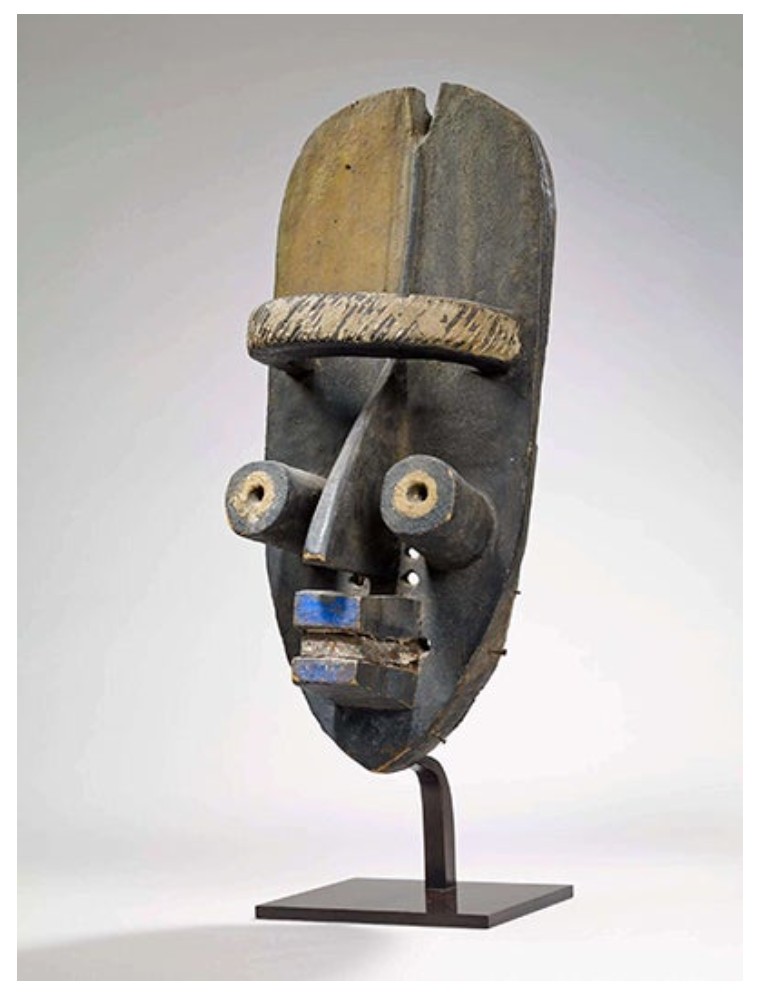
Anthropomorphic mask, Côte d’Ivoire, Grebo, 19th century. Musée du Quai Branly–Jacques Chirac, Paris.
The most striking pictorial precedent for the present work lies in the immediately preceding year. In the 1986 feature film Vamp, Jones appeared as Katrina, Queen of the Vampires, her body and face transformed by Haring’s brush into a chromatic apparition that, in Catalina Dibs’s words, made “her look like a tribal queen, dancing for her gods.”The mint-green field, silver tracery, and red mouth of the present work form an unmistakable echo of Katrina’s spectral palette of green eyes, silvered skin, and parted red lips, translated from the fugitive medium of body paint into the durable register of enamel and aluminum. As Miriam Kershaw observed of these collaborations, the white patterns Haring inscribed across Jones’s body charted “the flow of energy and topography” of her form, transforming her into “a power site.” The mask might be understood, then, as a fixed monument to a series of performances whose nature was otherwise irretrievably ephemeral—a permanent residue of an art that, like the subway drawings, was conceived to dissolve.
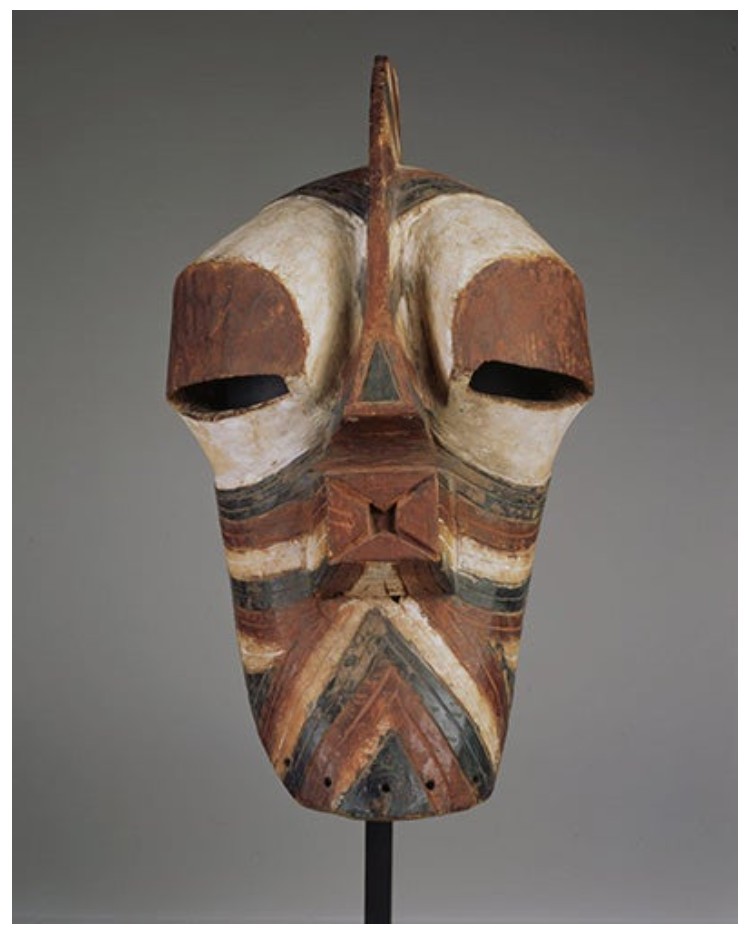
Songye. Kifwebe (Mask), late 19th or early 20th century.
Brooklyn Museum, New York. Image: Brooklyn Museum, Gift of Rosemary and George Lois, 76.165
Kershaw further articulates the cultural stakes of the partnership, observing that Jones’s performances gave dynamic expression to the aesthetic of the 1980s that Haring and Warhol helped to formulate, and that, for Haring, Jones functioned as a signifier for everything he admired in the global crossroads of postmodern New York. The mask consolidates these registers. Its graphic skin braids the urban and the ritualistic, weaving allusions to electronic media, television, and cartoon imagery with sources Haring had absorbed from Aztec, Mayan, North African, and Aboriginal visual cultures. The cultural critic and scholar of African art Robert Farris Thompson identified the white striping Haring deployed in Jones’s 1984 and 1985 Paradise Garage costumes as a borrowing from Masai ritual body painting—a lineage legible, too, in the silver tracery of the present work. A further biographical resonance attends the mask’s genesis. In March 1987, traveling to Munich for Niki de Saint Phalle’s exhibition, Haring attended a lunch at which Jean Tinguely, “fun as usual!”, had “brought masks […] and turned the atmosphere around immediately!” The episode, falling squarely within the year of the masks’ production, suggests an immediate catalyst for an enterprise otherwise without precedent or sequel in his practice. Untitled (Grace Jones Mask) thus stands as the rare convergence of personal history, performative collaboration, and ethnographic ambition—an enduring artifact of one of the decade’s most magnetic creative partnerships.
Untitled, 1983
Untitled, 1983
Haring’s House: Works from the Collection of Kermit Oswald
Sotheby’s New-York: 15 May 2026
Estimated: USD 600,000 – 800,000
USD 832,000
Keith Haring | Untitled | Contemporary Day Auction | 2026 | Sotheby’s
KEITH HARING (1958 – 1990)
Untitled, 1983
Enamel on carved wood
41-3/4 x 35 x 2-3/8 inches (106 x 88.9 x 6 cm)
Incised with the artist’s signature and date Nov. 83 (on the reverse)
Signed and dated 1983 by Kermit Oswald (on the reverse)
Created with his close friend Kermit Oswald, Untitled forms part of a rare group of monumental carved wood sculptures produced in 1983. The present work is representative of one of the most remarkably inventive moments in Keith Haring’s career, when his unmistakable graphic language began to push decisively beyond drawing and painting into the realm of object and sculpture. As the product of a profound exchange between Haring and Oswald, Untitled is a testament to the personal and professional relationships that sustained and animated the artist’s practice throughout his era-defining career.
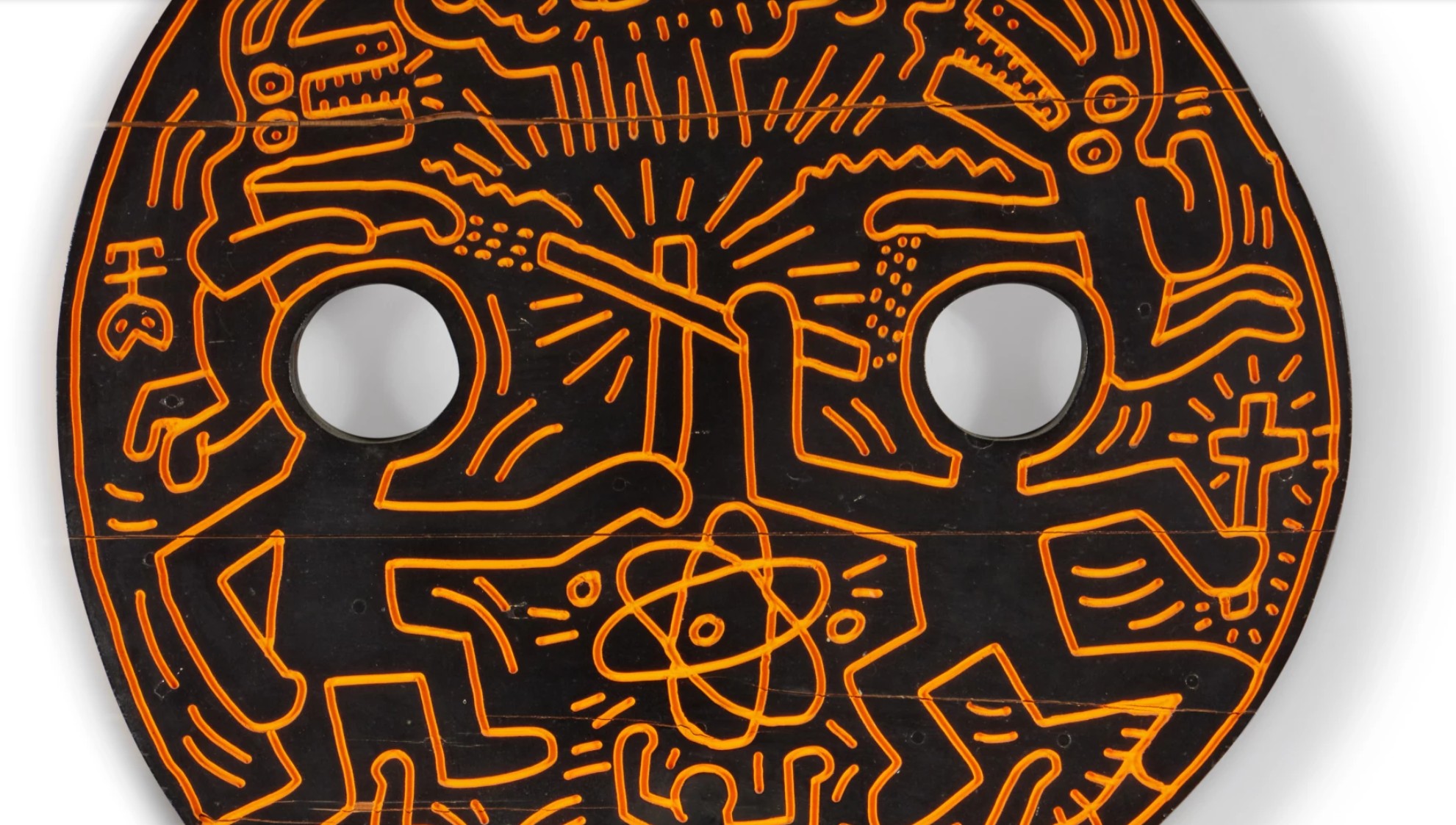
Expertly designed with a router, the mask-like silhouette is charted with a dense, hieroglyphic concentration of imagery, compressing some of Haring’s most iconic signs into a single, radiant field. Set against a black ground, the incised orange line ignites the surface: barking dogs leap inward from either side, radiant energy bursts from the center, dancing figures animate the lower register and celestial motifs pulse across the composition. The nuclear cloud on the upper register, which Kermit believes is Haring’s response to the 1979 Three Mile Island nuclear event where the smoke cloud was visible from both Keith and Kermit’s homes, introduces a note of shared lived experience into the work. In this rare conjunction of carved contour and incandescent line, Haring renders something both graphic and sculptural, preserving the urgency of his graphic vocabulary despite the solidity of the carved wood.
“I next decide to work with my friend, Kermit Oswald, on a project involving drawing on wood. [He] introduces me to carpentry tool allied a router, which is like a drill. You can push it around and glide it through pieces of wood […] I then proceeded to make drawings on these pieces of raw wood, which Kermit has prepared. Then we paint the inside of the grooves, usually with fluorescent Day-Glo paints.”
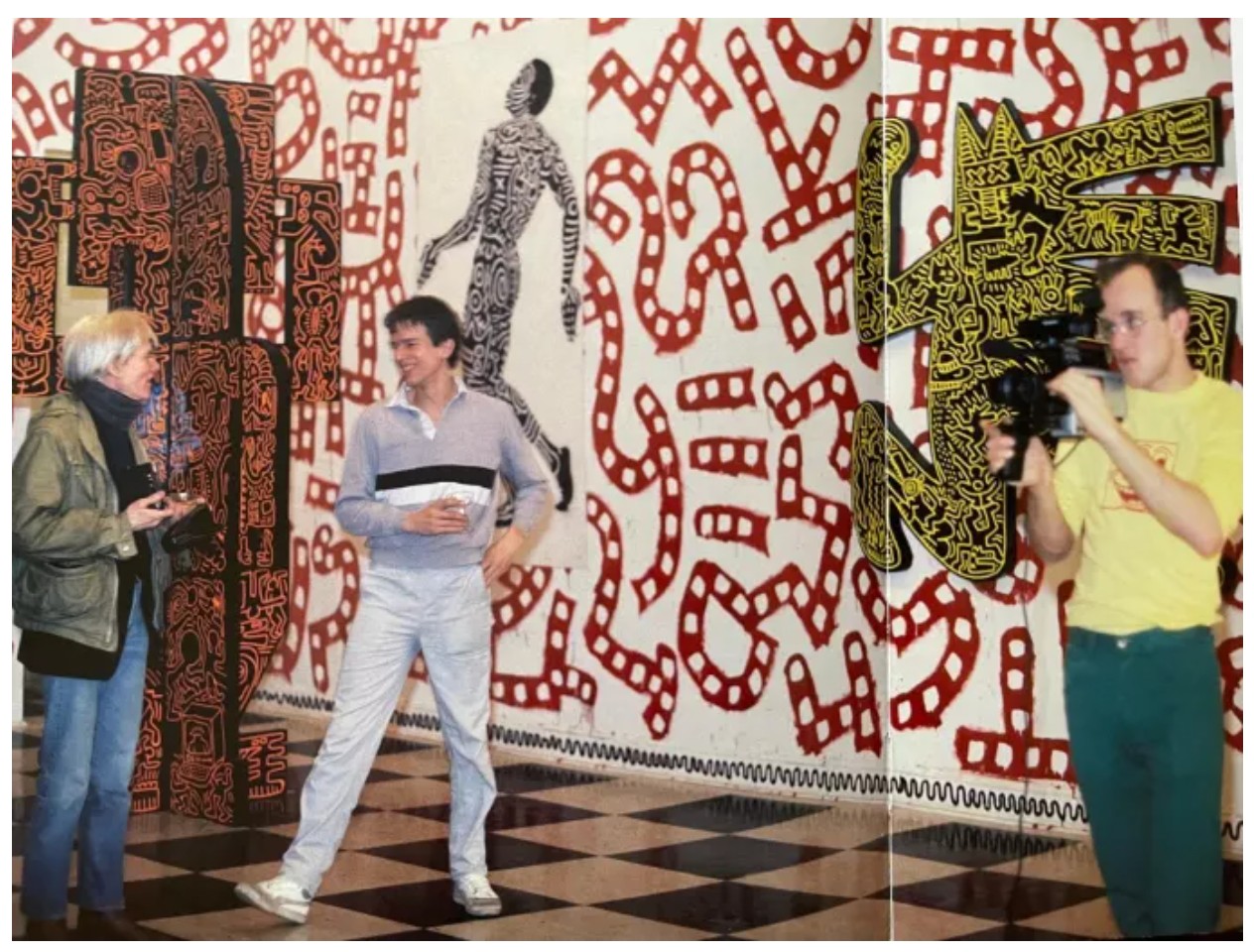
Andy Warhol, Kermit Oswald, and Keith Haring in 1983 at the Tony Shafrazi Gallery in New York City. Courtesy of Kermit Oswald
Untitled is further distinguished by its exceptional provenance, having remained in the collection of Kermit Oswald for more than four decades. Executed in 1983, just ahead of Haring’s pivotal exhibition Into ’84 at Tony Shafrazi Gallery, the present work pinpoints the moment when his practice expanded into carved wood and other sculptural formats, establishing three-dimensionality as a vital extension of his visual language. It was through Oswald that Haring was introduced to this mode of fabrication, cementing Untitled not only as a rare example from this formative moment, but also as a direct testament to one of the artist’s most meaningful early collaborations.
Though long celebrated for his subway drawings, paintings, and public murals, Haring pursued a sustained engagement with three-dimensional form and Untitled articulates the continuity across these media with remarkable clarity.
“One of the things I am continually interested in is the amount of different ways of making marks and the varieties of experience to produce the same consistent line (i.e., carving, painting, drawing). Each requires different amounts of time, concentration, and effort, but the result remains amazingly consistent.”
The line is unmistakably Haring’s, yet the method of carving gives the work a new permanence, slowing his gesture and anchoring his imagery in material fact. In contrast to his subway drawings which were conceived in and for the fleeting rhythms of the city, destined to vanish almost as quickly as they appeared, the present work translates that same urgent line into carved wood, granting lasting physical form to an art often defined by its ephemerality.
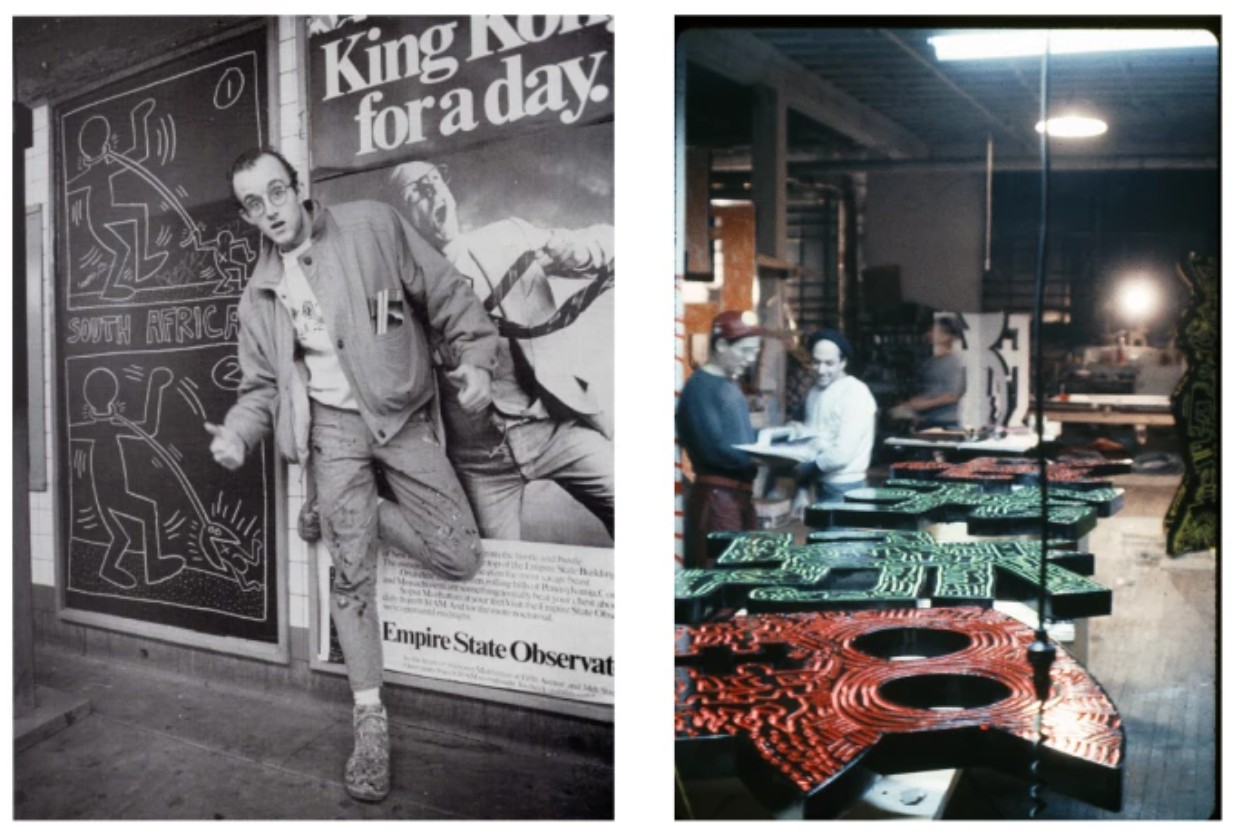
LEFT: Keith Haring in Front of a Subway Drawing. New York, 1984.
RIGHT: Keith Haring’s carved works in Kermit Oswald’s studio circa 1983. Courtesy of Kermit Oswald.
Untitled occupies a singular position within Haring’s oeuvre, uniquely distilling the artist’s iconic visual language into an intimate sculptural form of remarkable immediacy and force. At once representative of a close collaboration between Oswald and Haring, the present work carries a profound resonance that exceeds its material form. Untitled stands as a compelling testament to Haring’s ability to charge even carved wood with the same pulse of life that made his art one of the defining visual idioms of the late twentieth century.
Untitled (Subway Drawing), circa 1982
Untitled (Subway Drawing), circa 1982
Sotheby’s New-York: 15 May 2026
Estimated: USD 500,000 – 700,000
WITHDRAWN
Keith Haring | Untitled (Subway Drawing) | Contemporary Day Auction |
KEITH HARING (1958 – 1990)
Untitled (Subway Drawing), circa 1982
Chalk on 2 joined sheets of black paper on original aluminum MTA mount
Sheet: 44-1/2 x 60 inches (113 x 152.4 cm)
Mount: 48-1/2 x 68 inches (123.2 by 172.7 cm)
Executed circa 1982, Untitled (Subway Drawing) belongs to the instantly recognizable body of work through which Keith Haring first forged one of the most instantly legible visual languages of the late twentieth century. Drawn in white chalk and preserved in its original aluminum MTA mount, the present work retains the material and urban specificity of its making. The work is a fragment of New York’s underground theater, born from the blank advertising panels Haring commandeered throughout the subway system between 1980 and 1985. The urban underground became an experimental space for Haring to work out his ideas, a site where visual language, public encounter, and improvisation were fused into one radical form of immediate visibility.
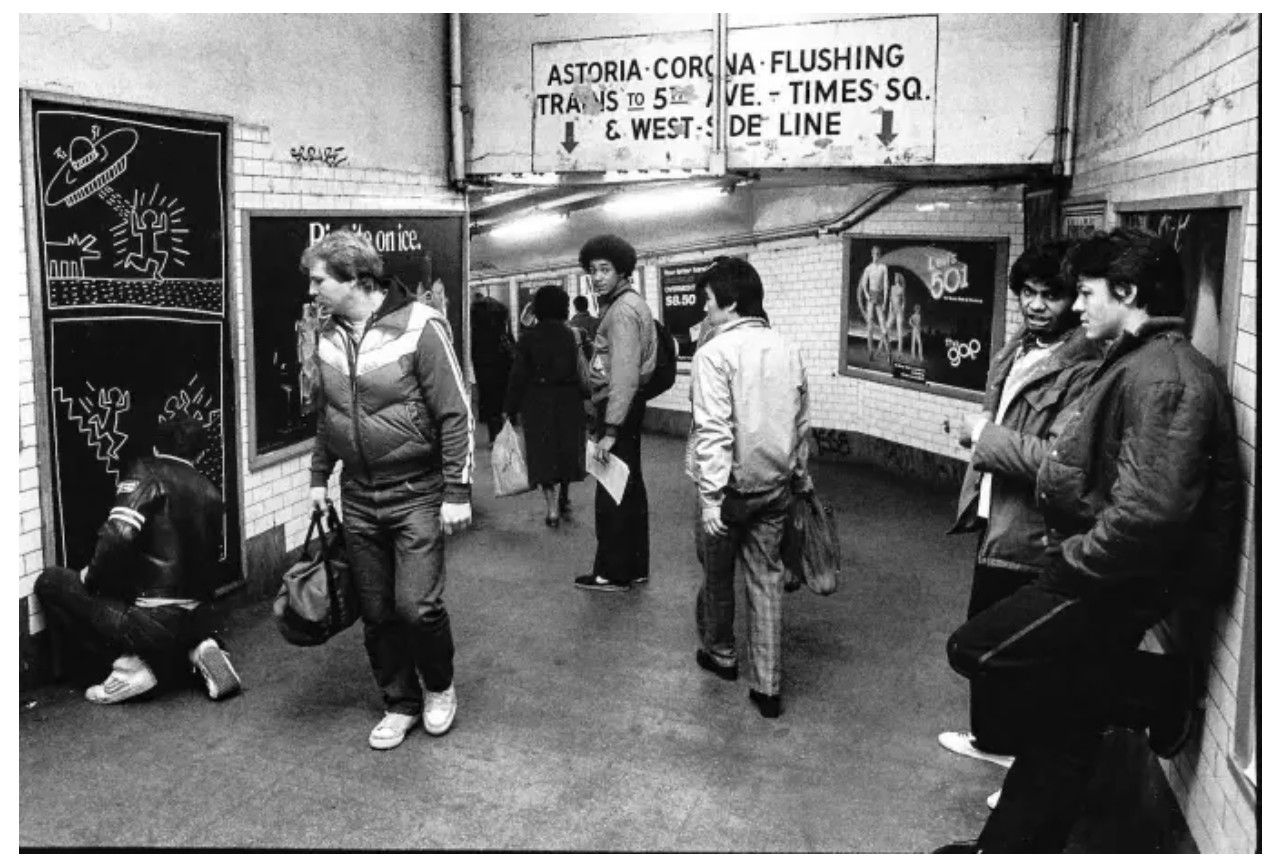
Keith Haring creating a Subway Drawing. Photo by Ivan Dalla Tana. © Estate of Keith Haring.
As detailed by the artist in his book Art in Transit, Haring’s decision to draw in the subway was driven by a desire to create art that was immediate, accessible, and embedded within everyday life rather than confined to galleries or institutions. The subway offered a uniquely democratic space, one where a vast public could encounter his work spontaneously. The unused black advertising panels became his canvas, allowing him to work quickly and under the gaze of the public, often completing drawings in a matter of minutes. Haring was deeply invested in the interaction between the artwork and its audience, observing how passersby responded, paused, or engaged. In this way, the subway functioned not only as a site of production, but as a dynamic arena for communication, where art could exist in direct dialogue with the rhythms of urban life.
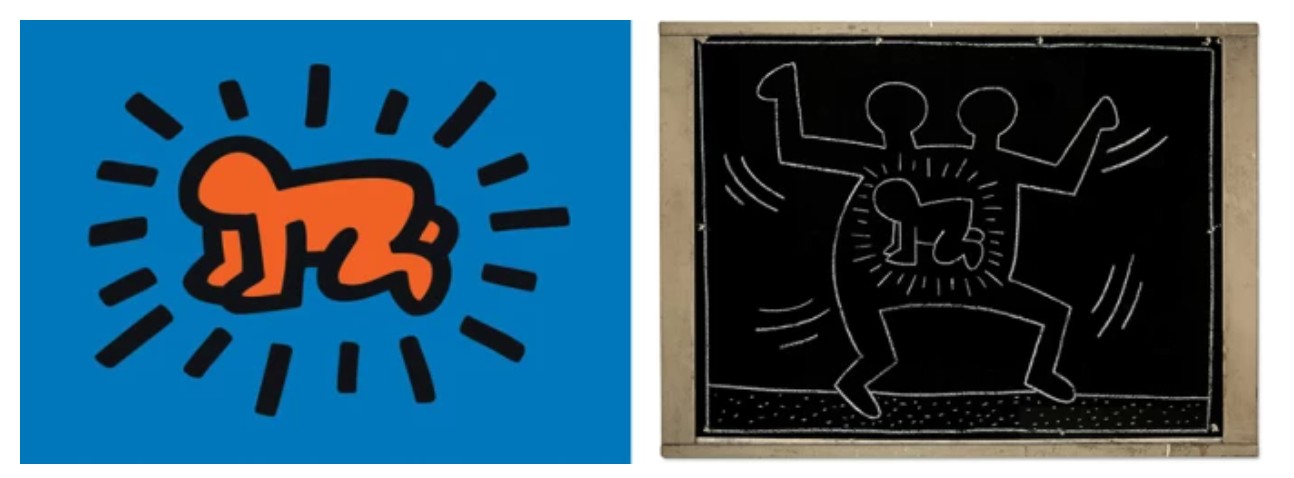
LEFT: Keith Haring, (Radiant Baby from Icons series), 1990. Courtesy Keith Haring Foundation.
RIGHT: The present work.
The chalk line is unbroken, swift, and declarative, preserving the speed of its execution while achieving a compositional certainty that belies its spontaneous origins. Two figures morphed into one occupy the drawing, with their arms and legs extended, captured in energetic motion. At the center of the figure’s torso appears one of Haring’s most resonant motifs: the radiant baby, an emblem of innocence and hope. For the artist, this symbol represented the most untarnished truth, the most brilliant message of possibility, with echoes of Christian iconography imbued in the symbol. Having this motif centered in Untitled (Subway Drawing) lends the composition a powerful symbolic gravity. Significantly, Haring places this emblem of collective hope at the heart of a work created in one of the most public, democratic spaces imaginable, the New York subway, ensuring that its message was not confined to a select audience but offered freely to all who passed by.
“Doing things in public was not a new idea. The climate of art in New York at that time was certainly moving in that direction. It seemed obvious to me when I saw the first empty subway panel that this was the perfect situation. […] I remember noticing a panel in the Times Square station and immediately going aboveground and buying chalk. After the first drawing, things just fell into place.”
Haring’s subway drawings were immediate and fugitive: made directly on empty advertising panels in chalk, they emerged as part of New York’s living, everyday pulse. Later New York subway commissions by artists such as Roy Lichtenstein or Chuck Close bring art today into the transit system as lasting installations. Before the subway became a recognized site for permanent public art, Haring understood it as a democratic arena of direct encounter, where images could circulate as freely and urgently as the city itself. His Subway Drawings were foundational in transforming the underground not simply into a place where art could be displayed, but into a site where art could be instantly experienced.
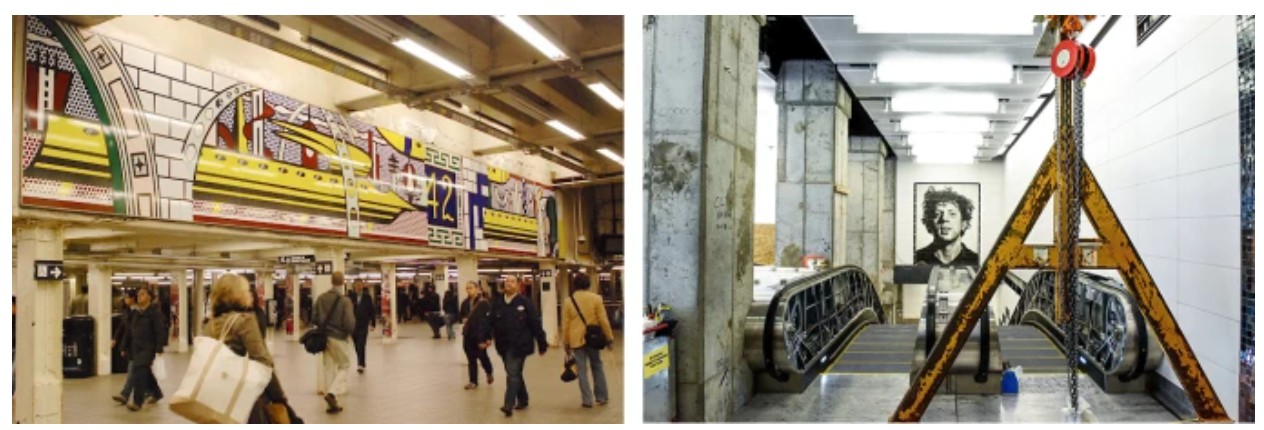
LEFT: Roy Lichtenstein, Times Square Mural, 1994, installed on a wall of the Time Square subway station in 2002.
RIGHT: A Chuck Close mosaic portrait of the composer Philip Glass facing the escalator at the 86th Street Station. Credit George Etheredge for The New York Times.
In Untitled (Subway Drawing), Haring achieves one of the central ambitions of his art: to create an image that is immediately legible yet charged with enduring symbolic force. At once improvised and monumental, the present work stands as a superb example of the subway drawings through which Haring first brought his art directly to the people, and in doing so transformed the everyday architecture of New York into one of the great stages for contemporary art.
Untitled, 1981
Untitled, 1981
Haring’s House: Works from the Collection of Kermit Oswald
Sotheby’s New-York: 14 May 2026
Estimated: USD 300,000 – 400,000
USD 256,000
Keith Haring | Untitled | Contemporary Day Auction | 2026 | Sotheby’s
KEITH HARING (1958 – 1990)
Untitled, 1981
Gold marker on plastic
24×36 inches (61 x 91.4 cm)
Signed, dated 1981 – May and dedicated For Kermit & Lisa – Kutztown (on the reverse)
“I aim for an art which would be in immediate connection with daily life, which could start from our daily life and which would be a very direct and very sincere expression of our real life and real moods.”
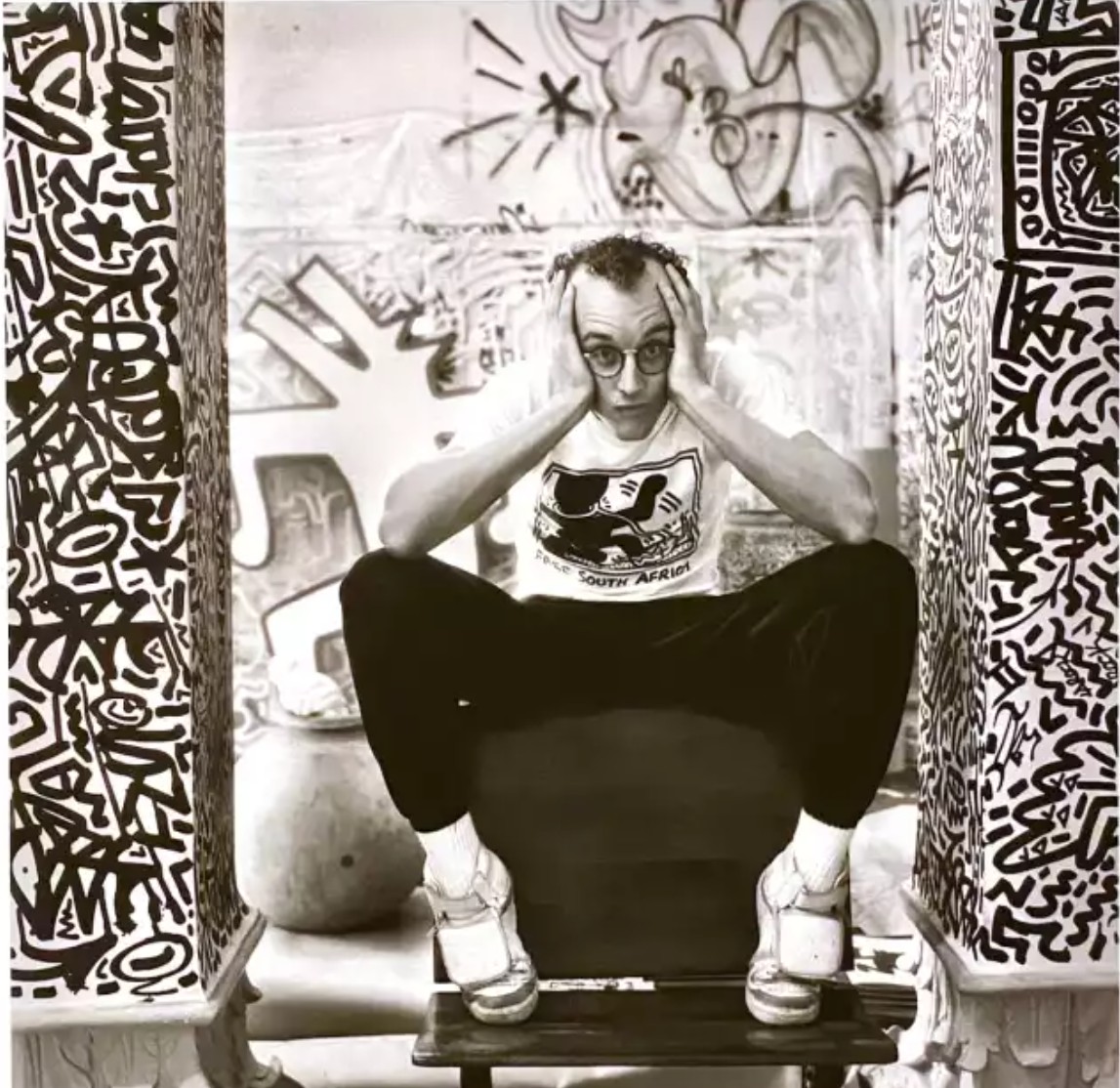
Photo by Jeannette Montgomery Barron
Untitled, 1983
Untitled, 1983
Haring’s House: Works from the Collection of Kermit Oswald
Sotheby’s New-York: 14 May 2026
Estimated: USD 250,000 – 350,000
USD 345,600
WORK ON PAPER
Keith Haring | Untitled | Contemporary Day Auction | 2026 | Sotheby’s
KEITH HARING (1958 – 1990)
Untitled, 1983
Sumi ink on paper
45 x 58-1/4 inches (114.3 x 148 cm)
Dated 83 (upper left)
Signed and dated June 15 – 83 (right edge)
“The vocabulary of my images [is] a vocabulary of signs and symbols evoking different ideas, and gaining meaning through repetition and juxtaposition, changing meaning as they appear over and over… in different situations.”
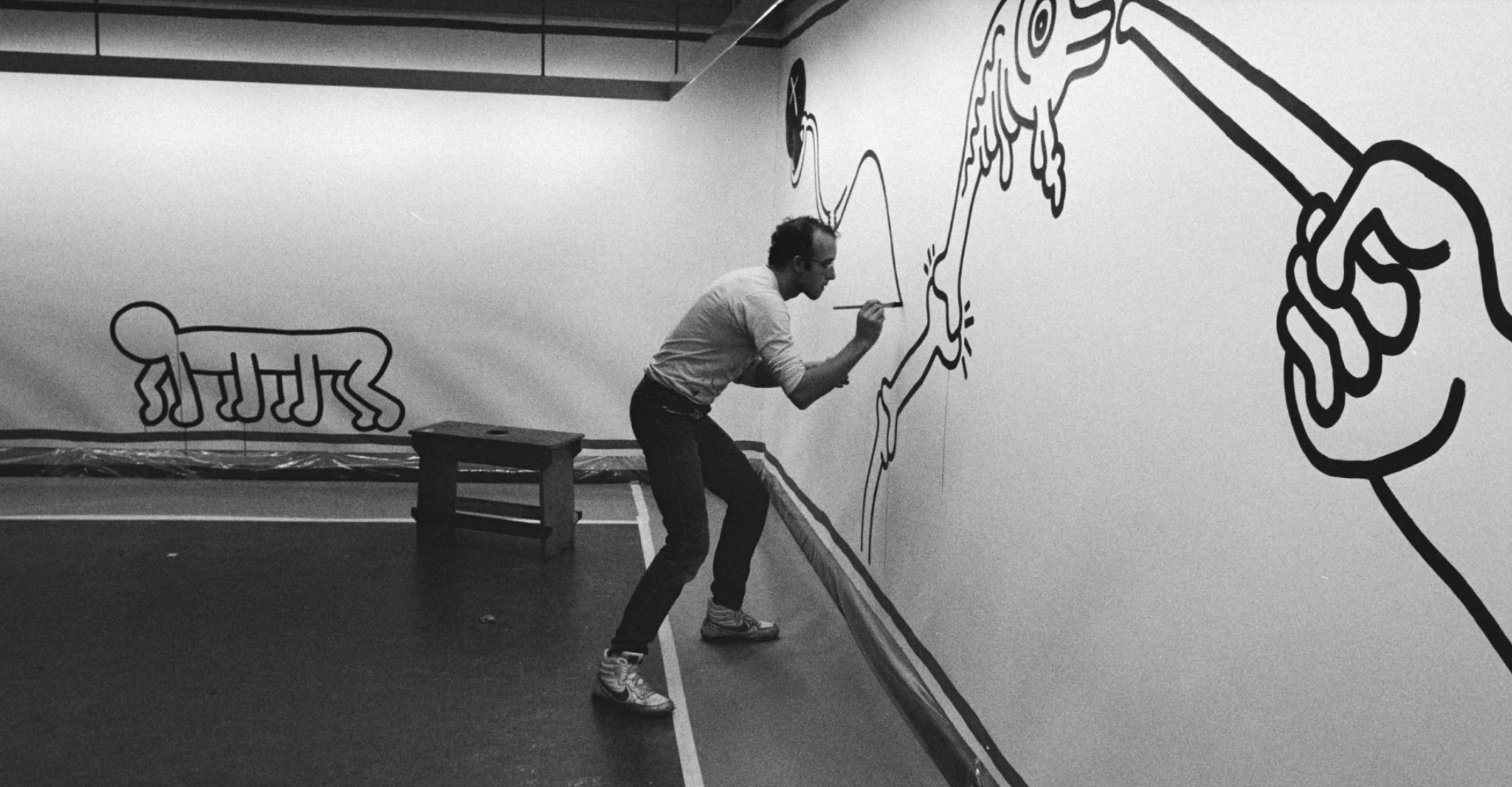
Untitled, 1983
Haring’s House: Works from the Collection of Kermit Oswald
Sotheby’s New-York: 14 May 2026
Estimated: USD 250,000 – 350,000
USD 435,200
WORK ON PAPER
Keith Haring | Untitled | Contemporary Day Auction | 2026 | Sotheby’s
KEITH HARING (1958 – 1990)
Untitled, 1983
Sumi ink on paper
45 x 58-1/4 inches (114.3 x 148 cm)
Dated 83 (lower right)
Signed and dated June 15 – 83 (left edge)
Untitled, 1989
Untitled, 1989
Haring’s House: Works from the Collection of Kermit Oswald
Sotheby’s New-York: 15 May 2026
Estimated: USD 200,000 – 300,000
USD 217,600
Keith Haring | Untitled | Contemporary Day Auction | 2026 | Sotheby’s
KEITH HARING (1958 – 1990)
Untitled, 1989
Acrylic on canvas
24 x 24 x 3-1/2 inches (61 x 61 x 8.9 cm)
Signed, dated May 7 1989 and dedicated “2 Dogs For Woody” Love, Keith (on the overlap)
“When I do drawings with or for children, there is a level of sincerity that seems honest and pure .
There is nothing that makes me happier than making a child smile.”
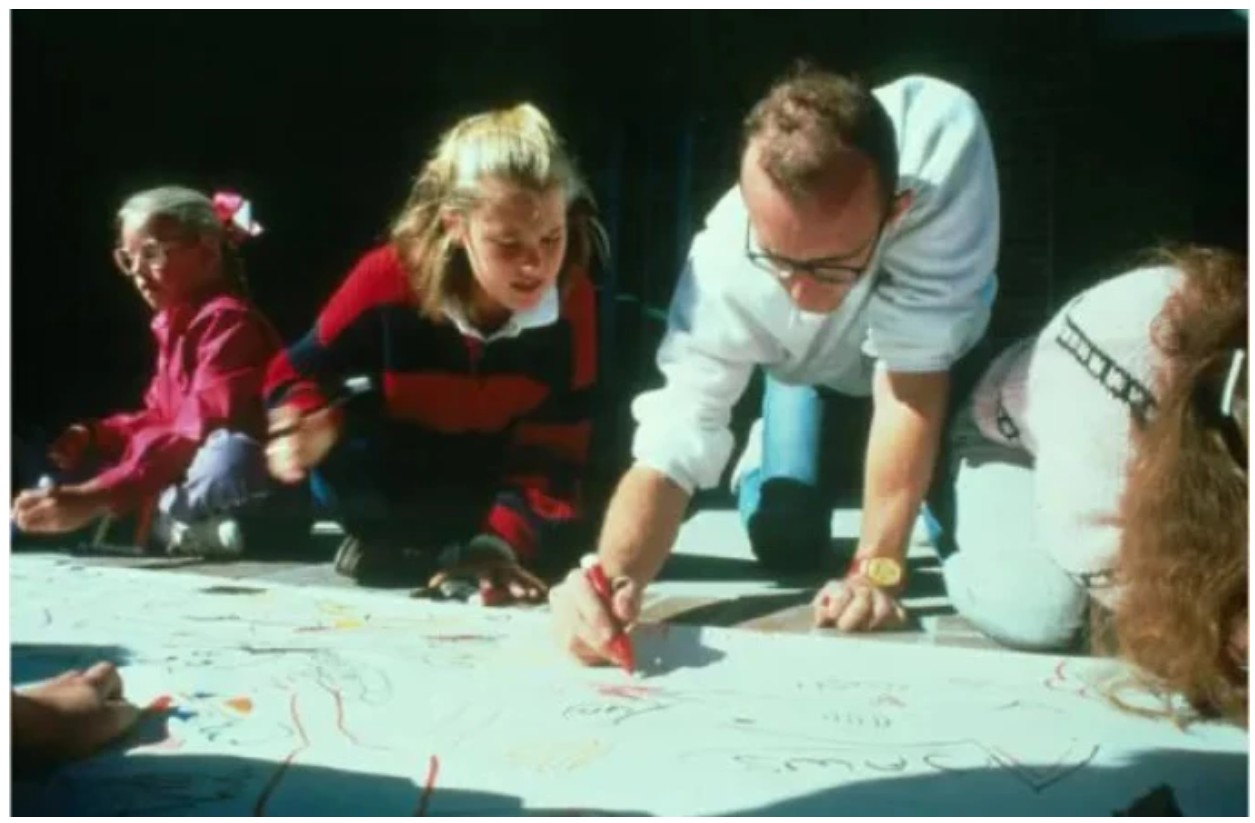
Keith Haring during a visit to the Cranbrook Academy of Art, September 1987. Courtesy Cranbrook Archives.
Untitled, 1986
Untitled, 1986
Haring’s House: Works from the Collection of Kermit Oswald
Sotheby’s New-York: 15 May 2026
Estimated: USD 250,000 – 350,000
USD 192,000
Keith Haring | Untitled | Contemporary Day Auction | 2026 | Sotheby’s
KEITH HARING (1958 – 1990)
Untitled, 1986
Enamel on wooden dresser
Open: 42-3/4 x 67-5/8 x 16 inches (108.6 x 95.6 x 171.8 cm)
Closed: 42-3/4 x 37-5/8 x 16 inches (108.6 x 95.6 x 40.6 cm)
Signed, dated June 1986 and dedicated For Lily, Love Keith (on the reverse)
Crafted with the immediacy and unmistakable graphic impact that defines Keith Haring’s legendary oeuvre, Untitled (Crib) and Untitled (Dresser) are an expression of Keith Haring’s practice at its most personal. At a moment when the boundaries between fine art, design, fashion, and activism were increasingly porous, Keith Haring emerged as an artist uniquely capable of uniting them. His imagery could travel anywhere, across walls, posters, bodies, appliances, and furniture, without losing its intensity.
For all Haring’s public visibility, it is the deeply personal works he made for friends, collaborators, and loved ones that form some of the most impactful and immediate pieces in his oeuvre. Painted in 1986 as gifts for his lifelong best friend, Kermit Oswald, on the occasion of the birth of Oswald’s first child, Untitled (Crib) and Untitled (Dresser) come directly from the collection of Kermit Oswald, preserving the deeply personal context of their creation. Haring, who was the godfather of Oswald’s son and a frequent presence in the family’s life, transformed these functional objects into vivid extensions of his art. Oswald fondly recalls how all four children used and cherished the crib and the dresser: more than functional objects transformed by drawing, these works extend Haring’s art into the sphere of daily life, collapsing the boundary between artwork and environment in a manner wholly consistent with his broader project.
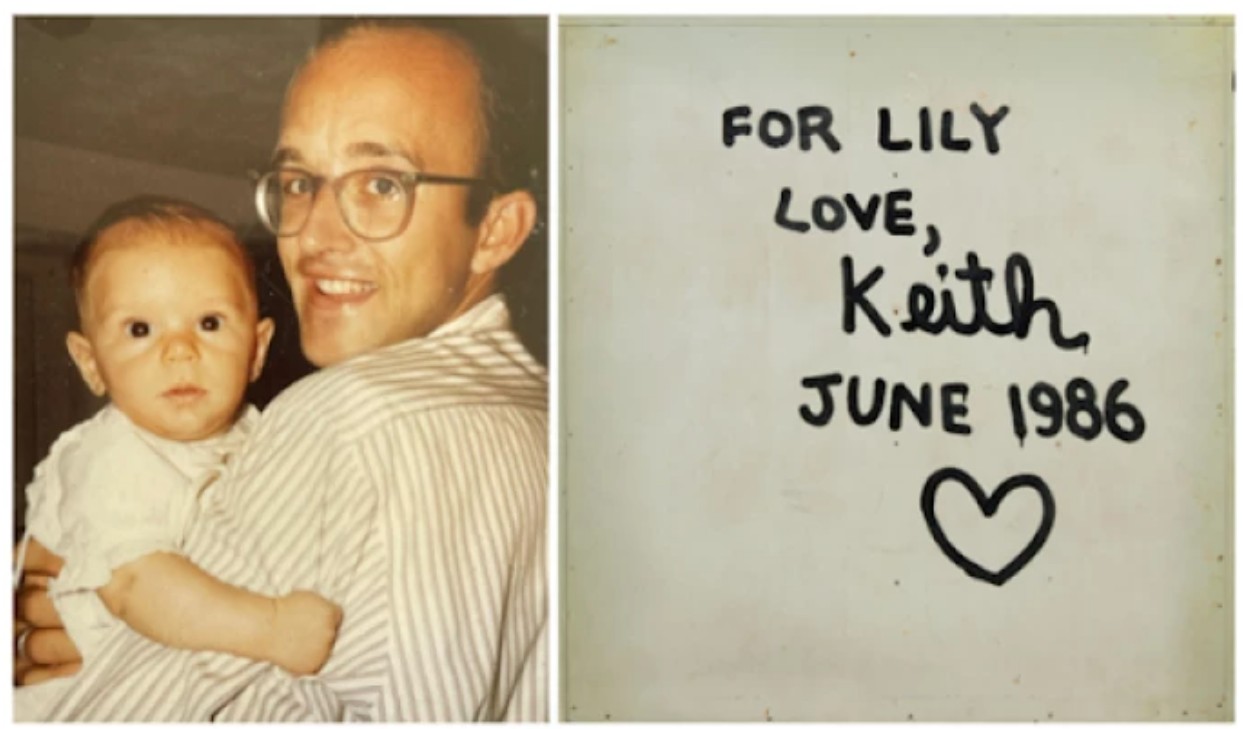
LEFT: The artist pictured with his godson.
RIGHT: Detail of the artist’s dedication on Untitled (Dresser).
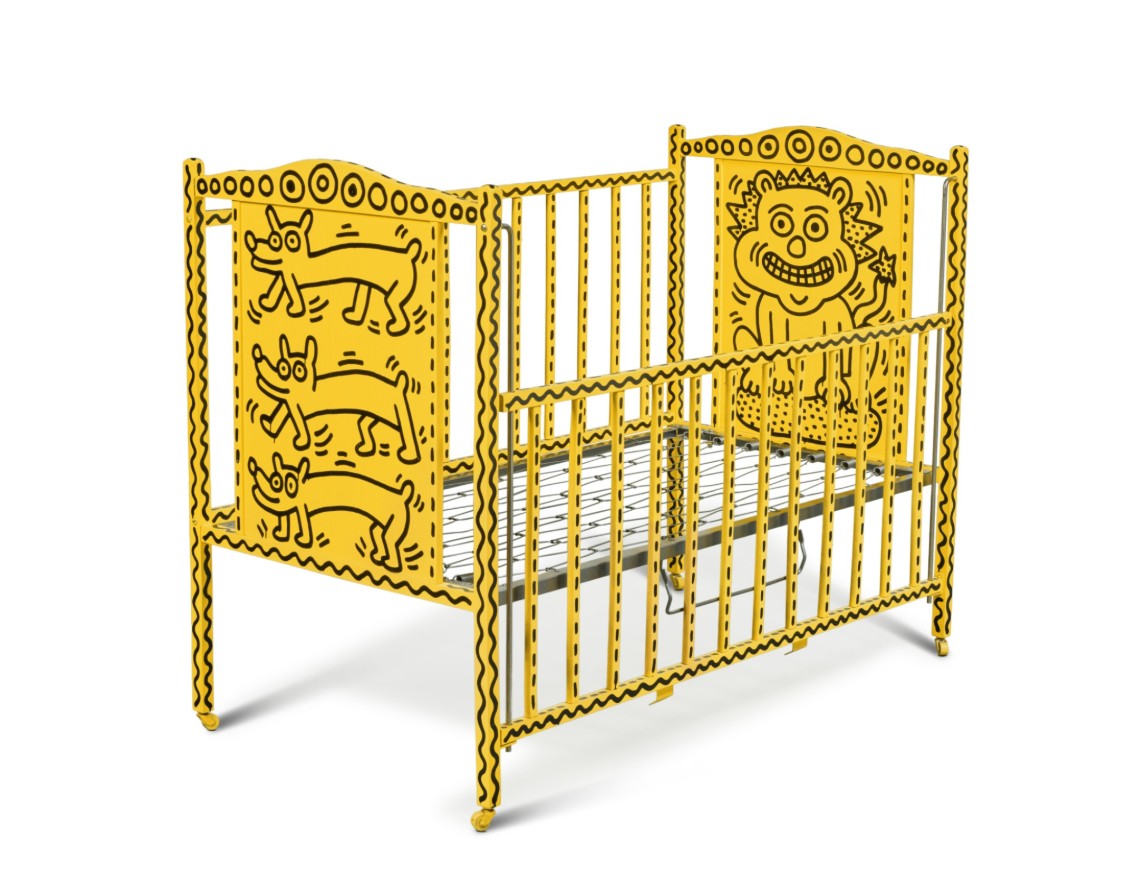
Across both Untitled (Crib) and Untitled (Dresser) Haring employs the signature motifs of his visual language, from radiant lines and hieroglyphic contours to playful dogs and figures, to activate both the objects and their surroundings. Originally Oswald’s from childhood, the crib and dresser were repainted by Haring in a vibrant yellow and elevated through his hand-painted iconography into deeply personal works of art. In Untitled (Crib), Haring employs animated linear borders to transform a wooden crib from a space of care and protection into an arena of joyful visual energy.
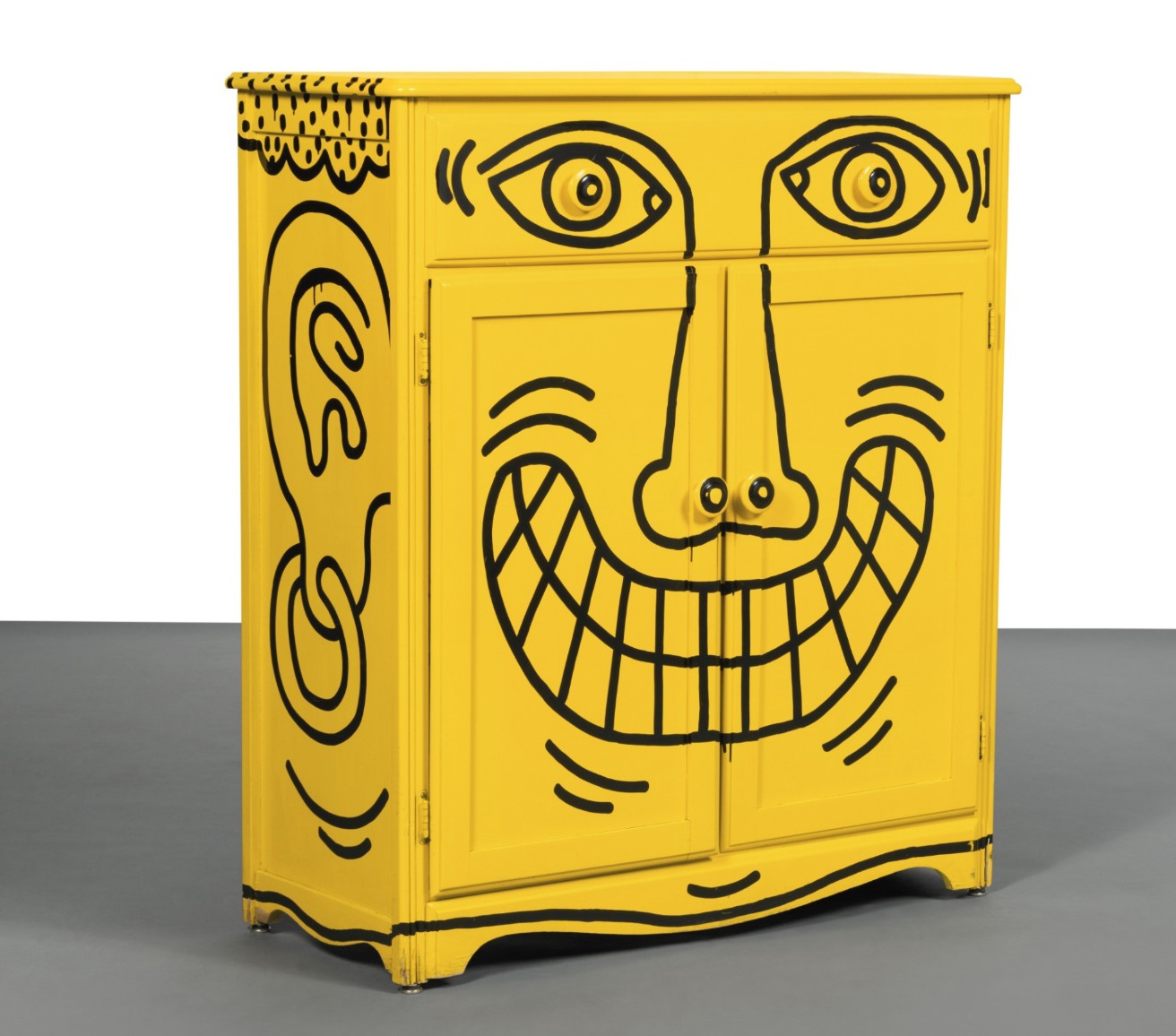
Using his iconic visual lexicon, Haring imbues the pieces with personal references; the two playful figures on one side of the crib represent Kermit and his wife, Lisa, while the dachshunds on the other side allude to the Oswald family dog. In Untitled (Dresser), Haring activates the doors and drawers with eyes, limbs and curving lines that turn the furniture into a watchful and playful anthropomorphic presence, as if the object itself had entered Haring’s symbolic universe. On the back of the work, Haring fondly dedicates the object to Kermit’s daughter, Lily Oswald. At once sculptural, functional, and deeply personal, Untitled (Crib) and Untitled (Dresser) are vivid and moving reminders that for Haring, art was never separate from life.
Untitled, 1986
Haring’s House: Works from the Collection of Kermit Oswald
Sotheby’s New-York: 15 May 2026
Estimated: USD 250,000 – 350,000
USD 192,000
Keith Haring | Untitled | Contemporary Day Auction | 2026 | Sotheby’s
KEITH HARING (1958 – 1990)
Untitled, 1986
Enamel on wooden crib
42 x 53-1/4 x 29-3/8 inches (106.7 x 135.3 x 74.6 cm)
Prints & Editions
The Blueprint Drawings, 1990
Haring’s House: Works from the Collection of Kermit Oswald
Sotheby’s New-York: 15 May 2026
Estimated: USD 300,000 – 500,000
USD 486,400
COMPLETE SET
Keith Haring | The Blueprint Drawings [17 works] | Contemporary Day
KEITH HARING (1958 – 1990)
The Blueprint Drawings [17 works], 1990
(Klaus Littmann, pp. 174-183)
The complete set of 17 screenprints, on Arches Cover paper
With the justification page, loose (as issued)
Contained in the original wood portfolio box with screenprinted artist’s name, title and date
Signed, dated ’90 and inscribed For Kermit + Lisa (lower right of each)
This set is a proof set aside from the numbered edition of 33 plus 5 artist’s proof sets
Each with the blindstamp of the printer, Martin Lawrence Limited Editions
Published by Durham Press.
The complete set of seventeen screenprints, The Blueprint Drawings, were created in the final months of Haring’s life and dedicated to his childhood best friend and creative collaborator, Kermit Oswald, reflecting the personal tenor of this collection. The Blueprint Drawings is a masterclass in Haring’s iconic visual vernacular, demonstrating a complex narrative tableaux, created at the apex of Haring’s artistic development. Together, the works assemble a comprehensive visual lexicon of his most iconic motifs—the barking dog, the crawling infant and the flying saucers—figures that recur as central protagonists within his pictorial universe.
“They form a perfect time capsule of my keith beginning in New York City”
“The flying saucer symbolizes space, space travel, and communication. It is also a symbol of otherness and can describe any person who lies outside of the social norm and community. In Haring’s work strength emanates from these outsiders, for they have the power to activate and empower others” – Anna Karina Hofbauer in collaboration with Dieter Buchhart, Keith Haring: The Alphabet, Vienna, 2018
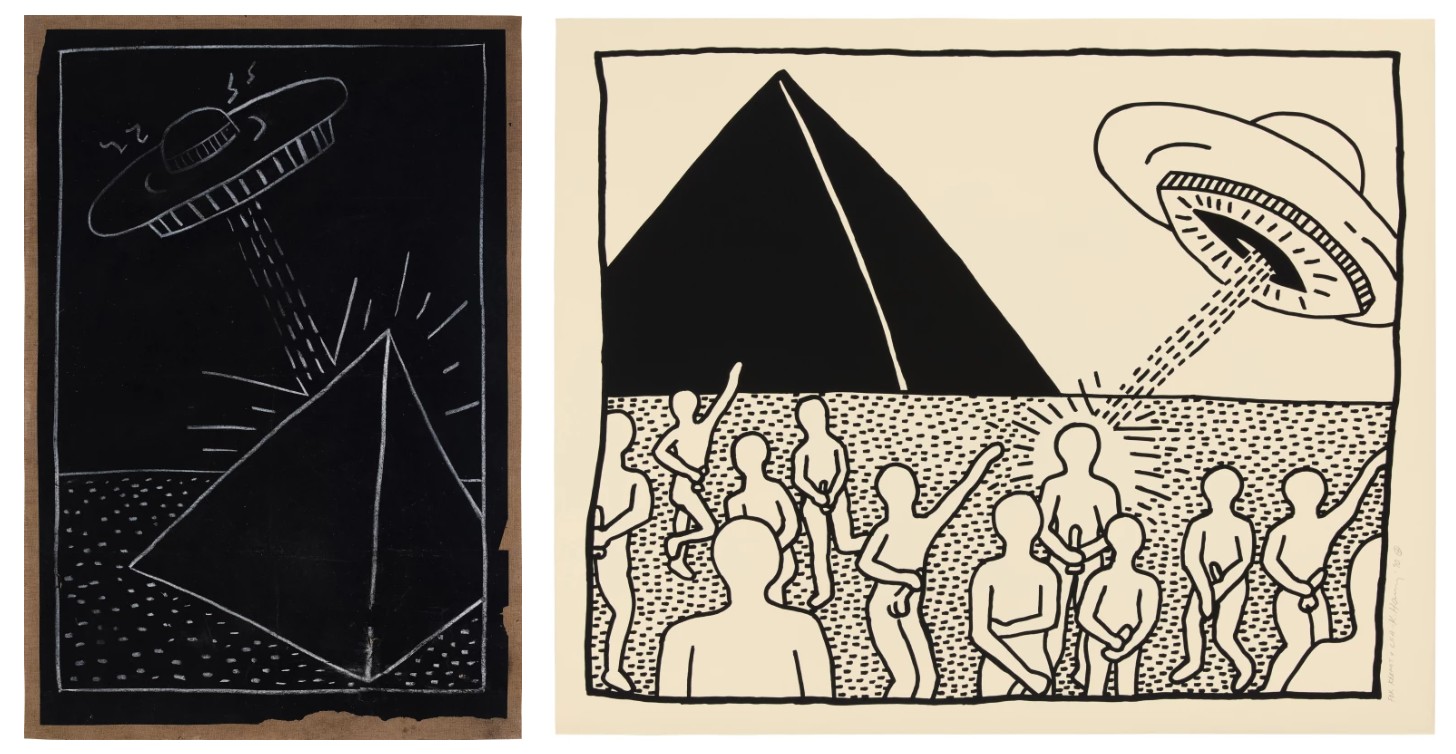
Keith Haring, Untitled (Pyramid and FlyingSaucer), chalk on black paper laid on linen
Sold: Sotheby’s, New York, 21 November 2024 for 312,000 USD
Considered in concert, the compositions unfold a familiar narrative structured around alienation and a dichotomous tension between “good” and “evil.” In the years leading up to his untimely death on 16 February 1990, Haring sustained an urgent visual dialogue with the AIDS epidemic, repeatedly invoking certain figures as emblematic vigils of the era’s enduring anguish. This dialogue persists in the present work, engaging themes of sexuality, violence, and religion with striking immediacy.
Among Haring’s final artistic undertakings, this series represents a late revisitation of his 1980s Sumi ink drawings. Prior to their sale, Haring produced photostats of each composition, which subsequently served as the basis for these screenprints. Each image functions autonomously, yet contributes to a broader, cumulative narrative. The symbolic charge of Haring’s imagery invites subjective interpretation, encouraging the viewer to actively engage and derive personal meaning. As Haring observed of his Subway Drawings, “The drawings are designed to provoke people to think and use their own imagination. They don’t have exact definitions but challenge the viewer to assert his or her own ideas and interpretations” (Keith Haring, Haring – Art in Transit). Similar participatory engagement with The Blueprint Drawings fosters an intimate exchange between artist and viewer—an intimacy further underscored by the work’s dedication to Kermit and Lisa Oswald.
Issued in a modest edition of thirty-three, the complete set The Blueprint Drawings have appeared on the secondary market only twice before. The present example, having remained in the Oswald Collection since its acquisition, stands as an exceptional testament to a pivotal moment in Haring’s late career.
Andy Mouse, 1986
Sotheby’s New-York: 15 May 2026
Estimated: USD 150,000 – 250,000
USD 204,800
PRINT
Keith Haring | Andy Mouse | Contemporary Day Auction | 2026 |
KEITH HARING (1958 – 1990)
Andy Mouse, 1986
(Littmann p. 65)
Screenprint in colors on Lenox Museum Board
Signed, dated 86 and numbered 10/30 (lower right)
This impression is number 10 from the edition of 30 plus 10 artist’s proofs
With the blindstamp of the printer, Rupert Jasen Smith
Published by George Mulder Fine Art