MAY 2026 NEW-YORK AUCTIONS
Jeff Koons
Louis XIV, 1986
Louis XIV, 1986
Robert Mnuchin: Collector at Heart
Sotheby’s New-York: 14 May 2026
Estimated: USD 7,000,000 – 10,000,000
USD 8,570,000
Jeff Koons | Louis XIV | Robert Mnuchin: Collector at Heart Evening
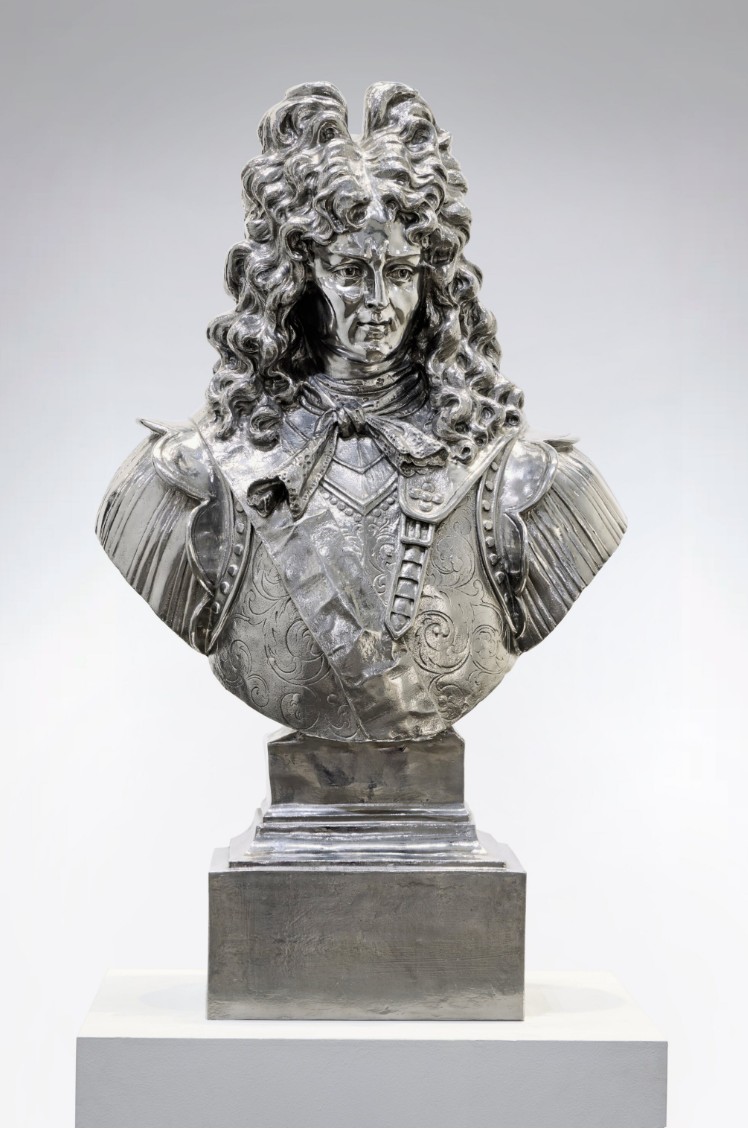
JEFF KOONS (b. 1955)
Louis XIV, 1986
Stainless steel
46x27x15 inches (116.8 x 68.6 x 38.1 cm)
This work is the artist’s proof from an edition of 3 plus 1 artist’s proof
“On the one side there is Louis XIV and on the other side there is Bob Hope. If you put art in the hands of a monarch, it will reflect his ego and eventually become decorative. If you put it in the hands of the masses, it will reflect mass ego and eventually become decorative. If you put art in the hands of Jeff Koons, it will reflect my ego and eventually become decorative.”
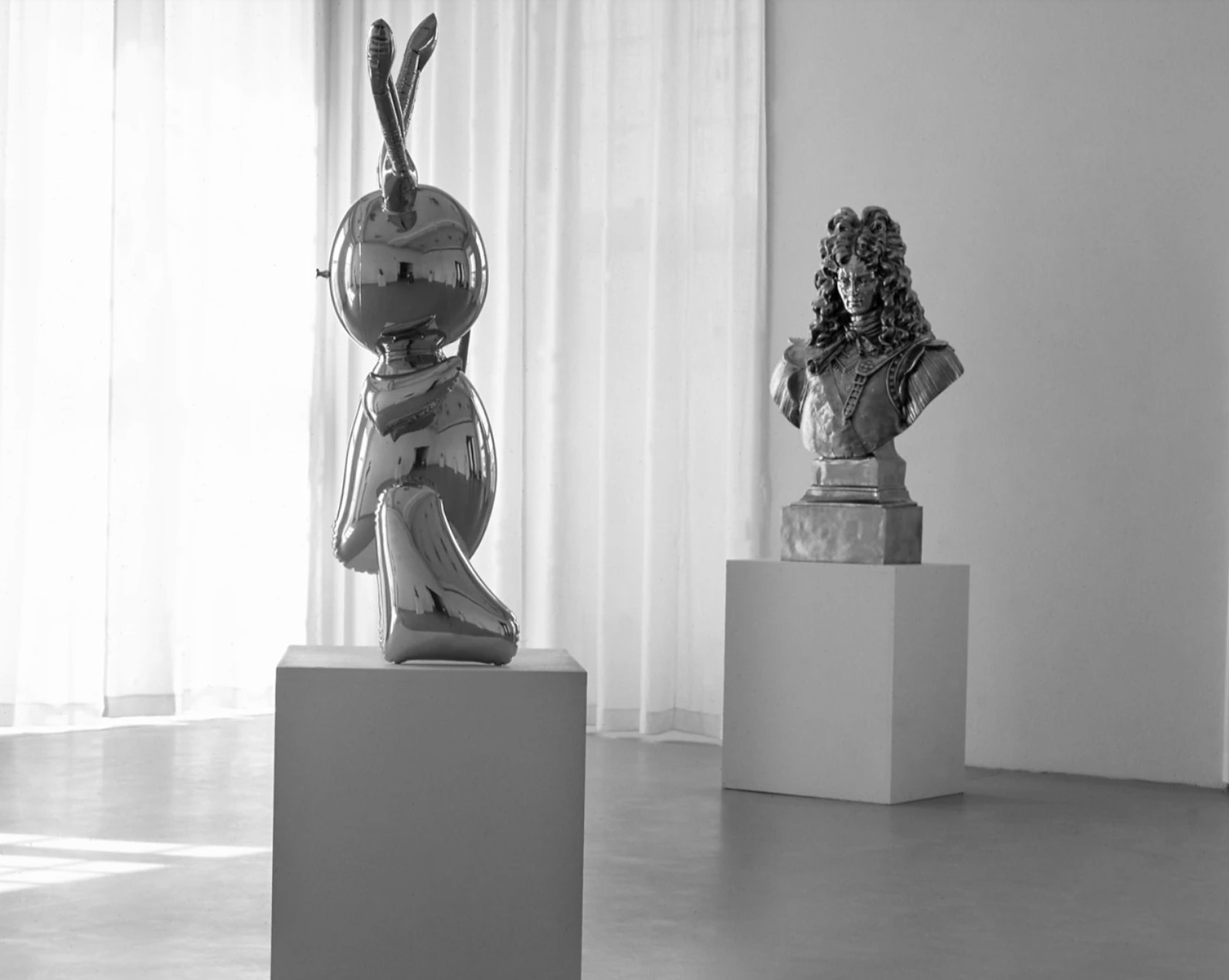
The present work installed in Schlaf Der Vernunft at Museum Fridericianum, Kassel, February – May 1988. Art © 2026 Jeff Koons
A thrilling paradox rendered in royal pomp and steel, Louis XIV, from 1986, is the ultimate embodiment of Jeff Koons’ insurgent oeuvre, a gleeful assault on the hierarchies and hegemonies of taste rendered with immaculate finish and imposing presence. Simultaneously a homage, a critique, and a self-portrait of ambition, the life-size bust of the so-called “Sun King” embodies the tension between sovereign grandeur and contemporary mass production. Executed in 1986 as part of an edition of three plus one artist’s proof, Louis XIV is, as Robert Mnuchin himself noted, “Koons from the very best period”, emerging from the seminal Statuary series in which Koons first incorporated canonical “high” art into his practice. A measure of the work’s enduring significance, all other editions of Louis XIV are held in esteemed museum collections, including the Nasher Sculpture Center, Dallas; The Broad, Los Angeles; and DESTE Foundation for Contemporary Art, Athens. Further testament to its importance, Louis XIV has been included in nearly every major retrospective of the artist’s work.
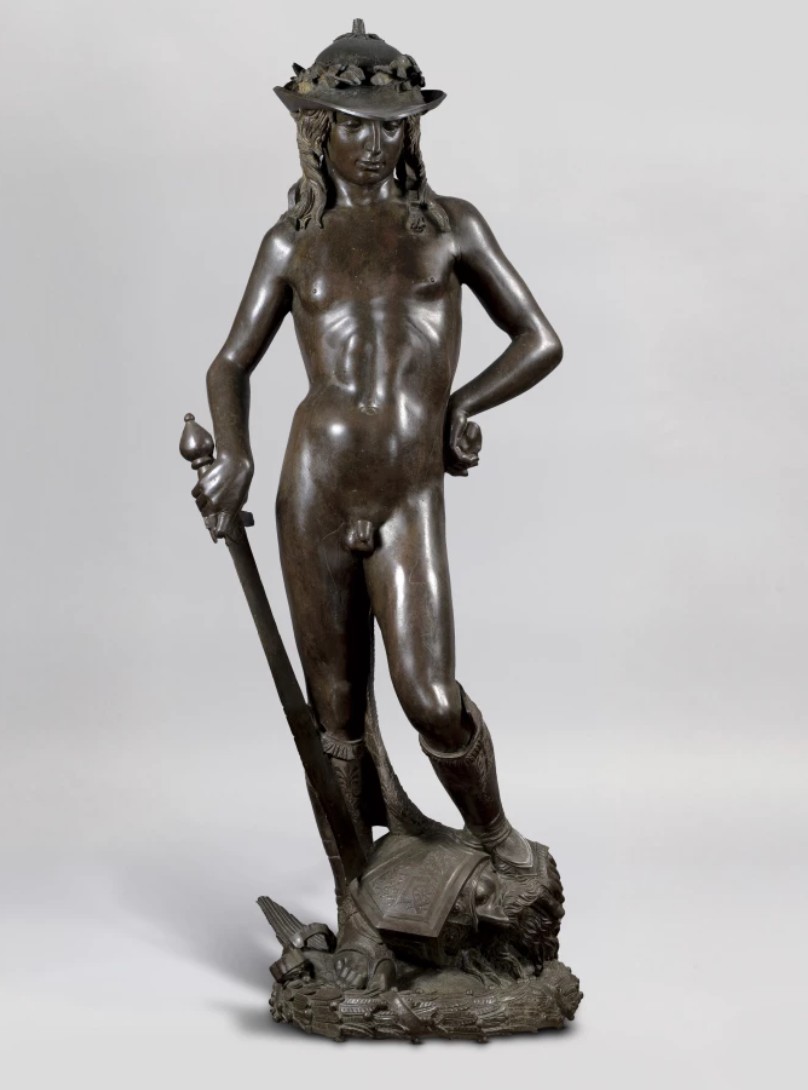
Donatello, David, 1430-35. Museo Nazionale del Bargello, Florence.
Image © Scala/Ministero per i Beni e le Attività culturali / Art Resource, NY
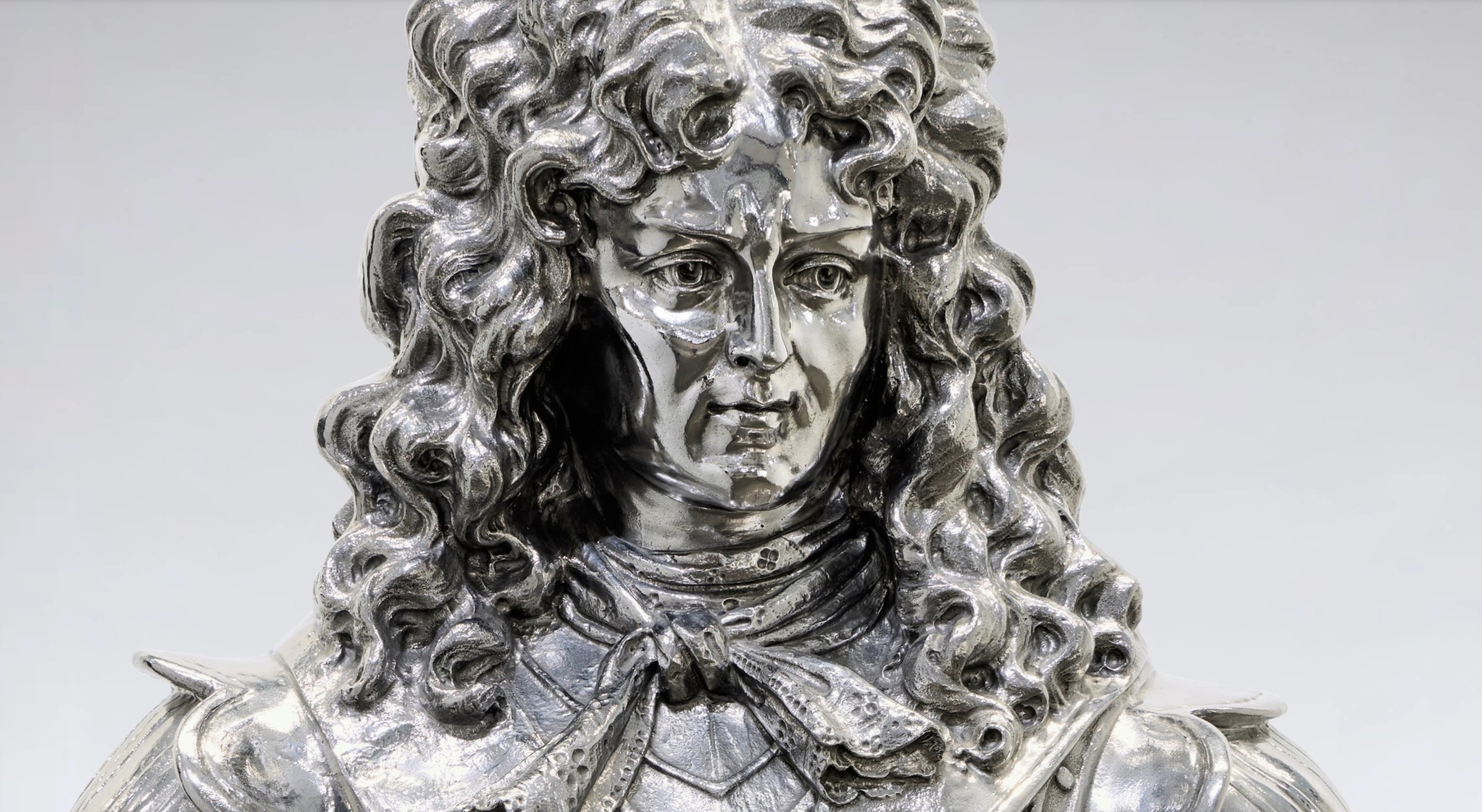
Koons’s gleaming bust of the King of France cuts an impressive figure. His steely gaze pierces the viewer beneath a turret of tumbling curls whose peaks rise in impressive heights and cascade into gleaming ringlets. Decoration abounds, and the proportions are exaggerated and excessive, a visual bravado that results in something more than life-size. Everything gleams and reflects, in effect transmuting the Sun King’s image into a manifestation of the most potent symbol of his absolute power: the Hall of Mirrors. Fittingly, Louis XIV was prominently featured in Koons’ 2008 exhibition at the Palace of Versailles. Juxtaposed with the variegated surface of his elaborate coif and detailed attire, the smooth, broad planes of Louis’ face form a pristine looking glass. Face to face with the sculpture, the viewer’s own visage gazes back. Louis XIV acts as both icon and mirror, a forceful assertion of monarchical power that is democratized by the viewer’s implication in the image.
Louis XIV is an integral work within Koons’ groundbreaking Statuary series, created alongside the artist’s record at auction, Rabbit, whose winning bid was achieved by Mnuchin himself in the auction room. It is in this pioneering group of artworks that Koons first established a direct reference to canonical “high art” in his practice, a theme he would continue to explore throughout his career. Executed with cool precision, the Statuary series exploits the breadth of canonical art history and popular kitsch, probing the nature of cultural hierarchy and taste.
“I remember walking down Canal Street and seeing a fibreglass bust of Louis XIV in this place called Canal Plastics, where I would get a lot of my plastic sheets. I thought it was fantastic. I carried that with me in my head and then when I was walking around somewhere, probably somewhere around Times Square, I saw a little plaster cast of Bob Hope. Then this narrative started to develop. I realised they were really symbols of what happens when you put art in the hands of either the mass, with Bob Hope, or an individual, in Louis’ case of a monarch.”
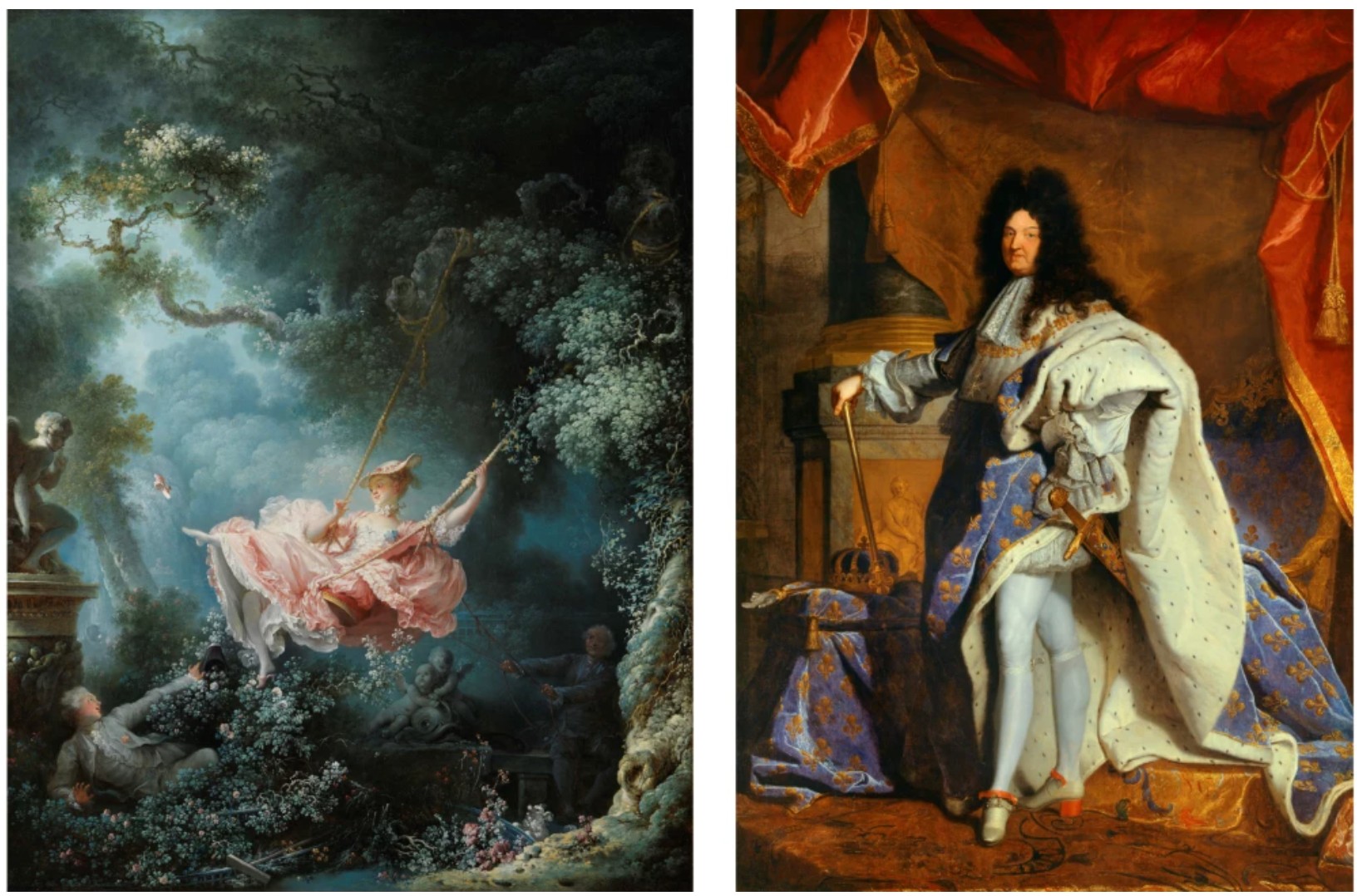
Left: Jean-Honoré Fragonard, The Swing, 1767. Wallace Collection, London. Image © Wallace Collection, London, UK / Bridgeman Images. Right: Hyacinthe Rigaud, Portrait en pied de Louis XIV, 1701. Château de Versailles. Image © Photo Josse / Bridgeman Image
Central to Louis XIV’s conceptual force is its material, polished stainless steel, which Koons deploys with both formal precision and philosophical provocation. Interacting with the work, the viewer’s own image is reflected back from the seductive surface.
“It’s about affirming the viewer, telling him, ‘You exist! When you move, it moves. The reflection changes. If you don’t move, nothing happens. Everything depends on you, the viewer.”
Further, steel is a practical, even proletarian material, one familiar to Koons given his upbringing in a steel industry town in Pennsylvania.
“I chose high-grade stainless steel as my material for the sense of security it emanates. The polish only emphasises that security, as does the fact that the saucepans Mom used to cook with were steel too.”
Simultaneously, steel exudes the gleam and glimmer of luxury and sanctitude.
“In the high-grade steel works, there’s a direct link with religious relics, which are polished too. So they make a spiritual appeal to the beholder and fill him with confidence.”
At once proletarian and luxurious, the material enacts in its very surface the cultural hierarchies it sets out to dismantle.
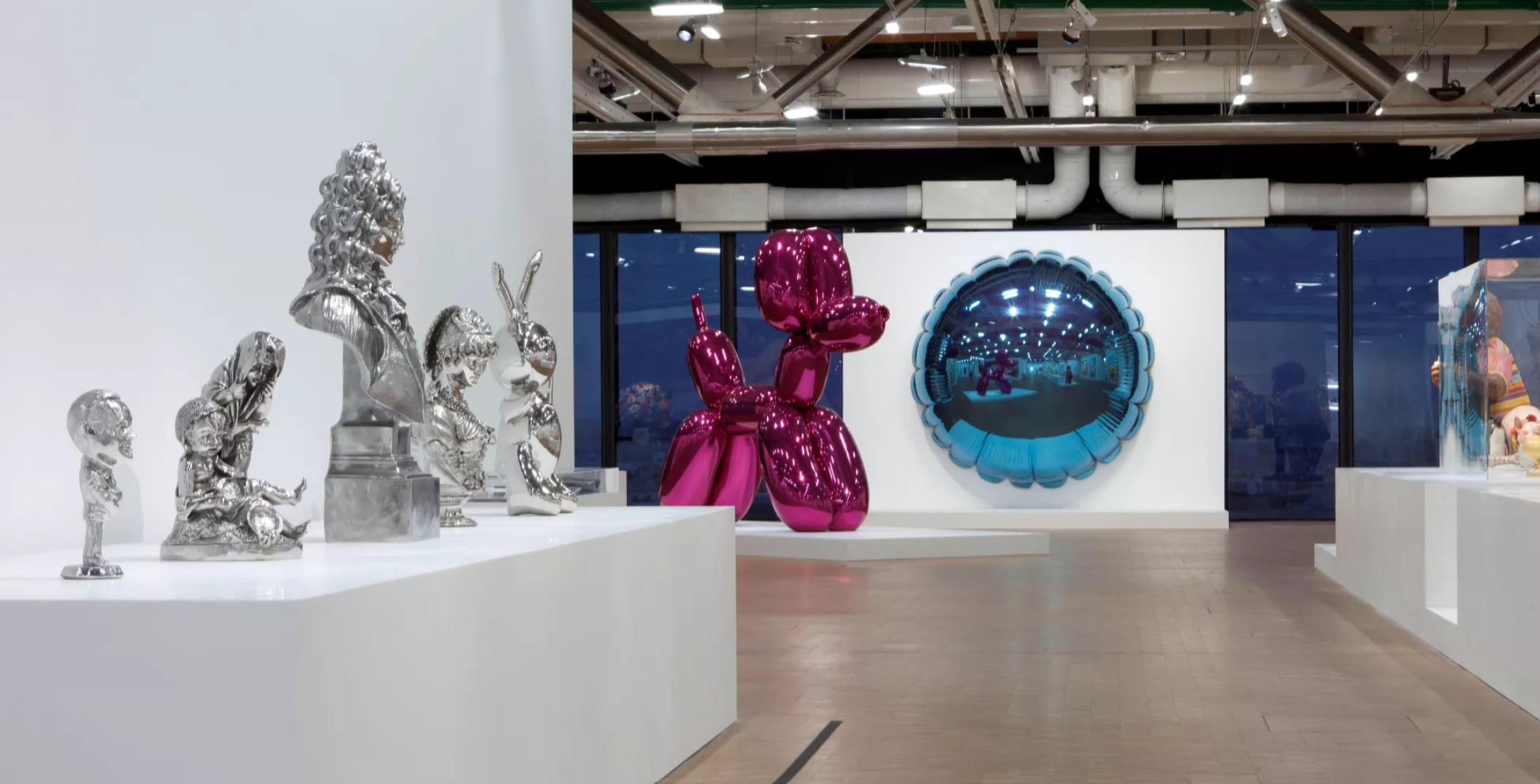
Another edition of the present work installed in Jeff Koons: A Retrospective at the Centre Georges Pompidou, Paris, November 2014 – April 2015. Photo © CNAC/MNAM, Dist. RMN-Grand Palais / Art Resource, NY. Photo by Hervé Véronèse. Art © 2026 Jeff Koons
“Louis was a symbol of what happens to art under a monarch (whoever controls it, it will eventually reflect his or her ego and simply become decorative). I was making reference to that because if I wanted that responsibility or had that opportunity, the same thing would eventually happen. If you put art in the hands of the monarch it will reflect his ego and eventually become decorative. If you put art in the hands of the masses, it will reflect mass ego and eventually become decorative. If you put art in the hands of Jeff Koons it will reflect my ego and eventually become decorative.”
Both art-historical statement and trophy object, Louis XIV is perhaps the work that most directly addresses the mythology of power that surrounds Koons as an artist. Depicting the first celebrity monarch, the original master of image-making, Koons draws a parallel between King Louis XIV’s use of image and his own use of popular iconography, thereby implicating his own ego in the same cycle of vanity and decoration he sets out to expose.
Gazing Ball (Esquiline Venus), 2013
Gazing Ball (Esquiline Venus), 2013
Edlis Neeson Collection
Christie’s New-York: 20 May 2026
Estimated: USD 600,000 – 800,000
USD 508,000
JEFF KOONS (B. 1955), Gazing Ball (Esquiline Venus) | Christie’s
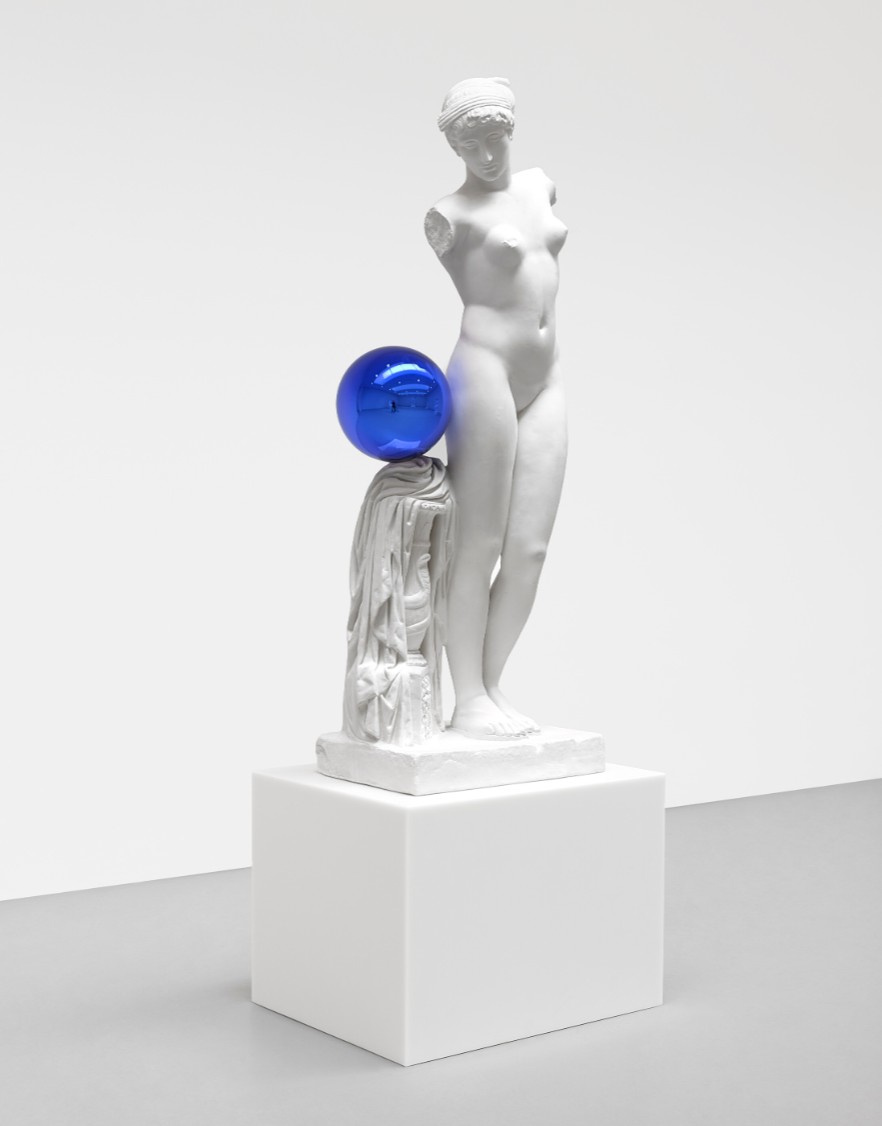
JEFF KOONS (B. 1955)
Gazing Ball (Esquiline Venus), 2013
Plaster and glass
Figure: 61-3/8 x 24-1/8 x 16-1/8 inches (155.9 x 61.3 x 41 cm)
Base: 21x29x23 inches (53.3 x 73.7 x 58.4 cm)
This work is number one from an edition of three plus one artist’s proof
Jeff Koons’s Gazing Ball (Esquiline Venus) is a striking example from the artist’s iconic Gazing Ball series of sculptures created in 2013. Blending the readymade with art historical tradition, Koons here casts the canonical ancient Roman sculpture Esquiline Venus in plaster. The artist cheekily balances a blue gazing ball in a seemingly precarious position, teetering at the edge of the sculpture’s urn support. Working on this series, Koons came to a realization, noting how “with sculpture, you feel a constant polarity between the biological and Platonism. The sculpture also places an emphasis on form.” (quoted in B. Powers, “A Talk with Jeff Koons,” Art News, Spring 2016, p. 29). Fusing the classical past with the contemporary moment, Koons establishes a compelling commentary on temporality. As the Italian curator Francesco Bonami writes, “time in Koons’s work is eventually irrelevant. No apparent hierarchy exists in the timeline of his production. That’s why the Gazing Ball group of sculptures is blooming from several different places with no direct connection between them” (“A Kind of Blue,” in Jeff Koons: Gazing Ball, exh. cat., David Zwirner, New York, 2013, n.p.).
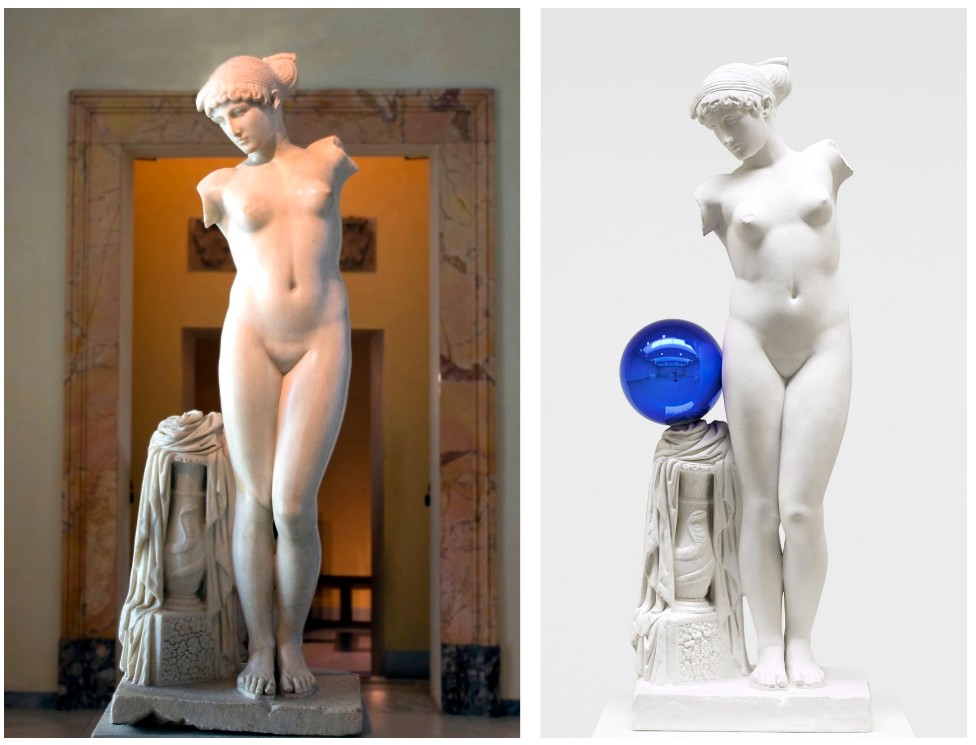
Left: The Esquiline Venus, circa 50 C.E. Capitoline Museums, Rome. Photo: Shutterstock.
Right: Present lot illustrated.
Koons created a special type of plaster to create his new series. His artistic intervention follows a noble history of imitatio, the imitation of ancient art, with artist’s including Michelangelo creating sculptural copies of Greek and Roman works. The Victorian era saw a renewed interest in copies, with thousands of plaster casts made to reproduce ancient art. Koons is just the latest artist interested in engaging with the art of the past, but in the present work he adds an absorbing new element to the millennia-old form.
“Gazing Balls are devices of connecting. I want to participate, I always just wanted to be involved in a dialogue with the avant-garde. This is my family, these are the artists I have interest in, the joy that has enriched my life. I enjoy participating in the dialogue and I want to being something to the table.”
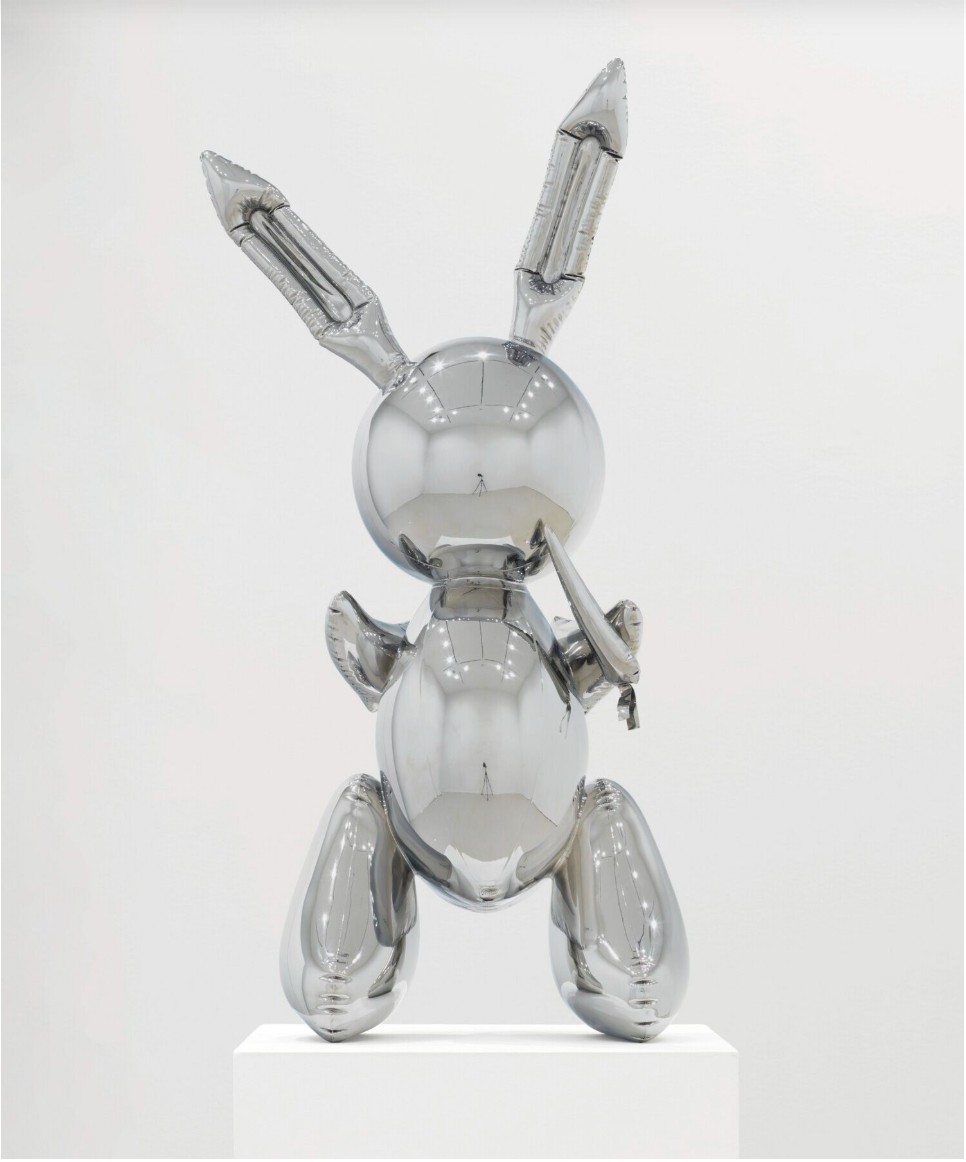
Jeff Koons, Rabbit, 1986. © Jeff Koons.
Relating the Gazing Ball series to the optical design of Hadrian’s Villa, Bonami elucidates how, “in Koons’s new body of work, the sculptures have become recipients of the blue bubbles that looks like they could have been raised out of Canopus’s waters like a crowd of magical fairies or perhaps like isolated fireflies invading the hills outside ancient Rome on a summer’s night” (F. Bonami, op. cit.). Koons considers the head of his important earlier sculpture Rabbit to be the original gazing ball. His adoption of the gazing ball motif mirrors the Duchampian readymade: “the gazing ball is like Duchamp’s urinal in that it’s a confrontational object, but it’s also very retinal” the artist notes (ibid.). With its addition to the present work, Koons reframes the focus of the piece away from the form itself and towards the environment within which the work resides, incorporating his audience into the artwork itself. While the gazing ball “represents the vastness of the universe and at the same time the intimacy of right here, right now,” the sculptural cast of Esquiline Venus does not intend to replicate the visual experience of seeing the original, held in the Capitoline Museums in Rome, and instead represents a conceptual embodiment of antiquity’s essence (ibid.).
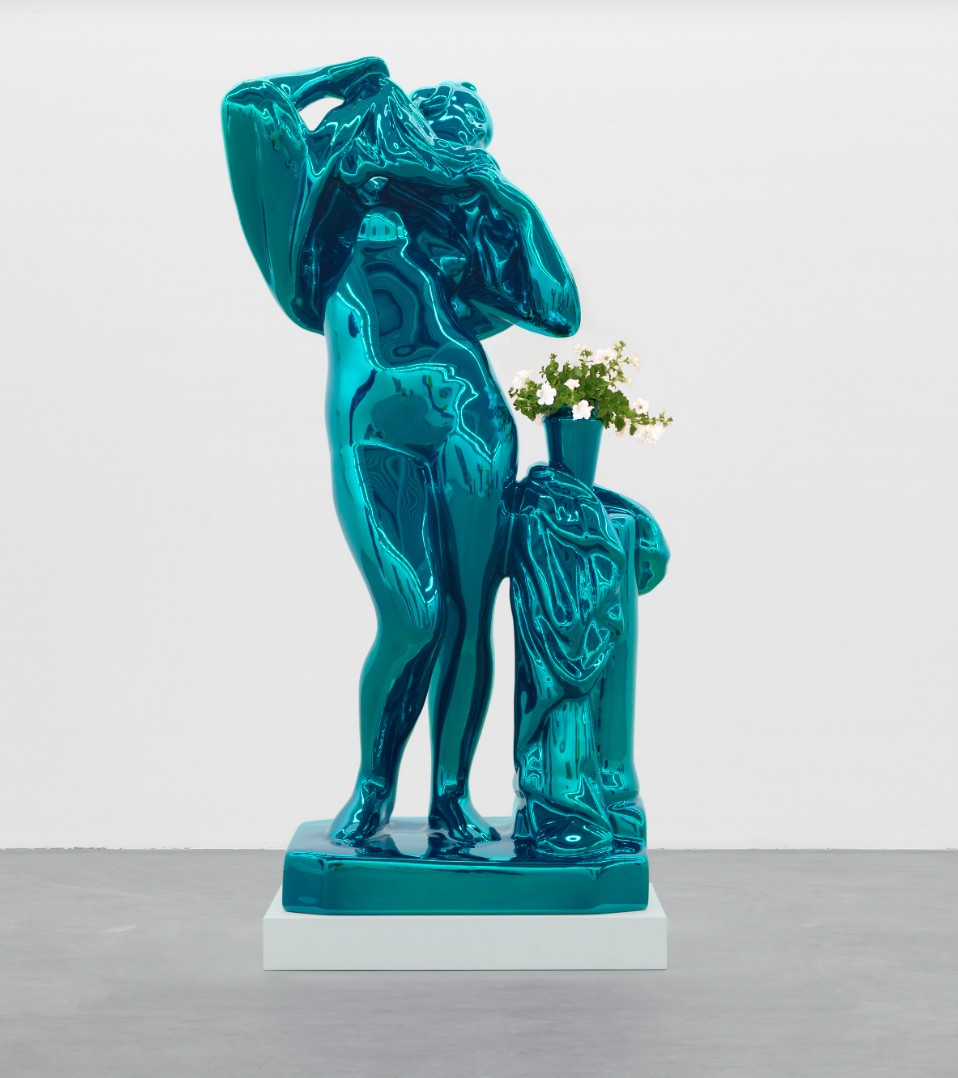
Jeff Koons, Metallic Venus, 2010-2012. The Broad, Los Angeles. © Jeff Koons.
The original Esquiline Venus was first unearthed in Rome in 1874, as the ancient city was being renovated after becoming the capital of the modern Italian state. While the true subject of the work is not known, the work is either a representation of the Greco-Roman goddess Venus or the Egyptian Queen Cleopatra. It is thought to represent an example of the eclectic Neo-attic style of around the first century CE, which itself sought to imitate the previous style of Attic Greece several centuries earlier.
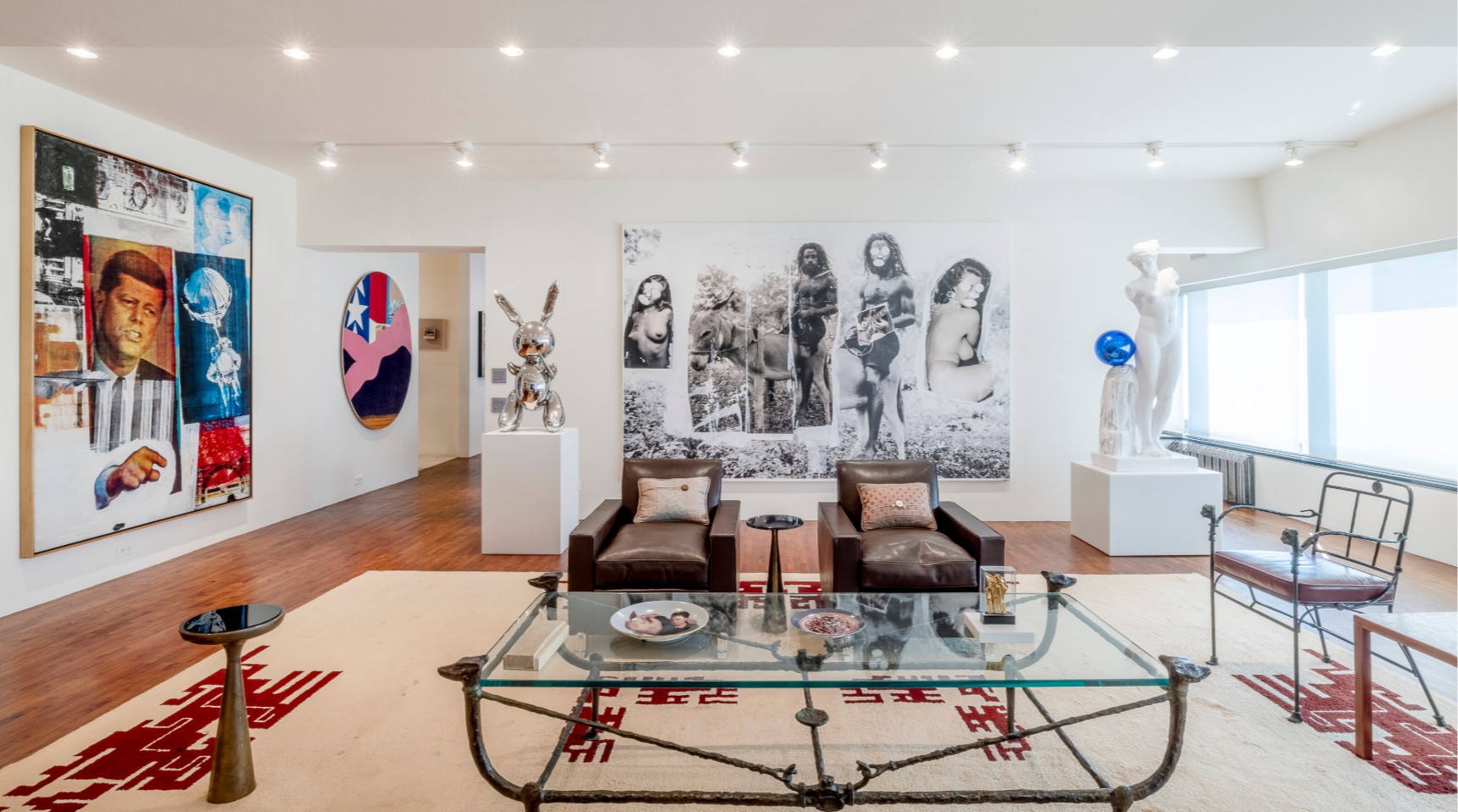
Immediately after being unearthed, the work attracted the gaze of artists, including the celebrated painter Lawrence Alma-Tadema, whose painting A Sculptor’s Model, completed in 1877, recreates the sculptural form of the Esquiline Venus into a painted figure. Another painter, Edward Poynter, also adapted the ancient sculpture for his painting Diadumenè (1884, Royal Albert Memorial Museum, Exeter), which shows the Venus figure in a bathhouse near a reflecting pool. The reflective image inspired the Capitoline Museums to install the original Esquiline Venus next to a reflecting pool, anticipating Koons’s artistic intervention.
“The experience is about you, your desires,
your participation, your relationship with the image.”
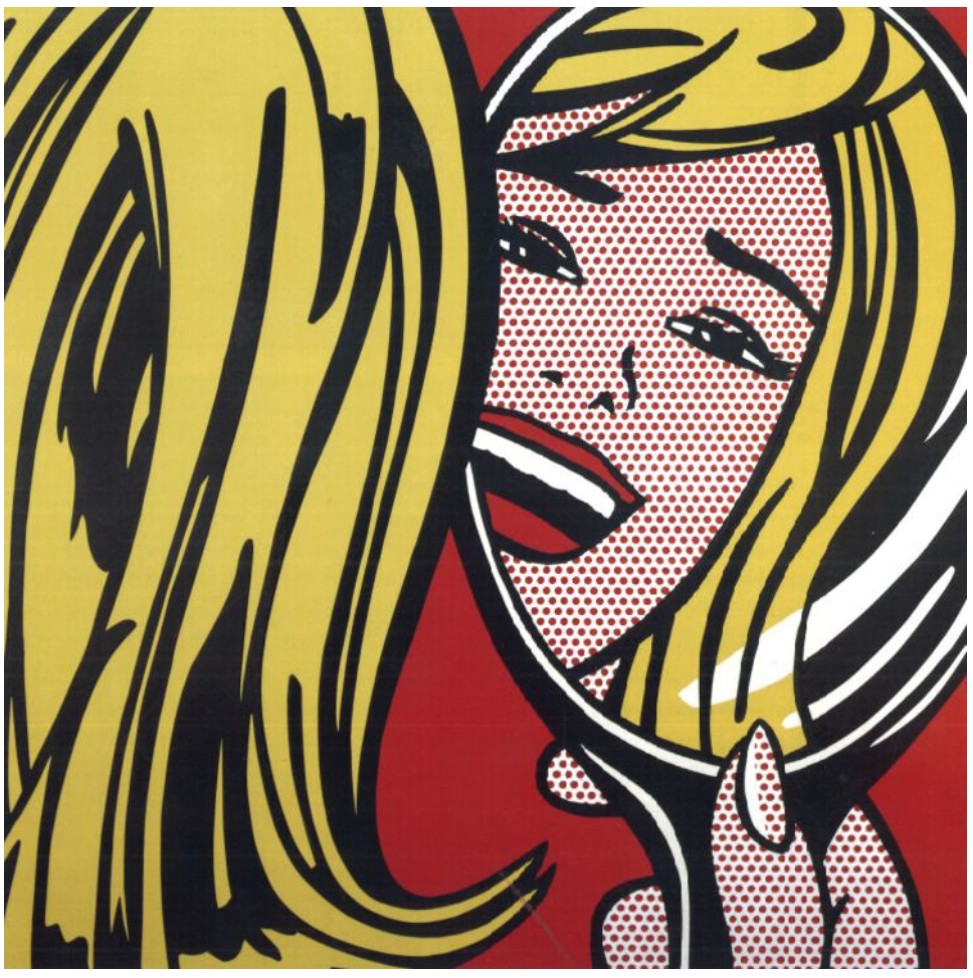
Roy Lichtenstein, Girl in Mirror, 1964. © 2026 Estate of Roy Lichtenstein / DACS.
Gazing Ball (Esquiline Venus) creates a fascinating view into Jeff Koons’s deep art historical knowledge as he innovates upon the notion of the readymade, appropriating canonical subjects in the tradition of Duchamp while interpreting the experience of his viewer through cannily placed reflections.
Silver Shoes, 1990
Silver Shoes, 1990
Edlis Neeson Collection
Christie’s New-York: 20 May 2026
Estimated: USD 400,000 – 600,000
USD 254,000
JEFF KOONS (B. 1955), Silver Shoes | Christie’s
JEFF KOONS (B. 1955)
Silver Shoes, 1990
Oil inks on canvas
96×144 inches (243.8 x 365.8 cm)
This work is number one from an edition of one plus one artist’s proof
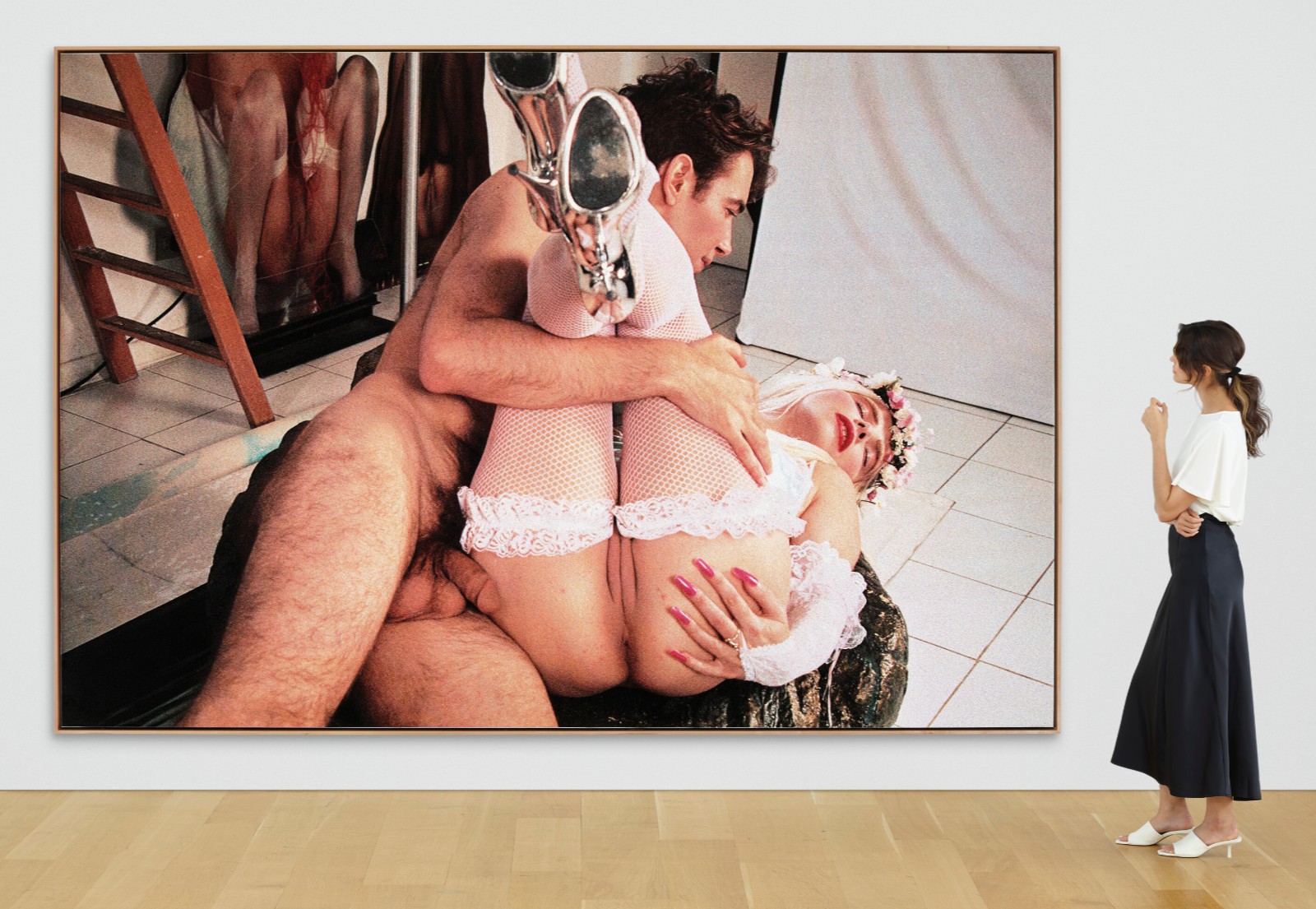
Jeff Koons’s Silver Shoes is an iconic work from the artist’s pivotal Made from Heaven series. Created from 1989 to 1992, the notorious series marked a dramatic evolution for Koons, presenting his first works on canvas as well as fully conceptualizing the motifs that he would continue to elaborate on until the present day. Focusing on themes of desire and objectification, which Koons considers the driving forces of art history, the series presents large silk-screened images of sexual activity between Koons and his then-wife Ilona Staller, also known by the moniker Cicciolina. The paintings were first exhibited alongside life-sized wood sculptures of animals and flowers, as well as glass figurines of the duo. This radical new project functioned as a “Gesamtkunstwerk that unfolded in real time over several years,” as the art historian Alison M. Gingeras writes. “In the process of making Made in Heaven from 1989 to 1992, Jeff Koons became Jeff Koons. It was over this crucial three-year span that he forged both his art world and mainstream identity. As has been documented in recent art historical scholarship, this body of work allowed Koons to ‘crossover’—catapulting him from art world star to mainstream media figure” (“Born through Porn: How Jeff Koons Became Jeff Koons,” in Jeff Koons: Made in Heaven, exh. cat., Luxembourg & Dayan, New York, 2010, pp. 13-14).
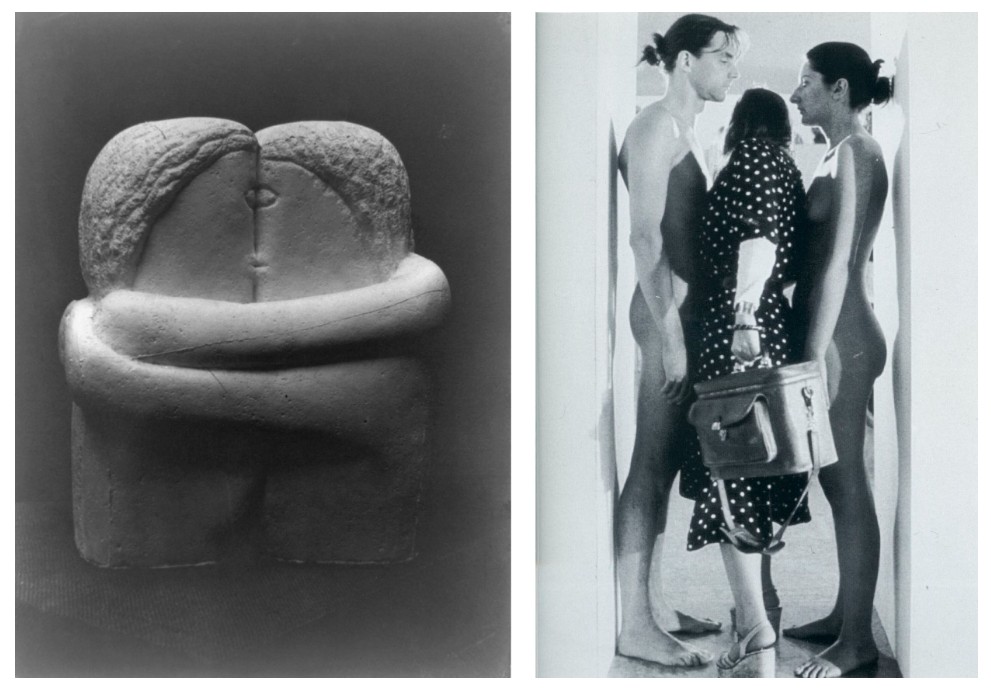
Left: Constantin Brancusi, The Kiss, 1913. Philadelphia, Museum of Art.
Right: Marina Abramović, Imponderabilia, 1977. © 2026 Artists Rights Society (ARS), New York / VG Bild-Kunst, Bonn.
Describing the Made in Heaven series:
“It was about using the body as metaphor, again, for self-acceptance, the acceptance of sexuality, how we procreate, how we continue the species. It’s our genes, our DNA. I believe that there are forms of communication that are biological, which are really quite profound”
In Silver Shoes, the titular element foregrounds the composition, foreshortened directly at the apparent surface of the canvas as Staller’s legs dangle in the air, feet crossed slightly at the ankles. Koons presents the scene frontally, revealing both his and Staller’s genitalia as well as their facial expressions—Staller’s face appears lost in ecstasy, a modern reenactment of Bernini’s St. Teresa in Ecstacy, which Koons’s intent gaze seems determined to capture. The scene appears to be one of post-coital bliss, contrasting with the more active positions of the other works from the Made in Heaven series.
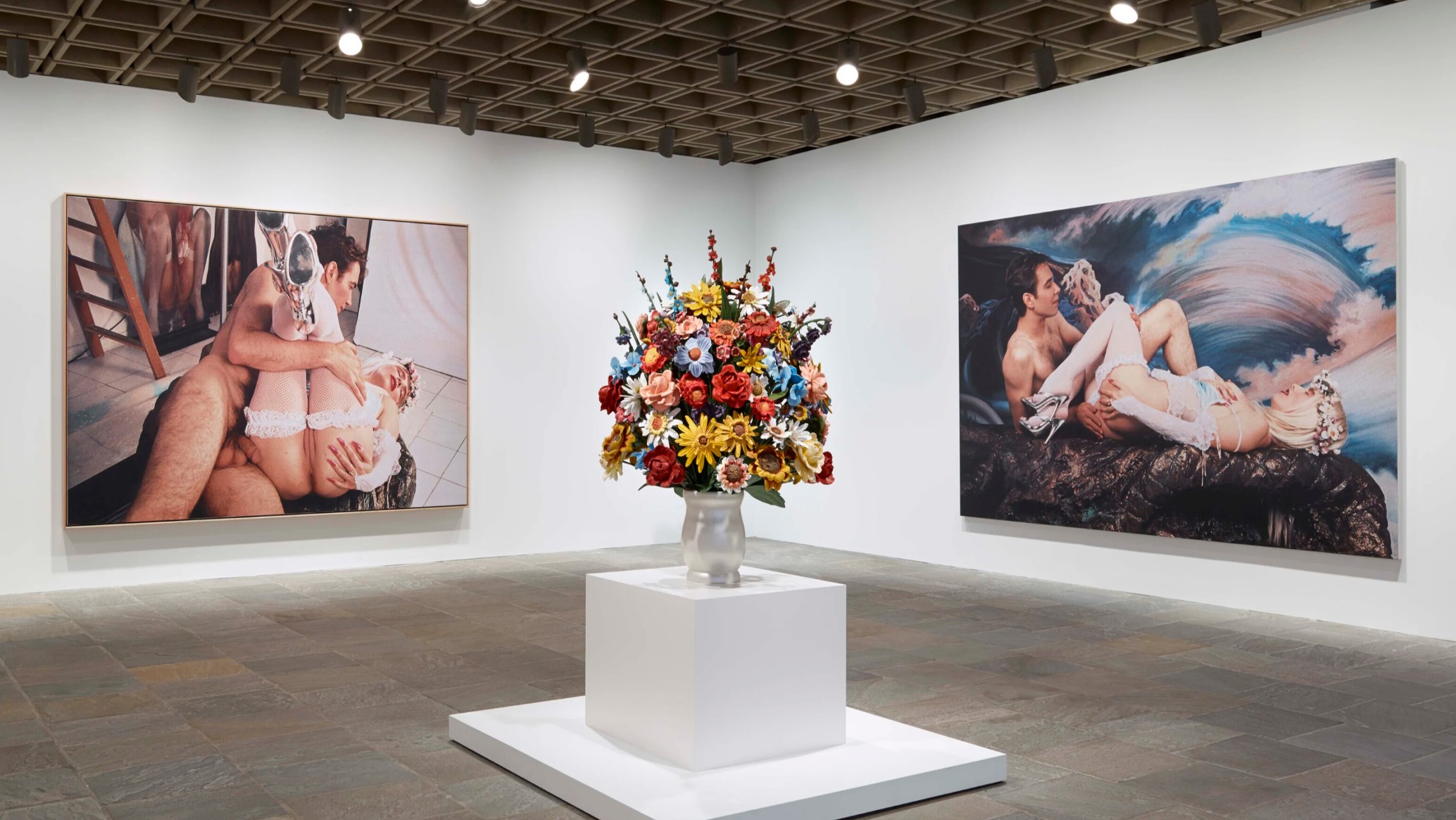
Installation view. New York, Whitney Museum of American Art, Jeff Koons: A Retrospective, June – October 2014 (present lot illustrated). Artwork: © Jeff Koons. Photograph: Ronald Amstutz
While erotic and explicit, the present work, and the series overall, are by no means pornographic. As the curator and art critic John Caldwell writes of the series, “A curious aspect of Koons’s new paintings is that they are not pornographic, even though they are explicit depictions of sexual activity… Probably the reason for this is that in one sense, they are too real. In an essay published in 1969, Susan Sontag pointed out that pornography is often placed outside the category of serious writing because it lacks fully developed characters. Her thesis was that the characters in a pornographic novel must be fairly generic figures in order to project our erotic desires onto them; too much literary specificity in its actors would make the characters into real people and interfere with our fantasies. In the case of Koons’s work, something like that seems to have happened” (“Jeff Koons: The Way We Live Now,” in Jeff Koons, exh. cat., San Francisco Museum of Modern Art, 1992, p. 14).
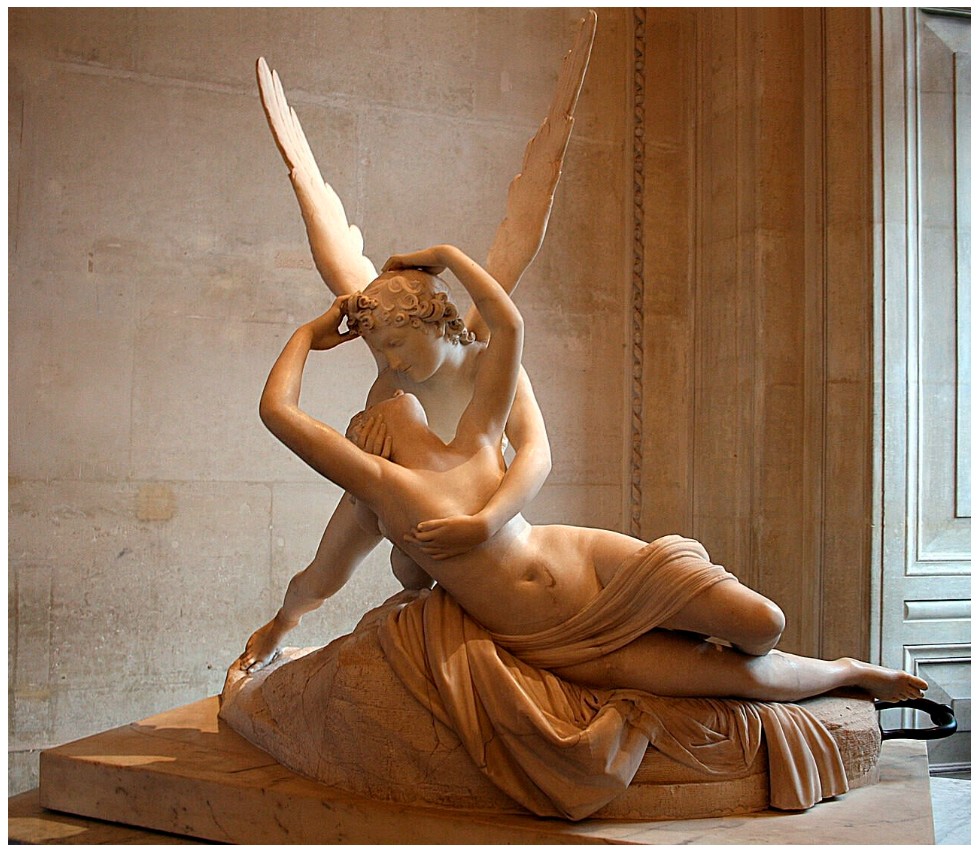
Antonio Canova, Psyche Revived by Cupid’s Kiss, 1787-1793. Musée du Louvre, Paris.
“Like rococo art and Duchamp,” the scholar Daniela Salvioni writes, “Made in Heaven unabashedly places sex within the purview of art. It dares to broach the issue of pleasure in a context in which its appearance is rare, despite the fact that to please is an integral function of art. Moreover, it does so in an era besieged by hysterical puritanism, thus ushering in, in my opinion, a welcome defiance of repressive attacks” (“Jeff Koons’s Poetics of Class,” in ibid., p. 25). As Salvioni notes, erotic art has a long and distinguished art historical legacy, from prehistoric fertility talismans onward to the disguised eroticism of Fragonard. Koons himself makes both explicit and implicit reference to this history in the series: his work Manet references the French artist’s Déjeuner sur l’herbe, while his Violet Ice (Kama Sutra) refers to the famous ancient Sanskrit text on sexuality and eroticism. In the present work, Koons makes more implicit reference to historic erotic art—the position of the couple recalls the pose of the two lovers in Michelangelo’s Leda and the Swan, later destroyed for its supposed indecent subject matter, as well as a work from the infamous series of prints made by Marcantonio Raimondi in collaboration with the writer and poet Pietro Aretino. Known as I modi, or The Sixteen Pleasures, this series of erotic prints was among the first to elevate erotic art into the art historical mainstream.
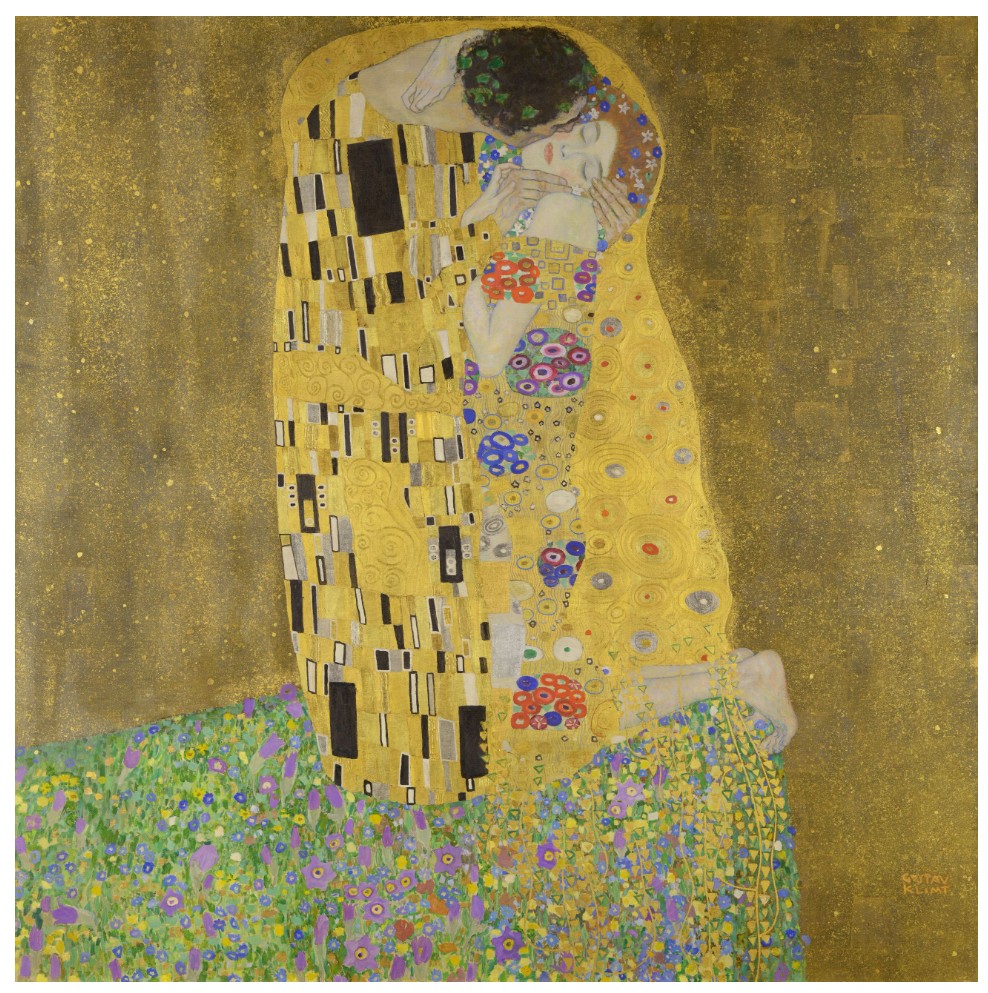
Gustav Klimt, The Kiss, 1907-1908. Österreichische Galerie Belvedere, Vienna.
Silver Shoes also resembles another antecedent—the erotic paintings of Egon Schiele, particularly Man and Woman I (Lovers I) (1914, Private collection) and The Embrace (Lovers II) (1917, Belvedere, Vienna). In the latter, Schiele paints a self-portrait of himself and his wife Edith post-coitus. In these works, the artist explores “the fundamental rift between the sexes, and revolve around duality, unfulfilled desires and expectations, and the failure of relationships” as the art historian Kerstin Jesse writes (“From ‘Hell Brueghel’ to ‘Decipherer of Human Traits’: Egon Schiele’s ‘Late Works from 1914 to 1918,” in Changing Times: Egon Schiele’s Last Years, 1914-1918, exh. cat., Leopold Museum, Vienna, 2025, p. 24). Like Schiele, Koons transforms an intimate, autobiographical encounter into an image that oscillates between tenderness and estrangement, specificity and archetype. In Silver Shoes, this charged equilibrium situates the work within a lineage of erotic art that is less concerned with provocation than with revealing how desire, vulnerability, and selfexposure have long functioned as engines of artistic invention.