Richard Prince’s Nurses:
Desire, Fear, Appropriation, and the Mask
The Nurse is historically typecast as an icon of goodness, a benevolent caregiver and healer. However the 20th century has played with that role and eroticized it, casting her as a different character: a lustful and naughty object of sexual desire. It is this striking tension between the good and the wicked that Richard Prince so astutely captures in his Nurse series and what makes these works such intriguing and sought after paintings.
The Nurse Paintings are considered one of the most distinctive and highly prized series of Prince’s lauded career to date. While on the surface it is their sumptuous, fantastical, and seductive appearance that distinguishes them from the artist’s Joke paintings or Cowboy photographs, these three renowned series are in fact intimately connected through the equally firm roots they each take in the core ethos of Prince’s highly conceptual and pioneering practice. The pop appropriation that constitutes the essence of the Cowboy corpus is critical to the conception and execution of the Nurses; with his Joke paintings, these works share a dependence on borrowed text and kitsch humor. What is added here, to brilliant effect and with true bravado, is Prince’s riposte to Abstract Expressionism. Similarly enlivened with heady brushstrokes, drips and splatters, the Nurse Paintings pay homage to the techniques pioneered by the legendary group of Abstract Expressionist artists working to redefine the contemporary landscape in the exact same era the pulp novel was at the height of its popularity. Indeed, under the churning, unsettling marks of Prince’s brushstroke, the present work seems to recall Willem de Kooning’s bold and gestural painterly dynamism.
WORK IN PROGRESS
Introduction
Richard Prince’s Nurse paintings are among the most recognizable, provocative, and commercially powerful bodies of work in contemporary American art. Begun in the early 2000s, the series takes as its source material the covers of mid-century nurse romance and pulp novels, a strange literary subgenre in which the nurse appears as angel of mercy, erotic fantasy, victim, temptress, professional caregiver, and melodramatic heroine all at once. Prince seized on this unstable figure with remarkable precision. The nurse, historically associated with healing, sacrifice, discipline, and goodness, had also been repeatedly transformed by popular culture into an object of fantasy. Prince’s genius was to understand that this contradiction was not incidental. It was the subject.
The result is a group of paintings that operate simultaneously as Pop appropriation, psychological portraiture, feminist provocation, pulp melodrama, and painterly theater. They are seductive and sinister, beautiful and troubling, humorous and uncomfortable. The best of them have the quality of an image one feels one has already seen somewhere: in an airport paperback, an old movie poster, a hospital corridor, a nightmare, or possibly a very expensive gallery opening. Prince did not invent the nurse stereotype. He stole it, enlarged it, masked it, painted over it, and returned it to us in a form that is both more artificial and more revealing.
Origins: Pulp Fiction, Bibliophilia, and the Found Image
The Nurse paintings emerged from Prince’s long-standing practice of appropriation. Since the late 1970s, Prince had built his reputation by taking images from mass media, advertising, and popular culture and repositioning them as art. His Cowboys, derived from Marlboro advertisements, dismantled the mythology of American masculinity. His Girlfriends, taken from biker magazines, exposed another eroticized subculture of male fantasy. His Joke paintings transformed low humor into deadpan linguistic abstraction. The Nurses belong to this same family, but they are more painterly, more theatrical, and more emotionally charged.
Prince had worked at Time-Life magazine early in his career, where he encountered the endless circulation of images in modern media. What others might have regarded as disposable visual material became, for him, a vast archive of anonymous desire. His art has often been compared to Marcel Duchamp’s readymades, and the comparison is useful. Like Duchamp, Prince challenged the idea that artistic creation must begin with invention. But where Duchamp selected objects, Prince selected cultural fantasies. He did not simply appropriate images; he appropriated the social machinery behind them.
The immediate source for the Nurse paintings was Prince’s own collection of vintage paperbacks. He was, and remains, a serious bibliophile, particularly interested in first editions, pulp fiction, countercultural literature, and the strange literary debris of American popular culture. The nurse novels of the 1950s and 1960s were perfect Prince material: cheap, formulaic, over-designed, faintly ridiculous, and psychologically revealing. Their titles alone read like miniature melodramas: Man-Crazy Nurse, Park Avenue Nurse, Lake Resort Nurse, Nurse on Trial, Runaway Nurse, Conflict for Nurse Elsa, Overseas Nurse. Each title promises danger, romance, moral crisis, and erotic suspense, all wrapped in the respectability of a white uniform.
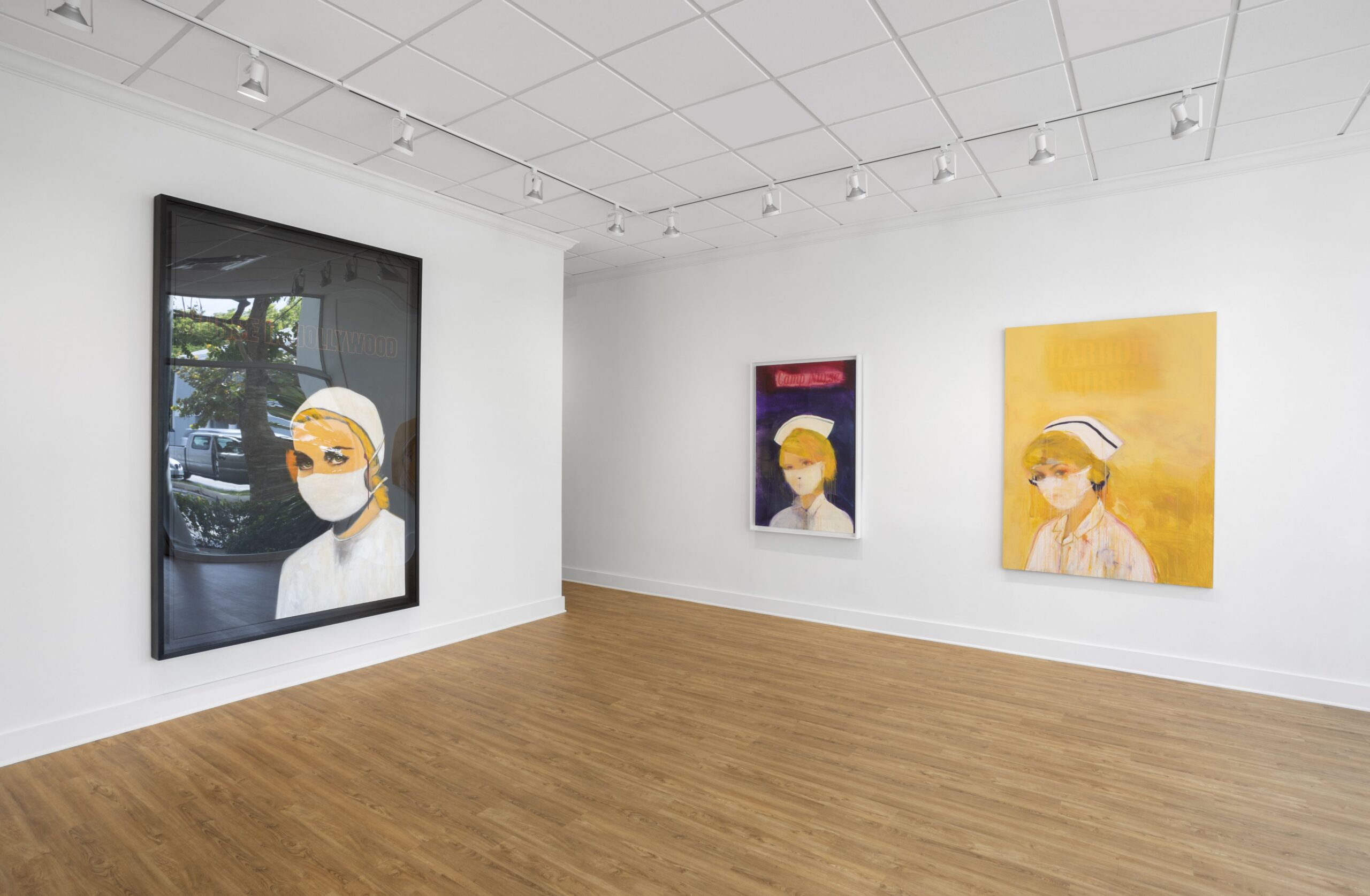
Prince’s first major public presentation of the series took place in London at Sadie Coles HQ from April 23 to May 31, 2003, where the gallery described the works as beginning with the covers of medical romance novels that Prince scanned, enlarged, and overpainted until only the nurse and her title largely remained. Later that year, the series was shown at Barbara Gladstone Gallery in New York from September 20 to October 25, 2003, in an exhibition that included nineteen new works. This Gladstone exhibition quickly became legendary. According to the material you provided, the show was effectively sold out before it officially opened, confirming almost immediately that Prince had found not merely a new subject, but a new icon.
Technique: Scanning, Enlarging, Masking, Painting
The technical process is central to the meaning of the series. Prince began by scanning the covers of nurse pulp novels from his collection. He then enlarged the images and transferred them to canvas using inkjet printing. Over this printed ground he applied acrylic paint, often in sweeping, dripping, gestural layers. The original image remained present, but partially buried. Prince did not erase the source entirely; he staged a struggle between reproduction and painting.
In many works, the male figure from the original paperback cover is removed or obscured. The background is often dissolved into smoky abstraction. Text is partially preserved, especially the title, which becomes both label and accusation. Most importantly, Prince adds or emphasizes the surgical mask, covering the nurse’s mouth and lower face. This mask became the key visual device of the series. It unifies the paintings, removes individuality, and transforms the nurse into an archetype. It also silences her. She cannot speak. She can only look.
Prince once described the mask as a way of “making it all the same and getting rid of the personality,” a statement that is both artistically illuminating and morally uncomfortable. The mask is not only a medical accessory. It is a conceptual tool. It turns the nurse into a cipher onto which viewers project desire, anxiety, fear, nostalgia, and guilt. In a pre-pandemic context, the mask was already loaded with associations of infection, vulnerability, sterility, and death. In a post-pandemic world, the paintings have acquired an additional and almost eerie resonance. The masked caregiver is no longer merely pulp fiction. She is also an image of collective fragility.
Prince’s painting style draws deliberately from Abstract Expressionism. The drips, stains, swipes, and atmospheric color fields recall the language of Willem de Kooning, Mark Rothko, Cy Twombly, and other postwar painters. This is one of the great tensions of the series. Prince takes the low material of dime-store fiction and subjects it to the grand theatrical gestures of high modernist painting. The result is not a compromise between high and low culture, but a collision. The pulp nurse is dragged into the museum, while Abstract Expressionism is dragged into the paperback rack. Both survive, but neither emerges innocent.
The Nurse as Archetype: Angel, Object, Threat
The figure of the nurse carries enormous symbolic weight. In Western culture, she has traditionally been imagined as a figure of care, discipline, sacrifice, and moral goodness. She is close to the body, close to suffering, close to blood, close to death. Yet 20th-century popular culture repeatedly eroticized her. The nurse became the “naughty nurse,” a fantasy figure whose professional authority was converted into sexual availability. Prince’s series feeds directly on this contradiction.
The paintings are not simple celebrations of the stereotype. Nor are they clean condemnations of it. Their power lies in their complicity. Prince both exposes the fantasy and indulges it. His nurses are glamorous, seductive, theatrical, and often beautiful. Yet they are also wounded, gagged, isolated, and sometimes terrifying. Paint drips from their masks like blood. Their eyes are enlarged, darkened, or veiled. They appear less like caregivers than apparitions.
This ambiguity explains why the series remains so potent. The nurse is never only one thing. She is caregiver and femme fatale, victim and aggressor, professional and pin-up, saint and suspect. In Nurse on Trial, the very title places her under judgment. In Man-Crazy Nurse, the title reduces her to desire. In Killer Nurse, the caregiver becomes a possible threat. In Runaway Nurse, she is both fugitive and fantasy. In Hurricane Nurse, she appears almost still at the center of a storm, composed but unknowable. The titles are absurd, but that is precisely their force. They reveal how mass culture manufactures women as narratives before they are allowed to become subjects.
Important Exhibitions and Institutional Reception
After its 2003 presentations in London and New York, the Nurse series quickly entered the institutional and market canon. Gagosian’s 2008 London exhibition presented further Nurse paintings and framed the series as one of Prince’s most highly coveted bodies of work, rooted in his long investigation of authorship, ownership, aura, American vernacular culture, and the seductive power of mass media. The gallery also emphasized that Prince’s nurse imagery originated in “Naughty Nurse” books from the 1950s and 1960s, and that the artist scanned the original covers, transferred them to canvas, and overpainted them in a manner evoking postwar abstraction.
The series was also prominently included in Richard Prince: Spiritual America, the major retrospective organized by Nancy Spector at the Solomon R. Guggenheim Museum in New York in 2007. The exhibition later traveled to the Walker Art Center in Minneapolis, where it was described as Prince’s first comprehensive retrospective since 1992 and as a survey of his photographs, paintings, sculptures, and works on paper. Sotheby’s notes that Man Crazy Nurse was shown at Barbara Gladstone Gallery in 2003 and later included in Spiritual America at the Guggenheim, Walker Art Center, and Serpentine Gallery between 2007 and 2008.
This institutional trajectory matters. The Nurses were not merely market sensations. They became a central chapter in Prince’s career narrative. They condensed several of his major concerns: appropriation, gender stereotype, American popular fiction, the death of originality, erotic fantasy, and the unstable relationship between painting and mechanical reproduction.
How Many Nurse Paintings Exist?
The Nurse paintings should not be understood as a closed edition in the way one might discuss a print portfolio. The 2003 Barbara Gladstone exhibition included nineteen new works, which formed the first celebrated public group of the series. However, Prince continued to develop the nurse motif after that moment, producing further works in 2004, 2005, 2006, 2007, 2008, and beyond. Gagosian’s 2008 exhibition, for example, presented a subsequent group of untitled nurse paintings, including works from 2006.
It is therefore safer and more accurate to describe the Nurses as an evolving body of paintings rather than a fixed numbered series. The early 2002–2003 examples connected to the first exhibitions are generally treated as especially important, but later works expanded the language, sometimes becoming more stripped down, more brutal, more abstract, or more directly horror-like. The series begins with pulp romance but eventually becomes something broader: a grammar of masked femininity, cultural anxiety, and painterly appropriation.
Key Works and Variations Within the Series
The market and critical reception suggest several internal categories within the Nurse paintings.
The earliest works from 2001 to 2003 carry exceptional historical weight. Double Nurse from 2001 is especially significant because it appears to inaugurate the series and is unique in presenting two nurse figures rather than one. Its scale, early date, and unusual composition make it one of the most conceptually important examples. Man Crazy Nurse, Park Avenue Nurse, Overseas Nurse, Nurse Elsa, Nurse of Greenmeadow, Piney Woods Nurse, Camp Nurse, and Lake Resort Nurse belong to the early formation of the series and retain a close relationship to the original pulp covers.
Another category consists of particularly cinematic or psychologically charged works. Nurse on Trial carries the atmosphere of film noir and accusation. Hurricane Nurse is more introspective, its gaze cooler and more composed. Killer Nurse pushes the image toward slasher cinema and gothic suspense. These works are less merely “naughty nurse” than masked thriller protagonist.
A third category includes more overtly erotic or spectacular works, with Runaway Nurse as the supreme example. Its scale, sensuality, theatricality, and use of more than one source image make it one of the most powerful and market-tested paintings in the entire series. It is not surprising that it has produced Prince’s strongest auction result among the Nurses.
Legacy: Prince, Pop, and the Afterlife of Appropriation
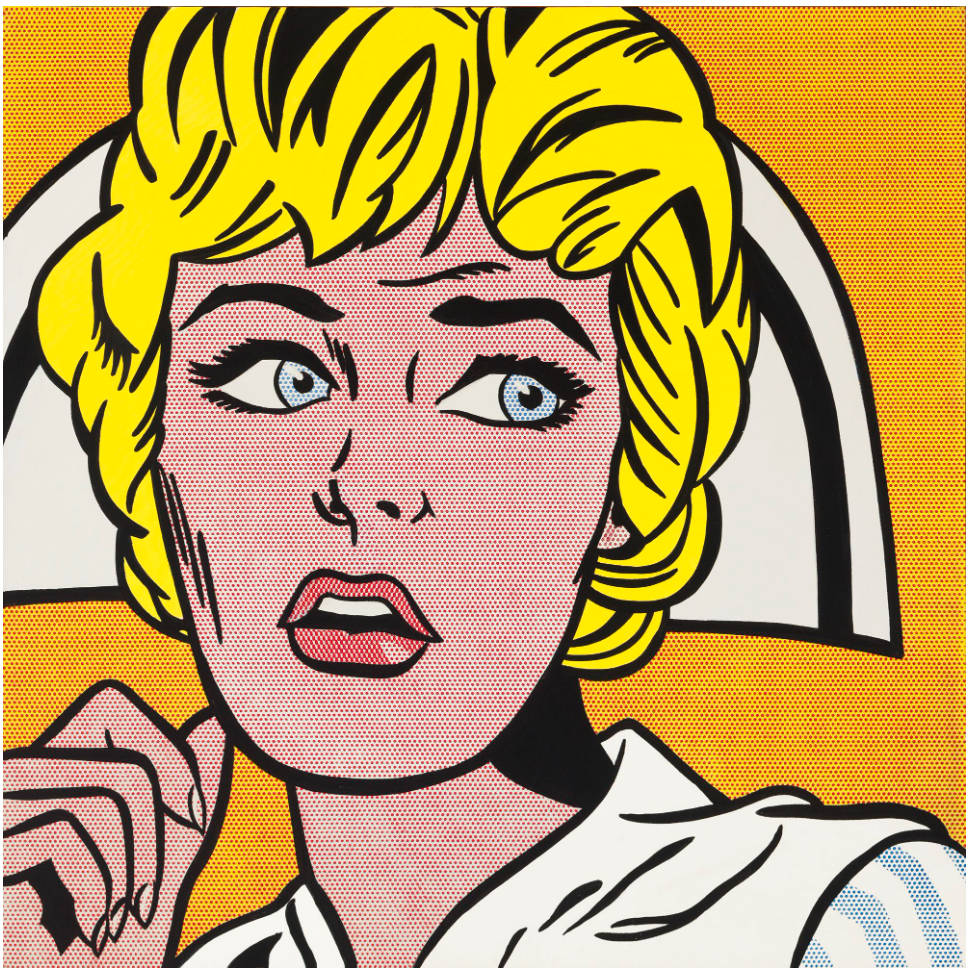
The Nurses are often understood as a continuation of Pop Art, but they are darker than classic Pop. Warhol transformed Marilyn Monroe, Elvis Presley, and consumer goods into icons of repetition and desire. Lichtenstein transformed comic-book heroines into cool, stylized emblems of mass-media emotion. Prince inherits this language but corrupts it from within. His nurses are not clean Pop images. They are damaged Pop images. They drip, blur, bleed, and stutter.
The series also belongs to the legacy of the Pictures Generation, alongside artists such as Cindy Sherman, Sherrie Levine, Barbara Kruger, and Louise Lawler. Like them, Prince questions originality and authorship. But unlike some of his peers, he often allows himself to appear morally implicated in the imagery he critiques. This is what makes his work uncomfortable and effective. He does not stand outside American visual culture like a judge in white gloves. He stands inside it, pockets full of stolen pictures, looking faintly guilty and highly entertained.
The Nurses also influenced fashion and popular culture. The imagery was famously used by Sonic Youth for the cover of their 2004 album Sonic Nurse, helping to circulate the series beyond the art world. The nurse motif also appeared in relation to fashion, notably through the broader cultural visibility of Prince-inspired nurse imagery during the Louis Vuitton Spring 2008 context mentioned in the material you provided. The series has become one of the few contemporary painting cycles instantly identifiable even to viewers who may not know the full conceptual apparatus behind it.
Market Analysis: What Makes a Nurse More Valuable?
The Nurse paintings occupy the top tier of Richard Prince’s market and is central to Prince’s auction strength.
First, scale matters. The largest and most physically commanding works tend to perform best. Runaway Nurse, measuring over 110 inches high, sold for approximately $12.1 million in Hong Kong in 2021, after selling for $9.685 million at Christie’s New York in 2016. Its monumental size, overt sexuality, cinematic composition, and strong source-story make it the benchmark work in the series. Overseas Nurse, Nurse Elsa, and Nurse of Greenmeadow, all large early examples, also achieved major prices.
Second, early date matters. Works from 2001 to 2003 are especially desirable because they belong to the birth of the series and to the moment of its first exhibition history. Man Crazy Nurse, Camp Nurse, Park Avenue Nurse, Nurse Elsa, Nurse of Greenmeadow, Piney Woods Nurse, and Overseas Nurse all benefit from this early status. However, early date alone is not enough. The strongest prices combine early execution with strong image, scale, title, and exhibition history.
Third, exhibition history and provenance matter significantly. Man Crazy Nurse came from the Collection of Barbara Gladstone and was included in the 2003 Gladstone exhibition and in Spiritual America, giving it exceptional art-historical pedigree. Sotheby’s records its provenance from Gladstone Gallery and its acquisition in 2003 by the owner. Yet it sold in 2025 for $3.967 million, below its $4–6 million estimate, suggesting that even excellent provenance does not automatically override broader market selectivity.
Fourth, the most valuable nurses tend to be the most narratively charged. Titles such as Runaway Nurse, Nurse on Trial, Killer Nurse, Man Crazy Nurse, and Hurricane Nurse carry immediate psychological force. They do not merely identify a profession or location; they imply a plot. The market appears to reward works that feel cinematic, dangerous, and memorable. A nurse “on trial” is more compelling than a nurse merely situated in a resort. A “runaway” nurse creates a story before the viewer even looks at the image. A “killer” nurse collapses care and violence into one unforgettable contradiction.
Fifth, beauty still matters. This may sound vulgar, but the market is not a monastery. Works with glamorous, seductive, or visually arresting protagonists tend to command stronger attention. Runaway Nurse is the clearest example, often described as one of the most overtly sexual and visually dramatic works in the series. Nurse in Hollywood #4, with its Grace Kelly-like aura and penetrating gaze, also achieved a strong price in 2010. Paintings in which the nurse’s eyes, pose, and color atmosphere create strong visual magnetism tend to perform better than more subdued or smaller examples.
Sixth, color and atmosphere matter, but not in a simple formula. Red, purple, pink, and dark cinematic grounds appear frequently among the strongest works, largely because they intensify the association with desire, danger, blood, and melodrama. However, the market does not seem to reward one color mechanically. Rather, it rewards the overall theatrical impact: the right title, the right mask, the right scale, the right surface, the right story.
Finally, repeat sales show resilience but also selectivity. Nurse on Trial sold for $5.765 million in 2014 and then $6.7 million in 2024, indicating appreciation over a decade. Runaway Nurse moved from $9.685 million in 2016 to roughly $12.1 million in 2021, confirming its exceptional status. By contrast, some recent 2025 results came in below or near low estimate, suggesting that the market remains strong for the best examples but discriminating. Collectors are not buying “any Nurse” at any price. They are paying premiums for scale, date, image, title, provenance, and historical importance.
Conclusion: Why the Nurses Still Matter
Richard Prince’s Nurses endure because they are unresolved. They are not polite critiques. They do not offer an easy moral position. They show us a stereotype and then make that stereotype unstable. The nurse is desirable, frightening, caring, wounded, powerful, silenced, artificial, and unforgettable. She belongs to pulp fiction, Pop Art, Abstract Expressionism, feminism, horror cinema, and the art market all at once.
The series also marks one of Prince’s most successful transformations of appropriation into painting. In the Cowboys, he rephotographed an American myth. In the Nurses, he painted over one. The difference is crucial. The brush does not purify the stolen image; it contaminates it further. It makes the image more seductive, more ambiguous, and more difficult to dismiss.
In the end, the Nurse paintings are about the strange life of images: how they circulate, how they seduce, how they wound, how they conceal, and how they return. Prince took cheap paperbacks that were designed to be consumed and forgotten, and turned them into some of the most coveted paintings of the early 21st century. That is the scandal and the brilliance of the series. The nurse was always there, waiting under the mask.
Top Lots
#1. Runaway Nurse, 2005-06
Sotheby’s Hong-Kong: 18 June 2021
Estimated: HKD 75,000,000 – 95,000,000
HKD 93,986,000 / USD 12,107,712
REPEAT SALE
Christie’s New-York: 10 May 2016
Estimated: USD 7,000,000 – 10,000,000
USD 9,685,000
Richard Prince (B. 1949), Runaway Nurse | Christie’s
REPEAT SALE
Phillips New-York: 7 November 2011
Estimated: USD 5,000,000 – 7,000,000
USD 6,802,500
RICHARD PRINCE (b. 1949)
Runaway Nurse, 2005-06
Inkjet and acrylic on canvas
110 1/4 x 66 1/4 inches (280×168 cm)
Signed, titled and dated 2005-06 on the overlap
#2. Nurse of Greenmeadow, 2002
Christie’s New-York: 12 May 2014
Estimated: USD 7,000,000 – 9,000,000
USD 8,565,000
Richard Prince (b. 1949) , Nurse of Greenmeadow | Christie’s (christies.com)
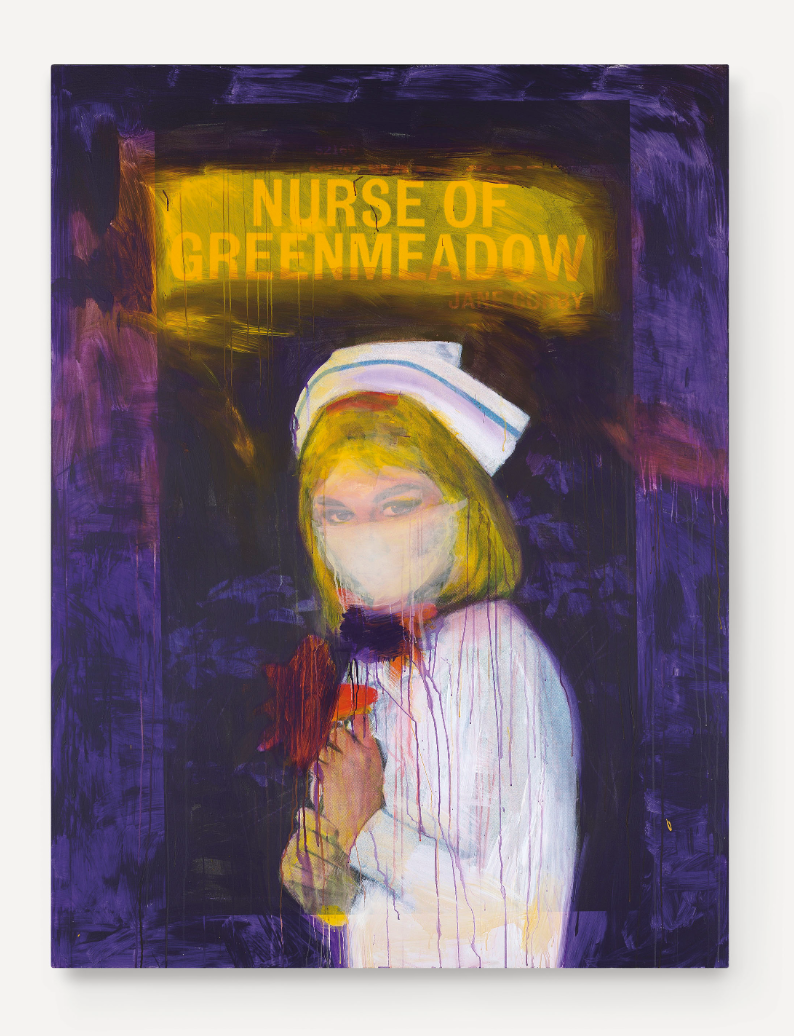
RICHARD PRINCE (b. 1949)
Nurse of Greenmeadow, 2002
Inkjet print and acrylic on canvas
78 x 58 1/4 inches (198.2 x 147.5 cm)
Signed, titled and dated ‘R Prince “NURSE OF Greenmeadows 2002’ (on the overlap)
#3. Overseas Nurse, 2002
Sotheby’s London: 1 July 2008
Estimated: GBP 4,000,000 – 6,000,000
GBP 4,241,250 / USD 8,459,439
(#22) Richard Prince (sothebys.com)
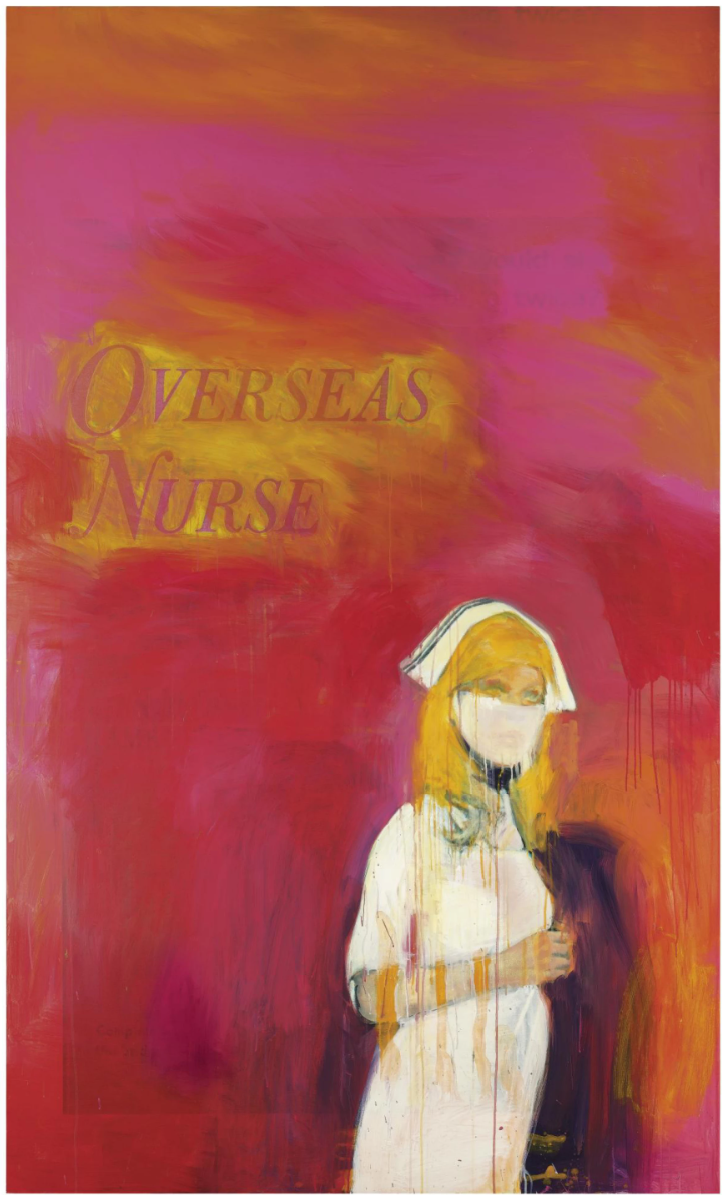
RICHARD PRINCE
Overseas Nurse, 2002
Inkjet print and acrylic on canvas
93×56 inches (236.2 x 142.2 cm)
Signed, titled and dated 2002 on the overlap
USD 8 million
#4. Nurse on Trial, 2005
Sotheby’s New-York: 21 November 2024
Estimated: USD 5,000,000 – 7,000,000
USD 6,700,000
Nurse on Trial | The Now and Contemporary Evening Auction | 2024 | Sotheby’s
REPEAT SALE
Christie’s New-York: 12 November 2014
Estimated: USD 5,000,000 – 7,000,000
USD 5,765,000
Richard Prince (b. 1949), Nurse on Trial | Christie’s
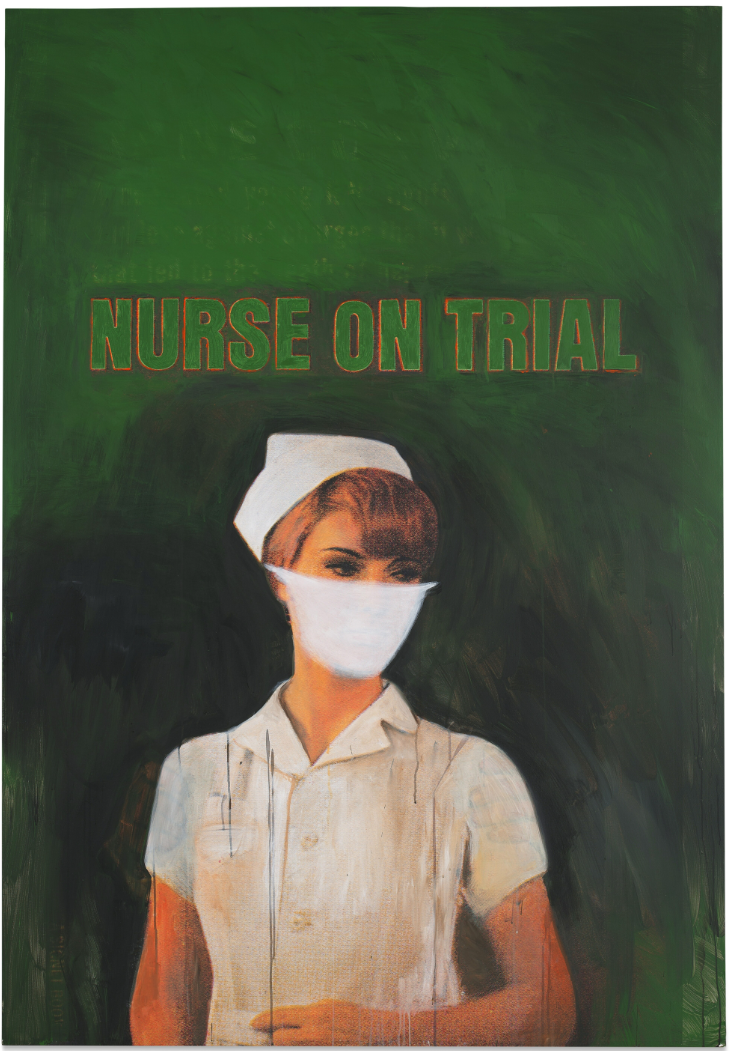
RICHARD PRINCE (b. 1949)
Nurse on Trial, 2005
Acrylic and inkjet on canvas
75×52 inches (190.5 x 132.1 cm)
Signed, titled and dated 2005 (on the overlap)
#5. Nurse in Hollywood #4, 2004
Phillips New-York: 13 May 2010
Estimated: USD 5,000,000 – 7,000,000
USD 6,466,500
Richard Prince – The Collection of Halsey… Lot 8 May 2010 | Phillips
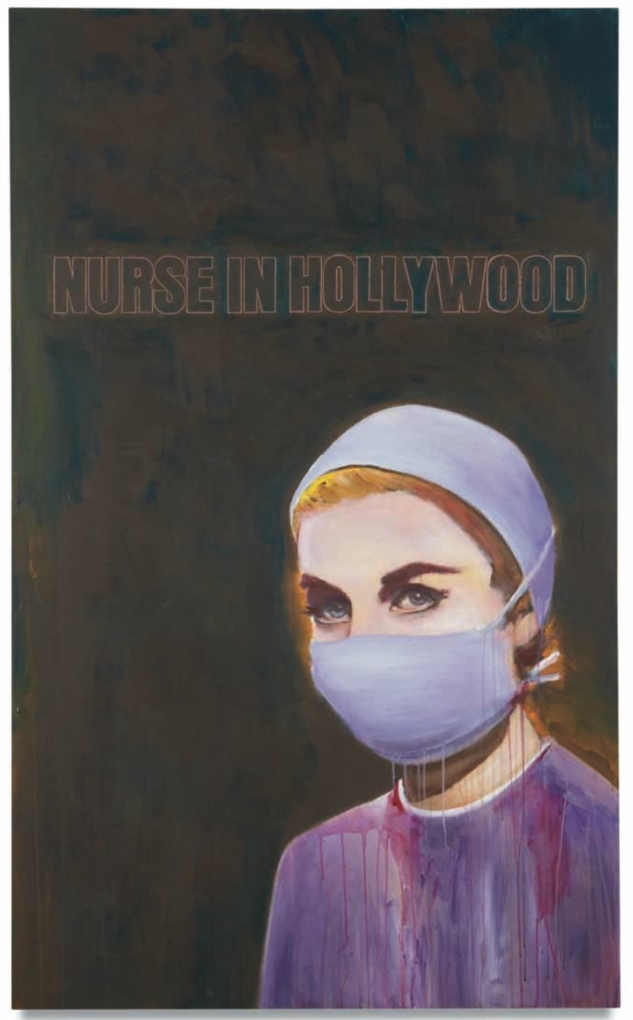
RICHARD PRINCE
Nurse in Hollywood #4, 2004
Acrylic and inkjet on canvas.
69×42 inches (175.3 x 106.7 cm)
Signed, titled and dated “2004 R. Prince Nurse in Hollywood #4” on the overlap
#6. Park Avenue Nurse, 2002
Sotheby’s New-York: 14 November 2019
Estimated: USD 5,000,000 – 7,000,000
USD 6,186,800
(#4) RICHARD PRINCE | Park Avenue Nurse
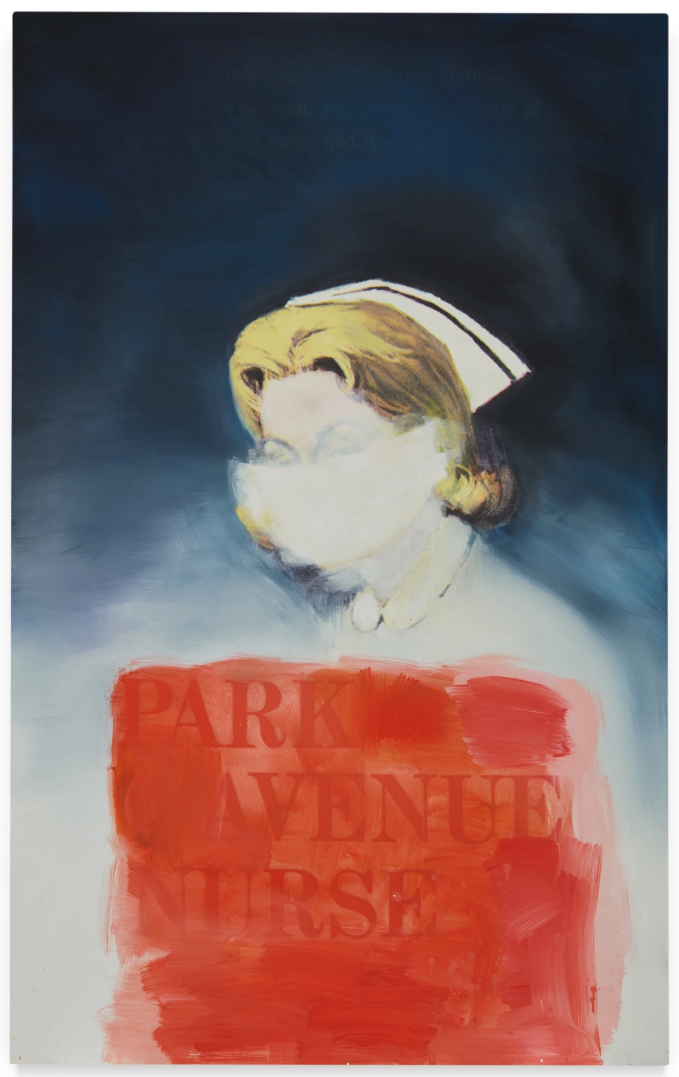
RICHARD PRINCE
Park Avenue Nurse, 2002
Inkjet print and acrylic on canvas
72×45 inches (182.9 x 114.3 cm)
Signed, titled, and dated 2002 on the overlap
#7. Piney Woods Nurse, 2002
Christie’s New-York: 13 November 2007
Estimated: USD 1,800,000 – 2,200,000
USD 6,089,000
Richard Prince (b. 1949) , Piney Woods Nurse | Christie’s (christies.com)
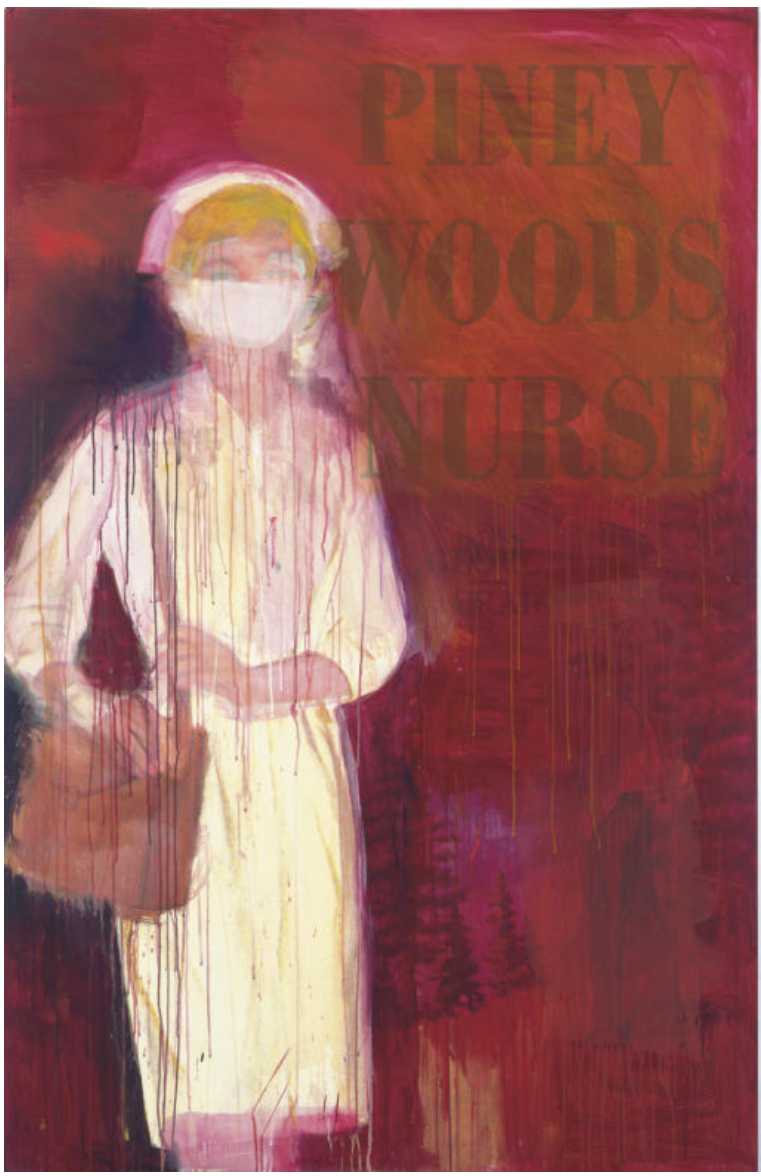
RICHARD PRINCE (b. 1949)
Piney Woods Nurse, 2002
Ink-jet print and acrylic on canvas
80×52 inches (203.2 x 132.1 cm)
Signed, titled and dated ‘R. Prince 2002 Piney Woods Nurse’ (on the overlap)
USD 6 million
#8. Nurse Elsa, 2002
Christie’s New-York: 15 November 2016
Estimated: USD 5,000,000 – 7,000,000
USD 5,847,500
Richard Prince (B. 1949), Nurse Elsa | Christie’s
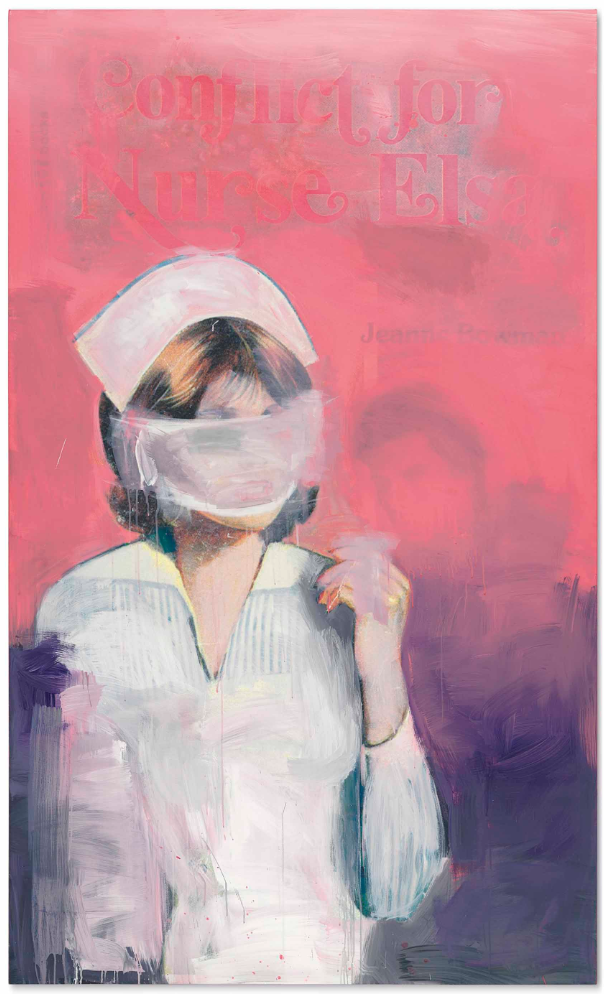
RICHARD PRINCE (B. 1949)
Nurse Elsa, 2002
Acrylic and inkjet on canvas
93×56 inches (236.2 x 142.2 cm)
Signed, titled and dated ‘R Prince 2002 Conflict for Nurse Elsa’ (on the overlap)
#9. Nurse Barclay’s Dilemma, 2002
Christie’s New-York: 13 November 2019
Estimated: USD 4,500,000 – 6,500,000
USD 5,723,000
Richard Prince (b. 1949), Nurse Barclay’s Dilemma | Christie’s
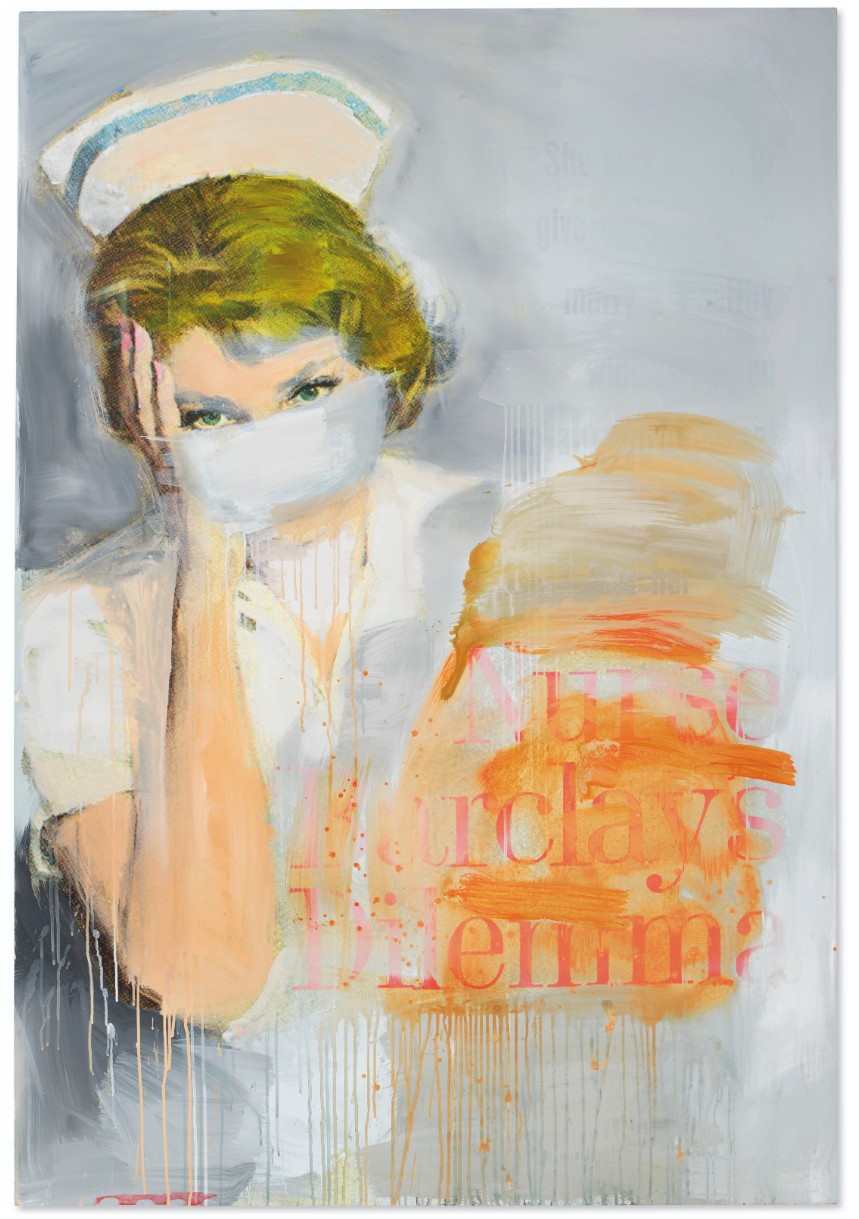
RICHARD PRINCE (b. 1949)
Nurse Barclay’s Dilemma, 2002
Inkjet and acrylic on canvas
70×48 inches (177.8 x 121.9 cm)
Signed, titled and dated ‘Richard Prince “NURSE BARCLAY’S DILEMMA” 2002’ (on the overlap)
#10. Navy Nurse, 2004
Christie’s New-York: 10 July 2020
Estimated: USD 4,000,000 – 6,000,000
USD 5,666,250
Richard Prince (b. 1956), Navy Nurse | Christie’s
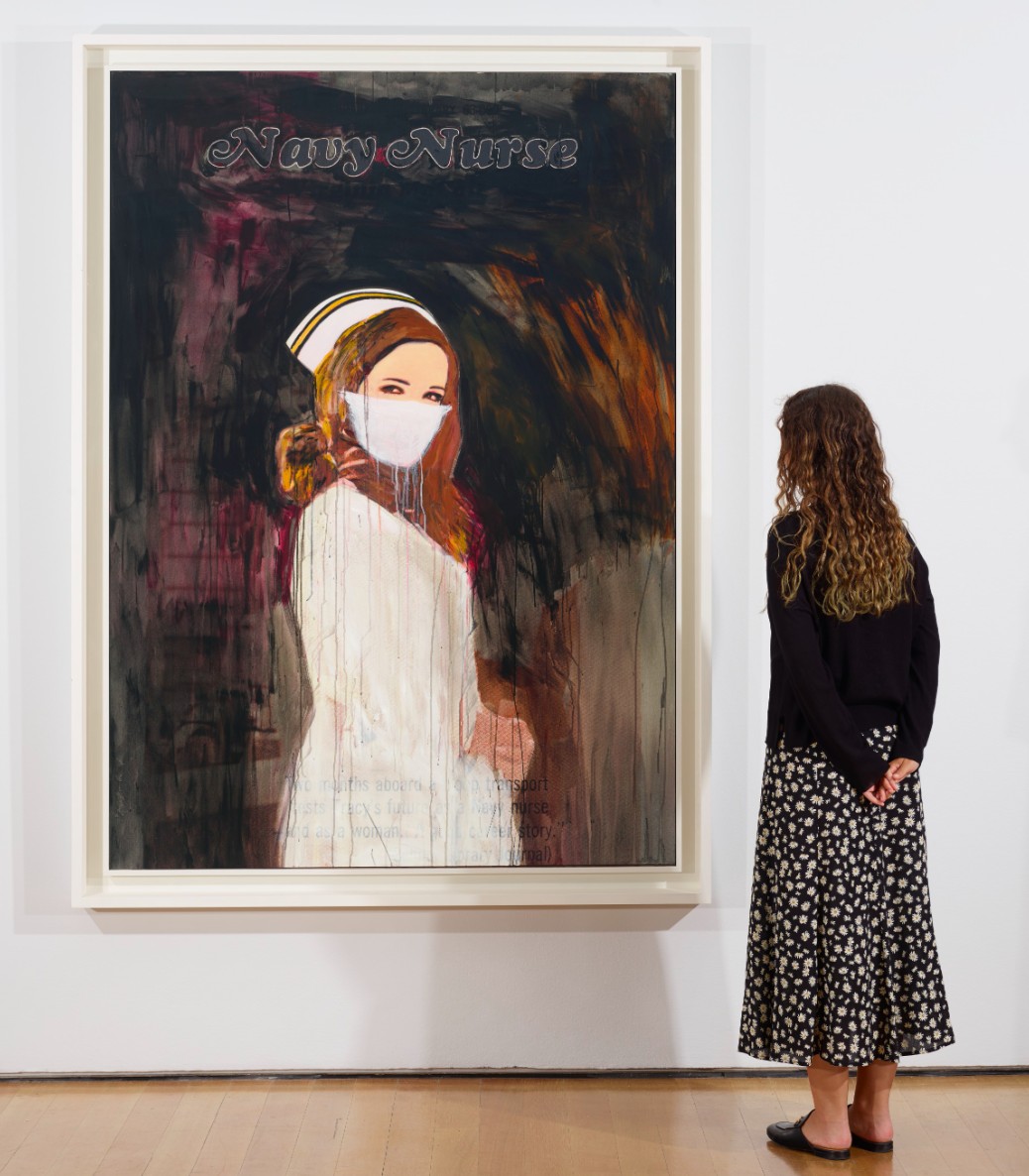
RICHARD PRINCE (b. 1956)
Navy Nurse, 2004
Inkjet and acrylic on canvas
76 x 54-1/4 inches (193 x 137.8 cm)
Signed, titled and dated ‘R Prince. NAVY NURSE 2004′(on the overlap)
#11. Hurricane Nurse, 2004
Christie’s London: 9 October 2024
Estimated: GBP 3,500,000 – 5,500,000
GBP 4,184,250 / USD 5,481,370
RICHARD PRINCE (B. 1949), Hurricane Nurse | Christie’s (christies.com)
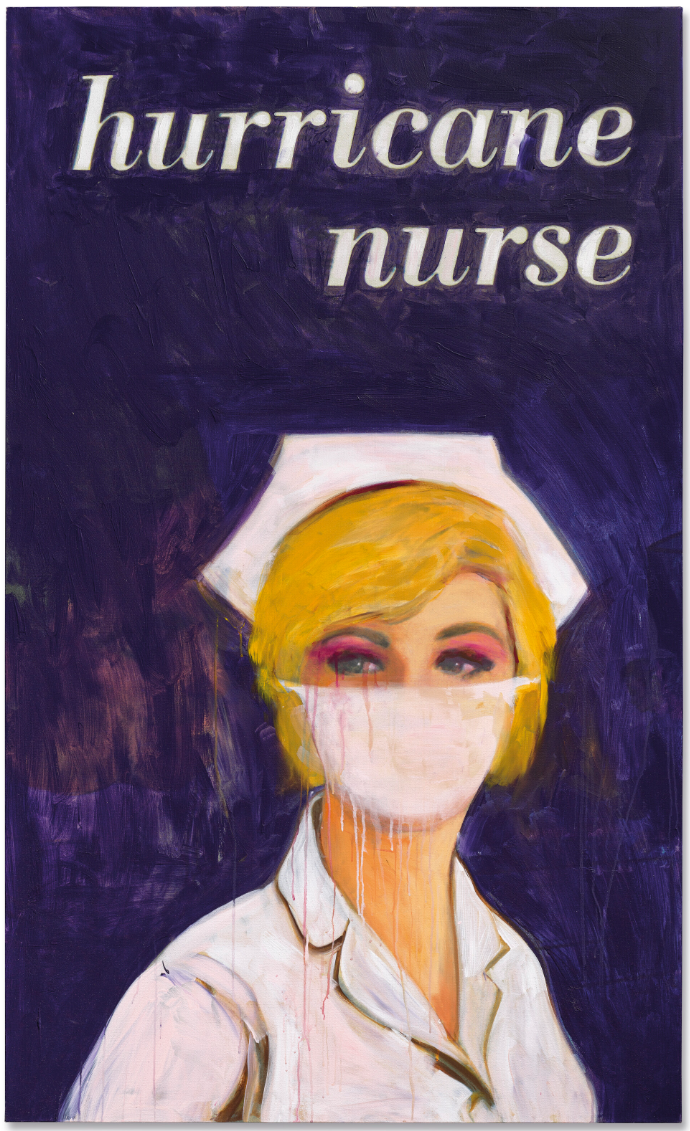
RICHARD PRINCE (B. 1949)
Hurricane Nurse, 2004
Acrylic and inkjet on canvas
69 1/8 x 42 inches (175.5 x 106.8 cm)
Signed, titled and dated ‘R Prince 2004 “Hurricane Nurse”’ (on the overlap)
2026 Auction Results
Sexual Behavior of American Nurses, 2009-2011
Christie’s New-York: 20 May 2026
Estimated: USD 4,000,000 – 6,000,000
USD 4,589,000
RICHARD PRINCE (B. 1949), Sexual Behavior of American Nurses | Christie’s
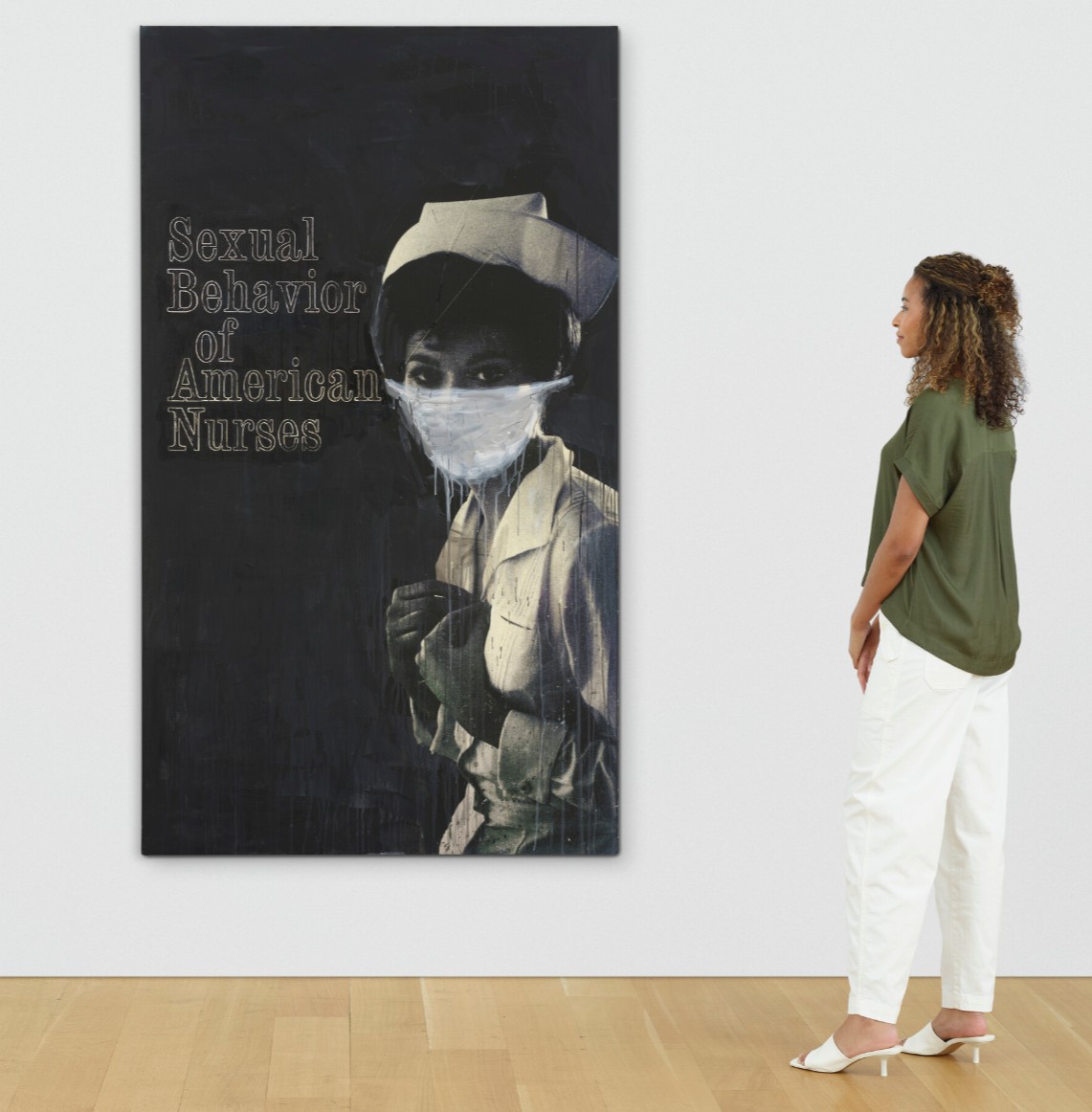
RICHARD PRINCE (B. 1949)
Sexual Behavior of American Nurses, 2009-2011
Acrylic and inkjet on canvas
83-1/4 x 48 inches (211.5 x 121.9 cm)
Signed and dated ‘R. Prince 2009-2011’ (on the overlap)
Nurse Kathy, 2006-2008
Phillips New-York: 19 May 2026
Estimated: USD 2,000,000 – 3,000,000
WITHDRAWN
Richard Prince Modern & Contemporary Art Evening Sale
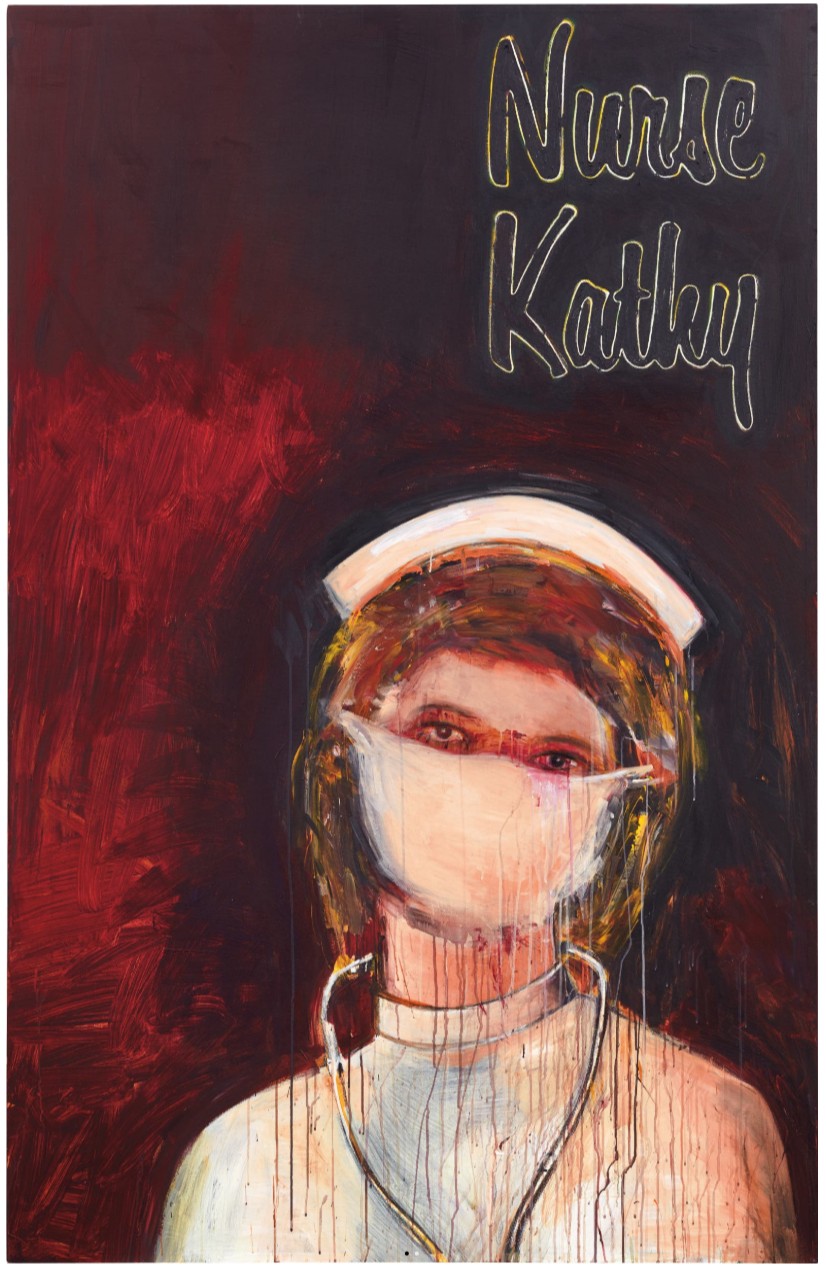
Inkjet and acrylic on canvas
84×54 inches (213.4 x 137.2 cm)
Signed, titled and dated “”Nurse Kathy” R Prince 2006-08″ on the reverse
2025 Auction Results
#1. Double Nurse, 2001
Edlis Neeson Collection
Christie’s New-York: 19 November 2025
Estimated: USD 3,000,000 – 5,000,000
USD 3,491,000
RICHARD PRINCE (B. 1949), Double Nurse | Christie’s
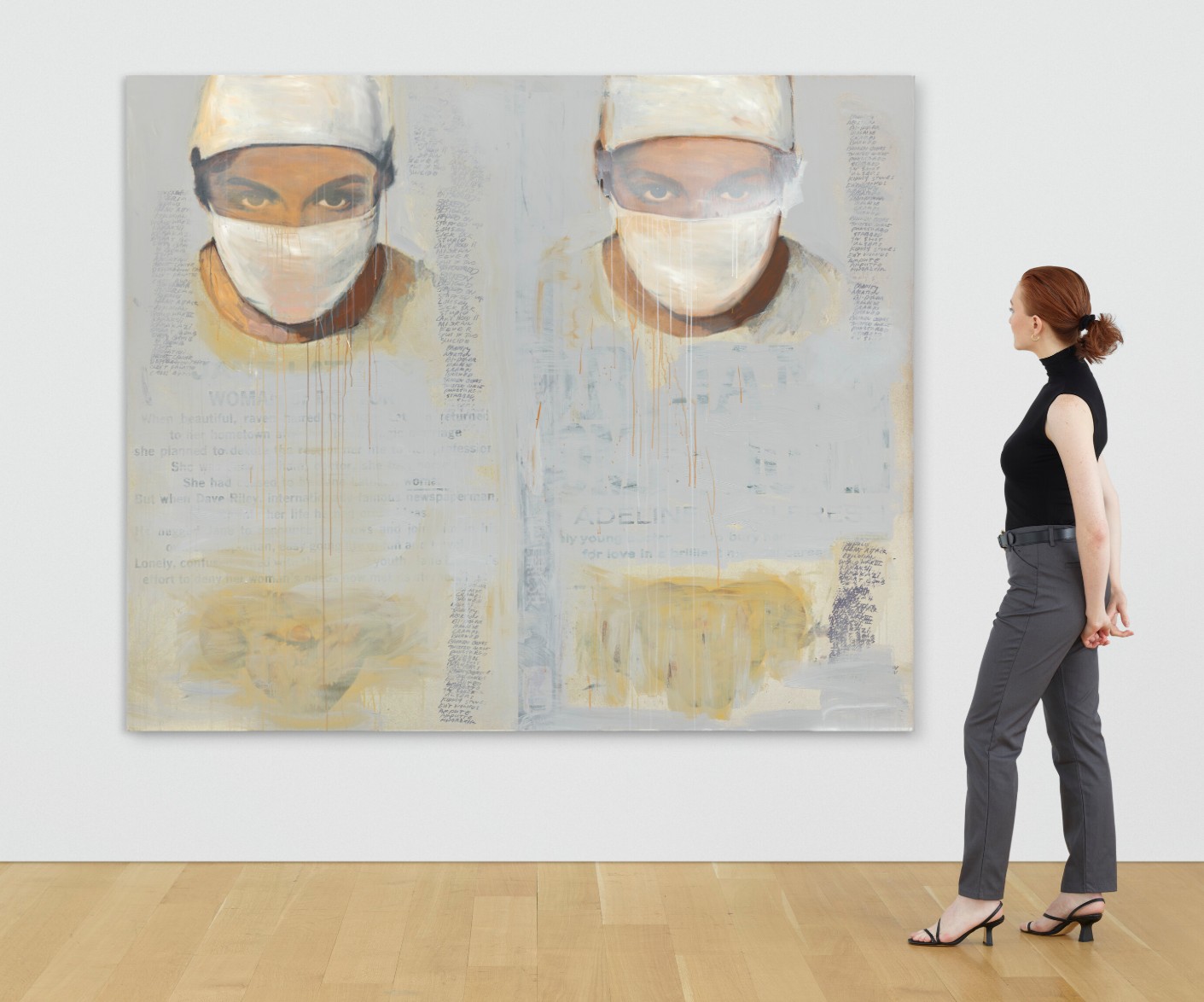
RICHARD PRINCE (B. 1949)
Double Nurse, 2001
Acrylic and inkjet on canvas
80×96 inches (203.2 x 243.8 cm)
Signed, titled and dated ‘Richard Prince, Double NURSE 2001’ (on the reverse)
#2. Man Crazy Nurse, 2002-03
Selections from the Collection of Barbara Gladstone
Sotheby’s New-York: 15 May 2025
Estimated: USD 4,000,000 – 6,000,000
USD 3,967,200
Man Crazy Nurse | Selections from The Collection of Barbara Gladstone | Contemporary Art | Sotheby’s
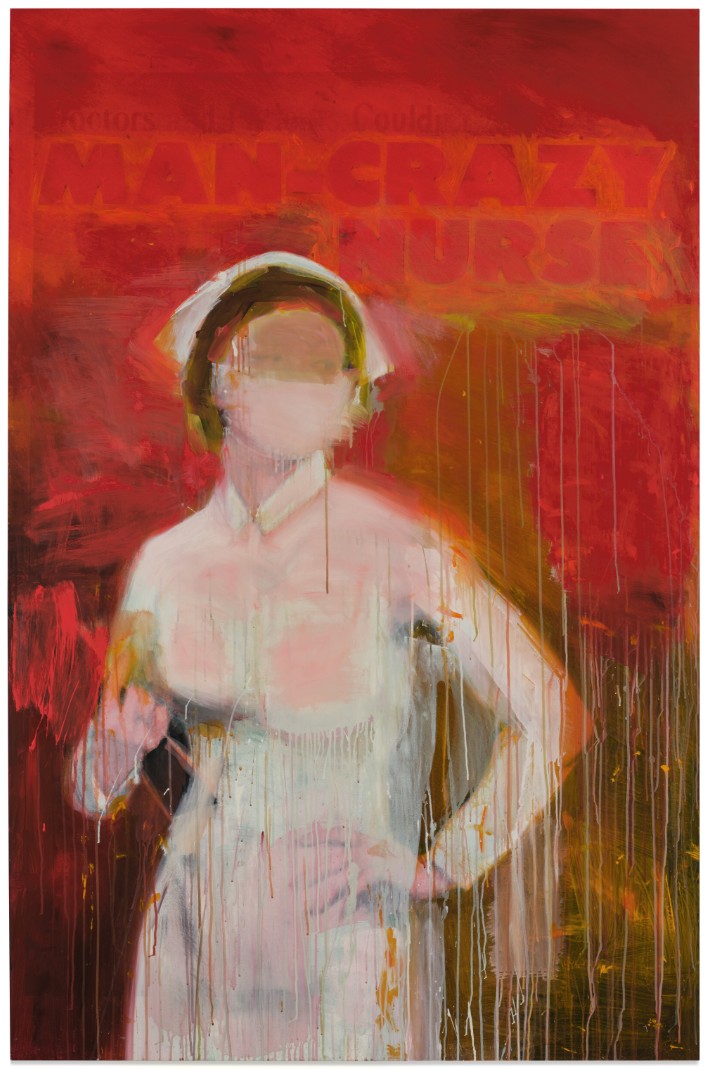
RICHARD PRINCE (b. 1949)
Man Crazy Nurse, 2002-03
Acrylic and inkjet on canvas
80×52 inches (203.2 x 132.1 cm)
Signed, titled and dated 2002-2003 (on the overlap)
#3. Killer Nurse, 2009-2010
Phillips New-York: 13 May 2025
Estimated: USD 3,000,000 – 4,000,000
USD 3,206,000
Richard Prince Modern & Contemporary Art Evening Sale
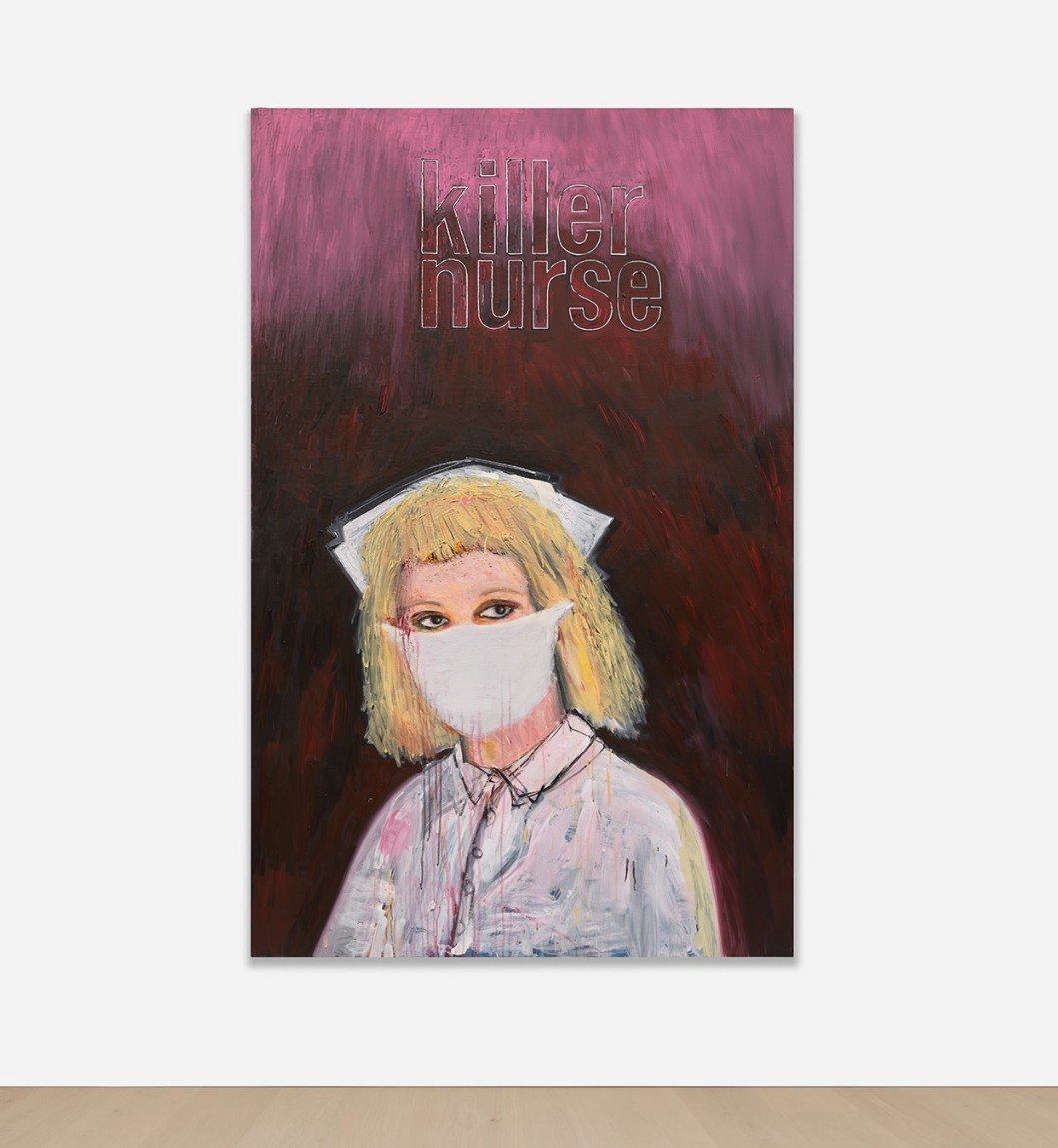
Killer Nurse, 2009-2010
Acrylic and inkjet on canvas
2024 Auction Results
#1. Nurse on Trial, 2005
Sotheby’s New-York: 21 November 2024
Estimated: USD 5,000,000 – 7,000,000
USD 6,700,000
Nurse on Trial | The Now and Contemporary Evening Auction | 2024 | Sotheby’s
REPEAT SALE
Christie’s New-York: 12 November 2014
Estimated: USD 5,000,000 – 7,000,000
USD 5,765,000
Richard Prince (b. 1949), Nurse on Trial | Christie’s
RICHARD PRINCE (b. 1949)
Nurse on Trial, 2005
Acrylic and inkjet on canvas
75×52 inches (190.5 x 132.1 cm)
Signed, titled and dated 2005 (on the overlap)
#2. Hurricane Nurse, 2004
Christie’s London: 9 October 2024
Estimated: GBP 3,500,000 – 5,500,000
GBP 4,184,250 / USD 5,481,370
RICHARD PRINCE (B. 1949), Hurricane Nurse | Christie’s (christies.com)
RICHARD PRINCE (B. 1949)
Hurricane Nurse, 2004
Acrylic and inkjet on canvas
69 1/8 x 42 inches (175.5 x 106.8 cm)
Signed, titled and dated ‘R Prince 2004 “Hurricane Nurse”’ (on the overlap)
2023 Auction Resuts
#1. Nurse Kathy, 2004
Christie’s New-York: 17 May 2023
Estimated: USD 4,000,000 – 6,000,000
USD 4,890,000
RICHARD PRINCE (b. 1949) (christies.com)
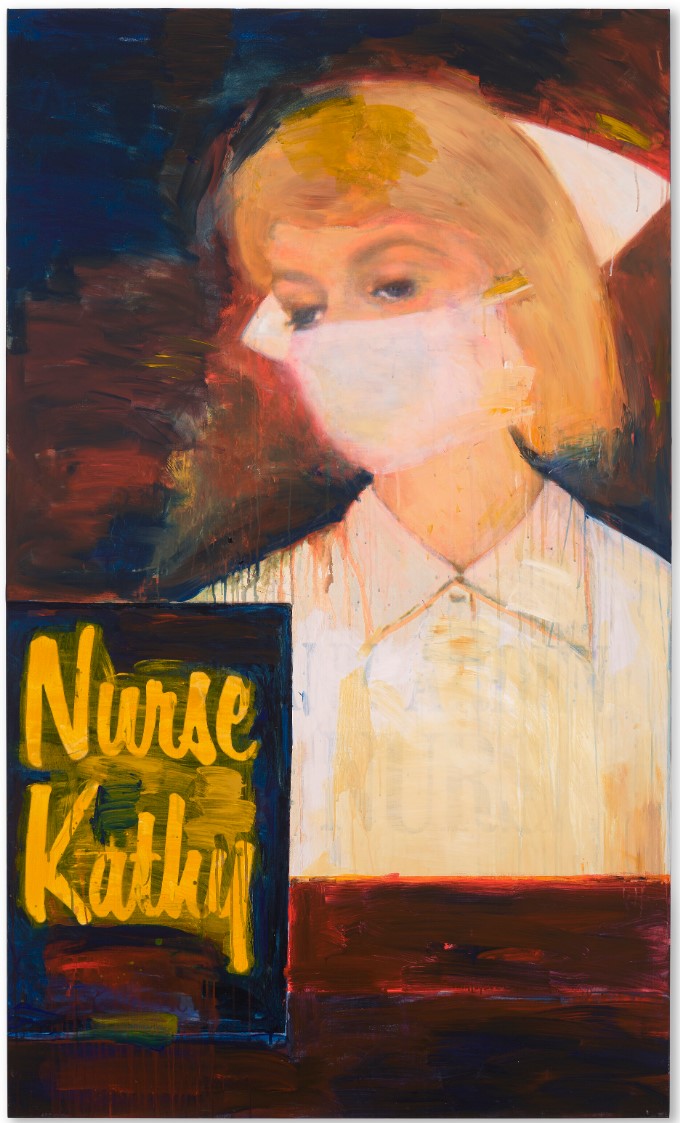
RICHARD PRINCE (b. 1949)
Nurse Kathy, 2004
Inkjet and acrylic on canvas
77×46 inches (195.6 x 116.8 cm)
Signed, titled and dated ‘Richard Prince 2004 NURSE KATHY’ (on the overlap)
#2. Camp Nurse, 2002-2003
Christie’s Hong-Kong: 28 November 2023
Estimated: HKD 22,000,000 – 28,000,000
HKD 20,945,000 / USD 2,689,000
21391-richard-prince-nurse (christies.com)
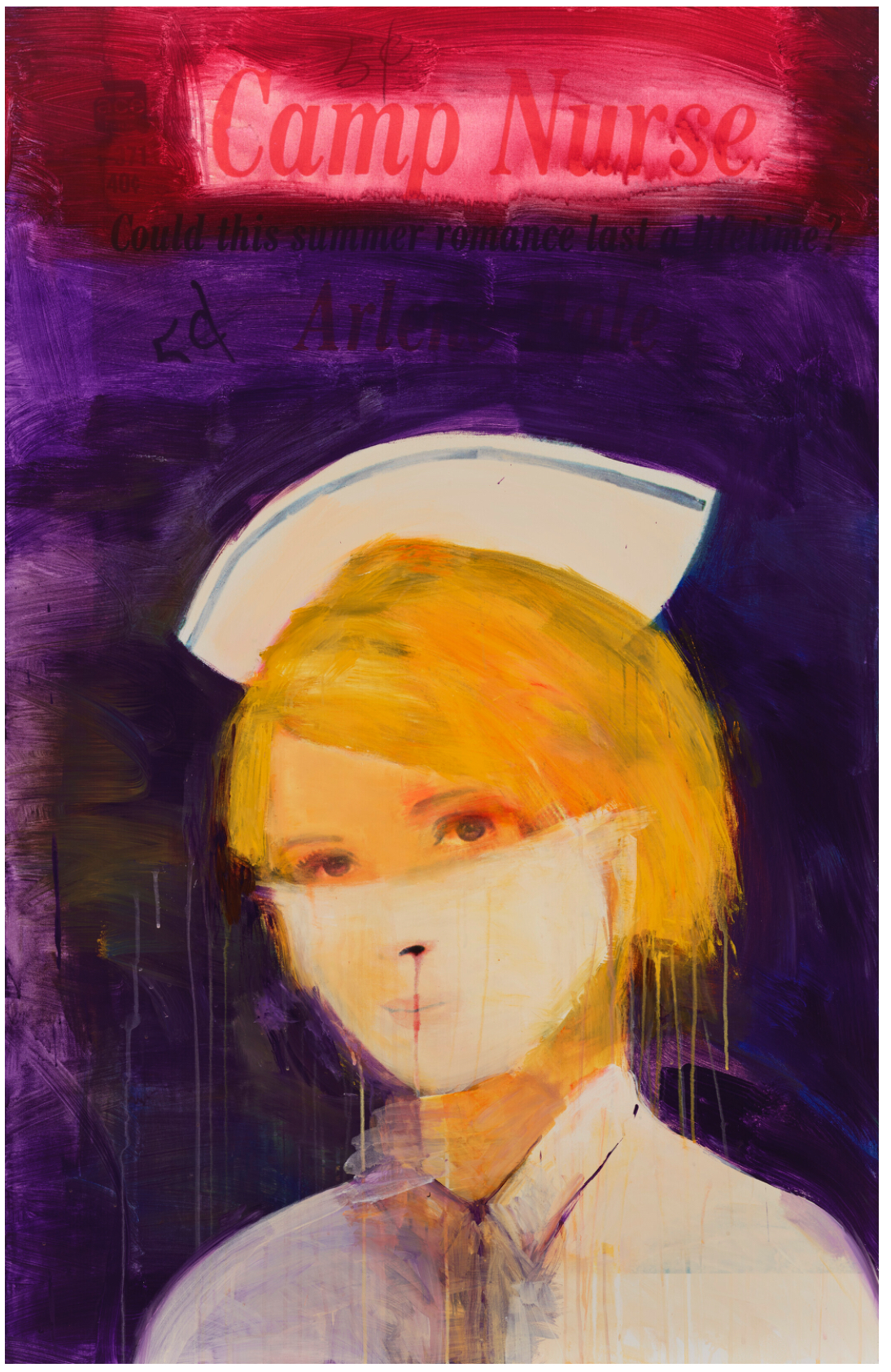
RICHARD PRINCE (B. 1949)
Camp Nurse, 2002-2003
Inkjet and acrylic on canvas
56×36 inches (142.2 x 91.4 cm)
Signed, titled and dated ‘Richard Prince CAMP NURSE 2002-03’ (on the overlap)
2022 Auction Results
NO SALE AT AUCTION IN 2022
2021 Auction Results
#1. Runaway Nurse, 2005-06
Sotheby’s Hong-Kong: 18 June 2021
Estimated: HKD 75,000,000 – 95,000,000
HKD 93,986,000 / USD 12,107,710
NEW AUCTION RECORD FOR THE ARTIST
REPEAT SALE
Christie’s New-York: 10 May 2016
Estimated: USD 7,000,000 – 10,000,000
USD 9,685,000
Richard Prince (B. 1949), Runaway Nurse | Christie’s (christies.com)
RICHARD PRINCE (b. 1949)
Runaway Nurse, 2005-06
Inkjet and acrylic on canvas
110 1/4 x 66 1/4 inches (280×168 cm)
Signed, titled and dated 2005-06 on the overlap
#2. Lake Resort Nurse, 2002-2003
Christie’s New-York: 11 May 2021
Estimated: USD 4,000,000 – 6,000,000
USD 3,990,000
RICHARD PRINCE (B. 1949), Lake Resort Nurse | Christie’s (christies.com)
RICHARD PRINCE (B. 1949)
Lake Resort Nurse, 2002-2003
inkjet and acrylic on canvas
69 1/8 x 49 inches (175.6 x 124.5 cm)
Signed, titled and dated ‘R. Prince 2002-2003 LAKE RESORT NURSE #2’ (on the overlap)
2020 Auction Results
#1. Navy Nurse, 2004
Christie’s New-York: 10 July 2020
Estimated: USD 4,000,000 – 6,000,000
USD 5,666,250
Richard Prince (b. 1956), Navy Nurse | Christie’s
RICHARD PRINCE (b. 1956)
Navy Nurse, 2004
Inkjet and acrylic on canvas
76 x 54-1/4 inches (193 x 137.8 cm)
Signed, titled and dated ‘R Prince. NAVY NURSE 2004′(on the overlap)
#2. Nurse for Mercy’s Mission, 2009
Christie’s New-York: 6 October 2020
Estimated: USD 2,000,000 – 3,000,000
USD 3,150,000
Richard Prince (b. 1949), Nurse for Mercy’s Mission | Christie’s
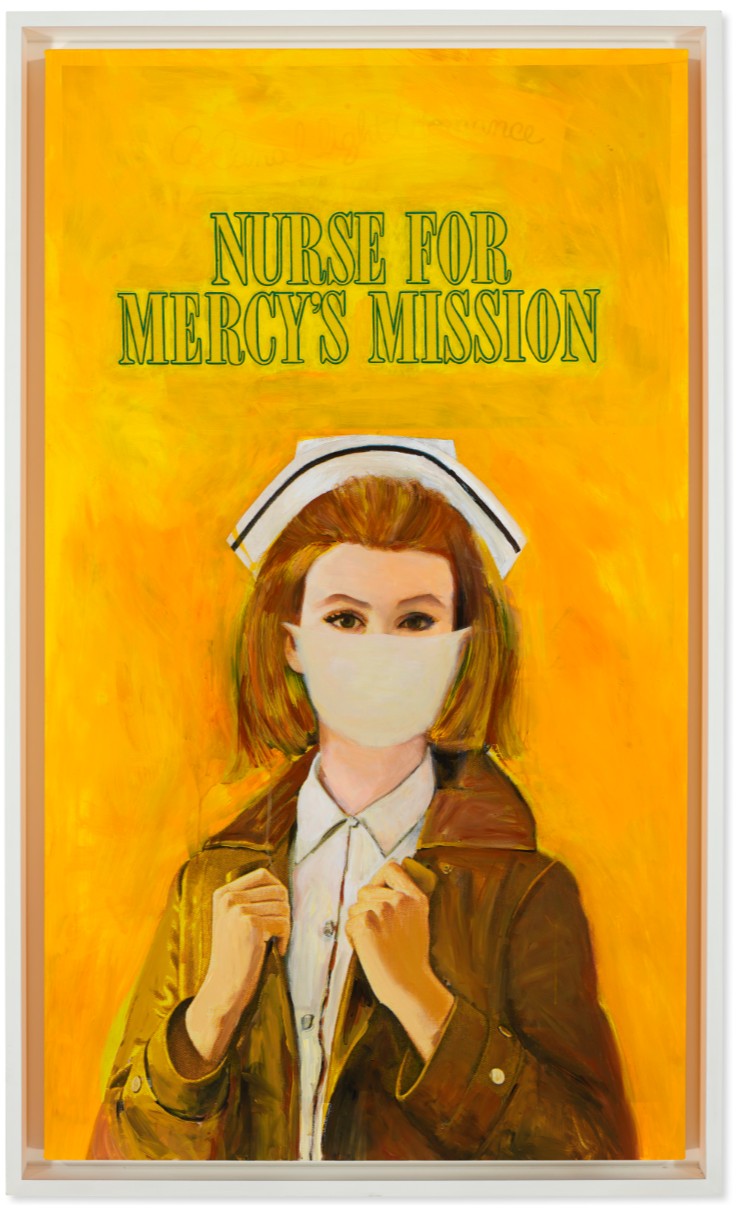
RICHARD PRINCE (b. 1949)
Nurse for Mercy’s Mission, 2009
Inkjet and acrylic on canvas
52×30 inches (132.1 x 76.2 cm)
Signed ‘Richard Prince’ (on the overlap)
2019 Auction Results
#1. Park Avenue Nurse, 2002
Sotheby’s New-York: 14 November 2019
Estimated: USD 5,000,000 – 7,000,000
USD 6,186,800
(#4) RICHARD PRINCE | Park Avenue Nurse
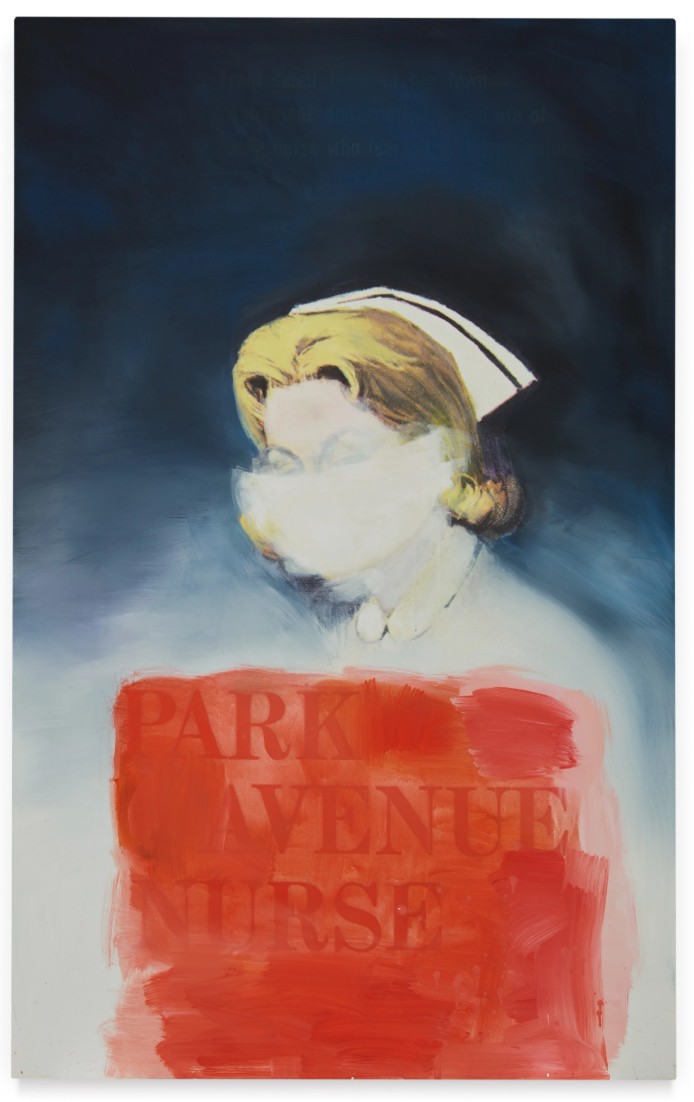
RICHARD PRINCE
Park Avenue Nurse, 2002
Inkjet print and acrylic on canvas
72×45 inches (182.9 x 114.3 cm)
Signed, titled, and dated 2002 on the overlap
#2. Nurse Barclay’s Dilemma, 2002
Christie’s New-York: 13 November 2019
Estimated: USD 4,500,000 – 6,500,000
USD 5,723,000
Richard Prince (b. 1949), Nurse Barclay’s Dilemma | Christie’s
RICHARD PRINCE (b. 1949)
Nurse Barclay’s Dilemma, 2002
Inkjet and acrylic on canvas
70×48 inches (177.8 x 121.9 cm)
Signed, titled and dated ‘Richard Prince “NURSE BARCLAY’S DILEMMA” 2002’ (on the overlap)
2018 Auction Results
#1. Island Nurse, 2002
Christie’s New-York: 15 November 2018
Estimated: USD 5,000,000 – 7,000,000
USD 5,487,500
Richard Prince (b. 1949), Island Nurse | Christie’s
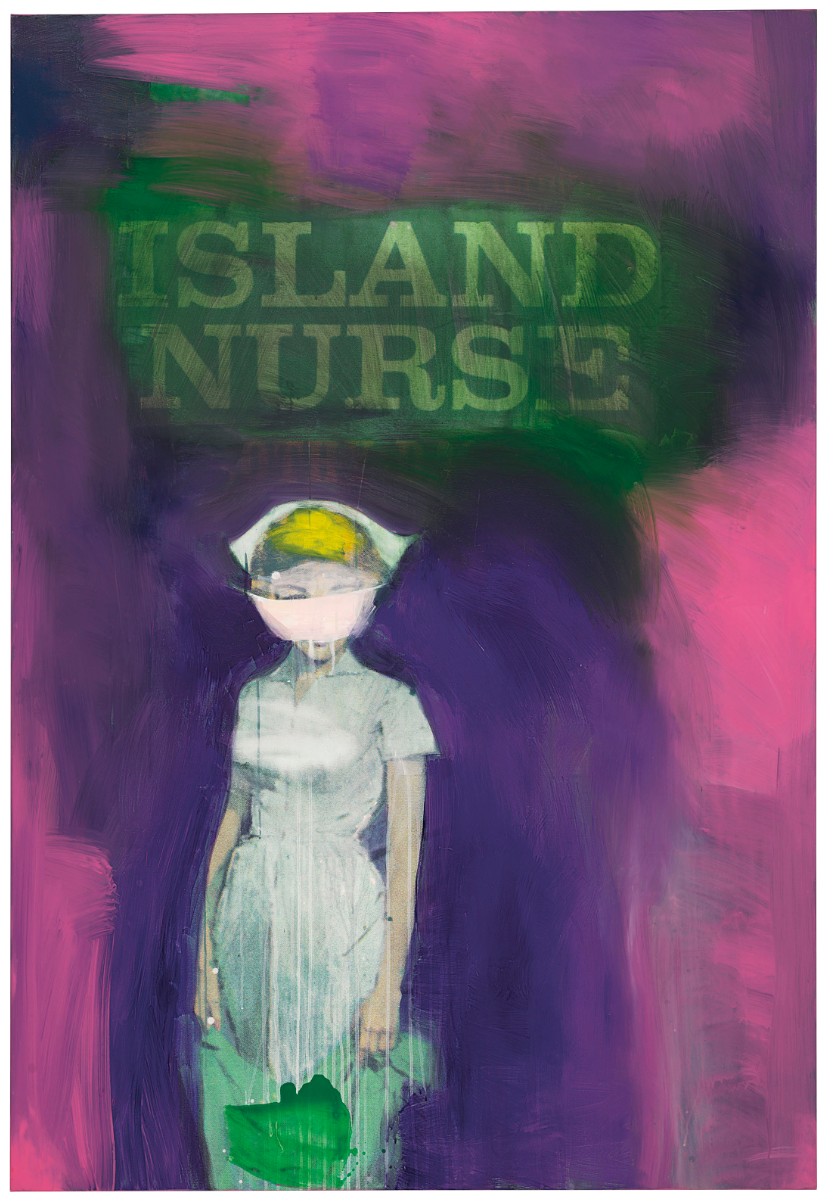
RICHARD PRINCE (b. 1949)
Island Nurse, 2002
Inkjet and acrylic on canvas
70×48 inches (177.8 x 121.9 cm)
Signed, titled and dated ‘R Prince “ISLAND NURSE” 2002’ (on the overlap)
2017 Auction Results
#1. School Nurse, 2005
Sotheby’s London: 28 June 2017
Estimated: GBP 3,500,000 – 4,500,000
GBP 4,096,250 / USD 5,263,465
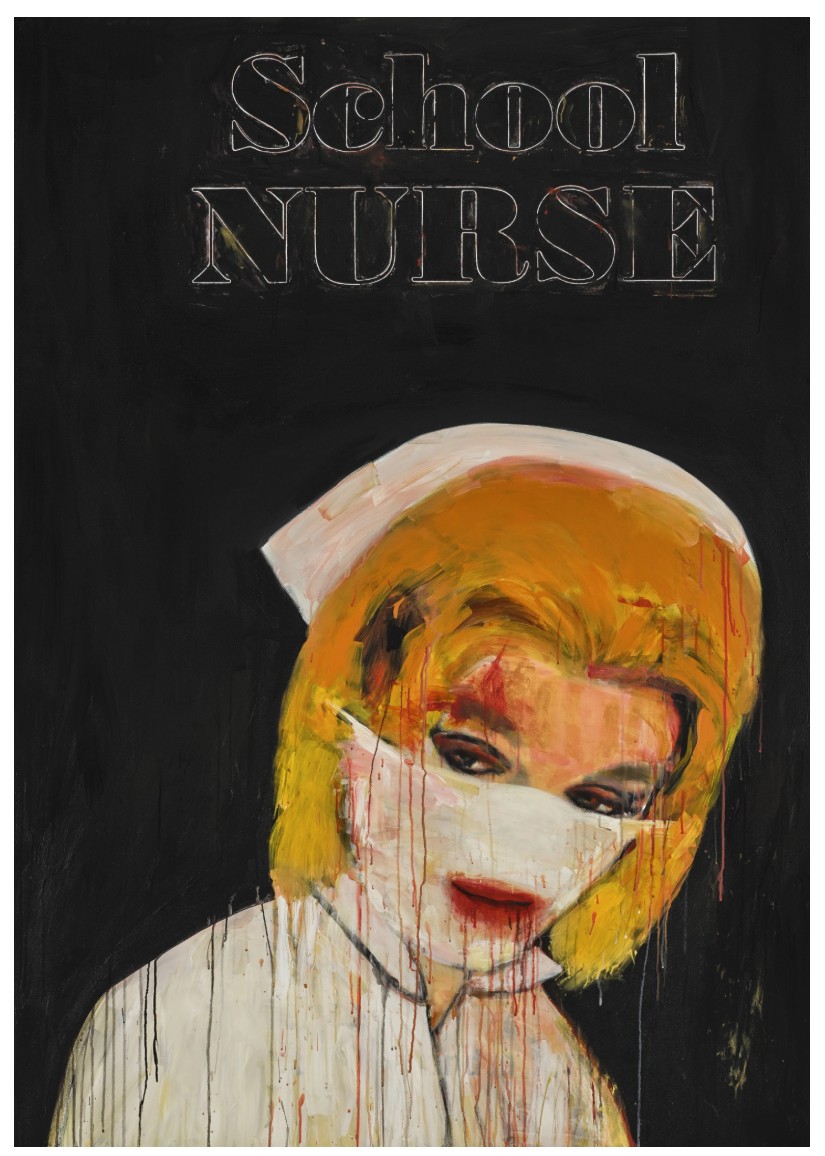
RICHARD PRICE
School Nurse, 2005
Acrylic and inkjet print on canvas
70×49 inches (177.8 x 124.4 cm)
Signed, titled and dated 2005 on the reverse
Sexual Behavior of American Nurses, 2009-2011
Sexual Behavior of American Nurses, 2009-2011
Christie’s New-York: 20 May 2026
Estimated: USD 4,000,000 – 6,000,000
USD 4,589,000
RICHARD PRINCE (B. 1949), Sexual Behavior of American Nurses | Christie’s
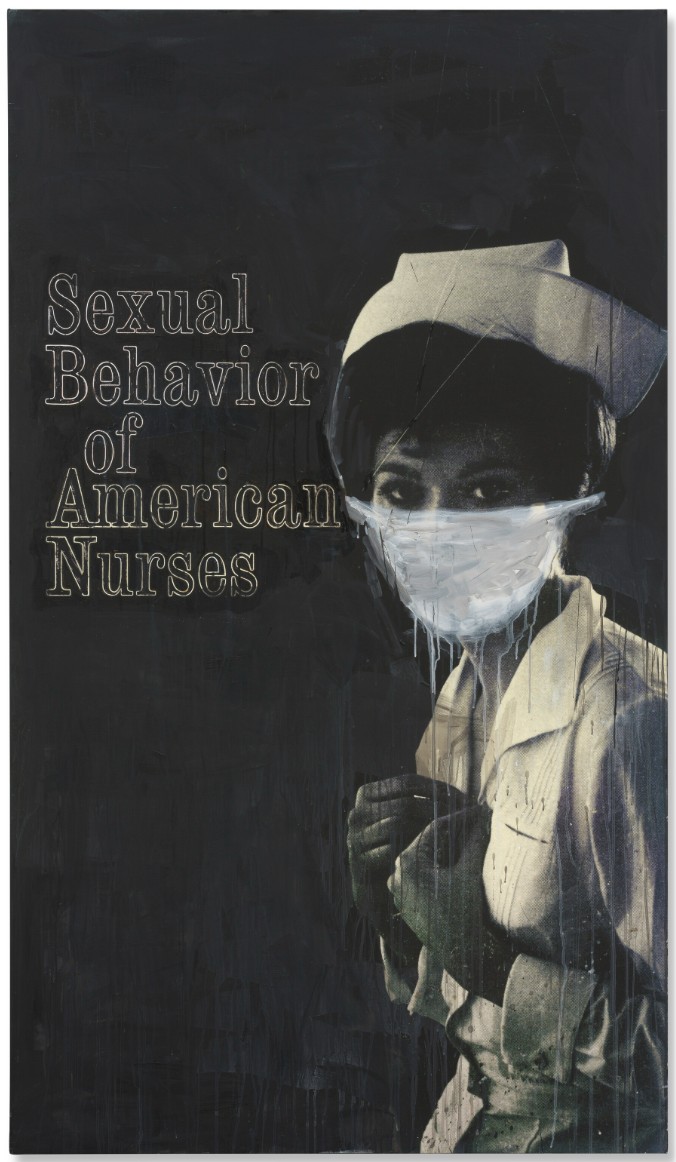
RICHARD PRINCE (B. 1949)
Sexual Behavior of American Nurses, 2009-2011
Acrylic and inkjet on canvas
83-1/4 x 48 inches (211.5 x 121.9 cm)
Signed and dated ‘R. Prince 2009-2011’ (on the overlap)
Provenance
Acquired directly from the artist by the present owner, 2015
An exceptional example from Richard Prince’s most celebrated series, Sexual Behavior of American Nurses presents the American artist’s most recognizable motif in a more elegant key, the work’s monochrome palette achieving a simultaneously beguiling and seductive appearance. Prince’s Nurse series emerged from the artist’s earlier explorations with appropriated material. One of the original appropriation artists, Prince, along with contemporaries including Barbara Kruger and Cindy Sherman, first developed appropriation as a strategy for capturing and manipulating products of mass culture.
Prince’s first works on canvas, his Joke paintings, appropriated the text of popular Borscht Belt jokes and projected them across large canvases. Here, Prince employs a similar technique, requisitioning the title of a long out-of-print book, while including a figural element with the addition of the nurse who appears on the cover of the pulp novel. As the curator Nancy Spector describes the series, “With each image, Prince conflates the various sociosexual stereotypes embodied by the figure of the nurse: Good Samaritan, naughty seductress, old battle-ax, and devil incarnate. He depicts each figure as both vamp and victim, undone by desire” (“Nowhere Man,” in Richard Prince: Spiritual America, exh. cat., Solomon R. Guggenheim Museum, New York, 2007, pp. 52-53). Sexual Behavior of American Nurses functions self-referentially; the work’s title and text recall Prince’s previous painted incarnations, while the nurse’s powerful direct gaze serves as both indictment and invitation.
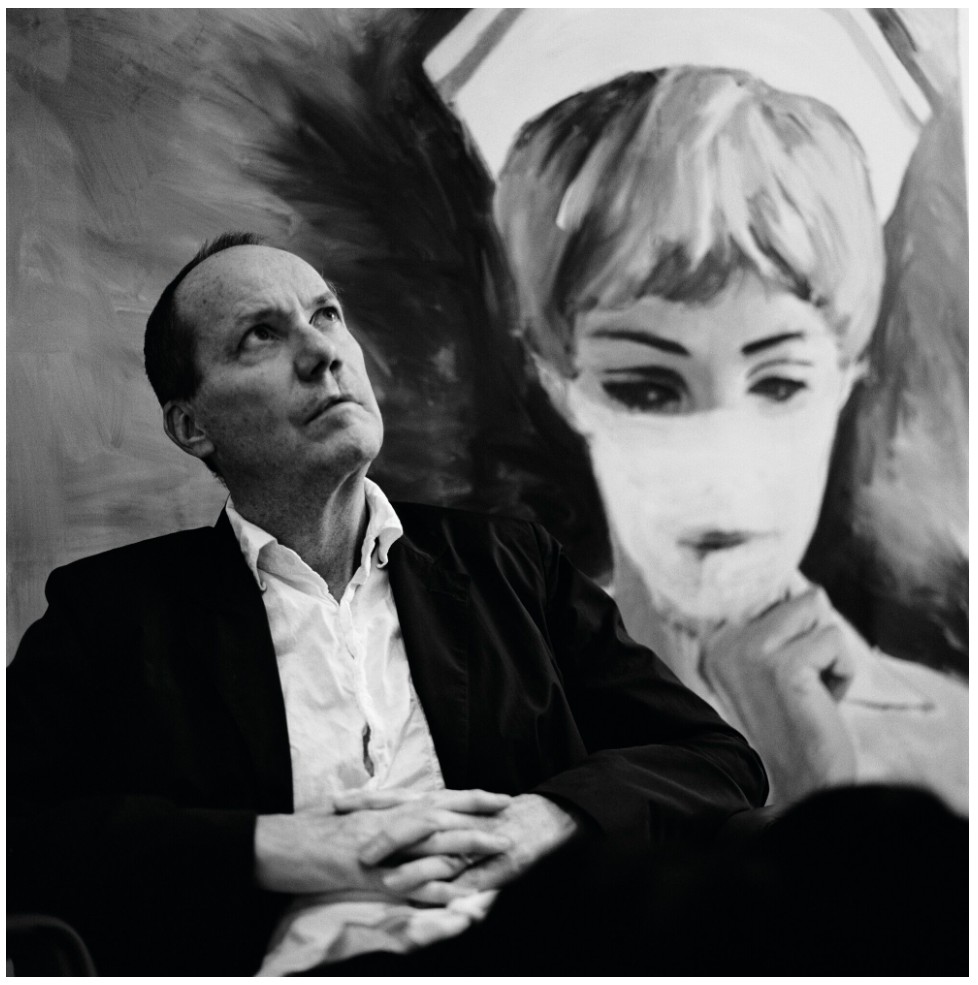
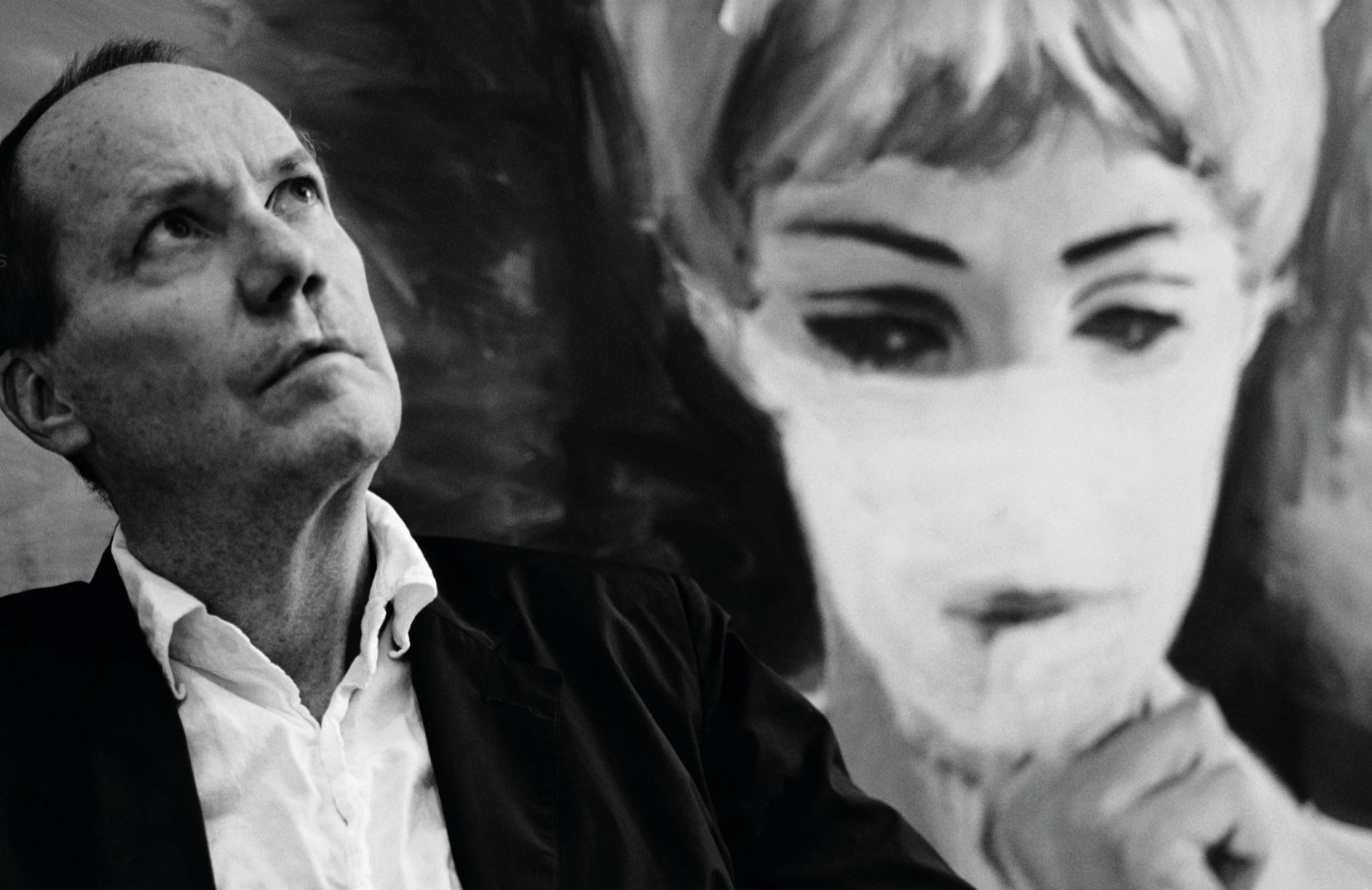
Richard Prince, New York, 2010. Photo: Anton Corbijn / Contour by Getty Images. Artwork: © Richard Prince.
Prince used the 1963 sensationalist pulp non-fiction book Sexual Behavior of American Nurses, written by the supposed “W.D. Sprague, Ph.D.,” as the source material for the present work. However, Sprague is a pseudonym—the book was authored by Bela W. von Block, probably alongside his wife Sylvia von Block, and the Ph.D. is itself a fiction, with the publisher appropriating the credentials of an academic authority in order to give their mass-market pseudo-psychoanalytical studies apparent legitimacy. This book is thus the perfect target for Prince’s appropriative method—the source material itself appropriated the legitimacy of the medical profession as well as the popularity of psychoanalytical studies in order to lure readers, while Prince borrows elements from the book’s cover for his own artistic project.
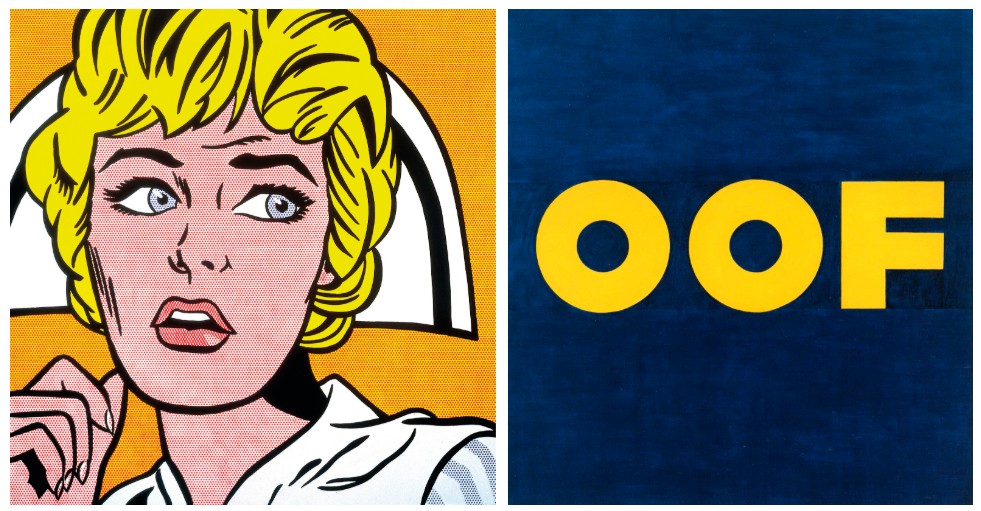
Left: Roy Lichtenstein, Nurse, 1964. © 2026 Estate of Roy Lichtenstein / DACS.
Right: Ed Ruscha, OOF, 1962. Museum of Modern Art, New York. © Ed Ruscha
Using an inkjet printer, Prince blew up the cover onto his large canvas before covering the majority of the composition with luxurious strokes of black and white paint. With his brush, Prince obscures the publication details as well as the cover’s composition, save for the nurse. The text itself is completely painted over, as are any auxiliary characters, such as the male protagonist appearing in the source image. Prince meticulously recreates the serifed title font, leaving each letter merely outlined in white against the black background. The many layers of paint are evidenced by the oozing drips and runs, which cascade down the canvas in a satire of Abstract Expressionist painting. As the critic David Rimanelli writes in his review of Nurse series first exhibition in 2003, the paintings are a “bloody, drippy splatter sampling of AbEx gesturalism… these sumptuous canvases were a return to form—smart, cheap, expensive, snide” (“Best of 2003,” Artforum, vol. 42, no. 4, December 2003, p. 116). Prince’s most significant painterly intervention in the present work is the boldly expressive paint which he uses to articulate the nurse’s surgical mask. Using white, blue, and grey-tinged paint, Prince recreates here the original gestural achievement that demarcates the origin of the series. As the artist recounted in his now-famous 2018 deposition—which served the basis for his 2025 work Deposition—while working on the earliest Nurse paintings, “I remember one day I was adding white to the figure of the nurse, more acrylic white, and to try and ghost her out. I remember wiping some of the paint away and as I wiped… a shape appeared on her face. And I stood back and I looked at it, and I said that looks like a surgical mask… And that’s when I realized that’s what I’m looking for. That’s my contribution” (quoted in “Deposition of Richard Prince” in Donald Graham V. Richard Prince, United States District Court, Southern District of New York, pp. 76-77). With the addition of the mask, Nancy Spector notes, “lends a menacing air to the whole affair. The nurses become sinister hospital bandits, terrifying in their proximity to blood, bodily processes, and death” (N. Spector, op. cit., p. 52).
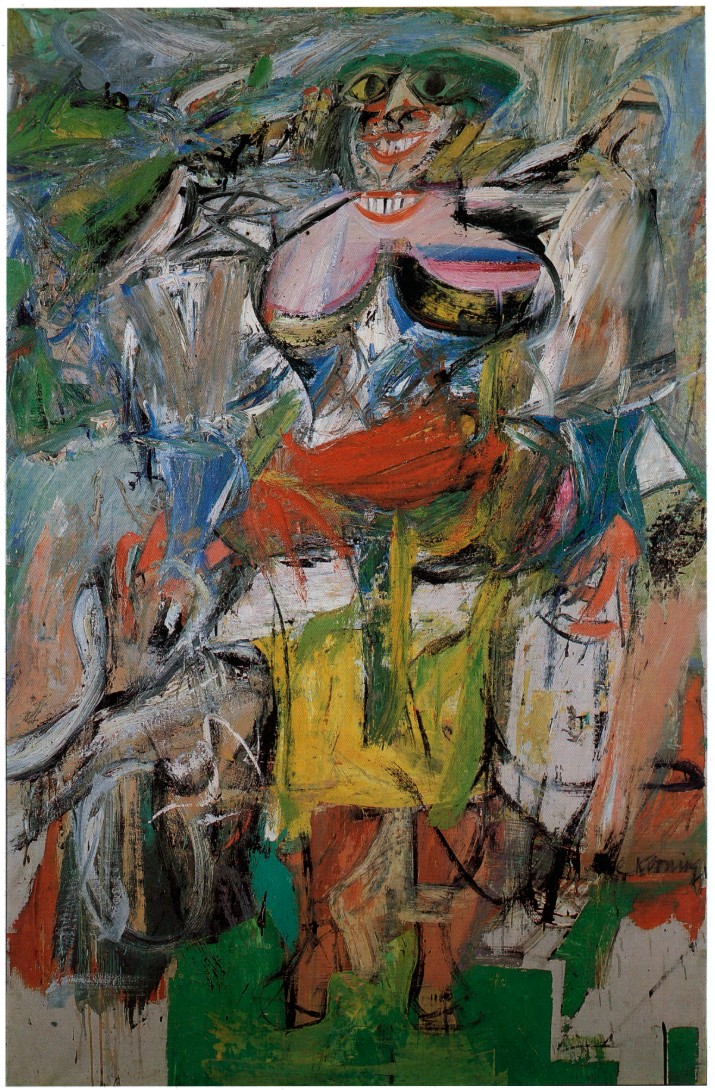
Willem de Kooning, Woman and Bicycle, 1952-1953. Whitney Museum of American Art, New York.
© 2026 The Willem de Kooning Foundation / Artists Rights Society (ARS), New York.
The writer Glenn O’Brien notes how “Richard Prince’s amazing nurse painting series changed the face of painting… Richard was so into the nurses that he was addicted” (“Richard Prince Toasted at the Friar’s Club,” in Richard Prince: Monochromatic Jokes, exh. cat., Nahmad Contemporary, New York, 2014, n.p.). Sexual Behavior of American Nurses is a poignant demonstration of Prince’s long-term commitment to his series, commenting on his own obsession with the sexualized depictions of nurses in pulp literature. Spector comments how “Prince’s work is an extended self-portrait of a self that cannot be defined,” and the present work retains an autobiographical tenor, recapitulating the sum of his most cherished series in one canvas. “Prince’s nurses are a seductive lot,” Spector continues. “You can just imagine them forming a retinue of hospital playmates, femme fatales, and angels of mercy across one of his library shelves, waiting for their moment in the spotlight” (N. Spector, op. cit., p. 52). Sexual Behavior of American Nurses reveals that Prince is in on his joke, knowingly returning to a subject that refuses exhaustion. At once self-reflective and confrontational, the work crystallizes the tensions that have long animated the Nurse series—desire and danger, authorship and theft, seduction and critique—into a singular, darkly luminous statement.
Nurse Kathy, 2006-2008
Nurse Kathy, 2006-2008
Phillips New-York: 19 May 2026
Estimated: USD 2,000,000 – 3,000,000
WITHDRAWN
Richard Prince Modern & Contemporary Art Evening Sale
Inkjet and acrylic on canvas
84×54 inches (213.4 x 137.2 cm)
Signed, titled and dated “”Nurse Kathy” R Prince 2006-08″ on the reverse
Richard Prince’s Nurse paintings are among the most coveted and celebrated of his career. These eerie depictions of stereotyped nurse figures—culled from the covers of vintage romance novels—tap into the central concerns of Prince’s oeuvre: mass culture, appropriation, American mythology, and desire. Executed in 2006–2007, Nurse Kathy emblematizes these themes by rendering a dime store book cover on a monumental scale, transforming a familiar trope of seduction into one of pulp horror. Standing in her classic white uniform and matching cap, the subject dons a concealing face mask and stethoscope around her neck, threateningly approaching the viewer with blood red paint drips down her visage. In this work, Prince’s signature strategies of appropriation are pressed toward a uniquely painterly register.
“Some people say the nurse paintings are all about desire—but isn’t that more to do with their proximity to life and death? Isn’t that why we find nurses sexy—because they embody this ultimate contradiction?”
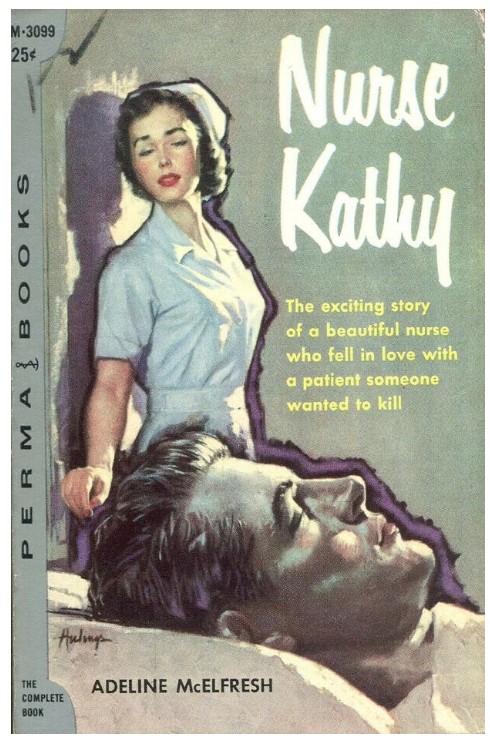
Cover of Nurse Kathy, by Adeline McElfresh,1956.
Prince’s employment of popular, “low” culture in Nurse Kathy stems from an early period in his career, when he worked as an archivist for Time and Life magazines in the 1970s. It was there that he first had the idea to reach for print advertising imagery as artistic source material. An avid bibliophile, Prince turned to his wide collection of 1950s and 1960s pulp romance novels to begin his Nurse series in 2003.
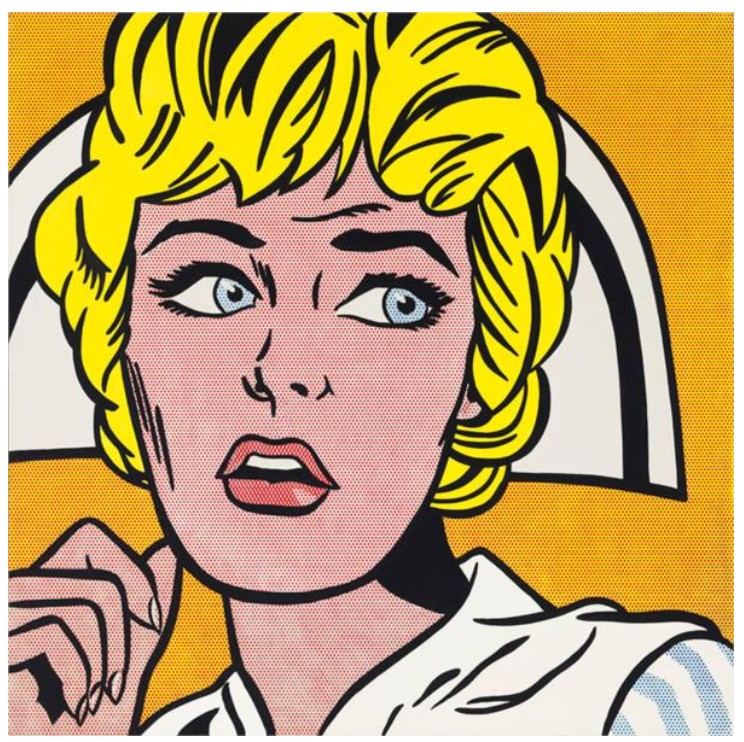
Roy Lichtenstein, Nurse, 1964. Private Collection. Sold for $95,365,000 at Christie’s New York in 2015.
Artwork: © Estate of Roy Lichtenstein
Nurse Kathy takes its title from a cheap fiction paperback by the writer Adeline McElfresh, who authored dozens of books on the doctor/nurse romance genre. The artist digitally scanned, projected, and printed the title from the cover of the novel onto the present canvas. All other aspects of the cover image are removed, including the original blurb promising “the exciting story of a beautiful nurse who fell in love with a patient someone wanted to kill”; in its place is a representation of a nurse drawn from a different source. Prince’s process of appropriation conspicuously harkens back to the post-war interventions of Pop Art, especially Andy Warhol and Roy Lichtenstein’s adoption of printed mass media. Yet in Nurse Kathy the borrowed image is substantially reconstituted: its surface animated by a remarkably gestural handling of paint and its iconography unsettled by the addition of viscous drips and the obfuscating mask.
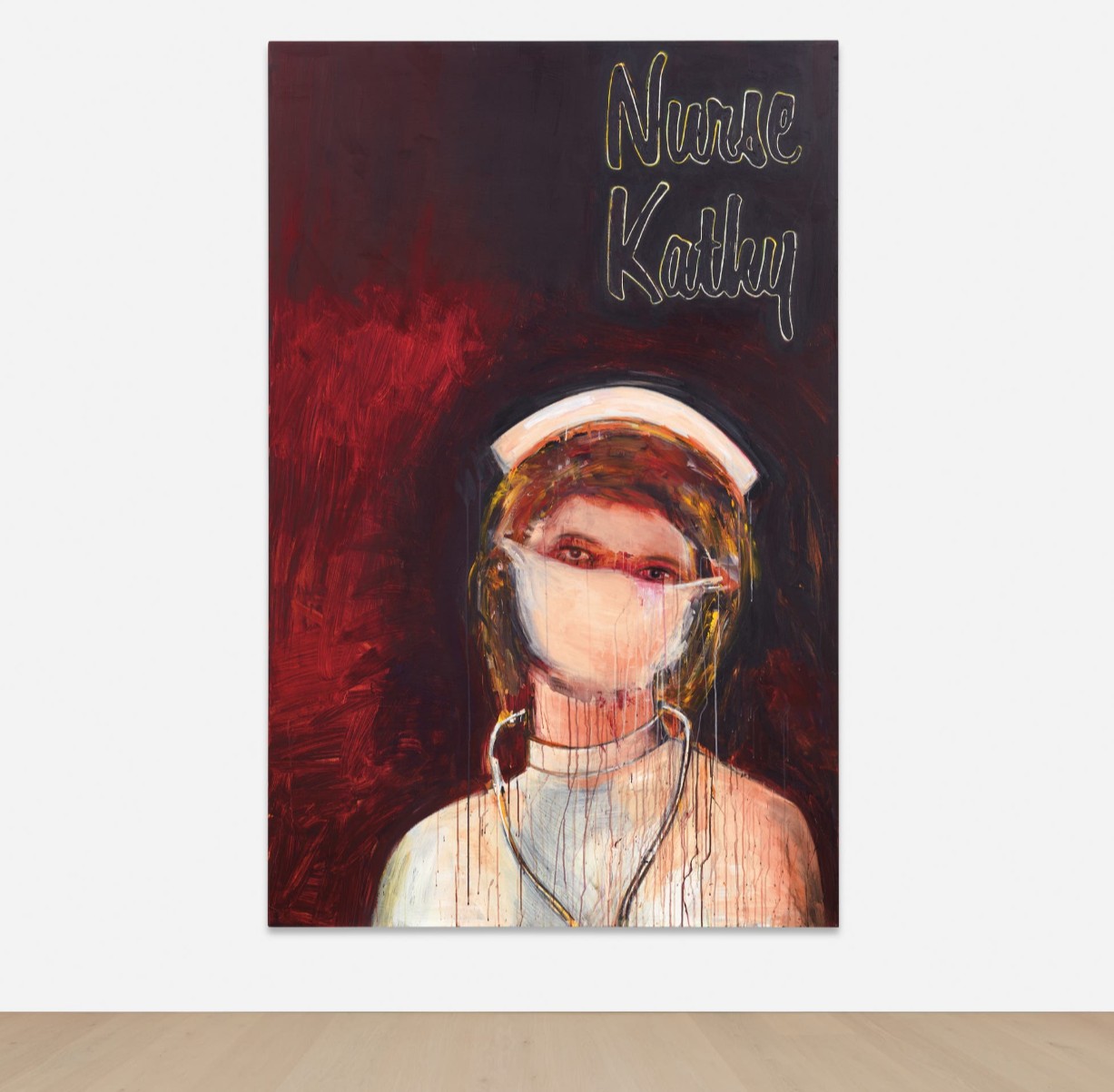
Pointing to the irony of the fetishization of the profession, Prince recast the figure as something ominous and potentially murderous—metamorphosing her from an object of fantasy into the visual language of pulp horror. As workers who are conventionally associated with care yet inextricably bound to experiences of illness and mortality, nurses occupy a charged symbolic position that the artist brings into relief in Nurse Kathy. According to the curator Mia Fineman, “[Prince’s] is an art of cultural quotation: His cowboys are always ‘cowboys,’ his nurses are always ‘nurses,’ his paintings are always ‘paintings.’” Nurse Kathy does not render a stock image of a nurse, however; it is a composition that Prince has deliberately reworked, most notably through the addition of the mask and the construction of the painting’s atmospheric, expressive ground. The masks in the Nurse series, which muddy and complicate the figures’ legibility, emerged from a moment of chance.
“I made a mistake painting all this white… After I had wiped off some of the painting, it looked like a mask on the nurse’s face and suddenly it was one of those moments… It was a way of unifying and also talking about identity.”
A similar ambiguity imbues the background, an expanse of darkened red that appears overtly painterly. While many have likened these hazy, chromatic surfaces to the diffuse fields of Mark Rothko, Prince’s apparently gestural approach remains equivocal. Is it simply a calculated citation of Abstract Expressionist painting, a style reframed as just another appropriable idiom? These additions destabilize the image and foreground questions about authenticity and ambiguity that have underlain Prince’s entire practice.
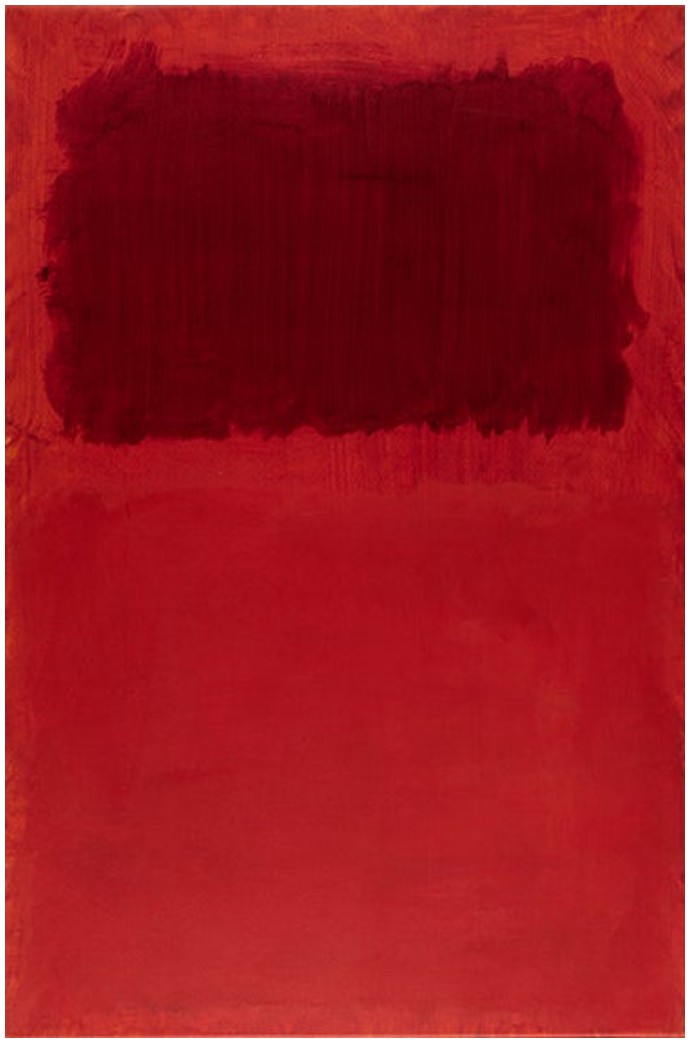
Mark Rothko, Untitled (Maroon Over Red), 1968. Pennsylvania Academy of Fine Arts. Artwork: © 1998 Kate Rothko Prizel & Christopher Rothko / Artists Rights Society (ARS), New York
Nurse Kathy demonstrates the artist’s sustained interest in how identities are constructed through borrowed and mediated imagery. By drawing upon the visual codes of both the romance and horror genres, Prince exposed how the social roles of nurses are culturally produced and endlessly re-scripted through repetition and circulation. Indicative of their centrality with his practice, the Nurse paintings have been exhibited extensively and are held in major museum collections, such as the Whitney Museum of American Art, New York, and the Rubell Collection, Miami. This institutional presence underscores not only their importance within Prince’s oeuvre but also how they crystallize his reworking of found imagery into forms that consider how perception and meaning is shaped by visual culture. Nurse Kathy distills this approach into a single, disquieting figure in which mythology and desire are refracted through the lens of his iconoclastic post-modern brilliance.
Double Nurse, 2001
Double Nurse, 2001
Edlis Neeson Collection
Christie’s New-York: 19 November 2025
Estimated: USD 3,000,000 – 5,000,000
USD 3,491,000
RICHARD PRINCE (B. 1949), Double Nurse | Christie’s
RICHARD PRINCE (B. 1949)
Double Nurse, 2001
Acrylic and inkjet on canvas
80×96 inches (203.2 x 243.8 cm)
Signed, titled and dated ‘Richard Prince, Double NURSE 2001’ (on the reverse)
Provenance
Gladstone Gallery, New York
Acquired from the above by the present owner, 2006
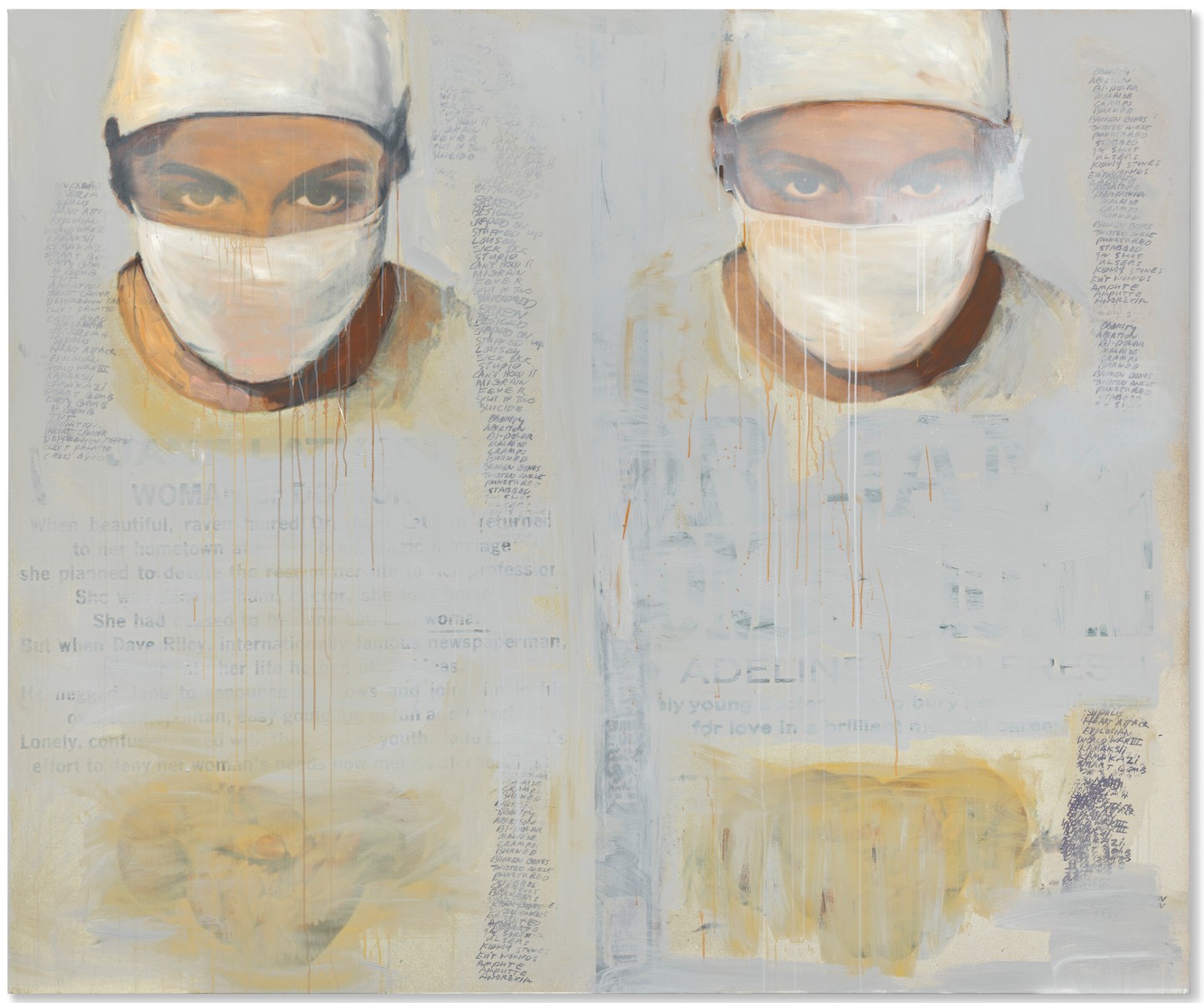
Mesmeric and arresting, Double Nurse is a sui generis example which inaugurated Richard Prince’s acclaimed series of Nurse paintings. Painted in 2001, Double Nurse is utterly singular—it is the only work from the legendary series to feature two towering figures and is the largest example to come to auction. The work’s early execution date and unique iconography place the work as one of the earliest—if not the first—works in this foundational and massively influential series. Double Nurse’s iconography is plucked from the cover of a pulp romance novel; Prince uses the then-novel process of inkjet printing to reproduce his referent at epic scale across his canvas before bringing the image to life with his vivid painterly palette. Obscuring the cover’s original publishing text—the title, author, and blurb—Prince evacuates the image from its source, placing the dual nurse figures into an arresting new context which emphasizes their facial features and clasped hands. Prince surrounds the figures with repetitive lists of maladies scrawled in black paint which run down the composition in five segmented columns. Colliding several simultaneous symbolic signifiers for the nurse in literary and popular culture—as femme fatale or angel of mercy, as deviant or savior—Double Nurse serves as a poignant reflection on the dueling realities of turn-of-the-century America, bridled on the one hand with unmatched prosperity and uninhibited swagger while haunted by the specter of political violence. Summarizing the series, Nancy Spector describes the Nurses as “sinister hospital bandits, terrifying in their proximity to blood, bodily processes, and death,” who embody various sociosexual stereotypes: “Good Samaritan, naughty seductress, old battle-ax, and devil incarnate. He depicts each figure as both vamp and victim, undone by desire” (N. Spector, “Nowhere Man, in Richard Prince: Spiritual America, exh. cat., Solomon R. Guggenheim Museum, New York, 2007, pp. 52-53). Richard Prince’s mirrored nurses in Double Nurse allow these many contrasting guises to coexist as potentialities in paint, coalescing into an autobiographic tableau revealing the deeper layers of Prince’s psyche.
To create Double Nurse, Richard Prince reproduced the cover of Adeline McElfresh’s Dr. Jane Comes Home. Drawing on the legacy of appropriation which Prince developed alongside Cindy Sherman and Barbara Kruger in the 1980s, Prince here retains the facial features and hand details from his original image while covering the rest of the composition with vivid shades of white, obliterating most textual traces and covering up the book’s central spine. Prince uses thick brushstrokes of tans, creams, and pinks to vividly emphasize the nurses’ skin, allowing his paint to drip down the composition in a series of striking parallel linear paths. He similarly embellishes the nurses’ masks and scrub caps with layers of white paint, adding a compelling physicality to these elements and offsetting them against the white composition. The righthand nurse’s face is cloaked in a thin wash of white paint which acts as a diaphanous veil partially covering her eyes, which stare straight toward the viewer. The artist meanwhile makes the figures’ hands barely discernable with light washes of pigment, blurring the original pose into a vague organic form. This dueling process of veiling and enhancing would come to play a critical role throughout the Nurse series, and here one observes Prince working out with paint the methods and techniques which will populate later works in the series.
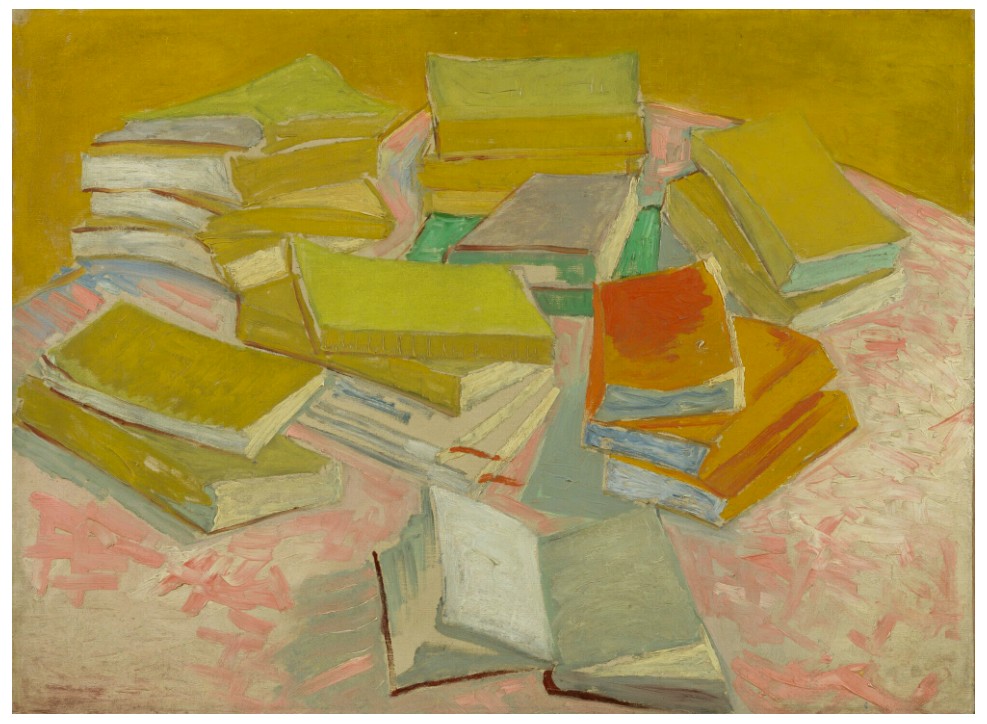
Vincent van Gogh, Piles of French Novels, October-November 1887. Van Gogh Museum, Amsterdam.
The artist gives a vivid recollection of how he conceived the nurse in Double Nurse. He had previously purchased a shoebox full of Nurse paperbacks at a flea market in the late 1990s—a noted bibliophile, Prince’s collecting of titles has become an integral part of his artistic process. In this sense Prince mirrors van Gogh, an avid reader who occasionally turned to the risqué ‘Yellow Books’ for compositional and subjective inspiration. Prince left his pulp fiction fallow until 2001, when “I brought them back out, I looked at them, and at the time what I was reading in the news was very disturbing, and the idea came into my head that everybody needed a nurse. And I remembered collecting these Nurse paperbacks” (R. Prince, quoted in “Deposition of Richard Prince” in Donald Graham V. Richard Prince, United States District Court, Southern District of New York, pp. 74-75). Having finally found a compelling subject for his moment, he tore the entire cover off of Dr. Jane Comes Home and inkjetted the image onto his canvas. Appraising the work, he decided to start painting. “The first Nurse paintings were done all in white. I was trying to quote the whiteness of the nurse—of an operating room and a nurse’s uniform” (ibid.). Unique to Double Nurse is the written text flowing down the composition. As Prince explains, “On the painting, I made a list of all the kinds of things that could happen to you in the world… whatever a nurse could, perhaps, help you with” (ibid.).
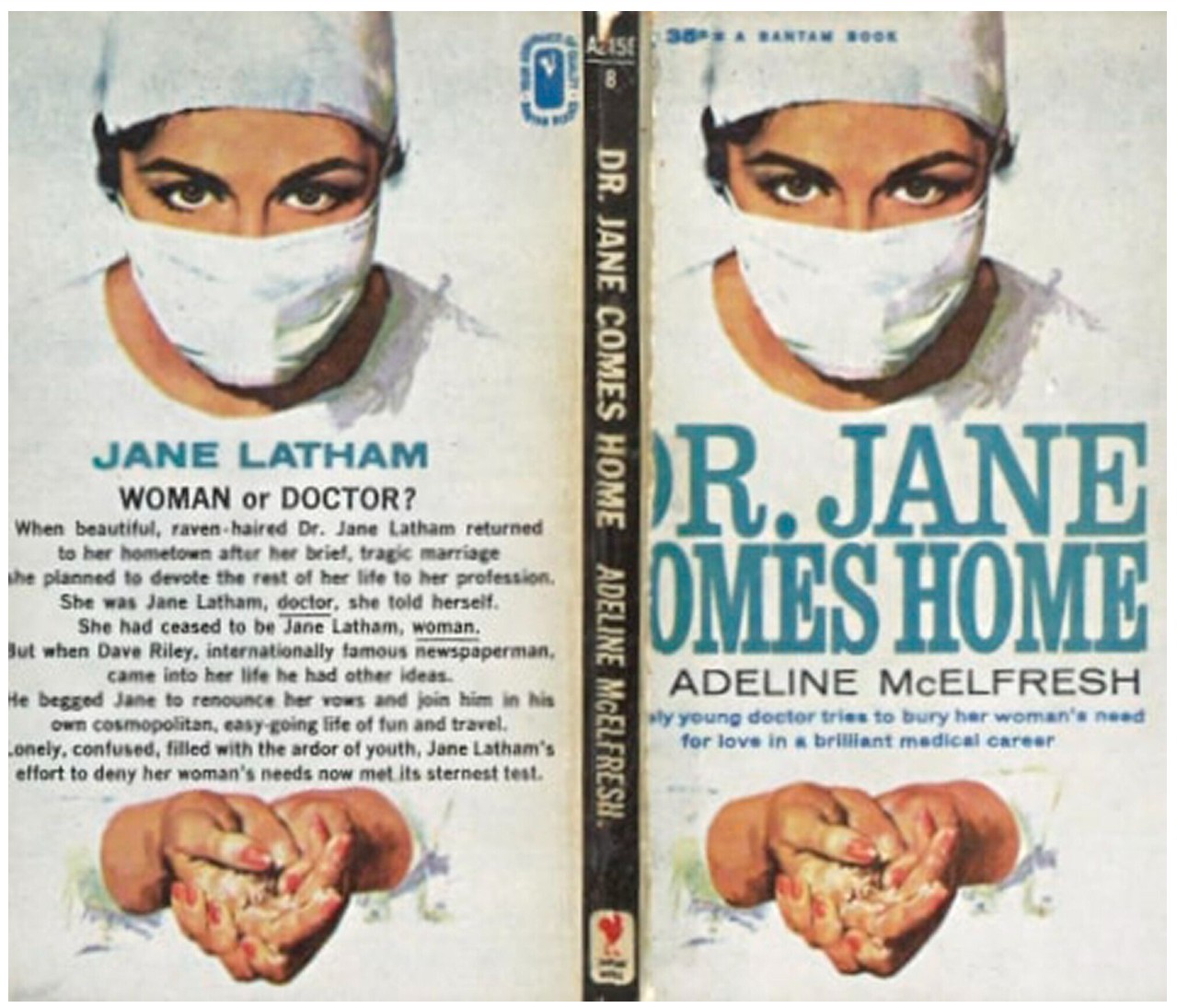
Adeline McElfresh, Front and back cover of a “nurse” paperback, 1959.
Prince’s didacticism in the face of global strife follows an important tradition of textual art from the twentieth century. Cy Twombly’s pairing of poetry, myth, and history wrought works like Apollo (1975, Cy Twombly Foundation) where names are scribbled in a similarly informal black script, a format which Joseph Beuys’ blackboard paintings also echo. Painted text reemerged in the work of Jean-Michel Basquiat, while Prince’s close friend and contemporary Christopher Wool also explored the function of black text on white. Another contemporary, Glenn Ligon, articulated a corresponding interest in repetition and obscuring with his “Door Paintings,” where the lower part of his stenciled compositions shows each white letter blending together into a cacophonic mass of illegible letters and symbols, similar to the text on the lower right register of the present work. The profusion of text, both residual from the reference image and added by the artist, creates a deeply affective, intimate vision of the artist.
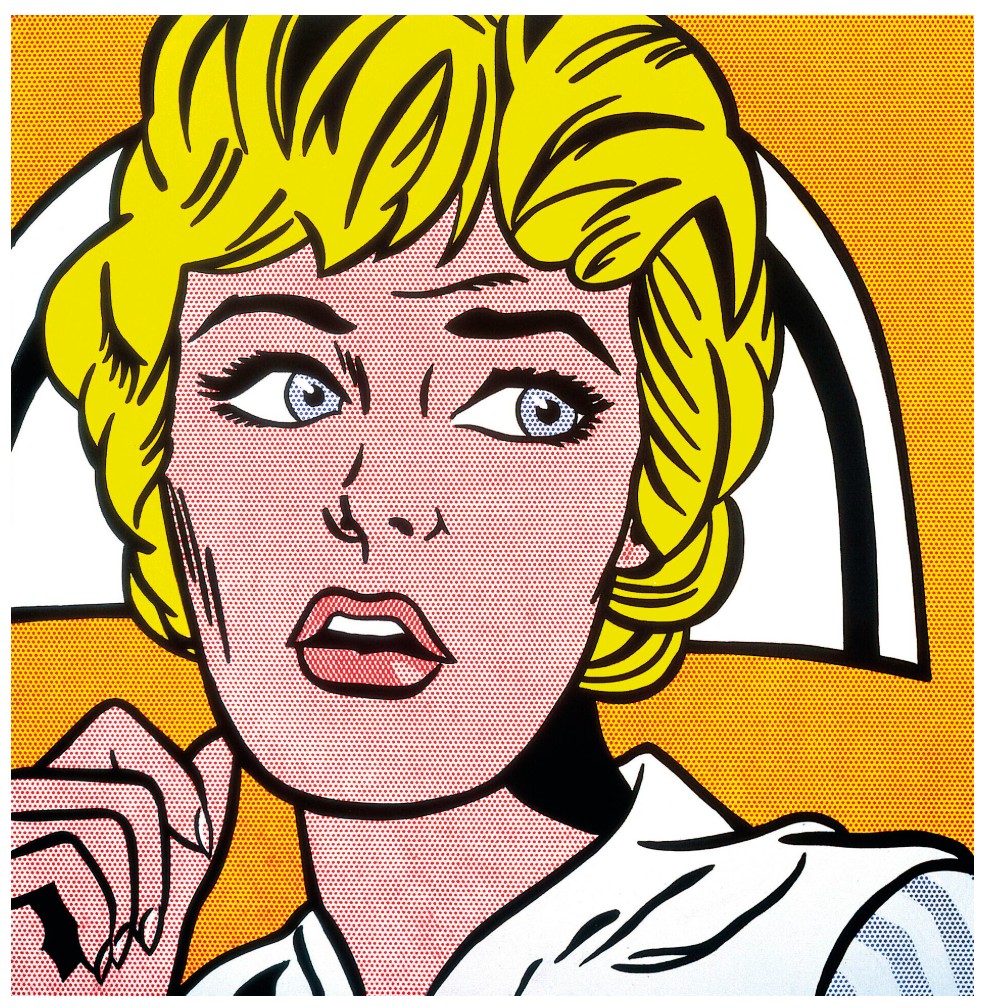
Roy Lichtenstein, Nurse, 1964. Private Collection. © Estate of Roy Lichtenstein.
In this vein, Double Nurse functions as a self-portrait, revealing Prince’s most profound worries as he grappled with the events occurring around him, leaning on the comforting yet complicated symbol of the nurse as a salve. Double Nurse offers an enticing point of origin for the later Nurse paintings which premiered in 2003 at Gladstone Gallery in New York. While his later Nurses embraced an erotic emphasis on the nurses, here they become both comforting sources of aid and ominous portents of hazard—where there are nurses, there is sickness. Double Nurse is a singular example out of Prince’s entire oeuvre which deconstructs the many masks, layers, and veils places around his artworks in order to provide a searing glimpse into the artist’s anxieties.
Man Crazy Nurse, 2002-03
Man Crazy Nurse, 2002-03
Selections from the Collection of Barbara Gladstone
Sotheby’s New-York: 15 May 2025
Estimated: USD 4,000,000 – 6,000,000
USD 3,967,200
Man Crazy Nurse | Selections from The Collection of Barbara Gladstone | Contemporary Art | Sotheby’s
RICHARD PRINCE (b. 1949)
Man Crazy Nurse, 2002-03
Acrylic and inkjet on canvas
80×52 inches (203.2 x 132.1 cm)
Signed, titled and dated 2002-2003 (on the overlap)
Provenance
Gladstone Gallery, New York
Acquired from the above in 2003 by the present owner
Set against a flaming vermilion background, emblazoned with gestural strokes of yellow and gushing drips of white pigment, Richard Prince’s Man-Crazy Nurse is a seminal example of the artist’s conceptual apogee in the Nurse paintings from 2002-08. Prince’s femme fatale protagonist explores and exploits the melodramatic pulp fiction stereotype, encapsulating the audacious subversion of authorship, identity, and authenticity at the heart of Prince’s practice.
Executed in 2002-03, Man-Crazy Nurse belongs to the artist’s original and acclaimed suite of Nurse paintings exhibited at Barbara Gladstone Gallery in the fall of 2003. The series marks a climax of the narrative arc of Prince’s conceptual program which begins with his iconic Cowboys in the 1980s, by which the artist contends with notions of originality through appropriation and witty interrogations of mythical cultural archetypes. Inspired by the cover art and titles of pulp fiction romance novellas from the 1950s-80s, which the artist collects avidly, the Nurse paintings deconstruct the trope of the seductive female nurse as a symbol of eroticism and objectification.
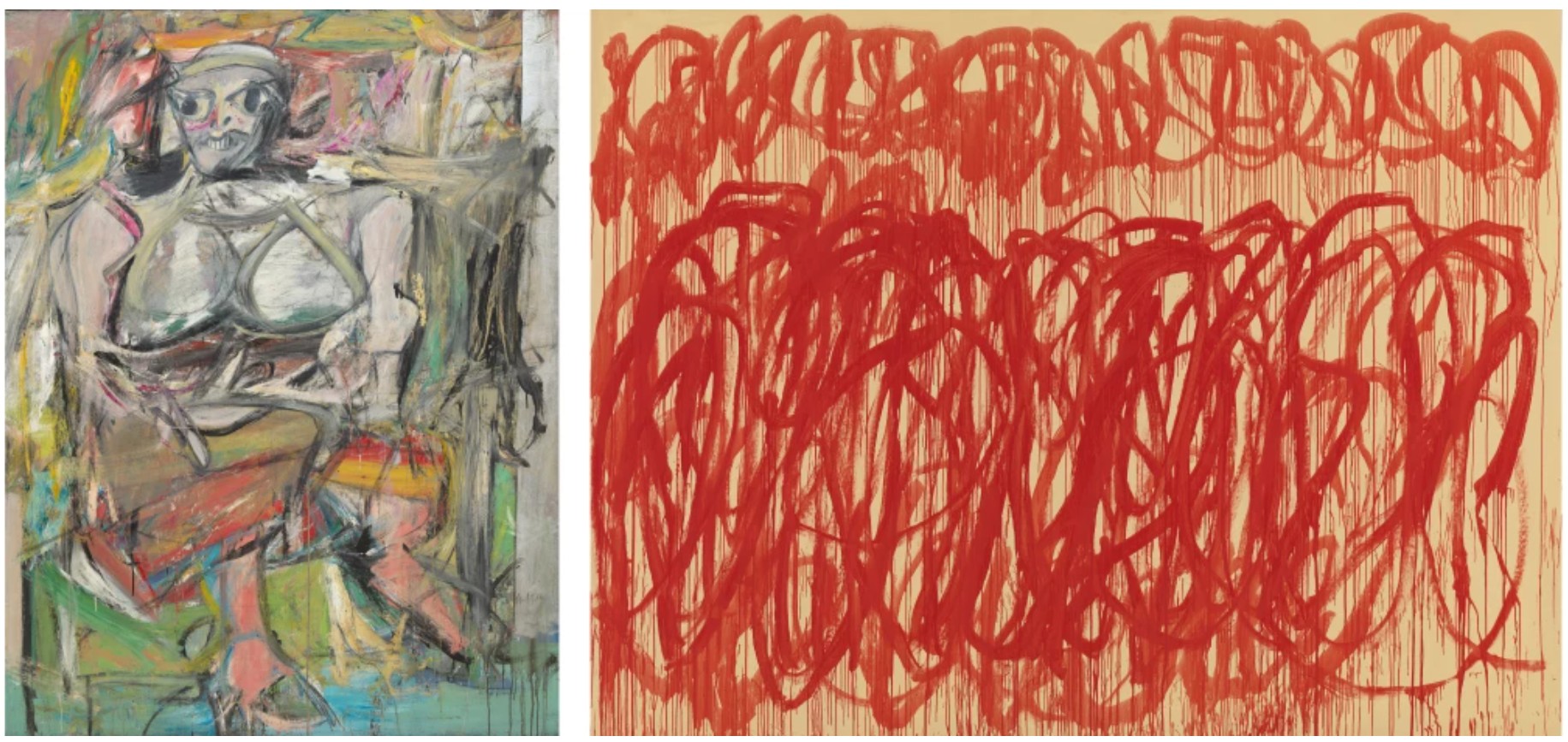
Left: Willem de Kooning, Woman I, 1950-52. The Museum of Modern Art, New York. Image © The Museum of Modern Art/Licensed by SCALA / Art Resource, NY. Art © 2025 The Willem de Kooning Foundation / Artists Rights Society (ARS), New York. Right: Cy Twombly, Untitled (Bacchus), 2005. Museum Brandhorst, Munich. Image © bpk Bildagentur / Museum Brandhorst / Art Resource, NY. Art © Cy Twombly Foundation
Prince’s series offers a transgressive scrutiny of the Pop bombshell precedent popularized in Andy Warhol’s celebrities and Roy Lichtenstein’s comic heroines, probing the polarities of desire and fear, thwarting the author’s original narrative. Further testament to the import of the present work, following its inclusion at the seminal Barbara Gladstone Gallery exhibition, Man-Crazy Nurse was featured in Prince’s mid-career survey, Spiritual America at the Solomon R. Guggenheim Museum, New York in 2007. Prince’s Man-Crazy Nurse emerges from a scorching red expanse; her starched-white uniform glowing against streaming yellow drips. The text “MAN-CRAZY NURSE” appears seared above the anonymous figure, whose facial features have been concealed by a surgical mask. In the creation of this work, Prince appropriated the cover art from one of romance novelist Peggy Gaddis’s fantasy tale, Man-Crazy Nurse. The original cover art features a sultry, red-lipped nurse in counterpoise, glancing over her shoulder at a suited man gaping in her direction, characteristic of a flourishing pulp fiction subgenre revolving around sexualized female nurses. Above the title, the introductory text reads: “Doctors and patients couldn’t resist this…”
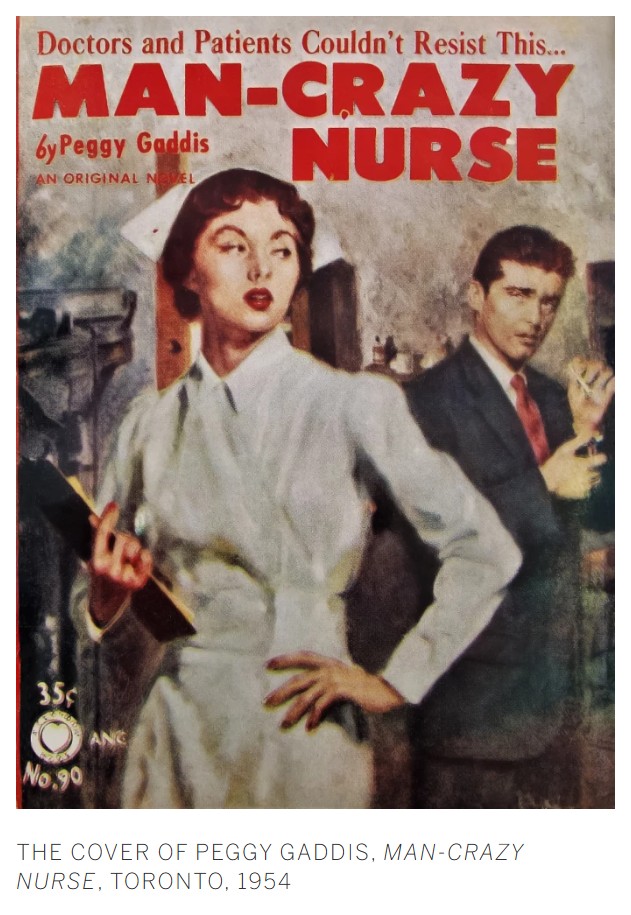
In Prince’s rendition, the Man-Crazy Nurse of Gaddis’ escapist novella takes a provocative and startling twist. Prince eliminates the male character from the scene: recontextualizing the nurse’s ostensibly seductive, enticing posture to one of aggression and even menace. Skeins of red pigment shroud her clipboard and red drips of pigment trinkle down her forehead evoking blood. Her face melts into a blur of pigment behind her mask, which afforded Prince a way of “making it all the same and getting rid of the personality.” (the artist quoted in: Glenn O’Brien, “Richard Prince,” Interview Magazine, December 2008 – January 2009, p. 201) Simultaneously seductive and sinister, the Nurse paintings create a compelling dichotomy that blurs the line between innocence and vice, desire and fear.
Killer Nurse, 2009-2010
Killer Nurse, 2009-2010
Phillips New-York: 13 May 2025
Estimated: USD 3,000,000 – 4,000,000
USD 3,206,000
Richard Prince Modern & Contemporary Art Evening Sale
Killer Nurse, 2009-2010
Acrylic and inkjet on canvas
Provenance
Private Collection
Skarstedt Gallery, New York
Acquired from the above by the present owner
Suspenseful and psychologically charged, Richard Prince’s Killer Nurse, 2009–2010 stands as a striking exemplar of the artist’s iconic “Nurse” series, in which fetish, gender, authorship, and the American cultural subconscious are all interrogated through the borrowed façade of pulp fiction. Since the 1970s, Prince has pursued a distinctly subversive practice, appropriating familiar imagery—cowboys, biker girls, jokes—to expose the inner mechanics of desire and identity. In Killer Nurse, a lone masked figure stares from the canvas, set against a swirling storm of crimson and pink, beneath a sharply rendered title that hovers like neon signage from a slasher film. The visual experience evokes contradiction: the painting is seductive yet sinister, theatrical yet subdued, intimate yet evasive. Through calculated manipulation of appropriated imagery, Prince transforms a genre cliché into a loaded symbol of social anxiety and voyeuristic desire.
“Some people say the nurse paintings are all about desire—but isn’t that more to do with their proximity to life and death? Isn’t that why we find nurses sexy—because they embody this ultimate contradiction?”
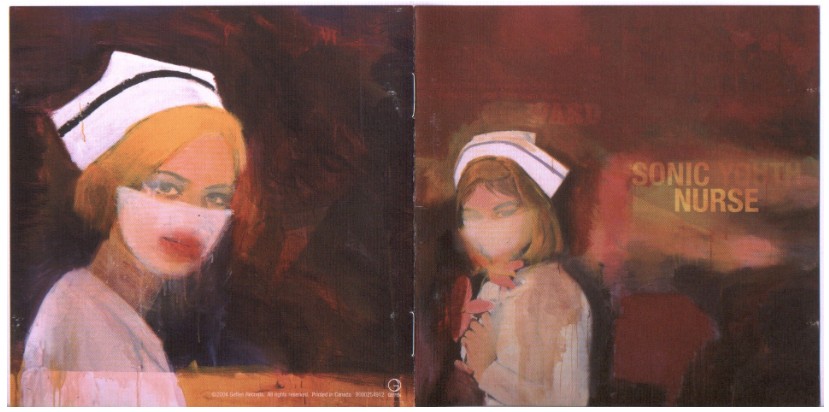 Sonic Youth’s Sonic Nurse 2004 album cover featuring a selection of Richard Prince’s “Nurse” paintings as cover art.
Artwork: © Richard Prince. Courtesy of the artist and Gladstone
Widely considered one of Prince’s most seminal bodies of work, the “Nurse” paintings have been exhibited extensively, including in his mid-career retrospective at the Solomon R. Guggenheim Museum, New York; the Walker Art Center, Minneapolis; and the Serpentine Gallery, London in 2007 and 2008. Works from the series are held in major institutional collections such as the Whitney Museum of American Art, New York; the Rubell Museum, Miami; and the Art Bridges Foundation, Bentonville, Arkansas. Nowhere in Prince’s oeuvre are the tensions between appropriation and authorship, seduction and subversion, more vividly staged than in the “Nurse” paintings. In Killer Nurse, he uses the language of pulp to expose the architecture of desire itself—its projections, its stereotypes, and its power to both mask and reveal.
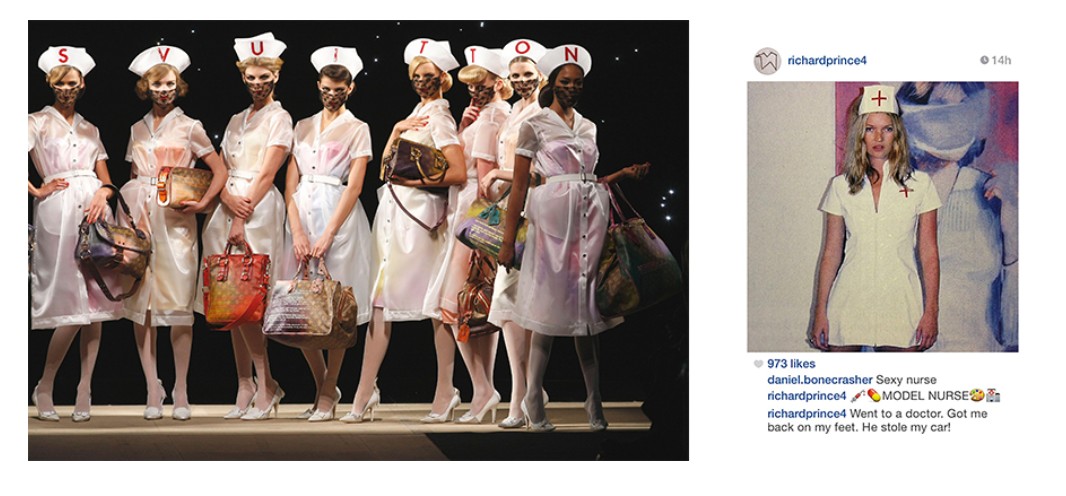
[Left] Model dressed in Prince-inspired nurse outfit for Louis Vuitton Spring 2008 Ready-to-Wear Collection runway show. Image: Abaca Press / Alamy Stock Photo
[Right] Instagram painting of Kate Moss by Richard Prince from 2014. Artwork: © Richard Prince. Courtesy of the artist and Gladstone
Created beginning in 2002, the “Nurse” paintings marked a shift in Prince’s method of appropriation. Rather than re-photographing pre-existing images as in his earlier work, Prince digitally scanned the covers of vintage pulp romance novels from his personal library, enlarged them, and transferred them to canvas via inkjet. He then applied vigorous layers of acrylic paint, obscuring much of the original illustration while enhancing its expressive charge. As seen in Killer Nurse, Prince’s sweeping brushwork and gestural overpainting efface nearly all identifying details from the source material—no background elements remain, and the book’s original title is replaced by his own stark, fabricated headline. This obliteration of authorial source epitomizes Prince’s long-standing effort to undermine notions of originality. He once described publicity images as “authorless pictures, too good to be true, art-directed and over-determined and pretty much like film stills, psychologically hyped-up and having nothing to do with the way art pictures were traditionally ‘put’ together.” In Killer Nurse, Prince manipulates this type of “authorless” image to both indulge and unravel the fantasy it projects.
“I’m painting nurses. I like their hats. Their aprons. Their shoes. My mother was a nurse. My sister was a nurse. My grandmother and two cousins were nurses. I collect ‘nurse’ books. Paperbacks. You can’t miss them. They’re all over the airport. I like the words ‘nurse’, ‘nurses’, ‘nursing’. I’m recovering.”
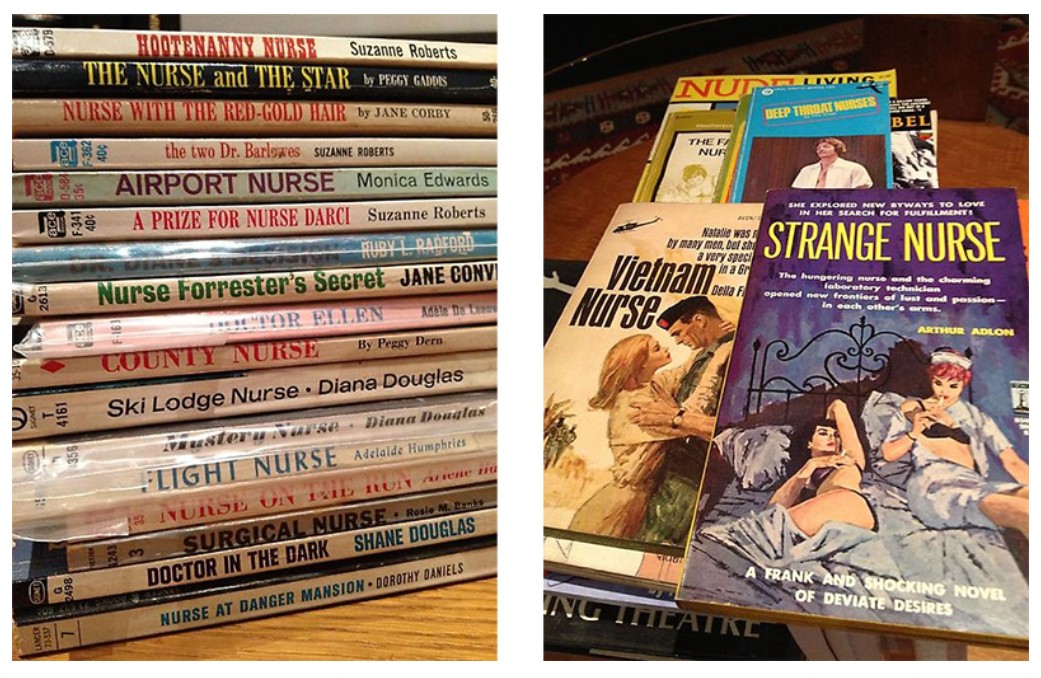
[Left and Right] A selection of nurse-related books from the artist’s personal collection. Image: © Richard Prince. Courtesy of the artist and Gladstone
Rather than offering a nostalgic homage to pulp, Prince seizes on the genre’s exploitative tendencies—particularly its melodramatic, oversexed depictions of women in positions of care. Since his early career as a member of the Pictures Generation, coming to artistic maturity alongside figures like Cindy Sherman and Sherrie Levine, Prince has consistently interrogated the ways in which gender, sexuality, and identity are framed by media and cultural narrative. Here, the “Killer Nurse”—fetishized, infantilized, sexualized—becomes a conduit for Prince’s examination of the Madonna/whore dichotomy. Just as he deconstructed masculine myths in his “Cowboys” series beginning in the 1980s, the “Nurse” paintings turn toward feminine archetypes—framing these subjects not as individuals, but as templates of desire, and then proceeding to destabilize those very projections through erasure, distortion, and exaggeration.
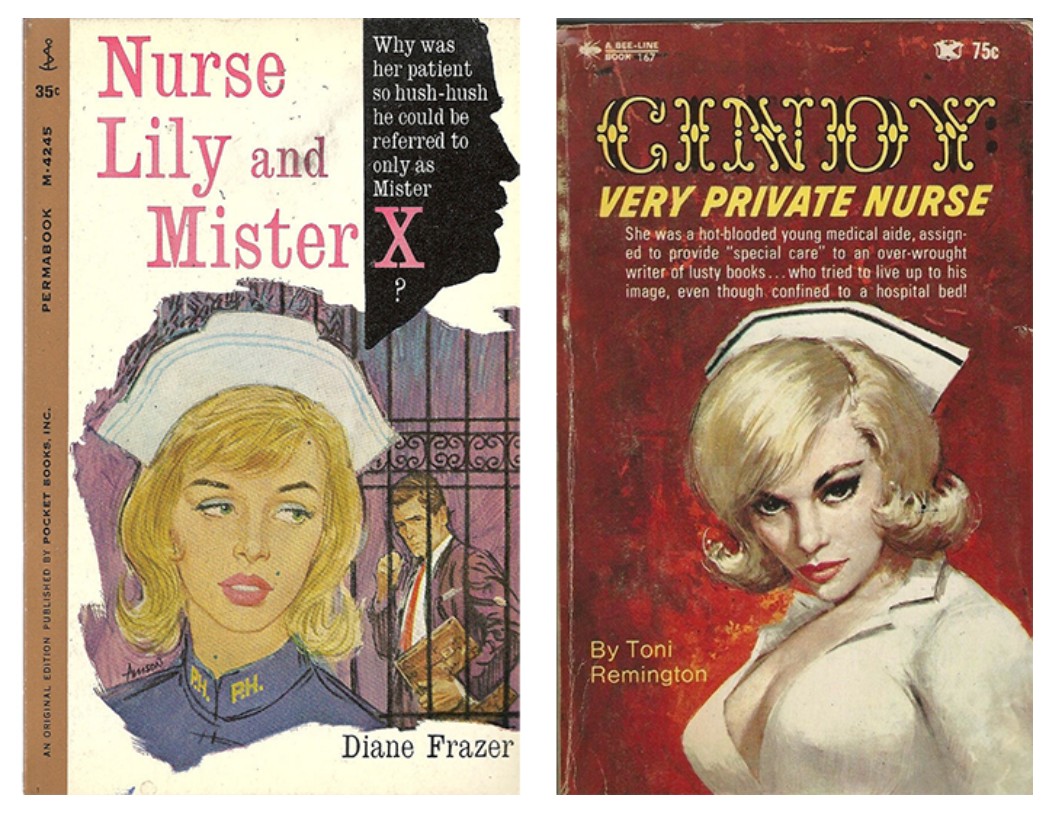
[Left] Cover of Nurse Lily and Mister X by Diane Frazer, 1961. Original illustration by unknown artist.
[Right] Cover of Cindy: A Very Private Nurse by Toni Remington, 1967. Original illustration by unknown artist.
While some works in the series clearly mimic the covers of identifiable pulp novels, Killer Nurse is more elusive. No details of the original cover peek through, and “Killer Nurse” does not correspond to any known title. Still, the hotly flushed background and film noir ambiance echo the cover of Toni Remington’s 1967 novella Cindy: A Very Private Nurse, while the figure’s pose, expressive eyebrows, and sidelong glance recall Diane Frazer’s Nurse Lily and Mister X from 1961, in which the protagonist stares warily at a shadowy male figure. On the novel’s back cover, the tone of suspense is explicit: “Lily’s professional smile was frozen on her lips… [T]his was a man who had terrorized the White House, a man even the President was said to be afraid of…”ii In Killer Nurse, Prince removes the male antagonist altogether, heightening the tension by allowing only the trace of a presence. The narrative is now one of isolation and mystery, with the nurse left to occupy a space of psychological intensity on her own.
“With the Nurse paintings… I wanted to do something just white; I wasn’t really interested in the figures so much. I was interested in writing down next to the figure what could happen to you; it became very depressing all the things that could happen… But before I put them away, I made a mistake painting all this white—this is when I say I get lucky. After I had wiped some off the painting, it looked like a mask on the nurse’s face and suddenly it was one of those moments. When I noticed that I realized that was going to be my contribution to the image, to put a mask on these various nurse illustrations. It was a way of unifying and also talking about identity.”
Central to this destabilization is the surgical mask—applied thickly and confidently, as if with a wide brush—that conceals the nurse’s nose and mouth entirely, rendering her silent. Prince has said the masks were a way of “making it all the same and getting rid of the personality.” In this example, Prince sunders the nurse into a smudged pastiche of her original: her eyes are hyperbolized with rich kohl and dense eyelashes, her side-swept pin-up bangs are looser and more blunt, and her made-up lips and signature mole are completely erased by the addition of the mask. But in the act of erasure, the mask paradoxically intensifies her presence. Her heavily made-up eyes become the focal point of the composition—unreadable yet rapt, absorbed by something we, the viewer, cannot see. The crimson paint that drips below the mask like blood or tears further evokes violence, vulnerability, and the gothic overtones of slasher cinema. Prince plays with this ambiguity deliberately. “Some people say the nurse paintings are all about desire—but isn’t that more to do with their proximity to life and death? Isn’t that why we find nurses sexy—because they embody this ultimate contradiction?” he once remarked. The image flirts with stereotype but subverts it through distortion, concealment, and excess. The added mask silences but also spotlights; the Killer Nurse is both vixen and victim, caregiver and threat.
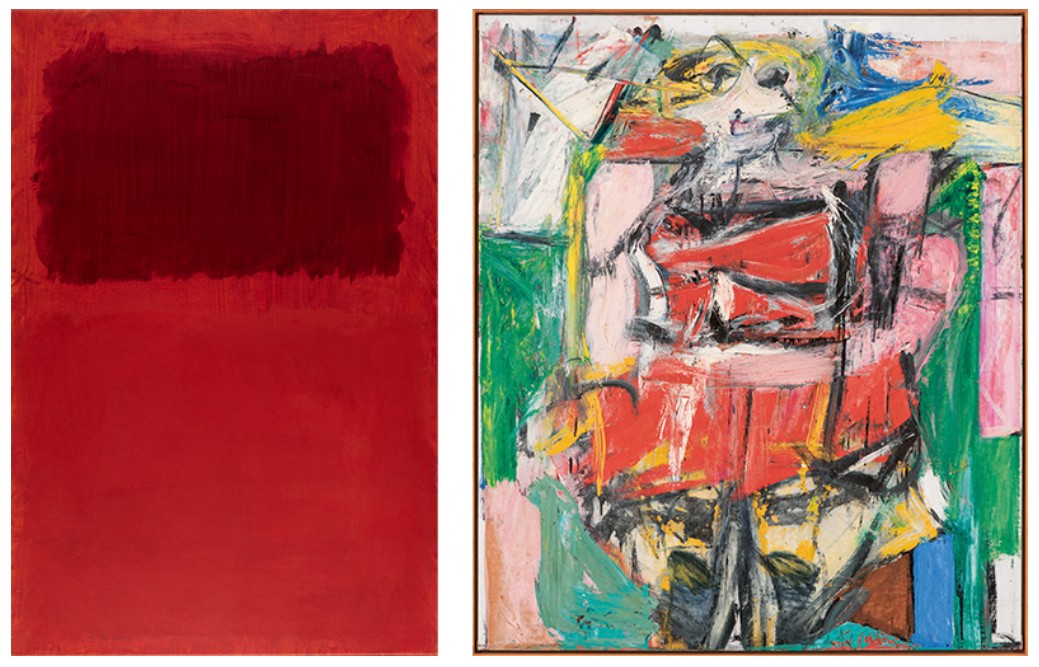
[Left] Mark Rothko, Untitled (Maroon Over Red), 1968. Pennsylvania Academy of Fine Arts. Artwork: © 1998 Kate Rothko Prizel & Christopher Rothko / Artists Rights Society (ARS), New York
[Right] Willem de Kooning, Woman VI, 1953. Carnegie Museum of Art, Philadelphia. Image: Carnegie Museum of Art, Pittsburgh, PA / Art Resource, NY, Artwork: © 2025 The Willem de Kooning Foundation / Artists Rights Society (ARS), New York
The expressive brushwork and color palette place Killer Nurse in conversation with mid-century abstraction. The stormy background, with its luminous fields of overlapping red and magenta, recalls the chromatic sublime of Mark Rothko, while the aggressive, almost violent handling of the paint gestures toward Willem de Kooning’s Women of the late 1940s and early 1950s—works often read as chaotic assaults on the female form. Prince, who paid direct homage to the postwar master in his “de Kooning” series from 2008–2009, adopts a similar push-pull dynamic of attraction and repulsion—invoking painterly machismo while subtly undermining it. His choice of subject—a figure coded as feminine, vulnerable, eroticized—is layered with irony. He deliberately assumes the position of the chauvinist, only to negate it through parody. By appropriating and overwriting these images with gestural abstraction, Prince collapses the boundaries between high art and kitsch, mass media and modernism, seduction and critique.
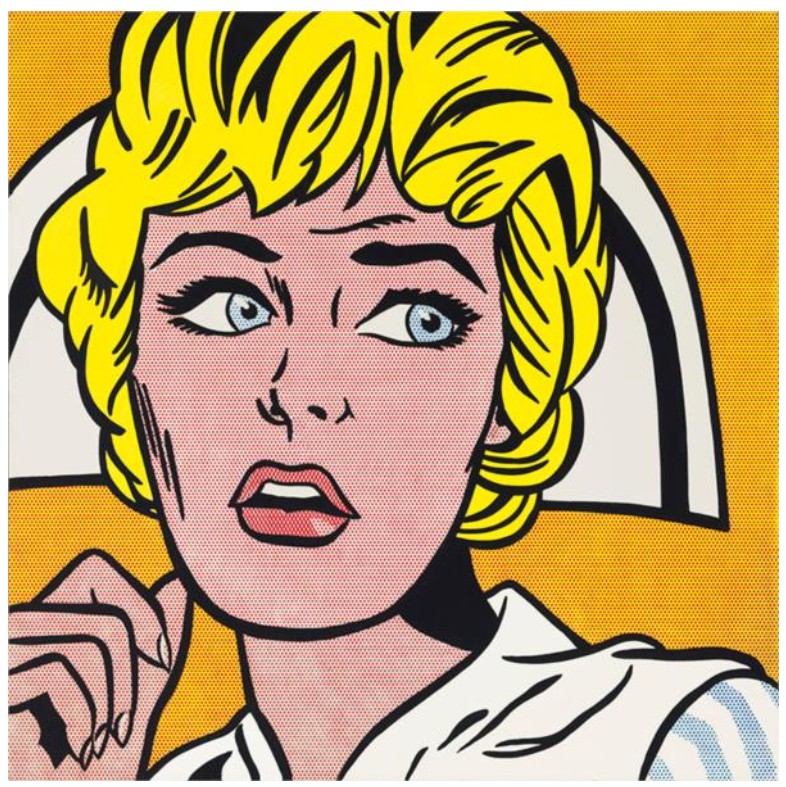
Roy Lichtenstein, Nurse, 1964. Private Collection, Sold for $95,365,000 at Christie’s New York in 2015.
Artwork: © Estate of Roy Lichtenstein.
At the same time, Prince embraces the Pop strategies of isolation and recontextualization employed by artists such as Andy Warhol and Roy Lichtenstein, who transformed the faces of film stars and comic-book heroines into cool, stylized icons. But unlike his Pop predecessors—whose renderings were marked by ironic detachment—Prince teases out the volatile undercurrents of latent sexuality and buried desire that simmer beneath the surface of these dime-store narratives. His “Nurses” are not flat or aloof, but raw, unstable, and fraught with psychological tension. The figure in Killer Nurse glows with the butter-yellow warmth of her hair and the scrubbed-pink tenderness of her skin, offset by the cool contrast of her eyes and the shadowy void that envelops her. Paint drips down the canvas like wet tears or blood, amplifying the emotional intensity. In Prince’s hands, the nurse becomes a cipher for broader cultural anxieties. The painting’s theatricality, suspense, and stylized violence evoke not only pulp fiction, but also film noir and horror cinema. Occupying a liminal space between beauty and dread, comfort and fear, Killer Nurse reveals how cultural narratives shape desire and distort perception. By manipulating found imagery, Prince exposes the mechanics of mass media and the archetypes it recycles. He lures the viewer with a familiar trope, only to confront them with its instability and artifice. In doing so, Killer Nurse stands as a haunting and essential work—one that seduces, provokes, and resists resolution, much like the masked figure at its center.
Nurse on Trial, 2005
Nurse on Trial, 2005
Sotheby’s New-York: 21 November 2024
Estimated: USD 5,000,000 – 7,000,000
USD 6,700,000
Nurse on Trial | The Now and Contemporary Evening Auction | 2024 | Sotheby’s
REPEAT SALE
Christie’s New-York: 12 November 2014
Estimated: USD 5,000,000 – 7,000,000
USD 5,765,000
Richard Prince (b. 1949), Nurse on Trial | Christie’s
RICHARD PRINCE (b. 1949)
Nurse on Trial, 2005
Acrylic and inkjet on canvas
75×52 inches (190.5 x 132.1 cm)
Signed, titled and dated 2005 (on the overlap)
Provenance
Gagosian Gallery, New York
Private Collection (acquired from the above in 2008)
Christie’s New York, 12 November 2014, lot 62
Acquired from the above sale by the present owner
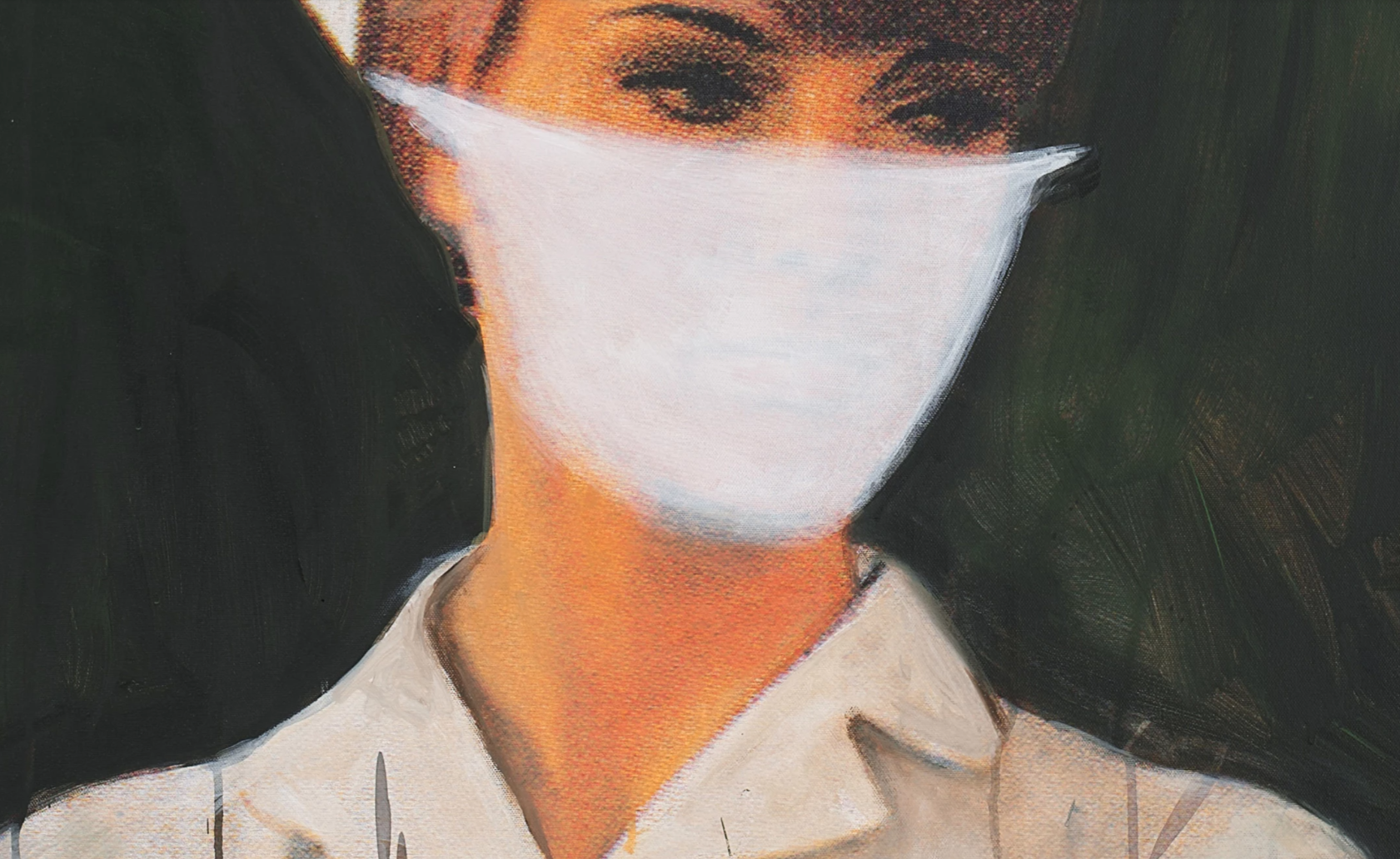
Diaphanous drips of acrylic and a spectral white mask obscure the visage of Nurse on Trial from 2005, whose charged presence embodies Richard Prince’s searing and oft sardonic subversions of authorship and authenticity. Shrewd, seductive, anachronistic, and aloof, the Nurse Paintings see Prince at his very best, flirting with the melodrama of their source while confronting viewers with their own latent desire. Mining the titles and cover illustrations of mid-century dime store novellas – of which Prince maintains an extensive personal collection – the Nurse Paintings simultaneously entertain and upend the trope of the female damsel. Prince embraces the strategies of isolation and recontextualization used to create the Pop bombshells of Andy Warhol’s paparazzi silkscreens or Roy Lichtenstein’s comic mavens, but here, he applies his scrutinous Pictures Generation lens to indulge a stereotypical fetish, all the while probing the frailties of lust.
“Some people say the nurse paintings are all about desire—but isn’t that more to do with their proximity to life and death? Isn’t that why we find nurses sexy—because they embody this ultimate contradiction?”
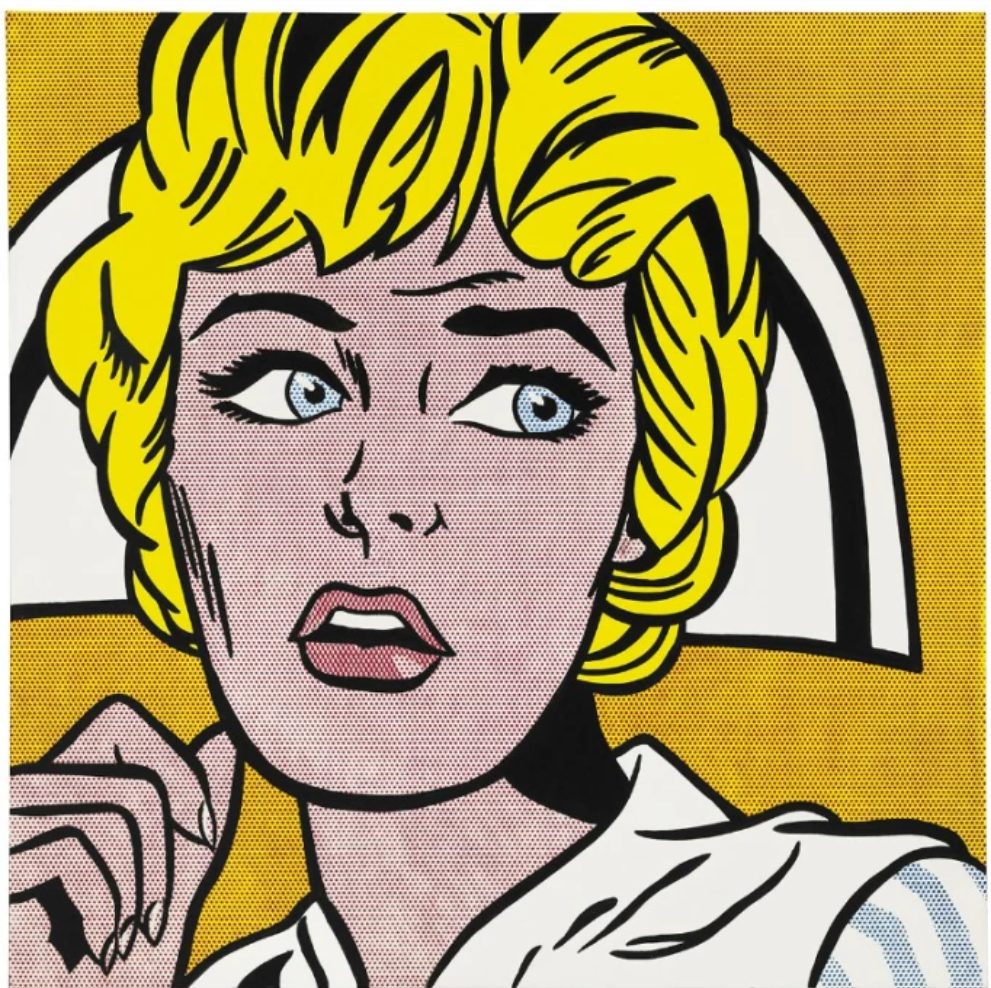
Roy Lichtenstein, Nurse, 1964. Private Collection. Art © Estate of Roy Lichtenstein
Prince’s Nurses stand among his most iconic bodies of work, and they are represented in esteemed institutional collections, from the Whitney Museum of American Art, New York; Rubell Museum, Miami; to the Art Bridges Foundation, Bentonville. Nowhere in his inimitable corpus is his intransigent spirit and shameless, salacious candor so decisively summarized than in his Nurses, and in Nurse on Trial, Prince at once, miraculously, indulges and interrogates a generation’s relationship to temptation and sexuality.
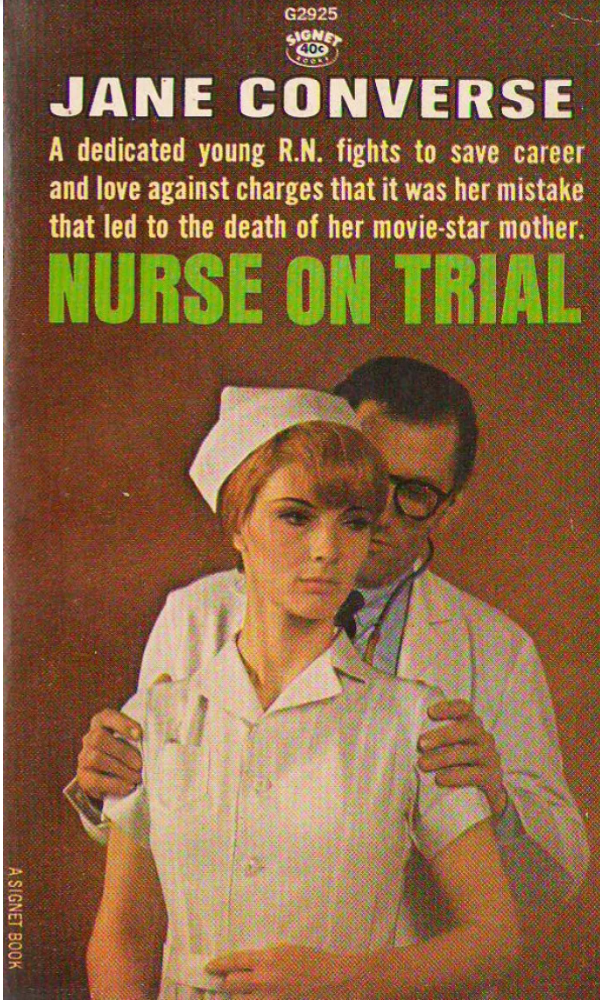
The cover of Jane Converse’s 1966 novel Nurse on Trial
Prince’s image mimics that of the front cover of Nurse on Trial, the 1966 pulp book written by Jane Converse, a pseudonym for Adele Kay Maritano. The original cover sees an imposing male doctor purveying an anguished nurse from behind. Above the two figures, the tagline reads: “A dedicated young R.N. fights to save career and love against charges that it was her mistake that led to the death of her movie-star mother.” Prince began by scanning, enlarging, and transferring the original cover art onto the canvas using a printer, before layering paint atop the inkjet ground. Eliminating the male character and majority of the text, Prince has sundered his nurse into a smudged pastiche of her original: her eyes have been made heavier, hyperbolized with rich kohl and dense eyelashes, her pin-up bangs looser, and her made-up lips swaddled by the addition of a white mask, which, according to the artist, were a way of “making it all the same and getting rid of the personality.” (the artist quoted in: Glenn O’Brien, “Richard Prince,” Interview Magazine, December 2008 – January 2009, p. 201) Despite Prince’s compositional interventions, the suspense and film noir ambiance of the cover art has been retained, here heightened by the shadowy emerald void against which the lone nurse has been set.
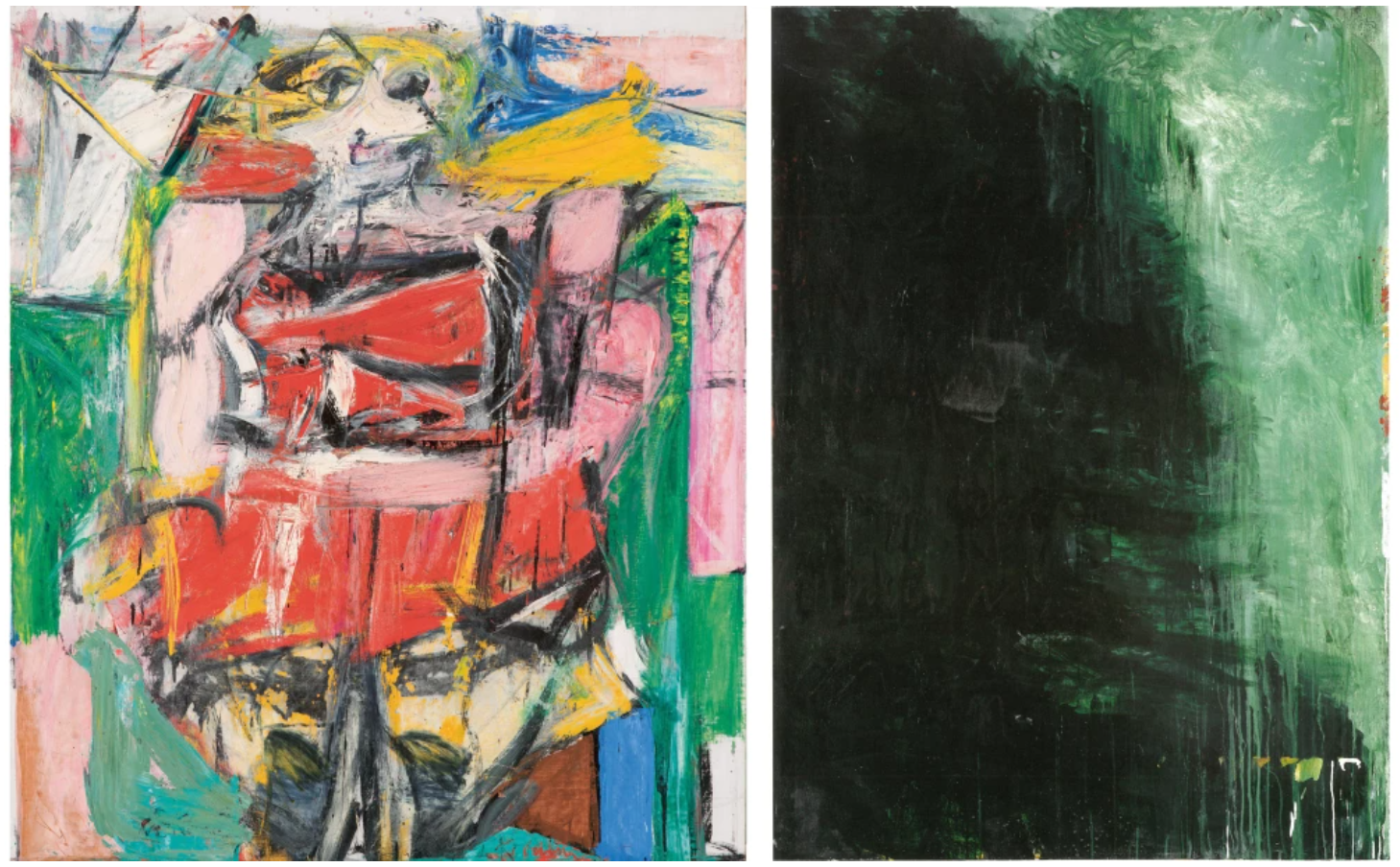
Left: Willem de Kooning, Woman VI, 1953. Carnegie Museum of Art, Pittsburgh. Image © Carnegie Museum of Art, Pittsburgh, PA / Art Resource, NY. Art © The Willem de Kooning Foundation/ Artists Rights Society (ARS), New York. Right: Cy Twombly, Paesaggio, 1986. Private Collection. Art © Cy Twombly Foundation
Tempestuous washes of thinned hunter green consume Prince’s protagonist, boasting the range of his facture: in places the near violent modulation of paint stutters into extended, aqueous rivulets, a turn rife with allusions to the history of American action painting. Vitalized with heady brushwork, drips, and splatters, the background offers Prince’s riposte to Abstract Expressionism as he conjures the gestural fury of Willem de Kooning’s erotic yet suffocating Women, tinged too, perhaps, with the same fear, discomfort, or intimidation. Nurse on Trial pays homage to the techniques pioneered by the legendary New York School who redefined the cultural landscape concurrently with the rise of the pulp novel. Thus, the Nurse Paintings represent the dubious confluence of two American movements: the avant-garde athleticism of postwar abstraction and the graphic kitsch of the vintage paperback, placing vanguardism and banality in dialogue with one another.
Sparing no American cultural mores in his taxonomic approach to his practice, Prince remains, at his core, preoccupied by what is already familiar. Through his signature transformations of vernacular imagery, whether that be magazine advertisements or bawdy newspaper cartoons, Prince has established a seat at the fore of contemporary cultural anthropology, often blurring the distinction between the ersatz and real in his Americana dissections. His Nurses are no different; in fact, this body of work finds itself at the other end of the artist’s long-developed narrative arc, one counterbalanced by his Cowboys of the 1980s. Replacing the machismo-stricken hero cropped from Marlboro cigarette campaigns, Prince creates a similarly trumped-up femme fatale: an antipode to his earlier portrayals of masculinity. Nurse on Trial announces a reconsideration of the many themes shared by his Cowboys, from the manipulation of appropriated images, the glamor of mass culture, mythologized gender roles, and the death of the apotheosized artist-maker.
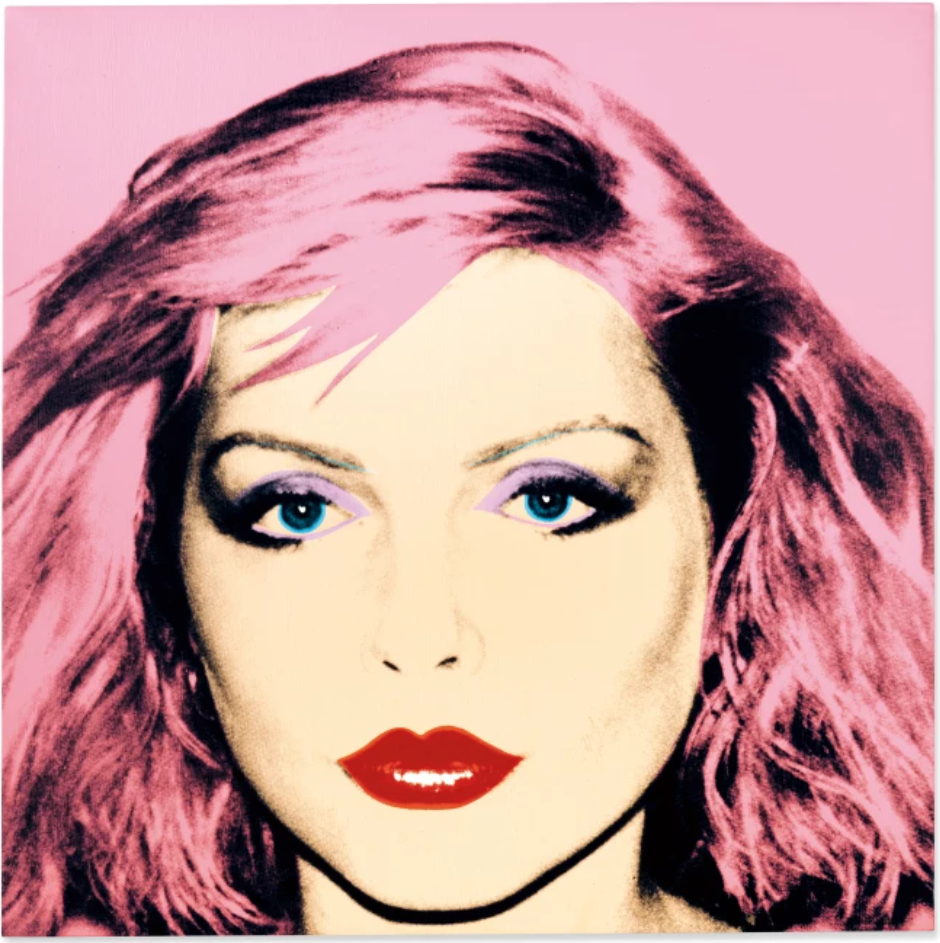
Andy Warhol, Debby Harry, 1980. Private Collection. Sold at Sotheby’s London in March 2023 for £6.6 million.
Art © 2024 Andy Warhol Foundation for the Visual Arts / Artists Rights Society (ARS), New York
“I had the first Nurse show in London and I remember picking up the newspaper and noticing people wearing these surgical masks because of SARS, and the paintings became a lot more real for me, it goes back to the fact that I do believe everybody needs a nurse.”
Plundering the polarities of fear and intrigue, vulnerability and violence, Prince thwarts authorial agency to undo the codes of desire forged by consumerism, female objectification, and societal clichés. Prince’s shameless courting of the controversial sexualized nurse reads even more prescient yet transgressive in a post-pandemic present, where such figures evoke an almost primeval sense of comfort. Whether or not by design, the Nurses stand dripping with fraught fantasy
Hurricane Nurse, 2004
Hurricane Nurse, 2004
Christie’s London: 9 October 2024
Estimated: GBP 3,500,000 – 5,500,000
GBP 4,184,250 / USD 5,481,370
RICHARD PRINCE (B. 1949), Hurricane Nurse | Christie’s (christies.com)
RICHARD PRINCE (B. 1949)
Hurricane Nurse, 2004
Acrylic and inkjet on canvas
69 1/8 x 42 inches (175.5 x 106.8 cm)
Signed, titled and dated ‘R Prince 2004 “Hurricane Nurse”’ (on the overlap)
Provenance
Sadie Coles HQ, London
Acquired from the above by the present owner in 2006
Held in the same private collection since 2006, Hurricane Nurse (2004) is among the most compelling and atmospheric of Richard Prince’s Nurse paintings: the series which has come to be seen as his definitive body of work. The cover of Peggy Gaddis’s pulpy ’60s romance novel, whose title adorns the painting, has its trim brunette off-kilter in the gale. Prince’s heroine is instead a blonde woman standing poker-straight, staring fixedly at something just over the viewer’s left shoulder. Drips of color run from the nurse’s surgical mask and her electric-pink eyeshadow; gold flashes shimmer through the translucent, painterly brushwork of the purple background, perhaps portending the gathering of storm clouds behind her.
Roy Lichtenstein, Nurse, 1964. Private Collection. Artwork: © Estate of Roy Lichtenstein/DACS 2024.
Prince’s Nurse paintings are all riffs on dime-store romances in the artist’s prodigious library. He exhibited the first of them at Barbara Gladstone Gallery, New York, in 2003; critical appreciation was fueled by Sonic Youth’s adaptation of Nurse of Greenmeadow (2002) for the cover of their album Sonic Nurse in 2004. The Nurse series is now generally considered to be the most complex culmination of the doctored appropriations from mass culture Prince has been executing since 1977—a brilliant development from his earlier appropriations of magazine photographs using practices of ‘re-photography’ he pioneered alongside fellow artists of the 1980s Pictures Generation such as Cindy Sherman and Barbara Kruger. Perhaps especially, it continues along a trail blazed with the Girlfriend pictures (1993), of young women snapped semi-nude next to Harley Davidsons lifted from American biker magazines: another genre of roleplay fetish.
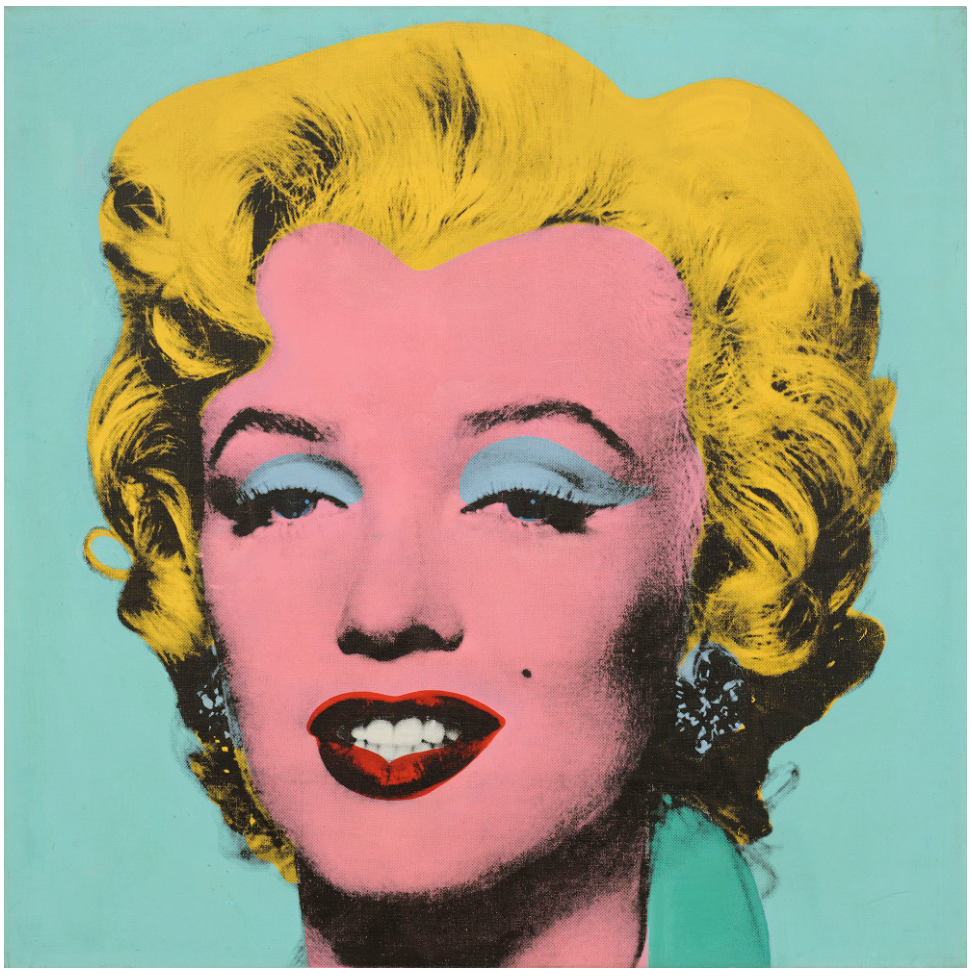
Andy Warhol, Shot Sage Blue Marilyn, 1964. Private Collection. Artwork: © 2024 The Andy Warhol Foundation for the Visual Arts, Inc. / Licensed by DACS, London.
The earliest Nurse paintings employed faithful reproductions of the figures on the book covers, which Prince would scan before transferring them with inkjet printing onto the canvas. These figures were dislocated from their original surroundings, their faces concealed to a greater or lesser degree with a mask and other alterations imposed by Prince’s gestural brushwork, but their poses essentially unaltered. Created the year after the Gladstone show, Hurricane Nurse takes its composition from a different source than the title: perhaps another Peggy Gaddis novel; perhaps somewhere else entirely. Cropped just below the shoulders, the tight focus on the woman’s head and its isolation against a dark, featureless background achieves an intimation of her interiority, the intensity of which is scarcely matched by any other painting in the series.
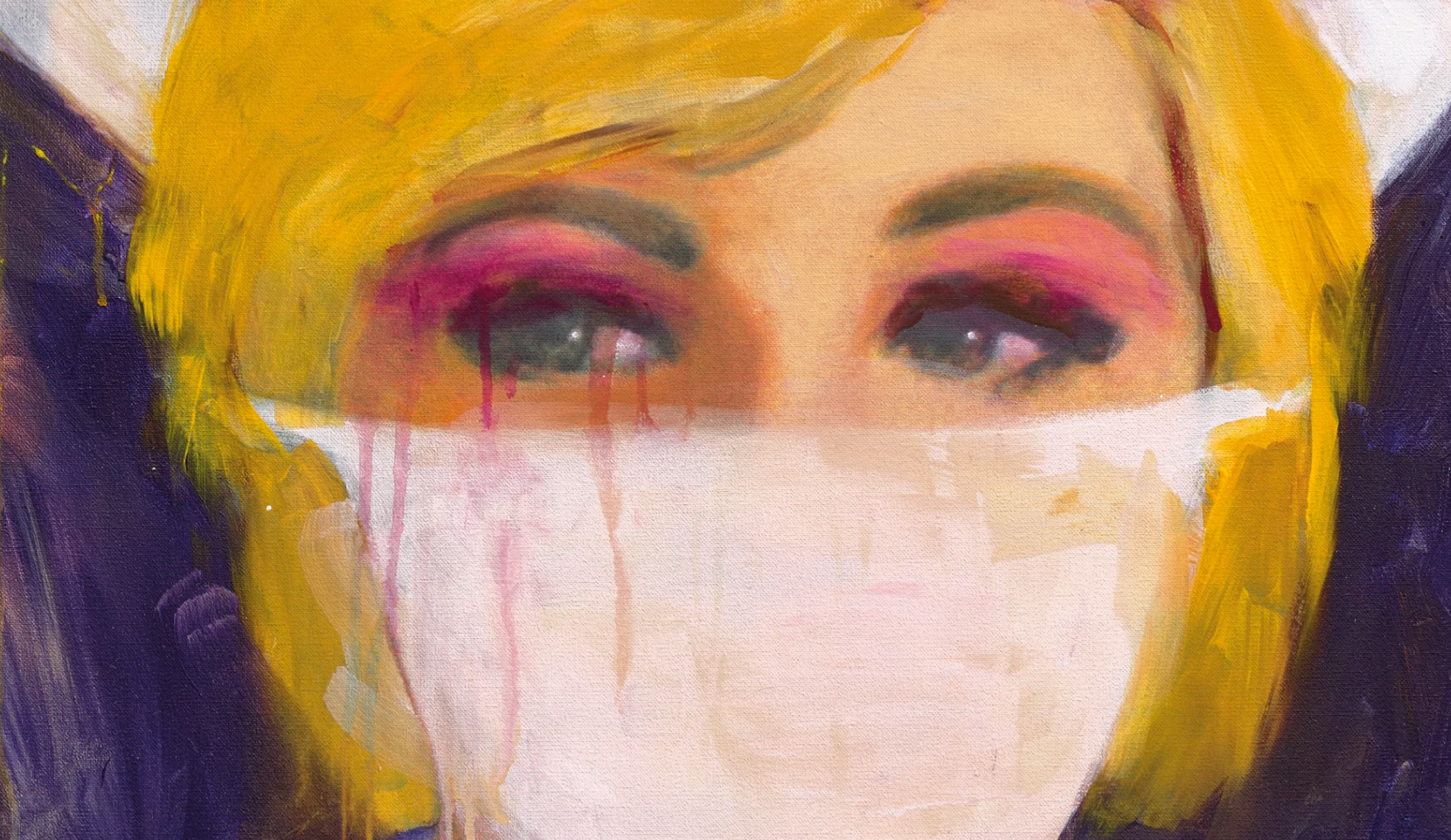
The Nurse paintings tend either to emphasize the figure, hugged by a close-fitting uniform, or else, when they confine themselves to head and shoulders, to introduce a note of slasher-film horror—in School Nurse (2005), lipstick-red paint bleeds profusely through the mask and from what appears to be a gash above the eyebrow. Hurricane Nurse, instead, appears collected, composed. Her eyes are like an inversion of the old saw about the Mona Lisa—they resolutely avoid you around the room—while the dispassionateness of her gaze and gait brings to mind Vermeer. Yet this impression is complicated by the lurid eyeshadow, and the mask: another reversal, for where other Nurses’ masks disrupt their straightforward presentation as subjects to titillate the male gaze, conferring on them an unknowable, interior world, the mask of Hurricane Nurse leaves us uncertain whether or not our impression of her composure is, in fact, the lie. Perhaps what the mask conceals is a coquettish smile—but then again, perhaps not.
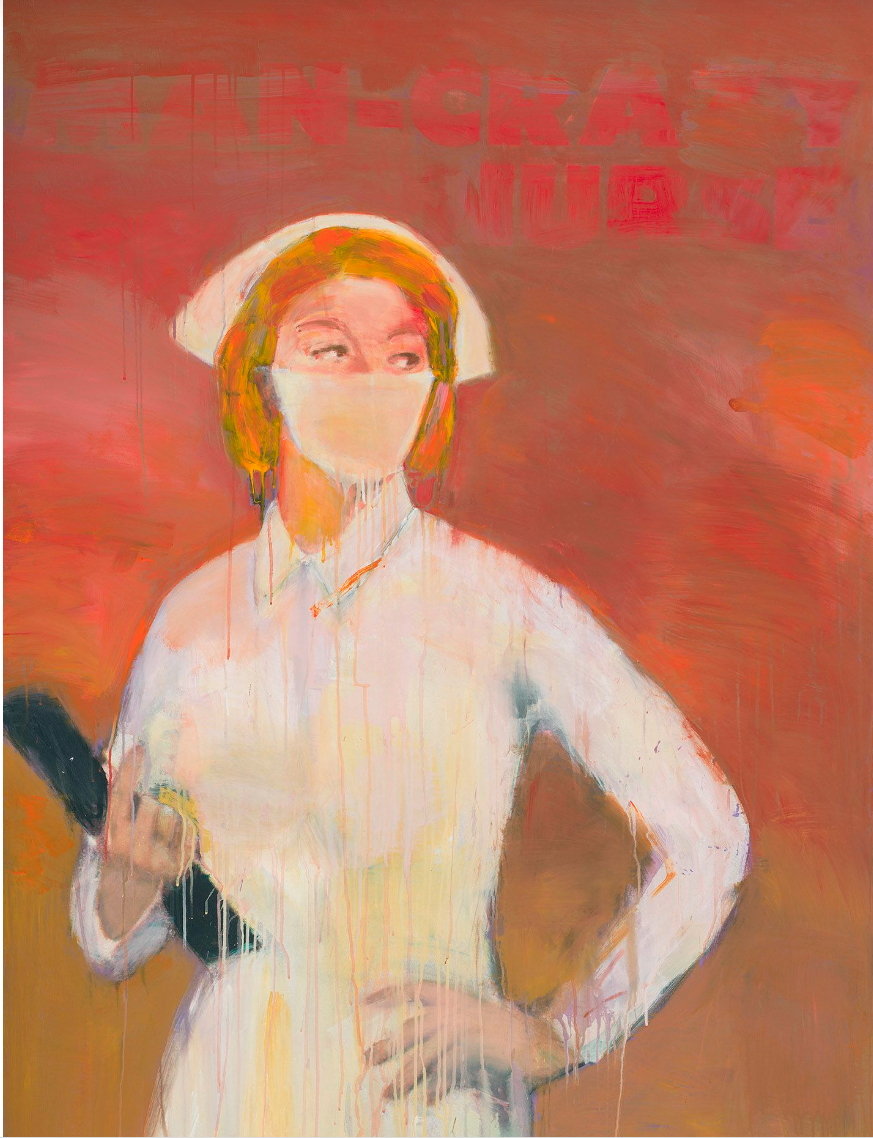
Richard Prince, Man Crazy Nurse #3, 2003. Whitney Museum of American Art, New York. Artwork: © Richard Prince. Digital Image: Whitney Museum of American Art / Licensed by Scala.
“After I had wiped some off the painting, it looked like a mask on the nurse’s face and suddenly it was one of those moments. When I noticed that I realized that was going to be my contribution to the image, to put a mask on these various nurse illustrations. It was a way of unifying and also talking about identity … they seemed to hit some kind of nerve, and it goes back to the fact that I do believe everybody needs a nurse.”
Hurricane Nurse is an outstanding testament to the intricacy of Prince’s career-long investigation of the mechanics of fetishizations, the shallowness of the models of gender made and sold by the mass media, and the degree to which consumers, aroused in spite of themselves, are complicit in their proliferation. It stands at the midway of his career to date, advancing the appropriative tactics of his early ‘re-photography’ and complicating of the use of text inaugurated in his ‘joke paintings’ of the 1980s. Prince has continued to explore these themes in new directions since, creating risqué riffs on the Abstract Expressionism of Willem de Kooning and Jackson Pollock, and diving into the murky image-world of Instagram.
Nurse Kathy, 2004
Nurse Kathy, 2004
Christie’s New-York: 17 May 2023
Estimated: USD 4,000,000 – 6,000,000
USD 4,890,000
RICHARD PRINCE (b. 1949) (christies.com)
RICHARD PRINCE (b. 1949)
Nurse Kathy, 2004
Inkjet and acrylic on canvas
77×46 inches (195.6 x 116.8 cm)
Signed, titled and dated ‘Richard Prince 2004 NURSE KATHY’ (on the overlap)
Provenance
Barbara Gladstone Gallery, New York
Tim Nye, New York
Acquired from the above by the present owner
Painted in 2004, Nurse Kathy is an early example of Richard Prince’s iconic paintings that appropriate the covers of popular romance novels. Where his Cowboys set a precedent for the artist’s use of cultural archetypes (in this case, cigarette advertisements) as they came to both assert and reflect on masculinity, this later series of Nurses were potent explorations into archetypal femininity. Approaching this subject with the distance of an outsider looking in, the figure of the nurse is both generalized and an intimate depiction. Nurse Kathy at once embodies a kind of neutrality as a popular culture derivative, while also reflecting personal desires, warring emotions, and an intoxicating sense of drama.
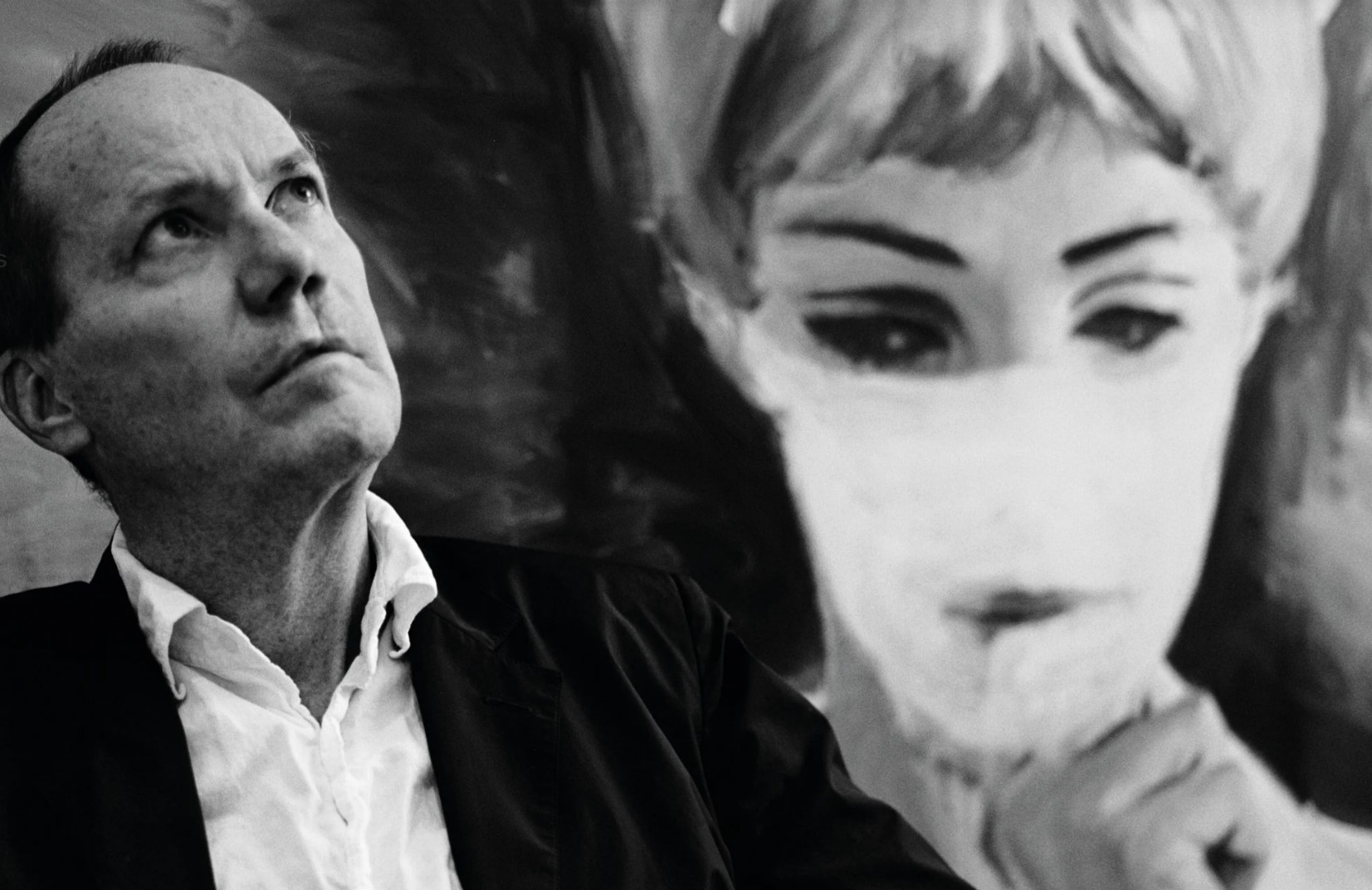
The titular nurse is halo-ed in red and dabs of yellow, which ripple into the muddled blue backdrop. Applied with an action-painting sensibility, this color pallet and its dark depth contrast with her starched white uniform. The matching surgical mask, which eclipses the lower half of her face, shrouds the central figure with a certain mystique. The mask, though not original to the source image, is consistent with the motif of the Nurse series. There is a dreamy glint behind her hooded, downturned eyes, and with the rest of her face concealed, they offer a subtle glimpse into her inner world. The frenetic energy of the brushstrokes that surround the nurse are equally juxtaposed with her soft features and the cinematic blur of her gaze. The sterile white of the hospital uniform, which expands across the center of the composition, is disrupted by thin, translucent drips of paint that cascade over her shoulder, down from her temple, and across her collar. Beginning their descent from the backdrop, the drips carry over some of those same colors along with variations derived from their mingling: a rustier red, an olive green, and an ochre brown.
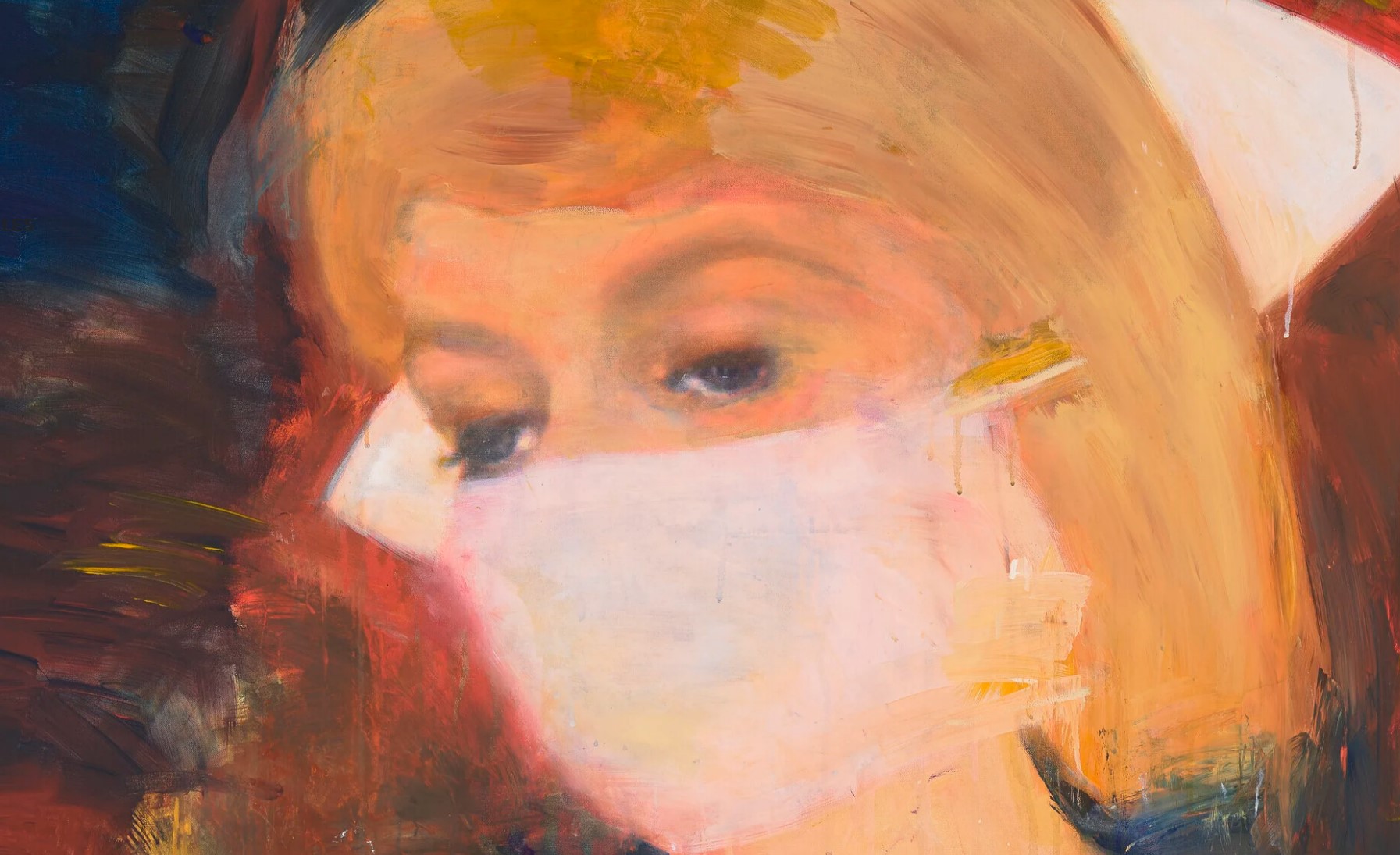
A ghost of blue, illegible text surfaces from beneath the white passage of her torso. Her lower body is completely obscured by a passage of color that begins as a vibrant red at its upper edge and is then muddled down into that same blue of the backdrop into the lower edge of the composition. To the left of the canvas, the figure of the nurse is partially obstructed by a rectangular form containing the title script of ‘Nurse Kathy,’ with its yellow font taken directly from the cover of the source novel. Though the edges of this shape are primarily the same blue, yellow is applied over the lettering in a way that mimics the glow of a neon sign. The painterly texture and drips that surround the text echo the backdrop, creating a cohesive mood.
Camp Nurse, 2002-2003
Camp Nurse, 2002-2003
Christie’s Hong-Kong: 28 November 2023
Estimated: HKD 22,000,000 – 28,000,000
HKD 20,945,000 / USD 2,689,000
21391-richard-prince-nurse (christies.com)
RICHARD PRINCE (B. 1949)
Camp Nurse, 2002-2003
Inkjet and acrylic on canvas
56×36 inches (142.2 x 91.4 cm)
Signed, titled and dated ‘Richard Prince CAMP NURSE 2002-03’ (on the overlap)
Drenched in the misty stream of ruby and amethyst brushstrokes, Camp Nurse is a striking example of Richard Prince’s celebrated series of Nurse paintings inspired by covers of vintage nurse-romance novellas. As the early batch of the series, the present work debuted at the now-legendary exhibition at Barbara Gladstone Gallery in 2003. Prince’s Nurse paintings can be seen as an extension of the image appropriation strategies he developed in the 1980s as a member of Pictures Generation alongside artists like Cindy Sherman and Barbara Kruger.
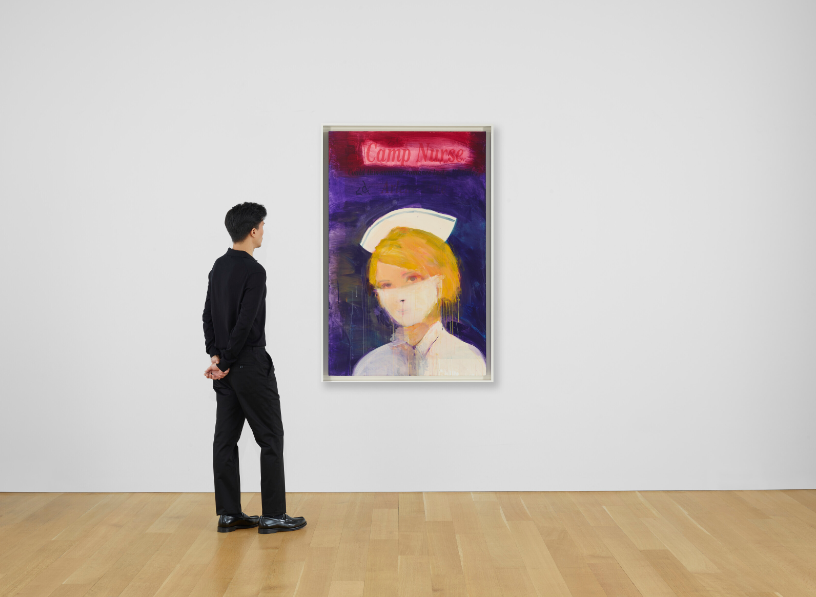
Following his early serial works Cowboys and Girlfriends, the Nurses continues to challenge the notions of authorship and originality by blurring the boundary between highbrow and lowbrow art. Here in Camp Nurse, a caregiving, nursing figure is twisted and fetishized in Prince’s matchless gestural marks, breaking free from her original, sterilized setting, and transported into a dusky tropical paradise—an altered world that rings with the underbelly of America.
Runaway Nurse, 2005-06
Runaway Nurse, 2005-06
Sotheby’s Hong-Kong: 18 June 2021
Estimated: HKD 75,000,000 – 95,000,000
HKD 93,986,000 / USD 12,107,710
NEW AUCTION RECORD FOR THE ARTIST
REPEAT SALE
Christie’s New-York: 10 May 2016
Estimated: USD 7,000,000 – 10,000,000
USD 9,685,000
Richard Prince (B. 1949), Runaway Nurse | Christie’s (christies.com)
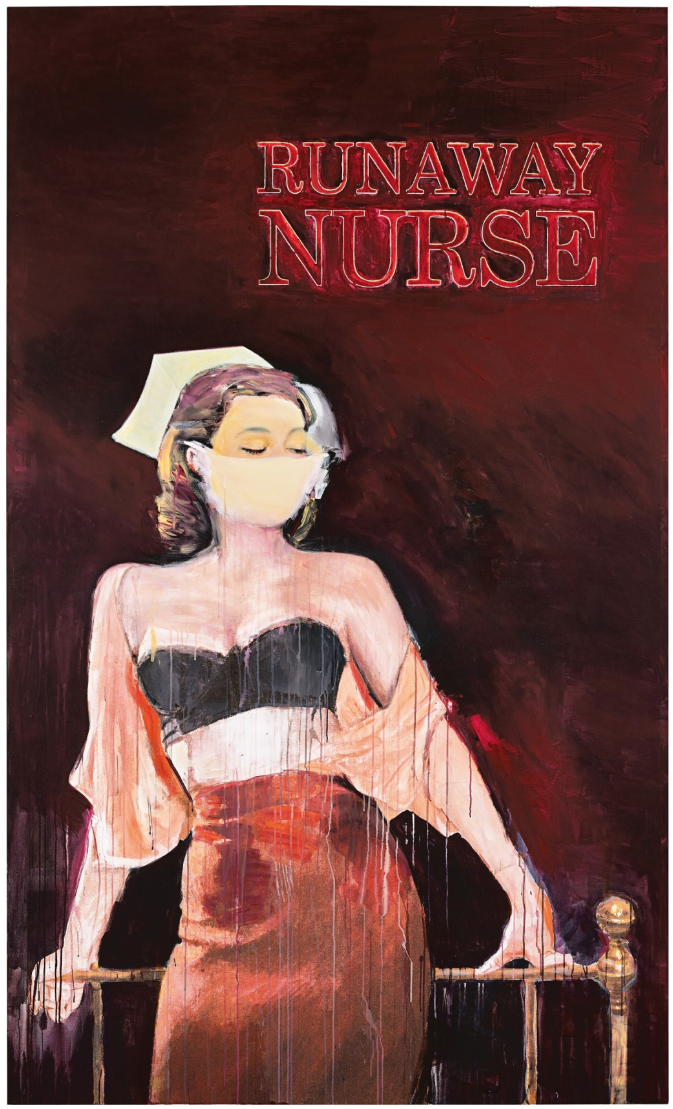
RICHARD PRINCE (b. 1949)
Runaway Nurse, 2005-06
Inkjet and acrylic on canvas
110 1/4 x 66 1/4 inches (280×168 cm)
Signed, titled and dated 2005-06 on the overlap
Provenance
Private Collection (acquired directly from the artist)
Christie’s, New York, 10 May 2016, Lot 38B
Acquired from the above sale by the present owner
A blaze with salacious provocation, suspense, and steamy film noir ambiance, Runaway Nurse constitutes a quintessential expression of the very best of Richard Prince’s singular series of Nurse Paintings. At once seductive and anarchistic, alluring and aloof, Prince’s beautiful heroine is inspired by the scantily clad seductress in the 1948 film noir crime novel Kiss Tomorrow Goodbye by Horace McCoy, with the original illustration by artist James Avati. Kiss Tomorrow Goodbye was made into a film in 1950, which was banned in Ohio for its sordid content, and is now considered a lost classic.
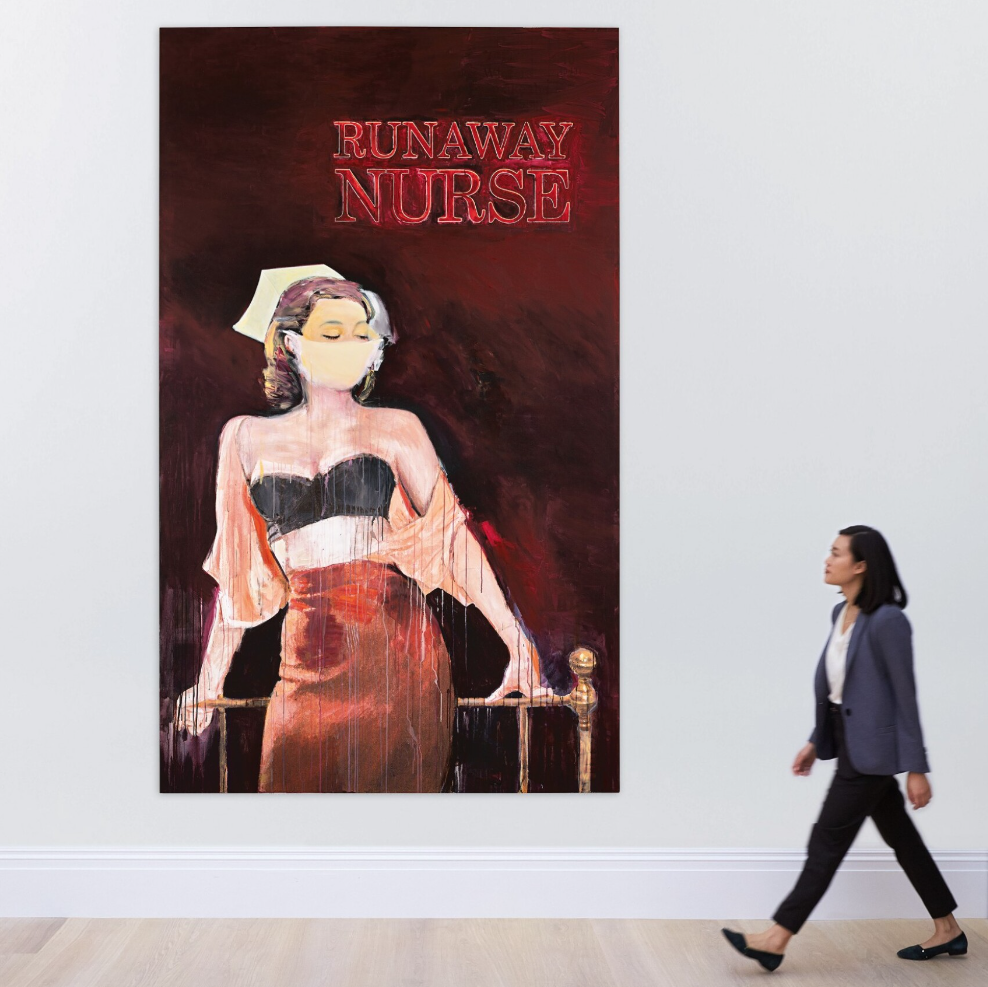
The present work’s title, Runaway Nurse, nods to a second vintage novel – the dime-store novel Runaway Nurse by Florence Stuart (Macfadden-Bartell, 1964), which belongs to the sub-genre of dime-store “nurse romance” pulp fiction. A lifelong voracious bibliophile, Prince compiled an extensive personal collection of dime-store novellas from the 1950s and 1960s that took as their protagonists paradigms of the eroticized nurse. Uniformly melodramatic, artificial, and exaggeratedly pulp, these books were the essence of pop culture at the dawn of contemporary mass consumerism. In the early 2000s Prince turned to his trove of theretofore unmined source material and conceptualized a new series of paintings based on the books’ cover art. The resultant canonic Nurse Paintings take as their subject the trope of the passive female nurse embroiled in an impossible love affair, simultaneously exploring, exploiting and contesting the erotic stereotype and gender construct of the iconic female bombshell, which had previously been elevated to the realms of high-art by artists such as Andy Warhol and Roy Lichtenstein. At the same time, by appropriating work by anonymous uncredited pulp-artists, the Nurse Paintings encapsulate Prince’s complex conceptual project which has long sought to challenge and subvert notions of authorship, authenticity and identity in art through his signature technique of appropriation.
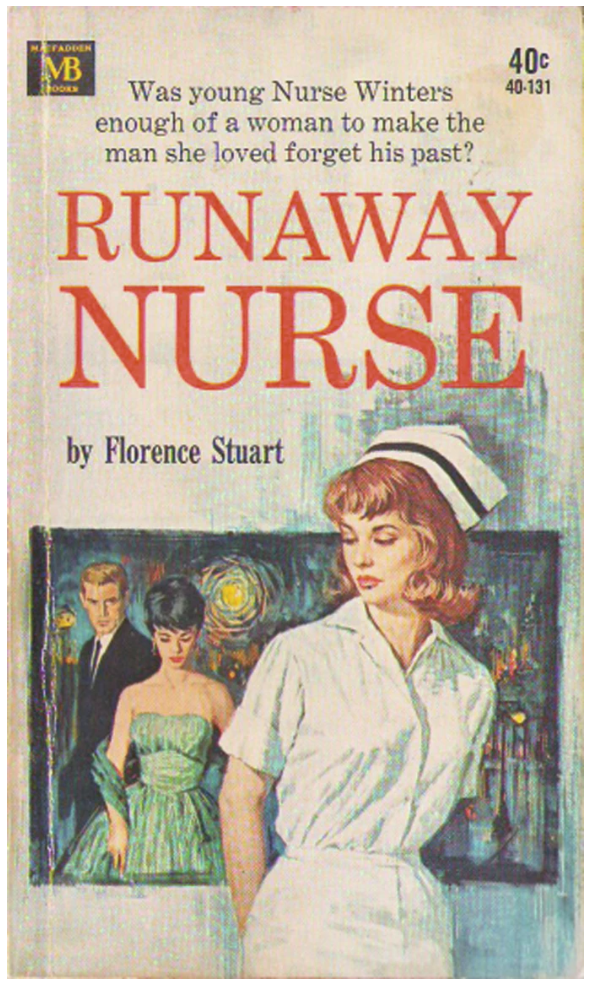
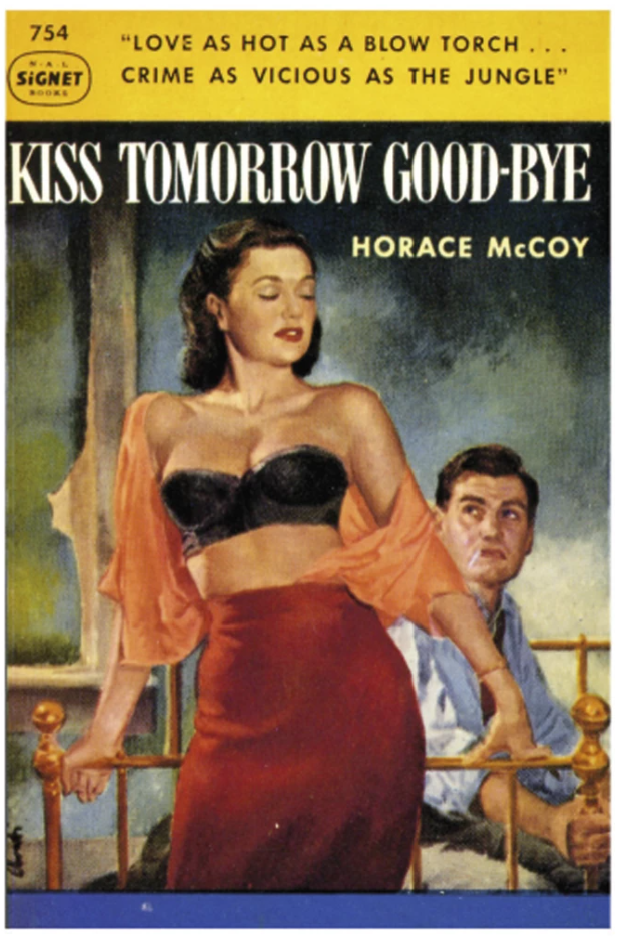
LEFT: COVER OF RUNAWAY NURSE BY FLORENCE STUART, 1964. ORIGINAL ILLUSTRATION BY UNKNOWN ARTIST
RIGHT: COVER OF KISS TOMORROW GOODBYE BY HORACE MCCOY, 1948. ORIGINAL ILLUSTRATION BY JAMES AVATI
Lovingly and lavishly rendered with glowing luminous skin and a tenderly sculpted voluptuous figure, Runaway Nurse is simultaneously the most beautiful and most overtly sexual nurse within the series. Leaning against a brass bedframe, she presents herself to the viewer, her blouse draped open invitingly with her face turned in coy dissent. Beneath demurely downcast lashes, the signature nurse’s mask covers her nose and mouth, with her parted red lips still visible beneath. A motif consistent in the series, Prince’s masks presents him with a “way of unifying” these paintings whilst “also talking about identity” (the artist cited in Natalie Shukur, ‘Richard Prince,’ Russh Magazine, 2014). Creating a compelling dichotomy between innocence and iniquity, active and passive, victim and aggressor, Runaway Nurse further deals intimately with fundamental themes of identity, authenticity, and authorship by the artist’s calculated manipulation of source imagery. In the Nurse Paintings, Prince first scans the book jackets and enlarges the inkjet prints to canvas, then applies layers of acrylic paint on top to obscure and transform the original images. In the present work, layers of deep molten magenta obliterate the supporting character and interior background of Avati’s 1948 original composition, leaving only our wanton heroine and the hovering précis of Stuart’s 1964 novel: “Was young Nurse Winters enough of a woman to make the man she loved forget his past?” By conflating the images of not one but two vintage novels – one a lost classic of film noir and another from the world of trashy pulp-fiction – Prince has created in Runaway Nurse a superlatively layered masterwork representing the very apogee of his complex conceptual project.
“I’m painting nurses. I like their hats. Their aprons. Their shoes. My mother was a nurse. My sister was a nurse. My grandmother and two cousins were nurses. I collect ‘nurse’ books. Paperbacks. You can’t miss them. They’re all over the airport. I like the words ‘nurse’, ‘nurses’, ‘nursing’. I’m recovering.”
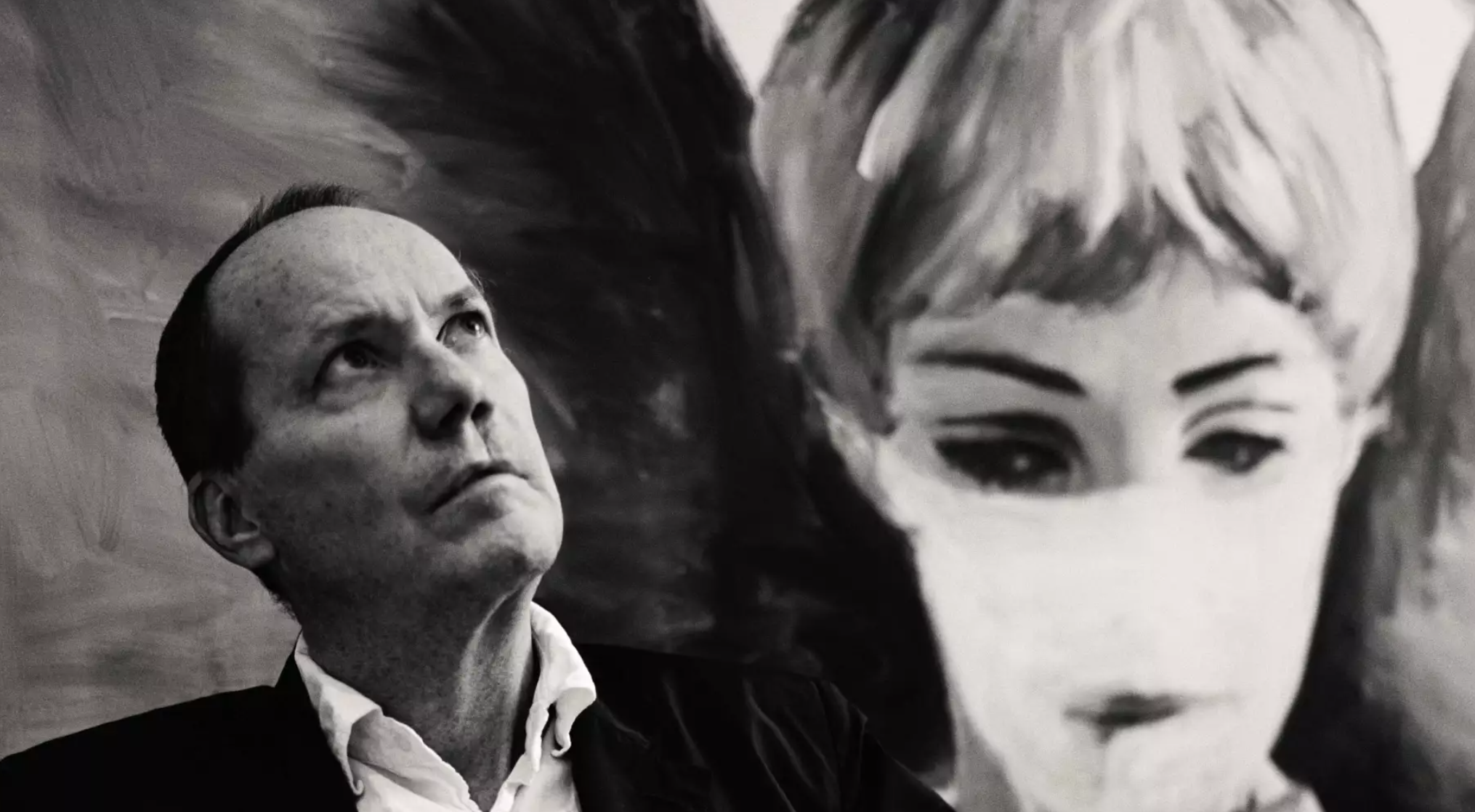
Having endlessly scrutinized the cultural mores of America in his seditious yet taxonomic approach to artmaking, at heart Prince is an editor of images, borrowing and transforming through juxtaposition and manipulation to recontextualize the familiar and banal. The low-culture of the working classes has always been the heartland of Prince’s practice; using archetypes of a typically late-twentieth-century brand of American popular culture – be it from the world of advertising, the bawdy jokes or cartoon funnies of newspapers and magazines, or the paperback world of pulp-fiction – Prince has found edification in its indigenous beauty. The Nurse Paintings are situated at the other end of a narrative arc that began with Prince’s iconic Cowboys in the late 1980s: replacing the masculine, heroic cowboy of his aloof re-photographed Marlboro advertisements, Prince’s provocative female characters boldly reconsider and re-evaluate with palpable maturity many of the themes prevalent to the Cowboys – from the manipulation of appropriated images and the glamor of mass culture to the mythologizing of gender roles and the death of the author – in an entirely innovative and markedly painterly manner. Possessing an unsettling yet magnetic noir-quality, the Nurse Paintings are similarly derived from the same countercultural precepts as the biker Girlfriends. Indeed, much like the Cowboys, the Girlfriends and Nurses conjure a retinue of desire and mine prescribed and trumped-up tropes of male desire and female objectification. In this vein, the present painting masterfully projects the polarity between desire and fear, vulnerability and violence, to the forefront of the artist’s appropriative agenda. Thwarting narrative constructs and authorial agency, Prince posits collective authorship as the means to confront and undo the codes of desire forged by consumer culture.
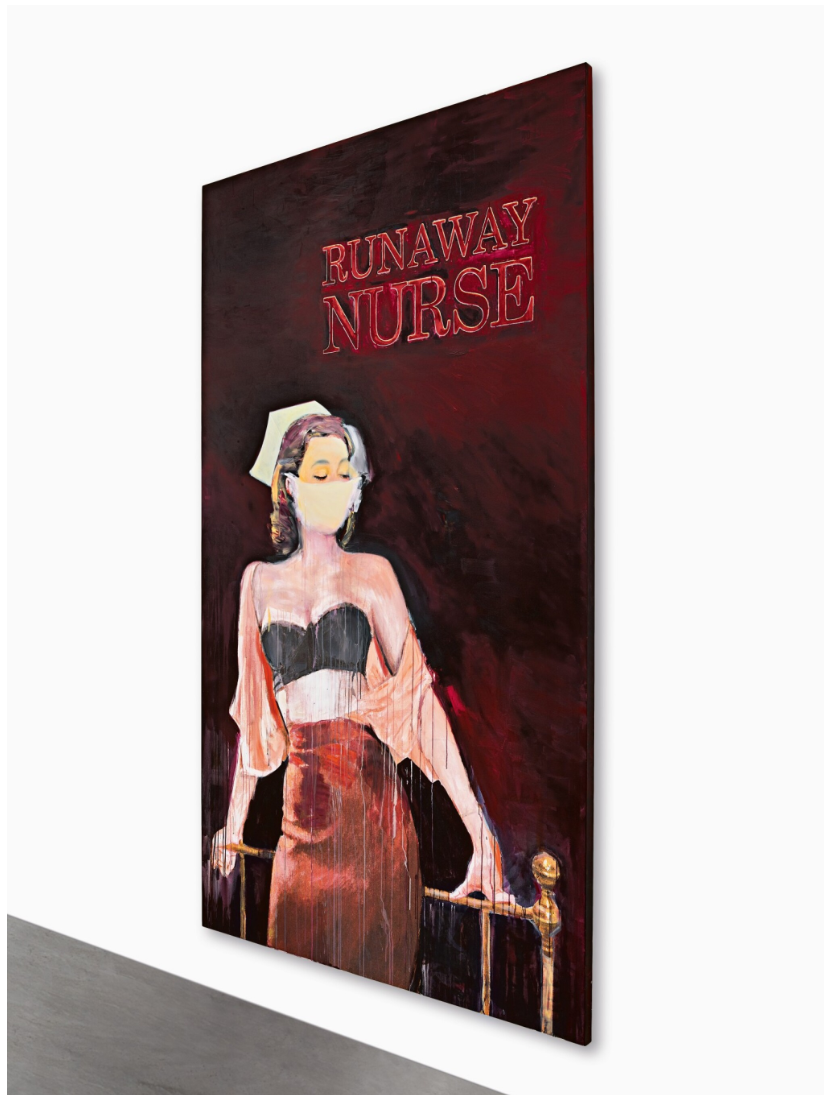
Having endlessly scrutinized the cultural mores of America in his seditious yet taxonomic approach to artmaking, at heart Prince is an editor of images, borrowing and transforming through juxtaposition and manipulation to recontextualize the familiar and banal. The low-culture of the working classes has always been the heartland of Prince’s practice; using archetypes of a typically late-twentieth-century brand of American popular culture – be it from the world of advertising, the bawdy jokes or cartoon funnies of newspapers and magazines, or the paperback world of pulp-fiction – Prince has found edification in its indigenous beauty. The Nurse Paintings are situated at the other end of a narrative arc that began with Prince’s iconic Cowboys in the late 1980s: replacing the masculine, heroic cowboy of his aloof re-photographed Marlboro advertisements, Prince’s provocative female characters boldly reconsider and re-evaluate with palpable maturity many of the themes prevalent to the Cowboys – from the manipulation of appropriated images and the glamor of mass culture to the mythologizing of gender roles and the death of the author – in an entirely innovative and markedly painterly manner. Possessing an unsettling yet magnetic noir-quality, the Nurse Paintings are similarly derived from the same countercultural precepts as the biker Girlfriends. Indeed, much like the Cowboys, the Girlfriends and Nurses conjure a retinue of desire and mine prescribed and trumped-up tropes of male desire and female objectification. In this vein, the present painting masterfully projects the polarity between desire and fear, vulnerability and violence, to the forefront of the artist’s appropriative agenda. Thwarting narrative constructs and authorial agency, Prince posits collective authorship as the means to confront and undo the codes of desire forged by consumer culture.
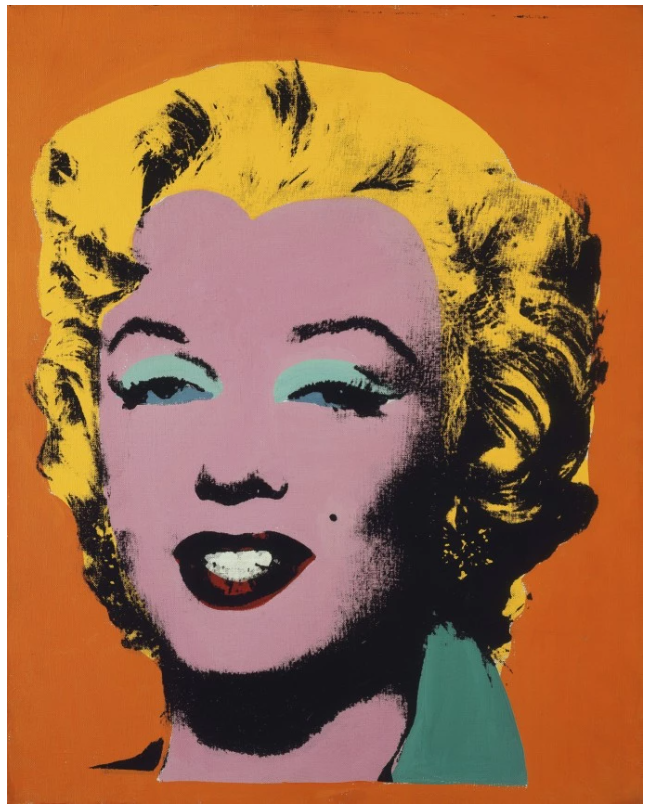
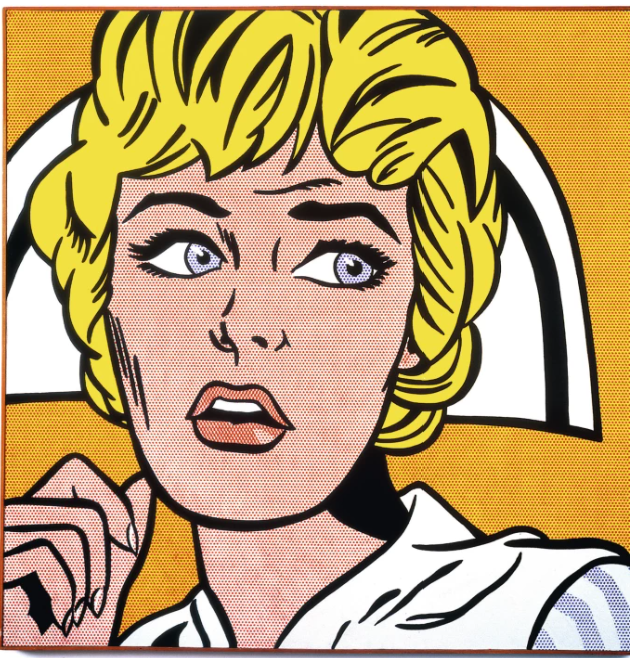
LEFT: ORANGE MARILYN, 1962 (SYNTHETIC POLYMER AND SILKSCREEN INKS ON CANVAS) BY WARHOL, ANDY (1928-87); 50X40.5 CM; PRIVATE COLLECTION; (ADD.INFO.: ORANGE MARILYN. ANDY WARHOL (1928-1987). SYNTHETIC POLYMER AND SILKSCREEN INKS ON CANVAS. PAINTED IN 1962. 50 X 40.5CM.
RIGHT: NURSE, 1964 ROY LICHTENSTEIN
The Nurse Paintings are considered one of the most distinctive and highly prized series of Prince’s lauded career to date. While on the surface it is their sumptuous, fantastical, and seductive appearance that distinguishes them from the artist’s Joke paintings or Cowboy photographs, these three renowned series are in fact intimately connected through the equally firm roots they each take in the core ethos of Prince’s highly conceptual and pioneering practice. The pop appropriation that constitutes the essence of the Cowboy corpus is critical to the conception and execution of the Nurses; with his Joke paintings, these works share a dependence on borrowed text and kitsch humor. What is added here, to brilliant effect and with true bravado, is Prince’s riposte to Abstract Expressionism. Enlivened with heady brushstrokes, drips and splatters, the Nurse Paintings pay homage to the techniques pioneered by the legendary group of Abstract Expressionist artists working to redefine the contemporary landscape in the exact same era the pulp novel was at the height of its popularity. Powerful, provocative and beautifully haunting, Runaway Nurse exemplifies the intoxicating and intellectual rigor of Prince’s ground-breaking practice.
Lake Resort Nurse, 2002-2003
Lake Resort Nurse, 2002-2003
Christie’s New-York: 11 May 2021
Estimated: USD 4,000,000 – 6,000,000
USD 3,990,000
RICHARD PRINCE (B. 1949), Lake Resort Nurse | Christie’s (christies.com)
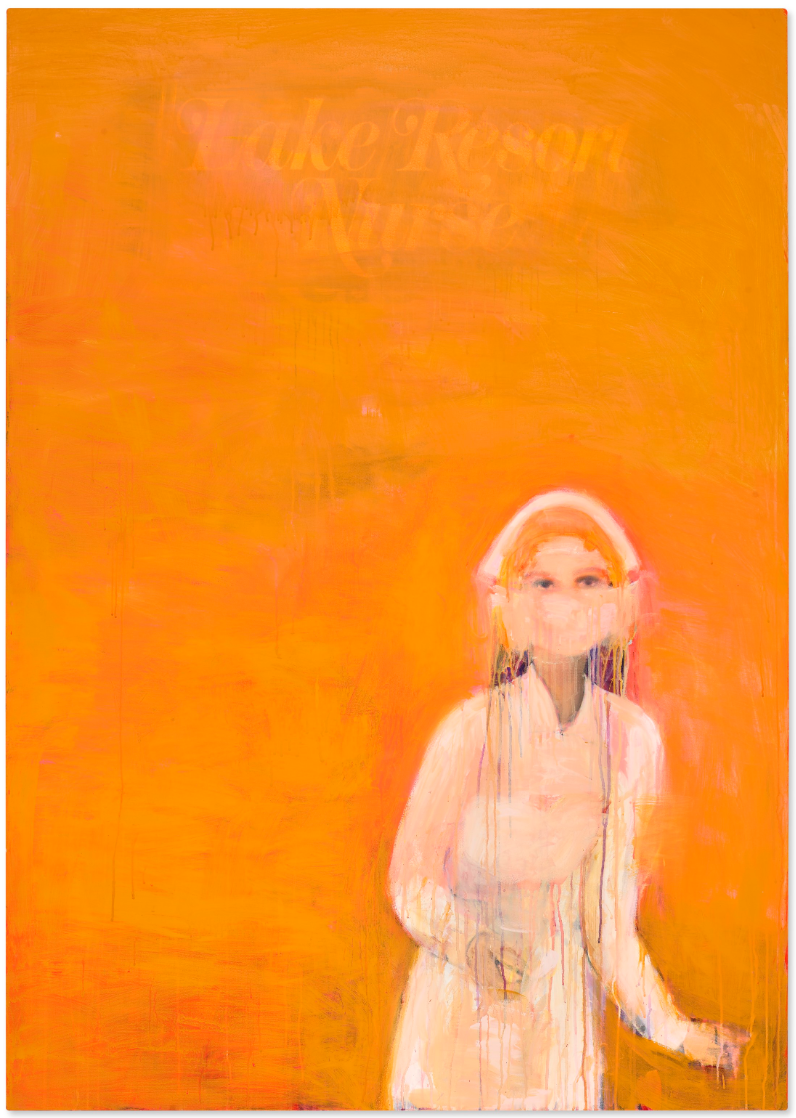
RICHARD PRINCE (B. 1949)
Lake Resort Nurse, 2002-2003
inkjet and acrylic on canvas
69 1/8 x 49 inches (175.6 x 124.5 cm)
Signed, titled and dated ‘R. Prince 2002-2003 LAKE RESORT NURSE #2’ (on the overlap)
Provenance
Gagosian Gallery, New York
Acquired from the above by the present owner, 2008
Executed in 2002-2003, Lake Resort Nurse is an early example of Richard Prince’s now iconic examinations of popular fiction. Prior to this point, his art had been based on advertising photographs, or had involved words painted to form laconic jokes; however, beginning in the early 2000s the artist began to combine these themes into a brand new body of work that contained both words and images. Prince, a well-known bibliophile, took as his inspiration the covers of the cheap romance novels that were often sold at supermarket checkouts in the 1950s and 1960s, tales of young women looking to meet and marry their perfect man. Lake Resort Nurse combines image and text on a rich painterly surface; the central character has been reimagined, and the title of the book has been appropriated and emblazoned across the top visible through the smeared layers of the artist’s paint. The acrylics that Prince has applied to the surface of Lake resort Nurse thus become a veil of artistic intervention between the content—the words and the image of the nurse—and the viewer. Distinguished by its luscious surface, the sultry image of the masked nurse emerges through a haze of golden yellow hues and multicolored drips. Layers of painterly washes add depth to the ground, with the title of the book and the figure of the nurse emerging through these clouds of vibrant pigment. Presented in her white uniform and starched white hat, the female heroine plays to the now old-fashioned stereotype of the nurse as an “angel of mercy” sent to give comfort and offer solace to patients in their hour of need. Prince then disrupts this idea by obscuring her identity with a surgical mask and covering her pristine uniform in trickles of multicolored paint dripping down the entire length of her body. This combination of figuration and abstraction results in one of the most rich and complex surfaces of any of the Nurse paintings, an electric field packed with painterly depth and energy.
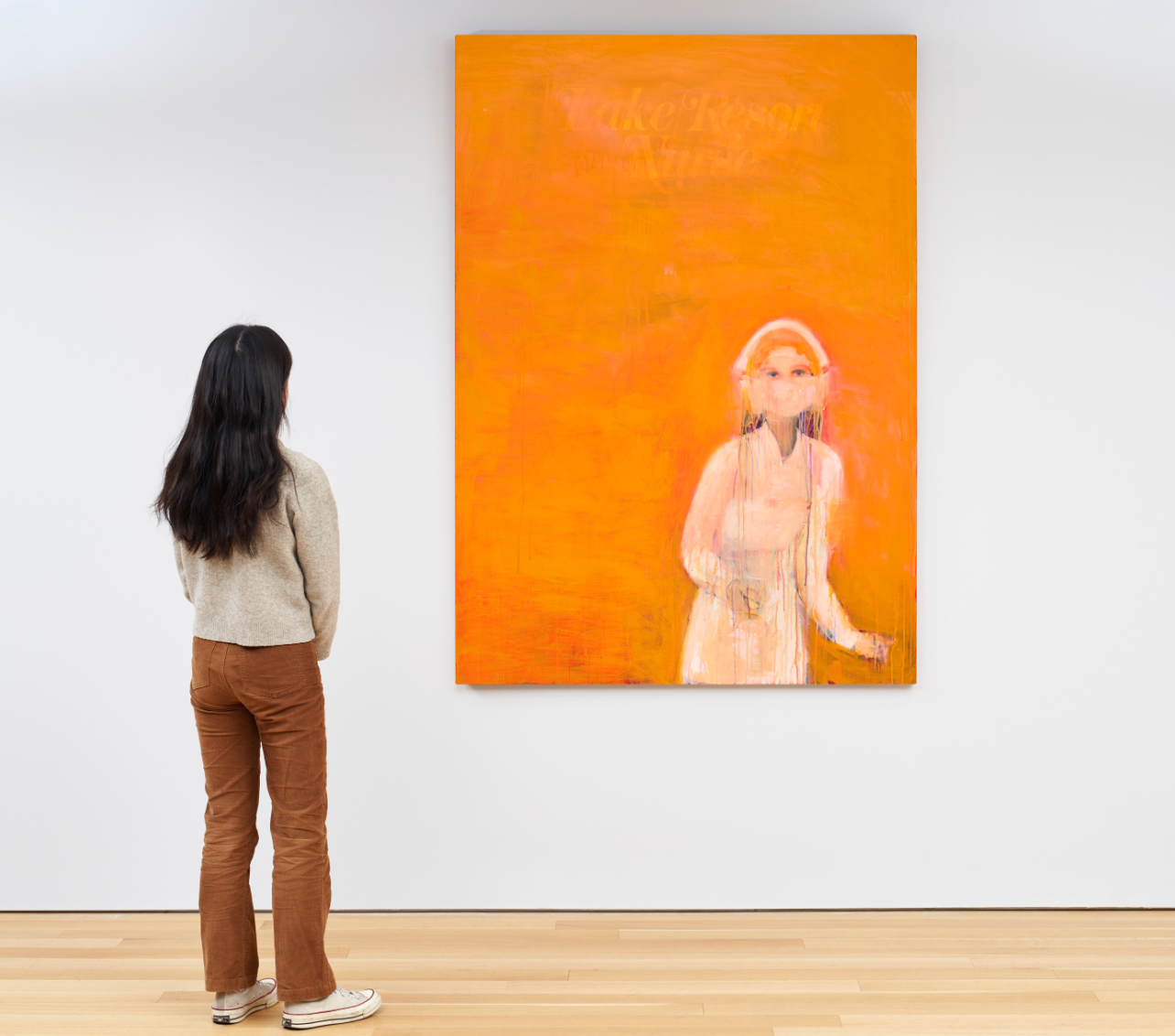
Much like Prince’s images of the rugged Marlboro man in his Cowboy paintings, his nurses are pastiches of the real thing. They are an archetype of femininity and all that implies, in addition to being eroticized objects of male desire that he has selected to both exaggerate and undermine the most hackneyed emblems of gender identity. The addition of a surgical mask, something not included on the original book cover and, as such, an important leitmotif for the series, compounds Lake Resort Nurse’s status as a stereotype, wiping out what little individualized features she has in order to create a generic emblem of a feminine ideal. By gagging his heroines in this way, Prince not only disrupts communication, but also reinforces a sense of forbidden or constrained sensuality that epitomizes a cultural fixation with women as mysterious and alluring, both innocent and vamp. Yet, there is always a level of irony to Prince’s work and his exploration of the naughty-nurse myth dovetails neatly with his longstanding fascination with image constructs and their power.
A self-confessed lover of books, Prince has amassed thousands of books in his home in upstate New York, where he has set aside a hidden alcove dedicated to his collection of nurse novels. These paperbacks speak to the sexist portrayal of women in the 1950s and ‘60s, though many were written by women themselves. After electronically scanning the original cover, Prince mechanically transfers the image onto canvas, then paints out the background in broad gestural strokes. The washes of color are often rendered in smoky atmospheric hues that ratchet up the erotic fervor of the original novel. Scaled to heroic proportions, these female protagonists have no readily discernible biography or back-story, forcing the mind to shuffle through cliched paradigms that reach deep into the collective unconscious for preconceived notions of femininity, whether wholesome or lurid. In both subject matter and execution, Lake Resort Nurse becomes an act of challenging our assumptions about the status quo. Blending painterly acumen with an innate understanding of the powerful effect of popular imagery, Richard Prince has placed pop culture on the same footing as paintings that have attained canonical status, and taken a fantasy of heroism, comfort and sexual desire, and laced it with hidden danger. In doing so, he has created a strong, yet disconcerting image that is familiar despite being shrouded in mystery and becomes a bold challenge for anyone that tries to resist its seductive charms.
Park Avenue Nurse, 2002
Park Avenue Nurse, 2002
Sotheby’s New-York: 14 November 2019
Estimated: USD 5,000,000 – 7,000,000
USD 6,186,800
(#4) RICHARD PRINCE | Park Avenue Nurse
RICHARD PRINCE
Park Avenue Nurse, 2002
Inkjet print and acrylic on canvas
72×45 inches (182.9 x 114.3 cm)
Signed, titled, and dated 2002 on the overlap
Immersed in a sensual haze of midnight blue dispelling into ashen white, Richard Prince’s Park Avenue Nurse is a powerful example of the American artist’s celebrated series of Nurse Paintings (2002-2008). The striking protagonist of the present work is at once seductive and anarchistic, alluring and aloof, encapsulating Prince’s complex conceptual project which has long sought to challenge and subvert notions of authorship, authenticity and identity in art through his signature technique of appropriation. Executed in 2002, Park Avenue Nurse belongs to the original group of Prince’s Nurse Paintings that were created in the early 2000s, and exhibited to great critical acclaim in the artist’s 2003 show at Barbara Gladstone Gallery, New York. Testament to its weighty import within Prince’s oeuvre, the present work was subsequently displayed in the artist’s seminal exhibition at the Solomon R. Guggenheim Museum, New York in 2007, Richard Prince: Spiritual America. Inspired and appropriated from the titles and front covers of pulp romance novellas from the 1950s to 1980s, of which Prince has compiled an avid personal collection, the Nurse Paintings take as their subject the trope of the passive female nurse embroiled in an impossible love affair, which was popularized in American dime-store paperbacks from the mid to late twentieth century. Offering a transgressive scrutiny of such idealized modes of feminine portrayal, Prince’s Nurse Paintings simultaneously explore, exploit and contest the erotic stereotype and gender construct of the iconic blonde bombshell, which had previously been elevated to the realms of high-art by artists such as Andy Warhol and Roy Lichtenstein.
In Park Avenue Nurse, Prince portrays a beautiful masked heroine with glamorous blonde hair, whose facial features have been almost entirely obscured by the white surgical mask plastered across her face. A motif consistent in the series, this mask presented Prince with a “way of unifying” these paintings whilst “also talking about identity.” (Richard Prince cited in: Natalie Shukur, ‘Richard Prince,’ Russh Magazine, 2014) Simultaneously seductive yet sinister, the Nurse Paintings create a compelling dichotomy that blurs the line between innocence and iniquity, active and passive, victim and aggressor. The present example is appropriated from the front cover of Adelaide Humphries’ pulp novel Park Avenue Nurse, written circa 1950. On the original cover – hand-painted by an anonymous pulp-artist – a sultry yet guarded nurse glances sideways as a male doctor stands purveying her from behind. Set above the two figures, the novel’s tagline reads: “From small town to big town – the excitement and conflict in the life of a young nurse who learned that true values and true love are the same everywhere.” (Adelaide Humphries, Park Avenue Nurse, circa 1950) All but subsumed by the opaque navy haze, the spectral trace of this narrative teaser faintly lingers in Prince’s rendition, yet the nurse’s love interest has been entirely obliterated from view. To create the composition, Prince first scanned then enlarged and transferred the original book cover onto the surface of his canvas using an inkjet printer – the hallmark vestige of his earlier oeuvre, first developed in the 1970s as part of the Pictures Generation. He then layered veils of acrylic paint atop this inkjet ground, ranging from stirring blues, greys and whites to vibrant scarlet hues to delineate the title of the composition, erasing nearly all of the original cover’s pictorial content to foreground the haunting figure of his female protagonist.
The Nurse Paintings are situated at the other end of a narrative arc that began with Prince’s iconic Cowboys in the late 1980s. Replacing the masculine, heroic cowboy of his aloof re-photographed Marlboro advertisements, Prince’s provocative and almost hysterically portrayed female characters, borrowed from the world of trashy pulp-fiction, offer the antipode to these prescribed codes of macho-masculinity. In Park Avenue Nurse, the artist boldly reconsiders and re-evaluates with palpable maturity many of the themes prevalent to the Cowboys – from the manipulation of appropriated images and the glamor of mass culture to the mythologizing of gender roles and the death of the author – in an entirely innovative and markedly painterly manner. Possessing an unsettling yet magnetic noir-quality, the Nurse Paintings are similarly derived from the same countercultural precepts as the biker Girlfriends. Indeed, much like the Cowboys, the Girlfriends and Nurses conjure a retinue of desire and mine prescribed and trumped-up tropes of male desire and female objectification. In this vein, the present painting masterfully projects the polarity between desire and fear, vulnerability and violence, to the forefront of the artist’s appropriative agenda. Thwarting narrative constructs and authorial agency, Prince posits collective authorship as the means to confront and undo the codes of desire forged by consumer culture.
Nurse Elsa, 2002
Nurse Elsa, 2002
Christie’s New-York: 15 November 2016
Estimated: USD 5,000,000 – 7,000,000
USD 5,847,500
Richard Prince (B. 1949), Nurse Elsa | Christie’s
RICHARD PRINCE (B. 1949)
Nurse Elsa, 2002
Acrylic and inkjet on canvas
93×56 inches (236.2 x 142.2 cm)
Signed, titled and dated ‘R Prince 2002 Conflict for Nurse Elsa’ (on the overlap)
Set awash in steamy hues of flushed pink and smoky amethyst, the provocative and alluring Nurse Elsa is one of Richard Prince’s most sensual paintings, a beguiling, seductive work. Created in 2002, Nurse Elsa belongs to his highly celebrated series of Nurse paintings, and was featured in the now-legendary, 2003 exhibit at Barbara Gladstone Gallery where the paintings made their American debut. The painting displays a beautiful masked heroine, whose tenderly-rendered features are softened by subtle washes of color Prince luxuriates in the drips and gestural brushwork of his painterly technique. Typical to the series, the renowned bibliophile culled through his growing collection of dime-store novels and pulp fiction to select the source imagery for Nurse Elsa. In this case, Jeanne Bowman’s 1968 vintage romance novel Conflict for Nurse Elsa provided the source image. The title of the original novel is still visible along the painting’s upper register—complete with the typographical flourishes of its rather tawdry font—as if emerging from some shadowy dream. Dramatically enlarged to life-size, the heroine in Nurse Elsa takes on heroic proportions. Engulfed in the heady atmosphere of luscious flesh-hued paint, she accentuates the pent-up melodrama of the original dime-store novel that inspired it, though shrouded in mysterious intrigue.
Nurse of Greenmeadow, 2002
Nurse of Greenmeadow, 2002
Christie’s New-York: 12 May 2014
Estimated: USD 7,000,000 – 9,000,000
USD 8,565,000
Richard Prince (b. 1949) , Nurse of Greenmeadow | Christie’s (christies.com)
RICHARD PRINCE (b. 1949)
Nurse of Greenmeadow, 2002
Inkjet print and acrylic on canvas
78 x 58 1/4 inches (198.2 x 147.5 cm)
Signed, titled and dated ‘R Prince “NURSE OF Greenmeadows 2002’ (on the overlap)
Submerged in a thick torrent of rich amethyst and violet brushstrokes, Nurse of Greenmeadow is a vivid example of Richard Prince’s celebrated Nurse Paintings. Appropriated from the front cover of a pulp romance novella, Prince’s nurse has a seductive “push-pull” allure to her-her blonde hair and golden text contrasting sharply with the saturated purple background. Her veiled expression and dripping attire conjure some dastardly misdeed plucked from a B-rated horror movie. Painted with a unique raw and visceral energy, Nurse of Greenmeadow offers a playful subversion of the indulgent, painterly preferences of the Abstract Expressionists. With expressive gestures encompassing the full frame of the canvas, Prince has even painted over the nurse-applying an elusive white mask, dripping with subtle intonations, and bleeding color into her pristine white smock. Clutching a crimson flower, all sense of her character is effaced: the pretty and precious attitude of the original, shrouded in paint. The title of the book appears above her, flashing in the air like a neon advert for a salacious bar. Below the ultraviolet rushes of paint and vestiges of the author’s name emerge. Covered in rich golden hues, each word appears just visible through the applied paint surface. Divorced from all context, Nurse of Greenmeadow creates a sensational intrigue, piquing the viewer’s interest in what lies beneath the painterly smoke screen.
Piney Woods Nurse, 2002
Piney Woods Nurse, 2002
Christie’s New-York: 13 November 2007
Estimated: USD 1,800,000 – 2,200,000
USD 6,089,000
Richard Prince (b. 1949) , Piney Woods Nurse | Christie’s (christies.com)
RICHARD PRINCE (b. 1949)
Piney Woods Nurse, 2002
Ink-jet print and acrylic on canvas
80×52 inches (203.2 x 132.1 cm)
Signed, titled and dated ‘R. Prince 2002 Piney Woods Nurse’ (on the overlap)
Notions of nurturing, servitude, care-giving and sterilization are twisted and fetishized in Richard Prince’s twenty-first century series of nurse paintings. These frightening images of young, female nurses continue the artist’s tradition of appropriating images from popular culture, blending highbrow and lowbrow art. While the original images appear dull and commonplace in their original settings, they become freed, enhanced and energized in Prince’s new context of an altered world that celebrates the underbelly of America. A contemporary master of the “series,” Richard Prince aptly captures his themes and mediations on life and art by focusing on a concept and stretching and bending the original subject matter’s limitations. In Piney Woods Nurse, the viewer can discern little about the scandals that may occur deep inside the thicket of the forest, the digitalized forms of the piney woods emerging from the painted canvas referenced at the lower right of the nurse’s foot. A dark, unidentified shadow of a figure lurks in the background– it is unclear if he is threatening or running scared. Indeed, with her placid gaze and the glowing pinkish hue that creates a hallow surrounding her body, it is the nurse herself, standing tall in the midst of the dripping blood, who appears calm and collected, a seductress of a nostalgic and fictional landscape. The nurse stands in the foreground, white-hot against a darkened red background. Not more than twenty-five years old, she confronts the viewer directly with her cool gaze and luscious eyelashes. Her neat, trim figure stands upright as she clutches possessively at her satchel. Her standard nursing uniform of white dress, cap and medical mask is not overtly sexual compared to the slick vinyl nursing uniforms Prince worked with while photographing Kate Moss. Yet, there is no denying the strong erotic undertones: her covered mouth, shapely hips and gorgeous face, which holds an equal mix of pleasure and surprise. Against the dark, abstract background, she casts a supernatural, ethereal glow.
Overseas Nurse, 2002
Overseas Nurse, 2002
Sotheby’s London: 1 July 2008
Estimated: GBP 4,000,000 – 6,000,000
GBP 4,241,250 / USD 8,459,440
(#22) Richard Prince (sothebys.com)
RICHARD PRINCE
Overseas Nurse, 2002
Inkjet print and acrylic on canvas
93×56 inches (236.2 x 142.2 cm)
Signed, titled and dated 2002 on the overlap
With its garish, drippy palette and sexy, seductive protagonist, Overseas Nurse ranks as one of the very best of Richard Prince’s series of Nurse Paintings. Set against a deliciously brushy colour field that radiates fuchsia light like a tropical sunset, the sultry yet vixen nurse, with platinum curls cascading down her shoulders, personifies the enigma of the entire series. Dating from 2002, Overseas Nurse comes from the original group with which Prince made a sell-out return to a painterly form of artistic expression when it was unveiled at the Barbara Gladstone Gallery in New York later that year. Departing tangentially from the photographs that rocketed Prince to notoriety in the 1980s, in which he shamelessly pilfered the annals of consumer culture by directly lifting found images and reproducing them in a Fine Art context, this groundbreaking series witnessed the artist grappling more directly with issues specific to painting. Following his enormously successful retrospective last year at the Solomon R. Guggenheim Museum, New York, this series has come to embody Prince’s iconoclastic post-modern brilliance. One of the largest works in the series, Overseas Nurse revisits with discernible maturity many of the themes that were present at the outset of Prince’s career – the manipulation of appropriated images, the seductiveness of mass culture and the death of the author – in an entirely new, painterly syntax. For the nurses, Prince’s source material is culled from the artist’s extensive collection of 1960s racy paperback nurse fantasies, a sub-genre of pulp fiction. An obsessive bibliophile, Prince is renowned for his collection of first edition books. For Prince, these trashy titles exerted the same seductive power and potent allure as the highly polished images found in the daily onslaught of the media and advertising. The books’ covers, designed to titillate and entice, to reveal only enough to grab the viewer’s attention and arouse curiosity, provided Prince with a rich seam of cultural material to mine.
Nurse in Hollywood #4, 2004
Nurse in Hollywood #4, 2004
Phillips New-York: 13 May 2010
Estimated: USD 5,000,000 – 7,000,000
USD 6,466,500
Richard Prince – The Collection of Halsey… Lot 8 May 2010 | Phillips
RICHARD PRINCE
Nurse in Hollywood #4, 2004
Acrylic and inkjet on canvas.
69×42 inches (175.3 x 106.7 cm)
Signed, titled and dated “2004 R. Prince Nurse in Hollywood #4” on the overlap
Nurse in Hollywood’s striking resemblance to Grace Kelly, a Hollywood icon and beacon of elegance, femininity and beauty is unmistakable. Captured by Warhol in one of his famous pieces, the likeness becomes even more apparent. Grace Kelly is a woman beyond compare and so is this nurse. Prince has given her the liberty of eye contact, something not garnered upon his other nurses whose eyes are generally either averted or covered by a diaphanous veil of white paint. Her brilliant blue eyes and penetrating, direct gaze is confident and overt yet not aggressive, much like the actress herself. The glimmer of seduction hinted at by her eyes is metered by the fact that her eyes are her only means of expression. The mask protects her anonymity but also defaces and silences her. The viewer longs to see what expression she is hiding beneath it and this only heightens the innuendo and drama of the canvas. The darker side of Hollywood, fame and beauty are hinted at by the blood-like drips of burgundy and purple paint that trickle off of her mask and down her shoulders evoking the much gorier side of nursing. Her glowing presence on the canvas stands in high contrast to the shadowy background. She emerges from this rich dark brown set in vibrant strokes of icy lavender and juicy reds. She stops at the front of the picture plane, addressing the viewer with a smoldering stare, her startling blue eyes and white face possessing both an ephemeral beauty and a sinister ghostliness. What is perhaps most striking about the Nurse in Hollywood #4 is that she is cast to appear more like a doctor, further questioning the gender roles made so poignant by this series. Scrubs have replaced her starched white uniform and her nursing cap is replaced by a surgical cap which covers her hair. All vestiges of femininity, lust and sex are seemingly covered in this painting (except for her eyes) yet instead of dampening the seductive appeal of the work, it heightens it. She is a glamorous Hollywood character, a nurse in disguise.
Navy Nurse, 2004
Navy Nurse, 2004
Christie’s New-York: 10 July 2020
Estimated: USD 4,000,000 – 6,000,000
USD 5,666,250
Richard Prince (b. 1956), Navy Nurse | Christie’s
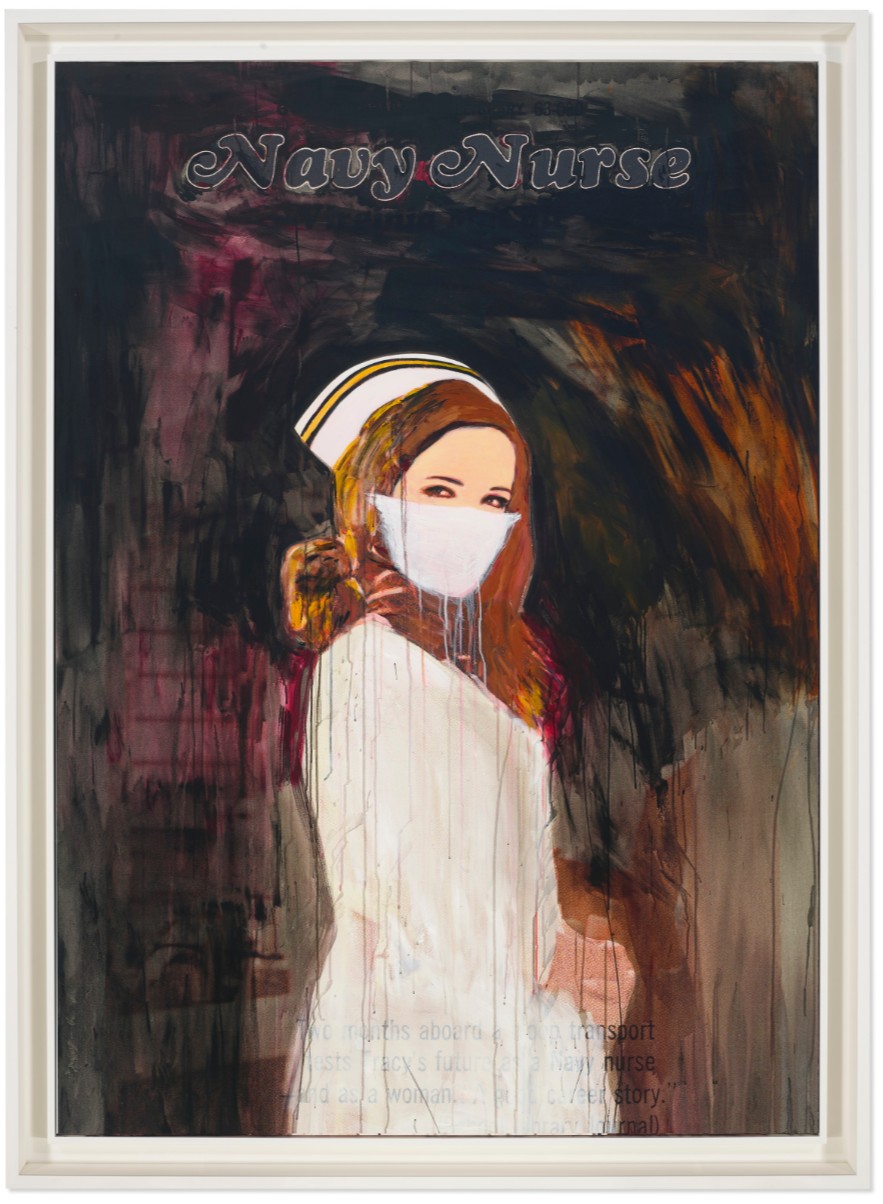
RICHARD PRINCE (b. 1956)
Navy Nurse, 2004
Inkjet and acrylic on canvas
76 x 54-1/4 inches (193 x 137.8 cm)
Signed, titled and dated ‘R Prince. NAVY NURSE 2004′(on the overlap)
Provenance
Acquired directly from the artist by the present owner, 2007
The artist’s Nurse paintings premiered in 2003 at Gladstone Gallery in New York, and critic David Rimanelli wrote in Artforum that they were: “Bloody, drippy splatter sampling of AbEx gesturalism,” and that “these sumptuous canvases were a return to form-smart, cheap, expensive, snide.” (D. Rimanelli, “Best of 2003,” Artforum, December 2003). Navy Nurse (2004), painted the year after the series’ debut, is a particularly sultry example of Prince’s nuanced mash-up of expressive brushwork and appropriated imagery that hovers between colorfield painting and copyright infringement. Rendered in smoldering strokes of maroon, orange, and yellow accompanied by ashen washes of black and gray, Prince transforms his source material from a pulpy cover photograph into a moody portrait of the titular nurse. Her skin over-painted in peach tones and her uniform in blinding white, the woman is pulled from her original context as a lovelorn girl aboard a Navy ship and singled out as a fiery noir protagonist. Building upon extant imagery, the artist embellishes and enhances some elements while completely obliterating others. A man in the background of the source image is completely concealed by paint while the nurse’s eyes pierce the viewer’s gaze. Prince’s signature addition of a white mask keeps her identity hidden and places a visual barrier between the subject and the audience.
Besides the outlined title and central figure, only a few other aspects of the original book cover peer out from the dripping, pooling paint that Prince has applied to this enlargement. Among them, the author’s name, Virginia McCall, fades into Prince’s inky strokes above the figure’s head, while a block of text fights for visibility through her bleached uniform. The latter, the evocative subtitle of the original source, is barely discernible here through Prince’s emphatic brushwork and reads: “Two months aboard a troop transport tests Tracy’s future as a Navy nurse—and as a woman. ‘A good career story.’ (School Library Journal)” (V. McCall, Navy Nurse, Paperback Library, New York: 1969). The artist leaves his subject purposefully ambiguous by extracting the character from the text and transforming Tracy into a stereotype shrouded in dark tones.
First realized in 2003, Prince’s Nurse paintings draw from images of medical providers the artist encountered in newspapers covering the global SARS panic. These journalistic photographs got him thinking about the role these front-line workers play, and then segued into an intense survey of his own collection of pulp paperbacks. “With the Nurse paintings, I believe I started out just reading the paper. It just occurred to me that everyone needed a nurse,” Prince noted, “I collect books—basically I’m a bibliophile—and I had collected these nurse books. There’s a whole genre and I’d had them for years. I wanted to do something just white; […] But before I put them away, I made a mistake painting all this white— this is when I say I get lucky. After I had wiped off some of the painting, it looked like a mask on the nurse’s face and suddenly it was one of those moments. When I noticed that, I realized that was going to be the contribution to the image, to put a mask on these various nurse illustrations. It was a way of unifying and also talking about identity” (R. Prince, quoted in N. Shukur, “Richard Prince,” Russh Magazine, 2014). By obscuring each woman’s face with an overly large cloth covering, the artist negates their individuality and transforms them into a hyper-stylized symbol of the profession and an illustration of the generalized and sexualized idea of nurses in popular culture. With works like Navy Nurse, the photographic source is flattened with paint to further obfuscate the individual and create a cartoonish caricature separated from the real world. Of course, the very novels Prince uses as his starting point already romanticize and pulpify the nursing profession beyond its actual bounds, so the artist’s interventions serve as poignant highlights that question the mythos of these characters and their representation within American pop culture.
Nurse for Mercy’s Mission, 2009
Nurse for Mercy’s Mission, 2009
Christie’s New-York: 6 October 2020
Estimated: USD 2,000,000 – 3,000,000
USD 3,150,000
Richard Prince (b. 1949), Nurse for Mercy’s Mission | Christie’s
RICHARD PRINCE (b. 1949)
Nurse for Mercy’s Mission, 2009
Inkjet and acrylic on canvas
52×30 inches (132.1 x 76.2 cm)
Signed ‘Richard Prince’ (on the overlap)
Richard Prince’s sultry and sexy Nurse for Mercy Mission is one of the artist’s astute riffs on the nature of pop culture. Dominated by the larger-than-life image of our heroine, Prince appropriates the melodrama of vintage dime-store novels to produce a canvas that is both celebratory and enquiring. By giving us nothing more than the exaggerated image of the nurse, along with the title of the book, Prince teases us with the need to know more, leaving us to fill in the gaps in the well-known genre. Girl loves boy, girl leaves boy, and girl becomes torn between her old boy and a new one—dramatic tension lies at the very heart of Nurse for Mercy’s Mission.
This tension is—in part—manifested in the painterly nature of Prince’s distillation of the book’s cover. He chooses to place his nurse, isolated, against a scorching yellow ground. But this is not an anonymous yellow background (as used in Roy Lichenstein’s Nurse, 1964, for example); instead, it manifests itself as part of the drama. The high-keyed hues are evocative of hot summer nights, of sunsets and romance, and yet by using thinned pigment we can see there is a darker, more ominous, layer underneath. What exactly lies beneath this layer is difficult to discern (we can just about make out the name of the series— “A Candlelight Romance” — along the upper edge), but we are left in no doubt of its mysterious, ominous presence. The nurse herself is almost subsumed by this suggestive miasma. Wearing a dark, heavy coat, glimpses of her profession can be seen in her starched white tunic and her familiar nurse’s bonnet. Her face, covered — in now all too familiar fashion—masks her features, her beauty only indicated by her coiffed hair. By methodically painting over the details of the book’s cover, and veiling her features behind a mask, the artist creates a mysterious figure whose identity and purpose remain unknown. In this respect, Nurse for Mercy’s Mission transcends its original literary source to become an anonymous cypher, upon which the viewer’s own desires and fantasies are projected.
Prince is a highly-regarded bibliophile whose own collection of books runs to more than 3,000 titles. He is drawn to the trumped-up melodrama of these books, and regularly trawls his collection for inspiration. In Nurse for Mercy’s Mission, written by Adeline McElfresh, our heroine is Kay Lanyan, a “pretty young nurse” who is visiting her uncle and aunt in the isolated lumber town of Mercy’s Mission. Initially her visit was intended to be a brief vacation, as she would soon return to her “brilliant, charming” trainee doctor boyfriend in the city. However, fate had other ideas as she is soon attracted to the idealism and dedication of a new young doctor serving the poor and needy of the area. She has never felt happier, until her boyfriend from the city turns up and throws her emotions into turmoil. As the summary on the book’s back cover reads “…there was a difference between devotion as a nurse and love as a woman…how could she make that choice?” (A. McElfresh, Nurse for Mercy’s Mission: A Candlelight Romance, Dell Publishing, 1969).
Much of Prince’s work is concerned with the investigation of forgotten and outmoded narratives that have framed the way we perceive ourselves and others, from pulp fiction, depictions of movie starlets and fashion magazines, to explore and provoke the stereotypes that pervade concepts of sexuality, desire and control. His obsession with subculture reveals a truer understanding of ourselves, though not obvious or flattering at times. He has said, “I’ve never wanted to be transgressive or to make an image that was unacceptable or that I would have to censor,” he said. “But that being said, I think a lot of the imagery I do create is sexual, and I hope it does turn people on” (R. Prince, quoted in R. Kennedy, “Two Artists United By Devotion to Women,” New York Times, 23 December 2008, sec. C, p. 1). In spite of the seemingly one-dimensionality of the artist’s protagonists, they are in fact often complex, multidimensional figures who both exaggerate and undermine the stereotypes they imply, making them closer to real-life women than the one-sided caricatures they seem.
Park Avenue Nurse, 2002
Park Avenue Nurse, 2002
Sotheby’s New-York: 14 November 2019
Estimated: USD 5,000,000 – 7,000,000
USD 6,186,800
(#4) RICHARD PRINCE | Park Avenue Nurse
RICHARD PRINCE
Park Avenue Nurse, 2002
Inkjet print and acrylic on canvas
72×45 inches (182.9 x 114.3 cm)
Signed, titled, and dated 2002 on the overlap
Provenance
Gladstone Gallery, New York
Acquired by the present owner from the above in 2003
Immersed in a sensual haze of midnight blue dispelling into ashen white, Richard Prince’s Park Avenue Nurse is a powerful example of the American artist’s celebrated series of Nurse Paintings (2002-2008). The striking protagonist of the present work is at once seductive and anarchistic, alluring and aloof, encapsulating Prince’s complex conceptual project which has long sought to challenge and subvert notions of authorship, authenticity and identity in art through his signature technique of appropriation. Executed in 2002, Park Avenue Nurse belongs to the original group of Prince’s Nurse Paintings that were created in the early 2000s, and exhibited to great critical acclaim in the artist’s 2003 show at Barbara Gladstone Gallery, New York. Testament to its weighty import within Prince’s oeuvre, the present work was subsequently displayed in the artist’s seminal exhibition at the Solomon R. Guggenheim Museum, New York in 2007, Richard Prince: Spiritual America. Inspired and appropriated from the titles and front covers of pulp romance novellas from the 1950s to 1980s, of which Prince has compiled an avid personal collection, the Nurse Paintings take as their subject the trope of the passive female nurse embroiled in an impossible love affair, which was popularized in American dime-store paperbacks from the mid to late twentieth century. Offering a transgressive scrutiny of such idealized modes of feminine portrayal, Prince’s Nurse Paintings simultaneously explore, exploit and contest the erotic stereotype and gender construct of the iconic blonde bombshell, which had previously been elevated to the realms of high-art by artists such as Andy Warhol and Roy Lichtenstein.
In Park Avenue Nurse, Prince portrays a beautiful masked heroine with glamorous blonde hair, whose facial features have been almost entirely obscured by the white surgical mask plastered across her face. A motif consistent in the series, this mask presented Prince with a “way of unifying” these paintings whilst “also talking about identity.” (Richard Prince cited in: Natalie Shukur, ‘Richard Prince,’ Russh Magazine, 2014) Simultaneously seductive yet sinister, the Nurse Paintings create a compelling dichotomy that blurs the line between innocence and iniquity, active and passive, victim and aggressor. The present example is appropriated from the front cover of Adelaide Humphries’ pulp novel Park Avenue Nurse, written circa 1950. On the original cover – hand-painted by an anonymous pulp-artist – a sultry yet guarded nurse glances sideways as a male doctor stands purveying her from behind. Set above the two figures, the novel’s tagline reads: “From small town to big town – the excitement and conflict in the life of a young nurse who learned that true values and true love are the same everywhere.” (Adelaide Humphries, Park Avenue Nurse, circa 1950) All but subsumed by the opaque navy haze, the spectral trace of this narrative teaser faintly lingers in Prince’s rendition, yet the nurse’s love interest has been entirely obliterated from view. To create the composition, Prince first scanned then enlarged and transferred the original book cover onto the surface of his canvas using an inkjet printer – the hallmark vestige of his earlier oeuvre, first developed in the 1970s as part of the Pictures Generation. He then layered veils of acrylic paint atop this inkjet ground, ranging from stirring blues, greys and whites to vibrant scarlet hues to delineate the title of the composition, erasing nearly all of the original cover’s pictorial content to foreground the haunting figure of his female protagonist.
The Nurse Paintings are situated at the other end of a narrative arc that began with Prince’s iconic Cowboys in the late 1980s. Replacing the masculine, heroic cowboy of his aloof re-photographed Marlboro advertisements, Prince’s provocative and almost hysterically portrayed female characters, borrowed from the world of trashy pulp-fiction, offer the antipode to these prescribed codes of macho-masculinity. In Park Avenue Nurse, the artist boldly reconsiders and re-evaluates with palpable maturity many of the themes prevalent to the Cowboys – from the manipulation of appropriated images and the glamor of mass culture to the mythologizing of gender roles and the death of the author – in an entirely innovative and markedly painterly manner. Possessing an unsettling yet magnetic noir-quality, the Nurse Paintings are similarly derived from the same countercultural precepts as the biker Girlfriends. Indeed, much like the Cowboys, the Girlfriends and Nurses conjure a retinue of desire and mine prescribed and trumped-up tropes of male desire and female objectification. In this vein, the present painting masterfully projects the polarity between desire and fear, vulnerability and violence, to the forefront of the artist’s appropriative agenda. Thwarting narrative constructs and authorial agency, Prince posits collective authorship as the means to confront and undo the codes of desire forged by consumer culture.
Prince is a bibliophile in the truest sense. A collector of rare editions, including everything from Vladimir Nabokov’s Lolita through to early pulp-fiction and a wide range of memorabilia, Prince has amassed an extensive library of paperbacks printed between the years of 1949 (marking the year the artist was born and George Orwell’s 1984 was first published) and 1984 itself. Covering the gamut of iconic twentieth-century literature and published matter, Prince’s collection comprises items he feels a connection to, whether it be Jack Kerouac’s On the Road or a signed photograph of Debbie Harry; all of it, however, is rooted in Americana. Indeed, Prince’s compulsion to buy, collect, juxtapose, curate, and assemble all of the trappings of American popular culture lies at the very heart of his production, and particularly, the Nurse Paintings. In 2000, Prince started using this collected matter directly in his work with the first Publicity assemblages; framed and mounted, these works consist of images collated around a central theme – often comprising autographed publicity photographs of pin-ups and movie stars. Very much related to Prince’s earlier series of Gangs in which a pictorial universe of countercultural factions, encompassing magazine images of bikers and their girlfriends, monster truck enthusiasts, porn addicts, and muscle-car fetishists, was presented with archival objectivity, the Publicities possess a discerning taxonomical quality and exhibit the ephemera of conspicuous consumption and the cult of consumerism. Powerful, provocative and beautifully haunting, Park Avenue Nurse exemplifies the intoxicating and intellectual rigor of Prince’s ground-breaking practice.
Nurse Barclay’s Dilemma, 2002
Nurse Barclay’s Dilemma, 2002
Christie’s New-York: 13 November 2019
Estimated: USD 4,500,000 – 6,500,000
USD 5,723,000
Richard Prince (b. 1949), Nurse Barclay’s Dilemma | Christie’s
RICHARD PRINCE (b. 1949)
Nurse Barclay’s Dilemma, 2002
Inkjet and acrylic on canvas
70×48 inches (177.8 x 121.9 cm)
Signed, titled and dated ‘Richard Prince “NURSE BARCLAY’S DILEMMA” 2002’ (on the overlap)
Provenance
Barbara Gladstone Gallery, New York
Acquired from the above by the present owner, 2003
One of the preeminent figures of early appropriation art and the postmodern investigation into mass media, Richard Prince has tackled myriad subjects as they relate to humor, celebrity, sexuality, and authorship. Alongside 1980s stalwarts like Cindy Sherman and Barbara Kruger, Prince made a name for himself through careful selection and enhancement of magazine images, texts, and other media in a manner that highlighted their commercial aspects and took them out of their everyday context. “Look at all the people today making things using sampled images, mashing up video clips and photographs in ways that feel incredibly common to us, no one does it like Richard. He changed art practice in the 20th century” (N. Spector, quoted in K. Crow, “Artist Richard Prince’s Secret Retreat,” WSJ Magazine, December 2014/January 2015). Nurse Barclay’s Dilemma is a sultry example of this singular talent and belongs to Prince’s much-lauded Nurse Paintings series which he introduced to the world in 2003. Rife with the seductive poses and postures that graced the dime store novel covers they borrow from, each work in the series combines stylized book illustration with Prince’s own nod to the moody colorfields of artists like Mark Rothko. Leaving only the female figure and the original text’s title in the midst of his dramatic composition, the artist creates a gauzy, steamy ode to both the low brow and highbrow artforms of the mid-20th century.
Presented on a grandiose scale, a woman in the guise of a nurse peers out from dripping, brushy washes of color. Mixing the original illustration from the front of a pulp fiction novel with a conscious nod to Abstract Expressionism, Prince deftly melds the appropriated imagery with his own painterly adjustments. The left side of the work is taken over by a half-length portrait of a woman in a white, short-sleeved uniform and the blue and white hat typical of nurse practitioners in the 1950s and 60s. Her right hand holds her face, winding painted fingernails into a short coiffure. There is a look of stress and anxiety in the woman’s eyes as they stare downward and refuse to meet the viewer’s gaze. This vexed posture is telling of the ‘dilemma’ the nurse faces, and the novel from which Prince lifts his imagery originally proclaimed, “She was about to give up nursing to marry a wealthy widower, when an attractive patient came under her care and into her heart.” (A. Humphries, Nurse Barclay’s Dilemma, Avalon Books: New York, 1954). Some of this subtitle is still visible through the hazy gray and white in the upper right corner above the red of the book’s title, “Nurse Barclay’s Dilemma”. The name of the author of this medical melodrama, Adelaide Humphries, however, has been completely obscured by drips and swathes of murky gray paint. Besides this expressionistic obfuscation, Prince has made one very noticeable addition to the appropriated image, one that each work in the series shares: a white mask. Intentionally made large and extending from the chin to the bottom of the nurse’s eyes, Prince’s mask serves to both further stylize the woman as a figure of nursing while also, as the artist puts it, “making it all the same and getting rid of the personality” (R. Prince, quoted in “Interview with G. O’Brien”, Interview Magazine, December/January 2008-9, p. 201). By covering the nose and mouth, the artist makes each figure into a symbol or icon that goes beyond one individual toward a larger idea.
Though it might be perceived as extraordinarily painterly at first glance, Barclay’s Dilemma touches on two driving forces within Prince’s varied oeuvre. As an ardent collector of books, the artist continuously adds to his stockpile of first editions and rare tomes while also fortifying his shelves with numerous pulp fiction paperbacks. Of particular interest are the titles from tawdry romance novels centered around nurses. Each work from his Nurse Paintings series is anchored to an actual book in Prince’s collection. The second catalyst is the artist’s mastery of appropriative techniques. Coming of age in the 1980s along with artists like Sherman and Sherrie Levine, Prince extracts imagery from a broader image culture and reworks it to serve his purposes. The Nurse Paintings are no different as he enlarges and positions the covers of each pulp novel before making an inkjet print and affixing it to the canvas.
Negating the original background used on the book jacket, the solitary woman emerges and is enlarged to heroic proportions. The idea for Barclay’s Dilemma and the rest of the series came to Prince in 2002 at the height of the global SARS hysteria. While reading the news, the artist had a sudden insight into his vast book collection and to a certain subgenre of which he had multiple volumes. “I’ve always been very lucky when it comes to making art and finding subject matter,” Prince noted, “And the subject matter does come first and how it’s presented comes second. …With the Nurse paintings, I believe I started out just reading the paper. It just occurred to me that everyone needed a nurse. […] There’s a whole genre and I’d had them for years. I wanted to do something just white; […] But before I put them away, I made a mistake painting all this white— this is when I say I get lucky. After I had wiped off some of the painting, it looked like a mask on the nurse’s face and suddenly it was one of those moments. When I noticed that, I realized that was going to be the contribution to the image, to put a mask on these various nurse illustrations. It was a way of unifying and also talking about identity” (R. Prince, quoted in N. Shukur, “Richard Prince,” Russh, December 2014). By combining his bibliophilic tendencies with a need to edit and reform the archive, Prince expanded on his earlier techniques.
Prince has often employed the sexualized female figure in his work, and pieces like Barclay’s Dilemma are rather tame in comparison to previous offerings like his Girlfriends series in the early 1990s. However, it is worth noting that the artist never creates new images, but simply reframes and recontextualizes those that are already extant. “Mr. Prince mines the ways that society has portrayed women and how women have seemed to want to be portrayed,” reporter Randy Kennedy wrote in The New York Times. “His obsessions… toy… ambiguously and provocatively with sexism, exploitation and the conventions of pornography” (R. Kennedy, “Two Artists United by Devotion to Women,” New York Times, 23 December 2008, sec. C, p. 1). By highlighting and adding a white mask to each nurse (which can be read in a similarly depersonalizing manner as the black censor bars used in more tawdry materials), Prince turns the nurse into a stylized type that stands in for a greater conversation. He noted in an interview with fellow provocateur Damien Hirst, saying, “Some people say the nurse paintings are all about desire—but isn’t that more to do with their proximity to life and death? Isn’t that why we find nurses sexy—because they embody this ultimate contradiction? […] As kids we are interested in sex and death because we can never imagine either one ever happening to us” (R. Prince, quoted in “A Conversation” in Damien Hirst: Requiem II, 2009). Instead of becoming objects of desire, the nurses ask the viewer to examine themselves and their own ideas about sexuality in the context of mass media.
Island Nurse, 2002
Island Nurse, 2002
Christie’s New-York: 15 November 2018
Estimated: USD 5,000,000 – 7,000,000
USD 5,487,500
Richard Prince (b. 1949), Island Nurse | Christie’s
RICHARD PRINCE (b. 1949)
Island Nurse, 2002
Inkjet and acrylic on canvas
70×48 inches (177.8 x 121.9 cm)
Signed, titled and dated ‘R Prince “ISLAND NURSE” 2002’ (on the overlap)
Provenance
Sadie Coles HQ, London
Acquired from the above by the present owner, 2003
Bathed in a sultry, tropical haze, Richard Prince’s Island Nurse is one of the more overtly erotic examples of his celebrated series of Nurse paintings. Featuring a slim, pretty, blonde nurse ensconced within the exotic beauty of a twilit tropical paradise, Island Nurse embodies all the heated romance of the dime-store novel that inspired it. Painted in 2002, Island Nurse belongs to the original group of Nurse paintings that were created in the early 2000s. It was exhibited along with a group of approximately eleven Nurse paintings when they made their European debut at the Sadie Coles HQ gallery in London in 2003. There, Island Nurse featured alongside other early Nurse paintings including Dude Ranch Nurse, Heartbreak Nurse, Danger Nurse and Aloha Nurse, making it a prime example of this highly sexualized, yet subtly subversive, body of work.
Blazing with the passionate colors of a tropical island sunset, Island Nurse epitomizes the hushed erotic undertones of the original tawdry novel that inspired it—a 1964 nurse romance of the same name by author Dorothy Daniels. “Should she take the step that would change the course of her life?” the novel beckons to its reader as on its cover, as our heroine, Diana Carvell, is illustrated in her white nurse’s uniform and cap. In the novel, the young nurse is compelled to forego her vision of a conventional life offered by her doctor-fiancée, in favor of a passionate love affair with a native island boy. “Was she strong enough to resist this brooding, mysterious young islander who was carefully guarding a secret?” the précis for the novel asks. The visual cues of her limp body and slightly parted lips on the cover of the original book suggests that no, she has surrendered, capitulating to her passion. The edges of her nurse’s uniform dissolve before our eyes, revealing the jungle-green skirt that connects her powerfully to her tropical surroundings—a return to the garden of Eden.
Island Nurse is a particularly heady painting, in which lush passages of magenta, smoky purple and touches of crimson work in tandem to evoke the steamy climate of a tropical paradise. The face of the young nurse is covered with a bright, white mask, and her slender body retains the crisp white uniform of her profession. The title of the original paperback that inspired the painting is left visible along the upper edge, which is covered in a subtle wash of a delicate, amber-tinged green. This produces a subtle glow that broadcasts the subject of the painting with the pale aura of a fizzling neon sign for or seedy roadside hotel. All remaining features of the original novel have been otherwise obliterated, covered in stunning waterfall washes of bright magenta-pink, areas of deep purple and crimson tinged with black. In these passages the viewer delights in the artist’s brushy, gestural handling of the paint, tracing the drips of thinned down pigment as they seep down the canvas in delicate streams. Prince has highlighted key features of the heroine’s appearance, brightening her hair with yellow, and adding bright white to her nurse’s uniform, which he goes over in vigorous strokes of white paint that stream down her luminous, almost translucent, body. In methodically painting over the details of the book’s cover, and veiling her features behind a mask, the artist creates a mysterious figure whose identity and purpose remains unknown. In this respect, Island Nurse transcends its original literary source to become an anonymous cypher, upon which the viewer’s own desires and fantasies are projected.
A self-confessed bibliophile, Richard Prince has amassed thousands of books in his home in Rensselaerville, New York, where he has set aside a hidden alcove dedicated to his collection of nurse novels. Fittingly concealed behind a curtain made of beer-cans, these paperback novels speak to the sexist portrayal of women in the 1950’s and ‘60s, though many were written by women themselves. Titles include such classics as Surfing Nurse, Man-Crazy Nurse, Surgical Nurse, Tender Nurse and Nympho Nurse, which the artist delved into for inspiration, scanning their lurid covers and covering them in sultry layers of paint that obscures most of the original design. After scanning the original cover, Prince mechanically transfers the image onto canvas, then paints out the background in brushy, gestural strokes. The washes of color are often rendered in smoky, passionate hues that ratchet up the erotic fervor of the original novel. Prince then cloaks each nurse behind a gauzy white surgical mask, which works to further obfuscate her identity. Scaled to heroic proportions, these female protagonists have no readily discernible biography or back-story, forcing the mind to shuffle through cliched paradigms that reach deep into the collective unconscious for preconceived notions of femininity, whether wholesome or lurid, in their reading.
In many ways, the Nurse paintings can be seen as a continuation of the of image appropriation strategies that Prince developed in the 1980s, while working alongside artists like Cindy Sherman and Barbara Kruger who became known as the Pictures Generation. These artists developed postmodern strategies that allowed them to expose the media’s role in defining aspects of gender and sexuality. Using a strategy of appropriation, in which he co-opted magazine photographs he found while working at Time/Life, Prince re-created new work by placing these images in a new, more critical, context. His created a series of black-and-white photographs that he appropriated from fashion magazines such as Vogue that featured female models whose vision had been obstructed with sunglasses and hoods. Titled simply Fashion, this important, early series evaluated how television, magazines and newspapers all contribute to creating their own version of a feminine ideal. The series that followed, from Cowboys to Girlfriends and Nurses, Prince continues to work from the same critical position, often courting controversy for his overtly erotic, though subtly critical, portrayals of women.
“Mr. Prince mines the ways that society has portrayed women and how women have seemed to want to be portrayed,” the New York Times reporter Randy Kennedy wrote in his article on Richard Prince in 2008. “His obsessions… toy… ambiguously and provocatively with sexism, exploitation and the conventions of pornography” (R. Kennedy, “Two Artists United by Devotion to Women,” New York Times, 23 December 2008, sec. C, p. 1). And yet, the artist simply re-configures that which has already been created, as the Nurse paintings simply reprise the tawdry pulp fiction paperbacks of an earlier era. In doing so, the artist holds up a mirror—seductively painted and beguilingly beautiful—that entrances the viewer into looking, and looking deeper, into their own secrets and desires.
School Nurse, 2005
School Nurse, 2005
Sotheby’s London: 28 June 2017
Estimated: GBP 3,500,000 – 4,500,000
GBP 4,096,250 / USD 5,263,465
RICHARD PRICE
School Nurse, 2005
Acrylic and inkjet print on canvas
70×49 inches (177.8 x 124.4 cm)
Signed, titled and dated 2005 on the reverse
Provenance
Gladstone Gallery, New York
Acquired from the above by the present owner in 2005
Created between 2002 and 2008, the Nurse paintings represent the very apogee of Richard Prince’s complex conceptual project. From 2005, School Nurse is a powerful example of this celebrated corpus. At once at once sexy and alluring, yet tinged with danger and threatening portent, the borderline excesses of paint, eroticism, and implied brutality prevalent in this appropriative work, forcefully rouse and unpack culturally entrenched female stereotypes and codes of seduction. Based on the uncredited cover art of dime-store romance novels, the Nurses offer a transgressive scrutiny of idealised modes of feminine portrayal as popularised in the later Twentieth Century. Marking a reformulation of the iconic blonde bombshell trope as elevated into the realm of high-art by Andy Warhol and Roy Lichtenstein, Prince’s Nurses assimilate and pick apart erotic stereotypes and gender constructs. The Nurses are thus situated at the other end of a narrative arc that began with Prince’s iconic Cowboys in the late 1980s. Replacing the masculine, heroic cowboy of his aloof re-photographed Marlboro adverts, Prince’s provocative and almost hysterically painted female characters, borrowed from the world of trashy pulp-fiction, form a pendent to these prescribed codes of masculinity. School Nurse from 2005 reconsiders and re-evaluates with palpable maturity many of the themes prevalent to the Cowboys – a manipulation of appropriated images, the glamour of mass culture, and the death of the author – in an entirely innovative and markedly painterly manner.
Richard Prince has endlessly scrutinised the cultural mores of America in his seditious yet taxonomic approach to art-making. At heart he is an editor of images, borrowing and transforming through juxtaposition and manipulation to re-contextualise the familiar and banal. The low-culture of the working classes has always been the heartland of Prince’s practice; using archetypes of a typically late-twentieth-century brand of American popular culture – be it from the world of advertising, the bawdy jokes or cartoon funnies of newspapers and magazines, or the paperback world of pulp-fiction – Prince has found edification in its indigenous beauty.
In the present work an abyssal black ground starkly outlines Prince’s heroine, a character borrowed from the front cover of Arlene Hale’s 1960s novel, School Nurse. On the original cover – hand-painted by an anonymous pulp-artist – a sultry yet guarded nurse glances sideways as a mysterious man exits through a door behind her; set underneath this, the novel’s tagline reads: “Nurse Glenda had a past to hide and a future to seek”. Subsumed by a gesturally black background, this narrative teaser is erased, as is the saccharine baby-pink background and baby-blue title text, while Nurse Glenda’s assumed love interest is entirely absented in Prince’s modified scene. All that remains is a white chalkboard outline of the book’s title and an isolated and ambiguously bloodied female protagonist looming large in the foreground. Consistent with all of Prince’s Nurse paintings, our subject wears an obligatory white surgical mask, an intervention that, according to the artist was a “way of unifying” these paintings, whilst “also talking about identity” (Richard Prince cited in: Natalie Shukur, ‘Richard Prince,’ RusshMagazine, 2014, online resource). In this painting, however, her red and apparently bleeding mouth seeps through the mask’s diaphanous gauze and onto her clinical whites, while a dull smear above her right eye and a dark clotted patch on her hair rouse the suspicion of foul play. Marilynesque yet tainted by gore, Prince’s nurse is a nefarious queen of the damned.
Is she victim or aggressor? Prince leaves this pointedly unclear, and in doing so conflates a catalogue of old-fashioned erotic nurse stereotypes – a construct that utterly permeated popular culture in the 1950s and 60s, serving inspiration for the series of 45-cent paperback nurse fantasies collected by Prince. In Prince’s pantheon, the nurse is simultaneously angel of mercy and Good Samaritan, as much innocent Girl Friday as she is femme fatale. Possessing an unsettling yet magnetic noir-quality, the Nurses are derived from the same countercultural, typically Princian, realm as the biker Girlfriends, while they find their pendent pieces in the iconic Cowboys via a comparable scrutiny of exaggerated gender constructs. Indeed, like the Cowboys, these works conjure a retinue of desire and mine prescribed and trumped-up tropes of male desire and female objectification. Following the very first group of Nurse paintings, executed in 2002, School Nurse belongs to the second opus in which Prince introduced streaming drips of crimson-red paint to the nurses’ mouths and crisp white uniforms. Depicting a blonde bombshell turned horror film leading-lady, School Nurse masterfully projects the polarity between desire and fear, vulnerability and violence, to the forefront of the artist’s appropriative agenda. Thwarting narrative constructs and authorial agency, Prince posits collective authorship as the means to confront and undo the codes of desire forged by consumer culture.
Prince is a bibliophile in the truest sense. A collector of rare editions, including everything from Nobakov’s Lolita through to early pulp-fiction and a wide range of memorabilia, Prince has amassed an extensive library that begins in 1949 with George Orwell’s 1984 and ends around this prophetic year. Covering the gamut of iconic twentieth-century literature and published matter, Prince has collected that which he feels a connection to, whether it be Jack Kerouac’s On the Road or a signed photograph of Debbie Harry; all of it, however, is rooted in Americana. Indeed, Prince’s compulsion to buy, collect, juxtapose, curate, and assemble all of the trappings of American popular culture lies at the very heart of his production, and particularly, the Nurse paintings. In 2000 Prince started using this collected matter directly in his work with the first Publicity assemblages; framed and mounted, these works consist of images collated around a central theme – often comprising autographed publicity photographs of pin-ups and movie stars. Very much related to Prince’s earlier series of Gangs in which a pictorial universe of counter-cultural factions encompassing magazine images of bikers and their girlfriends, monster truck enthusiasts, porn addicts, and muscle-car fetishists was presented with archival objectivity, the Publicities possess a discerning taxonomical quality and exhibit the ephemera of conspicuous consumption and the cult of consumerism in the guise of memorabilia trophies. Indeed, the Nurse paintings find their very origin in the Publicity works, specifically one that showcased a dozen romantic nurse paperbacks in a row.
Selected from Prince’s own archive, cover art from 1960s medical-romance novels was photographed, enlarged, and printed onto canvas, after which layers of bold acrylic paint were gesturally applied, concealing all extraneous details apart from the books’ titles and the figure of the central nurse protagonist. The addition of brushy swathes of acrylic paint and bold pigment introduced nuanced emphases that underline a sense of seductive, yet trashy, erotic appeal. The pictorial finesse of the original cover art is gone, and is instead replaced by smudged kohl-lined eyes, smeared red-lipstick mouths, and hairstyles that have lost their Monroe-esque curls. Nonetheless, Prince’s painterly turn is rife with allusions to the history of heroic American painting. In School Nurse, the paint-splattered face and uniform mimics the gestural fury of Willem de Kooning’s erotic, overbearing Women. Thus, as the desirability of the erotic subject in School Nurse is grounded by the seriousness of this Abstract Expressionist connotation, School Nurse is invested with gravitas and power as an image. In the same manner as de Kooning’s iconic paintings, the present work oscillates between the polarities of beauty and horror, desire and fear, negating any single interpretation. With one foot squarely planted in the realm of high art, the other rests comfortably in the empire of the banal; in this way, the present work shows Prince at his absolute finest.