MAY 2026 NEW-YORK AUCTIONS
Gerhard Richter
Auction Results
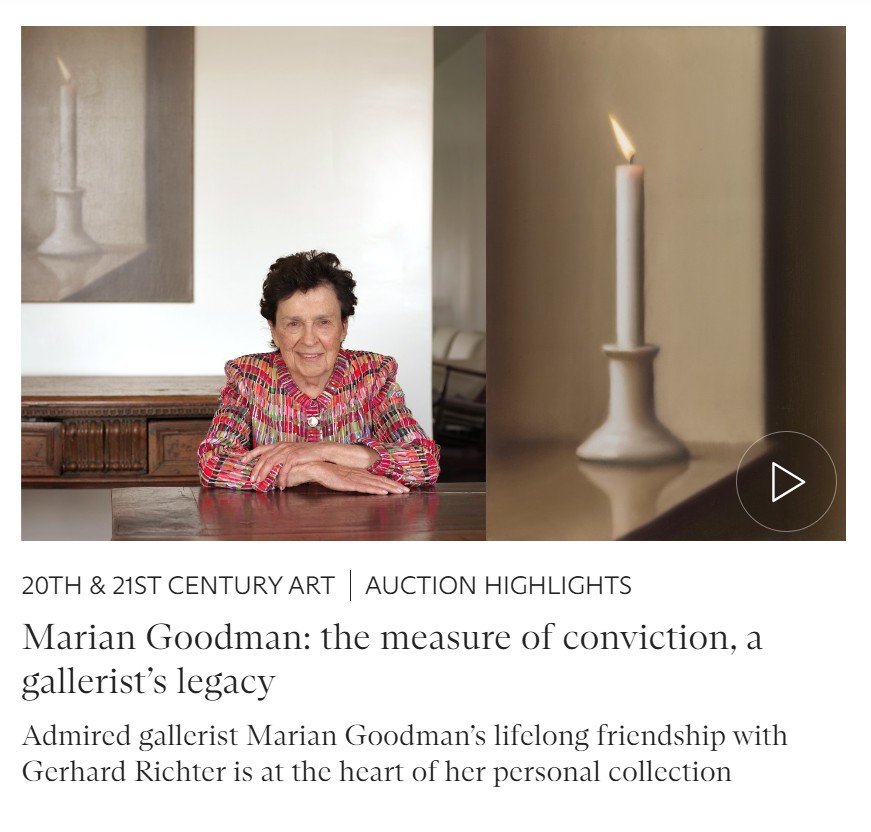
19 lots sold for a total turnover of USD 91,875,000. With no lot failing to sell, the sell-through rate is 100%. This includes 13 lots from The Private Collection of Marian Goodman, the artist long-standing gallerist, for a total of USD 80, 269,800, notably Kerze (Candle), a painting dated 1982, that sold for USD 35,135,000 at Christie’s on 20 May 2026.
XXXXXXXXXX
#1. Kerze (Candle), 1982
Breaking Ground: The Private Collection of Marian Goodman
Christie’s New-York: 20 May 2026
Estimated: USD 35,000,000 – 50,000,000
USD 35,135,000
GERHARD RICHTER (B. 1932), Kerze (Candle) | Christie’s
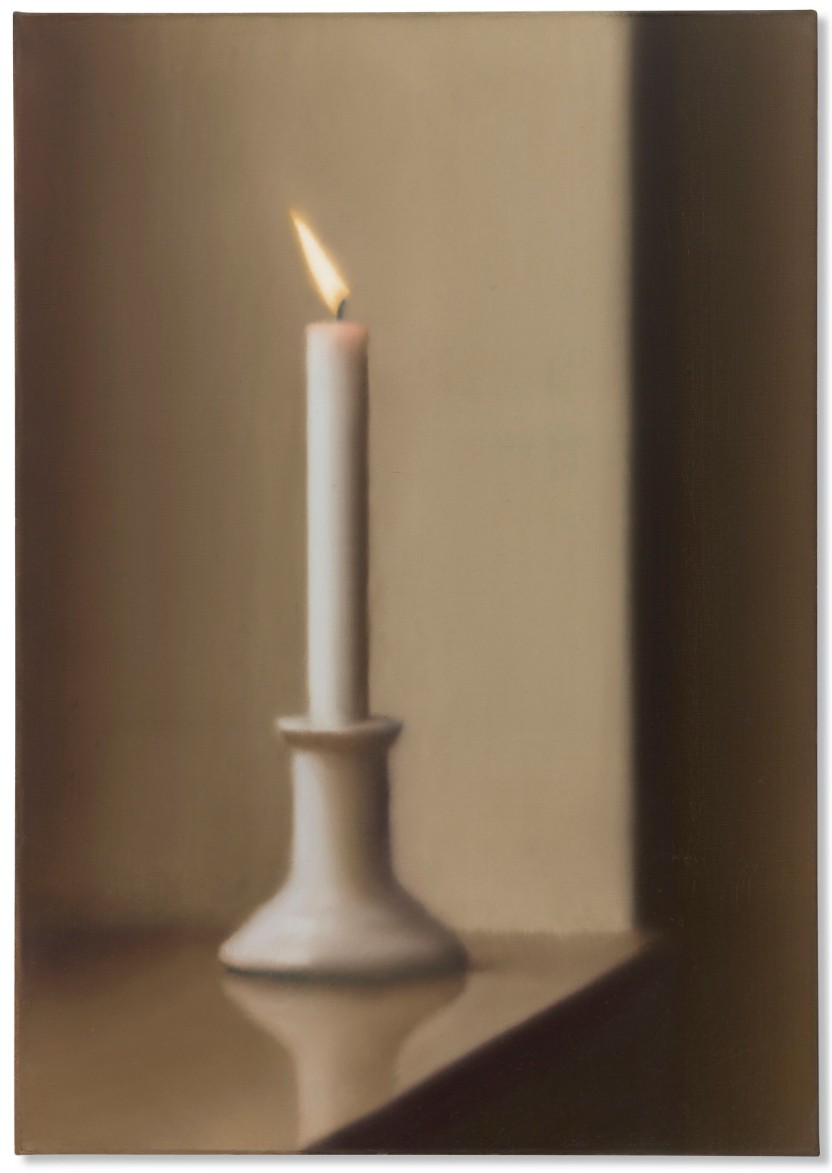
GERHARD RICHTER (B. 1932)
Kerze (Candle), 1982
Oil on canvas
100.3 x 70.5 cm (39-1/2 x 27-3/4 inches)
Signed, inscribed and dated ‘510-1 Richter 1982’ (on the reverse)
#2. Mohn (Poppy), 1995
Breaking Ground: The Private Collection of Marian Goodman
Christie’s New-York: 20 May 2026
Estimated: USD 14,000,000 – 18,000,000
USD 20,070,000
GERHARD RICHTER (B. 1932), Mohn (Poppy) | Christie’s
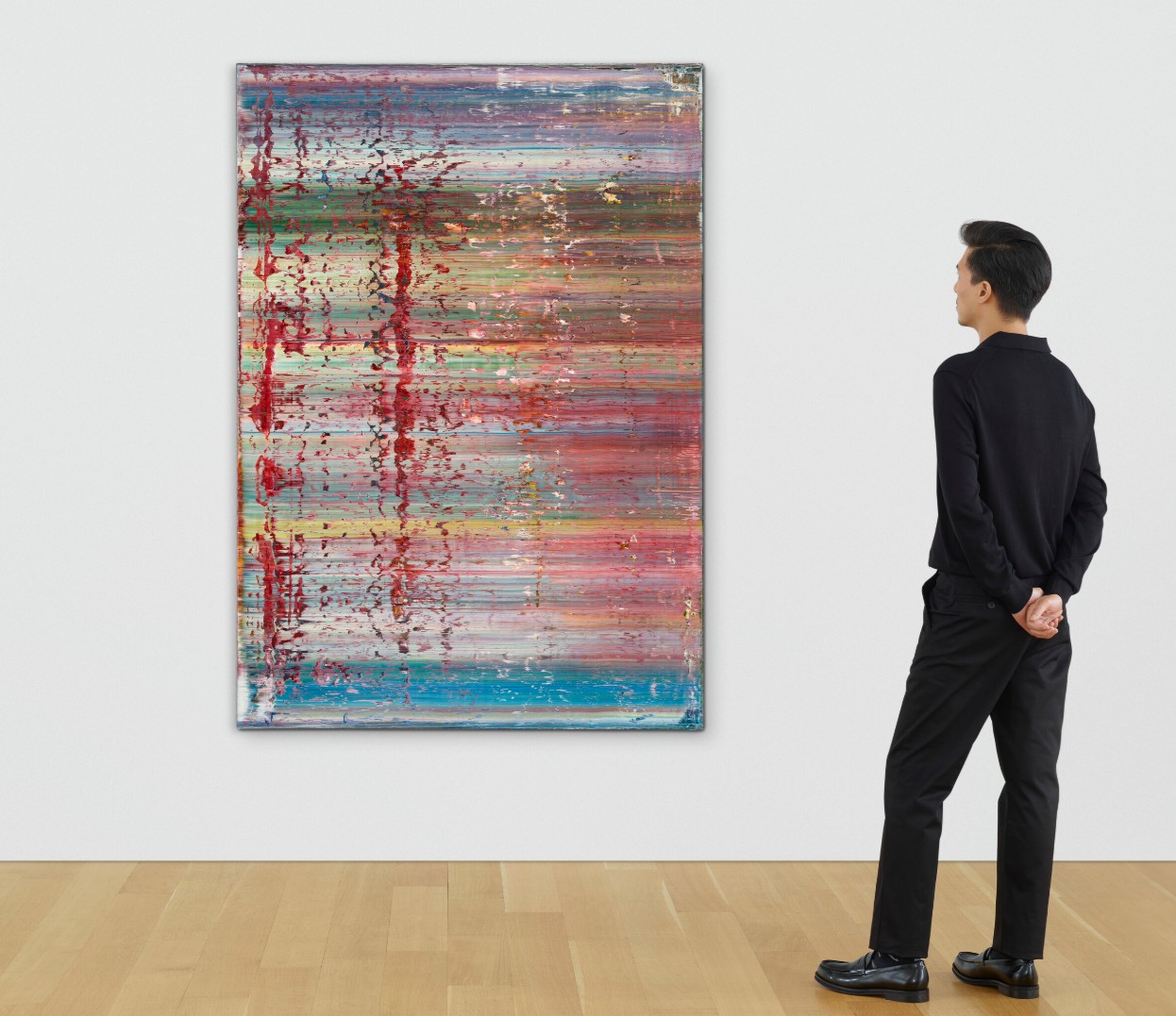
GERHARD RICHTER (B. 1932)
Mohn (Poppy), 1995
Oil on canvas
200×140 cm (78-3/4 x 55-1/8 inches)
Signed, inscribed and dated ‘830-1 Richter 1995’ (on the reverse)
#3. Abstraktes Bild, 1995
Breaking Ground: The Private Collection of Marian Goodman
Christie’s New-York: 20 May 2026
Estimated: USD 3,000,000 – 5,000,000
USD 8,737,000
GERHARD RICHTER (B. 1932), Abstraktes Bild | Christie’s
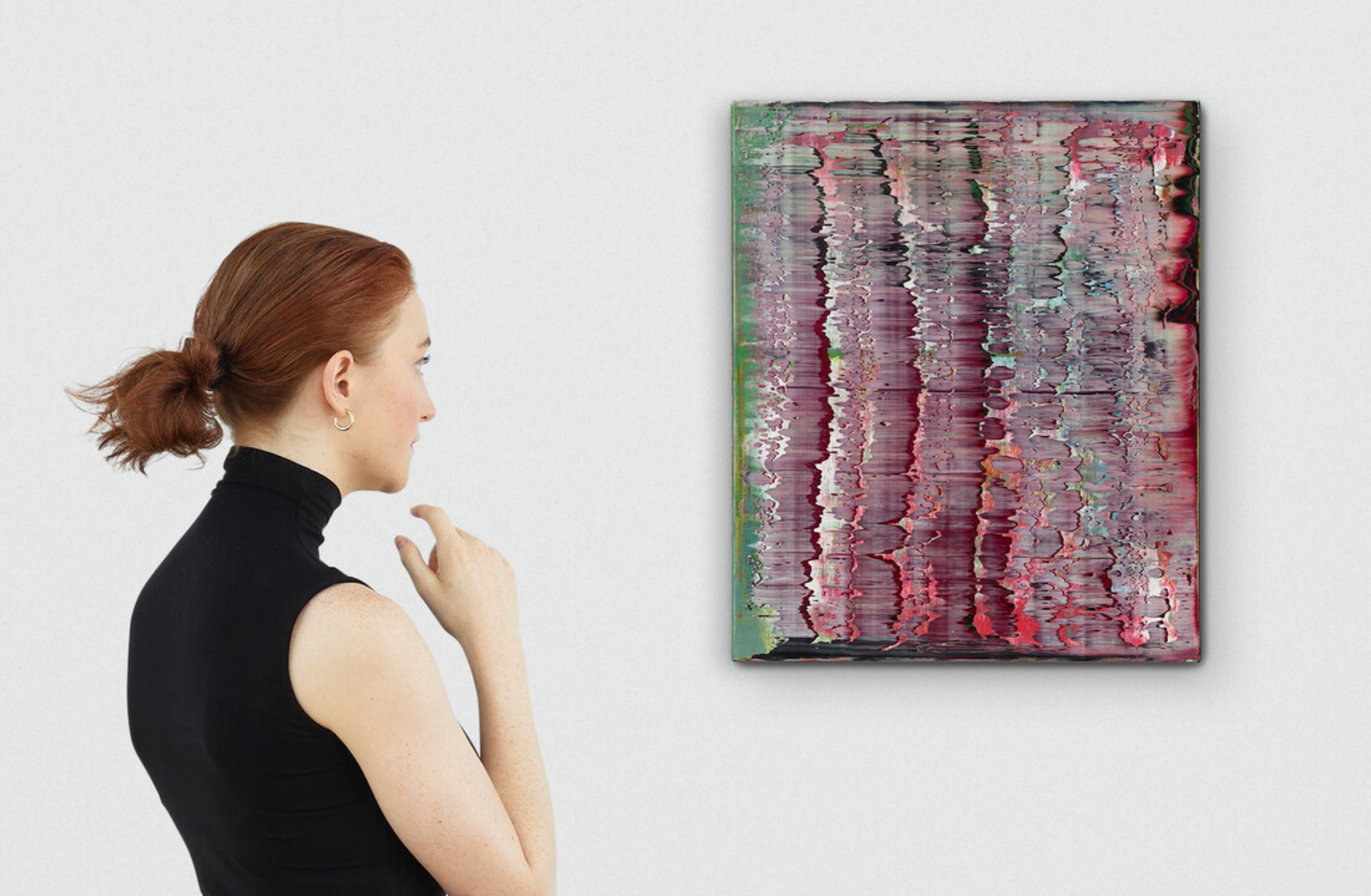
GERHARD RICHTER (B. 1932)
Abstraktes Bild, 1995
Oil on canvas
61 x 51.1 cm (24 x 20-1/8 inches)
Signed, inscribed and dated ‘825-11 Richter 1995’ (on the reverse)
#4. Besen, 1984
Property of an Important Private Collector
Phillips New-York: 19 May 2026
Estimated: USD 6,500,000 – 8,500,000
USD 8,070,000
Gerhard Richter Modern & Contemporary Art Evening Sale
REPEAT SALE
Christie’s Hong-Kong: 26 May 2022
Estimated: 55,000,000 – 75,000,000
HKD 79,915,000 / USD 10,180,385
GERHARD RICHTER (B. 1932) (christies.com)
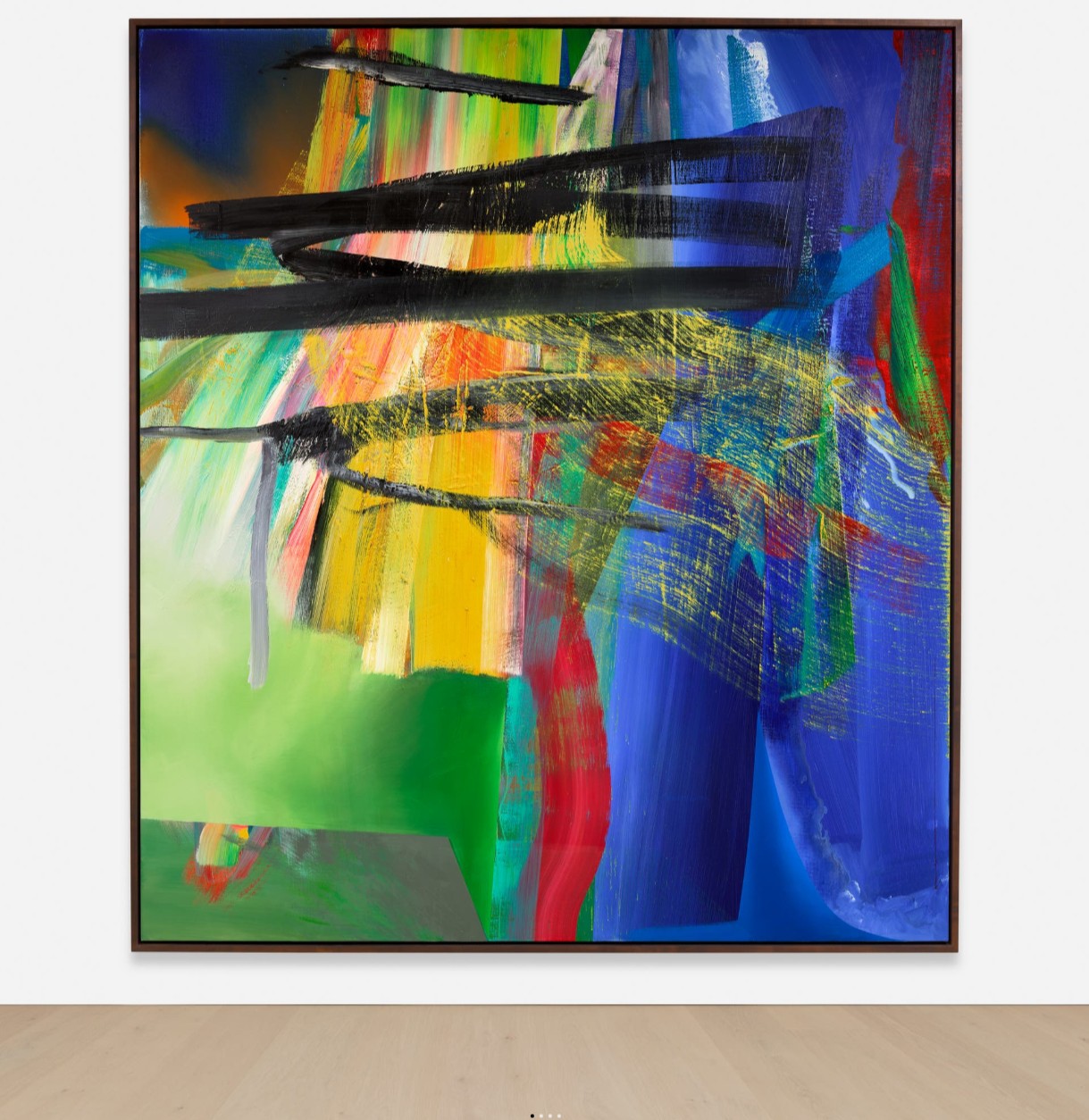
Oil on canvas
225.7 x 200.3 cm (88 7/8 x 78 7/8 inches)
Signed, inscribed and dated “Richter 1984 553-2″ on the reverse
#5. Abstraktes Bild, 2009
Breaking Ground: The Private Collection of Marian Goodman
Christie’s New-York: 20 May 2026
Estimated: USD 3,500,000 – 5,500,000
USD 6,541,000
GERHARD RICHTER (B. 1932), Abstraktes Bild | Christie’s
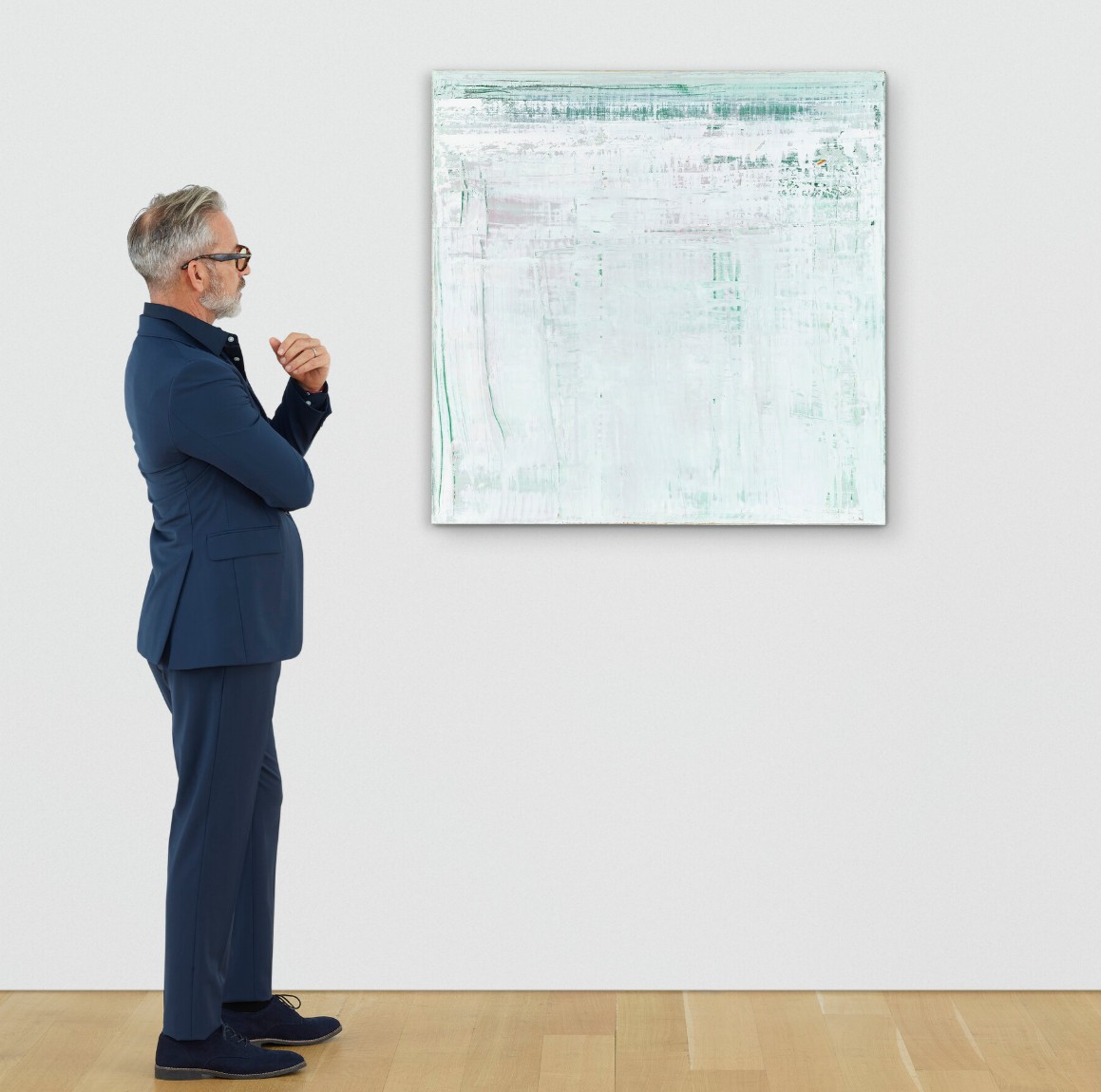
GERHARD RICHTER (B. 1932)
Abstraktes Bild, 2009
Oil on canvas
101.9 x 101.9 cm (40-1/8 x 40-1/8 inches)
Signed, inscribed and dated ‘910-5 Richter 2009’ (on the reverse)
#6. Abstraktes Bild, 2008
Breaking Ground: The Private Collection of Marian Goodman
Christie’s New-York: 20 May 2026
Estimated: USD 4,000,000 – 6,000,000
USD 5,077,000
GERHARD RICHTER (B. 1932), Abstraktes Bild | Christie’s
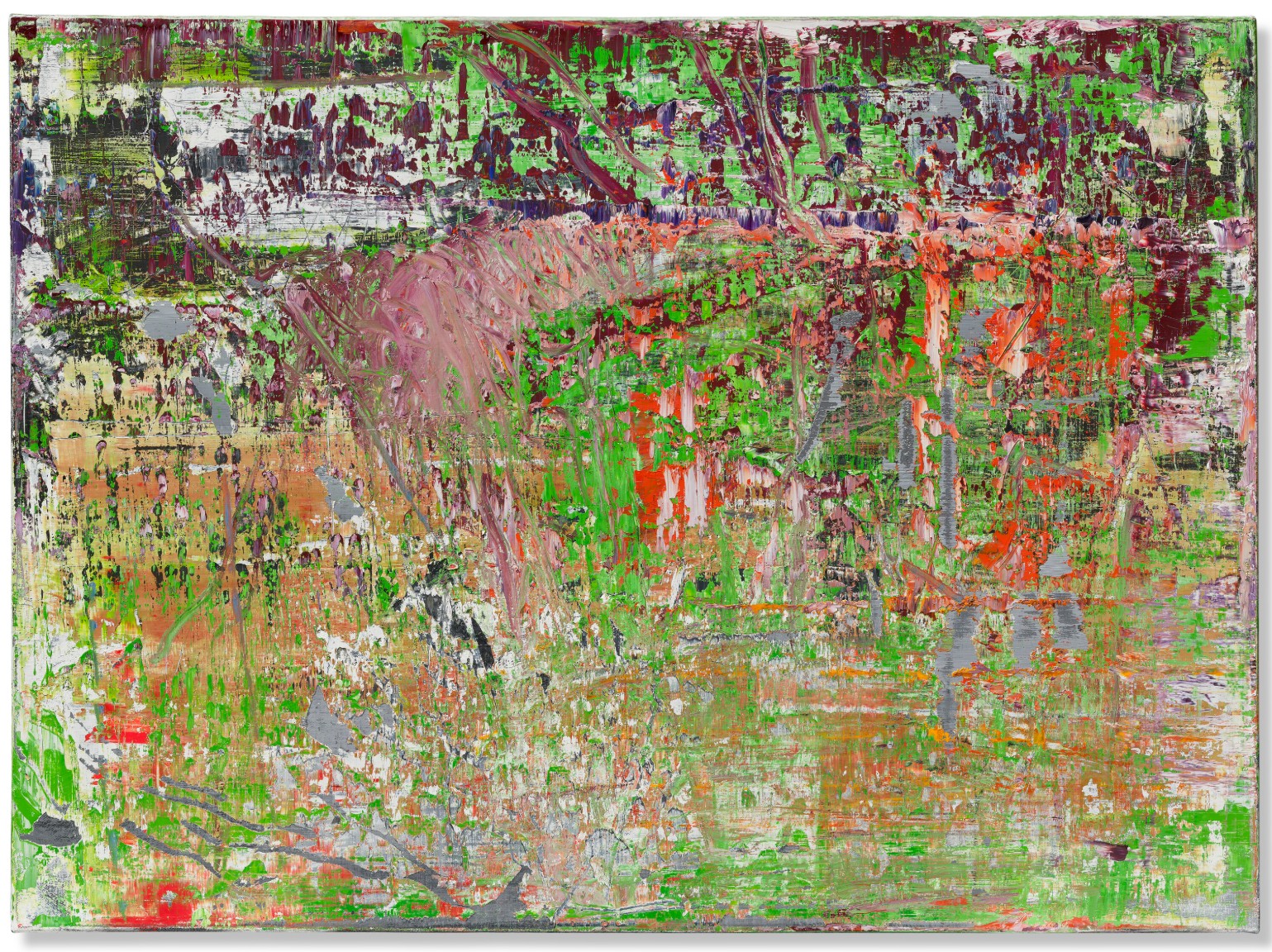
GERHARD RICHTER (B. 1932)
Abstraktes Bild, 2008
Oil on canvas
82.6 x 112.1 cm (32-1/2 x 44-1/8 inches)
Signed, inscribed and dated ‘903-6 Richter R. 2008’ (on the reverse)
#7. Abstraktes Bild, 1999
Breaking Ground: The Private Collection of Marian Goodman
Christie’s New-York: 20 May 2026
Estimated: USD 1,800,000 – 2,500,000
USD 2,881,000
GERHARD RICHTER (B. 1932), Abstraktes Bild | Christie’s
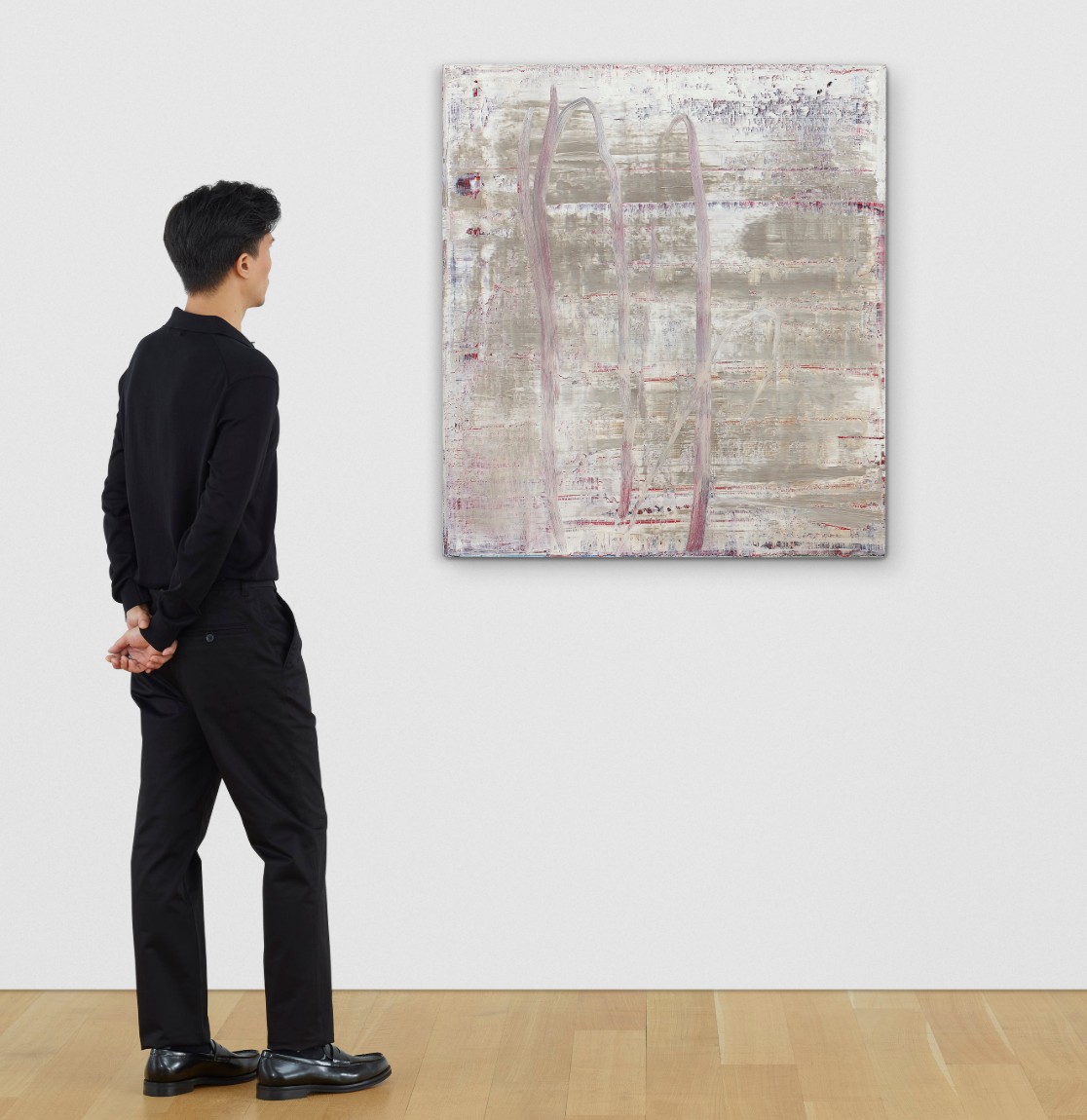
GERHARD RICHTER (B. 1932)
Abstraktes Bild, 1999
Oil on Alucobond
100×90 cm (39-3/8 x 35-3/8 inches)
Signed, inscribed and dated ‘860-8 Richter 1999’ (on the reverse)
#8. Strip, 2012
Christie’s New-York: 21 May 2026
Estimated: USD 800,000 – 1,200,000
USD 1,765,300
GERHARD RICHTER (B. 1932), Strip | Christie’s
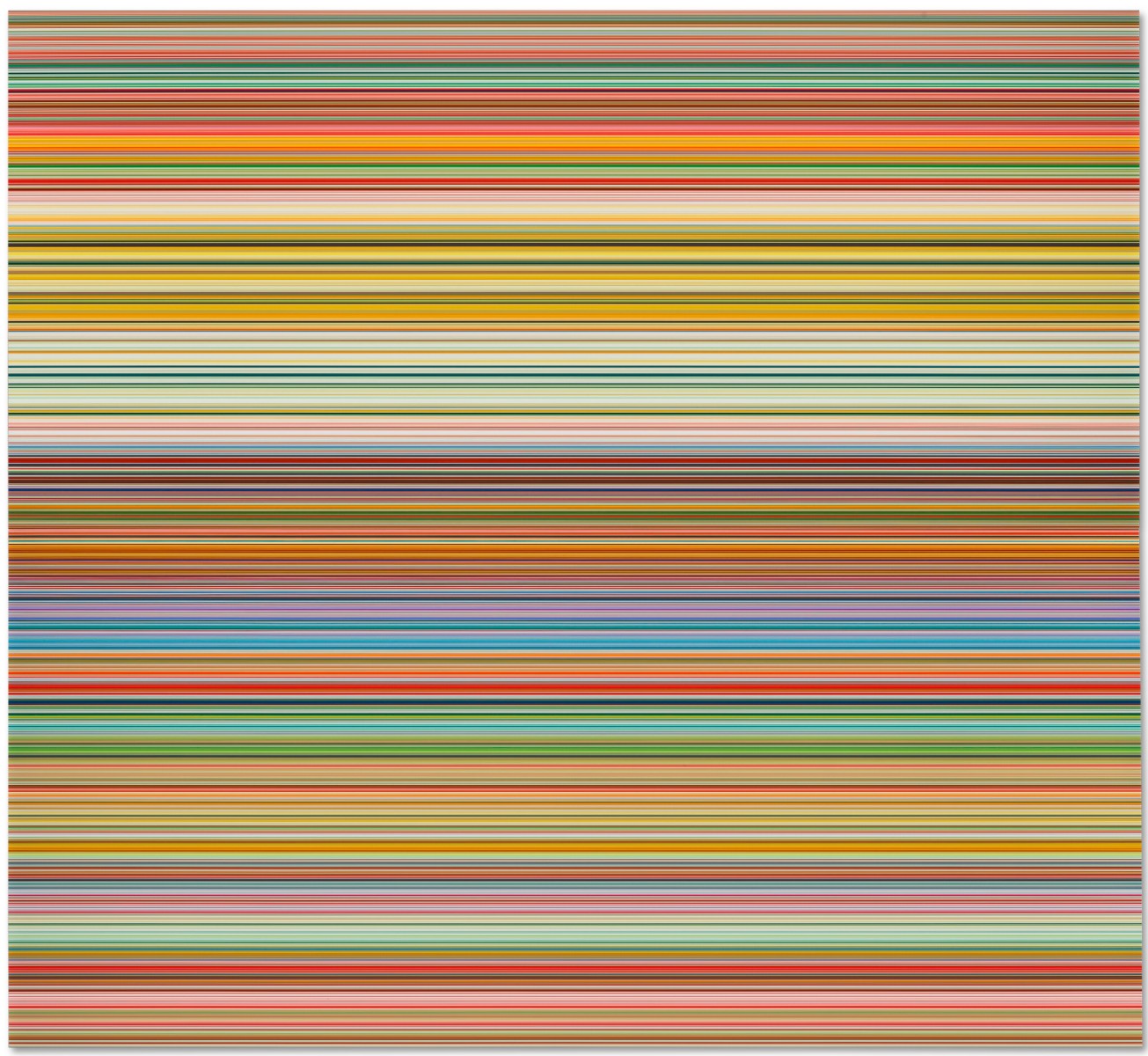
GERHARD RICHTER (B. 1932)
Strip, 2012
Digital print on paper between Alu-Dibond and perspex (Diasec), in two parts
210×230 cm (82-5/8 x 90-1/2 inches)
Signed, inscribed and dated ‘927-2 Richter 2012’ (on the reverse)
#9. Abstraktes Bild, 1995
Breaking Ground: The Private Collection of Marian Goodman
Christie’s New-York: 21 May 2026
Estimated: USD 750,000 – 1,000,000
USD 889,000
GERHARD RICHTER (B. 1932), Abstraktes Bild | Christie’s
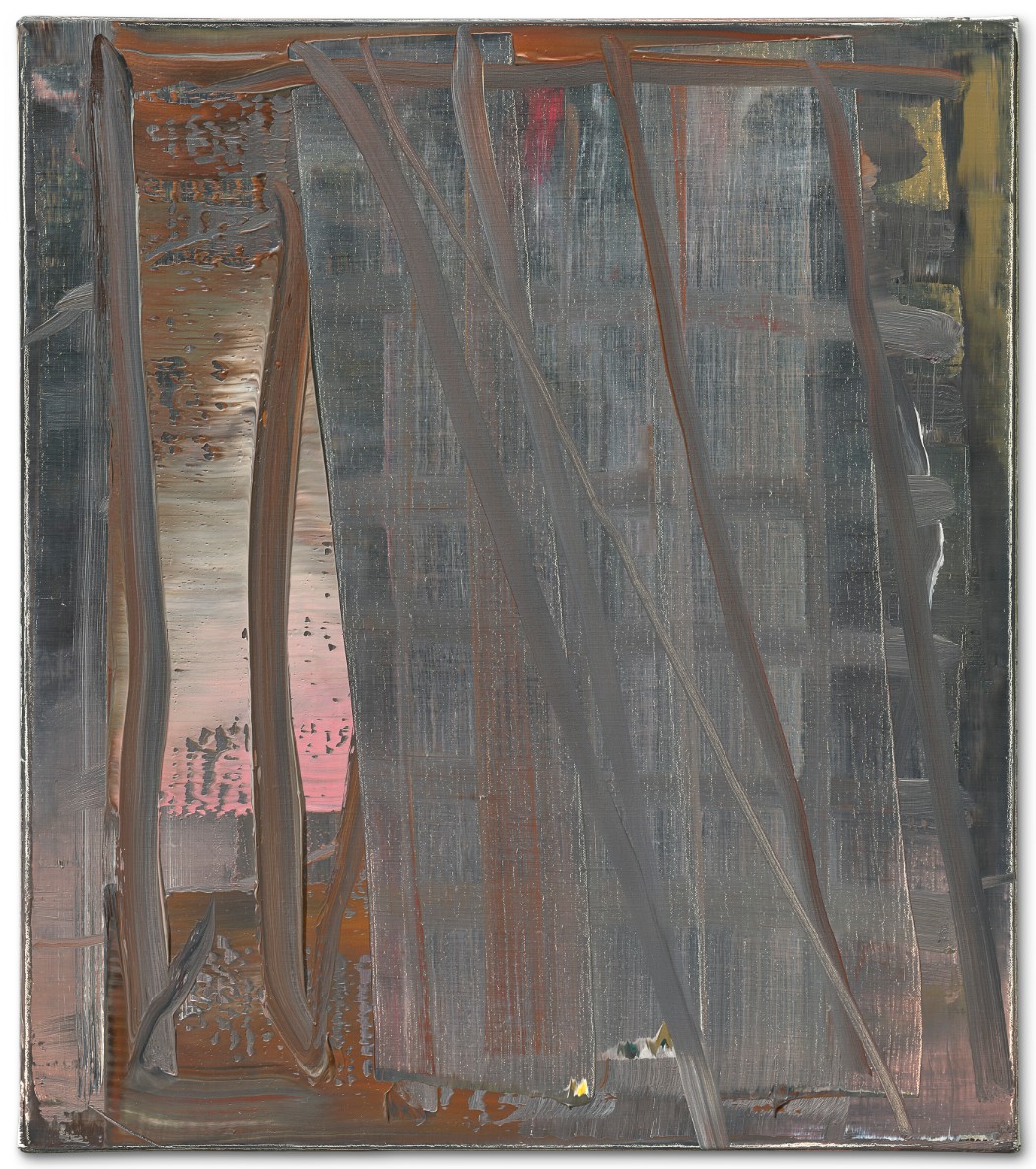
GERHARD RICHTER (B. 1932)
Abstraktes Bild, 1995
Oil on canvas
40.6 x 36 cm (16 x 14-1/8 inches)
Signed, inscribed and dated ‘833-4 Richter X.95’ (on the reverse)
#10. Ema (Akt auf einer Treppe), 1992
Property from an Important New York Collection
Sotheby’s New-York: 15 May 2026
Estimated: USD 500,000 – 700,000
USD 588,800
Gerhard Richter | Ema (Akt auf einer Treppe) | Contemporary Day
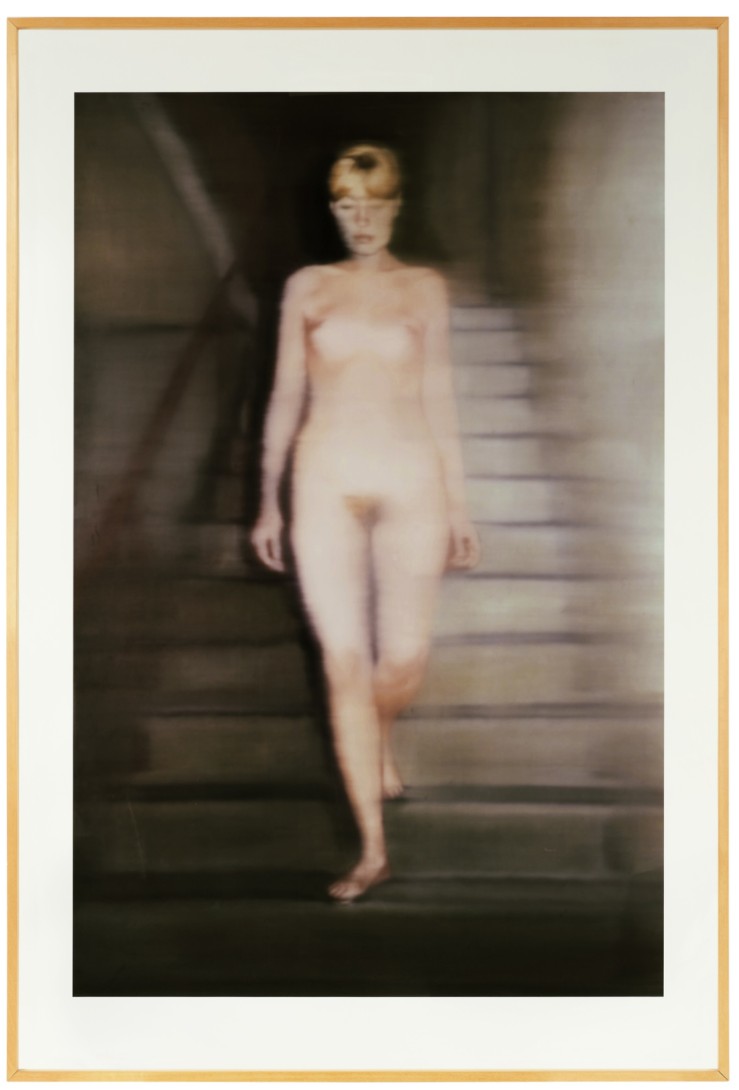
GERHARD RICHTER (b. 1932)
Ema (Akt auf einer Treppe), 1992
Cibachrome photograph mounted on Alucobond in artist’s chosen frame
Image: 194×126 cm ( 76-3/8 x 49-5/8 inches)
Overall: 224×140 cm (88-1/4 x 55-1/8 inches)
Signed, numbered 3/12 and dated ’92 (on the reverse of the frame)
This work is number 3 from an edition of 12 plus 1 artist’s proof
#11. 18 December 2008, 2008
Breaking Ground: The Private Collection of Marian Goodman
Christie’s New-York: 21 May 2026
Estimated: USD 80,000 – 120,000
USD 482,600
GERHARD RICHTER (B. 1932), 18 December 2008 | Christie’s
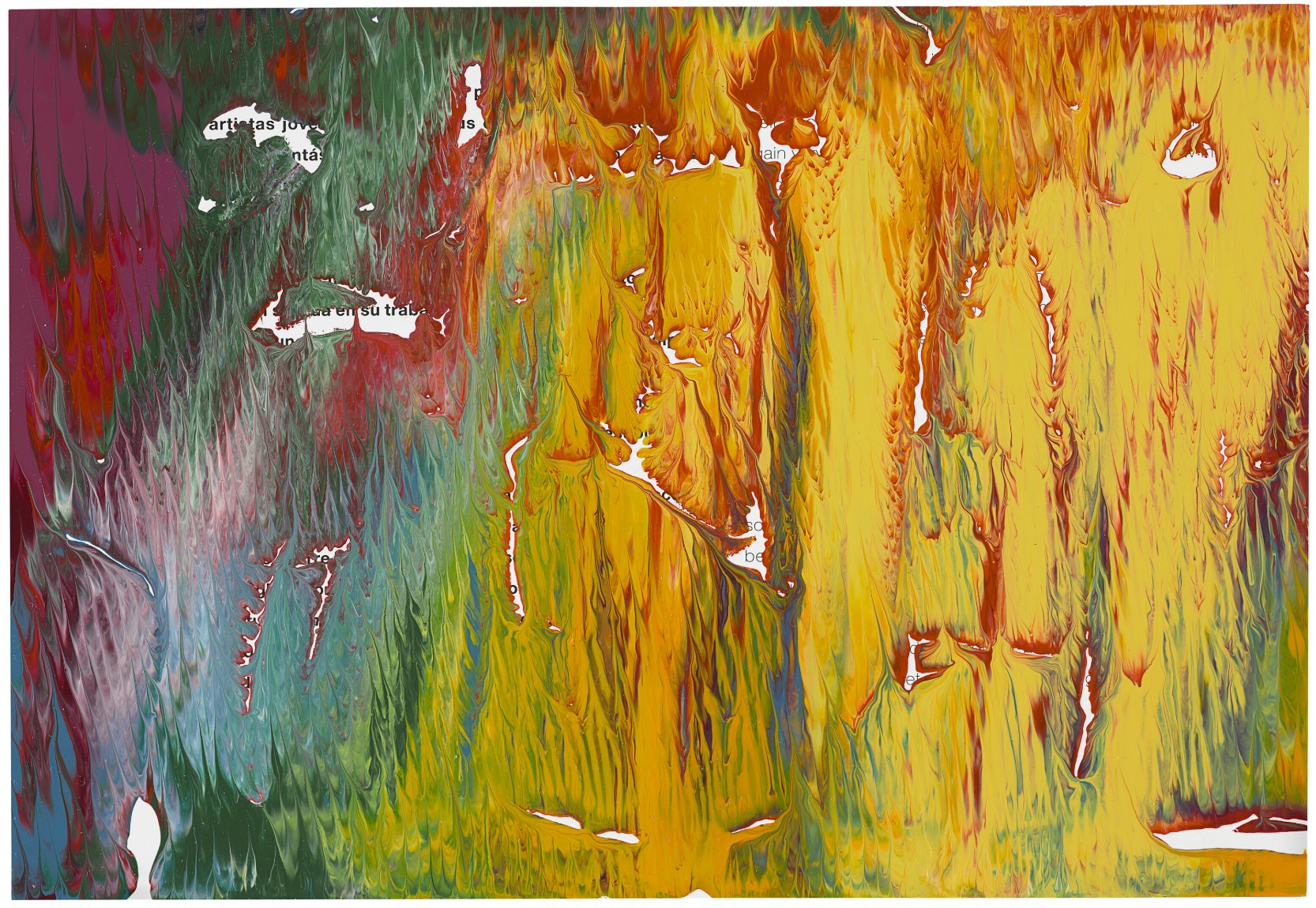
GERHARD RICHTER (B. 1932)
18 December 2008, 2008
Enameled lacquer on printed paper
13.8 x 20.6 cm (5-5/8 x 8-1/8 inches)
Signed, titled, dedicated and dated
‘Dear Marian – MERRY CHRISTMAS + HAPPY NEW YEAR + at least one nice show with me in your gallery! All best and love, yours, Gerhard 18 December 2008’
(on the reverse)
#12. Kerze III, 1989
Christie’s New-York: 21 May 2026
Estimated: USD 70,000 – 100,000
USD 368,300
GERHARD RICHTER (B. 1932), Kerze III | Christie’s
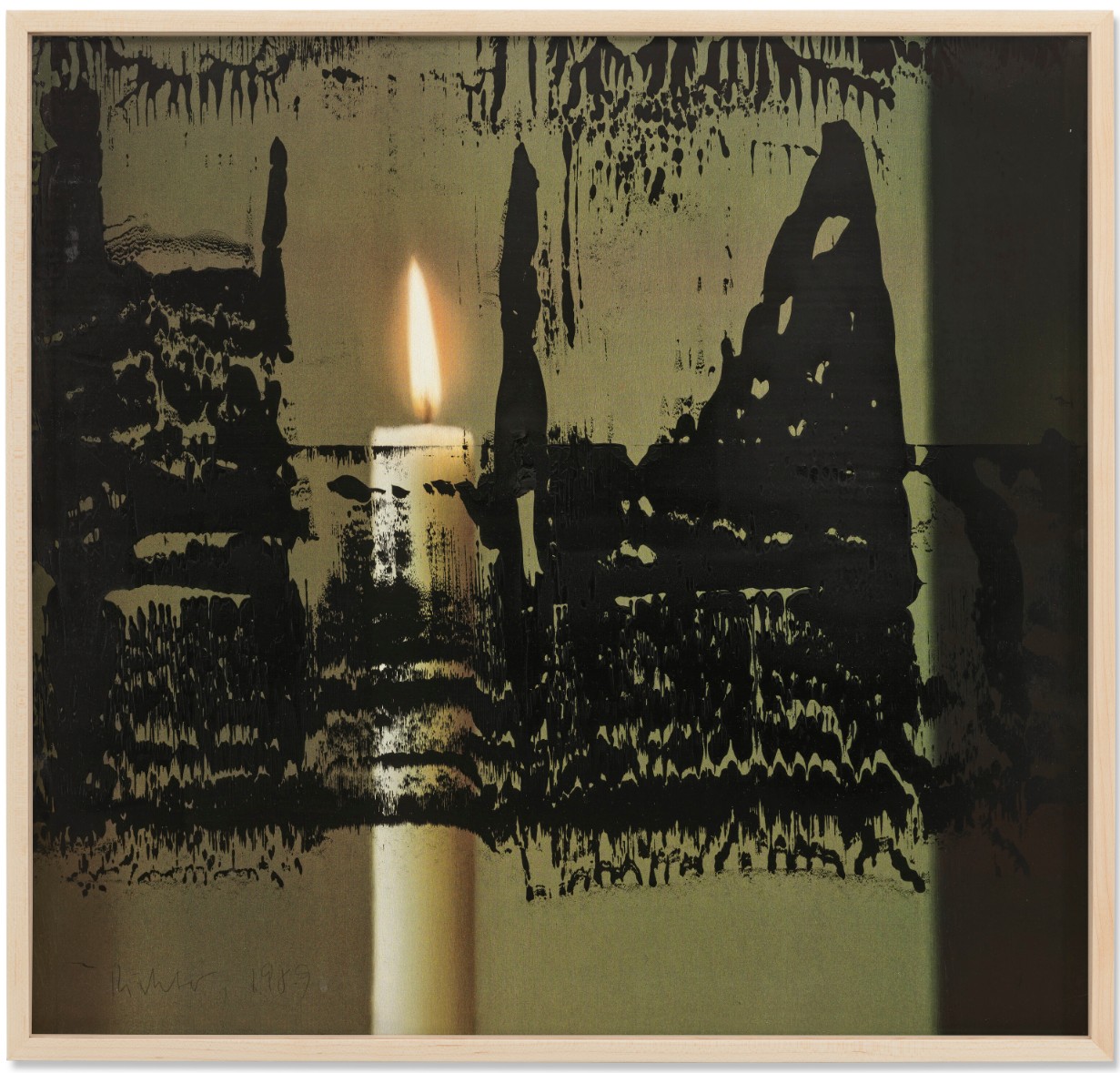
GERHARD RICHTER (B. 1932)
Kerze III, 1989
Oil on offset lithograph, flush-mounted on plastic
60.3 x 63.5 cm (23-3/4 x 25 inches)
Signed and dated ‘Richter, 1989’ (lower left)
Signed again, numbered and dated again ‘Richter, 1989 I/VIII’ (on the reverse)
This work is the first artist’s proof from an edition of 30 uniquely painted variants plus eight artist’s proofs and two unnumbered prints
#13. Abstraktes Bild, 1991
Christie’s New-York: 21 May 2026
Estimated: USD 180,000 – 250,000
USD 330,200
GERHARD RICHTER (B. 1932), Abstraktes Bild | Christie’s
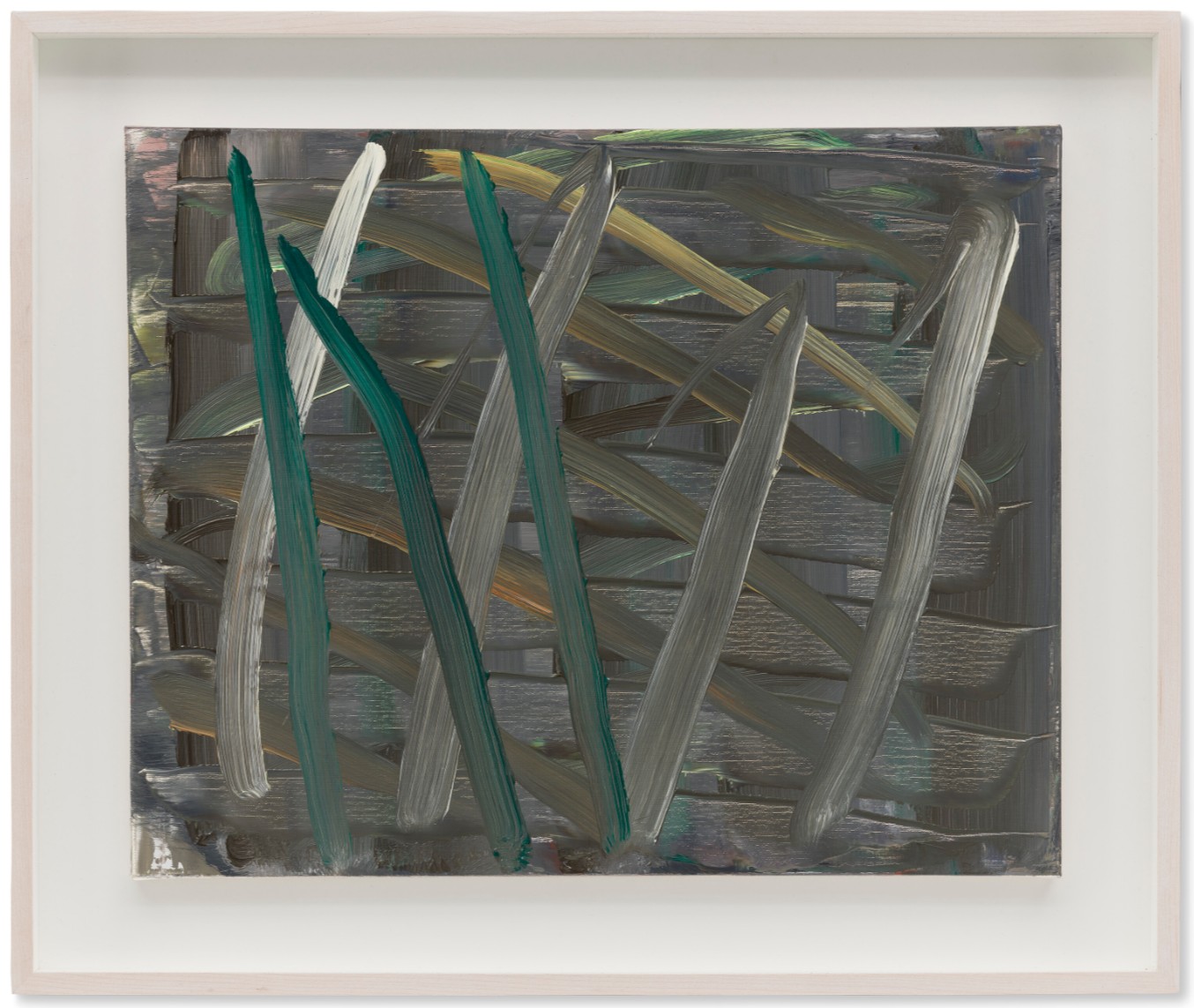
GERHARD RICHTER (B. 1932)
Abstraktes Bild, 1991
Oil on canvas
41×51 cm (16×20 inches)
Signed, inscribed and dated ‘753-1 Richter 1991’ (on the reverse)
#14. Untitled (7.2.89), 1989
Breaking Ground: The Private Collection of Marian Goodman
Christie’s New-York: 21 May 2026
Estimated: USD 60,000 – 80,000
USD 330,200
GERHARD RICHTER (B. 1932), Untitled (7.2.89) | Christie’s
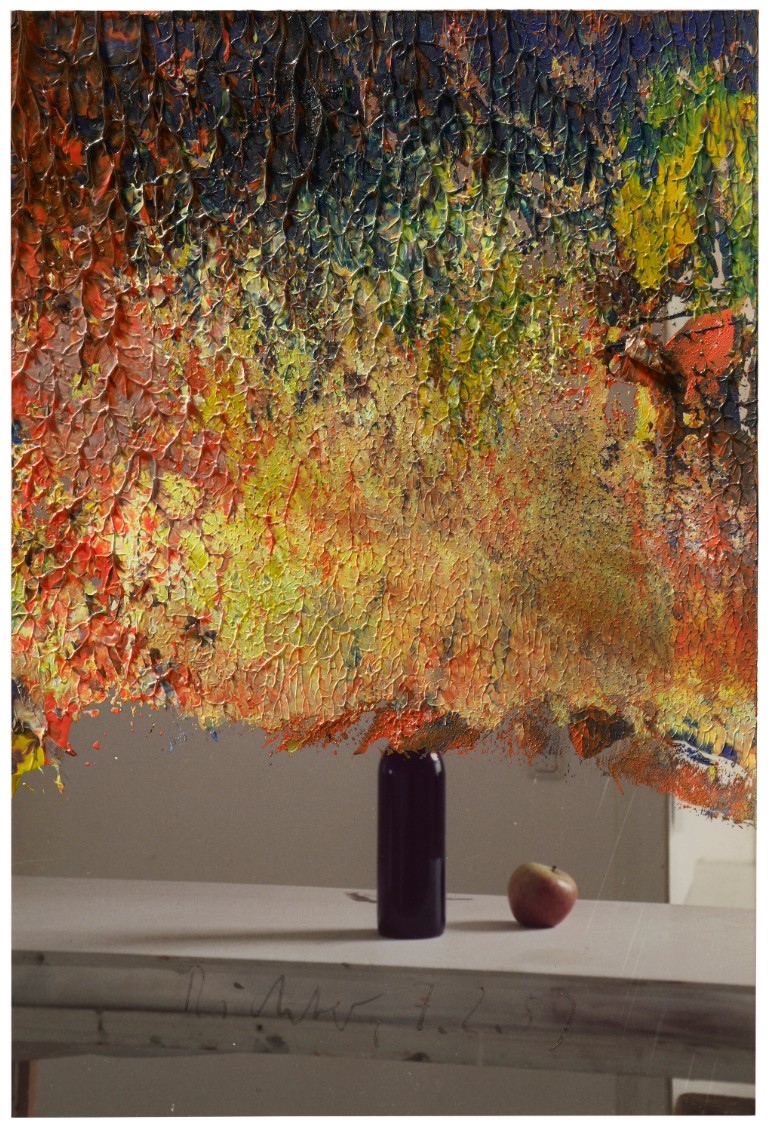
GERHARD RICHTER (B. 1932)
Untitled (7.2.89), 1989
Oil on photograph
14.6 x 10.2 cm (5-3/4 x 4 inches)
Signed and dated ‘Richter 7.2.89’ (lower edge)
Signed again and dated again ‘7.2.89 Richter’ (on the backing board)
#15. 10. Dez. 99 [Firenze], 1999
Breaking Ground: The Private Collection of Marian Goodman
Christie’s New-York: 21 May 2026
Estimated: USD 50,000 – 70,000
USD 241,300
GERHARD RICHTER (B. 1932), 10. Dez. 99 [Firenze] | Christie’s
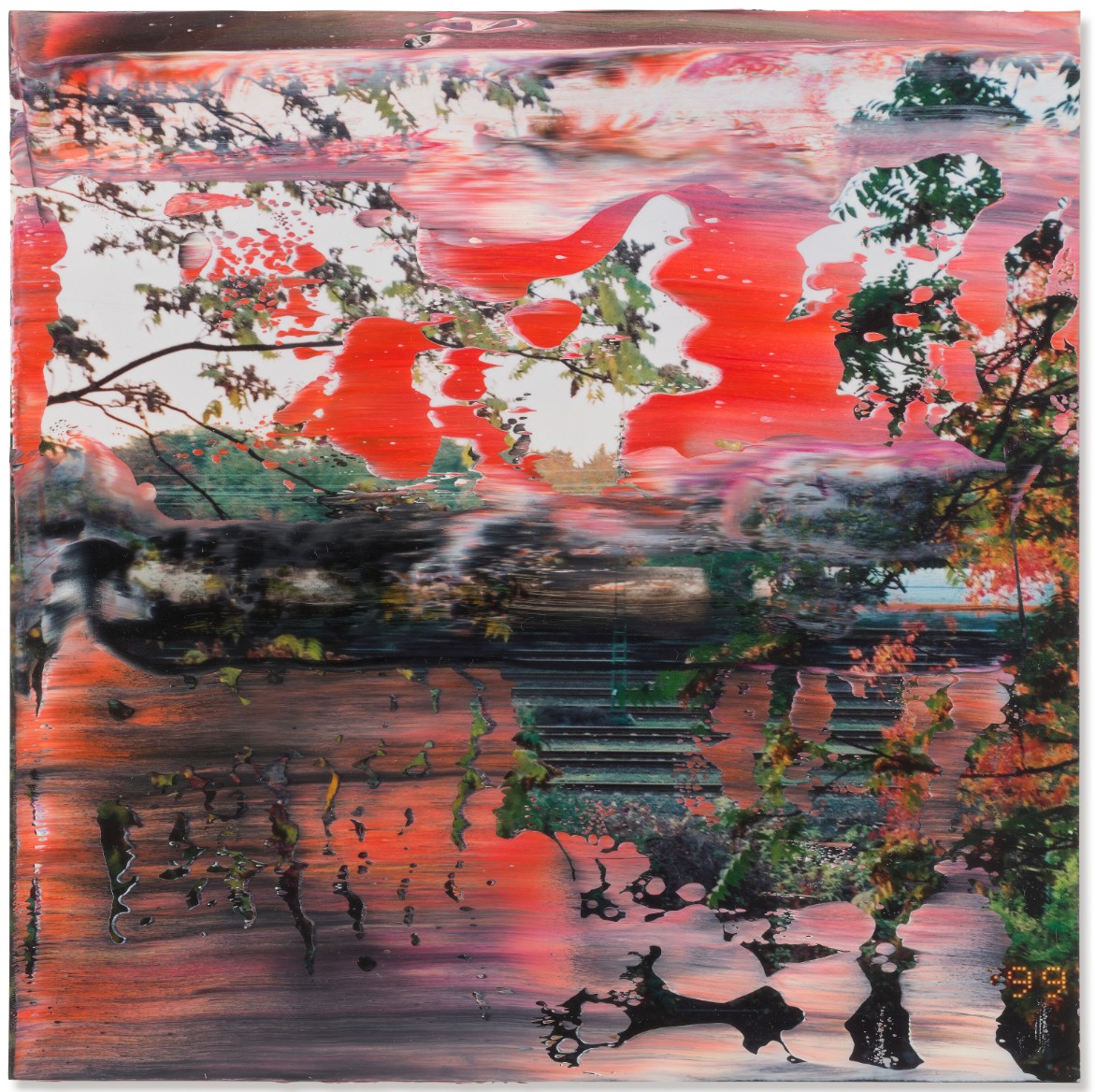
GERHARD RICHTER (B. 1932)
10. Dez. 99 [Firenze], 1999
Oil on photograph
11.7 x 11.7 cm (4-5/8 x 4-5/8 inches)
Signed and dated ’10. Dez. 99 Richter’ (on the mount)
#16. 20 February 2002, 2002
Breaking Ground: The Private Collection of Marian Goodman
Christie’s New-York: 21 May 2026
Estimated: USD 30,000 – 50,000
USD 139,700
GERHARD RICHTER (B. 1932), 20 February 2002 | Christie’s
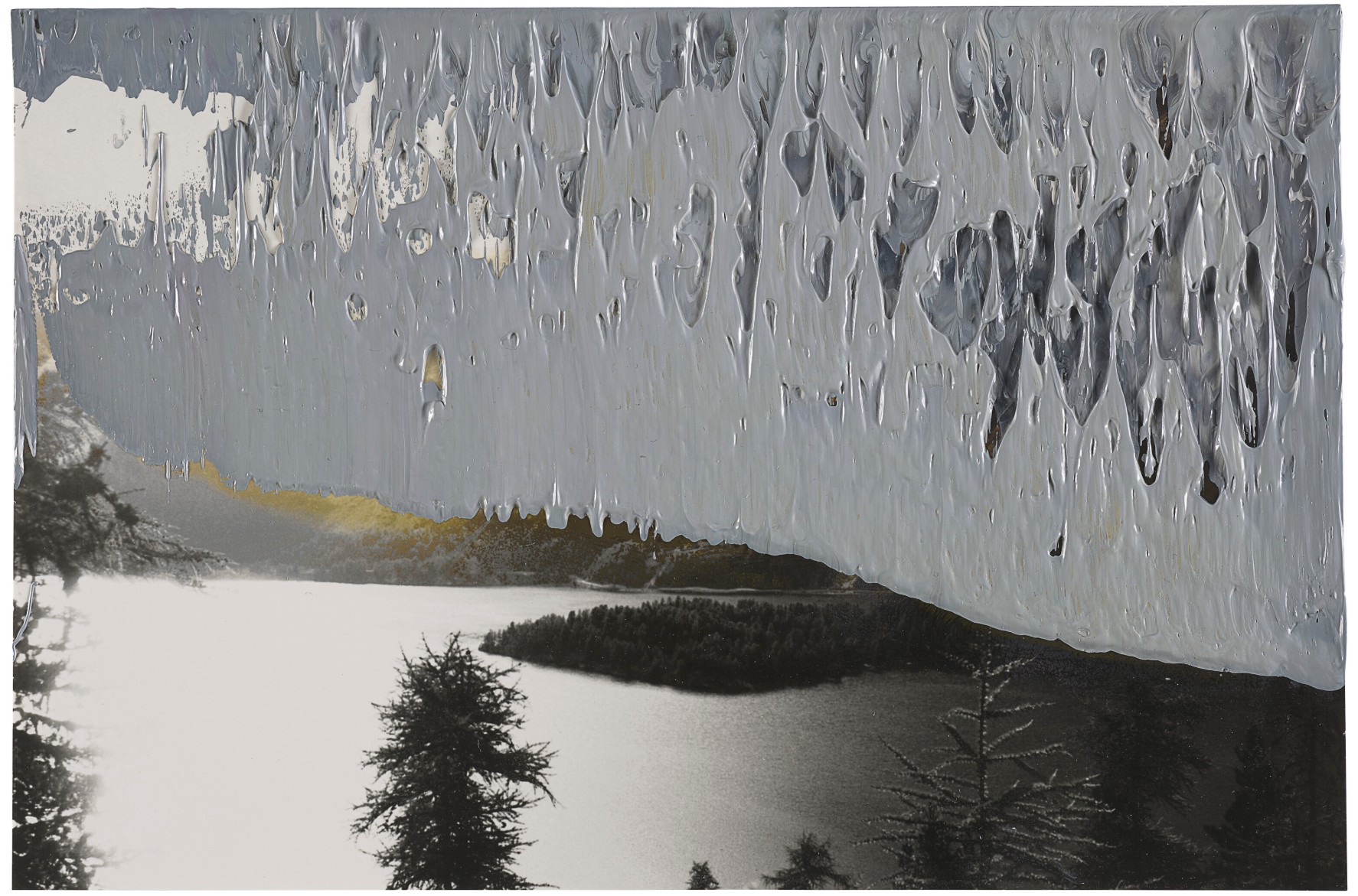
GERHARD RICHTER (B. 1932)
20 February 2002, 2002
Oil on photograph mounted on paper
Image: 11.4 x 20 cm (4-5/8 x 7-7/8 inches)
Mount: 20.6 x 29.2 cm ( 8-1/4 x 11-5/8 inches)
Signed ‘Richter’ (lower left of the mount)
Titled and dated ’20 FEB 2002′ (lower right of the mount)
#17. 18. Juni 2009, 2009
Breaking Ground: The Private Collection of Marian Goodman
Christie’s New-York: 21 May 2026
Estimated: USD 30,000 – 50,000
USD 82,550
GERHARD RICHTER (B. 1932), 18. Juni 2009 | Christie’s
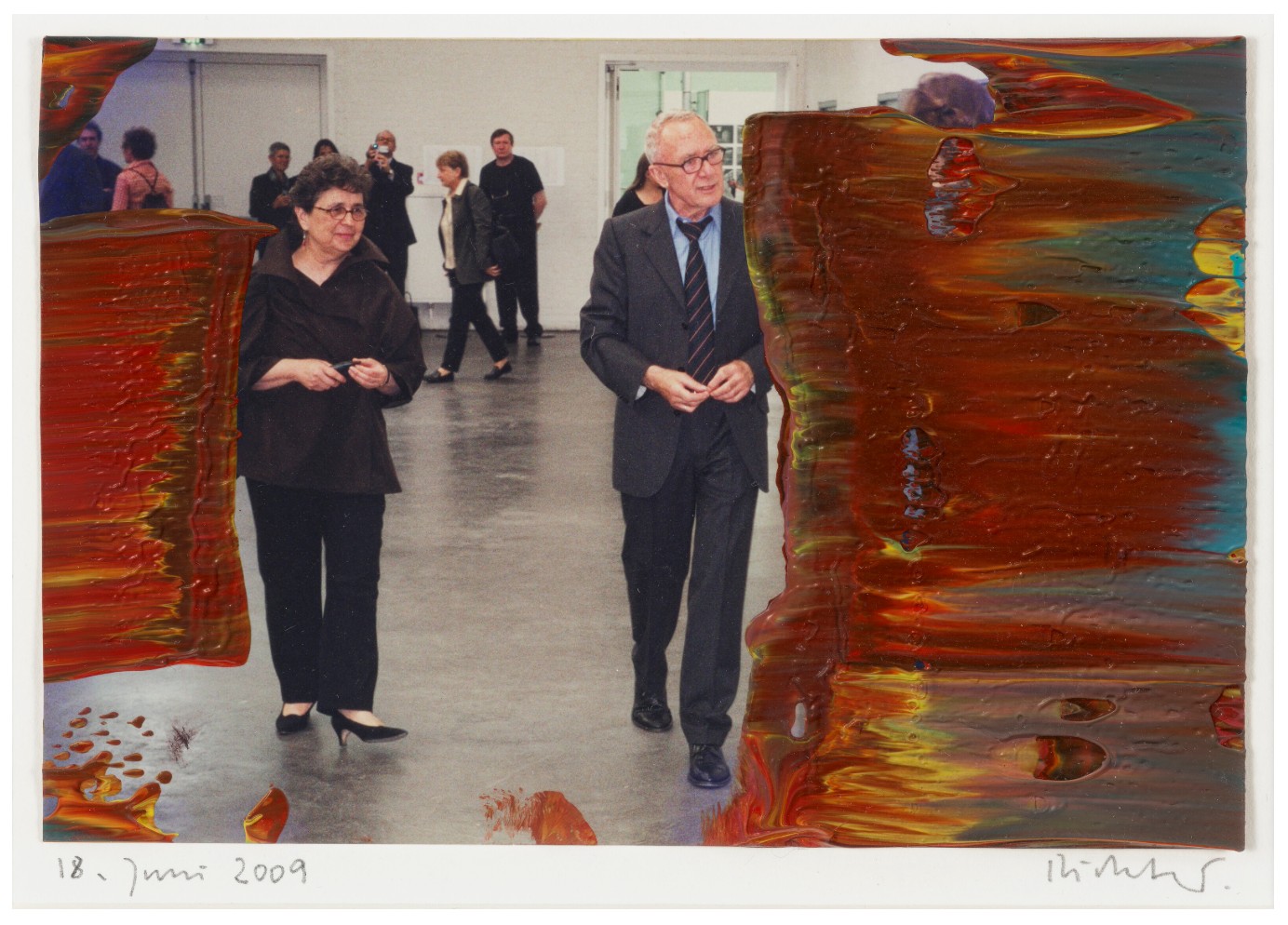
GERHARD RICHTER (B. 1932)
18. Juni 2009, 2009
Oil on photograph
10.2 x 14.9 cm (4 x 5-7/8 inches)
Signed, titled and dated ’18. Juni 2009 Richter’ (on the mount)
#18. 5. Jan. 98, 1998
Breaking Ground: The Private Collection of Marian Goodman
Christie’s New-York: 21 May 2026
Estimated: USD 40,000 – 60,000
USD 76,200
GERHARD RICHTER (B. 1932), 5. Jan. 98 | Christie’s
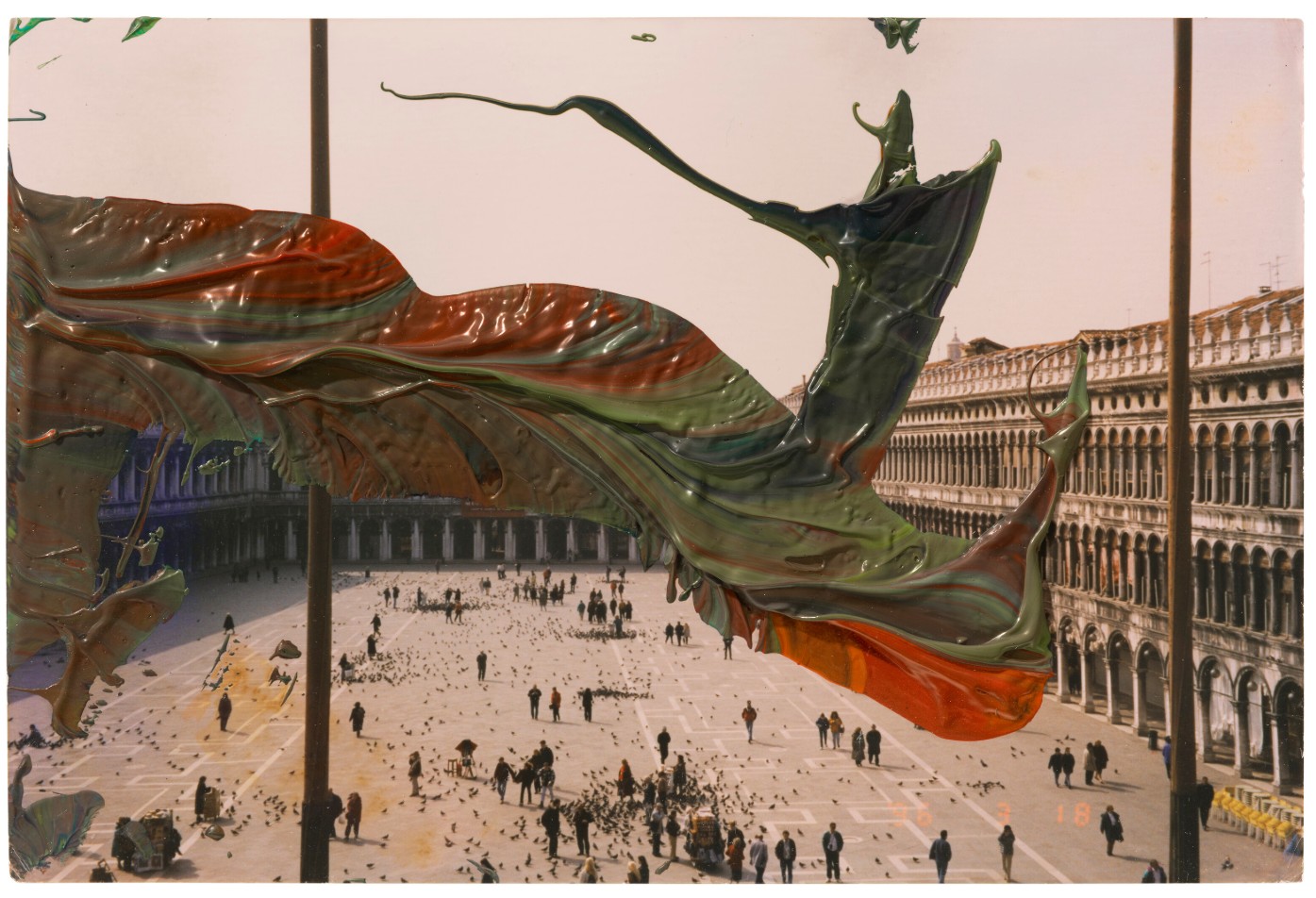
GERHARD RICHTER (B. 1932)
5. Jan. 98, 1998
Oil on gelatin silver print
10.2 x 14.9 cm (4 x 5-7/8 inches)
Signed and dated ‘Richter 5. Jan. 98’ (on the reverse)
#19. 3. Juli 2015, 2015
Breaking Ground: The Private Collection of Marian Goodman
Christie’s New-York: 21 May 2026
Estimated: USD 60,000 – 80,000
USD 69,850
WORK ON PAPER
GERHARD RICHTER (B. 1932), 3. Juli 2015 | Christie’s
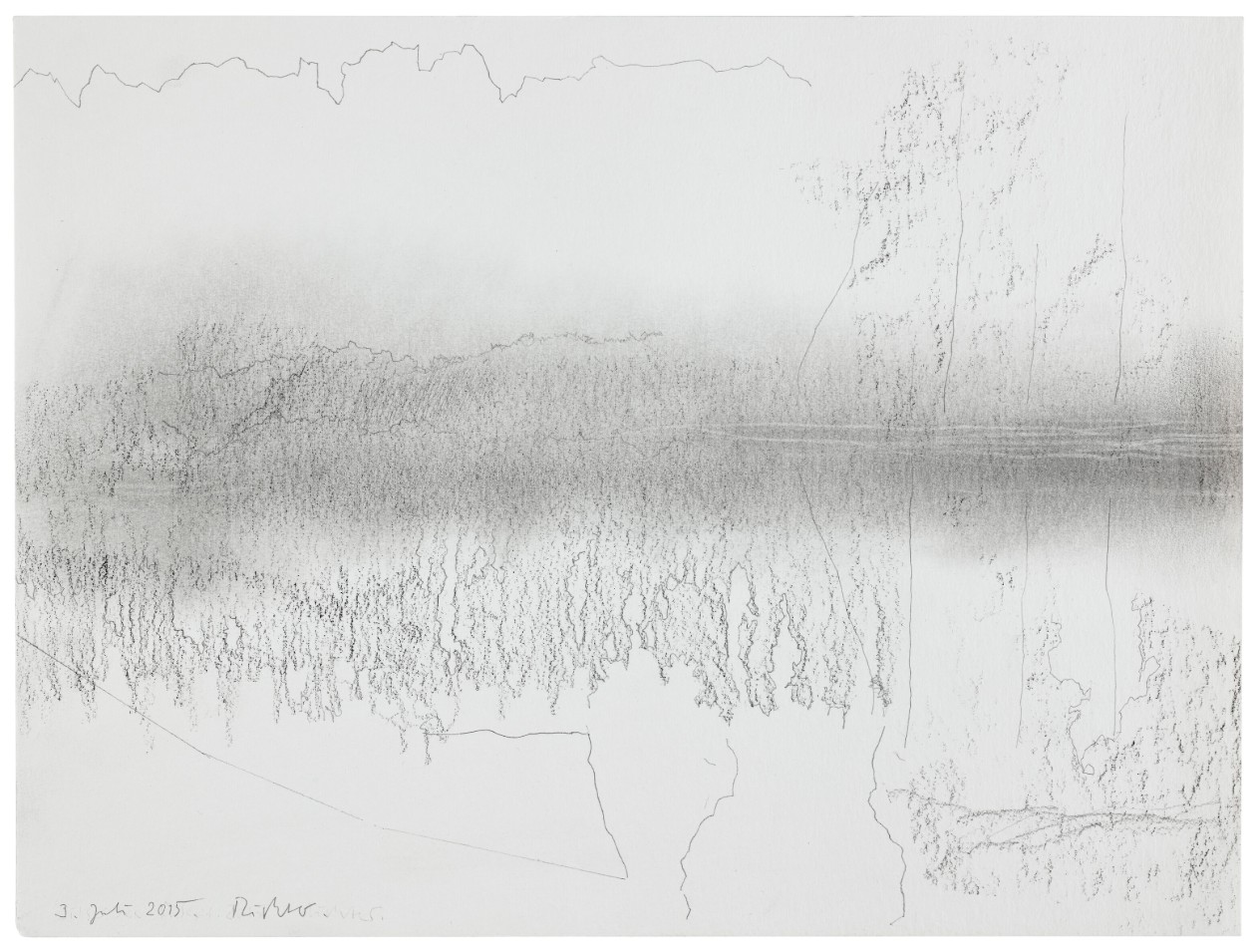
GERHARD RICHTER (B. 1932)
3. Juli 2015, 2015
Graphite on paper
28.7 x 39.4 cm (11-3/4 x 15-5/8 inches)
Signed, titled and dated ‘3. juli 2015 Richter’ (lower left)
Kerze (Candle), 1982
Kerze (Candle), 1982
Breaking Ground: The Private Collection of Marian Goodman
Christie’s New-York: 20 May 2026
Estimated: USD 35,000,000 – 50,000,000
USD 35,135,000
GERHARD RICHTER (B. 1932), Kerze (Candle) | Christie’s
GERHARD RICHTER (B. 1932)
Kerze (Candle), 1982
Oil on canvas
100.3 x 70.5 cm (39-1/2 x 27-3/4 inches)
Signed, inscribed and dated ‘510-1 Richter 1982’ (on the reverse)
In 1982, shortly after Gerhard Richter exhibited his large-scale abstracts to critical acclaim at documenta 7 in Kassel, Germany, the artist unveiled a series of radically different paintings that confirmed his position as one of the world’s most important living artists. Kerze is one the these paintings, a discreet series that combines the past and the present, memory and reality. A contemporary intervention in the historic tradition of still-life painting, Richter’s Kerze paintings also reflected the artist’s very personal experiences of living through the destruction of World War II and its aftermath. Held in the personal collection of Marian Goodman, the legendary art dealer and close friend of the artist, for over 40 years, Kerze represents not only an important contribution to history of twentieth-century painting, but also one of the most enduring partnerships in contemporary art.
Enveloped in solitude, the solitary candle is a totem to the artist’s ability to convey emotion in the most controlled and reductive way. A pale wax candle is located in a simple white candle holder, making it one of only three surviving Kerze paintings to show a candle in full. Set on a deep sill, the candle is bathed in a soft light that permeates through an unseen window to the left, creating a dramatic interplay of light and shadow. The candle occupies the space where these two worlds converge; half bathed in light from the window, half enveloped in shadow, it belongs in both.
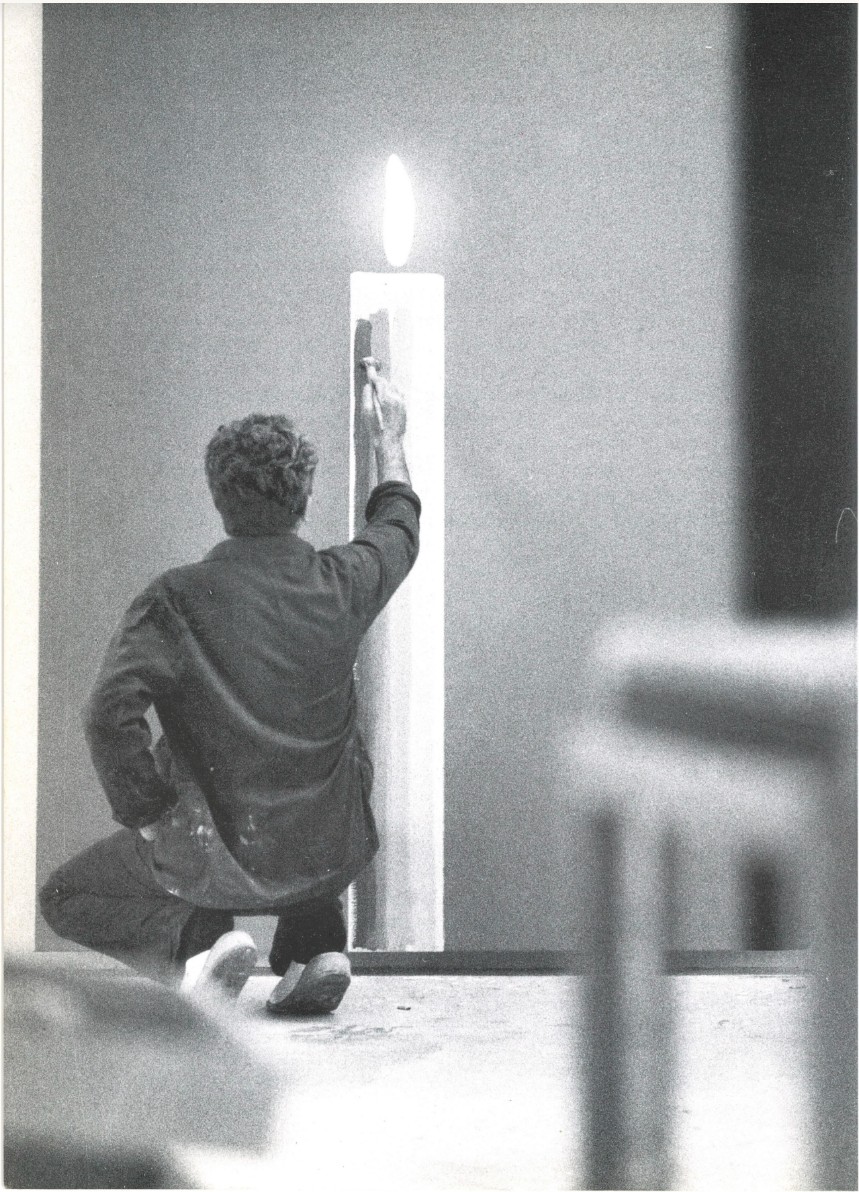
Gerhard Richter in his studio, 1984. Photo: Benjamin Katz. © 2026 Artists Rights Society (ARS), New York/ VG Bild-kunst, Bonn.
Artwork: © Gerhard Richter 2026 (24042026).
This duality is prevalent throughout Richter’s work. Much of his career has been spent examining the role of painting in an age where photography has become the dominant mode of visual communication, a medium particularly associated with truth and reality in opposition to painting’s fictive tradition. In addition, as someone who spent his childhood growing up in eastern Germany during World War II, before moving to the West in 1961, Richter has experienced his own personal dualities, including mortality and the transience of life, together with the conflicting political philosophies of tyranny and freedom. Although Richter only painted a total of 27 Kerze paintings, the symbolism of the candle became one of the most important in his career.
“I was fascinated by these motifs. I felt protected because these motifs are so art-historically charged, and I no longer needed to say that I painted them for myself. The motifs were covered by this styled composition, out-of-focus quality, and perfection. So beautifully painted, they take away the fear”
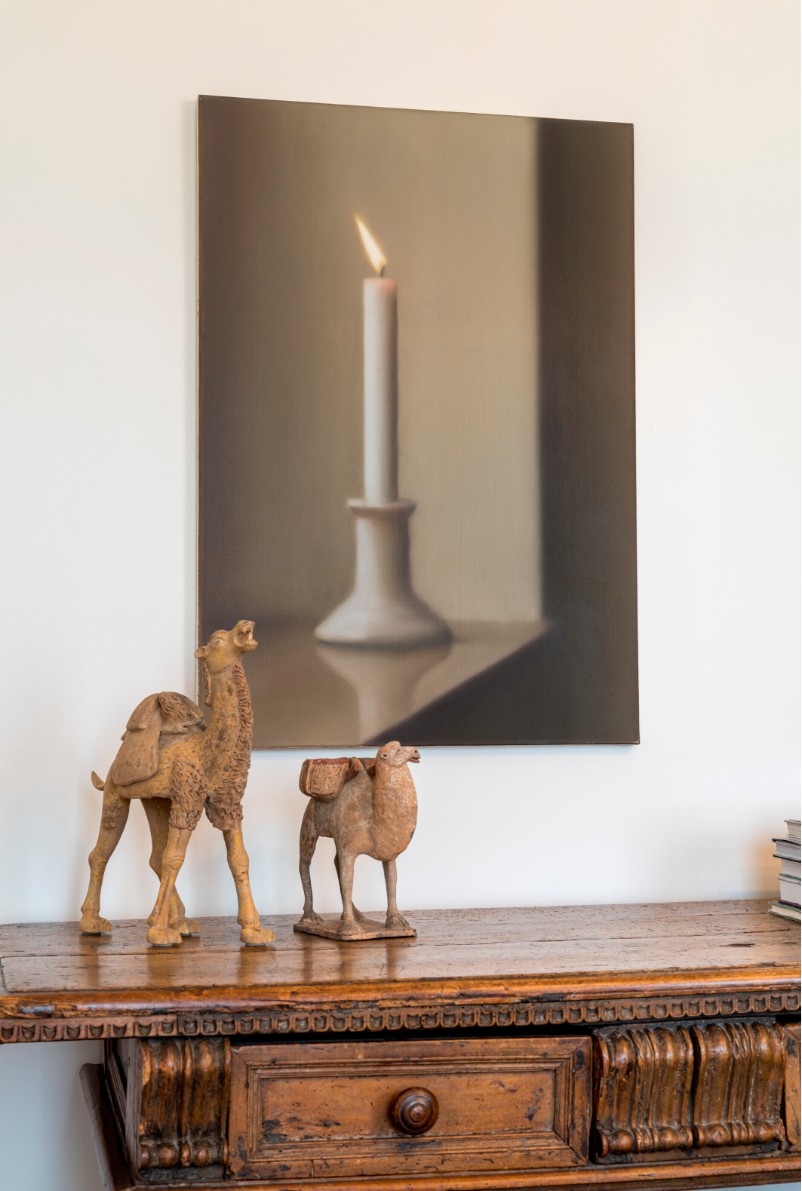
The “styled composition” quality that Richter refers to is a development of the artist’s iconic “photorealist” paintings with which he first gained international acclaim beginning in the early 1960s. Using an everyday photograph as his source image (often a family photograph or one torn from a magazine), at first Richter renders a near perfect copy of the image. Then, while the paint was still wet, he drags a dry brush over the surface, disrupting the clarity of the images while maintaining the integrity of its subject matter.
“I do not blur my pictures to make a representation seem more artistic through lack of clarity or to give my style and individual note. I rather equalize, neutralize what is depicted, attempt to retain the anonymous gloss of the photograph, to replace the craftsmanly-artistic with the technical.”
In the case of the present work, Richter used a photograph of a candle taken in the artist’s studio specifically for the purpose of this painting. For centuries artists have used candles to symbolize many things including faith, hope, life, mortality, enlightenment, and knowledge. Shifting from a device that symbolized the divine presence in medieval art, such as in Lucas Cranach the Elder’s Saints Genevieve and Apollonia (1506, National Gallery, London), to a key tool for showcasing dramatic chiaroscuro, as in Francesco de Zurbarán’s The Penitent Magdalen (circa 1635-38, Museo Nacional de San carlos, Mexico City), during the Dutch Golden Age the candle had come to represent the instability of life, as in Rembrandt’s The Money Changer (1627, Staatliche Museen zu Berlin, Gemäldegalerie), before being used to depict the triumph of reason during the Enlightenment, such as Joseph Wright of Derby’s, Three Persons Viewing the Gladiator by Candlelight (1765, Walker Art Gallery, Liverpool).
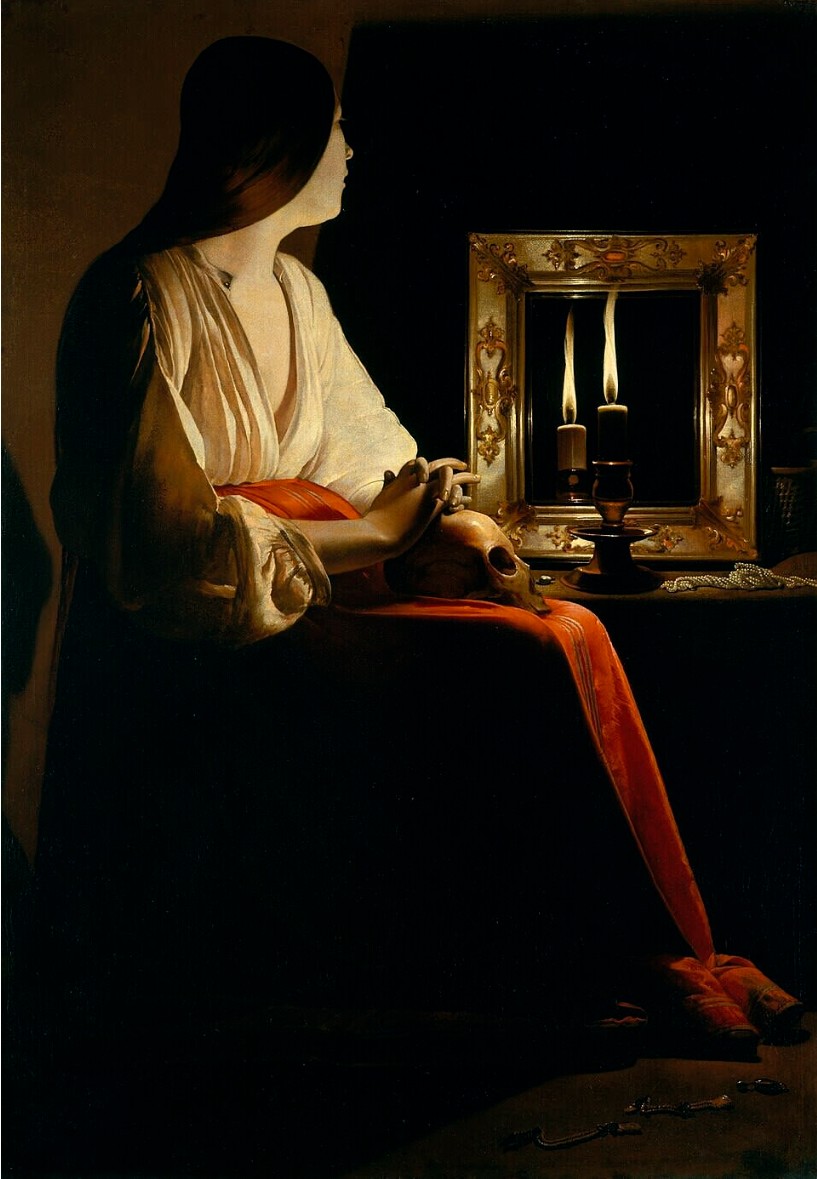
Georges de la Tour, The Penitent Magdalen, circa 1640. Metropolitan Museum of Art, New York.
Photo: The Metropolitan Museum of Art, New York.
However, for Richter the candle has a much more personal historical resonance, as he recalled in 1995, when he produced a monumental Kerze painting to mark the 50th anniversary of the allied bombings of Dresden:
“At first it was only intended to look pretty… but later a politically useful statement was also found in the picture… [as] candles had always been an important symbol for the GDR, as a silent protest against the regime… it was a strange feeling to see that a small picture of candles was turning into something completely different, something that I had never intended. Because, as I was painting it, it neither had this unequivocal meaning nor was it intended to be anything like a street picture. It sort of ran away from me and became something over which I no longer had control… When I painted the candles I wasn’t thinking of February the 13th [the allied bombing of Dresden during World War II] but I did experience feelings to do with contemplation, remembering, silence and death.”
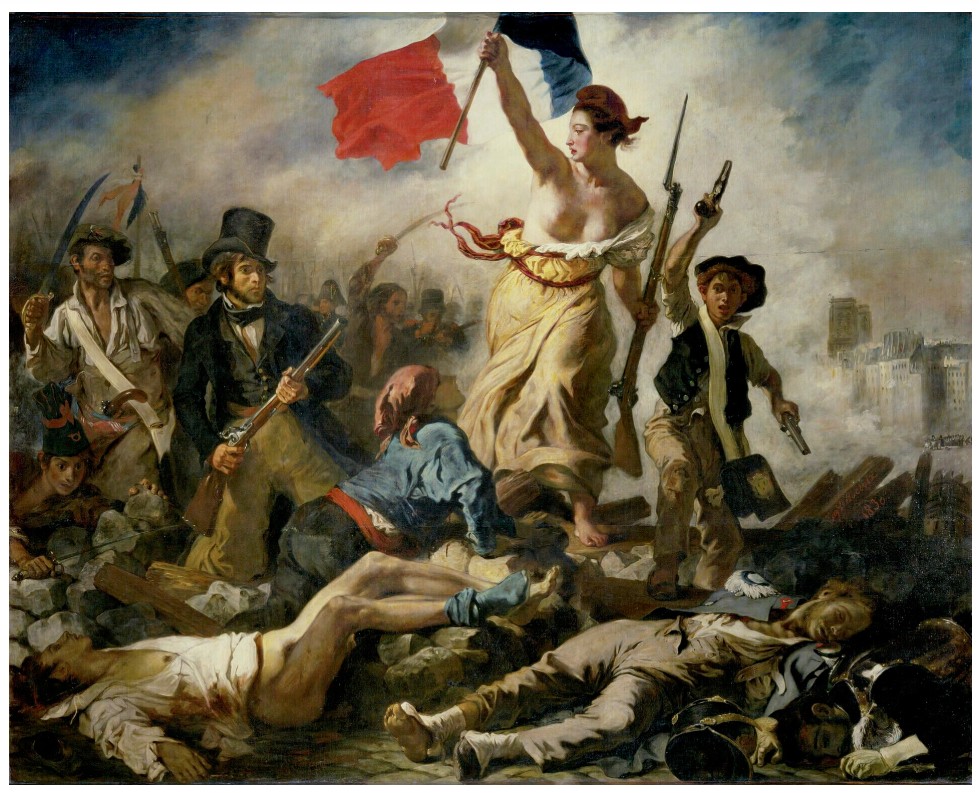
Ferdinand Victor Eugene Delacroix, Liberty Leading the People, 28 July 1830, circa 1830-1831. Musée du Louvre, Paris.
This particular Kerze painting has been in the personal collection of Marian Goodman, the legendary dealer and longtime friend of the artist, for the past four decades. She acquired the painting following an exhibition at the Max Hetzler Gallery in Stuttgart the previous year in which four of Richter’s Kerzen paintings were shown for the first time, alongside a selection of his new large-scale abstract works from 1982. As with many of the 20th Century’s greatest artistic statements, none sold initially. Goodman, however, spotted their potential almost immediately. At the time, the art world was dominated by a new generation of Neo-Expressionist painters including Jean-Michael Basquiat and Julian Schnabel in the U.S. and Georg Baselitz and A. R. Penck in Germany. However, Goodman saw something different in Richter’s work, “[He] was a bit drowned out by all these loud, expressionist voices,” she remembered. “So I wrote him a letter just telling him how much I loved the work and maybe I could make a difference… everything started from there.” (quoted in E. Day, “Marian Goodman: gallerist with the golden touch,” The Guardian, October 12, 2014, online [accessed: 4/4/2026]).
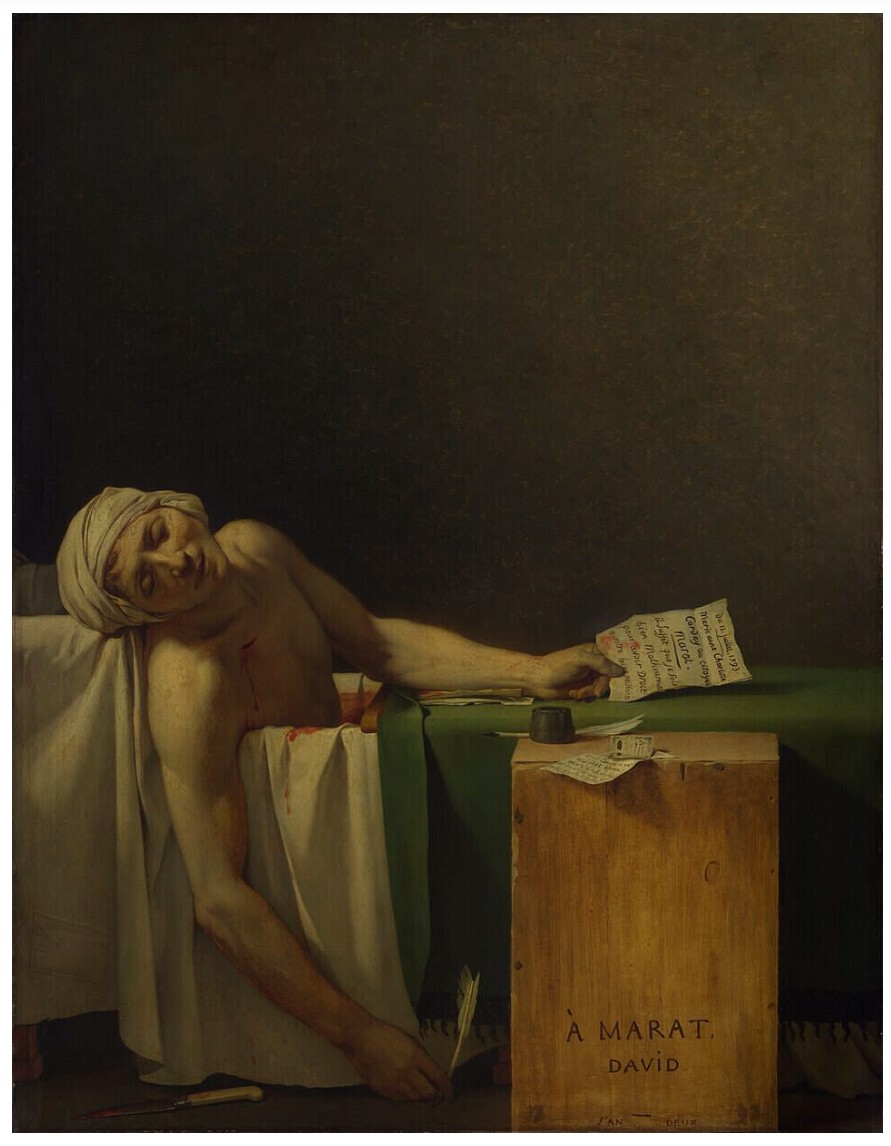
Jacques-Louis David, The Death of Marat, 1793. Royal Museums of Fine Arts of Belgium, Brussels.
Thus began a partnership that lasted nearly forty years. As one of New York’s leading gallerists, Goodman was pivotal in introducing key European artists such as Richter, Joseph Beuys, and Marcel Broodthaers to audiences in the United States. Known for her highly sophisticated eye and her passionate advocacy for her artists, under her guidance Richter established himself as one of the world’s most important living contemporary painters. Richter also identified a partner too who had the ability to help him develop his career as he wanted to develop. Of their first meeting in 1983, Richter recalled:
“I was impressed that she came alone. Other dealers come with another person or an entourage to support them. Marian is a presence. She is wise. She has courage.”
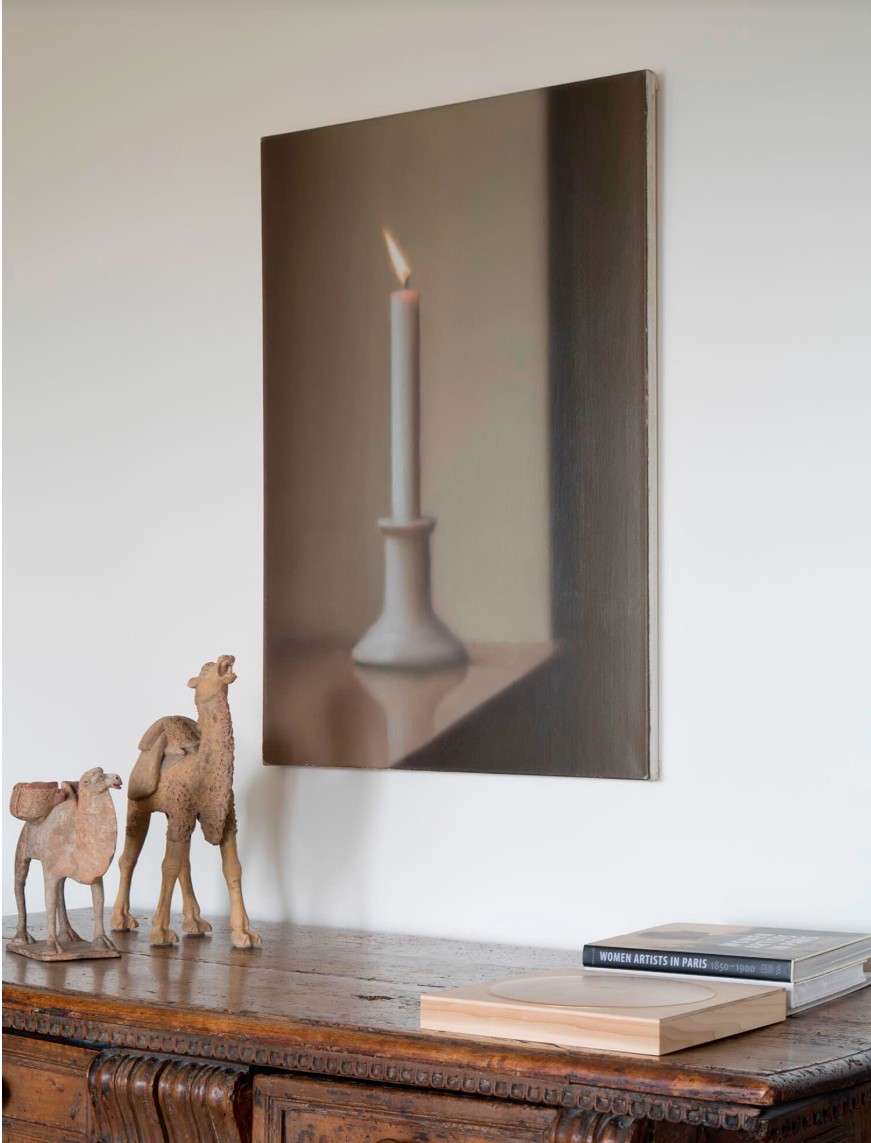
Painted in 1982, Kerze dates from a significant period in Richter’s career. He turned 50-years-old that year, and along with the associated feelings of impermanence often associated with that milestone, he also experienced a remarkable resurgence of creativity. In addition to his Kerze paintings, he also began painting his large-scale squeegee abstract paintings, a body of work that would sustain him for much of the rest of his career. But it is with paintings such as the present work that we get a more complete picture of Richter the artist. Hauntingly beautiful and deeply personal, it is with paintings such as Kerze that we can see the full scope of Richter’s belief in the power of painting.
Mohn (Poppy), 1995
Mohn (Poppy), 1995
Breaking Ground: The Private Collection of Marian Goodman
Christie’s New-York: 20 May 2026
Estimated: USD 14,000,000 – 18,000,000
USD 20,070,000
GERHARD RICHTER (B. 1932), Mohn (Poppy) | Christie’s
GERHARD RICHTER (B. 1932)
Mohn (Poppy), 1995
Oil on canvas
200×140 cm (78-3/4 x 55-1/8 inches)
Signed, inscribed and dated ‘830-1 Richter 1995’ (on the reverse)
Gem-like speckles of glimmering ultramarine and crimson paint shimmer out from beneath blurred layers of blue, yellow, and green in Gerhard Richter’s Mohn. Painted in 1995, a seminal year in the German artist’s oeuvre, the present work exemplifies the polychromatic and technical complexity that define Richter’s mature abstractions, which the artist himself has described as “more adult.” Mohn, meaning poppy, is notable for its vibrant red notes. While Richter employed bright reds among his abstract paintings of the early 1980s, he later adopted a more somber, monochromatic gray palette. His important 18. Oktober 1977 series of 1988 marked a creative caesura in Richter’s oeuvre.
“I realize that these pictures set a new standard, set a challenge for me. I may be deceiving myself. It’s all still too fresh. But one thing I have realized; it’s hard for me to go on painting.”
Following the 18. Oktober 1977 series, documenting the deaths of three militant activists in Germany, Richter entered a creative crisis. The following years witness an exceptional period of development; Richter adopts the use of the spatula as counterpart to his squeegee in 1991. “Scraping off. For about a year now, I have been unable to do anything in my paintings but scrape off, pile on, and then remove again,” Richter laments in a September 1992 diary entry. Following several more years of determined struggle with painting, Richter reaches a breakthrough in 1995, with his development culminating in Mohn.
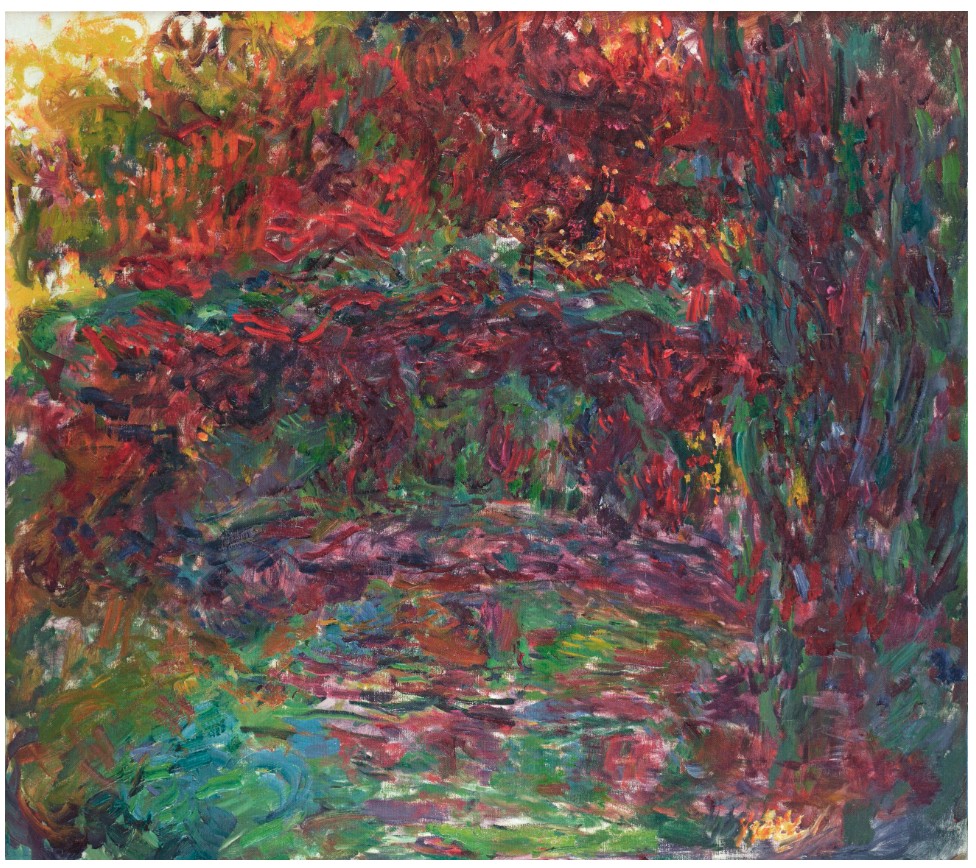
Claude Monet, The Japanese Bridge, 1918-1924. Musée Marmottan, Paris.
The present work witnesses Richter utilizing his new scraping tool with methodical precision. The artist meticulously balances the horizontal thrust of his squeegee with the vertical pull of his spatula, establishing a complex compositional balance as he wields his two tools. Richter attacked the left side of the canvas with verve, exposing myriad underlayers of vibrant pigment while simultaneously creating a thrilling impastoed effect. The rigor evoked on the left side contrasts with the tranquility on the right, where Richter’s excavating spatula gives way to the mesmeric blurring effect of his squeegee. Here, Richter’s electric top layers of pigment meld together into a trance-like oblivion. Richter’s major traveling retrospective the prior year, originating at Musée d’Art Moderne de la Ville de Paris in September before travelling to Bonn, Stockholm, and then Madrid, established without doubt Richter as one of the most significant painters alive. On a biographical level, Richter’s son Moritz was born January 6, 1995, which the artist celebrated with a series of blurred color portraits of his new wife Sabine holding their newborn. While recalling Richter’s earlier 1965 painting Tante Marianne, a painted grayscale portrait after a photograph showing the young artist in the arms of his aunt, Richter’s S. mit Kind paintings are in color, revealing the artist’s newfound chromatic vibrancy, which revives in his Tulips paintings of the same year.
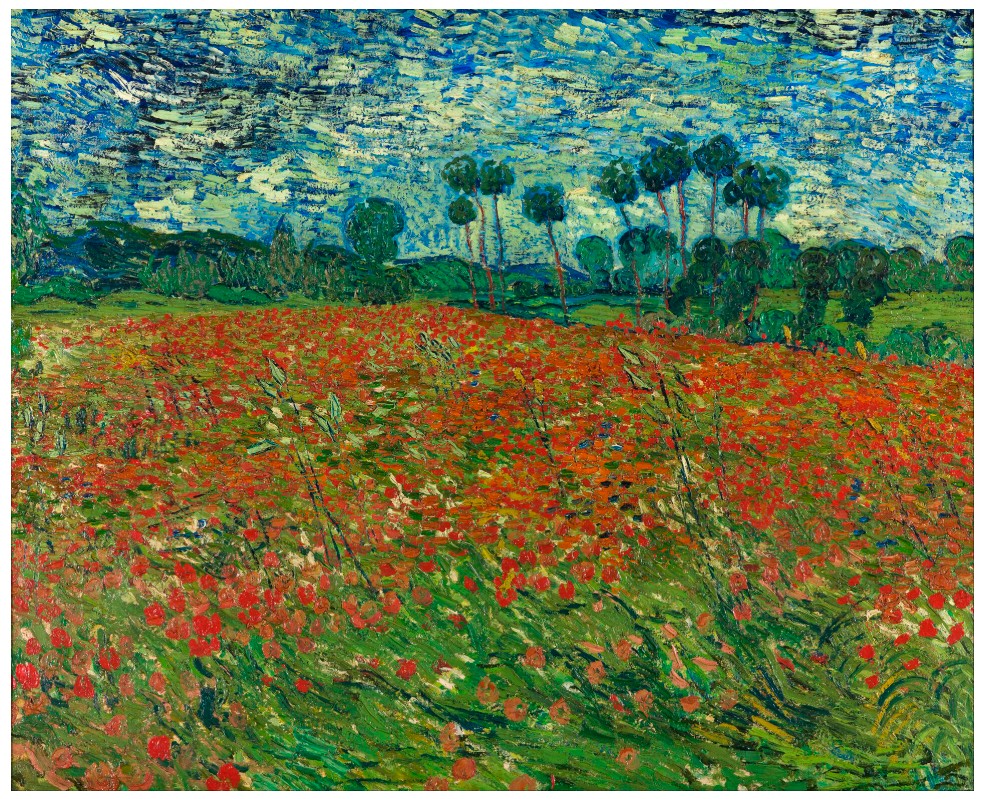
Vincent van Gogh, Poppy Fields, 1890. Kunstmuseum, Hague.
Mohn continues the floral motif which Richter explores in his Tulips. Poppies hold symbolic significance in both poetic and historical contexts—the flower is used to commemorate World War I in Commonwealth countries, while in Germanic poetry the flower’s ephemerality and excess of color is celebrated in Rainer Maria Rilke’s Mohn poems and used as a potent symbol of Holocaust remembrance in Paul Celan’s collection Mohn und Gedächtnis (Poppy and Memory), first published in 1952. In poems like Schlaf-Mohn, Rilke emphasizes the poppy’s intoxicating effects, leading to exhaustion. Mohn elaborates on this sense of intoxication—the artist here builds layers upon layers of paint onto his canvas, which he then blurs and scrapes to create a tableau of cacophonic exuberance. Richter’s intent is similar to intoxication, presenting to his viewer a novel experience which poisons one’s perception of reality.
“I don’t mistrust reality, of which I know next to nothing, I mistrust the picture of reality conveyed to us by our senses, which is imperfect and circumscribed.”
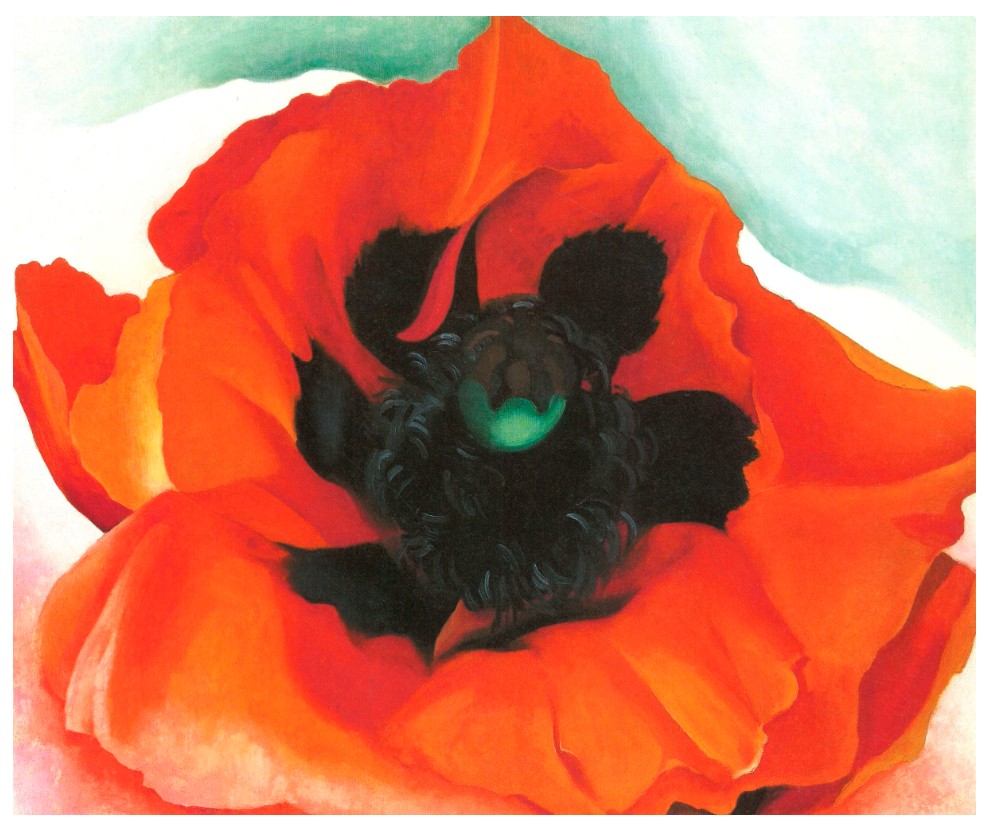
Georgia O’Keeffe, Red Poppy, 1928. Museum of Fine Arts, St. Petersburg, Florida.
Celan’s poetic project parallels Richter’s own longstanding meditation on the collective guilt and national memories surrounding World War II. His early photograph-derived paintings Uncle Rudi (1965) and Aunt Marianne (1965) reflect upon his uncle’s association with the Nazi regime and his aunt’s murder in a concentration camp, while his late Birkenau series (2014) reckons with issues of identity and collective memory in post-World War II Germany, confronting whether and how art is able to address the Holocaust. Mohn thus derives great significance in its connection to many of Richter’s most important works, dwelling in a more abstract manner on themes which the German artist has spent decades meditating on.
Remembrance and historical memory would have been front of mind for Richter as he was working on the present work. A media furor erupted in 1995 over the planned removal of the artist’s 17. Oktober 1976 series from their long-term display at the Museum für Moderne Kunst in Frankfurt am Main after the series was acquired by the Museum of Modern Art, New York. Likewise, Richter pondered the series anew following the birth of his son in 1995. The artist viewed the S. mit Kind paintings as a private counterpart to the cycle: “the Baader-Meinhof cycle [17. Oktober 1976] consists of distant, hopeless pictures of death in the face of a utopia that has deteriorated into violence. In view of this tarnished utopia, S. mit Kind are paintings that arose out of private happiness, but also speak of the untruthfulness of everyday images and their necessary destruction, and of decay and death” (quoted in D. Elger, op. cit., p. 16). Mohn demonstrates Richter’s careful balancing of his private happiness and continual dwelling on decay and destruction within his celebrated abstract mode.
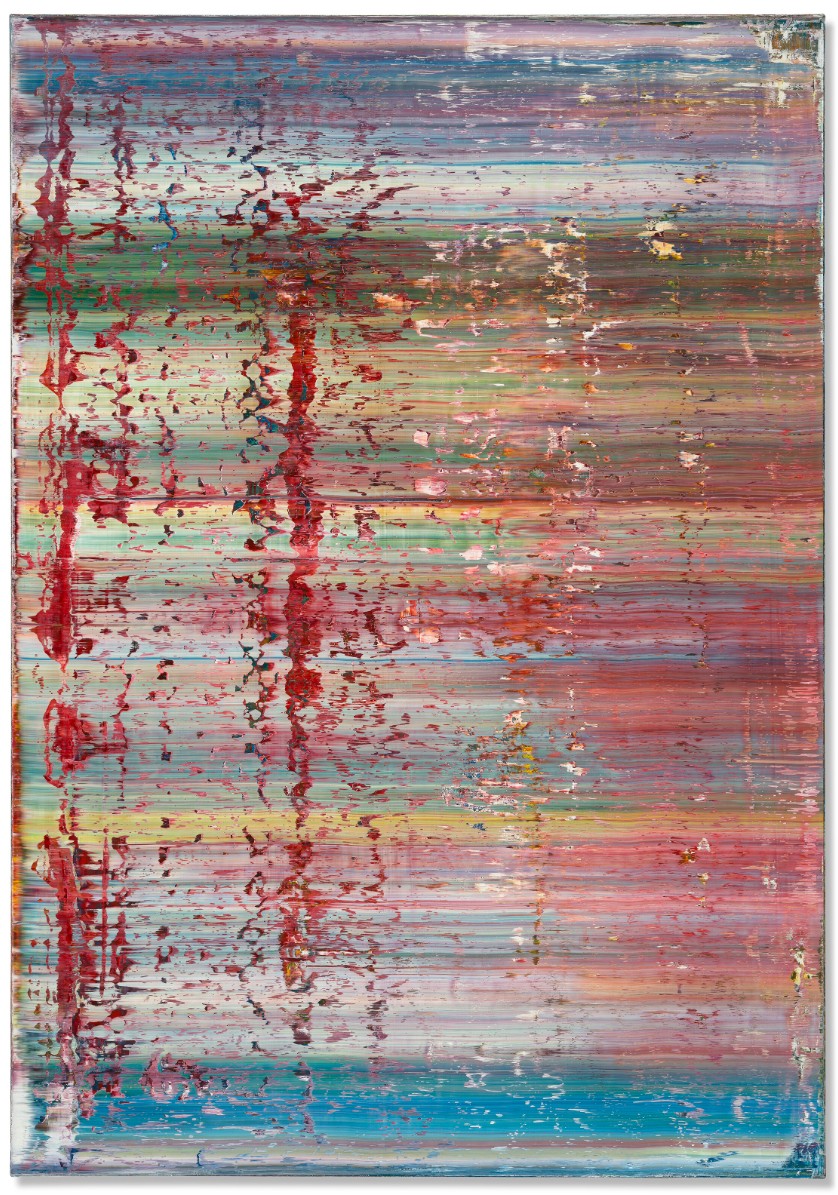
Abstraktes Bild, 1995
Abstraktes Bild, 1995
Breaking Ground: The Private Collection of Marian Goodman
Christie’s New-York: 20 May 2026
Estimated: USD 3,000,000 – 5,000,000
USD 8,737,000
GERHARD RICHTER (B. 1932), Abstraktes Bild | Christie’s
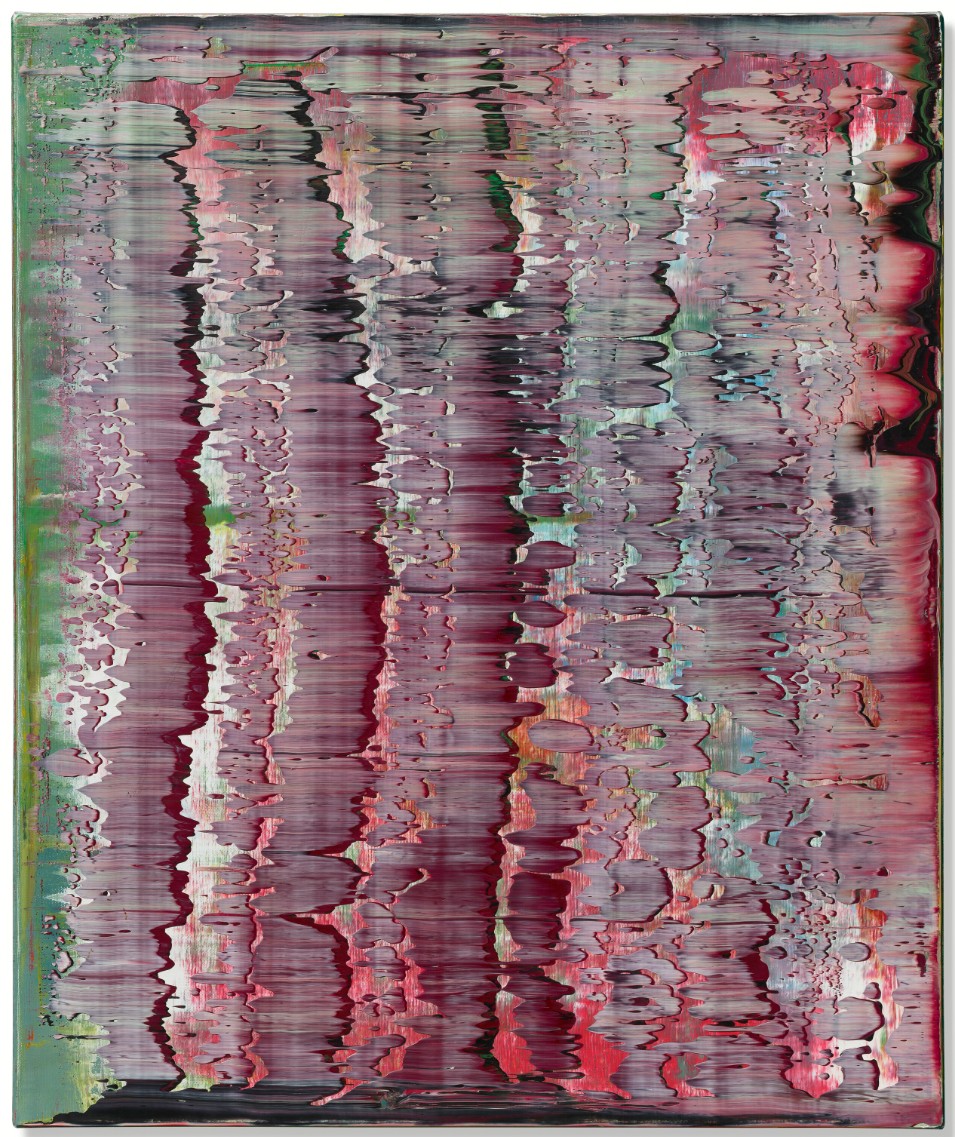
GERHARD RICHTER (B. 1932)
Abstraktes Bild, 1995
Oil on canvas
61 x 51.1 cm (24 x 20-1/8 inches)
Signed, inscribed and dated ‘825-11 Richter 1995’ (on the reverse)
In Gerhard Richter’s Abstraktes Bild of 1995, the celebrated German artist offers up an extraordinary richness of painterly detail across the intimate, jewel-like scale of the canvas. Luxurious layers of lavender flow across the top layer of the painting, pushed by Richter’s famed squeegee to cover the polychromatic ensemble lurking in the painting’s depths. The artist varies his sweeping motion thrice in order to create three wave-like movements across the canvas—the artist’s meticulous leftward motion is evinced in each purple form’s gradated saturation, with the deepest hues deposited right where Richter interrupts his squeegee. The vibrant greens, reds, and blues residing under the uppermost layer recall Richter’s abstract paintings of the 1980s, each glimpse into the work’s underlayers a dive into Richter’s vast oeuvre.
The present work captures the essence of Richter’s abstract system. While appearing highly organized, Richter’s abstract paintings in fact recall the characters of Franz Kafka or Italo Calvino—highly idiosyncratic yet revealing the very essence of human nature.
“By not planning the outcome, I hope to achieve the same coherence and objectivity that a random slice of nature (or a readymade) already possesses.”
The search for an ending, a conclusion, a concrete meaning, in Richter’s abstract paintings is determinedly pointless, as Richter surrenders conscious control of his painterly process to chance. Richter exhumed the history of twentieth-century abstraction in his Abstraktes Bilder in order to tackle it head on. As the artist explained in an interview, his approach is “an assault on the falsity and religiosity of the way people glorified abstraction, with such phony reverence. Devotional Art—all those squares—church handicrafts.” His pursuit of abstraction has combined elements of Constructivism and De Stijl with the non-figurative and gestural elements of Surrealism and Abstract Expressionism to create a singular, contemporary style which breathes new life into abstraction for the new millennia. The present work was included in the 1996 exhibition Gerhard Richter: 100 Bilder at the Musée d’Art Contemporain de Nîmes. The exhibition was a pivotal moment in Richter’s career, revealing for one of the first times the artist’s mature abstract works, which he began making in earnest following his 1988 series 17. Oktober 1976. The present work is thus a critical work for understanding the artist’s most intensive engagement with abstraction in the last decade of the twentieth century into the first decade of this century.
Besen, 1984
Besen, 1984
Property of an Important Private Collector
Phillips New-York: 19 May 2026
Estimated: USD 6,500,000 – 8,500,000
USD 8,070,000
Gerhard Richter Modern & Contemporary Art Evening Sale
REPEAT SALE
Christie’s Hong-Kong: 26 May 2022
Estimated: 55,000,000 – 75,000,000
HKD 79,915,000 / USD 10,180,385
GERHARD RICHTER (B. 1932) (christies.com)
Oil on canvas
225.7 x 200.3 cm (88 7/8 x 78 7/8 inches)
Signed, inscribed and dated “Richter 1984 553-2″ on the reverse
Painted in 1984, Besen emerges at a decisive juncture in Gerhard Richter’s oeuvre, when the artist’s long-standing dialectic between photography and painting culminates in the expansive language of the Abstrakte Bilder. Begun in 1976, this pivotal body of work mediates the central tensions of Richter’s practice, between figuration and abstraction, and between painting and photography. Executed at the height of the so-called “Free Abstracts” of the mid-1980s, Besen belongs to a group of works that mark a decisive shift away from direct photographic support toward a more immediate, gestural, and materially driven mode of abstraction.
“The abstract works are my presence, my reality, my problems,
my difficulties and contradictions.”
While Richter’s early photo-paintings interrogated the ontology of the image through blur and mechanical mediation, the abstractions of the 1980s extend this inquiry into a newly autonomous pictorial field. As Roald Nasgaard observes, Richter’s “polychromatic Free Abstract Paintings” evolve from the “illusionistic, photographically based space of the Smooth Abstracts,” resulting in works in which “the relation of figure and ground is not quite certain, analyzable, or mappable.” In this sense, Besen does not abandon representation so much as internalize it: the painting becomes an “image” of image-making itself.
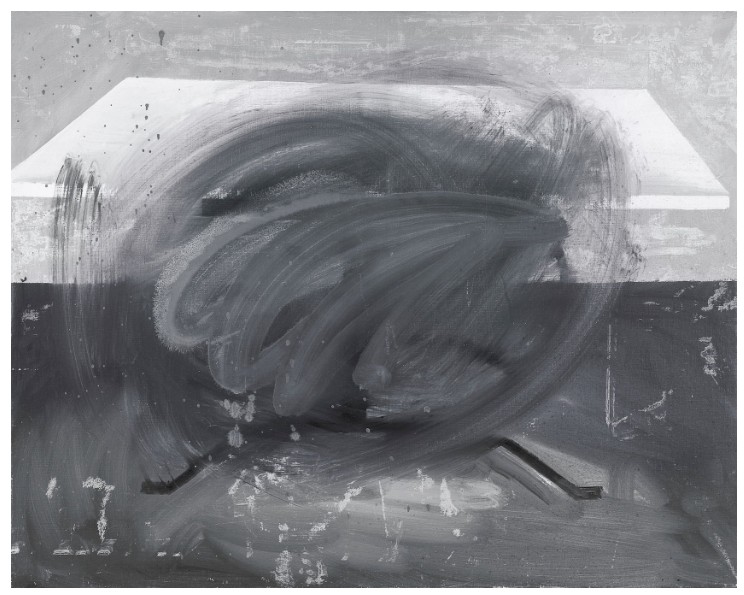
Gerhard Richter, Tisch (Table), 1962. Private Collection. Image/Artwork: © Gerhard Richter 2026 (0108)
The title, translated as “broom,” offers a crucial point of entry. Echoing Richter’s earlier Household Icons of the 1960s, it suggests a residual referent embedded within abstraction. Yet here, the object is neither depicted nor effaced; rather, it persists as a structural schema, a latent armature organizing the composition. The work thus occupies a liminal zone that Peter Osborne has described as an “image space,” in which Richter’s abstractions remain “photo paintings…in an ontologically deeper sense.”
Visually, Besen is defined by a dynamic interplay of vertical cascades and forceful horizontal interruptions. A radiant spectrum of yellows, reds, blues, and greens appears to pour downward from an indeterminate source beyond the upper edge, forming a highly gestured, almost atmospheric ground. This chromatic flow is violently traversed by broad, black horizontal bands that slice across the surface, alternately obscuring and revealing the layers beneath. The result is a field of profound spatial ambiguity, in which depth and surface continually collapse into one another.
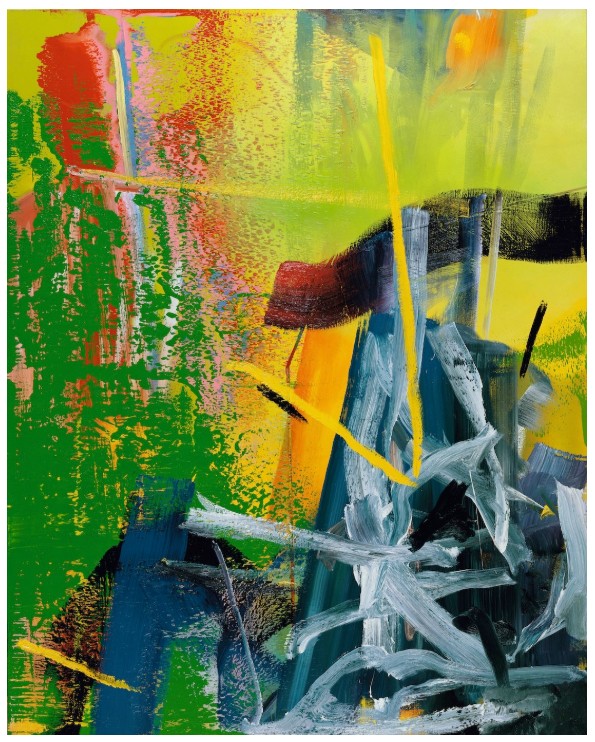
Gerhard Richter, Korn, 1982. Solomon R. Guggenheim Museum, New York Gift of the artist, 1984.
Image/Artwork: © Gerhard Richter 2026 (0108)
At the compositional center, a vivid yellow sweep, evocative of bristles dragged across the canvas, suggests the titular “broom” motif. This semi-transparent gesture, both structural and ephemeral, is countered by a vertical red column that descends toward and beyond the lower edge, anchoring the composition while simultaneously destabilizing it. The red form reappears in fragmented iterations, threading through the painting and generating a tenuous sense of continuity amid the turbulence. Such oscillations—between transparency and opacity, fluidity and obstruction—produce what Robert Storr has described as Richter’s characteristic tension between “optical splendor” and “physical remoteness.” The painting resists any fixed reading: figure and ground exchange roles, while directional forces of vertical descent and horizontal arrest remain in perpetual conflict.
“With a brush you have control. The paint goes on the brush and you make the mark. From experience you know exactly what will happen.
With the squeegee you lose control.”
Besen exemplifies Richter’s additive and subtractive approach. He begins with a colored ground derived from the spatial effects of the “Smooth Abstracts.” Onto this surface he introduces initial forms, which are then altered through successive layers. Nasgaard describes how each painting “goes through several states,” with each action taken reshaping the whole.
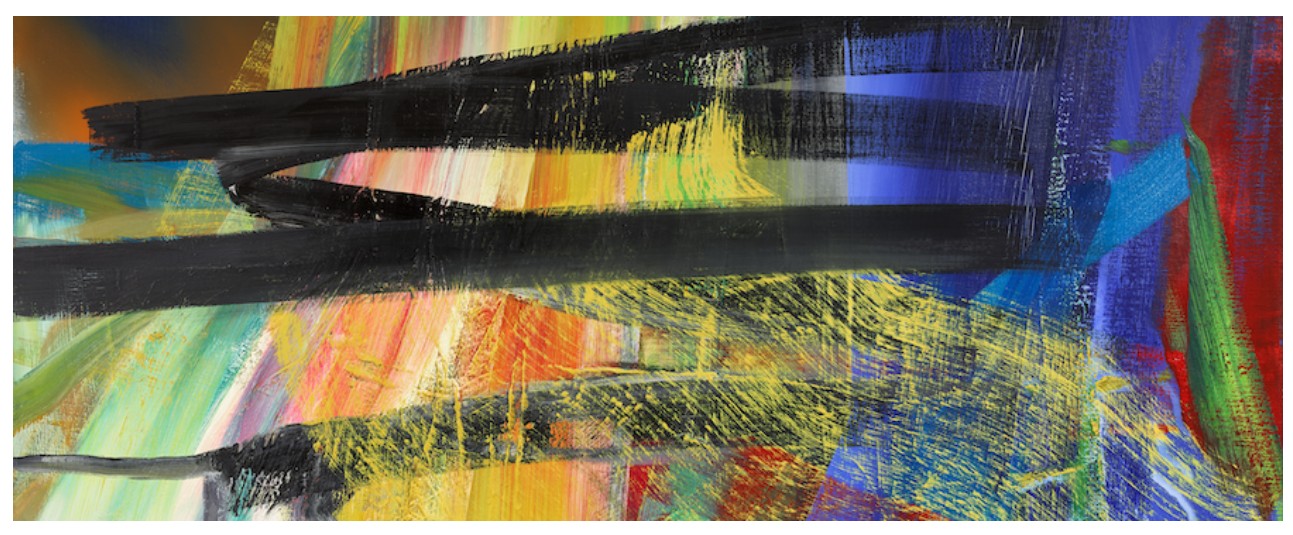
Non-traditional materials, particularly the squeegee, are central to Richter’s method. Dragging paint across the canvas spreads pigment while exposing what lies beneath, and the black horizontal bands read as decisive interventions that cut through earlier layers and reorganize the composition. In works such as Besen, characteristic of the “Free Abstracts,” the approach remains more visibly gestural and less systematized than in the unified abstractions that follow later in the decade. Painted prior to the squeegee’s emergence as his primary tool around 1986, the present work instead demonstrates a hybrid technique, in which brushwork and dragged paint coexist within a more varied and responsive surface. Richter characterized this as an equilibrium between opposing forces: “…a balance between composition and anti-composition, if you like…” The painting develops through a controlled sequence of disruptions—chance present in the behavior of the material, but continually redirected by the artist’s hand.
The 1980s marked a period of heightened recognition for Richter, with major exhibitions across Europe and repeated participation in the Venice Biennale. During this decade, abstraction became central to his work. The Abstrakte Bilder differ markedly from the earlier Color Charts and Grey paintings, introducing a new intensity of color and complexity of surface. Despite their non-representational appearance, these works maintain a connection to the photographic. Even without recognizable subjects, they retain the logic of the image, with surfaces that accumulate and give way under the pressure of each new layer. In Besen, depth emerges through layering and partial erasure rather than conventional perspective. A precedent can be found in Andy Warhol’s silkscreens of the 1960s, which fused mechanical reproduction with painterly intervention, and in his Shadows of 1978–1979, where photographic images of shadows became serial, “found” abstractions. In his “Free Abstracts,” Richter advances this negotiation, translating such tensions into a fully painterly yet still mediated abstraction.
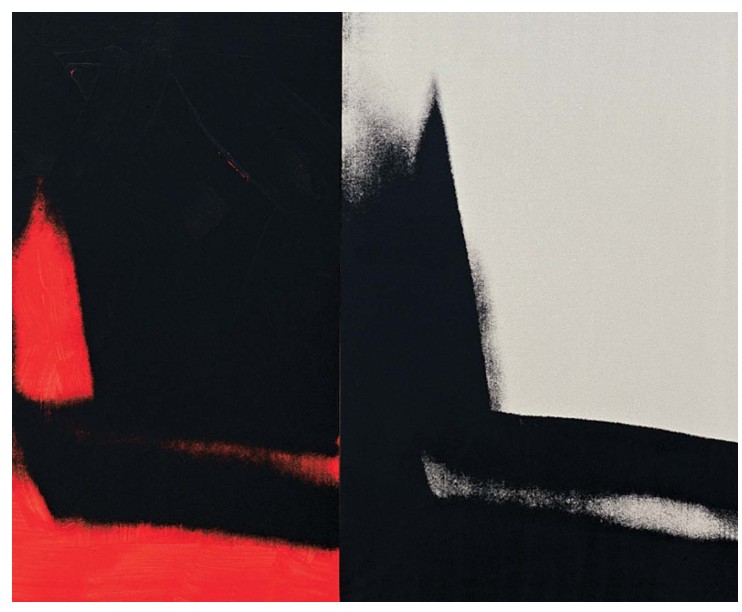
Andy Warhol, Shadows (detail), 1978–1979. Dia Art Foundation, New York.
Artwork: © 2026 The Andy Warhol Foundation for the Visual Arts, Inc. / Licensed by Artists Rights Society (ARS), New York
Although firmly rooted in the late twentieth century, Besen engages a wide spectrum of art historical precedents. The radiant color fields recall the atmospheric effects of Richter’s Vesuv paintings and, more distantly, the spiritual chromatics of Kandinsky. The assertive horizontals evoke Barnett Newman’s “zips,” while the gestural energy invites comparison with Abstract Expressionism. Yet Richter’s relationship to these traditions is neither derivative nor affirmative. Having emerged from the constraints of Soviet-imposed Socialist Realism in East Germany and later confronted the claims of gestural abstraction upon moving to West Germany in 1961, Richter approaches painting with a sustained critical distance.
“Above all, it’s never blind chance: it’s a chance that is always planned, but also always surprising. And I need it in order to carry on… to introduce something different and disruptive. I’m often astonished to find how much better chance is than I am.”
Besen can be understood within the postmodern discourse of the 1980s, when the viability of painting itself was under scrutiny. Against declarations of its obsolescence, Richter insisted on “the sheer obstinacy of carrying on painting,” embracing a practice that foregrounds process over ideology. His refusal of expressive authenticity, coupled with his embrace of mechanical and chance procedures, undermines the notion of the artist as a singular creative authority. As he described, his approach during this period was one of “letting a thing come, rather than creating it,” allowing the work to develop through process rather than predetermined form. Richter’s abstract paintings function as propositions rather than depictions. As he wrote in the 1982 catalogue of Documenta 7, “Abstract pictures are fictitious models, because they demonstrate a reality, which we can’t see or describe.” Besen operates within this framework. Its forms do not refer outward; they articulate the conditions of their own making.
Abstraktes Bild, 2009
Abstraktes Bild, 2009
Breaking Ground: The Private Collection of Marian Goodman
Christie’s New-York: 20 May 2026
Estimated: USD 3,500,000 – 5,500,000
USD 6,541,000
GERHARD RICHTER (B. 1932), Abstraktes Bild | Christie’s
GERHARD RICHTER (B. 1932)
Abstraktes Bild, 2009
Oil on canvas
101.9 x 101.9 cm (40-1/8 x 40-1/8 inches)
Signed, inscribed and dated ‘910-5 Richter 2009’ (on the reverse)
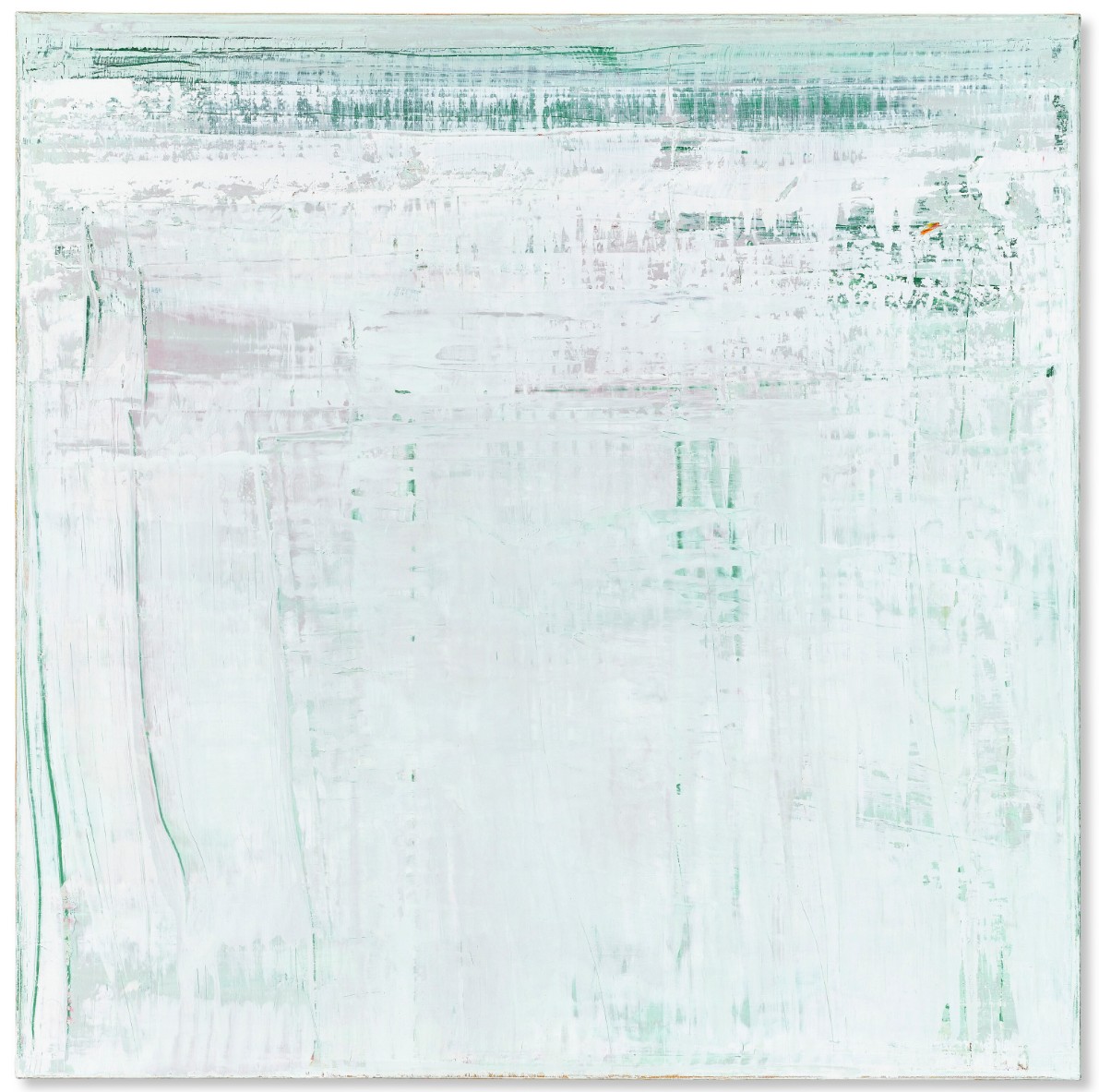
Gerhard Richter’s Abstraktes Bild (2009) is an exceptional late work by the celebrated German painter, one of only a few works where ethereal white almost completely blankets the canvas. The work witnesses Richter at his most elemental and metaphysical, achieving through his most celebrated technique a poignant and philosophical reflection on art and nature. Abstraktes Bild emerges from Richter’s decades-long interest in landscape, and exhibits the artist blending the two genres, landscape and abstraction, into a singular painting.
“If the Abstract paintings show my reality,
then the landscapes and still lifes show my yearning.”
Opaque layers of white coat underlying fields of green, blue, and red like veils of mist and snow against a verdant mountaintop in Abstraktes Bild. The intricate movement of the paint across the surface of the canvas, vertical and horizontal swipes which waver and dip, in contradistinction to the artist’s more common steady horizontal movement of the squeegee, reveals the more naturalistic undercurrents of the present work.
“I find the Romantic period extraordinarily interesting. My landscapes have connections with Romanticism: at times I feel a real desire for, an attraction to, this period, and some of my pictures are a homage to Caspar David Friedrich.”
The present work potently reflects this connection, the dominant white palette with hints of green undergrowth particularly evoking Friedrich’s Morning Mist in the Mountains (1808, Thüringer Landesmuseum Heidecksburg).
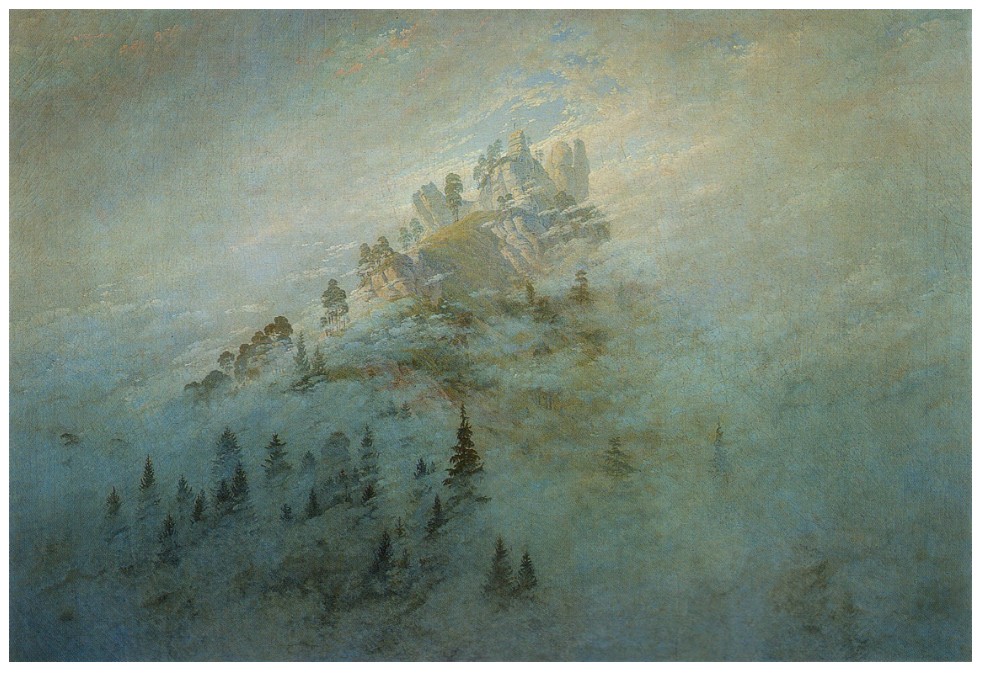
Caspar David Friedrich, Morning Mist in the Mountains, 1807-1808. Thüringer Landesmuseum Heidecksburg, Rudolstadt.
Richter revitalizes and reinterprets old motifs across his oeuvre, reviving series from previous decades into new forms. The present work thus finds its genesis in the long series of landscapes that the artist began in 1989, the first year he began to take yearly sojourns to the alpine village Sils in the Upper Engadin region of Switzerland. This faraway locale brought him in direct contact with the dramatic landscapes which initiated the Romantic movement and enthralled the philosopher Friedrich Nietzsche, who maintained a cottage in Sils.
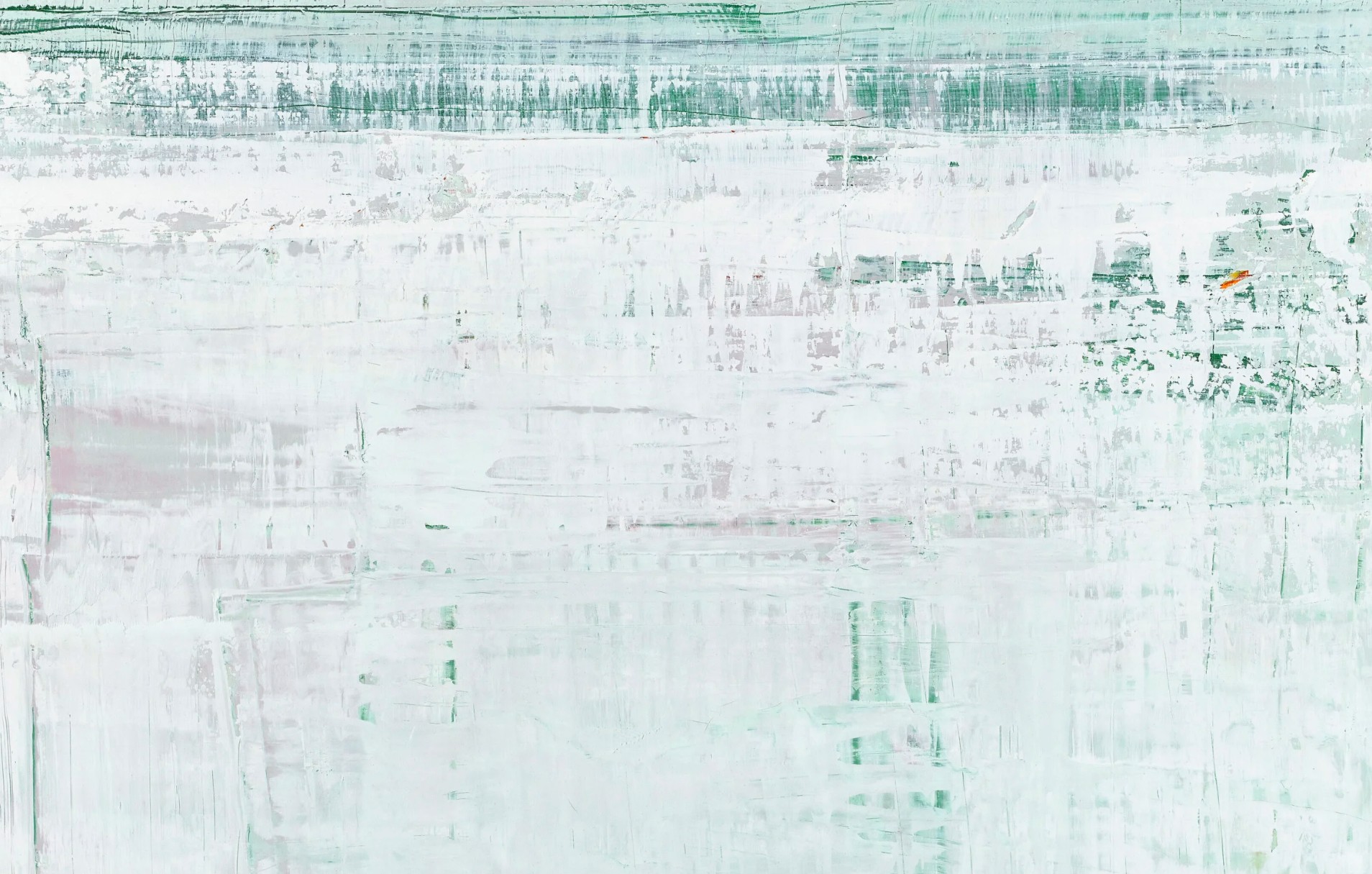
Discussing the long gestation of Richter’s white paintings, the curator Martin Germann identifies as particularly important two landscapes from 1999, Gehöft (Farm) and Schnee (Snow), which inaugurate for the coming millennia Richter’s fascination with the subject. Germann writes that “what these two landscapes share is the absence of any pictorial beyond. What is foregrounded is the snow, and with it nature itself… as Dieter Schwarz notes, Farm (and Snow) anticipate the all-white paintings of the end of the first decade of the century” (M. Germann, “the Painting of Gerhard Richter on the Cusp of the Twenty-First Century,” in Gerhard Richter, exh. cat., Fondation Louis Vuitton, Paris, 2025, p. 200).
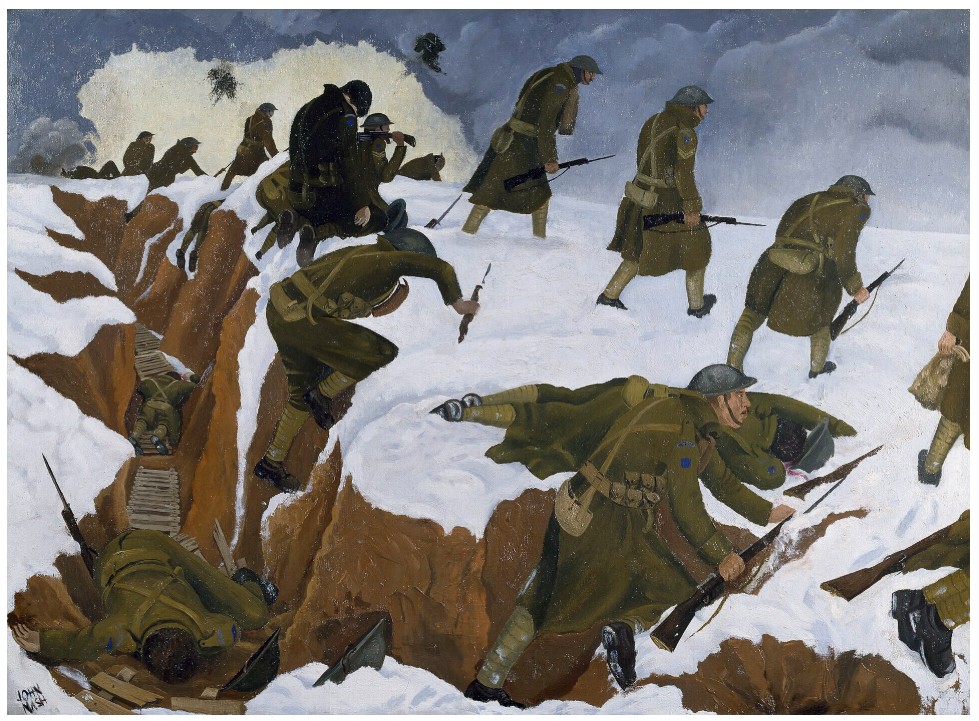
John Nash, “Over The Top”. 1st Artists’ Rifles at Marcoing, 30th December 1917, 1918. Imperial War Museum, London.
Richter’s Alpine retreat brought him close to the Sublime ideal first articulated in Friedrich’s paintings then parroted in Nietzsche’s philosophy. An early ardent proponent of the Sublime, Mark Rothko, cited these two Germans as foundational to his metaphysical conception. Discussing Rothko’s Sublime, Richter noted: “Certainly, I too want that quantity in general for my work, and to touch the world. But my interest only parallels Rothko; I am not influenced. His metaphysical aspirations are found in all great art. Besides, the mystery and incomprehensibility of Rothko’s paintings are based on the specificity of the structure, the transcendental effects and the viewer’s contemplation. The aesthetic experience in my abstract paintings is not metaphysical in the sense of being religious. Only the structure of my works is so complicated and difficult that they are incomprehensible also. If you want, you may call it metaphysical” (quoted in “Interview with Mark Rosenthal, 1998,” in D. Elger and H. U. Obrist, eds., op. cit., p. 330).
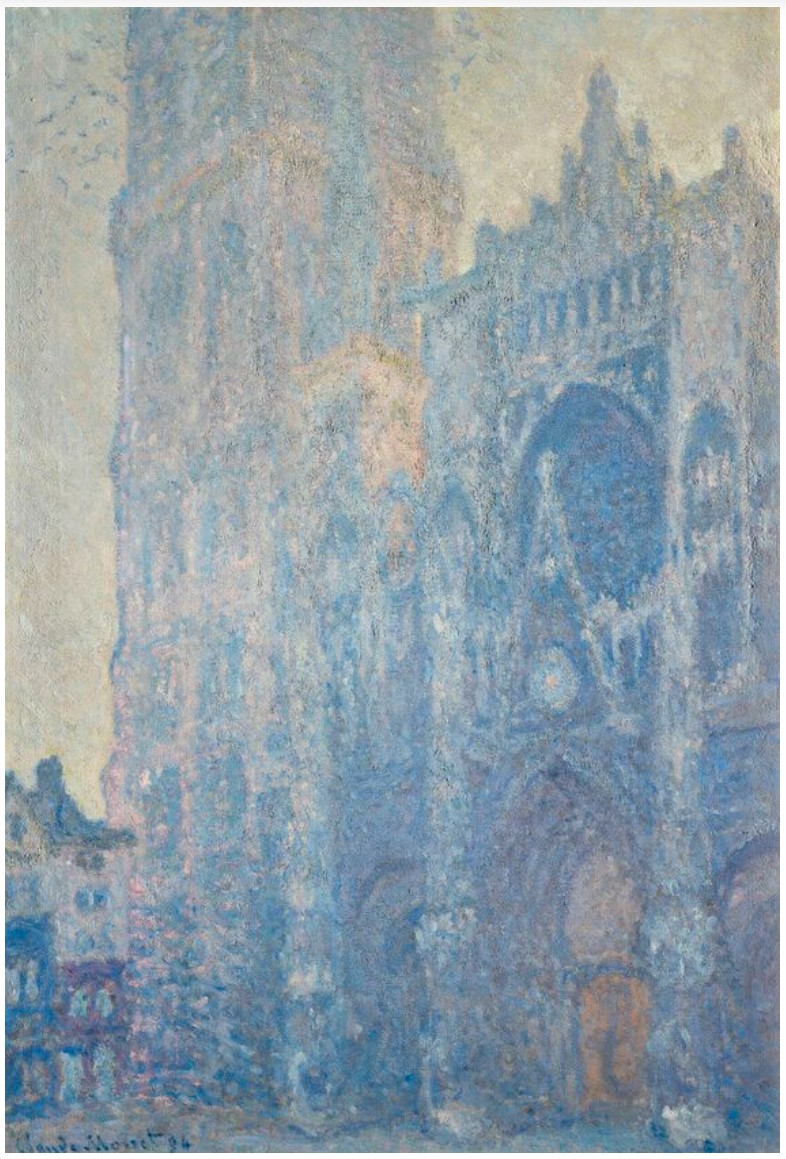
Claude Monet, La Cathédrale de Rouen. Le Portail et la Tour Saint-Romain, effet du matin, 1893. Musée d’Orsay, Paris.
Germann describes how over the decades Richter spent refining his abstract paintings, “the rhythmically recurring periods of closing, sealing, and opening the canvas spread over the next thirty years refined them, repeatedly touching on aspects of monochrome painting—as seen in the white paintings of 2009, for example—while negating any clear categorization as a colored palimpsest” (M. Germann, op. cit., p. 204). The present work is thus a final result of Richter’s long career spent querying abstraction. The gleaming white top layer of the work almost disguises the chromatic complexity awaiting underneath. While summering for the last time in Sils, Nietzsche began work on his final work, his autobiography Ecce Homo. In his preface, the philosopher writes, “Philosophy, as I have understood it hitherto, is a voluntary retirement into regions of ice and mountain-peaks—the seeking—out of everything strange and questionable in existence, everything upon which, hitherto, morality has set its ban” (Ecce Homo, trans. Anthony M. Ludovici, London, 1911, p. 3). Paralleling Nietzsche, Richter’s Abstraktes Bild represents the artist’s own discoveries in the mountain peaks, revealing in an abstracted landscape his own vision of the metaphysical.
Abstraktes Bild, 2008
Abstraktes Bild, 2008
Breaking Ground: The Private Collection of Marian Goodman
Christie’s New-York: 20 May 2026
Estimated: USD 4,000,000 – 6,000,000
USD 5,077,000
GERHARD RICHTER (B. 1932), Abstraktes Bild | Christie’s
GERHARD RICHTER (B. 1932)
Abstraktes Bild, 2008
Oil on canvas
82.6 x 112.1 cm (32-1/2 x 44-1/8 inches)
Signed, inscribed and dated ‘903-6 Richter R. 2008’ (on the reverse)
Gerhard Richter’s Abstraktes Bild of 2008 is a profound reflection on the passage of time. The painting’s seeming spontaneity, evoked by the vibrant fluorescence of the top green layer, belies the incredible amount of time and energy which the German artist wrought upon the work. Just one year after painting the present work, Richter declared that “a painting can help us think something that goes beyond this senseless existence. That’s something art can do” (quoted in A. Borchardt-Hume, “‘Dreh Dich Nicht Im’: Don’t turn around; Richter’s Paintings of the Late 1980s,” in Gerhard Richter: Panorama, exh. cat., Tate Modern, London, 2011, p. 169). Abstraktes Bild is a mature reflection on time and existence, revealing Richter at his most contemplative and reflective.
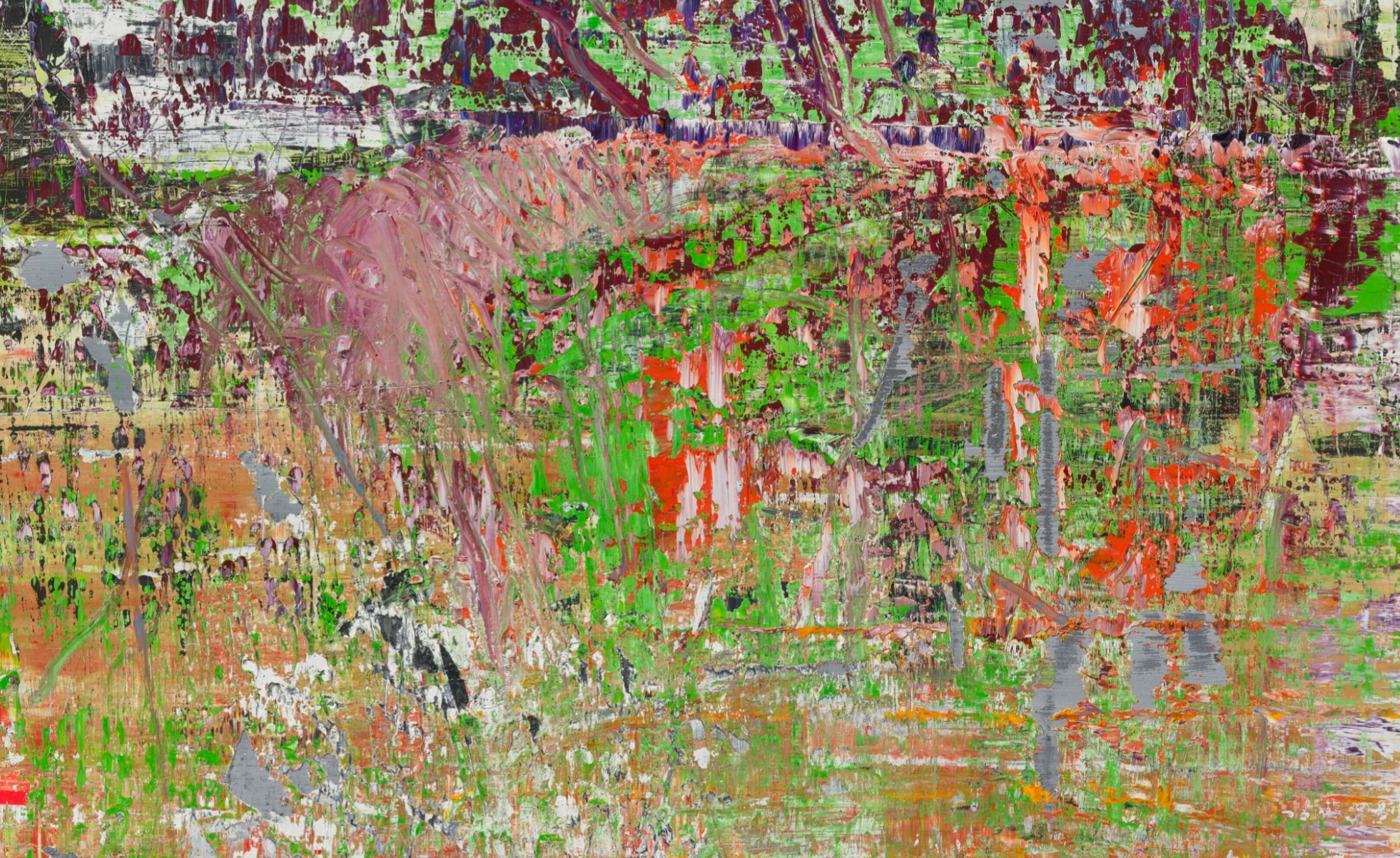
Across a period years, Richter continually engaged this canvas, adding and subtracting pigment from the work’s surface as he simultaneously pushed and pulled paint across the surface of the tableau. The present work exemplifies this extended process, each visible layer revealing an alternative ending or possible solution to the work. In-progress photographs reveal the gradual evolution of the work. The first state is a photorealistic painting of a misty alpine scene, inspired by Richter’s alpine retreat in Sils, Switzerland. Richter then employed his signature blur to the composition, abstracting the imagery into a hazy white tableau reminiscent of his pure white paintings. The final state exhibits radical alterations, demonstrating the artist’s constant strive towards new artistic heights, challenging his own artistic orthodoxy.
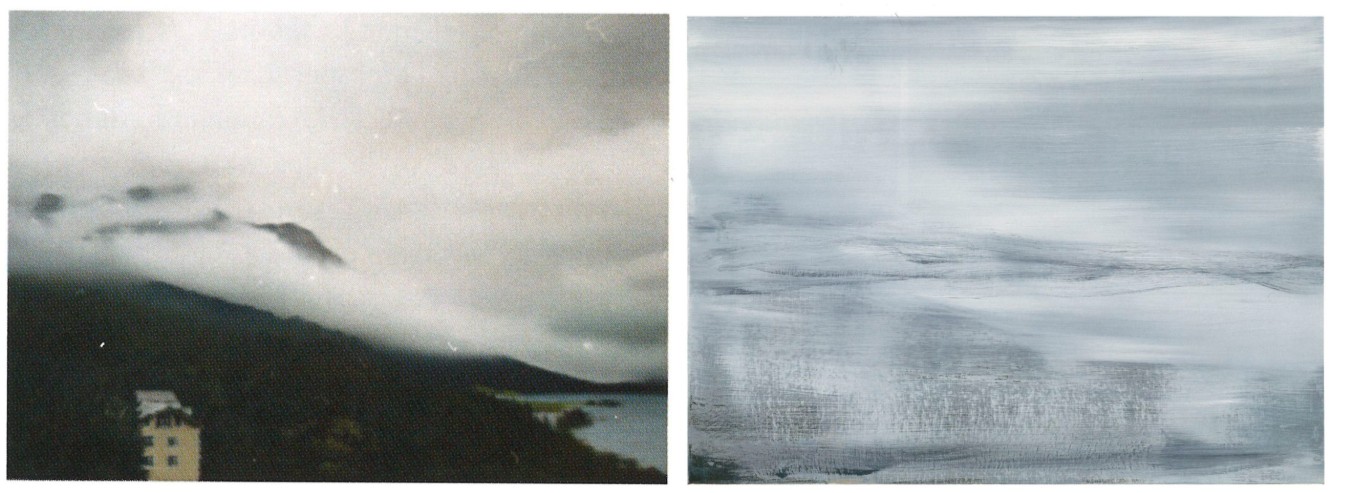
The present work in progress.
Richter slowly refined his meticulous process for making the Abstraktes Bilder over his decades-long career. As he noted, “a picture like this is painted in different layers, separated by intervals of time. The first layer mostly represents the background, which has a photographic, illusionist look to it, though done without using a photograph. This first, smooth, soft-edged surface is like a finished picture… I partly destroy, partly add to it… at that stage the whole thing looks very spontaneous, but in between there are long intervals of time. It is a highly planned kind of spontaneity” (quoted in C. Moeineau, “The Blow-Up, Primary Colours and Duplications,” in op. cit., p. 131). From the mid-1980s, Richter began to engage his now-iconic squeegee technique on his abstract works, and from the early 1990s the spatula. These two implements engage in the systematic eradication of the artist’s hand, creating an abstract painting devoid of gestural or expressionist remnants. “What we are given instead is a temporal depth: the summation of several units of moments,” writes the art historian Camille Moeineau (ibid., p. 131).
The present work reveals Richter’s emergence from a period of more reserved coloration, the artist instead returning to the vibrant palette first seen in his works from the early 1980s. The uppermost layers thus recall the artist’s earliest mature abstract works. Meanwhile, the underlayers express the subdued whites and grays which held increasing prominence in his work from the late 1990s, as Richter deepened his formal engagement with the German Romantic tradition. By obscuring his more recent style with the colors of his first works, Richter poignantly provides bookends to his legendary career across one work.
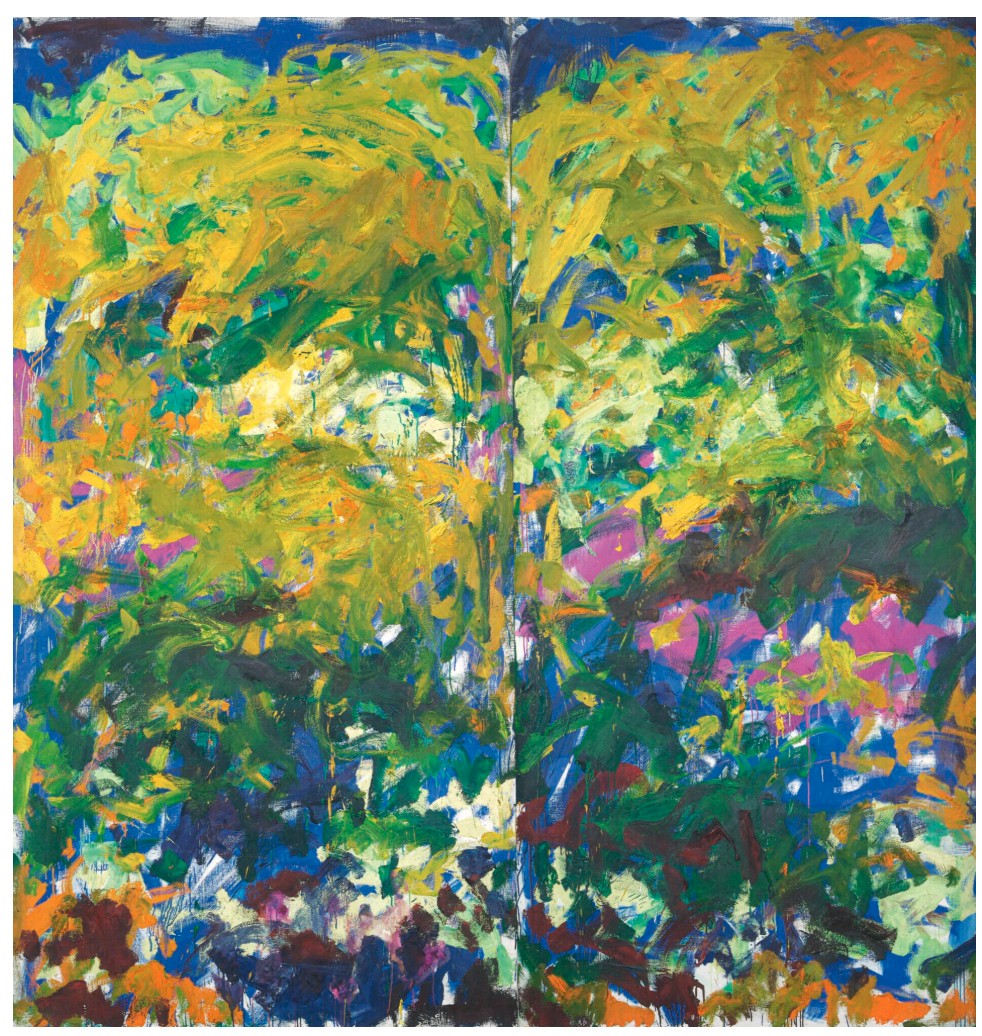
Joan Mitchell, La Grande Vallée IX, 1983. Collection FRAC Normandie, on permanent loan at the Musée des impressionnismes, Giverny. © Estate of Joan Mitchell.
The interaction between the surface and the depth of the Abstraktes Bilder represent one of the most enduring and powerful of Richter’s painterly effects. Abstraktes Bild (2008) occupies a pivotal position within Richter’s sustained engagement with abstraction. The painting encapsulates the artist’s iterative method. Its cycles of construction and erasure yield a dense temporal record which resists any single resolution. At once chromatically assertive and structurally measured, the work reconciles the exuberance of Richter’s earlier abstract vocabulary with the cooler restraint that characterizes his later production. Through its layered complexity and quiet internal equilibrium, the present work is a compelling testament to Richter’s ongoing commitment to painting as a site of critical inquiry and sustained reflection.
Abstraktes Bild, 1999
Abstraktes Bild, 1999
Breaking Ground: The Private Collection of Marian Goodman
Christie’s New-York: 20 May 2026
Estimated: USD 1,800,000 – 2,500,000
USD 2,881,000
GERHARD RICHTER (B. 1932), Abstraktes Bild | Christie’s
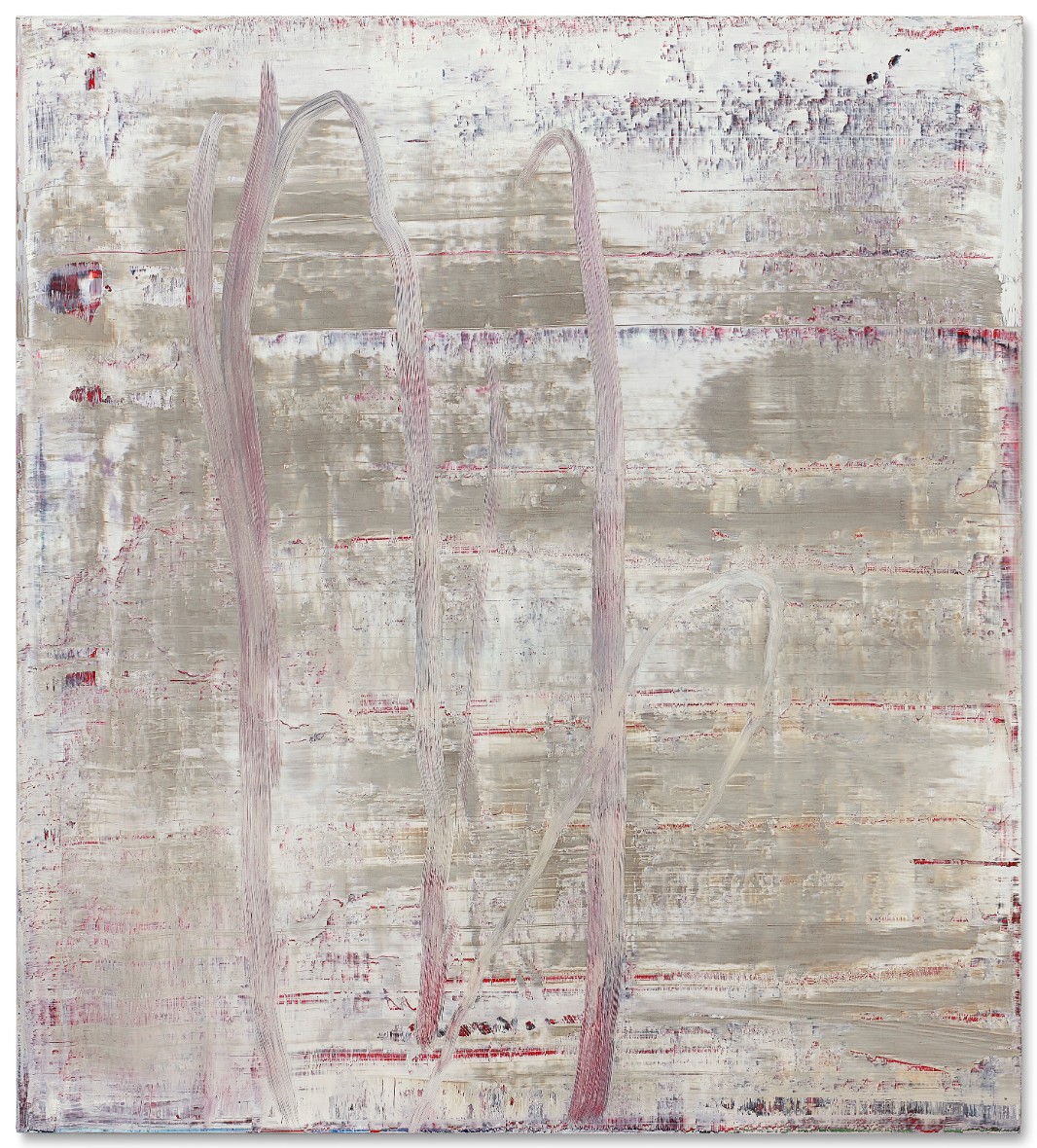
GERHARD RICHTER (B. 1932)
Abstraktes Bild, 1999
Oil on Alucobond
100×90 cm (39-3/8 x 35-3/8 inches)
Signed, inscribed and dated ‘860-8 Richter 1999’ (on the reverse)
Painted in 1999, Gerhard Richter’s Abstraktes Bild stands as a striking example of the artist’s late-1990s investigations into the boundaries of perception, materiality, and abstraction. One of the most influential artists of the past fifty years, Gerhard Richter is known for having painted from photographs, explored grids of carefully applied colors, and produced large-scale abstractions. Abstraktes Bild belongs to Richter’s well-known abstract series where he employs an innovative technique that has allowed him to precisely control his working environment while also permitting the oil paint to mix, flow, and meld through many layers of myriad hues. Executed in oil on Alucobond, the present work embodies a complex interplay between control and chance, materiality and illusion, surface, and depth. With its restrained palette of greys, mauves, and faint reds, punctuated by sweeping vertical gestures, the present work invites prolonged contemplation, revealing itself gradually as a record of both deliberate action and unforeseen transformation.
“With abstract painting, we create a better means of approaching what can neither be seen nor understood because abstract painting illustrates with the greatest clarity, that is to say, with all the means at the disposal of art, ‘nothing’ … we allow ourselves to see the unseeable, that which has never before been seen and indeed is not visible.”
The present work was held in the private collection of Marian Goodman, the long-term legendary art dealer and gallerist for Gerhard Richter.
At first glance, Abstraktes Bild’s cool tonality appears almost monochrome with its muted tones of dark and light grey that dominate the composition, if one looks closer, they are interrupted by subtle flashes of red and soft vertical sweeps of lavender. As with much of Richter’s abstract oeuvre, the viewer is intimately aware of the artist’s process as ghostly vertical lines indicate places where the large smearing squeegee rested briefly on its journeys back and forth across the surface of the work.
“It is a good technique for switching off thinking consciously, I can’t calculate the result. But subconsciously, I can sense it. This is a nice ‘between’ state.”
In 1980, Richter completed his first abstract painting that made full use of the large squeegee process that would become a signature tool of his later abstracts. Using the tool as a means to introduce chance encounters between layers of applied media, the artist pushed and pulled it across the work’s surface in an experimental effort that he devised to detach himself from the piece’s end result. He noted that these initial works in the 1980s and 90s “allowed me to do what I had never let myself do: put something down at random. And then, of course, I realized that it never can be random. It was all a way of opening a door for me. If I don’t know what’s coming, that is, if I have no hard-and-fast image, as I have with a photographic original, then arbitrary choice and chance play an important part” (G. Richter, quoted in Gerhard Richter: Text, London, 2009, p. 256).
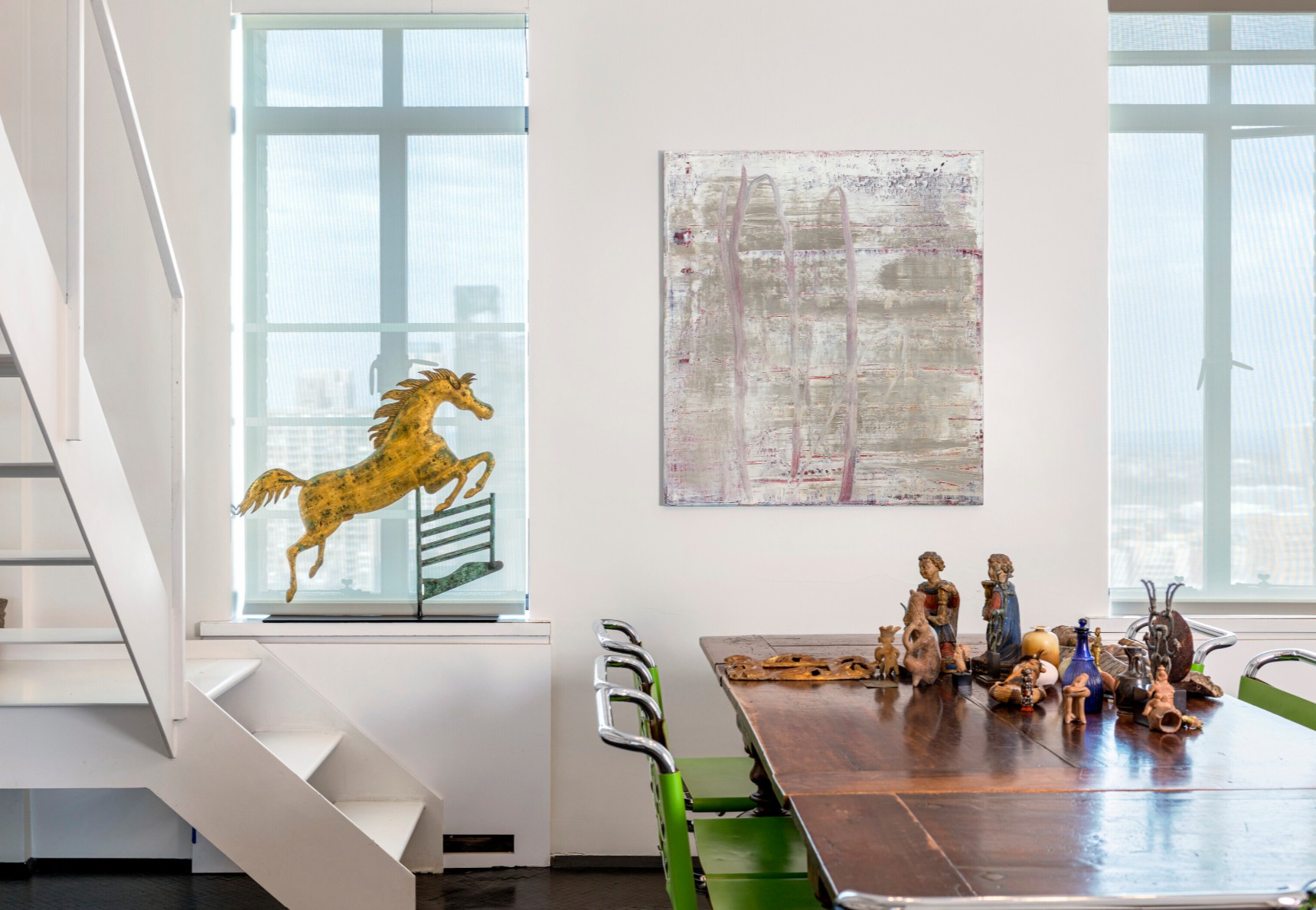
While Abstraktes Bild belongs to a broader continuum of Richter’s abstract experiments, its specific palette and structure align it with the more contemplative, atmospheric works of the late 1990s. Compared with the fiery reds and vivid contrasts seen in some earlier paintings, the 1999 works often possess a quieter, almost meditative restraint. The lavender inflections that drift across the surface evoke a sense of optical vibration, an almost silicate shimmer that anticipates the artist’s later investigations into scientific imaging and crystalline forms. The coolness of the Alucobond support, with its smooth metallic rigidity, amplifies this sensation. The paint seems to hover above the panel, its subtle variations in sheen and density catching ambient light and shifting with the viewer’s perspective.
The painting’s subdued palette also reflects Richter’s long-standing fascination with the color grey.
“Grey. It makes no statement whatever; it evokes neither feelings nor associations; it is really neither visible or invisible. […] To me, grey is the welcome and only possible equivalent for indifference, noncommitment, absence of opinion, absence of shape.”
But in Abstraktes Bild, grey becomes far more than absence. It becomes a dynamic field in which faint reds and violets shimmer uncertainly, as if glimpsed through layers of fogged glass. This charged neutrality invites the viewer to look slowly at the surface of the work and asks the viewer to navigate shifting zones of depth and opacity. The surface becomes something like a psychological terrain, cool yet not cold, reticent yet far from mute.
Strip, 2012
Strip, 2012
Christie’s New-York: 21 May 2026
Estimated: USD 800,000 – 1,200,000
USD 1,765,300
GERHARD RICHTER (B. 1932), Strip | Christie’s
GERHARD RICHTER (B. 1932)
Strip, 2012
Digital print on paper between Alu-Dibond and perspex (Diasec), in two parts
210×230 cm (82-5/8 x 90-1/2 inches)
Signed, inscribed and dated ‘927-2 Richter 2012’ (on the reverse)
Gerhard Richter’s Strip paintings represent one of the most rigorous developments in the artist’s six-decade-long inquiry into abstraction. Rather than departing from painting, Richter subjects it to a process of fragmentation, translation, and reconstruction, reconfiguring it through digital means while preserving its core engagement with perception, chance, and control. The result is a body of work that appears ordered and systematic, yet remains grounded in instability—testing how far painting can be stretched without losing its identity.
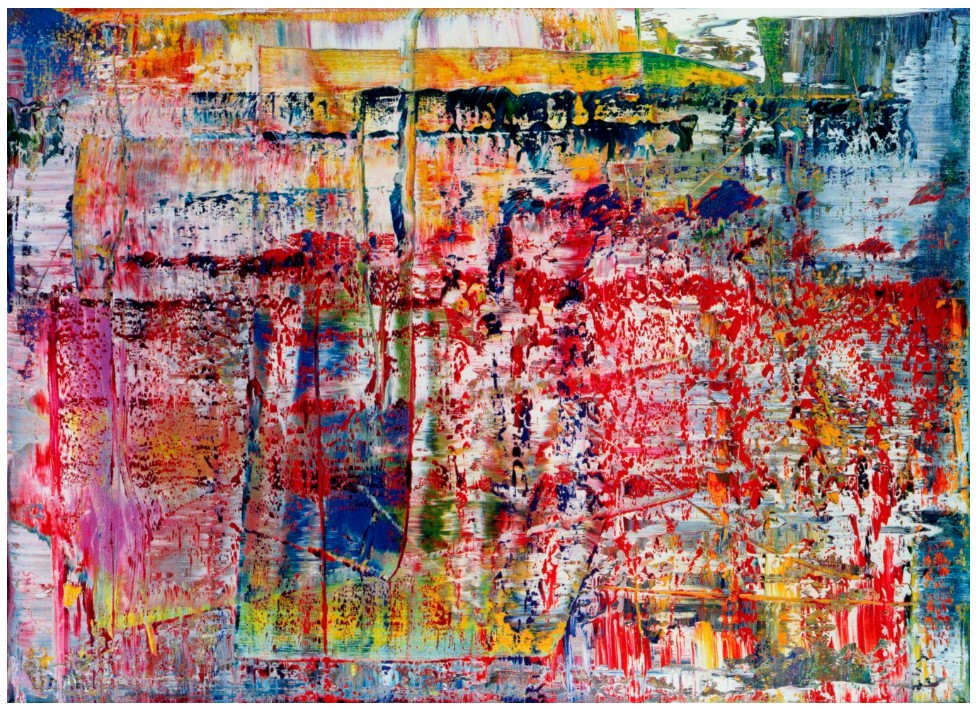
Gerhard Richter, Abstraktes Bild, (724-4), 1990. Private collection. © Gerhard Richter 2026 (0114).
The present work, and the broader Strip series, originates from one of the artist’s favorite works, Abstraktes Bild (724-4) from 1990, a rich, vibrant example of Richter’s celebrated squeegee paintings. Though initially defined by its dense, layered surface—a pinnacle example of the artist’s tactile, gestural approach to abstraction—Richter later returned to this masterpiece in an effort to investigate its internal structure. To create the present work, Richter employed a process that was both precise and radical. He started by photographing his original painting and then dividing that image into increasingly narrow vertical bands, repeating and mirroring them until the image was reduced to thousands of fine lines, each representing just 0.08 millimeters of the original surface. What was once thick and materially complex was now flattened into a linear system. Yet this transformation is not purely controlled. As the divisions multiply, generating thousands of variations, the process begins to exceed the artist’s direct authorship. Richter selects from this field, isolating and recombining sequences before stretching them horizontally to a monumental scale.
“Chance is a given, unpredictable, chaotic, the basis. And we try to control that by intervening, giving form to chance, putting it to use.”
The Strips emerge from this tension, translating the physical sweep of the squeegee into a digital rhythm that remains unexpectedly expressive. The artist’s investigations into the limits—or lack thereof—of painting serves as the genesis of several other bodies of work, spanning photography, tapestries, and even a book titled Patterns, which catalogued the over 8,000 permutations generated by dividing an image of a painting into vertical sections.
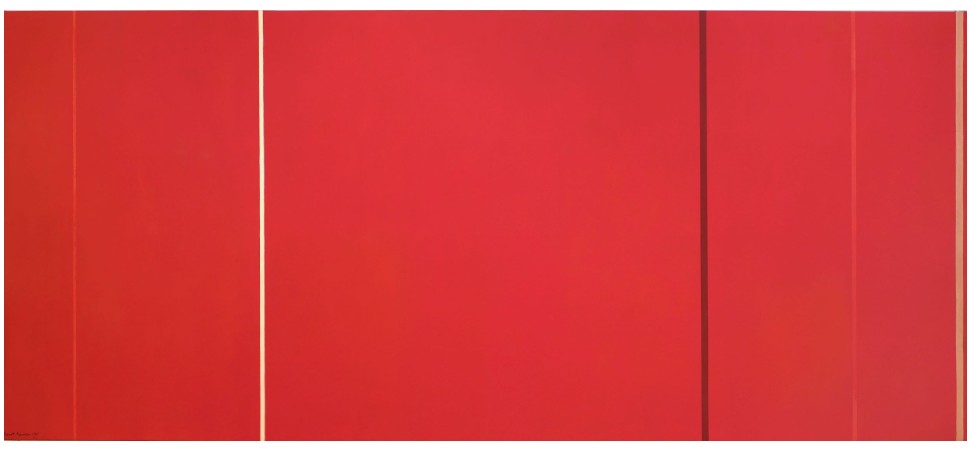
Barnett Newman, Vir Heroicus Sublimis, 1950-51. Museum of Modern Art, New York.
© 2026 Barnett Newman Foundation / Artists Rights Society (ARS), New York.
The Strip paintings are both simple and complex. Composed of tightly compressed horizontal bands, they read as stratified fields of color, often likened to geological cross-sections. This analogy reflects a deeper transformation: the chaotic density of the original painting is reorganized into a system of clarity and order. Across the surface, verdant greens pass through sunset bands of orange, pink, and red, while serene blues move alongside quieter passages of violet, punctuated by flashes of bright white. At close range, the image dissolves into a flickering array of lines; from a distance, it coheres into a luminous plane. The eye moves laterally across the work’s expansive surface, its scale reinforcing a distinctly physical experience of perception. Pattern also plays a central role in this effect.
“What I like about the patterns is they’re not constructed on the basis of ideology or religion… Patterns which emerge by coincidence contain all sorts of things… But they don’t stem from us. … They are more universal.”
Unlike traditional ornament, which carries symbolic meaning, these patterns resist fixed interpretation. They suggest associations—landscape, light, even data—yet ultimately remain open, extending abstraction beyond compositional intention toward systems of accumulation and variation.
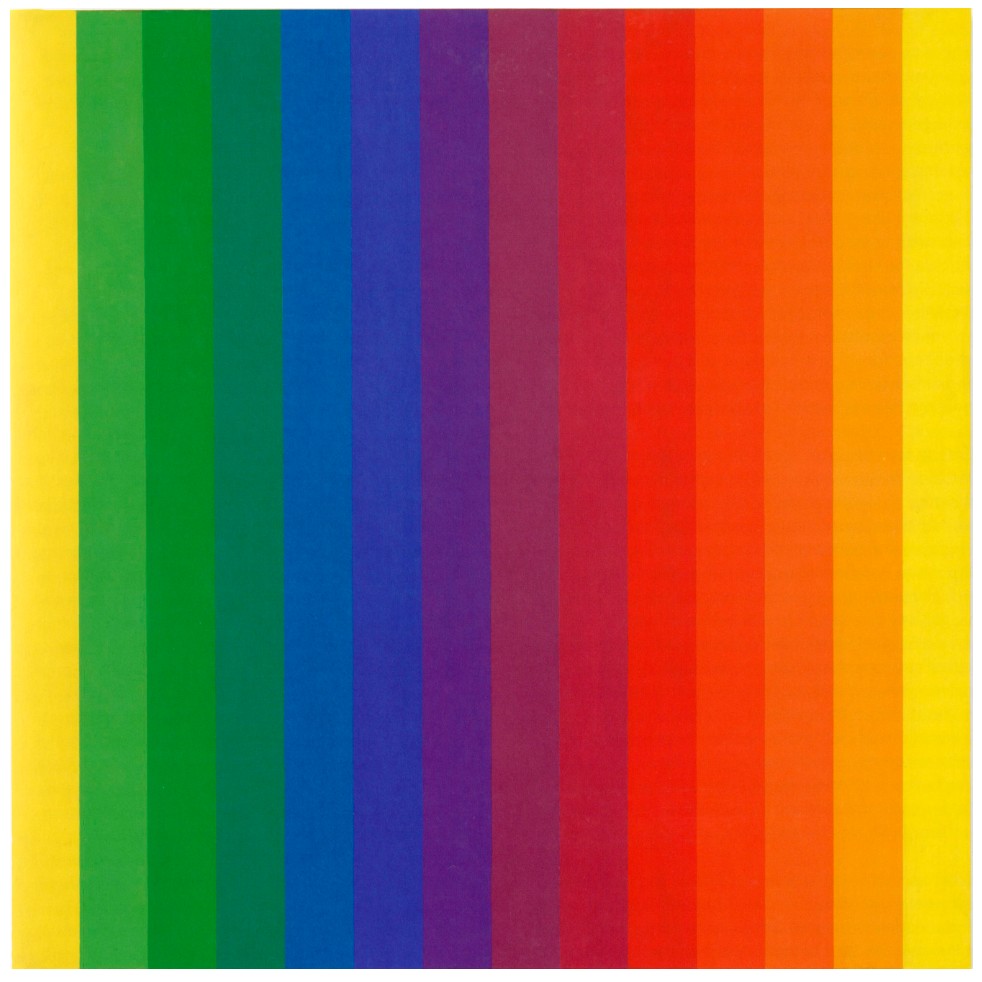
Ellsworth Kelly, Spectrum I, 1953. San Francisco Museum of Modern Art. © Ellsworth Kelly Foundation.
At the same time, the Strips engage directly with the history and future of painting. Their linear structure recalls earlier explorations of repetition and opticality, yet Richter’s approach is defined by its integration of technology. Though realized as inkjet prints, he insists on their status as paintings, complicating distinctions between medium and process. In this sense, the works occupy a critical threshold. As leading Richter scholar Benjamin H. D. Buchloh has observed, painting here appears both “exceptionally fragile” and newly resilient, as it assimilates technological processes without surrendering its critical depth. The Strips do not signal the end of painting, but rather its transformation under contemporary conditions. Richter himself acknowledges the uncertainty of this trajectory. Reflecting on the direction of the Strips he remarked: “I don’t know. I hope it’s to the future – no matter how silly or uncertain it may become. But I think that will be the direction.” The Strip paintings embrace this uncertainty, suggesting that painting’s vitality lies in its capacity to evolve. By excavating a single work and unfolding its latent possibilities through division and recombination, Richter reveals the seemingly inexhaustible potential within even the most finite surface.
Abstraktes Bild, 1995
Abstraktes Bild, 1995
Breaking Ground: The Private Collection of Marian Goodman
Christie’s New-York: 21 May 2026
Estimated: USD 750,000 – 1,000,000
USD 889,000
GERHARD RICHTER (B. 1932), Abstraktes Bild | Christie’s
GERHARD RICHTER (B. 1932)
Abstraktes Bild, 1995
Oil on canvas
40.6 x 36 cm (16 x 14-1/8 inches)
Signed, inscribed and dated ‘833-4 Richter X.95’ (on the reverse)
“I want to end up with a picture that I haven’t planned. This method of arbitrary choice, chance, inspiration and destruction may produce a specific type of picture, but it never produces a predetermined picture. Each picture has to evolve out of a painterly or visual logic: it has to emerge as if inevitably.”
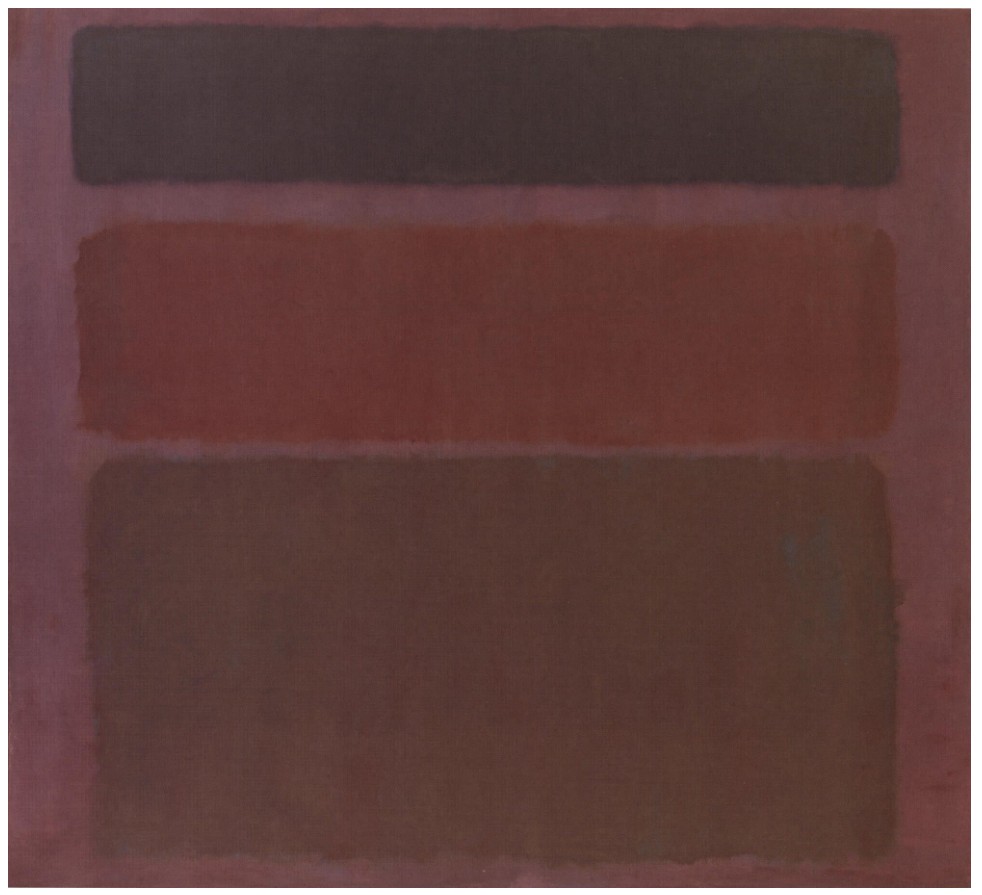
Mark Rothko, No. 16 (Red, Brown, and Black), 1958. Museum of Modern Art, New York.
© 1998 Kate Rothko Prizel & Christopher Rothko / Artists Rights Society (ARS), New York.
10. Dez. 99 [Firenze], 1999
10. Dez. 99 [Firenze], 1999
Breaking Ground: The Private Collection of Marian Goodman
Christie’s New-York: 21 May 2026
Estimated: USD 50,000 – 70,000
USD 241,300
GERHARD RICHTER (B. 1932), 10. Dez. 99 [Firenze] | Christie’s
GERHARD RICHTER (B. 1932)
10. Dez. 99 [Firenze], 1999
Oil on photograph
11.7 x 11.7 cm (4-5/8 x 4-5/8 inches)
Signed and dated ’10. Dez. 99 Richter’ (on the mount)
10. Dez. 99 [Firenze] is an exemplar from one of Gerhard Richter’s most critical bodies of work—the Overpainted Photographs—bringing together all aspects of his celebrated career into one work. As the curator and close collaborator to the artist Hans Ulbrich Obrist writes, “the Overpainted Photographs seem to me to be one of the most important facets of Richter’s oeuvre” (“Introduction: Starting Point and Working Methods,” in J. Hage and H. U. Obrist, eds., Gerhard Richter: The Overpainted Photographs, A Comprehensive Catalogue, Volume 1, Essays, London, 2025, p. 6). 10. Dez. 99 [Firenze] bears even more import than most Overpainted Photographs, as he employed a subtly different method here. While his ordinary Overpainted Photographs were made at the end of his working day, using the paint accumulated on his squeegees from his large-format Abstrake Bilder to run over postcard-format photographs in a rapid process, here Richter employs the same painterly method which he refined with his abstract paintings, blurring, scraping, and otherwise reworking the pigment once applied to the photograph. The artist was similarly much more selective with the Firenze series than he was with the other Overpainted Photographs: Obrist reports that Richter destroyed approximately half of his Firenze series, when he was unhappy with the final composition, compared to an ordinary discard rate of around twenty percent.
“Painting is traditional but for me that doesn’t mean the academy. I felt a need to paint; I love painting. It was something natural—as listening to music or playing an instrument for some people. For this reason I searched for themes of my era and generation. Photography offered this, so I chose it as a medium for painting.”
The effect of Richter’s blurring the boundaries of photography and painting here is profound. 10. Dez. 99 [Firenze] fascinates in its merging of Richter’s long-held fascination with photographic processes with his dedication to painting. By blurring the barriers between the two media, Richter continues the artistic project he began as a young artist, making photorealistic paintings. Through this poignant work, Richter collapses the distinction between image and intervention, reaffirming the Overpainted Photographs, and the Firenze series in particular as a decisive arena in which his lifelong interrogation of representation, medium, and authorship finds one of its most concentrated and resonant expressions.