MAY 2026 NEW-YORK AUCTIONS
Roy Lichtenstein
Auction Results
17 lots sold for a cumulative turnover of USD 86,498,600. With no lot failing to sell, the sell-through rate is 100%.
#1. Anxious Girl, 1964
Christie’s New-York: 18 May 2026
Estimated: USD 40,000,000 – 60,000,000
USD 46,060,000
ROY LICHTENSTEIN (1923-1997), Anxious Girl | Christie’s
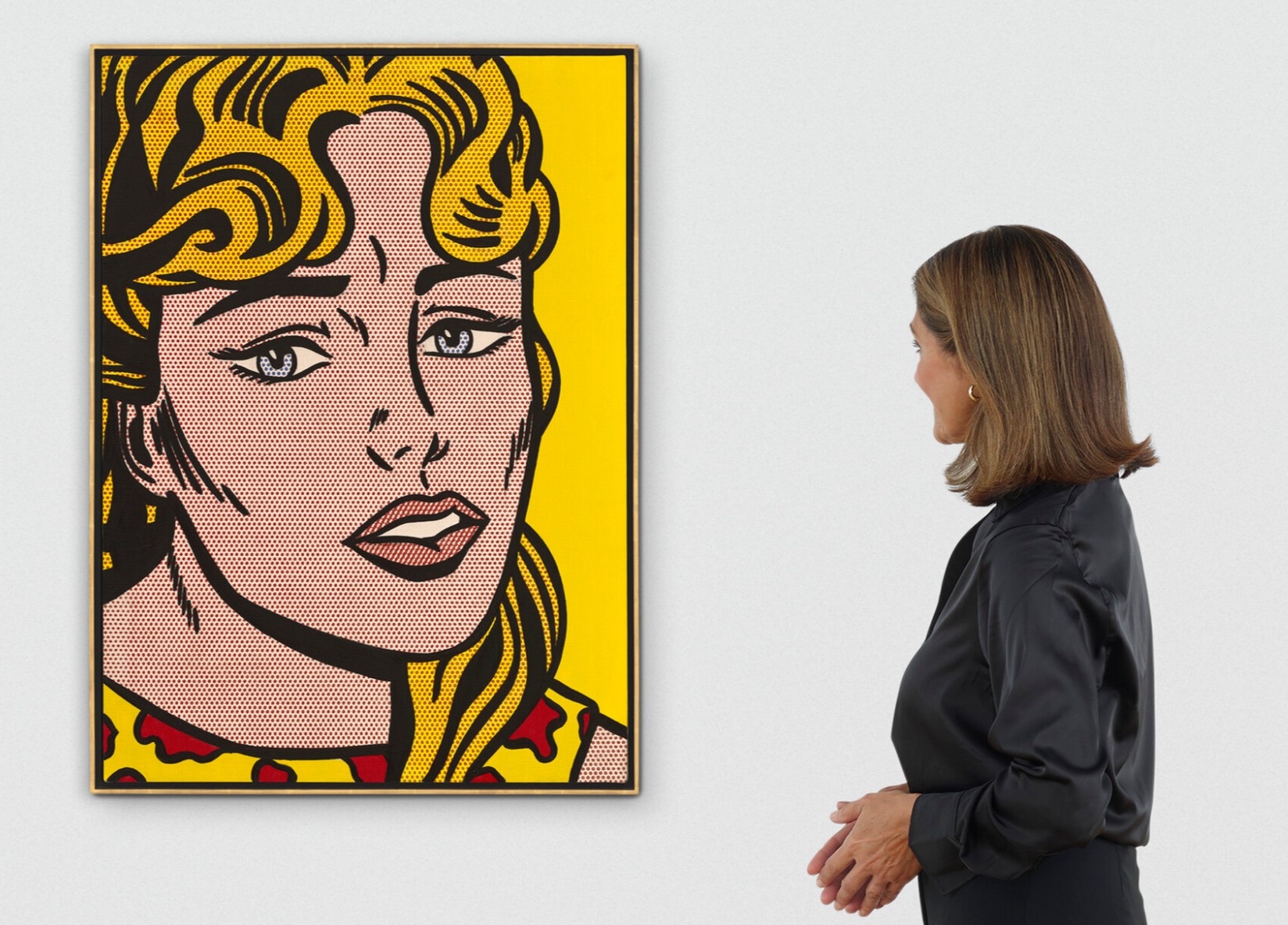
ROY LICHTENSTEIN (1923-1997)
Anxious Girl, 1964
Magna and graphite on canvas
36×26 inches (91.4 x 66 cm)
Signed and dated ‘rf Lichtenstein ’64’ (on the reverse)
#2. Half Face with Collar, 1963
Sotheby’s New-York: 14 May 2026
Estimated: USD 10,000,000 – 15,000,000
USD 12,985,000
Roy Lichtenstein | Half Face with Collar | The Now & Contemporary
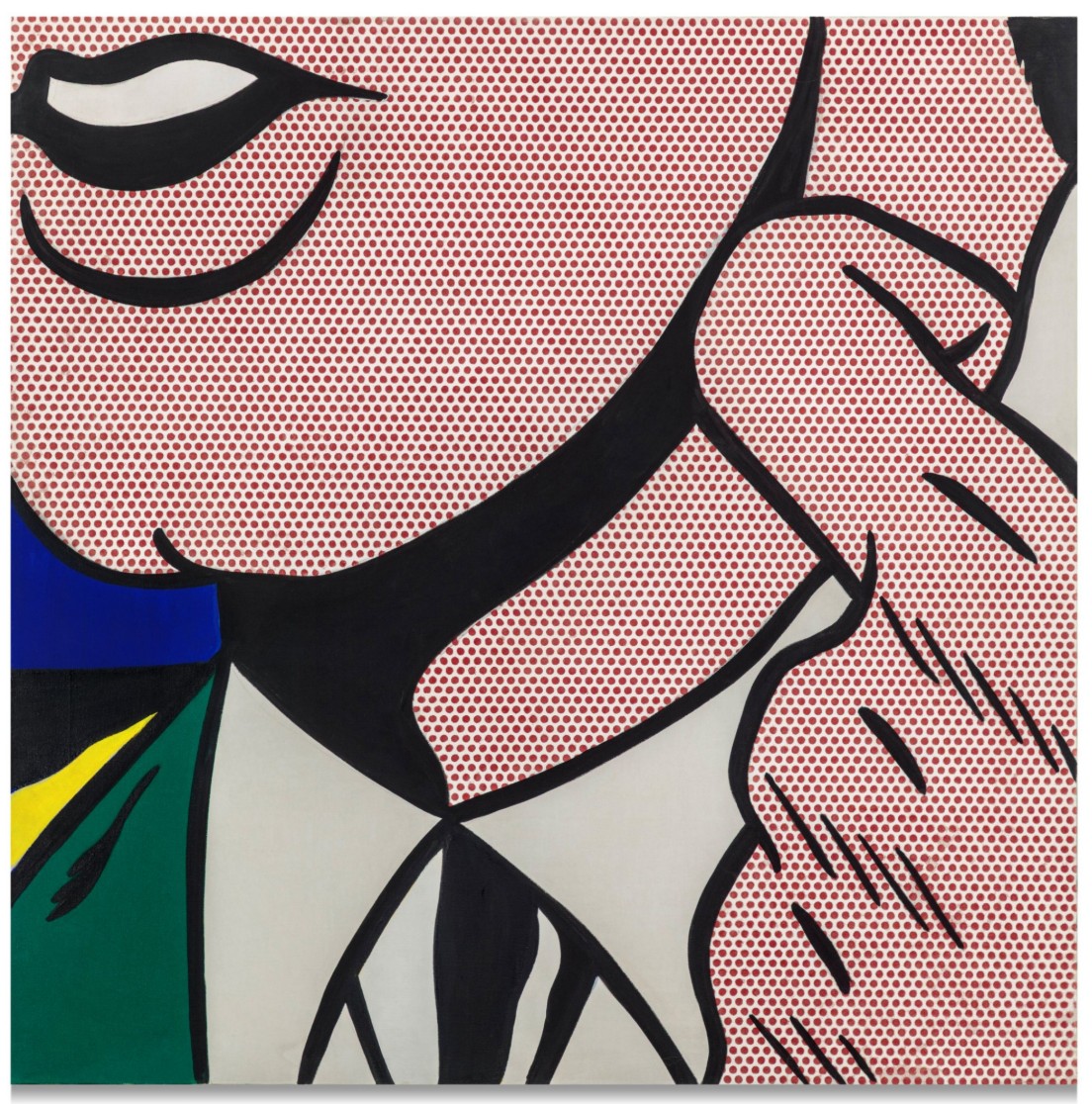
ROY LICHTENSTEIN (1923 – 1997)
Half Face with Collar, 1963
Oil, acrylic and graphite on canvas
48 x 47-3/4 inches (121.9 x 121.3 cm)
Signed and dated ‘63 (on the reverse)
#3. Girl in Mirror, 1964
Property from a Distinguished Private Collection
Sotheby’s New-York: 15 May 2026
Estimated: USD 5,000,000 – 7,000,000
USD 6,220,000
Roy Lichtenstein | Girl in Mirror | Contemporary Day Auction | 2026 |
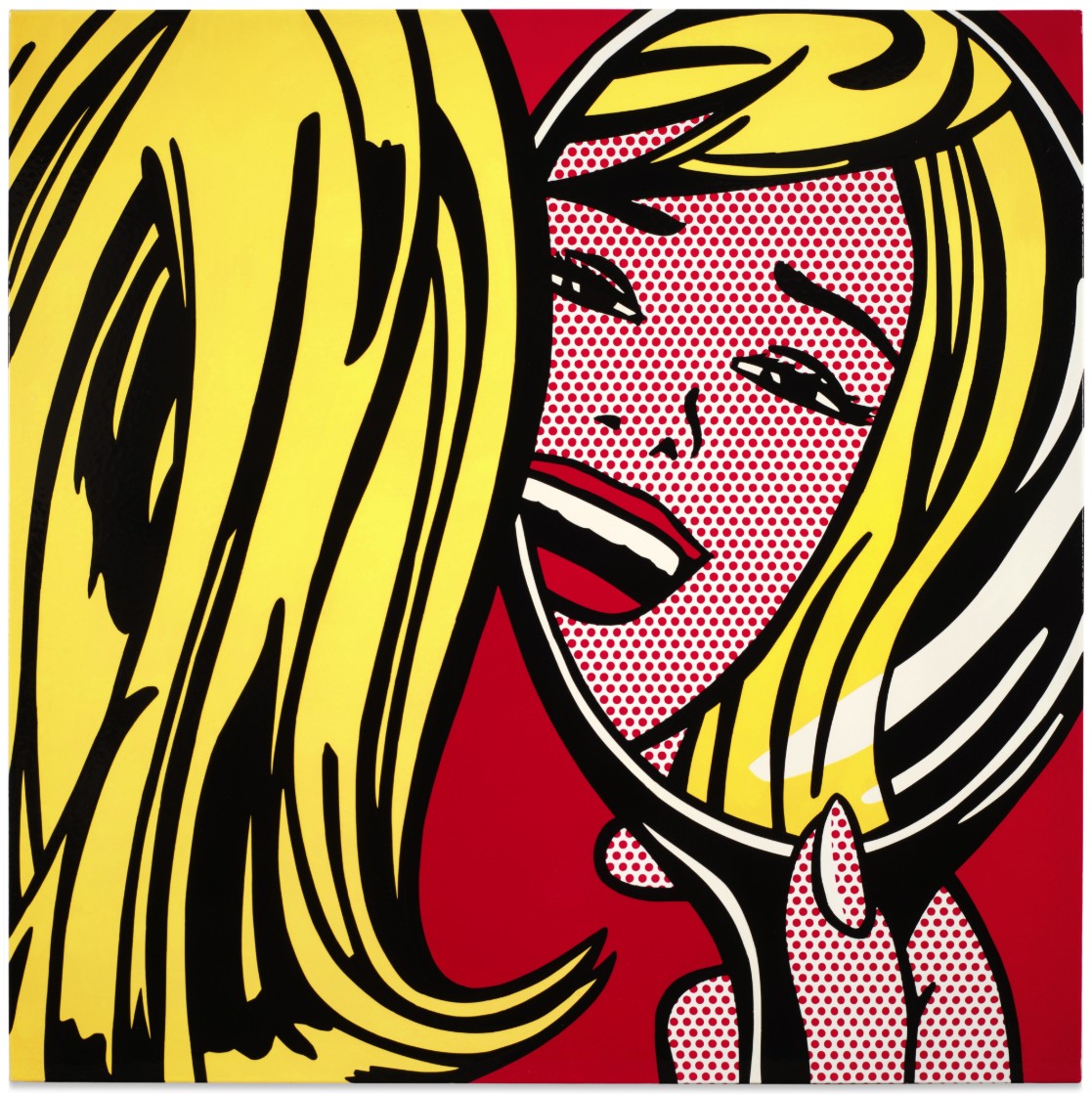
ROY LICHTENSTEIN (1923 – 1997)
Girl in Mirror, 1964
Porcelain enamel on steel
42×42 inches (106.7 x 106.7 cm)
Signed, dated 1964 and numbered 5/8 (on the reverse)
This work is number 5 from an edition of 8 plus 2 artist’s proofs
#4. Voodoo Lily, 1961
Masterpieces: The Private Collection of S.I. Newhouse
Christie’s New-York: 18 May 2026
Estimated: USD 6,000,000 – 8,000,000
USD 5,565,000
ROY LICHTENSTEIN (1923-1997), Voodoo Lily | Christie’s
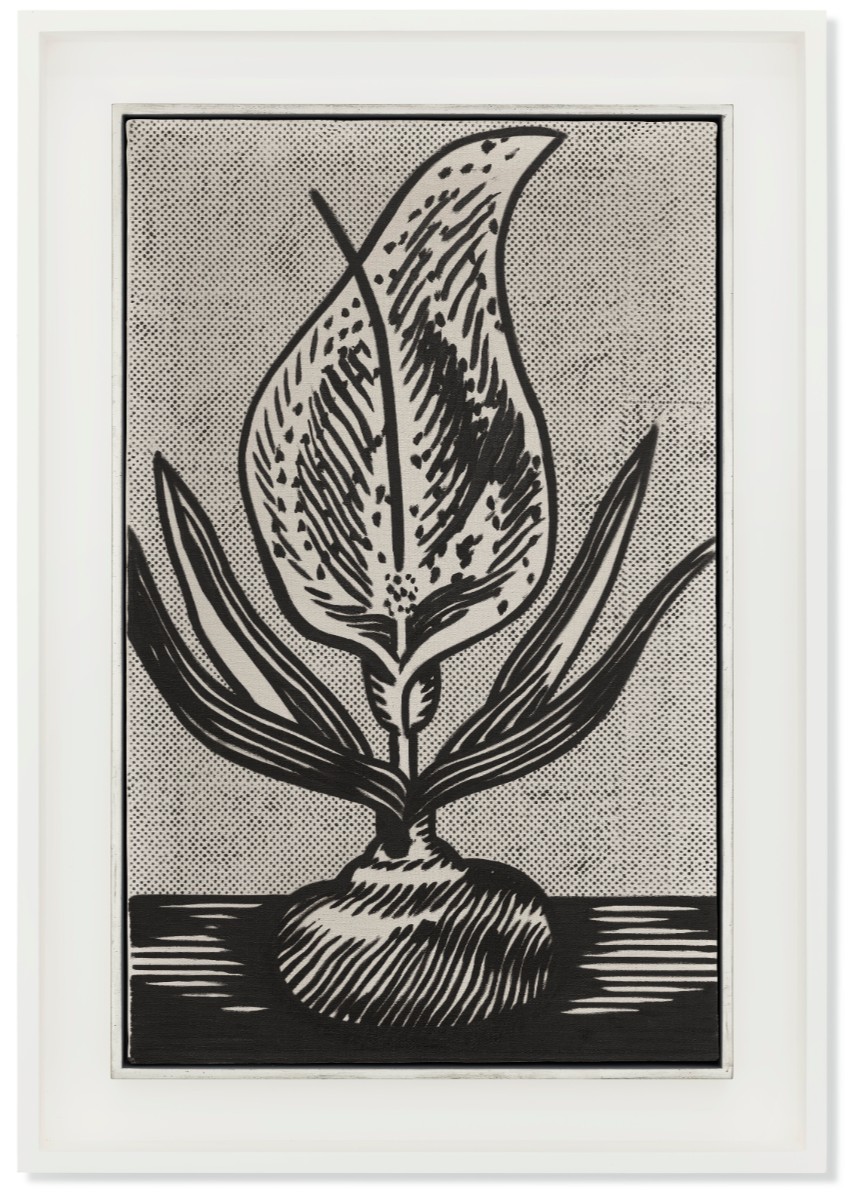
ROY LICHTENSTEIN (1923-1997)
Voodoo Lily, 1961
Oil on canvas
32-1/8 x 20 inches (81.6 x 50.8 cm)
Signed, signed with the artist’s initials, dated and titled ‘rf Lichtenstein ’61 VOO-DOO LILY rfl’ (on the reverse)
#5. Sitting Pretty, 1978
Property from the Collection of Annabelle and Bernard Fishman
Sotheby’s New-York: 14 May 2026
Estimated: USD 4,000,000 – 6,000,000
USD 4,756,000
Roy Lichtenstein | Sitting Pretty | The Now & Contemporary Evening
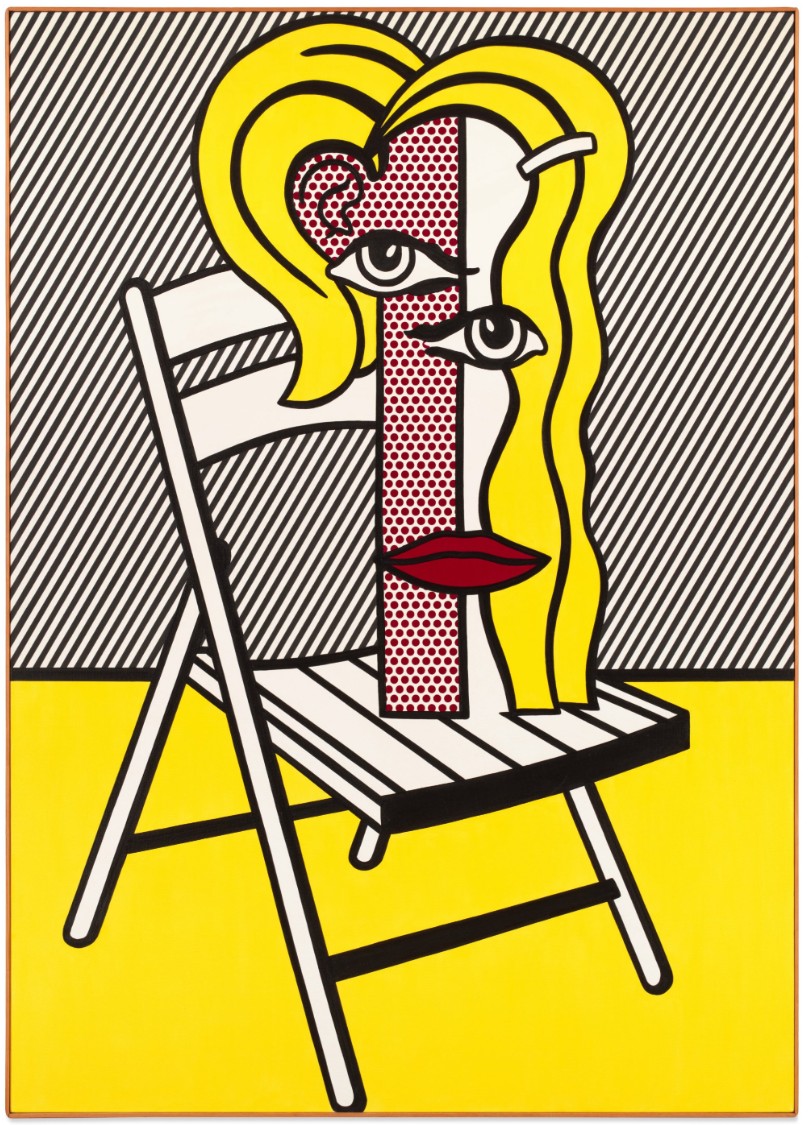
ROY LICHTENSTEIN (1923 – 1997)
Sitting Pretty, 1978
Acrylic, oil and graphite on canvas
70×50 inches (177.8 x 127 cm)
Signed and dated ’78 (on the reverse)
#6. Mirror #5 (24″), 1970
Christie’s New-York: 18 May 2026
Estimated: USD 1,800,000 – 2,500,000
USD 2,271,000
ROY LICHTENSTEIN (1923-1997), Mirror #5 (24″) | Christie’s
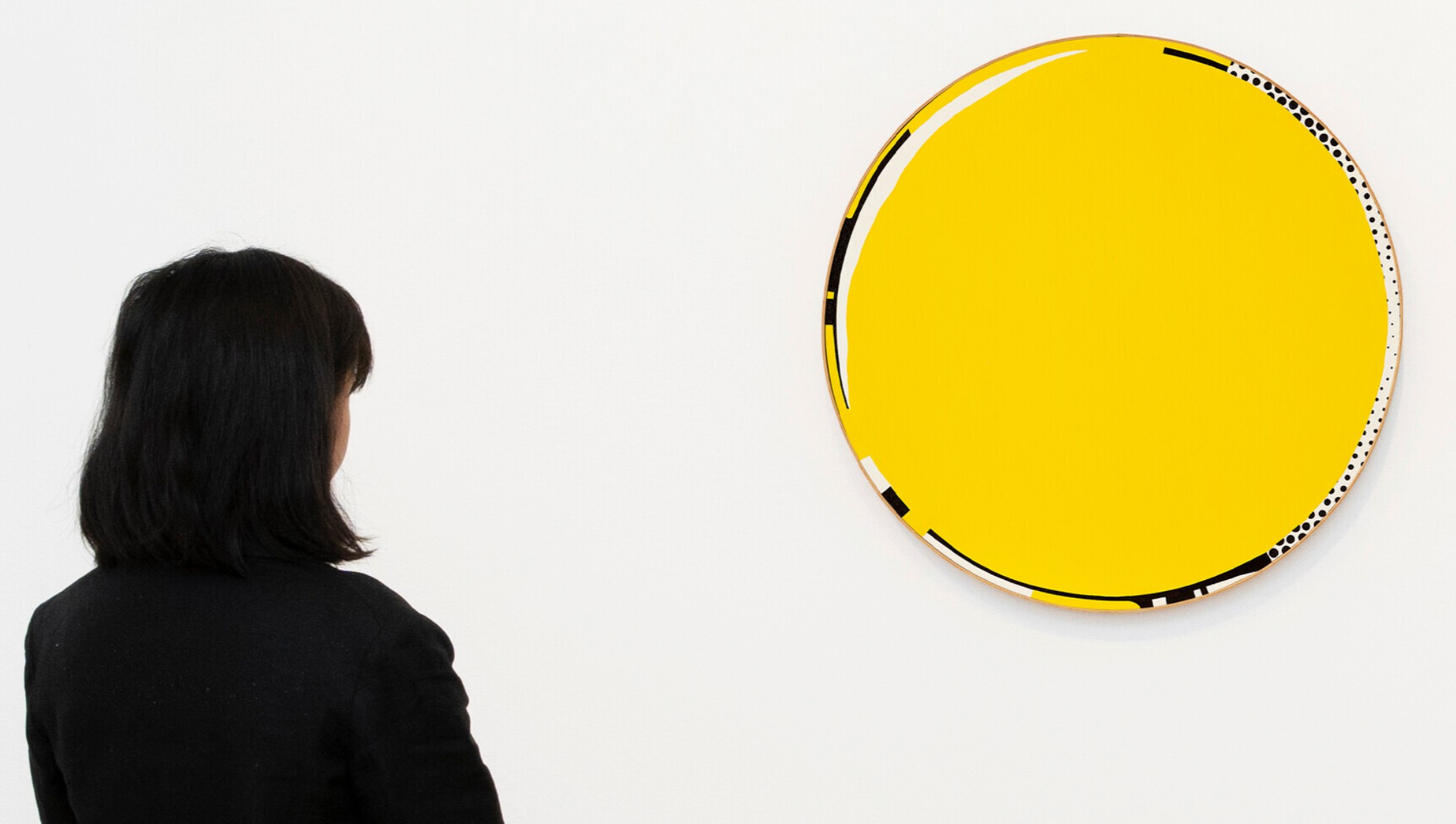
ROY LICHTENSTEIN (1923-1997)
Mirror #5 (24″), 1970
Magna, oil and graphite on shaped canvas
Diameter: 24 inches (61 cm)
Signed and dated ‘rf Lichtenstein ’70’ (on the reverse)
#7. Double Glass, 1979
Christie’s New-York: 18 May 2026
Estimated: USD 800,000 – 1,200,000
USD 1,905,000
ROY LICHTENSTEIN (1923-1997), Double Glass | Christie’s
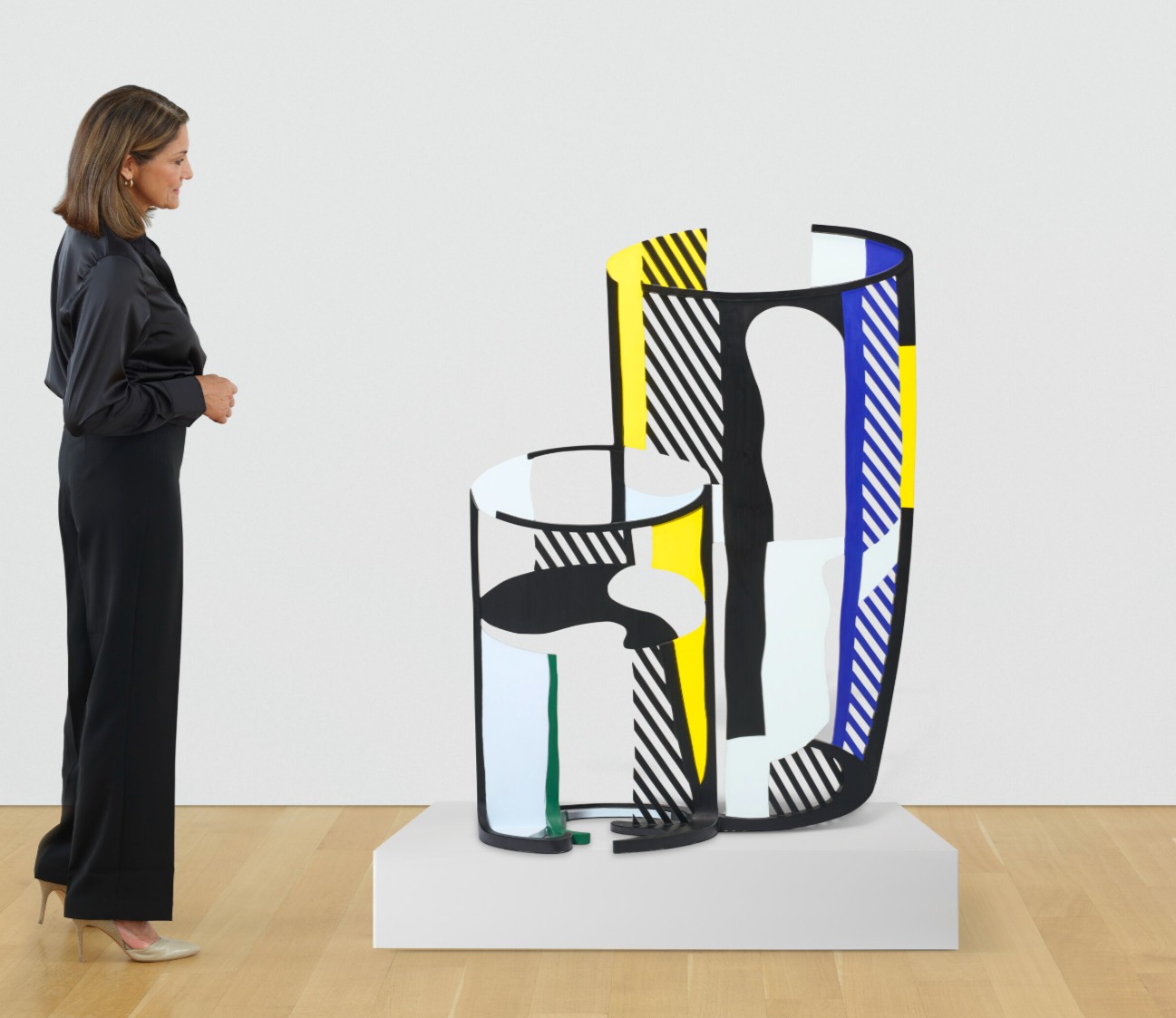
ROY LICHTENSTEIN (1923-1997)
Double Glass, 1979
Painted bronze
56x42x17 inches (142.2 x 106.7 x 43.2 cm)
Incised with the artist’s signature
Number and date ‘3⁄3 rf Lichtenstein ’79’ (lower edge)
This work is number three from an edition of three
#8. Glass II, 1976
Works from the Collection of Jannine and Robert MacDonnell
Sotheby’s New-York: 15 May 2026
Estimated: USD 600,000 – 800,000
USD 1,600,000
Roy Lichtenstein | Glass II | Contemporary Day Auction | 2026 |
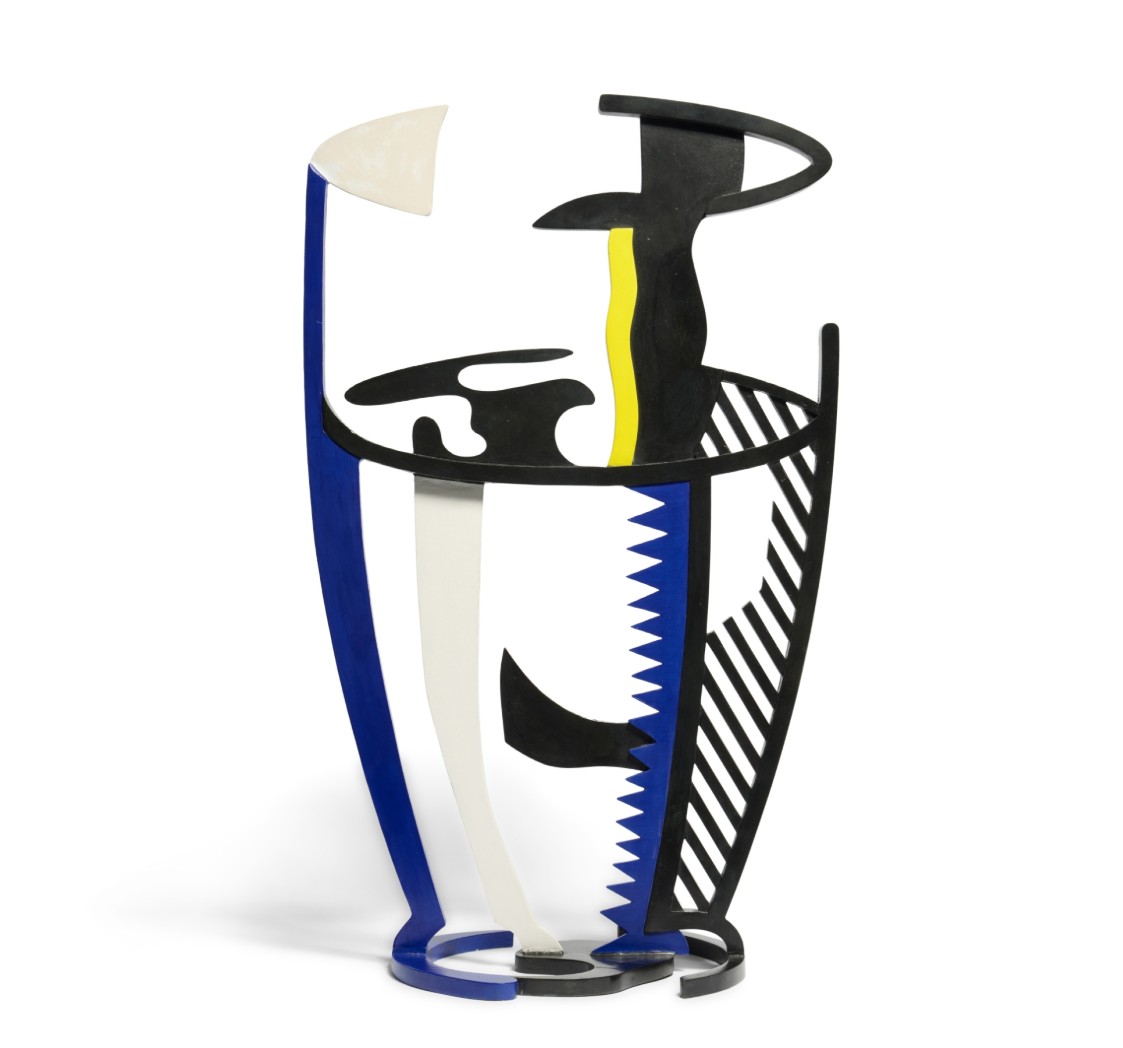
ROY LICHTENSTEIN (1923 – 1997)
Glass II, 1976
Painted and patinated bronze
36-1/2 x 22-1/2 x 14-3/8 inches (92.7 x 57.2 x 36.5 cm)
Incised with the artist’s signature, date ’77 and number 1/3 (on the base)
This work is number 1 from an edition of 3, plus 1 artist’s proof
#9. Water Lilies with Cloud, 1992
Sotheby’s New-York: 15 May 2026
Estimated: USD 500,000 – 700,000
USD 1,024,000
PRINT
Roy Lichtenstein | Water Lilies with Cloud | Contemporary Day Auction
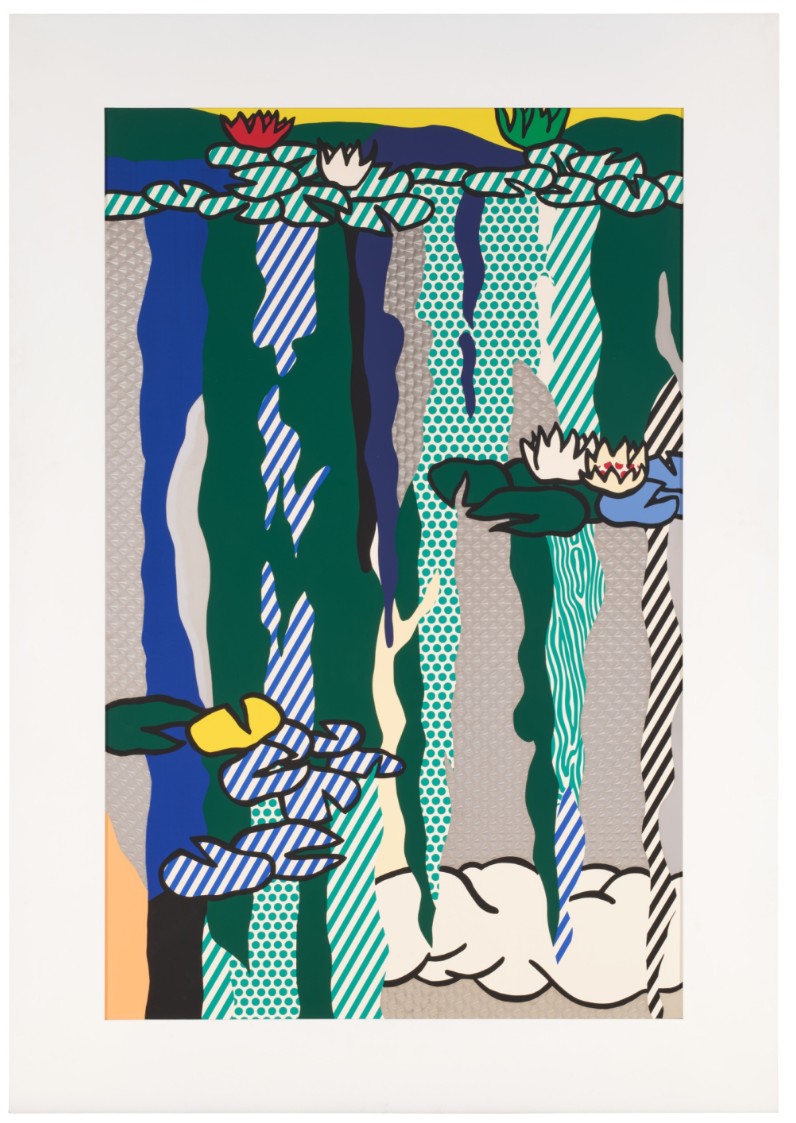
ROY LICHTENSTEIN (1923 – 1997)
Water Lilies with Cloud, 1992
(Corlett 263)
Screenprinted enamel in colors on processed and swirled stainless steel, with painted aluminum frame
Signed, dated ’92 and numbered 9/23 (on the reverse)
This work is number 9 from the edition of 23 plus 6 artist’s proofs
Published by Saff Tech Arts
#10. Entablature, 1974
New Vista: The David and Shoshanna Wingate Collection
Sotheby’s New-York: 20 May 2026
Estimated: USD 600,000 – 800,000
USD 1,024,000
Roy Lichtenstein | Entablature | A New Vista: The David and Shoshanna
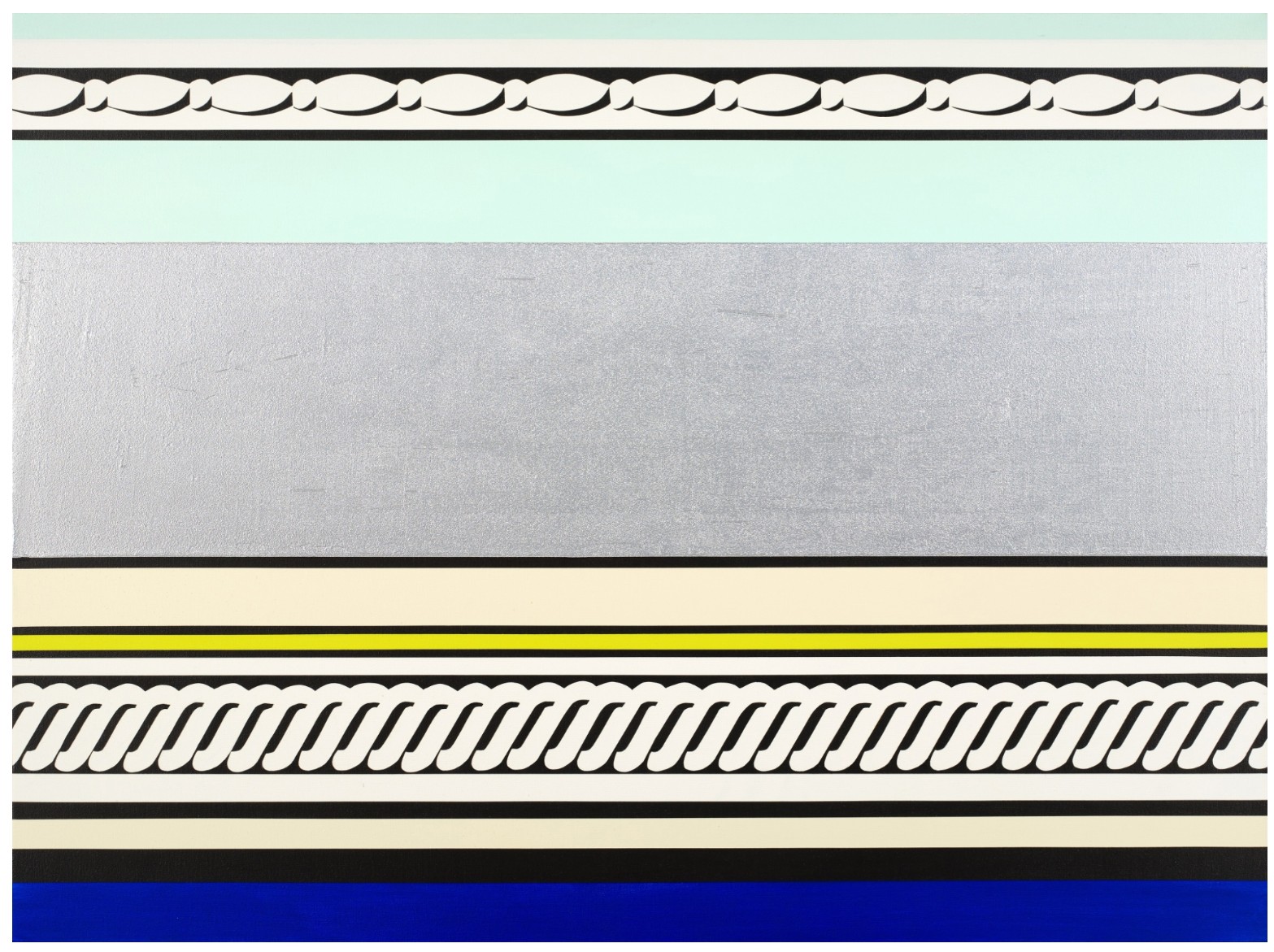
ROY LICHTENSTEIN (1923 – 1997)
Entablature, 1974
Acrylic, sand and graphite on canvas
40-1/2 x 54-3/4 inches (102.9 x 139.1 cm)
Signed and dated ’74 (on the reverse)
#11. Road Before the Forest (Study), 1984
Sotheby’s New-York: 15 May 2026
Estimated: USD 400,000 – 600,000
USD 870,400
Roy Lichtenstein | Road Before the Forest (Study) | Contemporary Day
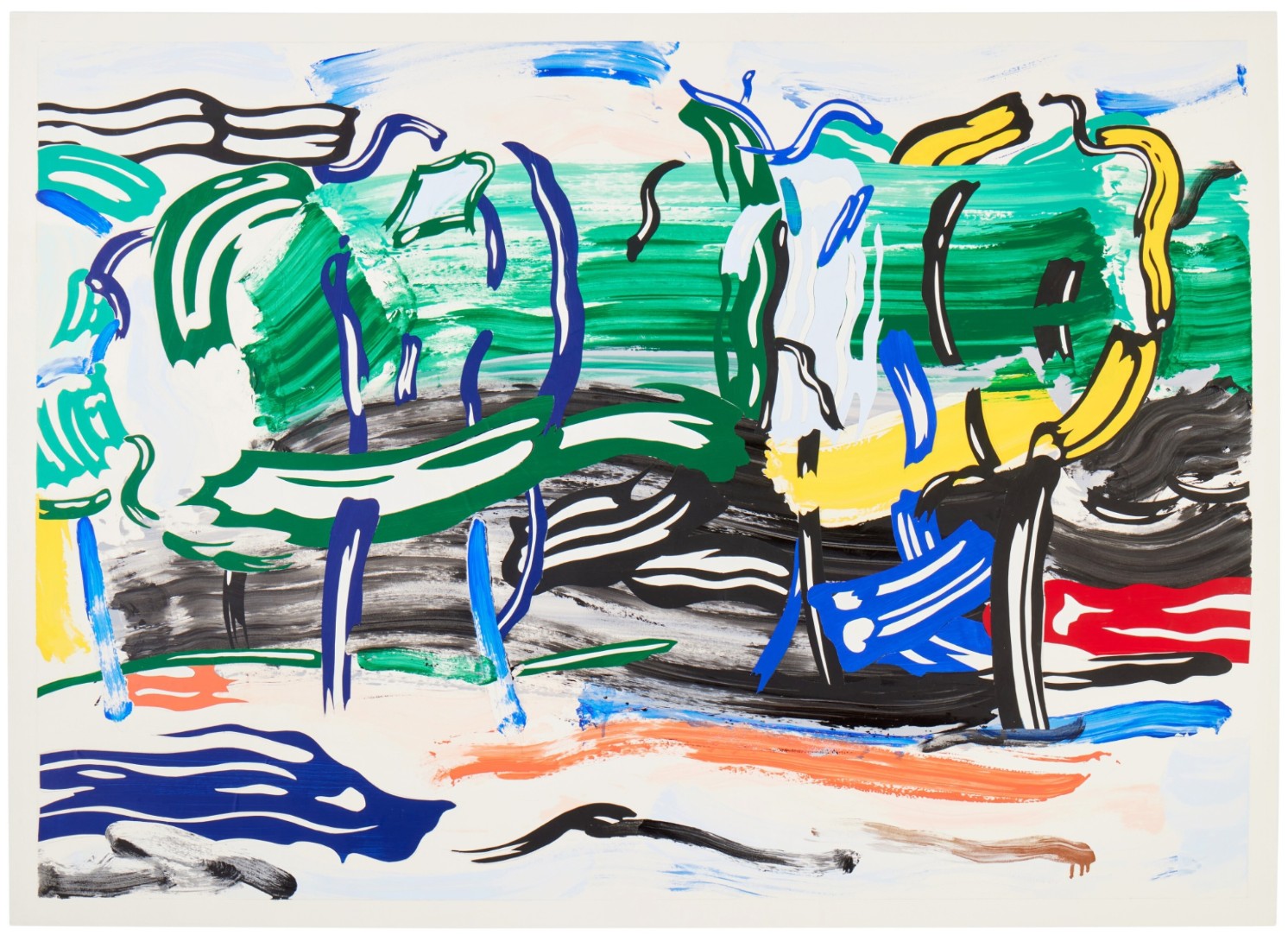
ROY LICHTENSTEIN (1923 – 1997)
Road Before the Forest (Study), 1984
Cut painted and printed paper, acrylic and graphite on paperboard
Image: 37 x 52-1/2 inches (94 x 133.4 cm)
Sheet: 39-1/2 x 55-1/8 inches (100.3 x 140 cm)
Signed and dated ’84 (on the verso)
#12. Small Wall Explosion, 1965
Estimated: USD 500,000 – 700,000
USD 645,000
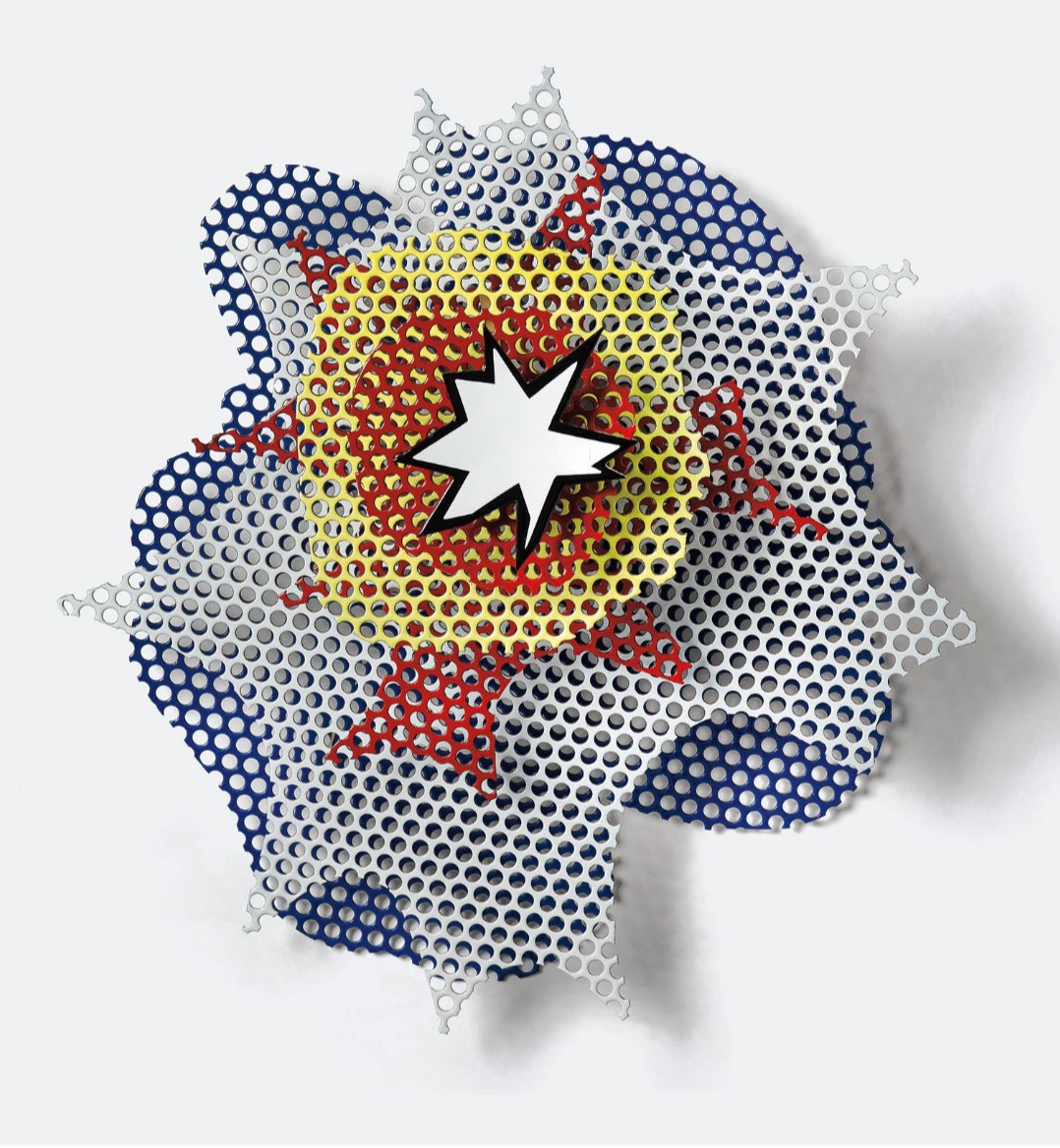
Porcelain enamel on perforated steel
20 1/4 x 21 1/2 x 7 1/4 inches (51.4 x 54.6 x 18.4 cm)
This work is number 4 from an edition of 6
#13. Still Life with Coffee Pot and Flower Pot (Study), 1973
Sotheby’s New-York: 20 May 2026
Estimated: USD 600,000 – 800,000
USD 512,000
Roy Lichtenstein | Still Life with Coffee Pot and Flower Pot (Study)
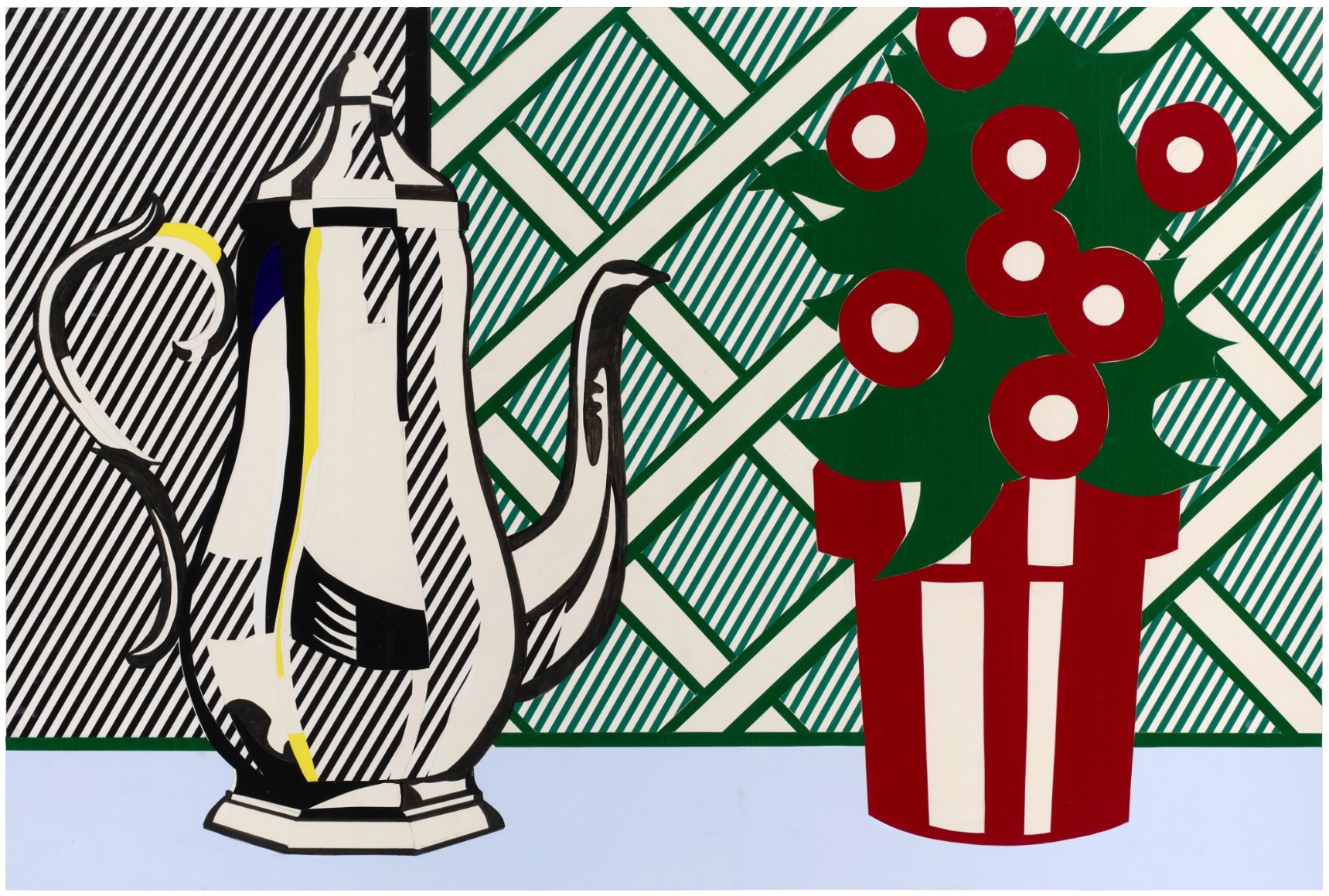
ROY LICHTENSTEIN (1923 – 1997)
Still Life with Coffee Pot and Flower Pot (Study), 1973
Cut painted and printed paper, marker and graphite on paperboard
Image: 30-1/2 x 45-5/8 inches (77.5 x 123.5 cm)
Sheet: 33-1/2 x 48-1/2 inches (85.1 x 123.2 cm)
#14. Brushstroke Still Life with Box (Study), 1996
Estimated: USD 250,000 – 350,000
USD 396,800
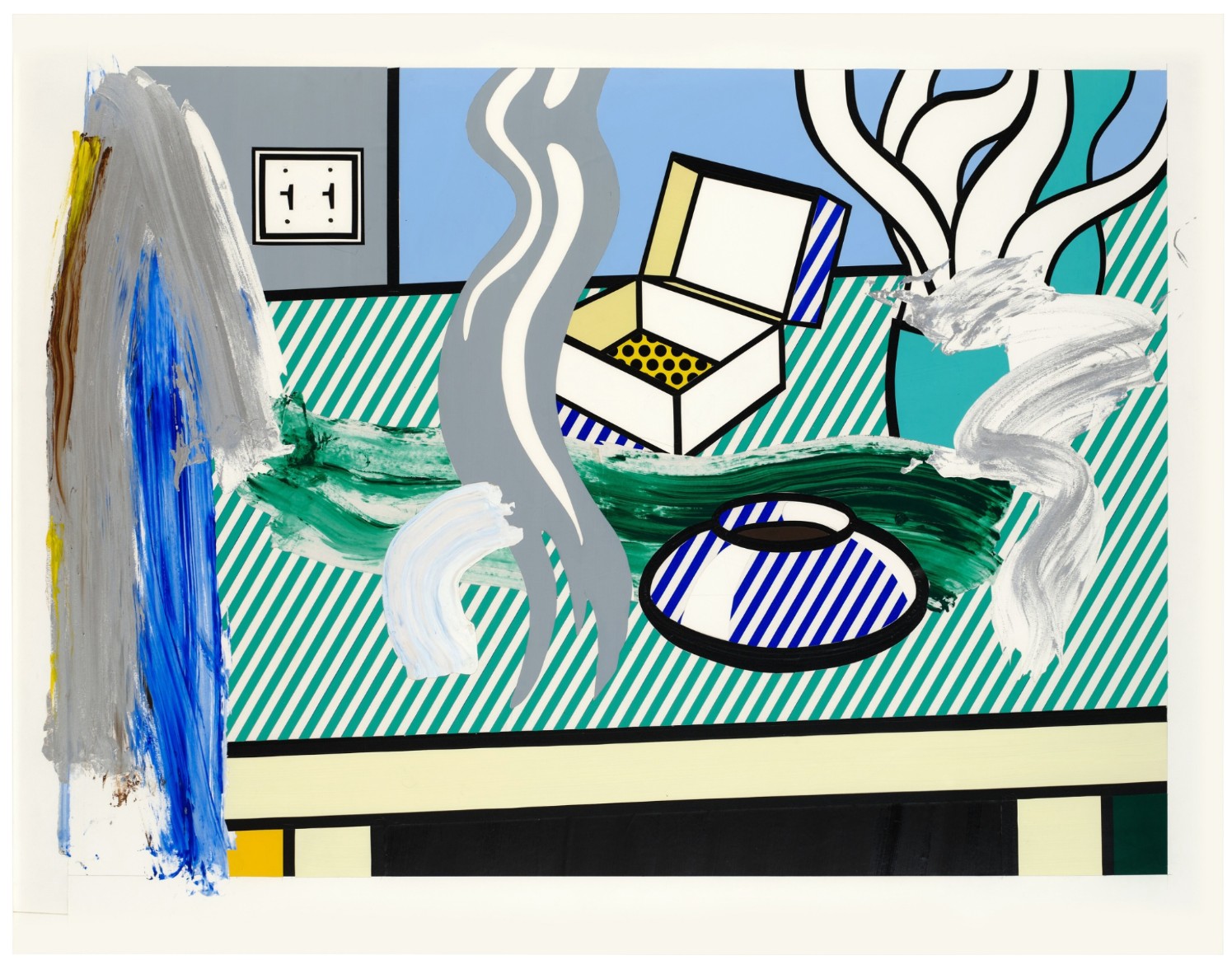
ROY LICHTENSTEIN (1923 – 1997)
Brushstroke Still Life with Box (Study), 1996
Cut painted and printed paper, tape, acrylic and graphite on paperboard
Image: 33-1/2 x 46-3/4 inches (85.1 x 118.7 cm)
Sheet: 39-1/2 x 50-5/8 inches (100.3 x 128.6 cm)
Signed and dated Dorothy Lichtenstein ’98 posthumously by Dorothy Lichtenstein (on the verso)
#15. Reflections: Half Face with Collar (Study), 1988
Estimated: USD 150,000 – 200,000
USD 248,000
WORK ON PAPER
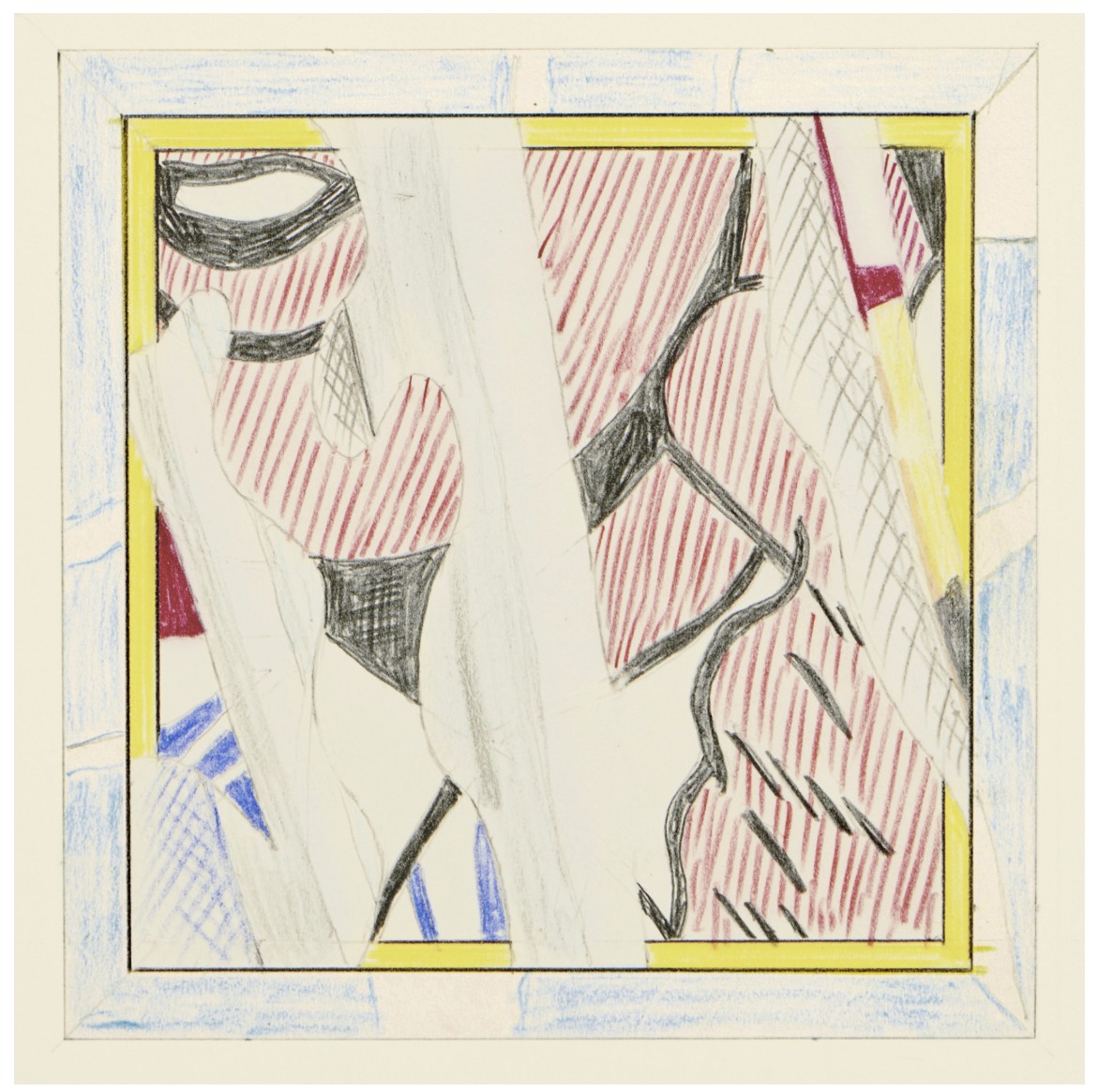
ROY LICHTENSTEIN (1923 – 1997)
Reflections: Half Face with Collar (Study), 1988
Colored pencil and graphite on paper
Image: 6-3/8 x 6-3/8 inches (16.2 x 16.2 cm)
Sheet: 10-1/8 x 13-1/8 inches (25.7 x 33.3 cm)
Signed and dated ’88 (on the verso)
#16. Modern Painting with Ionic Column (Study), 1967
Sotheby’s New-York: 15 May 2026
Estimated: USD 300,000 – 500,000
USD 230,400
WORK ON PAPER
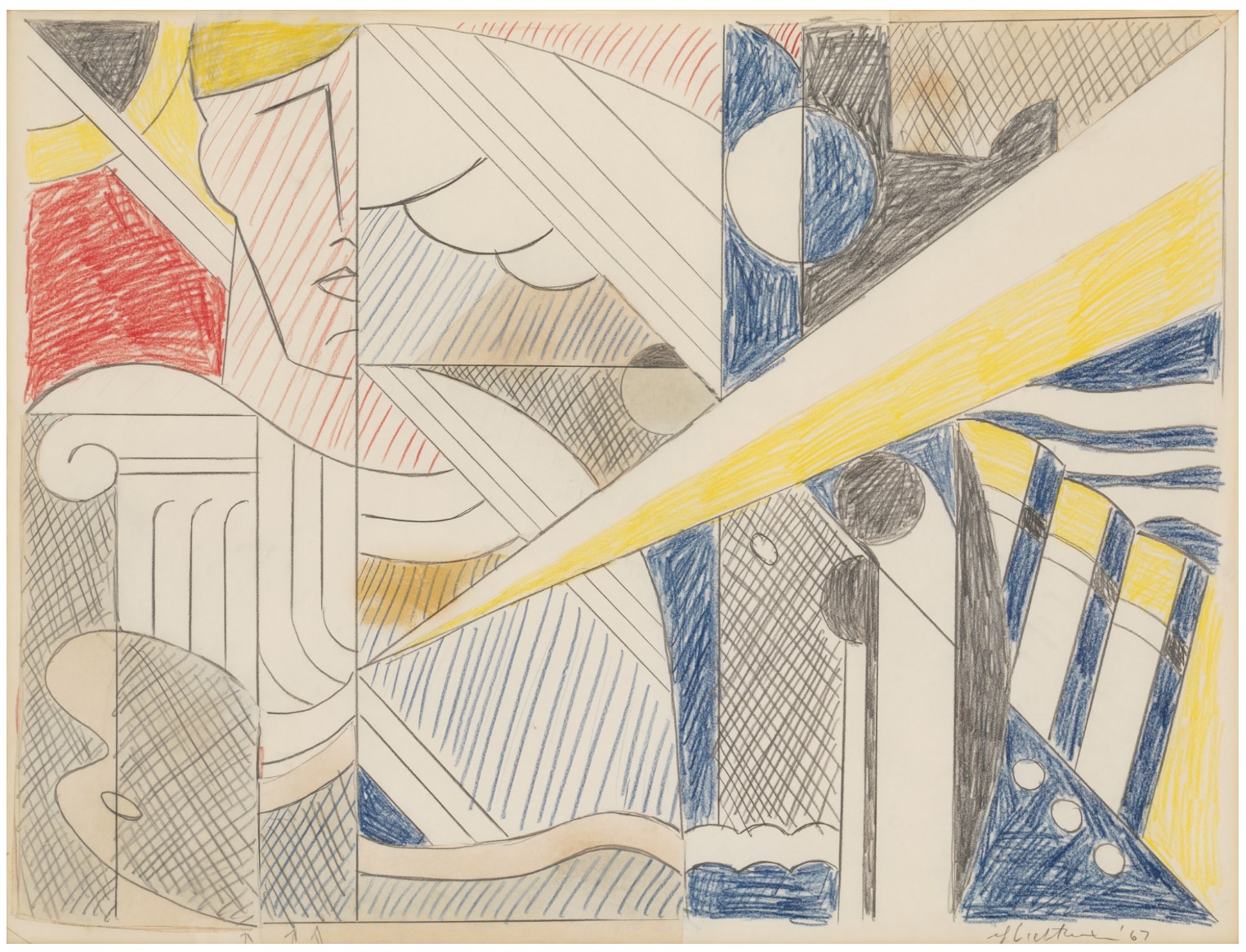
ROY LICHTENSTEIN (1923 – 1997)
Modern Painting with Ionic Column (Study), 1967
Colored pencil, graphite and cut paper on paper
25-3/8 x 33-1/8 inches (64.5 x 84.1 cm)
Signed and dated ’67 (lower right)
#17. Varoom (Study), circa 1965
Sotheby’s New-York: 15 May 2026
Estimated: USD 100,000 – 150,000
USD 186,000
WORK ON PAPER
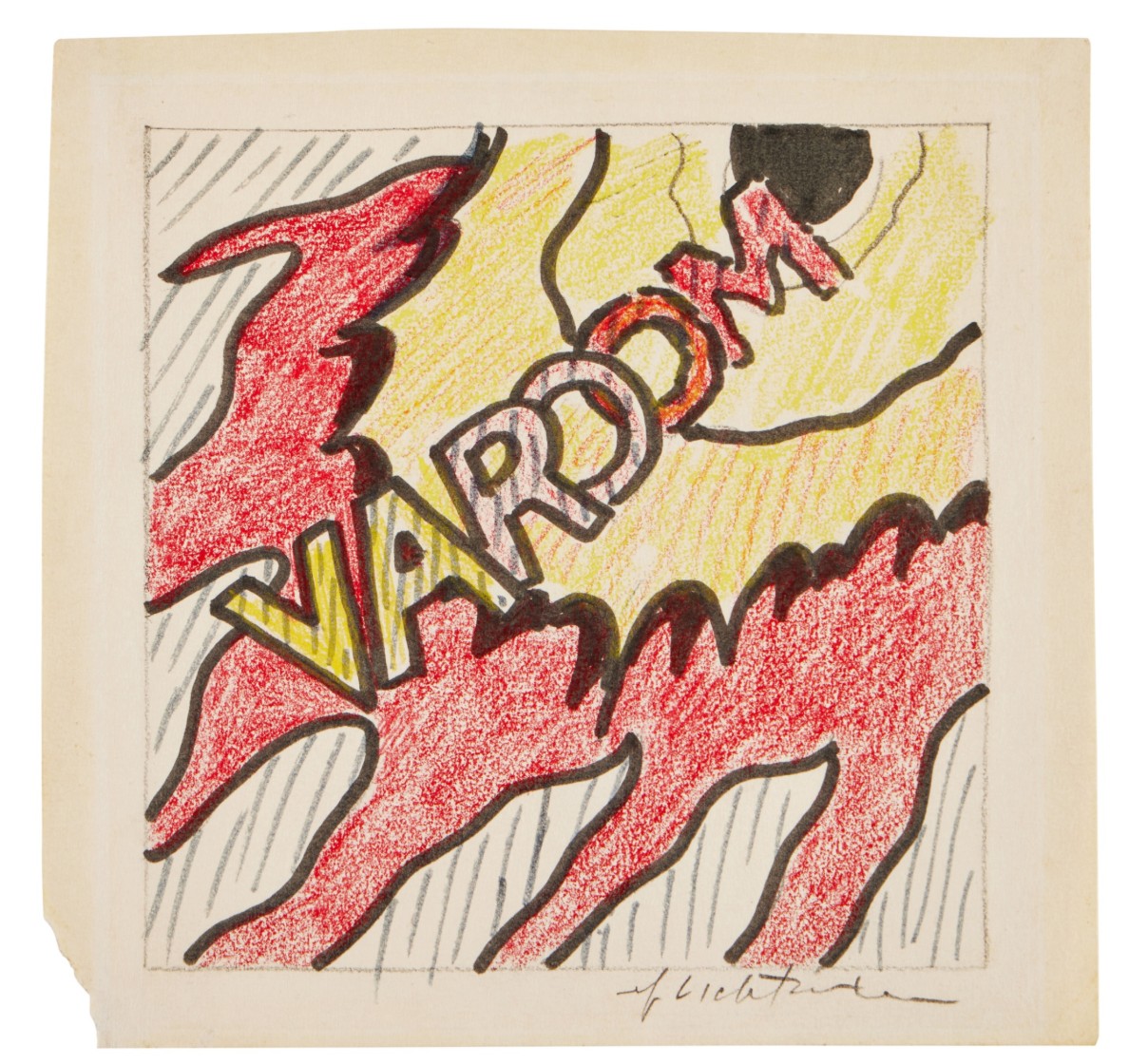
ROY LICHTENSTEIN (1923 – 1997)
Varoom (Study), circa 1965
Colored pencil, crayon, marker and graphite on paper
Image: 4-3/4 x 4-3/4 inches (12.1 x 12.1 cm)
Sheet: 5-3/4 x 5-7/8 inches (14.6 x 14.9 cm)
Signed (lower right)
Anxious Girl, 1964
Anxious Girl, 1964
Christie’s New-York: 18 May 2026
Estimated: USD 40,000,000 – 60,000,000
USD 46,060,000
ROY LICHTENSTEIN (1923-1997), Anxious Girl | Christie’s
ROY LICHTENSTEIN (1923-1997)
Anxious Girl, 1964
Magna and graphite on canvas
36×26 inches (91.4 x 66 cm)
Signed and dated ‘rf Lichtenstein ’64’ (on the reverse)
Alongside Andy Warhol’s paintings of soup cans and Hollywood superstars such as Marilyn Monroe and Elizabeth Taylor, Roy Lichtenstein’s comic book-inspired canvases are central not only to the pantheon of Pop Art, but also to the wider history of twentieth-century art. Among these works, Anxious Girl stands at the pinnacle of a select group of works for which Roy Lichtenstein is most celebrated: his iconic paintings of forlorn lovers inspired by mass-produced comic books. By taking images from popular culture as his starting point, Lichtenstein interrogates the very nature of how we look at and perceive images. Painted in 1964, at the height of the artist’s career, the present work showcases how Lichtenstein distills complex visual cues into three basic elements—line, color, and form—and then uses them to convey the emotions of the human experience. Previously owned by the legendary collectors Horace and Holly Solomon, the present work has been in the current owner’s private collection for over thirty years. Rarely seen in public, Anxious Girl is a masterpiece of Pop Art and represents an important piece of art history.
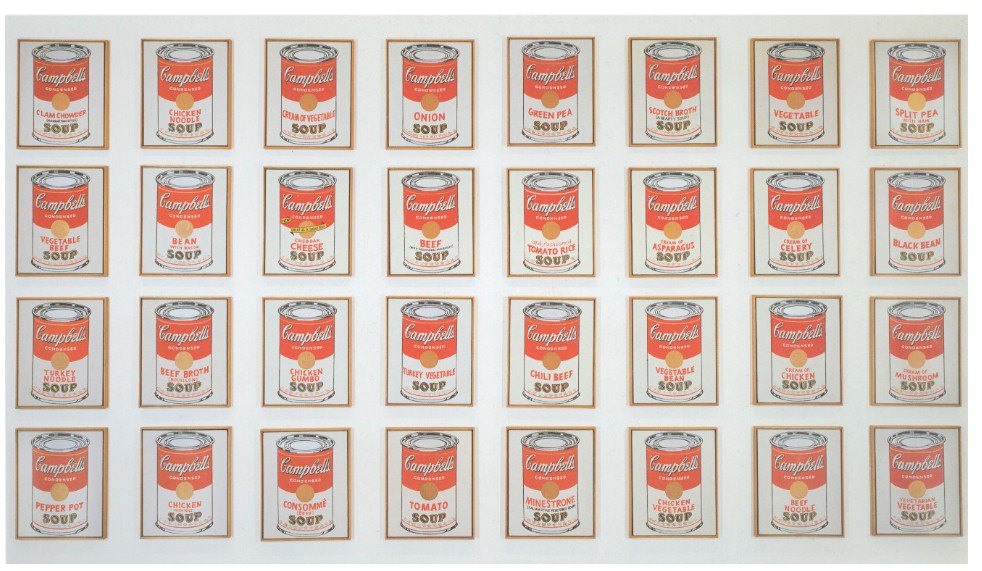
Andy Warhol, 32 Campbell’s Soup Cans, 1962. Museum of Modern Art, New York.
© 2026 The Andy Warhol Foundation for the Visual Arts, Inc. / Artists Rights Society (ARS), New York.
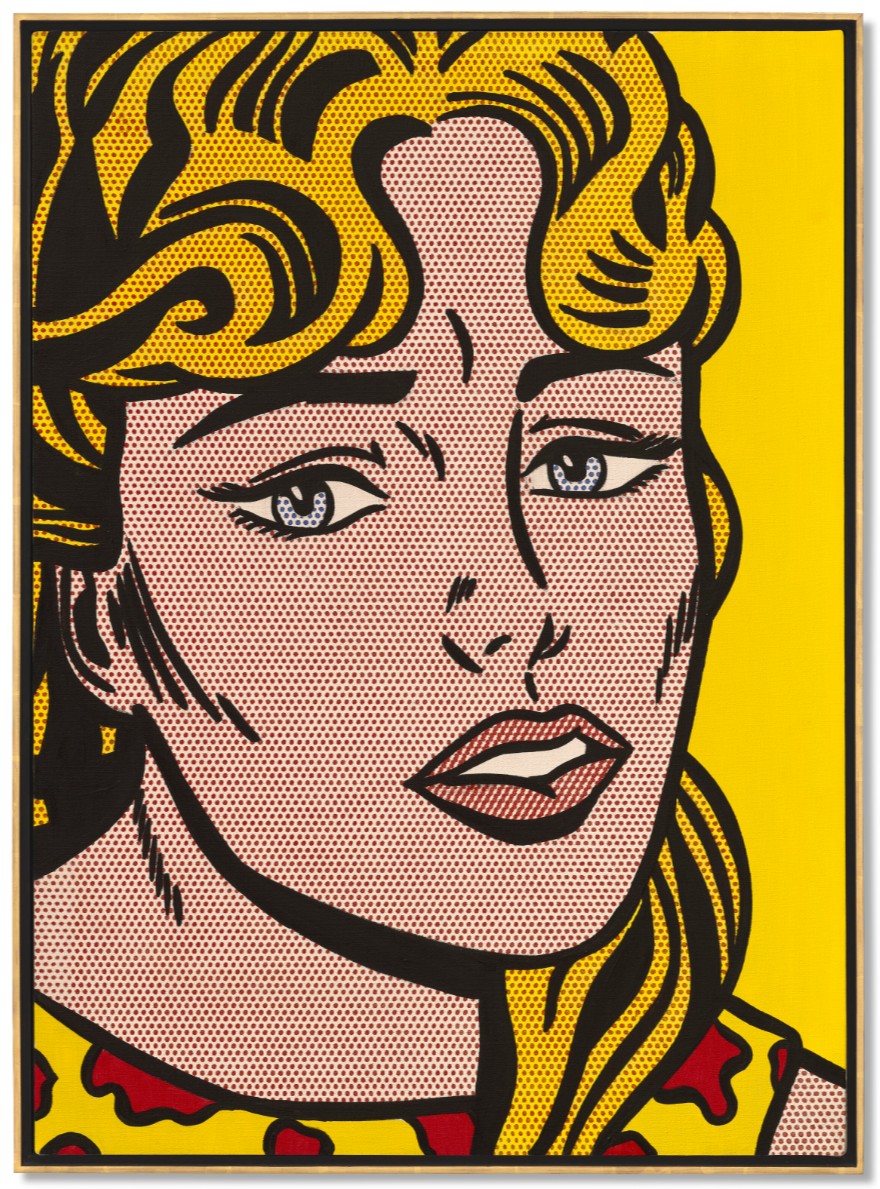
Staring out from the surface of the canvas with her piercing blue eyes, a young woman engages the viewer directly. Black bold lines define her silhouette, while more refined lines portray her youthful features. The long blonde hair that frames her face is manifested out of a variety of hand painted gestures: substantial marks create a sense of volume, more developed ones create form. The woman’s flawless skin is constituted by a field of Lichtenstein’s iconic Ben-Day dots, the heart of the artist’s practice. Mimicking the commercial printing process of the original comic books, in Anxious Girl the dots are not printed or screened, but meticulously applied directly by the artist’s hand.
Wearing a pretty Courrèges-inspired dress with its iconic bold colors and striking geometric patterns, the subject of Lichtenstein’s painting is the archetypal “perfect” blonde of the 1960s, but here, as in other works from this groundbreaking group in Lichtenstein’s retelling, something is different. A single painted line, positioned in the middle of her forehead, transforms her appearance with a slight furrowed brow—and with this simple addition, her entire demeanor transforms. What could cause such anxiety? Tantalizingly, the cause of her emotions is not revealed, but given the usual narrative of the source material, it normally involved unrequited love.
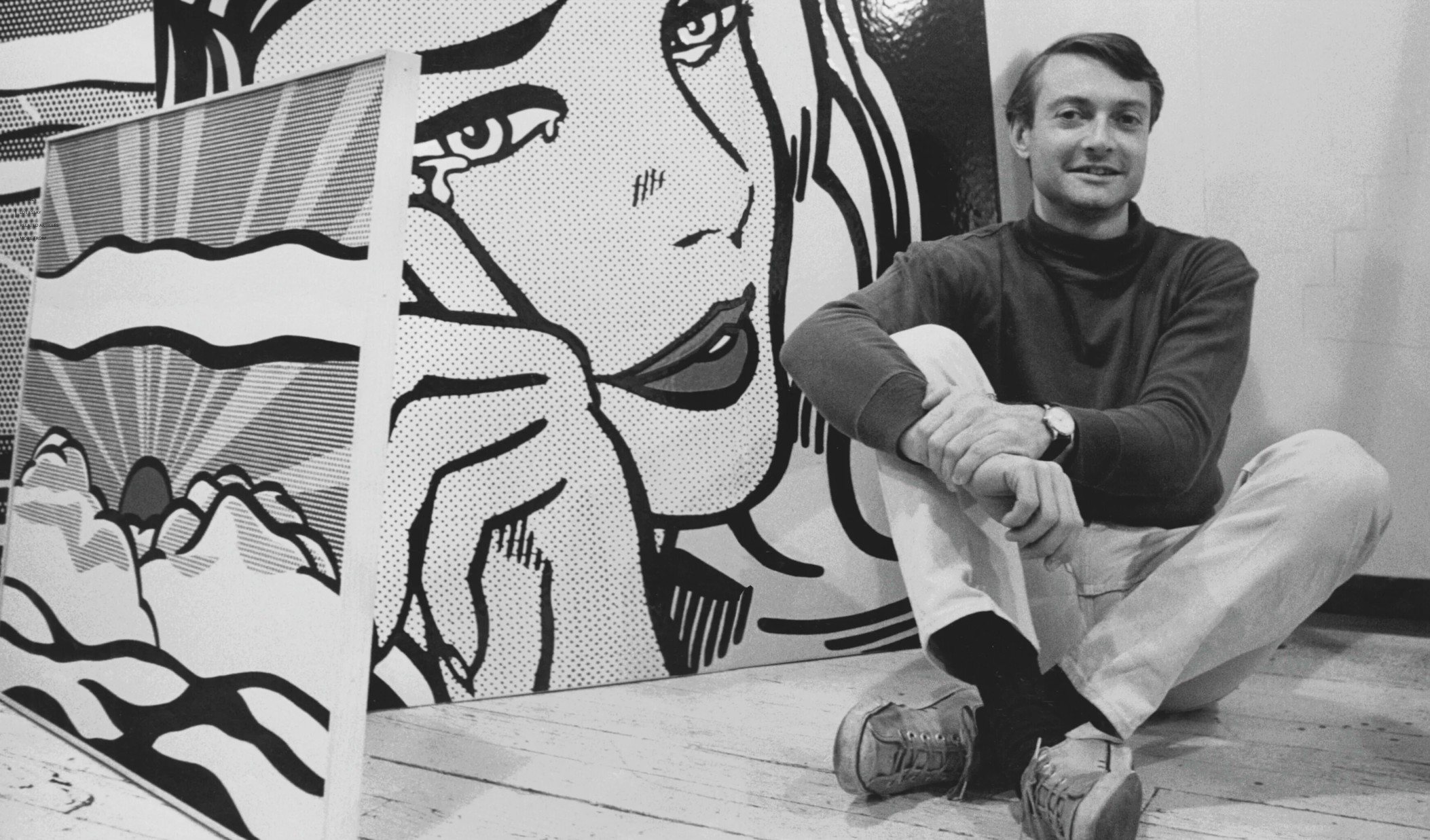
Roy Lichtenstein, Ferus Gallery, Los Angeles, 1963. Photo: Dennis Hopper, Courtesy of the Hopper Art Trust.
Artwork: © 2026 Estate of Roy Lichtenstein / DACS.
Lichtenstein found his source image for Anxious Girl in a story called “Too Much to Ask,” published in Girls’ Romances #97 in December 1963. In it, our heroine—Jan—is torn between her love for two men: Stewart, a new associate at her father’s firm, and Bill, a familiar friend. She is deeply attracted to the older Stewart, who knows he is not a suitable match but nonetheless leads her on; Bill, on the other hand, reignites a love that Jan had been hiding for a while. Eventually, Bill wins the day and proposes to Jan, with Stewart’s blessing. Lichtenstein appropriates the image in the opening panel, which depicts Jan caught between her two suitors. In his painting, however, Lichtenstein removes all extraneous details by tightly cropping in on the young woman’s face, adding to the sense of drama. He then makes a series of subtle but significant changes, including switching the colors and pattern on her dress to a more impactful composition. He also amplifies the appearance of her hair by using fewer, but thicker, contours to add volume. More importantly, though, the artist introduces a single line, the furrow line not found in the original image, which lends the work its title, “Anxious Girl.”
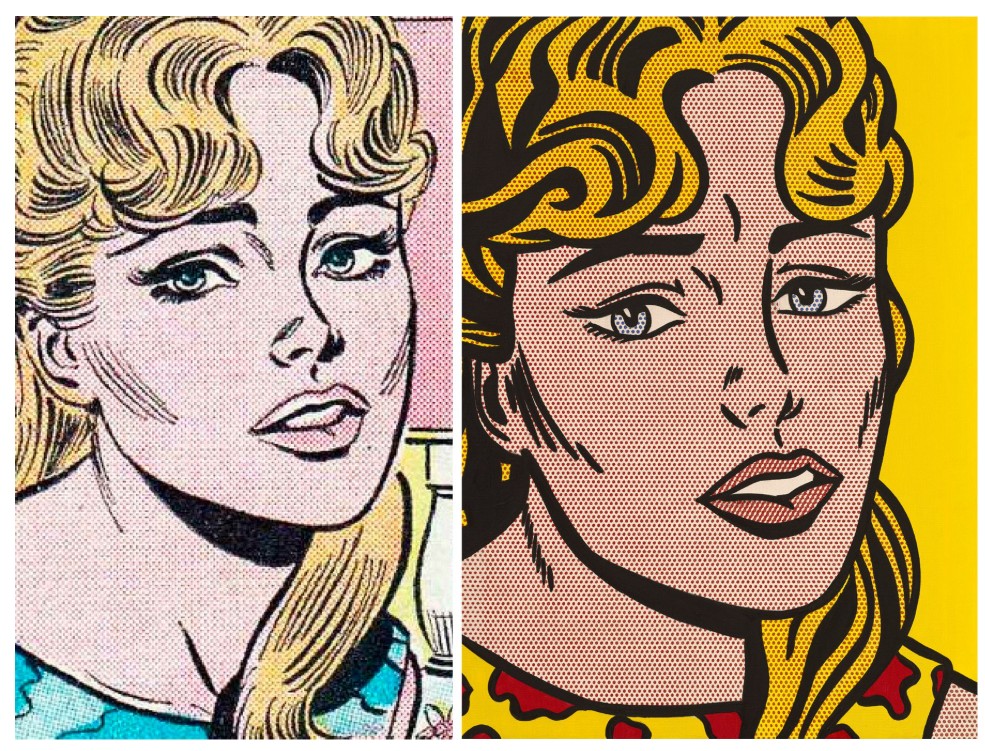
Left: Cover of Too Much To Ask!, from Girls’ Romances #97, December 1963 (source material for the present work). © DC Comics
Right: Present lot illustrated (detail).
This dramatic shift demonstrates Lichtenstein’s highly sophisticated understanding of how we look. From his days as an art student at Ohio State University, he was interesting in going beyond mere representation, dedicating himself to understanding how the brain understands and processes visual imagery. Much of his thinking was developed under the tutelage of Hoyt L. Sherman, whom he studied under at Ohio State University in the 1940s. Sherman believed that “students must develop an ability to see familiar objects in terms of visual qualities, and they must develop this ability to the degree that old associations with such objects will have only a secondary or a submerged role during the seeing-and-drawing act” (quoted by B. Rose, The Drawings of Roy Lichtenstein, exh. cat., Museum of Modern Art, New York, 1987, p. 29). This theory was reinforced by Sherman’s use of what he called his ‘flash room’—a darkened room where images of objects were briefly flashed onto a screen for the students to copy. Teaching painting and drawing in this particular fashion proved to be extremely influential for Lichtenstein as it forced him to focus his attention on the most important visual aspects of the object’s structure, and not to become distracted by extraneous matters such as unnecessary decoration.
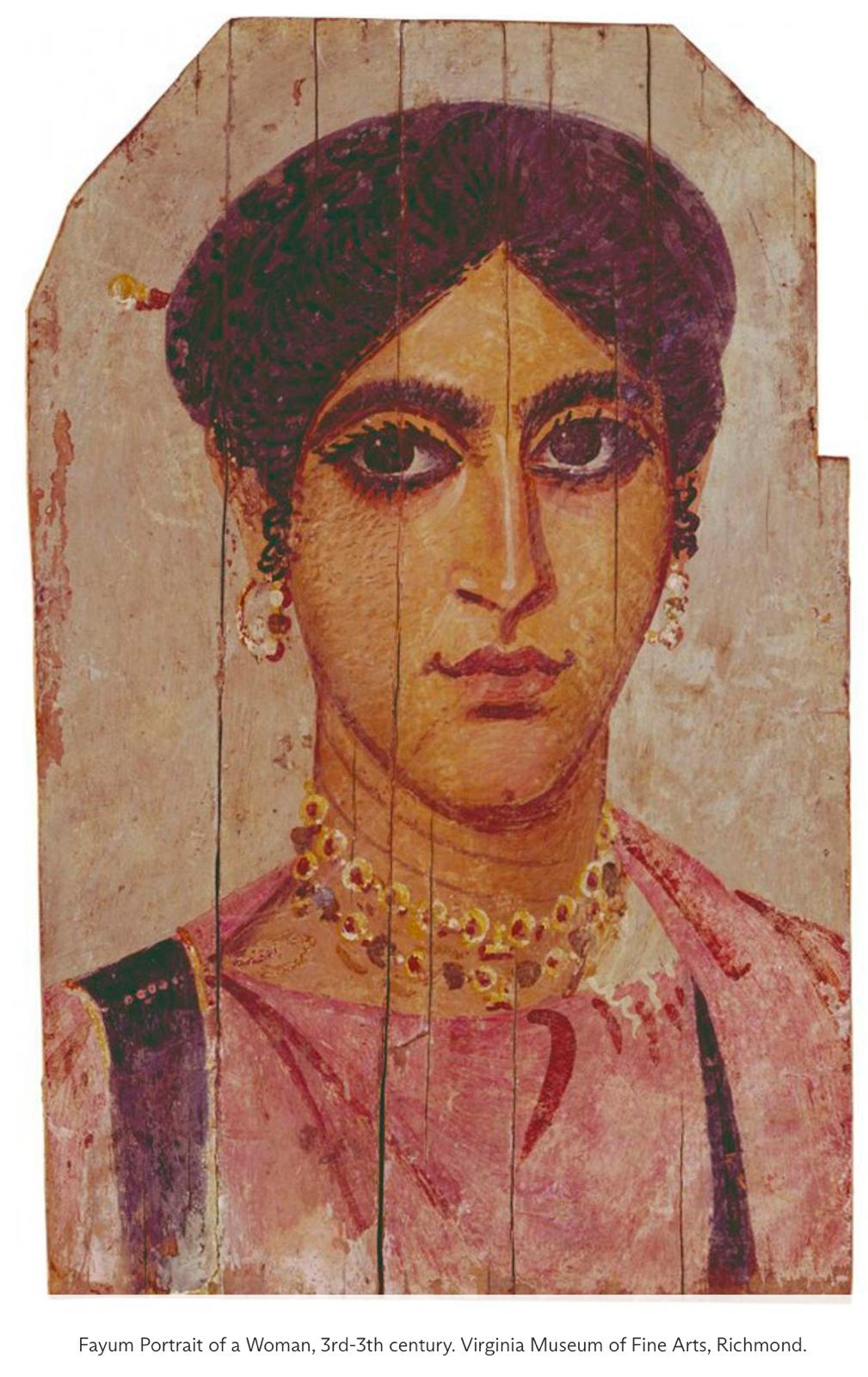
The richness of Anxious Girl is the result of a vibrant field of red Ben-Day dots which Lichtenstein uses to build up his fertile surface. The artist’s work was described by the critic Hal Foster as the ‘handmade readymade’ (quoted in “Pop Eye,” London Review of Books, Vol. 24, No. 16, August 22, 2002, online [accessed: 3/20/2026]): not industrially mechanized, but blending careful techniques of handwork (drawing, tracing, painting, emphasizing brushstroke, line, and Ben-Day dot mimicking commercial printing) with the aesthetics of reproduction. “It is not art trouvé but art retrouvé: refashioned, recovered, reframed. And in the process, the simplistic distinctions between making and manufacturing begin to dissolve” (S. Churchwell, “Roy Lichtenstein: From heresy to visionary,” The Guardian, February 23, 2013, online [accessed: 3/25/2026]). Although aping what he saw in the real world, Lichtenstein was clear that his lines and dots were not trying to recreate reality, and much like the tenets of the critic Clement Greenberg and his Abstract Expressionism forebears, they should just be celebrated for their visual properties alone.
“My use of evenly repeated dots and diagonal lines and uninflected color areas suggest that my work is right where it is, right on the canvas, definitely not a window into the world.”
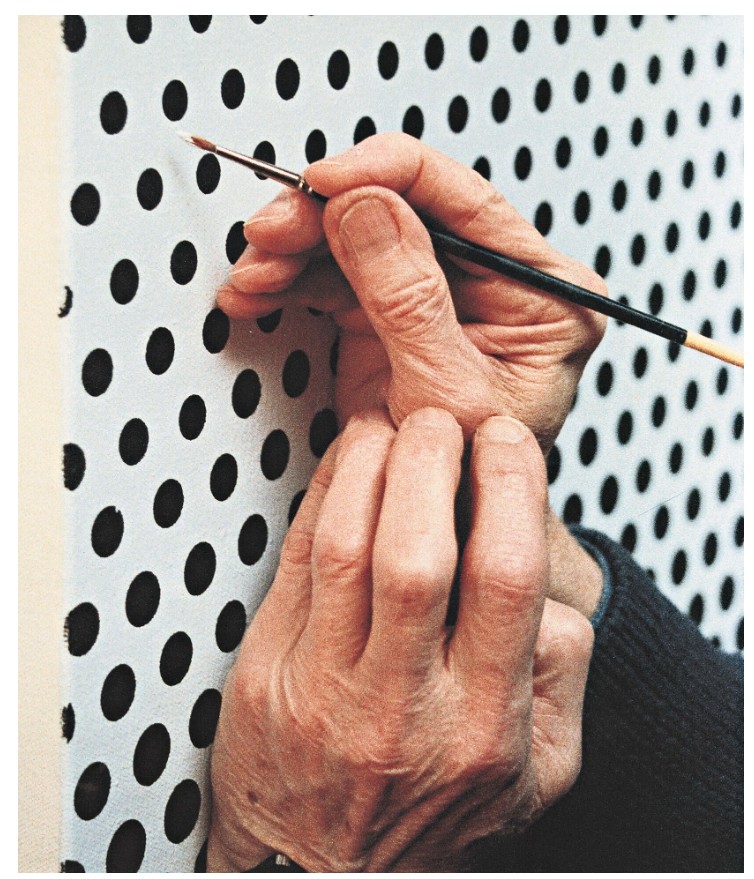
Roy Lichtenstein painting in his New York studio. Photo: © Bob Adelman. Artwork: © 2026 Estate of Roy Lichtenstein / DACS.
Color is an often-overlooked aspect of Lichtenstein’s work, yet the present work is an exceptional example of the artist’s use of vibrant pigment to heighten the palpable sense of drama conveyed by the image. Using just the primary colors (red, blue, and yellow), Lichtenstein places them in close proximity to create a visual tension. Ordinarily these pigments are opposites on the color wheel, separated by their intermediary secondary colors, but in the present work their close proximity produces a resonance which activates the image, bringing it alive with visual energy.
Thus, with Anxious Girl, Lichtenstein makes an important intervention in the history of portraiture. One of the oldest forms of painting, from the earliest days of human existence people have been reproducing their own likeness to permanently record their place in the world. Beginning with prehistoric hunting scenes drawn on the wall of caves, the portrait has evolved to become a representation of both the personal and the powerful. Used by kings and queens to establish and promote their power, and by parents to arrange suitable marriages, portraits have acted as memorials and tokens of love. After forty thousand years of portrait painting, Lichtenstein separated the subject of the painting from the emotion it induced, distilling centuries of painterly tradition to its most essential elements.
“I don’t draw a picture to reproduce it—I do it in order to recompose it.”
Lichtenstein’s radical analytical approach was a marked departure from those of his Pop Art contemporaries Andy Warhol and Claus Oldenburg and established his reputation as both a critically and institutionally important artist.
Anxious Girl comes with the exceptional provenance of having been acquired first by Horace and Holly Solomon, important collectors who became important early patrons of Pop Art. The Solomons were major figures in the New York art world of the 1960s and by the later years of that decade their apartment was filled with canonical works by Andy Warhol, Roy Lichtenstein, James Rosenquist, and Claus Oldenburg. In 1966 Holly Solomon commissioned Andy Warhol to produce his now famous nine-paneled portrait of her. Warhol decided to produce this portrait using the technique of silk-screening photo booth portraits that he had developed a few years earlier. The pair went off to Broadway and 42nd Street in New York with $25 in quarters to test each of the photo booths to find the one with the correct exposure that Warhol required for the look he was trying to achieve. Once Warhol had selected the booth, he left Solomon to take the photographs on her own. When the sessions were finished, she handed the strips of photographs to Warhol and told him to select whichever he thought best. The resulting portrait immortalized Solomon’s reputation as the ‘Princess of Pop,’ a persona further enhanced by other artists who immortalized Solomon including Robert Mapplethorpe, Richard Artschwager, Robert Rauschenberg, and Roy Lichtenstein.
The Solomons enjoyed a long friendship with Lichtenstein that lasted many years, resulting in the couple making a number of acquisitions and commissions of the artist’s work. Initially, Horace had read an article about Lichtenstein and, having tracked him down through his gallery, acquired the first work by the artist that the couple owned. “For Horace,” Holly Solomon later recalled, “the work expressed both his childhood and his memories of a popular childhood idiom of American culture—the comic strip” (quoted in H. Solomon and A. Anderson, Living with Art, New York, 1988, p. 202). In 1966, Solomon asked Lichtenstein if he too would paint a portrait of her, just as Warhol had done. In an oral interview with the Roy Lichtenstein Foundation archive, she recalled the process. “I asked Roy if he’d do the portrait…Roy said we should show him our favorite cartoons…I picked out a few comic books…I just said to Roy, ‘Whatever you like, Roy, you just do the damned portrait.’ All I cared about was that the lips should say, ‘I, sorry.’” The resulting portrait, I… I’m Sorry!, hung for many years in the Solomon’s family room and is now in the permanent collection of The Broad in Los Angeles. Other later Solomon acquisitions of Lichtenstein’s work included the Surrealist inspired Swimming Figure with Mirror (1977) and the sculpture Double Glass (1979).
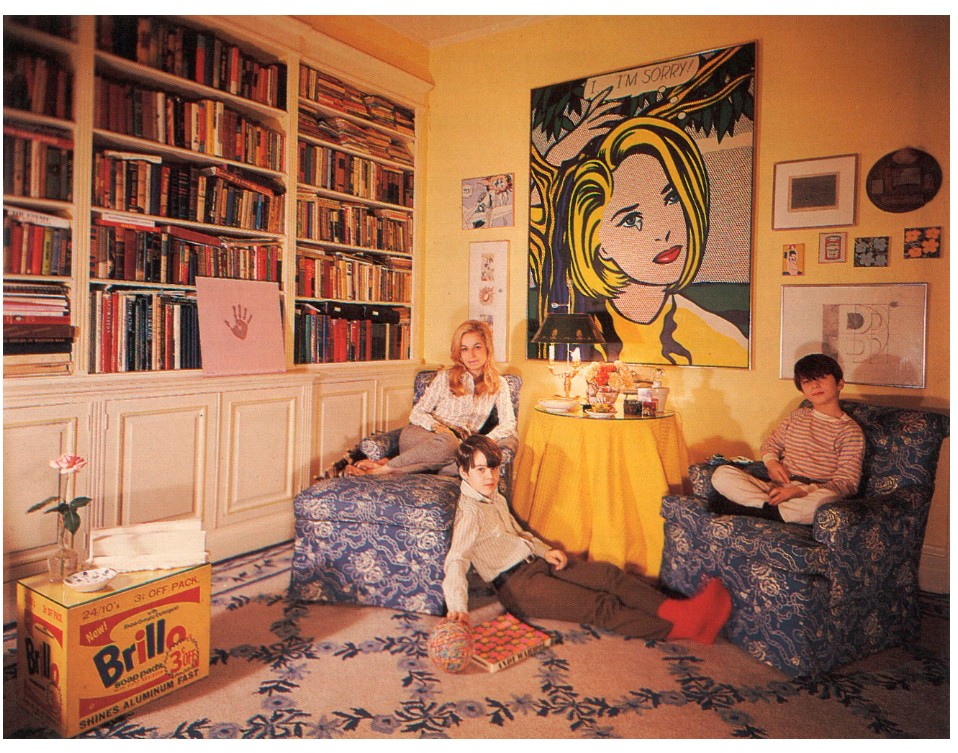
Holly Solomon in her apartment with her two sons, beneath the portrait Roy Lichtenstein painted of her in 1964, I’m… I’m Sorry (now in the collection of The Broad, Los Angeles), New York, 1988. Photo: © 2026 by John Hall. Artwork: © 2026 Estate of Roy Lichtenstein / DACS.; © 2026 The Andy Warhol Foundation for the Visual Arts, Inc. / Licensed by Artists Rights Society (ARS), New York.
What is remarkable about Lichtenstein’s paintings is that his reductive style obscured his intentions in a way that made the paintings both accessible to the general public and intriguing to critics. But it was this tension between style and subject matter that was the foundation of his practice. He chose comics as they were culturally ‘low art’ and transformed them into ‘high art’.
“I was interested in anything I could use as a subject that was emotionally strong – usually love, war, or something that was highly charged and emotional subject matter to be opposite to the removed and deliberate painting techniques. Cartooning itself usually consists of very highly charged subject matter carried out in standard, obvious, and removed techniques”
Lichtenstein certainly found in this material a potential for the dispassionate portrayal of exaggerated emotion. The paradox of his work has always remained that its outward embrace of quotidian imagery belies an inward concern for art as arrangements of colors and shapes. It is as if he has taken Mondrian’s emphasis on the inherent flatness of the picture plane and combined it with the concept of the Duchamp readymade. But instead of producing something dry and cerebral he has created a painting that is sensual, ironically witty, and full of energy.
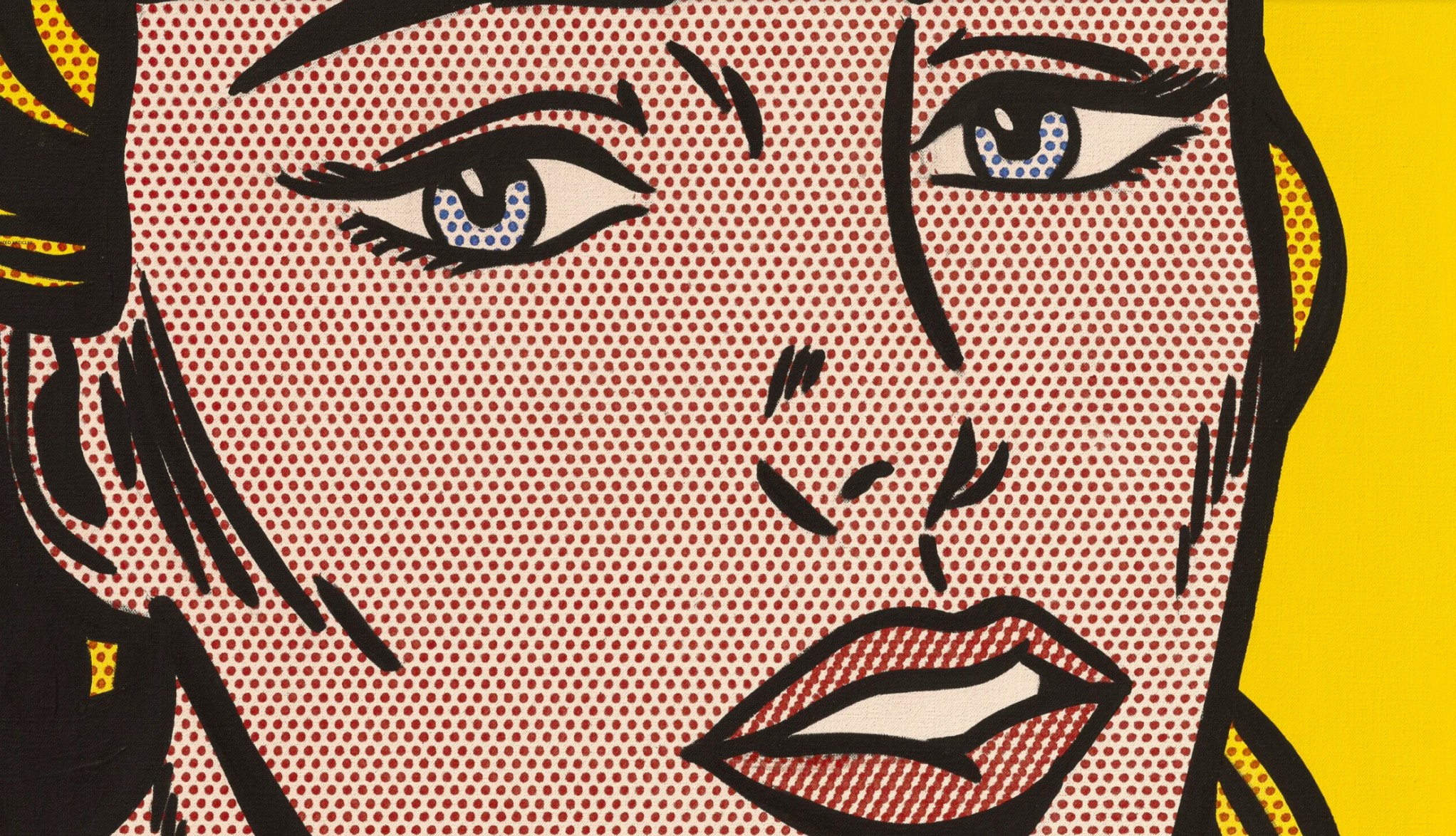
Throughout his career, Roy Lichtenstein produced a complex and varied body of work. His paintings engage the viewer in questions of visual perception, by subverting the illusion of representation. His paintings resulted from his preoccupation with the formal qualities of art and the complex task of representing the ephemeral quality of artistic illusionism. Anxious Girl is the result of his dilemma of how to produce a three-dimensional object whilst still retaining the aesthetic qualities of his two-dimensional work. His unique solution was to combine the solidity and clean lines and Ben-Day dots with the pure, rich color pigment a burst of three-dimensional surreal illusionism. In doing so he not only examines the ways in which a contemporary audience applies meaning and value to the most basic visual signs, but by using post-impressionist masterpieces as his starting point, highlights how this has changed over the decades.
Half Face with Collar, 1963
Half Face with Collar, 1963
Sotheby’s New-York: 14 May 2026
Estimated: USD 10,000,000 – 15,000,000
USD 12,985,000
Roy Lichtenstein | Half Face with Collar | The Now & Contemporary
ROY LICHTENSTEIN (1923 – 1997)
Half Face with Collar, 1963
Oil, acrylic and graphite on canvas
48 x 47-3/4 inches (121.9 x 121.3 cm)
Signed and dated ‘63 (on the reverse)
At once enigmatic and immediately legible, Half Face with Collar by Roy Lichtenstein stands as a compelling meditation on masculinity in the 1960s cultural imagination within the artist’s groundbreaking comic-strip series. Emerging at a pivotal moment in his career, the work distills the visual language of mid-century American popular culture into a tightly cropped, psychologically charged image of the male figure, at once assertive and elusive.
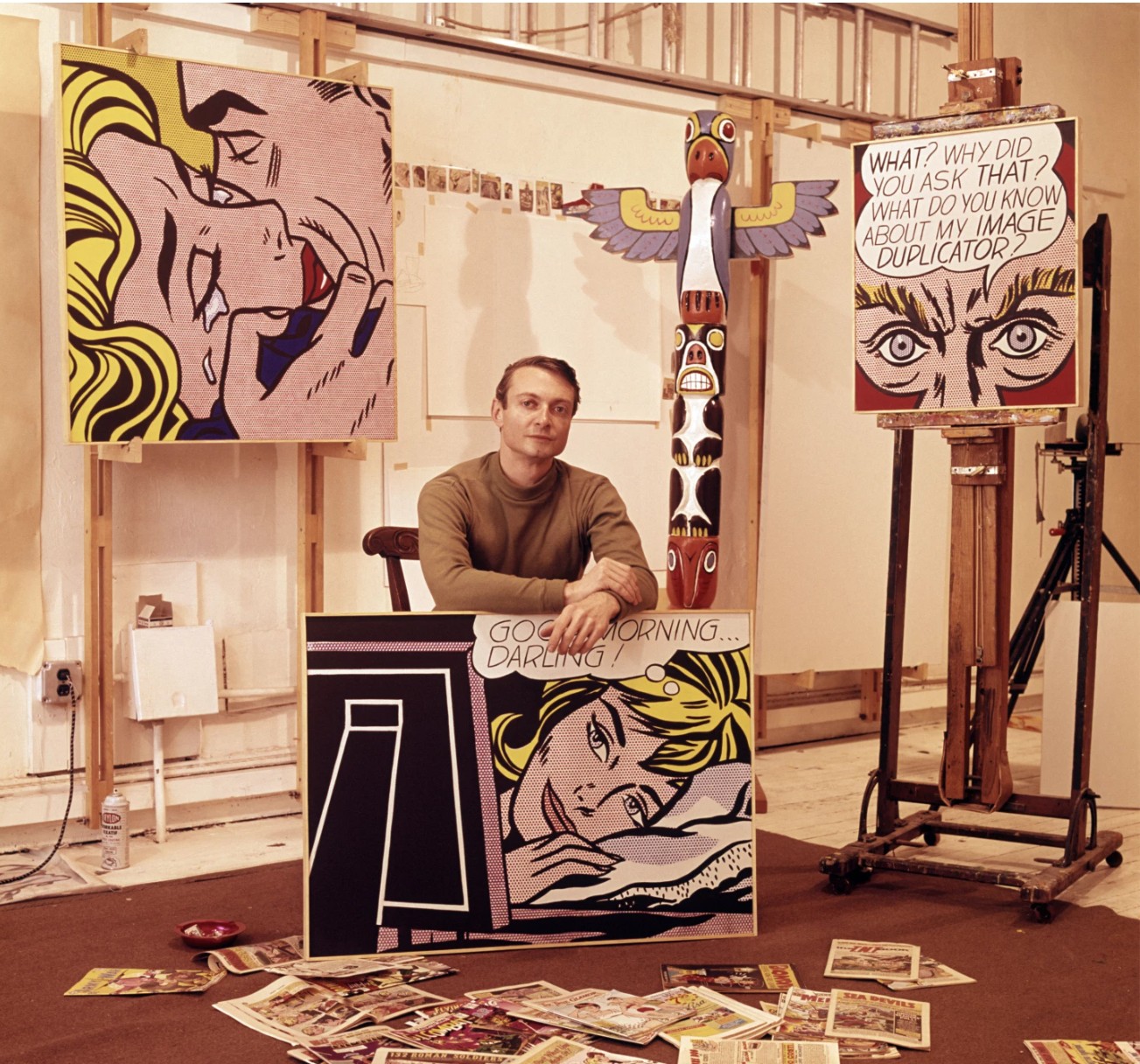
Roy Lichtenstein pictured alongside Kiss V, Image Duplicator, and Good Morning… Darling!, 1964.
Photo by Mario De Biasi\Mondadori via Getty Images. Art © Estate of Roy Lichtenstein
Within the comic series amongst Lichtenstein’s famed heroines, in the present work, we are introduced to his leading man, seductively adjusting his collar in the moment before he approaches her. As both an exemplar of his celebrated comic series and a rare, incisive treatment of the male subject, Half Face with Collar encapsulates the artist’s capacity to transform the vernacular of mass media into an image of enduring intrigue and complexity.
“In these cartoon images… It is an intensification, a stylistic intensification of the excitement which the subject matter has for me; but the style is, as you say, cool. One of the things a cartoon does is to express violent emotion and passion in a completely mechanical and removed style.”
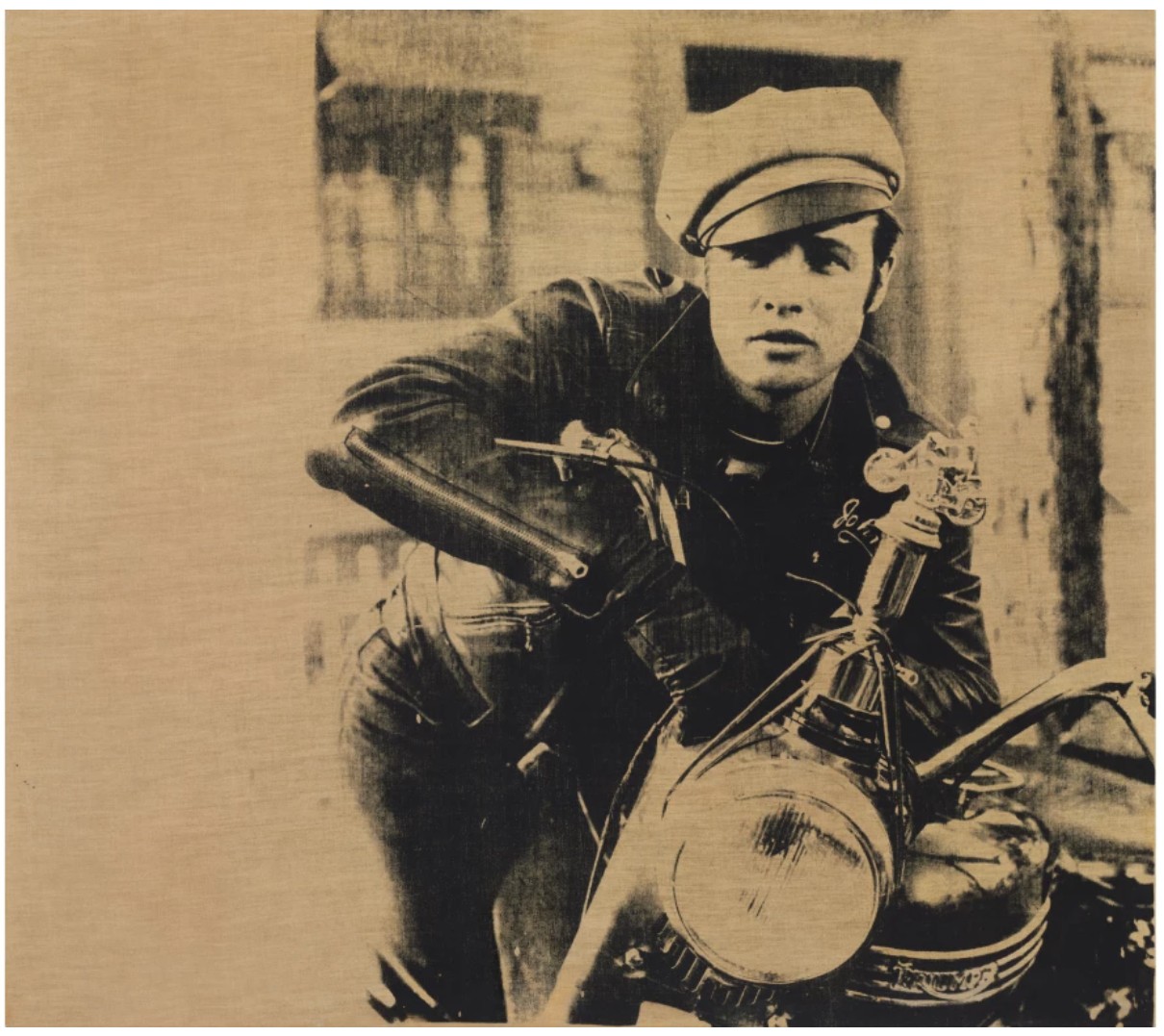
Andy Warhol, Marlon, 1966. Private Collection.
Image © 2026 The Andy Warhol Foundation for the Visual Arts, Inc. / Licensed by DACS, London / Christie’s Images / Bridgeman Images.
Art © 2026 Andy Warhol Foundation for the Visual Arts / Artists Rights Society (ARS), New York
Lichtenstein is acknowledged as the master of graphic clarity and an innovator of image appropriation who crafted Pop Art masterpieces that redefined the boundaries between High and Low art through an ironic interplay of popular culture and fine art. His comic strip-inspired paintings of Romance and War subjects, derived from everyday common sources, are now themselves cultural talismans of the late 20th century. His borrowings from commercial printing techniques were prescient harbingers of the increasing influence of a media-saturated world. Along with other Pop artists such as Warhol, Lichtenstein’s style and frame of reference was a conscious step away from tradition, whether in the classical mode of narrative composition or the emphasis on the artist’s touch championed by the more recent Abstract Expressionists.
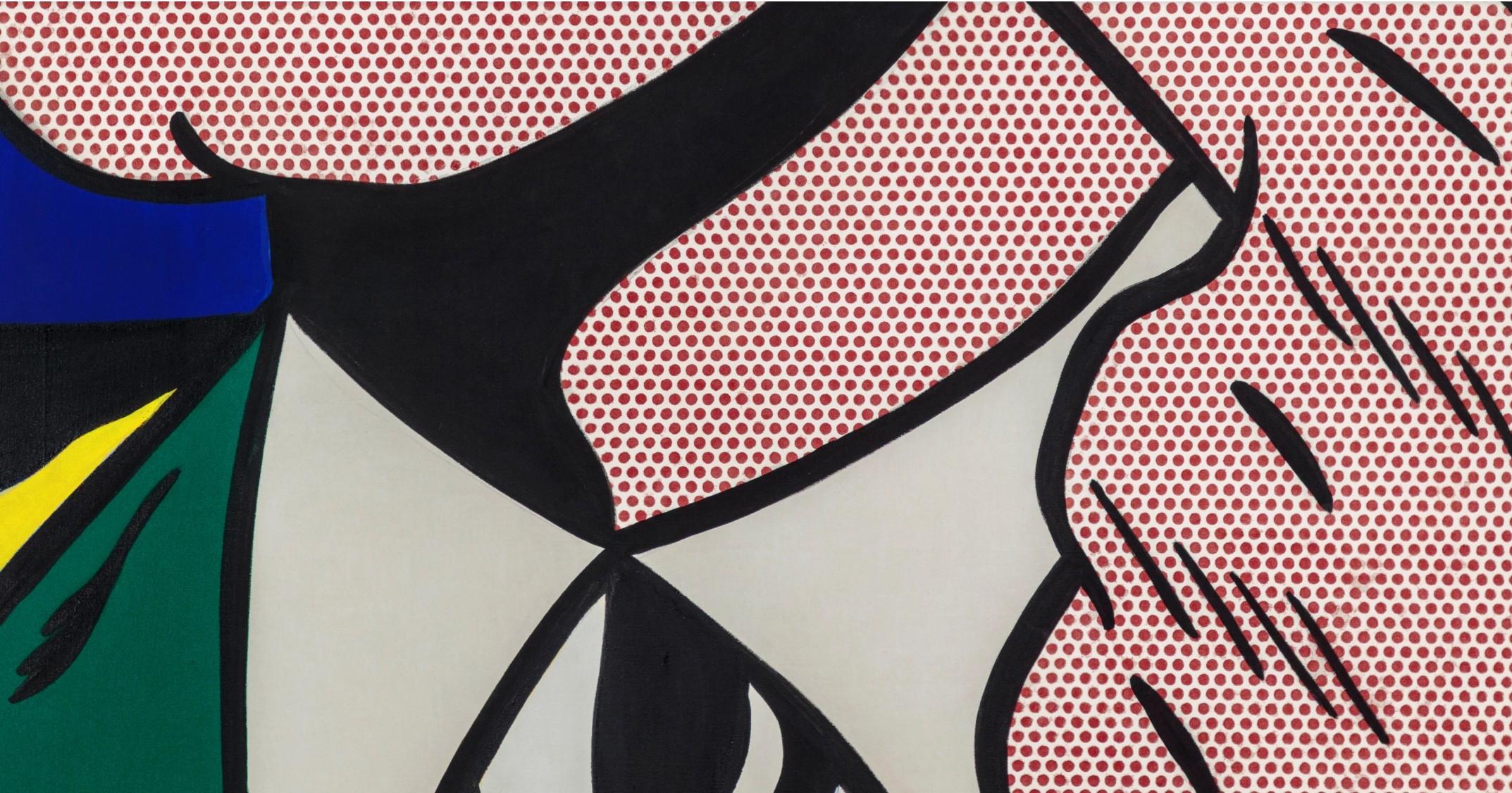
Rendered through Lichtenstein’s now-iconic vocabulary of Benday dots, bold black contours, and a restricted primary palette, the composition presents a dramatically cropped male face, its fragmentation heightening both its visual immediacy and narrative ambiguity. This exacting and precise cropping isolates a charged fragment of a larger scene, focusing on the mouth as it opens to speak, ready to chase after his heroine, distilling this gesture of anticipation. In such, Lichtenstein converts his signature text bubbles of prescribed meaning into the moment before they are to appear. In such, the comic comes alive. This dramatic vignette champions the coded symbols of masculinity—the firm jawline, crisp white collar, and the gripping hand. The viewer is offered only a partial view, and in that withholding, the figure acquires a heightened allure as his story remains just beyond reach.
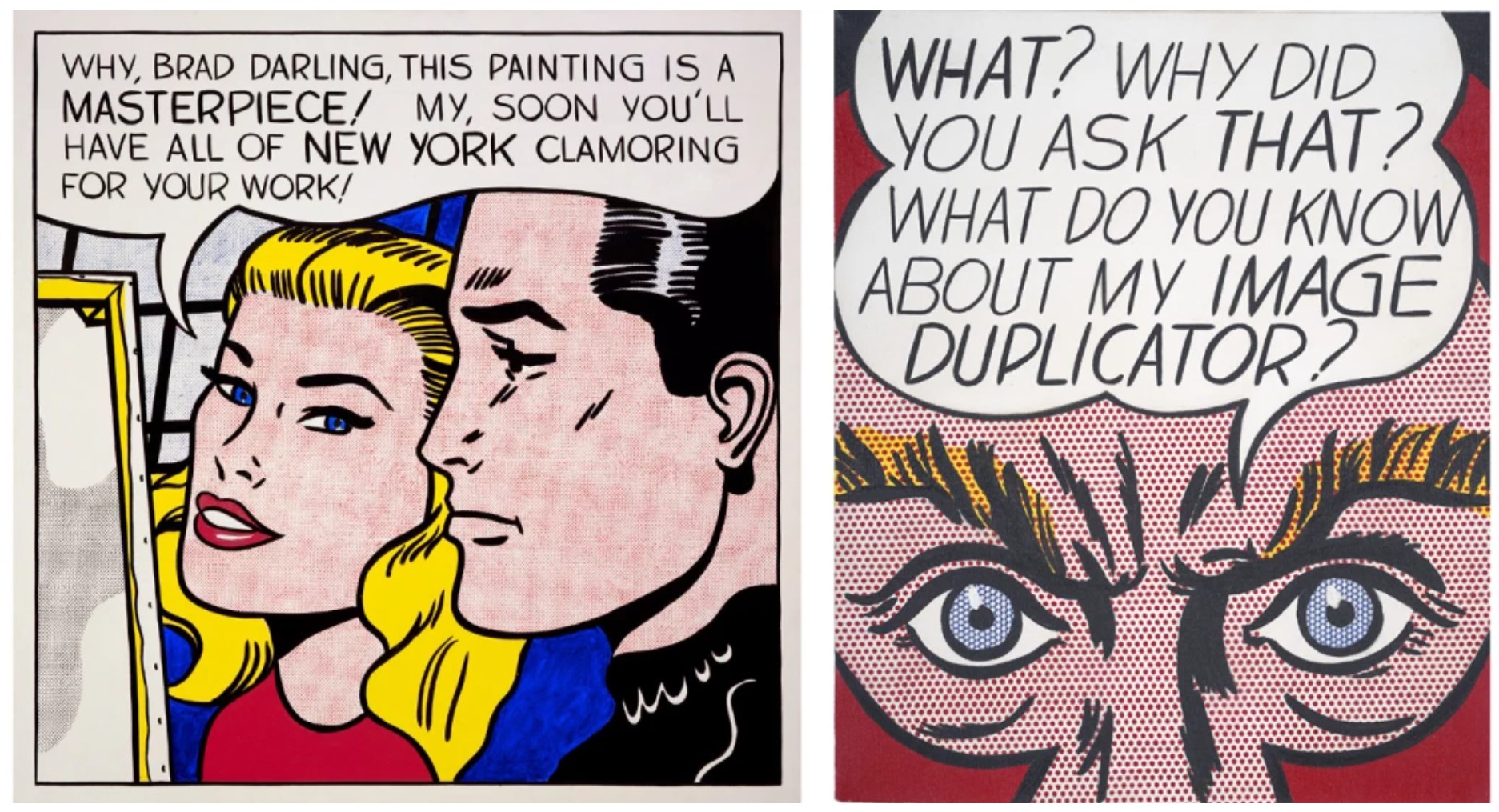
Left: Roy Lichtenstein, Masterpiece, 1962. Private Collection. Art © Estate of Roy Lichtenstein.
Right: Roy Lichtenstein, Image Duplicator, 1963. Private Collection. Art © Estate of Roy Lichtenstein
While such masterpieces in Lichtenstein’s Pop art oeuvre are lush with female protagonists and have become icons in our present day, a tracing of the male image in his work is exceptionally rare. Outside of the War comic scenes, Lichtenstein’s men are more often placed alongside their female foils. However, in the present work, a similar male visage is indisputably present in Lichtenstein’s masterworks, namely Masterpiece and Kiss with Cloud, thus making this example a rare portrait of the man we know and have seen before, with his lover just off screen. From the captivating stretch of his collar, on the brink of revealing his next words, the anticipation is felt by the heroine just out of frame. Here, Lichtenstein’s shrewd gift for perceiving the precise gesture and the most effective cropping is unmistakable, transforming a fleeting comic-book moment into a compelling and self-sufficient image of masculine identity. Unlike the explicitly staged drama of works such as Forget It! Forget Me!, the subliminal narrative here requires no caption and no other actors; masculinity is conveyed through visually immediate tension and the suggestive incompleteness of the scene. Further emphasizing this work’s place among Lichtenstein’s innovative experimentations with more classic formal compositions, in eschewing his text bubbles and replacing them with the tangible moment before speech, the artist reaches a conceptual apex of artistic theory and possibilities for subliminal action within the style of Pop Art.
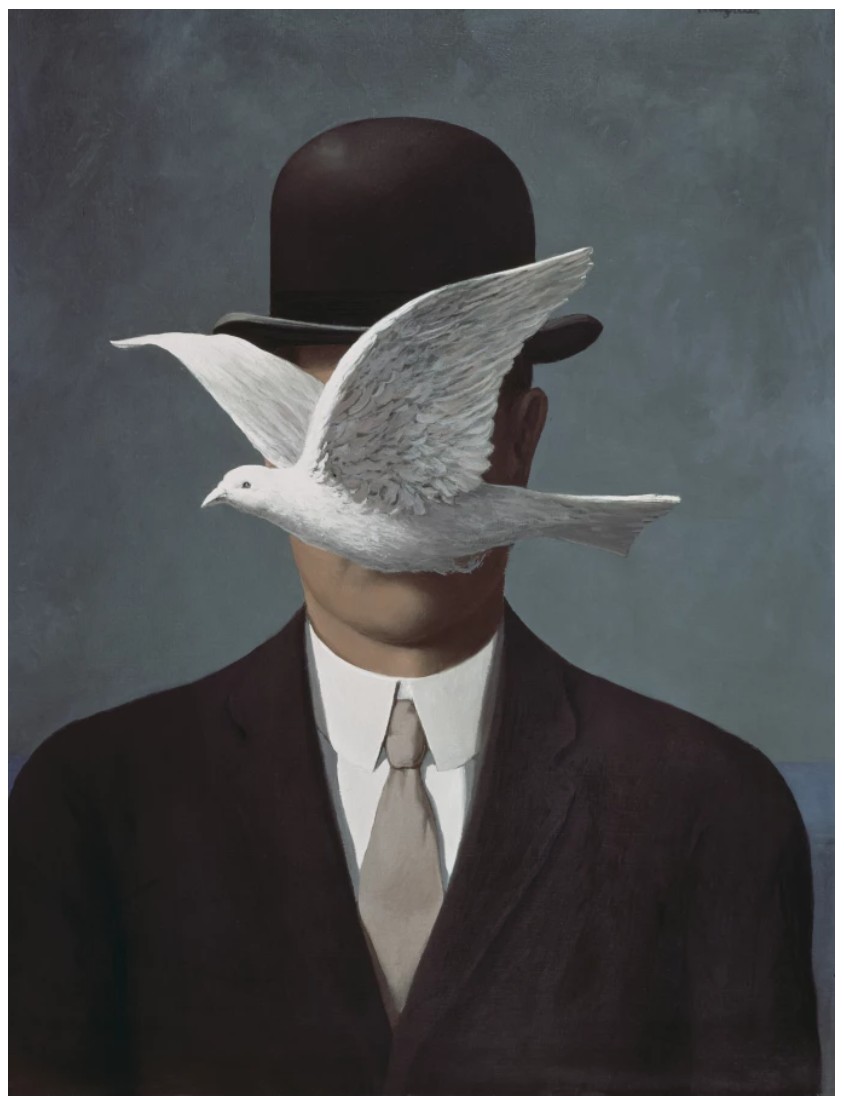
René Magritte, Man in a Bowler Hat, 1964. Private Collection. Image © Superstock / Bridgeman Images.
Art © 2026 C. Herscovici, Brussels / Artists Rights Society (ARS), New York
Yet Half Face with Collar, and other comic-strip inspired paintings of the early 1960s, define one of the ironies of this Pop innovator—Lichtenstein’s innate gift for editing to capture the telling gesture of an emotive moment. Hostile critics once ridiculed him as an “image duplicator” who copied arbitrarily gleaned trite images. But in fact, the study of the artist’s copious sourcebooks of clippings reveals the extent to which he manipulated his chosen imagery with as keen an eye for composition and effect. Lichtenstein never copied an image wholesale; it is in the subtle manipulation and refinement of these appropriated sources that his true genius resides.
“The difference is often not great but it is crucial: It becomes a very exaggerated, a very compelling symbol that has almost nothing to do with the original.”
By reducing all extraneous pictorial detail and narrative traces to an absolute minimum, Lichtenstein bestows the image with an emblematic fixity. Yet this quotation of an appropriated image and borrowing of implied narration may be the subject of the work, but it is not its sole content. The artist offers a non-specific, descriptive title that states the facts without leading us into the story; the interpretive burden is shifted to the viewer.
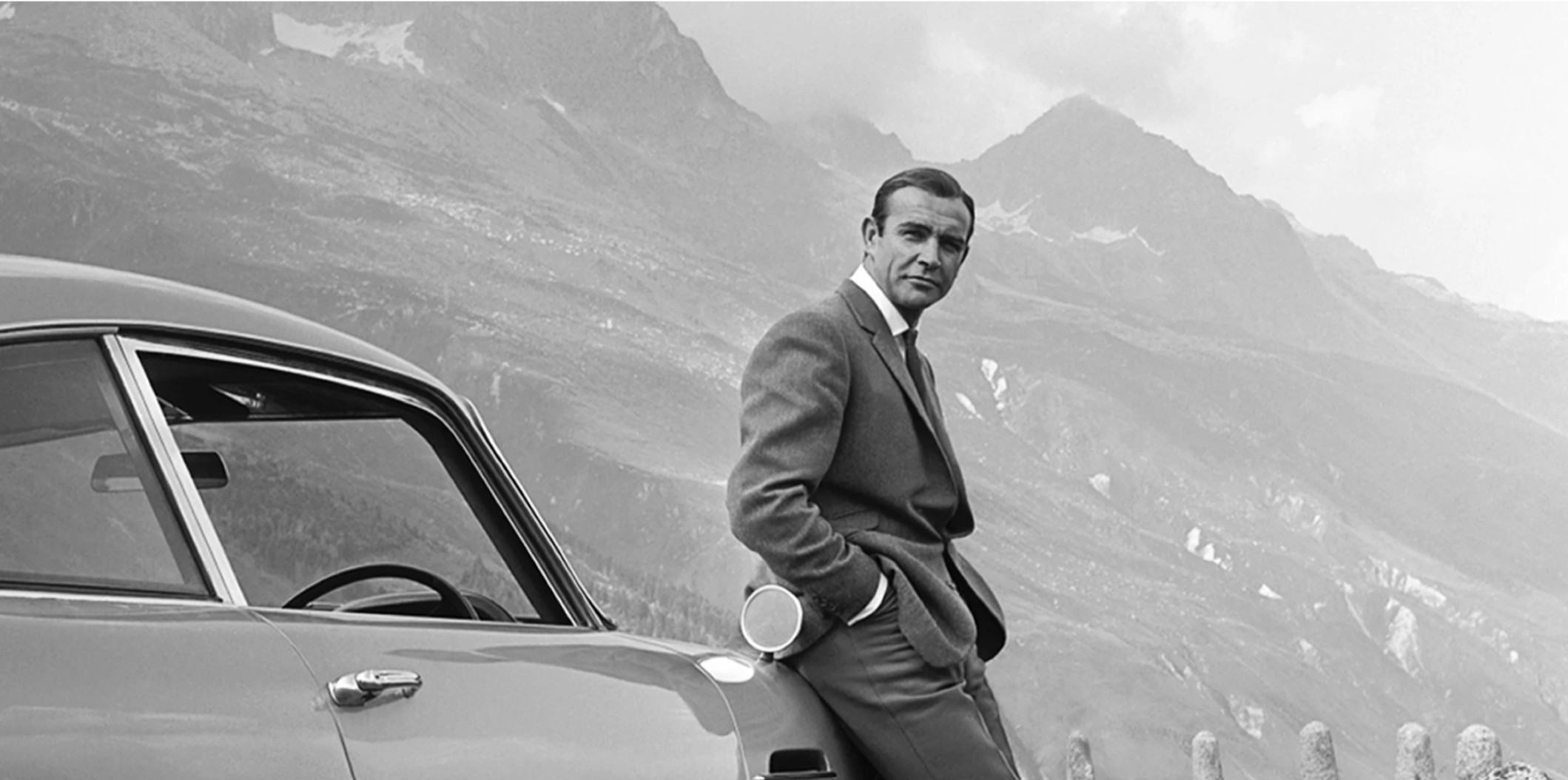
Actor Sean Connery poses as James Bond next to his Aston Martin DB5 during the filming of ‘Goldfinger,’ 1964.
Photo by Michael Ochs Archives/Getty Images
Lichtenstein’s Pop images, like the present work, are seductively pleasing to the eye, but, on a deeper level, they are testaments to the power of the image. By removing his chosen image, often a cliché, from its source, Lichtenstein ultimately turns the painting into a receptor of perception rather than a conveyor of information. It is the viewer who becomes the interpreter, and Lichtenstein’s ultimate engagement is to investigate the very nature of art itself. As Poul Erik Tøjner wrote, “You see a trace, a sign—but its origin is blocked off. In other words, you see something that isn’t there. What you see is what you don’t see… [It] points to the heart of Lichtenstein’s art, which revolves around the paradox of visibility: the clearer the figures appear in his work, the more they are hidden.” (exh. cat., Humlebaek, Louisiana Museum of Modern Art, Roy Lichtenstein: All about Art, 2003, p. 12)
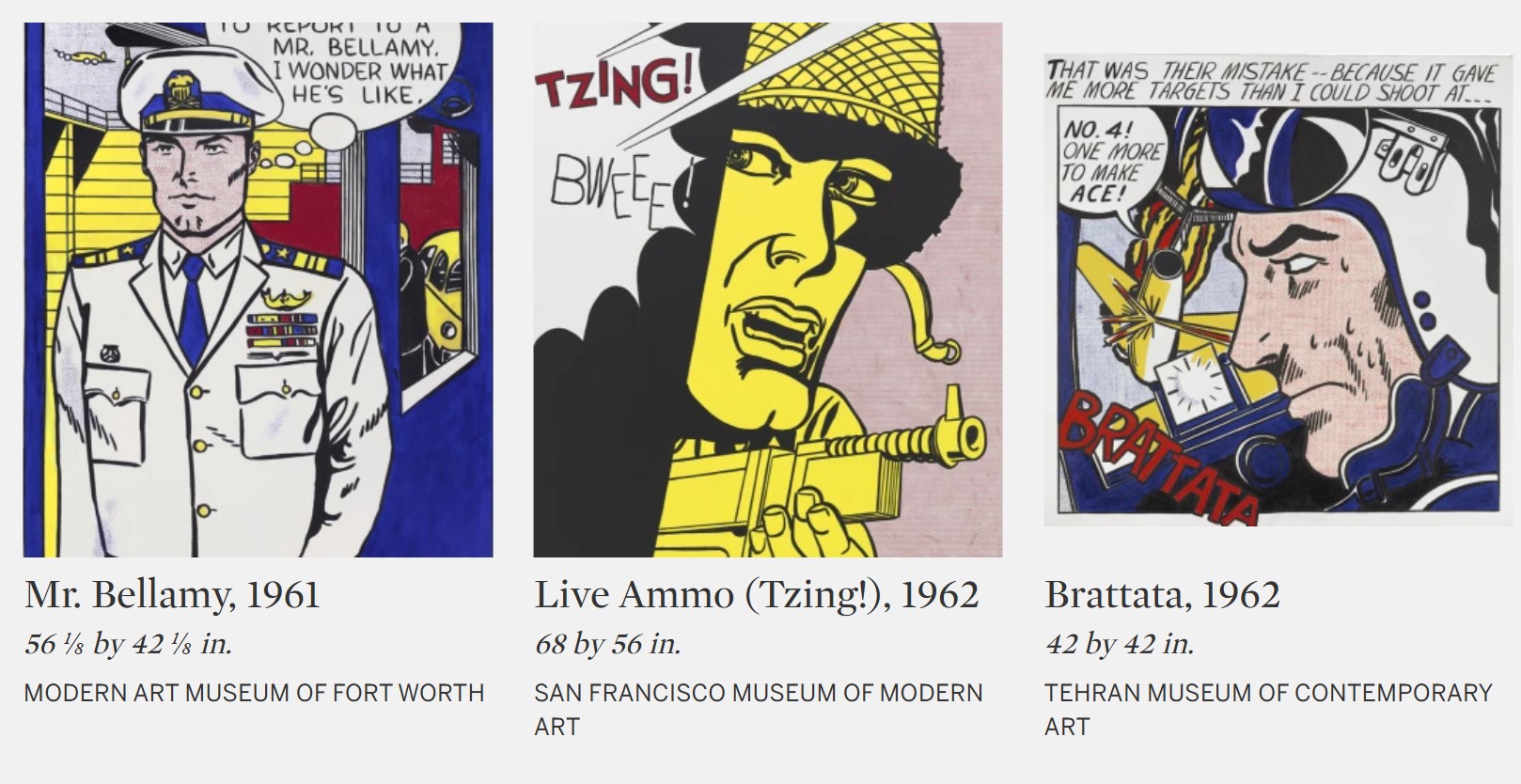
Comparable Lichtenstein 1960s Portraits in Select Museum C
The leading men in Roy Lichtenstein’s most iconic comic-strip paintings constitute a thunderous vision of masculinity shaped by the forces of mass media. Rendered with bold outlines and his signature Ben-Day dots, these figures, whether caught in moments of battle, corporate ambition, or romance, become striking emblems of the American imagination in the 1960s. Drawn from his celebrated comic series, such works are exceptional examples of Lichtenstein’s portraits, underscored by their presence in leading museum collections worldwide.
From the vantage point of Lichtenstein’s mature career, it becomes clear that his subject was not merely the fusion of popular culture with fine art, but a sustained investigation into the nature and limits of representation. In Half Face with Collar, the image is not a closed, autonomous world but an open construction—its content, by definition, extending beyond the frame, into the unseen presence addressed by the figure and completed only through its confrontation with us, each time anew. In its synthesis of formal precision, cultural observation, and subtle psychological tension, Half Face with Collar stands as a masterful articulation of Lichtenstein’s vision. The work’s tightly framed composition and mysterious subject transform a fragment of comic imagery into a compelling study of masculinity—simultaneously assertive and elusive, constructed yet captivating. It is precisely this balance of clarity and ambiguity, immediacy and absence, that secures its place among the most iconic and intellectually resonant works of the artist’s celebrated comic series.
Voodoo Lily, 1961
Voodoo Lily, 1961
Masterpieces: The Private Collection of S.I. Newhouse
Christie’s New-York: 18 May 2026
Estimated: USD 6,000,000 – 8,000,000
USD 5,565,000
ROY LICHTENSTEIN (1923-1997), Voodoo Lily | Christie’s
ROY LICHTENSTEIN (1923-1997)
Voodoo Lily, 1961
Oil on canvas
32-1/8 x 20 inches (81.6 x 50.8 cm)
Signed, signed with the artist’s initials, dated and titled ‘rf Lichtenstein ’61 VOO-DOO LILY rfl’ (on the reverse)
An exceptionally rare and early Pop painting by one of the movement’s most critical architects, Voodoo Lily reveals Roy Lichtenstein’s formal and aesthetic maturity, laying the groundwork for several of his later series. Painted in 1961, the first year Lichtenstein began working in his iconic Pop manner, the work demonstrates the artist’s commitment to commercial art, his careful study of his modern forebearers, and his skillful technique, choreographing black and white paint against a neutral ground spotted with an early appearance of his most recognizable motif—the Ben-Day dot. The painting is one of only two black-and-white floral still life paintings Lichtenstein made—the other, Black Flowers, 1961, is in The Broad, Los Angeles—and one of the only three flower paintings Lichtenstein made in the 1960s, before returning to the motif in his later Still life series in 1974.
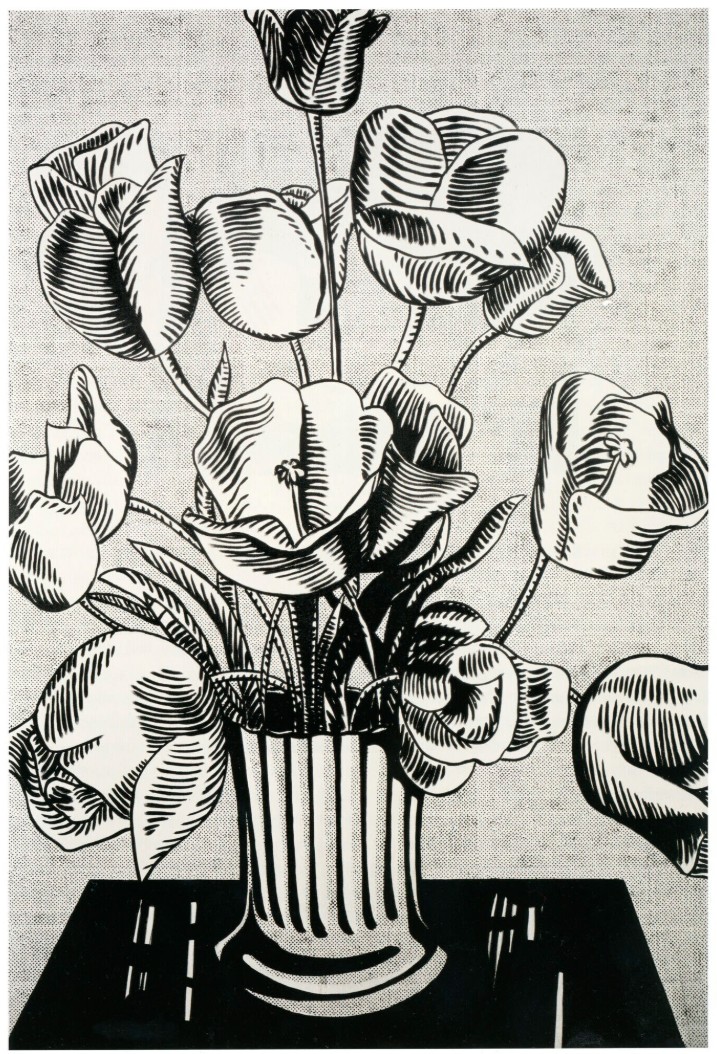
Roy Lichtenstein, Black Flowers, 1961. The Broad, Los Angeles. © Estate of Roy Lichtenstein. © 2026 Estate of Roy Lichtenstein / DACS.
Appropriating imagery from a newspaper advertisement marketing flower seeds, Voodoo Lily is one of Lichtenstein’s first forays into the creative potentials of mass-produced visual media, created in tandem with iconic comic paintings such as The Engagement Ring (1961, private collection), The Kiss (1961, private collection), and Look Mickey (1961, National Gallery of Art, Washington, D.C.). His concurrent series of black-and-white paintings, which includes Bathroom (1961, Whitney Museum of American Art, New York) as well as the present work, embody the artistic innovations which precipitated the birth of Pop in 1961. “The Lichtenstein we instantly recognize today as ‘Lichtenstein’ was presented to the New York art world in 1961,” the critic and curator Robert Pincus-Witten writes. “Overnight, it seemed, he was the embodiment of that intensely innovative moment when Pop art was born” (R. Pincus-Witten, “Connecting the Dots,” in Roy Lichtenstein: Early Black and White Paintings, exh. cat., Gagosian Gallery, New York, 2001, p. 69).
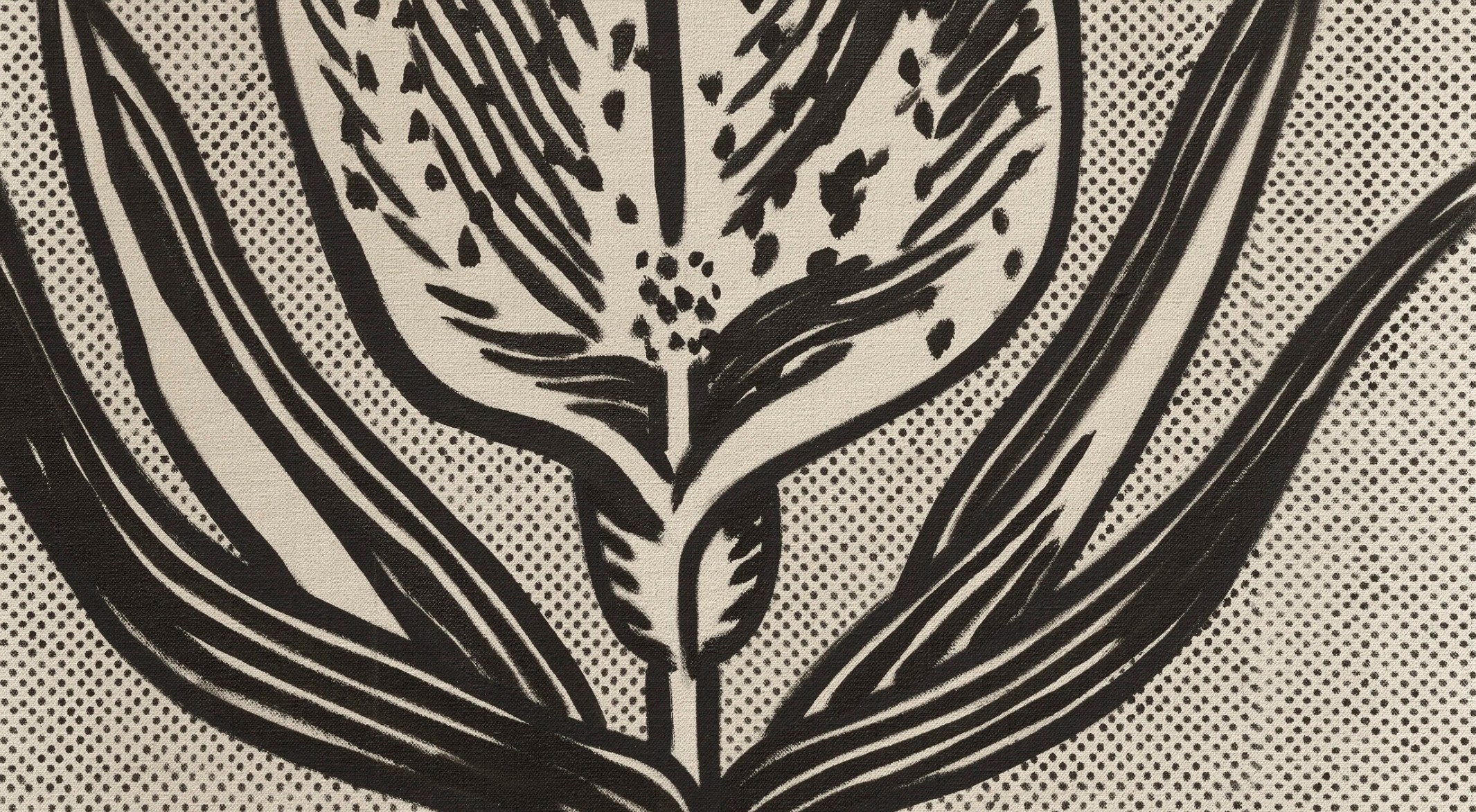
With refined technical skill, Lichtenstein brings to bear his newly discovered minimal vocabulary to the vaunted tradition of Western flower painting in Voodoo Lily. The artist first rescaled his source image using a projector, tracing the outline of the image onto his canvas while simultaneously adjusting the composition to account for scaling distortions. The art historian Robert Rosenblum describes Lichtenstein’s technique for this work, writing how, “prompted by the most low-budget, color-free illustrations in seed catalogues, Lichtenstein could make any decorator cringe by painting flowers in printer’s-ink black and white. With his black thumb, he translated the fragile leaves and blooms of his tulips and lilies into coarsely enlarged hatching, and, with equally crude streaks of white, evoked the ephemeral reflections on a tabletop” (“Roy Lichtenstein’s ‘Rhapsody in Black and White,’” in ibid., p. 14). The resulting effect was one of “unexpected refinement,” Lichtenstein here reworking his unrefined source into a revolutionary new artistic language. Voodoo Lily marks one of the first examples of Lichtenstein elevating an ephemeral mass-produced commercial image into a unique work of art, a hallmark of the new Pop movement and an enduring aspect of Lichtenstein’s mature works. “[Lichtenstein’s] inventiveness is rooted in imitation,” write James Rondeau and Sheena Wagstaff. “He transformed the very idea of borrowing into a profoundly generative, conceptual position, one that alters the trajectory of Modernism, and beyond. His ephemeral sources are reformed as enduring, precious objects. The works on canvas often look convincingly machine-made, but they are entirely dependent on drawn studies and painted by hand. Impersonal in their collective provenance, they are counterintuitively autographic in their finish” (J. Rondeau and S. Wagstaff, Roy Lichtenstein: A Retrospective, exh. cat., The Art Institute of Chicago, 2012, p. 20).
Voodoo Lily is an outstanding early example of Lichtenstein’s painterly mimicry of machine-made imagery. His choice to maintain the referent image’s austere monochromatic palette emphasizes the composition’s origin, revealing the vulgar commercial source of his floral motif. In contradistinction to Andy Warhol’s Flowers series begun three years later, where Warhol mechanically warped images of hibiscus flowers published in a magazine to make the flowers appear flattened and distorted, enabling him to reproduce the image in large quantities, Lichtenstein elevated his ubiquitous image into an original painting. The Ben-Day background, inspired by the printing process of comic book and commercial images, is equally essential to his ensuing work. “Dots are a critical thing,” Lichtenstein later described (quoted R. Pincus-Witten, op. cit., p. 71). The painting witnesses an early appearance of his dot pattern, which Lichtenstein first utilized earlier that year in Look Mickey; they lack the machine precision of his later works, adducing a more handmade quality to the work. The Ben-Day dot pattern was first invented for advertising and comics as a cursory and economic way to print indications of volume—as the background to Voodoo Lily, it achieves a two-plane relationship while emphasizing the linear rather than volumetric aspects of the composition, flattening the floral subject in a similar way to Warhol’s silkscreened Flowers. While in this case, Lichtenstein adds a table ledge to adduce a sense of perspective, in his later black and white single-object paintings he places his subject against a Ben-Day void. While uniform from afar, the background in Voodoo Lily has subtle skips and jumps, with some rows of dots impinging on neighboring forms. These imperfections document Lichtenstein’s earliest exploration of his Ben-Day technique, as he was first experimenting with different brushes and stencils to achieve his desired result. As the art historian Harry Cooper notes, these skips mimic printing errors in comic books and advertising as well: “Lichtenstein was a connoisseur of such imperfections, carefully soliciting the look of poor registration” (“On the Dot,” in Roy Lichtenstein: A Retrospective, op. cit., p. 28).
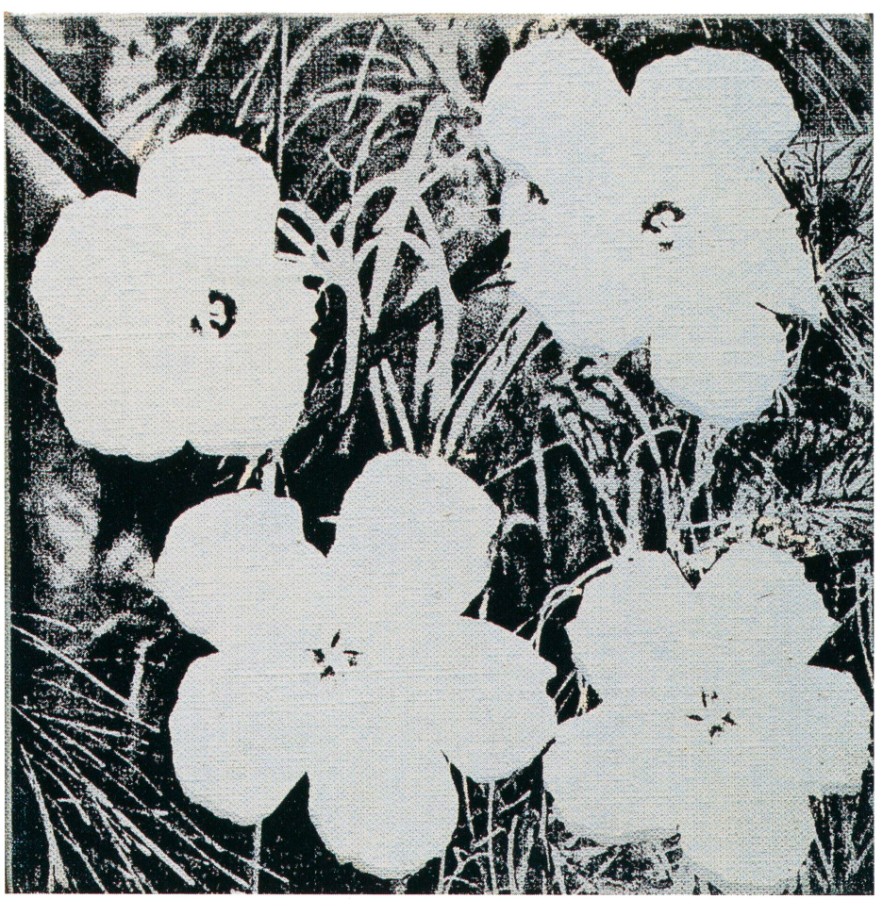
Andy Warhol, Flowers, 1965. Collection of Cy Twombly, Rome. Artwork: © 2026 The Andy Warhol Foundation for the Visual Arts, Inc. / Licensed by Artists Rights Society (ARS). Photo: Mimmo Capone, Rome.
Lichtenstein valued his black-and-white paintings for both their fidelity to his chosen source images and to their esteemed art historical resonances.
“Mondrian used black and white and the primary colors. He was an obvious one to do so and so was Picasso, in that Picasso is thought of as using simple colors and shapes surrounded by black lines”
By taking up the two ‘non-colors,’ for his composition, Lichtenstein continued an artistic investigation into the effects of monochrome inaugurated by Jan van Eyck’s grisaille Annunciation diptych and explored in the black-and-white paintings of Robert Motherwell, Franz Kline, Jackson Pollock, Willem de Kooning, and Frank Stella. Lichtenstein’s use of black and white was, in tandem with Warhol’s black-and-white paintings, in juxtaposition to the previous generation of New York school painters. “The raw economy (both financial and visual) of the commercial artist’s diagrammatic use of black and white gave an equally new spin to memories of the austere pictorial language used by artists who clung to a faith in abstract art,” Rosenblum notes (R. Rosenblum, op. cit., p. 12).
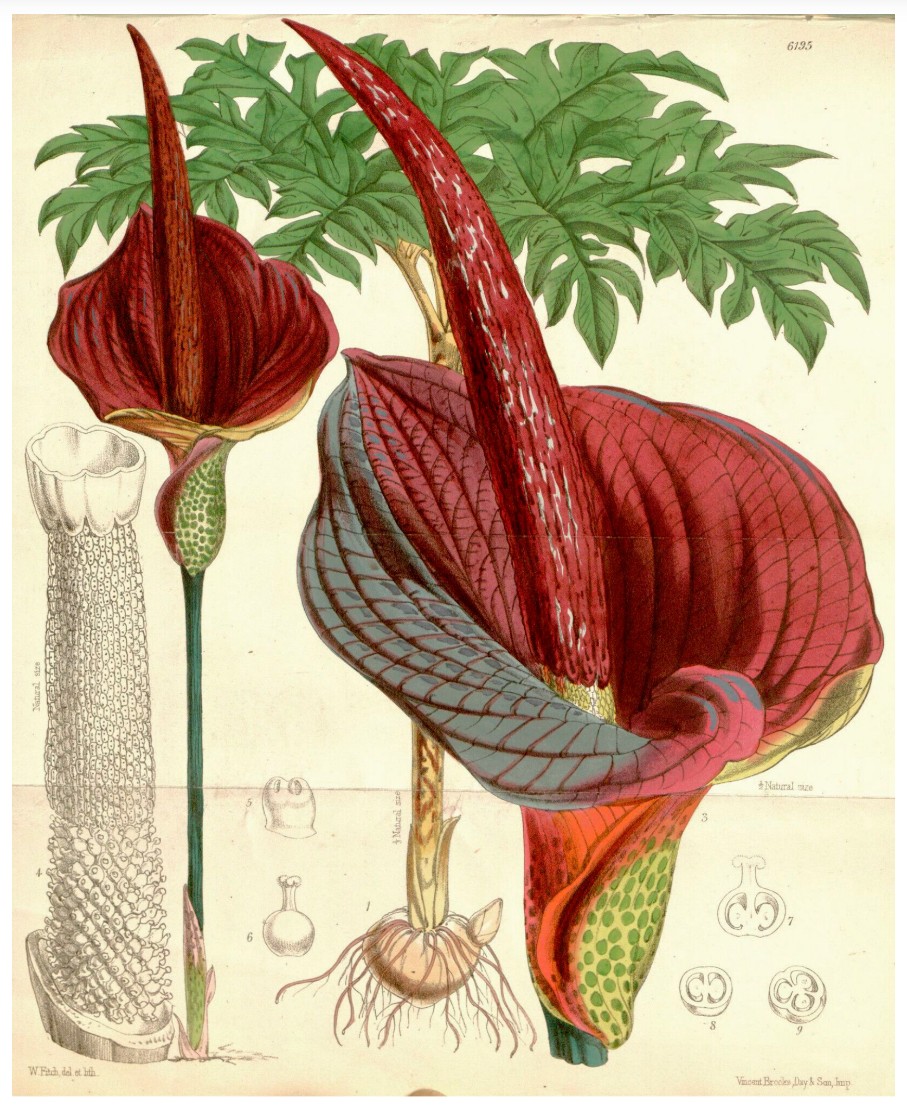
Walter Hood Fitch, Amorphophallus konjac (Voodoo Lily), 1875. Curtist’s Botanical Magazine.
By promoting a humble flower advertisement into a painted subject, Lichtenstein placed Voodoo Lily in the grand lineage of floral still lifes first invented by Caravaggio. While Dutch Golden Age painters like Rachel Ruysch created brilliant paintings of chromatic and compositional exuberance, painting rare, exotic flower arrangements intermingled with other signs of copious luxury consumption, Lichtenstein provides a reversal of the vaunted motif. Rather than taking luxury as his subject, he appropriates the mundane and everyday. By taking a mass-reproduced image and transferring it onto canvas, simulating the mechanical and anonymous style of printing, he shattered the Modernist dogma of originality and the Abstract Expressionist search for the Sublime. “His aim,” the art critic and curator Demetrio Paparoni writes, “was to drain the subject of any kind of emotive implications and to highlight its stereotyped character, thus making the work become the photograph of a society nourished by fake feelings” (“Lichtenstein Grids Silence and Art After Manet,” in Roy Lichtenstein: Early Black and White Paintings, op. cit., p. 49). Voodoo Lily is one of Lichtenstein’s earliest accomplishments and a foundational example of the burgeoning Pop revolution. Here, “with his newly minted minimal vocabulary of uninflected black contours, hygienically white surfaces, and Ben-Day dot shading (a preview of pixels), Lichtenstein could take on not only Cezanne but even the recently deceased superstar of the New York art world, Jackson Pollock” (R. Rosenblum, op. cit., p. 26).
Girl in Mirror, 1964
Girl in Mirror, 1964
Property from a Distinguished Private Collection
Sotheby’s New-York: 15 May 2026
Estimated: USD 5,000,000 – 7,000,000
USD 6,220,000
Roy Lichtenstein | Girl in Mirror | Contemporary Day Auction | 2026 |
ROY LICHTENSTEIN (1923 – 1997)
Girl in Mirror, 1964
Porcelain enamel on steel
42×42 inches (106.7 x 106.7 cm)
Signed, dated 1964 and numbered 5/8 (on the reverse)
This work is number 5 from an edition of 8 plus 2 artist’s proofs
A consummate icon of postwar American art, Roy Lichtenstein’s Girl in Mirror from 1964 is a quintessential example of the artist’s legendary blonde heroines of the 1960s, produced in porcelain enamel on steel. Articulated in Lichtenstein’s signature schema of Benday dots and registering bold linear contours in black and white, red and yellow, this work utterly exudes the iconic visual lexicon that propelled Roy Lichtenstein to prominence in the early 1960s. Produced in 1964, this work bears witness to the year Lichtenstein reached the height of his technical prowess and attained the very apogee of his comic strip paintings — the series that propelled the artist to international fame.
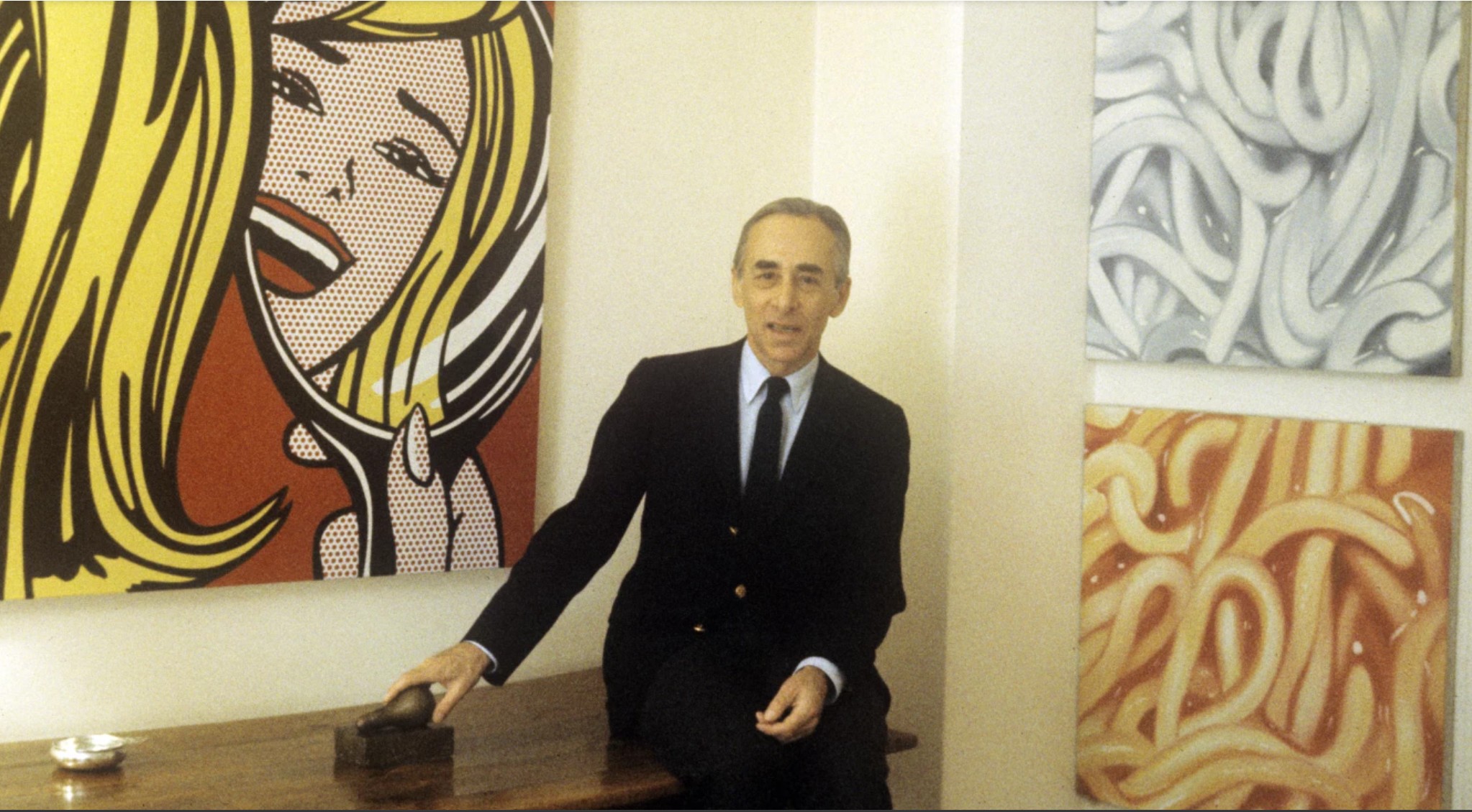
Leo Castelli with an edition of the present work in New York, 1968.
Photo © Steve Schapiro/Corbis via Getty Images. Art © Estate of Roy Lichtenstein
Exuding exceptional graphic efficiency, heightened by the pioneering application of enamel paint on steel, Lichtenstein’s composition offers a superb commentary on high versus low art, the female beau idéal, alongside an intriguing allusion to tradition through a complex painterly dialogue with the conceit of reflection. Lichtenstein was not merely an artist, he was an innovator, able to catapult mass-produced commercial images into the realm of fine art. His innate gift for editing found images and capturing the essence of collective ideal defines the Pop leader’s profoundly insightful understanding of the nature of contemporary perception. Incessantly illustrated throughout artistic literature and highly decorated with an illustrious exhibition history, Girl in Mirror has hung on the walls of the Tate Gallery, Los Angeles County Museum of Art, Corcoran Gallery of Art, Stedelijk Museum. Among others, and was included in the Guggenheim’s international retrospective of the artist.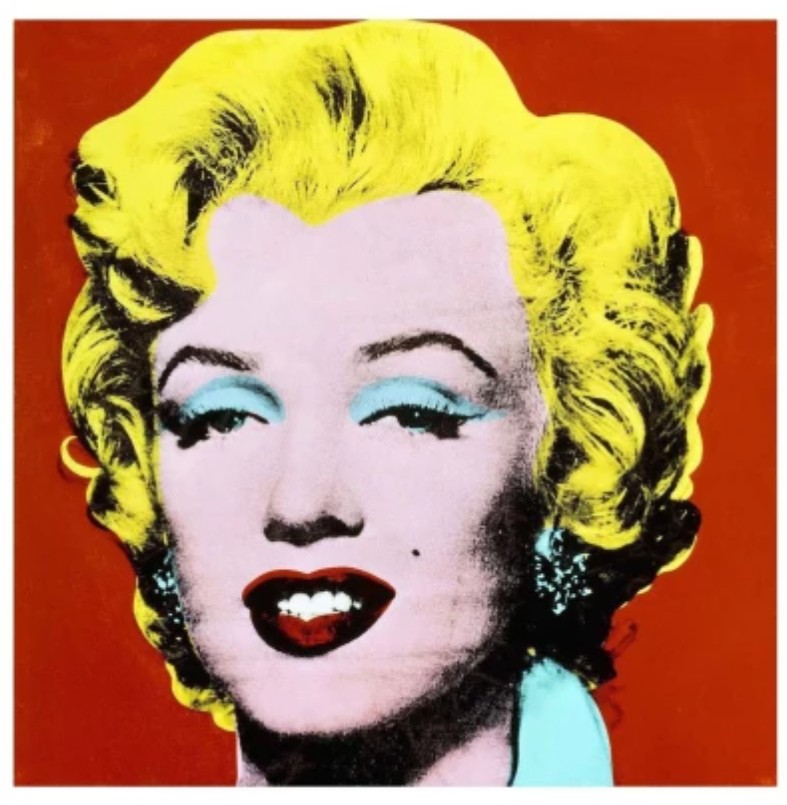
Andy Warhol, Shot Red Marilyn, 1964. Private Collection.
Image © 2026 The Andy Warhol Foundation for the Visual Arts, Inc. / Licensed by DACS, London / Christie’s Images / Bridgeman Images.
Art © 2026 Andy Warhol Foundation for the Visual Arts / Artists Rights Society (ARS), New York
In addition to echoing the aesthetic of the contemporary milieu, Lichtenstein retroactively draws on art-historical precedent. A diligent student of art history, Lichtenstein’s work incites a dialogue with the conceptually loaded conceit of the mirror, a theme that traces a powerful lineage across the grand tradition of the motif. Though Lichtenstein famously invoked Renaissance methods by using the mirror as a tool for detecting flaws in its reversed visage, the mirror, as a symbolic device, also has its roots in the Vanitas genre via the myth of Narcissus. As canonically prevalent in Jan Van Eyck’s Arnolfini Marriage (1434), Velázquez’s Las Meninas (1656), and Manet’s Bar at the Folies-Bergère (1882), the mirror is subtly employed to complicate and dislocate the viewer’s seat of vision. Perspective, perception and illusion are unsettled, and the viewer is at once invited to and obstructed from participating in the depicted drama. Throughout the history of art, the mirror represents the locus par excellence for a complex scrutiny of two-dimensional illusion. Repeatedly taken up by Lichtenstein throughout his career, as his famous Self-Portrait from 1978 attests, the canonical conceit of the mirror here confers an innovative modernization of one of the most prescient and enduring dialogues with art and illusion.
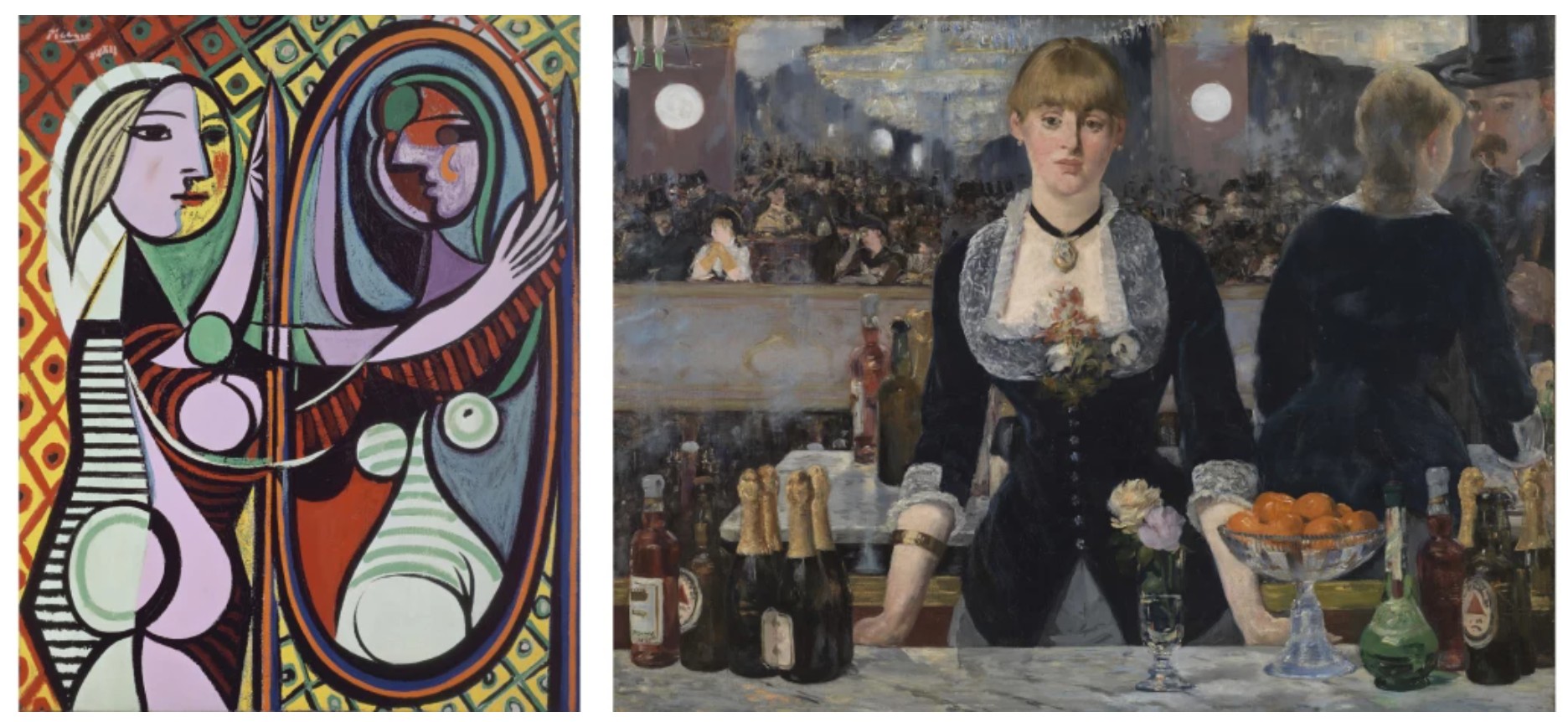
Left: Pablo Picasso, Girl Before a Mirror, 1932. The Museum of Modern Art, New York. Image © Succession Picasso/DACS, London 2026 / Bridgeman Images. Art © 2026 Estate of Pablo Picasso / Artists Rights Society (ARS), New York. Right: Edouard Manet, A Bar at the Folies-Bergere, 1881-82. The Courtauld, London. Image © The Courtauld / Bridgeman Images
Captured in the reflection of her handheld vanity mirror, Lichtenstein’s blonde ideal of American beauty encapsulates the prevalent archetype that had become the socio-cultural aspiration for millions since the Second World War. The dream of looking like Lichtenstein’s comic-book heroines, or of winning their hearts, drove entire billion-dollar industries. Alfred Hitchcock populated his classic movie thrillers with a cast of divine blonde actresses — Grace Kelly, Eva Marie Saint and Kim Novak — who played the part of alluringly independent protagonists before invariably being rescued by Cary Grant or James Stewart and safely returned to reassuring domesticity. Regarding Roy’s Girls series, Dorothy Lichtenstein has said, “I think that he was portraying his idea of the dream girl.” (Exh. Cat., London, Tate Gallery, Roy Lichtenstein, 1968, p. 15) Unlike these real-life icons, Lichtenstein’s Girls are entirely of the imagination, existing solely within the realm of his oeuvre. As such, Lichtenstein’s archetype of blonde American beauty is at once a vessel for the artist’s ideal woman and for our own: “[Roy] specifically picked images and cartoons that had a lot of emotional charge — the archetypal idea of the woman disappointed by love, the war hero in the heat of battle. These are typically American; and it is atypically American way of glorifying a subject.” (Exh. Cat., London, Tate Gallery, Roy Lichtenstein, 1968, p. 10)
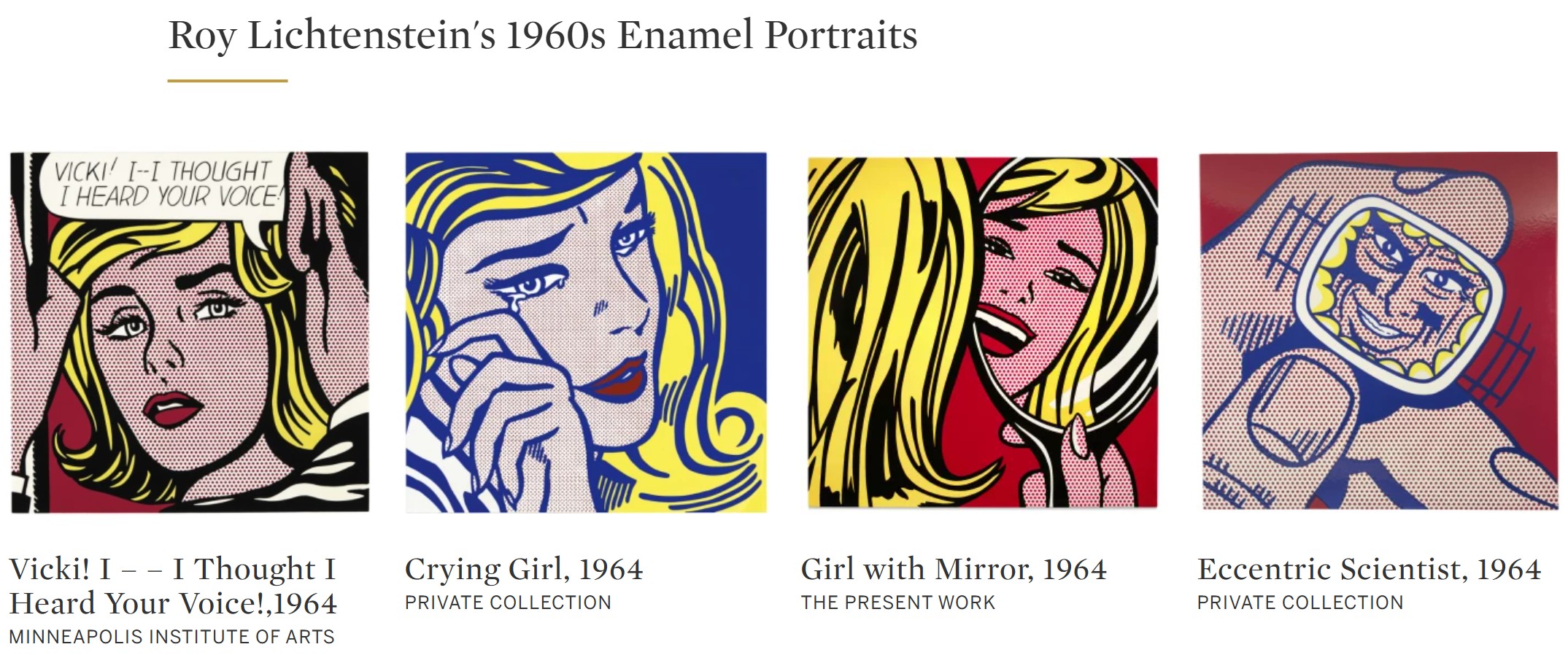
Roy Lichtenstein instinctively understood the phenomenal potential of popular imagery, and more than any artist of his generation, realigned the cipher of that imagery to unveil verities behind the ever-proliferating pictorial panorama of contemporary culture in 1960s America. By doing so, he revolutionized how we perceive the world around us and how, in turn, the world has subsequently been presented back unto itself. Indeed, the very content of Lichtenstein’s comic book paintings can be considered an authentic reflection of this new wave of popular culture. By assimilating its visual vocabulary and mastering the primary modus of industrial pictographic transmission, Lichtenstein’s artworks stand as conceptual mirror images of contemporary culture and the means of its mass production. Between 1963 and 1965, inspired by the hard-finish, reflective sheen of New York subway signage, Lichtenstein began incorporating the slick perfection of advertising into his work. The resultant corpus of enamel paintings, to which Girl in Mirror belongs, achieved a heightened look of mechanical perfection, an effect he could only suggest in his works on canvas.
Sitting Pretty, 1978
Sitting Pretty, 1978
Property from the Collection of Annabelle and Bernard Fishman
Sotheby’s New-York: 14 May 2026
Estimated: USD 4,000,000 – 6,000,000
USD 4,756,000
Roy Lichtenstein | Sitting Pretty | The Now & Contemporary Evening
ROY LICHTENSTEIN (1923 – 1997)
Sitting Pretty, 1978
Acrylic, oil and graphite on canvas
70×50 inches (177.8 x 127 cm)
Signed and dated ’78 (on the reverse)
Sitting Pretty encapsulates Roy Lichtenstein’s legendary Pop idiom and intellectual prowess, expanding his ongoing dialogue with the art historical canon. Responding to one of the most radical and enduring movements in art history, Surrealism, Lichtenstein dismantles and refines his image in an investigation that is at once cerebral, satirical and undeniably Pop.
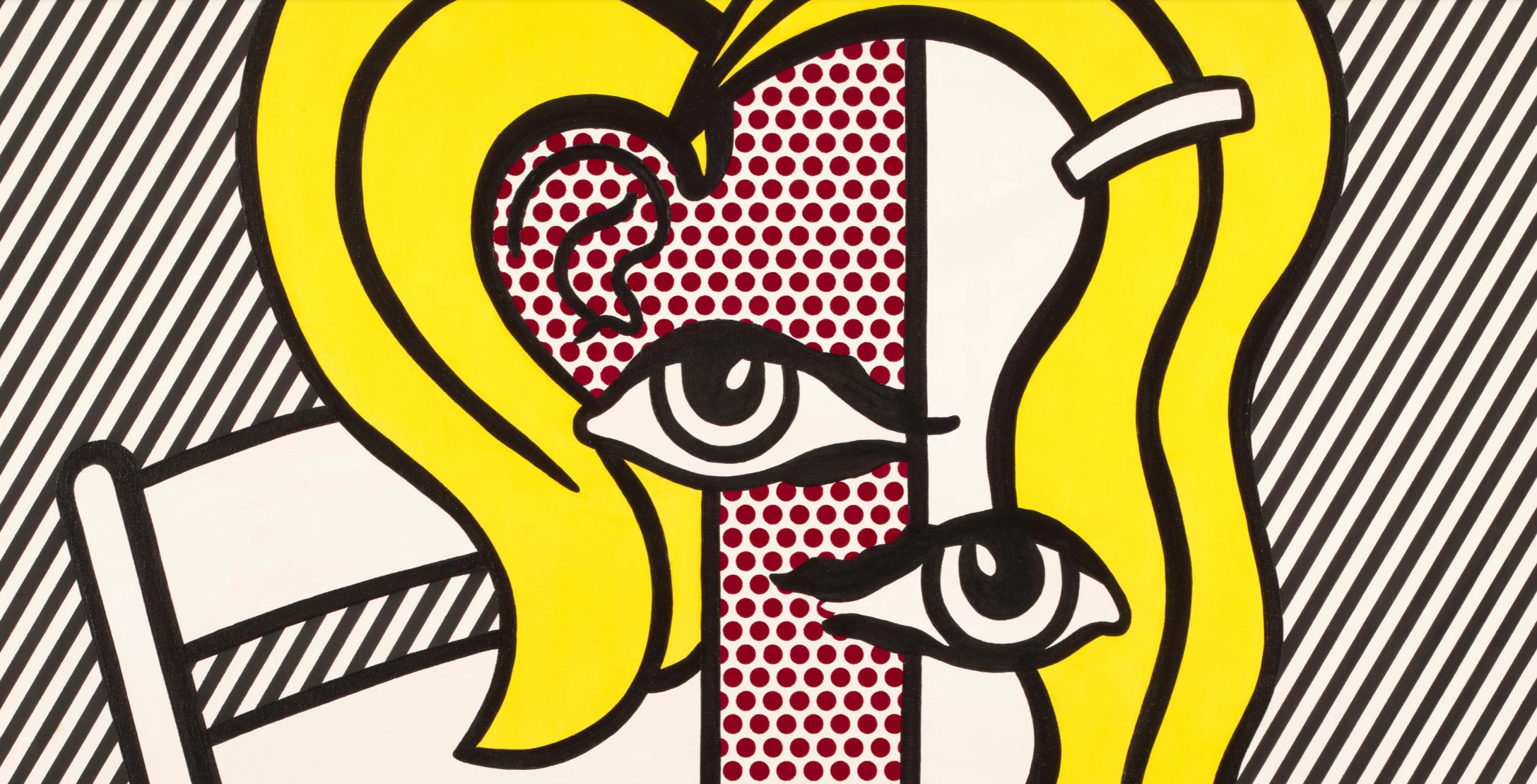
Executed in 1978, Sitting Pretty harkens back to the comic-book heroines that catapulted Lichtenstein’s career in the mid-1960s, but is distinguished by a twist: here, Lichtenstein classic bombshell blonde has been reconfigured through a Surrealist lens. Her eyes, lips and eyes are mysteriously disjointed from her visage, forming an enigmatic composition which feels at once eerily familiar and yet defies all logic.
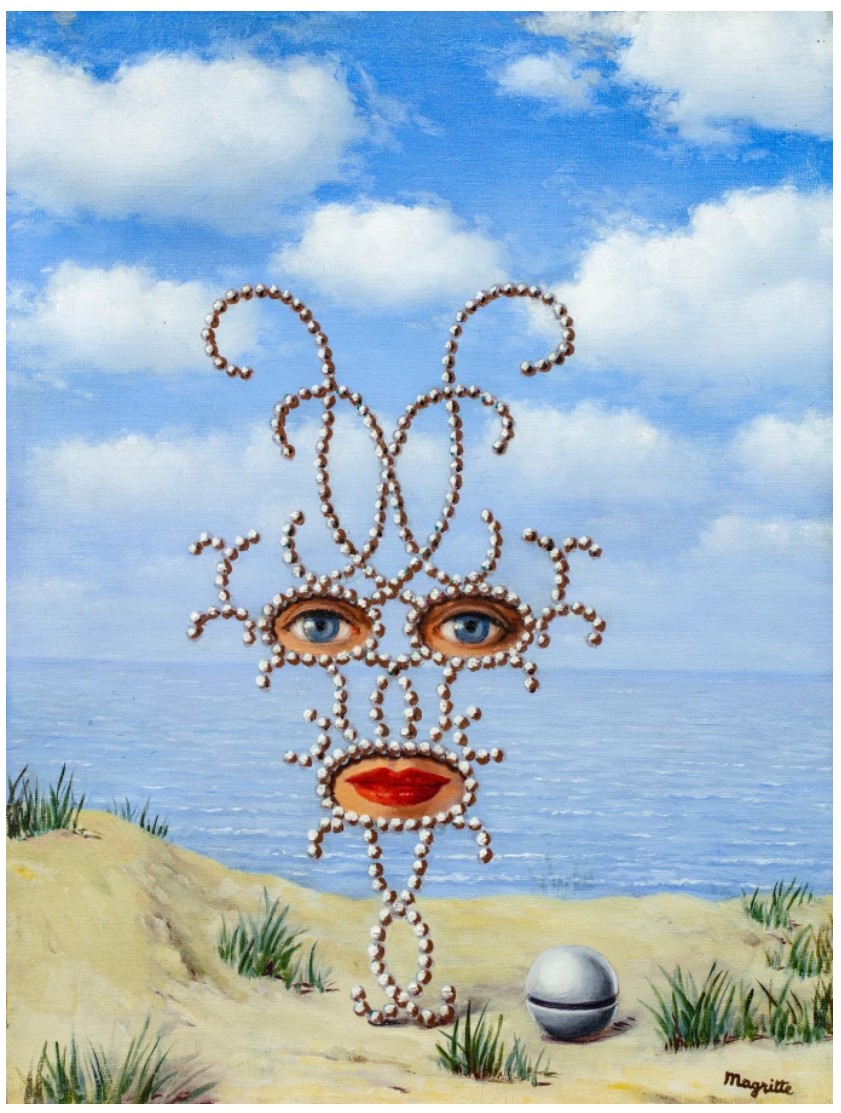
René Magritte, Shéhérazade, 1954. Private Collection. Sold at Sotheby’s New York in November 2022 for $8.4 million.
Art © 2026 C. Herscovici, Brussels / Artists Rights Society (ARS), New York
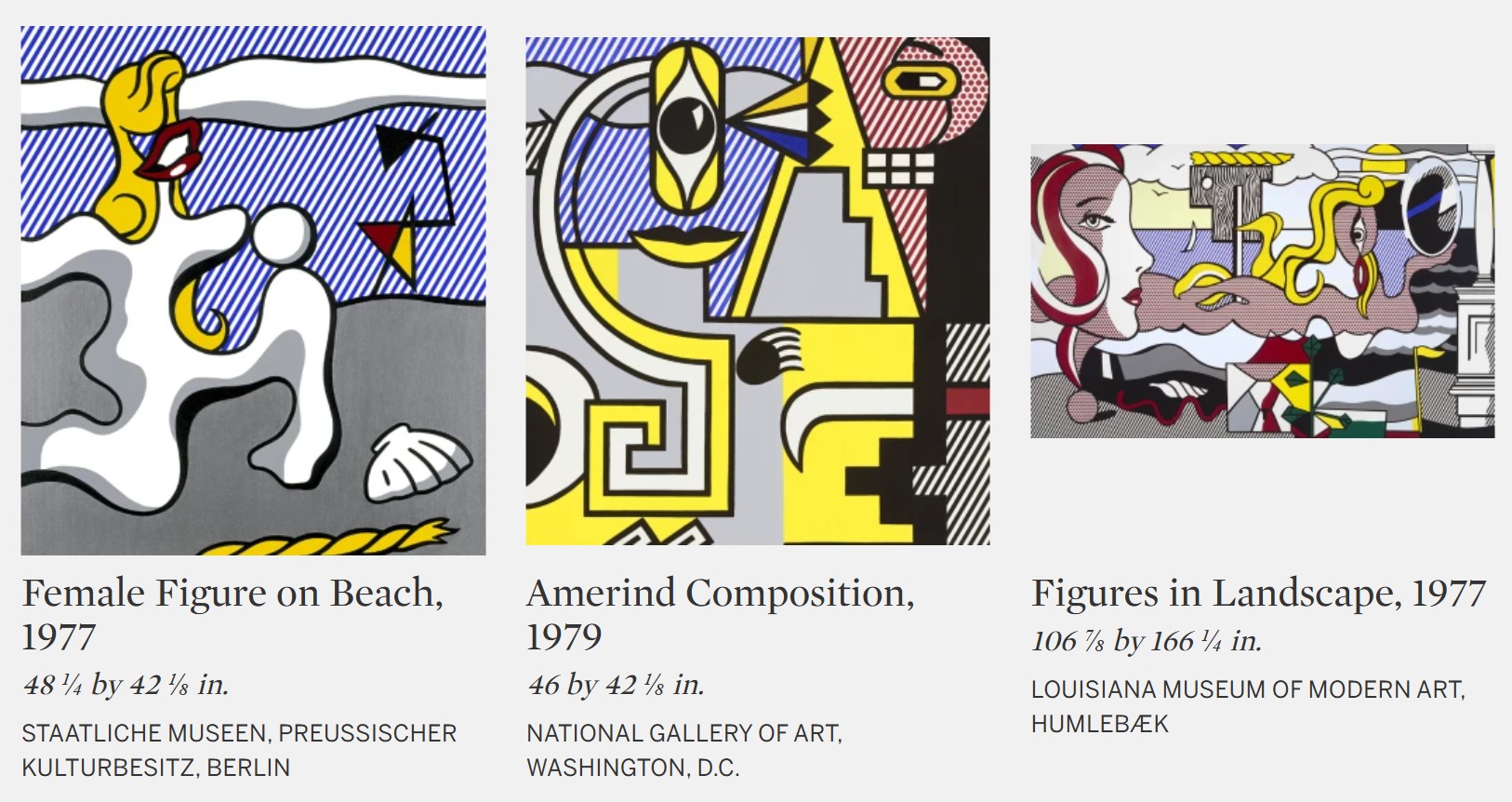
Reflective and iterative, Lichtenstein’s practice is the result of reappropriations of his own oeuvre and the canon as well as exploration across media and form. Painted during the height of his celebrated Surrealist period, Sitting Pretty showcases the conceptual sophistication which defines Lichtenstein’s inimitable oeuvre. With other examples of the Surrealist paintings from 1977 and 1978 held in such collections as the Solomon R. Guggenheim Museum and the Metropolitan Museum of Art in New York, as well as the Louisiana Museum of Modern Art in Denmark, this series showcases the inventive mind of an artist at the creative apex of his extraordinary career.
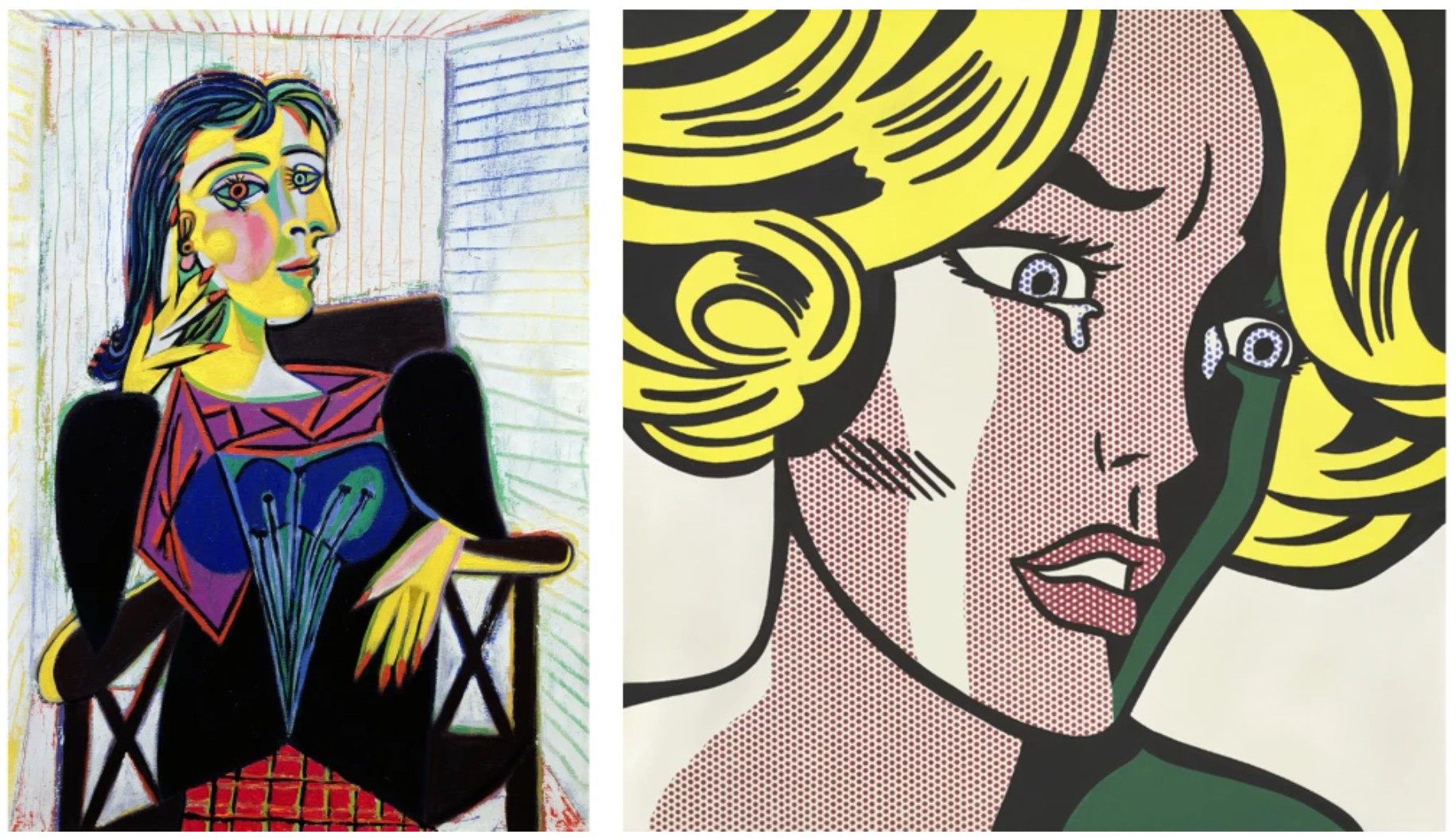
Left: Pablo Picasso, Portrait of Dora Maar, 1937. Musée Picasso, Paris. Image © Bridgeman Images. Art © 2026 Estate of Pablo Picasso / Artists Rights Society (ARS), New York. Right: Roy Lichtenstein, Frightened Girl, 1964. Private Collection. Image © Estate of Roy Lichtenstein
For Lichtenstein, the 1970s marked a transition from the comic-book-inspired Pop paintings the defined his work of the 1960s to a witty interrogation of the art historical canon—from Classical architecture to Futurism, German Expressionism, Surrealism, Cubism and Art Deco. Lichtenstein subverted the tenets and tropes of these periods through his own distinctive Pop aesthetic. Like the Surrealists, Lichtenstein borrows from the familiar but twists our perception. Known to present everyday objects in surprising or unsettling contexts, the Surrealists blurred the lines between reality and fantasy.
Lichtenstein takes this investigation a step further, masterfully applying the mystifying ethos of Surrealism to the emphatic clarity of Pop. Unlike his Surrealist predecessors however, whose painstakingly selected forms reference internal forces of the psyche, the crisp forms of Lichtenstein’s works are drawn from his own oeuvre. Jack Cowart writes of Lichtenstein’s Surrealist works: “Lichtenstein, rather, takes stylistic and subject elements and modifies them into a kind of Surrealist slang. He becomes involved in composite-scale tableaux with a rich dialogue of forms—all intuitively modified and released from their nominal sources. The forms assume new roles… In his shallow pictorial space, Lichtenstein’s inanimate forms become animate with sharp sources of light and shadow, and each painting becomes a tableau vivant.” (Jack Cowart, “Surrealism, 1977-79,” in: Exh. Cat., St. Louis Art Museum, Roy Lichtenstein: 1970-1980, 1981-83, p. 109)
Lichtenstein’s blonde heroines constitute the most recognizable motif in his body of work. In Sitting Pretty, Lichtenstein radically transforms his own visual language, subjecting his archetypal figure to Surrealist dislocation. Her facial features are suspended in liminal space, hovering before a red Ben-Day Dot plane, disjointed from one another and yet they still conjure Lichtenstein’s blonde heroine.
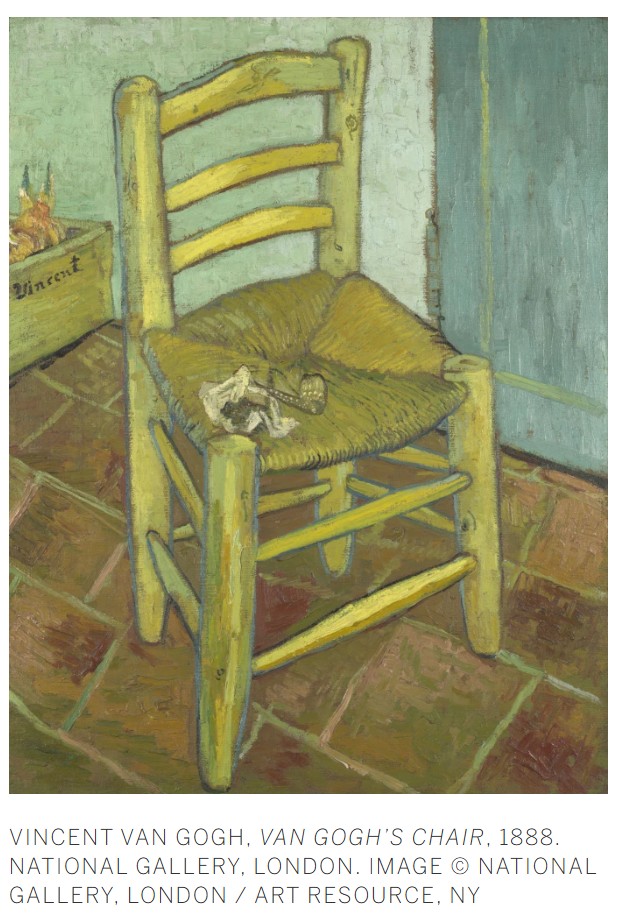
In deliberate juxtaposition with Lichtenstein’s classic early portraits, in which the composition is closely cropped to reveal little more than the sitter’s face, here, Lichtenstein suspends his subject in a nondescript space, floating above a folding chair. The fragmentation of Lichtenstein’s protagonist and the disorienting setting of his composition invokes Salvador Dali’s dreamscapes, Man Ray’s The Lovers (1936), and René Magritte’s The False Mirror (1929).
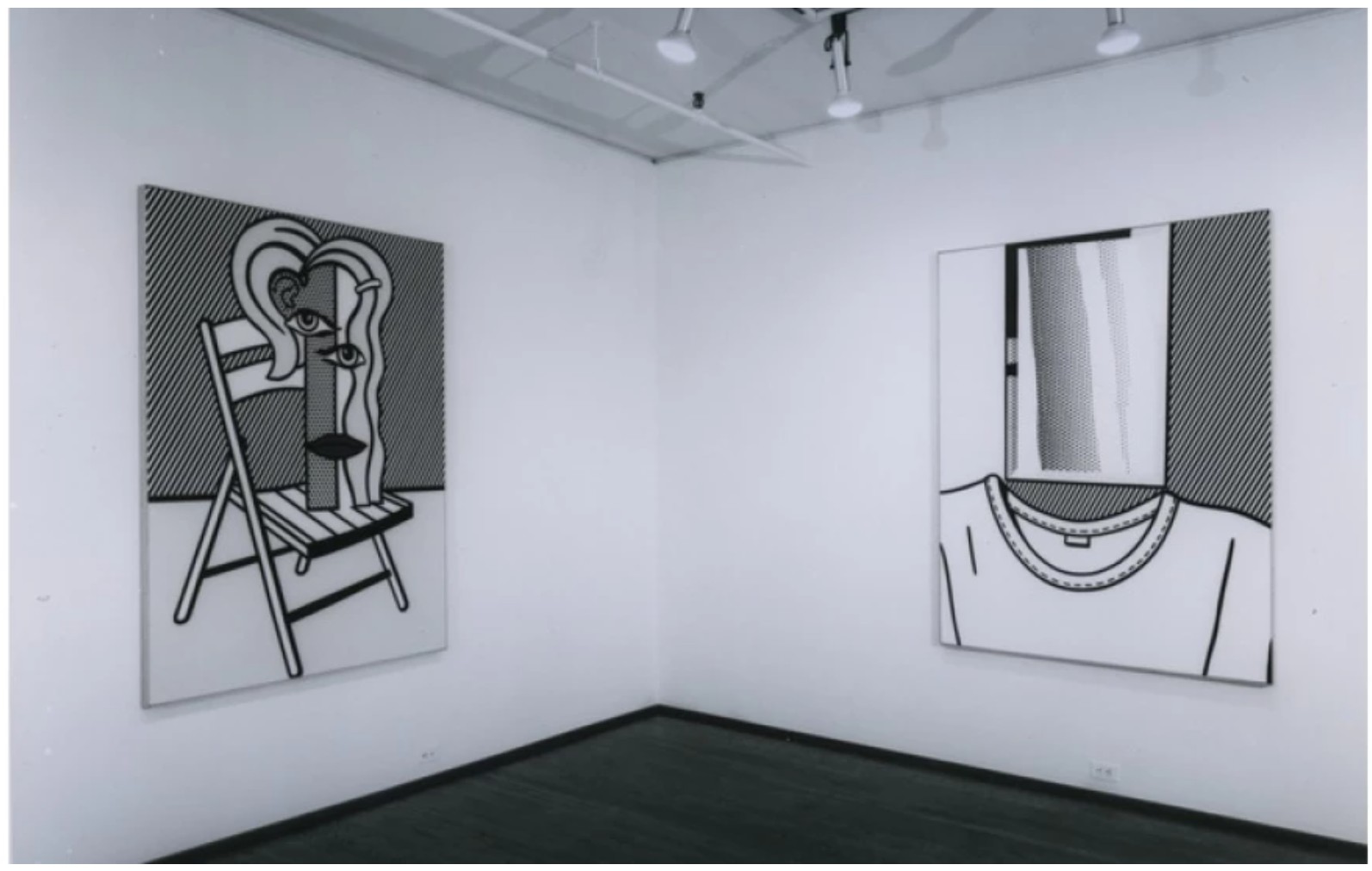
The present work installed in Roy Lichtenstein: Recent Paintings, Leo Castelli Gallery, New York, April – May 1979.
Art © Estate of Roy Lichtenstein
Lichtenstein’s Surrealist works are among the most cerebral and striking of his 1970s series. Through these works, Lichtenstein negotiates not only with his art historical precedents, but also his own body of work. This self-reflexive exercise is enabled by Lichtenstein’s own willingness to dismantle even his own visual vocabulary and made successful by the relentless progression and quest for transformation that underpins his oeuvre. Sitting Pretty is a powerful example of Lichtenstein’s career-long engagement with paragons of the canon and Contemporaneous visual culture through his distinctive Pop idiom and revolutionary reassessment of its form, content, and meaning.
Mirror #5 (24″), 1970
Mirror #5 (24″), 1970
Christie’s New-York: 18 May 2026
Estimated: USD 1,800,000 – 2,500,000
USD 2,271,000
ROY LICHTENSTEIN (1923-1997), Mirror #5 (24″) | Christie’s
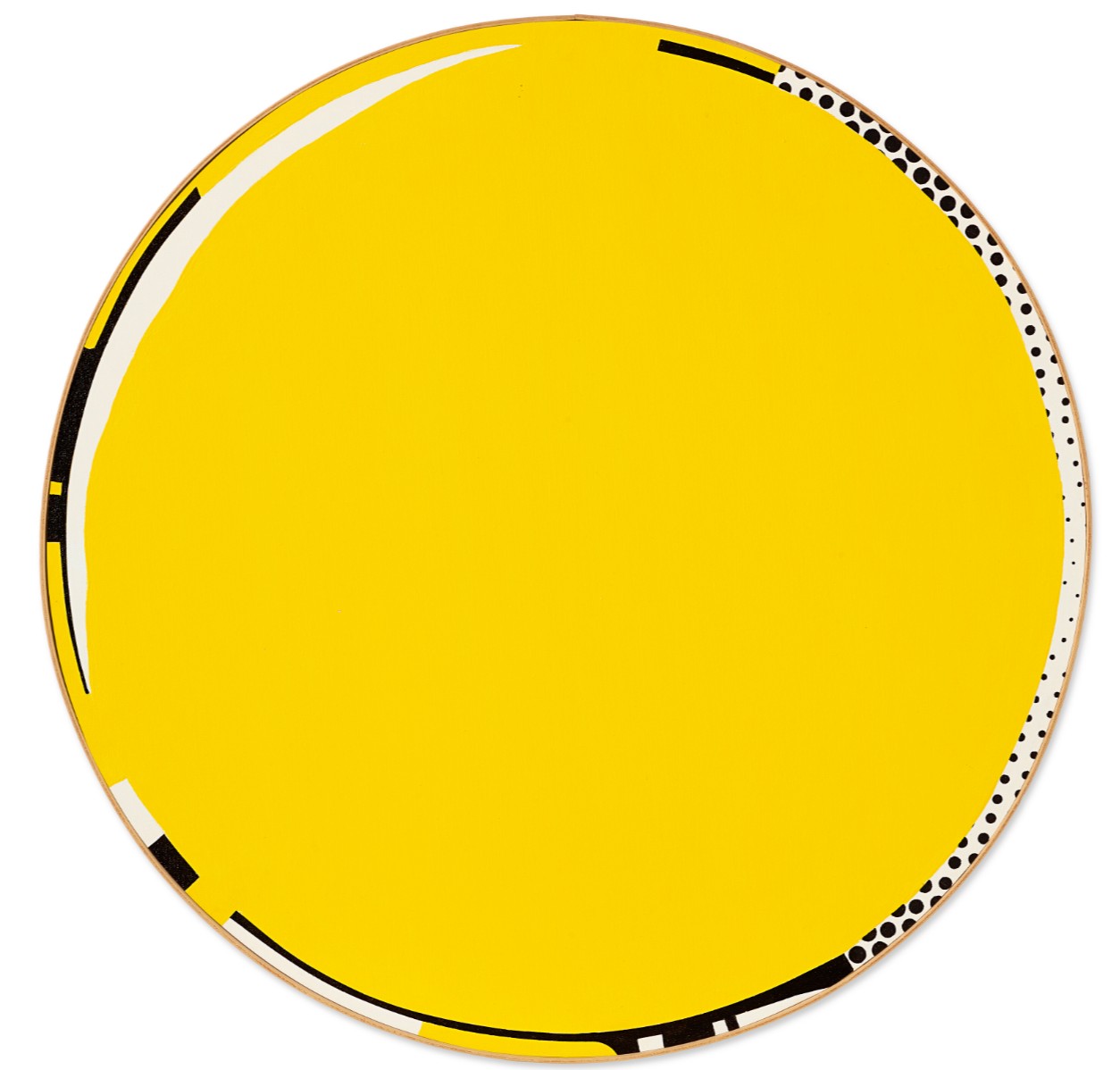
ROY LICHTENSTEIN (1923-1997)
Mirror #5 (24″), 1970
Magna, oil and graphite on shaped canvas
Diameter: 24 inches (61 cm)
Signed and dated ‘rf Lichtenstein ’70’ (on the reverse)
Roy Lichtenstein’s Mirror #5 (24”) stands as a quietly radical work within the artist’s celebrated oeuvre. Painted in 1970, it belongs to a body of work that explores perception, representation, and the limits of visual language. Executed between 1969 and 1972, the Mirror paintings utilize Lichtenstein’s signature use of Ben-Day dots, but often in ways that are intriguingly opaque, abstract, and open-ended. The present work is a pivotal example in this regard, as it pushes the Ben-Day dots all the way to the canvas’s edge, leaving us with a yellow, nearly solid expanse like the sun. Emerging as one of Lichtenstein’s most innovative and mysterious paintings, Mirror #5 is a wordless, intimate, and abstract standout from a expansive and influential oeuvre of more than forty years.
At first glance, the work appears almost minimal as a radiant yellow field dominates the circular surface, punctuated only at the margins by Lichtenstein’s famous Ben-Day dots that suggest reflection. However, this apparent simplicity belies a sophisticated interrogation of what a “mirror” can be in painting. In contrast to traditional depictions of mirrors in art history, which reflect figures and space, Lichtenstein’s mirror seems to reflect nothing. Instead, the present work appears to represent a coded image of reflection, one built from the visual conventions of commercial illustration. Mirror #5 magnifies this paradox as it is both a mirror and an absence, the present work appears then as an object that invites looking while refusing to return the viewer’s gaze. As described in a review of Roy Lichtenstein: Mirror Paintings in 1989, where Mirror #5 was exhibited, critic Catherine Liu writes: “These mirrors do not offer easy narcissistic gratification, allegorical meanings, or narrative logic… Lichtenstein as an artist refuses to comment on this emptiness; like Warhol, he absorbs it and reproduces it with a kind of vacant intensity whose beauty has not faded in the twenty years or so since these images were first produced” (C. Liu, “Roy Lichtenstein at Mary Boone Gallery,” Artforum, January 1990).
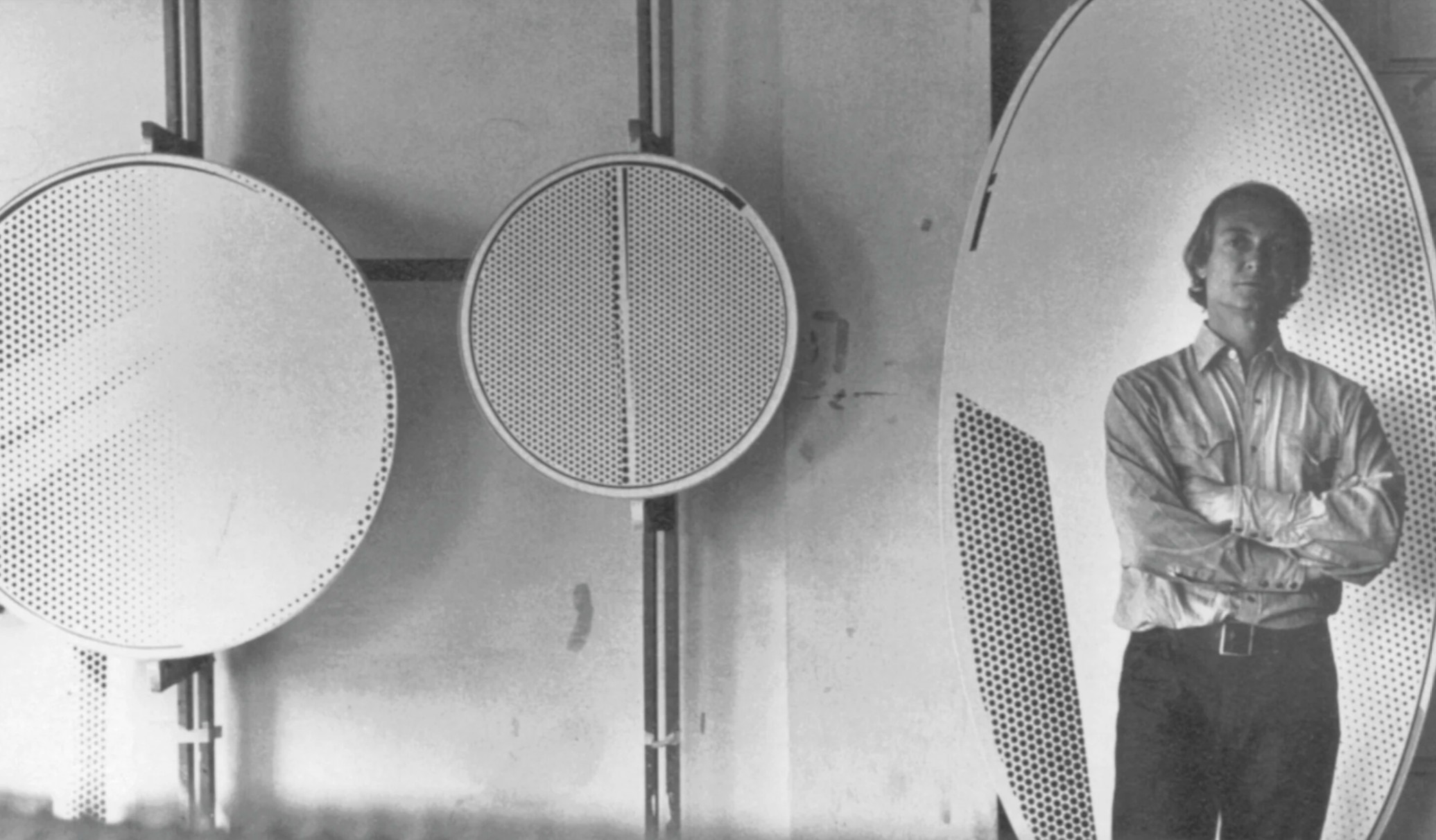
Roy Lichtenstein in his studio at 190 Bowery Street, New York, 1971.
Photo: © Renate Ponsold. Artwork: © 2026 Estate of Roy Lichtenstein / DACS.
The Mirror series originated in Lichtenstein’s walks past the windows of stores that sold glass panels on the Bowery in New York City’s Lower East Side. Inspired by the streets and shops of the city instead of comic strips of his early career, the Mirror series is an abstract record of Lichtenstein’s movement throughout New York City. He was enthralled by the shops’ brochures, which, according to the artist, depicted mirrors as “air-brushed mirror symbols, reflecting nothing” (quoted in C. Lanchner, ex. cat., Roy Lichtenstein, New York, 2009, p. 26). Indeed, Mirror #5 is not a mirror in the strictest sense, because it does not reflect us, but instead the viewer melds with the canvas and pigment.
Mirror #5 therefore combines the sublime and the playful. The yellow hue pushes the Ben-Day dots to the canvas’s limits, allowing the viewer some room to find himself within it. We can also see in Mirror #5 the earlier art historical traditional representations of mirrors and reflections in Renaissance and Baroque art. Representative is Caravaggio’s Narcissus, as with Lichtenstein’s work, suggests that art is not so much a means of looking outward at the world, but rather inward at ourselves and the images we consume.
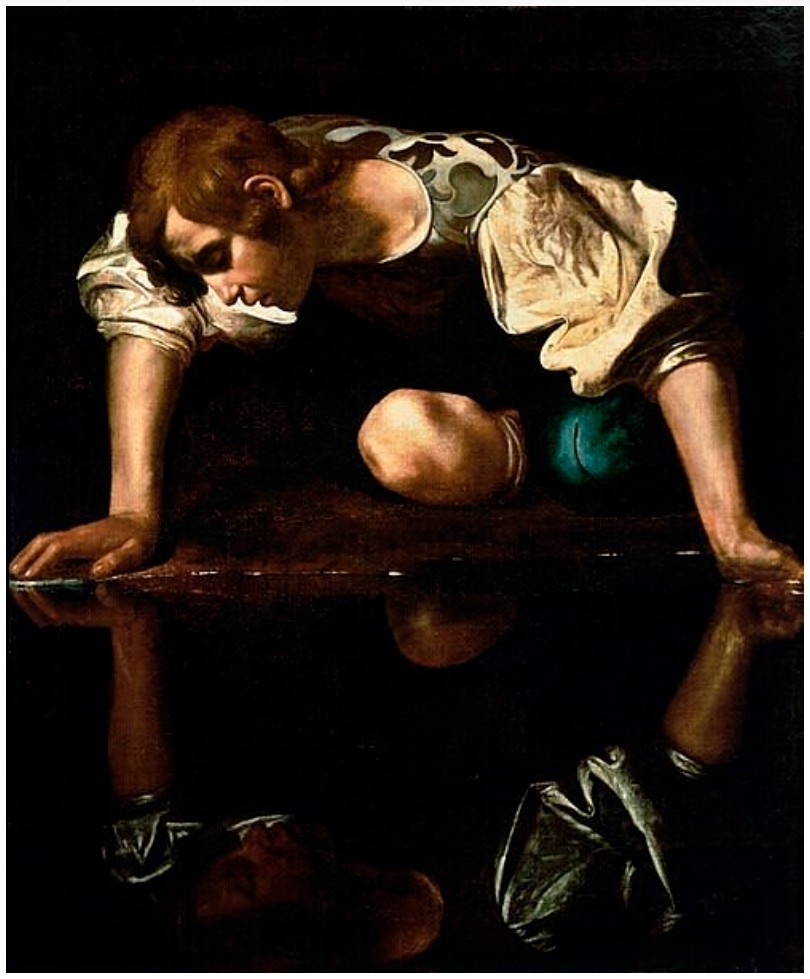
Caravaggio, Narcissus, circa 1597—1599. Galleria Nazionale d’Arte Antica, Rome.
Initially gifted by the artist to his son Mitchell Lichtenstein in 1970, Mirror #5 later passed through prominent collections. Most notably, it was a part of the private collection of Agnes Gund, a distinguished collector and philanthropist, who has long been recognized for her commitment to supporting artists and advancing social causes through art. The inclusion of Mirror #5 in her collection situates the work within a lineage of discerning patronage, reflecting both its aesthetic significance and its resonance within broader cultural dialogues.
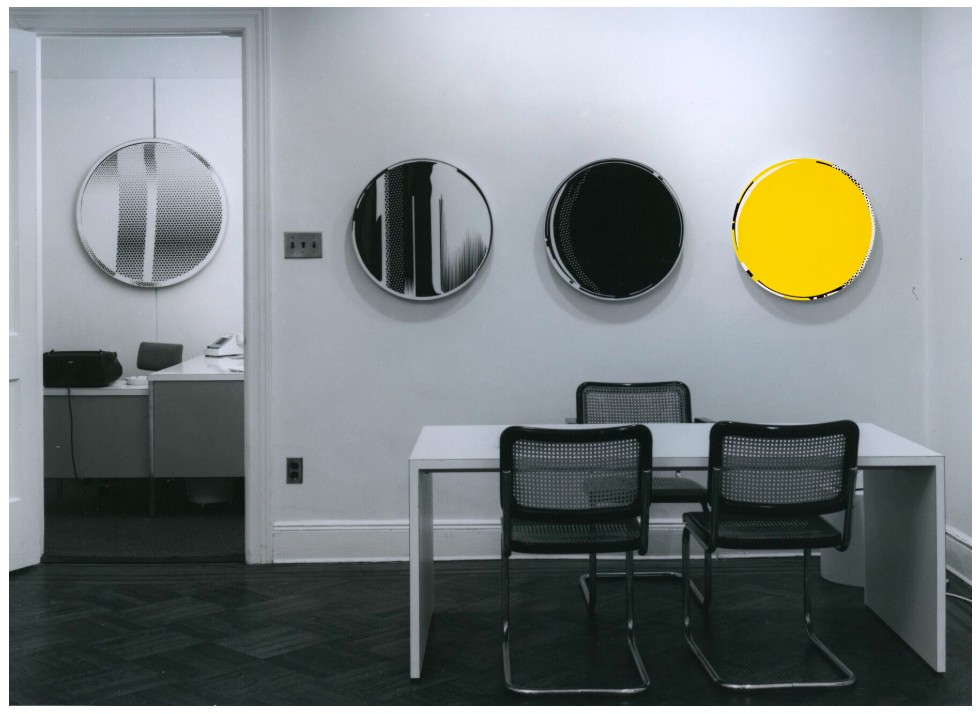
Installation view, New York, Leo Castelli Gallery, Roy Lichtenstein: Mirror Paintings, March-April 1971 (present lot illustrated).
Artwork: © 2026 Estate of Roy Lichtenstein / DACS.
Ultimately, Mirror #5 encapsulates a central paradox of Lichtenstein’s art, its simultaneous engagement with and detachment from the visual world. By presenting a mirror as such, the artist compels us to confront the mechanisms of representation and the conventions that shape our perception. The painting becomes less an object to be viewed but more a radiant yellow field in which the act of looking itself is called into question.
Double Glass, 1979
Double Glass, 1979
Christie’s New-York: 18 May 2026
Estimated: USD 800,000 – 1,200,000
USD 1,905,000
ROY LICHTENSTEIN (1923-1997), Double Glass | Christie’s
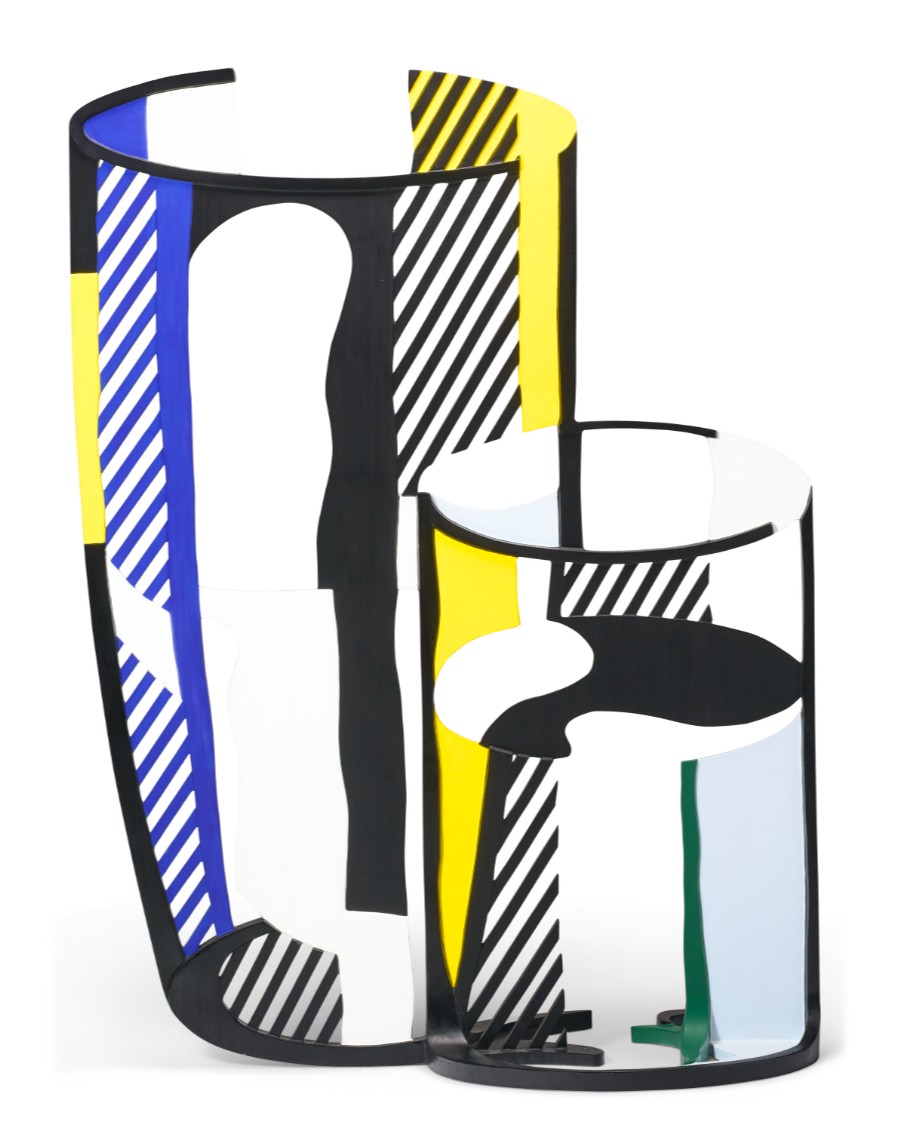
ROY LICHTENSTEIN (1923-1997)
Double Glass, 1979
Painted bronze
56x42x17 inches (142.2 x 106.7 x 43.2 cm)
Incised with the artist’s signature
Number and date ‘3⁄3 rf Lichtenstein ’79’ (lower edge)
This work is number three from an edition of three
In Double Glass, Roy Lichtenstein translates his iconic two-dimensional visual language into three dimensions. Drawing on the legacy of seventeenth-century Dutch still life, the work reimagines the genre through its translation into the physicality of painted metal, asserting itself fully within three-dimensional space while maintaining a striking visual flatness.
Lichtenstein holds these opposing conditions in tension: the sculpture occupies real space, yet reads as a two-dimensional image, its bold contours and graphic structuring collapse volume into surface while remaining entirely true to his signature style. Produced in an edition of three, with one example held in the collection of the Nasher Sculpture Center, Double Glass lingers in this instability, where the familiar language of still life begins to shift, and where perception itself must adjust to a work that never fully settles into either image or object.
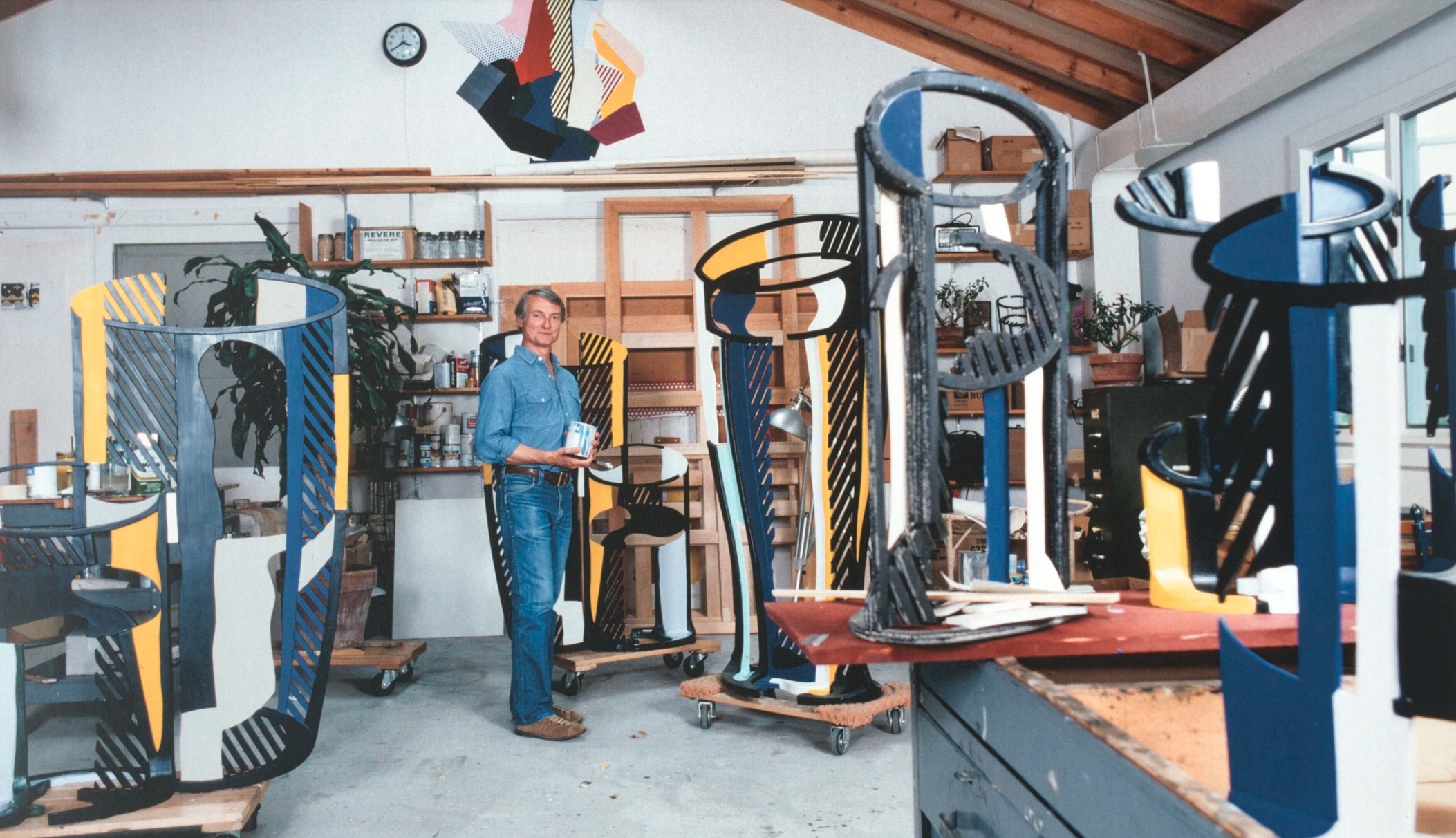
Roy Lichtenstein in his Southampton studio, circa 1980. Photo: Hans Namuth. Courtesy Center for Creative Photography, University of Arizona © 1991 Hans Namuth Estate. Artwork: © 2026 Estate of Roy Lichtenstein / DACS.
Lichtenstein begins with the conventions of Dutch still life, but redirects them through a controlled system of line and color. In conventional still life painting, such as Still Life with a Glass and Oysters (circa 1640) by Jan Davidsz de Heem, the glass forms through accumulation: thin layers of paint register shifts in light, and strokes of white curve along the rim and body to mark reflection. These highlights indicate an external world. In Double Glass, that system disappears.
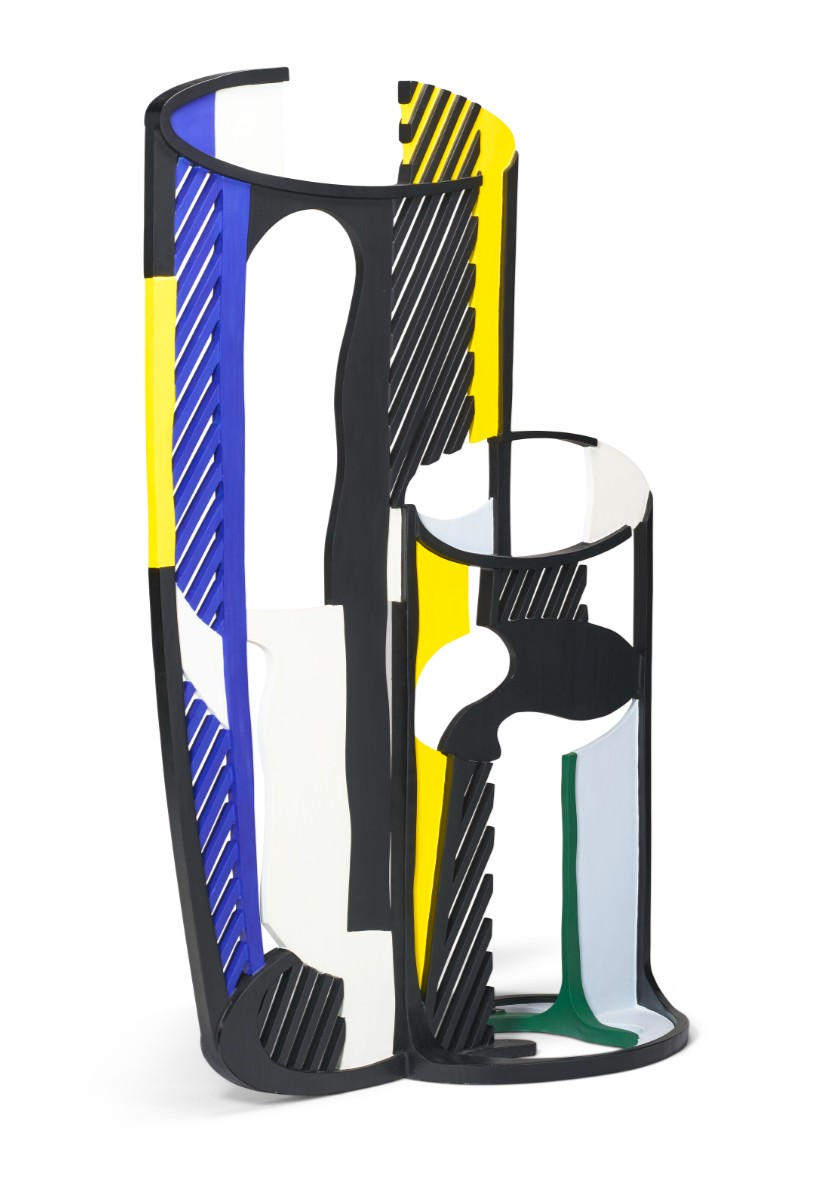
The tall vessel stands as an open cylinder, divided into vertical bands of blue, yellow, black, and white, with diagonal striping cutting across select sections. The smaller glass repeats this structure at a compressed scale, its interior broken by flat shapes that suggest liquid without modeling it. White no longer traces reflected light; it appears as a solid plane, especially along the interior curves, where it reads less as illumination and more as a cut through the form. Black contour fixes each edge with precision, preventing any dissolution into space, while overlapping shapes imply depth without producing it. The glass does not absorb its environment or refract a surrounding world. Instead, it holds at the surface, its volume constructed through graphic means, shifting still life from a record of perception to a deliberate system of form.
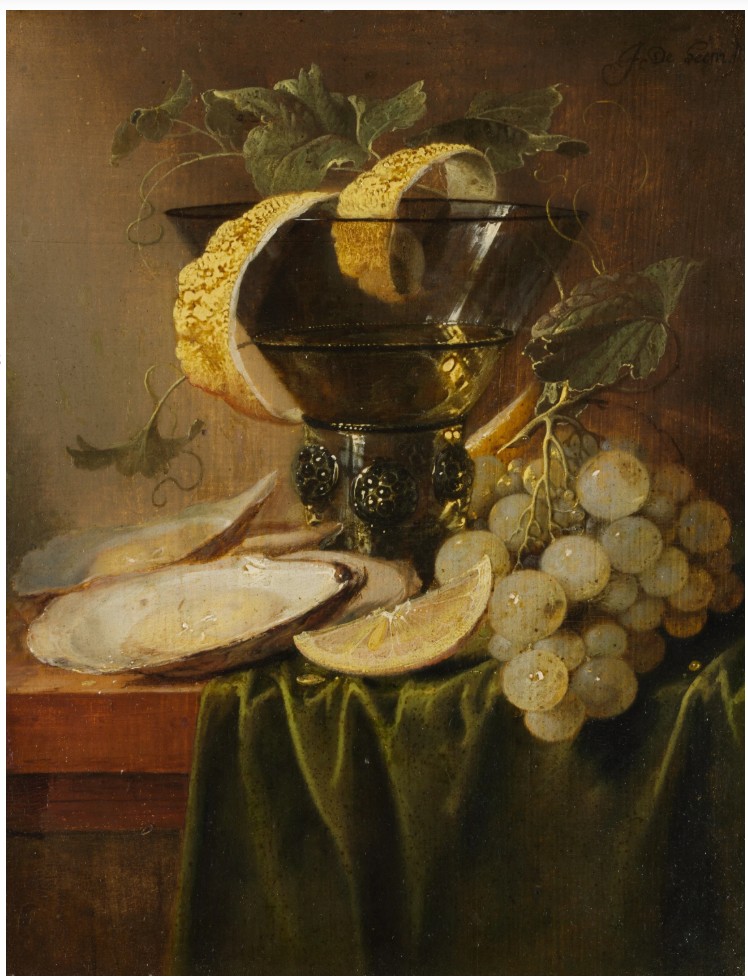
Jan Davidsz de Heem, Still Life with a Glass and Oysters, circa 1640. Metropolitan Museum of Art, New York.
The late 1970s mark a decisive shift in the practice of Roy Lichtenstein, as he redirects his focus from mass media imagery to the structures of art history and, more specifically, to the challenge of reflectiveness. In works such as Cubist Still Life (1974) and Still Life with Crystal Bowl (1972), he draws on the fractured planes of Pablo Picasso, yet replaces tonal construction with fixed bands of color and line, turning spatial ambiguity into a graphic system. This logic carries directly into Double Glass. It also aligns with Lichtenstein’s Mirror paintings, such as Mirror #1 (1969) and Oval Mirror (1974), where curved bands of white and gray signal reflection but contain no reflected image. In both cases, the surface does not receive the world; it asserts its own construction. Reflectiveness shifts from an observed phenomenon to a coded sign, allowing Lichtenstein to engage the visual language of still life while fundamentally restructuring how objects occupy and deny space.
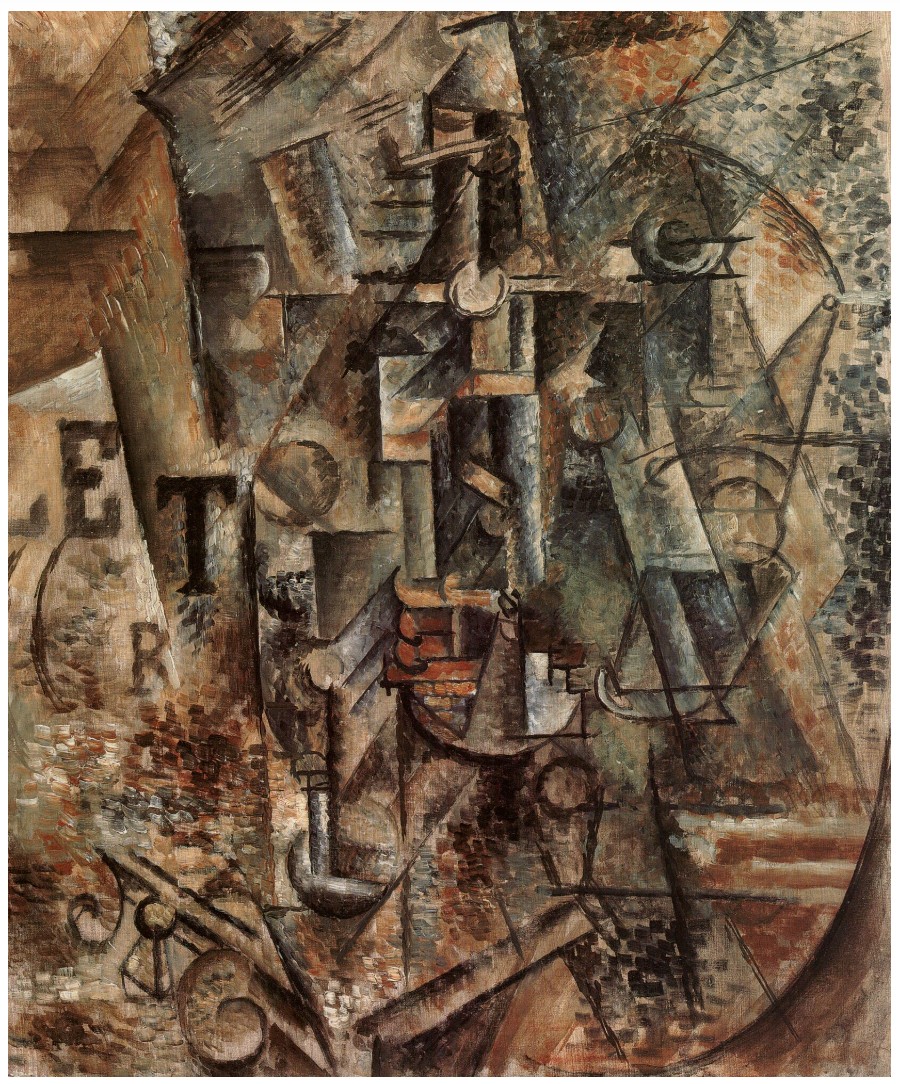
Pablo Picasso, Still Life with a Bottle of Rum, 1911. Metropolitan Museum of Art, New York.
© 2026 Estate of Pablo Picasso / Artists Rights Society (ARS), New York.
Roy Lichtenstein brings his investigation of pictorial three-dimensionality into sharp focus through the glass vessel, a form that allows him to test how transparency, reflection, and structure can be translated into a controlled visual system. Double Glass stands as a culminating example, where interlocking forms and flattened ovoid shapes generate spatial ambiguity without relying on optical illusion, as “the glass vessel in general and drinking glass in particular, with the complex potentials offered by transparency, reflections, and flattened ovoid shapes, seem to have held special appeal for Lichtenstein in his investigation of pictorial three-dimensionality. At least four versions of a single glass predate the still more complex Double Glass, with its interlocking forms and increased spatial ambiguities” (S. A. Nash, quoted in A Century of Modern Sculpture: The Patsy and Raymond Nasher Collection, exh. cat., Dallas Museum of Art, 1987, p. 166). The present work gathers these concerns into a single, resolved structure, where graphic precision constructs volume and where the object sustains a deliberate tension between physical presence and visual flatness.
Small Wall Explosion, 1965
Small Wall Explosion, 1965
Estimated: USD 500,000 – 700,000
USD 645,000
Porcelain enamel on perforated steel
20 1/4 x 21 1/2 x 7 1/4 inches (51.4 x 54.6 x 18.4 cm)
This work is number 4 from an edition of 6
Composed from a hypnotic layering of glossy steel apertures, Roy Lichtenstein’s Small Wall Explosion, 1965 celebrates the artist’s transferal of his most significant stylistic addition to the canon of art history, the Ben-Day dot, to three-dimensional form. Here Lichtenstein captures the climactic moment of combustion, ubiquitous within the genre of graphic fiction, in the permanence of steel. This notion is enhanced by the fact that the individual sheets of perforated steel layered on top of one another can spin around on the axis of a steel rod. Forming part of the artist’s earliest forays into sculpture, the groundbreaking 1965 series of Explosions enshrine the Ben-Day dot at a crucial point within Lichtenstein’s rapidly diversifying practice. Examples of Small Wall Explosion have been housed in prestigious collections around the world, the specific example here originating from the renowned Tremaine Collection, where it resided from 1965 to 1991, followed by the Miles and Shirley Fiterman, to whom is belonged for another couple of decades; another example still resides in the distinguished Sonnabend Collection.
Max Kozloff wrote about Lichtenstein’s Explosions at his 1969 exhibition at the Solomon R. Guggenheim Museum, in which another example of this work was included: “They offer the same solutions as in his pictorial work; but to the degree that their immobility is much more explicit, they’re the most astonishing things he’s ever done…To make something solid out of the ethereal, something opaque out of the transparent: these moments when form and subject work most abrasively against each other are the dramatic points of his career” (Max Kozloff, “Roy Lichtenstein at the Guggenheim”, Artforum, vol. 8, no. 3, November 1969, p. 43). Indeed, throughout his career Lichtenstein reveled in subjects that are difficult to capture, such as mirrored surfaces, brushstrokes, explosions, and cartoon expressions. It is no wonder that an explosion appealed to Lichtenstein, itself an invisible phenomenon in motion.
Of his subject matter, Lichtenstein noted, “I was interested in anything I could use as a subject that was emotionally strong. Usually love, war, or something that was highly charged…I also wanted the subject matter to be opposite to the removed and deliberate painting techniques” (Roy Lichtenstein, quoted in John Coplans, Roy Lichtenstein, exh. cat., Pasadena Art Museum, Pasadena, 1967, p. 36). In the early 1960s, Lichtenstein challenged the pervasive influence of Abstract Expressionism, eschewing the bravura brushwork of action painting by artists such as Jackson Pollock and Willem de Kooning for a painterly technique that erased the marks of its maker.
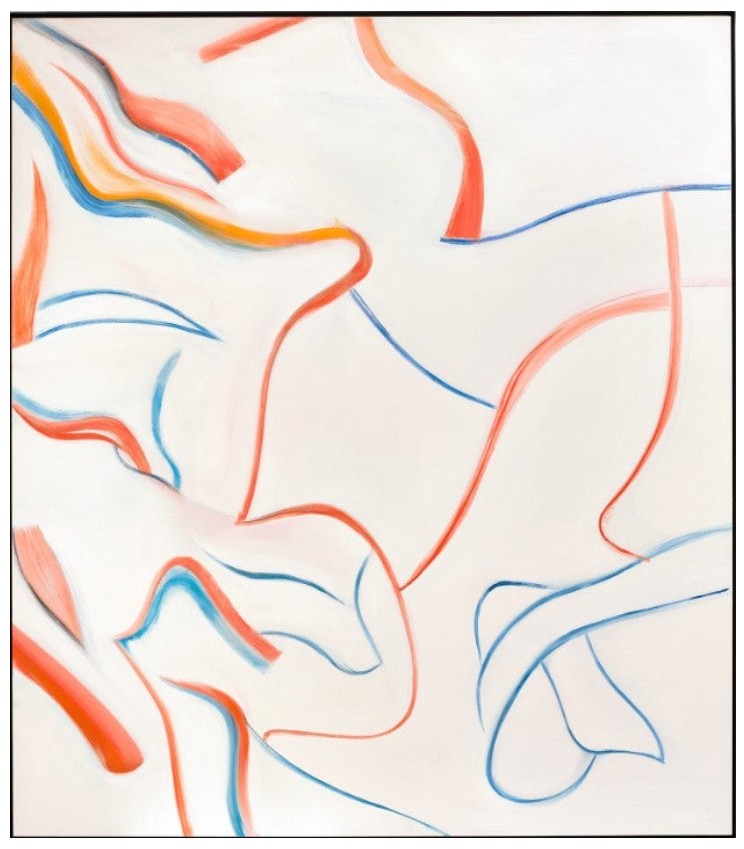
Willem de Kooning, [no title], 1984, Private Collection.
Artwork: © 2026 The Willem de Kooning Foundation/Artists Rights Society (ARS), New York
Instead, Lichtenstein thematized the stilled action of his subjects: “He paints about process and not with it…The early cartoon paintings of romance and war are ‘action packed’ with water, wind, and explosions” (Paul Schimmel, Hand-Painted Pop: American Art in Transition 1955-62, Los Angeles, 1993, p. 46). The dislocation of quotidian media was a key conceptual strategy that underpinned Pop Art as a radical movement. Lichtenstein’s paintings such as Blam, 1962, Yale University Art Gallery, New Haven and Whaam!, 1963, Tate, London call upon comic book images that playfully sanitize violent explosions. Engaging with these subjects in the midst of the Vietnam War and the Cuban Missile Crisis, Lichtenstein – himself an army veteran – questioned how such images are mediated through mass media, but with a decisive sense of objective distance. Small Wall Explosion is luscious and explosive, while also being experientially removed – an abstraction of an already mediated image. In Small Wall Explosion, the ascending strata of uniformly perforated steel are crowned with the monochromatic zigzag element outlined in black, abstracting pure white heat into symbolic pathos.
Having increased the size and presence of the Ben-Day dots in his paintings during 1964, by 1965 sculpture provided Lichtenstein a new fertile ground to play with cultural expectations regarding representation. The artist succinctly noted, “I was interested in putting two-dimensional symbols on a three-dimensional object” (Roy Lichtenstein, quoted in John Coplans, Roy Lichtenstein, 1967, p. 16). Here he utilizes the perfected geometry of mechanically hole-punched steel, which he would later use as a screen to paint through to create perfectly rendered dots. Artfully playing with scale, he stacks telescopic tiers of the perforated metal plates, each cut with such laser precision that the punctures do not disrupt the boundaries of the overall shape. The effect is optically deceptive: negative spaces gain solidity as the Ben-Day dots that we are familiar with emerge as form rather than background, while the tactile layers of steel dissolve into two-dimensional planes of pattern. Rendered in a simplified palette of energetic primary colors, Lichtenstein enacts an explosive deconstruction of the printing process, recalling how the illusions of crudely printed media fall apart at a close distance. At the same time, hypnotic combinations of light and color fluctuate amidst the compressed layers of depth, and the vision appears to vibrate as we alter our proximity to it. Together these visual qualities help Lichtenstein brilliantly depict the ephemeral manifestation of an explosion in three dimensions, which is immediately understood through color, line and form. His ability to play with different modes of representation and abstraction, always in his signature style, is one of his defining legacies to art of the 20th century.
Glass II, 1976
Glass II, 1976
Works from the Collection of Jannine and Robert MacDonnell
Sotheby’s New-York: 15 May 2026
Estimated: USD 600,000 – 800,000
USD 1,600,000
Roy Lichtenstein | Glass II | Contemporary Day Auction | 2026 |
ROY LICHTENSTEIN (1923 – 1997)
Glass II, 1976
Painted and patinated bronze
36-1/2 x 22-1/2 x 14-3/8 inches (92.7 x 57.2 x 36.5 cm)
Incised with the artist’s signature, date ’77 and number 1/3 (on the base)
This work is number 1 from an edition of 3, plus 1 artist’s proof
Water Lilies with Cloud, 1992
Water Lilies with Cloud, 1992
Sotheby’s New-York: 15 May 2026
Estimated: USD 500,000 – 700,000
USD 1,024,000
PRINT
Roy Lichtenstein | Water Lilies with Cloud | Contemporary Day Auction
ROY LICHTENSTEIN (1923 – 1997)
Water Lilies with Cloud, 1992
(Corlett 263)
Screenprinted enamel in colors on processed and swirled stainless steel, with painted aluminum frame
Signed, dated ’92 and numbered 9/23 (on the reverse)
This work is number 9 from the edition of 23 plus 6 artist’s proofs
Published by Saff Tech Arts
In a delightful homage to Claude Monet’s series of Water Lilies, Roy Lichtenstein’s Water Lilies with Cloud exemplifies a profound dialogue between artistic traditions, challenging viewers to reconsider the boundaries between impressionist painting and modern visual culture. Created late in Lichtenstein’s career, the present work emerges as a sophisticated meditation on artistic representation, drawing direct inspiration from Monet’s iconic water lily paintings while simultaneously dismantling and reimagining the impressionist aesthetic. Lichtenstein’s approach transforms the soft, ethereal quality of Monet’s original works into a sharp, mechanically precise interpretation that speaks to the increasingly mediated visual experiences of the late 20th century for which he is best known.
Lichtenstein’s iconic Benday dots and stripes are here paired with swirling patterns on the reflective surface, creating a visual tension that both reference Monet’s original works yet defy traditional notions of impressionist painting. These uniform, precise dots and lines replace the fluid, organic brushstrokes of Monet’s Water Lilies, creating a rhythmic motif that deconstructs the natural landscape into a grid of mechanical reproduction. Where Monet sought to capture the ephemeral play of light and water, Lichtenstein instead presents a structured, almost mathematical interpretation of natural beauty. The dots vary in size and density, creating depth and texture that paradoxically both flatten and expand the image’s visual complexity, challenging viewers to consider how technological processes mediate our perception of the natural world.
“When I did paintings based on Monet’s I realized everyone would think that Monet was someone I could never do because his work has no outlines and it’s so Impressionistic. It’s laden with incredible nuance and a sense of the different times of day and it’s just completely different from my art. So, I don’t know, I smiled at the idea of making a mechanical Monet.”
In addition to the primary colors commonly associated with Lichtenstein’s early Pop artworks, Water Lilies with Cloud introduces a wider tonal range. The solid blocks of color, created in sign painter’s enamel on the stainless steel, have a collage-like appearance and deconstruct concepts of landscape painting. While Monet’s canvases envelop the viewer in soft, painterly strokes, the present work immerses the viewer with its mirrored stainless steel surface, constantly reflecting different planes of light. Lichtenstein manages to create a visual experience that is at once reminiscent of Monet’s original water lily paintings and completely distinct from them, a testament to his ability to simultaneously honor and challenge artistic traditions.
Studies
Brushstroke Still Life with Box (Study), 1996
Estimated: USD 250,000 – 350,000
USD 396,800
ROY LICHTENSTEIN (1923 – 1997)
Brushstroke Still Life with Box (Study), 1996
Cut painted and printed paper, tape, acrylic and graphite on paperboard
Image: 33-1/2 x 46-3/4 inches (85.1 x 118.7 cm)
Sheet: 39-1/2 x 50-5/8 inches (100.3 x 128.6 cm)
Signed and dated Dorothy Lichtenstein ’98 posthumously by Dorothy Lichtenstein (on the verso)
Diane Waldman in: Exh. Cat., Solomon R. Guggenheim Museum, Roy Lichtenstein, 1993, pp. 156-157
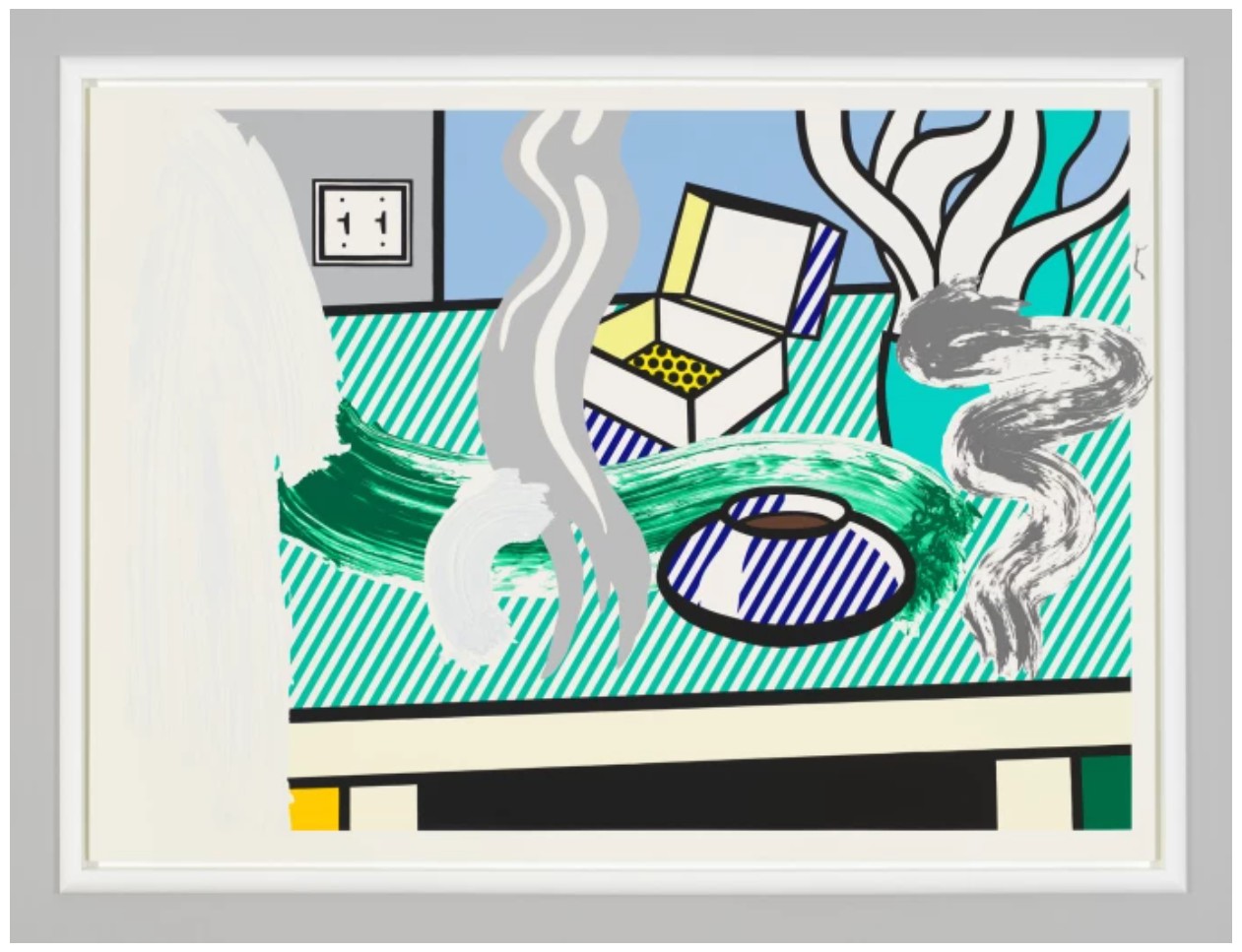
Roy Lichtenstein, Brushstroke Still Life with Box,1997, Whitney Museum of Art, The Roy Lichtenstein Study Collection
© Estate of Roy Lichtenstein