
Unlike many modern artists for whom works on paper served primarily as preparatory sketches, Magritte’s drawings and gouaches often function as fully autonomous works of art. They reflect the same philosophical depth and conceptual clarity that characterize his larger paintings, but in a more immediate and spontaneous format. Because of their smaller scale and direct execution, these works provide a unique window into Magritte’s imagination, showing how he constructed the visual paradoxes that would become central to his exploration of perception and representation.
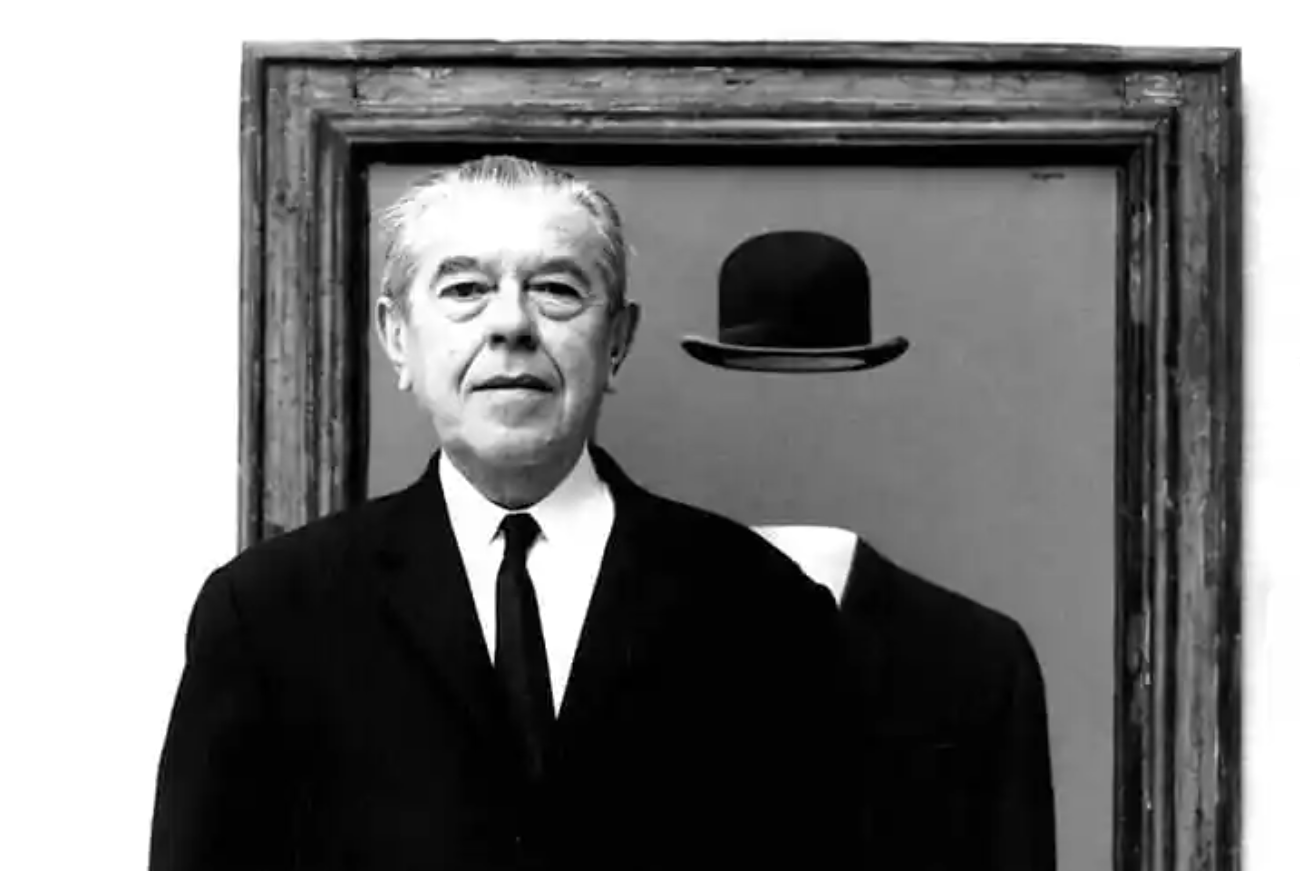
Today, Magritte’s works on paper are recognized as essential components of his artistic legacy. They reveal the underlying structure of his creative thought while demonstrating the extraordinary consistency of his vision across different media. Whether in the form of a quick drawing or a carefully executed gouache, these works embody the same central ambition that defined Magritte’s career: to reveal the mystery hidden within the ordinary. Through deceptively simple images, he invites viewers to question the reliability of perception and to reconsider the relationship between images and the world they appear to represent. In this sense, Magritte’s works on paper stand not merely as studies or variations, but as complete expressions of one of the most profound and influential artistic philosophies of the twentieth century.
Introduction
The works on paper created by René Magritte occupy a fascinating and essential place within his artistic practice. While Magritte is widely known for his meticulously executed oil paintings, his drawings and gouaches reveal a more intimate dimension of his creative process. These works demonstrate how the artist developed, refined, and expanded the visual vocabulary that would define his contribution to twentieth-century art.
Magritte employed a variety of media in his works on paper, most notably graphite drawings, ink studies, and gouache paintings. Among these, the gouaches occupy a particularly important place. His gouaches are typically executed with extraordinary precision, often replicating compositions that also exist in oil painting while maintaining a distinctive intimacy and freshness. The opaque quality of gouache allowed Magritte to produce crisp, luminous surfaces that echoed the clarity of his painted canvases.
Many of these works feature the same recurring motifs found throughout his career: bowler-hatted men, floating apples, pipes, clouds, curtains, and mysterious interiors. Despite their modest scale, these images possess the same conceptual force that defines Magritte’s most iconic paintings.
Works on Paper and the Development of Ideas
Works on paper also played a critical role in the development of Magritte’s visual ideas. Through drawing, he was able to test compositional structures and explore variations of recurring themes.
Magritte’s artistic project was deeply philosophical: he sought to challenge the relationship between objects, images, and language. Drawings allowed him to explore these questions with remarkable economy. A simple outline of a pipe or an apple could already contain the conceptual tension that defines many of his most celebrated paintings.
The immediacy of paper also gave Magritte greater freedom to experiment with unexpected juxtapositions and visual puzzles, reinforcing the playful yet intellectually rigorous nature of Surrealism.
The Gouaches and the Art Market
Magritte’s gouaches have become particularly sought after by collectors and institutions. Because they often present compositions closely related to major paintings, they offer a rare opportunity to acquire works that capture the essence of Magritte’s visual language in a more intimate format. These works frequently appear at leading auction houses such as Christie’s and Sotheby’s, where they command significant prices. Their rarity, historical importance, and strong visual identity have made them one of the most desirable segments of the Surrealist market.
In many cases, Magritte’s gouaches demonstrate a remarkable balance between spontaneity and precision. They preserve the artist’s intellectual rigor while offering a sense of immediacy that differs subtly from the controlled surfaces of his oil paintings.
Auction Market Overview
2025 Auction Highlights
19 lots sold at auction in 2025 for a total turnover of USD 23,307,040. With 3 lots failing to sell, the sell-through rate is 86%. The highest price for 2025 was achieved by La clairvoyance, a drawing dated 1962, that sold at Christie’s in Hong-Kong, on 28 March 2025, for HKD 28,810,000 (USD 3,703,085).
2025 Top 3 Lots
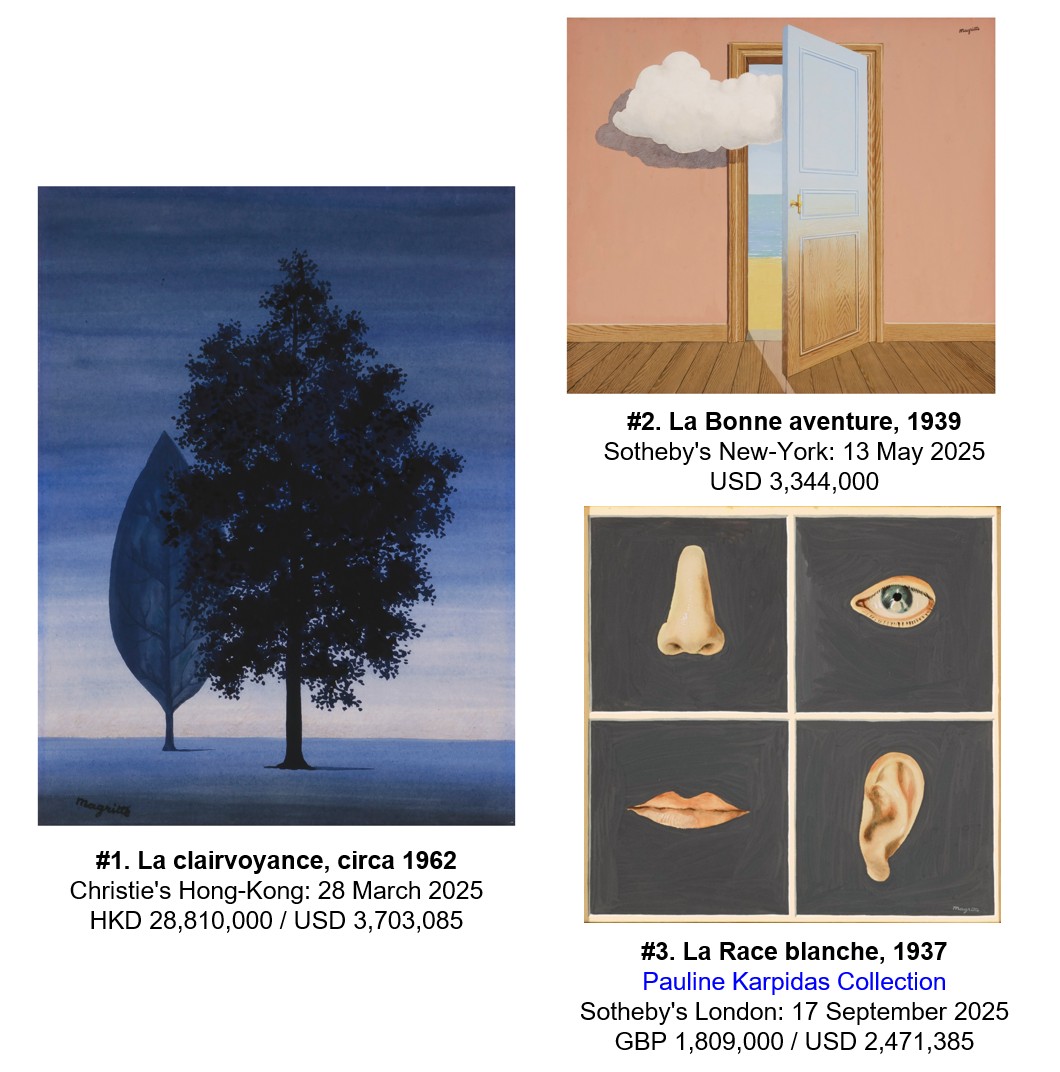
10 lots sold for more than USD 1 million, generating a cumulative turnover of USD 19,415,740, representing 83.3% of the total turnover for 2025.
2024 Auction Highlights
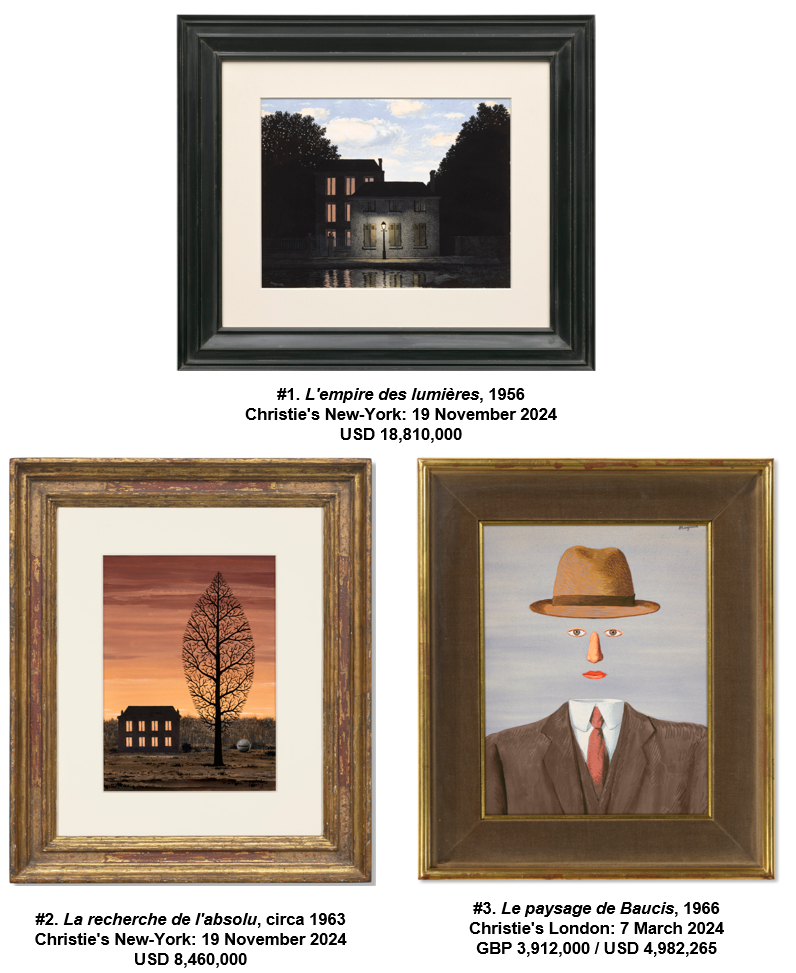
24 lots sold at auction in 2024 for a total turnover of USD 52,770,385. With only 1 lot failing to sell, the sell-through rate is 96%. L’empire des lumieres, a gouache dated 1956, from the artist’s most celebrated series sold at Christie’s in New-York on 19 November 2024 for USD 18,810,000, a new auction record for a gouache of the artist. 13 lots sold for more than USD 1 million, generating a cumulative turnover of USD 50,419,635 representing 95.5% of the total turnover for 2024.
2024 WOP Top 3 Lots
2025 Auction Results
19 lots sold at auction in 2025 for a total turnover of USD 23,307,040. With 3 lots failing to sell, the sell-through rate is 86%. The highest price for 2025 was achieved by La clairvoyance, a drawing dated 1962, that sold at Christie’s in Hong-Kong, on 28 March 2025, for HKD 28,810,000 (USD 3,703,085).
2025 Top 3 Lots
10 lots sold for more than USD 1 million, generating a cumulative turnover of USD 19,415,740, representing 83.3% of the total turnover for 2025.
XXXXXXXXXX
#1. La clairvoyance, circa 1962
Christie’s Hong-Kong: 28 March 2025
Estimated: HKD 15,000,000 – 25,000,000
HKD 28,810,000 / USD 3,703,085
WORK ON PAPER
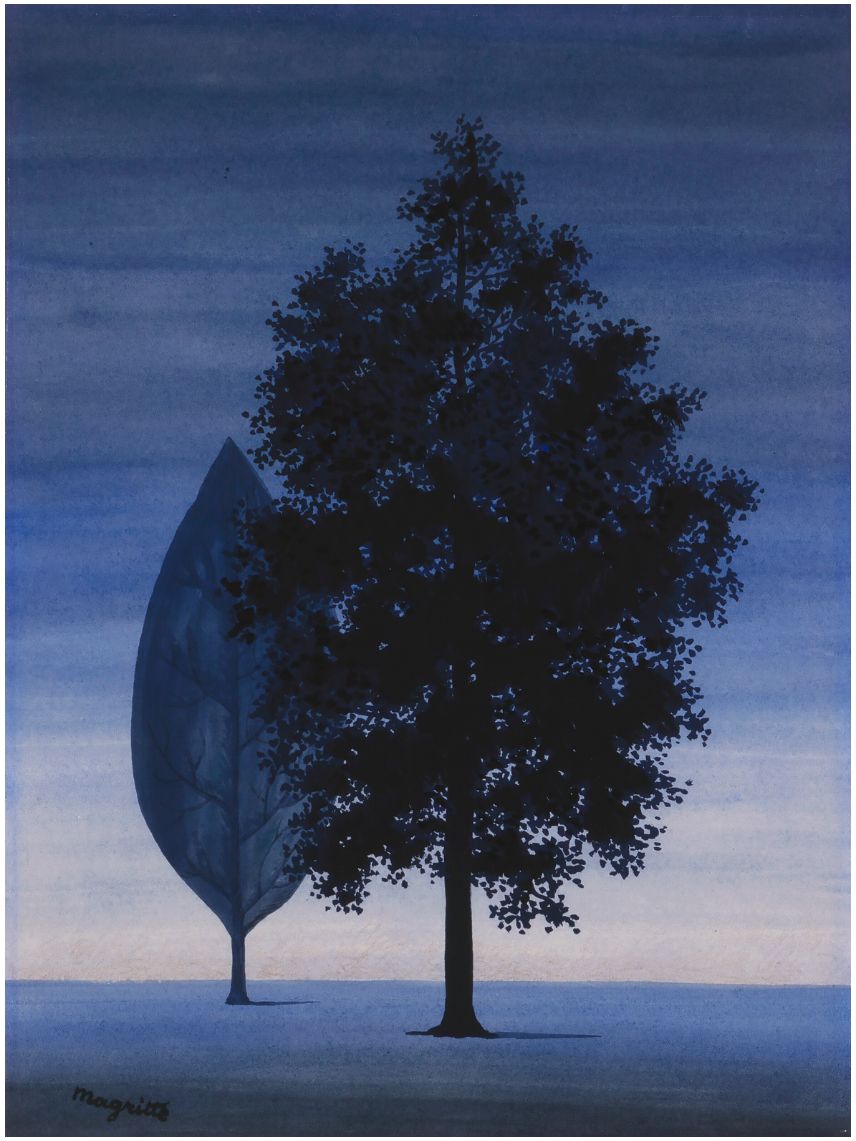
La clairvoyance, circa 1962
Gouache, watercolor and colored pencil on paper
36 x 26.8 cm (14 1/8 x 10 1/2 inches)
Signed ‘Magritte’ (lower left)
#2. La Bonne aventure, 1939
Estimated: USD 3,000,000 – 4,000,000
USD 3,344,000
WORK ON PAPER
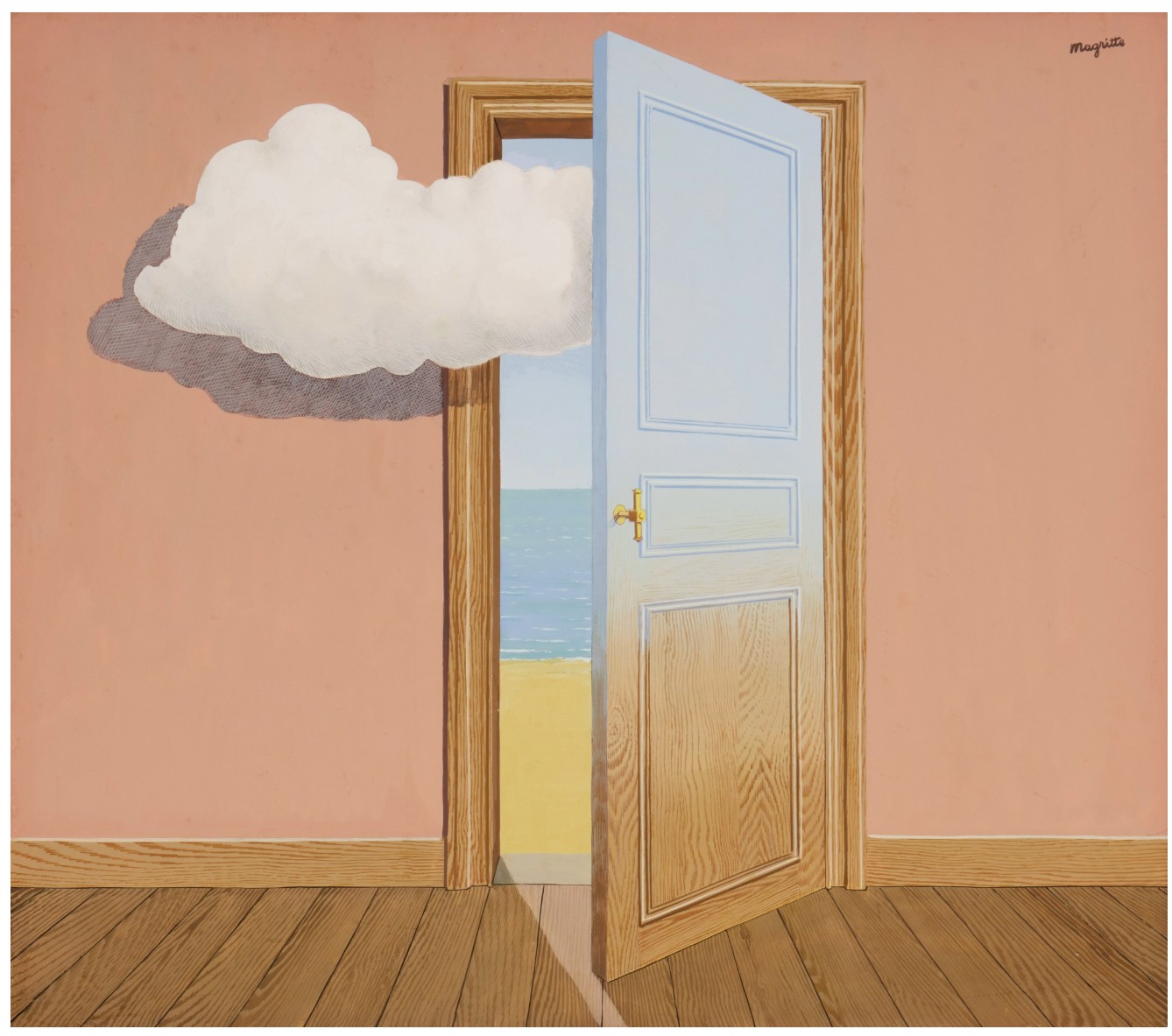
RENE MAGRITTE (1898 -1967)
La Bonne aventure, 1939
Gouache on paper laid down on board
36.2 x 41.6 cm (14 1/4 x 16 3/8 inches)
Signed Magritte (upper right)
#3. La Race blanche, 1937
Pauline Karpidas: The London Collection Evening Auction
Sotheby’s London: 17 September 2025
Estimated: GBP 1,000,000 – 1,500,000
GBP 1,809,000 / USD 2,471,385
WORK ON PAPER
La Race blanche | Pauline Karpidas: The London Collection Evening Auction | 2025 | Sotheby’s
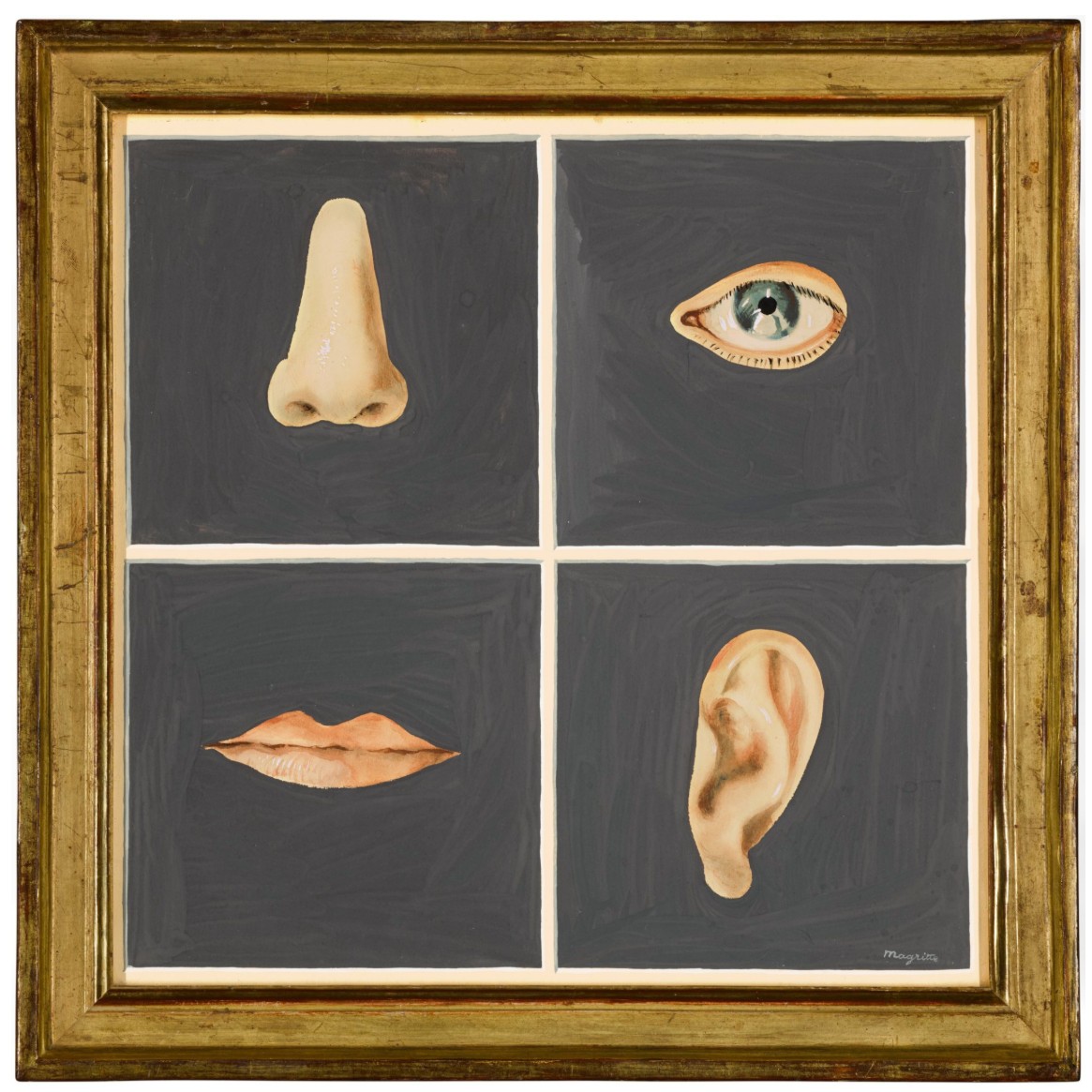
RENE MAGRITTE (1898 -1967)
La Race blanche, 1937
Gouache on paper
26.3 x 26.4 cm (10 1/2 x 10 5/8 inches)
Signed Magritte (lower right)
#4. Le faux miroir, 1952
Christie’s London: 5 March 2025
Estimated: GBP 1,500,000 – 2,500,000
GBP 1,855,000 / USD 2,372,320
WORK ON PAPER
RENÉ MAGRITTE (1898-1967), Le faux miroir | Christie’s
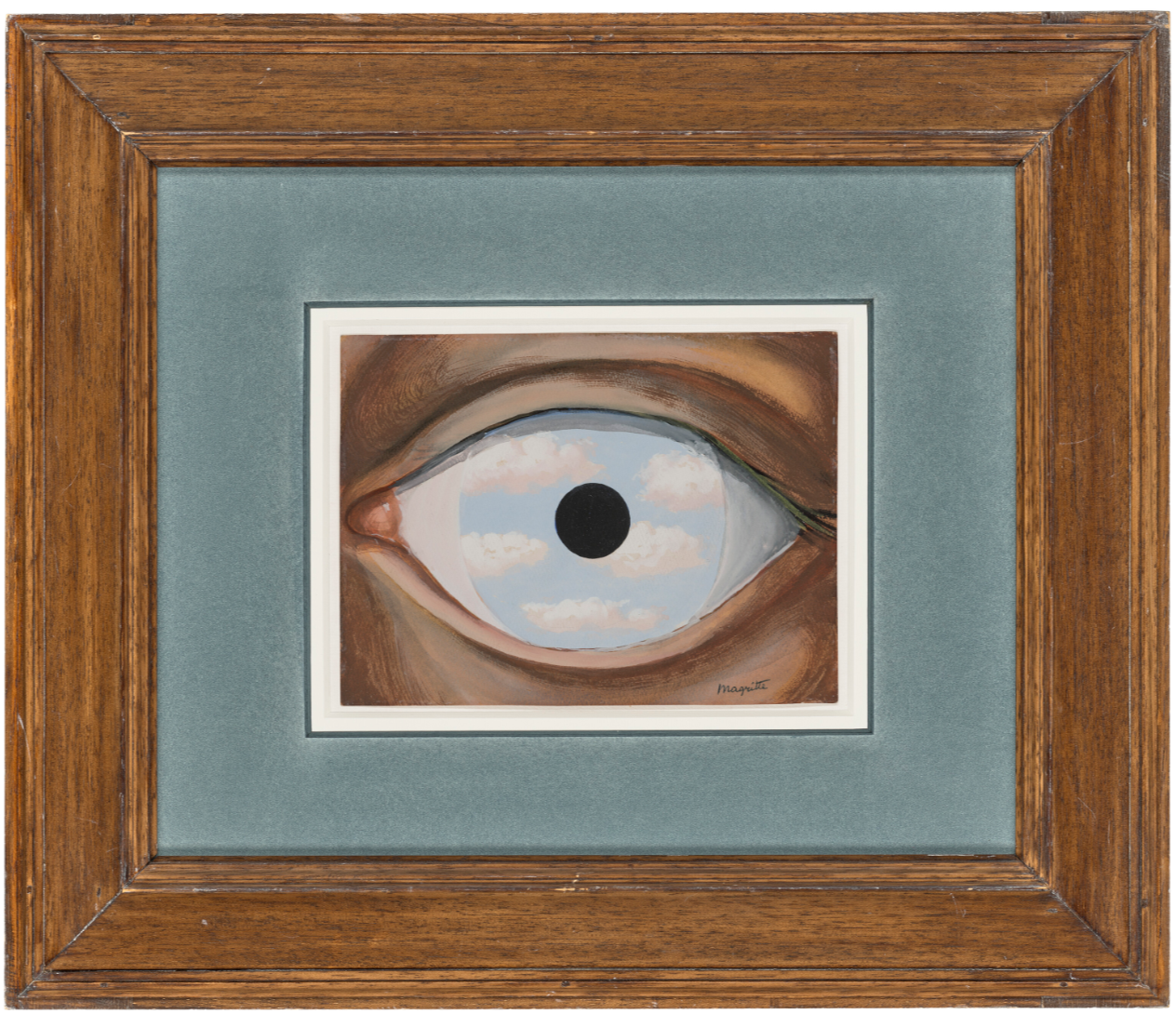
RENÉ MAGRITTE (1898-1967)
Le faux miroir, 1952
Gouache on paper
14.5 x 19.4 cm (5 5/8 x 7 5/8 inches)
Signed ‘Magritte’ (lower right)
Dated and inscribed ‘”LE FAUX MIROIR” 1952’ (on the reverse)
#5. Le Jockey perdu, circa 1942
Exquisite Corpus Evening Auction
Sotheby’s New-York: 20 November 2025
Estimated: USD 800,000 – 1,200,000
USD 2,002,000
WORK ON PAPER
Le Jockey perdu | Exquisite Corpus Evening Auction | 2025 | Sotheby’s
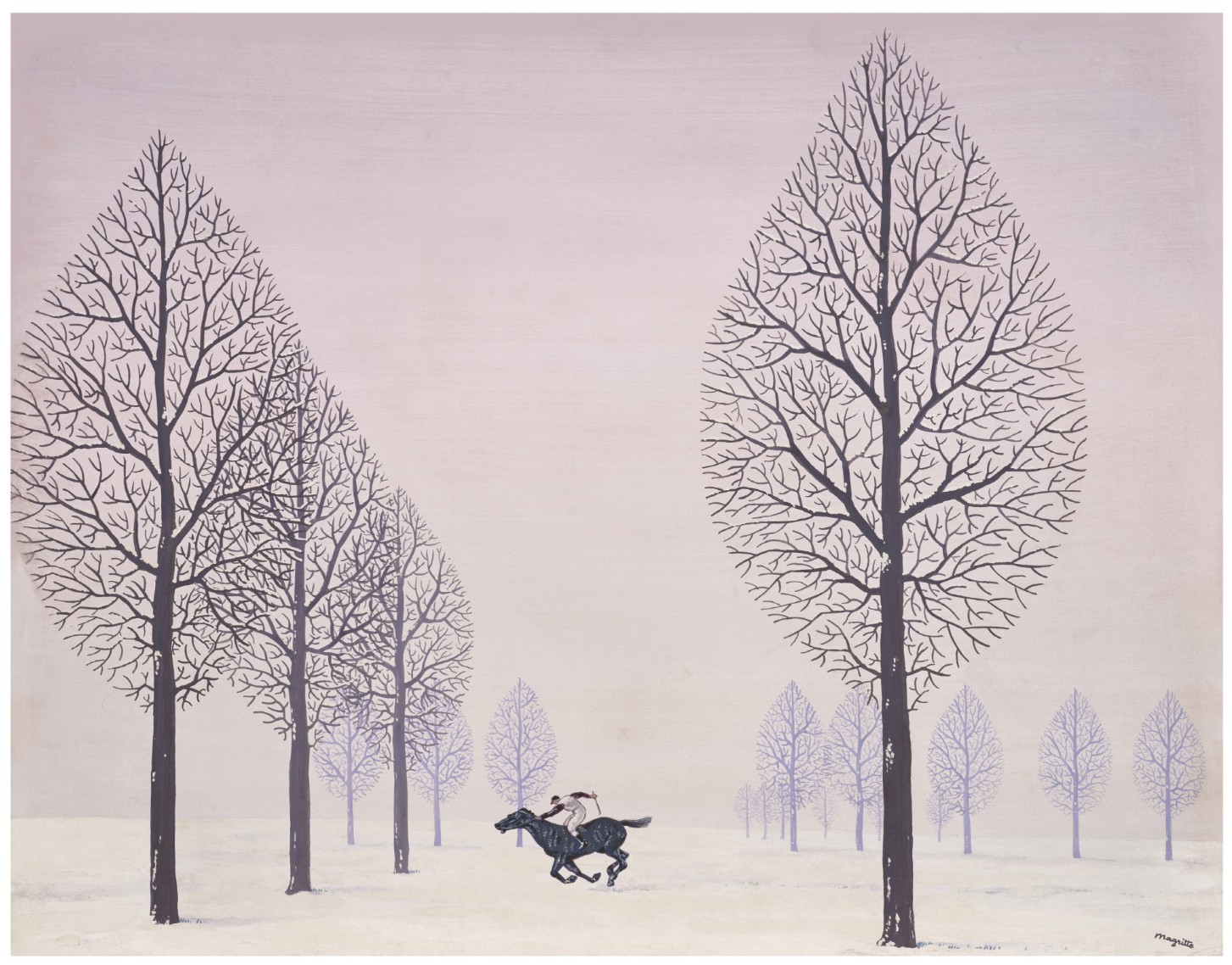
RENÉ MAGRITTE (1898-1967)
Le Jockey perdu, circa 1942
Gouache on paper laid down on canvas
50.7 x 65.2 cm (20 x 25 5/8 inches)
Signed Magritte (lower right)
#6. L’État de veille, 1958
Sotheby’s Diriyah: 8 February 2025
Estimated: USD 1,000,000 – 1,500,000
USD 1,200,000
WORK ON PAPER
L’État de veille | Origins | 2025 | Sotheby’s
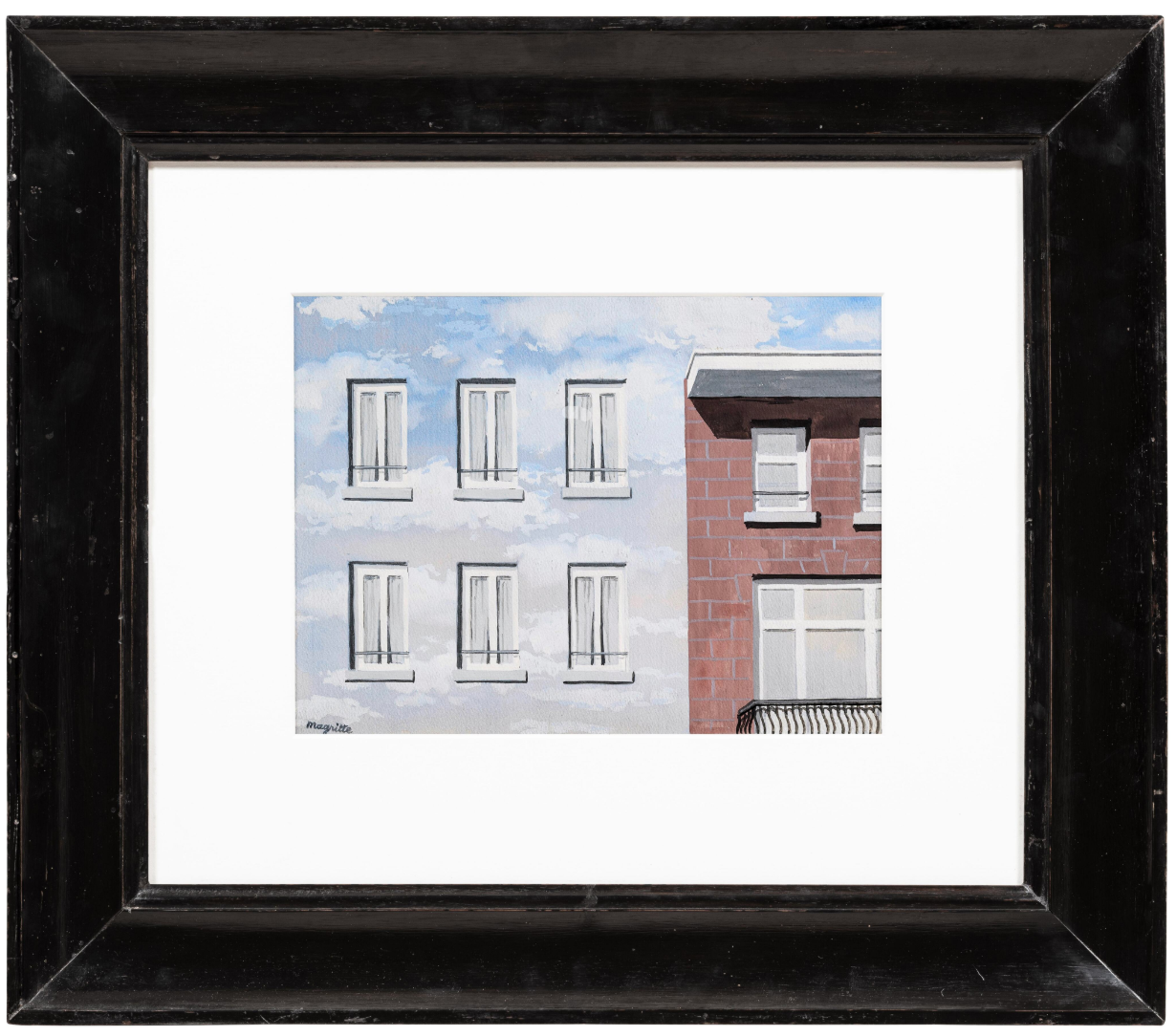
RENE MAGRITTE (1898 – 1967)
L’État de veille, 1958
Gouache on paper
19×25 cm (7 1/2 x 9 7/8 inches)
Signed Magritte (lower left)
Signed, titled and dated 1958 (on the verso)
#7. Sans titre, circa 1961
Christie’s New-York: 13 May 2025
Estimated: USD 600,000 – 800,000
USD 1,134,000
WORK ON PAPER
RENE MAGRITTE (1898-1967), Sans titre | Christie’s
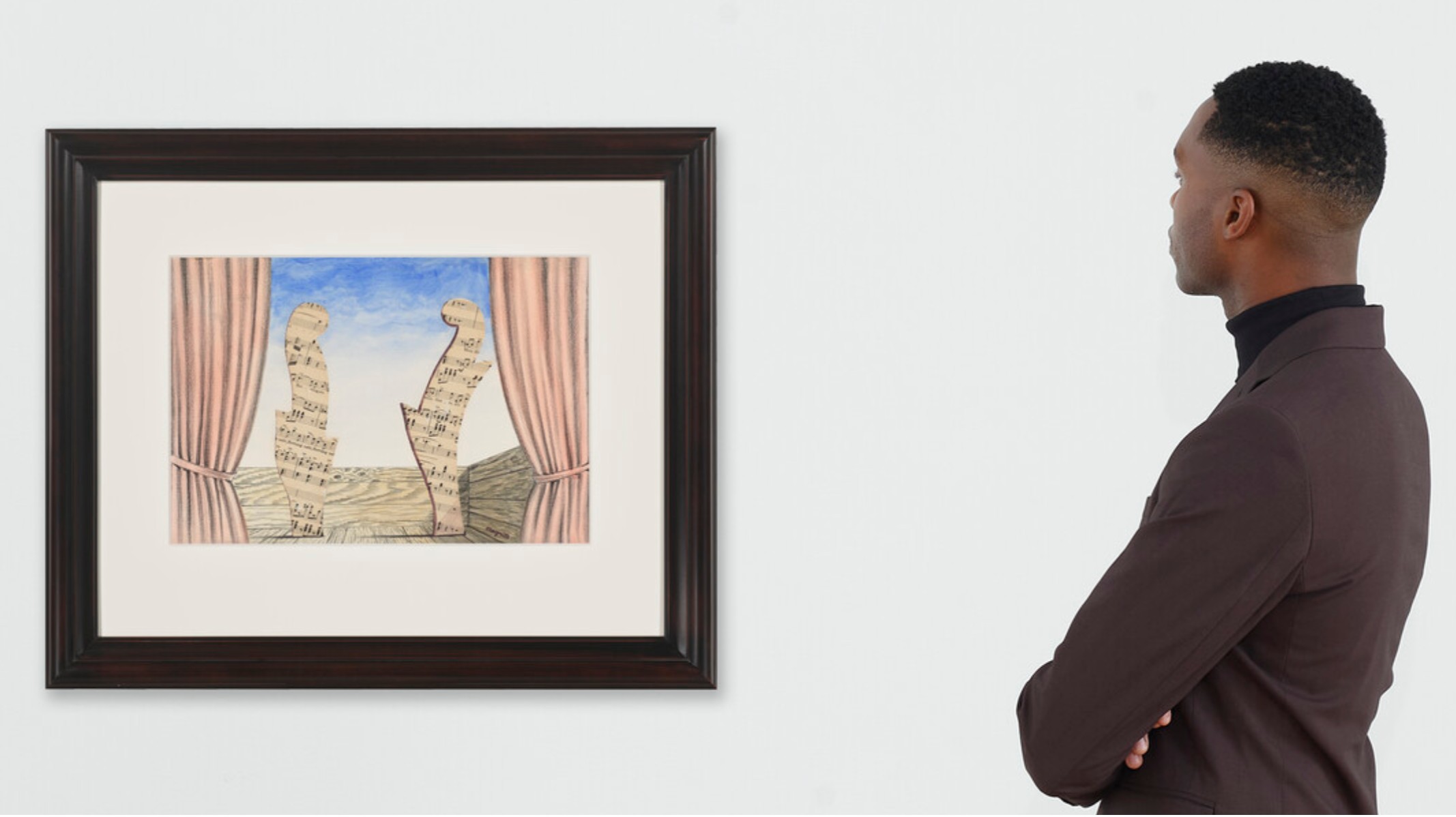
RENE MAGRITTE (1898-1967)
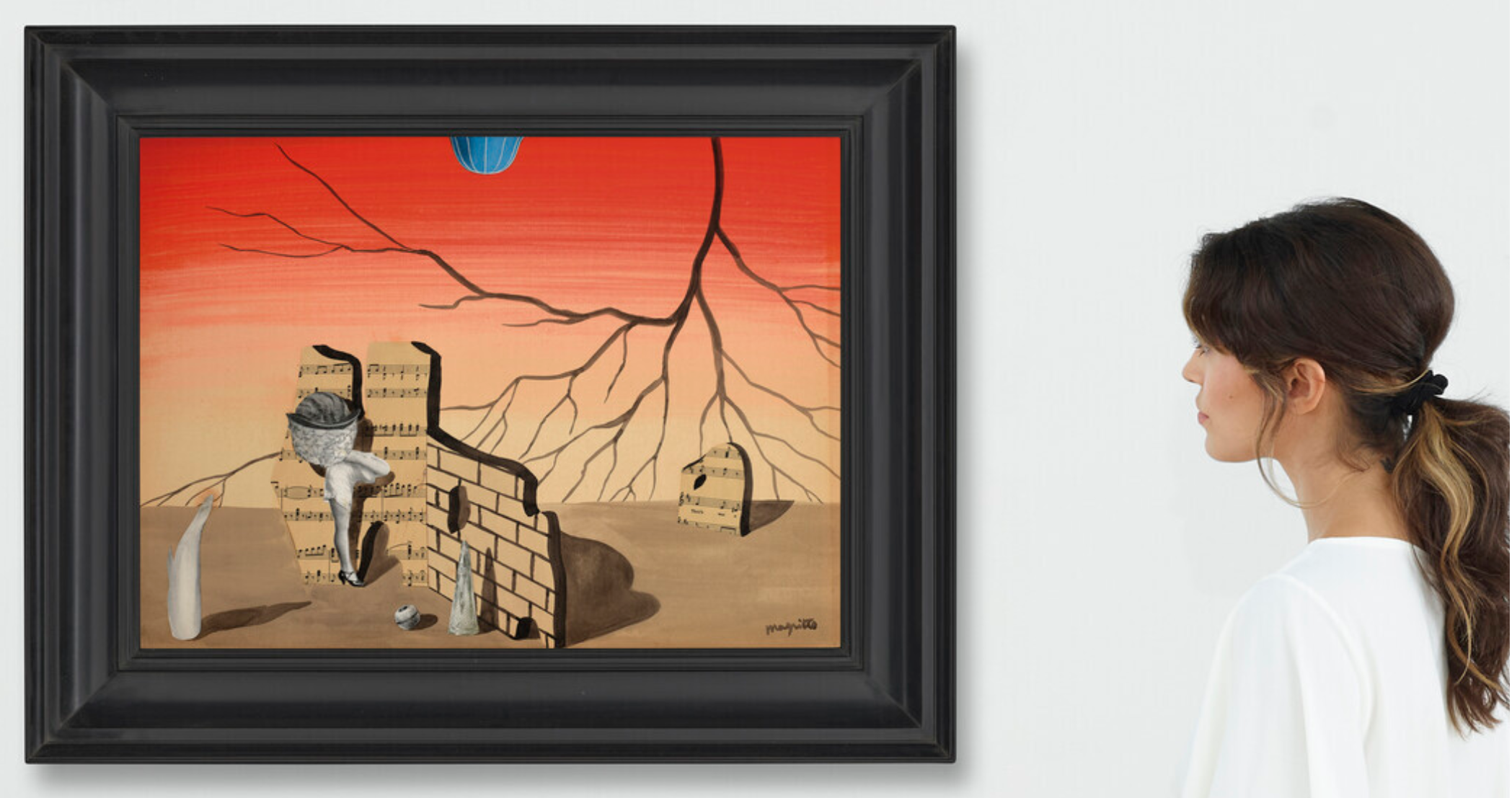
Sans titre, circa 1961
Gouache, pencil and sheet music collage on paper
29.5 x 42 cm (11 5/8 x 16 1/2 inches)
Signed ‘Magritte’ (lower right)
#8. La veillée (The Vigil), 1961
Christie’s London: 15 October 2025
Estimated: GBP 300,000 – 500,000
GBP 812,800 / USD 1,088,590
WORK ON PAPER
RENÉ MAGRITTE (1898-1967), La veillée (The Vigil) | Christie’s
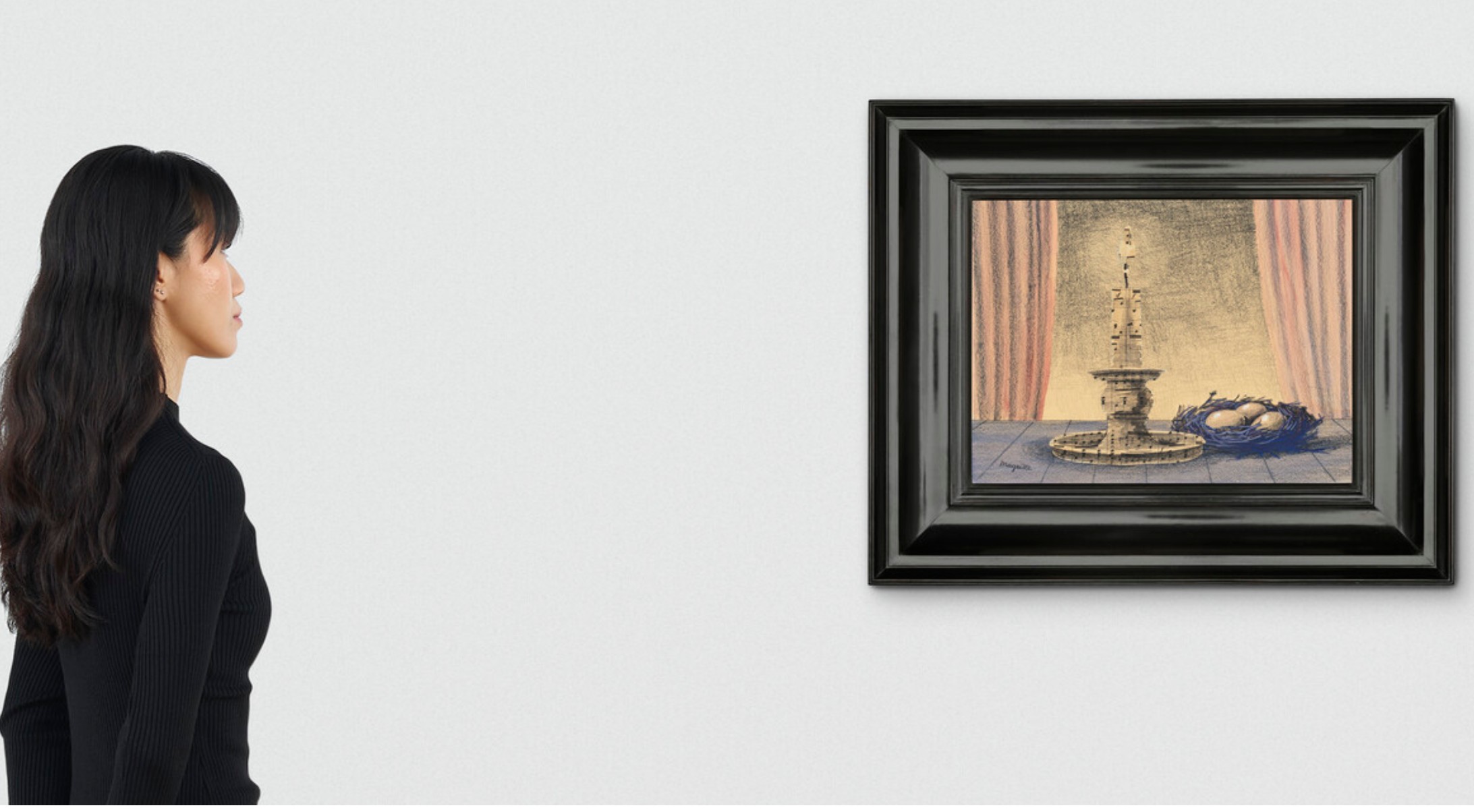
RENÉ MAGRITTE (1898-1967)
La veillée (The Vigil), 1961
Collage with gouache, watercolour and Conté crayon on paper
34.3 x 42.6 cm (13 1/2 x 16 3/4 inches)
Signed ‘Magritte’ (lower left)
#9. Le Séducteur, 1952
Sotheby’s Paris: 10 April 2025
Estimated: EUR 800,000 – 1,200,000
EUR 965,200 / USD 1,080,305
WORK ON PAPER
Le Séducteur | Art Moderne et Contemporain Evening Auction | 2025 | Sotheby’s
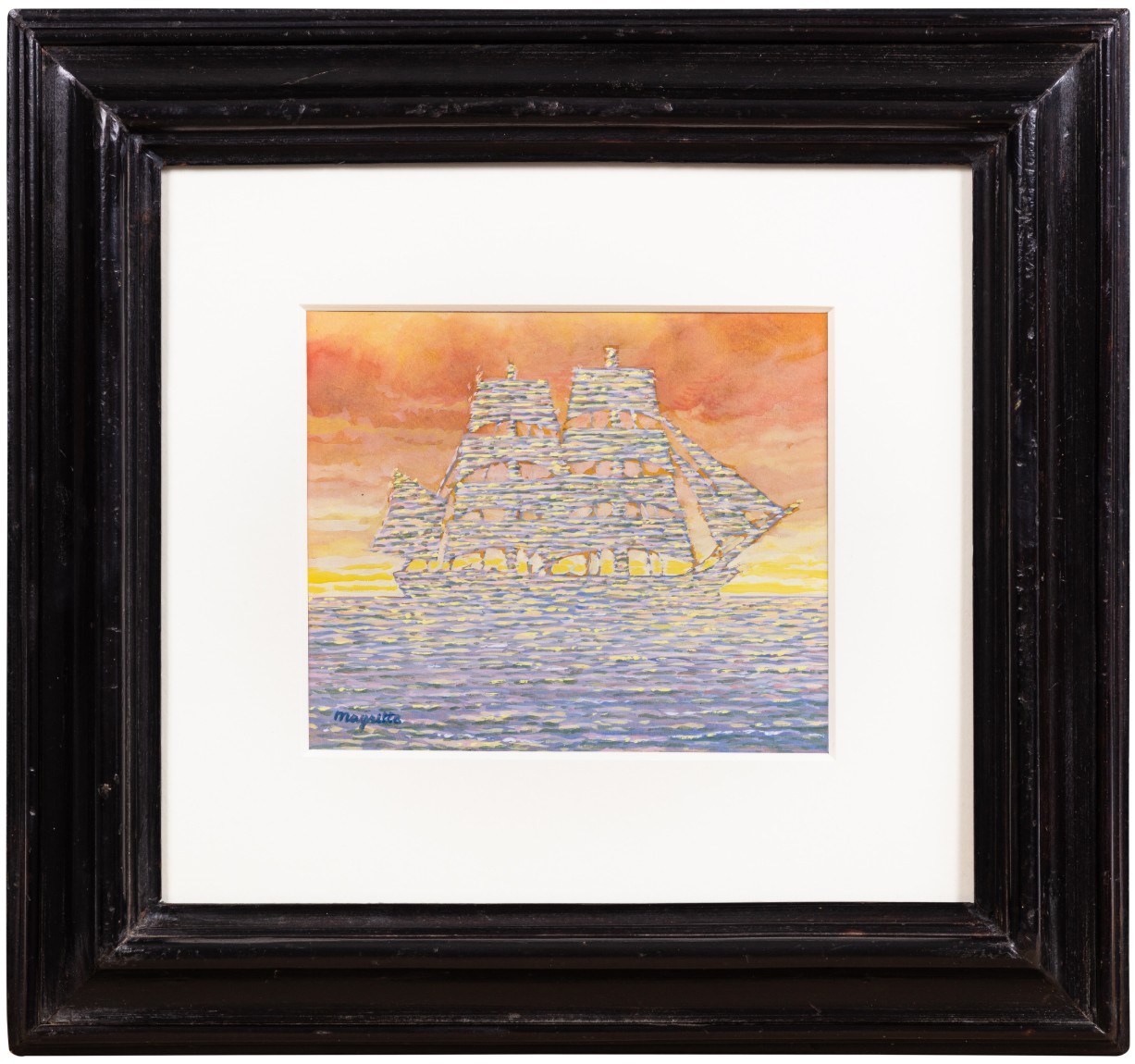
RENÉ MAGRITTE (1898-1967)
Le Séducteur, 1952
Gouache on paper laid down on card
14.8 x 17.4 cm (5 7/8 x 6 7/8 inches)
Signed magritte (lower left)
Inscribed and dated Le Séducteur 1952 (on the reverse)
#10. La voix du sang (Blood will tell), 1947
Christie’s London: 15 October 2025
Estimated: GBP 350,000 – 550,000
GBP 762,000 / USD 1,020,555
WORK ON PAPER
RENÉ MAGRITTE (1898-1967), La voix du sang (Blood will tell) | Christie’s
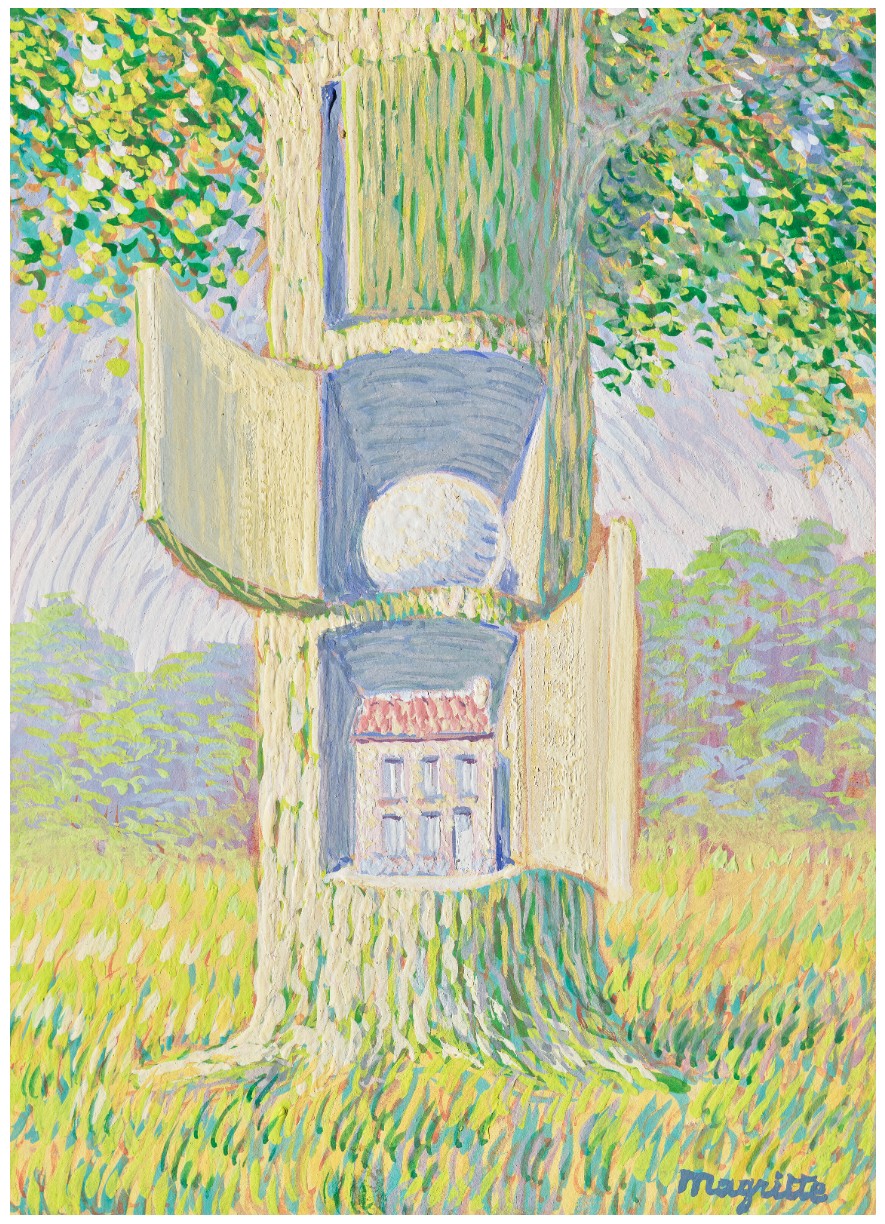
RENÉ MAGRITTE (1898-1967)
La voix du sang (Blood will tell), 1947
Gouache on paper laid down on card
17.7 x 12.7 cm (7×5 inches)
Signed ‘Magritte’ (lower right)
Signed, dated and inscribed ‘”La Voix du Sang” Magritte 1947’ (on the reverse)
USD 1 million
#11. L’école buissonnière, 1946
Christie’s London: 5 March 2025
Estimated: GBP 500,000 – 800,000
GBP 630,000 / USD 805,695
WORK ON PAPER
RENÉ MAGRITTE (1898-1967), L’école buissonnière | Christie’s
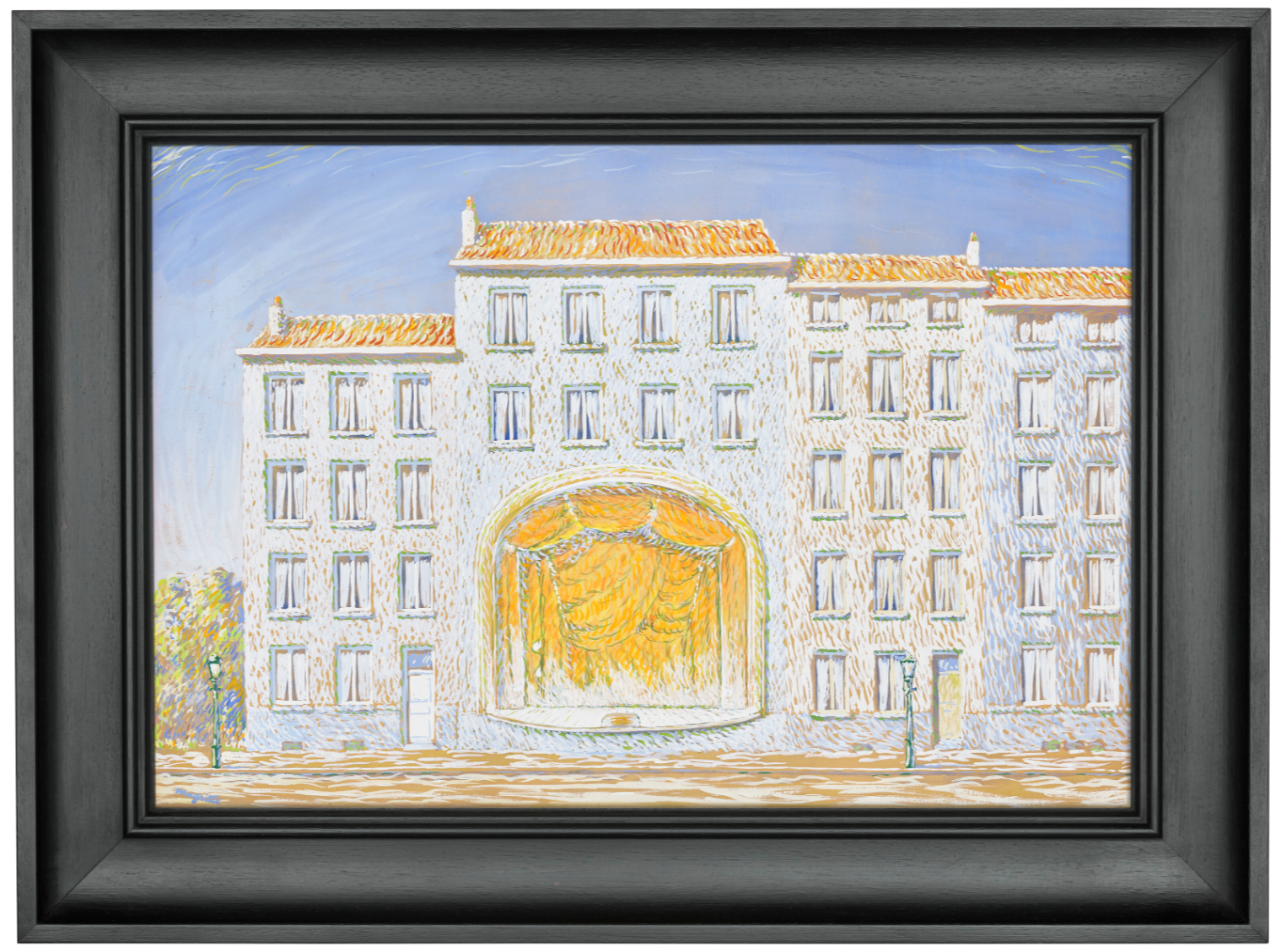
RENÉ MAGRITTE (1898-1967)
L’école buissonnière, 1946
Gouache on paper
40.3 x 59.1 cm (15 7/8 x 23 1/4 inches)
Signed ‘Magritte’ (lower left)
Signed, dated and inscribed ”L’Ecole buissonière’ Magritte 1946′ (on the reverse)
#12. Dessin sans titre, 1928
Pauline Karpidas: The London Collection Day Auction
Sotheby’s London: 18 September 2025
Estimated: GBP 150,000 – 200,000
GBP 419,100 / USD 567,745
WORK ON PAPER
Dessin sans titre | Pauline Karpidas: The London Collection Day Auction | 2025 | Sotheby’s
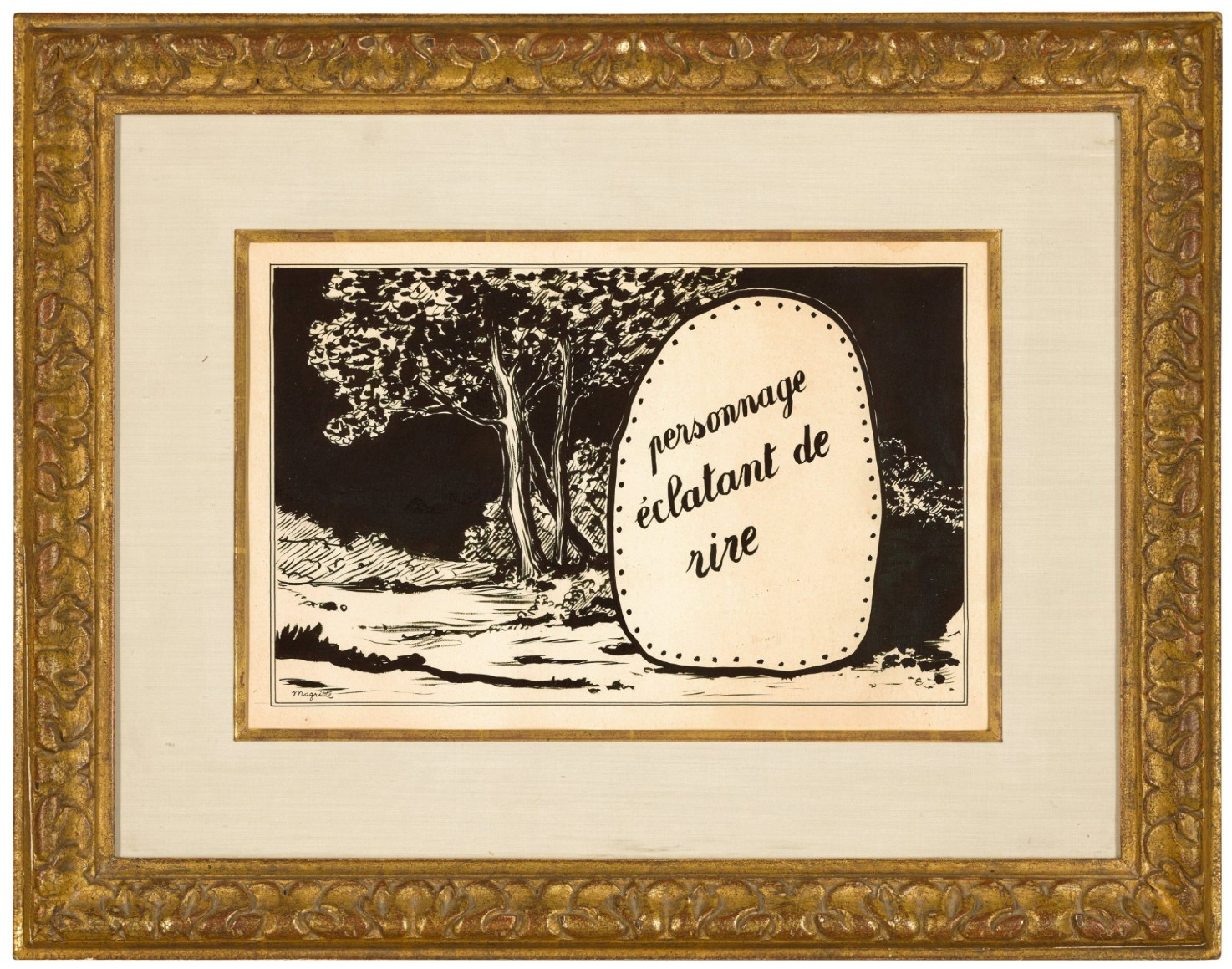
RENÉ MAGRITTE (1898-1967)
Dessin sans titre, 1928
Brush and pen and ink on paper
32.6 x 46 cm (12 7/8 x 18 1/8 inches)
Signed Magritte (lower left)
#13. Le tricheur, 1945
PROPERTY FROM AN IMPORTANT EUROPEAN PRIVATE COLLECTION
Sotheby’s Paris: 24 October 2025
Estimated: EUR 500,000 – 700,000
EUR 482,600 / USD 561,595
WORK ON PAPER
Le tricheur | Surrealism and Its Legacy | 2025 | Sotheby’s
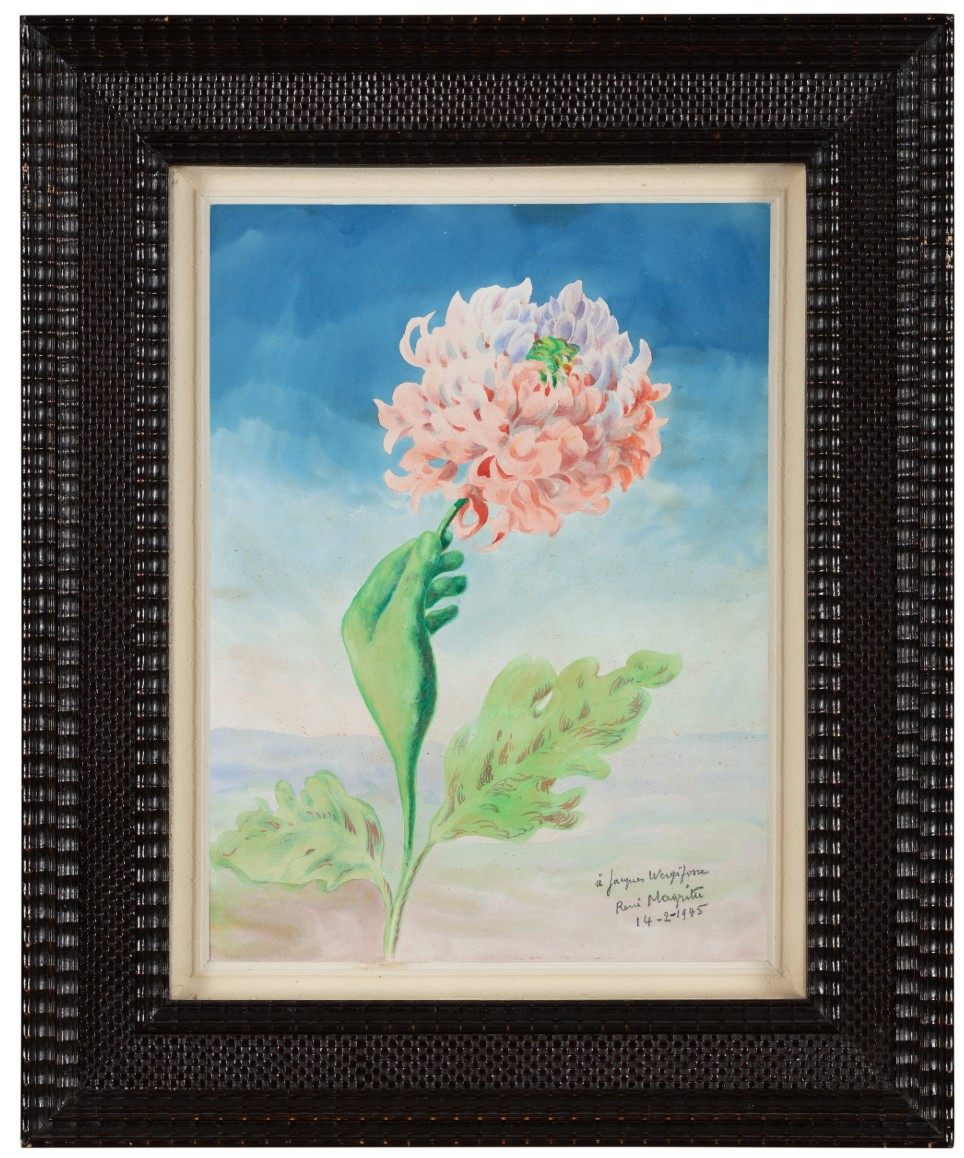
RENÉ MAGRITTE (1898-1967)
Le tricheur, 1945
Gouache and watercolor on paper laid on cardboard
41.8 x 31.4 cm (16 1/2 x 12 3/8 inches)
Signed René Magritte, dated 14-2-1945, and inscribed à Jacques Wergifosse (lower right)
#14. La folie des grandeurs (Megalomania), 1959
Force of Nature: The Collection of Dr. Carolyn Farb
Phillips New-York: 19 November 2025
Estimated: USD 400,000 – 600,000
USD 516,000
René Magritte Modern & Contemporary Art Evening Sale featuring Cera the Triceratops
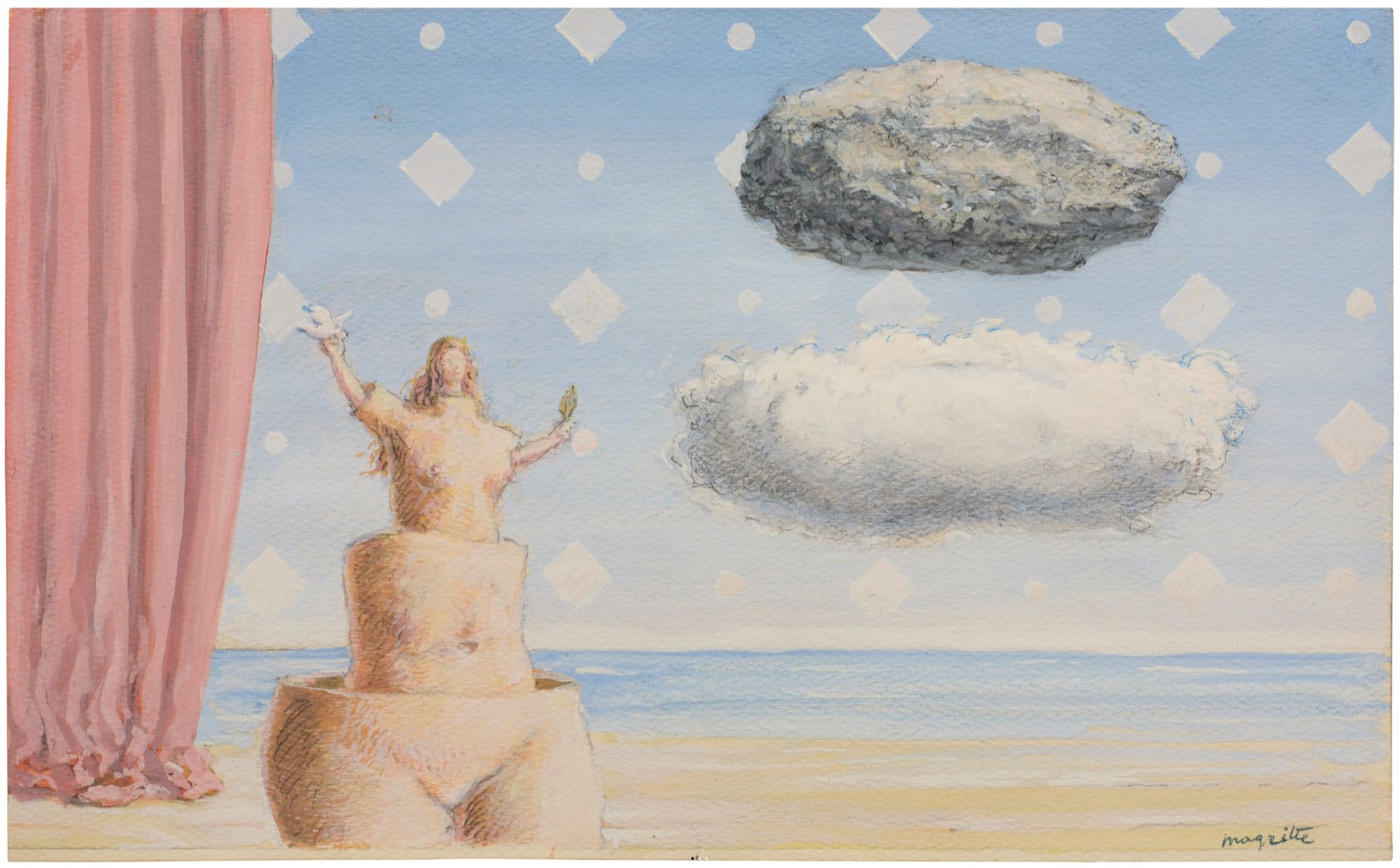
Gouache on paper
15.2 x 22.9 cm (6×9 inches)
Signed “Magritte” lower right
Signed, titled and dated “’La Folie des Grandeurs’ Magritte 1959” on the reverse
#15. Le changement de vitesse, 1951
Bonhams Cornette Paris: 3 December 2025
Estimated: EUR 200,000 – 400,000
EUR 343,300 / USD 400,280
WORK ON PAPER
Bonhams Cornette de Saint Cyr : RENÉ MAGRITTE (1898-1967) Le changement de vitesse
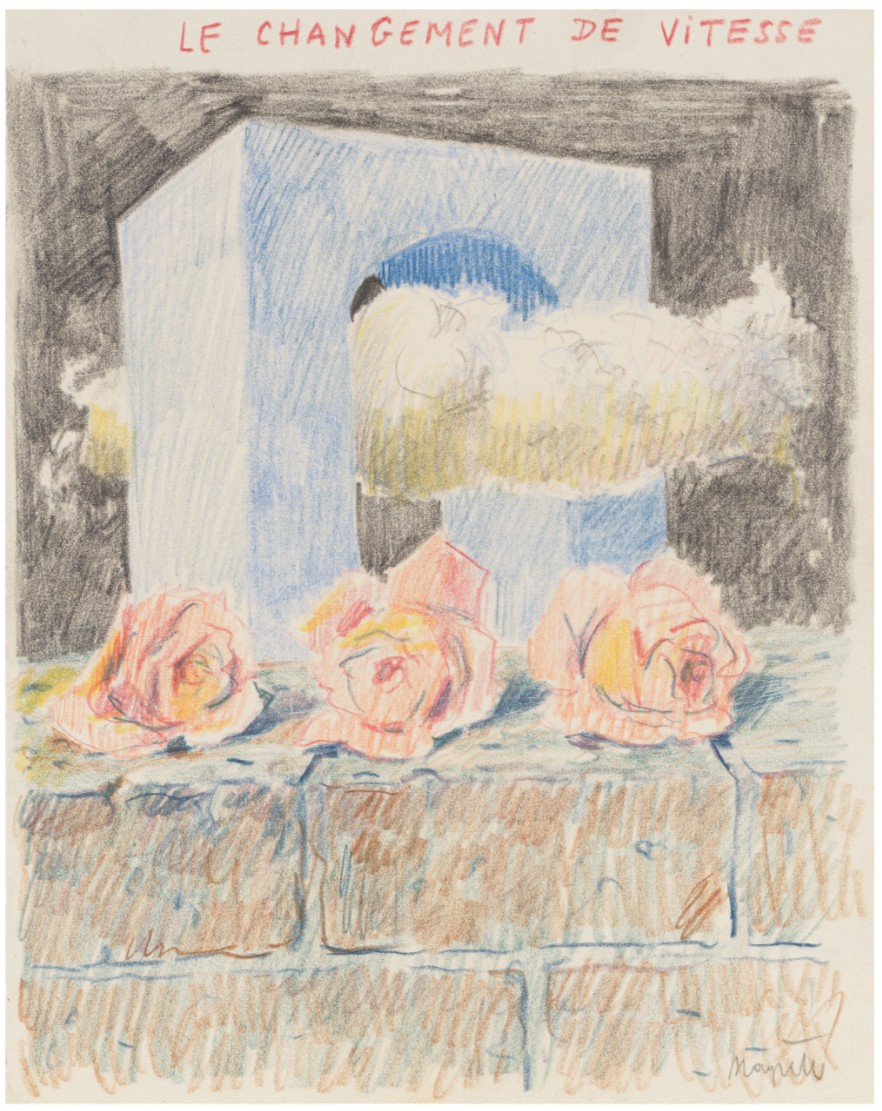
RENÉ MAGRITTE (1898-1967)
Le changement de vitesse, 1951
Colored pencils on paper
27.8 x 21.8 cm (10 15/16 x 8 9/16 inches)
Signed ‘Magritte’ (lower right) and inscribed ‘Le changement de vitesse’ (upper centre)
#16. Le Monde perdu, 1928
Pauline Karpidas: The London Collection Day Auction
Sotheby’s London: 18 September 2025
Estimated: GBP 150,000 – 200,000
GBP 241,300 / USD 326,885
WORK ON PAPER
Le Monde perdu | Pauline Karpidas: The London Collection Day Auction | 2025 | Sotheby’s
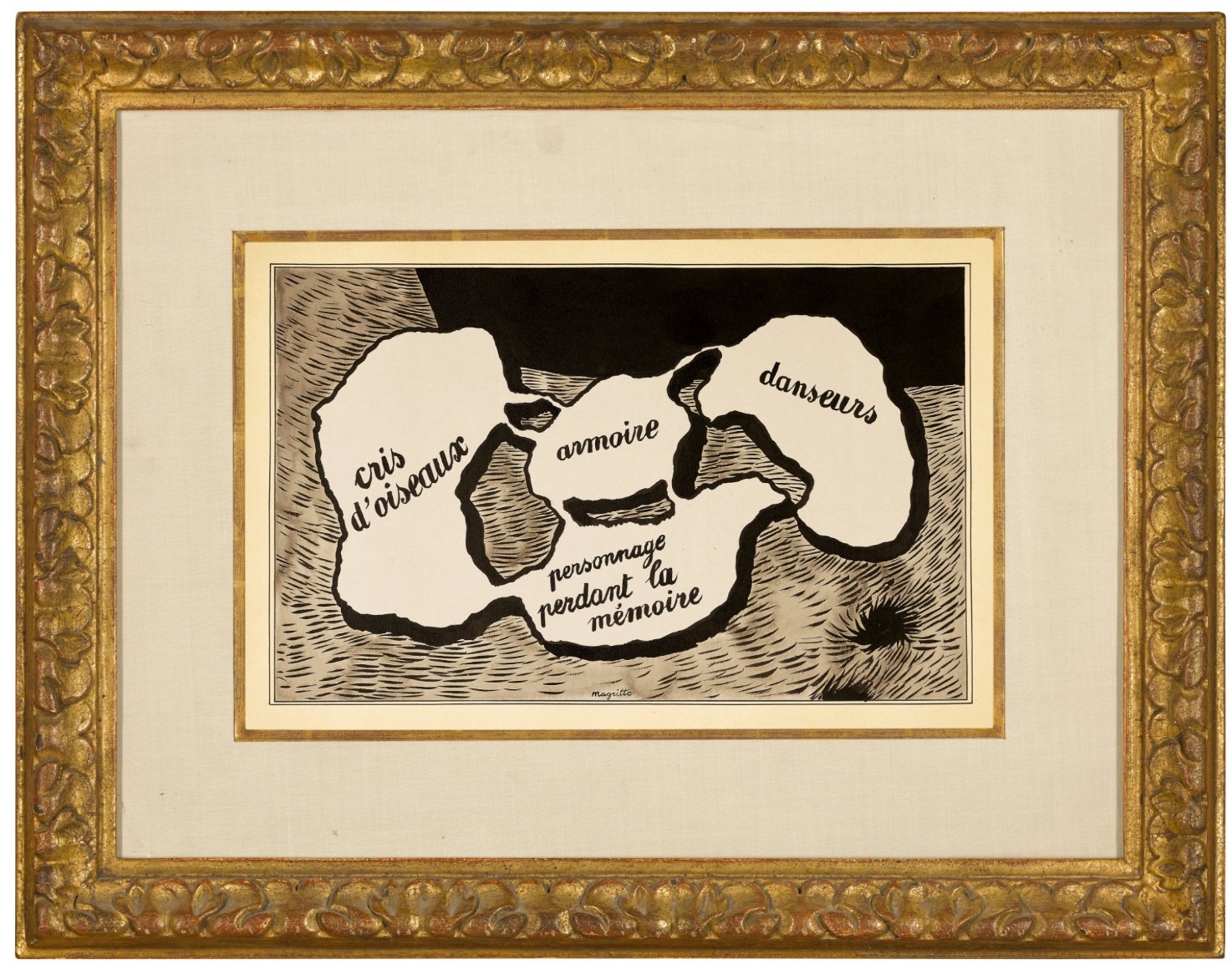
RENÉ MAGRITTE (1898-1967)
Le Monde perdu, 1928
Brush and pen and ink on paper
32.6 x 46.3 cm (12 7/8 x 18 1/4 inches)
Signed Magritte (lower center)
#17. Verre, 1959
Property from the Collection of Cynthia Monaco
Sotheby’s New-York: 14 May 2025
Estimated: USD 180,000 – 250,000
USD 317,500
Verre | Modern Day Auction | 2025 | Sotheby’s
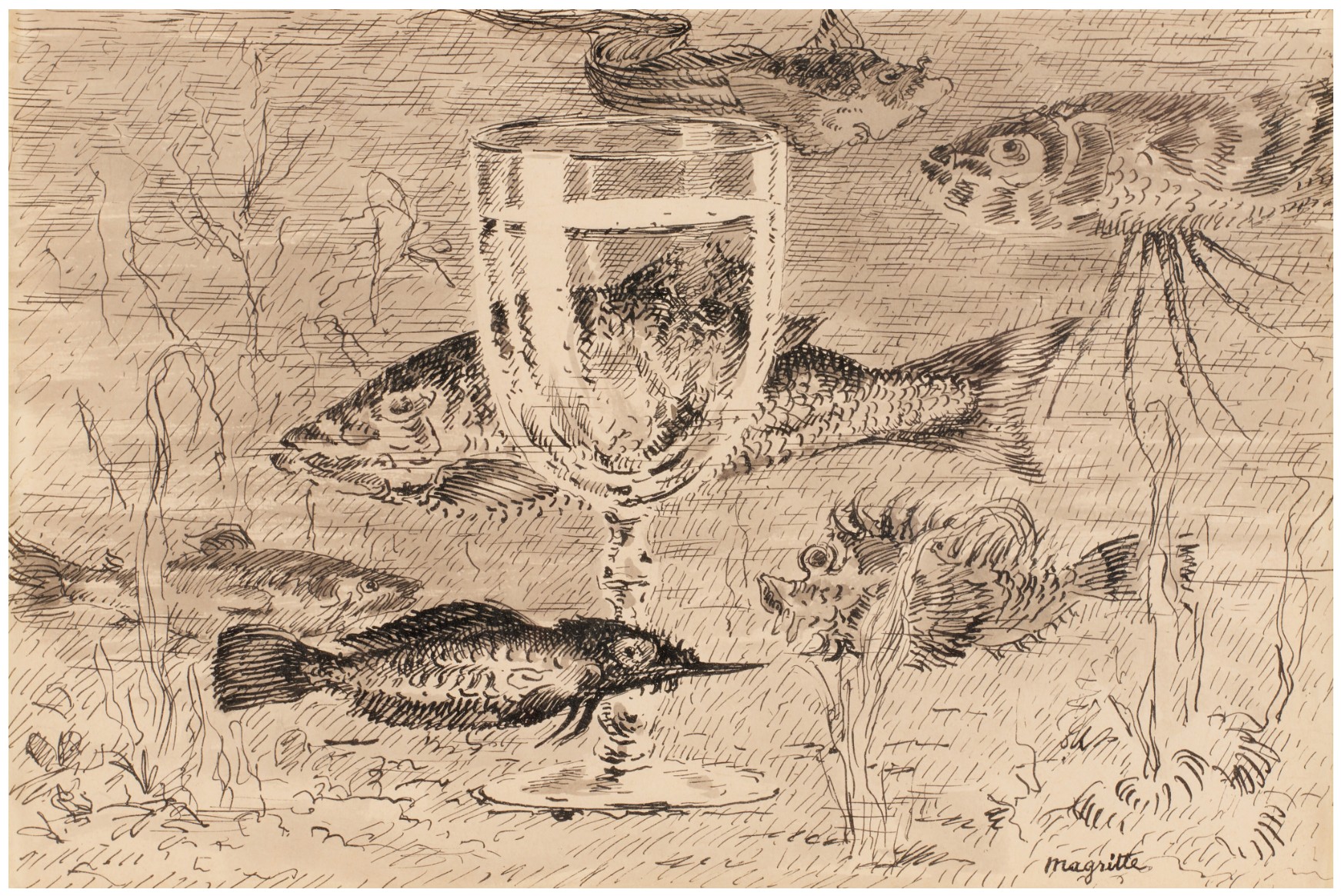
RENÉ MAGRITTE (1898-1967)
Verre, 1959
Pen and ink and ink wash on paper
17.8 x 26.1 cm (7 x 10 1/4 inches)
Signed Magritte (lower right)
#18. L’Usage de la parole, 1928
Pauline Karpidas: The London Collection Day Auction
Sotheby’s London: 18 September 2025
Estimated: GBP 150,000 – 200,000
GBP 203,200 / USD 275,270
WORK ON PAPER
L’Usage de la parole | Pauline Karpidas: The London Collection Day Auction | 2025 | Sotheby’s
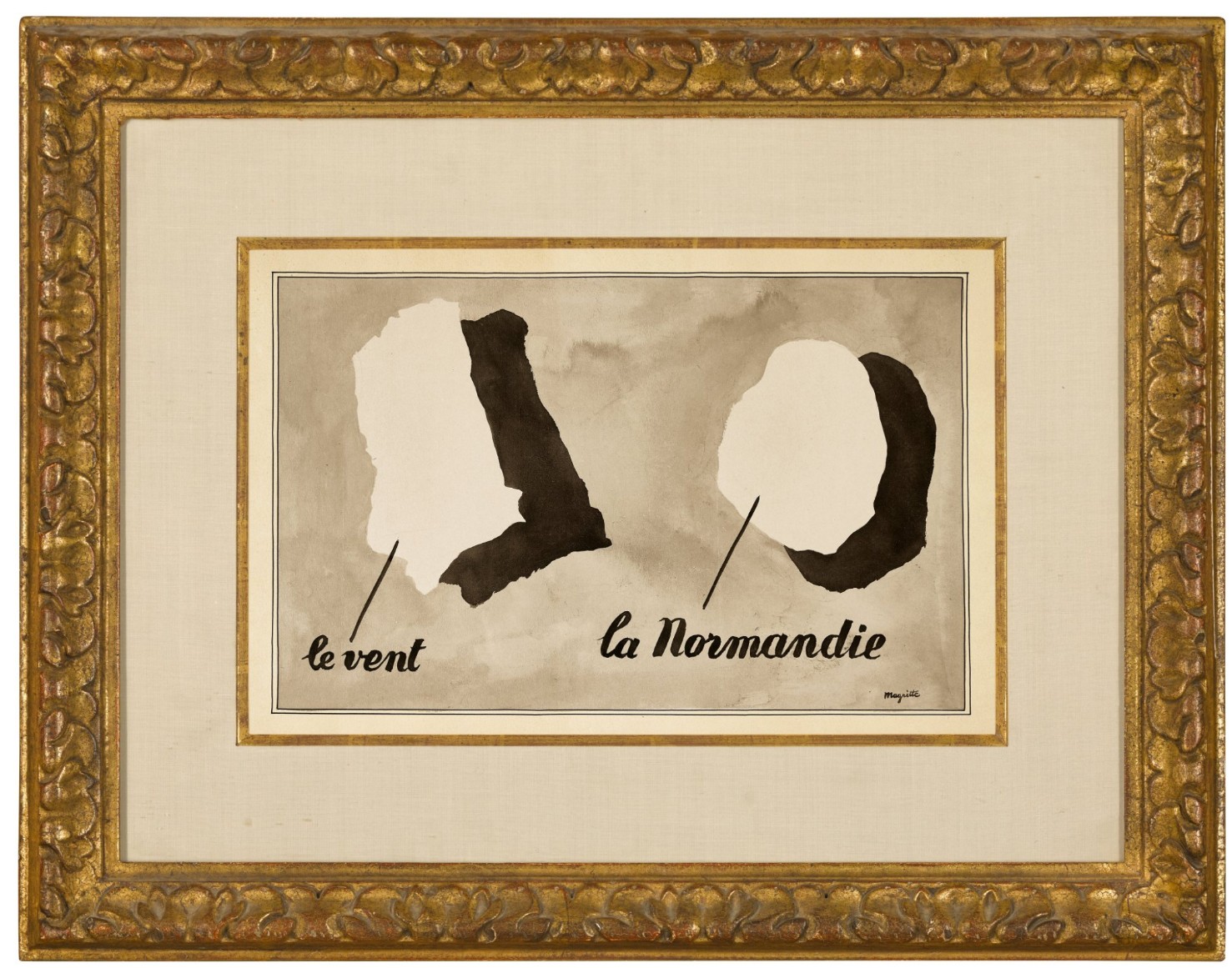
RENÉ MAGRITTE (1898-1967)
L’Usage de la parole, 1928
Brush and pen and ink on paper
32.5 x 46.3 cm (12 3/4 x 18 1/4 inches)
Signed Magritte (lower right)
#19. L’Histoire centrale, 1928
Pauline Karpidas: The London Collection Day Auction
Sotheby’s London: 18 September 2025
Estimated: GBP 50,000 – 70,000
GBP 88,900 / USD 120,430
WORK ON PAPER
L’Histoire centrale | Pauline Karpidas: The London Collection Day Auction | 2025 | Sotheby’s
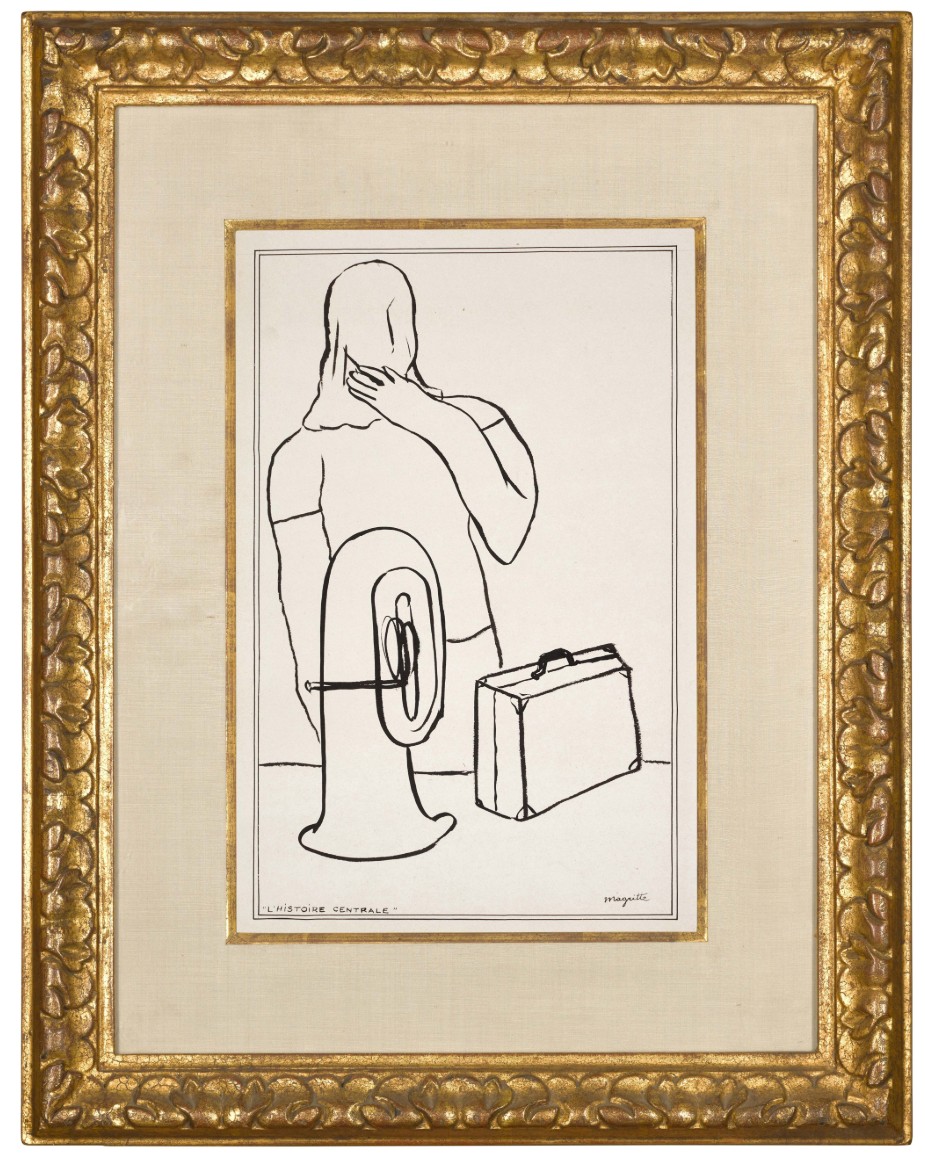
RENÉ MAGRITTE (1898-1967)
L’Histoire centrale, 1928
Brush and pen and ink on paper
46.5 x 32.6 cm (18 1/4 x 12 7/8 inches)
Signed Magritte (lower right)
Titled (lower left)
Lots Passed
Le stropiat, 1948
Christie’s London: 5 March 2025
Estimated: GBP 1,000,000 – 1,500,000
WORK ON PAPER
PASSED
RENÉ MAGRITTE (1898-1967), Le stropiat | Christie’s
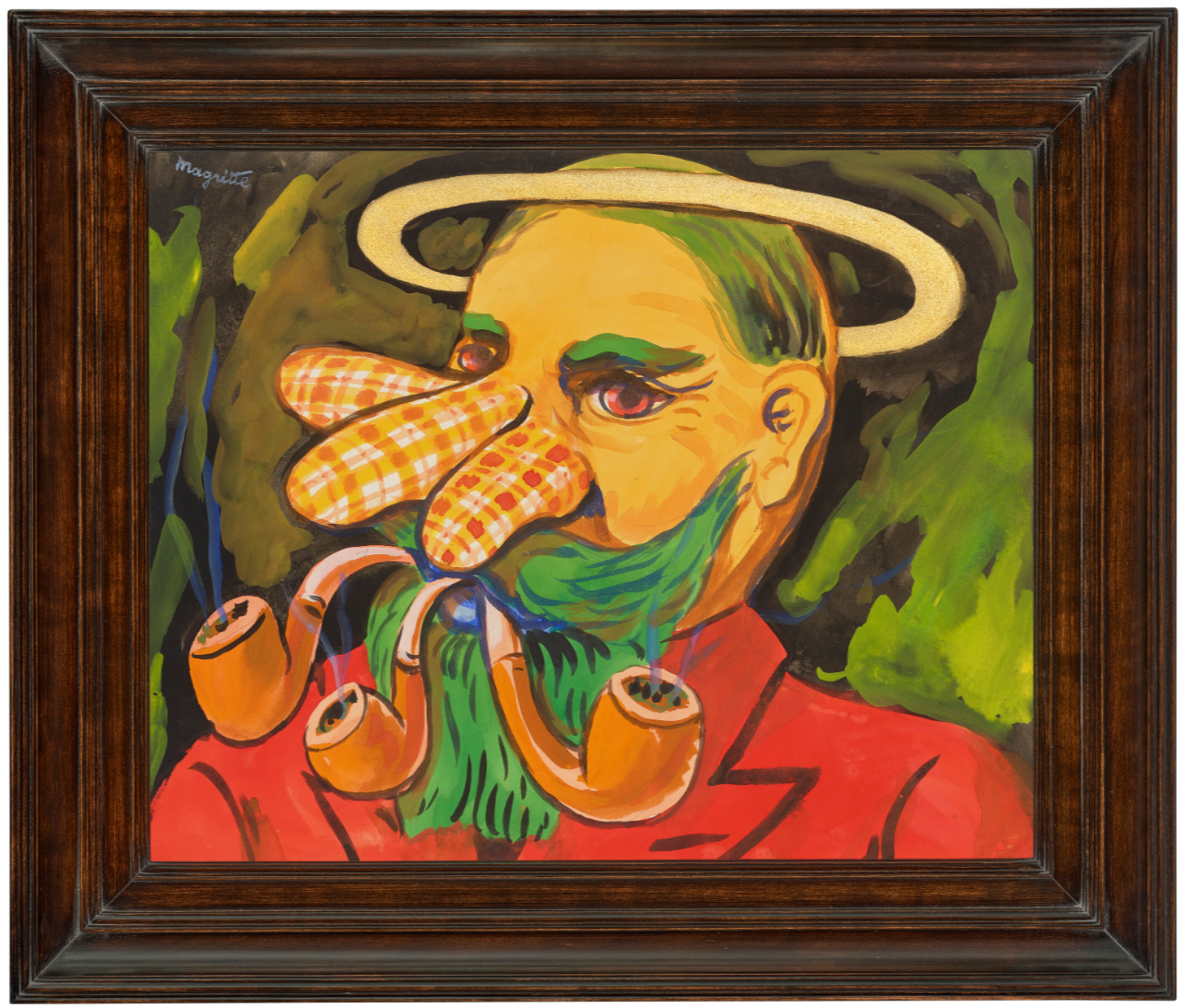
RENÉ MAGRITTE (1898-1967)
Le stropiat, 1948
Gouache and gold paint on paper
32.7 x 40.7 cm (12 7/8 x 16 inches)
Signed ‘Magritte’ (upper left)
Signed, dated and inscribed ‘Magritte 1948 “Le Stropiat”’ (on the reverse)
2024 Auction Results
24 lots sold at auction in 2024 for a total turnover of USD 52,770,385. With only 1 lot failing to sell, the sell-through rate is 96%. L’empire des lumieres, a gouache dated 1956, from the artist’s most celebrated series sold at Christie’s in New-York on 19 November 2024 for USD 18,810,000, a new auction record for a gouache of the artist. 13 lots sold for more than USD 1 million, generating a cumulative turnover of USD 50,419,635 representing 95.5% of the total turnover for 2024.
2024 WOP Top 3 Lots
#1. L’empire des lumières, 1956
Christie’s New-York: 19 November 2024
Estimated: USD 6,000,000 – 8,000,000
USD 18,810,000
WORK ON PAPER
RENE MAGRITTE (1898-1967), L’empire des lumières | Christie’s
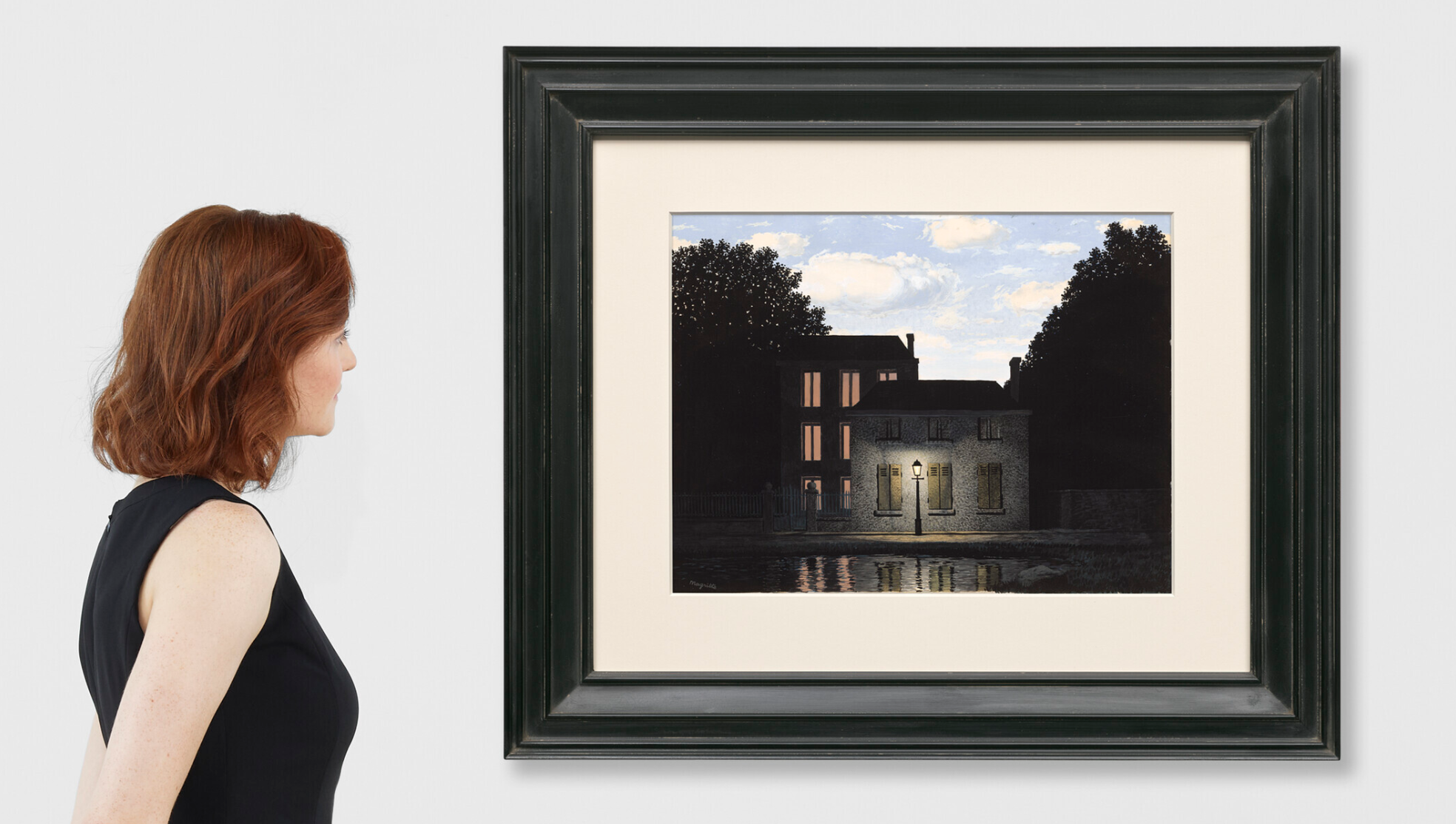
RENE MAGRITTE (1898-1967)
L’empire des lumières, 1956
Gouache on paper
36.3 x 46.8 cm (14 3/8 x 18 1/2 inches)
Signed ‘Magritte’ (lower left)
#2. La recherche de l’absolu, circa 1963
Estimated: USD 3,000,000 – 5,000,000
USD 8,460,000
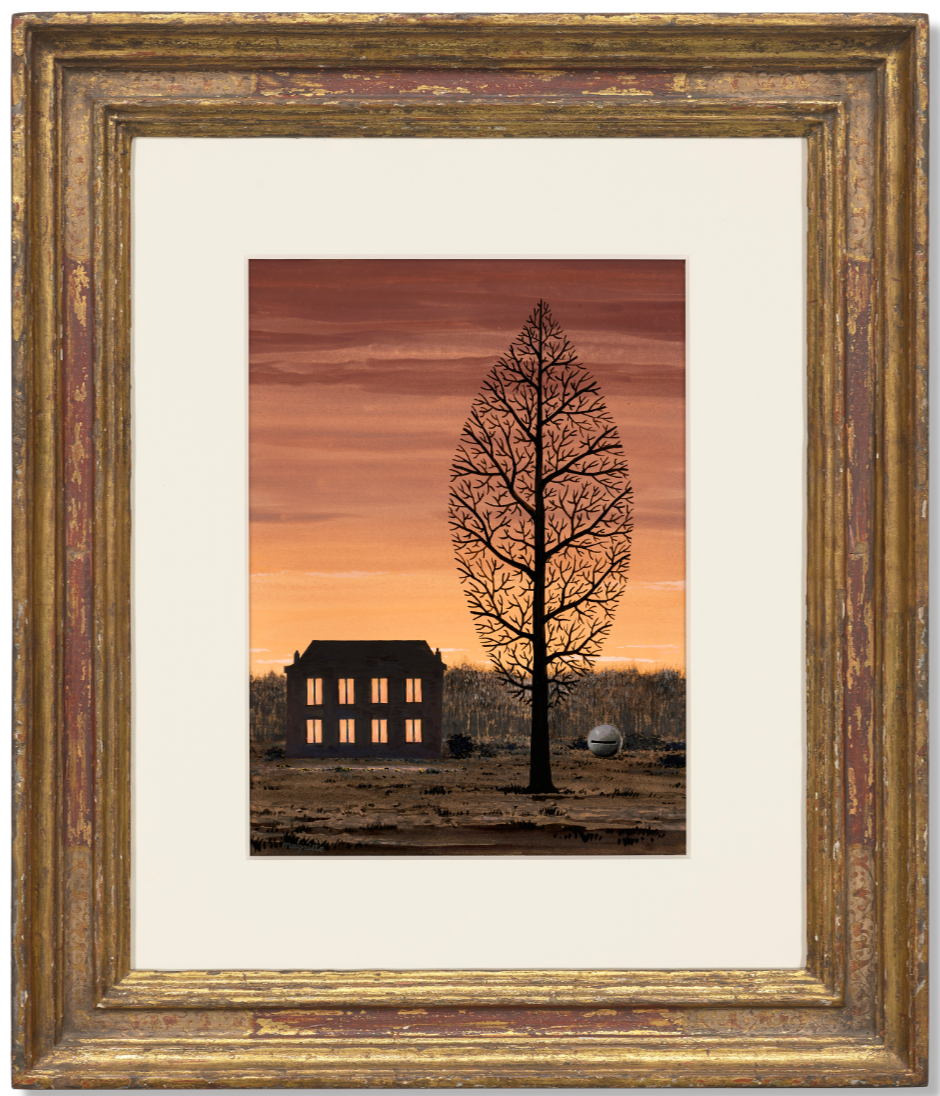
La recherche de l’absolu, circa 1963
Gouache on paper
36.3 x 27.3 cm (14 1/4 x 10 3/4 inches)
Signed ‘Magritte’ (lower left)
Titled ‘”La Recherche de l’Absolu”‘ (on the reverse)
#3. Le paysage de Baucis, 1966
Christie’s London: 7 March 2024
Estimated: GBP 2,400,000 – 3,000,000
GBP 3,912,000 / USD 4,982,265
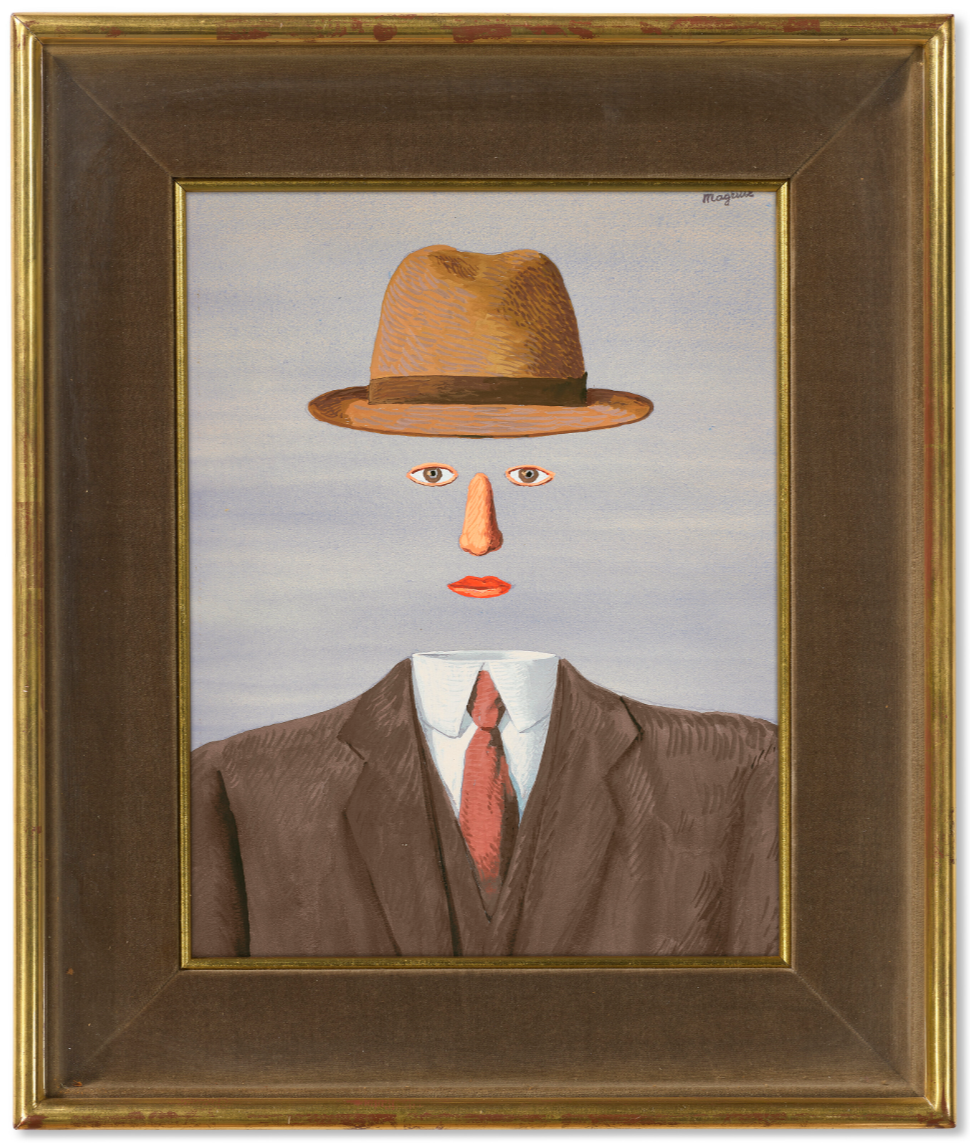
RENÉ MAGRITTE (1898 – 1967)
Le paysage de Baucis, 1966
Gouache on paper
27.2 x 21.1 cm (10 3/4 x 8 1/4 inches)
Signed ‘Magritte’ (upper right)
Signed, dated and titled ‘”LE PAYSAGE DE BAUCIS” Magritte 1966’ (on the reverse)
#4. L’Incendie, 1947
Sotheby’s Paris: 18 October 2024
Estimated: EUR 3,000,000 – 5,000,000
EUR 3,180,000 / USD 3,443,730
L’Incendie | Surrealism and its Legacy | 2024 | Sotheby’s
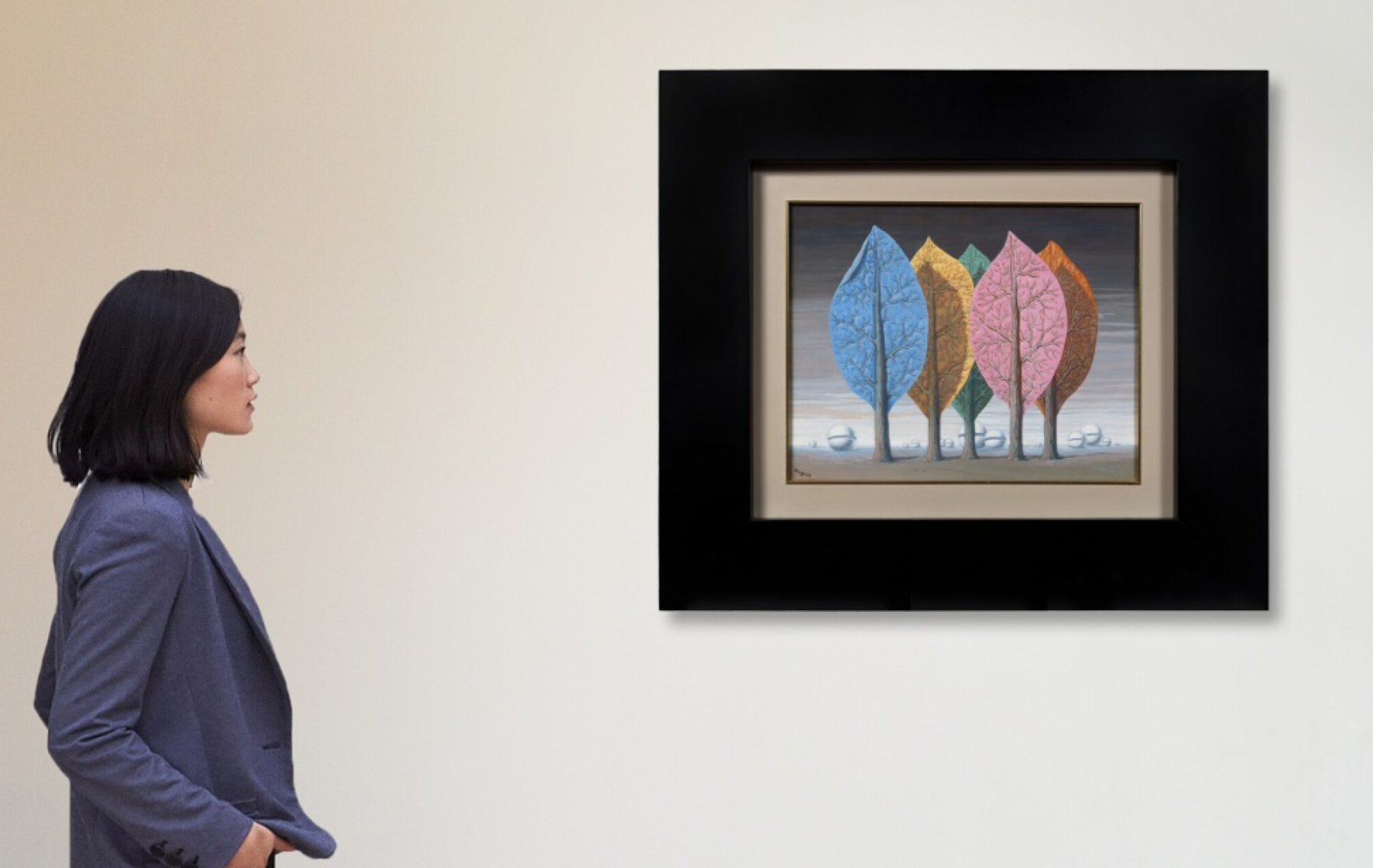
RENE MAGRITTE (1898 – 1967)
L’Incendie, 1947
Gouache on paper
37.1 x 46.3 cm (14 5/8 x 18 1/4 inches)
Signed Magritte (lower left)
Signed Magritte, dated 1947, and inscribed “L’Incendie” (on the reverse)
#5. Le grand style, 1952
Christie’s London: 9 October 2024
Estimated: GBP 1,000,000 – 1,500,000
GBP 2,581,000 / USD 3,380,720
RENÉ MAGRITTE (1898-1967), Le grand style | Christie’s
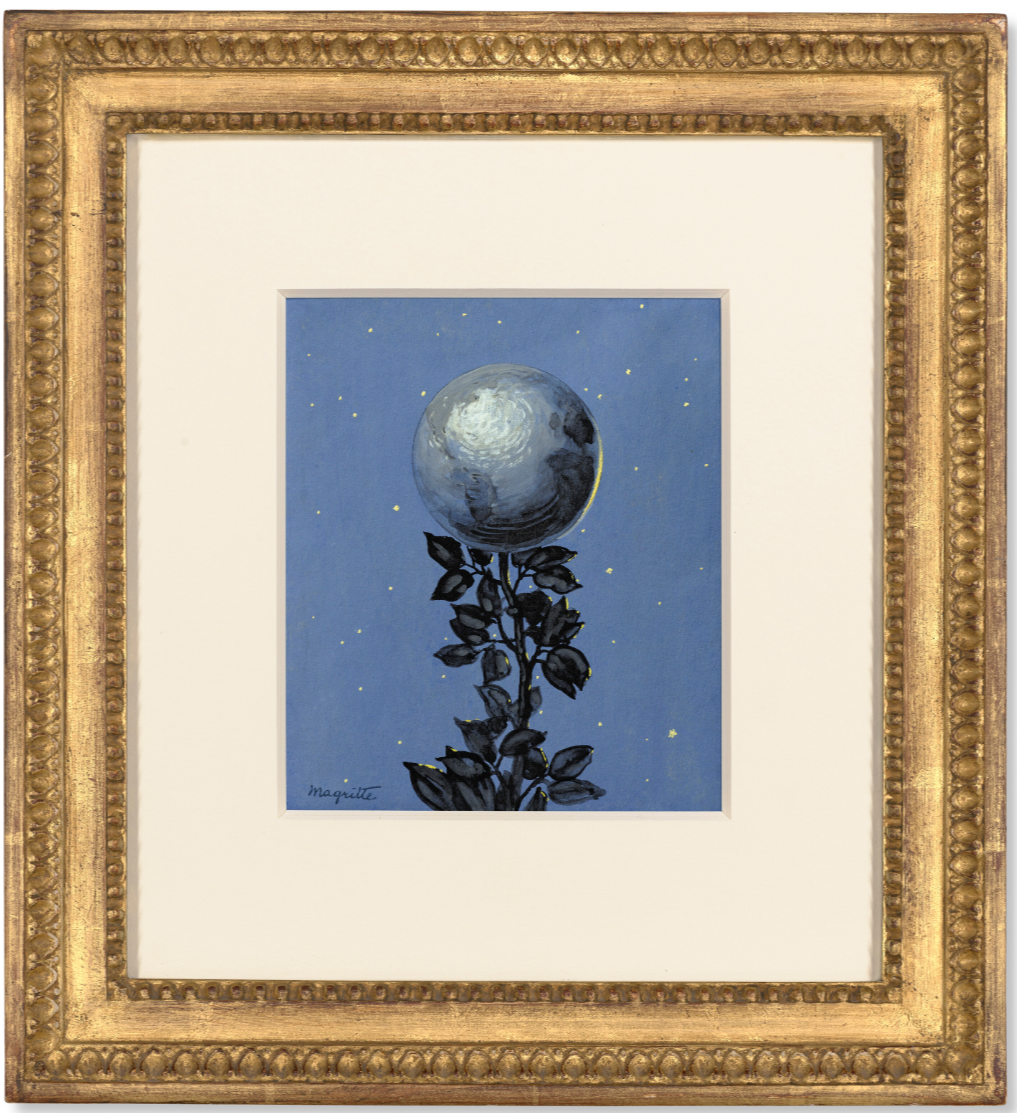
RENÉ MAGRITTE (1898-1967)
Le grand style, 1952
Gouache on card
17.3 x 14.8 cm (6 3/4 x 5 7/8 inches)
Signed ‘Magritte’ (lower left)
Signed again, dated and inscribed ‘”Le Grand Style” René Magritte (1952)’ (on the reverse)
#6. Le principe d’Archimède, 1952
Christie’s London: 7 March 2024
Estimated: GBP 450,000 – 650,000
GBP 1,492,000 / USD 1,900,190
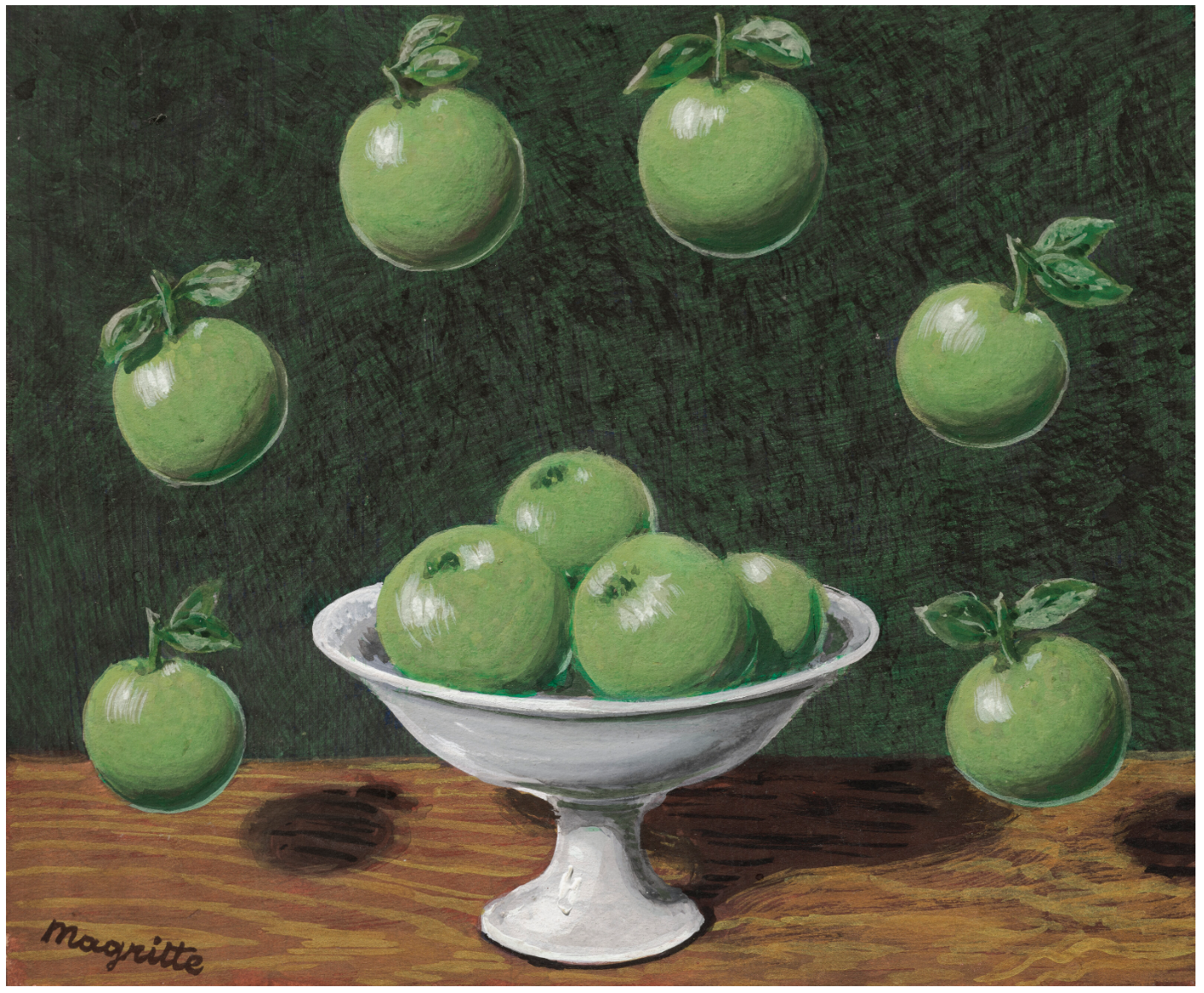
RENÉ MAGRITTE (1898-1967)
Le principe d’Archimède, 1952
Gouache on paper
15.1 x 17.8 cm (6×7 inches)
Signed ‘Magritte’ (lower left)
#7. La voix du sang, 1947
Bonhams New-York: 15 May 2024
Estimated: USD 1,200,000 – 1,800,000
USD 1,585,100
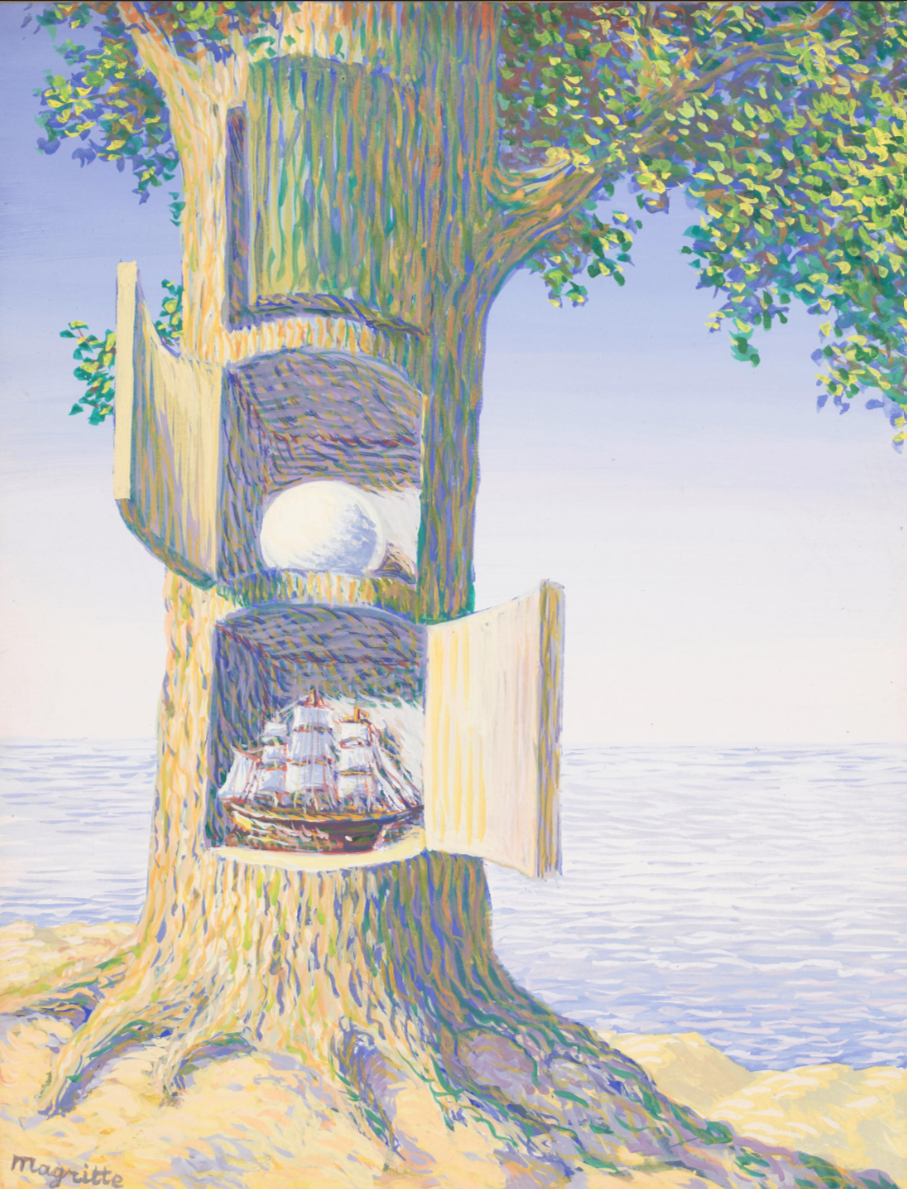
Gouache on paper laid down on card
23×18 cm (9 1/16 x 7 1/16 inches)
Signed ‘Magritte’ (lower left)
#8. L’État de veille, 1958
Sotheby’s New-York: 16 May 2024
Estimated: USD 400,000 – 600,000
USD 1,572,500
L’État de veille | Modern Day Auction | 2024 | Sotheby’s
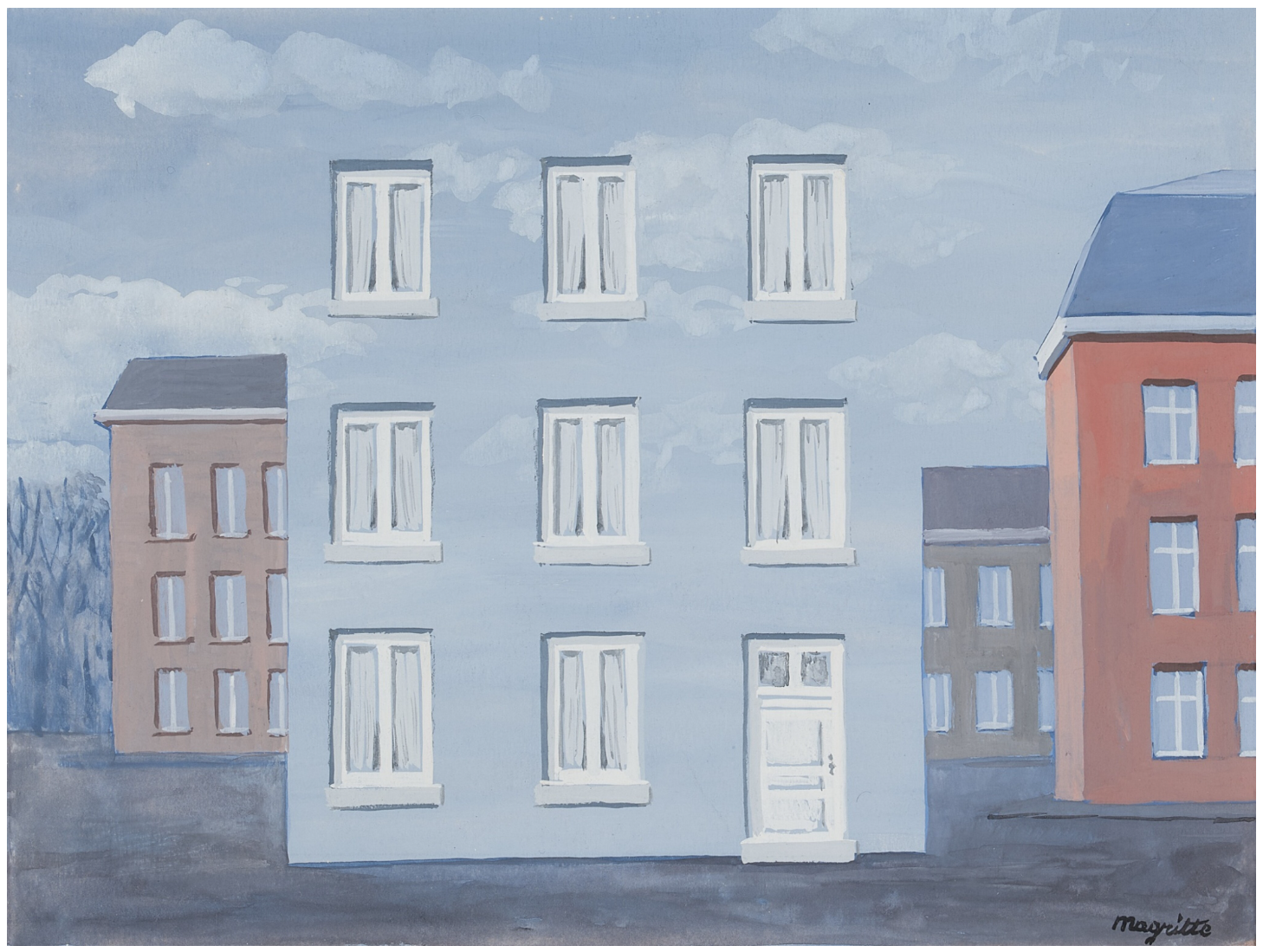
RENE MAGRITTE (1898 – 1967)
L’État de veille, 1958
Gouache on paper
19.3 x 24.7 cm (7 5/8 x 9 3/4 inches)
Signed Magritte (lower right)
Signed Magritte, titled and dated 1958 (on the verso)
#9. Minotaure (Projet de couverture), 1937
Sotheby’s Paris: 18 October 2024
Estimated: EUR 1,000,000 – 1,500,000
EUR 1,320,000 / USD 1,429,470
Minotaure (Projet de couverture) | Surrealism and its Legacy | 2024 | Sotheby’s
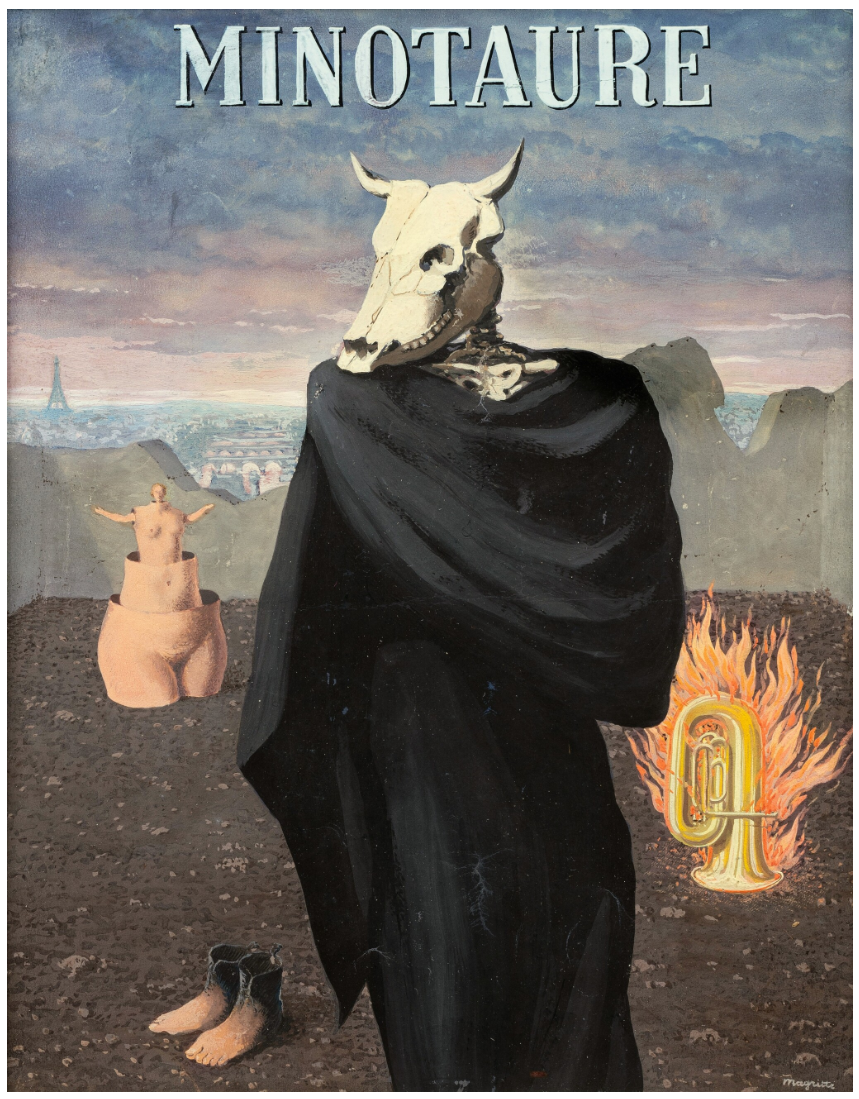
RENE MAGRITTE (1898 – 1967)
Minotaure (Projet de couverture), 1937
Gouache on paper
31.8 x 24.7 cm (12 1/2 x 9 3/4 inches)
Signed Magritte (lower right)
#10. L’invitée, 1956
Christie’s London: 9 October 2024
Estimated: GBP 800,000 – 1,200,000
GBP 1,008,000 / USD 1,320,330
RENÉ MAGRITTE (1898-1967), L’invitée | Christie’s
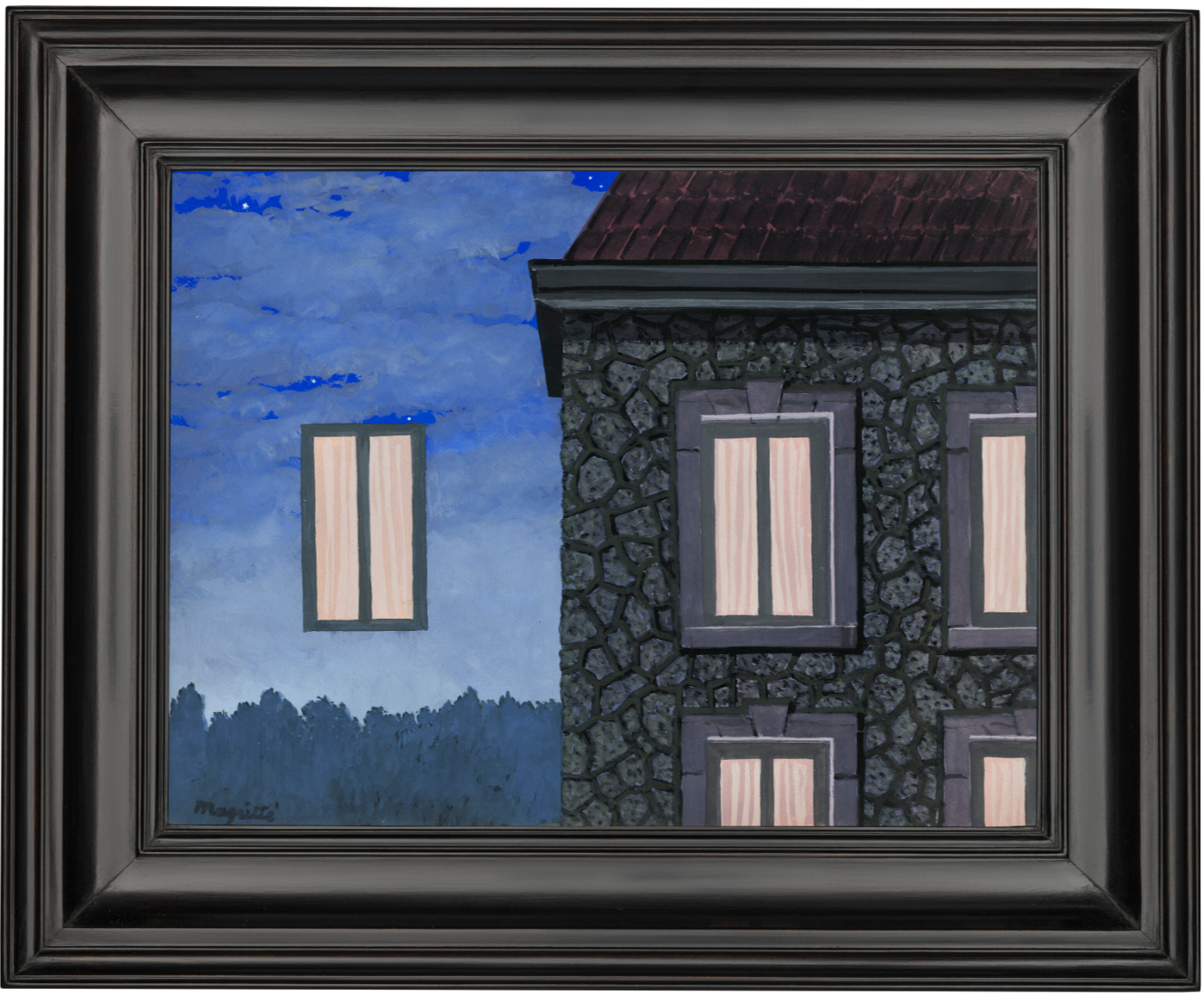
RENÉ MAGRITTE (1898-1967)
L’invitée, 1956
Gouache on paper
22.5 x 29.4 cm (8 7/8 x 11 5/8 inches
Signed ‘Magritte’ (lower left)
Signed again, inscribed and dated ‘”L’Invitée” Magritte 1956’ (on the reverse)
#11. La Main heureuse, 1952
Sotheby’s New-York: 15 May 2024
Estimated: USD 800,000 – 1,200,000
USD 1,270,000
La Main heureuse | Modern Evening Auction | 2024 | Sotheby’s
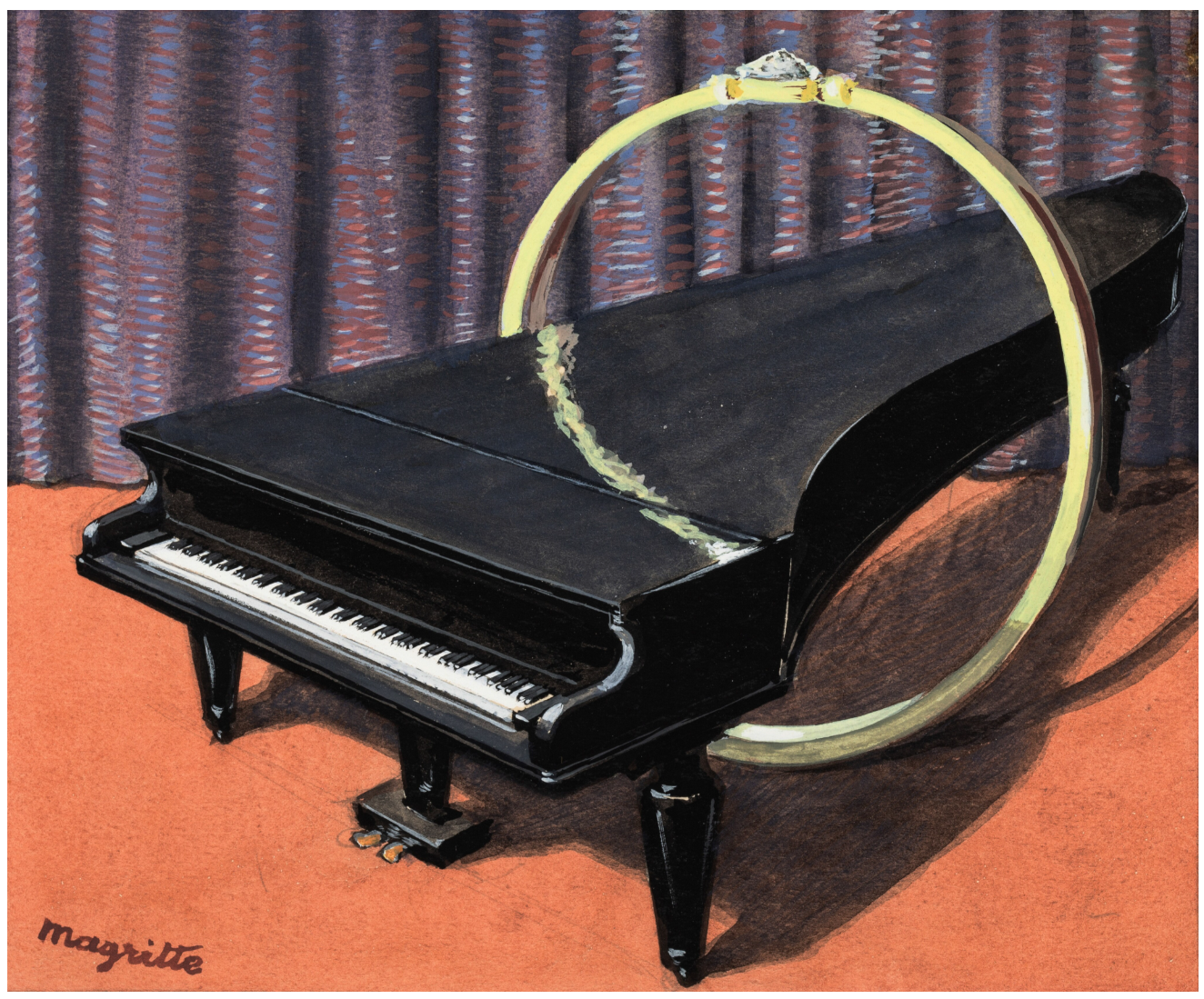
RENE MAGRITTE (1898 – 1967)
La Main heureuse, 1952
Gouache on paper
14.8 x 17.8 cm (5 7/8 x 7 inches)
Signed Magritte (lower left)
Titled and dated 1952 (on the reverse)
#12. Shéhérazade, 1947
Christie’s London: 9 October 2024
Estimated: GBP 400,000 – 600,000
GBP 882,000 / USD 1,155,285
RENÉ MAGRITTE (1898-1967), Shéhérazade | Christie’s
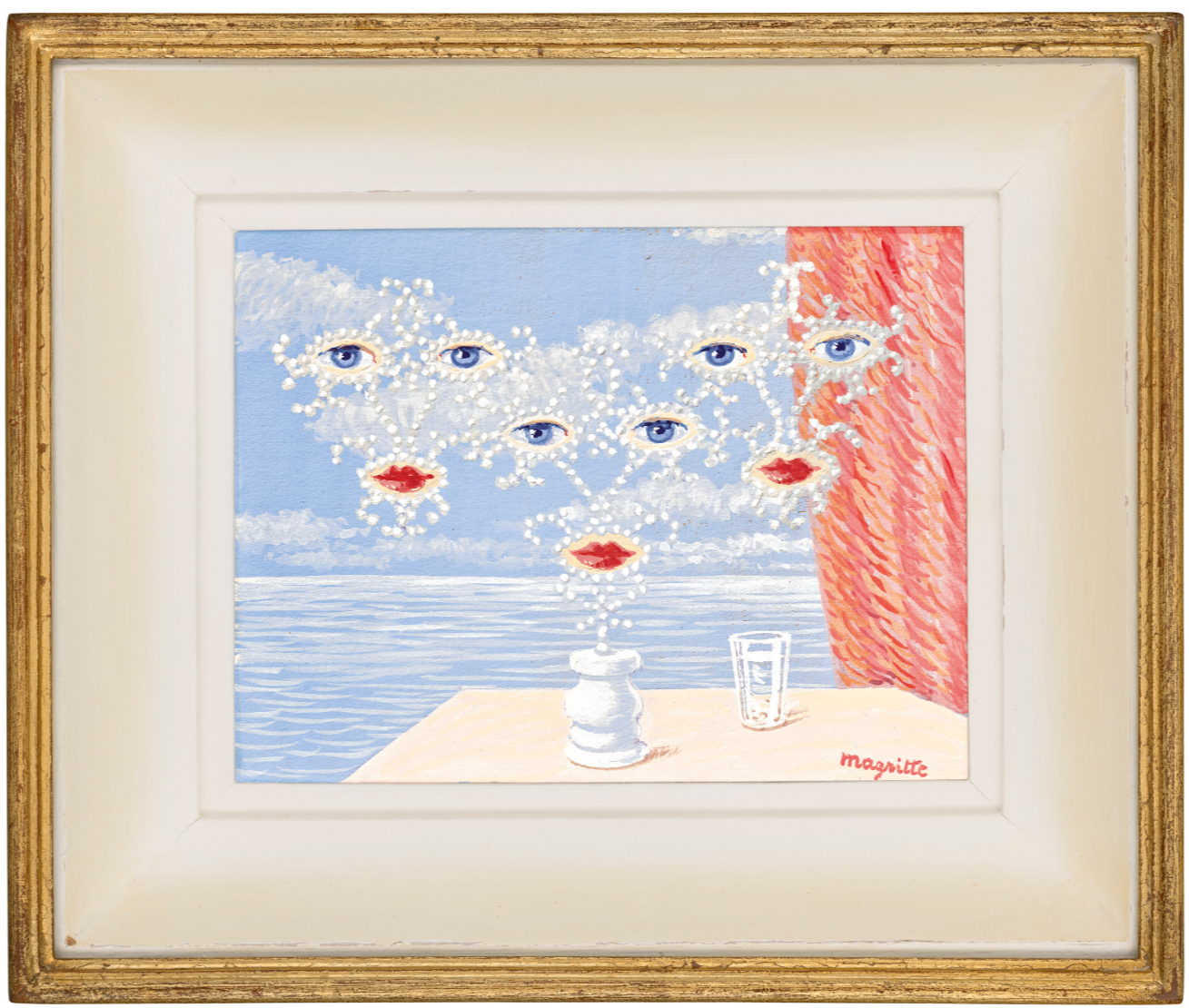
RENÉ MAGRITTE (1898-1967)
Shéhérazade, 1947
Gouache on paper
12.8 x 16.7 cm (5 1/8 x 6 5/8 inches)
Signed ‘Magritte’ (lower right)
#13. L’État de veille, 1958
Sotheby’s Paris: 5 December 2024
Estimated: EUR 1,000,000 – 1,500,000
EUR 1,056,000 / USD 1,110,040
L’État de veille | Modern & Contemporary Art | 2024 | Sotheby’s
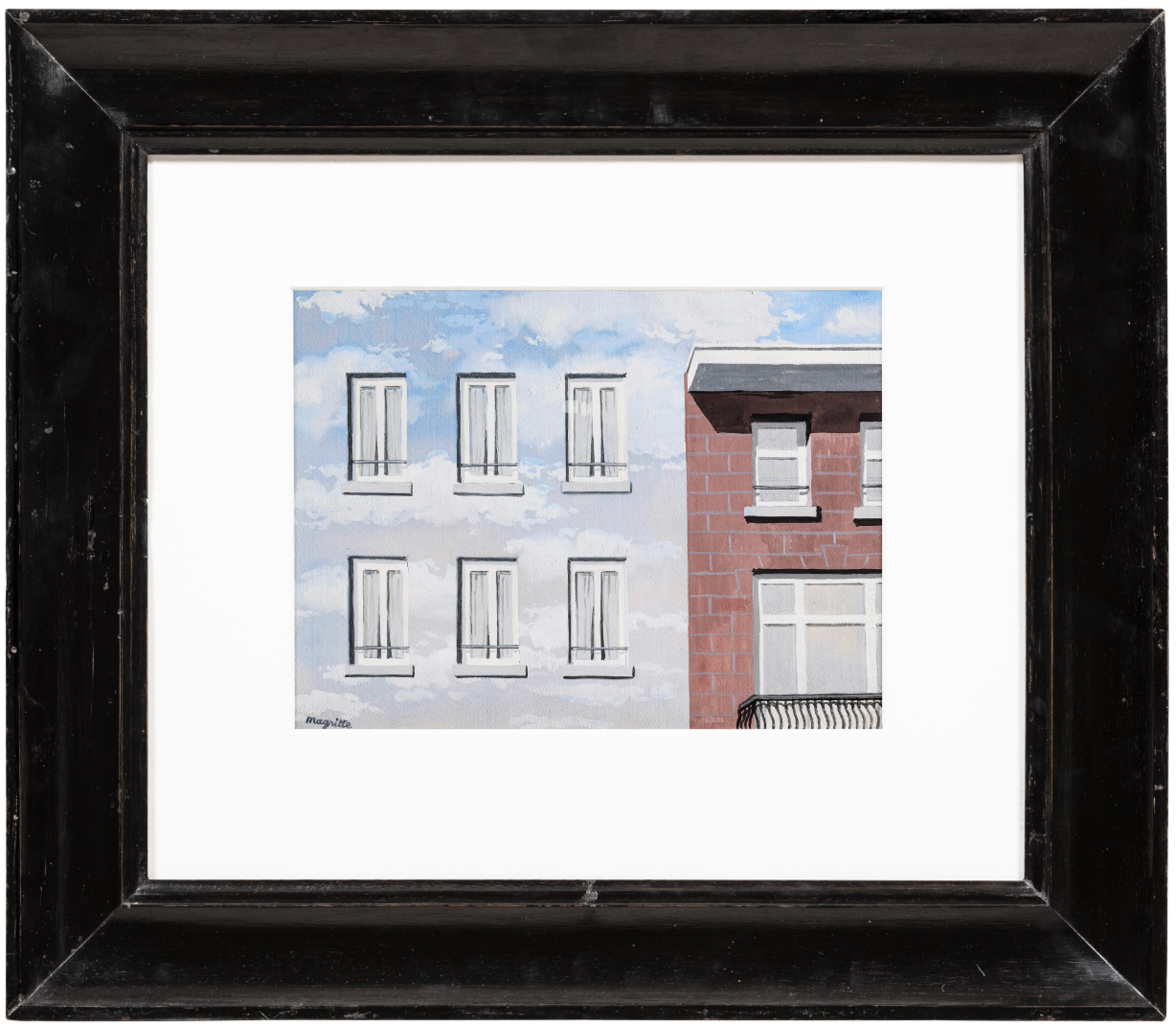
RENE MAGRITTE (1898 – 1967)
L’État de veille, 1958
Gouache on paper
19×25 cm (7 1/2 x 9 7/8 inches)
Signed magritte (lower left)
Signed, dated and inscribed L’état de veille Magritte 1958 (on the reverse)
USD 1 million
#14. Sans titre, circa 1965
Christie’s New-York: 18 May 2024
Estimated: USD 300,000 – 500,000
USD 693,000
RENE MAGRITTE (1898-1967), Sans titre | Christie’s
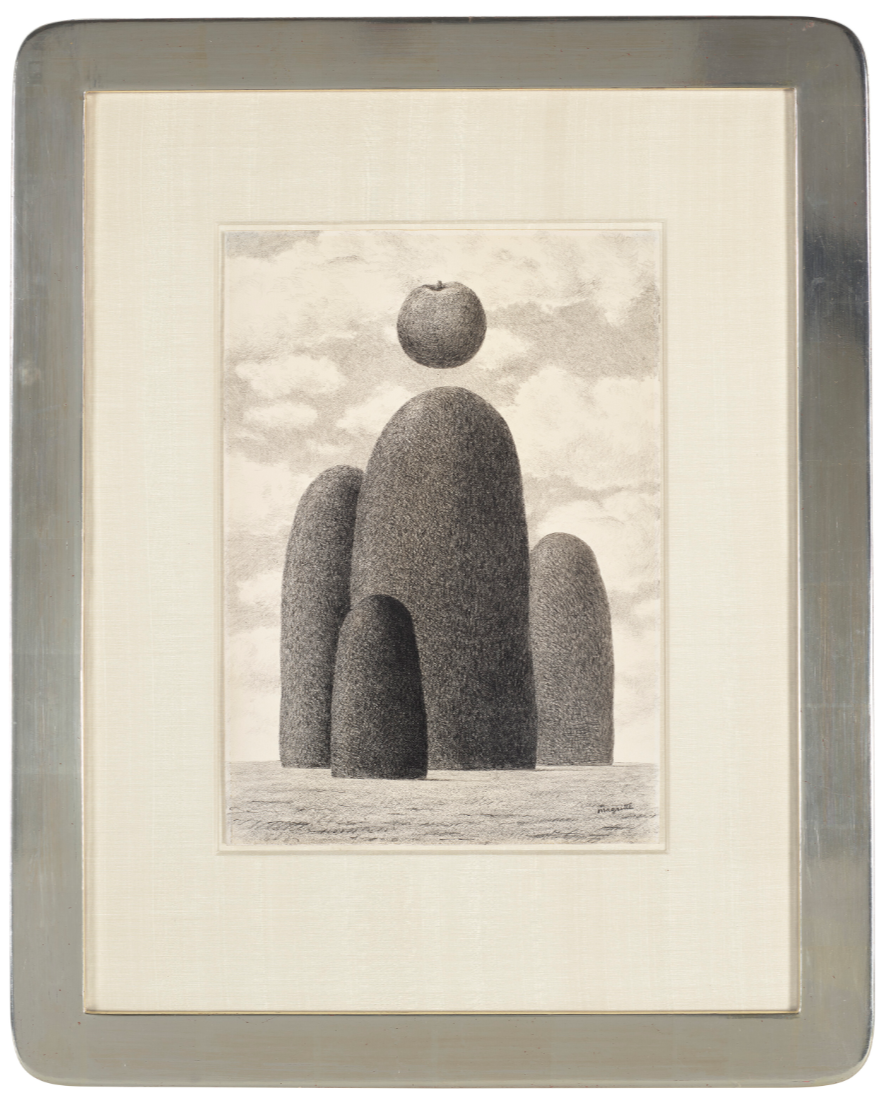
RENE MAGRITTE (1898-1967)
Sans titre, circa 1965
Pencil on paper
41.8 x 29.6 cm (16 1/2 x 11 5/8 inches)
Signed ‘Magritte’ (lower right)
2023 Auction Results
21 lots sold at auction in 2023 for a total turnover of USD 26,565,129. With 2 lots failing to sell, the sell-through rate is 91%. Le retour, a gouache dated 1950, sold at Christie’s in London on 28 February 2023 for GBP 6,129,000 (USD 7,393,030), the highest price paid for a Work on Paper in 2023. 9 lots sold for more than USD 1 million, generating a cumulative turnover of USD 23,993,704 representing 90.3% of the total turnover for 2024.
#1. Le retour, circa 1950
Christie’s London: 28 February 2023
Estimated: GBP 4,000,000 – 6,000,000
GBP 6,129,000 / USD 7,393,030
RENÉ MAGRITTE (1898-1967), Le retour | Christie’s
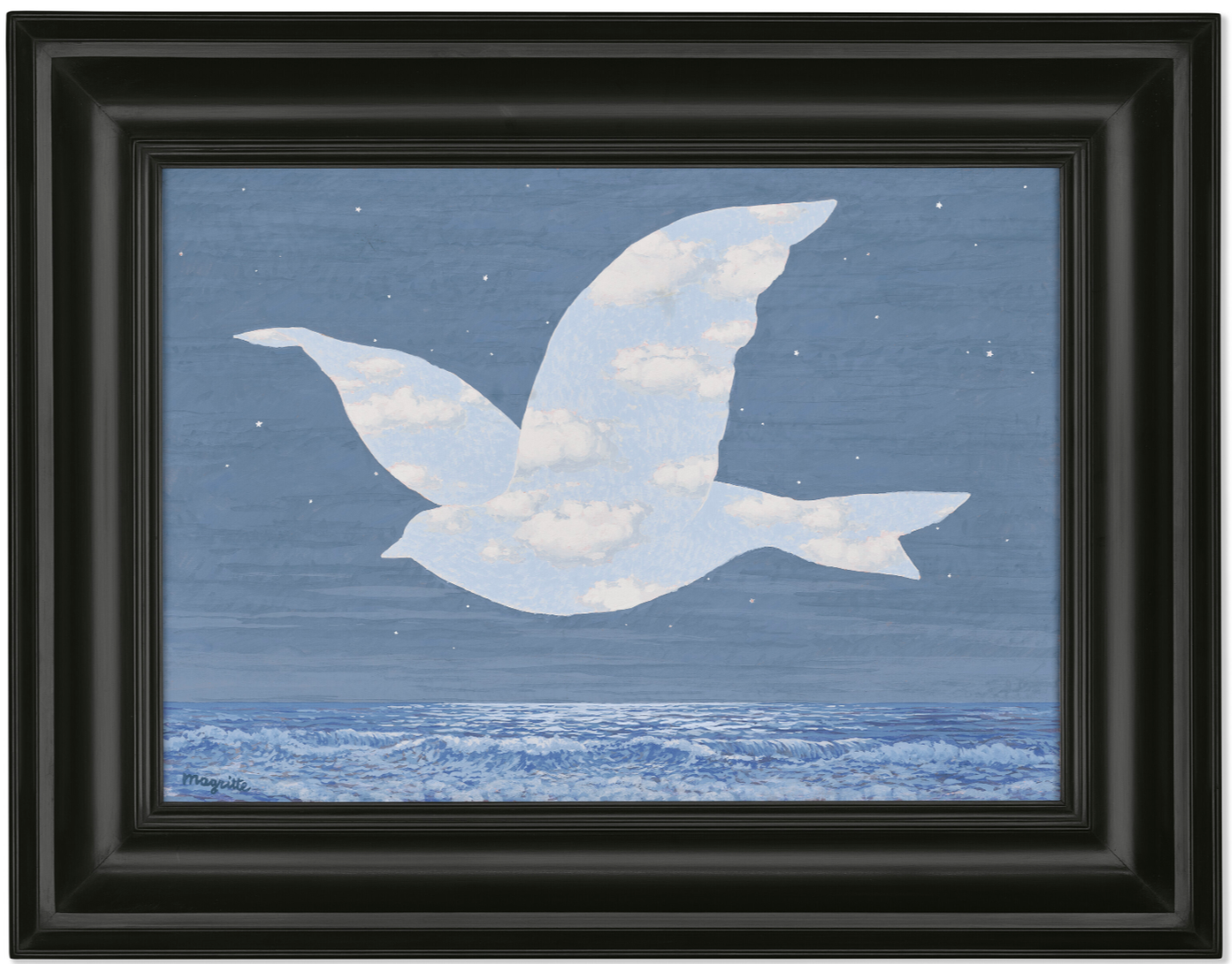
RENÉ MAGRITTE (1898-1967)
Le retour, circa 1950
Gouache on paper
29.6 x 41.7 cm (11 5/8 x 16 3/8 inches)
Signed ‘Magritte’ (lower left)
#2. Le savoir, circa 1961
Sotheby’s London: 27 June 2023
Estimated: GBP 1,600,000 – 2,600,000
GBP 4,162,000 / USD 5,299,070
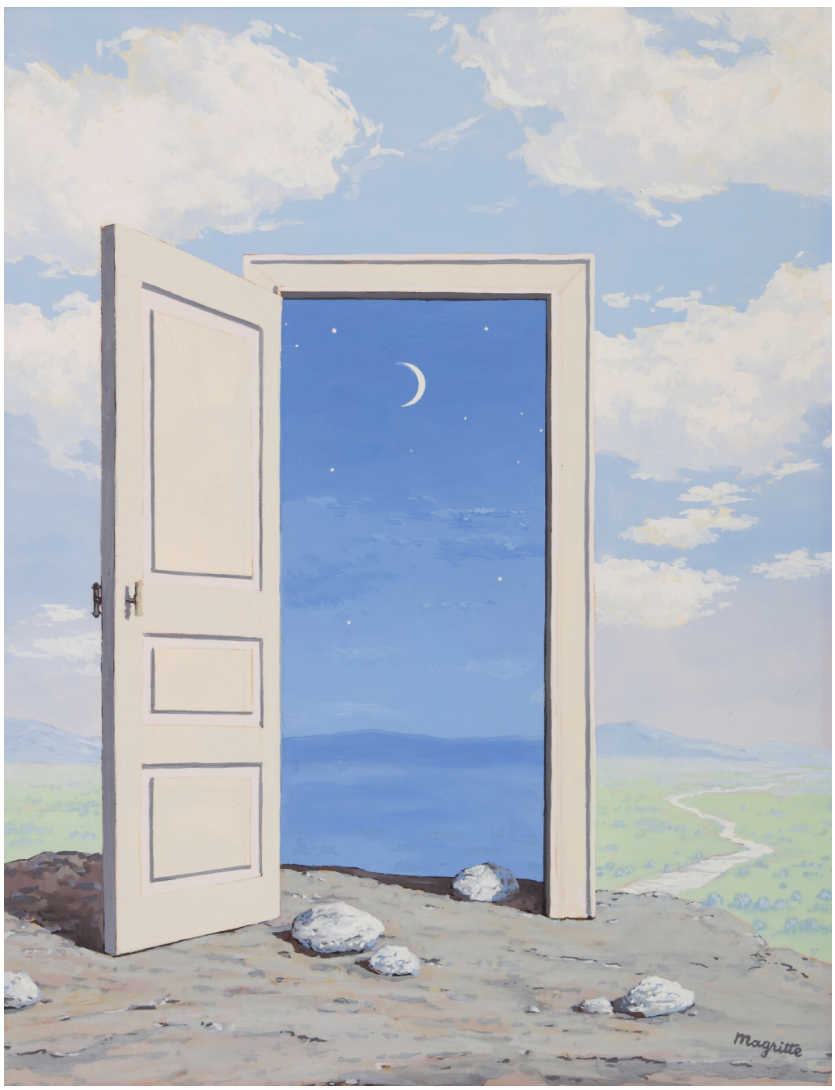
RENE MAGRITTE (1898 – 1967)
Le savoir, circa 1961
Gouache on paper
34.9 x 26.7 cm (13 3/4 x 10 1/2 inches)
Signed Magritte (lower right)
Signed Magritte and titled (on the verso)
#3. Moments musicaux, 1961
Sotheby’s New-York: 13 November 2023
Estimated: USD 1,800,000 – 2,500,000
USD 2,359,000
Moments musicaux | Modern Evening Auction | 2023 | Sotheby’s
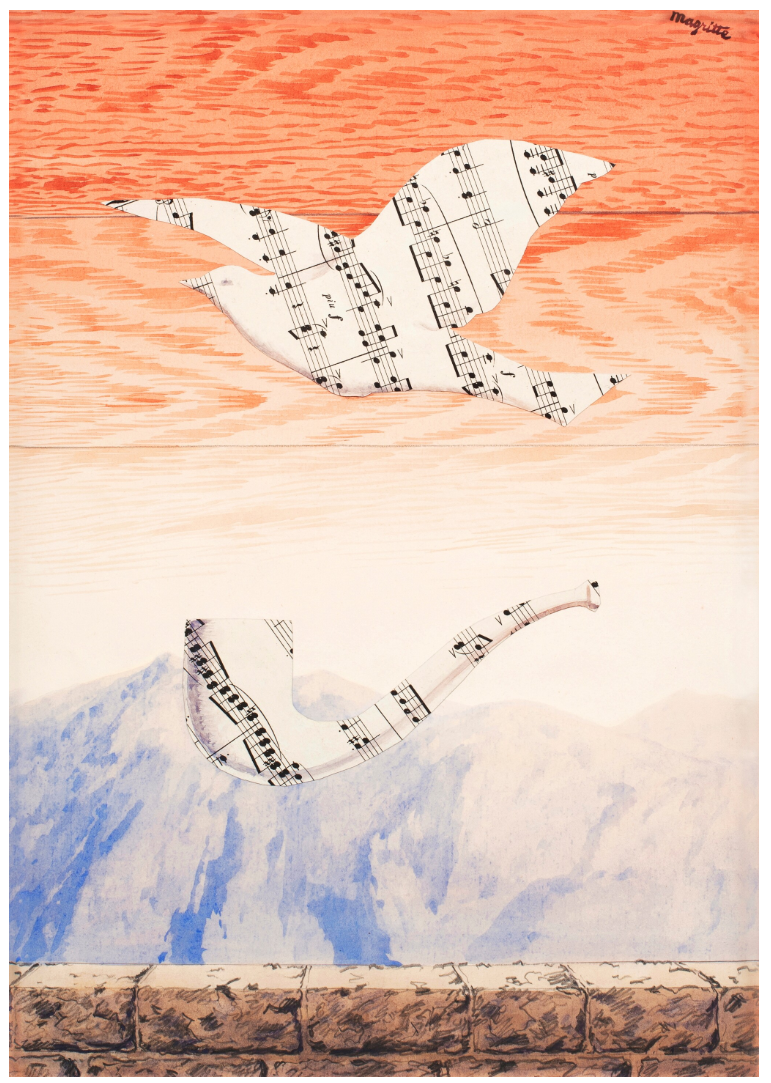
RENE MAGRITTE (1898 – 1967)
Moments musicaux, 1961
Gouache, paper collage and pencil on paper
41.5 x 29.4 cm (16 3/8 x 11 5/8 inches)
Signed Magritte (upper right)
#4. Le modèle rouge, 1948
Sotheby’s Paris: 19 October 2023
Estimated: EUR 1,000,000 – 1,500,000
EUR 2,044,500 / USD 2,154,485
Le modèle rouge | Modernités | 2023 | Sotheby’s
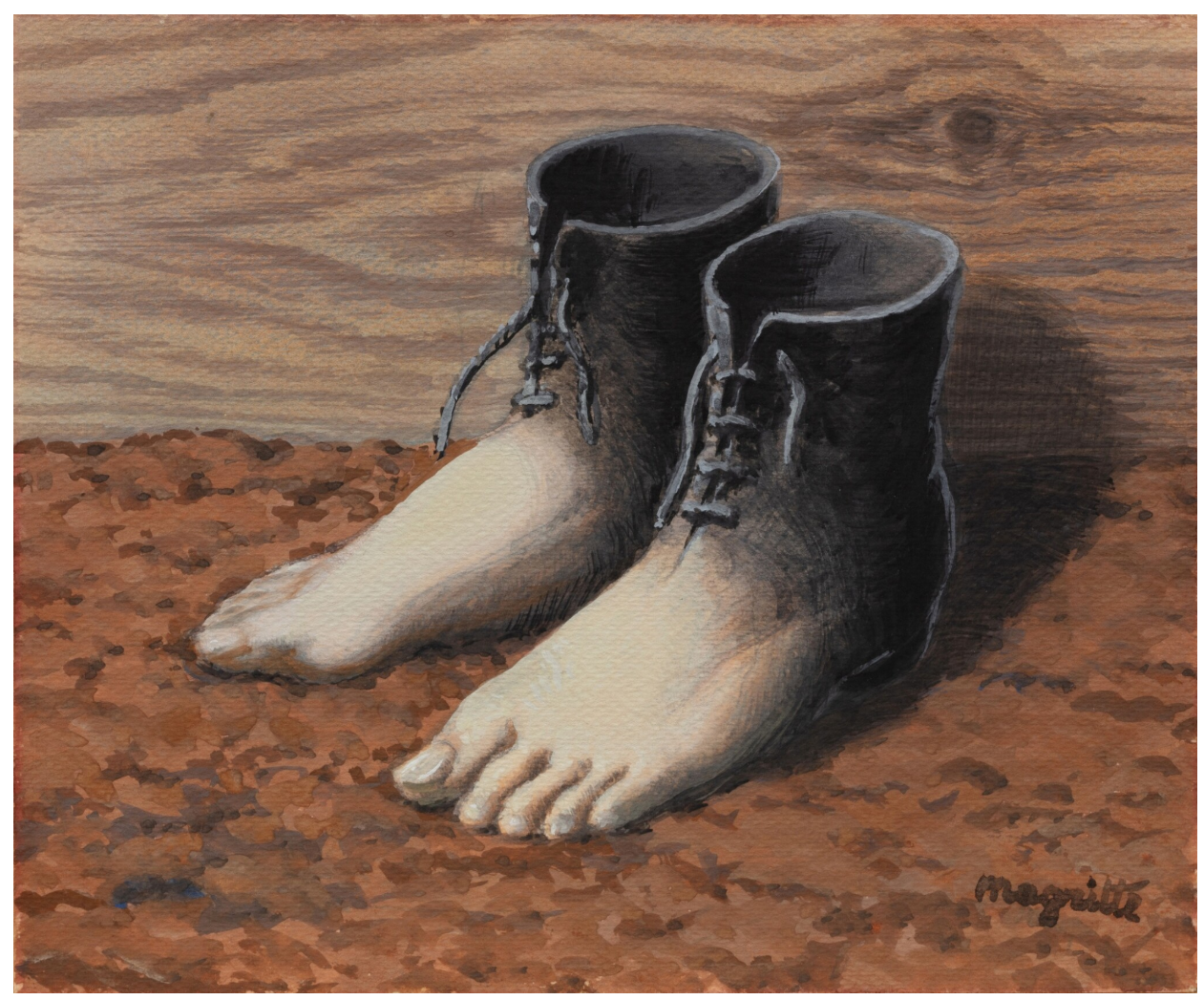
RENE MAGRITTE (1898 – 1967)
Le modèle rouge, 1948
Gouache on paper
14.2 x 17.2 cm (5 5/8 x 6 3/4 inches)
Signed magritte (lower right)
Titled “Le modèle rouge”, signed Magritte and dated 1948 (on the reverse)
#5. La saveur des larmes, 1976
Artcurial Paris: 7 June 2023
Estimated: EUR 800,000 – 1,200,000
EUR 1,600,400 / USD 1,712,050
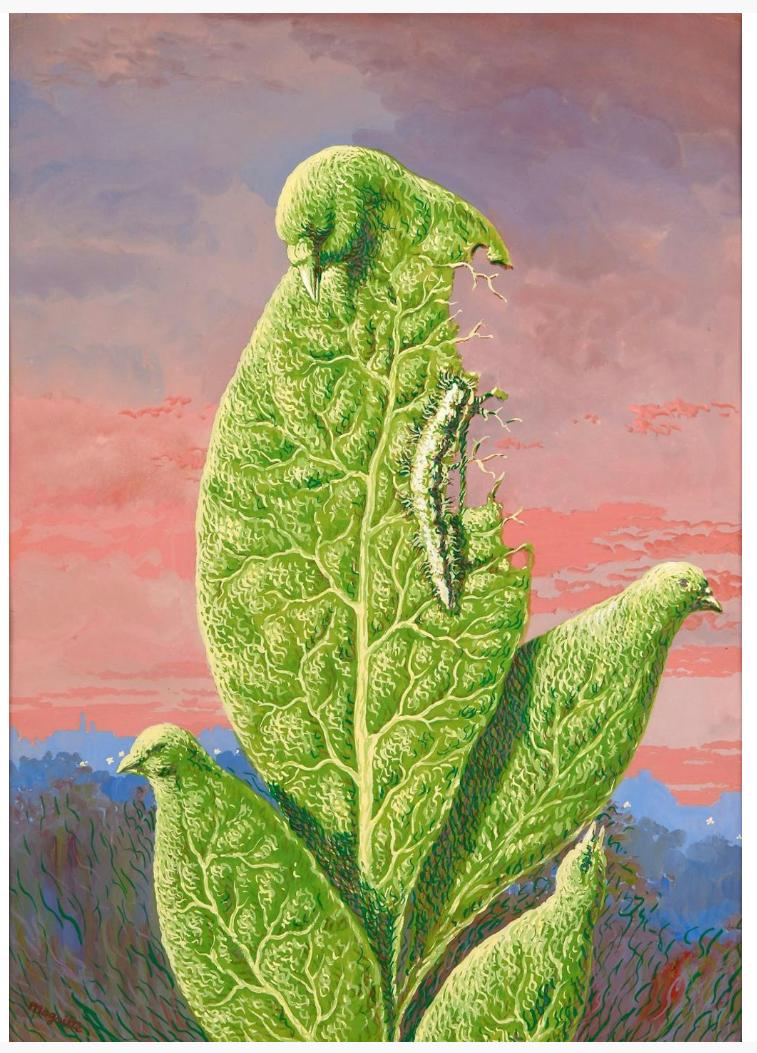
RENE MAGRITTE (1898 – 1967)
La saveur des larmes, 1976
Gouache on paper
50.8 x 36.4 cm (20 x 14 3/8 inches)
Signed Magritte (lower left)
#6. La magie noire, 1944-45
Sotheby’s London: 27 June 2023
Estimated: GBP 800,000 – 1,200,000
GBP 1,173,300 / USD 1,493,850
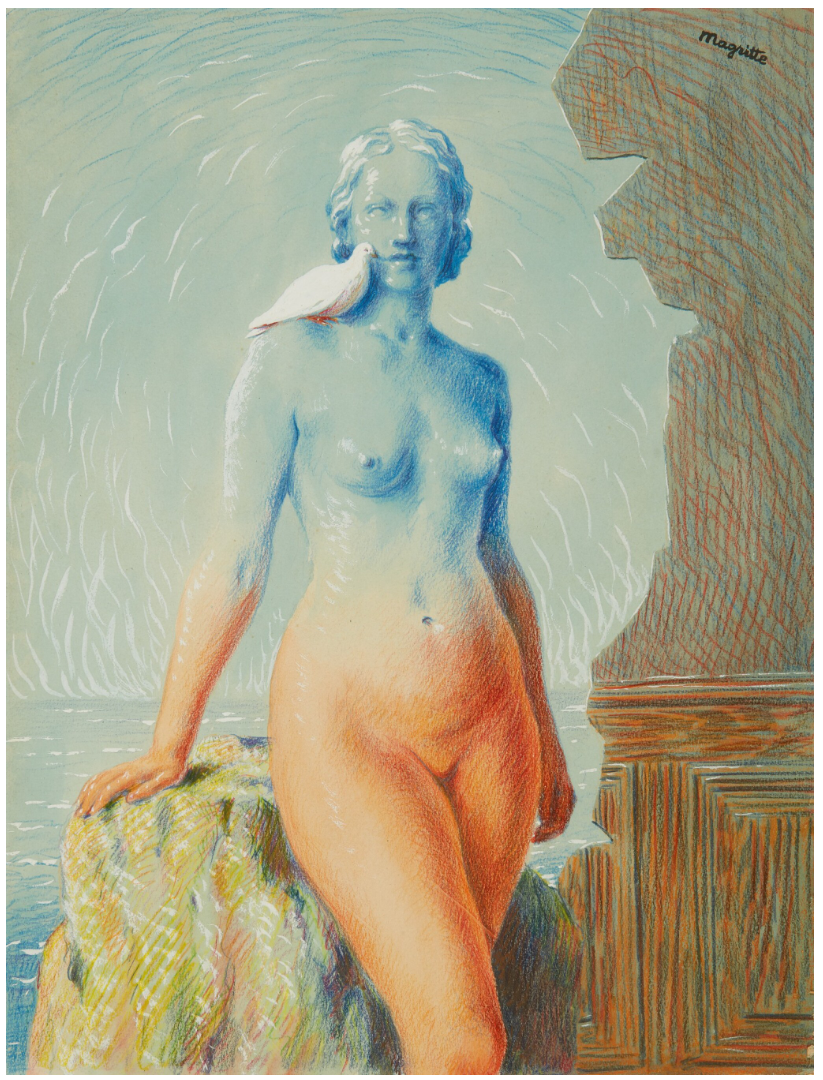
RENE MAGRITTE (1898 – 1967)
La magie noire, 1944-45
Gouache, watercolor and colored crayon on paper
33 x 24.8 cm (13 x 9 3/4 inches)
Signed Magritte (upper right)
#7. Le couple, 1961
Sotheby’s Paris: 15 March 2023
Estimated: EUR 1,200,000 – 1,800,000
EUR 1,409,250 / USD 1,491,235
Le couple | Surrealism & Its Legacy | 2023 | Sotheby’s
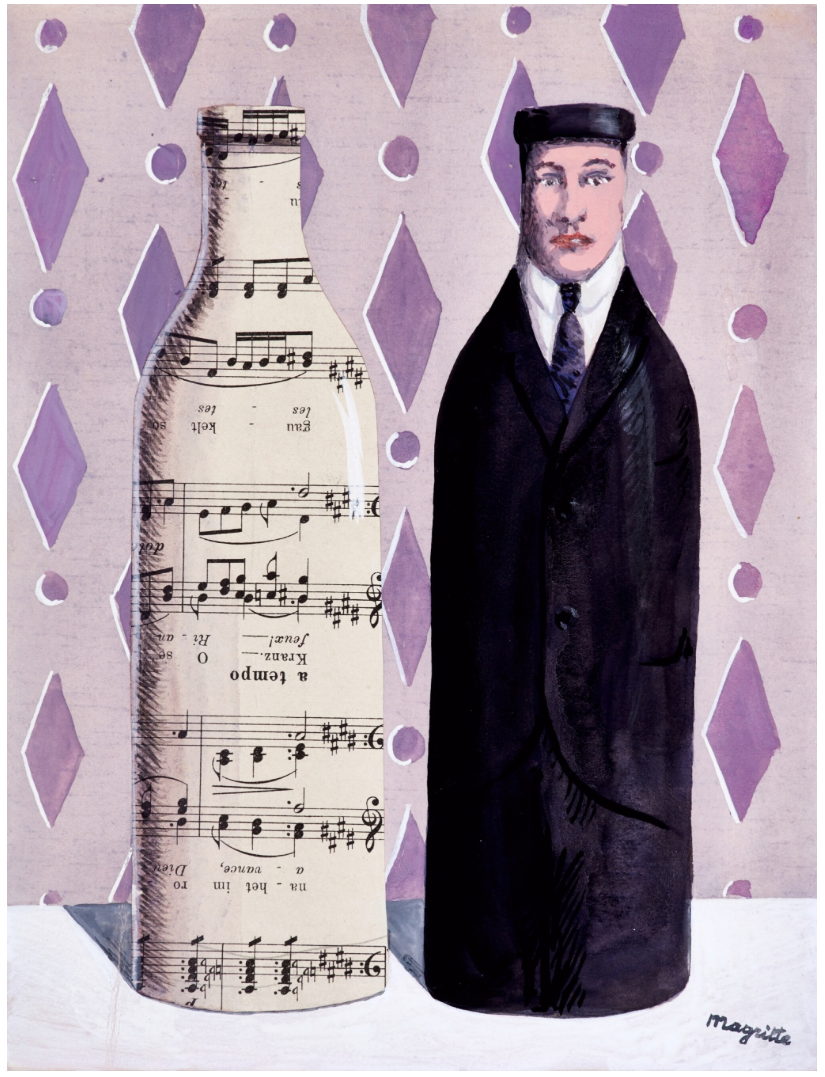
RENE MAGRITTE (1898 – 1967)
Le couple, 1961
Gouache and pasted paper on paper
25×19 cm (9 7/8 x 7 1/2 inches)
Signed Magritte (lower right)
#8. Untitled, 1926-27
Christie’s London: 28 February 2023
Estimated: GBP 250,000 – 350,000
GBP 882,000 / USD 1,063,900
RENÉ MAGRITTE (1898-1967), Untitled | Christie’s
RENÉ MAGRITTE (1898-1967)
Untitled, 1926-27
Gouache, photomontage, paper collage and pen and ink on card
41.4 x 57 cm (16 1/4 x 22 1/2 inches)
Signed ‘magritte’ (lower right)
#9. Le Palais de rideaux, circa 1965
Christie’s Paris: 20 October 2023
Estimated: EUR 500,000 – 800,000
EUR 970,200 / USD 1,027,085
René Magritte (1898-1967), Le Palais de rideaux | Christie’s
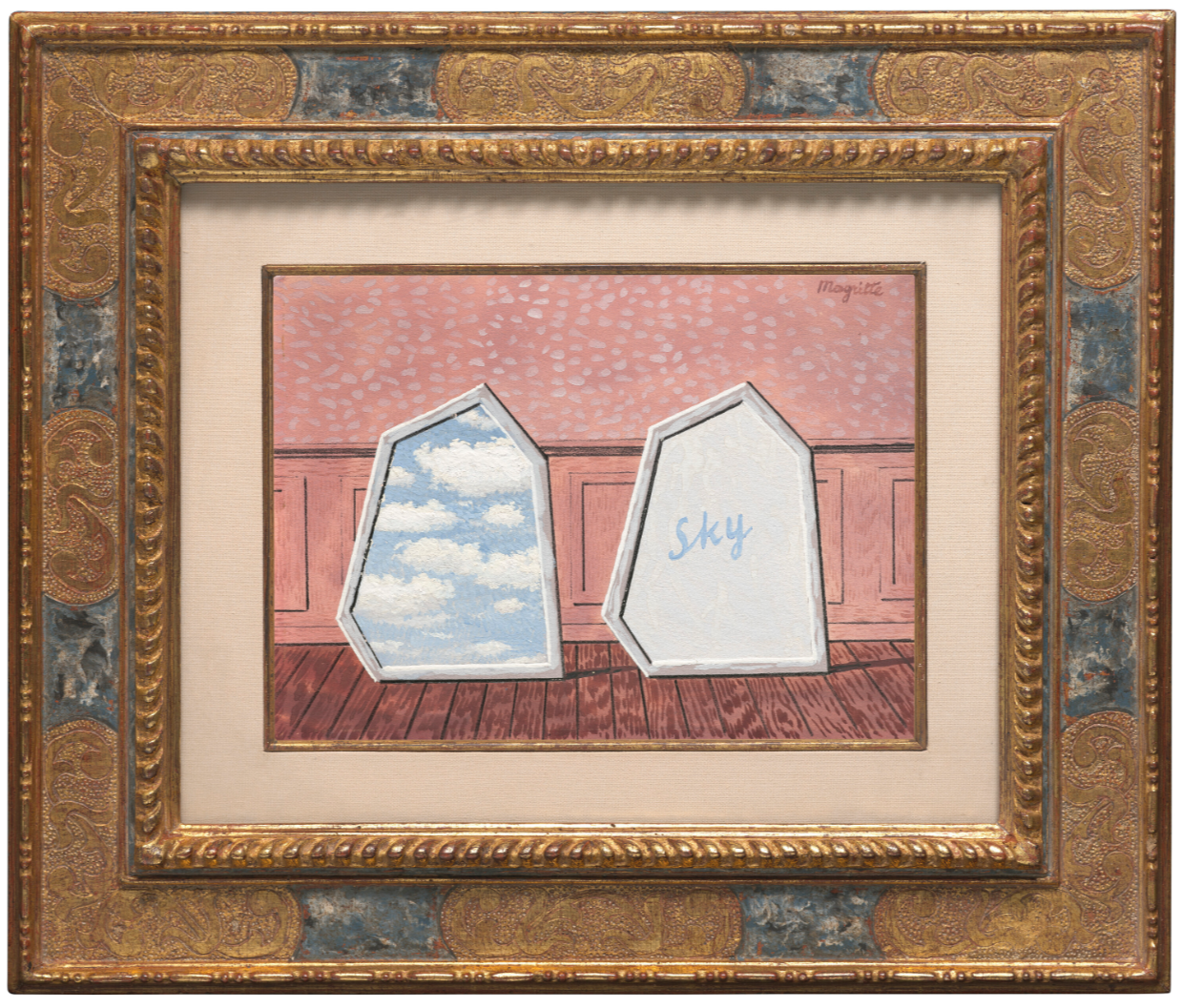
RENE MAGRITTE (1898-1967)
Le Palais de rideaux, circa 1965
Gouache and pencil on paper
17.1 x 23.5 cm (6 3/4 x 9 1/4 inches)
Signed ‘Magritte’ (upper right)
Selected Highlights
L’empire des lumières, 1956
Christie’s New-York: 19 November 2024
Estimated: USD 6,000,000 – 8,000,000
USD 18,810,000
WORK ON PAPER
RENE MAGRITTE (1898-1967), L’empire des lumières | Christie’s
RENE MAGRITTE (1898-1967)
L’empire des lumières, 1956
Gouache on paper
36.3 x 46.8 cm (14 3/8 x 18 1/2 inches)
Signed ‘Magritte’ (lower left)
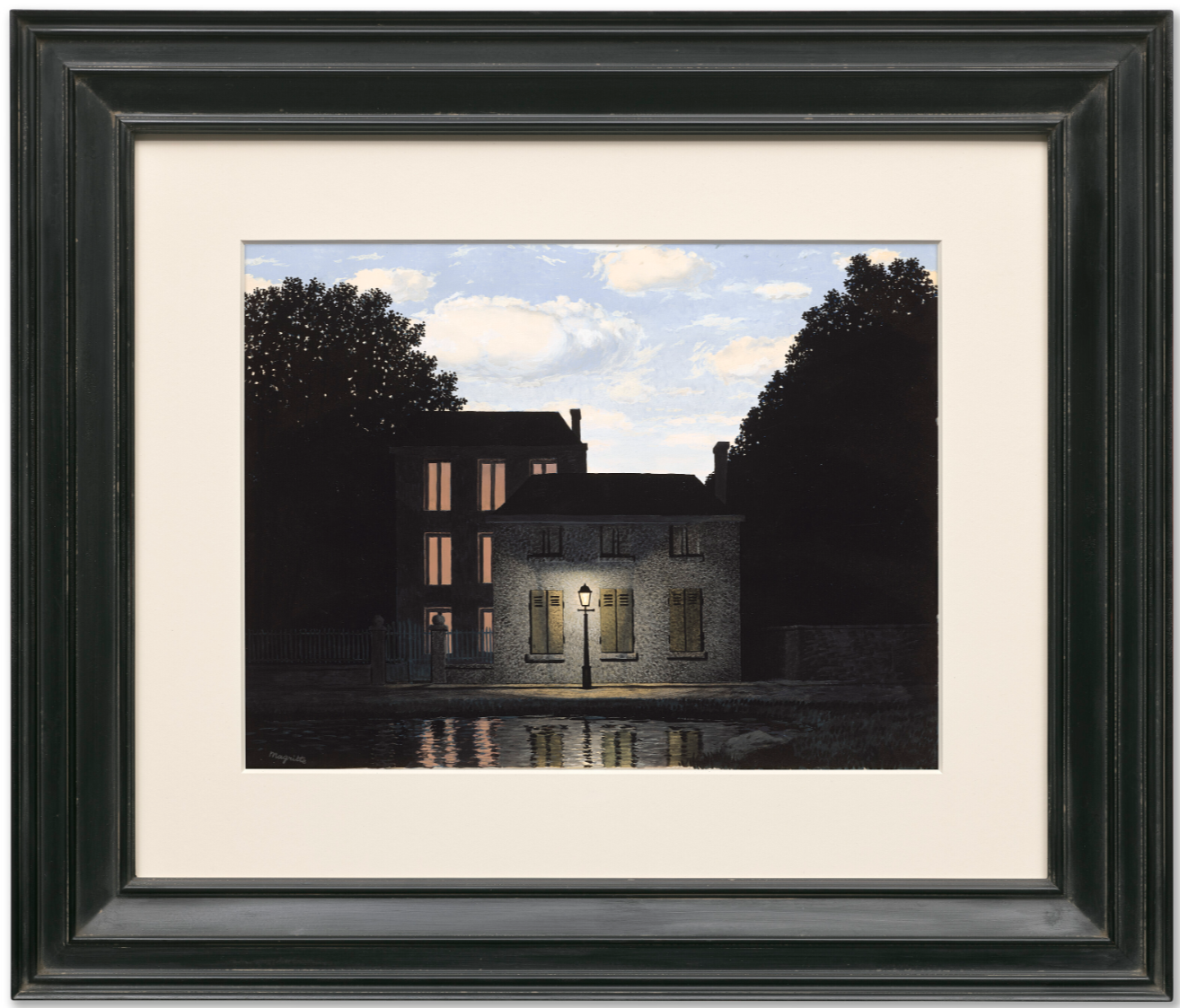
In December 1955 René Magritte and his wife Georgette relocated to a new apartment in Brussels, moving to the ground floor of 404 Boulevard Lambermont, directly across from the peaceful Parc Josaphat. Within this quiet residential corner of the city, Magritte was delighted to find a scene that appeared to directly echo one of his favorite and most iconic recurring motifs—the L’empire des lumières. Describing his new surroundings in a letter to his dealer Alexander Iolas in early January 1956, he specifically invoked these paintings, writing, “You will see: in the evenings, it’s like being in the picture—L’empire des lumières. The villa where I live is surrounded by gardens, and the houses looking directly on to the Boulevard Lambermont stand out against a wide sky” (quoted in D. Sylvester, ed., René Magritte: Catalogue Raisonné, Oil Paintings, Objects and Bronzes, 1949-1967, London, 1993, vol. III, p. 63). Painted shortly thereafter, the present L’empire des lumières is the largest and most exquisitely rendered of the artist’s gouaches devoted to this mysterious subject, its captivating juxtaposition of a nocturnal street-scene and a day-lit sky executed in delicate flickering brushstrokes that demonstrate Magritte’s expressive painterly approach.
The idea for L’empire des lumières had initially emerged in Magritte’s paintings in 1949, and over the course of the following decade and a half he revisited and revised the motif across a series of oil paintings and gouaches, each iteration subtly different from the next, incorporating new elements and details within the landscape, the buildings, or the sky. For Magritte, the subject represented a distillation of the powerful, lyrical nature of his Surrealist ideas, confronting the viewer with a seemingly impossible scenario in an otherwise familiar and everyday setting. “The art of painting, as I see it, makes possible the creation of visible poetic images,” he explained shortly before embarking on the present work. “They reveal the riches and details that our eyes can readily recognize: trees, skies, stones, objects, people, etc. They are meaningful when the intelligence is freed from the obsessive will to give things a meaning in order to use or master them” (quoted in La Carte d’après Nature, no. 8, January 1955, p. 6; in K. Rooney and E. Plattner, René Magritte: Selected Writings, trans. J. Levy, Richmond, 2018, p. 180).
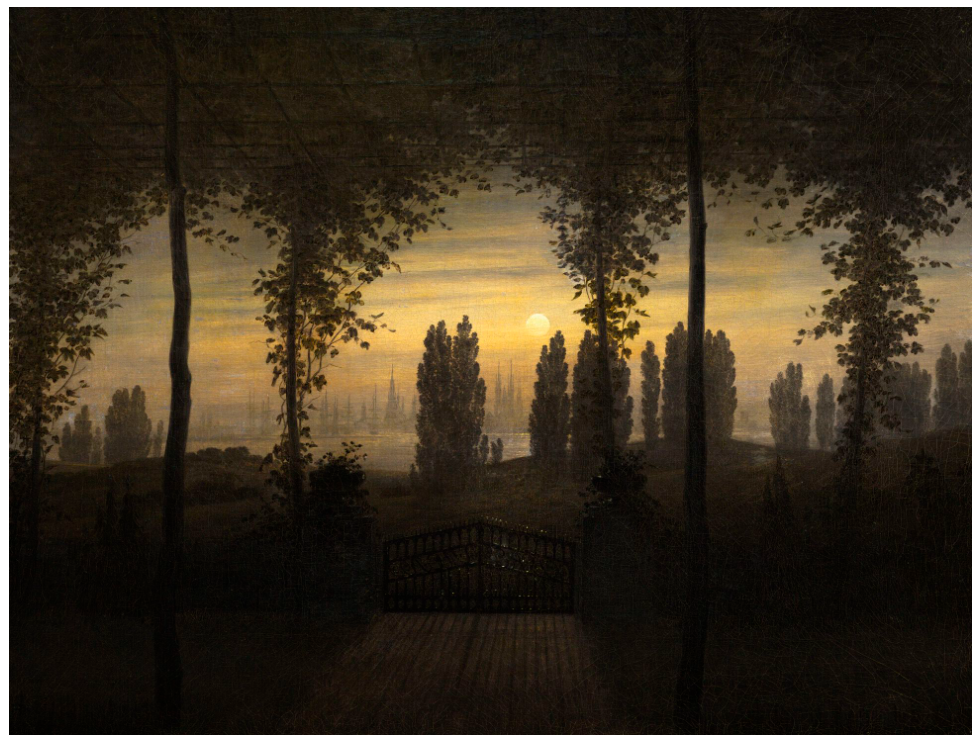
Caspar David Friedrich, Gedächtnisbild für Johann Emanuel Breme, 1817. Stiftung Preussische Schlösser und Gärten Berlin-Brandenburg, Berlin. Photo Credit: Erich Lessing / Art Resource, NY.
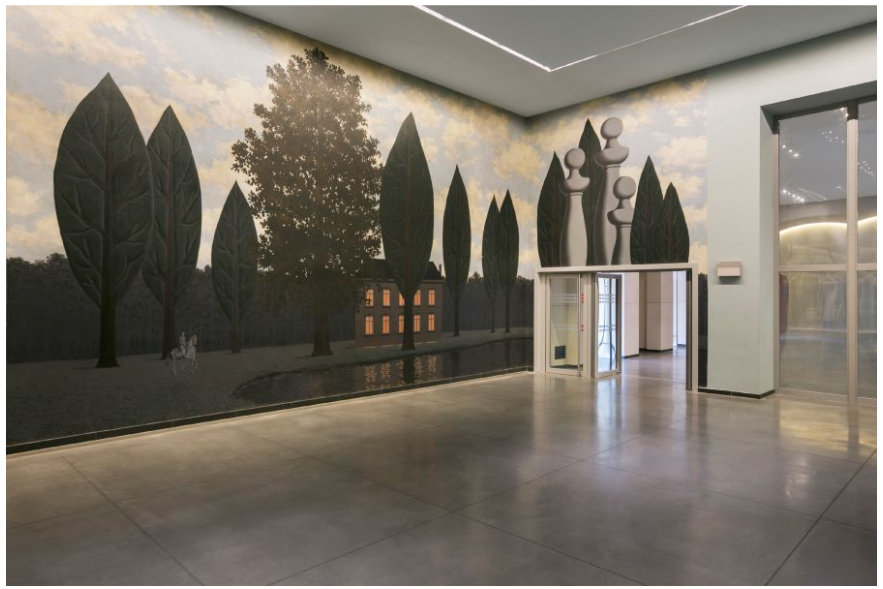
Here, on a quiet residential street, the light of a street lamp casts a warm glow among the dark shadows of nightfall, illuminating the houses that line the thoroughfare and casting rippling reflections on the waterway in the foreground. Taking up a position on the opposite bank of the small pond or stream, the viewer is granted an uninterrupted view of a startling phenomenon that transforms the scene—above the houses and trees, rather than the star-filled vista we might expect, a bright blue sky, filled with fluffy white clouds appears. The inherent magic of Magritte’s L’empire des lumières pivots on this deceptively simple contrast between night and day, conjured through an implausible occurrence that may appear at first glance to be perfectly normal—indeed, the artist claimed that many viewers initially assumed that they had seen a starry night sky in the picture, and it was only upon further inspection that they discovered the strange incongruence.
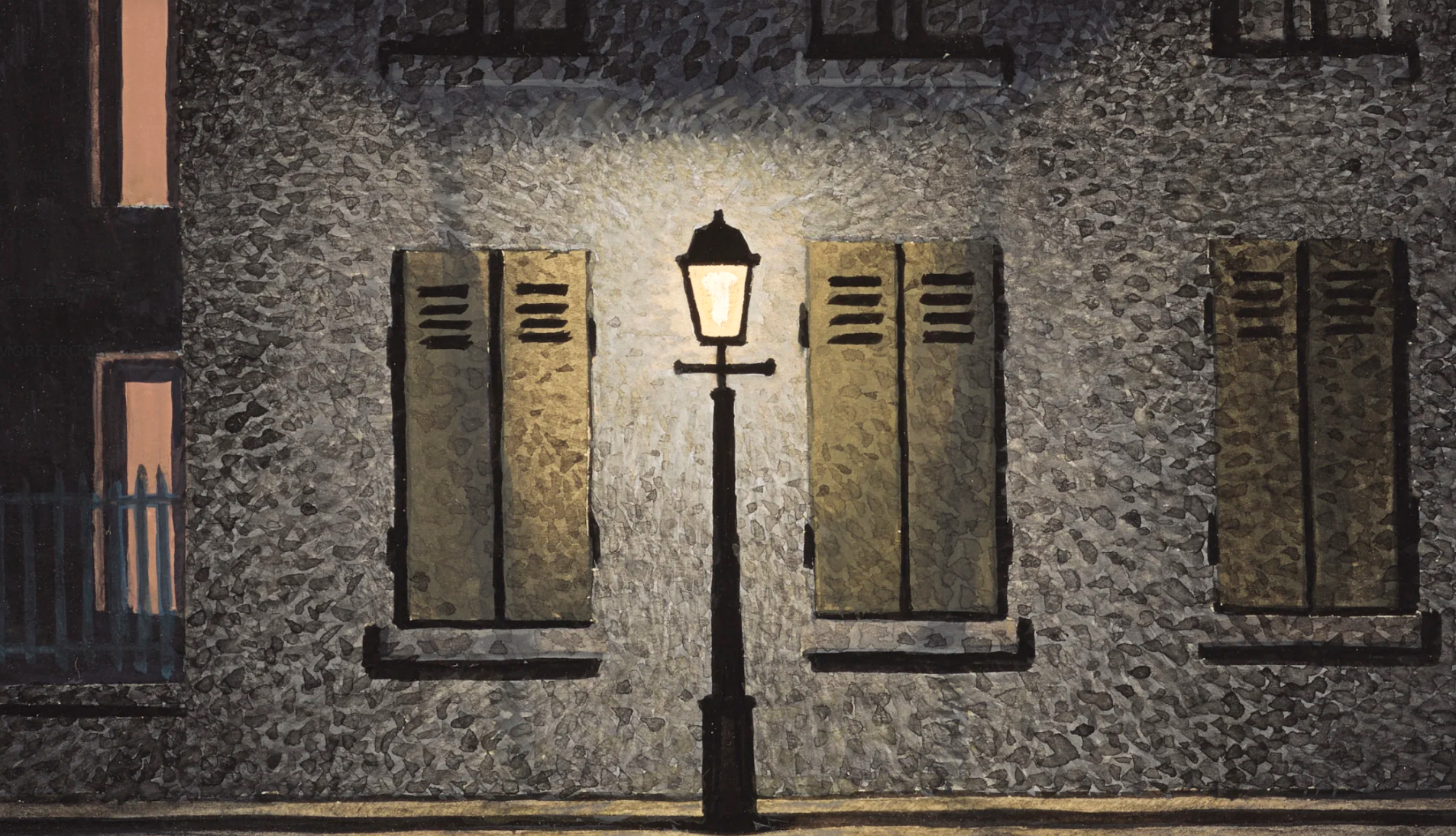
Alongside its captivating sense of mystery, the present L’empire des lumières also showcases Magritte’s masterful technique when working in gouache during this period of his career. He had first begun to experiment with the water-based paint during his years as a commercial designer, and by the mid-1930s it had become an important aspect of his practice, offering a creative outlet to explore new concepts and visualize his ideas quickly on paper. In contrast to the smooth, almost imperceptible brushwork typical of his oil paintings, Magritte’s gouaches embrace the spontaneity and fluidity of the medium, the path of the artist’s brush remaining clearly visible to the viewer as it moves across the page. He also played repeatedly with the consistency and finish of the gouache pigments, diluting the paints to different degrees in order to create rich, variegated textures and visual effects across the page. In the present work, for example, Magritte shifts from passages of opaque, saturated pigment, seen in the trees and houses, to semi-transparent touches of color arranged in delicate layers in his description of the light cast by the lamp, its rays flickering, overlapping and changing direction in an intricate pattern of short, staccato brushstrokes.
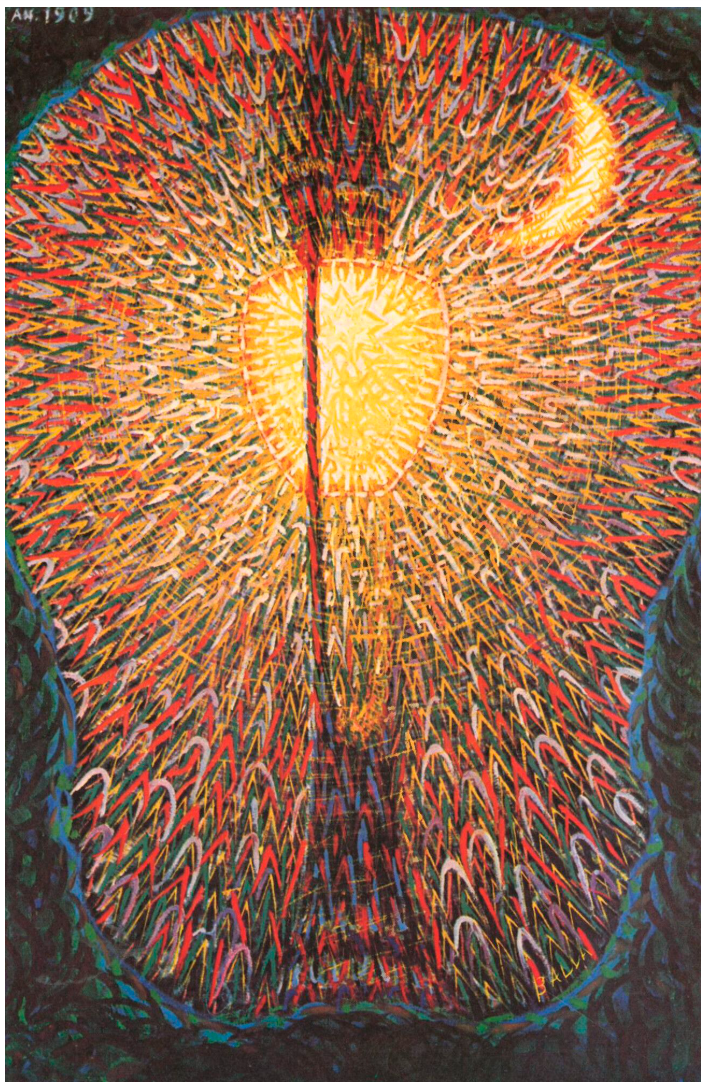
Giacomo Balla, Lampada ad arco, circa 1910-1911. The Museum of Modern Art, New York.
Magritte’s depiction of the radiant halo cast by the street lamp is in some ways reminiscent of the dynamic treatment of electric illumination in Giacomo Balla’s Street Light, circa 1910-1911 (The Museum of Modern Art, New York). The Italian Futurists had been an important touchstone for Magritte during the early stages of his career—recalling his first encounters with Futurism in his 1938 lecture “La ligne de vie,” the artist explained the profound effect these works had on his painterly outlook: “through a trick of fate, someone handed me the illustrated catalogue of an exhibition of Futurist painting with a condescending smile, and no doubt the stupid intention of pulling my leg. I had before my eyes a powerful challenge to common sense which worried me greatly… In a state of positive intoxication I painted a whole series of futurist pictures…” (“La ligne de vie,” quoted in G. Ollinger-Zinque and F. Leen, eds., René Magritte, 1898-1967: Centenary Exhibition, exh. cat., Royal Museum of Fine Arts of Belgium, Brussels, 1998, p. 45). While Magritte soon shifted away from the fragmented, clearly divided planes of color of these early Futurist-inspired paintings, the group’s approach to movement and dynamism seems to have continued to resonate within his imagination decades later. Here, the light scatters and is refracted across the façade of the house, creating a rich play of shadows that further accentuates the strange presence of the bright, daylit sky above.
Le paysage de Baucis, 1966
Christie’s London: 7 March 2024
Estimated: GBP 2,400,000 – 3,000,000
GBP 3,912,000 / USD 4,982,265
RENÉ MAGRITTE (1898 – 1967)
Le paysage de Baucis, 1966
Gouache on paper
27.2 x 21.1 cm (10 3/4 x 8 1/4 inches)
Signed ‘Magritte’ (upper right)
Signed, dated and titled ‘”LE PAYSAGE DE BAUCIS” Magritte 1966’ (on the reverse)
Le paysage de Baucis is a rare and important gouache by René Magritte made in 1966 and subsequently donated by the artist to raise funds for the Institute of Contemporary Arts in London in 1967—an institution that had, in 1947, been co-founded by the artist’s close friend and fellow Belgian Surrealist, E.L.T. Mesens. The work is one of a small number of highly significant gouaches, all made during the last years of Magritte’s life, that explore the twin themes of disappearance and the void. Le paysage de Baucis is a near-identical gouache version of a famous oil painting of the same name that the artist completed in February 1966, today housed in The Menil Collection in Houston. Also entitled Le paysage de Baucis, it was this oil painting which led Magritte to declare excitedly on completion that he had finally found the solution to the problem of ‘how to paint the emptiness between a hat and a man’s suit without suggesting “the invisible man”’(Letter to A. Bosmans, 19 February 1966; quoted in D. Sylvester and S. Whitfield, eds., René Magritte, Catalogue raisonné, vol. III, Oil Paintings 1949-67, London, 1993, p. 423).
In 1964 Magritte was asked by his patron Harry Torczyner to paint a self-portrait. He had responded to this request by creating the iconic, but also enigmatic image of a man in a bowler hat whose face is hidden by an apple in the painting Le fils de l’homme, (Sylvester, no. 999; Private collection). Finding this motif of covering the face more of an evasion than a solution however, Magritte became obsessed with solving the mystery of the invisible void or ‘emptiness’ that he saw existing between a man’s hat and his suit. ‘People are apt to say, “the invisible is hidden”,’ Magritte later explained to Guy Mertens. ‘That’s wrong: it’s unknown. The painter doesn’t show it, doesn’t explain it: he evokes it. I don’t need explanations’ (‘Interview with Guy Mertens,’ in Pourquoi pas?, Brussels, 26 May 1966, pp. 93-94).
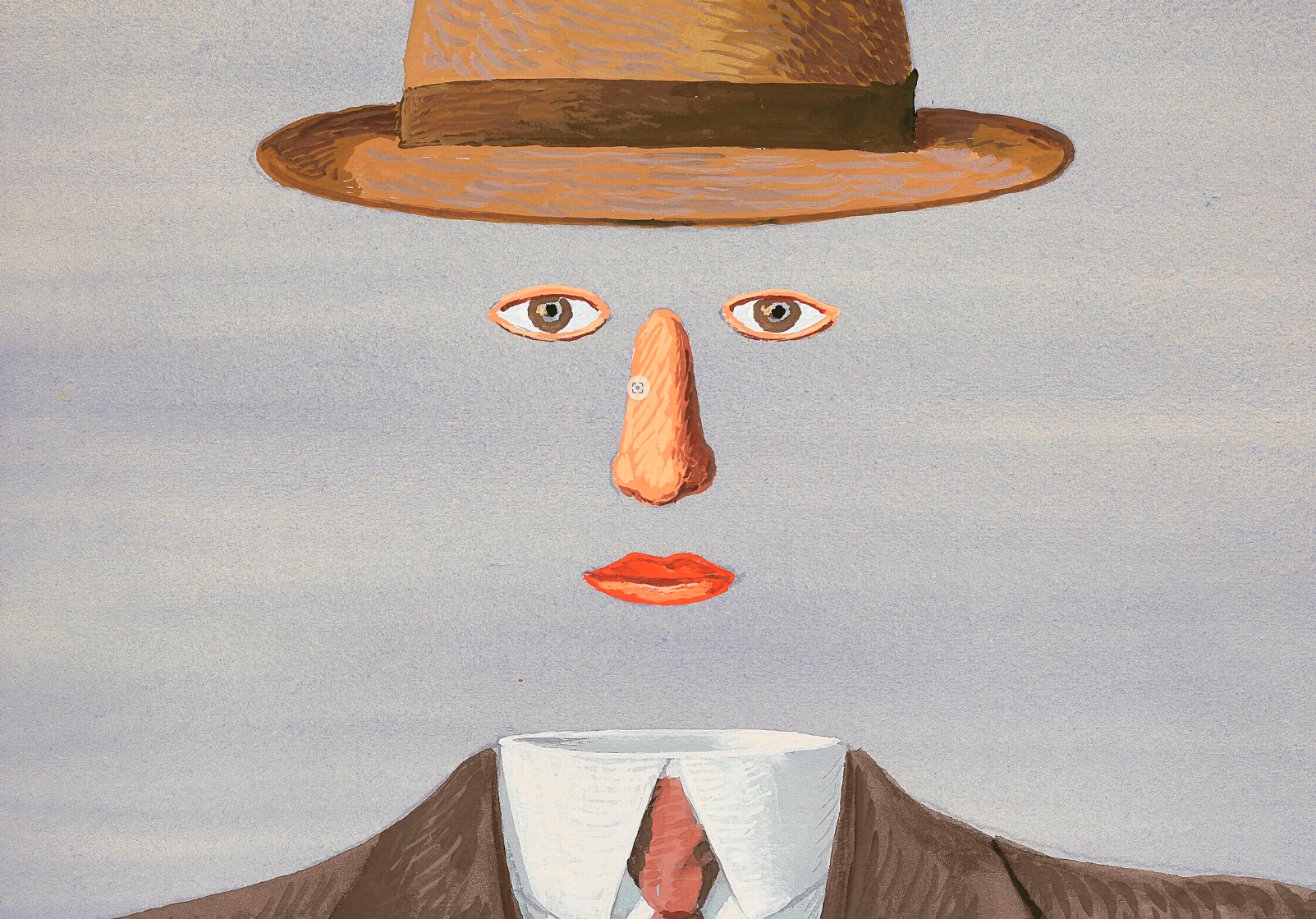
Le paysage de Baucis marks the culmination of an extensive series of paintings—all made in the wake of Le fils de l’homme—in which Magritte’s famous image of the man in the bowler hat was seen gradually to disappear; first becoming a silhouette or cut-out that either contains or looks out onto a variety of landscapes and then, ultimately, in Le paysage de Baucis and subsequently other variants such as Le pélerin (Sylvester, no. 1043; Private collection), Le chemin de Damas (Sylvester, no. 1042; Private collection) and Le musée du roi (Sylvester, no. 1049; Yokohama Museum of Art), disappearing completely through the depiction of an empty or invisible figure. As Magritte wrote triumphantly to André Bosmans about Le paysage de Baucis: ‘The picture of the emptiness between a hat and a man’s suit is finished: this was certainly one worth painting. I had thought of a title: “The horror of the void,” but discarded it as being too “direct” in favour of a better, I think: Le paysage de Baucis’ (Letter to A. Bosmans, undated, quoted in Sylvester and Whitfield, op cit., p. 423).
As with the painting itself, Magritte was careful with his choice of title to avoid any connection that might relate his ideas of invisibility to those of the ‘Invisible Man’ so immortalized in H. G. Wells’s novel from 1897. As Magritte explained in another letter to Bosmans about Le paysage de Baucis: ‘The picture should be inscribed with a title which prevents an uninteresting interpretation. If The Invisible Man had never been written, no (insoluble) problem would have arisen. An inscription such as, for instance, “The Daughter of Nothingness” could be considered, but to use it would be to reduce the image to the level of an illustration, obviously, although in reality there was no question of illustrating a theme’ (Letter to A. Bosmans, 10 August 1966, quoted in ibid.).
The title of Le paysage de Baucis, which David Sylvester and Sarah Whitfield have claimed was suggested to Magritte by François and Evelyn Deknop, certainly avoids any notion of Wells’s “Invisible Man.” Instead, it invokes the mythological figure of Baucis who, as told in Ovid’s Metamorphoses, alongside her husband Philemon, provided shelter and a meagre meal to the gods Zeus and Hermes when they were travelling the land in disguise. The gods, in retribution against all the others in the neighbourhood who had spurned them from their doors, destroyed the entire settlement saving only Baucis and Philemon and allowing them to witness the cataclysm, from which a temple emerged. The notions of disguise, perception, revelation and of the destruction of the landscape all invoked in this tale, can be seen to chime with the strange, partial apparition depicted in Le paysage de Baucis.
Magritte’s solution to the problem of making visible the invisibility of the man in the empty space between his hat and collar was the introduction of the strangely isolated eyes, nose and mouth in such a way that a face would appear in the viewer’s mind. In introducing these elements Magritte was drawing on earlier experiments he had made with the bizarre effects of isolating such features back in the late-1930s, in a series of pictures entitled Le race blanche (Sylvester, nos. 444, 445, and 1130, for example). For Magritte, Le paysage de Baucis marked the culmination of a series of experiments with invisibility that he had been practiced upon the man with the bowler hat ever since Torczyner had asked him to paint a self-portrait. And in this regard it should also be noted that Le paysage de Baucis differs from these famous depictions of the bowler-hatted man in one significant way. Instead of a bowler hat, here Magritte has depicted his ‘invisible’ figure donning a trilby. The trilby, as anyone who knew the artist was well aware, was the type of hat that he himself usually wore. Magritte only ever adopted the iconic bowler—with which both his art and his public image were so associated—for the benefit of photographers.
The oil versions of Le paysage de Baucis along with its subsequent variants Le pélerin and Le chemin de Damas were all first shown together at Magritte’s last ever solo show, held at the Iolas Gallery in Paris in 1966. There, Magritte’s old friend, the Belgian poet, Louis Scutenaire emphasized the artist’s enduring fascination with the void and the disappearance of man presented in these works, writing: ‘The first picture is called Le paysage de Baucis. The title is unchangeable, cannot be replaced by any other. Why? Algebraic brains will imagine that a face consisting only of eyes, nose and mouth in the void is more of a face than fully painted countenances and that it was the tree landscape and the only one that Baucis saw, in her total concentration on her husband perhaps?… Is it not better to think less and to know that the words “Baucis’s landscape,” “The road to Damascus” and “The pilgrim” are each a portrait of “Emptiness”?’ (quoted in ibid., p. 424).
Perhaps because these paintings are among Magritte’s very last works on the theme of the bowler-hatted man that had so punctuated his work ever since the early 1920s, Siegfried Gohr has argued that in their increasingly prominent theme of emptiness and disappearance Magritte has marked also the passing of modernism’s concept of the heroic individual. ‘What Magritte has actually done in these paintings,’ Gohr has written, ‘is to liberate the figure from its earlier presence and heroic stance… [he has] said farewell to the metaphysical subject of modernity, which had defined itself aesthetically rather than, as previously, in an idealistic, philosophical sense. Its disappearance would appear logical in view of an altered historical situation which no longer expected or demanded tasks of the individual, as had been done by heroic modernism in its struggle for recognition and the achievement of its goals… Might Magritte have been thinking similar to Michel Foucault?’ (Magritte: Attempting the Impossible, Antwerp, 2017, p. 287).
Foucault’s famous treatise, Les mots et les choses, also completed in 1966, ends with the following analogy: ‘As the archaeology of our thought easily shows, man is an invention of recent date. And one perhaps nearing its end. If those arrangements were to disappear as they appeared, if some event of which we can at the moment do no more than sense the possibility …were to cause them to crumble, as the ground of Classical thought did, at the end of the eighteenth century, then one can certainly wager that man would be erased, like a face drawn in the sand at the edge of the sea’ (The Order of Things, London, 2002, p. 422).
Le savoir, circa 1961
Sotheby’s London: 27 June 2023
Estimated: GBP 1,600,000 – 2,600,000
GBP 4,162,000 / USD 5,299,070
RENE MAGRITTE (1898 – 1967)
Le savoir, circa 1961
Gouache on paper
34.9 x 26.7 cm (13 3/4 x 10 1/2 inches)
Signed Magritte (lower right)
Signed Magritte and titled (on the verso)
This exquisite gouache combines two motifs that were central to Magritte’s work: the juxtaposition between night and day and the open doorway or threshold. Painted with the delicacy and precision that marks the artist’s best work, it epitomizes his enigmatic and captivating compositions. The combination of day and night first appears in Magritte’s work in the 1930s and forms the basis of his most celebrated series of paintings, his L’empire des lumières. The combination of night and day seen in these works was precisely the sort of reconciliation of opposites that was prized by the Surrealists and Magritte’s interest in it may have been sparked by André Breton’s poem L’Aigrette which had been published in 1923 and which Magritte knew well; the verse opens, ‘Si seulement il faisait du soleil cette nuit’ (‘If only the sun were to come out tonight’). For Magritte they had a particular potency, as he wrote: ‘This evocation of night and day seems to me to have the power to surprise and delight us. I call this power: poetry’ (quoted in D. Sylvester (ed.), op. cit., vol. III, p. 145).
“The word Knowledge is a felicitous name for an image of a sunlit landscape in which a door opens onto night. ‘Knowledge’ combines with this image, just as within the image a sunlit landscape and a door opening onto night are combine. A beautiful combination is not the result of a juxtaposition that might be complicated or simplified at will.”
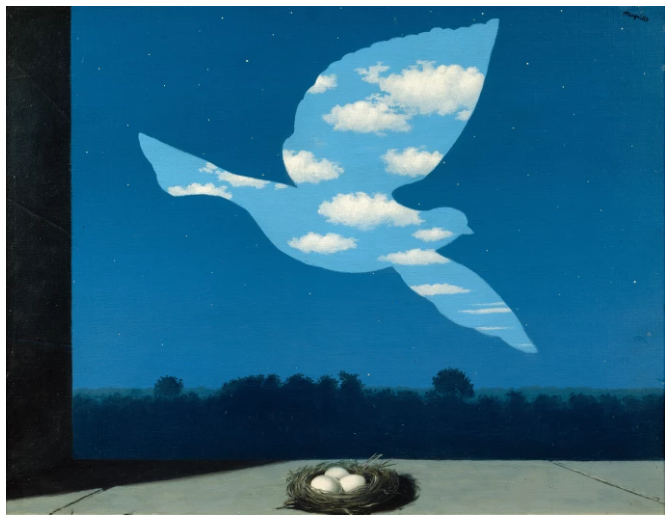
René Magritte, Le retour, 1940, oil on canvas, Musées Royaux des Beaux-Arts, Brussels © ADAGP, Paris and DACS, London 2023
He used the combination in a number of different formats including a bird flying through a night sky (fig. 2) and the present composition where a door in the middle of a sunlit landscape opens onto the same landscape at night. The doorway at the center of this composition introduces what David Sylvester has described as “a classic case of an operation which always obsessed Magritte—the concealment of one thing by another” (D. Sylvester, ed., René Magritte, Catalogue Raisonné, vol. II, London, 1993, p. 176). This would be a major preoccupation linking many of Magritte’s best-known images, from the curtains of works like L’ovation to the windows or doorways that open onto other worlds or nothing at all. As Magritte observed in an interview in 1965: ‘Everything we see hides another thing; we always want to see what is hidden by what we see. There is an interest in that which is hidden and which the visible doesn’t show us. This interest can take the form of a quite intense feeling, a sort of conflict, one might say between the visible that is hidden and the visible that is apparent’ (quoted in D. Sylvester, Magritte: The Silence of the World, 1992, New York, p. 24).
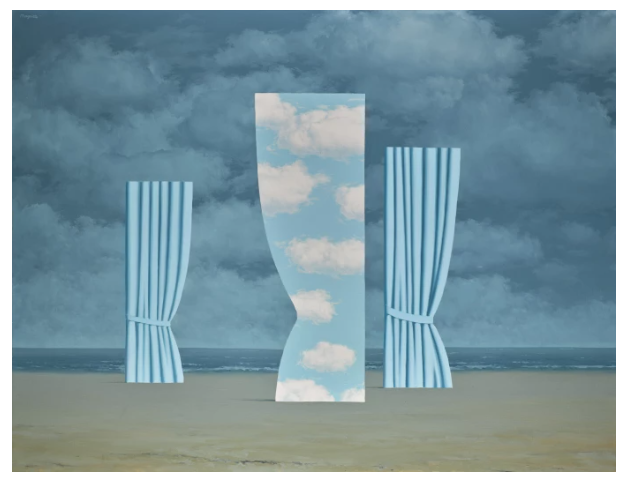
René Magritte, L’ovation, 1962, oil on canvas, sold : Sotheby’s, New York, October 2020, $14 million
© ADAGP, Paris and DACS, London 2023
In Magritte’s work this ‘conflict’ arises not just from literal barriers that conceal or reveal, but from the sky itself, which of course might seen as being the ultimate concealer. He once told a reporter, ‘the sky is a form of curtain because it hides something from us. We are surrounded by curtains’ (quoted in Sarah Whitfield, Magritte (exhibition catalogue), Hayward Gallery, London, 1992, note to no. 120). In the sense that our perception of the sky (in terms of day and night) is both temporary and specific, and that day and night do occur simultaneously, albeit not in the same place, it provides the perfect subject for Magritte’s art. Although the sight of a blue sky with drifting white clouds may seem benign, it alerts us to the ways in which we are unable to see or comprehend truths about the world around us.
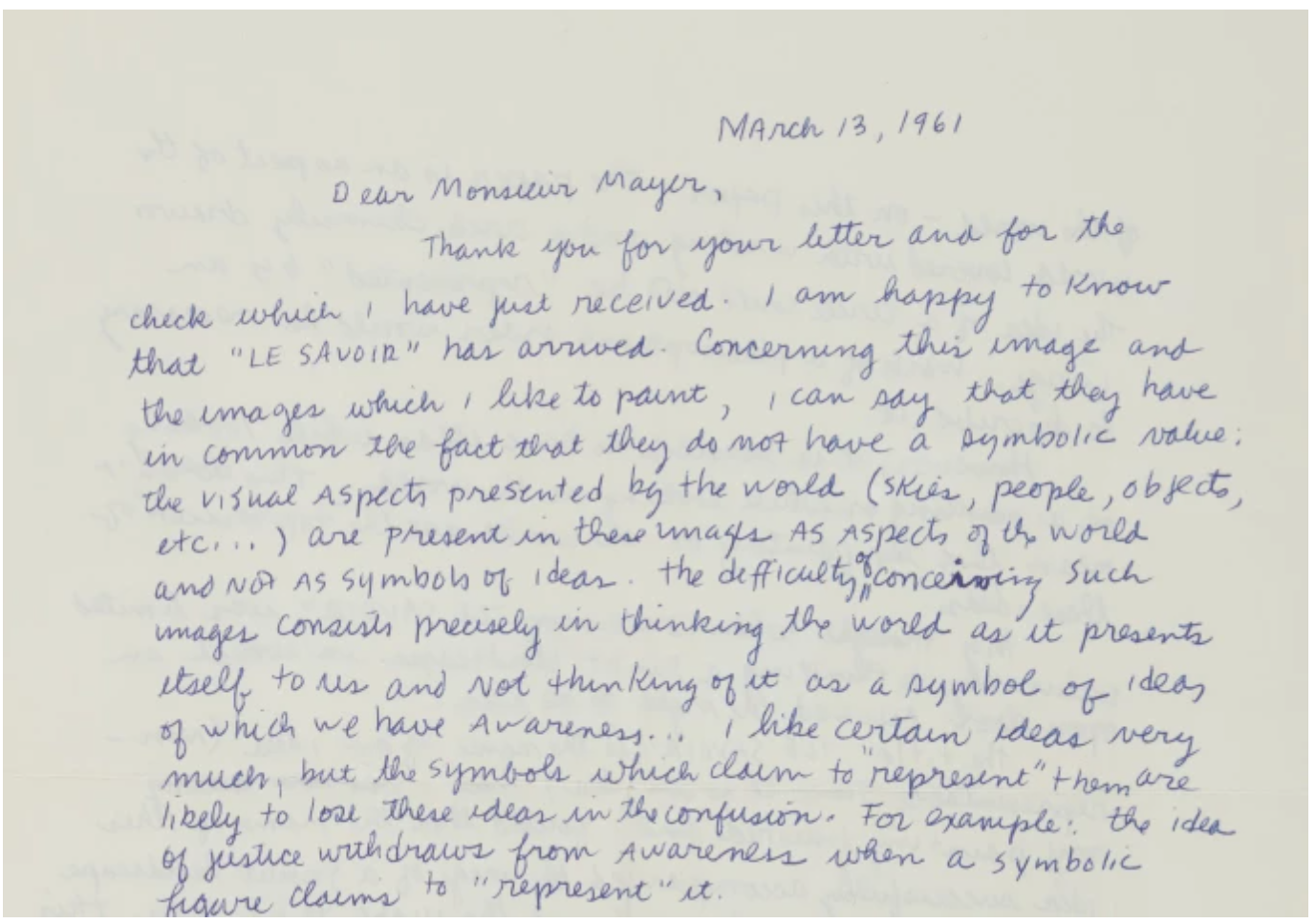
Letter from René Magritte to Edward D. Mayer, 13 March 1961
For the first 60 years of its existence, this beautiful gouache was known only through a letter from Magritte to its first owner, the Chicago-based Edward D. Mayer. Mayer approached the artist directly in buying the present work and the two continued to correspond over the years that followed; these letters and a series of charming Christmas cards remain with the work. They offer a unique insight into the artist’s relationships with patrons, and his approach. In one letter he writes: ‘Concerning this image [La Savoir] and the images which I like to paint, I can say that they have in common the fact that they do not have a symbolic value: the visual aspects presented by the world (skies, people, objects etc…) are present in theses works AS ASPECTS of the world and NOT AS SYMBOLS of ideas’ (Letter from René Magritte to Edward D. Mayer, 13 March 1961). This was a sentiment that Magritte expressed continually when asked about his art; works like Le savoir are about the world as we see and experience it, and more importantly, about ‘the mystery without which the world would not exist’.
La magie noire, 1944-45
Sotheby’s London: 27 June 2023
Estimated: GBP 800,000 – 1,200,000
GBP 1,173,300 / USD 1,493,850
RENE MAGRITTE (1898 – 1967)
La magie noire, 1944-45
Gouache, watercolor and colored crayon on paper
33 x 24.8 cm (13 x 9 3/4 inches)
Signed Magritte (upper right)
La magie noire belongs to a group of works Magritte executed in the 1940s, on the subject of a female nude in an unidentified landscape. The model for this series was the artist’s wife Georgette Berger and her image is depicted in a classical manner, abiding by the laws of conventional beauty and proportion, resembling a marble sculpture or a mythical figure as much as a live model.
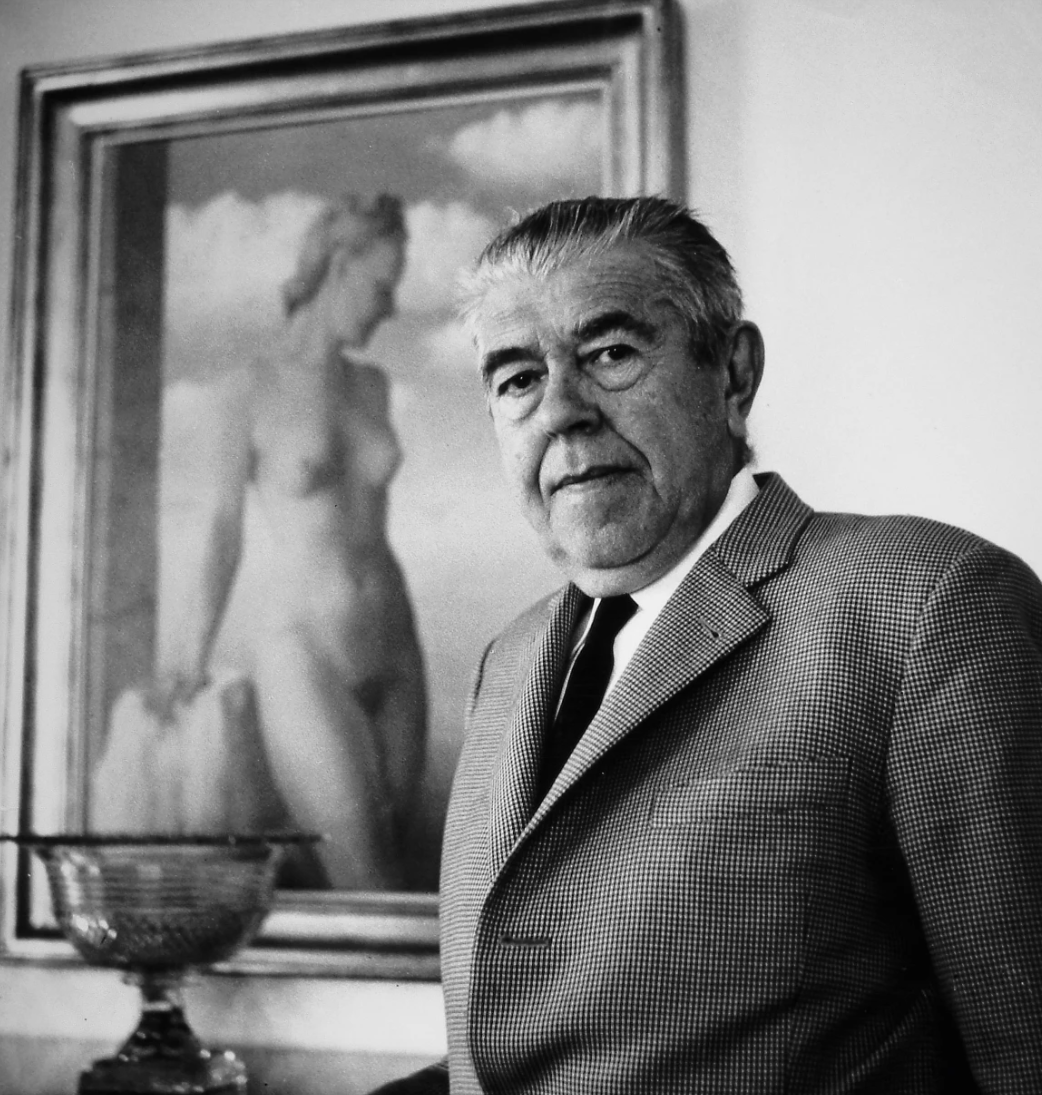
Magritte in front of another version of La magie noire, 1966 © ADAGP, Paris and DACS, London 2023
This traditional representation, however, is juxtaposed with the unexpected coloration of the figure, whose upper body gradually acquires the tone of the sky. In nearly all paintings from this group, the woman has one hand resting on a block of stone.
“One idea is that stone is associated with an “attachment” to the earth. It does not rise up of its own accord; you can rely on its remaining faithful to the earth’s attraction. Woman, too, if you like. From another point of view the hard existence of stone […] and the mental and physical system of a human being are not unconnected.”
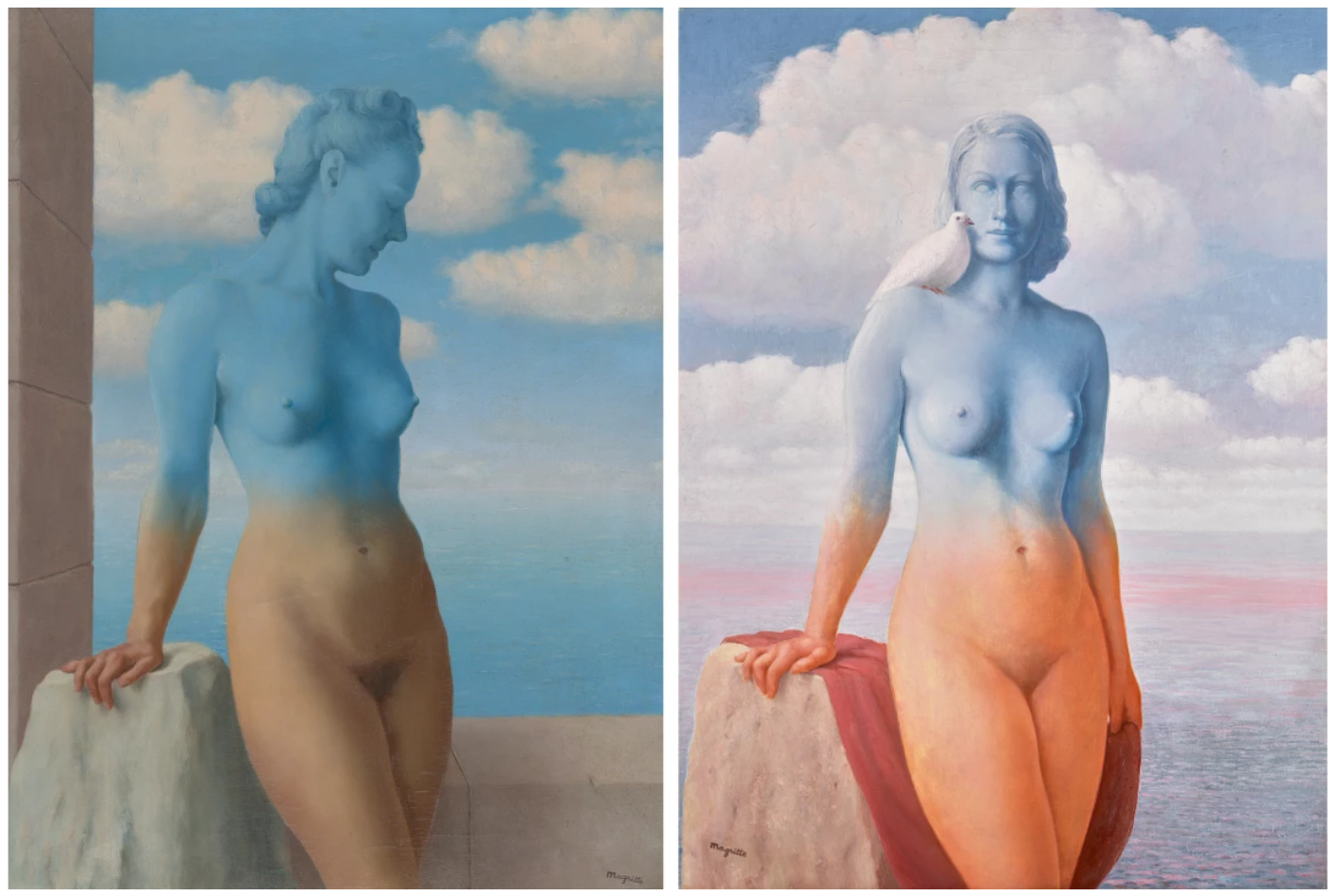
Left: Fig. 1, René Magritte, La magie noire, 1945, oil on canvas, Musées Royaux des Beaux-Arts de Belgique, Brussels © ADAGP, Paris and DACS, London 2023
Right: Fig. 2, René Magritte, La magie noire, 1946, oil on canvas, sold : Sotheby’s, London, June 2019, £4.2 million © ADAGP, Paris and DACS, London 2023
Depicted either with her eyes closed, or with her head turned away from the viewer or, as in the present work, with blank eyes resembling those of a marble sculpture, the nude becomes the passive object of the spectator’s gaze and erotic desire. ‘Magritte said, in fact, that an undercurrent of eroticism was one of the reasons a painting might have for existing. It asserted itself most intensely and explicitly in these stately classical nudes with their cool coloring. For the very reason that it aims at maximum resemblance, their academicism is upset by the provocation of mystery emanating from that identification, once the painting and the arrangement of the painting interfere with its course. The prime example is Black Magic [fig. 1]’ (ibid., p. 76). The subject of this work became one of Magritte’s favorite images in the 1940s, and he used it in several oils and works on paper. He varied the position of the nude, depicting her frontally or in profile, sometimes holding a rose, and other times, as in the present work, with a dove resting on her shoulder. While Magritte gave these pictures various titles, the one most often used is La magie noire, which was found, as was often the case, by Paul Nougé, a Belgian poet and friend of Magritte’s. Writing about Magritte’s first painting on the theme of Black Magic, executed in 1934 (D. Sylvester, op. cit., vol. II, no. 355), David Sylvester and Sarah Whitfield observed: ‘Those pretty colours serve an image-making as well as a decorative purpose: the top half of the nude is painted a gradated blue, near enough that of the sky behind; from the waist down, the color is a flesh tone. It is a process of metamorphosis. “Black magic. It is an act of black magic to turn woman’s flesh into sky”’ (ibid., p. 187).
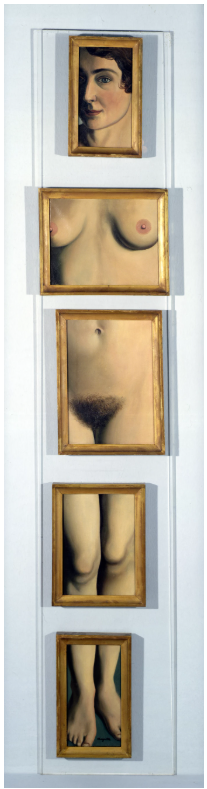
The present composition is a particularly intriguing variation, with the background rendered at the same time as both an interior and exterior. A characteristic wood-panelled wall, which appears often in Magritte’s imagery, is broken to reveal a non-descript landscape behind it, consisting of a still sea and a cloudless sky. Later in the decade, Magritte transformed this image by replacing the standing nude with a three-part torso, thus further reducing the image of a woman to a man-made object, evoking a sculpture despite her naturalistic flesh tone (fig. 3). The connection between these two works relates to one of the artist’s earliest and most famous works, in which the female body (and the painted work) was broken down into separate parts (fig. 4). This seminal work underpinned much of Magritte’s art in the way it presented a challenge to conventions of representation and perception; the same tension is evident in the present work, which is at once beguiling and intriguing in its transformation of the everyday into something remarkable.
La Main heureuse, 1952
Sotheby’s New-York: 15 May 2024
Estimated: USD 800,000 – 1,200,000
USD 1,270,000
La Main heureuse | Modern Evening Auction | 2024 | Sotheby’s
RENE MAGRITTE (1898 – 1967)
La Main heureuse, 1952
Gouache on paper
14.8 x 17.8 cm (5 7/8 x 7 inches)
Signed Magritte (lower left)
Titled and dated 1952 (on the reverse)
Executed in 1952, the present gouache is one of the very first iterations of the piano and ring motif which Magritte “discovered” in the spring of 1952. Joining these two tangentially related images, La Main heureuse is a striking embodiment of Magritte’s notion of “elective affinities”, a theory which defined much of the artist’s mature oeuvre.
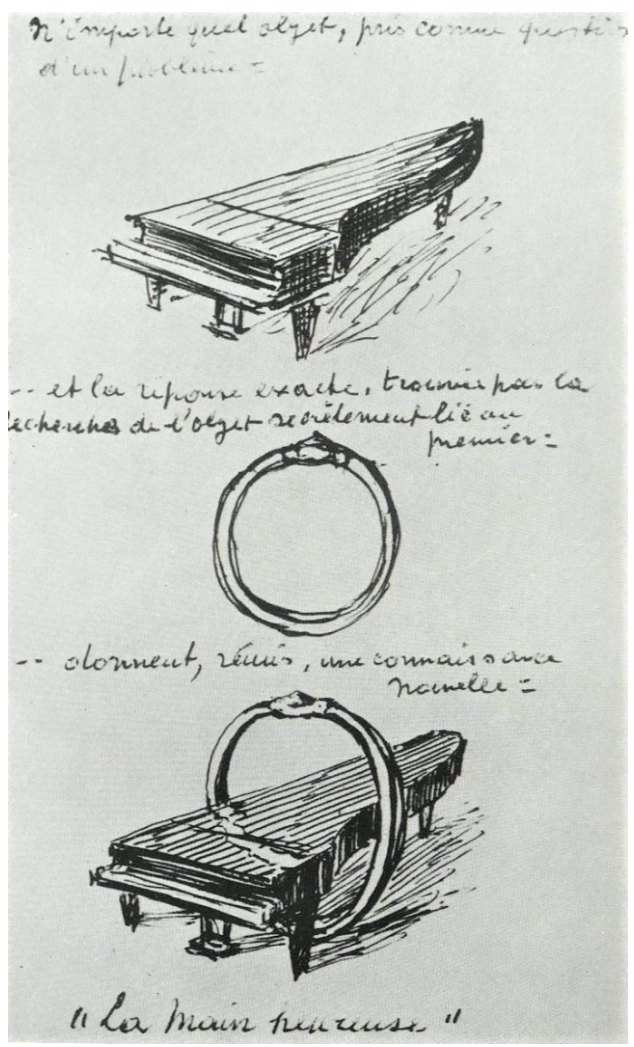
Magritte’s sketches on the theme of La Main heureuse, reproduced in “La Leçon des choses,” Rhétorique, October 1962 © 2024 C. Herscovici, Brussels / Artists Rights Society (ARS), New York
It was in 1952 that Magritte first solved “the problem” of the piano with a suite of three gouaches, each featuring the instrument encircled by a ring. The reflection of the gold band against the dark grand piano distorts the view of the ring, altering the silhouette just enough to echo the form of a bass clef.
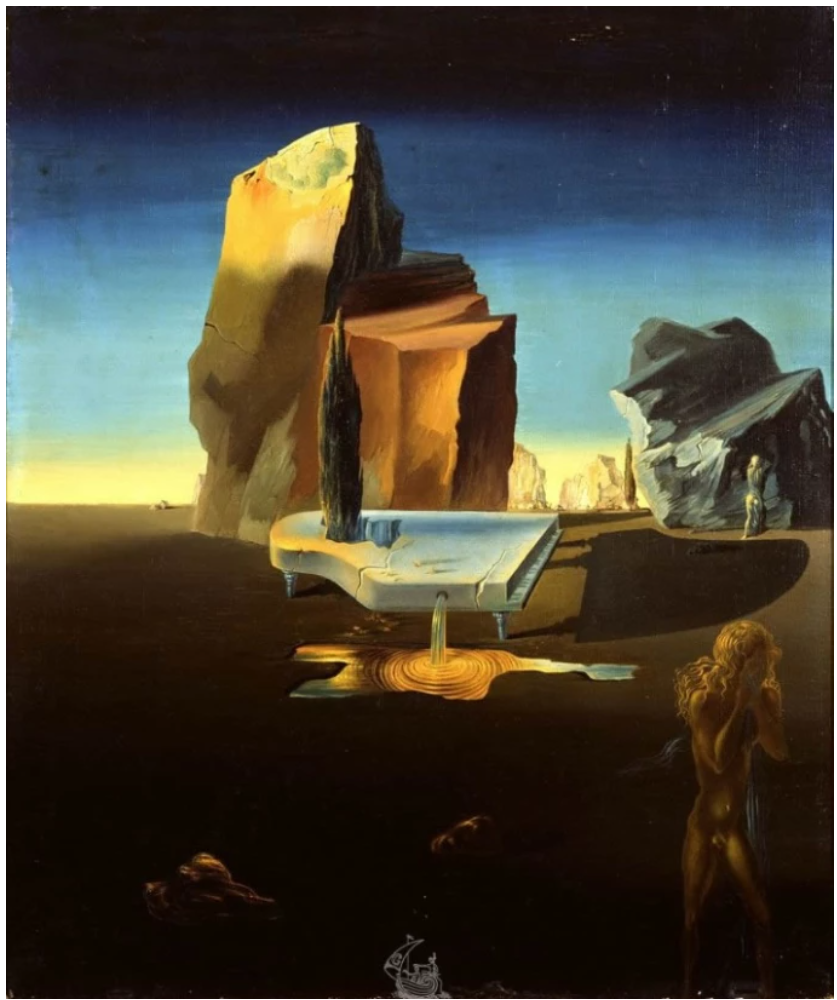
Salvador Dalí,The Mysterious Sources of Harmony, 1932, Private Collection
© 2024 Salvador Dalí, Gala-Salvador Dalí Foundation / Artists Rights Society (ARS), New York
The title, chosen after the creation of the motif, alludes to the unseen liaison between the piano and ring—the hand which animates both. A fourth gouache on the same motif was later commissioned for a diamond dealer in 1955, two years after Magritte created a larger version in oil. In much the same way that literature influenced the titles of Magritte’s artwork, so too did music. From his earliest collages incorporating sheet music, to his later paintings featuring instruments, Magritte’s imagery emphasizes the throughline of music in his work and the interdisciplinary nature of cultural influences in Surrealism. Similar referents and uncanny juxtapositions can be found in the work of Parisian Surrealists like Salvador Dalí.
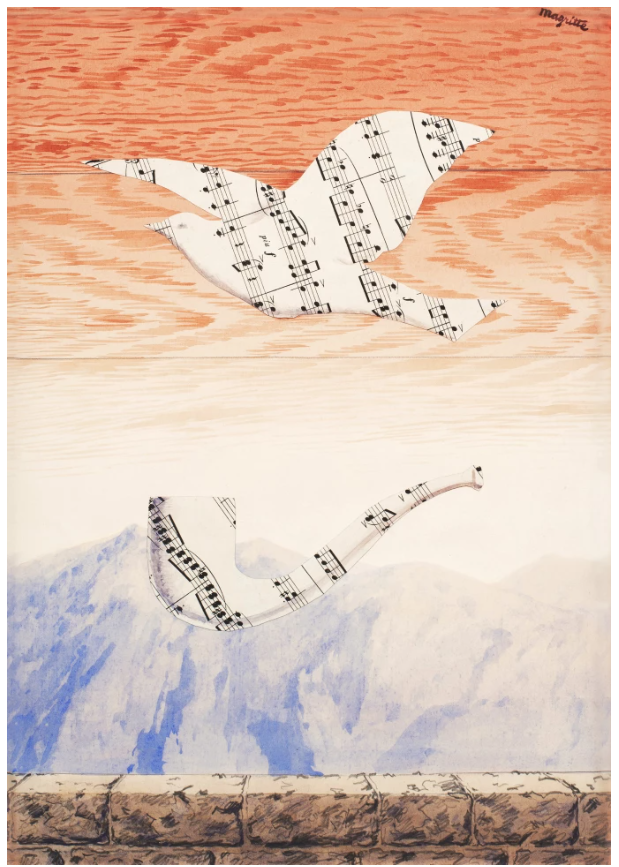
René Magritte, Moments musicaux, 1961, gouache, paper collage and pencil on paper
Sold: Sotheby’s, New York, November 2023 for $2,359,000
© 2024 C. Herscovici, Brussels / Artists Rights Society (ARS), New York
The reimagining of a motif across varied media was a common occurence in Magritte’e oeuvre, with some of his most iconic images appearing in both gouache and oil in short succession. The famed themes like Magritte’s bowler-hatted men, or his L’Empire des lumières, would, like La Main heureuse, be realized and subtly reworked in successive compositions in the 1950s and 60s (see slideshow). Of the three related goauches of La Main heurese executed in 1952, the present example is the richest in coloration and detail. The present work comes to auction for the first time in more than thirty-five years.
Le grand style, 1952
Christie’s London: 9 October 2024
Estimated: GBP 1,000,000 – 1,500,000
GBP 2,581,000 / USD 3,380,720
RENÉ MAGRITTE (1898-1967), Le grand style | Christie’s
RENÉ MAGRITTE (1898-1967)
Le grand style, 1952
Gouache on card
17.3 x 14.8 cm (6 3/4 x 5 7/8 inches)
Signed ‘Magritte’ (lower left)
Signed again, dated and inscribed ‘”Le Grand Style” René Magritte (1952)’ (on the reverse)
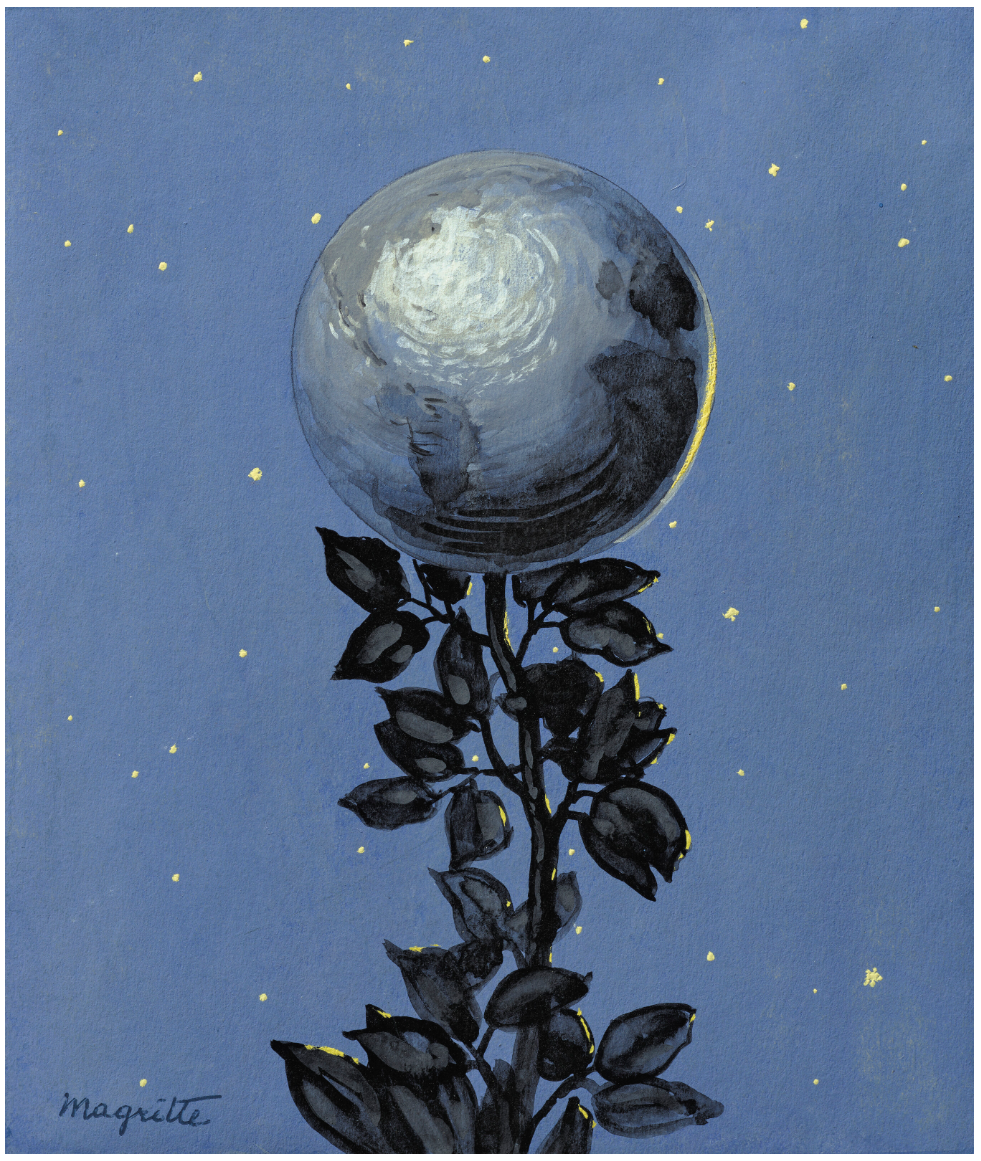
Executed in 1952, Le grand style showcases René Magritte’s ongoing fascination with questions of perception and illusion, presenting a puzzling, enigmatic image that confounds viewers’ expectations. In this delicate gouache the artist depicts a strange view of Earth, in which the planet appears to sit atop the slender stem of a plant, occupying the traditional place of a flower. However, whether or not this is a clever trick of the eye, an optical illusion or somehow a magical dislocation, remains a mystery. Taking inspiration from an oil painting the artist had completed the previous year (Sylvester, no. 763; The Menil Collection, Houston) – whose title and subject were reportedly suggested by the Surrealist poet Marcel Mariën – the gouache was donated by Magritte to a charity sale organized by the Dutch newspaper De Tijd in 1954. To mark the occasion, which was held to benefit children living in poverty, the artist wrote a brief letter to De Tijd, in which he proclaimed ‘I would like gold to make much less noise in the world’ (quoted in D. Sylvester, ed., René Magritte, Catalogue Raisonné, vol. IV, Gouaches, Temperas, Watercolours and Papier Collés 1918-1967, London, 1994, p. 153).
The surreal quality of Le grand style is accentuated by the knowledge that at the time of its execution, such a view of Earth would have seemed impossible – photographs of the planet from this perspective would not appear for at least another decade, as space exploration transformed our vision of Earth through the 1960s. Unimpeded by the swirling white cloud cover that usually fills the atmosphere in images taken by astronauts in orbit, the planet in Le grand style instead appears to have been modelled using a traditional cartographic globe, or perhaps illustrations from the novels of Jules Verne, such as Hector Servadac or De la Terre à la Lune, of which Magritte was an avid reader. A similar vision of Earth is featured in another suite of paintings from this period, titled L’autre son de cloche (Sylvester, nos. 771 & 1344), in which an ordinary green apple is seen floating mysteriously alongside the planet. The incongruity of this pairing is heightened by the disparities in scale between the two spherical objects: either the apple is colossal in its dimensions, or conversely Earth has shrunk to a Lilliputian scale.
In each iteration of Le grand style and L’autre son de cloche, Magritte positions the globe so that it reveals the full expanse of the Atlantic Ocean, framed on one side by Western Europe and North Africa, while on the other the elongated profile of the East Coast of North America stretches southwards in a sinuous line to South America, suggesting he used the same source for his imagery. In the present gouache, there is a strange play of reflections across the surface of the globe, as if the Earth is rotating, like a flower, towards the sun. This adds another layer of intrigue to the inherent contradiction within the motif – the planet, which we expect to float freely in the sky, is now rooted to the ground by its stem and leaves, yet its movements remain intrinsically tied to the star it orbits. With these strange juxtapositions and impossible combinations, Magritte intended to jolt his viewers out of a complacent understanding of the world around them, forcing them to question the perceived, inherited or conventional visual rules that govern their everyday understanding of reality.
Leaf Tree
La clairvoyance, circa 1962
Christie’s Hong-Kong: 28 March 2025
Estimated: HKD 15,000,000 – 25,000,000
HKD 28,810,000 / USD 3,703,085
La clairvoyance, circa 1962
Gouache, watercolour and coloured pencil on paper
36 x 26.8 cm (14 1/8 x 10 1/2 inches)
Signed ‘Magritte’ (lower left)
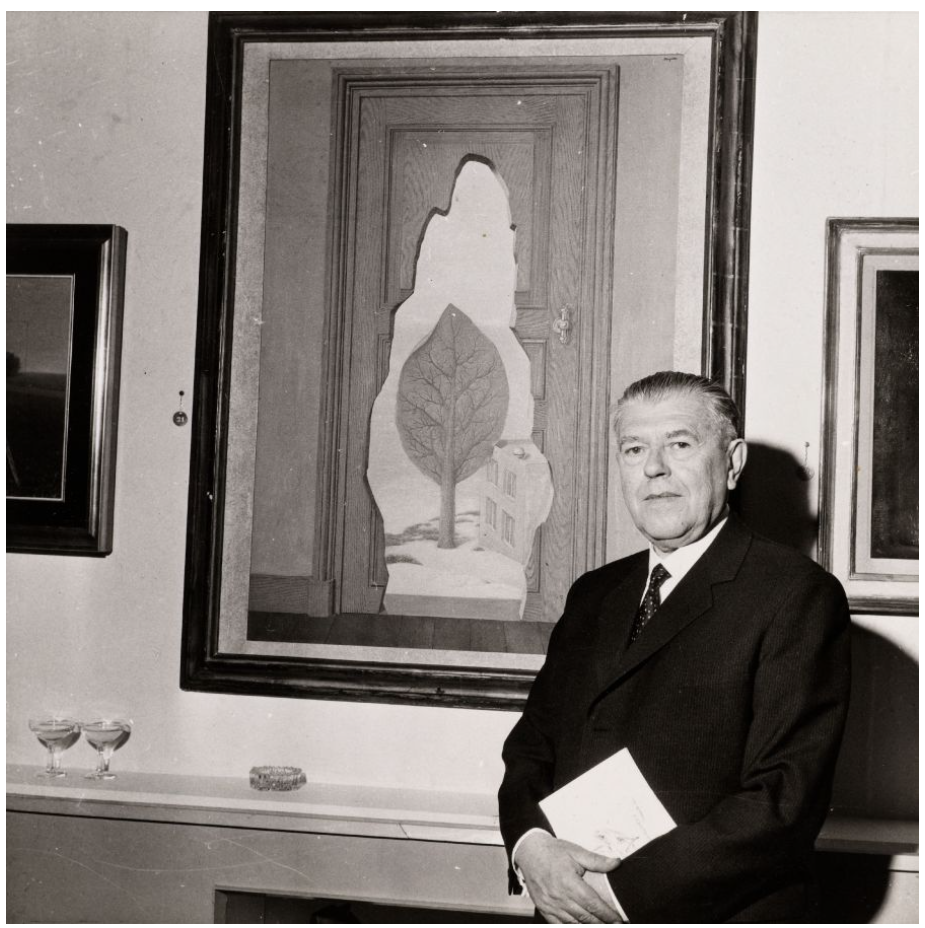
The idea of the “leaf-tree” first entered Magritte’s art in La Géante of 1935 (Sylvester, no. 362), in which a sturdy tree trunk set within a verdant landscape is adorned not with a multitude of leaves, but with one single, over-sized leaf. At the time that he painted this oil, Magritte was in the midst of one of the most important periods of his career, during which he had embarked upon an artistic exploration to seek “solutions” to particular pictorial “problems” posed by various objects. In seeking, and subsequently revealing, the “elective affinities” that lay hidden between related objects, Magritte was able to render the most banal and ubiquitous elements in an extraordinary way. In July 1934, Magritte wrote to André Breton, “I am trying at the moment to discover what it is in a tree that belongs to it specifically but which would run counter to our concept of a tree” (quoted in D. Sylvester, op. cit., 1993, vol. II, p. 194). The answer he found was brilliant in its sheer simplicity—it was of course, the leaf. As he later explained in his lecture of 1938, “The tree, as the subject of a problem, became a large leaf the stem of which was a trunk directly planted in the ground” (“La Ligne de vie,” in G. Ollinger-Zinque and F. Leen, eds., René Magritte 1898-1967, exh. cat., Musées Royaux des Beaux-Arts de Belgique, Brussels, 1998, p. 47).
Rene Magritte, La recherche de l’absolu, circa 1963. Christie’s New York, 19 Nov 2024, lot 36A. Sold for USD 8,460,000.
La recherche de l’absolu, circa 1963
Estimated: USD 3,000,000 – 5,000,000
USD 8,460,000
La recherche de l’absolu, circa 1963
Gouache on paper
36.3 x 27.3 cm (14 1/4 x 10 3/4 inches)
Signed ‘Magritte’ (lower left)
Titled ‘”La Recherche de l’Absolu”‘ (on the reverse)
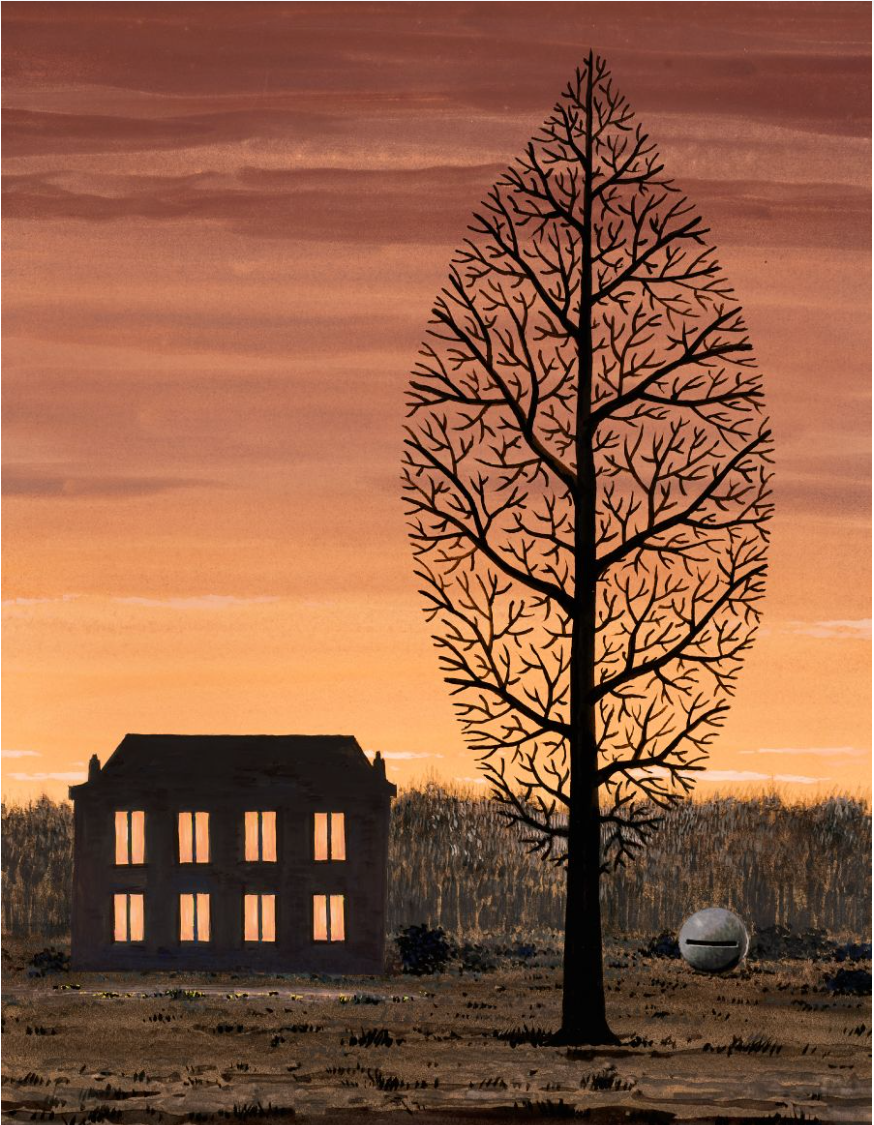
“Among the recent canvases, there are three versions of ‘The search for the absolute,’ which is a leafless tree (in winter) but with branches that provide the shape of the leaf, a Leaf even so! One version takes place in the evening with a setting sun, another in the morning with a white sphere on the horizon, and the third shows this great, self-willed leaf rising against a starry sky.”
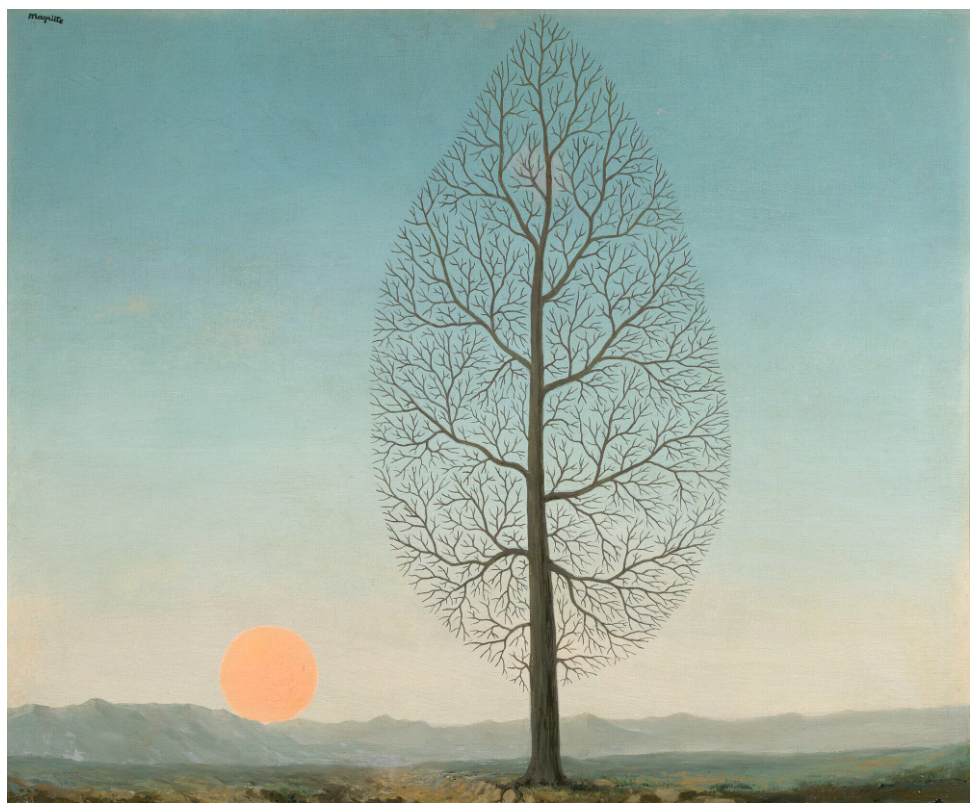
René Magritte, A la recherche de l’absolu, 1941. Ministère de la Communauté Française de Belgique, Brussels.
© 2024 C. Herscovici / Artists Rights Society (ARS), New York. Banque d’Images, ADAGP / Art Resource, NY
The title of the present gouache comes from the novel, La recherche de l’absolu by Honoré de Balzac, which portrays the destructive effects of one man’s obsession with alchemy and a quest for absolute truth. Magritte often took inspiration from literature, film and music when creating with titles for his canvases, and he also invited suggestions from friends such as the writers Paul Nougé and Louis Scutenaire, who is thought to have contributed the title for the present work. As in many of Magritte’s paintings after 1930, the title has a tenuous, indirect or seemingly incongruous relationship with the imagery, through which the artist invites the viewer to build associations on their own.
L’Incendie, 1947
Sotheby’s Paris: 18 October 2024
Estimated: EUR 3,000,000 – 5,000,000
EUR 3,180,000 / USD 3,443,730
L’Incendie | Surrealism and its Legacy | 2024 | Sotheby’s
RENE MAGRITTE (1898 – 1967)
L’Incendie, 1947
Gouache on paper
37.1 x 46.3 cm (14 5/8 x 18 1/4 inches)
Signed Magritte (lower left)
Signed Magritte, dated 1947, and inscribed “L’Incendie” (on the reverse)
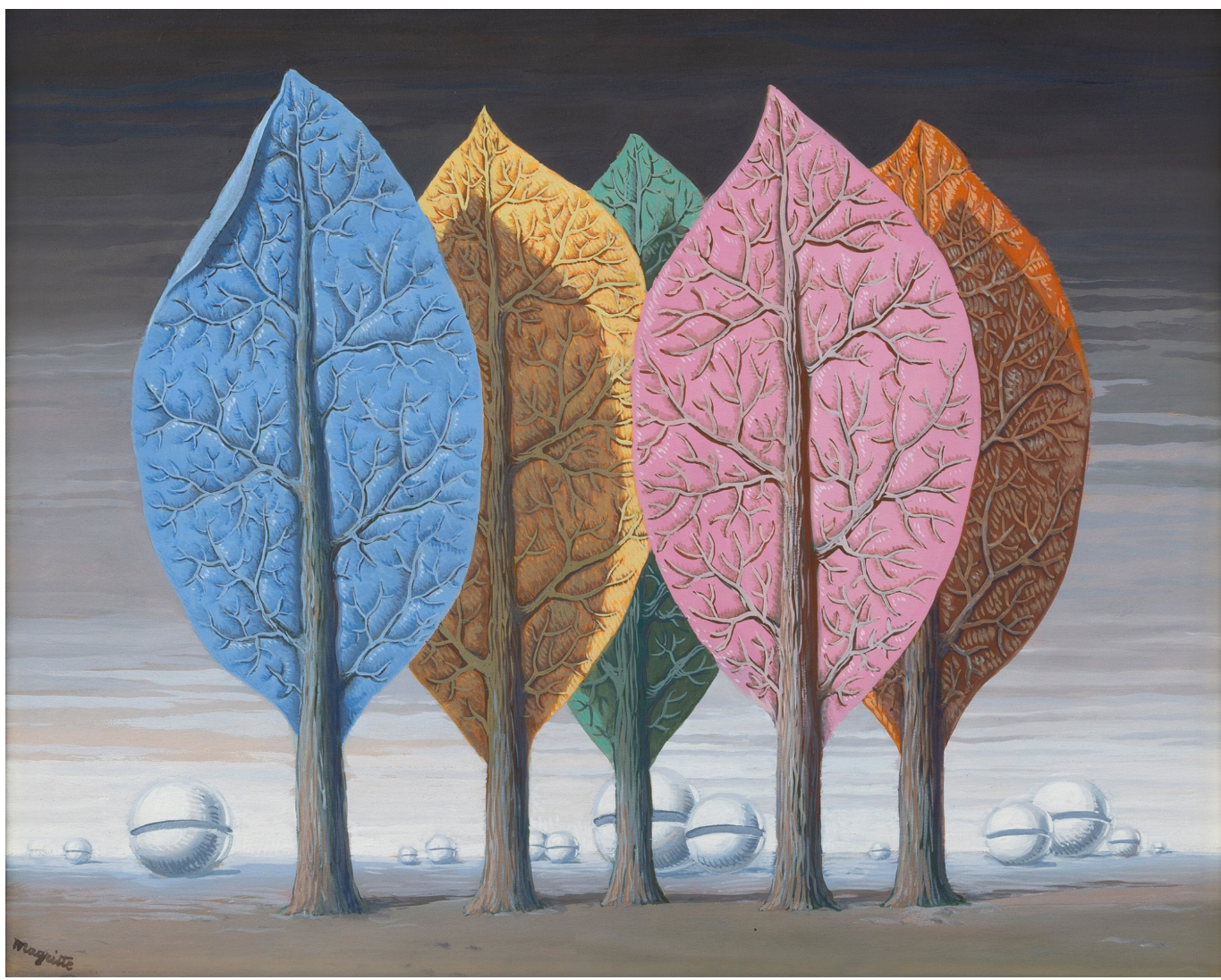
Executed in the aftermath of World War II, L’Incendie is a tour-de-force example of Magritte’s unwavering dedication to figurative Surrealism. While other Surrealists like Dalí, Ernst, and Miró shifted in a more abstract and fantastical direction in the 1930s and 1940s, Magritte’s compositions remained tethered to recognizably naturalistic forms, relying on the juxtaposition of ordinary but unrelated objects and the placement of figures in irrational surroundings to create jarring psychological tension and unsettling dissonance.
In the present work, five overlapping trees in the form of giant leaves are planted in the center of the composition, their pastel colours a stark contrast to the dark sky and the rolling haze behind them. Together, they stand sentinel over a somber landscape, casting shadows, despite the darkness of the background, over a barren landscape populated by Magritte’s iconic spheres. The veins of each leaf, which can also be read as ascendant branches of a tree, imbue the scene with a sense of vitality, as if they have been caught in the act of rapid growth. The forms of the tree-leaves, in a stylized manner, resemble human figures. The power of this quintessentially Magritte work lies in the artist’s unmatched ability to reveal and exploit ambiguity and contradiction within seemingly familiar subjects. What appears upon first glance to be a well-balanced and satisfyingly naturalistic picture unravels quickly with further inspection. Are the plant forms meant to be trees or leaves? Where are they planted? How can they grow so vibrantly despite the barrenness of this place? Is it night or is it day? These questions remain unresolved, and are indeed unresolvable; within the work itself, the viewer is forever suspended in a state of duality and mystery.
The iconography of tree-leaves has its origin in Magritte’s hybrid plant which first appeared in the 1935 oil La Géante and would recur ubiquitously in myriad variations in his painting over the next several decades. In a letter to André Breton of July 1934, Magritte commented: “I am trying at the moment to discover what it is in a tree that belongs to it specifically, but which would run counter to our concept of a tree” (quoted in David Sylvester, ed., op. cit., vol. II, p. 194). He soon found the answer…in the motif of the tree-leaf: “the tree, as the subject of a problem, became a large leaf the stem of which was a trunk directly planted in the ground” (ibid., p. 194).
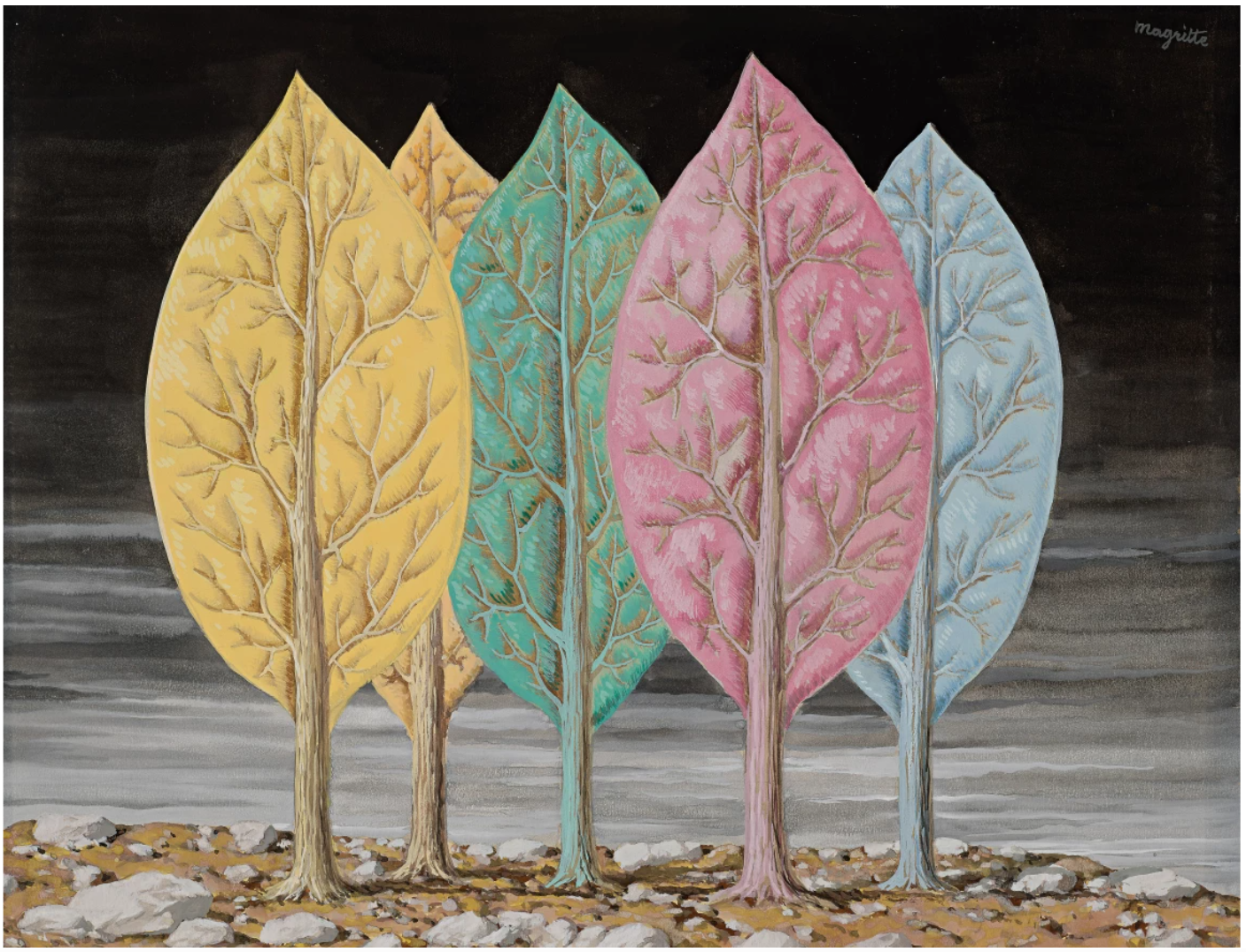
Magritte, L’Incendie, 1948, Private Collection. Sold, Sotheby’s New York, 13 November 2018, lot 336.
Sold 4,335,000 USD. © Sotheby’s / Art Digital Studio.
In the artist’s own commentary on our gouache, each tree represents “a leaf of flaming color” (quoted in David Sylvester, op. cit., vol. IV, p. 95). Writing about the leaf image in Magritte’s painting, Jacques Meuris observes: “Nature, as Magritte saw it, was an element with the same characteristics, mutatis mutandis, as those with which he invested every object, everything. There was no ‘naturalist’ tendency in his work, no ecological impulse, not even a poetic transformation of the natural. Nevertheless, trees and leaves, alone or in groups, clad or bare, occasionally nibbled by insects, may be regarded as “individuals”, invested with multifarious feelings, endowed with charms in the various senses of the word” (Jacques Meuris, René Magritte, London, 1988, p. 154). This work, in composition and subject matter, is closely related to another gouache with the same title executed by the artist in 1948 and sold at Sotheby’s in 2018 realising the highest result for a gouache by the artist at the time.
Given its date of execution, it is tempting to read the L’Incendie subject as a metaphor for the flames of war engulfing the European continent at the time. Unlike most of his fellow Surrealists, Magritte never departed for America during the war, instead fleeing Paris for Carcassonne at the onset of the conflict and then settling in his native Belgium to ride out the German occupation. However, rather than channeling the dark mood of life under the Nazis and the anguish of catastrophic violence into his artworks, Magritte decided to pursue tones of joy in an artistic style he dubbed “sunlit Surrealism.” During this period of his career, Magritte looked to his Impressionist, Fauve and Expressionist forebearers for stylistic inspiration, executing works that were often poorly received by critics and which have long been considered aberrations from his oeuvre. The oil version of L’Incendie from 1943, with its brushy background and bold palette, is a manifestation of this “sunlit” style; yet by late 1947 and early 1948, when the present work and its companion gouache were executed, Magritte began to emerge from this reactionary chapter of his career. Although Magritte’s rebellion against the Breton-led faction of Surrealism took on new life in the form of “vache” paintings in mid-1948, the L’Incendie gouaches marked a brief return to his unique and decidedly Surrealist aesthetic.
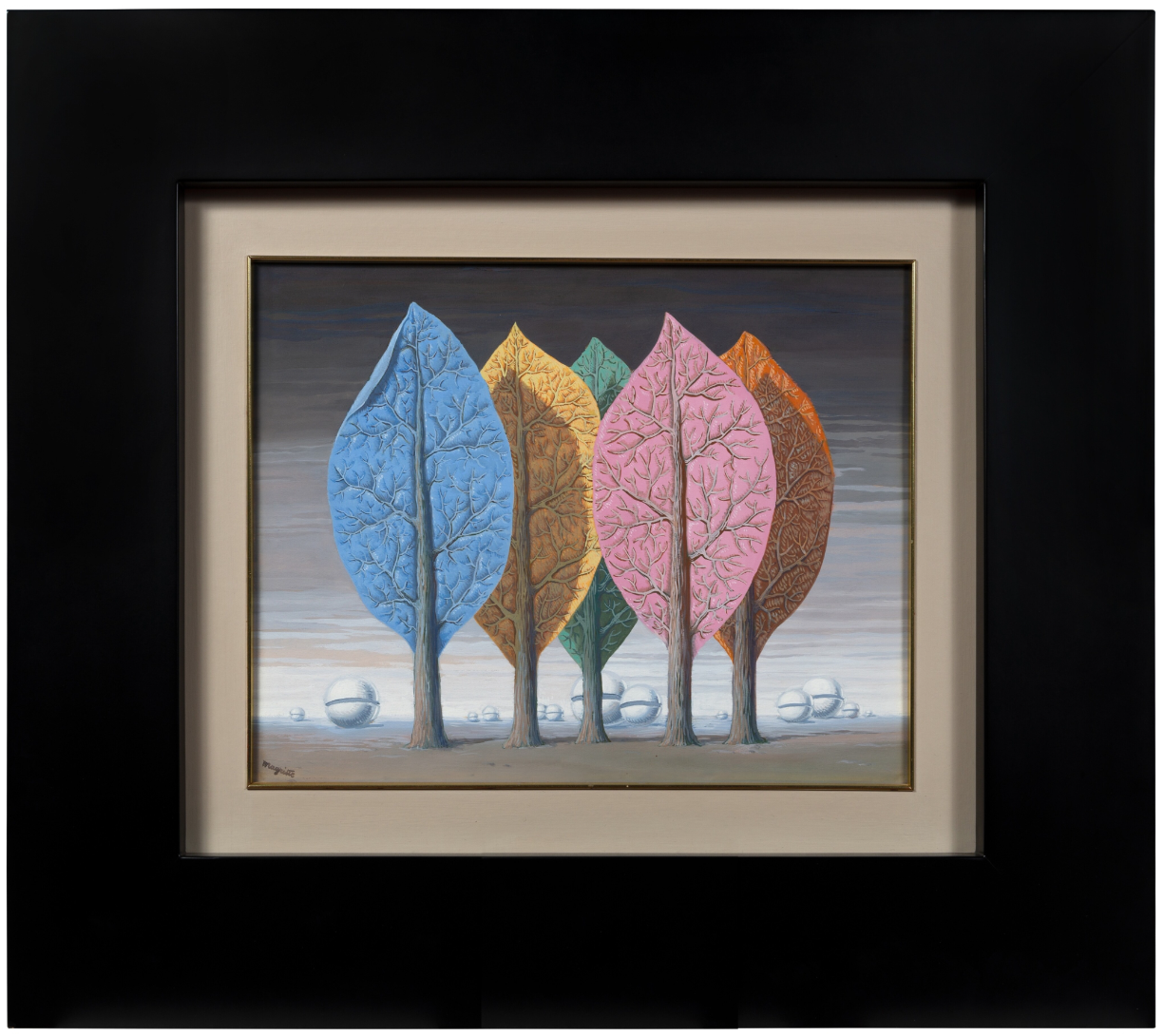
Magritte’s mastery of the gouache medium is particularly evident in the present work, and several other gouaches completed around this time likewise appropriate subjects and reinterpret motifs he had explored at earlier points in his career. As such, L’Incendie is not only stunning in its beauty and iconic in its representation of Magritte’s figural Surrealist style, but also offers a window into the artist’s own struggle for identity.
The provenance of this gouache furthers its unique appeal. Initially owned by legendary gallerist Alexandre Iolas, who acquired it from the artist himself, the work then entered the collection of one of Galerie Hugo’s founders and cosmetics magnate, Elizabeth Arden. A trailblazing entrepreneur, Arden revolutionized the beauty industry of the early 20th century. Her brand became a symbol of female empowerment and innovation in cosmetics and skincare. A pioneer of our contemporary standards of self-care, Arden had developed a scientific approach to skincare and was committed to promoting holistic beauty regimes. Beyond her business acumen, she was also an avid collector, amassing an impressive collection of art, antiques, and luxury items that reflected her refined taste and elevated the brand’s image. As a successful businesswoman in the cosmetics industry and a prominent art collector, she is often presented in opposition to her most fierce rival: Helena Rubinstein. Both catered to the growing desire among women for self-improvement and beauty, turning makeup and skincare into daily essentials for women of all classes. Their rivalry was personal and intense. Yet, despite their professional feud, they shared a passion for art collecting, which added an intriguing dimension to their stories. Rubinstein was an avid collector of avant-garde modern art, including works by Picasso, Matisse, and Miró, integrating this aesthetic into her salons. Arden, while being close to Alexander Iolas and having a strong interest in Magritte’s oeuvre, most often favored classical works, and used art to reinforce the elegance of her brand. For both female collectors, beauty and art were deeply intertwined. Their salons were not just commercial spaces but cultural havens, reflecting their personal tastes and elevating their brands.
L’État de veille, 1958
L’État de veille, 1958
Sotheby’s Paris: 5 December 2024
Estimated: EUR 1,000,000 – 1,500,000
EUR 1,056,000 / USD 1,110,040
L’État de veille | Modern & Contemporary Art | 2024 | Sotheby’s
RENE MAGRITTE (1898 – 1967)
L’État de veille, 1958
Gouache on paper
19×25 cm (7 1/2 x 9 7/8 inches)
Signed magritte (lower left)
Signed, dated and inscribed L’état de veille Magritte 1958 (on the reverse)
L’État de veille belongs to a series of gouaches featuring several emblematic motifs in Magritte’s works: a sky filled with clouds, window frames and a house façade. Painted in the first half of 1958, they were inspired by a vision expressed by Magritte’s friend Jacques Wergifosse
“On my way to spend a day with Magritte in Brussels, for once I walked to the station. I was going along the boulevard Avroz (in Liège) when I came to a wide opening (it no longer exists) with a view of the Meuse. I looked into the distance. Suddenly, on the other side of the river, I saw a series of windows appear high up in the sky. The grey walls of the large building in the place d’Italie had melted into the sky. On arriving at Magritte’s house, I told him what had happened. This gave him an idea for several gouaches, three of which were called ‘The waking state’ I, III and III. This was in 1958.”
In this composition, the traditional boundaries between landscape and architecture are blurred. The gouache depicts the bright blue sky, dotted with cottony clouds so characteristic of the painter, but a portion of this sky merges with windows, placed in such a way as to suggest a building façade. The perspective lines of the façade seem to merge perfectly with those of the sky, creating a disconcerting visual effect, where nature and architecture intertwine indistinguishably, in a convergence between dream and reality. The visible contours of objects fade away, making them touch. Brick melts into sky, sky into brick. This strange fusion between the natural element of the sky and the artificial element of the building conveys an impression of vertigo, of suspension in a world where the laws of reality seem suspended. The clarity and precision of Magritte’s rendering reinforce the unreality of the scene, giving the viewer the sensation of witnessing a waking dream where the limits of space and time no longer apply.
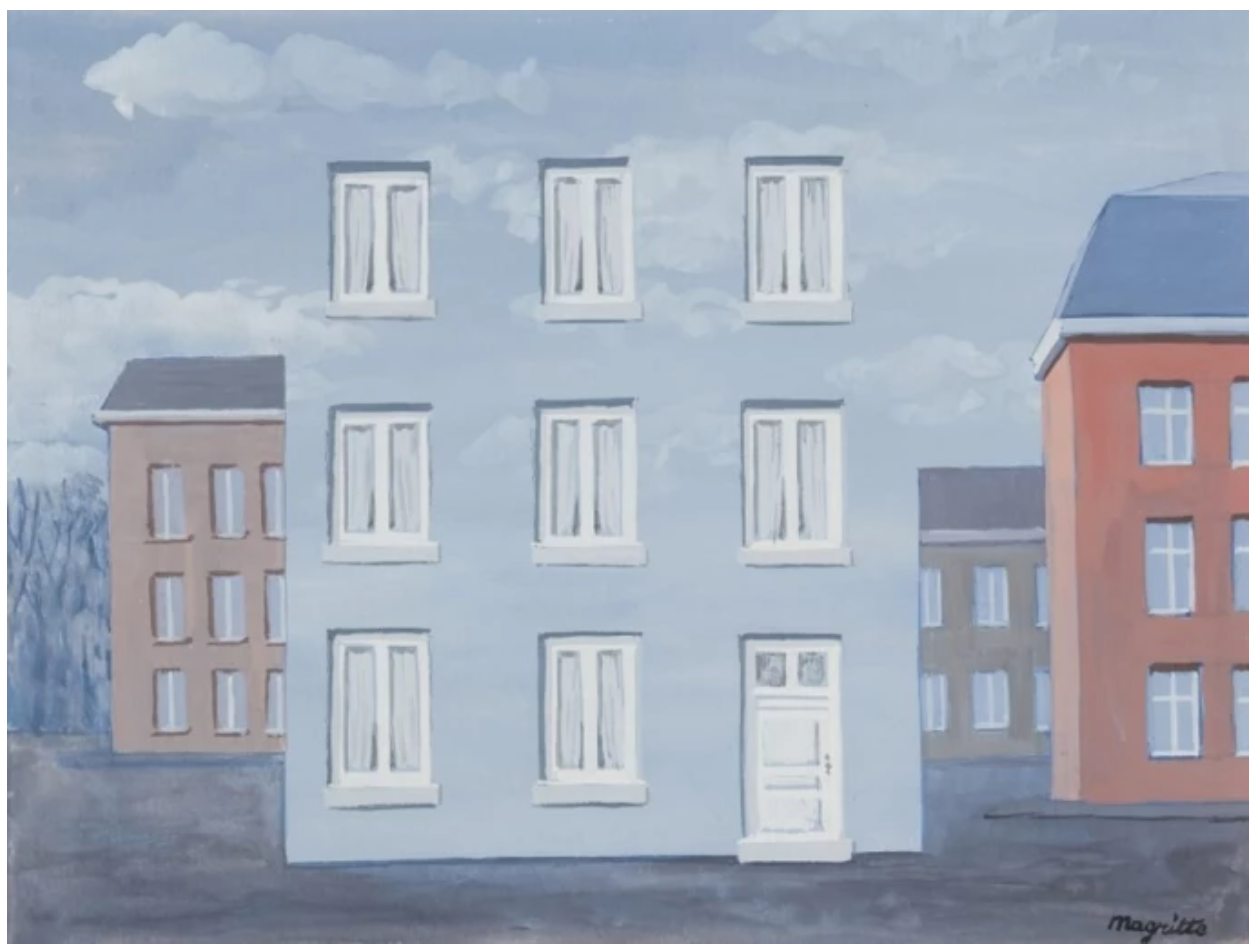
René Magritte, L’État de veille, 1958, gouache on paper, Private Collection. Sold Sotheby’s New York, May 16, 2024, lot 310. Sold $1,572,500. © Photothèque R. Magritte/ ADAGP, Paris 2024.
The theme of the house, and especially the question of the frontality of its façade, runs through this work. From the 1930s onward, Magritte began to explore this theme: a house set on a train track, a house with only a wall, door or window, a cheese house under a bell, a house set on the clouds… At the same time, clouds appeared in his work for the first time in 1930, in the painting Perfection céleste. The distinctive treatment of drifting white clouds was inspired by the landscapes of the Dutch Golden Age. Like all Magritte’s repeated motifs, the sky signals something specific in his work.
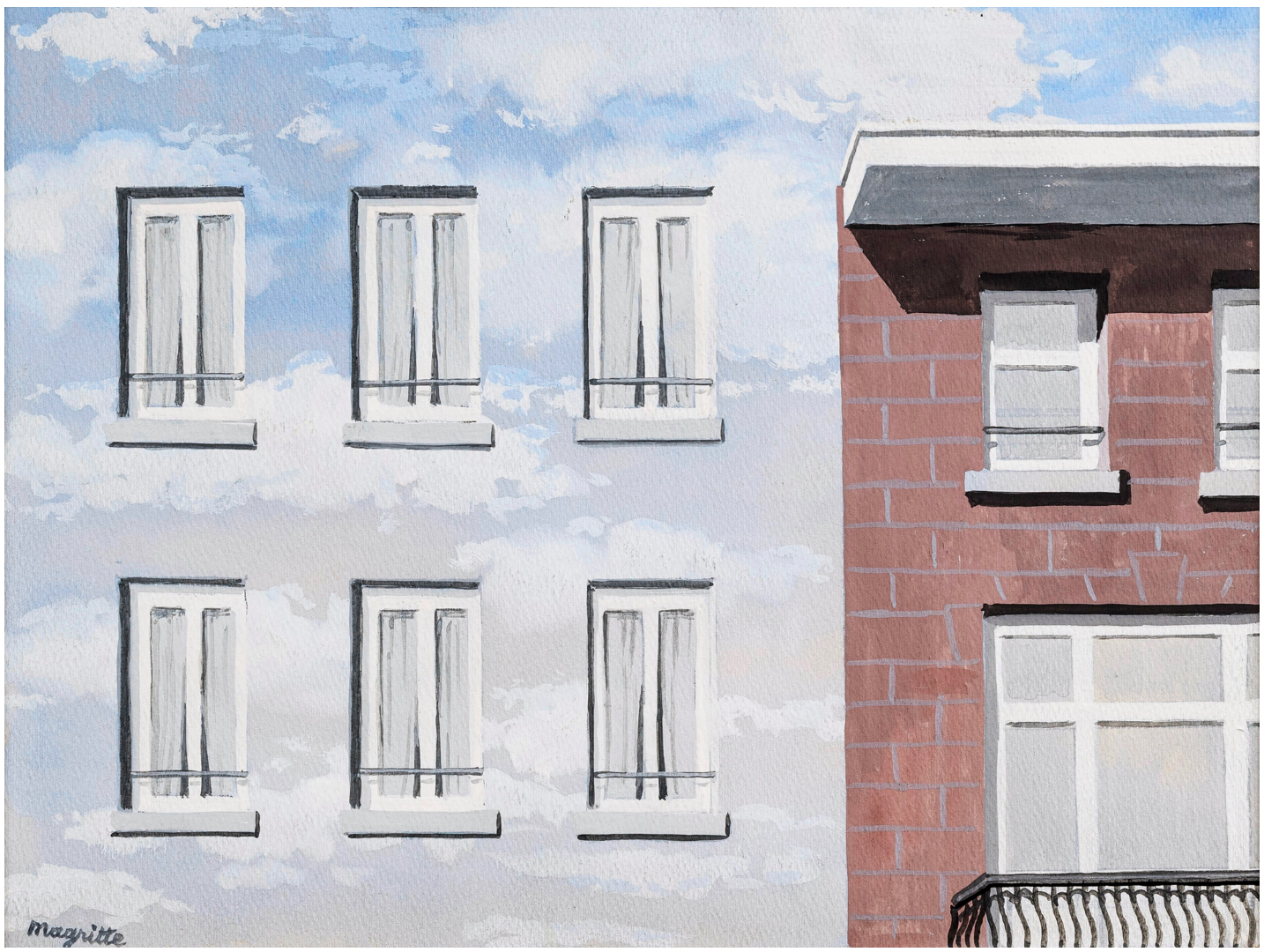
This notion of metamorphosis, of confusion between two objects, appeared in Magritte’s work as early as 1926-27.
“I found a new possibility for things : to gradually become something else, an object merging into an object other than itself. For example, in certain places, the sky reveals wood. This seems to be something other than a composite object, since there’s no break between the two materials, no boundary. In this way, I obtain paintings where the eye ‘has to pierce’ in a completely different way than usual (…) As you can see, all I had to do (…) was to blend together the things that were separated above.”
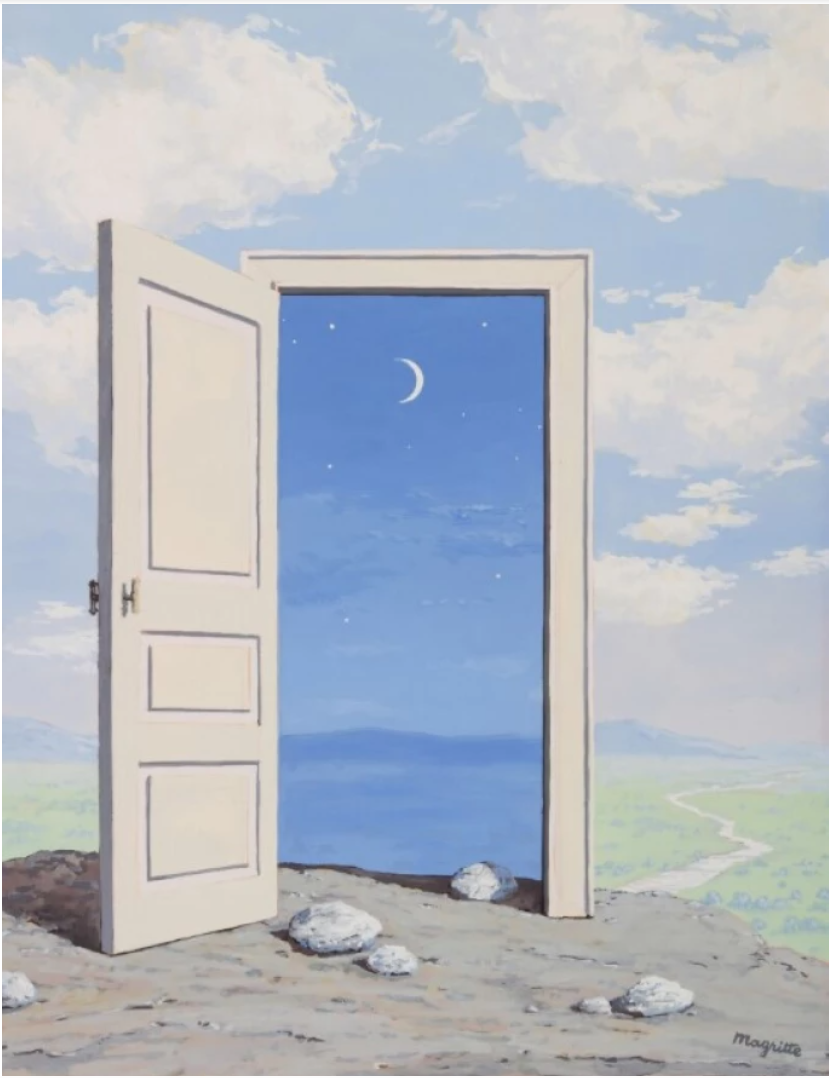
René Magritte, Le Savoir, circa 1961, gouache on paper, private collection. Sold Sotheby’s London, June 27, 2023, lot 117. Sold £4,162,000. © Photothèque R. Magritte/ ADAGP, Paris 2024.
This mechanism of confusion between objects proved particularly fruitful, and Magritte never ceased to offer the viewer wooden planks that in places became transparent, or objects transformed into stone. These metamorphoses give rise to a disturbance that challenges the viewer, disrupting his habits and thwarting his certainties. This has resulted in works such as L’Etat de veille, rich in equivocation and strangeness, which retain all their power to amaze.
L’État de veille, 1958
Sotheby’s New-York: 16 May 2024
Estimated: USD 400,000 – 600,000
USD 1,572,500
L’État de veille | Modern Day Auction | 2024 | Sotheby’s
RENE MAGRITTE (1898 – 1967)
L’État de veille, 1958
Gouache on paper
19.3 x 24.7 cm (7 5/8 x 9 3/4 inches)
Signed Magritte (lower right)
Signed Magritte, titled and dated 1958 (on the verso)
The present work, L’État de veille, is one of several gouaches Magritte painted in the first half of 1958. Inspired by the figment of his friend Jacques Wergifosse’s imagination, it takes as its subject matter two of Magritte’s most iconic motifs within his oeuvre: that of a cloud-filled sky and of framed windows. In the background, the rather nondescript Belgian streetscape is not unlike that of Magritte’s own rue de Esseghem, the street where he lived and worked for nearly twenty-four years. Yet in the foreground, architectured in velvety gouache is a patch of sky bent into the shape of a rowhouse. The building hovers over the pavement, a vision grounded only by a milky white doorstep – a proverbial, humorously short stairway to heaven. Bathed in midday light, the luminescent composition glows in cool tones.
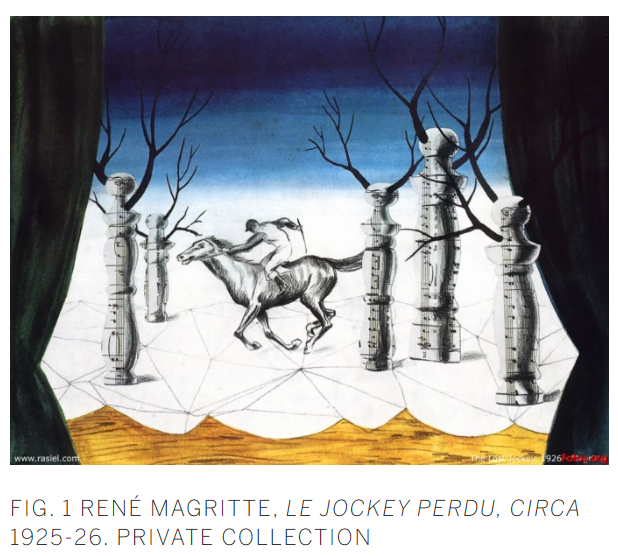
Magritte’s masterful use of his media is a slide of transubstantiation: where gouache is gouache and yet also cloud, brick, asphalt, and stucco. His command is so transformative that L’État de veille is a place where reality strikes the dreamstate and vice versa. Siegfried Gohr points out, “the colored works on paper reveal the brilliant talent of Magritte the painter. Even though [Magritte] repeatedly denied his ‘artistry’, belittling the traditional habitus of the virtuoso artist genius and emphasizing instead the artist’s intellectual work, his gouaches, in particular, reveal how masterfully he was able to apply his extraordinary gift of visualizing his pictorial ideas” (quote in Magritte: Attempting the Impossible, New York, 2009, pp. 77-78). Such astute fragmentation, converging, and reimagining of reality bolsters Magritte as a master of Surrealism, the art and philosophical movement for which he was baptized in 1926 upon the creation of his first surreal painting Le Jockey perdu (see Fig. 1).
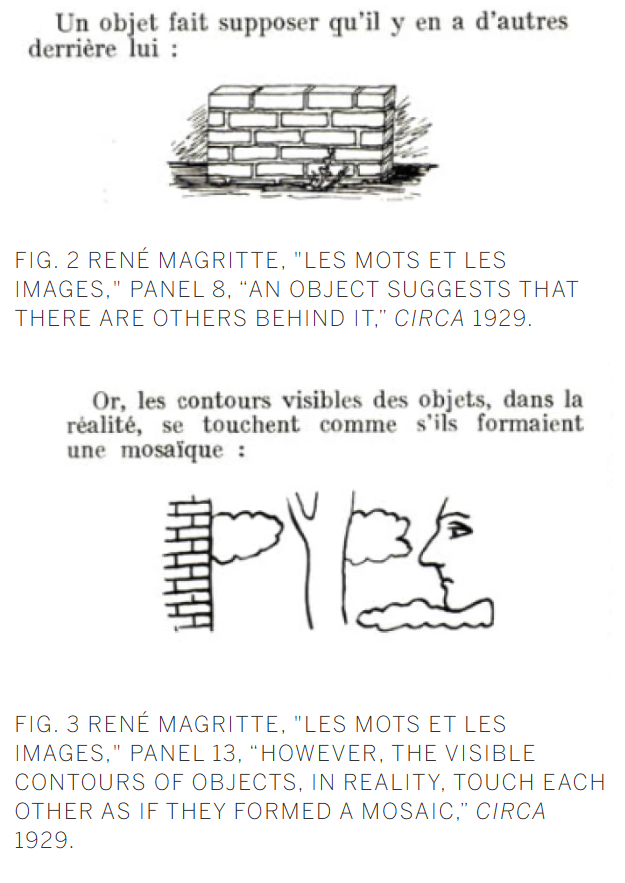
Nearly thirty years before L’état de veille, Magritte wrote “Les mots et les images” for the avant-garde publication La Révolution surréaliste (see Figs. 2 and 3). It is a succinct meditation on the relationship between words, images, and reality articulated in 18 panels of captioned illustrations. “Les mots et les images” is a prescient manifesto of the philosophies Magritte would remain committed to throughout his career. Two panels from the manifesto strike as particularly significant in relation to L’État de veille. The first is a small drawing of a brick wall with a caption that reads (in translation): “An object that makes you think there are other objects behind it.” The present work begs the question, what is concealed behind the cloud-washed building? Though the sky pattern suggests an infinite expanse, that notion is punctured by closed-curtained windows and an opaque door. A second panel from “Les mots et les images” reads (in translation): “However, the visible contours of objects, in reality, touch each other as if they formed a mosaic.” Here, the composition of L’État de veille is a mosaic convergence of dreamstate and reality – a magic point where every idea and its opposite are equally true. Brick melts into sky, sky into brick. L’État de veille is Magritte at his best—witty, incisive, original, and technically superb. Comparable works are held by esteemed institutions such as The Art Institute of Chicago and The Menil Collection.