The Global Art Market in 2025
Key Insights from the Artprice Global Art Market Report
WORK IN PROGRESS
According to the Artprice Global Art Market Report 2025, the international fine art auction market generated USD 11.11 billion in turnover in 2025, marking a moderate rebound after the sharp contraction recorded the previous year. More than 867,150 artworks were sold at public auction worldwide, illustrating the continued depth and liquidity of the global market. While the overall value of the market remains heavily concentrated in a small number of masterpieces, the number of transactions confirms the broad participation of collectors across multiple price segments.
The report highlights a year characterized by two distinct phases. The first half of the year remained cautious, reflecting economic uncertainty and a limited supply of major works. However, the second half of the year saw a significant resurgence of activity, driven by the arrival of important collections and a series of record-breaking sales.
In addition to this rebound, several structural trends continue to shape the art market: increasing geographic diversification, the growing influence of Asian collectors, stronger demand for historically validated artists, and the continued expansion of the prints and multiples segment. Together, these developments illustrate a market that is becoming more global, more data-driven, and increasingly focused on long-term value.
Beyond the headline figures, the Artprice report reveals several deeper structural shifts.
First, the art market is becoming increasingly globalized. Collectors now participate in auctions across continents, facilitated by online bidding platforms and digital catalogues.
Second, the market is becoming more quality-driven. The strongest results are achieved by works that combine rarity, provenance, and institutional recognition.
Third, the continued expansion of the prints market is helping broaden the collector base and introduce new buyers to the art world.
Together, these trends suggest that the art market is evolving into a more transparent, data-driven, and globally interconnected ecosystem.
Global Auction Market Overview
In 2025 the global fine art auction market reached USD 11.11 billion in turnover, confirming the resilience of the sector despite economic uncertainty and geopolitical tensions. More than 867,150 artworks changed hands at auction, demonstrating that the market remains highly active across multiple price segments.
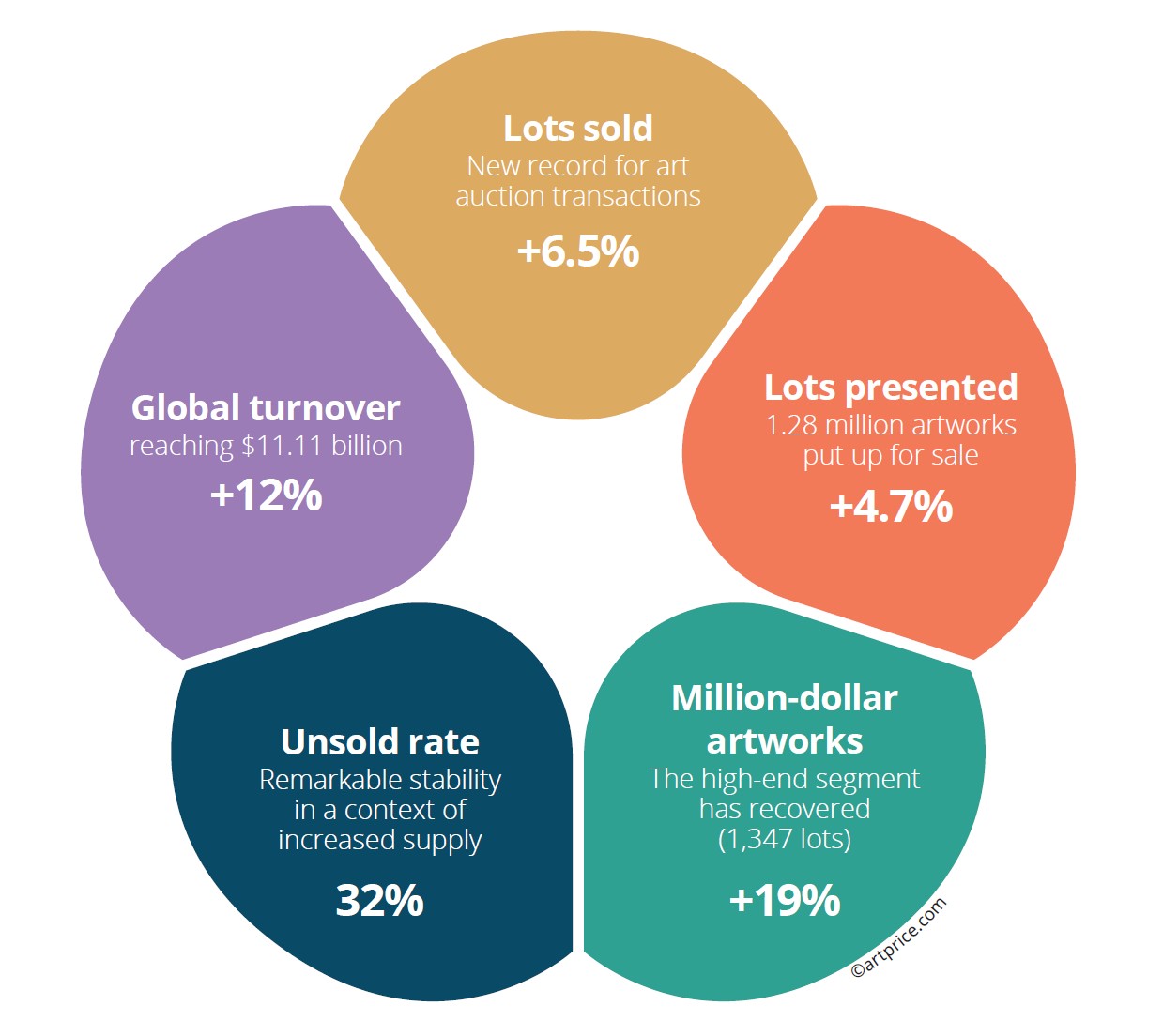
However, the distribution of this turnover reveals an increasingly polarized structure. The very top end of the market(works selling for several million dollars or more) continues to attract intense competition among collectors and institutions. Masterpieces by blue-chip artists regularly exceed estimates and generate significant media attention. The distribution of value remains highly concentrated: relatively small number of high-value works account for a large share of total turnover, reflecting the importance of rarity and historical significance in the market. This concentration of demand around historically important artists reinforces a long-term trend in the art market: the consolidation of value around a relatively limited group of internationally recognized names.
A Market Still Under Pressure in the First Half
During the first half of the year, auction activity remained relatively subdued. Economic uncertainty and the limited availability of museum-quality works led many collectors to postpone consignments. This cautious environment was reflected in lower overall auction totals and a more selective buying behavior among collectors. Despite this slowdown, demand remained strong for works with strong provenance and institutional recognition.
The Strong Return of Major Collections
The second half of the year saw a significant resurgence in the art market, largely driven by the appearance of major collections. High-profile auctions in New York, London, and Paris attracted strong international participation and generated a substantial portion of annual turnover.
In particular, the November auction season proved decisive. Major evening sales generated approximately USD 2.2 billion, representing a large share of the year’s total results. These auctions confirmed that the global collector base remains highly competitive when exceptional works come to market.
New Records and Price Benchmarks
Several record prices were achieved during the year, reaffirming the continuing strength of the high-end segment. The report highlights that museum-quality works continue to command extraordinary prices when they appear at auction. Collectors remain willing to compete aggressively for historically significant works, particularly those with strong exhibition history and provenance.These sales continue to establish new price benchmarks for major artists and reinforce the role of auctions as the primary mechanism for price discovery in the art market.
Geography of the Global Art Market
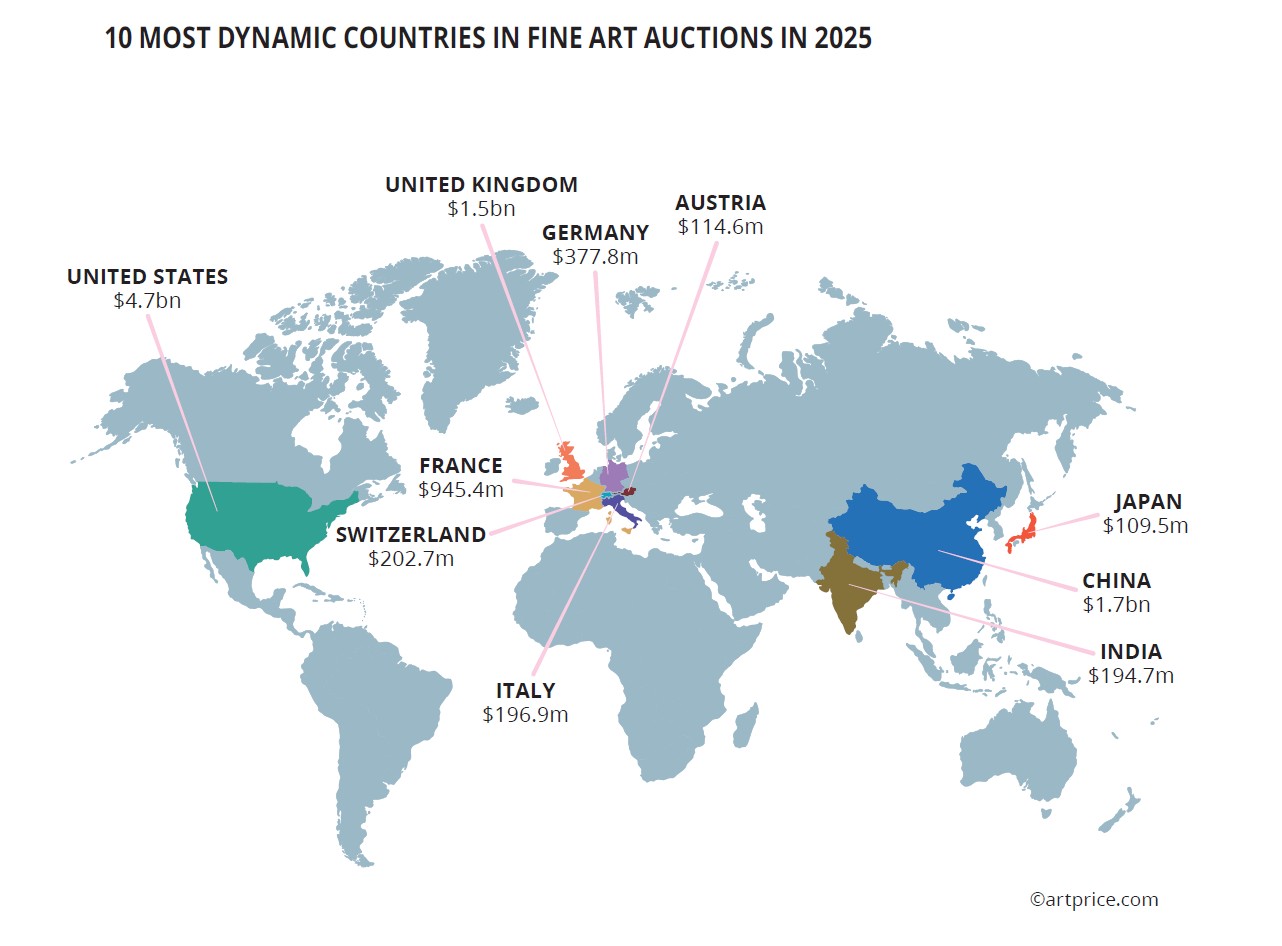
The global geography of the art market continues to evolve, with three major regions dominating auction activity: the United States, China, and Europe.
The United States Dominates the Global Market
The United States remains the undisputed leader of the global art market, generating $4.7 billion in auction turnover in 2025, representing 42.3% of global sales. New York continues to function as the primary center of the high-end art market, hosting the majority of major evening auctions and attracting collectors from around the world.
China and Developments in Asia
China remains one of the most influential art markets globally, generating approximately USD 1.7 billion in auction turnover. Asian collectors continue to play an increasingly important role in international auctions, particularly in the Post-War and Contemporary sectors. Hong Kong remains a key gateway for international collectors entering the Asian art market.
The United Kingdom and Europe
The United Kingdom generated approximately $1.5 billion in auction sales, maintaining its position as Europe’s leading art market. London continues to host major evening auctions that attract global collectors.
Meanwhile, France generated $945 million in auction turnover, confirming the growing importance of Paris as a dynamic auction center.
Emerging Markets: The Persian Gulf
One of the report’s notable observations concerns the growing importance of the Persian Gulf region, where a new ecosystem of collectors, museums, and cultural institutions is emerging. Cities such as Dubai, Doha, and Abu Dhabi are becoming increasingly active players in the international art market.
Long-Term Value Consolidation
The Ultra-High-End Market
One of the most striking features of the current art market is the strength of the ultra-high-end segment. Works selling for tens of millions of dollars continue to generate record-breaking results, often driven by intense competition between a small number of extremely wealthy collectors. These sales demonstrate that exceptional works of art remain a highly desirable asset class for global wealth.
Artprice notes that masterpieces with strong provenance and institutional relevance are particularly sought after. Paintings by historically significant artists—especially those with museum exhibition history—regularly outperform expectations. This phenomenon highlights the increasing importance of quality and rarity in today’s art market.
Price Rebalancing
The report notes a gradual rebalancing of prices across several market segments. After a period of intense speculation in certain sectors, collectors are increasingly focusing on artists with strong institutional validation and long-term historical significance. This trend reflects a broader maturation of the art market.
Less Speculation, More Selectivity
Artprice observes a decline in purely speculative buying behavior compared with previous market cycles. Collectors are now paying greater attention to: museum exhibitions, provenance, historical importance, scarcity of works. This shift toward quality suggests that the market is entering a more sustainable phase.
NFTs and Generative Art
The market for NFTs and generative art continues to exist but in a more discreet form compared with the speculative boom of 2021. While the sector has stabilized, digital art remains an important area of experimentation and innovation within the broader art ecosystem.
Prints Stimulating the Art Market
One of the most important structural developments highlighted in the report is the strength of the prints and multiples segment. Prints play a crucial role in expanding the collector base by offering works by major artists at accessible price levels. Artists such as Andy Warhol, Banksy, David Hockney, and Yayoi Kusama continue to drive demand in this segment. The availability of detailed auction data for prints is also contributing to increased transparency and market analysis.
Contemporary Art and Market Dynamics
Contemporary art remains one of the most dynamic sectors of the market. Artists born after 1945 continue to attract significant attention from collectors and institutions alike. However, the report also notes growing differentiation within the contemporary segment. While certain established artists achieve consistently strong results, the market for younger or emerging artists has become more selective.
Collectors increasingly seek artists with sustained institutional recognition, rather than purely speculative market momentum. This shift reflects a broader maturation of the contemporary art market, where long-term artistic significance is becoming a more decisive factor in valuation.
Auction Houses and Market Structure
The global auction landscape continues to be dominated by a small number of major players, notably Christie’s, Sotheby’s, and Phillips. These houses maintain a significant share of the global auction market, particularly in the high-value segments where major evening sales generate substantial turnover.
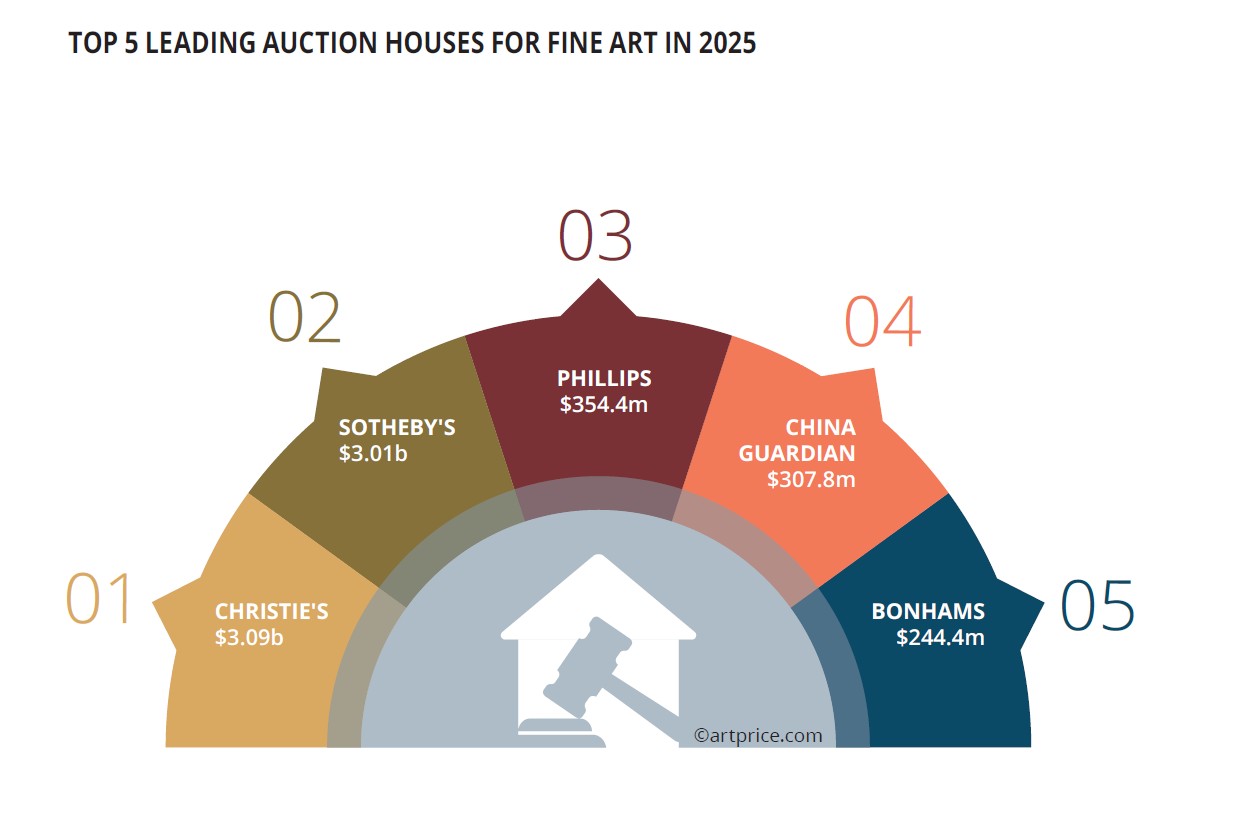
At the same time, a growing number of regional auction houses and online platforms are expanding access to the art market, allowing a wider range of collectors to participate in auctions worldwide.
This dual structure—combining global auction giants with increasingly sophisticated digital platforms—illustrates how the art market continues to evolve while maintaining its traditional institutions.
Top Selling Artists
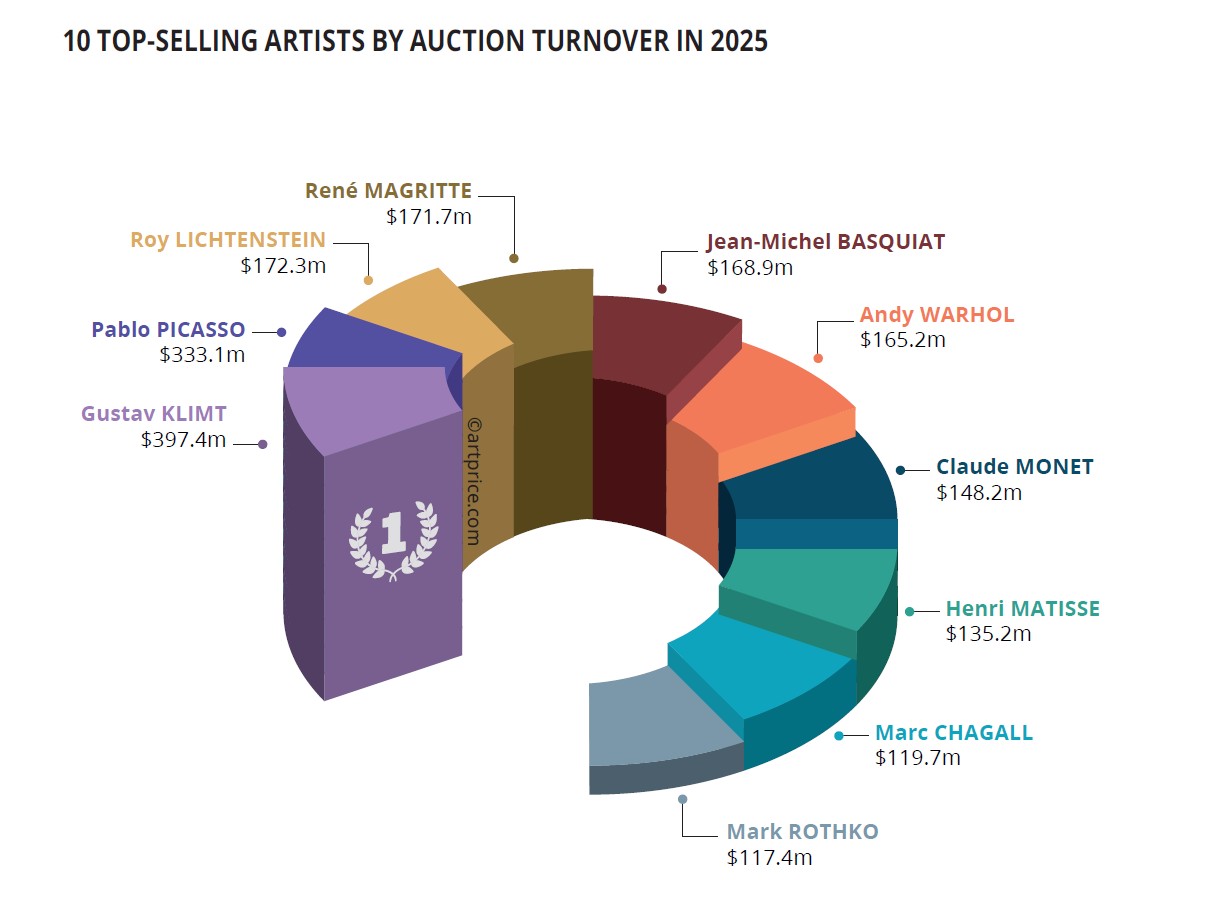
Artprice’s ranking of the Top 500 artists by auction turnover demonstrates the continuing dominance of a relatively small group of globally recognized names. Artists with strong museum presence and historical importance continue to attract the highest levels of collector demand.
The top 10 artists on the art market generated 17.3% of global art auction turnover ($1.93 billion out of $11.11 billion)
Top 15 Lots
#1. Bildnis Elisabeth Lederer, 1914-16
Leonard A. Lauder, Collector
Sotheby’s New-York: 18 November 2025
Estimates upon Request
USD 236,660,000
MOST EXPENSIVE MODERN WORK EVER SOLD AT AUCTION
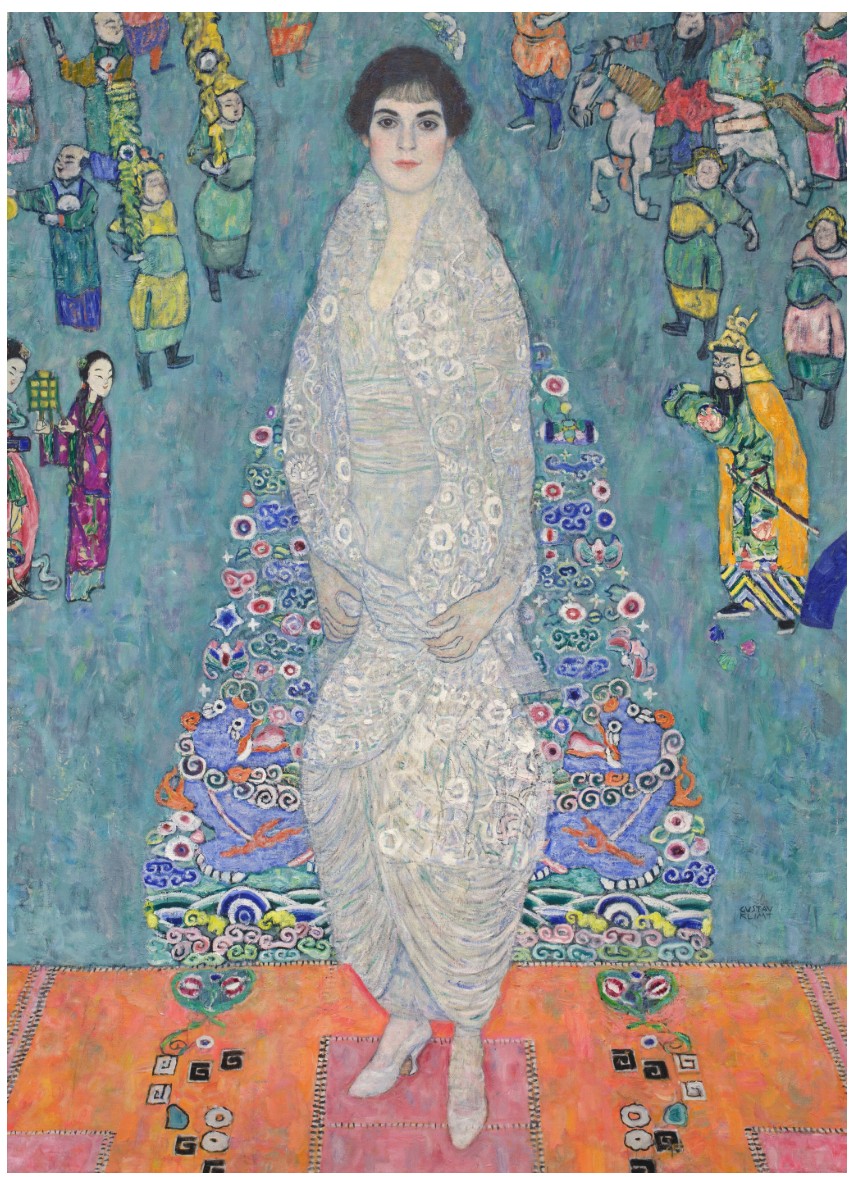
GUSTAV KLIMT (1862 – 1918)
Bildnis Elisabeth Lederer (Portrait of Elisabeth Lederer), 1914-16
Oil on canvas
180.4 x 130.5 cm (71 x 51 3/8 inches)
Signed Gustav Klimt (toward lower right)
Standing at the apex of Gustav Klimt’s career, Bildnis Elisabeth Lederer befits the couple who commissioned it—Serena and August Lederer, the artist’s most important patrons. In this magnificent portrait, Klimt brilliantly captured the social prominence and beauty of the sitter, the Lederers’ daughter Elisabeth, through the painting’s lush ornament details, complex palette, dazzling brushwork, and carefully choreographed iconography. Commanding and seductive in scale (measuring six by four feet or 183 by 122 centimeters), Bildnis Elisabeth Lederer was realized when the artist was at the height of his powers and reputation as the premier artist of Austrian modernism.
The painting’s history tells multiple stories. It is the second of three portraits that the artist rendered of three generations of Lederer women, a record of private commissions like none other in his prestigious career. Perhaps more than any other of Klimt’s works, it vividly celebrates the artist’s fascination with and connoisseurship of Chinese art. Confiscated by the Nazi regime during World War II, the canvas narrowly escaped the fate of other works by Klimt in the Lederers’ collection, which were likewise seized but ultimately destroyed in a fire at the war’s end. The portrait has been in Leonard A. Lauder’s collection for forty years, residing less than a mile from the image Klimt rendered many years earlier, Portrait of Serena Lederer (1899), which hangs at The Metropolitan Museum of Art.
USD 200 million
#2. Blumenwiese, circa 1908
Leonard A. Lauder, Collector
Sotheby’s New-York: 18 November 2025
Estimates upon Request
USD 86,000,000
Blumenwiese (Blooming Meadow) | Leonard A. Lauder, Collector | Evening Auction | 2025 | Sotheby’s
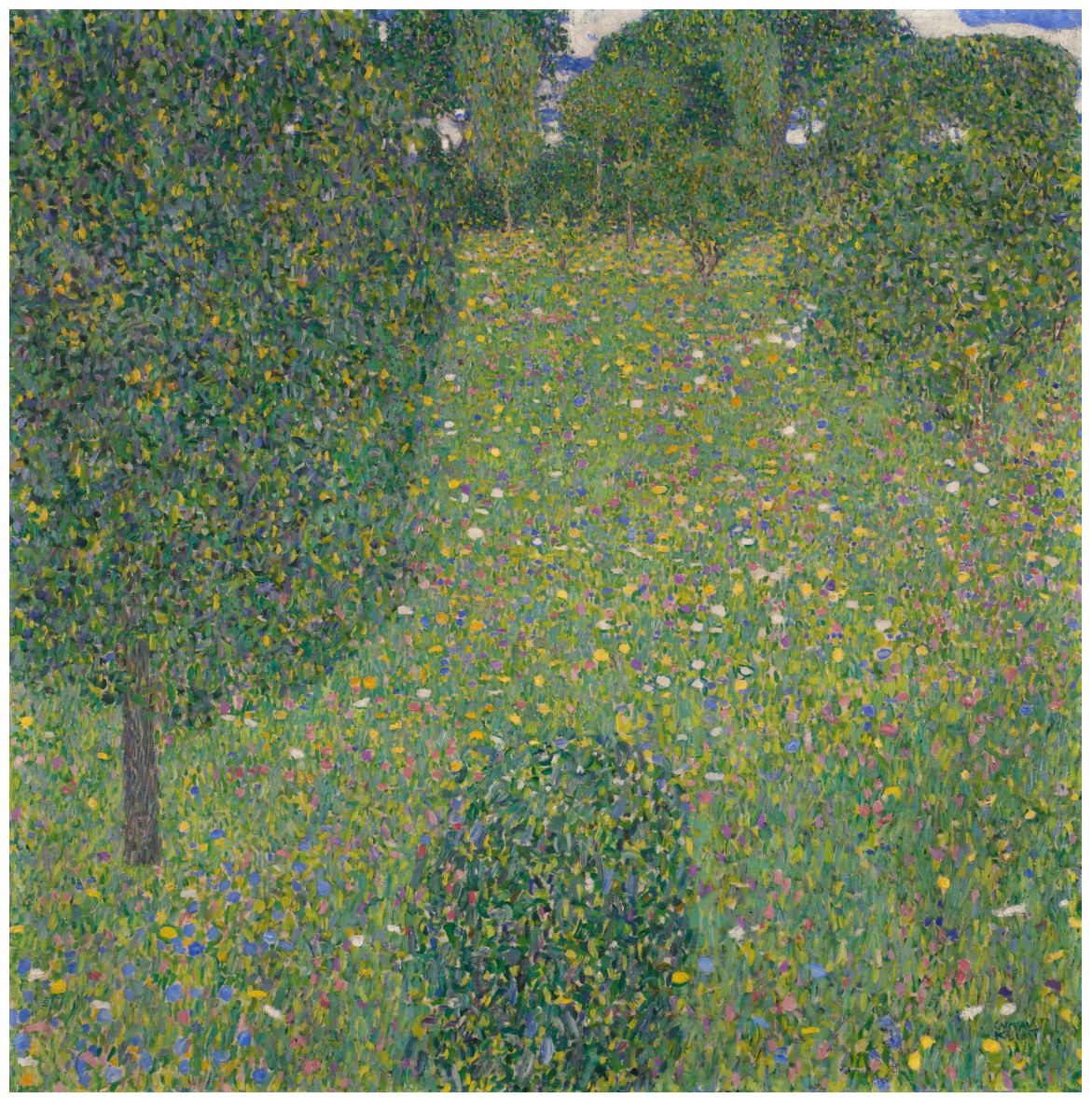
GUSTAV KLIMT (1862 – 1918)
Blumenwiese (Blooming Meadow), circa 1908
Oil on canvas
110×110 cm (43 1/4 x 43 1/4 inches)
Signed Gustav Klimt (lower right)
Painted likely in the summer of 1908, Gustav Klimt’s Blooming Meadow constitutes a more liberated and daring view of a colorful flowering garden than any of the artist’s earlier landscapes devoted to the subject. As the florescence of viola, green, yellow, and white daubs spreads before the viewer, the yellow blooms intensify in an oval-shape just below a thicket of green, and thickly painted white clouds float on a ribbon of brilliant blue. By comparison, the tree foliage might appear simply a deep, saturated green, until the yellow daubs (possibly still-ripening fruit) emerge amidst the deftly applied, slightly longer strokes of violets and bluish grays. The eye could easily lose its bearings in this flat, kaleidoscopic carpet of hues; indeed, some of Klimt’s critics thought his landscapes to be the work of a madman, so radical were their compositions. But even with the heightened degree of abstraction, the pictorial effusion captures the wildflowers native to the lake Attersee region: bellflowers, buttercups, clover, cornflowers, daisies, and dandelions, all blossoming simultaneously during the peak season. Such flowering meadows still abound in the region (see fig. 1), and with time, Klimt’s contemporaries came to regard his renderings as a set of “new eyes” through which to look at nature.
#3. Waldabhang bei Unterach am Attersee, 1916
Leonard A. Lauder, Collector
Sotheby’s New-York: 18 November 2025
Estimates upon Request
USD 68,320,000
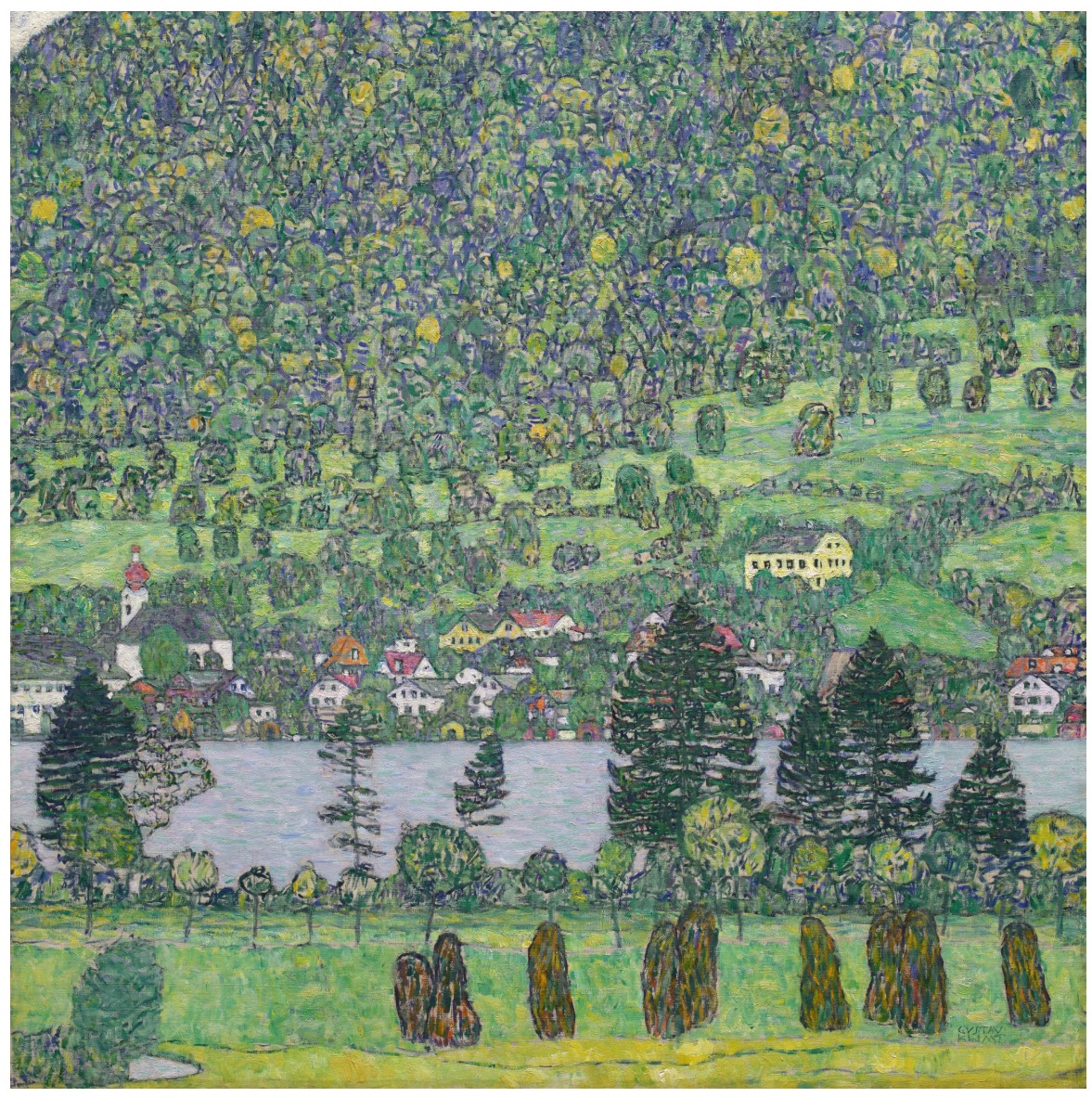
GUSTAV KLIMT (1862 – 1918)
Waldabhang bei Unterach am Attersee (Forest Slope in Unterach on the Attersee), 1916
Oil on canvas
110×110 cm (43 1/4 x 43 1/4 inches)
Signed Gustav Klimt (lower right)
#4. Piles de romans parisiens et roses dans un verre, 1887
The Cindy and Jay Pritzker Collection
Sotheby’s New-York: 20 November 2025
Estimate upon Request
USD 62,710,000
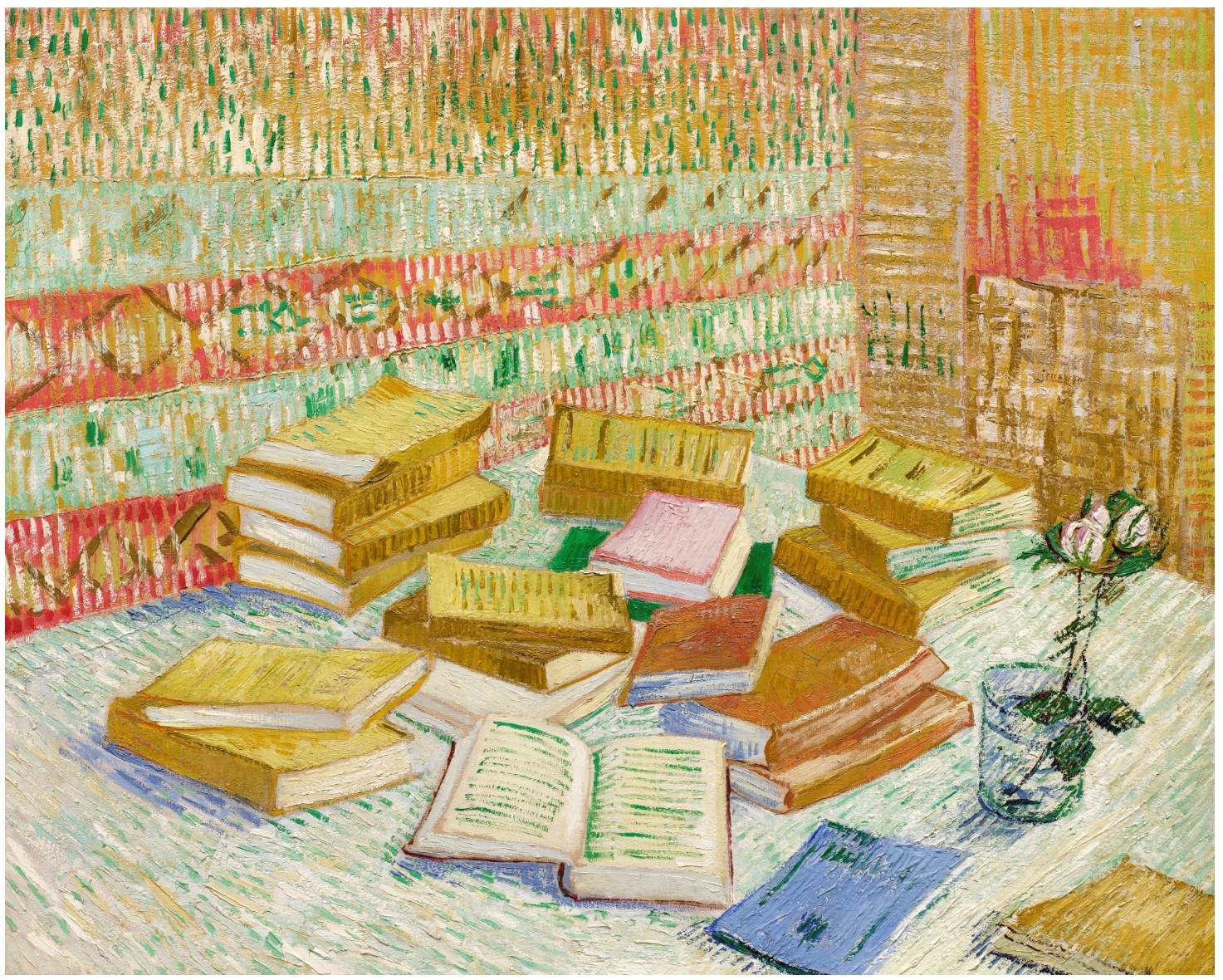
VINCENT VAN GOGH (1853 – 1890)
Piles de romans parisiens et roses dans un verre (Romans parisiens), 1887
Oil on canvas
73.3 x 92.1 cm (28 7/8 x 36 1/4 inches)
Executed in November-December 1887
Piles de romans parisiens et roses dans une verre (Romans parisiens) is one of the most important still lifes that Vincent van Gogh ever painted and the largest in scale to come to auction since the late 1980s. It was painted towards the end of van Gogh’s time in Paris in the final months of 1887.
One of only four still lifes featuring books that the artist executed during the course of his two years in the French capital, this work is further distinguished by its exceptional exhibition history and unique combination of visual motifs as well as the tour de force application of medium. The present work is one of the artist’s most accomplished from this period.
#5. No. 31 (Yellow Stripe), 1958
The Collection of Robert F. and Patricia G. Ross Weis
Christie’s New-York: 17 November 2025
Estimate on Request
USD 62,160,000
MARK ROTHKO (1903-1970), No. 31 (Yellow Stripe) | Christie’s
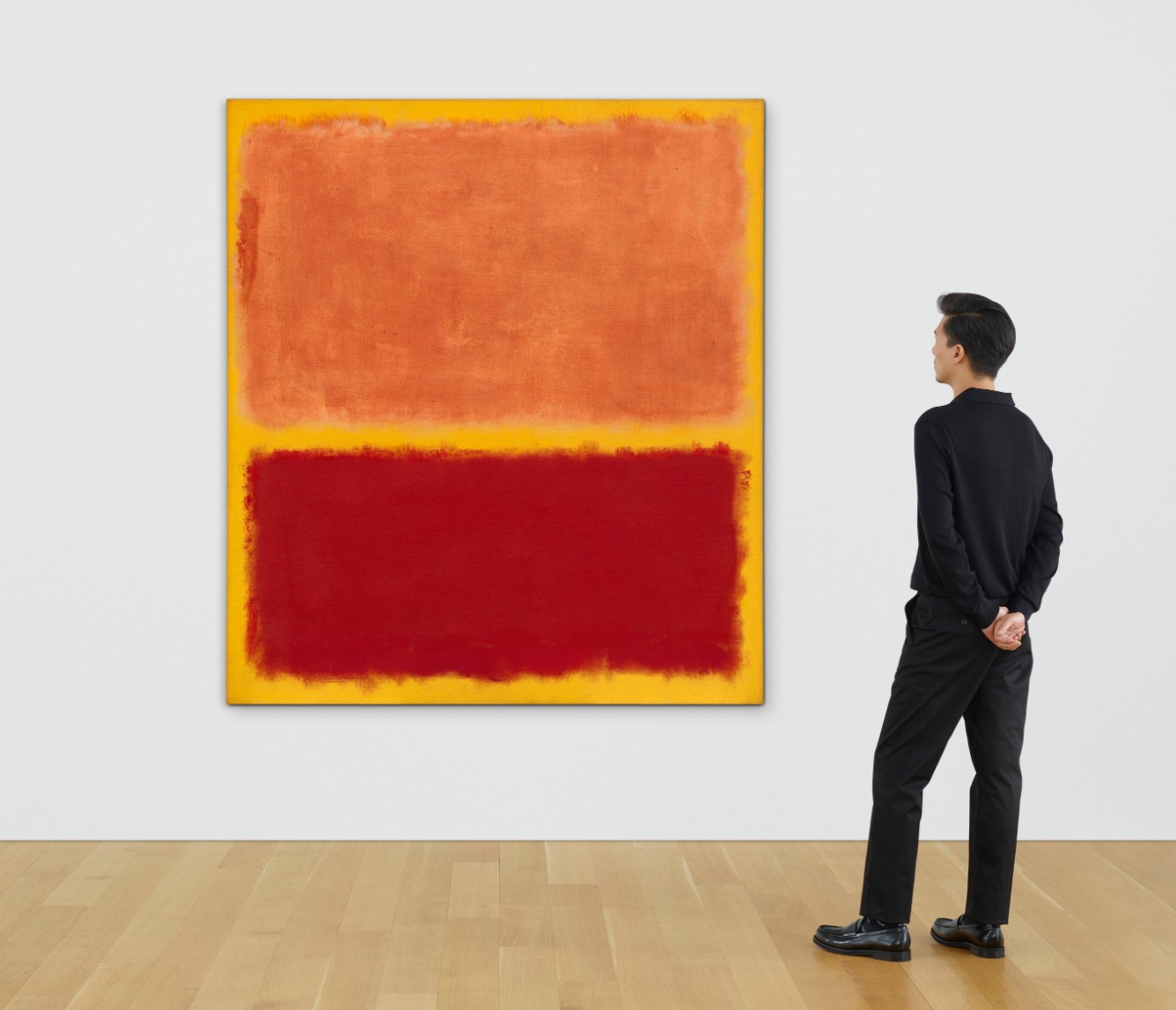
MARK ROTHKO (1903-1970)
No. 31 (Yellow Stripe), 1958
Oil on canvas
78 1/4 x 69 1/4 inches (198.8 x 175.9 cm)
Signed, partially titled and dated ‘MARK ROTHKO 1958 #31’ (on the reverse)
Painted in 1958, the same year Mark Rothko embarked on what would become the defining project of his career—a series of murals for the Four Seasons restaurant in the Seagram Building in Manhattan—No. 31 (Yellow Stripe) exemplifies Rothko’s mastery of color and emotional depth. This period marked a crucial evolution in the Abstract Expressionist’s artistic output, characterized by his exploration of saturated hues and an ethereal sense of spirituality. In this luminous work, Rothko achieves an intensity that resonates with the human condition, invoking a sense of presence so powerful that, as he famously stated, “when you turned your back to the painting, you would feel that presence the way you feel the sun on your back” (M. Rothko quoted in J. E. B. Breslin, Mark Rothko: A Biography, Chicago 1993, p. 275). This effect is unmistakably present in works like No. 31 (Yellow Stripe), where radiant fields of color seem to breathe, casting an almost celestial glow that immerses the viewer in an experience beyond the visual.
#6. El sueño (La cama), 1940
Exquisite Corpus: Surrealist Treasures from a Private Collection
Sotheby’s New-York: 20 November 2025
Estimated: USD 40,000,000 – 60,000,000
USD 54,660,000
El sueño (La cama) | Exquisite Corpus Evening Auction | 2025 | Sotheby’s
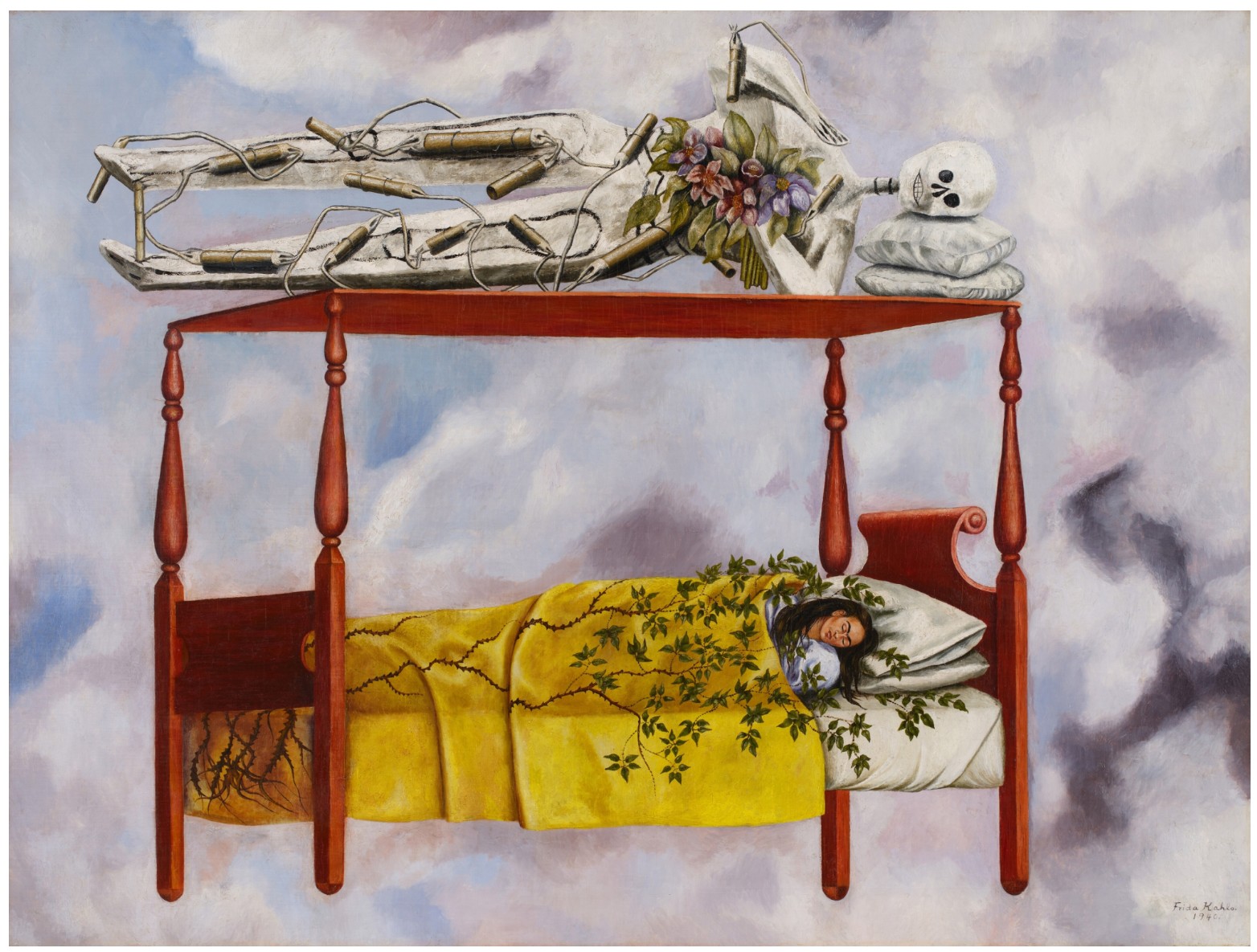
FRIDA KAHLO (1907 – 1954)
El sueño (La cama), 1940
Oil on canvas
74×98 cm (29 1/8 x 38 5/8 inches
Signed Frida Kahlo and dated 1940 (lower right)
Frida Kahlo’s El sueño (La cama) from 1940 is among the most psychologically resonant and formally compelling works in the artist’s storied oeuvre, a surreal, deeply introspective self-portrait that bridges personal symbolism, Mexican cultural iconography, and Surrealism. Painted during a particularly fraught moment in Kahlo’s life, El sueño (La cama), or The Dream (The Bed) in English, occupies a critical position within her practice, encapsulating her lifelong preoccupation with mortality, physicality, and the emotional complexities of selfhood.
Kahlo depicts herself asleep in a wooden colonial-style bed, wrapped in a golden blanket embroidered with crawling vines and leaves. Her face, characteristically serene yet watchful, emerges from the bedding with a quiet dignity, a stark but tender memento mori. Above her, seemingly levitating atop the bedposts, lies a full-sized skeleton wrapped in strings of dynamite crowned with a vibrant bouquet and nestled on pillows that mirror the artist’s own. Set against a milky sky of clouded blue, lavender and gray, the composition defies spatial logic: the structure of the bed becomes both physical support and metaphysical scaffolding, a stage on which death hovers, quite literally, above life. Certainly, El sueño (La cama) offers a spectral meditation on the porous boundary between sleep and death.
USD 50 million
#7. Crowns (Peso Neto), 1981
Basquiat Crowned | Property from a Distinguished European Collection
Sotheby’s New-York: 18 November 2025
Estimated: USD 35,o00,000 – 45,000,000
USD 48,335,000
Crowns (Peso Neto) | The Now & Contemporary Evening Auction | 2025 | Sotheby’s
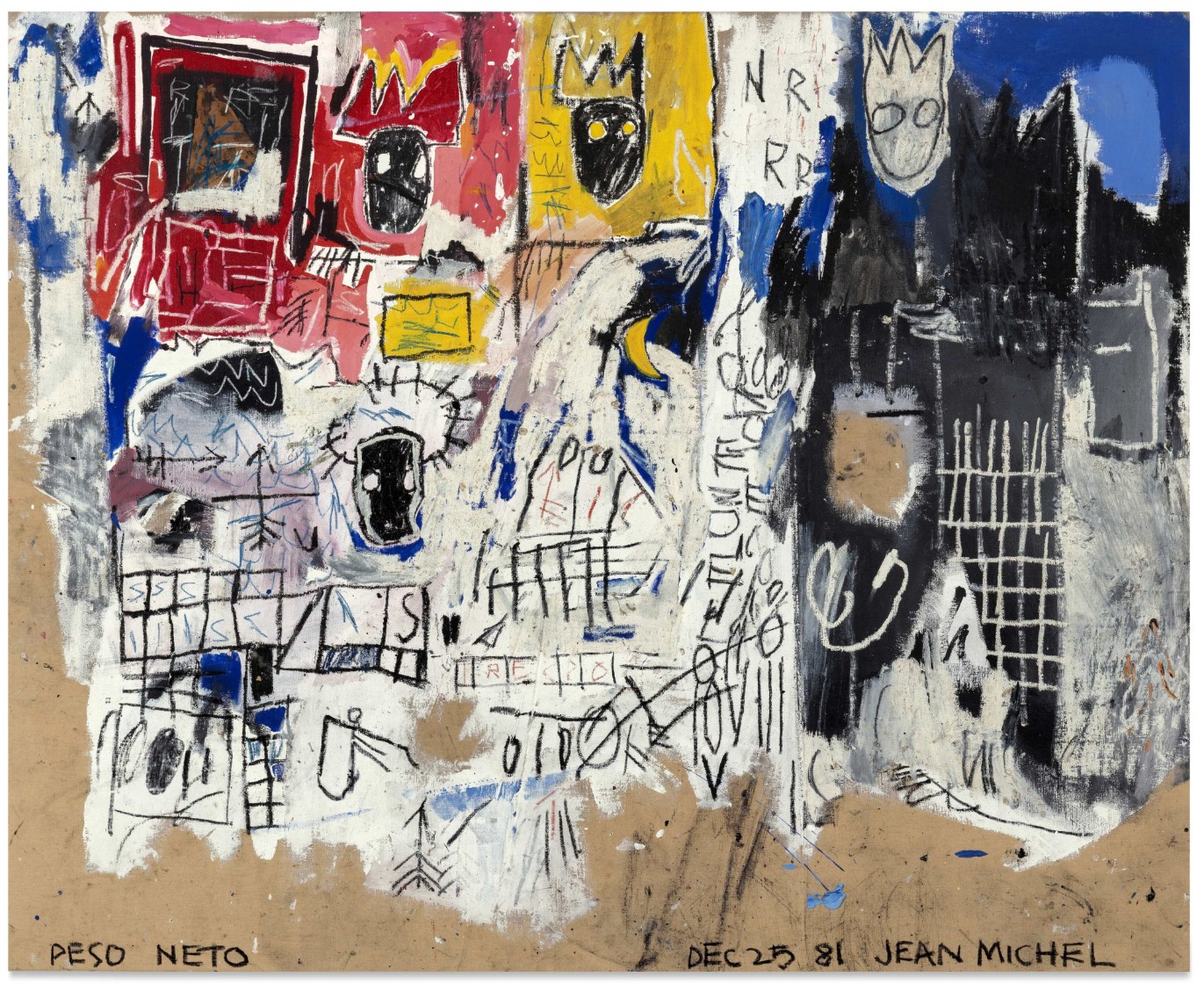
JEAN-MICHEL BASQUIAT (1960 – 1988)
Crowns (Peso Neto), 1981
Acrylic, oilstick and paper collage on canvas
76 1/4 x 94 1/4 inches (193.6 x 239.4 cm)
Signed, titled and dated DEC 25 81 (lower edge)
An intricate tapestry of spiritual, secular and symbolic allegory, Crowns (Peso Neto) is a defining masterwork that encapsulates Jean-Michel Basquiat’s unrivaled capacity for creative genius and introspection. Executed on Christmas Day in 1981, just three days after his 21st birthday, Crowns (Peso Neto) marks the culmination of an ascendant year in Basquiat’s brief yet meteoric career—one that would bring hitherto unprecedented public visibility, critical acclaim and commercial success to the artist, as he metamorphosed from vanguard street artist-provocateur to prodigy of New York’s cultural avant-garde.
Rendered at a monumental scale in a medium that evokes the artist’s transition from street to studio, the present work interweaves secular and spiritual imagery to create a profoundly intimate portrait of Basquiat on the cusp of explosive stardom and reflects a poignant meditation on the sacrifices inherent to that success. Boasting an illustrious exhibition history, which includes the artist’s very first solo exhibition in America and, after his untimely passing, his first retrospective, the work has been a hallmark of the most critical showcases of Basquiat’s work. A triumph of artistic mythmaking, Crowns (Peso Neto) is an unrivaled manifesto of Basquiat as painter, celebrity and product; heir, rebel and prophet.
#8. Composition with Large Red Plane, Bluish Gray, Yellow, Black and Blue, 1922
Leonard & Louise Riggio: Collected Works
Christie’s New-York: 12 May 2025
Estimate on Request
USD 47,560,000
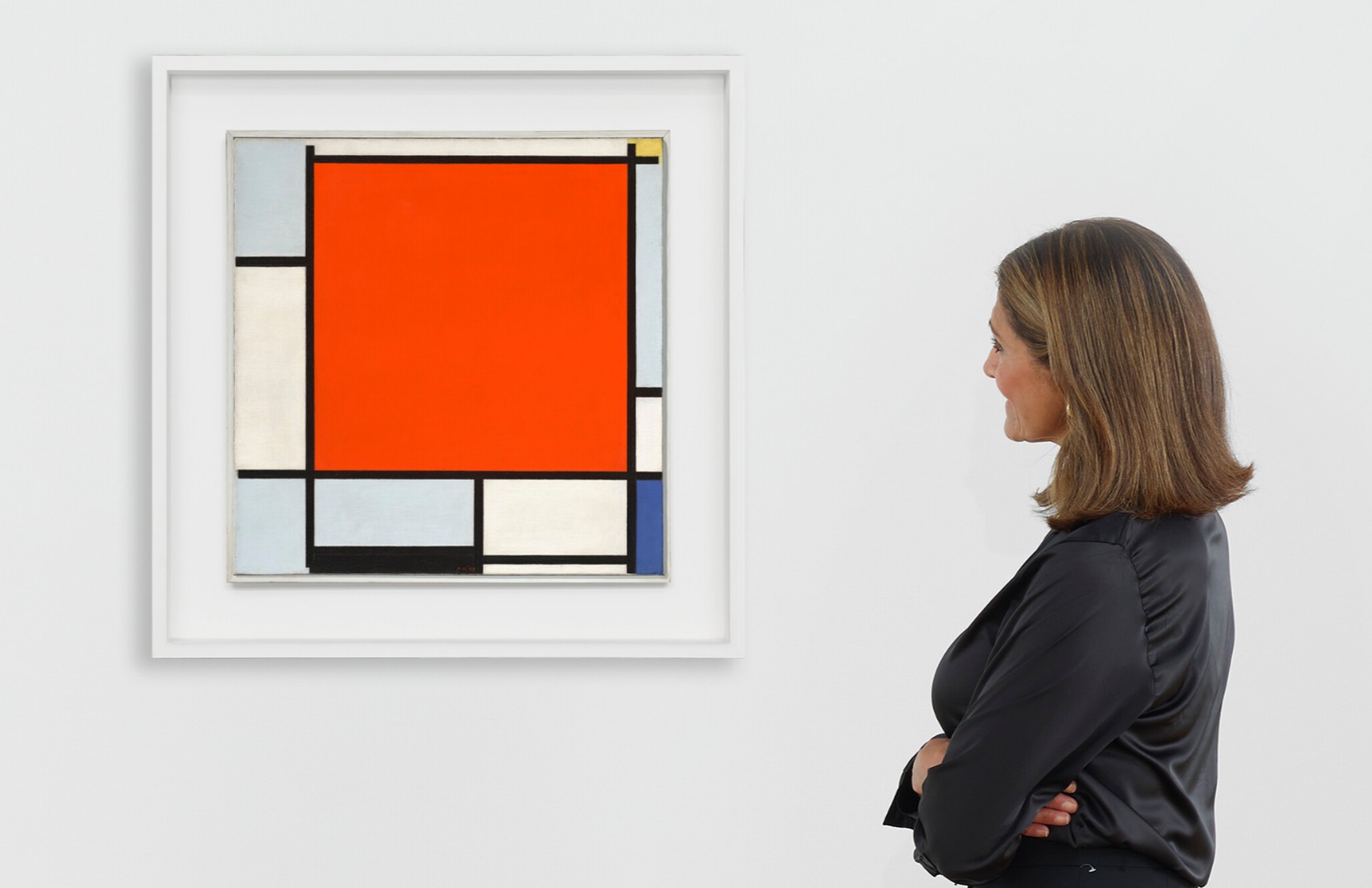
PIET MONDRIAN (1872-1944)
Composition with Large Red Plane, Bluish Gray, Yellow, Black and Blue, 1922
Oil on canvas
54 x 53.3 cm (21 1/4 x 21 inches)
Signed with initials and dated ‘PM ’22’ (lower center)
Painted in Paris in 1922
Painted in 1922, Composition with Large Red Plane, Bluish Gray, Yellow, Black and Blue encapsulates the purity, elegance and extreme rigor of Piet Mondrian’s revolutionary mature aesthetic. It was during the early 1920s, while living in Paris, that Mondrian solidified and explored fully the potential of Neo-Plasticism, the ground-breaking approach to abstraction he had pioneered towards the end of the First World War. Using only the fundamental elements of painting—the straight line, primary colors and the three non-colors of black, white and gray—Mondrian believed that he could create an idealized pictorial form of pure equilibrium that would reintegrate a fundamental sense of beauty into life. “
#9. La Lecture (Marie-Thérèse), 1932
The Collection of Robert F. and Patricia G. Ross Weis
Christie’s New-York: 17 November 2025
Estimate on Request
USD 45,485,000
PABLO PICASSO (1881-1973), La Lecture (Marie-Thérèse) | Christie’s
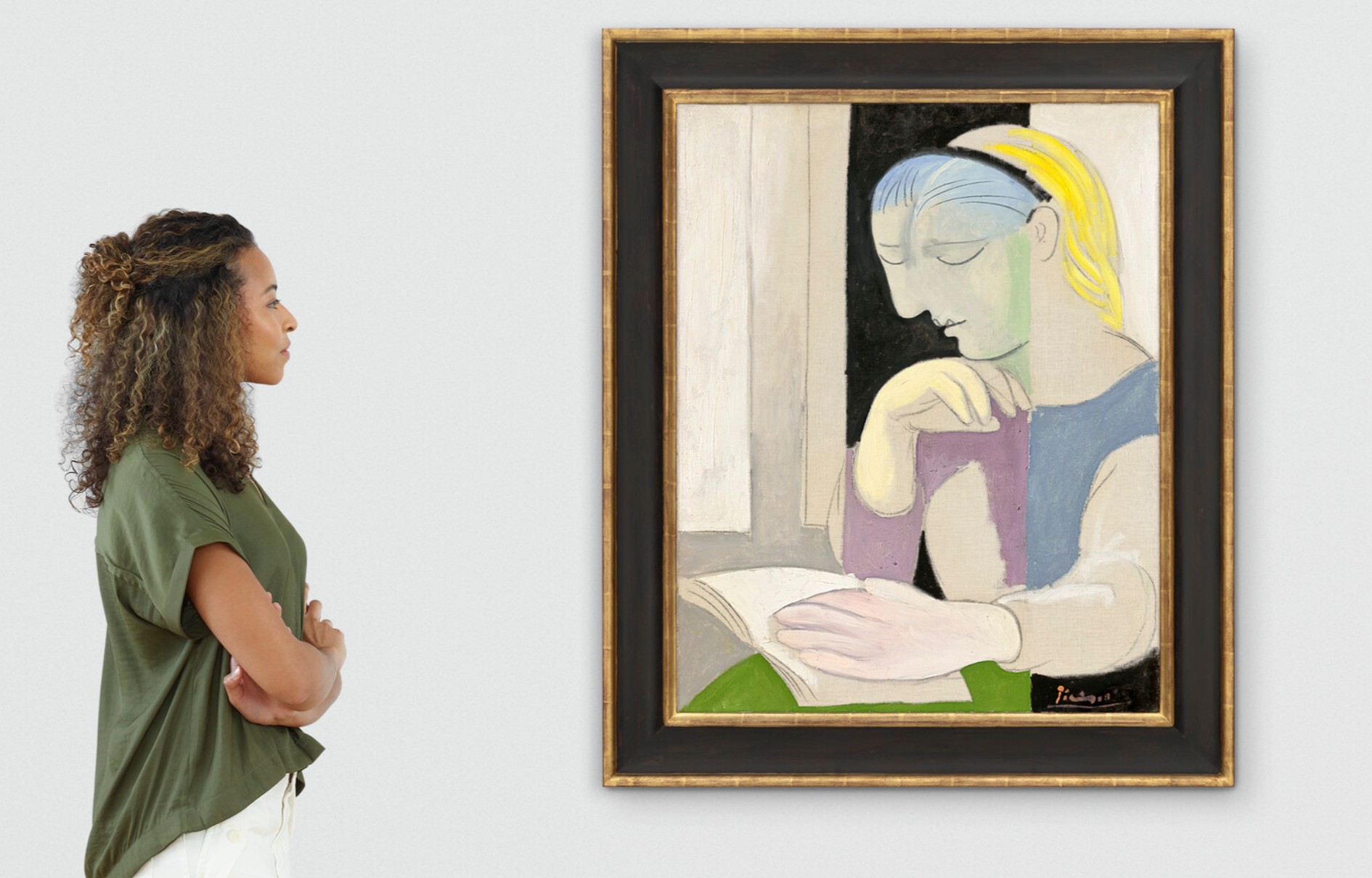
PABLO PICASSO (1881-1973)
La Lecture (Marie-Thérèse), 1932
Oil, Ripolin and charcoal on canvas
92.1 x 73 cm (36 1/4 x 28 3/4 inches)
Signed ‘Picasso’ (lower right)
Dated and inscribed ‘Boisgeloup 31 Août XXXII.’ (on the stretcher)
Painted in Boisgeloup on 31 August 1932
#10. Nymphéas, 1907
Property from the Kawamura Memorial DIC Museum of Art
Christie’s New-York: 17 November 2025
Estimated: USD 40,000,000 – 60,000,000
USD 45,485,000
CLAUDE MONET (1840-1926), Nymphéas | Christie’s
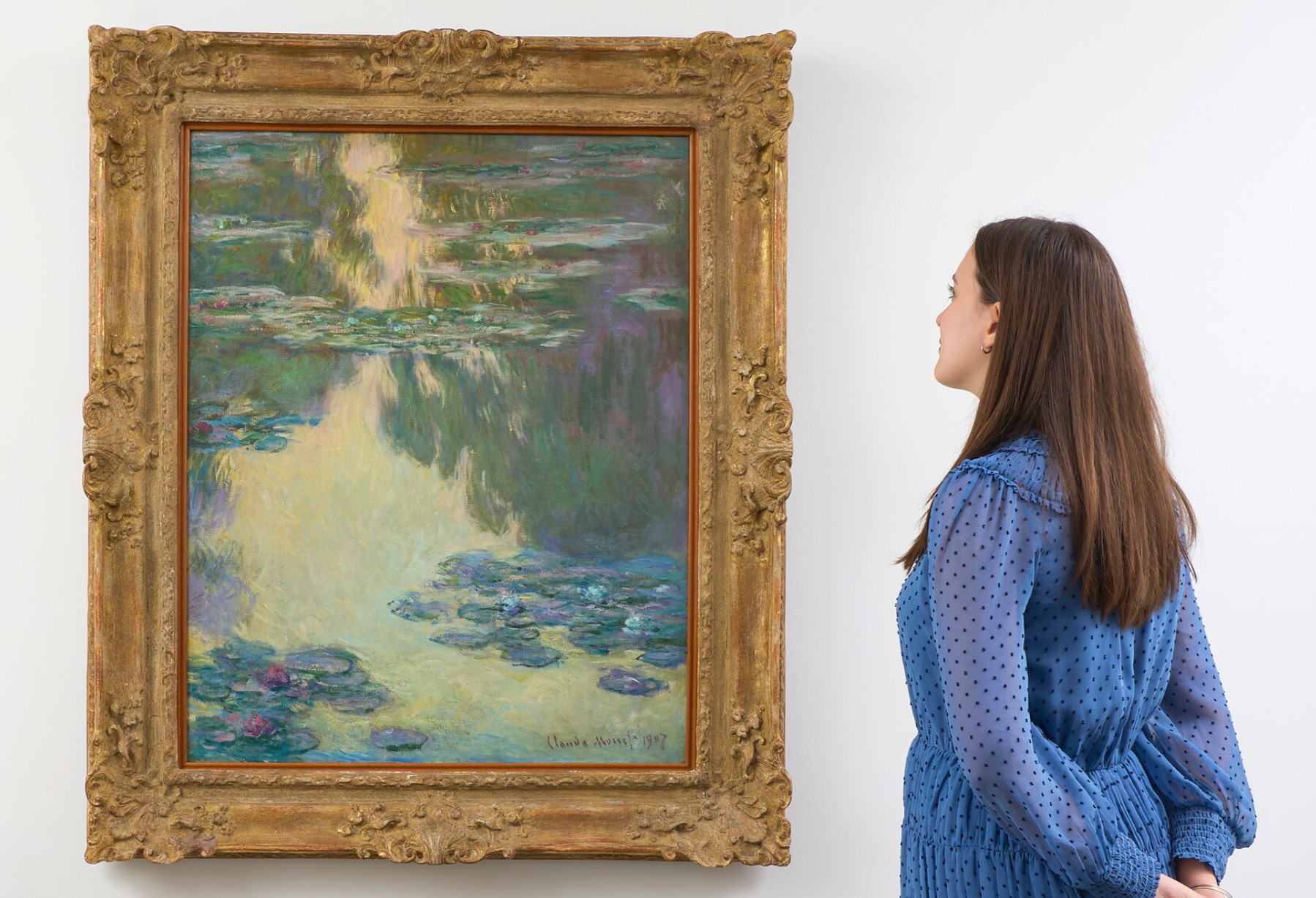
CLAUDE MONET (1840-1926)
Nymphéas, 1907
Oil on canvas
92 x 73.6 cm (36 1/4 x 29 inches)
Signed and dated ‘Claude Monet 1907’ (lower right)
Perhaps no other subject fascinated Claude Monet so intensively and persistently than the elaborate gardens he constructed at his home in Giverny. During the last twenty-five years of his life the artist devoted himself almost single-mindedly to depicting the flowing planes of flowers, towering willow trees and the expansive waterlily pond that he had fashioned within the grounds, producing an astonishingly complex and diverse group of canvases that capture the unique atmosphere of this arcadian landscape. The resulting paintings stand among the most innovative and influential works of Monet’s entire oeuvre—while they affirm his life-long belief in the primacy of vision and experience, they are in many ways more abstract and daring than anything he had previously painted, and as such, offer a visionary, modern approach to painting for the twentieth century.
#11. Christopher Isherwood and Don Bachardy, 1968
Property from a Distinguished Private European Collection
Christie’s New-York: 17 November 2025
Estimate on Request
USD 44,335,000
DAVID HOCKNEY (B. 1937), Christopher Isherwood and Don Bachardy | Christie’s
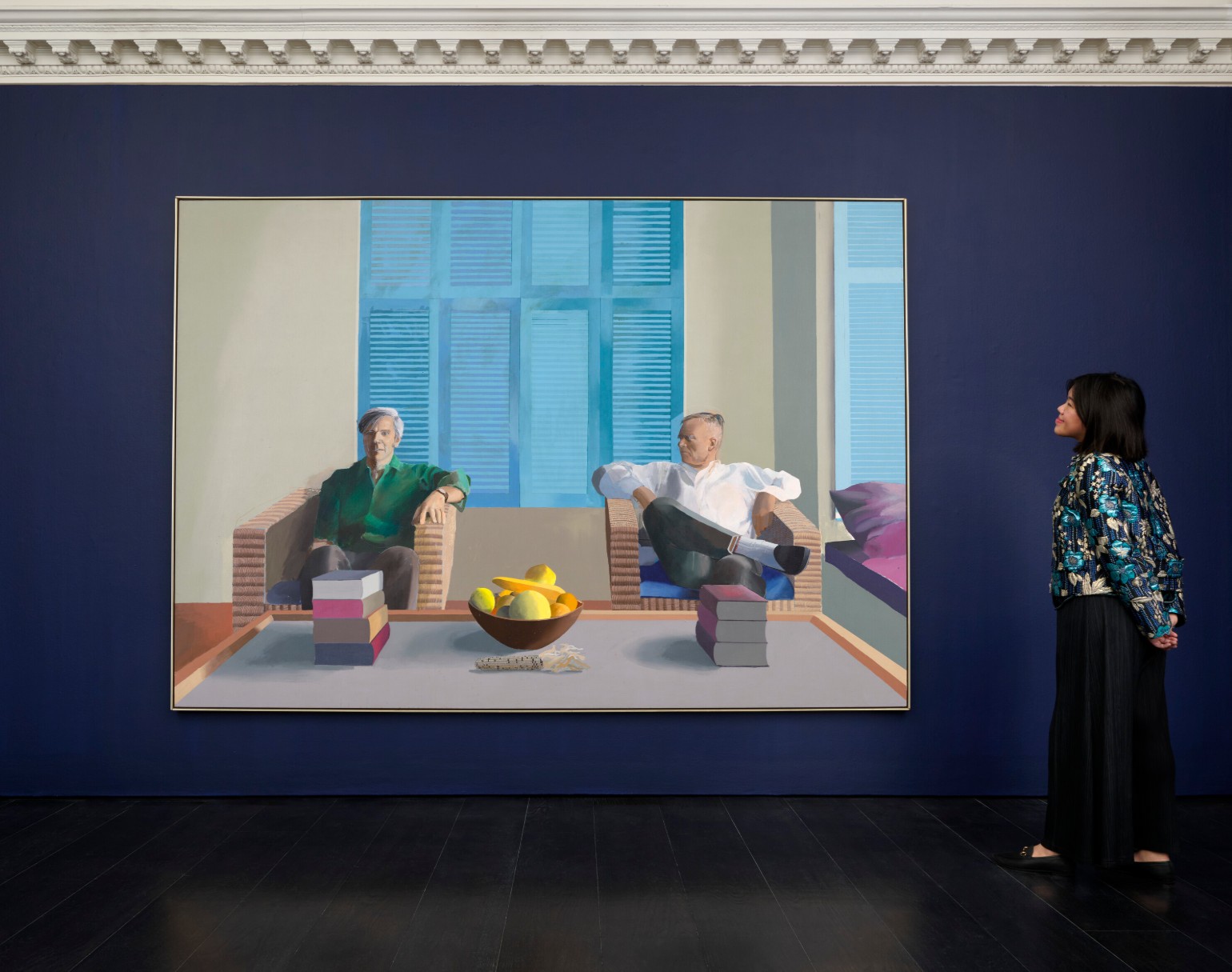
DAVID HOCKNEY (B. 1937)
Christopher Isherwood and Don Bachardy, 1968
Acrylic on canvas
83 1/2 x 119 1/2 inches (212 x 303.5 cm)
A masterpiece in psychological depth and virtuoso composition, Christopher Isherwood and Don Bachardy (1968) is the first of David Hockney’s double portraits: a series which stands among the supreme triumphs of his career. In a sunlit Santa Monica living room, two men sit upon woven armchairs. In front of them is a table bearing two stacks of books, with a fruit bowl and an ear of corn at its center. Behind them is a screen of shutters, their slats and panels gleaming in pearlescent blue. The man to the right is the English novelist Christopher Isherwood, one of the great literary figures of the twentieth century. Dressed in crisp white shirt and socks, with a razor-sharp pleat in his trousers, he looks towards his companion. Don Bachardy, an artist and native Californian thirty years his junior, stares confidently out at the viewer. His deep green shirt makes him a jewel in the painting’s radiant setting. The dynamic of gazes is enhanced by the sunlight that streams in from the bedroom at the right, casting directional shadows upon the table. Hockney’s social intelligence is paired flawlessly with his pictorial ingenuity. He implicates himself and the viewer in the tension between the two men, conveying the subtleties of his friends’ relationship through his own exploration of space, sightlines and surface.
#12. Venice, the Return of the Bucintoro on Ascension Day
PROPERTY FROM AN IMPORTANT PRIVATE COLLECTION
Christie’s London: 1 July 2025
Estimate on Request
GBP 31,935,000 / USD 43,821,620
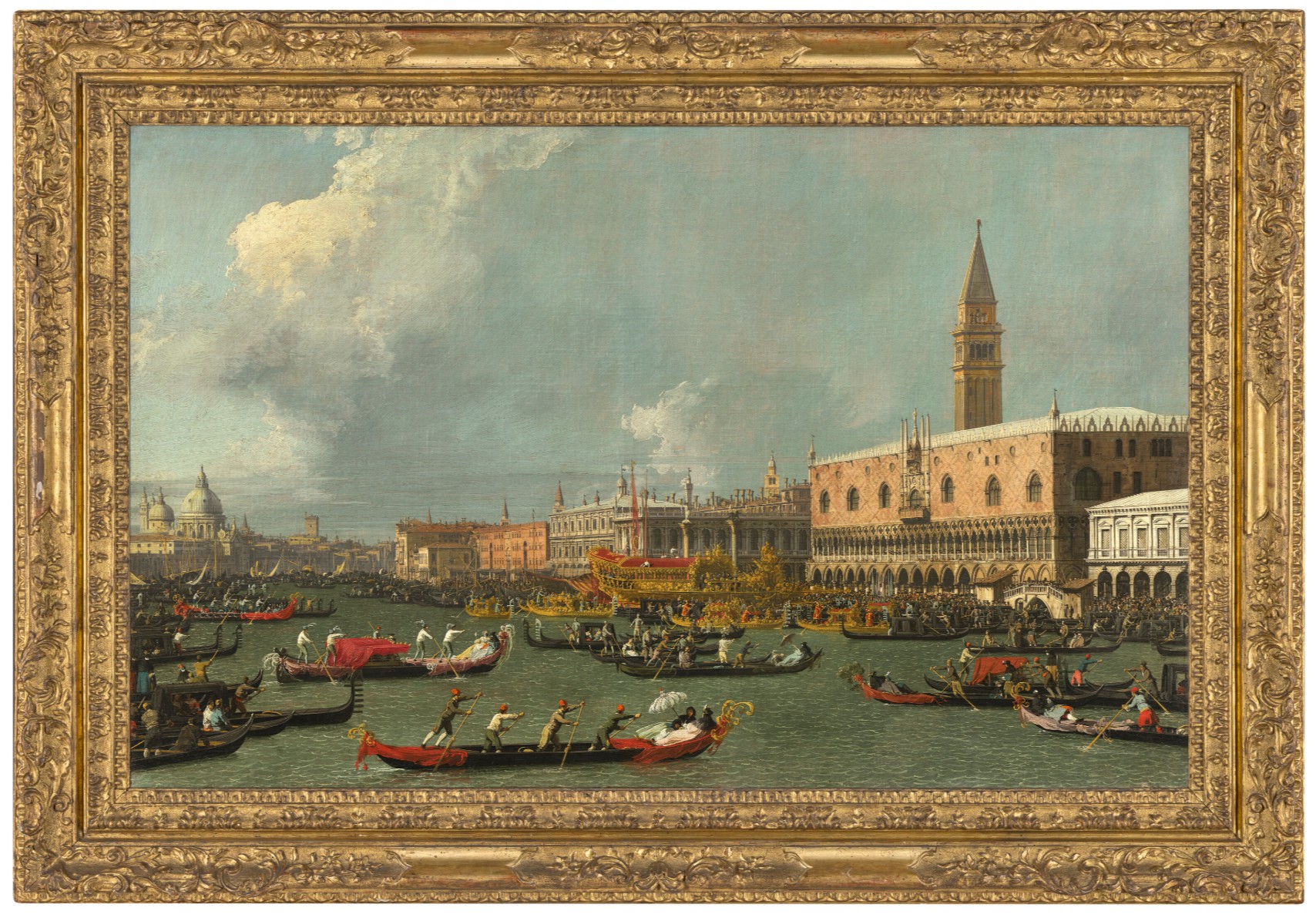
GIOVANNI ANTONIO CANAL, CALLED IL CANALETTO (VENICE 1697–1768)
Venice, the Return of the Bucintoro on Ascension Day
Oil on canvas
86 x 138.1 cm (33-7/8 x 54-3/8 inches)
This breathtaking view of the Feast of Ascension Day has been largely inaccessible to scholars, having appeared at auction only twice in its 300-year history, in 1751 and 1993. It is in a remarkable state of preservation – the surface of the painting is beautifully textured and the impasto on many of the figures intact – and this is in large part due to its relatively few passages in ownership. The painting is first recorded at 10 Downing Street, in the collection of Britain’s first Prime Minister, Sir Robert Walpole (1676–1745). This distinguished early eighteenth-century provenance has only recently come to light and was not known at the time of the painting’s sale in 1993. Canaletto painted the view at the beginning of the 1730s, a highpoint in the artist’s career and a time during which his views were in great demand, particularly among British collectors. Exceedingly ambitious in both scale and conception, this is Canaletto’s earliest known representation of the Bucintoro returning to the Molo on Ascension Day; a subject to which he would return repeatedly throughout the ensuing two decades.
#13. Peupliers au bord de l’Epte, crépuscule, 1891
Christie’s New-York: 12 May 2025
Estimated: USD 30,000,000 – 50,000,000
USD 42,960,000
CLAUDE MONET (1840-1926), Peupliers au bord de l’Epte, crépuscule | Christie’s
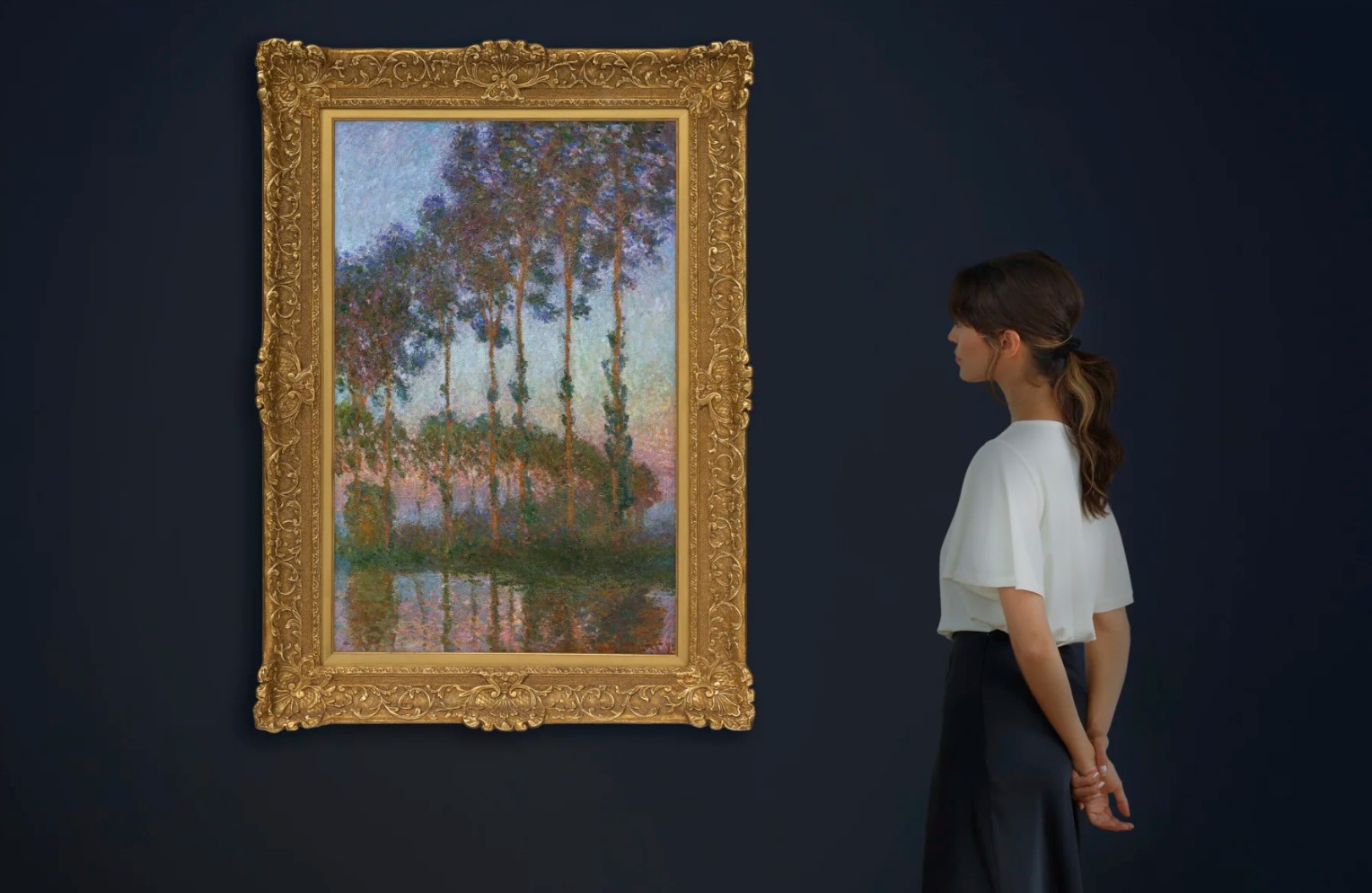
CLAUDE MONET (1840-1926)
Peupliers au bord de l’Epte, crépuscule, 1891
Oil on canvas
100 x 65.1 cm (39 3/8 x 25 5/8 inches)
Signed and dated ‘Claude Monet 91’ (lower right)
#14. Bust of a Woman with a Flowered Hat (Dora Maar), 1943
Lucien Paris: 24 October 2025
Estimated: EUR 8,000,000 – 10,000,000
EUR 27,000,000 (Hammer)
EUR 35,100,000 / USD 41,188,300
Bust of a Woman with a Flowered Hat (Dora Maar), 1943 – Lot 1
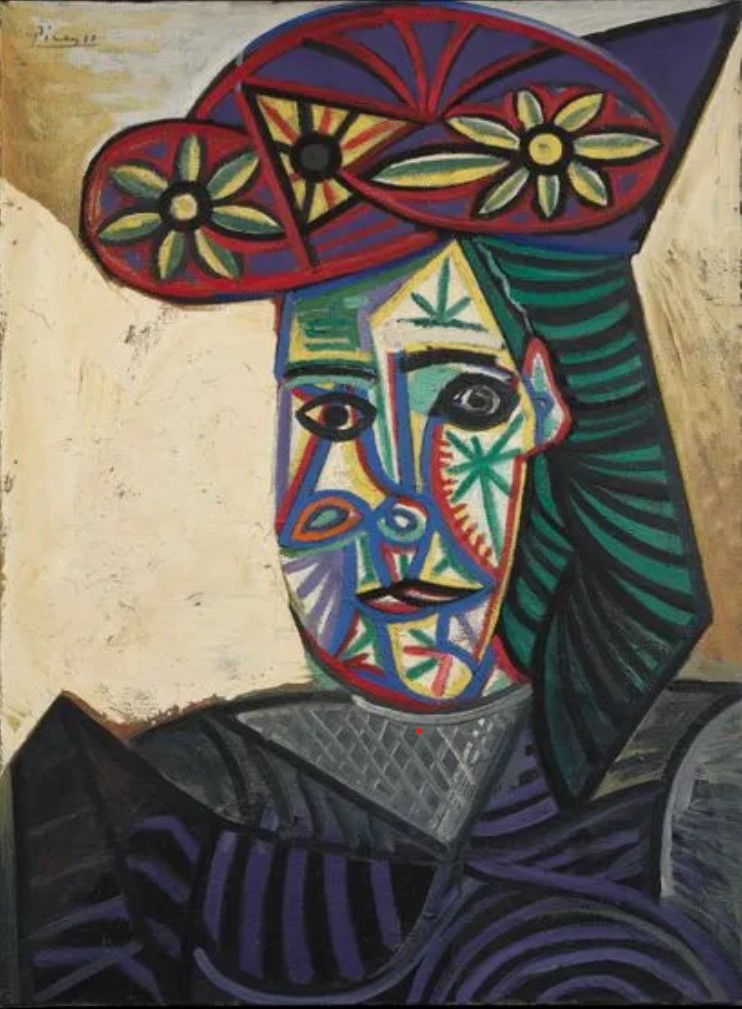
PABLO PICASSO
Bust of a Woman with a Flowered Hat (Dora Maar), 1943
Oil on canvas
81×60 cm (31.9 x 23.6 inches)
Signed upper left
Dated 11 July 43 on the reverse.
© Picasso Estate 2025
#15. No. 4 (Two Dominants) [Orange, Plum, Black], 1950-51
Christie’s New-York: 12 May 2025
Estimate on Request
USD 37,785,000
MARK ROTHKO (1903-1970), No. 4 (Two Dominants) [Orange, Plum, Black] | Christie’s
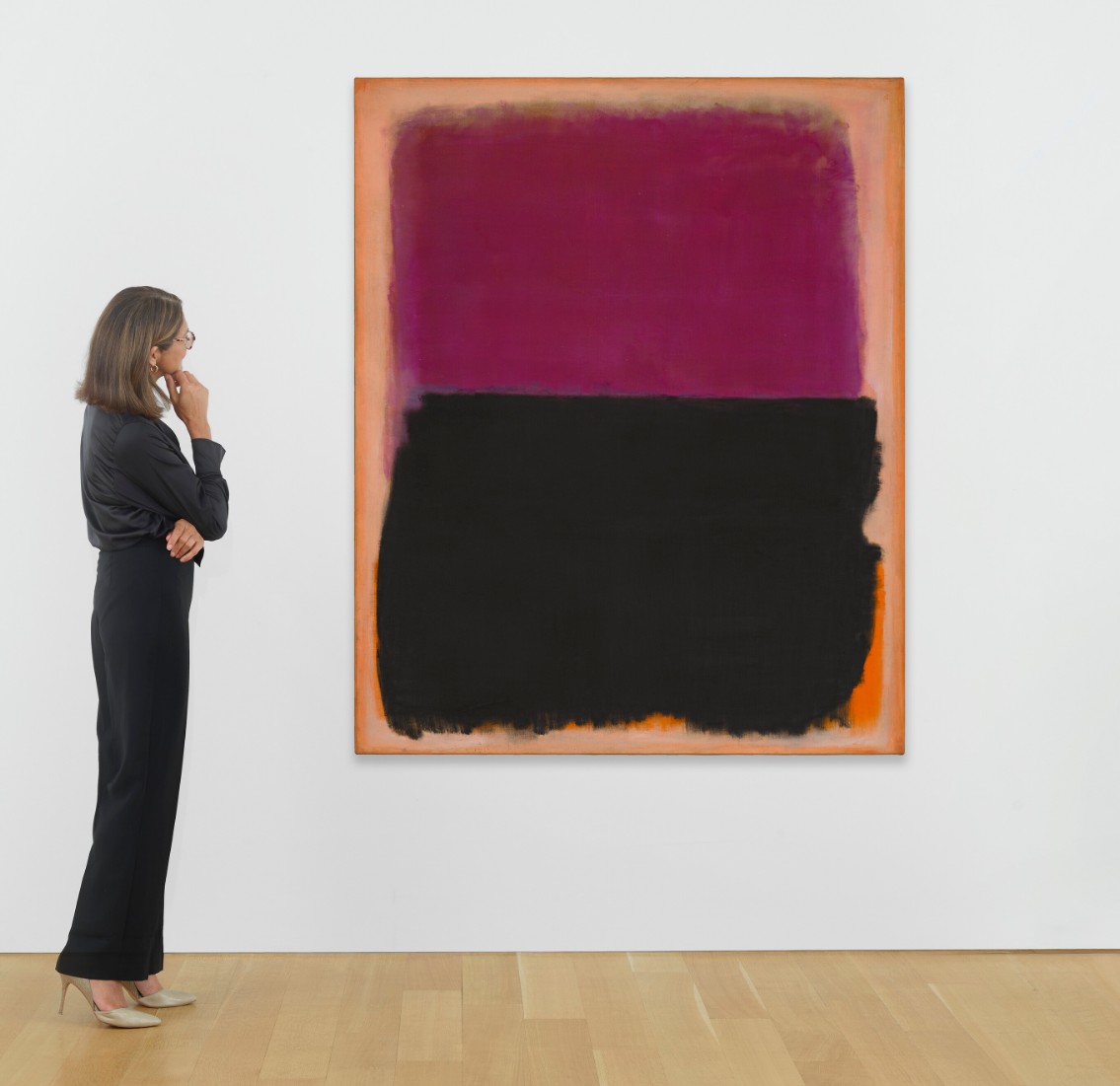
MARK ROTHKO (1903-1970)
No. 4 (Two Dominants) [Orange, Plum, Black], 1950-51
Oil on canvas
67 x 54 3/4 inches (170.2 x 139.1 cm)
Signed twice and dated ‘MARK ROTHKO MARK ROTHKO 1951’ (on the reverse)
Technology and Digital Transformation
Technology is now deeply embedded in the functioning of the art market.
Online bidding, digital catalogues, and real-time analytics have significantly expanded access to auctions. Collectors can now participate remotely in major sales taking place anywhere in the world.
This transformation has also increased transparency. Databases and market analytics platforms provide collectors with unprecedented access to historical pricing information, enabling more informed decision-making.
For many observers, this growing data-driven environment represents one of the most important structural developments in the art market over the past decade.
Outlook for the Art Market
Looking ahead, the Artprice report suggests that the art market will continue to evolve toward greater global integration and professionalization.
Demand for museum-quality works is expected to remain strong, particularly as art continues to be perceived as both a cultural asset and a store of value.
At the same time, the market is likely to remain selective, rewarding artists with strong historical importance and institutional support.
In this context, the art market of the coming years will likely be characterized by greater transparency, stronger global participation, and continued competition for the most exceptional works of art.