
Works on paper occupy a central and indispensable place in the oeuvre of Pablo Picasso, one of the most influential artists of the twentieth century. Across a career spanning more than seven decades, Picasso produced thousands of drawings, sketches, gouaches, watercolors, and mixed-media works on paper. Far from being secondary or preparatory material, these works form a laboratory of invention in which the artist developed many of the visual ideas that would later appear in his paintings, sculptures, ceramics, and prints.
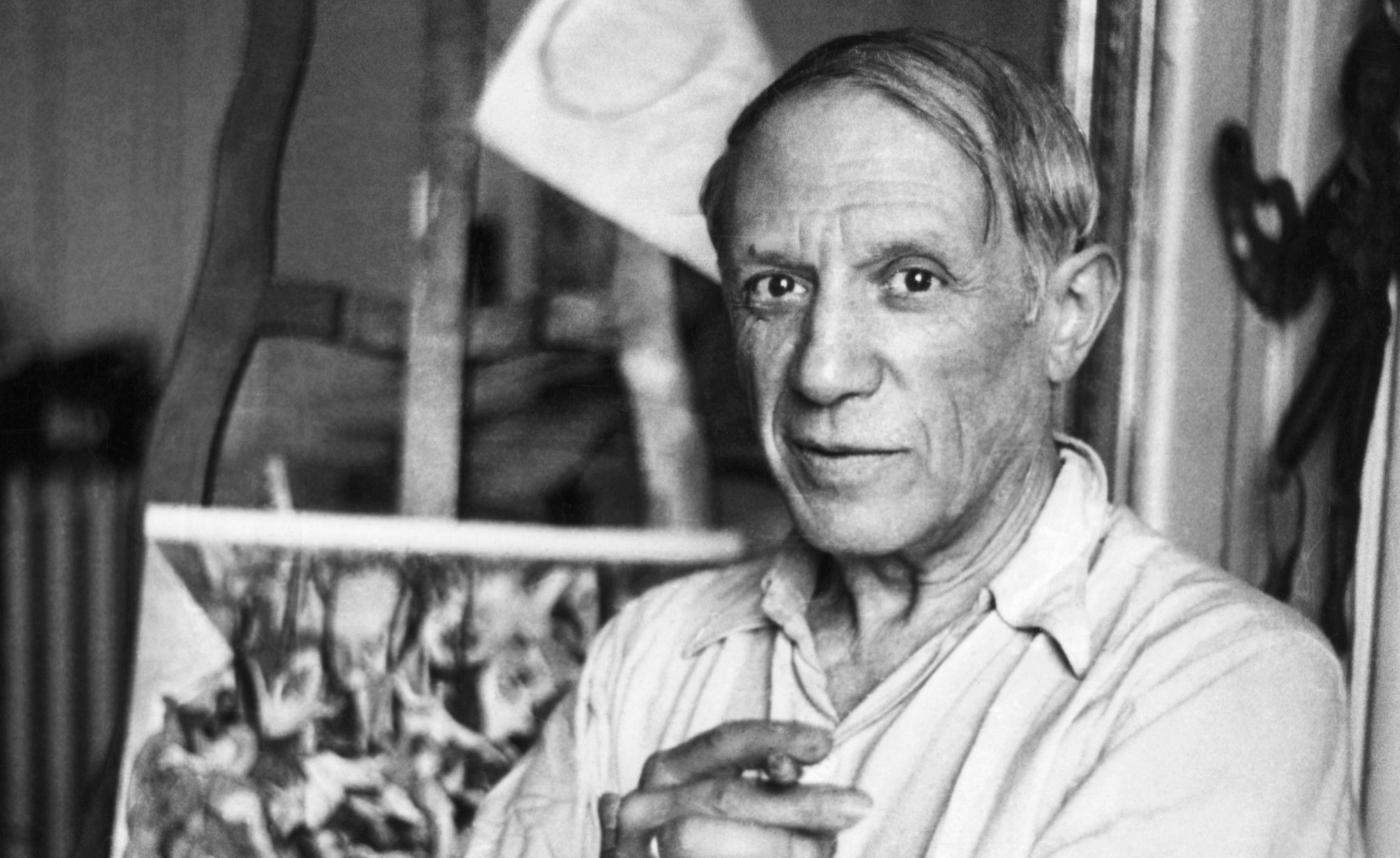
For Picasso, paper was the most immediate and flexible surface available. It allowed him to think visually at great speed, responding to ideas almost instantaneously. The intimacy of drawing suited his temperament: energetic, experimental, and constantly searching for new forms. As a result, works on paper provide one of the most direct windows into Picasso’s creative mind.
Introduction
Picasso used an extraordinary range of techniques in his works on paper. These include graphite, charcoal, ink, colored pencil, pastel, watercolor, gouache, and collage. He often combined multiple media within a single composition, layering materials to achieve complex textures and tonal effects. One of the defining characteristics of Picasso’s drawing is the economy and confidence of line. With just a few strokes, he could evoke a human face, an animal, or a complete narrative scene. This mastery of line—sometimes lyrical, sometimes aggressive—reflects his deep study of classical draftsmanship as well as his radical desire to reinvent it.
Paper also enabled Picasso to experiment freely with scale. Some works are small and intimate sketches from notebooks, while others are large, ambitious compositions executed in gouache or ink. In both cases, the immediacy of the medium allowed him to explore ideas rapidly and continuously.
Works on Paper Across Picasso’s Major Periods
Works on paper appear throughout every phase of Picasso’s career and often anticipate major stylistic breakthroughs.
During the Blue Period (1901–1904) and Rose Period (1904–1906), drawings and pastels on paper were crucial for exploring themes of melancholy figures, circus performers, and marginalized individuals. These works reveal the emotional intensity and elongated forms that define the paintings of the same period.
In the years leading to Cubism, Picasso’s sketches on paper played a decisive role in the development of his revolutionary approach to form. Numerous studies from 1906–1907 document the gradual simplification and fragmentation of the human figure that culminated in the landmark painting Les Demoiselles d’Avignon (1907). Throughout the Cubist period, Picasso produced countless drawings and gouaches on paper in which he explored geometric structures, shifting viewpoints, and the reduction of objects to fundamental shapes. These works demonstrate how drawing functioned as a testing ground for one of the most transformative artistic movements of the twentieth century.
Later in his career, Picasso returned repeatedly to drawing as a means of revisiting classical subjects such as bulls, musicians, bathers, and mythological figures including the Minotaur. His late works on paper, often executed with swift and confident lines, display an astonishing freedom and vitality that characterized his final decades.
Themes and Imagery
Picasso’s works on paper cover an immense range of subjects. Among the most recurring motifs are portraits, lovers, bulls, horses, musicians, and scenes inspired by classical mythology. The artist was particularly fascinated by the expressive potential of the human face and body, which he continuously distorted, fragmented, and reassembled through drawing.
Animals—especially bulls and doves—also appear frequently in his works on paper. These images reflect Picasso’s deep connection to Spanish culture and symbolism, as well as his lifelong exploration of themes of strength, violence, and transformation.
Another key aspect of Picasso’s drawings is their narrative quality. Many works capture moments of everyday life, while others evoke theatrical or mythological scenes. In each case, the simplicity of line allows the subject to emerge with striking clarity and emotional immediacy.
Institutional Recognition and Museum Collections
Picasso’s works on paper are widely represented in major museum collections around the world. Institutions such as the Museum of Modern Art in New York, the Tate in London, the Centre Pompidou in Paris, and the Museo Nacional Centro de Arte Reina Sofía in Madrid hold significant groups of drawings and works on paper by the artist.
The Musée Picasso Paris and the Museu Picasso Barcelona in particular preserve extensive archives of drawings that illustrate the full evolution of Picasso’s practice.
These collections underline the importance of works on paper not merely as preparatory studies but as autonomous artworks that document the artist’s continuous process of invention.
Legacy and Importance in the Market
Picasso’s works on paper today represent one of the most accessible entry points into the market for one of the most celebrated artists in modern art history. While his paintings command some of the highest prices ever achieved at auction, drawings and gouaches on paper allow collectors to acquire works that reveal the artist’s hand in its most direct form.
Collectors and scholars alike value these works for their spontaneity and intimacy. They provide insight into Picasso’s creative process and demonstrate the remarkable speed and fluency with which he could translate ideas into images.
For many historians, Picasso’s drawings are not simply ancillary to his paintings—they are the very foundation of his artistic language. Through works on paper, the artist continuously reinvented the possibilities of line, form, and visual expression, leaving behind an unparalleled body of work that remains central to the history of modern art.
2025 Auction Results
WORK IN PROGRESS
#1. Tête classique, circa 1921
Sotheby’s New-York: 13 May 2025
Estimated: USD 3,500,000 – 5,000,000
USD 4,564,000
Tête classique | Modern Evening Auction | 2025 | Sotheby’s
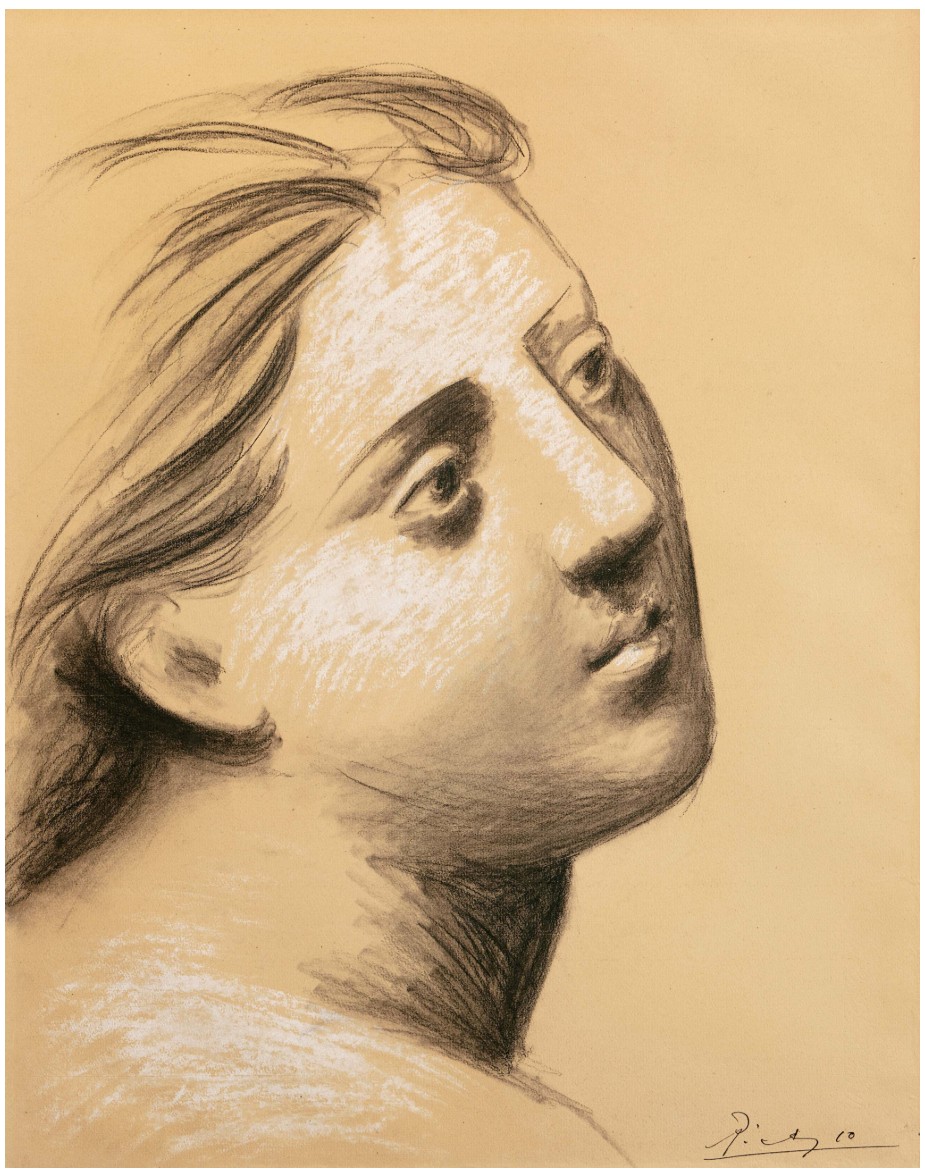
PABLO PICASSO (1881 – 1973)
Tête classique, circa 1921
Charcoal and chalk on paper mounted on board
63.5 x 45.7 cm (25 x 18 3/4 inches)
Signed Picasso (lower right)
#2. La Minotauromachie, 1935
Leonard A. Lauder, Collector
Sotheby’s New-York: 18 November 2025
Estimated: USD 1,200,000 – 1,800,000
USD 2,063,000
La Minotauromachie | Leonard A. Lauder, Collector | Evening Auction | 2025 | Sotheby’s
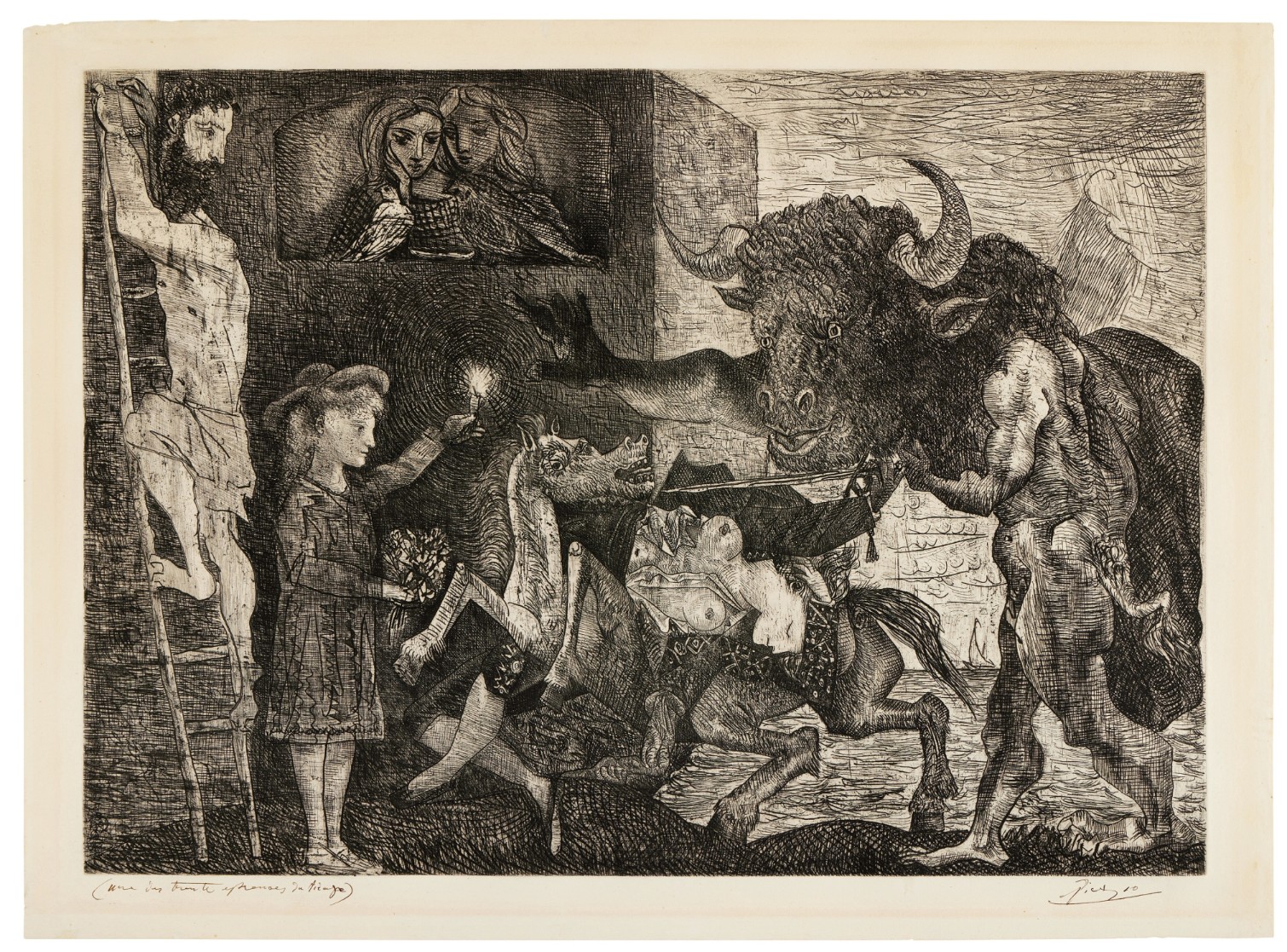
PABLO PICASSO (1881-1973)
La Minotauromachie, 1935
Etching with scraper and engraving on Montval laid paper
Plate:49.6 x 69.3 cm ( 19 1/2 x 27 1/4 inches)
Sheet: 56.4 x 77.3 cm (22 1/4 x 30 3/8 inches)
Signed Picasso in ink (lower right) and inscribed (une des trente épreuves du tirage) (lower left)
A richly inked impression of the seventh (final) state
#3. Le Sculpteur et son Modèle, 1933
Ketterer Kunst Munich: 6 June 2025
Estimated: EUR 800,000
EUR 1,681,500 / USD 1,984,170
Ketterer Kunst, Art auctions, Book auctions Munich, Hamburg & Berlin
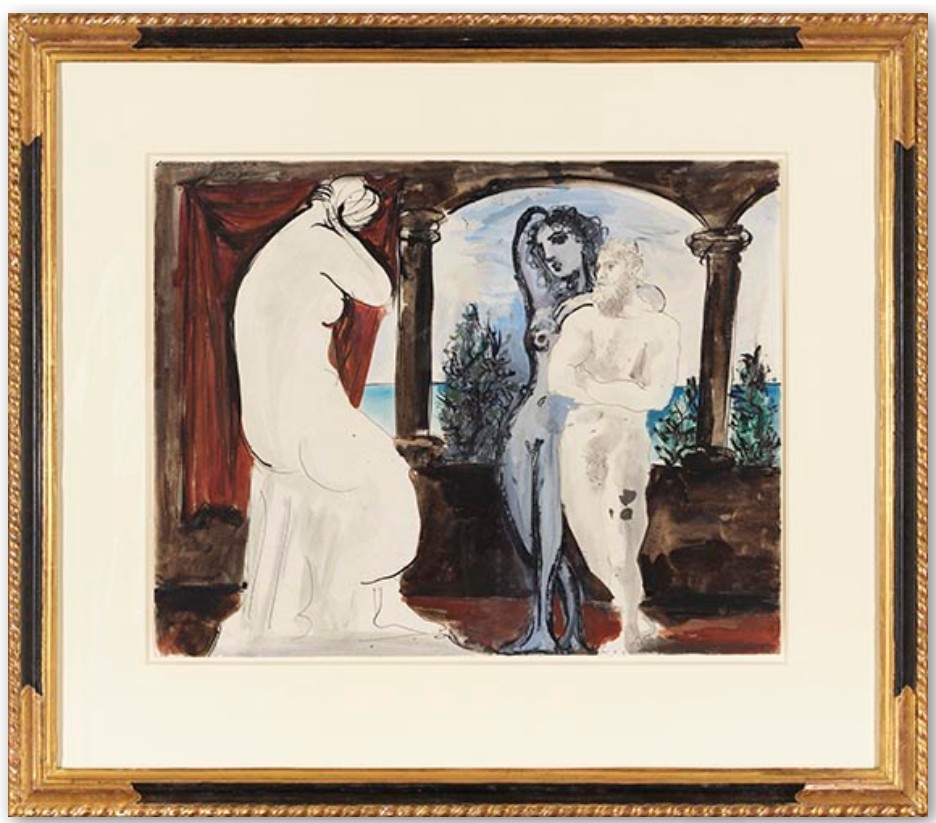
PABLO PICASSO
Le Sculpteur et son Modèle, 1933
Gouache, watercolor and India ink on creme paper
40.1 x 50.5 cm (15 3/4 x 19 7/8 inches)
Signed and dated “Cannes, 19 juillet XXXIII” in the upper left. On creme paper
#4. L’Homme au béret basque, 1946
Property from a Private American Collection
Sotheby’s New-York: 21 November 2025
Estimated: USD 1,200,000 – 1,800,000
USD 1,270,000
L’Homme au béret basque | Modern Day Auction | 2025 | Sotheby’s
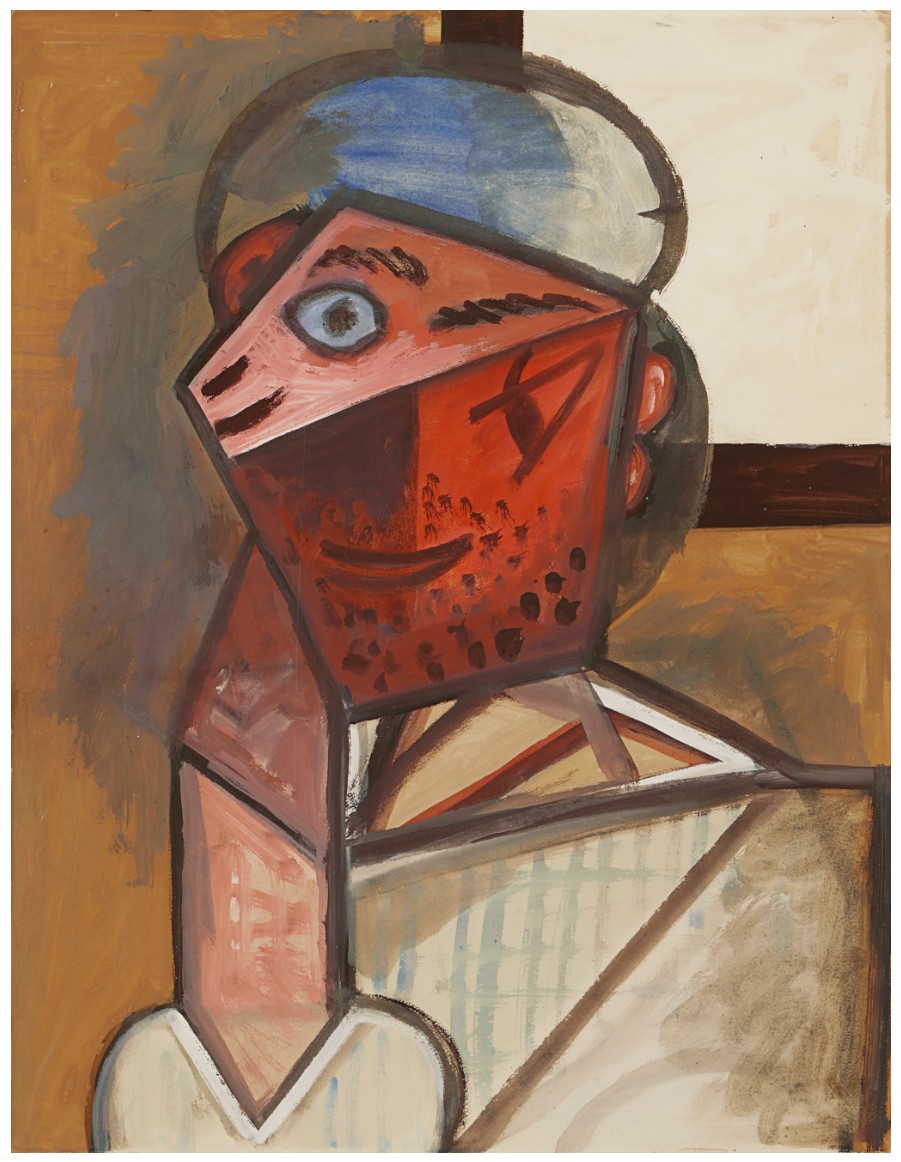
PABLO PICASSO (1881 – 1973)
L’Homme au béret basque, 1946
Gouache and brush and ink on paper
66 x 50.5 cm (26 x 19 7/8 inches)
#5. Nez quart de Brie, 1907
Christie’s London: 16 October 2025
Estimated: GBP 500,000 – 800,000
GBP 889,000 / USD 1,193,260
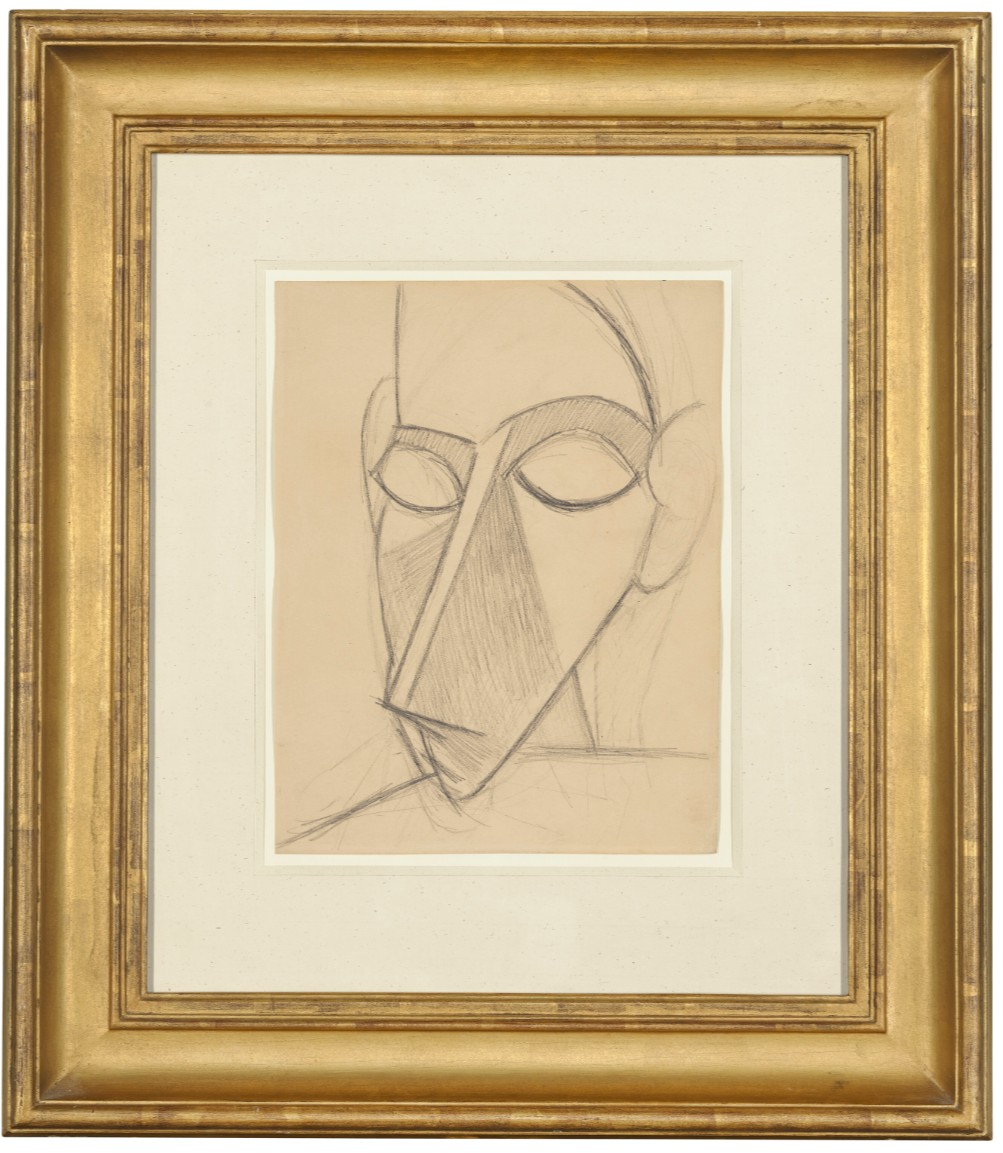
PABLO PICASSO (1881-1973)
Nez quart de Brie, 1907
(Étude pour Les Demoiselles d’Avignon ou Nu avec draperie)
Pencil on paper
31 x 24.2 cm (12 1/4 x 9 1/2 inches)
#6. La Minotauromachie, 1935
Sotheby’s New-York: 13 May 2025
Estimated: USD 1,000,000 – 2,000,000
USD 1,143,000
READ MORE IN FOCUS SECTION
La Minotauromachie | Modern Evening Auction | 2025 | Sotheby’s
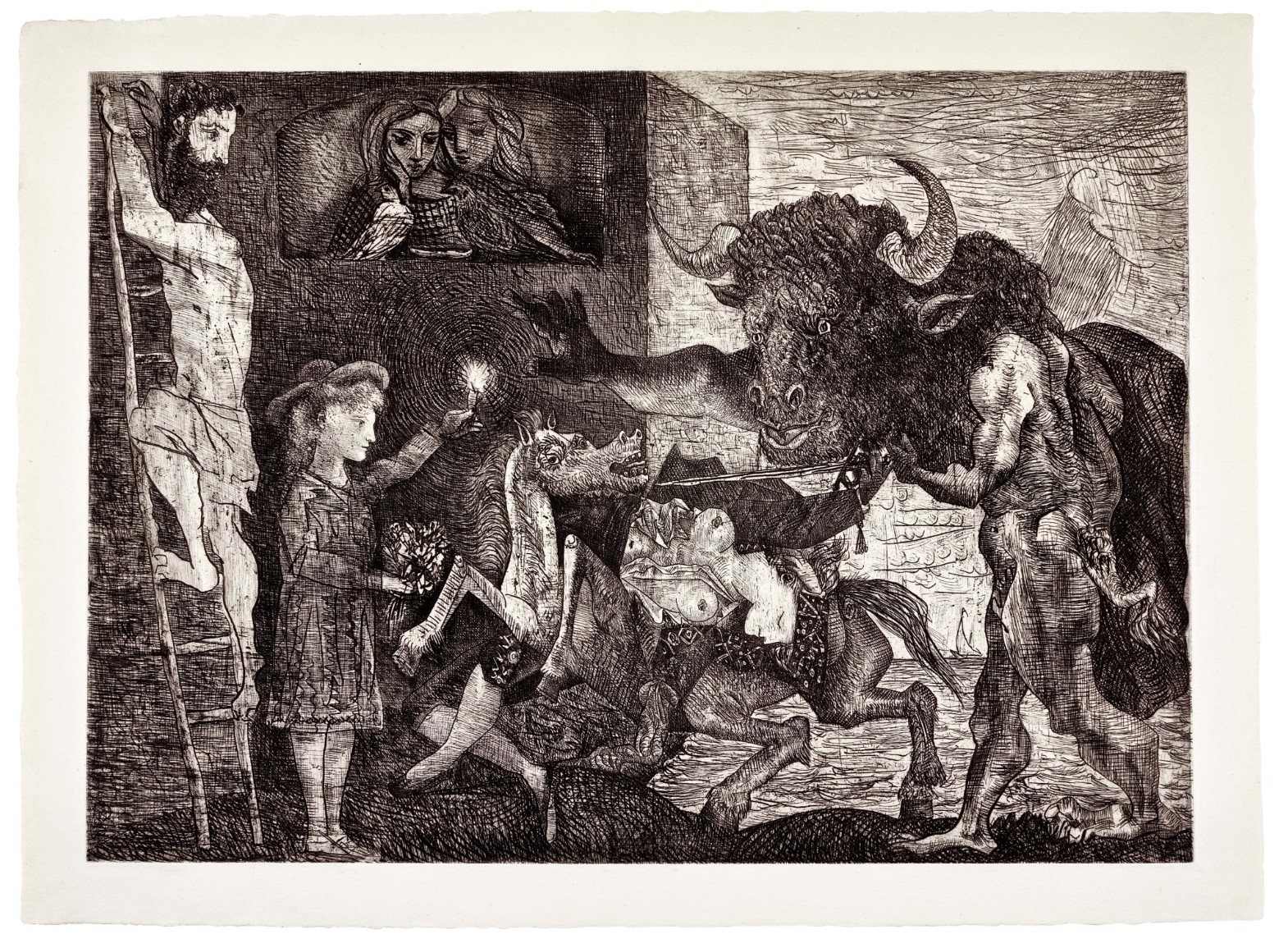
PABLO PICASSO (1881 – 1973)
La Minotauromachie, 1935
Etching with scraper and engraving on Montval laid paper
Plate: 49.5 x 69.2 cm (19 1/2 x 27 1/4 inches)
Sheet: 56.7 x 77.8 cm (22 3/8 x 30 1/2 inches)
A richly inked impression of the seventh (final) state
With strong contrast and fine detail
#7. Trois personnages, 1970-1971
Leonard A. Lauder, Collector
Sotheby’s New-York: 18 November 2025
Estimated: USD 600,000 – 800,000
USD 1,016,000
Trois personnages | Leonard A. Lauder, Collector | Evening Auction | 2025 | Sotheby’s
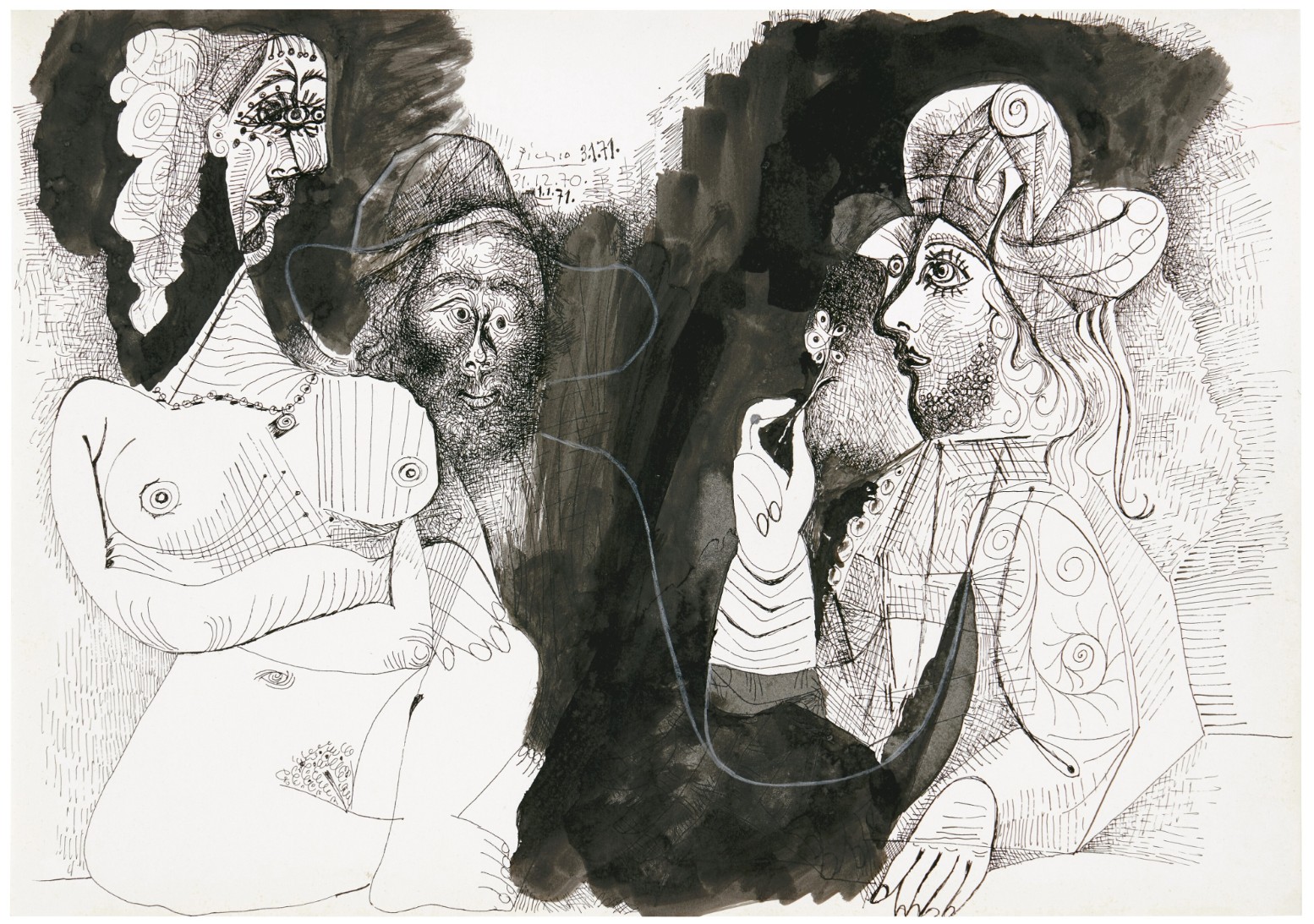
PABLO PICASSO (1881 – 1973)
Trois personnages, 1970-1971
pen and brush and ink on paper
29.2 x 41.3 cm (11 1/2 x 16 1/4 inches)
Signed Picasso and dated 31.12.70, 1.1.71 and 3.1.71. (toward upper center)
USD 1 million
#8. Femme au voile debout, deux hommes assis, 1923-1924
Christie’s London: 5 March 2025
Estimated: GBP 500,000 – 700,000
GBP 756,000 / USD 966,830
PABLO PICASSO (1881-1973), Femme au voile debout, deux hommes assis | Christie’s
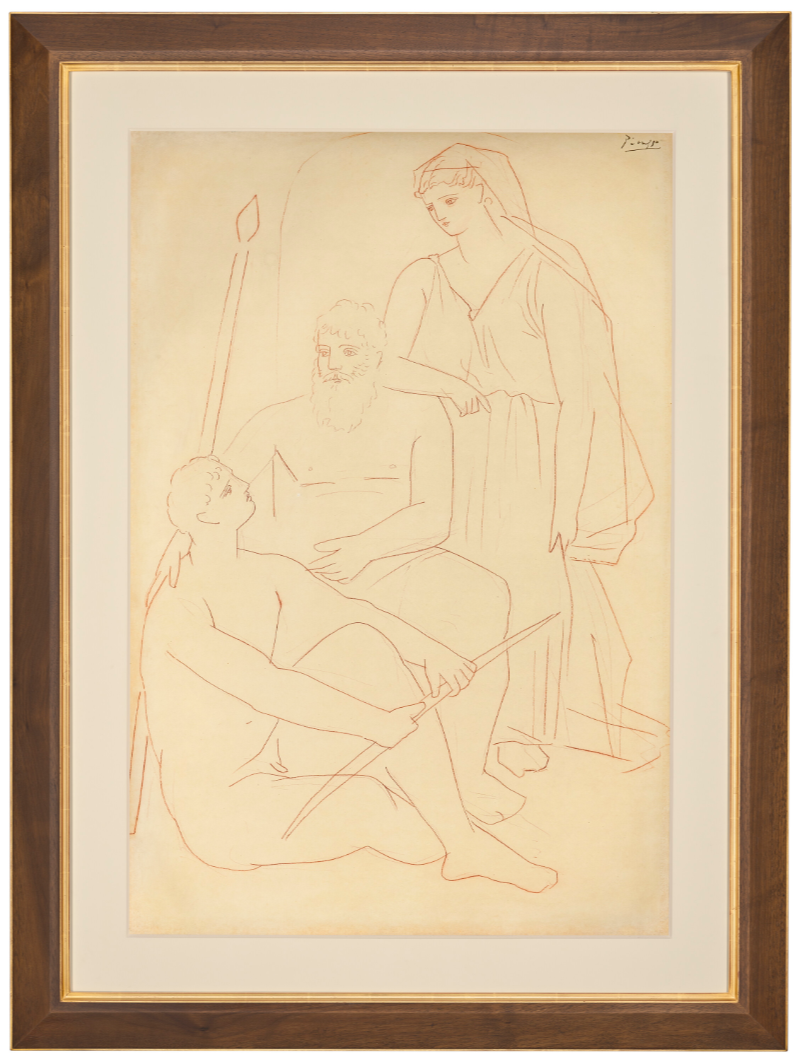
PABLO PICASSO (1881-1973)
Femme au voile debout, deux hommes assis, 1923-1924
Sanguine on paper
108.3 x 74.3 cm (42 5/8 x 29 1/4 inches)
Signed ‘Picasso’ (upper right)
#10. La Coiffure (Femme se coiffant), 1906
Christie’s London: 16 October 2025
Estimated: GBP 150,000 – 250,000
GBP 635,000 / USD 852,330
PABLO PICASSO (1881-1973), La Coiffure (Femme se coiffant) | Christie’s
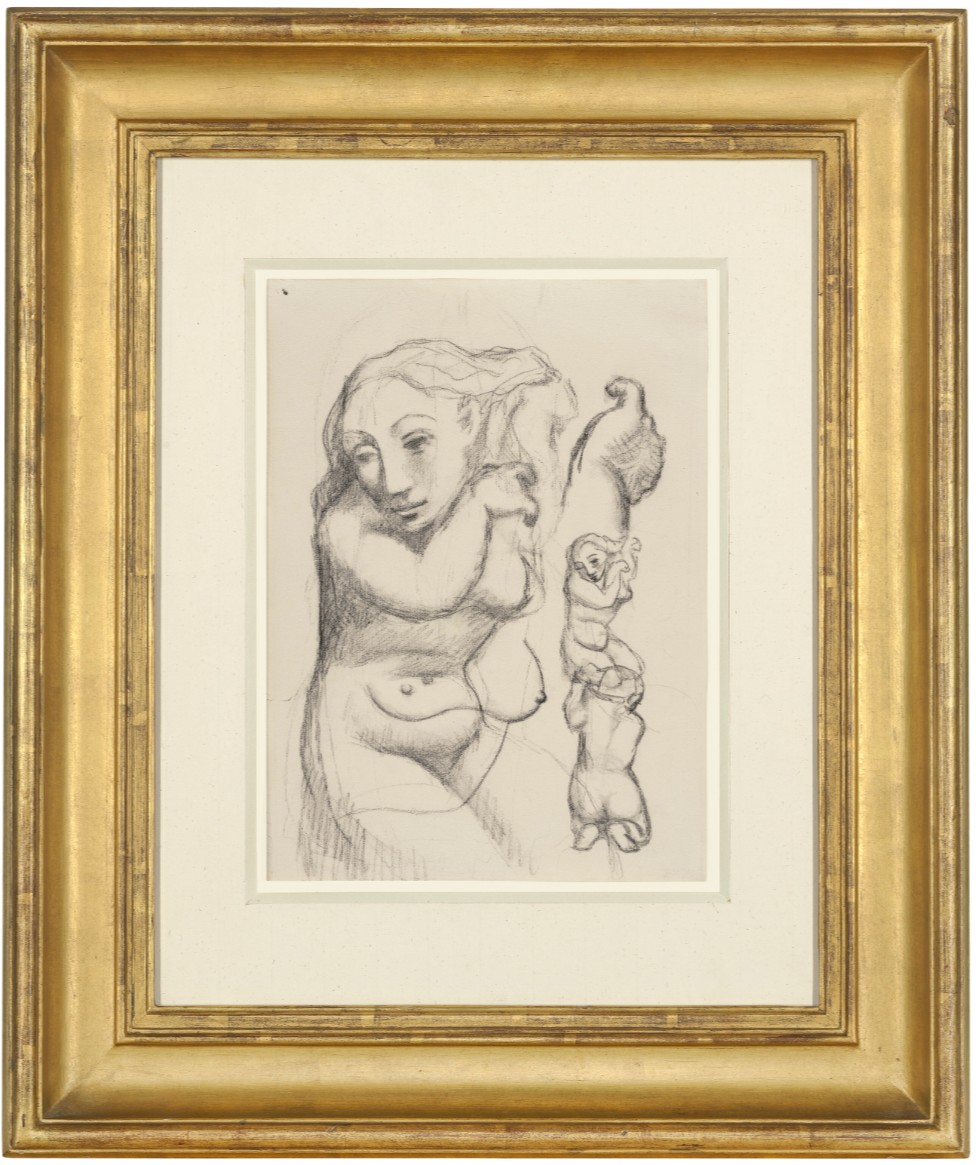
PABLO PICASSO (1881-1973)
La Coiffure (Femme se coiffant), 1906
Charcoal on paper
31 x 22.7 cm (12 1/4 x 9 inches)
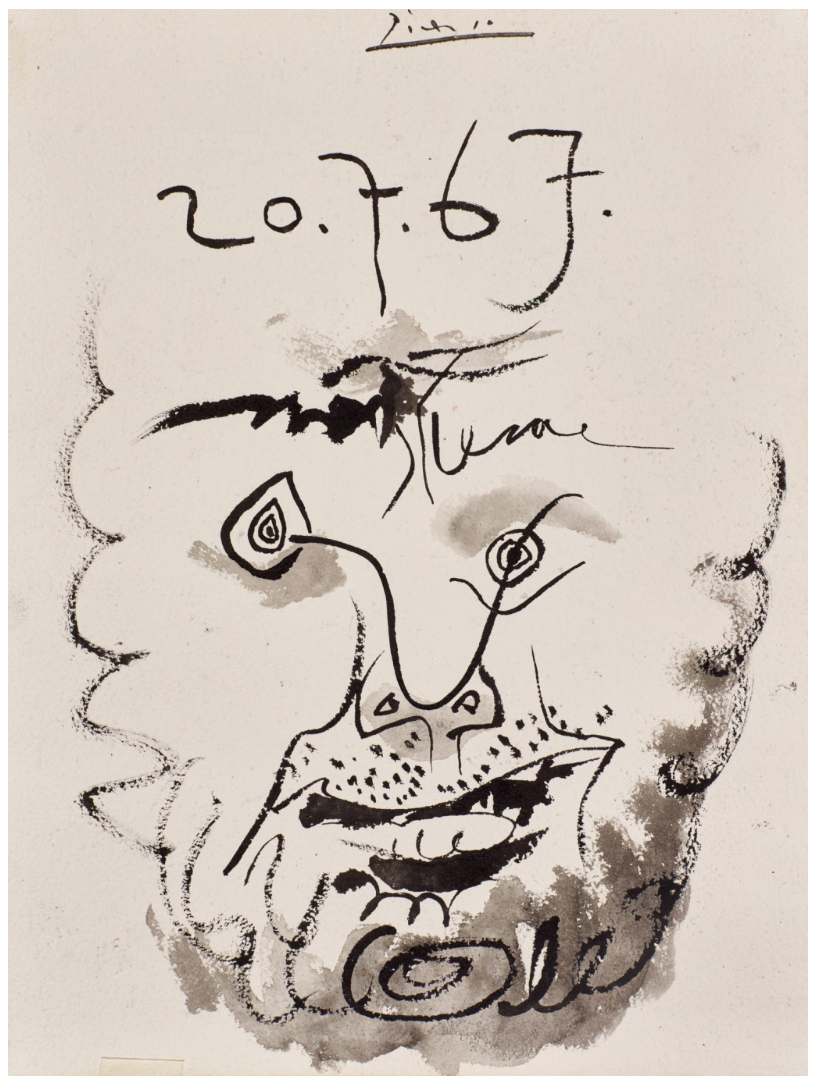
#11. Tête (recto); Tête (verso), 1967
Sotheby’s London: 4 March 2025
Estimated: GBP 350,000 – 450,000
GBP 647,700 / USD 822,025
Tête (recto); Tête (verso) | Modern & Contemporary Evening Auction | 2025 | Sotheby’s
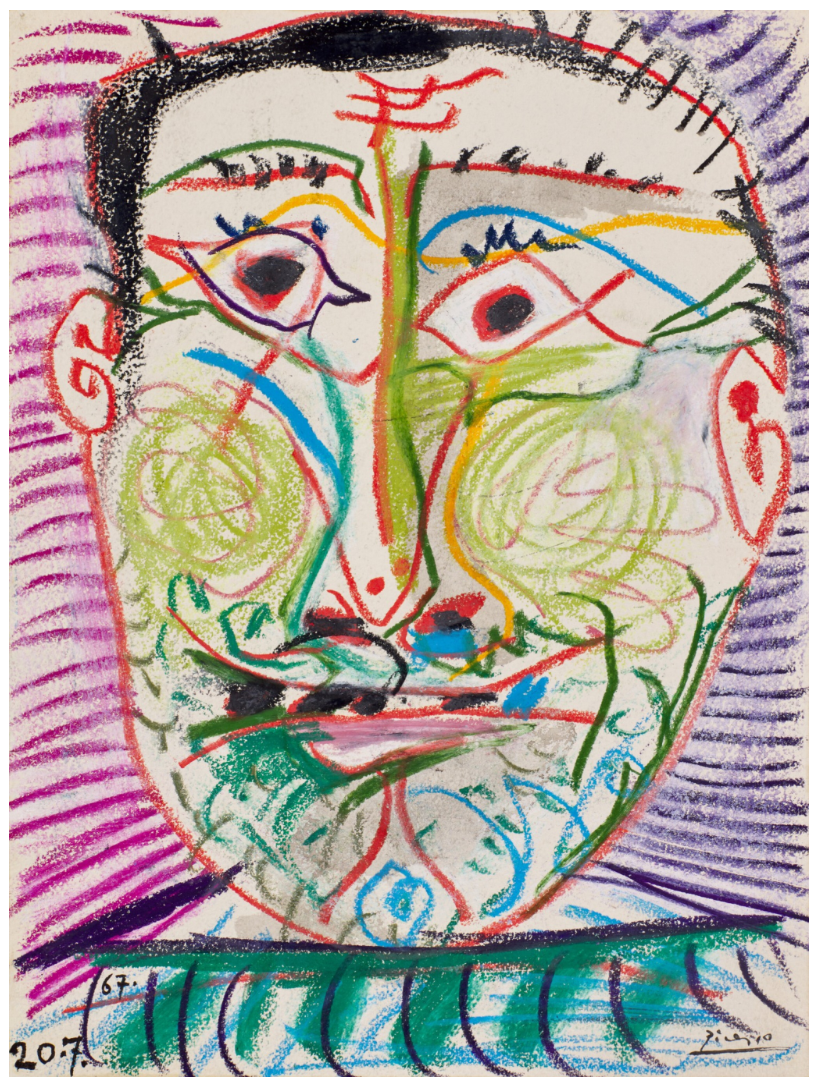
PABLO PICASSO (1881 – 1973)
Tête (recto); Tête (verso), 1967
Wax crayon on paper (recto); pen and ink and wash on paper (verso)
37.5 x 28 cm (14 3/4 x 11 inches)
Signed Picasso (lower right) and dated 20.7.67. (lower left) (recto)
Signed Picasso and dated 20.7.67. (upper centre) (verso)
#12. Le Faune parmi les branchages, 1946
Property from the Phillips Kazis Family Collection
Sotheby’s New-York: 13 May 2025
Estimated: USD 500,000 – 700,000
USD 698,500
Le Faune parmi les branchages | Modern Day Auction | 2025 | Sotheby’s
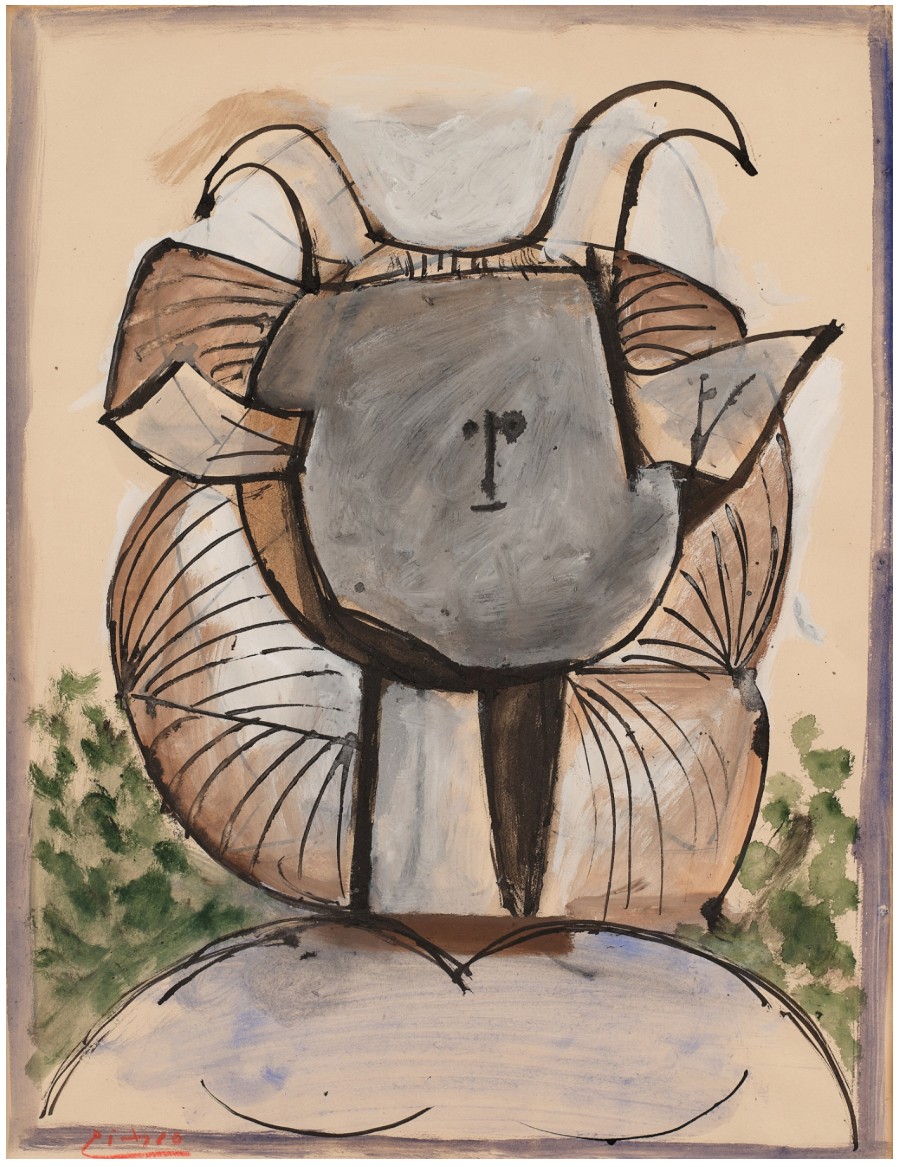
PABLO PICASSO (1881 – 1973)
Le Faune parmi les branchages, 1946
Gouache and brush and ink on paper
65.4 x 50.2 cm (25 3/4 x 19 3/4 inches)
Signed Picasso (lower left)
Executed in Antibes on 31 August 1946
#13. Nu couché, 1969
Pauline Karpidas: The London Collection Evening Auction
Sotheby’s London: 17 September 2025
Estimated: GBP 450,000 – 650,000
GBP 457,200 / USD 624,610
Nu couché | Pauline Karpidas: The London Collection Evening Auction | 2025 | Sotheby’s
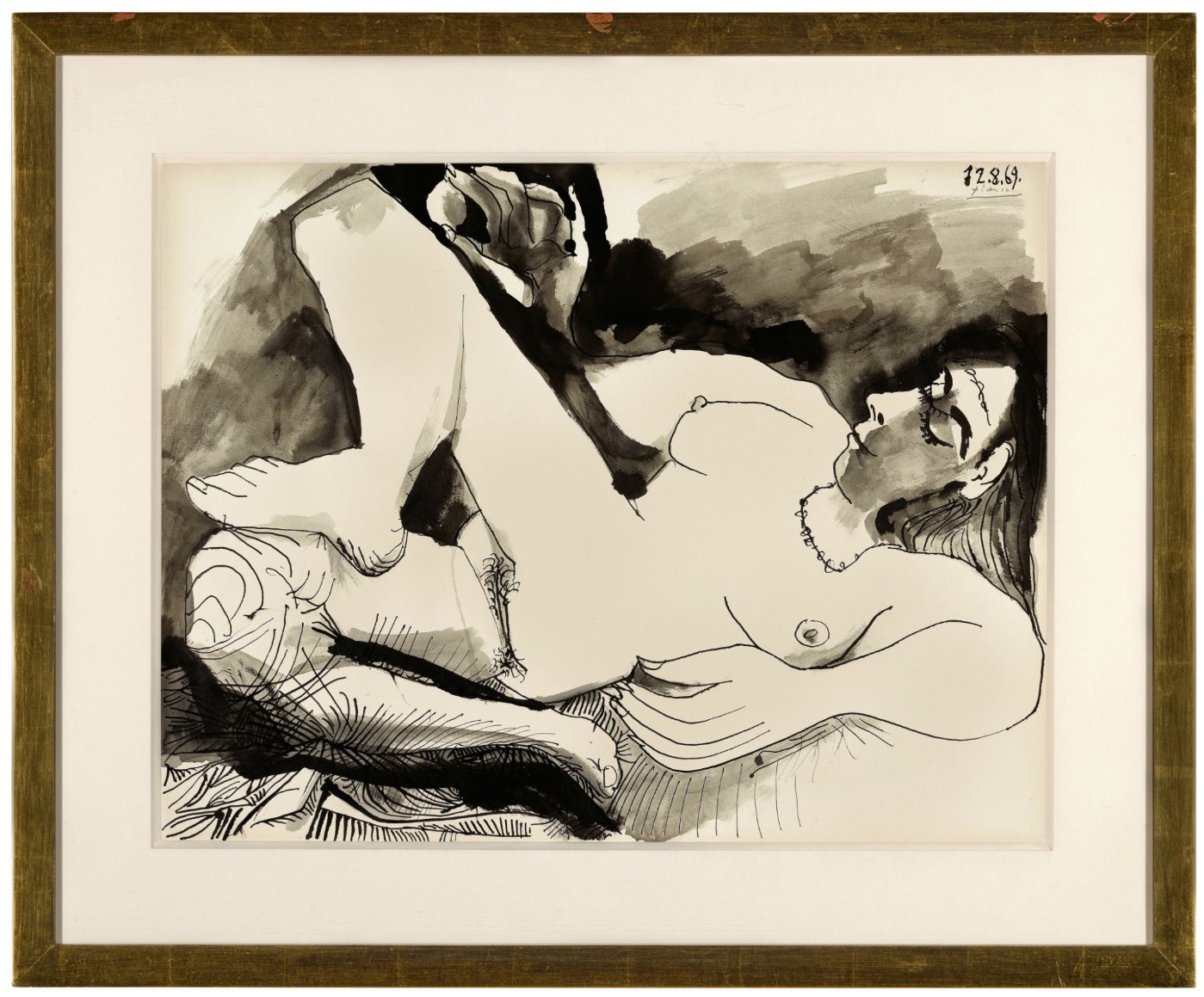
PABLO PICASSO (1881 – 1973)
Nu couché, 1969
Pen and brush and ink on paper
50.4 x 65.4 cm (19 7/8 x 25 3/4 inches)
Signed Picasso and dated 12.8.69. (upper right)
#14. Profil gauche de femme avec résille dans les cheveux, 1953
Pauline Karpidas: The London Collection Evening Auction
Sotheby’s London: 17 September 2025
Estimated: GBP 350,000 – 450,000
GBP 457,200 / USD 624,610
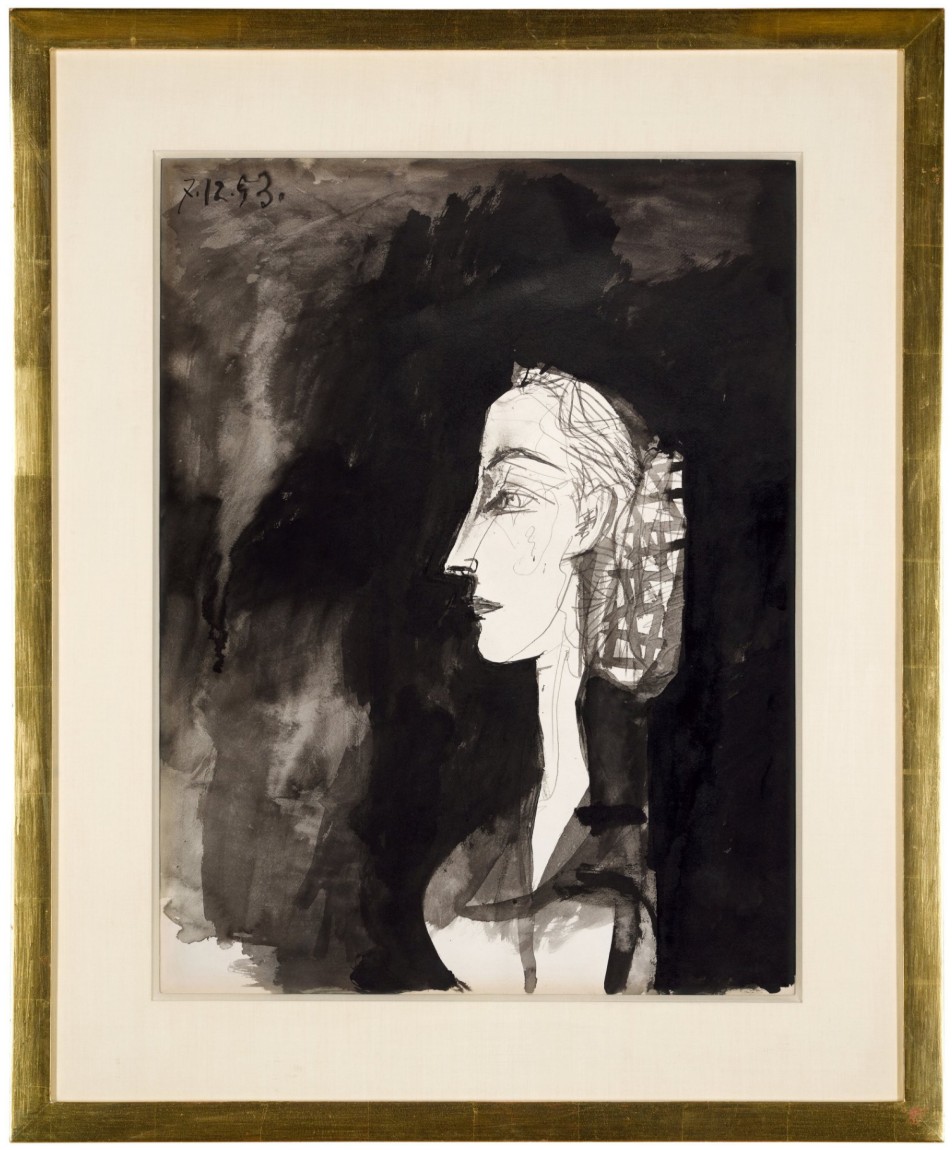
PABLO PICASSO (1881 – 1973)
Profil gauche de femme avec résille dans les cheveux, 1953
Brush and pen and ink on paper
65×50 cm (25 5/8 x 19 3/4 inches)
Dated 7.12.53. (upper left)
Indistinctly dated 7.12.53. (upper right)
#15. Buste de femme, 1968
Pauline Karpidas: The London Collection Day Auction
Sotheby’s London: 18 September 2025
Estimated: GBP 200,000 – 300,000
GBP 444,500 / USD 602,155
Buste de femme | Pauline Karpidas: The London Collection Day Auction | 2025 | Sotheby’s
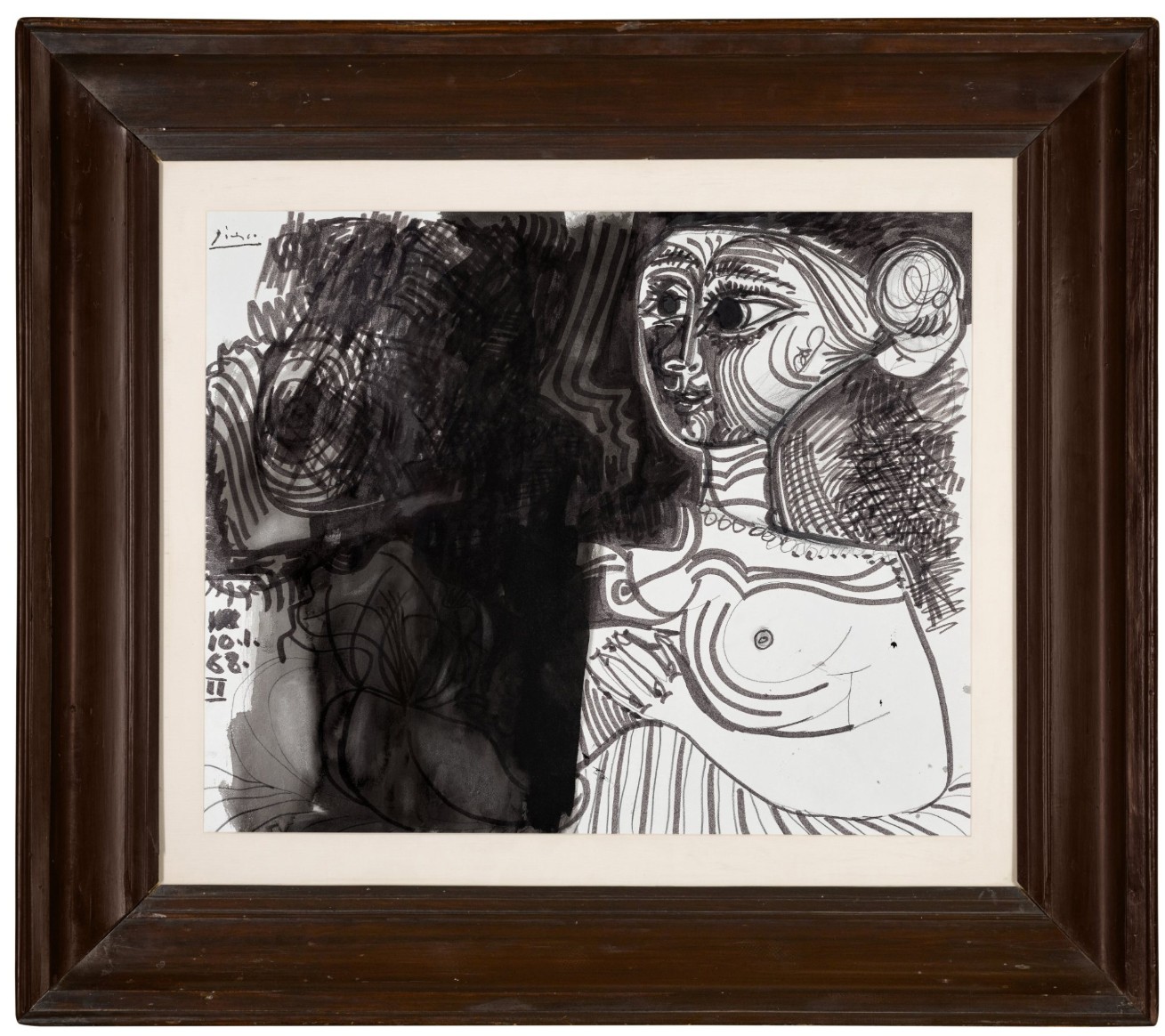
PABLO PICASSO (1881 – 1973)
Buste de femme, 1968
Brush and ink, felt-tip pen and pencil on paper
47.7 x 58.2 cm (18 3/4 x 22 7/8 inches)
Signed Picasso (upper left)
Dated 10.1.68. and numbered II (lower left)
Dated 10.1.68. and numbered II (on the verso)
#17. Buste de femme au chapeau, 1962
Property of an Important New York Collection
Sotheby’s New-York: 14 May 2025
Estimated: USD 350,000 – 550,000
USD 571,500
Buste de femme au chapeau (Bloch 1072; Baer 1318) | Modern Day Auction | 2025 | Sotheby’s
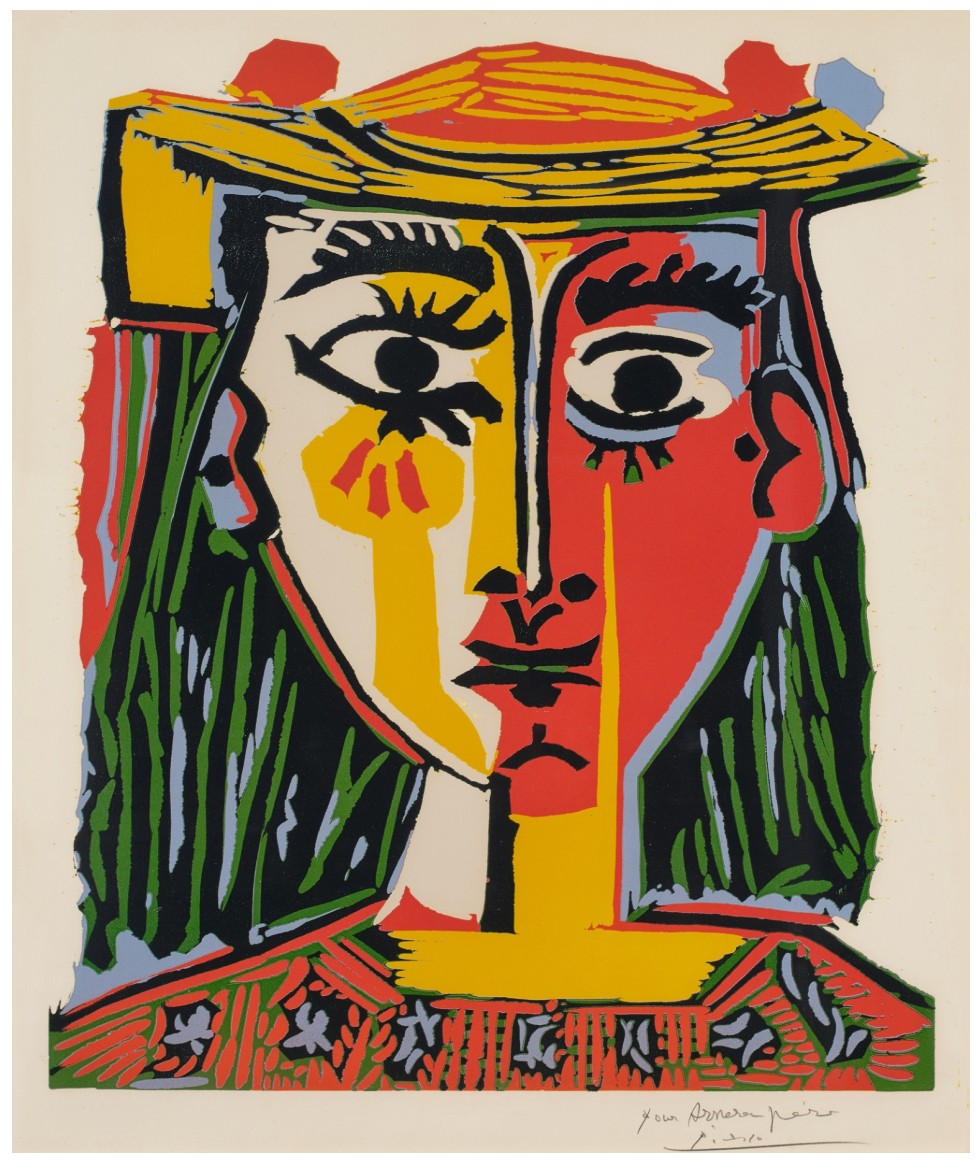
PABLO PICASSO (1881 – 1973)
Buste de femme au chapeau (Bloch 1072; Baer 1318), 1962
Linoleum cut printed in colors on Arches wove paper
Image: 63 x 53.1 cm (24 3/4 x 20 7/8 inches)
Sheet: 74.7 x 61.6 cm ( 29 3/8 x 24 1/4 inches)
Signed Picasso and inscribed pour Arnera père in pencil (lower right)
One of three trial proofs before the numbered edition of 50 plus approximately 20 artist’s proofs
Printed by Imprimerie Arnéra
#20. Homme et nu allongé, 1970
Sotheby’s London: 5 March 2025
Estimated: GBP 250,000 – 350,000
GBP 419,100 / USD 535,980
Homme et nu allongé | Modern Day Auction | 2025 | Sotheby’s
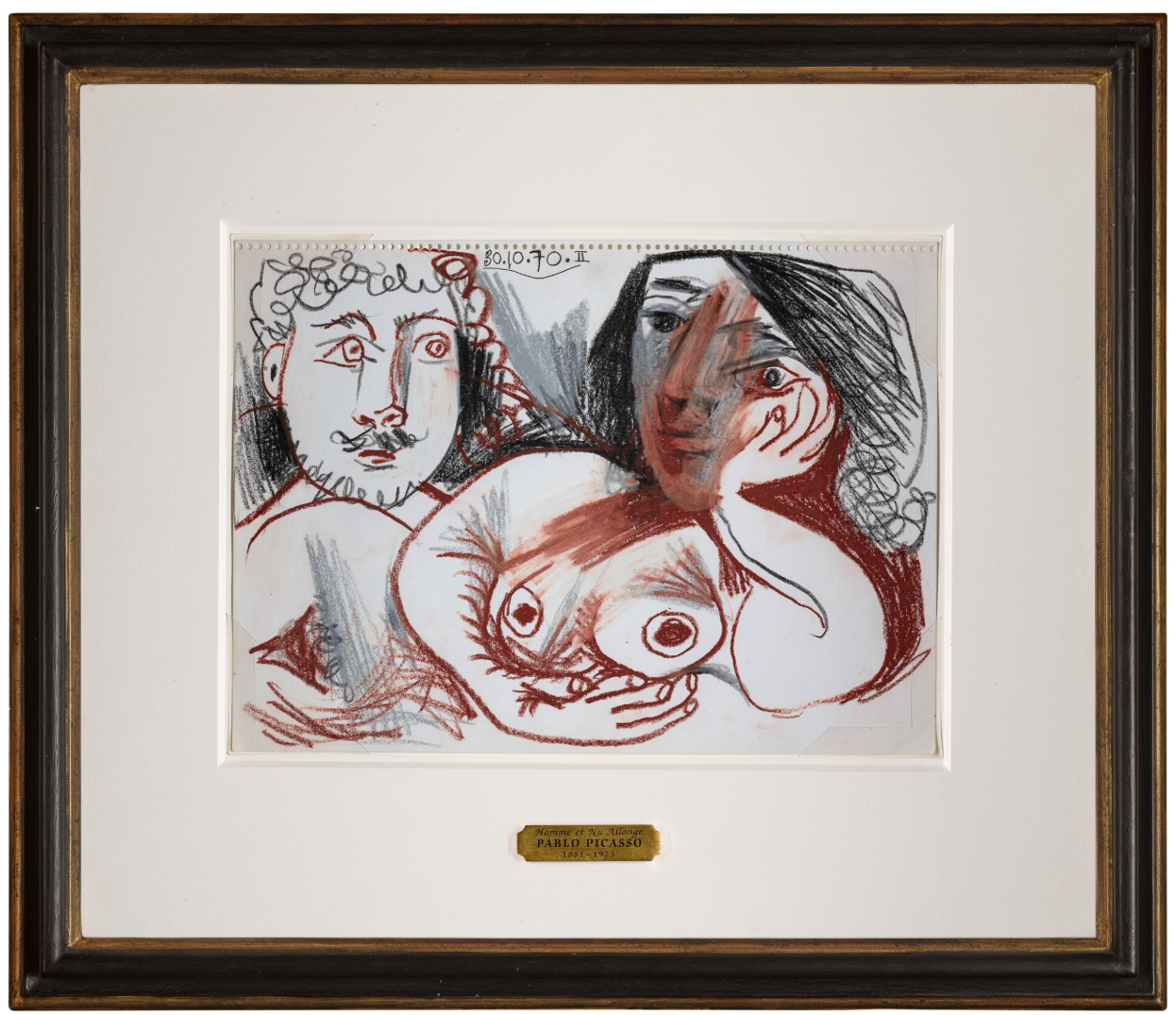
PABLO PICASSO (1881 – 1973)
Homme et nu allongé, 1970
Wax crayon on paper
26.8 x 37 cm (10 1/2 x 14 1/2 inches)
Dated 30.10.70. and numbered II (upper centre)
2024 Auction Results
Works on Paper sold for more than USD 200,000
34 lots sold at auction in 2024 for a total turnover of USD 22,378,140. The highest price was achieved by Femme et jeune garcon nus, a work on paper dated 1969 that sold at Christie’s in New-York, on 19 November 2024, for USD 2,712,000.
#1. Femme et jeune garçon nus, 1969
Christie’s New-York: 19 November 2024
Estimated: USD 1,000,000 – 1,500,000
USD 2,712,000
PABLO PICASSO (1881-1973), Femme et jeune garçon nus | Christie’s
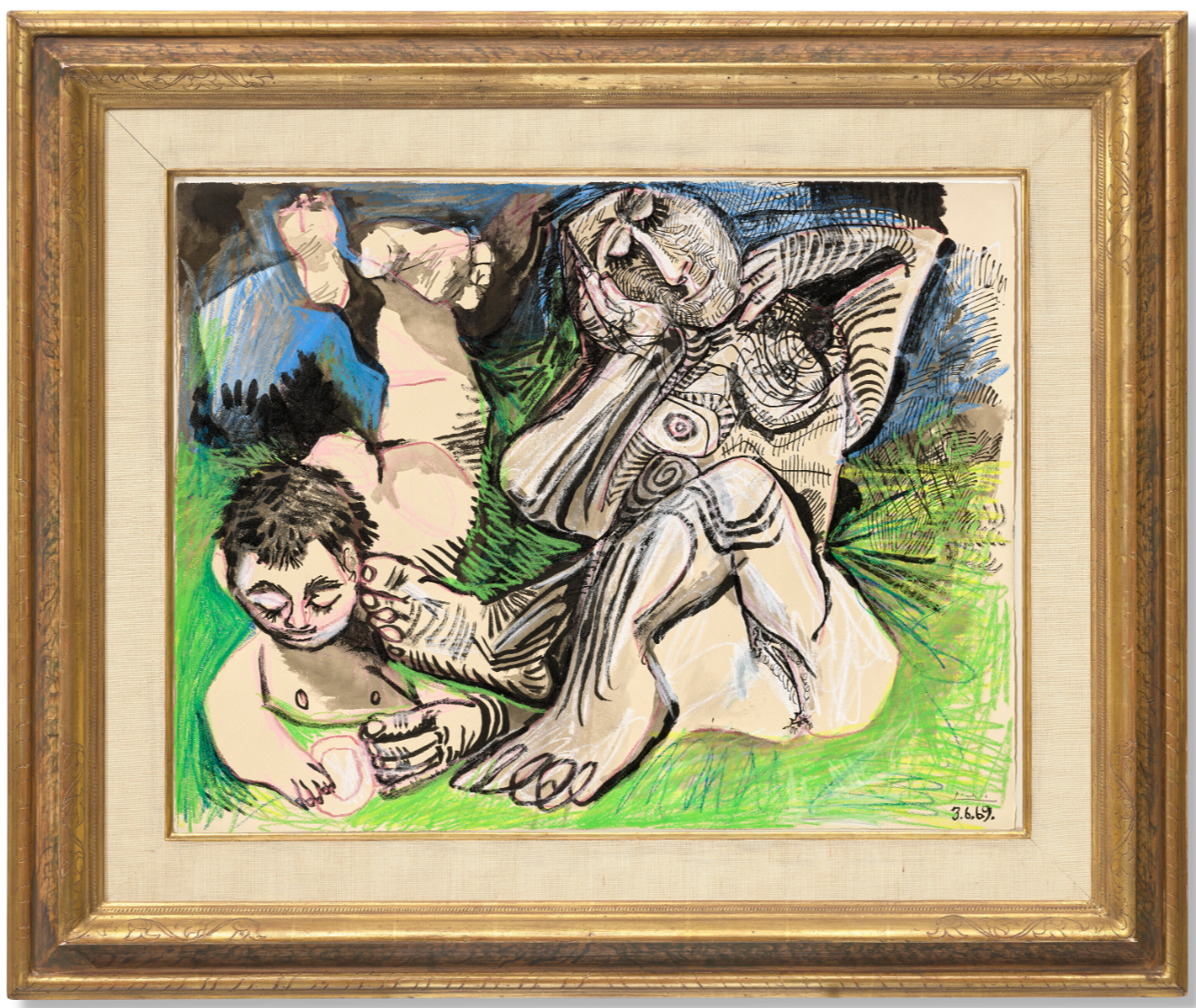
PABLO PICASSO (1881-1973)
Femme et jeune garçon nus, 1969
Oil sticks and brush and pen and India ink and wash on paper
49.2 x 65.4 cm (19 3/8 x 25 3/4 inches)
Signed and dated ‘Picasso 3.6.69.’ (lower right)
Dated ‘Mardi 3.6.69.-8.6.69.’ (on the reverse)
#2. Femme assise dans un fauteuil, 1942
Christie’s London: 7 March 2024
Estimated: GBP 1,200,000 – 1,800,000
GBP 1,492,000 / USD 1,900,190
https://www.christies.com/en/lot/lot-6469769
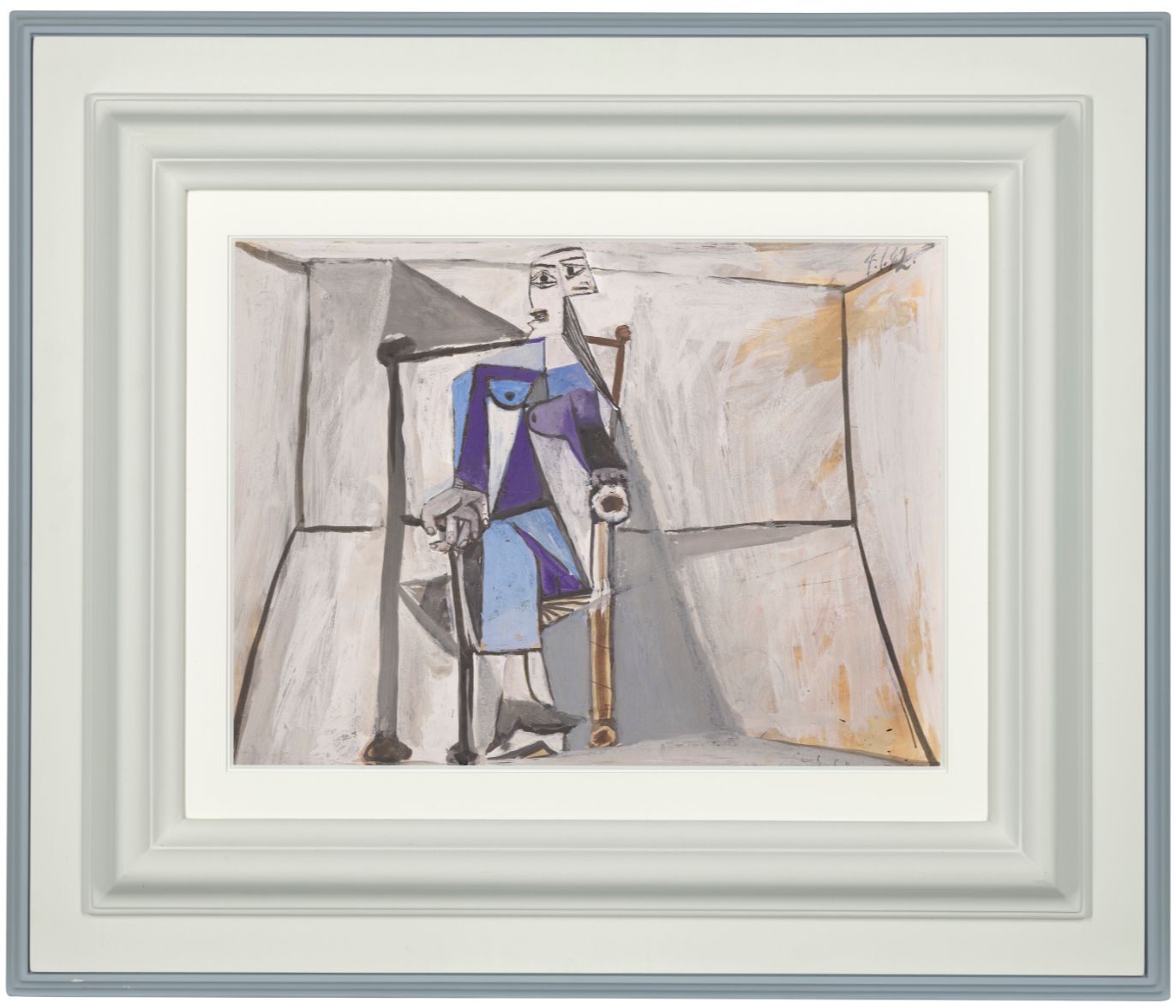
PABLO PICASSO (1881-1973)
Femme assise dans un fauteuil, 1942
Gouache on paper
30.4 x 40.6 cm (12×16 inches)
Signed ‘Picasso’ (lower right) and dated ‘4.1.42’ (upper right); dated again ‘4.1.42’ (on the reverse)
Painted on 4 January 1942
#3. Buste d’homme à la pipe, 1969
Christie’s London: 9 October 2024
Estimated: GBP 600,000 – 800,000
GBP 1,153,200 / USD 1,510,520
PABLO PICASSO (1881-1973), Buste d’homme à la pipe | Christie’s
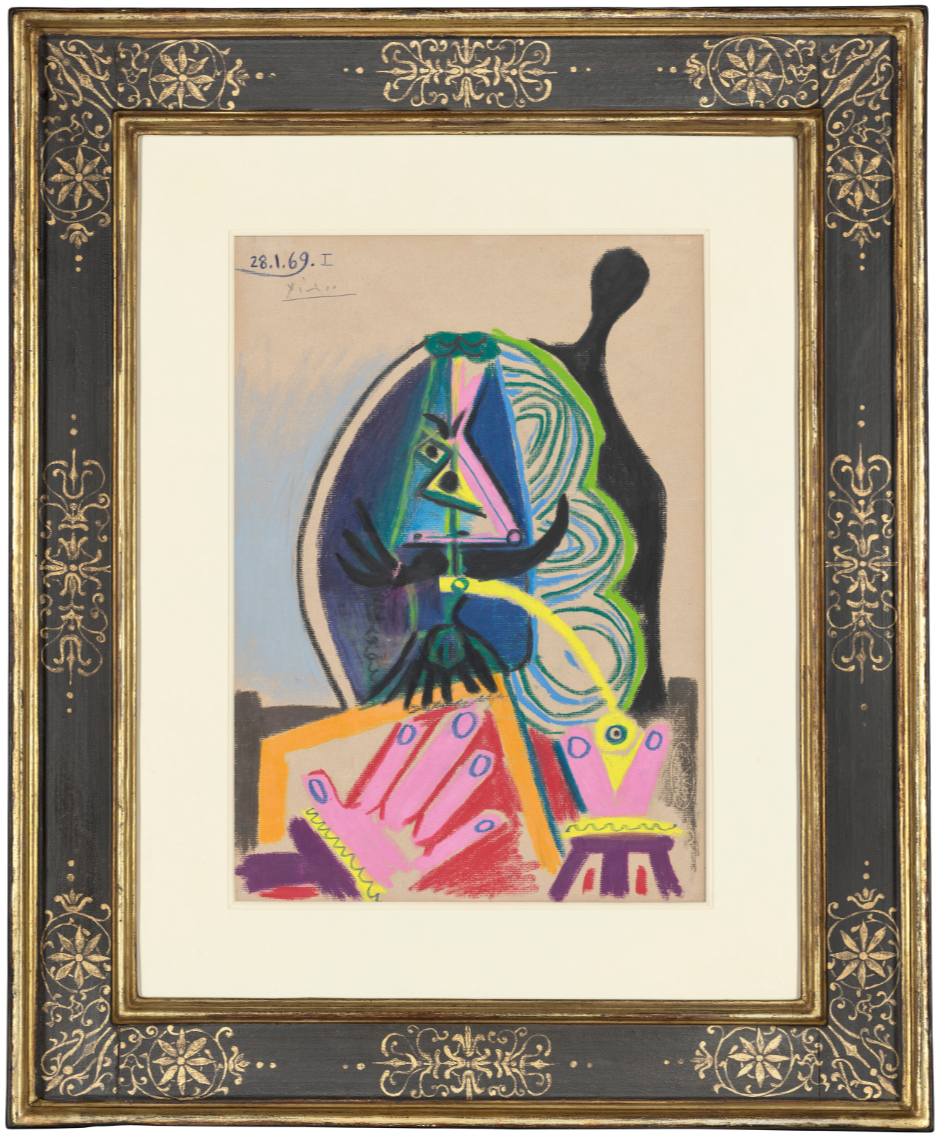
PABLO PICASSO (1881-1973)
Buste d’homme à la pipe, 1969
Wax crayon on paper
44.5 x 31 cm (17 1/2 x 12 1/8 inches)
Signed, dated and inscribed ‘Picasso 28.1.69.I’ (upper left)
Executed in Mougins on 28 January 1969
#4. Femme assise (Dora Maar), 1938
Christie’s New-York: 16 May 2024
Estimated: USD 2,000,000 – 3,000,000
USD 1,502,000
https://www.christies.com/en/lot/lot-6482938
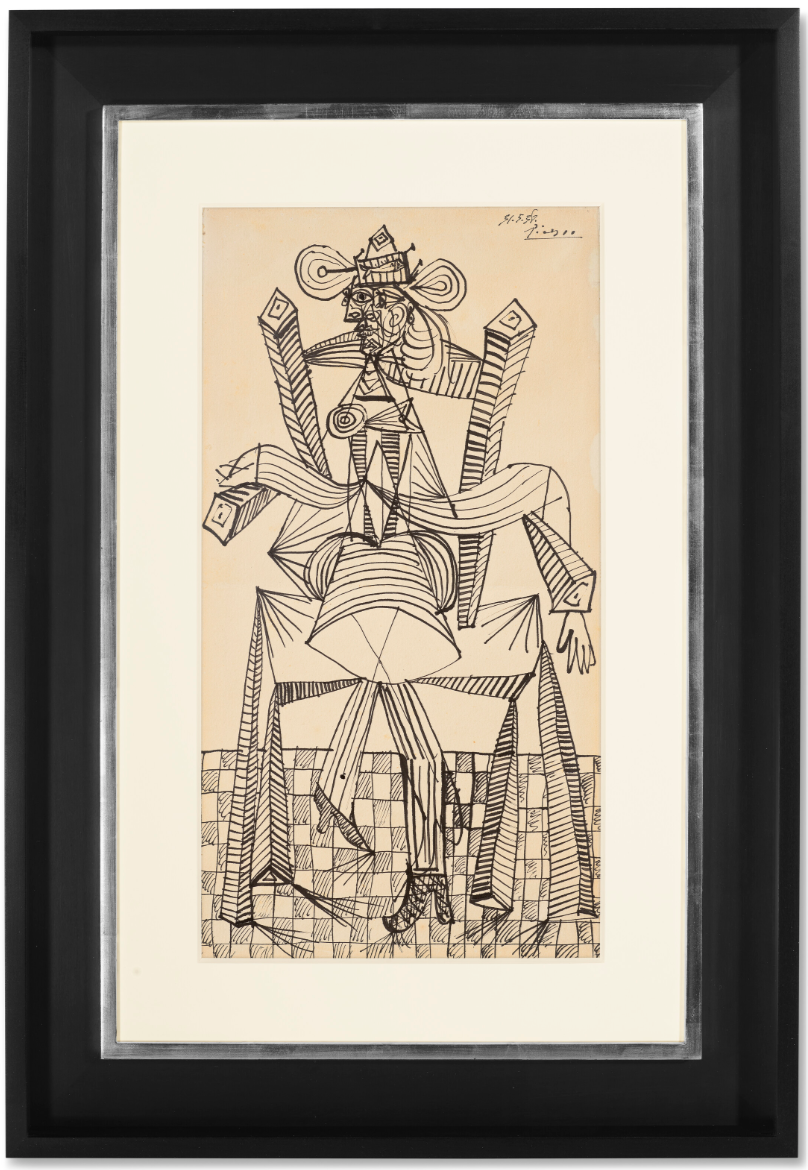
PABLO PICASSO (1881-1973)
Femme assise (Dora Maar), 1938
Pen and India ink on paper
45.9 x 24.5 cm (17 7/8 x 9 5/8 inches)
Signed and dated ‘31.5.38. Picasso’ (upper right)
Drawn in Paris on 31 May 1938
#5. La Suite Vollard, 1930-1937
Christie’s New-York: 18 May 2024
Estimated: USD 800,000 – 1,200,000
USD 1,184,400
PABLO PICASSO (1881-1973), La Suite Vollard | Christie’s (christies.com)
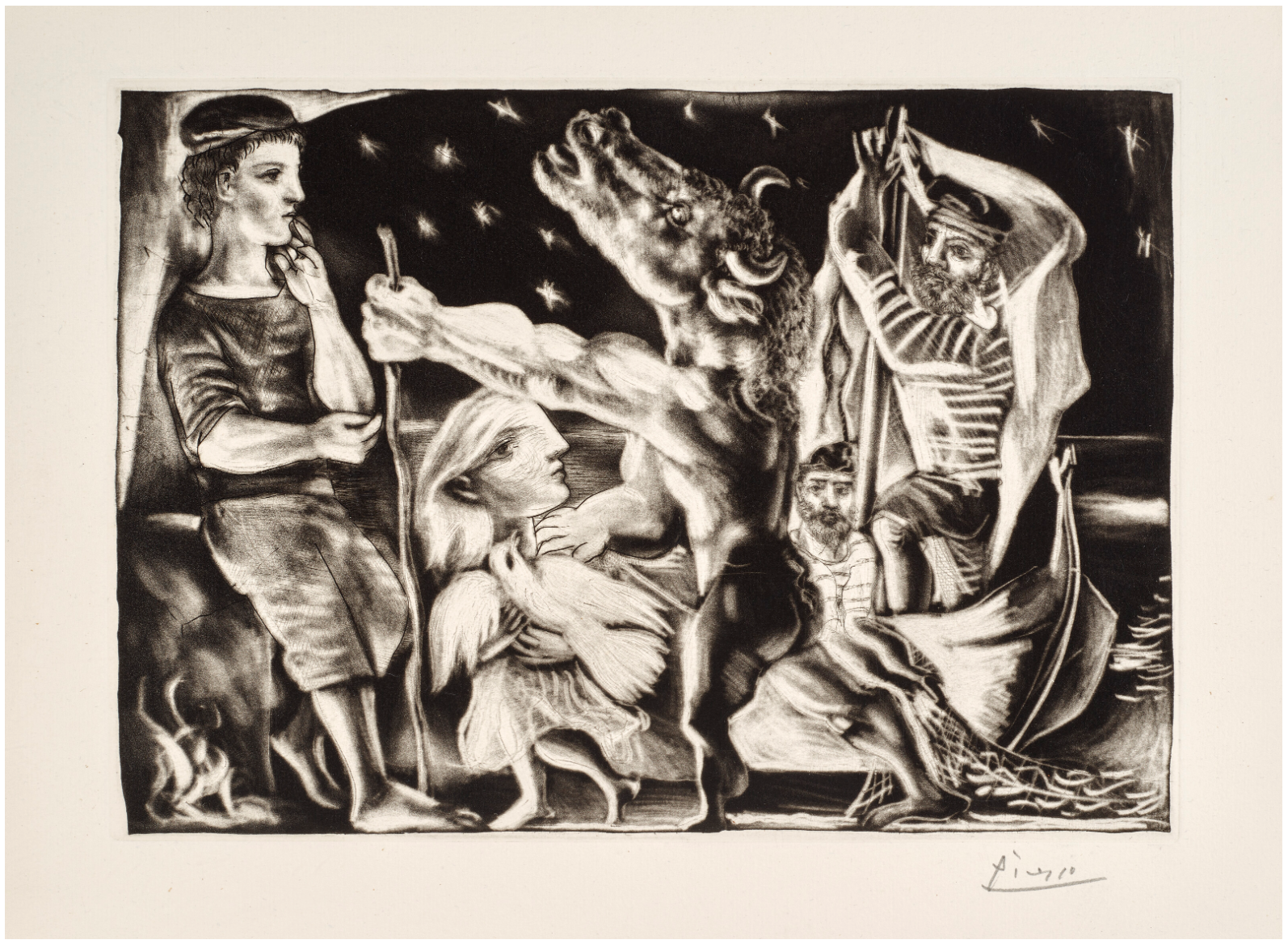
PABLO PICASSO (1881-1973)
La Suite Vollard, 1930-1937
The rare complete set of one hundred etchings, aquatints and drypoints on Montval laid paper, watermarked Picasso or Vollard
Of which fifty signed ‘Picasso’ (lower right)
Each Sheet: 34 x 44.5 cm (13 3/8 x 17 1/2 inches)
This set is from the edition of 260 published by Ambroise Vollard, Paris, 1939
#8. L’Enlèvement, 1933
Sotheby’s New-York: 15 May 2024
Estimated: USD 1,200,000 – 1,800,000
USD 762,000
L’Enlèvement | Modern Evening Auction | 2024 | Sotheby’s (sothebys.com)
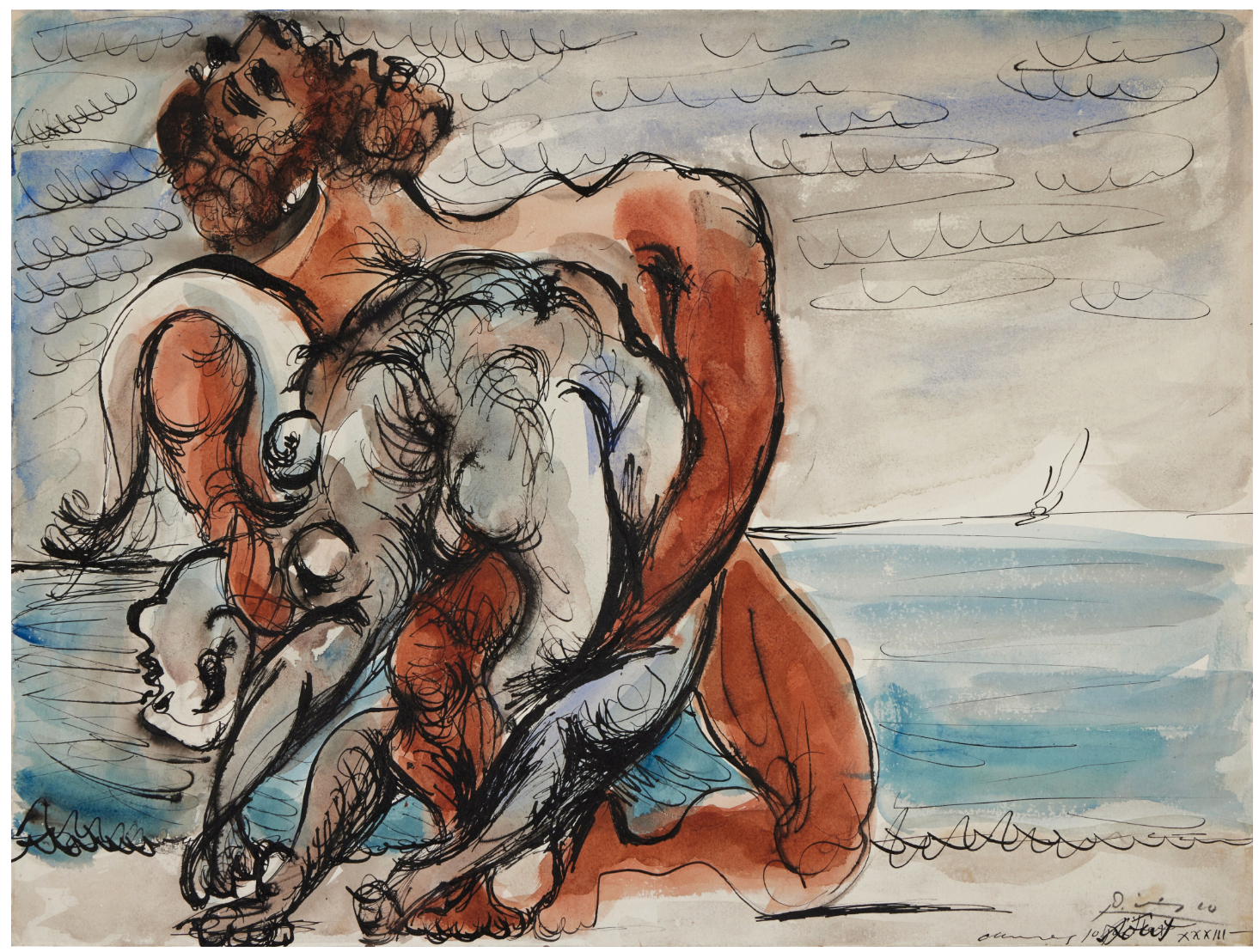
PABLO PICASSO (1881 – 1973)
L’Enlèvement, 1933
Pen and ink and watercolor and wash on paper
33.9 x 44.9 cm (13 1/4 x 17 3/4 inches)
Signed Picasso, dated Cannes 10 Août XXXIII, and illegibly inscribed (lower right)
Executed in Cannes on 10 August 1933
#6. Scène de cirque, 1968
Christie’s London: 7 March 2024
Estimated: GBP 375,000 – 575,000
GBP 478,800 / USD 609,790
PABLO PICASSO (1881-1973), Scène de cirque | Christie’s (christies.com)
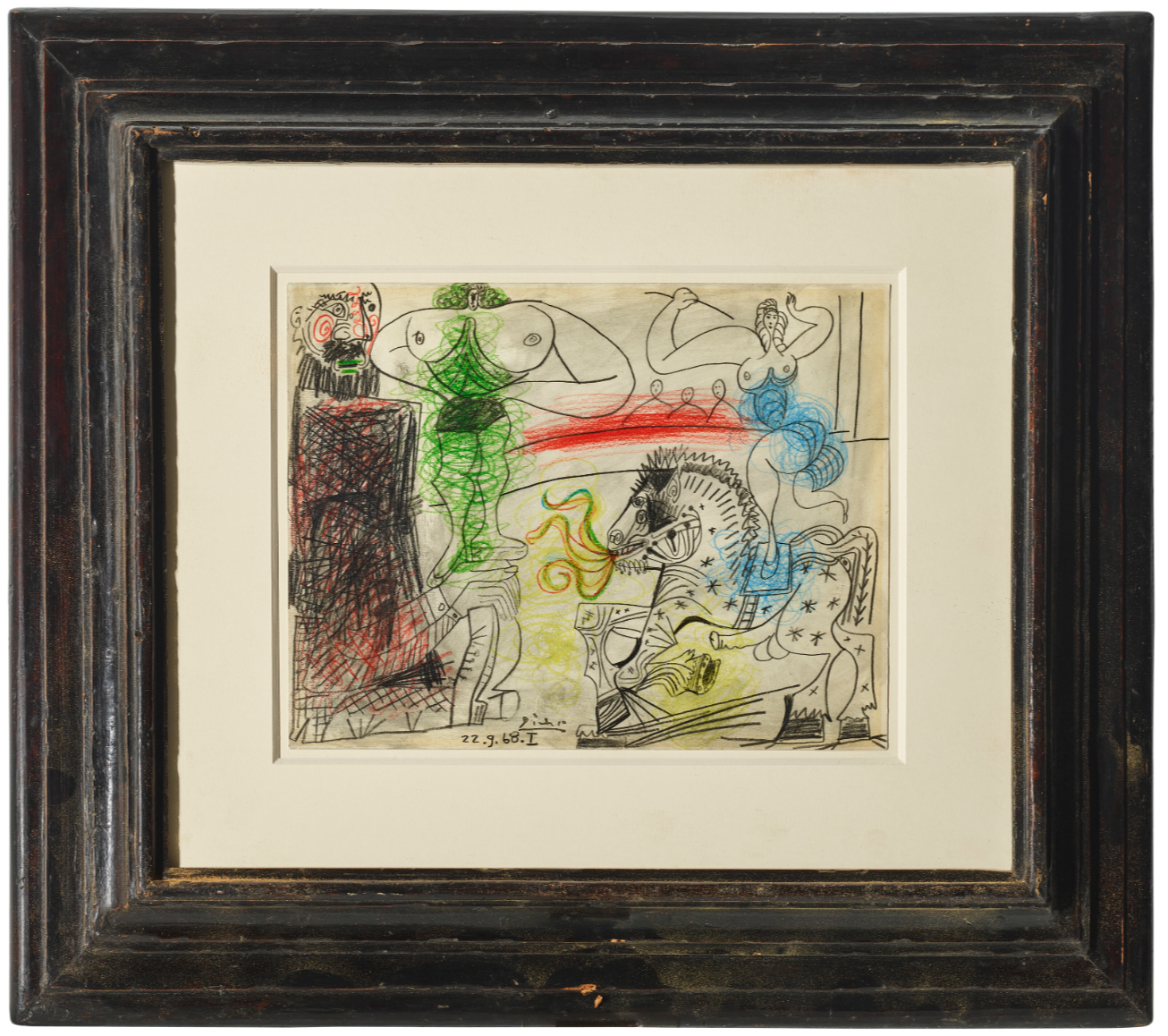
PABLO PICASSO (1881-1973)
Scène de cirque, 1968
Colored wax crayons and pencil on paper
24 x 31.3 cm (9 3/8 x 12 1/8 inches)
Signed, dated and numbered ‘Picasso 22.9.68.I’ (lower centre)
Dated again ‘Dimanche 22.9.68.’ (on the reverse)
Drawn in Mougins on 22 September 1968
#7. Femme nue couchée, 1966
Christie’s London: 8 March 2024
Estimated: GBP 300,000 – 500,000
GBP 378,000 / USD 484,400
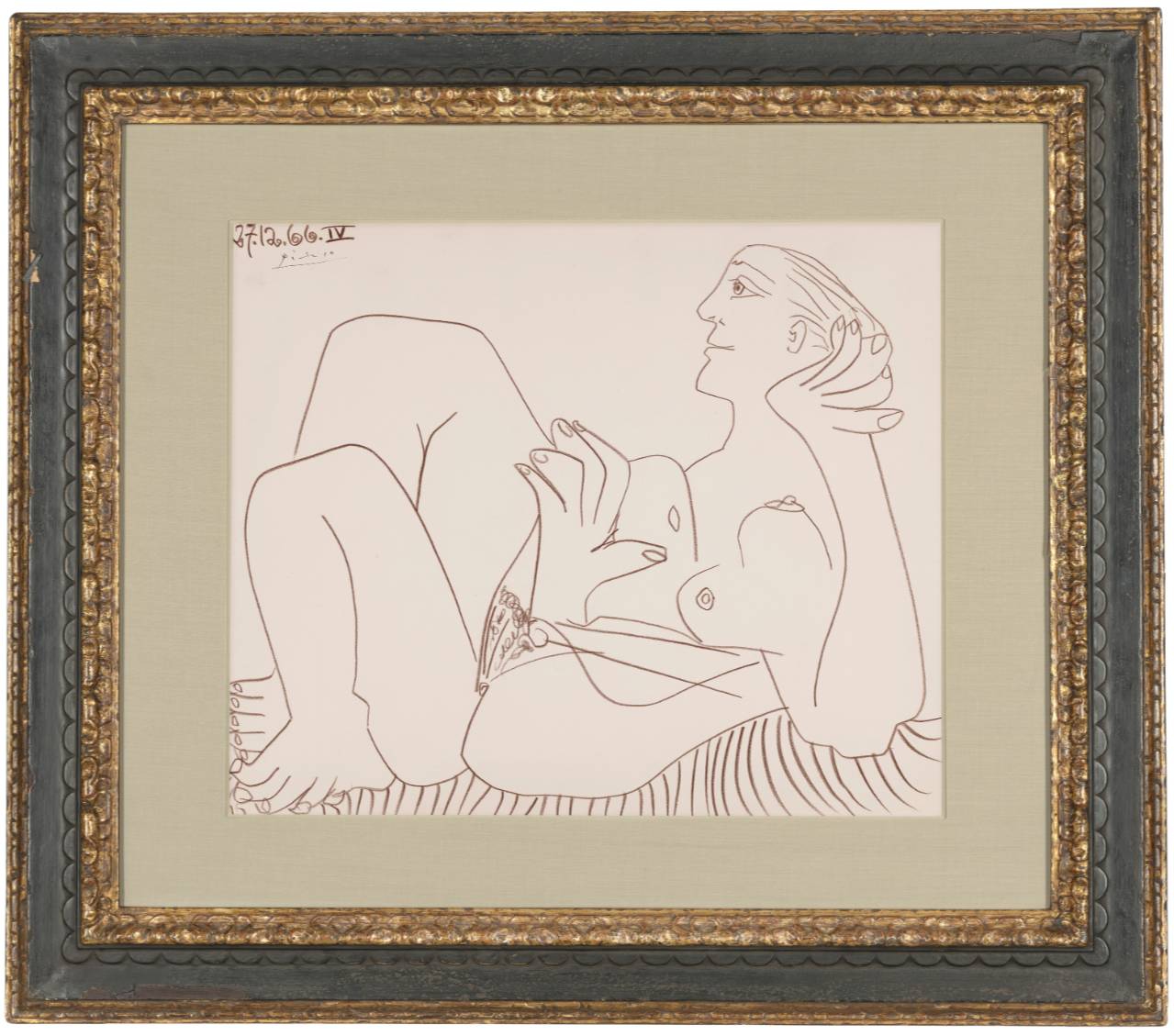
PABLO PICASSO (1881-1973)
Femme nue couchée, 1966
Conté crayon on paper
46 x 54.6 cm (18 1/8 x 21 1/2 inches)
Signed, dated and numbered ‘Picasso 27.12.66.IV’ (upper left)
Executed on 27 December 1966
#8. Tête d’homme au casque, armure et epée, 1969
Sotheby’s New-York: 16 May 2024
Estimated: USD 180,000 – 250,000
USD 317,500
Tête d’homme au casque, armure et epée | Modern Day Auction | 2024 | Sotheby’s (sothebys.com)
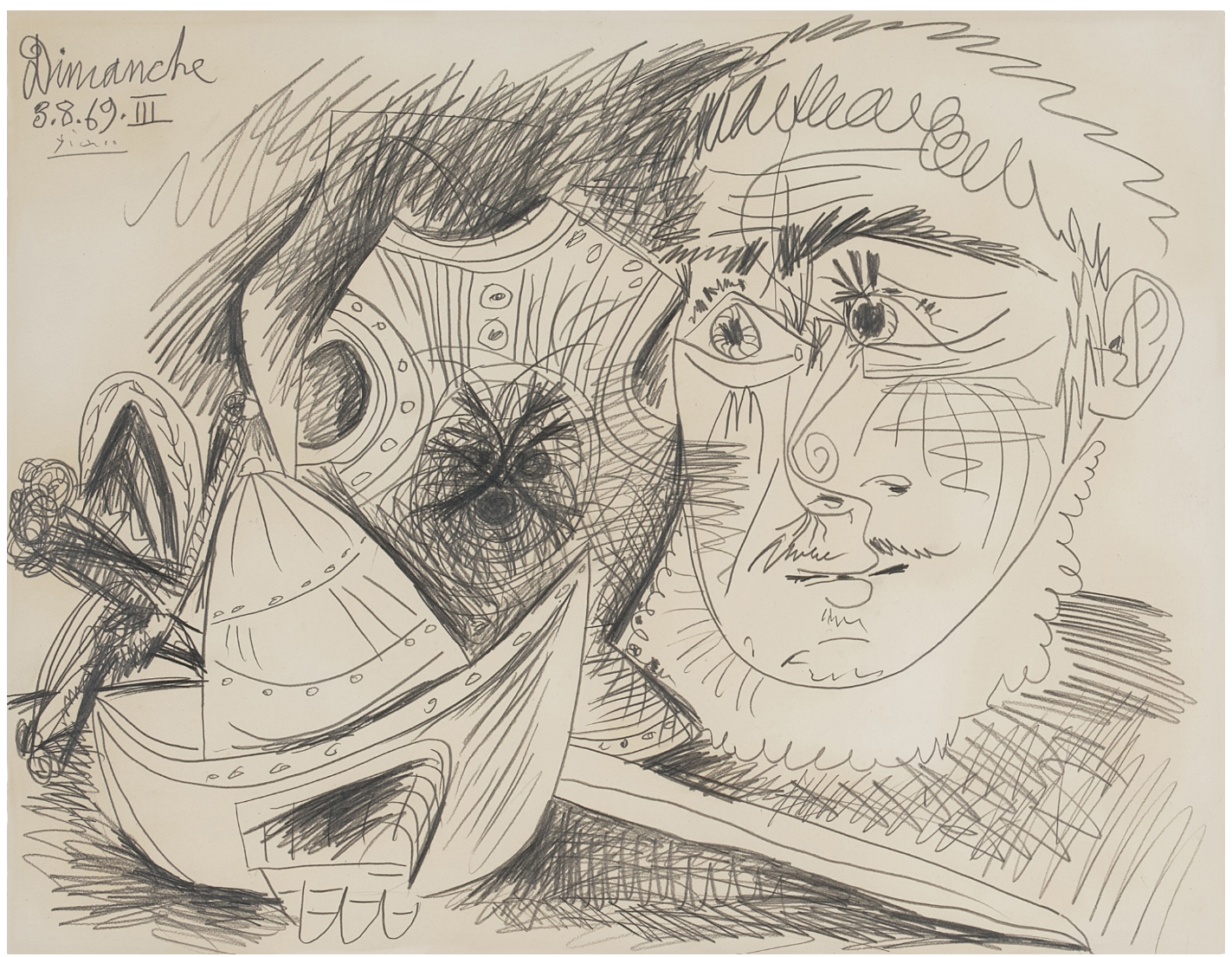
PABLO PICASSO (1881 – 1973)
Tête d’homme au casque, armure et epée, 1969
Pencil on paper
50.5 x 64.8 cm (19 7/8 x 25 1/2 inches)
Signed Picasso and dated Dimanche 3.8.69.III (upper left)
Executed on 3 August 1969
2023 Auction Results
WORK IN PROGRESS
#1. Le repas frugal, 1904
Christie’s New-York: 11 May 2023
Estimated: USD 3,000,000 – 5,000,000
USD 4,648,000
PABLO PICASSO (1881-1973), Le repas frugal | Christie’s (christies.com)
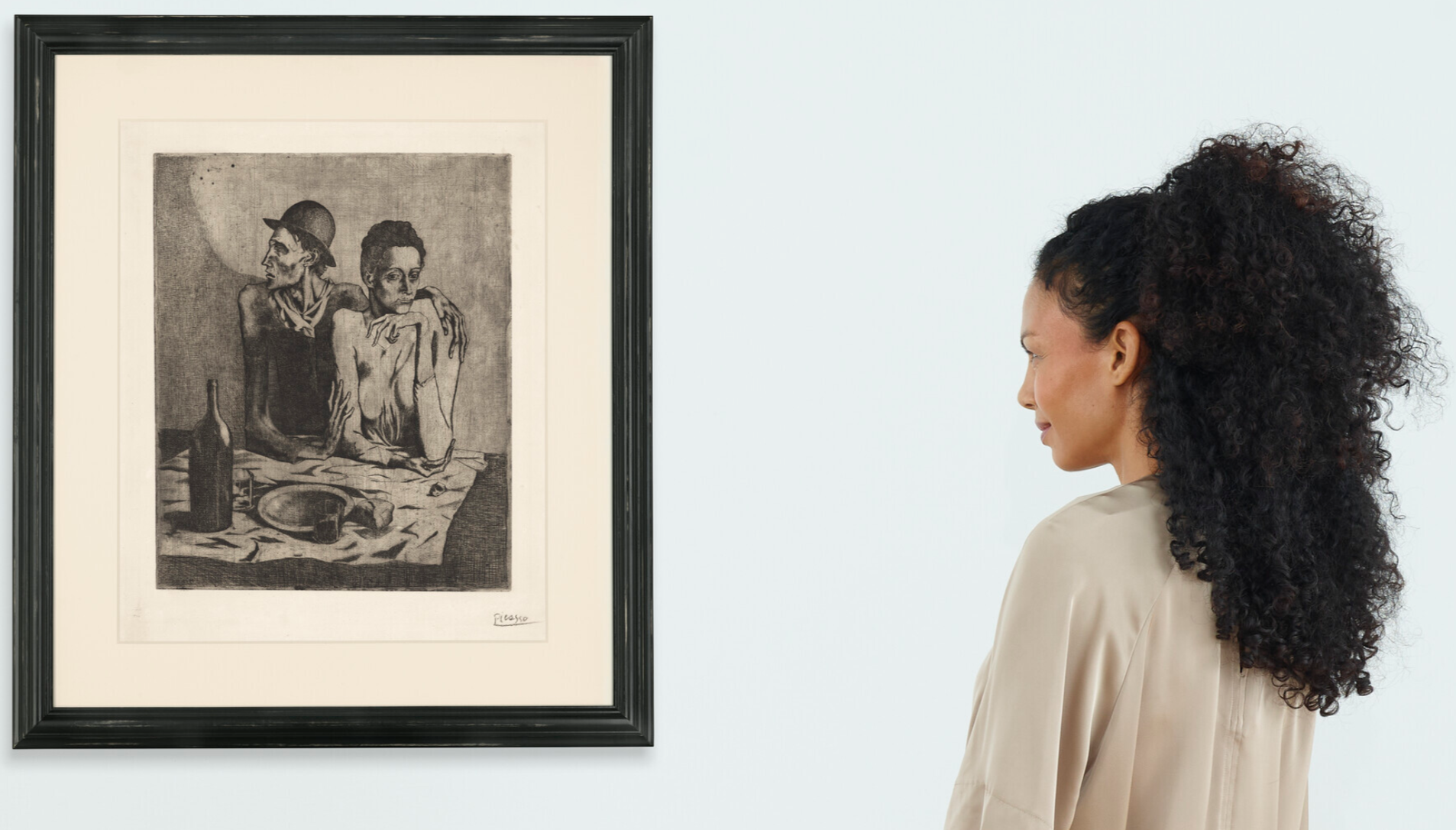
PABLO PICASSO (1881-1973)
Le repas frugal, 1904
Etching and scraper on laid Arches paper
A very fine and early impression of Baer’s second state before steel-facing
Plate: 46.3 x 37.7 cm (18 1/4 x 14 3/4 inches)
Sheet: 58.4 x 46.5 cm (23 x 18 1/4 inches)
Signed ‘Picasso’ (in pencil, lower right)
Printed by Auguste Delâtre, Paris, circa 1904-05
#2. La Femme qui pleure I, 1937
Sotheby’s New-York: 16 May 2023
Estimated: USD 1,500,000 – 2,500,000
USD 1,650,000
La Femme qui pleure I | The Mo Ostin Collection Evening Auction | 2023 | Sotheby’s (sothebys.com)
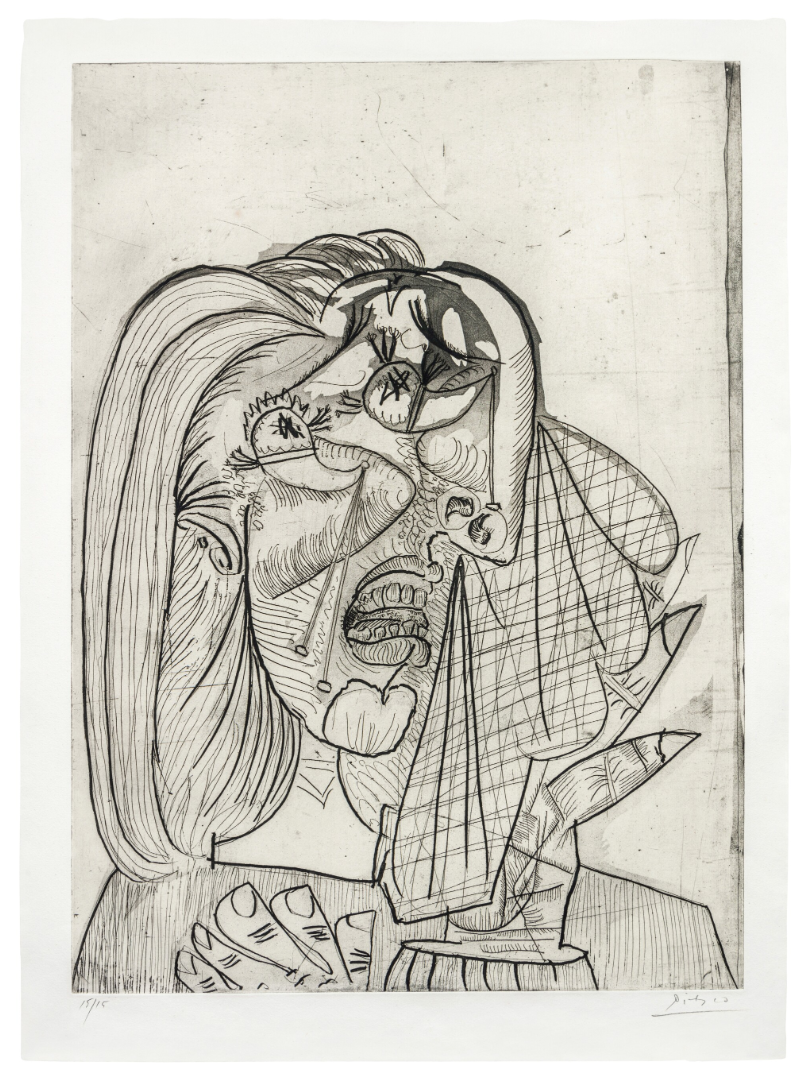
PABLO PICASSO (1881 – 1973)
La Femme qui pleure I, 1937
Drypoint, aquatint, etching and scraper on Montval laid paper
Plate: 69.2 x 49.5 cm (27 1/4 x 19 1/2 inches)
Sheet: 77.5 x 56.2 cm (30 1/2 x 22 1/8 inches)
Signed in pencil (lower right) and numbered 15/15 (lower left)
Very fine impression of the extremely rare subject numbered 15 from the edition of 15 of Baer’s third state (of seven)
Printed by Lacourière
#3. Saltimbanque accoudé, 1922
Sotheby’s New-York: 16 May 2023
Estimated: USD 1,000,000 – 1,500,000
USD 1,512,000
Saltimbanque accoudé | Modern Evening Auction | 2023 | Sotheby’s (sothebys.com)
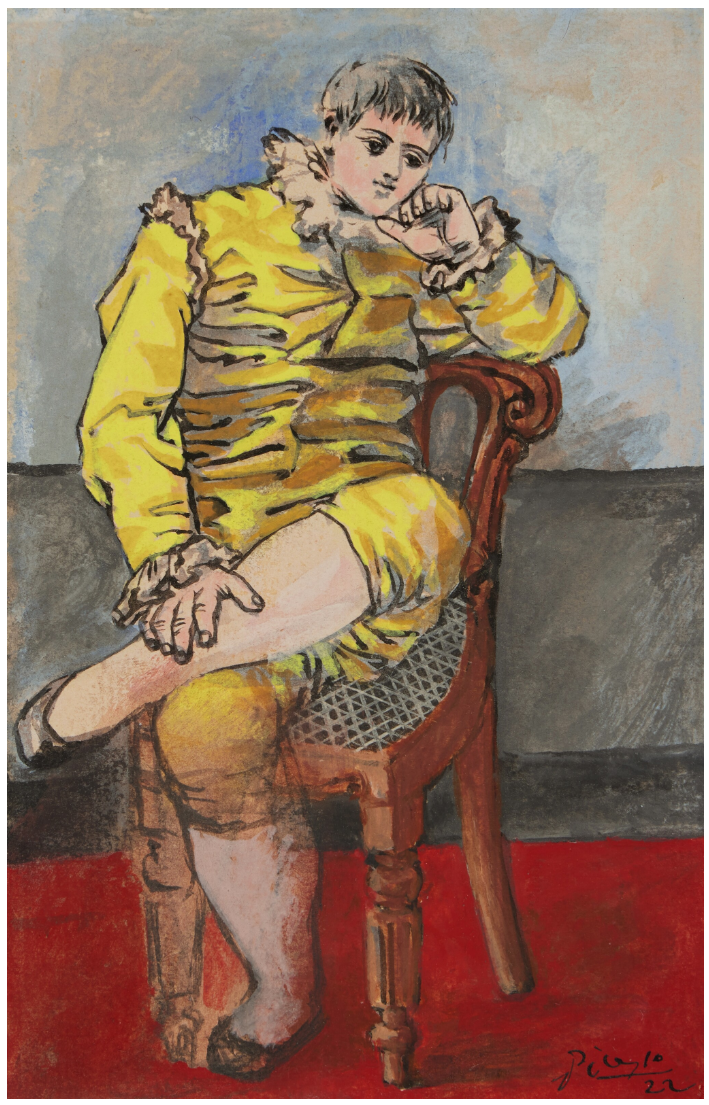
PABLO PICASSO (1881 – 1973)
Saltimbanque accoudé, 1922
Watercolor and brush and ink on paper
16.5 x 10.5 cm (6 1/2 x 4 1/8 inches)
Signed Picasso and dated 22 (lower right); dated 26 Decembre 1922 (on the verso)
Executed on 26 December 1922
#4. Tête, 1972
Sotheby’s London: 1 March 2023
Estimated: GBP 800,000 – 1,200,000
GBP 1,197,500 / USD 1,427,750
Tête | Modern & Contemporary Evening Auction | 2023 | Sotheby’s (sothebys.com)
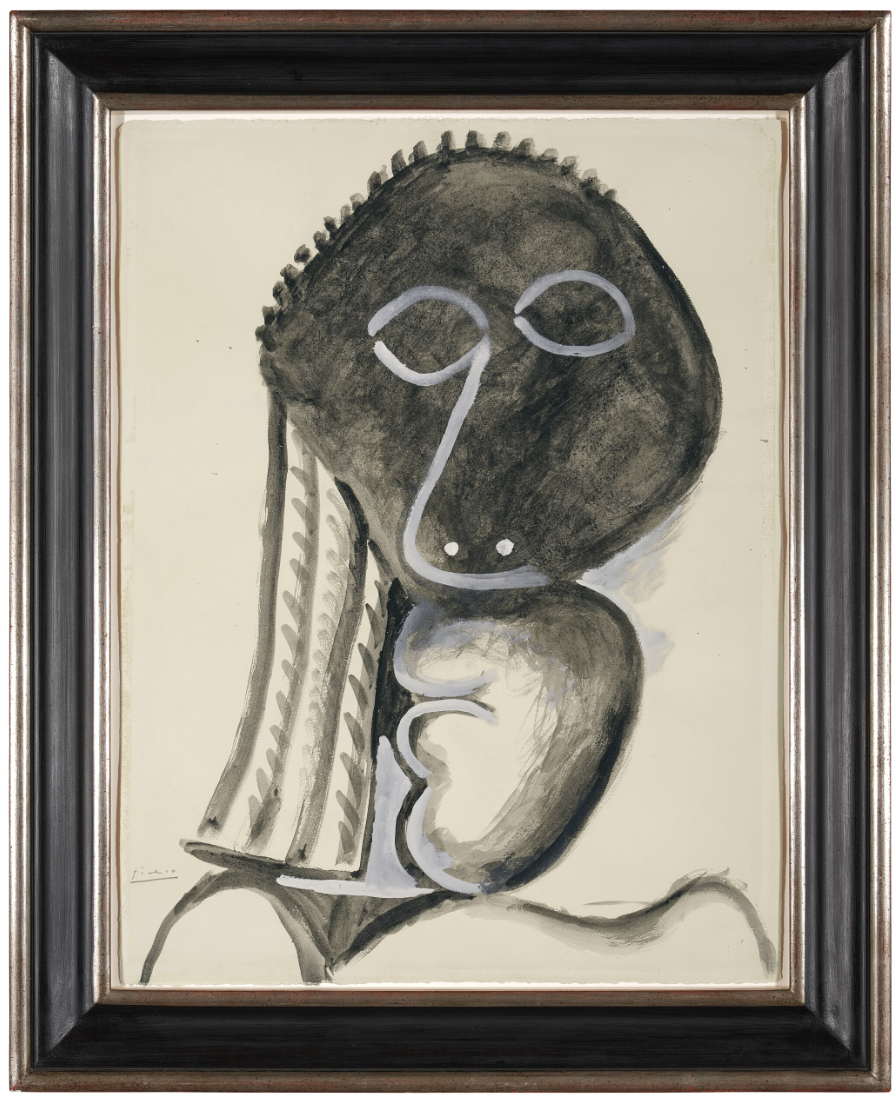
PABLO PICASSO (1881 – 1973)
Tête, 1972
Gouache and ink on paper
65.6 x 50.2 cm (25 7/8 x 19 3/4 inches)
Signed Picasso (lower left); dated 29.6.72. on the reverse
Executed in Mougins on 29 June 1972
#5. Homme au tricot rayé assis, 1939
Sotheby’s Paris: 19 April 2023
Estimated: EUR 700,000 – 1,000,000
EUR 1,016,000 / USD 1,115,072
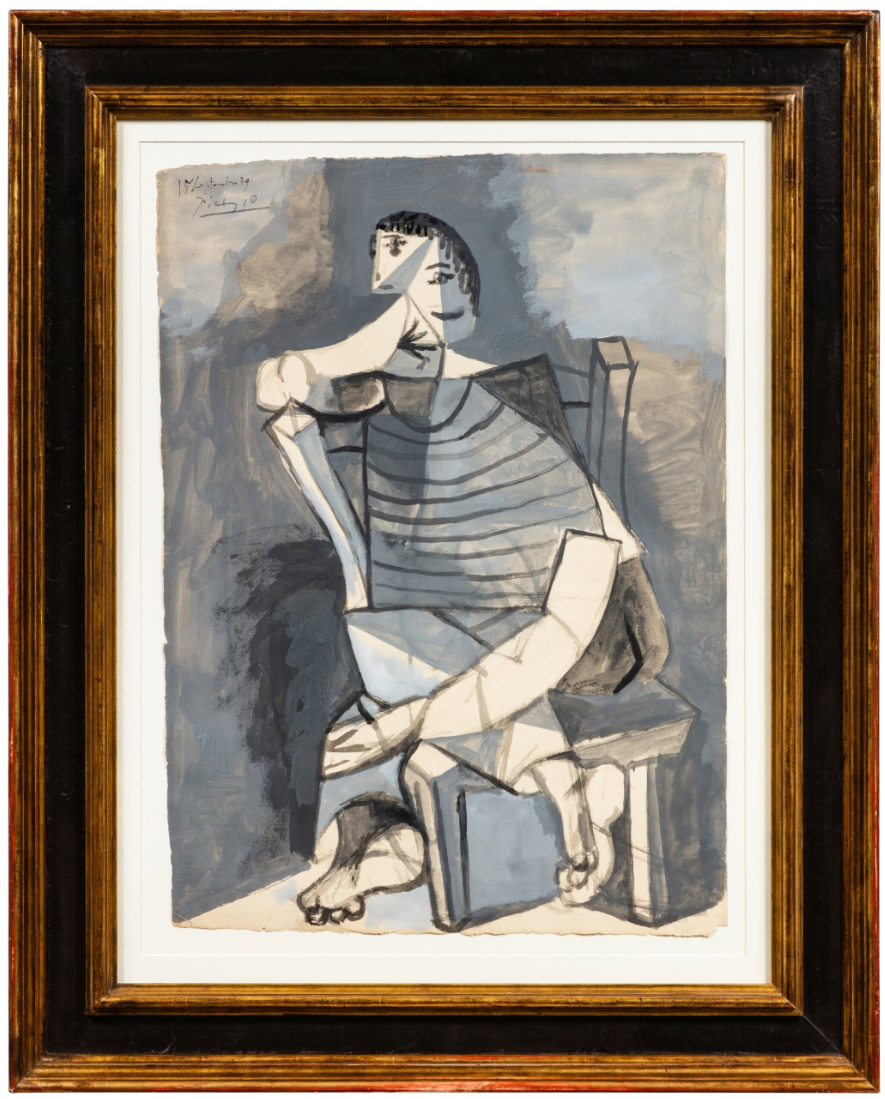
PABLO PICASSO (1881 – 1973)
Homme au tricot rayé assis, 1939
Gouache on paper
64.2 x 46 cm (25 1/4 x 18 1/8 inches)
Dated 15 Septembre 39 and signed Picasso (upper left)
Executed on September 15th, 1939
Highlights
Femme et jeune garçon nus, 1969
Christie’s New-York: 19 November 2024
Estimated: USD 1,000,000 – 1,500,000
USD 2,712,000
PABLO PICASSO (1881-1973), Femme et jeune garçon nus | Christie’s
PABLO PICASSO (1881-1973)
Femme et jeune garçon nus, 1969
Oil sticks and brush and pen and India ink and wash on paper
49.2 x 65.4 cm (19 3/8 x 25 3/4 inches)
Signed and dated ‘Picasso 3.6.69.’ (lower right)
Dated ‘Mardi 3.6.69.-8.6.69.’ (on the reverse)
Pablo Picasso’s Femme et jeune garçon nus is a vibrant and complex work on paper, executed over the course of five days in June 1969 at the artist’s villa in Mougins. Using a masterful network of rhythmic lines in pen, along with rich brushstrokes of India ink and colored crayons, the present work offers a vision of a bucolic idyll in which two nude figures recline amid the landscape.
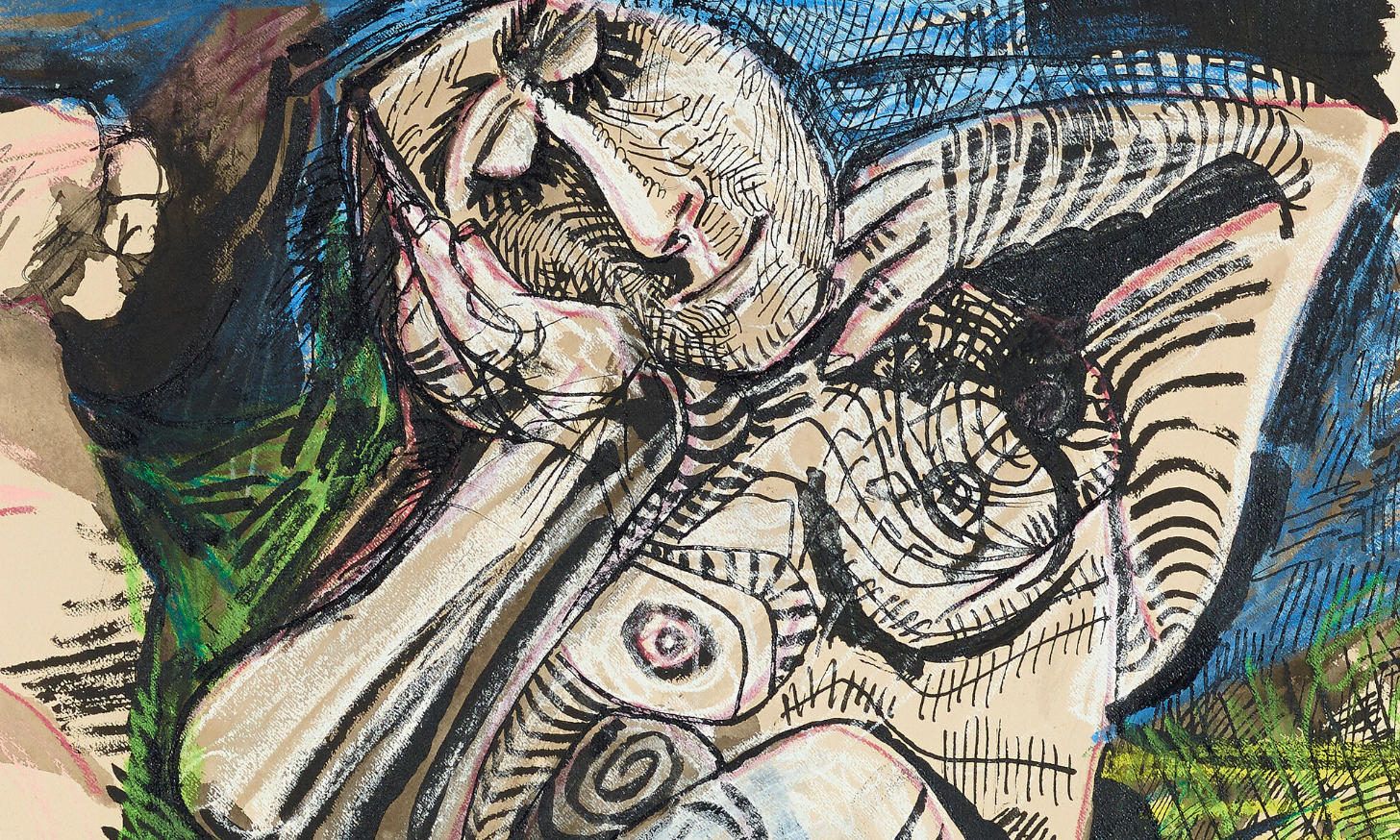
To the left, a young boy lies on his front, playfully kicking his feet up behind him. His gaze shies away from the viewer, but a slight smile lingers. He is perhaps a congenial cupid, a character also found in a number of Picasso’s Mousquetaires from this same year (Zervos, vol. 31, nos. 66, 67, 71, 73 and 78). Alongside this pre-adolescent youth, a woman dozes serenely, her head lolling into her cupped palm, her anatomy described in bold, swirling contour lines that emphasize the swell of her breasts, ankles, calves and biceps. She is perhaps a manifestation of Jacqueline Roque, whom Picasso married in 1961, and whose presence permeated the artist’s work from the mid-1950s until his death. Although Roque does not appear to have formally posed as a model for Picasso, she captivated his imagination, and her essence is inexorably woven through his art of this period.
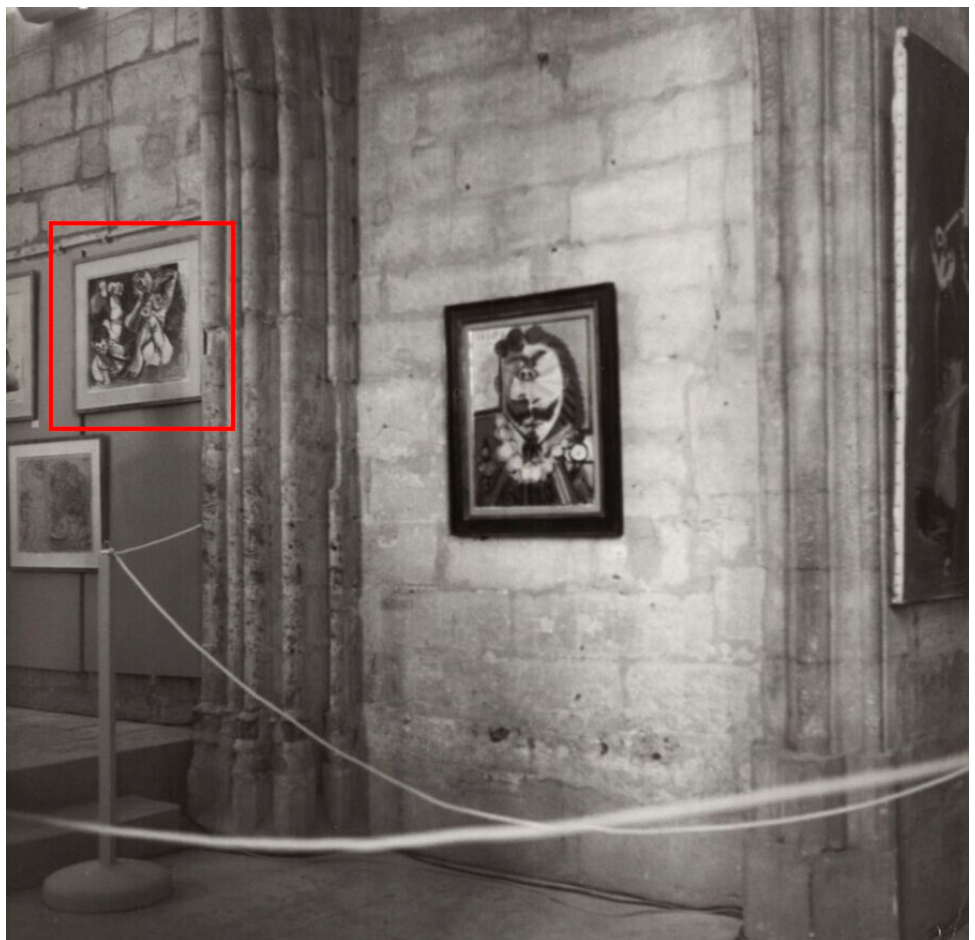
Present lot exhibited in Pablo Picasso, 1969-1970, May – September 1970, Palais des Papes, Avignon.
© 2024 Estate of Pablo Picasso / Artists Rights Society (ARS), New York.
1969—the year in which Femme et jeune garçon nus was executed—was one of the most prolific of Picasso’s entire career. To celebrate this creative abundance, Christian and Yvonne Zervos organized the landmark exhibition, Pablo Picasso, 1969-1970, at the Palais des Papes in Avignon, France. The exhibition, which featured the present work, marked a public unveiling of Picasso’s “Great Late Phase,” and reaffirmed his place as one of the most important artists of the twentieth century.
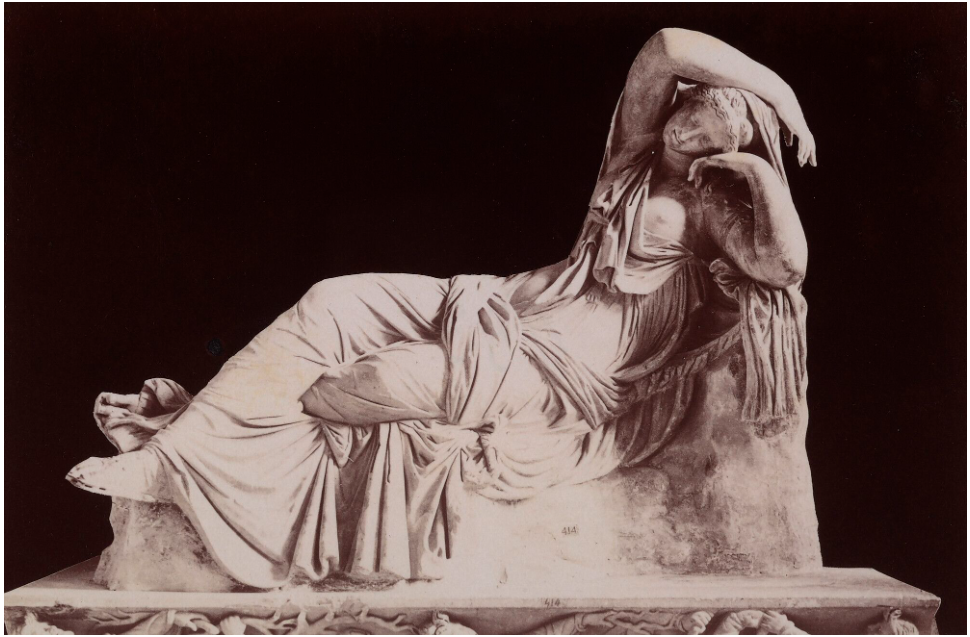
Ariadne Sleeping, circa 240 BCE. Museo Pio Clementino, Vatican Museums, Vatican City. © Alinari Archives / Art Resource, NY.
The quantity of works executed over the course of 1969 reveal not only Picasso’s continued creativity in his eighty-eighth year, but also a conscious acknowledgement and assessment of his own past, as he reflected on the multitude of different styles, techniques and motifs that had marked his long career. In Femme et jeune garçon nus for example, the female protagonist’s angular and contorting limbs recall the twisting figures who appeared in Picasso’s proto-Cubist paintings from the early years of the century, such as Les demoiselles d’Avignon (Zervos, vol. 2a, no. 18; The Museum of Modern Art, New York), while the poses of both the woman and the young boy in the present work find parallels in the baigneuses from his Neo-Classical period from the 1920s. The reclining female figure’s posture, meanwhile, is also reminiscent of the Sleeping Ariadne sculptural type, a motif from antiquity that symbolizes love and its triumph over death, which Picasso had also explored at several points in his career.
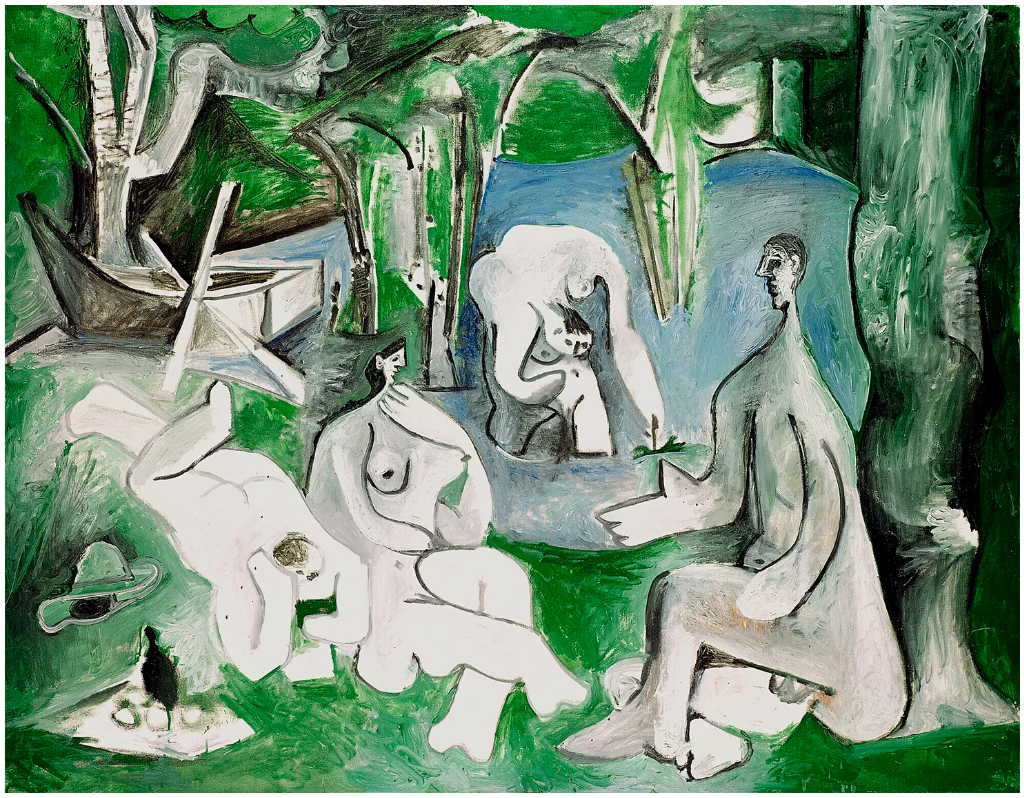
Pablo Picasso, Le déjeuner sur l’herbe, 1961. Staatsgalerie, Stuttgart. Artwork: © 2024 Estate of Pablo Picasso / Artists Rights Society (ARS), New York. Digital Image: © Succession Picasso/DACS, London 2024 / Bridgeman Images.
With its verdant pastoral backdrop and the relaxed positions of its figures, however, the present work is perhaps most closely aligned to Picasso’s Le déjeuner sur l’herbe series, which paid homage to Edouard Manet’s painting of the same title. Through the mid-1950s and early 1960s Picasso frequently alluded to his artistic predecessors in his work, measuring himself against their example—his Les femmes d’Alger suite, for example, looked back to Eugène Delacroix’s renowned 1834 painting, and in 1957 Picasso created a series of works inspired by Diego Velásquez’s Las Meninas. By interacting with both the paintings of the renowned artists who had come before him, as well as the motifs and styles that he had employed at various points over his own career, Picasso was consciously reviewing his own place within the Western art historical canon. Works such as Femme et jeune garçon nus, therefore, offer a reflection on both Picasso’s perception of the art he admired, as well as a personal meditation on his own artistic legacy.
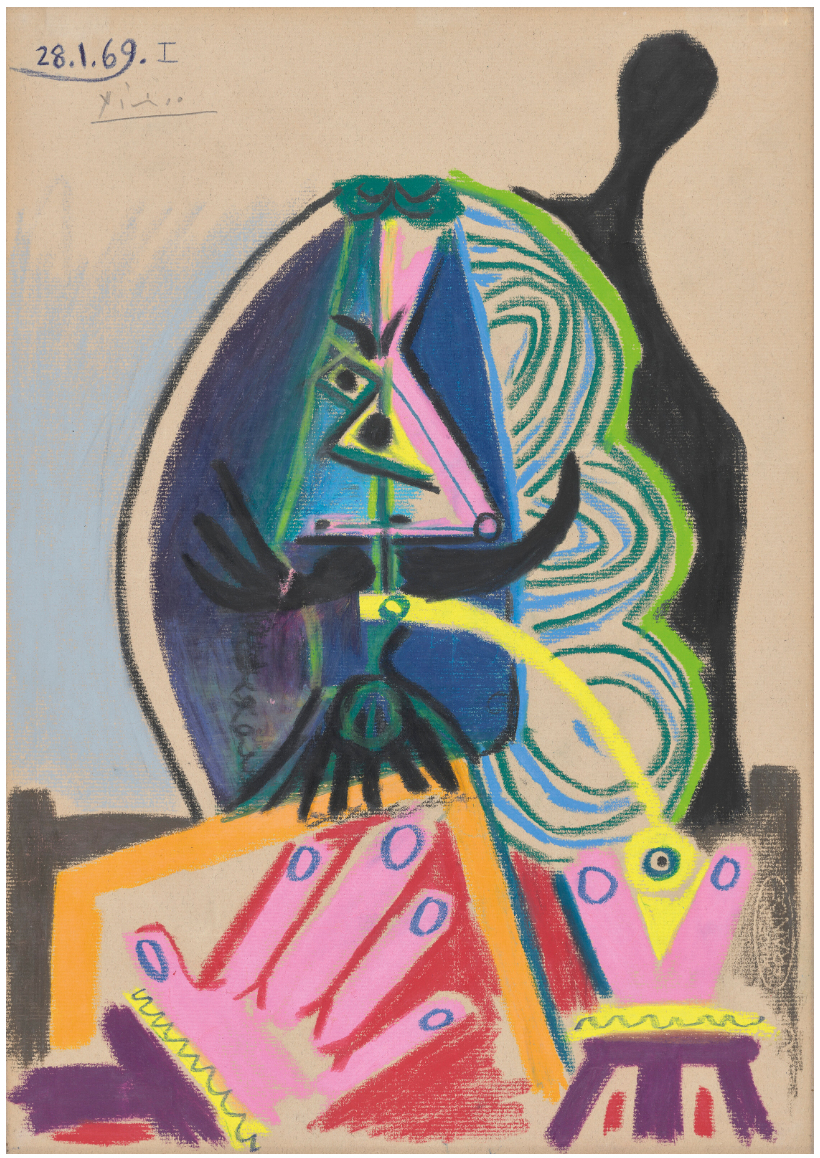
Buste d’homme à la pipe, 1969
Christie’s London: 9 October 2024
Estimated: GBP 600,000 – 800,000
GBP 1,153,200 / USD 1,510,520
PABLO PICASSO (1881-1973), Buste d’homme à la pipe | Christie’s
PABLO PICASSO (1881-1973)
Buste d’homme à la pipe, 1969
Wax crayon on paper
44.5 x 31 cm (17 1/2 x 12 1/8 inches)
Signed, dated and inscribed ‘Picasso 28.1.69.I’ (upper left)
Executed in Mougins on 28 January 1969
At the close of 1966, Pablo Picasso began to concentrate on the subject that would come to dominate his late career, that of the swashbuckling musketeer. Looking to history, fiction, and chivalric traditions, Picasso created a merry band of debonaire swordsmen, at once jocular and suave. Executed on 28 January 1969, Buste d’homme à la pipe is a witty, spirited example from this series. Like many of the other musketeers, Picasso has seated his favored character in an upright chair. Dressed in elaborate ruffles, he holds, in his left hand, the titular pipe. A skeptical, inquisitive expression graces his face as he stares boldly out at the viewer – and the world. Although Picasso had previously looked to history for inspiration, it wasn’t until 1966 that he turned his attention toward the figure of the musketeer. During a period of convalescence, he read classic works of literature including plays by Shakespeare and novels by Dickens, Balzac, and Alexandre Dumas. It was Dumas’ The Three Musketeers, which told the story of the rollicking adventures of Athos, Porthos, Aramis and their friend D’Artagnan, that so captivated Picasso. In the present work, the protagonist clutches a rectangular object to his chest, perhaps a book in a nod to this literary influence. The first oil painting of the series was completed in February 1967, with numerous canvases and works on paper following in its wake. Across these, the musketeers flirt and cavort; they are wry, dashing, impish, droll. Picasso felt such affection for his musketeers that he gave them attributes and personalities, and the writer Hélène Parmelin recalled how he would joke around with his paintings, pointing to one figure or another.
“With this one you’d better watch out. That one makes fun of us. That one is enormously satisfied. This one is a grave intellectual. And that one look how sad he is, the poor guy. He must be a painter.”
Picasso’s fascination with the musketeer appears to have been the logical next step in his ongoing dialogue with the art of the past. He had, during these years, begun to re-examine the painters he would have studied as a young artist, first at Madrid’s Real Academia de Bellas Artes de San Fernando, and later at Barcelona’s School of Fine Arts. Beginning in the mid-1950s, Picasso took on the masterpieces of his predecessors, reinterpreting and reimagining iconic works such as Diego Velázquez’s Las Meninas and Eugène Delacroix’s Les femmes d’Alger.
It was Rembrandt, however, whose influence can be most felt in the musketeers, and over the course of the 1960s, Picasso increasingly identified with the Dutch Golden Age painter. Both liked to wink at their audiences by inserting themselves into their paintings, and both had experienced great and lasting success. Picasso admired Rembrandt’s works on paper and frequently referenced Otto Benesch’s six-volume catalogue of Rembrandt’s drawings. Jacqueline Roque confirmed that it was Rembrandt who inspired the musketeer series, telling André Malraux that they ‘happened when Picasso started to study Rembrandt’ (quoted in M.-L. Bernadac, ‘Picasso 1953-1972: Painting as Model’, in Late Picasso, exh. cat., Royal Academy of Arts, London, 1988, p. 81). By riffing on different artistic genres and images, Picasso announced his own position within the canon of art history. The musketeers offered the ultimate device for staking his claim. Widely considered a triumph, these works manifest fully Picasso’s artistic range and zest for life. Such bravura is palpable in Buste d’homme à la pipe. As the artist said in a moment of frankness, ‘I have less and less time and I have more and more to say’ (quoted in ibid., p. 85).
L’Enlèvement, 1933
Sotheby’s New-York: 15 May 2024
Estimated: USD 1,200,000 – 1,800,000
USD 762,000
L’Enlèvement | Modern Evening Auction | 2024 | Sotheby’s (sothebys.com)
PABLO PICASSO (1881 – 1973)
L’Enlèvement, 1933
Pen and ink and watercolor and wash on paper
33.9 x 44.9 cm (13 1/4 x 17 3/4 inches)
Signed Picasso, dated Cannes 10 Août XXXIII, and illegibly inscribed (lower right)
Executed in Cannes on 10 August 1933
Pablo Picasso met the young Marie-Thérèse Walter by chance one day in 1927: “I knew nothing— either of life or of Picasso… I had gone to do some shopping at the Galeries Lafayette, and Picasso saw me leaving the Metro. He simply took me by the arm and said, ‘I am Picasso! You and I are going to do great things together’” (Marie-Thérèse quoted in Exh. Cat., Los Angeles County Museum of Art and New York, The Metropolitan Museum of Art, Picasso and the Weeping Women, 1994, p. 143).
Her introduction serves as an apt prelude to a woman whose influence within Picasso’s life was reciprocal, as she both shaped and was shaped by the rich mythological narratives that permeated Picasso’s prolific output throughout the 1930s. Picasso’s fervent passion for his youthful muse remained undiminished from the time of their meeting, as evidenced by the impassioned vision offered in L’Enlèvement, executed six years later. This piece stands as a pinnacle of narrative prowess, pictorial drama, and the masterful emotional distention of the human form, encapsulating the personal tensions and groundbreaking stylistic evolution that characterizes one of the most celebrated periods in Picasso’s illustrious career.
The summers of 1927 and 1928 were spent at the beach in Cannes and Dinard, respectively. These periods proved remarkably fruitful for Picasso’s artmaking, as the clandestine presence of the young Marie-Thérèse added an erotic frisson to seaside activities and a counterpoint to his deteriorating relationship with his wife Olga Khokhlova. As a subject and a muse, the young Marie-Thérèse, with her soft blonde hair, fair skin and blue eyes, perpetually occupied the role of the ingénue within Picasso’s oeuvre. At the same time, she offered Picasso with a kind of artistic catharsis, as in his representation of her he began to break down the human form to its barest essentials, an amalgamation of shapes which echoed the curves and bones of the human body. It is in these visions of the biomorphic, lilac-skinned Walters that her representation in L’Enlèvement begins to find its precedent (see fig. 1). In the summer of 1928 and later in 1932, Walters endured two consecutive near-death encounters at sea, events that served as the basis for what would develop into Picasso’s mythic lore between his lover and the ocean.
Picasso’s fascination with antiquity took root at a young age and only grew in intensity during his years of academic training in Spain, much of which was spent copying works of Greek and Roman sculpture. As he developed artistically, so too did his relational approach to ancient subject matter. Replication soon gave way to creative reinterpretation, and in 1920, Picasso made his first attempt at translating a specific subject from classical mythology into his own artistic idiom (see fig. 2). As testament to the significance of the present composition, this first series of drawings also took the story of Nessus and Deianira as their subject. In 1920, as in 1933, Picasso chose to depict the moment of climax within the myth. Recounted in the ninth book of Ovid’s Metamorphoses, the tale revolves around the abduction of Deinara, Hercules’ bride, by the centaur Nessus. As depicted in L’Enlèvement, Nessus, who had promised to ferry her across the river Euenos, attempts to assault Deianira during their journey. His attempt is thwarted by a poison arrow shot by Hercules, who observes the scene from the riverbank, just before the act is consummated.
Close examination of the two works in succession reveals the cathartic power and profound emotional intensity this classical subject had come to bear for Picasso when revisiting the theme thirteen years later. Compared with the measured, almost academic demeanor of the 1920 iteration, still under the influence of his early neoclassical style, the voracious linework in L’Enlèvement is rendered with a ferocity and passion that speaks to an altogether embodied mode of execution.
Picasso’s interest in classical themes was broadly shared in the 1930s; in fact, the ancient Greek myth of the Minotaur witnessed a revival in popularity at the time, likely in debt to Sir Arthur Evans’ publication of six volumes on the discovery and excavations of the Palace of Knossos on Crete. The lore begins when King Minos of Crete angers Poseidon by failing to sacrifice a promised bull. In retaliation, Poseidon cursed Minos’ queen, Pasiphae, causing her to fall deeply in love with the bull. To fulfill her passion, she enlisted the architect Daedalus to construct a hollow wooden cow. From their union, the Minotaur—half man, half beast—was born. To conceal his queen’s trespassing, Minos ordered Daedalus to build a labyrinth as a refuge for the creature, where each year he received seven young men and women from Crete as fodder for his monstrous appetite. This continued until the young Theseus valiantly entered the labyrinth to defeat the beast.
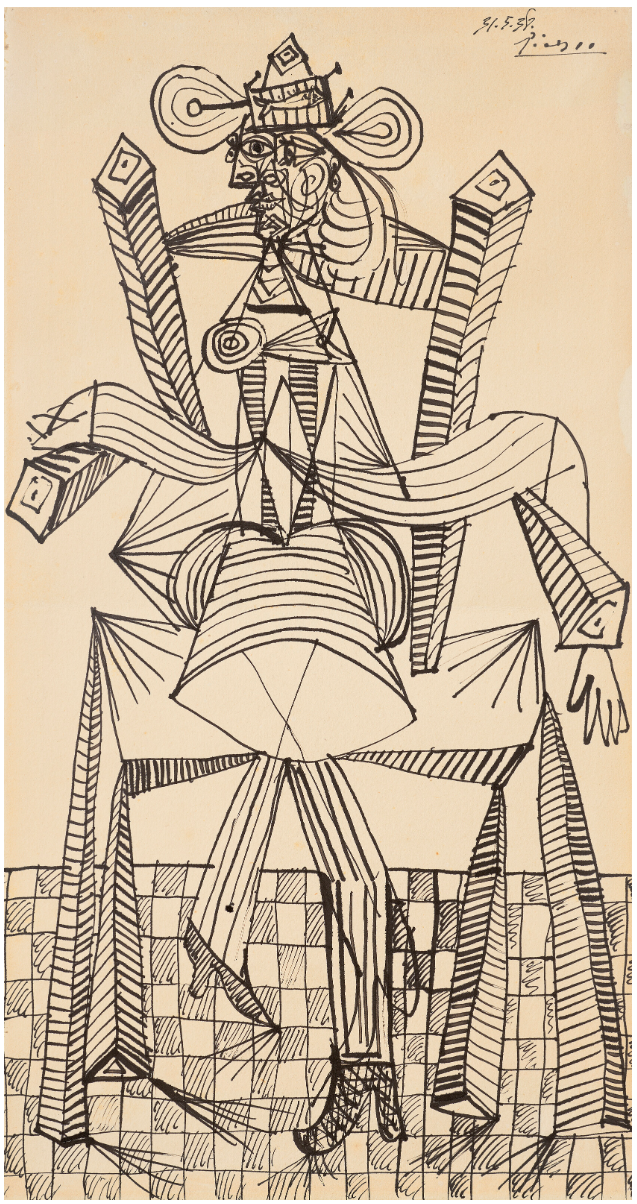
Femme assise (Dora Maar), 1938
Christie’s New-York: 16 May 2024
Estimated: USD 2,000,000 – 3,000,000
USD 1,502,000
https://www.christies.com/en/lot/lot-6482938
PABLO PICASSO (1881-1973)
Femme assise (Dora Maar), 1938
Pen and India ink on paper
45.9 x 24.5 cm (17 7/8 x 9 5/8 inches)
Signed and dated ‘31.5.38. Picasso’ (upper right)
Drawn in Paris on 31 May 1938
Femme assise (Dora Maar) of 1938 presents Pablo Picasso’s wartime lover, the artist and photographer, Dora Maar. Depicted on the scale of a painted portrait, Maar commands the scene, adorned in an elaborate hat, one of her favorite accessories, decorated with a fish. Demonstrating Picasso’s extraordinary abilities as a draughtsman, this striking work on paper reflects the artist’s devotion and deep love of Maar, presenting her as a self-assured Parisienne, at once elegant and mysterious. From the Weeping Women to the plethora of seated portraits, Picasso’s images of Maar are among the greatest of his wartime work. At times haunting, arresting, adoring or reverential, the visual power of these portraits is due in part to the symbiotic creative relationship the pair shared: Maar was not simply a muse, but, as an artist in her own right, she was an active participant in their intense artistic dialogue.
Picasso had met Maar in the winter of 1935-1936. Their now legendary first encounter at the Parisian café, Les Deux Magots, has been frequently recounted. As Picasso later related to Françoise Gilot, “Pablo told me that one of the first times he saw Dora she was sitting at the Deux Magots. She was wearing black gloves with little pink flowers appliquéed on them. She took off the gloves and picked up a long, pointed knife, which she began to drive into the table between her outstretched fingers to see how close she could come to each finger without actually cutting herself. From time to time she missed by a tiny fraction of an inch and before she stopped playing with the knife, her hand was covered with blood” (F. Gilot and C. Lake, Life with Picasso, New York, 1964, pp. 85-86).
Picasso was fascinated by this spectacle, and fell quickly under the Spanish-speaking artist’s spell. By this time, Maar was a well-known figure within the Surrealist circles of Paris, her photography—from photocollage, to the uncanny compositions she captured of contemporary street life—as well as her political activism making her a key figure within the avant-garde and intellectual world of the city.
In the spring of 1938, a month before he executed the present work, Picasso had begun to portray Maar using a tight framework of small repeated lines and striations that have often been likened to the woven straw of baskets or chair caning. This linear or “basketweave” method of construction clearly fascinated Picasso, as he went on to portray Maar with this technique for much of the summer. In contrast to the volumetric, sensuously curving lines which dominated his concurrent depictions of Marie-Thérèse Walter, this rigid, geometric linear vocabulary came to define his depictions of Maar. A year later, as the present work shows, these lines had taken over to become the entire structure of her body. Appearing as if caught in a spider’s web, Maar’s form is depicted solely with these clear, assured marks. One breast is portrayed with concentric circles while the other takes the form of an arrow piercing it, a reflection perhaps of the way in which her heart had been ensnared by the artist. On the same day that he created the present work, Picasso painted a closely related oil, which shows Maar in the same pose, the intricate linear pattern replaced with bold three-dimensional forms (Fondation Beyeler, Riehen). Though the chair rises up threateningly around her, Maar still presides over the scene, her legs casually crossed, arms nonchalantly resting, and most importantly, her powerful gaze set resolutely out of the picture plane, her head topped by one of her signature hats.
Femme assise dans un fauteuil, 1942
Christie’s London: 7 March 2024
Estimated: GBP 1,200,000 – 1,800,000
GBP 1,492,000 / USD 1,900,190
https://www.christies.com/en/lot/lot-6469769
PABLO PICASSO (1881-1973)
Femme assise dans un fauteuil, 1942
Gouache on paper
30.4 x 40.6 cm (12×16 inches)
Signed ‘Picasso’ (lower right) and dated ‘4.1.42’ (upper right); dated again ‘4.1.42’ (on the reverse)
Painted on 4 January 1942
The portraits that Pablo Picasso painted in the years immediately before and during the Second World War stand are some of the most important of his career. These works not only presented a new form of portraiture that combined both a daring formal experimentation with a deep psychological resonance, but they also continue to serve as poignant expressions of the power of artistic creativity in the face of war. Painted on 4 January 1942, during the long, dark years of the Occupation of Paris, Femme assise dans un fauteuil is one such work. Faced with the decision of fleeing France, Picasso ultimately chose to remain in the capital, his adopted home since the early 1900s. Here, he gradually closed himself off from the world of the avant-garde that he had inhabited, and, holed up in his large studio on the rue des Grands Augustins, continued to work with an indomitable power.
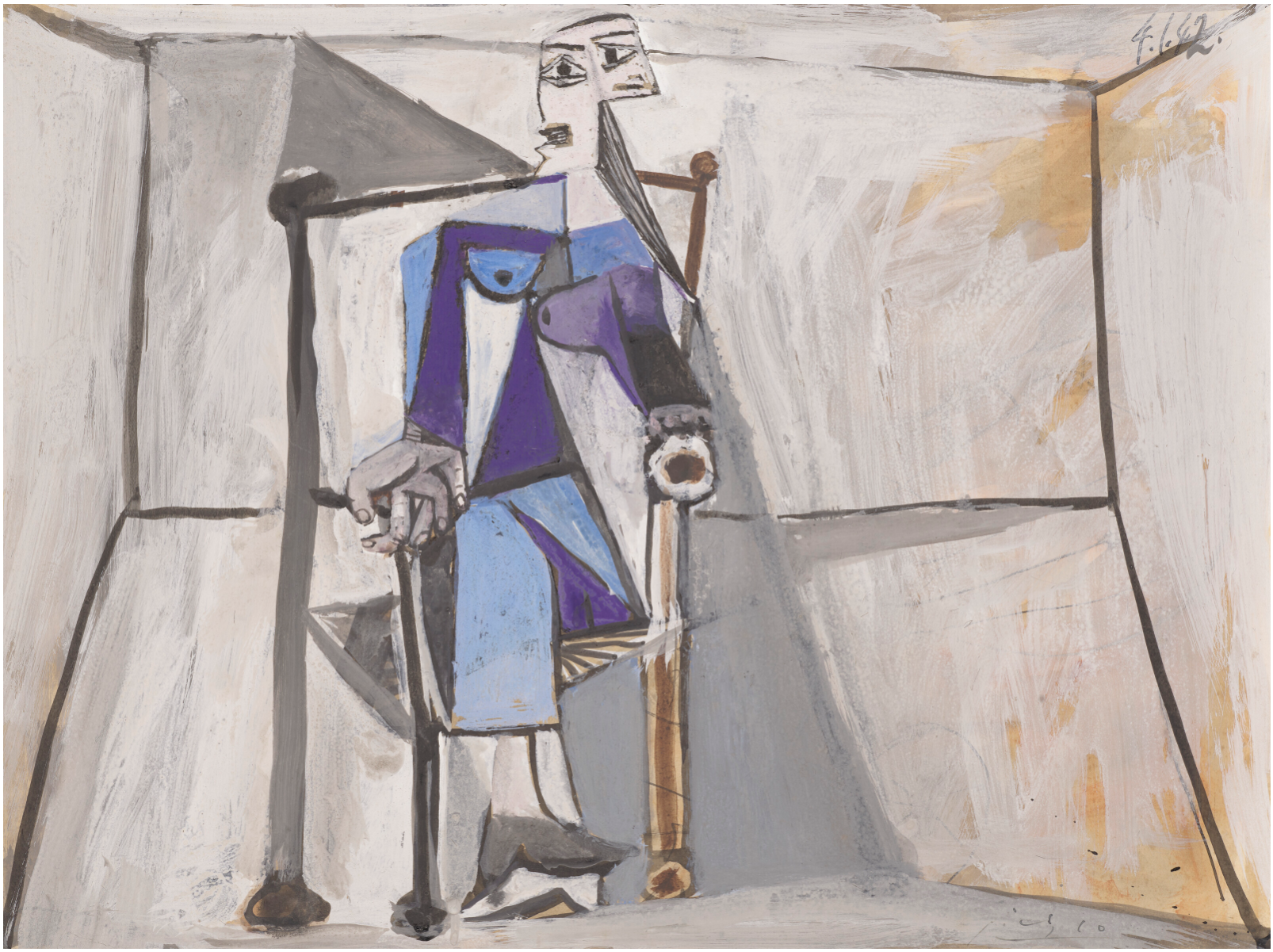
Featuring a female figure set within an angular, enclosed room, enthroned upon a simple wooden chair, Femme assise dans un fauteuil presents Picasso’s wartime paramour, the Surrealist artist, Dora Maar. Maar captured the artist’s imagination throughout the Occupation: she was the site onto which he projected and processed the devastating events of those years. At times harrowing, striking, and reverential, the visual power of these portraits owes much to the symbiotic creative relationship the pair shared: Maar was not simply a muse but an active participant in what proved to be a formidable artistic dialogue. The sense of confinement in Femme assise dans un fauteuil can be felt in the painting’s restricted color palette. Adorned in shades of vivid blue, Maar’s presence contrasts with the white and grey tonalities of her surroundings. With an armature of black lines to demarcate the space, Picasso has used a monochrome palette to emphasize the tight architectural aspects of the composition, a riff on the technique of painting en grisaille. This technique gained popularity in Europe during the fifteenth century as a means of creating the illusion of sculpture or architectural space, a tradition which Picasso continued in the present work. The artist had adopted a monochrome palette throughout his career, however, it was Guernica, (Zervos, vol. IX, no. 65)—Picasso’s iconic painterly response to brutal bombings of the Basque town by the Luftwaffe—in which the full power of monochrome was harnessed. Femme assise dans un fauteuil relies on similar pictorial strategies. Devoid of windows or doors, the claustrophobia evoked by the space mirrors that which the artist was experiencing in his beloved Paris.
Scène de cirque, 1968
Christie’s London: 7 March 2024
Estimated: GBP 375,000 – 575,000
GBP 478,800 / USD 609,790
PABLO PICASSO (1881-1973), Scène de cirque | Christie’s (christies.com)
PABLO PICASSO (1881-1973)
Scène de cirque, 1968
Colored wax crayons and pencil on paper
24 x 31.3 cm (9 3/8 x 12 1/8 inches)
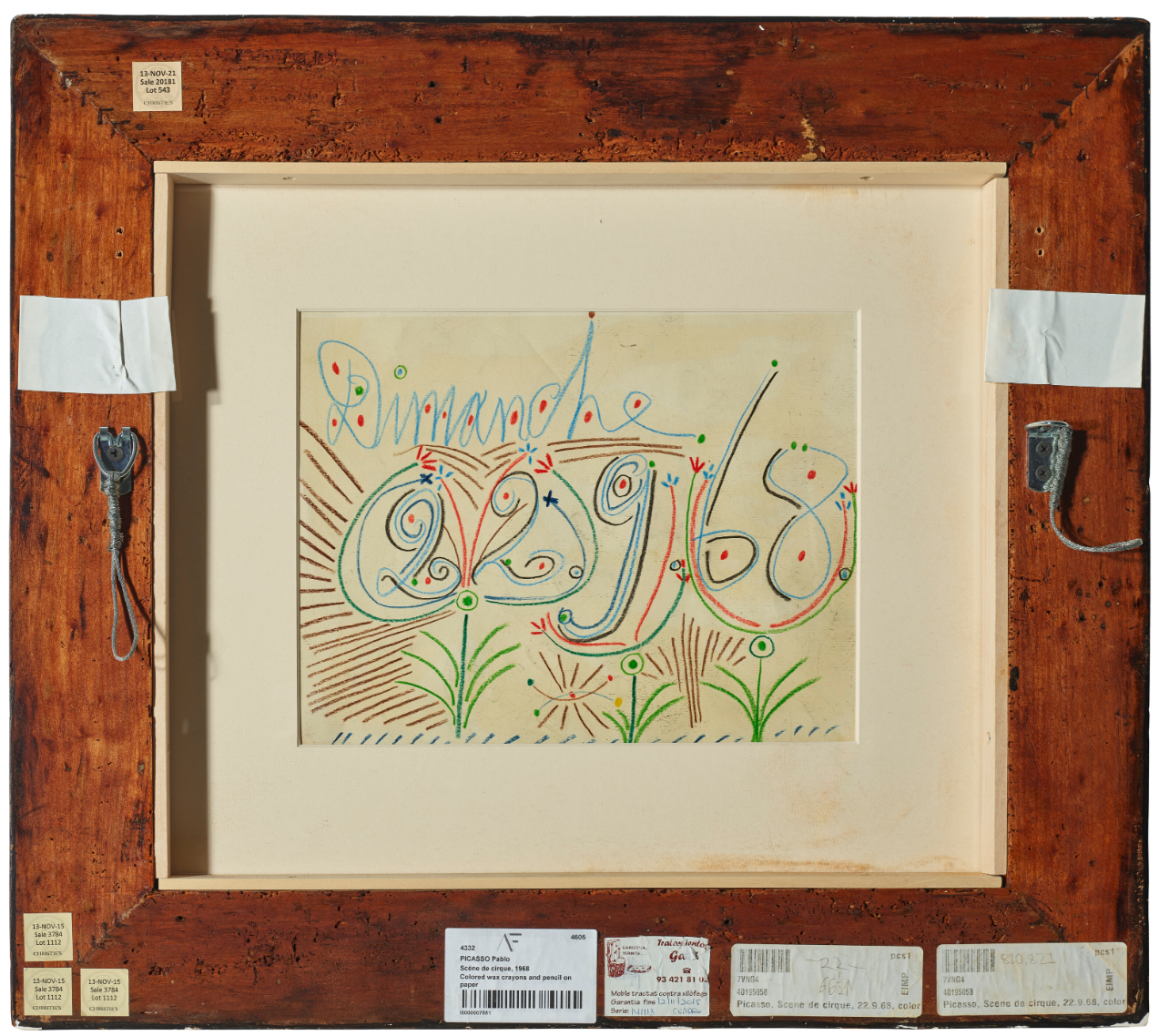
Signed, dated and numbered ‘Picasso 22.9.68.I’ (lower centre)
Dated again ‘Dimanche 22.9.68.’ (on the reverse)
Drawn in Mougins on 22 September 1968
Since his earliest days as an artist, the world of the circus had served as rich inspiration for Pablo Picasso’s imagination, its dynamic cast of harlequins and acrobats, jesters and jugglers, fueling his creative fantasies and shaping his work in a variety of different media. From his acclaimed Rose-period Saltimbanques, to his biomorphic Surrealist visions of twirling acrobats in the 1930s, and his suite of drawings published in 1954 under the title Picasso and the Human Comedy, the circus reappeared frequently across his oeuvre, an enduring and timeless motif that prompted him to create whimsical scenes in painting, sculpture, ceramics and prints. John Richardson has traced the source of these circus fantasies to Picasso’s memories of Rosita del Oro, a well-known circus rider and the artist’s first girlfriend when he was still an adolescent living with his parents and family in Barcelona. ‘The conquest of this star equestrienne by a boy just turned fifteen says a lot for his personality and sexual magnetism,’ Richardson has explained. ‘Nor was this a short-lived adolescent fling; it was a relationship that lasted on and off for a number of years. At the very end of his life, however, Rosita comes back to haunt Picasso. His lifelong passion for the circus, his identification with acrobats and clowns, stems from this early romance’ (A Life of Picasso, New York, 1991, vol. I p. 68).
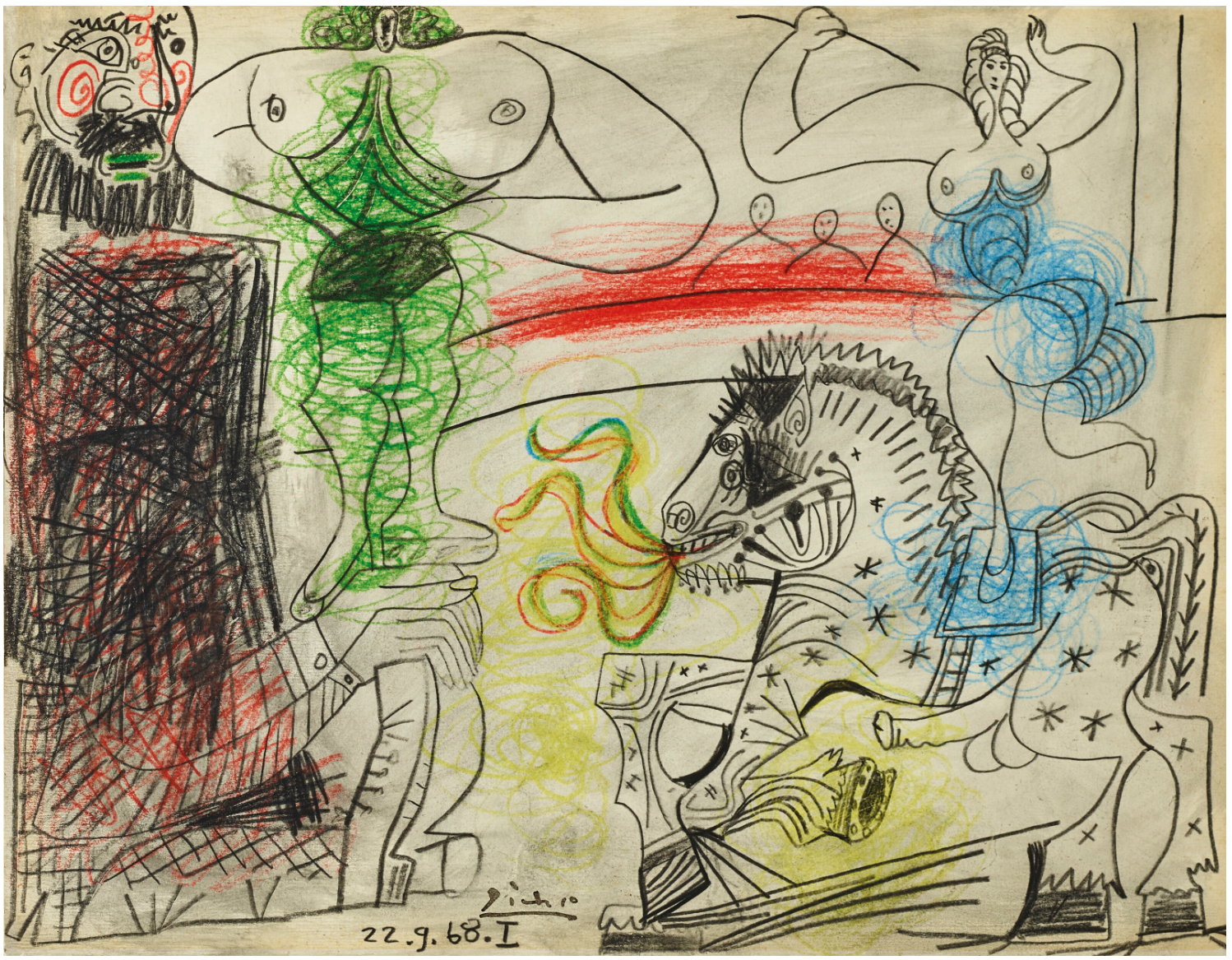
Picasso’s interest in the motif went further than his own biography, however – he was deeply intrigued by the variety and range of the performers he encountered on his many subsequent visits to the circus through the years. As with Edgar Degas, Henri de Toulouse-Lautrec and Georges Seurat before him, he frequented the Cirque Médrano in Montmartre while living in Paris, and was captivated by the lights, costumes, music, exotic beasts and acrobatic performances that played out within the tent each evening. The theme continued to thread its way through the grand sequence of Picasso’s late drawings and prints, reappearing at various intervals in his work. The present Scène de cirque is one of four drawings that Picasso executed on Sunday, 22 September 1968, and the only one from that day that the artist chose to render in colour, employing vigorous strokes of bright wax crayon and pencil to infuse the scene with a vivid sense of life and joie de vivre. While the trio of other works from this day focus on the danger-filled act of the lion-tamer in the ring, here Picasso focuses his eye on the daring performance of an equestrienne, as she stands atop her wild horse, a picture of carefully controlled balance and fearlessness. The vigorously worked sheet is rich with anecdotal details, providing a strong sense of atmosphere – a trio of figures positioned along the far edge of the ring represent the captivated audience, while a towering strong-man watches the movements of the equestrienne, his powerful physique captured in great sweeping lines and a twisting swirl of green color.
However, it is the imposing man to the left of the composition who catches the eye and is perhaps the most intriguing character within the scene. Though seated, with his hands resting in his lap, he is positioned in such a way that he seems involved in the performance, more than a passive bystander watching events unfold. A thick weave of crisscrossing pencil marks cover the entirety of his torso, holding him in place like a network of interlacing ropes, creating the impression that he has been tied to his chair. His wide eyes are fixed on the voluptuous equestrienne as she balances on one leg, leaving him seemingly oblivious to the advancing horse she stands upon, who metamorphoses into a mythical hybrid creature that can breathe fire, multicolored flames curling from its mouth as it readies itself to charge.
Saltimbanque accoudé, 1922
Sotheby’s New-York: 16 May 2023
Estimated: USD 1,000,000 – 1,500,000
USD 1,512,000
Saltimbanque accoudé | Modern Evening Auction | 2023 | Sotheby’s (sothebys.com)
PABLO PICASSO (1881 – 1973)
Saltimbanque accoudé, 1922
Watercolor and brush and ink on paper
16.5 x 10.5 cm (6 1/2 x 4 1/8 inches)
Signed Picasso and dated 22 (lower right); dated 26 Decembre 1922 (on the verso)
Executed on 26 December 1922
Elegantly and vividly rendered, Saltimbanque accoudé is a jewel-like distillation of Pablo Picasso’s storied Neo-Classical output. Executed on 26 December 1922, Saltimbanque accoudé is the most masterful iteration of a small group of works completed during the winter of 1922 that depict seated Saltimbanques. Works of this subject matter executed shortly thereafter belong to prestigious institutional collections including The Museum of Modern Art, New York, the Wadsworth Atheneum, Hartford, the Artizon Museum, Tokyo and the Musée Picasso, Paris.
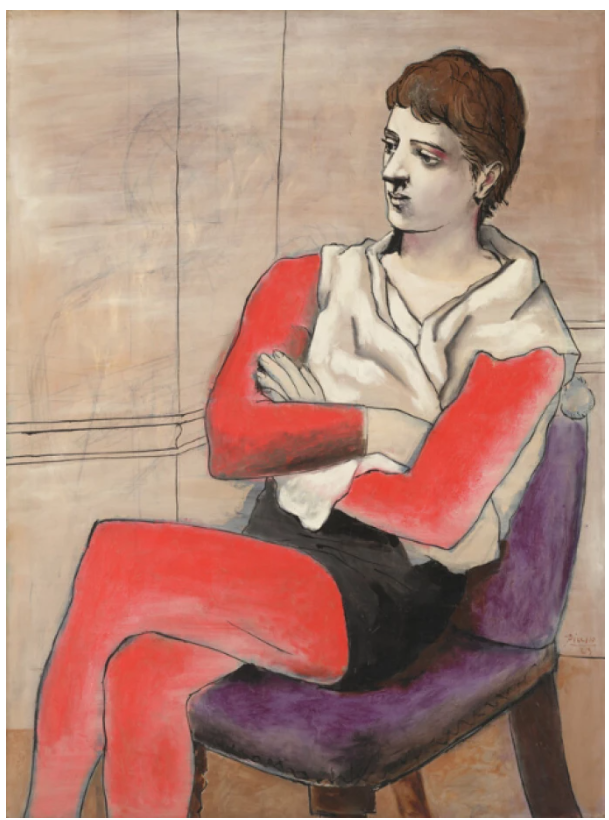
PABLO PICASSO, SALTIMBANQUE SEATED WITH ARMS CROSSED, 1923, ARTIZON MUSEUM, TOKYO
© 2023 ESTATE OF PABLO PICASSO / ARTISTS RIGHTS SOCIETY (ARS), NEW YORK
Saltimbanque accoudé represents the apogee of Picasso’s Neoclassical phase, which lasted from 1917 until 1924. Seeking a departure from Cubism, Picasso ventured to Italy alongside Jean Cocteau in 1917 and 1921 to examine the Latinate origins of art in Naples and Pompeii. Aligning with the broader “call to order” that dominated the avant-garde in post-World War I France, Picasso’s style channeled the grandeur of Greco-Roman art and the elegance of Neoclassical works by Ingres.
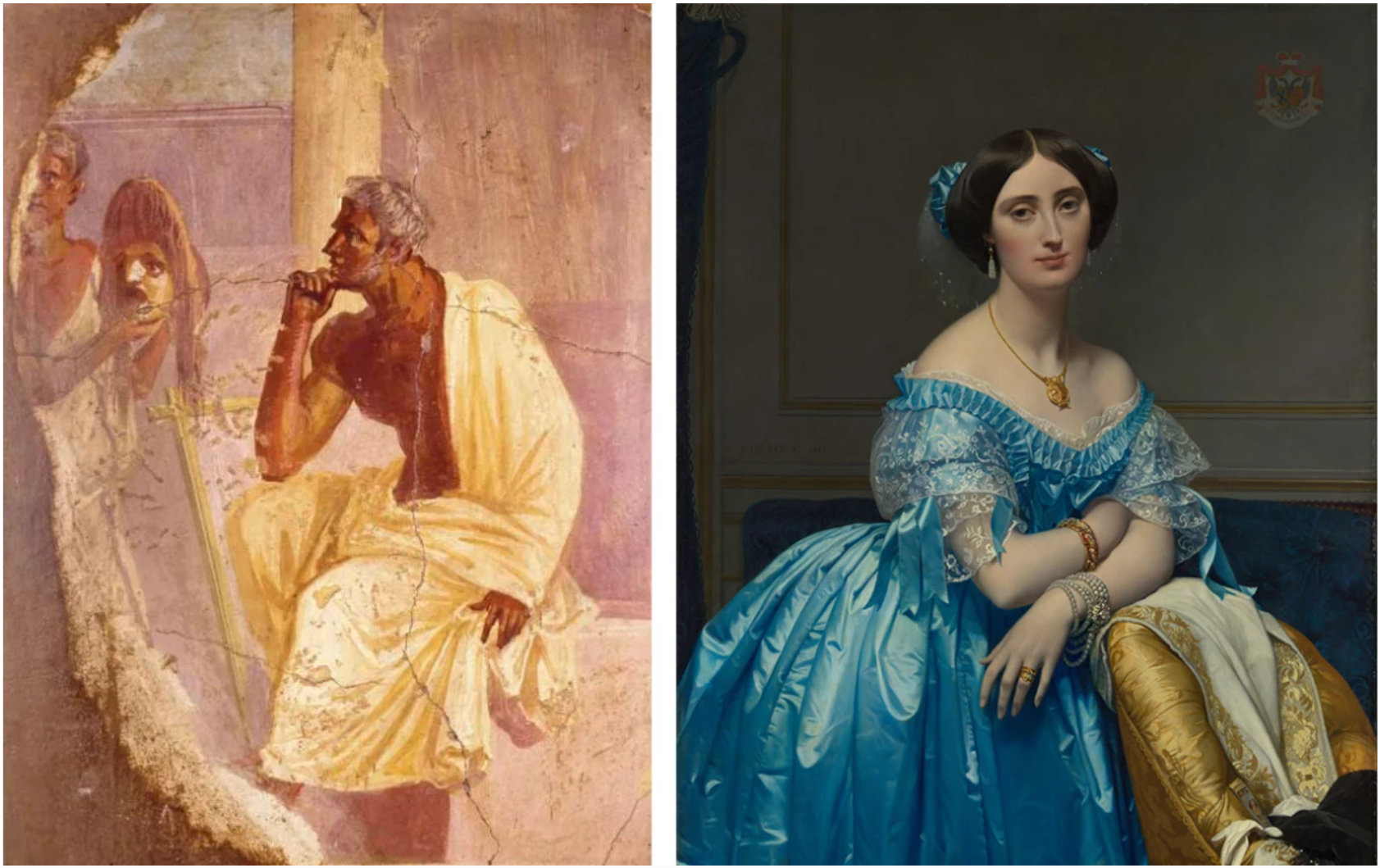
WALL PAINTING SHOWING AN ACTOR WITH A MASK, FOUND IN POMPEII. 1ST CENTURY AD, MUSEO ARCHEOLOGICO NAZIONALE DI NAPOLI
JEAN AUGUSTE DOMINIQUE INGRES, JOSÉPHINE-ÉLÉONORE-MARIE-PAULINE DE GALARD DE BRASSAC DE BÉARN, PRINCESSE DE BROGLIE, 1851-53, THE METROPOLITAN MUSEUM OF ART, NEW YORK
Evidencing the artist’s precise draftsmanship, the commanding black lines of the present work generate a formal monumentality evocative of Classical sculpture. Saltimbanque accoudé is a superlative depiction of one of the most distinctive characters in the artist’s oeuvre. As Picasso was ceaselessly fascinated by marginal individuals within society, saltimbanques and harlequins figured prominently within the artist’s early output. from Rose and Blue Period masterworks such as Les Deux saltimbanques and Famille de saltimbanques to his subsequent Cubist works.
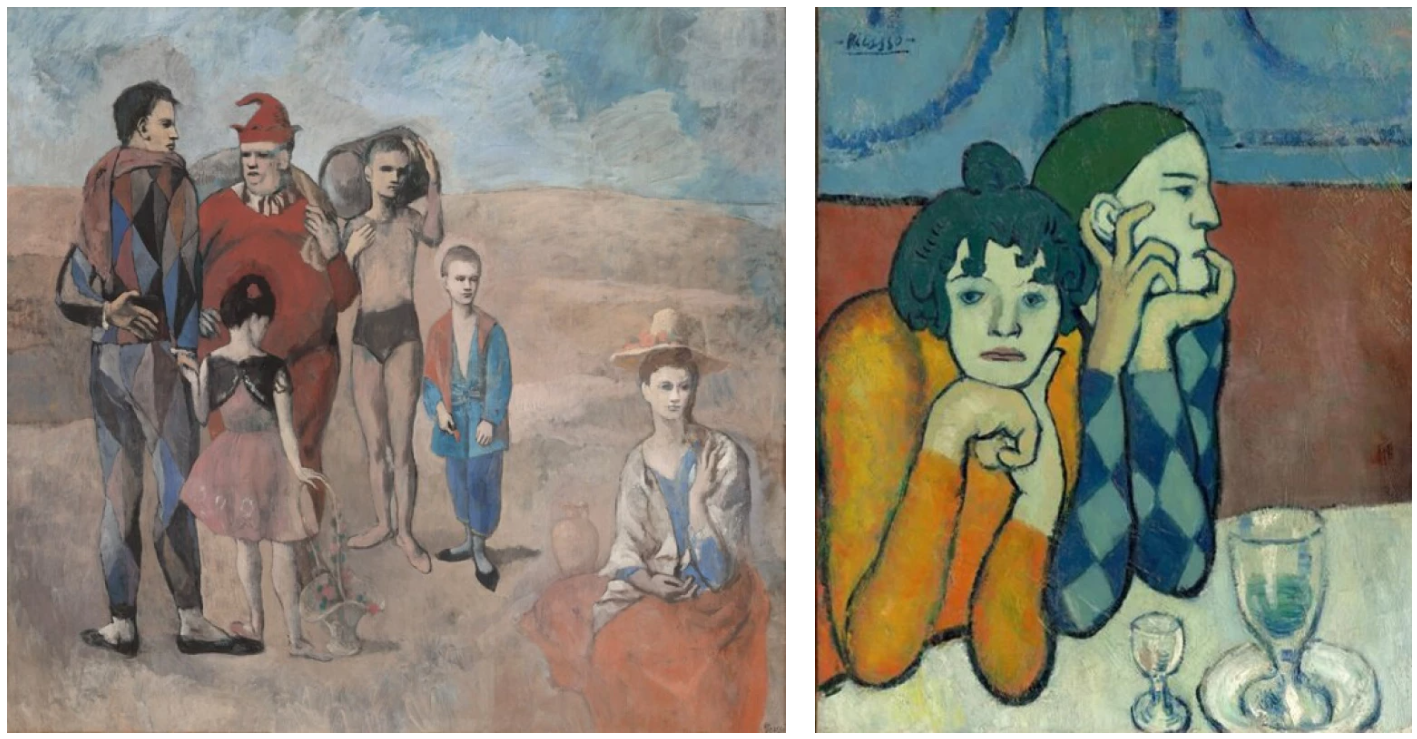
PABLO PICASSO, LES DEUX SALTIMBANQUES, 1901, PUSHKIN MUSEUM, MOSCOW © 2023 ESTATE OF PABLO PICASSO / ARTISTS RIGHTS SOCIETY (ARS), NEW YORK
PABLO PICASSO, FAMILLE DE SALTIMBANQUES, 1905, NATIONAL GALLERY OF ART, WASHINGTON, D.C. © 2023 ESTATE OF PABLO PICASSO / ARTISTS RIGHTS SOCIETY (ARS), NEW YORK
Picasso’s commitment to portraying these figures would have a lasting impact upon artists and writers alike. The German poet Rainer Maria Rilke was so struck by Picasso’s saltimbanques that he went on to write the fifth of his Duino Elegies on the subject.Viewing such itinerant circus performers at the Commedia dell’Arte during his excursions to Italy in the late nineteen-teens and early nineteen-twenties revived his interest in this subject. Energized by refined yet striking contrasts of rich color, the present saltimbanque is imbued with a dignified air. His distinctive cross-legged pose and pensive gaze conjure a portrait that is at once distinctly modern and eternally beautiful. The specific care and handling of the media in the present work—brush and ink carefully delineating contours of drapery and body while bright yellows and reds further fortify the strength of the artist’s line—single out this particular composition within Picasso’s larger production at the time.
Prints
La Minotauromachie, 1935
Sotheby’s New-York: 13 May 2025
Estimated: USD 1,000,000 – 2,000,000
USD 1,143,000
La Minotauromachie | Modern Evening Auction | 2025 | Sotheby’s
PABLO PICASSO (1881 – 1973)
La Minotauromachie, 1935
Etching with scraper and engraving on Montval laid paper
Plate: 49.5 x 69.2 cm (19 1/2 x 27 1/4 inches)
Sheet: 56.7 x 77.8 cm (22 3/8 x 30 1/2 inches)
A richly inked impression of the seventh (final) state
With strong contrast and fine detail
Often cited as one of the most important graphic works of the 20th century, La Minotauromachie is unmistakably Picasso’s paramount achievement in printmaking. Visually stimulating and technically brilliant, the subject matter is also extraordinarily complex, evading conclusive interpretation of the work’s ultimate meaning.
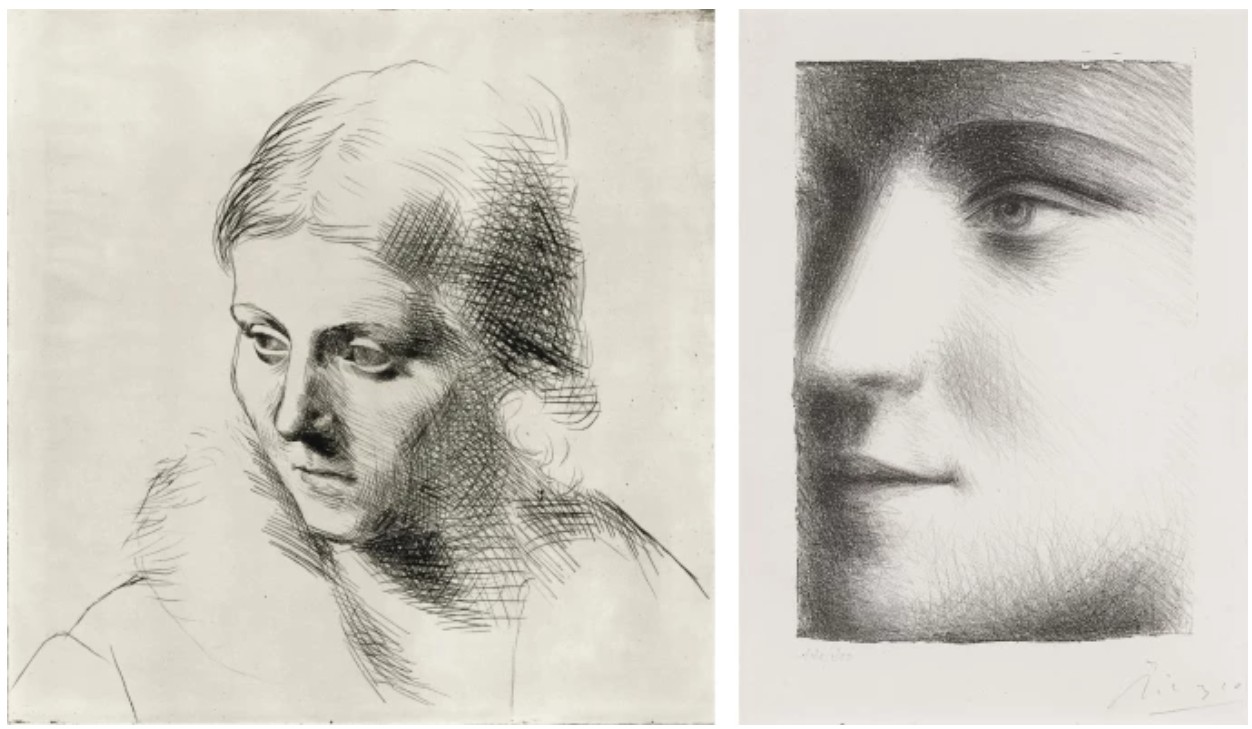
Left: Pablo Picasso, Portrait d’Olga au col de fourrure, 1923, sold: Sotheby’s, New York, 23 October 2017 © 2025 Estate of Pablo Picasso / Artists Rights Society (ARS), New York
Right: Pablo Picasso, Visage de Marie-Thérèse, 1928, sold: Sotheby’s, New York, 24 October 2023 © 2025 Estate of Pablo Picasso / Artists Rights Society (ARS), New York
La Minotauromachie was executed at a time of significant turmoil in Picasso’s personal life. His floundering marriage to Olga Khokhlova was about to come to a crisis point with Olga’s discovery that his young lover, Marie-Thérèse Walter, was pregnant. It was in the period leading up to this revelation that Picasso produced La Minotauromachie, a time which he would later describe as ‘la pire époque de ma vie’ (the worst period of my life). Between the winter of 1934 until the summer of 1935 Picasso virtually ceased painting. However, printmaking appears to have provided Picasso with a much-needed physical involvement with his creative endeavor.
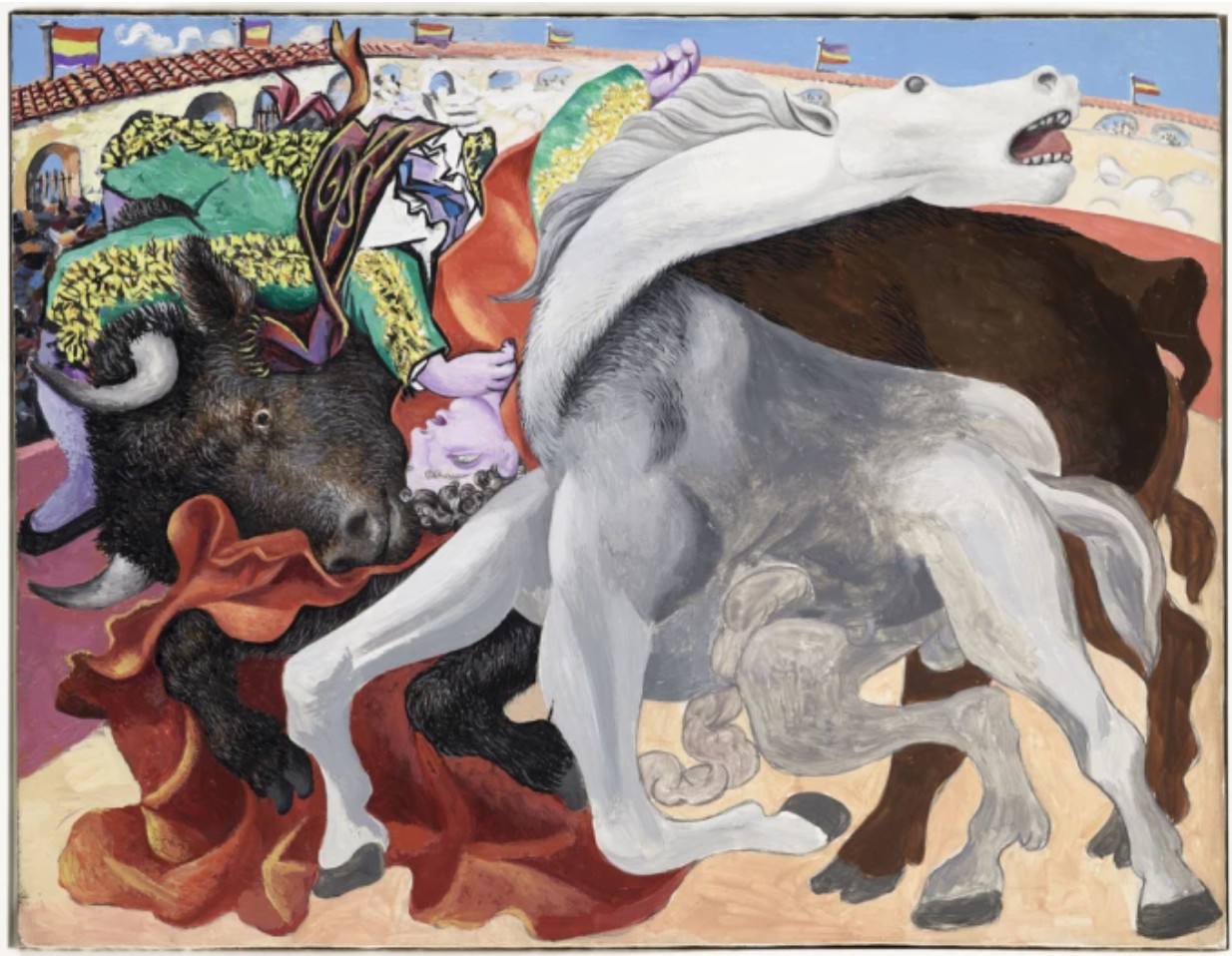
Pablo Picasso, Corrida: la mort du torero, 1933, Musée National Picasso, Paris © 2025
Estate of Pablo Picasso / Artists Rights Society (ARS), New York
The deeply private mythology of La Minotauromachie revolves around the bullfight (the tauromachy) and the Minotaur. It is the pinnacle of a visual language Picasso developed over the course of his relationship with Marie-Thérèse, and whose growth is materially documented most clearly in the Suite Vollard. Generally recognized as a representation of the artist himself, the Minotaur was a character that fascinated Picasso and it was appropriated by him in a number of different guises: sometimes lustful and sexually predatory, at other times merry and sociable, or introverted and vulnerable. Here the beast appears tamed and subdued, shielding his sight from the scene illuminated by the young girl with the candle. Similarly, the image of Marie-Thérèse appears repeatedly throughout the Suite Vollard and appears here in the form of the swooning torera. These central figures resonate closely with a painting dated 19th September 1933; in which the bull has inflicted the fatal wound to the dying horse (whose form reappears in the etching almost exactly), and the torero has been tossed from his mount by the bull’s powerful head onto its own back. In the etching, the male bullfighter has become Marie-Thérèse, whose pale torso at the center of the image shows rounded breasts and stomach – which is sometimes interpreted as an indication of her pregnancy. Overall, the scene is a dichotomy of light and dark, confined interior and open sea and sky, brute strength and girlish innocence, passive observation and the violence of the bullfight. The etched lines are expertly layered to emphasize these contrasts, such that the apocryphal story being told becomes secondary to Picasso’s mastery of his medium. La Minotauromachie served as a visual source for Picasso’s greatest work of art: Guernica which he painted two years later in response to the Spanish Civil War and which re-uses many of the motifs seen in this print, such as the Minotaur, the terrified horse and the beacon held by Marie-Thérèse.
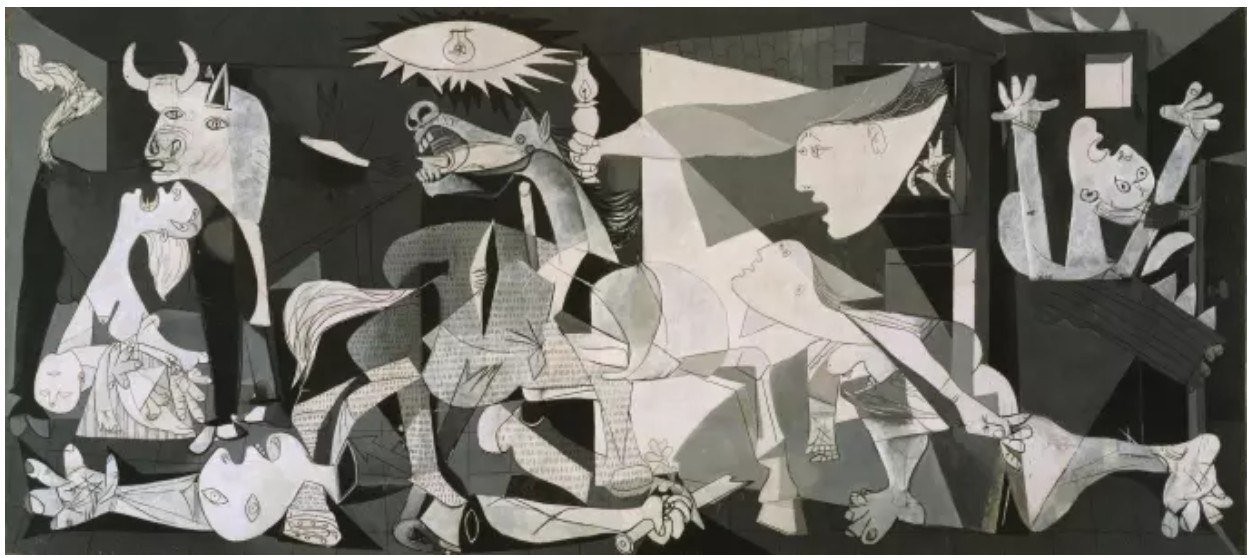
Pablo Picasso, Guernica, 1937, Museo Nacional Centro de Arte Reina Sofía, Madrid © 2025
Estate of Pablo Picasso / Artists Rights Society (ARS), New York
Picasso worked intensely on the plate for La Minotauromachie over a number of weeks, producing a total of seven states of which the present work is the seventh and final state. The artist was reluctant to release any impressions except to his closest friends, and even pretended to his most trusted dealers that he had not completed work on the plate. At his death, either 23 or 27 impressions remained in the artist’s estate, of which the present print is one. Picasso’s reluctance to formally edition La Minotauromachie is perhaps indicative of the emotional investment the artist had put into the work and the deep personal significance with which he regarded it.
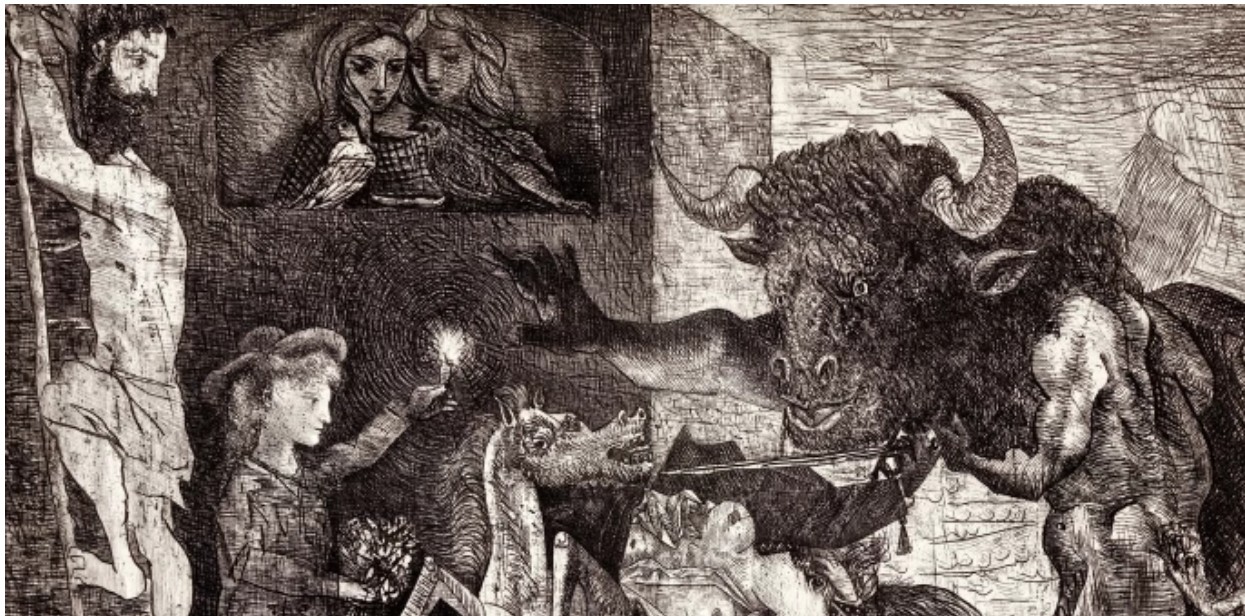
Baer cites approximately 55 impressions of La Minotauromachie in its final state. At least half are held in museums including the Musée Picasso, Paris; The Metropolitan Art Museum, Tokyo; The Art Institute of Chicago; Museum of Fine Arts, Boston; The Museum of Modern Art, New York; Ashmolean Museum, Oxford; Philadelphia Museum of Art and the National Gallery, Washington, D.C.
La Suite Vollard, 1930-1937
Christie’s New-York: 18 May 2024
Estimated: USD 800,000 – 1,200,000
USD 1,184,400
PABLO PICASSO (1881-1973), La Suite Vollard | Christie’s (christies.com)
PABLO PICASSO (1881-1973)
La Suite Vollard, 1930-1937
The rare complete set of one hundred etchings, aquatints and drypoints on Montval laid paper, watermarked Picasso or Vollard
Of which fifty signed ‘Picasso’ (lower right)
Each Sheet: 34 x 44.5 cm (13 3/8 x 17 1/2 inches)
This set is from the edition of 260 published by Ambroise Vollard, Paris, 1939
The one hundred etchings of the Suite Vollard were created by Pablo Picasso between 1930 and 1937, a seminal period in his career. The images function almost as entries in a diary, illustrating a galaxy of motifs and preoccupations, including the artist’s desire for his young mistress and muse Marie-Thérèse Walter, his fascination with the process of artistic creation and transformation, the battle of the sexes and the analogy of making art and making love.
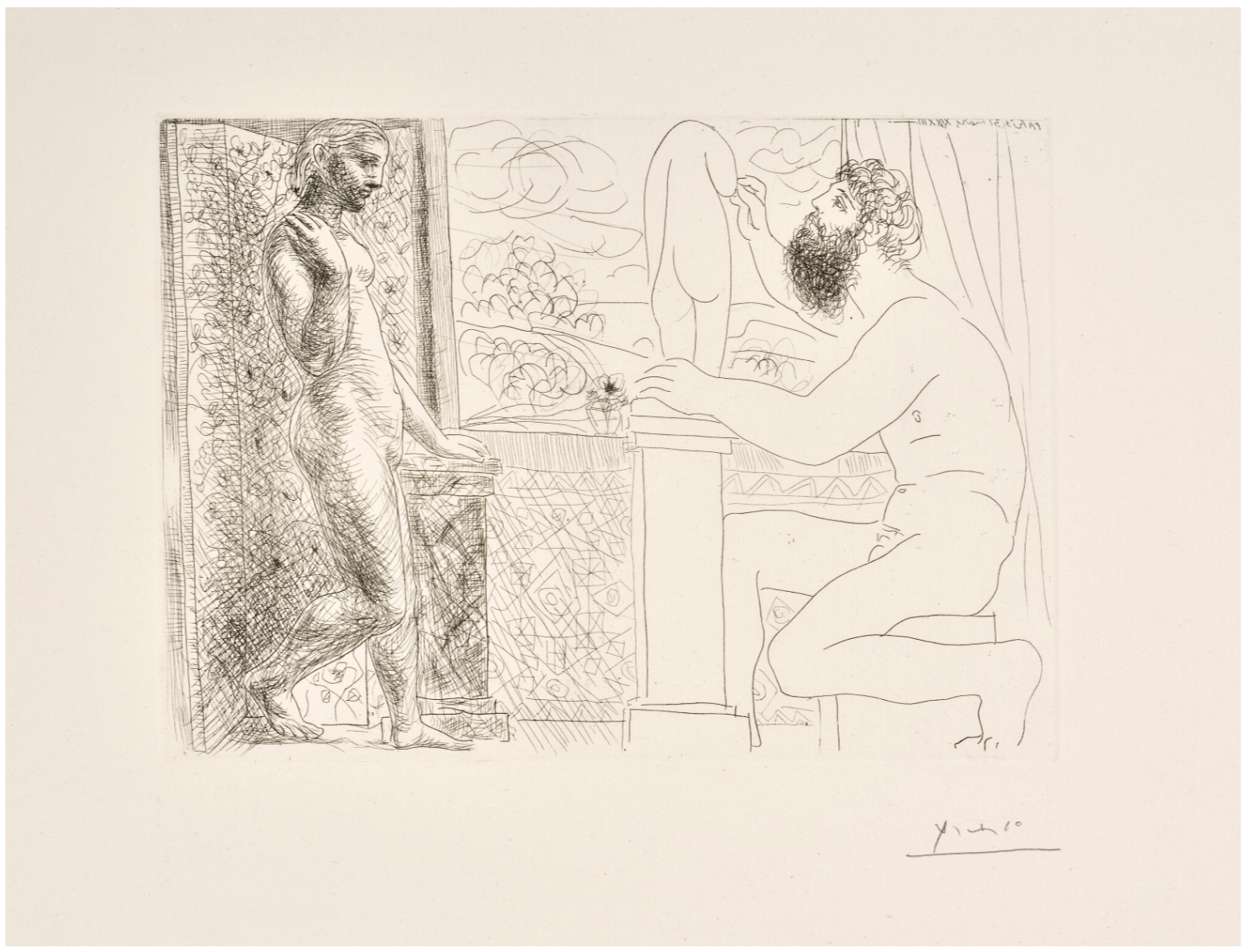
The man who commissioned the project, Ambroise Vollard was one of the most influential dealers during a momentous period in the history of European art. A large, brooding figure, impenetrable and vain, he was both loved and loathed by those with whom he dealt. A champion of new and overlooked artists, he rescued Paul Cezanne from obscurity, was responsible for the first retrospective of Vincent van Gogh and was the first to show Paul Gauguin’s Tahitian paintings. Vollard’s greatest claim to fame, however, might have been his decision to give the nineteen-year-old Picasso his first show in 1901, beginning a relationship that lasted until Vollard’s death nearly four decades later. When it came to Picasso’s paintings Vollard’s support was somewhat sporadic, dictated as it was by the interests of his wealthy clientele and his failure to grasp the great leap forward that was cubism. But in terms of printmaking, his interest in Picasso was far more steadfast. Their first significant collaboration came in 1913, with the publication of 15 etchings known as the Suite des Saltimbanques.
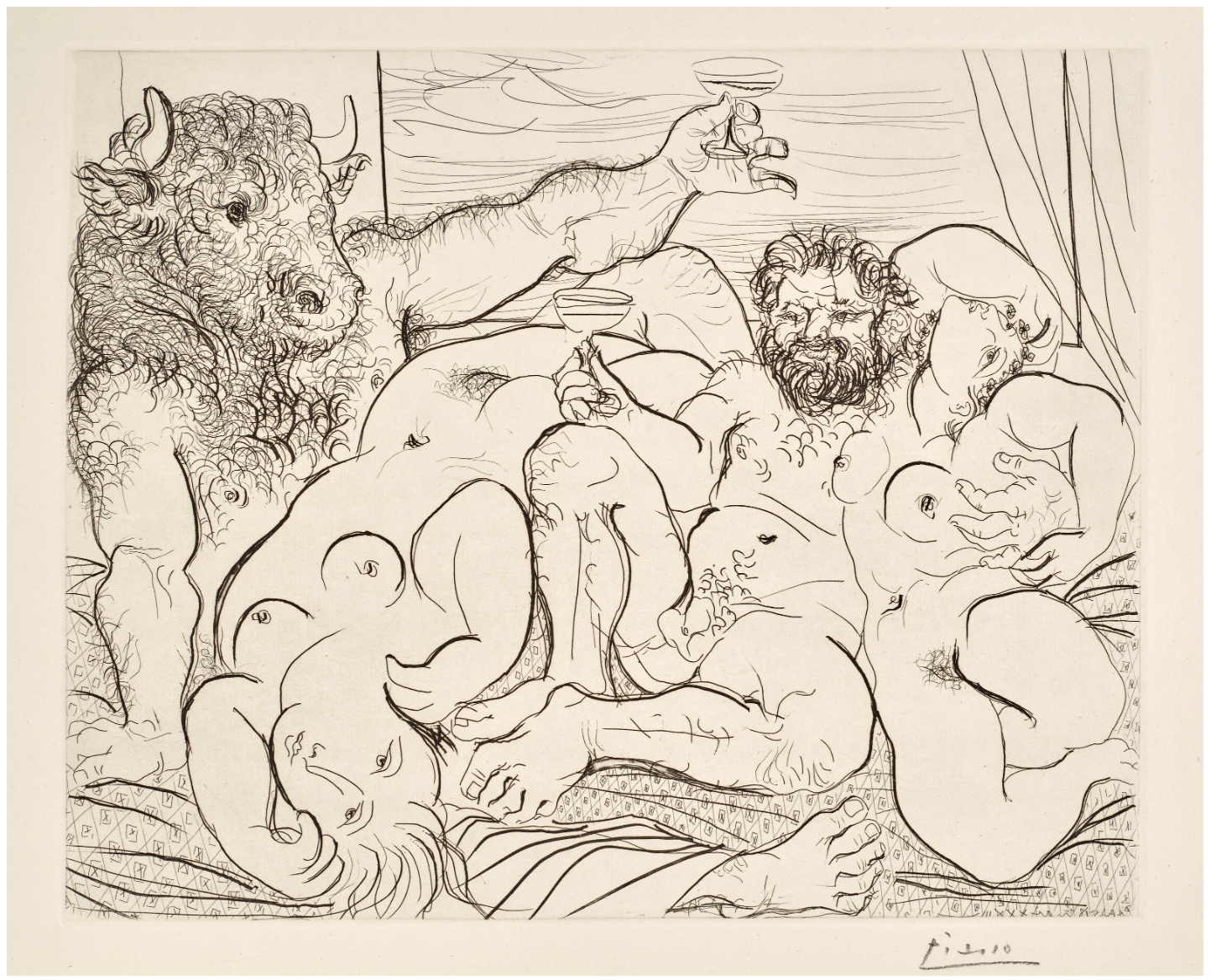
The late 1920s were years of profound change for Picasso, with interwoven developments in both his artistic and personal life. Many of the themes that were to find form in the Suite Vollard can be traced back to these turbulent years. By then Picasso had left the poverty of his early life in Paris far behind and he lived a respectable, bourgeois existence with his wife, the former ballerina Olga Khokhlova. While he enjoyed the material benefits of success, Picasso began to resent restrictions on his freedom and gradually his marriage deteriorated. It was dealt the coup de grace by Picasso’s chance encounter with the seventeen year old Marie-Thérèse Walter in 1927. For much of the next decade her features would dominate Picasso’s work, not least in the Suite Vollard, and she is ubiquitous in the largest coherent group in the series, known as the Sculptor’s Studio. These forty-six etchings, showing an artist and model working, relaxing or carousing in a studio, expand upon themes Picasso developed in two illustrated book projects in 1931; Ovid’s Metamorphoses, which includes the tale of a sculptor who falls in love with his creation, and Honoré de Balzac’s Le Chef d’Oeuvre Inconnu (commissioned and published by Vollard), which relates the tale of the doomed painter Frenhofer and his struggles to capture reality in paint. Ideas surrounding transformation and metamorphosis, the contrast between the created work and reality, particularly the impossibility of making any work of art so perfect it could compete with life itself, were of profound interest to Picasso and play a significant role in the Suite.
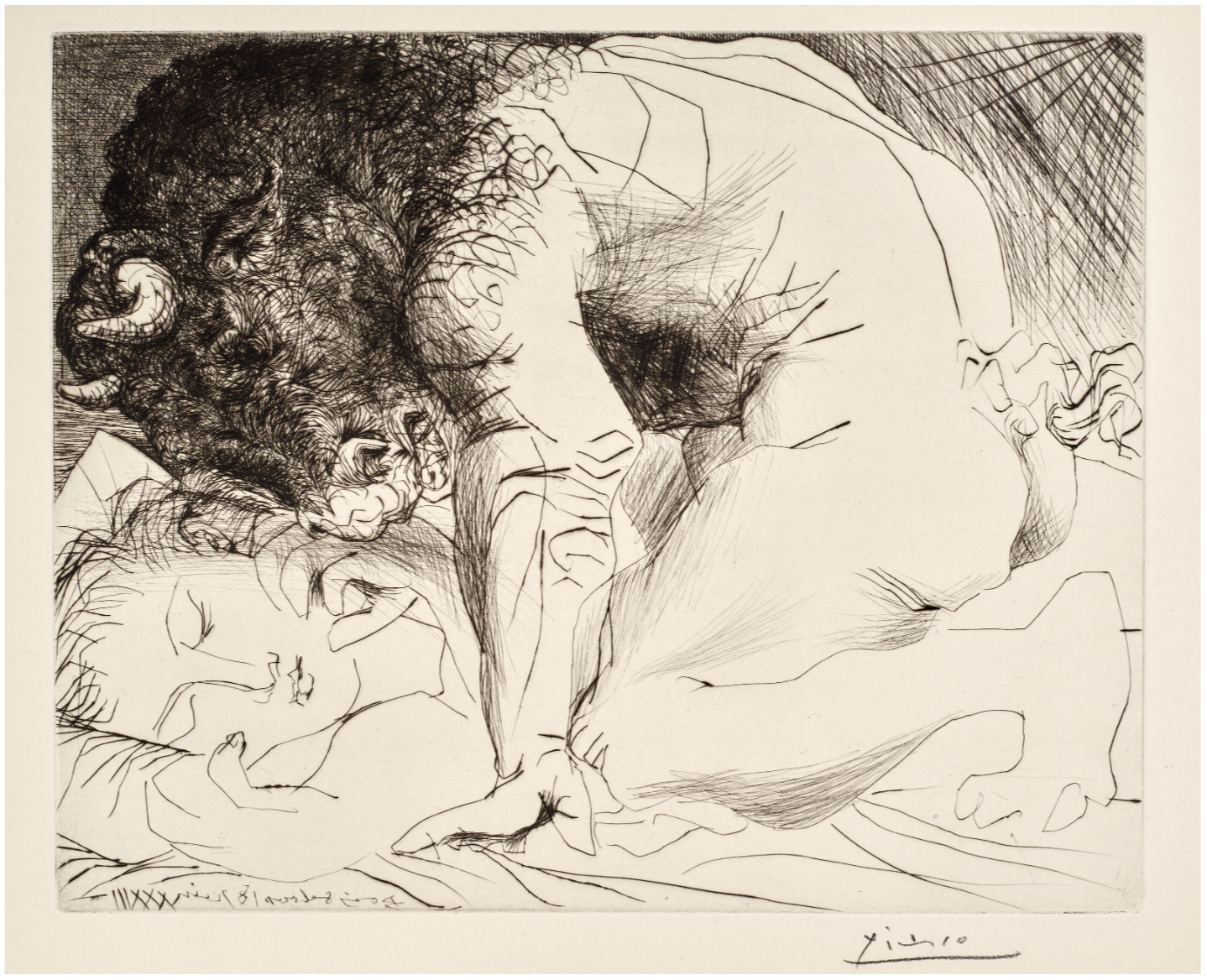
Another key element in Picasso’s oeuvre and personal mythology, the Minotaur, is present in no fewer than twenty-one scenes. For the Surrealists, the Minotaur represented the dark center of man’s violent, irrational desires. While he also recognized the Minotaur as the monster within, Picasso identified the creature more closely with the fighting bull of his native Spain, whose power, pride and ferocity he regarded as corresponding to his own virile persona.
Among the concluding works in the Suite is a sequence depicting a blind Minotaur: “the chastened Minotaur, old, pathetic and blind, is led by a young girl with the features of Marie-Thérèse, who, in the first plate, holds a bunch of flowers, while in the other three she clutches a fluttering white dove of peace. The figure of the Blind Minotaur was Picasso’s invention; it is an image that goes beyond the artist’s personal nightmare to evoke the wider political darkness threatening to engulf Europe with the rise of Fascism in Germany and Italy” (S. Coppell, Picasso Prints—The Vollard Suite, London, 2012, p. 35).
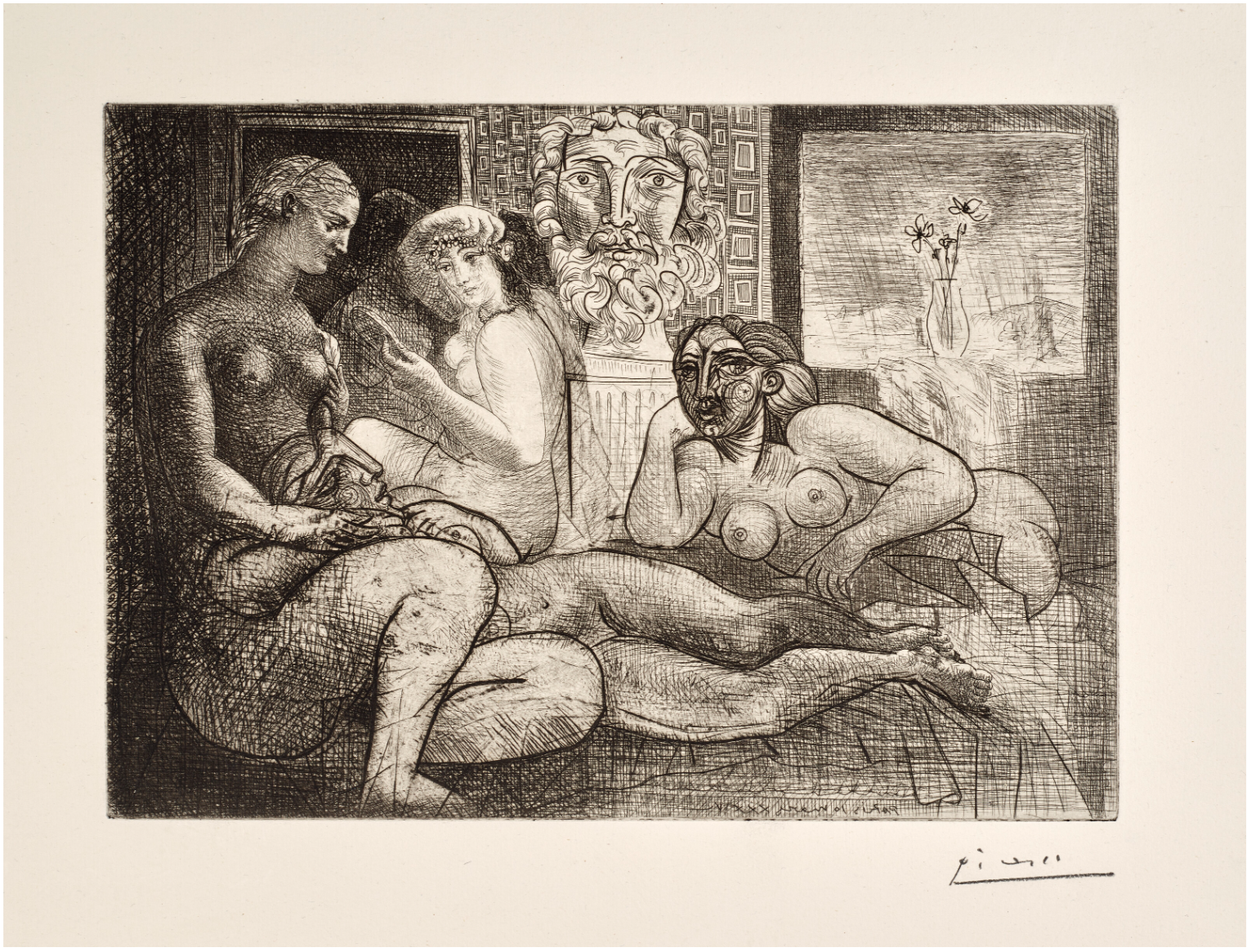
Where or exactly when the idea first came from for a suite of this size and ambition is not known (perhaps unsurprisingly, given Vollard’s aversion to written contracts) although it is thought to have been connected to a trade between the two, with Vollard exchanging two paintings in return for etching plates from Picasso; some of which Picasso had already worked on, others that were made specifically for the project. The plates were created over a period of seven years, beginning in 1930, with the most intense period of creativity spanning the years 1933-1934. Ninety seven were eventually gathered together, and Picasso either offered, or was asked by the notoriously vain Vollard, to create three portraits of the publisher to round up the number to 100.
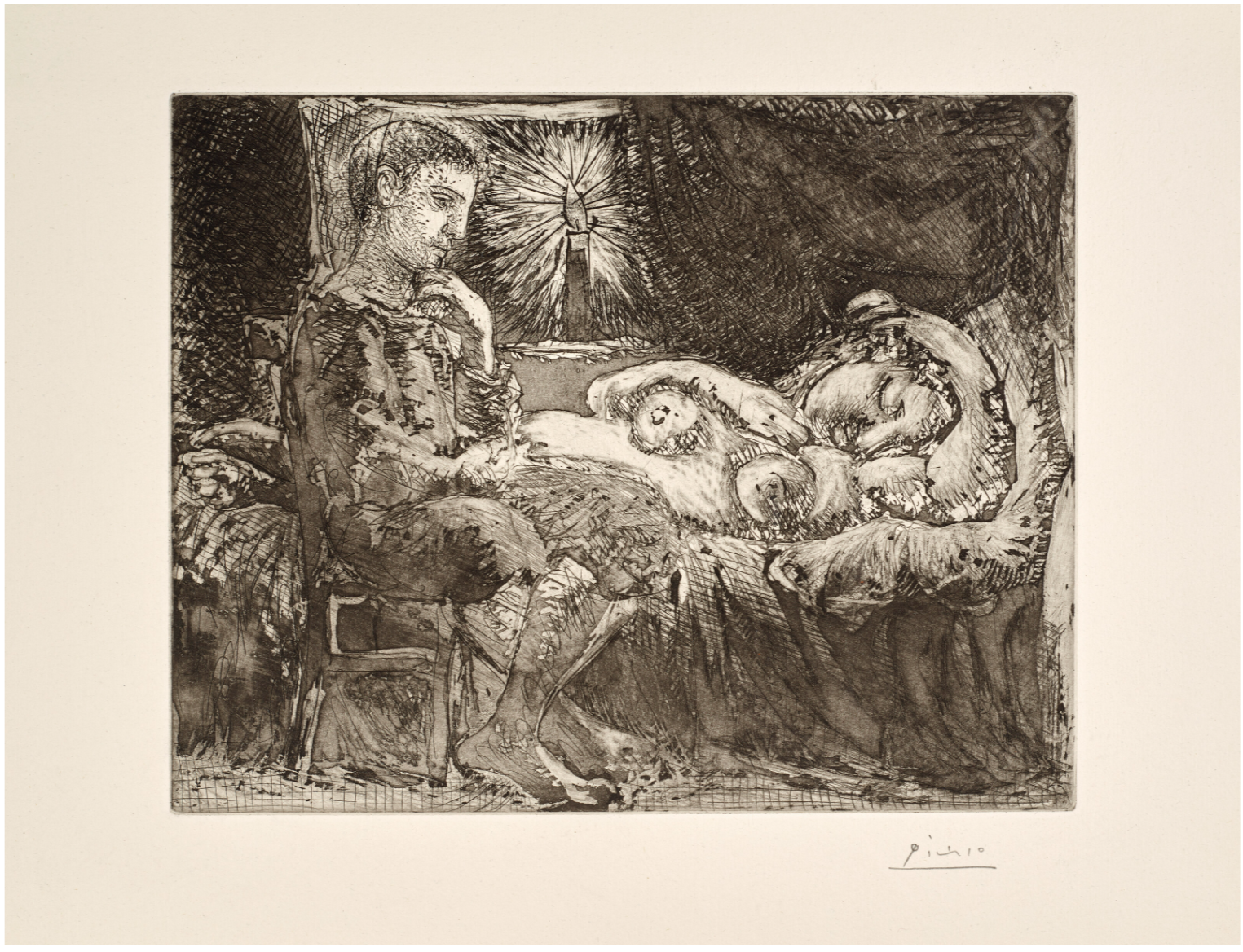
An even greater mystery is that we have no clear idea what its final format was to have been. Vollard’s life was cut tragically short by a car crash in 1939, only weeks after the edition had been printed, and his plans for the Suite perished with him. Subsequent research has pieced together evidence that the etchings were to have been paired with two poems by André Suarès, Minotaure and Minos et Pasiphaë. Exactly how they might have been integrated with or divided between the two texts, is not recorded. With regard to publication, the plan might have been for it to appear in both book and album format, accounting for the two editions in which the Suite exists—260 sets on smaller margin paper, 50 on larger sheets. Three sets were also printed on vellum, one of which is in the Musée Picasso, Paris. The master printer Roger Lacourière was handed the task of printing the edition. Lacourière worked with many of the great names of the day, including Georges Braque, Marc Chagall, André Derain, André Masson, Joan Miró and most intensively with Henri Matisse. Lacourière developed a close working relationship with Picasso, providing technical advice and guidance. As the project progressed, one can see Picasso growing in sophistication as a printmaker, devising his own methods for combining etching and engraving techniques to magnify the expressive power of his images.
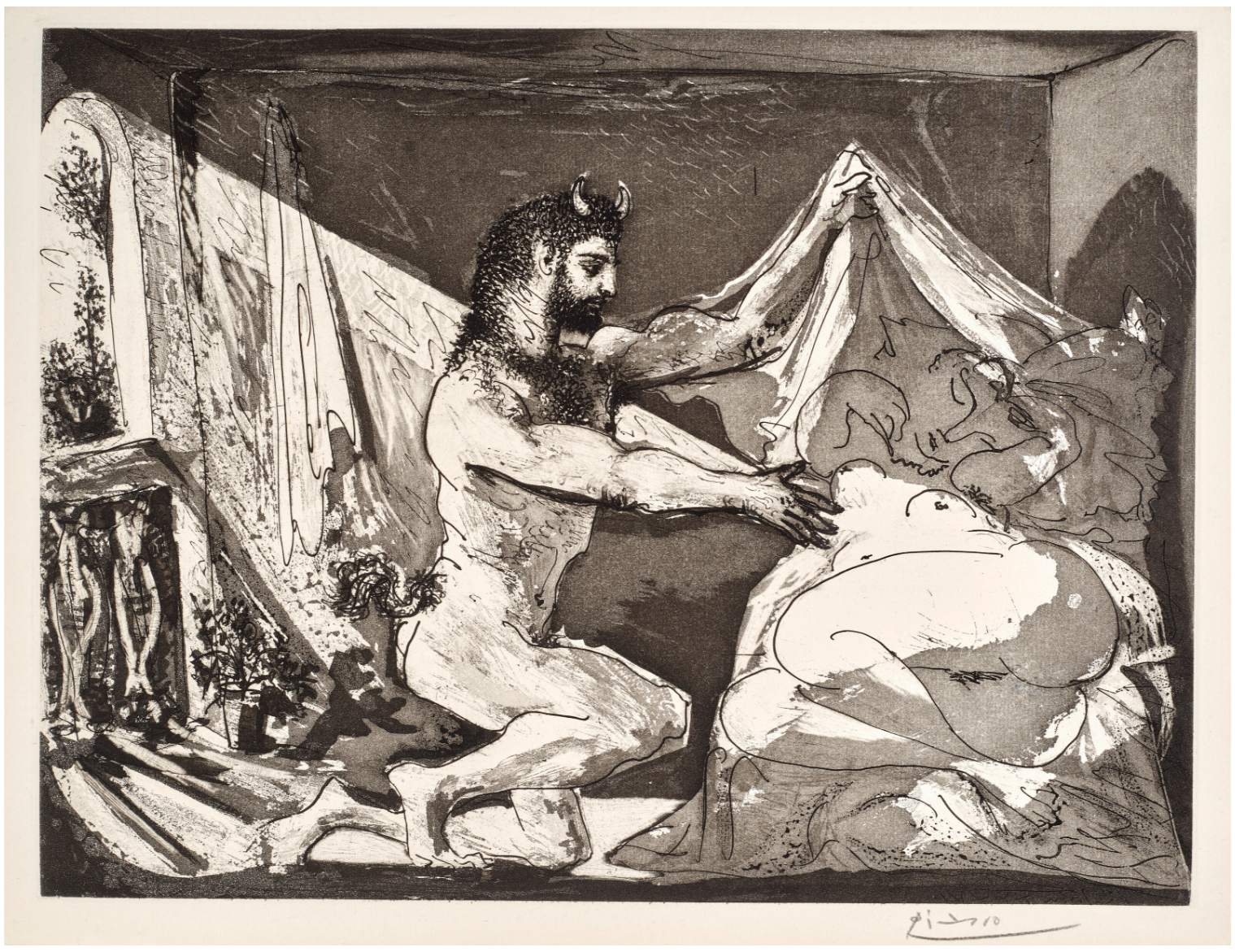
While Vollard’s death was perceived as a disaster for most of the two dozen artists and writers who had projects in progress with him, for a man with vision and daring it presented an enormous opportunity. Fortunately, a man with those qualities became part of the narrative. Henri Marie Petiet was born into an aristocratic family. He was a precocious collector from his earliest years, with an interest in illustrated books and, by extension, fine prints. He soon became a presence in the auction rooms and by degrees began to trade as well as collect, eventually opening his own gallery. Petiet knew, as did everyone else, that Vollard’s house on the rue de Martignac was an Aladdin’s cave, packed with paintings, drawings, ceramics, sculptures and prints. Whilst Petiet was interested in many of the prints and livres d’artiste, for him the main prize was the series that became known as the Suite Vollard. Intense negotiations with Vollard’s executors took place and, despite Paris being under Nazi occupation, a deal to acquire the entire edition was eventually concluded.
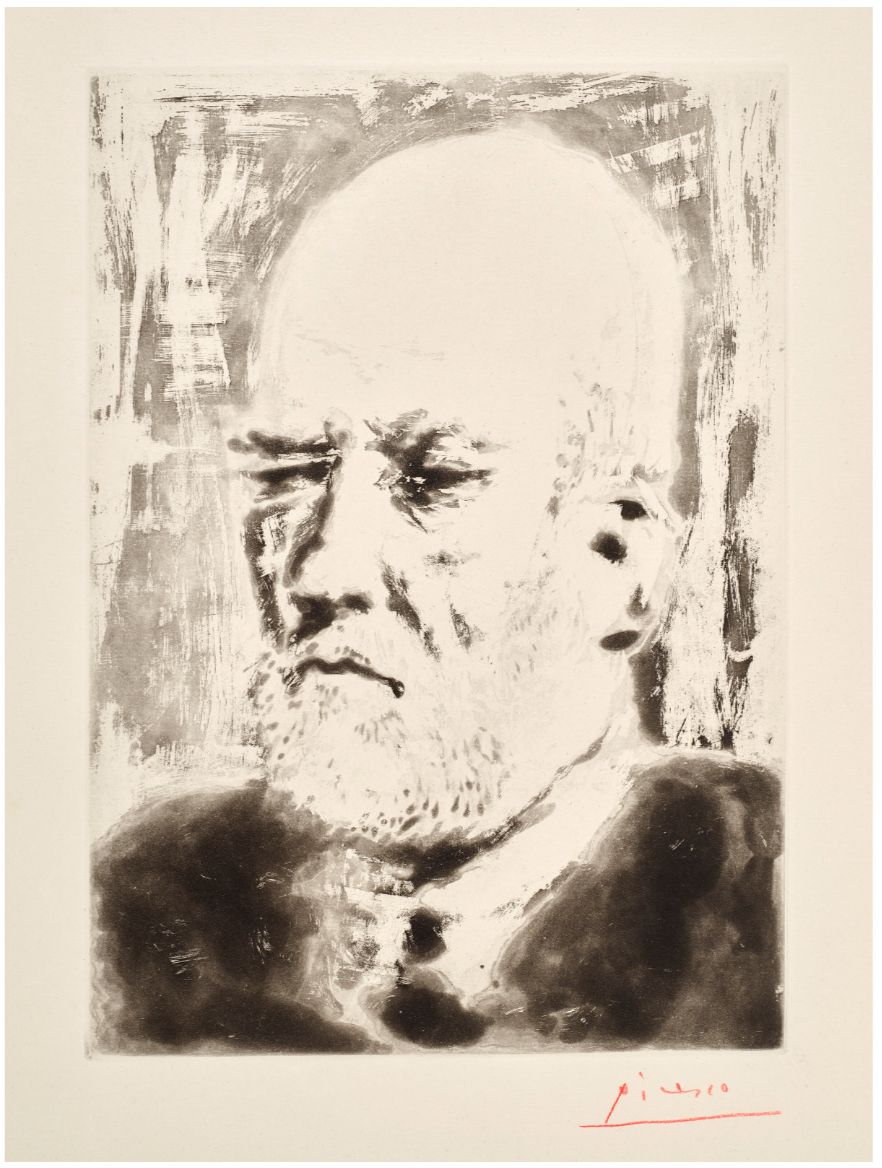
While the acquisition was a coup, it came with two challenges; the first was that Petiet received only 97 of the plates. The three portraits of Vollard had found their way to a competitor, forcing Petiet to negotiate with a rival whenever he wanted to sell a complete set. The second challenge was the fact that Picasso had signed very few impressions before Vollard died. It was clear to Petiet that he could substantially increase the return on his investment if he could induce the artist to sign more of the edition. This he managed to do, but only sporadically, and at some cost—Picasso charged 100, then 200 francs, for each signature, in cash. Aware that Picasso might change his mind at any time, Petiet presented sets of the large format edition to the artist first. When it came to the smaller format sets, Petiet shrewdly sent Picasso the most important subjects from each set for signing, reasoning that it would be better to have more sets with some subjects signed rather than fewer with all 100 plates signed. As Petiet had feared, by 1969 Picasso had grown weary of this arrangement and the signing stopped. Ultimately, many sets were broken up, either by Petiet or by subsequent owners, with the result that 75 years on, complete sets are a distinct rarity.
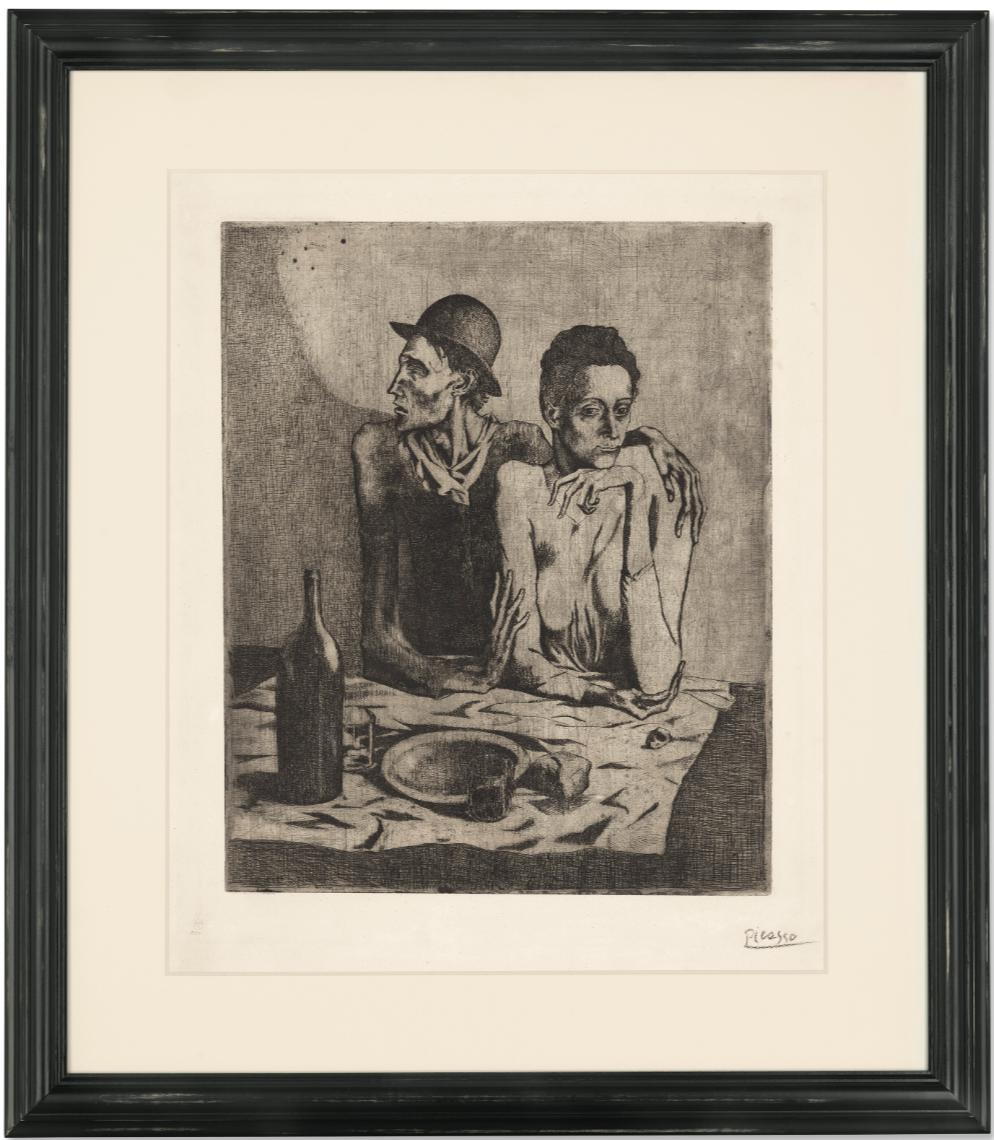
Le repas frugal, 1904
Christie’s New-York: 11 May 2023
Estimated: USD 3,000,000 – 5,000,000
USD 4,648,000
PABLO PICASSO (1881-1973), Le repas frugal | Christie’s (christies.com)
PABLO PICASSO (1881-1973)
Le repas frugal, 1904
Etching and scraper on laid Arches paper
A very fine and early impression of Baer’s second state before steel-facing
Plate: 46.3 x 37.7 cm (18 1/4 x 14 3/4 inches)
Sheet: 58.4 x 46.5 cm (23 x 18 1/4 inches)
Signed ‘Picasso’ (in pencil, lower right)
Printed by Auguste Delâtre, Paris, circa 1904-05
In 1904, the young Pablo Picasso moved to Paris. Although Barcelona had previously proved an inspiring place to work, he was determined to make it in the French capital. In April that year, he formally publicized his departure from Spain with an announcement printed in El Liberal and hopped the express train across the border. Once in Paris, he moved into the Bateau Lavoir studio in Montmartre. It was here that Picasso’s art would undergo a radical transformation as he grappled with the representation of space and perspective in two dimensions—and thus change the trajectory of art. In Paris, Picasso moved away from depictions of the urban poor that had dominated his Spanish canvases, casting his eye instead towards the saltimbanques, the acrobatic performers that filled the city’s streets. Ever experimental, he worked across different media, a tendency that would continue throughout his entire career. Most likely encouraged by his close friend Ricard Canals, he turned to printmaking shortly after his arrival, though this was not Picasso’s first stab at the medium—in 1899, he had executed El Zurdo, a somewhat clumsy and hesitant composition of a man, hand on hip, with a wide-legged stance. Only a few impressions were ever printed, of which a single example survives.
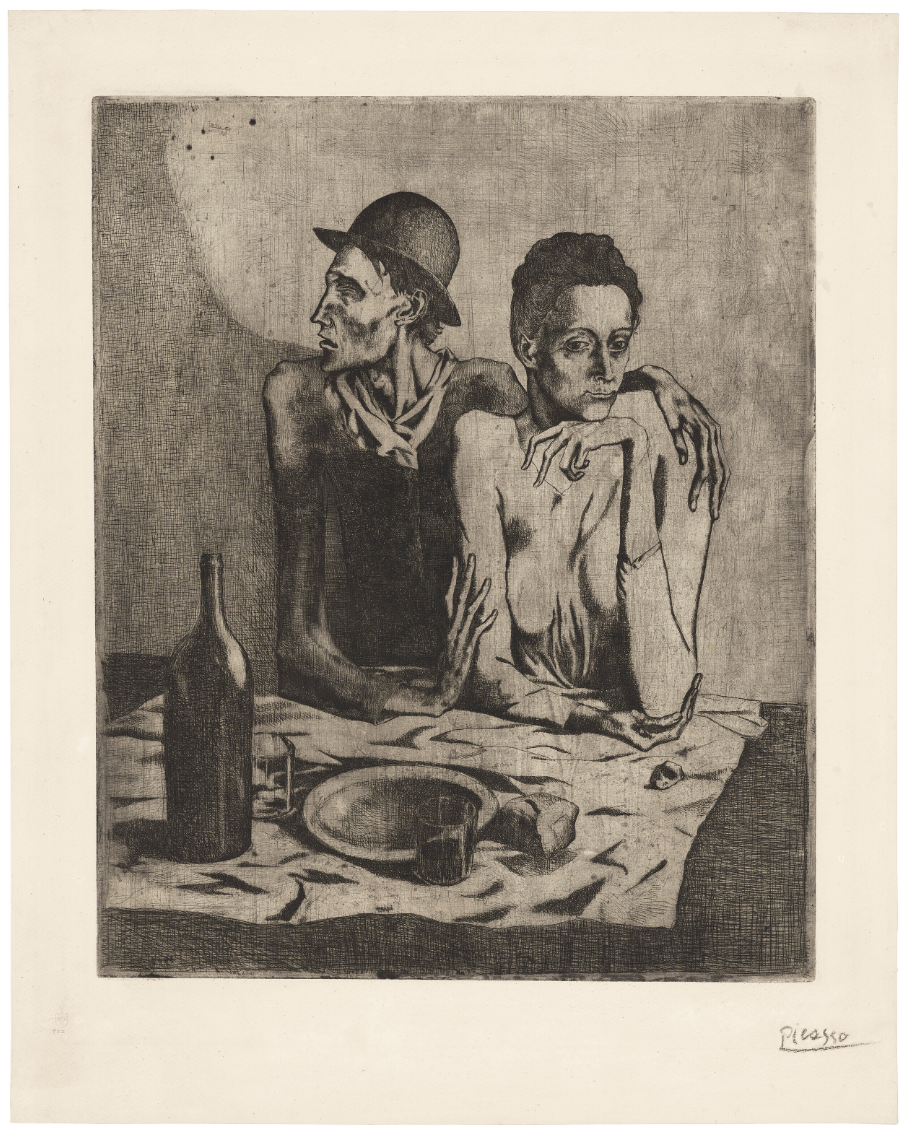 At some point in these first few months at the Bateau Lavoir, Picasso, with Canals’ guidance, began a new print, a technical masterpiece that demonstrated the dramatic evolution of his technique during the interim years, Le repas frugal, now an icon of the artist’s Blue Period. The first print-run of Le repas frugal was small and produced by the master printer Auguste Delâtre between September 1904 and March 1905. Picasso was evidently proud of his work, sending examples of the small number of impressions he had pulled to his father, and a few select friends and prospective buyers. He also included Le repas frugal in his 1905 exhibition at the Galeries Serrurier in Paris, where it was shown alongside a group of etchings depicting street performers, which he had produced in the meantime. This group, including Le repas frugal, was later purchased by Ambrose Vollard who, in 1913, printed an edition of 250. Together, these works came to be known as La suite des saltimbanques. The couple depicted in the present composition are Madeleine, Picasso’s lover at the time, known to scholars only by her first name, and a nameless man who first appeared in several sketches and a gouache by the artist in Barcelona, before making his formal debut in the painting Le repas de l’aveugle (Zervos, vol. 1, no. 168; The Metropolitan Museum of Art). In Le repas frugal, their bodies are elongated and lithe, an effect emphasized by the linear quality of the etching, inspired, in part, by Picasso’s close study of El Greco. This refined treatment of the figures represents a departure from the softer, more painterly bodies of his Barcelona works and signals the aesthetic shift his practice was undergoing at this time.
It is not known how many impressions were printed by Auguste Delâtre in 1904 and 1905. Bernhard Geiser and Brigitte Baer record one impression of the first state (Musée Picasso, Paris); and approximately 35 impressions of the second state, including three printed in Prussian blue. Of these, the following nine examples are in public collections: The Museum of Modern Art, New York (signed, dedicated to Junyent); the Art Institute of Chicago (two impressions: one in blue, signed; one unsigned); Musée Picasso, Paris (signed, numbered no. 1); Museo Picasso, Barcelona (signed, numbered no. 2); National Gallery of Art, Washington, D.C. (signed, numbered no. 3); Clark Art Institute, Williamstown, Mass. (signed, numbered no. 4); Museum of Fine Arts, Boston (signed, dedicated to Mlle. Gatte); and Museo Thyssen-Bornemisza, Madrid (signed, dedicated to Canudo). Once Vollard acquired the plates of Picasso’s earliest prints, he had them steel-faced, a process in which the copper plates were electroplated with a thin layer of steel. Although this meant the matrix could withstand a much larger print-run, it also eroded the definition, depth and clarity of the etched lines. Only impressions of Le repas frugal printed by Delâtre in 1904-05 prior to the steel-plating, possess the strong contrasts, rich plate tone, and graphic intensity as seen in the present lot.
La Femme qui pleure I, 1937
Sotheby’s New-York: 16 May 2023
Estimated: USD 1,500,000 – 2,500,000
USD 1,650,000
La Femme qui pleure I | The Mo Ostin Collection Evening Auction | 2023 | Sotheby’s (sothebys.com)
PABLO PICASSO (1881 – 1973)
La Femme qui pleure I, 1937
Drypoint, aquatint, etching and scraper on Montval laid paper
Plate: 69.2 x 49.5 cm (27 1/4 x 19 1/2 inches)
Sheet: 77.5 x 56.2 cm (30 1/2 x 22 1/8 inches)
Signed in pencil (lower right) and numbered 15/15 (lower left)
Very fine impression of the extremely rare subject numbered 15 from the edition of 15 of Baer’s third state (of seven)
Printed by Lacourière
La Femme qui pleure I is a masterpiece of modern printmaking and among the most important prints of the twentieth century. It is peerless within Picasso’s body of graphic work in its emotional impact and has become an emblem of universal pain and suffering through its depiction of inconsolable grief. In 1937 Picasso found himself in a maelstrom of personal and political anguish. It would lead him to create one of his greatest paintings, Guernica, and alongside it the groundbreaking series of paintings, drawings and prints collectively known as La Femme qui pleure. The motif of the Weeping Woman first made an appearance in a drawing towards the end of May and in the coming months became a subject Picasso would return to repeatedly. Although the composition as it appears in the etching and in many of the paintings does not feature in the finished version of Guernica, it became the vehicle through which Picasso explored many of the themes central to the mural.
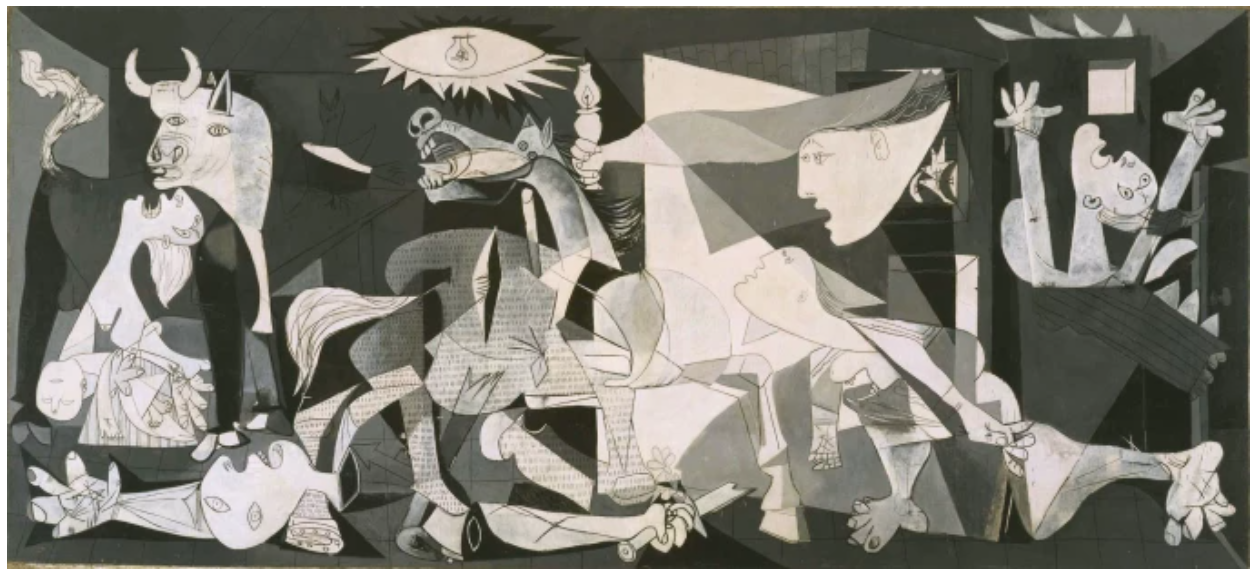
PABLO PICASSO, GUERNICA, 1937. MUSEO NACIONAL CENTRO DE ARTE REINA SOFIA, MADRID. IMAGE: BRIDGEMAN IMAGES. ART © 2023 ESTATE OF PABLO PICASSO / ARS, NEW YORK
In January 1937, Picasso had started work on a pair of etchings in support of the Republican side in the Spanish civil war titled Sueño y mentira di Franco (Dreams and lies of Franco). In the same month he received an invitation to paint a large mural for the Spanish Pavilion at the International Exposition in Paris that summer. He saw the opportunity to make a great political statement and experimented with various possible subjects to achieve this through the spring. On 26 April the German Air Force, at the request of Franco’s forces, repeatedly bombed the Basque town of Guernica, all but levelling the town and killing many civilians. The event caused international outrage and was the catalyst for Picasso finding a subject through which he could channel his own abhorrence and anger at events unfolding in his native country. Motivated by a sense of moral outrage and determined to show his support for the Republican cause, Picasso turned to printmaking to more readily disseminate his visual protest.
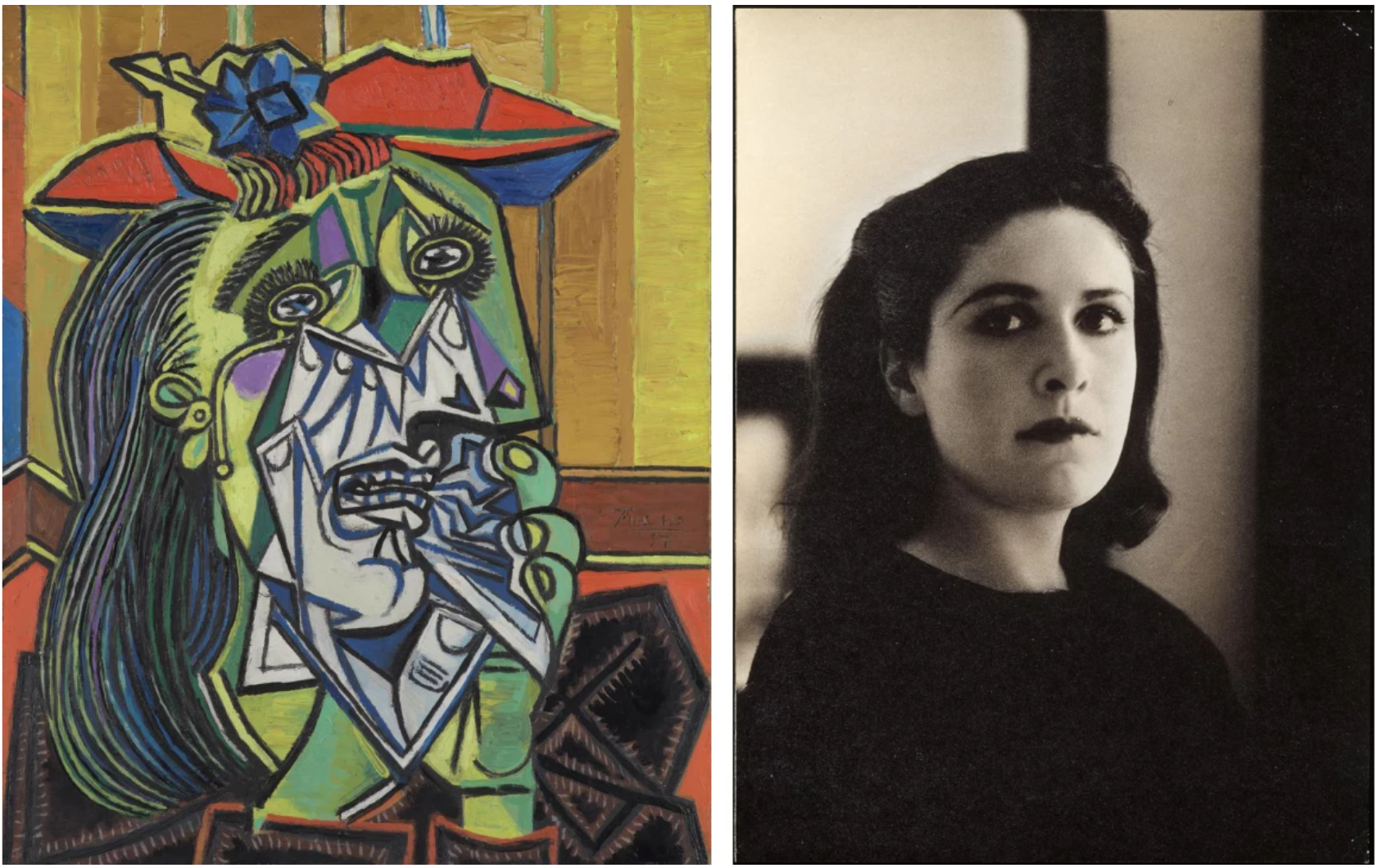
PABLO PICASSO, LA FEMME QUI PLEURE, 1937. TATE, LONDON. ART © 2023 ESTATE OF PABLO PICASSO / ARS, NEW YORK
ROGI ANDRÉ, PORTRAIT DE DORA MAAR, CIRCA 1937, PHOTOGRAPH, CENTRE POMPIDOU, PARIS © CENTRE POMPIDOU MNAM-CCI / GEORGES MEGUERDITCHIAN / DIST. RMN
It was not only this large-editioned work centered on Franco himself that would visually represent Picasso’s focus in these key months of 1937. La Femme qui pleure, heavily based in the features of the artist’s primary muse and paramour at the time, the photographer and artist Dora Maar, contained motifs associated with his mistress Marie-Thérése Walter and his long-estranged wife Olga Khokhlova. Idiomatically apt, the Weeping Woman spoke directly of the Spanish tragedy, her shattered features fulfilling the role of the modern Mater Dolorosa. It is perhaps not surprising that an example of the present work as well as the seventh state were also hung in the Spanish Pavilion at the World’s Fair.
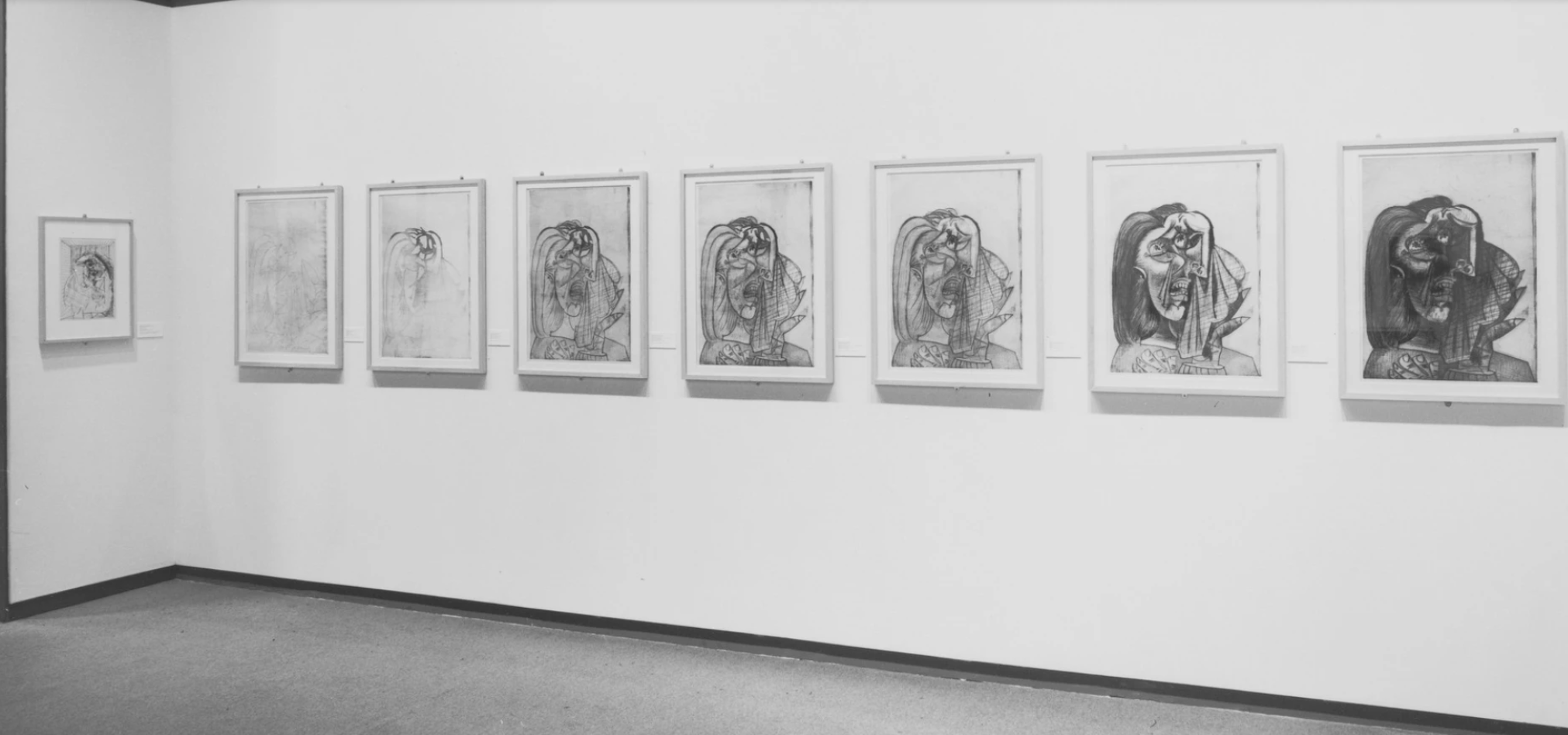
INSTALLATION VIEW OF THE EXHIBITION PABLO PICASSO: A RETROSPECTIVE, 1980. THE MUSEUM OF MODERN ART ARCHIVES, PHOTO: MALI OLATUNJI. ART © 2023 ESTATE OF PABLO PICASSO / ARS, NEW YORK
Picasso began work on La Femme qui pleure on July 1, 1937 at Roger Lacourière’s studio in Paris, on a plate equal in size to that of La Minotaurmachie—then the largest plate he had yet attempted—and developed and reworked La Femme qui pleure over the course of seven states. The present impression of the third state masterfully contrasts the broad, dark lines of the scraper that outline the composition with the gradient of aquatint that underscores the most prominent features of the face, darkening in the forehead. While this veil of aquatint is reworked and largely removed in later states, its prominence in the third state effectively reinforces the work’s overarching sense of psychological anguish. Fewer than forty impressions of the seven states were printed and only the third and seventh states were signed in pencil and numbered in editions of fifteen. Picasso’s treatment of the impressions of the numbered states evidenced the significance the print held for the artist. He retained more than half of them until his death and many of the remainder were gifted to confidants including Yvonne Zervos, Robert Penrose, Marie Cuttoli, and the poets Josep Carner and Juan Larrea. Other examples of the third state are found in museum collections around the world, including the Prado in Madrid, The Museum of Modern Art, New York; the Musée Picasso, Paris and the Sprengel Museum, Hanover.
Buste de femme d’après Cranach le Jeune, 1958
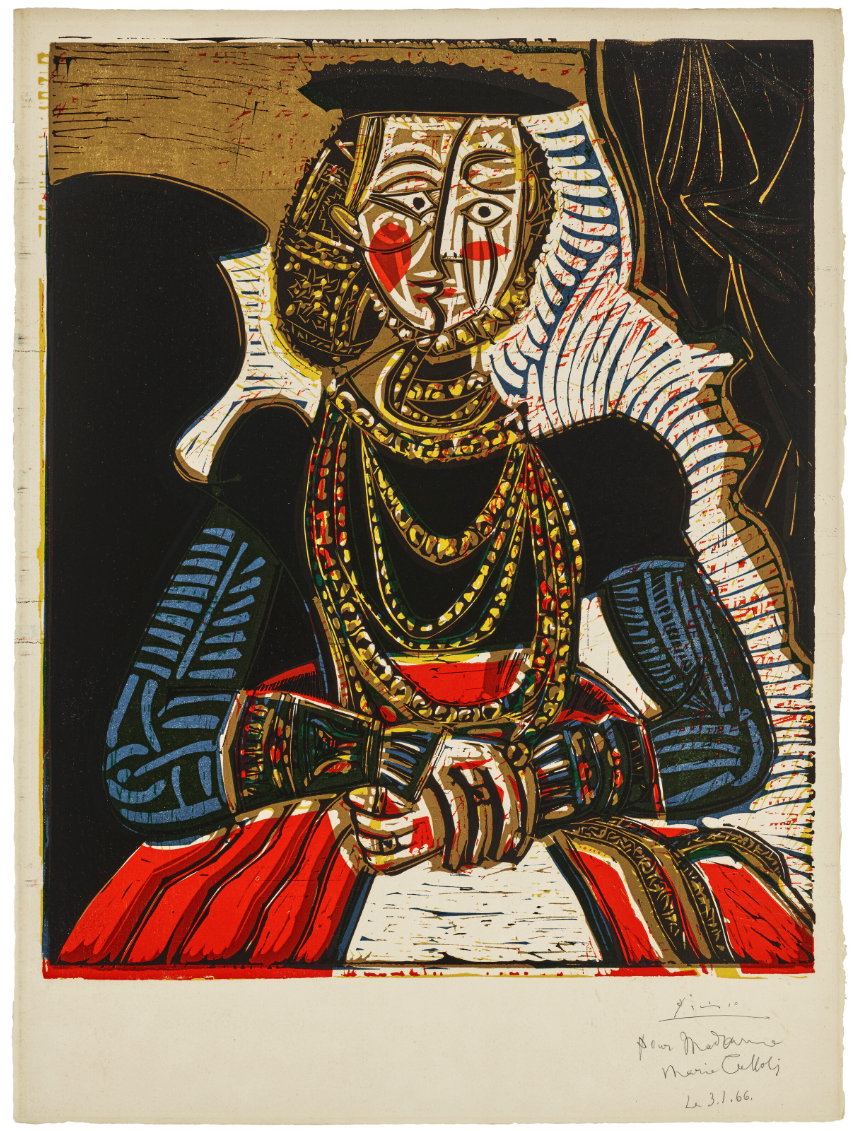
PABLO PICASSO (1881-1973)
Buste de femme d’après Cranach le Jeune, 1958
Linocut in colors on Arches paper
Image: 64.8 x 53.3 cm (25 1/2 x 21 inches)
Sheet: 76.8 x 57.1 cm (30 1/4 x 22 1/2 inches)
Edition: 50
Publisher: Galerie Louise Leiris, Paris