WORK IN PROGRESS
The Athlete-Artist Who Redefined Movement and Black Experience
Ernest Eugene “Ernie” Barnes Jr. (July 15, 1938 – April 27, 2009) occupies a singular place in 20th-century American art: a professional athlete turned painter whose work fused the physical poetry of sport with an expressive vision of everyday life. Born in Durham, North Carolina, at the height of Jim Crow segregation, Barnes grew up in a Black working-class community deeply shaped by racial barriers. Denied access to museums, he absorbed art history from books and catalogues at the home of his mother’s employer, developing an early affinity for the great masters.
His youthful sensitivity found two outlets: drawing and athletics. At Hillside High School, art and sport co-existed with equal force; by graduation he was a celebrated football captain and state shot-put champion. On a full athletic scholarship, he studied art at North Carolina Central University while honing his physical discipline.
Barnes’s professional football career began in 1960 as an offensive lineman with the Baltimore Colts, later playing for the San Diego Chargers and Denver Broncos in the AFL and NFL. Even on the field he carried a sketchbook, intuitively linking bodily motion with pictorial rhythm. A career-ending injury in 1965 prompted his transition to art full time — a bold pivot that soon revealed his distinct voice.
Establishing his practice in Los Angeles, Barnes developed a signature idiom he called neo-mannerism: elongated, sinuous figures propelled in motion, often shown with closed eyes to signify humanity beyond surface identity. His compositions — whether dancers, athletes, or everyday revelers — radiate kinetic energy and emotional warmth. Influences ranged from Italian Mannerists to 20th-century American realists, but his work remained intensely personal, conveying what he described as the “spiritual currency” of Southern Black life. His breakthrough into the national consciousness came in the 1970s. Norman Lear’s groundbreaking sitcom Good Times featured Barnes’s paintings — notably The Sugar Shack (1971) — as the fictional portfolio of the character J.J., bringing his work into millions of homes. Marvin Gaye selected the image for the cover of his 1976 album I Want You, cementing its place in visual culture.
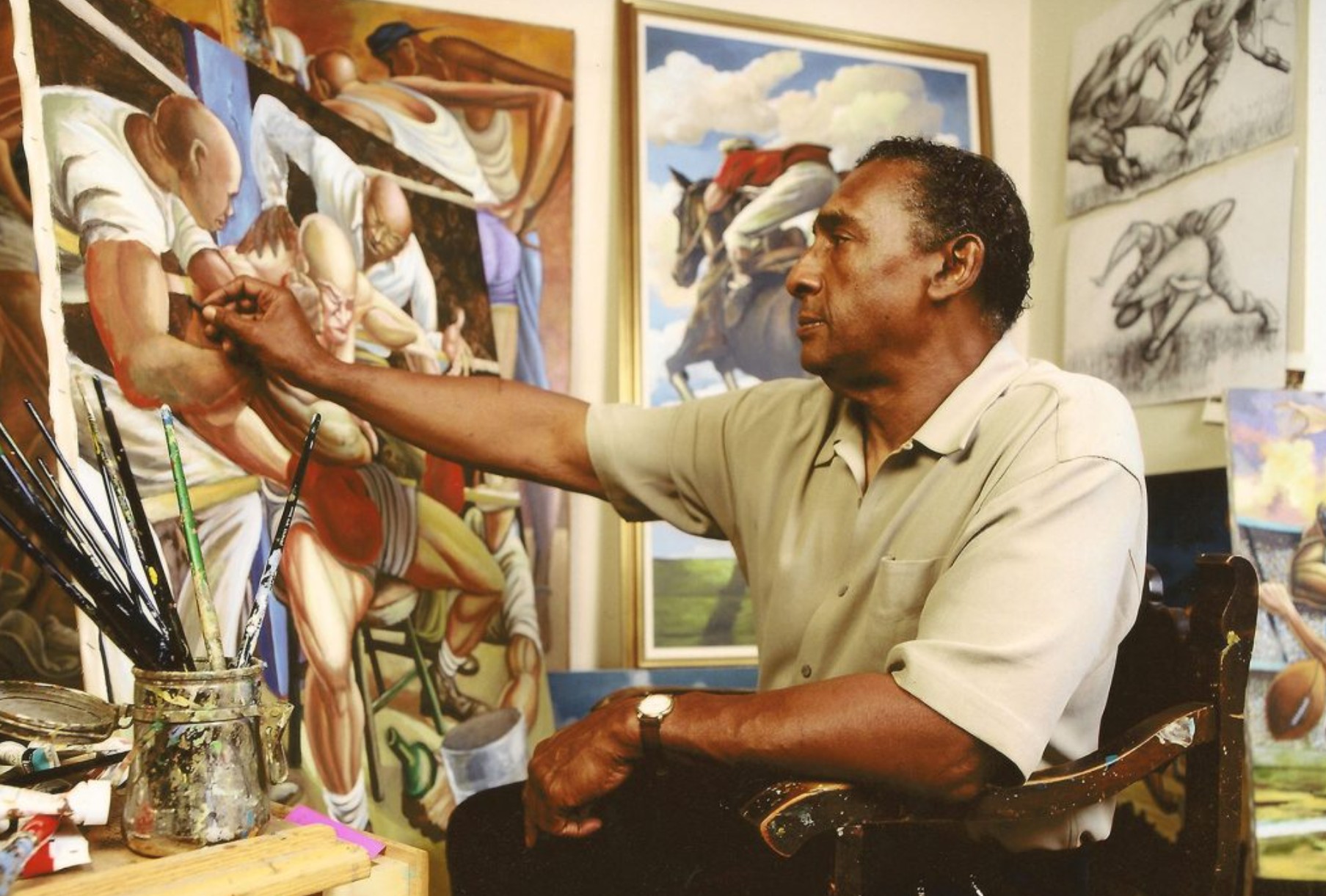
Barnes also became an influential sports artist: the official artist of the American Football League, the designated Sports Artist of the 1984 Olympic Games in Los Angeles, and twice honored as Sport Artist of the Year. His commissions spanned NFL and NBA icons and Olympic themes, celebrating athletic grace as both physical and symbolic triumph.
Over four decades, Barnes built a prolific career that bridged popular culture and the art world. His work has been included in major museum exhibitions and is held in permanent collections — from the California African American Museum and the Pro Football Hall of Fame to university and sport art museums nationwide.
Barnes died in Los Angeles in 2009 at age 70. Today his legacy endures not merely in his instantly recognisable figures but in a narrative of resilience: an artist who translated motion into meaning and brought the vibrancy of Black experience into America’s visual imagination.
Auction Market Overview
2025 Auction Highlights
29 lots sold at auction in 2025 for a total turnover of USD 5,876,730. With 6 lots failing to sell, the sell-through rate is 83%. The highest price for 2025 was achieved by 3 on 3, a painting dated 1973, that sold at Christie’s in New-York, on 30 September 2025. This is the only lot that sold for more than USD 500,000.
2025 Top 3 Lots
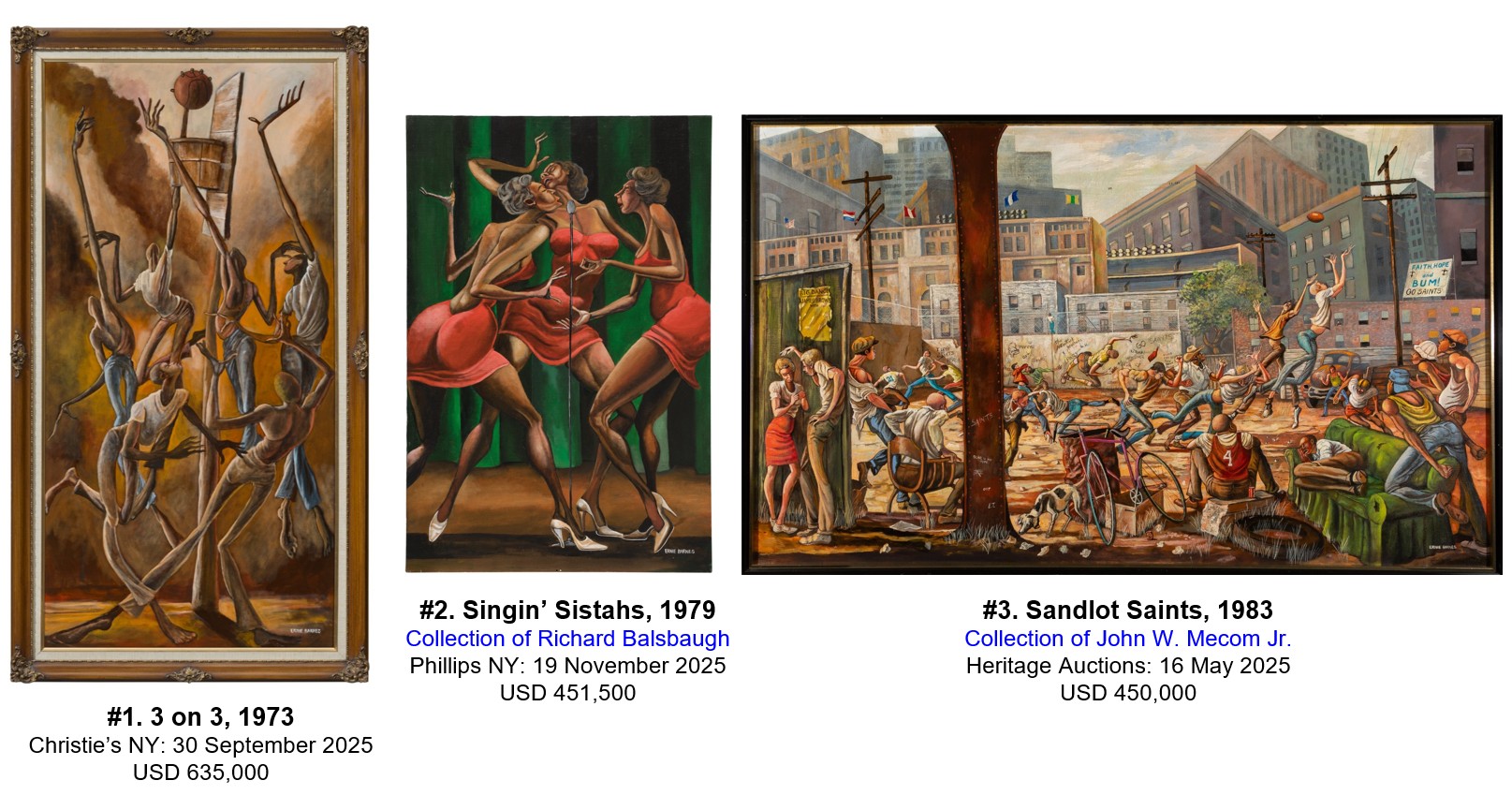
20 lots sold for more than USD 100,000, generating a cumulative turnover of USD 5,548,500, representing 94.4% of the total turnover for 2025.
2024 Auction Highlights
15 lots sold at auction in 2024 for a total turnover of USD 3,517,055. With 4 lots failing to sell, the sell-through rate is 79%. The highest price of 2024 was achieved by Pail Hoops, a painting dated 1974, that sold at Christie’s in New-York, on 22 November 2024, for USD 630,000. This is the only lot that sold for more than USD 500,000.
2024 Top 3 Lots
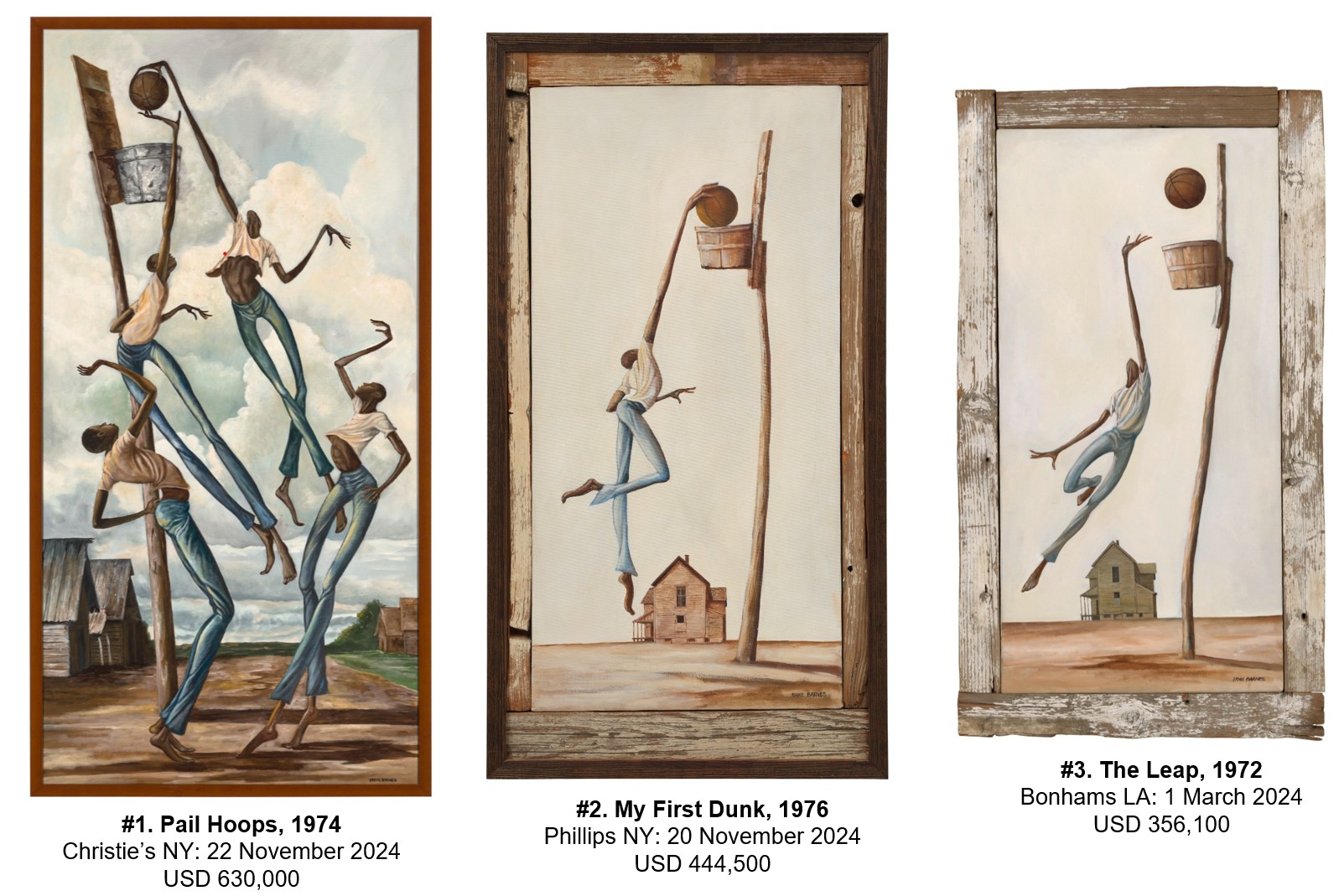
10 lots sold for more than USD 100,000, generating a cumulative turnover of USD 3,249,800, representing 92.4% of the total turnover for 2024.
Top Lots
#1. The Sugar Shack, 1976
Christie’s New-York: 12 May 2022
Estimated: USD 150,000 – 200,000
USD 15,275,000
NEW AUCTION RECORD FOR THE ARTIST
ERNIE BARNES (1938 – 2009), The Sugar Shack | Christie’s
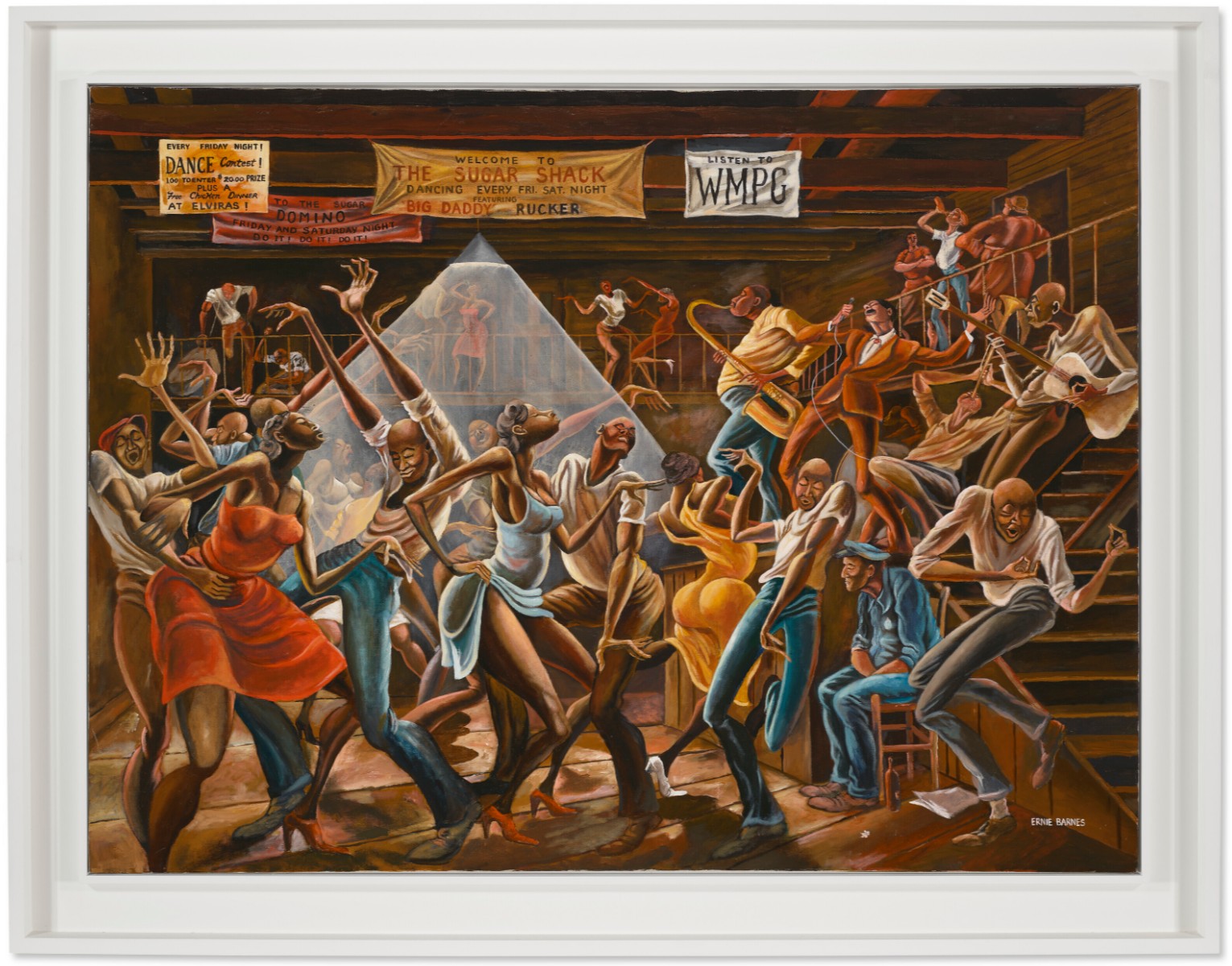
ERNIE BARNES (1938 – 2009)
The Sugar Shack, 1976
Acrylic on canvas
36×48 inches (91.4 x 121.9 cm)
Signed ‘ERNIE BARNES’ (lower right)
Signed again, inscribed and dated 9⁄27/76 Ernie Barnes’ (on the reverse)
#2. Storm Dance, 1977
Christie’s New-York: 13 May 2022
Estimated: USD 100,000 – 150,000
USD 2,340,000
ERNIE BARNES (1938 – 2009), Storm Dance | Christie’s
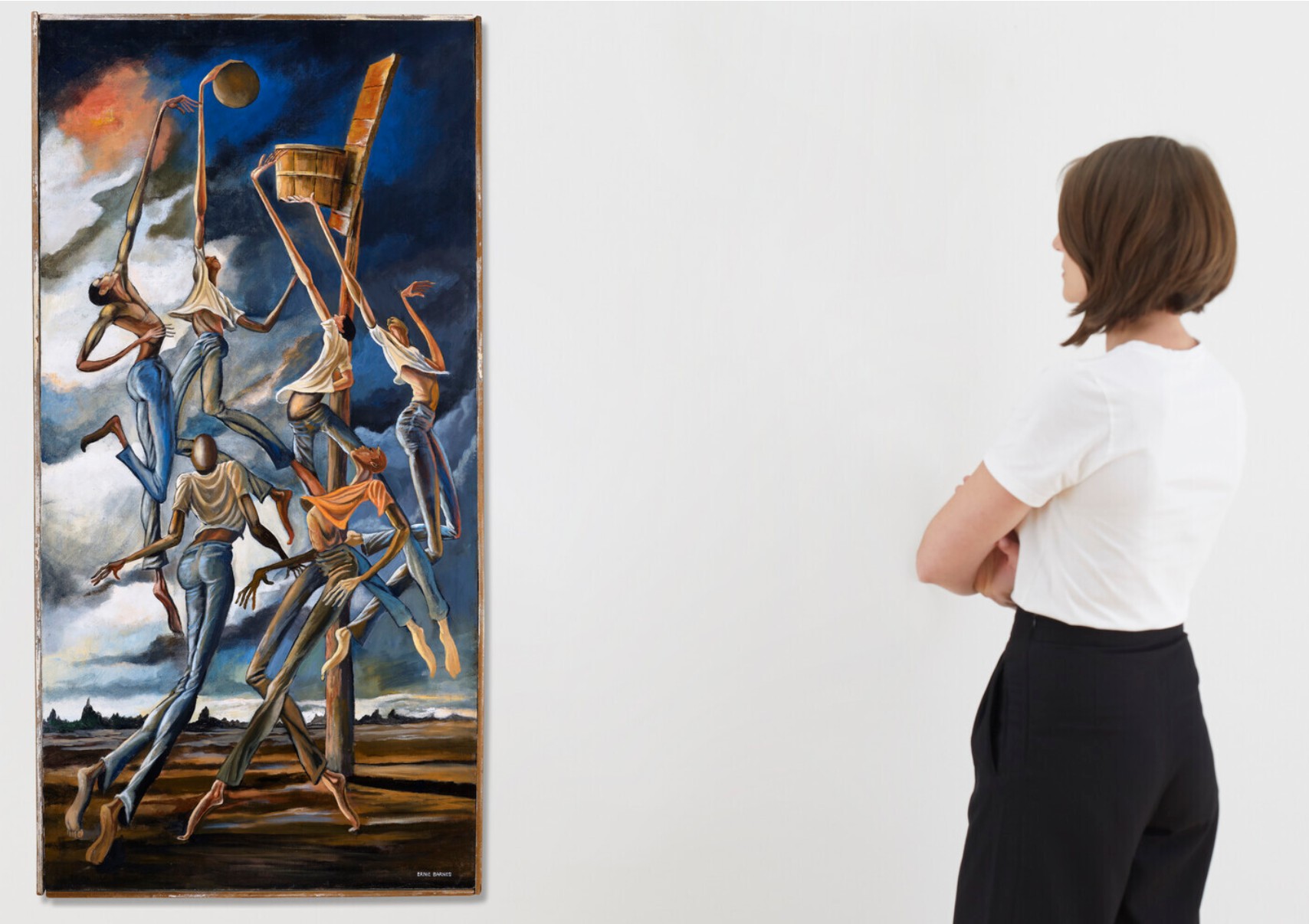
ERNIE BARNES (1938 – 2009)
Storm Dance, 1977
Acrylic on canvas, in artist’s frame
48 3/4 x 24 3/4 inches (123.8 x 62.9 cm)
Signed ‘ERNIE BARNES’ (lower right)
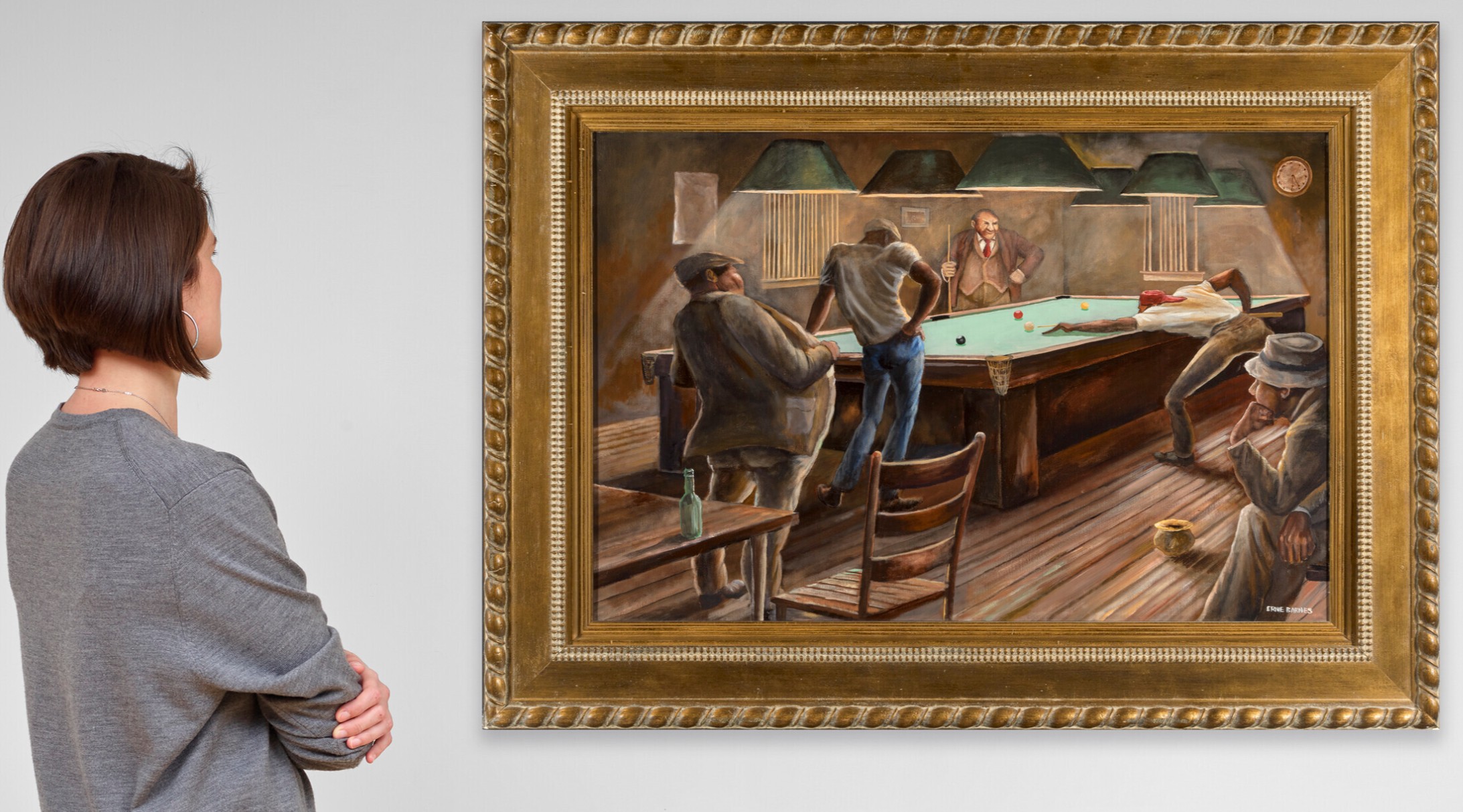
#3. Main Street Pool Hall, 1978
FRAGMENTS OF LIFE:
WORKS BY ERNIE BARNES FROM THE COLLECTION OF DANNY AND DONNA ARNOLD
Christie’s London: 28 June 2022
Estimated: GBP 80,000 – 120,000
GBP 1,482,000 / USD 1,808,765
ERNIE BARNES (1938-2009), Main Street Pool Hall | Christie’s
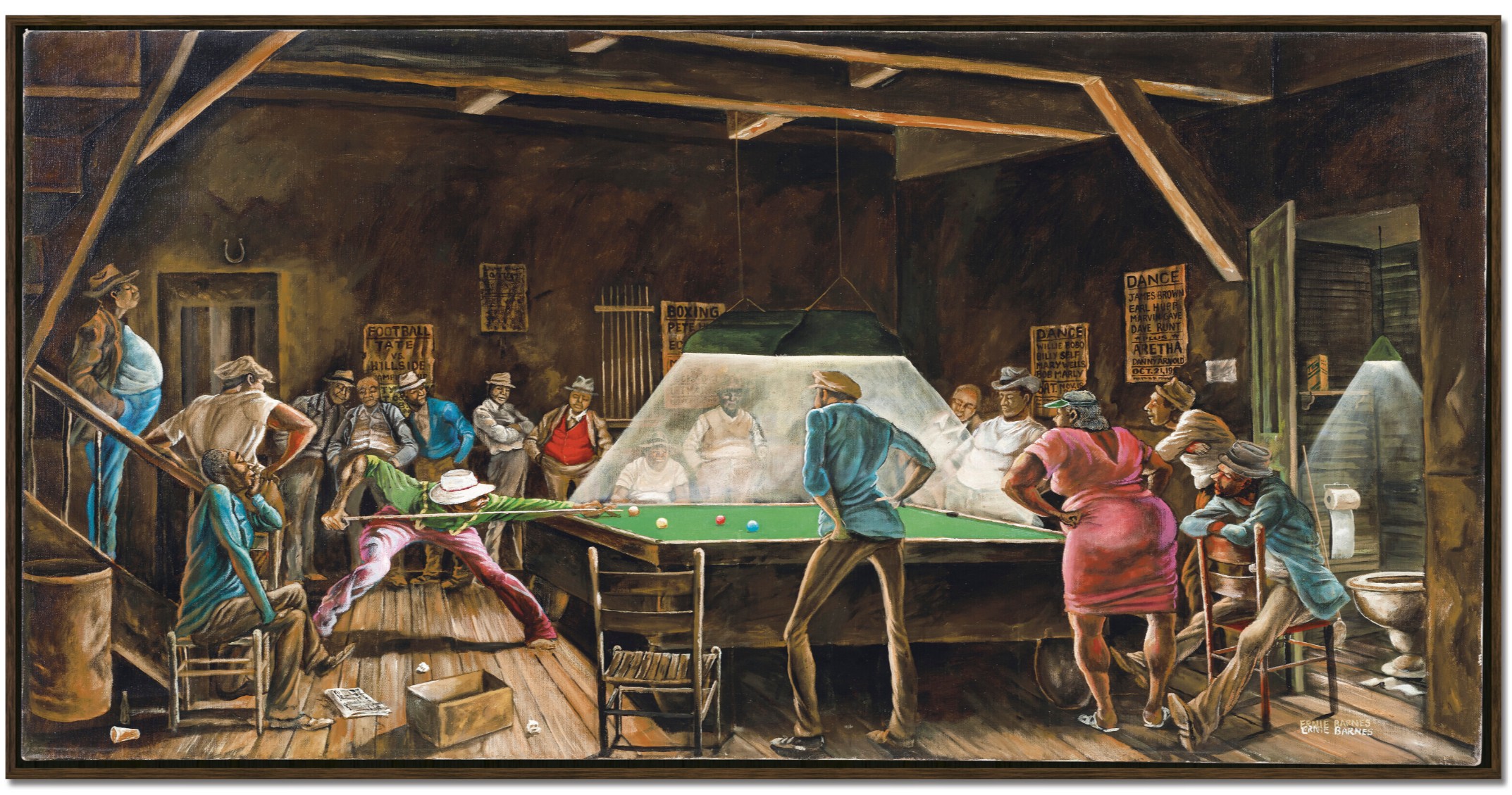
ERNIE BARNES (1938-2009)
Main Street Pool Hall, 1978
Oil on canvas
23 3/4 x 48 inches (60.3 x 121.9 cm)
Signed twice ‘ERNIE BARNES’ (lower right)
#4. Solid Rock Congregation, 1993
Bonhams New-York: 9 September 2022
Estimated: USD 500,000 – 700,000
USD 1,620,375
Bonhams : ERNIE BARNES (1938-2009) Solid Rock Congregation1993
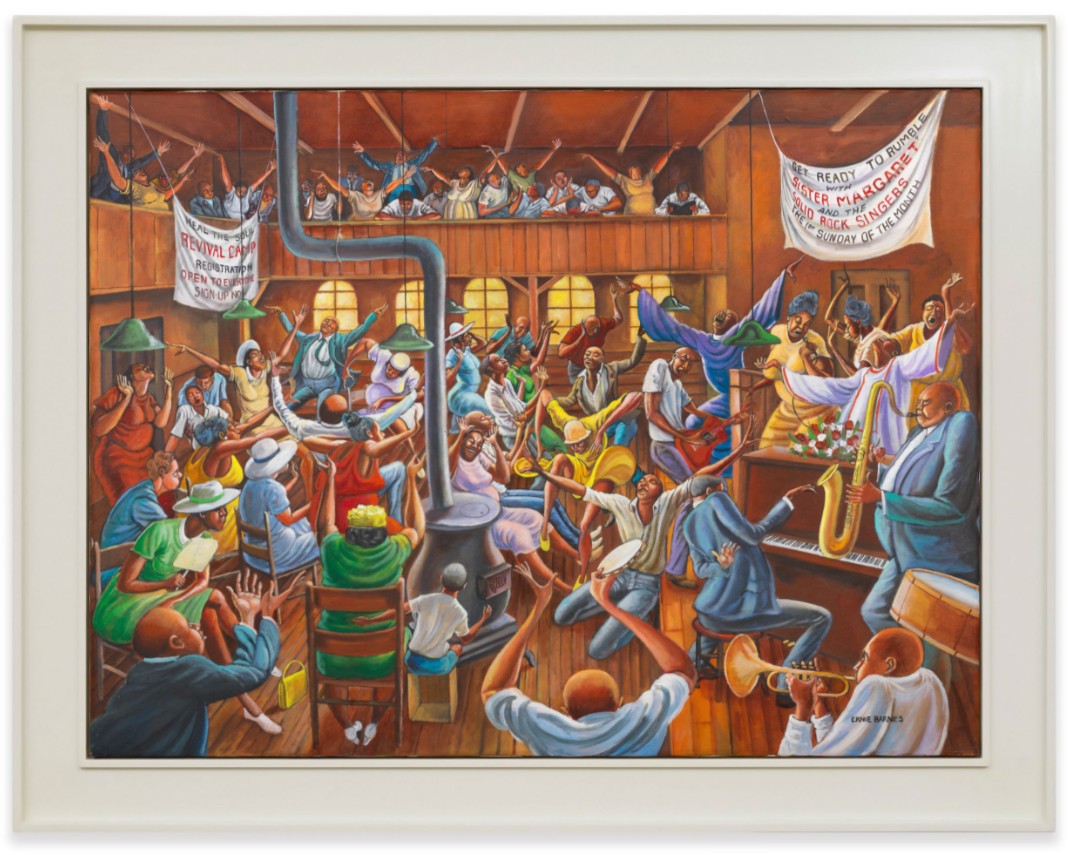
ERNIE BARNES (1938-2009)
Solid Rock Congregation, 1993
Acrylic on canvas
36×48 inches (91.4 x 121.9 cm)
Signed
2025 Auction Results
29 lots sold at auction in 2025 for a total turnover of USD 5,876,730. With 6 lots failing to sell, the sell-through rate is 83%. The highest price for 2025 was achieved by 3 on 3, a painting dated 1973, that sold at Christie’s in New-York, on 30 September 2025. This is the only lot that sold for more than USD 500,000.
2025 Top 3 Lots
20 lots sold for more than USD 100,000, generating a cumulative turnover of USD 5,548,500, representing 94.4% of the total turnover for 2025.
#1. 3 on 3, 1973
Christie’s New-York: 30 September 2025
Estimated: USD 500,000 – 700,000
USD 635,000
ERNIE BARNES (1938-2009), 3 on 3 | Christie’s
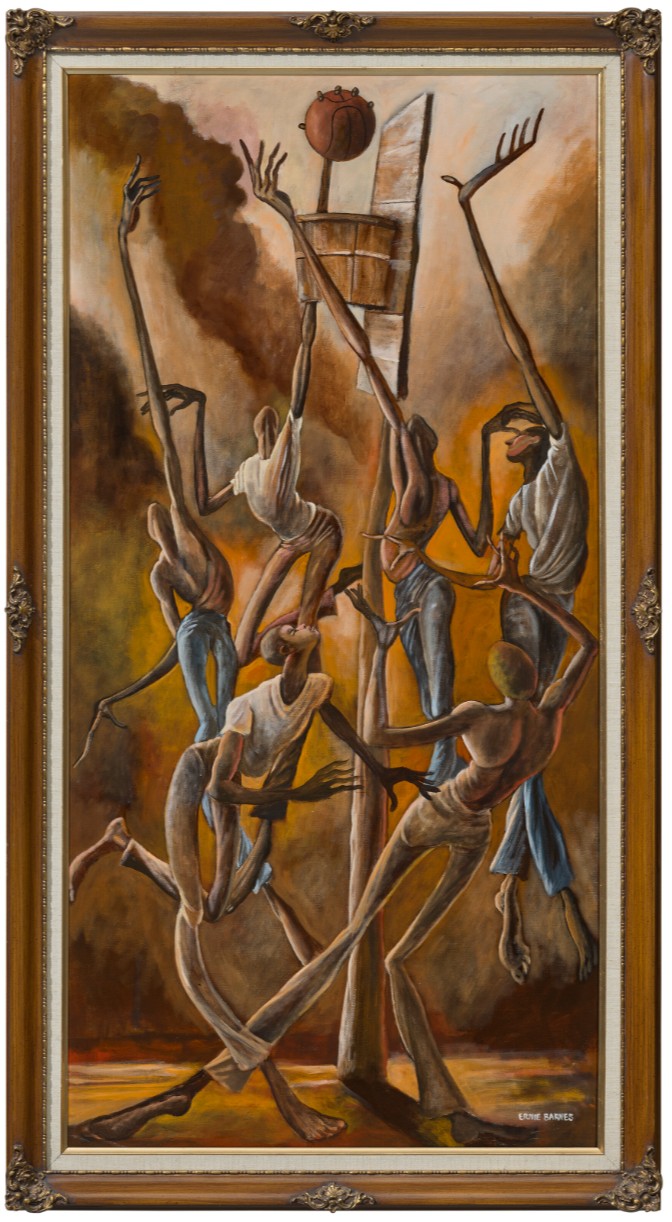
ERNIE BARNES (1938-2009)
3 on 3, 1973
Oil on canvas
48×24 inches (121.9 x 61 cm)
Signed ‘ERNIE BARNES’ (lower right)
USD 500,000
#2. Singin’ Sistahs, 1979
Property from the Collection of Richard Balsbaugh
Phillips New-York: 19 November 2025
Estimated: USD 300,000 – 500,000
USD 451,500
Ernie Barnes Modern & Contemporary Art Evening Sale featuring Cera the Triceratops
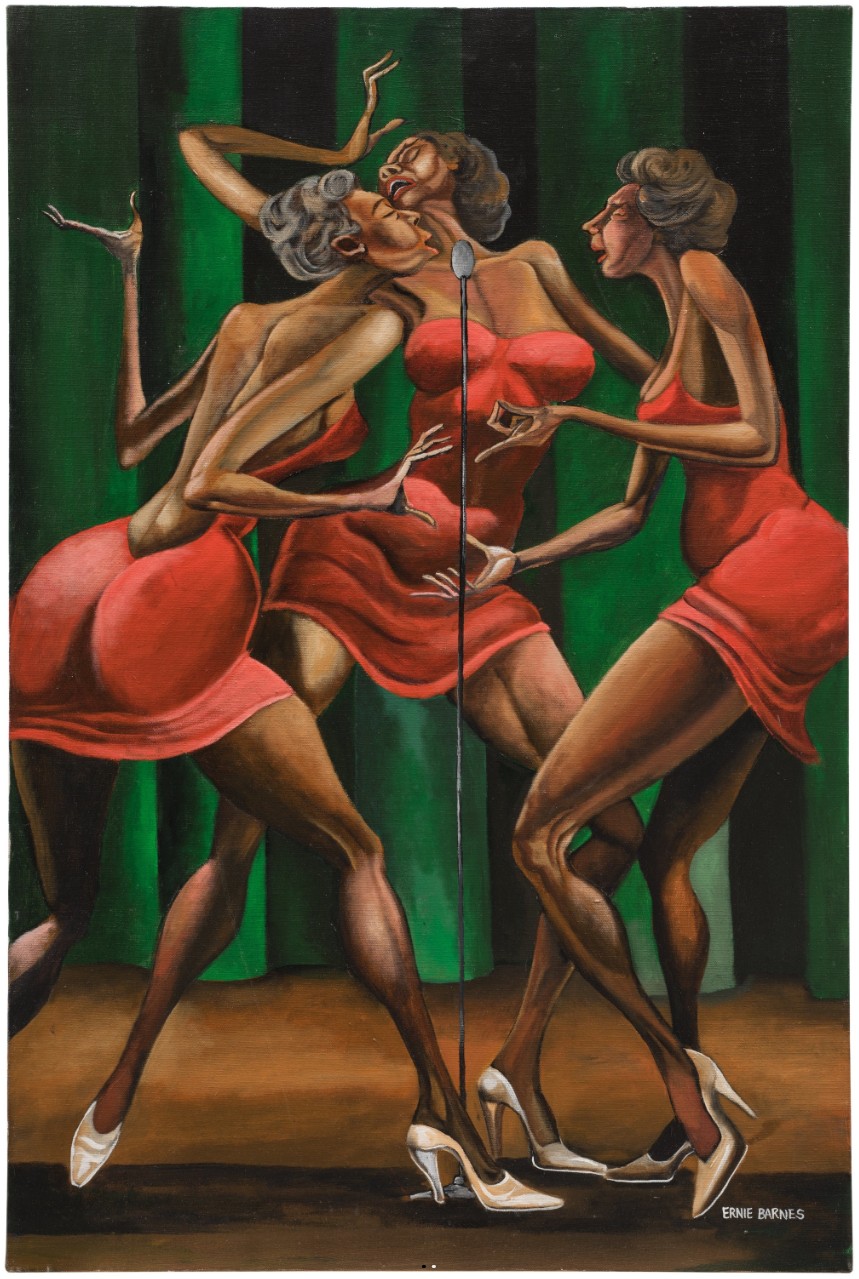
Acrylic on canvas
36×24 inches (91.4 x 61 cm)
Signed “ERNIE BARNES” lower right
#3. Sandlot Saints, 1983
Heritage Auctions: 16 May 2025
Estimated: USD 300,000 – 500,000
USD 450,000
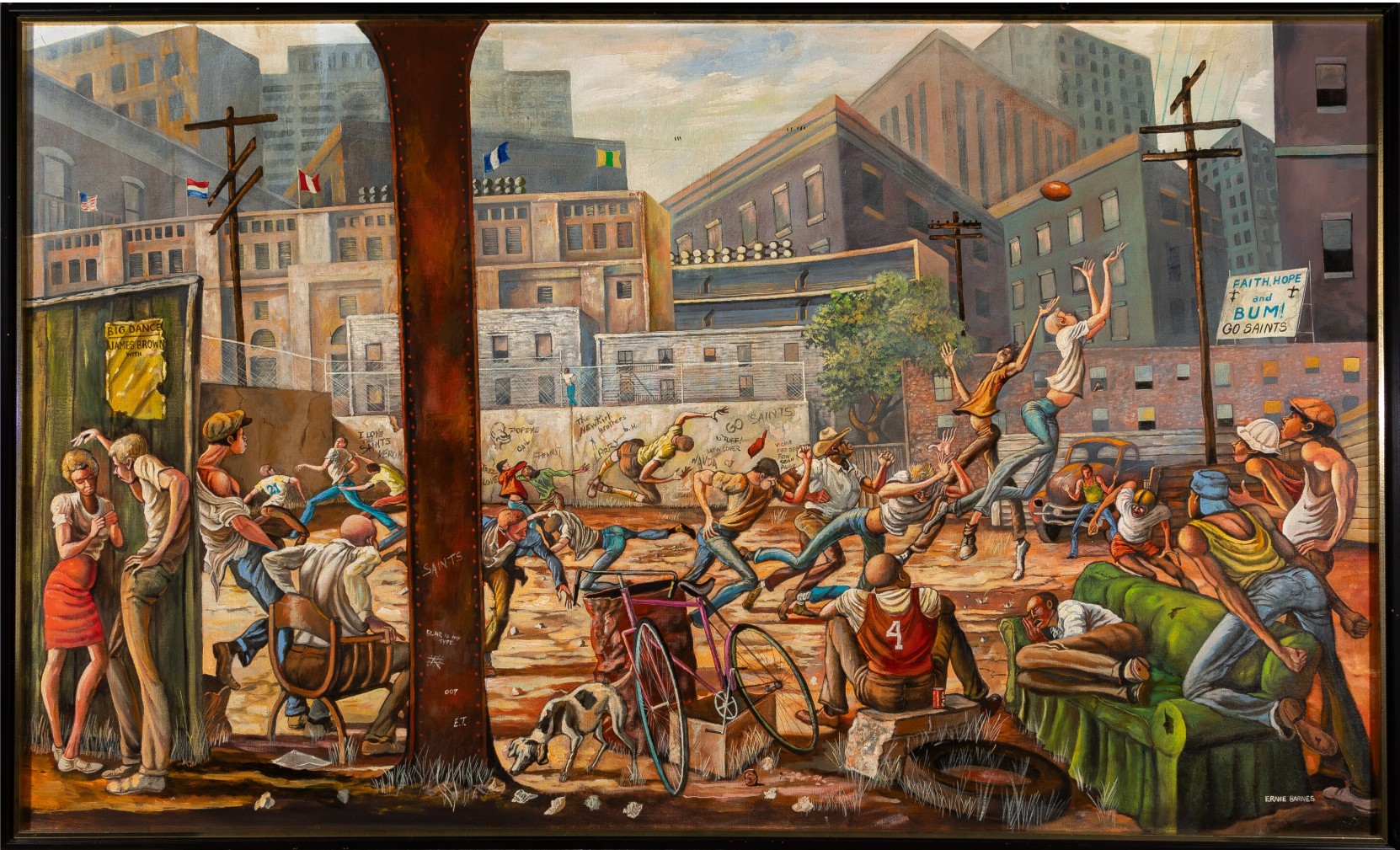
ERNIE BARNES (American, 1938-2009)
Sandlot Saints, 1983
Acrylic on canvas
36×60 inches (91.4 x 152.4 cm)
Signed lower right: Ernie Barnes
#4. Untitled (Layup), circa 1970s
Property from a Prominent New York Collection
Sotheby’s New-York: 26 September 2025
Estimated: USD 250,000 – 350,000
USD 419,100
Untitled (Layup) | Contemporary Curated | 2025 | Sotheby’s
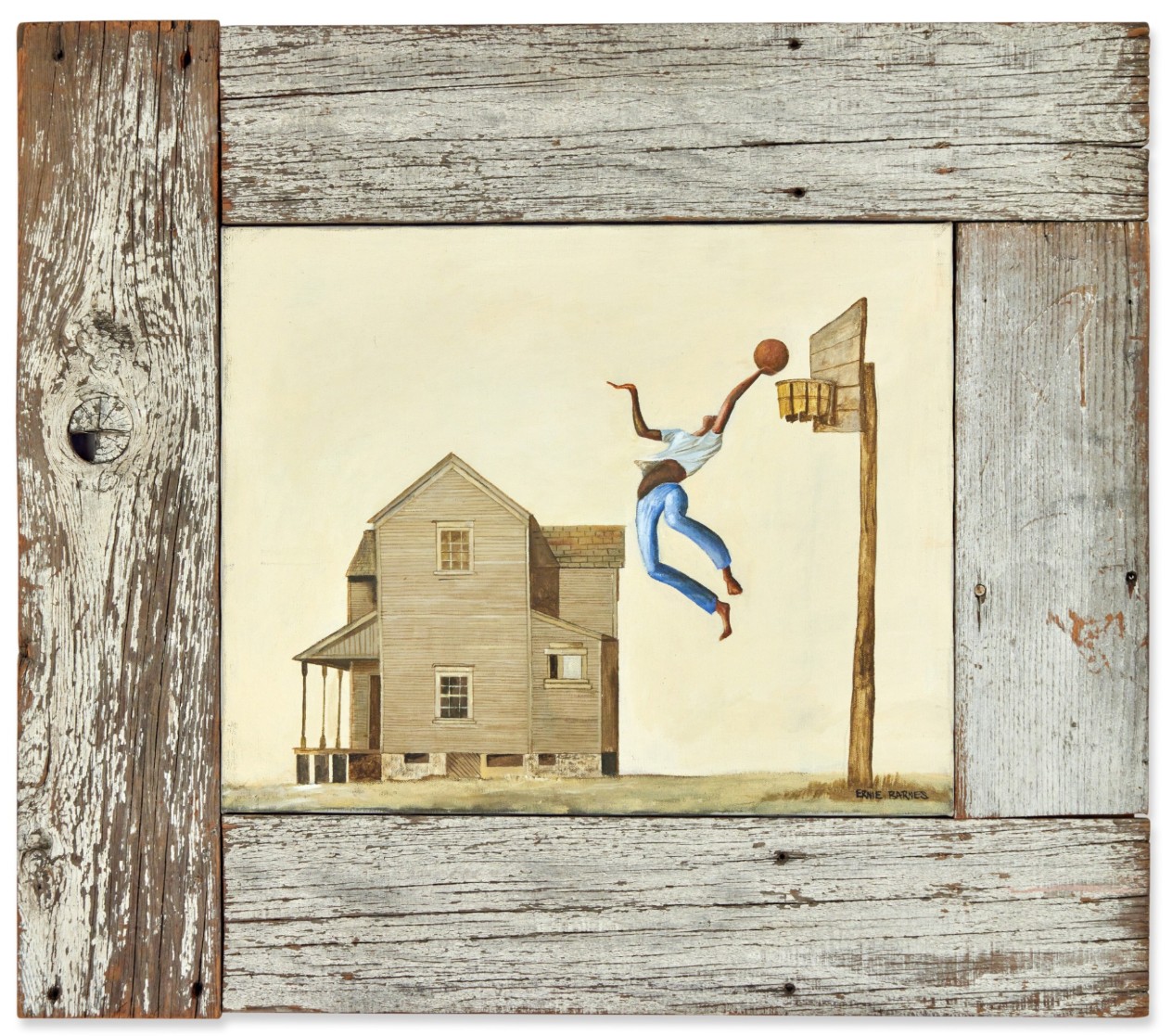
ERNIE BARNES (1938 – 2009)
Untitled (Layup), circa 1970s
Oil on canvas, in artist’s frame
16×20 inches (40.6 x 50.8 cm)
Signed (lower right)
#5. Four Women in Red, 1989
Christie’s New-York: 30 September 2025
Estimated: USD 300,000 – 500,000
USD 381,000
ERNIE BARNES (1938-2009), Four Women in Red | Christie’s
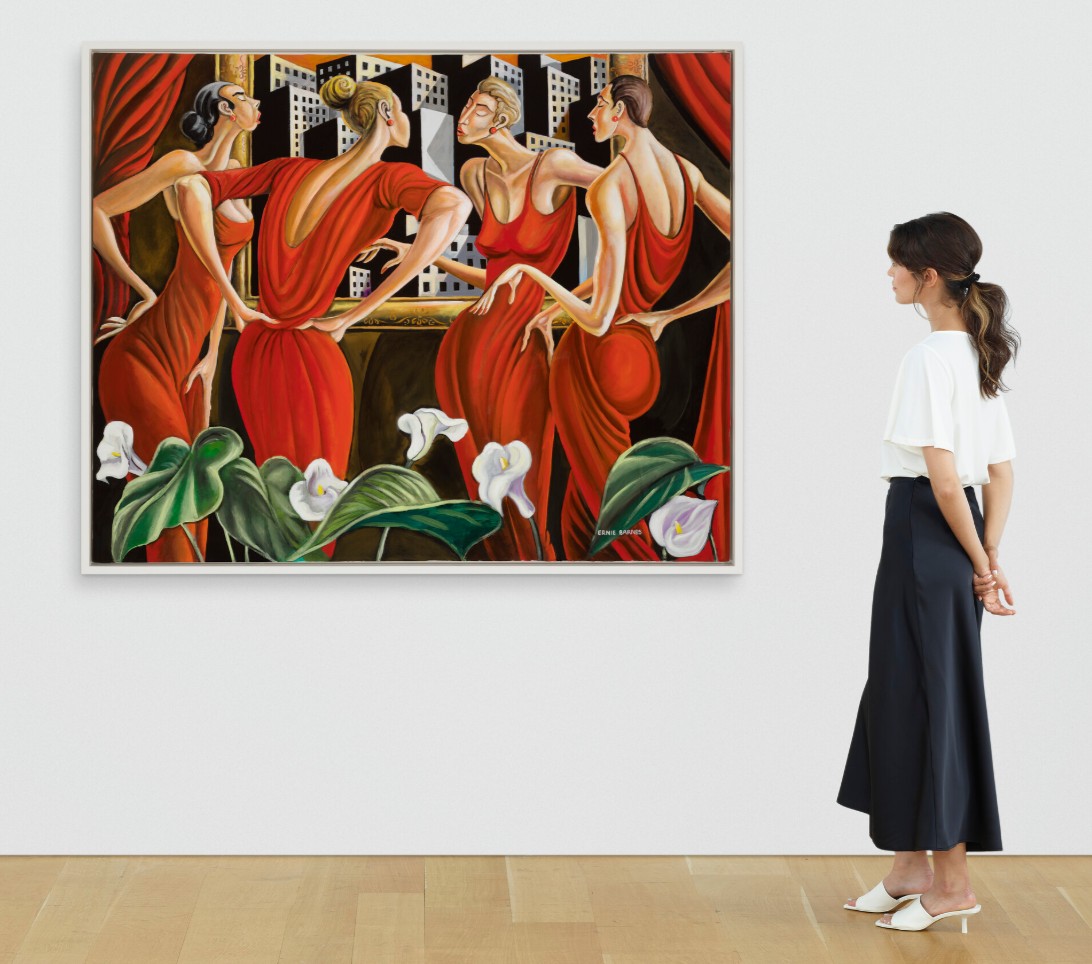
ERNIE BARNES (1938-2009)
Four Women in Red, 1989
Acrylic on canvas
48×60 inches (121.9 x 152.4 cm)
Signed ‘ERNIE BARNES’ (lower right)
#6. Dance Studio, 2002
Phillips New-York: 28 February 2025
Estimated: USD 200,000 – 300,000
USD 330,200
Ernie Barnes New Now: Modern & Contemporary Art
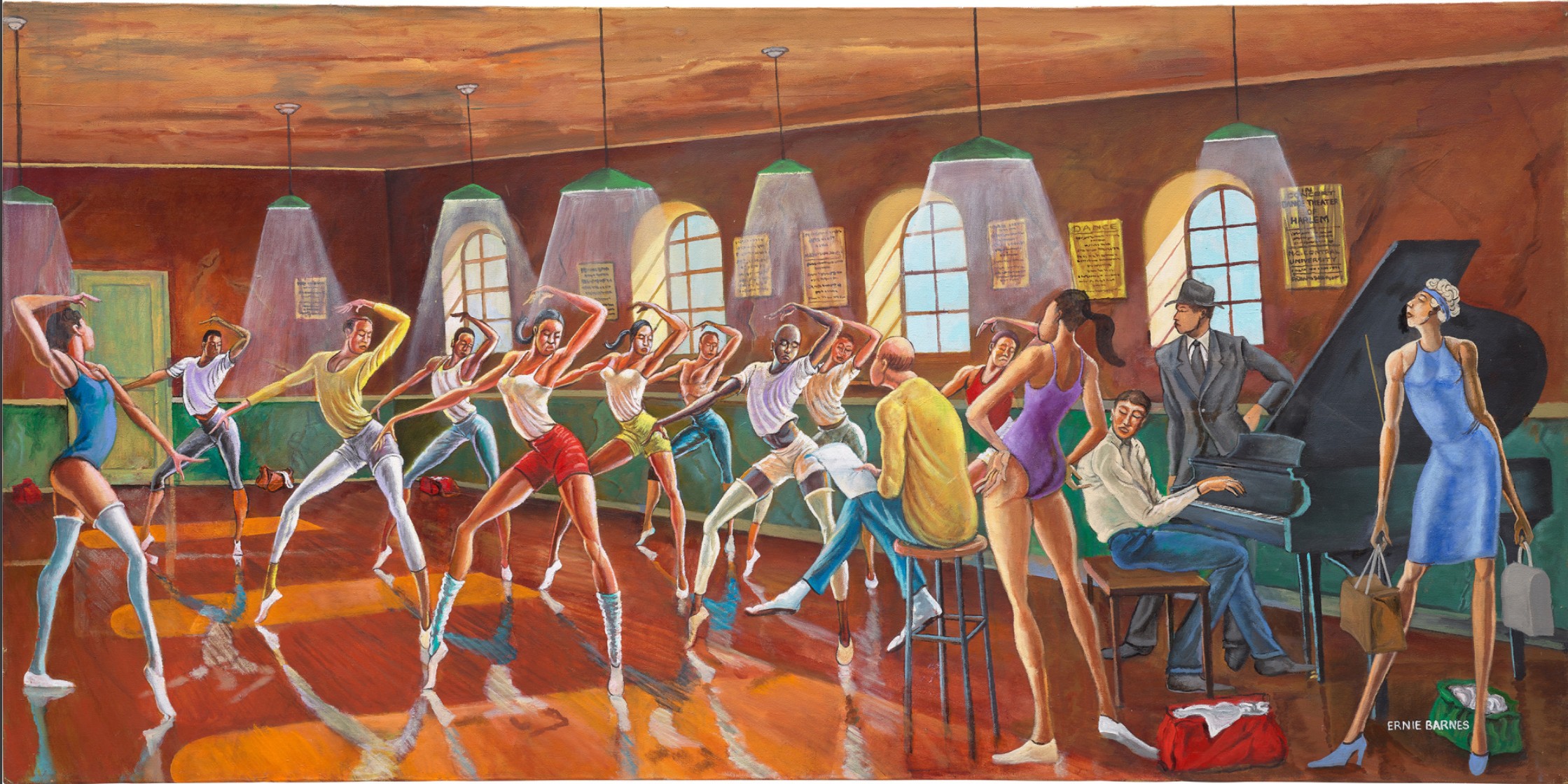
ERNIE BARNES
Dance Studio, 2002
Oil on canvas
24 x 47 7/8 inches (61 x 121.6 cm)
Signed “ERNIE BARNES” lower right
#7. Untitled (Basketball), circa 1971
Property from the Collection of Sheldon Leonard, Los Angeles
Sotheby’s New-York: 19 November 2025
Estimated: USD 150,000 – 200,000
USD 317,500
Untitled (Basketball) | Contemporary Day Auction | 2025 | Sotheby’s
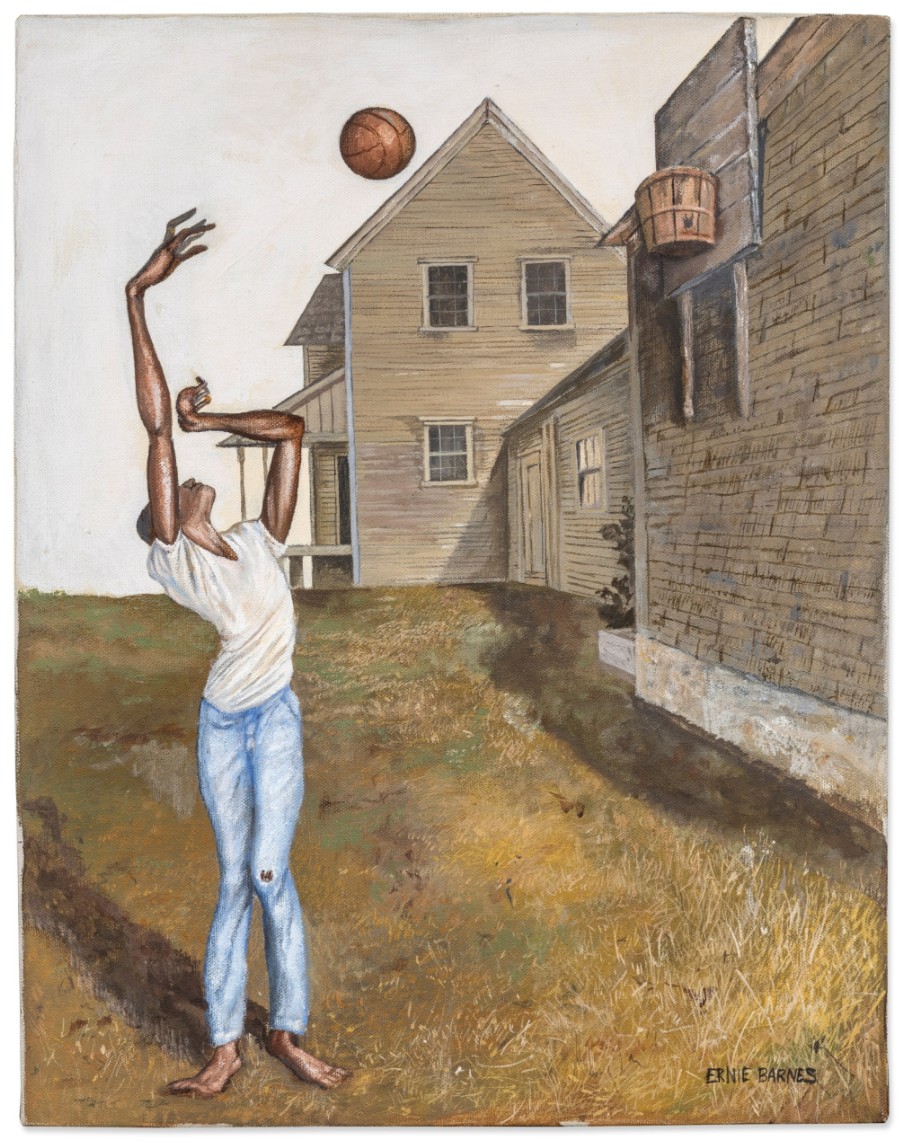
ERNIE BARNES (1938 – 2009)
Untitled (Basketball), circa 1971
Acrylic on canvas
18 x 14 1/4 inches (45.7 x 36.2 cm)
Signed (lower right)
#8. In the Beginning, circa 1971
PROPERTY FROM THE ESTATE OF DOROTHY M. TUCKER, LOS ANGELES
Bonhams New-York: 19 November 2025
Estimated: USD 300,000 – 500,000
USD 305,300
Bonhams : ERNIE BARNES (1938-2009) In the Beginning 36 x 18 in (91.4 x 45.7 cm) (Painted circa 1971)
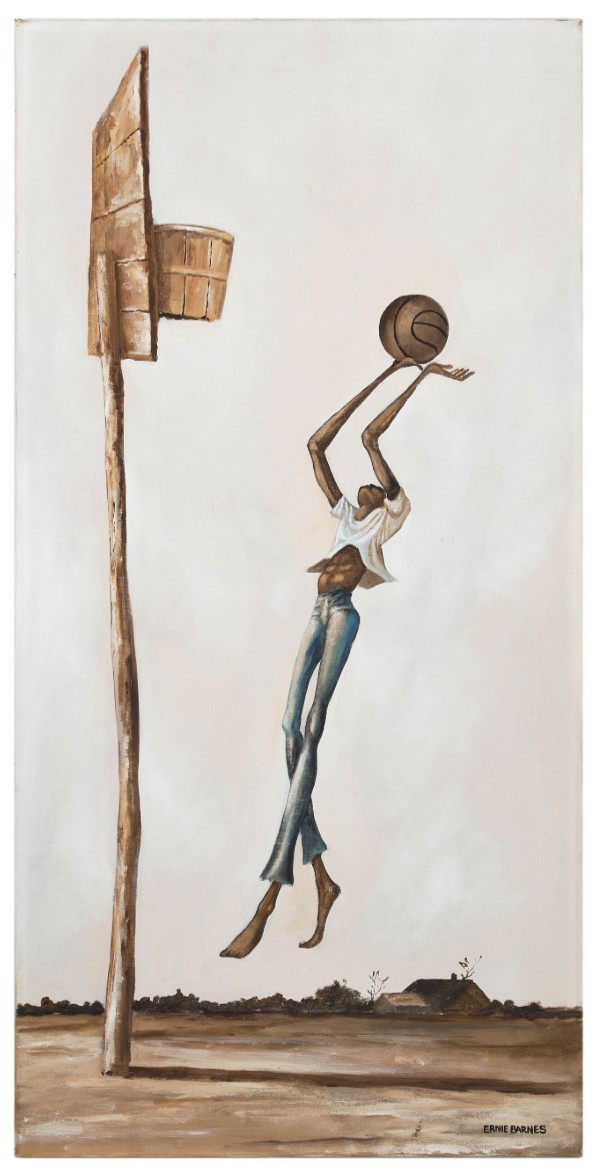
ERNIE BARNES (1938-2009)
In the Beginning, circa 1971
Acrylic on canvas
36×18 inches (91.4 x 45.7 cm)
Signed ‘ERNIE BARNES’ (lower right)
Inscribed ‘”In the Beginning”‘ (on the stretcher)
#9. Opening Ceremonies, 1984
Masterworks of Sport and Spirit: Property from the Collection of John W. Mecom Jr.
Heritage Auctions: 16 May 2025
Estimated: USD 250,000 – 350,000
USD 237,500
Ernie Barnes (American, 1938-2009). Opening Ceremonies, 1984. | Lot #68012 | Heritage Auctions
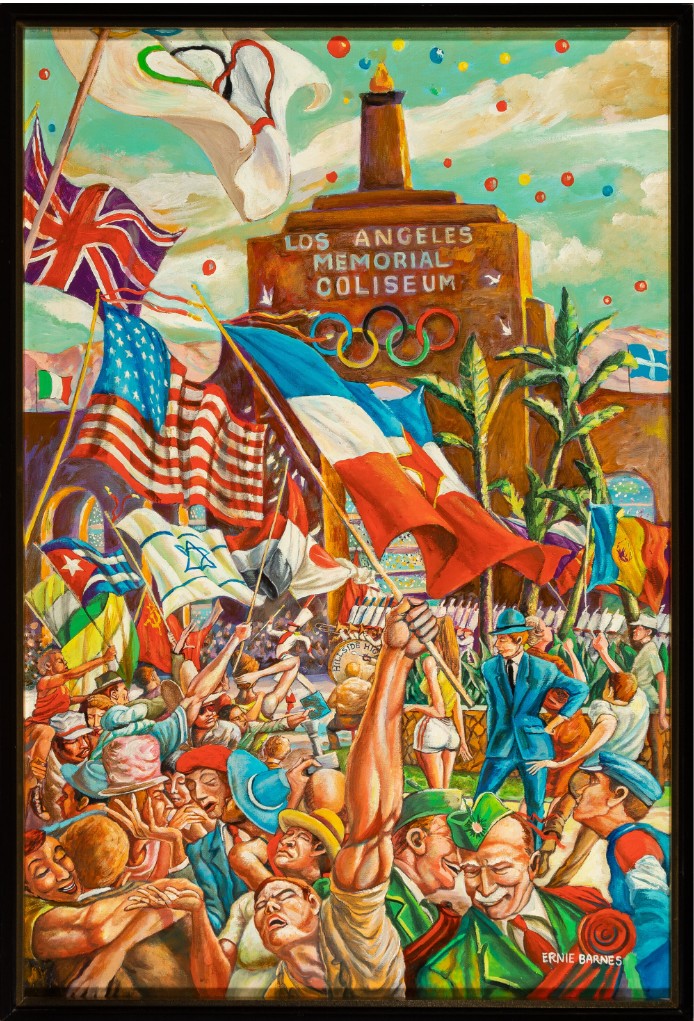
ERNIE BARNES (American, 1938-2009)
Opening Ceremonies, 1984
Acrylic on canvas
36×24 inches (91.4 x 61.0 cm)
Signed lower right: Ernie Barnes
#10. Untitled, circa 1974
Christie’s New-York: 15 May 2025
Estimated: USD 200,000 – 300,000
USD 226,800
ERNIE BARNES (1938-2009), Untitled | Christie’s
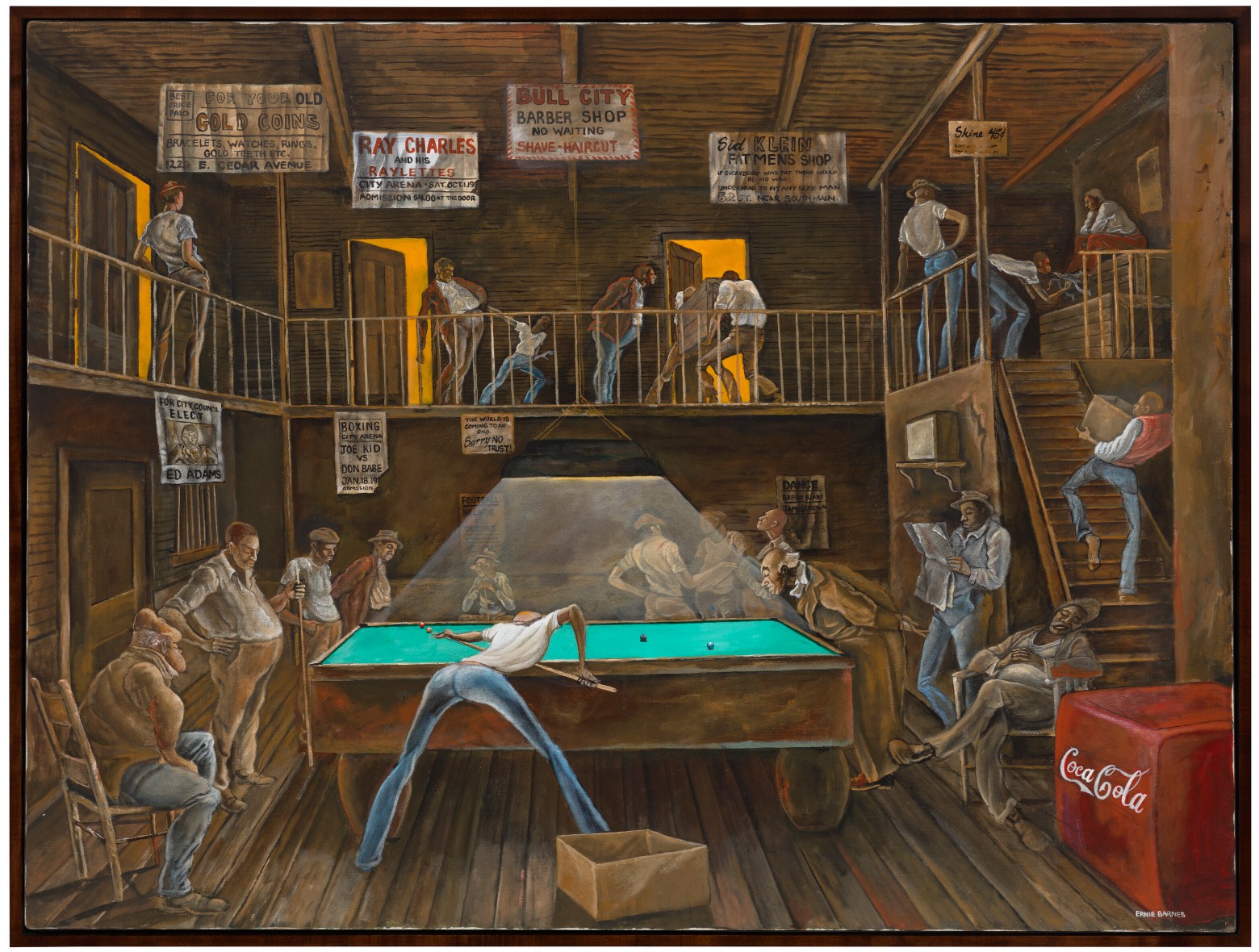
ERNIE BARNES (1938-2009)
Untitled, circa 1974
Oil on canvas
36×48 inches (91.4 x 121.9 cm)
Signed ‘ERNIE BARNES’ (lower right)
#11. Anchor Leg, 1983
Masterworks of Sport and Spirit: Property from the Collection of John W. Mecom Jr.
Heritage Auctions: 16 May 2025
Estimated: USD 250,000 – 350,000
USD 225,000
Ernie Barnes (American, 1938-2009). Anchor Leg, 1983. Acrylic on | Lot #68011 | Heritage Auctions
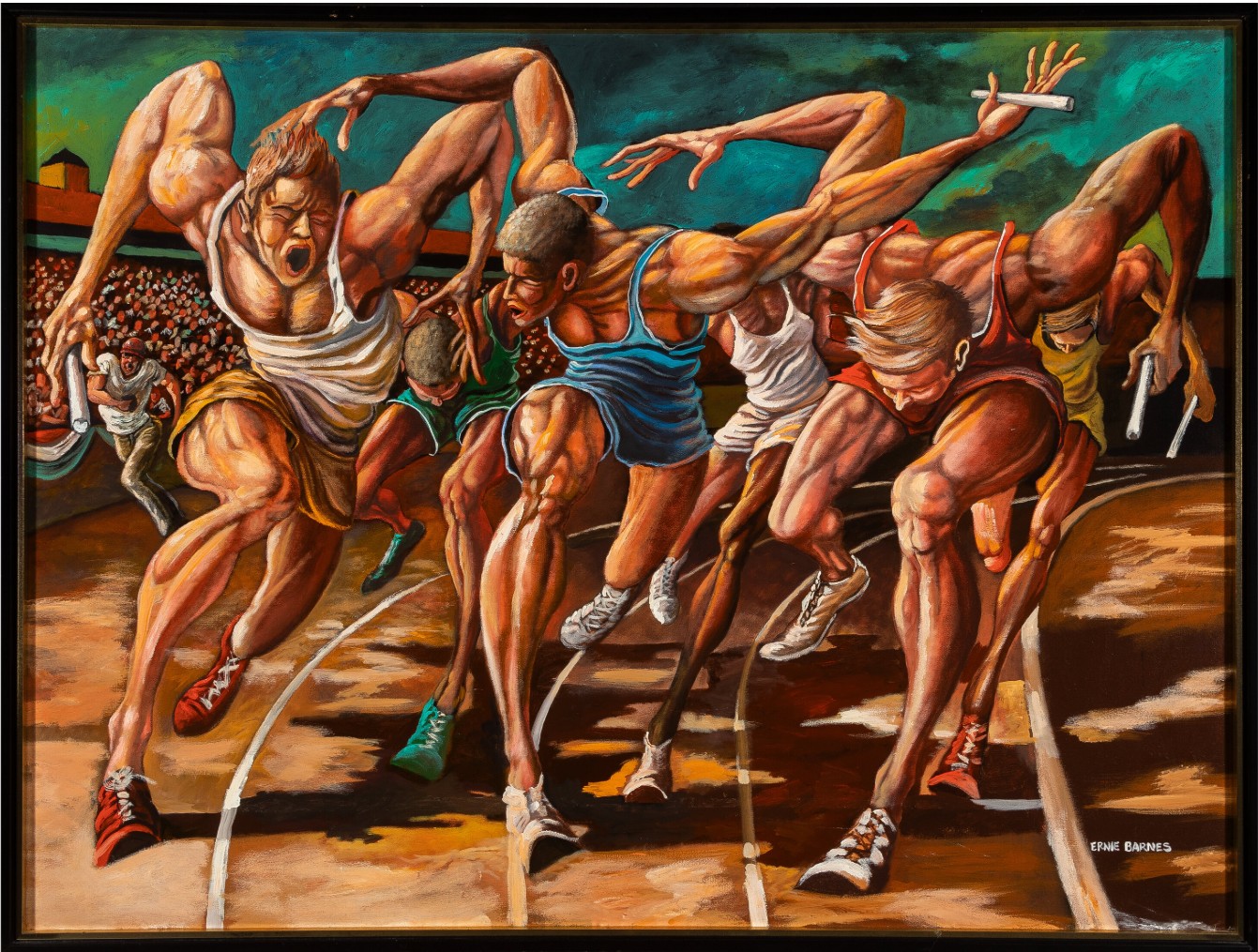
ERNIE BARNES (American, 1938-2009)
Anchor Leg, 1983
Acrylic on canvas
36×48 inches (91.4 x 121.9 cm)
Signed lower right: Ernie Barnes
#12. Easy Shot, 1971
Property from the Estate of Saul and Shirley Turteltaub, Beverly Hills, California
Heritage Auctions: 14 November 2025
Estimated: USD 150,000 – 250,000
USD 225,000
Ernie Barnes (American, 1938-2009). Easy Shot, 1971. Oil on canvas. | Lot #67038 | Heritage Auctions
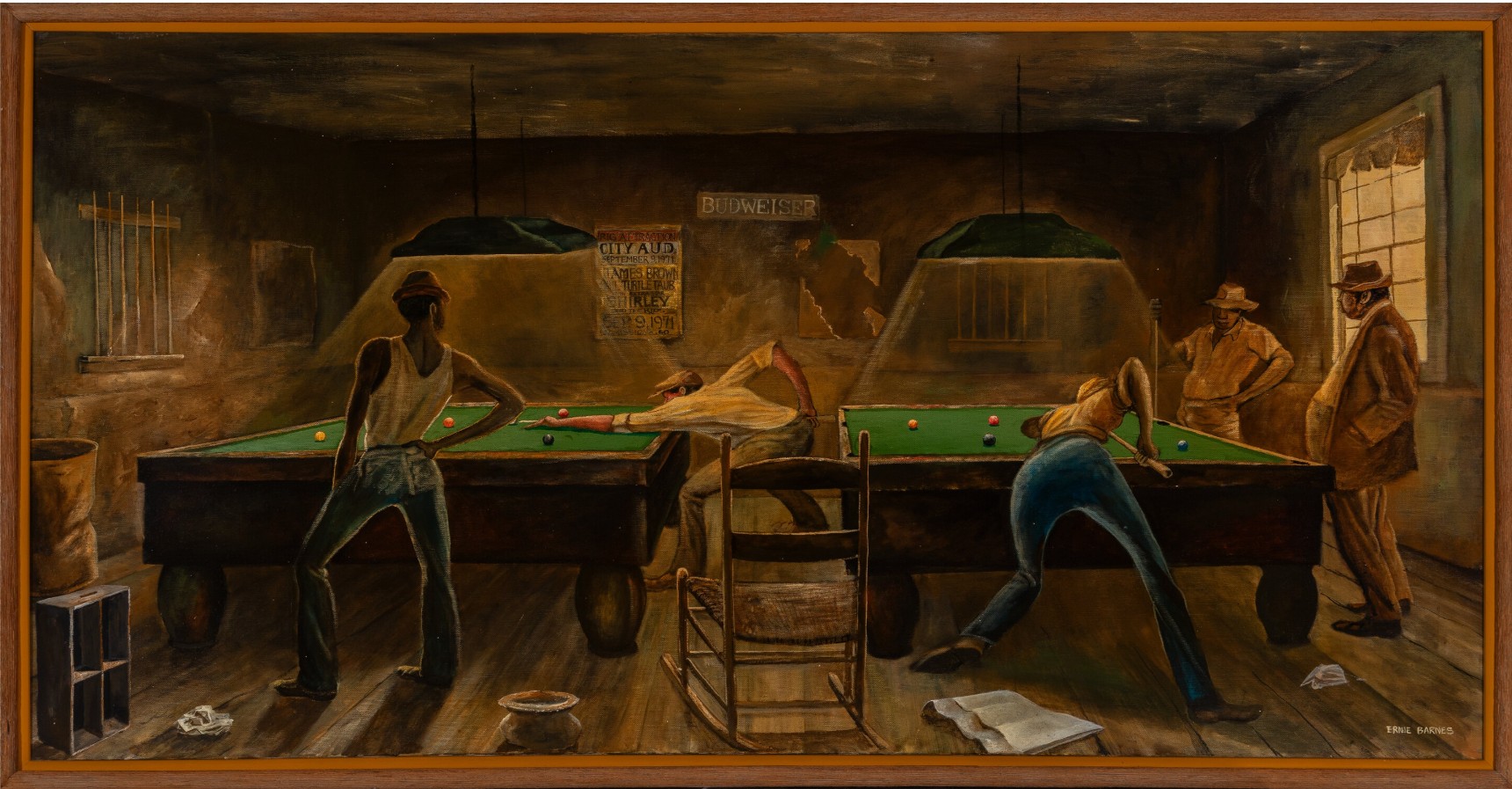
ERNIE BARNES (American, 1938-2009)
Easy Shot, 1971
Oil on canvas
24×48 inches (61.0 x 121.9 cm)
Signed lower right: Ernie Barnes
#13. Hold the Pocket, 1982
Masterworks of Sport and Spirit: Property from the Collection of John W. Mecom Jr.
Heritage Auctions: 16 May 2025
Estimated: USD 250,000 – 350,000
USD 203,125
Ernie Barnes (American, 1938-2009). Hold the Pocket, 1982. Acrylic | Lot #68010 | Heritage Auctions
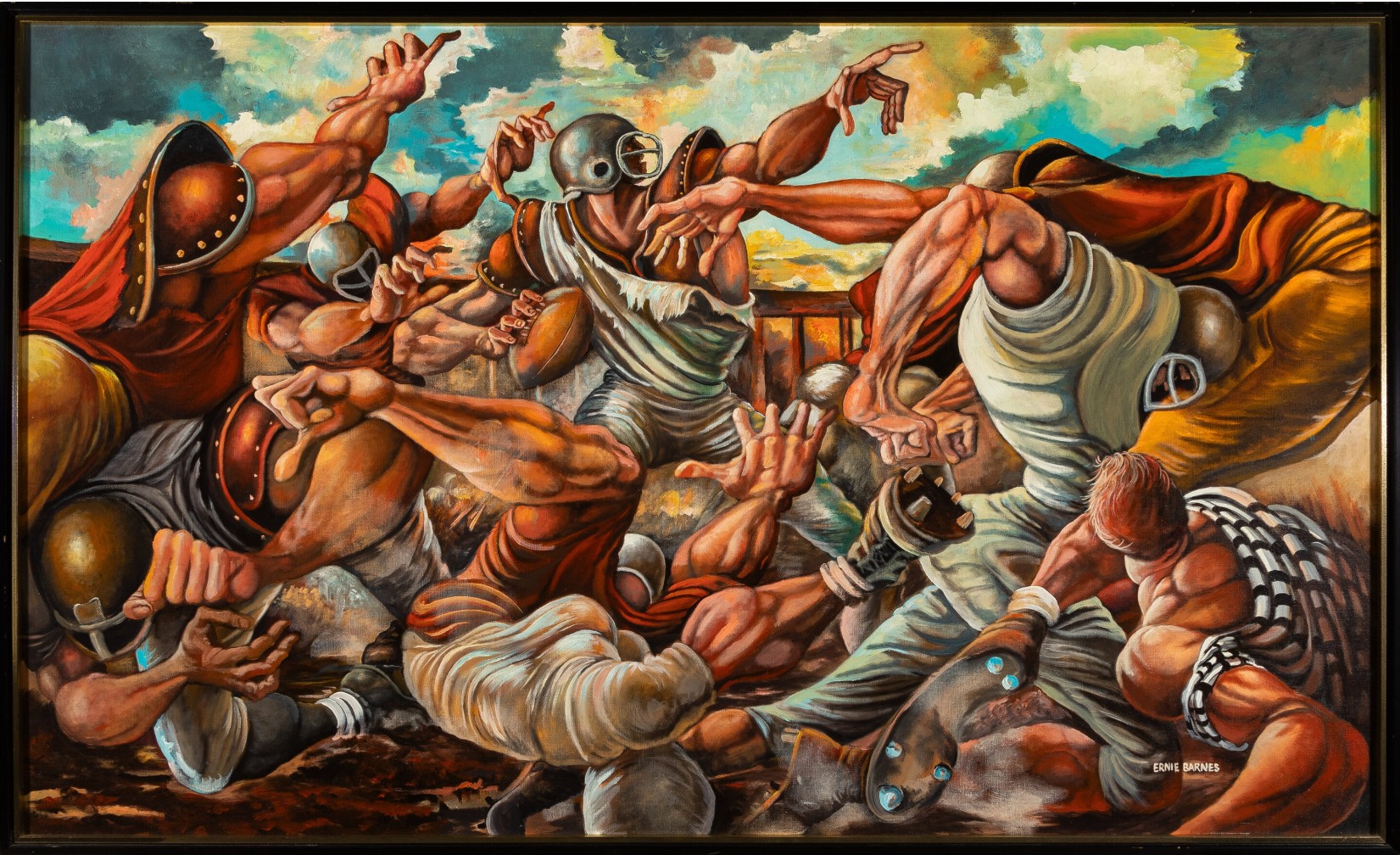
ERNIE BARNES (American, 1938-2009)
Hold the Pocket, 1982
Acrylic on canvas
36×60 inches (91.4 x 152.4 cm)
Signed lower right: Ernie Barnes
#14. We Love Our Team, circa 1966
Christie’s New-York: 27 February 2025
Estimated: USD 150,000 – 200,000
USD 201,600
ERNIE BARNES (1938-2009), We Love Our Team | Christie’s
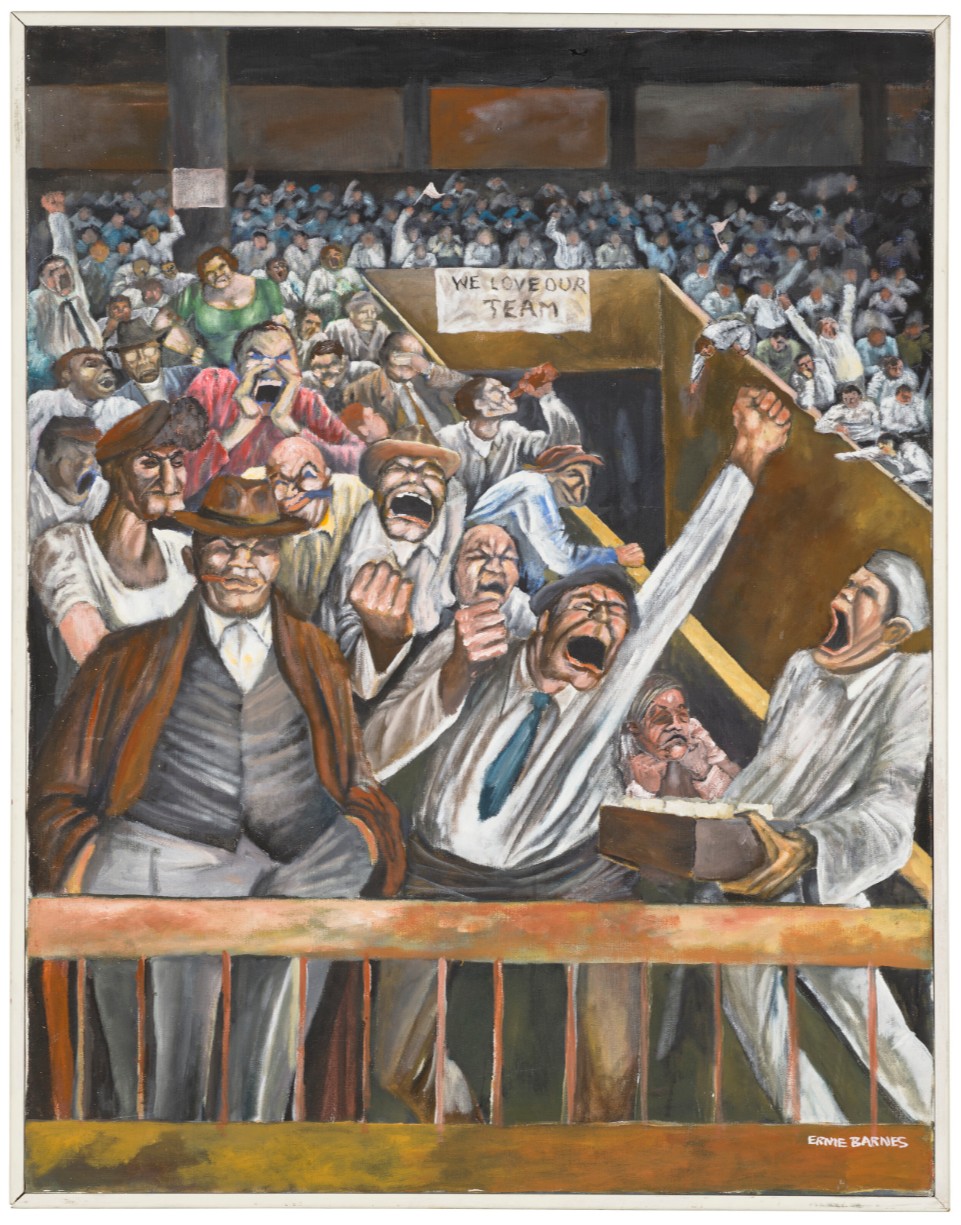
ERNIE BARNES (1938-2009)
We Love Our Team, circa 1966
Oil on canvas
36×24 inches (91.4 x 61 cm)
Signed ‘ERNIE BARNES’ (lower right)
#15. Bible Study, 1973
Black Art Auction: 15 March 2025
Estimated: USD 70,000 – 90,000
USD 160,000 (Hammer)
USD 197,000
Ernie Barnes, 1938-2009, Bible Study | Black Art Auction
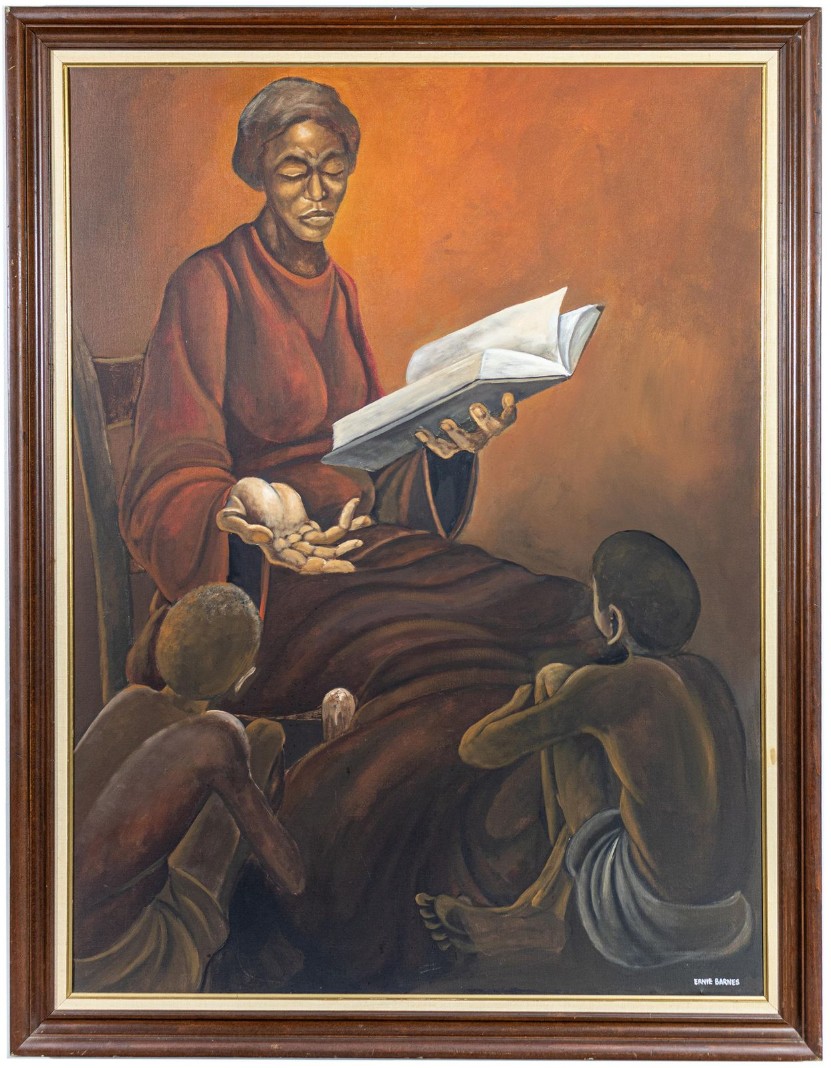
ERNIE BARNES (1938-2009)
Bible Study, 1973
Acrylic on canvas
53 1/2 x 41 inches
Signed
#16. Southside Pool Hall, 1971
Bonhams New-York: 20 November 2025
Estimated: USD 200,000 – 300,000
USD 178,300
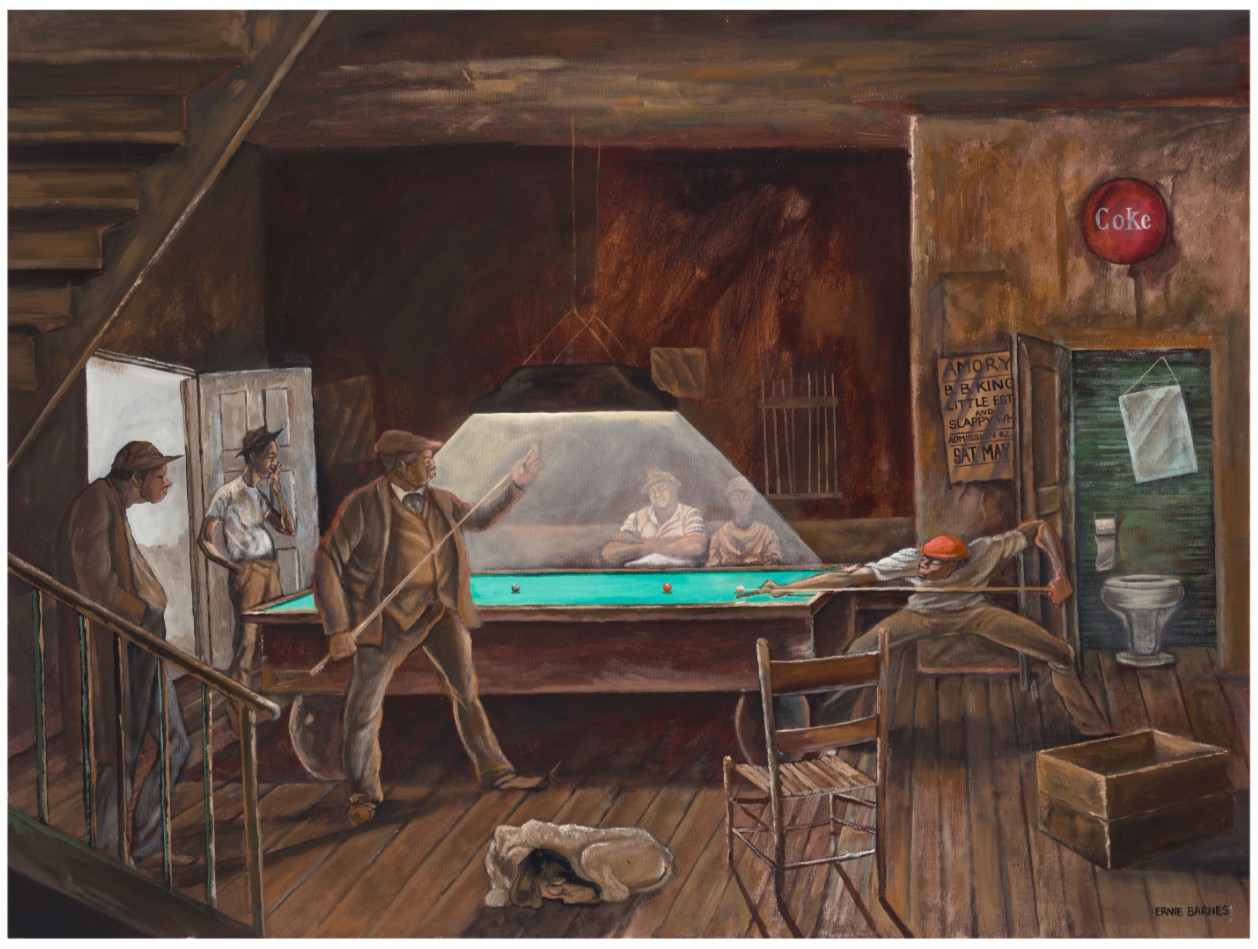
ERNIE BARNES (1938-2009)
Southside Pool Hall, 1971
Acrylic on canvas
30×40 inches (76.2 x 101.6 cm)
Signed ‘Ernie Barnes’ (lower right)
#17. The Game Plan, 1971
Property from the Collection of Sheldon Leonard, Los Angeles
Sotheby’s New-York: 19 November 2025
Estimated: USD 120,000 – 180,000
USD 152,400
The Game Plan | Contemporary Day Auction | 2025 | Sotheby’s
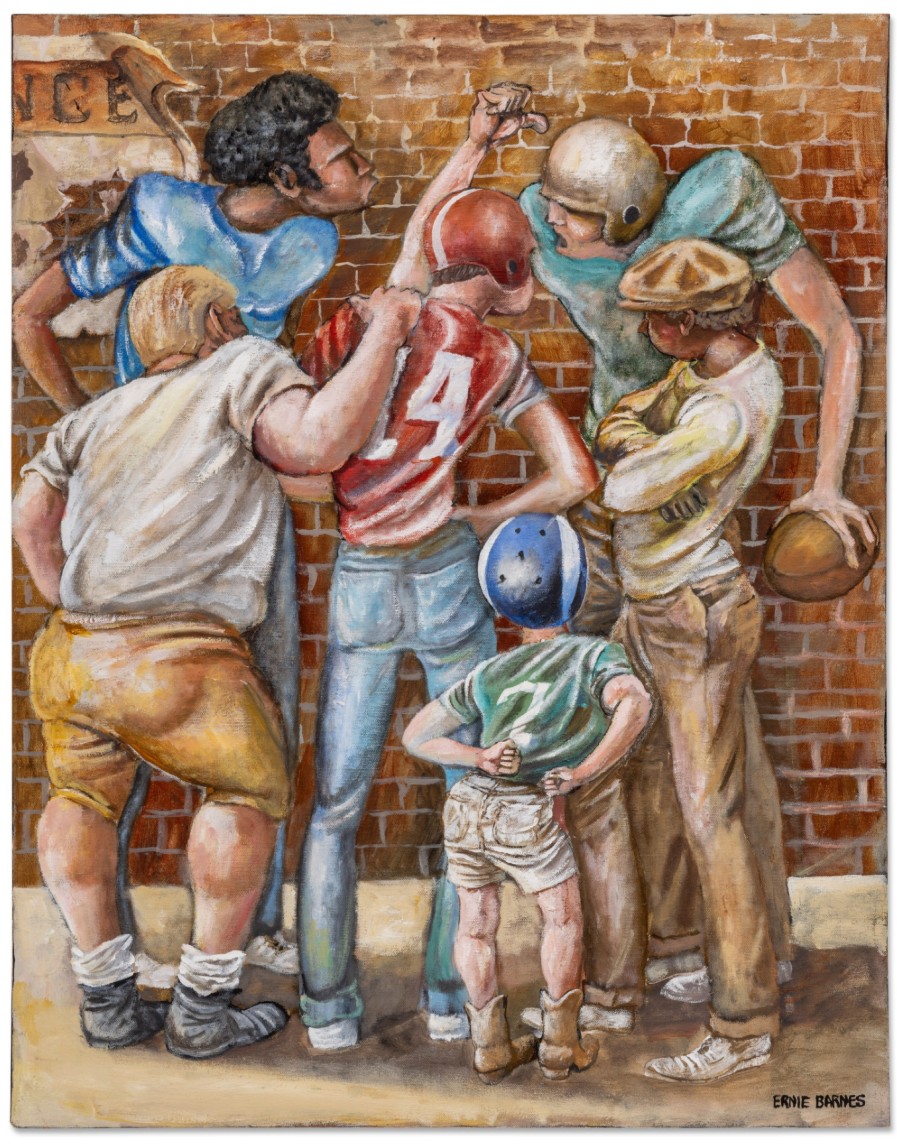
ERNIE BARNES (1938 – 2009)
The Game Plan, 1971
Acrylic on canvas in artist’s frame
28×22 inches (71.1 x 55.9 cm)
Signed (lower right)
#18. 1-2 Finish, 1973
Property from the Estate of Saul and Shirley Turteltaub, Beverly Hills, California
Heritage Auctions: 14 November 2025
Estimated: USD 50,000 – 70,000
USD 137,500
Ernie Barnes (American, 1938-2009). 1-2 Finish, 1973. Oil on | Lot #67039 | Heritage Auctions
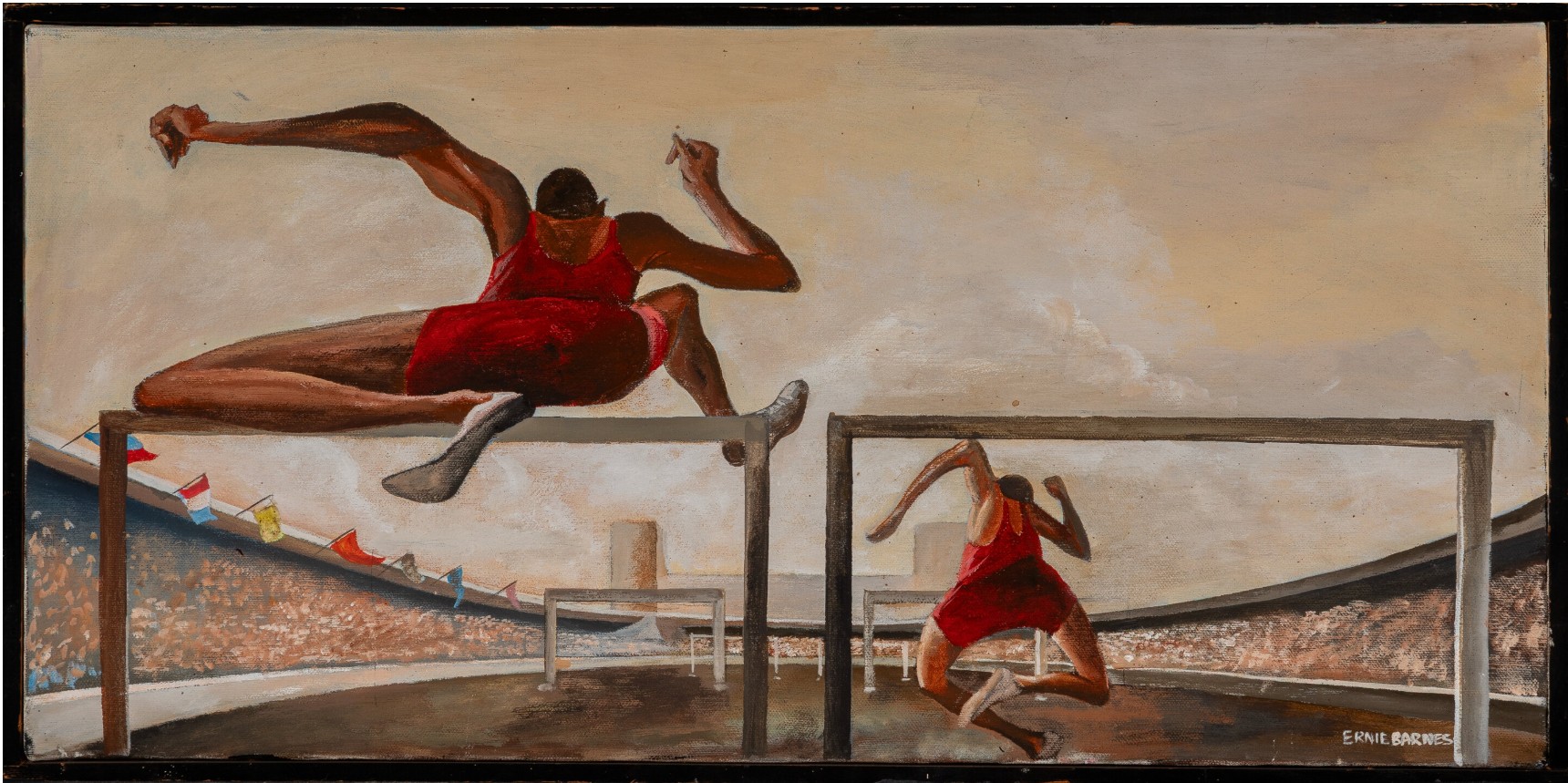
ERNIE BARNES (American, 1938-2009)
1-2 Finish, 1973
Oil on canvas
12×24 inches (30.5 x 61.0 cm)
Signed lower right: Ernie Barnes
Titled on the stretcher: 1-2 Finish
#19. The Comedian
Heritage Auctions: 16 May 2025
Estimated: USD 120,000 – 180,000
USD 121,875
Ernie Barnes (American, 1938-2009). The Comedian. Acrylic on | Lot #68018 | Heritage Auctions
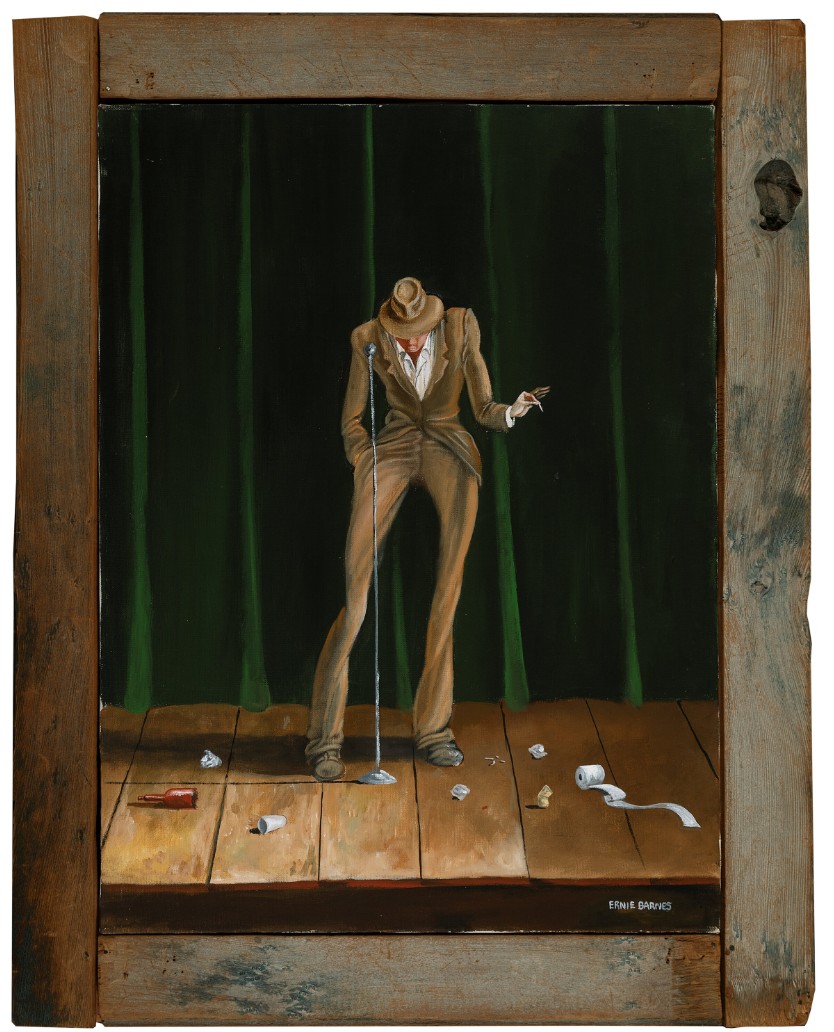
ERNIE BARNES (American, 1938-2009)
The Comedian
Acrylic on canvas
24×18 inches (61.0 x 45.7 cm)
Signed lower right: Ernie Barnes
#20. Anchor Leg, 1984
Christie’s New-York: 30 September 2025
Estimated: USD 70,000 – 100,000
USD 101,600
ERNIE BARNES (1938-2009), Anchor Leg | Christie’s
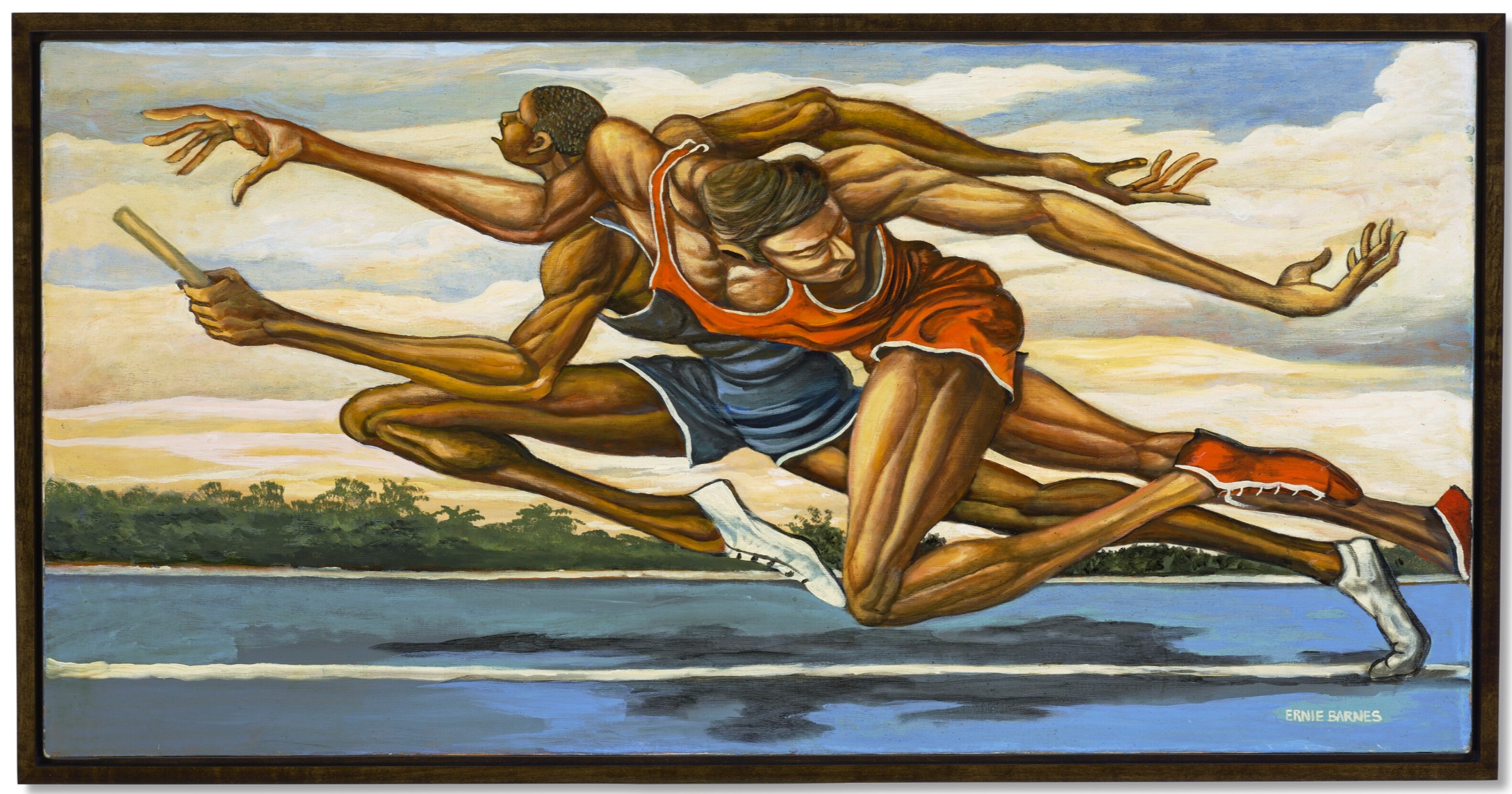
ERNIE BARNES (1938-2009)
Anchor Leg, 1984
Acrylic on canvas
23 7/8 x 48 inches (60.6 x 121.9 cm)
Signed ‘ERNIE BARNES’ (lower right)
#21. Bluebird, 1982
Heritage Auctions: 19 November 2025
Estimated: USD 30,000 – 50,000
USD 75,000
Ernie Barnes (1938-2009). Bluebird, 1982. Oil on canvas. 18 x 24 | Lot #77096 | Heritage Auctions
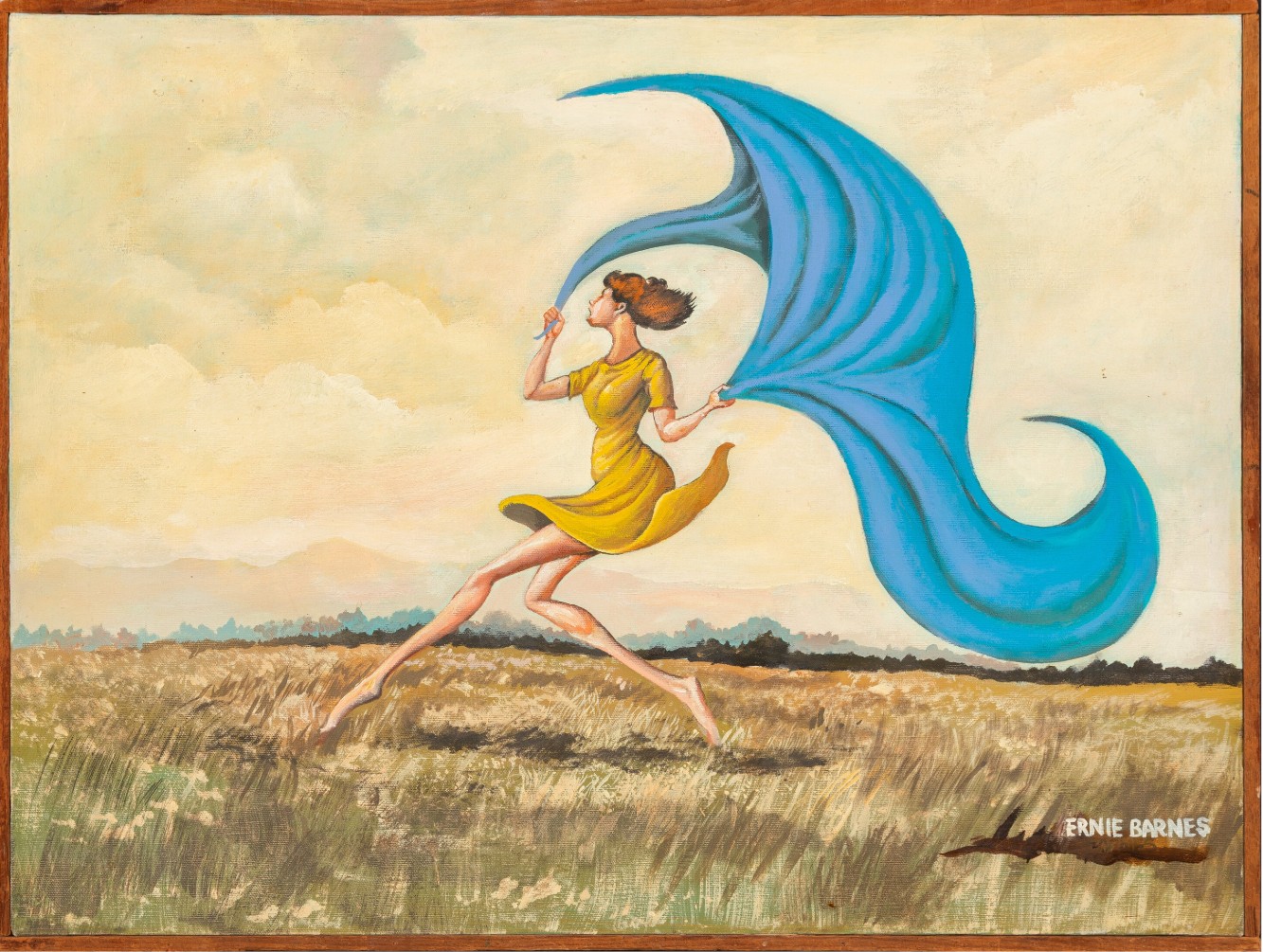
ERNIE BARNES (1938-2009)
Bluebird, 1982
Oil on canvas
18×24 inches (45.7 x 61 cm)
Signed lower right: ERNIE BARNES
#22. An Ounce of Luck, 1989
Bonhams Los Angeles: 12 March 2025
Estimated: USD 80,000 – 120,000
USD 55,000
Bonhams : ERNIE BARNES (1938-2009) An Ounce of Luck, 1989
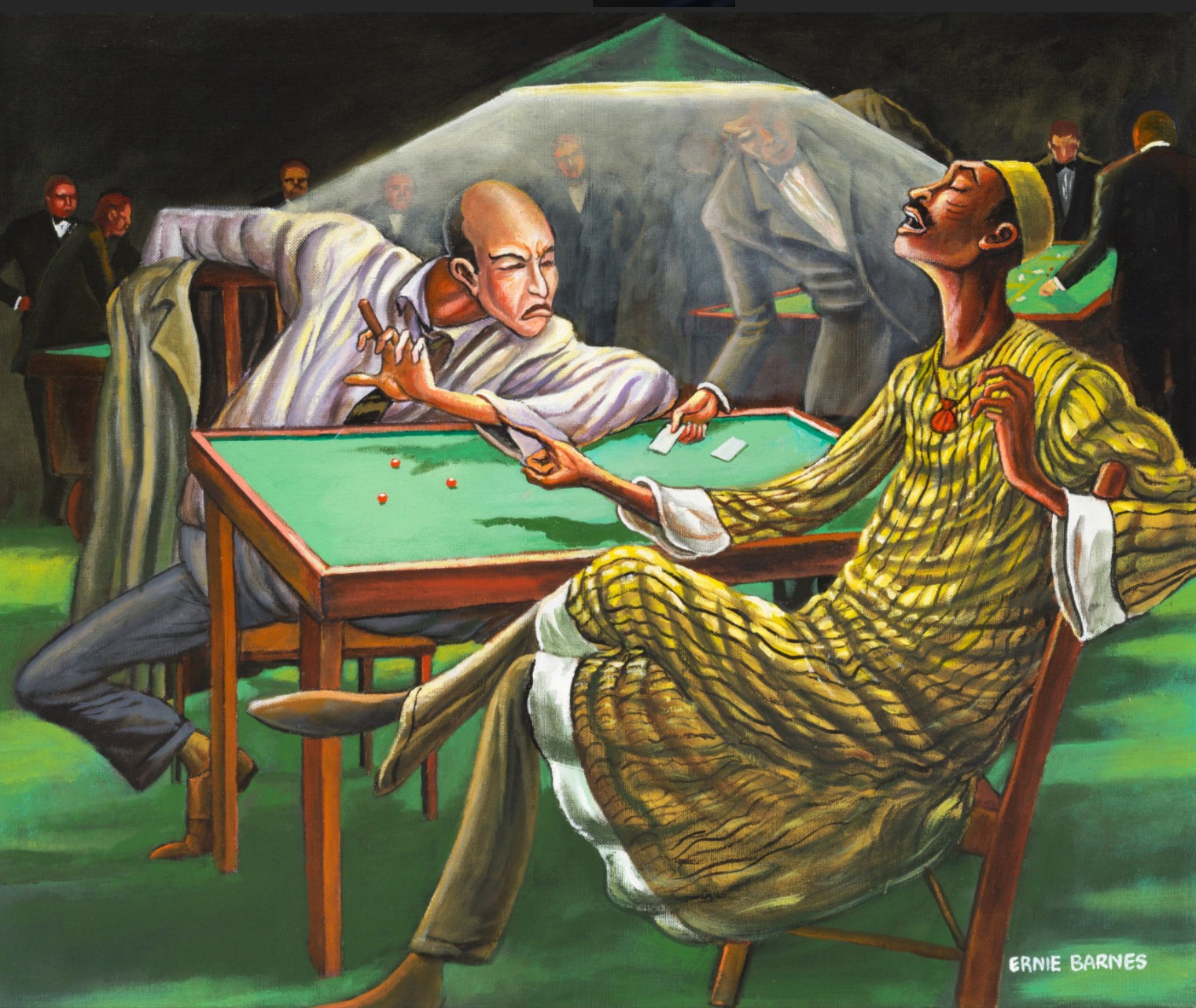
ERNIE BARNES (1938-2009)
An Ounce of Luck, 1989
Acrylic on canvas
20×24 inches (50.8 x 61 cm)
Signed ‘Ernie Barnes’ (lower right)
#23. Untitled, circa 1966
Christie’s online: 18 July 2025
Estimated: USD 40,000 – 60,000
USD 40,320
ERNIE BARNES (1938-2009), Untitled | Christie’s
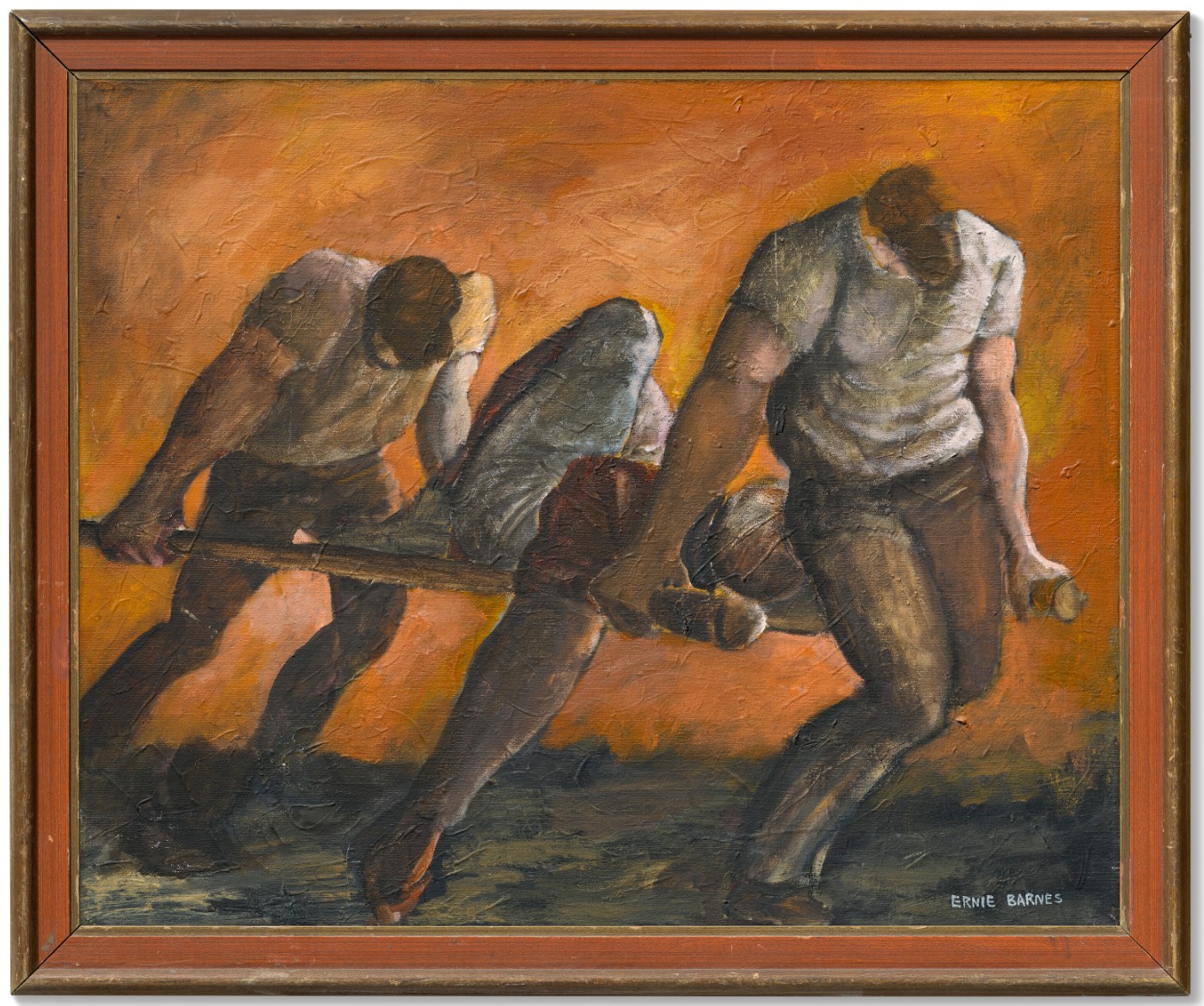
ERNIE BARNES (1938-2009)
Untitled, circa 1966
Oil on canvas, in artist’s frame
20 3/4 x 24 1/4 inches (52.7 x 61.6 cm)
Signed ‘ERNIE BARNES’ (lower right)
#24. Untitled (Seated Woman Fixing Hat), circa 1990
Swann Auction Galleries: 3 April 2025
Estimated: USD 35,000 – 50,000
USD 40,000
WORK ON PAPER
Lot – ERNIE BARNES (1938 – 2009) Untitled (Seated Woman Fixing Hat).
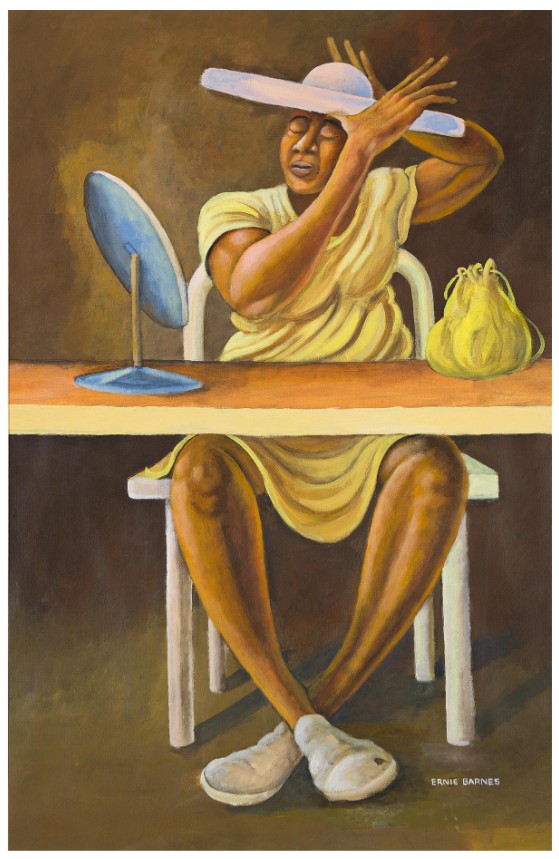
ERNIE BARNES (1938 – 2009)
Untitled (Seated Woman Fixing Hat), circa 1990
Acrylic on brown wove paper
37×24 inches (94×61 cm)
Signed, lower right
#25. Blue Player vs. 2 Orange Football Players, 1989
Phillips New-York: 25 September 2025
Estimated: USD 30,000 – 50,000
USD 38,700
WORK ON PAPER
Ernie Barnes New Now: Modern & Contemporary Art
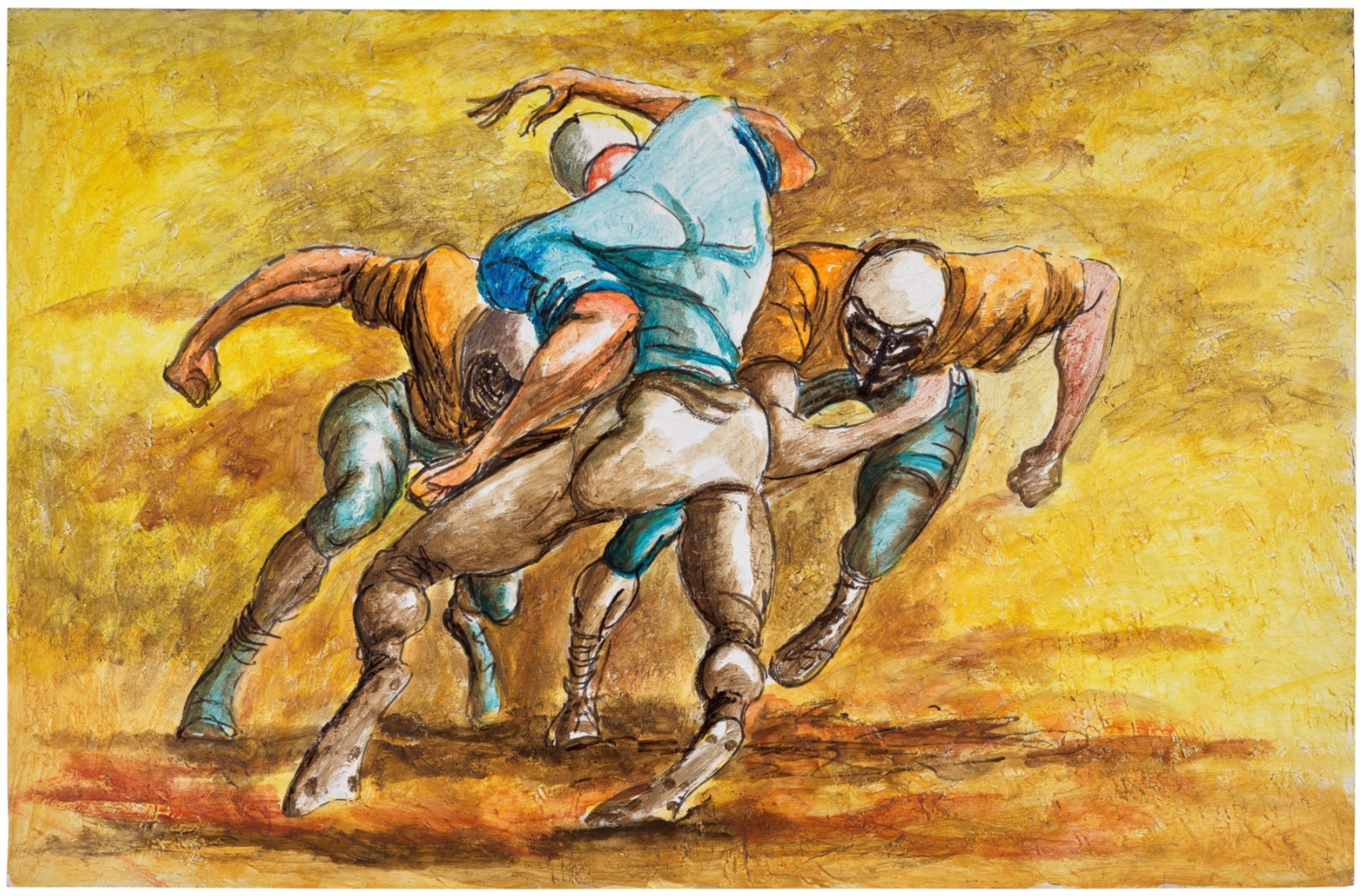
ERNIE BARNES
Blue Player vs. 2 Orange Football Players, 1989
Acrylic and gesso on paper
26 x 39 7/8 inches (66 x 101.3 cm)
Signed “© ERNIE BARNES” on the reverse
#26. Work Sketch for “Girlfriends”
Heritage Auctions: 16 May 2025
Estimated: USD 20,000 – 30,000
USD 30,000
WORK ON PAPER
Ernie Barnes (American, 1938-2009). Work Sketch for “Girlfriends”. | Lot #68017 | Heritage Auctions
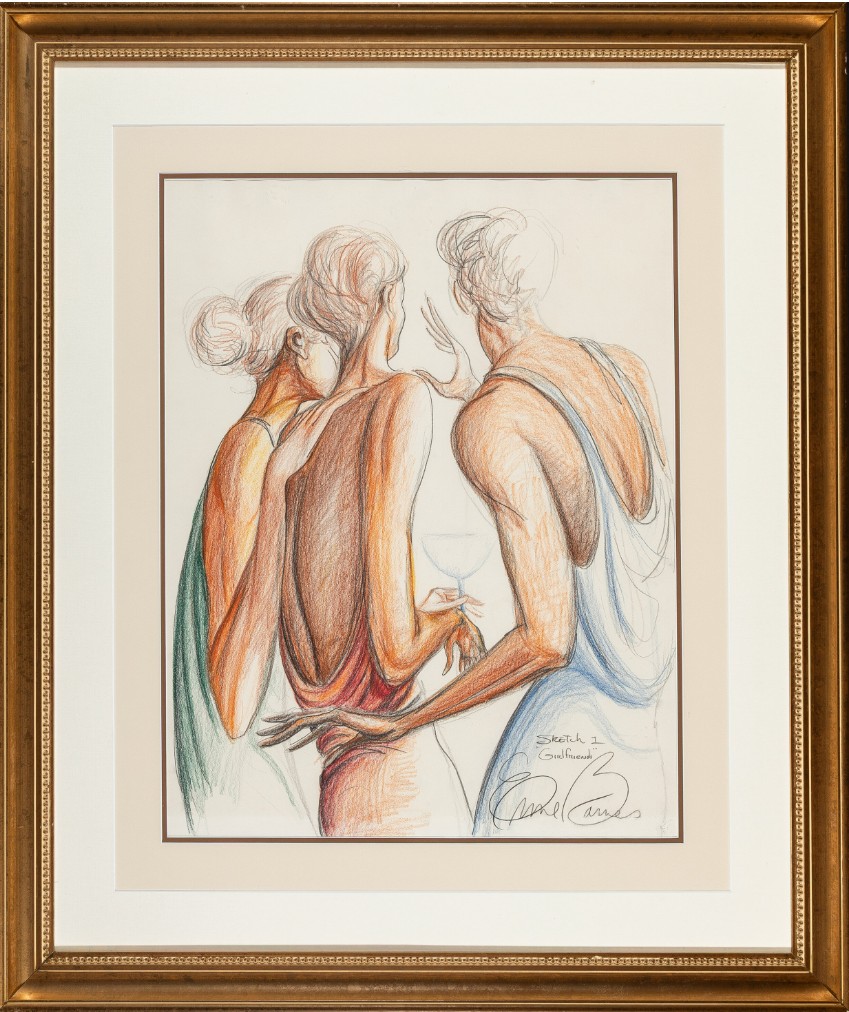
ERNIE BARNES (American, 1938-2009)
Work Sketch for “Girlfriends”
Mixed media on paper
29×23 inches (73.7 x 58.4 cm) (sheet)
Signed and titled lower right: Sketch 1 / “Girlfriends” / Ernie Barnes
#27. Unruly Fans, 1962
Christie’s New-York: 27 February 2025
Estimated: USD 20,000 – 30,000
USD 20,160
WORK ON PAPER
ERNIE BARNES (1938-2009), Unruly Fans | Christie’s
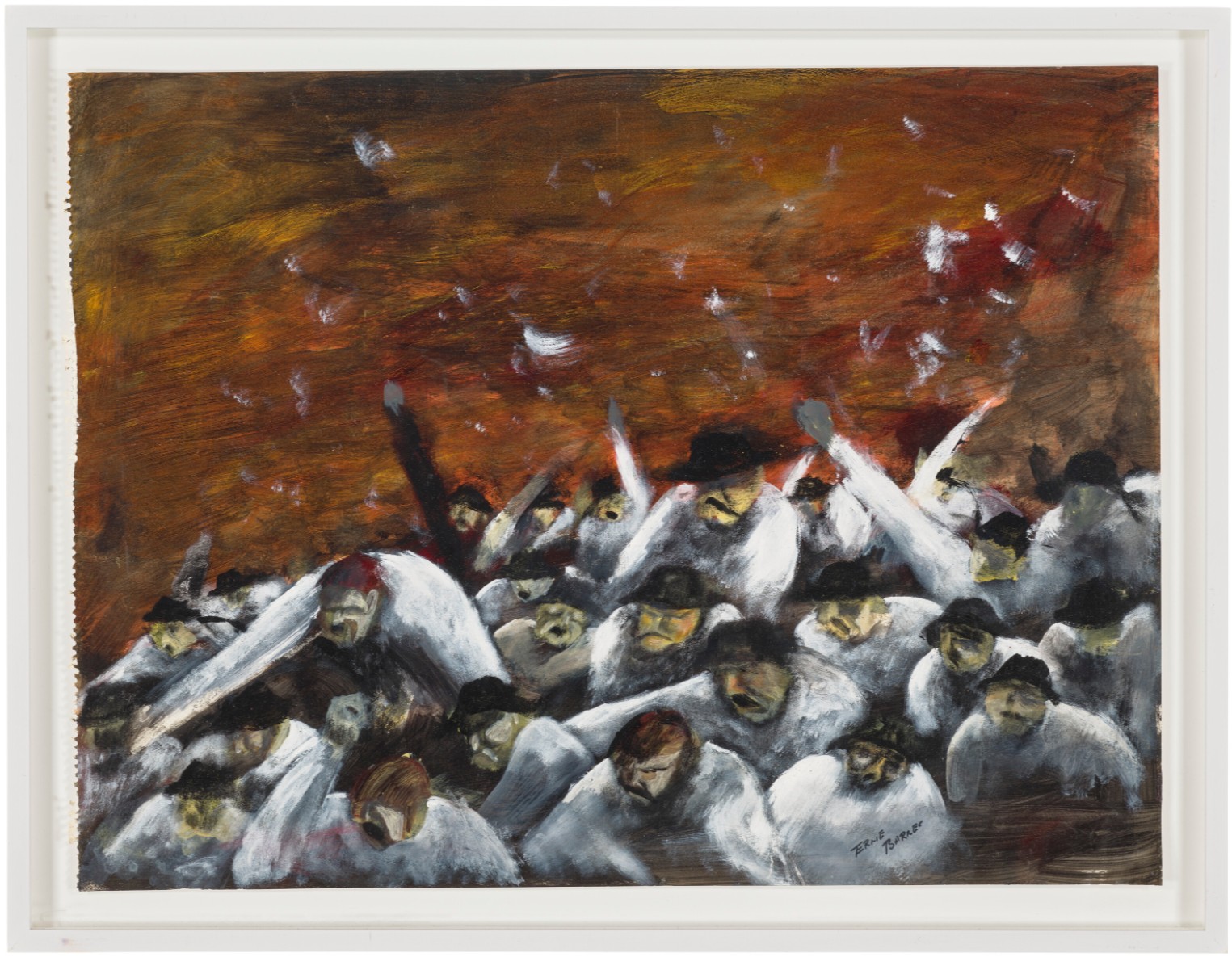
ERNIE BARNES (1938-2009)
Unruly Fans, 1962
Acrylic on paper
17 7/8 x 23 3/4 inches (45.4 x 60.3 cm)
Signed ‘ERNIE BARNES’ (lower right)
#28. Work Sketch for “Solitaire!”
Heritage Auctions: 16 May 2025
Estimated: USD 10,000 – 15,000
USD 16,250
WORK ON PAPER
Ernie Barnes (American, 1938-2009). Work Sketch for “Solitaire!”. | Lot #68016 | Heritage Auctions
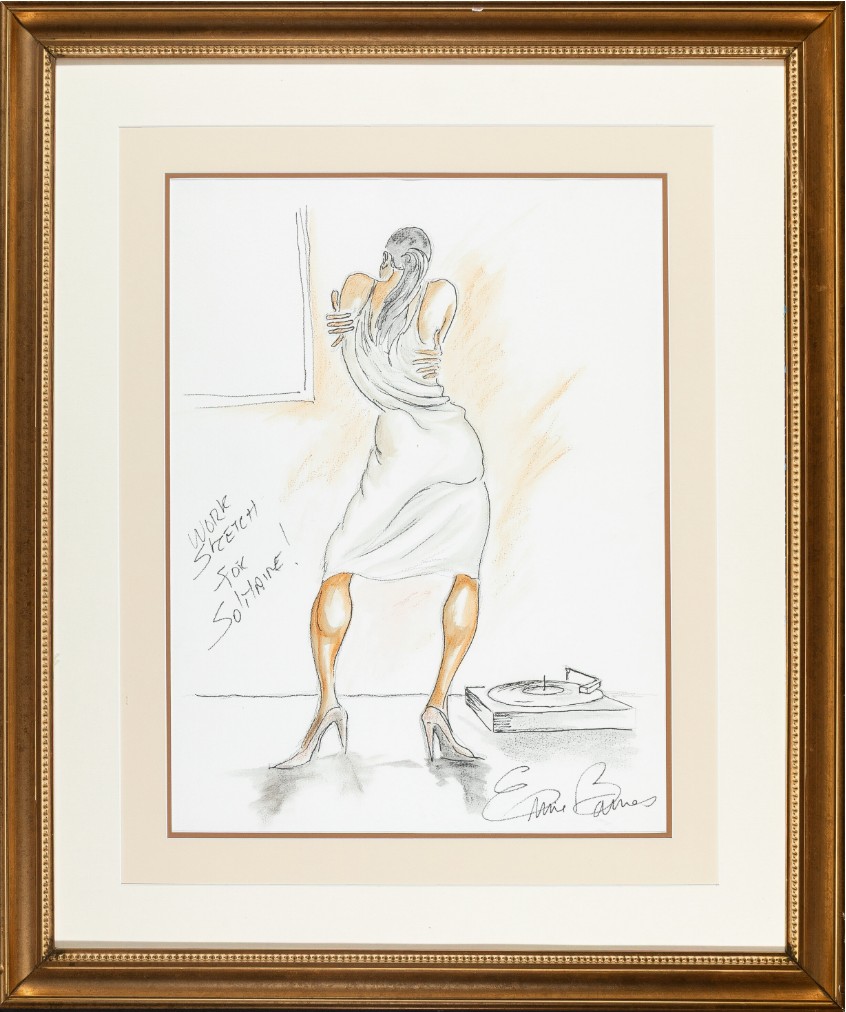
ERNIE BARNES (American, 1938-2009)
Work Sketch for “Solitaire!”
Mixed media on Arches paper
30 x 22 1/4 inches (76.2 x 56.5 cm) (sheet)
Signed lower right: Ernie Barnes
Titled center left: Work Sketch / for / Solitaire!
#29. Portrait of the Frankovich Children
Bonhams online: 7 August 2025
Estimated: USD 20,000 – 30,000
USD 12,800
Bonhams : Ernie Barnes (1938-2009) Portrait of the Frankovich Children
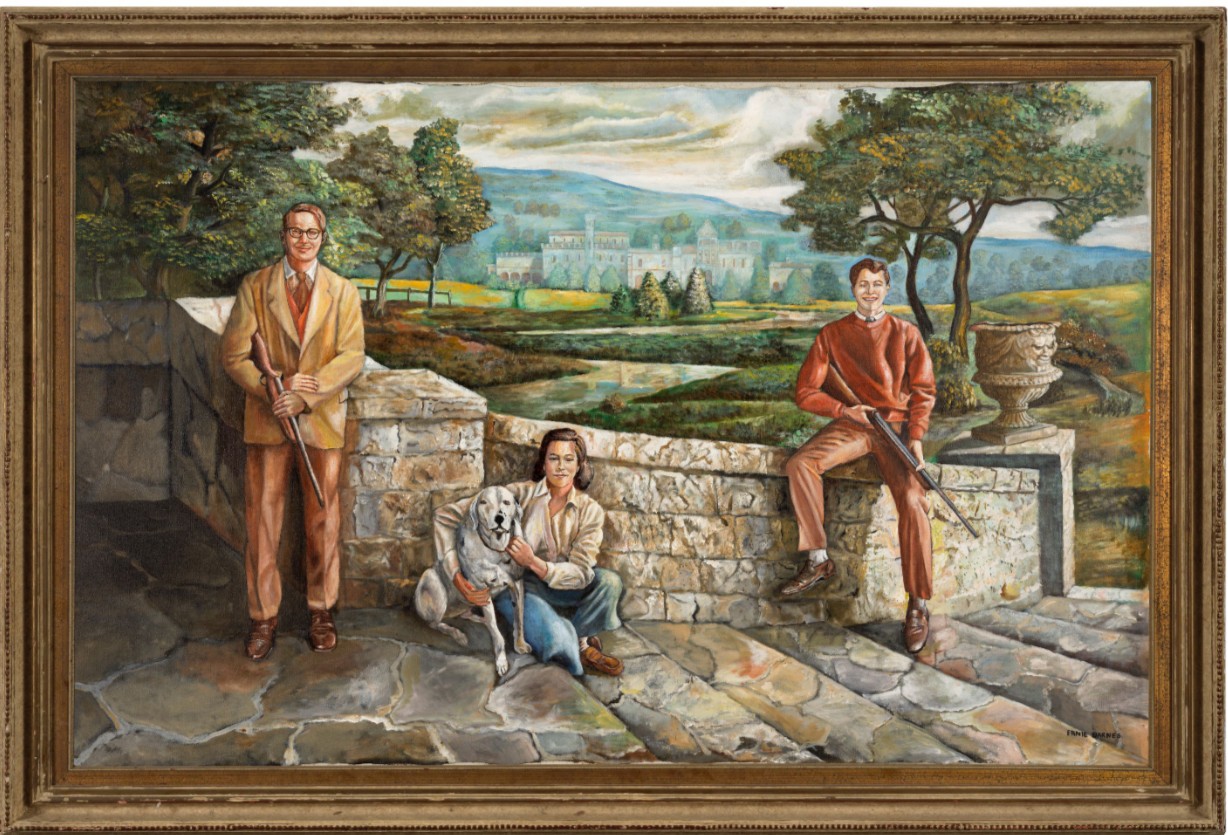
ERNIE BARNES (1938-2009)
Portrait of the Frankovich Children
Oil on canvas
32 1/8 x 50 1/8 inches (81.6 x 127.3 cm)
Signed ‘ERNIE BARNES’ (lower right)
Lots Passed
Lift Every Voice, 2008
Sotheby’s New-York: 16 May 2025
Estimated: USD 120,000 – 180,000
PASSED
Lift Every Voice | Contemporary Day Auction | 2025 | Sotheby’s
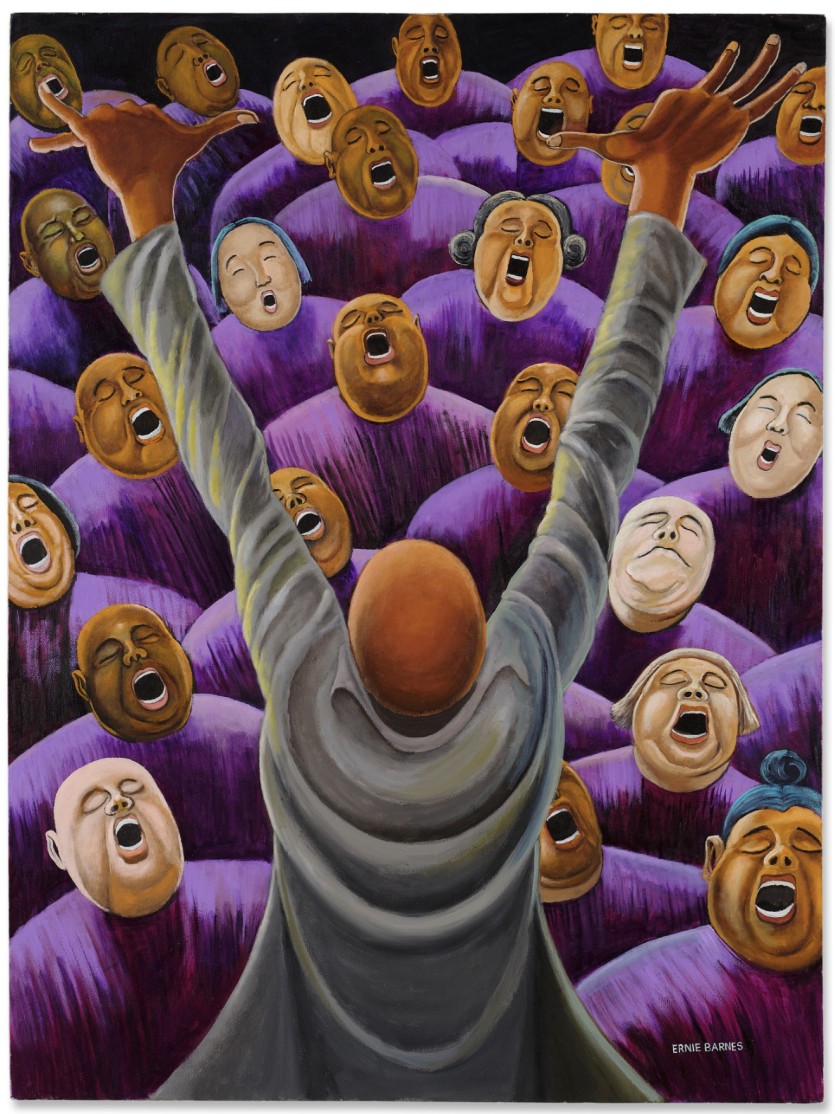
ERNIE BARNES (1938 – 2009)
Lift Every Voice, 2008
Acrylic on canvas
40×30 inches (101.6 x 76.2 cm)
Signed (lower right)
Oh Happy Day, 1966
Bonhams New-York: 14 May 2025
Estimated: USD 300,000 – 500,000
PASSED
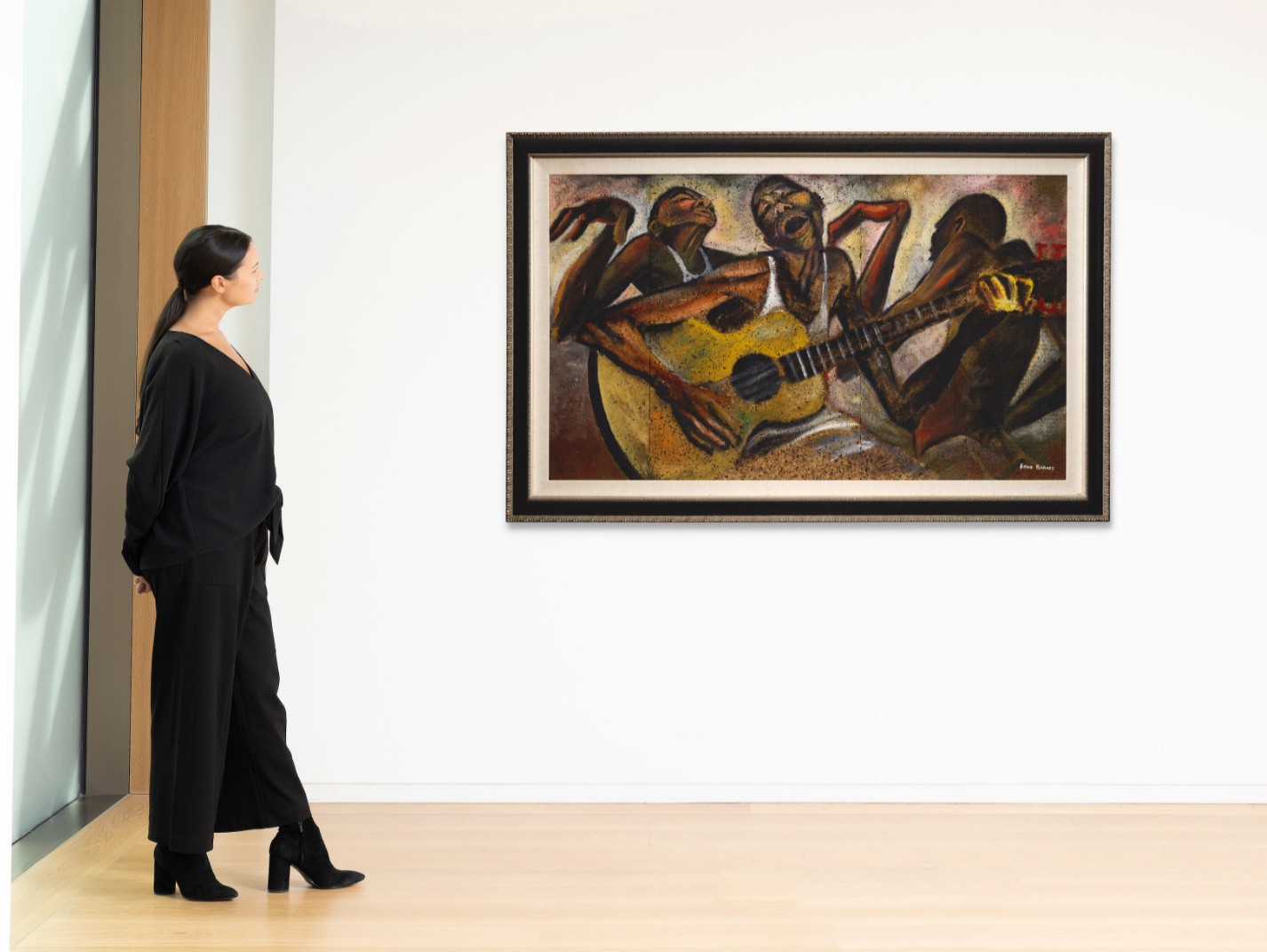
ERNIE BARNES (1938-2009)
Oh Happy Day, 1966
Acrylic on cork mounted to Masonite
36 3/8 x 59 7/8 inches (92.2 x 152.1 cm)
Signed ‘Ernie Barnes’ (lower right)
Loose Ball, 1971
Phillips New-York: 14 May 2025
Estimated: USD 200,000 – 300,000
PASSED
Ernie Barnes Modern & Contemporary Art Day Sale, Morning Session
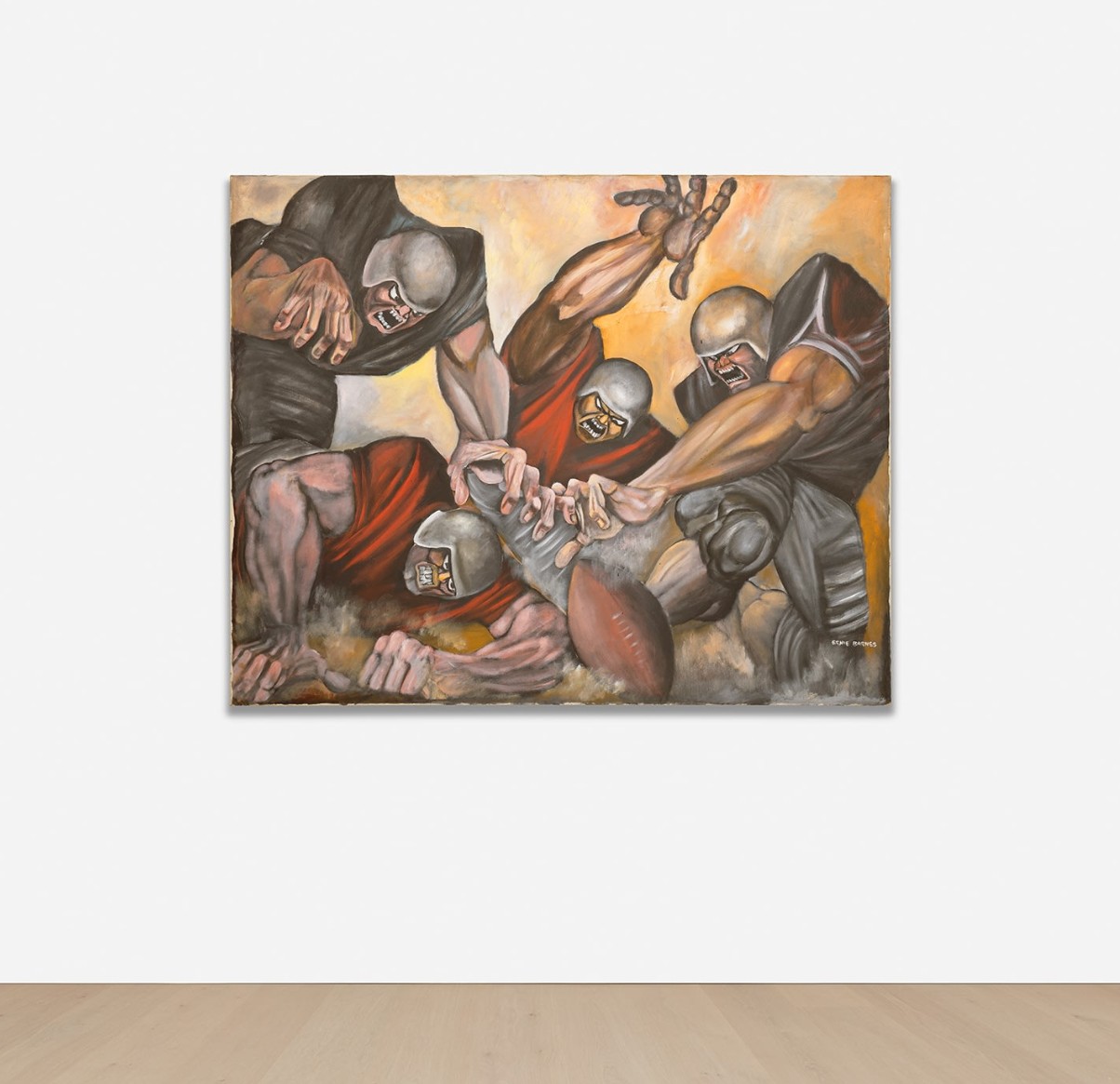
ERNIE BARNES
Loose Ball, 1971
Oil on canvas
48×60 inches (121.9 x 152.4 cm)
Signed “ERNIE BARNES” lower right
2024 Auction Results
15 lots sold at auction in 2024 for a total turnover of USD 3,517,055. With 4 lots failing to sell, the sell-through rate is 79%. The highest price of 2024 was achieved by Pail Hoops, a painting dated 1974, that sold at Christie’s in New-York, on 22 November 2024, for USD 630,000. This is the only lot that sold for more than USD 500,000.
2024 Top 3 Lots
10 lots sold for more than USD 100,000, generating a cumulative turnover of USD 3,249,800, representing 92.4% of the total turnover for 2024.
#1. Pail Hoops, 1974
Christie’s New-York: 22 November 2024
Estimated: USD 500,000 – 700,000
USD 630,000
ERNIE BARNES (1938-2009), Pail Hoops
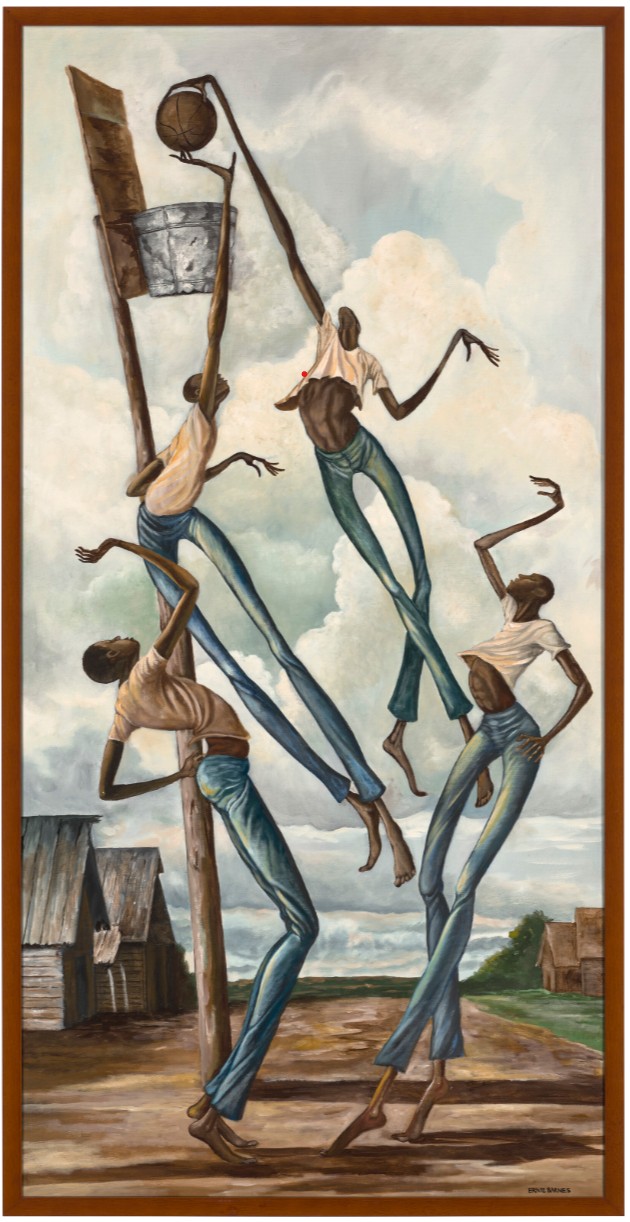
ERNIE BARNES (1938-2009)
Pail Hoops, 1974
Oil on canvas
47 1/4 x 23 5/8 inches (119.6 x 59.7 cm)
Signed ‘Ernie Barnes’ (lower right)
USD 500,000
#2. My First Dunk, 1976
Phillips New-York: 20 November 2024
Estimated: USD 250,000 – 350,000
USD 444,500
Ernie Barnes Modern & Contemporary Art Day Sale, Morning Session
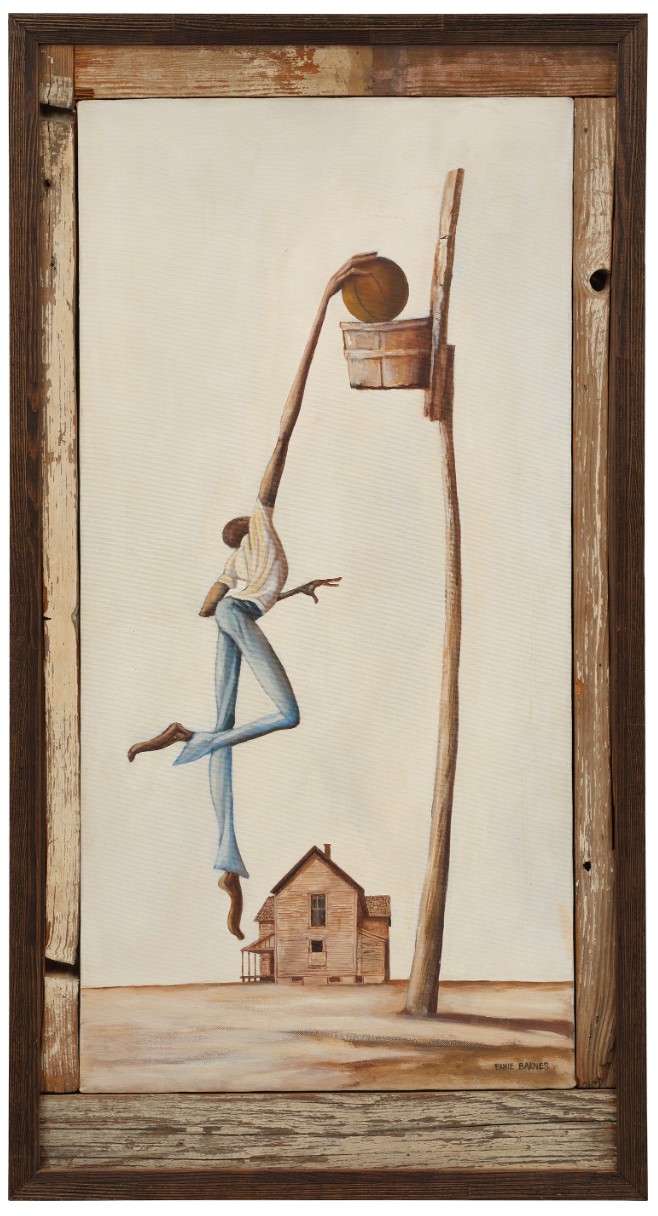
My First Dunk, 1976
Oil and acrylic on canvas, in artist’s frame
#3. The Leap, 1972
Bonhams Los Angeles: 1 March 2024
Estimated: USD 300,000 – 500,000
USD 356,100
Bonhams : ERNIE BARNES (1938-2009) The Leap, 1972
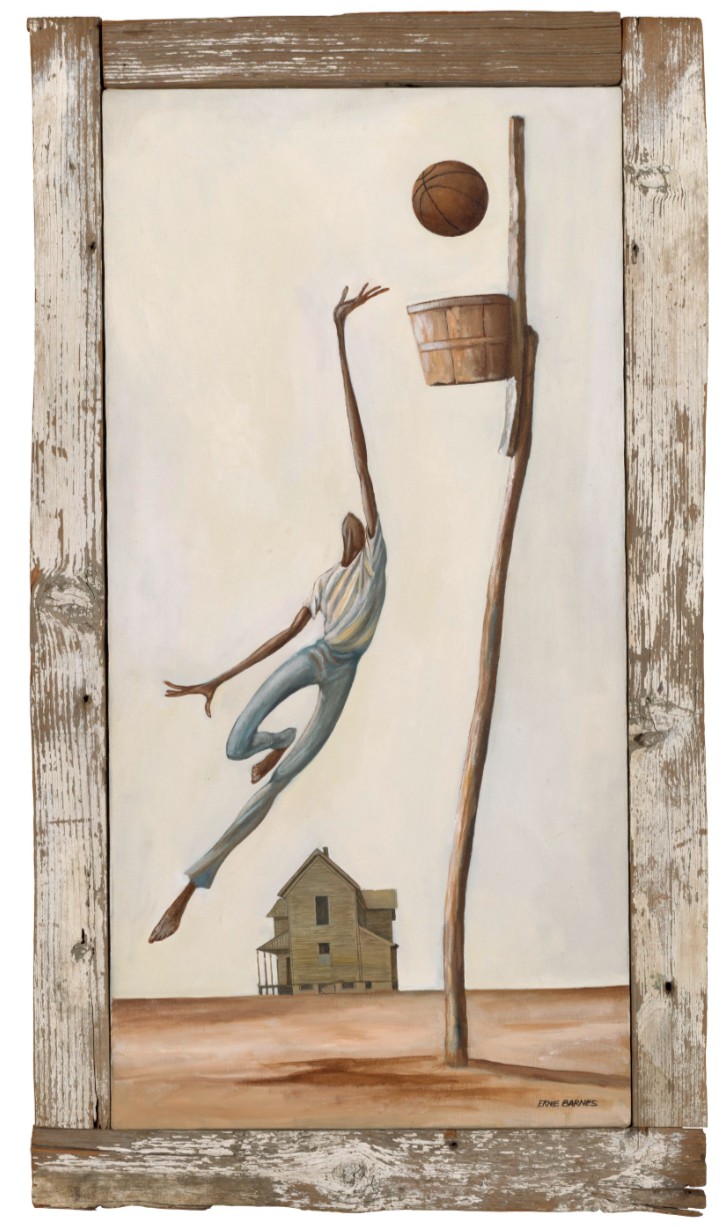
ERNIE BARNES (1938-2009)
The Leap, 1972
Acrylic on canvas in artist’s frame
36×18 inches (91.4 x 45.7 cm)
Framed: 41 5/8 x 23 1/4 inches (105.7 x 59.1 cm)
Signed ‘ERNIE BARNES’ (lower right)
The present work was framed by the artist with his signature wood fence style
#4. The Native Gift, 1972
PROPERTY FROM THE LLOYD J. SCHWARTZ FAMILY COLLECTION
Bonhams New-York: 19 November 2024
Estimated: USD 250,000 – 350,000
USD 330,700
Bonhams : Ernie Barnes (1938-2009) The Native Gift 36 x 18 in. (91.4 x 45.7 cm.) (Painted in 1972.)
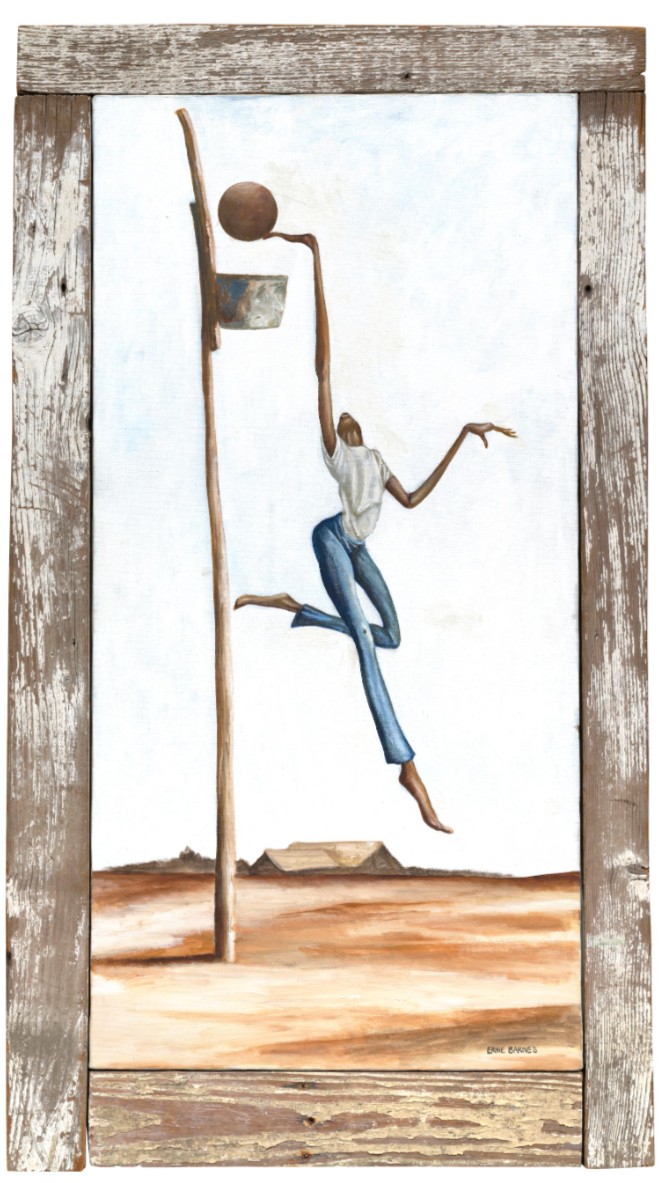
ERNIE BARNES (1938-2009)
The Native Gift, 1972
Acrylic on canvas
36×18 inches (91.4 x 45.7 cm)
Signed ‘ERNIE BARNES’ (lower right)
The present work was framed by the artist with his signature wood fence style
#5. Pool Hall, circa 1975
Bonhams New-York: 20 November 2024
Estimated: USD 200,000 – 300,000
USD 318,000
Bonhams : ERNIE BARNES (1938-2009) Pool Hall 23 3/4 x 48 in (60.2 x 121.7 cm) (Painted circa 1975)
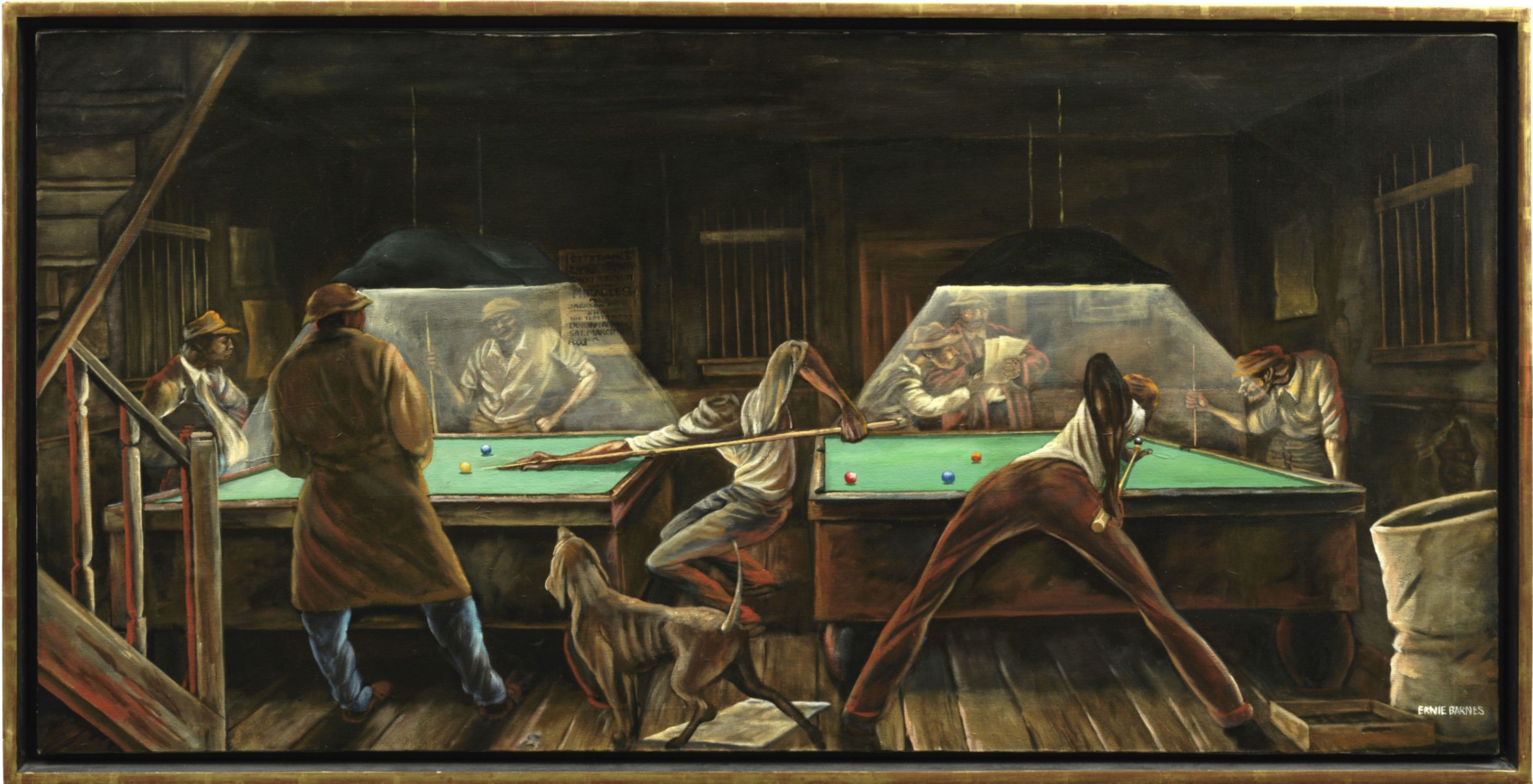
ERNIE BARNES (1938-2009)
Pool Hall, circa 1975
Acrylic on canvas
23 3/4 x 48 inches (60.2 x 121.7 cm)
Signed ‘Ernie Barnes’ (lower right)
#6. Human Celebration, circa 1960s
Phillips New-York: 15 May 2024
Estimated: USD 150,000 – 250,000
USD 292,100
Ernie Barnes Modern & Contemporary Art Day Sale, Morning Session
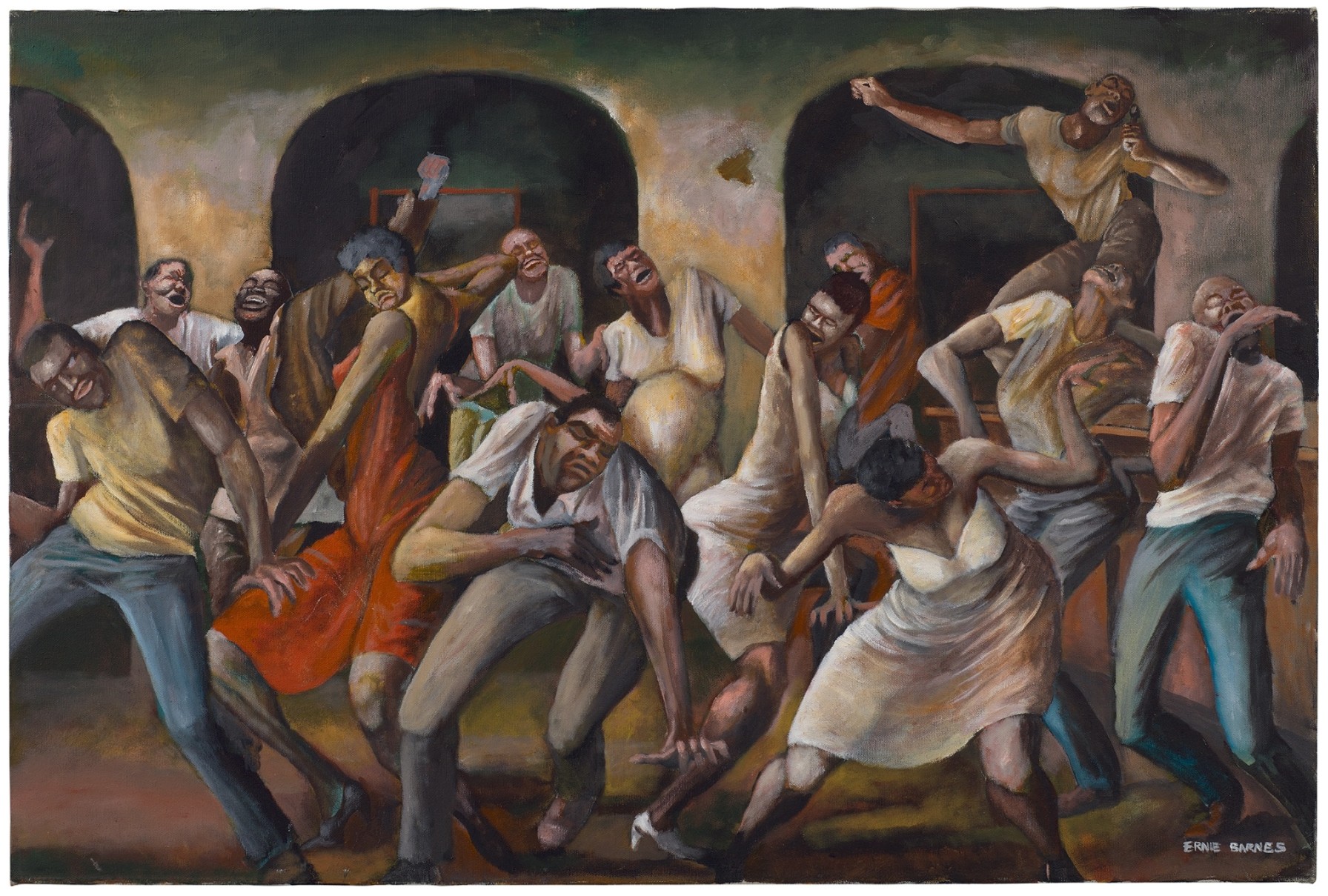
ERNIE BARNES
Human Celebration, circa 1960s
Acrylic on canvas
24 1/8 x 35 7/8 inches (61.3 x 91.1 cm)
Signed “ERNIE BARNES” lower right
#7. We Keep the Sabbath Kosher, 2001
Christie’s New-York: 17 May 2024
Estimated: USD 60,000 – 80,000
USD 289,800
ERNIE BARNES (1938-2009), We Keep the Sabbath Kosher | Christie’s
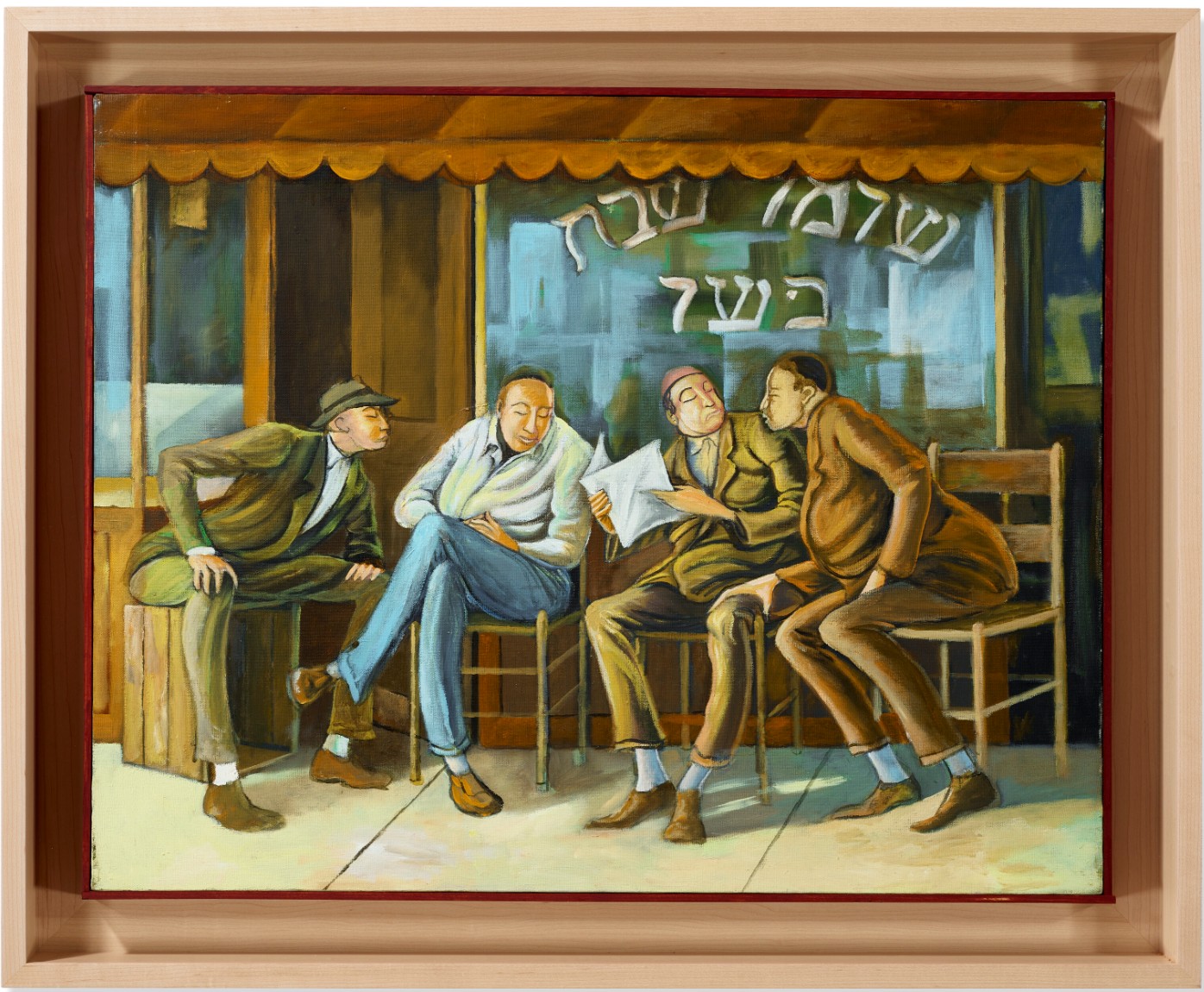
ERNIE BARNES (1938-2009)
We Keep the Sabbath Kosher, 2001
Acrylic on canvas
22×28 inches (55.9 x 71.1 cm)
#8. Shootaround, 1973
Abell: 5 October 2024
Estimated: USD 100,000 – 200,000
USD 210,000 (Hammer)
USD 262,500
Lot – Ernie Eugene Barnes, Jr. (1938-2009): Shootaround
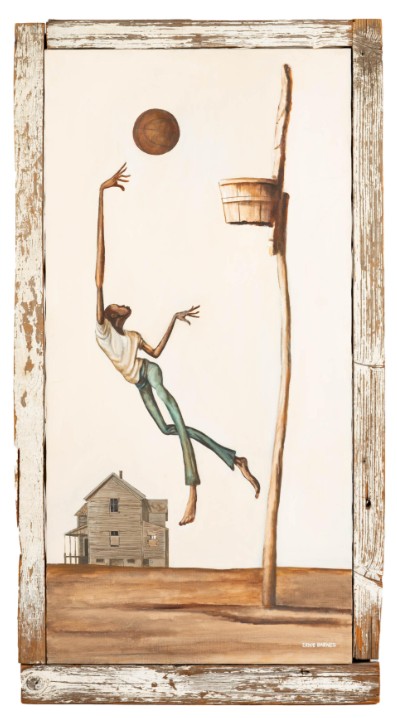
ERNIE BARNES (American, 1938-2009)
Shootaround, 1973
Oil on canvas
36 x 17 3/4 inches (91.4 x 45.1 cm)
Signed lower right
#9. Playin’ the Net, 1972
Heritage Auctions: 15 November 2024
Estimated: USD 70,000 – 100,000
USD 187,500
Ernie Barnes (American, 1938-2009). Playin’ the Net, 1972. Oil on | Lot #67059 | Heritage Auctions
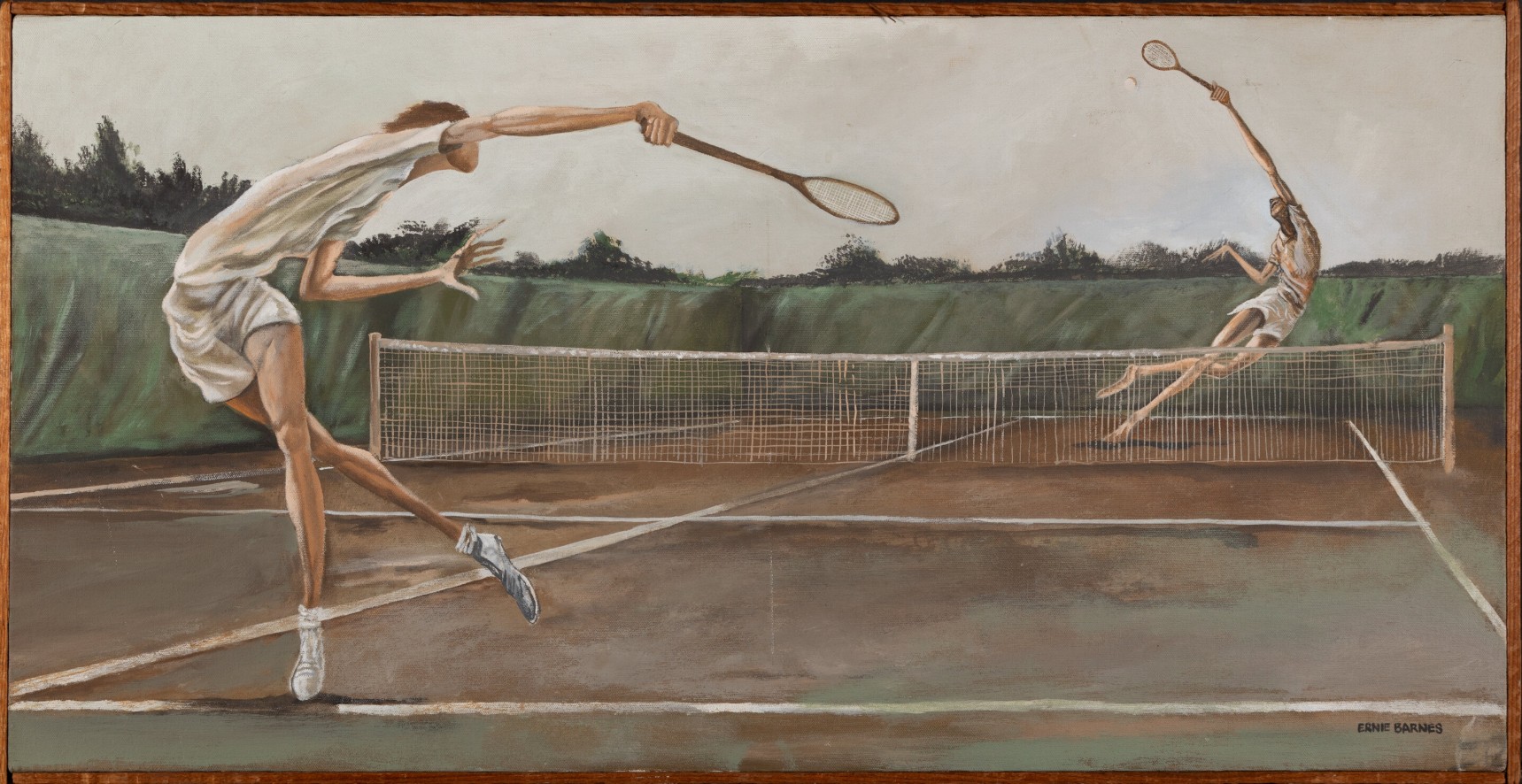
ERNIE BARNES (American, 1938-2009)
Playin’ the Net, 1972
Oil on canvas
18×36 inches (45.7 x 91.4 cm)
Signed lower right: Ernie Barnes
#10. Preacher with Blue Book, 1973
Christie’s New-York: 13 March 2024
Estimated: USD 60,000 – 80,000
USD 138,600
ERNIE BARNES (1938-2009), Preacher with Blue Book | Christie’s
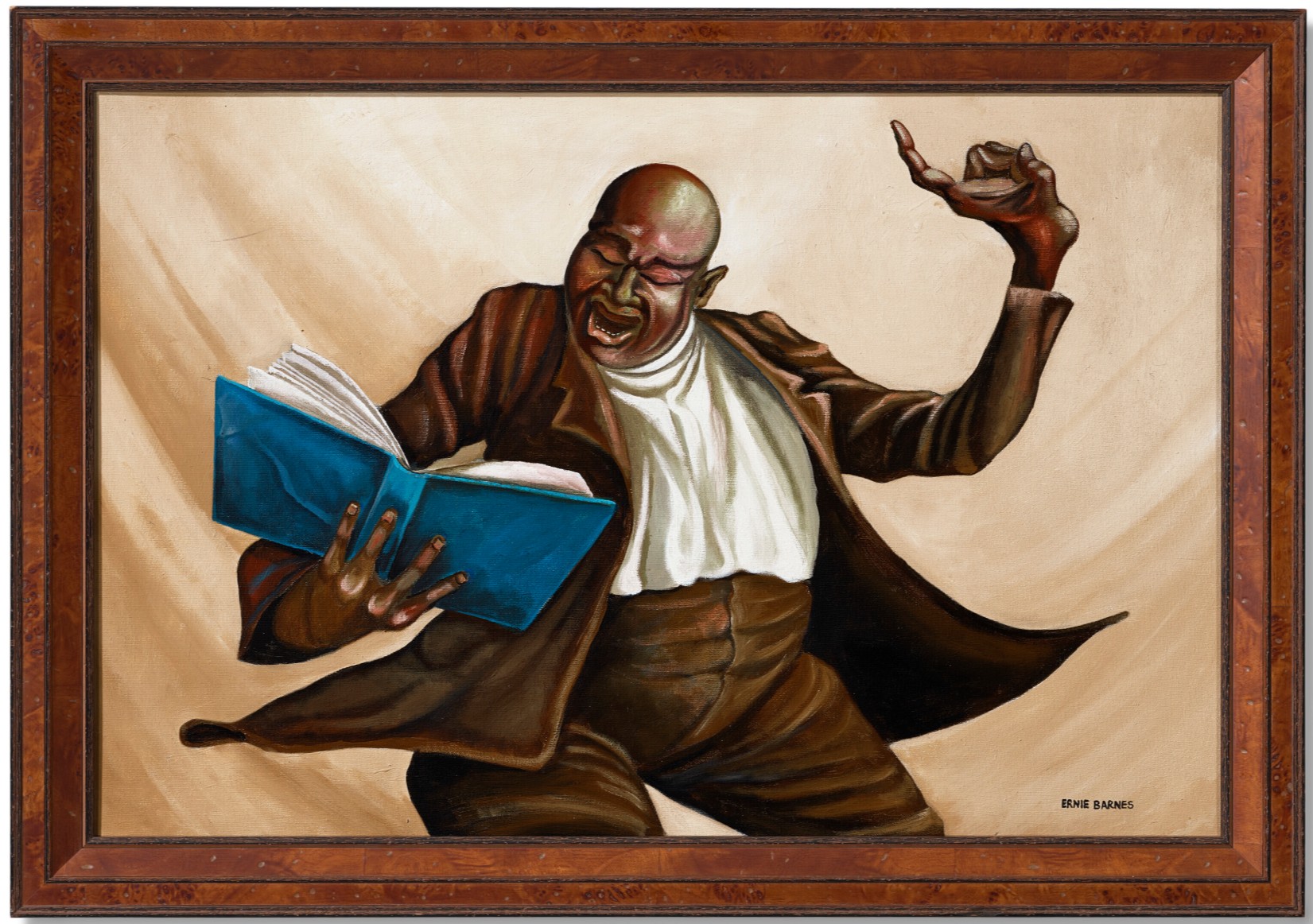
ERNIE BARNES (1938-2009)
Preacher with Blue Book, 1973
Oil on canvas
19 7/8 x 29 7/8 inches (50.5 x 75.9 cm)
Signed ‘ERNIE BARNES’ (lower right)
#11. The Ebony Tree, 1985
Abell: 8 June 2024
Estimated: USD 50,000 – 70,000
USD 75,000 (Hammer)
USD 93,750
Lot – Ernie E. Barnes (1938-2009): The Ebony Tree
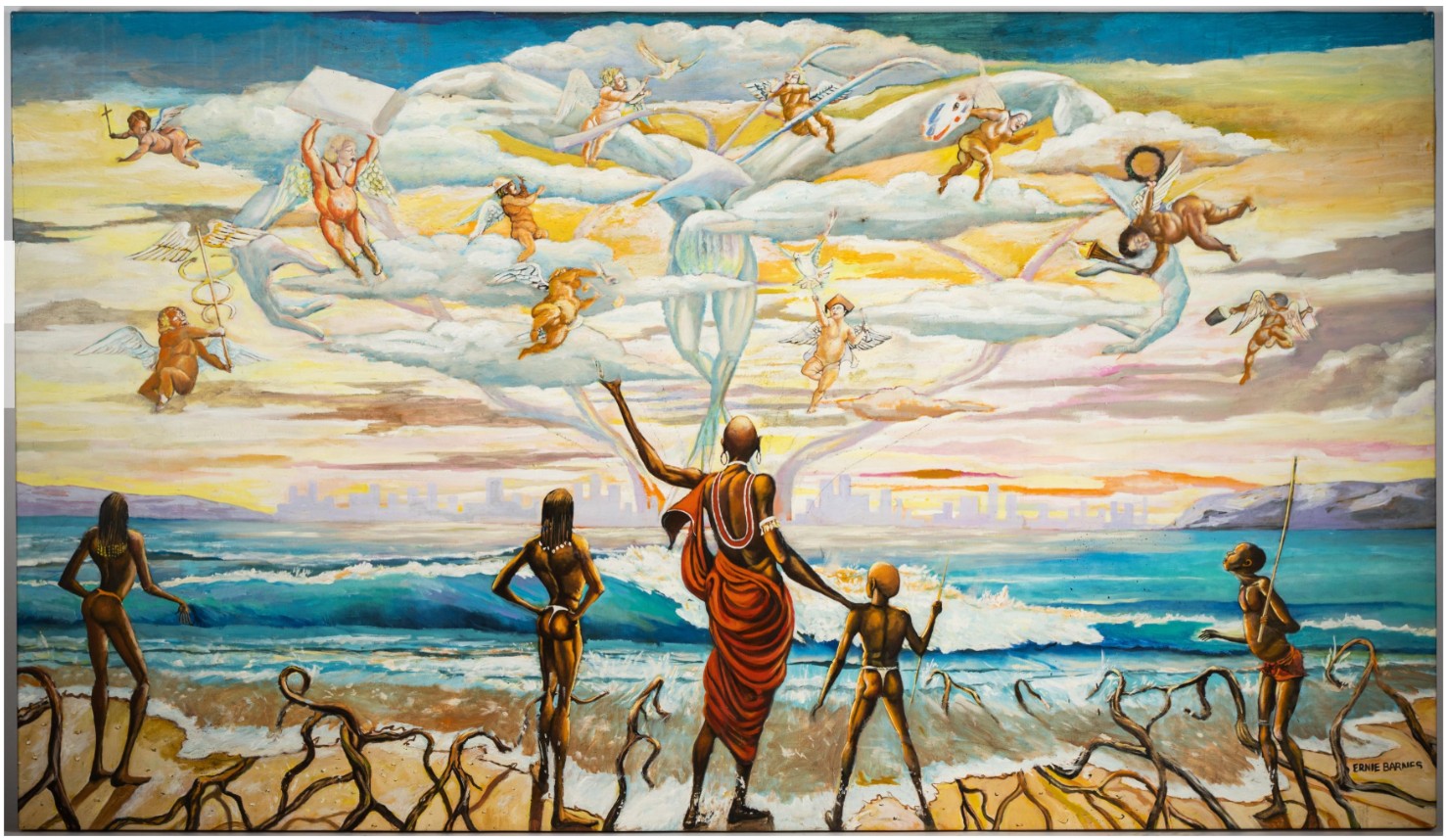
ERNIE BARNES (1938-2009)
The Ebony Tree, 1985
Oil on canvas
46×80 inches (116.8 x 203.2 cm)
Signed lower right
#12. Final Draft for Fastbreak, 1986
Sotheby’s New-York: 4 March 2024
Estimated: USD 50,000 – 70,000
USD 57,150
WORK ON PAPER
Final Draft for Fastbreak | Contemporary Discoveries | 2024 | Sotheby’s
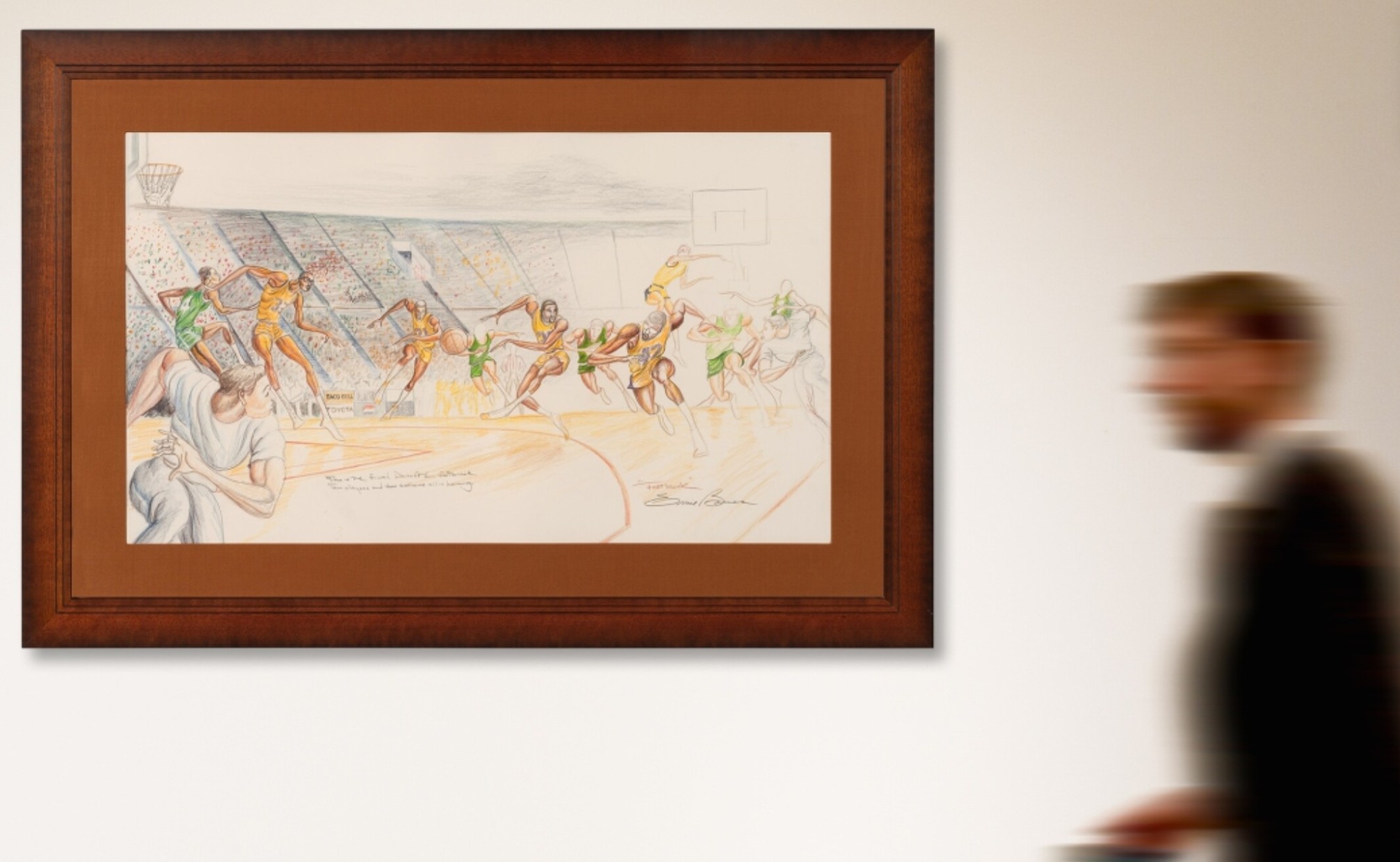
ERNIE BARNES (1938 – 2009)
Final Draft for Fastbreak, 1986
Colored pencil and graphite on paper
29 3/4 x 40 1/8 inches (75.6 x 101.9 cm)
Signed and titled Fastbreak (lower right)
Inscribed This is the final Draft for fastbreak. Ten players and two Referees all in harmony (lower left)
#13. Hustler, circa 1978
Christie’s London: 9 March 2024
Estimated: GBP 30,000 – 50,000
GBP 44,100 / USD 56,705
ERNIE BARNES (1938-2009), Hustler | Christie’s
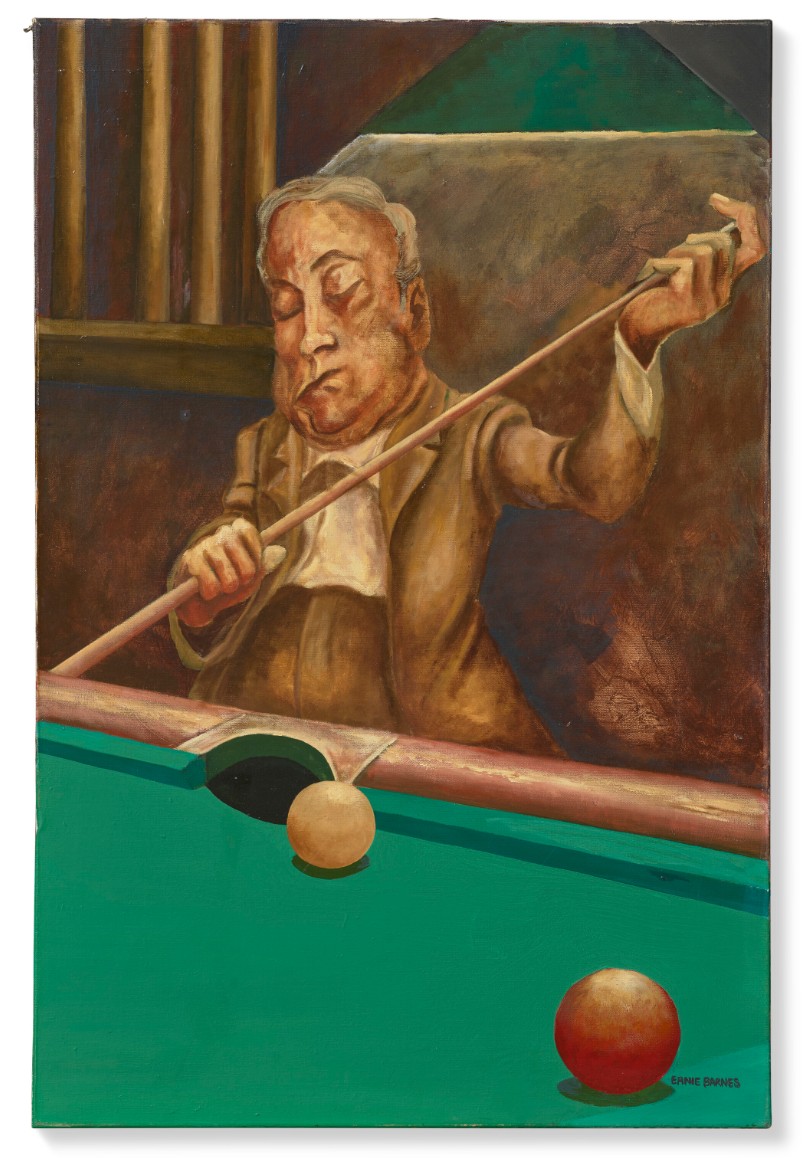
ERNIE BARNES (1938-2009)
Hustler, circa 1978
Acrylic on canvas
36×24 inches (91.4 x 61 cm)
Signed ‘ERNIE BARNES’ (lower right)
#14. Study for Jockey on Horse 23, 1984
Bonhams online: 8 August 2024
Estimated: USD 12,000 – 18,000
USD 38,400
WORK ON PAPER
Bonhams : Ernie Barnes (1938-2009) Study for Jockey on Horse
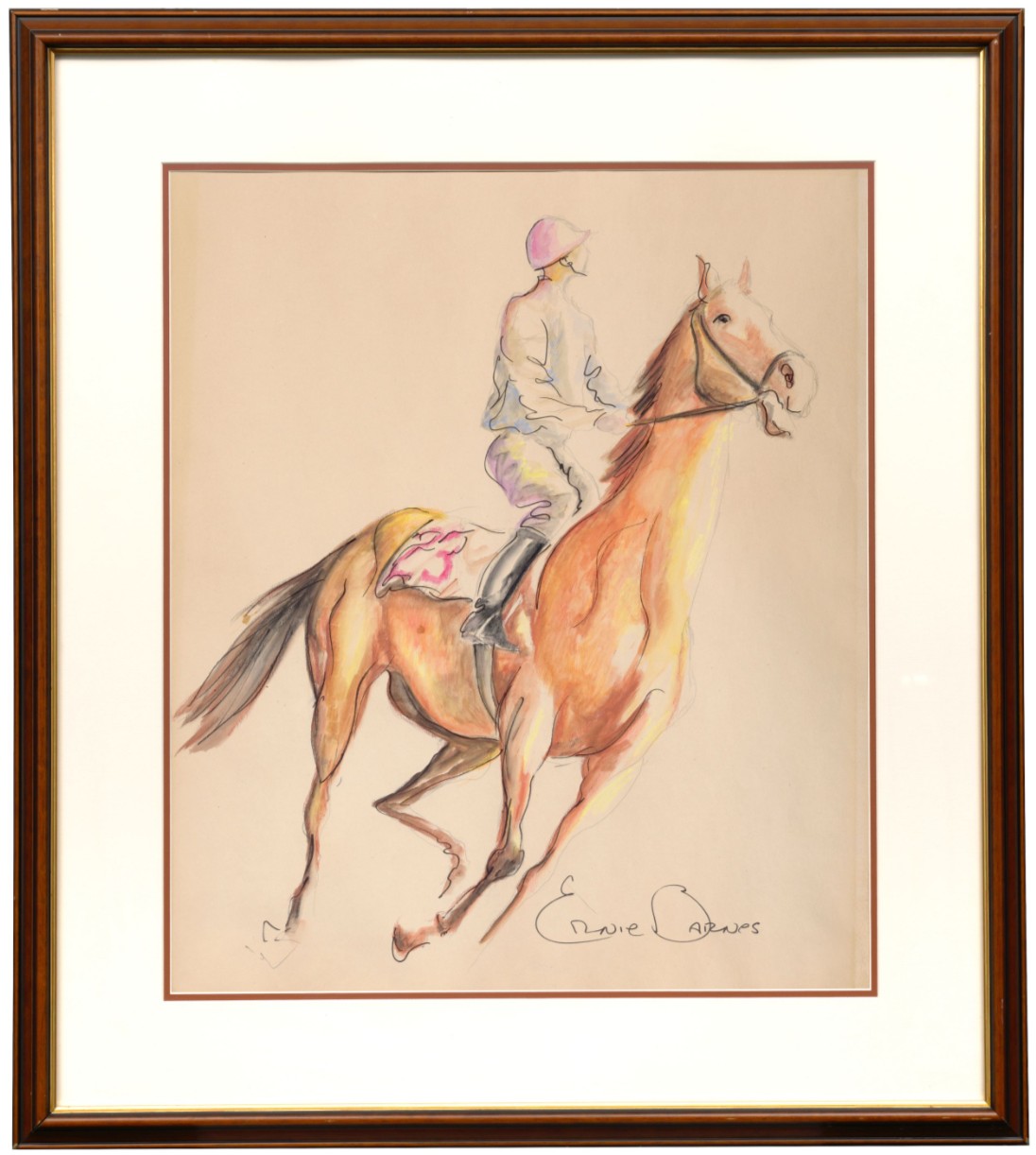
ERNIE BARNES (1938-2009)
Study for Jockey on Horse 23, 1984
Acrylic wash, ink and graphite on paper
29 x 22 7/8 inches (73.7 x 58.1 cm)
Signed ‘Ernie Barnes’ (lower right)
#15. Alberta!, circa 1980s
Swann Auction Galleries: 26 November 2024
Estimated: USD 20,000 – 30,000
USD 21,250
WORK ON PAPER
Lot – ERNIE BARNES (1938 – 2009) Alberta!
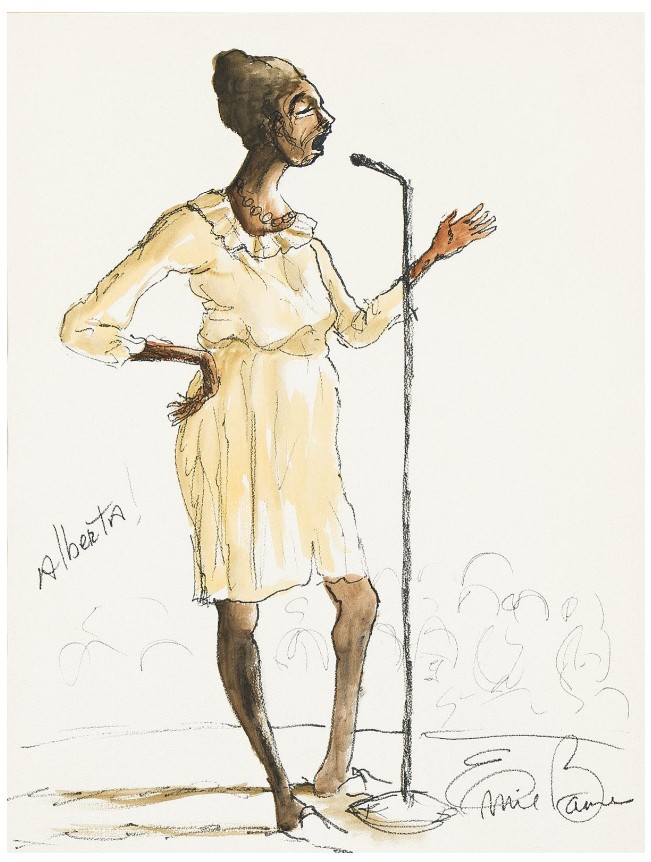
ERNIE BARNES (1938 – 2009)
Alberta!, circa 1980s
Watercolor and ink on Arches
30 x 22 1/4 inches (76.3 x 56.7 cm)
Signed in ink, lower right
Titled in ink, lower left
Lots Passed
The Devil and Doodazzle Dakins, circa 1980
Doyle New-York: 20 November 2024
Estimated: USD 300,000 – 500,000
PASSED
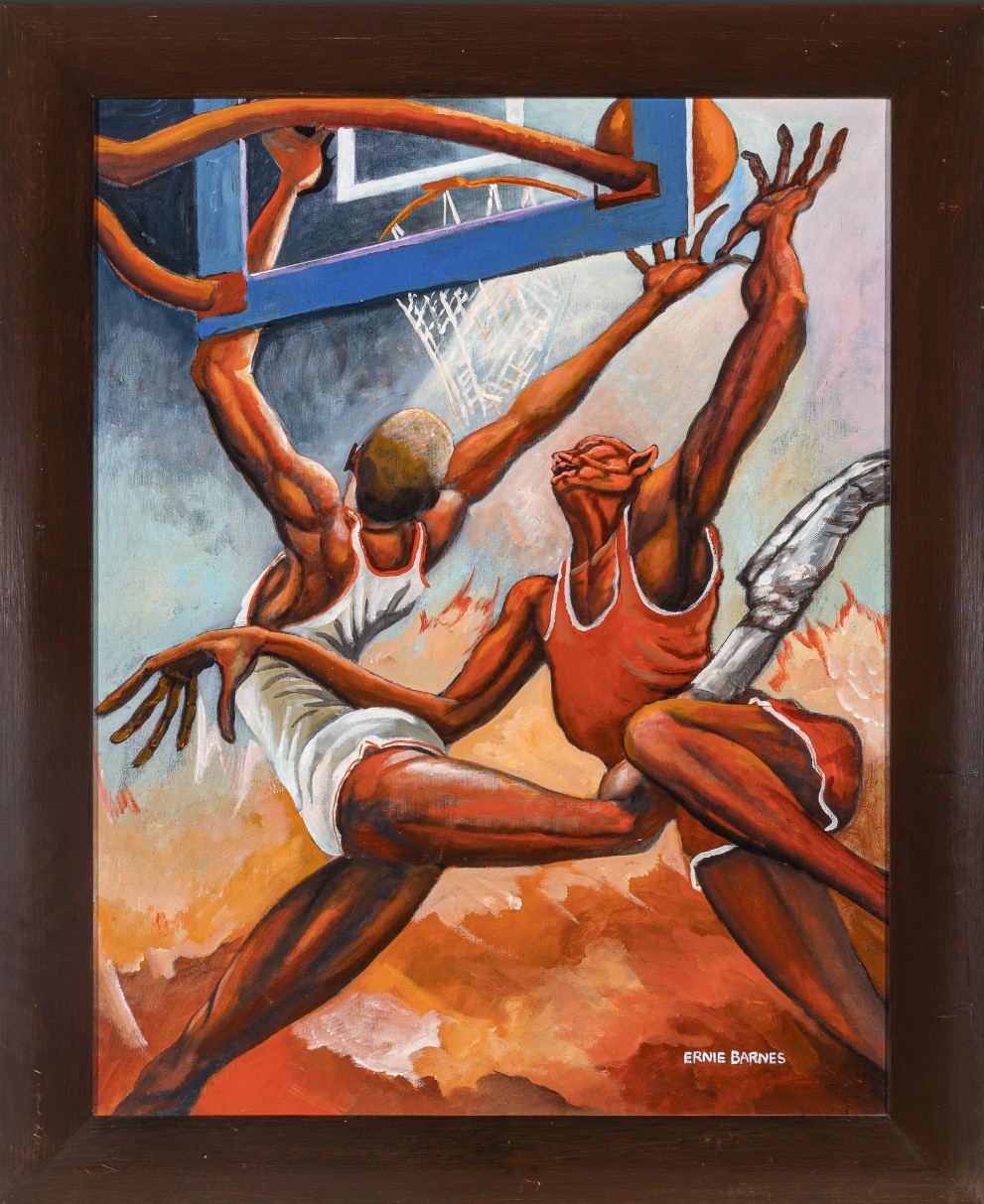
ERNIE BARNES (American, 1938-2009)
The Devil and Doodazzle Dakins, circa 1980
Oil on canvas
27 3/8 x 21 1/8 inches (69.6 x 53.7 cm)
Signed Ernie Barnes (lr)
An Ounce of Luck, 1989
Bonhams New-York: 22 November 2024
Estimated: USD 150,000 – 200,000
PASSED
Bonhams : ERNIE BARNES (1938-2009) An Ounce of Luck
ERNIE BARNES (1938-2009)
An Ounce of Luck, 1989
Acrylic on canvas
20×24 inches (50.8 x 61 cm)
Signed ‘Ernie Barnes’ (lower right)
Bible Study, 1973
Bonhams New-York: 19 November 2024
Estimated: USD 80,000 – 120,000
PASSED
Bonhams : Ernie Barnes (1938-2009) Bible Study
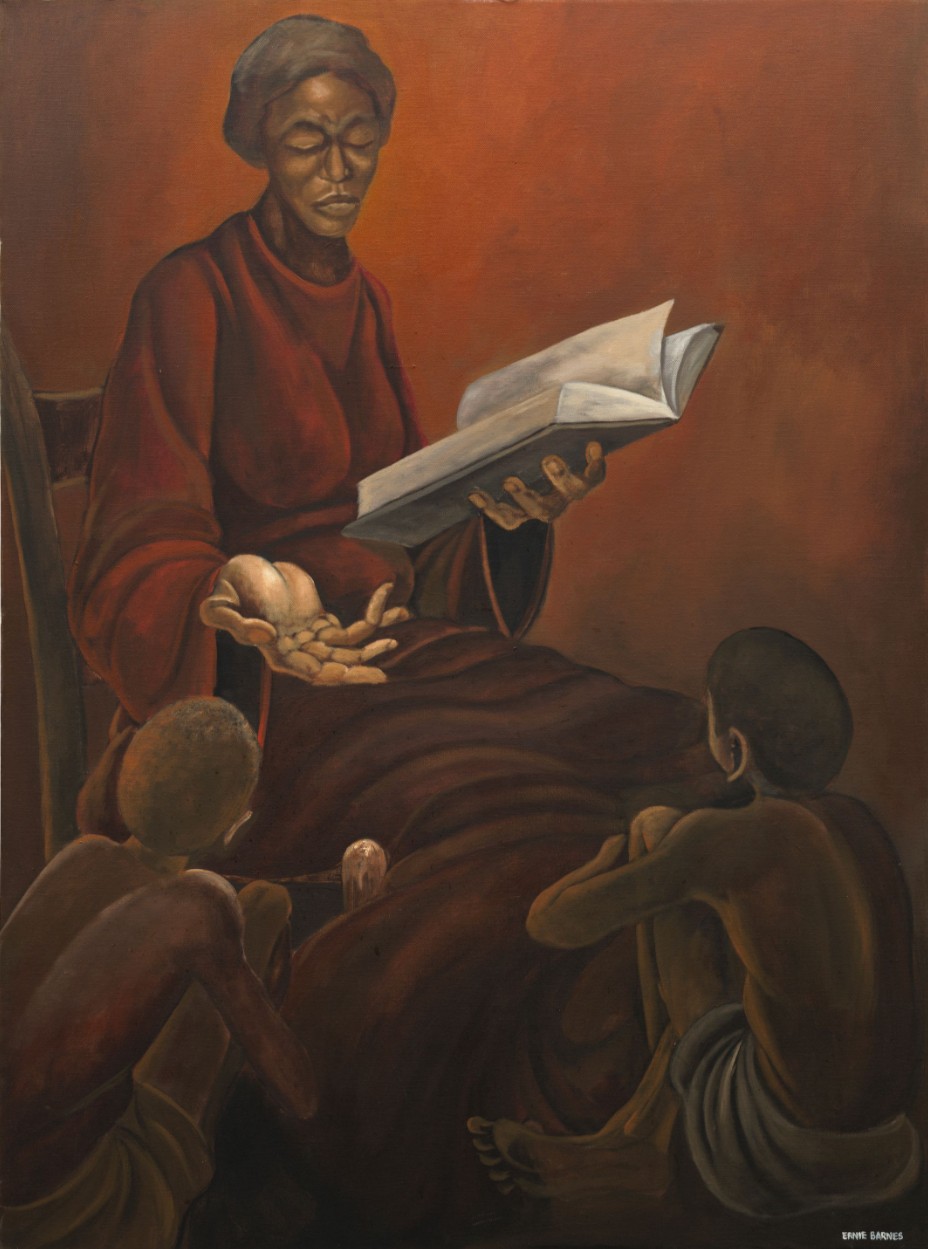
ERNIE BARNES (1938-2009)
Bible Study, 1973
Acrylic on canvas
48×36 inches (121.9 x 91.4 cm)
Signed ‘ERNIE BARNES’ (lower right)
2023 Auction Results
#1. Club 55, 1990/94
Property from the Collection of Dennis Haysbert
Sotheby’s New-York: 28 September 2023
Estimated: USD 800,000 – 1,200,000
USD 1,170,000
Club 55 | Contemporary Curated | 2023 | Sotheby’s
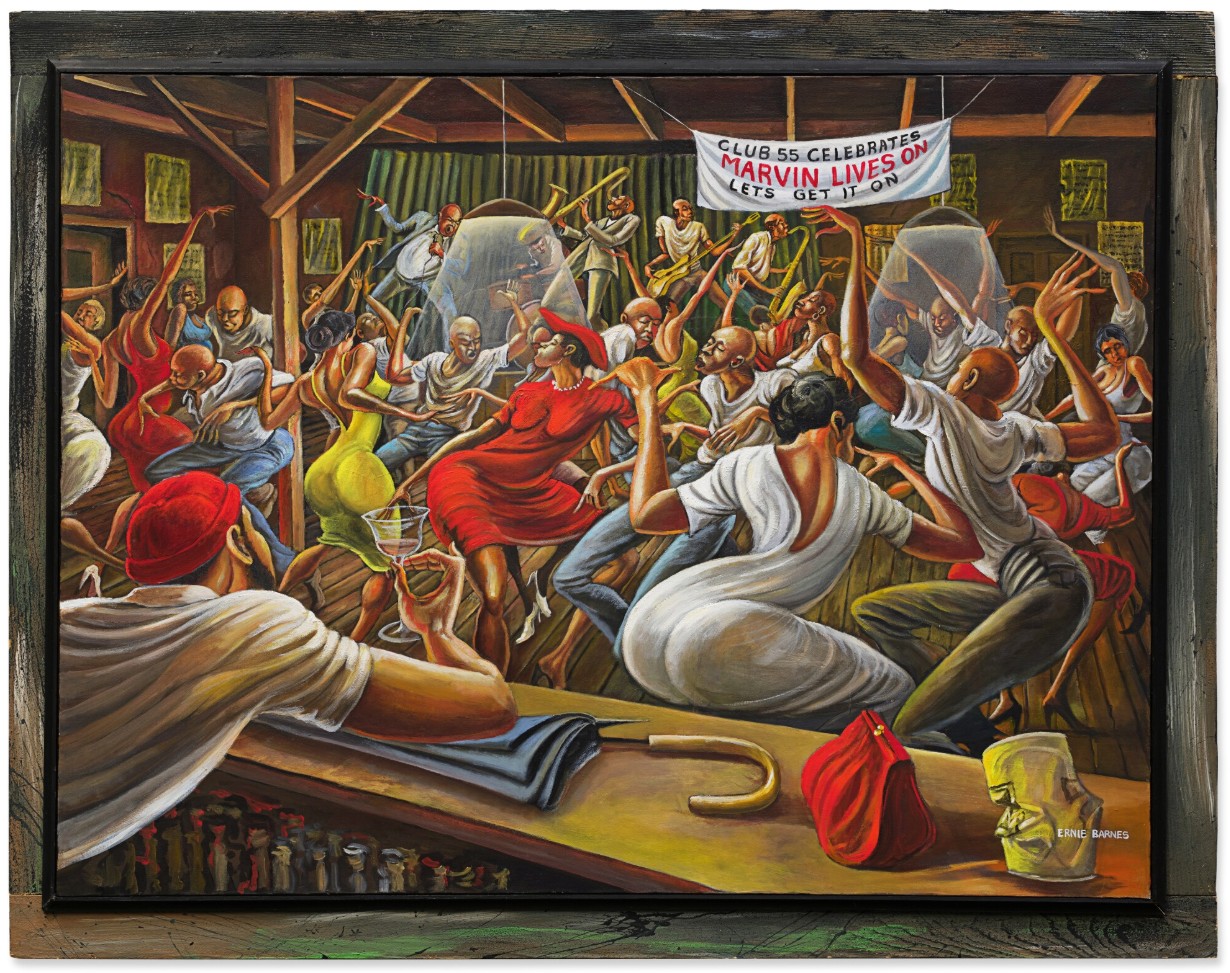
ERNIE BARNES (1938 – 2009)
Club 55, 1990/94
Acrylic and oil on canvas, in artist’s frame
41 5/8 x 53 1/4 inches (105.7 x 135.3 cm)
Signed (lower right)
USD 1 million
#2. High Aspirations, 1971
PROPERTY FROM A PRIVATE COLLECTION, NEW JERSEY
Bonhams New-York: 7 November 2023
Estimated: USD 500,000 – 700,000
USD 857,750
Bonhams : Ernie Barnes (1938-2009) High Aspirations 36 x 18 in. (91.4 x 45.7 cm.) (Painted in 1971.)
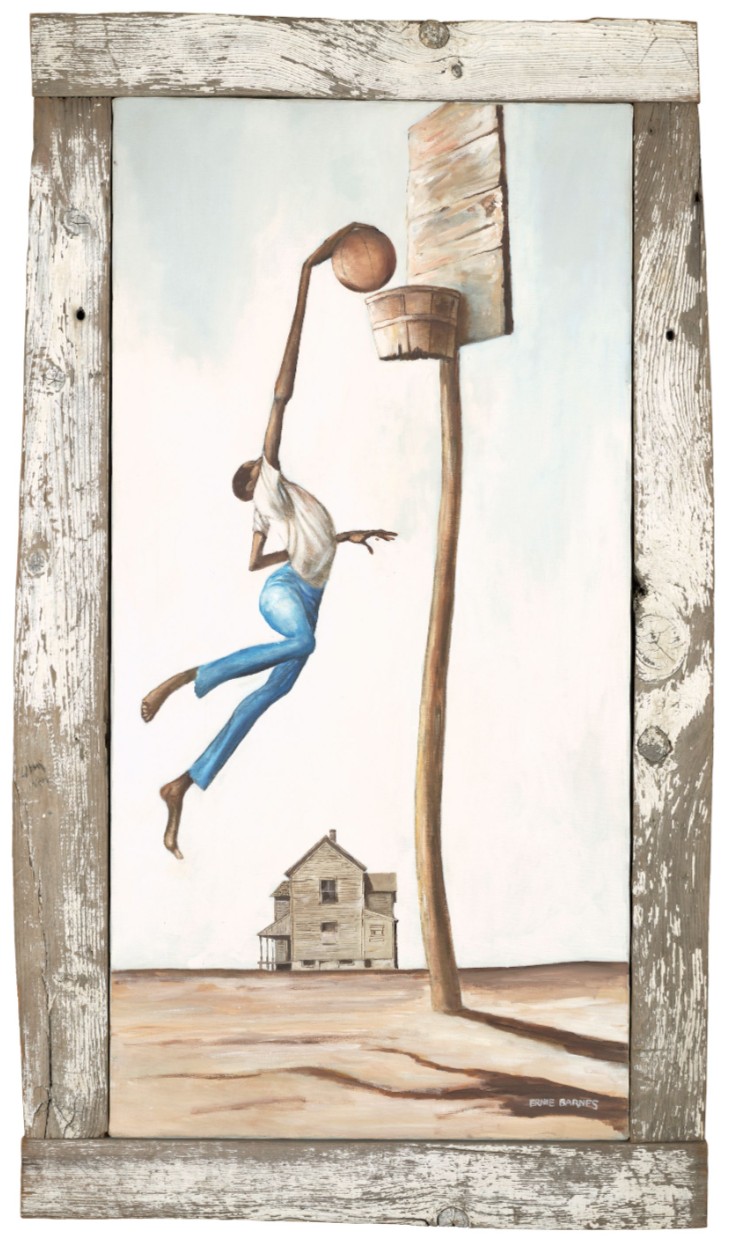
ERNIE BARNES (1938-2009)
High Aspirations, 1971
Acrylic on canvas
36×18 inches (91.4 x 45.7 cm)
Signed ‘ERNIE BARNES’ (lower right)
#3. Quintet, circa 1989
Heritage Auctions: 12 May 2023
Estimated: USD 500,000 – 700,000
USD 645,000
Ernie Barnes (American, 1938-2009). Quintet, circa 1989. Acrylic on | Lot #67048 | Heritage Auctions
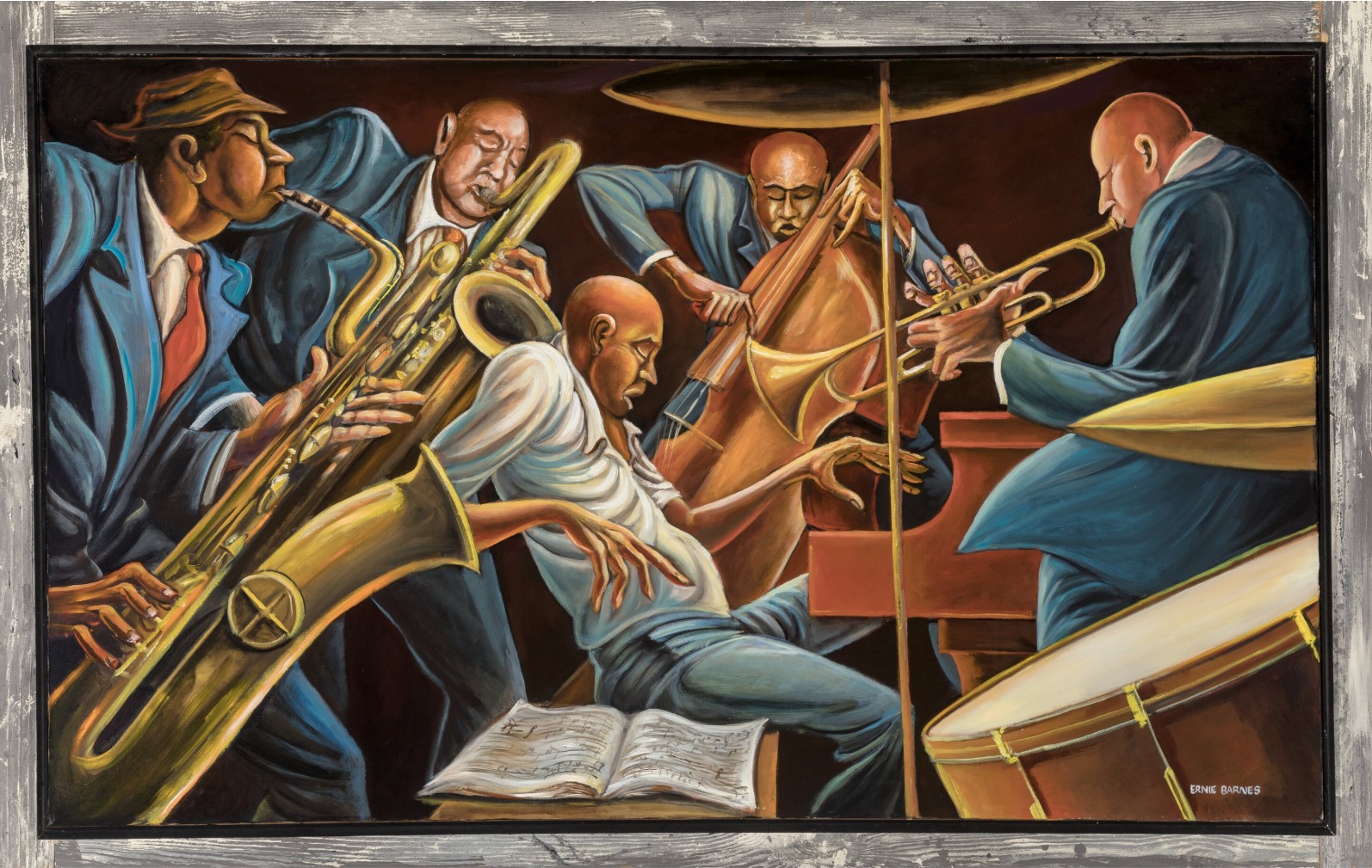
ERNIE BARNES (American, 1938-2009)
Quintet, circa 1989
Acrylic on canvas
36×60 inches (91.4 x 152.4 cm)
Signed lower right: Ernie Barnes
#4. The Winning Shot, 1970
Christie’s New-York: 12 May 2023
Estimated: USD 80,000 – 120,000
USD 592,200
ERNIE BARNES (1938 – 2009), The Winning Shot | Christie’s
ERNIE BARNES (1938 – 2009)
The Winning Shot, 1970
Acrylic on canvas
23 3/4 x 36 inches (60.3 x 91.4 cm)
Signed ‘ERNIE BARNES’ (lower right)
#5. At Last, 1983
Christie’s New-York: 12 May 2023
Estimated: USD 60,000 – 80,000
USD 567,000
ERNIE BARNES (1938-2009), At Last | Christie’s
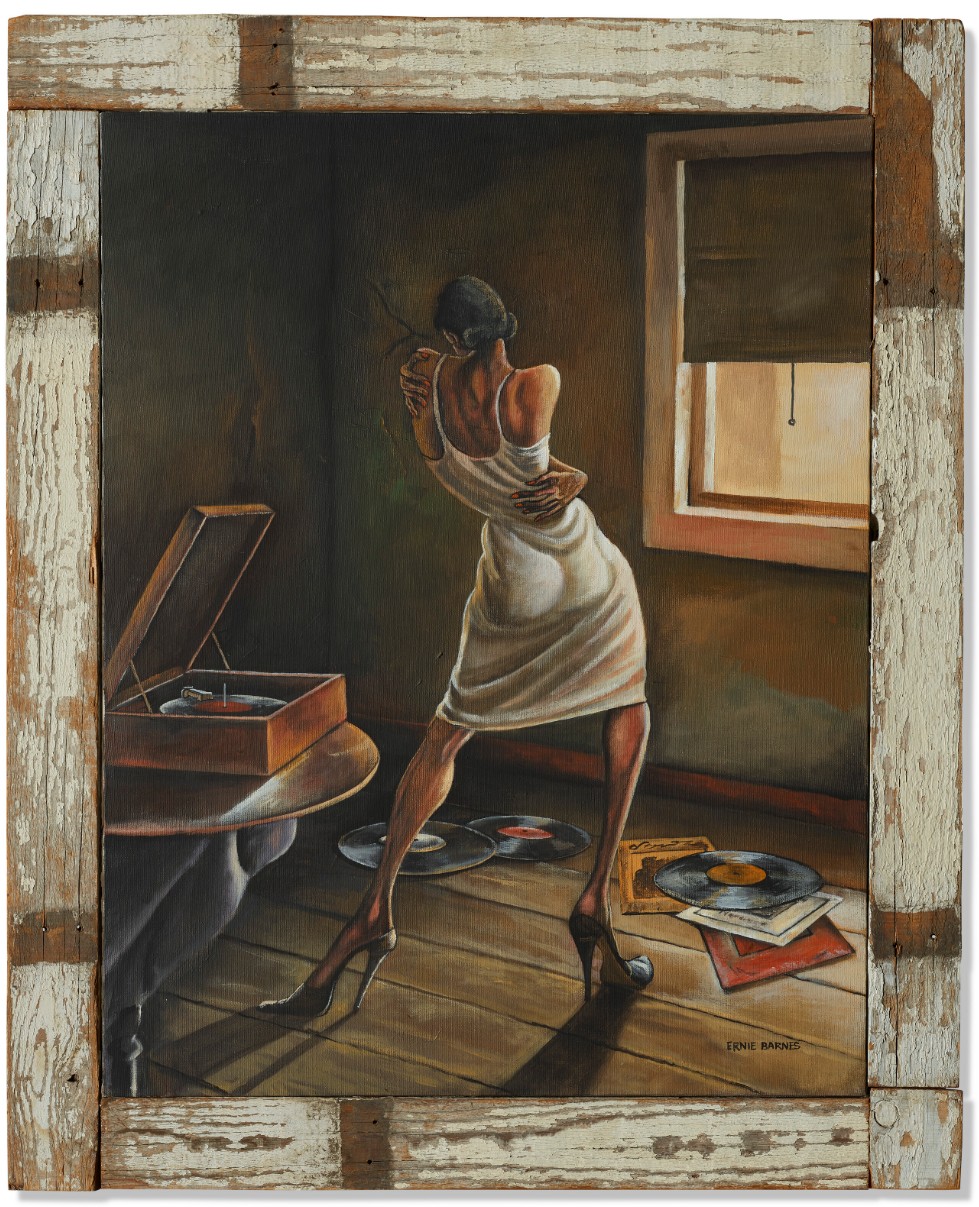
ERNIE BARNES (1938-2009)
At Last, 1983
Oil on canvas, in artist’s frame
33 3/8 x 27 1/8 inches (84.6 x 68.8 cm)
Signed ‘ERNIE BARNES’ (lower right)
#6. The Shot, 1985
Bonhams New-York: 25 May 2023
Estimated: USD 300,000 – 500,000
USD 508,500
Bonhams : Ernie Barnes (1938-2009) The Shot 20 x 24 in. (50.8 x 61 cm.) (Painted in 1985.)
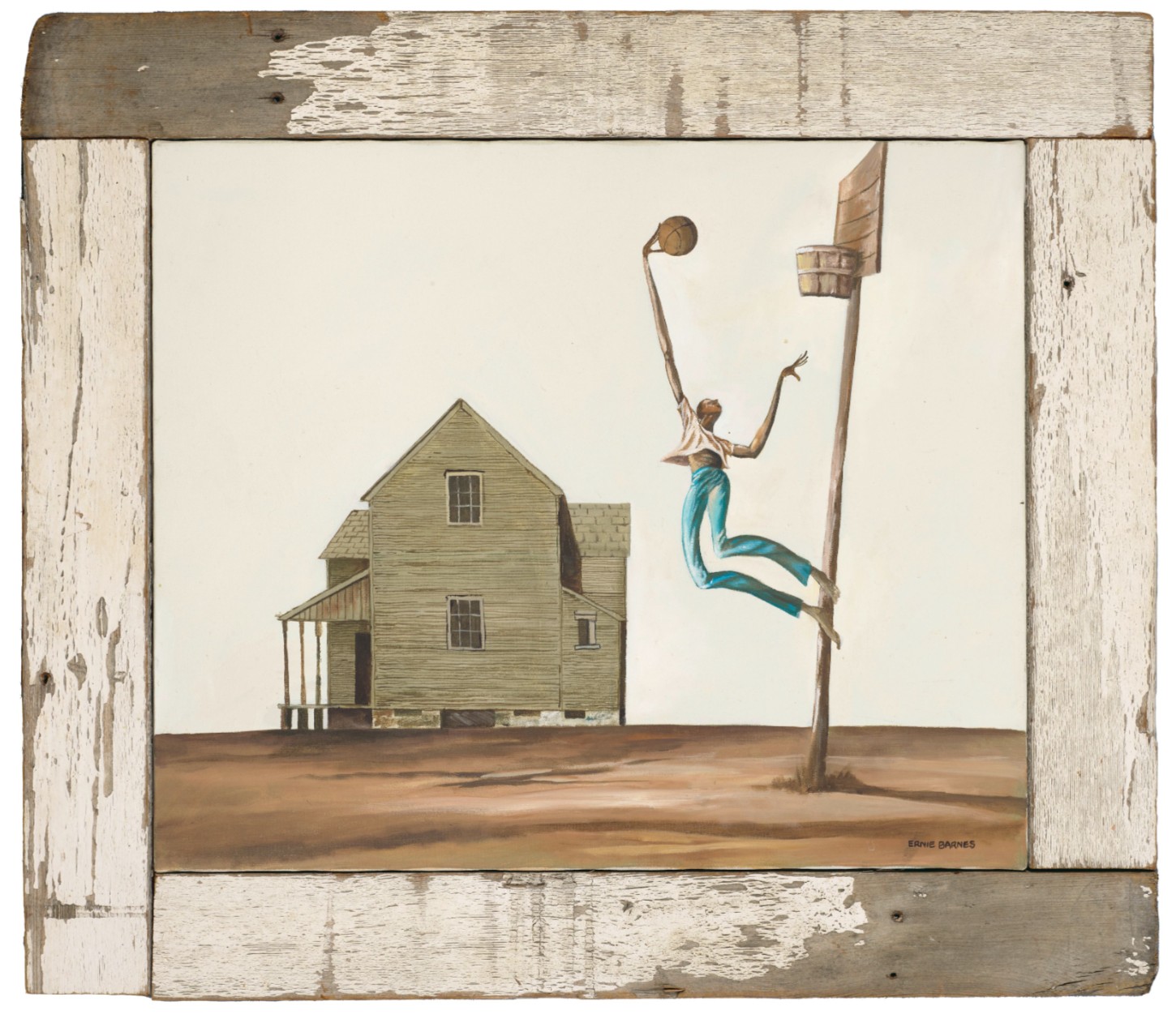
ERNIE BARNES (1938-2009)
The Shot, 1985
Acrylic on canvas
20×24 inches (50.8 x 61 cm)
Signed ‘ERNIE BARNES’ (lower right)
The present work was framed by the artist with his signature wood fence style
#7. Country Layup, 1979
Bonhams New-York: 17 November 2023
Estimated: USD 350,000 – 550,000
USD 508,500
Bonhams : ERNIE BARNES (1938-2009) Country Layup 1979
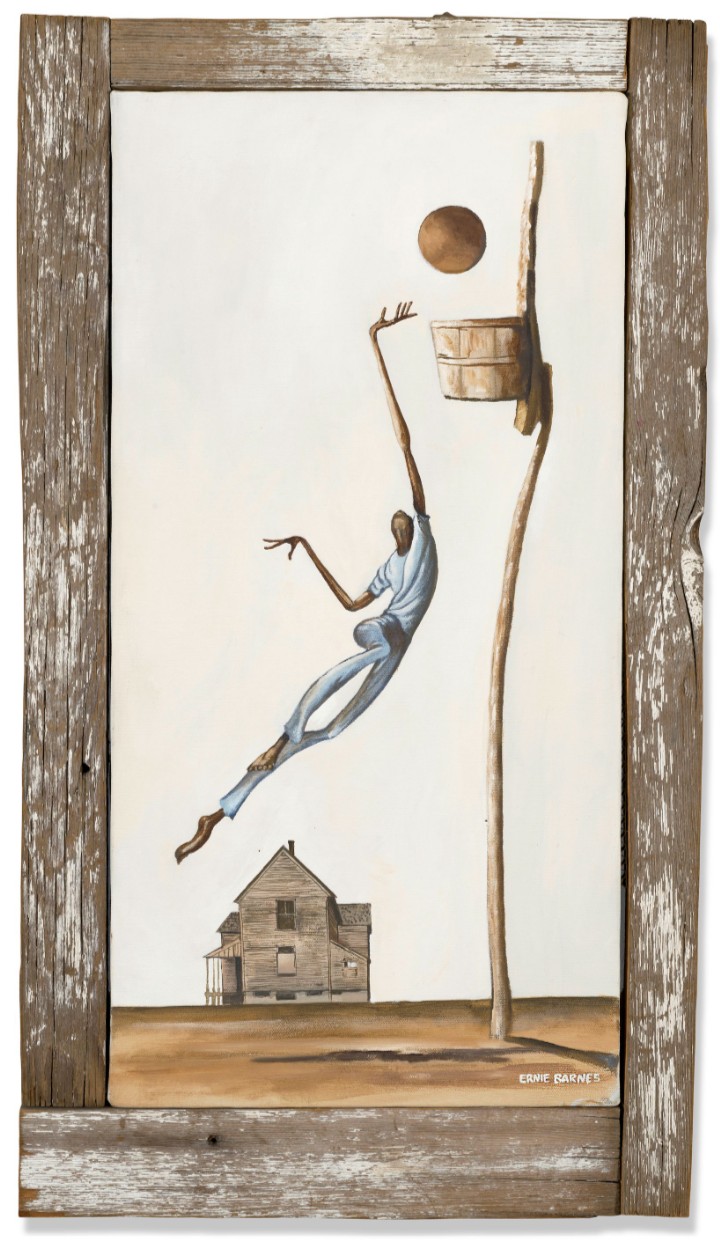
ERNIE BARNES (1938-2009)
Country Layup, 1979
Acrylic on canvas, in artist’s frame
28 3/8 x 16 1/4 inches (74.6 x 41.3 cm)
Signed
USD 500,000
#8. Bronco Locker Room, 1982
Christie’s Hong-Kong: 28 May 2023
Estimated: HKD 1,000,000 – 2,000,000
HKD 3,780,000 / USD 482,585
ERNIE BARNES (1938-2009), Bronco Locker Room | Christie’s
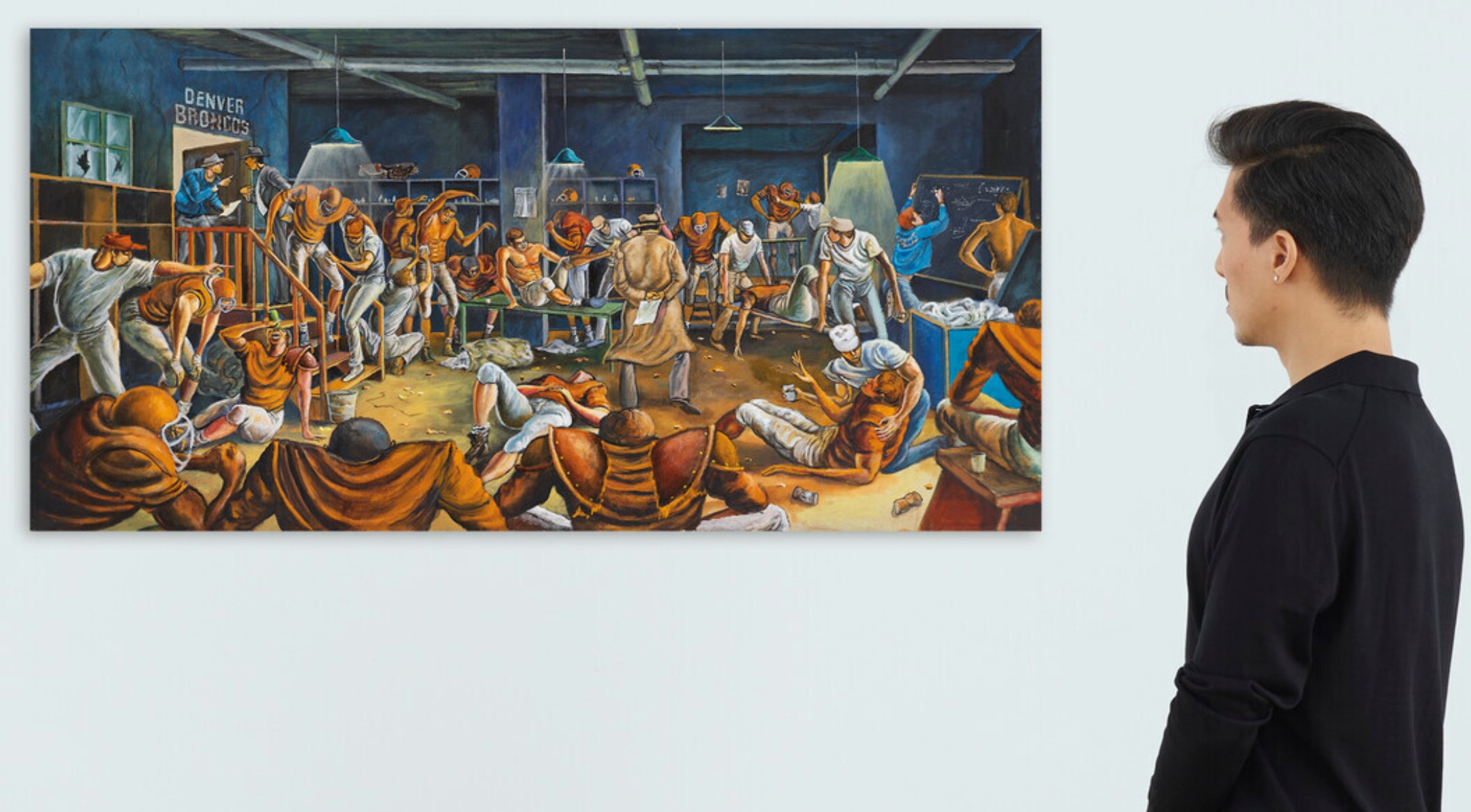
ERNIE BARNES (1938-2009)
Bronco Locker Room, 1982
Acrylic on canvas
24×48 inches (61 x 121.9 cm)
Signed ‘© Ernie Barnes’ (on the reverse)
#9. The Master Table, 1969
Christie’s New-York: 10 November 2023
Estimated: USD 120,000 – 180,000
USD 478,800
ERNIE BARNES (1938-2009), The Master Table | Christie’s
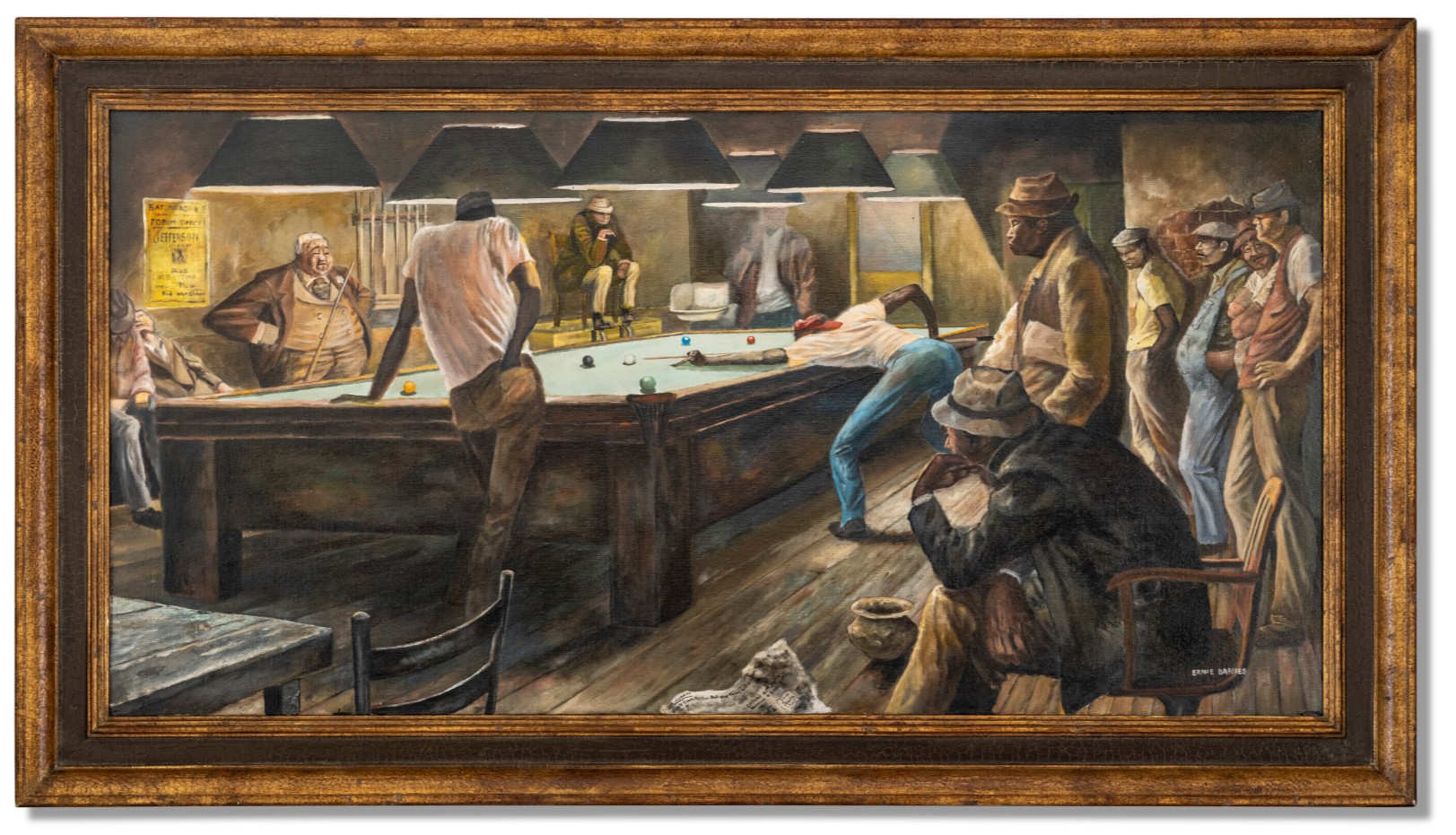
ERNIE BARNES (1938-2009)
The Master Table, 1969
Oil on canvas
23 7/8 x 48 inches (62 x 121.9 cm)
Signed ‘ERNIE BARNES’ (lower right)
#10. The Vanishing Breed, 1972
Phillips New-York: 15 November 2023
Estimated: USD 350,000 – 500,000
USD 406,400
Ernie Barnes 20th Century & Contemporary Art Day Sale, Morning Session
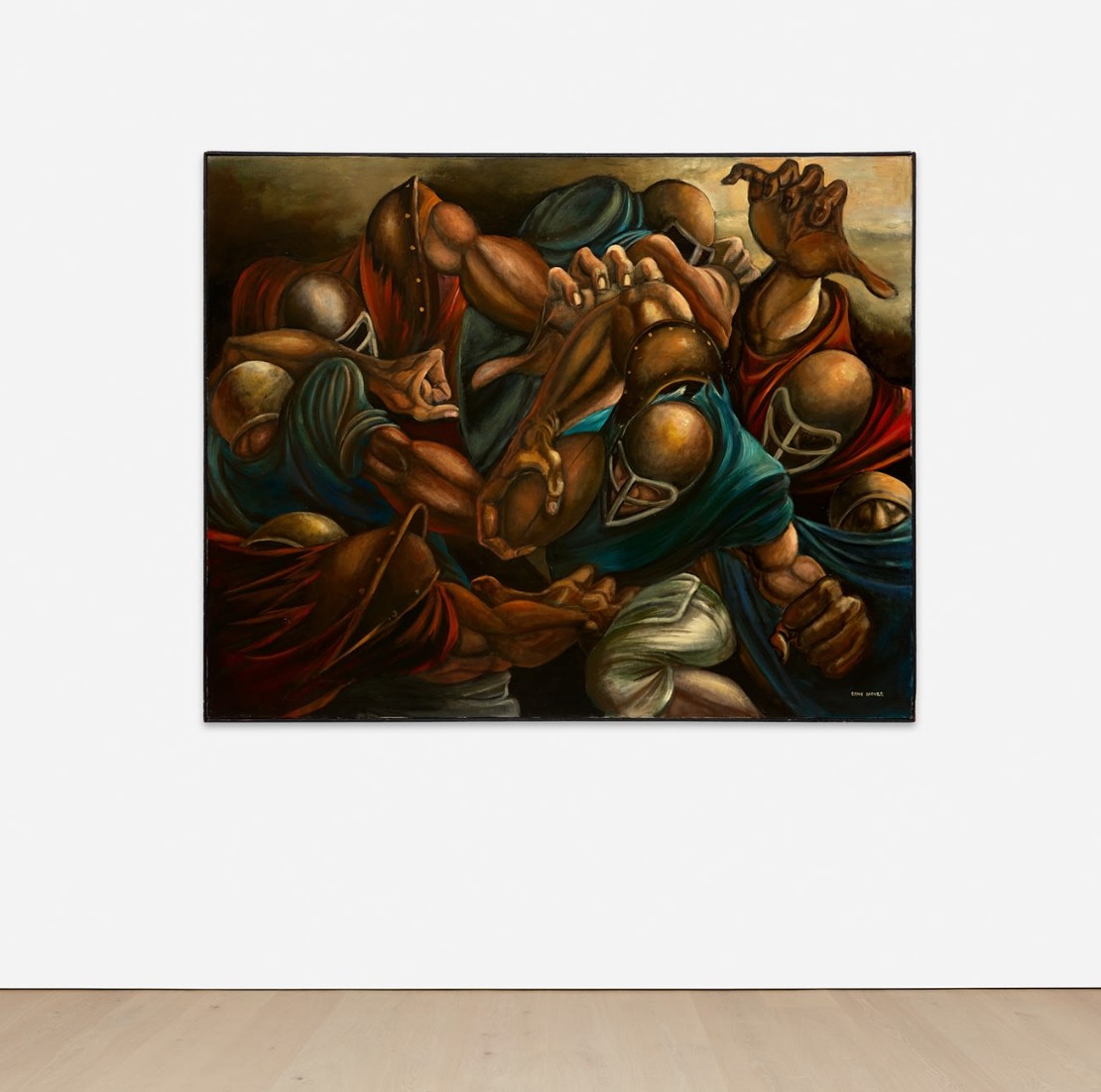
ERNIE BARNES
The Vanishing Breed, 1972
Oil on canvas
48×60 inches (121.9 x 152.4 cm)
Signed “ERNIE BARNES” lower right
#11. Shootin’ the Breeze, 1974
Christie’s New-York: 10 March 2023
Estimated: USD 60,000 – 80,000
USD 403,200
ERNIE BARNES (1938 – 2009), Shootin’ the Breeze | Christie’s
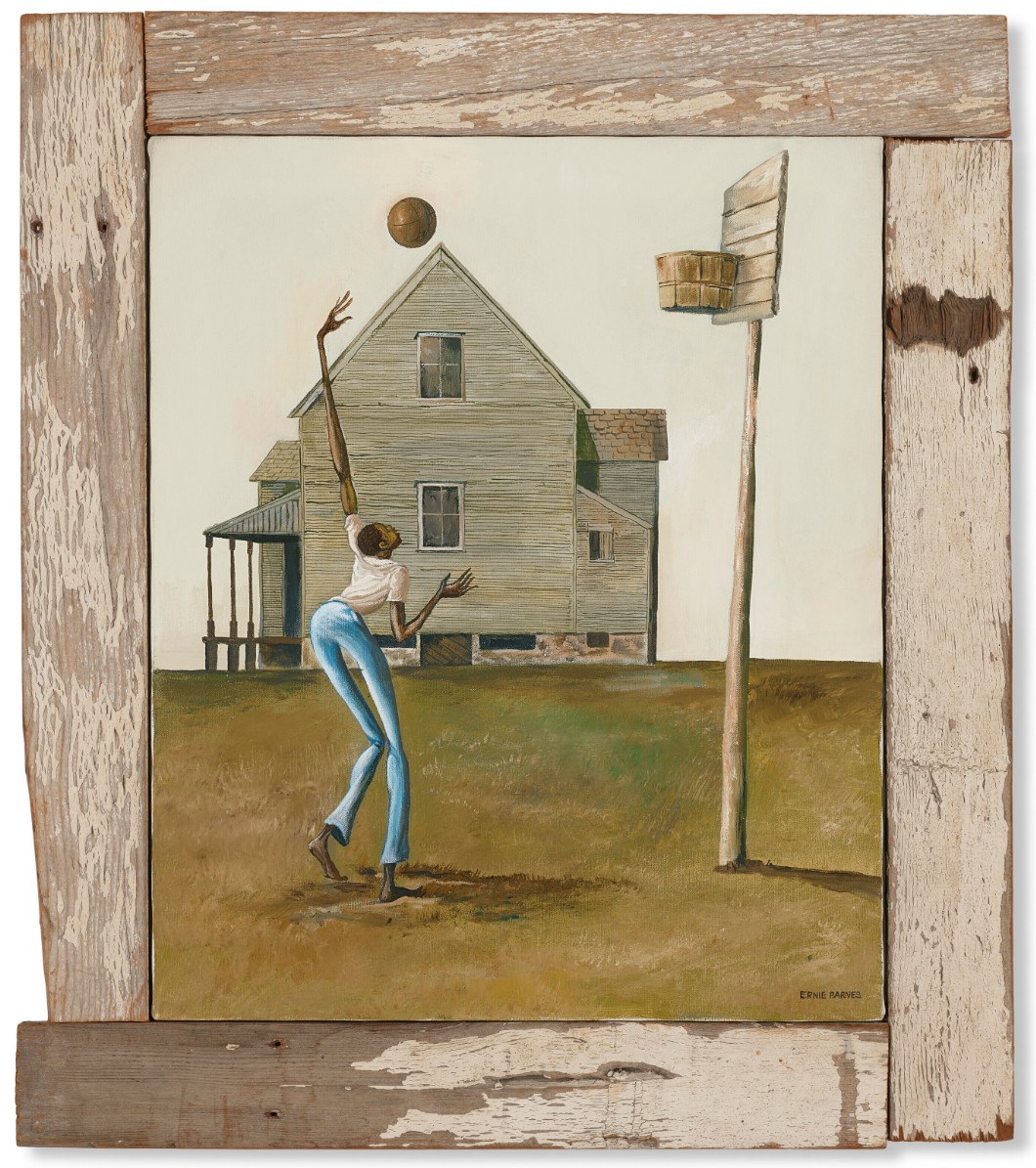
ERNIE BARNES (1938 – 2009)
Shootin’ the Breeze, 1974
Acrylic on canvas, in artist’s frame
30 3/4 x 27 inches (78.1 x 68.6 cm)
Signed ‘ERNIE BARNES’ (lower right)
#12. The Stroll, 1982
FRAGMENTS OF LIFE:
WORKS BY ERNIE BARNES FROM THE COLLECTION OF DANNY AND DONNA ARNOLD
Christie’s London: 28 February 2023
Estimated: GBP 100,000 – 150,000
GBP 327,600 / USD 396,215
ERNIE BARNES (1938-2009), The Stroll | Christie’s
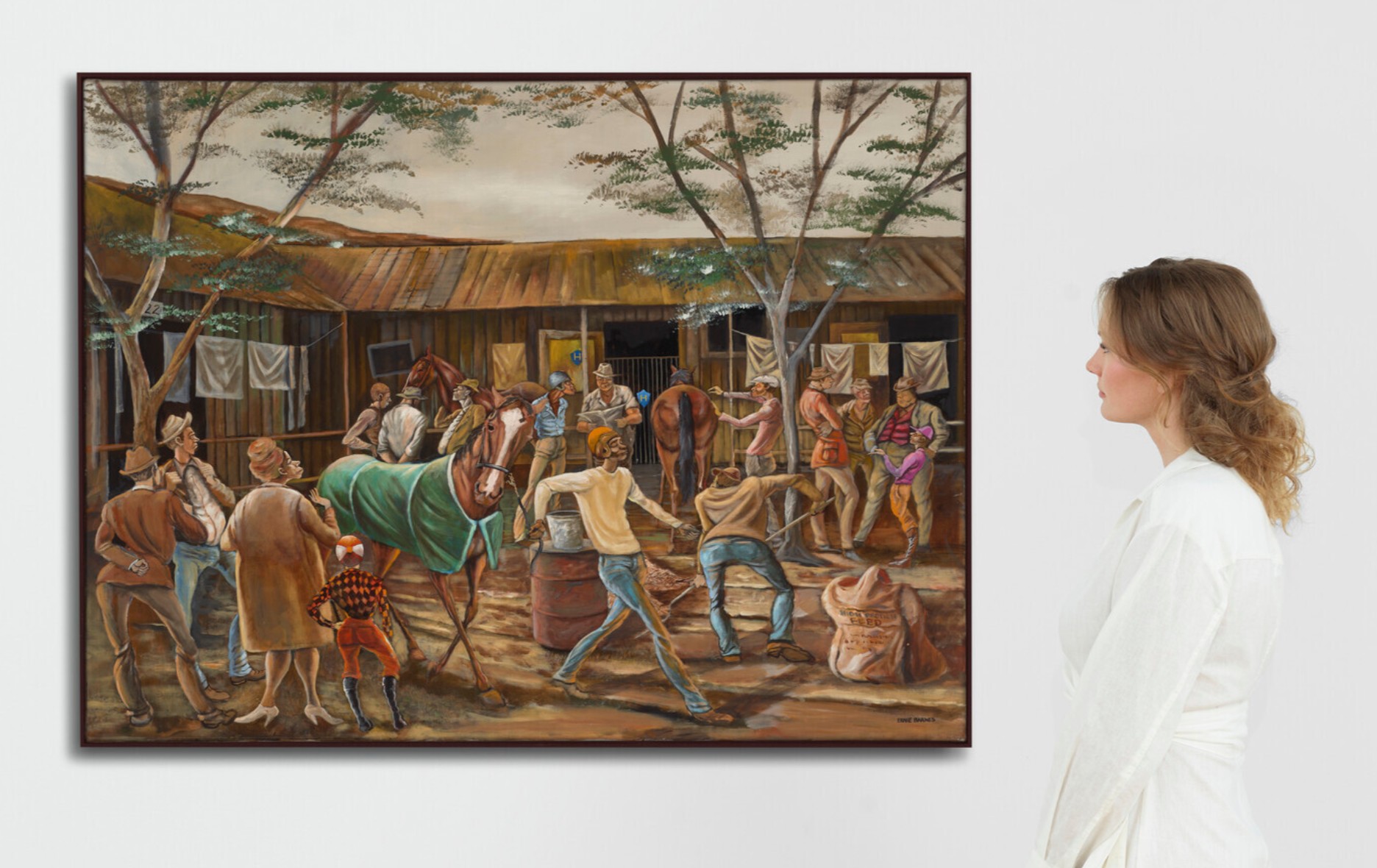
ERNIE BARNES (1938-2009)
The Stroll, 1982
Acrylic on canvas
36 x 47 7/8 inches (91.4 x 121.6 cm)
Signed ‘ERNIE BARNES’ (lower right)
#13. Shootin’ Around, 1974
Christie’s New-York: 29 September 2023
Estimated: USD 70,000 – 100,000
USD 378,000
ERNIE BARNES (1938-2009), Shootin’ Around | Christie’s
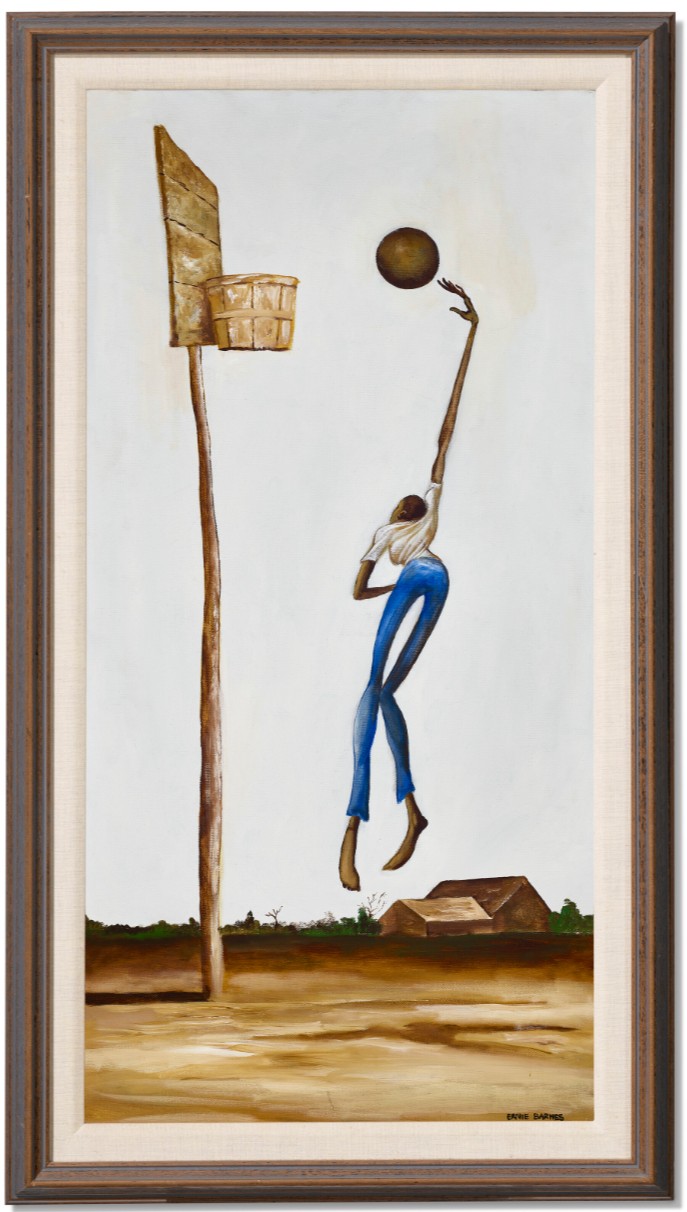
ERNIE BARNES (1938-2009)
Shootin’ Around, 1974
Oil on canvas
36×18 inches (91.4 x 45.7 cm)
Signed ‘ERNIE BARNES’ (lower right)
#14. The Dunk, 1998
Sotheby’s New-York: 9 March 2023
Estimated: USD 250,000 – 350,000
USD 317,500
The Dunk | Contemporary Curated | 2023 | Sotheby’s
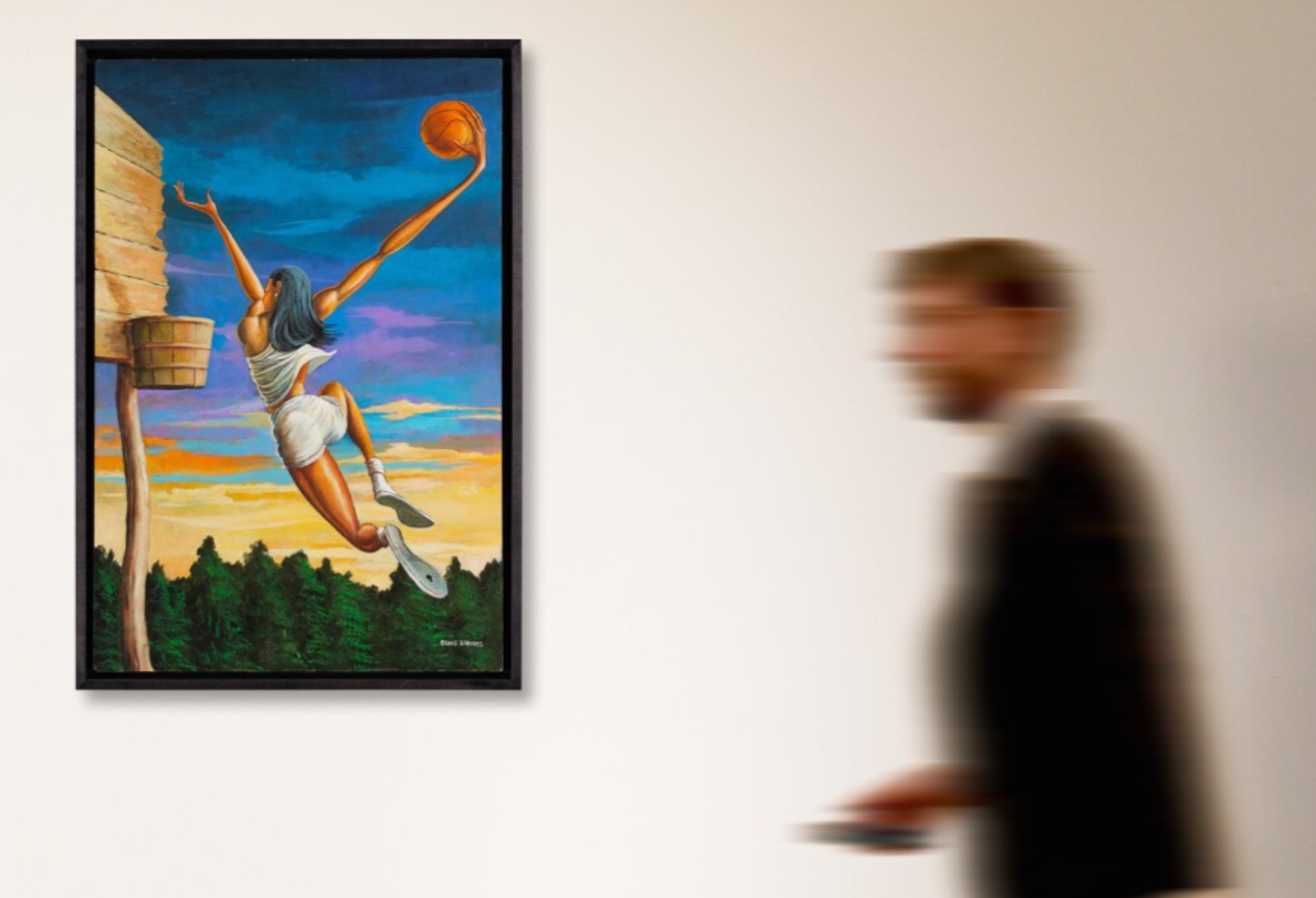
ERNIE BARNES (b. 1939)
The Dunk, 1998
Acrylic on canvas
36×24 inches (91.4 x 61 cm)
Signed ERNIE BARNES (lower right)
Titled and inscribed (on the reverse)
#15. The Back Room, 1974
FRAGMENTS OF LIFE:
WORKS BY ERNIE BARNES FROM THE COLLECTION OF DANNY AND DONNA ARNOLD
Christie’s London: 1 March 2023
Estimated: GBP 70,000 – 100,000
GBP 226,800 / USD 272,950
ERNIE BARNES (1938-2009), The Back Room | Christie’s
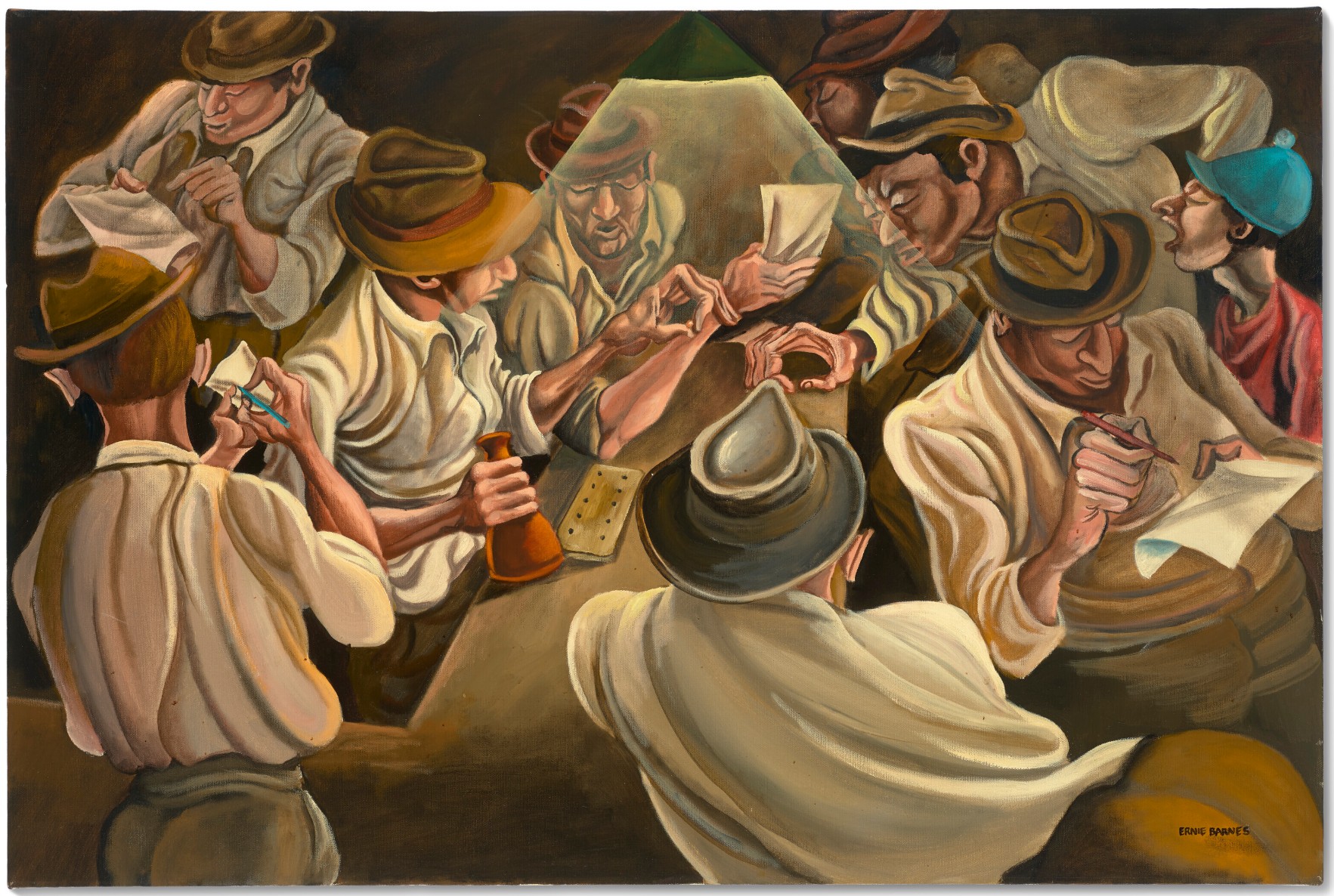
ERNIE BARNES (1938-2009)
The Back Room, 1974
Acrylic on canvas
24 x 35 7/8 inches (61 x 91.1 cm)
Signed ‘ERNIE BARNES’ (lower right)
#16. Hustlers, 1969
Phillips New-York: 16 May 2023
Estimated: USD 70,000 – 100,000
USD 254,000
Ernie Barnes 20th Century & Contemporary Art Day Sale, Morning Session
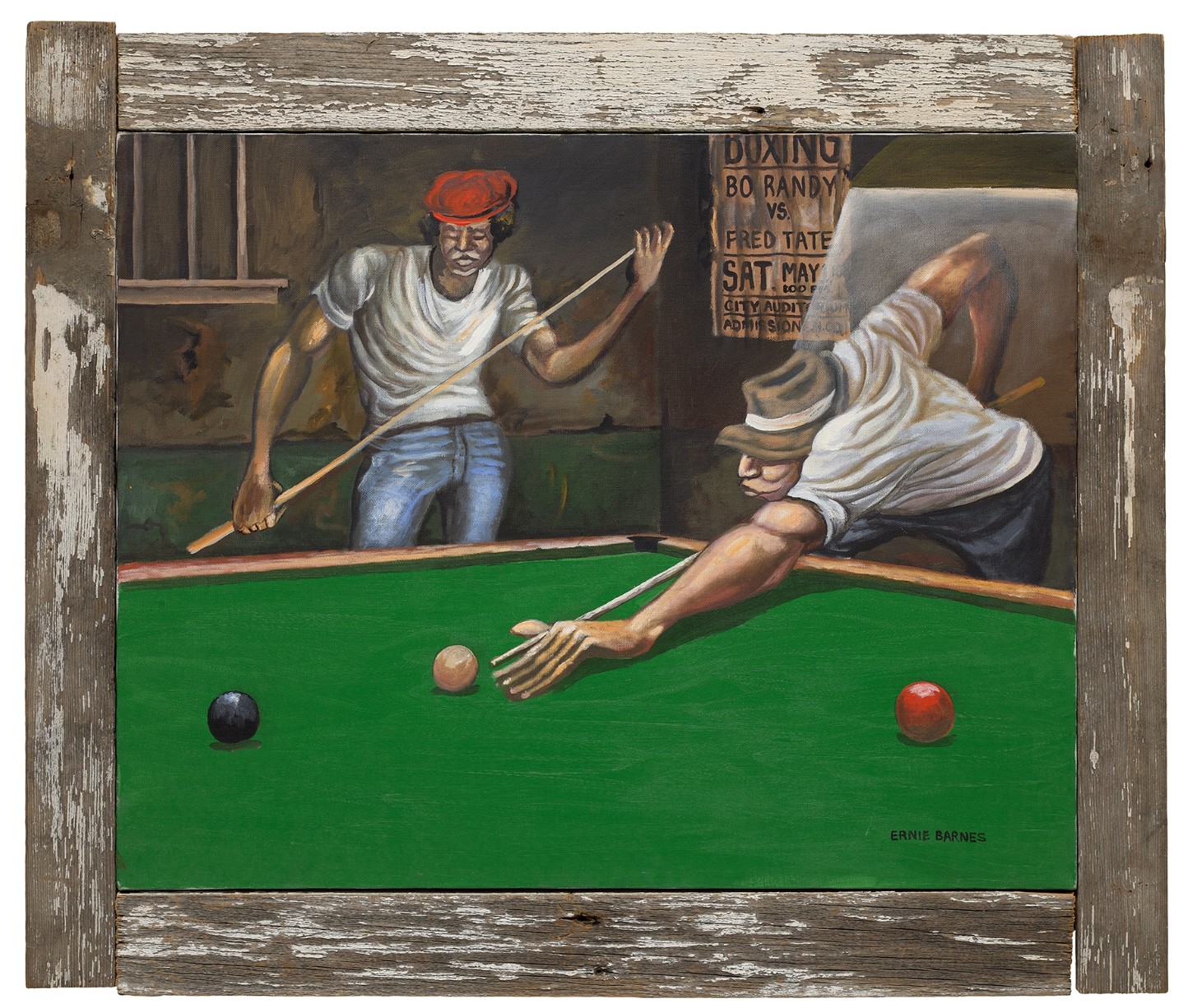
ERNIE BARNES
Hustlers, 1969
Acrylic on canvas, in artist’s frame
28 x 32 5/8 inches (71.1 x 82.9 cm)
Signed “ERNIE BARNES” lower right
Titled and dated “Hustlers 1969” on the stretcher
#17. Untitled, 1973
Phillips New-York: 15 November 2023
Estimated: USD 100,000 – 150,000
USD 215,900
Ernie Barnes 20th Century & Contemporary Art Day Sale, Morning Session
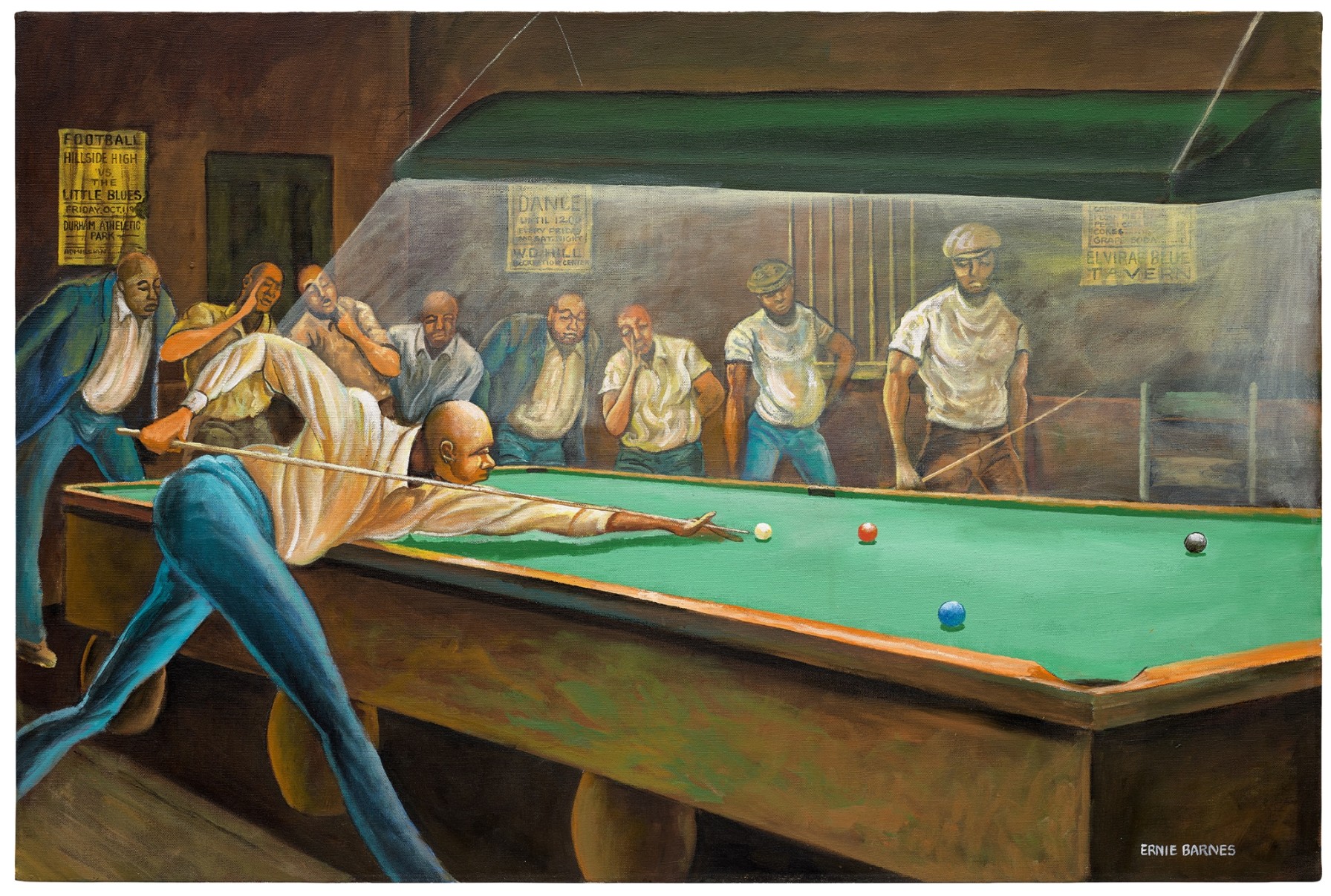
ERNIE BARNES
Untitled, 1973
Acrylic on canvas
24×36 inches (61 x 91.4 cm)
Signed “ERNIE BARNES” lower right
2022 Auction Results
#1. The Sugar Shack, 1976
Christie’s New-York: 12 May 2022
Estimated: USD 150,000 – 200,000
USD 15,275,000
NEW AUCTION RECORD FOR THE ARTIST
ERNIE BARNES (1938 – 2009), The Sugar Shack | Christie’s
ERNIE BARNES (1938 – 2009)
The Sugar Shack, 1976
Acrylic on canvas
36×48 inches (91.4 x 121.9 cm)
Signed ‘ERNIE BARNES’ (lower right)
Signed again, inscribed and dated 9⁄27/76 Ernie Barnes’ (on the reverse)
#2. Storm Dance, 1977
Christie’s New-York: 13 May 2022
Estimated: USD 100,000 – 150,000
USD 2,340,000
ERNIE BARNES (1938 – 2009), Storm Dance | Christie’s
ERNIE BARNES (1938 – 2009)
Storm Dance, 1977
Acrylic on canvas, in artist’s frame
48 3/4 x 24 3/4 inches (123.8 x 62.9 cm)
Signed ‘ERNIE BARNES’ (lower right)
#3. Main Street Pool Hall, 1978
FRAGMENTS OF LIFE:
WORKS BY ERNIE BARNES FROM THE COLLECTION OF DANNY AND DONNA ARNOLD
Christie’s London: 28 June 2022
Estimated: GBP 80,000 – 120,000
GBP 1,482,000 / USD 1,808,765
ERNIE BARNES (1938-2009), Main Street Pool Hall | Christie’s
ERNIE BARNES (1938-2009)
Main Street Pool Hall, 1978
Oil on canvas
23 3/4 x 48 inches (60.3 x 121.9 cm)
Signed twice ‘ERNIE BARNES’ (lower right)
#4. Solid Rock Congregation, 1993
Bonhams New-York: 9 September 2022
Estimated: USD 500,000 – 700,000
USD 1,620,375
Bonhams : ERNIE BARNES (1938-2009) Solid Rock Congregation1993
ERNIE BARNES (1938-2009)
Solid Rock Congregation, 1993
Acrylic on canvas
36×48 inches (91.4 x 121.9 cm)
Signed
USD 1 million
#5. Listen Up!, 1980
Christie’s Hong-Kong: 26 May 2022
Estimated: HKD 800,000 – 1,200,000
HKD 7,560,000 / USD 963,070
ERNIE BARNES (1938-2009), Listen Up! | Christie’s
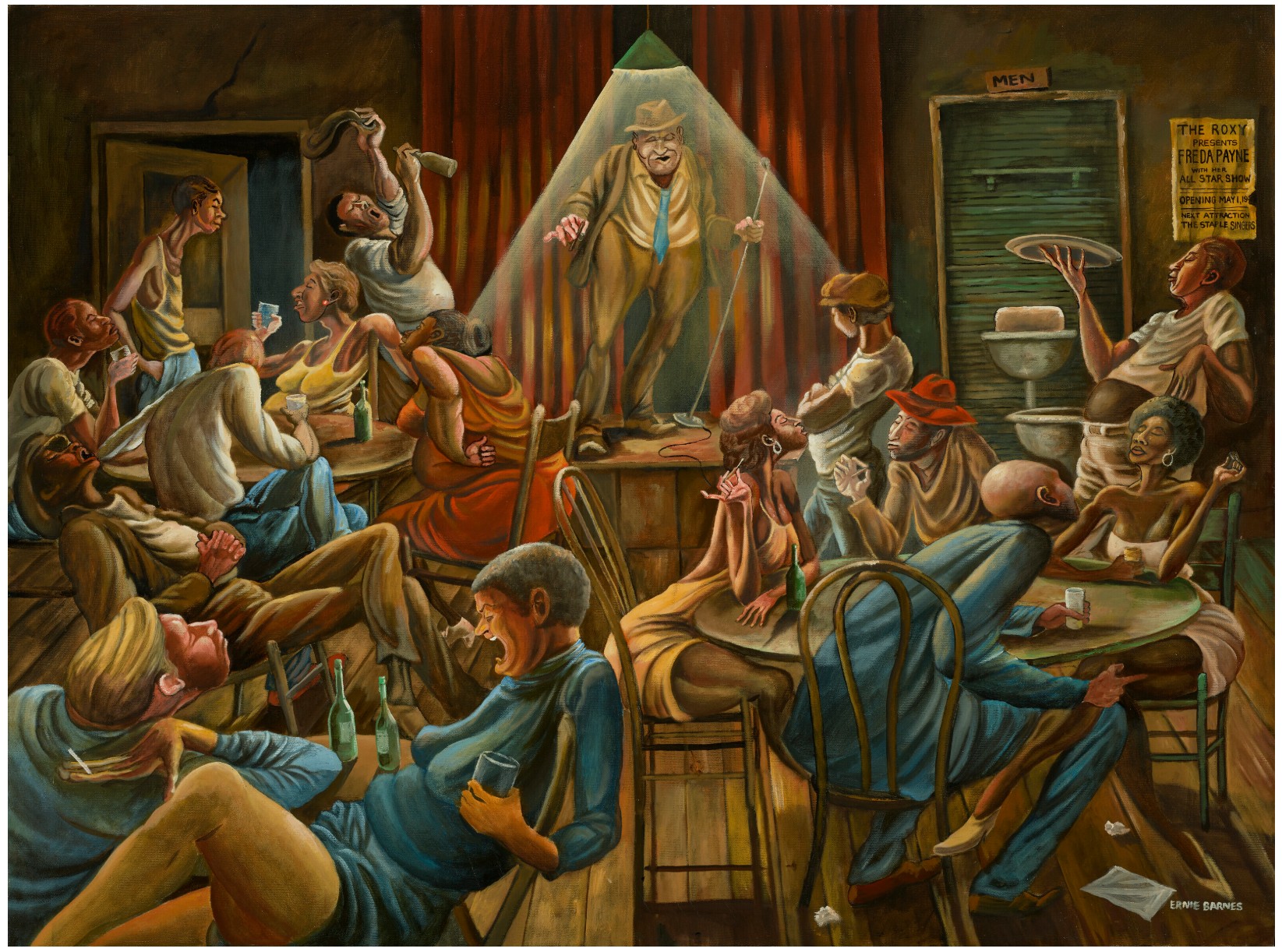
ERNIE BARNES (1938-2009)
Listen Up!, 1980
Acrylic on canvas
30×40 inches (76.2 x 101.6 cm)
Signed ‘ERNIE BARNES’ (lower right)
#6. One-On-None, 1979
Christie’s New-York: 17 November 2022
Estimated: USD 60,000 – 80,000
USD 945,000
ERNIE BARNES (1938-2009), One-On-None | Christie’s
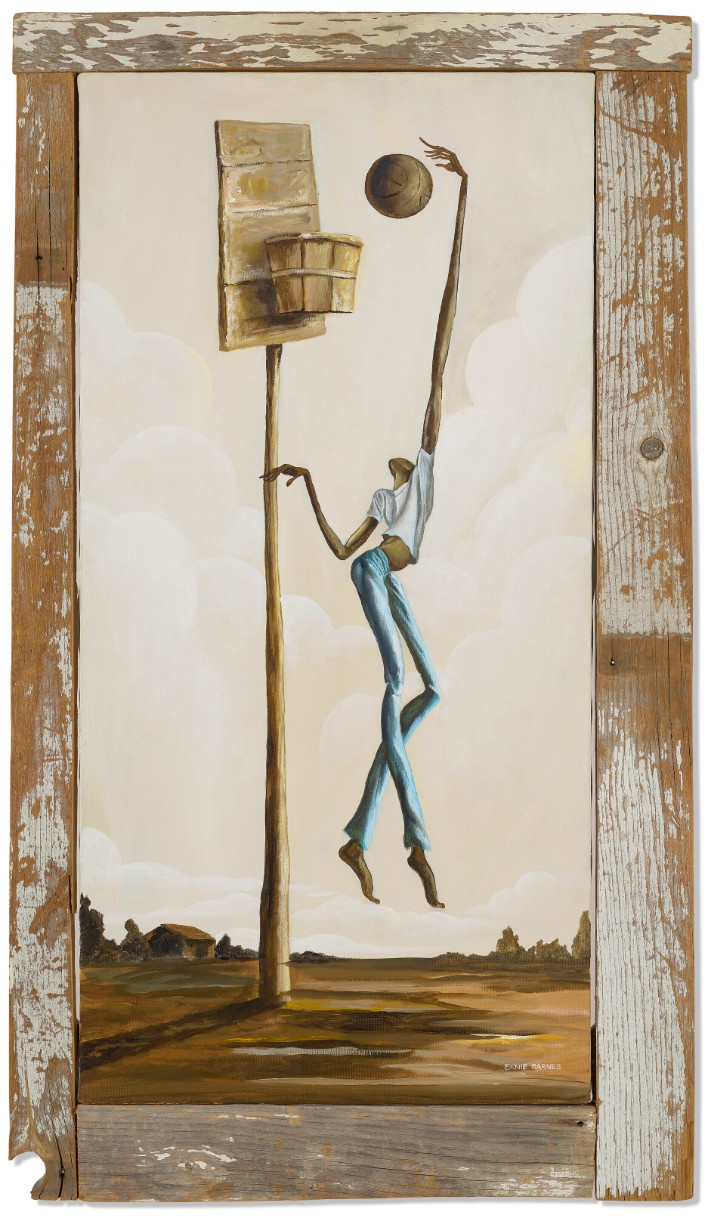
ERNIE BARNES (1938-2009)
One-On-None, 1979
Acrylic on canvas, in artist’s frame
41 1/2 x 23 1/2 inches (105.4 x 59.7 cm)
Signed ‘ERNIE BARNES’ (lower right)
#7. The Maestro, circa 1971
Bonhams New-York: 26 May 2022
Estimated: USD 250,000 – 350,000
USD 882,375
Bonhams : Ernie Barnes (1938-2009) The Maestro
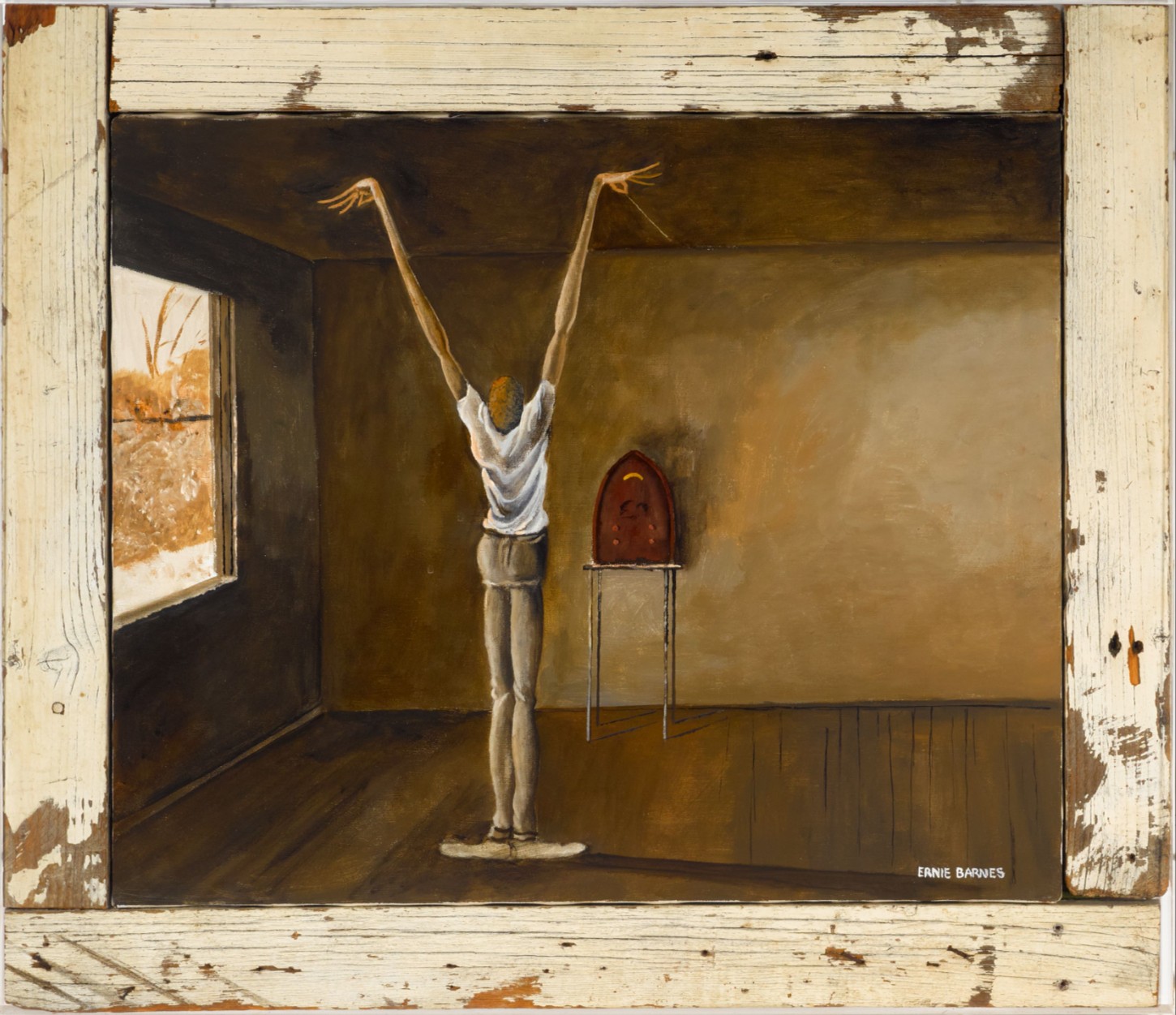
ERNIE BARNES (1938-2009)
The Maestro, circa 1971
Acrylic on canvas
20×24 inches (50.8 x 61 cm)
Signed ‘Ernie Barnes’ (lower right) and inscribed with title (on the stretcher)
#8. The Gospel Truth, 1985
Bonhams London: 13 October 2022
Estimated: GBP 600,000 – 1,000,000
GBP 756,300 / USD 838,980
Bonhams : ERNIE BARNES (1938-2009) The Gospel Truth 1985
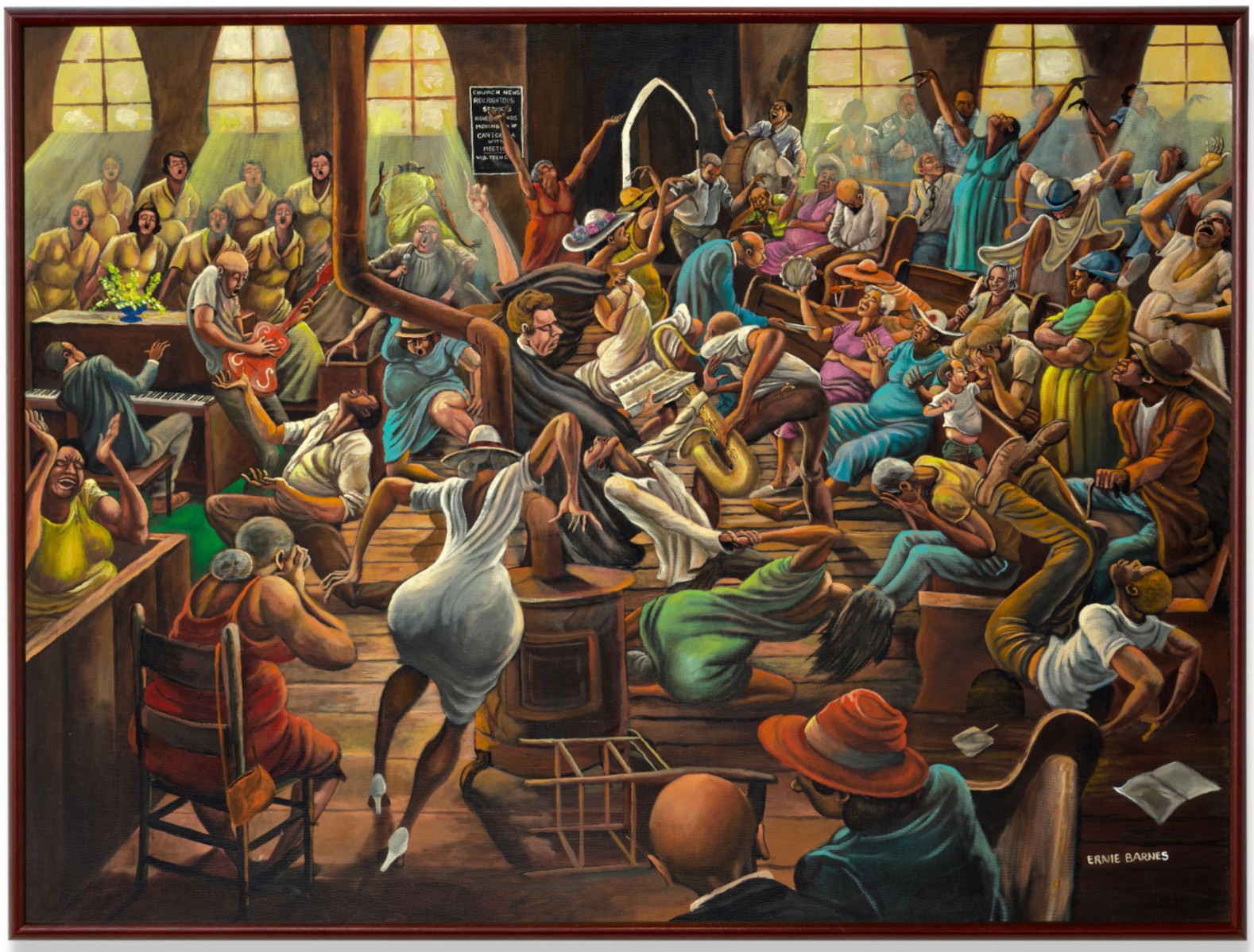
ERNIE BARNES (1938-2009)
The Gospel Truth, 1985
Acrylic on canvas
36×48 inches (91.4 x 121.9 cm)
Signed
#9. Life after Sundown, 1979
Phillips Hong-Kong: 22 June 2022
Estimated: HKD 1,500,000 – 2,500,000
HKD 6,048,000 / USD 770,475
Ernie Barnes 20th Century & Contemporary Art Evening Sale
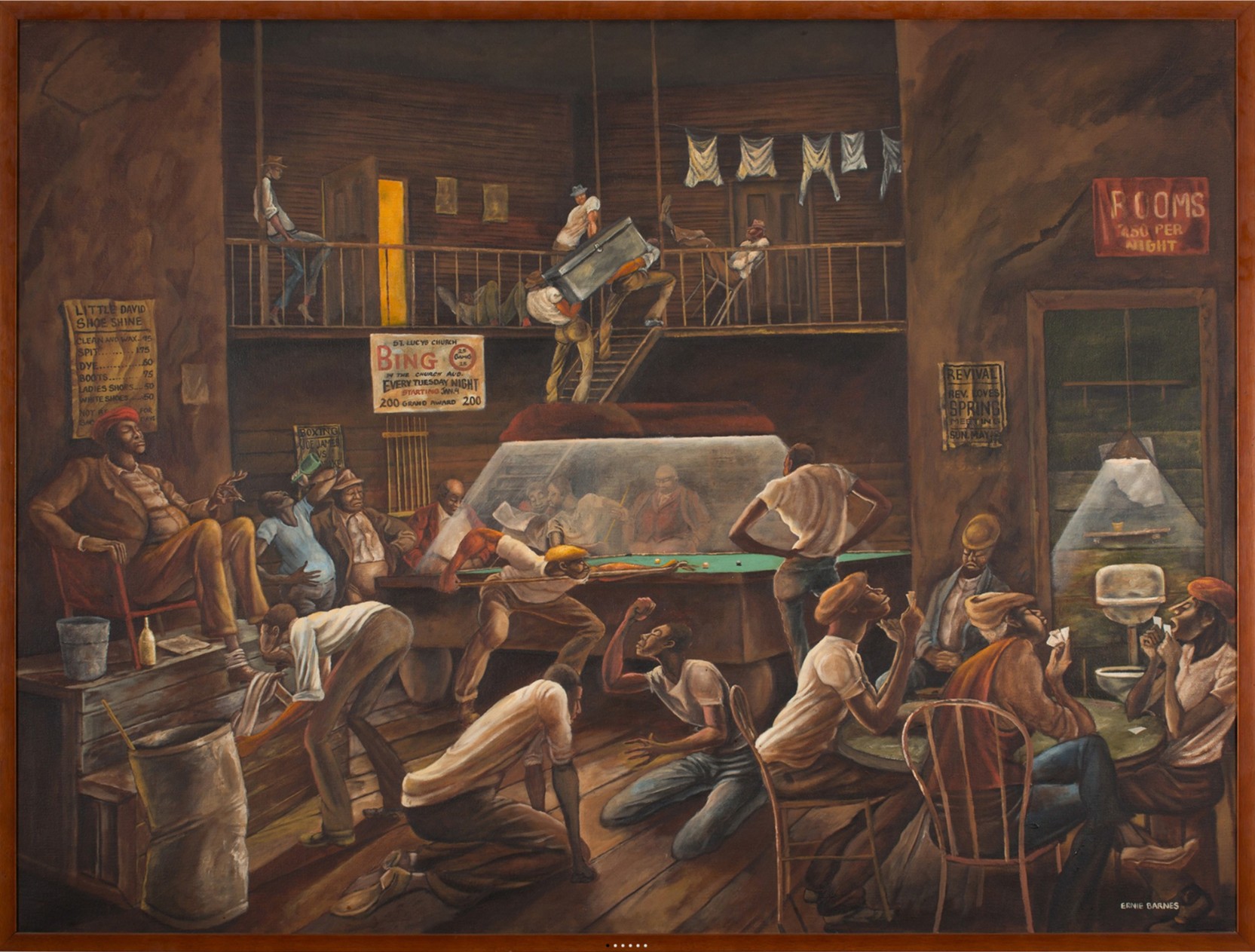
ERNIE BARNES
Life after Sundown, 1979
Acrylic on canvas
35 5/8 x 47 1/2 inches (90.5 x 120.5 cm)
Signed ‘ERNIE BARNES’ lower right
#10. The Tunesmith, 1978
Property from a Prominent Private American Collection
Sotheby’s New-York: 16 November 2022
Estimated: USD 200,000 – 300,000
USD 630,000
The Tunesmith | Contemporary Evening Auction | 2022 | Sotheby’s
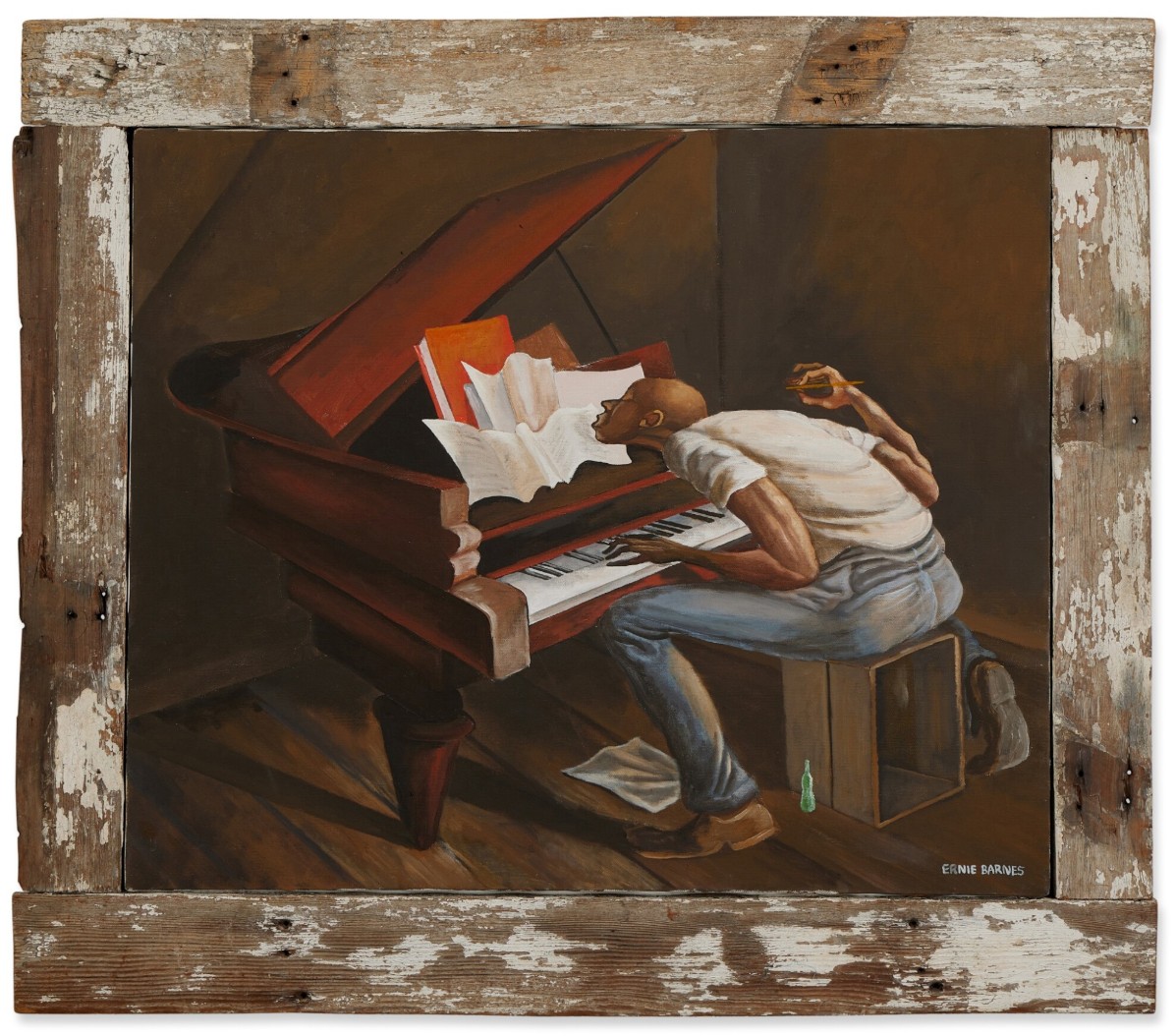
ERNIE BARNES (1938-2009)
The Tunesmith, 1978
Oil on canvas, in artist’s frame
25 7/8 x 29 5/8 inches (65.7 x 75.2 cm)
Signed Ernie Barnes (lower right)
#11. Every Night, All Night, 1974
Christie’s London: 13 October 2022
Estimated: GBP 100,000 – 150,000
GBP 554,400 / USD 628,835
ERNIE BARNES (1938 – 2009), Every Night, All Night | Christie’s
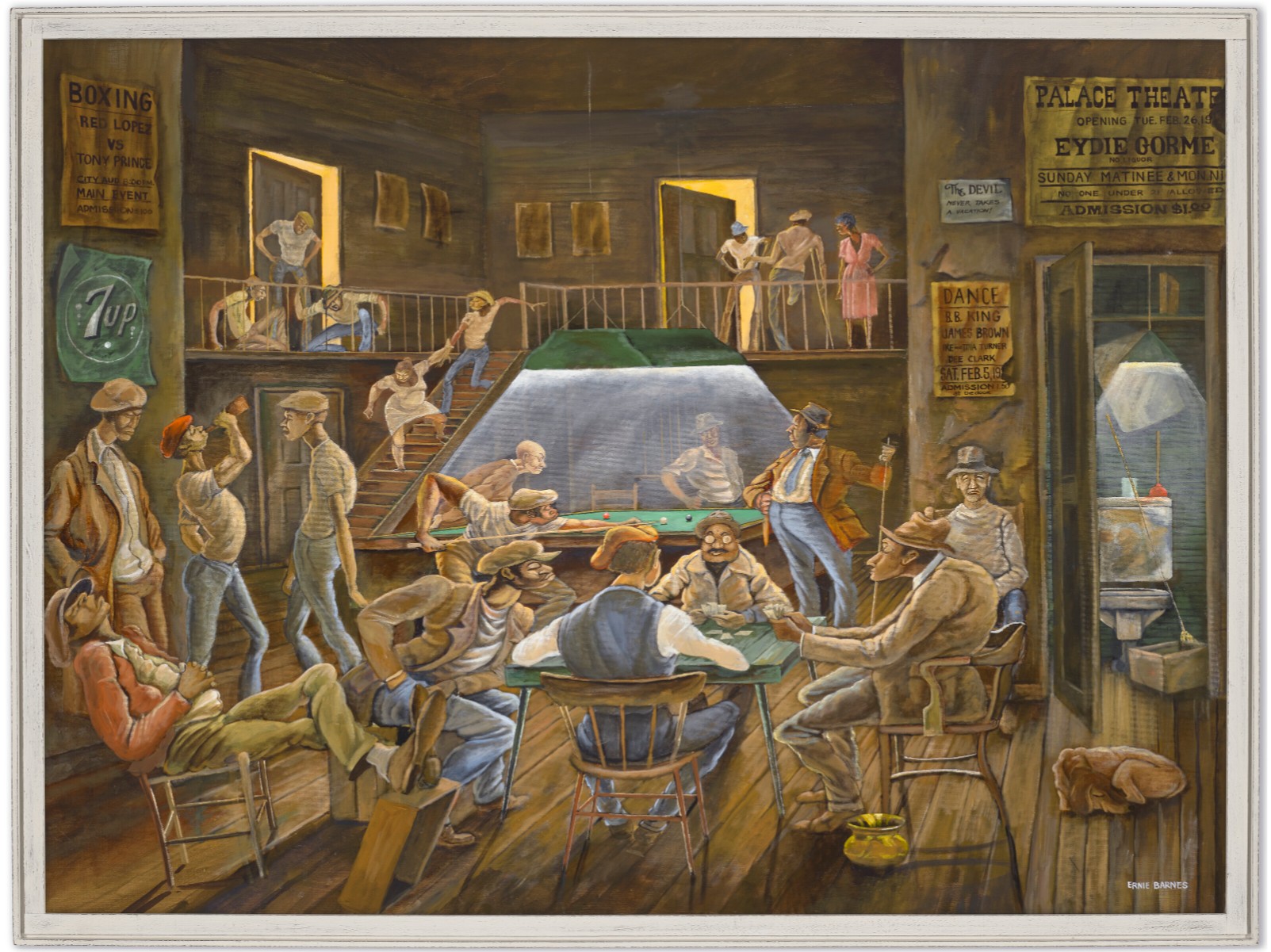
ERNIE BARNES (1938 – 2009)
Every Night, All Night, 1974
Oil on canvas
36×48 inches (91.4 x 121.9 cm)
Signed ‘ERNIE BARNES’ (lower right)
#12. Slam Before the Storm, 1979
Property of Richard Roundtree
Phillips New-York: 15 November 2022
Estimated: USD 300,000 – 400,000
USD 604,800
Ernie Barnes 20th Century & Contemporary Art Evening Sale
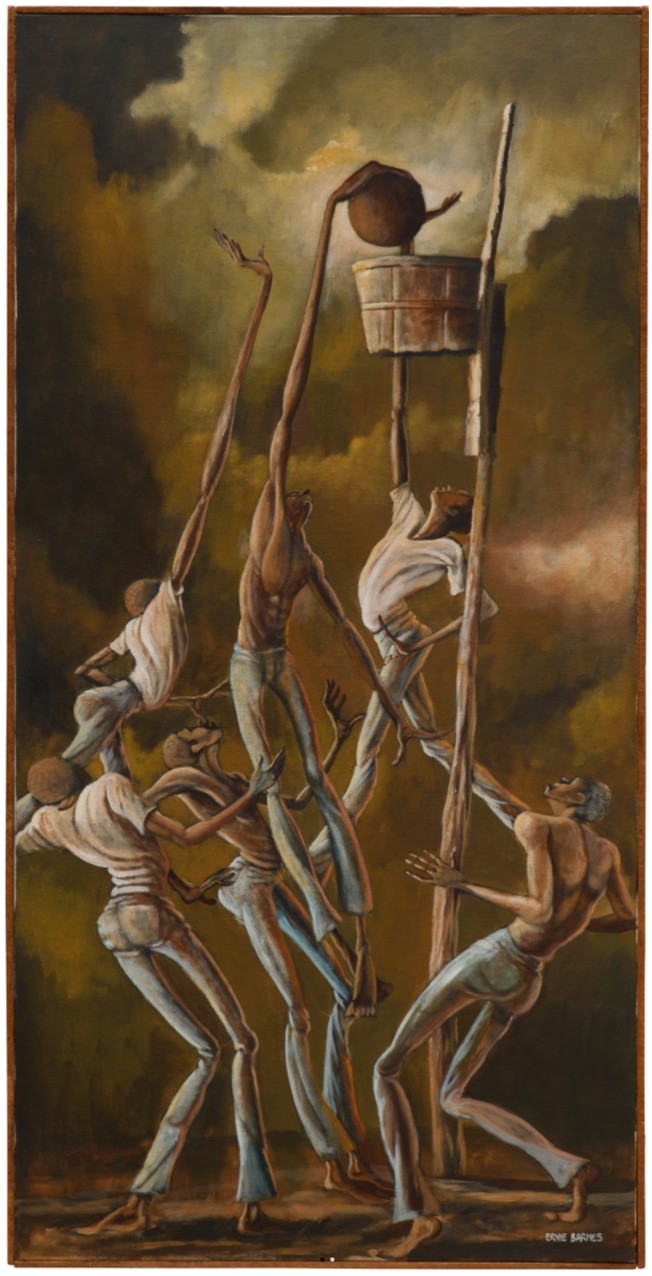
ERNIE BARNES
Slam Before the Storm, 1979
Acrylic on canvas in artist’s frame
48 3/8 x 24 5/8 inches (122.9 x 62.5 cm)
Signed “ERNIE BARNES” lower right
Stamped with the artist’s copyright stamp on the reverse
Music
Singin’ Sistahs, 1979
Phillips New-York: 19 November 2025
Estimated: USD 300,000 – 500,000
USD 451,500
Ernie Barnes Modern & Contemporary Art Evening Sale featuring Cera the Triceratops
Acrylic on canvas
36×24 inches (91.4 x 61 cm)
Signed “ERNIE BARNES” lower right
A dynamic and intimate portrayal of three female performers on stage, Singin’ Sistahs stands as a celebration of Black sisterhood, empowerment, and solidarity—rendered in Ernie Barnes’ distinct neo-Mannerist style and pulsing with the soulful vigor that defines his most beloved depictions of twentieth-century Black life. Known for his elongated, fluid figures and rhythmic compositions, Barnes distills in the present work the passion and energy of performance seen in contemporaneous paintings of crowded dance halls and other scenes of collective joy, most notably The Sugar Shack of 1976, featured on the cover of Marvin Gaye’s album I Want You released the same year, with a later version appearing in the credits of the popular sitcom Good Times. Concentrating the vibrational energy of such spectacles into a tightly framed composition, Barnes brings the viewer close to the stage, sharing in the power of the trio’s performance. Singin’ Sistahs evokes legendary singing trios of the 1960s and 1970s, from The Supremes to The Ronettes, capturing the movement and musicality that animate Barnes’ practice and reflect his lasting ties to the musicians who embraced and championed his art.
The Sugar Shack, 1976
Christie’s New-York: 12 May 2022
Estimated: USD 150,000 – 200,000
USD 15,275,000
NEW AUCTION RECORD FOR THE ARTIST
ERNIE BARNES (1938 – 2009), The Sugar Shack | Christie’s
ERNIE BARNES (1938 – 2009)
The Sugar Shack, 1976
Acrylic on canvas
36×48 inches (91.4 x 121.9 cm)
Signed ‘ERNIE BARNES’ (lower right)
Signed again, inscribed and dated 9⁄27/76 Ernie Barnes’ (on the reverse)
Painted in 1979 and acquired directly from the artist in 1981, Singin’ Sistahs now makes its market debut after more than four decades in the collection of Barnes’ friend and supporter, radio magnate Richard Balsbaugh. A pioneering figure in the American radio industry, Balsbaugh revitalized Boston’s struggling WXKS by transforming it into the iconic Kiss 108, later founding Pyramid Communications and expanding his influence nationwide. The two men first met in the late 1970s through a mutual professional acquaintance, when Balsbaugh sought an artist to create a mural for the inaugural Kiss 108 concert in 1979—a landmark event that continues today. Barnes was recommended for the commission, and a lasting friendship followed. Recognizing Balsbaugh’s deep love of soul music, Barnes later wrote to him about a recent painting titled Singin’ Sistahs, explaining that although another buyer had already expressed interest, he felt Balsbaugh was the one who should have it. Barnes, who maintained close ties with many of the leading musicians and artists of his time, no doubt sensed a kindred spirit in Balsbaugh, whose professional life was likewise steeped in music. Balsbaugh recalls an immediate connection with the work, which he lovingly displayed in his radio offices and homes over the ensuing decades.
“I always listen to the radio and music, because it stimulates the imagination.”
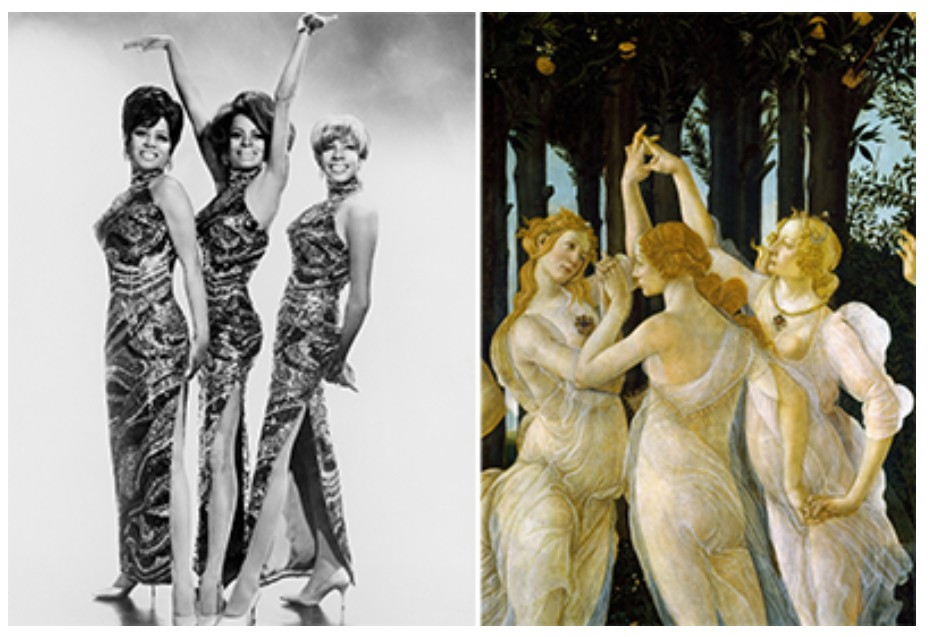
[Left] The Supremes, c.1967. Unknown Photographer. Image: Bridgeman Images
[Right] Sandro Botticelli, Detail of The Three Graces, from La Primavera (Spring), circa 1460. The Uffizi, Florence. Image: Carlo Bollo / Alamy Stock Photo
The trio of singers in Singin’ Sistahs conjures memories of the Black female vocal groups who redefined American music in the 1960s and 1970s—The Supremes, The Ronettes, The Pointer Sisters, among others. Though the painting does not depict any one group in particular, the presence of figures like Diana Ross, Mavis Staples, and other female singers—many of whom were friends of Barnes and collectors of his work—can be keenly felt in Singin’ Sistahs. Through these performers, Barnes celebrates the strength, unity, and expressive power of Black women in a field that offered both liberation and struggle amid the racial and gender hierarchies of the time. Their harmonic connection and synchronized gestures embody sisterhood itself, a recurring theme in Barnes’ work that extends beyond music to the broader rhythms of communal life.
Barnes’ deep connection to music pervades much of his art, most notably through his association with Good Times. After The Sugar Shack appeared on Gaye’s I Want You, Barnes created a second version of the 1976 painting that gained new fame when used in the sitcom’s closing credits. The series, which centered on a Black family in a Chicago housing project and featured an artist-son named J.J., brought Barnes’ imagery into millions of American homes. These exuberant scenes of Black men and women dancing, playing, and listening to music embodied joy, sensuality, and creative vitality. Their widespread cultural impact speaks to Barnes’ singular ability to translate the spirit of music into paint—a fusion that made his work instantly recognizable and enduringly influential.
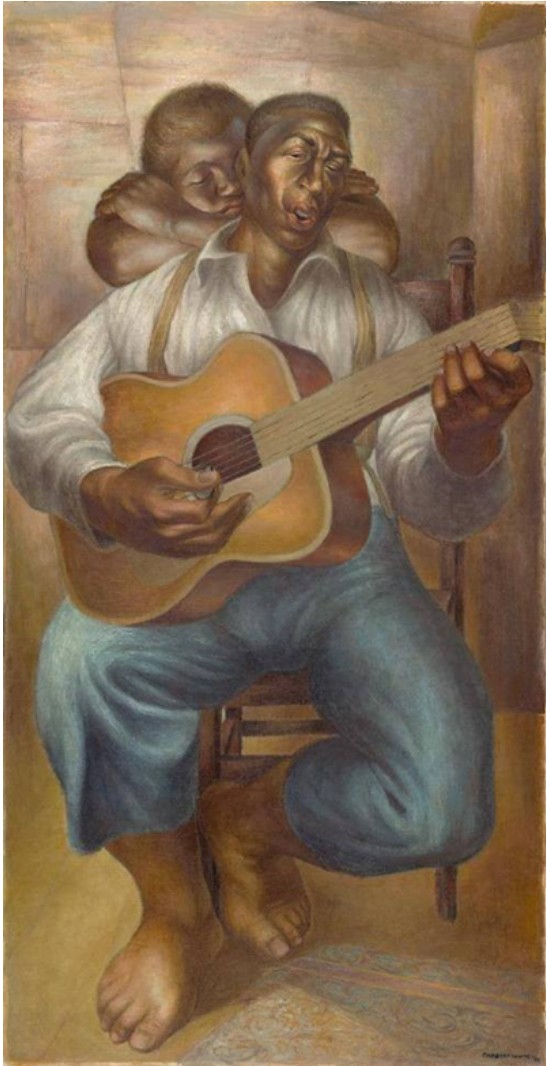
Charles White, Goodnight Irene, 1952. The Nelson-Atkins Museum of Art, Kansas City. Artwork: © The Charles White Archive
His artistic dialogue with musicians extended well beyond Gaye. Barnes created album covers for Donald Byrd, Curtis Mayfield, and The Crusaders, among others, forging a symbiotic relationship between visual and musical expression. Decades later, this connection persisted: in 2005, Kanye West commissioned Barnes to paint A Life Restored, a mural inspired by West’s near-fatal car accident, and in 2016, Anderson .Paak’s music video for “Come Down” brought Barnes’ figures vividly to life once again. Through these cross-generational collaborations, Barnes’ art continued to animate the rhythm and soul of Black creativity in American culture.
“I am providing a pictorial background for an understanding into the aesthetics of black America.”
Barnes’ early life and athletic career deeply shaped his artistic vision. Born in 1938 in Durham, North Carolina, during the era of Jim Crow segregation, he experienced discrimination firsthand yet found refuge in drawing, encouraged by his mother. Barred from formal art training, Barnes turned to sports, excelling in football and earning twenty-six athletic scholarship offers upon graduating high school. His athletic success led him to play professionally with the Baltimore Colts, San Diego Chargers, and Denver Broncos. Yet even as a professional athlete, he carried sketchbooks to practice, studying the body in motion. Through sports, Barnes later recalled that he “learned to pay attention to what my body felt like in movement,” an awareness that became the foundation of his art.i
In Singin’ Sistahs, this physical sensibility translates into the exaggerated, elongated forms of the singers, whose bodies stretch and sway with rhythmic vitality. Their fluid lines echo the movements of athletes and dancers alike, embodying both discipline and freedom. For Barnes, such elongation was not mere stylization but a means of expressing deeper emotional truth—an attempt to visualize the energy that animates life itself.
“Being an athlete helped me to formulate an analysis of movement, and movement is what I wanted to capture on canvas more than anything else. I can’t stand a static canvas.”
Barnes’ distinctive style, often described as neo-Mannerist, fuses the expressive distortion of El Greco and the muscular dynamism of Thomas Hart Benton with the warmth and immediacy of African American life. In Singin’ Sistahs, his elongated figures, sinuous contours, and heightened color harmonies convey not only physical motion but also emotional and spiritual intensity.
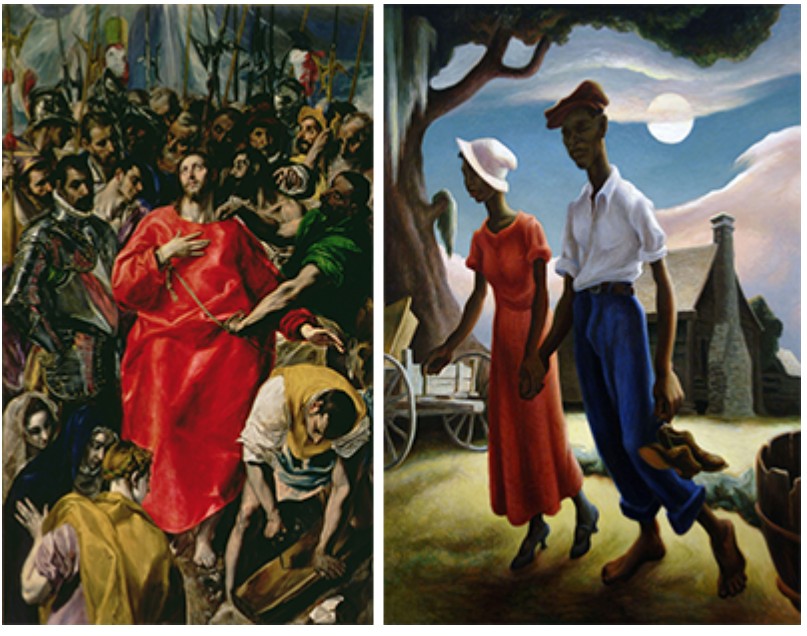
[Left] El Greco, El Expolio – The disrobing of Christ, 1577-1579. Toledo Cathedral, Spain. Image: Bridgeman Images
[Right] Thomas Hart Benton, Romance, 1931-1932. Blanton Museum of Art, Austin, Texas. Image: Album / Alamy Stock Photo, Artwork: © 2025 Artists Rights Society (ARS), New York
Yet beneath the exuberance lies a subtle social commentary. The singers’ closed eyes—a recurring motif throughout Barnes’ oeuvre—suggest both introspection and autonomy. As the artist explained, “we’re blind to each other’s humanity,” and by closing his subjects’ eyes, he sought to depict them as inwardly aware, attuned to something deeper than the viewer’s gaze.ii In Singin’ Sistahs, this gesture transforms performance into transcendence: the women sing not for spectacle but for self-expression, their communion untouched by external scrutiny. The composition’s red and green hues further root the work in the visual language of Black pride and political resistance, resonating with the cultural movements that shaped the late 1970s. The title’s colloquial phrasing, drawn from African American Vernacular English, affirms the linguistic and cultural identity of a community Barnes knew intimately, reflecting his experience of growing up under segregation and his commitment to portraying the beauty and dignity of everyday Black life.
“My aim is to refresh the heart, to put people in touch with themselves. I look at every individual with the hope of finding their basic dignity, humor, kindness and humanity.”
At a moment when many artists were pursuing universality through abstraction—from the Minimalist sculptures of Robert Morris to the Color Field paintings of Helen Frankenthaler—Barnes remained devoted to figuration as a vehicle for human connection. Inspired early on by the example of Charles White, whose images he described as revealing “the beauty of human existence” and the “confidence, pride and hopes” of Black life, Barnes dedicated himself to creating art that affirmed dignity, pride, and shared humanity.iii His paintings of people united through physical rhythm—dancing, running, playing, or performing—invite viewers to feel that same pulse of life. In Singin’ Sistahs, Barnes fulfills his lifelong ambition, as he once described it, “to refresh the heart, to put people in touch with themselves,”iv and to reveal, through movement and music alike, “how beautiful life can be.”
Club 55, 1990/94
Property from the Collection of Dennis Haysbert
Sotheby’s New-York: 28 September 2023
Estimated: USD 800,000 – 1,200,000
USD 1,170,000
Club 55 | Contemporary Curated | 2023 | Sotheby’s
ERNIE BARNES (1938 – 2009)
Club 55, 1990/94
Acrylic and oil on canvas, in artist’s frame
41 5/8 x 53 1/4 inches (105.7 x 135.3 cm)
Signed (lower right)
Vibrating with soulful vigor and an inimitable dynamism, Ernie Barnes’ Club 55 is a striking presentation of Black joy which pays homage to music legend Marvin Gaye. Featuring a banner commemorating Gaye’s revolutionary 1973 album Let’s Get It On, the present work epitomizes Barnes’s celebrated legacy for capturing some of the most vivacious depictions of twentieth-century Black life. Displayed in the foreground wearing his iconic red beanie, Gaye raises a glass to dancing crowds and a spirited jazz band rendered in Barnes’ quintessential neo-Mannerist, elongated style of figuration.
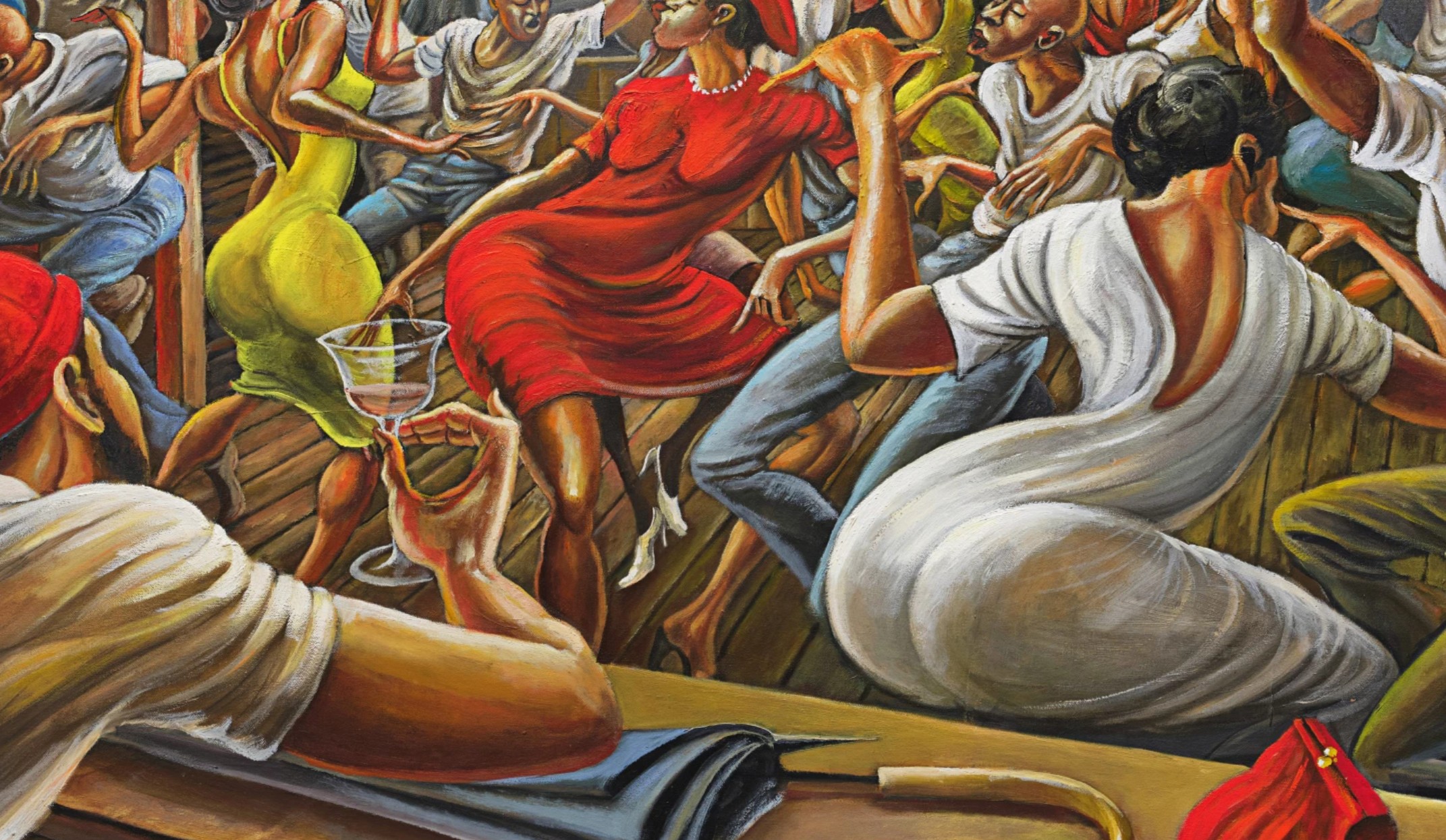
Begun in 1990 and completed in 1994, the present work was commissioned by Motown Records to commemorate the ten-year anniversary of Gaye’s death. The work was later acquired by Motown Records chairman Jheryl Busby. Black musical heritage embodies a central motif across Barnes’ celebrated body of work, and the subject matter and provenance of Club 55 is thus testament to his deep reverence for music. Referencing Highway 55 that runs through Barnes’s hometown of Durham, North Carolina, and alluding to important early works such as The Sugar Shack and the cover art Barnes created for Gaye’s 1976 album I Want You, Club 55 pulsates with the energy and spirit of one of the greatest American painters of the post-war period.
“My work reflects the social contradictions inherent in the myth of deprived peoples… This is the spiritual currency of the ghetto: taking the worst of times and turning them into the best.”
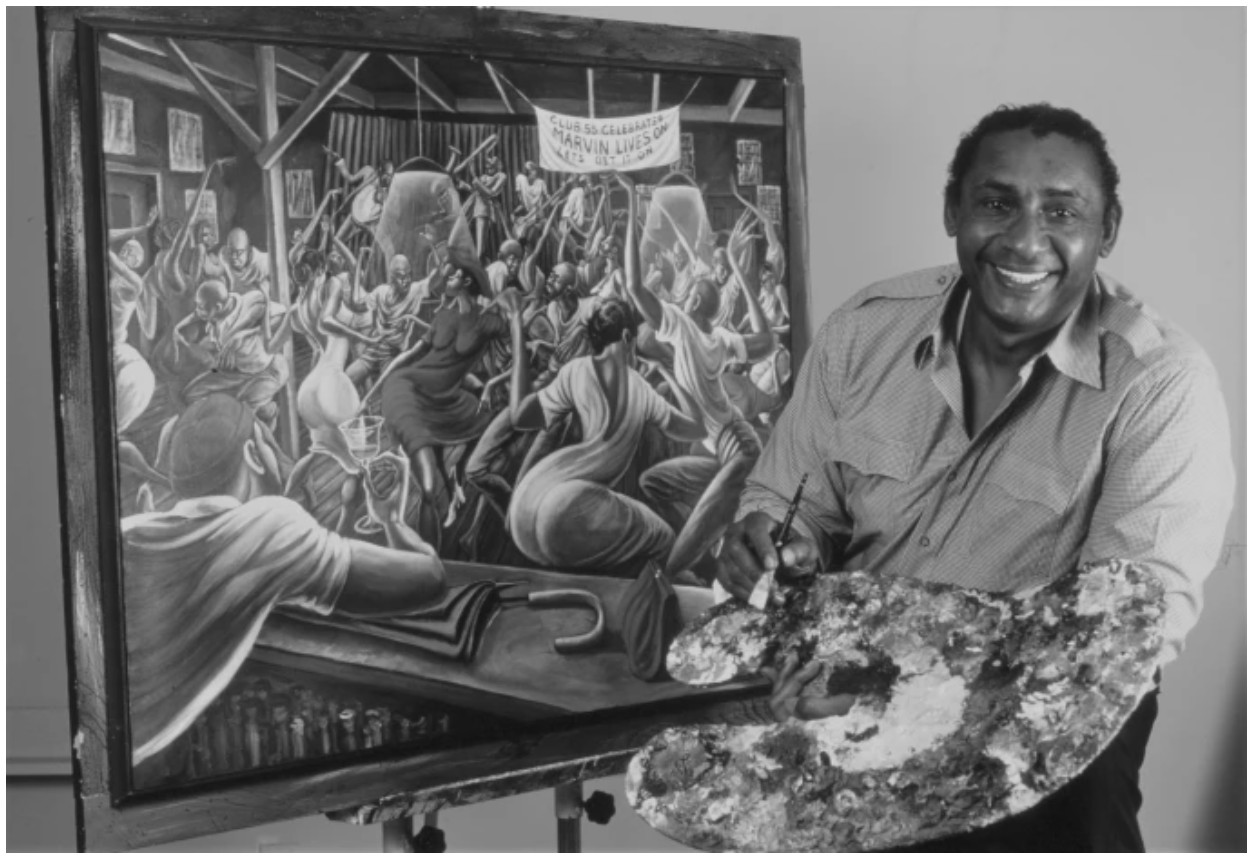
Ernie Barnes with the present work in 1994. Photo © Estate of Ernie Barnes
Barnes’ fascination with depicting the purity of bodies in motion began after witnessing a dance at the Durham Armory as a child. Having snuck into the venue, Barnes was immediately enthralled by the sounds and sights of the steamy hall: individuals overwhelmingly carefree with limbs passionately reaching out in every direction to a reverberating beat. This spirit is ever present in Club 55. Overhead lights illuminate a dance floor packed with elongated, sinuous figures as a jazz band passionately plays above them. The music is reflected in the very color of the composition itself, each element more vivid than the next. From Gaye’s bright red beanie to a dancer’s electric yellow dress, Barnes translates a moment in time with pure mastery of color and form. Club 55 is housed in its original artist’s frame made of distressed wood, which honors his father and is reminiscent of the picket fence that lined the family’s home in Durham.
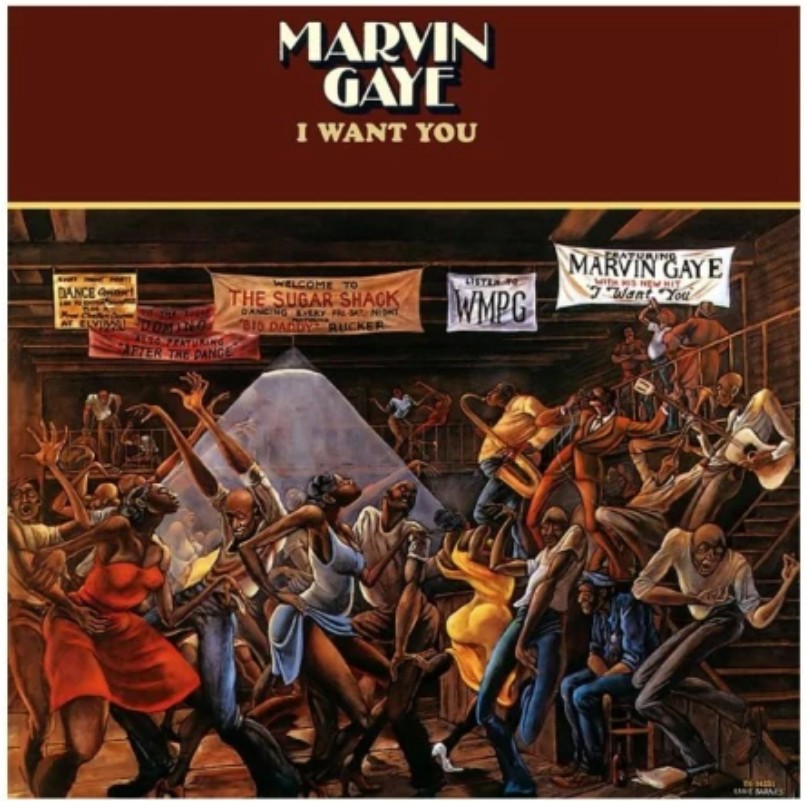
Marvin Gaye’s I Want You album cover
Barnes debuted Club 55 in the acclaimed 1990 exhibition The Beauty of the Ghetto in New York. In response to the Black Is Beautiful cultural movement, the show proposed that “beauty and art are not confined to museums or aristocratic marble halls. Rather… art, life and vitality are bred of struggle and utilized potential, not geography” (Joan D’Arcy, “The Artist,” in Exh. Cat., New York, Grand Central Art Galleries, The Beauty of the Ghetto: An Exhibition of Neo-Mannerist Paintings by Ernie Barnes, October – November 1990, p. 8). Raised in the American South during the Jim Crow era, Barnes was legally banned from entering museums as a child, and instead developed a self-taught knowledge of art history through books and catalogues. By 1965, after a six-year stint as a professional football player in the NFL, Barnes committed to his career as an artist, developing a distinct style that combined the dramatic palette and figuration of European Mannerists like El Greco and Tintoretto with the vibrant genre scenes of American artists such as Charles White and Thomas Hart Benton.
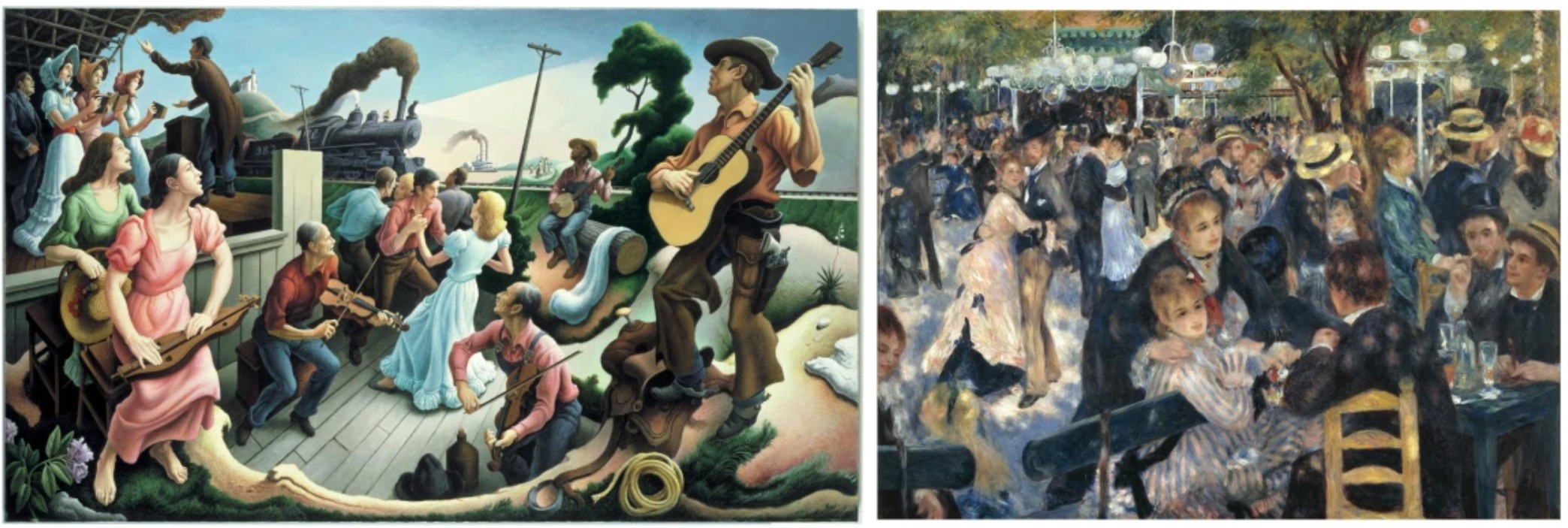
Left: Thomas Hart Benton, The Sources of Country Music, 1975. Country Music Hall of Fame and Museum, Nashville. Art © 2023 Thomas Hart Benton Trust/Licensed by VAGA, New York, NY.
Right: Pierre-Auguste Renoir, Bal du moulin de la Galette, 1876. Musée d’Orsay, Paris.
Resplendent with rich colors and boldly expressionistic, Club 55 sees Ernie Barnes extend the aesthetic and narrative tradition of American Realism to convey a resounding portrait of Black musicality. The present work is further elevated with a tactile sculptural quality, with its border of weathered wooden planks that brings life to the floorboards rendered within, transporting the viewer into the rustic interiority of the animated dance hall. The dancers in Club 55 keep their eyes closed, a feature that also functions as a consistent stylistic decision in Barnes’s portraiture to express his negotiation of the racism he has observed first-hand: “I tend to paint everyone, most everyone, with their eyes closed because I feel that we are blind to one another’s humanity, so if we could see the gifts, strengths, and potentials within every human being, then our eyes would open” (The artist quoted in a television interview with Ed Gordon, Personal Diaries, BET, 1990). Barnes’s exuberant depiction of Black life, where figures twist and intertwine, celebrates the sensation of Motown music and the very essence of the artist’s lifelong goal: To affirm the beauty of Blackness through an inescapable, brilliant energy.
Quintet, circa 1989
Heritage Auctions: 12 May 2023
Estimated: USD 500,000 – 700,000
USD 645,000
Ernie Barnes (American, 1938-2009). Quintet, circa 1989. Acrylic on | Lot #67048 | Heritage Auctions
ERNIE BARNES (American, 1938-2009)
Quintet, circa 1989
Acrylic on canvas
36×60 inches (91.4 x 152.4 cm)
Signed lower right: Ernie Barnes
The present work is housed in an original handmade artist frame and is also accompanied by a copy of the Central Art Galleries, Inc., The Beauty of the Ghetto exhibition catalogue, and Ernie Barnes Liberating Humanity from Within exhibition catalogue.
The works of American painter Ernie Barnes are experiencing a comeback like that of no other artist of the last decade.
Barnes’ circa-1989 painting Quintet – a highlight of Heritage’s May 12 American Art Signature Auction – is among the most recognizable pieces by the former pro footballer, who was once fined by the Denver Broncos’ head coach for sketching during team meetings. Barnes, perhaps best known for his painting Sugar Shack, used in the credits of the TV show Good Times and on the cover of Marvin Gaye’s 1976 album I Want You, is one of the 20th century’s most distinctive painters. Last year, Sugar Shack sold for $15.3 million at Christie’s – 76 times its high estimate of $200,000.
“Almost like a more modern Thomas Hart Benton or El Greco,” says Aviva Lehmann, Heritage’s Director of American Art. “His works are lyrical, as close to dancing as a painting can get. And Quintet is among the most intimate masterworks of his entire oeuvre.”
Quintet was exhibited in the fall of 1990 at New York’s Grand Central Art Galleries, as part of Barnes’ solo exhibition The Beauty of the Ghetto, which was subtitled Exhibition of Neo-Mannerist Paintings – and that “neo-mannerist” is apropos, given that a hallmark of Barnes’ work is how elongated and fluid his human figures are; Barnes’ background as an athlete granted him a breathtaking interpretation of bodies in motion. And Quintet ranks among Barnes’ greatest achievements, a joyful depiction of jazz musicians at work and at play, a piece so alive it echoes with a bebop soundtrack. Their eyes are closed – a hallmark of Barnes’ work that dates back to 1971, when he said he first conceived of The Beauty of the Ghetto as an exhibition.
“I began to see, observe, how blind we are to one another’s humanity. We don’t see into the depths of our interconnection. The gifts, the strength and potential within other human beings.”
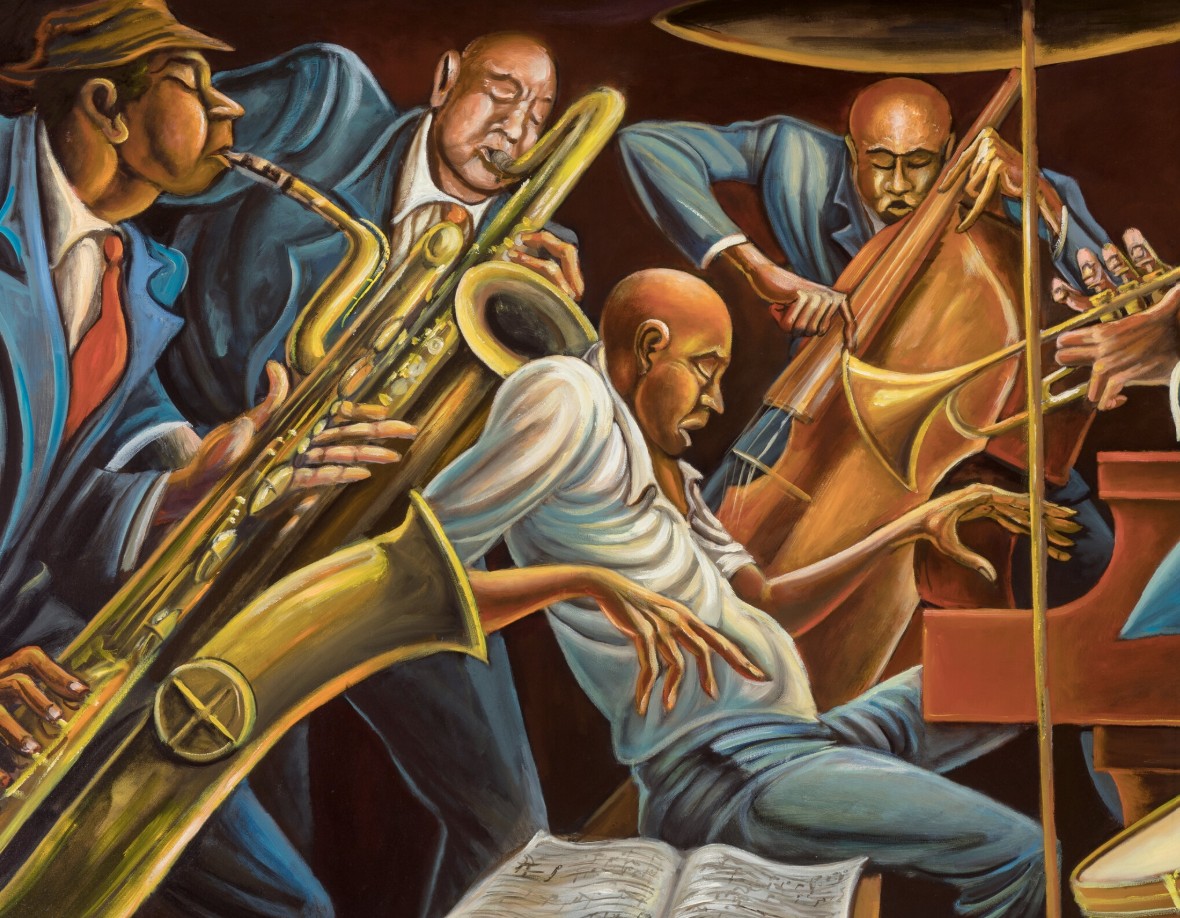
Barnes has long been acknowledged as a master by musicians who often used his works as album covers, among them Curtis Mayfield, BB King and Gaye. His lithe, ecstatic works look almost like sheet music – figures like notes dancing across the staff. Which should come as no surprise: Barnes’ father played piano in the family’s Durham, North Carolina home, and Barnes was so influenced by dad he framed each painting in distressed wood as a tribute: “Daddy’s fence,” he once said, “would hug all my paintings in a prestigious New York gallery.”
The painter, too, was raised listening to church choirs. Listen closely. Quintet, much like Sugar Shack, roars and reverberates like the long Saturday night before the Sunday morning. The painting brings the viewer directly into the fold of five musicians who are in deep connection with the music and one another; the viewer is not only in the room with the protagonists, but is sitting right inside this tight circle of players who lean in as they hit a long, blue note. The jazz club’s close darkness is filled up by the men, punctuated and delineated by the musicians’ strong diagonal physicality and their burnished and gleaming instruments: piano, two saxophones, a stand-up bass and a trumpet. The pianist’s torso sways back from the center, his elegant fingers poised mid-note. There is a delicious tension and harmony between the men, that intimacy of shared flow, as they move through the music. Barnes’ golds, black and browns evoke the weight of centuries of painting even as he updates action and venue: here the gathered gods wield brass and strings instead of scepters, and the dusty old Roman plaza gives way to a smoky and celebratory 20th-century Harlem. When the art world talks about updating the canon, it could not do better than Quintet.
Barnes was born in 1938 in Durham, N.C. His mother was in charge of the household staff of a lawyer and his father was a tobacco company clerk. Barnes was drawing and painting from a young age, but his athletic scholarship took him to North Carolina College of Durham (now North Carolina Central University), and all along the physicality of his world – the way bodies merge, move, interact and dissolve into one another has informed his pictures. As often as he painted solo figures, Barnes’ show-stoppers (like Sugar Shack and Quintet) often feature groups of people in shared and responsive motion. In fact, another significant Barnes work Heritage offers in May is titled Scrum, from 1980, which depicts exactly what the word describes: a mass of faceless rugby players locked together through sheer muscular force. Through the dust kicked up by their cleats, a forest of thigh muscles heave in sinewy explosion; expressive hands grasp, dig, and push. The perspective puts the viewer so close to the action that you can hear the men’s grunts and smell the sweat. It is a tour de force of Barnes’ incisive take on bodies working in unison and in tension. By the 1980s the artist was known for this territory and was asked to create five official posters for the 1984 summer Olympic Games in Los Angeles.
In this vein, Heritage also offers a study of Barnes’ The Team, which takes us right up to a circle of men discussing their next play. The amateur athletes in this picture – bowed heads and closed eyes – present a vertical stack of long limbs, broad shoulders, and smooth heads. Here they confer with one another in a relaxed and smiling moment, a pause of conjoined focus, just before springing back into electrified action.
Barnes died in 2009, but by then his aesthetic was already deeply woven into the American psyche; his presence in popular culture had been radiating outward and resonating through countless imitations of his indelible style. You cannot see a Barnes work without placing it at the center of an era we still look to for ballast in these unsteady times. Barnes’ vision of Americans surviving and thriving via community and celebration has claimed (if not reclaimed) its top spot in our understanding of how much art can show us what we most need in order to truly live, what we most value in ourselves and each other, which is presence. We are fundamentally social animals, and like it or not, we are woven together. Barnes was deeply committed to focusing on the Black experience in all of its richness and variety, and his angle observes and honors people going about their daily (and nightly) business while fully engaged in the very evolution of American culture. As Barnes once said: “I am bound by the strongest ties with the organic life of all people. And being an artist had created in me the desire to continually affirm beauty. I am well aware that art has no concrete connection to beauty, but beauty is profoundly interwoven into the fabric of the individual and his environment.”
Solid Rock Congregation, 1993
Bonhams New-York: 9 September 2022
Estimated: USD 500,000 – 700,000
USD 1,620,375
Bonhams : ERNIE BARNES (1938-2009) Solid Rock Congregation1993
ERNIE BARNES (1938-2009)
Solid Rock Congregation, 1993
Acrylic on canvas
36×48 inches (91.4 x 121.9 cm)
Signed
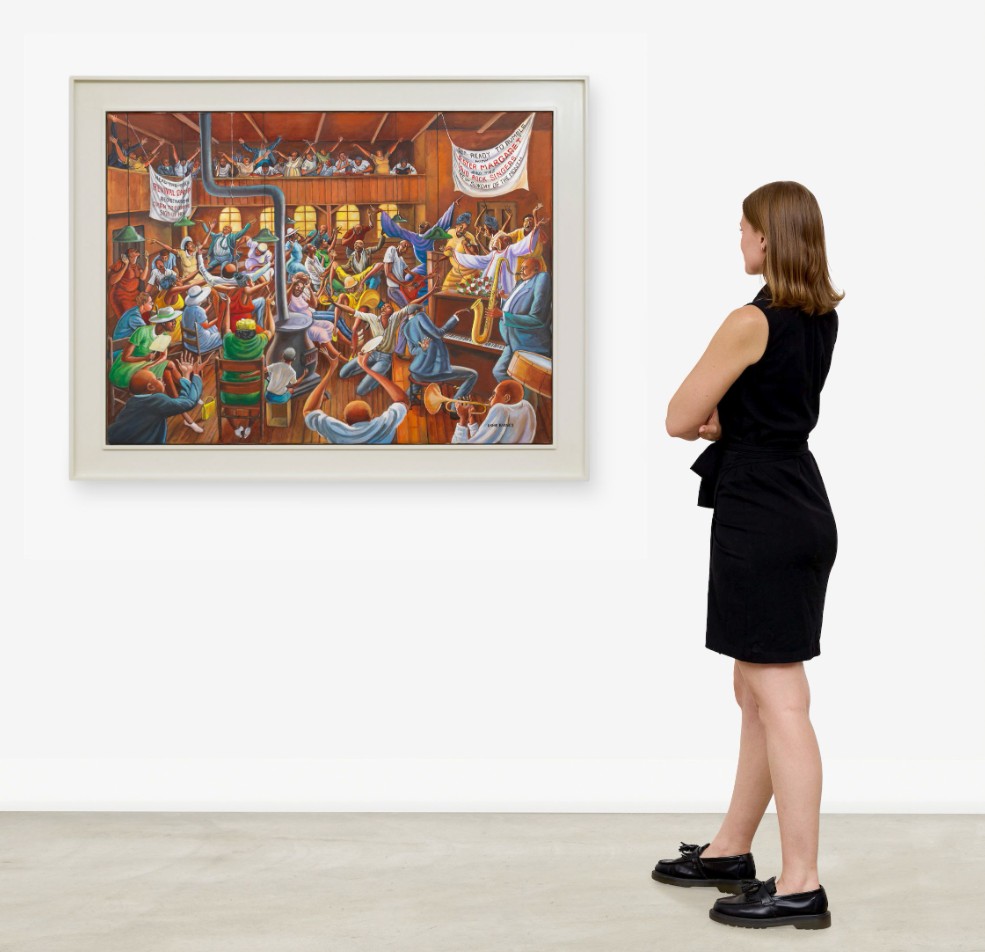
For Ernie Barnes, the human figure was more than a subject, it was a form of expression. In the reaching limbs and joyous swirling hips of Solid Rock Congregation, there is an exultation that is shared amongst individuals, embodying a profound community suspended in song from Margaret Bell, the singer who first commissioned the painting in 1993. Never publicly seen until now, it is a revelation of Barnes’ practice that unifies threads from the life of the artist and Bell herself, culminating in one of the finest examples of Barnes’ dance hall paintings in existence. Woven between a litany of figures in Solid Rock Congregation, the composition projects a bodily energy that feels both private to each close-eyed individual and beautifully communal. Filling the canvas with a vivacity and color that impresses upon us an atmosphere of unabashed revelry, it embodies the spirit that Barnes proclaimed throughout his life and career from his earliest days in the NFL to his prominence in television and music, delivering a chorus that animates Margaret Bell’s vocals with raucous delight.
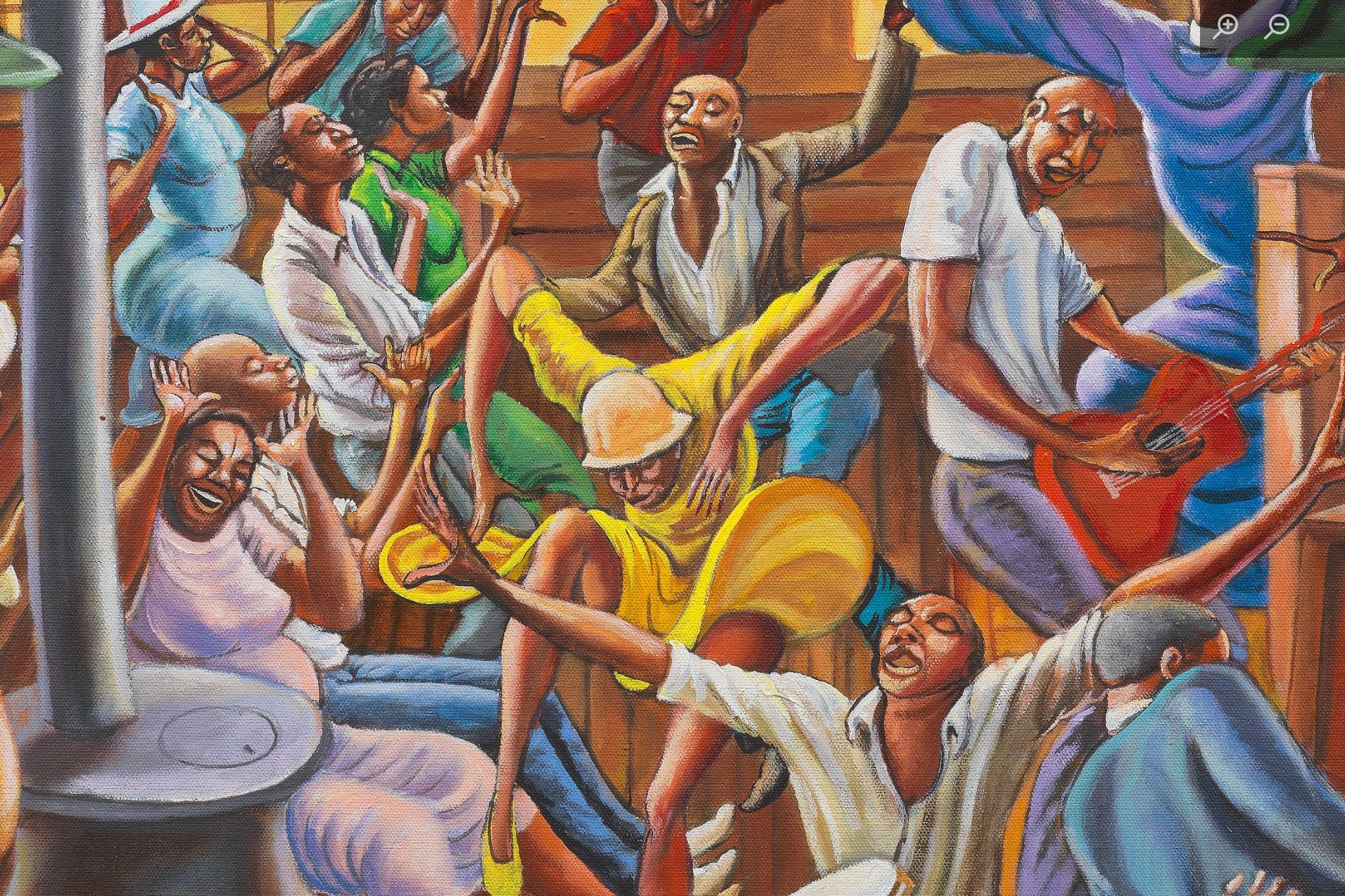
In an inspired and fortuitous meeting, Solid Rock Congregation is the splendid result of a friendship that began after Bell was introduced to the artist through her then husband, Keith Byars, himself a former fullback and tight end in the NFL with the Miami Dolphins and New England Patriots. Recalling the prodigious moment of inception, Bell found herself in Barnes’ home where she spied a large-scale church-scene, lightly underway. With the talented gospel singer standing right there in his home, the artist’s creative juices began to flow. Margaret’s commission would be a painting full of color, movement and music. Unquestionably living up to his vision, Barnes produced a painting that was a triumph of his stylistic motifs and painterly prowess – Solid Rock Congregation. After her breakthrough gospel record, Over and Over, was released in 1991 with Warner Alliance Music, the painting represents a unique and emphatic example that celebrates not only Bell’s contribution to the gospel genre, but also the cultural importance of singers such as Bell and the movement at large.
Barnes has never strayed far from the American consciousness, and his life and career has become refocused since his retrospective at the California African American Museum in summer 2019. If the truly American Renaissance man existed, it was him. He was unquestionably a natural artist, demonstrating a childhood fascination with the language of painting, intrigued by Delacroix, Michelangelo, and Toulouse-Lautrec. He was rarely without his sketchbook that accompanied him to classroom and track and field alike. Growing up and educated in segregated North Carolina, Barnes’ early sporting ability was an enabler for his artistic pursuit. He earned a full scholarship to the North Carolina College at Durham where he majored in art, and in turn was drafted to the Baltimore Colts in 1959, going on to play for the San Diego Chargers and Denver Broncos, before calling time on his professional career in 1965.
Nevertheless, it would be a mistake to consider his term in the NFL a segue from his painting. From his early interests, Barnes’ athleticism influenced his artistic inclinations in the most beautiful of ways and placed him at the epicentre of an Americana that made him a bona fide voice of a generation. From his high school captaincy of the football team to the biggest teams in the NFL, his appreciation of the body – of form, of strength, of stamina, of limits – was ingrained. Speaking of his relationship to sport and its impact on his practice, Barnes commented that “being an athlete helped me to formulate an analysis of movement, and movement is what I wanted to capture on canvas more than anything else; I can’t stand a static canvas” (the artist in: ‘ernie barnes this is my art’, YouTube, 28 July 2011). Athletes and artists share this deep connection, recognizing the nature of physicality and the performative translations that are essential to their endeavours. From illustrating his teammates to the dance halls and marching bands of his native Durham, the elongated, mannerist forms of his characters evince an understanding beyond the visual; of a figuration that embodies the mood, the intensity, and the soul of person.
The individual, or moreover, the subjective experience, is at the heart of Barnes’ artistic design. Throughout the congregation of the present work and his career at large, the closed eyes of Barnes’ characters have been a definitive and iconic motif, one that speaks volumes of how he illustrates the plurality of black experience and culture. Barnes appreciated art as the most complete and intense form of expression of the inner life, but undoubtedly recognized the transformative power of representation in his own painting. The drawn eyelids of his characters he regarded as a manifestation of “how blind we are to one another’s humanity,” but he went still further: “We stop at color quite often […] We look upon each other and decide immediately: This person is Black, so he must be … This person lives in poverty, so he must be …” (the artist in: Kareem Abdul-Jabbar, ‘How Athlete-Artist Ernie Barnes Captured Black Culture’s “Joy and Communal Dignity”‘, hollywoodreporter.com, 10 May 2019). The expressive body became the locus for Barnes’ painting that literally embodied the humanity he sought to reproduce.
In the present work, Barnes uses his figures to convey a reverence and joy that eclipses the representational. Body language is unseated by the body in motion; the social function of his subjects is superseded an expressive power, captured in a liminal, mesmeric space. To speak of body language, both suggestive and unambiguous, is to read figuration as it pertains to its social and cultural context, embedded in our subliminal sense of dialogue that is deeply rational and responsive. Barnes, however, invokes the body in motion, giving way to a kind of abstraction that transcends our inclination to translate posture, becoming an image that is purely kinaesthetic. In Solid Rock Congregation, from the pastor on stage to the balcony of audience members, their arms raised aloft and heads cast back, the grandiloquence of their gesture manifests devotion as pure ecstasy, in the throes of music and verse.
The nature of this abstract corpus has been the subject of art for millennia, from the battle scenes of Rubens, the dancers of Poussin, the visions of El Greco, to the most subtle evocations of a body, still, but turning under the surface in the portraits of Ingres, Courbet, and Manet. From the Renaissance to Modernism, artists sought to free the body from its social bonds and elevate it, celebrating the individualism of their subjects and the shared humanity of their audience. Renaissance imagery of Christ and his disciples reveals a remarkable historical precedent for the expressive mannerism that underpins Barnes’ painterly style. El Greco’s The Vision of St John (circa 1608-1614), for example, is composed with a fervency that shakes the religious core, and in the reaching hands, whirling drapery, and primary palette, Solid Rock Congregation shares a bodily dynamism that seeks to convey that same universality.
Comparably to El Greco, and still more so to examples of Poussin’s paintings of bacchanalian celebrations that include The Triumph of Pan (circa 1635-36), Barnes achieves a compositional feat that overthrows spatial concerns. Filling the room to the rafters, Barnes’ church is decidedly non-specific in its details, yet observes a Euclidean perspective that creates a depth of field which draws the eye ever-forward, centring on the billowing yellow double-helix of surely the most animated member of the congregation. Against this angular setting, the whole crowd appears to float, untethered from the ground of the painting. Seated, kneeling, or even collapsing in revelation, this buoyancy flows across the composition of the canvas from one limb to the next.
In this way, the artist has revived a painterly thematic rarely seen in contemporary practice: the crowd. As an artist, he eschewed the notion of a man apart from his society, an observer. Barnes captures, not necessarily real people, but people in reality. From Margaret Bell’s on-stage presence to the adulation of the congregation around her, the church is teeming with characters, personalities, and life. Like Toulouse-Lautrec before him who captured a piquant flavour of Paris at the end of the 19th century, the characters of Solid Rock Congregation illustrate a scene that echoes throughout churches in America’s southern states – the spirit and staging of gospel music in full swing. It is community in action.
Over the course of his lifetime, Barnes drew inspiration in his own experience and the cultural figureheads who represented the breadth of humanity, ambition, and togetherness that he considered intrinsic to the African American community. His legacy is one of the most significant and concrete affirmations of a social collectivism that is built on the power and beauty of the individuals who comprise it. Reflecting on the work Fastbreak, in which he appears – a painting commissioned by, and in the collection of, the Los Angeles Lakers in 1987 – a fellow polymath and one of the greatest basketball players of all time, Kareem Abdul-Jabbar wrote: “Our feet seem to be floating above the floor and our legs are positioned as if we are dancing to some music that only we can hear. The four of us who are black and in the foreground seem to be communicating telepathically, as if we understood what this game — what all games — meant to us individually and to other African Americans. That we were playing for all of us” (Ibid.).
In Solid Rock Congregation, there is an exquisite order that reveals itself slowly as the tableau unfolds and culminates in one of the most captivating paintings by Ernie Barnes to be offered publicly for sale. It is a piece with a uniquely personal origin, celebrating the expressive elegance of the individual and the power of community, that evokes the timelessness of gospel music and the importance of the art form and its performers, including Margaret Bell. Barnes was a touchstone for many since the 1970s and counts sports, music, and Hollywood A-listers amongst his collector-base. His retrospective in 2019 marked the continuation of an institutional swing that has suitably placed him firmly in the art historical canon as one of the great American painters whose recognition is only set to soar.
The Sugar Shack, 1976
Christie’s New-York: 12 May 2022
Estimated: USD 150,000 – 200,000
USD 15,275,000
NEW AUCTION RECORD FOR THE ARTIST
ERNIE BARNES (1938 – 2009), The Sugar Shack | Christie’s
ERNIE BARNES (1938 – 2009)
The Sugar Shack, 1976
Acrylic on canvas
36×48 inches (91.4 x 121.9 cm)
Signed ‘ERNIE BARNES’ (lower right)
Signed again, inscribed and dated 9⁄27/76 Ernie Barnes’ (on the reverse)
The Sugar Shack, 1976, by legendary American artist Ernie Barnes stands as a revelatory celebration of the joys to be felt in losing oneself to dance. An upbeat visual rhythm dictates the sway of angled limbs and flapping fabrics, one that synchronizes with the phantom tune radiating from the canvas. The visages of the depicted figures emanate pure, unadulterated bliss, a joy that perhaps echoes that of worshippers caught in the throes of religious ecstasy. With the visualization of such passion, Barnes artfully infuses the painting with both a core of gravity and an embrace of the carefree. The unique enchantment of this work can be located in its ability to envelope the viewer wholly into the heat, song, and energy of the scene it illustrates. To stand before The Sugar Shack is to be transported back in time and across space to the Durham Armory in 1952, an iconic dance hall in segregated North Carolina. The artist snuck into the Armory at age thirteen, engendering a memory of music and movement that would inspire the creation of The Sugar Shack twenty-four years later. On this transformative adolescent experience, Barnes remarked, “It was the first time my innocence met with the sins of dance.”
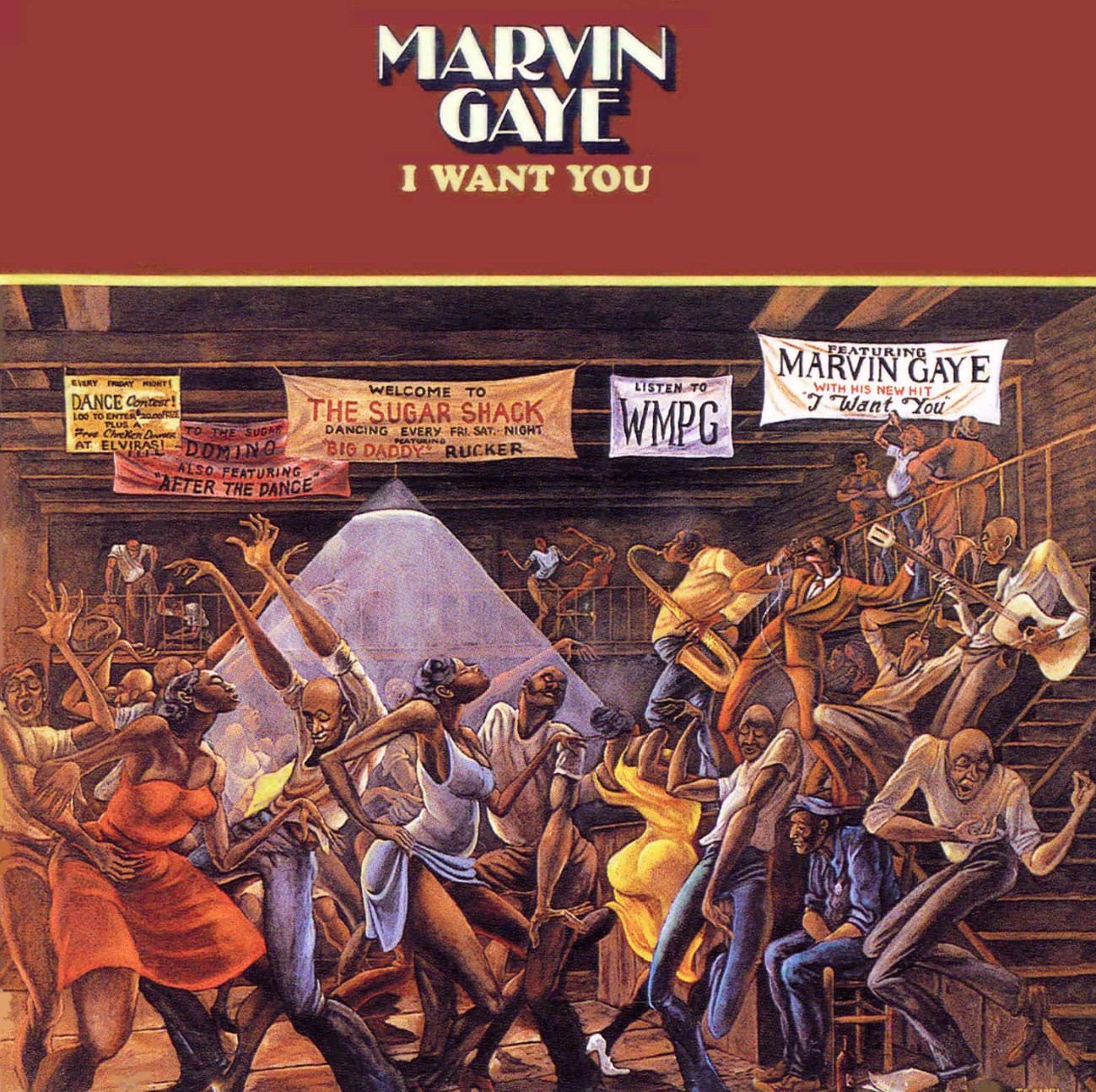
In The Sugar Shack II, Barnes epitomizes the rapture that can result from the power of music and image. As such, it is fitting that the work’s sister painting has become a cultural icon in the music and entertainment industries. Barnes made the first The Sugar Shack for titan of American soul, Marvin Gaye who chose to feature the image as the cover art for his fourteenth studio album, “I Want You.” Barnes then made the present lot in 1976, a duplicate of Gaye’s The Sugar Shack. When Barnes’s subject matter of dancing Black men and women from the 1950s is paired with the Prince of Motown’s unforgettable sound, the cultural contributions of the African-American community to music history are rightfully recognized and honored.
Similarly, the 1970s sitcom “Good Times” also featured The Sugar Shack’s sister painting. This show was the first sitcom to center on an African-American two-parent family, and frequently engaged with questions of politics surrounding race and identity. In this pairing, the work’s sociopolitical undertones emerge, as the painting provides a glorious portrayal of unabashed Black joy. In the time of the segregated South, any expression of Black triumph and jubilation was a radical act. As a former professional football player who faced pointed racism even at the status of NFL offensive guard, Barnes was painfully familiar with the violence embedded in the experience of being Black in America. Notably, the eyes of the figures in the painting are all sealed shut; this artistic choice stems from a recognition of the discord amongst humankind when confronted with diversity of appearance or ability.
“I tend to paint everyone, most everyone, with their eyes closed because I feel that we are blind to one another’s humanity so if we could see the gifts, strengths, and potentials within every human being, then our eyes would open.”
The Sugar Shack does not ignore the harsh realities of segregated American life in the 1950s, however it highlights a moment of beauty to emerge from such circumstances, that of the exuberant grace of dancing in a space created by and for the Black community.
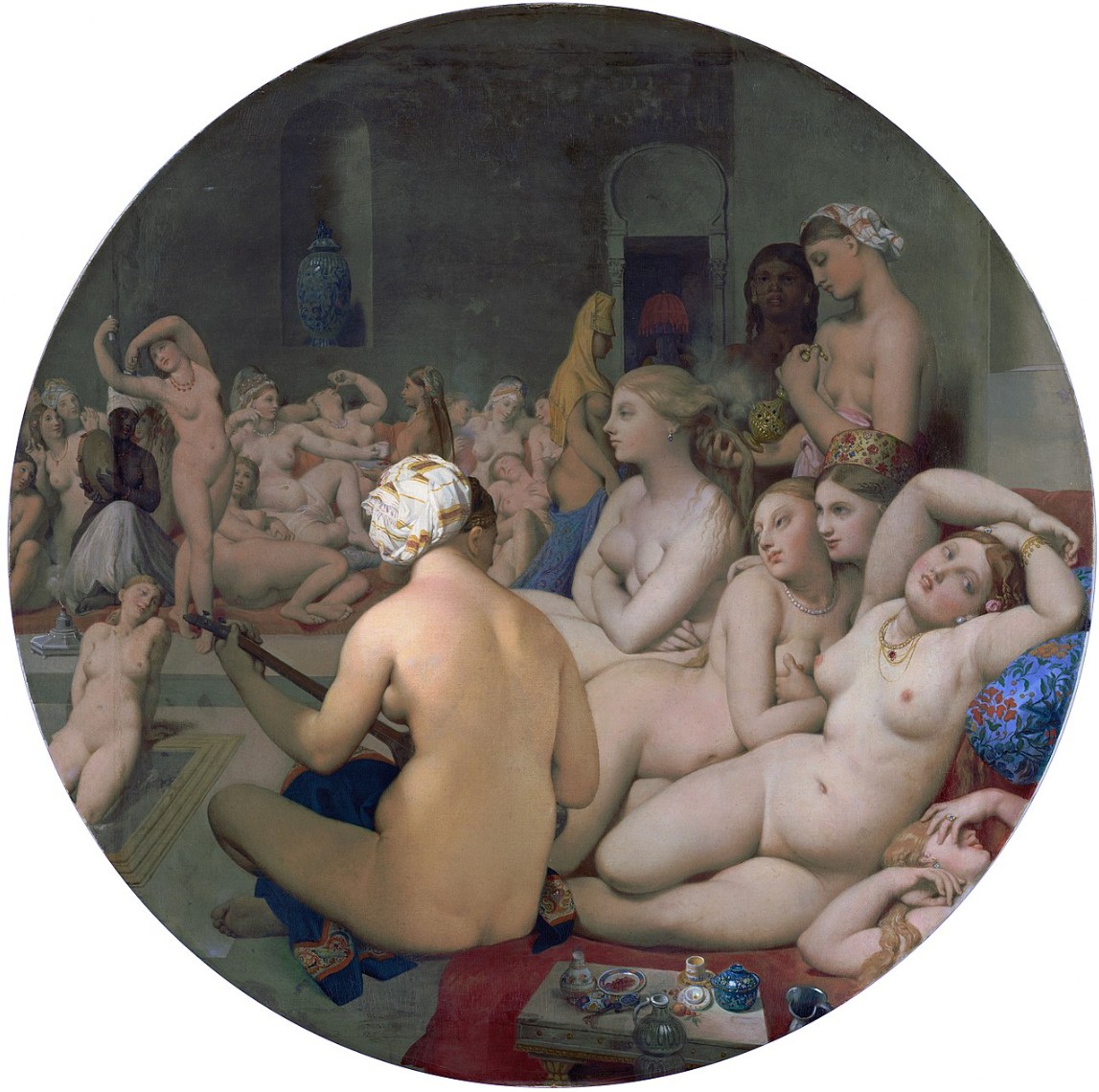
Artist Jean-Auguste-Dominique Ingres
Year 1852–59, modified in 1862
Medium Oil on canvas glued to wood
Dimensions 108 cm × 110 cm (42 1/2 in × 43 5/16 in)
Location Musée du Louvre, Paris
Accession R.F. 1934
Although a cursory glance at The Sugar Shack may yield the impression of a mass of taut limbs and upturned, rapturous faces, a closer look reveals the artful order at the foundation of the work. Barnes’s technique is strikingly similar to Neo-Classical master, Jean Auguste Dominique Ingres. Both artists excel at arranging large numbers of bodies in a small pictorial plane, while still maintaining a path for the eye to travel. One might draw comparisons between The Sugar Shack and Ingres’s The Turkish Bath (1863), as both paintings feature bodies elongated past reality, yet in the service of leading the eye throughout the work. In the present lot, Barnes guides the viewer’s gaze through the painting via fluid lines of lengthened arms and twisted torsos, each outstretched hand encouraging the eye to traverse across the canvas. The work also channels the principles structuring chaotic scenes of dance that have stood through centuries. Pieter Brueghel the Elder’s work The Wedding Dance (c. 1566) features a strikingly similar method of perspective that Barnes has employed in The Sugar Shack. Both paintings focus on a central row of characters in the foreground, while still stacking figures in slightly exaggerated foreshortening in the background, leading to a slight optical illusion of higher density in the space. The visual implication of this technique is a packed room in which bodies are closely pressed against each other in the thrill of dance. Overall, The Sugar Shack serves as a prime example of Barnes’s skill at capturing the full range of tension and vivacity in everyday life. In the present lot, he elevates an experience as mundane as a community dance to an almost spiritual state of grace.
The Gospel Truth, 1985
Bonhams London: 13 October 2022
Estimated: GBP 600,000 – 1,000,000
GBP 756,300 / USD 838,980
Bonhams : ERNIE BARNES (1938-2009) The Gospel Truth 1985
ERNIE BARNES (1938-2009)
The Gospel Truth, 1985
Acrylic on canvas
36×48 inches (91.4 x 121.9 cm)
Signed
Ernie Barnes’ legacy has crystallized as one of the most significant and upstanding careers of a late great American artist. A young, aspiring boy from segregated Durham, North Carolina, who took to the football pitch as a professional player in the NFL before his first solo show in New York in 1966, Barnes’ artistic inclinations were a constant throughout his life that he wove seamlessly together with his love of sport, music, and the sense of community and shared experience that underpinned his creative passion. The gospel halls of Barnes have become some of the most iconic and highly sought-after paintings by the artist, and The Gospel Truth is arguably the finest example of which to come to market. Displaying a remarkable attention to detail and almost chiaroscuro sense of space and light – whose hallowed windows descend in golden sunbeams dappled across the congregation – one cannot shake the imagistic power of a canvas that is bursting with a rapturous joy, marking the height of Barnes’ career but a year after he was the official artist of the 1984 Olympic Games in Los Angeles.
Across the glorious intensity of The Gospel Truth, Barnes revels in a kind of ecstasy that is both unique to his painting and to the American south that he was raised in. His subjects cast their arms aloft, heads raised to the sky, some held between hands, others throw their bodies and twist their faces in uncontrollable adulation. Recalling his childhood trepidation at the volume and fervor of a congregation in the throes of gospel verse, Barnes glimpsed something that remained at the heart of his career throughout his life; a sense of human presence and power that is found in the individual and in the collective consciousness. In the aptly titled The Gospel Truth this essential quality comes to the fore with remarkable force and artistry.
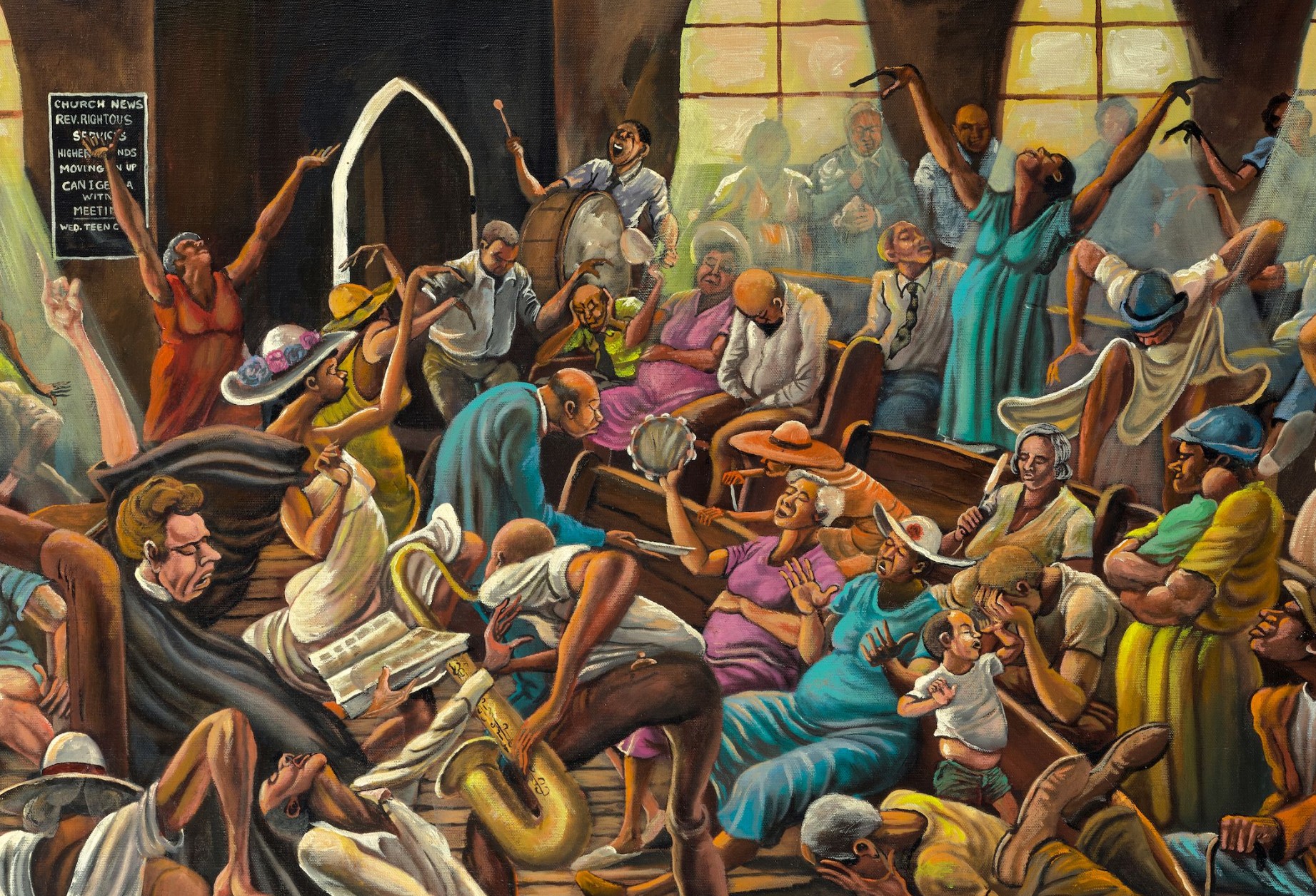
In the finest examples by the artist, the light, depth of field and figurative dynamism identifies masterworks from great paintings – this is such a piece. From the halos that cascade amongst the pulsating crowd to the vignette of the lower edges that frames our gaze, the unique hazy glow of Barnes’ paintings makes them radiate an inner light, projecting from the wall with a swirling, intensely layered surface that glistens as it catches the hips and shoulders of the dancing congregation. The Gospel Truth boasts a palette that is immaculately refined and delicately shifts between sunbeam and shadow. Like Barnes’ night-time dance venues and pool halls that capture after-hours socialising and amusement, the Sunday morning of The Gospel Truth reveals another kind of liberation, one of worship, community and song, that nevertheless spills over into a party of stupendous energy.
Purchased from the artist by Tim Hauser, eight-time Grammy winner and founder of The Manhattan Transfer, the present work bespeaks a musical passion shared between two masters of their craft. Introduced by the bassist Kenny Gradney of Little Feat., who also came up with the name ‘The Gospel Truth’, the painting was acquired fresh off Barnes’ easel by Hauser and would be a brightening focal point of his collection amongst friends. It comes to market now as one of the most remarkable gospel canvases to have remained in constant ownership since its making, full of unique details and qualities that make it one of the most inspired paintings by the artist.
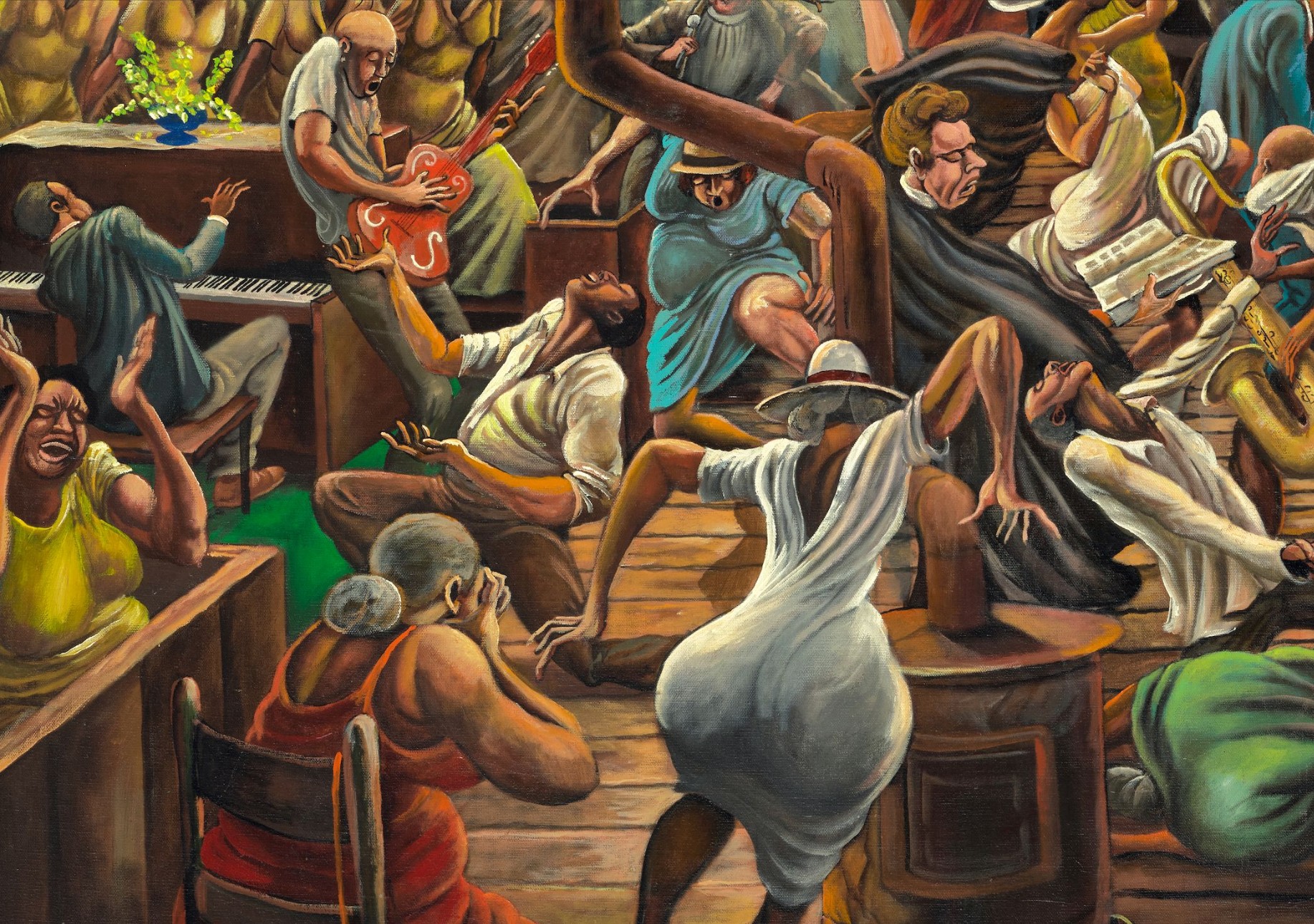
Barnes’ life and career has become refocused since his retrospective at the California African American Museum in summer 2019. If the truly American Renaissance man existed, it was him. He was unquestionably a natural artist, demonstrating a childhood fascination with the language of painting, intrigued by Delacroix, Michelangelo, and Toulouse-Lautrec. He was rarely without his sketchbook that accompanied him to classroom and track and field alike. Barnes’ early sporting ability was an enabler for his artistic pursuit. He earned a full scholarship to the North Carolina College at Durham where he majored in art, and in turn was drafted to the Baltimore Colts in 1959, going on to play for the San Diego Chargers and Denver Broncos, before calling time on his professional career in 1965.
Nevertheless, it would be a mistake to consider his term in the NFL a segue from his painting. From his early interests, Barnes’ athleticism influenced his artistic inclinations in the most beautiful of ways and placed him at the epicentre of an Americana that made him a bona fide voice of a generation. From his high school captaincy of the football team to the biggest teams in the NFL, his appreciation of the body – of form, of strength, of stamina, of limits – was ingrained. Commenting on his relationship to sport and its impact on his practice, Barnes commented that “being an athlete helped me to formulate an analysis of movement, and movement is what I wanted to capture on canvas more than anything else; I can’t stand a static canvas” (the artist in: ‘ernie barnes this is my art’, YouTube, 28 July 2011). Athletes and artists share this deep connection, recognizing the nature of physicality and the performative translations that are essential to their endeavours. From illustrating his teammates to the dance halls and marching bands of his native Durham, the elongated, mannerist forms of his characters evince an understanding beyond the visual; of a figuration that embodies the mood, the intensity, and the soul of person.
The individual, or moreover, the subjective experience, is at the heart of Barnes’ artistic design. Throughout The Gospel Truth and his career at large, the closed eyes of Barnes’ characters have been a definitive and iconic motif, one that speaks volumes of how he illustrates the plurality of black experience and culture. Barnes appreciated art as the most complete and intense form of expression of the inner life, but undoubtedly recognized the transformative power of representation in his own painting. The drawn eyelids of his characters he regarded as a manifestation of “how blind we are to one another’s humanity,” but he went still further: “We stop at color quite often […] We look upon each other and decide immediately: This person is Black, so he must be … This person lives in poverty, so he must be …” (the artist in: Kareem Abdul-Jabbar, ‘How Athlete-Artist Ernie Barnes Captured Black Culture’s “Joy and Communal Dignity”‘, hollywoodreporter.com, 10 May 2019). The expressive body became the locus for Barnes’ painting that literally embodied the humanity he sought to reproduce.
As the golden light pierces the windows and rains upon the choral troupe and seated attendees, one cannot help but feel the ebullience and religiosity that makes The Gospel Truth such a profound celebration of black joy and community. It is an unashamedly hip-shaking vision whose rhythm and noise is tantalisingly close to breaking from the walls of its frame. For Barnes, it represents one of the most genuine and magnificent scenes of the America that he knew and was raised in, and thus one of the most collectible paintings to have come to market by the artist. A richly coloured and highly contrasted palette, it demonstrates the masterly confidence that Barnes had achieved in his mid-career, an elegant testament to an artist whose historical footnote has become a tour de force, recognized as one of the truly great, historical American painters of his generation.
Basketball
In the Beginning, circa 1971
PROPERTY FROM THE ESTATE OF DOROTHY M. TUCKER, LOS ANGELES
Bonhams New-York: 19 November 2025
Estimated: USD 300,000 – 500,000
USD 305,300
Bonhams : ERNIE BARNES (1938-2009) In the Beginning 36 x 18 in (91.4 x 45.7 cm) (Painted circa 1971)
ERNIE BARNES (1938-2009)
In the Beginning, circa 1971
Acrylic on canvas
36×18 inches (91.4 x 45.7 cm)
Signed ‘ERNIE BARNES’ (lower right)
Inscribed ‘”In the Beginning”‘ (on the stretcher)
In the Beginning is a quintessential and iconic work by Ernie Barnes that has been in the same collection since it was acquired in 1972, one year after its execution, by the incomparable Dorothea Tucker. Born in South Carolina, Tucker was a celebrated and deeply respected psychologist. A trailblazer in her field with countless professional accomplishments, Tucker was also a staunch supporter of the Civil Rights and Women’s movements. Amongst her many notable accolades, including holding two Ph.Ds. (one in Education and one in Professional Psychology) Tucker served as the commissioner of several city departments and was the president of the California Psychology Association. Moreover, she helped found the Los Angeles Black Women’s Forum and was on the board of the Westside Women’s Clinic. Tucker was an active, passionate, and beloved contributor to her community, much like Ernie Barnes who was a close friend of hers.
The present work portrays an intimate moment that is both grand and quiet. The house in the background, an iconic motif of Barnes’ most successful basketball paintings, pays homage to his upbringing in North Carolina. With the figure suspended in midair, Barnes astutely and poetically articulates the full spectrum of athletic greatness wherein the journey to success is just as beautiful as the success achieved.
My First Dunk, 1976
Phillips New-York: 20 November 2024
Estimated: USD 250,000 – 350,000
USD 444,500
Ernie Barnes Modern & Contemporary Art Day Sale, Morning Session
My First Dunk, 1976
Oil and acrylic on canvas, in artist’s frame
Ernie Barnes’ My First Dunk envelops viewers in a nostalgic and jubilant memory. Painted in 1976, the present work features a lone figure suspended in air, about to gracefully place a basketball in a hoop. Extending and elongating the figure in his signature neo-Mannerist style, Barnes infuses the present work with a Surrealist-like tradition to examine the interplay of memory and contemporary culture. The present work was originally in the esteemed collection of Richard Roundtree, the iconic actor best known for his role as John Shaft in the Shaft movie franchise. Roundtree was familiar with Barnes’ football career in the 1960s and learned of his artistic practice when Sammy Davis Jr. and Charlton Heston purchased his works. He discovered that Barnes lived just four blocks away from him in Los Angeles and walked to his home to meet with him, purchasing My First Dunk from the artist directly in 1979.
Gracefully leaping to perform the eponymous dunk, the player’s exaggerated limbs are rendered in delicate brushstrokes that capture a fluid motion, presenting the figure as if flying through the air. Hinting at an intimate moment with the work’s title, Barnes employs a monotone backdrop and muted, almost sepia-toned color palette to further suggest that this is perhaps a personal memory, while subtle hues of baby blue and ochre reflect the elegance of classical Mannerist portraiture. Indeed, the composition feels playful, as if the subject is heroically soaring over his distant home across a barren landscape. In addition to his depiction of athletic moments, Barnes more broadly explored cultural representation and human experience throughout his practice. In the present work, he captures the essence of the human body in motion, showcasing the gifts, strengths, and potential inherent to everyone. The figure’s head is turned away from the viewer, obscuring any defining characters and allowing Barnes to universalize his athlete—a technique the artist would employ time and time again. Letting the viewer in on this nostalgic moment, one is able to put themselves in the basketballer’s shoes and envision themselves as the one making the dunk.
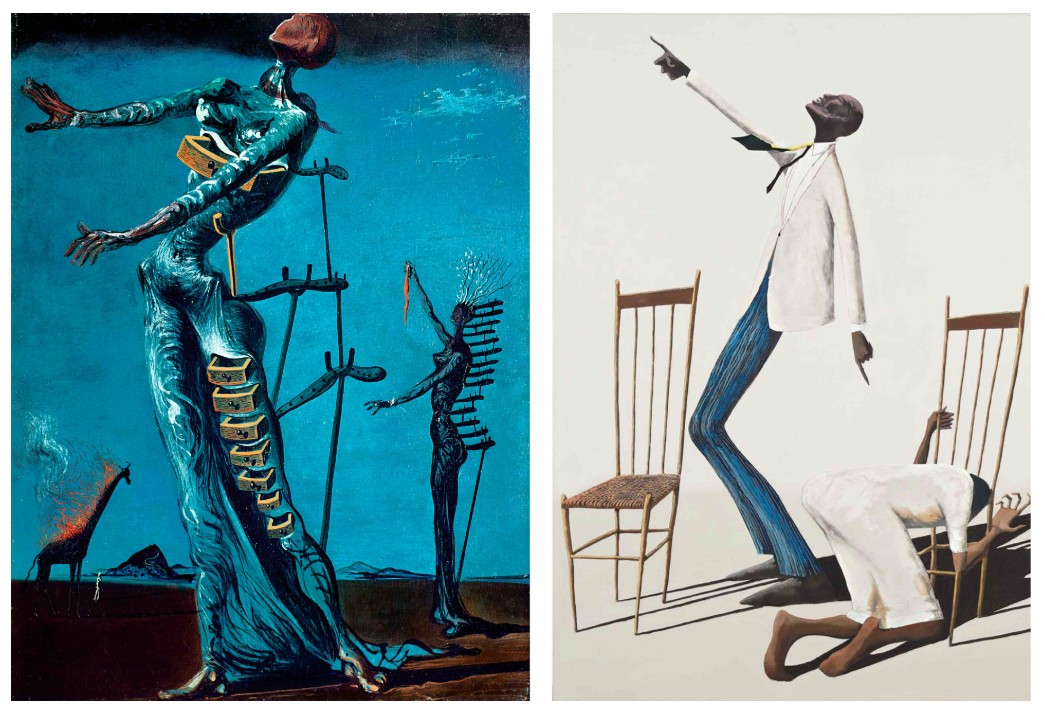
[Left] Salvador Dalí, Burning Giraffe, 1937, Kunstmuseum, Basel. Image: Bridgeman Images, Artwork:© 2024 Salvador Dalí, Gala-Salvador Dalí Foundation / Artists Rights Society (ARS), New York
[Right] Benny Andrews, The Way to the Promised Land, 1994. Image/Artwork: © 2024 Estate of Benny Andrews / Licensed by VAGA at Artists Rights Society (ARS), NY, Courtesy Michael Rosenfeld Gallery, LLC, New York, NY
Through these nostalgic renderings, Barnes showcases his reverence to and understanding of the tenets of Surrealism. Reminiscent of Salvador Dali’s fantastical compositions, My First Dunk embodies the Surrealist principles of irrationality, particularly in its compositional choices. The scale of the figure, alongside the hoop and the distant building, challenges realistic approaches to perspective – the house in the background is rendered as if in the very distant background, while the pole supporting the basketball hoop seems to be situated abnormally high within the air. Similarly, the low horizon line and desolate landscape create an eerie, other-worldly quality, the sky stretching across almost the entire composition, mimicking the length of the figure. Understanding and distorting traditional landscape and portraiture traditions, Barnes embraces the elongation and distortion of the figure through a Surrealist lens, inviting viewers into a fantastical realm that merges personal memory with imaginative exploration.
High Aspirations, 1971
PROPERTY FROM A PRIVATE COLLECTION, NEW JERSEY
Bonhams New-York: 7 November 2023
Estimated: USD 500,000 – 700,000
USD 857,750
Bonhams : Ernie Barnes (1938-2009) High Aspirations 36 x 18 in. (91.4 x 45.7 cm.) (Painted in 1971.)
ERNIE BARNES (1938-2009)
High Aspirations, 1971
Acrylic on canvas
36×18 inches (91.4 x 45.7 cm)
Signed ‘ERNIE BARNES’ (lower right)
Ernie Barnes grew up in “The Bottom,” a segregated neighborhood just outside of Durham, North Carolina, where he took an early interest to art and was regularly found drawing in the mud with sticks. His mother would occasionally take him with her to work, where she was employed in the household of Frank L. Fuller Jr., an attorney and art enthusiast. Fuller encouraged young Ernie to read through the numerous art books in his home, and by the first grade, he was familiar with the titans of the art historical canon, including Michelangelo, Peter Paul Rubens, and Henri Toulouse-Lautrec. This education was profoundly important to Barnes’ development, as he would have been denied entrance to the prominent art museums because of the Jim Crow laws.
As he got older, Barnes switched to more traditional mediums, and was regularly found sketching. As he grew, Barnes eventually filled out to a daunting 6-foot, 3-inch height and was encouraged by coaches to pursue football as a means to further his education. In 1956, he enrolled at North Carolina College (a historically all-Black college and now North Carolina Central University) on a football scholarship, though he continued to study art. His time at NCC would prove pivotal to his artistic pursuits. At the instruction of one of his professors, renowned sculptor Ed Wilson, Barnes began to paint from his own life experiences of playing sports.
As his college years progressed, football became his primary focus, culminating in Barnes being drafted by the Baltimore Colts in December 1959. Over the course of his six-year career in the NFL, he played for four teams, including the San Diego Chargers and the Denver Broncos. When asked how playing sports influenced his artistic practice, Barnes noted, “For me, they were both integrating experiences. The disciplines of one are the disciplines of the other. I paid attention to how the body felt like in movement and my effort has been to translate that feeling onto paper or canvas.” (E. Barnes, quoted in: “Interview with Ernie Barnes,” The Soul Museum, August 2006). Interpreting the flexing of muscles and the movement of the human form onto canvas, High Aspirations is the architype for Barnes’s basketball paintings, being the basis on which he would build his astounding career in the arts.
A theme within Ernie Barnes’ oeuvre is his exploration and portrayal of people pursuing their passions to the point of transcendence. These portraits regularly capture a moment of uninterruptable grace for the subject, wherein they are completely absorbed by the task at hand and oblivious to the outside world. Sometimes he would capture these people in large groups with several people simultaneously experiencing the divine, though it is his more intimate works with a lone figure that are the most poignant and emotionally rich. Throughout his career, Barnes explored many different activities that could stir such feelings within the sitter, including music, religion, and family, but none can surpass the vitality of the canvas’ exploring how sports can completely enrapture the soul, particularly basketball.
In High Aspirations, Barnes has mirrored the verticality of the leaping figure with a strikingly vertical canvas and infused the player with dynamic energy and graceful motion, focusing on his skills of modeling of the human form within a tightly controlled composition. Here Barnes has utilized his signature stretching of the limbs of the player to infuse the figure with a wiry vitality, a common ailment for the young man in the throes of adolescence, having achieved the height of a grown man, but not yet filled out with a muscular frame. Set against a cloudless sky, a barefoot figure has just launched himself skyward off his true left leg with his toes pointing downwards, as he stretches his right arm up toward the basket, ball firmly in his control as he attempts to dunk the ball into the twisting, makeshift hoop. As he leaps upward, the figure tilts his head back to ensure that the ball reaches its intended target. In the foreground, Barnes has mirrored the figure and makeshift hoop through the rendering of shadows, which act as a visual counterbalance and draw the eye back down. Planted firmly between the figure and his goal, there is a simple farmhouse in the distance. This could be a metaphor for the figure both emotionally and physically distancing himself from the rest of the world, where he can focus solely on playing the game to his heart’s content. Focused on an individual playing by himself, High Aspirations is a masterful study in figural composition and form.
Singer, actor, and civil rights activist Harry Belafonte, acquired this work from Heritage Gallery in Los Angeles in 1972, most likely at the gallery’s display of Barnes’ work in the inaugural exhibition of “The Beauty of the Ghetto.” This exhibition would go on to travel across the country, though without this work, and spread Barnes’ personal expressions of the life and struggles for people of color, which galvanized viewers to re-examine their lived experiences and how their communities responded to desegregation. This exhibition was immensely important to Barnes’ reach to the American public, but his greatest exposure came from the inclusion of his paintings in the beloved television show Good Times. From 1974-9, most of the paintings that were supposed to have been done by the character J.J., were painted by Barnes, including his most famous work Sugar Shack. Barnes’ involvement in Good Times extended beyond his paintings as he also did two bit-part appearances on the show. Ernie Barnes was able to break through so many barriers throughout his life and his work is a celebration of the exuberance with which he approached everyday life and his paintings provided visibility for many at a time when representation was hardly a priority.
High Aspirations remained in Mr. Belafonte’s collection for many decades, until he passed it to his son. The present owner acquired the work directly from Mr. Belafonte’s son and this work has not been on the market in over 50 years, though it is one of the most reproduced images from Barnes’ impressive repertoire of paintings.
Country Layup, 1979
Bonhams New-York: 17 November 2023
Estimated: USD 350,000 – 550,000
USD 508,500
Bonhams : ERNIE BARNES (1938-2009) Country Layup 1979
ERNIE BARNES (1938-2009)
Country Layup, 1979
Acrylic on canvas, in artist’s frame
28 3/8 x 16 1/4 inches (74.6 x 41.3 cm)
Signed
Ernie Barnes connects us to a deep American Heroism. In his paintings we find halls of worship and music, of joy and celebration, furious melees at lines of scrimmage, and moments of magnificent isolation that are brimming with imagination and silent passion. Framed in his quintessential ‘picket fence’ frame, Country Layup from 1979 is tender and austere; a single figure rolls the ball off their fingertips reaching for the makeshift backboard as their toes depart the ground, their body arcing double helix-like, vaulting the shingled house perched on the horizon. It is rousing, drawing from us a bodily response that is as athletic as it is romantic. Such evocations leave little doubt as to why Ernie Barnes has been one of the most hotly discussed revivals of recent seasons, and ‘basketball’ paintings such as Country Layup some of the most iconic pictures of his mid-career.
Barnes has never strayed far from the American cultural consciousness. Sports professionals, movie stars and musicians alike commissioned and acquired paintings by the artist throughout his career; his paintings were, perhaps most famously to the public eye, a title image for the classic sitcom “Good Times” (1974-1979); the cover of Marvin Gaye’s 1976 album “I Want You”, and The Crusaders 1984 album ‘Ghetto Blaster’, the original painting of which was sold by Bonhams New York in 2022 for $882,375. His significance, therefore, as a cultural staple of late 20th century America is a fact only recently coming into clarity. His life and art have been the subject of retrospectives at the California African American Museum in summer 2019, and a recent New York Times piece described his canvases as “domains of earnestness and striving, of unalloyed celebration and pride. This might mistakenly be read as unsophisticated or naïve, when in fact it is principled, even defiant”, and Barnes himself “an artist of the people – most especially of Black people” (Adam Bradley, ‘Millions Saw His Paintings on TV. In the Art World, His Work Still Went Unnoticed’, The New York Times, 15 September 2023, Online). His impact and the beauty of his paintings cannot be divided from his legacy as a champion of the Black experience and the American history of twentieth century painting.
Barnes was unquestionably a natural artist, demonstrating a childhood fascination with the language of painting, intrigued by Delacroix, Michelangelo, and Toulouse-Lautrec. He was rarely without his sketchbook that accompanied him to classroom and track and field alike. Growing up and educated in segregated North Carolina, Barnes’ early sporting ability was an enabler for his artistic pursuit. He earned a full scholarship to the North Carolina College at Durham in 1956 where he majored in art, and in turn was drafted into the NFL with the Baltimore Colts in 1960, going on to play for the San Diego Chargers and Denver Broncos, before calling time on his professional playing career in 1965 and quite ingeniously becoming the league’s official painter.
Nevertheless, it would be a mistake to consider his term in the NFL a segue from his painting. From his early interests, Barnes’ athleticism informed his practice and placed him at the epicenter of an Americana that made him a bona fide voice of a generation. From his high school captaincy of the football team to the biggest teams in the NFL, his appreciation of the body – of form, of strength, of stamina, of limits – was ingrained. Speaking of his relationship to sport and its impact on his practice, Barnes commented that “being an athlete helped me to formulate an analysis of movement, and movement is what I wanted to capture on canvas more than anything else; I can’t stand a static canvas” (the artist in: ‘ernie barnes this is my art’, YouTube, 28 July 2011). Athletes and artists share this deep connection, recognizing the nature of physicality and the performative translations that are essential to their endeavours. From illustrating his teammates to the dance halls and marching bands of his native Durham, the elongated, mannerist forms of his characters evince an understanding beyond the visual; of a figuration that embodies the mood, the intensity, and the soul of person.
Country Layup offers a poetics of smallness and greatness. Like Walt Whitman’s verse, it is innately American and beautiful, cinematic even to a contemporary eye. We feel the stretching sinews of limbs and joints that reach for the wooden frame in the sky, we can smell the dirt kicked up from the effort. But more than this we perceive the joyous solitude of the subject, the heights of achievement that are attained quietly and on the shoulders of no man. Country Layup is as much an allegory of Barnes’ life and his career as it is a message of aspiration, and is undoubtedly one of the most desirable examples by the artist to come to market.
One-On-None, 1979
Christie’s New-York: 17 November 2022
Estimated: USD 60,000 – 80,000
USD 945,000
ERNIE BARNES (1938-2009), One-On-None | Christie’s
ERNIE BARNES (1938-2009)
One-On-None, 1979
Acrylic on canvas, in artist’s frame
41 1/2 x 23 1/2 inches (105.4 x 59.7 cm)
Signed ‘ERNIE BARNES’ (lower right)
Widely-acclaimed for his depictions of athletes and their sport, Ernie Barnes’s oeuvre goes beyond these seemingly niche subjects and serves as an insightful treatise on the conjunction of traditional artforms and African-American experience in the twentieth century. One-On-None is an intimate example of the artist’s adept handling of light and shadow, and brings into sharp focus his flair for composition and dynamic modeling of the human form. Pulling from his own experiences, whether that was being exposed to the energy of a packed dancehall as a child or his time as a professional football player, Barnes is considered to be an pivotal figure in the Black Romantic movement of the 1970s. “By his bravura technique, his artistic finesse, his elongations and distortions, his disregard of the confinements of anatomy, his dismissal of classical spatial relationships, Barnes has transformed the everyday happenings of 20th century society into the fierce, elemental and forceful components of a new symbolism, at once barbarously powerful and exquisitely beautiful” (J. D’Arcy, “Preface,” in E. Barnes, From Pads to Palette, Waco, 1995, p. 5). Influential to generations of Black artists and audiences who were never able to see themselves depicted in the Western canon, Barnes is celebrated by a wide audience and helped to broach new ground in representative painting.
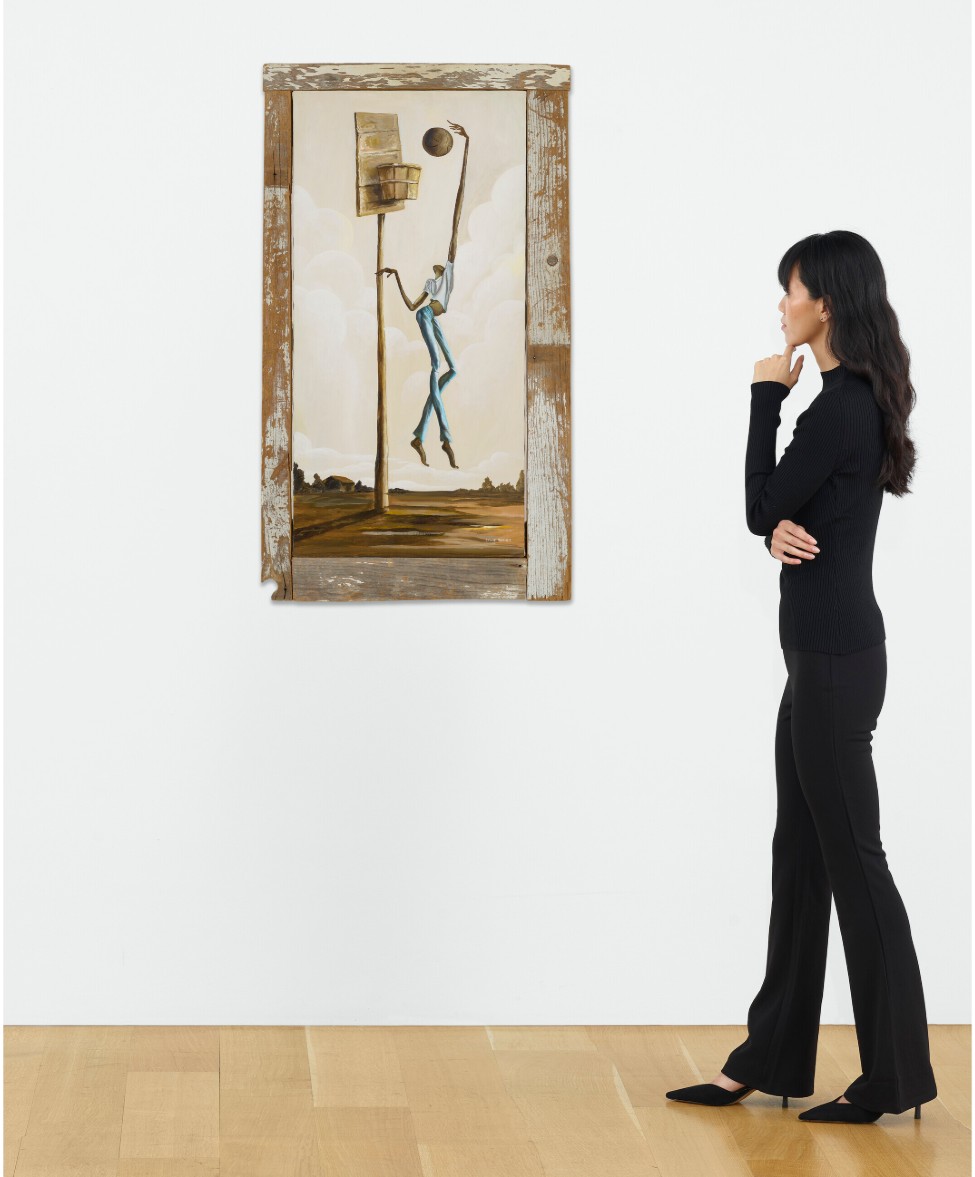
Rendered on a strikingly vertical canvas, One-On-None highlights Barnes’s ability to infuse his subjects with graceful motion and energy. Set against a background of billowing cumulus clouds, the hyper-elongated form of a barefoot man stretches upward nearly the entire length of the composition. Leaping gracefully upward, he tosses a basketball into a makeshift receptacle affixed to a rudimentary backboard. Wearing a simple white shirt and faded blue jeans, his legs cross in the air while his head tilts back to keep the ball in sight. Focused on an individual playing by himself, the work is a masterful study in figural composition and dynamic lighting. The unique construction might point toward the makeshift equipment that Barnes might have encountered in his youth in North Carolina. More likely though, the tall goal set against the bright sky is meant as a romanticized depiction of specific feelings rather than a given moment. The small house and few trees on the lowered horizon act to boost the upward momentum of the figure’s leap while hinting at a time period without giving specifics. Barnes was known for his studied abstractions of the human figure, and the signature stretching and extension of the limbs infused each scene with a willowy vitality for dramatic effect.
Born in Durham, North Carolina at the height of the Jim Crow era, Barnes was encouraged early on to study art history even though he was not allowed to visit the prominent museums because of segregation. Growing up, he built upon this interest to hone his creative skills while studying the works of artists like Michelangelo and Toulouse-Lautrec. Continuously sketching all the while, he managed to become the captain of his high school football team and was eventually drafted into the National Football League where he played for several franchises. His love of art never ceased, however, and he was actually fined several times for drawing during team meetings. When asked about the crossover between sports and his practice, Barnes noted, “For me, they were both integrating experiences. The disciplines of one are the disciplines of the other. I paid attention to how the body felt like in movement and my effort has been to translate that feeling onto paper or canvas.” (E. Barnes, quoted in: “Interview with Ernie Barnes,” The Soul Museum, August, 2006). Translating the stretch of muscles and the action of the body into paint, works like One-On-None typify Barnes’s sports paintings for which he was so revered.
Slam Before the Storm, 1979
Property of Richard Roundtree
Phillips New-York: 15 November 2022
Estimated: USD 300,000 – 400,000
USD 604,800
Ernie Barnes 20th Century & Contemporary Art Evening Sale
ERNIE BARNES
Slam Before the Storm, 1979
Acrylic on canvas in artist’s frame
48 3/8 x 24 5/8 inches (122.9 x 62.5 cm)
Signed “ERNIE BARNES” lower right
Stamped with the artist’s copyright stamp on the reverse
Ernie Barnes’ Slam Before the Storm comes from Richard Roundtree, the iconic actor best known for his role as John Shaft in the Shaft movie franchise. His breakout performance in the first Shaft film—a 1971 classic that defined the “Blaxploitation” genre—earned him a Golden Globe nomination. Roundtree was born in 1942 in New Rochelle, New York, and began his career as a model, having been discovered by Eunice W. Johnson, of the Johnson Publishing Company, which published Ebony and Jet magazines. Over his five decades as an actor, he has appeared in some 160 film and television projects—sharing the screen with actors including Clint Eastwood, Peter O’Toole, Laurence Olivier, Samuel L. Jackson, and Brad Pitt—and received numerous awards, such as an MTV Lifetime Achievement Award, a Peabody Award, and a Black Theater Alliance Lifetime Achievement Award.
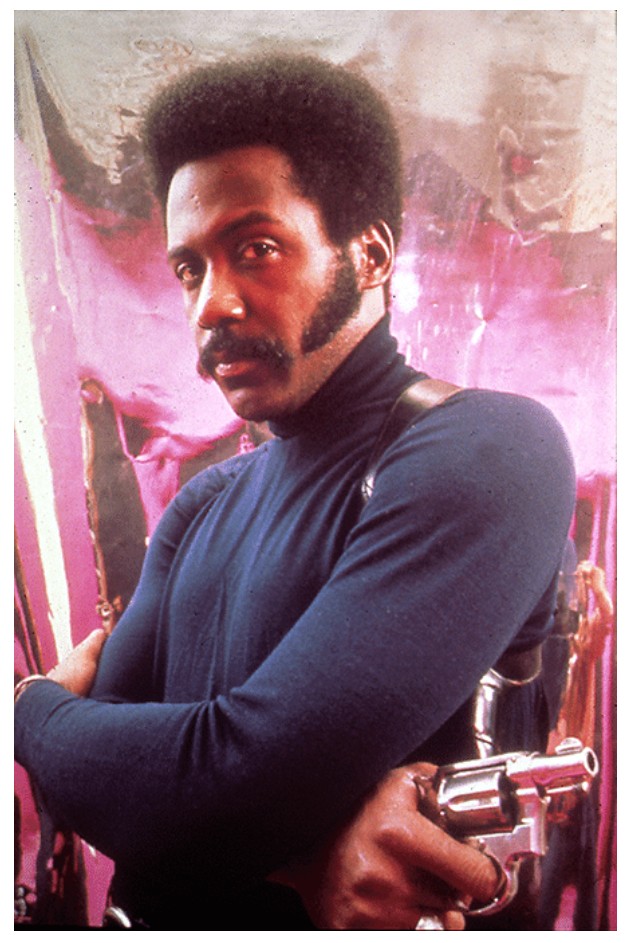
Richard Roundtree as Shaft, 1970. Image: Moviestore Collection Ltd / Alamy Stock Photo
Roundtree was familiar with Barnes’ football career in the 1960s and learned of his artistic practice when Sammy Davis Jr. and Charlton Heston purchased his works. He discovered that Barnes lived just four blocks away from him in Los Angeles and walked to his home to meet with him. He purchased the two fantastic Barnes paintings that Phillips is offering this season directly from the artist in 1981, and they have been in his possession ever since.
Slam Before the Storm is a glorious example of the neo-Mannerist sports-themed tableaux that serve as the backbone of Ernie Barnes’ body of work. The painting turns a neighborhood basketball game into a transcendent display of athletic prowess performed by figures whose elongated proportions enhance the almost balletic quality of the action.
The image’s dynamic style is characteristic of Barnes’ compositions. The artist—who died in 2009 and whose work has seen a surge of curatorial and collector interest in recent years—was a professional football player from 1960 to 1965, before devoting himself to art full-time. He noted that “being an athlete helped me to formulate an analysis of movement, and movement is what I wanted to capture on canvas more than anything else. I can’t stand a static canvas.”
“In the Black community, the athlete was respected as the finest embodiment of one’s African heritage. There were those convinced that the only way to heaven was with a football or a basketball.”
The action in Barnes’ works ranges from lively and exuberant (as in his famous Sugar Shack, 1976, which depicts the scene inside a Black dance hall) to violent and ruthless, with these qualities often combining in his sports paintings—a reflection, perhaps, of his conflicted feelings about athletics. Although playing football had offered Barnes a path to worldly success from his humble beginnings in a Black area of segregated Durham, North Carolina, known as the Bottoms, he resented the game’s brutality and the way it kept him from pursuing his artistic calling.
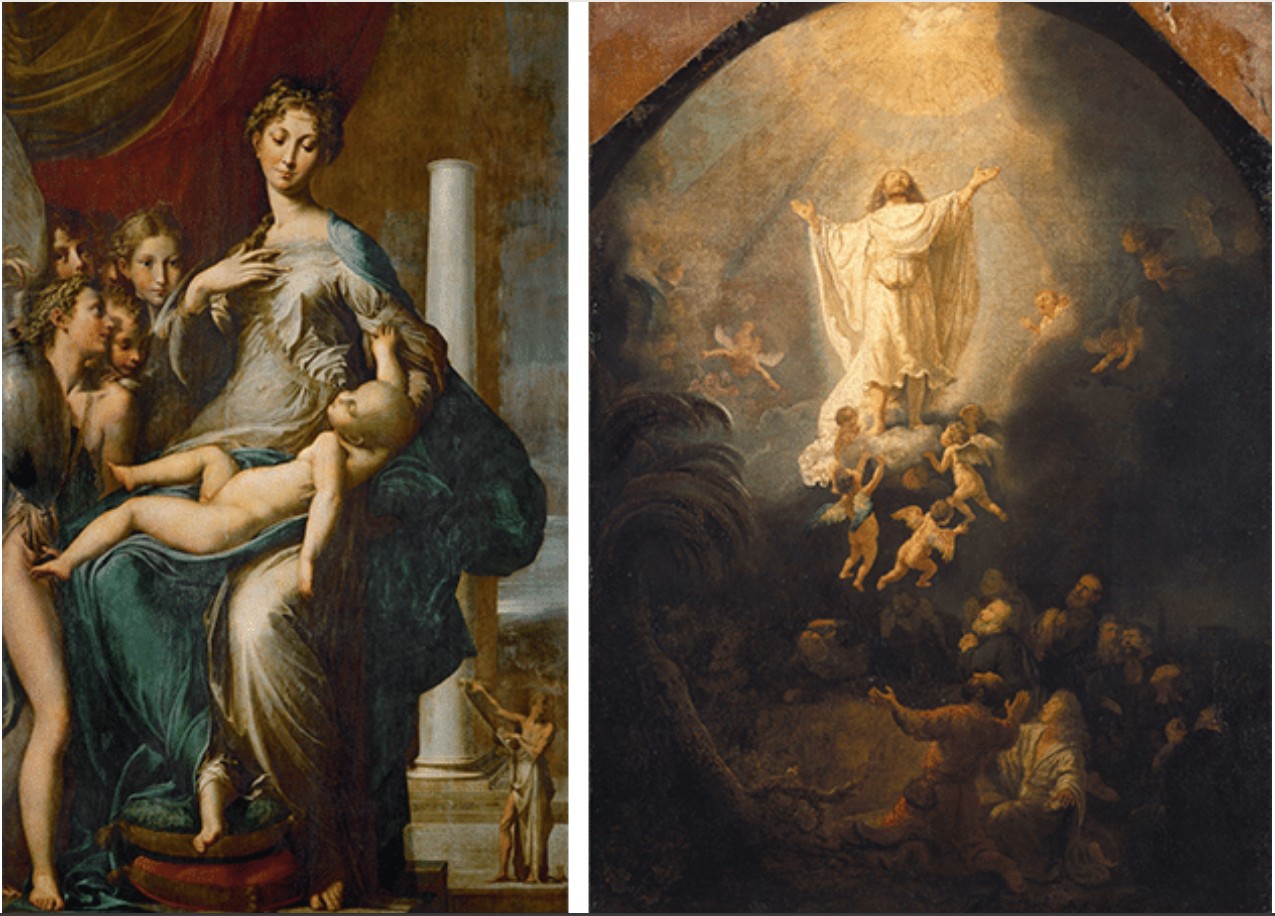
[left] Parmigianino, Madonna with the Long Neck, 1534–1540, Uffizi Gallery, Florence. Image: Erich Lessing / Art Resource, NY
[right] Rembrandt, The Ascension of Christ, 1636, Alte Pinakothek, Munich. Image: bpk Bildagentur/Alte Pinakothek / Art Resource, NY
This ambivalence provided the great artistic tension in Barnes’ work. Slam Before the Storm, with its backdrop of brooding skies and its intricate layout of contorting figures, has all the drama of Mannerist and Baroque religious paintings. The game takes place in a dusty, desolate landscape, and the ball, positioned at the brightest point in the sky, reads as either a haloed icon or an earthly object blocking the light. One of the players holds an impossibly effortless stance midair that suggests the ascension of Christ. Indeed, he seems disengaged from the game, his right hand shooting up to the heavens. With such paintings, which redress the lack of Black representation in Western art history by recasting canonical imagery with Black protagonists, Barnes serves as a precursor to Contemporary artists such as Kerry James Marshall and Kehinde Wiley.
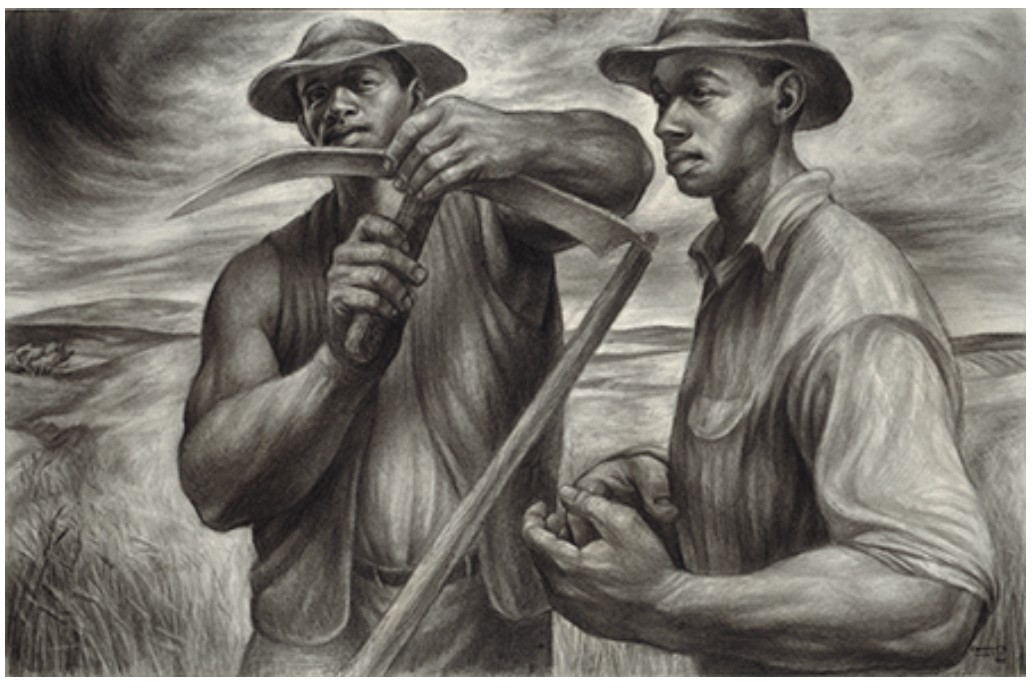
Charles White, Harvest Talk, 1953, The Art Institute of Chicago.
Image: The Art Institute of Chicago / Art Resource, NY, Artwork: © The Charles White Archives
Coming of age in the 1960s and 1970s, Barnes did not identify with the abstract styles that prevailed in the art world at the time. In his 1995 autobiography, From Pads to Palette, he wrote that he found such work to be “cold” and described an artistic awakening he had when looking at a portfolio of Charles White’s drawings in a Harlem bookstore in 1960.² He explained that this was the first time he encountered artwork “reflecting Black lifestyle” and that he believed that “this was what art should be about; expressing the confidence, the pride and hopes of people committed to the struggle for human dignity.”³ It was a noble view, and one that places Barnes in an important artistic lineage that continues to flourish today, when painters including Marshall, Henry Taylor, Jordan Casteel, and Amy Sherald have reinvigorated figurative traditions to produce powerful expressions of Black experience.
Pool Halls
Easy Shot, 1971
Property from the Estate of Saul and Shirley Turteltaub, Beverly Hills, California
Heritage Auctions: 14 November 2025
Estimated: USD 150,000 – 250,000
USD 225,000
Ernie Barnes (American, 1938-2009). Easy Shot, 1971. Oil on canvas. | Lot #67038 | Heritage Auctions
ERNIE BARNES (American, 1938-2009)
Easy Shot, 1971
Oil on canvas
24×48 inches (61.0 x 121.9 cm)
Signed lower right: Ernie Barnes
Ernie Barnes’s Easy Shot is a masterful meditation on movement, community, and the visual rhythm of everyday life. Set within the soft haze of a 1970s Southern pool hall, the painting transforms an ordinary pastime into a tableau of grace and psychological tension. Enlivened with Barnes’s signature neo-mannerist style-distinguished by elongated limbs and emotionally charged figuration-the work hums with energy and atmosphere. It is a portrait not merely of a game in progress, but of human connection, ritual, and quiet pride, rendered with the dignity and dynamism that define Barnes’s visions of American life.
Born in 1938 in Durham, North Carolina, at the height of the Jim Crow era, Barnes’s formative years unfolded in “The Bottom,” an economically marginalized neighborhood shaped by segregation. His father, Ernest Barnes Sr., worked as a shipping clerk for Liggett & Myers Tobacco Company, while his mother, Fannie Geer, served as head housekeeper for a local attorney. It was through her employer’s art books and catalogs that Barnes encountered the works of Old Masters whose muscular compositions and spiritual intensity left a lifelong imprint. Yet, his own subjects would not be mythological or aristocratic; they would be the men and women of his own community, observed through a lens of grace, strength, and humanity.
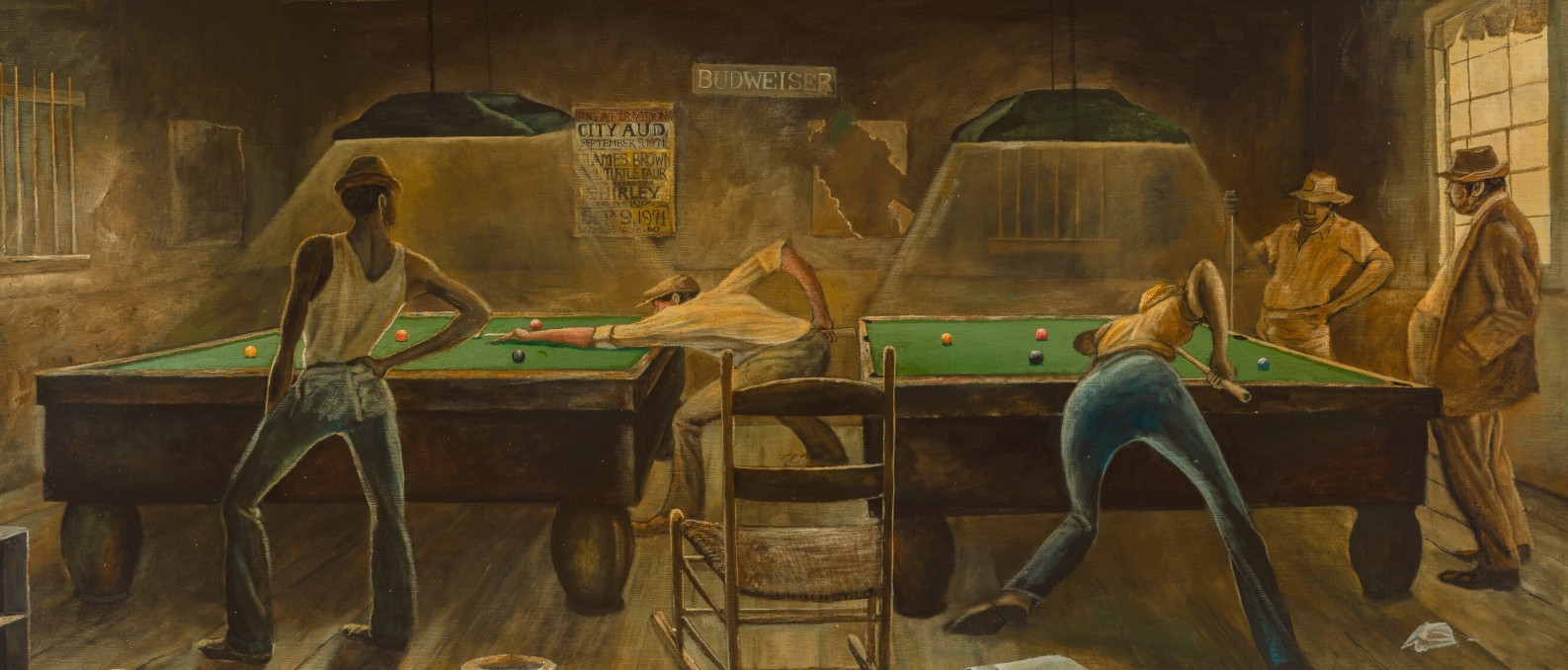
Before fully devoting himself to painting, Barnes played professional football in the National Football League, a background that proved formative to his artistic vision. “Being an athlete helped me to formulate an analysis of movement,” he once said. “Movement is what I wanted to capture on canvas more than anything else; I can’t stand a static canvas” (This Is My Art, YouTube, July 28, 2011). The present work’s commissioner, Saul Turteltaub, an acclaimed television producer and comedy writer whose name appears in the composition on a poster affixed to the far wall, likely met Barnes through his Hollywood connections. These ties were made most evident when the artist’s iconic painting The Sugar Shack appeared in the end credits of the groundbreaking sitcom Good Times in 1976.
At the center of Easy Shot, two pool tables stretch into the room’s depths, aligned side-by-side like twin stages of a performance. The players lean, reach, and extend in calculated balance, their bodies taut with concentration, capturing that breath-held instant before cue meets ball. Above them, hanging lamps diffuse a hazy light that saturates the tables’ green felt surface and traces the leftmost onlooker with an ethereal glow. A wicker rocking chair positioned at the composition’s center, sits empty and ignored-an emblem of stillness amid motion. The setting’s smoke-stained walls, low ceiling, and tattered posters situate the scene firmly within the lived environment of working-class Black America, evoking a communal rhythm that feels at once deeply particular and universally human.
Within its modest setting, Barnes captures something far greater than a pastime: the delicate balance between competition and companionship, individuality and community, labor and leisure. The subjects in Easy Shot are not simply players of a game; they are practitioners of a meditative ritual. Each cue stroke becomes an assertion of focus and control, while the soft, diffused light acquires a near-sacramental quality, transfiguring the quotidian into the spiritual. The pool hall becomes a stage for grace and poise, a place where physical gesture carries emotional and cultural weight.
Main Street Pool Hall, 1978
FRAGMENTS OF LIFE:
WORKS BY ERNIE BARNES FROM THE COLLECTION OF DANNY AND DONNA ARNOLD
Christie’s London: 28 June 2022
Estimated: GBP 80,000 – 120,000
GBP 1,482,000 / USD 1,808,765
ERNIE BARNES (1938-2009), Main Street Pool Hall | Christie’s
ERNIE BARNES (1938-2009)
Main Street Pool Hall, 1978
Oil on canvas
23 3/4 x 48 inches (60.3 x 121.9 cm)
Signed twice ‘ERNIE BARNES’ (lower right)
Offered from the outstanding collection of Danny and Donna Arnold, the present work is a thrilling depiction of one of Ernie Barnes’ most significant subjects: the pool hall. Arnold—the celebrated Hollywood producer—and his wife were friends with the artist, and acquired the present work directly from him shortly after its completion. Painted in 1978, two years after Barnes’ iconic The Sugar Shack, the work crackles with expectation. A crowd watches solemnly as a game of pool unfolds beneath a single incandescent lamp. In the centre of a large, airless room, a slender figure in bright red trousers takes aim as nearby spectators lean forward in anticipation of the coming shot. Painted in Barnes’ signature neo-Mannerist style, with its distinctive elongated figures and atmospheric mise-en-scène, the work demonstrates his poignant observations of black communities at a critical point in American history. Combining subtle social commentary with electrifying psychological tension, it is a scintillating snapshot of human experience, frozen in a moment of stillness before the fate of the game is decided.
Recently celebrated in a major retrospective at the California African American Museum, Barnes grew up in Durham, North Carolina during the Jim Crow era. Although he loved art, segregation laws prohibited him from entering the city’s museums. Instead, he pursued his interest through books and, by the time he entered school, he was familiar with artists ranging from Michelangelo to Delacroix and Toulouse-Lautrec. Barnes later attended North Carolina Central University, where he studied art, and continued to pursue painting after embarking a successful career as a footballer. When an injury in 1965 put an end to his sporting days, Barnes turned to art full time, and—with the support of Sonny Werblin, the owner of the New York Jets—opened a sell-out debut exhibition in 1966. By the time of Main Street Pool Hall, Barnes was producing works that would come to define his oeuvre. The Sugar Shack’s sister painting, also created in 1976, became a cultural icon, featuring on the cover of Marvin Gaye’s fourteenth studio album I Want You and subsequently for four years as the backdrop for the credits in the pioneering 1970s African American sitcom Good Times. Other musicians, from The Crusaders to B. B. King, would also feature Barnes’ artworks on their records.
The present work captures the crucial shift that took place in Barnes’ practice after he moved to Los Angeles in the early 1970s. Living in the Fairfax District, a predominantly Jewish neighbourhood, prompted him to reflect upon ideas about community—particularly in relation to his own upbringing. ‘Fairfax enlivened me to everyday life themes,’ he explained, ‘and forced me to look at my life—the way I had grown up, the customs within my community versus the customs in the Jewish community. Theirs were documented, ours were not. Because we were so clueless that our own culture had value and because of the phrase “Black is Beautiful” had just come into fashion, Black people were just starting to appreciate themselves as a people’ (E. Barnes, quoted at https://www.opendurham.org/buildings/ernie-barnes-house). In 1972, in response to this realisation, Barnes launched an exhibition of 35 paintings entitled Beauty of the Ghetto, which toured museums across America for the next seven years. His depictions of pool players and dance halls take their place within this context, capturing moments of quotidian congregation imbued with complex layers of narrative and emotion. Interestingly, the posters depicted on the wall of the present work contain nods to Barnes’ own autobiography, including the name of his alma mater Hillside High, as well as a tribute to Danny Arnold himself.
Barnes frequently took sports as his subject, painting everything from hockey and gymnastics to basketball and boxing: in 1984 he became the official Sports Artist of the Olympic Games in Los Angeles. While his depictions of pool halls certainly relate to this strand of his practice, the present work is more specifically a social study. Although ostensibly underpinned by a spectator-participant dynamic, a deeper political commentary simmers below its surface, revealing the enduring influence of the Jim Crow era on the artist. Isolated and hidden from view, his pool players disclose much about the nature of exclusion, autonomy and community. Many have their backs turned to the viewer; others are obscured by the screen of rising smoke. For Barnes, this lack of visibility was intentional: ‘I feel that we are blind to one another’s humanity’, he said (E. Barnes, interview with CNN, 1990). Here, collectively poised on the knife-edge between triumph and loss, the figures quietly harbour a story with more to be told.
Football
Sandlot Saints, 1983
Heritage Auctions: 16 May 2025
Estimated: USD 300,000 – 500,000
USD 450,000
ERNIE BARNES (American, 1938-2009)
Sandlot Saints, 1983
Acrylic on canvas
36×60 inches (91.4 x 152.4 cm)
Signed lower right: Ernie Barnes
Ernie Barnes’s Sandlot Saints is a vibrant and evocative homage to the spirited community rituals of the American South, athletic tradition, and the cultural heartbeat of New Orleans. Executed in Barnes’s distinctive neo-mannerist style-characterized by elongated forms, dynamic motion, and emotionally charged figuration-the painting captures a moment suspended between everyday activity and sacred communal expression. More than merely depicting a football game, Barnes transforms the scene into a tableau rich with memory, pride, and collective identity, articulated through his unmistakably expressive visual language.
Born in 1938 in Durham, North Carolina, at the height of the Jim Crow era, Barnes’s formative years were shaped by segregation in the economically marginalized neighborhood known as “The Bottom.” His father, Ernest Barnes Sr., worked as a shipping clerk for Liggett & Myers Tobacco Company, while his mother, Fannie Geer, served as head housekeeper for a local attorney. It was through her employer-who generously shared his extensive collection of art books and catalogs-that Barnes first encountered the visual arts, as entry to museums had often denied him due to racial barriers.
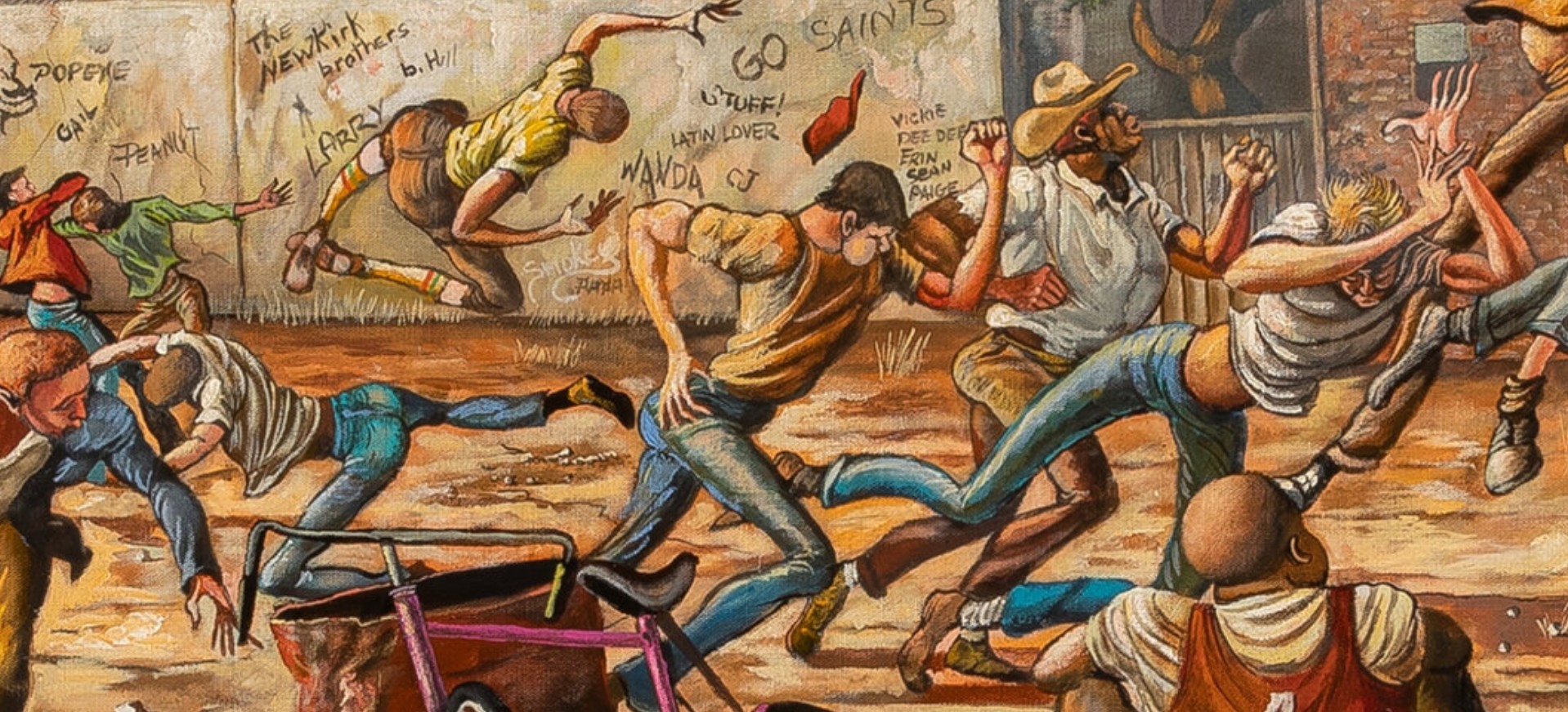
Sandlot Saints embodies Barnes’s personal history as both an athlete and an acute observer of American culture. Set in a vacant New Orleans lot situated between a towering football stadium and a rusting overpass, the painting vividly portrays a local community engaged in their own spirited match-played, perhaps literally, in the shadow of the Saints’ official games. Here, however, the spotlight firmly belongs to local players, who twist, dive, and sprint across the canvas. Barnes’s distinctive elongation of forms imbues the figures with a kinetic energy reminiscent of both mannerist compositions and cinematic choreography, creating a rhythmic visual narrative that energizes the entire composition.
Surrounding the action is a richly textured and diverse community, grounded firmly in the urban vernacular. Spectators lean casually against fences, perch atop discarded bricks, or lounge on a worn green couch as the game unfolds around them. The walls of the sandlot, adorned with neighborhood graffiti and slogans such as “Go Saints,” anchor the work firmly in the lived realities of city life. Significantly, the crowd itself reflects a diverse gathering of races and ages, reinforcing Barnes’s deliberate portrayal of an America that is more integrated and hopeful than the one into which he was born. While widely recognized through prestigious commissions from the NFL, NBA, and various national institutions, Barnes’s vision finds perhaps its clearest articulation in works like Sandlot Saints, where a local game is elevated to the status of a cultural monument, capturing an experience at once deeply personal and universally resonant.
Reflecting on the profound relationship between sport and his artistic practice, Barnes remarked, “Being an athlete helped me to formulate an analysis of movement, and movement is what I wanted to capture on canvas more than anything else; I can’t stand a static canvas” (the artist in: Ernie Barnes: This Is My Art, YouTube, July 28, 2011). Athletes and artists alike share this profound connection, an intrinsic understanding of physicality and performative translation essential to their respective crafts. Barnes’s portrayal of elongated, mannerist forms, drawn from his experiences illustrating teammates, dancers, and musicians from Durham, reveals a deeper awareness that extends beyond mere representation, capturing the emotional essence, intensity, and spirit of his subjects.
Throughout Sandlot Saints, as in much of his oeuvre, Barnes employs closed eyes as a definitive and iconic motif, symbolizing “how blind we are to one another’s humanity.” Barnes further explained, “We stop at color quite often…We look upon each other and decide immediately: This person is Black, so he must be … This person lives in poverty, so he must be …” (the artist in: Kareem Abdul-Jabbar, ‘How Athlete-Artist Ernie Barnes Captured Black Culture’s “Joy and Communal Dignity”‘, hollywoodreporter.com, May 10, 2019). By depicting his subjects with eyes closed, Barnes powerfully emphasizes the subjective experience and inner life of individuals, transcending superficial judgments to emphasize more profound humanity.
Barnes thus positions the expressive body as the central locus of his artistic inquiry, physically embodying the nuanced humanity he sought to depict. In Sandlot Saints, the bodies in motion surpass mere representation, becoming expressive abstractions in a liminal, mesmerizing space. Rather than offering mere body language for interpretative decoding, Barnes elevates his subjects’ movements into a pure kinesthetic experience, transcending rational interpretation to capture something profoundly felt and universally understood. Through this artistic transformation, Barnes not only documents but celebrates the inherent dignity, joy, and communal spirit of American life.
Hold the Pocket, 1982
Masterworks of Sport and Spirit: Property from the Collection of John W. Mecom Jr.
Heritage Auctions: 16 May 2025
Estimated: USD 250,000 – 350,000
USD 203,125
Ernie Barnes (American, 1938-2009). Hold the Pocket, 1982. Acrylic | Lot #68010 | Heritage Auctions
ERNIE BARNES (American, 1938-2009)
Hold the Pocket, 1982
Acrylic on canvas
36×60 inches (91.4 x 152.4 cm)
Signed lower right: Ernie Barnes
Ernest “Ernie” Barnes, Jr. was a singular figure in American art and culture-a professional NFL player turned painter whose work uniquely bridged athleticism and aesthetics. Born in segregated Durham, North Carolina, Barnes was drawn to art from an early age, inspired by Delacroix, Michelangelo, and Toulouse-Lautrec. Rarely without a sketchbook, he sketched in classrooms and on the sidelines, his early creative instincts developing alongside his physical discipline on the football field. Athletic prowess became his gateway: he earned a scholarship to North Carolina College at Durham (now NCCU) in 1956, where he majored in art and studied under Ed Wilson, who encouraged him to merge his identities as athlete and artist.
Barnes was drafted into the NFL by the Baltimore Colts in 1960 and went on to play for the San Diego Chargers and Denver Broncos. During his professional career-culminating in 1965-he continued to draw, often sketching his teammates in the locker room, documenting the fluid power and tension of the athlete’s body. His teammates nicknamed him “Big Rembrandt,” and in a testament to his dual mastery, Barnes was later appointed the NFL’s official painter. Far from viewing his athletic career as separate from his artistic one, Barnes saw sport as central to his practice.
“Being an athlete helped me to formulate an analysis of movement, and movement is what I wanted to capture on canvas more than anything else; I can’t stand a static canvas.”
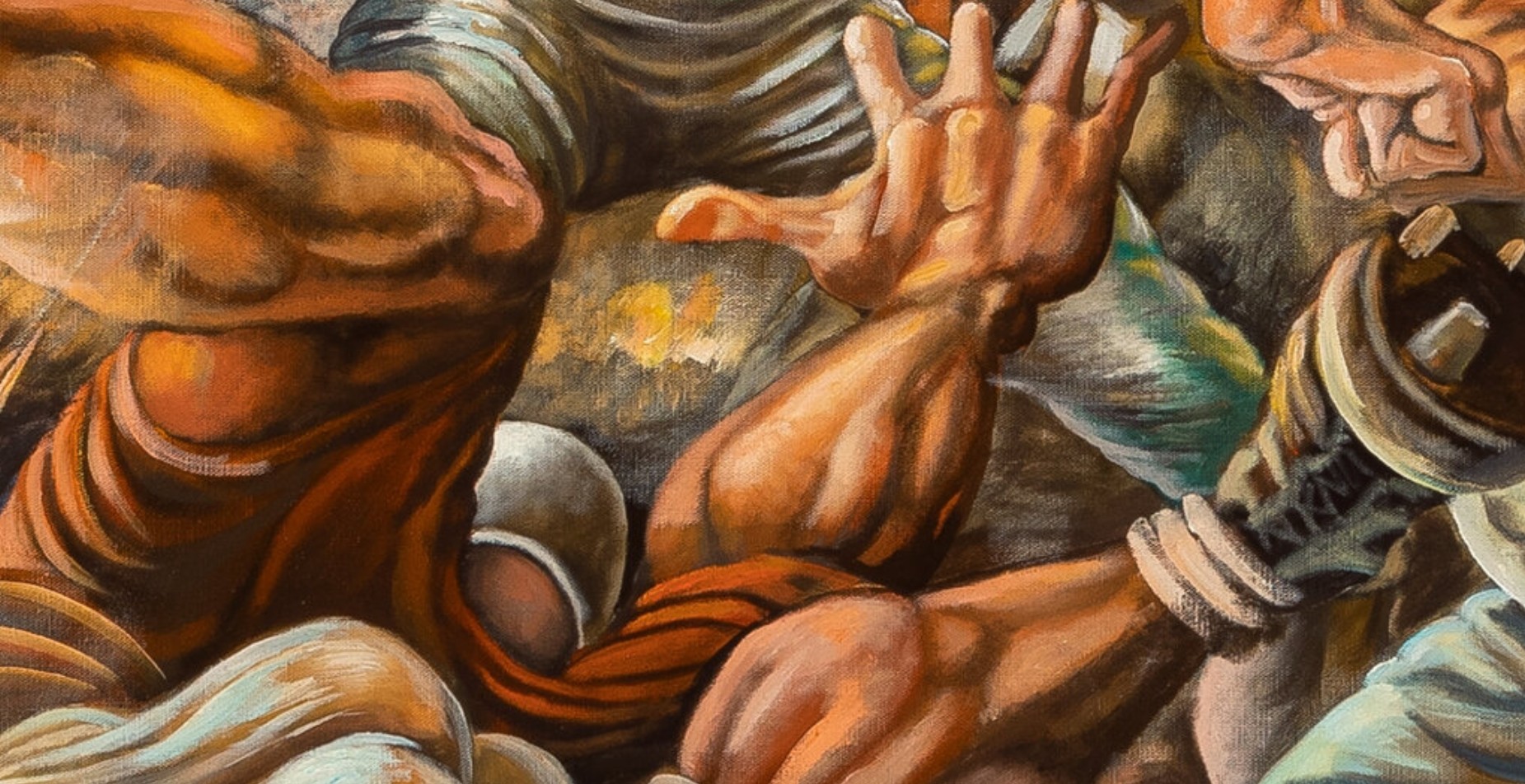
His work, which he termed “neo-mannerist,” is defined by elongated forms and dynamic compositions that emphasize rhythm, physicality, and emotional intensity. In Hold the Pocket, Barnes invites the viewer into the frenzied immediacy of the gridiron. Bodies clash and entwine in an almost sculptural knot, their limbs indistinguishable, their expressions taut with effort. The players’ uniforms shift from modern jerseys to classical drapery, and the columns rising in the background lend the painting the gravitas of a Roman arena. In likening football players to gladiators, Barnes underscores both the spectacle and sacrifice embedded in American sport.
The figures’ exaggerated proportions reflect not only physical strain but emotional resonance. Barnes’s interest was never in static realism, but in the lived experience of the body in motion-whether on a football field, a dance floor, or in the streets of his native Durham. His canvases convey more than action; they capture atmosphere, soul, and struggle. In Hold the Pocket, Barnes collapses the divide between artist and athlete, participant and observer, offering a vision of Black athleticism as heroic, beautiful, and unflinchingly honest.
The Vanishing Breed, 1972
Phillips New-York: 15 November 2023
Estimated: USD 350,000 – 500,000
USD 406,400
Ernie Barnes 20th Century & Contemporary Art Day Sale, Morning Session
ERNIE BARNES
The Vanishing Breed, 1972
Oil on canvas
48×60 inches (121.9 x 152.4 cm)
Signed “ERNIE BARNES” lower right
Ernie Barnes’ The Vanishing Breed, 1972, presents a jumble of bodies—helmets, muscles and limbs—intertwined and struggling to get hold of the football, hidden in shadow in the center of the composition. Set against a foreboding sky in the background, the present work highlights the drama for which the artist is well-known, recalling the work of Old Masters like Michelangelo and Peter Paul Rubens, while translating it to a distinct 20th century moment. The largest work by the artist to come to auction to date, the five-foot-long painting celebrates the beauty of a routine game of football, elevating the quintessential symbol of America.
“[They] told me to pay attention to what my body felt like in movement. Within that elongation, there’s a feeling. And attitude and expression. I hate to think had I not played sports what my work would look like.”
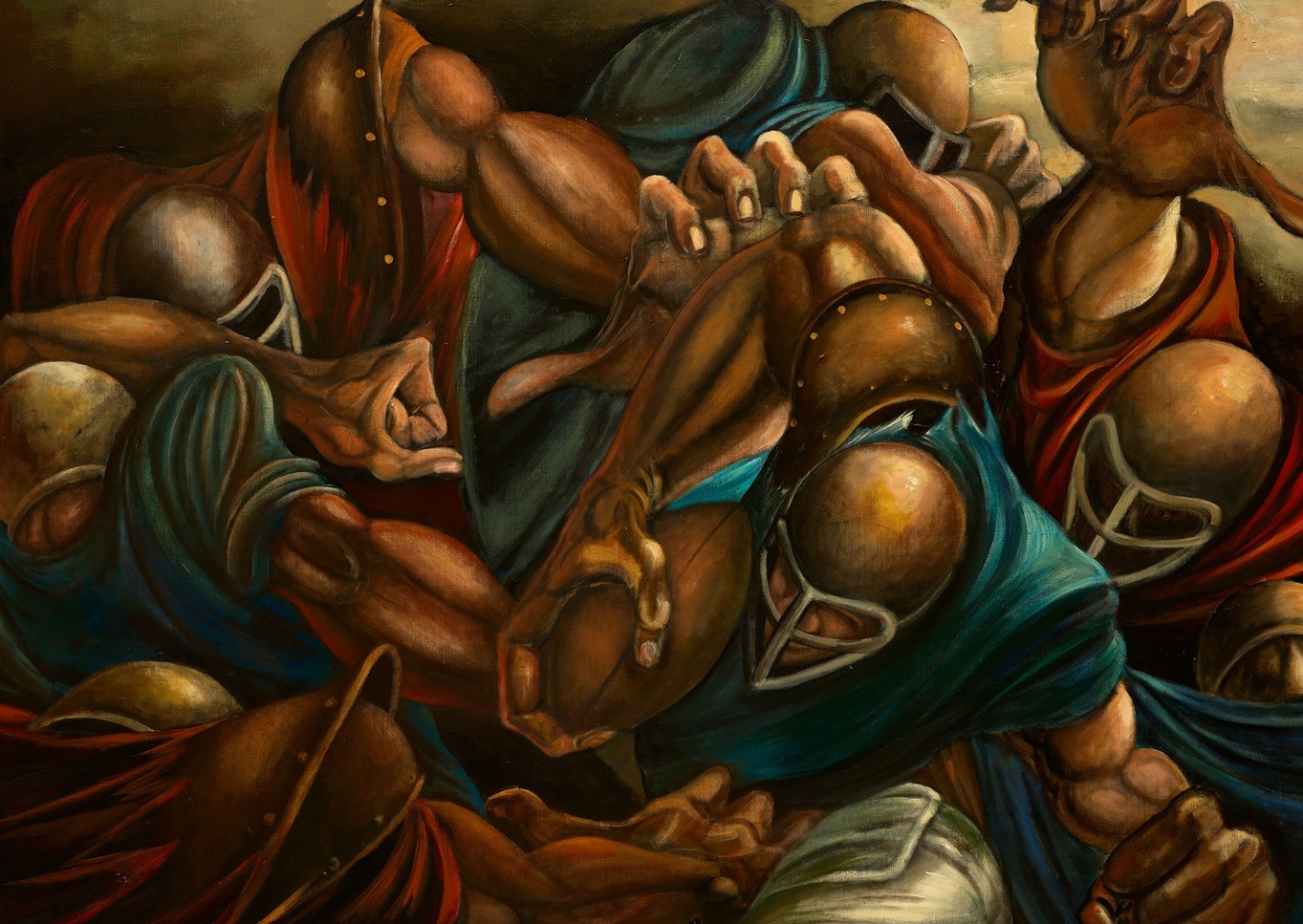
Throughout his practice, Barnes celebrated the mundane: “he always painted everyday people; it’s a style of painting he became known for, and this became a relatable painting to African Americans.”i Growing up in the South during the Jim Crow era, Barnes was unable to visit art museums and had to educate himself through books on the works of Henri de Toulouse-Lautrec, Eugène Delacroix and Peter Paul Rubens – all artists who only depicted European subjects and culture. First exposed to art illustrating Black figures in the drawings of Charles White, Barnes was inspired by White’s soft realism used to depict those of his own race, striving to create works which are accessible to everyone and celebratory of African American culture.
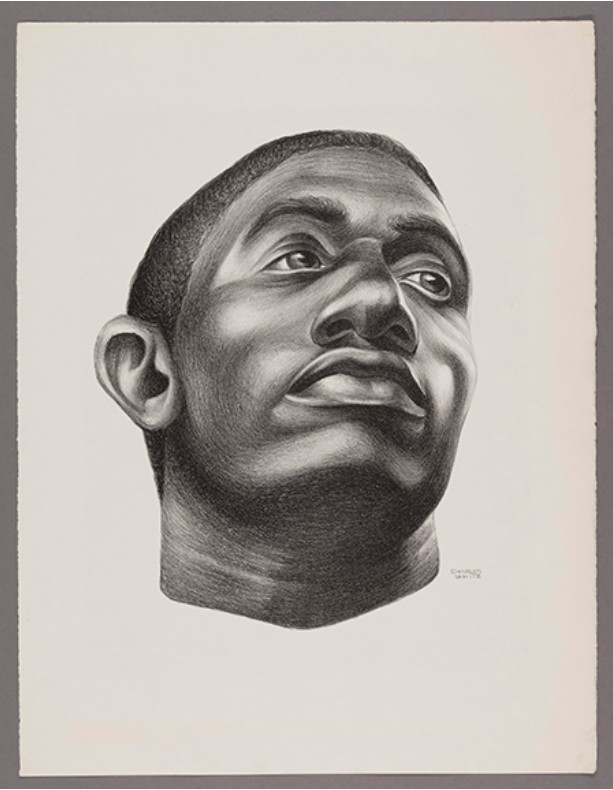
Charles White, Gideon, 1951. The Art Institute of Chicago.
Image: The Art Institute of Chicago / Art Resource, NY, Artwork: © The Charles White Archives
Playing football in high school and college and eventually going on to play professionally, Barnes retired from the National Football League in 1965 after five seasons. Through his time on NFL teams including the San Diego Chargers, Denver Broncos and the Baltimore Colts, Barnes became acquainted with the bones and musculature of the human body through sport, translating his understanding of anatomy into his paintings. This attention to detail in The Vanishing Breed allows for the painting to completely engulf the viewers, positioning them as if they are taking part in the brawl before them. The forward motion of the figure holding the football makes it seem as though the figures are charging towards us, and the clawed hand at the upper right seems to jump off the canvas. Indeed, Fourth and One essentially gives the viewer a jersey, asking them to take part in the action before them.
“In the Black community, the athlete was respected as the finest embodiment of one’s African heritage. There were those convinced that the only way to heave was with a football or basketball.”
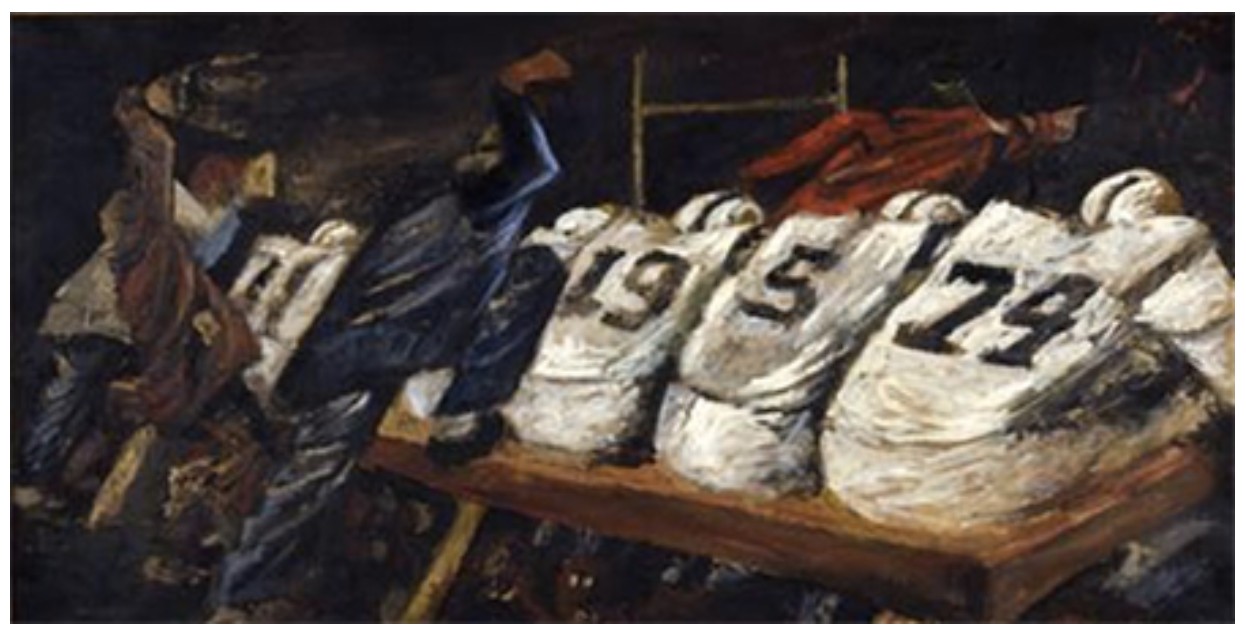
Ernie Barnes, The Bench, 1959. The Pro Football Hall of Fame. Artwork: © Ernie Barnes Family Trust
A favored subject in the artist’s oeuvre, football is depicted in some of Barnes’ most famous artworks, including The Bench, 1959, housed in the Pro Football Hall of Fame’s collection, dedicated by his widow, Bernie, in 2014, on the occasion of the exhibition From Pads to Palette, Celebrating the Art of Ernie Barnes. Notably chosen for inclusion in his autobiography, From Pads to Palette, the present work is indicative of the artist’s close connections to the sport, and further an example of the connections between artist and athlete of which Barnes is well known. Barnes was named the “Sports Artist of the 1984 Olympic Games” by the Los Angeles Olympic Organizing Committee, creating five paintings for the games and continuing his connections to athletics, both on and off the football field.
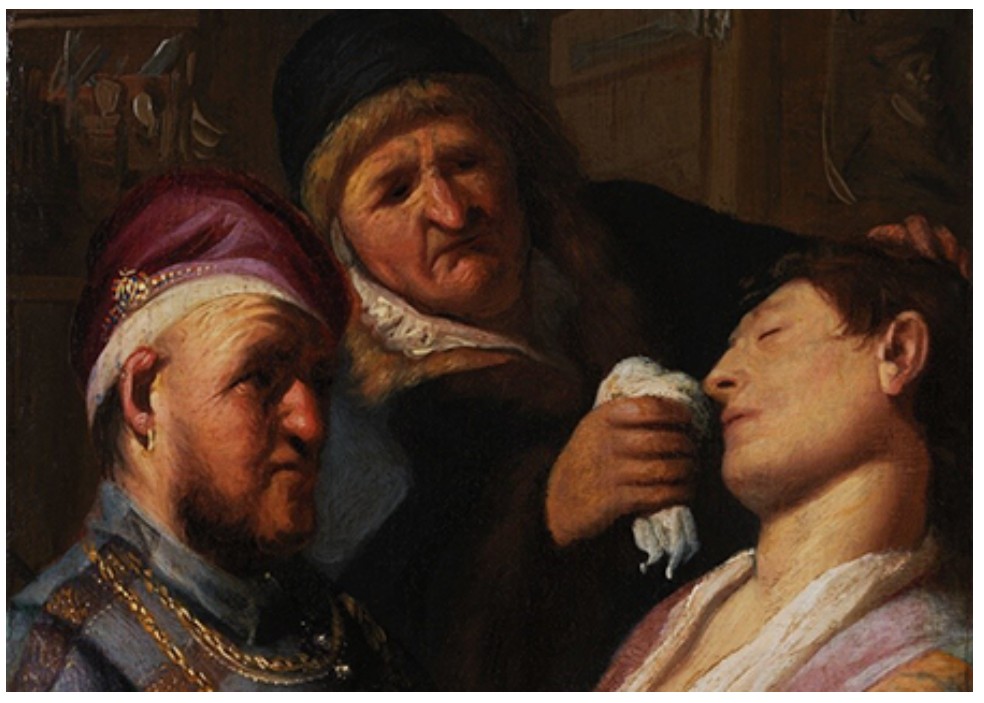
Rembrandt van Rijn, Allegory of the Sense of Smell (detail), circa 1624–1625. The Leiden Collection, New York
Using chiaroscuro to carefully illuminate his subjects in highlights and shadow, the exaggerated limbs reminiscent of Mannerist and Baroque styles are given a new life in The Vanishing Breed. Called “Big Rembrandt” by his teammates, Barnes self-described his style as “Neo-Mannerist,” characterized by elongated figures which “like Michelangelo’s, derive their power from portraying the convolutions of the soul through the contortions of movement.” Using this contortion to his advantage, the present work illustrates the competitive emotions of the footballers. Though obscuring their faces with helmets and hiding their eyes, as is typical of the artist’s subjects, the energy of the players is almost tactile. This psychophysical connection is reflective of Barnes’ similarities to the Old Master portrait painters, such as Rembrandt. Favoring the depiction of human nature over abstraction, as was being created by his contemporaries, Barnes worked to recontextualize the art historical canon by including and celebrating Black figures, previously excluded from the narrative.
Early Paintings
Human Celebration, circa 1960s
Phillips New-York: 15 May 2024
Estimated: USD 150,000 – 250,000
USD 292,100
Ernie Barnes Modern & Contemporary Art Day Sale, Morning Session
ERNIE BARNES
Human Celebration, circa 1960s
Acrylic on canvas
24 1/8 x 35 7/8 inches (61.3 x 91.1 cm)
Signed “ERNIE BARNES” lower right
In Ernie Barnes’ Human Celebration, an early career work executed in the 1960s, we find ourselves witness to a festivity of thirteen revelers moving in joyous rhythm – their eyes closed, heads thrown back, and mouths open, the group shares in the propulsive beat of unheard melodies. Painted in rich earthy tones with pops of reds, blues and yellows, Human Celebration gives visual testimony to Barnes’ talent for depicting pure, physical, and primal pleasure of dance. Dance halls are one of Barnes’ most well-known subjects, and Human Celebration elevates this scene to new heights as it concentrates on the beauty of the human figure through an energetic display of movement.
The figures in Human Celebration appear to be rejoicing in their bodies – relishing the very human abilities to sing, dance, and express emotions freely. Whether we look to the woman in a red dress, knees bent in a spirited dance move, or the man perched upon a tabletop, crooning into a microphone, each expressive figure in Human Celebration transcends beyond the static canvas and reaches the epitome of jubilation.
“Being an athlete helped me to formulate an analysis of movement. Movement is what I wanted to capture on canvas more than anything else. I can’t stand a static canvas.”
Barnes’ depictions of dance halls were inspired by his childhood memory of sneaking into a local Black dance club, the Armory, in segregated North Carolina – experiencing what Barnes called the “sins of dance” for the first time.i His dance halls are most famously seen in The Sugar Shack, 1976, which was both selected as the cover art for Marvin Gaye’s album from the same year, “I Want You,” and used in the end credits of the groundbreaking sitcom “Good Times.” Human Celebration captures the same dynamism and sense of soul that makes The Sugar Shack so iconic. As Barnes has described, “The painting transmits rhythm, so the experience is re-created in the person viewing it.”ii The rhythm of Human Celebration can still be felt some sixty years later, inviting the viewer to partake in the festivity as well.
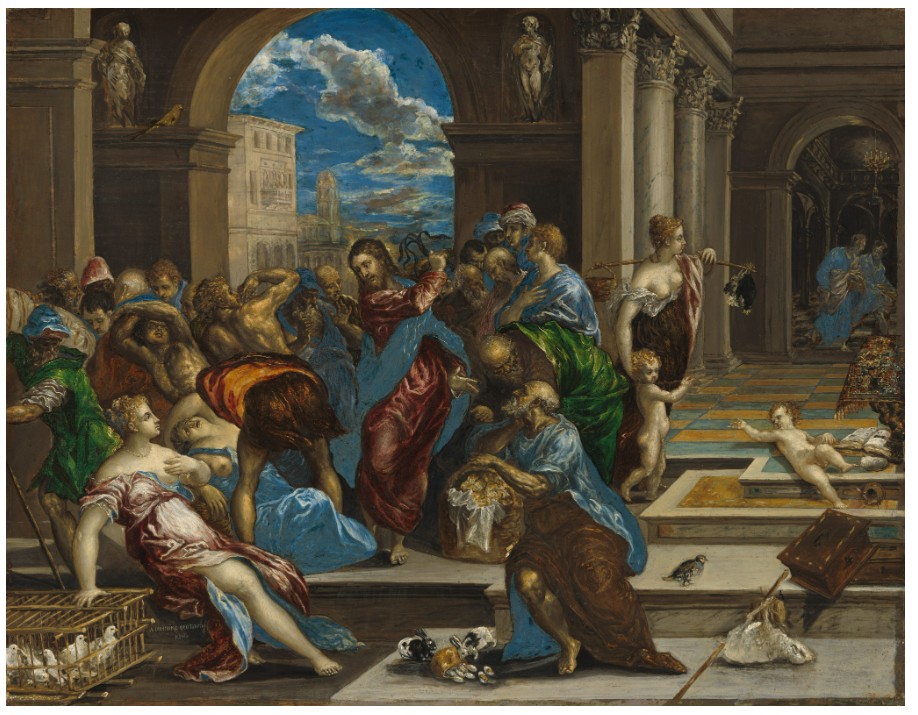
El Greco, Christ Cleaning the Temple, before 1570, National Gallery of Art, Washington, D.C. Image: National Gallery of Art, Washington, D.C., Samuel H. Kress Collection, 1957.14.4
Barnes played five seasons in the American Football League before concentrating on painting full-time from the mid-1960s onward and the ways in which his practice is deeply informed by his athletic background is visible in his use of sinuous figures and elongated limbs. Rendered in his signature neo-Mannerist style, and drawing upon his firsthand understanding of how the body moves and operates, we see in Barnes’ work echoes of El Greco’s elongated twisted forms, and Thomas Hart Benton’s scenes of everyday life in the United States. Barnes’ sculpted, fluid figures and fascination with familiar American settings such as the football field, pool table, or dance hall, make his works ever relevant and compelling.
Hustlers, 1969
Phillips New-York: 16 May 2023
Estimated: USD 70,000 – 100,000
USD 254,000
Ernie Barnes 20th Century & Contemporary Art Day Sale, Morning Session
ERNIE BARNES
Hustlers, 1969
Acrylic on canvas, in artist’s frame
28 x 32 5/8 inches (71.1 x 82.9 cm)
Signed “ERNIE BARNES” lower right
Titled and dated “Hustlers 1969” on the stretcher
Ernie Barnes’s Hustlers from 1969 is a masterful example of the artist’s signature style, depicting elongated figures engaging in a game of pool. Coming of age in North Carolina during the Jim Crow era, much of Barnes’s creative output reflects his experience as a young football player turned artist.
“Being an athlete helped me to formulate an analysis of movement, and movement is what I wanted to capture on canvas more than anything else. I can’t stand a static canvas.”
Attending college on a football scholarship and later playing in the NFL, Barnes’s experiences on the field informed his painterly practice. Having become well acquainted with the “bones and muscles, the synapses and ganglia of the nervous system and how they regulate movement” in sport, he began to experiment “with the limits imposed by the body’s musculature” in his art. This is evident especially in the present work, using elongated forms and the interplays of light and shadow to accentuate the nuances of movement within the human body. In this way, Hustlers reflects a deep connection to and understanding of anatomy that Barnes became so well-known for. This detailed, elongated style, which the artist self-referred to as “Neo-Mannerist,” became a hallmark of Barnes’s paintings and a defining characteristic of his works.
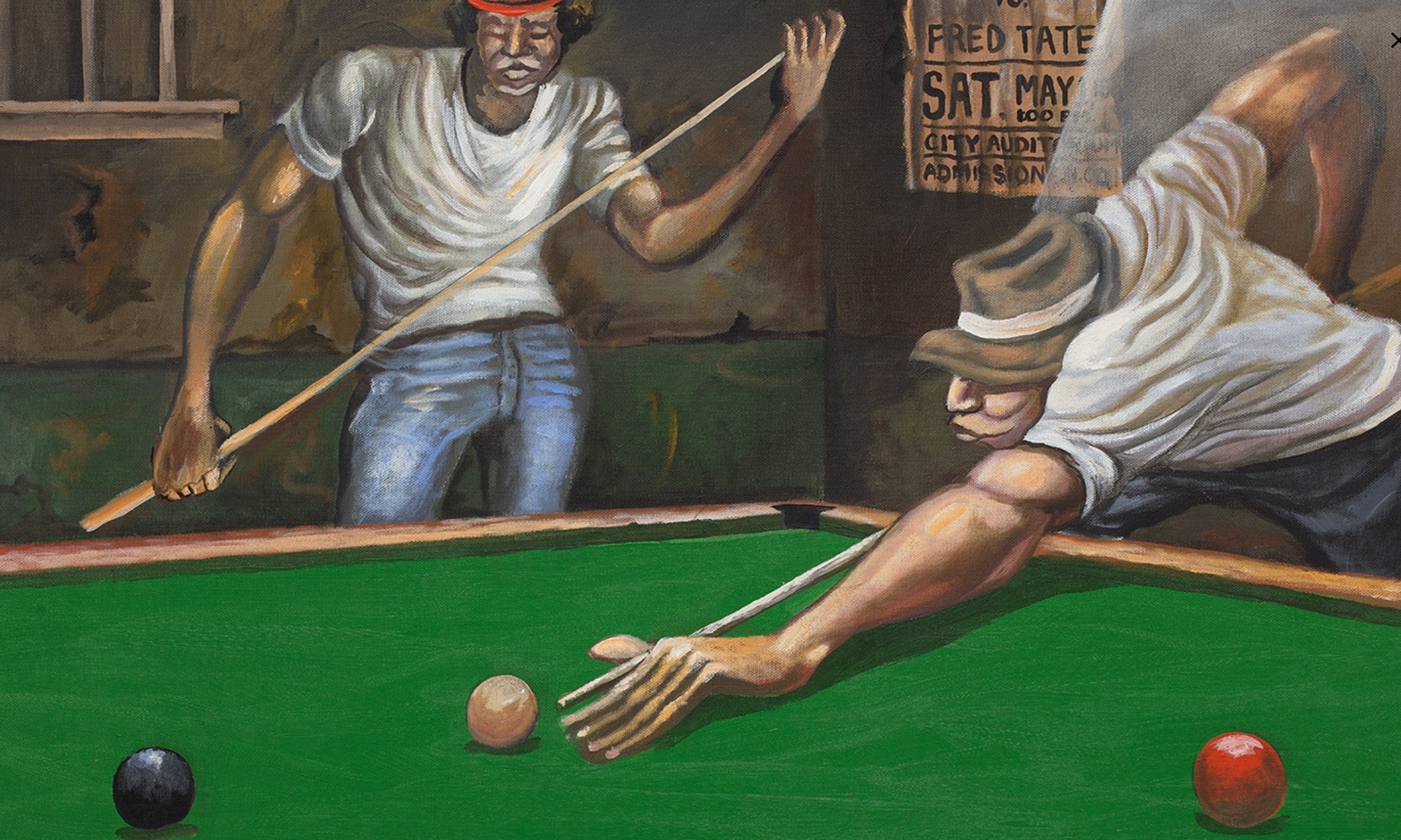
Special care is also paid to the figures’ expressions. Though most of the right man’s face is covered by his hat, we can tell that he is intensely concentrating in the moment right before the cue ball is hit and the outcome of the game is determined. Barnes consistently depicted his characters with their eyes either obstructed or closed, highlighting the ways in which we close ourselves off to one another, emphasizing the artist’s belief that “we’re blind to each other’s humanity.” The left figure’s eyes are rendered closed, focused not on the game, but on his own presence in the scene at large. As if on the other side of the pool table, we as the viewer are too positioned within the scene, allowing us to witness the action firsthand, in turn encouraging a deeper connection to Barnes’s players.
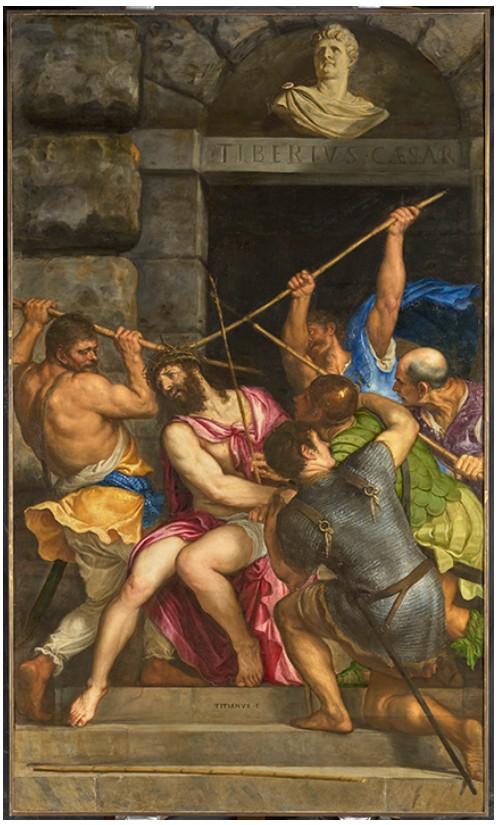
Titian, Christ Crowned with Thorns, 1542-1543, Louvre, Paris. Image: © RMN-Grand Palais / Adrien Didierjean / Art Resource, NY
Barnes chose to paint everyday people doing everyday things, highlighting the beauty and excitement in the mundane. Rejecting the “cold” abstraction prevalent in art at the time, Barnes’s Neo-Mannerist style takes inspiration from the artists he studied in school while also challenging the ways in which Black bodies were historically represented in art. Though unable to enter museums growing up, Barnes was familiar with artists such as Michelangelo, Titian, and Correggio, influenced by their depictures of heroic figures as evident in the present work. Choosing to paint his own peers, Barnes at once responds to and challenges art history in works like Hustlers, depicting men taking part in a seemingly mundane activity and celebrating it.
Every Night, All Night, 1974
Christie’s London: 13 October 2022
Estimated: GBP 100,000 – 150,000
GBP 554,400 / USD 628,835
ERNIE BARNES (1938 – 2009), Every Night, All Night | Christie’s
ERNIE BARNES (1938 – 2009)
Every Night, All Night, 1974
Oil on canvas
36×48 inches (91.4 x 121.9 cm)
Signed ‘ERNIE BARNES’ (lower right)
Created in 1974, during the heyday of Ernie Barnes’ early practice, Every Night, All Night is a virtuosic work from his iconic series of pool hall paintings. Shrouded in cinematic suspense, it offers a thrilling tapestry of human activity: a love letter to the black communities who were carving their identities in the wake of the Civil Rights movement. At the centre of the painting, a group of figures crowds around a pool table, whose green baized surface is illuminated in the darkness. In the foreground, four men are immersed in a game of cards; another swigs from a bottle in the corner. More people congregate around bright doorways on the balcony above, while two women make their way down the stairs. The work was originally owned by the American singers Steve Lawrence and Eydie Gormé: the latter’s name appears on a poster on the wall, alongside others advertising 7Up! lemonade, a boxing match and a dance featuring James Brown. Capturing the zeitgeist of a pivotal moment in American history, it is a vivid evocation of a period in which—as Barnes explained—‘black people were just starting to appreciate themselves as a people’ (E. Barnes, quoted at https://www.opendurham.org/buildings/ernie-barnes-house).
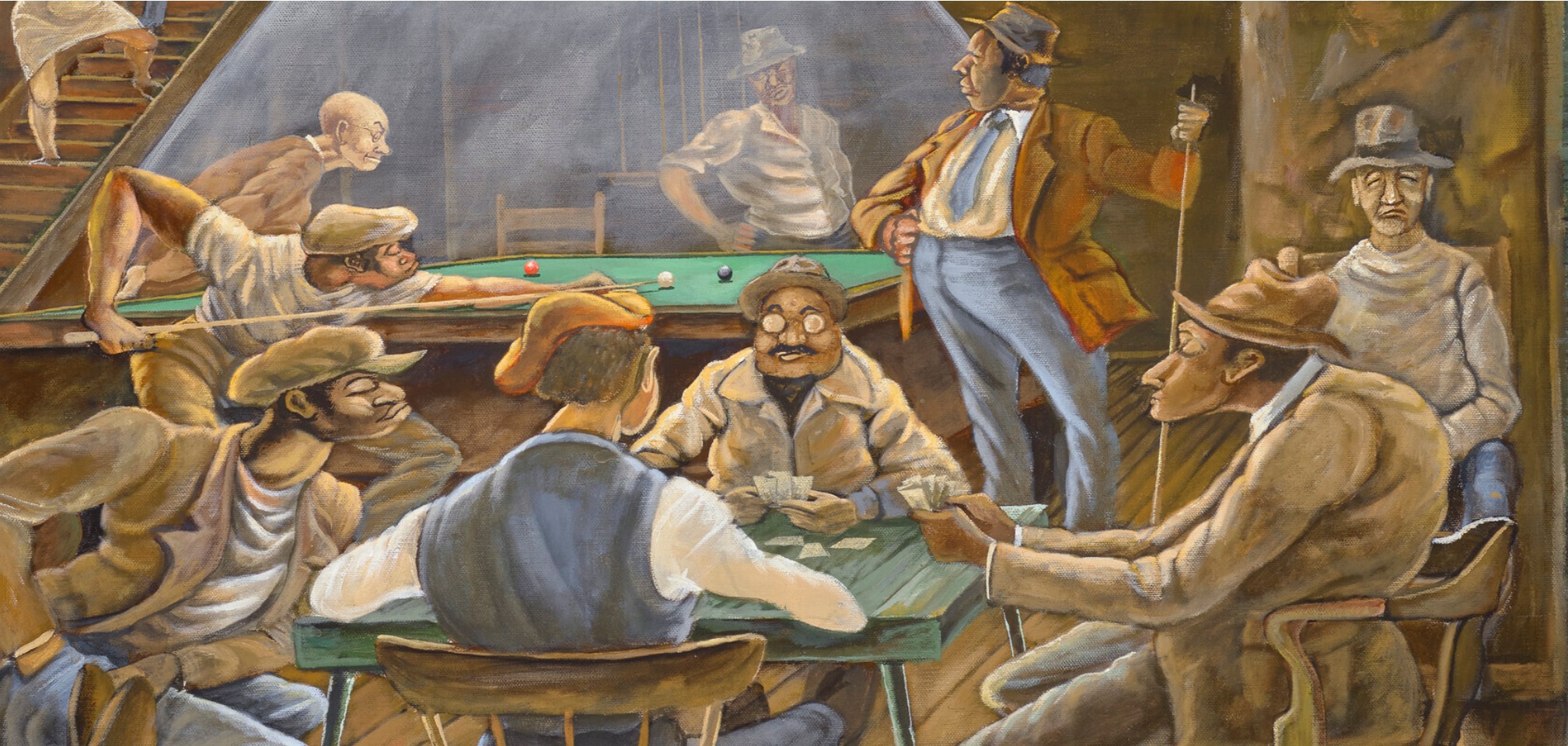
Though Barnes loved art as a child, Jim Crow laws prevented him from entering museums in his native North Carolina. Instead, he devoured the Western canon in books, and subsequently studied art at university. After a short but successful period as a professional footballer, he mounted his sell-out debut exhibition in 1966. While living in the Fairfax District of Los Angeles during the early 1970s, Barnes was struck by the well-documented rituals and customs of his predominantly Jewish neighbours, and realised that he and his own communities ‘were clueless that our own culture had value’ (E. Barnes, ibid.). Rendered in his distinctive Neo-Mannerist style, his paintings of dance halls, pool halls and other places beloved by his friends and family quickly became cultural icons, touring American museums as part of his landmark exhibition Beauty of the Ghetto between 1972 and 1979. His 1971 painting The Sugar Shack, notably, featured on the cover of Marvin Gaye’s album I Want You; elsewhere, musicians including The Crusaders and B. B. King—whose name also appears in the present painting—would include his artwork on their records.
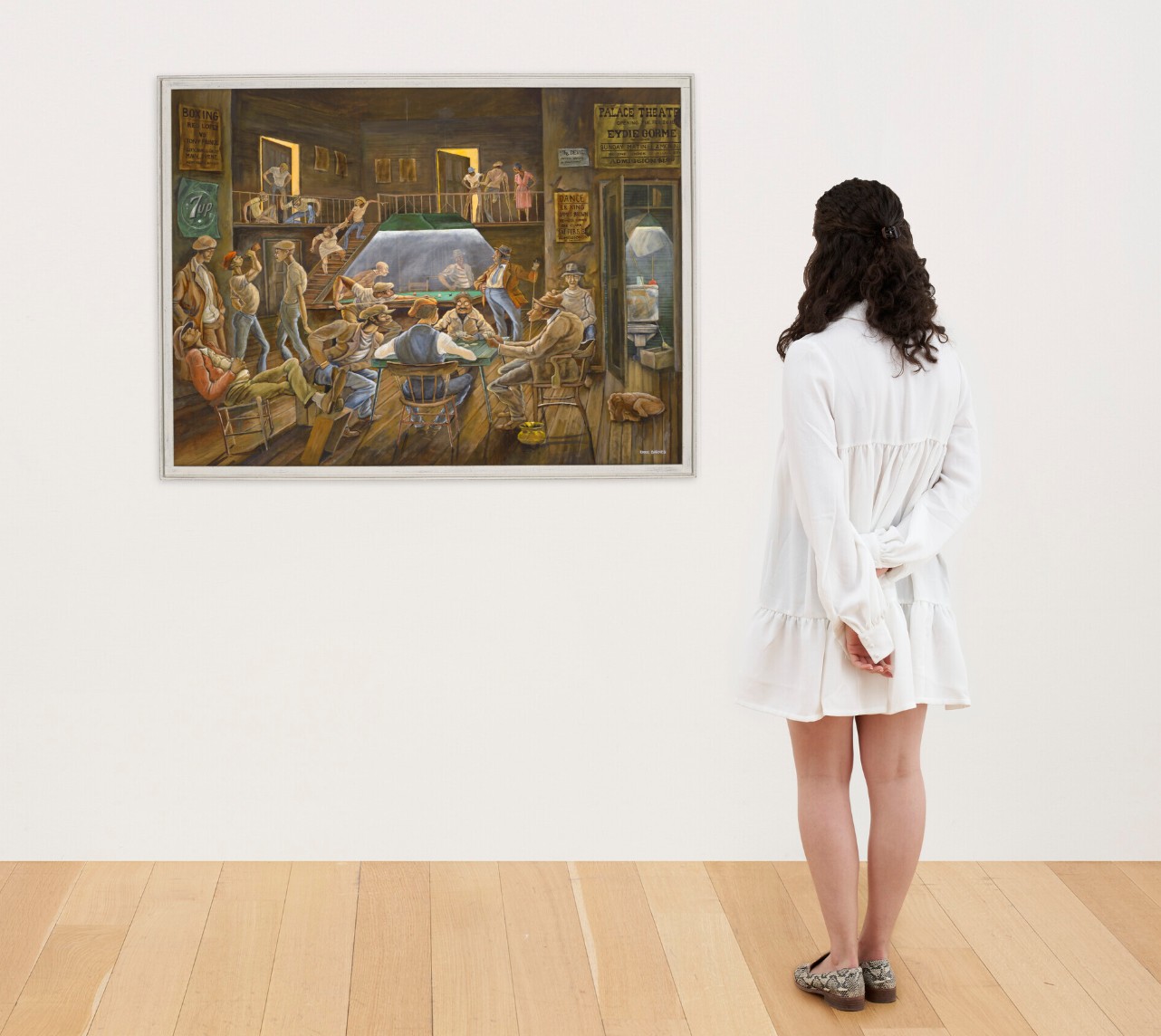
Sports fascinated Barnes as a subject: in 1984, he became the official artist of the Olympic Games in Los Angeles. In the present painting, the artist pays minute attention to the physical posturing and micro-interactions of his protagonists: those gathered around the pool table are frozen in a state of amicable suspense, while the card players sit with hunched shoulders and poker faces, haunted by echoes of Bruegel, Caravaggio, Van Gogh and Cézanne. At the same time, however, Barnes’ painting is underpinned by a deeper layer of social commentary. For all its activity, close inspection of the scene reveals figures hidden in the shadows or lingering alone in corners: a man sits with hooded eyes behind the open bathroom door, while another—wounded on crutches—stands with his back to the viewer upon the balcony. Even those seemingly involved in the games, we realise, border on anonymity, their expressions obscured by smoke, hats and other devices. These communities, Barnes reminds us, were long invisible: while a sense of convivial leisure pervades the tableau, spectres of isolation and exclusion are never far away. In the dim halls of the pool club, untold narratives quietly step into the light.
Other Series
Opening Ceremonies, 1984
Masterworks of Sport and Spirit: Property from the Collection of John W. Mecom Jr.
Heritage Auctions: 16 May 2025
Estimated: USD 250,000 – 350,000
USD 237,500
Ernie Barnes (American, 1938-2009). Opening Ceremonies, 1984. | Lot #68012 | Heritage Auctions
ERNIE BARNES (American, 1938-2009)
Opening Ceremonies, 1984
Acrylic on canvas
36×24 inches (91.4 x 61.0 cm)
Signed lower right: Ernie Barnes
Ernest “Ernie” Barnes, Jr. was born in 1938 into a deeply divided America. As a young Black man raised in the Jim Crow South, Barnes witnessed firsthand the dehumanizing effects of segregation and racism-experiences that shaped both his worldview and his artistic voice. In his autobiography, Pads to Palettes (1995), Barnes reflects on how mainstream culture reduced the Black experience to caricature and stereotype, a shallow rendering that denied its emotional complexity and richness. His art would become a profound rebuttal: a celebration of Black life not through protest or confrontation, but through exuberance, dignity, and humanity. Barnes’ signature style-elongated figures animated with fluid motion and emotional charge-captured the rhythms of everyday life in Black America with grace and vitality. His canvases are alive with movement: children playing in neighborhood lots, dancers losing themselves to music, bands marching, athletes in motion, and families at home. Each painting is a tapestry of lived experience, a kaleidoscope of joy, struggle, ritual, and community. Barnes was not painting what others saw of Black America-he painted what it felt like from within.
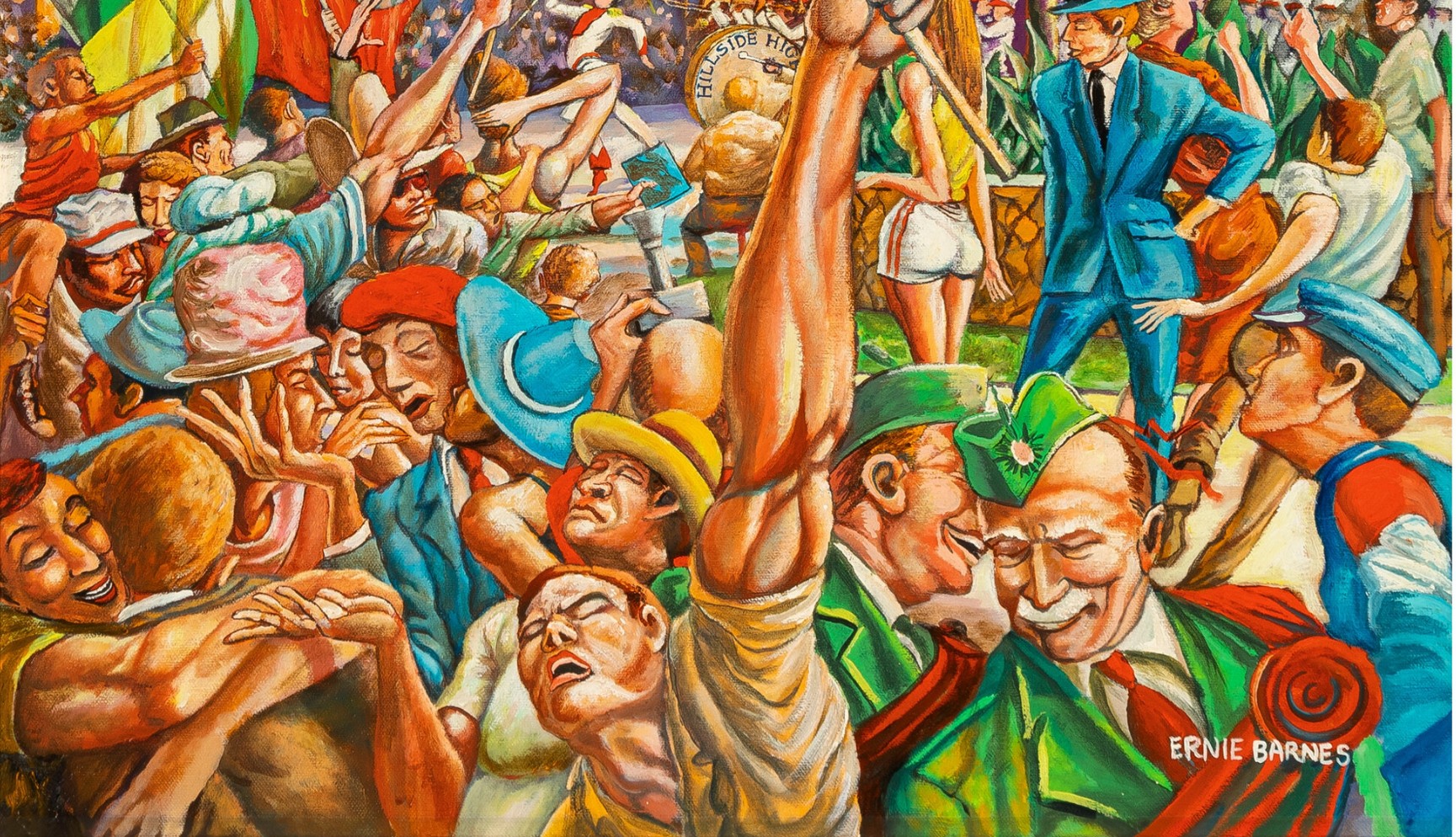
His selection as the official artist for the 1984 Summer Olympics by the Los Angeles Chamber of Commerce was not just a professional triumph but a resonant symbol of cultural recognition. Barnes approached the commission not simply as a celebration of athleticism, but as a meditation on unity-the ideal that undergirds the Olympic Games.
“My aim is to refresh the heart, to put people in touch with themselves…
I look at every individual with the hope of finding their basic dignity, humor, kindness, and humanity.”
That vision comes to life in Opening Ceremonies (1984), a triumphant panorama of communal elation. With near-Bruegelian density, Barnes renders a vibrant crowd bursting with energy and diversity-each figure engaged in their own moment of expression: flag-waving, cheering, embracing, conversing, marveling. The sheer abundance of detail-costumes, gestures, skin tones, flags-creates a sensory-rich spectacle that draws the viewer in not as an observer but as a participant. It is a masterclass in organized chaos, where every gesture contributes to a collective rhythm of anticipation and joy. Above the sea of figures, national flags punctuate the composition with clarity, signifying the identities of individuals within the crowd-yet at the very top, the Olympic flag presides alone, symbolizing a shared ideal that transcends borders. In this way, Barnes fuses individual specificity with universal belonging, making Opening Ceremonies not just a depiction of an event, but a profound meditation on humanity united in celebration.
Anchor Leg, 1983
Masterworks of Sport and Spirit: Property from the Collection of John W. Mecom Jr.
Heritage Auctions: 16 May 2025
Estimated: USD 250,000 – 350,000
USD 225,000
Ernie Barnes (American, 1938-2009). Anchor Leg, 1983. Acrylic on | Lot #68011 | Heritage Auctions
ERNIE BARNES (American, 1938-2009)
Anchor Leg, 1983
Acrylic on canvas
36×48 inches (91.4 x 121.9 cm)
Signed lower right: Ernie Barnes
Ernie Barnes’s Anchor Leg from 1983 is a masterclass in visualizing athletic intensity-an image as much about form and force as it is about rhythm and reverence. The painting captures six sprinters at the climactic moment of a relay race, bodies compressed in explosive forward motion. Rendered in Barnes’s signature elongated style, the figures nearly burst from the frame. Were they to stand upright, their limbs would extend beyond the canvas’s edge, emphasizing the sheer magnitude of their drive and physical presence.
This dynamic style reflects a deep and early-rooted fascination with the body in motion. Raised in Durham, North Carolina, Barnes was introduced to art, music, and history through Frank Fuller Jr., a prominent attorney who employed his mother, Fannie Geer. From these early exposures, Barnes developed an affinity for the Old Masters-especially Rubens and Michelangelo-whose portrayals of the human form, muscular and “spirit-filled,” would echo in his own work. He absorbed their ability to imbue flesh with feeling and fused it with his lived experience as an athlete, creating a personal visual language grounded in both physicality and grace.
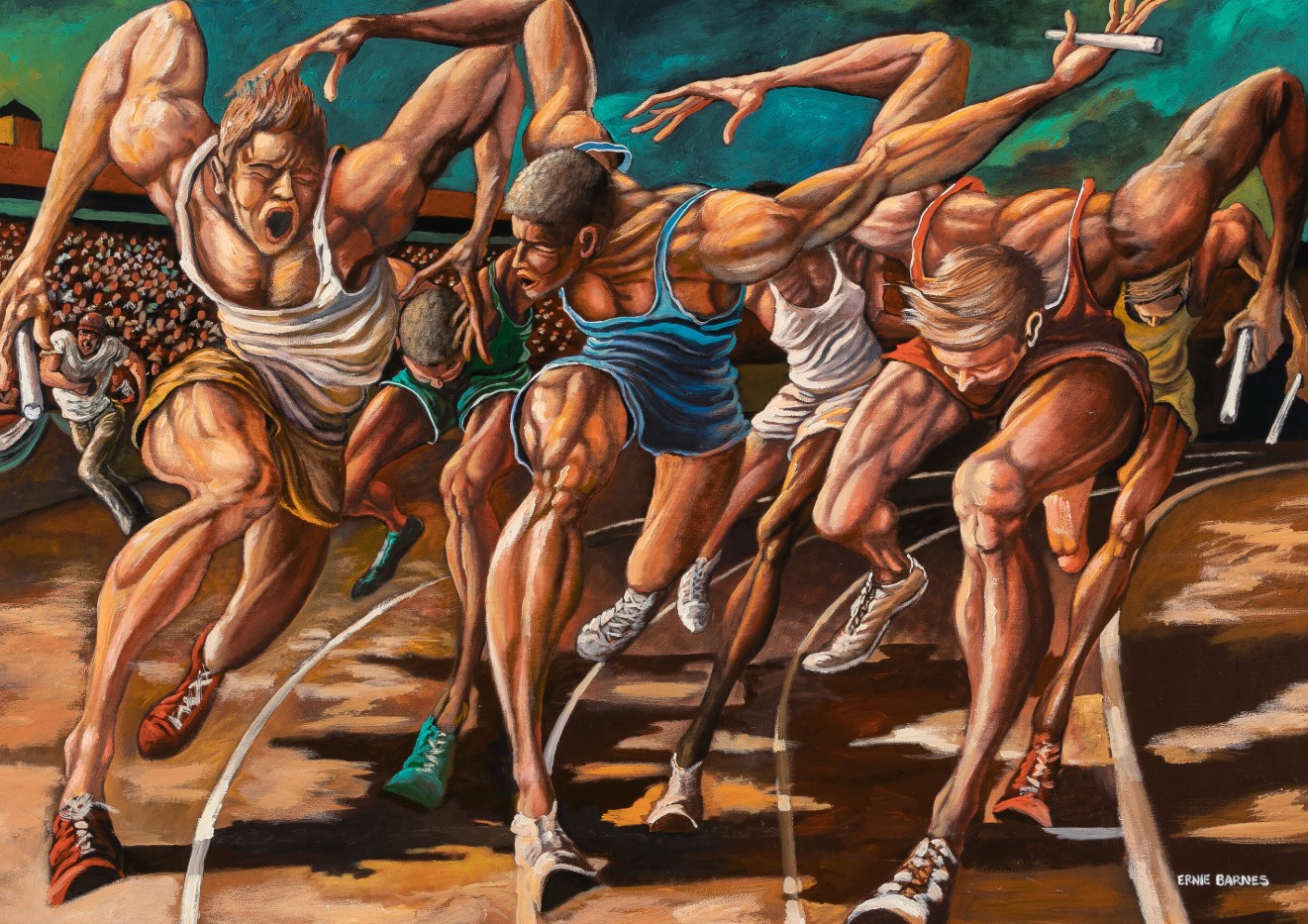
Barnes went on to play professionally in the NFL from 1960 to 1964, suiting up for the San Diego Chargers and Denver Broncos. This first-hand knowledge of exertion, rhythm, and teamwork translated directly into his artistic practice. His figures-long-limbed, sinuous, and always in motion-transcend static realism. Whether sprinting, dancing, or even standing still, they hum with internal energy.
“Movement is what I wanted to capture on canvas more than anything else;
I can’t stand a static canvas.”
Anchor Leg is an embodiment of that ethos. Barnes’s figures are sculptural yet fluid, their bodies contorted in choreographed synchronicity. Arms arc back in propulsion, torsos twist to stabilize, and legs dominate the foreground with visceral energy. Heads tilt downward, eyes squeezed shut, mouths open-each runner is fully absorbed in the strain and transcendence of motion. The compression of the composition in the immediate foreground heightens the immediacy of the race, and Barnes’s mastery lies in his ability to translate tension into elegance, strain into grace.
Though grounded in the very real world of competitive sport, Anchor Leg reaches beyond it. Barnes ennobles his athletes, presenting their performance as something both earthly and exalted. He glorifies the body not merely for its strength or speed, but for its disciplined harmony-its capacity to harmonize mind, muscle, and motion. His runners are not simply racing. They are transcending.
The Ebony Tree, 1985
Abell: 8 June 2024
Estimated: USD 50,000 – 70,000
USD 75,000 (Hammer)
USD 93,750
Lot – Ernie E. Barnes (1938-2009): The Ebony Tree
ERNIE BARNES (1938-2009)
The Ebony Tree, 1985
Oil on canvas
46×80 inches (116.8 x 203.2 cm)
Signed lower right
“The circa-1985 painting ‘The Ebony Tree’ by American artist Ernie Barnes (1938-2009) captures the elongated aesthetic that characterizes the artist’s work and brings forth his interest in honoring his heritage and the Black community as a whole through an expressive visual language. While nowadays these themes are commonly seen among mainstream contemporary artists of color and have acquired particular relevance since the surge of the Black Lives Matter movement, Barnes, who has recently received a long overdue recognition from art scholars and huge market success, is credited for being one of the first modern-day artists to openly celebrate blackness through a unique painting style. Without a doubt, the vibrantly colored oil painting offered by Abell Auction Co, which is the largest of Barnes’ works to hit the auction market, is a testament to his influential role in the development of contemporary Black American art at a time when the art world is striving to expand the canon.” (Robin Pogrebin, “Ernie Barnes’s Sugar Shack Painting Brings Big Price at Auction”, New York Times, May 12, 2022, via https://www.nytimes.com/2022/05/12/arts/design/ernie-barnes-sugar-shack-monet-leutze.html, [Accessed 03/05/2023].)
“Remarkably, whilst revealing Barnes’ signature brushwork, The Ebony Tree, also marks a breakthrough in the artist’s oeuvre as it bears an allegorical quality not seen in in the public eye. which often portray buoyant every day and sport-life scenes inspired by his upbringing in segregated North Carolina and his career as a professional football player. These two aspects, next to Barnes’ formal art training in the all-black North Carolina College in Durham, where he was exposed to Classic and Modern art, shaped the kinetic, fluid, and approachable painting style that defined his practice over his eventful career. Notably, even if during his football years Barnes never departed from his craft, he devoted entirely to it once he retired from professional sports and relocated to Los Angeles, where he promptly acquired notoriety mainly among his clientele of celebrities and sports-world art patrons that supported him since the mid-1960s.” (Daria Simone Harper, “How Ernie Barnes’ Paintings Became Celebratory Emblems of Black Southern Life”, Artsy, Aug 2020, via https://www.artsy.net/article/artsy-editorial-ernie-barness-paintings-celebratory-emblems-black-southern-life, [Accessed 04/05/2023].)
“Therefore, by the 1980s, when Barnes’ supporter John Grayson commissioned this painting, which was unveiled in 1985 at a fundraiser held at the Dorothy Chandler Pavilion in benefit of the Afro-Centric Marcus Garvey School (LA), Barnes was already a popular figure known mainly for The Sugar Shack, featured in the 70s sitcom Good Times, and his sports scenes for the Los Angeles 1984 Olympics.” (Nadja Sayej, “Ernie Barnes: The Overlooked Legacy of the Athlete Turned Celebrity Artist,” The Guardian, Jun 2021, via https://www.theguardian.com/artanddesign/2019/jun/27/ernie-barnes-legacy-nfl-painting-olympics-art, [Accessed 04/05/2023].)
“However, in The Ebony Tree, rather than portraying a quotidian scene, Barnes, who as shown in a photograph repeatedly met with Grayson to discuss its subject matter, created a seascape view that includes a myriad of motifs that touch upon the conflicting past of African Americans but that also acknowledge and celebrates their present and future.
In this complex genre painting, the many references to African culture are particularly felt in the scarcely dressed young black men and children with traditional hairstyles that occupy the foreground and are flanking a female figure dressed in tribal African attire. Notably, the artist captured them looking at the horizon line where a group of lilac-colored buildings, representing modern-day America, are appreciated below Barnes’ distinctive sky constructed with saturated blue hues. Interestingly, the black woman in the center of the composition, who has been identified as a West African griot, or storyteller, is narrating the story of the African slaves who were traded and shipped to the “New World” to be used as the workforce and afterward contributed greatly to shaping the nation. This story is materialized in a series of clouds arranged in a tree-like configuration populated by voluptuous Michelangelo-inspired cherubs. Remarkably, some of them have a darker skin color and hold objects that relate to the present-day contributions of African Americans in their roles as Olympic athletes, doctors, graduate students, and many others. Next to their symbolism, the capricious postures of the cherubs and the elongated limbs of the figures standing on the beach reveal Barnes’ mastery of the human body proportions and his unparalleled understanding of movement stemming from his past as an athlete.
Overall, this painting created by Barnes speaks of the importance of remembering the African legacy of America, which is represented through the roots and thorns placed on the beach sand that seem to dissolve in the sea waters separating the two continents. However, it also speaks on the possibility of building a brighter future with the help of talented hands coming from varied backgrounds. In this way, the painting reflects on pressing subjects that remain relevant to this day and captures the complex relations that lie at the intersection between race, social biases, and modernity, all of which Barnes experienced firsthand. All this is told through a powerful female character, also present in other of the artist’s compositions like Miss America (1970), that brings to life the metaphoric ebony tree and at the same time seems to protect and nurture those that surround her.” (Victoria L. Valentine, “Curator Bridget R. Cooks Explains how the Ernie Barnes Retrospective landed at the California African American Museum”, Sep. 2019 via https://www.culturetype.com/2019/09/01/curator-bridget-r-cooks-explains-how-the-ernie-barnes-retrospective-landed-at-the-california-african-american-museum/, [Accessed 04/05/2023].)
“Interestingly, over time, Barnes revisited this type of symbolic language to showcase varied topics, such as the selection process of the NBA captured in The Dream Unfolds (1996), where he included the aspiring athletes in a similar arrangement to that of the cherubs, and in a mural painting commissioned by Kanye West in 2005 to commemorate a life-threatening accident the rapper faced. However, The Ebony Tree is especially interesting because it reveals the artist’s ideology connected to the “Black is beautiful” movement, which he prefigured in the 1970s traveling exhibition The Beauty in the Ghetto, next to his spiritual world.” (Victoria L. Valentine, “Ernie Barnes Retrospective Brings Renewed Attention to the African American Artist who Found Fame after Playing Pro Football,” Culture Type, 2019 via https://www.culturetype.com/2019/09/06/ernie-barnes-retrospective-brings-renewed-attention-to-african-american-artist-who-found-fame-after-playing-pro-football/#:~:text=In%201971%2C%20Barnes%20organized%20a,celebrity%20supporters%20and%20local%20elected, [Accessed 04/05/2023].)
“Certainly, The Ebony Tree uncovers yet another facet of a prolific artist who is finally being valued with Barnes’ works recently breaking all auction estimates, being featured in large-scale museum retrospectives, and being offered by world-class art galleries like Ortuzar Projects and Andrew Kreps Gallery.” (Alex Greenberger, “Ernie Barnes Estate Gets Gallery Representation Following Auction Surprise”, Art News, May 19, 2022, via https://www.artnews.com/art-news/news/ernie-barnes-estate-andrew-kreps-gallery-ortuzar-projects-1234629108/, [Accessed 04/05/2023].)
“‘All this proves the comeback of this visionary artist, who passed away in 2009, is here to stay and is one more example of the traction the work of Black American artists is increasingly having on a global scale which hopefully will replicate in other much-needed changes. “For someone born and raised during the Jim Crow era, with themes of social justice entwined in many of his paintings, I think he would see this time as a call to action,’ said Luz Rodriguez, the manager of the artist’s estate.” (Daria Simone Harper, “How Ernie Barnes’ Paintings Became Celebratory Emblems of Black Southern Life, Artsy, Aug 2020, via https://www.artsy.net/article/artsy-editorial-ernie-barness-paintings-celebratory-emblems-black-southern-life, [Accessed 04/05/2023].)
The Stroll, 1982
FRAGMENTS OF LIFE:
WORKS BY ERNIE BARNES FROM THE COLLECTION OF DANNY AND DONNA ARNOLD
Christie’s London: 28 February 2023
Estimated: GBP 100,000 – 150,000
GBP 327,600 / USD 396,215
ERNIE BARNES (1938-2009), The Stroll | Christie’s
ERNIE BARNES (1938-2009)
The Stroll, 1982
Acrylic on canvas
36 x 47 7/8 inches (91.4 x 121.6 cm)
Signed ‘ERNIE BARNES’ (lower right)
Part of the extraordinary collection of Danny and Donna Arnold—works from which have been offered at Christie’s over the past eighteen months—The Stroll testifies to the couple’s significant friendship with Ernie Barnes. Acquired from the artist by the Hollywood producer and his wife shortly after its creation, it captures the enduring fascination with sport and movement that would come to define Barnes’ oeuvre. Having started his career as a professional footballer, the artist painted spectacles ranging from basketball games and boxing matches to local dances and hushed pool games, each a vehicle for acute social observation. Painted in 1982, two years before he was selected as the official Sports Artist of the Olympic Games in Los Angeles, The Stroll takes its place within Barnes’ depictions of horse racing. Stable hands, jockeys and bystanders roam the yard, congregating in pockets of conversation, industry and idleness. Their elongated limbs, rendered in Barnes’ signature Neo-Mannerist style, are alive with movement and character. Exquisitely lit like a film set, the scene is bathed in tantalising cinematic tension: a thousand undisclosed narratives weave across its surface, their secrets suspended in every meticulous detail.
Born in 1938, Barnes grew up in Durham, North Carolina, with a strong interest in art. Though Jim Crow segregation laws inhibited his access to local museums, he devoured books on the Western canon and immersed himself in drawing. Barnes was avowedly unathletic as a child, until an inspirational coach sparked his interest and confidence, leading him to become captain of his high school football team. After majoring in art at North Carolina College, he was drafted by the then-world champion Baltimore Colts, and would go on to play for multiple teams during his successful sporting career. He would frequently make sketches while on the football field, recalling the advice of his college art teacher Ed Wilson to ‘pay attention to what my body felt like in movement. Within that elongation, there’s a feeling. And attitude and expression’ (E. Barnes, quoted in TV interview on ‘Our World with Black Enterprise’, 2008). In 1965, after suffering an injury, Barnes retired from sport and returned to his first love full-time. With the support of New York Jets owner Sonny Werblin, he mounted his sell-out debut exhibition the following year.
The Stroll demonstrates the distinctive visual language that Barnes would go on to cultivate throughout the 1970s. During this period, his depiction of sports would ultimately lead him into broader observations of the human condition, motivated primarily by a desire to pay tribute to the African-American communities in which he had grown up. In the wake of the Civil Rights movement, his love letters to overlooked aspects of everyday Black culture earnt him widespread recognition, with his 1976 painting The Sugar Shack famously gracing the cover of Marvin Gaye’s album I Want You. At the same time, however, his paintings were far from straightforward celebrations. In the present work, echoes of Western art history—from Pieter Bruegel to Edgar Degas—are juxtaposed with subtle socio-political commentary. Many of his subjects have their eyes closed; others have their backs to the viewer, or are shrouded in ambiguity. In the micro-interactions between his subjects, Barnes teases out pertinent narratives of exclusion and invisibility, giving form to his belief that ‘we are blind to one another’s humanity’ (E. Barnes, interview with CNN, 1990).
Bluebird, 1982
Heritage Auctions: 19 November 2025
Estimated: USD 30,000 – 50,000
USD 75,000
Ernie Barnes (1938-2009). Bluebird, 1982. Oil on canvas. 18 x 24 | Lot #77096 | Heritage Auctions
ERNIE BARNES (1938-2009)
Bluebird, 1982
Oil on canvas
18×24 inches (45.7 x 61 cm)
Signed lower right: ERNIE BARNES
Bluebird is a charming example of Barnes’ extraordinary vision. A young woman in a yellow dress strides across an open field, her limbs elongated in his signature style, suggesting not only physical motion but also the spirit’s determination to move forward. In her hands, she grasps a flowing piece of blue fabric, which sweeps dramatically behind her like a wave or gust of wind. The scene is dynamic, a composition built around contrasts: the stability of her stride against the turbulence of the fabric, the warmth of her dress against the cool sweep of blue, and the open serenity of the landscape against the vigorous energy of her figure. These juxtapositions infuse the painting with both tension and harmony, making it more than a mere snapshot of movement; it becomes a symbolic meditation on freedom, resilience, and joy. Barnes’ choice to elongate the woman’s body elevates her action into something poetic. Her impossibly long stride does not seem awkward but graceful, as though she transcends the limits of natural motion. This stylistic choice reflects Barnes’ enduring interest in the rhythm of life, where bodies are not static forms but living lines that flow with music, sport, dance, and struggle. By exaggerating her proportions, Barnes does not distort her humanity; instead, she amplifies it, offering a glimpse into the spiritual dimension of physical movement. Her stride becomes emblematic of perseverance, as if each step carries not only her body across the field but also her will across life’s challenges.
Color further deepens the meaning of the work. The yellow dress radiates vibrancy and energy, evoking optimism, vitality, and the warmth of the sun. Against it, the blue fabric unfurls like the sky itself, both a resistance she must push against and a partner in her motion. Blue often symbolizes freedom, expansiveness, and melancholy, and in this context, it serves as both an obstacle and an opportunity; the force of wind that challenges her but also lifts her into a state of grace. Together, yellow and blue strike a balance of joy and struggle, offering a visual metaphor for the human condition.
The open field surrounding the figure reinforces this theme of possibility. Rather than confining the woman within walls or urban boundaries, Barnes situates her in a limitless natural space, where her movement is unbounded and her form dominates the canvas. She becomes an emblem of liberation, her body a declaration of independence and vitality. The painting suggests that resilience is not only an act of survival but also a dance of beauty, where even resistance can be transformed into a work of art.
Barne’s title, Bluebird, contributes to the poetic nature of this scene as the bluebird often symbolizes happiness, hope, optimism, and renewal. In this lyrical composition, Barnes demonstrates his mastery of turning everyday actions into timeless expressions of the human spirit. What might have been a simple image of a woman walking against the wind becomes, through his vision, a celebration of strength, grace, and perseverance. His elongated figure reminds viewers that motion itself is a form of poetry, while his careful use of color and space elevates the scene into a metaphor for life’s challenges and triumphs. Ernie Barnes’ art remains powerful because it does not merely show people as they are, but as they aspire to be, resilient, graceful, and always moving forward.