
Now spanning over a quarter of a century, Damien Hirst’s highly celebrated series of meticulously rendered Pharmaceutical Paintings have come to define the British artist’s prodigious output. Bridging the sense of order, primacy of the grid, and focus on scientific modes of categorization that we find in the Medicine Cabinets with the exuberant and joyful approach to color taken in his Spin Paintings.
Introduction
Compounding associations between his paintings and scientific endeavor, the title of works from this series are selected at random from the alphabetically arranged catalogue of drug company Sigma-Aldrich’s products that Hirst first stumbled across in the early 1990s.
“I was always a colorist. I’ve always had a phenomenal love of color […] So that’s where the Spot paintings came from—to create that structure to do those colors, and do nothing.”
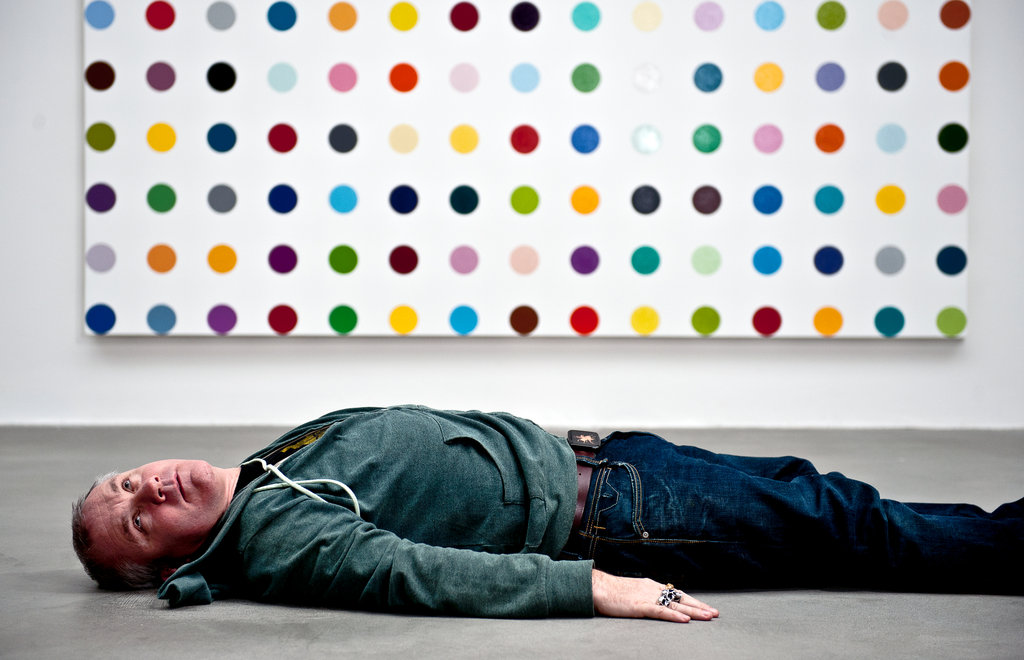
Sometimes likened to an array of different colored pills, visualized more directly in Hirst’s later cabinets, the first spots date from the very outset of Hirst’s career, painted directly onto the wall of the Surrey Docks Warehouse in the final phase of the now legendary Freeze exhibition curated by Hirst as an undergraduate student at Goldsmith’s in 1988. Just as in the innovative Medicine Cabinets which he first embarked on during the same year, Hirst found that he could generate infinitely variable results from the imposition of certain limitations in terms of the size and color of his forms, their arrangement in relation to one another, and the number of spots, pills, or boxes included in each work.
“Mathematically, with the spot paintings, I probably discovered the most fundamentally important thing in any kind of art. Which is the harmony of where color can exist on its own, interacting with other colors in a perfect format.”
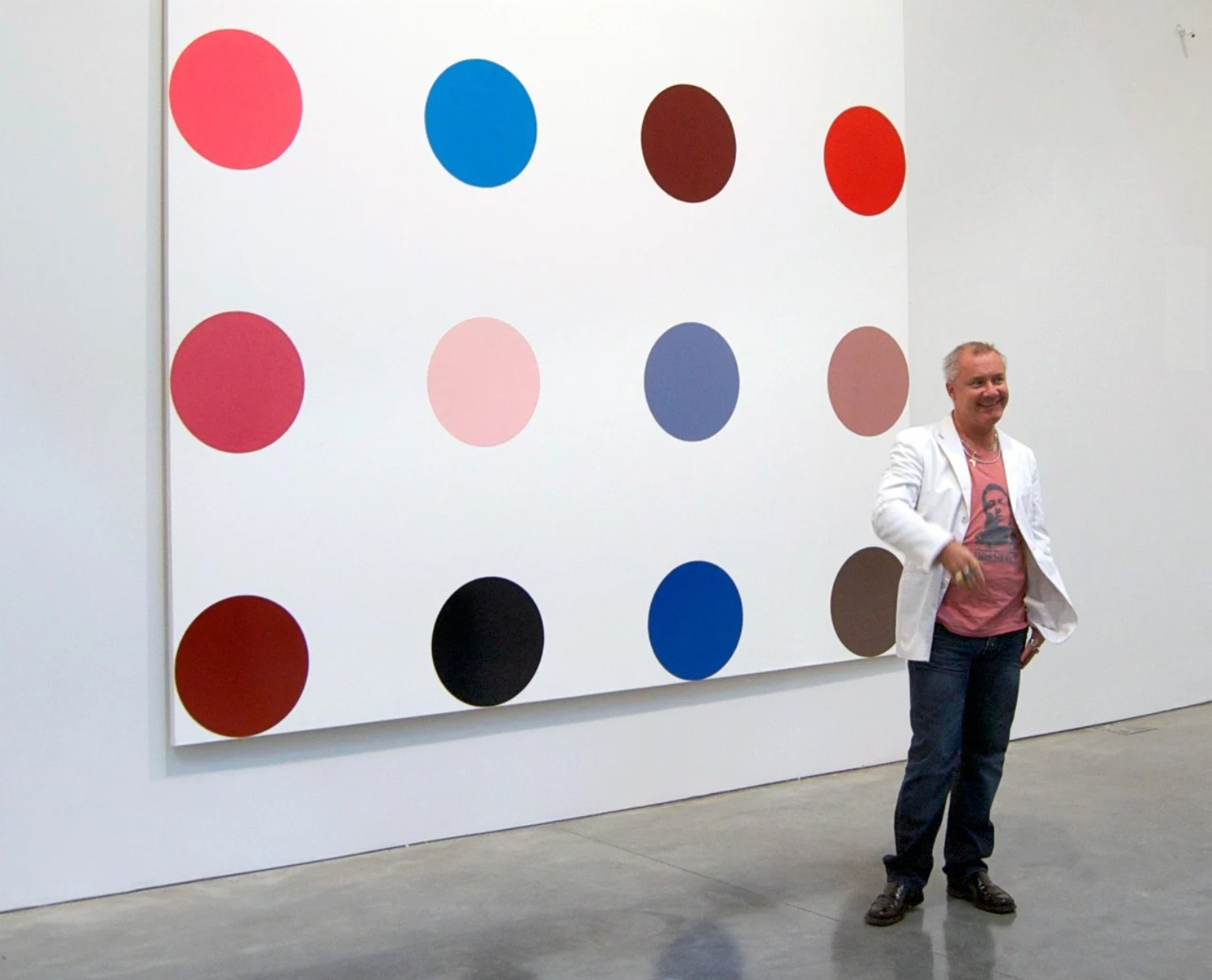
Each Spot painting shares a certain set of properties: the spots are arranged on a grid made invisible by a white or off-white background; no two spots on a given work touch each other; and no hue is ever repeated on the same work. Hirst constructs each work mechanically, ensuring that the spots within a single painting are the same size and shape. The size of the gaps in the painting must also be equal to the diameter of the spots. Hirst notably uses household gloss to paint the spots, as its pure, sterile complexion recalls a medicinal workplace. The work’s repetitive nature at once suggests automated production and mesmerizes the viewer.
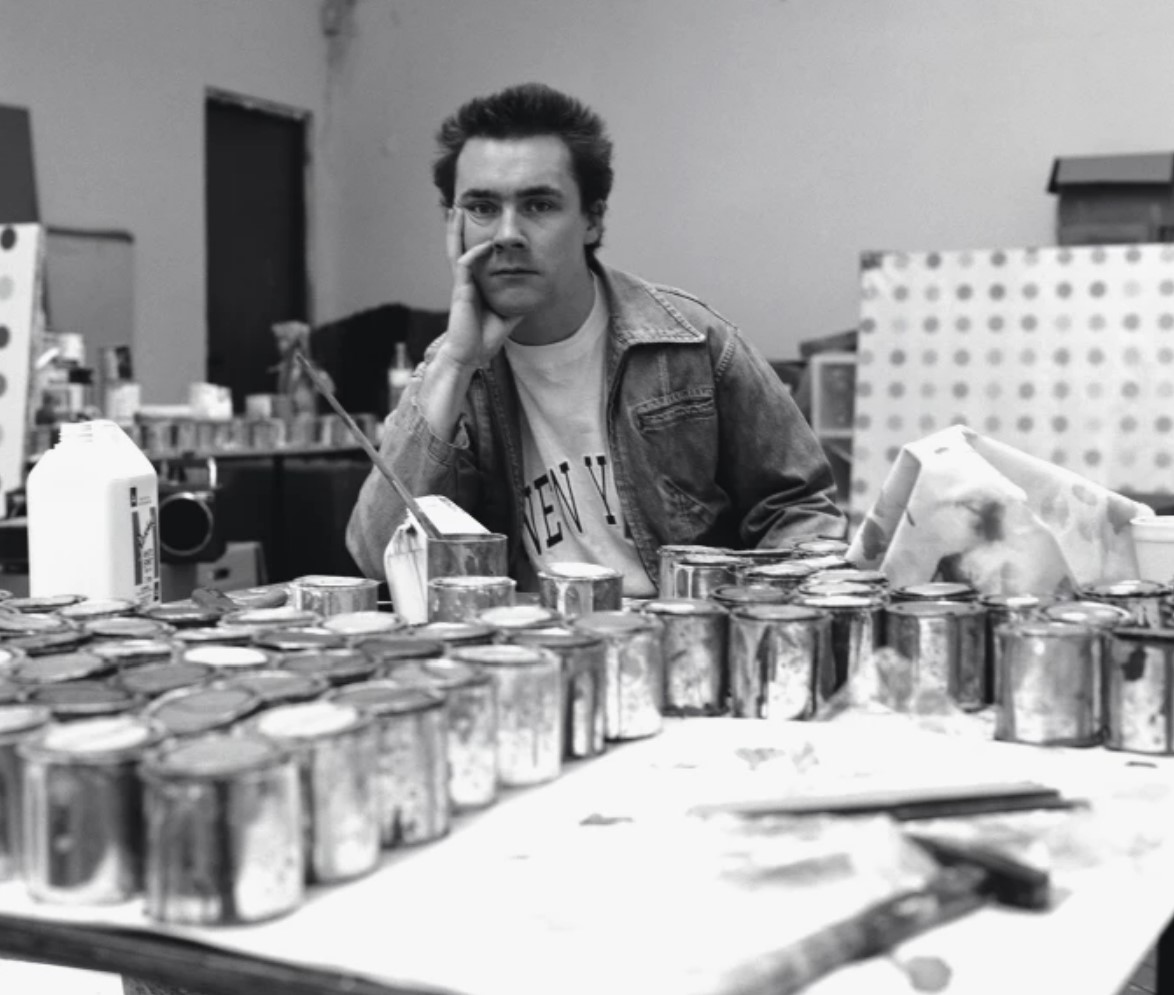
However, there is a certain problematization that comes to light in this series, namely inherent in the implied celebration of a heavily mediated and medicated postmodern society. Such a discourse has become increasingly magnified in recent years as evidenced by the ongoing opioid and pharmaceutical drug crises. That Hirst’s Pharmaceutical paintings would only increase in cultural relevance in the nearly three decades since their inception is a testament to their prescience. Ever in touch with allusions and theoretical discourse, Hirst rescues the age-old artistic genre of the grid from Modernist hands and returns it to its original roots in scientific thought and genetic structure.
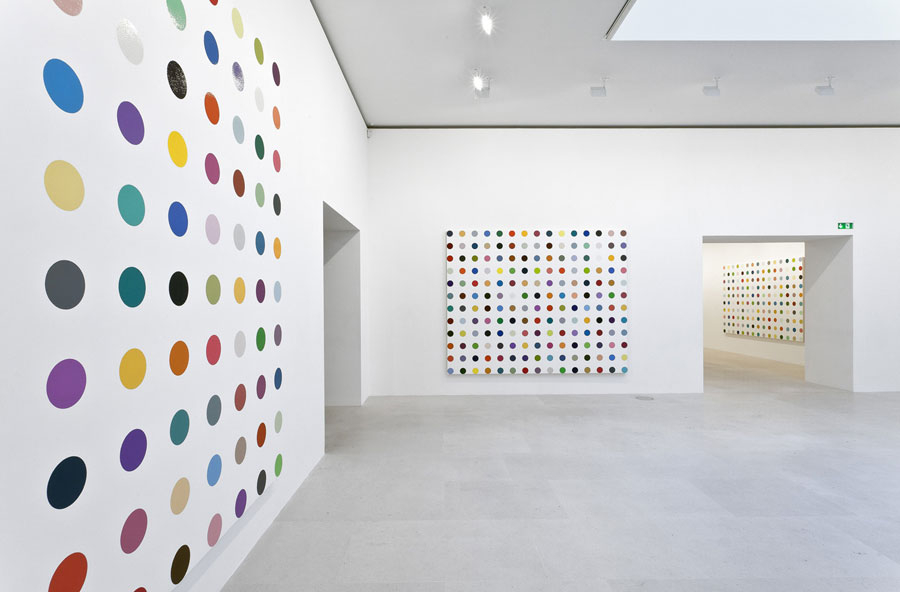
The Spot paintings were originally conceived as an endless series of paintings in which the choice of size, variation of colour and number of spots on each painting were systematically infinite. Like a true scientist, Hirst expertly mixed hundreds of tones and shades of each colour in the spectrum in a controlled experiment. Organized only by the structure of the circular coloured discs evenly spaced on the white background in a grid-like formation, Hirst worked through his experimentations with colour and scale in a highly logical manner. His canvases range from Iodomethane- 13c (1999-2000), a 40-foot canvas containing 1-inch spots, to L-Isoleucinol (2008-2011), which measures 10 by 16 inches and contains 25,781 one-millimeter spots. No one colour seems to be privileged over another, and thus no hierarchy is implied. This even-handedness, where colour relationships are coolly, carefully balanced, puts forward a draughtsman-like rigor to the canvas. Marking a watershed moment in the critical recognition of the Spot Paintings, in 2012 Gagosian mounted a major solo exhibition The Complete Spot Paintings 1986–2011 across its galleries globally, the same year that Tate Modern presented his first significant museum retrospective.
Essay
Damien Hirst’s Spot Paintings sit at a peculiar crossroads: they look like pure decoration (cheerful dots on white), yet they behave like a conceptual machine: clinical, rule-bound, and quietly existential. They belong to a broader “pharmacy” imagination in Hirst’s work, where modern medicine appears as both salvation and theatre: a belief system packaged in bright colours, brand names, and reassuring grids. This series reconstructs a clinical environment and frames medicine as something we trust in, sometimes religiously, because it promises control over fear, illness, and death. The Spot Paintings translate that atmosphere into painting. They are not “expressive” in the traditional sense; instead, they are regulated. And that regulation is the point: in Hirst’s universe, the grid is the pharmacy shelf, the dot is the pill, and color is both seduction and placebo.
Origins and Logic of the System
The “spot” idea emerges in the late 1980s (with a first spot work dated to 1986 and public visibility around the Freeze era), and quickly hardens into a set of rules that become almost as famous as the paintings themselves: evenly spaced circles, no touching, and (in the canonical formulation) no repeated colors within a single work.
That rule-set does two things at once: (1) It removes the heroic artist-hand (no gestural signature, no brushy drama); and (2) It replaces “composition” with “procedure.” The painting is generated by a method, like a lab protocol.
This is why Hirst can credibly call them “endless”: they are not a finite motif he “finishes,” but rather a framework capable of producing indefinitely many valid outcomes. Gagosian’s framing of the Spots as an expansive chronology (1986–2011) and as a global, coordinated exhibition event makes the serial logic explicit: the series is treated almost like a catalogue of a system rather than a handful of masterpieces.
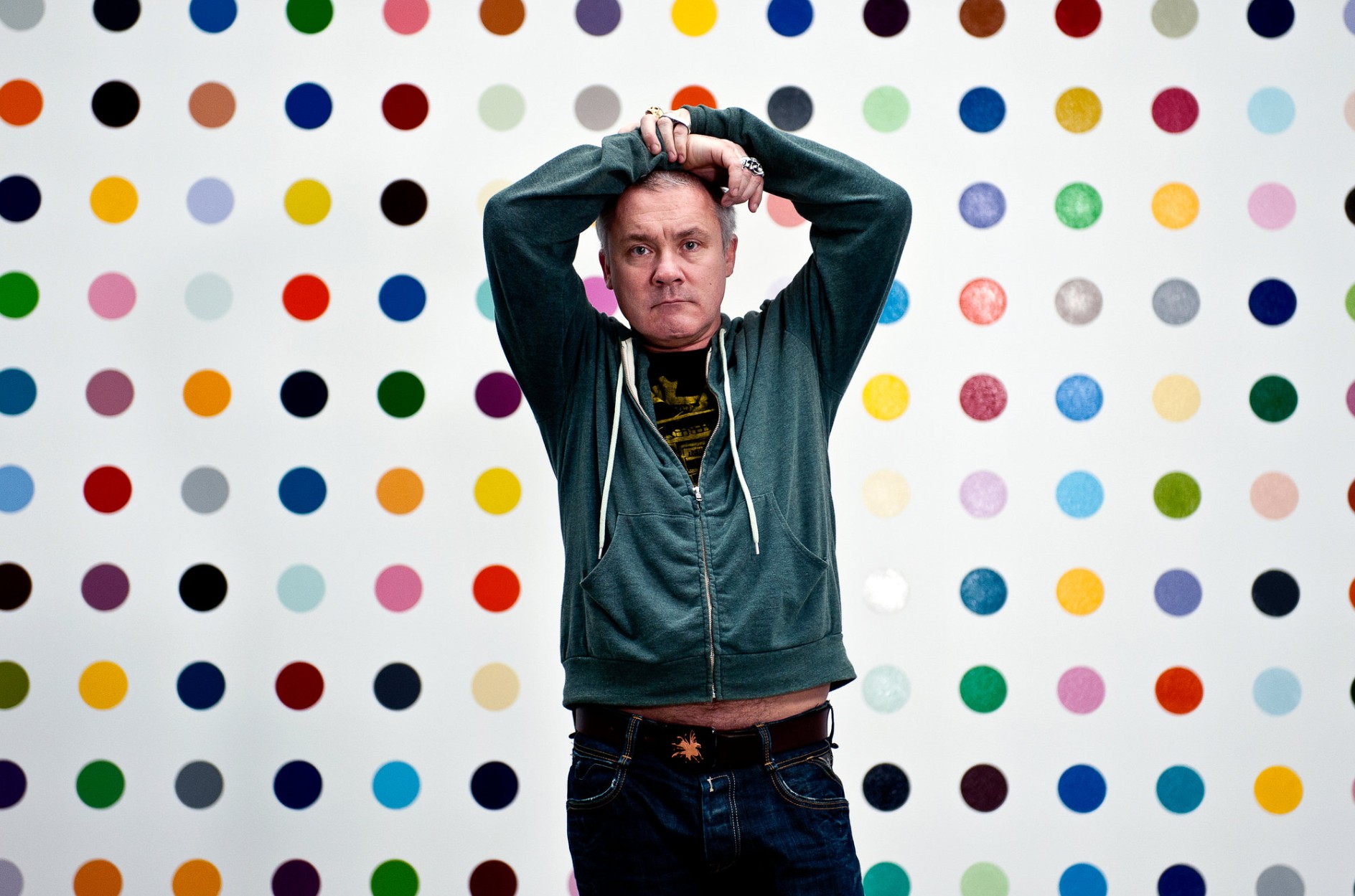
Why “Pharmaceutical”? Names, Language, and Belief
Most Spot Paintings carry titles borrowed from drugs or chemical compounds: language that feels authoritative, opaque, and oddly poetic when stripped from its medical context. The effect is not subtle: you are meant to feel the aura of science without being able to fully verify it. That’s not an insult to the viewer; it’s the work’s psychological engine. You don’t need to understand the molecule to understand the seduction of certainty.
This is where Pharmacy (the installation) and the spots lock together. Pharmacy stages the modern drugstore as a sterile temple: white cabinetry, orderly packaging, the promise that everything has a name, a dosage, a fix. Tate notes how viewers can be “seduced” by drugs and the belief invested in them, precisely the emotional posture the spot paintings mirror through their bright, confident order.
Technique: how they’re made, and why that matters
Visually, the spots are deceptively simple: flat circles on white ground, arranged in a grid. But the look depends on discipline: consistent edges, spacing, scale, and color distribution. This is one reason the series has long involved studio assistance: just because the “authorship” is conceptual and managerial as much as manual. That division of labor is not a footnote; it’s embedded in the meaning. The paintings enact a modern condition: systems, standardization, replication, quality control.
From a formal perspective, the white ground matters as much as the dots. White is not “empty” here; it’s the clinical field, the laboratory lighting, the hygienic promise. It also turns color into product: each dot reads like an isolated unit—pill, sample, data point. And there’s an optical game too: at distance the grid becomes a vibrating screen; up close it becomes insistently material and finite (a bunch of individual decisions, however rule-bound). The work toggles between infinite seriality and stubborn objecthood.
Periods and evolutions: rigidity, expansion, and afterlives
It’s helpful to treat the Spots less as one style and more as an evolving industrial family.
1) Late 1980s–1990s: the foundational “pharmacy” mood
Early spots and the institutional rise of Hirst’s medical iconography (medicine cabinets, vitrines, Pharmacy) establish the core equation: order + color + clinical language as a stage for anxiety about the body and mortality. Pharmacy (1992) becomes a key anchor here: an immersive statement that medicine is both comfort and illusion.
2) 2000s: scale, polish, and the brand-like consistency
As the series expands, the spots become increasingly synonymous with “Hirst” as a global brand. The more consistent and recognizable the system becomes, the more it behaves like a logo—instantly legible across contexts (museum, fair booth, private dining room, Instagram feed). This is where critics split: some see emptiness; others see ruthless clarity about how images circulate in late capitalism.
3) 2012: the “Complete Spot Paintings” moment (institutional spectacle)
Gagosian’s 2012 worldwide presentation—eleven locations opening in sync—was effectively a curatorial flex: it framed the spots as a totalizing project and a globalized phenomenon, with hundreds of works and over 150 lenders from many countries. It also highlighted a truth about the series: it is meant to be encountered in quantity. One spot painting is a proposition; a wall of them is a system.
4) Post-2010s: rule-echoes and “Color Space”
Hirst later produced bodies of work that echo spot logic while shifting parameters. Gagosian describes the 2016 Colour Space Paintings as a finite project that still follows key spot rules (not repeating colurs; consistent dot size within a work), while changing scale and the feel of the surface. This matters historically: it shows Hirst both acknowledging the power of the spot “algorithm” and trying to keep it from becoming pure wallpaper-by-legacy.
How to understand and read Spot Paintings
A serious reading doesn’t deny the seduction; it dissects it.
Read them as a psychology of control
The grid is the fantasy that everything is manageable: symptoms classified, pills dosed, outcomes predicted. That fantasy is emotionally potent precisely because real bodies remain fragile.
Read them as paintings about painting’s loss of aura
Traditional painting often sells the myth of the unique touch. Spots replace touch with protocol. If you feel both calm and slightly insulted, congratulations: you’re experiencing the thesis.
Read them as a mirror of consumer culture
The dots are colour units, like products. The titles are specialist language, like branding. The overall effect is confidence without intimacy—exactly the tone of a pharmaceutical commercial.
Read them as a test of your own thresholds
At what point does repetition become meditation? At what point does it become numbness? The works don’t answer; they measure.
Exhibitions and the “Pharmacy” ecosystem beyond painting
The spot paintings are only one limb of a larger “pharmaceutical” body: Pharmacy installations, medicine cabinets, and pill-based sculpture all push the same iconography into different registers (environmental, sculptural, archival). The Pharmacy installation is crucial because it literalizes the spatial logic of the spots: shelves, repetition, order, and the uneasy comfort of clinical design.
Market Structure: Abundance and Hierarchy
The Spot Paintings are prolific, estimates vary (often cited in the 1,400–1,500 range), and production with assistants is a standard part of the narrative. Abundance creates a tiered market: not all spots are equal.
Value tends to concentrate around: (1) Scale (monumental works read as “statement” pieces); (2) Date (early examples generally carry more art-historical weight); (3) Provenance (institutional or notable collections help); (4) Quality of color orchestration (some palettes feel dead; others sing); (5) Clarity of authentication / documentation (crucial in a system-based practice)
Hirst is highly tradable, which is not the same thing as “stable.” Market commentary has tracked periods of correction and uneven confidence after the late-2000s boom years. Separately, recent reporting around dating practices in other Hirst projects has sharpened attention on transparency and documentation—collectors increasingly want precision on when something was physically executed versus conceptually initiated.
Legacy: the spots as an icon of post-studio authorship
Love them or loathe them, spot paintings have become one of the clearest emblems of the contemporary “post-studio” condition: the artist as designer of a system, the studio as production engine, the artwork as a recognizable unit circulating globally. That legacy is not only about aesthetics; it’s about how art is made, distributed, and believed in now.
Top Lots
#1. 3-(5-Chloro-2-Hydroxphenylazo)-4, 5-Dihydroxy-2, 7-Naphthalenedisulfonic Acid, 1998, 1998
Phillips de Pury London: 28 February 2008
Estimated: GBP 1,500,000 – 2,500,000
GBP 1,756,500 / USD 3,491,680
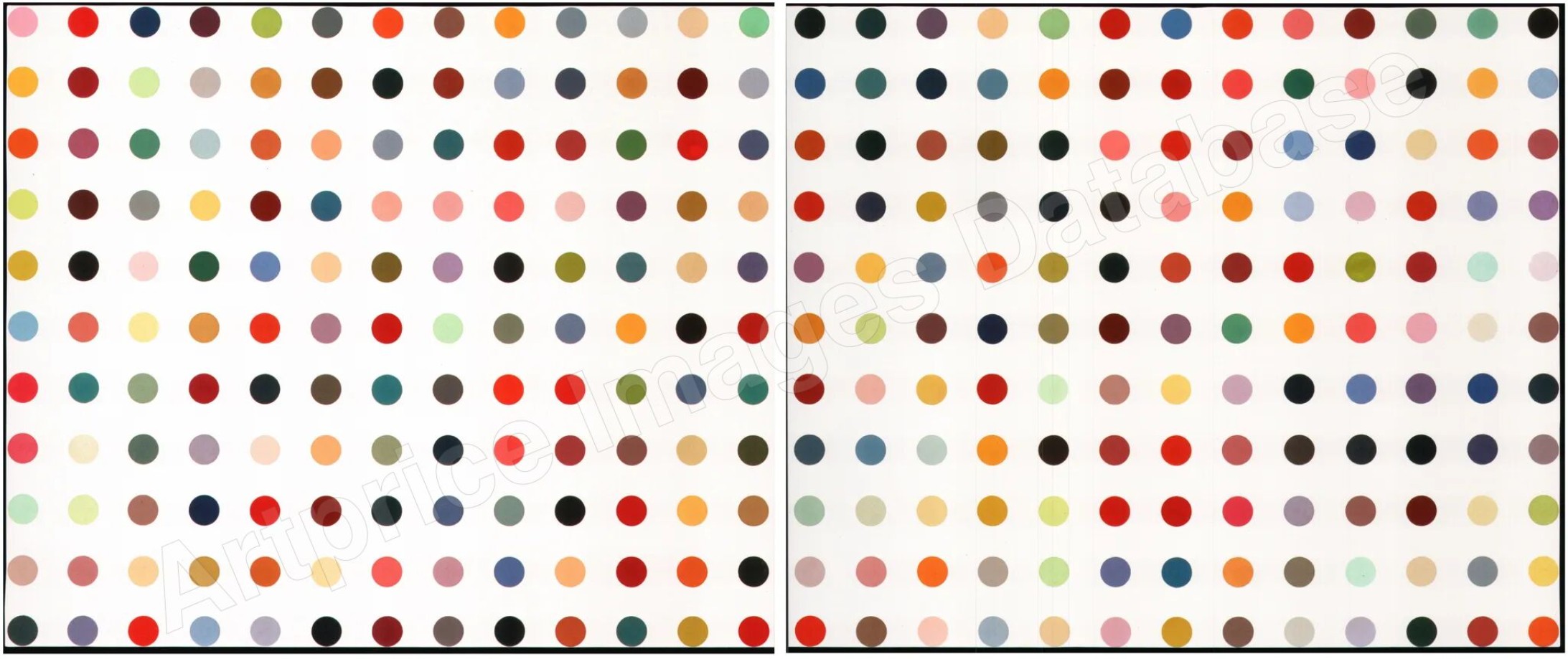
DAMIEN HIRST
3-(5-Chloro-2-Hydroxphenylazo)-4, 5-Dihydroxy-2, 7-Naphthalenedisulfonic Acid, 1998
Household gloss paint on canvas
84×204 inches (213.4 x 518 cm)
#2. Amphotericin B, 1993
Phillips New-York: 15 May 2008
Estimated: USD 3,000,000 – 4,000,000
USD 3,177,000
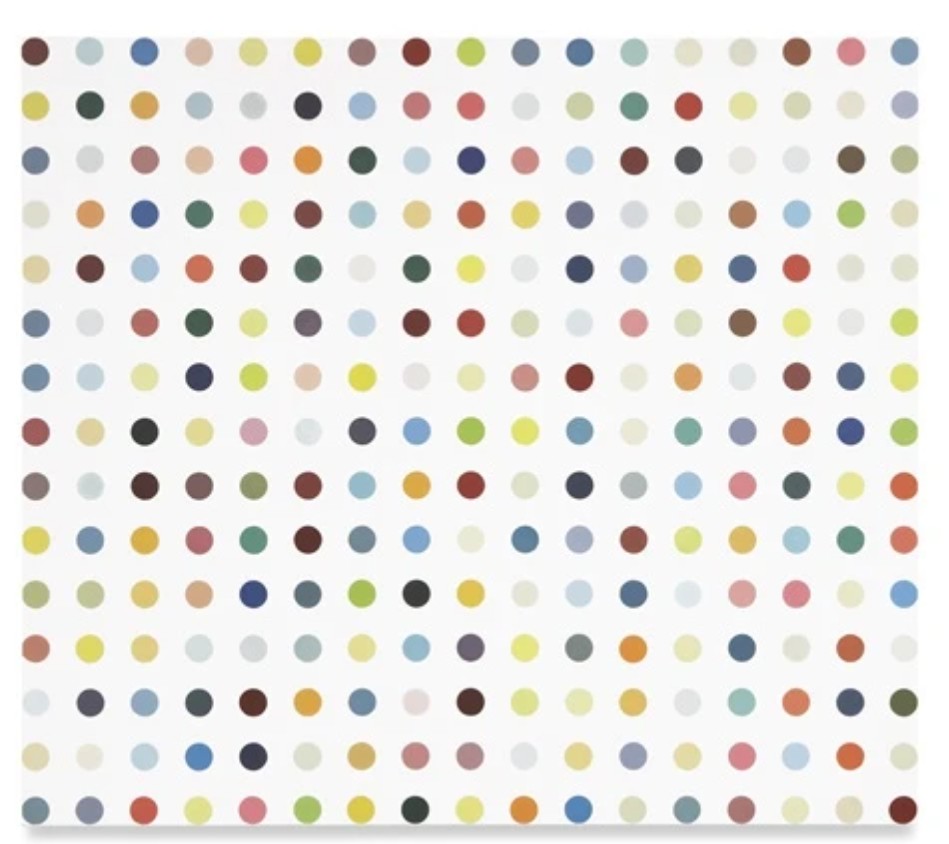
DAMIEN HIRST
Amphotericin B, 1993
Gloss household paint on canvas
116 1/8 x 132 1/8 inches (295 x 335.9 cm)
#3. Apolopoprotein A-1,1994
Sotheby’s New-York: 14 November 2007
Estimated: USD 1,500,000 – 2,000,000
USD 2,841,000
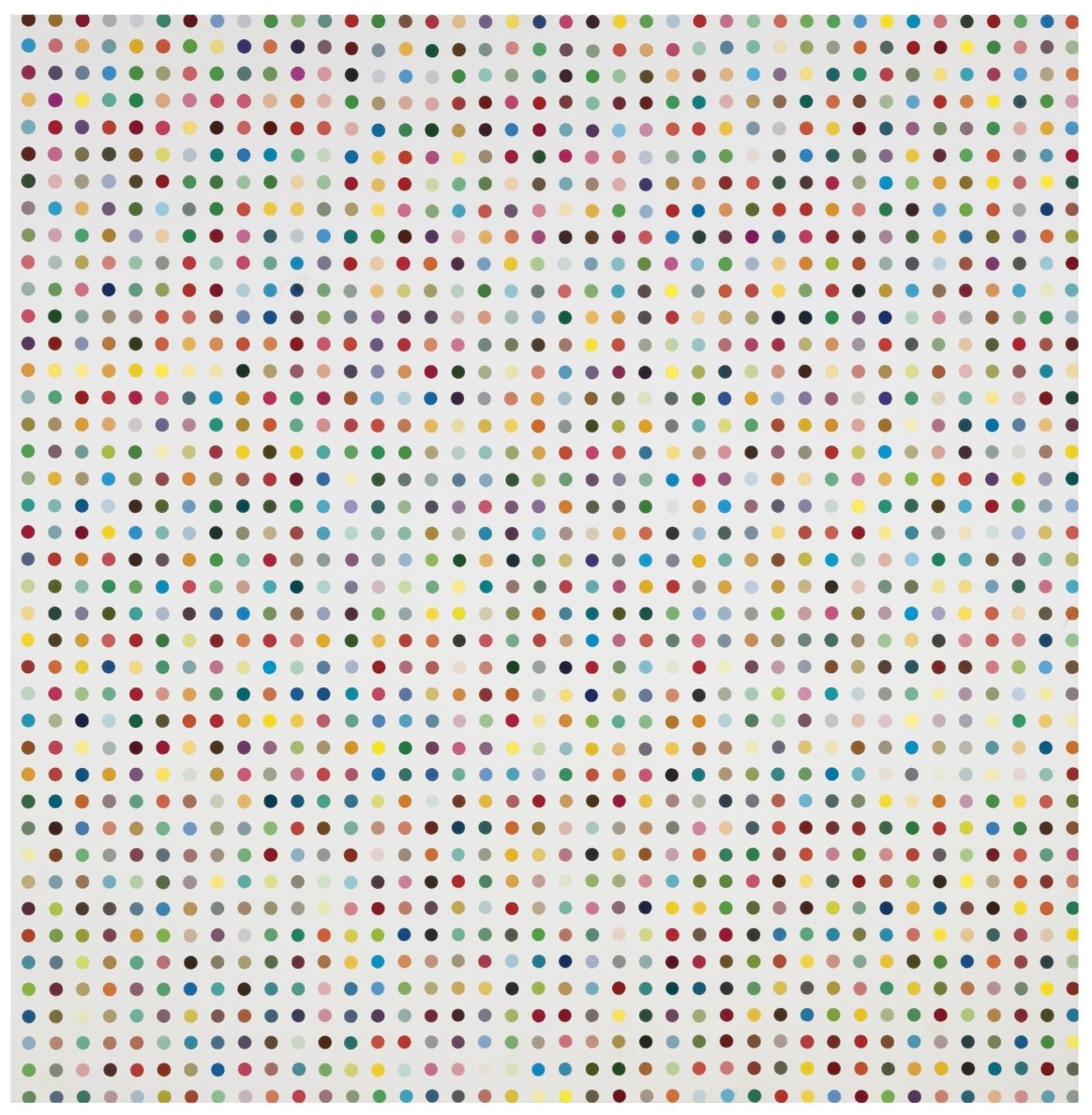
DAMIEN HIRST
Apolopoprotein A-1,1994
Gloss and household paint on canvas
81×80 inches (205.7 x 203.2 cm)
#4. Bromphenol Red, 2007
Sotheby’s New-York: 14 February 2008
Estimated: USD 1,000,000 – 1,500,000
USD 2,640,000
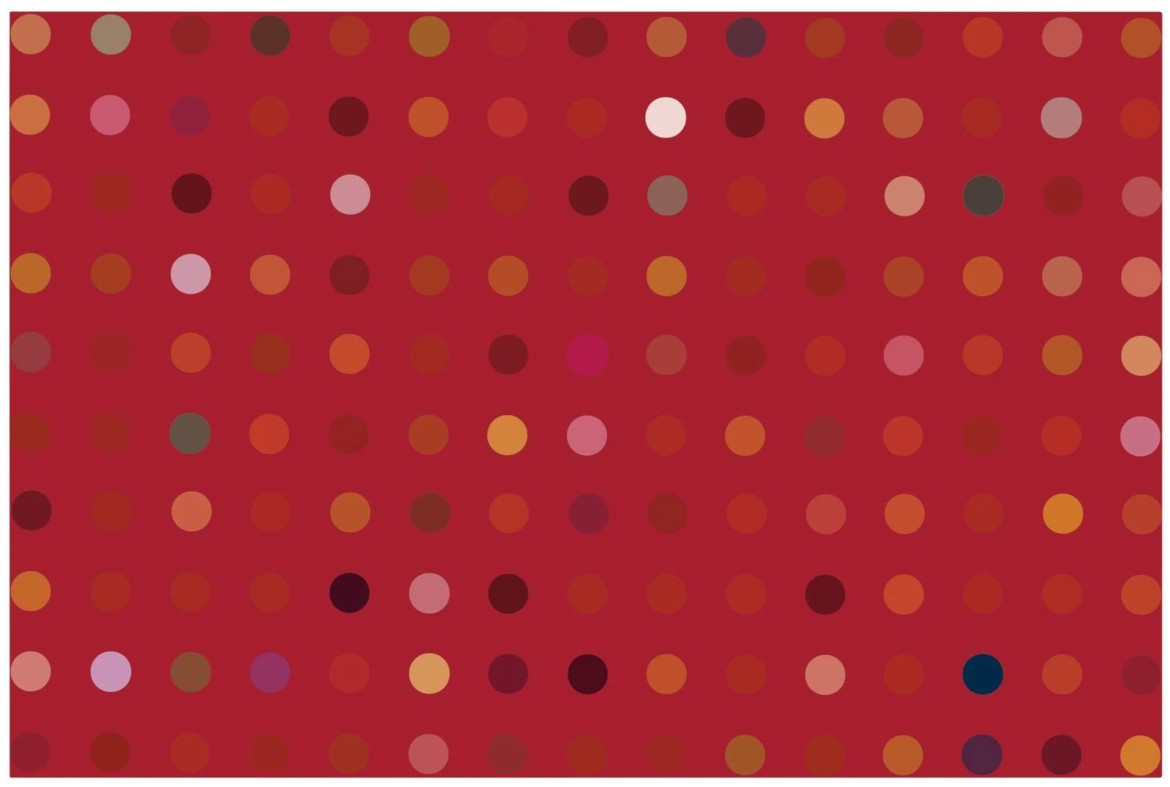
DAMIEN HIRST
Bromphenol Red, 2007
Household gloss paint on canvas
76×116 inches (193 x 294.5 cm)
#5. Notechis Ater Humphreysi (No. 0072), 2000
Christie’s New-York: 16 May 2007
Estimated: USD 1,500,000 – 2,000,000
USD 2,392,000
Damien Hirst (b. 1965) , Notechis Ater Humphreysi (No. 0072) | Christie’s
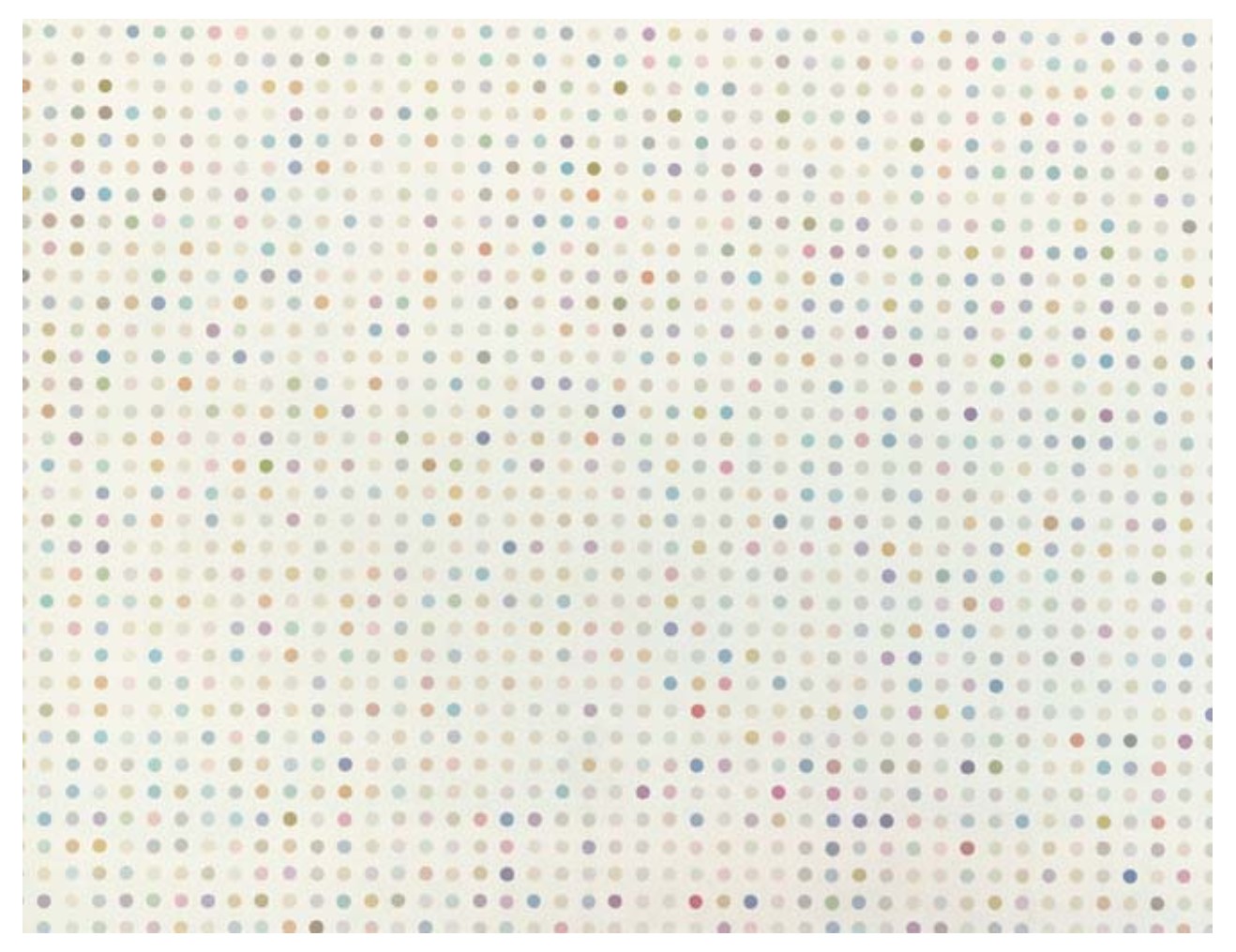
DAMIEN HIRST (b. 1965)
Notechis Ater Humphreysi (No. 0072), 2000
Household gloss on canvas
99×147 inches (251.4 x 373.3 cm)
#6. Dicyclohexylammonium Nitrate, 2008
Sotheby’s New-York: 14 May 2008
Estimated: USD 1,200,000 – 1,800,000
USD 1,889,000
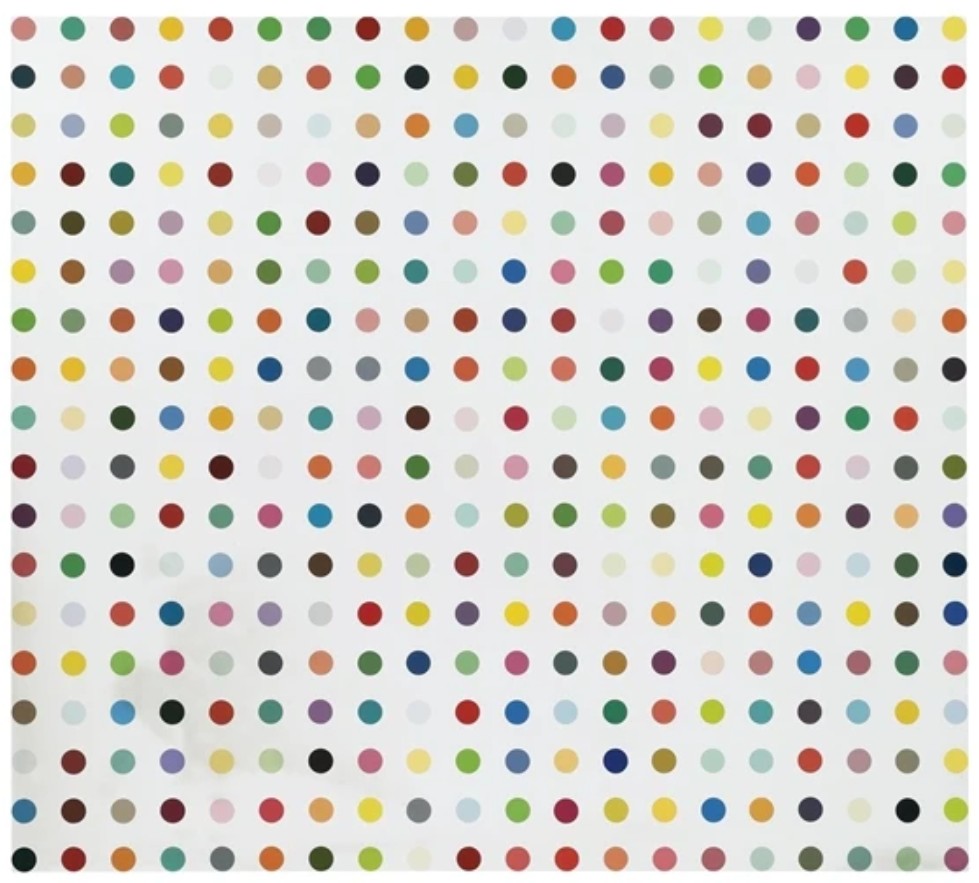
DAMIEN HIRST
Dicyclohexylammonium Nitrate, 2008
Household gloss on canvas
70×78 inches (177.8 x 198.1 cm)
2026 Auction Results
Diethylene Glycol, 2006
Property from a Distinguished British Collector
Sotheby’s London: 5 March 2026
Estimated: GBP 250,000 – 350,000
GBP 307,200 / USD 410,390
Diethylene Glycol | Contemporary Day Auction | 2026 | Sotheby’s
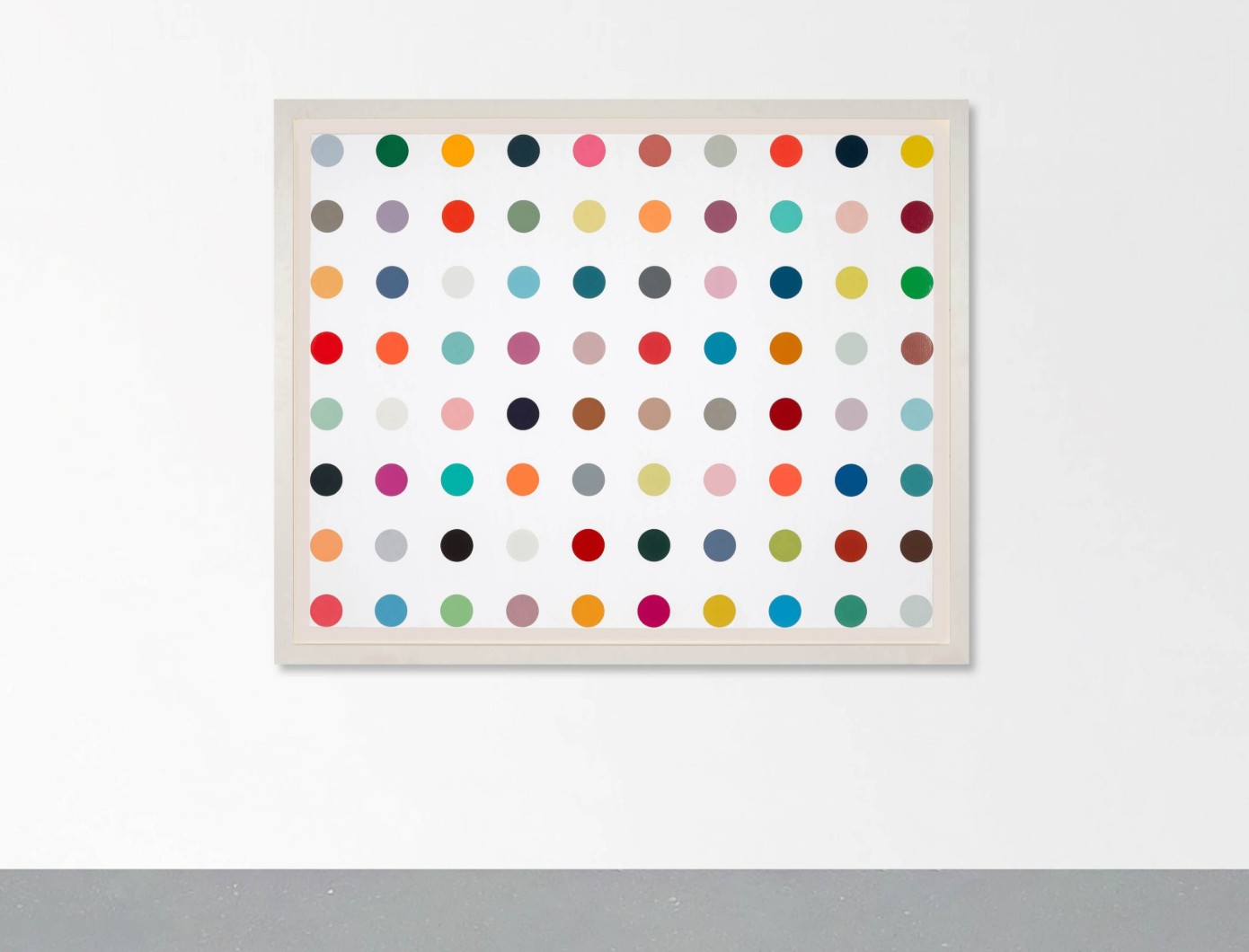
DAMIEN HIRST (b. 1965)
Diethylene Glycol, 2006
Household gloss on canvas
60×76 inches (152.4 x 193 cm)
Signed twice (on the stretcher)
Signed, titled and dated 2006 (on the reverse)
Hydrogen Peroxide, 2007-2011
PROPERTY FROM AN IMPORTANT AMERICAN COLLECTION
Christie’s London: 7 March 2026
Estimated: GBP 100,000 – 150,000
GBP 203,200 / USD 271,455
DAMIEN HIRST (B. 1965), Hydrogen Peroxide | Christie’s
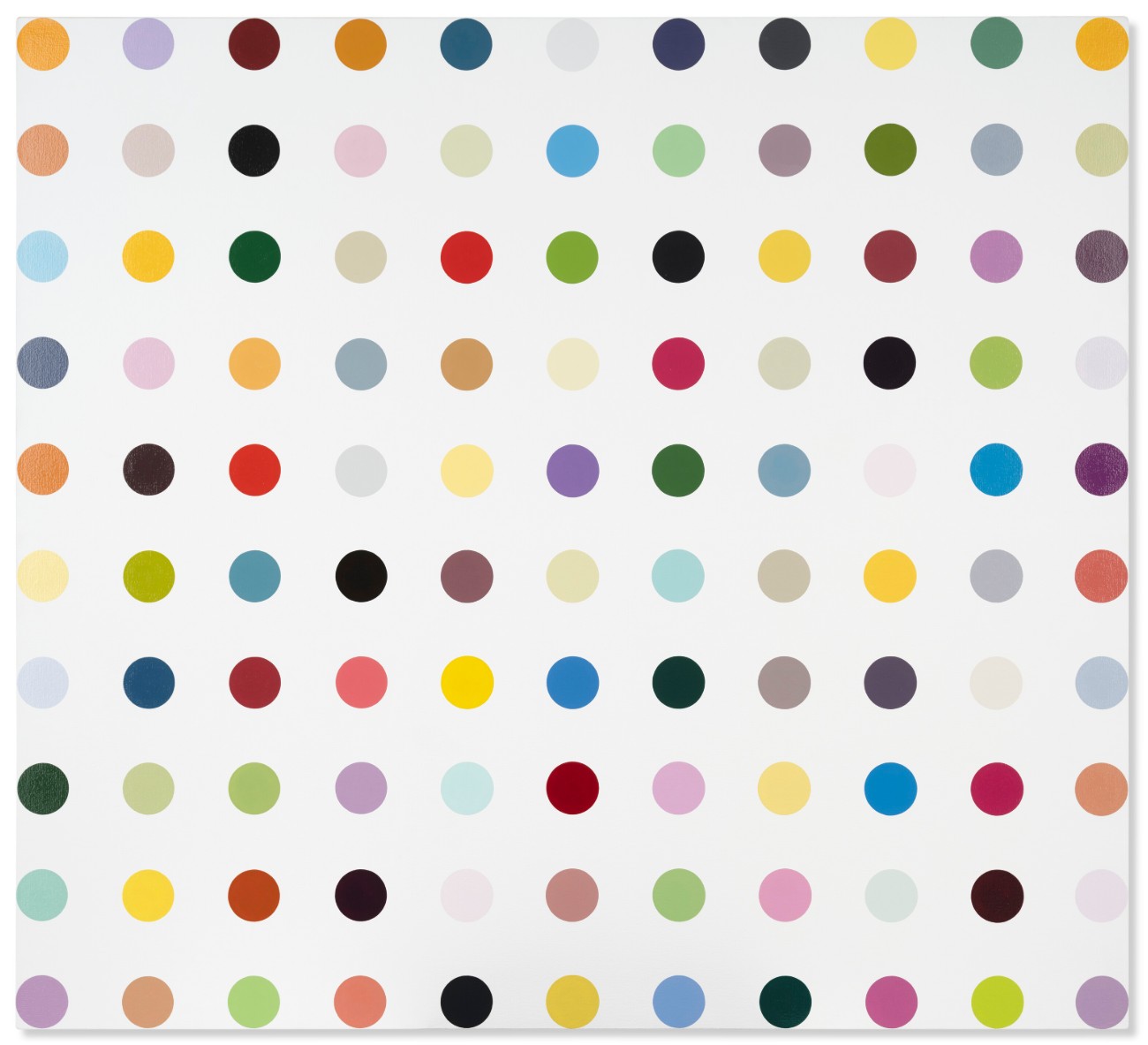
DAMIEN HIRST (B. 1965)
Hydrogen Peroxide, 2007-2011
Household gloss on canvas
38×42 inches (96.5 x 106.9 cm) (2 inch spot)
Signed ‘Damien Hirst’ (on the stretcher)
Signed, titled and dated ‘Hydrogen Peroxide Damien Hirst 2007-2011’ (on the reverse)
Argininamine, 1994
Bonhams London: 5 March 2026
Estimated: GBP 180,000 – 250,000
GBP 184,550 / USD 246,540
SPOT PAINTING
Bonhams : DAMIEN HIRST (B. 1965) Argininamine (Painted in 1994)
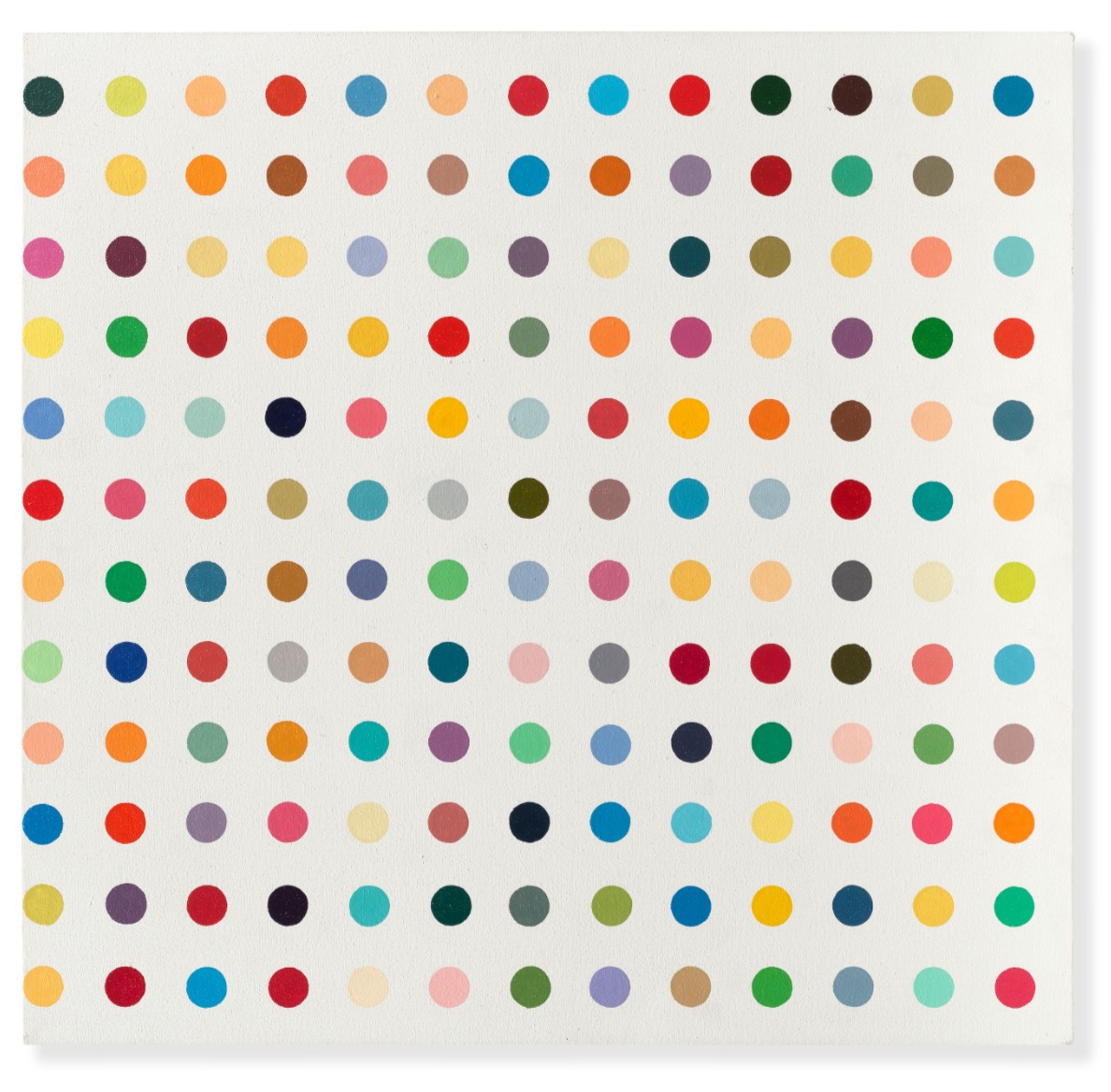
DAMIEN HIRST (B. 1965)
Argininamine, 1994
Household gloss on canvas
25×26 inches (63.5 x 66 cm)
Signed ‘Hirst’ (on the reverse)
2025 Auction Results
#1. Cesium Fluoride, 2004-2011
Phillips London: 6 March 2025
Estimated: GBP 400,000 – 600,000
GBP 444,500 / USD 568,960
Damien Hirst – Modern & Contemporary A… Lot 30 March 2025 | Phillips
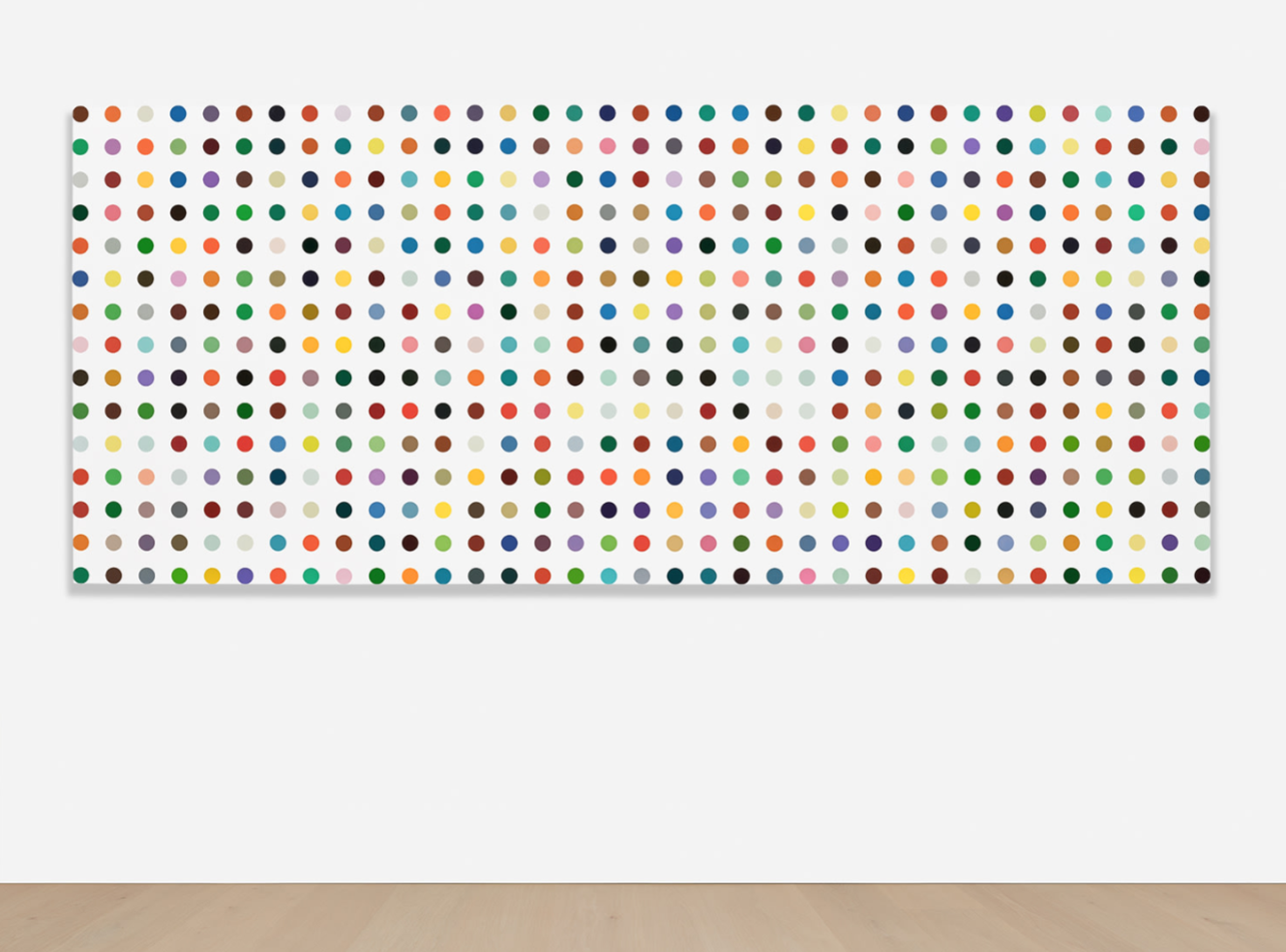
DAMIEN HIRST
Cesium Fluoride, 2004-2011
Household gloss on canvas
57 7/8 x 138 1/4 inches (147.2 x 351 cm)
Signed, titled and dated ‘Cesium Flouride’ Damien Hirst 2004-2011′ on the reverse
Signed ‘D Hirst’ and stamped twice with the artist’s stamp on the stretcher
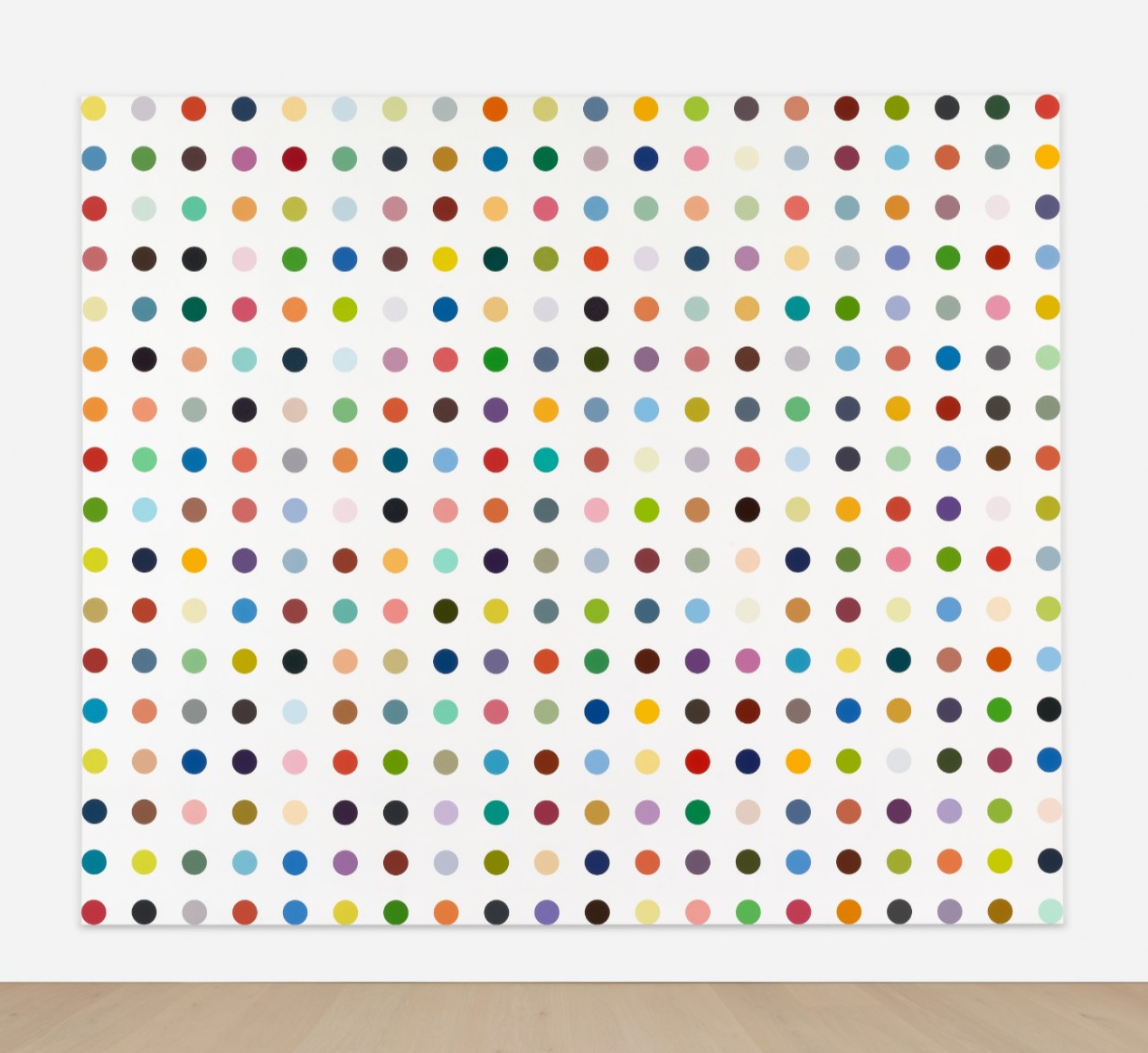
#2. Calcium Hydroxide, 2004-2011
Estimated: GBP 400,000 – 600,000
GBP 412,800 / USD 553,150
#3. 1-Chloro-2, 4-Dinitrobenzene, 1997
Christie’s New-York: 14 May 2025
Estimated: USD 600,000 – 800,000
USD 529,200
DAMIEN HIRST (B. 1965), 1-Chloro-2, 4-Dinitrobenzene | Christie’s
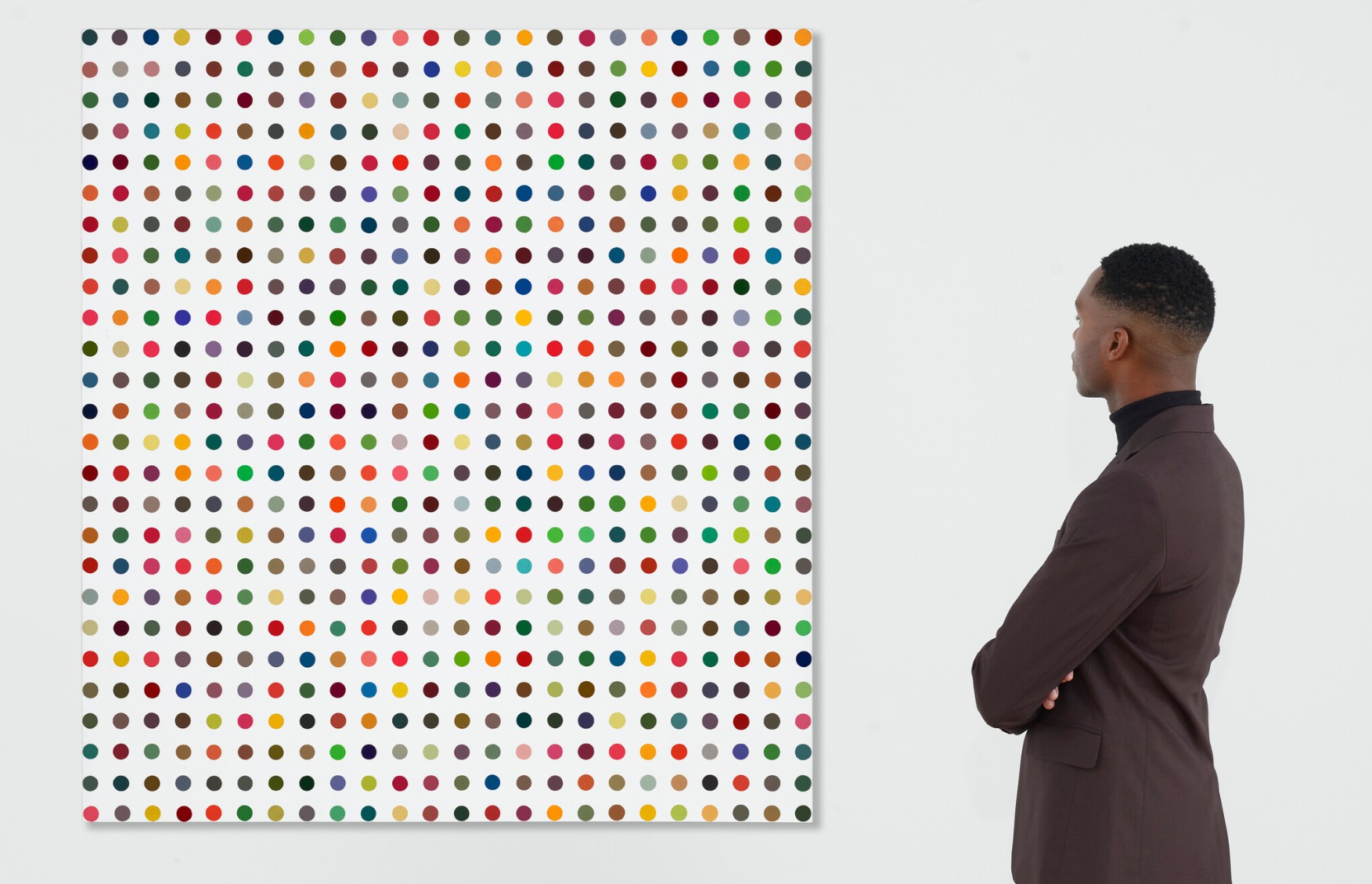
DAMIEN HIRST (B. 1965)
1-Chloro-2, 4-Dinitrobenzene, 1997
Household gloss on canvas
130×120 cm (51 1/4 x 47 1/4 inches)
USD 500,000
#4. Nalorphine, 1995
Christie’s London: 16 October 2025
Estimated: GBP 150,000 – 200,000
GBP 266,700 / USD 357,380
DAMIEN HIRST (B. 1965), Nalorphine | Christie’s
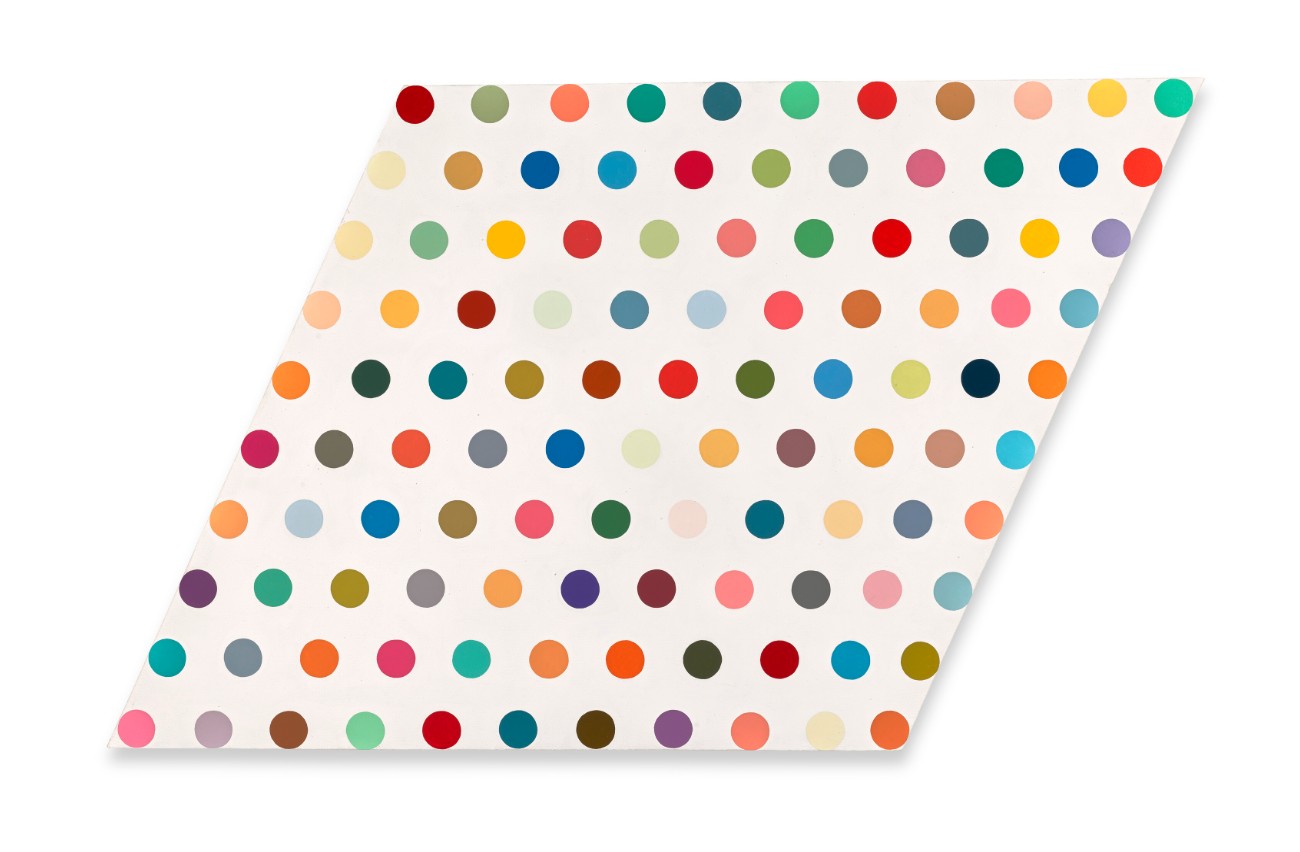
DAMIEN HIRST (B. 1965)
Nalorphine, 1995
Household gloss on canvas
34 7/8 x 57 1/8 inches (88.5 x 145 cm) (2 inch spot)
Titled ‘NALORPHINE’ (on the stretcher)
#5. Adenosine Monophosphate, 2012
Property of an Important Private Collector
Phillips London: 3 December 2025
Estimated: GBP 200,000 – 300,000
GBP 264,450 / USD 349,600
Damien Hirst New Now: Modern & Contemporary Art
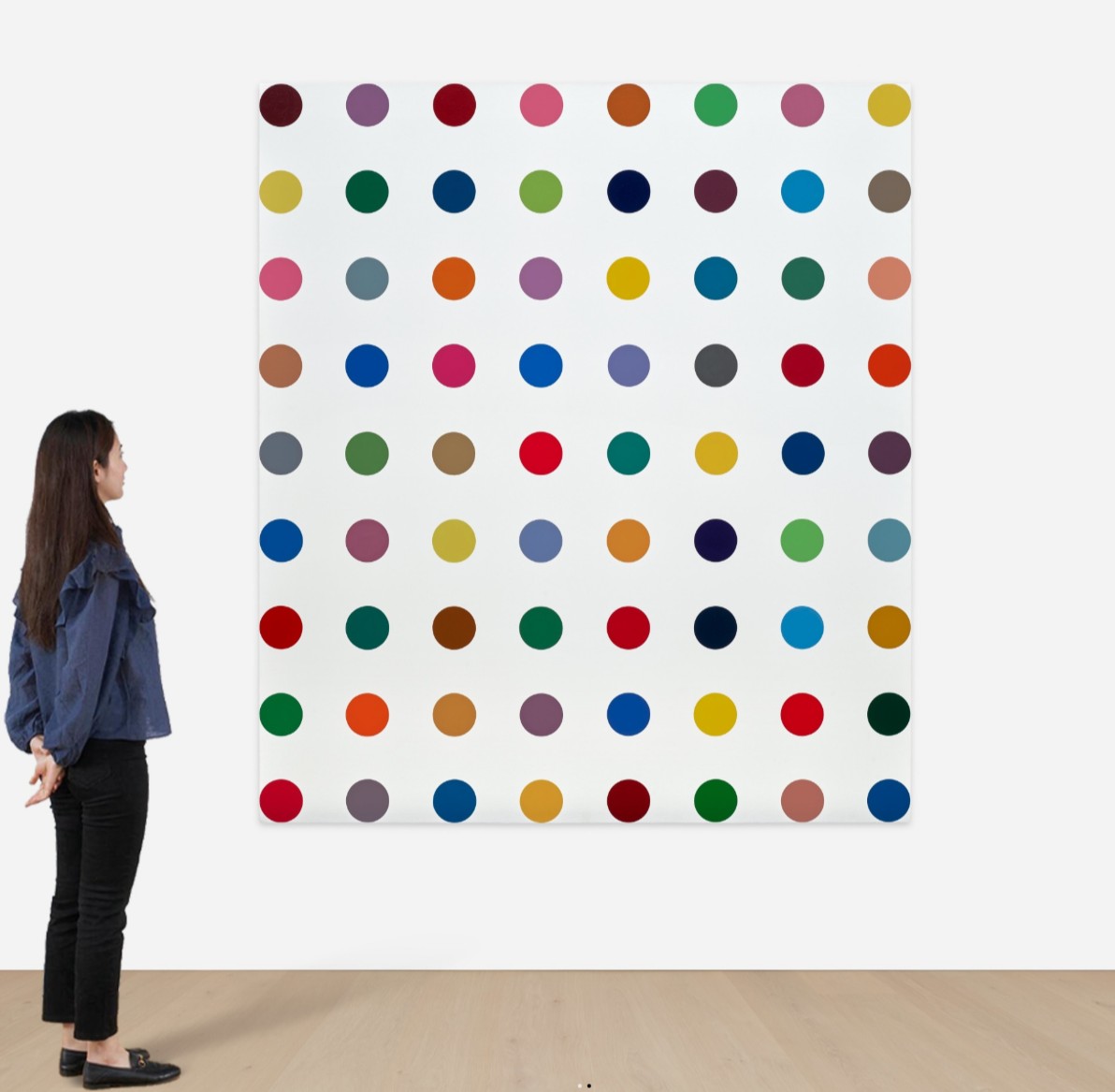
DAMIEN HIRST
Adenosine Monophosphate, 2012
Household gloss on canvas
67 7/8 x 59 7/8 inches (172.7 x 152.3 cm)
Signed ‘D Hirst’ on the stretcher
Signed, titled and dated ”Adenosine Monophosphate’ Damien Hirst 2012′ on the reverse
#6. Arg-Glu, 1994
Christie’s New-York: 15 May 2025
Estimated: USD 200,000 – 300,000
USD 315,000
DAMIEN HIRST (B. 1965), Arg-Glu | Christie’s
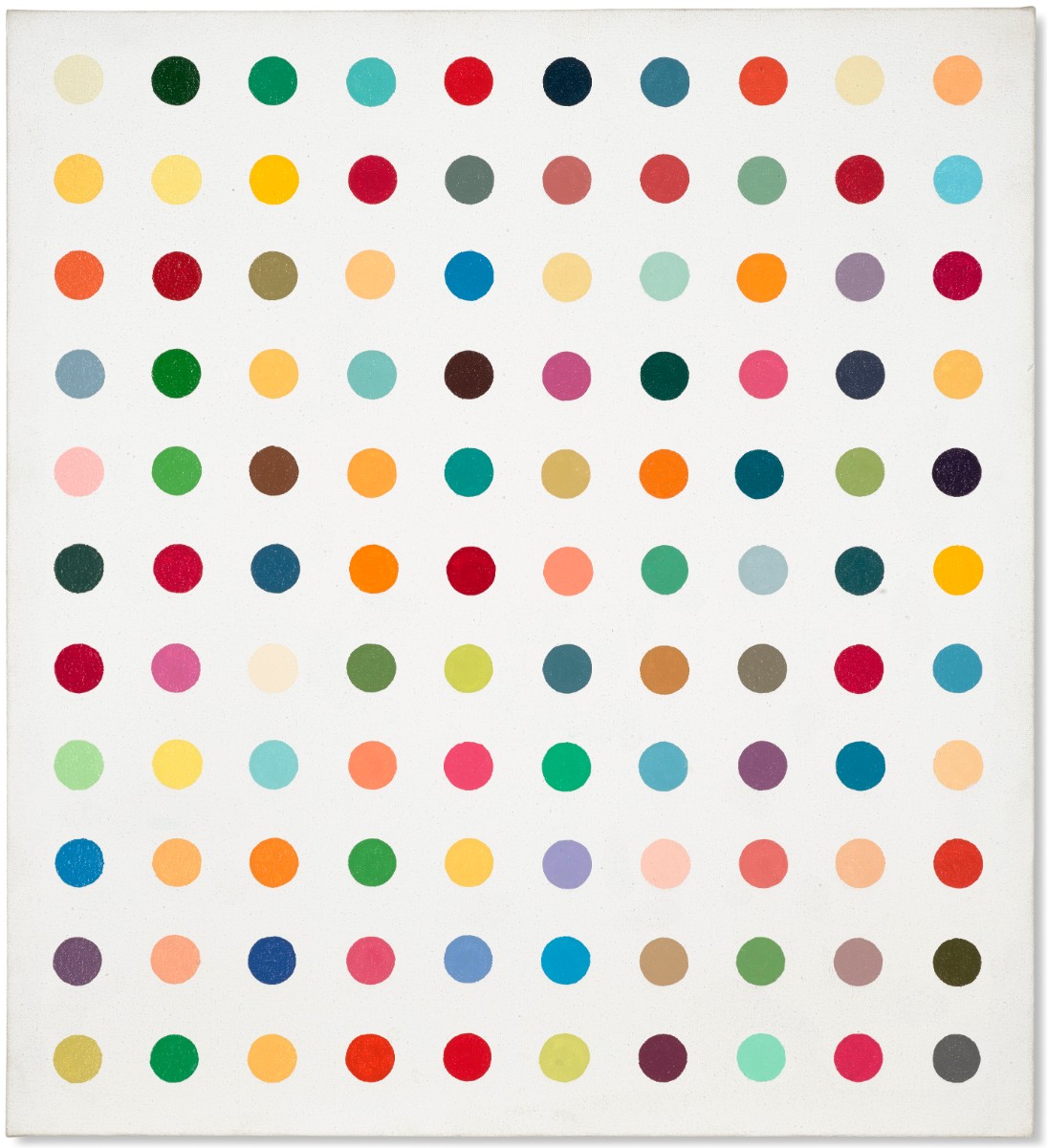
DAMIEN HIRST (B. 1965)
Arg-Glu, 1994
Household gloss on canvas
23×21 inches (58.4 x 53.3 cm)
Signed ‘D. Hirst’ (on the reverse)
#7. Untitled (Chris), 1999
Bonhams New-York: 15 May 2025
Estimated: USD 250,000 – 450,000
USD 267,200
Bonhams : DAMIEN HIRST (B. 1965) Untitled (Chris) 34 x 38 in (86.4 x 96.5 cm) (Painted in 1999)
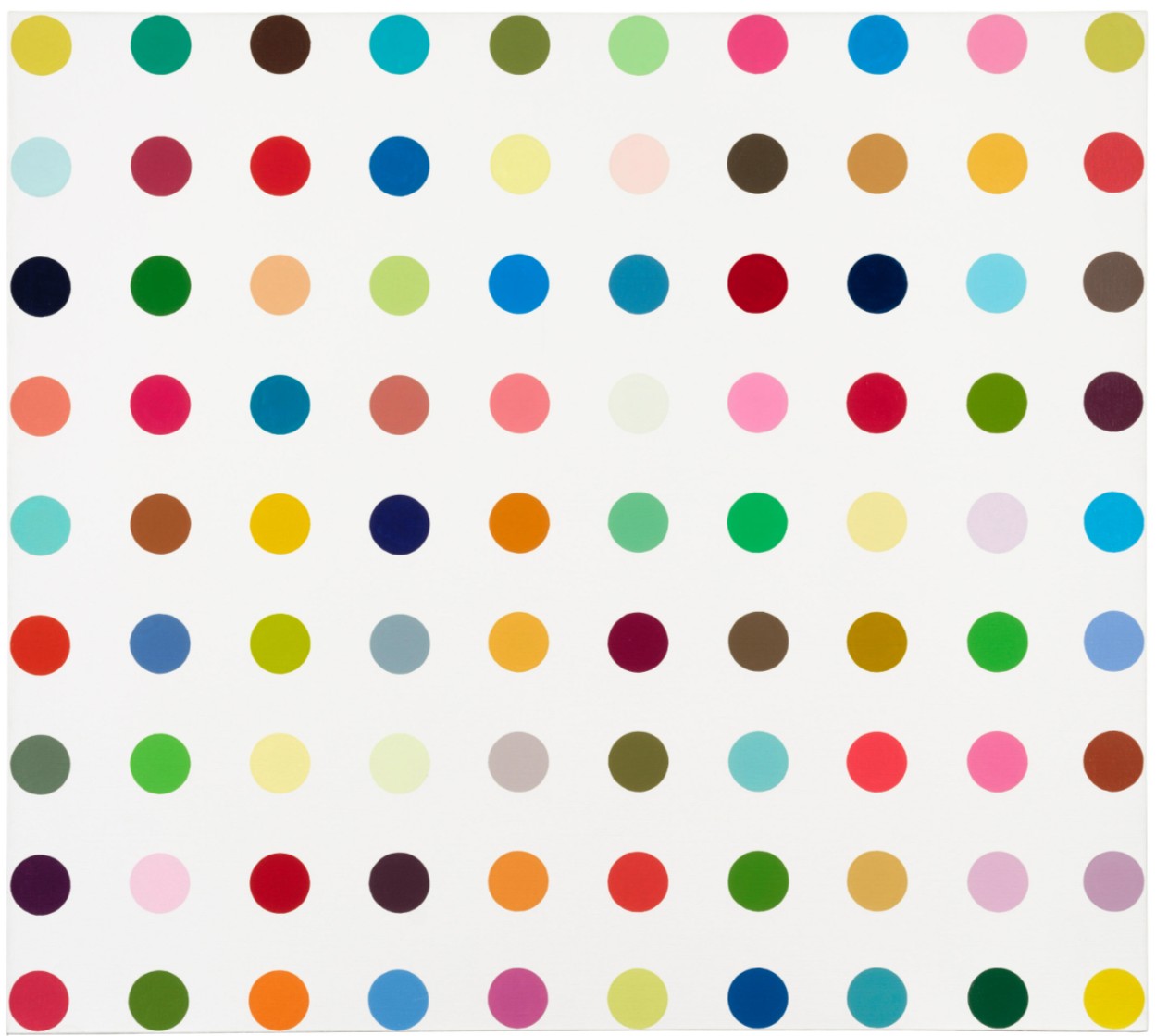
Household gloss on canvas
34×38 inches (86.4 x 96.5 cm)
#8. 2,3-Dibenzoyl-D-Tartaric Acid, 2002
Christie’s New-York: 20 November 2025
Estimated: USD 100,000 – 150,000
USD 215,900
DAMIEN HIRST (B. 1965), 2,3-Dibenzoyl-D-Tartaric Acid | Christie’s
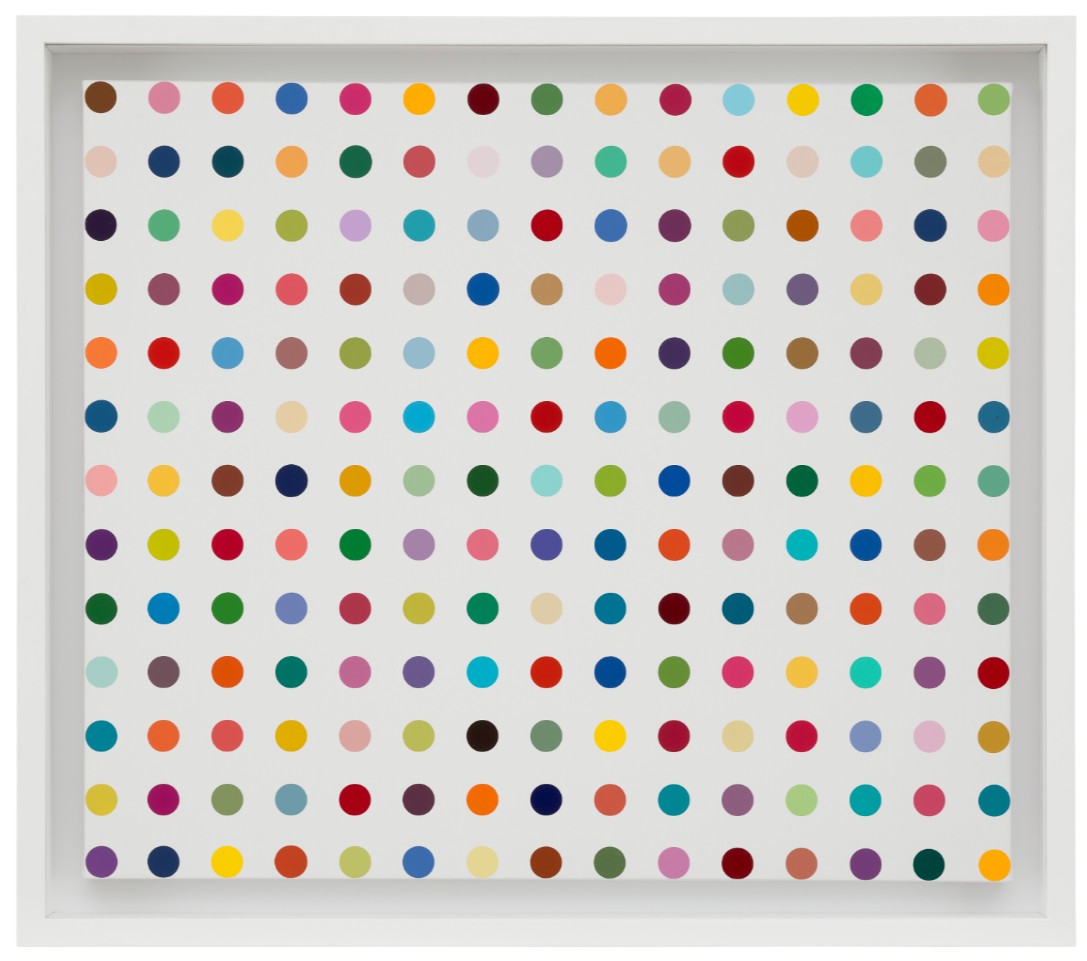
DAMIEN HIRST (B. 1965)
2,3-Dibenzoyl-D-Tartaric Acid, 2002
Household gloss on canvas
25×29 inches (63.5 x 73.7 cm)
Signed, titled and dated ‘2022 ‘2,3-Dibenzoyl-D-Tartaric Acid’ Damien Hirst’ (on the reverse)
Signed again ‘D. Hirst’ (on the stretcher)
#9. Dimethyl-Dichlorosilane, 2008-2011
Phillips New-York: 14 May 2025
Estimated: USD 80,000 – 120,000
USD 165,100
Damien Hirst Modern & Contemporary Art Day Sale, Afternoon Session
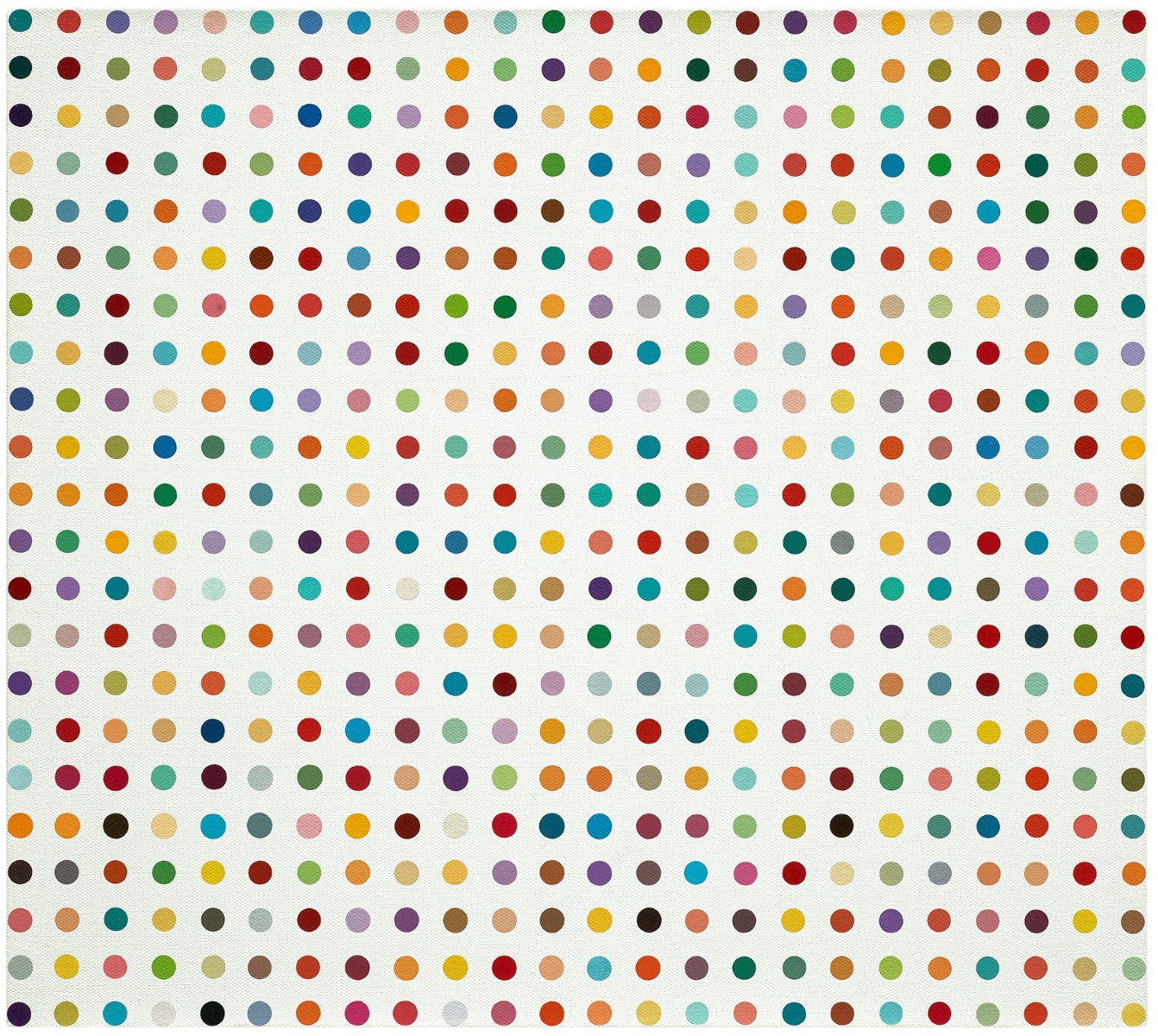
Signed and stamped with the artist’s stamp “Damien Hirst” on the stretcher
#10. 1,3:4,6-Di-O-Benzylidene-D-Mannitol, 2022
Sotheby’s London: 25 June 2025
Estimated: GBP 120,000 – 180,000
GBP 101,600 / USD 139,190
1,3:4,6-Di-O-Benzylidene-D-Mannitol | Contemporary Day Auction | 2025 | Sotheby’s
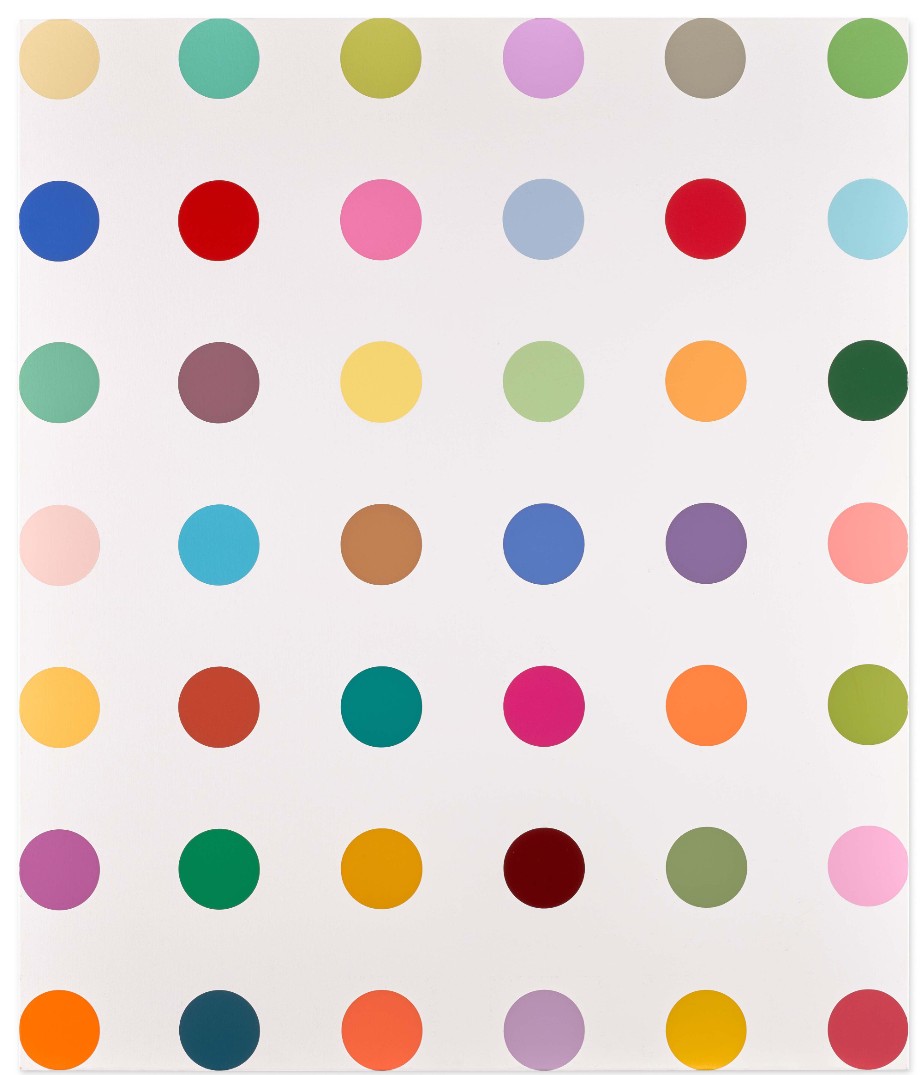
DAMIEN HIRST (b. 1965)
1,3:4,6-Di-O-Benzylidene-D-Mannitol, 2022
Household gloss on canvas)
39×33 inches (99 x 83.7 cm)
Signed (on the stretcher)
Signed, titled and dated 2022 (on the reverse)
#11. Alemethicin, 2012
Sotheby’s London: 5 March 2025
Estimated: GBP 80,000 – 120,000
GBP 88,900 / USD 113,792
Alemethicin | Contemporary Day Auction | 2025 | Sotheby’s
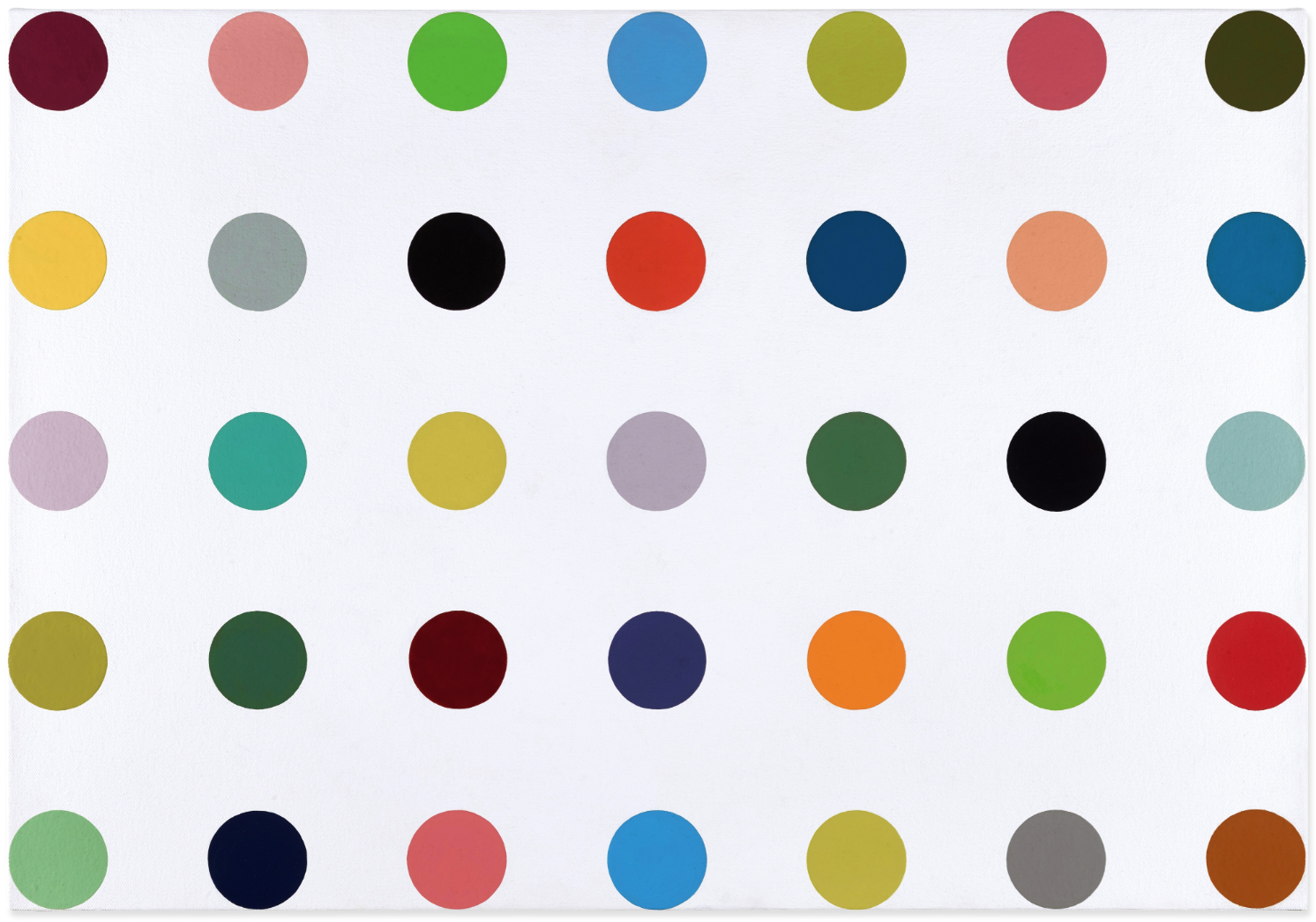
DAMIEN HIRST (b. 1965)
Alemethicin, 2012
Household gloss on canvas
18 1/8 x 26 1/8 inches (46 x 66.2 cm)
Signed, titled and dated 2012 (on the reverse)
#12. 4-Methylpyrimidine, 2003
Sotheby’s London: 24 January 2025
Estimated: GBP 60,000 – 80,000
GBP 84,000 / USD 103,770
4-Methylpyrimidine | Contemporary Discoveries | 2025 | Sotheby’s
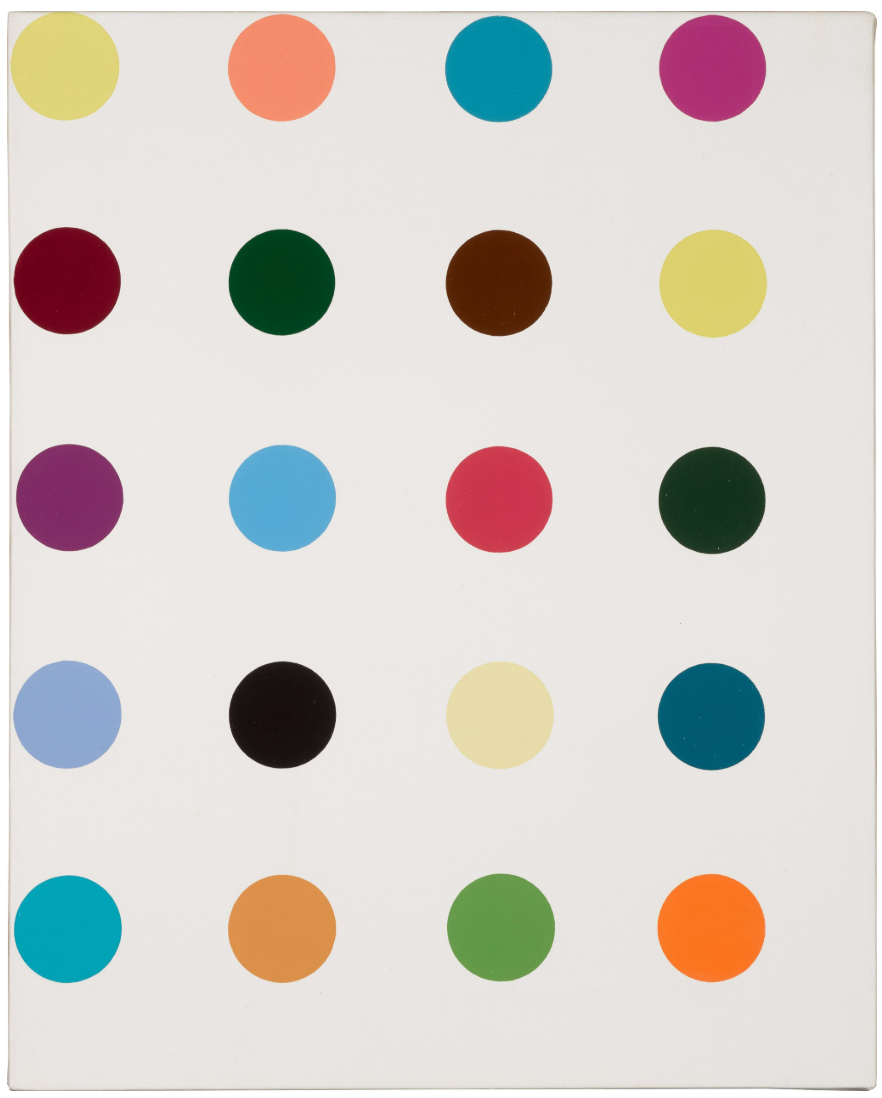
DAMIEN HIRST (b. 1965)
4-Methylpyrimidine, 2003
Household gloss on canvas
19 7/8 x 16 inches (50.5 x 40.5 cm)
Signed (on the stretcher)
Signed, titled, dated 2003 and dedicated for Stephen thanks a Billion for Chalford Place nan (on the reverse)
USD 100,000
#13. Avastin, 2005
Christie’s New-York: 30 September 2025
Estimated: USD 70,000 – 100,000
USD 76,200
DAMIEN HIRST (B. 1965), Avastin | Christie’s
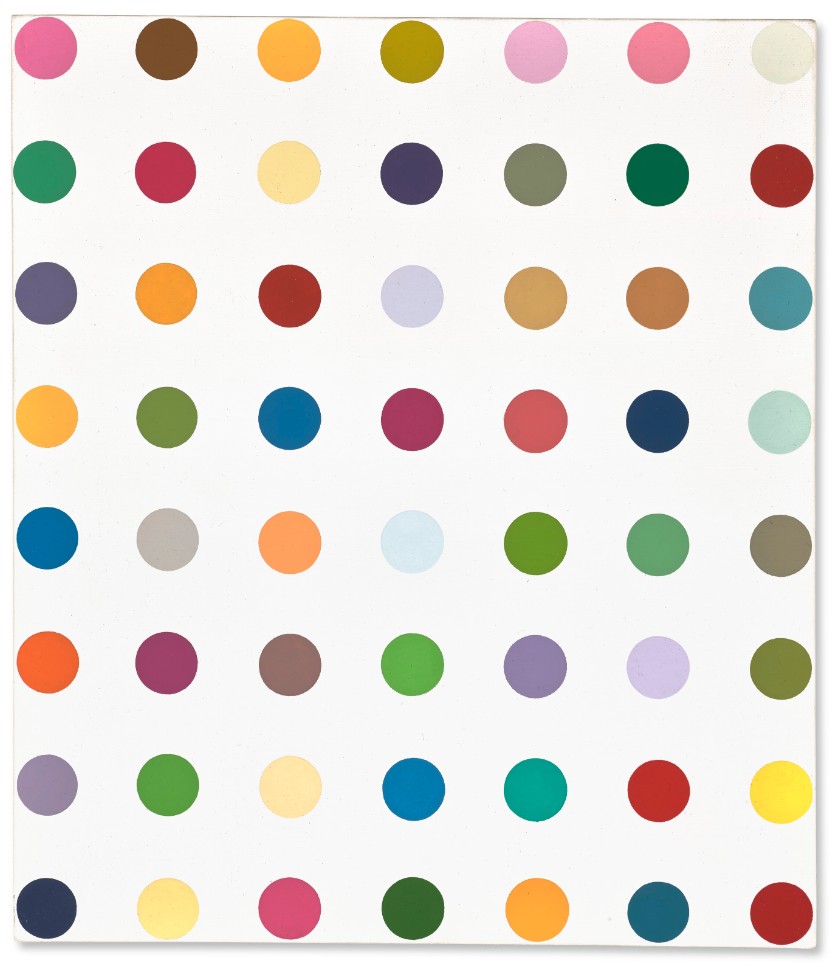
DAMIEN HIRST (B. 1965)
Avastin, 2005
Household gloss on canvas
15×13 inches (38.1 x 33 cm)
#14. Lactic Dehydrogenase, 2013
Sotheby’s London: 5 March 2025
Estimated: GBP 40,000 – 60,000
GBP 40,640 / USD 52,019
Lactic Dehydrogenase | Contemporary Day Auction | 2025 | Sotheby’s
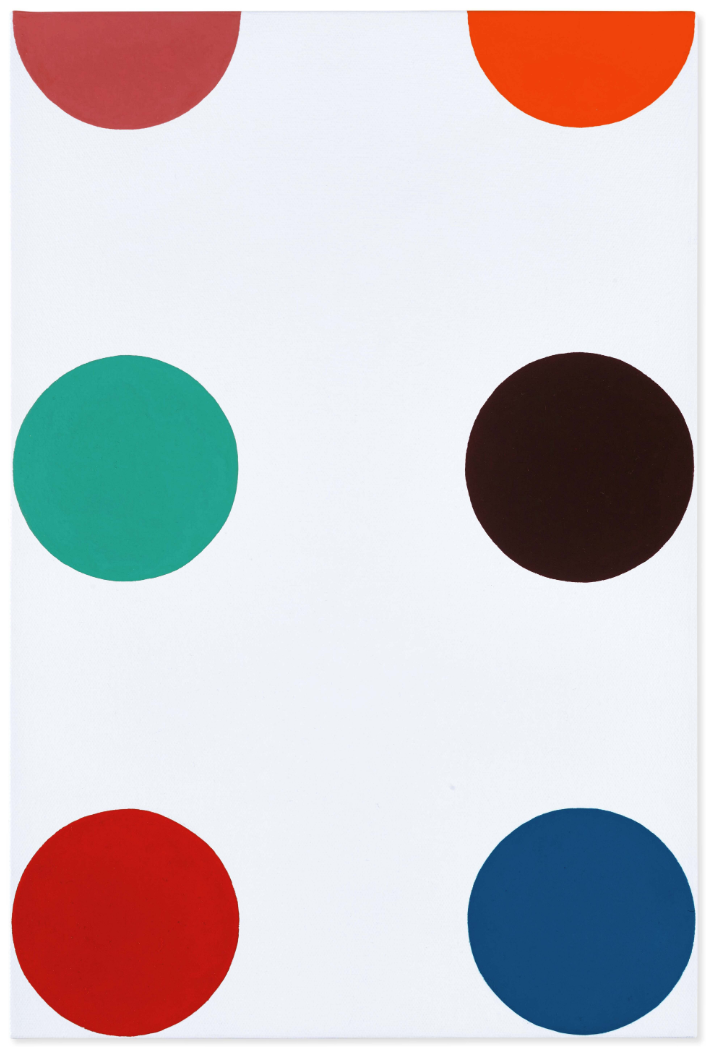 DAMIEN HIRST (b. 1965)
Lactic Dehydrogenase, 2013
Household gloss on canvas
18 x 12 1/8 inches (45.8 x 30.7 cm)
Signed, titled and dated 2013 (on the reverse)
#15. N-t-Boc-I-Alanine, 1995
Christie’s London: 16 October 2025
Estimated: GBP 80,000 – 120,000
GBP 38,100 / USD 51,055
DAMIEN HIRST (B. 1965), N-t-Boc-I-Alanine | Christie’s
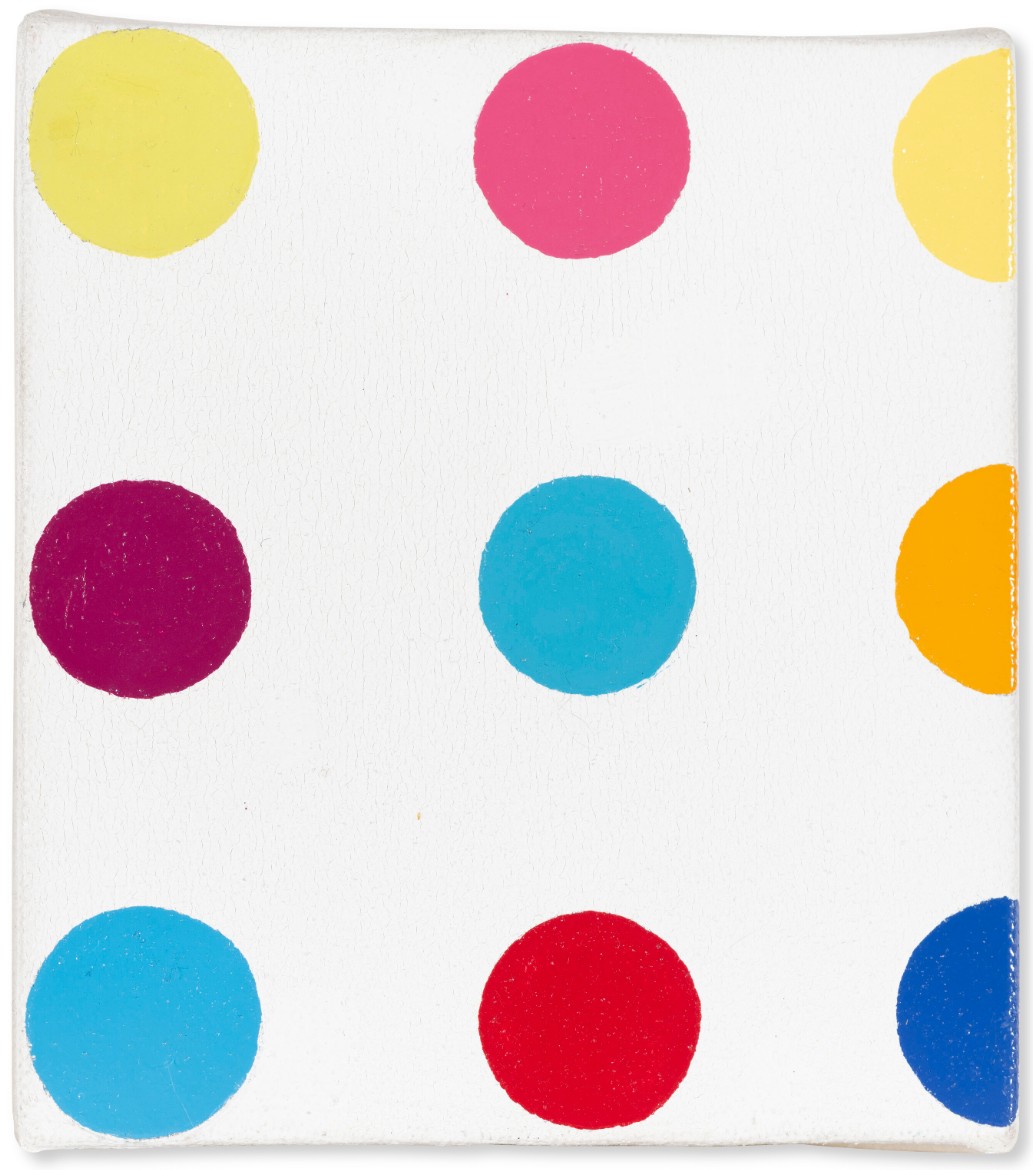
DAMIEN HIRST (B. 1965)
N-t-Boc-I-Alanine, 1995
Household gloss on canvas
5 1/8 x 4 1/2 inches (13 x 11.5 cm) (1 inch spot)
Signed twice ‘Damien Hirst D Hirst’ (on the overlap)
#16. Tridodecylamine, 2016
Phillips London: 7 March 2025
Estimated: GBP 20,000 – 30,000
GBP 35,560 / USD 45,517
Damien Hirst – Modern & Contemporary … Lot 172 March 2025 | Phillips
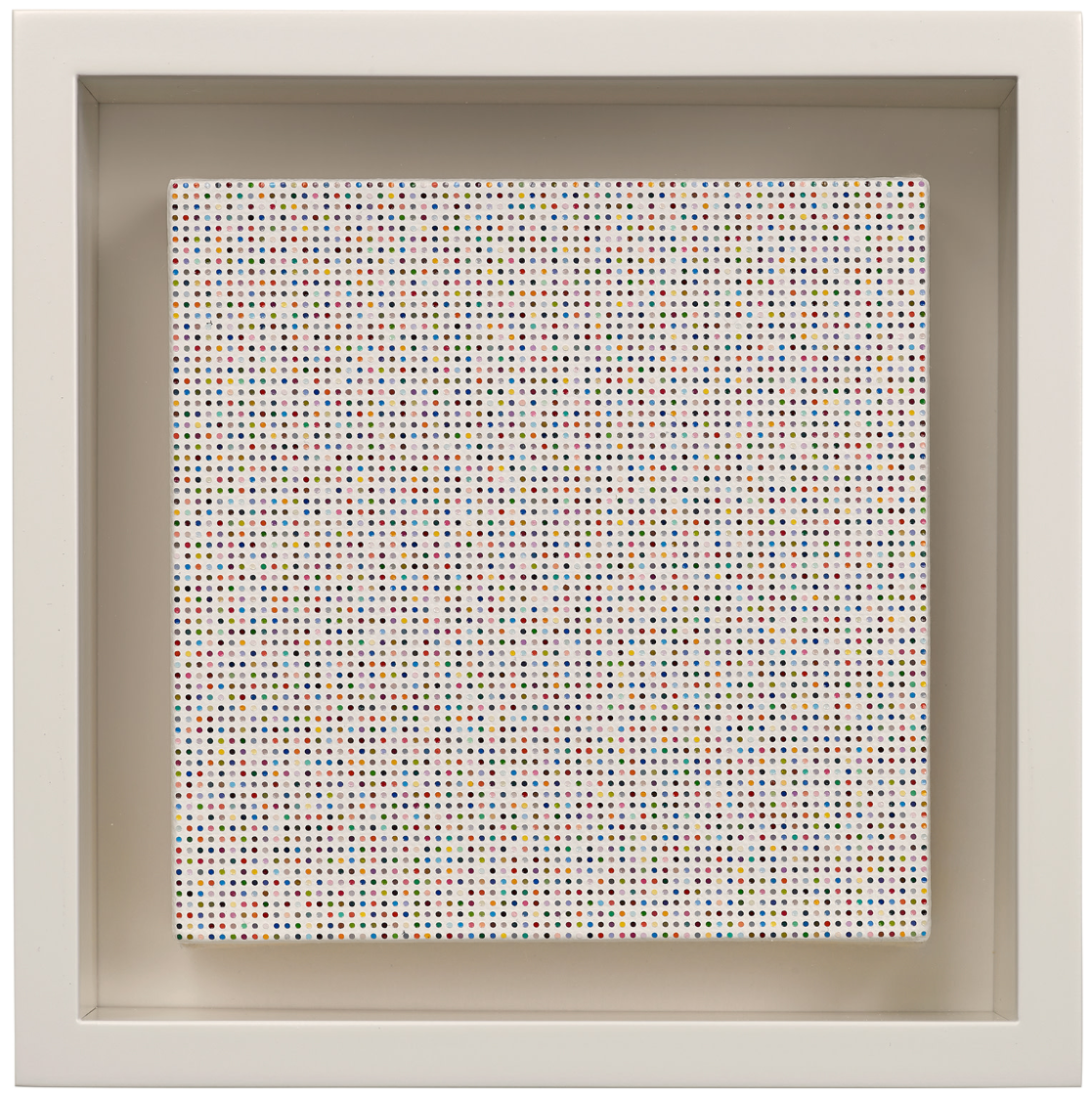
DAMIEN HIRST
Tridodecylamine, 2016
Household gloss on canvas
5 1/2 x 5 1/2 inches (14.1 x 14.1 cm)
Signed, titled and dated ‘Tridodecylamine 2016 Damien Hirst’ on the reverse
Stamped with the artist’s stamp on the overlap
#17. Maltase, 2013
Sotheby’s London: 24 January 2025
Estimated: GBP 25,000 – 35,000
GBP 28,800 / USD 35,575
Maltase | Contemporary Discoveries | 2025 | Sotheby’s
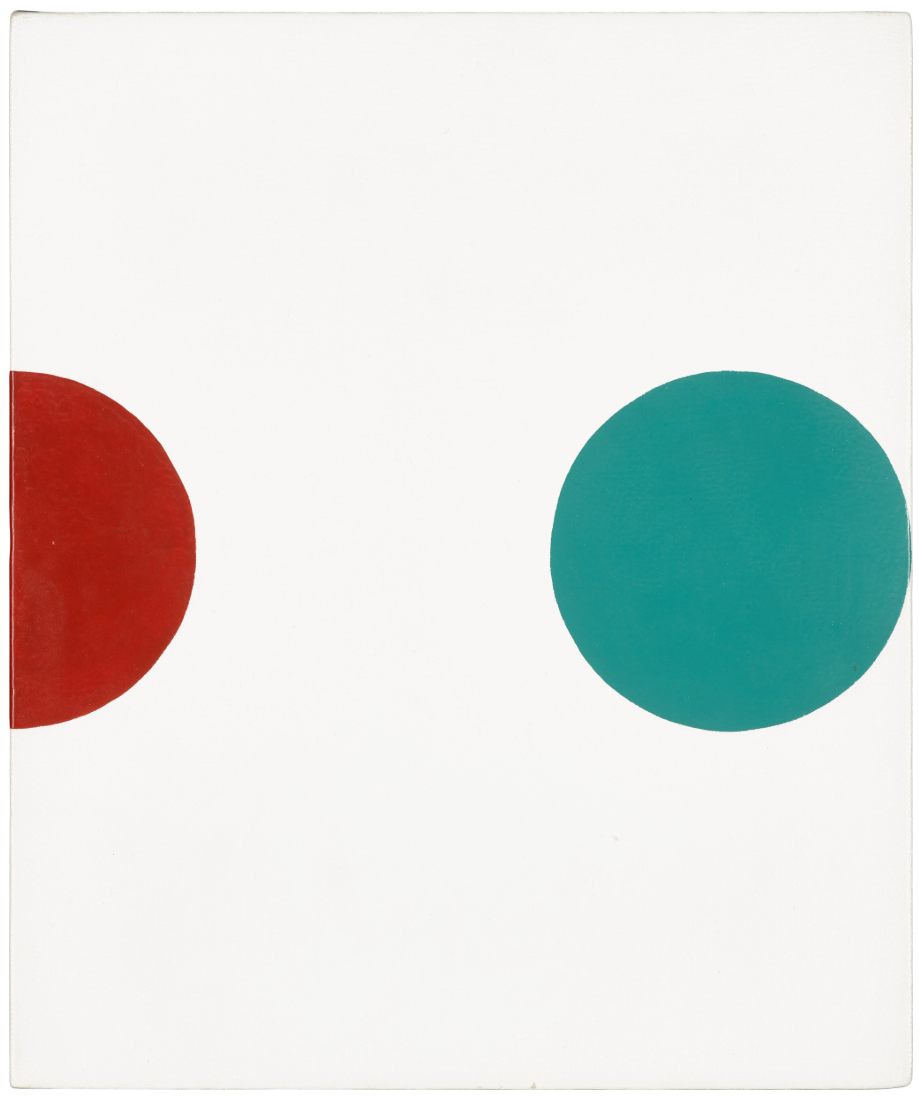
DAMIEN HIRST (b. 1965)
Maltase, 2013
Household gloss on canvas
12×10 inches (30.6 x 25.5 cm)
Signed, titled and dated 2013 (on the reverse)
Lots Passed
Ethylene Glycol Chitin, 2008
Christie’s New-York: 30 September 2025
Estimated: USD 250,000 – 350,000
PASSED
DAMIEN HIRST (B. 1965), Ethylene Glycol Chitin | Christie’s
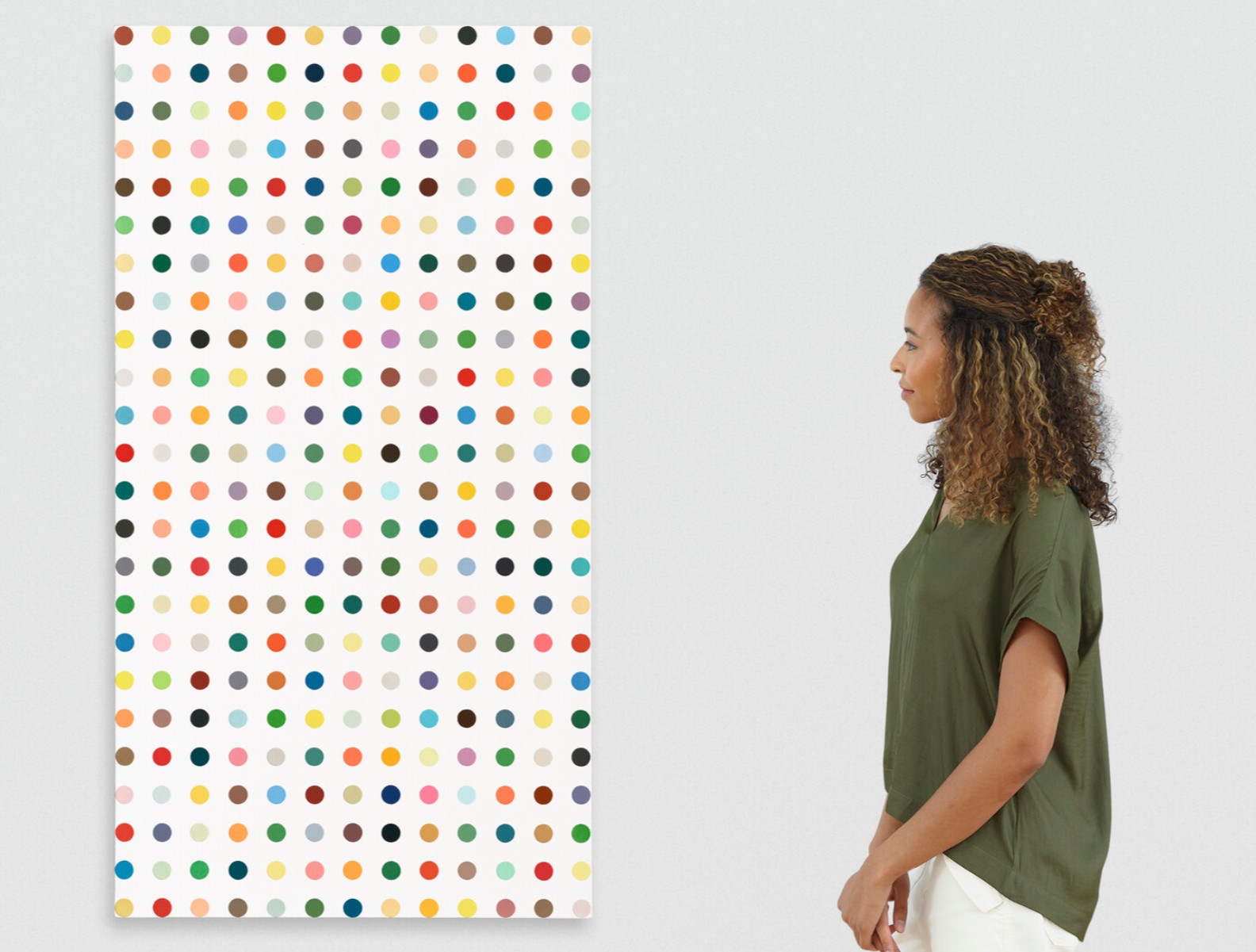
DAMIEN HIRST (B. 1965)
Ethylene Glycol Chitin, 2008
Household gloss on canvas
47×25 inches (119.4 x 61 cm)
Stamped twice with the artist’s monogram (on the overlap)
Signed ‘Damien Hirst’ (on the stretcher)
Signed again, titled and dated ‘Damien Hirst 2008 “Ethylene Glycol Chitin”‘ (on the reverse)
Propionic Anhydride, 2008
Sotheby’s New-York: 26 February 2025
Estimated: USD 200,000 – 300,000
PASSED
Propionic Anhydride | Contemporary Curated | 2025 | Sotheby’s
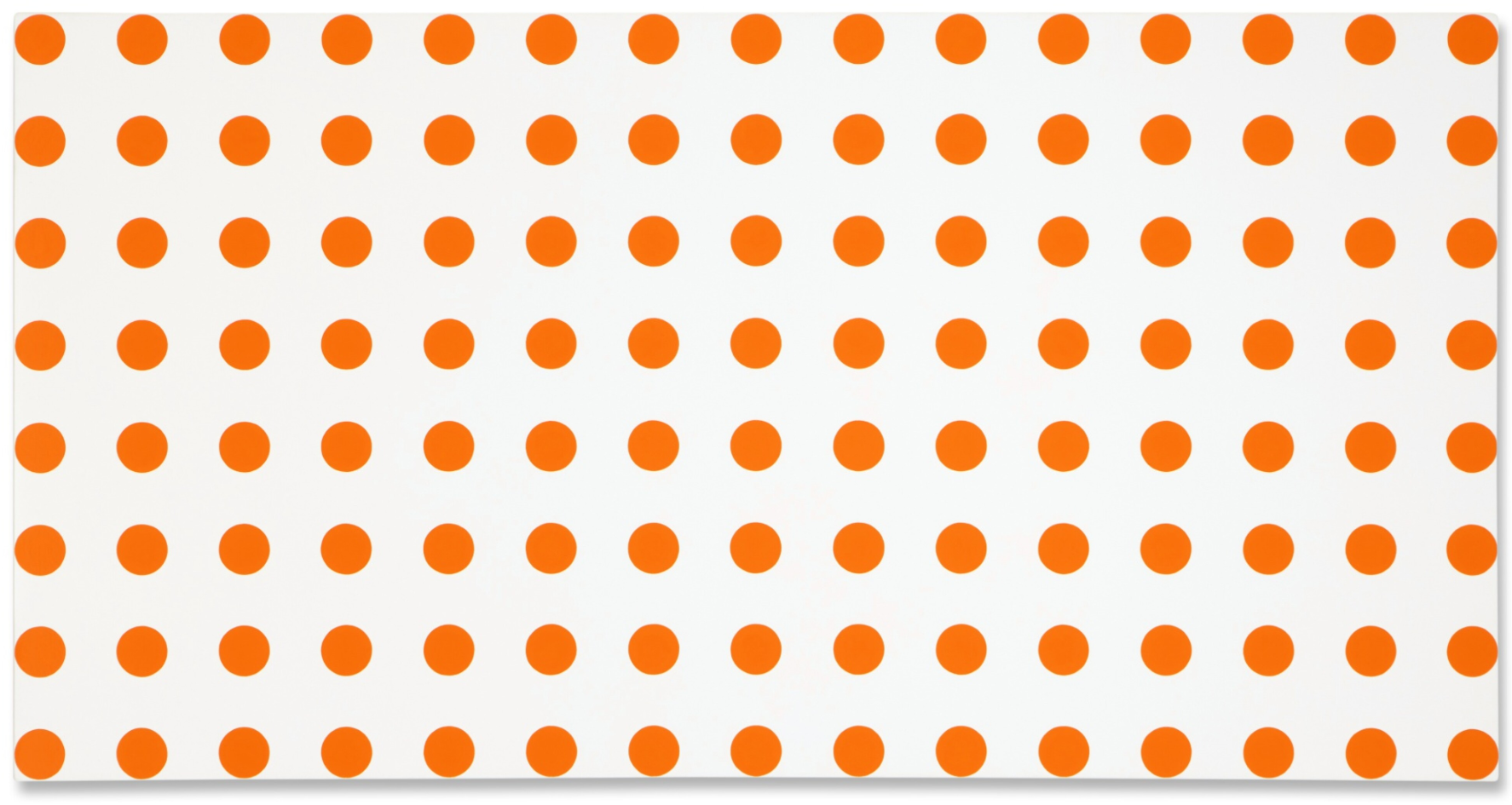
DAMIEN HIRST (b. 1965)
Propionic Anhydride, 2008
Household glass on canvas
30×58 inches (76.2 x 147.3 cm)
Signed, titled and dated 2008 (on the reverse)
Signed (on the stretcher)
Lots Withdrawn
Untitled (Nick), 1999
Sotheby’s New-York: 19 November 2025
Estimated: USD 600,000 – 800,000
WITHDRAWN
Untitled (Nick) | Contemporary Day Auction | 2025 | Sotheby’s
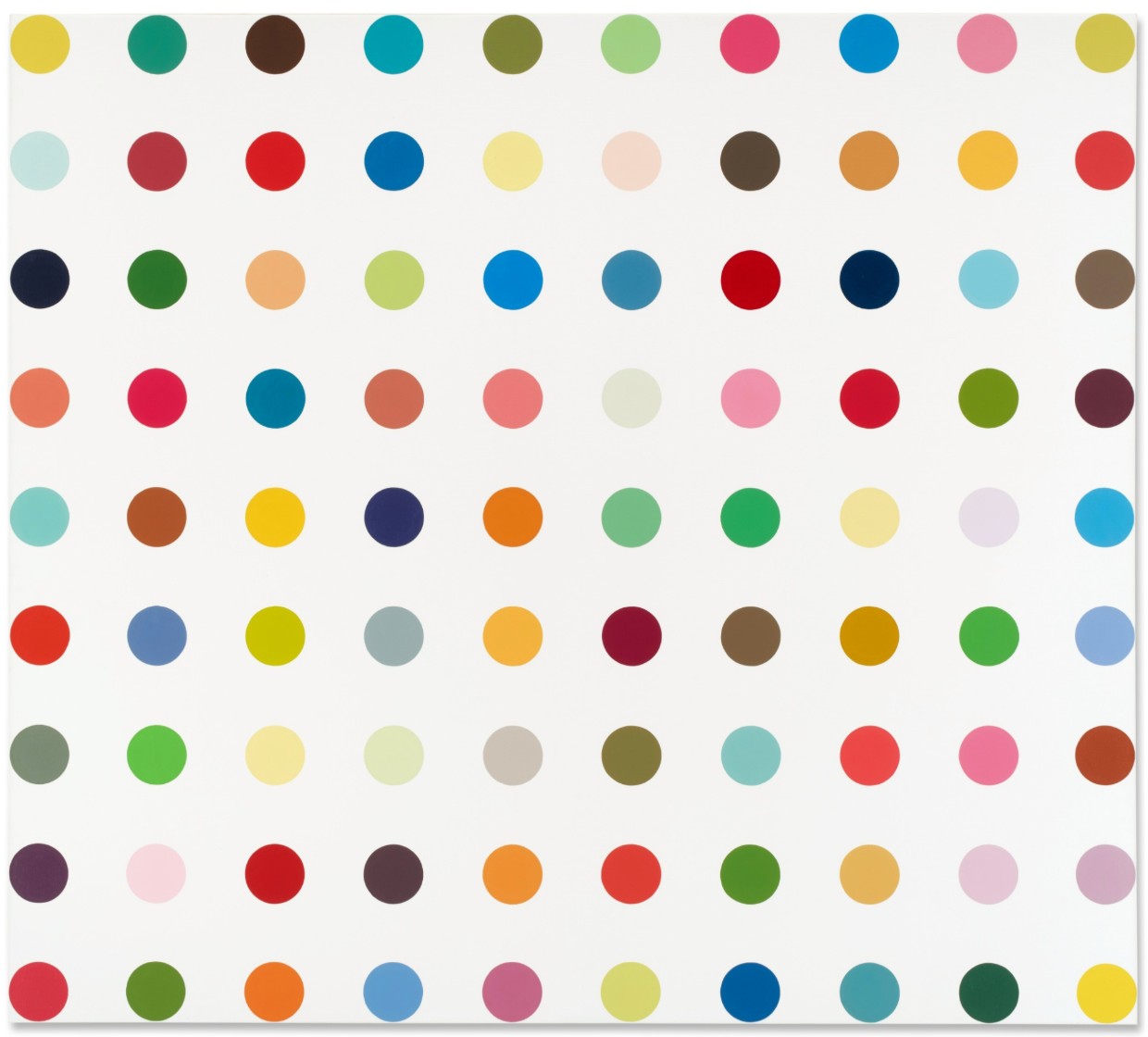
DAMIEN HIRST (b. 1965)
Untitled (Nick), 1999
Household gloss on canvas
68×76 inches (172.7 x 193 cm)
Signed, dedicated For Nick (etc.) and inscribed ♡ (on the reverse)
2024 Auction Results
#1. Ergonovine, 2005
Sotheby’s New-York: 1 March 2024
Estimated: USD 500,000 – 700,000
USD 762,000
Ergonovine | Contemporary Curated | 2024 | Sotheby’s (sothebys.com)
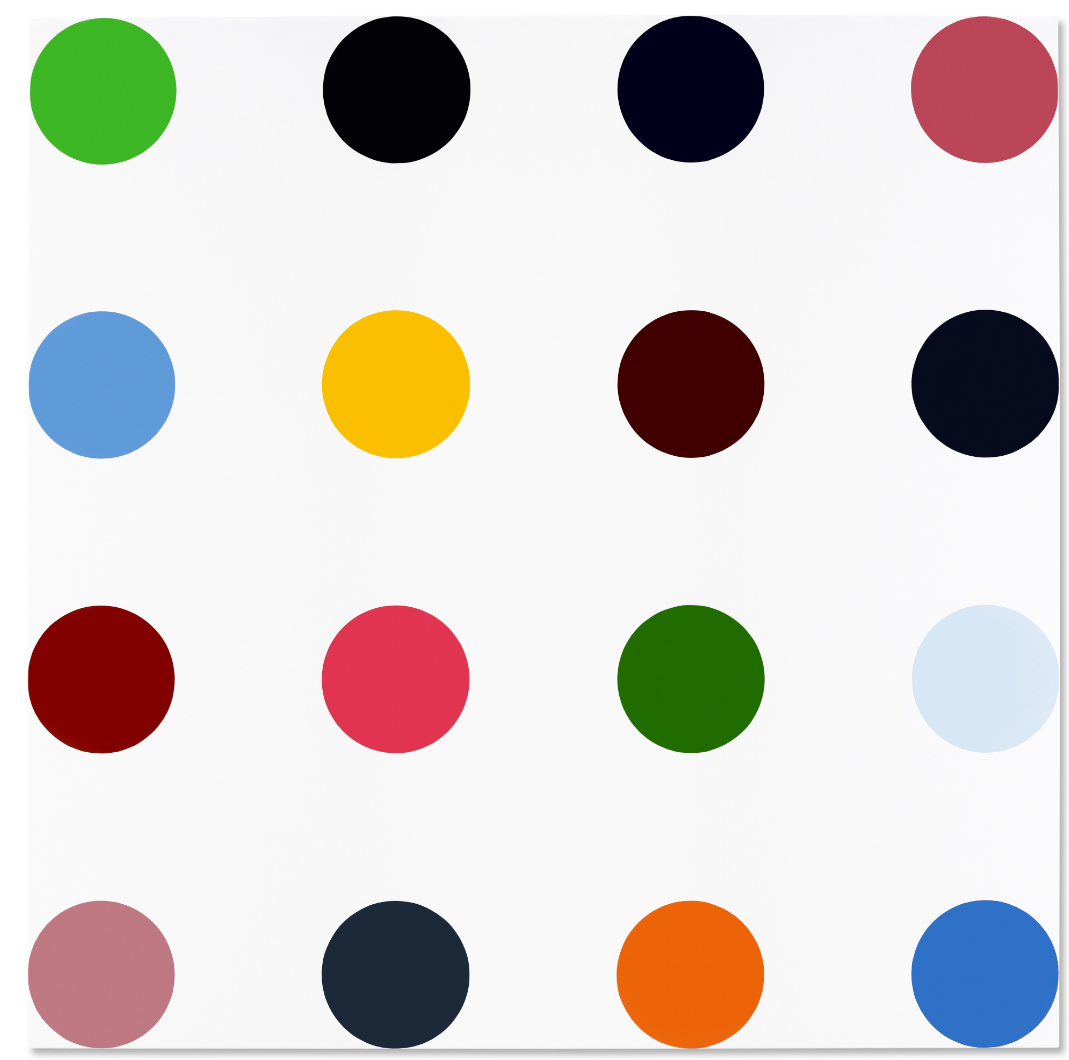
DAMIEN HIRST (b. 1965)
Ergonovine, 2005
Household gloss on canvas (12-inch spot), 2005
84×84 inches (213.4 x 213.4 cm)
#2. Cupric Nitrate, 2007
Phillips London: 7 March 2024
Estimated: GBP 500,000 – 700,000
GBP 571,500 / USD 724,662
Damien Hirst – 20th Century & Contempo… Lot 28 March 2024 | Phillips
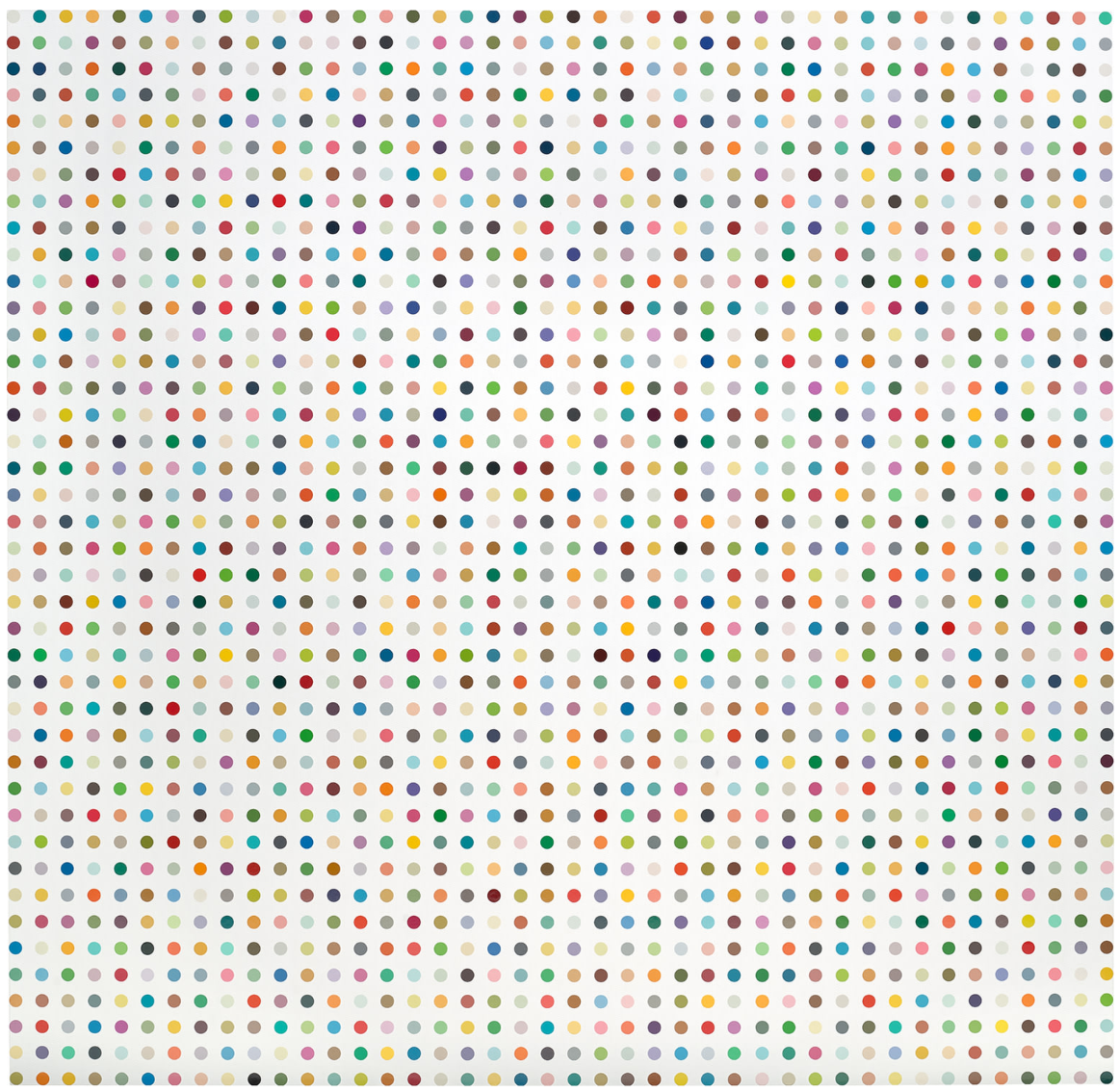
DAMIEN HIRST
Cupric Nitrate, 2007
Household gloss on canvas
81×83 inches (205.7 x 210.8 cm)
Signed, stamped with the artist’s stamp
Titled and dated ‘Damien Hirst D Hirst D Hirst “Cupric Nitrate” 2007’ on the reverse
#3. Pyrene, 2017
Sotheby’s London: 6 March 2024
Estimated: GBP 380,000 – 450,000
GBP 533,400 / USD 676,351
Pyrene | Modern & Contemporary Evening Auction featuring The Now | 2024 | Sotheby’s (sothebys.com)
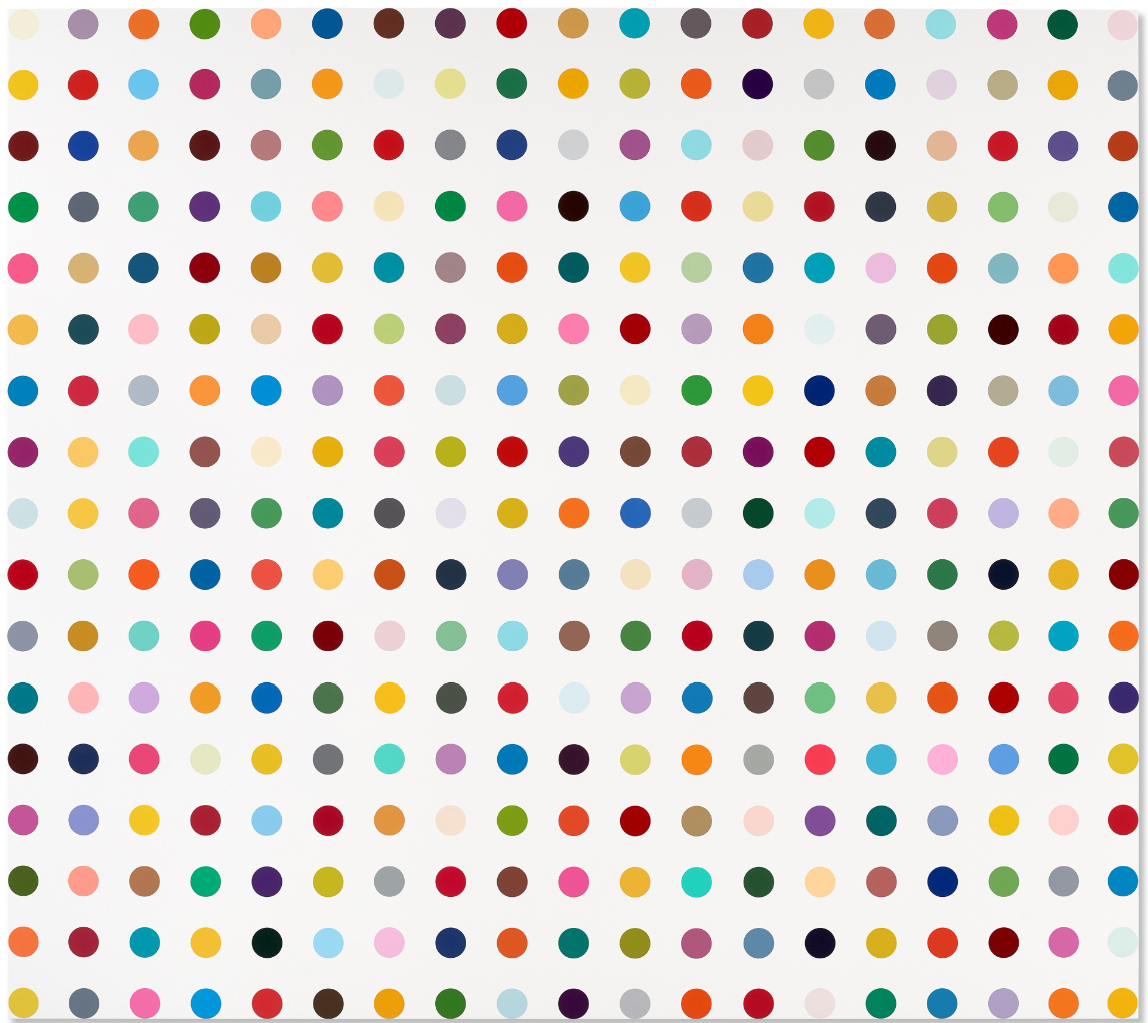
DAMIEN HIRST (b. 1965)
Pyrene, 2017
Household gloss on canvas
99×111 inches (251.5 x 281.9 cm) (3 inch spot)
Signed (on the stretcher); signed, titled twice and dated 2017 (on the reverse)
USD 500,000
#4. Lumichrome, 2005
Sotheby’s New-York: 14 May 2024
Estimated: USD 200,000 – 300,000
USD 406,400
Lumichrome | Contemporary Day Auction | 2024 | Sotheby’s (sothebys.com)

DAMIEN HIRST (b. 1965)
Lumichrome, 2005
Household gloss on canvas (2-inch spot)
34×34 inches (86.3 x 86.3 cm)
Signed, titled and dated 2005 (on the reverse); signed (on the stretcher)
#5. Norcodeine, 1993
Christie’s New-York: 22 November 2024
Estimated: USD 400,000 – 600,000
USD 378,000
DAMIEN HIRST (B. 1965), Norcodeine | Christie’s
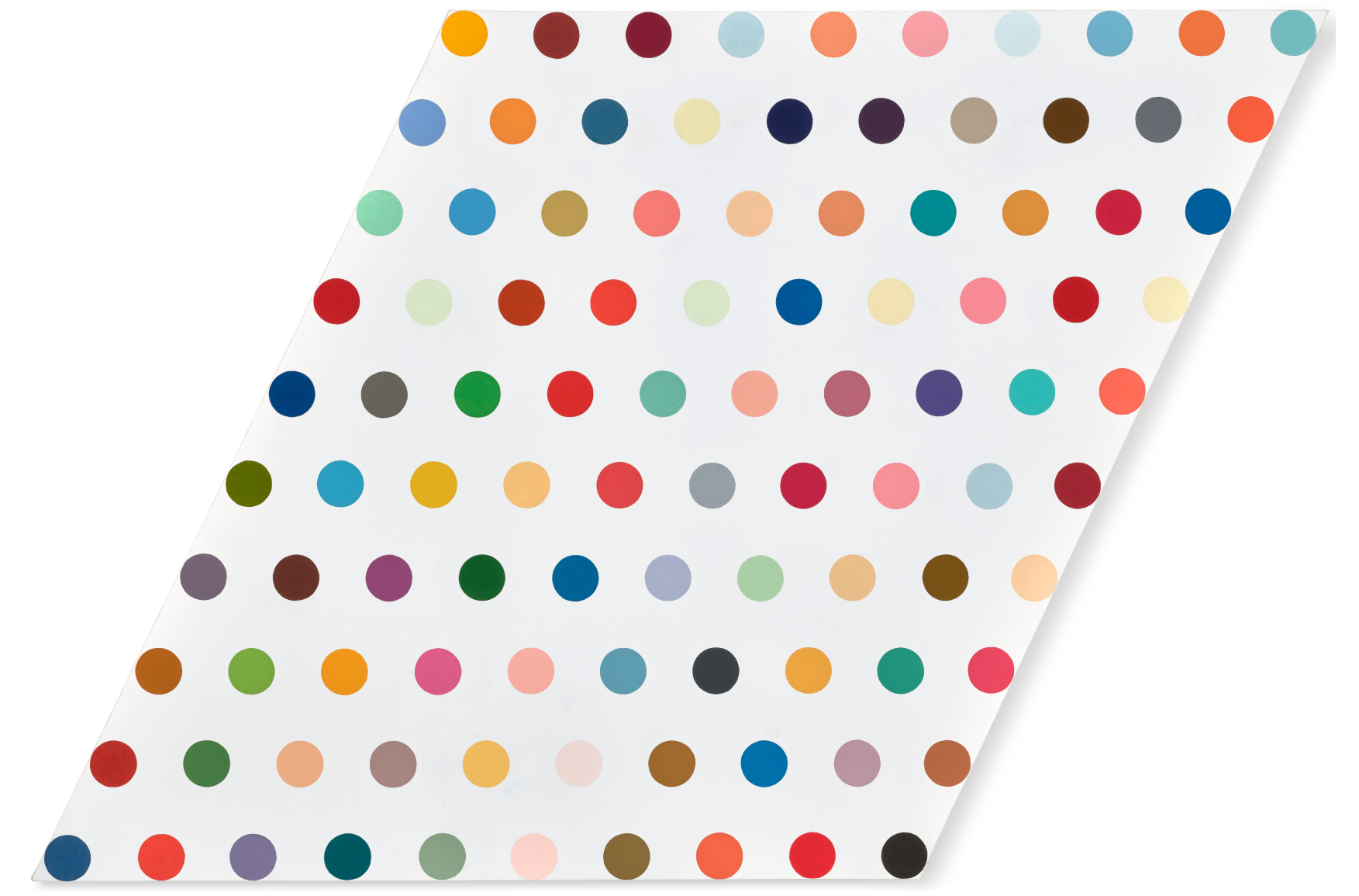
DAMIEN HIRST (B. 1965)
Norcodeine, 1993
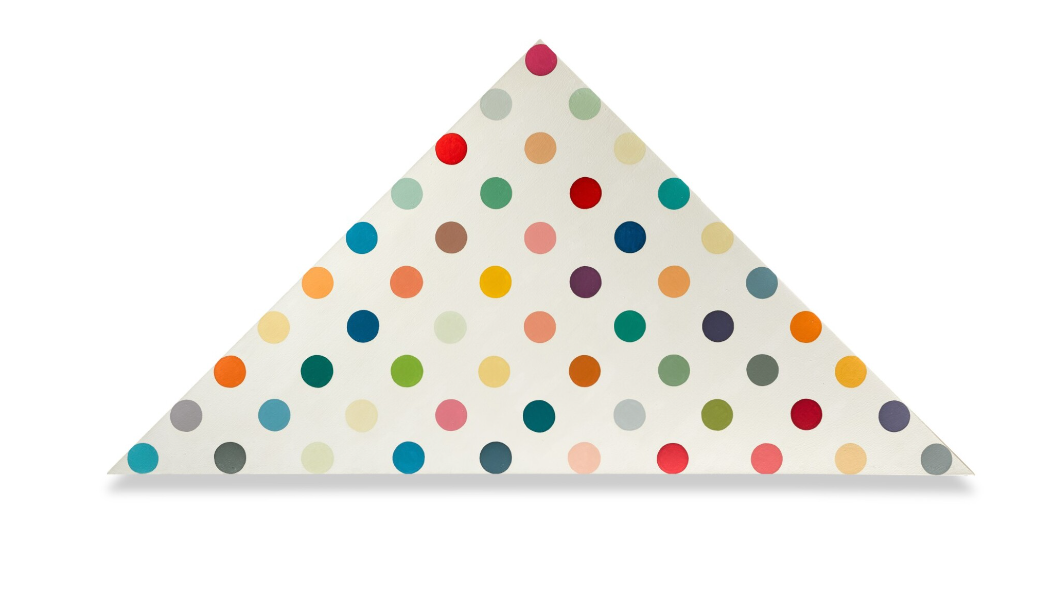
Household gloss on shaped canvas
56 1/2 x 88 inches (143.5 x 223.5 cm)
Signed ‘D. Hirst’ (on the reverse)
#6. N-Hydroxymaleimide, 2010
Christie’s New-York: 17 May 2024
Estimated: USD 150,000 – 250,000
USD 176,400
DAMIEN HIRST (B. 1965), N-Hydroxymaleimide | Christie’s (christies.com)
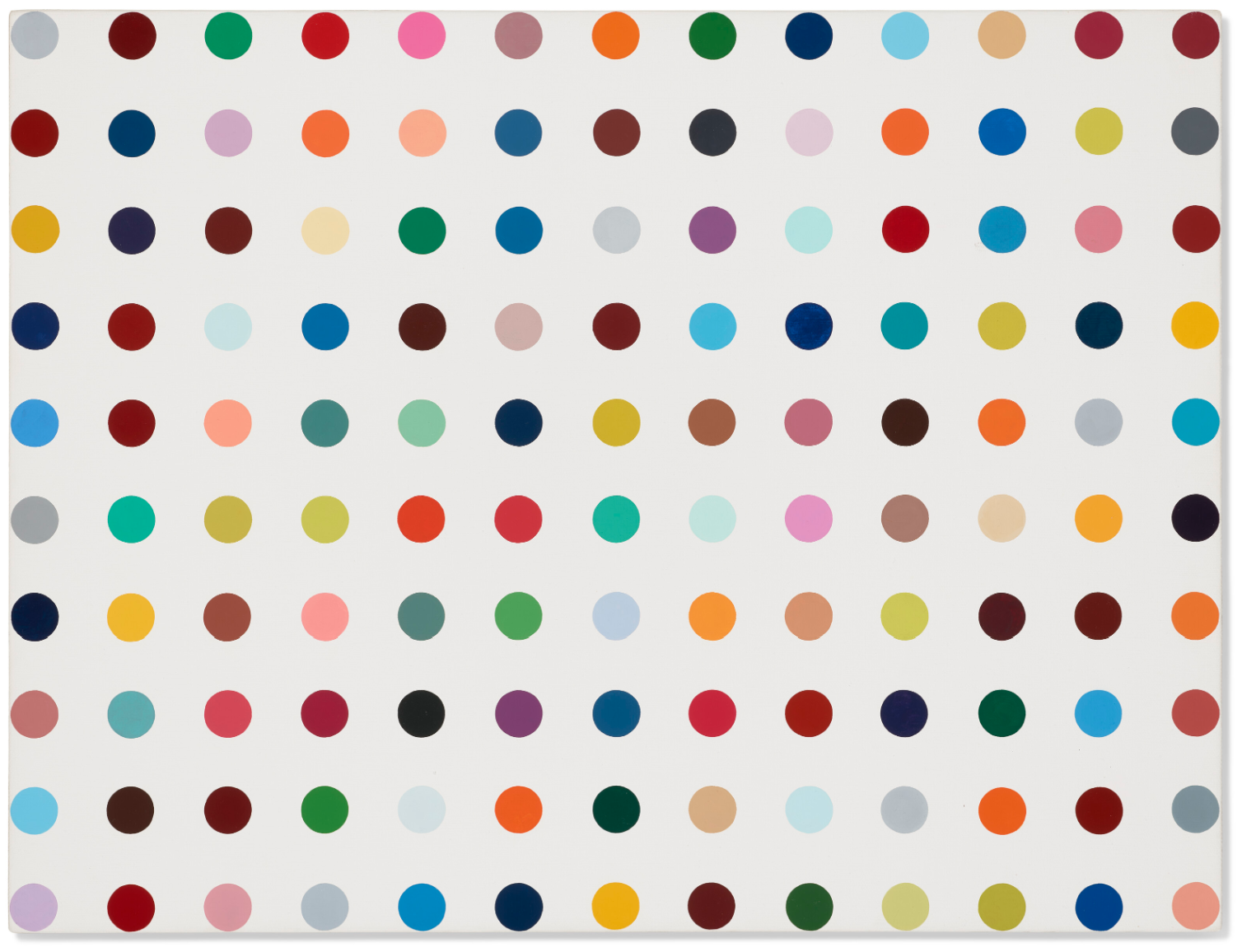
DAMIEN HIRST (B. 1965)
N-Hydroxymaleimide, 2010
Household gloss on canvas
19×25 inches (48.3 x 63.5 cm)
Signed, titled and dated ‘Damien Hirst 2010 ‘N-Hydroxymaleimide” (on the reverse)
Signed again ‘D Hirst’ (on the stretcher)
#7. Controlled Substance Key Painting (1 inch spot), 1994
Bonhams London: 21 March 2024
Estimated: GBP 60,000 – 80,000
GBP 102,000 / USD 130,495
Bonhams : DAMIEN HIRST (B. 1965) Controlled Substance Key Painting (1 inch spot) 1994
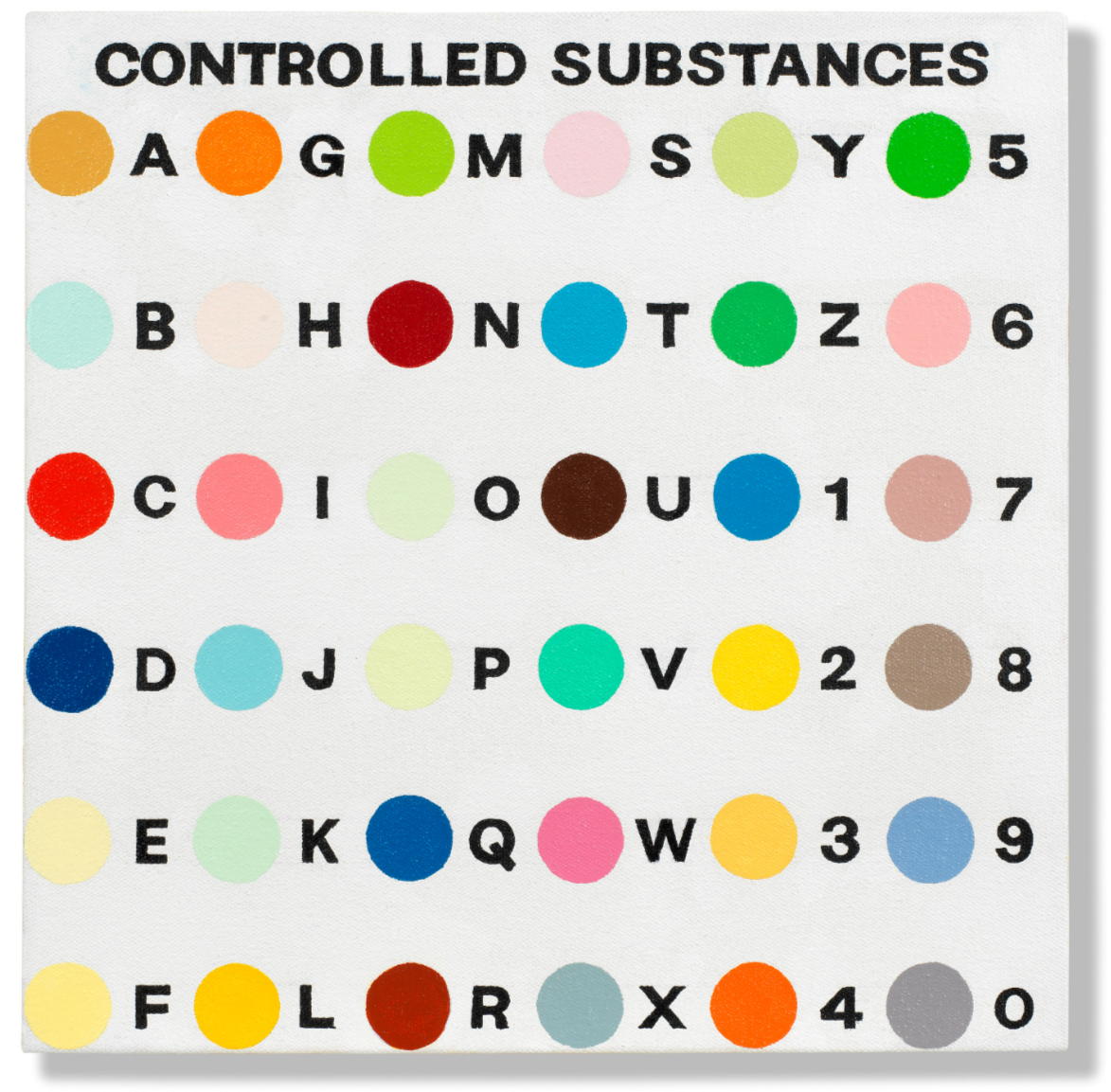
Household gloss on canvas
12×12 inches (30.5 x 30.5 cm)
Signed twice and dated 1994 on the reverse
Stamped twice with the artist’s stamp on the stretcher
#8. 5-Iodouracil, 2001
Rago: 22 May 2024
Estimated: USD 90,000 – 100,000
USD 100,800
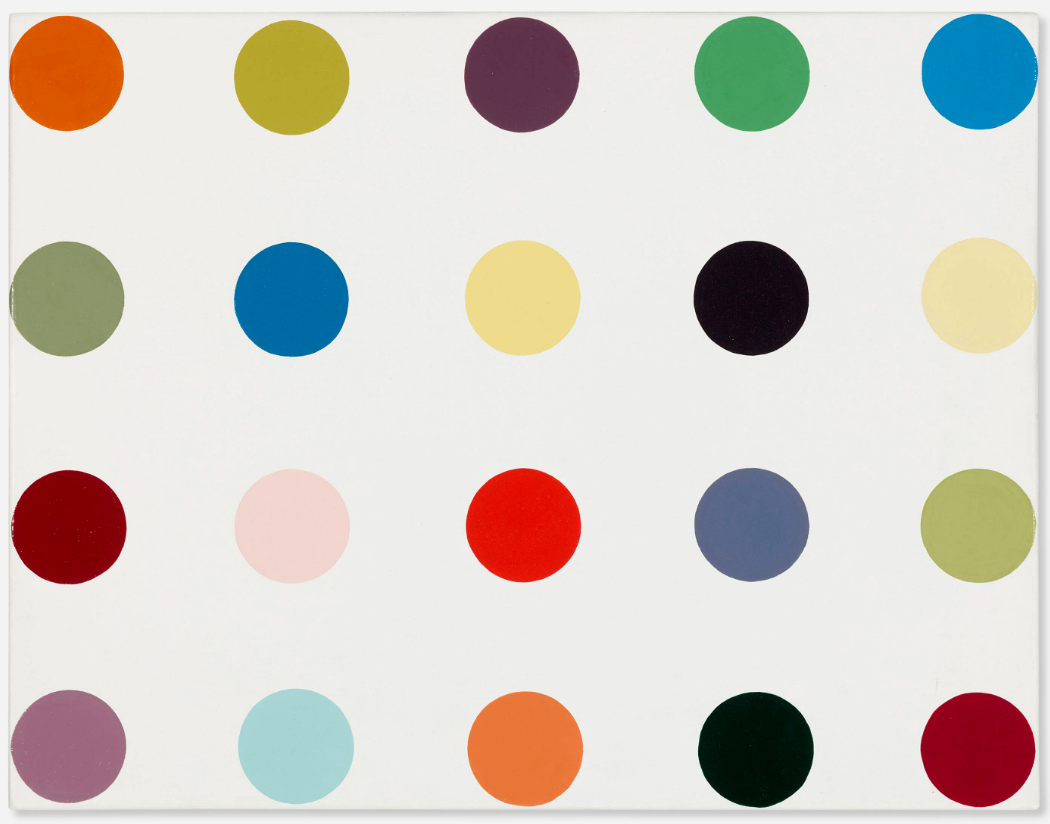
DAMIEN HIRST (b.1965)
5-Iodouracil, 2001
Household gloss on canvas
14×18 inches (36×46 cm) (2-inch spot)
Signed, titled and dated to verso ‘Damien Hirst 5-lodouracil 2001′ with artist’s stamps
2023 Auction Results
#1. Cardura Doxazosin, 1992
Christie’s London: 28 February 2023
Estimated: GBP 500,000 – 700,000
GBP 787,500 / USD 952,467
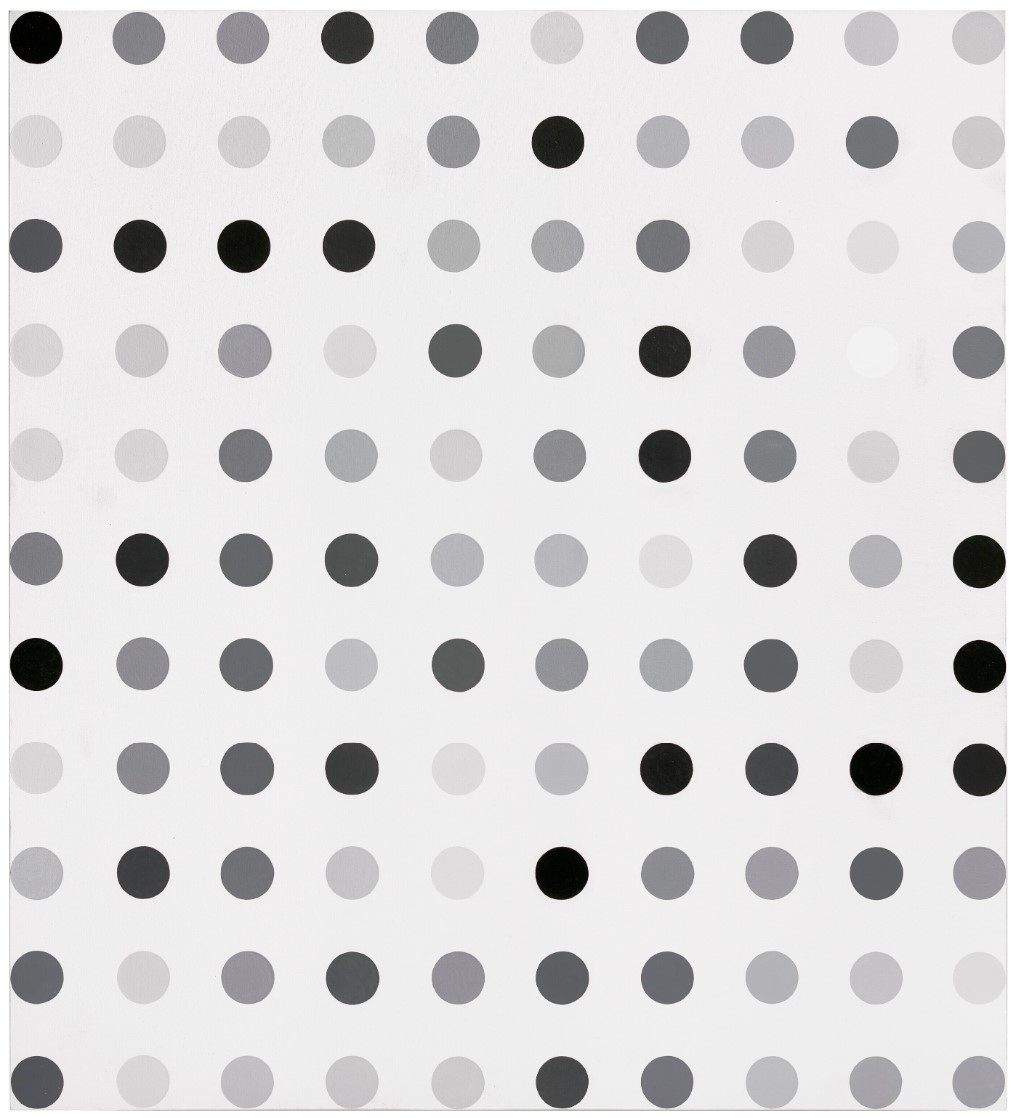
DAMIEN HIRST (B. 1965)
Cardura Doxazosin, 1992
Household gloss on canvas
83 7/8 x 72 inches (213×183 cm) (4 inch spot)
#3. Denatonium Benzoate, 2007
Christie’s Hong-Kong: 28 November 2023
Estimated: HKD 5,500,000 – 7,500,000
HKD 5,670,000 / USD 727,936
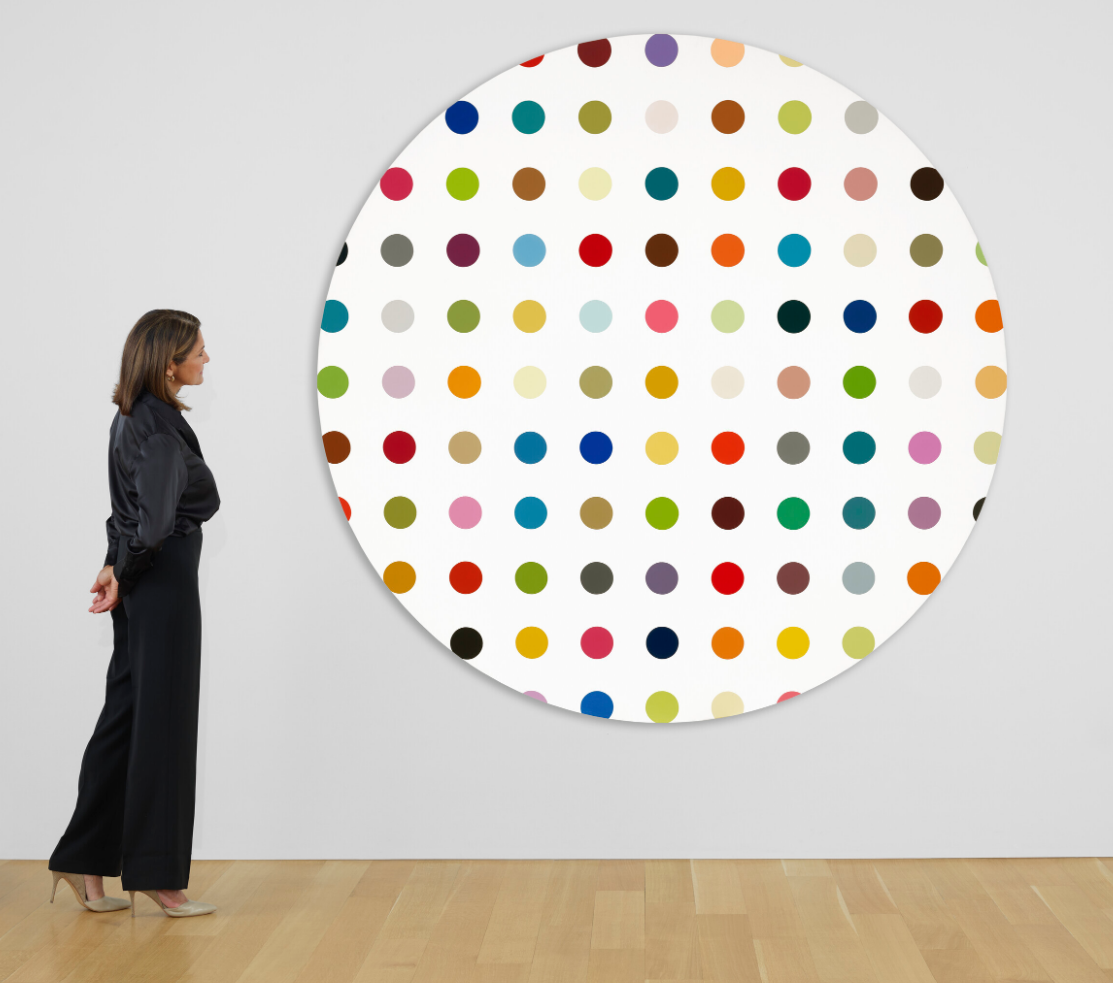
DAMIEN HIRST
Denatonium Benzoate, 2007
Household gloss on canvas
diameter: 213.4 cm. (84 in.)
signed, titled and dated ” (on the reverse); signed again ‘D Hirst’ (on the stretcher)
#4. Malic Dehydrogenase from Bovine Heart, 1999
Christie’s London: 14 October 2023
Estimated: GBP 250,000 – 350,000
GBP 283,500 / USD 343,761
Malic Dehydrogenase from Bovine Heart (christies.com)
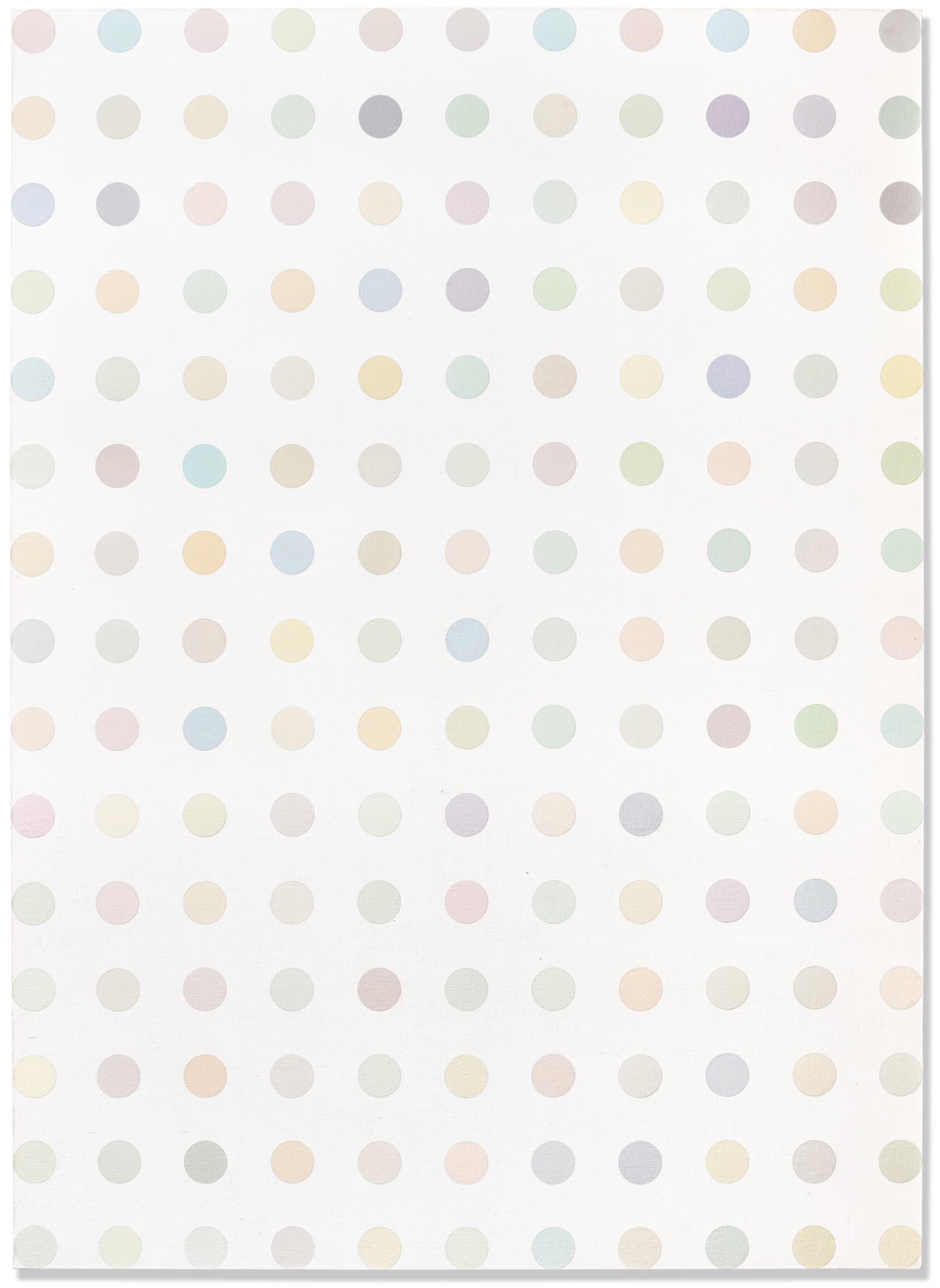
DAMIEN HIRST (B. 1965)
Malic Dehydrogenase from Bovine Heart, 1999
Household gloss on canvas
87×63 inches (221×160 cm) (3-inch spot)
#5. Ammonium Pentaborate, 2017
Sotheby’s London: 13 October 2023
Estimated: GBP 220,000 – 280,000
GBP 266,700 / USD 323,665
Ammonium Pentaborate | Contemporary Day Auction | 2023 | Sotheby’s (sothebys.com)
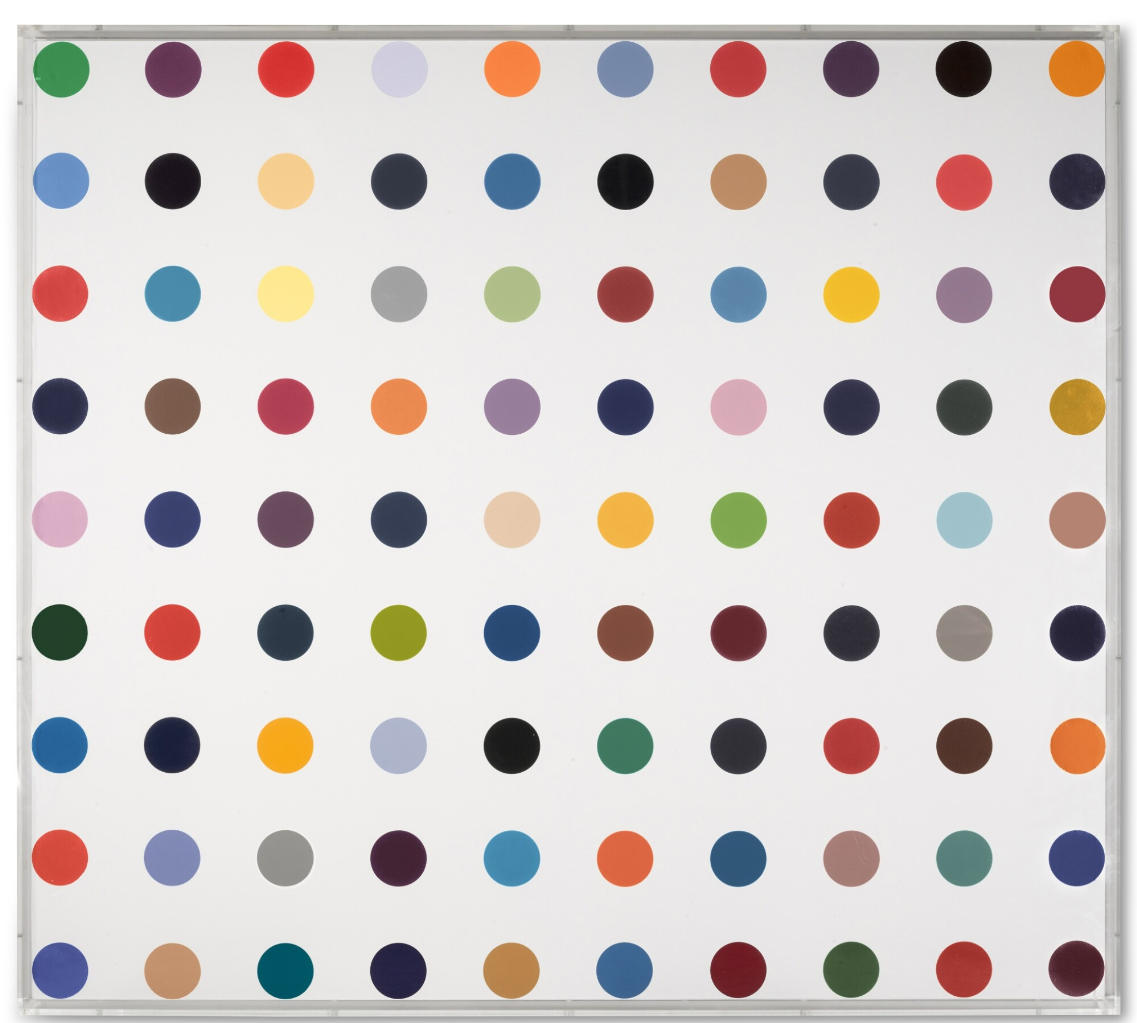
DAMIEN HIRST (b. 1965)
Ammonium Pentaborate, 2017
Household gloss on canvas
51×57 inches (129.5 x 144.8 cm) (3-inch spot)
Signed (on the stretcher); signed, titled and dated 2017 (on the reverse)
#6. Aminolevulinic Acid, 2020
SBI Art Auction: 27 May 2023
Estimated: JPY 25,000,000 – 35,000,000
JPY 41,400,000 / USD 295,720
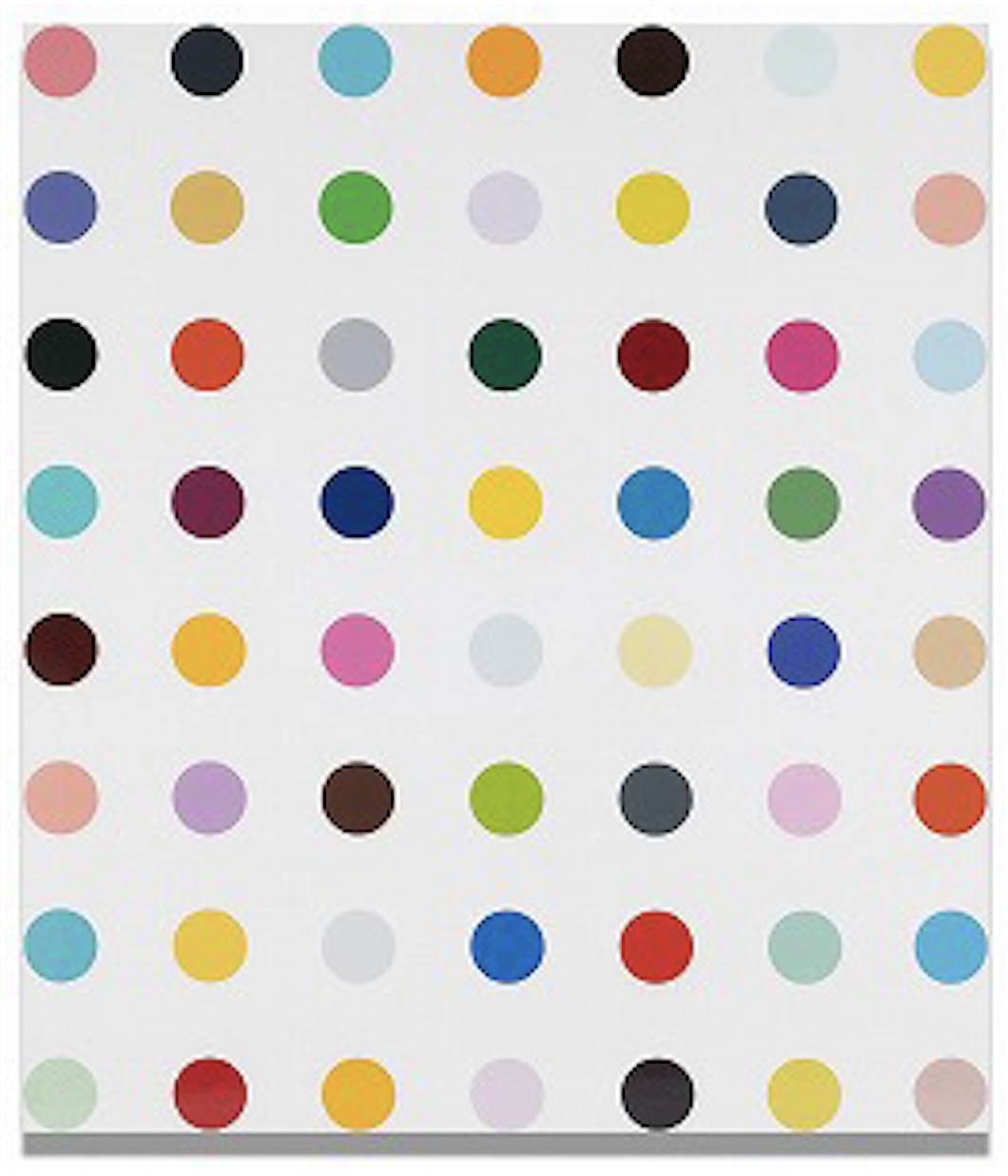
DAMIEN HIRST
Aminolevulinic Acid, 2020
Household gloss on canvas
45×39 inches (114.3 x 99.1 cm)
#7. Decahydronaphthalene, 2019
Phillips London: 30 June 2023
Estimated: GBP 250,000 – 350,000
GBP 222,250 / USD 282,437
Damien Hirst – 20th Century to Now London Lot 35 June 2023 | Phillips

DAMIEN HIRST
Decahydronaphthalene, 2019
Household gloss on canvas
Diameter: 72 inches (183 cm)
Signed, titled and dated ‘Damien Hirst ‘Decahydronaphthalene’ 2019′ on the reverse
Signed ‘D. Hirst’ on the stretcher
#8. Oxyuranus Microlepidotus, 1999
Sotheby’s New-York: 19 May 2023
Estimated: USD 200,000 – 300,000
USD 215,900
Oxyuranus Microlepidotus | Contemporary Day Auction | 2023 | Sotheby’s (sothebys.com)
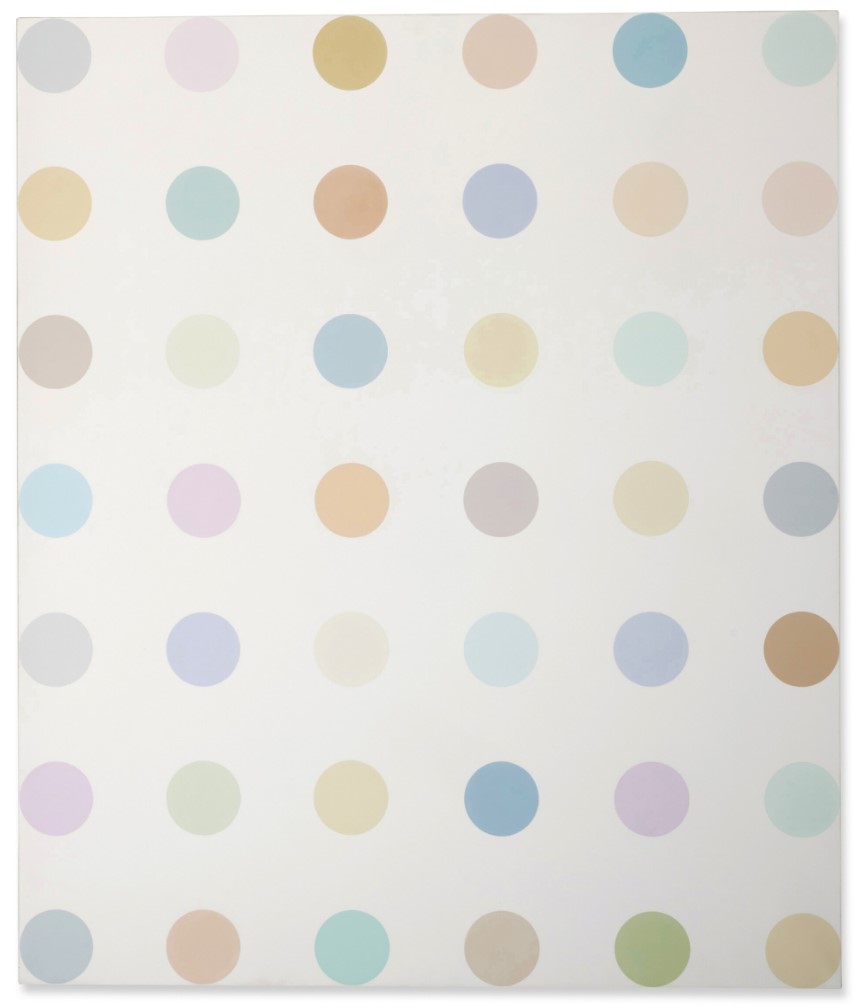
DAMIEN HIRST (b. 1965)
Oxyuranus Microlepidotus, 1999
Household gloss on canvas
52×44 inches (132.1 x 111.8 cm)
#9. Arbutin, 1994
Sotheby’s Zurich: 28 March 2023
Estimated: CHF120,000 – 180,000
CHF 177,800 / USD 193,323
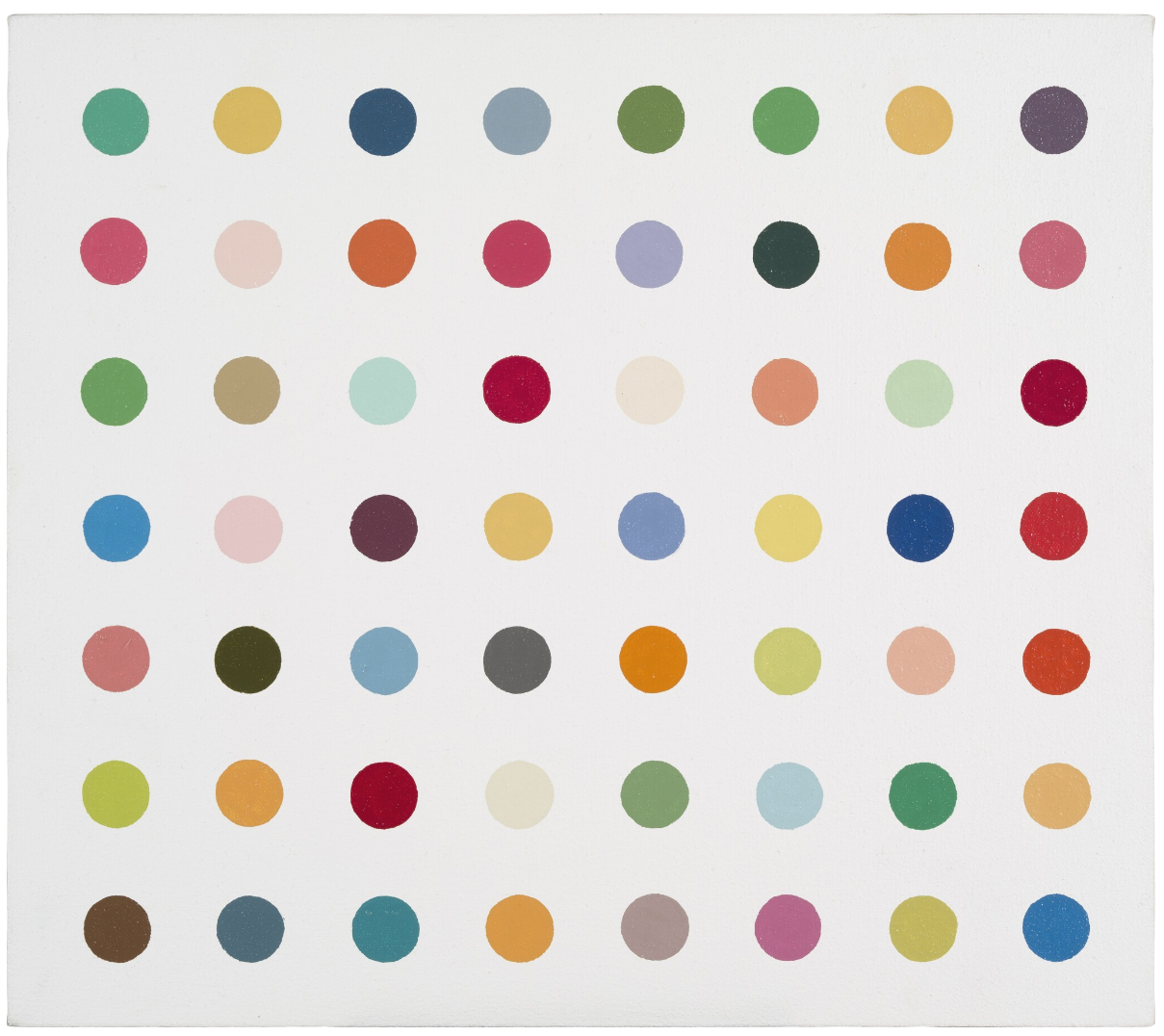
DAMIEN HIRST (b. 1965)
Arbutin, 1994
Gloss household paint on canvas (1-inch spot)
15×17 inches (38 x 43.2 cm)
Signed D. Hirst and dated 94 on the reverse
#10. Lauric Acid Behenyl Ester, 2009
Sotheby’s New-York: 28 September 2023
Estimated: USD 150,000 – 200,000
USD 190,500
Lauric Acid Behenyl Ester | Contemporary Curated | 2023 | Sotheby’s (sothebys.com)
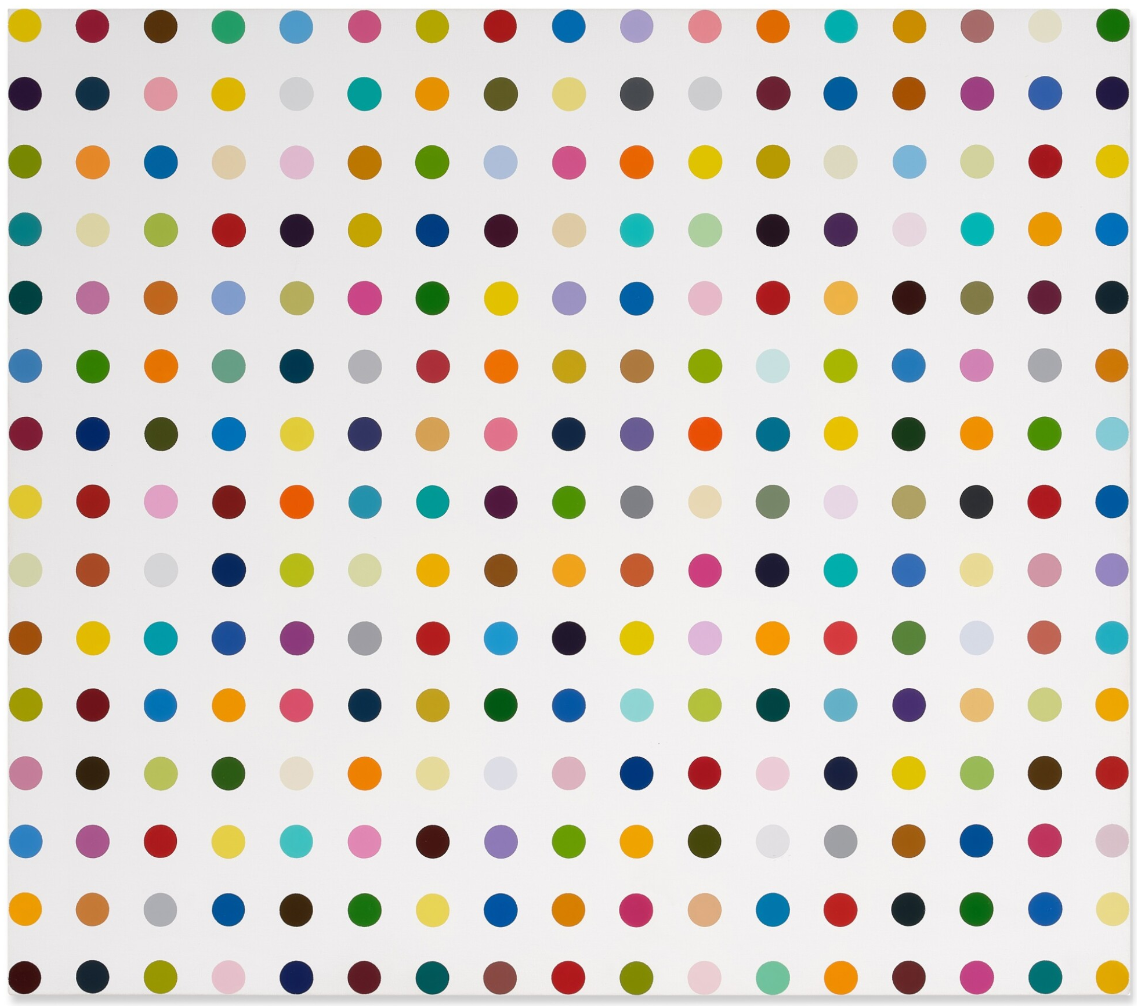
DAMIEN HIRST (b. 1965)
Lauric Acid Behenyl Ester, 2009
Household gloss on canvas (1 inch spot)
29×33 inches (73.7 x 83.8 cm)
Signed, titled and dated 2009 (on the reverse)
#11. Behenyl Alcohol, 2001
Sotheby’s Singapore: 2 July 2023
Estimated: SGD 190,000 – 280,000
SGD 241,300 / USD 178,436

DAMIEN HIRST (b. 1965)
Behenyl Alcohol, 2001
Household gloss on canvas (2 inch spot)
14×18 inches (35.6 x 45.7 cm)
Signed Damien Hirst, titled Behenyl Alcohol and dated 2001 (on the verso)
Marked with artist’s studio stamp and signed Dhirst (on the stretcher)
#12. Tricaprylin, 2007
Phillips London: 3 March 2023
Estimated: GBP 80,000 – 120,000
GBP 114,300 / USD 137,099
Damien Hirst – 20th Century & Contemp… Lot 240 March 2023 | Phillips
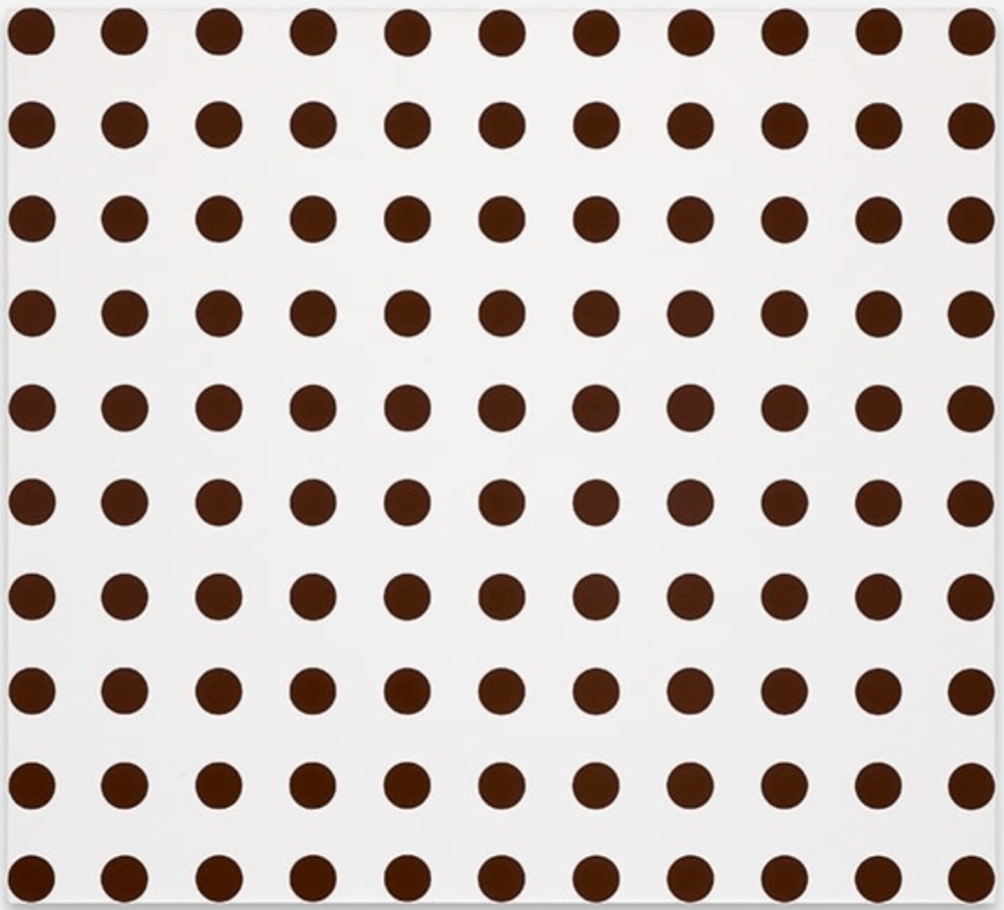
DAMIEN HIRST
Tricaprylin, 2007
Household gloss on canvas (2-inch spots)
38×42 inches (96.5 x 106.7 cm)
Signed, titled, inscribed and dated ‘”Tricaprylin” Damien Hirst LIPIDS 2007’ on the reverse
Stamped with the artist’s name ‘Damien Hirst’ on the stretcher
#13. Linolelaidoyl Chloride, 2012
Sotheby’s London: 18 April 2023
Estimated: GBP 50,000 – 70,000
GBP 60,960 / USD 75,707
Linolelaidoyl Chloride | Contemporary Curated | 2023 | Sotheby’s (sothebys.com)
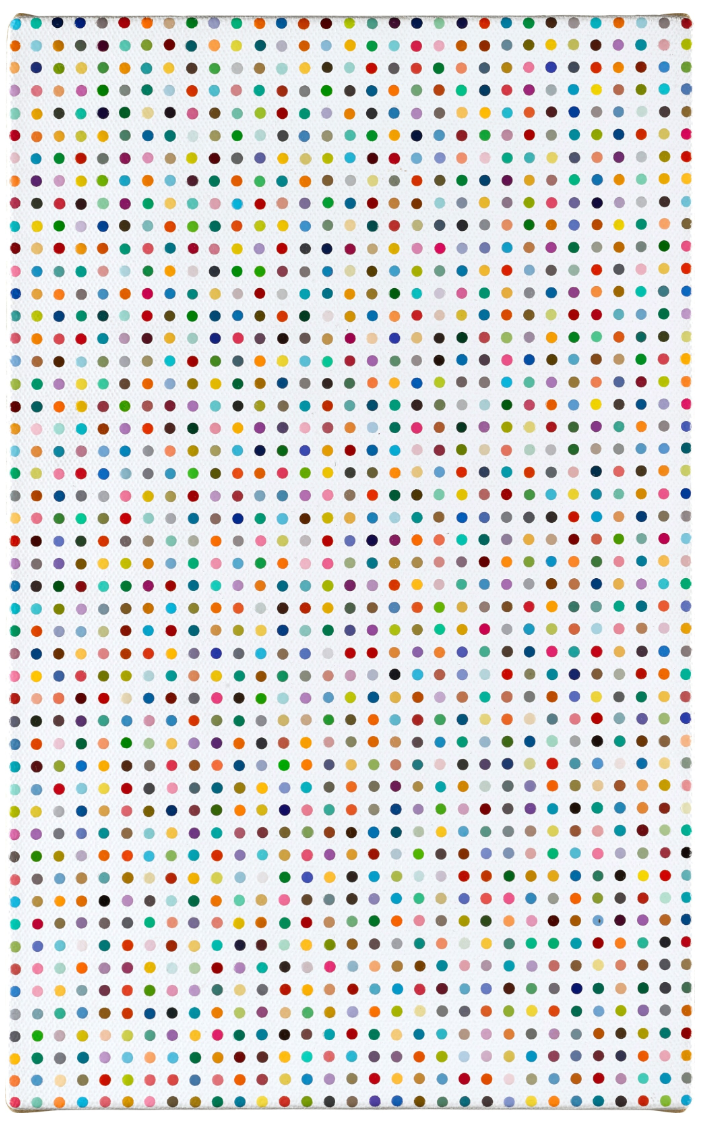
DAMIEN HIRST (b. 1965)
Linolelaidoyl Chloride, 2012
Household gloss on canvas (3mm spot)
11 3/8 x 7 1/4 inches (29.1 x 18.3 cm)
Signed, titled and dated 2012 on the reverse
#14. 2-Azido-2-Deoxyuridine, 1995
Sotheby’s London: 13 October 2023
Estimated: GBP 50,000 – 70,000
GBP 60,960 / USD 73,980
2-Azido-2-Deoxyuridine | Contemporary Day Auction | 2023 | Sotheby’s (sothebys.com)
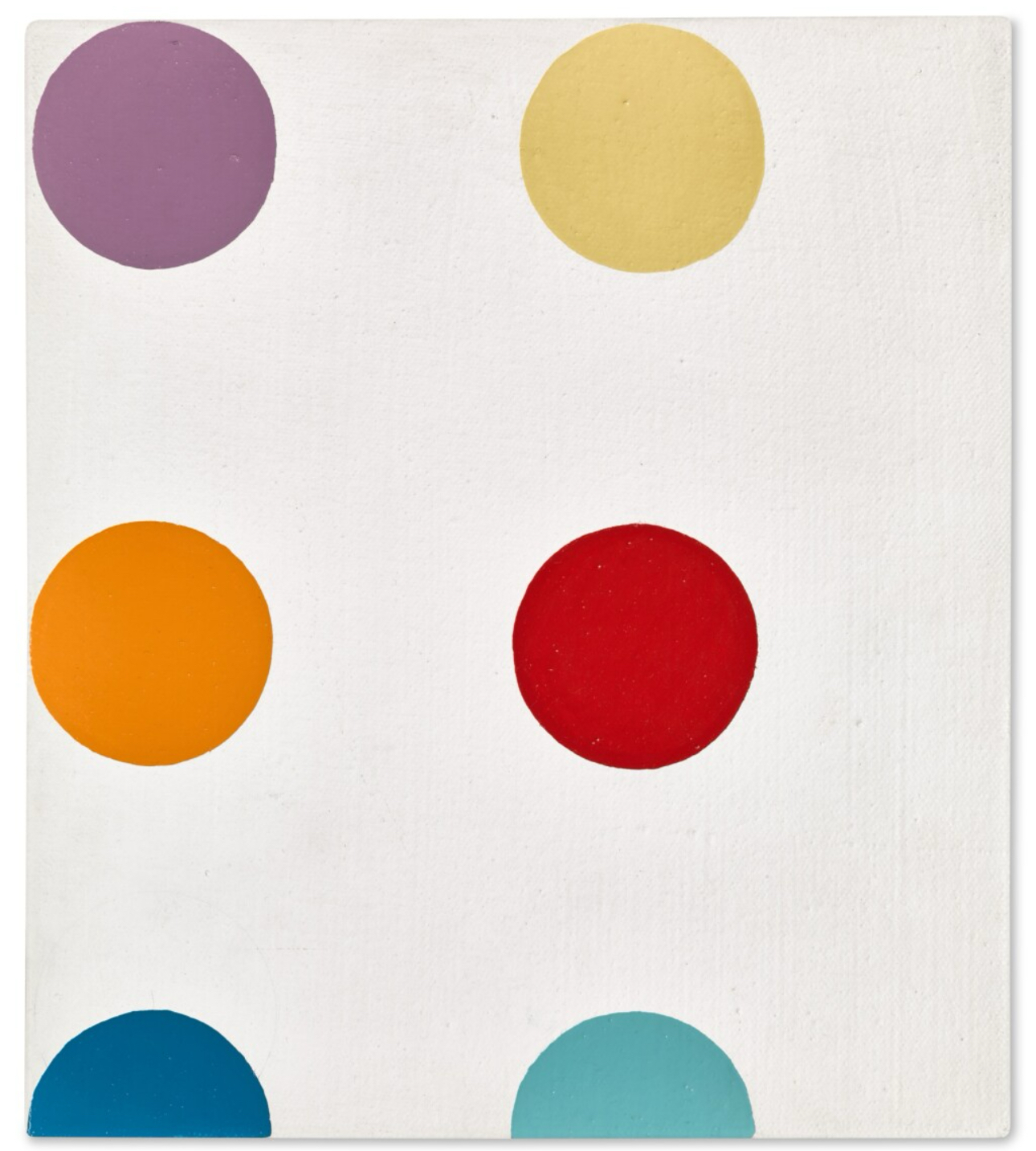
DAMIEN HIRST (b. 1965)
2-Azido-2-Deoxyuridine, 1995
Household gloss on canvas
9×8 inches (22.9 x 20.3 cm) (2-inch spot)
Signed and dedicated Thanks Terry love Damien (on the reverse)
#15. Behenic Acid, 1995
Christie’s London: 29 June 2023
Estimated: GBP 20,000 – 30,000
GBP 37,800 / USD 47,685
DAMIEN HIRST (B. 1965) (christies.com)

DAMIEN HIRST (B. 1965)
Behenic Acid, 1995
Household gloss on canvas (3 inch spot)
7 3/4 x 9 1/8 inches (19.6 x 23.1 cm)
Signed and inscribed ‘Thanks Love Damien’ (on the reverse)
2022 Auction Results
#1. Barium Carbonate-13C, 2005-2008
Visionary: The Paul G. Allen Collection
Christie’s New-York: 10 November 2022
Estimated: USD 500,000 – 700,000
USD 1,260,000
READ MORE IN FOCUS SECTION
DAMIEN HIRST (B. 1965) (christies.com)
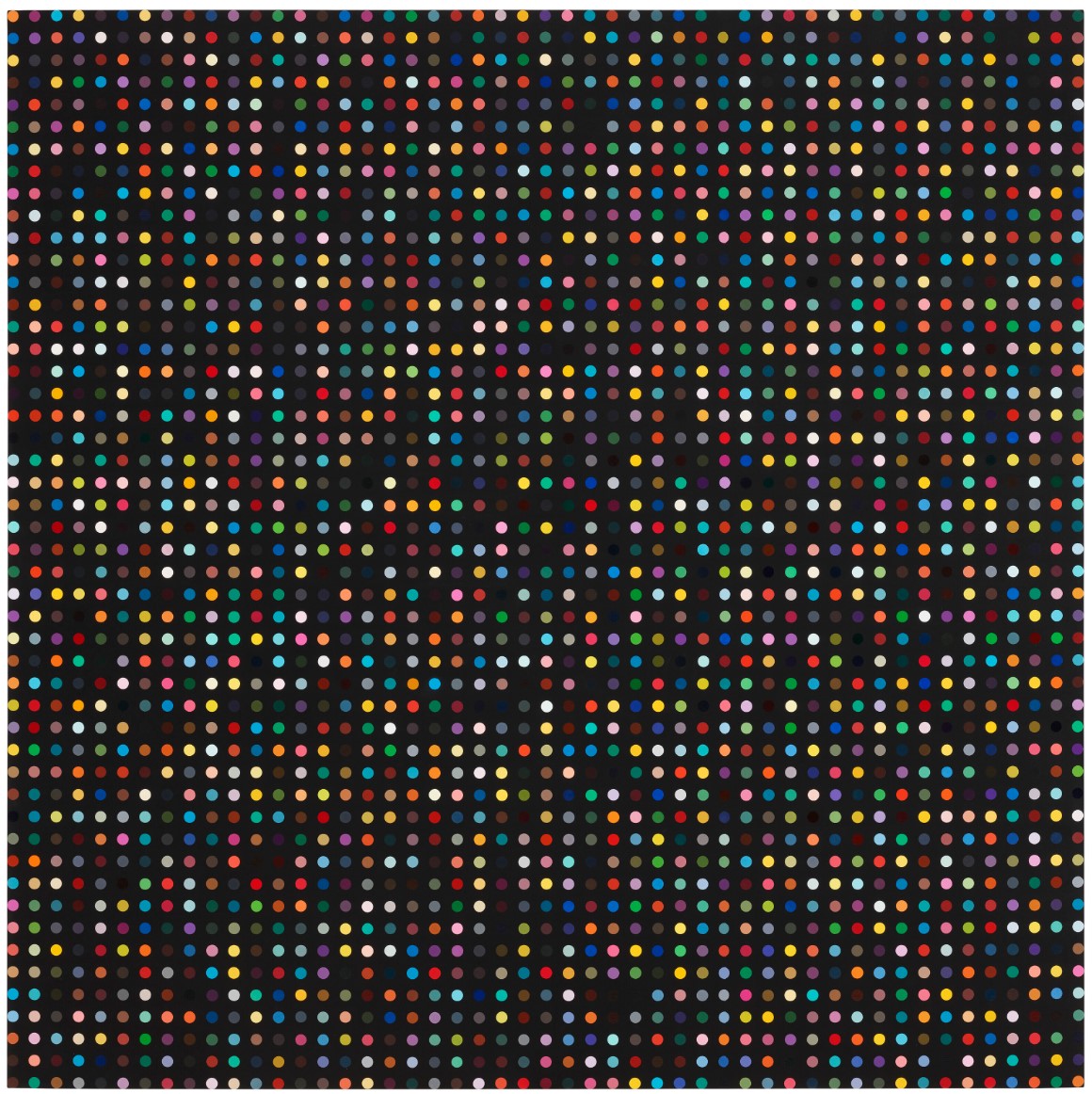
DAMIEN HIRST (B. 1965)
Barium Carbonate-13C, 2005-2008
Household gloss on canvas
97×97 inches (246.4 x 246.4 cm)
Signed and stamped (on the stretcher)
Signed, titled twice and dated (on the reverse)
#2. Biotin Hydrazide, 1995
Phillips London: 14 October 2022
Estimated: GBP 600,000 – 800,000
GBP 700,100 / USD 784,865
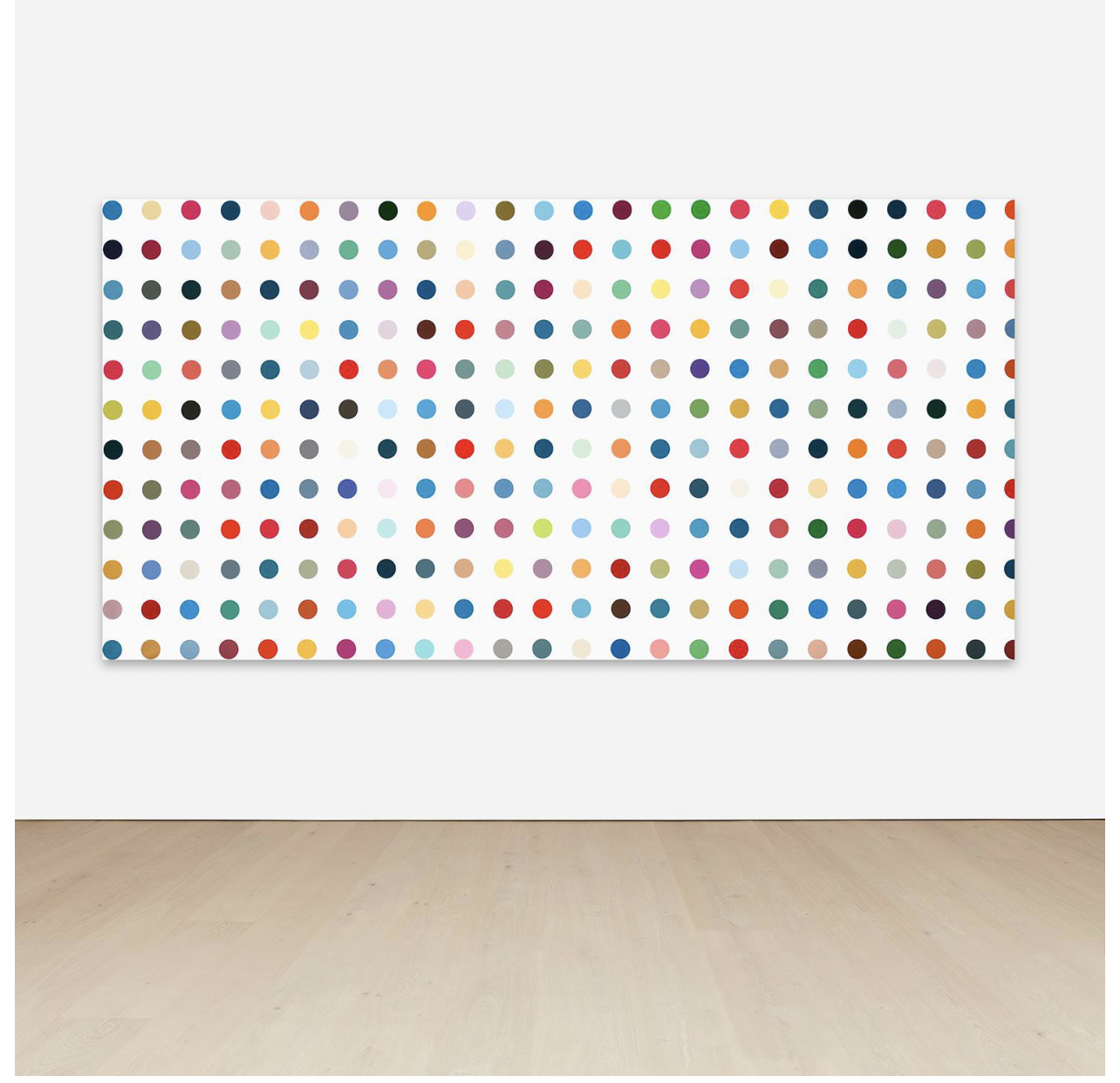
DAMIEN HIRST
Biotin Hydrazide, 1995
Household gloss on canvas
92×186 inches (233.7 x 472.4 cm)
4 inches spot
Signed ‘D. Hirst’ on the reverse
#3. Althiazide, 1992
Sotheby’s London: 14 October 2022
Estimated: GBP 600,000 – 800,000
GBP 693,000 / USD 776,905
Althiazide | Contemporary Evening Auction | 2022 | Sotheby’s (sothebys.com)
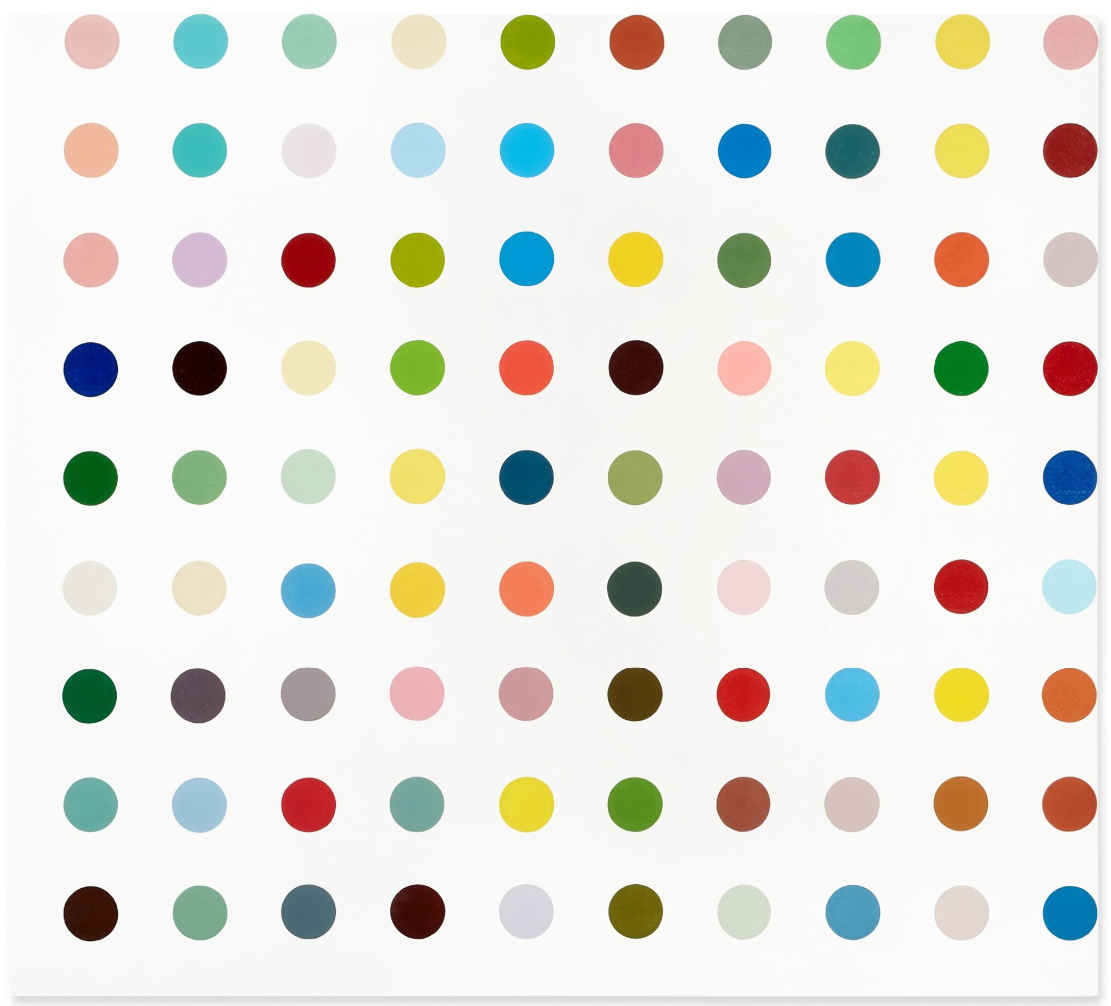
DAMIEN HIRST (b. 1965)
Althiazide, 1992
Household gloss on canvas, 4-inch spot
72×80 inches (182.9 x 203.2 cm)
Titled (on the stretcher)
#4. Furfuryl Mercaptan, 2004-2011
Phillips London: 30 June 2022
Estimated: GBP 400,000 – 600,000
GBP 491,400 / USD 597,519
Damien Hirst – 20th Century & Contempor… Lot 22 June 2022 | Phillips
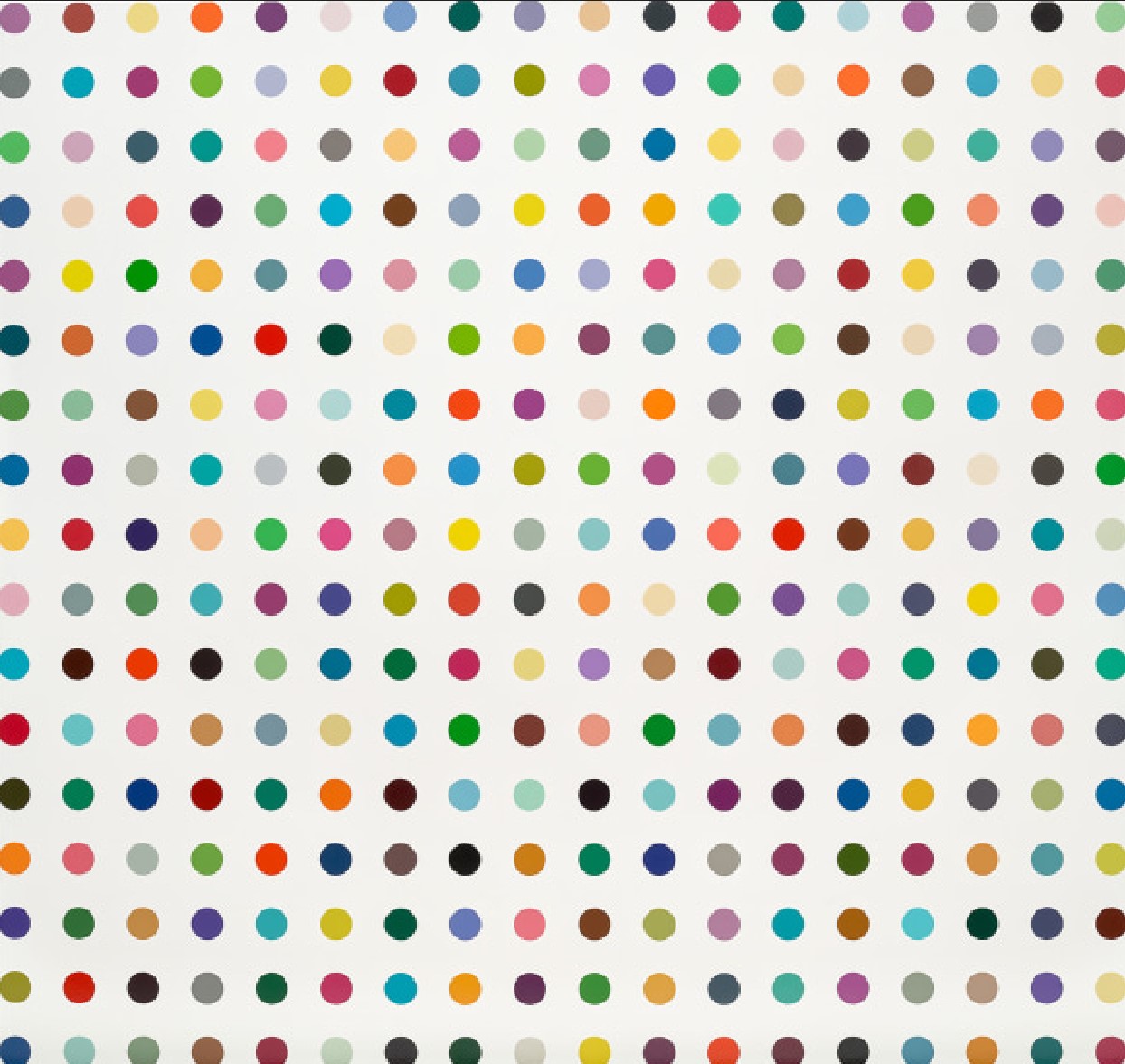
DAMIEN HIRST
Furfuryl Mercaptan, 2004-2011
Household gloss on canvas
99×105 inches (251.5 x 266.7 cm)
Signed ‘D Hirst’ on the strecher
#5. Arginine Amidinase, 1994
Sotheby’s New-York: 20 May 2022
Estimated: USD 300,000 – 400,000
USD 478,800
Arginine Amidinase | Contemporary Day Auction | 2022 | Sotheby’s (sothebys.com)
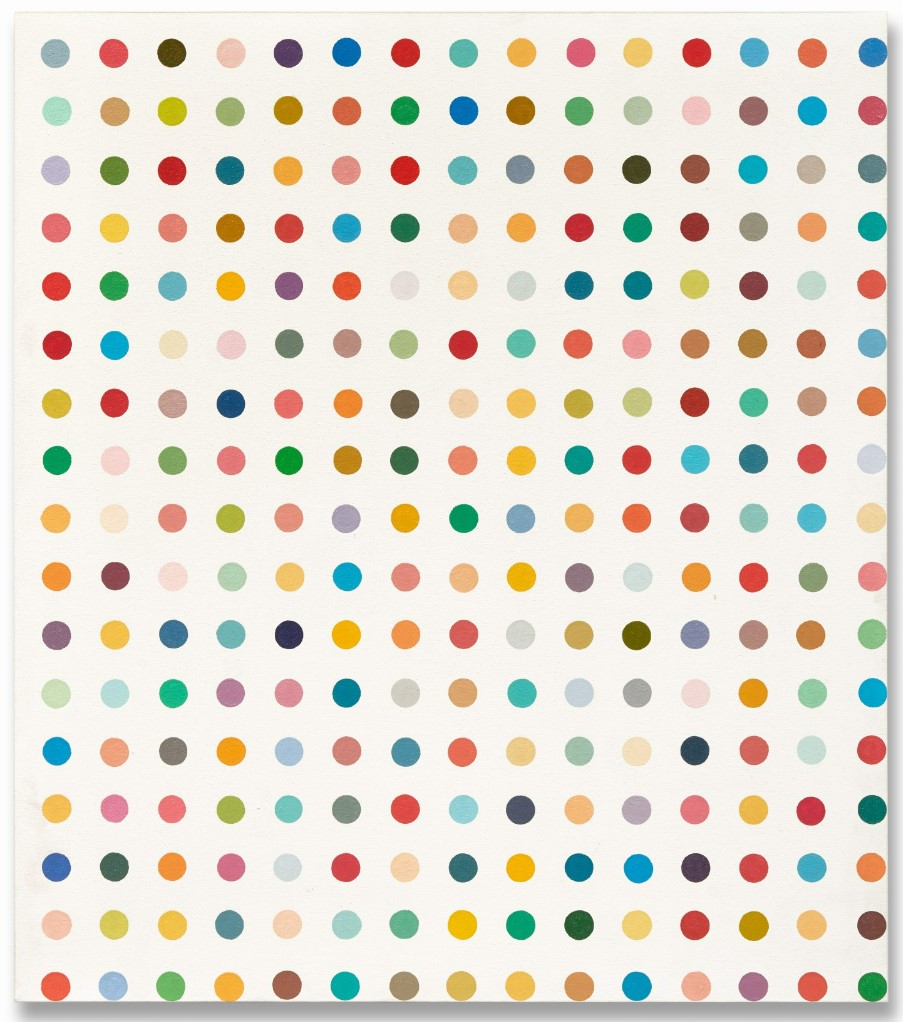
DAMIEN HIRST (B. 1965)
Arginine Amidinase, 1994
Household gloss on canvas
34×30 inches (86.4 x 76.5 cm)
Signed and variously inscribed (on the reverse)
#6. Zinc Sulfide, 2004
Phillips London: 3 March 2022
Estimated: GBP 350,000 – 550,000
GBP 346,500 / USD 461,569
Damien Hirst – 20th Century & Contempo… Lot 38 March 2022 | Phillips
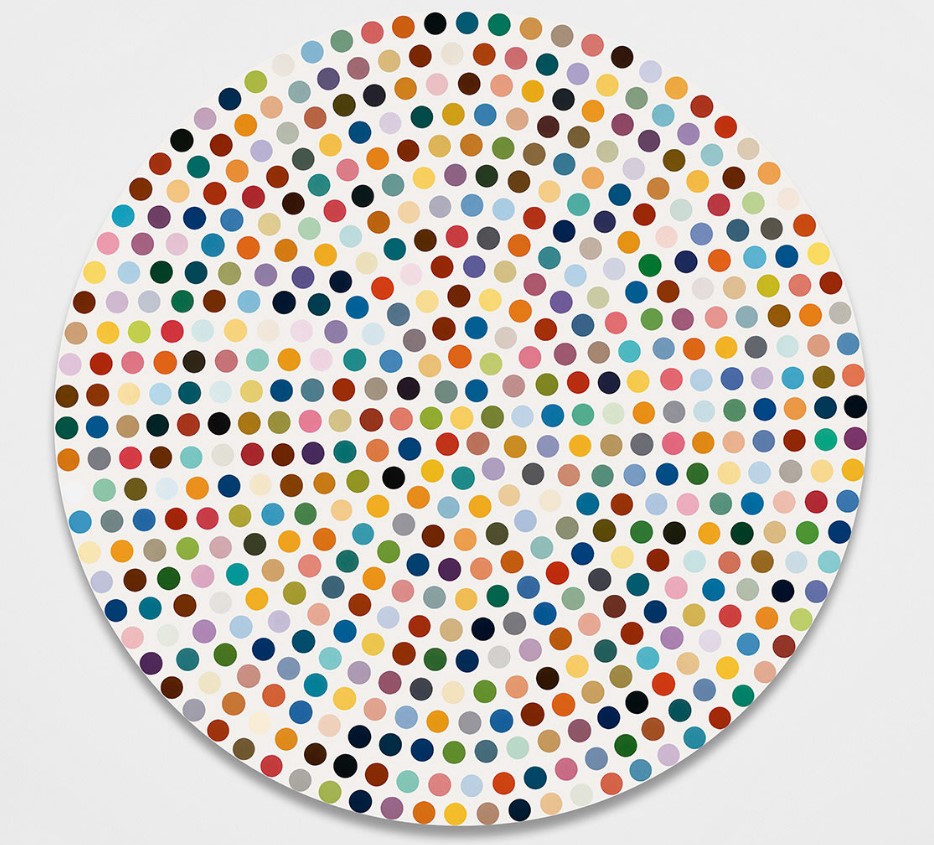
DAMIEN HIRST
Zinc Sulfide, 2004
Household gloss on canvas
Diameter: 72 inches (182.9 cm)
#7. Centrophenoxine, 2015
Sotheby’s London: 3 March 2022
Estimated: GBP 250,000 – 350,000
GBP 327,600 / USD 436,392
Centrophenoxine | Modern & Contemporary Day Auction | 2022 | Sotheby’s (sothebys.com)
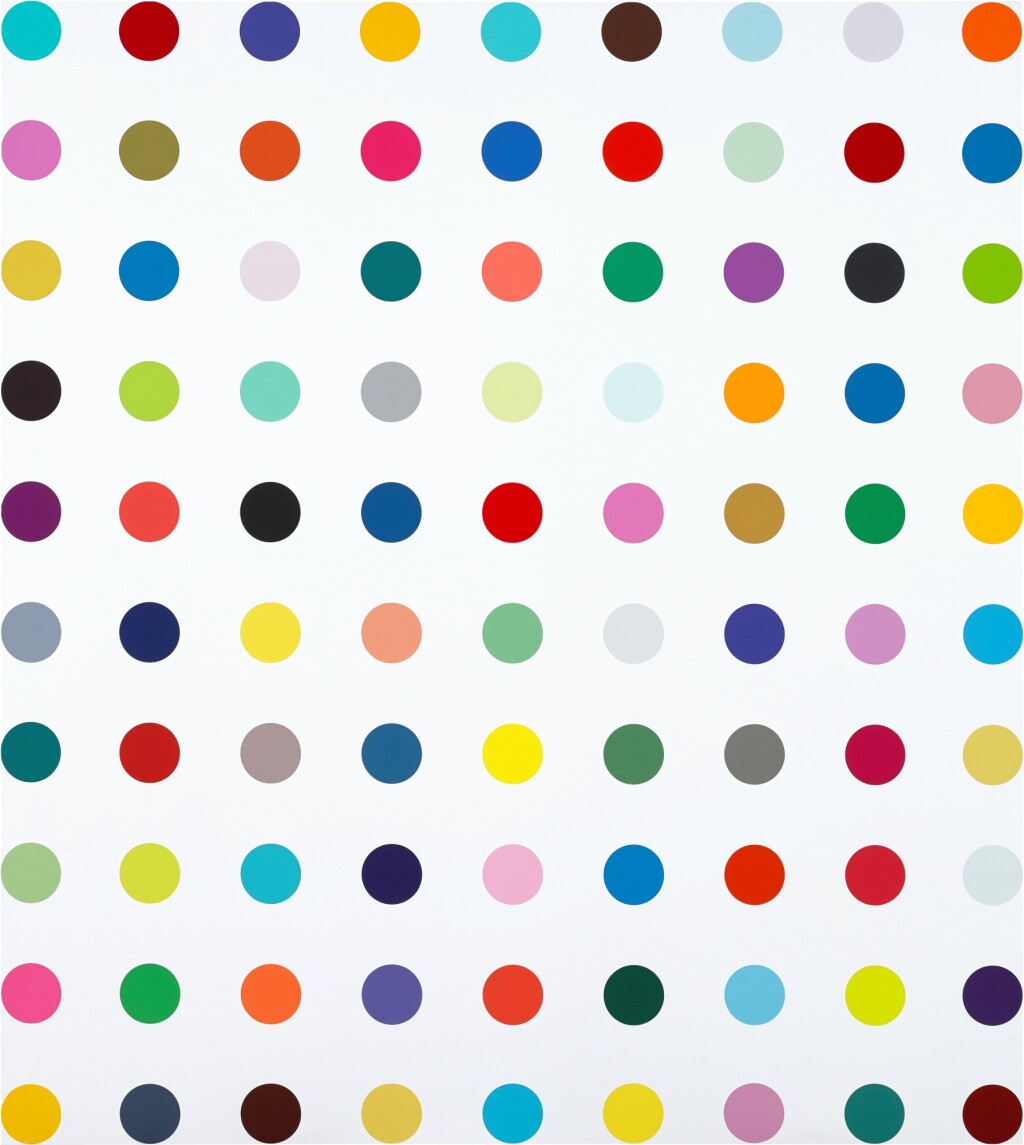
DAMIEN HIRST (B. 1965)
Centrophenoxine, 2015
Household gloss on canvas
57.2 x 51 inches (145 x 129.5 cm)
Signed on the stretcher; signed, titled and dated 2015 on the reverse
#8. Melamine, 2002
Christie’s London: 2 March 2022
Estimated: GBP 50,000 – 70,000
GBP 119,700 / USD 160,005
DAMIEN HIRST (B. 1965) (christies.com)
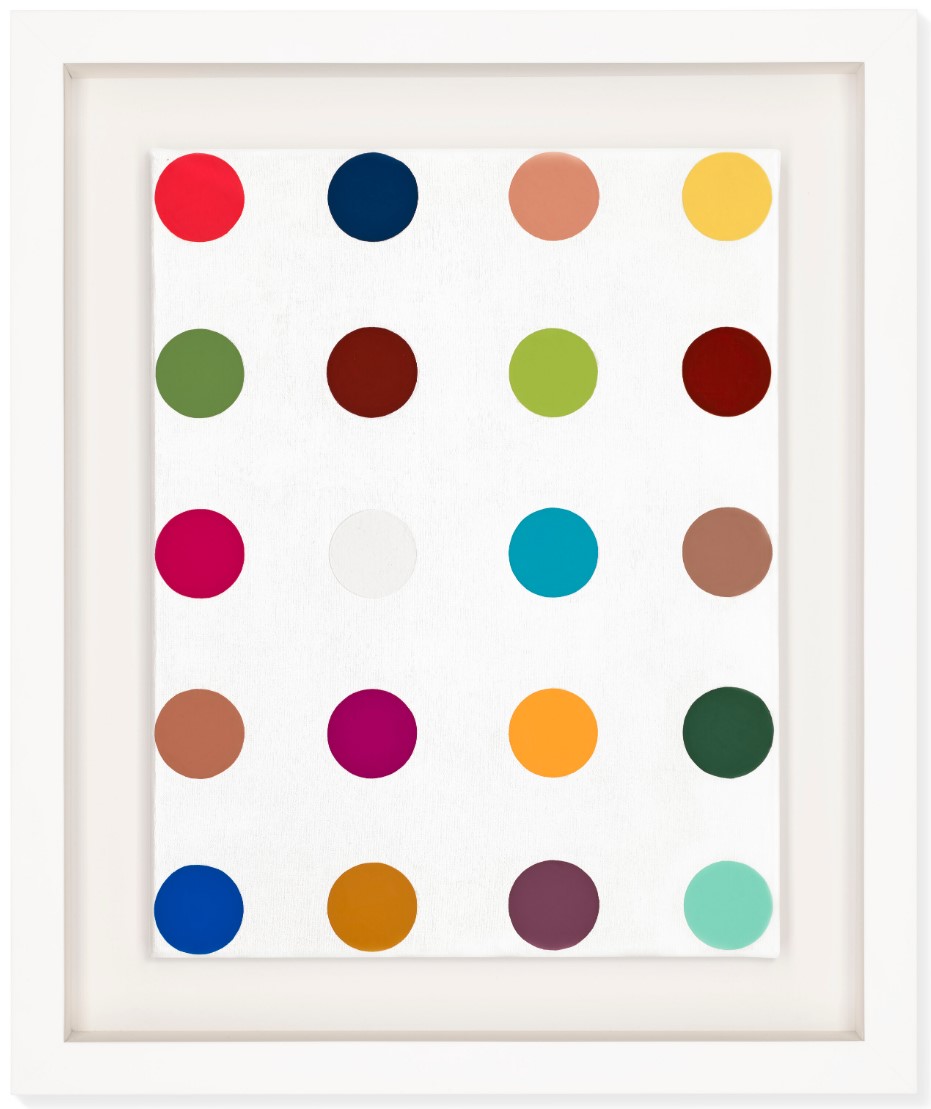
DAMIEN HIRST (B. 1965)
Melamine, 2002
Household gloss on canvas
18×14 inches (45.8 x 35.4 cm)
Signed, titled and dated (on the reverse)
Signed and stamped twice (on the stretcher)
#9. Naja Niricollis Pallida, 2000
Christie’s London: 14 October 2022
Estimated: GBP 120,000 – 180,000
GBP 100,800 / USD 113,004
DAMIEN HIRST (B. 1965) (christies.com)
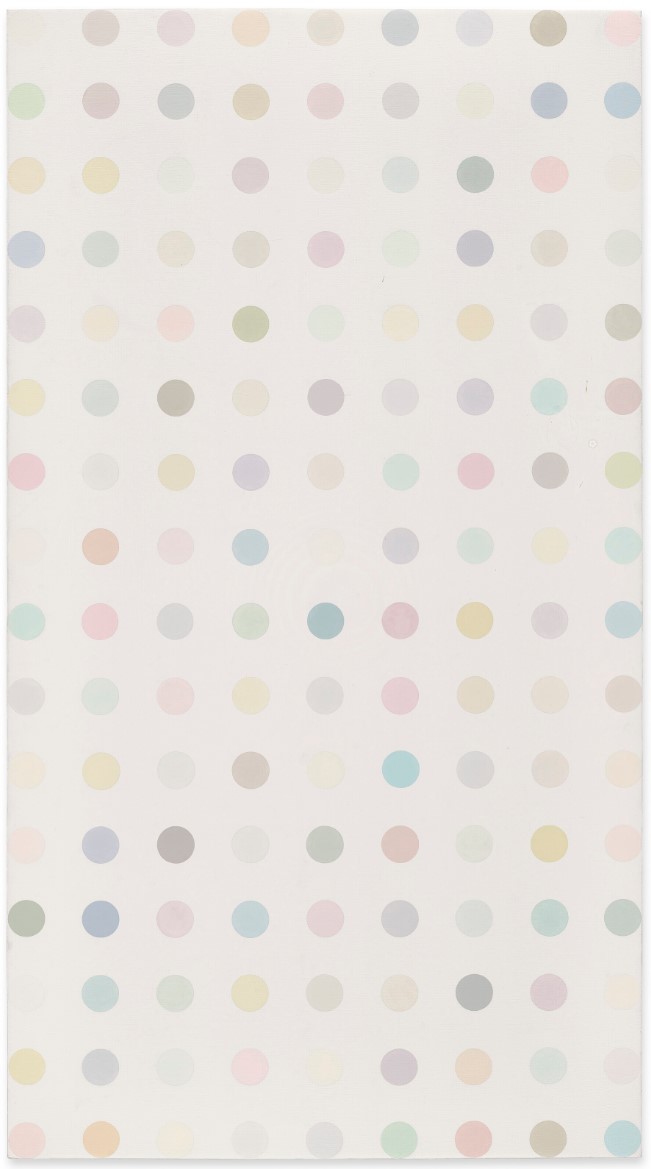
DAMIEN HIRST (B. 1965)
Naja Nigricollis Pallida, 2000
Household gloss on canvas
62.5 x 34.2 inches (158.6 x 86.7 cm)
2021 Auction Results
#1. Biotin-Propranolol Analog, 1995
Sotheby’s London: 29 June 2021
Estimated: GBP 650,000 – 850,000
GBP 837,000 / USD 1,158,798
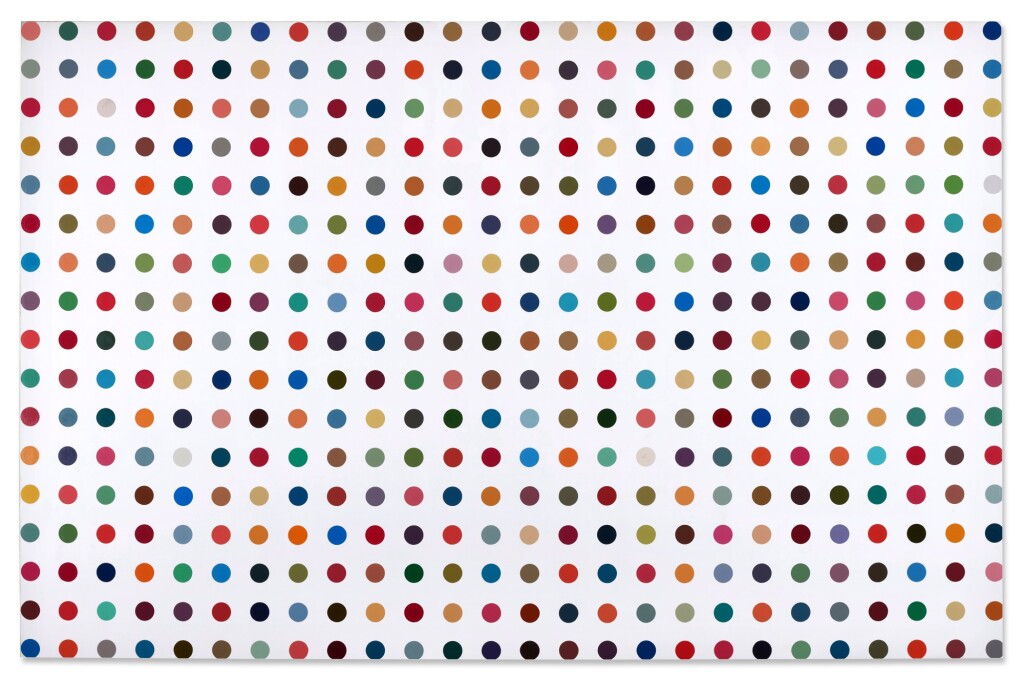
DAMIEN HIRST (B. 1965)
Biotin-Propranolol Analog, 1995
Household gloss on canvas
132×204 inches (335.3 x 518.2 cm)
Signed on the reverse
#2. N-(9-Acridinyl) Maleimide, 1992
Phillips London: 15 October 2021
Estimated: GBP 500,000 – 700,000
GBP 786,300 / USD 1,013,069
Damien Hirst – 20th Century & Contem… Lot 24 October 2021 | Phillips
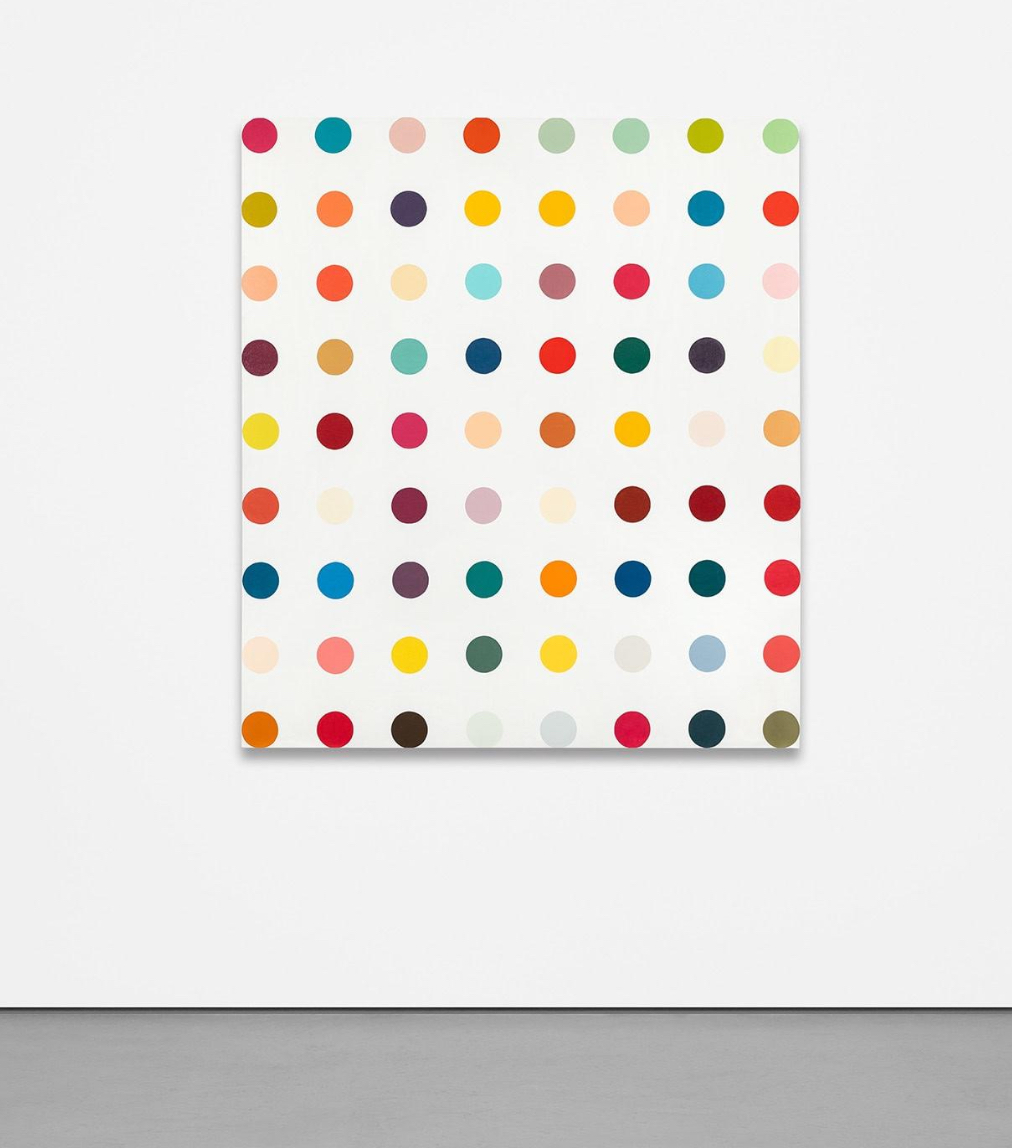
DAMIEN HIRST
N-(9-Acridinyl) Maleimide, 1992
Household gloss on canvas
67 7/8 x 60 1/8 inches (172.6 x 152.6 cm)
#3. Loperamide, 2005
Phillips New-York: 18 November 2021
Estimated: USD 400,000 – 600,000
USD 504,000
Damien Hirst – 20th Century & Cont… Lot 362 November 2021 | Phillips
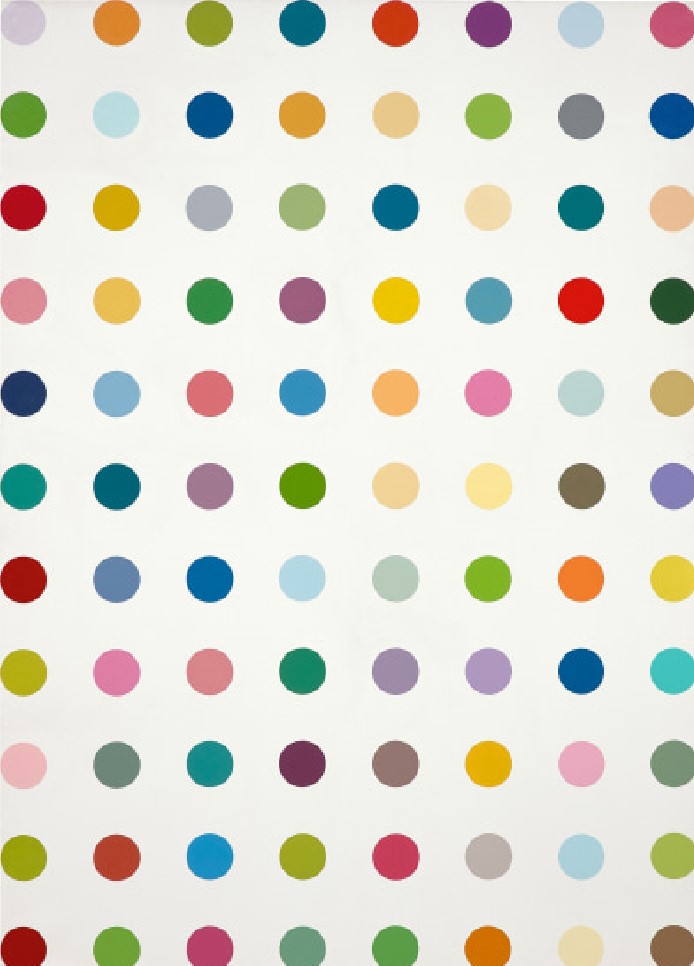
DAMIEN HIRST
Loperamide, 2005
Household gloss on canvas
63×45 inches (160 x 114.3 cm)
#4. Arg-Ala, 1994
Sotheby’s London: 26 March 2021
Estimated: GBP 150,000 – 200,000
GBP 315,000 / USD 434,542
Arg-Ala | Contemporary Art Day Auction | 2021 | Sotheby’s (sothebys.com)
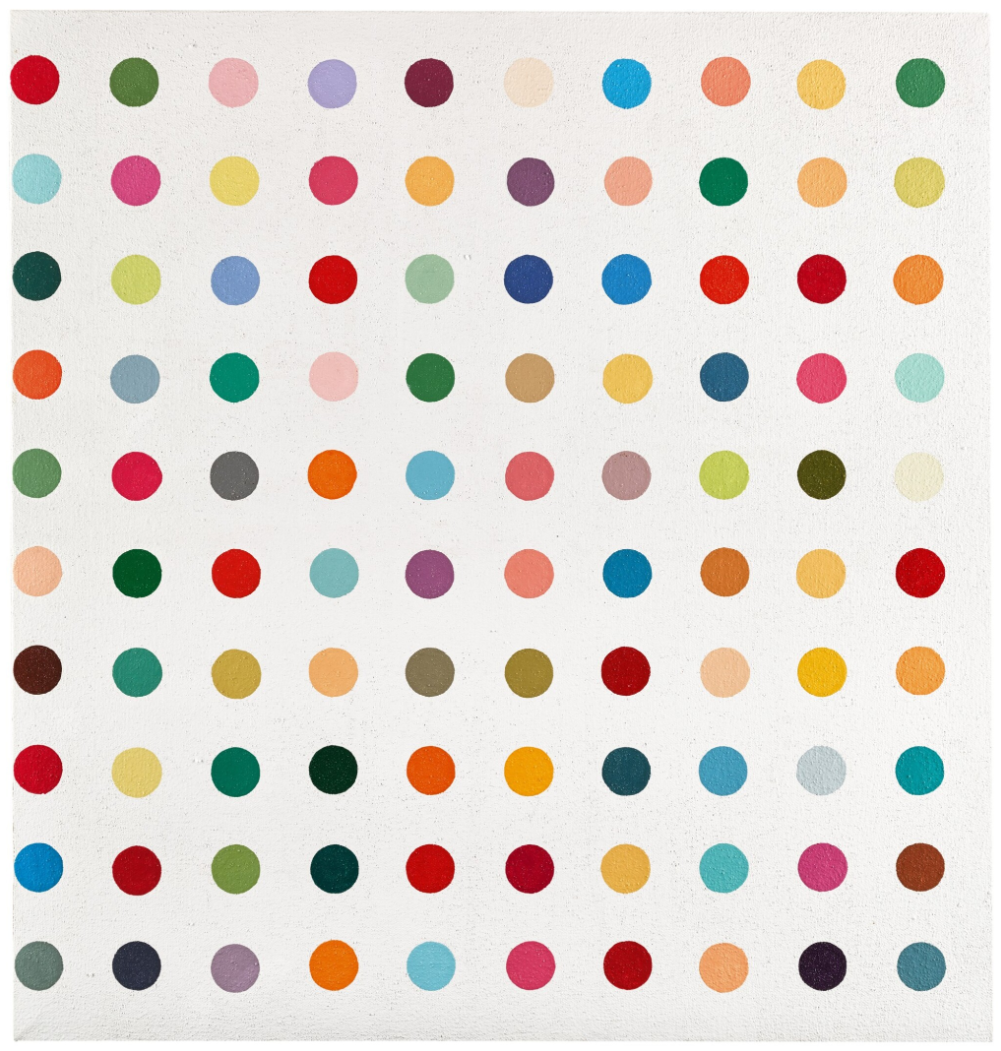
DAMIEN HIRST (b. 1965)
Arg-Ala, 1994
Household gloss on canvas
21 1/2 x 20 3/4 inches (54.5 x 52.5 cm)
Signed on the reverse
#5. Apomorphine, 1991
Sotheby’s London: 15 October 2021
Estimated: GBP 120,000 – 180,000
GBP 277,200 / USD 381,345
Apomorphine | Contemporary Art Day Auction | 2021 | Sotheby’s (sothebys.com)
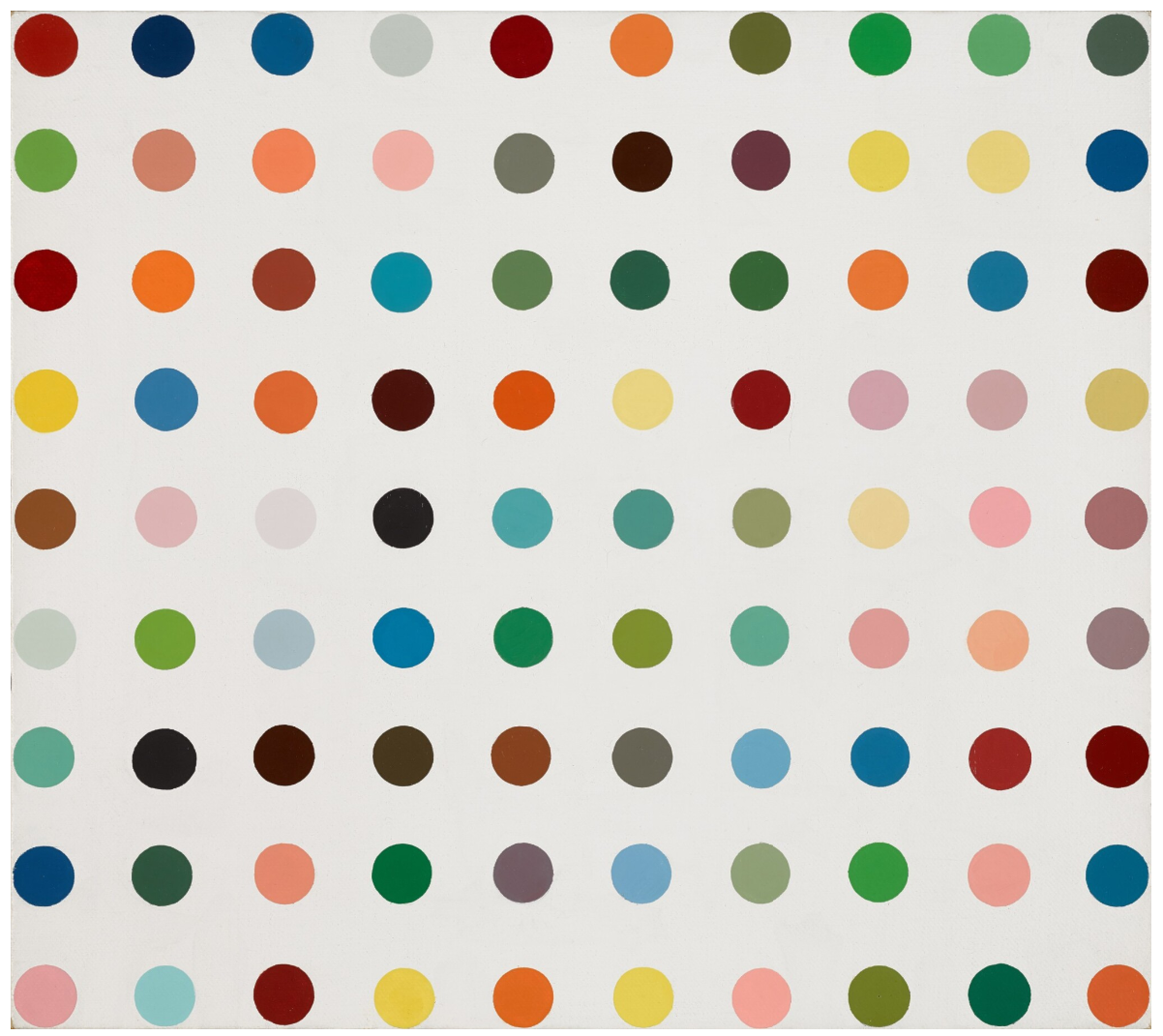
DAMIEN HIRST (b. 1965)
Apomorphine, 1991
Household gloss on canvas
13×15 inches (34×38 cm)
#6. Aurous Selenide, 2008
Sotheby’s New-York: 19 November 2021
Estimated: USD 180,000 – 250,000
USD 327,600
Aurous Selenide | Contemporary Day Auction | 2021 | Sotheby’s (sothebys.com)
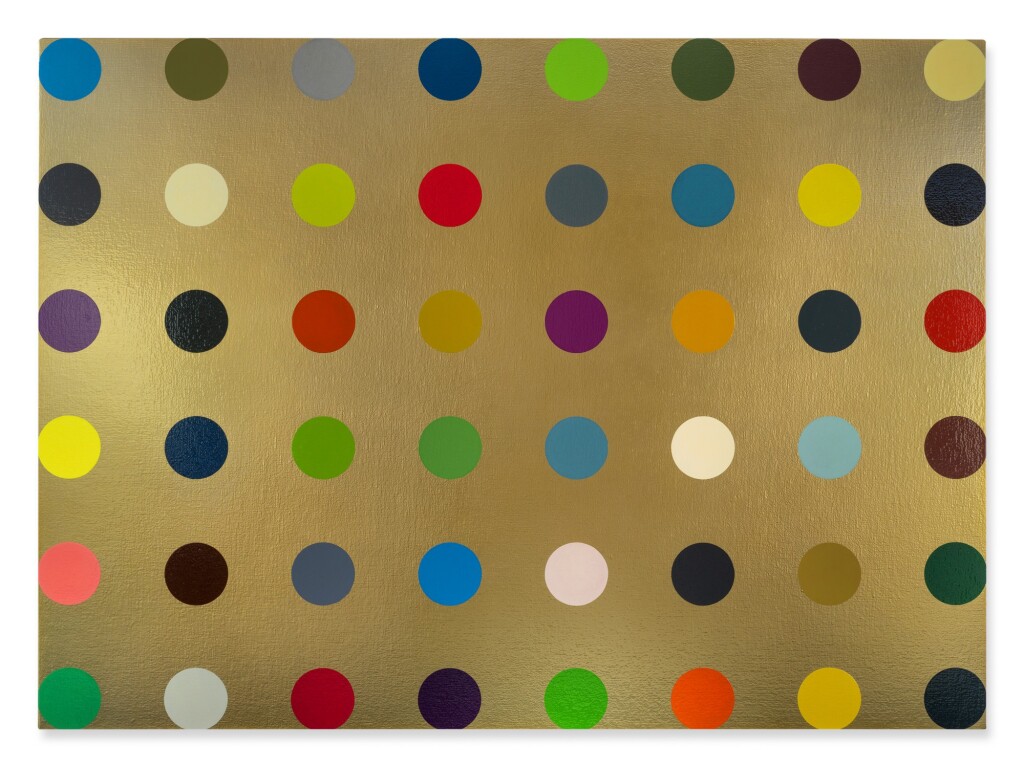
DAMIEN HIRST (B. 1965)
Aurous Selenide, 2008
Household gloss and metallic paint on canvas
32.6 x 44.9 inches (83×114 cm)
Signed Damien Hirst, titled and dated 2008 (on the reverse)
Signed D Hirst (on the stretcher)
#7. Pemoline, 1995
Sotheby’s London: 1 July 2021
Estimated: GBP 150,000 – 200,000
GBP 189,000 / USD 260,402
Pemoline | Contemporary Art Day Auction | 2021 | Sotheby’s (sothebys.com)
DAMIEN HIRST (b. 1965)
Pemoline, 1995
Household gloss on canvas
27 1/2 x 55 5/8 inches (70.7 x 141.4 cm)
Signed on the stretcher; signed, titled and dated 1995 on the reverse
2020 Auction Results
#1. Antipyrylazo III, 1994
The Robert Tibbles Collection: Young British Artists & More
Phillips London: 13 February 2020
Estimated: GBP 900,000 – 1,200,000
GBP 1,275,000 / USD 1,663,990
Damien Hirst 20th Century & Contemporary Art Evening Sale
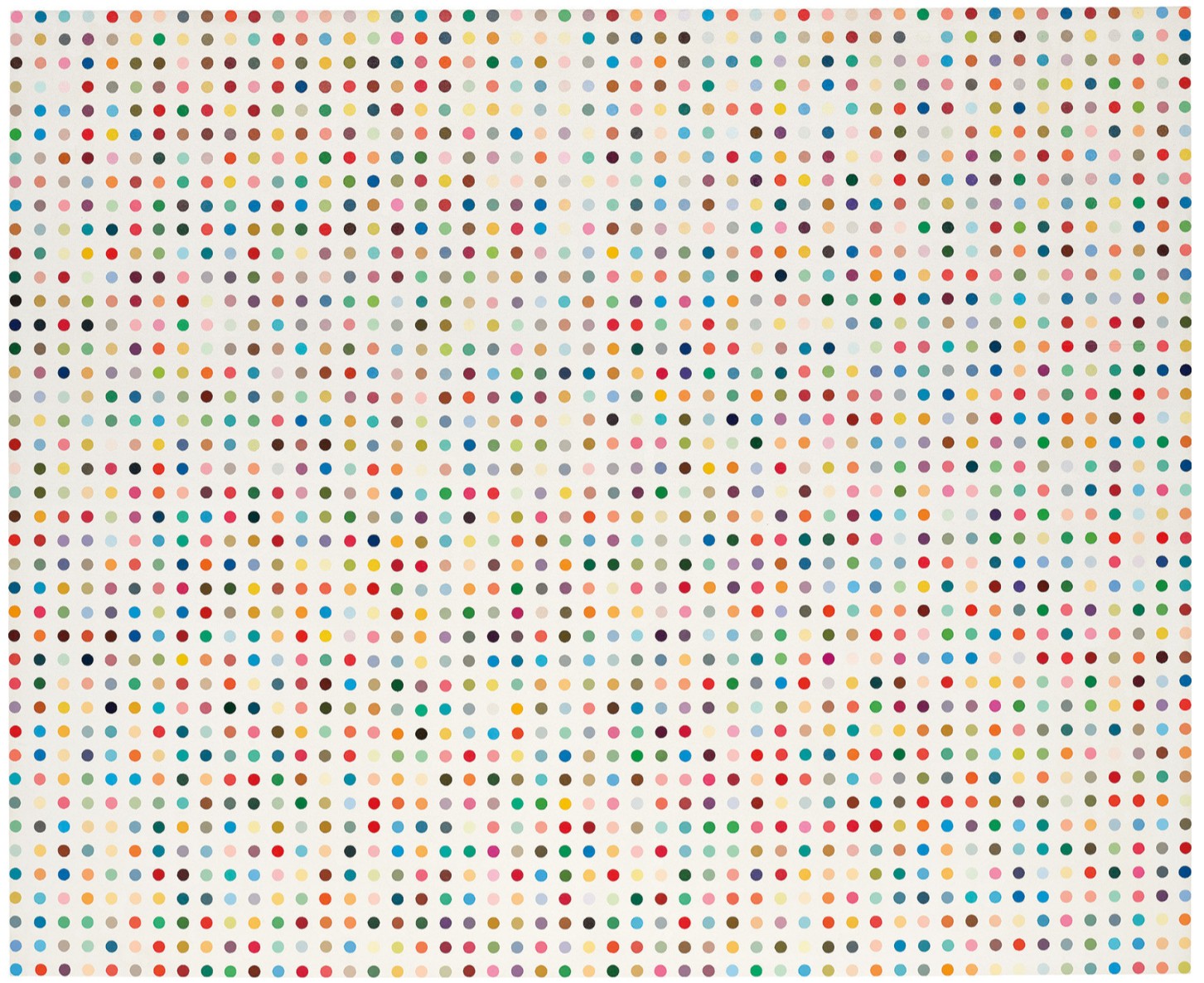
Household gloss on canvas
80 7/8 x 99 inches (205.7 x 251.5 cm)
Signed ‘D Hirst’ on the reverse
#2. THE FOUR SEASONS, 2010
PROPERTY OF A PRIVATE AMERICAN COLLECTOR
Sotheby’s London: 21 October 2020
Estimated: GBP 900,000 – 1,200,000
GBP 862,000 / USD 1,132,865
DAMIEN HIRST | THE FOUR SEASONS | Contemporary Art Evening Auction | 2020 | Sotheby’s
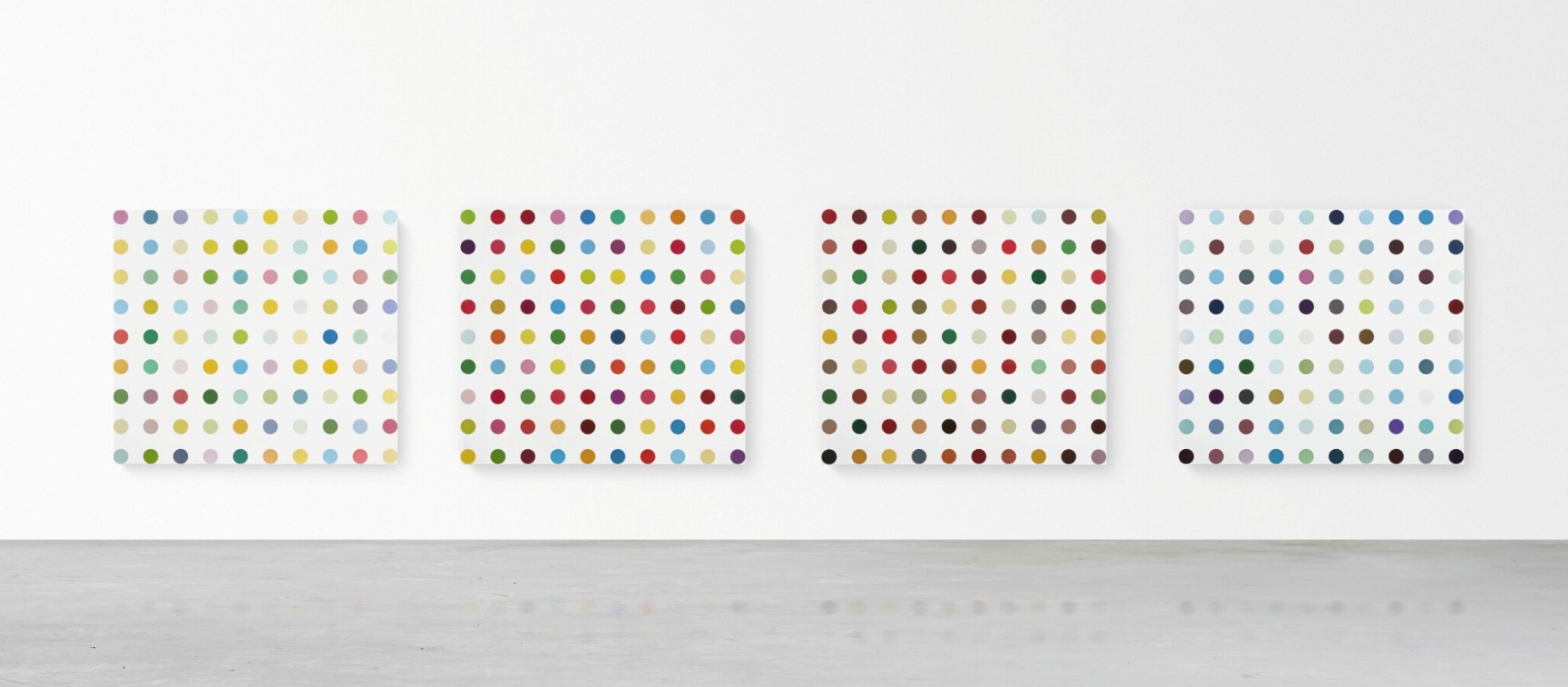
DAMIEN HIRST (b. 1965)
THE FOUR SEASONS, 2010
Household gloss on canvas, in 4 parts
Each: 68×76 inches (172.7 x 193 cm)
Each: Signed, titled, dated 2010 and variously inscribed on the reverse
Early Spot Paintings
Argininamine, 1994
Bonhams London: 5 March 2026
Estimated: GBP 180,000 – 250,000
GBP 184,550 / USD 246,540
SPOT PAINTING
Bonhams : DAMIEN HIRST (B. 1965) Argininamine (Painted in 1994)
DAMIEN HIRST (B. 1965)
Argininamine, 1994
Household gloss on canvas
25×26 inches (63.5 x 66 cm)
Signed ‘Hirst’ (on the reverse)
Executed in 1994, Argininamine represents an early iteration of the body of work that propelled Damien Hirst to international prominence and critical distinction. Comprised of one hundred and fifty-six meticulously arranged, uniquely colored dots set in a precise matrix of twelve rows and thirteen columns, Argininamine stands as an early and important example of Damien Hirst’s acclaimed Spot series. Each chromatic sphere, while uniform in scale and spatial placement, is distinguished by its individual hue, creating a composition that is both systematically ordered and visually diverse. Despite the potential for infinite permutations within this framework, the overarching themes of life, death, science and art, and conceptual undercurrents resonate consistently throughout the entire series. With a diversely hued palette and distinct composition, Argininamine demonstrates these core principles with a high degree of formal control and precision. Each spot in the series is painstakingly executed by hand using household gloss paint within a rigorously predetermined grid, a practice that interrogates the tension between mechanical precision and the corporeal trace of human intervention.
Argininamine is part of the most well-known subseries of the Spot series; the Pharmaceutical paintings. These were initially conceived alongside Hirst’s renowned Medicine Cabinets and further the artist’s lifelong interest in the conversation between faith, art and science. Hirst sees medicine as a potent belief system, in which society is seduced by drugs and persuaded of their capacity to cure all ailments and sustain life, while rarely interrogating their side effects.
“Art is like medicine, it can heal. Yet I’ve always been amazed at how many people believe in medicine but don’t believe in art.”
The artist derived the titles of each Pharmaceutical painting from an alphabetical listing of drug names cited in the Sigma-Aldrich chemical company catalogue that he first encountered in the early 1990s. As such, the Pharmaceutical paintings can be seen as an extension of the medical supplies found in Hirst’s Medicine Cabinets with each spot signifying an individual pill.
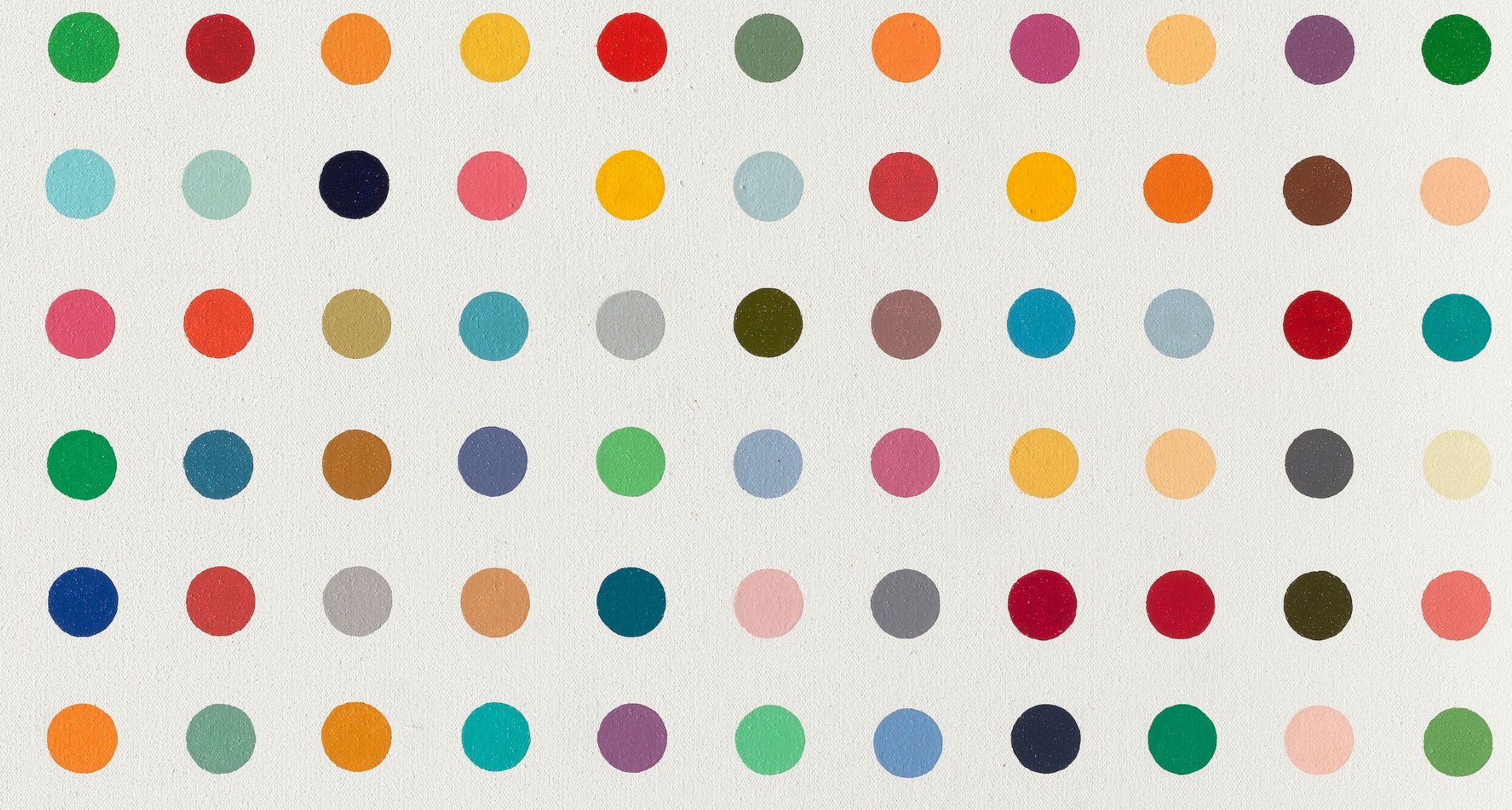
Through each carefully hand-painted spot, Hirst is able to establish his broader artistic philosophy while creating a distinctive and instantly recognizable visual language. The artist has built upon this discourse over the years, creating a triumphant output of fully unique works that utilize this language. Entirely fresh to the market, Argininamine was included in Gagosian Gallery’s ambitious 2012 exhibition series The Complete Spot Paintings 1986–2011, which presented over 300 works from the series across all eleven of the gallery’s global locations. Spanning a remarkable range in scale — from minuscule pinhole-sized marks to expansive compositions featuring spots measuring up to 60 inches in diameter — each spot asserts a presence that becomes acutely palpable when viewed in person. This singular exhibition series highlighted the artist’s impressive production and investigation of the spot, which is central to Hirst’s aesthetic inquiry exploring the dialectic between seriality and individuality.
Unfolding across a radiant chromatic spectrum, Argininamine manifests a structured, contemplative grid that invites reflection on the intricate interrelations among science, religion, art, beauty, life, and death. The seemingly molecular structure of Argininamine suggests a tension between beauty and horror within the sphere of scientific discovery, acknowledging that no matter how deeply we question the mechanics of the world, we remain subject to the unknowable operations of fate. As resonant today as at the time of its creation, this work offers a powerful, lyrical meditation on themes that remain central to the human condition. Through its elegant synthesis of order and emotion, Argininamine epitomizes Hirst’s enduring engagement with existential inquiry and aesthetic precision.
Nalorphine, 1995
Christie’s London: 16 October 2025
Estimated: GBP 150,000 – 200,000
GBP 266,700 / USD 357,380
DAMIEN HIRST (B. 1965), Nalorphine | Christie’s
DAMIEN HIRST (B. 1965)
Nalorphine, 1995
Household gloss on canvas
34 7/8 x 57 1/8 inches (88.5 x 145 cm) (2 inch spot)
Titled ‘NALORPHINE’ (on the stretcher)
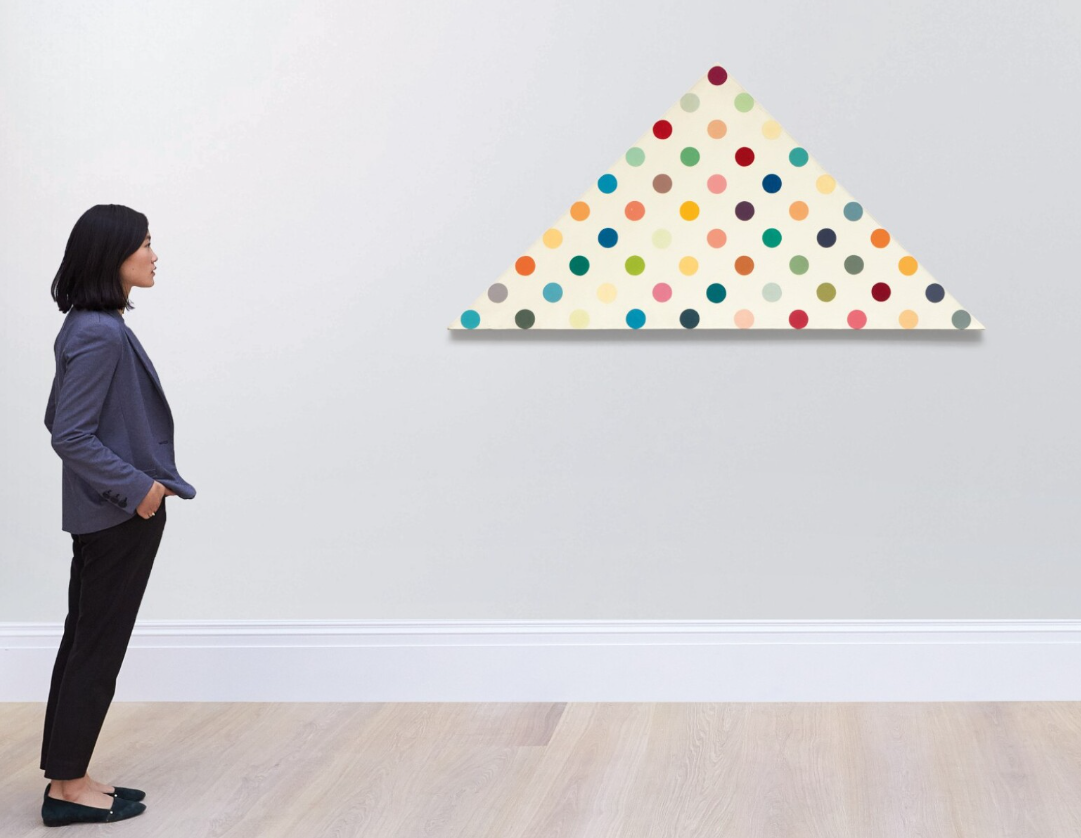
Nalorphine is an arresting early example of Damien Hirst’s iconic Pharmaceutical Paintings (1986-2011), popularly known as ‘spot paintings.’ It was executed in 1995, the year Hirst triumphed in the Turner Prize and confirmed his graduation from enfant terrible to leading light of contemporary British art. It belongs to the Controlled Substances, a subset of the almost 1,500 spot paintings, which saw Hirst experiment with arrangements beyond the series’ usual square and rectangular formats, with shaped canvases including triangles and diamonds. Each is titled after a ‘controlled’ drug that cannot be accessed by the non-medical public, and contains the name of the drug spelled out within the painting according to a color code specified by Hirst in his parallel series of so-called ‘Key Paintings’. Nalorphine’s spots, which spell out the title in a diagonal running from the top left to bottom right of the painting, are arranged in a parallelogram. It is one of just three paintings to take this form. The work has been held in the collection of Tiqui Atencio and Ago Demirdjian since 1997: Atencio was a notable early supporter of Hirst and his Young British Artist contemporaries.
“Art is like medicine—it can heal.”
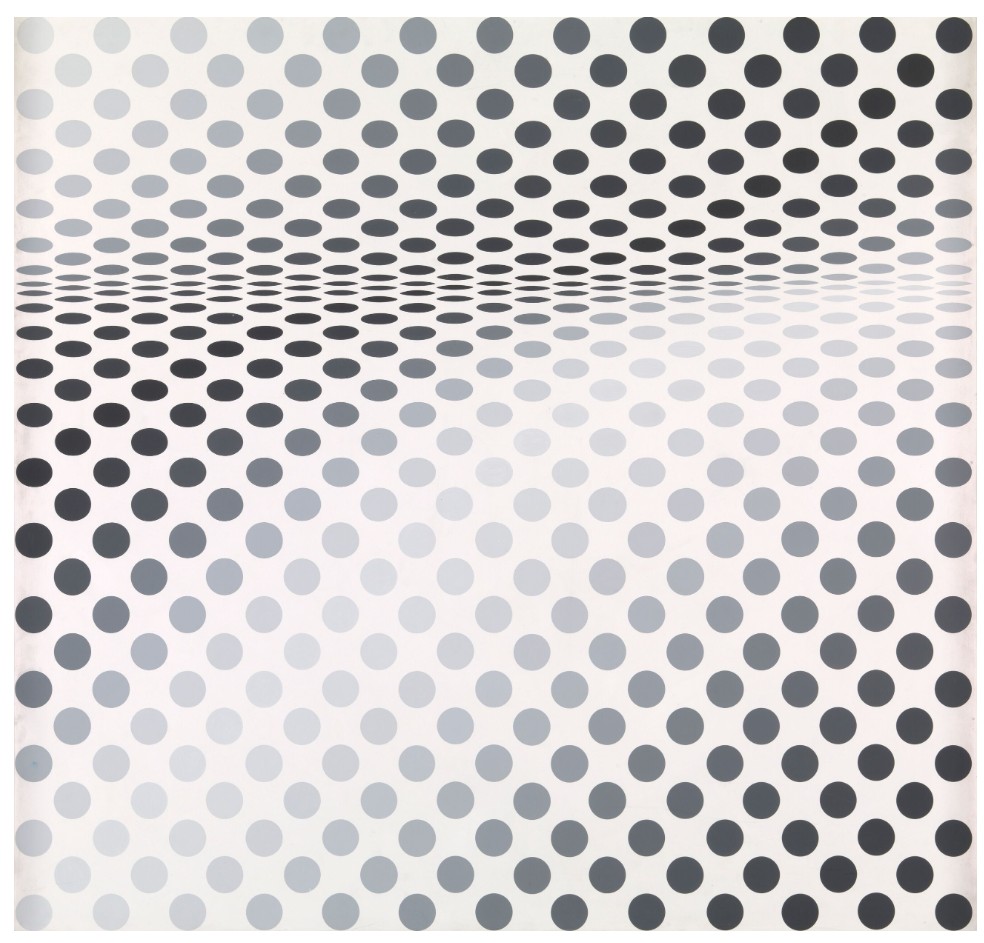
Bridget Riley, Hesitate, 1964. Tate, London. Artwork: © Bridget Riley 2025. All rights reserved. Photo: Tate.
Hirst’s Pharmaceutical Paintings were conceived in 1986, when he was a first-year student at Goldsmiths College, and continued for the next twenty-five years. They were inspired by the artist’s love of snooker—a game whose colored orbs collide and scatter in complex patterns of cause and effect—and his desire to create art that mirrored scientific and medical formulas. Each work in the series is titled after a drug in the 1990 Sigma-Aldrich Catalogue of Chemical Compounds. Nalorphine is an anti-opioid that has been removed from medical use for causing side-effects including anxiety and hallucinations. For an artist later infamous for giddy excesses such as the diamond-encrusted skull For the Love of God (2008) and the gigantic sculpture Demon with Bowl (2017), the spot paintings are works of unstinting, almost monastic discipline. Each spot is hand-painted in household gloss on canvas, and the gaps between the spots are equal in width to the spots themselves.
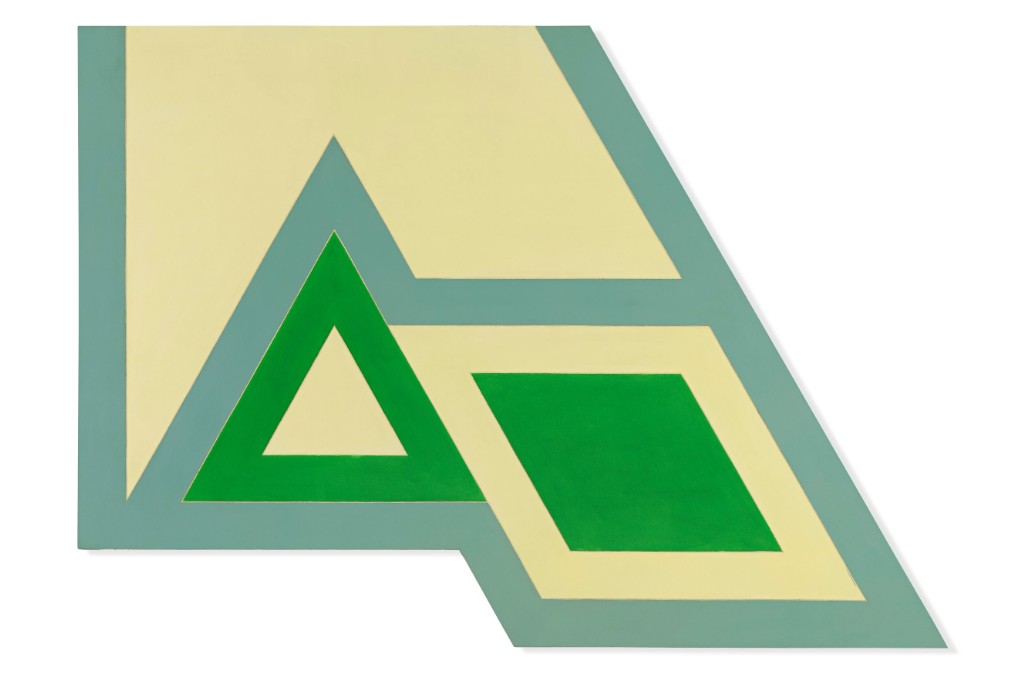
Frank Stella, Sanbornville III, 1966. Whitney Museum of American Art, New York.
Artwork: © Frank Stella, DACS 2025. Digital image: © 2025 Whitney Museum of American Art / Licensed by Scala.
As in the oeuvre of fellow British painter Bridget Riley, Hirst’s rigorous, repetitive structure creates a hypnotic display, as the spots appear to shimmer and oscillate—in some cases recalling the effects of the drugs they are named after. ‘The steady pulse of the spots’, writes Michael Bracewell, ‘creates a contemplative visual force field. It is as though both the gaze and the painting become magnetized, with the viewer caught up within the tension between their combative currents’ (M. Bracewell, ‘Art Without the Angst—The Pharmaceutical Paintings of Damien Hirst’, in Damien Hirst: The Complete Spot Paintings 1986-2011, exh. cat. Gagosian Gallery, New York 2012, p. 5). Nalorphine’s tilted field of vibrant dots simultaneously provokes bliss and a sense of unease at its machine-like, science-inspired exactitude. It extends Andy Warhol’s idea of art as industrial production while affirming the uncanny precision of the human hand. These contradictions make Nalorphine as conceptually striking as it is hypnotic.
1-Chloro-2, 4-Dinitrobenzene, 1997
Christie’s New-York: 14 May 2025
Estimated: USD 600,000 – 800,000
USD 529,200
DAMIEN HIRST (B. 1965), 1-Chloro-2, 4-Dinitrobenzene | Christie’s
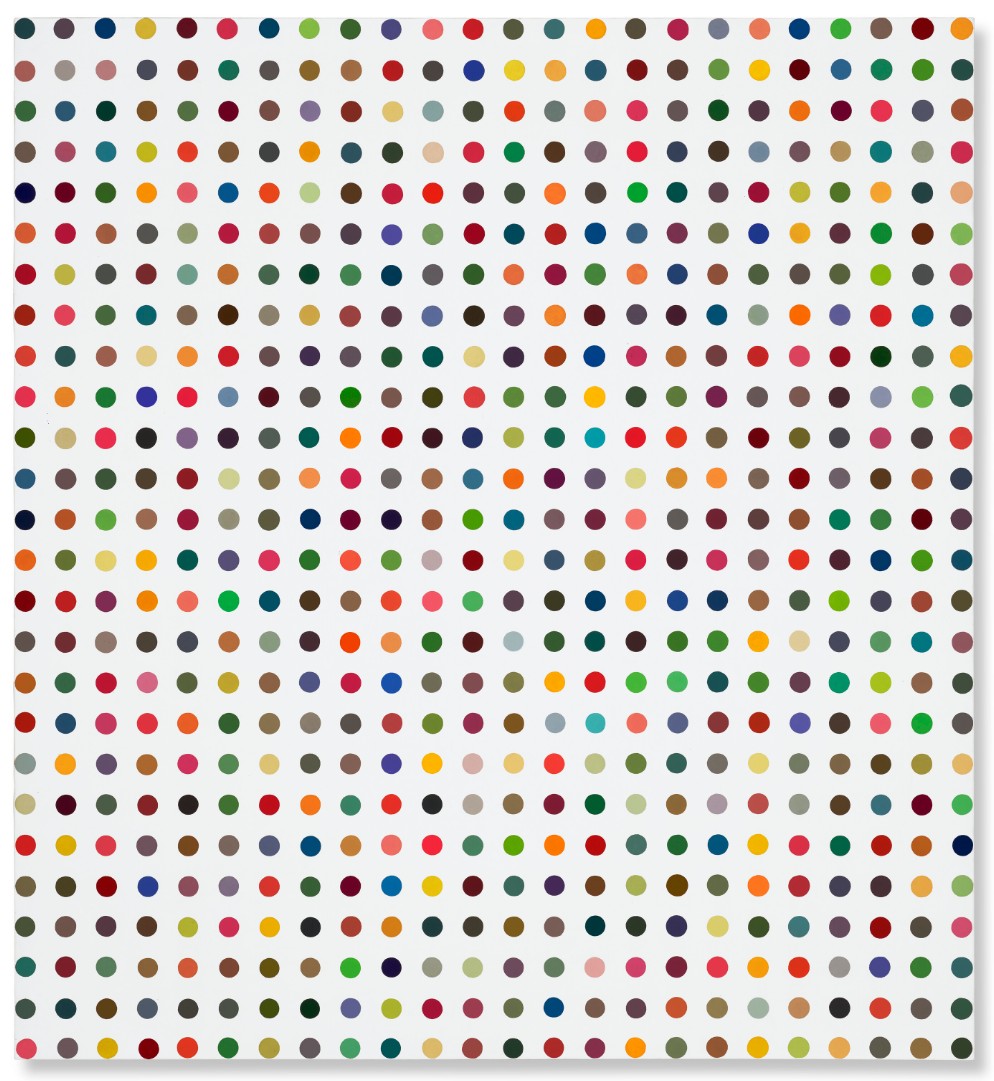
DAMIEN HIRST (B. 1965)
1-Chloro-2, 4-Dinitrobenzene, 1997
Household gloss on canvas
130×120 cm (51 1/4 x 47 1/4 inches)
Executed in 1997, the year that Damien Hirst and the Young British Artists (YBAs) cemented their stellar rise with the ground-breaking “Sensation” exhibition at London’s Royal Academy, 1-Chloro-2, 4 -Dinitrobenzene is from one of Contemporary art’s most iconic series of paintings. The effect of this exceptional spot painting is visually gratifying, vibrant and uplifting, while also being ingeniously original. In an oeuvre that has consistently interrogated fundamental belief systems, Hirst’s spot paintings are characteristic of his ability to challenge long-held artistic conventions.
“I wanted to find a way to use color in paintings that wasn’t expressionism. I was taught by painters who believed that as an artist you paint how you feel and I believed in that for a long time. And then I lost faith in it and wanted to create a system where whatever decisions you make within a painting, the paintings end up happy. And I came up with spot paintings.”
Hirst made his first spot painting in 1986, and included two in Freeze (1988), the exhibition organized and curated by Hirst which was pivotal in the genesis of the YBAs. In 1991, he made the first spot painting on canvas, having previously painted them directly onto walls. 1-Chloro-2, 4 -Dinitrobenzene forms part of the ‘Pharmaceutical’ series of spot paintings made between 1986 and 2011. Each painting in the series follows the same guidelines: each spot must be hand-painted in household gloss, and while the dimensions of the spots might vary, the gaps between them must be the same dimension of the spots themselves. Yet despite the strictness of the format, the colors defy expectations by refusing to fall into a pattern.
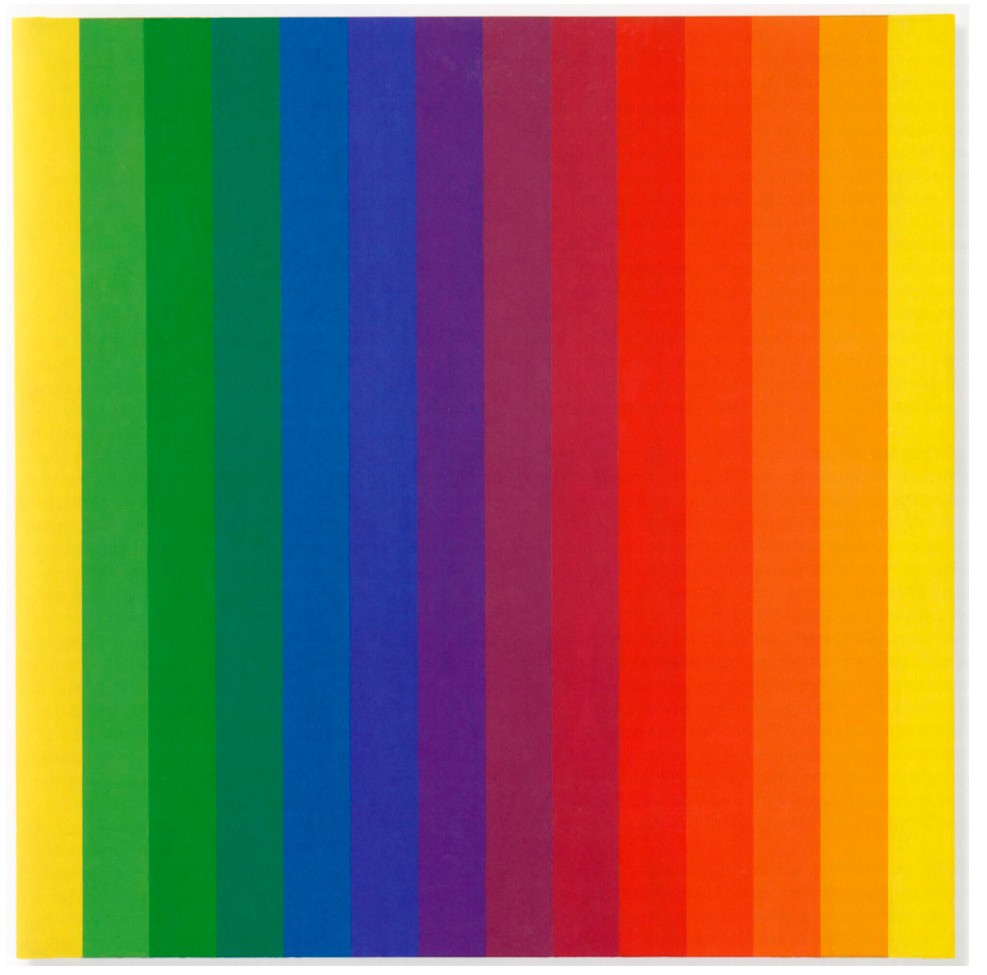
Ellsworth Kelly, Spectrum I, 1953. © Ellsworth Kelly Foundation.
“Art doesn’t purport to have all the answers; the drug companies do. Hence the title of the series, the Pharmaceutical Paintings, and the individual titles of the paintings themselves… Art is like medicine, it can heal. Yet I’ve always been amazed at how many people believe in medicine but don’t believe in art, without questioning either.”’
This scientific approach to painting is demonstrated also in Hirst’s method of titling them after the medicine listed in a pharmaceutical company catalogue.
Untitled (Chris), 1999
Bonhams New-York: 15 May 2025
Estimated: USD 250,000 – 450,000
USD 267,200
Bonhams : DAMIEN HIRST (B. 1965) Untitled (Chris) 34 x 38 in (86.4 x 96.5 cm) (Painted in 1999)
Household gloss on canvas
34×38 inches (86.4 x 96.5 cm)
Comprised of ninety meticulously arranged, uniquely colored dots set in a precise matrix of nine rows and ten columns, Untitled (Chris) stands as a compelling example of Damien Hirst’s acclaimed Spot series. Each chromatic sphere, while uniform in scale and spatial placement, is distinguished by its individual hue, creating a composition that is both systematically ordered and visually diverse. Despite the potential for infinite permutations within this framework, the overarching themes and conceptual undercurrents resonate consistently throughout the entire series. Executed in 1999, Untitled (Chris) represents an early iteration of the body of work that propelled Hirst to international prominence and critical distinction. Throughout Hirst’s oeuvre, the Spot paintings occupy a foundational position, functioning as a key to interpreting his broader artistic philosophy. Untitled (Chris) was included in Gagosian Gallery’s ambitious 2012 exhibition series The Complete Spot Paintings 1986–2011, which presented over 300 works from the series across all eleven of the gallery’s global locations. Spanning a remarkable range in scale—from minuscule pinhole-sized marks to expansive compositions up to 60 inches in diameter—each spot asserts a presence that becomes acutely palpable when viewed in person.
Unfolding across a radiant chromatic spectrum, Untitled (Chris) manifests a structured, contemplative grid that invites reflection on the intricate interrelations among science, religion, art, beauty, life, and death. As resonant today as at the time of its creation, the work offers a powerful, lyrical meditation on themes that remain central to the human condition. Through its elegant synthesis of order and emotion, Untitled (Chris) epitomizes Hirst’s enduring engagement with existential inquiry and aesthetic precision.
Arbutin, 1994
Sotheby’s Zurich: 28 March 2023
Estimated: CHF120,000 – 180,000
CHF 177,800 / USD 193,323
DAMIEN HIRST (b. 1965)
Arbutin, 1994
Gloss household paint on canvas (1-inch spot)
15×17 inches (38 x 43.2 cm)
Signed D. Hirst and dated 94 on the reverse
Damien Hirst’s Arbutin (Hydroquinone b-D-glucopyranoside) is part of the emblematic Spot paintings series. Hirst estimates he produced around 1400 spot paintings since the genesis of this geometrical format in 1988. In the 1990’s, he set the basis for an endless series of works as grids, easily repeated and reproduced, removing the artist’s own hand. Hirst started at this date to let his assistants execute the works. Marking a turning point in his career, these were Hirst’s first steps into the world of art as “fabrication” – a divisive artistic method explored by American Pop Artists. Later in the 1990s, Hirst’s Spot paintings would merge to a recurrent theme to the artist: drugs. The work has been created while Hirst’s Spot paintings reached their momentum.
Cardura Doxazosin, 1992
Christie’s London: 28 February 2023
Estimated: GBP 500,000 – 700,000
GBP 787,500 / USD 952,467
DAMIEN HIRST (B. 1965)
Cardura Doxazosin, 1992
Household gloss on canvas
83 7/8 x 72 inches (213×183 cm) (4 inch spot)
Stretching over two meters in height, Cardura Doxazosin (1992) is a hypnotic early example of Damien Hirst’s spot paintings from the group of ‘Deuterated Compounds’: a rare subseries distinguished by their greyscale palette. Other than a single work from the pastel-colored ‘Venoms’ made in 1989, the ‘Deuterated Compounds’ were the first subgroup aside from the ‘Pharmaceuticals’—which form by far the largest category of spot paintings—to be created. Hirst made four of these grisaille works in 1992, and just twenty-two in total. They follow the same set of rules that applies to almost all of his spot paintings: no spot is precisely the same shade as any other within the work; the spots are hand-painted in household gloss on canvas; and the gap between each spot is equal to the width of the spots themselves. In subtle shades of platinum, ash, graphite and gunmetal, Cardura Doxazosin’s 110 spots create a dynamic optical spectacle. They pulse and oscillate as the eye attempts to grasp a pattern from the grid, or hones in on one spot’s particular hue.
Althiazide, 1992
Sotheby’s London: 14 October 2022
Estimated: GBP 600,000 – 800,000
GBP 693,000 / USD 776,905
Althiazide | Contemporary Evening Auction | 2022 | Sotheby’s (sothebys.com)
DAMIEN HIRST (b. 1965)
Althiazide, 1992
Household gloss on canvas, 4-inch spot
72×80 inches (182.9 x 203.2 cm)
Titled (on the stretcher)
Suspended in nine rows and ten columns, the ninety unique-color circles of Althiazide comprise one of the earliest and most serene of Damien Hirst’s iconic Spot paintings. Each color sphere is carefully individualized in hue, but together the household gloss-paint discs span the entire chromatic spectrum. This work is a key constituent of the breakthrough series that brought Hirst to international attention and garnered the artist widespread critical acclaim in the early 1990s. The present work’s execution was contemporaneous with the very first Young British Artists show as the Saatchi Gallery in 1992, which led to Hirst’s nomination that year for the coveted Turner Prize. Hirst has long been transfixed by the life sciences. As the analysis of how substances can effect change in living organisms, pharmacology has often taken centre stage in the artist’s oeuvre. A cardiovascular agent, the drug althiazide has been manufactured in combination with spironolactone under the marketed name aldactazine to treat patients with mild to moderate hypertension.
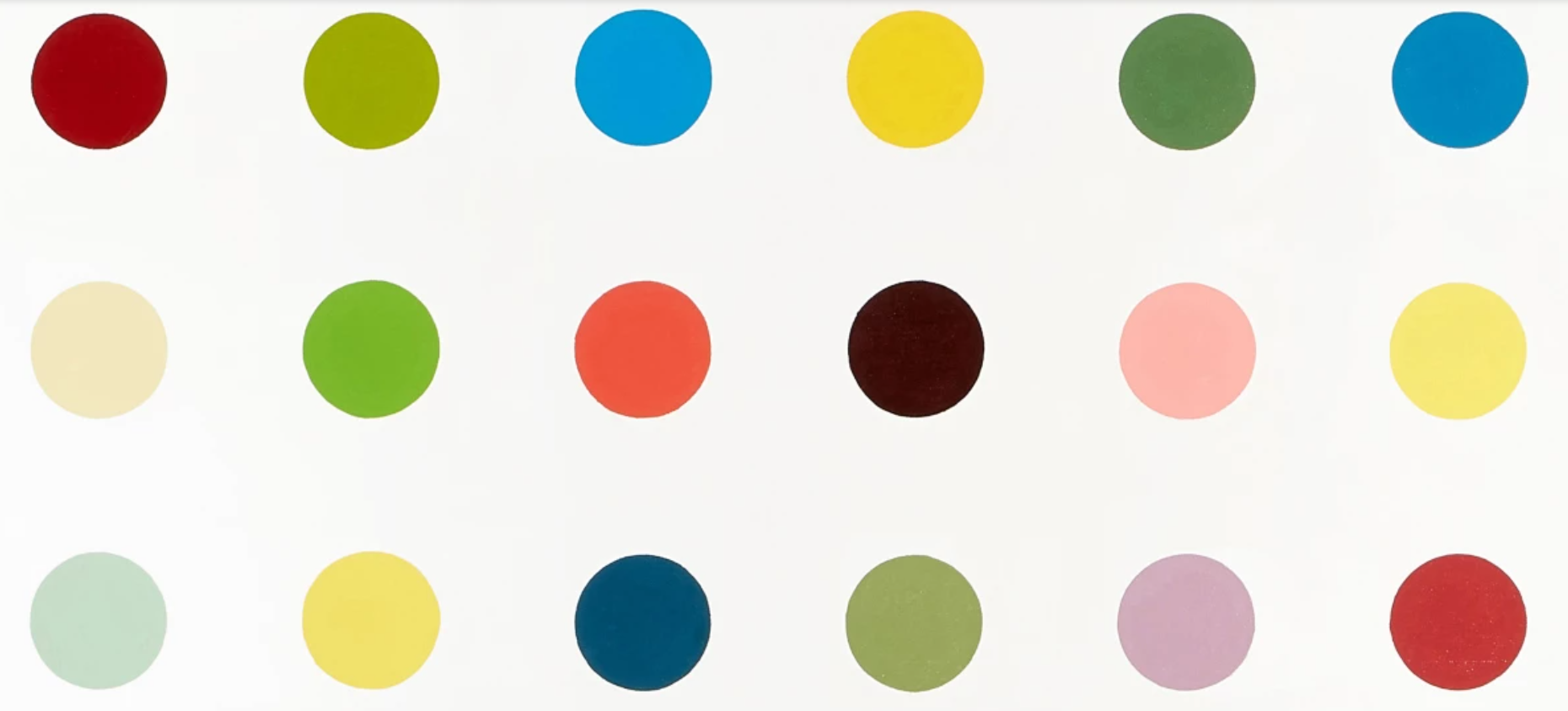
Althiazide confronts humanity’s idea of faith in the unwavering progress of science, a theme that is seminal to the artist: “I can’t understand why some people believe completely in medicine but not in art, without questioning either” (Damien Hirst quoted in, Ibid, p. 24). In the context of drugs as a sacrament in the religion of “more life”, Althiazide becomes a pharmacological altarpiece. Self-restricted by the grid, the iconography of the work belies the simple schema of geometric logic, with the only element of variation present in the composition being the color and tone of the spots which remain perennially unrelated and unidentical to one another. The strict and regulated organization of the dots competes with the irregular rhythms of their colored variations, teasing the eye with suggestions of patterns that ultimately do not exist in the work. The viewer’s roaming gaze is desperate to find and establish order but to no avail. These symptomatic effects of viewing Althiazide imitate the desire to organize and structure the chaos of nature with order, implicating the inevitably undermined attempts to evade death made irresistible by the life-giving rhetoric of modern science and medicine.
Biotin Hydrazide, 1995
Phillips London: 14 October 2022
Estimated: GBP 600,000 – 800,000
GBP 700,100 / USD 784,865
Damien Hirst – 20th Century & Contem… Lot 26 October 2022 | Phillips
DAMIEN HIRST
Biotin Hydrazide, 1995
Household gloss on canvas
92×186 inches (233.7 x 472.4 cm)
4 inches spot
Signed ‘D. Hirst’ on the reverse
Executed in 1995, the same year that Damien Hirst was awarded the prestigious Turner Prize, Biotin Hydrazide is an exquisite early example of the young artist’s vision and ambition, a testament to the role played by his iconic Spot Paintings in establishing his reputation at the vanguard of the ‘90s British art scene. Meticulously rendered on an impressive scale, the work draws conceptual connections between Hirst’s other foundational series, combining the ordered, grid-like structure of the Medicine Cabinets, the relationship between mortality and medicine explored across the cabinets and iconic formaldehyde works, and the exuberant sense of color expressed by the Spin Paintings.
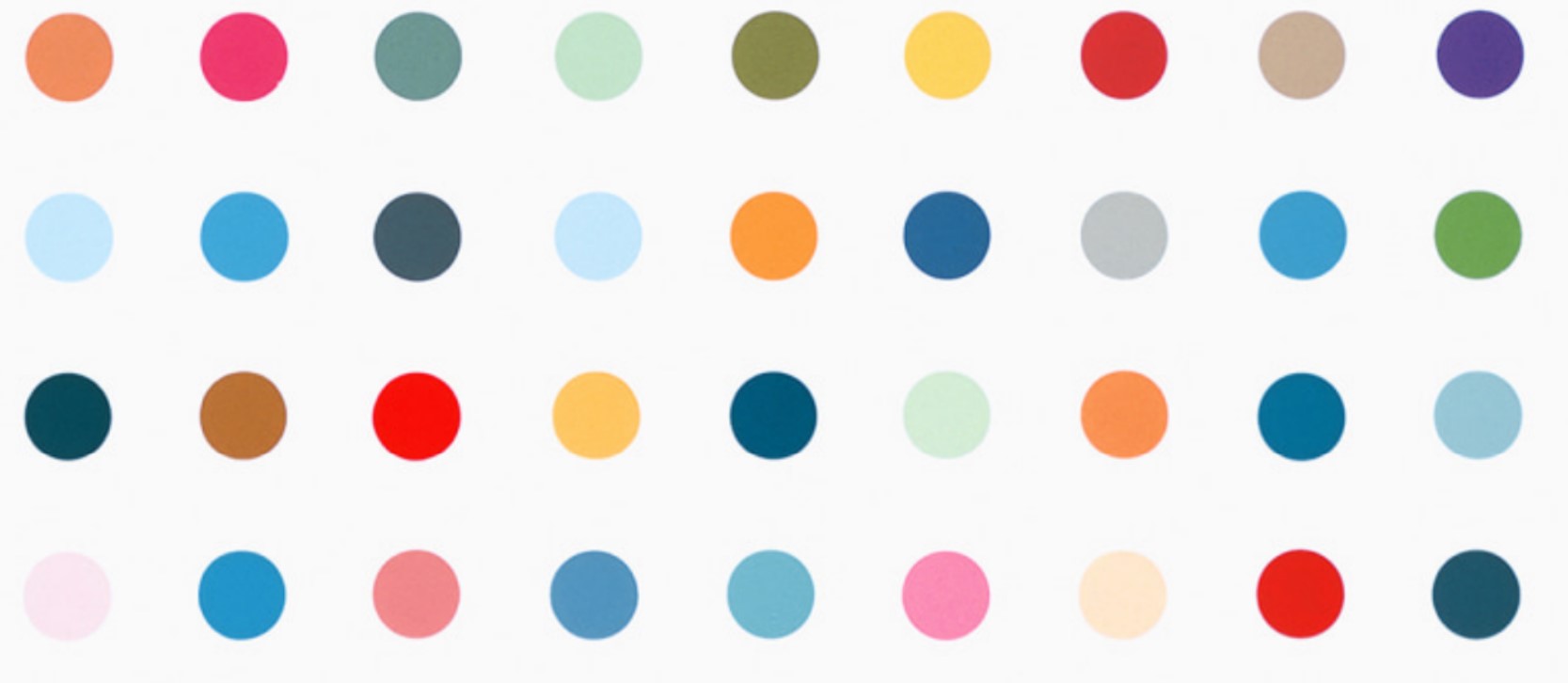
Arranged against a brilliant white ground, the uniquely mixed hues of household paint seem to vibrate with energy here, our eye seeking out patterns and responding to the chromatic relationships established across the composition that, nevertheless, fail to resolve. As Michael Bracewell has described, drawn to ‘the warmer-colored spots, the gaze then encounters seeming sudden diagonals, verticals or broken lines of semi-coherence; look again, and even these fleeting spooks of visual sense turn out to be illusions.’i Yet, despite this energetic activity, the work achieves an incredible compositional balance, rooted in the methodical, scientific approach to the composition based on a philosophy of chromatic relationships and their manipulation.
Benzoin, 1995
Sotheby’s London: 30 June 2022
Estimated: GBP 150,000 – 200,000
GBP 214,200 / USD 260,457
Benzoin | Modern & Contemporary Day Auction | 2022 | Sotheby’s (sothebys.com)
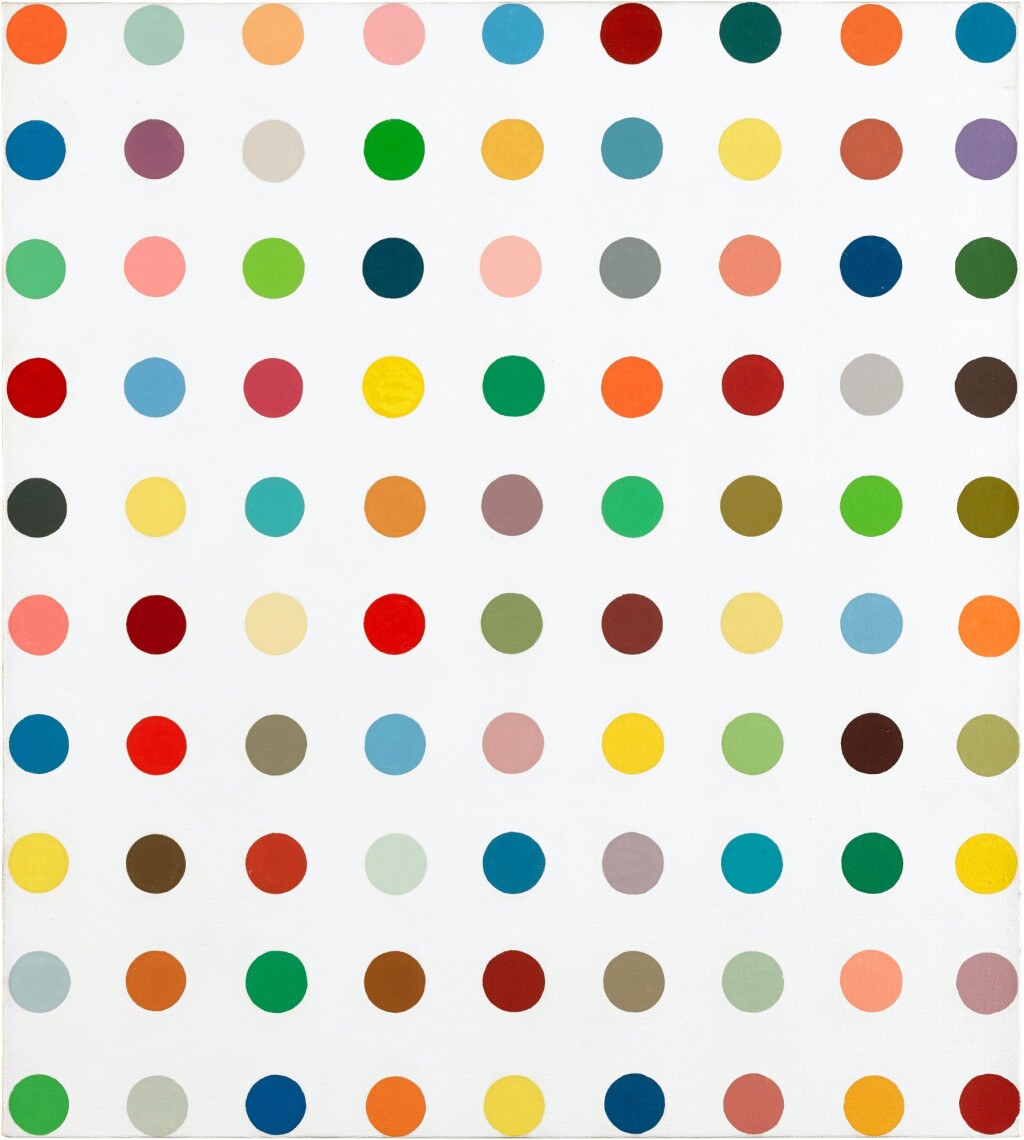
DAMIEN HIRST (B. 1965)
Benzoin, 1995
Household gloss on canvas
19×17 inches (48.4 x 43.3 cm)
Dated 1995 on the inside of the stretcher; signed on the reverse
Executed in 1995, the same year that Damien Hirst won the Turner Prize for his iconic sculpture Mother and Child Divided, Benzoin is an immaculate example of Damien Hirst’s iconic corpus of Spot Paintings. Tantalizingly and deceptively saccharine in appearance, the present work is imbued with an underlying gravitas, poignantly undercut by its compelling, vibrant and cheerful aesthetic.
Drugs have become the ubiquitous modifier of Nature: the remit of human existence is continually conditioned by the powers of modern science, from pre-birth sedatives dealt through the placenta, to near-death stimulants fed through an intravenous drip. Overshadowed by an idiosyncratic obsession with mortal transience, Benzoin reminds the viewer that despite our desire for order and harmony, we ultimately have no control over our destiny. Optically alluring and meticulously composed, the controlled emotionless self-restriction of Hirst’s candy-colored Benzoin crafts a captivating viewing experience.
N-(9-Acridinyl) Maleimide, 1992
Phillips London: 15 October 2021
Estimated: GBP 500,000 – 700,000
GBP 786,300 / USD 1,013,069
Damien Hirst – 20th Century & Contem… Lot 24 October 2021 | Phillips
DAMIEN HIRST
N-(9-Acridinyl) Maleimide, 1992
Household gloss on canvas
67 7/8 x 60 1/8 inches (172.6 x 152.6 cm)
An early and pristine example of one of Damien Hirst’s most important and instantly recognizable series, N – (9-Acridinyl) Maleimide is a wonderful presentation of the artist’s abiding interest in color and its organization. Executed in 1992, the same year that Hirst exhibited alongside Rachel Whiteread and Sarah Lucas in collector Charles Saatchi’s epoch-defining exhibition Young British Artists I, the present work also highlights the key conceptual continuities between this series of Pharmaceutical Paintings and Hirst’s oeuvre more broadly.
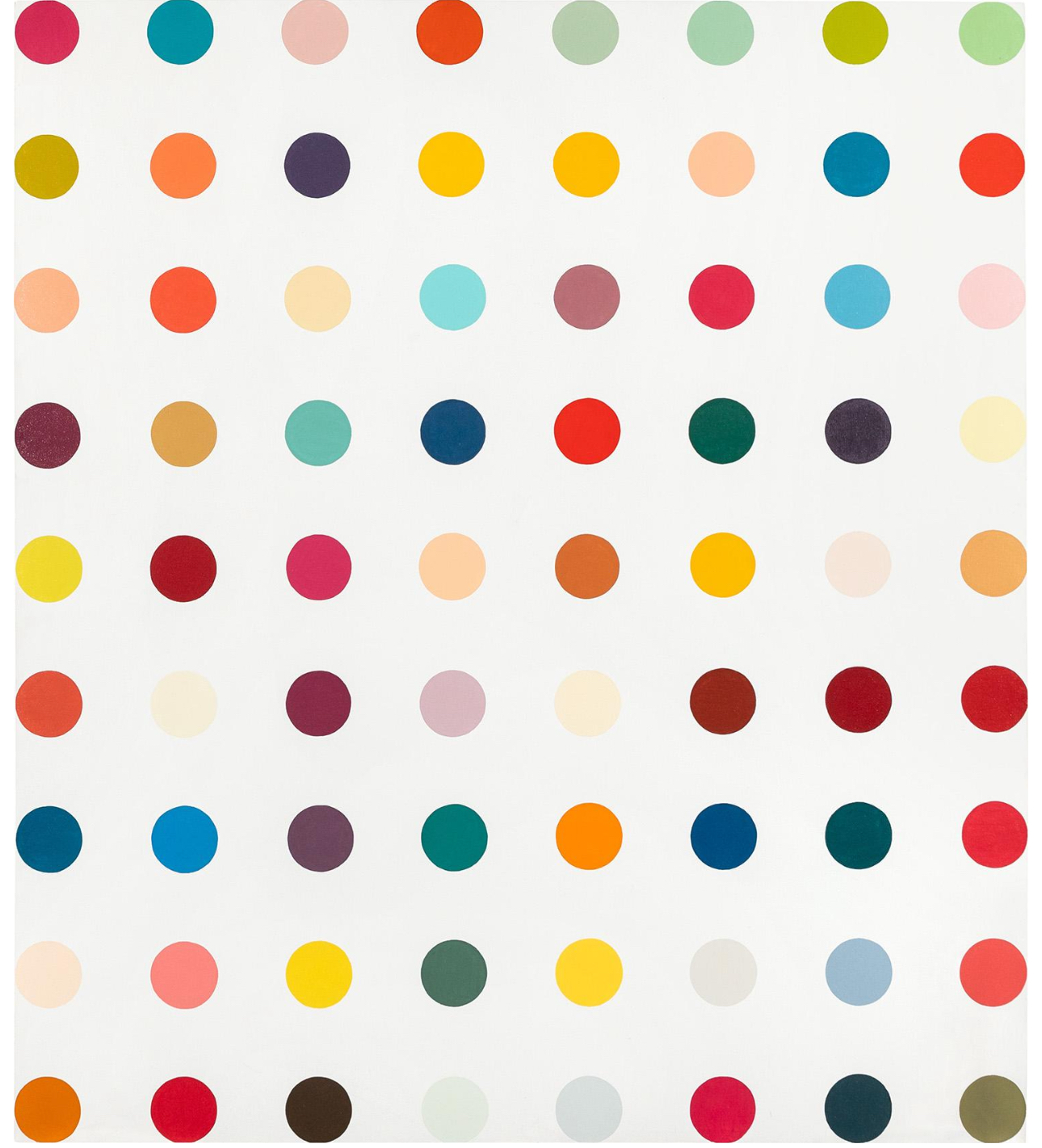
A piece of British art history, the present work was created at a pivotal moment in the young Hirst’s career. Executed the first year that Hirst had been nominated for the Turner Prize (which he would claim three years later) and just before he represented Britain at the 1993 Biennale Internazionale d’Arte di Venezia N – (9-Acridinyl) Maleimide testifies to the vision and ambition of an artist beginning to establish himself as a driving force of the British art scene in the early 1990s. Arranged with 9 spots along the vertical axis and 8 along the horizontal, the present work presents the grid-like arrangement of multichromatic spots rendered in uniquely mixed hues of household paint. With no two spots of the same color on any one canvas, the results have proved to be infinitely variable. As Hirst quickly discovered with one of the first spot painting’s inclusion of a black dot, the colors possessed a remarkable mutability when placed next to one another, some appearing to recede while others jumped forwards in a manner that references Bridget Riley’s foundational Op Art experiments of the 1960s. Meticulously spaced so that the gap between each spot is identical to the spot itself, the pattern of N – (9-Acridinyl) Maleimide achieves the remarkable effect of refusing to resolve.
Apomorphine, 1991
Sotheby’s London: 15 October 2021
Estimated: GBP 120,000 – 180,000
GBP 277,200 / USD 381,345
Apomorphine | Contemporary Art Day Auction | 2021 | Sotheby’s (sothebys.com)
DAMIEN HIRST (b. 1965)
Apomorphine, 1991
Household gloss on canvas
13×15 inches (34×38 cm)
Executed in 1991, the same year that Damien Hirst made his infamous shark in formaldehyde The Physical Impossibility of Death in the Mind of Someone Living and the same year as the artist’s career-defining In and Out of Love exhibition, Apormphine is one of the first fourteen Spot Paintings on canvas ever made. Utterly historical, it is the earliest ever Spot Painting to come to auction. The contrast in this work between the organizational composition of the uniquely colored one-inch spots with the brilliant white surface provides the viewer with a stimulating visual experience, one that is truly representative of the project that embodies Hirst’s highly influential artistic practice.
As one of the thirteen sub-series within the Spot painting category, the Pharmaceutical paintings remains the first and most prolific. Each Spot painting shares a certain set of properties: the spots are arranged on a grid made invisible by a white or off-white background; no two spots on a given work touch each other; and no hue is ever repeated on the same work. First conceived alongside the Medicine Cabinets, this body of work is imbued with the same measured rational order and pleasing formal cogency as his pharmacy store vitrines.
“I started them as an endless series, a scientific approach to painting in a similar way to the drug companies’ scientific approach to life.”
Furthering this conversation between his paintings and the medical practice, Hirst concocted the titles of these works from an alphabetical listing of drug names cited in the Sigma-Aldrich chemical company catalogue that he first encountered in the early 1990s. Hence, the Pharmaceutical paintings as well as the spots themselves can be read as signifiers for individual pills. With its perfectly oriented spots, the present work is a captivating experience for the viewer – even delicious and candy-like – as per Hirst’s intent. However, there is a certain problematization that comes to light in this painting, namely inherent in the implied celebration of a heavily mediated and medicated postmodern experience. Ever in touch with allusions and theoretical discourse, Hirst rescues the age-old artistic genre of the grid from Modernist hands and returns it back to its original roots in scientific thought and genetic structure. In this way, the work’s apparent simplicity of form is counterbalanced by its complexity of content, so that this painting, while relying to a certain degree purely on its visual appeal, also possesses an arresting intellectual punch characteristic of Hirst’s process.
Pemoline, 1995
Sotheby’s London: 1 July 2021
Estimated: GBP 150,000 – 200,000
GBP 189,000 / USD 260,402
Pemoline | Contemporary Art Day Auction | 2021 | Sotheby’s (sothebys.com)
DAMIEN HIRST (b. 1965)
Pemoline, 1995
Household gloss on canvas
27 1/2 x 55 5/8 inches (70.7 x 141.4 cm)
Signed on the stretcher; signed, titled and dated 1995 on the reverse
Executed in 1995, the same year that Damien Hirst won the Turner Prize for his iconic sculpture Mother and Child Divided, Pemoline is a remarkable example of the artist’s Spot Paintings: one of the most globally significant series in the entirety of Hirst’s oeuvre. First appearing as painted spots on the exhibition walls of Freeze (1988), the series has grown over time, filling canvases of all shapes and sizes and exploring almost any colour combination possible. Every member of the Spot Paintings shares a certain set of properties: the shapes involved on any work are all and only spots or spots cut by the vertical edge of the canvas, these spots are arranged on a grid made invisible by a white or off-white background, no two spots on a given work touch each other, and no hue is ever repeated on the same work.
Pemoline is no exception. The sheer scale of the uniformity – this industry of spots – is part of the present work’s power. The institution of the series verges on performance art. The conception and distribution of the Spot Paintings is deliberately reminiscent of the pharmaceutical industry: an idea is drawn up by an individual entity before being variously marketed and liberally distributed around the world. This relation to modern medicine runs deep into Hirst’s oeuvre. The Spot Paintings were executed in parallel to the Medicine Cabinets series, begun in 1988, with works containing the packaging of Hirst’s late grandmother’s medicine displayed in wall-mounted cabinets. The all-pervading presence of death is the Hirstian trope par excellence. Cryptically hidden beneath the immaculate surface of Pemoline lies the deathly undertone familiar to the Pharmaceutical Spot Paintings. In the early 1990s, Hirst started naming these paintings alphabetically after the exotic sounding substances listed in the Sigma Chemical Company’s catalogue, Biochemical Organic Compounds for Research and Diagnostic Reagents. Pemoline is a stimulant drug that was used to treat Attention-Deficit Hyperactivity Disorder and Narcolepsy; however, it has since been withdrawn due to its role in causing liver failure amongst its users. Thus, the potentially harmful traits of Pemoline mirror the quintessential précis of Hirst’s eponymous painting: behind compelling aesthetic appeal and comforting geometric order lies hidden the inevitability of mortality.
Biotin-Propranolol Analog, 1995
Sotheby’s London: 29 June 2021
Estimated: GBP 650,000 – 850,000
GBP 837,000 / USD 1,158,798
DAMIEN HIRST (B. 1965)
Biotin-Propranolol Analog, 1995
Household gloss on canvas
132×204 inches (335.3 x 518.2 cm)
Signed on the reverse
Poetically variegated across a colossal expanse of individual chromatic circles, the cellular kaleidoscopic field of Biotin-Propranolol Analog is a majestic example of Hirst’s most renowned series of work: the ‘Pharmaceutical’ paintings, more commonly referred to as the Spot Paintings. The present work constitutes one of the earliest and largest of Hirst’s Spots; as such the present example not only belongs to a seminal series within the artist’s oeuvre, it also embodies a historical representation of such.
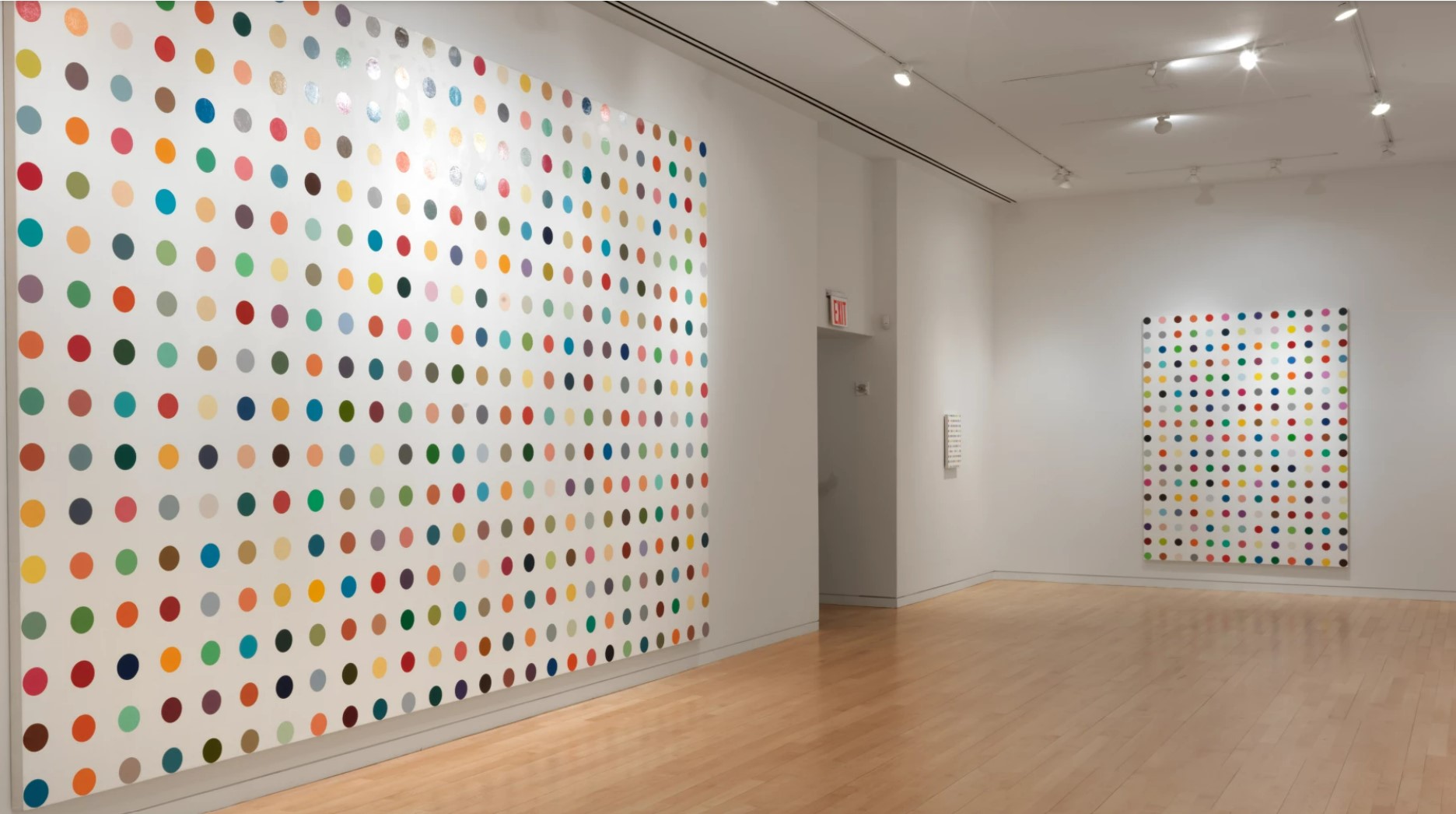
With its perfectly oriented spots, the present work offers a captivating and joyful experience. Monumentally suspended in seventeen rows and twenty-six columns, each of the individual four hundred and twenty-five color roundels in Biotin-Propranolol Analog are carefully distinct in hue, and yet together the household gloss-paint discs span the entire chromatic spectrum; indeed, this work stands among the very largest of Hirst’s early production. Executed in 1995, just as Hirst began to assume an international reputation, and belonging to the defining body of work that first brought Hirst notary acclaim, this painting represents the sublimation of a practice heralded by the legendary self-curated exhibition Freeze in 1988 and brought to an apogee with Hirst’s first-ever UK museum retrospective. Exquisitely possessing an entirely unique lyricism, this painting and the greater series to which it belongs, underscores the palliative comfort provided by scientific medical advancements.
Arg-Ala, 1994
Sotheby’s London: 26 March 2021
Estimated: GBP 150,000 – 200,000
GBP 315,000 / USD 434,542
Arg-Ala | Contemporary Art Day Auction | 2021 | Sotheby’s (sothebys.com)
DAMIEN HIRST (b. 1965)
Arg-Ala, 1994
Household gloss on canvas
21 1/2 x 20 3/4 inches (54.5 x 52.5 cm)
Signed on the reverse
Arg-Ala is a jewel-like example of Hirst’s most renowned series of work: the Pharmaceutical paintings. The present work constitutes one of the earliest of Hirst’s Spot paintings – the overarching series to which the Pharmaceutical paintings belong – thereby not only belonging to a seminal series within the artist’s oeuvre, but also embodying a historical representation of such. The contrast in this work between the organizational composition of the uniquely colored one-inch spots with the brilliant white surface provides the viewer with a stimulating visual experience, one that is truly representative of the project that embodies Hirst’s highly influential artistic practice. As one of the thirteen sub-series within the Spot painting category, the Pharmaceutical paintings remain the first and most prolific. Each Spot painting shares a certain set of properties: the spots are arranged on a grid made invisible by a white or off-white background; no two spots on a given work touch each other; and no hue is ever repeated on the same work. First conceived alongside the Medicine Cabinets, this body of work is imbued with the same measured rational order and pleasing formal cogency as his pharmacy store vitrines. Furthering this conversation between his paintings and the medical practice, Hirst concocted the titles of these works from an alphabetical listing of drug names cited in the Sigma-Aldrich chemical company catalogue that he first encountered in the early 1990s. Hence, the Pharmaceutical paintings as well as the spots themselves can be read as signifiers for individual pills.
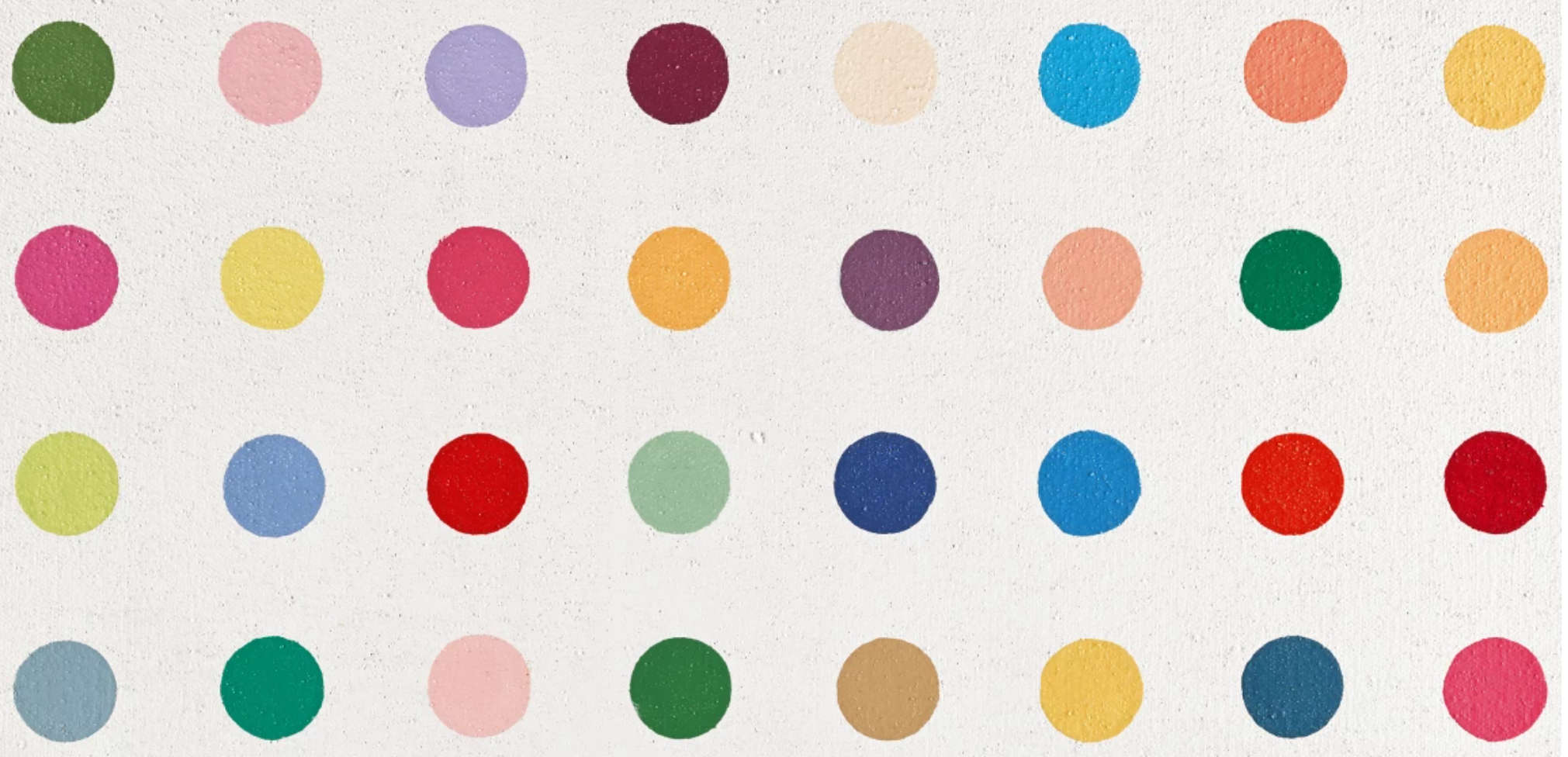
With its perfectly oriented spots, the present work is a captivating experience for the viewer – even delicious and candy-like – as per Hirst’s intent. However, there is a certain problematization that comes to light in this painting, namely inherent in the implied celebration of a heavily mediated and medicated postmodern experience. Ever in touch with allusions and theoretical discourse, Hirst rescues the age-old artistic genre of the grid from Modernist hands and returns it back to its original roots in scientific thought and genetic structure. In this way, the work’s apparent simplicity of form is counterbalanced by its complexity of content, so that this painting, while relying to a certain degree purely on its visual appeal, also possesses an arresting intellectual punch characteristic of Hirst’s process.
Antipyrylazo III, 1994
The Robert Tibbles Collection: Young British Artists & More
Phillips London: 13 February 2020
Estimated: GBP 900,000 – 1,200,000
GBP 1,275,000 / USD 1,663,990
Damien Hirst 20th Century & Contemporary Art Evening Sale
Household gloss on canvas
80 7/8 x 99 inches (205.7 x 251.5 cm)
Signed ‘D Hirst’ on the reverse
Congregated on a vast, white support, fifty colorful spots run across the elongated expanse of Antipyrylazo III, 1994, while forty-one descend down its two meter height, making for a joyous amalgamation of 2,050 bright circular units. An early example of Damien Hirst’s infamous Spot Paintings – which comprise thirteen sub-series, and a total of more than 1,500 canvases – Antipyrylazo III falls within the artist’s sustained investigation of the medical realm, taking after a similarly named chemical tool indicating the presence of calcium and magnesium in natural materials. With this niche, obscure title, pulled from the revered thematic catalogue Biochemicals for Research and Diagnostic Reagents that the artist first stumbled across in the early 1990s, Hirst delves into a territory that eludes easy comprehension. He then paradoxically pairs the work’s esoteric designation with an image that is clear and recognisable to all: candy-like spots proliferating with jubilant energy. Regarding the medicinal nature of the title, Hirst elucidated, ‘I started them as an endless series… A scientific approach to painting in a similar way to the drug companies’ scientific approach to life. Art doesn’t purport to have all the answers; the drug companies do. Hence the title of the series […] and the individual titles of the paintings themselves’ (Damien Hirst, quoted in Robert Violette, ed., ‘On Dumb Painting’, Damien Hirst: I want to spend the rest of my life everywhere, with everyone, one to one, always, forever, now, London, 1997-2005, p. 246).
Though upon visualising the series, one may think of Hirst’s more recent Spot Paintings – those that boast unequivocally pristine, thick and glossy surfaces – the story of the artist’s pharmaceutical body of work goes back to his student days at Goldsmiths College of Art, London. Hirst made his first Spot Painting on canvas in 1988, following some loose hand-painted spots on board from 1986, and two near-identical arrangements applied directly on the wall from 1988. This preliminary work was entitled Untitled (with Black Dot), and was a rare work from the series to contain the colour black. The present painting, executed just six years later, benefits from years of practice and refined instructions, while at the same time retaining the matte quality of Hirst’s early spots. The colour from each dot is not restricted by an overarching sense of flatness – like they often are in recent formulations – but instead delves into new layers of depth, perhaps enabled by a minute, lesser use of prime that in turn allows for subtly varying levels of thickness to interact at the surface.
Indeed, only the first few dozen Spot Paintings were made by Hirst alone, as the rest became part of a larger production system soliciting the help of assistants. Hirst’s mature works thus not only remove drawing traces in their immaculate, spotless rendition, but furthermore negate the artist’s hand, promoting a kind of artistic mechanism that readily espouses his conceptual approach to the painterly medium. Any physical evidence of human intervention – such as the compass point left at the centre of each spot – vanishes, until the works appear to have been constructed perfunctorily, or ‘by a person trying to paint like a machine’ (Damien Hirst, in conversation with Sophie Calle, Internal Affairs, exh. cat., Institute of Contemporary Art, London, 1991, reproduced online). For Hirst, this technique marked a departure from years of experimenting with paint and collage, and the first result of his search for a truly contemporary art form, coming as close as possible to formal perfection. Yet with Antipyrylazo III, extremely faint traces of pencil around certain dots recall the artist’s early craft, when he and the canvas were at one – an exceptional and rare feat in his eponymous body of work.
In this perspective, Hirst asserts that his approach to the Spot Paintings had more to do with their embodiment of the painterly medium than with sheer perceptual experimentation with colour or space. ‘[T]hey have nothing to do with Richter or Poons or Bridget Riley or Albers or even Op’, he said. ‘They’re about the urge or the need to be a painter above and beyond the object of painting. I’ve often said that they are like sculptures of painting’ (Damien Hirst, quoted in Jason Beard and Millicent Wilner, eds., ‘On Dumb Painting’, Damien Hirst: The Complete Spot Paintings 1986-2011, London, 2013, p. 246). It is the technique employed in the making of Antipyrylazo III that differentiates it from other types of experimentation; the resulting aesthetic engenders an immediate response with a sleek, minimalist approach. In its laborious and painstaking reproduction of each circle, Antipyrylazo III exploits the powers of illusion allowed by the painterly medium at its heights.
The element of organization, both with respect to structure and color, is of quintessential importance in Antipyrylazo III. The spots are structured on a grid; a seminal art historical tool that allows painters and sculptors to bring their visions – real or abstract – to life. The grid, wrote Rosalind Krauss, is what art looks like when it turns its back on nature. Yet in the frenetic repetition of the single pattern, disseminated across three decades of Hirst’s output, the artist has transcended the grid held within his two-dimensional support. Showing his Spot Paintings in a group and all over the world has indeed become part of their content and meaning: they are infiltrating everywhere, their field expanding to cover the world itself. The use of an iconic image as a brand, a point of departure from which to multiply ad infinitum holds visual and conceptual similarities with the gestures of Dan Flavin, Donald Judd and Yayoi Kusama, who also repeatedly deployed the same pattern within their work – a beaming dash, a succession of slabs, or myriad recurring visions of dots, pumpkins and eyes. In the very nature of Hirst’s recurring pattern – the spot – Antipyrylazo III furthermore recalls the traditional technique of Pointillism, which sought to compose a single image with small dots exclusively. In this perspective, the present work could posit as the section of a pointillist canvas under microscope; a snapshot of the image upon total abstraction.
It is in the plethora of references it conjures that Antipyrylazo III encapsulates the complexity of life itself. Named after a biological indicator, it gestures outwards to new horizons, only to finally return to its initial scientific realm, summoning multifaceted notions of life and death. In its grand size and sublime rendering, the work exists as an exceptional and seminal example of Hirst’s broader investigation.
Large Spot Paintings
Diethylene Glycol, 2006
Property from a Distinguished British Collector
Sotheby’s London: 5 March 2026
Estimated: GBP 250,000 – 350,000
GBP 307,200 / USD 410,390
Diethylene Glycol | Contemporary Day Auction | 2026 | Sotheby’s
DAMIEN HIRST (b. 1965)
Diethylene Glycol, 2006
Household gloss on canvas
60×76 inches (152.4 x 193 cm)
Signed twice (on the stretcher)
Signed, titled and dated 2006 (on the reverse)
In Diethylene Glycol, Damien Hirst extends his sustained enquiry into systems of order, chromatic sensation, and the aesthetic language of science. The present workbelongs to Hirst’s celebrated Spot Painting series, a body of work initiated in the mid-1990s that foregrounds repetition, neutrality, and serial logic. Executed with the immaculate finish of household gloss paint, the surface bears no trace of the artist’s hand, reinforcing the impression of mechanical precision that has become synonymous with this series.
“I started [the Spot Paintings] as an endless series, a scientific approach to painting in a similar way to the drug companies’ scientific approach to life. Art doesn’t purport to have all the answers; the drug companies do. Hence the title of the series, the Pharmaceutical Paintings, and the individual titles of the paintings themselves… Art is like medicine, it can heal.”
The composition presents a regimented field of evenly spaced, multicolored circles arranged across a pristine white ground. Each spot is identical in size, yet distinct in hue, creating a visual rhythm that balances uniformity with variation. The high-gloss surface produces a subtle reflectivity, heightening the painting’s clinical clarity and evoking associations with laboratory equipment, pharmaceutical packaging, or diagnostic displays. This polished detachment distances the work from expressionist gesture, positioning it instead within a logic of manufacture, regulation, and control.
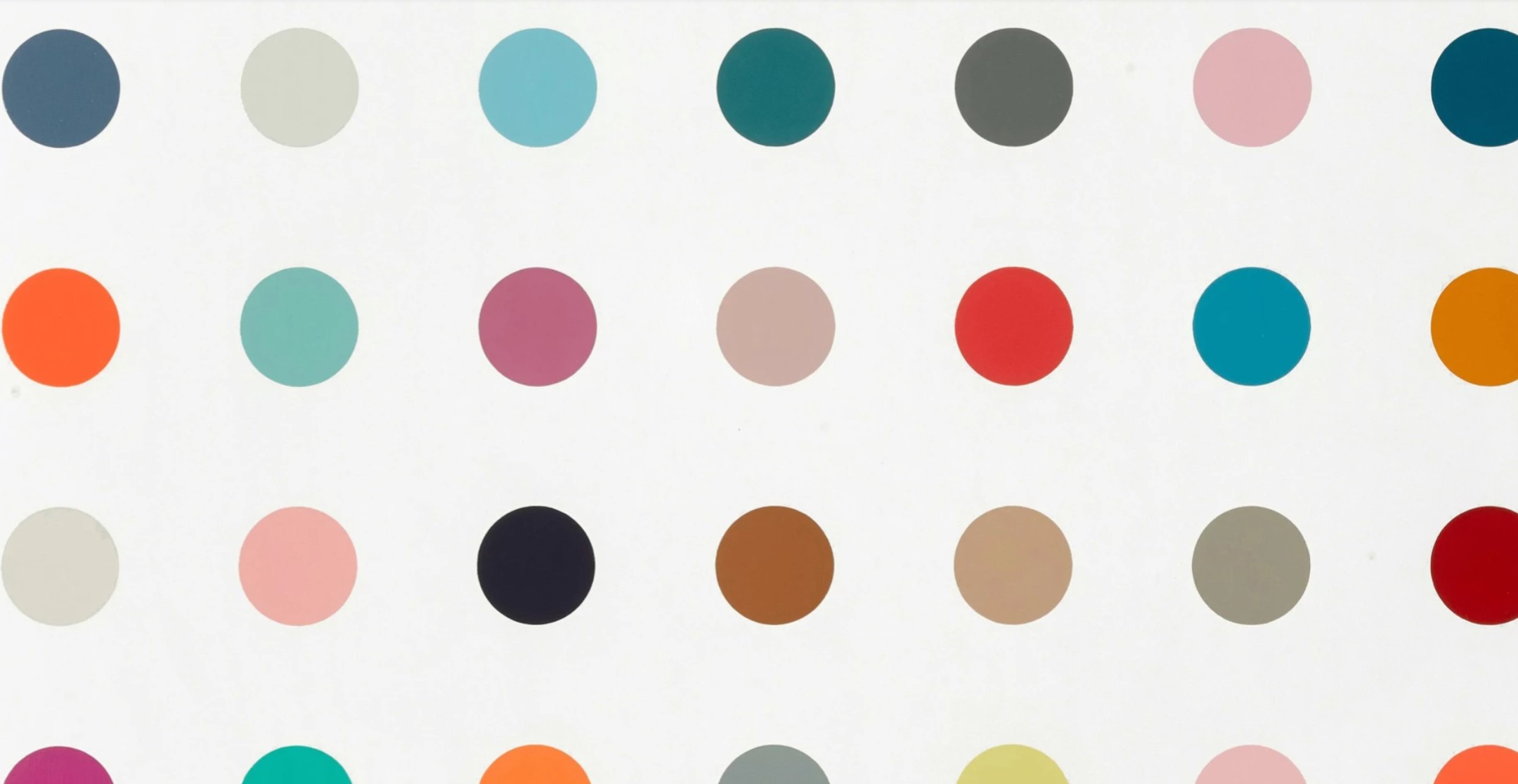
The title, Diethylene Glycol, refers to a synthetic organic compound commonly used as an industrial solvent and antifreeze, as well as in limited pharmaceutical applications. By naming the painting after a chemical substance, Hirst again imports scientific nomenclature into the realm of abstraction, allowing language to operate as both factual descriptor and poetic trigger. The molecular structures and schematic diagrams associated with such compounds find a visual echo in the painting’s ordered grid, where each colored dot might be read as a stylized atom within a larger, stabilized system. Despite its rational framework, the work remains visually buoyant. The palette — encompassing bright reds, blues, yellows, greens, and softer pastel tones — generates an optical liveliness that resists emotional neutrality. Rather than conveying symbolic meaning, the colours function relationally, activating the surface through contrast and repetition. In this way, the painting oscillates between analytical coolness and sensory pleasure. As with much of Hirst’s practice, Diethylene Glycol occupies a productive tension between art and science, where intellectual structure coexists with the immediate, almost euphoric impact of color — a quality Hirst himself has celebrated as fundamental to his engagement with painting.
Calcium Hydroxide, 2004-2011
Estimated: GBP 400,000 – 600,000
GBP 412,800 / USD 553,150
“I started [the Spot Paintings] as an endless series like a sculptural idea of a painter (myself). A scientific approach to painting in a similar way to the drug companies’ scientific approach to life.”
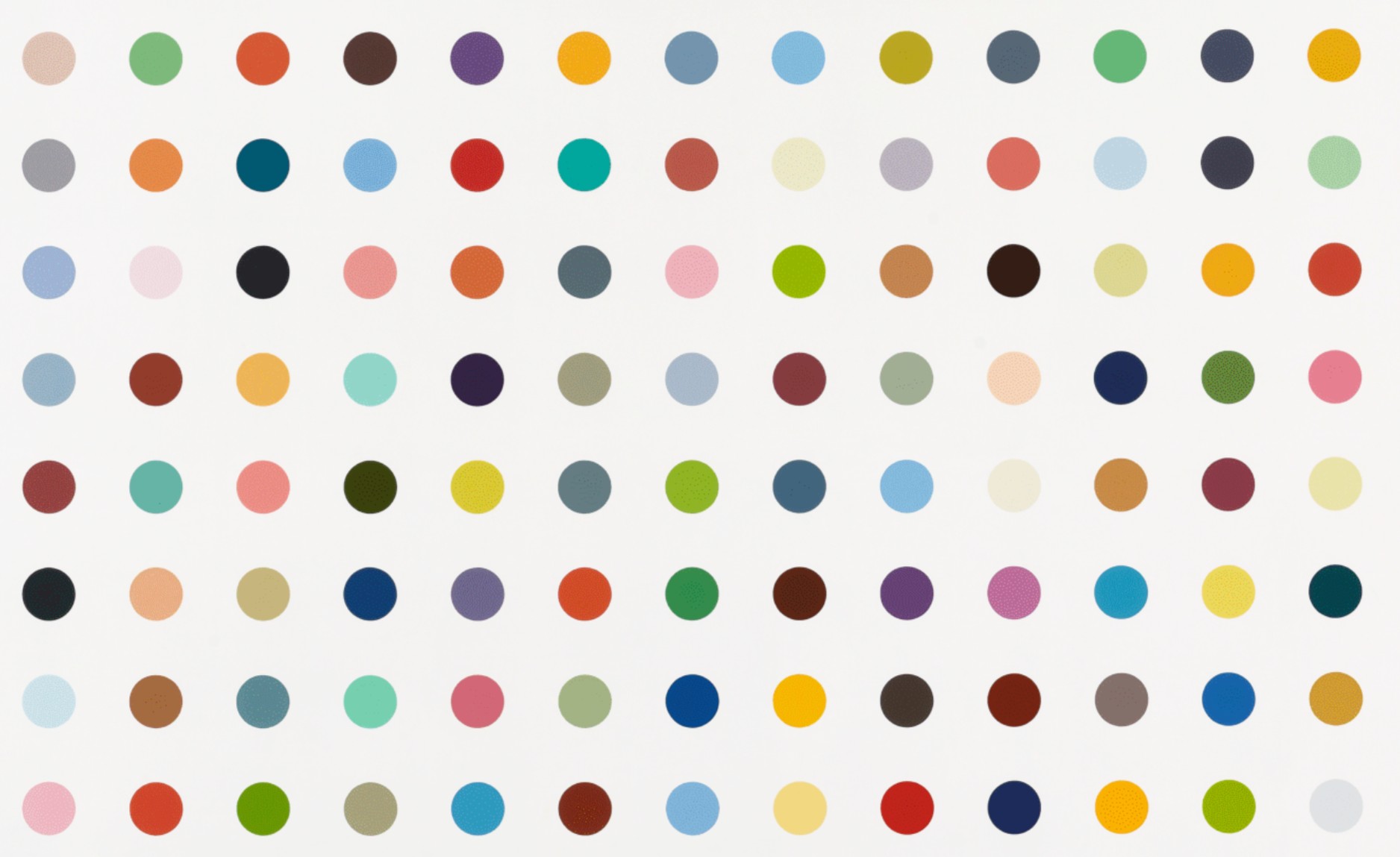
When trying to focus on the composition as a whole, however, it becomes clear that there is no pattern to the applied colours – there are no ‘chords of color’, as Hirst calls them, the artist crucially withholding any overarching sense of harmony to the composition. Hirst plays with the fact that a work utilizing a bright, multicolored palette evokes an air of joy, juxtaposing this expectation with the more discordant lack of coherence or conformity in the arrangement of color on the canvas. As the viewer steps back from Calcium Hyrdoxide, its spots do not come together to form an impressionistic image – they remain resolutely individual marks. Visually recalling German postwar artist Gerhard Richter’s mathematically generated Farben or ‘color grid’ paintings, which similarly privileged chance and random application in the examination of color as form. In their pixelated abstraction the Spot Paintings draw on both microscopic and cosmic scales, seemingly infinite in their expansion.
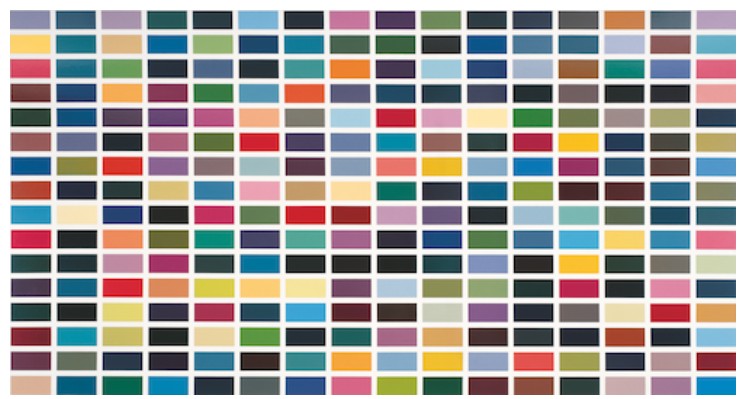
Gerhard Richter, 256 Farben, 1974/1984, The San Francisco Museum of Modern Art
Hirst’s Spot Paintings debuted at the legendary 1988 exhibition Freeze, often credited with marking the genesis of the YBA (Young British Artists) generation, within which Hirst was a major player. The exhibition was curated by Hirst himself while attending Goldsmiths College in a warehouse in Surrey Quays, where these first Spot Paintings were made directly onto the venue’s walls. These paintings were inherently more conceptual, sold as an idea with a certificate. In all, there are 13 sub-series of Spot Paintings with Calcium Hydroxide belonging to the coveted Pharmaceutical Paintings series. Hirst’s interest in making works surrounding medicine and pharmaceuticals began in 1987, and his Spot Paintings have developed concurrently with another of his best-known series, his Medicine Cabinets.
“People believe completely in medicine but not in art, without questioning either.”
Calcium Hydroxide itself resembles a blister pill package, full of colored tablets ready to be pushed out and consumed. In Hirst’s metaphor of the microscope, we can also see the dots as cells, or proteins that can be made and re-made into different strands of Spot Paintings DNA. In its meticulous execution, the painting stands as a metaphor for the corporate nature of the pharmaceutical industry, with the spots themselves echoing the standardized logos and product packaging that has infiltrated every aspect of daily life. The grid itself is a symbol of modernity in art – as Rosalind Krauss writes, ‘The grid functions to declare the modernity of modern art […]. It is what art looks like when it had turned its back on nature. In the flatness that results from its coordinates, the grid is the means of crowding out the dimensions of the real and replacing them with the lateral spread of a single surface.’
Drawing on the art historical legacies of Pop and the critical approach to questions of authorship and originality developed by Marcel Duchamp and Andy Warhol alongside the experimental drive of Op-Art and color theory pioneered by the likes of Josef Albers, Bridget Riley, and Gerhard Richter, Calcium Hydroxide is a culmination of and commentary on Hirst’s career-spanning interest in the dialogue between art and science. Visually captivating and conceptually rich, its immaculate and minimalist arrangement epitomizes the ongoing appeal of Hirst’s most definitive series.
Cesium Fluoride, 2004-2011
Phillips London: 6 March 2025
Estimated: GBP 400,000 – 600,000
GBP 444,500 / USD 568,960
Damien Hirst – Modern & Contemporary A… Lot 30 March 2025 | Phillips
DAMIEN HIRST
Cesium Fluoride, 2004-2011
Household gloss on canvas
57 7/8 x 138 1/4 inches (147.2 x 351 cm)
Signed, titled and dated ‘Cesium Flouride’ Damien Hirst 2004-2011′ on the reverse
Signed ‘D Hirst’ and stamped twice with the artist’s stamp on the stretcher
“People are afraid of change, so you create a kind of belief for them through repetition. It’s like breathing. I’ve always been drawn to series and pairs. A unique thing is quite a frightening object.”
One of the most infamous and controversial figures of contemporary culture, Damien Hirst has built a career on challenging conventions and exploring the intersections of art, science, and commercial culture; themes which collide in his defining series of Spot Paintings. A striking example of the series in a monumental format, Cesium Fluoride showcases Hirst’s ability to transform simple forms into complex visual experiences.
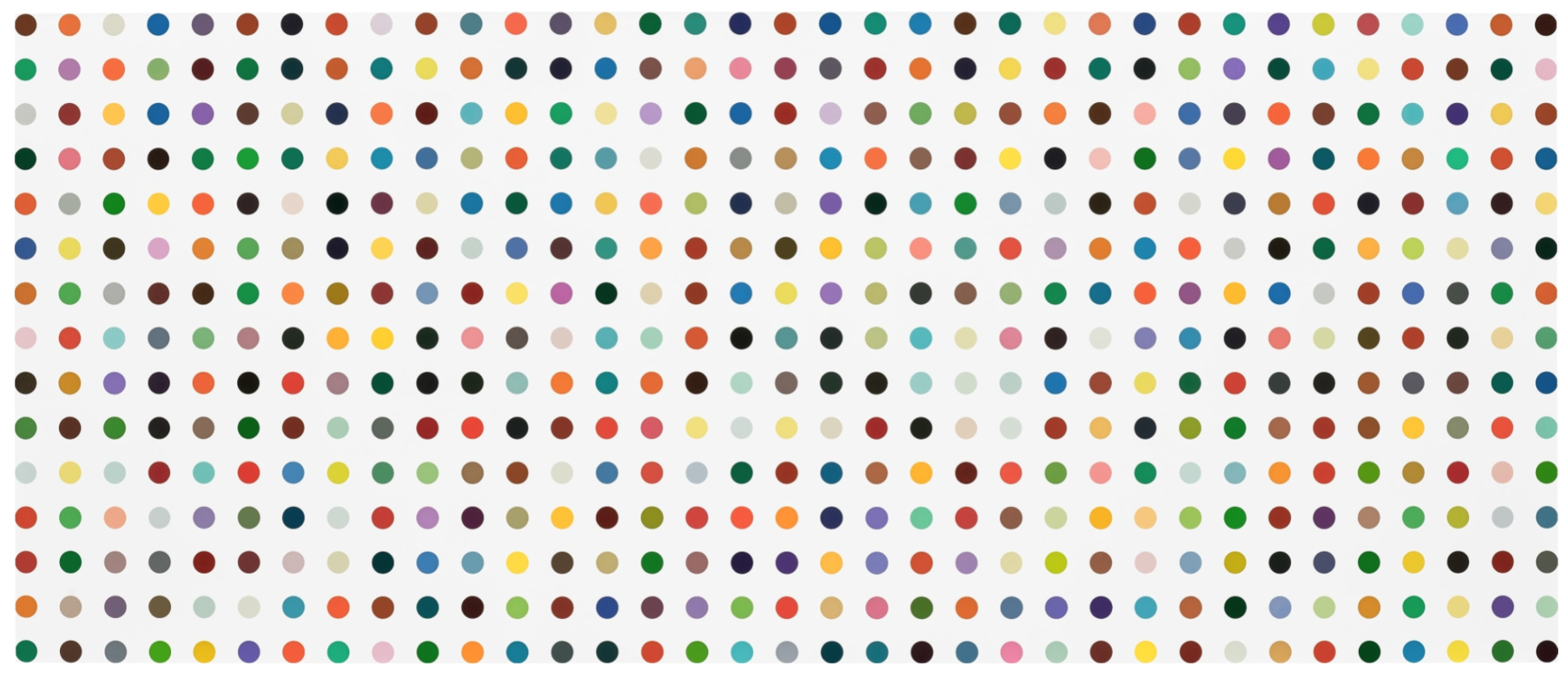
Hirst rose to fame alongside other fellow so-called ‘Young British Artists’ in the late 1980s and 1990s, executing his first Spot Painting in 1986 while completing his Fine Art degree at Goldsmiths. Since that initial canvas—a medley of colorful, paint-dripping dots—the series has expanded to include over a thousand hand-painted, meticulously executed works. The Spot Paintings went global in 2012, when over three-hundred pieces were simultaneously exhibited across Gagosian’s eleven locations worldwide, infiltrating the cultural hotspots of London, New York and Hong Kong. This momentous exhibition, The Complete Spot Paintings 1986—2011, affirmed Hirst’s Spots as his most enduring motif. ‘Showing them all over the world at the same time becomes part of their content and meaning,’ Adrian Searle writes, ‘they’re infiltrating everywhere, their field expanding to cover the world.’ Cesium Fluoride was exhibited in the New York leg of Hirst’s major Gagosian exhibition, solidifying its importance in his oeuvre.
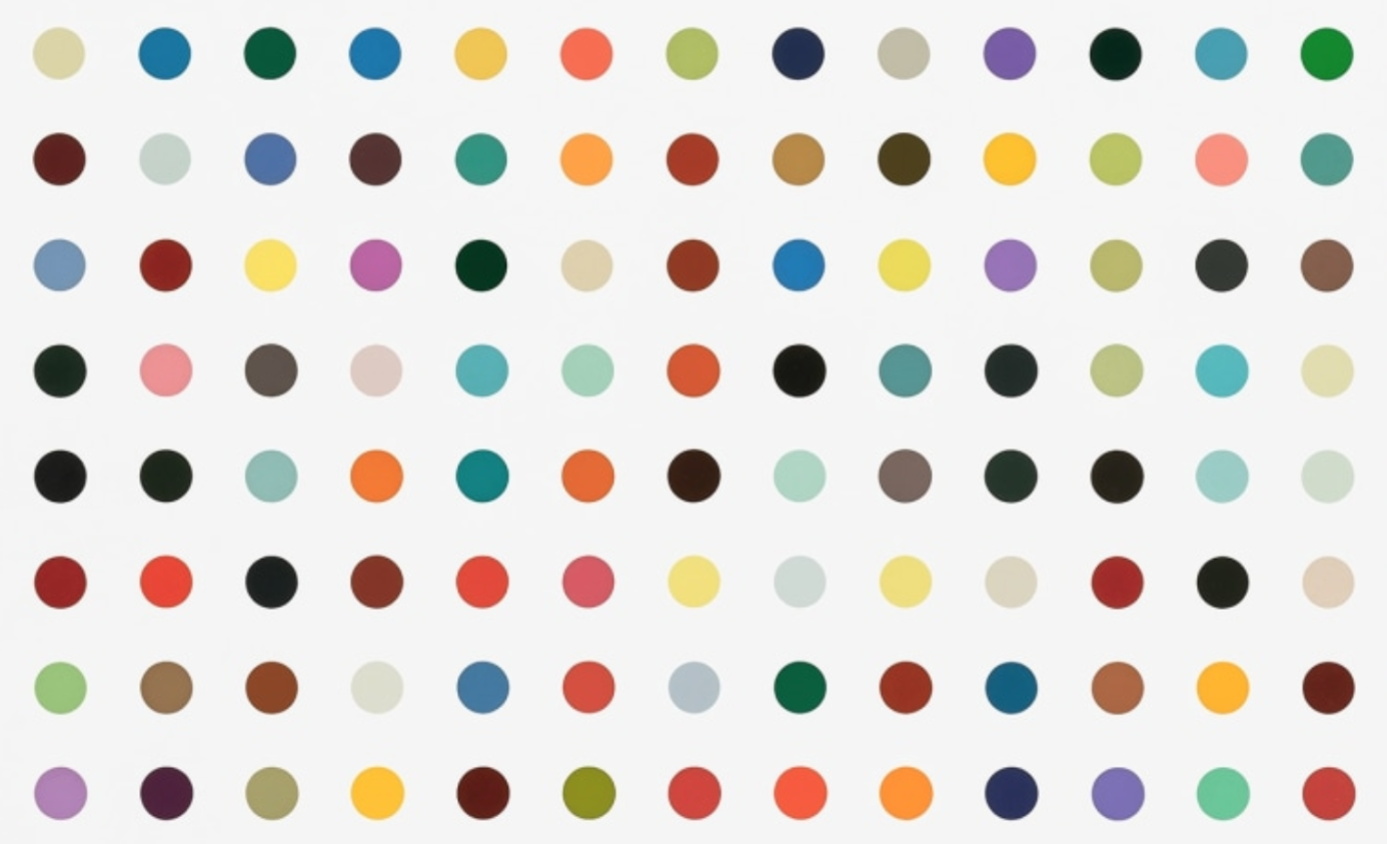
Formally, Cesium Fluoride is a masterpiece of precision and vibrancy. The work is composed of an extensive grid of uniformly sized, meticulously painted colored spots, each measuring exactly two-inches in diameter, spaced two-inches apart. Executed in household gloss on canvas, the surface shimmers with a polished finish, enhancing the saturation and intensity of the colours. Each spot is distinct, with no two colors repeating, a hallmark of Hirst’s commitment to the idea of infinite variation within a structured system. This careful orchestration of form and color creates a rhythmic, almost hypnotic visual effect, drawing the viewer into an immersive experience of machine-like perfection. The vertical composition of Cesium Fluoride adds to its dynamic and seemingly infinite presence, accentuating the repetition and uniformity of the spots. This format challenges more conventional readings of these paintings, inviting viewers to engage with the work in a more active gaze that mirrors the human body’s own upright stance. As a result, the painting feels both monumental and intimate, vast in scale yet approachable in its simplicity.
Cesium Fluoride exists within Hirst’s longstanding Pharmaceuticals series, a subset of his Spot Paintings. Referencing a chemical compound, this nod to scientific nomenclature is not merely decorative; it reflects Hirst’s deep interest in the relationship between art and science which first came to the fore in his 1989 medicine cabinet, Bodies. By naming his works after chemical substances, the artist draws parallels between the systematic nature of scientific inquiry and the methodical process of creating art. The clinical, almost sterile connotation of ‘cesium fluoride’ contrasts sharply with the vibrant, joyful palette of the painting, creating a tension that is both intellectually stimulating and visually captivating.
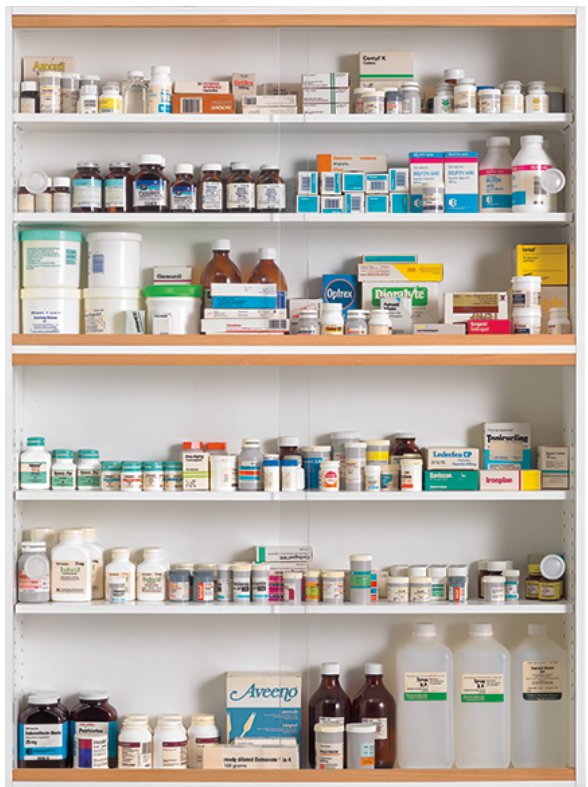
Damien Hirst, Bodies, 1989, Private Collection. Artwork: © Damien Hirst and Science Ltd. All rights reserved, DACS 2025
The Spot Paintings are central to Hirst’s practice not just for their aesthetic appeal but for their conceptual depth. They represent a radical departure from more traditional art-making practices, following in the lineage of artists such as Marcel Duchamp and Andy Warhol in their embrace of mechanical repetition and the erasure of the artist’s hand. Hirst openly acknowledges that many of these works were executed by his assistants under his direction: ‘a mechanical way to avoid the actual guy in a room, myself, with a blank canvas.’ His Spot Paintings challenge conventional notions of authorship and authenticity in art, prompting critical discussions about the role of the artist in the creative process. Hirst’s success as an artist is inextricably linked to his ability to provoke, to question, and to redefine the boundaries of art. From his early days with the YBAs to his record-breaking auctions and global exhibitions, Hirst has maintained a fearless approach to art-making. The Spot Paintings epitomize this spirit. They are works that are as much about the process and the ideas behind them as they are about the final visual outcome. For collectors and art enthusiasts alike, Cesium Fluoride represents more than just a beautiful composition of colorful dots. It is a piece of contemporary art history, a celebration of color, structure, and the boundless possibilities of artistic expression. As part of the iconic Spot Paintings series, it stands as a powerful testament to Hirst’s lasting impact on the contemporary art world.
Cupric Nitrate, 2007
Phillips London: 7 March 2024
Estimated: GBP 500,000 – 700,000
GBP 571,500 / USD 724,662
Damien Hirst – 20th Century & Contempo… Lot 28 March 2024 | Phillips
DAMIEN HIRST
Cupric Nitrate, 2007
Household gloss on canvas
81×83 inches (205.7 x 210.8 cm)
Signed, stamped with the artist’s stamp
Titled and dated ‘Damien Hirst D Hirst D Hirst “Cupric Nitrate” 2007’ on the reverse
Mesmerizing in its scale and the lively optical effects generated by vibrating chromatic relationships established across its gridded composition, Cupric Nitrate is a stunning example of British artist Damien Hirst’s celebrated series of Pharmaceutical Paintings. A defining aspect of the precocious ‘Young British Artist’s’ career, Hirst first embarked on the series in 1991, its conceptual roots underpinning and expanding his early investigations into color, its organization and the relationship between art and science that has proved to be an abiding conceptual touchstone across Hirst’s varied practice. Coming to auction for the first time, Cupric Nitrate was included in the Paris iteration of Hirst’s ambitious multi-venue presentation of Spot Paintings mounted by Gagosian Gallery across its eleven locations simultaneously in 2012, and in the first major museum retrospective of Hirst’s work, which opened at Tate Modern in London the same year.
Bridging the sense of order, primacy of the grid, and focus on scientific modes of categorization that we find in the Medicine Cabinets with the exuberant and joyful approach to color taken in his Spin Paintings and more recent series of Veil Paintings, the Pharmaceutical Paintings also explore more philosophical meditations on mortality, faith, and the relationship between art and science that continue to shape Hirst’s practice today. Meticulously arranged, Cupric Nitrate’s one-inch spots are evenly arranged with a corresponding space between each, a careful formula which activates the colored spots to such a degree that the overall composition refuses to resolve completely. As Michael Bracewell describes, drawn to ‘the warmer-colored spots, the gaze then encounters seeming sudden diagonals, verticals or broken lines of semi-coherence; look again, and even these fleeting spooks of visual sense turn out to be illusions. Yet, despite this energetic activity, the work achieves an incredible compositional balance and harmony rooted in the methodical, scientific approach to the composition based on a philosophy of chromatic relationships and their manipulation. Consistent with the execution of the Spot Paintings more broadly, the present work is rendered in uniquely mixed hues of household paint, with no single color appearing twice; although painted methodically by hand, Hirst was interested in the idea of the works appearing to have been executed by a machine, or ‘by a person trying to paint like a machine.’
Pyrene, 2017
Sotheby’s London: 6 March 2024
Estimated: GBP 380,000 – 450,000
GBP 533,400 / USD 676,351
Pyrene | Modern & Contemporary Evening Auction featuring The Now | 2024 | Sotheby’s (sothebys.com)
DAMIEN HIRST (b. 1965)
Pyrene, 2017
Household gloss on canvas
99×111 inches (251.5 x 281.9 cm) (3 inch spot)
Signed (on the stretcher); signed, titled twice and dated 2017 (on the reverse)
A colossal expanse of colored spots painted upon a stark white canvas, the kaleidoscopic Pyrene exemplifies British artist Damien Hirst’s “Pharmaceutical” paintings. As one of the thirteen sub-series within the “Spot Painting” category, the Pharmaceutical paintings remain the first and most prolific. Each Spot Painting shares a certain set of properties: the spots are arranged on a grid made invisible by a white or off-white background; no two spots on a given work touch each other; and no hue is ever repeated on the same work. Suspended in nineteen rows and seventeen columns, each of the three hundred and twenty three discs executed in household gloss paint are unique in hue. When viewed together, the shades span an impressive chromatic spectrum. This defining body of work first brought the artist acclaim at the legendary 1988 Freeze exhibition and culminated with the artist’s first major UK retrospective at Tate Britain in 2012—this painting represents a culmination of this seminal series. Executed in 2017, nearly thirty years after the first Spot Paintings, Pyrene broadcasts a lyrical beauty underscored by the medical advancements of the past three decades.
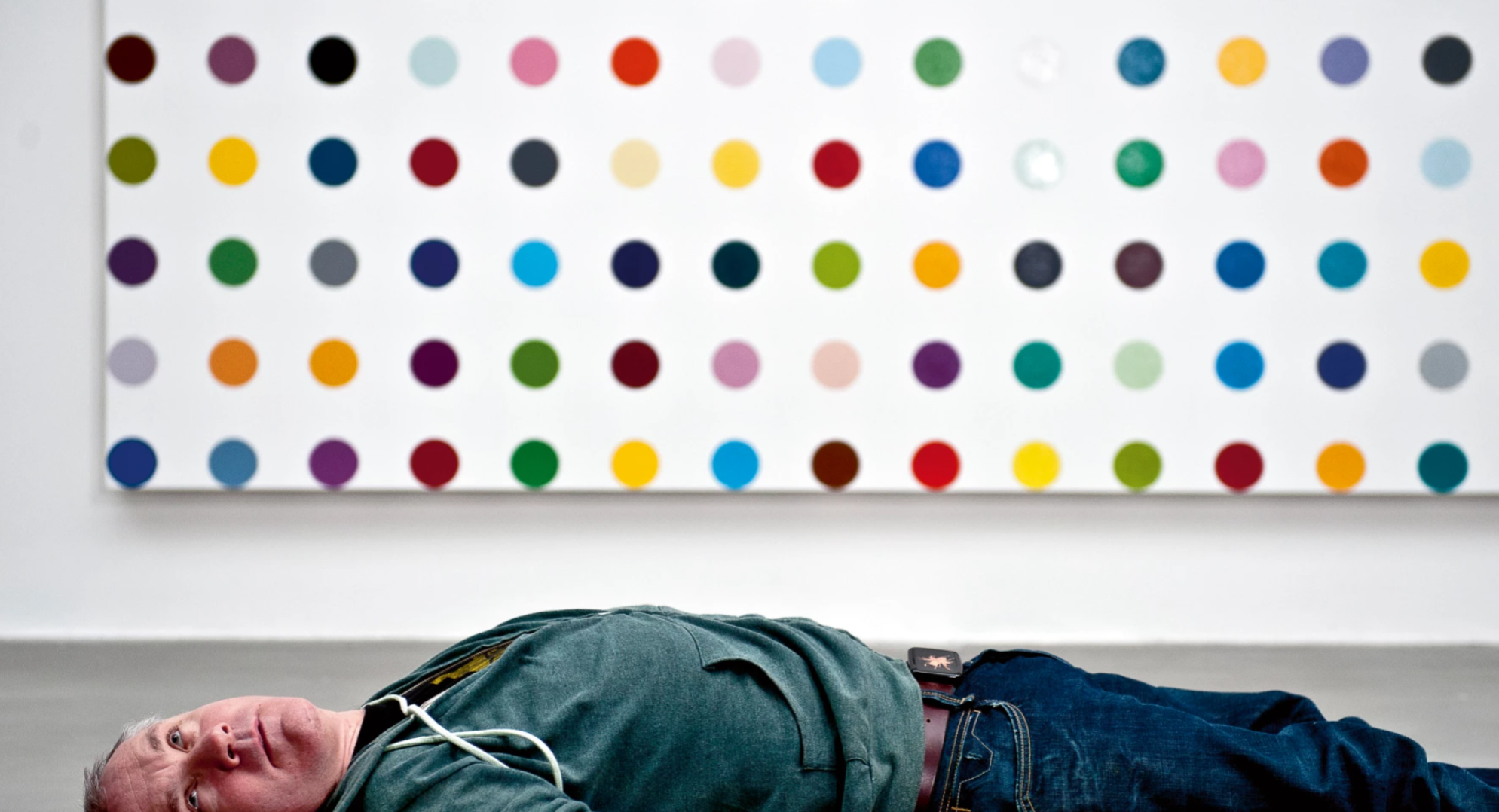
Reflective of his interest in the connections between art and science, Hirst titled each work in this series after a unique chemical compound. In systematic fashion, he named these paintings alphabetically according to the Sigma Chemical Company’s catalogue, Biochemical Organic Compounds for Research and Diagnostic Reagents. Pyrene is a liquid crystal commonly used in fluorescent dyes; named after the Greek word for “fire,” pyrene is also the only organic compound which is non-inflammable and is used in commercial fire-extinguishers, but is poisonous to ingest. Here, the vibrant and delightful dots organized in neat rows across the canvas belie the sterile and medicinal nature of Hirst’s artistic experiment; like pills and products manufactured to ward off calamity, at the heart of these machinations is the inevitability of death.
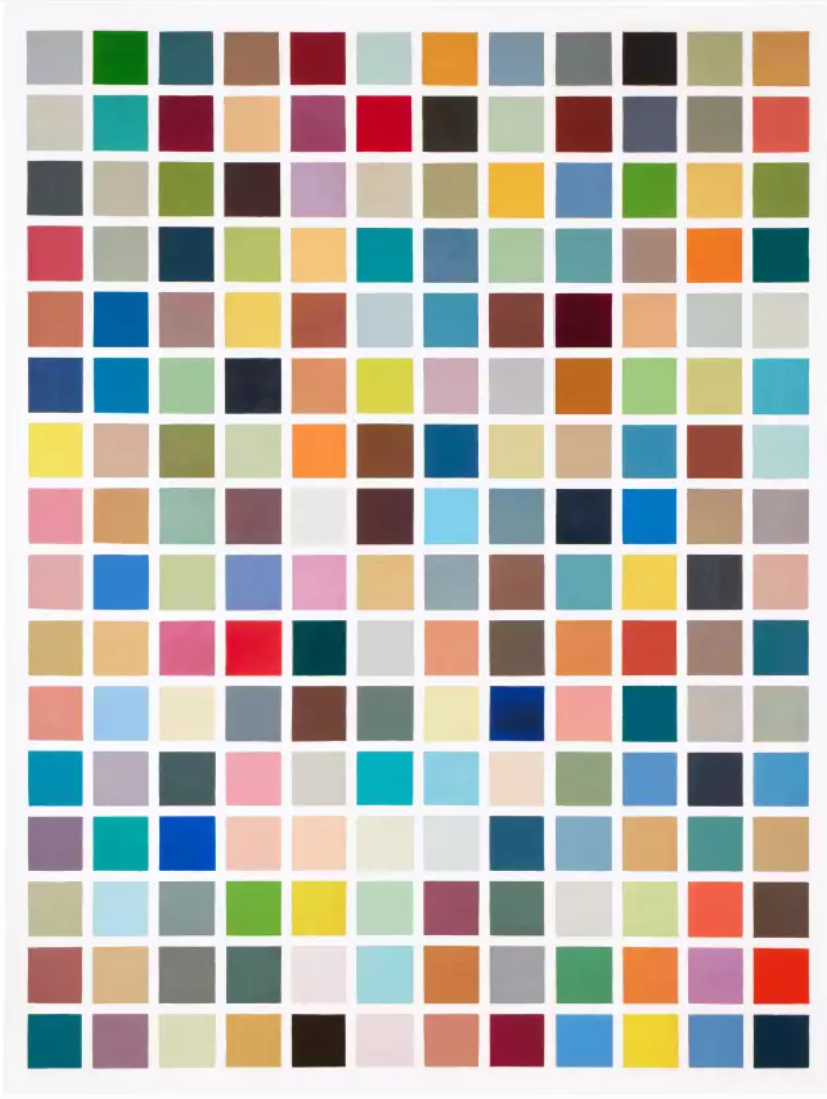
GERHARD RICHTER, 192 FARBEN, 1966. SOLD SOTHEBY’S LONDON, OCTOBER 2022, FOR £18.3 MILLION.
ARTWORK: © GERHARD RICHTER
Though purporting life-giving properties, such chemicals can be highly toxic and potentially fatal substances, carrying menacing deathly undertones even in their medicinal applications. It is in this way that the Spot Paintings encapsulate Hirst’s enduring and complex exploration of mortality. Disseminated via a simple schema of geometric logic, the controlled and emotionless self-restriction of Hirst’s candy colored grid belies an unsettling and fractured viewing experience.
Ergonovine, 2005
Sotheby’s New-York: 1 March 2024
Estimated: USD 500,000 – 700,000
USD 762,000
Ergonovine | Contemporary Curated | 2024 | Sotheby’s (sothebys.com)
DAMIEN HIRST (b. 1965)
Ergonovine, 2005
Household gloss on canvas (12-inch spot), 2005
84×84 inches (213.4 x 213.4 cm)
A grand expanse of individual chromatic circles, the cellular kaleidoscopic field of Ergonovine is an immaculate example of Damien Hirst’s iconic corpus of Pharmaceutical Paintings, more commonly referred to as Spot Paintings. First conceived alongside the Medicine Cabinets in the early 1990s, Hirst’s Spot Paintings are imbued with the same measured order and rational formal cogency of his pharmacy-store vitrines. By scrutinizing, yet adopting this iconography, Hirst restores to art the miraculous function it once provided. Sterile, medicinal, and forensic, Hirst’s Spot Paintings are a modern-day devotional paean to the life-giving promise of modern science: the Spot Paintings posit the spectator as an unwitting participant in humanity’s global paranoia of death.
“With the spot paintings, I probably discovered the most fundamentally important thing in any kind of art, which is the harmony of where color can exist on its own, interacting with other colors in a perfect format.”
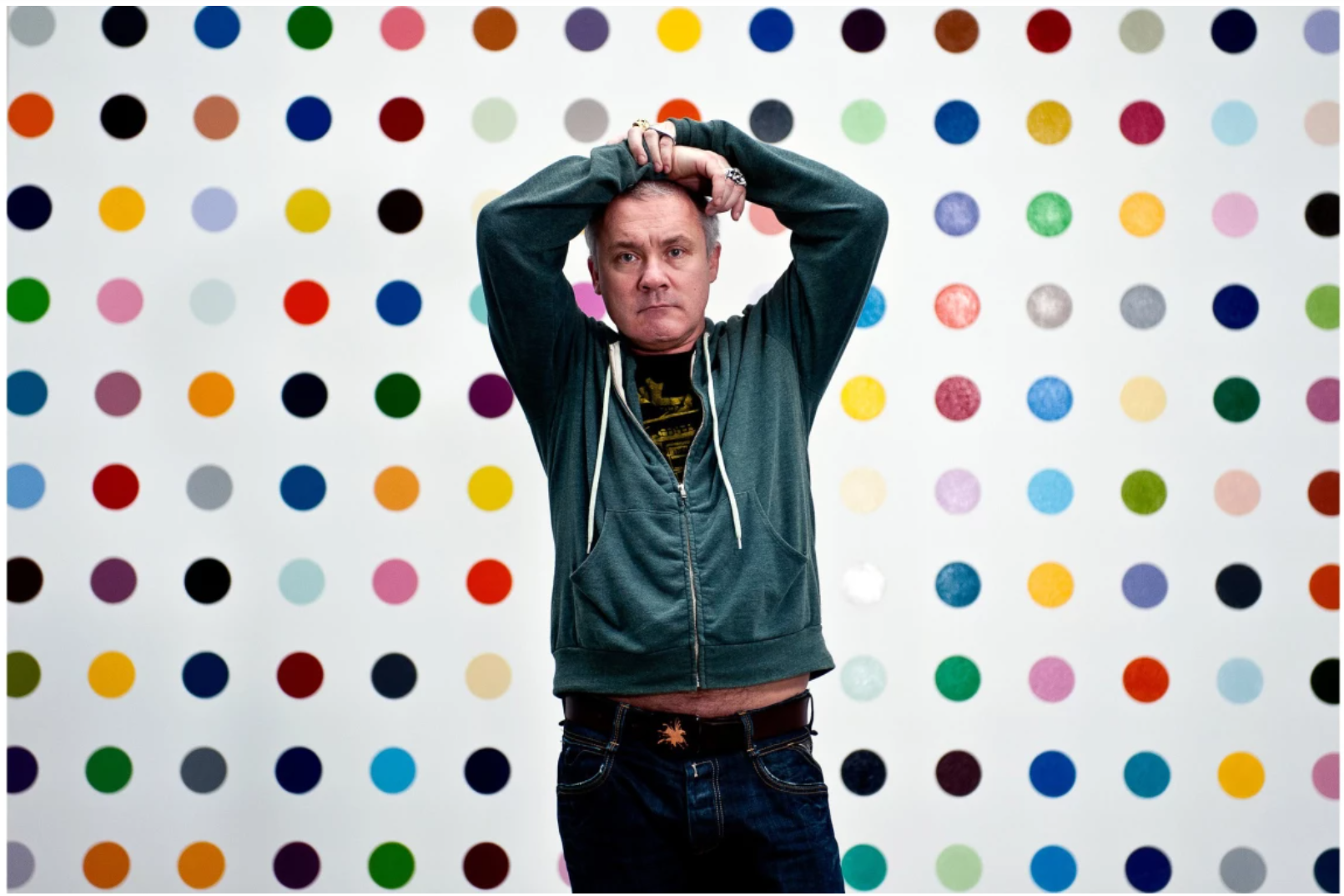
DAMIEN HIRST IN LONDON, 2011. PHOTO © ANDREW TESTA FOR THE NEW YORK TIMES. ART © 2024 DAMIEN HIRST
With its perfectly oriented spots, the present work offers a captivating and joyful experience. However, there is a problematization that comes to light in the work, namely inherent in the implied celebration of a heavily mediated and medicated postmodern society. Such a discourse has become increasingly magnified in recent years as evidenced by the ongoing opioid and pharmaceutical drug crises. That Hirst’s Spot Paintings would only increase in cultural relevance in the nearly three decades since their inception is a testament to their prescience. Ever in touch with allusions and theoretical discourse, Hirst rescues the age-old artistic genre of the grid from Modernist hands and returns it to its original roots in scientific thought and genetic structure. In this way, these paintings’ apparent formal simplicity is counterbalanced by metaphoric complexity; while relying to a certain degree purely on their visual appeal, the Spot Paintings also possess an arresting intellectual punch characteristic of Hirst’s wider practice.
Malic Dehydrogenase from Bovine Heart, 1999
Christie’s London: 14 October 2023
Estimated: GBP 250,000 – 350,000
GBP 283,500 / USD 343,761
Malic Dehydrogenase from Bovine Heart (christies.com)
DAMIEN HIRST (B. 1965)
Malic Dehydrogenase from Bovine Heart, 1999
Household gloss on canvas
87×63 inches (221×160 cm) (3-inch spot)
Standing at an impressive height of over two meters, Damien Hirst’s Malic Dehydrogenase from Bovine Heart (1999) is a rare and early work from his iconic ‘spot paintings’. Instantly recognizable, one hundred and sixty-five pastel spots are composed in perfect rows and columns upon a pale blue canvas. Measuring three inches in diameter and spaced exactly three inches apart, these meticulously hand-painted spots seem to have their own pulse and engross the viewer in a state of perceptual rapture. The work belongs to Hirst’s ‘Venoms’ group, a subseries of spot paintings distinct for their lightly gradated, pale spots which denote the poisonous chemicals excreted by animals, namely snakes, bees and spiders. A scarce subgroup in 1999, the first of the Venoms on canvas dates from just one year before, making our work one of the earliest and also one of the largest of its kind at the time it was made. Famously thinking of his spots as cells under a microscope, Hirst’s man-made, clinical style draws parallels between the revered systems of belief that underscore his artistic practice: art, science and religion. Beneath the satisfying simplicity of the present painting’s gentle pastel palette and polka-dot design lies a toxic chemical compound with lethal implications. Contextualized in his broader oeuvre, the spot paintings speak to the artist’s life-long examination of the macabre within a hard-edged, sterile Minimalist framework. The present work—titled after an enzyme found in bovine tissue—further relates to the artist’s use of cow heads and cadavers in the 1990s. Famously, his Mother and Child Divided (1993), which won him the Turner Prize in 1995, comprised four stainless steel vitrines, containing the bisected bodies of a cow and a calf in formaldehyde solution. It is perhaps in Hirst’s Venoms series that the dialogue between beauty and mortality is most concisely addressed. Conflating cleanliness with the spot—itself a mark of impurity that threatens to spread and mutate infinitely beyond the canvas’s boundaries—the work holds the complex dualities of Hirst’s art in masterful tension.
Barium Carbonate-13C, 2005-2008
Visionary: The Paul G. Allen Collection
Christie’s New-York: 10 November 2022
Estimated: USD 500,000 – 700,000
USD 1,260,000
DAMIEN HIRST (B. 1965) (christies.com)
DAMIEN HIRST (B. 1965)
Barium Carbonate-13C, 2005-2008
Household gloss on canvas
97×97 inches (246.4 x 246.4 cm)
Signed and stamped (on the stretcher)
Signed, titled twice and dated (on the reverse)
One of the artist’s celebrated Spot Paintings, Damien Hirst’s Barium Carbonate-13C is a dazzling kaleidoscope of vibrant color set against an unfathomable black ground. Painted between 2005 and 2006, this work belongs to the “Carbon-13 Labelled Compounds” group from this important series, a body of work which has sustained him for much of his 30-year career. Within the parameters of his monumental grid, Hirst lays out row upon row of colored dots. In the case of the present work, this expansive field is made even more impressive by placing them against a rich black backdrop, creating a field of extraordinary chromatic effects.
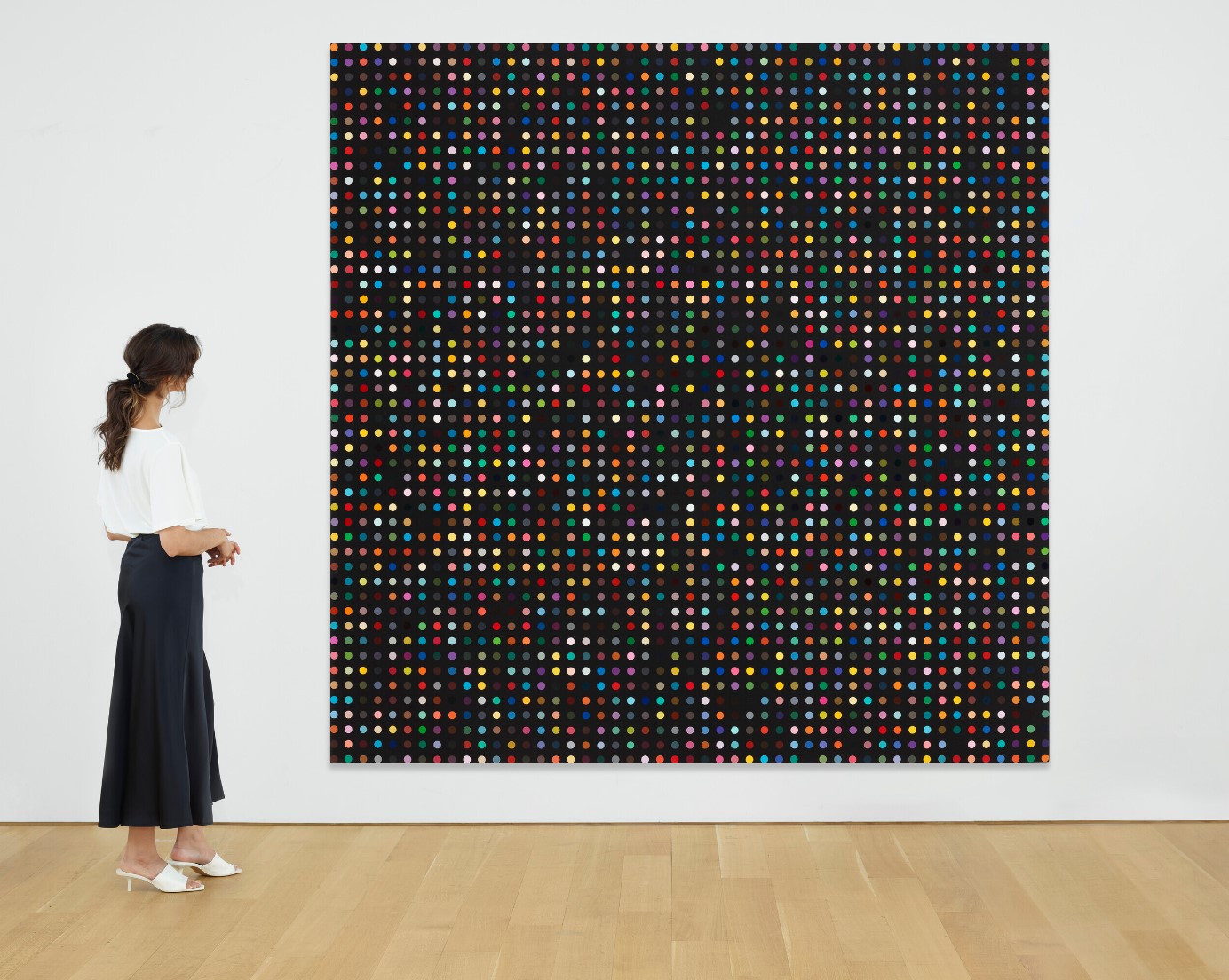
Although the “color against black” scheme of Barium Carbonate-13C accentuates the impact of these particular paintings, ultimately, however, the chromatic thrill of these works is underpinned by their inherent existential anxiety. With their seemingly ‘scientific’ structure, these paintings hint at a doctrine of absolute truth, something set within the realm of scientific discovery; this is tempered by the knowledge that however close we come to finally understanding the workings of the world, we are all, in essence, beholden to unknowable machinations of things we cannot ultimately control.
Furfuryl Mercaptan, 2004-2011
Phillips London: 30 June 2022
Estimated: GBP 400,000 – 600,000
GBP 491,400 / USD 597,519
Damien Hirst – 20th Century & Contempor… Lot 22 June 2022 | Phillips
DAMIEN HIRST
Furfuryl Mercaptan, 2004-2011
Household gloss on canvas
99×105 inches (251.5 x 266.7 cm)
Signed ‘D Hirst’ on the strecher
Arranged with 17 uniformly sized multichromatic spots along the vertical axis and 18 along the horizontal, Furfuryl Mercaptan possesses a striking sense of compositional balance and harmony. Consistent with the execution of the Spot Paintings more broadly, the present work is rendered in uniquely mixed hues of household paint, with no single color appearing twice; although painted methodically by hand, Hirst was interested in the idea of the works appearing to have been executed by a machine, or ‘by a person trying to paint like a machine.’ Characterized by its bitter coffee taste, and used most often as a food flavoring agent, Furfuryl Mercaptan darkens to yellow as it stands, an appropriate selection of title for a work so interested in the properties of color and the eye’s register of it.
Furfuryl Mercaptan is a colossal and kaleidoscopic expression of Hirst’s broader series of Spot Paintings, to which the Pharmaceutical works belong, perfectly uniform in its compositional arrangement of 306 evenly spaced and uniquely colored dots set against a brilliant white ground.
Small Spot Paintings
1,3:4,6-Di-O-Benzylidene-D-Mannitol, 2022
Sotheby’s London: 25 June 2025
Estimated: GBP 120,000 – 180,000
GBP 101,600 / USD 139,190
1,3:4,6-Di-O-Benzylidene-D-Mannitol | Contemporary Day Auction | 2025 | Sotheby’s
DAMIEN HIRST (b. 1965)
1,3:4,6-Di-O-Benzylidene-D-Mannitol, 2022
Household gloss on canvas)
39×33 inches (99 x 83.7 cm)
Signed (on the stretcher)
Signed, titled and dated 2022 (on the reverse)
In 1,3:4,6‑Di‑O‑Benzylidene‑D‑Mannitol, Damien Hirst channels his longstanding exploration of color, order, and the convergence of science and art into a seamless, minimalist composition. Painted in 2022, the present work echoes the clinical precision that has defined Hirst’s Spot Paintings and the expansive investigation into pharmaceutical forms since the mid‑1990s. Painted with the characteristic sheen of household gloss paint, the piece is one among a series of molecularly titled Spot Paintings that recentralize scientific nomenclature as poetic signifiers. At first glance, the smooth grid of polychromatic dots – uniform in scale, chromatically varied yet spatially consistent – communicates a machine‑like rigor. Each spot, free of visible brush‑stroke or impasto, seems printed rather than painted. The household gloss paint adds a luminous, reflective quality, subtly reinforcing the high‑tech aesthetic and suggesting a diagnostic screen or laboratory surface.
“I started [the Spot Paintings] as an endless series, a scientific approach to painting in a similar way to the drug companies’ scientific approach to life. Art doesn’t purport to have all the answers; the drug companies do. Hence the title of the series, the Pharmaceutical Paintings, and the individual titles of the paintings themselves… Art is like medicine, it can heal.”
The title refers to an organic derivative of D‑mannitol, a sugar alcohol often employed in pharmaceutical and food industries. By using this clinical term, Hirst invites the viewer to consider the molecular logic underlying natural and synthetic substances. The molecule’s symmetry and generations of structural diagrams resonate with the Spot Painting’s repetitive geometry. This microscopic architecture – bound to scientific imagery – naturally parallels the macroscopic array of colored spheres, each reminiscent of an atom in a crystalline lattice. The palette of this work – cheerful tangerine, cobalt blue, sunshine yellow, pastel pink among others – recalls the vibrancy of 1950s pop culture but is tempered by the work’s conceptual framing. The colours resist narrative, instead performing variation in relation to each other and the viewer’s gaze. They operate like data points, registering difference, repetition, and equilibrium across the plane.
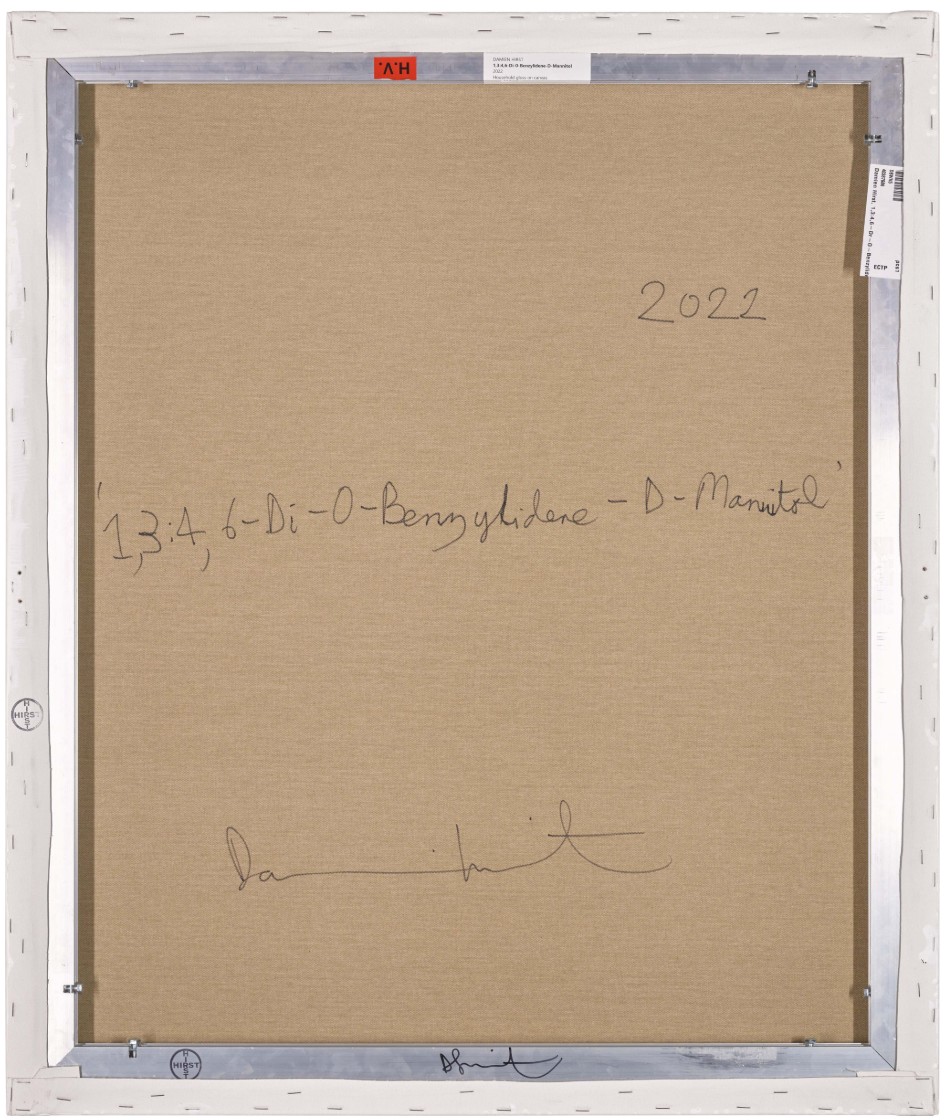
“I love color. I feel it inside me. It gives me a buzz. I hate taste: it’s acquired”
Indeed, the painting’s logic aligns with the dual sensibilities of art and science: structured yet dynamic, schematic yet open to interpretation. That tension is at the heart of Hirst’s oeuvre. Here, the painting might be read as a molecular blueprint, or as a visualization of pharmaceutical dosage; conversely, one could experience it as pure color abstraction, its rational scaffolding giving way to optical pleasure. Hirst’s complex dialectic is ultimately revealed through the cheerful simplicity of color.
Alemethicin, 2012
Sotheby’s London: 5 March 2025
Estimated: GBP 80,000 – 120,000
GBP 88,900 / USD 113,792
Alemethicin | Contemporary Day Auction | 2025 | Sotheby’s
DAMIEN HIRST (b. 1965)
Alemethicin, 2012
Household gloss on canvas
18 1/8 x 26 1/8 inches (46 x 66.2 cm)
Signed, titled and dated 2012 (on the reverse)
“Art doesn’t purport to have all the answers; the drug companies do. Hence the title of the series, The Pharmaceutical Paintings, and the individual titles of the paintings themselves… Art is like medicine, it can heal.”
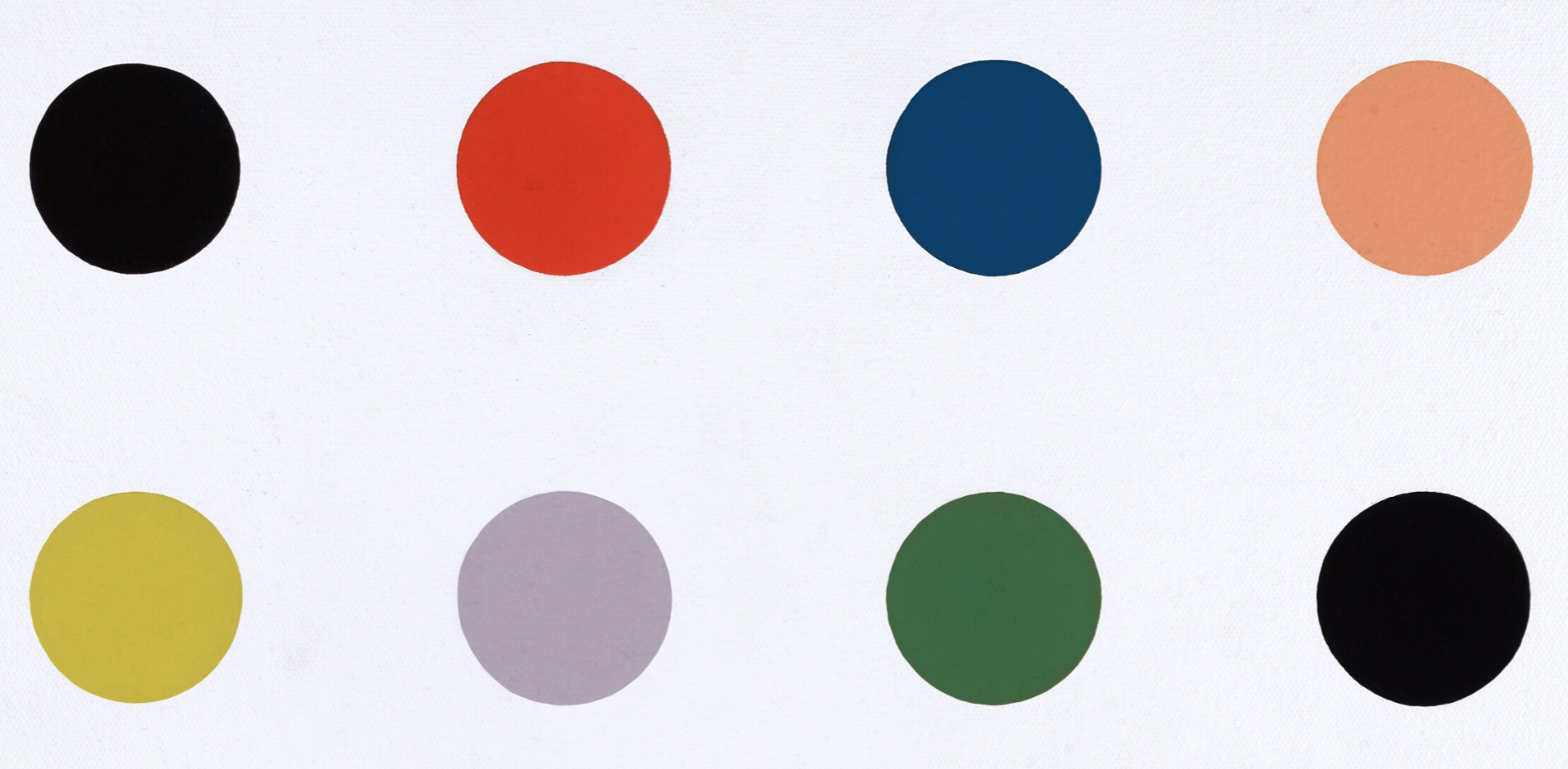
Lactic Dehydrogenase, 2013
Sotheby’s London: 5 March 2025
Estimated: GBP 40,000 – 60,000
GBP 40,640 / USD 52,019
Lactic Dehydrogenase | Contemporary Day Auction | 2025 | Sotheby’s
DAMIEN HIRST (b. 1965)
Lactic Dehydrogenase, 2013
Household gloss on canvas
18 x 12 1/8 inches (45.8 x 30.7 cm)
Signed, titled and dated 2013 (on the reverse)
“If you look closely at any one of these paintings a strange thing happens; because of the lack of repeated colors there is no harmony… in every painting there is a subliminal sense of unease; yet the colors project so much joy it’s hard to feel it, but it’s there. The horror underlying everything. The horror that can overwhelm everything at any moment.”
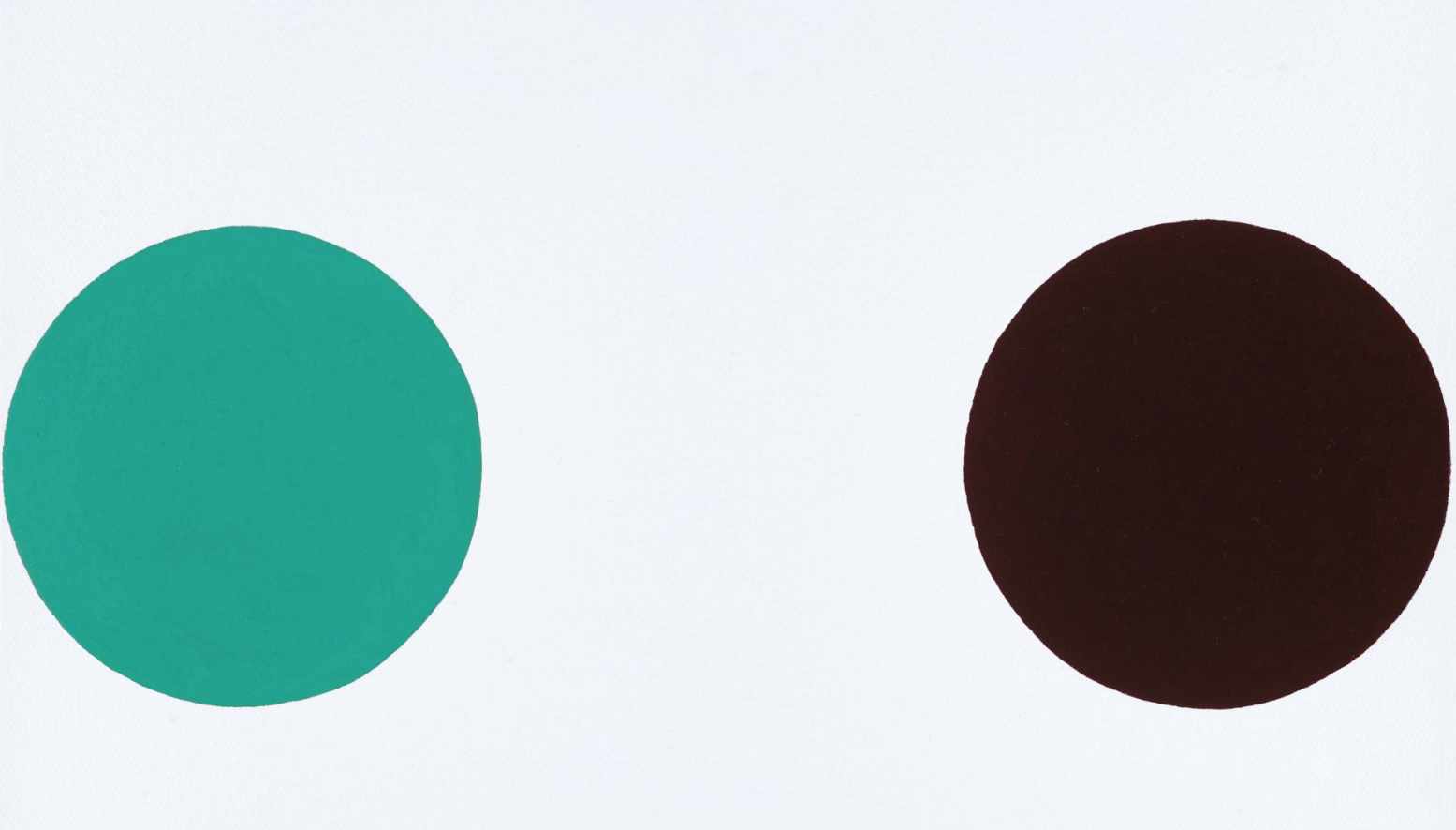
Ammonium Pentaborate, 2017
Sotheby’s London: 13 October 2023
Estimated: GBP 220,000 – 280,000
GBP 266,700 / USD 323,665
Ammonium Pentaborate | Contemporary Day Auction | 2023 | Sotheby’s (sothebys.com)
DAMIEN HIRST (b. 1965)
Ammonium Pentaborate, 2017
Household gloss on canvas
51×57 inches (129.5 x 144.8 cm) (3-inch spot)
Signed (on the stretcher); signed, titled and dated 2017 (on the reverse)
Bold and precise, Ammonium Pentaborate, is an immaculate example of Damien Hirst’s signature corpus of spot paintings. Uniquely-colored chromatic circles, ranging from bright tones to pastel hues, explode in a grid-like formation across the vast field of the pristine canvas. Within the thirteen sub-series of Spot Paintings, Hirst’s Pharmaceutical works are the most celebrated and prolific. Reflective of his interest in the connections between art and science, Hirst titled each work in this series after a unique chemical compound. In systematic fashion, he named these paintings alphabetically according to the Sigma Chemical Company’s catalogue, Biochemical Organic Compounds for Research and Diagnostic Reagents. Ammonium Pentaborate is a product resulting from the controlled reaction of ammonia, water and boric acid. The vibrant and delightful dots organized in neat rows across the canvas belie the sterile and medicinal nature of Hirst’s artistic experiment; like pills and products manufactured to ward of sickness and promote well-being, at the heart of these machinations is the inevitability of death.
Zinc Sulfide, 2004
Phillips London: 3 March 2022
Estimated: GBP 350,000 – 550,000
GBP 346,500 / USD 461,569
Damien Hirst – 20th Century & Contempo… Lot 38 March 2022 | Phillips
DAMIEN HIRST
Zinc Sulfide, 2004
Household gloss on canvas
Diameter: 72 inches (182.9 cm)
Combining the tondo format of the Spin Paintings with the methodical application of precisely formed dots that characterize the iconic Spot Paintings, Zinc Sulphide is a mesmerizing example of one of Damien Hirst’s most important and instantly recognizable series. Spanning over a quarter of a century, Hirst’s Spot Paintings have become synonymous with the artist himself, and have proven to be a remarkably versatile motif, given its strict limitations. Breaking with the more familiar grid-like arrangement of spots along strict vertical and horizontal lines, Zinc Sulphide presents the multichromatic spots in a series of concentric circles, radiating out from a central, butter-yellow dot.
Meticulously organized, the crisply rendered dots come vividly alive within this tight circular format, exaggerating the optical interplay that is so characteristic of this celebrated series of works. A sophisticated presentation of the artist’s abiding interest in color and its organization, Zinc Sulphide strikes a balance between art and science that has proven to be an abiding conceptual touchstone for Hirst’s practice. Its title appropriately referencing the inorganic compound most commonly used to create pigments and luminescent materials.
Loperamide, 2005
Phillips New-York: 18 November 2021
Estimated: USD 400,000 – 600,000
USD 504,000
Damien Hirst – 20th Century & Cont… Lot 362 November 2021 | Phillips
DAMIEN HIRST
Loperamide, 2005
Household gloss on canvas
63×45 inches (160 x 114.3 cm)
Named after a prescription drug and over-the-counter medicine, Loperamide consists of eighty-eight uniformly sized circles arranged in an eleven by eight grid. Executed in 2005, Loperamide belongs to Damien Hirst’s Pharmaceutical paintings, the first and most acclaimed group of the thirteen sub-series within the artist’s renowned Spot Paintings. Among his most recognizable and prolific bodies of works, the Spot Paintings comprise over 1,300 paintings created between 1986 and 2011. Minimalistic yet simultaneously rich with abstraction, depth, and conceptual detail, each painting contains rows of identically sized and brightly colored circles that appear in stark contrast to a white or cream background. Oscillating between art and science, creation and mechanization, Loperamide encapsulates Hirst’s notorious practice of defying categorization in the midst of creating a singular artistic vocabulary with universal and timeless appeal.
Medicine Cabinets
Hirst created his first Medicine Cabinets in 1989 for his degree show at Goldsmiths in London and was so fascinated by the endless possible permutations and the potential behind the idea that he continued to refine the concept to increasing levels of precision. In an interview with art historian and curator Nicholas Serota, Hirst recalled the creation of the early works in the series:
“In the first twelve, I’d done all that arranging in the same way that I was doing in a painting. I’d played around with them for ages and moved things and then it was as if I wasn’t there when I’d done it. So I think it was a way for me to do that, without ramming it down people’s throats. You can’t do paintings like Rauschenberg forever.”
In the same interview the artist declared that the first of his works that he was ever truly satisfied with was a Medicine Cabinet, indicating the immense significance of the series within his early career.
Never Mind, 1990-1991
Christie’s London: 15 October 2025
Estimated: GBP 600,000 – 900,000
GBP 508,000 / USD 680,720
DAMIEN HIRST (B. 1965), Never Mind | Christie’s
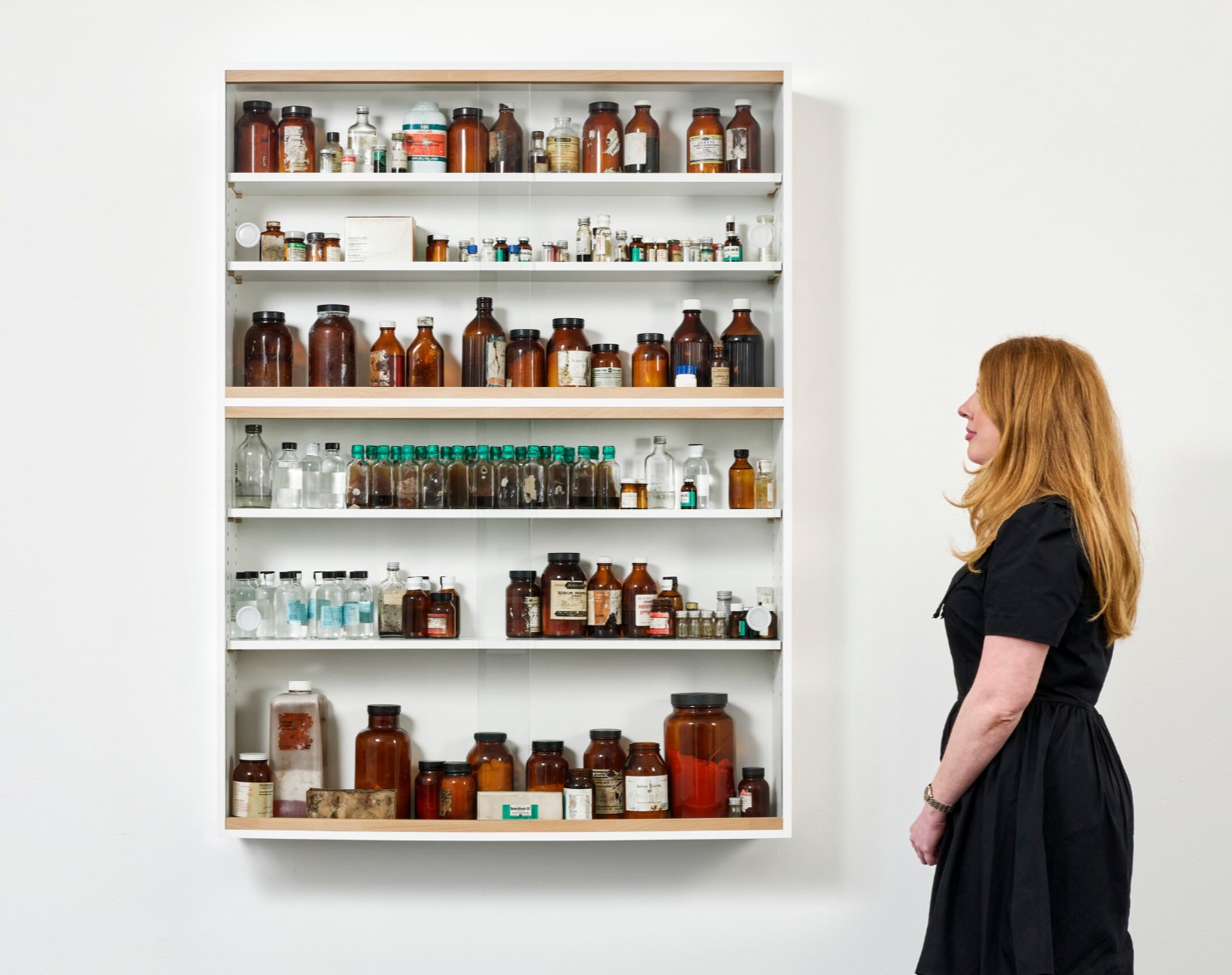
DAMIEN HIRST (B. 1965)
Never Mind, 1990-1991
Glass, MDF, ramin, plastic, aluminium, resin and pharmaceutical packaging
54x40x9 inches (137.2 x 101.5 x 23 cm)
With its line-up of boxed and bottled medicaments arranged in neat rows within a glass-fronted cabinet, Damien Hirst’s Never Mind (1990-1991) is among the earliest of the artist’s celebrated Medicine Cabinets. Its title alludes to the 1977 Sex Pistols’ album Never Mind the Bollocks, Here’s the Sex Pistols, ironically juxtaposing a precise, clinical sense of order with the iconic punk band’s rallying cry for chaos. Never Mind belongs to a group of Medicine Cabinets known as the ‘B-sides’, executed after an initial suite of twelve cabinets whose titles each corresponded to one of the album’s tracks: examples from that series include Pretty Vacant, now in the San Francisco Museum of Modern Art, and E.M.I., in Munich’s Museum Brandhorst. A year later Hirst would take this seminal motif to thrilling new heights with Pharmacy, an installation now in the collection of Tate, London.
Following the breakout group show Freeze that Hirst organized along with other Goldsmiths College art students in 1988, Hirst rose to fame in the early 1990s as the enfant terrible of the Young British Artists. His works of this period—including the Spot Paintings and the Natural History vitrines, which featured animals preserved in formaldehyde—have become some of the most iconic in modern art. As with those series, the Medicine Cabinets set out a theme which would endure through Hirst’s entire oeuvre: that of the relationship of art to religion, science, life, and death.
“I’ve always loved the idea of art maybe, you know, curing people. And I have this kind of obsession with the body.”

The Sex Pistols (Johnny Rotten, Sid Vicious, Steve Jones and Paul Cook) during a press conference in London, March 10, 1977.
Unknown photographer. Digital image: Bridgeman Images.
The earliest Medicine Cabinets were filled with pharmaceutical packaging given to Hirst by his grandmother, shortly before she passed away. Hirst sometimes arranged the bottles and boxes of pills and potions according to their purpose, with medications for the head placed on the upper shelf, and those for the remainder of the body arranged in descending order. A poignant memento mori, Hirst’s depleted prescription medications become a record of life, and the ways in which the body is sustained.
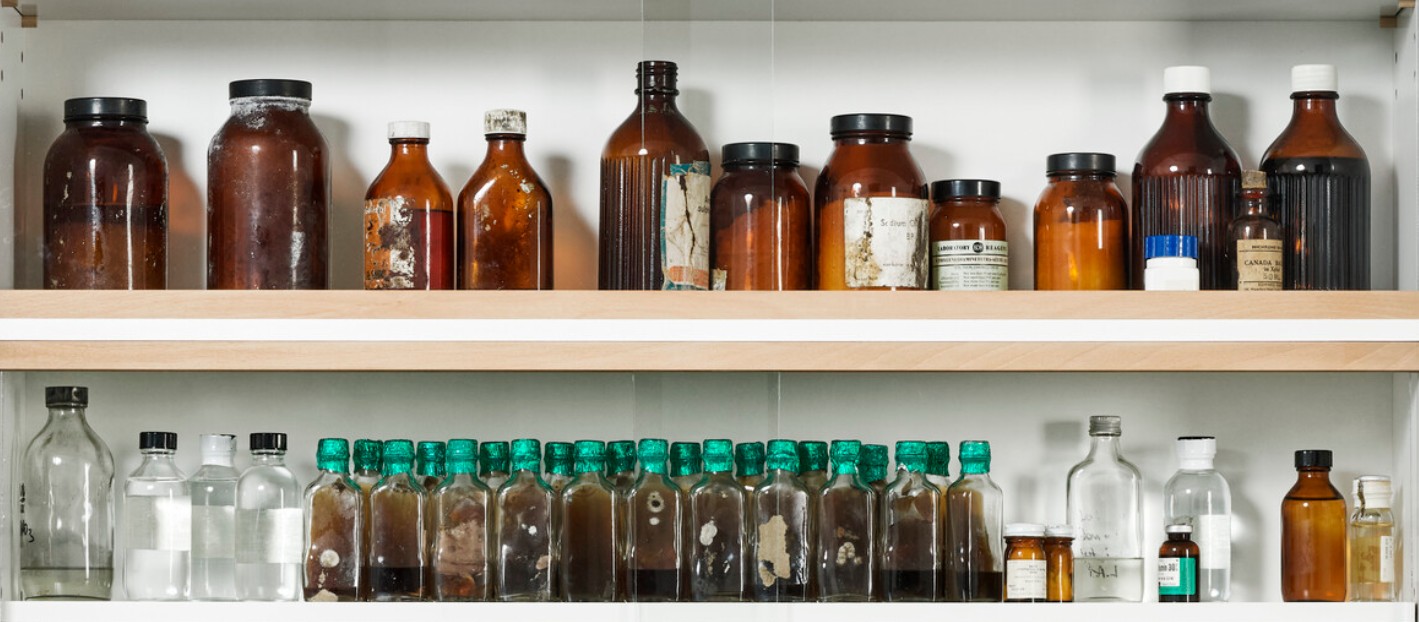
Finding a precedent in Andy Warhol’s iconic Brillo boxes and Jeff Koons’s series of ‘new’ consumer products, the Medicine Cabinets combined the Duchampian tradition of the readymade with a postmodern elimination of the line between art and everyday life. Hirst played with the idea of legibility, intrigued at the thought that medical professionals might seek meaning in their arrangement, while others would find their labels—laden with complex chemical compounds—impenetrable. They play, too, with the language of Minimalism, recalling the clean lines of Sol LeWitt or Donald Judd. But the Medicine Cabinets complicated both the modernist grid and Pop’s slick veneer, their carefully-arranged contents a record of something distinctly human.
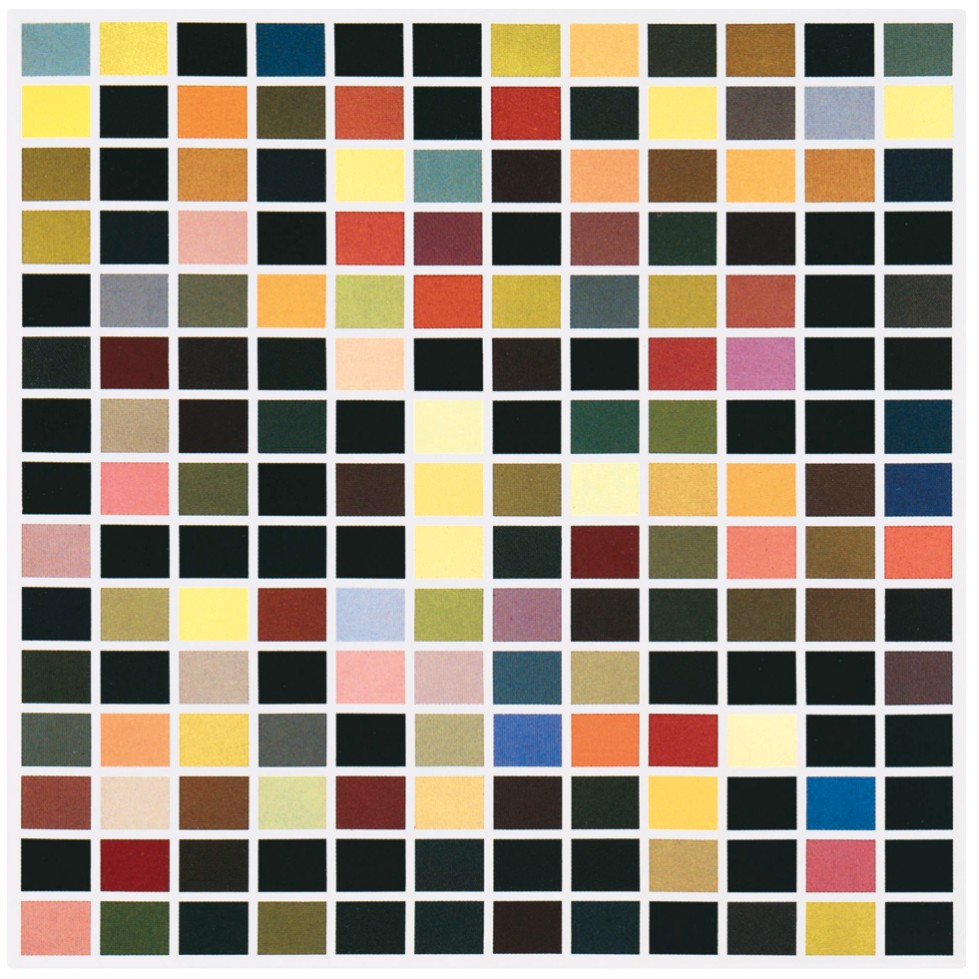
Gerhard Richter, 180 Farben, 1971. Philadelphia Museum of Art. Artwork and image: © 2025 Gerhard Richter (0106).
Hirst saw the pharmacy as akin to a place of worship, with the sick turning to modern medicine for salvation as they once prayed to the gods. With Never Mind, he erects a pantheon of drugs contained, votive-like, within a vitrine. Simultaneously, he contrasts society’s unfailing faith in medicine against the incredulity and scorn so often expressed towards contemporary art. Juxtaposing different systems of belief, Never Mind binds together threads of religion, medicine, and art.
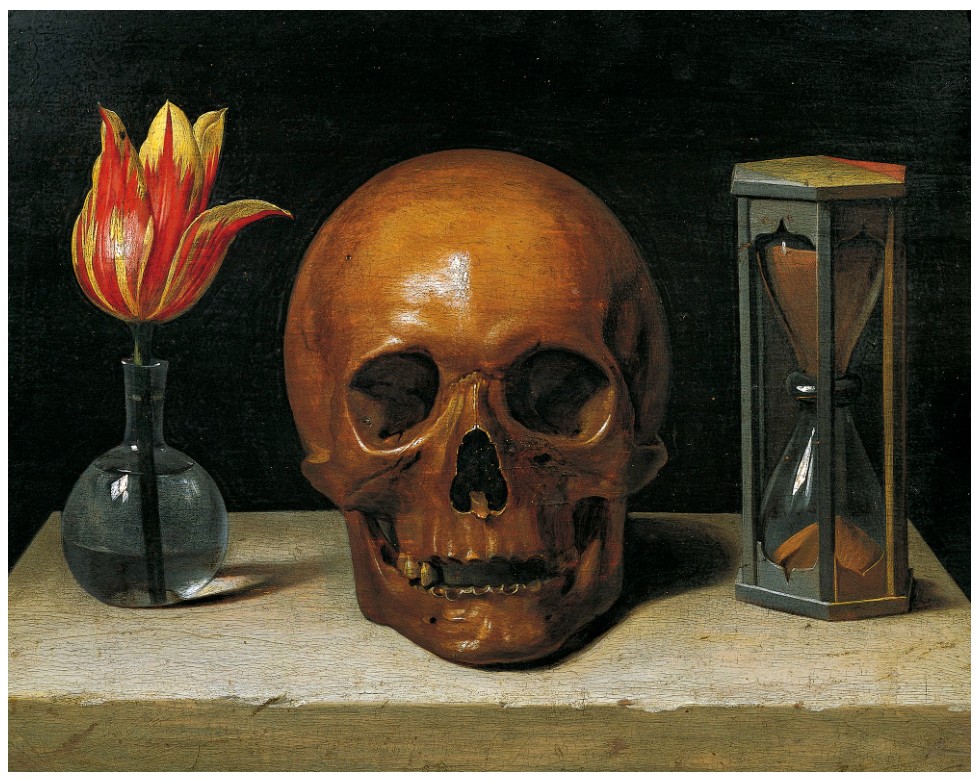
Phillippe de Champaigne, Vanitas: Still Life with a Tulip, Skull and Hour-Glass, 1646. Musée de Tessé, Le Mans.
Digital Image: G. Dagli Orti /© NPL – DeA Picture Library / Bridgeman Images.
Hirst’s fascination with death, which looms inevitably over life, underlies his entire oeuvre.
“I’d always thought about death since I was seven years old … and every day I think about it, it’s different. It goes from being impossible to the only thing. I remember thinking that, in a way, it’s what gives life beauty.”
Anticipating his later works, from the Natural History series of animals preserved in formaldehyde to the meticulous pill cabinets and the gossamer butterflies which adorn bright, monochrome canvases, Hirst’s early Medicine Cabinets offer a meditation on the fragile line between life and death.
Fear, 1994
Phillips London: 13 October 2023
Estimated: GBP 300,000 – 400,000
GBP 349,250 / USD 423,847
Damien Hirst – 20th Century & Contem… Lot 45 October 2023 | Phillips
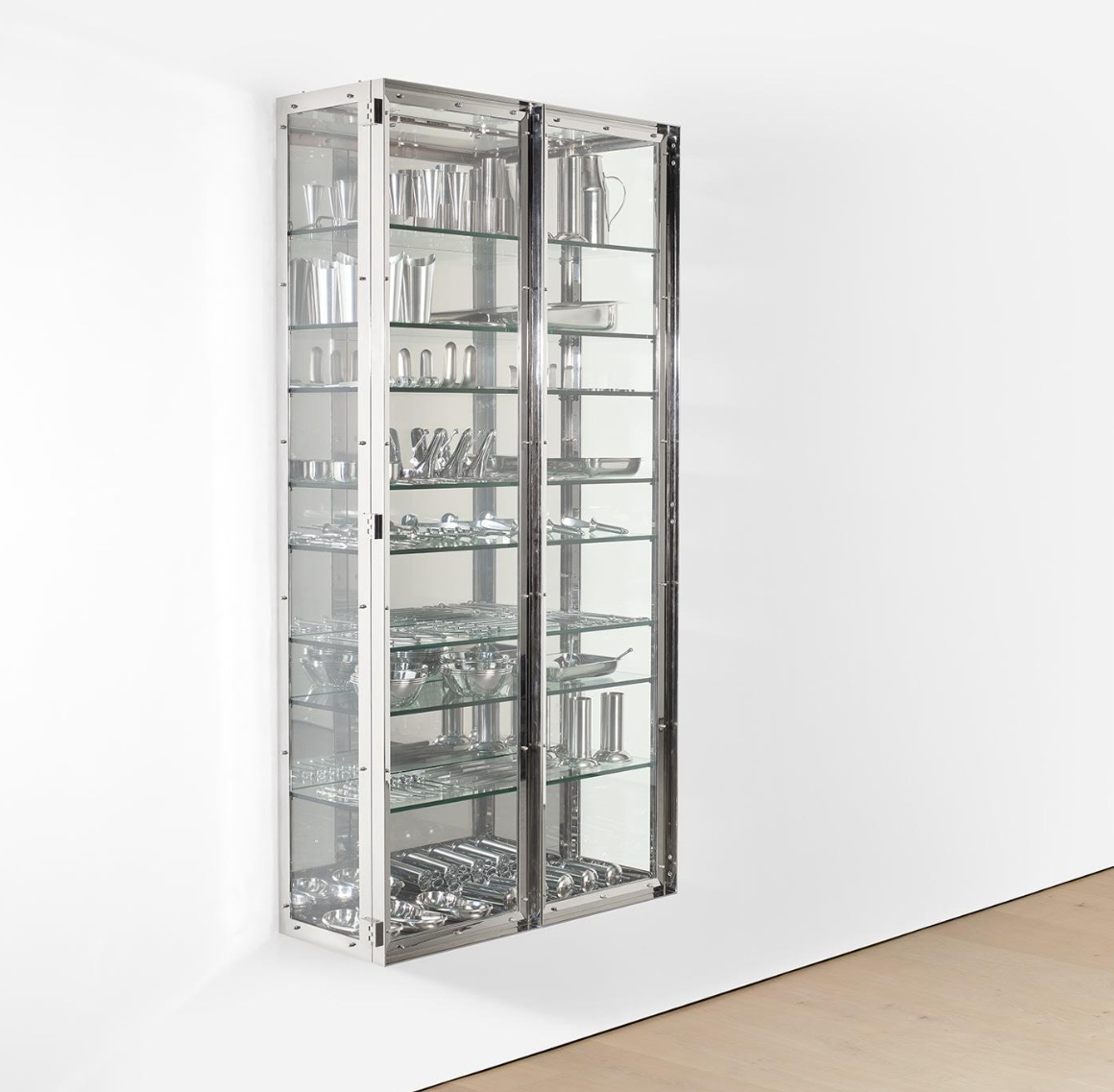
DAMIEN HIRST
Fear, 1994
Glass, stainless steel, steel, nickel, brass, rubber, medical and surgical equipment
180 x 92.5 x 36 cm (70 7/8 x 36 3/8 x 14 1/8 inches)
Stamped with the artist’s stamp ‘HIRST’ on some of the surgical instruments
An early and important example of Damien Hirst’s Instrument Cabinets, created at a pivotal moment in the Young British Artist’s career, Fear brings together key concepts and themes that continue to preoccupy the artist today. Executed on a human scale, the steel framed glass cabinet brings into sharp focus Hirst’s unwavering interest in mortality, the frailty of the human body, and the faith that we invest in the tools and promise of modern medicine. It is this paradox that underpins Hirst’s entire artistic project – while we know, and fear, our mortality, we also refuse to accept its permanence; or, in the artist’s own words, ‘I am going to die and I want to live forever. I can’t escape that fact and I can’t let go of that desire.’
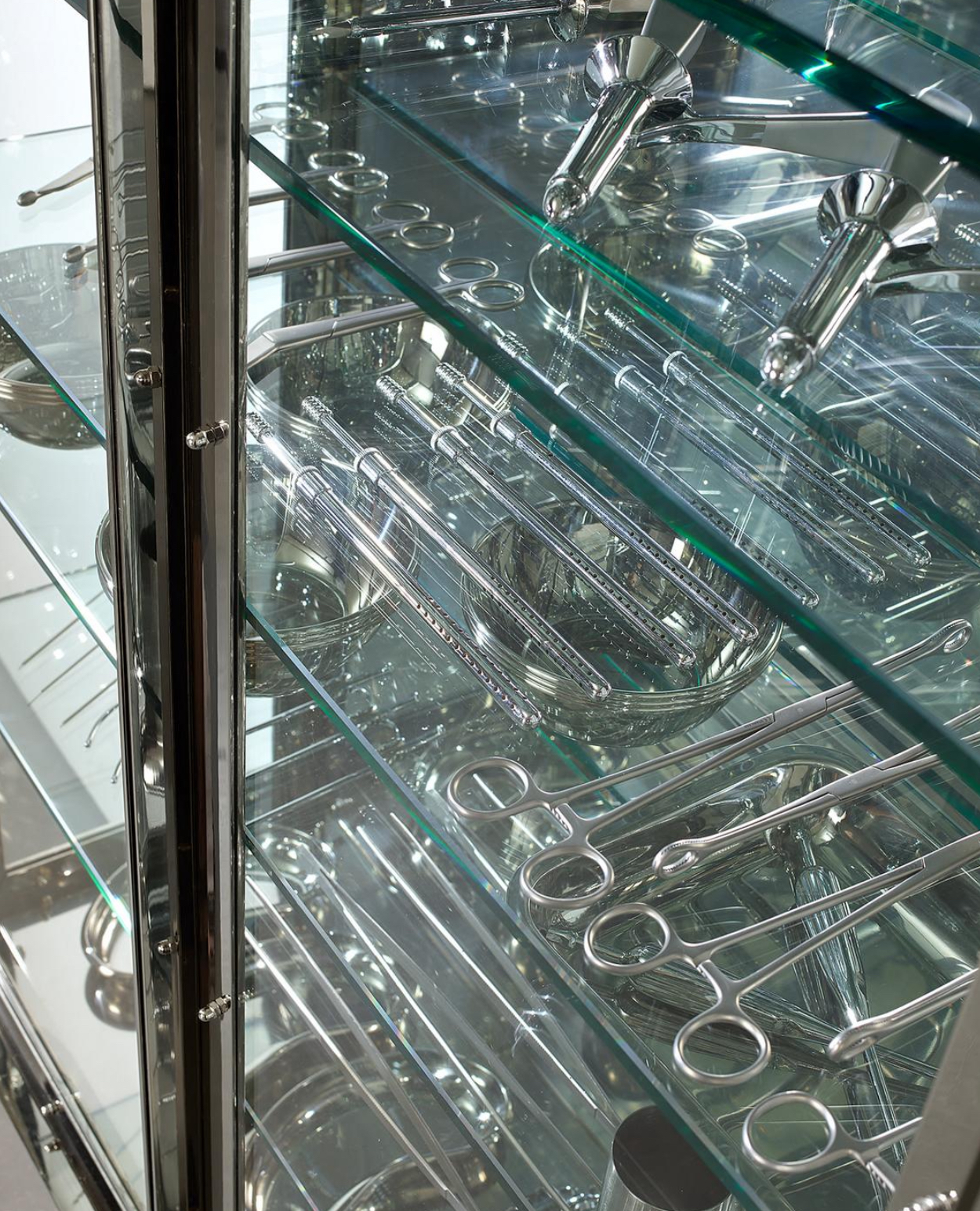
Conceived in 1994, the year after Hirst was first nominated for the prestigious Turner Prize and the year before he actually won it, Fear comes from a pivotal moment in the young Hirst’s rapidly maturing practice, and in the broader contexts of contemporary British art at the turn of the century. Alongside sister works Still and Doubt now held in the prestigious collections of The Art Institute of Chicago and the Museum of Fine Arts Houston respectively, Fear stands in a close familial relationship to Hirst’s foundational Medicine Cabinets which he first embarked on in 1988 while still a student at Goldsmiths. Borrowing titles from the definitive late 70s punk album, Never Mind the Bollocks, Here’s the Sex Pistols, Hirst’s 1989 degree show presentation of thirteen Medicine Cabinets set the tone for the rebellious spirit that would come to define the art and personalities associated with the burgeoning YBA movement.
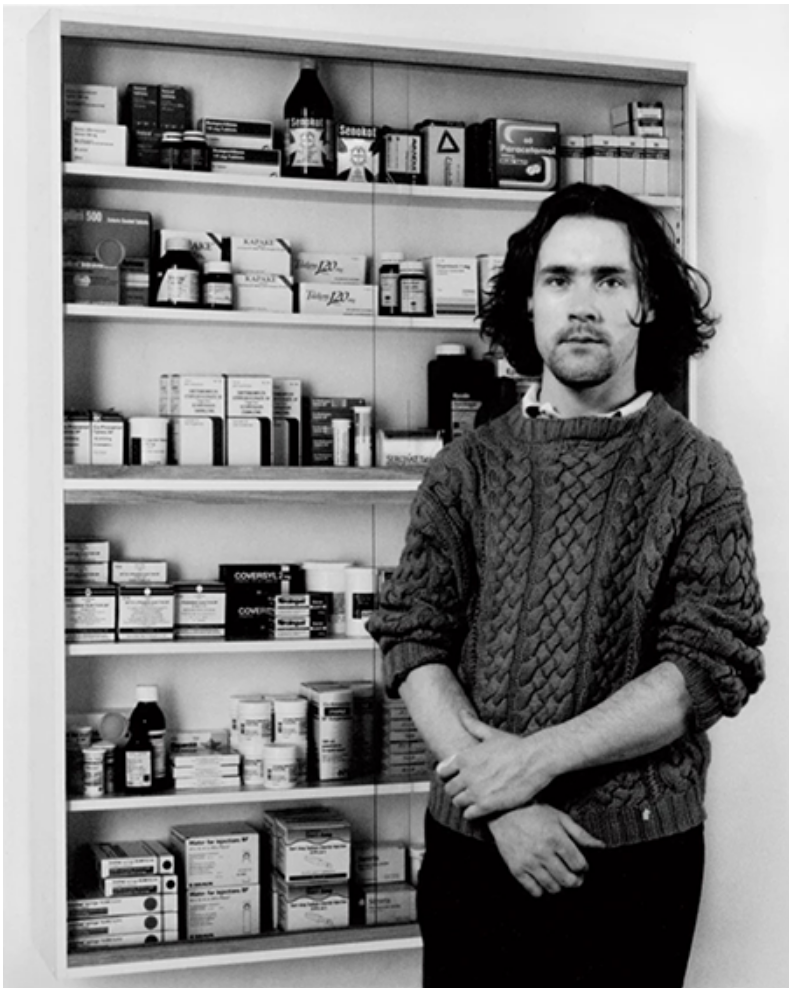
Damien Hirst at the No Sense of Absolute Corruption exhibition, Gagosian Gallery, New York, 1996. Artwork: © Damien Hirst and Science Ltd. All Rights Reserved, DACS 2023
Clean and precise in its presentation, Fear features rows of meticulously arranged surgical equipment, the cold, impersonal materiality of their sleek, stainless-steel surfaces visually referencing the simple geometries and seriality typically associated with Minimalism. Poignantly underscored by Hirst’s use of the medicine packets that his grandmother left behind after her death in these earliest cabinets however, the corporeal messiness of our own bodies is never far from these works, undercutting the more emotionally detached or Minimalist arrangement of its constituent parts. Hirst’s fascination for the interwoven relationships between art, science, and faith have important art historical precedents in the long-held fascination with the human body, its anatomy, and dissection, most famously recorded in the sketchbooks of Leonardo da Vinci and in 17th century ‘anatomy lesson’ paintings. Significantly, in 2013 Fear was included in the Kunstmuseum de Haag presentation of The Anatomy Lesson: From Rembrandt to Hirst, where it was exhibited alongside all ten surviving anatomy lesson paintings produced in the Netherlands during this Enlightenment period, most notably Rembrandt’s masterwork of the Dutch Golden Age, The Anatomy Lesson of Dr Nicolaas Tulp.
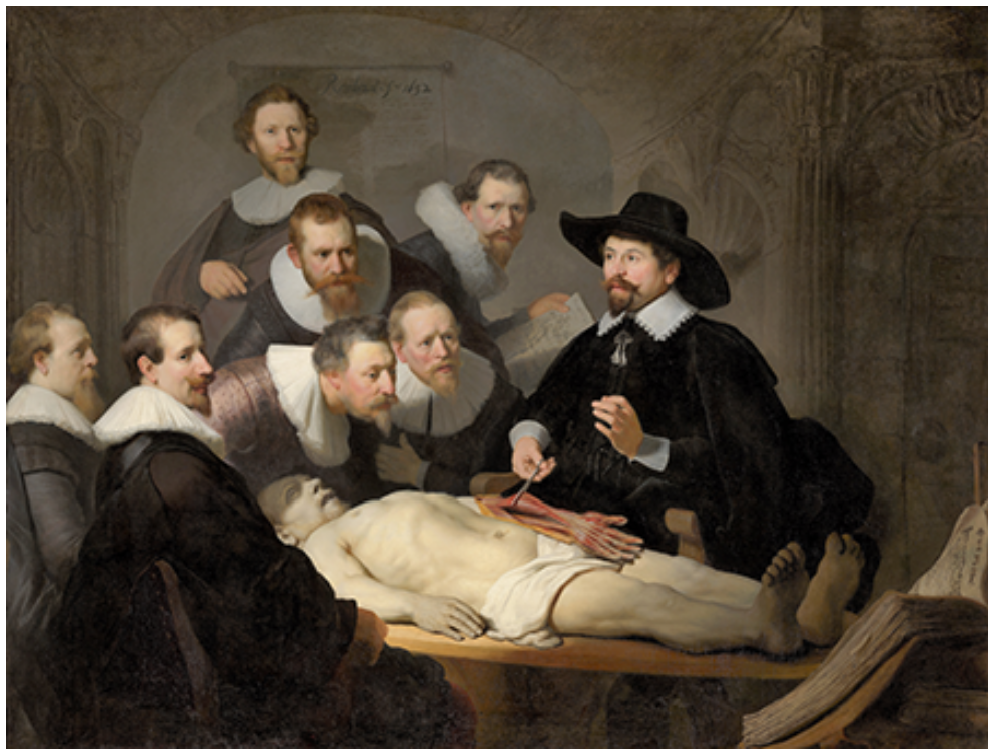
Rembrandt Harmenszoon van Rijn, The Anatomy Lesson of Dr Nicoleas Tulp, 1632, Mauritshuis, The Hague
A gory spectacle, dissections were opened to public viewings once a year, taking place in theatres that still lend their name to the more clinical spaces of hospital operating rooms today. Commissioned by the Surgeons Guild for display in their meeting room, in The Anatomy Lesson of Dr Nicolaas Tulp the young Rembrandt radically altered the conventions of the genre. Set with dramatic contrasts of light and shadow, the mis en scène depicts the titular doctor exposing the musculature of the dissection subject’s arm to a group of fascinated onlookers. Drawing on Christ-like iconography in the artist’s presentation of the corpse, the painting crystalizes the profound shift taking place across 17th century Europe as Enlightenment principles related to the pursuit of science, rationality, and the so-called triumph of reason challenged religion’s hitherto unwavering dominance as a framework for explaining the world. Like Rembrandt, in Fear Hirst draws on our compelling desire to make the unknown visible, the drive to demystify death and the deep anxieties provoked by an awareness of our own mortality. Playing on the densely woven web of fears and fascinations that has always characterized our relationship to medicine and the surgeon’s trade, the Instruments Cabinets also function in this respect like religious reliquaries, playing on our capacity for hope and belief, even in the face of impersonal and inevitable death.
The Sleep of Reason, 1997-1998
Estimated: USD 1,500,000 – 2,500,000
USD 2,220,000
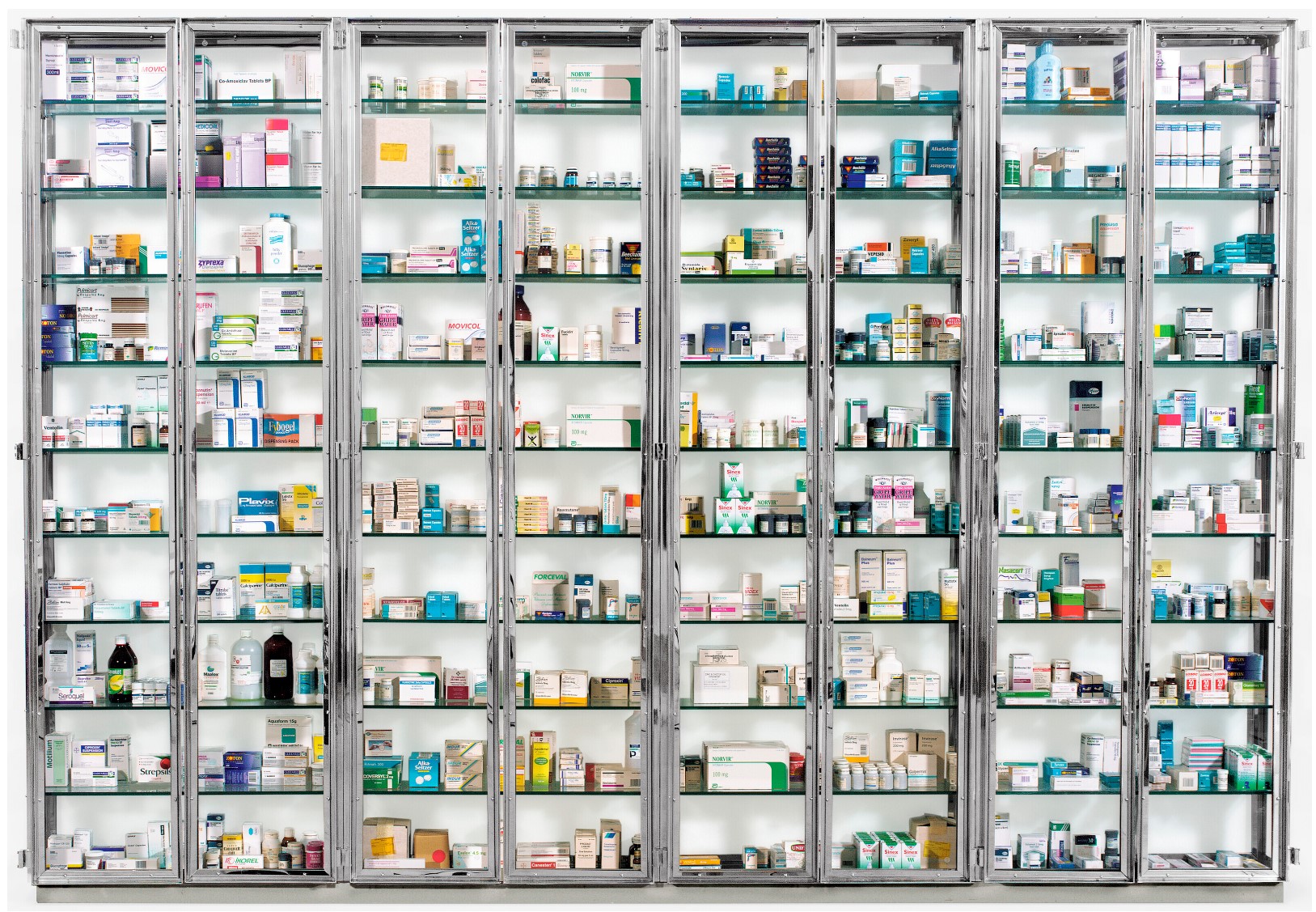
DAMIEN HIRST (B. 1965)
The Sleep of Reason, 1997-1998
Glass, stainless steel, steel, nickel, brass, rubber and pharmaceutical packaging
Overall: 98 x 144 7/8 x 11 1/4 inches (249 x 368 x 28.6 cm)
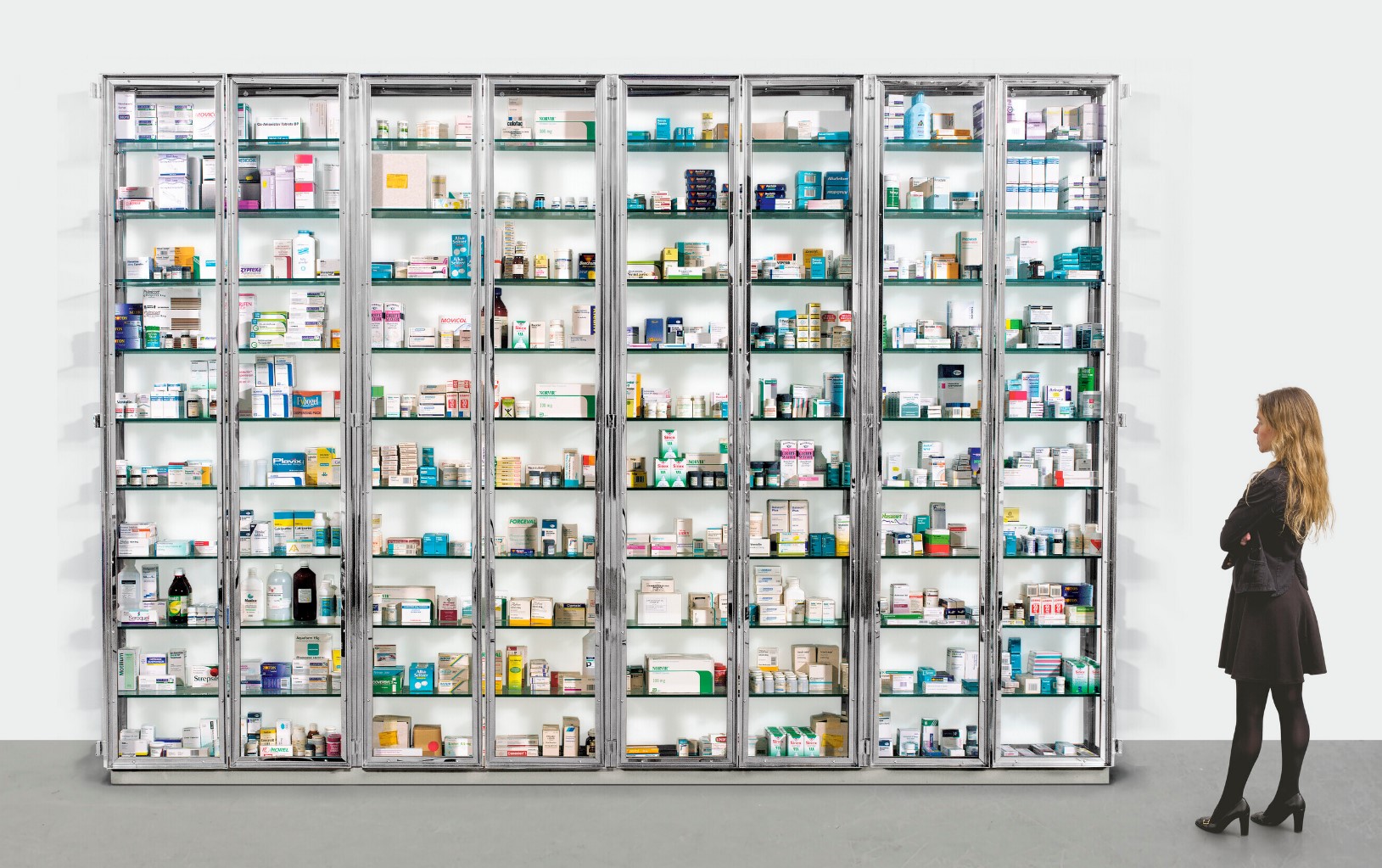
We’re Afraid of Nothing, 1992
Sotheby’s London: 2 March 2022
Estimated: GPB 1,000,000 – 1,500,000
GBP 1,366,000 / USD 1,825,959
We’re Afraid of Nothing | Modern & Contemporary Evening Auction | 2022 | Sotheby’s (sothebys.com)
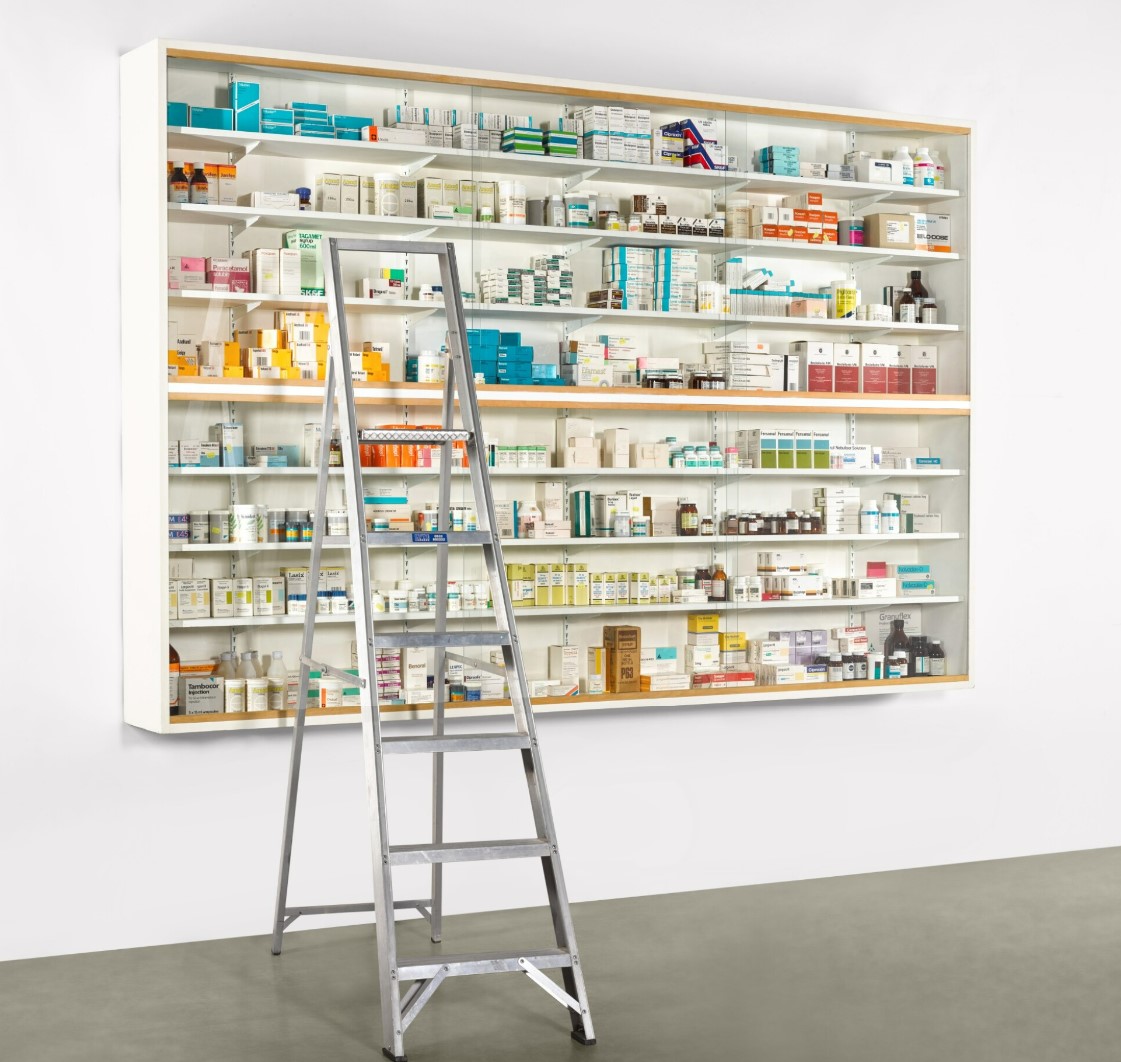
DAMIEN HIRST (b. 1965)
We’re Afraid of Nothing, 1992
Glass, painted MDF, ramin, steel, aluminium, pharmaceutical packaging and step ladder
Cabinet: 183 x 274.5 x 30.5 cm (72x108x12 inches)
Ladder: 210x48x11 cm (82 1/2 x 18 7/8 x 4 1/4 inches)
Executed in 1992 and monumental in scale, We’re Afraid of Nothing hails from the earliest period of Damien Hirst’s ground-breaking career and echoes the themes most integral to the artist’s visual lexicon: life and death and the precarious threshold in between. Comprising row upon row of neatly arranged pharmaceutical boxes and bottles bearing cautionary labels, the present work stands alongside important, early examples of Hirst’s iconic corpus of Medicine Cabinets, of which numerous are held within museum collections, such as The San Francisco Museum of Modern Art (Pretty Vacant, 1989) and the Bayerische Staatsgemaldesammlungen München (E.M.I., 1989). With the addition of a ladder that serves to heighten the immersive quality of this body of work, We’re Afraid of Nothing denotes the crystallization of Hirst’s visual engagement with pharmaceuticals – an extensive and highly significant engagement that found its ultimate articulation the very same year this work was created with the full-scale Pharmacy installation. As a work that encompasses the breadth of the artist’s output to date, We are Afraid of Nothing represents the moment at which the dialogue between science, religion, art and death coalesced to form the very backbone of Hirst’s oeuvre.

The Medicine Cabinet works stand alongside Hirst’s iconic series of Pharmaceutical Paintings, more commonly referred to as the Spot Paintings, in their investigation into mortality and medicinal science. Indeed, each painting in the series is titled after exotic sounding pharmaceutical substances listed in the Sigma Chemical Company’s catalogue Biochemical Organic Compounds for Research and Diagnostic Reagents. Conceived at the same pivotal moment in Hirst’s career, both series are imbued with the same measured rational order and pleasing formal cogency of his iconic Pharmacy store vitrines; yet where the brightly colored Spot Paintings conceptually denote specific drugs, the Medicine Cabinet works instead offer model replicas of such drugs, encased in vibrant, pristine medical packaging equipped with warning labels and dosage instructions. In its carefully selected assortment of medical packages, boxes and bottles enclosed within its eight shelves, We are Afraid of Nothing signifies the progression of existence itself, presenting the ‘tools’ required to maintain a long and healthy life – or indeed the tools required to evade death.
Quo Vadis, 2005
Christie’s London: 2 July 2021
Estimated: GBP 250,000 – 200,000
GBP 150,000 / USD 206,925
DAMIEN HIRST (B. 1965) (christies.com)
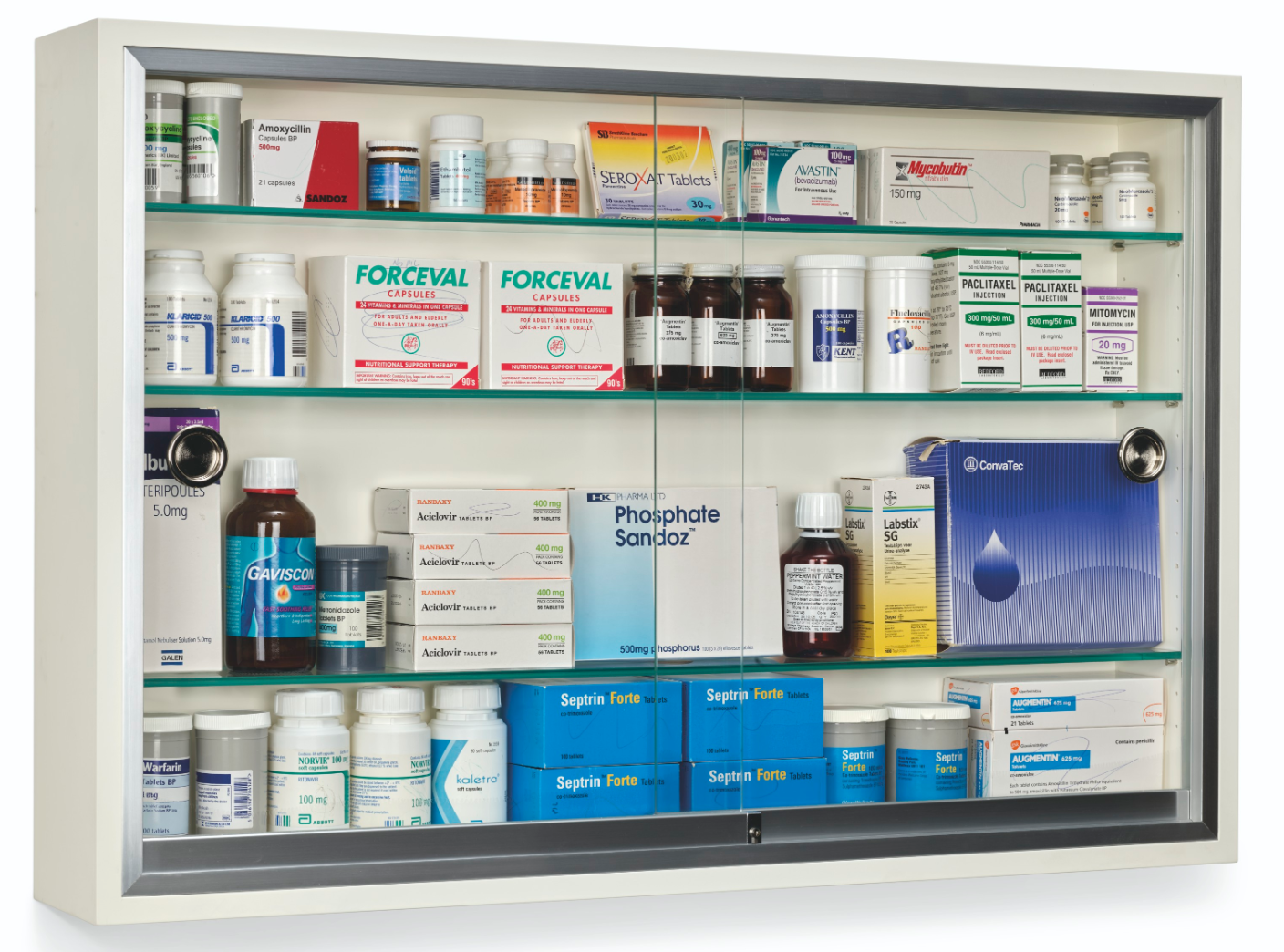
DAMIEN HIRST (B. 1965)
Quo Vadis, 2005
Glass, painted MDF, aluminum, metal pins, nickel-plated steel, sliding door lock and pharmaceutical packaging
24x36x6 inches (61 x 91.4 x 15.2 cm)
Signed, dedicated and dated ‘for Jasper Morrison Thanks for everything you did for me at the Pharmacy love Damien Hirst 2005/06’ (on the reverse)
Created in 2005, Damien Hirst’s Quo Vadis aestheticises the wonders of science. The work comes from the collection of Jasper Morrison, the acclaimed designer who collaborated with Hirst on the furniture for the Notting Hill restaurant Pharmacy. As its name suggests, Hirst’s establishment resembled a pharmacy; it opened in 1998, coinciding with artist’s homonymous installation at Tate Britain. Displayed across Quo Vadis’s four shelves is a tidy arrangement of amber-tinted medicinal bottles, packets, and miraculous tinctures. Their presence collectively speaks to the fragility of the body, but like the white walls of a gallery, the sleek glass shelves of the present work render these ordinary objects strange and beguiling. Indeed, under Hirst’s deft hand, the medicines move further away from their original function, and in doing so, they become aesthetic objects with wider cultural connotations.
“I’ve always seen medicine cabinets as bodies, but also like a cityscape or civilization with some sort of hierarchy within it. It’s also like a contemporary museum of the Middle Ages. In 100 years’ time this will look like an old apothecary. A museum of something that’s around today.”
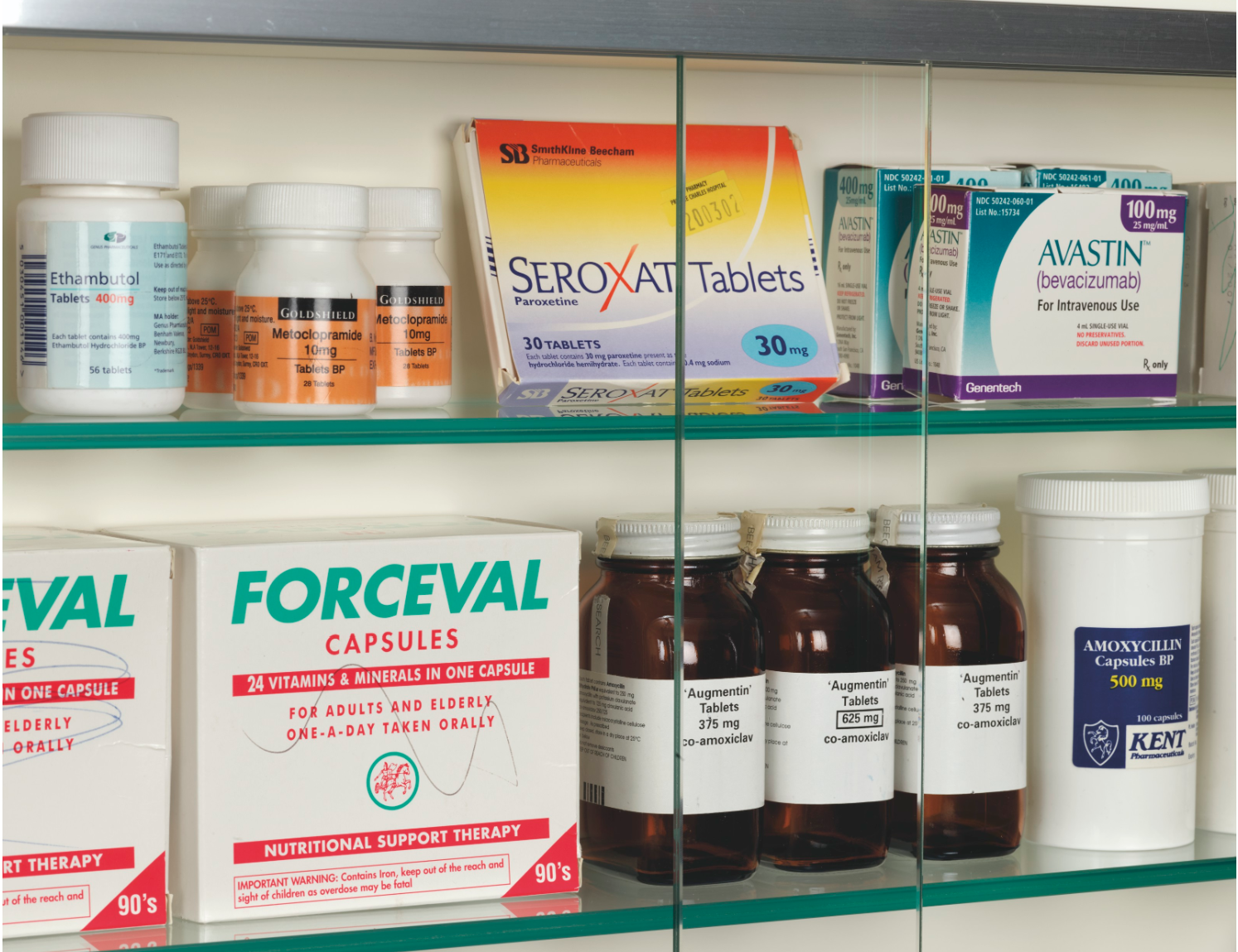
For Hirst, the pharmacy has long been a site of magical possibility and blind faith. Visiting a drugstore with his mother, Hirst noticed the ‘complete trust’ she had in medicine’s ability to improve her life; it was a conviction whose origins he could not identify. Such curative potential is contained within the cabinet of Quo Vadis, whose shrine-like composition evokes salvation and healing. By reflecting society’s utter confidence in medical science, Quo Vadis visualizes the connection between modern medicine and religion, a confidence alluded to in the title of the present work—and transferred it to the artwork itself.