Introduction
Landscapes in the Chinese Style is a powerful series of works inspired by Song dynasty paintings. Created in the year preceding the artist’s death, this group of paintings represent Lichtenstein’s final series. Simultaneously grand and subtle, bold and sublime, Lichtenstein here uses his signature Pop technique and irreverent sense of humor, both to pay homage to a cultural tradition, and to shed light upon the frequent generalization of Eastern motifs by Western painters for centuries. Describing the unique effect of these works, the artist revealed: “It’s not really what I do—all that subtlety and atmosphere,” the artist said of his series. “In my mind, it’s sort of a pseudo-contemplative or mechanical subtlety.” (the artist quoted in: Exh. Cat., Chicago, Art Institute of Chicago, Roy Lichtenstein: A Retrospective, 2013, p. 92) Testifying to the importance of the series, examples from the group are held in such prestigious museum collections as the Arthur M. Sackler Gallery and Hirshhorn Museum and Scupture Garden in Washington, D.C., and the Metropolitan Museum of Art, in New York.
“The thing that interested me was the mountains in front of mountains in front of mountains, and huge nature with little people… We all have a vague idea of what Chinese landscape look like—that sense of grandeur the Chinese felt about nature.”
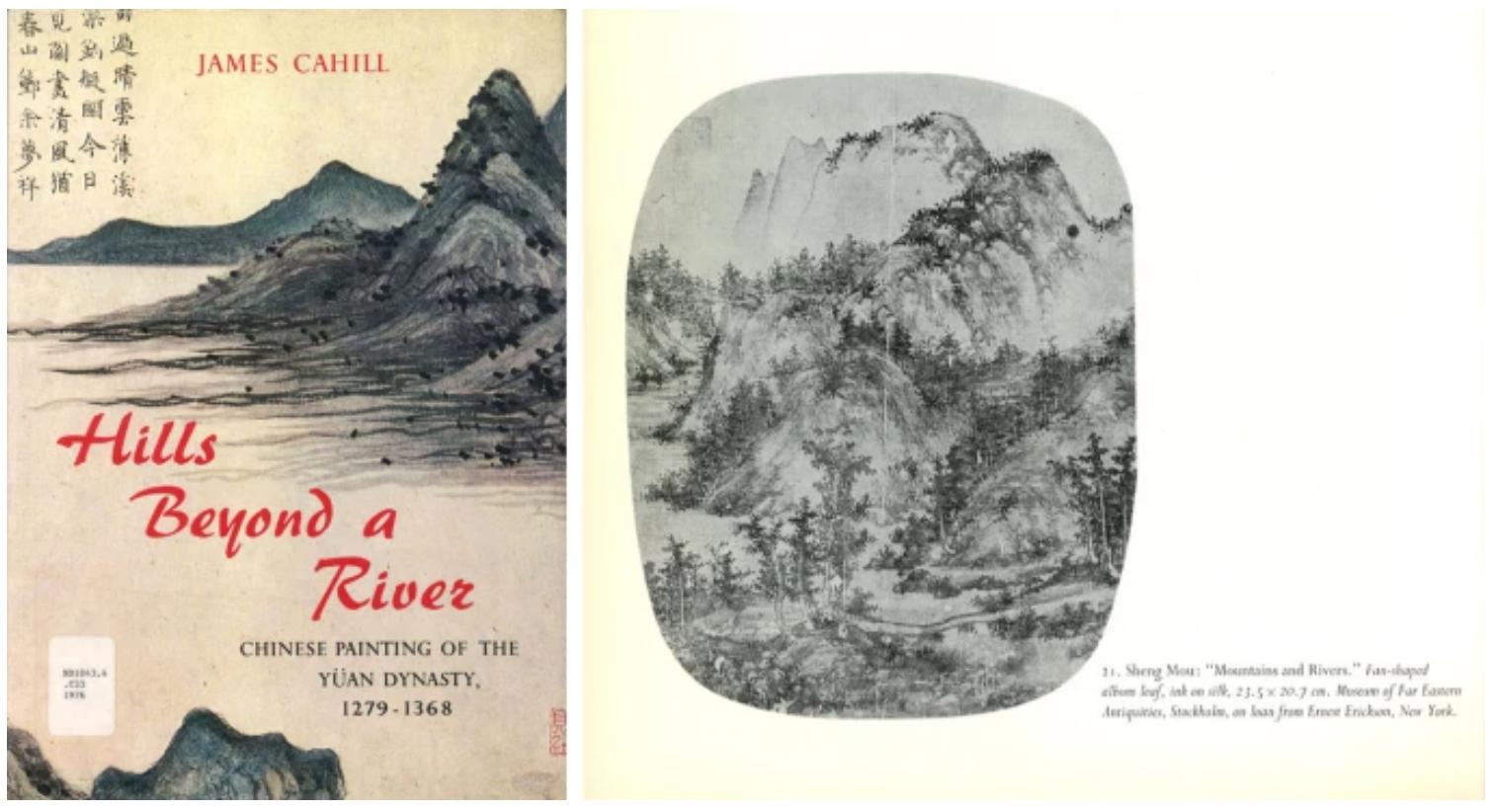
Lichtenstein’s interest in Chinese art began decades earlier when, at the age of just 21 and stationed in London for WWII, the artist wrote home to his parents: “I bought a book on Chinese painting, which I could have gotten in New York half the price. I’ll probably send it home with my collection of African masks, as my duffle bag now weighs more than I do, with all the art supplies.” (the artist cited in: Exh. Cat. ,Hong Kong, Gagosian Gallery, Roy Lichtenstein: Landscapes in the Chinese Style, 2011, p. 7) Later, when Lichtenstein returned to Ohio State University to complete his undergraduate and graduate degrees, he enrolled in classes on East Asian art history.; Lichtenstein describes, “The thing that interested me was the mountains in front of mountains in front of mountains, and huge nature with little people… We all have a vague idea of what Chinese landscape look like—that sense of grandeur the Chinese felt about nature.” (Roy Lichtenstein, quoted in Calvin Tomkins, “The Good China,” The New Yorker, September 30, 1996) In the last two years of his life, Lichtenstein twice visited the storerooms of the Museum of Fine Arts, Boston, in order to view their Southern Song album leaves. He was profoundly influenced by such thirteenth century Song artists as Ma Yuan, Liang Kai, and Muqi, all of whom investigated: “the effects of atmosphere with brush and ink in sophisticated and subtle manner, pushing the real and the visible to the edges of abstraction in a way that resonated deeply with Lichtenstein’s own artistic goals.” (Stephen Little, “Landscapes in the Chinese Style,” in: Exh. Cat., Chicago, Art Institute of Chicago, Roy Lichtenstein: A Retrospective, 2013, p. 89)
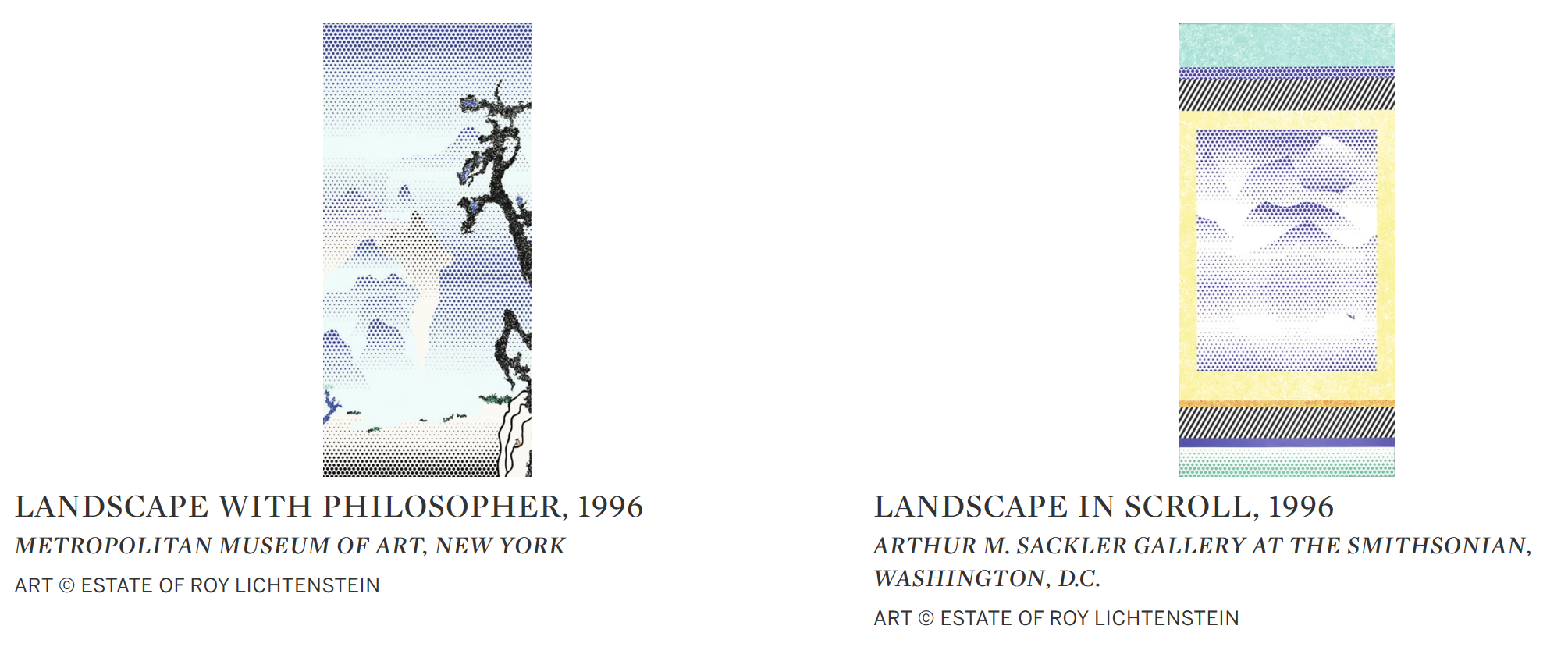
The series can be divided into three categories, each based upon a major format of traditional Chinese painting: the handscroll, hanging scroll, and the album leaf. Album leaves were considerably smaller than most hanging scrolls or handscrolls and were usually mounted in an album for more intimate viewing. Ironically, album leaf works from the series—such as
Auction Results
Paintings
#1. Landscape with Boats, 1996
Christie’s New-York: 15 May 2019
Estimated: USD 7,000,000 – 9,000,000
USD 6,267,500
Roy Lichtenstein (1923-1997) (christies.com)
ROY LICHTENSTEIN (1923-1997)
Landscape with Boats, 1996
signed and dated ‘rf Lichtenstein ’96’ (on the reverse)
oil and Magna on canvas
62 x 170 ¼ in. (157.5 x 432.4 cm.)
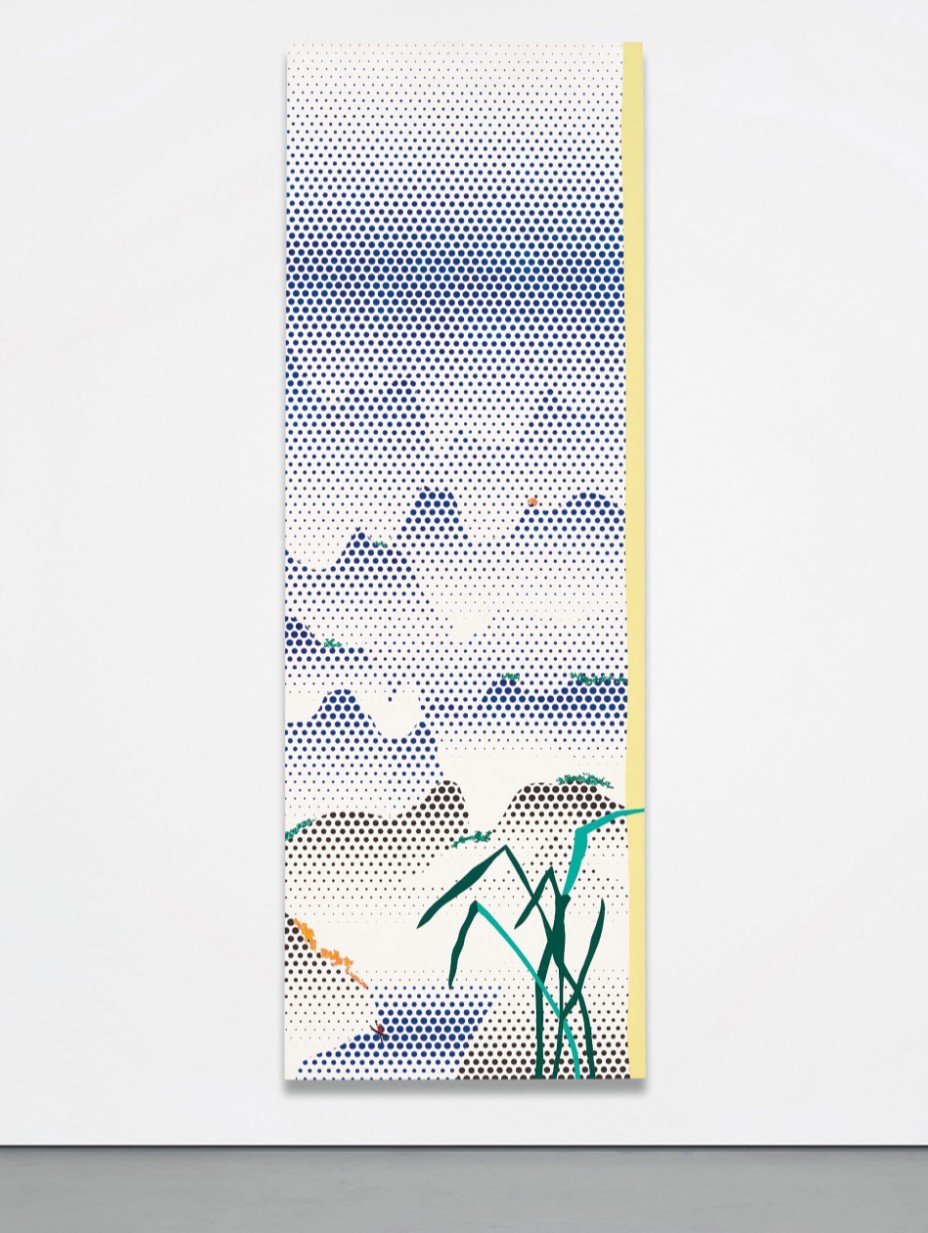
#2. Landscape With Grass, 1996
Property of an Important American Collector
Phillips Hong-Kong: 27 November 2016
Estimated: HKD 25,000,000 – 35,000,000
HKD 35,480,000 / USD 4,574,315
Roy Lichtenstein 20th Century & Contemporary Art & Design Evening Sale
Oil and Magna on canvas
110 1/4 x 38 1/8 inches (279.9 x 96.9 cm)
Signed and dated ‘rF Lichtenstein 96’ on the reverse
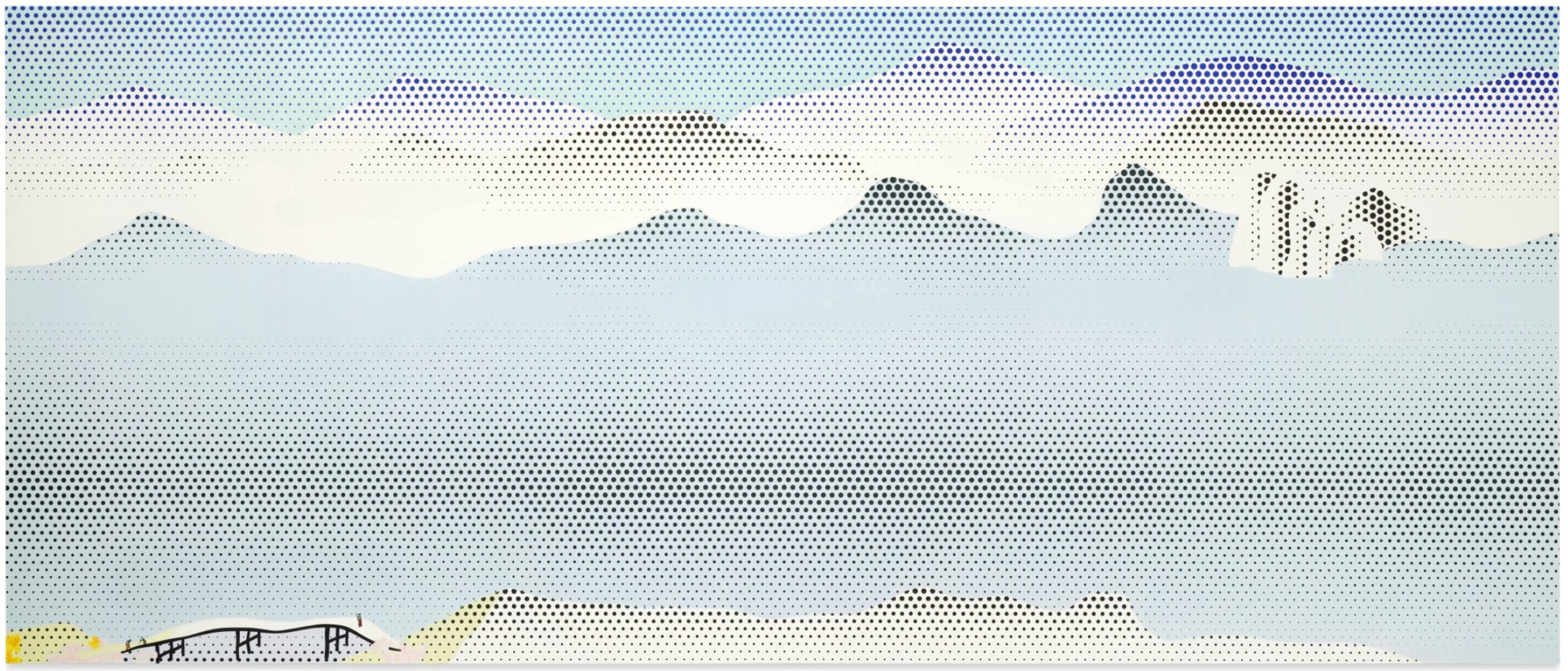
#3. Vista with Bridge, 1996
Works from The Collection of Dorothy and Roy Lichtenstein
Sotheby’s Hong-Kong: 28 September 2025
Estimated: HKD 28,000,000 – 35,000,000
HKD 30,875,000 / USD 3,968,510
ROY LICHTENSTEIN (1923 – 1997)
Vista with Bridge, 1996
Acrylic, oil and graphite on canvas
75 x 178 1/4 inches (190.5 x 452.8 cm)
Signed and dated ’96 (on the reverse)
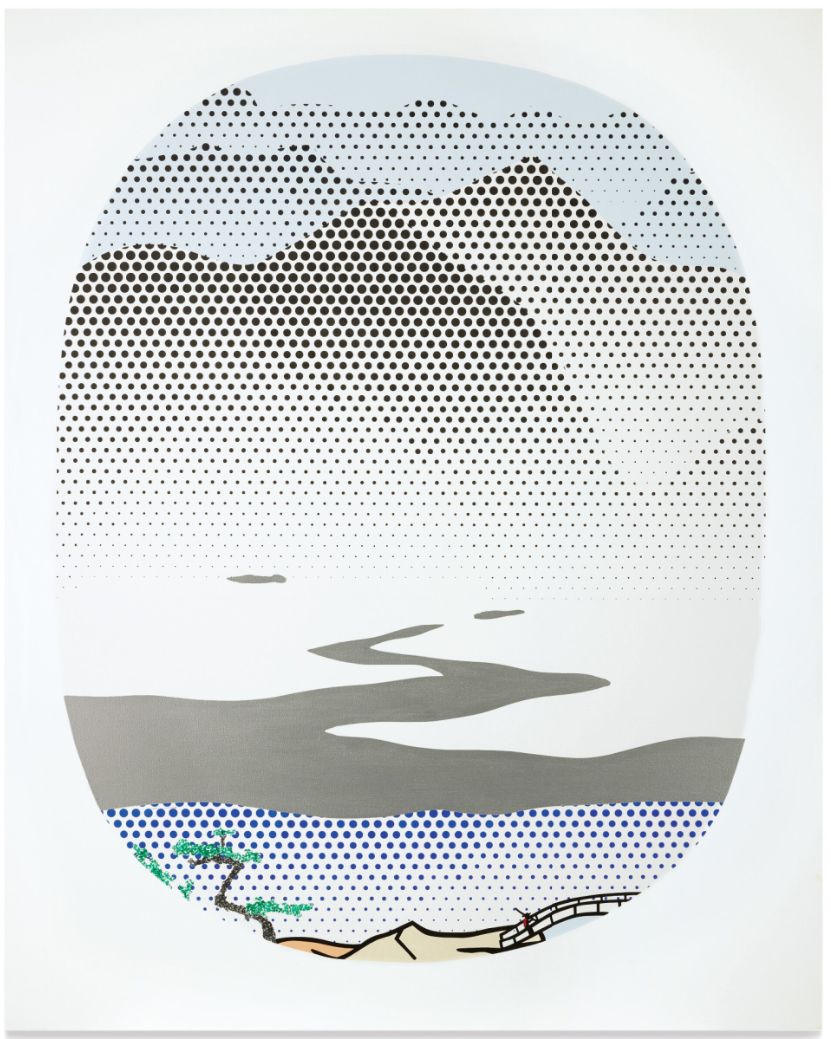
#4. Landscape with Silver River, 1996
Sotheby’s New-York: 28 October 2020
Estimated: USD 3,000,000 – 5,000,000
USD 3,650,000
ROY LICHTENSTEIN (1923 – 1997)
Landscape with Silver River, 1996
Oil and Magna on canvas
83 1/4 x 66 5/8 inches (211.5 x 169.2 cm)
Signed and dated ’96 on the reverse
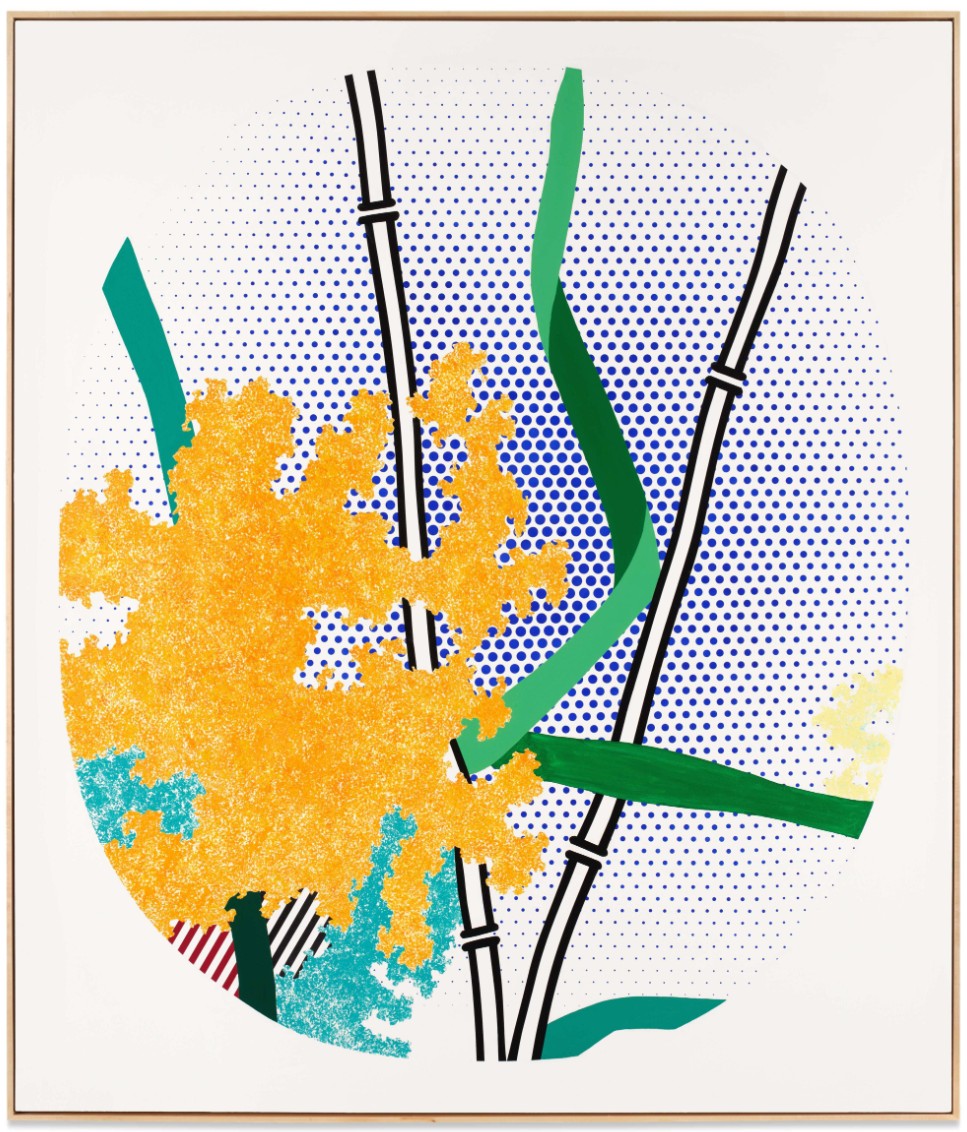
#5. Flower with Bamboo, 1996
A Legacy Reimagined: Works from the Collection of Dorothy and Roy Lichtenstein
Sotheby’s New-York: 18 November 2025
Estimated: USD 2,000,000 – 3,000,000
USD 1,514,000
Flower with Bamboo | The Now & Contemporary Evening Auction | 2025 | Sotheby’s
ROY LICHTENSTEIN (1923 – 1997)
Flower with Bamboo, 1996
Acrylic, oil and graphite on canvas
77 x 66 1/8 inches (195.6 x 168 cm)
Signed and dated ‘96 (on the reverse)
2. Studies
#1. Landscape with Poet (Study), 1995
Property of an Important American Collector
Phillips Hong-Kong: 26 November 2017
Estimated: HKD 4,500,000 – 6,500,000
HKD 8,140,000 / USD 1,042,585
Roy Lichtenstein 20th Century & Contemporary Art & Design Evening Sale
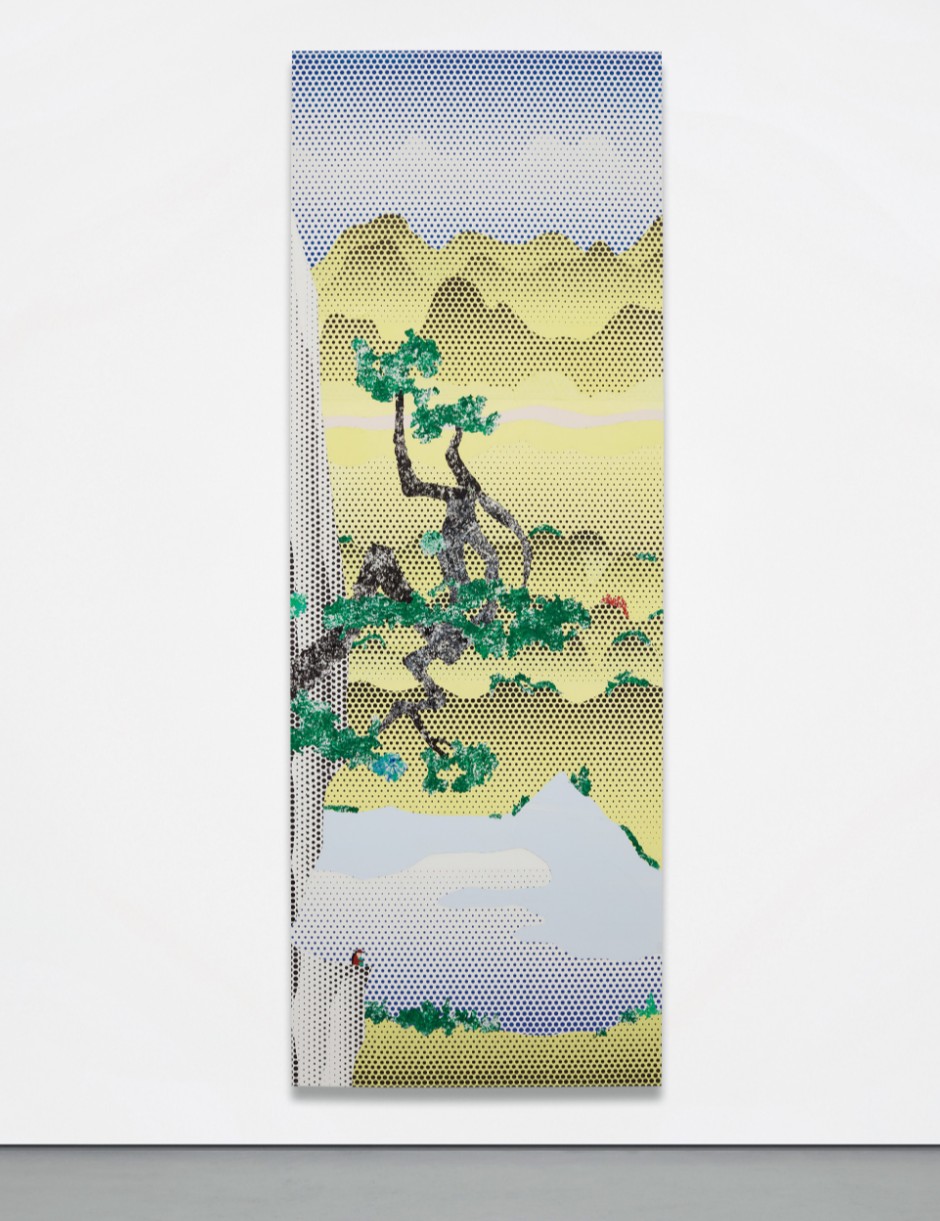
ROY LICHTENSTEIN
Landscape with Poet (Study), 1995
Tape, painted paper, and printed paper on board
84×30 inches (213.4 x 76.2 cm)
Signed and dated ‘rf Lichtenstein 95’ on the reverse
Treetops Through the Fog (Study), 1996
Reflections on Pop: Works from the Collection of Dorothy and Roy Lichtenstein
Sotheby’s New-York: 26 September 2025
Estimated: USD 400,000 – 600,000
USD 551,500
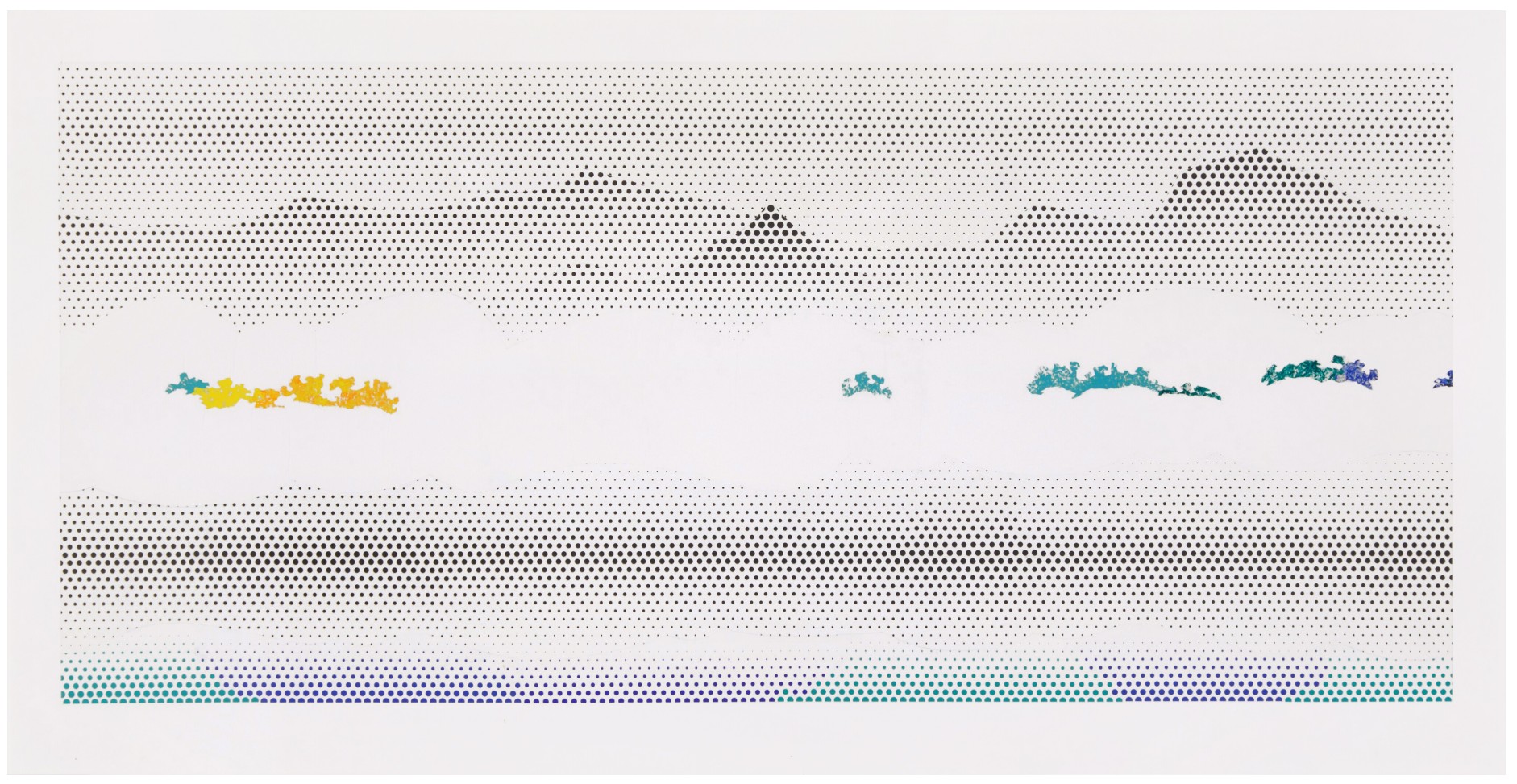
ROY LICHTENSTEIN (1923 – 1997)
Treetops Through the Fog (Study), 1996
Cut printed paper, cut sponge-painted paper, cut paper and graphite on paperboard
Image: 35 1/8 x 76 3/4 inches (89.2 x 194.9 cm)
Paperboard: 42 x 82 3/4 inches (106.7 x 210.2 cm)
Landscape with Silver River (Study), 1996
Works from the Collection of Dorothy and Roy Lichtenstein
Sotheby’s London: 25 June 2025
Estimated: GBP 220,000 – 280,000
GBP 330,200 / USD 445,770
Landscape with Silver River (Study) | Contemporary Day Auction | 2025 | Sotheby’s
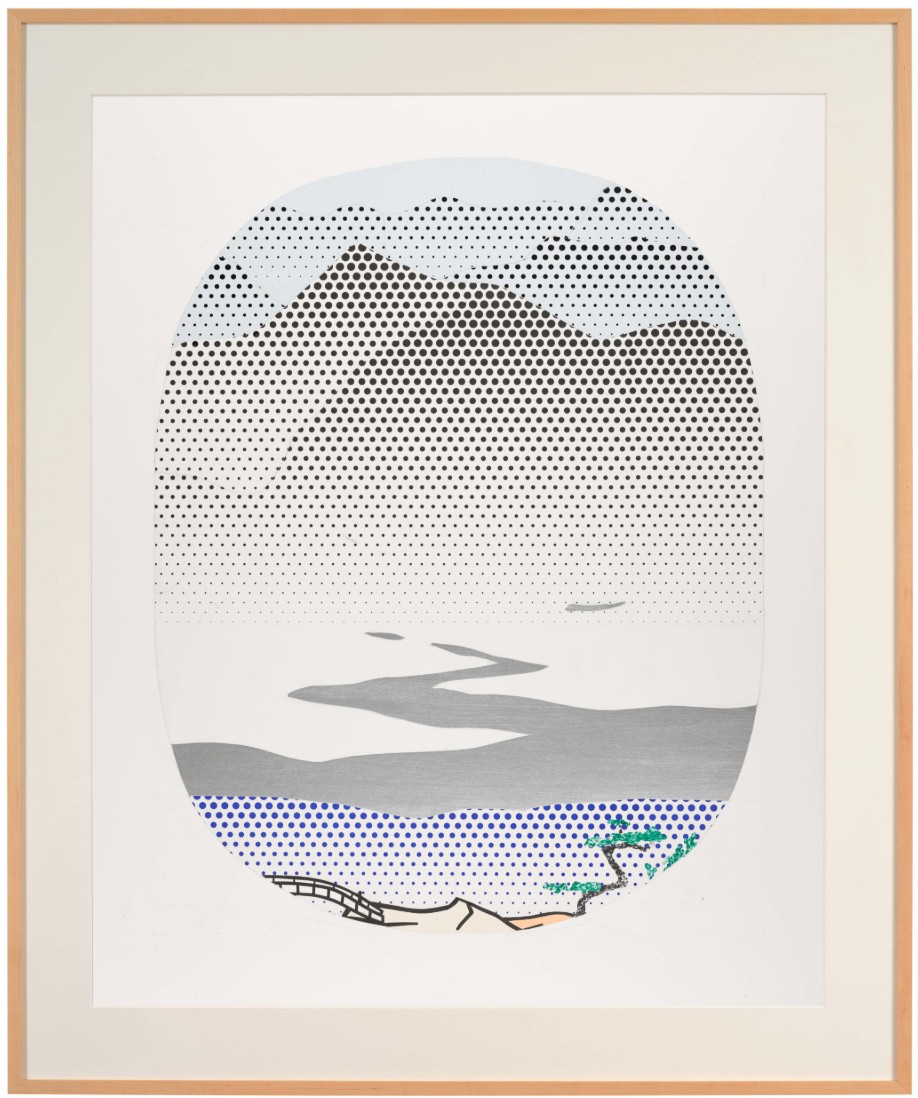
ROY LICHTENSTEIN (1923 – 1997)
Landscape with Silver River (Study), 1996
Acrylic, graphite, tape and paper collage on card
44 3/4 x 36 5/8 inches (113.7 x 93 cm)
Bonsai Tree (Study), 1992
Works from The Collection of Dorothy and Roy Lichtenstein
Sotheby’s Hong-Kong: 28 September 2025
Estimated: HKD 2,000,000 – 3,000,000
HKD 3,048,000 / USD 391,775
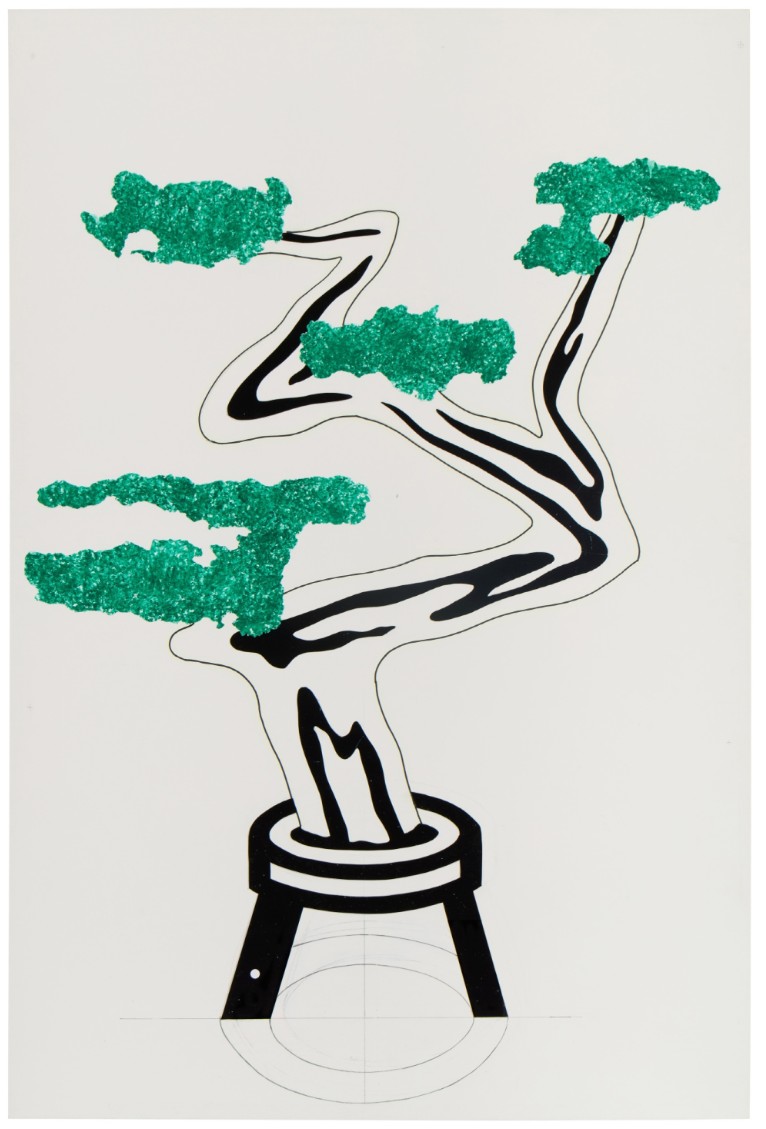
ROY LICHTENSTEIN (1923 – 1997)
Bonsai Tree (Study), 1992
Cut painted paper, acrylic, marker and graphite on foamcore
60 x 40 1/8 inches (152.4 x 101.9 cm)
Signed and dated ‘92 (on the reverse)
Rain Forest (Study), 1991
Reflections on Pop: Works from the Collection of Dorothy and Roy Lichtenstein
Sotheby’s New-York: 26 September 2025
Estimated: USD 500,000 – 700,000
USD 279,400
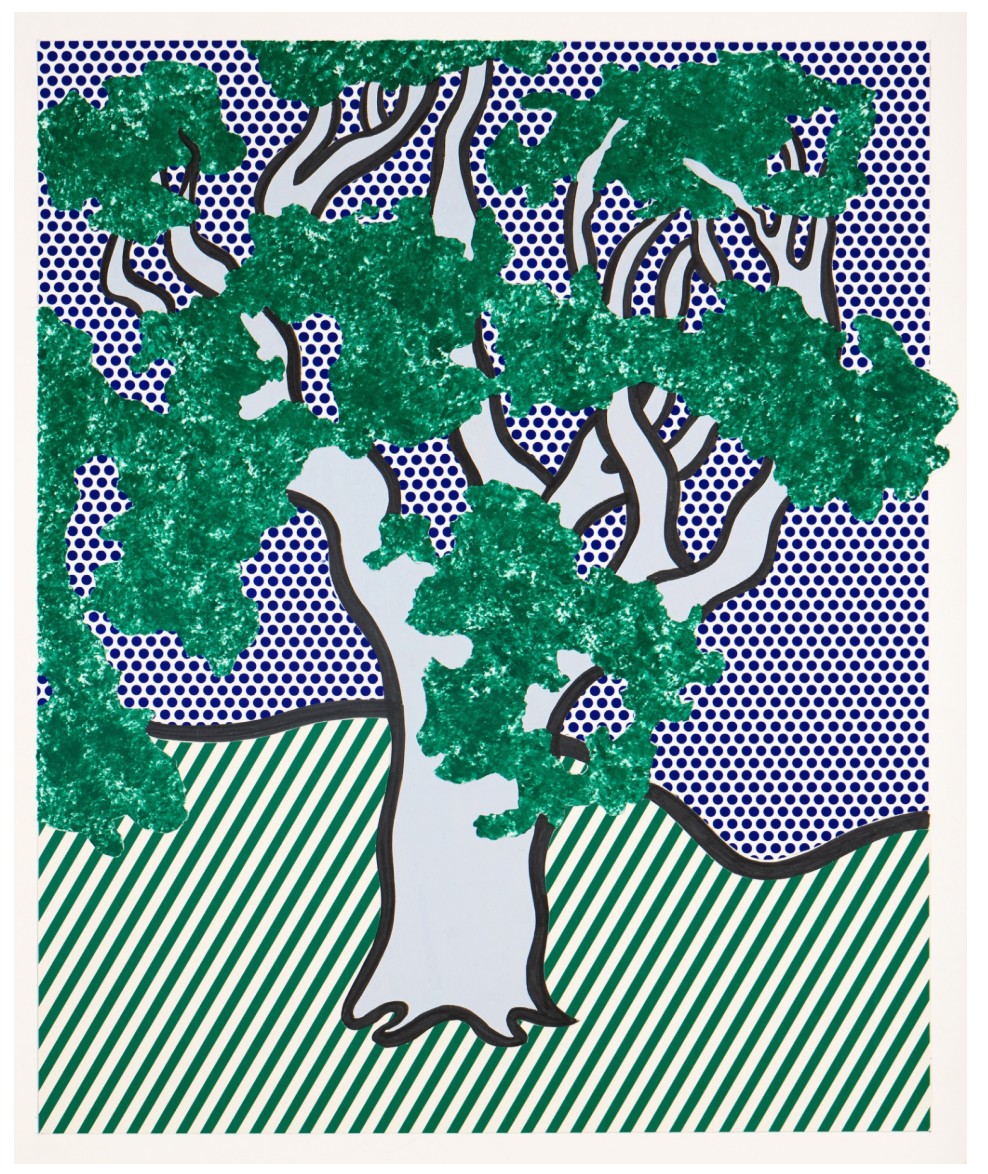
ROY LICHTENSTEIN (1923 – 1997)
Rain Forest (Study), 1991
Cut printed paper, cut painted paper, sponged acrylic, marker and graphite on paperboard
Image: 25 5/8 x 20 3/4 inches (65.1 x 52.7 cm)
Paperboard: 30 x 22 3/4 inches (76.2 x 57.8 cm)
Signed and dated ’91 (on the verso)
PAINTINGS
Landscape with Boats, 1996
Landscape with Boats, 1996
Christie’s New-York: 15 May 2019
Estimated: USD 7,000,000 – 9,000,000
USD 6,267,500
Roy Lichtenstein (1923-1997) (christies.com)
ROY LICHTENSTEIN (1923-1997)
Landscape with Boats, 1996
signed and dated ‘rf Lichtenstein ’96’ (on the reverse)
oil and Magna on canvas
62 x 170 ¼ in. (157.5 x 432.4 cm.)
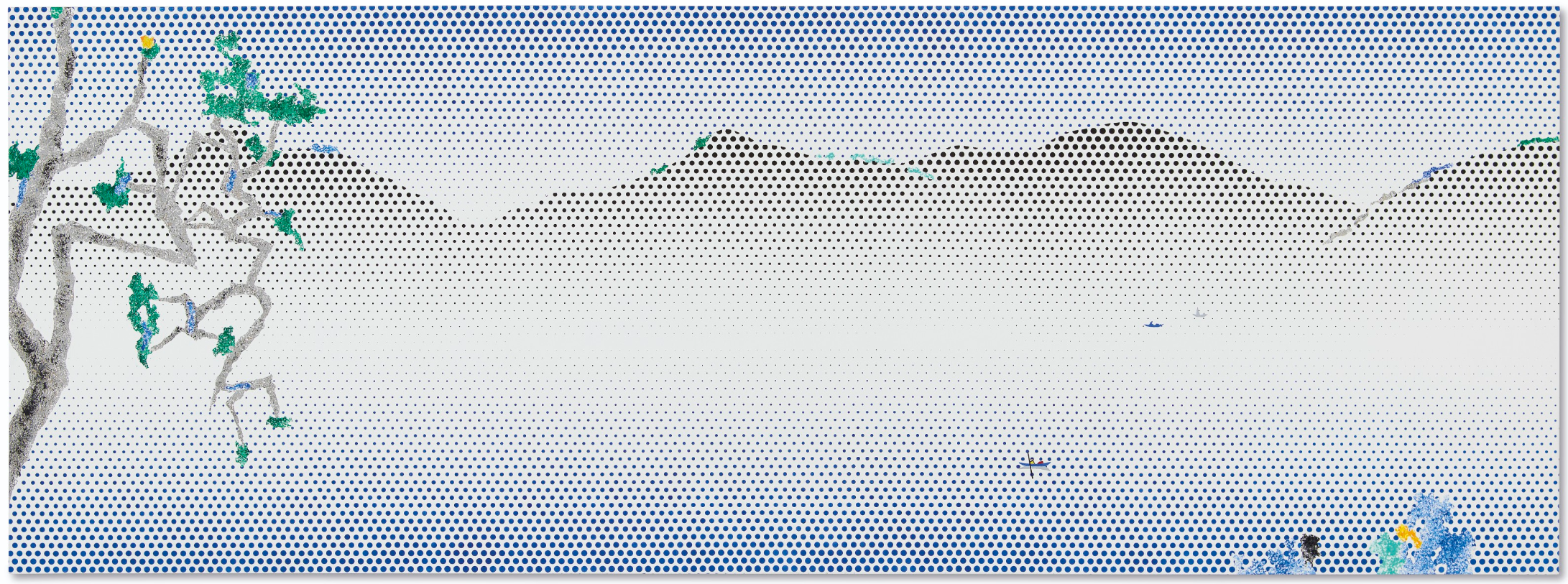
Painted in 1996, Landscape with Boats belongs to an elite grouping from Roy Lichtenstein’s most innovative and insightful years. At once monumental and serene, this sublime painting belongs to the artist’s Landscape in the Chinese Style series—and one of a handful of horizontal “scrolls”—which look to the Chinese master painters from the Song dynasty (960–1279) for stylistic inspiration. Lichtenstein, however, was in reality prompted by Edgar Degas’s 1994 retrospective exhibition at the Metropolitan Museum of Art, New York. The works in this exhibition seemed to suggest to Lichtenstein that the features of a landscape could be achieved with limited, albeit strategic and exacting, swaths of paint. To create this painting, Lichtenstein used his signature Ben-Day dots in methodical concentrations to produce the traces of water, horizon, mountains, sky and depth. Furthermore, Lichtenstein decorated the perimeter of the composition with calligraphic tree branches and leaves to give the viewer the sense they are looking onto an expansive seascape from a high hillside. He added strokes of blue, green and yellow to hint at foliage on the tops of each mountain peak, and also used more exacting geometric shapes to place one boat with two figures in yellow and red in the foreground. Then he painted hazy suggestions of boats in the distance to suggest depth, effectively completing the painting.
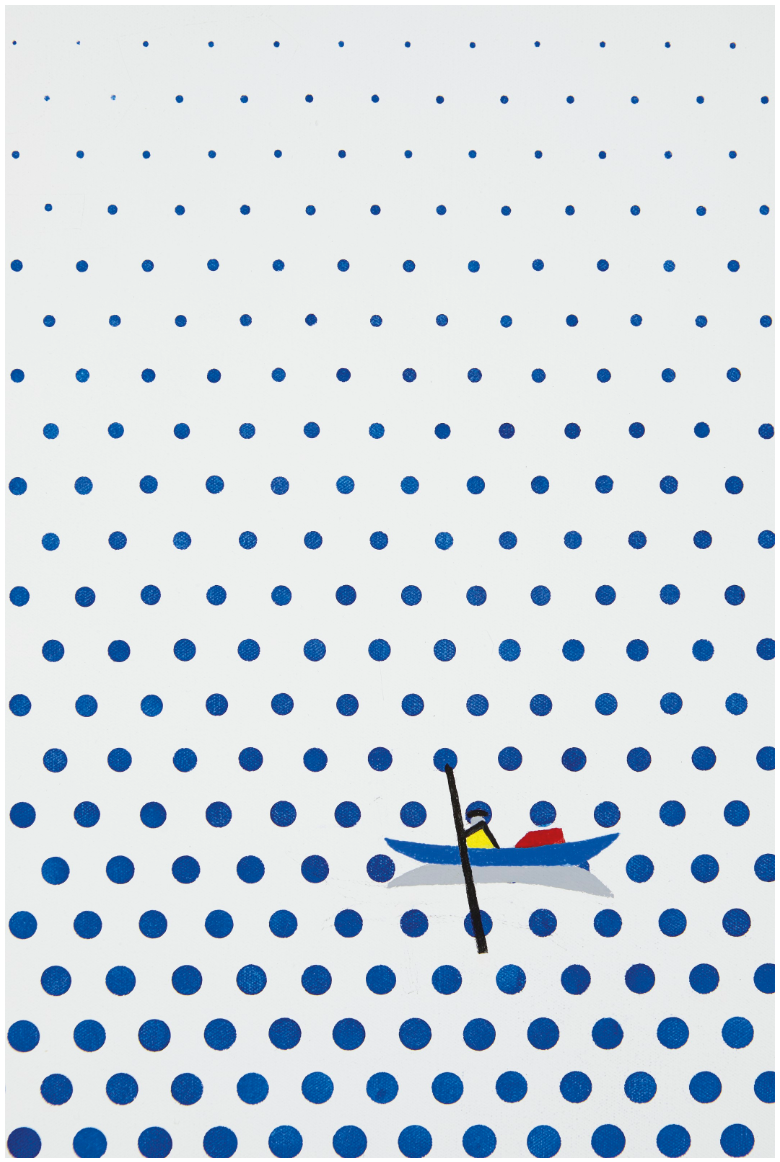
Bold and reverent, Landscape with Boat is distinctly Lichtensteinian. Whereas his artworks from the 1960s duplicated found-comic book imagery to synthesize fine art and Pop culture, Landscape with Boats exemplifies Lichtenstein’s maturity and essential singularity. The key formal components of the artist’s oeuvre—Ben-Day dots and bold colors—are clearly present, yet the harsh black strokes that typically delineate borders are now absent. Instead, Lichtenstein has opted to rely solely on his dots to construct the contours of Landscape with Boats. The artist deconstructs the usual signifiers of his subject—sea, sky and mountains—and reconstructs them by playing with the negative space of the canvas. At a glance, Lichtenstein’s Ben-Days establish depth by utilizing the horizontal plane of this canvas. The more concentrated the dots, the closer the plane—as illustrated by the top and bottom of the canvas. The dots then seem to dissipate towards the middle x-axis to suggest a misty horizon in the distance. However, the mountains tend to obfuscate the perspectives established by the borders. Black dots are concentrated at the tips of each mountain, making it impossible to guess which is closer or farther from the viewer. The true anchoring devices in Landscape with Boats are the gangly tree branches to the left and bottom right-hand corner, as well as the scattered boats towards the misty limits of the water. These instruments, perhaps deliberately, break from Lichtenstein’s conventional methods to teleologically ground the otherwise spatially-liberated composition.
The works from the Landscapes in the Chinese Style, and the present work in particular, borrow this dimensional ambiguity from the Song dynasty masters such as Ma Yuan, Xia Gui, Liang, Kai and Muqi. Their elegant technique demonstrated a harmonious and vast universe suffused with Daoist philosophies which emphasized balance, simplicity, harmony, humility and mindfulness. Xia’s Pure and Remote Mountains and Streams (National Taipei Museum, Taiwan) illustrates such refined candor in the calligraphic execution of the towering mountains and cliffs. This work especially echoes Lichtenstein’s infatuation with Chinese painting. According to Stephen Little, an Asian American Art scholar, these Song artists investigated “the effects of atmosphere with brush and ink in sophisticated and subtle manner, pushing the real and the visible to the edges of abstraction in a way that resonated deeply with Lichtenstein’s own artistic goals” (S. Little, “Landscapes in the Chinese Style,” Roy Lichtenstein: A Retrospective, exh. cat., Art Institute of Chicago, 2013, p. 89).
At the same time, however, Lichtenstein has said “It’s not really what I do—all that subtlety and atmosphere… In my mind, it’s sort of a pseudo-contemplative or mechanical subtlety…” (R. Lichtenstein, quoted in S. Little, “Landscapes in the Chinese Style,” Roy Lichtenstein: A Retrospective, exh. cat., Art Institute of Chicago, 2013, p. 92). In deeming the works from Landscapes in the Chinse Style “pseudo-contemplative,” Lichtenstein harkens back to his earlier 1960s works—indeed, his entire oeuvre—which earned him international acclaim. In paintings such as Drowning Girl (1963, Museum of Modern Art, New York) or Whaam! (1963, Tate, London), Lichtenstein borrows comic book imagery and turns them into “pseudo” comics—indexes of American consumer culture. As his artistic practice matured and he continued to explore popular American culture, Lichtenstein began to play with ideas of representation and seeing. His Brushstroke series from the 1960s took the gestures made by the Abstract Expressionists and deconstructed them—effectively satirizing the movement’s omnipresence in postwar America. Similarly, in Landscape with Boats, Lichtenstein alludes to the West’s long-held fascination with East Asian art and culture. By the 1990s, China’s economy had grown and stabilized, demonstrating the potential to be an economic powerhouse—perhaps reinvigorating the American public’s fascination with the country.
Despite Lichtenstein’s adamant claims of generating a “mechanical” iteration of the Song scrolls, Landscape with Boats offers a version so harmonious and in keeping with Chinese landscape painting. Simultaneously entrenched in Eastern tradition and contemporary Western ideologies, the works in this series are among Lichtenstein’s most sophisticated. They encompass simultaneous opposing forces—old and new, calligraphic and mechanical, East and West. The result is a universally relatable masterpiece by one of Pop’s masters. Perhaps related to Lichtenstein’s decision to engage with Chinese landscape during the 1990s is that China’s own economic and cultural reality was shifting towards a consumer culture due to political reasons. This historical circumstance adds an interesting, mutual relationship between Lichtenstein and China—while the artist imbues Chinese landscapes with his signature style, China began to adapt consumerism, similar to that which acts as the backbone to American Pop Art. Still, one must query why Lichtenstein embarked on Landscapes in the Chinese Style so late in his life, despite his lasting affection for the genre: “I’m thinking about something like Chinese landscapes with mountains a million miles high, and a tiny-fishing boat—something scroll like, and horizontal with graduated dots making these mountains, and dissolving into mist and haze” (R. Lichtenstein, quoted in K. Bandlow-Bata, “Roy Lichtenstein—Landscapes in the Chinese Style,” Roy Lichtenstein: Landscapes in the Chinese Style, exh. cat., Gagosian Gallery, Hong Kong, 2011, p. 8).
Landscape With Grass, 1996
Landscape With Grass, 1996
Property of an Important American Collector
Phillips Hong-Kong: 27 November 2016
Estimated: HKD 25,000,000 – 35,000,000
HKD 35,480,000 / USD 4,574,315
Roy Lichtenstein 20th Century & Contemporary Art & Design Evening Sale
Oil and Magna on canvas
110 1/4 x 38 1/8 inches (279.9 x 96.9 cm)
Signed and dated ‘rF Lichtenstein 96’ on the reverse
“That’s what I’m getting into. I’m thinking about something like Chinese landscapes with mountains a million miles high, and a tiny fishing boat – something scroll like, and horizontal with graduated dots making these mountains, and dissolving into mist and haze. It will look like Chinese scroll paintings, but all mechanical.”
Standing before Roy Lichtenstein’s Landscape with Grass, the viewer is absorbed within a monumental landscape. The picture, towering almost three metres tall, engulfs us. The zig-zagging strands of grass in the foreground lead us in, while the hazy blue forms that ascend the canvas indicate a mountainous landscape that plunges into the distance, gradually dissolving. Down one side of the picture, a light yellow band echoes the mounting techniques used in hanging scrolls in classical China and Japan traditions, although Lichtenstein has playfully allowed one of the blades of grass to trespass onto it, breaching the supposed frame. Painted in 1996, Landscape with Grass, is an outstanding example from Lichtenstein’s series ‘Landscapes in the Chinese Style.’ This was a sequence of large-scale works created in the mid-1990s of which is owned by the Museum of Fine Arts, Boston, while another is in the Metropolitan Museum of Art, New York. This is highly appropriate: it was at an exhibition there that Lichtenstein was initially inspired to explore Chinese landscape painting as a source for this series. The exhibition was actually of Edgar Degas’ landscapes, yet looking at that artist’s pastels and monotypes, which often made use of evocatively minimal marks to convey their views, Lichtenstein was inspired to explore the eloquent restraint of Chinese landscapes as material for his own unique take on art.
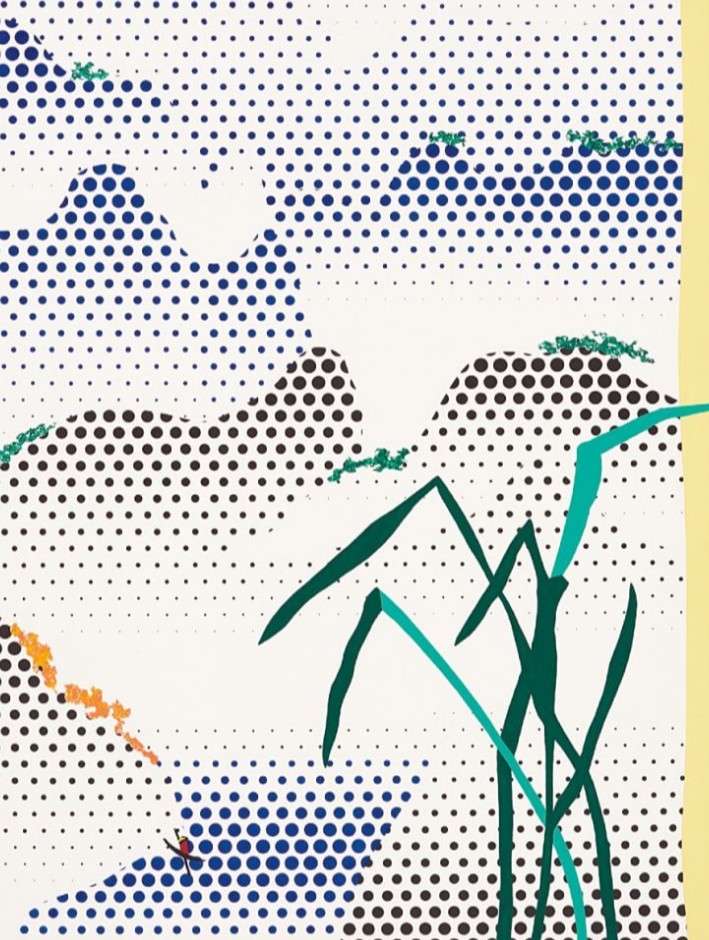
Lichtenstein had a deep interest in Chinese landscape painting, and the wider sphere of Oriental art. As early as 1944—half a century before he painted Landscape with Grass—he wrote to his parents after buying a book on the subject for too much money, betraying his enthusiasm. Over the years, he acquired a number of similar books, and viewed works extensively in museum and private collections. The erudition he gained filtered into Landscape with Grass, which was inspired by pictures from, and influenced by, the Song Dynasty. Lichtenstein’s ability to filter this knowledge through his own unique aesthetic is evident in Landscape with Grass: like the Chinese landscape artists of a thousand years ago, and their later Japanese and Korean disciples, in some areas Lichtenstein has allowed empty areas to evoke layers of cloud, playfully using minimal means to convey meaning. However, he has largely used blue Ben Day dots, shown in different densities and sizes. Lichtenstein thus deconstructs the entire process of making—and reading—pictures. Where the spontaneous brushstrokes of the masters of the Song Dynasty evoked the mountainous landscapes that gave a sense of man’s place within all-engulfing nature, Lichtenstein has provocatively invoked a mock-mechanical process, highlighting the artifice of the entire nature of painting.
In Landscape with Grass, this artifice is reinforced by the mottled dabs of green and yellow, as well as the miniscule, cartoonish image of the man on a boat. These elements all reveal some of Lichtenstein’s process in creating his ‘Landscapes in the Chinese Style’: as the archives reveal, he initially created the composition in a work on paper, before creating a half-size collage, in part making use of painted pieces of paper, echoing the cut-outs of Henri Matisse. The elements of green, yellow and red within Landscape with Grass, including the titular foliage itself, serve as a foil to the mechanical-seeming dots, introducing texture and a deceptive air of spontaneity.
“I think [the Chinese landscapes] impress people with having somewhat the same kind of mystery [historical] Chinese paintings have,
but in my mind it’s a sort of pseudo-contemplative or mechanical subtlety…
I’m not seriously doing a kind of Zen-like salute to the beauty of nature.
It’s really supposed to look like a printed version.”
In Landscape with Grass, Lichtenstein’s techniques—both the dots and the more speckled flashes of color, deceive and enlighten the viewer. We read the landscape, yet see the methods of its construction, never quite suspending our disbelief. In presenting the viewer with such a monumental, absorbing vista, Lichtenstein plays with associations of contemplation, of the viewers losing themselves within the expanse of the mist-enshrouded mountains. Lichtenstein was aware that, for many viewers, his own Chinese landscapes were seductive enough to achieve a similar effect to their Song Dynasty precursors.
Vista with Bridge, 1996
Vista with Bridge, 1996
Works from The Collection of Dorothy and Roy Lichtenstein
Sotheby’s Hong-Kong: 28 September 2025
Estimated: HKD 28,000,000 – 35,000,000
HKD 30,875,000 / USD 3,968,510
ROY LICHTENSTEIN (1923 – 1997)
Vista with Bridge, 1996
Acrylic, oil and graphite on canvas
75 x 178 1/4 inches (190.5 x 452.8 cm)
Signed and dated ’96 (on the reverse)
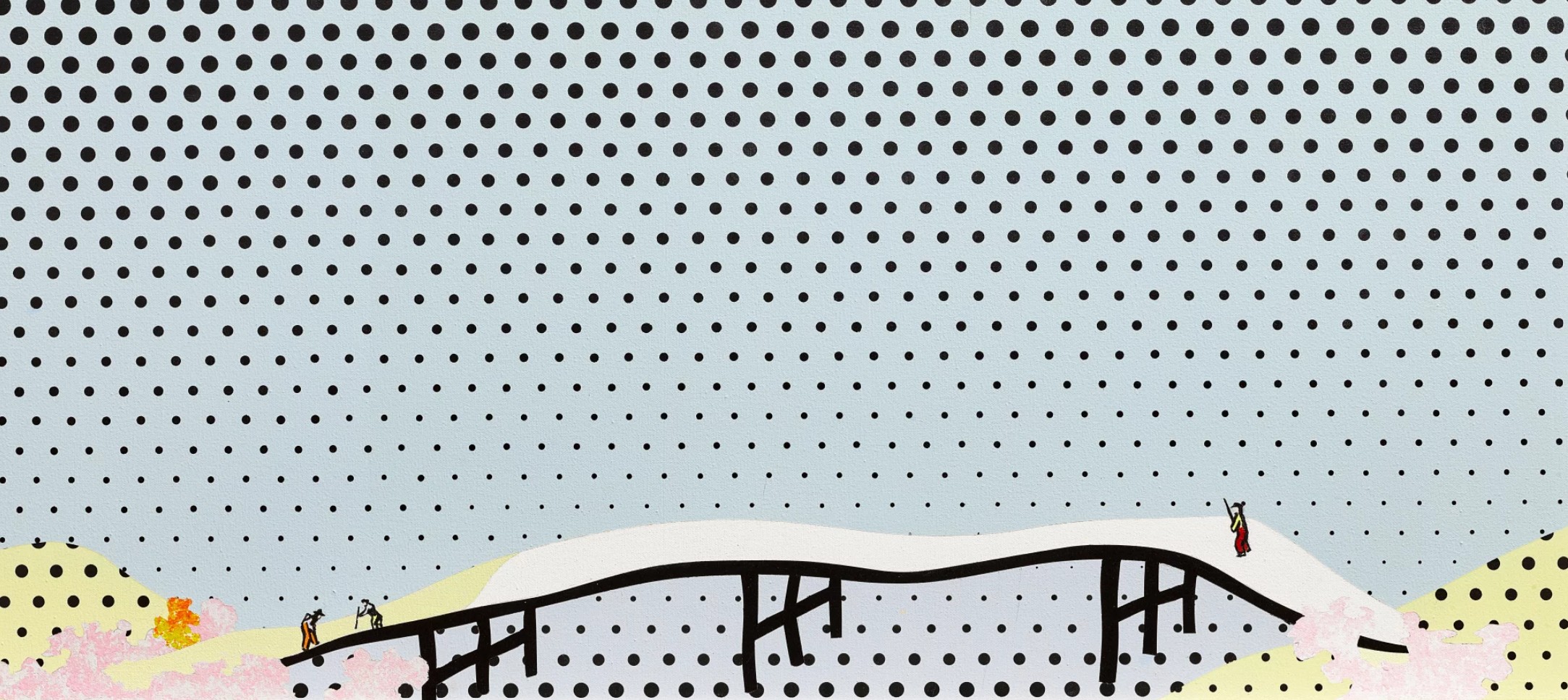
Majestic and tranquil, Vista and Bridge is a paragon of the final series of Roy Lichtenstein’s prolific oeuvre, one that embodies the extraordinary marriage of cross-cultural influences, exacting painterly skill and superlative Pop sensibility that defines the best of the artist. Executed in 1996, the present work is part of Landscapes in the Chinese Style, a series created between 1991 and 1997, comprising twenty-one paintings, two prints, two sculptures, and numerous preparatory works including drawings, sketches and collages. Testament to the importance of this late body of work, key examples reside in the permanent collections of institutions such as the Hirshhorn Museum and Sculpture Garden, Washington, D.C., and The Metropolitan Museum of Art, New York. Vista and Bridge has been featured in numerous international exhibitions, including the Louisiana Museum of Art, the London Hayward Gallery, Museo Nacional Centro de Arte Reina Sofía in Madrid, and Museum Ludwig in Cologne, to name but a few.
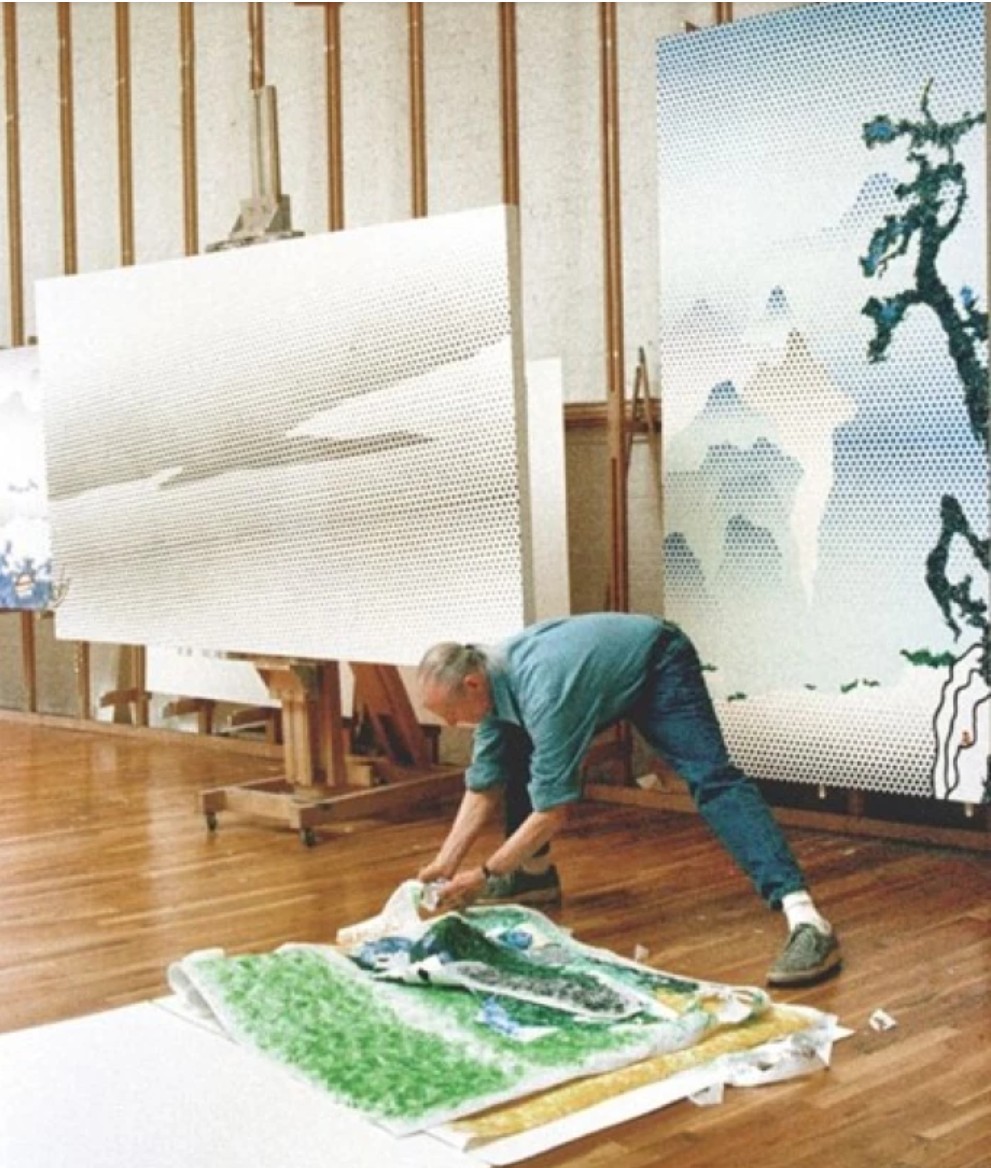
Artist in his studio © Estate of Roy Lichtenstein
Lichtenstein’s interest in Chinese art dates back to the late 1940s, when he was stationed in London during World War II. The twenty-one-year-old Lichtenstein wrote home to his parents:
“I bought a book on Chinese painting, which I could have gotten in New York half the price. I’ll probably send it home with my collection of African masks, as my duffle bag now weighs more than I do, with all the art supplies.”
Later, when Lichtenstein returned to Ohio State University to complete his undergraduate and graduate degrees after the war, he enrolled in classes on East Asian art history. Decades later, it was a pivotal moment in 1994 that would trigger Lichtenstein’s return to the landscape genre in 1995. His encounter with the monotype and pastel landscapes of Edgar Degas at the Metropolitan Museum of Art, New York, inspired him to explore the representational potential of monochromatic shapes, using his signature Ben-Day dots to render serene landscapes that play with perceptions of depth and scale.

“I am thinking about something like Chinese landscapes with mountains a million miles high, and a tiny fishing boat—something scroll-like, and horizontal with graduated dots making these mountains, and dissolving into mist and haze. It will look like Chinese scroll paintings, but all mechanical.”
Summarized in this horizontal vista, akin to a rolling scroll, are all the stereotypes associated with Chinese landscape painting in the West. The continuous, crescent-shaped mountain range recedes into the billowing clouds and mist, while three figures cross a bridge at the foreground, flanked by sponged-on plantations.
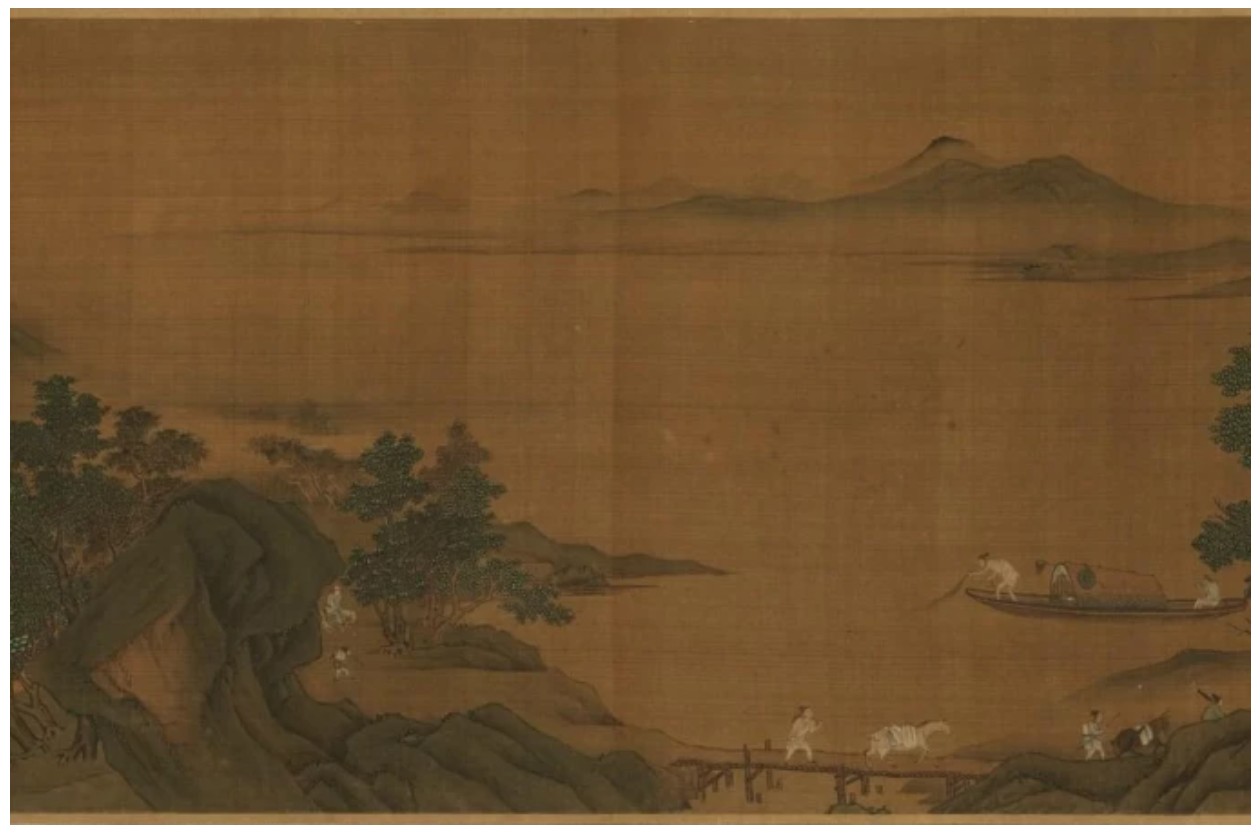
Song Yanwen, Travelling in the Autumn Mountains, 1195, Collection of National Palace Museum, Taipei . An example of one-corner composition is a distinctive feature of Southern Song landscapes, which the Vista and Bridge recalls.
Vista and Bridge recalls the transient landscapes painted by Ma Yuan, a master from the Southern Song Dynasty who is known for his innovative compositions and use of negative space, such as the distinctive one-corner composition, which involves placing the main subject of the painting in one corner of the composition, leaving the rest of the space empty or filled with mist or water. The vastness of nature in both Song works and Lichtenstein’s renditions is heightened by the inclusion of tiny details such as a pine tree, a bridge or a scholar’s rocks. Lichtenstein’s virtuosity is reflected in his meticulous mastery of the technical approach, which recreates the ephemeral quality achieved by traditional Chinese brushwork through the varying sizes and densities of his Ben-Day dots.
“I think [the Chinese landscapes] impress people with having somewhat the same kind of mystery [historical] Chinese paintings have, but in my mind it’s a sort of pseudo-contemplative or mechanical subtlety. . . . I’m not seriously doing a kind of Zen-like salute to the beauty of nature. It’s really supposed to look like a printed version.”
Throughout his career, Lichtenstein engaged with the work of other artists and cultures, continually reinterpreting historical styles and traditions. From comic books and advertising to Cubism and Expressionism, Lichtenstein’s oeuvre is marked by his ability to interpret and reimagine images through his signature visual lexicon. His landscapes, a recurring theme, culminated in this remarkable final series. Landscapes in the Chinese Style continues this lifelong engagement, honoring a revered visual tradition whilst continuing to push his career into new grounds. The present work demonstrates the culmination of Lichtenstein’s prolific practice and how his understanding of the past helped him create one of the most technically ambitious series of his oeuvre.
Landscape with Silver River, 1996
Landscape with Silver River, 1996
Sotheby’s New-York: 28 October 2020
Estimated: USD 3,000,000 – 5,000,000
USD 3,650,000
ROY LICHTENSTEIN (1923 – 1997)
Landscape with Silver River, 1996
Oil and Magna on canvas
83 1/4 x 66 5/8 inches (211.5 x 169.2 cm)
Signed and dated ’96 on the reverse
Monumental and serene, Landscape with Silver River elegantly embodies the extraordinary marriage of cross-cultural influences, exacting painterly skill, and, above all, the superlative Pop sensibility that defines the very best of Roy Lichtenstein’s celebrated oeuvre. Executed in 1996, the present work belongs to a powerful series of works inspired by Song dynasty painting, Landscapes in the Chinese Style; painted in the year preceding the artist’s death, this group of paintings represent Lichtenstein’s final series. Simultaneously grand and subtle, bold and sublime, Lichtenstein here uses his signature Pop technique and irreverent sense of humor, both to pay homage to a cultural tradition, and to shed light upon the frequent generalization of Eastern motifs by Western painters for centuries. Acquired directly from the artist’s studio and held in the prestigious private collection of Douglas S. Cramer for over two decades, Landscape with Silver River is an enduring testament to Lichtenstein’s wholly unique ability to engage and form aesthetic conversations with the work of other artists and cultures – rearticulating their significance, their power, and their beauty within his own lexicon of crisp dots, sleek contours, and stunning Pop finesse.
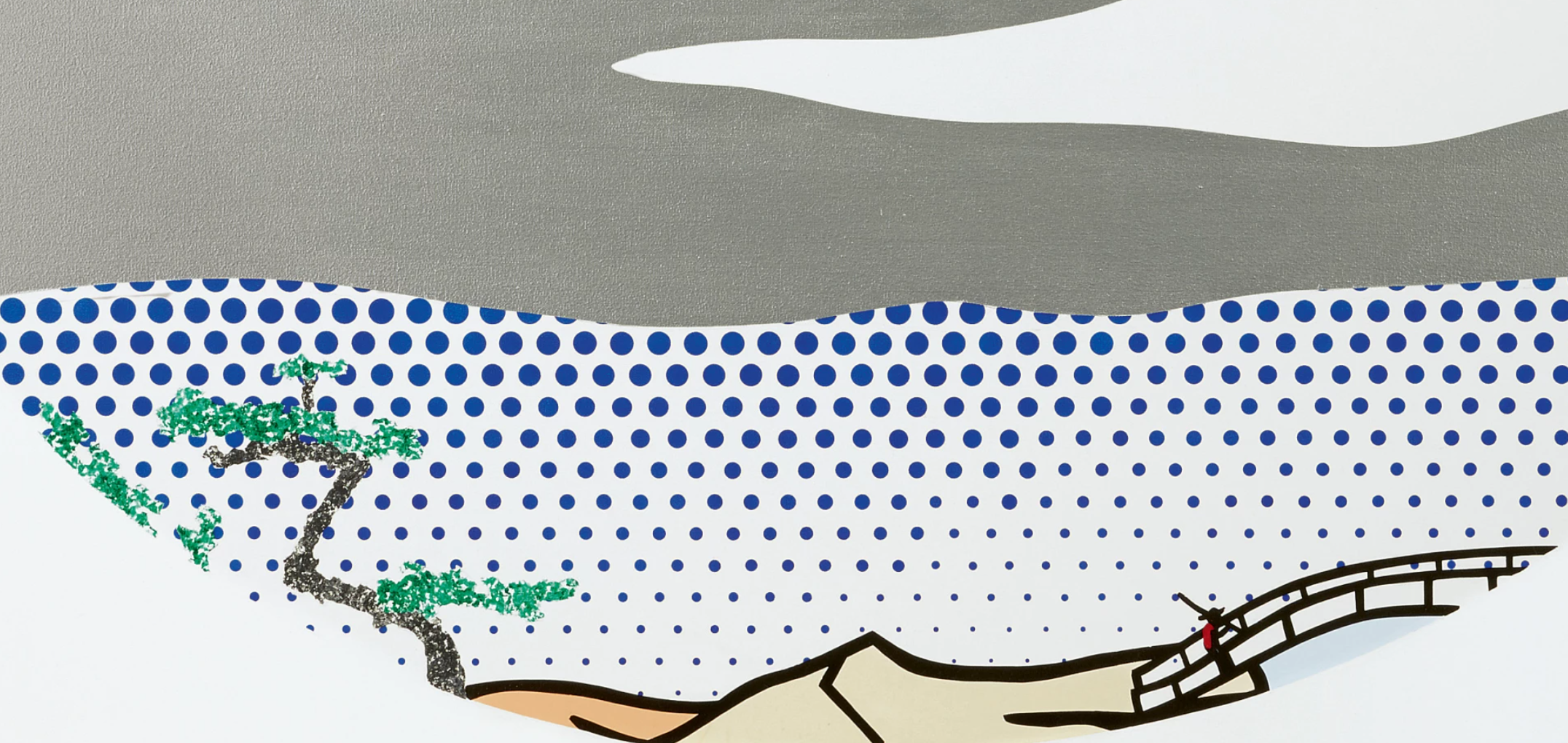
In Landscape with Silver River, at nearly seven feet tall, the floating painted oval acts as a portal to a serene world. The viewer may be a giant beside the miniscule figure in the bottom, placed like an afterthought in that grand space, but the mountains will tower over nearly everyone who stands before them. Lichtenstein plays with the spatial ambiguity that characterized Song painting, using many different sizes of Benday dots to create a beguiling illusion of atmosphere similar to the ancient originals he studied. Smaller, more concentrated dots, which usually indicate distance, float at the base of the mountains, while larger ones form the peaks, to disorienting effect.
“That’s what I’m getting into… It will look like Chinese scroll paintings,
but all mechanical.”
Beneath this range snakes the metallic silver river, which writhes through negative space only to end right at the base of the dotted mountains. Below it, in the very bottom of the oval, are the only hints of Lichtenstein’s signature bold colors: blue, green, a strip of red. Bright blue Benday dots form a surreal sky beneath the silver river. Two Western stereotypes of Chinese art—the crooked bonsai tree and the conical hat on the red-clothed figure—are the only signs of life in this mystical, mechanical landscape. Landscape with Silver River is a timeless masterpiece by one of the greatest Pop artists in history, whose understanding of the past helped him create one of the most technically ambitious works of his oeuvre.
Flower with Bamboo, 1996
Flower with Bamboo, 1996
A Legacy Reimagined: Works from the Collection of Dorothy and Roy Lichtenstein
Sotheby’s New-York: 18 November 2025
Estimated: USD 2,000,000 – 3,000,000
USD 1,514,000
Flower with Bamboo | The Now & Contemporary Evening Auction | 2025 | Sotheby’s
ROY LICHTENSTEIN (1923 – 1997)
Flower with Bamboo, 1996
Acrylic, oil and graphite on canvas
77 x 66 1/8 inches (195.6 x 168 cm)
Signed and dated ‘96 (on the reverse)
Like many of Roy Lichtenstein’s great works, Flower with Bamboo is an exercise in multiplicity. Straddling lines of East and West, landscape and abstraction, and ancient and modern, the present work exemplifies the artist’s career-long synthesis of cross-cultural influences and astringent commentary on contemporary iconography through his singular Pop sensibility. Simultaneously majestic and subtle, whimsical and refined, Lichtenstein employs his distinctive Pop technique and irreverent inquiry both to pay homage to the traditions of Chinese landscape painting and to illuminate the frequent generalization of Eastern motifs by Western artists for centuries.
Ceaselessly evolving and responding to the annals of art history, Lichtenstein, in his final decade, turned his focus to East Asian art, developing a series of paintings, collages, works on paper and sculptures inspired by the visual tropes of East Asian art in the Western imagination. In this penultimate series, Landscapes in the Chinese Style, Lichtenstein employed his Pop sensibility to render enchanting landscape scenes convey the graphic gravitas of his comic-like compositions with the elegant beauty of East Asian landscape painting.
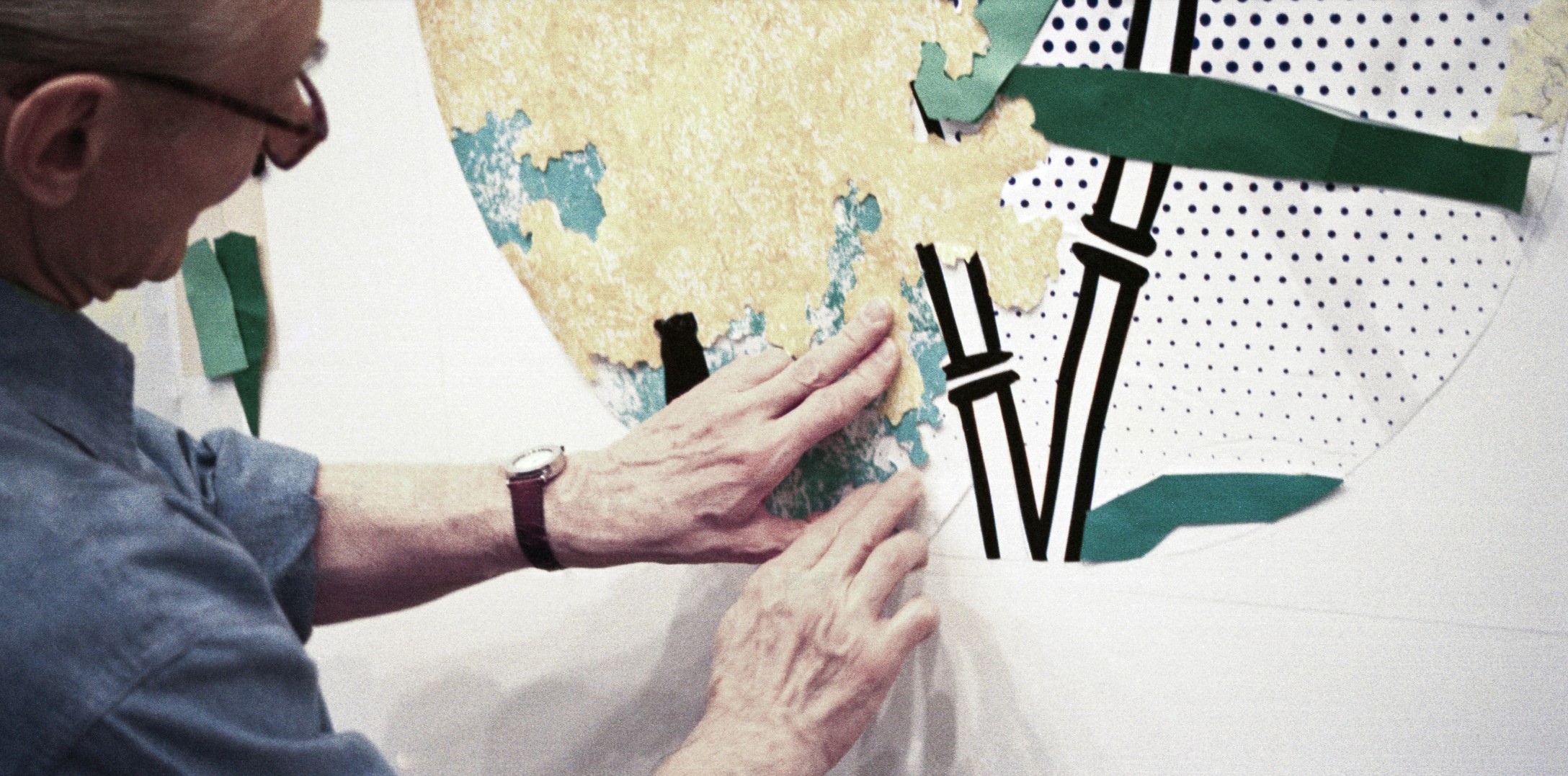
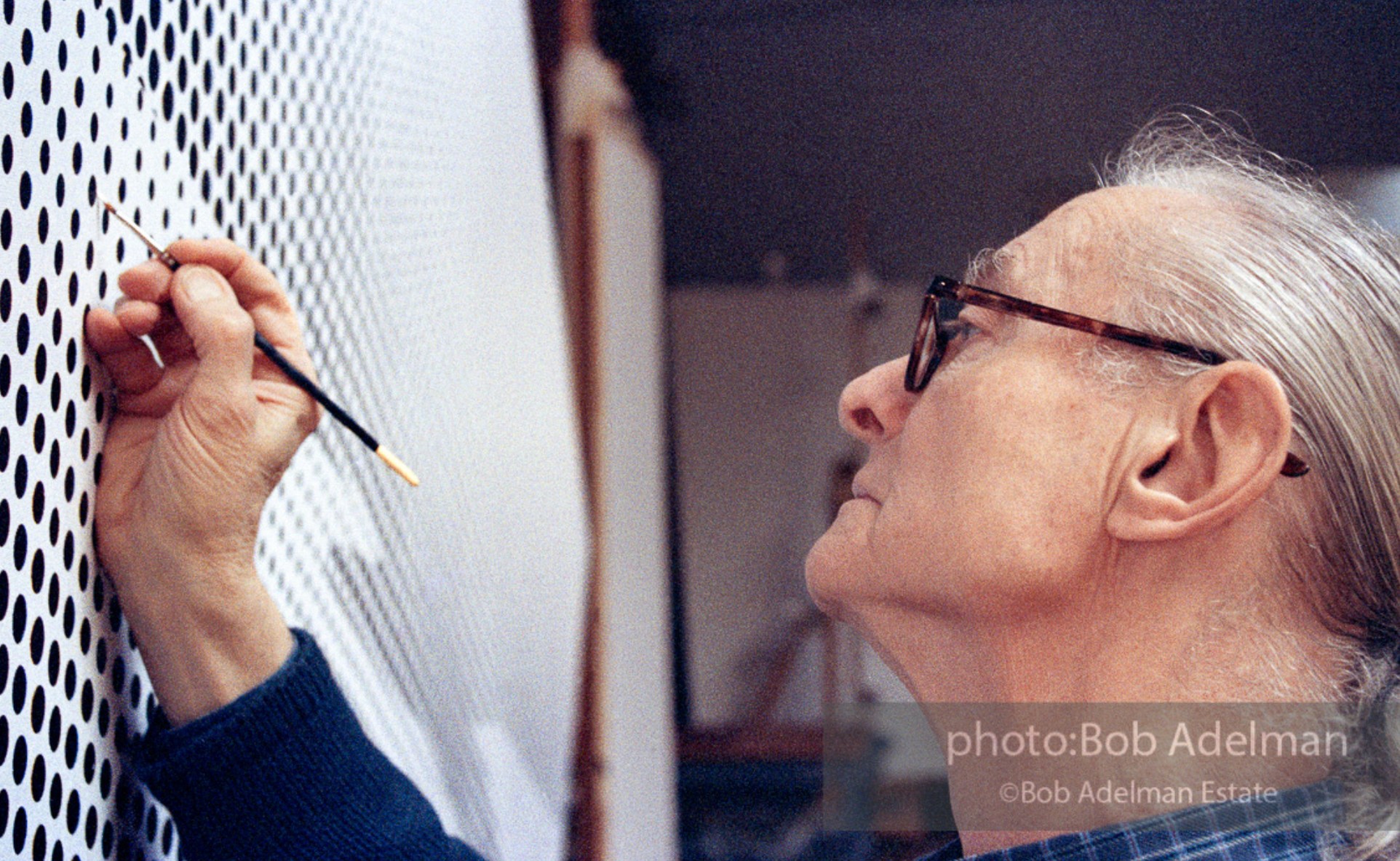
Roy Lichtenstein in his studio working on the study for the present work. Image © Bob Adelman. Art © Estate of Roy Lichtenstein
Flower with Bamboo, in many ways, is classically Lichtenstein: between the Ben-Day dots, bold contour lines, and Pop art quintessential flatness, the modern master’s hand is instantly recognizable in the present work. However, unlike his comic-book-inspired compositions of the 1960s, rendered in bright primary colors, Lichtenstein here draws inspiration from the natural landscape and the cool tones of iconic landscapes. Lichtenstein’s interest in Chinese art in the 1990s began almost five decades prior. Stationed in London during World War II, twenty-one-year-old Lichtenstein wrote home to his parents:
“I bought a book on Chinese painting, which I could have gotten in New York half the price. I’ll probably send it home with my collection of African masks, as my duffle bag now weighs more than I do, with all the art supplies.”
Later, when Lichtenstein returned to Ohio State University to complete his undergraduate and graduate degrees after the war, he enrolled in classes on East Asian art history.
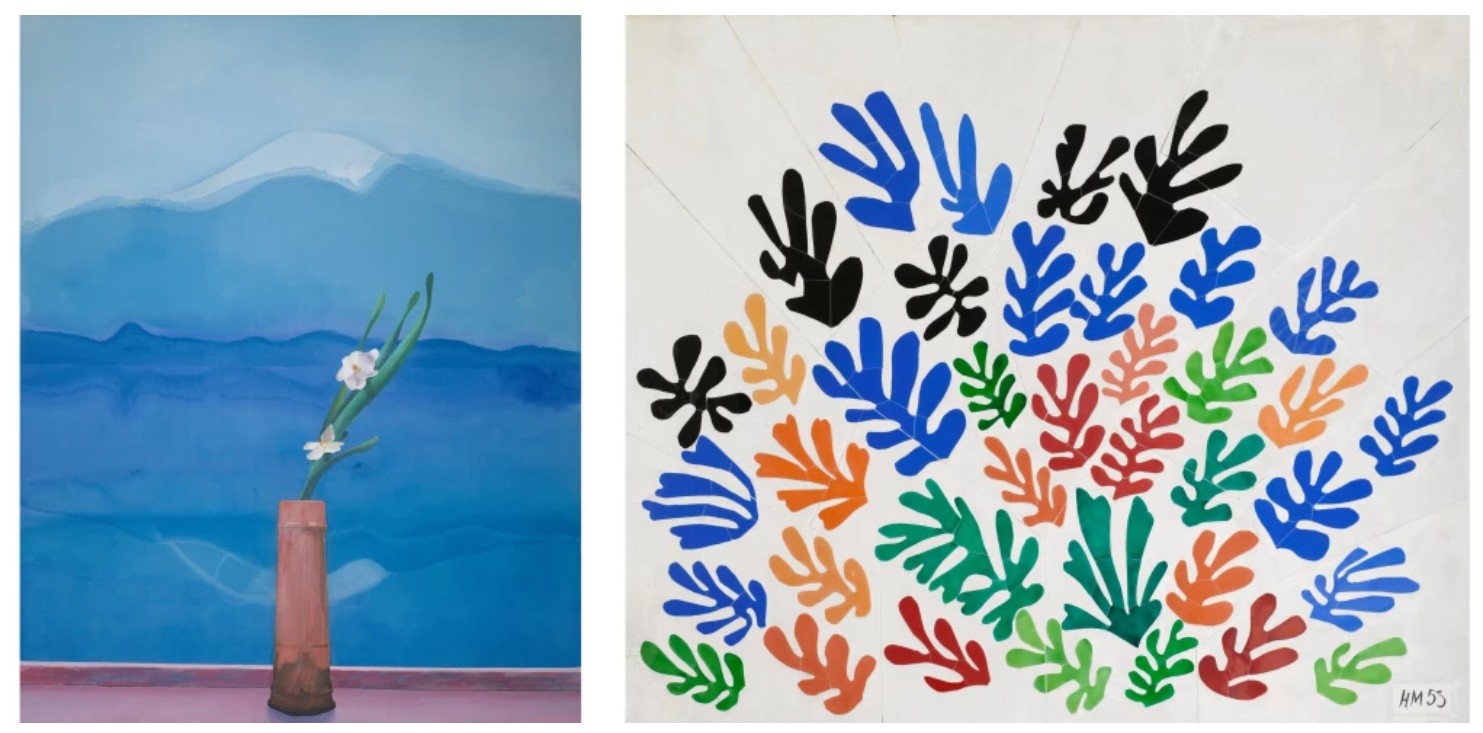
Left: David Hockney, Mount Fuji and Flowers, 1972. The Metropolitan Museum of Art, New York. Image © The Metropolitan Museum of Art / Art Resource, NY. Art © 2025 David Hockney. Right: Henri Matisse, La Gerbe, 1953. Los Angeles County Museum of Art, Los Angeles. Image © 2025 Museum Associates / LACMA. Licensed by Art Resource, NY. Art © 2025 Succession H. Matisse / Artists Rights Society (ARS), New York
And in 1994, after visiting an exhibition of Edgar Degas’ landscapes and Song Dynasty prints at the Metropolitan Museum of Art, Lichtenstein embarked on a series of paintings dedicated to the subject. He became particularly fascinated by their atmospheric qualities and the way nonfigurative shapes coalesce into representational forms.
“The thing that interested me was the mountains in front of mountains in front of mountains, and huge nature with little people… We all have a vague idea of what Chinese landscape look like—that sense of grandeur the Chinese felt about nature.”
In the present work, a spray of golden flowers and two spindling stalks of bamboo consume the front of the picture plane. Behind them, the composition dissolves into a haze of Ben-Day dots, suggesting the vast expanse beyond.
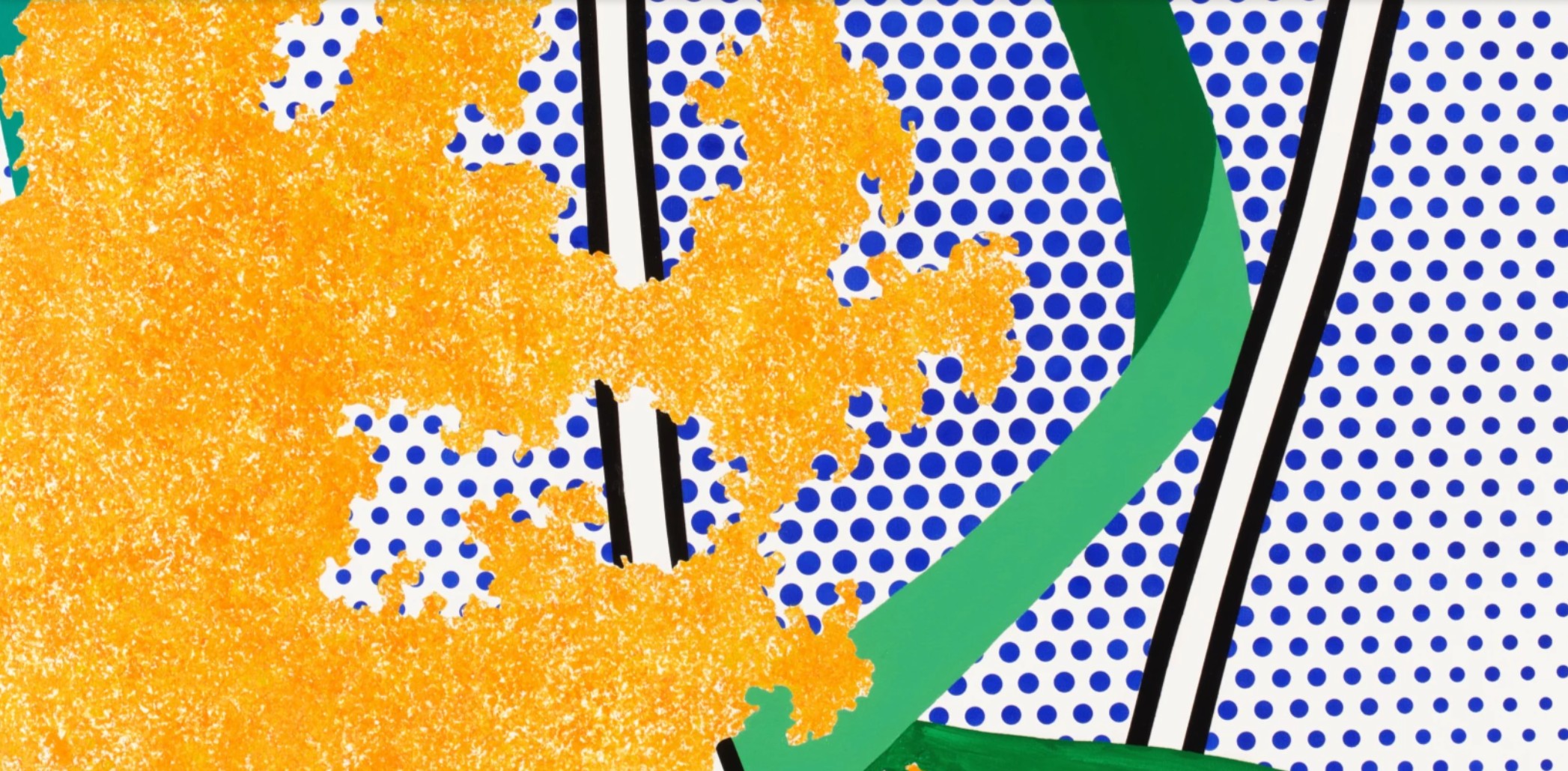
Ever the student of art history, Lichtenstein was constantly inspired by the iconography of other artists—the still life paintings of Pablo Picasso, the water lilies of Monet—creating his own versions replete with Ben-Day dots, flat planes of color and bold black outlines. The liveliness of Lichtenstein’s shapes that playfully extend across the work call to mind the organic shapes of Matisse’s Le Gerbe; like Matisse, who synthesized the curvature of various flora into spirited abstractions, Lichtenstein distills the features of stalks and petals into purely essential visual language. Here, the ovular vignette of the canvas and the geometric, bold diagonals of the bamboo evoke Cubist compositions. Like the Cubists, Lichtenstein toys with depth of field in the present work, synthesizing the foreground and background and eschewing traditional perspective.
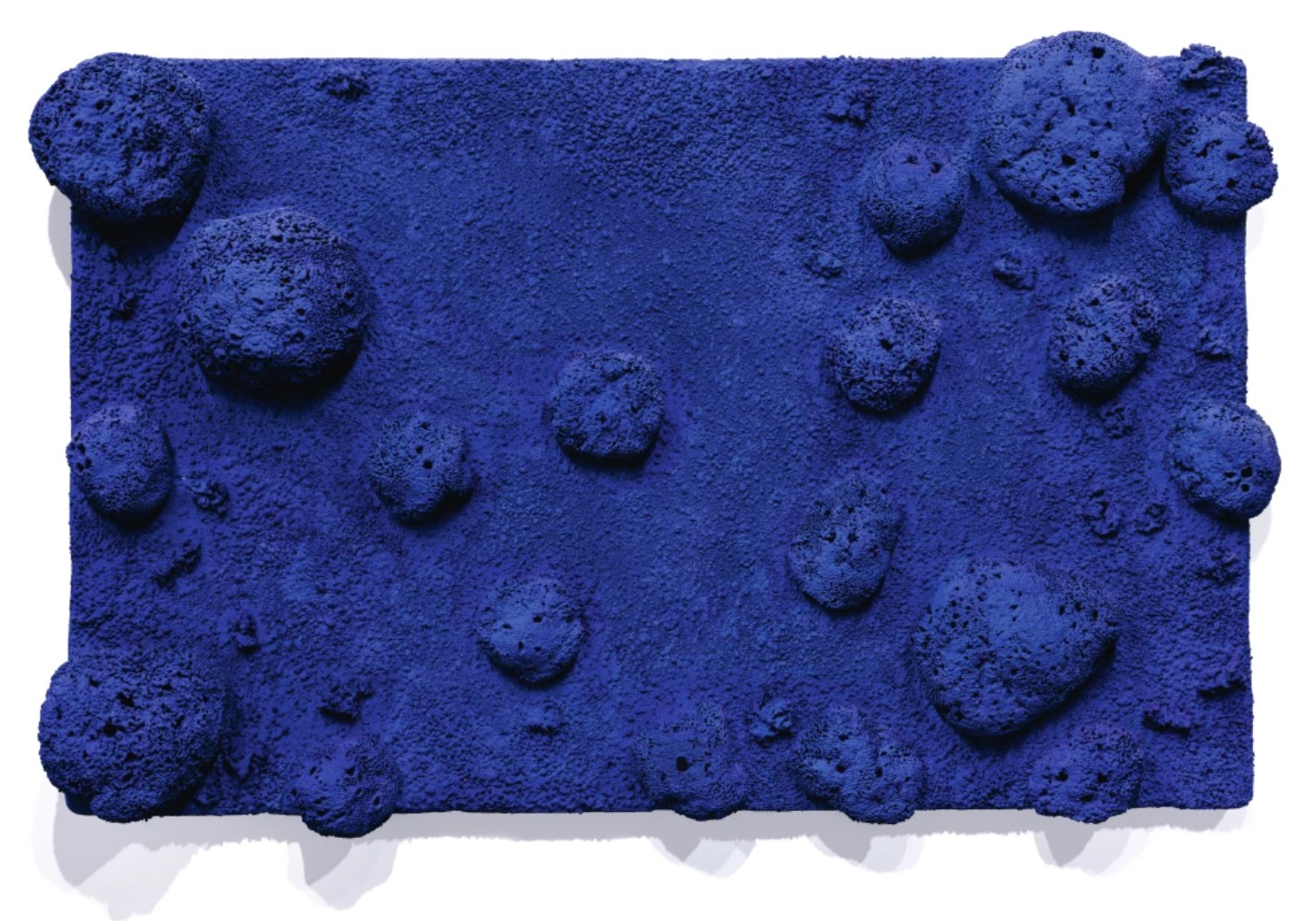
Yves Klein, Relief Éponge bleu sans titre (RE 28), 1961. Private Collection. Sold at Sotheby’s New York in November 2024 for $14.2 million. Art © 2025 Artists Rights Society (ARS), New York / ADAGP, Paris
The cluster of blue dots in the background dissipate towards the edges of the composition, evoking the sky reaching towards a horizon. Ribbon-like leaves twist across the composition, further confounding the depth of field and sense of scale. Lichtenstein here also blends his signature segments of flat pigment with irregular areas of sponge application, suggesting a dense mass of flowers or leaves. The resulting composition is both disorienting and meditative; it is seemingly familiar and yet completely abstract. This duality—depth and shallowness, high art and mass media—characterizes much of Lichtenstein’s oeuvre. Unique among the Chinese Style Landscapes in its perspective, Flower with Bamboo even resists characterization as a landscape. While the other entries in the series feature wide vistas and fog-covered mountains, Flower with Bamboo is much tighter, almost like a precisely arranged still life. Nevertheless, in the space created by the stalks of bamboo, a sense of scale emerges. The viewer peers out from behind the branches and is left to imagine what lies beyond. Indeed, Lichtenstein’s paintings are the product of imagination and fantasy rather than representations of reality.
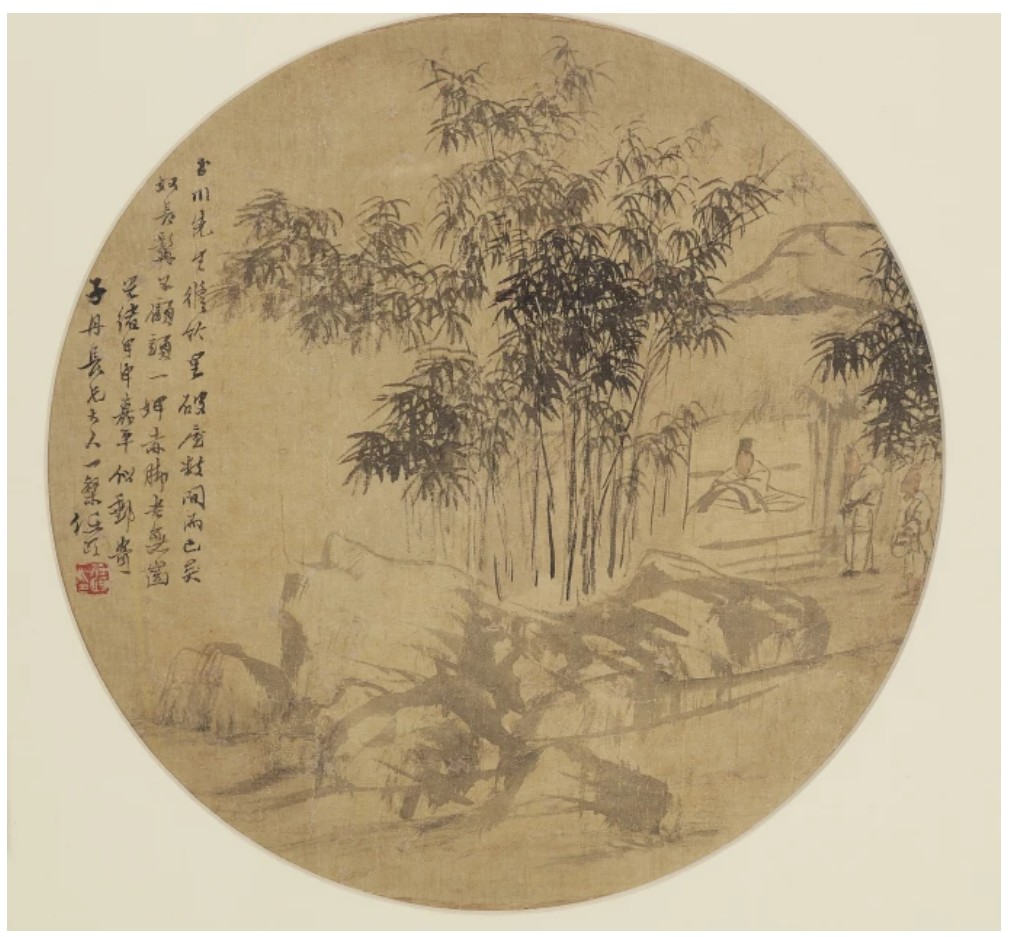
Fan Painting – Landscape, 19th century. Ashmolean Museum, University of Oxford.
Image © HIP / Art Resource, NY © Ashmolean Museum, University
Lichtenstein’s Landscapes in the Chinese Style provide a commentary on the juxtapositions of East and West, or rather the ways in which the West imagines the East. Just as Lichtenstein’s earlier work provides a wry commentary on consumption of American popular imagery, here, he explores the popularization and reproduction of Asian art in Western culture. Lichtenstein’s work critiques a view of Asian art as monolithic, creating compositions with a mechanical quality in contrast to the intimacy of the prints by which he was inspired. The title of the series underscores this perspective—it is, of course, impossible to distill centuries of work across a vast geography under a single definition.
STUDIES
Landscape with Poet (Study), 1995
Landscape with Poet (Study), 1995
Property of an Important American Collector
Phillips Hong-Kong: 26 November 2017
Estimated: HKD 4,500,000 – 6,500,000
HKD 8,140,000 / USD 1,042,585
Roy Lichtenstein 20th Century & Contemporary Art & Design Evening Sale
ROY LICHTENSTEIN
Landscape with Poet (Study), 1995
Tape, painted paper, and printed paper on board
84×30 inches (213.4 x 76.2 cm)
Signed and dated ‘rf Lichtenstein 95’ on the reverse
A product of a half-century long love affair with classical Chinese art, Roy Lichtenstein’s Landscapes in Chinese Style is one of the famed Pop-Art pioneer’s most nuanced, analytical and breathtaking series of productions. Despite his long-standing interest in the subject matter, the inspiration for its genesis came from the Degas Landscapes exhibition at the Metropolitan Museum of Art New York, held in 1994. There Lichtenstein became fascinated with the idea that amorphous, monochromatic shapes could actually be representational, despite their non-figurative nature. However it was the palpable atmosphere of these monotypes which drew Lichtenstein to make links to Chinese landscape painting – ultimately acting as the catalyst for the creation of the present lot.
In Landscape with Poet, the artist reminds us of his wholly unique ability to engage and form aesthetic conversations with the work of other artists and cultures – reappropriating them within his own lexicon of dots, black contours and monochromatic zones. Within the Landscapes in Chinese Style series, this image of Landscape with Poet is one of the earliest known examples of vertical paintings that the artist had drafted. It became realized as a series of studies that include a graphite and coloured pencil version (1994), the present lot (1995), as well as a lithograph and screenprint version of an edition of 60 (1996). Differing from the other two versions, this lot is a unique, fully realized, complete artwork, composed of a multi-layered collage of tape, painted and printed paper on board where the artist’s synthetic process becomes clear upon closer inspection. Such use of painted pieces of paper echoes the techniques and materials used by Henri Mattise, in the creation of his famed ‘cut-outs’. Lichtenstein then evokes comparisons to classical Chinese masters, such as Mu Qi and Guo Xi through an intricate matrix of graduated “Benday dots” – stenciled meticulously in order to give the illusion of the image being printed, with the intention of rendering the work mechanical. The juxtaposition of the hand-crafted quality of this present lot, with Lichtenstein’s intention of creating a mechanical-looking outcome of the work is evident here. Diverging and converging in alternate areas, Lichtenstein creates a sensuous perception of depth as well as a serene atmosphere of a transcendental realm, employing extraordinary gentleness largely uncommon to his oeuvre. Although the genre of landscapes was one of the first that the artist interpreted within his archetypal comic-book style of production, Chinese landscape painting allowed Lichtenstein to approach previously-explored notions of compositional principles and visual concepts from a broadened perspective, and therefore acting as a vehicle for creative reinvention during what were to be the last years of the artist’s life.
Having attended lectures on Eastern Art history during his time at university, Lichtenstein would have been exposed to the landscapes of the Song Dynasty (960-1279), whose social and spiritual ideals permeate throughout the work. Small figures were traditionally included in landscapes not merely as an aesthetic device, but as a means of reminding the viewer of the insignificant transience of human life in the face of the universe, as well as stressing the importance of the interrelationships between man and nature. Lichtenstein mirrors such sentiment, using the vastness of nature to force us to confront our very own existence. By placing a small figure against an expansive backdrop, Lichtenstein also provides spatial orientation, as well as toying with our perceptions of scale and proportions in an innovative way, making us consider each aspect – its details, its intricacies – before interpreting the painting as a singular whole.
The true genius of this work lies in Lichtenstein’s ability to fuse classical with contemporary, in a way that is wholly archetypal of the artist himself. From employing similar medium orientation – in order to mimic a hanging scroll – to creating voluminous depths and atmospheres within the paintings themselves, he adopts the traditional compositional and visual elements of Chinese art while imbuing the works with his own trademark techniques and motifs. Indeed in this lot, Lichtenstein uses subtle humour, as he did throughout his career, to examine and shed light on the absurdity of Western generalisations and stereotypes. The incorporation of elements such as the rice picker hat and the crooked bonsai tree are the highlights of such, as they make no distinction between Chinese and Japanese cultures – instead using them as common signifiers of Asian culture. Even the title of the series itself makes a sarcastic accusation that there is a singular, universal style of Chinese painting. Through such visual and contextual clichés, Lichtenstein makes us question how we perceive and often cluster other cultures without devoting sufficient time to understanding them.
Bonsai Tree (Study), 1992
Bonsai Tree (Study), 1992
Works from The Collection of Dorothy and Roy Lichtenstein
Sotheby’s Hong-Kong: 28 September 2025
Estimated: HKD 2,000,000 – 3,000,000
HKD 3,048,000 / USD 391,775
ROY LICHTENSTEIN (1923 – 1997)
Bonsai Tree (Study), 1992
Cut painted paper, acrylic, marker and graphite on foamcore
60 x 40 1/8 inches (152.4 x 101.9 cm)
Signed and dated ‘92 (on the reverse)
A product of a half-century-long fascination with classical Chinese art, Roy Lichtenstein’s Bonsai Tree (Study) is a superlative example of Lichtenstein’s enduring synthesis of cross-cultural influences through his iconic Pop vernacular. Elegant and serene, Lichtenstein’s Bonsai Tree (Study) evokes the historic Japanese practice of cultivating serpentine trees known as Bonsai or the similar Chinese tradition of Penjing. Meticulously executed, Lichtenstein’s masterful collage predates the artist’s celebrated sculpture of the same title. In the 1990s, Lichtenstein embarked on his final two major series, Landscapes in the Chinese Style and Interiors, through both of which he continued his career-long investigation and reinterpretation of art history and contemporary culture within his Pop idiom. A synthesis of both series, the present work draws upon the artist’s fascination with Eastern motifs and his exploration of the contemporary interior. Lichtenstein’s pursuit of East Asian visual tropes through his Landscapes in the Chinese Style series developed in parallel with his iconic Interiors series. Both series would occupy the artist in his final decade, representing the artist’s continued quest for reinvention and reflection in his mature practice. The present work sits at the nexus of these two seminal series. In 1991, Lichtenstein developed a series of paintings, collages, works on paper and sculptures inspired by the visual tropes of East Asian art in the Western imagination. The image of the bonsai tree first appears in Lichtenstein’s oeuvre in 1991 in his painting, Interior with Bonsai Tree. In 1992, Lichtenstein returned to the subject, executing the present work, which predated a sculpture edition of the same title.
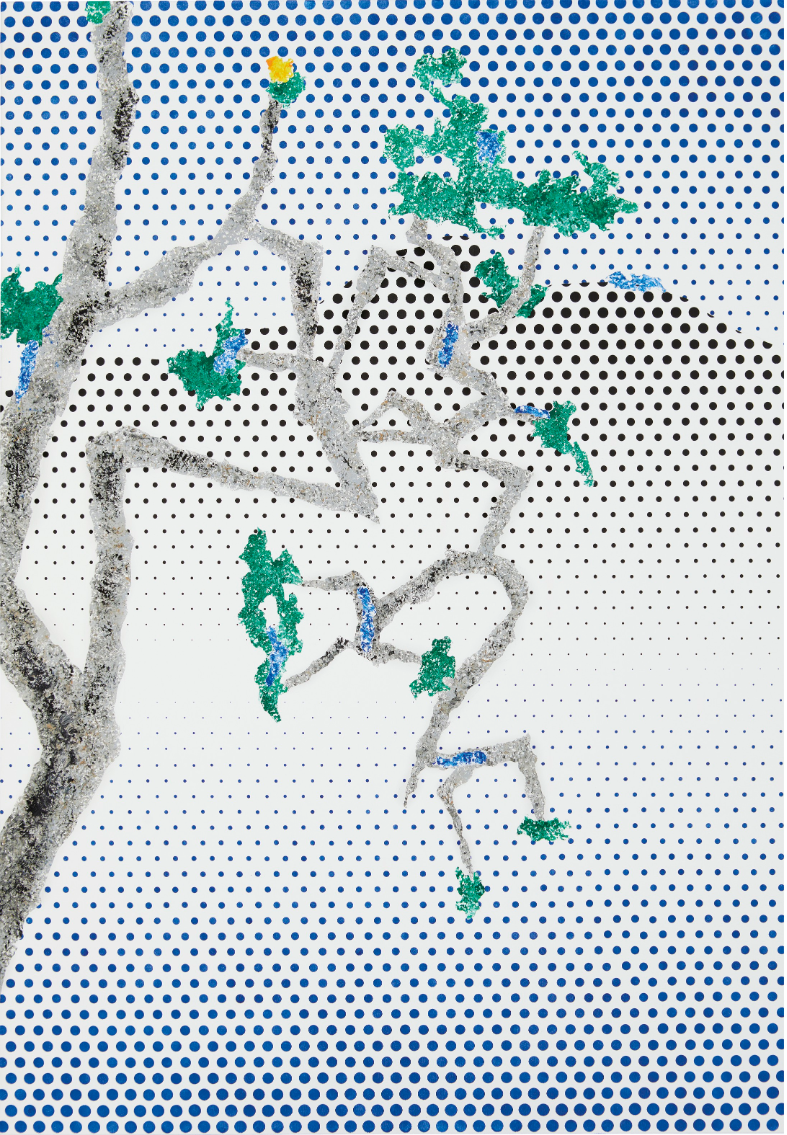
Treetops Through the Fog (Study), 1996
Treetops Through the Fog (Study), 1996
Reflections on Pop: Works from the Collection of Dorothy and Roy Lichtenstein
Sotheby’s New-York: 26 September 2025
Estimated: USD 400,000 – 600,000
USD 551,500
ROY LICHTENSTEIN (1923 – 1997)
Treetops Through the Fog (Study), 1996
Cut printed paper, cut sponge-painted paper, cut paper and graphite on paperboard
Image: 35 1/8 x 76 3/4 inches (89.2 x 194.9 cm)
Paperboard: 42 x 82 3/4 inches (106.7 x 210.2 cm)
xecuted in 1996, Treetops Through the Fog (Study) forms part of Roy Lichtenstein’s final and celebrated series, Landscapes in the Chinese Style. Comprising more than twenty works, paintings, collages, drawings, and prints, this body of work reinterprets the atmospheric elegance of Song Dynasty painting through Lichtenstein’s distinctive Pop Art vocabulary. His interest in Chinese art began during World War II, when, while stationed in London, he purchased a book on Chinese painting. Postwar studies in East Asian art history and frequent visits to leading museum collections, where he encountered works by Song masters, fostered his appreciation for their ability to evoke vastness with remarkable economy of means.
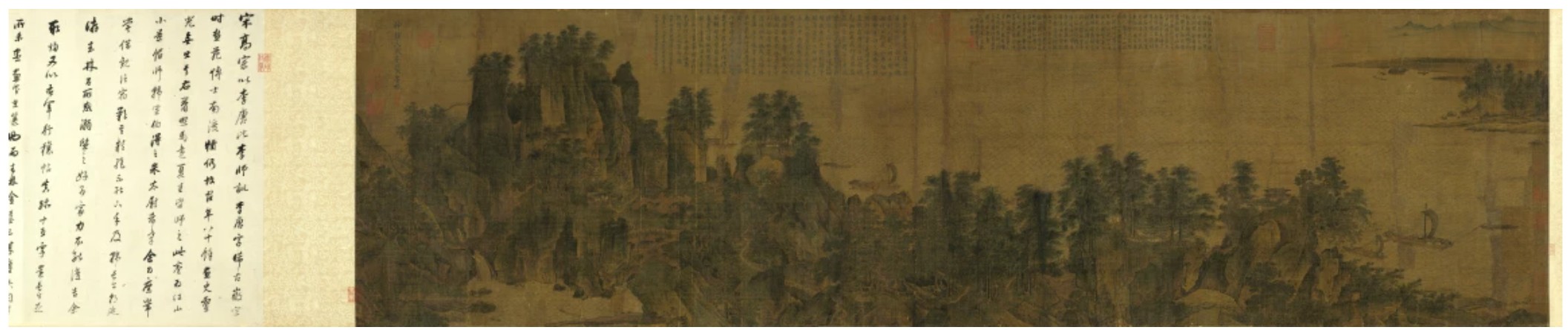
Li Tang, Intimate Scenery of River and Mountains, early 12th century. National Palace Museum, Taipei.
While Lichtenstein had long expressed an interest in Chinese art, it was his encounter with Edgar Degas’s monotype and pastel landscapes during an exhibition at the Metropolitan Museum of Art in 1994 that prompted his return to the landscape genre in 1995. Inspired by Degas’s ability to convey form and atmosphere through amorphous shapes verging on abstraction, Lichtenstein began to explore how monochromatic shapes could be representational, employing his signature Ben-Day dots to construct serene landscapes that play with depth, scale, and perception. In Treetops Through the Fog (Study), traditional motifs, stylized trees, and shifting perspectives, are translated into a precise yet lyrical Pop idiom, balancing homage and reinvention while demonstrating the culmination of his artistic vision.
Rain Forest (Study), 1991
Rain Forest (Study), 1991
Reflections on Pop: Works from the Collection of Dorothy and Roy Lichtenstein
Sotheby’s New-York: 26 September 2025
Estimated: USD 500,000 – 700,000
USD 279,400
ROY LICHTENSTEIN (1923 – 1997)
Rain Forest (Study), 1991
Cut printed paper, cut painted paper, sponged acrylic, marker and graphite on paperboard
Image: 25 5/8 x 20 3/4 inches (65.1 x 52.7 cm)
Paperboard: 30 x 22 3/4 inches (76.2 x 57.8 cm)
Signed and dated ’91 (on the verso)
Rain Forest (Study) is a striking collage that exemplifies Roy Lichtenstein’s elegant and incisive reimagining of the traditional landscape genre. Paying tribute to both East Asian motifs such as botanical garden painting and bonsai trees, Lichtenstein here embodies his career-long synthesis of cross-cultural influence through his distinctly Pop sensibility.
“In my paintings, it’s not nature, of course, it’s just dots. But it wasn’t nature when [Chinese painters] did it, either. Any painting is so far from the real look. It’s a symbol that reminds you of reality, sometimes, if it does.”
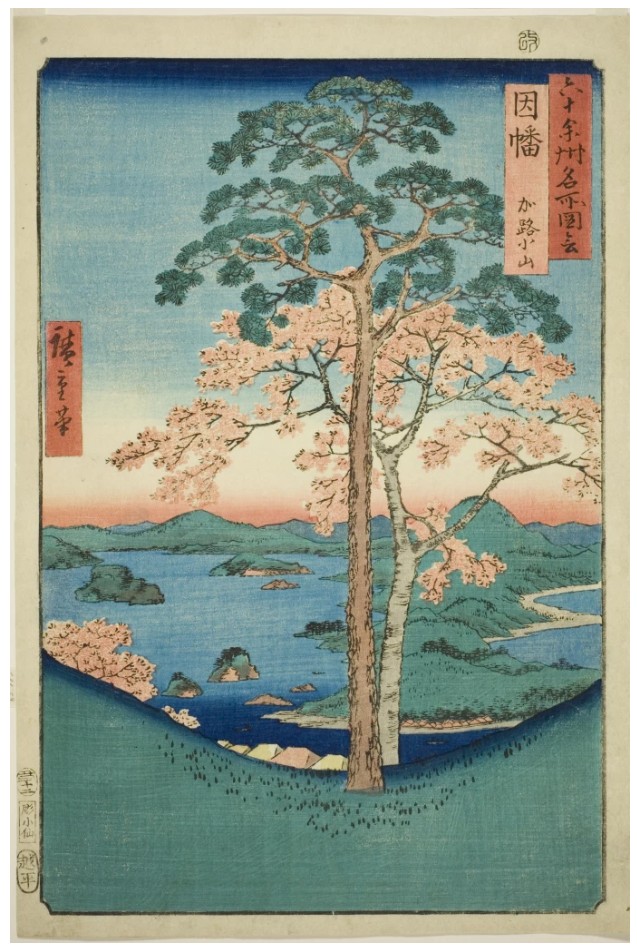
Utagawa Hiroshige, Inaba Province: Karo, Koyama (Inaba, Karo Koyama), from the series “Famous Places in the Sixty-odd Provinces (Rokujuyoshu meisho zue)”, 1853. The Art Institute of Chicago.
The present work echoes the artist’s preoccupations throughout the 1990s such as the Landscapes in the Chinese Style series, which sought to interrogate the layered, complex histories and semiotic systems associated with instantly recognizable art historical symbols. Digesting centuries-old art historical tradition with his singular eye, Lichtenstein presents a captivating vision of a tree.
Landscape with Silver River (Study), 1996
Landscape with Silver River (Study), 1996
Works from the Collection of Dorothy and Roy Lichtenstein
Sotheby’s London: 25 June 2025
Estimated: GBP 220,000 – 280,000
GBP 330,200 / USD 445,770
Landscape with Silver River (Study) | Contemporary Day Auction | 2025 | Sotheby’s
ROY LICHTENSTEIN (1923 – 1997)
Landscape with Silver River (Study), 1996
Acrylic, graphite, tape and paper collage on card
44 3/4 x 36 5/8 inches (113.7 x 93 cm)
Belonging to the final series of Roy Lichtenstein’s prolific oeuvre, Landscape with Silver River (Study) eloquently fuses the artist’s distinct Pop sensibility with the visual traditions of Chinese Song Dynasty painting. Executed in 1996, the present work is part of Landscapes in the Chinese Style, a series created between 1991 and 1997, comprising twenty-one paintings, two prints, two sculptures, and numerous preparatory works including drawings, sketches and collages. Testament to the importance of this late body of work, key examples reside in the permanent collections of institutions such as the Hirshhorn Museum and Sculpture Garden, Washington, D.C., and The Metropolitan Museum of Art, New York.
“The thing that interested me was the mountains in front of mountains in front of mountains, and huge nature with little people… We all have a vague idea of what Chinese landscape looks like – that sense of grandeur the Chinese felt about nature.”

Lichtenstein’s interest in Chinese art began early. At the age of 21, while stationed in London during World War II, he wrote to his parents:
“I bought a book on Chinese painting, which I could have gotten in New York half the price. I’ll probably send it home with my collection of African masks, as my duffle bag now weighs more than I do, with all the art supplies.”
After the war, he returned to Ohio State University to complete his undergraduate and postgraduate studies, where he enrolled in East Asian art history courses. He recalled being captivated by the grandeur and scale conveyed in Chinese landscapes. During his time in Cleveland following his graduation, he frequented the Cleveland Museum of Art—then home to one of the country’s leading collections of Chinese art—and remained an avid visitor to East Asian exhibitions in New York, Washington, and Boston. His source materials, often derived from printed reproductions rather than original works, reflects his early and enduring engagement with art through mediated forms.
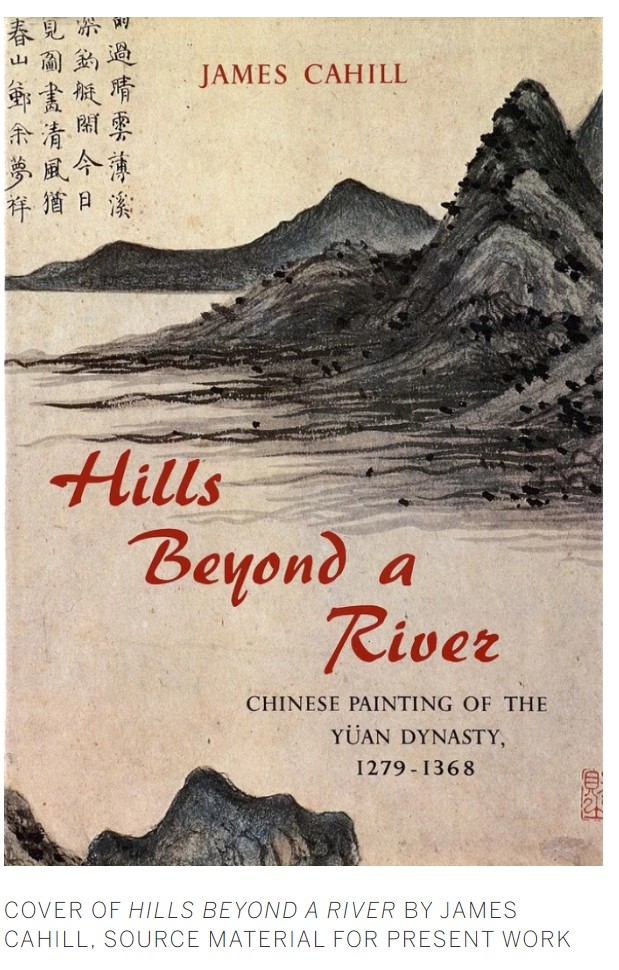
In 1949, Lichtenstein’s first group exhibition took place at the Chinese Gallery in New York, a space that showed both Chinese classical works and contemporary American art. He owned the catalogue for Chinese Landscape Painting, a landmark exhibition held at the Cleveland Museum in 1954, and was particularly drawn to the work of Song Dynasty (960–1279 CE) painters such as Ma Yuan, Xia Gui, Liang Kai, and Muqi, a Buddhist monk. These artists explored the atmospheric potential of brush and ink with such sophistication and subtlety that their vision of nature approached abstraction – a quality that deeply resonated with Lichtenstein.
Further immersion in East Asian traditions occurred during his travels to Japan in 1994 and 1995, where he encountered masterworks of Song painting firsthand. He was also influenced by Japanese ink painting (suibokuga) of the Muromachi period and the Edo-period works of the Kano School, both of which drew heavily on Southern Song prototypes. In the final two years of his life, he visited the storerooms of the Museum of Fine Arts, Boston twice to study Southern Song album leaves. In addition to his longstanding engagement with Chinese art, it was also the 1994 exhibition Degas Landscapes at The Metropolitan Museum of Art that served as the impetus for the series. It was particularly in Degas’s monotypes, such as Lever de la lune (Moonrise) and Le fleuve (The River), and their tonal atmospheres rendered with fingers and rags, that evoked for Lichtenstein the lyrical quality of Chinese landscape painting and inspired him to pursue his own interpretations.
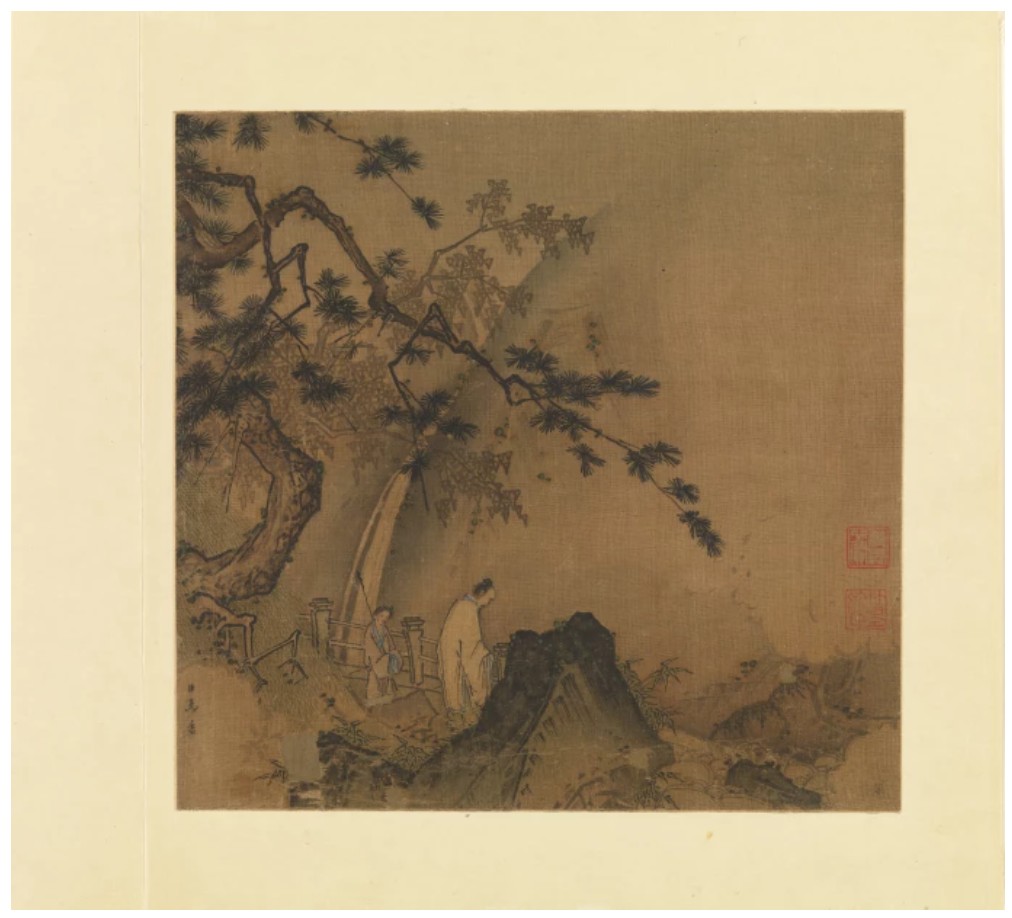
Ma Yuan, Scholar viewing a waterfall, early 13th century (album leaf)
The Metropolitan Museum, New York
The Landscapes in the Chinese Style series can be grouped into three formats derived from Chinese painting traditions: the handscroll, hanging scroll, and album leaf. The present work corresponds to the album leaf format— a more intimate mode of viewing, historically mounted in albums and meant to be held in the hand. Interestingly, the study reveals that Lichtenstein seems to have considered a rectangular format at one stage, as faint graphite lines extend the composition beyond the rounded edges in the lower register of the work, with visible traces of the bridge drawn outside of the final composition. The composition draws upon Chinese principles of shifting perspectives: the sweeping mountains are seen from above, the misty lake at eye level, and the bridge and figure from a distant vantage point. The small lamp-post on the bridge and the gnarled, stylized tree are hallmark motifs of Chinese landscapes, emblematic of nature’s grandeur. The tree in particular recalls the expressive brushwork of Ma Yuan, whose influence Lichtenstein likely encountered through works in the collection of The Met.
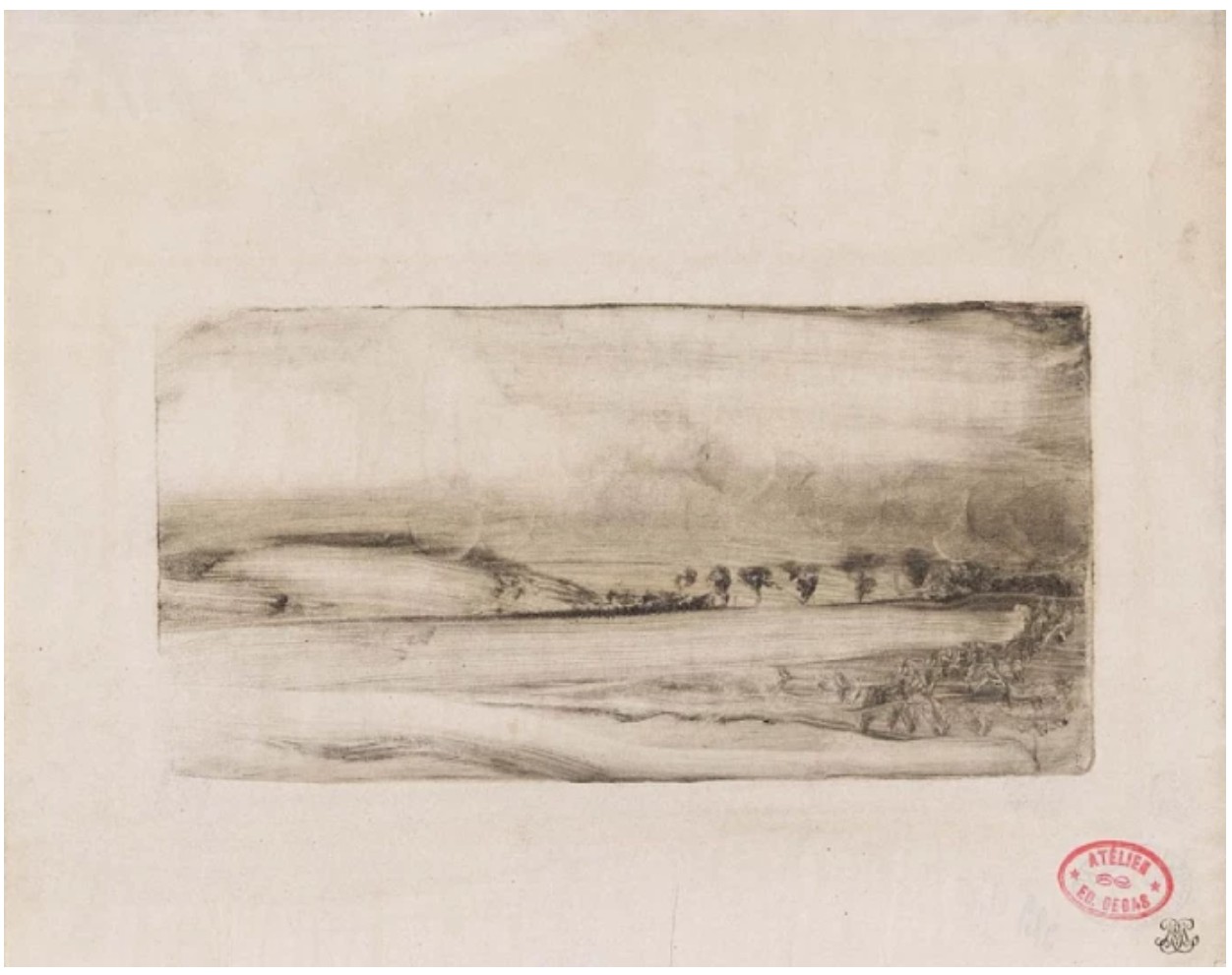
Edgar Degas, The River, 1877-79
Museum of Fine Art, Boston
The present work, a collage, served as the study for the painting Landscape with Silver River, completed the same year. Nearly all of the works in the series began as drawings and collages, which allowed Lichtenstein to refine compositional elements before executing the final paintings with precision. The collage and the final painting are mirror images of one another—reflecting Lichtenstein’s process of enlarging and projecting the collage onto canvas for tracing. One key difference between the two is the figure on the bridge. In the study, there is merely a bridge with a small lamp indicating scale; in the painting, Lichtenstein adds a red cloak and walking stick, imbuing the lone traveler with greater prominence and therefore evoking a greater sense of scale in the overall composition.
“In my mind it’s a sort of pseudo-contemplative or mechanical subtlety… I’m not seriously doing a kind of Zen-like salute to the beauty of nature. It’s really supposed to look like a printed version”
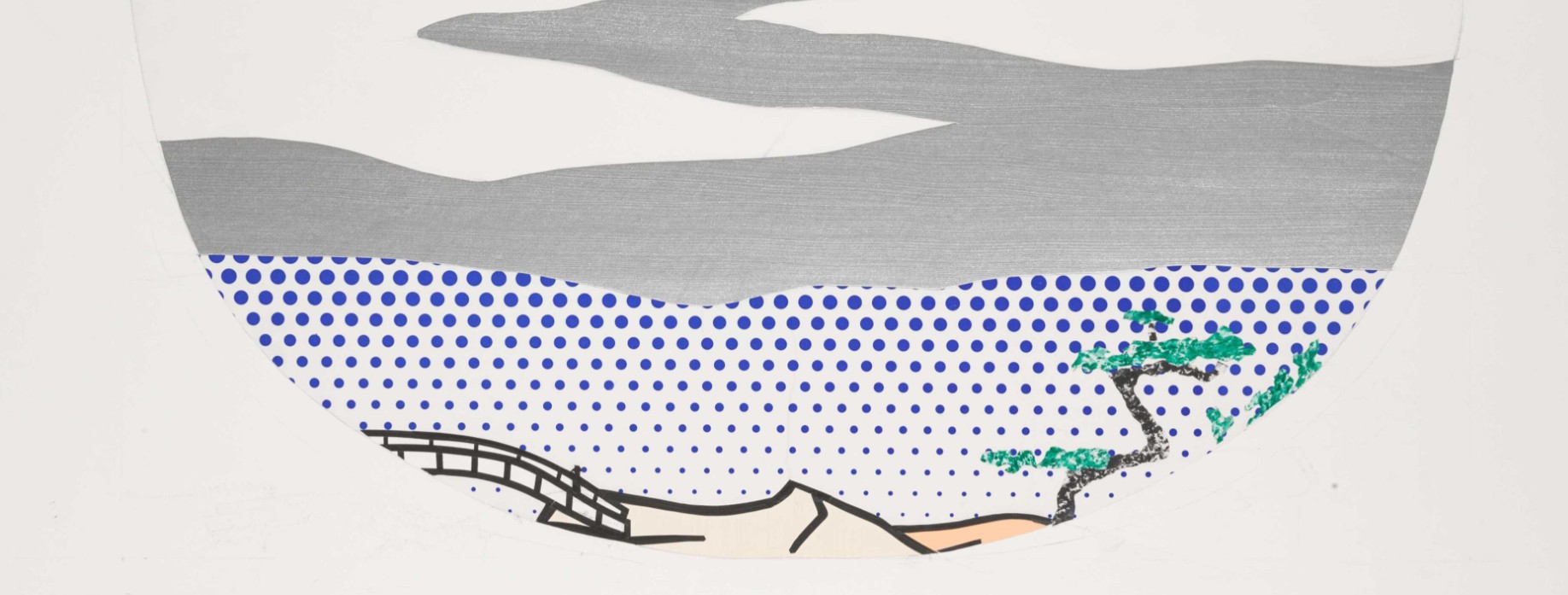
Atmosphere, as both a visual and philosophical construct, was central to Lichtenstein’s engagement with Chinese painting. He was captivated by the Song artists’ ability to suggest vastness and harmony with remarkable economy. Mist and clouds blur the boundaries of form, creating a spatial ambiguity that evokes a metaphysical detachment and a timeless vision of nature. Lichtenstein translated this ethereality through his own idiom, using varying densities of Ben-Day dots to suggest depth, water, and air. Though appearing mechanical, his method achieved a delicate illusion of transcendence akin to the Song masters he so admired. The roots of this technique lie in his earlier Mirrors series (1969–72), where perception and surface played central roles. Throughout his career, Lichtenstein engaged with the work of other artists and cultures, continually reinterpreting historical styles. From comic books and advertising to Cubism and Expressionism, Lichtenstein’s oeuvre is marked by his ability to interpret and reimagine images through his signature visual lexicon. His landscapes, a recurring theme, culminated in this remarkable final series. Landscapes in the Chinese Style continues this lifelong engagement, honoring a revered visual tradition whilst continuing to push his career into new grounds. The present work demonstrates the culmination of Lichtenstein’s prolific practice and how his understanding of the past helped him create one of the most technically ambitious series of his oeuvre.