WORK IN PROGRESS
Agenda
Christie’s Shanghai
20th/21st Century Evening Sale
7 November 2024
20th/21st Century Evening Sale
20th/21st Century Day Sale
9 November 2024
Sotheby’s Hong-Kong
Modern & Contemporary Evening Auction
11 November 2024
Modern & Contemporary Evening Auction | 2024 | Sotheby’s
Modern & Contemporary Art Day Auction
12 November 2024
Modern & Contemporary Day Auction | Session 1 – Contemporary Art | 2024 | Sotheby’s
Phillips Hong-Kong
Modern & Contemporary Evening Sale
25 November 2024
Modern & Contemporary Art Evening Sale: Hong Kong November 2024
Christie’s
Christie’s Shanghai
20th/21st Century Evening Sale
7 November 2024
20th/21st Century Evening Sale
Total
CNY 150,789,600 / USD 20,995,720
28 Lots
25 Lots sold
Sell-Through Rate: 89%
#1. ZAO WOU-KI
30.09.65
Christie’s Shanghai: 7 November 2024
Estimated: CNY 45,000,000 – 65,000,000
CNY 64,570,000 / USD 9,070,210
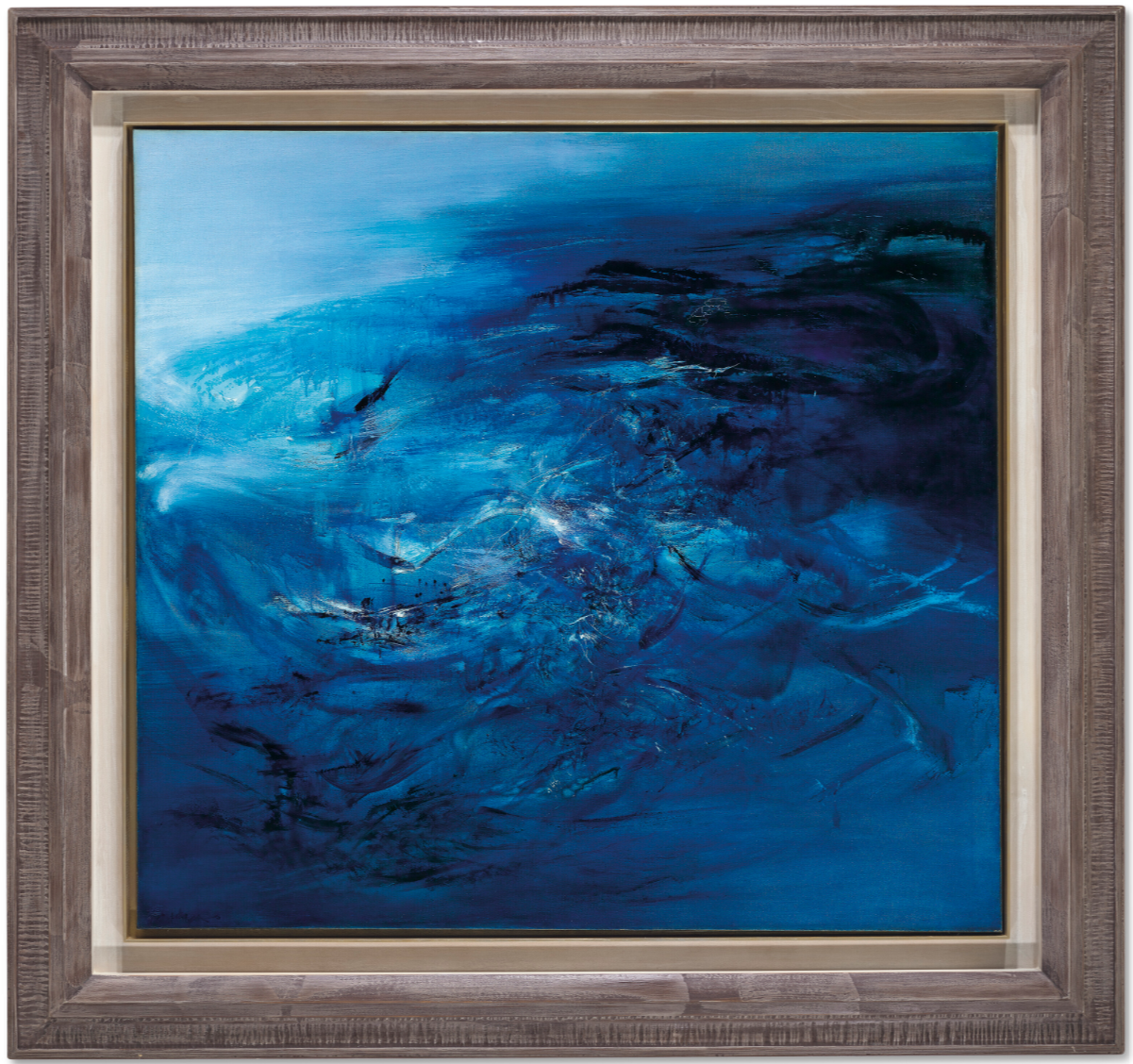
ZAO WOU-KI (ZHAO WUJI, 1920-2013)
30.09.65
Oil on canvas
150×162 cm (59 x 63 3/4 inches)
Signed in Chinese and signed ‘ZAO’ (lower left)
Signed, inscribed and dated ‘ZAO WOU-KI 150 x 162 30.9.65. ne pas vernis’ (on the reverse)
#2. YOSHITOMO NARA
Untitled, 2007
Christie’s Shanghai: 7 November 2024
Estimated: CNY 30,000,000 – 50,000,000
CNY 30,550,000 / USD 4,291,390
REPEAT SALE
Christie’s Hong-Kong: 24 May 2021
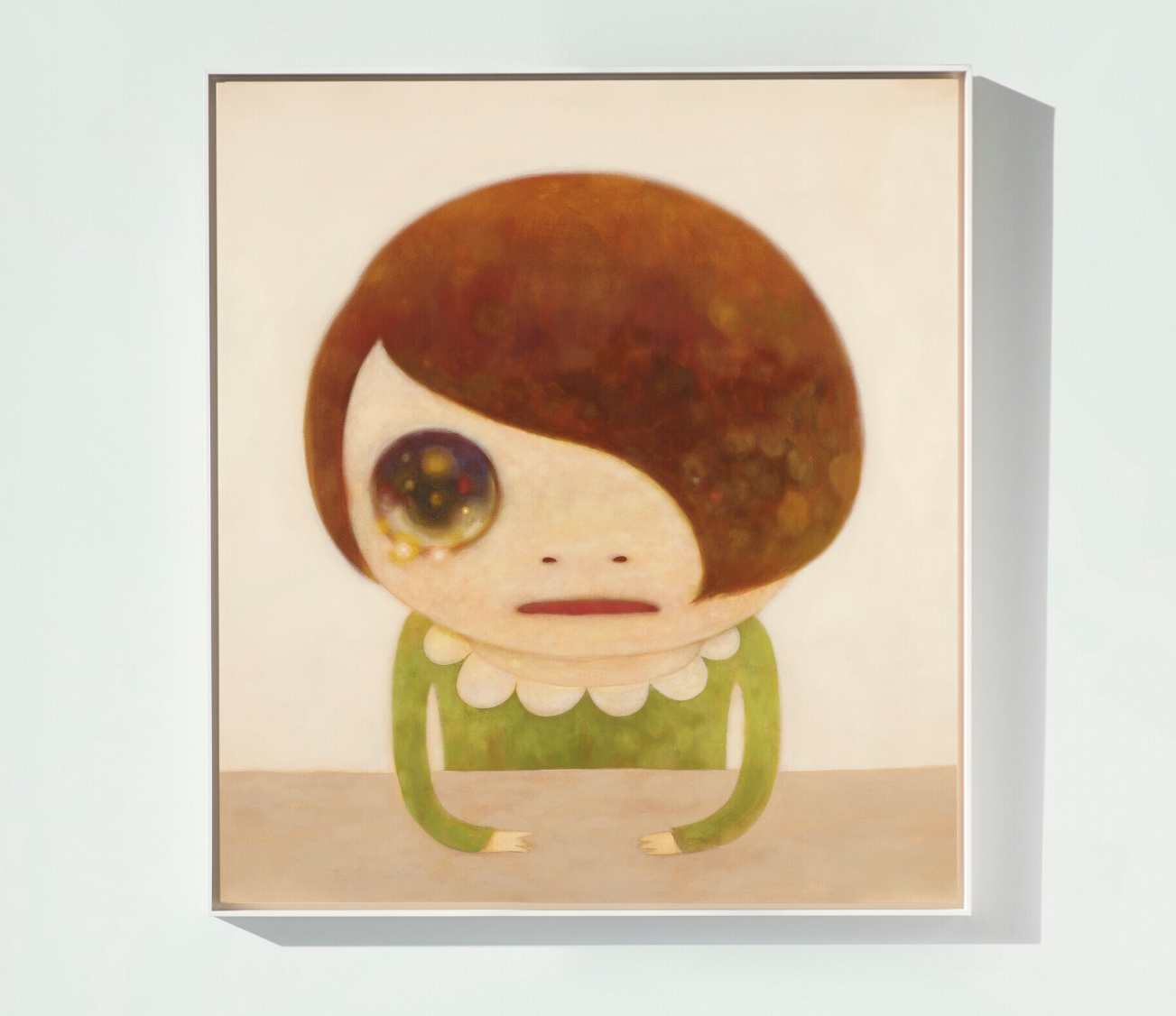
YOSHITOMO NARA (B.1959)
Untitled, 2007
Acrylic on canvas
162 x 145.5 cm (63 3/4 x 57 1/4 inches)
#3. YAYOI KUSAMA
PUMPKIN [TOWHT] BLUE, 2005
Christie’s Shanghai: 7 November 2024
Estimated: CNY 10,000,000 – 15,000,000
CNY 15,425,000 / USD 2,166,764
YAYOI KUSAMA (B. 1929), PUMPKIN [TOWHT] BLUE | Christie’s
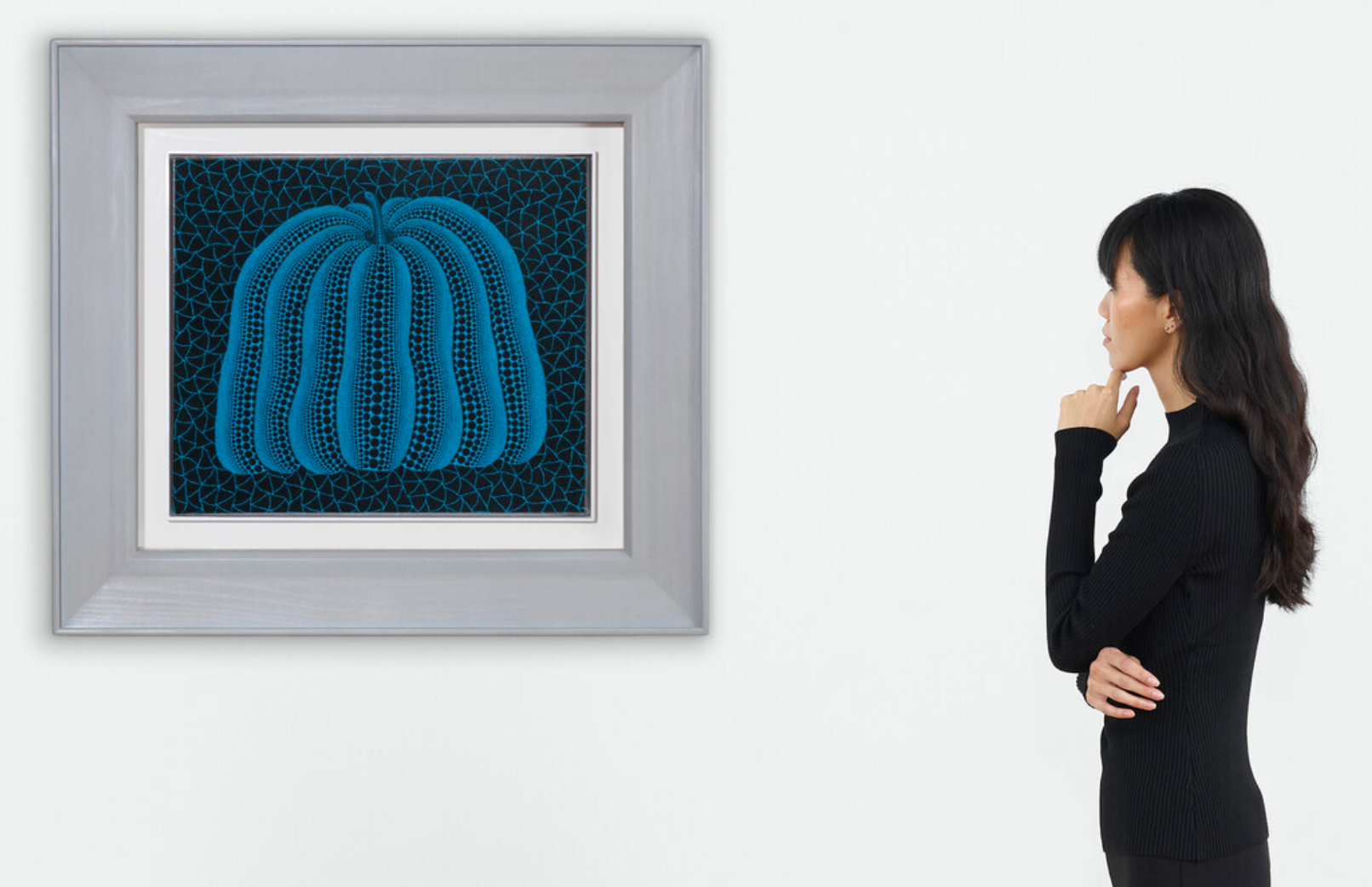
YAYOI KUSAMA (B. 1929)
PUMPKIN [TOWHT] BLUE, 2005
Acrylic on canvas
45.5 x 53 cm (17 7/8 x 20 7/8 inches)
Signed, titled and dated ‘yayoi kusama 2005 PUMPKIN TOWHT BLUE’ (on the reverse)
#4. NICOLAS PARTY
Still Life, 2014
Christie’s Shanghai: 7 November 2024
Estimated: CNY 7,000,000 – 10,000,000
CNY 8,165,000 / USD 1,146,945
NICOLAS PARTY (B. 1980), Still Life | Christie’s
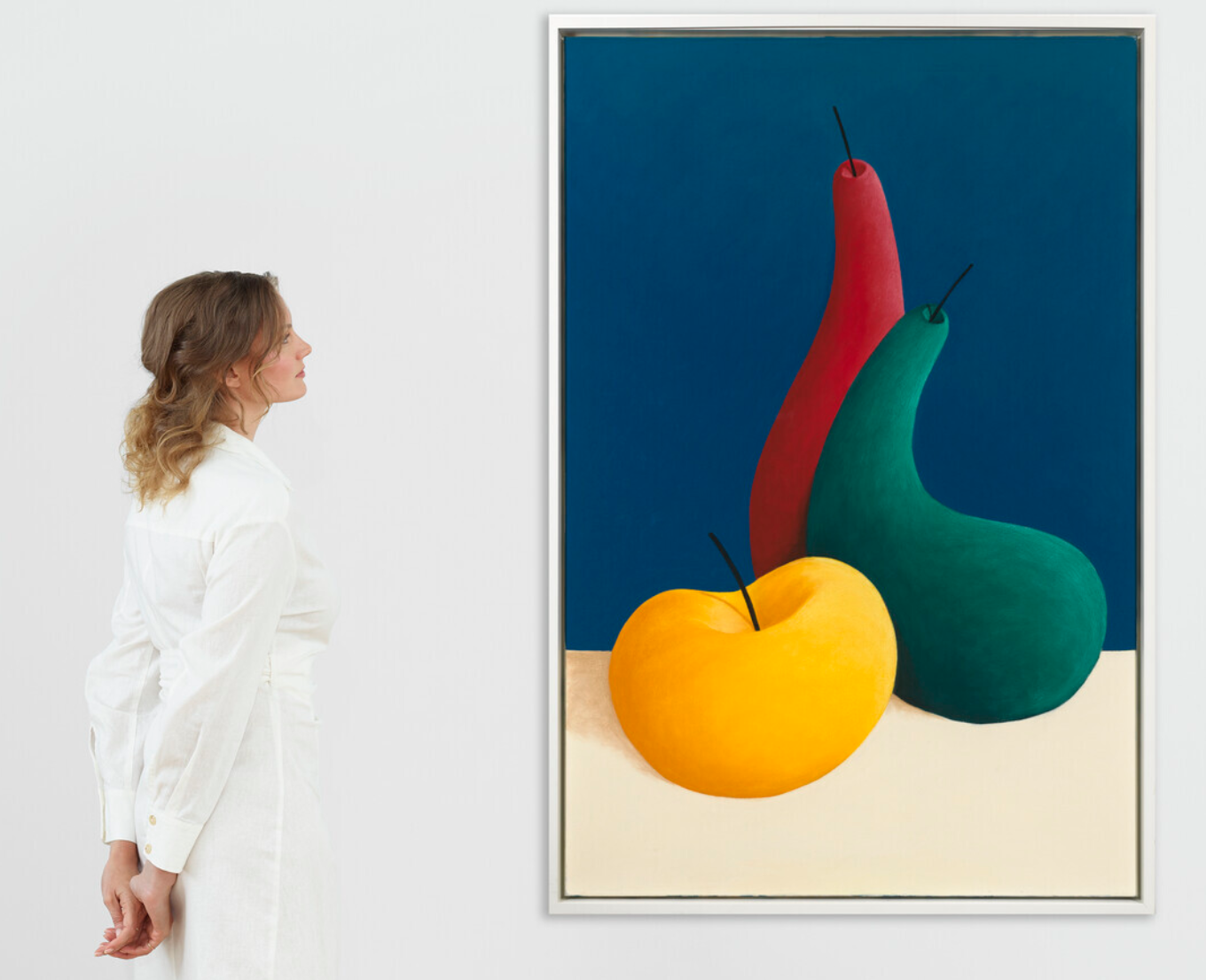
NICOLAS PARTY (B. 1980)
Still Life, 2014
Chalk pastel on canvas
150×100 cm (59 x 39 3/8 inches)
YAYOI KUSAMA
Fruits, 1992
Christie’s Shanghai: 7 November 2024
Estimated: CNY 3,500,000 – 5,000,000
CNY 4,410,000 / USD 619,480
YAYOI KUSAMA (B. 1929), Fruits | Christie’s
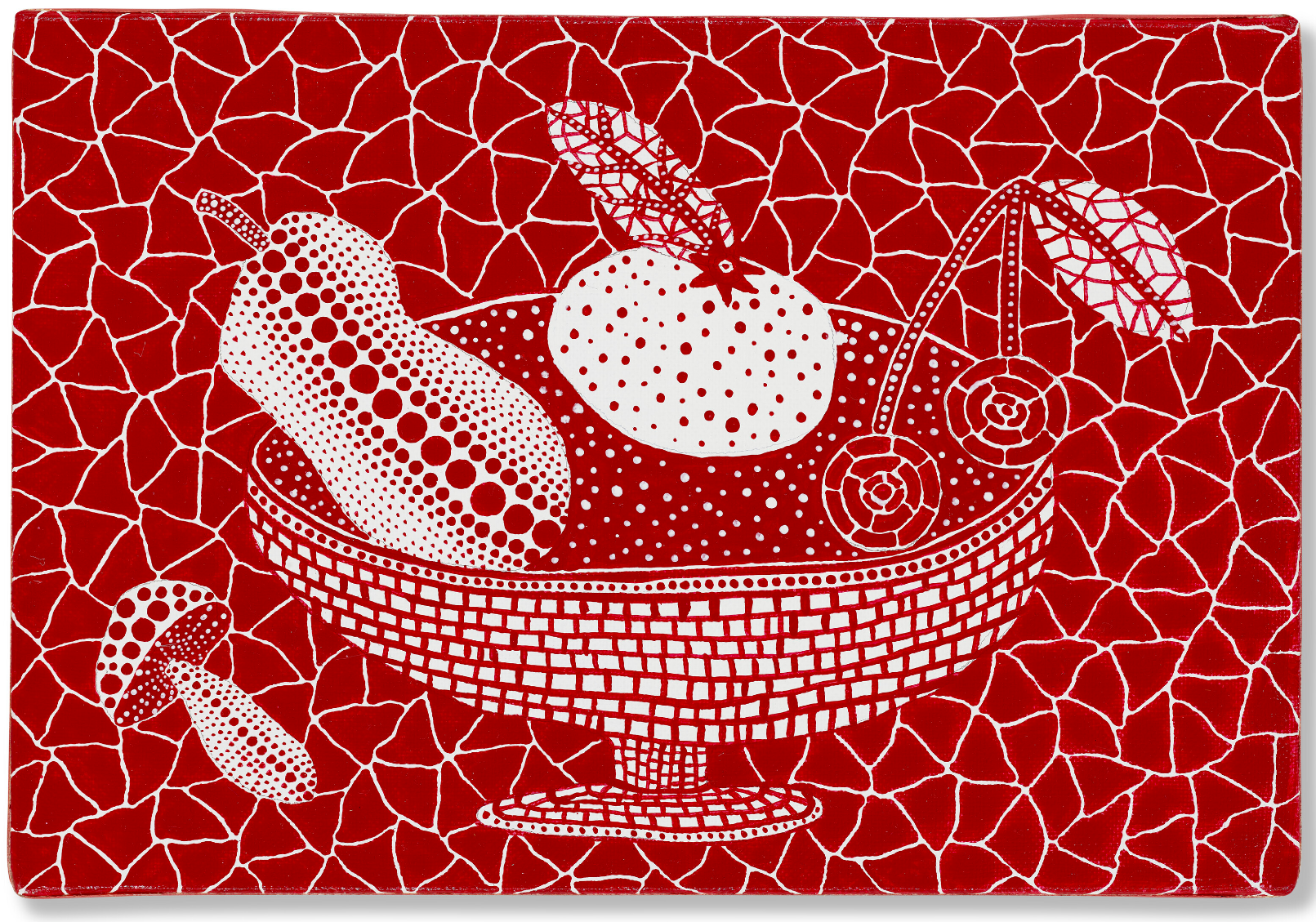
YAYOI KUSAMA (B. 1929)
Fruits, 1992
Acrylic on canvas
15.8 x 22.7 cm (6 1/4 x 8 7/8 inches)
Signed, titled in Japanese and dated ‘Kusama 1992’ (on the reverse)
Passed Lots
YAYOI KUSAMA
INFINITY-NETS (TWAHZN), 2006
Christie’s Shanghai: 7 November 2024
Estimated: CNY 14,000,000 – 20,000,000
PASSED
YAYOI KUSAMA (B. 1929), INFINITY-NETS (TWAHZN) | Christie’s
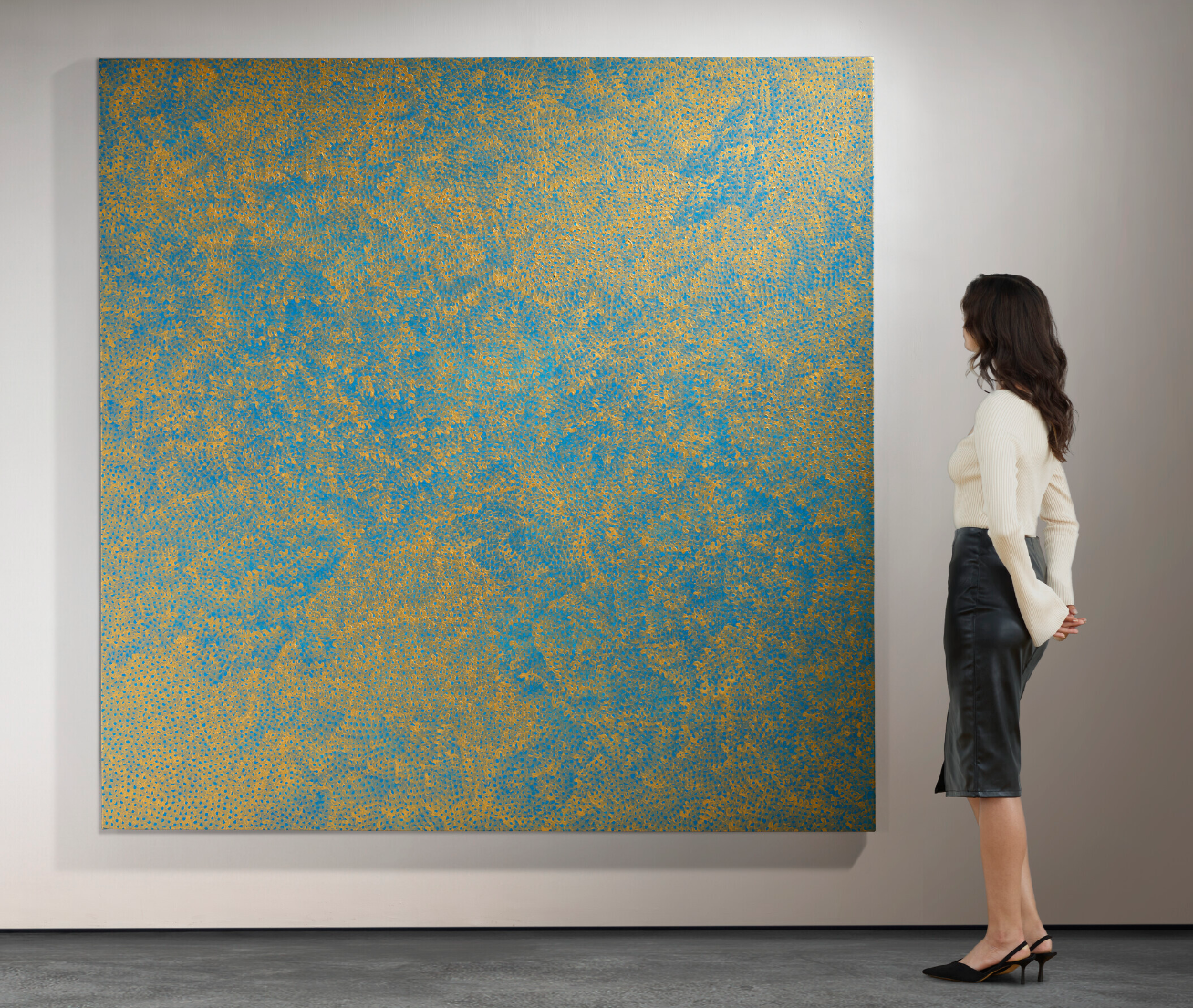
YAYOI KUSAMA (B. 1929)
INFINITY-NETS (TWAHZN), 2006
Acrylic on canvas
194.3 x 194.3 cm (76 1/2 x 76 1/2 inches)
Signed, titled and dated ‘yayoi kusama 2006 INFINITY-NETS TWAHZN’ (on the reverse)
HERNAN BAS
The Haunted House Keeper, 2020
Christie’s Shanghai: 7 November 2024
Estimated: CNY 2,600,000 – 4,600,000
PASSED
HERNAN BAS (B. 1978), The Haunted House Keeper | Christie’s
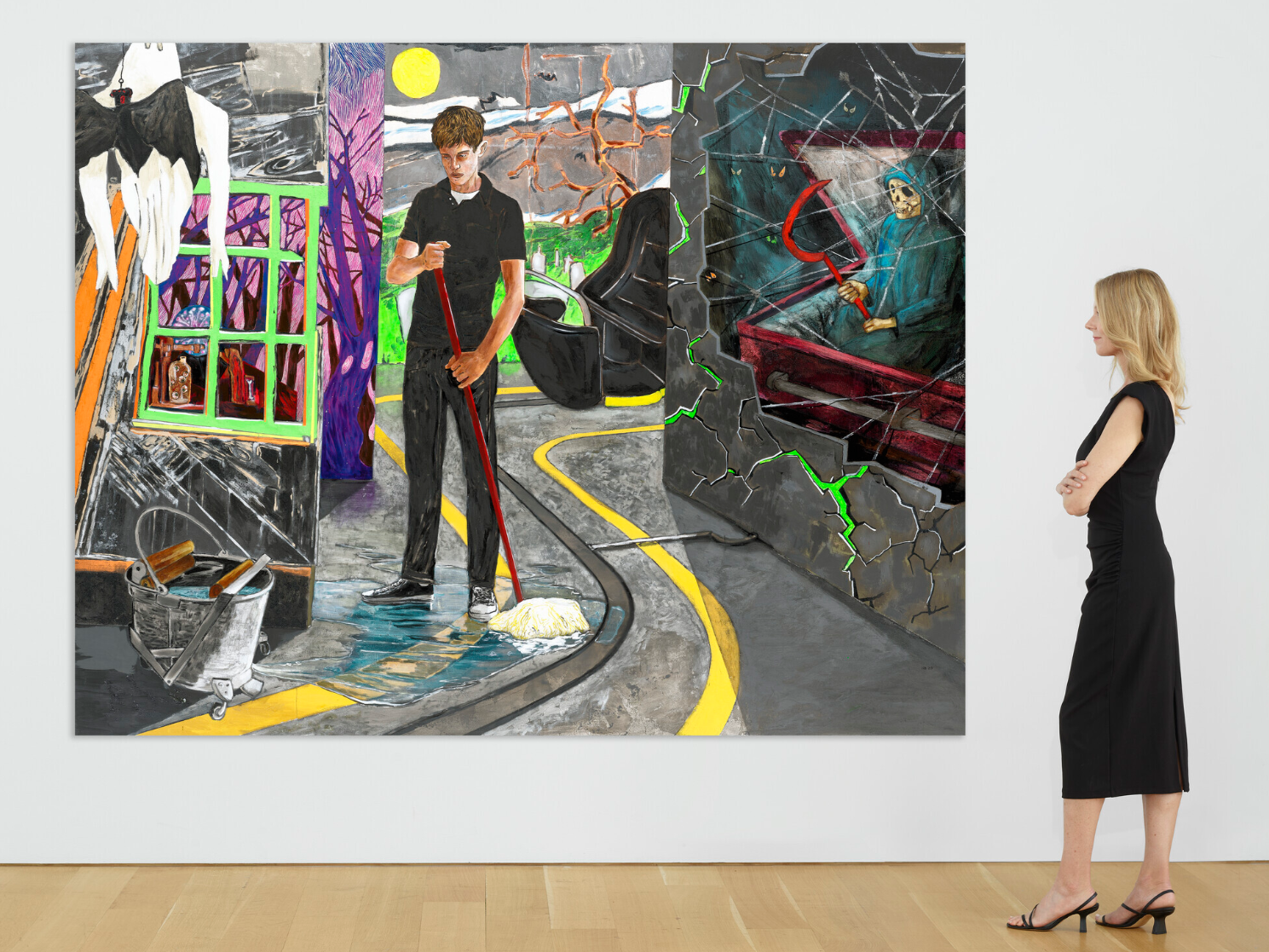
HERNAN BAS (B. 1978)
The Haunted House Keeper, 2020
Acrylic and distemper on linen
84 1/4 x 107 7/8 inches (214 x 274 cm)
Initialed and dated ‘HB 20’ (lower right)
Titled, initialed and dated ‘The Haunted house keeper HB 2020’ (on the reverse)
Sotheby’s
Modern & Contemporary Evening Auction
11 November 2024
Modern & Contemporary Evening Auction | 2024 | Sotheby’s
Total:
HKD 409,640,000 / USD 51,715,285
32 Lots
22 Sold Lots
Sell-Through Rate: 68%
#1. MARK ROTHKO
Untitled (Yellow and Blue), 1954
Sotheby’s Hong-Kong: 11 November 2024
Estimated: HKD 225,000,000 – 275,000,000
HKD 252,500,000 / USD 32,474,530
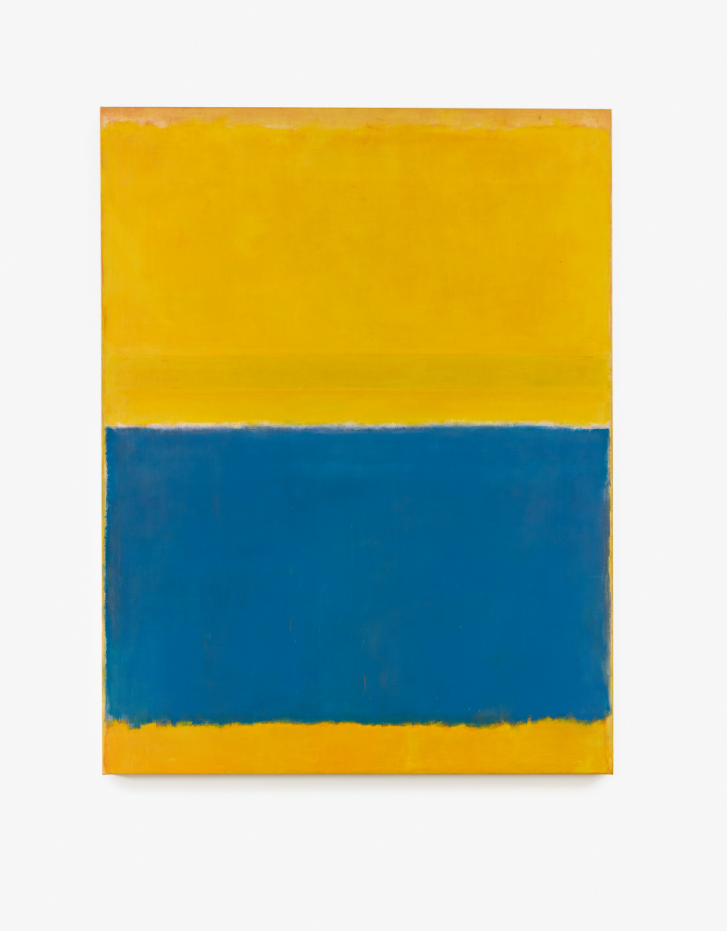
MARK ROTHKO (1903 – 1970)
Untitled (Yellow and Blue), 1954
Oil on canvas
95 5/8 x 73 1/2 inches (242.9 x 186.7 cm)
#2. YAYOI KUSAMA
Hat, 1980
Sotheby’s Hong-Kong: 11 November 2024
Estimated: HKD 38,000,000 – 55,000,000
HKD 43,800,000 / USD 5,633,205
Yayoi Kusama 草間彌生 | Hat 帽子 | Modern & Contemporary Evening Auction | 2024 | Sotheby’s
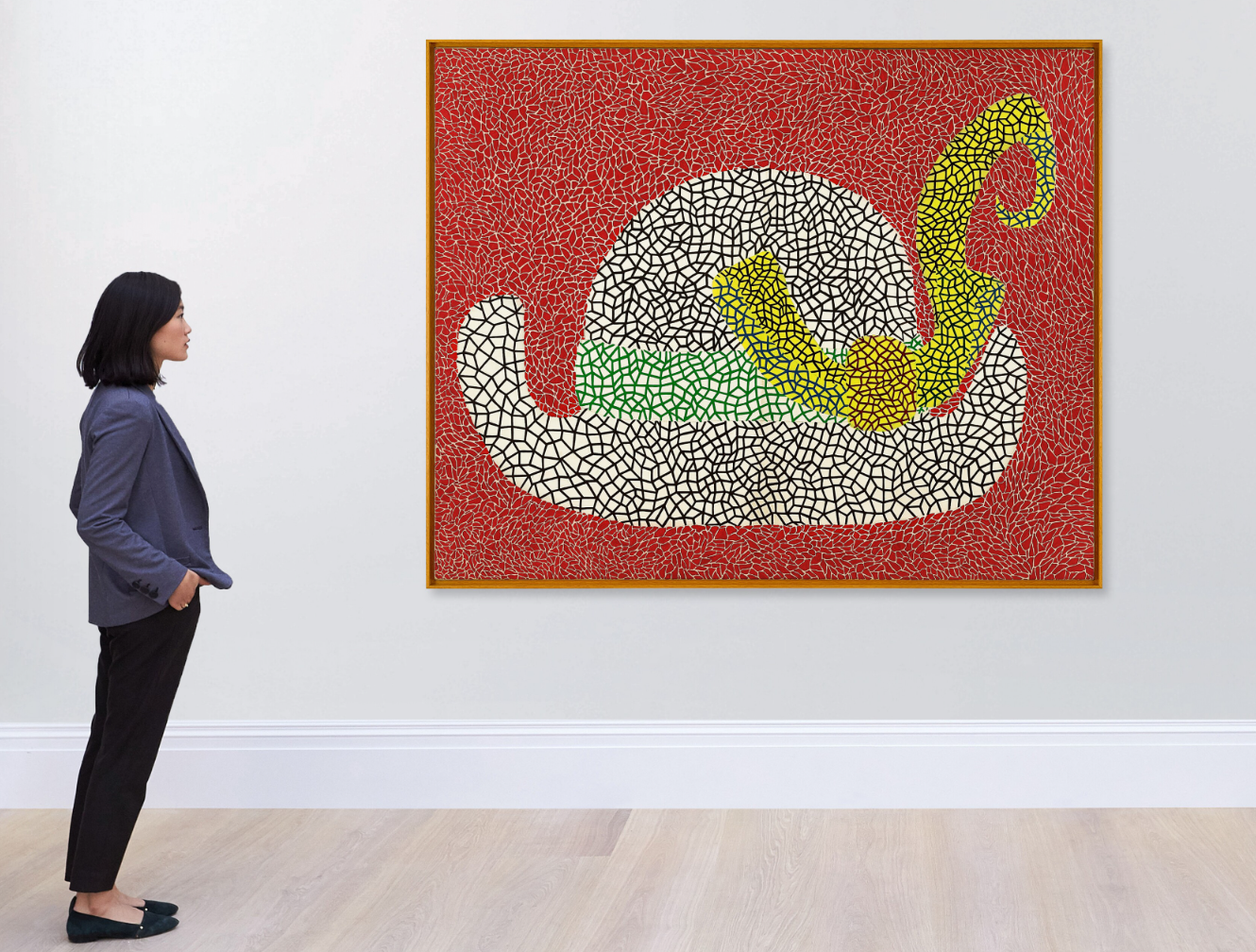
YAYOI KUSAMA (1929 – )
Hat, 1980
Acrylic on canvas
131×162 cm (51 5/8 x 63 3/4 inches)
Signed, titled in Kanji and dated 1980 (on the stretcher)
#3. GEORGE CONDO
Red, White and Black, 2014
Sotheby’s Hong-Kong: 11 November 2024
Estimated: HKD 25,000,000 – 35,000,000
HKD 20,400,000 / USD 2,625,010
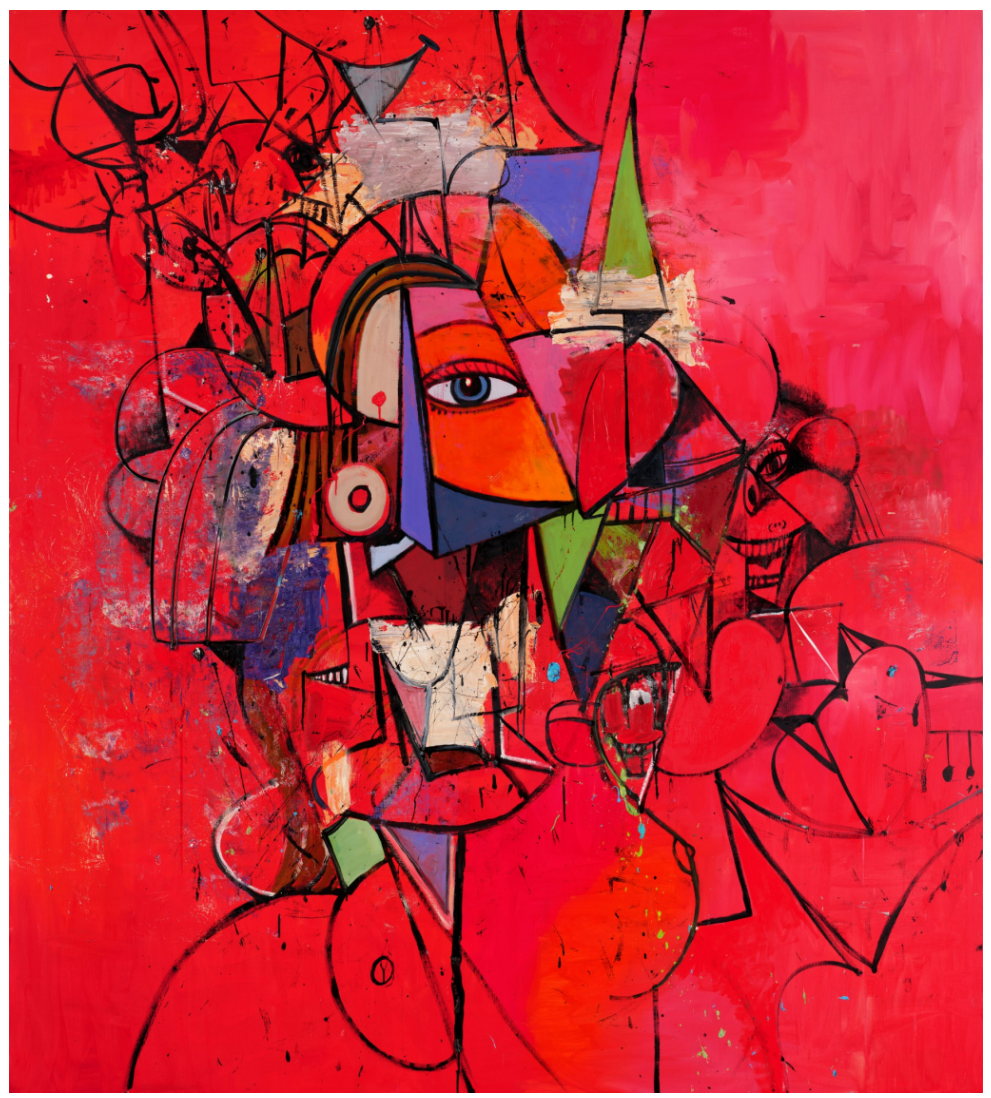
GEORGE CONDO (1957 – )
Red, White and Black, 2014
Oil on linen
80×72 inches (203.2 by 182.9 cm)
#4. YOSHITOMO NARA
Little Bunny in the Box, 1996
Sotheby’s Hong-Kong: 11 November 2024
Estimated: HKD 10,000,000 – 15,000,000
HKD 10,800,000 / USD 1,389,710
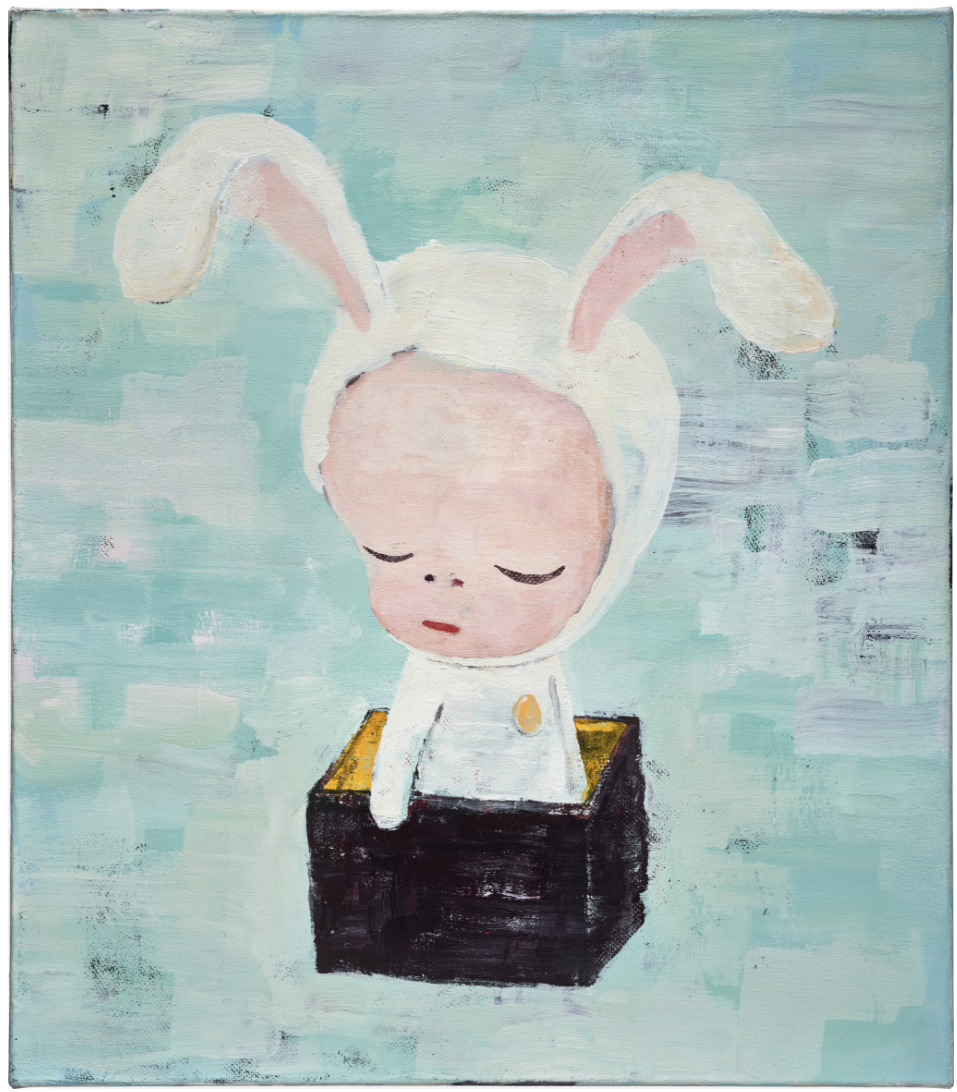
YOSHITOMO NARA (1959 – )
Little Bunny in the Box, 1996
Acrylic on canvas
80.5 x 70.2 cm (31 5/8 x 27 5/8 inches)
Signed, dated ’96 and inscribed Abandoned (on the reverse)
#5. YAYOI KUSAMA
Nets – Infinity, 2004
Sotheby’s Hong-Kong: 11 November 2024
Estimated: HKD 11,000,000 – 14,000,000
HKD 10,080,000 / USD 1,296,410
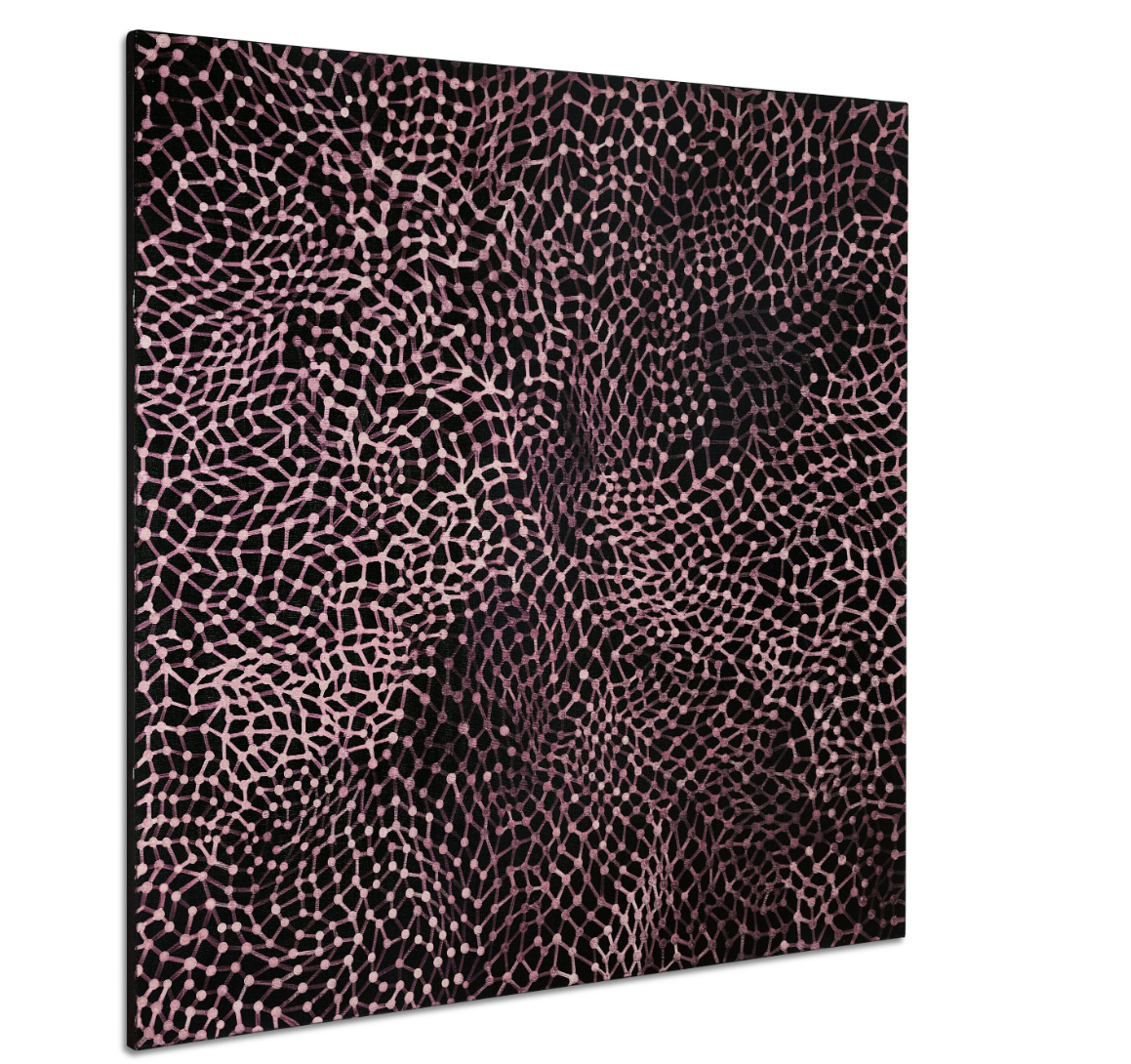
YAYOI KUSAMA (1929 – )
Nets – Infinity, 2004
Acrylic on canvas
161.9 x 161.9 cm (63 3/4 x 63 3/4 inches)
Signed, titled and dated 2004 (on the reverse)
LUCY BULL
Stellar Head, 2019
Sotheby’s Hong-Kong: 11 November 2024
Estimated: HKD 4,000,000 – 6,000,000
HKD 5,040,000 / USD 648,530
Lucy Bull 露西 · 布爾 | Stellar Head 腦中繁星 | Modern & Contemporary Evening Auction | 2024 | Sotheby’s
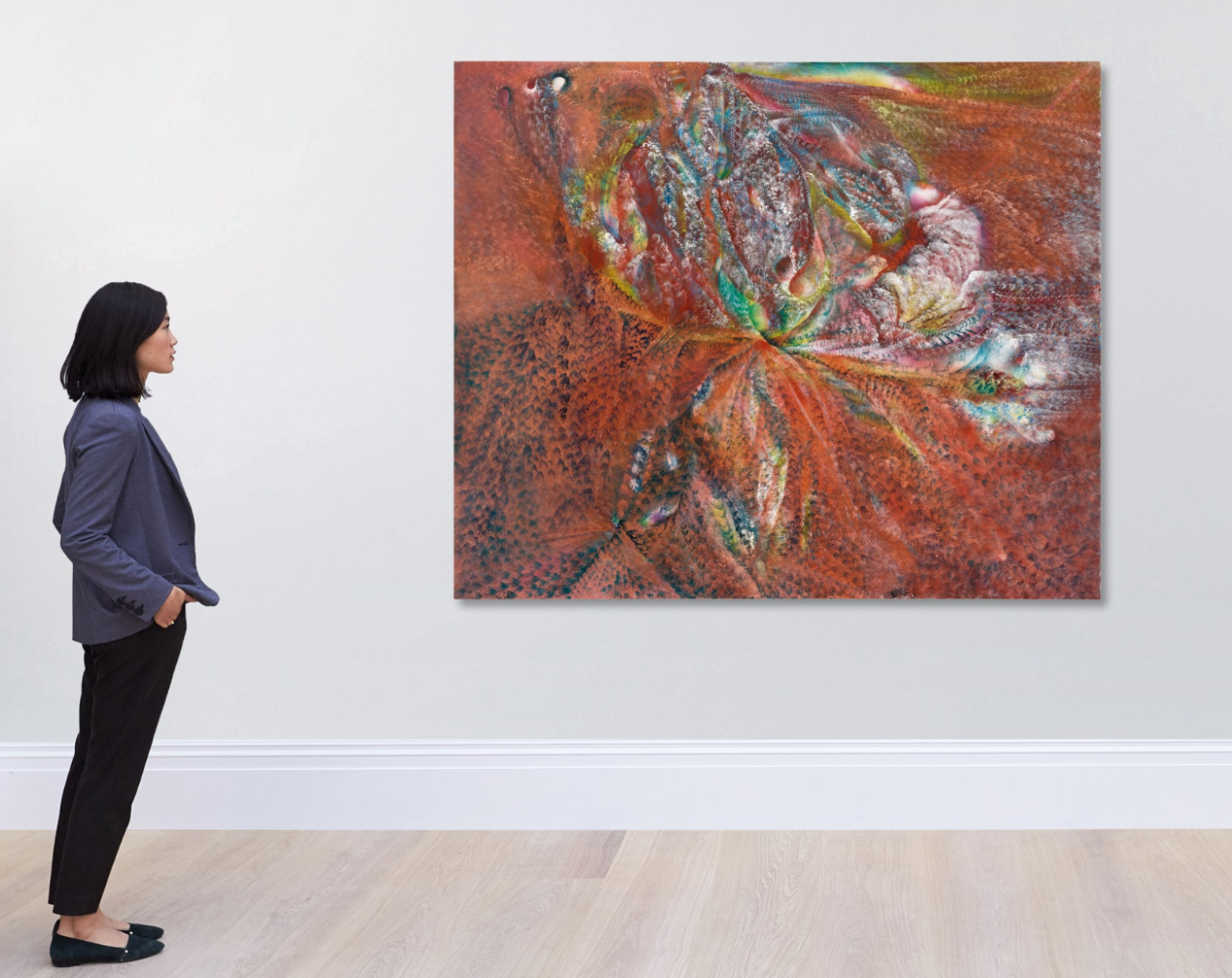
LUCY BULL (b. 1990)
Stellar Head, 2019
Oil on canvas
50 x 60 1/8 inches (127 x 152.8 cm)
Signed and dated 19 (on the reverse)
Titled (on the stretcher)
ANNA WEYANT
Buffet II, 2021
Sotheby’s Hong-Kong: 11 November 2024
Estimated: HKD 3,000,000 – 5,000,000
HKD 3,600,000 / USD 463,005
Anna Weyant 安娜・維揚特 | Buffet II 大餐二號 | Modern & Contemporary Evening Auction | 2024 | Sotheby’s
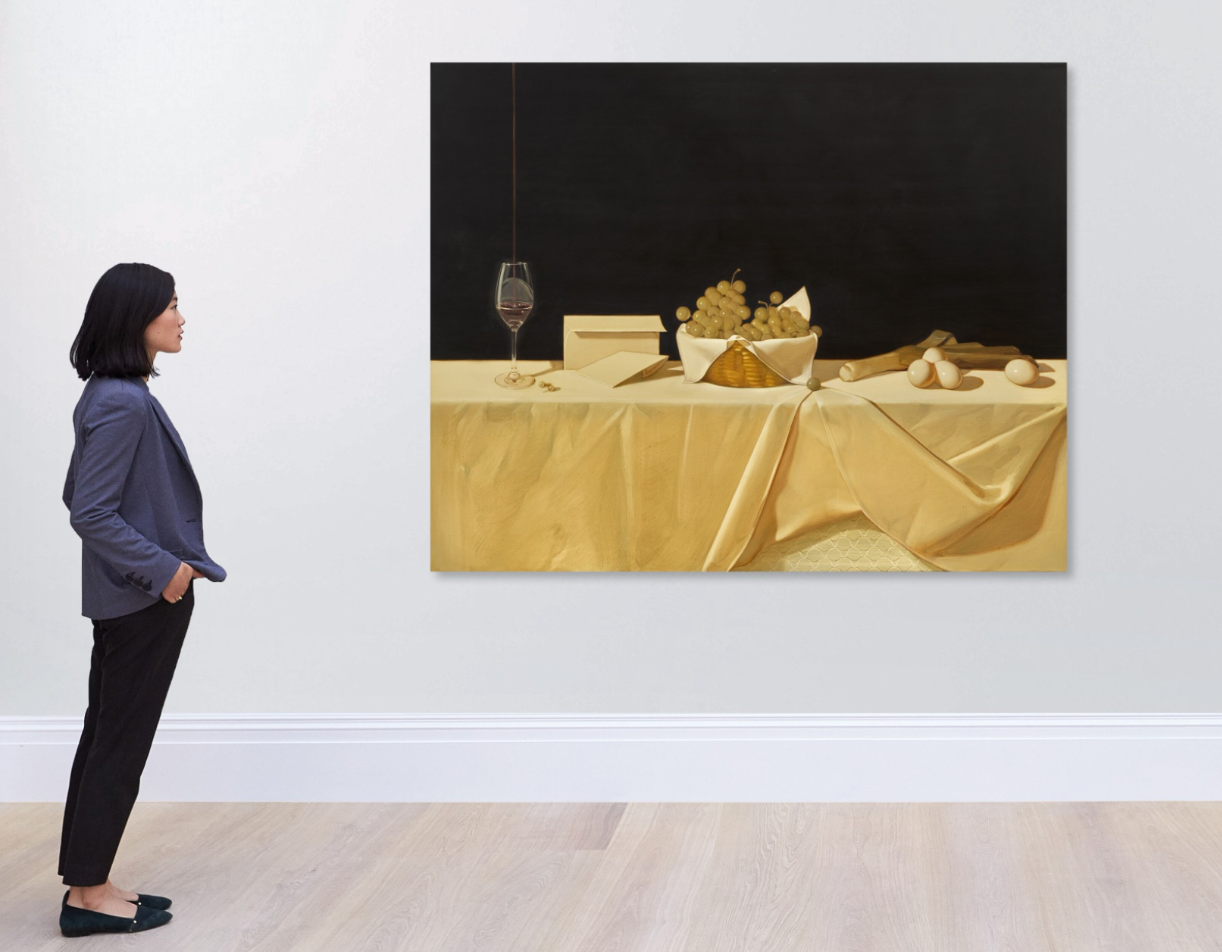
ANNA WEYANT (1995 – )
Buffet II, 2021
Oil on canvas
48 1/4 x 60 1/8 inches (122.4 x 152.8 cm)
Signed and dated 2021 (on the reverse)
EWA JUSZKIEWICZ
Maria (After Johannes Cornelisz Verspronck), 2013
Sotheby’s Hong-Kong: 11 November 2024
Estimated: HKD 2,800,000 – 4,500,000
HKD 3,360,000 / USD 432,354
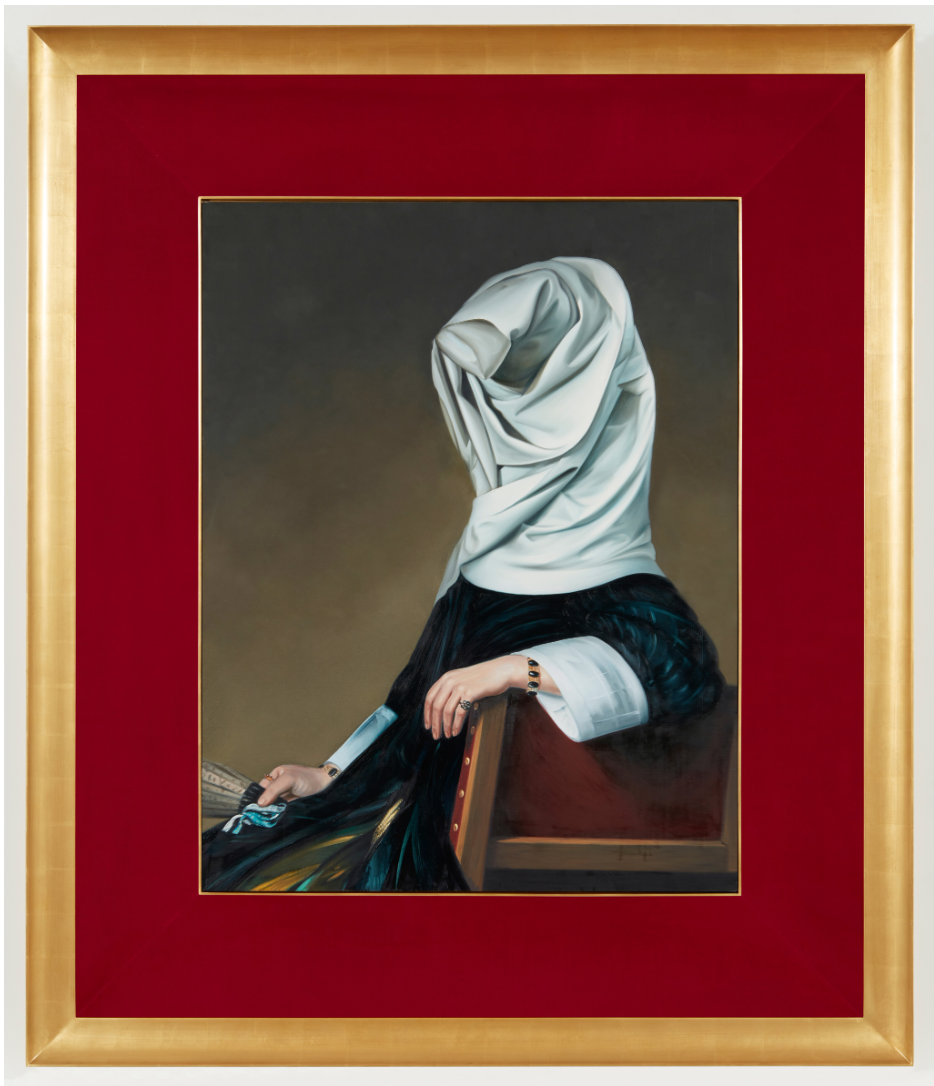
EWA JUSZKIEWICZ (1984 – )
Maria (After Johannes Cornelisz Verspronck), 2013
Oil on canvas
130×100 cm (51 x 49 1/4 inches)
Signed and dated 2013 on the reverse
Modern & Contemporary Art Day Auction
12 November 2024
Modern & Contemporary Day Auction | Session 1 – Contemporary Art | 2024 | Sotheby’s
#1. YAYOI KUSAMA
Untitled, 1970
Sotheby’s Hong-Kong: 11 November 2024
Estimated: HKD 2,000,000 – 4,000,000
HKD 3,120,000 / USD 401,245
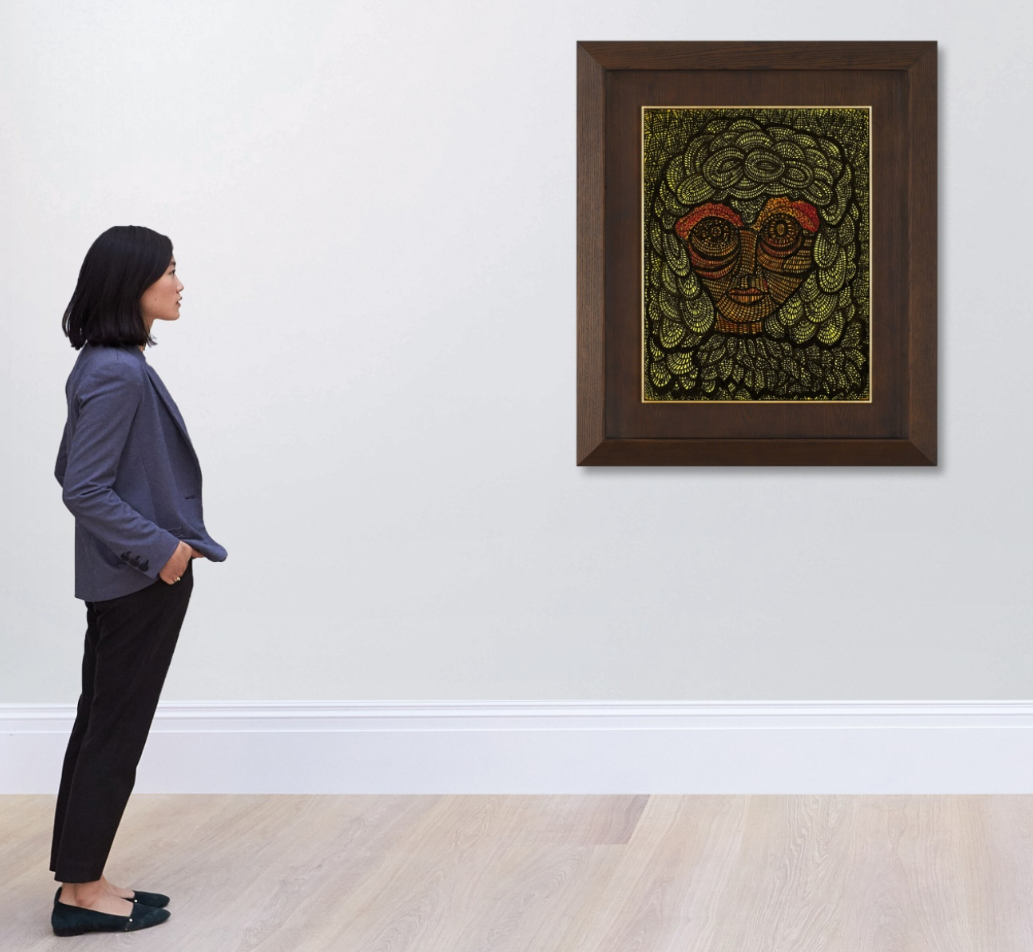
YAYOI KUSAMA (b. 1929)
Untitled, 1970
Ink and wash on card laid on board
64.9 x 50.2 cm (25 1/2 x 19 3/4 inches)
#2. DAMIEN HIRST
Beautiful Architect, 2003
Sotheby’s Hong-Kong: 11 November 2024
Estimated: HKD 3,500,000 – 5,500,000
HKD 3,000,000 / USD 385,810
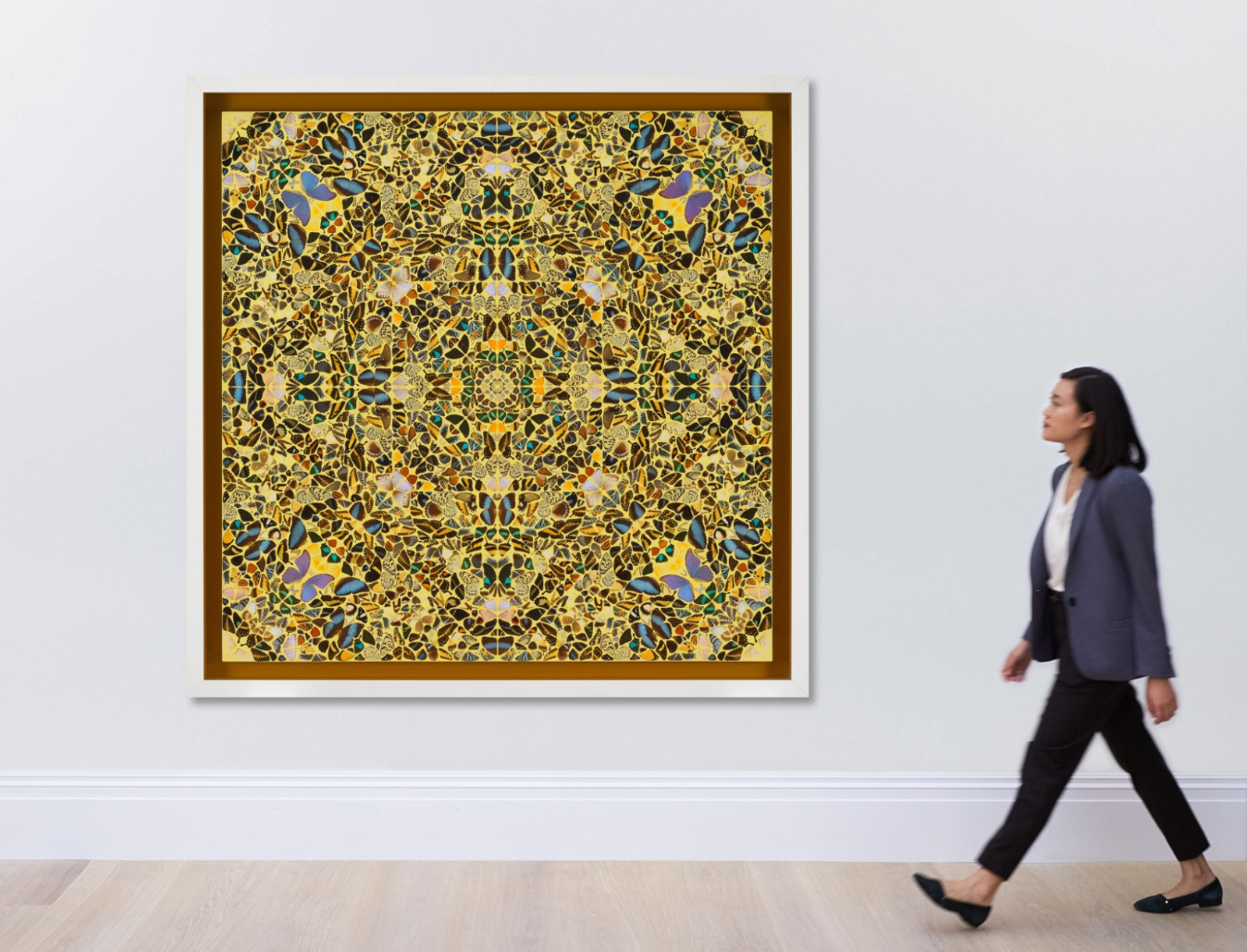
DAMIEN HIRST (b. 1965)
Beautiful Architect, 2003
Butterflies and household gloss on canvas
63×63 inches (160×160 cm)
Phillips
Modern & Contemporary Evening Sale
25 November 2024
Modern & Contemporary Art Evening Sale: Hong Kong November 2024
#1. YOSHITOMO NARA
Baby Blue, 1999
Phillips Hong-Kong: 25 November 2024
Estimated: HKD 42,000,000 – 62,000,000
HKD 45,220,000 / USD 5,809,730
Yoshitomo Nara – Modern & Contempora… Lot 7 November 2024 | Phillips
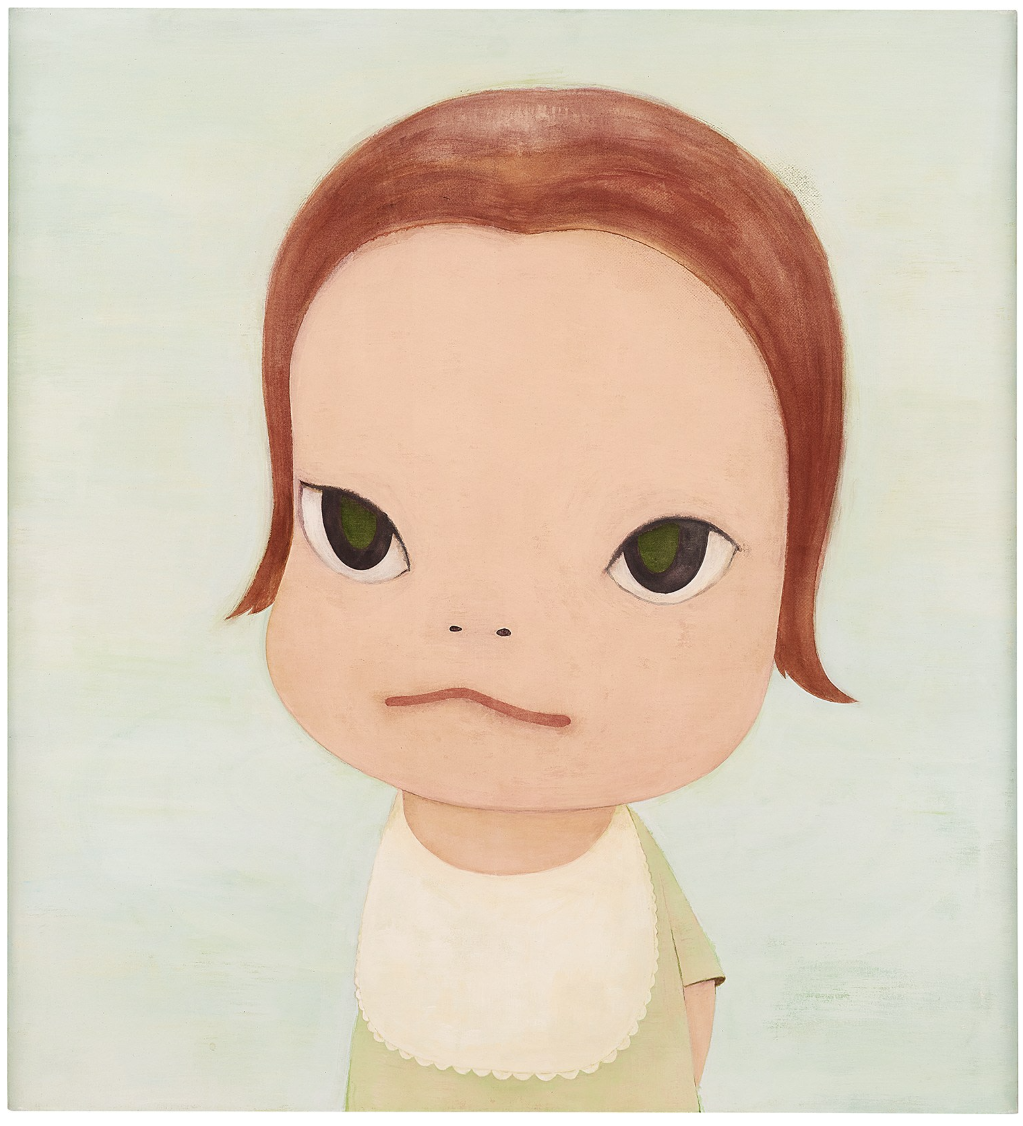
YOSHITOMO NARA
Baby Blue, 1999
Acrylic on canvas
120×110 cm (47 1/4 x 43 1/4 inches)
Signed, titled and dated ‘”Baby Blue” Yoshitomo Nara ’99’ on the stretcher
#2. SANYU
Reclining Nude, with Raised Knee II, 1950/1960s
Phillips Hong-Kong: 25 November 2024
Estimate on Request
HKD 42,800,000 / USD 5,498,815
Sanyu – Modern & Contemporary Art E… Lot 13 November 2024 | Phillips
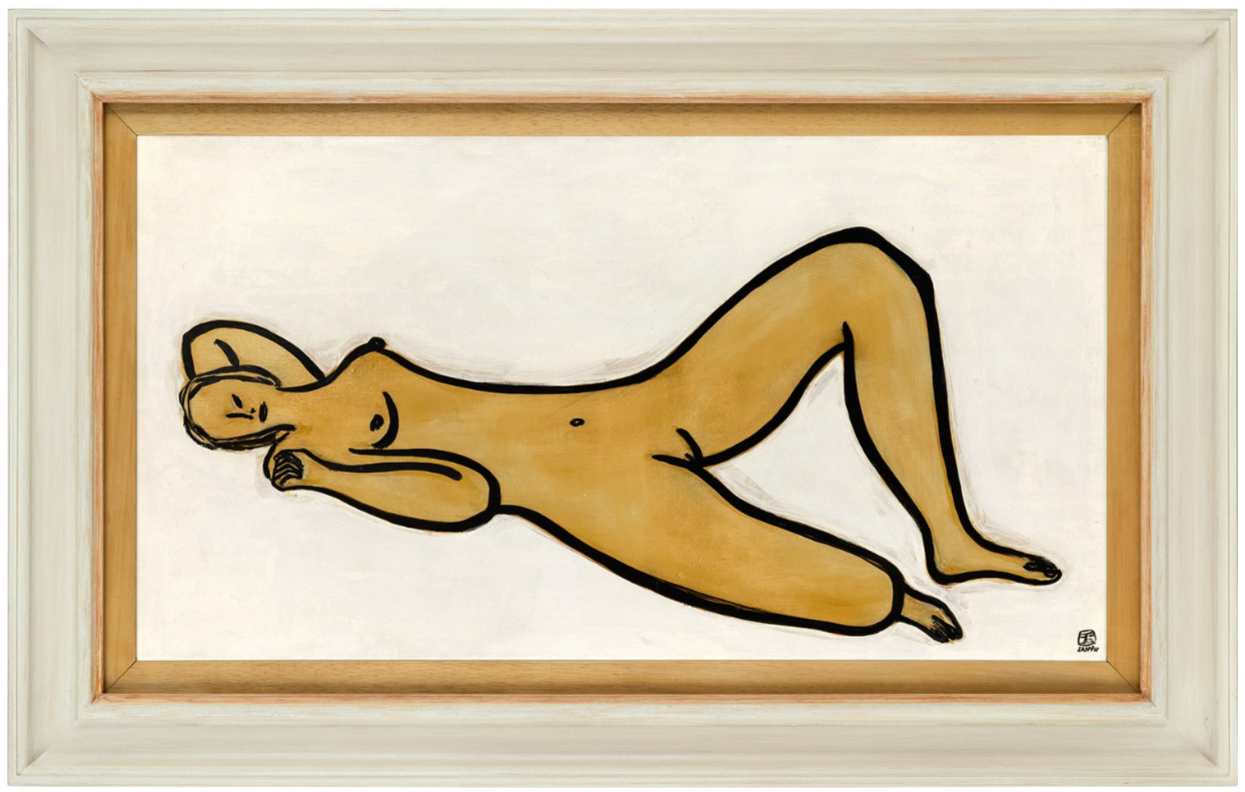
SANYU
Reclining Nude, with Raised Knee II, 1950/1960s
Oil on masonite
67×120 cm (26 3/8 x 47 1/4 inches)
Signed ‘Yu [in Chinese] SANYU’ lower right
#3. NICOLAS PARTY
Mountains, 2023
Phillips Hong-Kong: 25 November 2024
Estimated: HKD 10,000,000 – 15,000,000
HKD 13,760,000 / USD 1,767,843
Nicolas Party – Modern & Contemporar… Lot 8 November 2024 | Phillips
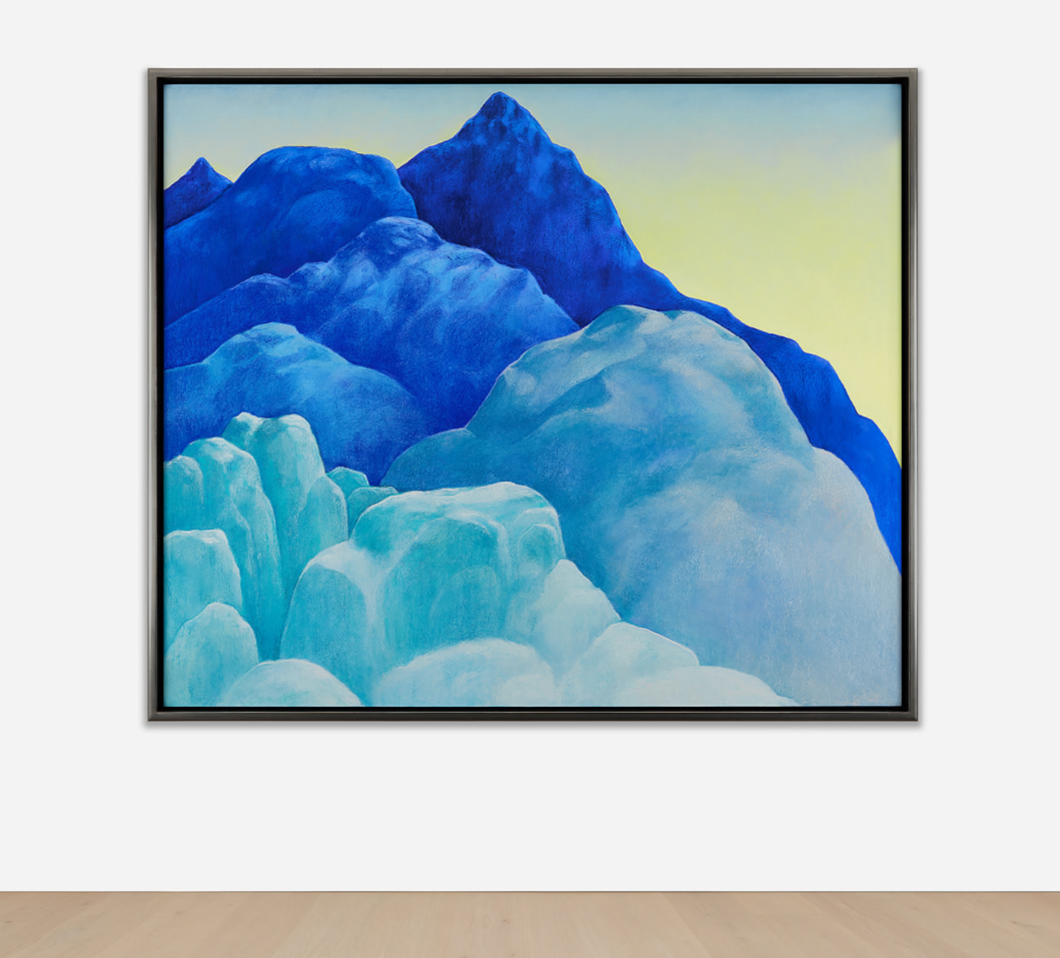
NICOLAS PARTY
Mountains, 2023
Soft pastel on linen, in artist’s frame
156.8 x 186.1 cm (61 3/4 x 73 1/4 inches)
Signed and dated ‘Nicolas Party 2023’ on the reverse
#4. PIERRE SOULAGES
Peinture 202 x 143 cm, 25 septembre 1967
Phillips Hong-Kong: 25 November 2024
Estimated: HKD 14,000,000 – 24,000,000
HKD 11,098,000 / USD 1,425,835
Pierre Soulages – Modern & Contempo… Lot 12 November 2024 | Phillips
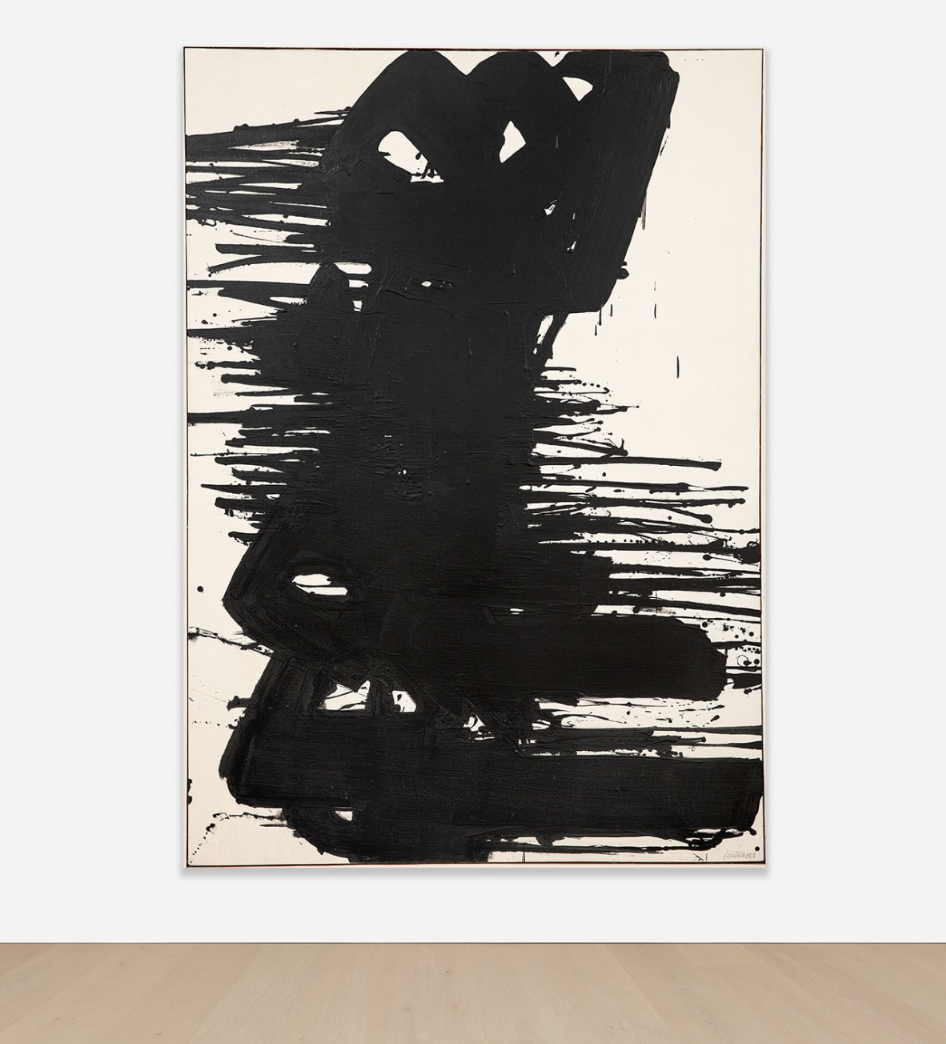
PIERRE SOULAGES
Peinture 202 x 143 cm, 25 septembre 1967
Oil on canvas
202×143 cm (79 1/2 x 56 1/4 inches)
Signed ‘Soulages’ lower right; further signed, titled and dated ‘“202 x 143”, SOULAGES, 25.9.67’ on the reverse
#5. YOSHITOMO NARA
Fountain of Life, 2001/2014
Phillips Hong-Kong: 25 November 2024
Estimated: HKD 8,000,000 – 15,000,000
HKD 10,130,000 / USD 1,301,470
Yoshitomo Nara – Modern & Contempora… Lot 6 November 2024 | Phillips
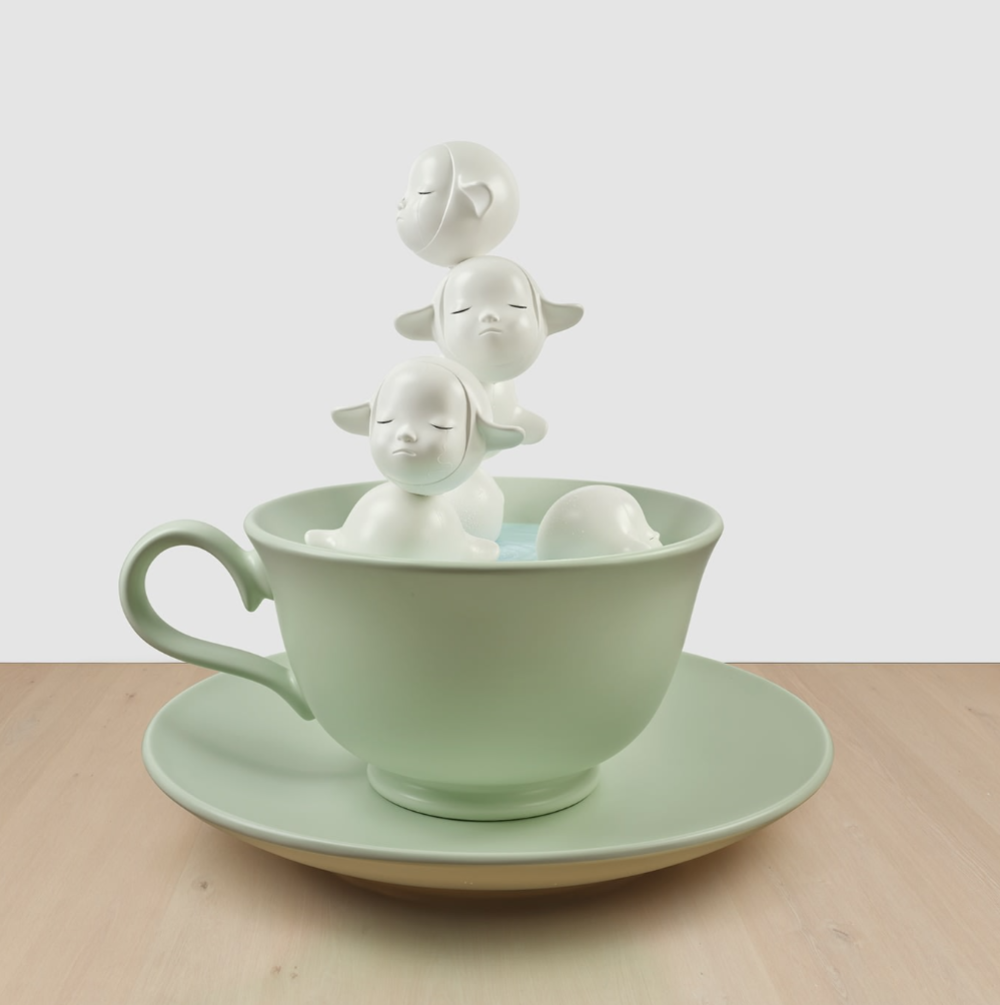
YOSHITOMO NARA
Fountain of Life, 2001/2014
Lacquer and urethane on FRP, motor and water
175x180x180 cm (68 7/8 x 70 7/8 x 70 7/8 inches)
This work is edition 2 of 3 plus 2 artist proofs
#6. LIU YE
Mondrian, Hello, 2002
Phillips Hong-Kong: 25 November 2024
Estimated: HKD 6,000,000 – 9,000,000
HKD 7,366,000 / USD 946,360
Liu Ye – Modern & Contemporary Art E… Lot 5 November 2024 | Phillips
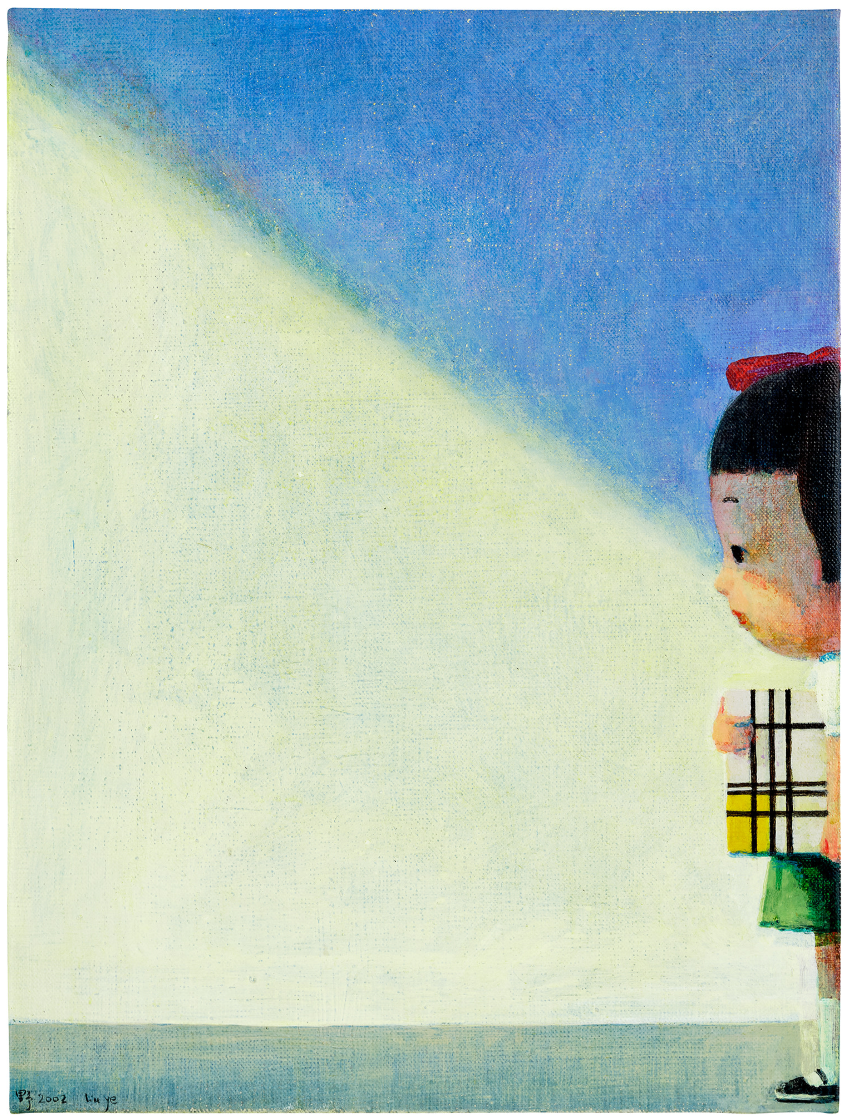
LIU YE
Mondrian, Hello, 2002
Acrylic on canvas
60×45 cm (23 5/8 x 17 3/4 inches)
Signed and dated ‘Ye [in Chinese] 2002 Liu Ye’ lower left
#7. YAYOI KUSAMA
Watermelon and Fork, 1989
Phillips Hong-Kong: 25 November 2024
Estimated: HKD 6,000,000 – 8,000,000
HKD 6,985,000 / USD 897,410
Yayoi Kusama – Modern & Contemporary… Lot 9 November 2024 | Phillips
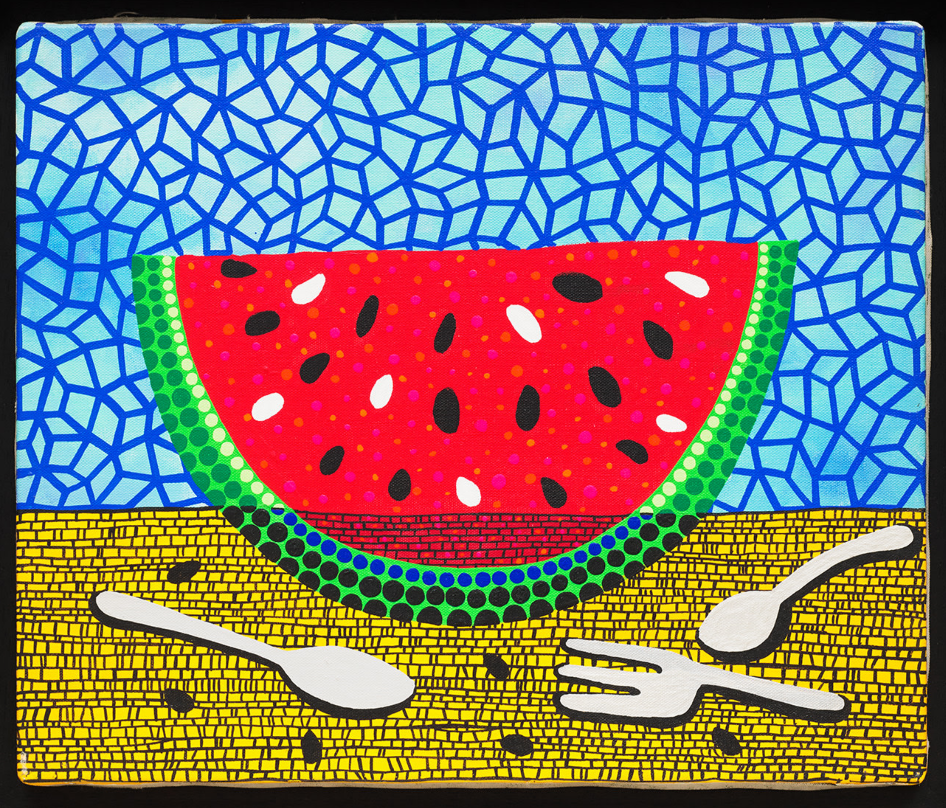
YAYOI KUSAMA
Watermelon and Fork, 1989
Acrylic on canvas
37.5 x 45 cm (14 3/4 x 17 3/4 inches)
Signed, titled and dated ‘”Suika to Fork” [in Kanji and Katakana], Yayoi Kusama 1989’ on the reverse
LOUISE BONNET
Scotch Tape, 2016
Phillips Hong-Kong: 25 November 2024
Estimated: HKD 800,000 – 1,200,000
HKD 1,397,000 / USD 179,480
Louise Bonnet – Modern & Contemporar… Lot 3 November 2024 | Phillips
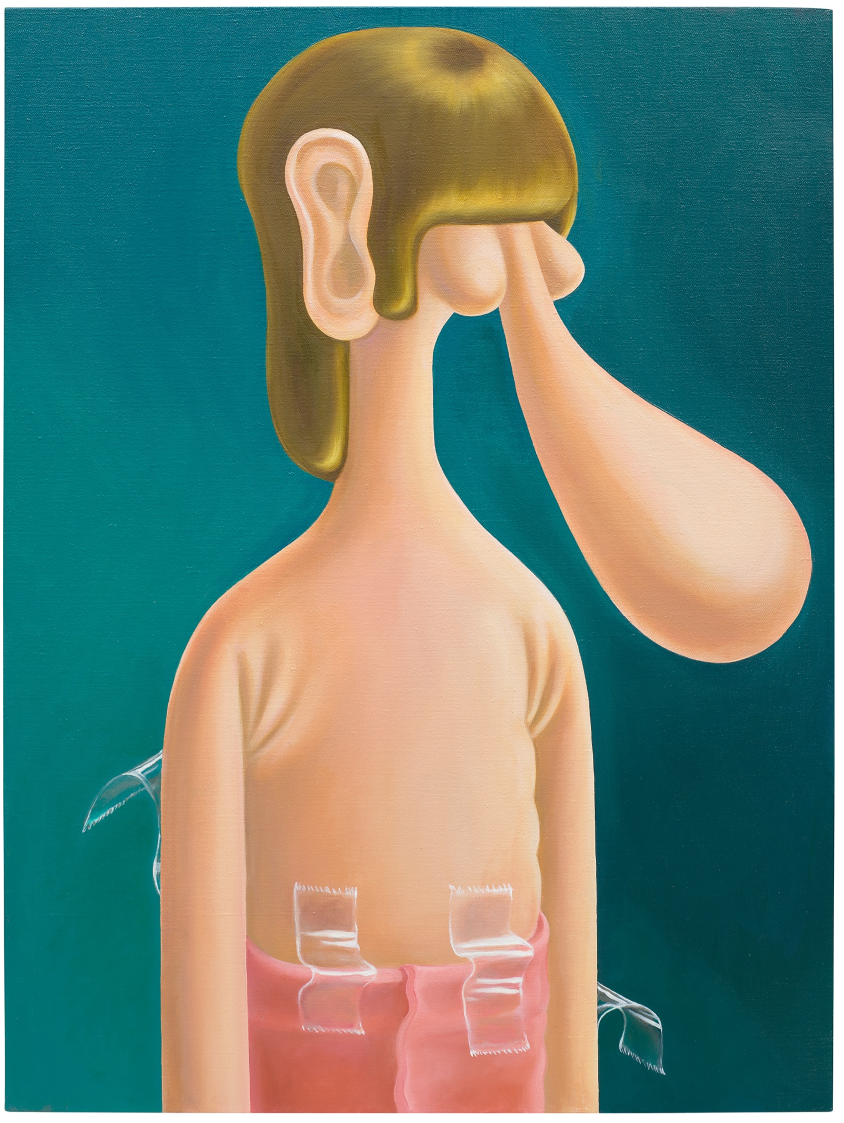
LOUISE BONNET
Scotch Tape, 2016
Oil on canvas
101.9 x 76.8 cm (40 1/8 x 30 1/4 inches)
Signed and dated ‘Louise Bonnet 2016’ on the reverse

Focus: Nicolas Party
Mountains, 2023
Phillips Hong-Kong: 25 November 2024
Estimated: HKD 10,000,000 – 15,000,000
HKD 13,760,000 / USD 1,767,843
Nicolas Party – Modern & Contemporar… Lot 8 November 2024 | Phillips
NICOLAS PARTY
Mountains, 2023
Soft pastel on linen, in artist’s frame
156.8 x 186.1 cm (61 3/4 x 73 1/4 inches)
Signed and dated ‘Nicolas Party 2023’ on the reverse
Fresh to the market, Mountains stands as a superb example of Nicolas Party’s highly acclaimed pastel paintings. Both alluring and imposing, the nearly two meter long work commands attention, transporting viewers on a mesmerizing journey through a majestic mountain landscape. Party’s masterful manipulation of tones—from tranquil Arctic blues to rich cobalts and deep sapphires—imbues the work with movement and vibrancy, as the grandeur of the rocky tiered peaks pays tribute to the beauty and significance of the natural world.
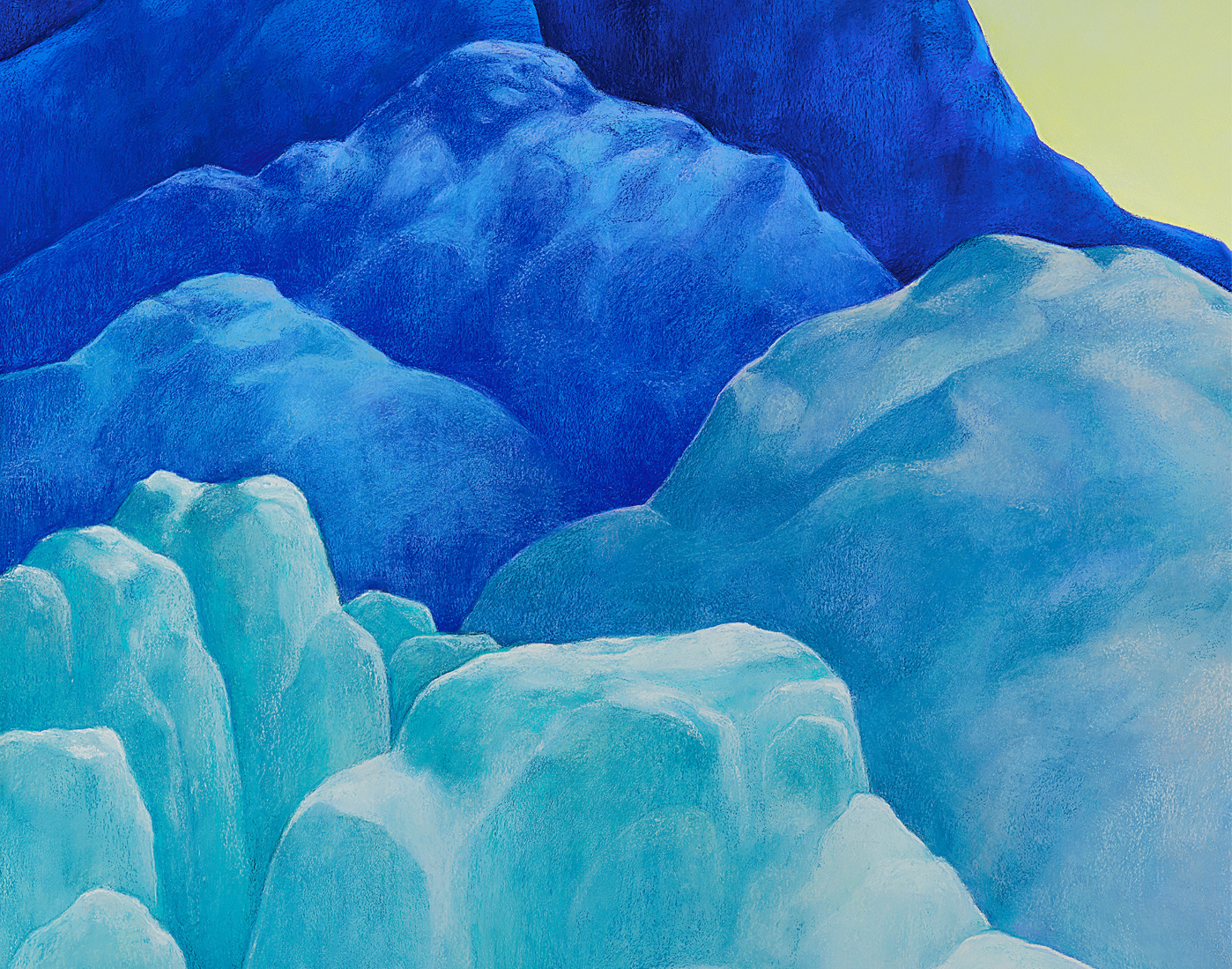
Mountains was exhibited in 2023 as part of Party’s solo show at The Modern Institute in Glasgow, which featured a small selection of only twelve works, with the present painting being one of the largest. The exhibition title, Cretaceous, refers to the geological period that ended 66 million years ago due to a mass-extinction event. In this context, with all works in Cretaceous portraying scenes from the natural world, except for one of a sleeping infant representing the fragility of life, the exhibition can be understood as a response to humanity’s complex relationship with our environment, and the troubling impact we have on its future.
“I grew up in a little village in Switzerland called Villette. It is located in the vineyards between Lausanne and Montreux, with a view of Lake Geneva and the Alps. The landscape is quite spectacular: the light and the water change all the time.”
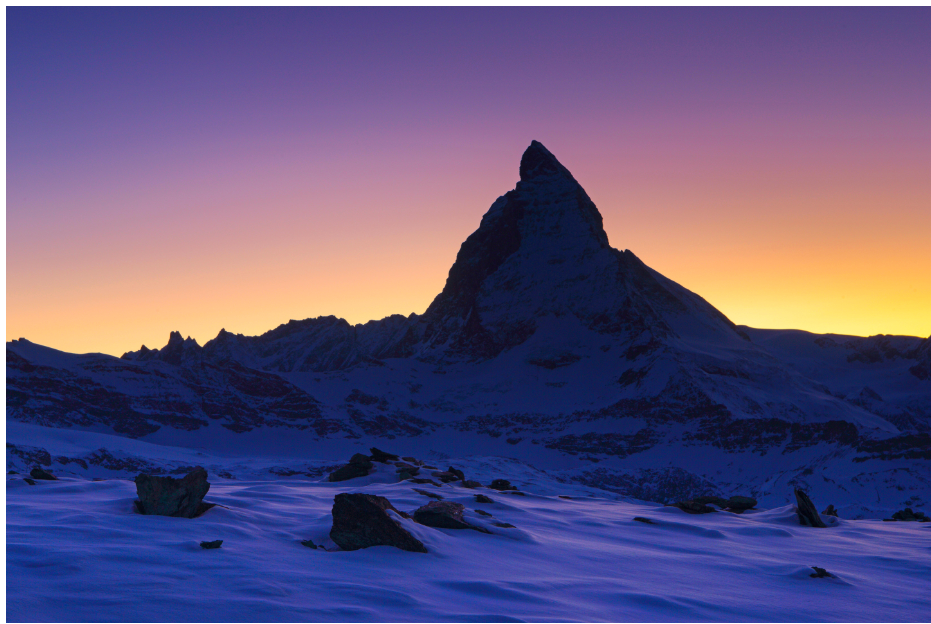
Sunset behind the Matterhorn / Image: blickwinkel / Alamy Stock Photo
While Party explains that works like Mountains do not depict any specific geographical location, but rather are imagined constructs born from a myriad of references within his mind, the silhouetted skyline of hilly peaks in the present painting evoke a number of iconic ranges. For example, the gently sloping summit of the tallest mountain in the background is shaped like the curved tip of a wizard’s hat, reminiscent of the iconic Matterhorn, celebrated globally as a symbol of the Alps’ grandeur. Situated on the border of Switzerland, it is also located in the country where Party was born in 1980.
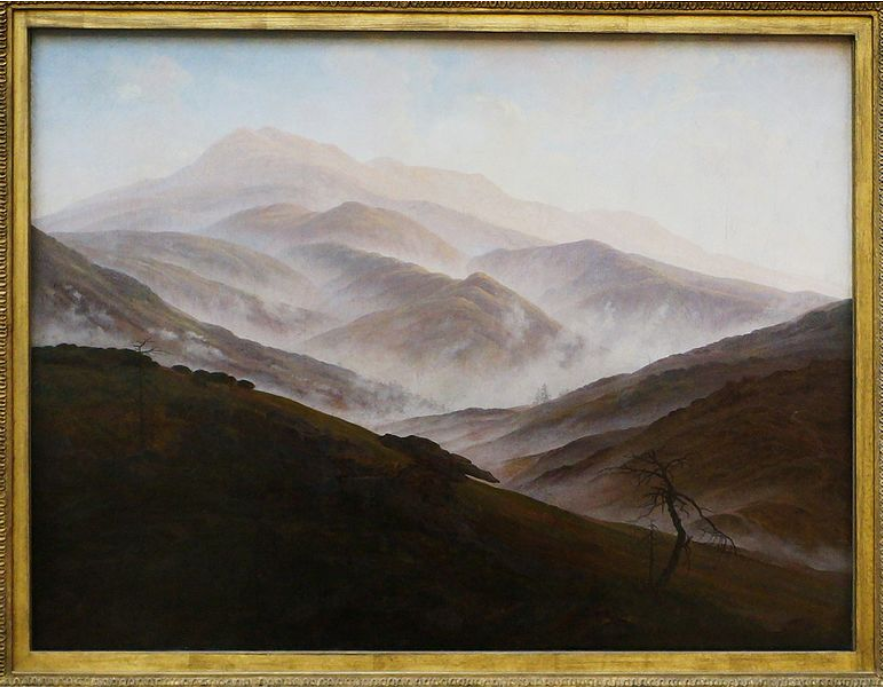
Caspar David Friedrich, Giant Mountains Landscape with Rising Fog, c. 1819
Image: wikicommons
By selecting a panorama of mountains as the focal point of the present work, Party engages with one of art history’s most enduring and revered themes. Across both Western and Eastern traditions, mountainous landscapes have not only celebrated the beauty of the natural world but have also provided a medium for exploring humanity’s connection to the environment. In Western art, figures like Caspar David Frierich, John Constable, and Ferdinand Hodler, all showcase landscapes rich in emotion and atmosphere, capturing the immense power and grandeur of nature. In contrast, Eastern art—especially Chinese ink painting and Japanese ukiyo-e prints, such as Hokusai’s Thirty-Six Views of Mount Fuji (circa 1830-1832)—perceives mountains as profound symbols for philosophical reflection, embodying harmony and balance. These representations often depict mountains as sacred spaces, believed to be home to immortals and closely linked to the heavens.
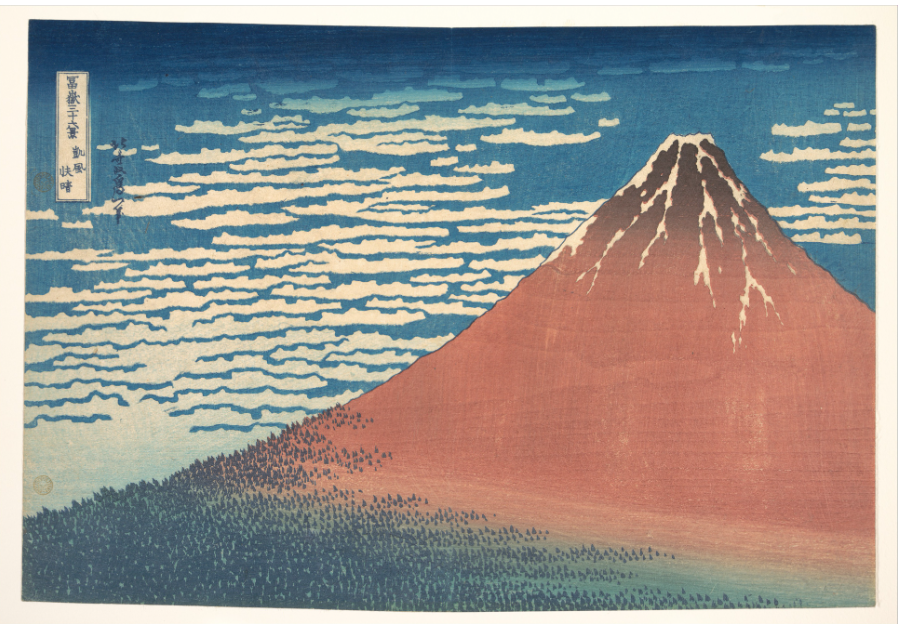
Hokusai, South Wind, Clear Sky from the series Thirty-six views of Mount Fuji
Image: © The Metropolitan Museum of Art, New York, Rogers Fund, 1914
In Mountains, Party distills the form and essence of the undulating peaks, intentionally omitting extraneous details. The colours are so vibrant that they seem almost artificial, while the undulating ridges, shaped by light and shadow, are defined solely by their variations in form, hue, and scale. This interplay flirts with abstraction, reminiscent of Georgia O’Keeffe’s expansive paintings of the sky and clouds from the mid-1960s (see for example, Sky above Clouds IV (1965) in the collection of The Art Institute of Chicago). But just as Party masterfully intertwines his interpretation of the landscape with its historical narrative, echoing the work of his predecessors, he seamlessly transitions it into a contemporary context. Indeed, as Galerie Magazine aptly notes, Party approaches his artmaking ‘like a spirited time traveler, gallivanting across eras, plucking inspiration from diverse styles and movements’. He ‘is a master of art historical sampling, producing eye-catching works in a language that is distinctly his own’.
The brilliant colors in Mountains can be attributed to the Party’s choice of medium: pastel. This somewhat unconventional choice in the 21st century pays homage to the traditional medium’s long-standing history in art, cherished by artists in the Renaissance and notably favored by masters like Edgar Degas and Mary Cassatt, who appreciated the rich vibrancy and distinctive texture offered. With the softness of the medium standing in direct contrast to the ruggedness of the subject matter depicted, Party meticulously applies pigment directly to the canvas, skilfully blending colours with his fingertips, bringing the painting to life with a dance of rhythmic and dynamic movement. This is particularly evident in the small, blurred dots of detail that traverse across the surface of the mountains in the present painting, appearing like delicate balls of snow. His blending technique enhances the artwork’s intimacy, subtly revealing traces of the artist’s fingerprints upon closer examination.
“Oils allow you to endlessly retouch. With pastels it’s kind of the exact opposite. You can layer and layer, but you can’t start over. The nature of the medium is much more direct. Nothing dries or is wet – it stays exactly how it is.”
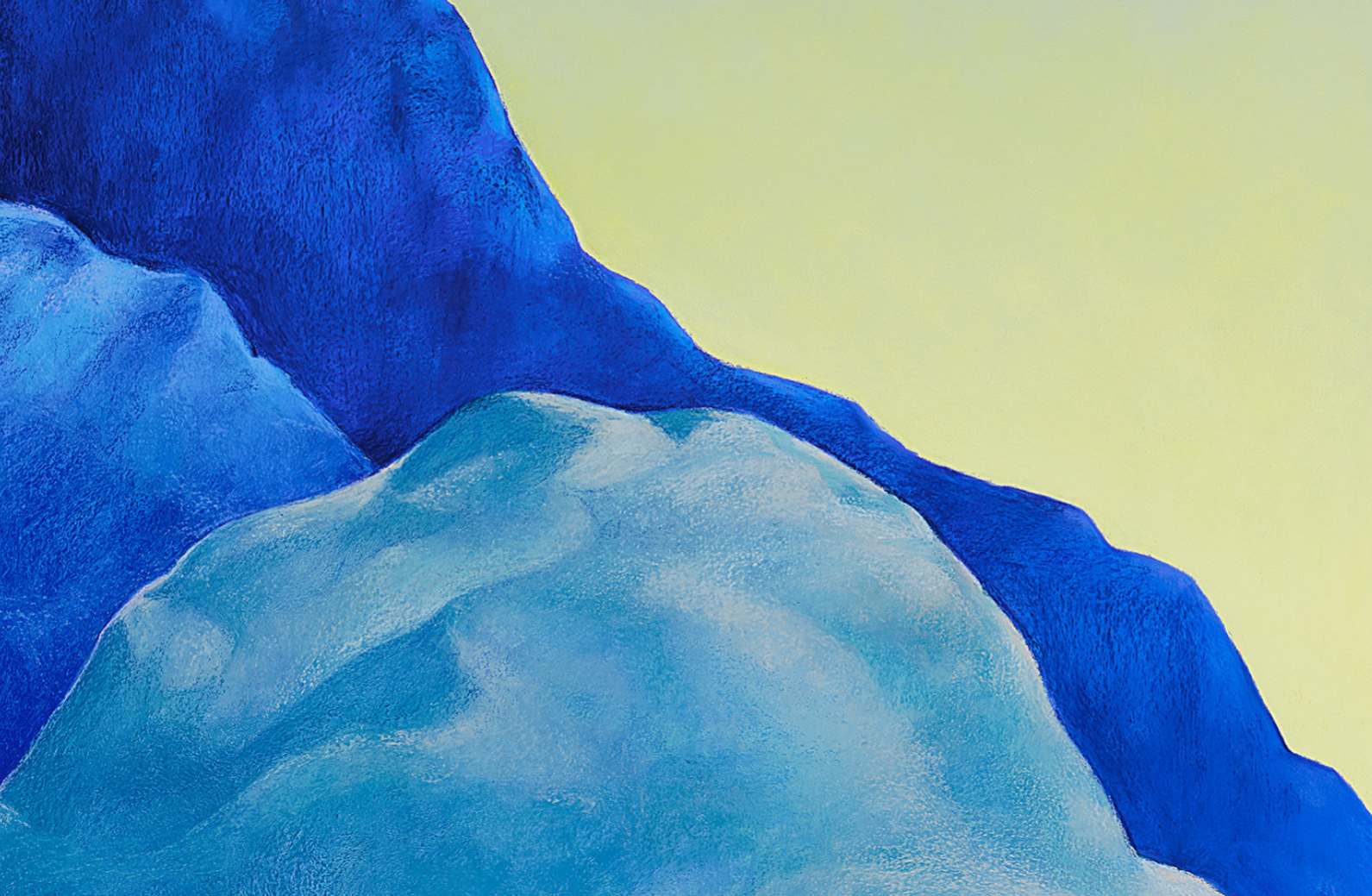
As the first mountain-themed painting by Party to be offered at auction, Mountains serves as a captivating testament to his remarkable ability to reimagine fundamental and traditional subjects, such as landscapes, through his unique artistic vision. Instead of striving for a faithful representation of nature, Party’s emphasis is more on the translation and transformation that occurs through the use of color, materials, and composition. By seamlessly blending elements of realism with fantasy, Party creates a bridge between the natural environment and the viewer’s imagination, offering a fresh perspective to appreciate the beauty around us.
Focus: Anna Weyant
Buffet II, 2021
Sotheby’s Hong-Kong: 11 November 2024
Estimated: HKD 3,000,000 – 5,000,000
HKD 3,600,000 / USD 463,005
Anna Weyant 安娜・維揚特 | Buffet II 大餐二號 | Modern & Contemporary Evening Auction | 2024 | Sotheby’s
ANNA WEYANT (1995 – )
Buffet II, 2021
Oil on canvas
48 1/4 x 60 1/8 inches (122.4 x 152.8 cm)
Signed and dated 2021 (on the reverse)
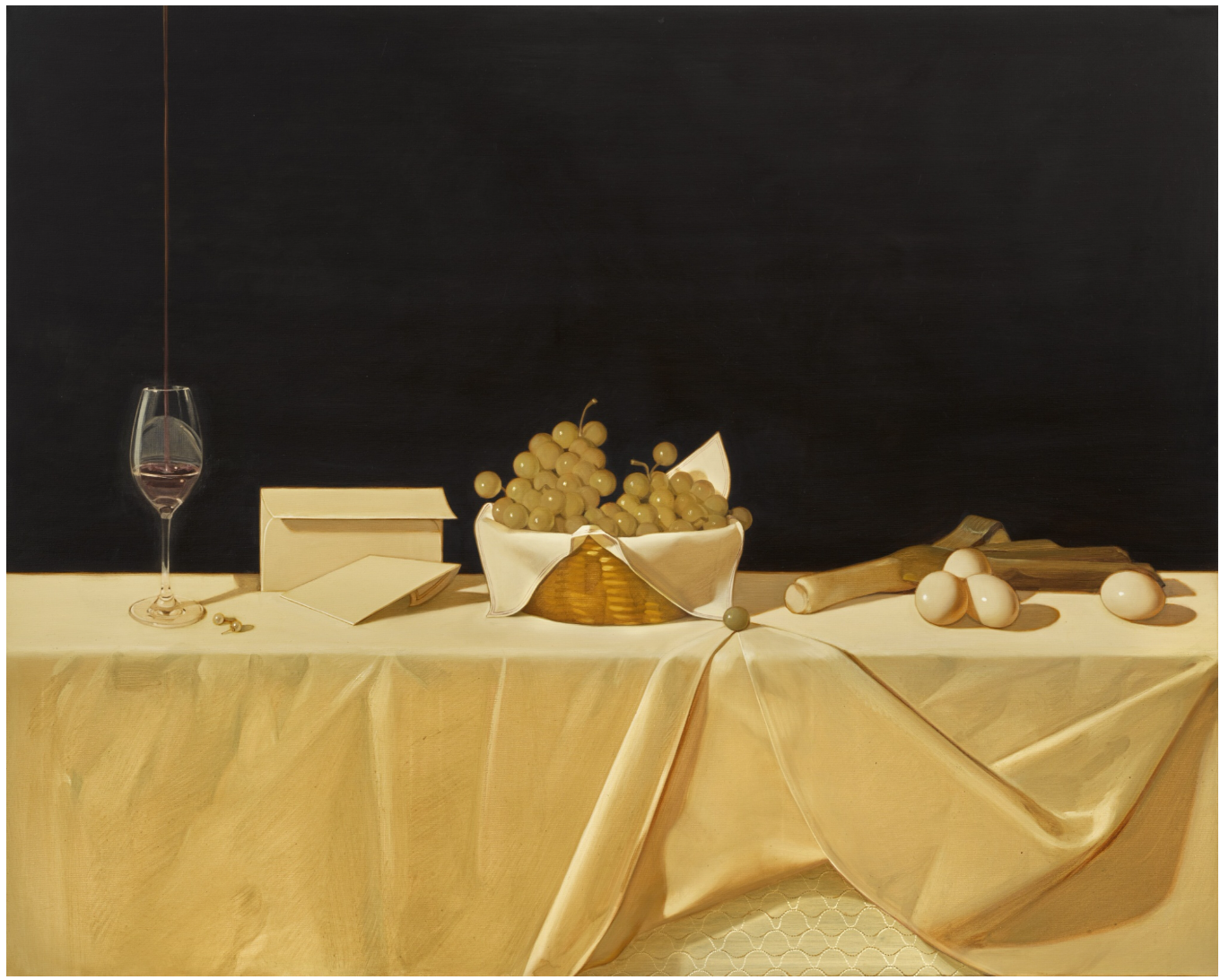
Executed in 2021, Buffet II is a beguiling example of Anna Weyant’s acclaimed series of still lifes. Steeped in the wit and irony central to Weyant’s painterly practice, Buffet II presents a table laid with a white tablecloth, atop which sits a basket of grapes, a glass of wine, a bundle of leeks and eggs. Despite the suggestion of plenty that the work’s title evokes, this eerie scene is sparse and strangely uncanny.
“I like it when there’s something that’s not quite right in the image, something that doesn’t fit”
Recalling the somber elegance of the Dutch Golden Age masters, the present work exemplifies Weyant’s highly technical approach to memento mori, which she began exploring at the Rhode Island School of Design and subsequently at the China Academy of Art in Hangzhou. Weyant’s exquisite rendering of light is on full display in the present work, with her use of atmospheric tones and shadow recalling the exquisite seventeenth-century still life paintings of Pieter Claesz, Clara Peeter or Rachel Ruysch. Charming and kitsch, seductive and mysterious, Weyant’s wry style of figuration and continued gallery success with Gagosian has seen the artist become one of the most in demand contemporary painters working today.
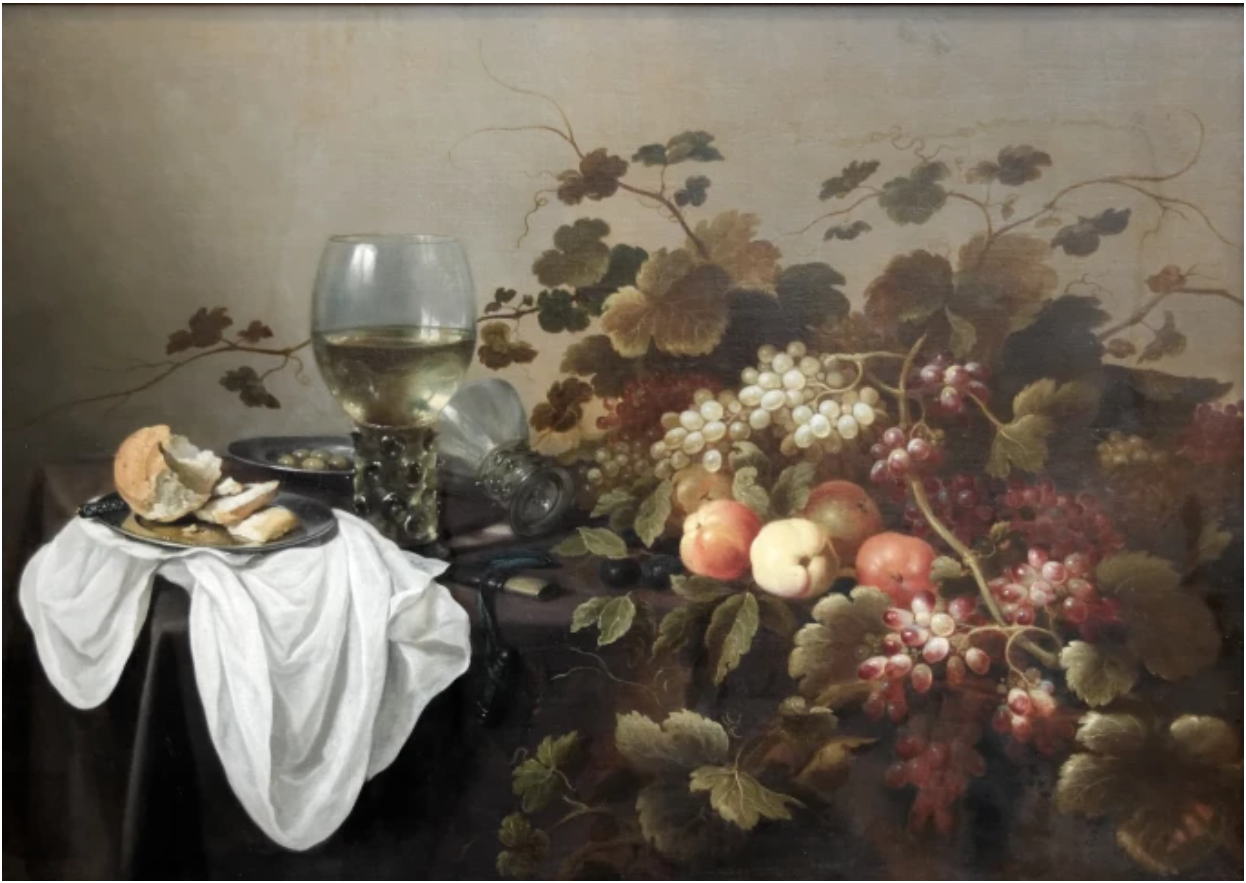
Pieter Claesz. and Roelof Koets, Still Life with Fruit, Bread and Roemer, 1644, Szépművészeti Múzeum, Budapest
Calling still lifes her “happy place,” Weyant’s work in the genre of portraiture and still life is cinematic and simultaneously infused with playful humour and sombre tragedy.
“Figures and still lifes—they’re like dinner and dessert for me. They’re so different, and I enjoy them both separately,”
Alongside her wry portraits of the “low-stakes trauma of girlhood,” Buffet II underscores a visual language that embraces both ambiguity and disjunction and reveals an exceedingly meticulous, elegant style of figuration. The tragicomic elements of her work reveal a fascination with the macabre which the artist has described;
“Humor can be a way to control discomfort. Mark Twain said something about humour being “tragedy plus time.” If there’s humor in my work, it probably goes hand in hand with some sort of weird misery.”
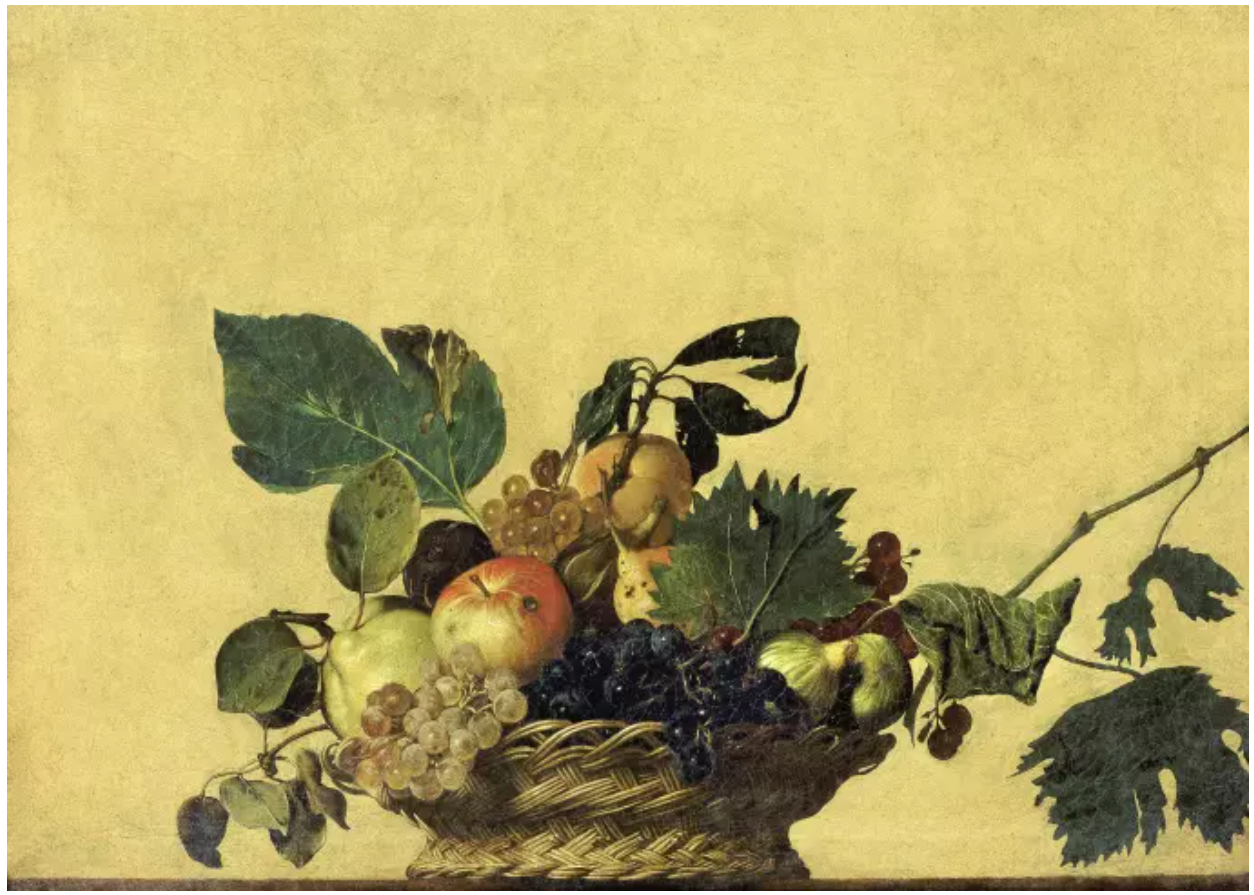
Carravaggio, Basket of Fruit, circa 1597-1600, oil on canvas, Biblioteca Ambrosiana, Milan
In the present work, surrealist humor is found in the “peek-a-boo” unveiling of the table cloth by a singular grape and the anthropomorphic envelopes which sit atop the table, mitigating the ominous reverb of the red liquid which pours from the ceiling and the leek shaped like a pistol. Through this ominously violent imagery, Weyant masterfully translates the theme of vanitas or memento mori—again harkening back to her Dutch still-life predecessors—in Buffet II through her singular sensibility of weaving the sinister with the charming, menacing with the enchanting, dark with the light. In her treatment of light Weyant employs extreme chiaroscuro, as the white tablecloth and eggs, partly in shadow, are juxtaposed against a stark black background. While Weyant’s muted color palette and treatment of light draws heavily upon European art historical sources, she also cites contemporary artists John Currin, Lisa Yuskavage, Ellen Berkenbilt and Jennifer Packer as influences central to her style of representation. Her portraits and still lifes are staged in the same fantastical, eerie world, with each scene depicted from a young and decidedly feminine perspective.
Focus: Ewa Juszkiewicz
Maria (After Johannes Cornelisz Verspronck), 2013
Sotheby’s Hong-Kong: 11 November 2024
Estimated: HKD 2,800,000 – 4,500,000
HKD 3,360,000 / USD 432,354
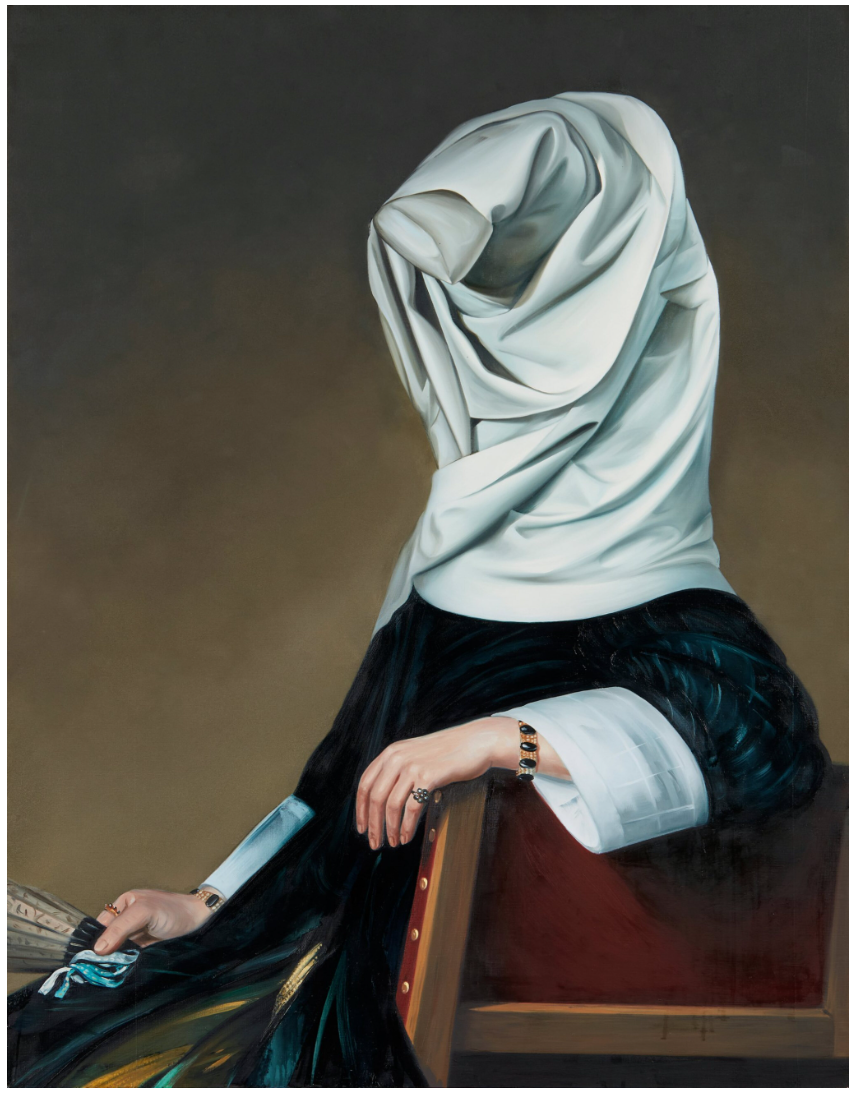
EWA JUSZKIEWICZ (1984 – )
Maria (After Johannes Cornelisz Verspronck), 2013
Oil on canvas
130×100 cm (51 x 49 1/4 inches)
Signed and dated 2013 on the reverse
Executed in 2013, Maria (After Johannes Cornelisz Verspronck) is a superb example from Ewa Juszkiewicz’s corpus of works investigating the role of the female sitter in contemporary portraiture. The composition of the present work directly references the seventeenth-century painter Johannes Cornelisz Verspronck’s celebrated work Portrait of Maria van Strijp in the collection of the Rijksmuseum, Amsterdam. Establishing a dialogue with this genre throughout art history, Juszkiewicz’s painterly practice draws upon a range of sources, from early Flemish still life to eighteenth and nineteenth-century portraiture by European artists. Juszkiewicz was born in Gdańsk in 1984 and currently lives and works in Krakow. Her work was recently exhibited at Palazzo Cavanis in Venice (Locks with Leaves and Swelling Buds, April – September 2024) as one of the collateral events of the 60th Venice Biennale , organized by FABA (Fundación Almine y Bernard Ruiz-Picasso) and supported by Almine Rech. The show comes after a period in which demand for Juszkiewicz’s work among collectors hit heady heights. The artist’s work was also featured in the inaugural showcase of TCollection and Malevich.io, (I’m Not Afraid Of Ghosts, April – September 2024), at the Palazzo Tiepolo Passi in Venice, Italy. One of the most coveted young artists working today, Juszkiewicz’s painterly practice challenges conventional standards of beauty and interrogates art historical canons of picturing women.
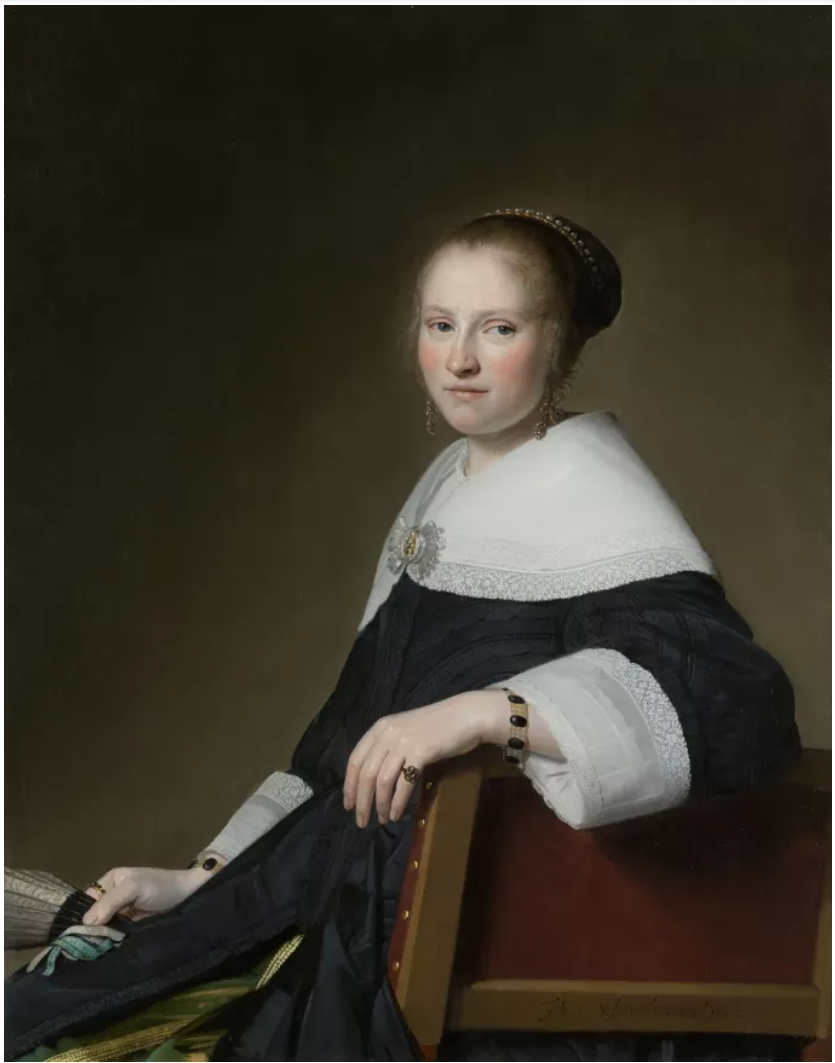
Johannes Cornelisz Verspronck, Portrait of Maria van Strijp, 1652, Rijksmuseum, Amsterdam
Set against a muted background, the present painting depicts a woman wearing a dark blue dress with wide white cuffs. The anonymous subject sits upright on a red upholstered chair, her arm resting on its back in a pose that would suggest she is looking out towards the viewer. Yet the sitter’s face is obscured entirely by white silk fabric wrapped loosely around her head. Juszkiewicz’s nuanced depiction of draped fabric here is reminiscent of the Old Masters, yet her uncanny concealment of the sitter’s face upends any sense of art historical convention. In an oeuvre of portraiture that solely depicts female sitters, almost all of Juszkiewicz’s faces are obscured by mercurial and highly tactile objects, from draped fabric and verdant flora and fauna, to tribal masks, mollusks, hair and over-sized insects.
Juszkiewicz’s treatment, and indeed destruction, of traditional modes of portraiture also suggest a subversion of the notion of the female sitter as passive subject of the male gaze. By concealing her sitter’s face, Juszkiewicz is not only magnifying the lack of agency of the female sitter throughout the art historical canon of portraiture, but also denying the contemporary viewer any glimpse of conventional beauty or aesthetic norm. In turn, she recontextualizes this esteemed genre, infusing her technically adroit works with uncanny compositional devices reminiscent of the Surrealists, most specifically Magritte and Dalí. On the surface of Maria (After Johannes Cornelisz Verspronck), Juszkiewicz reconfigures the tradition of nineteenth-century painting for a truly contemporary audience whilst challenging our cultural expectations of female subjects in portraiture.

Focus: Yoshitomo Nara
Baby Blue, 1999
Phillips Hong-Kong: 25 November 2024
Estimated: HKD 42,000,000 – 62,000,000
HKD 45,220,000 / USD 5,809,730
Yoshitomo Nara – Modern & Contempora… Lot 7 November 2024 | Phillips
YOSHITOMO NARA
Baby Blue, 1999
Acrylic on canvas
120×110 cm (47 1/4 x 43 1/4 inches)
Signed, titled and dated ‘”Baby Blue” Yoshitomo Nara ’99’ on the stretcher
Yoshitomo Nara’s Baby Blue stands as a definitive masterpiece from one of Japan’s most celebrated contemporary artists, who has unequivocally achieved rock star status on the global art stage. At the heart of his practice lies the iconic, adored ‘Nara girl’, a protagonist whose narrative and worlds have evolved through Nara’s oeuvre in tandem with the artist’s personal and artistic growth. Instantly recognizable with their large, chickpea-shaped heads and intensely expressive eyes that convey deep emotion, these cherubic faces are often lit with a playful mischief that belies their age. This intriguing duality is a hallmark of Nara’s artistic expression, inviting viewers to delve into the tensions between innocence and experience. Through this interplay, Nara connects with his audience on a profoundly universal level, exploring themes of childhood, identity, and the intricate complexities of human emotion.
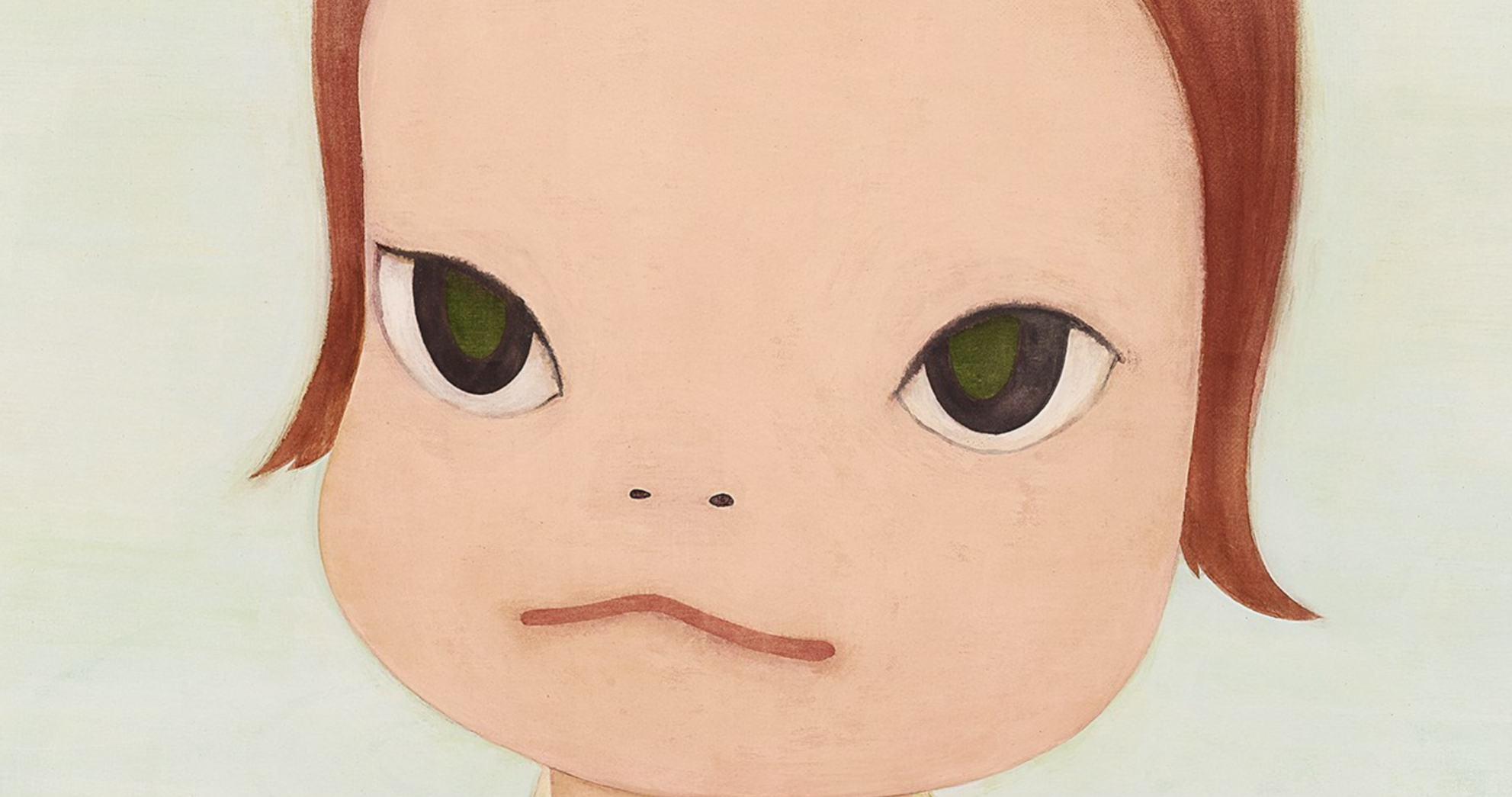
Painted at the turn of the millennium in 1999, Baby Blue emerged during a pivotal moment in Nara’s career, with artworks from this period being particularly coveted, as evidenced by Nara’s top two results at auction being canvases created just one year later. Baby Blue was first unveiled at an exhibition of Nara’s work hosted by the Marianne Boesky Gallery in New York that Autumn, marking his first solo show in the city. Nara’s debut received high praise, including that of the esteemed The New York Times critic Roberta Smith, who complimented Nara’s ‘cast of cute but demonic cartoon toddlers’who ‘pack a potent visual punch’. Smith articulates how this visual impact arises from the contrast of high abstraction with popular culture, with Nara’s angelic-devilish subjects ‘rendered in clear buoyant shapes, like toys. But their big beach-ball heads feature clamped, lozenge-shaped mouths and somewhat slanted green eyes that smoulder resentfully.’ The colors are ‘rich, odd, deliberate and slightly nostalgic: beautiful pastels against glowing browns that evoke illustrated children’s books from an earlier era’. And the figures are set against ‘unusually seductive [surfaces], dense and powdery like pastel but with the evenness of stain painting’. Indeed, Smith’s summary of the key characteristics of the most significant Nara girl paintings is beautifully exemplified in Baby Blue, which encapsulates these very qualities.
Fountain of Life, 2001/2014
Phillips Hong-Kong: 25 November 2024
Estimated: HKD 8,000,000 – 15,000,000
HKD 10,130,000 / USD 1,301,470
Yoshitomo Nara – Modern & Contempora… Lot 6 November 2024 | Phillips
YOSHITOMO NARA
Fountain of Life, 2001/2014
Lacquer and urethane on FRP, motor and water
175x180x180 cm (68 7/8 x 70 7/8 x 70 7/8 inches)
This work is edition 2 of 3 plus 2 artist proofs
A profound embodiment of emotion and introspection, Fountain of Life exists as a seminal and monumental work within Yoshitomo Nara’s oeuvre. The present work is a celebration of the emotional complexities of everyday life, in which the artist has dedicated his prodigious career to exploring themes such as innocence, vulnerability, and defiance. In Fountain of Life, Yoshitomo Nara brilliantly evokes the purity of childhood while simultaneously acknowledging the inevitable loss of that innocence. This wistful juxtaposition brings to light the unspoken feelings of pain, grief, and loneliness that often accompany the transition into adulthood. Rendered in a captivating and delicate celadon green, with a sleek layer of lacquer on top, the present work evokes a sense of softness and empathy. It can be understood as a critique of contemporary society, where the pressures of adulthood often overshadow the simplicity of childhood pleasures, and it serves as a poignant reminder to reconnect with the innate curiosity and wonder of youth.
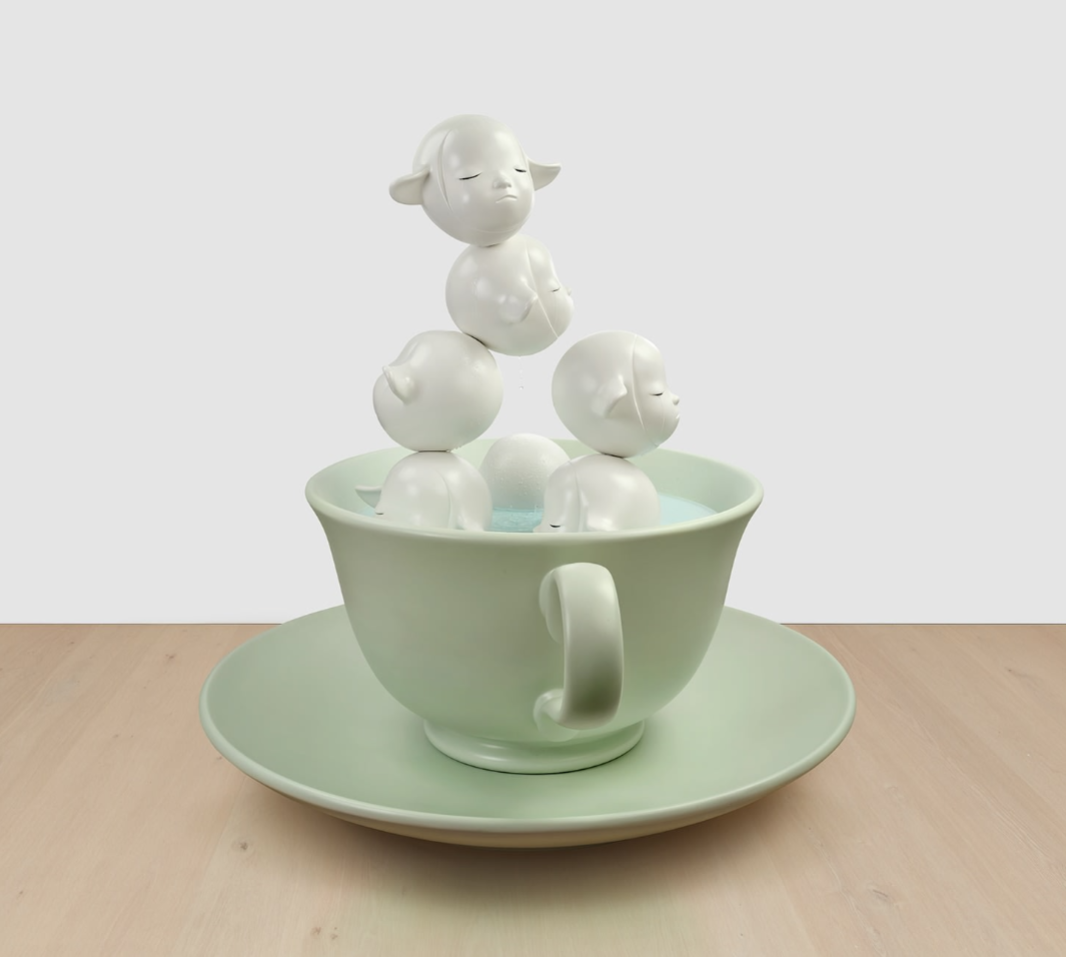
The characters in the present work appear to be both observers and participants in the space that it occupies. As such, Fountain of Life elicits a sense of wonder and confusion whereby Nara encourages the audience to contemplate their own experiences of childhood – moments of joy that are intertwined with feelings of fear. Presented at auction for the first time, this sculptural masterpiece stands as Nara’s only motorized work, marking a breakthrough and signifying a pivotal transition in the artist’s creative practice. The emergence of the teacup as a leitmotif first appeared in Nara’s 1995 sculpture Cup Kids. It was the artist’s first foray into experimenting with fibre-reinforced plastic to create his large-scale pieces. The style of the cup and the figure’s head was what propelled the artist’s series of popular FRP sculptures.
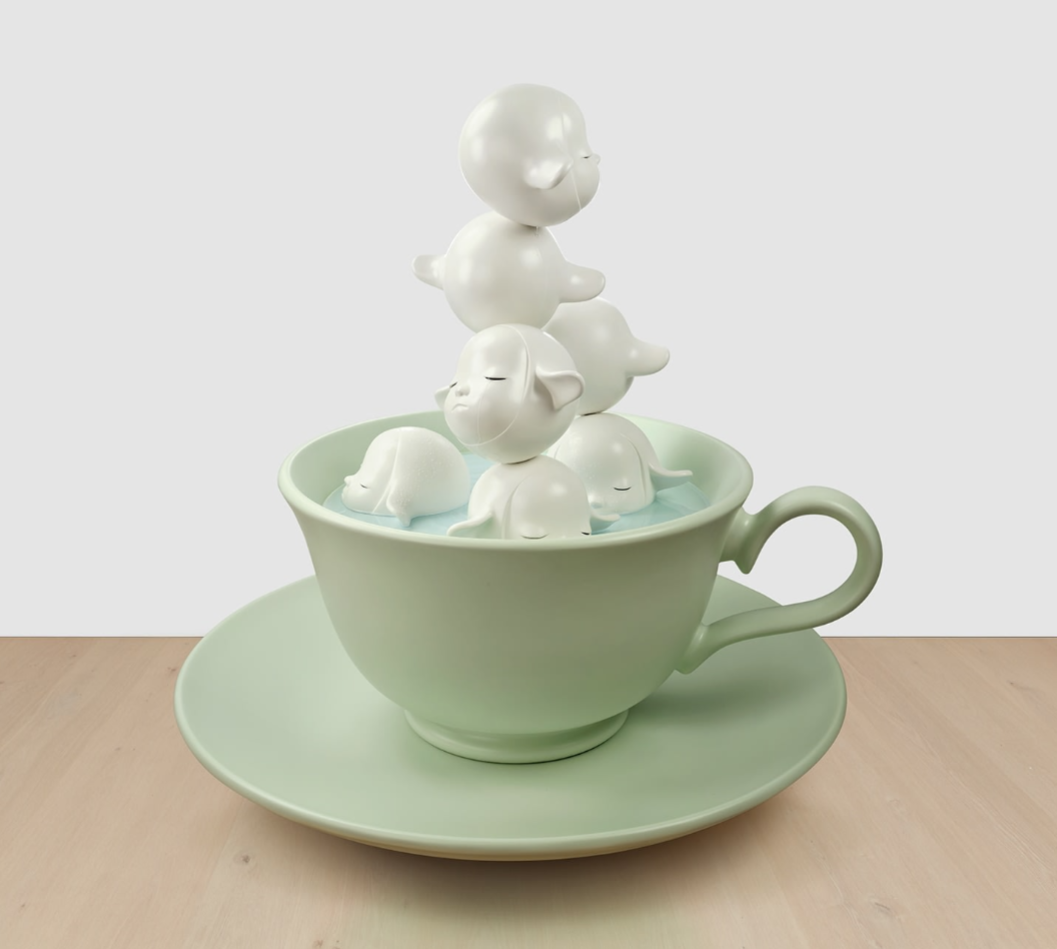
These whimsical and fantastical renderings of the teacup evoked a sense of nostalgia. Reminiscent of the tea party scenes from Alice in Wonderland, it also harkens back to childhood memories of fairground cup and saucer rides. With this concept in mind, Nara created Quiet, Quiet and The Little Pilgrims in 1999. This thus laid the foundation for what ensued. At the turn of the century, Nara’s creative practice took a major shift and progressed even further. Drawing inspiration from his earlier works, the artist had conceived the idea of applying advanced technology and movement to enhance the conceptual purpose as showcased in Fountain of Life. The present work is a compelling example of Nara’s artistic vision, prompting viewers to contemplate deeper emotional narratives through its seemingly simple yet profound imagery.
“It began as a small incident in my mind, when it rained nonstop and I seemed to be swimming around in this little world like a tadpole. As the rain kept falling, the puddle grew in size, eventually merging with the other puddles nearby. These puddles formed an expansive network, which made me happy, even though I had trouble keeping up with their speed of expansion at times.”
At once endearing and melancholic, Fountain of Life is deeply rooted within the artist’s emotionally-complex childhood – probing notions of renewal and vitality whilst also hinting at the transience of life. In the present work, Yoshitomo Nara’s ingenious use of the traditional teacup – a quotidian object – creates an encircling, safe space for the figures, which further provides shelter and protection. Instantly recognizable are seven disembodied sheep-headed children, a signature motif stemming from the artist’s earlier sculptural installation, The Little Pilgrims. Towering precariously atop one another yet standing sturdily on their own, the figures appear serene and expressionless from a distance. With their heads tilted slightly backwards and their downcast eyes ajar, these pensive characters exude a profound sense of sorrow and solitude which is almost palpable. Acting as windows into their subconsciousness, the figures’ eyes well up with tears before spilling out into streams of water that trickle down along their cheeks into a glistening puddle.
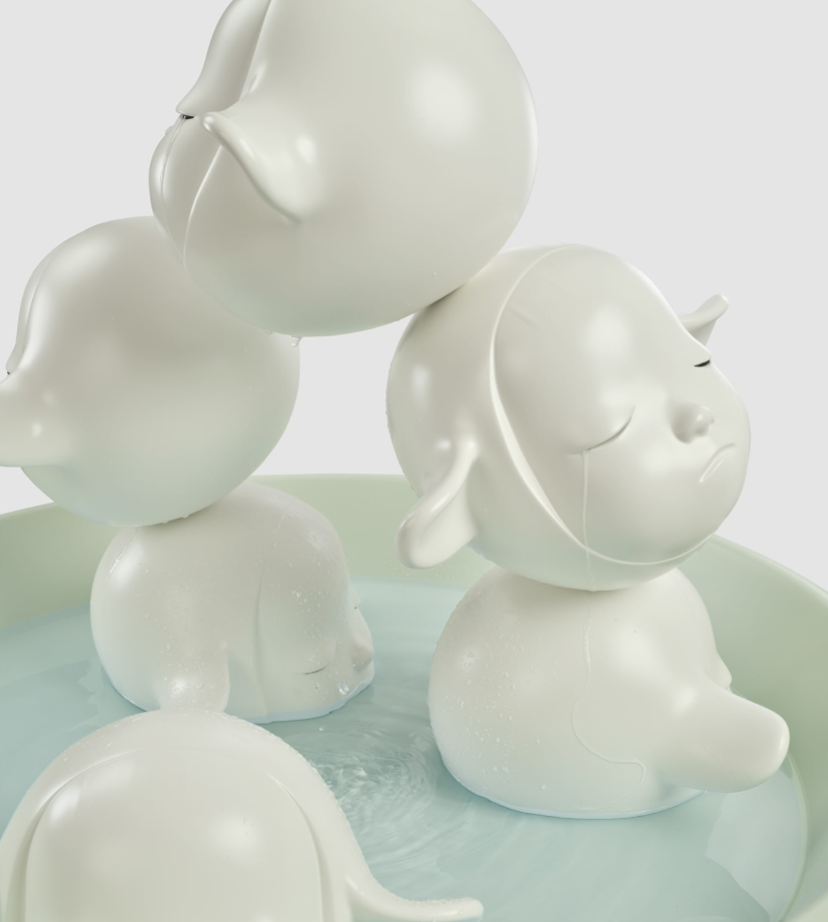
Designed to be viewed from different vantage points, Fountain of Life encourages viewers to circumambulate it and peer over the teacup into an almost reflective surface. With several heads that are partially submerged in the puddle, this recurring motif conjures an ambivalent in-between state, alluding to Nara’s own experience of alienation during his formative years in Germany. Through the process of implementing technology and dynamic movement into his work, Yoshitomo Nara transforms the way in which viewers engage with the installation from passive observation to active participation. The constant flow of water causes the work to remain in motion, evoking the idea of life-giving water as a symbol of regeneration. Fountain of Life transcends the boundaries of traditional static sculpture and is a true testament to Yoshitomo Nara’s depth of creativity.
Untitled, 2007
Christie’s Shanghai: 7 November 2024
Estimated: CNY 30,000,000 – 50,000,000
CNY 30,550,000 / USD 4,291,390
REPEAT SALE
Christie’s Hong-Kong: 24 May 2021
YOSHITOMO NARA (B.1959)
Untitled, 2007
Acrylic on canvas
162 x 145.5 cm (63 3/4 x 57 1/4 inches)
Executed in 2007, Untitled is one of the few largest canvases Yoshitomo Nara created at the point he rose to a game-changing art world phenomenon—it was a year after the artist debuted his legendary show Yoshitomo Nara + Graf: A-Z at his hometown Aomori that propelled his fan frenzy to the new height and cemented his global acclaim. It was taken place at a local brewery brickhouse and at the time recruited more than 13,000 volunteers to plan and produce the exhibition—the artist’s largest cultural jamming that testifies the synergies of Nara’s art and local community. The exhibition was later toured to multiple institutions, including KM21, The Hague (formerly the GEM Museum of Contemporary Art), and BALTIC Centre for Contemporary Art, Newcastle, where the present work was featured. Collaborating with the architectural and design group graf, Nara initiated an unorthodox way of displaying and viewing his art—creating temporary wooden shelters within an exhibition space where his personal collectibles are shown alongside his works. Being part of debuting this revolutionary concept in Europe, Untitled was hung in one of these wooden temporary structures, inviting the viewer to step into Nara’s inner world filled with personal memory and sentiment.
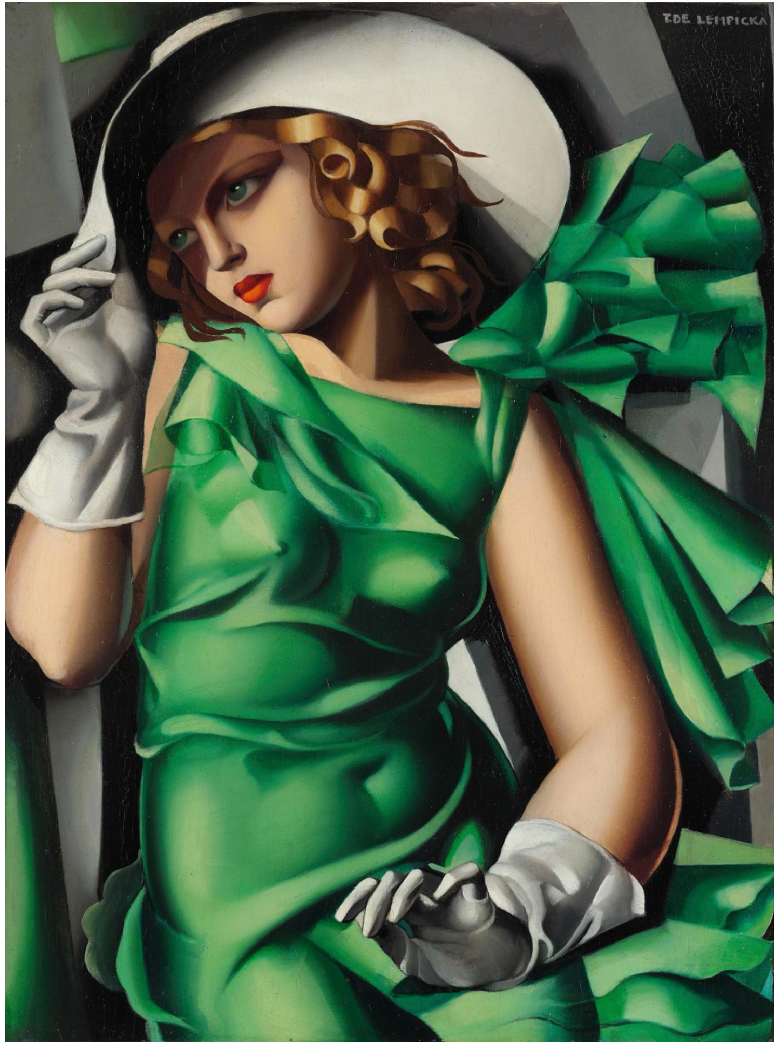
Tamara de Lempicka, Young Lady in Green, 1927-30. Centre Pompidou, Paris. © 2024 Tamara Art Heritage / ADAGP, Paris / ARS, New York. Localisation : Paris, Centre Pompidou – Musée national d’art moderne – Centre de création industrielle © Centre Pompidou, MNAM-CCI, Dist. GrandPalaisRmn / Bertrand Prévost
Out of the nearly eight hundreds of paintings Nara created since 1990s, the present work was chosen by the artist for his artist’s book NARA 48 GIRLS. Portraying the iconic Nara’s ‘big-headed girl’ with only one eye revealed and sitting serenely behind a tabletop, Untitled is extremely rare in composition among the artist’s oeuvre. The girl, with her petal-like, perhaps Murakami-inspired collar, once appeared in an earlier work Nara co-created with Murakami at the dawn of the legendary Superflat movement; while her emerald green dress invokes some of the most quintessential and transcendent portraitures since Renaissance: from van Eyck’s The Arnolfini Portrait (1434, The National Gallery, London) to Monet’s Woman in a Green Dress (1866, Kunsthalle Bremen) and Lempicka’s Young Lady in Green (1927-30, Centre Pompidou, Paris). It also appeared to be the colour worn by some of the most notable fictional characters invented by British playwright J.M. Barrie, such as Peter Pan and Tinker Bell. Never growing old, these fairies ring a bell with the good old memories of every grown-ups. Delving into fragments of childhood memories, Nara imbues the work with a fairy-tale milieu by reinventing a tender imagery that speaks simultaneously to himself as well as the whole generation.
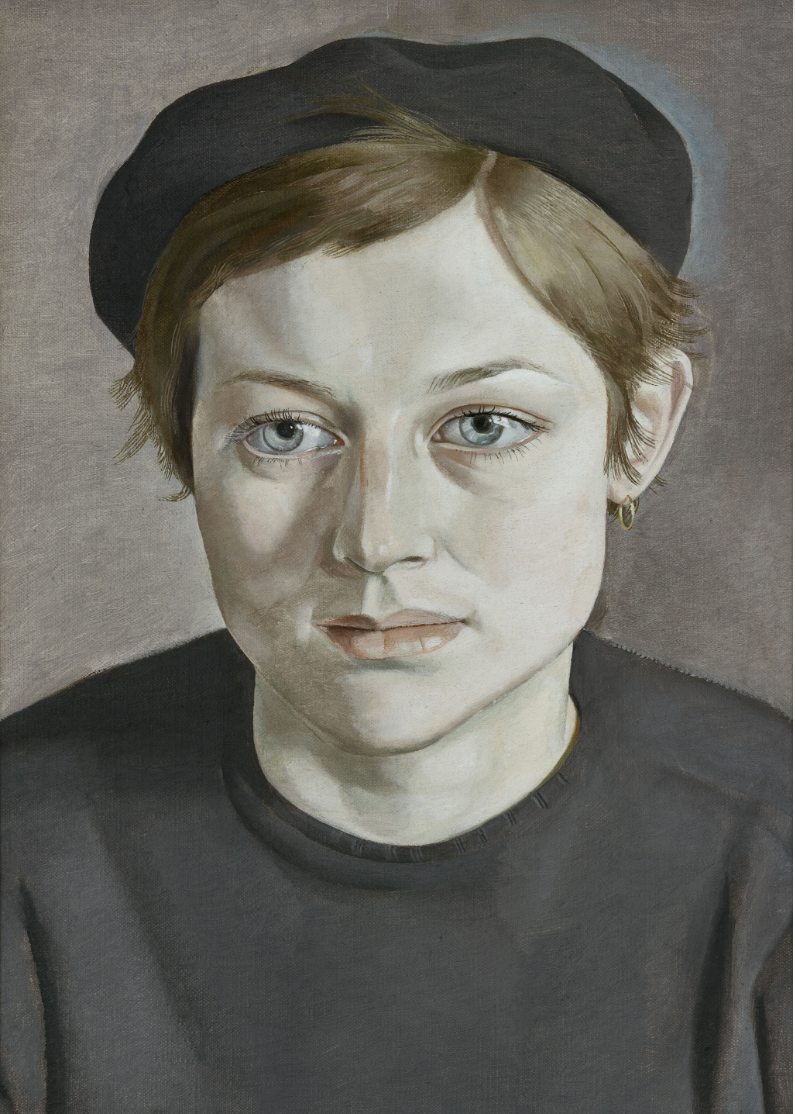
Lucian Freud, Girl with Beret, 1951. Manchester Art Gallery, Manchester. © Lucian Freud Archive / Bridgeman Images. Image credit: Manchester Art Gallery
Untitled also demonstrates a momentous transition of Nara’s visual lexicons—his changing course in depicting the eye from those piercingly slanted to lustrous star-studded, and his exhaustive and meticulous application of multi-layered pigments to create a luminous and enchanting emotional effect of portraiture. In Untitled, the enlarged pupil of the little star dweller almost engulfs the viewer with its mesmerizing, kaleidoscopic blobs and dashes. Nara once asserted, ‘I used to draw them too carelessly. Say, to express the anger, I just drew some triangular eyes. I drew obviously angry eyes, projected my anger there, and somehow released my pent-up emotions. About ten years ago, however, I became more interested in expressing complex feelings in a more complex way’ (Y. Nara, quoted in Hideo Furukawa, ‘An interview with Yoshitomo Nara’, Asymptote Journal, November 2013). Indeed, Nara’s shift of style in depicting the eye symbolises the new maturity of his painterly virtuosity in attaining what the art critic Midori Matsui described as ‘the allegorical ability to express narrative through singular image endowed with powerful emotional appeal and enigmatic fragment that evoked associations’ (M. Matsui, ‘A Child in the White Field: Yoshitomo Nara as a Great “Minor Artist”’, Yoshitomo Nara: The Complete Works, Paintings, Sculptures, Editions, Photographs, Vol. 1, Tokyo 2011, p. 334). In a similar vein as Lucian Freud’s early figurative paintings, Nara’s depiction of girl is nothing close to the ‘classical style’. Focusing on capturing the spirituality over the physicality of the character, both artists pay meticulous attention to the very details of eyes while softening other features of the face. This exceptional work, in particular, attests to his bravura in the medium and his meticulous attention to the minute difference in paint and brushwork, all of which highlight the clarity in the young girl’s deep yet lustrous—single eye. At once sparkling like stars in the night sky and inviting introspection like a window, it pulls the viewer into a spiritual realm that is timeless and constantly changing—a sacred temple of childhood that belongs to everyone. The key to this enthralling effect is repeated painting until the pigment becomes one with the canvas. This creates a stark contrast to the surface-bound quality in his earlier works. His Wish World Peace from 2014 (Christie’s Hong Kong, 26 May 2022, lot 51, sold for HKD 97,090,000), for example, demonstrates the persistent delicacy Nara holds towards his medium. In the past decade, Nara has slowed down and let the light and shadow come out in his work. These details turn his paintings into a meditative and reflexive whole that generates a profound feeling of immediacy. Earlier motifs such as cigarettes, knives, and torches are gone—instead, his paintings become pure poetic explorations of lines and colours charged with the most intense emotions. As Nara once expressed, ‘It allows me to draw out parts of myself that I’m not even aware are there’ (Y. Nara, quoted in ‘Japanese artist has a taste for Hong Kong’, South China Morning Post, 9 March 2015).
Little Bunny in the Box, 1996
Sotheby’s Hong-Kong: 11 November 2024
Estimated: HKD 10,000,000 – 15,000,000
HKD 10,800,000 / USD 1,389,710
YOSHITOMO NARA (1959 – )
Little Bunny in the Box, 1996
Acrylic on canvas
80.5 x 70.2 cm (31 5/8 x 27 5/8 inches)
Signed, dated ’96 and inscribed Abandoned (on the reverse)
Executed in the seminal year 1996, Yoshitomo Nara’s Little Bunny in the Box epitomises the artist’s career-long exploration of innocence, adolescence and universal emotions. With softy downturned eyes, this rosy-cheeked, infantile figure dressed in a bunny suit sits nestled within a lone black box – at once vulnerable, captivating and enchanting, the present work captures the beguiling emotionality of Nara’s enigmatic oeuvre. One of the first canvases to feature Nara’s bunny motif and fresh to auction, Little Bunny in the Box is only the third example from this series on canvas to ever come to auction. As with Nara’s most celebrated works, images of children and animals act as representations of loneliness and solitude, as well as symbols of innocence and its fragility. Throughout his career, Nara has frequently depicted dogs, cats, bunnies and other animals, with the artist remarking that their submissive obedience reminds him of the naivety of children. The nascent figure of the bunny seen in the present work, with its playfully sloping ears, would go on to inspire the artist’s celebrated Sleepless Night painting and sculpture, universally admired by collectors and fans of the artist. As with many of Nara’s most widely treasured compositions, the present work is instantly recognizable, having been featured on a series of posters produced by the artist’s N’s Yard gallery.
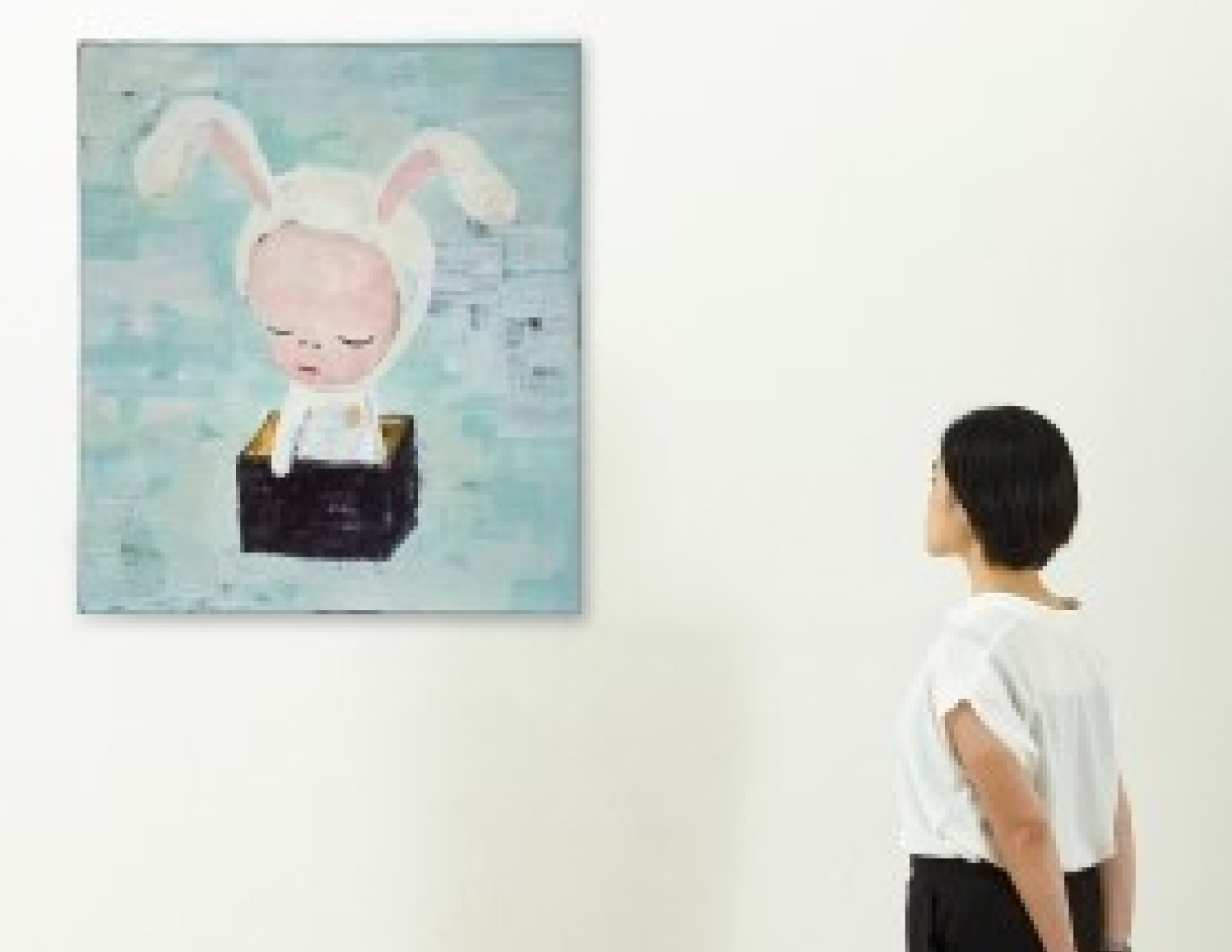
Born to a working-class family in the rural area of Hirosaki in Japan, Nara’s youth was spent in relative isolation. Growing up during a period of rapid economic growth, Nara’s parents would often spend long hours away from their home nestled in the Japanese countryside, leaving the young artist to spend much of his childhood alone without companionship. Drawing and making picture books inspired by his pet cat, it was this companion and other neighborhood animals that Nara took for company, as well as early inspiration. Nara is candid about his isolated early years in rural Japan, explaining;
“I was lonely, and music and animals were a comfort. “I could communicate better with animals, without words, than communicating verbally with humans.”
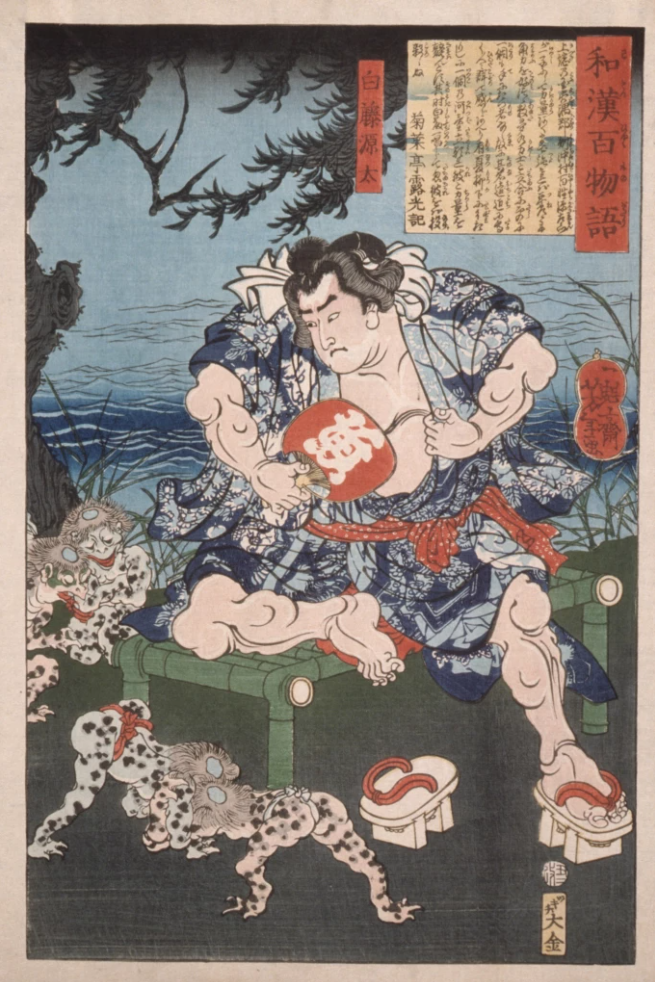
Tsukioka Yoshitoshi, Shirafuji Genta Watching Kappa Wrestle, 1865, 2nd month, Los Angeles County Museum of Art, Herbert R. Cole Collection, photo © Museum Associates/LACMA
Universally admired for these deeply felt depictions of innocence and angst across generations, Nara’s cast of characters are often described in terms of kawaii and the Japanese Superflat movement that arose from this context of rapid economic growth. However, Nara himself says that his imagery is derived from a more emotive and spiritual base stemming from his Japanese heritage; “[my] imagery that some people misinterpret as being manga—like, not a lot of people would see this spiritual side of my work. The fact is I have never once said that I’ve been influenced by Japanese manga. For a very long time I have created my art from a spiritual point of view. It is filled with religious and philosophical considerations” (Yoshitomo Nara, quoted in Robert Ayers, “‘I Was Really Unthinking Before’: Yoshitomo Nara on His Recent Work and His Show at Pace Gallery in New York”, ArtNews, April 14, 2017). As Kagawa Masanobu, Head curator of Hyōgo Prefectural History Museum, has articulated, Japanese folklore and spirituality is a rich tapestry of mischievous spirits, child-eating monsters, and shape-shifting animals, with Nara’s spectral half-human, half-animal characters recalling the Japanese Yokai. These spirits or creatures, equally beloved and feared in Japan, have played an integral part in Japanese culture for millenia. From the Edo period (1603–1868) scroll paintings such as Tsukioka Yoshitoshi, woodblock prints, and books, to today’s video games, movies, and manga, these mischievous supernatural spirits are prevalent in Japanese folkloric culture. As with Nara’s animal characters, these spirits are vessels for storytelling and the reimagining of personal experiences, the influence of which is most directly articulated by Nara through his Miss Forest sculpture series, which the artist has described as inspired by “forest spirits”.
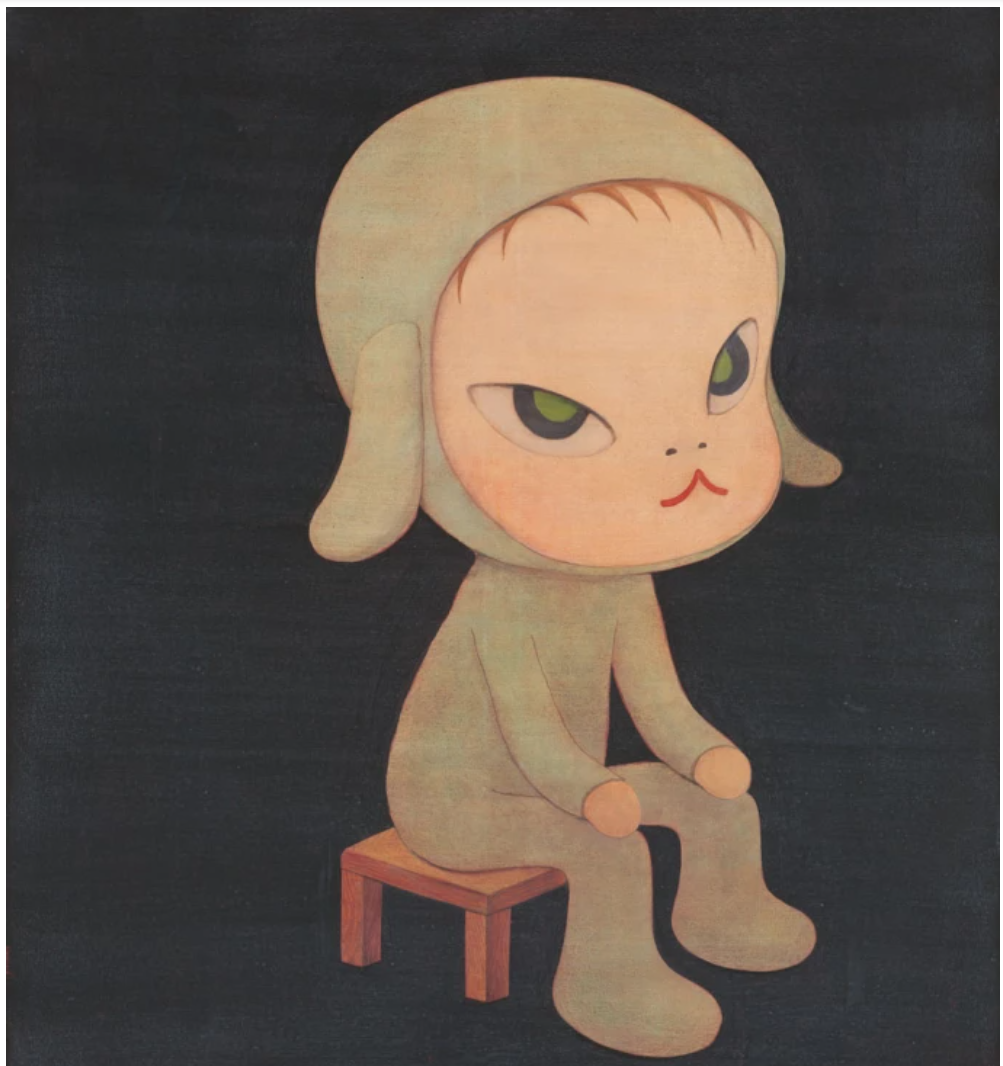
Yoshitomo Nara, Sleepless Night (Sitting), 1997, Rubell Museum © 1997 Yoshitomo Nara.
This bunny-child nymph, when placed within the ambiguous vacuity of the present work, is situated within a vast, alienating world, the self of memory and of times past now isolated to a box into which it has been abandoned. Executed in 1996, the present work sees Nara depart from the thick, Neo-Expressionistic outlines of his early work to his most recognizable and mature aesthetic, with his subject delicately rendered and set against a reductive and highly distinctive background. Upon graduating from the Aichi University of the Arts, Nara moved to Germany to study at Düsseldorf’s Staatliche Kunstakademie under the mentorship of A.R. Penck before setting up a studio in Köln. Language barriers and the unfamiliarity of German culture saw Nara facing a period of acute solitude akin to that experienced as a child in Japan. It was during this time that Nara began to explore the depths of his memory and emotions to confront this profound sense of isolation in his art, manifesting the motifs of sullen-children for which he is now renowned. Used variously as the packaging that carries the artist’s lonesome cast of characters, as replacement homes and as the stage for verbal declarations, the box motif within which the lone figure of the present work sits first began to appear in Nara’s work during this time. Whilst living abroad, Nara began to incorporate fragmentary and symbolic images to express the loneliness he experienced, with the box carrying symbolic resonance for the artist’s feelings of displacement and isolation. Whilst the bunny-figure of the present work is reminiscent of puppies and kittens found abandoned in cardboard boxes, this image also calls to mind how small children make dens in small enclosed spaces to create a contained feeling of safety and security from the outside world, a miniaturized house of their own. Nara captures a sense of transitory uncertainty through this image; a vulnerable subject standing in the vast emptiness sitting inside a box, between home and nowhere.
Conveying a universal emotional depth that has resonated with audiences worldwide, Little Bunny in the Box is a sentimental testament to Nara’s unique ability to capture universal emotions. Bearing a cross-generational message, the present work epitomizes the ways in which Nara is able to reconcile seemingly innocent imagery with the universal experience of hardship. Nara’s child-like figure in a bunny costume sat within a box are subtle, yet powerful motifs which masterfully establish a profound connection between the viewer and the central figure. In touch with something elemental, these figures possess an extensive breadth of expression that remind us of long-forgotten feelings, of our intuitive wisdom.
Focus: Liu Ye
Mondrian, Hello, 2002
Phillips Hong-Kong: 25 November 2024
Estimated: HKD 6,000,000 – 9,000,000
HKD 7,366,000 / USD 946,360
Liu Ye – Modern & Contemporary Art E… Lot 5 November 2024 | Phillips
LIU YE
Mondrian, Hello, 2002
Acrylic on canvas
60×45 cm (23 5/8 x 17 3/4 inches)
Signed and dated ‘Ye [in Chinese] 2002 Liu Ye’ lower left
The profile of a young girl with a bob haircut and a straight fringe, one of the artist’s recurring figures, stands at the far bottom right corner against a vast background of blue and pale yellow in Mondrian, Hello. Her gaze is transfixed towards the left, where a beam of light emanates from above, highlighting the rosy blush on her plump cheeks and brings attention to the Mondrian book she has in her hands as though she is a devout follower of geometric abstraction. The contour of her silhouette is instantly arresting and the manipulation of space through light and shadow to divide the painting geometrically congruently evokes scenes of Piero della Francesca’s diptych of Federico da Montefeltro and Battista Sforza with his two figures in profile, an angle that ensured a good likeness and a faithful representation, Johannes Vermeer’s treatment of light in The Milkmaid, or indeed René Magritte’s elusive Not to Be Reproduced in front of a mirror all come to mind. Fresh to auction and painted in 2002, it is one of 40 works from Liu Ye’s body of work featuring Mondrian motifs, signifying the creation of a unique tableau, poised between two worlds: a place that is apparently real and credibly, removed from reality, that would dominate Liu’s work for the next decade.
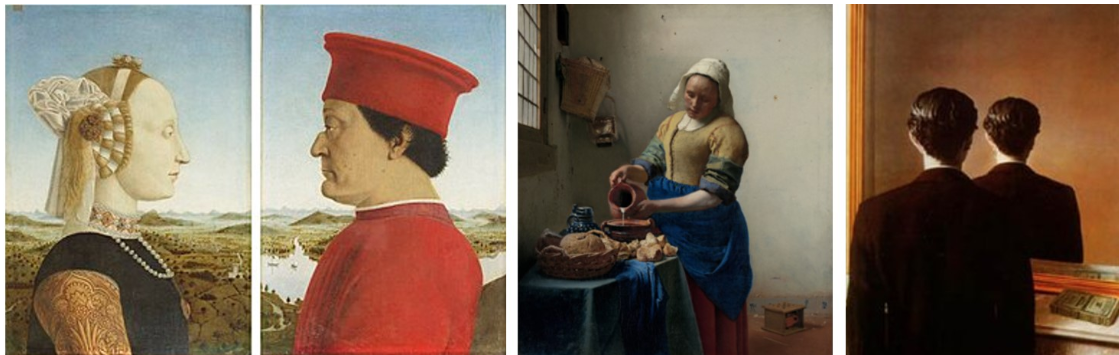
(i) Piero della Francesca, Diptych of Federico da Montefeltro and Battista Sforza, c. 1473-75 / Image: Scala, Florence
(ii) Johannes Vermeer, The Milkmaid, c. 1657-1658 / Image: Rijksmuseum, Amsterdam, Purchased with the support of the Vereniging Rembrandt
(iii) Rene Magritte, Not to Be Reproduced (La reproduction interdite), 1947 / Image: Boijmans Van Beuningen / Artwork: © 2024 C. Herscovici / Artists Rights Society (ARS), New York
Liu Ye first encountered the work of Dutch painter Piet Mondrian while enrolled at the Industrial Design Department of the School of Arts and Crafts in Beijing from the age of fifteen to nineteenth. Describing the school as a secondhand Bauhaus, his teachers were sent abroad to study the Bauhaus theory before the Cultural Revolution and brought back methodologies of European modernism, in turn exposing Liu to graphic composition, constructivism, Wassily Kandinsky and Piet Mondrian of course, who would eventually become a recurring source of inspiration for him. Initially viewing the Dutch painter as a designer, it was only until Liu’s six-month long artist residency at the Rijksakademie in Amsterdam in 1998 that he finally formed a direct acquaintance with Mondrian’s work. As a pioneer of the abstract geometric form and a leading figure in the De Stijl movement, Mondrian was committed to distilling the visual world into its most basic elements in pursuit of a universal aesthetic language that aimed to achieve harmony and balance.
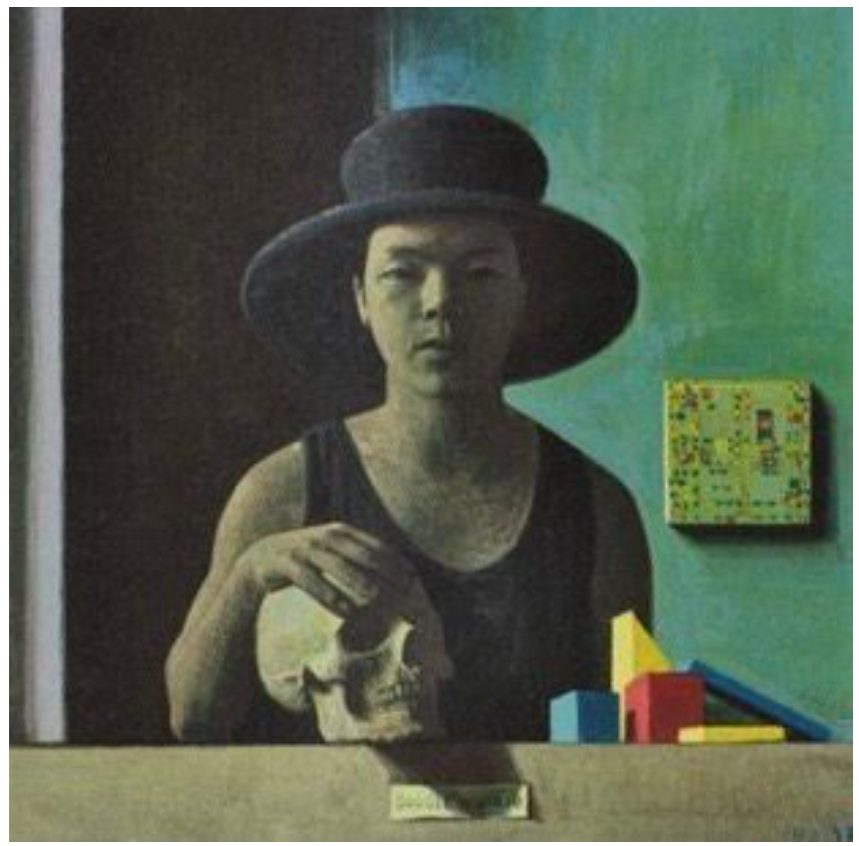
First appearance of a Mondrian motif seen in Boogie Woogie (Self Portrait), 1992
An early recurrent reference to paintings by Mondrian, with its rigorous straight lines and balanced quadrilateral compositions, appeared in Liu Ye’s artwork early on in his career. It can first be found in Liu’s Boogie Woogie (Self Portrait) created in 1992, only the second year of his creative pursuits. Brooklyn (1994) announced the theme of a dual aspect, with the Mondrian painting depicted incredibly precisely as an actual painting standing on an easel situated in an imaginary situation and exemplifying its uncanny character of the small boy– the artist himself – sat reading, feet immersed in a bowl and a child’s hat appearing to flat above his head. Liu Ye’s insertion of Mondrian’s paintings into his own tableaux permeated his artworks throughout and influenced his artistic development in the post-2000s.
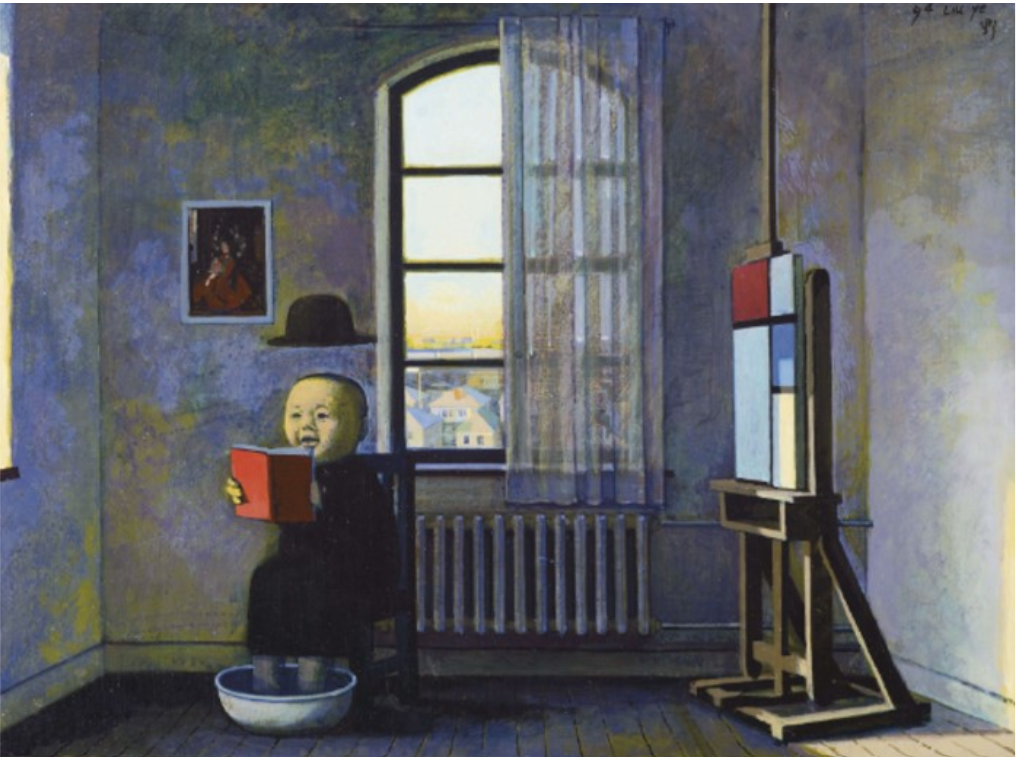
Brooklyn, 1994
This influence taken from the modern master is far from simple, Liu’s delineation of the canvas and heightened geometrical partitioning in Mondrian, Hello with the diagonal shadow right through the centre of the painting form a sense of balance and correspondence. Completed with the girl holding onto the Mondrian painting to the bottom right, these elements form an equilibrium. Liu Ye completed four Mondrian-inspired canvases in the year of 2002, with all paintings possessing a similar sense of order and featuring the same motifs of the young girl with one or two Mondrian paintings – two of which had yellow as the base tone (as seen in Yellow and Hello, Mondrian) and one had blue as the base tone (as seen in Blue). Only in the present lot, Mondrian, Hello, that shows a combination of both yellow and blue tones employed by Liu, which despite its simplicity, is a testament to a more compact approach to line and form.
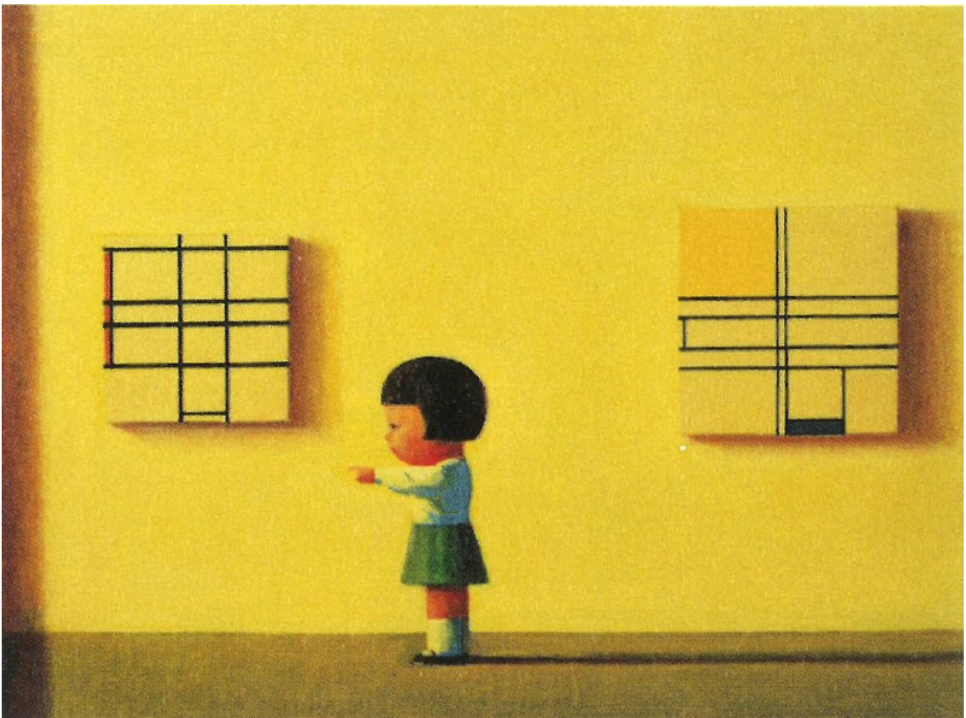
Liu Ye, Yellow, 2002
Among Liu’s myriads of sources, from early Renaissance paintings to a range of modern artists, Mondrian certainly occupied a special place among these disparate figures. The Dutch painter’s steadfast commitment to abstract painting and the self-contained formal rigour of his work have been both profoundly inspiring and somewhat intimidating for Liu. In his own words, he had long admired nonfigurative painting. However, in relation to his own creations, he has hesitated to fully embrace it, reluctant to abandon his parallel dedication to depiction and narrative of figurative painting. As such, Mondrian can be seen, in Liu’s eyes, a father figure: to be respected yet feared, admired yet challenged.
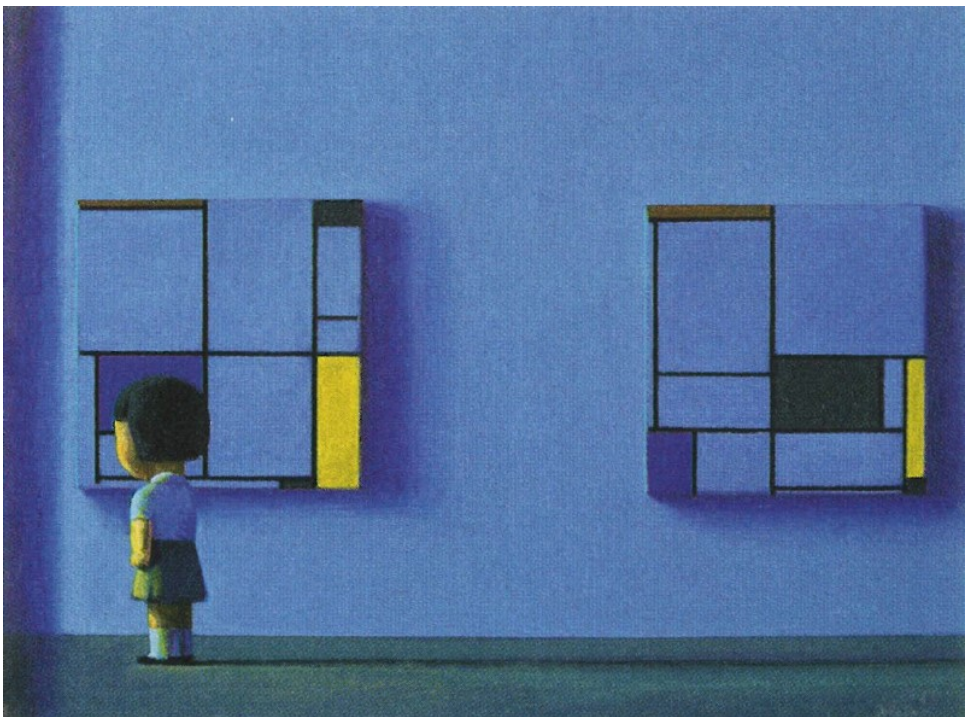
Liu Ye, Blue, 2002
Born in Beijing in 1964 and growing up against the backdrop of the Cultural Revolution, Liu Ye spent most of his childhood living a censored and audited life in the countryside with his father but found freedom in the form of story books hidden by his parents. Born to a father who was a children’s playwright, Liu had the luxury of accessing a big black chest of Western children’s books under his bed. Encouraged perhaps by his father’s admiration for Western culture, and possibly tempted by a lingering sense of the forbidden nature of such material, Liu grew away from traditional Chinese art and conjured up an entire iconography of distinctive figures that were reminiscent of illustrations found in the books he grew up with.
With a particular love for Oscar Wilde’s The Picture of Dorian Gray –which tells the story of an artist becoming infatuated with the youth of the subject of his full-length portrait; thereby selling his soul to ensure that the portrait, rather than himself, will age and fade– the story lays the seeds for Liu’s artistic style in the years to come and is the very reason why Liu never fails to plant upon his characters a sense of eternal childlike innocence, with their rotund face, ruddy cheeks and short statures – the cartoonish features of cherubic children. The ‘putto’ character is an image of Liu’s own childhood, and the autobiographical character of his art becomes more apparent throughout the years, while retaining a cryptic mode of presentation as if echoing Wilde’s pronouncement on the nature of art.
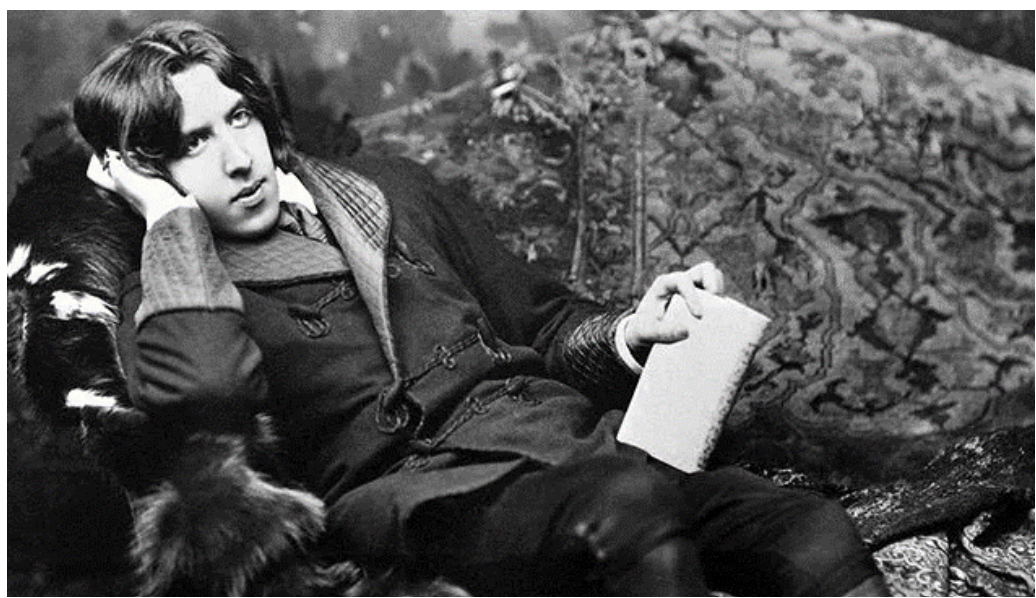
Oscar Wilde relaxing on the divan during his lecture trip through America, 1882
Through his distinctive autobiographical characters, the tableaux that Liu Ye creates is seen to have a dual aspect – drawing on observation and memory and rooted in reality and from that fusion, a domain of subjective reality emerges, accessible and impenetrable all at once. The invented space allows for personal exploration and expression while remaining guarded to an extent and the pictorial device of a child proved to be incredibly effective. In the guise of his many selves – whether as a young boy, a young girl, an adolescent sailor, or Miffy – these became a wider symbol evoking all of humanity.
Focus: George Condo
Red, White and Black, 2014
Sotheby’s Hong-Kong: 11 November 2024
Estimated: HKD 25,000,000 – 35,000,000
HKD 20,400,000 / USD 2,625,010
GEORGE CONDO (1957 – )
Red, White and Black, 2014
Oil on linen
80×72 inches (203.2 by 182.9 cm)
Conjuring conflicting psychological states of passion and rage, George Condo’s Red, White and Black (2014) dances with frenetic, textural energy. An enthralling example of Condo’s celebrated practice which subverts the lucidity of portraiture with a whimsical and farcical new context, the present work is extraordinary for its vibrant coloration, compositional intricacy, and rich surface of expressionistic brushwork, as well as the artist’s remarkable ability to synthesize diverse influences into a singular and deeply compelling visual language. Steeped in the traditions of Cubism and the legacy of Picasso, the present work was exhibited as part of Sotheby’s Hong Kong’s Face-Off: Picasso / Condo exhibition in 2018, which displayed a curation of works to draw a compelling, cross-temporary dialogue between both prodigious artists. As with Picasso, within the fractured realm of the present work, forms slip and collide with thrilling velocity before the viewer’s eyes before being subsumed within the delirium of the whole. Appearing at auction for the first time, Red, White and Black is a potent example of the carnal intensity of Condo’s recent style of portraiture.
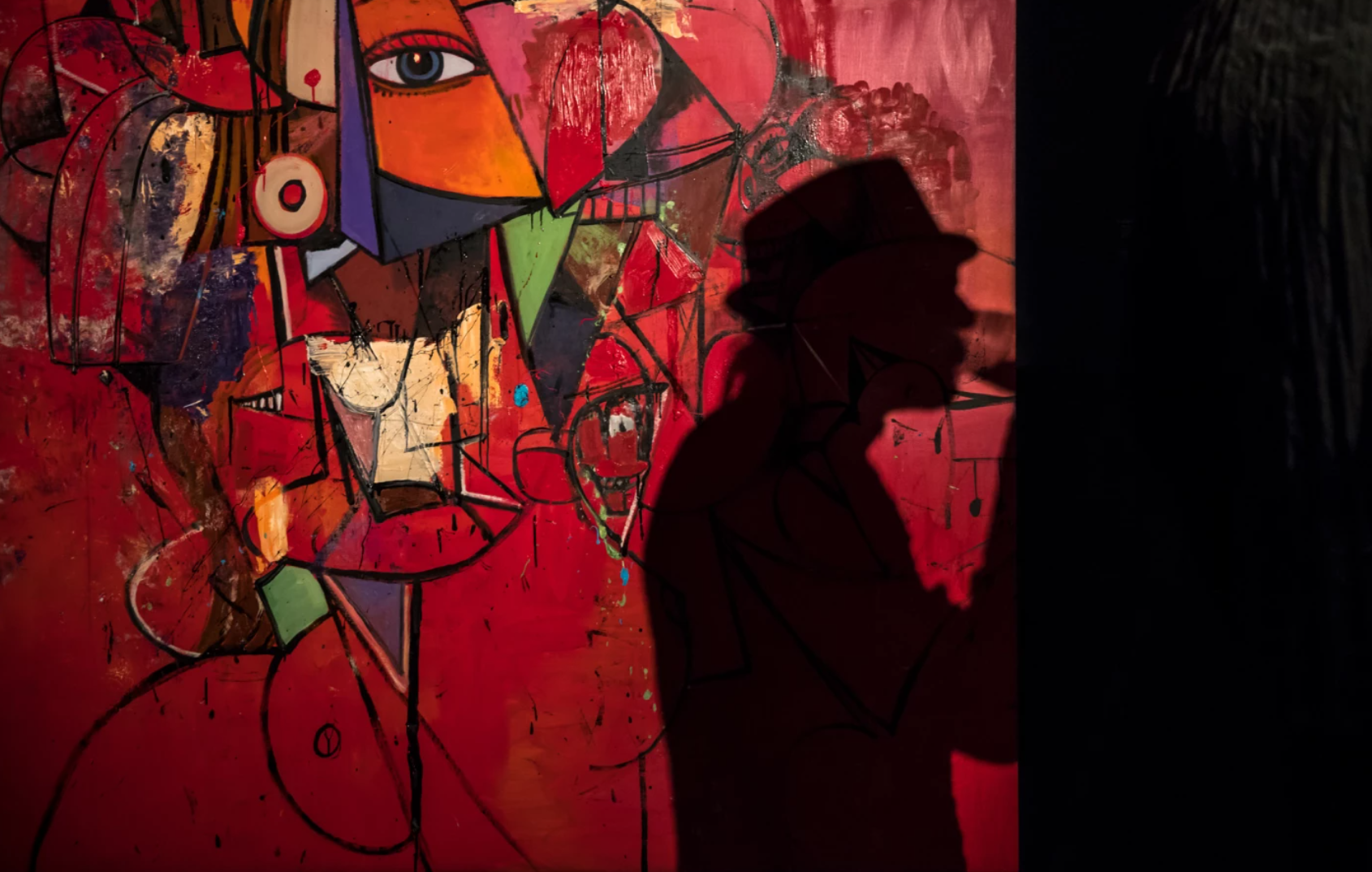
Exuberant in its invocation of pure color and expressive in its boldly evocative mark making, Red, White and Black is a concise manifestation of Condo’s transformation of the established portraiture form. Like Keith Haring and Jean-Michel Basquiat, Condo was critically engaged throughout the eighties in a new form of figurative painting that stylistically blended the representational and the abstract. As he continued to develop his personal style, Condo coined the terms ‘artificial realism’ and ‘psychological cubism’ to define his hybridization of art historical influences, specifically to portray his fusion of the Old Master subject with the geometric perspectives of Cubism. Since then, Condo has continued to mine the formal possibilities of art historical tropes to push the boundaries and defy expectations for both painting and portraiture in a modern setting. The central figure of the present work is depicted as a bust in a compositional framework frequently utilized in Italian Renaissance portraiture, revealing a multitude of converging perspectives that suggest at fragmented psychological states. The subject reaches to the edges of the canvas, their extremities coalescing with the fierce red of the background. The identity of Condo’s subject remains elusive, although exaggerated breasts suggest at femininity, with their shattered visage of purple, orange and green tiles only restrained by Condo’s thick black lines. Teeth, eyes and hair collide and fragment, manipulating our ability to read the image before us, with Condo assembling and disassembling his subject with palpable dynamism to create a new paradigm in portraiture. Building upon years of refining and maturing his iconic figurative style, Red, White and Black reveals an artist now at the height of his career, utterly uninhibited and full of instinctive creative fervor.
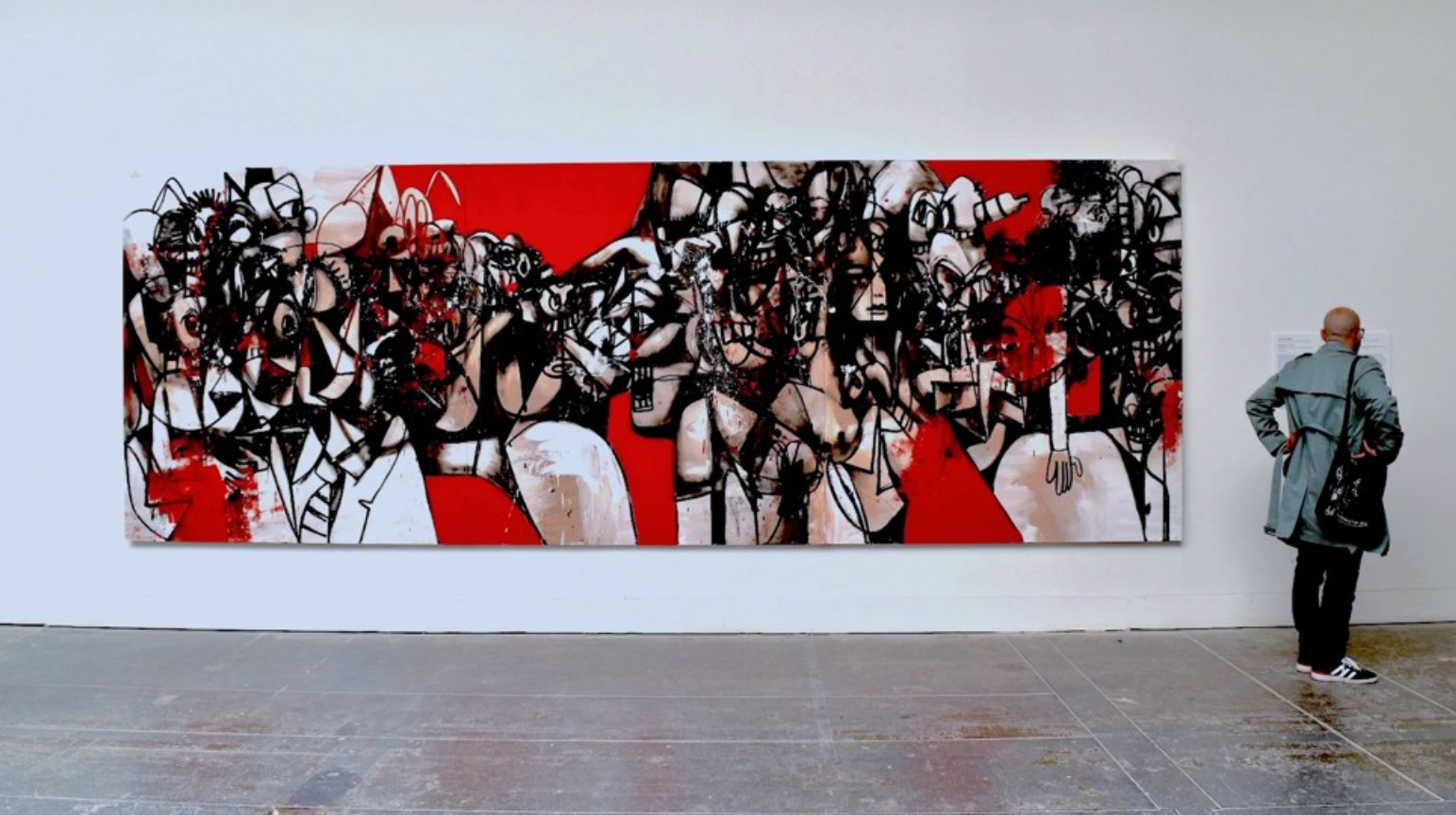
Set against a luxurious red ground, a shade which the artist has frequently favored in the last decade, the present work recalls the portraits of Diego Velázquez and the psychologically dense images of Francis Bacon. This scarlet background, rich in painterly texture and backlit with subtle shades of yellow and pink, hint at the work of color field painters like Mark Rothko and Barnett Newman, whilst simultaneously conjuring conflicting psychological associations of passion and rage. The title and primary palette of the present work has become increasingly significant to the artist in recent years, most notably in the 2017 work Facebook which was displayed at the Venice Biennale in 2019. Aggressive, potent in symbolism and aesthetically vigorous, red, white and black have become paradigmatic within the artist’s newer portraits, often defined by the kind of carnival intensity seen in the present work.
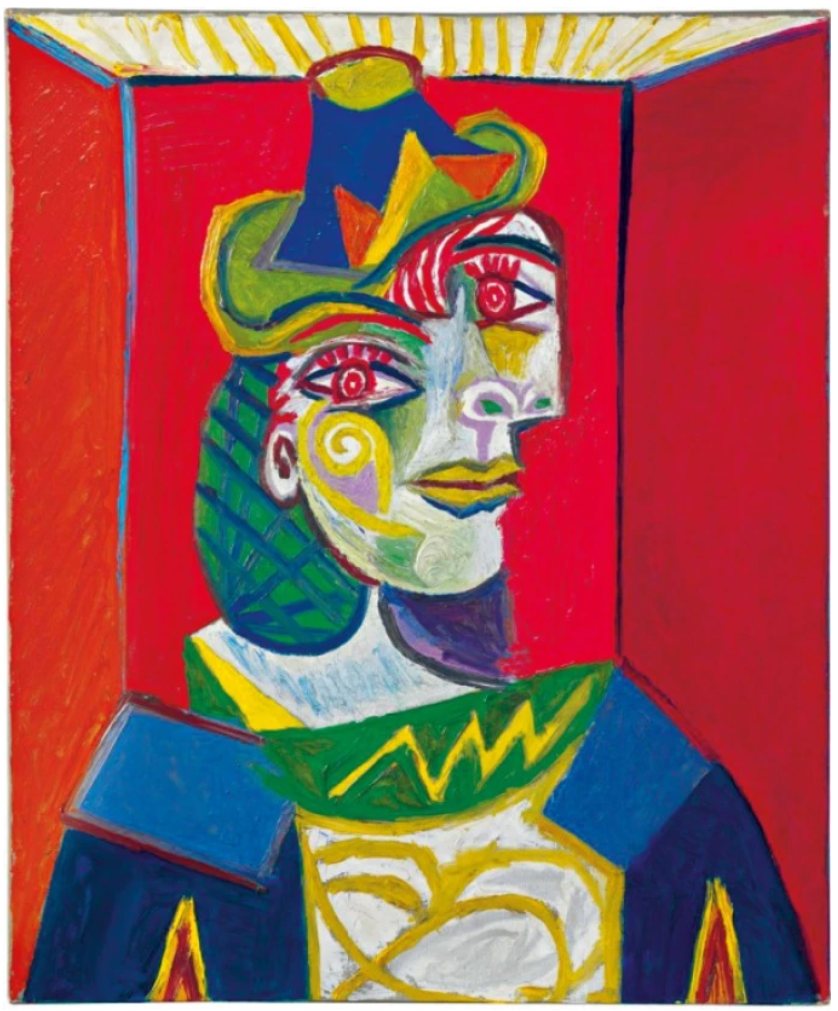
Pablo Picasso, Buste de femme (Femme à la résille) (Bust of a woman (Woman with stocking)), 1938, oil on canvas, Private Collection
In its masterful depiction of fragmented figuration, Red, White and Black evocatively recalls Pablo Picasso’s masterful Cubist facture; yet, where Picasso radically shattered the picture plane to explore multiple viewpoints in the same moment, Condo ruptures his compositions to reveal the multifaceted and kaleidoscopic complexities of human emotion through his aptly self-termed mode of ‘psychological cubism.’
“And I guess that was the other thing I got from Picasso. It’s the idea of Cubism—but rather than seeing and depicting this coffee cup, say, from four different angles at the same time, I’m seeing a personality from multiple angles at once. Instead of space being my subject, I’m painting all of someone’s emotional potentialities at once, and that’s what I’d call Psychological Cubism”
While Picasso’s fractured and distorted forms have long been a source of influence for Condo, works such as Red, White and Black represent a further course of exploration for the artist. In its expressive brushwork and chromatic complexity, the painterly surface of the present work reveals Condo’s interest in the work of the Abstract Expressionists. As in Red, White and Black, Condo’s bold and primitive black lines recall the rigid contours of Picasso’s portraiture of the 1930s, whilst the brilliantly expressive paintwork, and dense, chromatic complexity, recalls the action paintings of Pollock and de Kooning which elevate the physicality painting in the creative process. The kaleidoscopic silhouette of the figure in the present work teeters on the periphery of representation, its elusive figuration and art historical amalgamation a beguiling example of the artist’s distinct style of portraiture.
“The only way for me to feel the difference between every other artist and me is to use every artist to become me.”
Bringing together elements of beauty and the macabre with expressionistic brushwork in a kaleidoscopic sweep of colors, Red, White and Black is an intoxicating example of Condo’s unique ability to hypothesize and manipulate the traditions of figuration and portraiture with abstraction. With a boldness of color and fluidity of carnal gesture, Condo has established himself as one of the eminent figurative painters of today.
Focus: Louise Bonnet
Scotch Tape, 2016
Phillips Hong-Kong: 25 November 2024
Estimated: HKD 800,000 – 1,200,000
HKD 1,397,000 / USD 179,480
Louise Bonnet – Modern & Contemporar… Lot 3 November 2024 | Phillips
LOUISE BONNET
Scotch Tape, 2016
Oil on canvas
101.9 x 76.8 cm (40 1/8 x 30 1/4 inches)
Signed and dated ‘Louise Bonnet 2016’ on the reverse
Louise Bonnet’s Scotch Tape captures her enduring fascination with bodily discomfort and psychological tension through her signature style of figurative distortion, striking a balance between beauty and the bizarre. She frequently explores the body’s ability to act beyond our control, a theme vividly illustrated in this work. These exaggerated features seem to operate independently of the figure’s intentions, creating a powerful visual metaphor for how our physical forms can disrupt our desired self-presentation, leading to unexpected revelations.
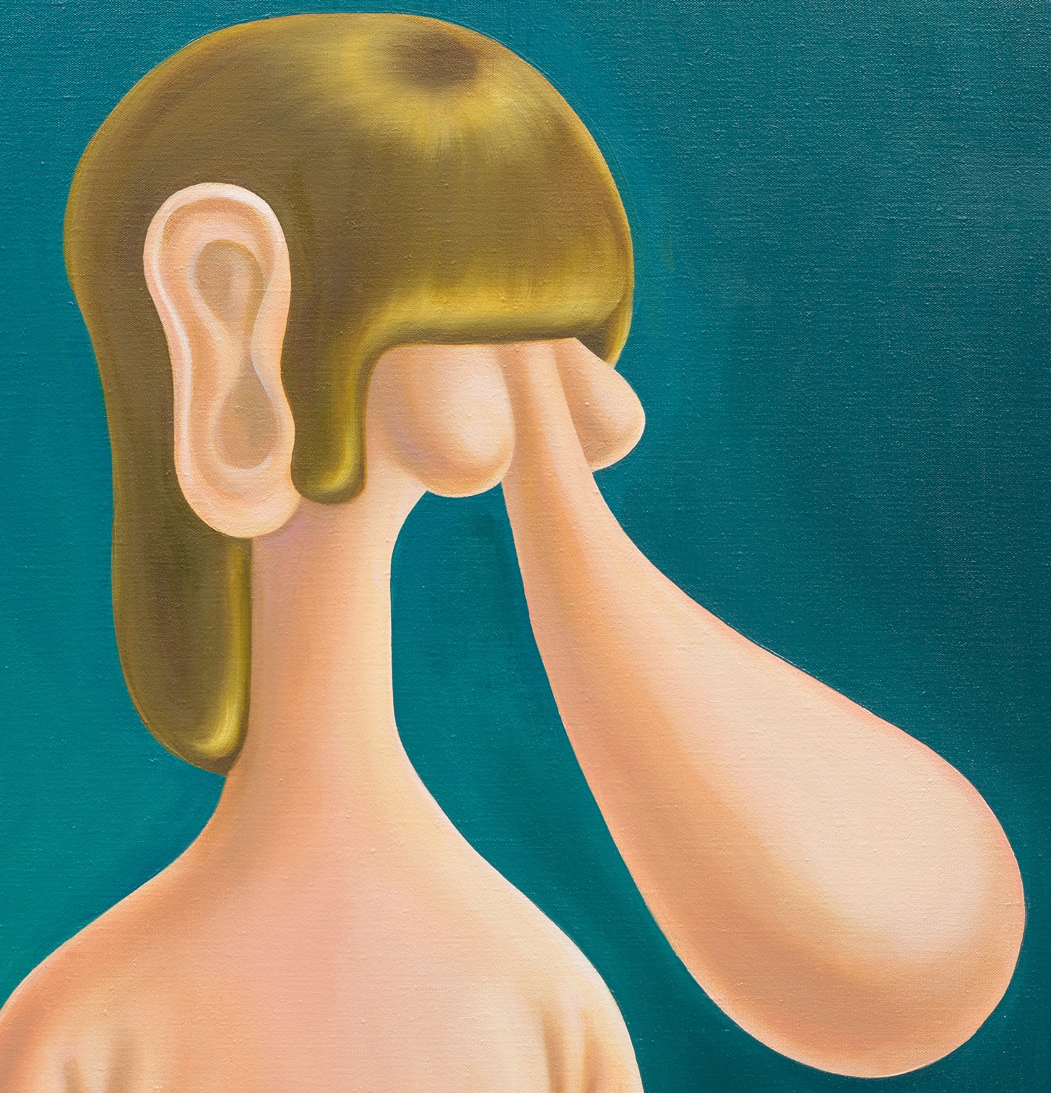
Born in Geneva in 1970 and now based in Los Angeles, Bonnet investigates the body’s involuntary reflection of inner emotions in her work. The figure’s dramatically elongated ear and nose serve as striking focal points, bending under gravity while retaining an elastic quality. The truncated view of the head and neck heightens the psychological tension, as the artist’s manipulation of anatomical forms explores themes of shame, control, and vulnerability. Bonnet’s unique visual language draws from her early interests in comics, particularly works of Robert Crumb and the cartoons of Charlie Hebdo. These formative encounters with uninhibited artistic expression revealed to her the liberating potential of art without constraints.
“I’m interested in the body being out of control, that you think you are in control, but you are actually not, your body is betraying you, or things are happening that you can’t control… So the noses are, to me, represent that sort of weight, like an external vision of weight and being out of control, but still trying to be dignified about it.”
Additionally, her fascination with horror films has significantly influenced her vision, especially in how they present the body’s capacity for transformation and distortion. This influence is vividly expressed in the current lot, where the exaggerated ear and nose become the central focus, embodying the tension between vulnerability and resilience.
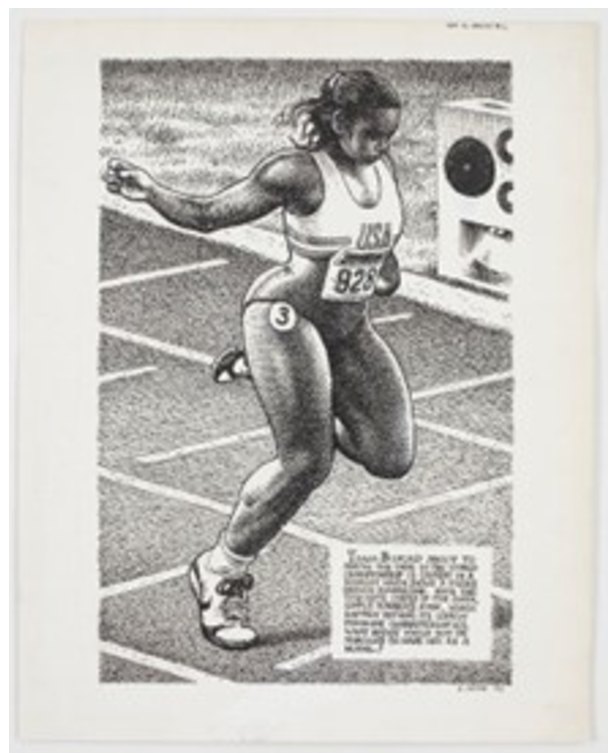
Untitled, 2002. Page from Art & Beauty Magazine, Number 2, 2003
© Robert Crumb, 2002
While Bonnet consciously attempts to ‘shut off’ her thoughts while painting, themes of womanhood and feminism inevitably permeate her work. These undercurrents introduce an additional layer of complexity to her exploration of bodily discomfort and social expectations, emerging organically rather than as overt statements. This unconscious engagement with gender adds greater depth to the tension present in her pieces.
“I’m interested in the body being out of control, that you think you are in control, but you are actually not, your body is betraying you, or things are happening that you can’t control… So the noses are, to me, represent that sort of weight, like an external vision of weight and being out of control, but still trying to be dignified about it.”
The present lot also highlights the artist’s mastery of oil paint, a medium she has embraced since 2014. The luminous surface and expert handling of volume showcase her deep understanding of the medium. Her nuanced treatment of flesh tones and the subtle interplay of highlights and shadows create an almost sculptural presence through her careful attention to the chiaroscuro effect. This technical approach, rooted in historical painting traditions, enhances the impact of the distorted anatomy and adds a classical framework to the piece.
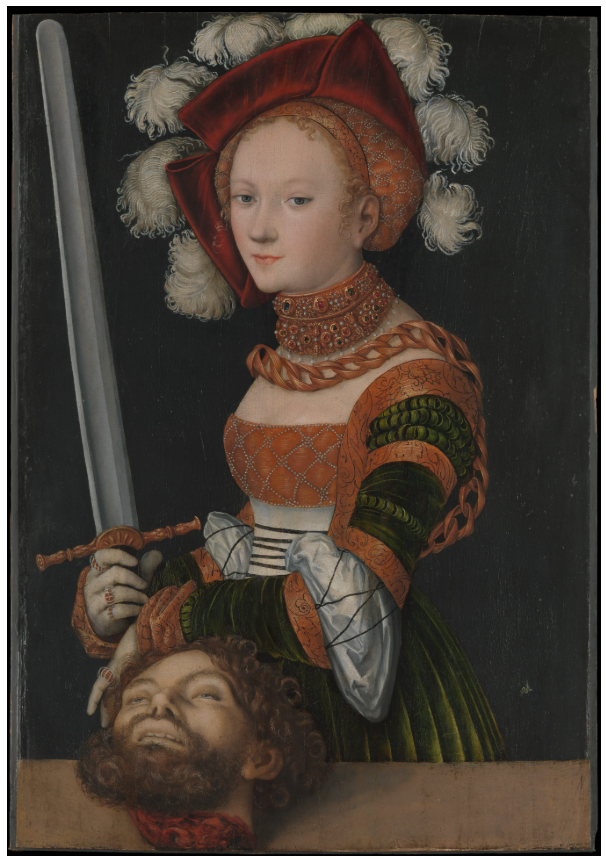
Lucas Cranach the Elder, Judith with the Head of Holofernes, c. 1530
Collection of the Metropolitan Museum of Art, New York
Image: © The Metropolitan Museum of Art, Rogers Fund, 1911, 11.15
By obscuring the figure’s face–an intentional choice in her work–Bonnet fosters a psychological space where viewers can project their own emotions onto the image, free from the influence of facial expressions. This concealment creates an uncomfortable voyeuristic dynamic that intensifies the work’s psychological tension. The title, Scotch Tape, adds another layer of meaning, suggesting both adhesion and transparency–qualities that mock the figure’s struggle to maintain dignity amid bodily betrayal. This reference creates a striking contrast with the painting’s psychological depth, exemplifying the tension between the mundane and the grotesque that permeates much of Bonnet’s oeuvre. With a background in graphic design and illustration, Bonnet infuses her paintings with a precise formal sensibility while pushing the boundaries of figurative representation. Her unique visual language merges volumetric drama with a contemporary understanding of bodily distortion, evoking both surrealist painting and cartoon aesthetics. This work marks a pivotal moment in Bonnet’s artistic development, crafted during a time when she fully embraced the expressive potential of oil paint and honed her distinctive style. It crystallizes her ongoing exploration of the relationship between physical form and psychological state, producing an image that oscillates between attraction and repulsion, dignity and absurdity – a duality that continues to define her practice.

Focus: Yayoi Kusama
Watermelon and Fork, 1989
Phillips Hong-Kong: 25 November 2024
Estimated: HKD 6,000,000 – 8,000,000
HKD 6,985,000 / USD 897,410
Yayoi Kusama – Modern & Contemporary… Lot 9 November 2024 | Phillips
YAYOI KUSAMA
Watermelon and Fork, 1989
Acrylic on canvas
37.5 x 45 cm (14 3/4 x 17 3/4 inches)
Signed, titled and dated ‘”Suika to Fork” [in Kanji and Katakana], Yayoi Kusama 1989’ on the reverse
Born in 1929 in Matsumoto, Japan, Kusama grew up in a turbulent and emotionally fraught environment, with memories of her mother’s strained relationship with her father and her own struggles with mental health. The watermelon, as a subject, evokes a complex interplay between innocence, abundance, and the cyclical nature of life—elements that are deeply entwined with Kusama’s childhood memories of rural Japan.
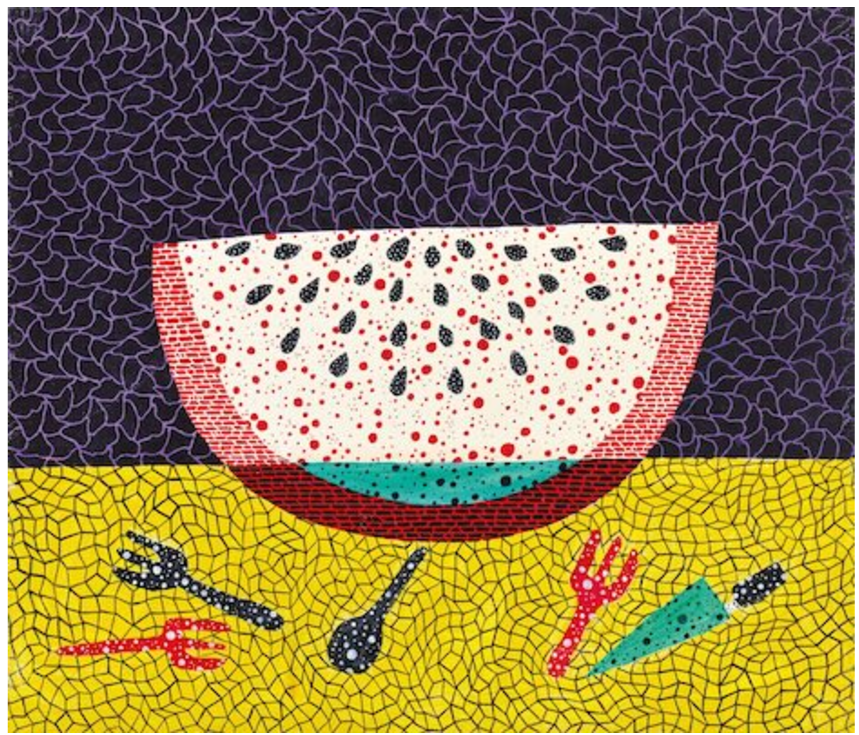
Yayoi Kusama, Watermelon, 1984
Watermelon and Fork is a vibrant amalgamation of all of Yayoi Kusama’s most signature motifs—from the pulsating infinity nets and dots, her earlier grid-like webs, to the figurative elements of the watermelon and cutlery. This dynamic composition exemplifies Kusama’s lifelong engagement with both the external world and her inner psychological landscape. Creating dialogue between the finite and the infinite, the real and the imagined, through the present lot, Kusama offers a visual language that transforms the ordinary into the extraordinary.
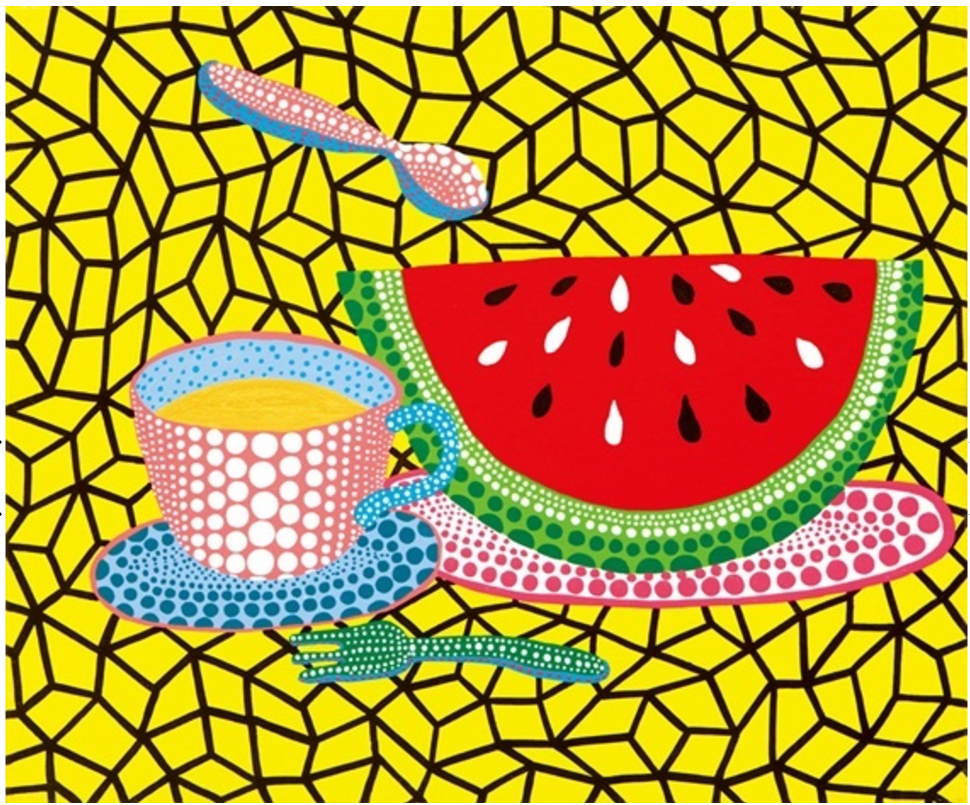
Yayoi Kusama, Watermelon, 1989
Kusama’s depiction of the watermelon—a quintessential still-life subject—takes on deep personal and symbolic resonance when placed in the context of her childhood. Born in 1929 in Matsumoto, Japan, Kusama grew up in a turbulent and emotionally fraught environment, with memories of her mother’s strained relationship with her father and her own struggles with mental health. The watermelon, as a subject, evokes a complex interplay between innocence, abundance, and the cyclical nature of life—elements that are deeply entwined with Kusama’s childhood memories of rural Japan.
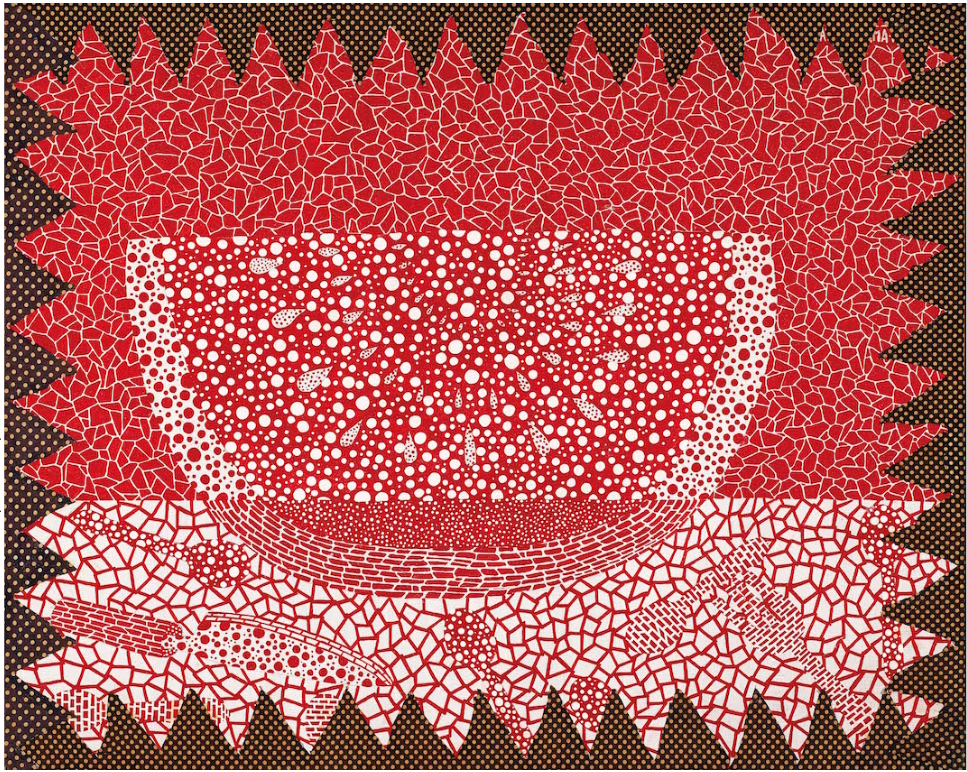
Yayoi Kusama, Watermelon, 1981
Painted in 1989, the present lot was created after Kusama’s return from the United States in 1973. Having spent much of the preceding decades in relative obscurity in Japan, by the late 1980s, the artist was experiencing a significant resurgence in recognition, particularly in the United States and Europe. Following Yayoi Kusama: A Retrospective at the Center for International Contemporary Arts in New York and In Context: Yayoi Kusama, Soul Burning Flashes at the Museum of Modern Art in Oxford, Kusama’s work garnered widespread acclaim. This period marked a profound shift in her career, which culminated in her representing Japan at the 1993 Venice Biennale, solidifying her place as one of the most prominent contemporary artists of her generation.
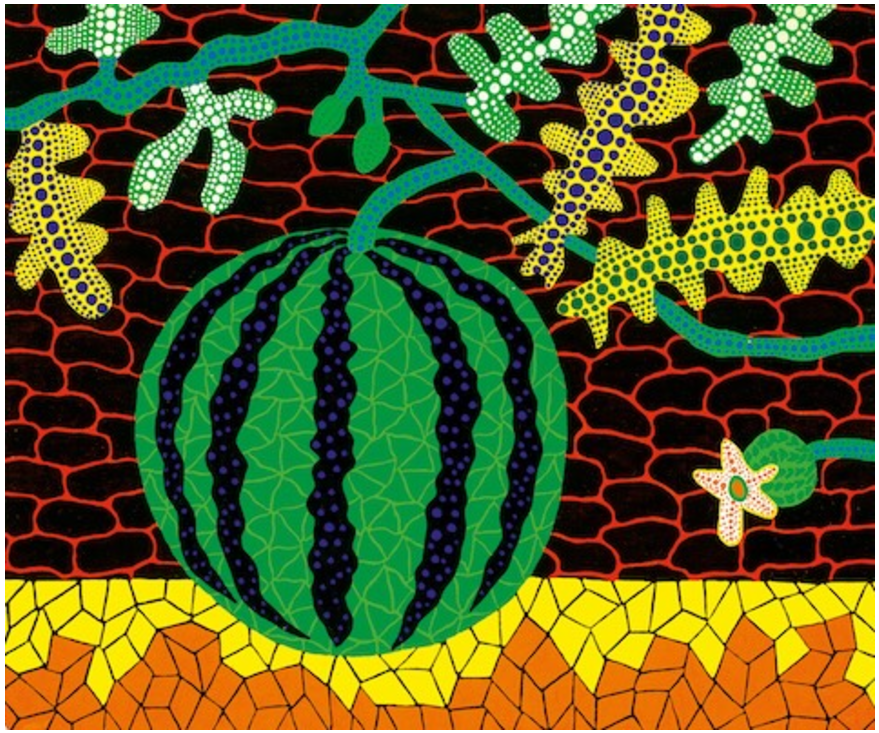
Yayoi Kusama, Watermelon, 1989
Watermelon and Fork, painted at this juncture, speaks to the artist’s sustained exploration of obsessive patterns and repetition, themes that had defined her artistic oeuvre for over four decades. This year also marked Kusama’s continued exploration of intimate and symbolic representations, often directly addressing her personal experiences and emotional states. In this context, the year encapsulates both a retrospective moment in Kusama’s ongoing engagement with her singular vision and moment of reinvention that would pave the way for her iconic evolution.
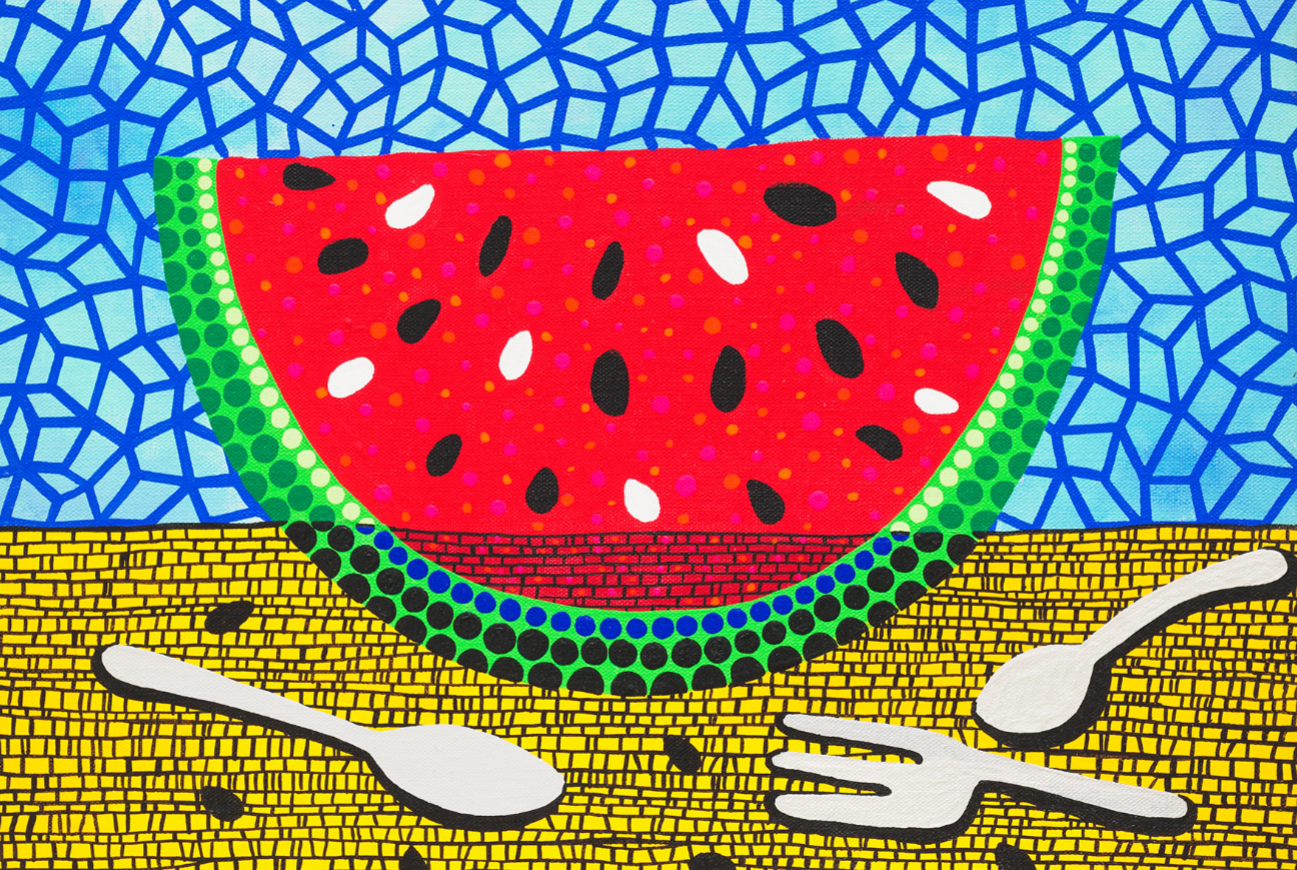
In Watermelon and Fork, Yayoi Kusama once again masterfully blends personal symbolism with universal themes, creating a visual language that speaks to the infinite. Much like Andy Warhol’s Campbell’s Soup Cans or Wayne Thiebaud’s brightly colored cakes, Kusama elevates the watermelon—a simple, natural object—into an icon of repetition and excess. However, while her Pop contemporaries appropriated mass culture in a more overtly commercial way, Kusama imbues her repetition with a deeper, introspective meaning. The watermelon here transcends its status as a still life subject, becoming a potent symbol of life’s fragility. In Kusama’s hands, the watermelon evokes both her psychological struggles with obsession and her ongoing quest for personal and artistic identity.
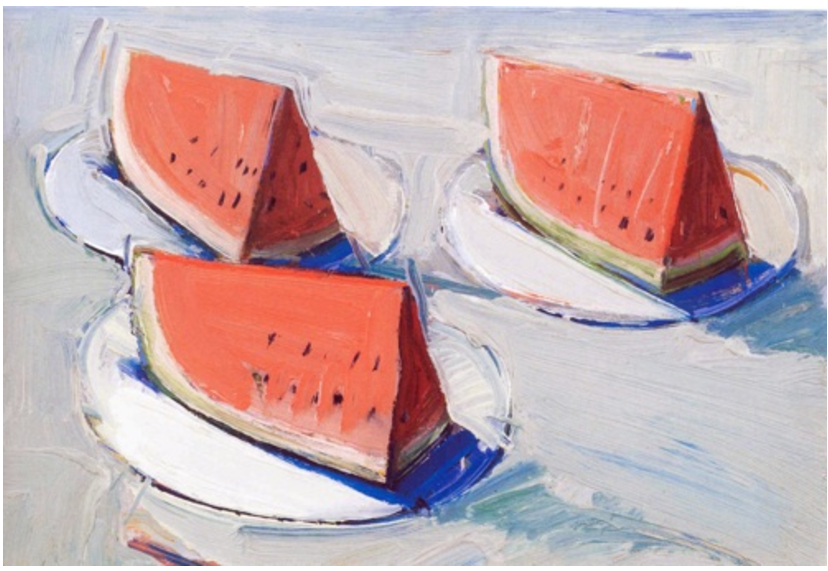
Wayne Thiebaud, Watermelon Slices, 1961.
Artwork: © 2024 Wayne Thiebaud Foundation / Licensed by VAGA at Artists Rights Society (ARS), NY
Her dots and nets, in turn, create a rhythmic, almost hypnotic repetition that draws the viewer deeper into an endless visual space. Here, absence and presence are intertwined, and the work becomes a portal into both the psychological and the cosmic, inviting a meditation on time, perception, and the infinite. Together, these themes of repetition, still life, and dimensionality create a rich, multifaceted work that is quintessentially Kusama. Watermelon and Fork encapsulates her lifelong engagement with both the external world of mass culture and the internal world of personal obsession, offering a unique reflection on life, death, and the infinite that transcends conventional still life or any art historical motifs. Through her distinctive use of pattern, space, and symbolism, Kusama transforms the familiar into something boundless, challenging the viewer to consider both the finite and the infinite in one glance.
Pumpkin, 1989
Phillips Hong-Kong: 26 November 2024
Estimated: HKD 2,500,000 – 3,500,000
HKD 3,556,000 / USD 456,905
Yayoi Kusama – Modern & Contempora… Lot 126 November 2024 | Phillips
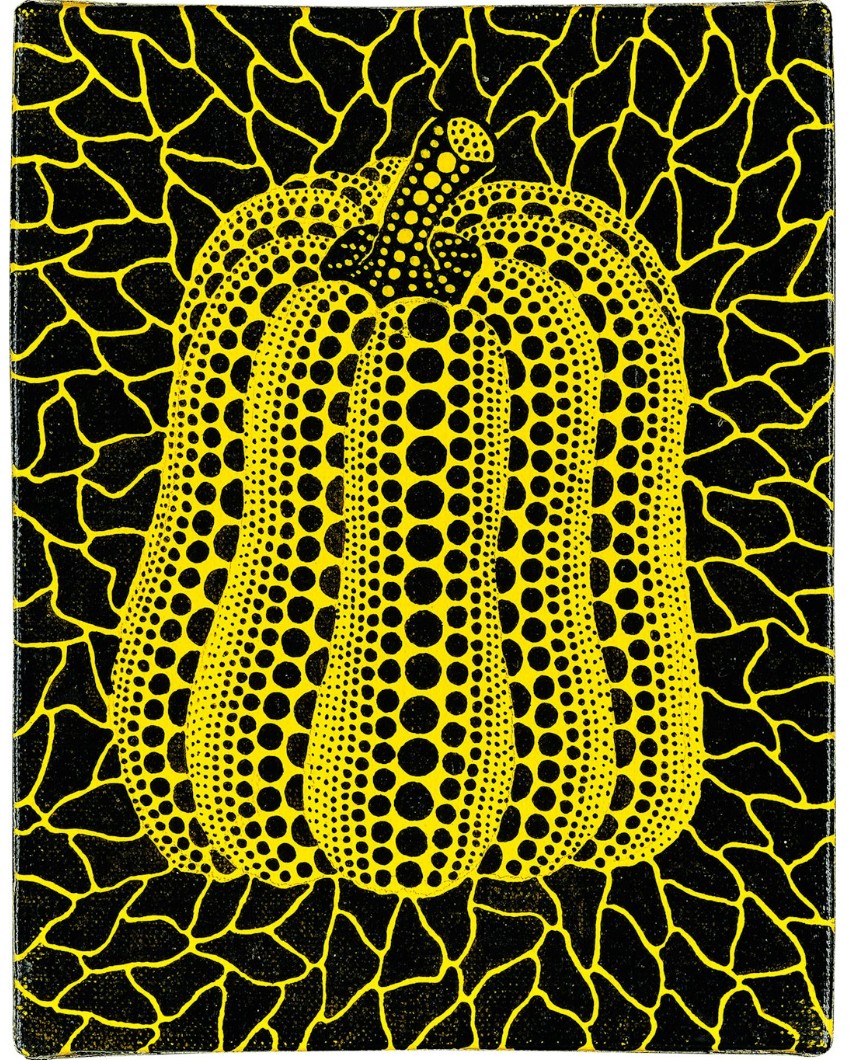
YAYOI KUSAMA
Pumpkin, 1989
Acrylic on canvas
18×14 cm (7 1/8 x 5 1/2 inches)
Signed, dated and titled ‘Yayoi Kusama 1989 “Pumpkin” [in Kanji]’ on the reverse
PUMPKIN [TOWHT] BLUE, 2005
Christie’s Shanghai: 7 November 2024
Estimated: CNY 10,000,000 – 15,000,000
CNY 15,425,000 / USD 2,166,764
YAYOI KUSAMA (B. 1929), PUMPKIN [TOWHT] BLUE | Christie’s
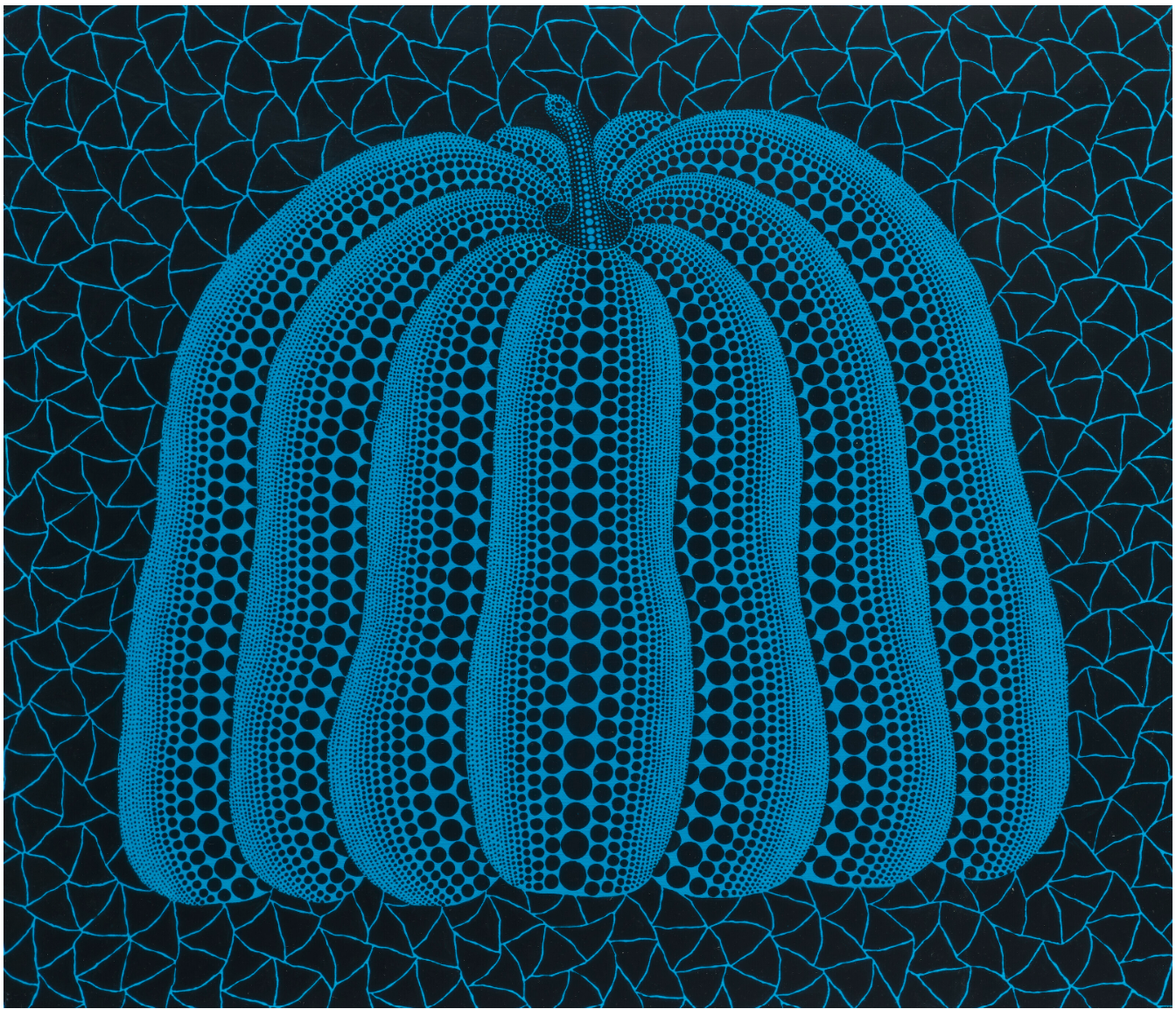
YAYOI KUSAMA (B. 1929)
PUMPKIN [TOWHT] BLUE, 2005
Acrylic on canvas
45.5 x 53 cm (17 7/8 x 20 7/8 inches)
Signed, titled and dated ‘yayoi kusama 2005 PUMPKIN TOWHT BLUE’ (on the reverse)
Unveiling yet another retrospective later this year at the National Gallery of Victoria, Melbourne, Yayoi Kusama’s iconic visual vernacular continues to enchant audiences with its striking aesthetics, intriguing psychological depths, and deep philosophical resonances. The infinite life force that Kusama harnesses to flourish on her more than half-century-long adventure traversing love and hardship, hope and ambivalence, is subtly veiled behind the stupendous surfaces filled with hypnotic dots and nets.
Rendered in cobalt blue, Yayoi Kusama’s Pumpkin (TOWHT) Blue is not merely a timeless work that represents the artist’s now-iconic theme, but perhaps the most surrealist iteration of it—with its tint reminiscent of Magritte’s nocturnal paintings like Le Seize Septembre (1956; Royal Museum of Fine Arts Antwerp, Antwerp). Painted in 2005, Pumpkin (TOWHT) Blue is intimately scaled yet hinting at bigger topic—prompting one to see life in a new way. Began to explore this subject since her childhood, Kusama’s meticulous painterly skill transforms this ordinary, humble object into something otherworldly and captivating. ‘ It seems that pumpkins do not inspire much respect, but I was enchanted by their charming and winsome form,’ the artist once mused over the subject. ‘What appealed to me most was the pumpkin’s generous unpretentiousness.’ (Y. Kusama, quoted in Infinity Net: The Autobiography of Yayoi Kusama, London, 2011, p. 75) Surrounded by a sea of net in triangle form, it is as if the pumpkin is an island in the middle of an ocean or a planet in the galaxy. Following the footsteps of her mentor, Georgia O’Keefe, Kusama employs natural, biomorphic forms to reconcile the inner self with the outer world—for Kusama, the pumpkin is a symbol of comfort and optimism and a self-portrait of herself. As a subject matter, pumpkin, tender to touch, also has rich references to the body. Pumpkin (TOWHT) Blue amplifies Kusama’s affinity—proving that anything we approach with affection and passion could turn into art—a Warholian gesture and an act of compassion.
INFINITY-NETS (TWAHZN), 2006
Christie’s Shanghai: 7 November 2024
Estimated: CNY 14,000,000 – 20,000,000
PASSED
YAYOI KUSAMA (B. 1929), INFINITY-NETS (TWAHZN) | Christie’s
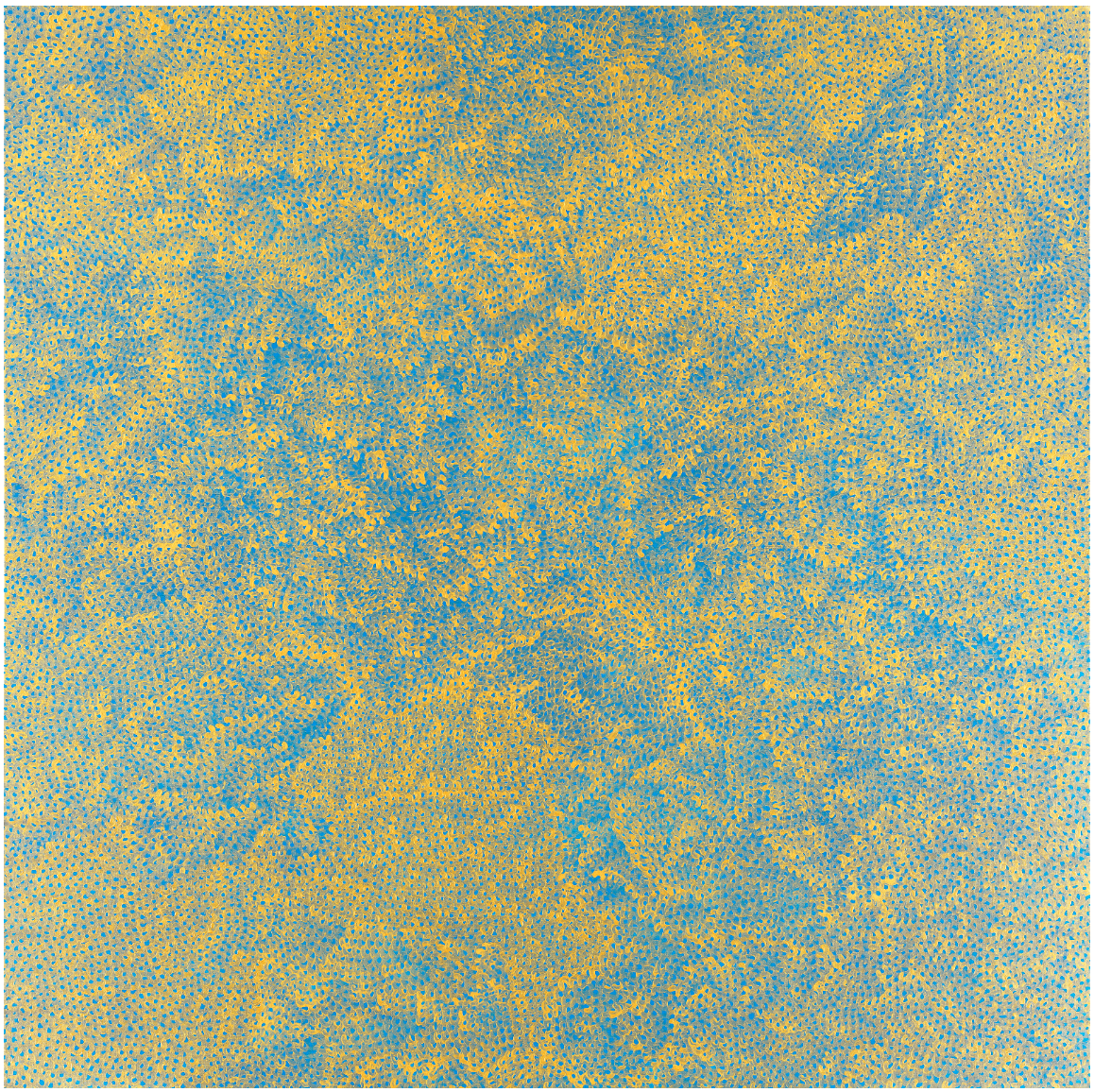
YAYOI KUSAMA (B. 1929)
INFINITY-NETS (TWAHZN), 2006
Acrylic on canvas
194.3 x 194.3 cm (76 1/2 x 76 1/2 inches)
Signed, titled and dated ‘yayoi kusama 2006 INFINITY-NETS TWAHZN’ (on the reverse)
Towering nearly two-meter tall, Kusama’s Infinity Nets (TWAHZN) (2006) subjugates the entire canvas in a lattice of glimmering gold loops and swirls. Visually breathtaking and psychologically charged, these countless loops of pigment create negative spaces around the saturated azure dots, forming an undulating net field that mesmerises the infinite expanse of ocean waves—a sight that imprinted in the artist’s mind when she first flew to Seattle in 1957. Conjuring up images of infinity, interconnection, and self-dissolution, the net is the first pattern Kusama adopted since 1958.
The practice began as Kusama’s fight with her mental condition, particularly hallucinations that fiercely threatened her psychological entity; ‘they began to cover the walls, the ceiling, and finally the whole universe. I was always standing at the centre of the obsession, over the passionate accretion and repetition inside of me.’ (Y. Kusama, quoted in Y. Kusama, Infinity Net: The Autobiography of Yayoi Kusama, London, 2011, p.103) Kusama’s use of metallic pigment lends Infinity Nets (TWAHZN) an air of ethereal light—with her technical dexterity of using acrylic, a fast-drying and water-soluble medium that Kusama transitioned to since the 1980s, the painting is texturally unique and awash with reflected luminaries.
Fruits, 1992
Christie’s Shanghai: 7 November 2024
Estimated: CNY 3,500,000 – 5,000,000
CNY 4,410,000 / USD 619,480
YAYOI KUSAMA (B. 1929), Fruits | Christie’s
YAYOI KUSAMA (B. 1929)
Fruits, 1992
Acrylic on canvas
15.8 x 22.7 cm (6 1/4 x 8 7/8 inches)
Signed, titled in Japanese and dated ‘Kusama 1992’ (on the reverse)
In 1993, a year after Fruits (1992) was created, Kusama was selected to represent Japan for the first time at the Venice Biennale. Foretelling the first pinnacle of the artist’s career, Fruits unites Yayoi Kusama’s celebrated laborious, monochromatic Nets composition with her unparalleled interrogation of figuration. Profuse with lustrous red and organic forms that are at once majestic and captivating, the delicately scaled canvas also evidenced the artist’s newfound maturity on the subject matter that she has been exploring since the 1970s. Freeing from gravity, the fruits camouflaged in Kusama’s nets and dots are levitating and pulsating above the utensil, creating a sense of movement and energy, like dancers. Orchestrating the flow of energy and movement with her trademark motif, Kusama proposes an unorthodox way to perceive the world that is uniquely her own. Through conflating abstract forms with quotidian objects, Kusama’s Fruits creates a world of wonders in one of the most classical genres. Upon her return to Japan in 1973, Kusama started to develop prints that incorporated nets and dots as a scheme to illustrate different ordinary themes. Her highly stylized way of portraying still life and the arrangement of objects in the picture plane incidentally share a similar aesthetic with the Rinpa School, a historical school of Japanese painting dating back to the Edo period. Notably, Rinpa masters often depict their subjects without contours, a technique called mokkotsu (‘boneless’) where the physicality of an entity can be traced only through color instead of line. Such technique lends tactility to the objects while unfolding a realm of undefined space in between.
Hat, 1980
Sotheby’s Hong-Kong: 11 November 2024
Estimated: HKD 38,000,000 – 55,000,000
HKD 43,800,000 / USD 5,633,205
Yayoi Kusama 草間彌生 | Hat 帽子 | Modern & Contemporary Evening Auction | 2024 | Sotheby’s
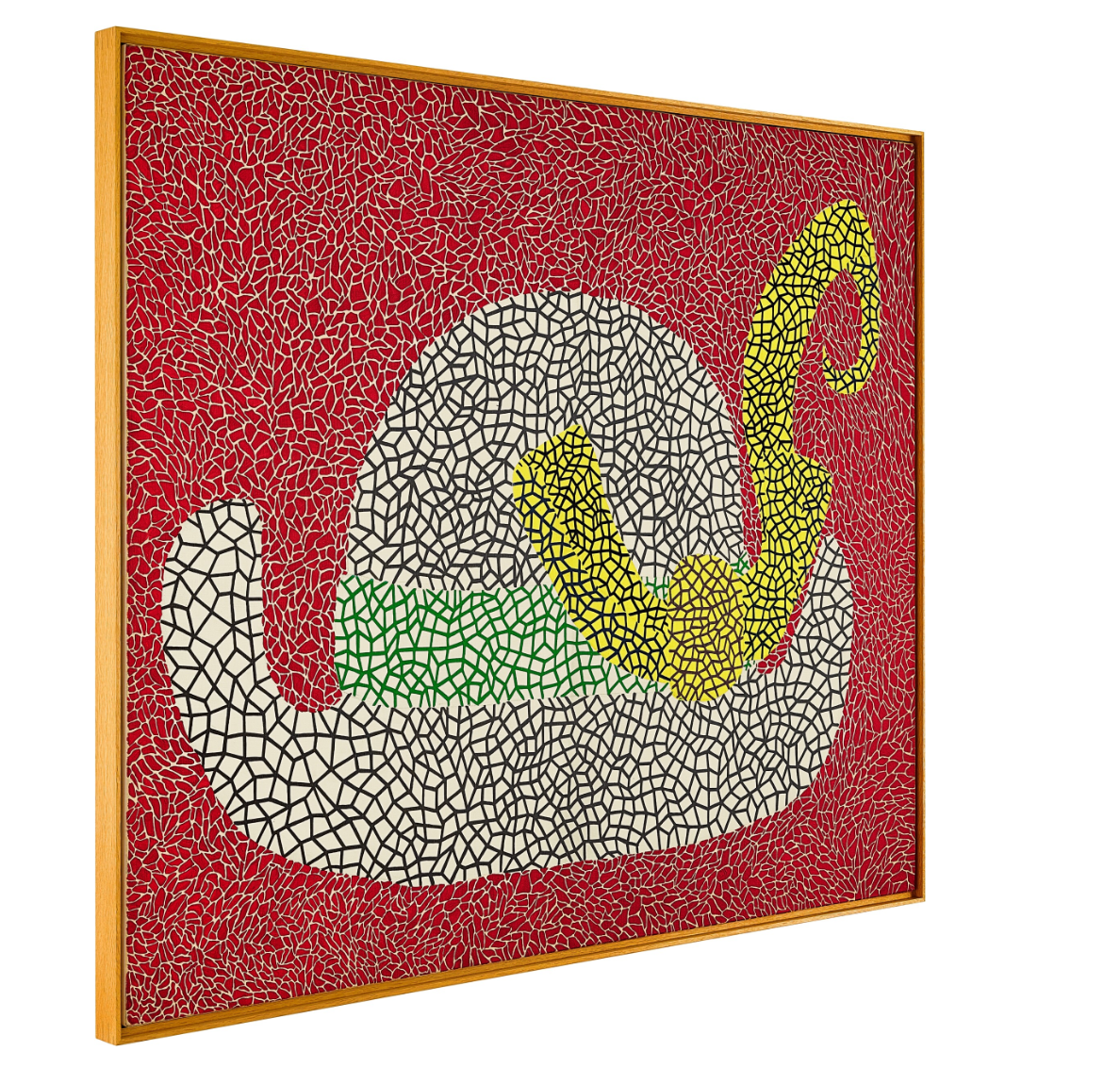
YAYOI KUSAMA (1929 – )
Hat, 1980
Acrylic on canvas
131×162 cm (51 5/8 x 63 3/4 inches)
Signed, titled in Kanji and dated 1980 (on the stretcher)
Spirited, strikingly majestic, exuding an enchanting whimsical charm, Yayoi Kusama’s Hat from 1980 is the first known work on canvas the artist created that features her iconic hat motif, as well as the largest known hat painting within the artist’s vast and universally resonant oeuvre. An exceedingly rare and historically significant work, Hat has not been seen in public for decades, having remained as a treasured anchor piece within the esteemed private collection of Dr. Ryutaro Takahashi, renowned patron of the arts and long-standing supporter of Kusama, for over twenty-five years. Rendered in exquisite detail, Hat is distinguished not only by its scale, rarity, and importance as Kusama’s first and largest known hat canvas, but furthermore by its unique ‘net-on-net’ composition. Whereas other hat paintings by Kusama exhibit a mixture of dots and nets, Hat is ‘netted’ vis-à-vis both object and background, with the background featuring a seldom-seen organic and densely webbed pattern that appears only a few times in the artist’s oeuvre. After Hat was created, Kusama would revisit the hat motif in the 1980s in numerous prints, drawings and paintings, but always in a much smaller domestic scale. Hat is thus a work of extraordinary significance—at once deeply personal and indexical to the artist, while representing a pivotal and defining era in the wider arc of her artistic production and journey towards becoming one of the most legendary artists of our generation.
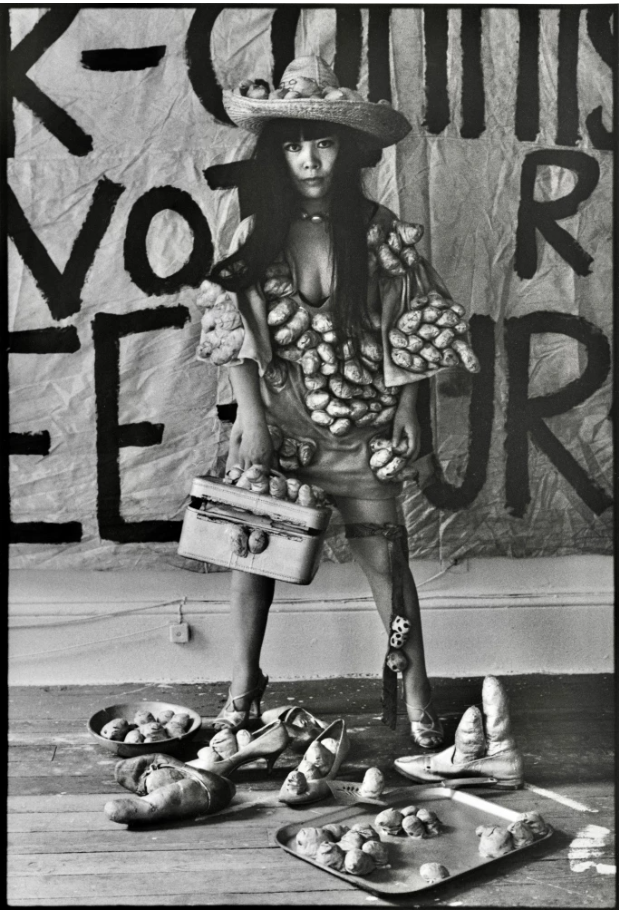
“Yayoi Kusama fashion”, photographed by Tom Haar in her New York studio.
A motif that is simultaneously intimate and universal, familiar yet idiosyncratic, the hat is central to Kusama’s psyche and inextricably linked to her personal and artistic identity. The origins of the motif can be traced back to her childhood—growing up in an agricultural family, Kusama would have been familiar with the simple functional kasa, the Japanese straw hat, worn by farmers while working in fields. Later in the 1960s in New York, Kusama frequently wore hats emblazoned with her own extravagant designs and bold patterns when attending exhibition openings and her early Happenings, merging art and performance with fashion. Indeed, in the 1960s, Kusama created the Yayoi Kusama Fashion Company in New York, bringing her designs to life in mass-produced commercial fashion items; in so doing, Kusama was a groundbreaking forerunner in fusing art, fashion, and commerce. Recalling her brand’s success, Kusama stated: “The mass media reported about us big time. We did fashion shows and had a Kusama corner at department stores. Buyers from big department stores came and selected 100 of this, 200 of that …” (the artist cited in Yayoi Kusama, London, 2000, p. 23). From the early Happenings of the 1960s to her numerous collaborations with major fashion houses in the last twenty years, fashion remained a prominent influence on Kusama, representing a personal partiality as well as her prescient artistic genius and determination to abolish established boundaries between art, fashion, and daily life.
When it came to depicting hats in paintings, Kusama returns to the humble kasa from her childhood memory, adorning it with a simple unpretentious ribbon and weaving both hat and ribbon in vivid, mesmerizing patterns of her signature infinity nets, uniting past and present, as well as Kusama the artist and Kusama the person. The year 1980, the year Hat was created, hails from one of the artist’s most pivotal eras. After an explosive rise to global superstardom in New York in the 1960s, Kusama moved back to Tokyo in 1973 and underwent a creative renaissance while re-assimilating into Japanese society. The artist retreated into a psychiatric hospital in 1977 and commenced a diligent studio practice – one which involved not just painting but various other modes of creative production, publishing novels and poetry. It was during this period in the late-1970s that Kusama began to experiment with medium, color, and composition, producing paintings with vivid palettes and experimental collages that were marked departures from her earlier largely monochromatic works. Kusama’s return to art for healing and transformation resulted in steadily increasing recognition; between 1980 and 1981, she held seven solo exhibitions and was on the very cusp of resurgence and triumph. It was against this context that Hat was created; as such, the work embodies and symbolizes the renewed energy, experimentation, and buoyant optimism with which Kusama was approaching art and creation.
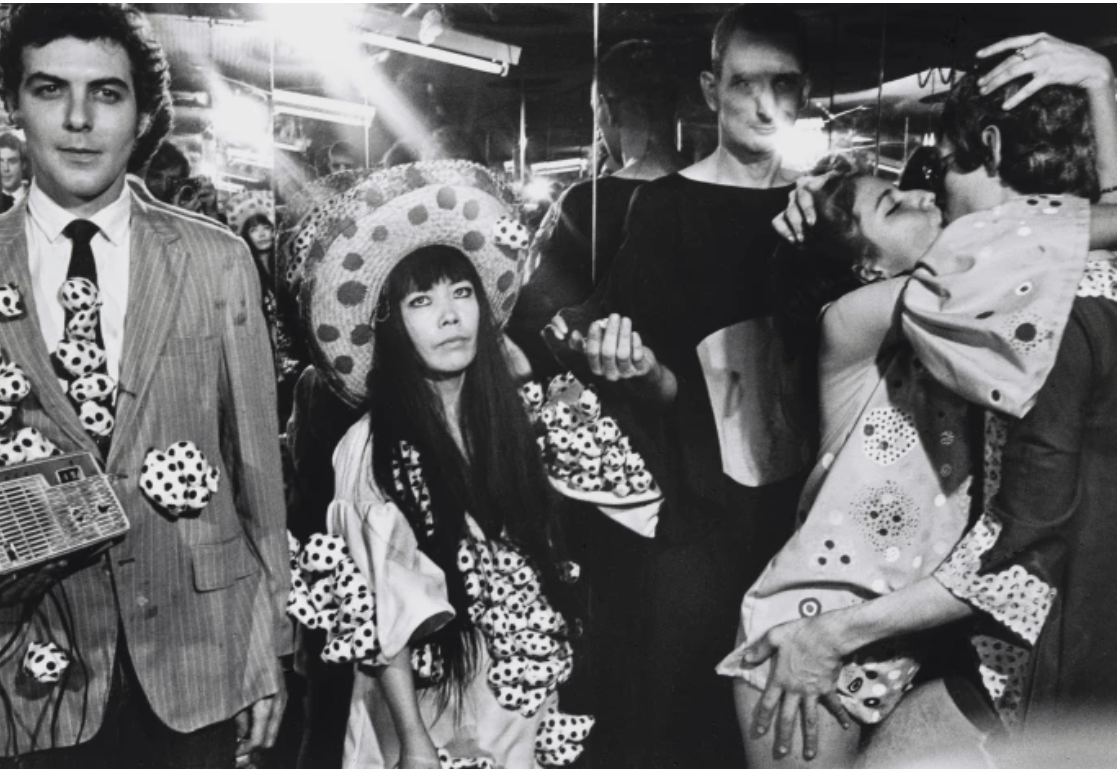
Yayoi Kusama with Harry Shunk and János Kender, Mirror Performance, New York, 1968.
As the first and largest known hat painting on canvas, Hat is entirely hand-painted by the artist, its vast, pulsating and meticulously intricate totality extremely rare in its deployment of “net-on-net” patterning, an effect seldom seen in Kusama’s other still life compositions. An extension of Kusama’s Infinity Net legacy, the ocean of jagged forms form a symphony of figuration and abstraction that subsumes the entire composition within an infinite space of repetition, such that colour, shape and line coalesce across the surface of the work to form object, background, and proliferating movement. The background net patterning of Hat corresponds to the artist’s earliest examples, bearing the biomorphic quality which defines the Nets inspired by the Pacific Ocean in the 1950s, while the hat itself is rendered in the geometric fishnet style pattern which began to proliferate throughout Kusama’s compositions in the 1980s and 1990s, bringing together the distinct modalities of two periods within one composition. Distinguished in its crisp vibrant intensity and expressive evocative power, Hat is undeniably a self-portrait in a sense similar to Kusama’s iconic Infinity Nets as well as pumpkin canvases; indeed, the hat’s grounded, rounded form somewhat resembles the figure of a pumpkin. Just as Kusama often posed in front of her nets or pumpkins dressed in clothes that mimic their colors or patterns, by painting a hat that represented singular and unparalleled personal significance, Kusama asserts the inextricable connection between her physical self and her artistic creation.
Nets – Infinity, 2004
Sotheby’s Hong-Kong: 11 November 2024
Estimated: HKD 11,000,000 – 14,000,000
HKD 10,080,000 / USD 1,296,410
YAYOI KUSAMA (1929 – )
Nets – Infinity, 2004
Acrylic on canvas
161.9 x 161.9 cm (63 3/4 x 63 3/4 inches)
Signed, titled and dated 2004 (on the reverse)
Spectacular for its rhythmic undulations of small, thickly painted loops, Nets – Infinity created in 2004 is a testament to Yayoi Kusama’s most celebrated corpus of paintings. Captivating in its level of detail and the artist’s mastery of spatial abstraction, the present work consists of an endless maze of oscillating, kaleidoscopic lines which weave atop a vast black background. Rendered in a rare appearance of subtle metallic white, these patterns fill up our entire field of vision, the apparent uniformity of the over-a-meter net belies minute differences in the size of the individual brush strokes and the quantity of paint utilized in every stroke. Against the impenetrable depths of the black underpainting, Kusama’s labyrinthine web of tightly woven white lines and dots which shift and pulsate with a purple hue, mimic the expanding fields of color and pattern that inspire Kusama’s practice. Created almost 50 years after she began this expansive series, Nets- Infinity closely corresponds with the artist’s very first examples owing to its intricate patterning of undulating forms that mimic the movements of the ocean. Appearing at auction for the first time, Nets- Infinity exemplifies the exquisite beauty and mesmerizing complexity which characterizes the very best of the artist’s oeuvre.
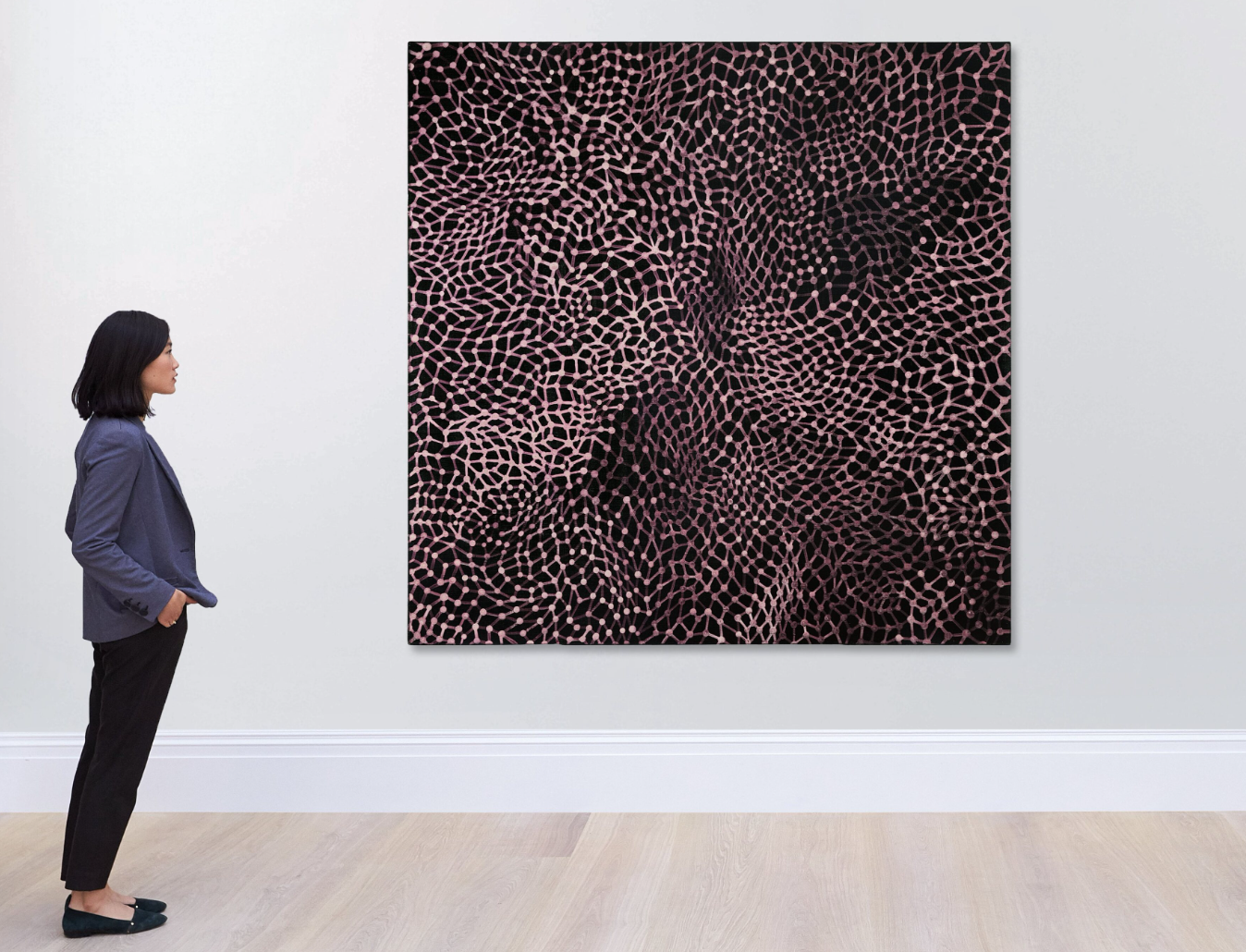
Distinguished in its alluding to the origins of the iconic series, the present work has aesthetic resonance with Kusama’s earliest Infinity Nets. Remarking upon the basis for this, her most acclaimed series, Kusama has revealed that these works find their origin in an earlier series of watercolours titled Pacific Ocean. Painted in 1958-1960, the suite of smaller works was inspired by the infinite expanse of “shallow space” contained within the tiny wavelets of the Pacific Ocean, which Kusama glimpsed through her aeroplane window as she arrived in the United States. (the artist cited in Midori Yamamura, “Kusama Yayoi’s Early Years in New York: A Critical Biography,” Making a Home: Japanese Contemporary Artists in New York, New Haven, 2007, p. 57). The mesmerising patterns of the present work which shift in shades of purple and white calls to mind the terrifying glimpse of infinity one experiences before a seemingly endless expanse of water. Indeed, standing before the present work, surrounded by the interminable expanse of minute marks, one is absorbed by the elegantly rippling undulations of Kusama’s trademark dots; a sea of infinitely crashing waves.
Untitled, 1970
Sotheby’s Hong-Kong: 11 November 2024
Estimated: HKD 2,000,000 – 4,000,000
HKD 3,120,000 / USD 401,245
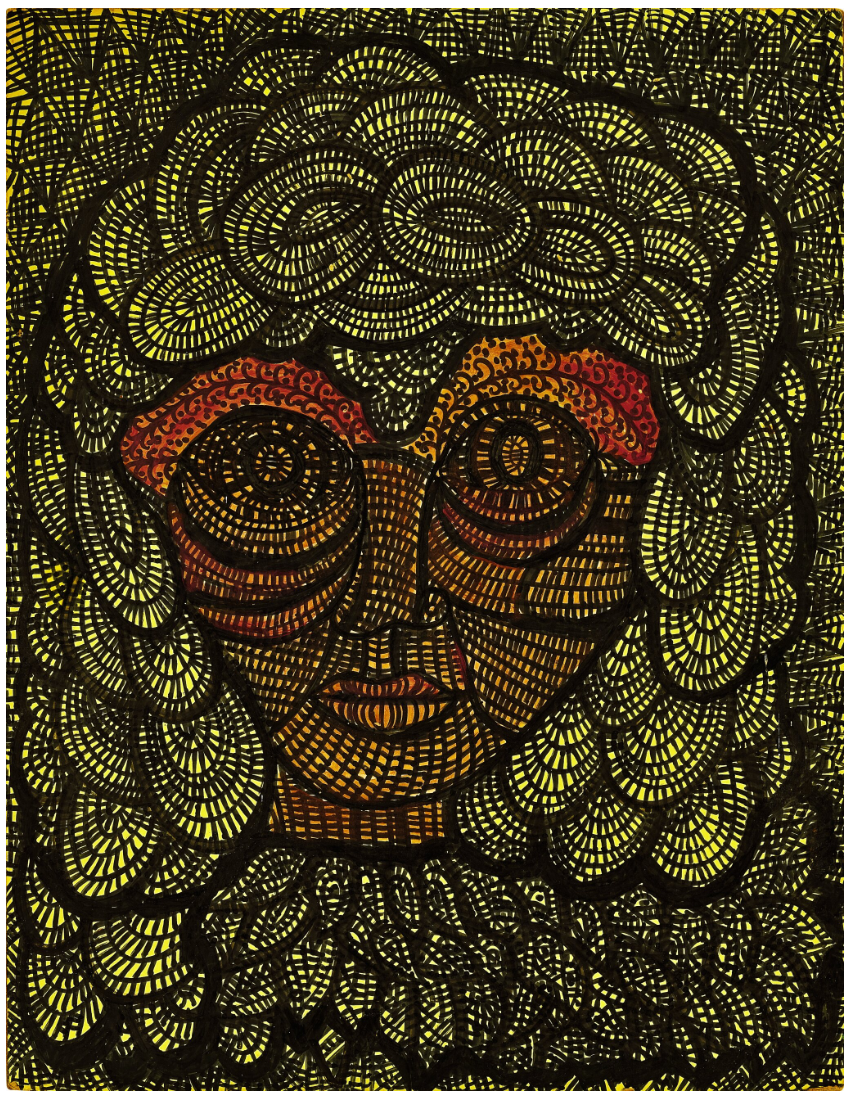
YAYOI KUSAMA (b. 1929)
Untitled, 1970
Ink and wash on card laid on board
64.9 x 50.2 cm (25 1/2 x 19 3/4 inches)
Rare, unique and historically significant, Yayoi Kusama’s Untitled is amongst the most important works by the artist to come to auction. Executed in 1970, the present work is a portrait of the former First Lady of the United States and style icon Jacqueline Kennedy Onassis conducted in the artist’s characteristically exuberant and idiosyncratic style.
Belonging to a small series of fifteen portraits by the artist produced during her time in the Netherlands in the late 1960s, this series sees Kusama take the figures of Shirley MacLaine, Marilyn Monroe, Jacqueline Onassis and Elizabeth Taylor, amongst other monoliths of popular culture as her sources of inspiration. The recent 2024 exhibition Yayoi Kusama. The Dutch Years 1965-1970 at the Stedelijk Museum Schiedam has drawn renewed attention to this formative period in the artist’s career, placing particular emphasis on the primary patrons of Kusama in Europe; Orez International Gallery from the Hague. As Kusama’s sole representative in Europe, Orez played a decisive role in the artist’s success in the continent, cementing her place as one of the most notorious artists of the 1960s. A highly important and exceedingly rare early work by the artist, Untitled was acquired by Albert Vogel, one of the owners of Orez Gallery, the year it was created for the 1970 exhibition Cage/ Painting/ Women, and it has remained in the same family to this day.
“ The first thing I did in New York was to climb up the Empire State Building and survey the city. I aspired to grab everything that went on in the city and become a star. At the time, New York was inhabited by some 3,000 adherents of action painting. I paid no attention to them, because it was no use doing the same thing. As you said, I am in my heart an outsider.”
Jacqueline Kennedy Onassis, the central subject of the present work
Representing the crescendo of an explosive decade for the artist which saw Kusama gain considerable prominence in Europe as well as New York, Untitled was produced at the pivotal juncture before the artist’s return to Japan. As part of New York’s thriving art and countercultural scene of the 1960s, Kusama was swiftly embraced by the most pivotal artists of the era such as Claes Oldenburg, Andy Warhol, Barnett Newman, Mark Rothko, Donald Judd and Dan Flavin, whilst her infamous Happenings and anti-Vietnam war protests attracted notoriety in the press. During this era, she also expanded her art into a wider brand that included many business enterprises; along with her friendly competitor Andy Warhol, she investigated art as commerce and prefigured the merchandising efforts of artists such as Takashi Murakami. She hosted gay male sex parties, edited a weekly newspaper called Kusama Orgy, sold sex toys and porn as part of the Kusama Sex Company, and designed clothes that were mass-produced and sold in a “Kusama corner” of Bloomingdale’s, where Jackie O herself is said to have purchased from. As Kusama writes, at this time she was “reported on almost as much as Jackie O.” (Yayoi Kusama, translated by Ralph McCarthy, Infinity Net: The Autobiography of Yayoi Kusama, London 2011).
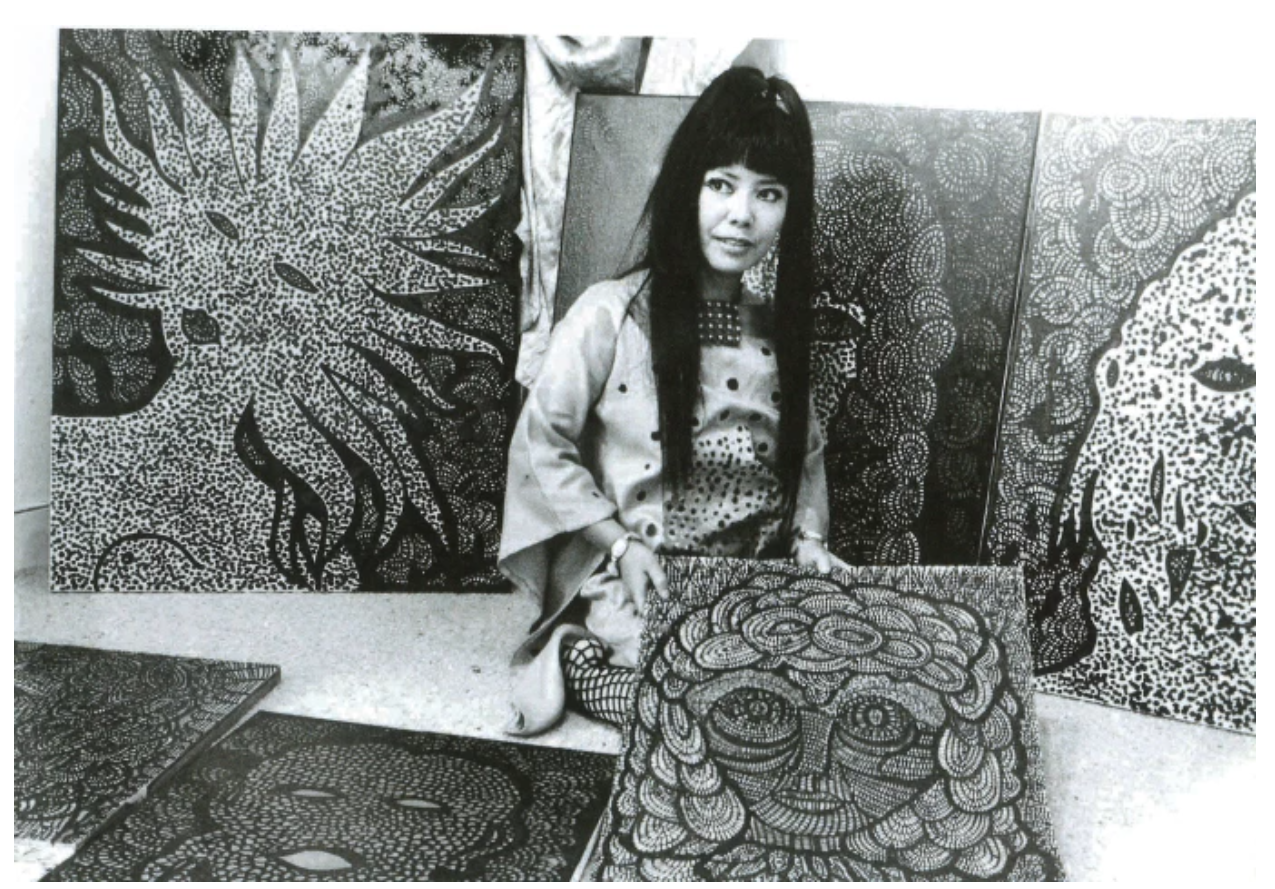
Yayoi Kusama holding the present work amongst other female portraits in International Gallery Orez, 1970. (Photography: Harrie Verstappen. Courtesy. 0-INSTITUTE.)
As the decade drew to a close, despite gaining considerable prominence and finding early supporters of her work in New York and Europe, Kusama remained unsatisfied with how the art world was receiving her; “When all was said and done, my pro-sex and anti-war ideas, and the Happenings that expressed them, went down like lead balloons in Japan. The mass media, the journalists, and the intellectuals all exhibited absolutely no comprehension of what I was about” (Yayoi Kusama,translated by Ralph McCarthy, Infinity Net: The Autobiography of Yayoi Kusama, London 2011, p. 153). It was through Orez Gallery and Holland that Kusama turned, finding more freedom of expression there than in Japan and the US. Significantly, her first fully nude Happening was conducted in Holland, an indicator of the support she felt during her time spent with Orez. Between 1965 and 1970, Kusama held five exhibitions at the gallery, the last being Cage/ Painting/ Women in 1970 where the present work made its debut. Upon the suggestion of Dutch psychiatrist Maarten Reinink, a friend and supporter who the artist stayed with at the time, Kusama began to work on a series of fifteen portraits in a pointillist style of international icons. Four of these works featured a metal caging overlaying the paintings, whilst the remaining eleven works were formal frontal portraits imagined through Kusama’s idiosyncratic patterning. This exhibition also marked an end to the avante-garde environment Kusama found in Europe during the 1960s, being amongst the very last Orez held before their closure in 1971 after a decade at the forefront of arts and culture. Through reimagining cultural icons of 1960s America in her own artistic vernacular of Infinity net patterning, Kusama’s portraits act as a powerful metaphor of personal and artistic struggle.
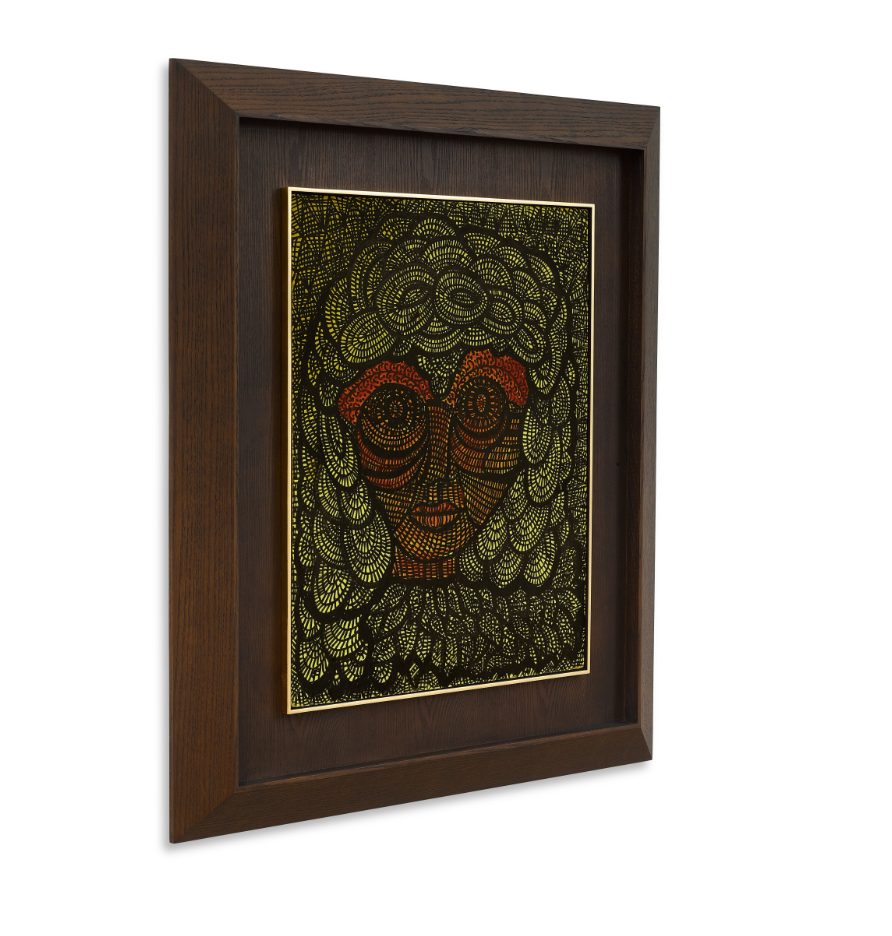
Determined to continue to thrive amongst her male cohorts – largely exempt from the kind of ridicule the artist experienced from the press – Kusama’s preoccupations with fame manifested not just in self-publicity but also in her works; notably, in her choice of portrait subjects. Andy Warhol, a contemporary of Kusama in New York and who she had exhibited with in multiple group exhibitions in Europe in the years preceding the creation of the present work, similarly saw the style icon and historic figure of Jackie O as offering the perfect study of 20th century image making. Warhol’s 1964 Jackie series, just as his images of Marilyn Monroe, speaks to a comparable desire to confront the icons and imagery of American consumer culture. As gallery director Emmanuel Di Donna explains at the 50th anniversary of the Warhol series, Jackie “wasn’t a movie star, but she was America’s royalty: young, glamorous, regal, and the most popular First Lady. One of the world’s greatest style icons, she influenced the way an entire generation of American women wanted to look, dress and behave. She was a visual metaphor for the youth and promise of the Kennedy administration.” (Emmanuel Di Donna, quoted in Alastair Sooke, Jackie Kennedy: Andy Warhol’s pop saint, BBC, 18 April 2014). As with Warhol, Kusama’s choice of subjects—all strong, iconic and controversial women — reveal not just her own relationship to ambition, but also an interest into the dynamics of fame itself. It is noteworthy that this is the only time in her career that Kusama painted portraits of other women, yet throughout her career Kusama has never taken men as her subjects, exclusively finding inspiration from herself and other female icons. Embodying the iconic, charismatic and highly personal motifs which have become synonymous with the artist herself, Untitled is a historic and significant example from the artist’s early career. Representing a pivotal moment in her legendary creative journey, the present work has remained unseen since it first appeared in 1970, an exceedingly rare work of Kusama’s before her return to Japan in the 1970s and a period of relative obscurity. Much like its subject, Kusama’s iconic approach to composition is here manifested in her treatment of Jackie, a testament to her dexterous skill as a painter as well as her innate understanding of the power of image making.
Focus: Pierre Soulages
Peinture 202 x 143 cm, 25 septembre 1967
Phillips Hong-Kong: 25 November 2024
Estimated: HKD 14,000,000 – 24,000,000
HKD 11,098,000 / USD 1,425,835
Pierre Soulages – Modern & Contempo… Lot 12 November 2024 | Phillips
PIERRE SOULAGES
Peinture 202 x 143 cm, 25 septembre 1967
Oil on canvas
202×143 cm (79 1/2 x 56 1/4 inches)
Signed ‘Soulages’ lower right; further signed, titled and dated ‘“202 x 143”, SOULAGES, 25.9.67’ on the reverse
The present lot by the French master Pierre Soulages presents a visual dichotomy, where the stark contrast between black and white does not clash but converses. The black, dominant, and bold, does not simply sit atop the canvas, but seems to carve into the fabric of the white background, creating a sense of depth that is both illusory and innate. The application of black is textured, with the thick impasto giving a tactile dimensionality to thinner glazes that allow the white to subtly emerge. These variations in texture manipulate the light, causing the black to be seemingly in motion through its intensity and form. The light, both natural and artificial, becomes an active participant in the viewing experience, transforming what could be a static image into a dynamic interplay of shadows and highlights.
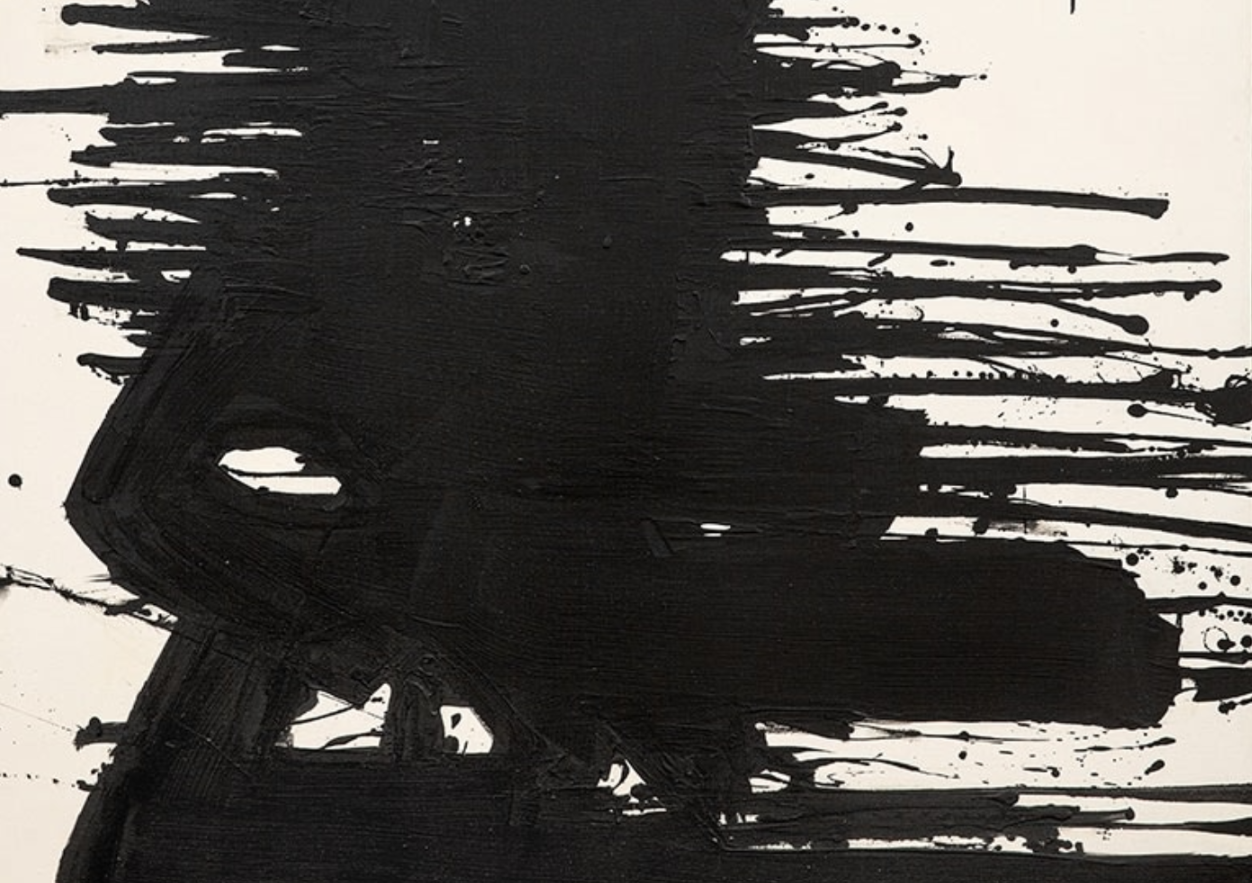
Each stroke on the canvas is deliberate, a controlled engagement that speaks to the raw emotion of the moment of creation. The edges where black meets white are sometimes sharp, creating a clear boundary, and at other times, they feather and blend, suggesting a merging of the opposites. It is in these transitions that Soulages’ work speaks to the impermanence of boundaries and the fluidity of perception. What is particularly striking about Soulages’ oeuvre is the way in which the black seems to reflect the light. Soulages’ black is not the black of an abyss that swallows all that enters; it is rather a black that gives back, that interacts with its surroundings, and changes with the viewer’s perspectives. The luminosity that emanates from the dark sections suggests movement and life, as if the black areas are not simply color but a living entity within the work. The painting invites contemplation, asking the viewer to consider the interplay of light and darkness in life. It is a metaphor for the human condition, where moments of darkness are interspersed with flashes of light, hope, and clarity. The canvas is not passive; it challenges the observer to engage with it, to find meaning in the contrast, and to reflect on the balance of light within their own lives.
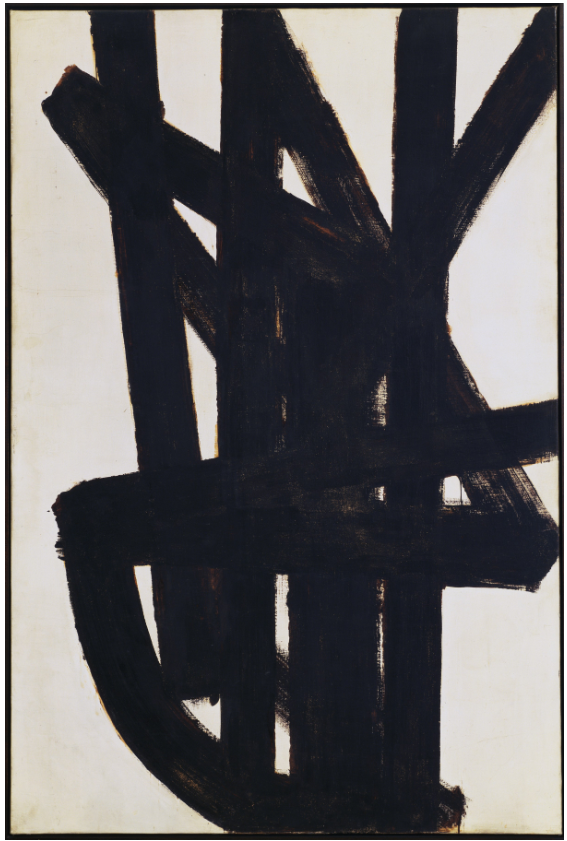
Pierre Soulages, Painting, 1948-49
© 2024 Artists Rights Society (ARS), New York / ADAGP, Paris
The painting thus becomes a meditative object, a point of focus that invites the viewer into a contemplative state. It is not just to be seen but to be experienced, a canvas to enter rather than merely observe. In this space, the viewer is compelled to confront the depths of their own perception, to find clarity in darkness, and to discover the myriad shades and nuances within what may have once seemed a monochromatic abyss. Notably, the influence of Japanese aesthetics on Pierre Soulages is evident in the minimalist approach and the profound sense of balance within his works. The philosophy of ‘less is more’, inherent in much of Japanese art and design, resonates within Soulages’ canvas. The simplicity of the composition belies its complexity, much like the Japanese Zen gardens that is both a physical space and a landscape of the mind.
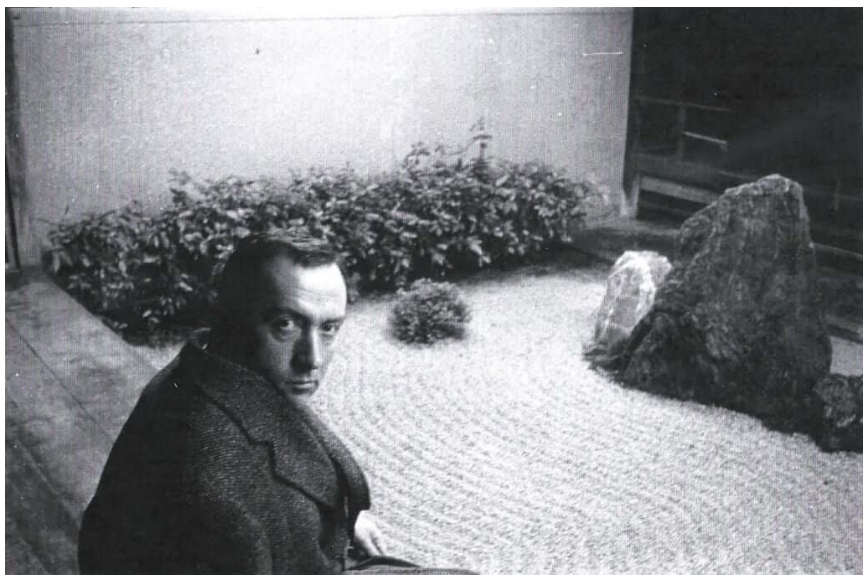
Pierre Soulages at the Daisen-in temple, Kyoto, 1958
Image: © 2024 Artist Rights Society (ARS), New York / ADAGP, Paris
Principles such as Ma (space 間) and wabi-sabi (beauty in imperfection) are reflected in the painting’s composition. There is a harmony in the asymmetry, a beauty in the raw, unfinished quality of the brushstrokes that capture the impermanence and imperfection of existence. The space that Soulages leaves untouched is as important as the areas he fills with pigment, creating a balance that speaks to the voids and presences in life. Soulages has described his encounter with Japanese art as he stood in front of the Shoso-in Treasure House in Nara, for example. The sense of space in the architecture has struck him as something that makes the composition more alive and vivid, and inspired new views on painting.
‘The paintings I like do not demand that their viewers follow with their eyes the space that is present in the picture, or the movement. Instead, the viewers are very free in front of its space. They can interact with it.”
The bold, black strokes in his painting have a similar attribute; they are open to interpretation, conveying emotion and movement that transcends the confines of language. The Japanese influence pushes the work beyond mere visual experiences and into a realm where each viewer’s encounter with the painting is a unique dialogue.

Focus: Mark Rothko
Untitled (Yellow and Blue), 1954
Sotheby’s Hong-Kong: 11 November 2024
Estimated: HKD 225,000,000 – 275,000,000
HKD 252,500,000 / USD 32,474,530
MARK ROTHKO (1903 – 1970)
Untitled (Yellow and Blue), 1954
Oil on canvas
95 5/8 x 73 1/2 inches (242.9 x 186.7 cm)
Executed in 1954, Mark Rothko’s resplendent Untitled (Yellow and Blue) is the first major work to be offered by the artist in Asia and an unequivocal masterpiece of twentieth-century art history. A glowing aurora of shimmering color and light, the present work confronts us as the summation of its creator’s deeply philosophical practice, wherein he staged some of the most moving, transcendent, and simply breathtaking unions between material and support ever realized in the grand tradition of oil paint on canvas.
“It would be good if little places could be set up all over the country, like a little chapel where the traveler, or wanderer could come for an hour to meditate on a single painting hung in a small room, and by itself.”
Executed in 1954, at the chronological apex of the celebrated period of Rothko’s career referred to by David Anfam, author of the artist’s catalogue raisonné, as the anni mirabilis, Untitled (Yellow and Blue) is a triumphant archetype of this artistic ideal: its radiant surface and towering scale elicit a visual and somatic experience that is prodigious and undeniable, compelling us to surrender to a sense of pure contemplation in the face of its painterly authority. For Rothko, art was capable of provoking in the viewer an existential sense of awe and wonderment for the sublime miracle of existence, and in Untitled (Yellow and Blue), as we stand suspended in its sea of meditative calm, we behold that capacity wholly and perfectly achieved.
By the time he painted Untitled (Yellow and Blue) in 1954 Mark Rothko was fifty-one years old and had been working as a painter for thirty years. From figurative paintings in the 1920s and 1930s that reflected the realist trend dominant in American art, and perpetuated by figures such as Thomas Hart Benton, in the wake of World War I and through the Great Depression; through a series of canvases in the 1940s that looked to Europe and staged an exploration of biomorphic forms drawn from Miró, Picasso, Dalí, and Rothko’s other Surrealist predecessors; to the Multiform paintings begun in 1947 and representing the artist’s ultimate and unequivocal disavowal of the figurative, Rothko wrestled with the singular goal that had expanded in his mind to become all-consuming: to access an alternative realm, to transcend his worldly existence, to release himself and his viewers from what he perceived to be the devastatingly chaotic experience of everyday life. When he ultimately composed the first mature iteration of his legendary corpus, in 1949, Rothko succeeded in making his art the instrument of his inner life; his paintings ceased to be material expressions of artistic drive and transformed into gateways to the sublime.
These vessels of pure color and light, Rothko’s towering theses on the absolute limits of abstraction, were overwhelmingly engrossing for him in his creation of them as they are all-encompassing of our senses as we stand in awe in front of them. As Dore Ashton writes, “His greatest fund of emotion was lavished primarily on what he made – paintings. Those paintings were to be his passport to a more luminous world, not encumbered by our nouns and adjectives, our interpretations that always fall short. They were prepared by careful thought, nurtured by well-fondled ideas, but, as he said, ‘Ideas and plans that existed in the mind at the start were simply the doorway through which one left the world in which they occur.’ To leave the world in which ideas and plans – so quickly superseded by emotions – occur was essential to Rothko. …He had deep needs to fulfill, many of them incapable of being brought to the threshold of language.” (Dore Ashton, About Rothko, New York, 1983, p. 3) Rothko’s progression, pursued with dogged determination over decades of experimentation and refinement and with an unerring conceptual and philosophical consistency, was not a quest for material success but instead a visceral, undeniable, and deeply personal calling. Untitled (Yellow and Blue) is a paean to the utterly absorptive process of its execution, whereby Rothko conferred upon its luscious, vigorous surface his own desire, as elucidated by Stanley Kunitz, “to become his paintings.” (Stanley Kunitz, interview with Avis Berman, December 8, 1983, Archives of American Art)
Paintings by Mark Rothko from 1954 that are in Museum Collections
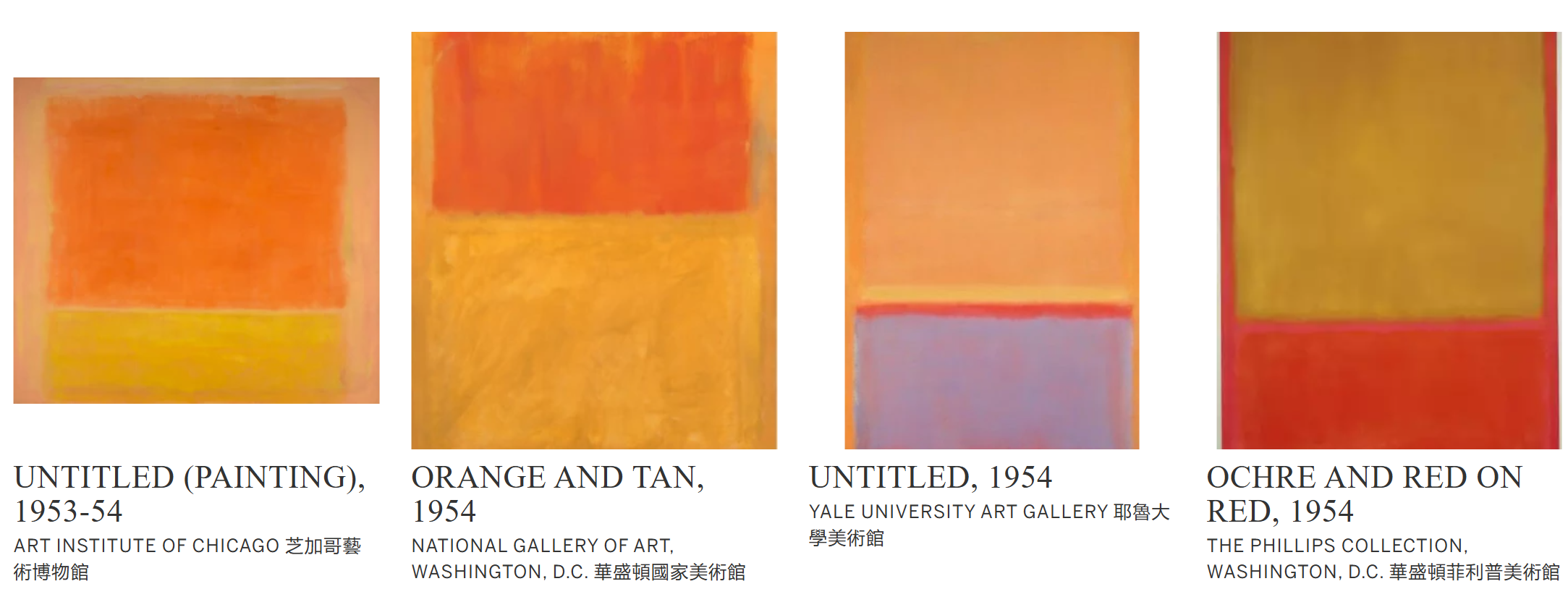
Rothko executed twenty two paintings in 1954, of which eleven are today in the permanent collections of prominent museums around the world, including the National Gallery of Art (Orange and Tan); the Yale University Art Gallery (Untitled); The Museum of Contemporary Art, Los Angeles (No. 9 (Dark over Light Earth/Violet and Yellow in Rose)); the Tehran Museum of Contemporary Art (No. 11/No. 2 (Yellow Center)); The Phillips Collection (The Ochre (Ochre, Red on Red)); The Museum of Art, Rhode Island School of Design (Untitled); the Essen Folkwang Museum (White and Brick on Light Red (White, Pink and Mustard)); The Modern Art Museum of Fort Worth (White Band No. 27); The Metropolitan Museum of Art, New York (Untitled); Art Institute of Chicago (Untitled (Painting)); and Whitney Museum of American Art (Untitled (Blue, Yellow, Green on Red).
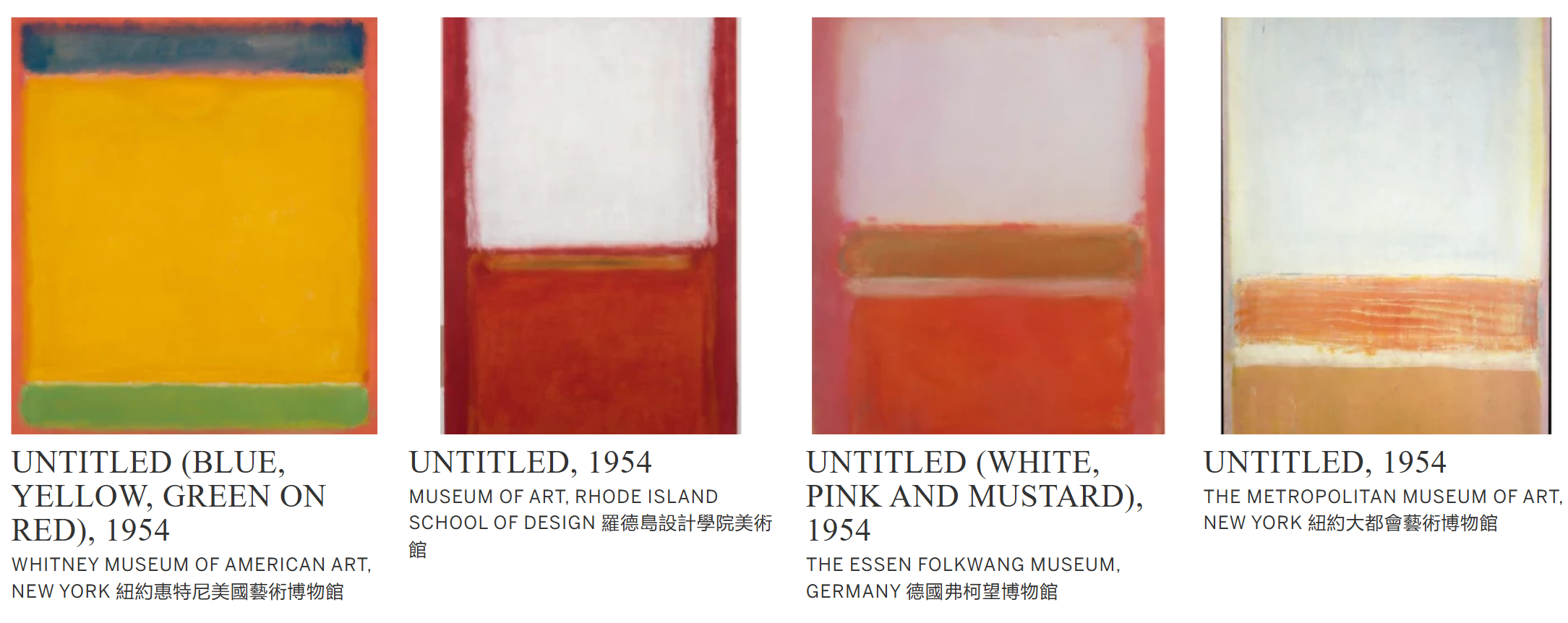
This seminal year also saw Rothko’s first one-man exhibition in a major US museum, at the Art Institute of Chicago. Organized by one of the foremost champions of the avant-garde and post-war art in America, the Institute’s visionary first curator of modern painting and sculpture Katharine Kuh, this exhibition was a definitive testament to Rothko’s preeminence amongst the giants of Abstract Expressionism that were his peers and contemporaries. In the months leading up to the exhibition, and in preparation for its installation as well as the publication of an accompanying catalogue, Rothko and Kuh corresponded at length in a series of letters. In a manner entirely consistent with his artistic philosophy and aesthetic predispositions, Rothko was highly involved and invested in all aspects of the planning, approaching each detail with the same level of conceptual rigor that informed the physical execution of each and every painting he made.
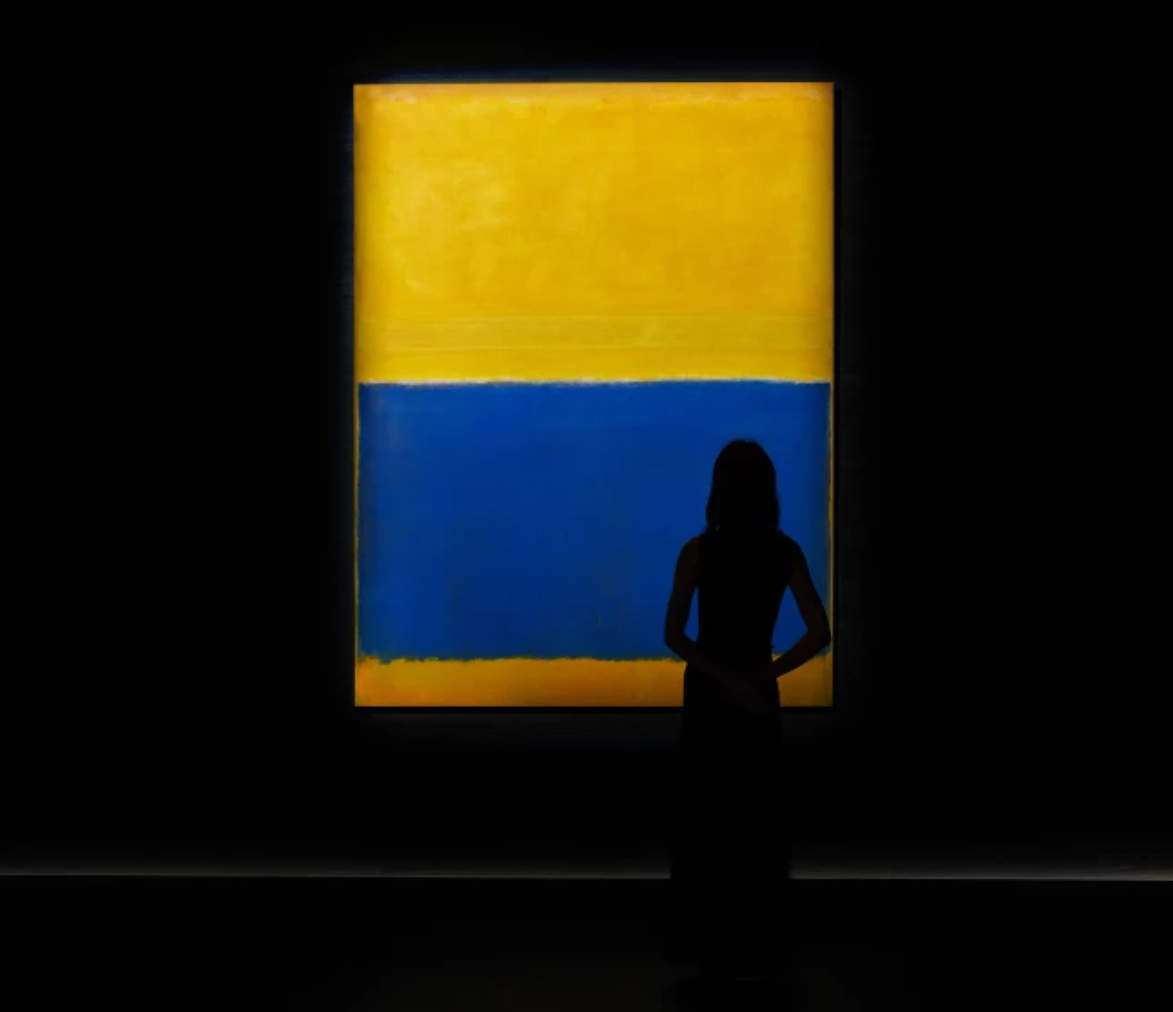
Soaring to a stunning eight feet in height, Untitled (Yellow and Blue) broadcasts its allure on a greater-than human register; engulfing the viewer’s entire experience; and situating us as actors within its epic expanse. An apparent paradox typifies the artist’s ambition and contributes to his desire to commune directly with his canvases.
“I paint very large pictures…precisely because I want to be very intimate and human. To paint a small picture is to place yourself outside your experience…However you paint the larger picture, you are in it. It isn’t something you command.”
Of course, scale is absolutely fundamental to the nature of Rothko’s work. Through the seamless flow of color and light an atmosphere of the ethereal emanates as if from within Untitled (Yellow and Blue). As we become fully subsumed within its luminous surface, our perception of physical boundaries or demarcations of material space dissolves and we are overcome by a sense of endless continuity, as if standing at a precipice reaching outwards toward an ever-receding, boundless horizon. Incandescent zones of brilliantly hued pigment, simultaneously distinct and inextricably intertwined, pulsate with a tangible energetic intensity that takes absolute hold of our vision, pulling us under in a wave of pure artistic bravura. An ocean of radiant lapis blue churns in the lower half of the composition, threatening to surge forth from its predetermined rectangular structure and pour into the shimmering fields of golden yellow that surround it. As witnesses to this inimitable masterwork, we are afforded the opportunity to travel through the subtle variants of tone and contour that comprise the intricate landscape of its surface, apprehending the subtly perceptible strokes of Rothko’s brush that imbue each area of Untitled (Yellow and Blue) with an ineffable breath and inexorable vivacity. Infused with an otherworldly glow, these iridescent tones harbor primal connotations of light, warmth, and the Sun; yet, in line with a perennial balance that characterizes the very archetypes of the artist’s corpus, there is a concurrent tension struck between the uplifting emotions conventionally evoked by warm golden hues and something implicitly more tragic. Inasmuch as the dazzling yellow, made endlessly dynamic by the sheer underlayers of red and blue pigment that give it an exquisite complexity, invokes the Sun it also implicates the inevitable cycle of dawn and dusk, of rise and set, of continual demise and rebirth.
“Often, towards nightfall, there’s a feeling in the air of mystery, threat, frustration – all of these at once. I would like my painting to have the quality of such moments.”
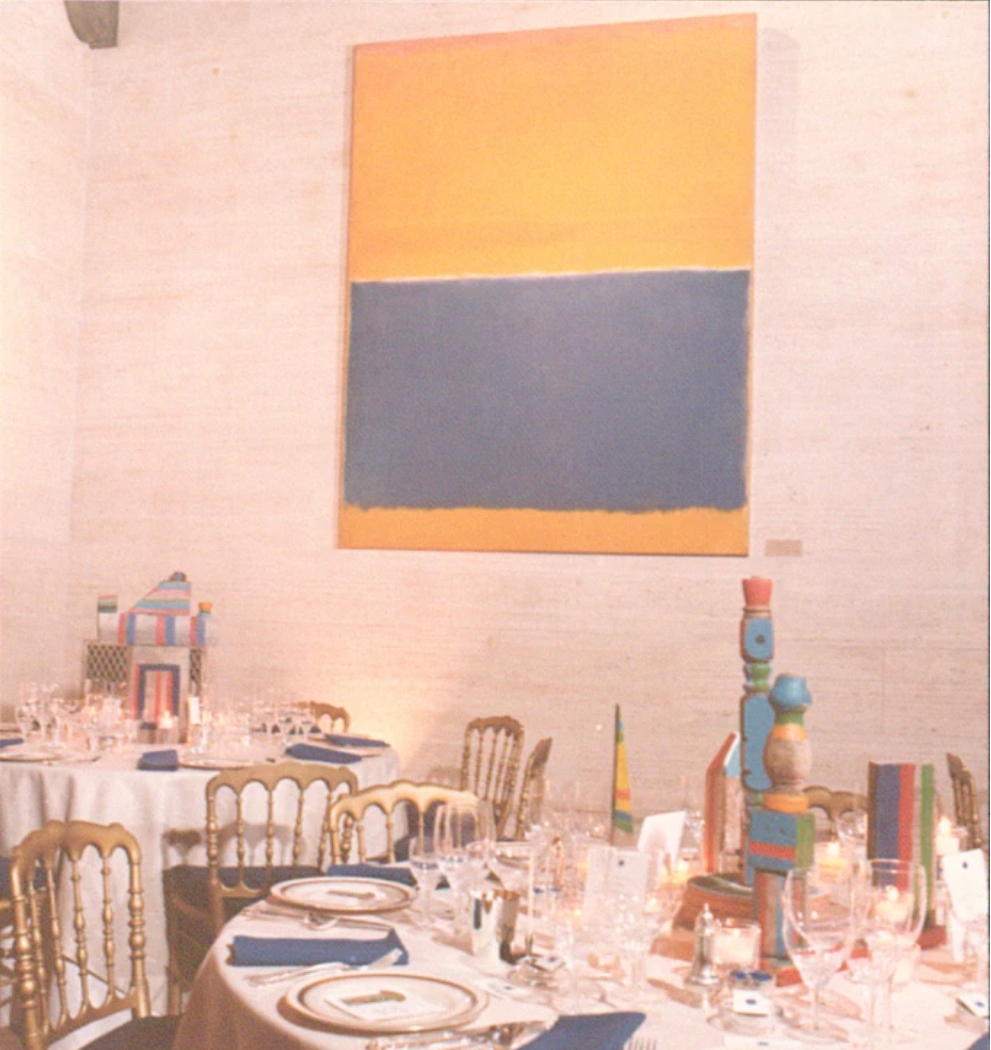
The present work at the opening dinner for the National Gallery of Art, held in 1973 in Washington, D.C.
For nearly thirty years, from the time that it was acquired directly following Rothko’s death in 1970, Untitled (Yellow and Blue) held an esteemed place within the renowned collection of Mr. and Mrs. Paul Mellon. Foremost among the leading patrons in the arts for much of the Twentieth Century, Mr. and Mrs. Mellon lived according to the noblest ideals of refinement and understatement. Paul Mellon’s father, the banker, industrialist, and philanthropist Andrew W. Mellon had effectively founded the National Gallery of Art in Washington, D.C. in 1937 with a gift of one hundred and fifteen paintings from his personal collection as well as the funds to construct the museum’s building, designed by John Russell Pope. Following his father’s death, Paul Mellon took stewardship over the project, presenting the completed building to Franklin D. Roosevelt in 1941 and thereafter serving as the National Gallery’s president, board chairman, and honorary trustee. When Mrs. Mellon married Paul in 1948 she brought her distinctive passion and discerning aesthetic predisposition to the Mellon family’s art collection, redefining its scope to include artists like Mark Rothko who were operating at the very forefront of artistic innovation at mid-century. Mrs. Mellon’s deep reverence and love for the arts combined with and extended Paul Mellon’s own overwhelming generosity; in 1966, to celebrate the twenty-fifth anniversary of the Gallery, an exhibition of the Mellon’s vast trove of Impressionist and Post-Impressionist paintings was held and the paintings subsequently donated to the museum. Five years later, the Gallery’s burgeoning collection of Modern Art required additional space and Mr. Mellon commissioned I. M. Pei to design a new East Building that, together with his sister Ailsa Mellon Bruce, he funded. Over the course of six decades until his death in 1999, Mr. Mellon donated nine hundred and thirteen works to the National Gallery.
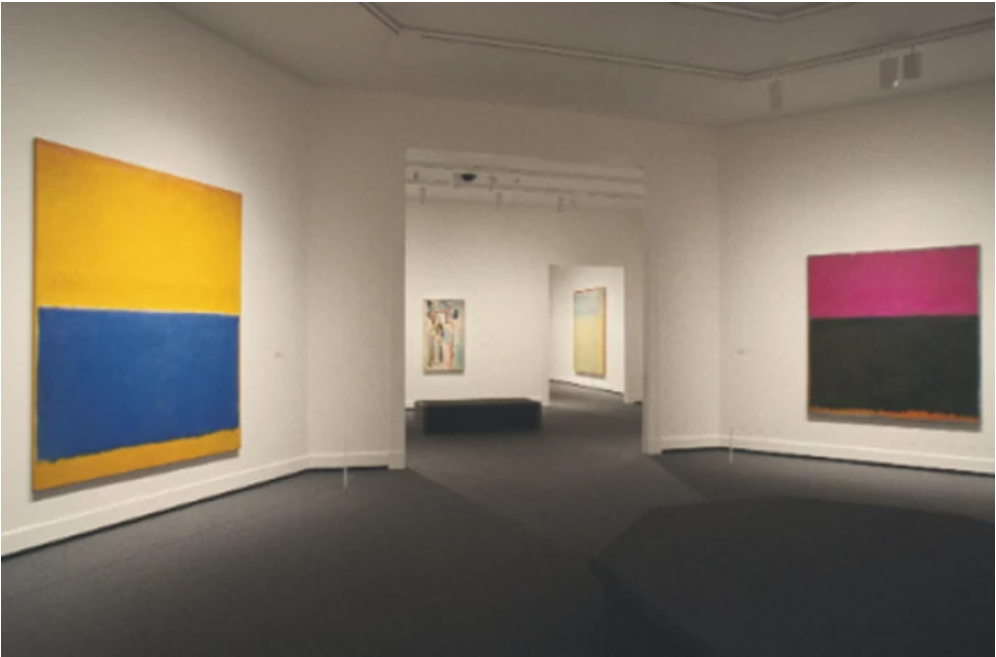
The present work installed at the National Gallery of Art, Washington, D.C.
The artist famously stated, in what is perhaps the definitive text declaring the philosophical underpinnings to his oeuvre, “I think of my pictures as dramas; the shapes in the pictures are the performers… They are organisms with volition and a passion for self-assertion.” (Mark Rothko, “The Romantics Were Prompted,” first published in Possibilities, no. 1, 1947) Indeed, our experience of Untitled (Yellow and Blue) as participants in its stunning drama brings it to life, and may give new dimension to our lives. We do not look at this painting; we are absorbed into it. Indeed, being in its presence parallels a line of Nietzsche that had inspired Rothko since he had been a young man: “There is a need for a whole world of torment in order for the individual to sit quietly in his rocking row-boat in mid-sea, absorbed in contemplation.” (Friedrich Nietzsche, The Birth of Tragedy, translation by Francis Golffing, New York, 1956, pp. 33-34)
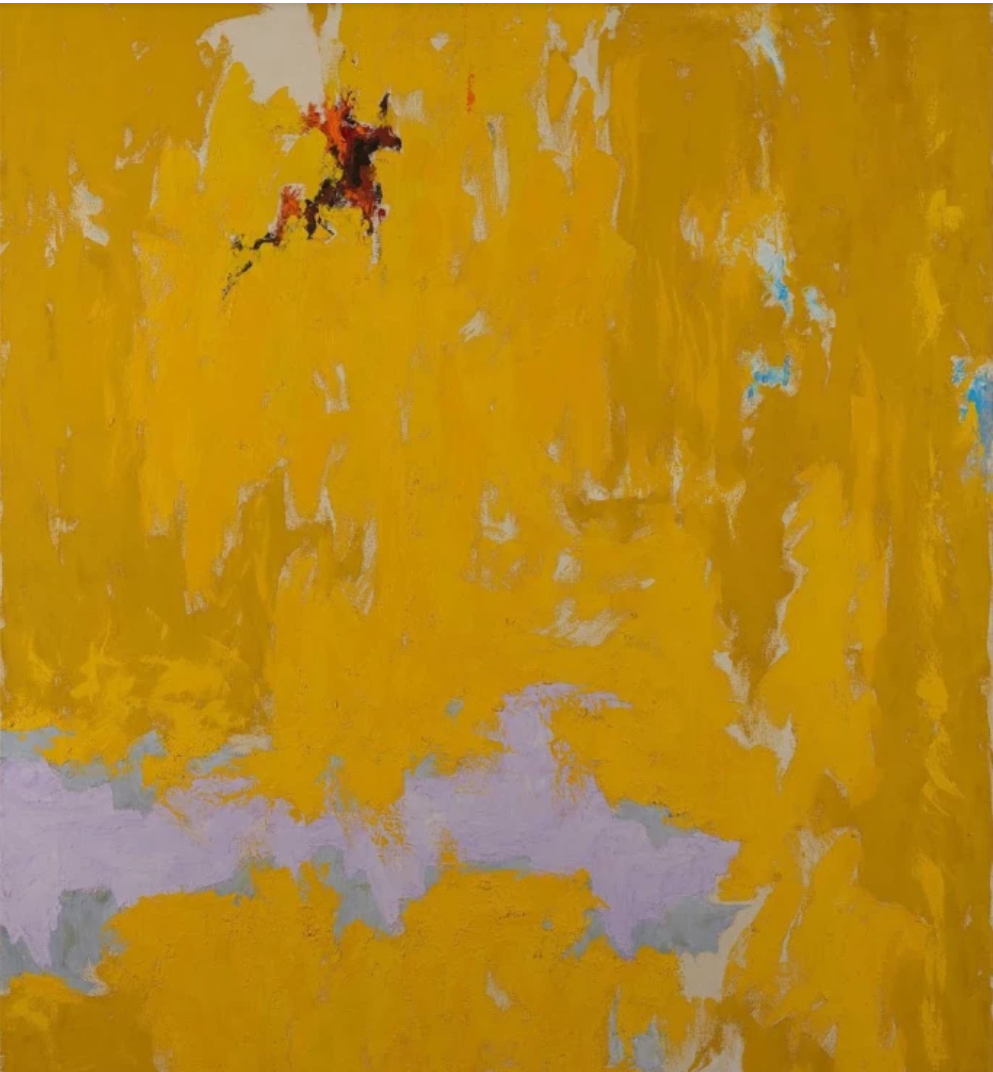
Clyfford Still, PH-129, 1949, Clyfford Still Museum, Denver
It is well documented that Rothko was fixated with the literary work of Friedrich Nietzsche, above all the German philosopher’s seminal opus The Birth of Tragedy from the Spirit of Music written in 1872. Nietzsche’s ideas of how the tension between Apollonian and Dionysian forces dictates the terms of human drama were important to the advancement of Rothko’s color fields. Indeed, Rothko’s vast tableaux have often been discussed in the lexicon of the immediate and saturating effects of music. David Sylvester’s review of the 1961 Whitechapel Gallery exhibition in London provides an apt response to the present work in these terms: “These paintings begin and end with an intense and utterly direct expression of feeling through the interaction of colored areas of a certain size. They are the complete fulfillment of Van Gogh’s notion of using color to convey man’s passions. They are the realisation of what abstract artists have dreamed for 50 years of doing – making painting as inherently expressive as music. More than this: for not even with music…does isolated emotion touch the nervous system so directly.” (in New Statesman, 20 October 1961 cited in Exh. Cat., London, The Tate Gallery, Op. Cit., p. 36)
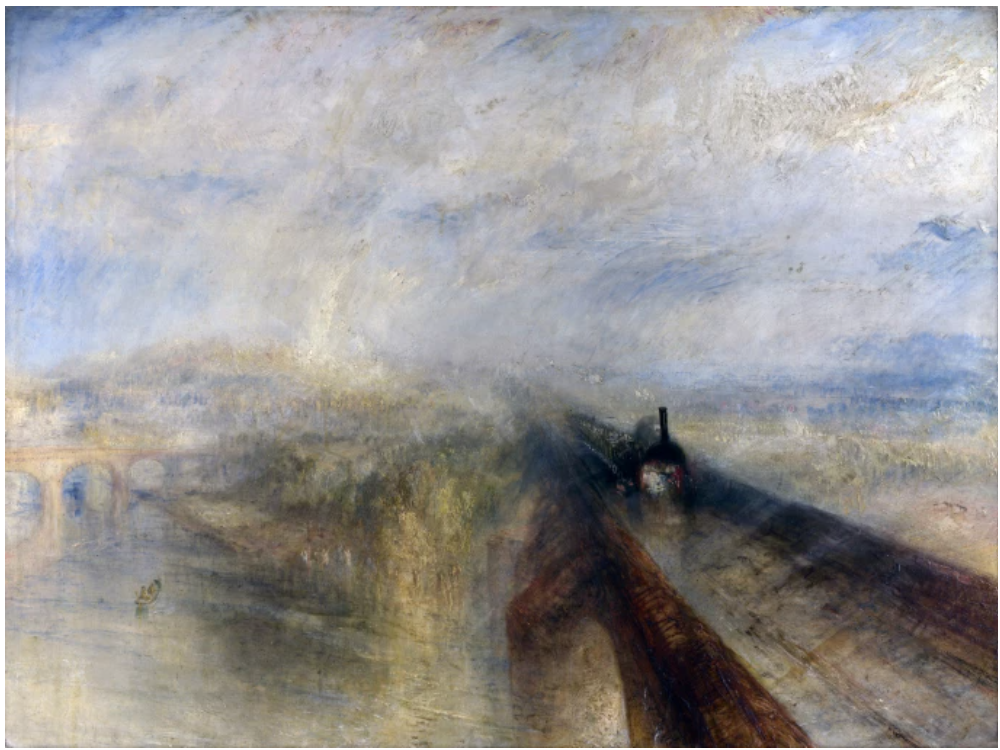
J.M.W. Turner, Rain, Steam, and Speed – The Great Western Railway, 1844, National Gallery, London
Excepting a letter to Art News in 1957, from 1949 onwards Rothko ceased publishing statements about his work, anxious that his writings might be interpreted as instructive or didactic and could thereby interfere with the pure import of the paintings themselves. However, in 1958 he gave a talk at the Pratt Institute to repudiate his critics and to deny any perceived association between his art and self-expression. He insisted instead that his corpus was not concerned with notions of self but rather with the entire human drama. While he drew a distinction between figurative and abstract art, he nevertheless outlined an underlying adherence to the portrayal of human experience. Discussing the “artist’s eternal interest in the human figure,” Rothko examined the common bond of figurative painters throughout Art History: “they have painted one character in all their work. What is indicated here is that the artist’s real model is an ideal which embraces all of human drama rather than the appearance of a particular individual. Today the artist is no longer constrained by the limitation that all of man’s experience is expressed by his outward appearance. Freed from the need of describing a particular person, the possibilities are endless. The whole of man’s experience becomes his model, and in that sense it can be said that all of art is a portrait of an idea.” (lecture given at the Pratt Institute 1958, cited in Exh. Cat., London, The Tate Gallery, Op. Cit., p. 87) Teeming with the sheer genius of its creator’s inimitable evocation of the sublime, Untitled (Yellow and Blue) is the singular summation of Mark Rothko’s fundamental artistic ambition as elucidated in his definitive Pratt Institute talk. A veritable treatise on the absolute limits of abstraction, the present work, in truth, involves both spirit and nature, and instills in us a profound sense of the spiritual whilst evincing Rothko’s abject faith in the critical role the artist plays in attaining the highest realm to which man could aspire: “For art to me is an anecdote of the spirit, and the only means of making concrete the purpose of its varied quickness and stillness.” (Mark Rothko, “Personal Statement,” in Miguel López-Remiro, ed., Op. Cit., p. 45)