Auction Results
#1. Nurse, 1964
Christie’s New-York: 8 November 2015
Estimate on Request
USD 95,365,000
Roy Lichtenstein (1923-1997) (christies.com)
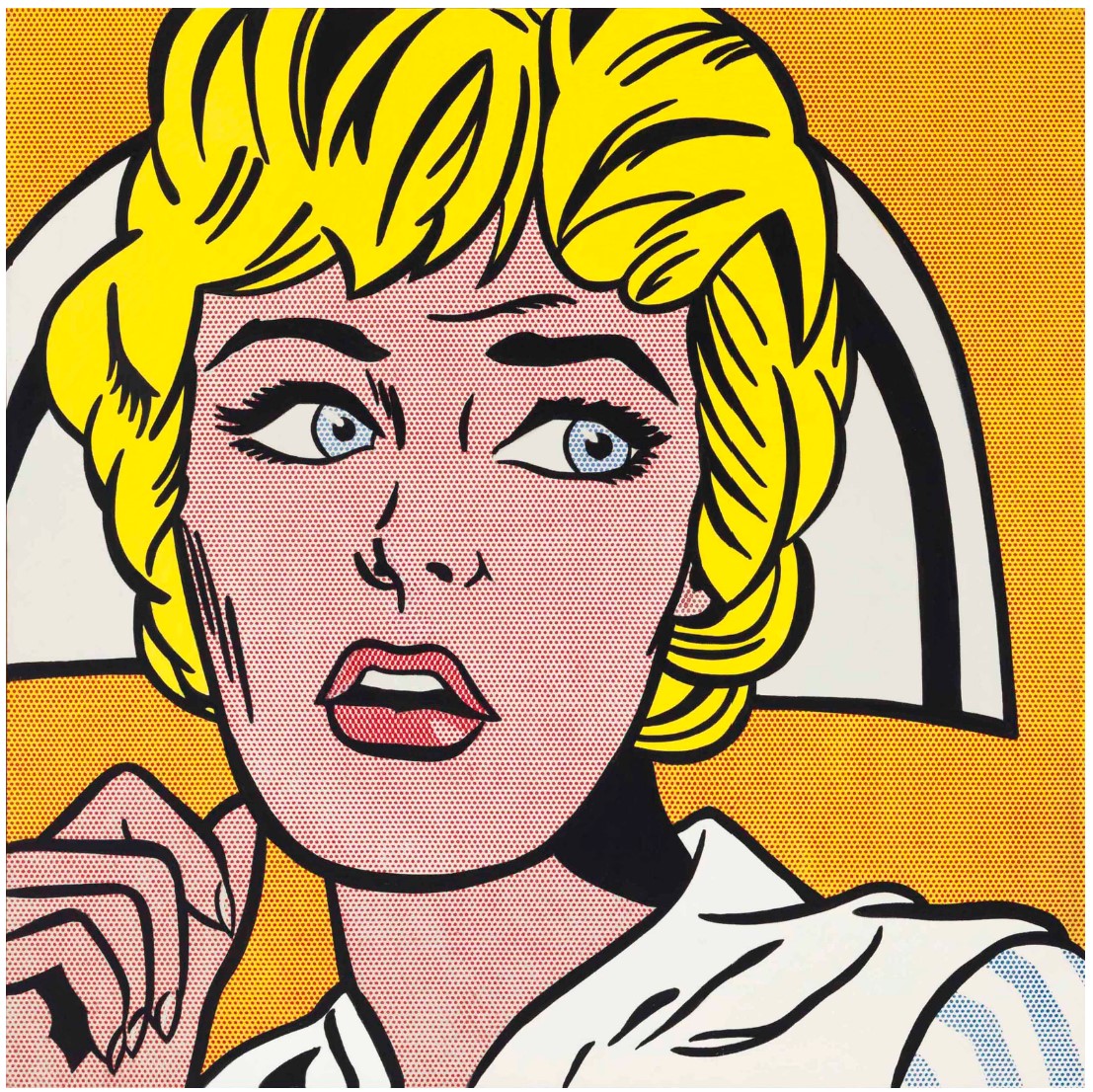
ROY LICHTENSTEIN (1923-1997)
Nurse, 1964
Oil and Magna on canvas
48×48 inches (121.9 x 121.9 cm)
Signed and dated ‘rf Lichtenstein ’64’ (on the reverse)
#2. Woman with Flowered Hat, 1963
Christie’s New-York: 14 May 2013
Estimate on Request
USD 56,123,750
Roy Lichtenstein (1923-1997) (christies.com)
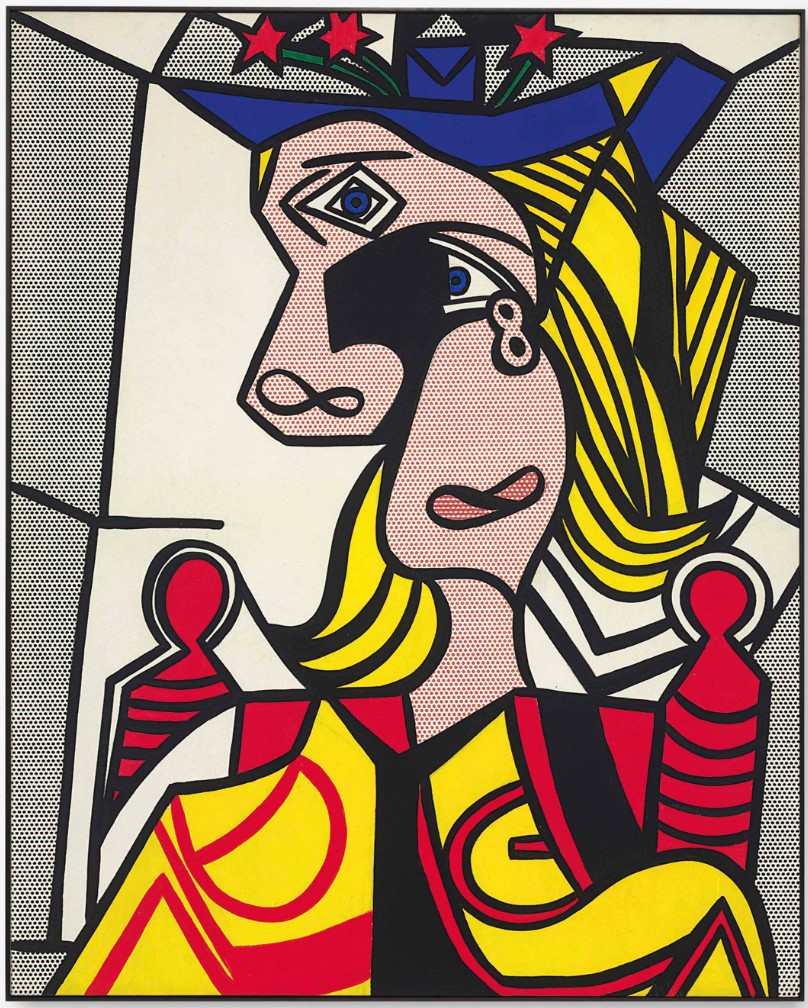
ROY LICHTENSTEIN (1923-1997)
Woman with Flowered Hat, 1963
Magna on canvas
50 1/8 x 40 ¼ inches (127.3 x 102.2 cm)
Signed and dated ‘rf Lichtenstein ’63’ (on the reverse)
USD 50 million
#3. Nude with Joyous Painting, 1994
Christie’s New-York: 9 July 2020
Estimate on Request
USD 46,242,500
Roy Lichtenstein (1923-1997) (christies.com)
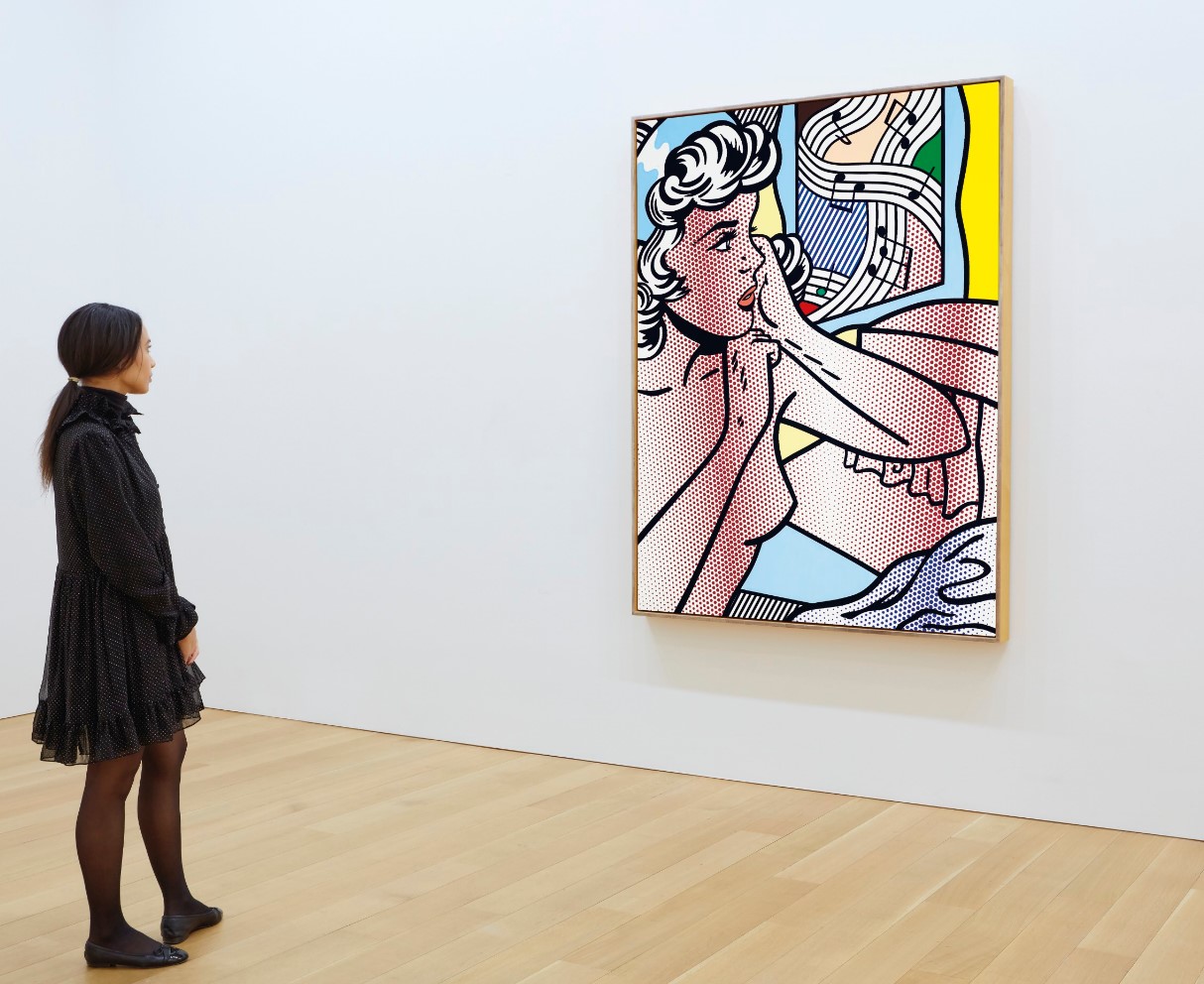
ROY LICHTENSTEIN (1923-1997)
Nude with Joyous Painting, 1994
Oil and Magna on canvas
70×53 inches (177.8 x 134.6 cm)
Signed and dated ‘rf Lichtenstein ’94’ (on the reverse)
#4. Sleeping Girl, 1964
Sotheby’s New-York: 9 May 2012
Estimated: USD 30,000,000 – 40,000,000
USD 44,882,500
(#16) Roy Lichtenstein (sothebys.com)
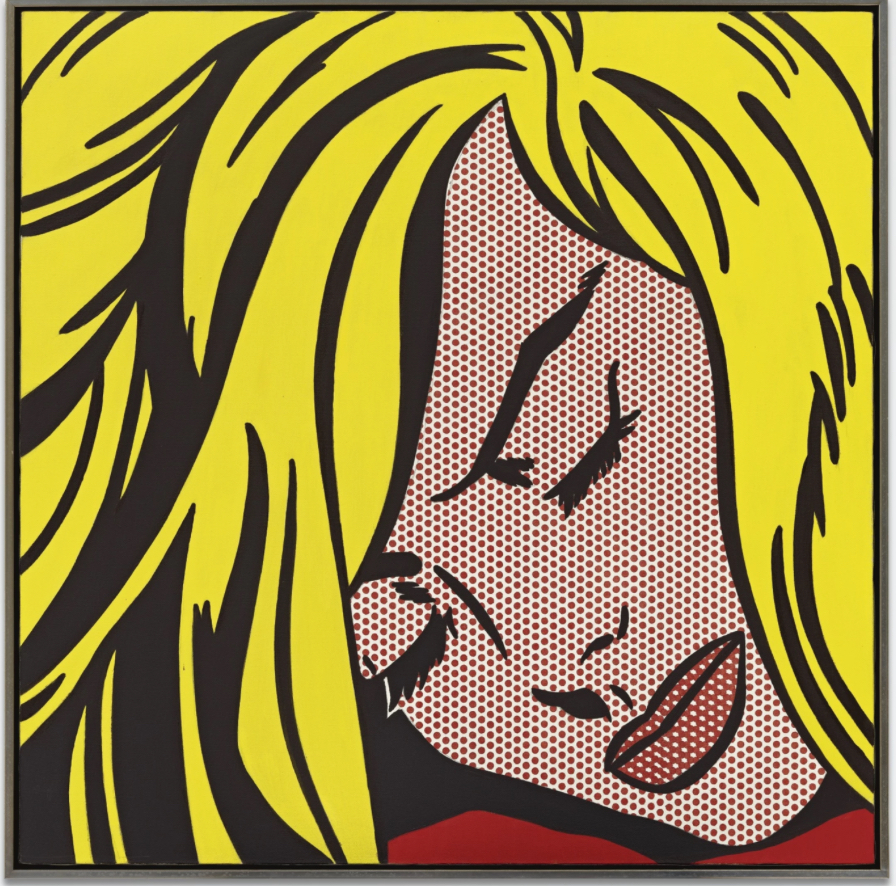
ROY LICHTENSTEIN
Sleeping Girl, 1964
Oil and Magna on canvas
36×36 inches (91.5 x 91.5 cm)
Signed and dated ’64 on the reverse
#5. I Can See the Whole Room!…and There’s Nobody in it!, 1961
Christie’s New-York: 8 November 2011
Estimated: USD 35,000,000 – 45,000,000
USD 43,202,500
Roy Lichtenstein (1923-1997) (christies.com)
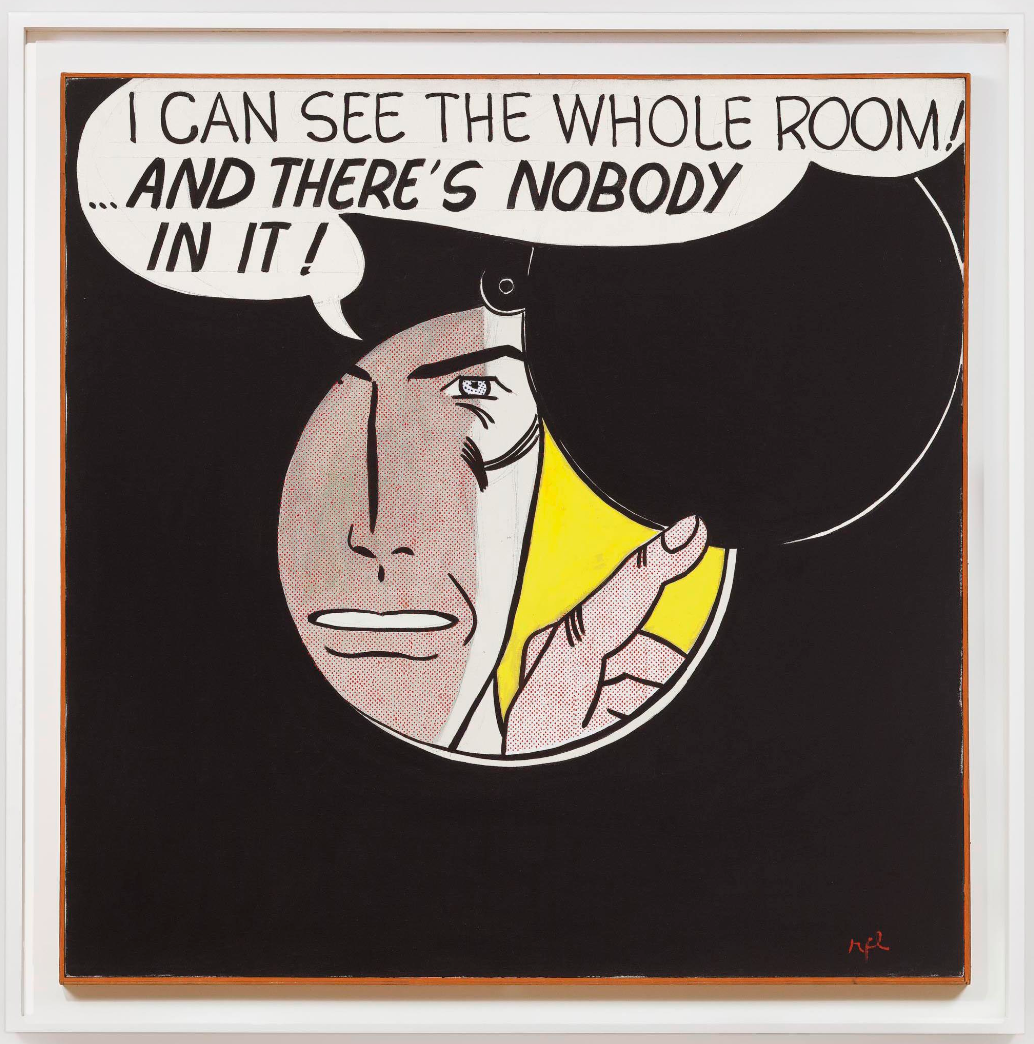
ROY LICHTENSTEIN (1923-1997)
I Can See the Whole Room!…and There’s Nobody in it!, 1961
Oil and graphite on canvas
48×48 inches (121.9 x 121.9 cm)
Signed ‘rfl’ (lower right)
#6. Ohhh…Alright…, 1964
Christie’s New-York: 10 November 2010
Estimate on Request
USD 42,642,500
Roy Lichtenstein (1923-1997) (christies.com)
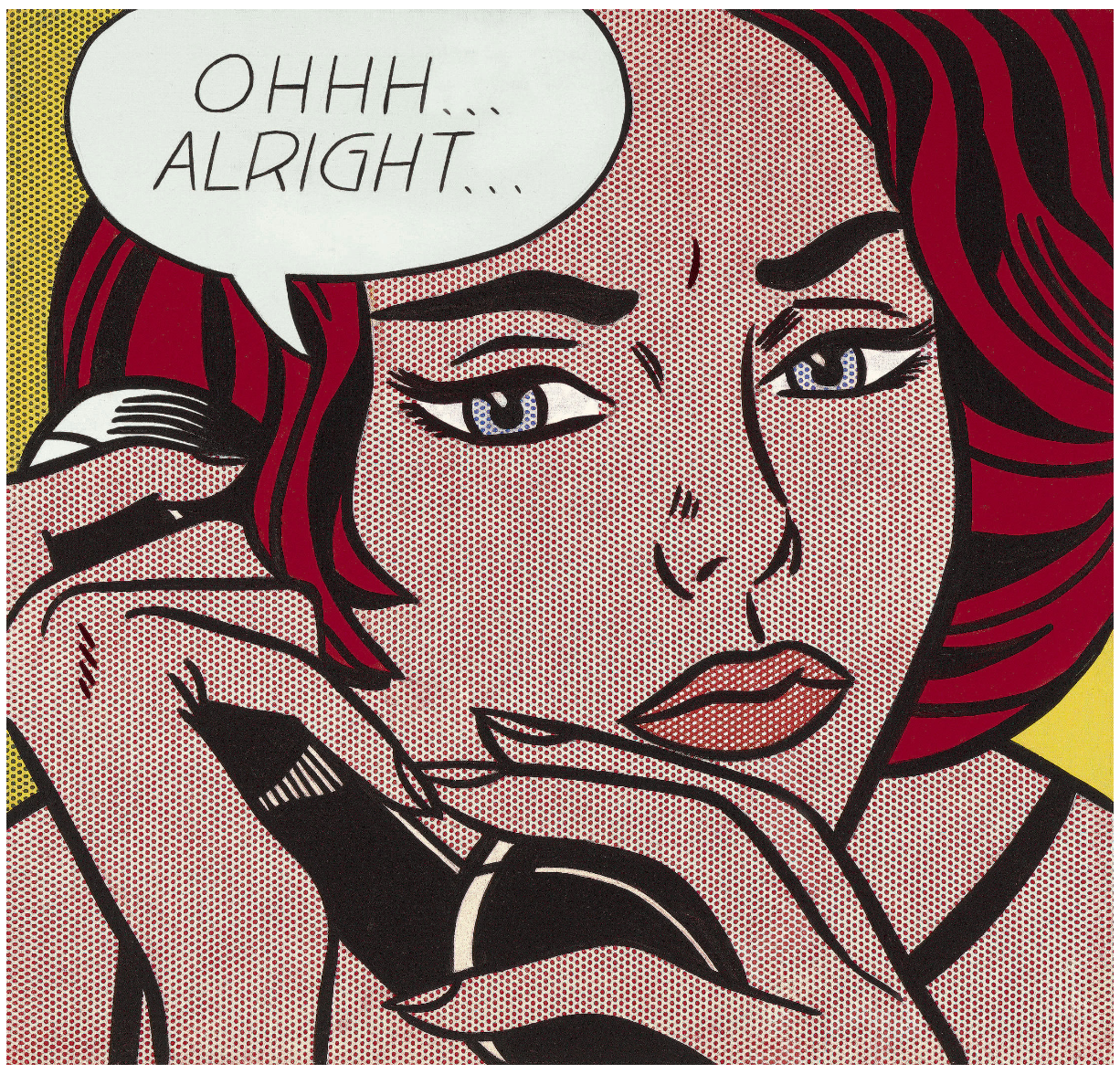
Roy Lichtenstein (1923-1997)
Ohhh…Alright…, 1964
Oil and magna on canvas
36 1/2 x 38 inches (90.2 x 96.5 cm)
Signed and dated ‘rf Lichtenstein ’64’ (on the reverse)
#7. The Ring (Engagement), 1962
Sotheby’s New-York: 11 May 2015
Estimate on Request
USD 41,690,000
(#15) Roy Lichtenstein (sothebys.com)
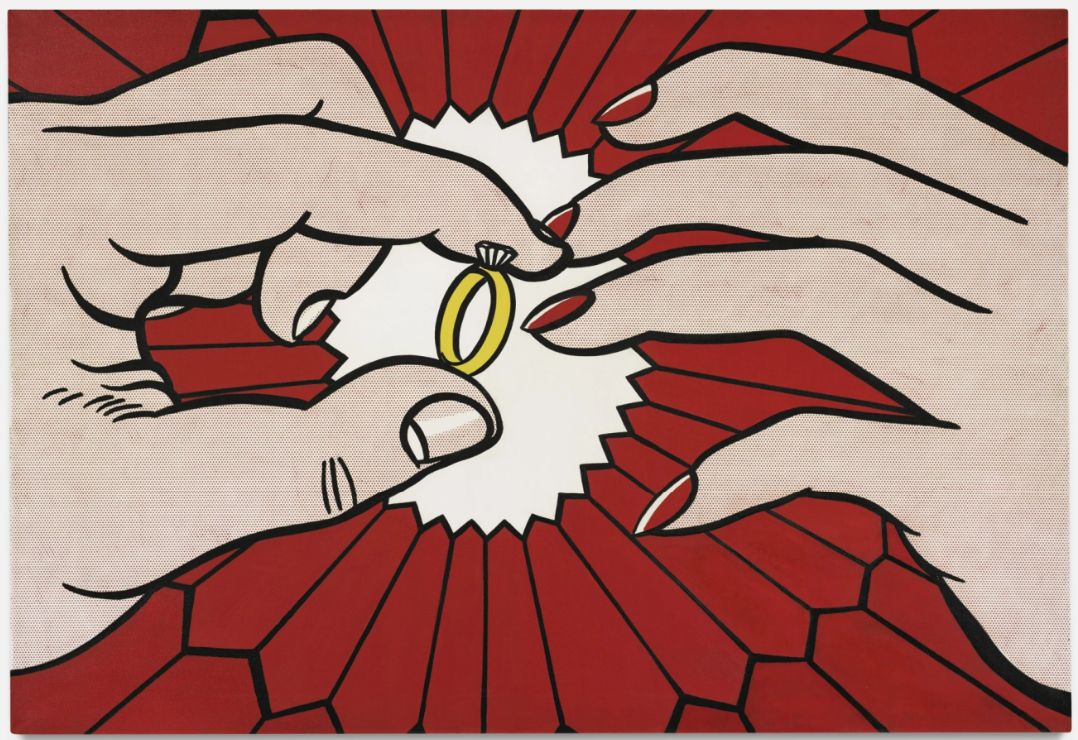
ROY LICHTENSTEIN
The Ring (Engagement), 1962
Oil on canvas
48 1/4 x 70 inches (122.5 x 177.8 cm)
Signed and dated ’62 on the reverse; titled on the stretcher
USD 40 million
#8. Seductive Girl, 1996
Christie’s New-York: 12 November 2013
Estimated: USD 22,000,000 – 28,000,000
USD 31,525,000
Roy Lichtenstein (1923-1997) (christies.com)
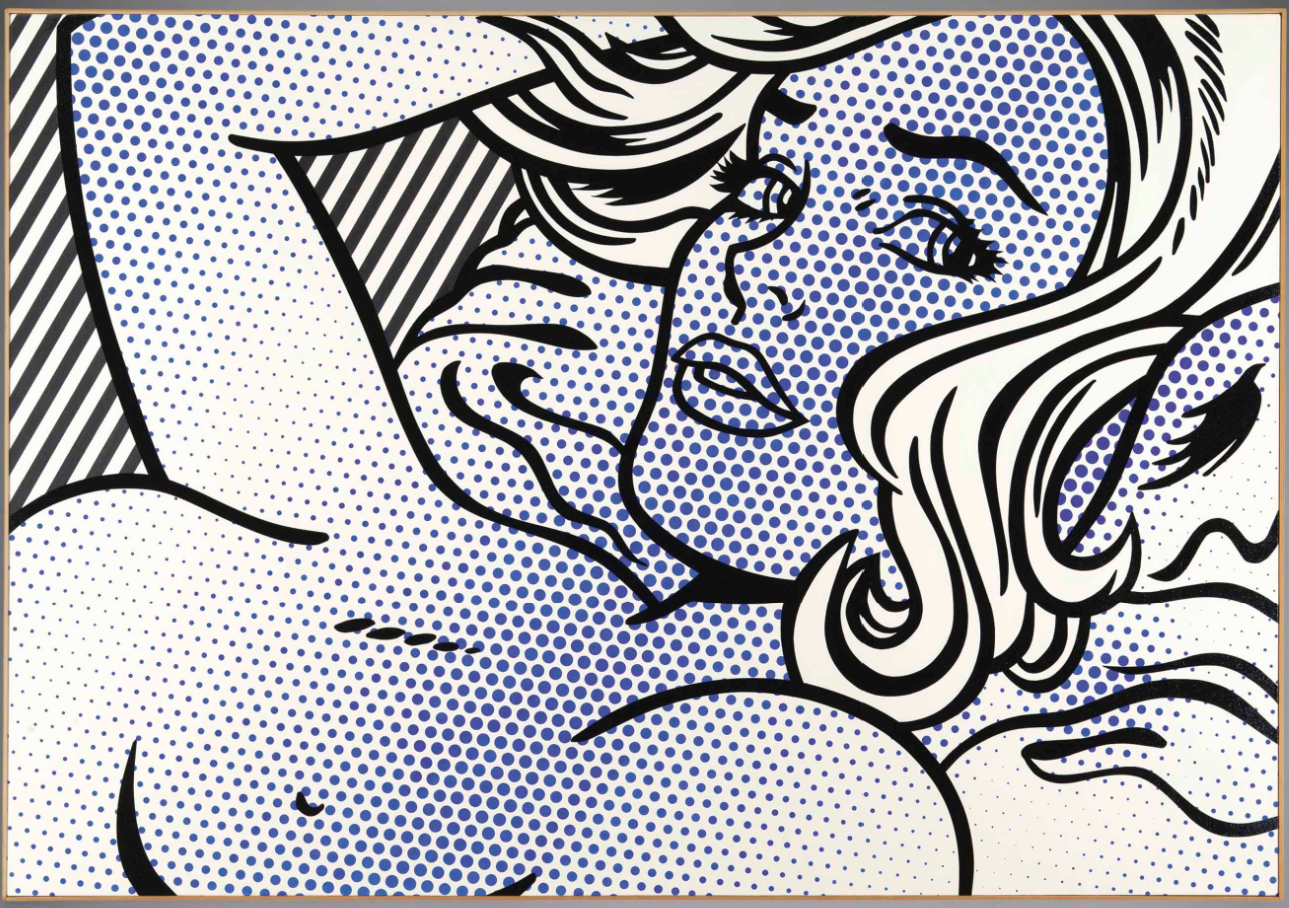
Roy Lichtenstein (1923-1997)
Seductive Girl, 1996
Oil and Magna on canvas
50×72 inches (127 x 182.8 cm)
Signed and dated ‘rf Lichtenstein ’96’ (on the reverse)
#9. Kiss III, 1962
Christie’s New-York: 15 May 2019
Estimated: USD 30,000,000 – 50,000,000
USD 31,135,000
Roy Lichtenstein (1923-1997) (christies.com)
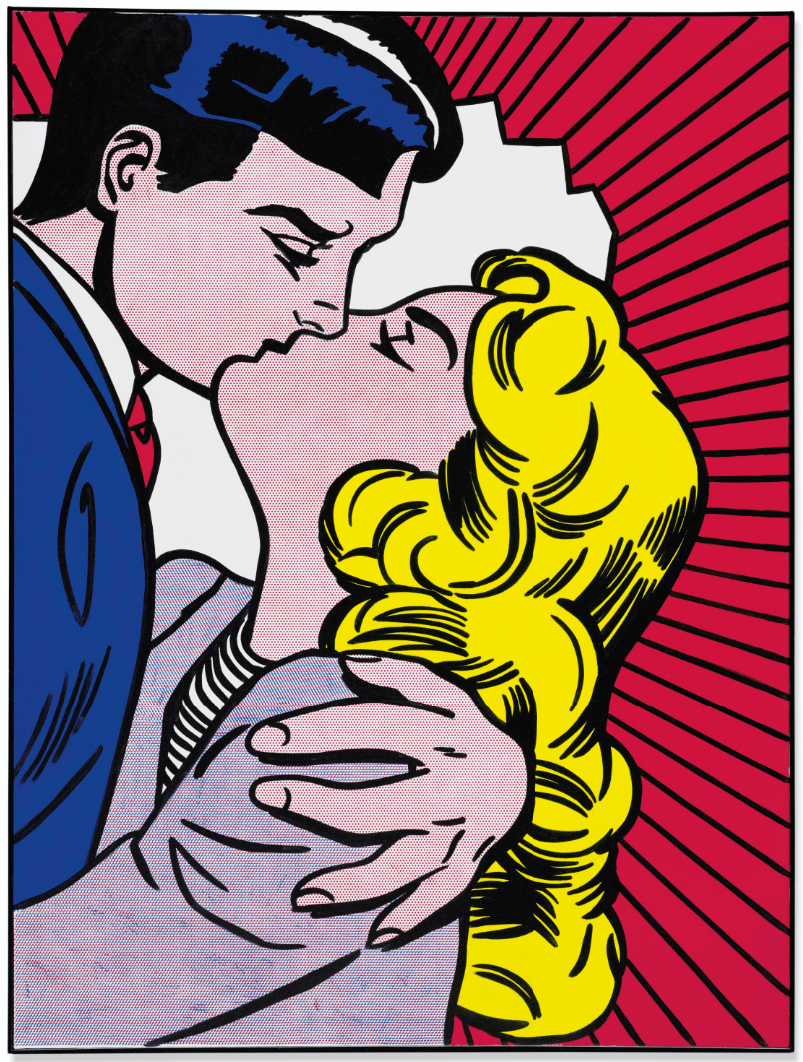
Roy Lichtenstein (1923-1997)
Kiss III, 1962
Magna on canvas
64×48 inches (162.6 x 121.9 cm)
Signed and dated ‘rf Lichtenstein ’62’ (on the reverse)
USD 30 million
#10. Red and White Brushstrokes, 1965
Christie’s New-York: 17 May 2017
Estimated: USD 25,000,000 – 35,000,000
USD 28,247,500
Roy Lichtenstein (1923-1997) (christies.com)
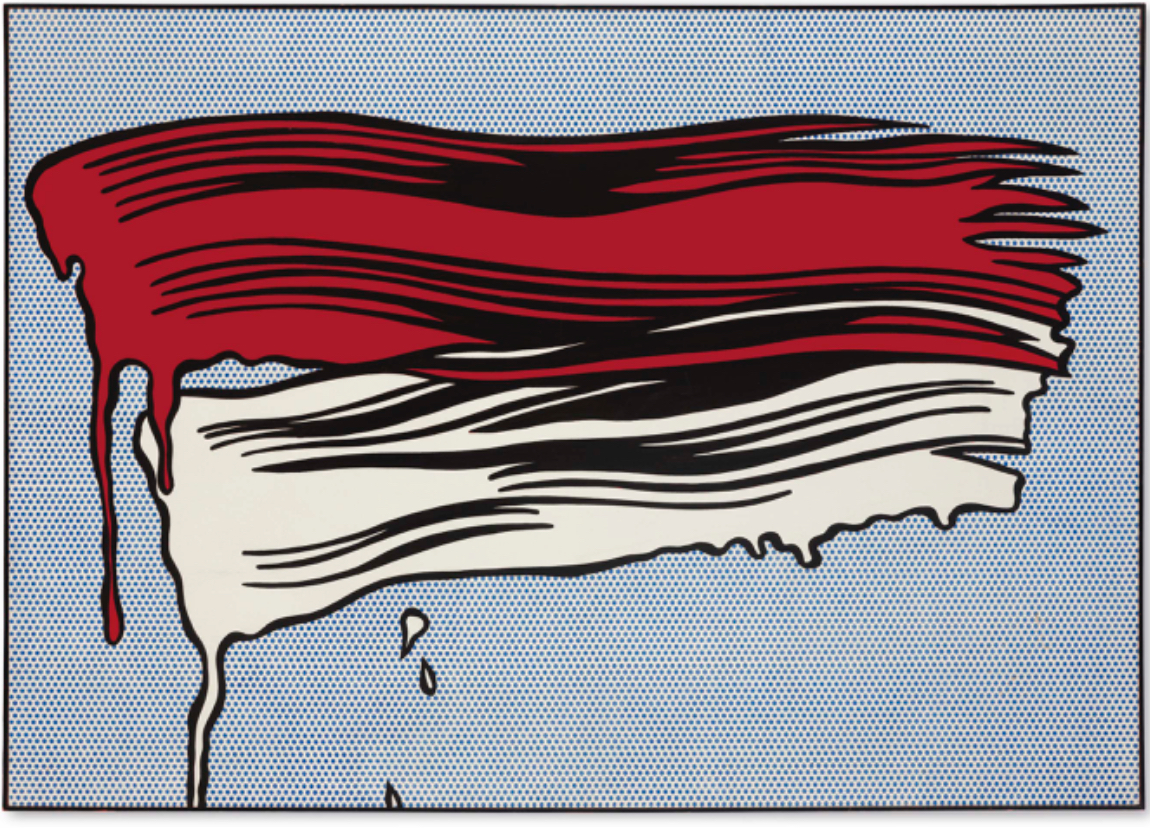
Roy Lichtenstein (1923-1997)
Red and White Brushstrokes, 1965
Oil and Magna on canvas
48×68 inches (121.9 x 172.7 cm)
Signed and dated ‘rf Lichtenstein ’65’ (on the reverse)
#11. Nude with Red Shirt, 1995
Christie’s New-York: 14 November 2012
Estimated: USD 12,000,000 – 18,000,000
USD 28,082,500
Roy Lichtenstein (1923-1997) , Nude with Red Shirt | Christie’s
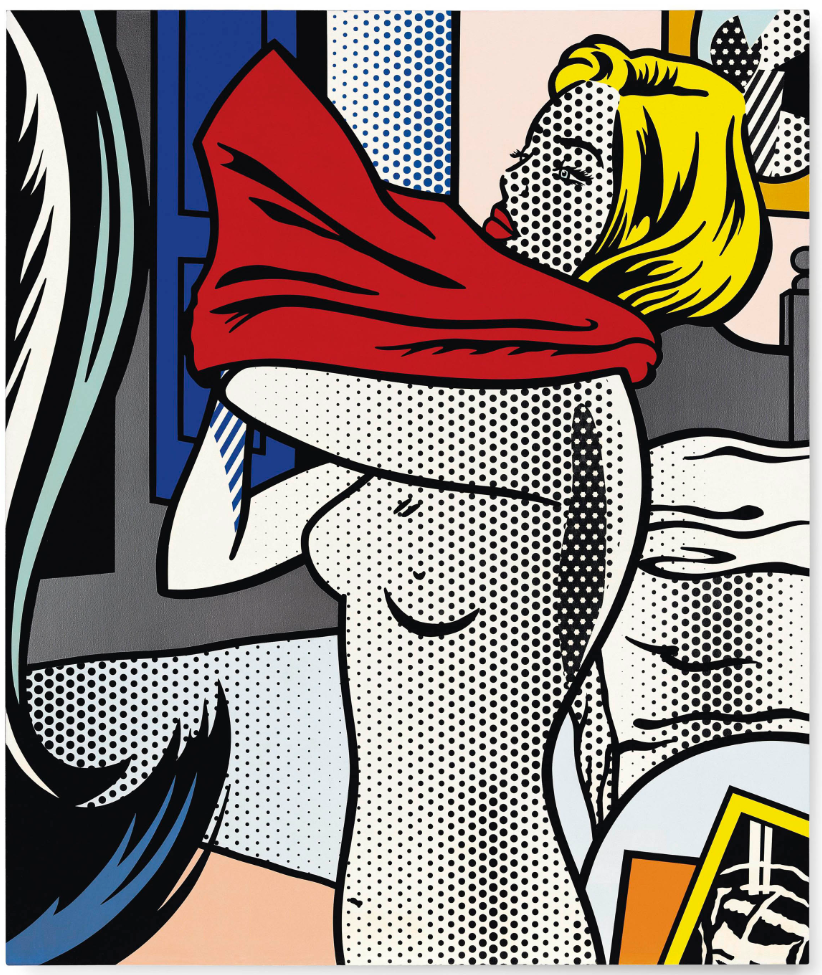
ROY LICHTENSTEIN (1923-1997)
Nude with Red Shirt, 1995
Oil and Magna on canvas
77×65 inches (198.1 x 167.7 cm)
Signed and dated ‘rf Lichtenstein ’95’ (on the reverse)
#12. WHITE BRUSHSTROKE I, 1965
Sotheby’s New-York: 29 June 2020
Estimated: USD 20,000,000 – 30,000,000
USD 25,417,000
ROY LICHTENSTEIN | WHITE BRUSHSTROKE I | Contemporary Art Evening Auction | 2020 | Sotheby’s
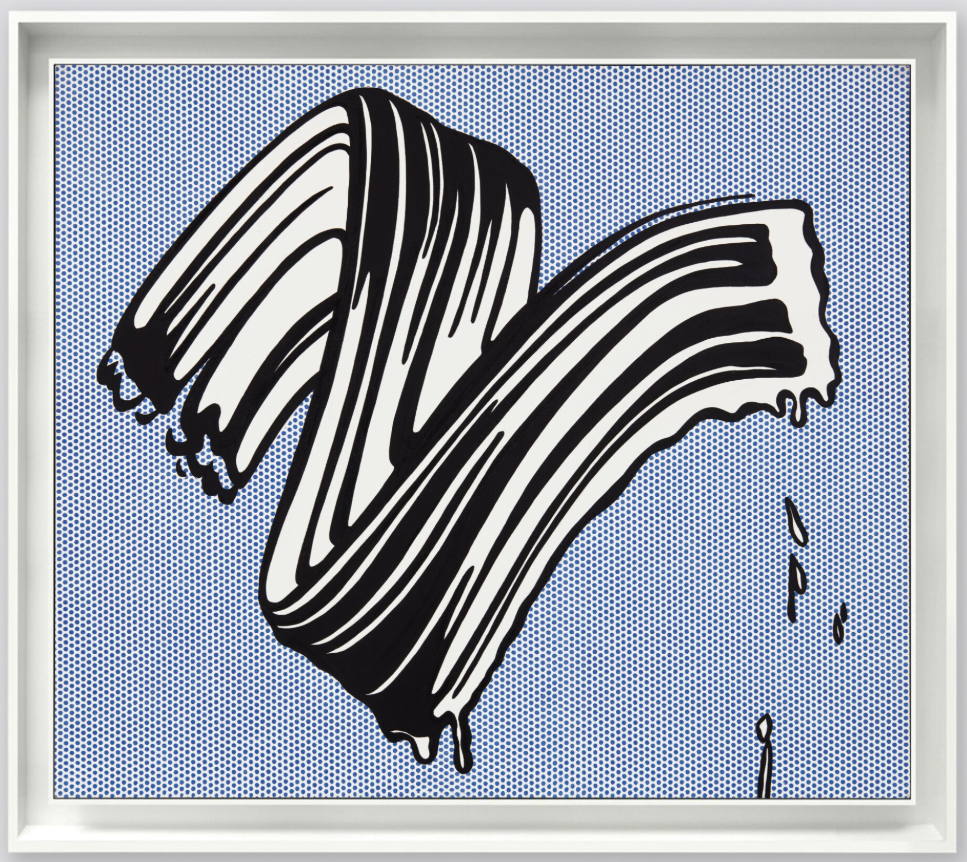
ROY LICHTENSTEIN (1923 – 1997)
WHITE BRUSHSTROKE I, 1965
Oil and Magna on canvas
48×56 inches (121.9 x 142.2 cm)
Signed and dated ’65 on the reverse
#13. Female Head, 1977
Sotheby’s New-York: 16 November 2017
Estimated: USD 10,000,000 – 15,000,000
USD 24,501,500
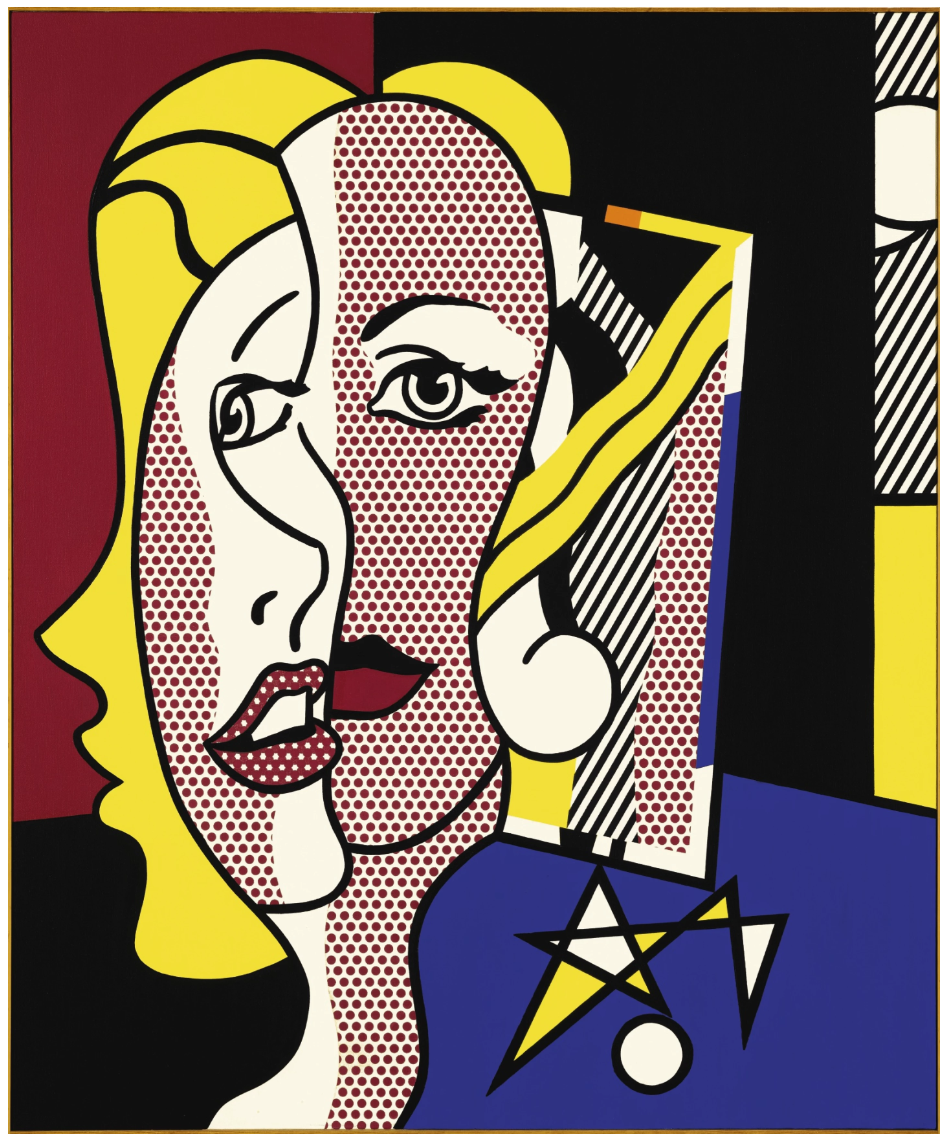
ROY LICHTENSTEIN
Female Head, 1977
Oil and Magna on canvas
60×50 inches (152.4 x 127 cm)
Signed and dated 77 on the reverse
#14. Nude Sunbathing, 1995
Sotheby’s New-York: 18 May 2017
Estimate on Request
USD 24,000,000
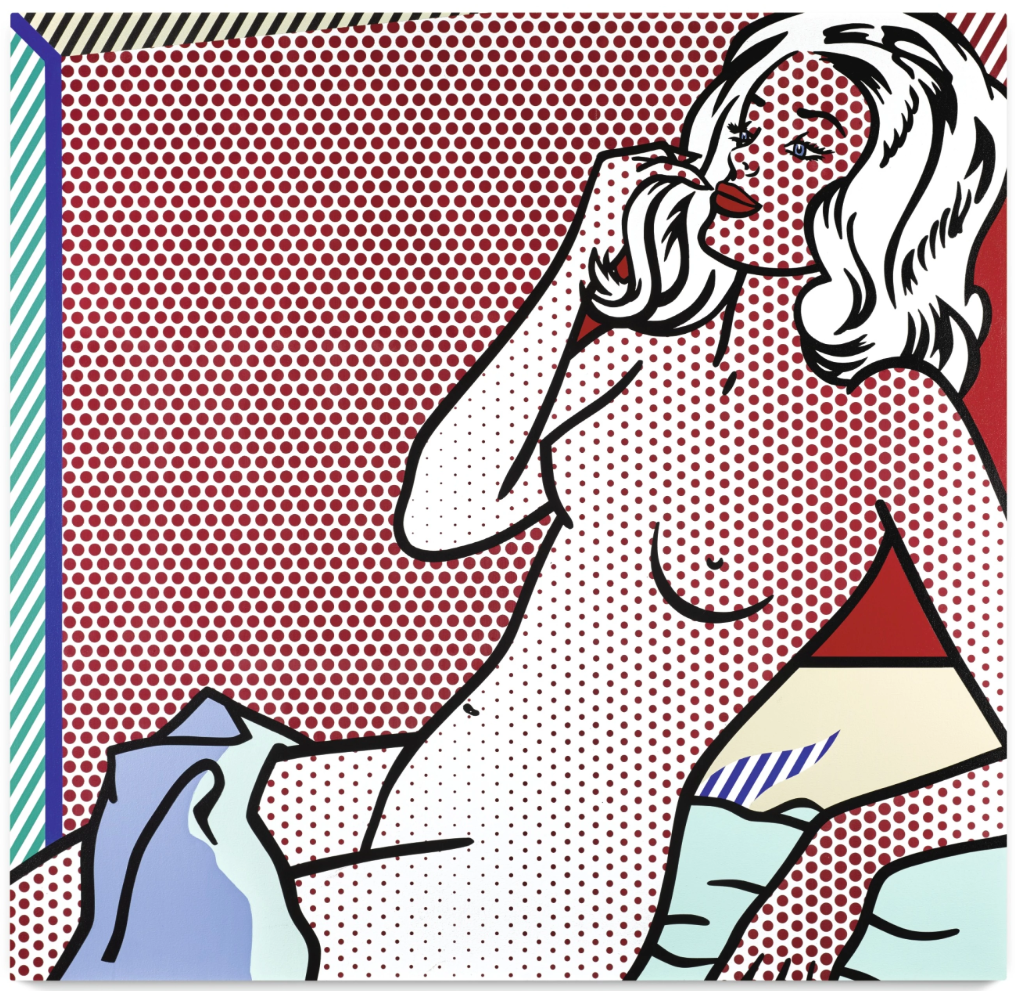
ROY LICHTENSTEIN
Nude Sunbathing, 1995
Oil and Magna on canvas
58 1/8 x 60 inches (147.6 x 152.4 cm)
Signed and dated 95 on the reverse
#15. Nude with Yellow Flower, 1994
Christie’s New-York: 15 May 2013
Estimated: USD 12,000,000 – 16,000,000
USD 23,643,750
Roy Lichtenstein (1923-1997) , Nude with Yellow Flower | Christie’s
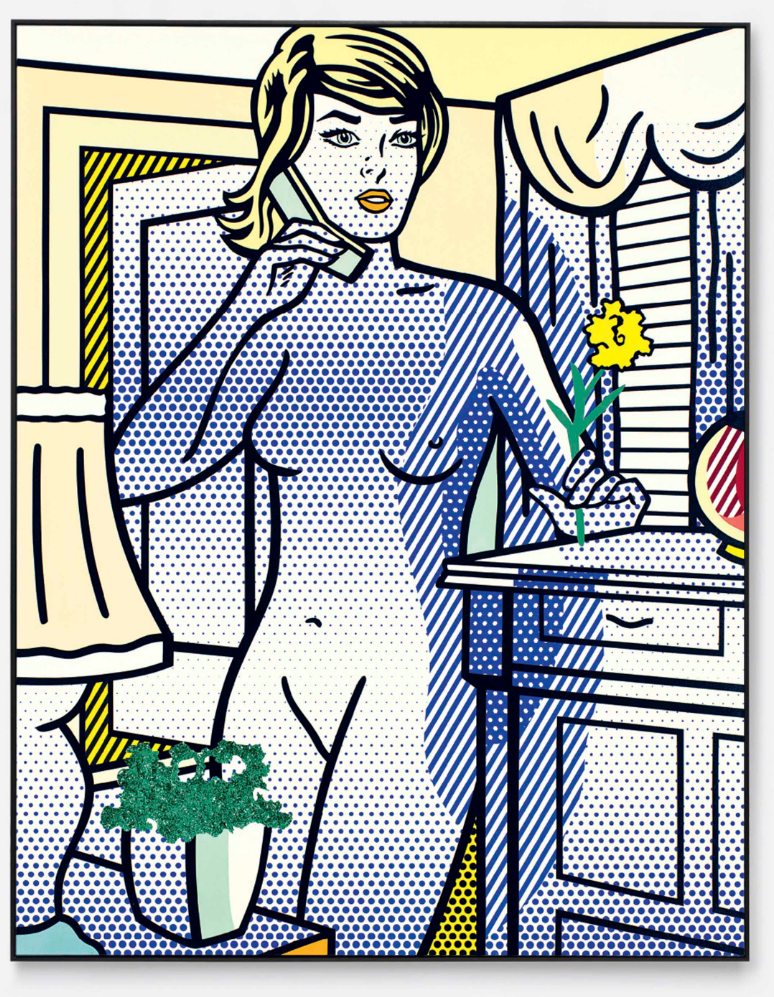
ROY LICHTENSTEIN (1923-1997)
Nude with Yellow Flower, 1994
Oil and Magna on canvas
92×72 inches (233×183 cm)
Signed and dated ‘rf Lichtenstein ’94’ (on the reverse)
Early Girls
Nurse, 1964
Christie’s New-York: 8 November 2015
Estimate on Request
USD 95,365,000
Roy Lichtenstein (1923-1997) (christies.com)
ROY LICHTENSTEIN (1923-1997)
Nurse, 1964
Oil and Magna on canvas
48×48 inches (121.9 x 121.9 cm)
Signed and dated ‘rf Lichtenstein ’64’ (on the reverse)
Painted at the height of his career, Roy Lichtenstein’s Nurse is a dazzling masterpiece—a celebration of the bold new imagery that changed the direction of art. The subject of this painting stands alongside Warhol’s Marilyn Monroe, Elizabeth Taylor and Jacqueline Kennedy as one of a distinguished group of icons who take their place in the history of figurative painting. Initially titled Frightenedness, the protagonist symbolizes her profession, however when seen through Lichtenstein’s prism, her anxious gaze and hand raised nervously upwards towards her face displays a palpable sense of drama that infuses the narrative with a sense of fear and foreboding. No words are spoken, no context is given—yet the artist’s exceptional understanding of the language of visual communication is able to set the stage for a complex drama that is about to play out before us. Nurse comes with the distinguished provenance of having been in some of the most important collections of Pop Art including both the legendary Kraushar Collection in New York and the influential collection of Karl Ströher in Germany. Having also been selected for inclusion in the artist’s seminal early retrospectives, including those organized by the Neue Nationalgalerie in Berlin in 1969 and the Solomon R. Guggenheim Museum in New York the same year, the painting has come to be regarded as a cornerstone of the artist’s career.
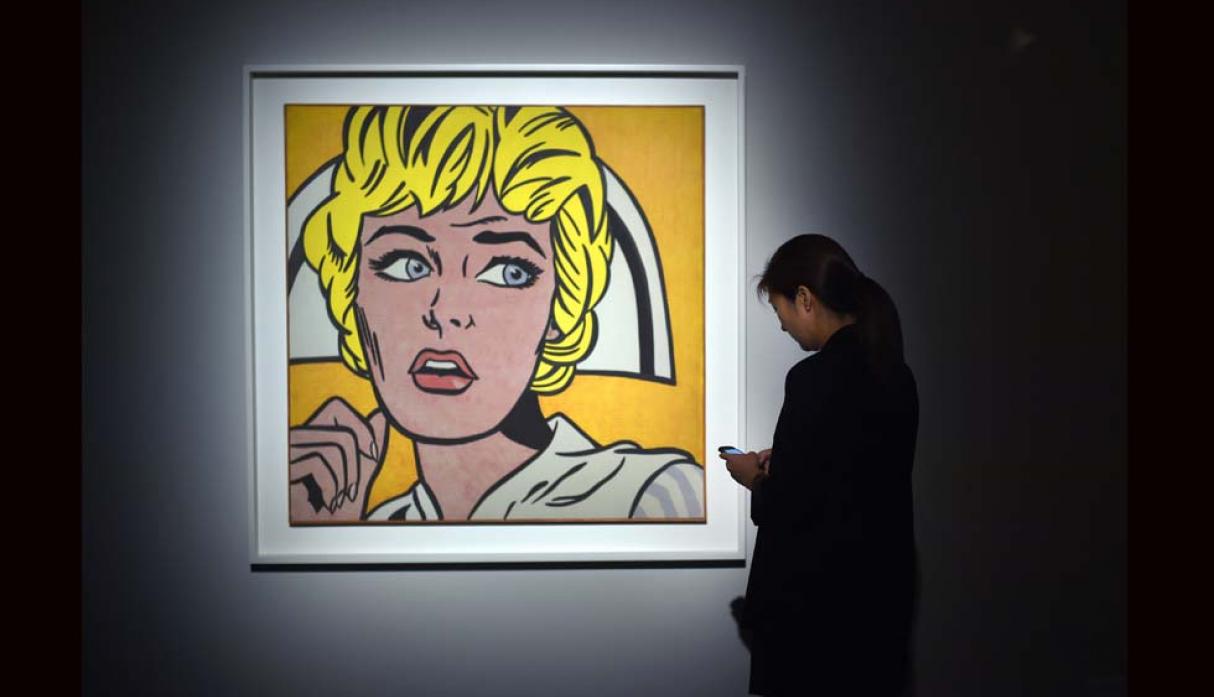
The subject of Nurse is a quintessential Lichtenstein heroine. His signature Ben-Day dots, her strong features and flawless skin mark her out as a striking woman. Her imposing uniform—as defined by the striped fabric of her dress, the stiff white collar and her starched white hat—clearly indicate that she is a member of the nursing profession. Yet her piercing blue eyes, bottle blond hair, and luscious red lips also lend the work a frisson of latent sexuality—less heavenly angel and more femme fatale. Thus, in addition to being a member of the caring profession, the nurse also becomes one of the ultimate male sexual fantasies, an image of immense complexity and human drama. Lichtenstein arrived at his now legendary depictions of women after sojourns into Cubism and Abstract Expressionism during the 1940s and 1950s. In 1961, he finally abandoned his colorful abstractions with Girl with Ball (Museum of Modern Art), a striking image of a beach belle inspired by an advertisement for the Mount Airy Lodge in the Pocono Mountains in Pennsylvania. The clarity of line and similarities to the aesthetic of the mass produced image was in stark contrast to what had previously been acknowledged as art. His first quintessential Girl painting is widely considered to be another 1961 work called The Engagement Ring, a straight forward appropriation of a comic strip in the Chicago Tribune. The origins of the artist’s signature style can clearly be seen here but reach new heights of sophistication with a 1962 painting called, appropriately enough, Masterpiece. This wry comment on the commodification of the New York art market contains all the elements that mark out what would become Lichtenstein’s mature style. Yet, with Nurse, he took this visual narrative to the ultimate level, removing all the extraneous visual material and forcing his heroine to fill the entire picture plane—leaving only the visual elements contained within to convey the narrative.
Woman with Flowered Hat, 1963
Christie’s New-York: 14 May 2013
Estimate on Request
USD 56,123,750
Roy Lichtenstein (1923-1997) (christies.com)
ROY LICHTENSTEIN (1923-1997)
Woman with Flowered Hat, 1963
Magna on canvas
50 1/8 x 40 ¼ inches (127.3 x 102.2 cm)
Signed and dated ‘rf Lichtenstein ’63’ (on the reverse)
Woman with Flowered Hat is a wry Pop assault on one of Roy Lichtenstein’s most venerated artistic predecessors. In this painting, the primary hues of his faux-print technique meets the distorted features of a Picasso portrait, creating an artful and meticulous collision between two trademark styles. Executed in 1963, this is a classic example of Pop Art from the movement’s earliest beginnings. Barely two years before, Lichtenstein had made a drastic and permanent breakthrough with his audacious decision to paint subjects based on commercial illustrations and comic imagery. This almost Duchampian process of appropriation, artistic piracy, and rebellion electrified the art world and brought him almost instantaneous fame. He had taken images and objects from popular culture and smuggled them into the realms of High Art. With the present work he began to reverse the process by converting the hallowed canon of art into “five-and-dime-store” pictures. Woman with Flowered Hat clearly undermines the revered status of the artist and of the art work. While this may seem a paradoxical aim on the part of someone who has followed the vocation of becoming an artist, it is precisely one of the factors that has defined so many of Lichtenstein’s greatest works. Among them are his renditions of modern artists and art movements, which force viewers to re-evaluate the reality of art through the simple act of re-presentation. Woman with Flowered Hat was created during the heyday of his iconic comic-inspired heroines and it is one of Lichtenstein’s earliest appropriations of High Art subjects. Its significance has been widely acknowledged by extensive critical analysis as well as its inclusion in landmark exhibitions within the artist’s lifetime, including the Venice Biennale in 1966; Lichtenstein’s first retrospective organized by the Pasadena Art Museum in 1967; the Tate gallery’s first show dedicated to a living American artist in 1968; and the major retrospective survey organized by the Solomon R. Guggenheim Museum, New York in 1994.
Sleeping Girl, 1964
Sotheby’s New-York: 9 May 2012
Estimated: USD 30,000,000 – 40,000,000
USD 44,882,500
(#16) Roy Lichtenstein (sothebys.com)
ROY LICHTENSTEIN
Sleeping Girl, 1964
Oil and Magna on canvas
36×36 inches (91.5 x 91.5 cm)
Signed and dated ’64 on the reverse
Held within a swirling frame of abundant blonde hair, the weary head of flawless beauty rests upon a red pillow. Invited into her bounded domain as if through a keyhole, our gaze rests upon her profound contemplation; immersed by such elusive thoughts as can only be encountered in sleep’s deepest dreams. We scan her expression for some sign to her preoccupation, but her secrets remain locked within. While our focus falls on her immediately close presence, her focus strays far away. The assuredly iconic depiction of a strikingly intimate and vulnerable moment, Sleeping Girl is a masterpiece of irresistible seduction. Black and white, yellow and red, the composition exists through sensational graphic efficiency and brilliant color of shocking confidence. The polarized schema of the hair is rendered in sublime cadence, dramatically accentuating the flatness of the picture plane and perfectly framing the face beyond. The eponymous Lichtenstein Benday dots of the portrait are perfectly regimented to create a kintetic dynamism that in turn invests a powerful sense of indefinable tension in the subject’s expression. Executed at the very height of the artist’s technical prowess, Sleeping Girl is a masterpiece of irresistible seduction.
Late Nudes
Nude with Joyous Painting, 1994
Christie’s New-York: 9 July 2020
Estimate on Request
USD 46,242,500
Roy Lichtenstein (1923-1997) (christies.com)
ROY LICHTENSTEIN (1923-1997)
Nude with Joyous Painting, 1994
Oil and Magna on canvas
70×53 inches (177.8 x 134.6 cm)
Signed and dated ‘rf Lichtenstein ’94’ (on the reverse)
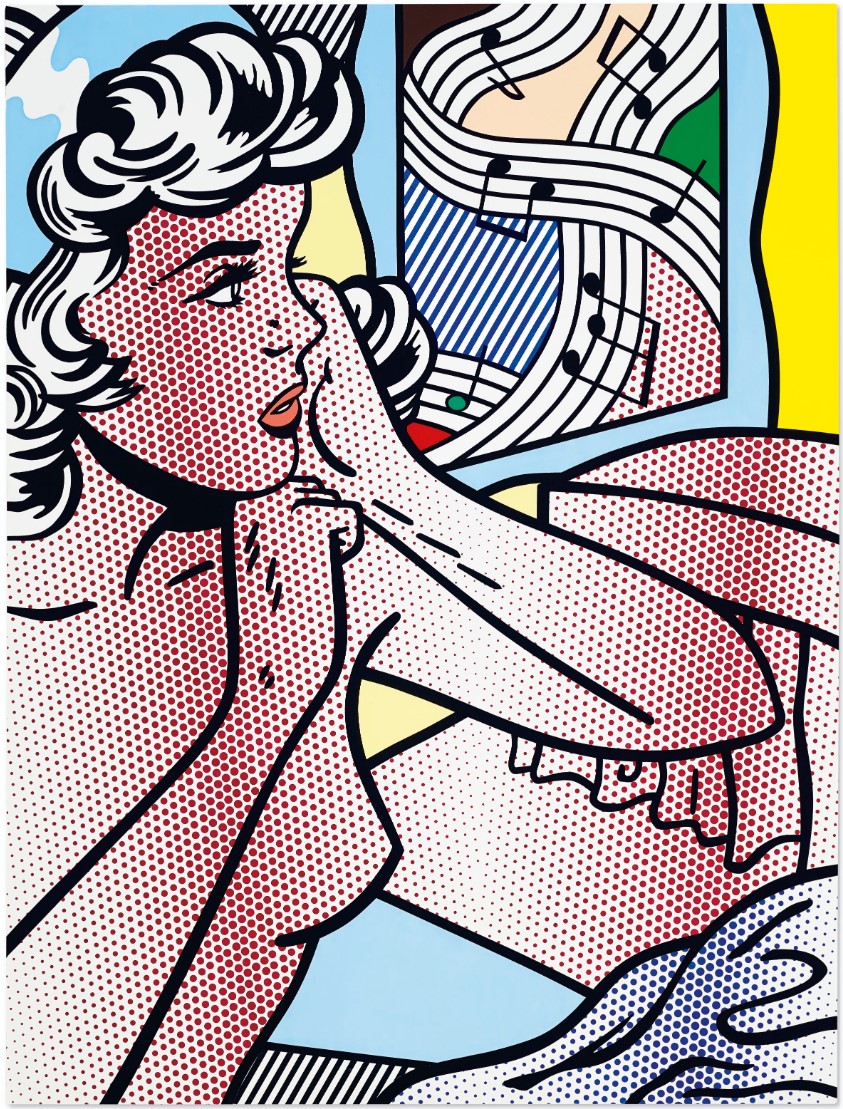
Clad in only a pale blue headband, the shapely contours of the heroine in Roy Lichtenstein’s masterful late painting Nude with Joyous Painting is a classic American beauty—a sumptuous marriage of soft, supple flesh and steamy pulp fiction pin-up. Painted in 1994, it is an iconic, tour-de-force of the last series of great nudes that the artist began in 1993 and continued until his death in 1997. The Nudes mark his majestic return to the comic-book heroines that propelled him to fame in the early 1960s and together, they rank among his most significant bodies of work. Culled from his prodigious archive of vintage comics, the Nudes marry Lichtenstein’s Pop Art sensibility with the most storied subject in the history of Western art—the female nude. Shortly after it was painted, Nude with Joyous Painting was first exhibited to the public at Leo Castelli’s SoHo gallery in November of 1994. There, it was included in a group of seven other large-scale nude paintings, of which at least two are now housed in major American public collections, including Nude at Vanity, 1994 (San Francisco Museum of Modern Art, the Doris and Donald Fisher Collection) and Nude with Pyramid, 1994 (The Broad, Los Angeles).
Bathed in a scrim of delicate Ben-Day dots, Lichtenstein’s leading lady exudes sensuality. Her bright red lips, perfectly coiffed hair and lithe nude body represent the classical ideal. Here, the Pop Art master’s instinctive gift for creating a melodramatic mise-en-scene is in full effect. He crops out details of the original comic and pulls us in in closer, capturing a fraught moment bristling with suspense that rivals any Hitchcock thriller. Scaled to epic proportions, Lichtenstein’s slender beauty has leapt from the comic’s pages to reach Amazonian heights. In the subtle curve of her breast and the delicate bend of her bare arms, Lichtenstein delights in her trim, pert form. He immerses her in an array of Ben-Day dots ranging in density from a tight matrix of closely clustered dots to a looser, more scattered supply. The same dot-pattern blankets the area rug and ottoman nearby and extends upward into the painting of musical notes hanging on the wall. These dots read as “flesh” when overlaid upon the nude’s bare skin, and yet their placement does not always indicate roundness and depth. Instead, Lichtenstein freely experiments with the dots, clustering them in wide vertical bands that often bear no relation to the contours and depth of the figure’s nude form.
Seductive Girl, 1996
Christie’s New-York: 12 November 2013
Estimated: USD 22,000,000 – 28,000,000
USD 31,525,000
Roy Lichtenstein (1923-1997) (christies.com)
Roy Lichtenstein (1923-1997)
Seductive Girl, 1996
Oil and Magna on canvas
50×72 inches (127 x 182.8 cm)
Signed and dated ‘rf Lichtenstein ’96’ (on the reverse)
Seductive Girl is a majestic and monumental Pop tribute to art history’s most enduring subject: the female nude. Executed in 1996, it represents Roy Lichtenstein’s triumphal return to the comic heroines of the 1960s, which had defined him as one of the major painters of the twentieth century. This beguiling playmate, rendered in the Lichtenstein’s bold signature style, belongs to a series of larger-than-life Nudes that were instigated in 1993 and curtailed by the artist’s death in 1997. During this prolific period, he explored the theme extensively, producing prints, drawings, collages and large canvases like the present work. Together the series has been recognized as a significant component within the artist’s oeuvre. Seductive Girl does not need its title to give meaning to the naked woman it depicts. She instantly enters the domain of narrative through her implied sexuality. Her sultry pose communicates a blatant and uncomplicated erotic availability made familiar to us from countless images from the mass media as much as the canon of art history. The sidelong glance of her bedroom eyes directly engages the viewer, inviting our own gaze and through it, participation in her world. Her nipple is also a focal point, which recalls other visual rhymes of the dot in Lichtenstein’s work, such as the dimples on a golf ball, the pores in a sponge or the contents of a cherry pie. The foregrounded nipple cannot be ignored, arguably it is the first thing one notices, and the eye is continually brought back to it through a tightly framed composition of curvilinear forms. The sweeping line of her breast carries our line of sight upwards through her raised arm, along to her face, and is then brought tumbling back down through her luxuriously wavy hair. This spiraling movement creates an optic-erotic vibration that lends the painting a powerful iconicity, its visual impact ensuring its place amongst Lichtenstein’s greatest comic portraits.
Nude Sunbathing, 1995
Sotheby’s New-York: 18 May 2017
Estimate on Request
USD 24,000,000
ROY LICHTENSTEIN
Nude Sunbathing, 1995
Oil and Magna on canvas
58 1/8 x 60 inches (147.6 x 152.4 cm)
Signed and dated 95 on the reverse
A radiant vision of exquisite beauty and devastating allure, Roy Lichtenstein’s Nude Sunbathing unequivocally embodies the very essence of confident and unadulterated female sensuality. From the sultry gaze of her half-lidded blue eyes to the languorous arch of her slender back, the idle motion of cascading blonde curls to the coquettish pout of her scarlet mouth, every inch of Lichtenstein’s breathtaking bombshell is imbued with a magnetic charisma that completely and utterly seduces the viewer. A resounding testament to the visual dynamism of Lichtenstein’s bold signature style, Nude Sunbathing constitutes the ultimate crystallization of the artist’s enduring engagement with the quintessential heroine of his inimitable oeuvre; freed from the narrative constraints of her previous embodiments, Lichtenstein’s nude revels in the enjoyment of her own peerless form. Executed in 1995, the present work is a masterpiece from Lichtenstein’s celebrated late Nudes, the first series the artist undertook following his acclaimed retrospective in 1993 at the Solomon R. Guggenheim Museum and, ultimately, the last major body of work before the artist’s death in 1997. Testifying to the incontrovertible allure of the monumental paintings, this limited series is distributed amongst the world’s most renowned public and private collections; the present work, held in the same private collection since the year following its execution and never before offered for public sale, numbers amongst the finest examples of the Nudes ever to appear at auction. The intimately close-cut tableau of Nude Sunbathing brings Lichtenstein’s seductress bewitchingly close to the viewer, her sensuous curves filling the frame with a confidence and self-possessed sexuality unrivaled in other examples. Presented against the radiantly prismatic abstract backdrop of Lichtenstein’s trademark Ben-Day dots, Nude Sunbathing, the only example from the series to be rendered in an emboldened red-on-red palette, relishes her status as the singular focus of the viewer’s adoring gaze. Her languid pose, one hand leisurely raised to gently toy with lustrous blonde locks, enacts a bold and unapologetic invocation of such canonical nudes as Matisse’s Draped Nude and Titian’s Venus of Urbino, effortlessly invoking centuries of art historical legacy with captivating aplomb. In Nude Sunbathing, Lichtenstein enters a final, dazzling confrontation with the weighty mantle of his artistic predecessors: with the daring provocation of Manet’s Olympia, the exquisite loveliness of Botticelli’s Venus, and the radical stylistic innovation of Ingres’s La Grande Odalisque, Nude Sunbathing is a magnificent example of Lichtenstein’s ultimate contribution to Contemporary art.
Nude with Yellow Flower, 1994
Christie’s New-York: 15 May 2013
Estimated: USD 12,000,000 – 16,000,000
USD 23,643,750
Roy Lichtenstein (1923-1997) , Nude with Yellow Flower | Christie’s
ROY LICHTENSTEIN (1923-1997)
Nude with Yellow Flower, 1994
Oil and Magna on canvas
92×72 inches (233×183 cm)
Signed and dated ‘rf Lichtenstein ’94’ (on the reverse)
Roy Lichtenstein’s monumental Nude with Yellow Flower represents the triumphal return of the comic heroine in the Pop master’s late career. This provocative domestic goddess, rendered in the artist’s bold signature style, is a modern variation on an ancient artistic genre. Like Picasso, Renoir, and Matisse before him, Lichtenstein seized on the classic theme of the female nude late in life, using the motif to invent new creative possibilities. The Nudes became one of Lichtenstein’s last major series, which was instigated in 1993 and curtailed by the artist’s death in 1997. During this prolific period, he explored the theme extensively, producing prints, drawings, collages, and large canvases like the present work. Together the series has been recognized as a significant component within the artist’s oeuvre. The Nudes were well represented within the recent touring retrospective organized by The Art Institute of Chicago and Tate Modern and their joyous sensuality has attracted many long-standing admirers, including the artist Jeff Koons who has declared: “The later women paintings and nudes that Roy did are absolutely gorgeous” (J. Koons in ‘Conversation,’ M. Francis & S. Ratibor (eds.), Lichtenstein: Girls, exh. cat., Gagosian Gallery, New York 2008, p. 16).
Each composition for the Nudes evolved out of a sophisticated process of image selection and inventive remixing. For Nude with Yellow Flower, Lichtenstein raided his archives of clippings from comics and magazines before recompiling and reinterpreting them on a vast scale. The larger-than-life beauty occupying this cozy scene is translated from a 1963 Girl’s Love Stories comic book which charts the trials and tribulations of teen romance. The original image shows a swimsuit-clad model chatting on a rotary dial phone in the midst of a photo-shoot. In this painting, Lichtenstein modernizes her phone and transplants her from the commercial environment into the home, from public to private realms. He has also stripped her bare, with the fecundity of her natural state seemingly underlined by the addition of the yellow bloom in her hand and the bushy leaves of the pot plant to the left of her waist. By making these changes, Lichtenstein exploits our understanding of the visual language of the dated comics to dramatically sexualize the entire composition, turning it from a relatively benign scene of female objectification to a tableau that crackles with sexual frisson.
Lichtenstein’s first nudes emerged out of a concurrent series of Interiors paintings, which caricatured the lavish spreads of pristine homes in magazines like Architectural Digest. The Interiors focused on a subject that has long captured the fascination of Pop artists: the myth of blissful bourgeois domesticity. They depict rooms cobbled together from illustrations of furniture and reproductions of artworks and all lack a human presence to bring the spaces alive. As the series evolved Lichtenstein gradually took the pictures of nudes off the walls and allowed women to inhabit these ultra-cool environments. In doing so, Lichtenstein ensured his muses remained as carefully edited and stylized as the furnishings that surround them. The calculated arrangement of motifs and the somewhat incongruous quality of Nude with Yellow Flower pays tribute to a seminal work of Pop art: Richard Hamilton’s Just what is it that makes today’s homes so different, so appealing? which brought the buff imagery of American men’s physique magazines and semi-clad sirens into a domestic realm filled with all the trappings of an idealized middle-class lifestyle. Yet Nude with Yellow Flower is less a commentary on consumer culture and more a reflection on art itself. The subject of the nude fulfilled Lichtenstein’s fascination with strong visual and cultural clichés as well as his preoccupation with style and form. It enabled him to make a knowing and witty nod to art historical precedents, including that of his own world-famous oeuvre. The result was a double loop of appropriation that exemplified new approaches to visual practice in the post-modern era.
Presenting the comic-book girls in the nude within composite scenes meant they were not a straight redux of what had gone before. They instead provided a vehicle for Lichtenstein’s continued testing of formal artistic methods. In Nude with Yellow Flower diagonal stripes and Benday dots simultaneously evoke and flatten the picture’s depth of field. These graphic techniques, typically used as short-hand to define shadow and volume, spill over the girl’s curvaceous body and onto her surroundings, creating a peculiar spatial conundrum that highlights the artificiality and unreliability of the image. “My nudes are part light and shade, and so are the backgrounds, with dots to indicate the shade,” Lichtenstein explains. “The dots are also graduated from large to small, which usually suggests modeling in people’s minds, but that’s not what you get with these figures. I don’t really know why I chose nudes. I’d never done them before, so that was maybe something, but I also felt chiaroscuro would look good on a body. And with my nudes there’s so little sense of body flesh or skin tones–they’re so unrealistic–that using them underscored the separation between reality and artistic convention” (R. Lichtenstein, quoted in M. Kimmelman, PORTRAITS, Talking with Artists at the Met, The Modern, The Louvre and Elsewhere, 1995, reproduced at www.lichtensteinfoundation.org).
Lichtenstein’s art may be defined by the tension that exists between subject and object. The paradox of his work has always remained that its outward embrace of quotidian imagery belies an inward concern for art as arrangements of colors and shapes. Lichtenstein continually repeated the mantra that even if his work looks like it depicts something, it is always essentially a flat two-dimensional image. But the narrative aspects of his pictures often win out. In the early 1960s he usually chose to depict women in a moment of vulnerability, suspense, or worry to evoke an irrepressible sense of empathy in the viewer, while the simultaneous war paintings of explosions and soldiers are all aggression and decisive action. The war and romance series both select tense, climactic moments when the conventional images of masculinity and femininity are at their most extreme. Tellingly, the dates of these comic inspired paintings correspond with Lichtenstein’s marital break-up and his choice of themes appear more than coincidental. The duality of the subjects may well have helped him to cope with the hopes and disappointments of this tumultuous time, while also indicating his pessimism in the stereotypical love story. By 1965, Lichtenstein had finalized his divorce and he gradually phased out the comic imagery, perhaps having fulfilled his psychological need. It seems the revival of the comic heroine in the 1990s, now in the nude, may also relate to Lichtenstein’s personal life as they have very recently been linked to an affair with a younger woman that he was engaged in at that time. This may explain why, several decades later, his re-appropriation of comic sources yielded more serene, but less chaste females. Indeed, Nude with Yellow Flower has a confidence and overt sexuality unseen in the earlier waiting, stammering, or distraught protagonists. This is a woman of a new generation, confident and assured, and with a visual intensity brought alive by her undeniable eroticism. “The 1990s nudes take pleasure in their own company,’ Avis Berman observes, ‘without the slightest hint of needing or missing a man. They are not paralyzed by their emotions. In contrast to Lichtenstein’s original romance-comic pictures, this world flourishes exuberantly without men or engagement rings or kisses. The older norm didn’t disappear, but needed to be adjusted. Even as he updated the stereotypes of erotic fantasies, Lichtenstein wove them into the consistent narrative of his own carrier” (A. Berman, ‘”Joy and Bravura and Irreverence”: Roy Lichtenstein and Images of Women,’ in Roy Lichtenstein-Classic of the New, exh. cat., Kunsthaus Bregenz, Vienna 2005, p. 143).
Surrealist Paintings
Female Head, 1977
Sotheby’s New-York: 16 November 2017
Estimated: USD 10,000,000 – 15,000,000
USD 24,501,500
ROY LICHTENSTEIN
Female Head, 1977
Oil and Magna on canvas
60×50 inches (152.4 x 127 cm)
Signed and dated 77 on the reverse
A dazzling vision of exquisite beauty and peerless formal execution, Female Head represents the ultimate crescendo of Roy Lichtenstein’s pioneering investigation into the form, content, and meaning of Contemporary Art. Fixing on the viewer with a sidelong glance that is both irresistibly seductive and utterly elusive, the breathtaking subject of the present work embodies the ultimate crystallization of Lichtenstein’s enduring engagement with the most iconic of his subjects: the female head. Here, she is freed from the prosaic confines of the traditional Pop narrative to be reimagined as the beguiling muse of the Modernist masters. Just months after it was painted in 1977, Female Head was acquired from the Leo Castelli Gallery by the late Michael M. Rea and Elizabeth R. Rea, passionate collectors and noted patrons of the arts, and has remained in their collection for four decades. Elizabeth Richebourg Rea, an accomplished fine-art photographer, began her professional career at The Museum of Modern Art as director of the Art Lending and Art Advisory departments and was subsequently hired by Roy Lichtenstein’s primary dealer Leo Castelli, where she honed her artistic eye and acquired extensive knowledge of the artist’s work. Her accumulative knowledge and experience led to her role as free-lance curator for two major retrospectives of the work of Roy Lichtenstein. She was catalogue editor for the 1987 Museum of Modern Art exhibition The Drawings of Roy Lichtenstein; and research consultant for the 1993 exhibition Roy Lichtenstein organized by the Solomon R. Guggenheim Museum with travelling venues to the Museum of Contemporary Art, Los Angeles, and The Montreal Museum of Fine Arts.
A paragon of the artist’s celebrated Surrealist paintings, Female Head is joined by examples from the series in the New York collections of the Solomon R. Guggenheim Museum and the Metropolitan Museum of Art, as well as the Louisiana Museum of Modern Art, Denmark, among others. Even within this rarified group, however, the present work is a masterpiece of unparalleled formal elegance and conceptual sophistication: fracturing and reconfiguring three distinct profiles within a single portrait—two mirrored faces, shadowed by a third silhouette enigmatically disguised as a flowing lock of blonde hair—Female Head fuses the diverse vernaculars of Cubism, Surrealism, and Pop in a captivating dialogue between masterpieces both past and present.
Utterly breathtaking in the scope of its references, Female Head articulates the central tenets of Lichtenstein’s quintessential vernacular with unparalleled pictorial exuberance and graphic charge. Although rendered through the kaleidoscopic prism of Modernism, the cascading golden tresses of Lichtenstein’s signature blonde invoke the familiar bombshells of his Pop masterworks of the 1960s: a fitting figurehead for the artist’s freshly initiated exploration of new stylistic frontiers. Gleaned from the pages of comic books and advertisements, Lichtenstein’s Girls appear in his oeuvre as early as Girl with Ball of 1961, held in the collection of The Museum of Modern Art, only to reappear in such disparate guises as the distressed damsel of Drowning Girl and the domestic temptress of Girl in Bath throughout the course of the 1960s. Undisputed icons of postwar American art, Lichtenstein’s Girls exemplify the explicit tension at the very core of the artist’s practice: an irreconcilable distinction between the quotidian imagery of popular culture and the refined cultural paradigm of fine art. Remarking upon the significance of these women within the artist’s oeuvre, his wife, Dorothy Lichtenstein, comments, “I think that he was portraying his idea of the dream girl.” (Dorothy Lichtenstein in conversation with Jeff Koons in Exh. Cat, New York, Gagosian Gallery, Lichtenstein: Girls, 2008, p. 15) In Female Head, Lichtenstein’s archetypal female undergoes a radical stylistic transformation, departing from her role as the heroine of fictional and comic narrative to be reintroduced in a fantastical Surrealist dreamscape of compositional fragmentation and abstracted symbolism. While articulated in the illusionistic vocabulary of Twentieth Century Modernism, however, the seductive curves of the partially obscured yellow silhouette winding sinuously down the length of the canvas recall the shadows of Lichtenstein’s iconic Brushstroke paintings. Indeed, appearing in the very first of Lichtenstein’s Surrealist paintings, Female Figure of 1977, the abstracted mane of blonde locks becomes a central and signature motif of the Surrealist series. Likewise, the fractured mirror, which appears to both reflect and project the binary portrait before us, references both the canonical use of mirrors throughout art history and the artist’s own frequent use of mirrors as compositional elements in his earlier paintings; offering an updated articulation of the roles of vision and perception within art, here, Lichtenstein’s mirror serves to fracture the image, while simultaneously articulating the artist’s own backward glance at artistic precedent. Describing the fascinating destabilization achieved by his absorption of his own trademark graphic style, Lichtenstein reflects, “They were of no particular Surrealist artist, just Surrealism in general. I took certain elements from painting I have done in the past: a man’s suit, a shirt and tie from a dry cleaning ad, the Brushstroke … These works are something like the Artist’s Studio paintings in that they are large compositions that include various images from various periods.” (Roy Lichtenstein, “A Review of My Work Since 1961,” 1995, quoted in Exh. Cat., Milan, Roy Lichtenstein: Meditations on Art, 2010, p. 235)
In Female Head, Lichtenstein confronts art history as his subject matter with striking finesse, systemically fracturing and reimagining iconic paintings of the Twentieth Century to compose his own, utterly original masterwork. In its precisely rendered geometric forms, the present work draws upon similar constructs in the work of such artist as El Lissitzky and Giorgio de Chirico; in contrast, the sinuously organic curves offer sly reference to the fantastical aesthetic of Max Ernst, imbuing the multifaceted portrait with an underlying sensuality. Describing the stylistic multiplicity of Female Head in the exhibition catalogue for the artist’s 1993 retrospective at the Solomon R. Guggenheim Museum, an exhibition which included the present work, Diane Waldman notes: “he paired multiple views of the female head, in a manner reminiscent of Picasso and his own early Picasso-esque Woman with Flowered Hat, 1963, with part of a mirror and a fragment of one of his landscapes (see Female Head, 1977)…[Lichtenstein’s] Surrealist-style works give us Surrealism pared down to its essential vocabulary and enhanced by his own visual commentary. While they do not share Surrealism’s fundamental premise—that a language of art could be shaped from the unconscious—they have captured much of its style, a large measure of its wit, and not a little bit of its pathos.” (Diane Waldman, “Futurism, Surrealism, and German Expressionism, 1974-80” in Exh. Cat., New York, Solomon R. Guggenheim Museum, Roy Lichtenstein, 1993, pp. 241-243)
Within this fascinating tableau of reimagined Modernism, however, Female Head pays unique and reverential homage to the celebrated oeuvre of one Twentieth Century master above all others: Pablo Picasso, an artist for whom Lichtenstein held a unique and profound respect. Describing Picasso’s immense influence upon his oeuvre, Lichtenstein once noted, “Picasso’s always been such a huge influence for me that I thought when I started the cartoon paintings that I was getting away from Picasso… I don’t think that I’m over his influence.” (Roy Lichtenstein quoted in David Sylvester, Lichtenstein: All About Art, London, 2003, p. 58) Fusing a bifurcated portrait with the fractured and abstracted reflection of a depicted mirror, Female Head achieves a radical restructuring of the female form profoundly evocative of Girl Before a Mirror, Picasso’s own bifurcated portrait of Marie-Thérèse. Echoing the prismatic texturing of Picasso’s 1932 painting, Lichtenstein juxtaposes contrasting fields of dazzling pattern and saturated hue to simultaneously evoke and flatten the depth of field, creating a spatial conundrum that further recalls the central tenets of synthetic cubism. Describing the immense importance the earlier painting held for him, Lichtenstein notes: “Girl Before a Mirror has a special meaning for me. Its strength and color relationships are extraordinary… it reaches a level of discord and intensity that has few parallels.” (The artist cited in Sheena Wagstaff, “Late Nudes,” in Exh. Cat., Art Institute of Chicago, Roy Lichtenstein: A Retrospective, 2012, pp.98) While Picasso’s beloved Marie-Thérèse appears absorbed in her own fractured reflection, however, Lichtenstein’s dream girl turns towards us to fix the viewer with her enigmatic gaze; effortlessly invoking a century of art history with unapologetic ease, Female Head boldly relishes her status as a magnificent example of Lichtenstein’s ultimate contribution to Contemporary Art.
Nude, 1997
Phillips New-York: 18 May 2022
Estimated: USD 8,000,000 – 12,000,000
USD 10,267,000
Roy Lichtenstein – 20th Century & Contem… Lot 19 May 2022 | Phillips
ROY LICHTENSTEIN
Nude, 1997
Oil and Magna on canvas
82 1/2 x 45 inches (209.6 x 114.3 cm)
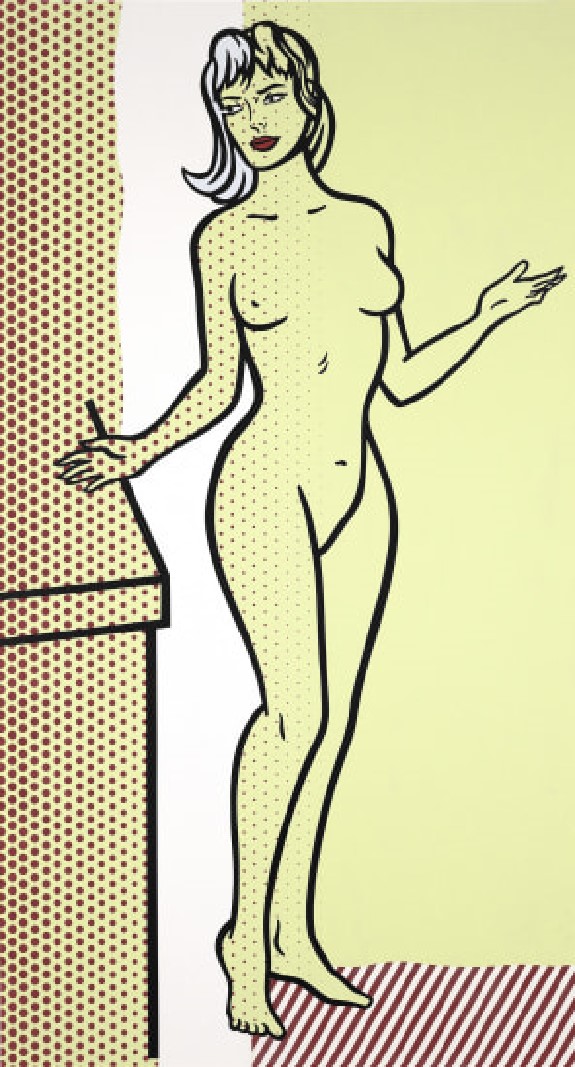
Among Roy Lichtenstein’s final paintings, Nude encapsulates the artist’s reflections on both his career and modernism as a whole—on his own terms and through his own approach. An image of radiant beauty and unadulterated allure, Lichtenstein’s bombshell seduces the viewer with a soft smile and brilliant red lips, inviting our gaze with averted eyes. Executed in 1997, the year of Lichtenstein’s death, this superb example from his last major body of work (1993-1997) sustained his career-long preoccupation with cultural clichés: once again seizing the cartoon imagery that featured in his earlier work, he deviated from his original source material only by visualizing them without their clothes. Their metamorphosis into another stock image of femininity perpetuated by printed media—that of the erotic, domestic blonde—veiled by his arresting Ben-Day dots, his stock-in-trade, reflects his ever-evolving dialogue with pop culture and the art historical canon.
The first body of work executed after his monumental retrospective in 1993 at the Solomon R. Guggenheim Museum, New York, the Nudes were Lichtenstein’s last contributions to art history and many are now held in important institutional collections, including the San Francisco Museum of Modern Art and The Broad, Los Angeles.

Roy Lichtenstein in his studio in Southampton, New York, 1997. Image: © Bob Adelman Estate, Artwork: © Estate of Roy Lichtenstein
Lichtenstein’s nudes were birthed from his concurrent Interiors series, caricatures of pristine Architectural Digest-esque representations of post-war bourgeois domesticity. First contained within decorative paintings on the walls, his nudes soon began to inhabit these homes themselves, their picture-perfect physiques as satirically commodified as the lavish furnishings which surrounded them. Nude is the culmination of this progression: the primary subject of the painting, Lichtenstein’s figure stands next to a plinth or table in a bare room only schematically rendered.

Pamela Anderson as C.J. Parker in “Baywatch”. Image: Collection Christophel / Alamy Stock Photo
The artist considered these late Nudes to be a marked distinction from his iconic representations of sentimental comic book romances, which he characterized as “perfectly pure” and “ended in a nice kiss.”i Though these figures encapsulate the same eroticism as his earlier work, “the 1990s nudes take pleasure in their own company without the slightest hint of needing or missing a man. They are not paralyzed by their emotions,” Avis Berman observed. “In contrast to Lichtenstein’s original romance-comic pictures, this world flourishes exuberantly without men or engagement rings or kisses.” Indeed, perhaps reflective of wider social changes in the second half of the 20th century, Nude’s sexuality is presented in new terms; within a 1990s context, the figure is perhaps evocative of Pamela Anderson’s status as the ultimate American sex symbol during the contemporaneous run of Baywatch. “The older norm didn’t disappear, but needed to be adjusted,” Berman continued. “Even as he updated the stereotypes of erotic fantasies, Lichtenstein wove them into the consistent narrative of his own carrier.”ii
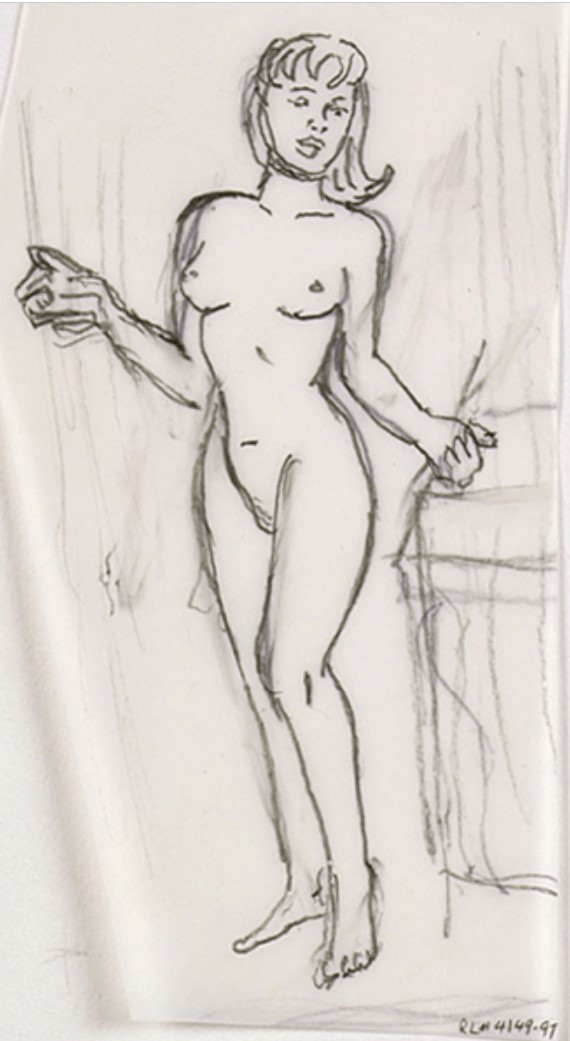
Roy Lichtenstein, Nude (Study), 1997. Artwork: © The Estate of Roy Lichtenstein
Following in the footsteps of many of his forebears, including Henri Matisse, Auguste Renoir, Paul Cézanne, and Pablo Picasso, Lichtenstein rendered the classic theme of the nude—likely the canon’s most persistent trope—in his distinctive aesthetic idiom late in life, often as a means of indexing art history itself. “The king of the blown-up comic-book frame had seemed to be settled into a quiet, Old Masterly period of late—but he’s broken out with a bang with his new series of nudes,” the New York Daily News declared when the artist returned to the motif in 1993.iii On one hand, the subject bears an immediate resemblance to Picasso’s volumetric Standing Nudes from the 1920s. On the other, the preliminary tracing paper study for Lichtenstein’s Nude depicts the figure gripping a flowing piece of fabric, betraying that the likely original inspiration for the picture was among the first life-sized representations of the female nude in Western art history: the Ancient Greek sculpture Aphrodite of Knidos, executed by Praxiteles circa 4th century BC. Indeed, Lichtenstein’s 1997 canvases are replete with references to antiquity; ironically, it was in the final paintings of his lifetime that he returned to the very first images of Western art history.
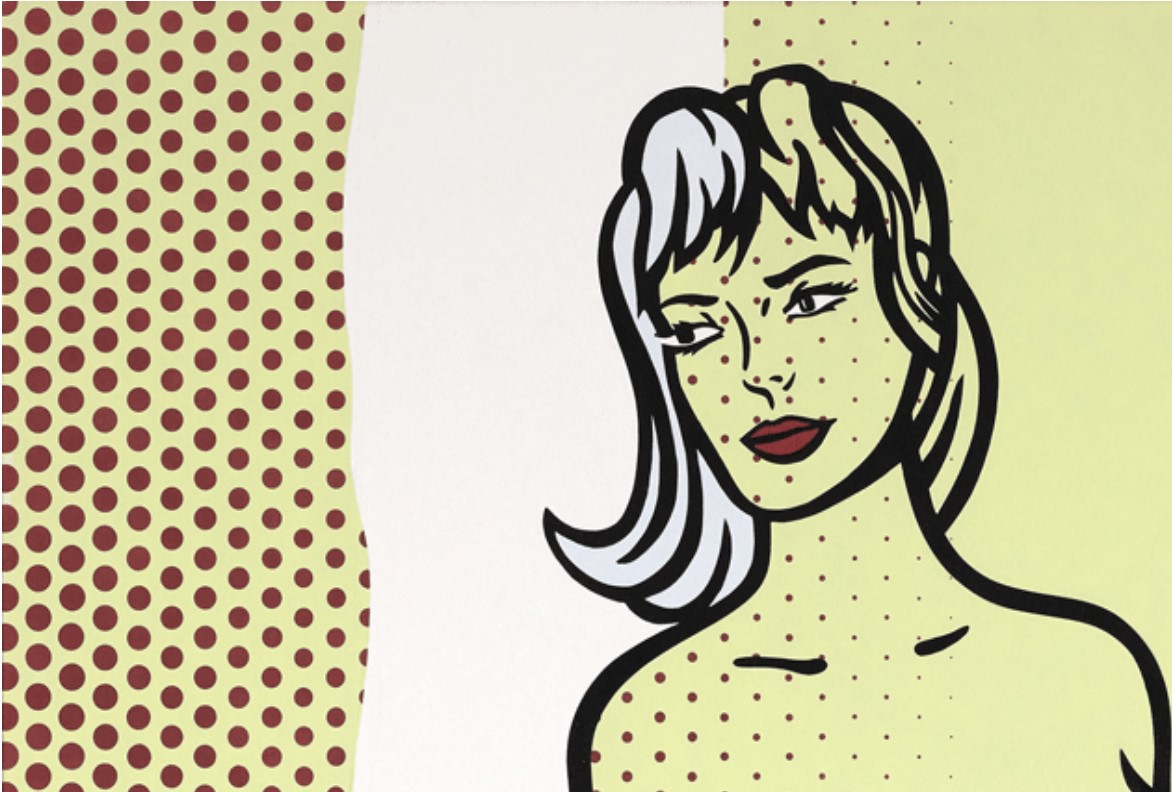
Despite the classical richness of the subject matter, it is her translation into Lichtenstein’s signature vernacular that distinguish Nude as a meditation on the act of painting. As a critic illuminated, “Lichtenstein’s work… is not so much about the subject matter as about what his treatment—outlines, unmodulated color, Ben-day dots—does to the subject.”iv After a career critically interrogating the potentialities of a post-war machine aesthetic, Lichtenstein ironically employs the language of mechanism in Nude as a means of reflecting on the act of painting. His signature Ben-Day dots suggest contouring, and the diagonal lines in the lower right of the picture establish the illusion of depth that defines the space in which the woman stands. Though these motifs allude to the building blocks of draughtsmanship and rudimentary chiaroscuro, they figure more as a two-dimensional decorative patterning, emphasizing the flatness of the picture plane. “My nudes are part light and shade, and so are the backgrounds, with dots to indicate the shade,” Lichtenstein elucidated. “The dots are also graduated from large to small, which usually suggests modeling in people’s minds, but that’s not what you get with these figures.”v Redolent of the printing process, these dots and diagonal lines are mechanical marks that are typically intended to go unnoticed, but in Nude they emphatically convey a complete deconstruction of space. The dots that fill the left side of the figure bleed into the plinth and wall beside her, collapsing the illusion of depth; a white stripe (and the small area of the figure’s hair that it intersects) disrupts any coherency, reminiscent of a glitch or printing error.
Cartoons
I Can See the Whole Room!…and There’s Nobody in it!, 1961
Christie’s New-York: 8 November 2011
Estimated: USD 35,000,000 – 45,000,000
USD 43,202,500
Roy Lichtenstein (1923-1997) (christies.com)
ROY LICHTENSTEIN (1923-1997)
I Can See the Whole Room!…and There’s Nobody in it!, 1961
Oil and graphite on canvas
48×48 inches (121.9 x 121.9 cm)
Signed ‘rfl’ (lower right)
Like Kazimir Malevich’s Black Square of 1915, which to some degree this painting resembles, Roy Lichtenstein’s I Can See the Whole Room and There’s Nobody in It! is a singular and iconic work that encapsulates a sense of its creator’s entire oeuvre and serves as a foundation stone upon which much of it was built. Painted in the summer of 1961, this deceptively simple yet deeply significant and celebrated painting is one of the very first of Lichtenstein’s pictures to draw solely on cartoon imagery for its subject-matter and to invoke what is perhaps the central theme of his work as a whole: the complex relationship between art and perception. With its stark minimalist image of a monochrome black canvas suddenly punctured by the startling and illuminated presence of a cartoon male figure opening and looking through a peephole, I Can See the Whole Room is a spirited work that appears to visually disrupt the nature of both what a painting is and what it can be. It also serves as a pictorial symbol of the dramatic transition from abstraction to cartoon figuration that had suddenly taken place in Lichtenstein’s own art in 1961. An exemplar example of the artist’s highly intellectual approach to painting, I Can See the Whole Room is an undeniable early masterpiece of Lichtenstein’s pioneering and “Pop”-defining vision that was eagerly recognized as such by Emily and Burton Tremaine, who acquired it for their collection very soon after it was painted.
Ohhh…Alright…, 1964
Christie’s New-York: 10 November 2010
Estimate on Request
USD 42,642,500
Roy Lichtenstein (1923-1997) (christies.com)
Roy Lichtenstein (1923-1997)
Ohhh…Alright…, 1964
Oil and magna on canvas
36 1/2 x 38 inches (90.2 x 96.5 cm)
Signed and dated ‘rf Lichtenstein ’64’ (on the reverse)
Painted in 1964, Roy Lichtenstein’s Ohhh…Alright illustrates the brash comic styling of his most celebrated period of artistic production. As with all his greatest images, Ohhh…Alright...is at once striking and subtle, humorous and highly serious. Lichtenstein lifted the stunning blue-eyed, flame-haired beauty that fills the frame from the pages of a romance comic and rendered it larger-than-life. She forms part of the much-admired cast of dream girls painted between 1961 and 1965 that saw Lichtenstein attain international prominence as one of America’s most exciting and controversial artists. Created in conjunction with his explosive war paintings, these images of love-struck women reflect the artist’s formal interest in a generic style of representation, while simultaneously addressing the cultural dichotomy between male and female stereotypes. The visage of this 1960s sweetheart represents a single panel from a graphic love story that Lichtenstein dilated to the scale of a 36″ x 38″ easel painting. He presents this image without context, the narrative flow frustratingly incomplete. The solitary, emblematic figure leaves us guessing as to why she looks so crestfallen, as she mutters into the phone clutched at her ear. It captures the Pop master’s innate gift for editing, capturing the telling gesture of an emotive moment. In his hands, the subject’s corny theatricality has become an image of mystery, where the past and future events of the storyboard can only be surmised. It disrupts our desire to engage with the scenario and forces the viewer to analyze the image on its own terms. The work owes its vivid monumentality to the careful scrutiny and distillation of a pre-existing image selected from thousands of random possibilities. Lichtenstein then adapts his source, removing distracting details, lines, figures, or words to present his compositions with the ultimate clarity.
The Ring (Engagement), 1962
Sotheby’s New-York: 11 May 2015
Estimate on Request
USD 41,690,000
(#15) Roy Lichtenstein (sothebys.com)
ROY LICHTENSTEIN
The Ring (Engagement), 1962
Oil on canvas
48 1/4 x 70 inches (122.5 x 177.8 cm)
Signed and dated ’62 on the reverse; titled on the stretcher
In 1962, Roy Lichtenstein transformed the intimate moment of engagement into a thundering blast. With his audacious early masterpiece The Ring (Engagement), Lichtenstein delivered a critical crescendo at the height of the Pop Art era, cogently revealing the vicissitudes of American civilization by means of vernacular imagery appropriated directly from the heart of a universal cultural iconography. Mining public idealism toward the cultural constructions of love and its structural manifestations, The Ring (Engagement) is at once an immediately arresting and exhilaratingly complex crystallization of the style and themes that enveloped Lichtenstein’s oeuvre for the rest of his life. The years 1961 and 1962 marked the genesis of Lichtenstein’s pioneering series of paintings based on scenes of love and war from popular comic books, whose powerful graphic impact and narrative drama remain the most groundbreaking pictures from his career. Widely exhibited in a number of the artist’s most prominent museum retrospectives—from Lichtenstein’s first survey at the Tate Gallery in 1968 to his most recent that travelled to Chicago, Washington, D.C., London, and Paris in 2012-13—The Ring (Engagement) is highly regarded as a thrilling, monumental cornerstone of the artist’s output. Moreover, having resided in only two private collections in the past 53 years, the painting is a prized exemplar of the Pop icon’s highest achievements in the medium of painting. At an exceptionally impressive scale that magnifies the instant of proposal to epic proportions, while evoking the cinematic frame of a comic strip in its sprawling horizontality, The Ring (Engagement) is explosive in dynamism and elemental force, gripping each viewer in its pictorial exuberance and conceptual gravitas.
Kiss III, 1962
Christie’s New-York: 15 May 2019
Estimated: USD 30,000,000 – 50,000,000
USD 31,135,000
Roy Lichtenstein (1923-1997) (christies.com)
Roy Lichtenstein (1923-1997)
Kiss III, 1962
Magna on canvas
64×48 inches (162.6 x 121.9 cm)
Signed and dated ‘rf Lichtenstein ’62’ (on the reverse)
Kiss III (1962) is a pivotal work from one of Roy Lichtenstein’s most lauded bodies of work—diverging from his Abstract Expressionist compatriots—as the artist brought together the previously divergent worlds of popular culture and high art. Painted the same year as the artist’s inaugural solo exhibition at the legendary Leo Castelli Gallery in New York, works such as this began pulling from the pages of comic books and enlarging the sampled imagery with meticulous detail. While effectively reproducing extant imagery, Lichtenstein was clear that his works should be viewed for their formal qualities rather than their enticing subject matter. Clearly depicted with bold black outlines, on the surface Kiss III depicts a man and woman sharing a close embrace. Both figures have their eyes closed as the man’s large hand presses down on the woman’s shoulder. Their lips are planted in a passionate kiss that is echoed in the energetic shapes making up the explosive background. Rendered in primary colors with black and white additions, the composition mirrors the color scheme of mass market printing. By creating halftones through the use of small dots of color, Lichtenstein is able to further mimic these processes that rely on a restricted ink palette. While the areas of blue, red and yellow are flat and pure in their application, the peach skin and violet of the woman’s jacket show evidence of the artist’s replication of the Ben-Day dots used to create subtle shifts in color with a four-color printing process. Bands of intensity create subtle striping in these areas and further allude to cheap printing and the color illustrations of comics and newspaper advertisements. Rather than creating his own tableaus in the style of other comic artists, Lichtenstein investigated the processes by which these reproducible arts were made and distributed to a wide audience. Carefully selecting scenes like that of Kiss III, with its white starburst and bold black rays on a red ground behind the titular kiss, the artist engaged the audience immediately with the representative subject matter, and then asked them to further investigate the process through intense framing choices and the translation of printed matter into an exacting homage in acrylic on canvas.
Brushstrokes
Red and White Brushstrokes, 1965
Christie’s New-York: 17 May 2017
Estimated: USD 25,000,000 – 35,000,000
USD 28,247,500
Roy Lichtenstein (1923-1997) (christies.com)
Roy Lichtenstein (1923-1997)
Red and White Brushstrokes, 1965
Oil and Magna on canvas
48×68 inches (121.9 x 172.7 cm)
Signed and dated ‘rf Lichtenstein ’65’ (on the reverse)
Painted in 1965, Roy Lichtenstein’s Red and White Brushstrokes is a quintessential Pop painting, but one which shrewdly questions fundamental beliefs about the traditional artistic process. With its bold rendition of two brushstrokes loaded with red and white paint, Lichtenstein calls into question the revered status of the painterly mark. Across this monumentally-scaled canvas, he takes the essence of painting—the sanctity of the brushstroke—and frames it within the Pop idiom. In an apparent jibe at the spontaneous and layered brushwork of Abstract Expressionism, the gesture reappears as controlled strokes, replete with drips, set against a field of regularized dots. One of only a handful of works from this pivotal series to remain in private hands, Red and White Brushstrokes demonstrates that Lichtenstein was not content to pay homage to his artistic antecedents, as here we begin to see the development of the artist’s insightful deconstruction of the visual language of mass communication and the consolidation of his signature style which did much to establish Pop Art as one of the dominant movements of the post-war period. Set against a backdrop of the artist’s signature Ben-Day dots, Lichtenstein renders two broad strokes of red and white paint. The primary sweep of pigment is executed in brilliant white, positioned across the central portion of the canvas on a slightly inclined angle as Lichtenstein adroitly mimics the motion of moving the paint laden brush from left to right across the surface of the canvas. The presence of a heavily laden brush is suggested by the rippled contour of the brushstroke in conjunction with the appearance of a trail of excess paint that trickles off down to the left plus the drips and splashes of surplus pigment that adorn the lower portion of the canvas. On top of this initial brushstroke, the artist lays down a second, more dramatic, sweep of paint—this time executed in a vivid red. Here, he traces a more controlled, serpentine path as the heavily loaded brush snakes its way across the surface of the painting before culminating in a series of feathered marks as the filaments give up their last vestiges of pigment.
WHITE BRUSHSTROKE I, 1965
Sotheby’s New-York: 29 June 2020
Estimated: USD 20,000,000 – 30,000,000
USD 25,417,000
ROY LICHTENSTEIN | WHITE BRUSHSTROKE I | Contemporary Art Evening Auction | 2020 | Sotheby’s
ROY LICHTENSTEIN (1923 – 1997)
WHITE BRUSHSTROKE I, 1965
Oil and Magna on canvas
48×56 inches (121.9 x 142.2 cm)
Signed and dated ’65 on the reverse
Bold, brilliant, and thrillingly irreverent, White Brushstroke I is the ultimate embodiment of Roy Lichtenstein’s pioneering investigation into the form, content, and meaning of Contemporary Art. An exhilarating confrontation with the towering legacy of American Abstract Expressionism, White Brushstroke I invokes the impulsive, gestural mode of that movement within the sleekly commercial style of Lichtenstein’s signature Pop idiom. Perfectly centered against the artist’s trademark background of Ben-Day dots, the painter’s mark is transformed into a gesture of control rather than spontaneity in a daring challenge to the canonical hegemony imposed by that most essential motion of a painter’s practice. Painted in 1965, White Brushstroke I is among the most iconic of Lichtenstein’s limited group of fifteen Brushstroke paintings; regarded as pivotal masterworks of the Pop Art movement, eight of these paintings are already held in or promised to such museum collections as the Art Institute of Chicago, Kunsthaus Zürich, Kunstsammlung Nordrhein-Westfalen in Düsseldorf, and the Whitney Museum of American Art in New York, among celebrated others.
In its single, sinuous ivory form—complete with sumptuous drips and splatters—set against a precise field of Ben-Day dots, White Brushstroke I stands as the ultimate, elegant embodiment of this rarefied series; dispensing with the multicolored and layered strokes of his other Brushstroke paintings, the purified composition of the present work achieves a singular artistic statement of unparalleled visual potency. While other examples of the series suspend a single stroke above a larger expanse of Ben-Day dots, the arrangement of White Brushstroke I invokes the same compositional magnetism of the artist’s iconic single-object paintings of 1961-1963, in which the primary subject is centrally placed in relation to the canvas edge; much like Portable Radio or ice Cream Soda, the present work achieves an extraordinary purity of image-making. While Johns settled on the image of the flag as a blank slate upon which to explore the formal properties of paint, Lichtenstein remained highly aware that the viewer’s preconceptions of objects operate as an integral component of perception – as much so as color, composition and technique.
Two Paintings
Two Paintings: Craig…, 1983
Sotheby’s New-York: 18 November 2021
Estimated: USD 12,000,000 – 18,000,000
USD 20,371,500
Two Paintings: Craig… | Contemporary Evening Auction | | Sotheby’s (sothebys.com)
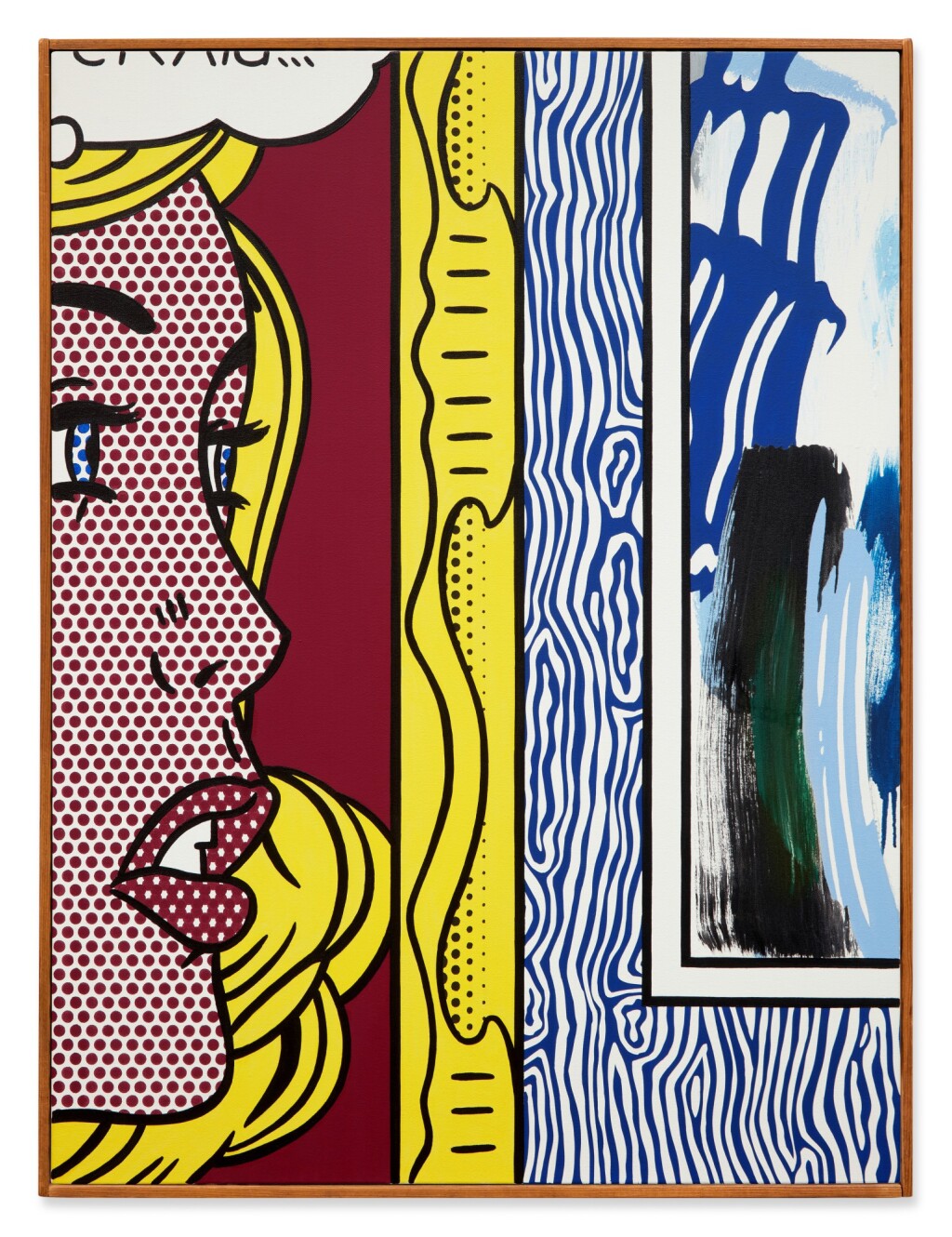
ROY LICHTENSTEIN (1923 – 1997)
Two Paintings: Craig…, 1983
Oil and Magna on canvas
48×36 inches (121.9 x 91.4 cm)
Signed Roy Lichtenstein and dated ’83 (on the reverse)
Two Paintings: Craig…is the ultimate embodiment of Roy Lichtenstein’s career-long exploration of his signature Pop idiom and pioneering investigation into the form, content, and meaning of Contemporary Art. An autobiographical encapsulation of his artistic oeuvre, the blonde in his trademark Ben-Day dot wistfully peers towards the framed Brushstroke paintings of his later career. An unparalleled and exquisite survey of Lichtenstein’s ever-proliferating pictorial panorama of culture in 1960s America, Two Paintings: Craig… synthesizes the most important iconographical motifs of Lichtenstein’s artistic lexicon. In reference to his 1964 painting Craig…, Lichtenstein chronicles his own contribution and redefining of Pop art. Her radiant blonde locks pouted red lips, and enigmatic expression encompasses the best of Lichtenstein’s appropriated images, an unequivocal embodiment of female sexuality. Utterly breathtaking, Two Paintings: Craig… is the last of Lichtenstein’s unabstracted archetypal blonde, a uniquely striking exemplar of this undisputed icon of Post-War American art.
The present work incomparably reflects on Lichtenstein’s profound impact on twentieth-century art. Few masterworks, either by Lichtenstein or any of his contemporaries, subvert the heroic ideals of modern abstract painting as directly and successfully. The dream of being the blonde heroine from the present work, calling to her male savior, drove entire industries and billions of sales. Lichtenstein explained the appeal of comic books “[he] was very excited about, and interested in, the highly emotional content yet detached impersonal handling of love, hate, war, etc., in these cartoon images.” (Roy Lichtenstein quoted in: John Coplan’ An Interview with Roy Lichtenstein’ October 1963) Informed by the irrational hope inspired by cinematic fantasy and comic book fiction, her character triggers an inexplicably emotional reaction. Lichtenstein’s women explore society’s ghoulish and perverse fascination with vulnerable, helpless heroines, war, and loss.

THE COVER OF ARCHITECTURAL DIGEST IN DECEMBER 2016, FEATURING THE MIAMI HOME OF DOUGLAS S. CRAMER AND THE PRESENT WORK ROY LICHTENSTEIN TWO PAINTINGS: CRAIG… PHOTO: BJÖRN WALLANDER / ARCHITECTURAL DIGEST. ART © ESTATE OF ROY LICHTENSTEIN
The present work’s flattened and foreshortened perspectival space recall modes of consumer advertising while strengthening formal principles and pictorial conventions native to early Modernism. Lichtenstein’s frames were quintessential of his Sixties paintings, a perfect amalgam of Pop sensibility and insightful engagement with prevailing art trends of the day. He looked to challenging the parameters of art itself, advertisements, and the visual culture contemporaneously unfolding around him. Bold, brilliant, and thrillingly irreverent, the brushstrokes reflect an exhilarating confrontation with the towering legacy of American Abstract Expressionism. Lichtenstein’s motif of the imitation woodgrain is a way of playing on the concept of authenticity with which woodgrain is associated. The symbol is a kind of paradox: the stamp of an authentic Pop artwork that rejects, implicitly, the notion of authenticity. Lichtenstein instinctively understood the phenomenal potential of popular imagery, and more than any artist of his generation, realigned the cipher of that imagery to unveil verities behind popular culture. Complicating the contentious dichotomy between what constitutes “high” versus “low” culture, the present work illustrates the most influential motifs of Lichtenstein’s investigation into mass-produced objects and reproduction of romantic comic books, exploring the distinction between the fine art and the commercial imagery that pervades our daily lives.
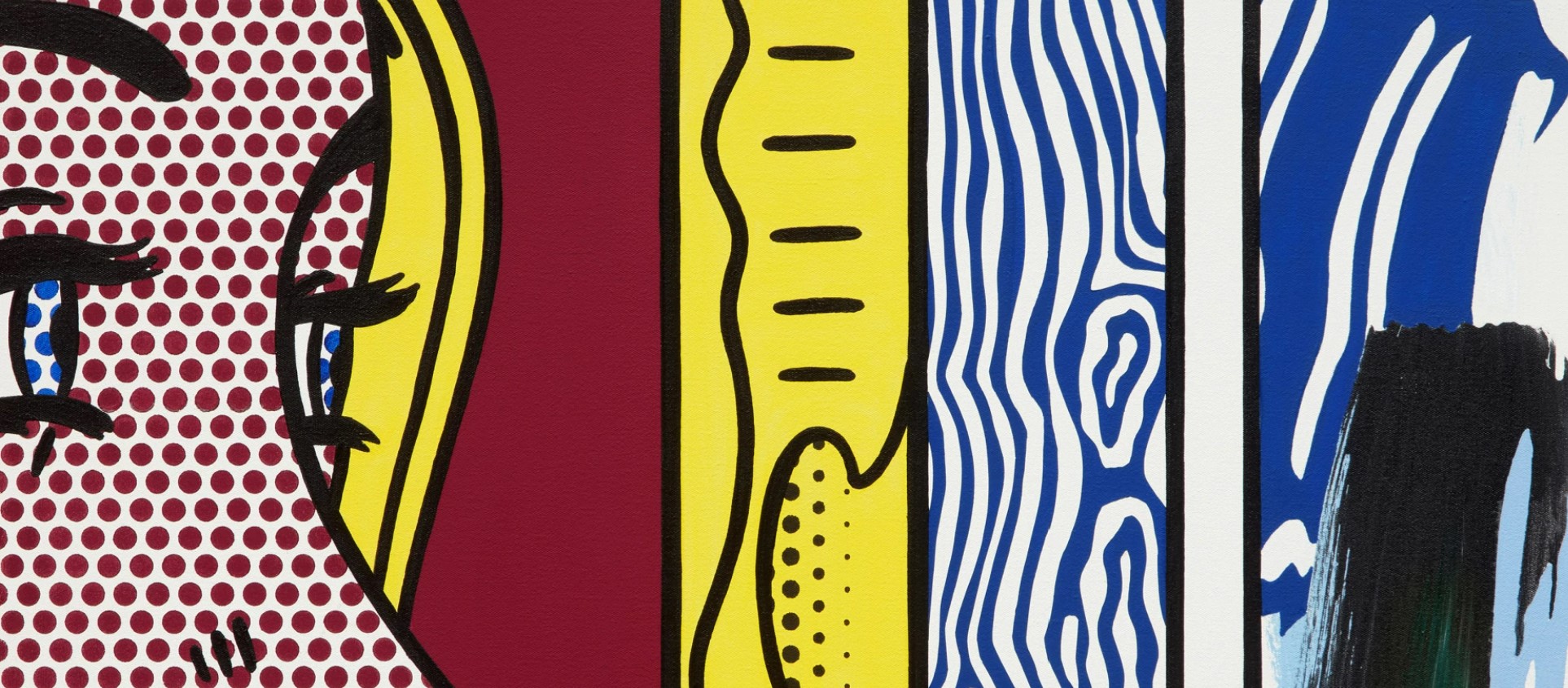
With half-lidded eyes and voluptuous lips, the protagonist calls “Craig…” This moment encapsulates the profound drama and sense of pregnant expectation that encapsulate Lichtenstein’s most iconic works. Lichtenstein’s painting is inherently and breathtakingly beautiful, both in its subject and its physical facture. It embodies the prevalent archetype of feminine beauty that had become the socio-cultural aspiration for millions since the Second World War. The viewer is granted visual access to the woman calling for ‘Craig’, however the male figure originally included in the source imagery is removed. Thus, the viewer becomes locked in a tantalizing interplay that teeters between attraction and the tension of irrevocable distance. With her open mouth and large, wistful eyes, she entrances the male she calls to with her beguiling temptation. Intriguing and mysterious, she demands our attention and seduces our gaze. She looks towards Lichtenstein’s representation of abstract Expressionism and painting itself and represents the consummate muse of both artist and viewer.
Modern Paintings
Modern Painting with Small Bolt, 1967
Sotheby’s New-York: 16 November 2022
Estimated: USD 6,000,000 – 8,000,000
USD 6,873,800
Modern Painting with Small Bolt | Contemporary Evening Auction | | Sotheby’s (sothebys.com)
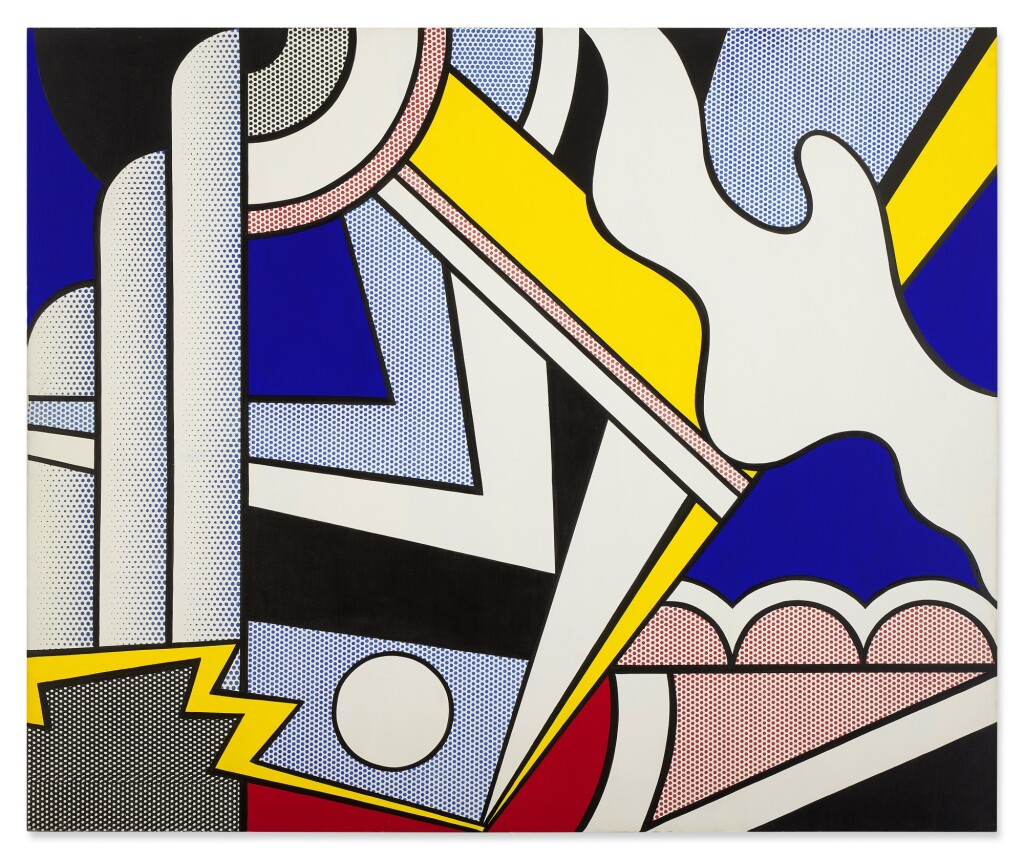
ROY LICHTENSTEIN (1923-1997)
Modern Painting with Small Bolt, 1967
Oil and Magna on canvas
68 ⅜ x 82 ⅛ inches (173.7 x 208.6 cm)
Signed rf Lichtenstein and dated ‘67 (on the reverse)
An electrifying composition of saturated colors and searing forms, Modern Painting with Small Bolt is the ultimate embodiment of Roy Lichtenstein’s pioneering investigation into the form, content, and meaning of Contemporary Art. A testament to Roy Lichtenstein’s mastery of composition and space, Modern Painting with Small Bolt of 1967 is an iconic exemplar from the artist’s pivotal series of Modern Paintings, in which Lichtenstein breaks free of his signature Pop Art graphics to interrogate the very foundations of art historical precedents. Exemplifying Lichtenstein’s career-long investigation of art history, the present work takes as its inspiration the sleek and stylized forms of the Art Deco movement of the 1920s and 30s, reimagined and reorganized into a complex network of industrial images. Here, the familiar ornamentation and decorative motifs of that era are made new, deftly rearticulated in the sleek commercial style of Lichtenstein’s signature Pop idiom. A kaleidoscopic vision of overlapping shapes and symbols, the present work further demonstrates Lichtenstein’s fascination with the work of de Stijl artists such as Theo van Doesberg and Piet Mondrian, whose inspiration is legible in the industrial ligatures and chromatic dissonance of the present work. Testifying to the significance of this series, examples of Lichtenstein’s Modern Paintings are held in esteemed institutions such as the Museum of Modern Art, New York and the Hirshhorn Museum and Sculpture Garden, Washington, D.C.
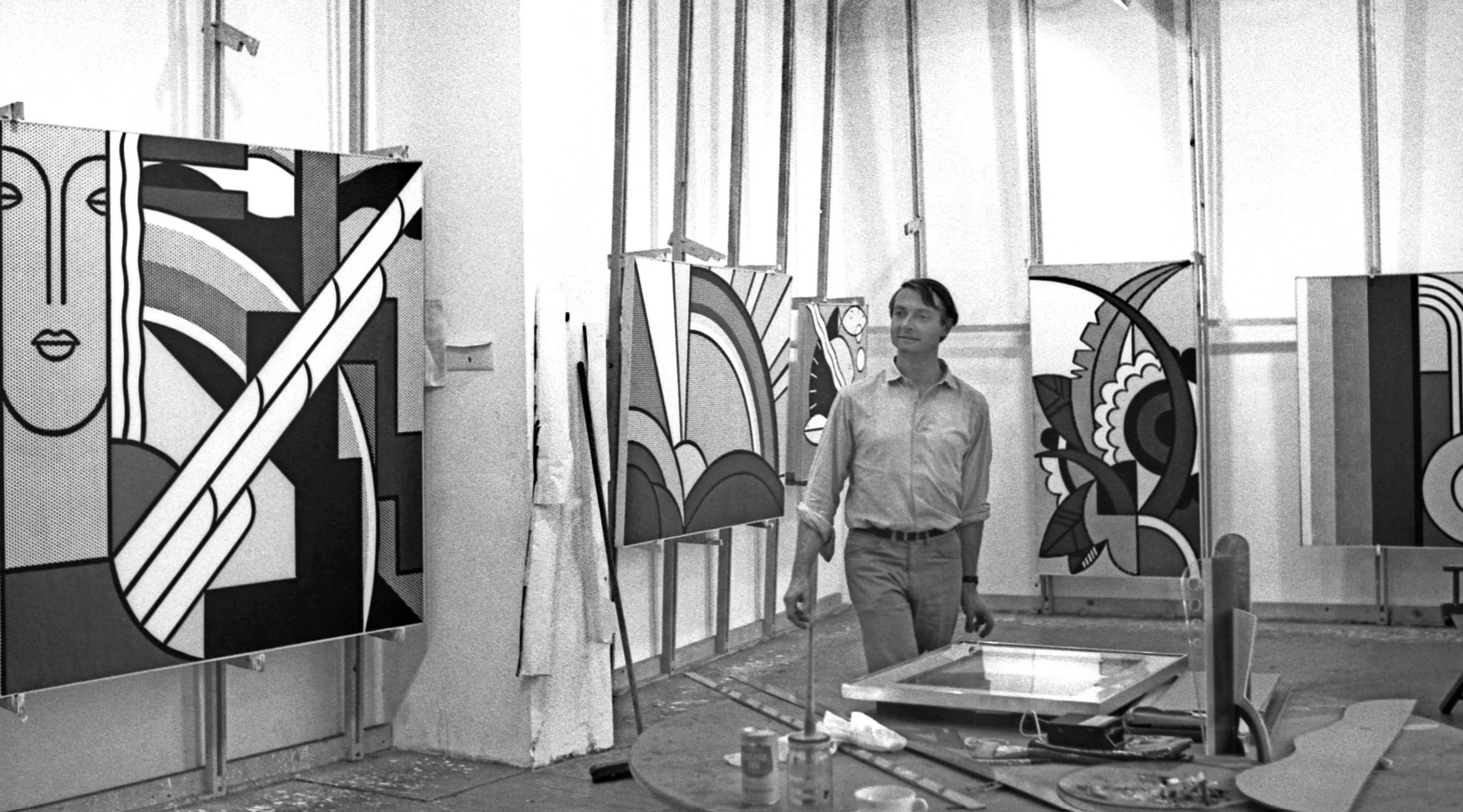
PORTRAIT OF THE ARTIST IN HIS STUDIO AT 190 BOWERY, NEW YORK IN 1967 WITH THE MODERN PAINTINGS SERIES TAKEN BY UGO MULAS. IMAGE © UGO MULAS HEIRS. ALL RIGHTS RESERVED. ART © 2022 ESTATE OF ROY LICHTENSTEIN, ALL RIGHTS RESERVED
Within Modern Painting with Small Bolt, an iconic industrial skyline emerges, composed with fractured symmetry and a signature graphic aesthetic. A master of symbolic parody, Lichtenstein pulls visual motifs seamlessly into the complex composition: a tiered structure rises along the left-hand side of the picture plane, while two beams of light cut diagonally across the composition, these individual compositional components deftly bound tightly together into an aggregate geometric puzzle. Initially inspired by his commissioned design for the 1967 Lincoln Center poster, which also includes a similarly composed towering structure and soaring beams of light, the present work plays on iconic motifs from the Art Deco movement. While exceptionally unified and balanced, Modern Painting with Small Bolt is full of stylistic contradictions: a current of vibrant yellow cuts a jagged line through the foreground with a sharp angularity, while a cloud of billowing white smoke rises along the upper right-hand side of the picture plane; industrial forms slice through the fractured blue sky while curving rings and semicircles pulse against the linearity of the picture. These contradictions serve to further parody these highly popular, industrial motifs typical of Art Deco design, and deepen the conceptual nuance of this iconic work.