Introduction
Landscape with Red Sky, 1985
Landscape with Red Sky, 1985
Sotheby’s New-York: 14 May 2024
Estimated: USD 4,500,000 – 6,500,000
USD 6,449,000
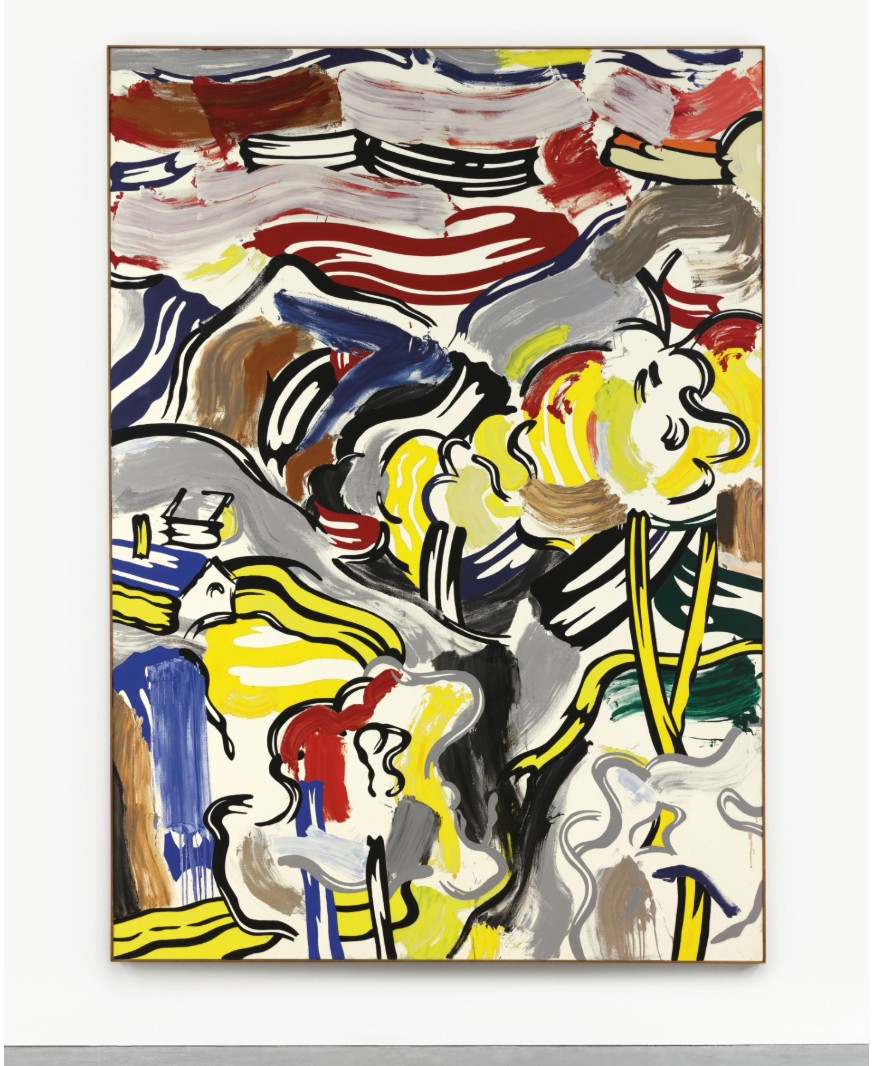
ROY LICHTENSTEIN
Landscape with Red Sky, 1985
Oil and magna on canvas
108×77 inches (274.3 x 195.5 cm)
Signed and dated ’85 on the reverse
Provenance
Leo Castelli Gallery, New York (LC #991)
Meshulam Riklis, Beverly Hills (acquired from the above in June 1985)
Christie’s, New York, May 3, 1994, Lot 69
Acquired by the present owner from the above
Exploding in an exquisite panoply of bold primary colors, Roy Lichtenstein’s Landscape with Red Sky from 1985 is a magnificently complex milestone in the painter’s enduringly evolving exploration of art-making, perfectly summarizing Lichtenstein’s ultimate project of painting pictures about pictures. The immense expanse of the canvas erupts into a panorama of Lichtenstein’s most iconic thick bold lines, borrowed from the comic strip lexicon, and deceptively expressionistic brush strokes—a brilliant chaos that upon close examination reveals itself as meticulously controlled spontaneity.
Executed at the apex of Lichtenstein’s trailblazing and perennially inventive career, Landscape with Red Sky reflects Pop Art at its most sophisticated and self-aware. Formally, the painting denotes a fearless departure from the tightly confined representational compositions that characterized Lichtenstein’s earlier oeuvre. Predominantly red, horizontal swooshes rip across the top quarter of the canvas, sketching a smoldering sunset sky. Below a kinetic horizon line hemming the sky, a topography of abstracted houses, clouds, trees, hills and water resplendently swoop across the surface as though swept in a cataclysmic gust of wind, arousing a dynamic motion that pulls us into its sublime assemblage.
Lichtenstein’s early re-contextualization of widely circulated mass media images engineered the architectural fabric of Pop imagery, profoundly upsetting the division between “low” and “high” art and toppling the tenuous hierarchies of aesthetic judgment. The artist’s eponymous lexicon of comic-inspired Benday dots, hard graphic lines and vivid color palette carried into the art history-inspired paintings that Lichtenstein began in the early 1960s, whose interrogation of the canon of “high” art culminated in the present work. Following his aesthetic engagement with reproductions of masterpieces by Cézanne, Mondrian, and Picasso, Lichtenstein made paintings that isolated precisely drawn cartoon brushstrokes, enlarged and exaggerated as a sardonic comment on the heroic, gestural handling of paint that epitomized the Abstract Expressionists. Landscape with Red Sky marks the most sophisticated and visually spellbinding climax of Lichtenstein’s challenges to the distinction between good and bad taste, incorporating the manicured, highly planned strokes of his 1965-66 Brushstroke paintings, while introducing for the first time intersecting brushwork that implies the very same thick, painterly impasto that Lichtenstein satirizes.
Upon examination, these seemingly gestural strokes are reduced to small, precise, mechanically applied whisks of paint that are clean, cool facsimiles of the Abstract Expressionist indulgence for the muscular swoosh, the drip and the splatter. Asked in 1986 about how the purportedly ‘real’ brushstrokes seem so controlled, Lichtenstein retorted, “It’s because I don’t want it to look like a modulated area. I want it to look like a brushstroke. They don’t all come out that way, but they are supposed to look like instances of the perfect brush stroke.” (the artist quoted in BOMB, 14, Winter 1986) Lichtenstein underscored his piercingly clever visual inventiveness and conceptual sophistication: “It’s taking something that originally was supposed to mean immediacy and I’m tediously drawing something that looks like a brushstroke…I want it to look as though it were painstaking. It’s a picture of a picture really and it’s a misconstrued picture of a picture.” (the artists cited in Exh. Cat, Chicago, Art Institute of Chicago, Roy Lichtenstein: A Retrospective, 2012, p. 50)
For the Pop artists of Lichtenstein’s generation, their Abstract Expressionist forebears cast overwhelming shadows, inspiring admiration and reverence, but also representing a sense of an imposed and standardized style. Lichtenstein counters this stifling climate in the creation of his stylized “brushtroke” imagery, suggesting the heroic allover brushwork of Abstract Expressionism had lost its hallowed avant-garde status. By the 60s, the macho abstraction permeated the public cultural lexicon to such an extent that it could be likened to the consumer mass media advertisements and comic strips that served as the artist’s initial Pop art source material. “Far from continuing to shock the bourgeoisie, Abstract Expressionism has made its way into the average American home: ‘Once the hurdle of its non-objectivity is overcome, A-E is as prone to be decorative as French Impressionism.’ Shortly thereafter, Lichtenstein featured in a Life pictorial in which he was portrayed as an anti-Pollock, his mechanical style of reproducing his comic-book sources implicitly contrasted with Pollock’s frenzied creativity.” (Ibid., p. 49)
The present work riffs not only on Abstract Expressionism, but on the centuries-old, clichéd genre of landscape painting. Inverting a landscape picture’s representational goal of enfolding the viewer into its pastoral reality, Lichtenstein’s rendering provides no one clear vantage point—our eyes dart across the vibrant surface, which possesses the ineffable motion and speed of a hard-edged Futurist composition by Giacomo Balla fused with de Kooning’s characteristic brushy, all-over confluence of figuration and abstraction. In painting a landscape through the same aesthetic iconography as his cartoon paintings and art history paintings, Lichtenstein puts Van Gogh and Dufy on the same level as a comic strip or advertisement, convincingly melding the high and the low as only he could accomplish. What is refreshingly invigorating about looking at a Lichtenstein such as the present work is a stunning lack of iconoclasm—he parodies, satirizes and critically examines, but at the very heart of Lichtenstein’s painting is a true admiration and indefatigable ardor for all pictures. He revels in the visual pleasure of our image-swollen society; his work is punchy and ironic, but never mean-spirited. He is an enthusiast of the highest order. Magnificent in its sheer scale and dynamic vigor, Landscape with Red Sky vividly lays bare the terms of its own making and embodies Lichtenstein’s most compelling subject matter—art itself.
Sky and Water, 1985
Sky and Water, 1985
Christie’s New-York: 17 May 2023
Estimated: USD 4,000,000 – 6,000,000
USD 3,256,500
ROY LICHTENSTEIN (1923-1997) (christies.com)
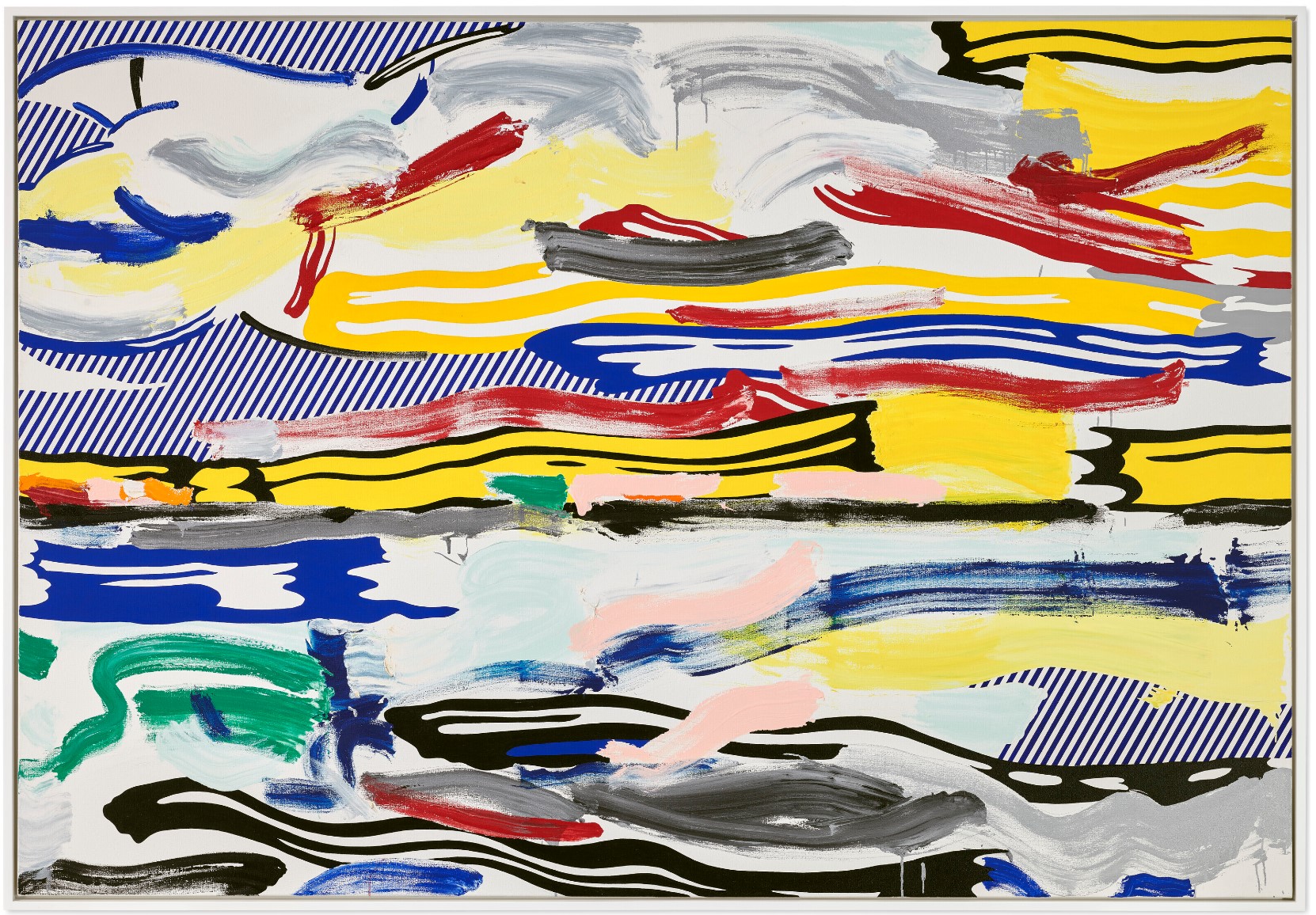
ROY LICHTENSTEIN (1923-1997)
Sky and Water, 1985
Oil and Magna on canvas
66×96 inches (167.6 x 243.8 cm)
Signed, inscribed and dated ‘© rf Lichtenstein ’85’ (on the reverse)
Though best known for his iconic comic book paintings composed of Ben-Day dots, Roy Lichtenstein’s oeuvre developed into equally influential later work which became much more expressive and personal. Sky and Water is unabashedly sincere, exhibiting none of the cool remove of his earlier work. Exhibited in his seminal 1993 retrospective, it is a crucial painting that expands the discourse on the artist’s canonical career. Its five-and-a-half foot by eight-foot canvas allows us to inhabit this landscape, whose atmospheric expanse recalls Claude Monet’s Impression, Sunrise (1872) or Pierre Puvis de Chavannes’s Sleep (1867-1870). Sky and Water is an expressionistic and painterly work, reminding us that Lichtenstein was always as interested in the medium as he was in his deadpan subject matter. He investigated perception from every angle, all in an effort to expand our collective understanding of how we see and communicate.
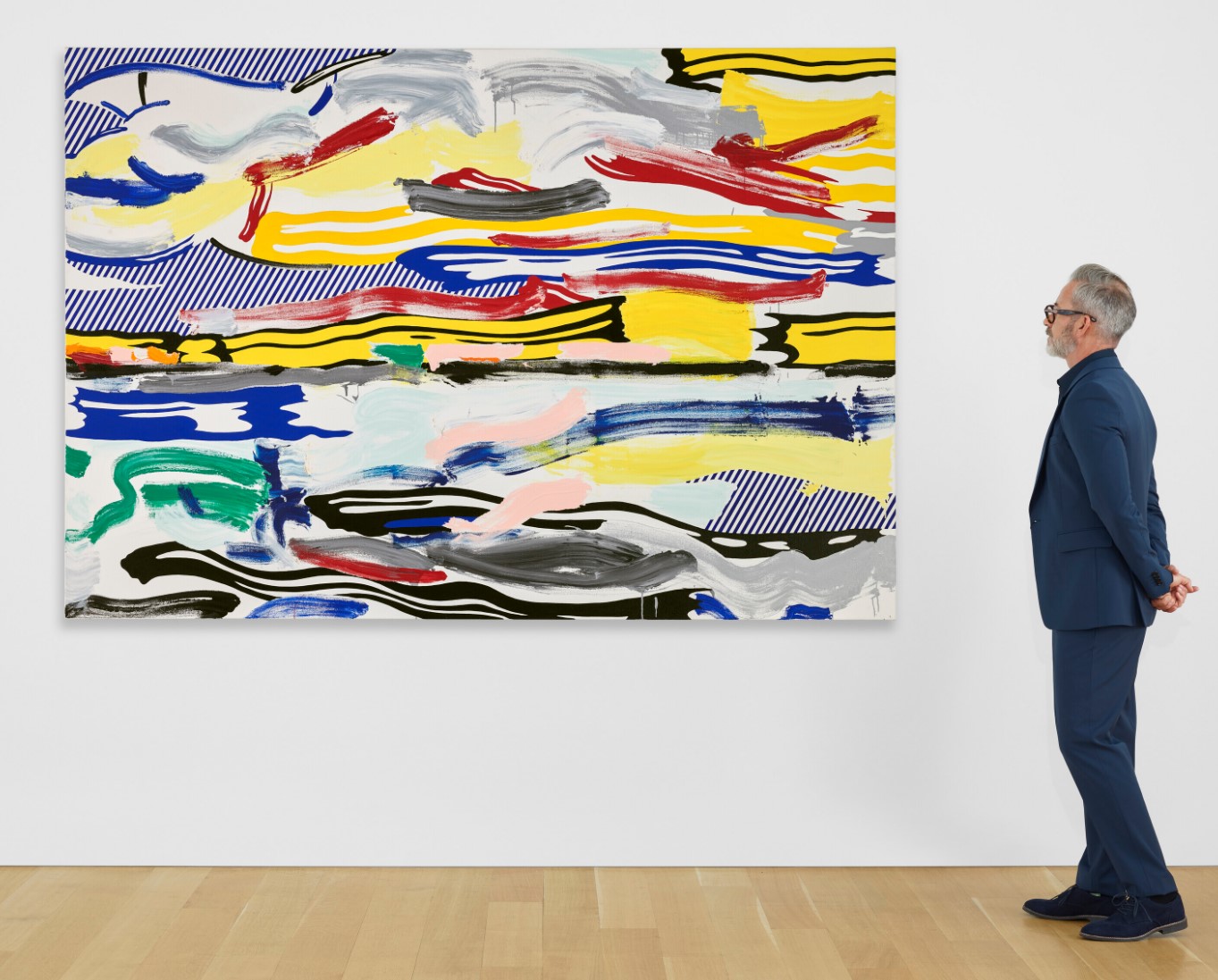
With its gestural, semi-abstract marks, Sky and Water stands apart from Lichtenstein’s characteristically crisp, graphic paintings. It is organized around a loose, sliding horizon line. Surrounding it are otherworldly yellows, reds, pinks, greens, and blues that intersect at times with sobering blacks and greys. Regimented, screen-like blue lines that are evocative of Lichtenstein’s signature comic book style come apart at the behest of abstract brushstrokes. In this period, Lichtenstein often applied collaged cutouts of brushstrokes to the canvas as he decided their color and placement. These marks are much looser than his Brushstroke series of 1965-1966, which has been read as an interrogation of Abstract Expressionism. However, there is nothing parodic about Sky and Water, which instead feels earnest and poetic. Relatedly, this is not a unilaterally sunny work, adding to its lyrical power. Lichtenstein captures instead the capricious nature of the sea, with its choppy waves and looming clouds. Water had always interested the artist, and here it becomes its own subject, or even a metaphor for the ebb and flow of paint itself.
Path Through the Forest, 1984
Path Through the Forest, 1984
Sotheby’s New-York: 11 November 2014
Estimated: USD 2,000,000 – 3,000,000
USD 3,077,000
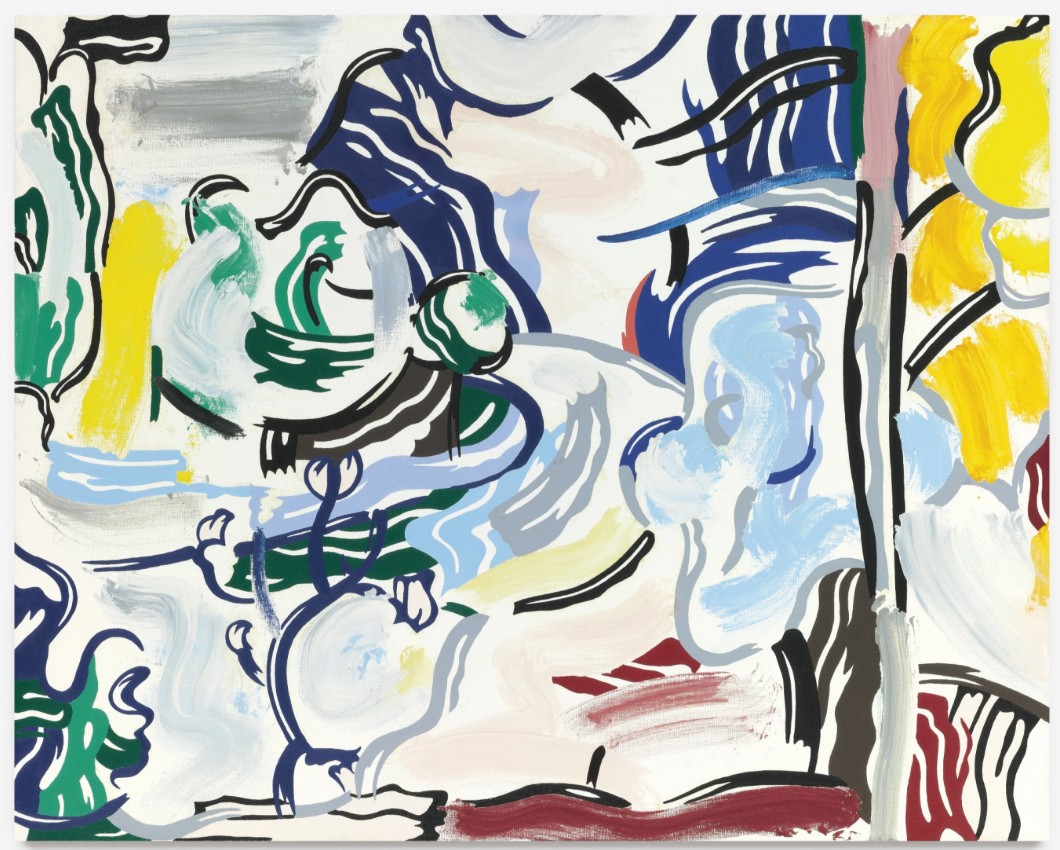
ROY LICHTENSTEIN
Path Through the Forest, 1984
Magna on canvas
40×50 inches (101.6 x 127 cm)
Signed and dated ’84 on the reverse
Provenance
Leo Castelli Gallery, New York (LC #984)
Richard Gray Gallery, Chicago (acquired from the above in 1984)
Private Collection, Sweden
Sotheby’s, New York, November 14, 1991, lot 372A
Private Collection, California (acquired from the above)
Walker Fine Art, New York and San Diego
Acquired by the present owner from the above in 2003
Virtuosic whirls of color resplendently swerve across the surface of Roy Lichtenstein’s ravishing Path Through the Forest of 1984 as if swept in a dramatic whirlwind, creating a dynamic motion that pulls the viewer into its sublime thicket. Exploding in an exquisite panoply of bright confectionery colors, the present work is a magnificently complex milestone in the painter’s ever-evolving exploration of art-making, impeccably summarizing Lichtenstein’s ultimate conceptual project of painting pictures about pictures. The expanse of the canvas erupts into a panorama of Lichtenstein’s most iconic thick bold lines borrowed from the comic strip, and his deceptively expressionistic brush strokes—all in a brilliant chaos that upon close inspection reveals itself as meticulously controlled spontaneity.
Executed at the apex of Lichtenstein’s trailblazing and perennially inventive career, Path Through the Forest reflects Pop Art at its most sophisticated and self-aware. Formally, the painting denotes a fearless departure from the tightly confined representational compositions that characterized Lichtenstein’s earlier oeuvre. Making no attempt toward verisimilitude, instead bold primary hues stand in as symbolic emblems to their most recognizable referents—from green patches that emulate trees, to churning shades of blue that mimic the running water and shifting sky, to brushes of yellow in place of the sun, it is evident from the striking immediacy of the image that Lichtenstein need not strive toward representation in order to communicate the clear picture of the landscape that he wants us to see.
Lichtenstein’s early re-contextualization of widely circulated mass media images engineered the architectural fabric of Pop imagery, profoundly upsetting the division between “low” and “high” art and toppling the tenuous hierarchies of aesthetic judgment. The artist’s eponymous lexicon of comic-inspired Benday dots, hard graphic lines, and vivid color palette carried into the art history-inspired paintings that Lichtenstein began in the early 1960s, whose interrogation of the canon of “high” art culminated in the present work. Following his comic-book reproductions of masterpieces by Cézanne, Mondrian, and Picasso, Lichtenstein made paintings of precisely drawn cartoon brushstrokes, enlarged and exaggerated as a sardonic comment on the heroic, gestural handling of paint that epitomized the Abstract Expressionists. Path Through the Forest marks the most sophisticated and visually spellbinding climax of Lichtenstein’s challenge to the distinction between good and bad taste, incorporating the manicured, highly planned strokes of his 1965-66 Brushstroke paintings, while introducing for the first time intersecting brushes of the very same thick, painterly impasto that Lichtenstein satirized.
Upon examination, these seemingly gestural strokes are reduced to small, precise, mechanically applied whisks of paint that are facsimiles of the Abstract Expressionist indulgence for the muscular swoosh, the drip, and the splatter. Asked in 1986 about how the purportedly ‘real’ brushstrokes seem so controlled, Lichtenstein retorted, “It’s because I don’t want it to look like a modulated area. I want it to look like a brushstroke. They don’t all come out that way, but they are supposed to look like instances of the perfect brush stroke.” (the artist cited in BOMB, 14, Winter 1986) Lichtenstein further underscored his piercingly clever visual inventiveness and conceptual sophistication: “It’s taking something that originally was supposed to mean immediacy and I’m tediously drawing something that looks like a brushstroke…I want it to look as though it were painstaking. It’s a picture of a picture really and it’s a misconstrued picture of a picture.” (the artist cited in Exh. Cat., Chicago, Art Institute of Chicago (and travelling), Roy Lichtenstein: A Retrospective, 2012, p. 50)
For the Pop Artists of Lichtenstein’s generation, the overwhelming shadows of their Abstract Expressionist forebears loomed over them like deities, inspiring admiration and reverence, in addition to imposing a celebrated standard of accepted style. Lichtenstein countered this stifling climate by suggesting the heroic allover brushwork of Abstract Expressionism as having lost its avant-garde status. By the 1960s, the macho style of abstraction permeated the public’s cultural lexicon to such an extent that it could be likened to the consumer mass media advertisements and comic strips that served as the artist’s initial Pop Art source material: “Far from continuing to shock the bourgeoisie, Abstract Expressionism has made its way into the average American home: ‘Once the hurdle of its non-objectivity is overcome, A-E is as prone to be decorative as French Impressionism.’ Shortly thereafter, Lichtenstein featured in a Life pictorial in which he was portrayed as an anti-Pollock, his mechanical style of reproducing his comic-book sources implicitly contrasted with Pollock’s frenzied creativity” (James Rondeau and Sheena Wagstaff in Exh. Cat., Chicago, Ibid., p. 49)
The present work riffs not only on Abstract Expressionism, but on the oft clichéd genre of landscape painting. Inverting a landscape picture’s representational goal of pulling the viewer into its pastoral reality, Lichtenstein’s rendering provides no one clear vantage point—our eyes dart across the vibrant surface, which possesses the ineffable motion and speed of a hard-edged Futurist composition by Giacomo Balla fused with de Kooning’s characteristic brushy, all-over confluence of figuration and abstraction. In painting a landscape through the same aesthetic iconography as his comic-strip paintings and art history paintings, Lichtenstein puts Van Gogh and Dufy on the same level as a comic strip or advertisement, convincingly melding the high and the low as only he could accomplish. What is refreshingly invigorating about looking at a Lichtenstein such as the present work is a stunning lack of iconoclasm—he parodied, satirized, and critically examined, but at the very heart of Lichtenstein’s painting is a true admiration and indefatigable ardor for all pictures. He reveled in the visual pleasure of our image-swollen society; his work is punchy and ironic, but never mean-spirited. He was an enthusiast of the highest order. Magnificent in its ambition and formal vigor, Path Through the Forest vividly lays bare the terms of its own making and embodies Lichtenstein’s most compelling subject matter—art itself.
The Sower (Study), 1984
The Sower (Study), 1984
Reflections on Pop: Works from the Collection of Dorothy and Roy Lichtenstein
Sotheby’s New-York: 26 September 2025
Estimated: USD 400,000 – 600,000
USD 698,500
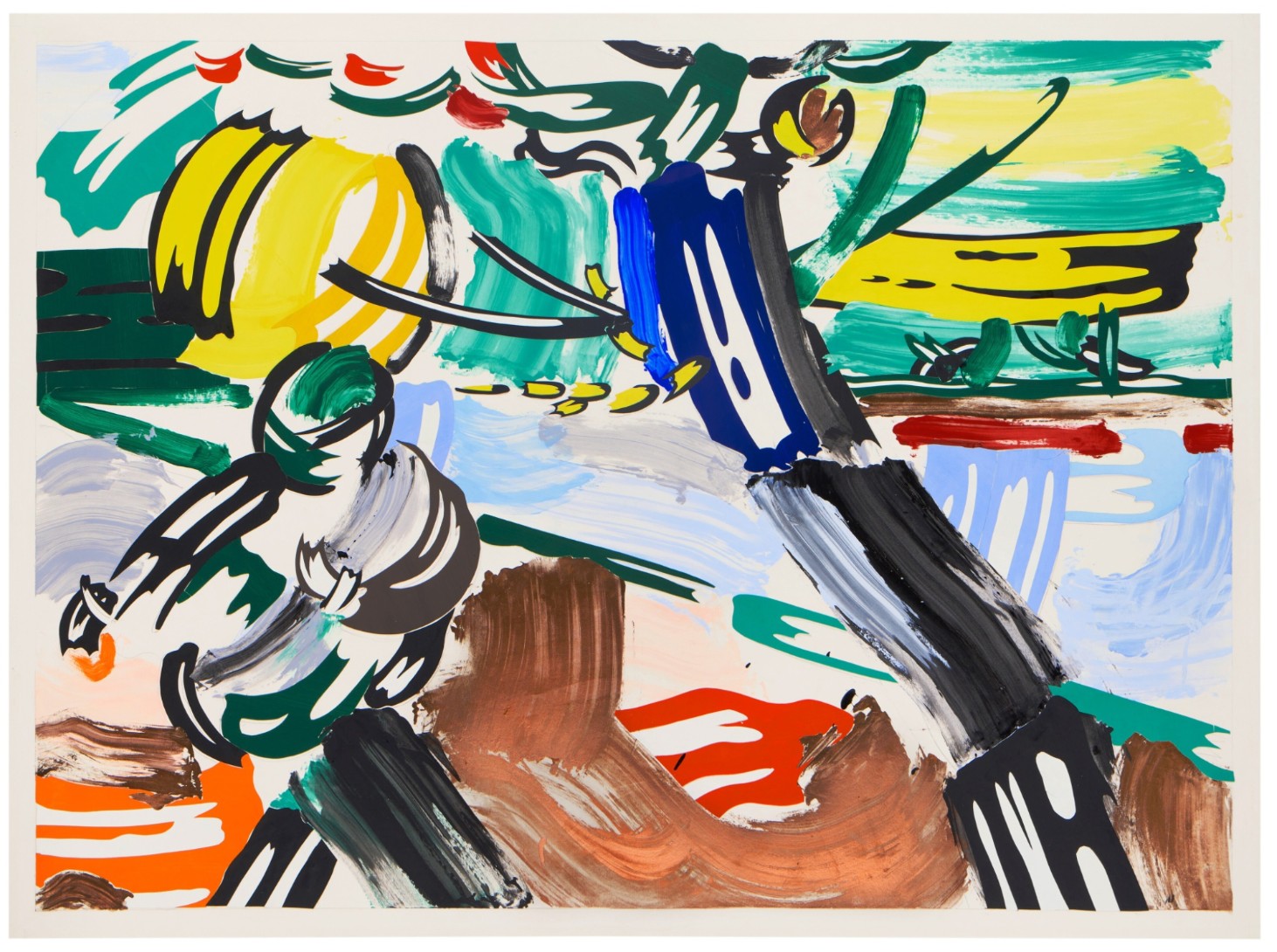
ROY LICHTENSTEIN (1923 – 1997)
The Sower (Study), 1984
Cut painted paper, cut printed paper, cut paper, acrylic and graphite on paperboard
Image: 38 1/4 x 52 1/2 inches (97.2 x 133.3 cm)
Paperboard: 40 3/4 x 55 1/8 inches (103.5 x 140 cm)
Signed and dated ’84 (on the verso)
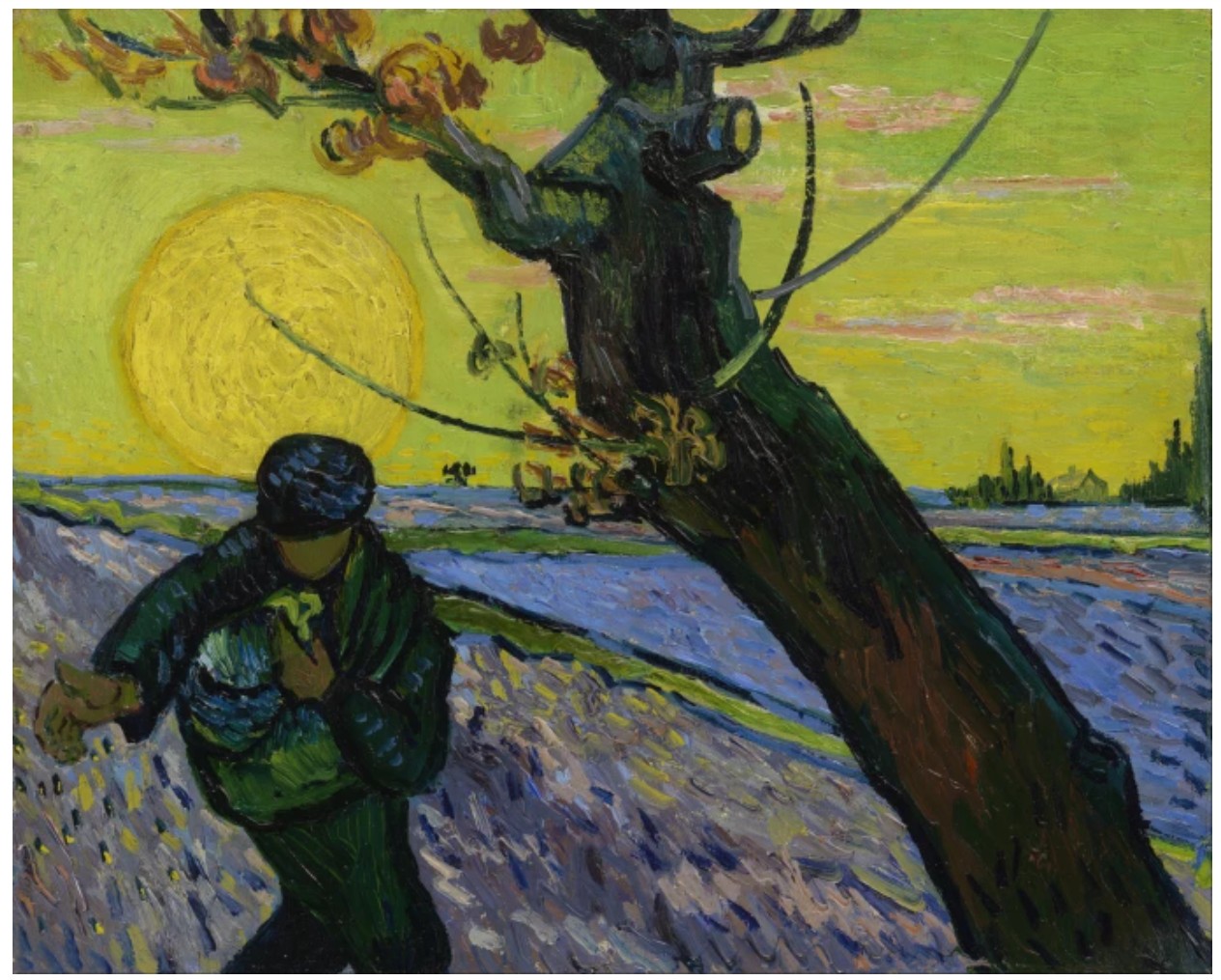
Vincent van Gogh, The Sower, 1888. Van Gogh Museum, Amsterdam.