I Love Liberty (Study), 1981
Christie’s New-York: 17 May 2024
Estimated: USD 600,000 – 800,000
USD 2,349,000
ROY LICHTENSTEIN (1923-1997), I Love Liberty (Study) | Christie’s (christies.com)

ROY LICHTENSTEIN (1923-1997)
I Love Liberty (Study), 1981
Painted and printed paper collage and graphite on paperboard
Image: 25 3/4 x 17 inches (65.4 x 43.2 cm)
Sheet: 34×25 inches (86.4 x 63.5 cm)
Signed and dated ‘rf Lichtenstein ’81’ (lower right)
Signed again and dated again ‘rf Lichtenstein ’81’ (on the reverse)
Undoubtedly one of the most recognizable names in American Pop, Roy Lichtenstein’s seemingly autonomous style reframed commercial imagery and print media in an effort to fully entwine the aesthetics of popular culture with the formalist concerns of mid-century Modernism. I Love Liberty (Study) is a key illustration of Lichtenstein’s ability to vacillate between traditional techniques and mechanical methods as he leverages his own visual vocabulary.
“My use of evenly repeated dots and diagonal lines and uninflected color areas suggest that my work is right where it is, right on the canvas, definitely not a window into the world.”
Bringing attention to the surface of the work and the abstract qualities of simplified shading and pattern, he narrowed the divide between print media and the annals of art history.

Rendered in a vertical orientation, I Love Liberty (Study) features a close crop of America’s most patriotic figure: the Statue of Liberty. Featuring a side profile of the crowned woman, a glimpse of her left hand and tablet, and part of her right hand holding the iconic flaming torch, Lichtenstein’s subject is immediately apparent. Set against an even, ordered background of diagonal blue and white stripes, the artist has simplified the scene down to blocks of black, white, and yellow with a touch of red in the torch’s fire. The sharp edges of the cut paper and Lichtenstein’s own bold painting style line up perfectly so that the entire composition exudes a dynamic, optically imposing air. By doing so, he separates the subject matter from reality and pushes it toward the realm of symbolism.

Roy Lichtenstein, Painting with Statue of Liberty, 1983. National Gallery of Art, Washington, DC. © Estate of Roy Lichtenstein. Photo: National Gallery of Art.
The present example is a rare look into Lichtenstein’s meticulous working process. Though his finished compositions were sharp, clean, and had all the finish of a mechanically printed page, the artist often carefully hand-cut and rendered his works to mimic the precision of commercial processes, and I Love Liberty (Study) is made up of various collaged paper elements. Executed by the artist for Norman Lear’s I Love Liberty TV special in 1982 (produced to mark George Washington’s 250th birthday) the sharpness and vivid presence of Lady Liberty is thanks to Lichtenstein’s painstaking preparatory work.

Promotional poster for “I Love Liberty,” ABC TV, 1982
I Love Liberty (Study) is a poignant addition to Lichtenstein’s oeuvre as it takes a familiar image and reframes it in his own signature manner. “I don’t think the importance of the art has anything to do with the importance of the subject matter,” the artist once noted. “I think importance resides more in the unity of the composition and in the inventiveness of perception” (Ibid., p. 128). Recasting Lady Liberty in blocks of color against a striped background that vibrates in our vision, the artist asks for a reconsideration of the American symbol and forces us to reexamine something we might think we already know.
I Love Liberty (Study), circa 1982
Works from the Collection of Dorothy and Roy Lichtenstein
Sotheby’s New-York: 21 November 2024
Estimated: USD 350,000 – 450,000
USD 780,000
WORK ON PAPER
I Love Liberty (Study) | Contemporary Day Auction | 2024 | Sotheby’s
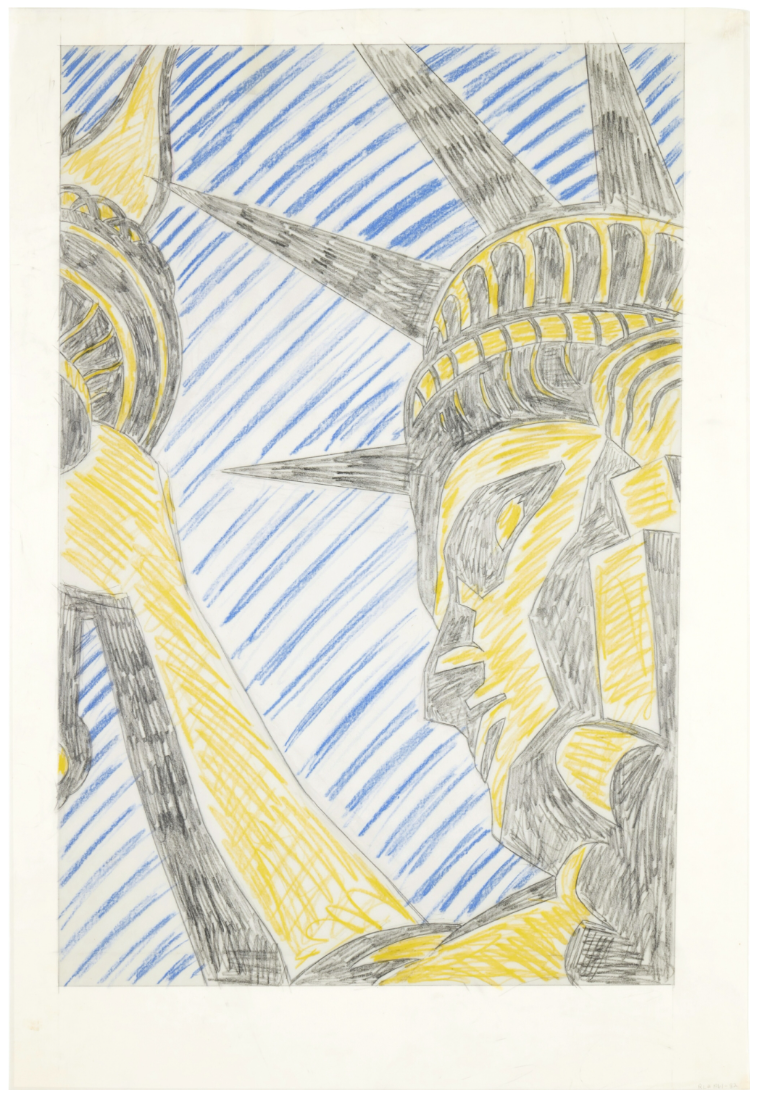
ROY LICHTENSTEIN (1923 – 1997)
I Love Liberty (Study), circa 1982
Colored pencil and graphite on tracing paper
Image: 26×17 inches (66 x 43.2 cm)
Sheet: 30 x 20 1/2 inches (76.2 x 52.1 cm)
Capturing one of America’s most enduring symbols, I Love Liberty sees Pop Art pioneer Roy Lichtenstein distilling the aesthetic and ideological ambitions that define his oeuvre. Executed in 1982, the present work embodies Pop Art’s foundational ethos of blurring the boundaries between high and low culture through a refined semiotic examination of contemporary visual culture. Created as a study for a promotional poster and screenprint to be published in conjunction to the ABC patriotic broadcast of the same name created by Norman Lear and his advocacy group People for the American Way, I Love Liberty engages with American national symbolism, presenting a nuanced exploration of identity, commodification, and the spectacle of representation in a media-saturated age. Testifying to the present work’s significance within the artist’s acclaimed oeuvre, screenprints of I Love Liberty are housed in the permanent collections of such prestigious American institutions as the National Gallery of Art in Washington D.C., the Whitney Museum of American Art, the Pennsylvania Academy of Fine Arts, among others. Further attesting to its singular importance within the artist’s prolific oeuvre, the present work bears exceptional provenance, emerging from the esteemed Collection of Dorothy and Roy Lichtenstien.
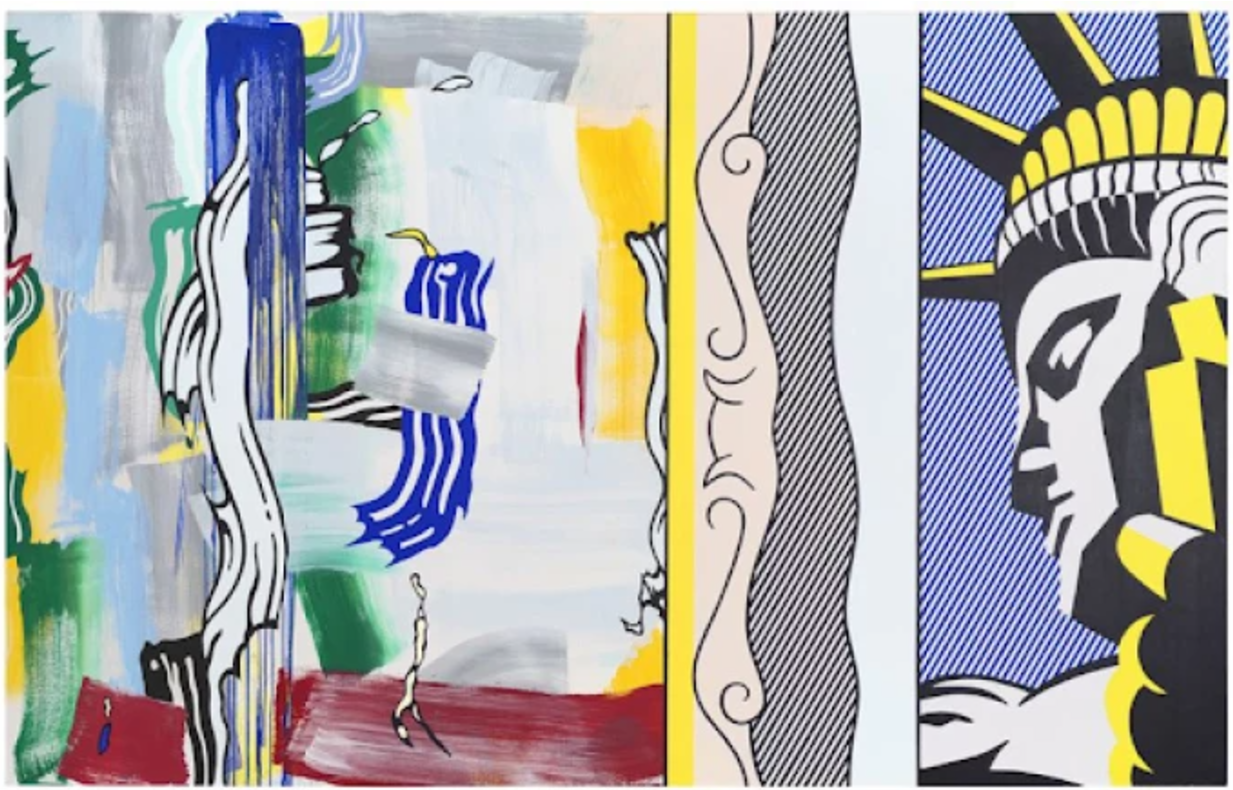
Roy Lichtenstein, Painting with Statue of Liberty, 1983. The National Gallery of Art, Washington DC. © Estate of Roy Lichtenstein
The composition of the present work guides the viewer’s gaze upward towards a monumentalized visage of Lady Liberty, rendered in a strikingly bold yellow that disrupts traditional representations of the statue’s patina, imbuing her with an almost artificial, constructed vibrancy. This vibrant hue, juxtaposed against sweeping diagonals of blue, echoes the structure of the American flag while simultaneously abstracting it. In this work, Lichtenstein elevates the Statue of Liberty beyond conventional patriotic iconography, transforming her into a layered semiotic symbol steeped in historical resonance and cultural reflection.
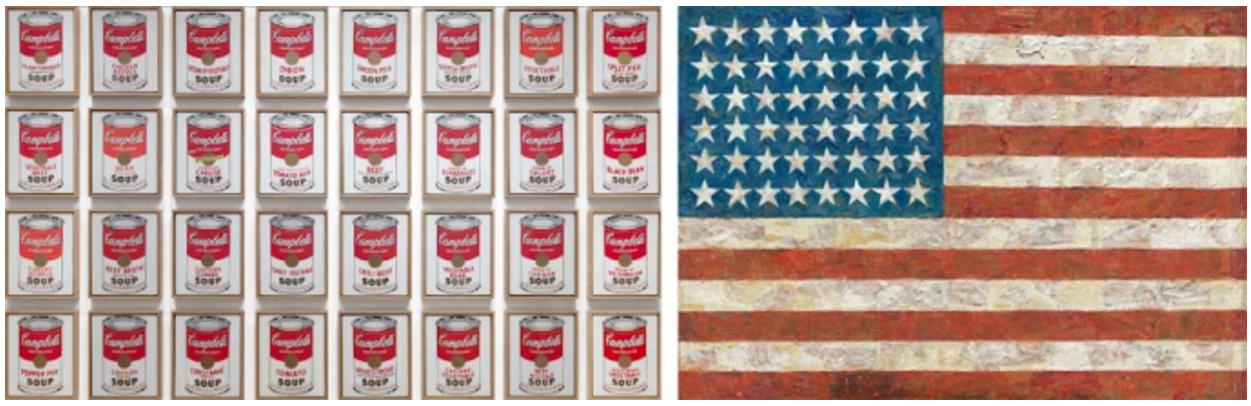
Left: Andy Warhol, Campbell’s Soup Cans, 1962. The Museum of Modern Art, New York. © 2024 Andy Warhol Foundation / ARS, NY / ™ Licensed by Campbell’s Soup Co. All rights reserved.
Right: Jasper Johns, Flag, 1954-55. The Museum of Modern Art, New York. © 2024 Jasper Johns / Licensed by VAGA at Artists Rights Society (ARS), NY
Lichtenstein’s I Love Liberty exemplifies the artist’s masterful ability to vacillate between traditional techniques and mechanical methods, leveraging his own unique visual lexicon to bridge the divide between print media and art history to recontextualize American iconography within a Pop Art framework. His process combines hand drawn elements with a precise, mechanical appearance of flattened color fields and graphic outlines, marrying the aesthetic of mass produced imagery with the nuance of painterly intervention. The subject work offers a rare glimpse into Lichtenstein’s technical process, as the study forgoes Lichtenstein’s typical sharp, clean and purely mechanical finished compositions. In the subject work, Lichtenstein’s application of flattened planes and stark, graphic outlines, amplifies the statue’s visual power while simultaneously, subtly diminishes her symbolic gravitas – framing her as a consumable image within the visual lexicon of twentieth-century America. In positioning Lady Liberty as both a revered icon and a reflection on idealism shaped by media and consumer aesthetics, Lichtenstein brilliantly bridges the individual and collective American experience. I Love Liberty, which so deftly balances both reverence and critical reflection, draws from influences spanning American visual culture, print media, and art historical iconography, situating Lichtenstein within the broader lineage of artists who interrogate the evolving role of symbols in the public consciousness.