WORK IN PROGRESS
Introduction
Throughout the course of his career, Roy Lichtenstein reinvented his signature Pop Art idiom in countless ways, finding ingenious solutions to the age-old problem of creating new work whilst adhering to his established artistic vernacular. In the 1970s, the artist tackled Modern art in his quest for reinvention, delving deep into Cubism, Surrealism, Futurism, and in German Expressionism.
Lichtenstein’s Expressionist series comprises a relatively small group of paintings executed between 1979 and 1980. The impetus for the series lay in Lichtenstein’s discovery of an excellent collection of German Expressionist woodcuts belonging to the Los Angeles collector Robert Rifkind. The collection included works by Emil Nolde, Otto Dix, Max Pechstein and Ernst Ludwig Kirchner, who together formed the influential Die Brücke group. A truly avant-garde movement, the Expressionist artists of Die Brücke had organized in Dresden, Germany in 1905. They portrayed the angst of the modern era, using harsh, angular forms and wild, unnatural colors. They employed the visual language of abstraction as a way to express a deeper, more meaningful portrayal of the modern world.
While the artists of Die Brücke deliberately employed a language of abstraction in direct challenge to the prevailing norms of the artistic establishment, their work had, by the time Lichtenstein developed an interest in it, been reproduced in countless books and magazines. Lichtenstein was quick to observe that, in the collection of Expressionist woodcuts that inspired him, the once-radical visual language of abstraction employed by Die Brücke had been watered down for easy legibility, essentially becoming a parody of what had once been considered earth-shattering. Having been distilled within the neat format of the humble woodcut, the visual impact had been reduced to “modernist wallpaper.” Lichtenstein, too, knew the horrors of this phenomenon all too well, as he was witness to the proliferation of his own Pop art paintings on the covers of magazines, in posters, tote bags, key chains and countless other tchotchkes that boiled down Pop until it had nearly lost its once incendiary impact. In turning to Expressionism, Lichtenstein wrestled with the legacy of Pop, ultimately finding an ingenious, self-referential solution to the problem.
German Expressionism exploded onto the scene of European Modernism early in the twentieth century; spearheaded by such masters as Max Beckmann, Otto Dix, George Grosz, Ernst Ludwig Kirchner, Franz Marc, and Emil Nolde, the movement initially represented a call to return to nature, with many of the movement’s best-known images featuring a reinterpretation of pastoral scenes and animal life. Following the atrocities of World War I, however, the bent of the movement shifted to a new, more psychologically charged artistic language that comprised distorted forms, harsh, jagged lines, and a bold use of color.
Auction Results
#1. Deep in Thought, 1980
Christie’s New-York: 15 May 2019
Estimated: USD 4,000,000 – 6,000,000
USD 6,631,000
Roy Lichtenstein (1923-1997), Deep in Thought | Christie’s
REPEAT SALE
Christie’s New-York: 10 November 2010
Estimated: USD 2,500,000 – 3,500,000
USD 1,986,500
Roy Lichtenstein (1923-1997) , Deep in Thought | Christie’s
ROY LICHTENSTEIN (1923-1997)
Deep in Thought, 1980
Oil and Magna on canvas
50×60 inches (127 x 152.4 cm)
Signed and dated ‘© rf Lichtenstein ’80’ (on the reverse)
#2. Dr. Waldmann, 1979
Sotheby’s New-York: 14 November 2019
Estimated: USD 4,000,000 – 6,000,000
USD 5,959,000
(#33) ROY LICHTENSTEIN | Dr. Waldmann
ROY LICHTENSTEIN
Dr. Waldmann, 1979
Oil and Magna on canvas
60×50 inches (152.4 x 127 cm)
Signed and dated 79 on the reverse
#3. The Prisoner, 1980
Christie’s New-York: 13 May 2014
Estimated: USD 2,500,000 – 3,500,000
USD 5,093,000
Roy Lichtenstein (1923-1997) , The Prisoner | Christie’s
ROY LICHTENSTEIN (1923-1997)
The Prisoner, 1980
Oil and Magna on canvas
60×40 inches (152.4 x 101.6 cm)
Signed and dated ‘(c) rf Lichtenstein ’80’ (on the reverse)
#4. Expressionist Head, 1980
Sotheby’s New-York: 12 May 2010
Estimated: USD 3,500,000 – 5,500,000
USD 4,282,500
ROY LICHTENSTEIN
Expressionist Head, 1980
Oil and magna on canvas
72×60 inches (182×152 cm)
Signed and dated 80 on the reverse
#5. Blue Head, 1979
Christie’s New-York: 13 November 2014
Estimated: USD 3,000,000 – 5,000,000
USD 3,301,000
Lichtenstein, Roy (1923-1997), Blue Head | Christie’s
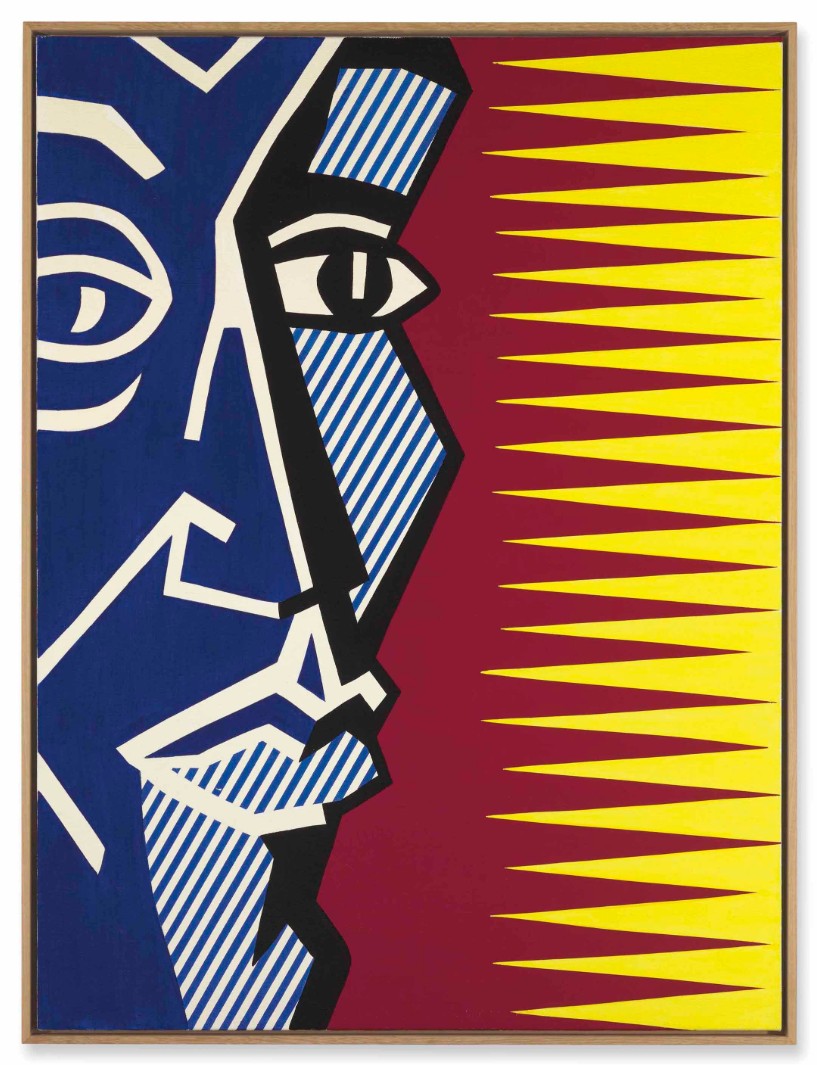
ROY LICHTENSTEIN (1923-1997)
Blue Head, 1979
Oil and Magna on canvas
48×36 inches (121.9 x 91.4 cm)
Signed and dated ‘? rf Lichtenstein ’79’ (on the reverse)
#6. Despair, 1979
Christie’s New-York: 15 November 2016
Estimated: USD 1,500,000 – 2,500,000
USD 1,927,500
Roy Lichtenstein (1923-1997), Despair | Christie’s
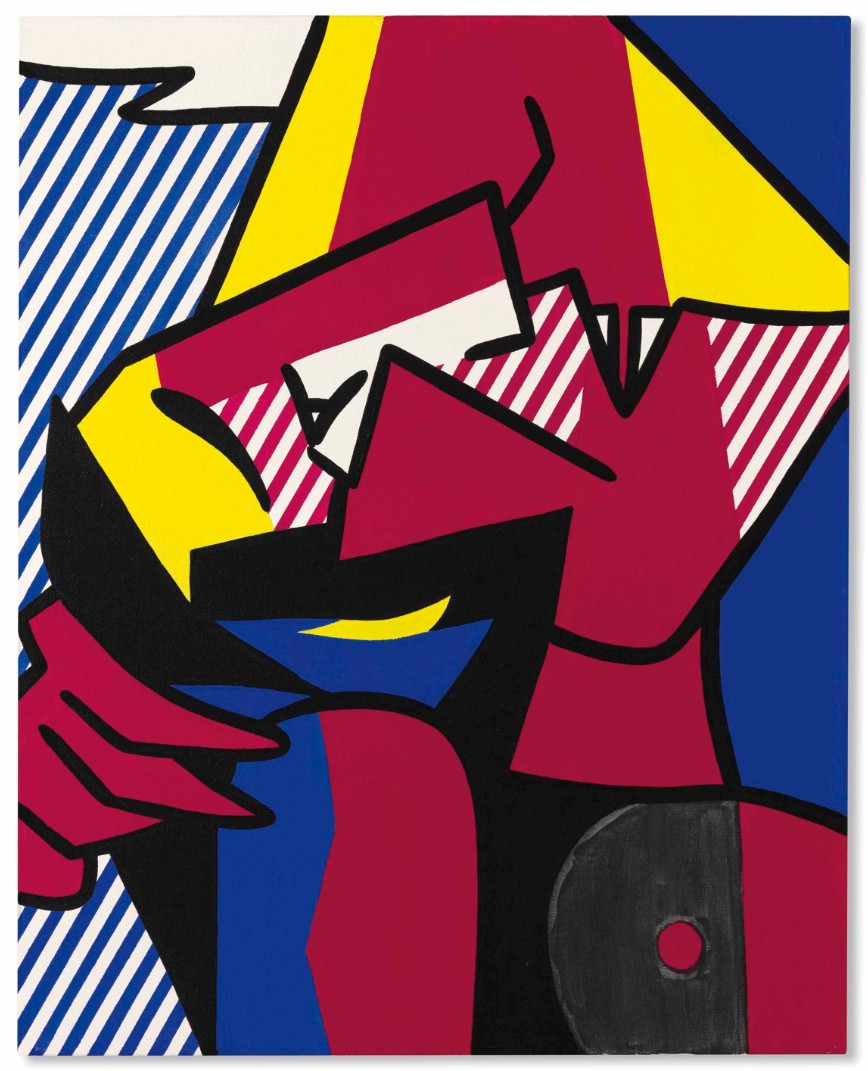
ROY LICHTENSTEIN (1923-1997)
Despair, 1979
Oil and Magna on canvas
30×24 inches (76.2 x 61 cm)
Signed and dated ‘rf Lichtenstein ’79’ (on the reverse)
Deep in Thought, 1980
Deep in Thought, 1980
Christie’s New-York: 15 May 2019
Estimated: USD 4,000,000 – 6,000,000
USD 6,631,000
Roy Lichtenstein (1923-1997), Deep in Thought | Christie’s
REPEAT SALE
Christie’s New-York: 10 November 2010
Estimated: USD 2,500,000 – 3,500,000
USD 1,986,500
Roy Lichtenstein (1923-1997) , Deep in Thought | Christie’s
ROY LICHTENSTEIN (1923-1997)
Deep in Thought, 1980
Oil and Magna on canvas
50×60 inches (127 x 152.4 cm)
Signed and dated ‘© rf Lichtenstein ’80’ (on the reverse)
Provenance
Leo Castelli Gallery, New York
Mayor Gallery, London
Private collection, Florida
Anon. sale; Sotheby’s, New York, 13 November 1991, lot 53
Private collection, United States
Anon. sale; Christie’s, New York, 10 November 2010, lot 71
Gagosian Gallery, New York
Acquired from the above by the present owner
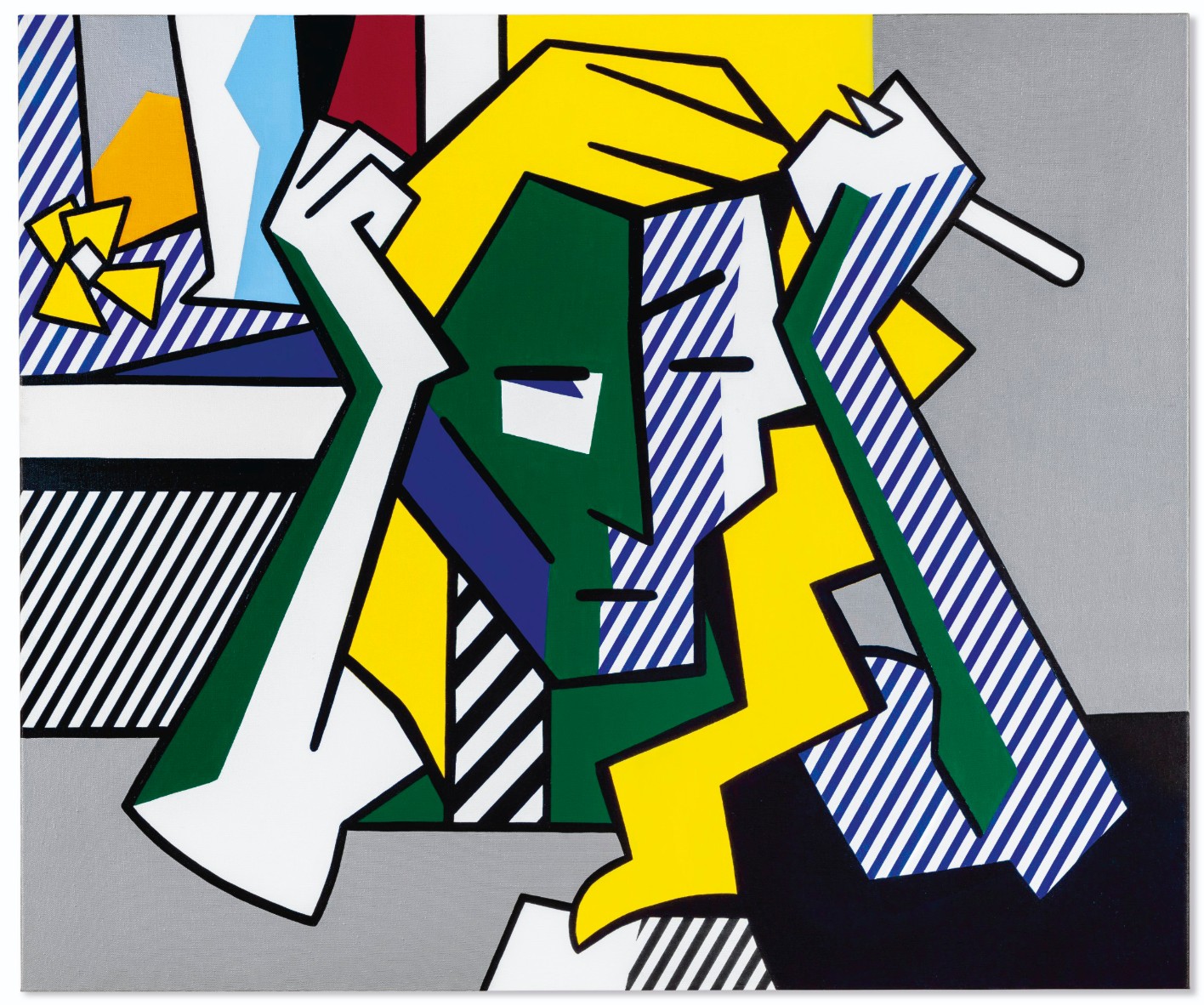
Painted in 1980, Deep in Thought distills the pictorial innovations of the German Expressionist painters through a distinctively Pop Art lens, where sharp, raking diagonals and a striking palette of vivid hues come together to create a stunning portrait of the artist’s process. Head in hands, the solitary human figure is seated before the viewer, locked within the interior processes of the mind. Here, Lichtenstein’s familiar blonde heroine is rendered in the sharp diagonal contours and distinctive color palette pioneered by Die Brücke artists Emil Nolde and Ernst Ludwig Kirchner. Seated before the viewer looms an enigmatic, brooding figure, whose sharp, angular features are rendered in flat planes of unmodulated color and muscular black outlines. The figure’s face is all angles and sharp points, bisected by a strong black line running down the center of the face, dividing it in two halves of raking light on one side and shadow on the other. In Lichtenstein’s hands, a series of blue and white diagonal lines illuminate the figure’s face and arm, while shadow is conveyed by flat areas of green. Here, Lichtenstein’s consummate skill as a brilliant colorist is unfurled to spectacular display, as the marriage of blue, green, yellow, white and black is uniquely beautiful. Head in hands, Lichtenstein’s figure wears an expression of deep contemplation, while the tools of her trade—pencil and paper—remain ominously blank. Behind her looms the ultimate expression of her life’s work, a finished painting, framed and hung upon the wall. Locked within the situation that all artists and writers fear, the figure struggles to capture the nascent seeds of inspiration, wrestling within the recesses of her own mind. A cascading zigzag of yellow hair reaches down to touch the empty sheet. Could this be the thunderbolt of illumination striking at last?
Deep in Thought belongs to a subset of Expressionist portraits that portray the solitary human figure, a subject so dear to the German Expressionists as to now be reduced to visual cliché. Lichtenstein’s portrayal takes this notion one step further, presenting an epic visual allegory of the modern artist’s struggle for inspiration. “Where the rest of us have basic needs, the artist has ‘vision,’” the prominent British art historian Charles Harrison described (C. Harrison, quoted in op. cit., 2013, p. 16), setting the role of the artist apart from the everyday world. In doing so, Lichtenstein’s Deep in Thought is a humorous reference to the perils of artisthood, where the daily struggle for inspiration and enlightenment is rendered in the artist’s wry wit.
Dr. Waldmann, 1979
Dr. Waldmann, 1979
Sotheby’s New-York: 14 November 2019
Estimated: USD 4,000,000 – 6,000,000
USD 5,959,000
(#33) ROY LICHTENSTEIN | Dr. Waldmann
ROY LICHTENSTEIN
Dr. Waldmann, 1979
Oil and Magna on canvas
60×50 inches (152.4 x 127 cm)
Signed and dated 79 on the reverse
Provenance
Estate of Roy Lichtenstein, New York
Acquired by the present owner from the above in 2006
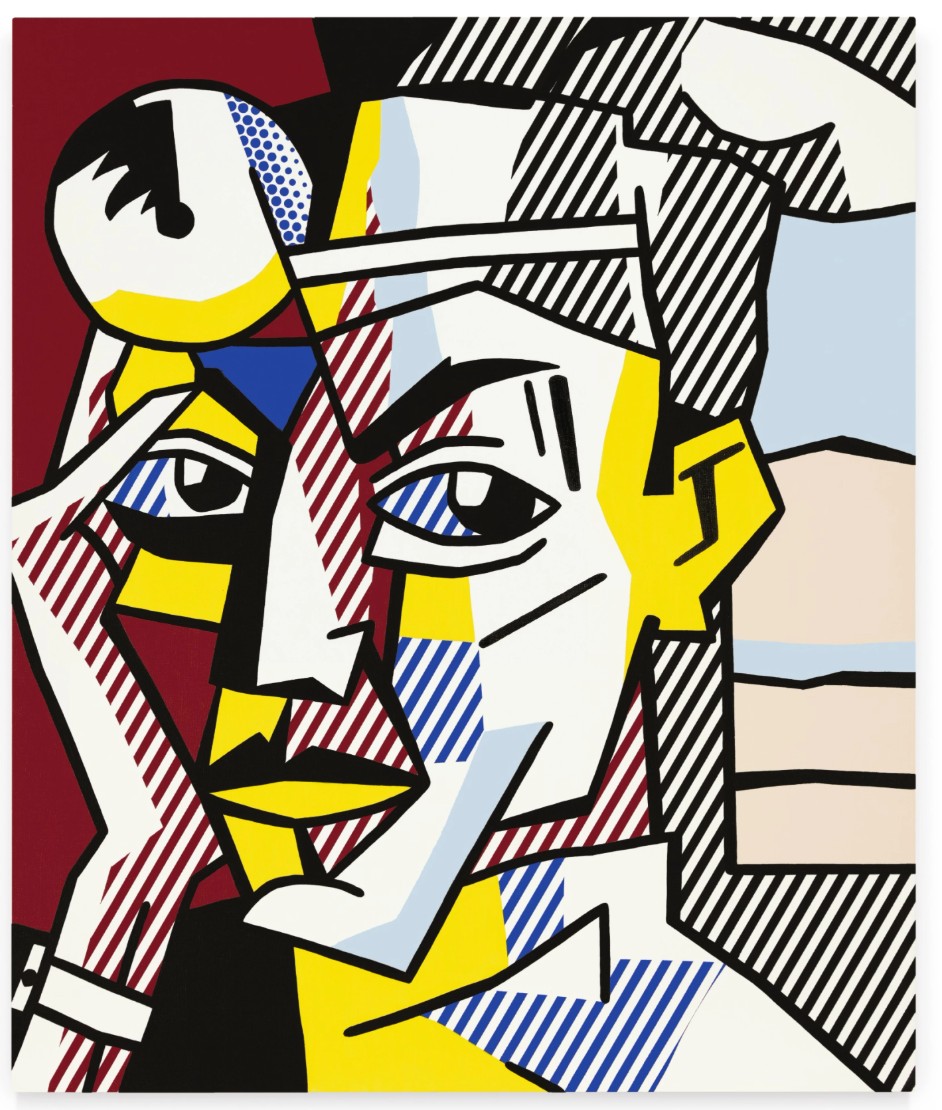
A stunning depiction and emblematic portrait from Roy Lichtenstein’s corpus of German Expressionist-inspired paintings, Dr. Waldmann represents the ultimate crescendo of the artist’s pioneering investigation into the nature of painting itself throughout the twentieth century. Beginning in 1974, Lichtenstein turned away from the comic book and advertising source material that had established him as a star of the Pop Art movement, and instead began engaging with significant artistic movements including Cubism, Futurism, Surrealism, and German Expressionism. Using crisp lines and vivid color, Lichtenstein established a style that combined the Pop Art aesthetic with techniques from the past, ultimately heralding his ultimate subject: art about art. Fixing the viewer with an intense gaze that is utterly elusive, the subject of the present work, Dr. Waldmann, embodies the ultimate crystallization of Lichtenstein’s engagement with the enduring genre of portraiture. Dr. Waldmann has been widely exhibited at esteemed museums worldwide, including the Solomon R. Guggenheim Museum in New York, the Seattle Art Museum, Whitney Museum of American Art in New York, the Museum of Contemporary Art in Los Angeles, and the Fort Worth Art Museum. Acquired directly from the Estate of Roy Lichtenstein in 2006, Dr. Waldmann emerges today as a masterpiece of unparalleled formal elegance and conceptual sophistication that fuses diverse artistic lexicons in captivating dialogue between past and present. In addition to reviving German Expressionism, a movement that sought to challenge society, and instead privilege the individual’s feelings and psychological interiority, Lichtenstein pays homage with Dr. Waldmann to a significant touchstone of modern European culture: Mary Shelley’s Frankenstein. Although an English author, Mary Shelley sets a large part of her story in Germany, an environment that serves as the fountainhead for the titular character’s creativity. While studying in Germany, Dr. Frankenstein spends time with and becomes inspired by his professor Dr. Waldman, a name carefully chosen for its etymology; ‘Wald’ means forest or wood, and juxtaposed with man, evokes an individual tethered to nature. Themes of nature and creation permeate the story, just as they permeate the movement of German Expressionism, and are nodded to here in the subject matter and title, Dr. Waldmann.
Articulated in a minimal palette of yellow, blue, black, and red, Lichtenstein brings together his iconic Benday dots and Pop sensibility with the technique and geometric angularity of the German Expressionist woodblocks. The head of Dr. Waldmann dominates the composition, unfurling in a collision of facets that reveals Lichtenstein’s foray into Cubism by suggesting multiple flattened points of view. Lichtenstein articulates his subject’s face with his signature use of graphic black lines, here employed to delineate between the various planes that crash together to build up his subject. Diagonal lines of an Yves Klein-esque blue and rich red angle downward in sharply rendered striations, recalling the grain of wood inherent to the original German Expressionist prints. The passages of unmodulated color and slants of woodblock-like orthogonals bring to life the doctor’s craggy countenance of strong jaw, furrowed brow, and deep-set eyes; however, Lichtenstein denies any true perspective or depth by bringing his subject right to the fore. Aside from a hint of a window overlooking a calm seascape, the hermetic doctor’s surroundings are entirely illegible. Fundamental to portraiture of past centuries are the accoutrements and symbols that bring to life the sitter’s status or position; here, Lichtenstein adorns Dr. Waldmann with the head mirror so prototypical of an early twentieth-century audience’s understanding of the medical profession. The white band affixed to the mirror slants across Dr. Waldmann’s head, creating a sharp line that contrasts with the rounded form of the mirror itself, which recalls Lichtenstein’s earlier series of Mirror paintings. The abstracted mirror, which is the only passage featuring Lichtentein’s iconic Benday dots, refers to the canonical use of mirrors throughout art history as well as the artist’s own frequent inclusion of mirrors as compositional elements in his earlier paintings. Offering an updated articulation of the roles of vision and perception within art, here, Lichtenstein’s mirror serves as a signifier of the sitter’s profession, while simultaneously emphasizing the artist’s own backward glance at artistic precedent.
As Lichtenstein looked to reinvigorate the past, so too the German Expressionists sought to bring life to the timeless subjects of portraiture and landscape through the use of the woodblock. Within this fascinating tableau of reimagined Modernism, however, Dr. Waldmann pays unique and reverential tribute to the celebrated oeuvre of Otto Dix, in particular the artist’s masterpiece from 1926, Dr. Mayer-Hermann, which resides in the Museum of Modern Art in New York. Dix’s painting similarly offers an intense psychological portrait of a doctor lost in thought; Dr. Mayer-Hermann slouches forward, his environment slightly more descriptive, but ultimately dislocated in a room of unidentifiable machinery. His head mirror features prominently, signaling his profession and echoing the rounded orbs of machinery and the sitter’s rotund body. In stark contrast to the paunchy and softened expression of Dr. Mayer Hermann, Dr. Waldmann thrusts outward, forcing himself to the surface of the picture plane, and confronts the viewer with a violent collision of line, color, and jagged angles reminiscent of the German Expressionists woodblocks. Lichtenstein himself, however, denied any direct correspondences between his German Expressionist paintings and singular sources of inspiration; in his own words:
“I began to work on a series of paintings inspired by German Expressionism. I didn’t quote specific pieces as I had done with earlier works derived from Monet and Picasso; but I did keep in mind such artists as Karl Schmidt-Rotluf and Erich Heckel. In a certain sense, I have always tried to eliminate the meaning of the original. If I had actually kept in mind German Expressionism in my latest series of paintings, then my work would have seemed to be expressionist. But for my own subjects I make use of a style rather than a specific painting.”
With Dr. Waldmann and his German Expressionist works, Lichtenstein engages art history as his subject matter with striking prowess, systematically reimagining this critical twentieth-century movement to compose his own, utterly original masterwork.
The Prisoner, 1980
The Prisoner, 1980
Christie’s New-York: 13 May 2014
Estimated: USD 2,500,000 – 3,500,000
USD 5,093,000
Roy Lichtenstein (1923-1997) , The Prisoner | Christie’s
ROY LICHTENSTEIN (1923-1997)
The Prisoner, 1980
Oil and Magna on canvas
60×40 inches (152.4 x 101.6 cm)
Signed and dated ‘(c) rf Lichtenstein ’80’ (on the reverse)
Provenance
Leo Castelli Gallery, New York
Private collection, St. Louis
Larry Gagosian Gallery, Los Angeles
Acquired from the above by the present owner, 1981
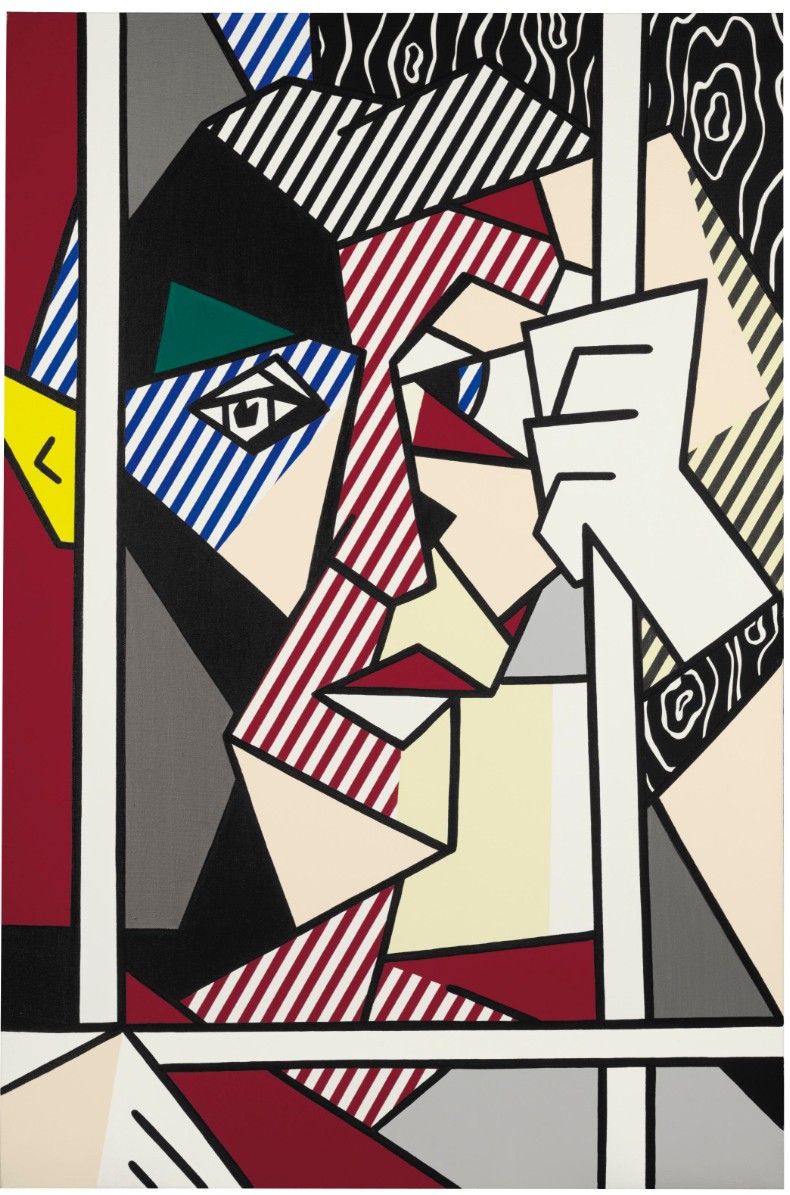
Roy Lichtenstein’s The Prisoner embodies a subject that lay at the centre of the American pop pioneer’s work from the beginning: that of art itself. From the early appropriation of cartoon imagery, to the spare renditions of still, calm Chinese landscapes of his latter years, Lichtenstein explored the power and breadth of visual language with his own distinctive and implacable style. Here, Lichtenstein skilfully reinterprets artistic tropes typical of the German Expressionist artists of the early twentieth century to create a striking image that is still unambiguously the work of one of the foremost figures of American Pop Art. Depicting the drawn face of an imprisoned man staring mournfully out from behind a grid of white bars, The Prisoner is a well-observed parody of an Expressionist woodcut. A bold intervention on the sacrosanct realm of “expression” in art, it questions the heartfelt, handmade creativity that has been at the core of much of modern art. Executed with meticulous technical skill and flawless finish, The Prisoner shows a recognisably Expressionist artistic style and subject transformed into the language of mass-produced visual material. Dominated by pure applications of black and white, and enlivened by select touches of primary colour, Lichtenstein has presented the emotive narrative content and angst-ridden mark making typical of this genre in the flat blocks of colour, diagonal stripes and reductive palette more commonly associated with impersonal commercial imagery. The Prisoner’s angular features and unbridled expressive energy of the crosshatching may have been tamed, but its Expressionist origins remain clear, and the emotive charge of the image remains strong.
During a trip to Los Angeles in 1978, Lichtenstein became fascinated by collector Robert Rifkind’s German Expressionist prints, which featured work by the foremost members of Die Brücke group, such as Emil Nolde, Max Pechstein, Otto Dix and Ernst Ludwig Kirchner, as well as work by Der Blaue Reiter, such as Franz Marc and Wassily Kandinsky. Integral to their philosophy was the idea, articulated here by Kirchner, of “a physical and spiritual freedom opposed to the values of the comfortably established older generation” (E. Kirchner, quoted in Lichtenstein Expressionism, Paris, 2013, p. 16), while their aesthetic was characterized by flatness, and a leveling of the picture plane, heightened through their favored medium of woodcut. The bohemian, free-spirited lifestyle that these artists embodied, intriguingly expressed in this particular style offered Lichtenstein the perfect paradox to explore. As Hans Ulrich Obrist has said of this visit; “his interest surely had something to do with the sense of flatness in the German Expressionist prints he saw there. In all of Lichtenstein’s work there is a flatness. The brushstrokes have simply disappeared. Even when he made his Brushstroke Series, he painted a “metabrushstroke”, but it is still flat. When you think about Expressionism through this sensibility, wellit is a kind of oxymoron, two things that don’t belong together.” (H. Ulrich Obrist, quoted in Lichtenstein Expressionism, Paris, 2013, p. 28).
Shortly after, Lichtenstein began to produce works that borrowed certain stylistic elements from these artists, such as a pattern of wood grain, the jagged division of the picture plane, the thick black outlines of an image, and the flat application of strong, non-natural color. Lichtenstein even went on to make a series of woodcuts; Expressionist Woodcut Series, published the same year that The Prisoner was painted.
Although famous for bringing popular culture into the sanctified realm of “high art” by combining parochial subject matter with formal discipline, Lichtenstein was always keen to emphasise that he had always been critically engaged with his art historical predecessors. In 1962 he produced two works after cheap reproductions of Cézanne paintings, found in art history manuals, and in 1963 Lichtenstein translated Picasso’s Women of Algiers, 1955 (itself based on an 1834 painting by Eugene Delacroix) into Femme d’Alger, openly acknowledging how he saw him as the greatest artist of the twentieth century. Rethinking the work of those he respected most was a way of coping with that admiration, learning from them, and ultimately, making them his own. As he said: “[Since 1963] instead of using subject matter that was considered vernacular, or everyday, I used subject matter that was celebrated as art. What I wanted to express is not that Picasso was known and therefore commonplace. Nobody thought of Picasso as common. What I am painting is a kind of Picasso done the way a cartoonist does it, or the way it might be described to you, so it loses the subtleties of Picasso, but it takes on other characteristics; the Picasso is converted to my pseudo-cartoon style and takes on a character of its own” (R. Lichtenstein, quoted in G. Mercurio, Lichtenstein: Meditations on Modern Art, exh. cat., Triennale di Milano, Milan, 2010, p.137).
In 1974 Lichtenstein began to concentrate entirely on the concept of artistic style, and over the next decade, all his series of works played with the most recognisable traits of art movements that had dominated the twentieth century–employing his cartoon style to caricature Piet Mondrian’s abstractions, Art Deco design, Willem de Kooning’s gestural abstract paintings, and later, Futurism, Cubism and Surrealism. Using his experience of working with visual stereotypes in popular culture, he brought his formal understanding, technical acumen and wry sense of humour to analysing the methods, theories, subject and techniques that made some of his predecessors such memorable artists. By turning his acutely analytical eye from stereotypes in popular, mass-media imagery onto this venerated territory, Lichtenstein became astute at anticipating the precise moment when an expressive impulse becomes a stylistic trait. His intent was far from iconoclastic, however. Despite their gently humorous undertone, Lichtenstein was adamant that these works stemmed from a deep respect for his predecessors, and how they manipulated or took possession of certain formal qualities in order to convey particular messages.
Above all, Lichtenstein was motivated by a desire to probe the idea of visual symbols, and explore how meaning can be conveyed through the transformative act of applying paint onto a surface. Speaking in the 1960s, Lichtenstein had insisted: “I’m very much concerned with getting my own work to be a work of art, so that it has a sort of rebuilding aspect to it also. So, it’s completely rearranged; it has become commercialized because the style that I switch it into is one of commercializationBut the result that I work toward is one of creating a new work of art which has other qualities.” (R. Lichtenstein, quoted in J. Coplans (ed). Roy Lichtenstein, New York, 1972, p. 68.) Two decades later, having explored popular imagery, he remained convinced that one of the most powerful ways in which visual conventions can operate was in art itself. In creating respectful pastiches such as The Prisoner, Lichtenstein was breaking down revered stylistic and intellectual idioms into their composite parts, rebuilding them into a new work of art that is unequivocally his own.
Expressionist Head, 1980
Expressionist Head, 1980
Sotheby’s New-York: 12 May 2010
Estimated: USD 3,500,000 – 5,500,000
USD 4,282,500
ROY LICHTENSTEIN
Expressionist Head, 1980
Oil and magna on canvas
72×60 inches (182×152 cm)
Signed and dated 80 on the reverse
Provenance
Leo Castelli Gallery, New York (LC# 857)
Private Collection, Texas
Greenberg Van Doren, New York
Private Collection, New York
Private Collection, Florida
Expressionist Head from 1980 emerges at the end of an important period of creativity for Roy Lichtenstein. In the 1970s, the artist shifted his attention away from the comic and advertising inspired paintings of the 1960s which had established him as a star in the Pop art movement. Lichtenstein now turned to the nature of painting itself by contemplating the great artists and movements of the 20th century. The works executed between 1974 and 1980 engage with the dynamics and mechanics of Futurism, Surrealism, and German Expressionism. With bold line and vivid color, Lichtenstein created a unique style that combined the Pop aesthetic with techniques of the past resulting in works that herald his ultimate subject: art about art. Many avant-garde and Modernist movements earlier in the century had derided traditional genres such as nudes, landscapes, and narrative painting. Yet as the century progressed, most artists acknowledged that the subject matter of figurative and landscape art never completely disappears from aesthetic considerations, and the dialect between the subject of art and the techniques of art was nowhere more thoroughly explored than in Lichtenstein’s oeuvre. In Expressionist Head, the inspiration from both a former genre (portraits) and style (German Expressionism) has led Lichtenstein to an even more boldly graphic technique and an extraordinarily powerful composition.
The most inventive and intellectual artists know that the investigation of the past can lead to the most enlightened and liberating innovations of the present: “[Lichtenstein’s] claim about the images of art history was that many of them stand out so strongly that they have imprinted themselves in our minds as a kind of artistic logo, just as particular genres and subjects have: still lifes, landscapes, pictures from the artist’s studio, and so on” (Exh. Cat., Humelbaek, Louisiana Museum of Modern Art, Roy Lichtenstein: All About Art, 2003. p. 6). Though perhaps most famous for his Ben-Day dot comic paintings from the 1960s, Lichtenstein cemented his place in the trajectory of the art historical canon with these referential works from the 1970s to 1980: “he confirms with his paraphrases of the works of other artists that history lies like a kind of cultural DNA in us. …Lichtenstein’s images from the history of art are images of the history of art” (ibid. p 15).
For the present work, Lichtenstein turned to Conrad Felixmüller, one of the most important members of the “second generation” of German Expressionist artists to emerge after World War I. The image for Expressionist Head was sourced from Felixmüller’s Depressed in the Studio, a 1917 woodcut print that illustrated the cover of the catalogue for a German Expressionism show at the University of Houston in 1977 which remains in Lichtenstein’s archives. In keeping with his Pop art aesthetic, Lichtenstein’s art-related sources were not the paintings or prints themselves, but rather illustrations from exhibition catalogues, artist monographs or posters. Beginning with his homages to Picasso in the early 1960s, Lichtenstein’s technique and style in Femme d’Algers 1963 was meant to mimic the mass reproductions and not the actual work that Picasso had painted only eight years before in 1955. Diane Waldman cites another intriguing note which illuminates Lichtenstein’s response to early 1960s criticism of Pop art as dependent on borrowing imagery rather than creating it. “[Femme d’Algers, 1963] is also a tongue-in-cheek comment on Picasso and his appropriation of Eugène Delacroix’s Femme d’Alger, 1834. The issue of intention is critical here, for Picasso’s version of Delacroix’s Femme d’Alger and Édouard Manet’s Déjeuner sur l’Herbe, 1863 – which is a variation on Giorgione’s Tempest, 1505-10, which itself is based on other sources …are themselves interpretations of earlier versions of the subject.” Moreover, “Lichtenstein does not wish to submerge the original source for the Picasso; he wishes to identify it and, in so doing, comment on the artist and his particular style.” (Exh. Cat., New York, The Solomon R. Guggenheim Museum, Roy Lichtenstein, 1993, p. 37)
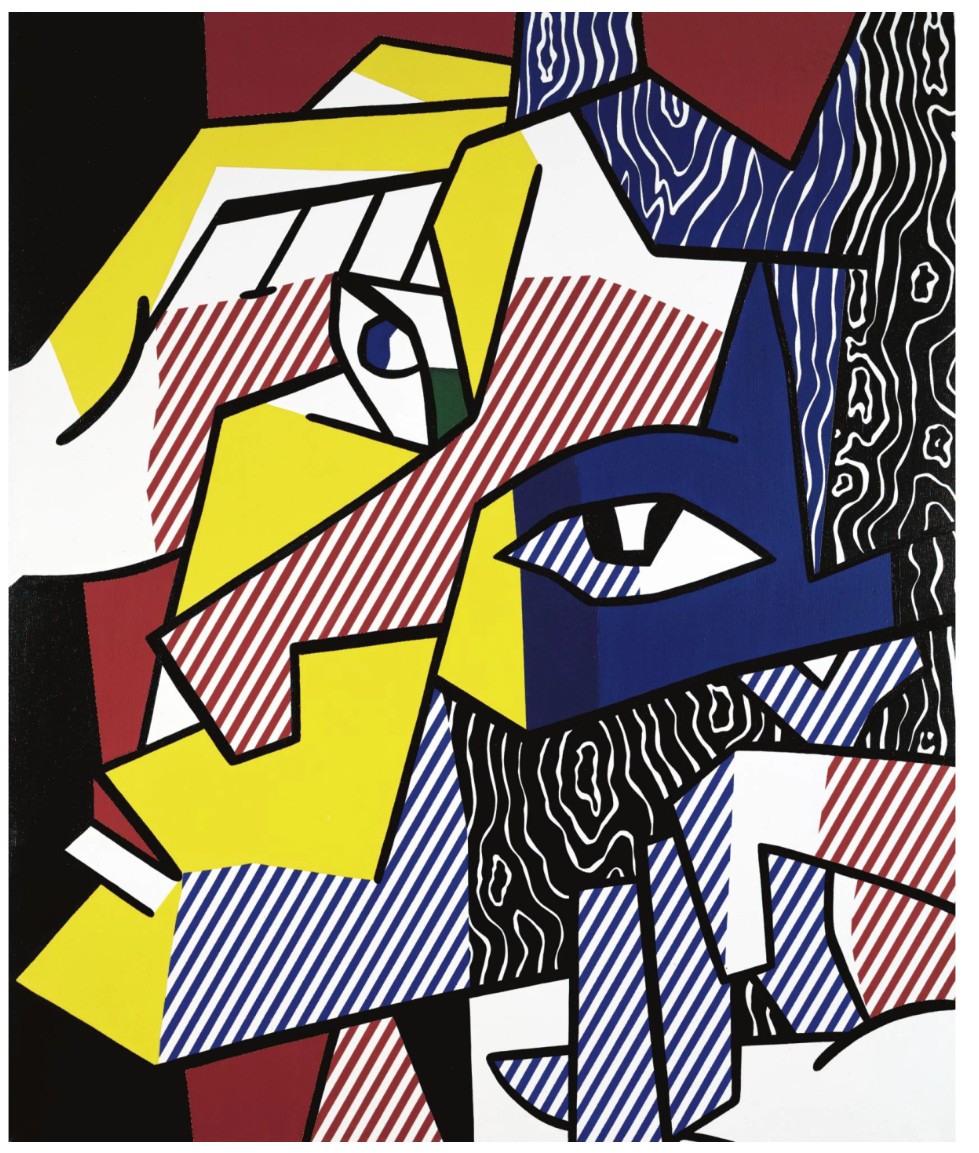
By the 1970s, Lichtenstein’s art sources were far-ranging. In this case, Conrad Felixmüller attended the Dresden School of Applied Arts and the Dresden Art Academy from 1911 to 1915. Between 1915 and 1926, he worked as a freelance artist, his drawings and prints appearing in avant-garde magazines such as Der Stürm and Die Aktion. As an Expressionist artist, he was reviled by the Nazis who included his works in the 1933 and 1937 German exhibits of ‘degenerate’ art. Felixmüller’s Depressed in the Studio places the self-portrait head close to the picture plane, dominating the composition. The unfurling facets of the head, shown simultaneously in profile and full-face, echo the style of Cubism, presenting multiple view-points at once through a collage-like assemblage of planar elements. The strong lines, typical of the wood-block carvings, energize the cerebral and hermetic Cubist presentation with a visceral power typical of German Expressionism, which “gave twentieth-century art a new artistic language, imparting an intense psychological expression to painting through the use of distorted forms, jagged lines, and violent colors” (Ibid. p. 251).
Visually, both the Expressionist movement and the woodblock technique would pair perfectly with Lichtenstein’s reductive aesthetic and compositional awareness. In Expressionist Head, Lichtenstein’s usual palette of red, yellow, blue, black, and white portrays a geometric face of predominantly sharp angles and bold lines. Lichtenstein’s signature use of Benday dots gradually became less predominant and the thick contour lines, as well as striped diagonals and cartoonish wood grains, came to the fore as Lichtenstein’s tool of choice in organizing space and form. As with Felixmüller and the other German Expressionists, Lichtenstein’s composition presses forward to the two-dimensional picture plane and any sense of depth is intuitive. In the case of Expressionist Head, the hands framing the face imply a three-dimensional posture, while the direction of the individual eyes hint at shifting perspectives for the head.
As Edward Lucie-Smith writes, “Roy Lichtenstein was the master of the stereotype, and the most sophisticated of the major Pop artists in terms of his analysis of visual convention and his ironic exploitation of past styles” (E. Lucie-Smith Lives of the Great 20th-Century Artists, London, 1999). Multiple art historical tropes and knowing appropriations are synthesized in a single canvas, including the traditional genre of portraiture and self-portraiture. Female and male heads were Lichtenstein’s favored motif in the German Expressionist series, signaling the key role this genre played throughout art history. Even Modernist artists such as Picasso dealt with the question of the self-image in art, and the influence of paintings such as Picasso’s 1907 Self-Portrait, with its almond-shaped eyes and skewed planar face that fill the canvas would have filtered through movements such as German Expressionism and thus into Lichtenstein’s oeuvre.
Arguably, the inspiration Lichtenstein tapped from German Expressionism and Cubism was purely aesthetic. Lichtenstein was interested in the art itself and not what it revealed about the artistic or social tenor of its time. Absent from Expressionist Head is German Expressionism’s “emotional intensity, psychological meaning, and commitment to political expression… As he did with Futurism and Surrealism, Lichtenstein was more interested in capturing the movement’s fundamental pictorial aspects than in probing its underlying beliefs and ideologies”. (Ibid., p. 253) Instead, with Lichtenstein’s signature primary colors and meticulous technical skill, Expressionist Head exemplifies his ability to translate motifs of modern art into his own idiosyncratic vocabulary. He brings important artists, including himself, down from their fine art plinths and breathes new life into the commonly reproduced icons of the past, reanimating aesthetic clichés, and placing them lovingly back on rarefied museum walls.
Blue Head, 1979
Blue Head, 1979
Christie’s New-York: 13 November 2014
Estimated: USD 3,000,000 – 5,000,000
USD 3,301,000
Lichtenstein, Roy (1923-1997), Blue Head | Christie’s
ROY LICHTENSTEIN (1923-1997)
Blue Head, 1979
Oil and Magna on canvas
48×36 inches (121.9 x 91.4 cm)
Signed and dated ‘? rf Lichtenstein ’79’ (on the reverse)
Provenance
Private collection, New York, acquired directly from the artist
Anon. sale; Christie’s, New York, 18 November 1997, lot 120
Private collection, acquired at the above sale
By descent from the above to the present owner
By the 1970s, seeking new challenges after the comic-book idiom that had made him an overnight success, Roy Lichtenstein turned to the realm of “High art” for inspiration, beginning with Futurism, then moving into Cubism, Surrealism and in the present work, Expressionism. Painted in 1979, Blue Head belongs to a small series of portraits inspired by a collection of German Expressionist
woodcuts that Lichtenstein encountered in 1978. Lichtenstein’s work from this era can be seen as a critical – or even parodic – reinterpretation of modernist art history. In Blue Head, Lichtenstein adopts the Expressionists’ flatness and economy of form in order to
push his own visual vocabulary into the next realm. Lichtenstein exaggerates the angular features of the figure using thick, diagonal outlining in black and white, which he applies directly to the canvas without any discernible brushstroke. The painting’s bold coloration
and large scale heightens the psychological intensity of the figure, which recalls the emotive power of the German Expressionists as well as the melodrama of Lichtenstein’s comic book paintings of the 1960s. In what critics have termed a “complexity of reference,” Lichtenstein’s work from this era evoke myriad sources, both art historical and self-referential. The flat, unmodulated planes of color used to depict the figure’s face were employed by the Expressionists, but derive from Cubism, while the yellow and red patterning
along the painting’s right edge reveal an interest in Native American textiles that had occupied the artist the preceding year. By
referencing the Expressionists, who themselves had adopted aspects of Cubism and primitivism, Lichtenstein knowingly weaves an unfolding array of different references within his own sophisticated pictorial language, thereby creating new relationships that result from this juxtaposition.
Lichtenstein had seen Alexei Jawlensky’s Expressionist portrait heads from the Galka E. Scheyer Collection when he visited Pasadena in 1968, but it was a 1978 trip to Los Angeles that inspired his foray into Expressionism. There, Lichtenstein was intrigued by a collection of German Expressionist prints that were owned by the collector Robert Rifkind. The collection included works by Emil Nolde, Otto Dix, Max Pechstein and Ernst Ludwig Kirchner, who together formed the influential Die Brücke group, as well as works by members of Der Blaue Reiter, such as Franz Marc and Wassily Kandinsky. Inherent to their aesthetic philosophy was an emphasis on the flatness of the picture plane, simple, bold coloration and their preferred medium of woodcut. A truly avant garde movement, Expressionism defined itself against the prevailing bourgeois attitude of its era, which must have attracted Lichtenstein. Shortly after this visit, he began the small series of Expressionist Heads, to which Blue Head belongs, in which he incorporated many of the same stylistic elements as the Expressionist woodcuts he saw in Rifkind’s collection.
In Blue Head, Lichtenstein combines the Cubist concept of depicting three-dimensional form by means of flat planes of unmodulated color within his own idiomatic painterly vernacular, using sharply-angled black and white lines to delineate the contours of the figure’s face and diagonal blue cross-hatching to depict light and shadow. Rather than Benday dots, Lichtenstein felt that cross-hatching more adequately evoked the oft-used diagonal shading of Expressionist prints. The vibrant yellow zigzag patterning along the painting’s right edge acts to energize and vitalize the canvas, and also evokes the effect of sunlight streaming onto the figure’s face. Indeed, the left side of the figure’s face seems “lit up” by an unknown light source, which Lichtenstein conveys by the blue hatch marks. The painting’s large scale and closely-cropped presentation present a brooding figure that recalls the heightened emotional power of the Expressionists.
A small black and white print from 1916, by the Expressionist Die Brücke painter Karl Schmidt-Rottluff may have provided the impetus for the present work, which similarly depicts a tightly-cropped composition in which a brooding figure is strongly outlined in black and white, using diagonal crosshatching to indicate shadow. The work features the same almond-shaped eyes, angular nose and prominent lips. However, unlike the comic-book paintings of the 1960s, which have a direct pictorial reference, in the Expressionist series, Lichtenstein claims that he did not “quote” specific works, but rather adopted certain Expressionist techniques to express his own unique sensibility: “I began to work on a series of paintings inspired by German Expressionism. I didn’t quote specific pieces as I had done with earlier works derived from Monet and Picasso; but I did keep in mind such artists as Karl Schmidt-Rottluff and Erich Heckel. In a certain sense, I have always tried to eliminate the meaning of the original. If I had actually kept in mind German Expressionism in my latest series of paintings, then my work would have seemed to be Expressionist. But for my own subjects I make use of a style rather than a specific painting.” (Roy Lichtenstein, in conversation with Philip Jodidio, Connaissance des arts, no. 349, March 1981, translated from the French by Michael D. Haggerty; reprinted in G. Mercurio, Roy Lichtenstein: Meditations on Art, exh. cat., La Trienale di Milano, 2010, p. 261).
In Blue Head, Lichtenstein uses the formal vocabulary of the Expressionists as a jumping off point from which to explore his own, signature style. For though they are based upon Expressionist imagery, Lichtenstein’s paintings remain resolutely his own, as if he’s distilled the most essential elements of Expressionism necessary to his purposes. Though he may incorporate the great masters of Art History in his work, Lichtenstein never simply copies their work, but rather works through them, to translate their Expressionist vernacular into his own, idiosyncratic style. As he told Bruce Glaser in 1964, “The things that I have apparently parodied I actually admire.” (Roy Lichtenstein, quoted in B. Glaser, “Oldenburg, Lichtenstein, Warhol: A Discussion,” Artforum, vol. 4, no. 6, February 1966, p. 23) While studying fine art at Ohio State University, Lichtenstein’s college professor Hoyt Sherman established the foundation for Lichtenstein’s understanding of the figure/ground relationship in what he termed “perceptual unity.” Using Picasso as a reference, Sherman taught Lichtenstein to create a unified plane in which figure and background were combined within a singular two-dimensional field. By their very nature, the Expressionist woodcuts helped Lichtenstein to achieve this sense of perceptual unity. They were able to convey a modicum of information within a small format that could be easily reproduced. The imagery conveyed needed to be bold, striking and strongly-outlined in order to withstand the demands of the printing process. It is not surprising that Lichtenstein would have been drawn to these Expressionist prints, as they share so much in common his most-famous source material: comic books. Like the woodcuts, comic books leant themselves naturally to mass production and the concept of “perceptual unity” that Lichtenstein sought to achieve; they were able to convey a significant amount of information within a single, two-dimensional square format, rendered in bold colors and strong outlines that made for easy reproducibility. Indeed, these woodcuts might be seen as the “comic books” of the early 20th Century.
Despair, 1979
Despair, 1979
Christie’s New-York: 15 November 2016
Estimated: USD 1,500,000 – 2,500,000
USD 1,927,500
Roy Lichtenstein (1923-1997), Despair | Christie’s
ROY LICHTENSTEIN (1923-1997)
Despair, 1979
Oil and Magna on canvas
30×24 inches (76.2 x 61 cm)
Signed and dated ‘rf Lichtenstein ’79’ (on the reverse)
Provenance
James Goodman Gallery, New York
Acquired from the above by the present owner, 1986
Executed in bold primary colors, Lichtenstein’s expressionist head is one of the earliest paintings from his series based on German Expressionism. Here, the artist arranges blocks of vibrant color, strong diagonals and thick black outlines into a silhouette of a male head, thrown back in an apparent show of anguish. The sturdy lines, chromatic intensity and angular features head all combine to produce an image that emits both emotional and visual power. Strikingly, Lichtenstein has abandoned his signature Ben-Day dots in favor of strong striations, diagonal lines in red and blue which act to define the areas where strong light falls across the subject’s face. Red abuts yellow, which then is divided from the blue by a substantial black border—the overall effect being one of vibrating chromatic intensity.
While studying fine art at Ohio State University, Lichtenstein’s college professor Hoyt Sherman established the foundation for Lichtenstein’s understanding of the figure/ground relationship in what he termed “perceptual unity.” Using Picasso as a reference, Sherman taught Lichtenstein to create a unified plane in which figure and background were combined within a singular two-dimensional field. By their very nature, the Expressionist woodcuts helped Lichtenstein to achieve this sense of unity. They were able to convey a modicum of information within a small format that could be easily reproduced. The conveyed imagery needed to be bold, striking and strongly-outlined in order to withstand the demands of the printing process. It is not surprising that Lichtenstein would have been drawn to these Expressionist prints, as they share so much in common his most-famous source material: comic books. Like the woodcuts, comic books leant themselves naturally to mass production and the concept of “perceptual unity” that Lichtenstein sought to achieve; they were able to convey a significant amount of information within a single, two-dimensional square format, rendered in bold colors and strong outlines that made for easy reproducibility. Indeed, these woodcuts might be seen as the ‘comic books’ of the early twentieth century.
In Despair, Lichtenstein uses the formal vocabulary of the Expressionists purely as a jumping off point from which to explore his own, signature style. For though they are based upon Expressionist imagery, Lichtenstein’s paintings remain resolutely his own, as if he’s distilled the most essential elements of Expressionism necessary to his purposes. Though he may incorporate the great masters of art history in his work, Lichtenstein never simply copies their work, but rather works through them, to translate their Expressionist vernacular into his own, idiosyncratic style.
Expressionist Woodcut Prints
The Expressionist Woodcut Series marked an important experiment in medium for Lichtenstein. By working in woodcut—a technique historically associated with rough-hewn, emotional imagery—he created a deliberate contrast with his own meticulous, controlled style. The clash between the traditionally handmade, textural quality of woodcuts and Lichtenstein’s clean, industrial aesthetic underscores his playful interrogation of artistic authenticity.
READ ABOUT EXPRESSIONIST WOODCUT SERIES
FIND ALL HISTORICAL AUCTION RESULTS