Introduction
“They’re just a mixture of every kind of Indian design from Northwest Indians to Plains Indians to Pueblo. They are no particular tribe of Indians. It’s just everything that people vaguely associated with Indians. … Anything that I could think of that was ‘Indian’ got into them. It’s like seeing the Indian as if in the Museum of Natural History, not knowing which tribe he belonged to. All of the different tribes are mixed up to show the cliché idea of “Indian”.
In his American Indian series, Roy Lichtenstein offers an investigation of stereotypical portrayals of Native American cultures that the artist began at a time when Native American activism was at its height in the United States. In this moment, Lichtenstein returned to his long-standing interest in the nuances of indigenous American art, craft, and design traditions. Of equal concern to Lichtenstein was the way in which Native American cultures have been transformed into clichés in the U.S. American imaginary. Thus, in his Amerindian series, the artist often consolidated as many cliched images into a singular vision rendered in his iconic comic-book style.
Auction Results
#1. Little Landscape, 1979
Christie’s New-York: 15 November 2018
Estimated: USD 2,000,000 – 3,000,000
USD 3,612,500
Roy Lichtenstein (1923-1997), Little Landscape | Christie’s
ROY LICHTENSTEIN (1923-1997)
Little Landscape, 1979
Oil and Magna on canvas
36×48 inches (91.4 x 121.9 cm)
Signed and dated ‘rf Lichtenstein ’79’ (on the reverse)
Little Landscape, 1979
Little Landscape, 1979
Christie’s New-York: 15 November 2018
Estimated: USD 2,000,000 – 3,000,000
USD 3,612,500
Roy Lichtenstein (1923-1997), Little Landscape | Christie’s
ROY LICHTENSTEIN (1923-1997)
Little Landscape, 1979
Oil and Magna on canvas
36×48 inches (91.4 x 121.9 cm)
Signed and dated ‘rf Lichtenstein ’79’ (on the reverse)
Provenance
Estate of the artist
Castelli Gallery, New York
Acquired from the above by the present owner
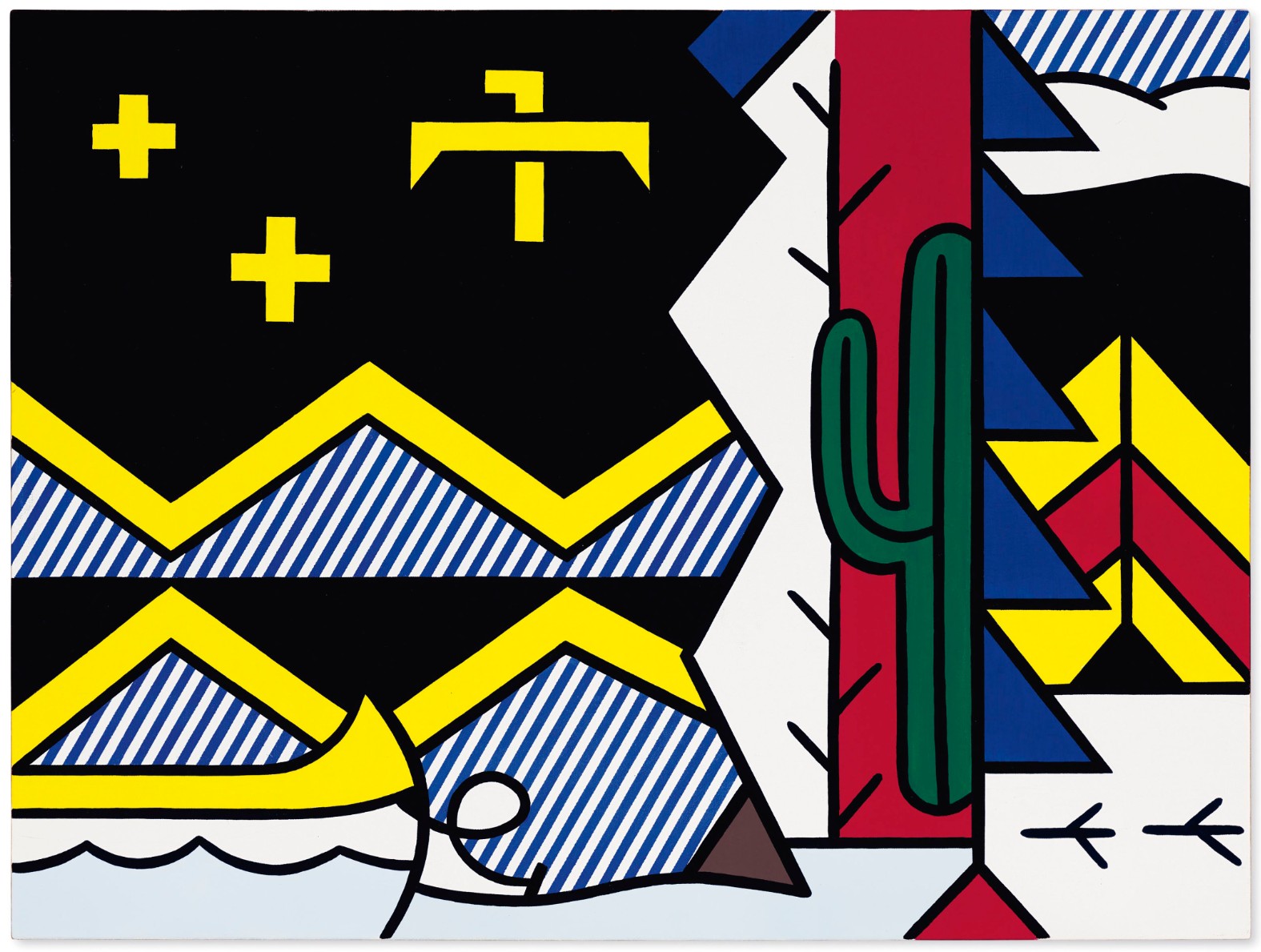
Painted in 1979, Little Landscape is a crucial painting from Roy Lichtenstein’s Amerindian series, an investigation of stereotypical portrayals of Native American cultures that the artist began at a time when Native American activism was at its height in the United States. In this moment, Lichtenstein returned to his long-standing interest in the nuances of indigenous American art, craft, and design traditions. Of equal concern to Lichtenstein was the way in which Native American cultures have been transformed into clichés in the U.S. American imaginary. Thus, in his Amerindian series, the artist often consolidated as many cliched images into a singular vision rendered in his iconic comic-book style. To create this painting, Lichtenstein flattened the features of a landscape into a sequence of planes, subdivided by bold, primary colors. For instance, peaks of a chain of mountains in a range are simplified into two parallel zigzag lines. The blue diagonal lines so frequently found in Lichtenstein oeuvre as a sign of contemporary printing technologies, here, signify rain. A canoe, with an upturned lip echoing the peak of the mountain, sneaks into the bottom, left side of the canvas. As the curators who included Little Landscape in the 2005 traveling exhibition, Roy Lichtenstein: American Indian Encounters write in the accompanying catalogue, Lichtenstein later referred to this ‘representation of a canoe’— part of his repertoire of invented shapes that evoke American Indian culture. This stereotypical canoe image is also featured in Little Landscape (1979), along with stylized mountains, a thunderbird motif, and sacred four direction crosses as stars in the night sky. A saguaro cactus is also evident, a typical plant for the Sonoran Desert; bird tracks, a common motif on some pre-contact Southwest pottery, are also apparently leading away from the cactus. Stereotypical geometric designs often found on basketry and textiles from the American Southwest, incorporated into a tipi design and border, complete the work.
Before Roy Lichtenstein became the legendary pop artist who, alongside Andy Warhol, Claes Oldenburg, and James Rosenquist, ushered in the Pop Art movement by making mass-produced and popular images such as comic strips the subjects of sleek and sophisticated painting, the artist was a voracious student who taught himself to draw by looking at sources as wide-ranging as medieval European art to Picasso in books. As the artist, himself has explained, “Most of what we [he and his then wife, Isabel] saw was in reproduction. Reproduction was really the subject of my work” (R. Lichtenstein quoted by Diana Waldman, New York: Solomon R. Guggenheim Foundation, 1970, p. 25), and later, “All my art is in some way about other art, even if the other art is cartoons” (R. Lichtenstein, quoted in J. Hendrickson, Roy Lichtenstein, Cologne, 2000, frontispiece). Reproduction was also the means by which he had been taught to draw: by copying old and new masters alike, a time-honored tradition of learning the skills and conceits of paintings since the Renaissance. But true to Lichtenstein’s interest in the discarded and “discredited” subjects of American culture—including comic strips and cartoons considered too banal to be thought of in terms of their aesthetic formulations— he was drawn to the art of the American West, which, in the mid-20th century, marked by Pollock’s expressionist throes of emotion translated into throws of paint, was surely out of favor.
George Catlin, the early 19th-century American painter of the American West, would be a longstanding source of influence for Lichtenstein. The artist would repeatedly turn to the hundreds of portraits and landscapes his predecessor made in the 1830s that were reproduced in Catlin’s book Letters and Notes on the Manners, Customs, and Conditions of the North American Indians from 1841 over the first thirty years of Lichtenstein’s artistic practice. His focused study of Catlin’s drawings and paintings would be matched by equal attention to the art of Native Americans and the ways in which this diverse group of people was rendered into clichés and stereotypes as part of the mythmaking process of writing any nation’s history. For Lichtenstein, it was “difference between real life, between the actual event and what became of it in the medium of art” that compelled the artist to these images (R. Lichtenstein, unpublished interview on January 26, 1990 quoted by G. Stavitsky and T. Johnson in Roy Lichtenstein: Native American Encounters, New Brunswick, New Jersey, Rutgers University Press, 2006, p. 11). As Gail Stavitsky and Twig Johnson, who curated Roy Lichtenstein: American Indian Encounters for the Montclair Art Museum, write, “the illusion of these works serving as eyewitness accounts within a cliched format of history painting is what fascinated Lichtenstein” (Ibid.).
Head with Braids, 1979
Head with Braids, 1979
Estimated: USD 2,000,000 – 3,000,000
USD 2,340,000
ROY LICHTENSTEIN (1923-1997)
Head with Braids, 1979
Oil and Magna on canvas
50×40 inches (127 x 101.6 cm)
Signed and dated ‘© rf Lichtenstein ’79’ (on the reverse)
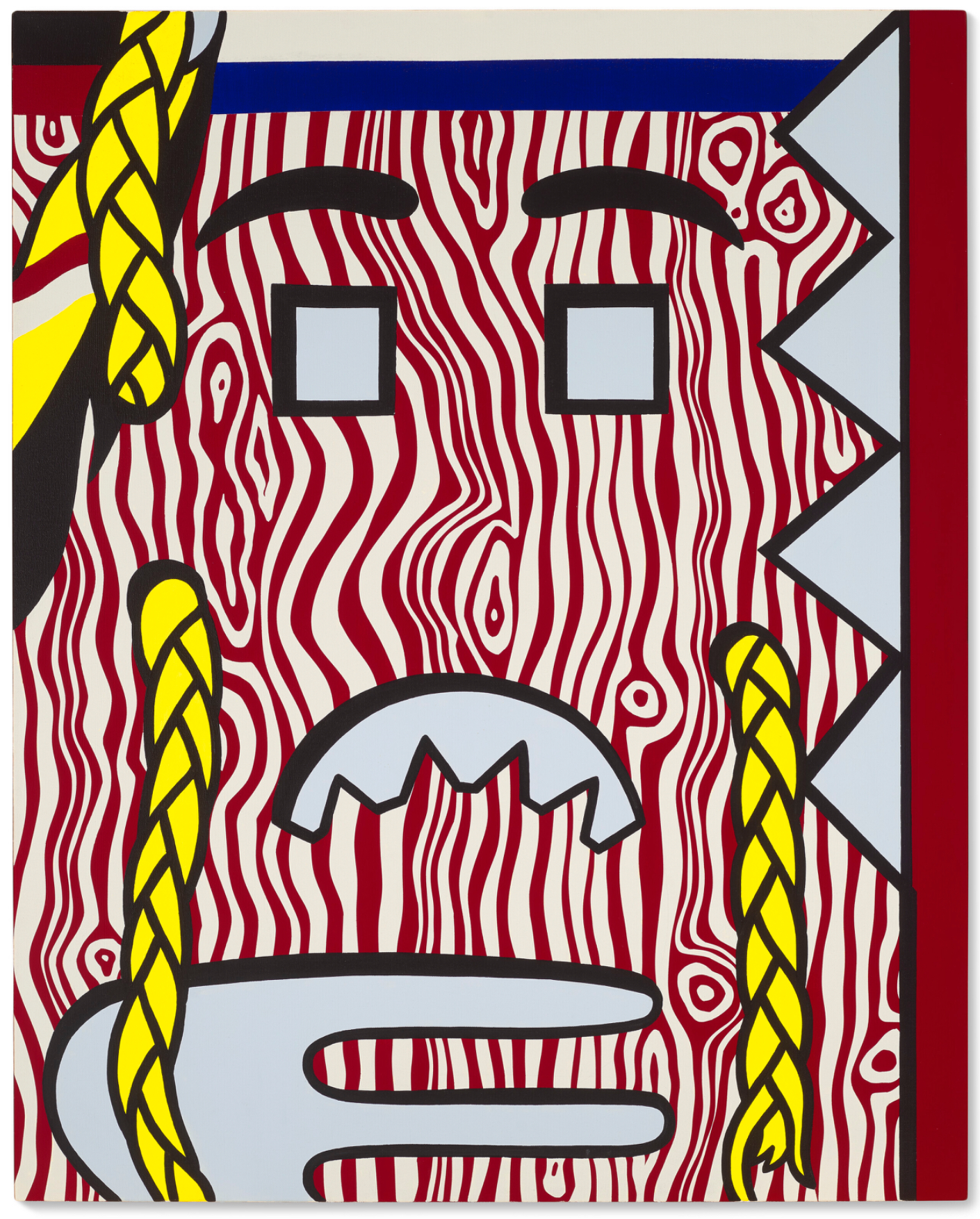
Roy Lichtenstein’s Head with Braids is an exceptionally rare work that epitomizes the artist’s formal ingenuity and thematic predilections. Although this is a bright and visually engaging work primarily articulated in bold primary colors, an odd, otherworldly quality emerges through this face, or mask. An exaggerated faux wood grain takes up the composition, its rippling, hypnotic forms at once recognizable as wood. Yet it evokes a strange, fantastical atmosphere through the juxtaposition of the bright red pattern against a white background. In dialogue with surrealist masters such as Max Ernst, the pictorial influence of the American West and the aesthetic legacy of the Native Americans adds another referential layer to the present work. While somewhat menacing, a sense of humor pervades Head with Braids–two square eyes and an upturned mouth with sharp triangular teeth are incised into the wooden plane and out of the cheeks emerge two bright yellow braids of hair. Native American symbols such as a bear claw, depicted at the bottom of the work, and a feather, resting on the upper right side of the face, bring together two different traditions of art history to create something that can only be described as wholly Lichtensteinian. Ever synonymous with the Pop Art movement, the artist presents us with an image that is both formally striking and rich with iconographic content, all while in dialogue with surrealist art history, a stone’s throw from the likes of René Magritte or Salvador Dalí.
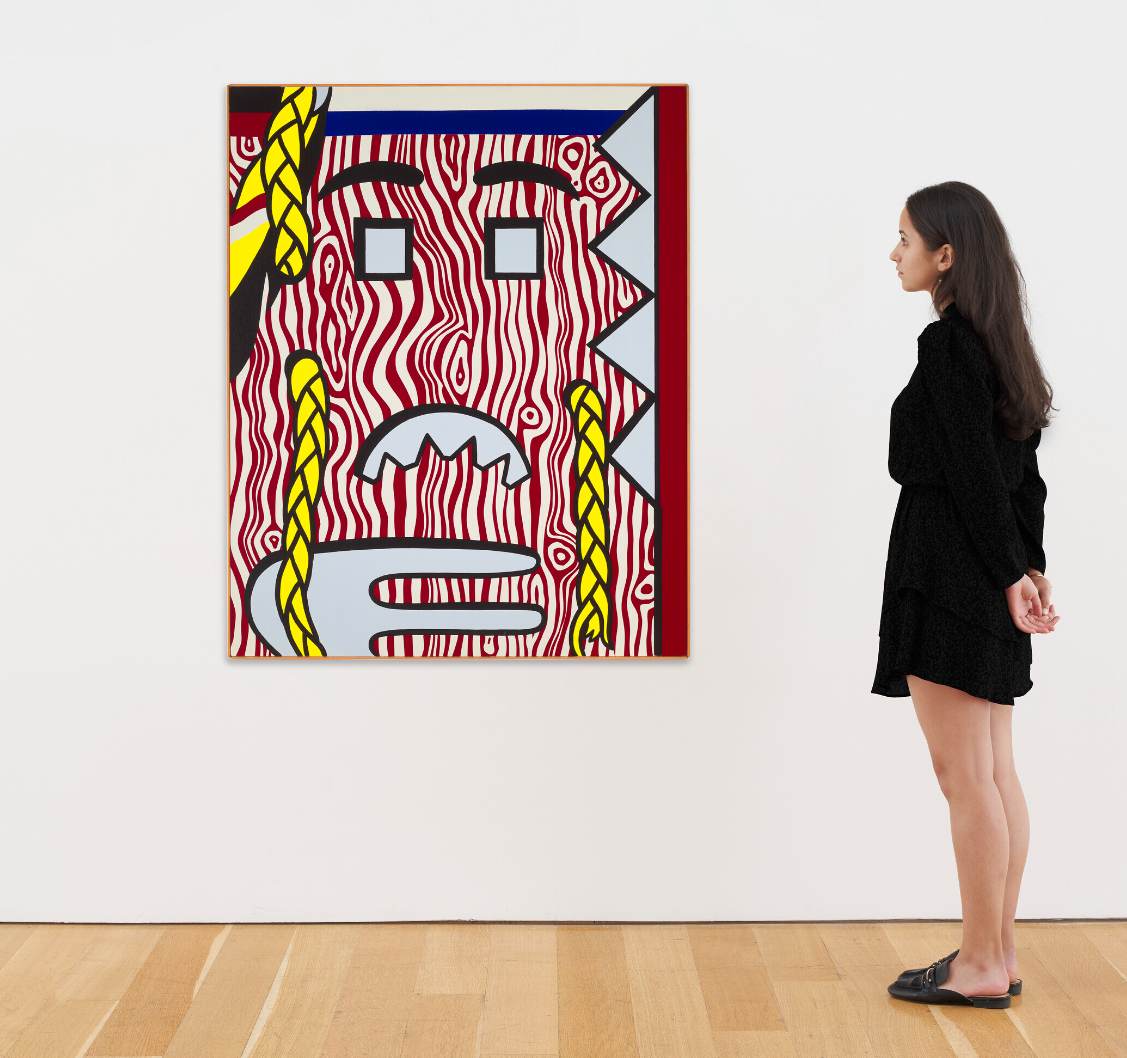
Head with Braids is an incredibly unique work from the artist’s oeuvre. Roy Lichtenstein’s American Indian series, to which the present work belongs, consists of only about a dozen paintings. Lichtenstein’s fascination with American pop culture is well-known, but he was also interested in the oft-overlooked aspects of America. In the late 1970s, Lichtenstein lived with his wife near the Shinnecock Indian Reservation on Long Island, New York, and it is here that his attentive study of Native American objects and imagery began. Akin to artists such as Jasper Johns, Frank Stella and Donald Judd, who all collected Native American objects, Lichtenstein cultivated his own collection of objects by the First Americans, along with a personal library of 17 books and catalogues on Native American art. There is a subtle combination of seriousness and play embodied by many Native American objects that Lichtenstein no doubt felt a kinship with, alongside a Picasso-esque embrace of the dialectical use of color and line. In Head with Braids, Lichtenstein takes advantage of this ubiquity to create an image that is oddly familiar yet impossible to place. Although Lichtenstein is well-known for his reinterpretation of modern European master paintings, Head with Braids details the artist’s ability to deal with subject matter outside of the conventional realms of art history. By employing these Native American motifs, Lichtenstein’s work harkens back to a rich history of the Red Power movement in the United States, and the struggle for reservation policy change during the 1970’s. A grimacing mouth and hollow square eyes populate the wooden plane, not a living trunk but instead a flat plank of wood. Head with Braids destabilizes western preconceptions of high and low art, instead placing the legacy of Native American art alongside Cubism, Surrealism, and European art. Visually enchanting and rife with multivalent subject matter, Head with Braids is a truly unique work that places the creative and analytical genius of Roy Lichtenstein on full display.
Figure with Banner, 1978
Figure with Banner, 1978
Christie’s New-York: 19 November 2024
Estimated: USD 3,000,000 – 5,000,000
WITHDRAWN
ROY LICHTENSTEIN (1923-1997), Figure with Banner | Christie’s
ROY LICHTENSTEIN (1923-1997)
Figure with Banner, 1978
Acrylic, oil and graphite on canvas
100×60 inches (254 x 152.4 cm)
Signed and dated ‘© rf Lichtenstein ‘78’ (on the reverse)
Roy Lichtenstein’s Figure with Banner is a striking example of the artist’s ability to deftly combine disparate artistic movements and ideas in a singular, harmonious composition. Utilizing a recognizable but incongruent technique he borrowed from mass media printing, Lichtenstein constructs a composite scene that appears to reference the Italian paintings of Giorgio de Chirico, rendering them in a comic book style. Drawing connections to multiple points within the world of visual representation, Lichtenstein is able to create a scene that is at once familiar and also not.
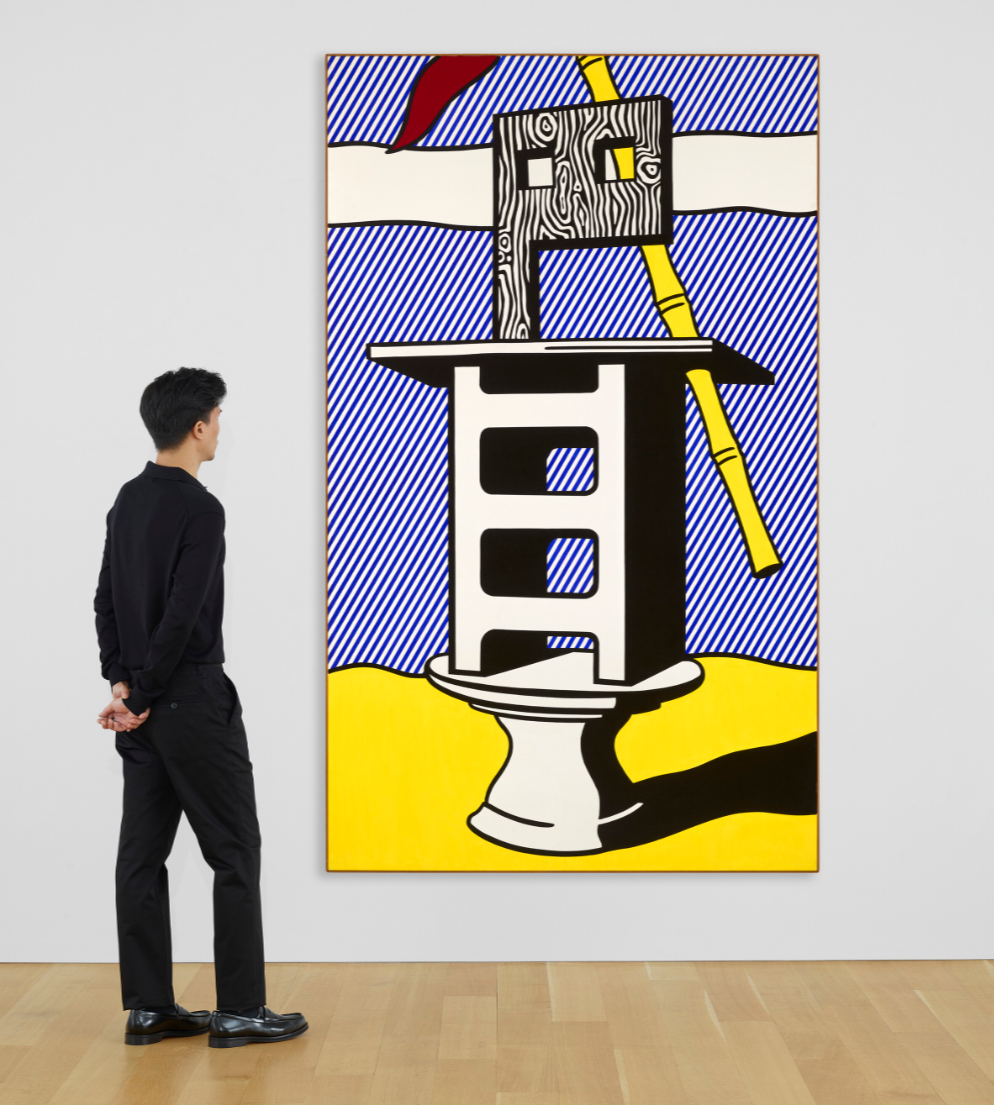
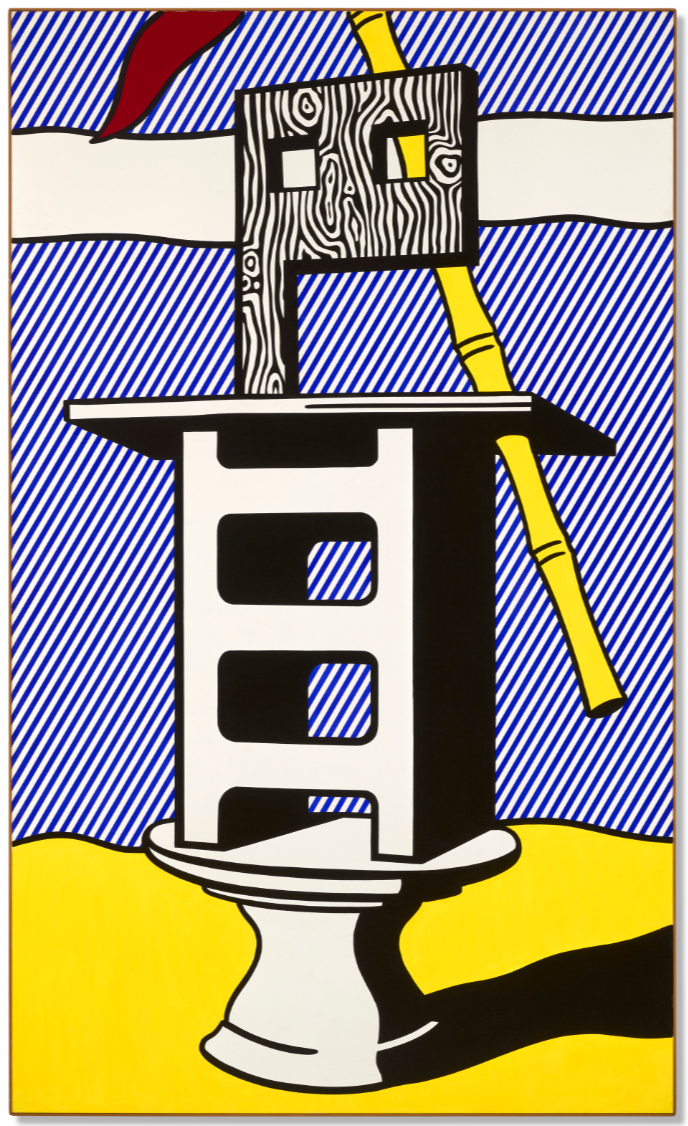
Monumental in scale, Figure with Banner towers above the viewer like a great monument of old. Set against a sky of diagonal blue and white stripes, a mysterious stack of objects rests on an expanse of flat yellow sand. A stylized cinder block turned on its end rests atop a curved decorative base. Both are rendered in crisp areas of black and white that create the illusion of hard shadows from an unseen light source. Atop this construction, a flat panel creates a platform to which two objects are attached. The first, a piece of wood complete with painted grain reminiscent of Pablo Picasso’s faux bois, juts upward from a slim stalk and exhibits two square holes. The component, as well as its placement at the top of the stack, elicits comparisons to an abstracted face or a mask one would use at a costume ball. Behind this element is a long piece of yellow bamboo that pierces the uppermost platform at an angle as it extends beyond the picture plane. A wispy triangle of red floats back into the frame and affirms our assumption that this is the titular banner being held by Lichtenstein’s stoic figure.
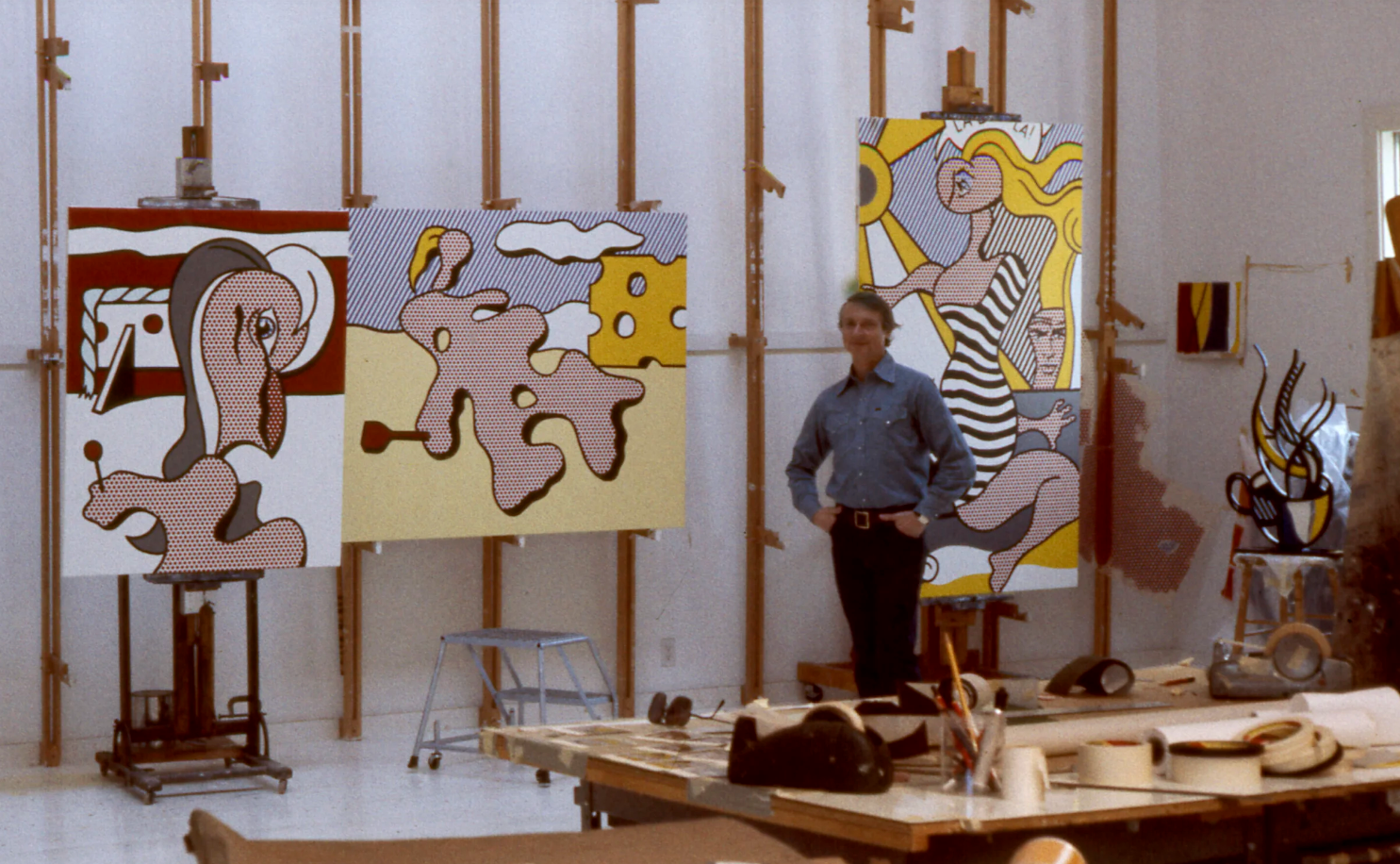
Roy Lichtenstein in his Southampton studio, 1977.
Photo: Kenneth Tyler, courtesy of the National Gallery of Australia. Artwork: © Estate of Roy Lichtenstein.
Many of Lichtenstein’s early Pop canvases found their beginnings in his appropriation of panels from comic strips. As such, the subjects often had to do with general subjects like battles and soap opera heroines. In the mid-1970s, the artist made a detour away from his cartoon inspirations and dove headlong into the history of art. His Surrealist series, from which the present example hails, paradoxically combined the bright, clean nature of Pop Art with the moody musings of European artists like Salvador Dalí and Rene Magritte. The artist’s predilection for bold lines, swaths of flat color, and patterns borrowed from printing like stripes and Ben Day dots are still on full display, but now they exist in a more cerebral realm.
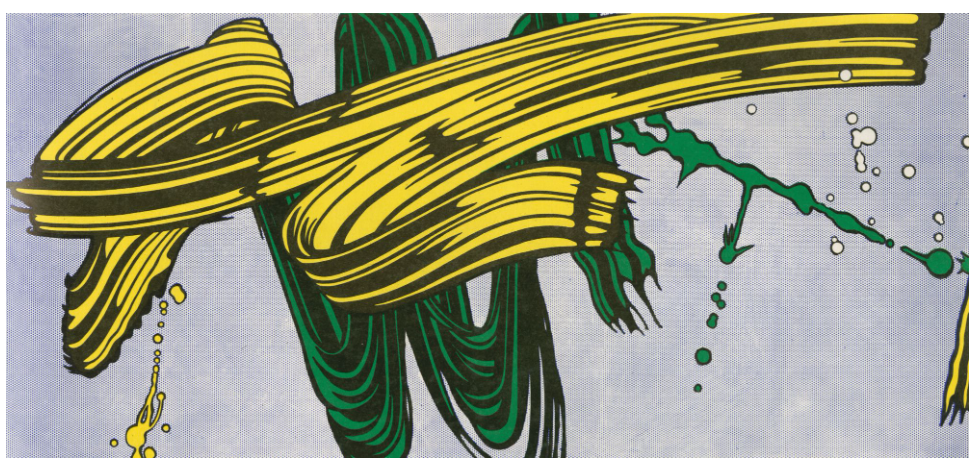
Roy Lichtenstein, Yellow and Green Brushstrokes, 1966. Museum für Moderne Kunst, Frankfurt am Main. © Estate of Roy Lichtenstein.
This was not the first time Lichtenstein had investigated the nature of art and its history. His Brushstroke series of the 1960s took the very action of painting as its subject and laid it bare in his signature visual style. However, works like Figure with Banner go beyond representational allusions to style and process as the artist invents entirely new compositions that retain the mysterious nature of the Surrealists juxtaposed with Lichtenstein’s own interest in printing motifs and the markers of mass media. The diagonal blue stripes are no longer an optical means to create lighter colors but an element in their own right that pushes forward into the illusionistic space of the painting. In other pieces from the series, like the momentous Landscape with Figures (1977), a female form is composed entirely of red Ben Day dots. The very tenets of Surrealism, those of dreams, chance, and the unconscious mind, allowed Lichtenstein to cast off the self-imposed structures of his original source materials in order to more fully explore his own iconography.