Introduction
Roy Lichtenstein’s Surrealist Paintings of 1976–1977 belong to a brief, highly structured moment in his career when the subject of his work shifts from popular imagery to art history as a primary source. Rather than quoting comics and advertisements, Lichtenstein turns to the visual repertory of twentieth-century modernism, especially Surrealism, and treats it as a set of compositional devices that can be isolated, recombined, and tested against his own pictorial language. What distinguishes this series from Surrealism in its historical sense is methodological. Classical Surrealism valued automatism, psychic association, and the production of images tied to the unconscious. Lichtenstein, by contrast, approaches Surrealism as an external vocabulary: foreshortened horizons, destabilized space, improbable juxtapositions, “symbolically functioning” objects, and dislocated figures. The “dream” is not discovered; it is constructed.
Those paintings are therefore not pastiches of a single artist, but composite tableaux in which disparate references coexist. In the same image, one can encounter the structural logic of Cubist fragmentation, the metaphysical staging of Surrealist landscapes, and the graphic certainty associated with Lichtenstein’s Pop idiom. The series is best understood as a form of pictorial criticism: it examines how modernist styles communicate, how they can be recognized, and how they function when transferred into a new system. A recurring strategy in the group is the deliberate tension between irrational content and controlled execution. Lichtenstein’s forms are clean, sharply bounded, and often visually legible in a way that resists the atmospheric ambiguity associated with many Surrealist antecedents. This precision does not neutralize the uncanny; it changes its character. The instability of space or identity appears less as a private hallucination than as a demonstrable problem in representation.
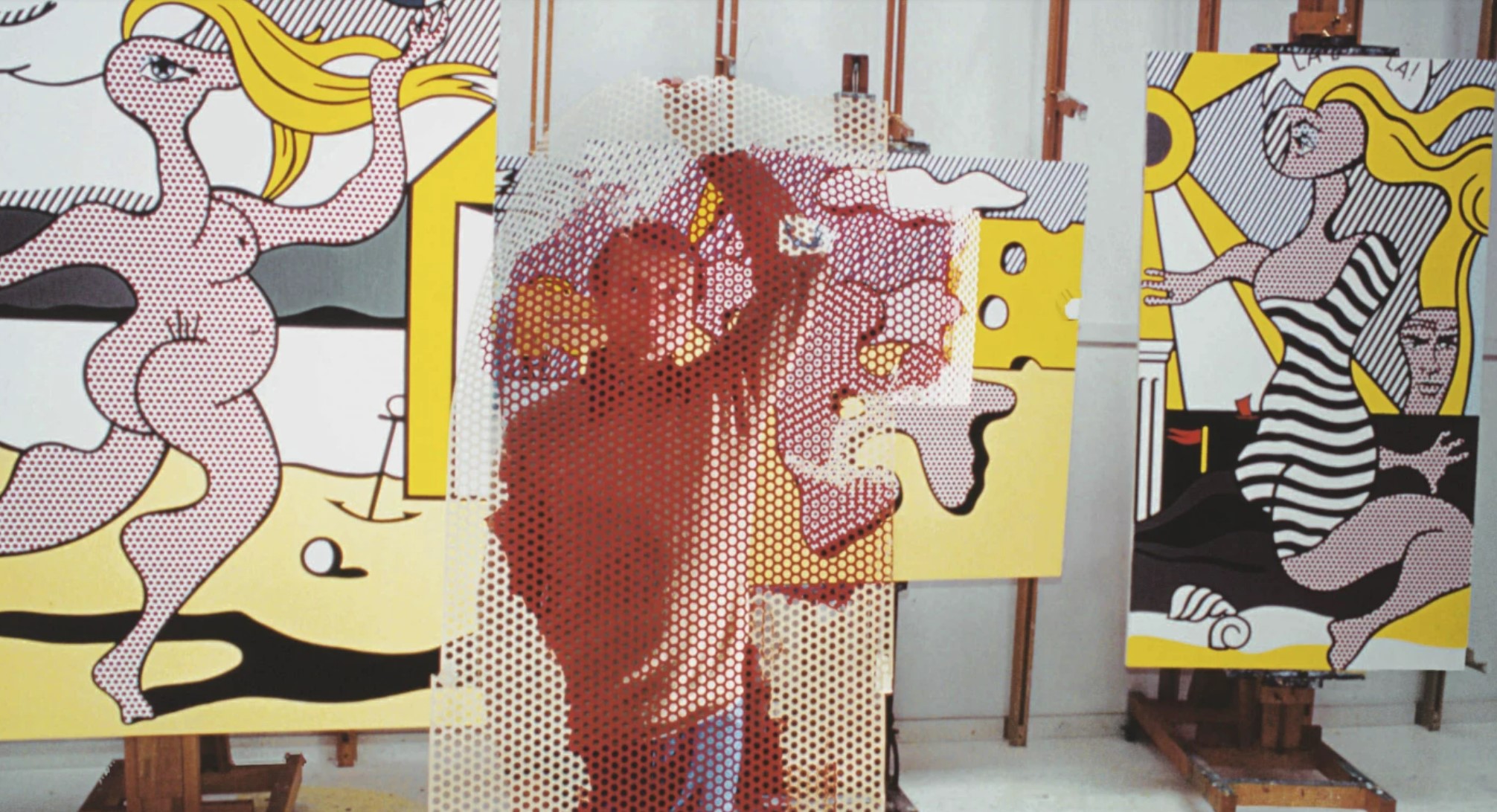
LICHTENSTEIN IN HIS STUDIO IN SOUTHAMPTON, 1977. PHOTOGRAPHER UNKNOWN. ART © ESTATE OF ROY LICHTENSTEIN. COURTESY THE ROY LICHTENSTEIN FOUNDATION ARCHIVES
Another hallmark is the way these works complicate genre. Titles and imagery blur distinctions between portraiture, still life, and landscape, and the paintings repeatedly stage acts of looking, through mirrors, reflections, or doubled views. Vision is not treated as transparent access to reality, but as a mechanism that can fracture, reorder, and reclassify what is seen. The female figure becomes a central instrument in this investigation. Lichtenstein’s iconic “girl,” originally embedded in the narrative structures of comics, reappears here detached from plot and psychology. She is reintroduced as a modernist construct: fragmented, repositioned, and inserted into settings that operate like mental stages rather than natural environments.
“They were of no particular Surrealist artist, just Surrealism in general. I took certain elements from painting I have done in the past: a man’s suit, a shirt and tie from a dry cleaning ad, the Brushstroke … These works are something like the Artist’s Studio paintings in that they are large compositions that include various images from various periods.”
From a pedagogical perspective, the series offers a focused case study in late twentieth-century artistic practice: appropriation not as copying, but as analysis through painting. Lichtenstein’s Surrealist paintings demonstrate how an artist can engage historical forms while maintaining a coherent authorial point of view—organizing multiple sources into a single, internally consistent image system.
Finally, the 1976–1977 works also clarify Lichtenstein’s larger claim that his art is “about other art.” In this series, that proposition becomes explicit in both structure and subject matter. The paintings do not merely reference Surrealism; they show how Surrealism can be made to operate within Lichtenstein’s own grammar, thereby turning quotation into a method of knowledge.
Auction Results (Paintings)
#1. Female Head, 1977
Sotheby’s New-York: 15 November 2017
Estimated: USD 10,000,000 – 15,000,000
USD 24,501,500
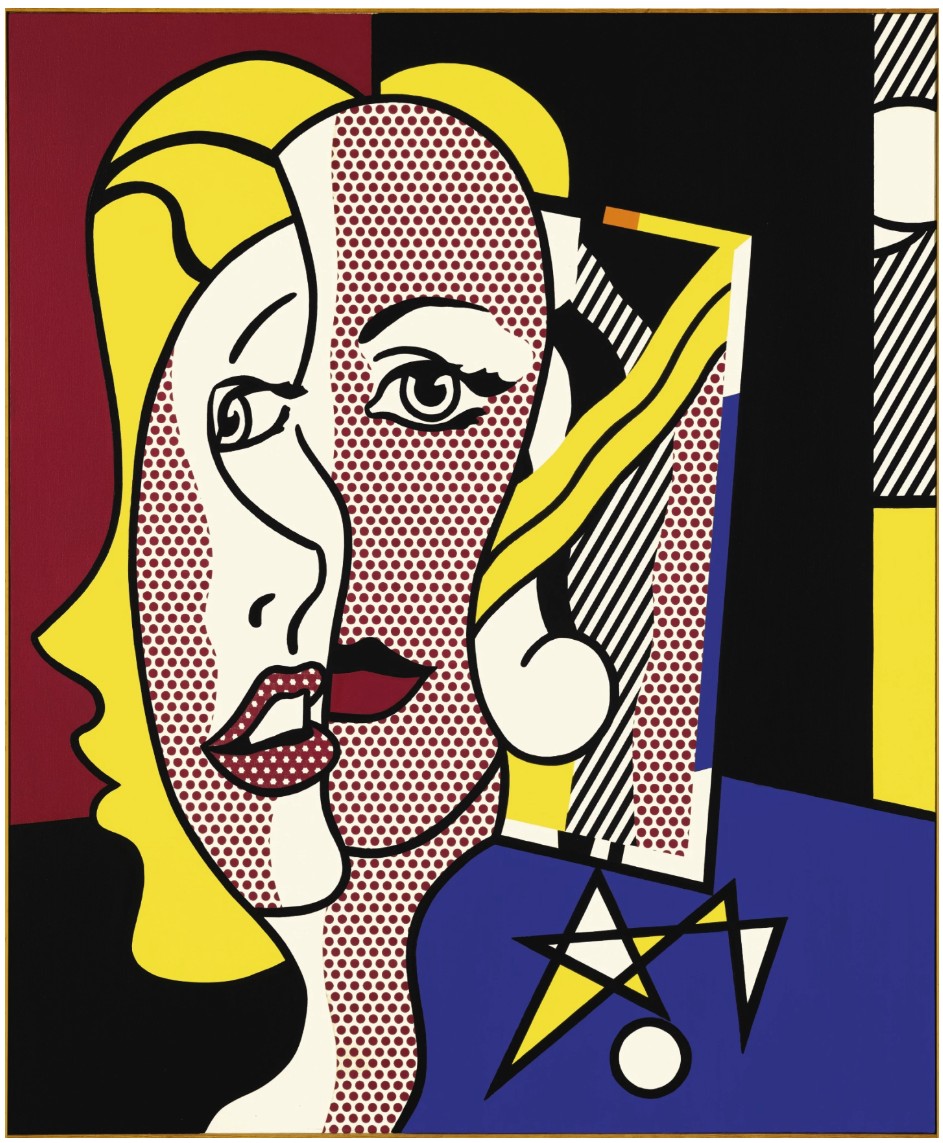
ROY LICHTENSTEIN
Female Head, 1977
Oil and Magna on canvas
60×50 inches (152.4 x 127 cm)
Signed and dated 77 on the reverse
#2. Landscape with Figures, 1977
Christie’s New-York: 12 November 2014
Estimated: USD 15,000,000 – 20,000,000
USD 18,085,000
Roy Lichtenstein (1923-1997), Landscape with Figures | Christie’s
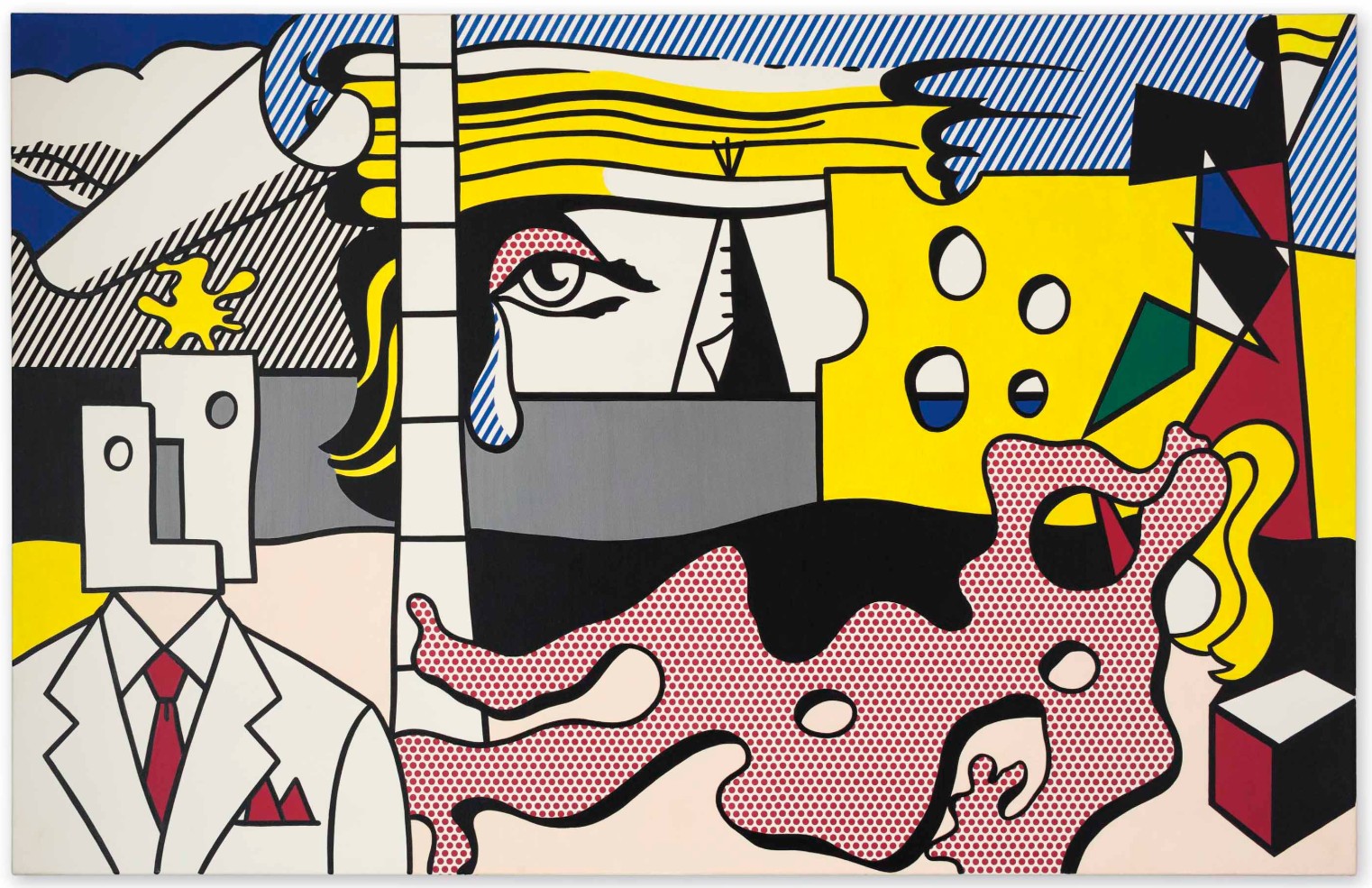
ROY LICHTENSTIEN (1923-1997)
Landscape with Figures, 1977
Oil and Magna on canvas
64×100 inches (162.6 x 254 cm)
Signed and dated ‘rf Lichtenstein ‘77’ (on the reverse)
#3. Girl with Beach Ball II, 1977
American Visionary: The Collection of Mrs John L. Marion
Sotheby’s New-York: 12 May 2021
Estimated: USD 12,000,000 – 18,000,000
USD 14,052,000
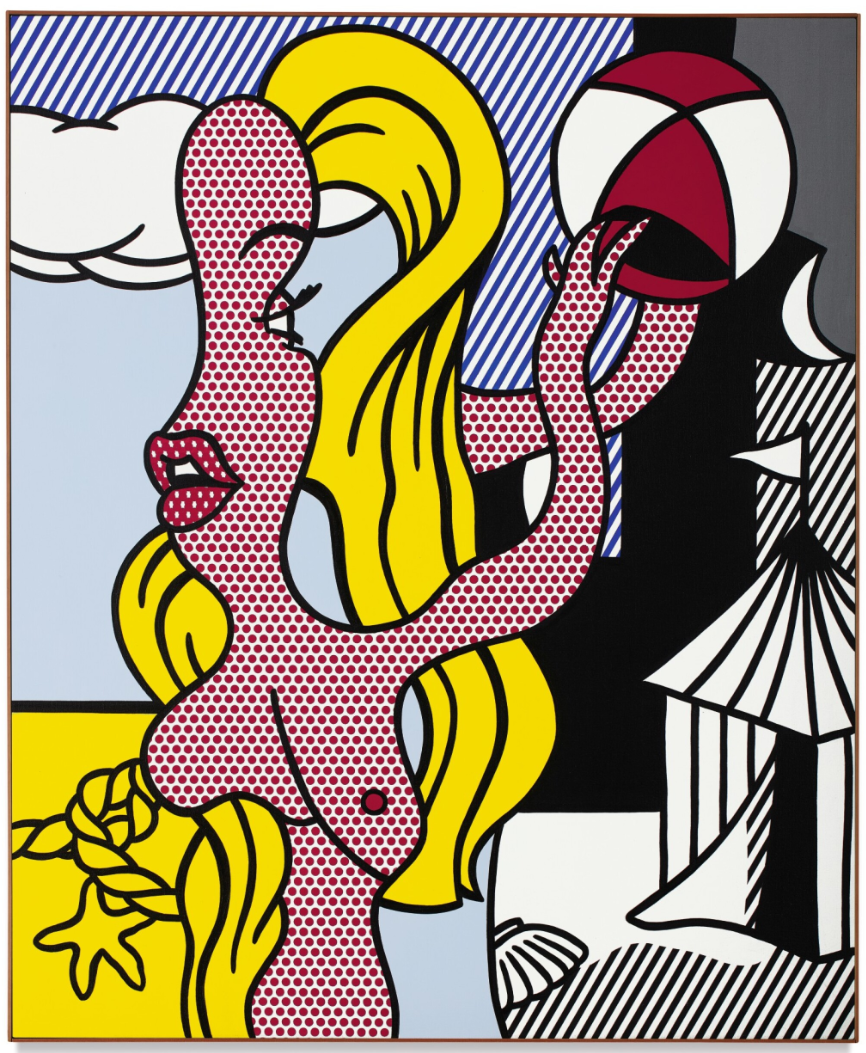
ROY LICHTENSTEIN (1923 – 1997)
Girl with Beach Ball II, 1977
Oil and Magna on canvas
60×50 inches (152.4 x 127 cm)
Signed and dated 77 on the reverse
#4. Still Life with Head in Landscape, 1976
Raising The Bar: Masterworks from the Collection of Morton and Barbara Mandel
Sotheby’s New-York: 15 May 2018
Estimated: USD 7,000,000 – 10,000,000
USD 10,501,900
ROY LICHTENSTEIN
Still Life with Head in Landscape, 1976
Oil and Magna on canvas
48×40 inches (121.9 x 101.6 cm)
Signed and dated 76 on the reverse
#5. Untitled Composition, 1978
Christie’s New-York: 11 May 2010
Estimated: USD 4,500,000 – 6,500,000
USD 10,162,500
Roy Lichtenstein (1923-1997) , Untitled Composition | Christie’s
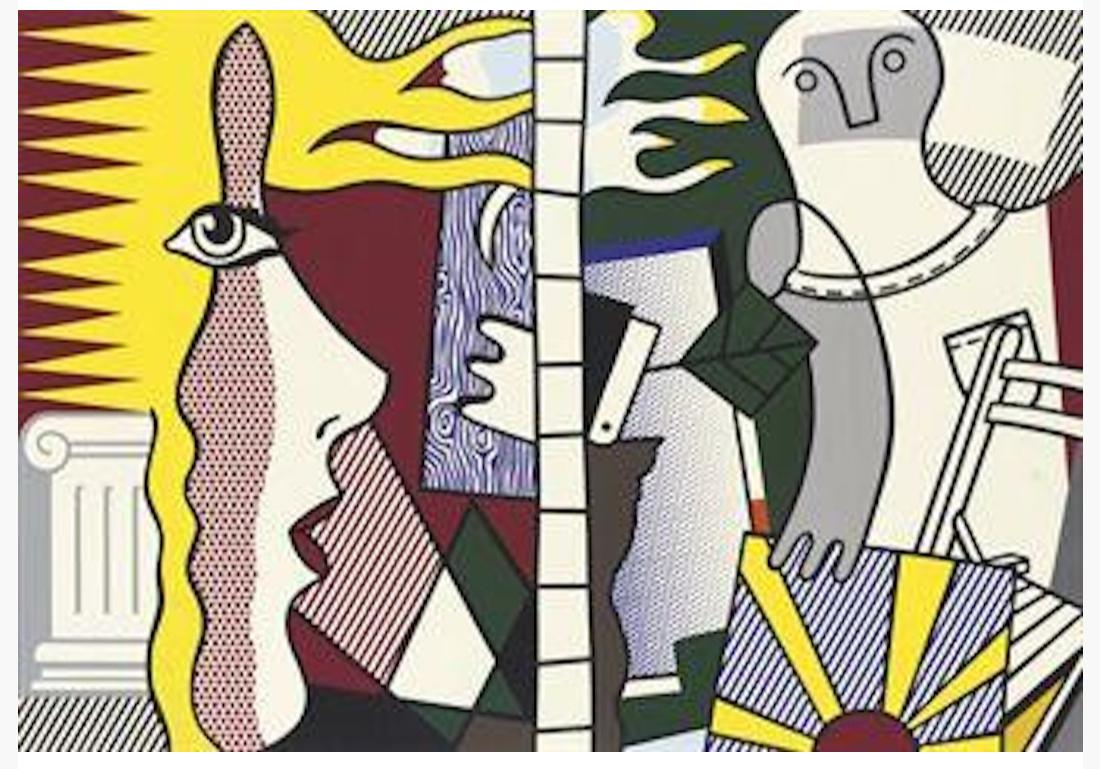
ROY LICHTENSTEIN (1923-1997)
Untitled Composition, 1978
Oil and magna on canvas
84×120 inches (213.4 x 305 cm)
Signed and dated ‘rf Lichtenstein ’78’ (on the reverse)
#6. Female Figure, 1978
Sotheby’s New-York: 3 November 2015
Estimated: USD 5,000,000 – 7,000,000
USD 6,746,000
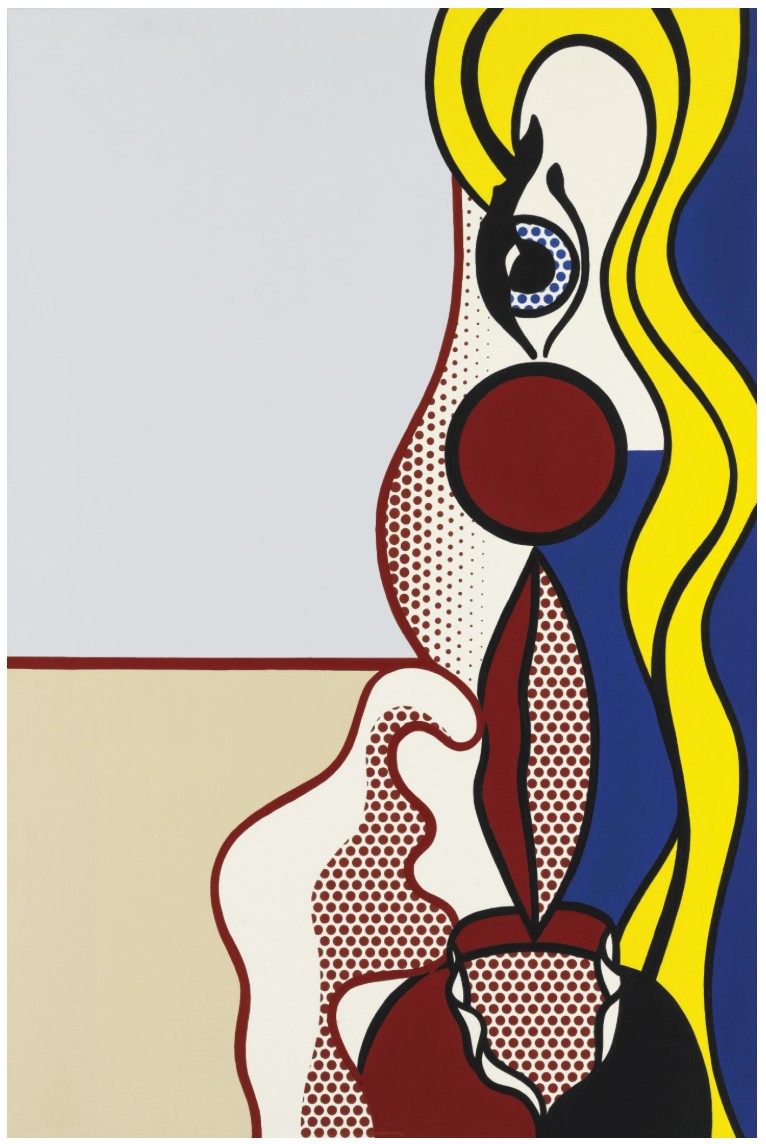
ROY LICHTENSTEIN
Female Figure, 1978
Oil and magna on canvas
60×40 inches (152.4 x101.6 cm)
Signed rf Lichtenstein and dated ’78 on the reverse
#7. Figures, 1977
Sotheby’s New-York: 13 November 2018
Estimated: USD 6,000,000 – 8,000,000
USD 6,734,300
(#24) ROY LICHTENSTEIN | Figures
ROY LICHTENSTEIN
Figures, 1977
Oil and Magna on canvas
44×100 inches (112×254 cm)
Signed and dated 77 on the reverse
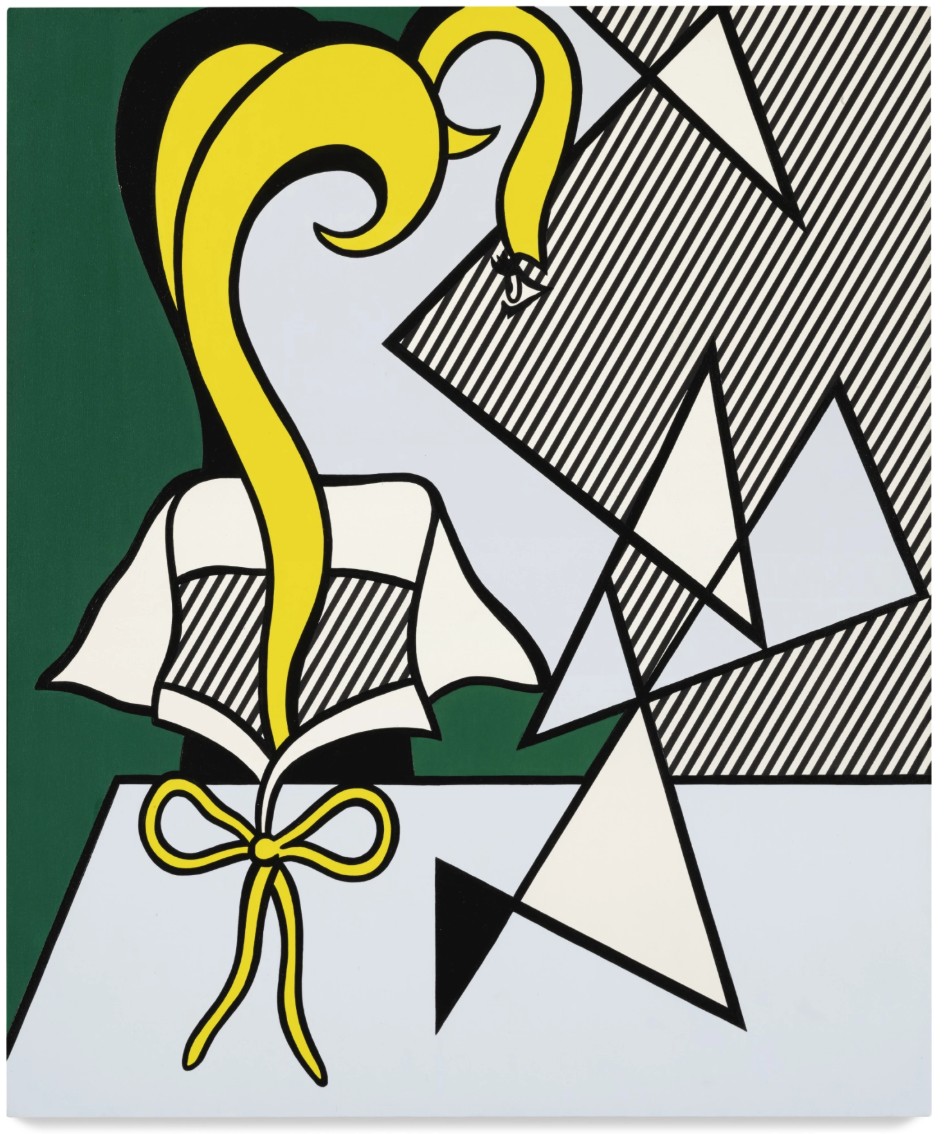
Woman with Neck Ribbon, 1978
Sotheby’s New-York: 18 May 2017
Estimated: USD 3,000,000 – 4,000,000
USD 5,187,500
ROY LICHTENSTEIN
Woman with Neck Ribbon, 1978
Oil and Magna on canvas
60 1/8 x 50 inches (152.7 x 127 cm)
Signed and dated 78 on the reverse
PAINTINGS
Female Head, 1977
Female Head, 1977
Sotheby’s New-York: 15 November 2017
Estimated: USD 10,000,000 – 15,000,000
USD 24,501,500
ROY LICHTENSTEIN
Female Head, 1977
Oil and Magna on canvas
60×50 inches (152.4 x 127 cm)
Signed and dated 77 on the reverse
A dazzling vision of exquisite beauty and peerless formal execution, Female Head represents the ultimate crescendo of Roy Lichtenstein’s pioneering investigation into the form, content, and meaning of Contemporary Art. Fixing on the viewer with a sidelong glance that is both irresistibly seductive and utterly elusive, the breathtaking subject of the present work embodies the ultimate crystallization of Lichtenstein’s enduring engagement with the most iconic of his subjects: the female head. Here, she is freed from the prosaic confines of the traditional Pop narrative to be reimagined as the beguiling muse of the Modernist masters. Just months after it was painted in 1977, Female Head was acquired from the Leo Castelli Gallery by the late Michael M. Rea and Elizabeth R. Rea, passionate collectors and noted patrons of the arts, and has remained in their collection for four decades. Elizabeth Richebourg Rea, an accomplished fine-art photographer, began her professional career at The Museum of Modern Art as director of the Art Lending and Art Advisory departments and was subsequently hired by Roy Lichtenstein’s primary dealer Leo Castelli, where she honed her artistic eye and acquired extensive knowledge of the artist’s work. Her accumulative knowledge and experience led to her role as free-lance curator for two major retrospectives of the work of Roy Lichtenstein. She was catalogue editor for the 1987 Museum of Modern Art exhibition The Drawings of Roy Lichtenstein; and research consultant for the 1993 exhibition Roy Lichtenstein organized by the Solomon R. Guggenheim Museum with travelling venues to the Museum of Contemporary Art, Los Angeles, and The Montreal Museum of Fine Arts.
Utterly breathtaking in the scope of its references, Female Head articulates the central tenets of Lichtenstein’s quintessential vernacular with unparalleled pictorial exuberance and graphic charge. Although rendered through the kaleidoscopic prism of Modernism, the cascading golden tresses of Lichtenstein’s signature blonde invoke the familiar bombshells of his Pop masterworks of the 1960s: a fitting figurehead for the artist’s freshly initiated exploration of new stylistic frontiers. Gleaned from the pages of comic books and advertisements, Lichtenstein’s Girls appear in his oeuvre as early as Girl with Ball of 1961, held in the collection of The Museum of Modern Art, only to reappear in such disparate guises as the distressed damsel of Drowning Girl and the domestic temptress of Girl in Bath throughout the course of the 1960s. Undisputed icons of postwar American art, Lichtenstein’s Girls exemplify the explicit tension at the very core of the artist’s practice: an irreconcilable distinction between the quotidian imagery of popular culture and the refined cultural paradigm of fine art. In Female Head, Lichtenstein’s archetypal female undergoes a radical stylistic transformation, departing from her role as the heroine of fictional and comic narrative to be reintroduced in a fantastical Surrealist dreamscape of compositional fragmentation and abstracted symbolism. While articulated in the illusionistic vocabulary of Twentieth Century Modernism, however, the seductive curves of the partially obscured yellow silhouette winding sinuously down the length of the canvas recall the shadows of Lichtenstein’s iconic Brushstroke paintings. Indeed, appearing in the very first of Lichtenstein’s Surrealist paintings, Female Figure of 1977, the abstracted mane of blonde locks becomes a central and signature motif of the Surrealist series. Likewise, the fractured mirror, which appears to both reflect and project the binary portrait before us, references both the canonical use of mirrors throughout art history and the artist’s own frequent use of mirrors as compositional elements in his earlier paintings; offering an updated articulation of the roles of vision and perception within art, here, Lichtenstein’s mirror serves to fracture the image, while simultaneously articulating the artist’s own backward glance at artistic precedent.
In Female Head, Lichtenstein confronts art history as his subject matter with striking finesse, systemically fracturing and reimagining iconic paintings of the Twentieth Century to compose his own, utterly original masterwork. In its precisely rendered geometric forms, the present work draws upon similar constructs in the work of such artist as El Lissitzky and Giorgio de Chirico; in contrast, the sinuously organic curves offer sly reference to the fantastical aesthetic of Max Ernst, imbuing the multifaceted portrait with an underlying sensuality. Describing the stylistic multiplicity of Female Head in the exhibition catalogue for the artist’s 1993 retrospective at the Solomon R. Guggenheim Museum, an exhibition which included the present work, Diane Waldman notes: “he paired multiple views of the female head, in a manner reminiscent of Picasso and his own early Picasso-esque Woman with Flowered Hat, 1963, with part of a mirror and a fragment of one of his landscapes (see Female Head, 1977)…[Lichtenstein’s] Surrealist-style works give us Surrealism pared down to its essential vocabulary and enhanced by his own visual commentary. While they do not share Surrealism’s fundamental premise—that a language of art could be shaped from the unconscious—they have captured much of its style, a large measure of its wit, and not a little bit of its pathos.” (Diane Waldman, “Futurism, Surrealism, and German Expressionism, 1974-80” in Exh. Cat., New York, Solomon R. Guggenheim Museum, Roy Lichtenstein, 1993, pp. 241-243)
Within this fascinating tableau of reimagined Modernism, however, Female Head pays unique and reverential homage to the celebrated oeuvre of one Twentieth Century master above all others: Pablo Picasso, an artist for whom Lichtenstein held a unique and profound respect. Describing Picasso’s immense influence upon his oeuvre, Lichtenstein once noted, “Picasso’s always been such a huge influence for me that I thought when I started the cartoon paintings that I was getting away from Picasso… I don’t think that I’m over his influence.” (Roy Lichtenstein quoted in David Sylvester, Lichtenstein: All About Art, London, 2003, p. 58) Fusing a bifurcated portrait with the fractured and abstracted reflection of a depicted mirror, Female Head achieves a radical restructuring of the female form profoundly evocative of Girl Before a Mirror, Picasso’s own bifurcated portrait of Marie-Thérèse. Echoing the prismatic texturing of Picasso’s 1932 painting, Lichtenstein juxtaposes contrasting fields of dazzling pattern and saturated hue to simultaneously evoke and flatten the depth of field, creating a spatial conundrum that further recalls the central tenets of synthetic cubism. Describing the immense importance the earlier painting held for him, Lichtenstein notes: “Girl Before a Mirror has a special meaning for me. Its strength and color relationships are extraordinary… it reaches a level of discord and intensity that has few parallels.” (The artist cited in Sheena Wagstaff, “Late Nudes,” in Exh. Cat., Art Institute of Chicago, Roy Lichtenstein: A Retrospective, 2012, pp.98) While Picasso’s beloved Marie-Thérèse appears absorbed in her own fractured reflection, however, Lichtenstein’s dream girl turns towards us to fix the viewer with her enigmatic gaze; effortlessly invoking a century of art history with unapologetic ease, Female Head boldly relishes her status as a magnificent example of Lichtenstein’s ultimate contribution to Contemporary Art.
Landscape with Figures, 1977
Landscape with Figures, 1977
Christie’s New-York: 12 November 2014
Estimated: USD 15,000,000 – 20,000,000
USD 18,085,000
Roy Lichtenstein (1923-1997), Landscape with Figures | Christie’s
ROY LICHTENSTIEN (1923-1997)
Landscape with Figures, 1977
Oil and Magna on canvas
64×100 inches (162.6 x 254 cm)
Signed and dated ‘rf Lichtenstein ‘77’ (on the reverse)
Provenance
Blum Helman Gallery, New York
Acquired from the above by the present owner, 1978
Painted in 1977, Roy Lichtenstein’s Landscape with Figures presents an exhilarating compendium of art historical reference that is simultaneously a self-reflective tour de force of his own practice. Situated at a pivotal moment in Lichtenstein’s oeuvre, the work stems from his series of so-called Surrealist works that, created between 1977 and 1979, stand among the artist’s most complex paintings. These works dramatically extend his earlier practice of wry appropriation that spanned reproductions of Cézanne and Mondrian to comic book illustration. Landscape with Figures presents a virtuosic tableau that splices and recombines the full gamut of twentieth-century image making, reprising and anticipating elements of Lichtenstein’s own output alongside acts of homage to the great Modernist masters. Allusions to René Magritte and Pablo Picasso sit beside forms that evoke the work of Henry Moore and El Lissitzky, jostling for recognition amidst references to Lichtenstein’s own artistic vernacular, with elements of Brushstroke, Trompe l’Oeil and Self-Portrait works. His iconic Ben-Day dots and stripes, drawn from the world of commercial graphics, combine with strong blocks of color and sharp linear forms that overwrite his enigmatic historical tableau with the cool indifference of Pop Art. Surrealism and Cubism, sculpture and architecture, painting and printing, are here evoked and rebuked in equal measure. Through this visual cacophony, Lichtenstein’s rigorous commentary on the boundary between “High” and “Low” art is brought to a resounding climax, paving the way for his continued engagement with the art historical canon throughout the 1980s and 1990s. An enigmatic and multifaceted composition, both retrospective and prophetic, Landscape with Figures is an outstanding example of the artist’s definitive dictum: “All my art is in some way about other art” (R. Lichtenstein, quoted in J. Hendrickson, Roy Lichtenstein, Cologne, 2000, frontispiece).
Breathtaking in the sheer scope of its referential compass, Landscape with Figures is laced with coded allusions to art-historical tropes, aligning elements from his own visual lexicon with those of his twentieth-century forbears. The suited figure on the far left is as evocative of Magritte’s The Son of Man (1964) as it is prophetic of Lichtenstein’s own Self-Portrait (1978), in which the artist’s head is replaced with the geometric form of a mirror. The woman reclining upon the beach in the foreground was to become a central figure within the Surrealist works, recalling Picasso’s own interest in the subject whilst simultaneously rendered with the curvilinear contours of a Henry Moore sculpture. The pointed geometric forms that occupy the right-hand edge of the canvas were also significant within the series. Often taking on an anthropomorphic quality, they reference similar constructs in the work of El Lissitzky, Max Ernst and Giorgio de Chirico, and pave the way for Lichtenstein’s own abstract play in his Imperfect paintings of the 1980s. The perforated block of Swiss cheese—a recurring Surrrealist-inspired symbol within Lichtenstein’s works of this period – merges with a sweep of yellow paint that has its roots in his Brushstroke series, in which painterly gesture was reduced to a graphic, cartoon-like presentation. Here, it also suggests the hair of the abstracted face that graces the centre of the painting, whose singular eye and exaggerated teardrop enhances Lichtenstein’s homage to Picasso and Magritte. Her nose is replaced with the form of a teepee, a subject of great interest for Lichtenstein at this time, later cemented in his Native American Surrealist works. Many American artists, including Lichtenstein’s contemporaries Jasper Johns, Frank Stella and Donald Judd, were increasingly fascinated by their country’s indigenous past, and Lichtenstein’s proximity to the Shinnecock Indian reservation on Long Island, New York during the 1970s led him to incorporate symbolic markers of this culture into his Surrealist works.
Just as the composition appears to reach its saturation point, the entire construct is undermined by a classic trompe-l’oeil gesture: Lichtenstein paints a curled roll of paper that peels back to reveal blue sky and clouds. Harking back to the artist’s earlier Trompe l’Oeil works, the motif is inherently connected to Surrealist practices yet also speaks directly to the heart of Lichtenstein’s own aesthetic. Within an oeuvre founded upon the dialogue between High and Low culture, Lichtenstein’s interests in the history of fine art were balanced with a fascination with the genres of comic book illustration and mass reproduction of images. His Ben-Day dots and stripes, both of which are present in Landscape with Figures, first appeared in Lichtenstein’s oeuvre in the 1960s and were the direct product of this line of enquiry. Standing as the ultimate signifiers for the inherent artificiality of image-making, these techniques allowed the artist to position his own idiom as a trompe-l’oeil of sorts, treading the boundary between painting and reproduction. By including an explicit trompe-l’oeil gesture in the present work, Lichtenstein subtly highlights the conceptual orientation of his practice. One stylized rendition of the sky simply gives way to another, reminding us that however much we unpack the different layers of his composition, we will never arrive at an original reality. This is reflected in the enigmatic layering of symbols and references that constitutes Landscape with Figures, allusive yet ultimately impenetrable. In this regard, the work may be said to encapsulate the very essence of Lichtenstein’s practice: a postmodern commentary on the relationship between image and reality, deeply self-aware of art’s illusory status and exploring the potential in ready-made strategies of representation. In this way, Landscape with Figures may be said to constitute a summation of Lichtenstein’s artistic outlook.
In Landscape with Figures, Lichtenstein makes apparent his deeply personal take upon the artistic traditions he invokes. By treating elements of his own practice with the same re-interpretive license, he ultimately inscribes himself within the wide-ranging canon of image-making that nourished his multifaceted practice. Profoundly self-referential, it is a work that restates his influences within his own language whilst simultaneously capitulating the trajectory of his own practice. In this way, it serves to embody Lichtenstein’s claim that “All painters take a personal attitude toward painting. What makes each object in the work is that it is organized by that artist’s vision.
Girl with Beach Ball II, 1977
Girl with Beach Ball II, 1977
American Visionary: The Collection of Mrs John L. Marion
Sotheby’s New-York: 12 May 2021
Estimated: USD 12,000,000 – 18,000,000
USD 14,052,000
ROY LICHTENSTEIN (1923 – 1997)
Girl with Beach Ball II, 1977
Oil and Magna on canvas
60×50 inches (152.4 x 127 cm)
Signed and dated 77 on the reverse
Provenance
Estate of Roy Lichtenstein
Mitchell-Innes & Nash, New York
Acquired by the present owner from the above in June 2001
Iconic yet mysterious, deeply alluring yet utterly elusive, Girl with Beach Ball II brilliantly exemplifies the virtuosic dexterity with which Roy Lichtenstein thrillingly reimagined art history throughout his celebrated oeuvre. Executed in 1977 at the height of the artist’s celebrated Surrealist period, Girl with Beach Ball II showcases the peerless formal execution and conceptual sophistication which define this pivotal period. The motif of a woman with a beach ball is one that Lichtenstein first adopted in 1961 with his critical early masterwork Girl with Ball (Museum of Modern Art, New York), and returned to nearly 20 years later with the present work and its sister painting Girl with Beach Ball III, and subsequently in Nude with Beach Ball and Nudes with Beach Ball, both from 1994. Operating at various levels of self-reflexivity, Girl with Beach Ball II comprises a survey of the artist’s own oeuvre and the broader history of art, and is an emphatic testament to Lichtenstein’s own astute summation: “All my art is, in some way, about other art.” (Roy Lichtenstein quoted in: Janis Hendrickson, Roy Lichtenstein, Cologne 2000, n.p.) With other examples of the Surrealist paintings from 1977 and 1978 held in such collections as the Solomon R. Guggenheim Museum and the Metropolitan Museum of Art in New York, as well as the Louisiana Museum of Modern Art in Denmark, this series showcases the inventive mind of an artist at the creative apex of his extraordinary career.
LICHTENSTEIN IN HIS STUDIO IN SOUTHAMPTON, 1977. PHOTOGRAPHER UNKNOWN. ART © ESTATE OF ROY LICHTENSTEIN. COURTESY THE ROY LICHTENSTEIN FOUNDATION ARCHIVES
Engaging in and contributing to a timeless dialogue with his art historical forebears, Roy Lichtenstein subverts the tenets and tropes of twentieth century modernism, weaving these archetypes with his own distinctive pioneering style and signature Pop aesthetic. While Lichtenstein considered Surrealism to be the specific point of departure for this series, the present work in fact fuses references to a diverse range of artists and masterpieces.
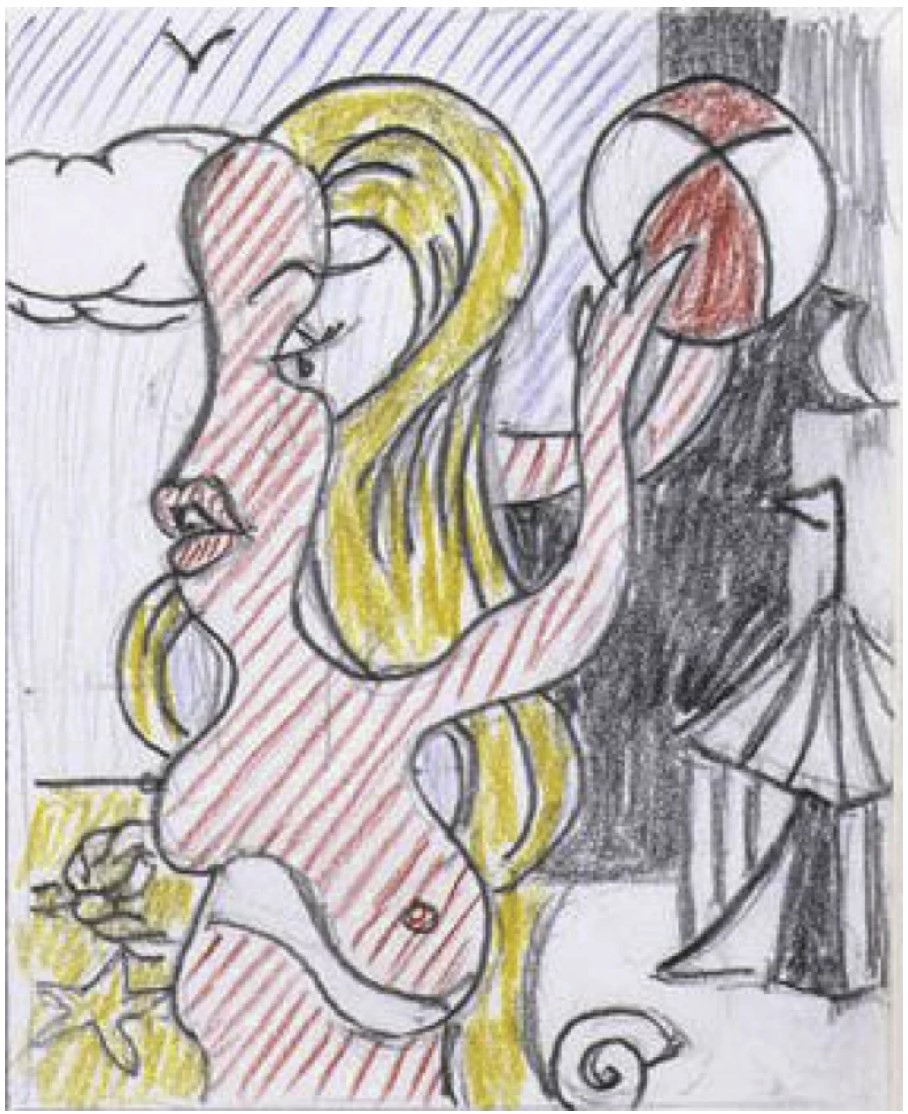
ROY LICHTENSTEIN, STUDY FOR GIRL WITH BEACH BALL II, 1977. PRIVATE COLLECTION. ART © ESTATE OF ROY LICHTENSTEIN
In the present work, the dramatically foreshortened space between Lichtenstein’s sumptuous blonde and the near horizon bisecting the composition recalls the destabilization of space in the metaphysical landscapes of Salvador Dalí and Giorgio de Chirico. In contrast, the sinuously organic curves of the blonde offer sly reference to the fantastical aesthetic of Max Ernst, imbuing her with an underlying sensuality, and the fragmentation of her face and breasts recalls Pablo Picasso’s radical cubist portraits. While the woman’s pose echoes that of Lichtenstein’s Girl with Ball from 1961, her fragmented figure and the unfamiliar environment of Girl with Beach Ball II confound traditional expectations of the landscape genre, paying homage to Dalí’s exploration of psychological topography, rather than of the tangible realm. In the foreground, the combination of objects – the circus tent, partially concealed crescent moon, seashell, starfish, and rope, amongst others – recalls the seemingly incongruous combinations of Dalí’s so-called “symbolically functioning objects.”
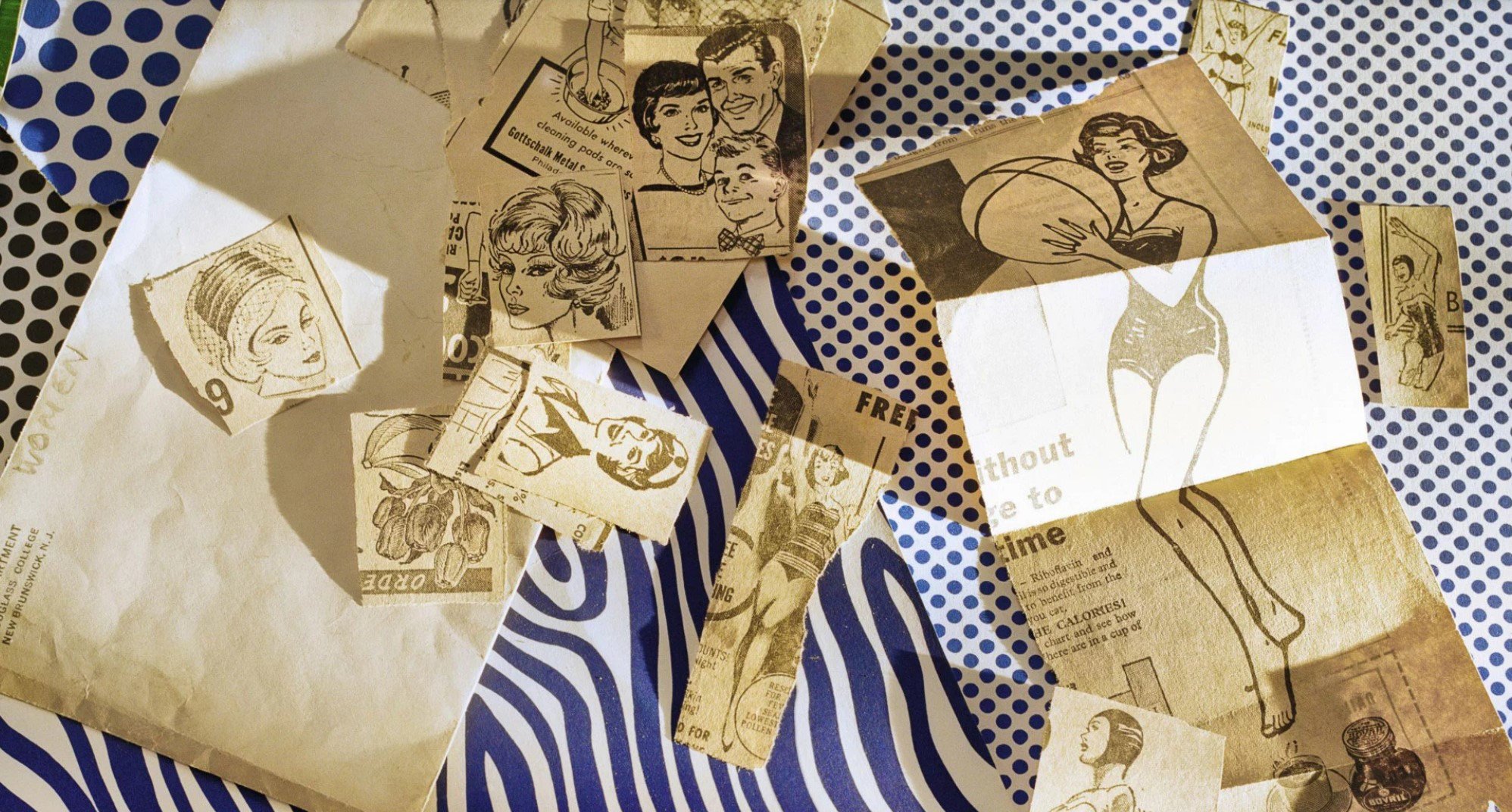
Unlike his Surrealist predecessors however, whose painstakingly selected forms reference internal forces of the psyche, the crisp forms of Lichtenstein’s landscapes are chosen precisely for their frequent usage in other paintings, both those of the Surrealists and works from Lichtenstein’s own oeuvre.
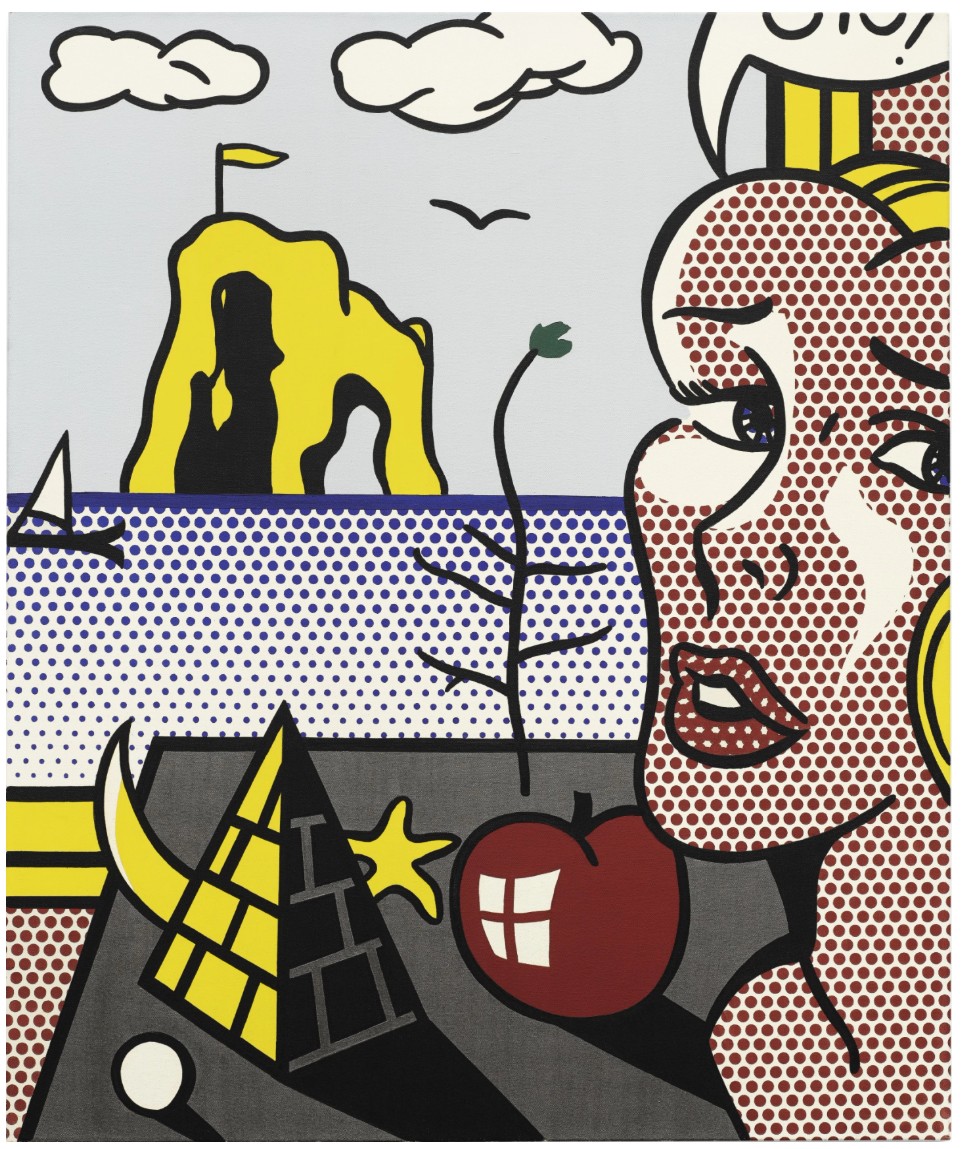
Still Life with Head in Landscape, 1976
Still Life with Head in Landscape, 1976
Estimated: USD 7,000,000 – 10,000,000
Price realized: USD 10,501,900
ROY LICHTENSTEIN
Still Life with Head in Landscape, 1976
Oil and Magna on canvas
48×40 inches (121.9 x 101.6 cm)
Signed and dated 76 on the reverse
Provenance
The Pace Gallery, New York
Acquired by the present owner from the above in 1992
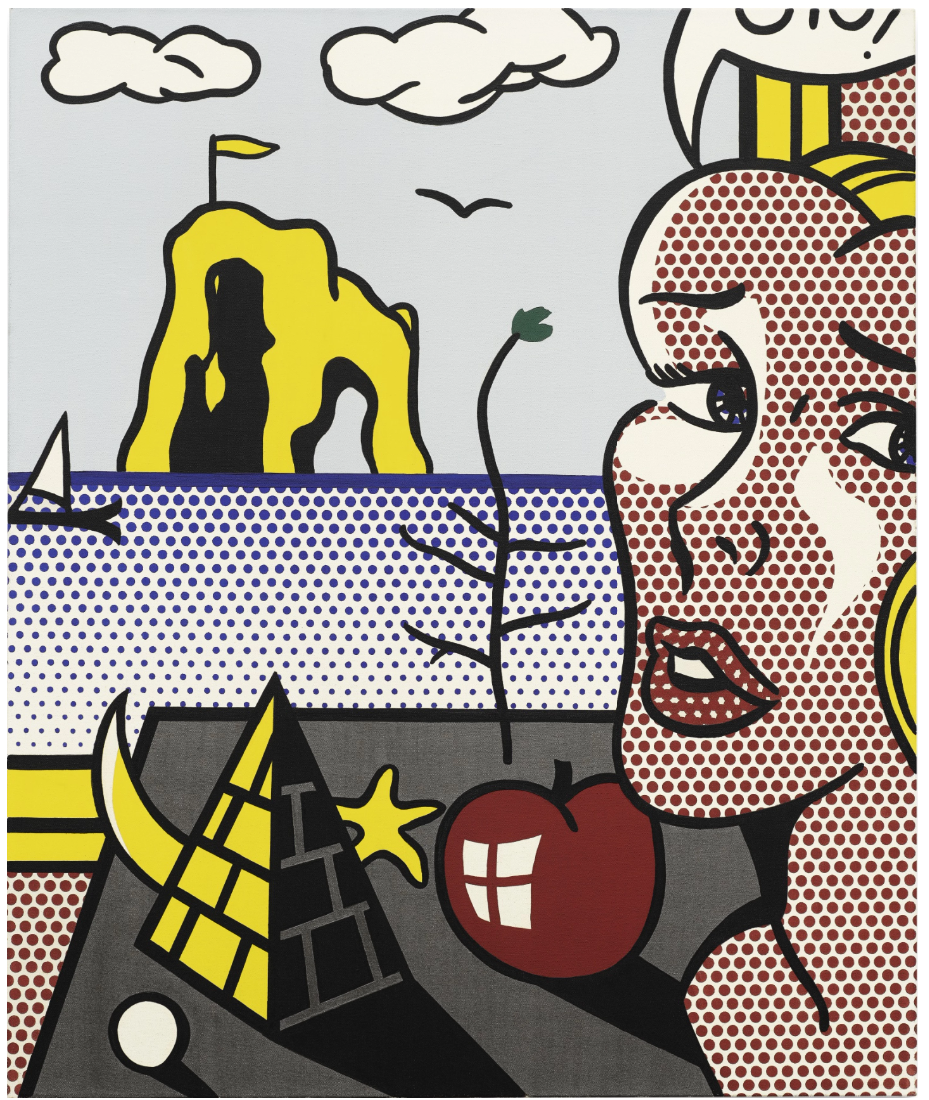
Dated 1976, Still Life with Head in Landscape is described as the inception point of the series and as the first instance in which Lichtenstein inserted the female figure into a Surrealist landscape. Even at the level of title, the work announces its strategy of genre confusion: still life, landscape, and portrait are deliberately blurred. The text presents the painting as an unusually intricate construction in which each element suggests multiple referential meanings, drawing the viewer into what is described as a chromatic and enigmatic realm. It is also framed as a pivotal example of Lichtenstein’s late-1970s approach to art history, where appropriation is directed toward the larger structures of canonical painting rather than toward mass-media motifs alone.
The description identifies specific mechanisms by which the painting produces its Surrealist effect. A foreshortened spatial arrangement aligns the work with Dalí and de Chirico’s dreamlike environments; the figure’s organic curves are linked to Max Ernst; and a series of discrete objects—pyramid, crescent moon, apple, a bare tree with a single leaf—are associated with the Surrealist and metaphysical repertoire, including echoes of Magritte and Dalí. Crucially, the text underscores that Lichtenstein’s objects do not function as revelations of the psyche, but as forms chosen for their recurrence in other paintings and their recognizability as art-historical signs. Scholarly commentary in the text frames this process as the creation of a “Surrealist slang,” in which elements are modified, released from their nominal sources, and reassembled into a new tableau where inanimate forms appear charged by sharp light and shadow.
Iconic yet enigmatic, entirely alluring yet utterly elusive, Still Life with Head in Landscape is the ultimate exemplar of the virtuosic dexterity with which Roy Lichtenstein faced, assimilated, and thrillingly reimagined the art historical canon throughout his celebrated oeuvre. Arranged with exacting precision upon the canvas, each irresistibly intriguing element of Lichtenstein’s vibrant composition suggests innumerable referential meanings, drawing the viewer ever closer in our desire to enter the bewitchingly chromatic realm of Lichtenstein’s masterpiece. Executed in 1976, at the inception of the artist’s celebrated Surrealist series, Still Life with Head in Landscape exemplifies the peerless formal execution and conceptual sophistication which define this celebrated period of the artist’s career. In fact, the present work momentously marks the very first occasion in which Lichtenstein inserted the female figure into a Surrealist landscape – while the year of 1977 saw him produce a number of Surrealist figures, it was this painting in 1976 that birthed the beginning of this landmark series. With examples of Lichtenstein’s Surrealist paintings from 1977 and 1978 held in such collections as the Solomon R. Guggenheim Museum in New York, the Louisiana Museum of Modern Art in Denmark, and the Metropolitan Museum of Art in New York, amongst numerous others, this series represents the inventive mind of the artist at the creative apex of his extraordinary career. Held in the collection of Barbara and Morton Mandel for over twenty five years and never publicly exhibited, the present work is amongst the most captivating realizations of Pop Art’s scintillatingly absorptive approach to precedent. Picasso explored the etchings of Rembrandt, while Warhol deftly repurposed the devotional imagery of Leonardo da Vinci; for centuries, artists have confronted the art of centuries past, engaging in and contributing to a timeless dialogue with their art historical forbearers. Achieving an exceptionally superb continuation of this venerated custom, Still Life with Head in Landscape articulates the tenets and tropes of innumerable art historical masterworks with unparalleled pictorial exuberance and graphic charge. In its title alone, the present work suggests a blurring of the traditional genre distinctions between landscape, still life, and portraiture; deftly combining the three, Still Life with Head in Landscape is a work of virtually incomparable intricacy. While Lichtenstein considered Surrealism to be the specific aesthetic departure for this series, the present work merges sly references to a diverse range of artists, periods, and masterpieces.
“They were of no particular Surrealist artist, just Surrealism in general…These works are something like the Artist’s Studio paintings in that they are large compositions that include various images from various periods.”
In the present work, the dramatically foreshortened space between Lichtenstein’s sumptuous blonde, intimately leaning into the viewer’s space, and the near horizon bisecting the composition recalls the destabilization of space in the metaphysical landscapes of Salvador Dali and Giorgio de Chirico, whose hyper-real scenes aimed to conjure the uncanny environment of a dream; in contrast, the sinuously organic curves of the cooing blonde offer sly reference to the fantastical aesthetic of Max Ernst, imbuing her with an underlying sensuality. Below the horizon, a crisp blue swath of Lichtenstein’s trademark Ben-Day spots echoes the sweeping beaches and rugged cliffs of the Catalan coastline portrayed in many of Dali’s best known paintings. As in those works, the unfamiliar space of Still Life with Head in Landscape confounds traditional expectations of the landscape genre, paying homage to Dali’s exploration of psychological topography, rather than of the tangible realm. In the foreground, the combination of objects within Lichtenstein’s still life – the precise yellow pyramid, partially concealed crescent moon, and gleaming red apple, amongst others – recalls the seemingly incongruous combinations of Dali’s so-called “symbolically functioning objects;” unlike his Surrealist predecessors, whose painstakingly selected forms reference internal forces of the psyche, the crisp forms of Lichtenstein’s still life are chosen precisely for their frequent usage in other paintings, both from the Surrealists and within Lichtenstein’s own oeuvre.
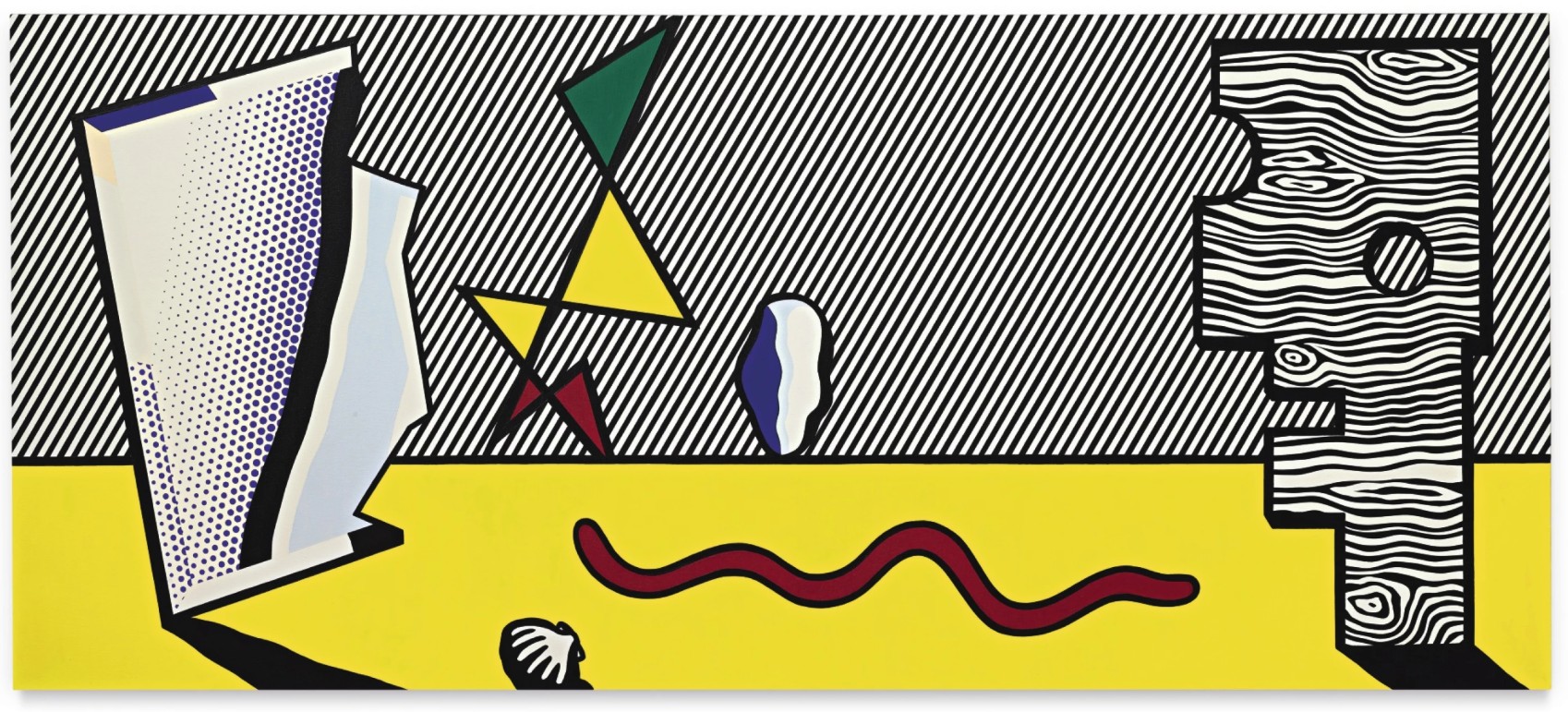
Figures, 1977
Figures, 1977
Sotheby’s New-York: 13 November 2018
Estimated: USD 6,000,000 – 8,000,000
USD 6,734,300
(#24) ROY LICHTENSTEIN | Figures
ROY LICHTENSTEIN
Figures, 1977
Oil and Magna on canvas
44×100 inches (112×254 cm)
Signed and dated 77 on the reverse
Provenance
Estate of the Artist
Leo Castelli Gallery, New York (LC #809)
Acquired by the present owner from the above
An enigmatic landscape of dazzling psychological complexity and peerless formal execution, Figures from 1977 dates from the inaugural year of Roy Lichtenstein’s brief and highly acclaimed ‘Surrealist’ period between 1977 and 1979, during which the artist created his most visually and conceptually complex paintings to date. A testament to Lichtenstein’s enduring engagement with the nature of art, Figures integrates into its landscape images gleaned from comic books, Lichtenstein’s own oeuvre, and the full scope of art history, most notably Surrealism and Cubism. With remarkable ease and conceptual sophistication, Lichtenstein here aligns the thematic concerns and visual imagery of Surrealism with the Pop idiom and his vibrantly graphic iconography. Yet unlike the output of his Surrealist forebears, who embraced automatic intuition and unconscious spontaneity, Lichtenstein’s corpus, and the present work in particular, reveals his prescribed and premeditated approach to both compositional arrangement and figuration. First explored through multiple sketches and ultimately arranged in the final composition with exacting precision, the present composition is in many ways antithetical to underlying principles of Surrealist doctrine, and is instead more aligned with the calculated rigor of Cubism. With examples of Lichtenstein’s Surrealist paintings from 1977 and 1978 held in such collections as the Solomon R. Guggenheim Museum in New York, the Louisiana Museum of Modern Art in Denmark, and the Metropolitan Museum of Art in New York, amongst numerous others, this series represents the inventive mind of a mature artist at the creative apex of his extraordinary career.
Situated far off on the horizon line, a pointed sculptural element commands the viewer’s attention; equally vibrant in color and commanding in scale as the elements in the foreground, this perplexing triangular element underscores the dramatic foreshortening of space and destabilizing absence of perspectival depth characteristic of Lichtenstein’s Surrealist landscapes. With its irregularly arranged triangular elements, this form is a clear precursor to Lichtenstein’s Perfect / Imperfect paintings of the 1980s, a series that represents his most judicious and sustained foray into total abstraction. While seemingly lacking any referential signifier, the inspiration for this perplexing triangular form came from the comic book The Flash, in which a superhero character emits a force field which is graphically conveyed by overlapping planes of color and intersecting lines. As with his mirror motif, Lichtenstein here reveals his fascination with the capacity to visually convey complex ideas or phenomena – in this case the dynamic, thrumming energy of an invisible force field – into an easily digestible and reproducible image. Also referencing the aesthetic purity and precision of the early modernists, this triangular construct recalls the compositions of Giorgio de Chirico, El Lissitzky, and Piet Mondrian.
Rendered in vibrant yellow, red, blue, and green hues offset by crisp blacks and whites, Figures revels in the sharply defined gestures and bold use of color elicited by Lichtenstein’s precise graphic Pop sophistication. Foreshadowing his increasing tendency beginning in the late 1970s and into the 1980s to embrace greater experimentation in his compositions, Lichtenstein incorporates into the present work greater variation in pattern and color to convey the complexity of his subject matter. Each irresistibly intriguing representational element of Figures suggests a multiplicity of referential meanings, drawing the viewer ever closer in his or her desire to enter the bewitchingly chromatic realm of Lichtenstein’s vibrant masterpiece.
Woman with Neck Ribbon, 1978
Woman with Neck Ribbon, 1978
Sotheby’s New-York: 18 May 2017
Estimated: USD 3,000,000 – 4,000,000
USD 5,187,500
ROY LICHTENSTEIN
Woman with Neck Ribbon, 1978
Oil and Magna on canvas
60 1/8 x 50 inches (152.7 x 127 cm)
Signed and dated 78 on the reverse
Provenance
Leo Castelli Gallery, New York (LC #833)
Margo Leavin Gallery, Los Angeles (acquired from the above in 1979)
Private Collection, Texas (acquired from the above in 1979)
Margo Leavin Gallery, Los Angeles
Private Collection, Los Angeles (acquired from the above in 1982)
Private Collection, Japan
Acquired by the present owner from the above in 2010
A work of scintillating wit and superb execution, Woman with Neck Ribbon from 1978 exemplifies the astounding variety of ways in which artist Roy Lichtenstein approached, reused, and reevaluated icons and imagery throughout his remarkable career. In the 1960s, Lichtenstein garnered worldwide attention and acclaim for the piercing satire and bold appropriation of his paintings; in these prototypical Pop masterworks, Lichtenstein placed the familiar visual vernacular of comics, advertising, and film in unexpected dialogue with the elevated lexicon of fine art. It was not until the 1970s, however, that the artist focused his practice of ingenious appropriation upon the larger subject matter of art history. Situated at a pivotal moment in the artist’s oeuvre, Woman with Neck Ribbon is a superb example of the artist’s iconic Surrealist paintings of 1977 to 1979; in these complex compositions, Lichtenstein presented a remarkable amalgamation of art historical tropes and self-referential allusions to his own oeuvre. With examples of Lichtenstein’s Surrealist paintings from 1977 and 1978 held in such collections as the Solomon R. Guggenheim Museum in New York, the Louisiana Museum of Modern Art in Denmark, and the Metropolitan Museum of Art in New York, amongst numerous others, this series represents the inventive mind of the artist at the creative apex of his extraordinary career. Irresistibly enigmatic, Woman with Neck Ribbon is a testament to Lichtenstein’s own wry comment that, “All my art is, in some way, about other art.” (Roy Lichtenstein quoted in Janis Hendrickson, Roy Lichtenstein, Cologne, 2000, frontispiece)
In Woman with Neck Tie, Lichtenstein offers the viewer an intimate engagement with both art historical precedent and his own artistic past. By weaving allusions to the Surrealist figures of Magritte with the Cubist muses of Picasso, he creates an enigmatically multifaceted composition that defies clear categorization. The myriad diversity of external references is counter-balanced by the highly personalized treatment of his own oeuvre in the present work, as the artist draws on the forms of figures from his iconic paintings with the same acerbic wit and artistic license that has always characterized his distinctive practice. Indeed, considering his relationship to art history, Lichtenstein commented, “All painters take a personal attitude toward painting. What makes each object in the work is that it is organized by that artist’s vision. The style and the content are also different from anyone else’s. They are unified by the point of view—mine. This is the big tradition of art.” (The artist cited in Calvin Tomkins, Roy Lichtenstein: Mural with Blue Brushstroke, New York, 1988, p. 42)
Figures with Rope (Study), 1978
Figures with Rope (Study), 1978
Works from the Collection of Dorothy and Roy Lichtenstein
Sotheby’s London: 25 June 2025
Estimated: GBP 120,000 – 180,000
GBP 139,700 / USD 188,595
WORK ON PAPER
Figures with Rope (Study) | Contemporary Day Auction | 2025 | Sotheby’s
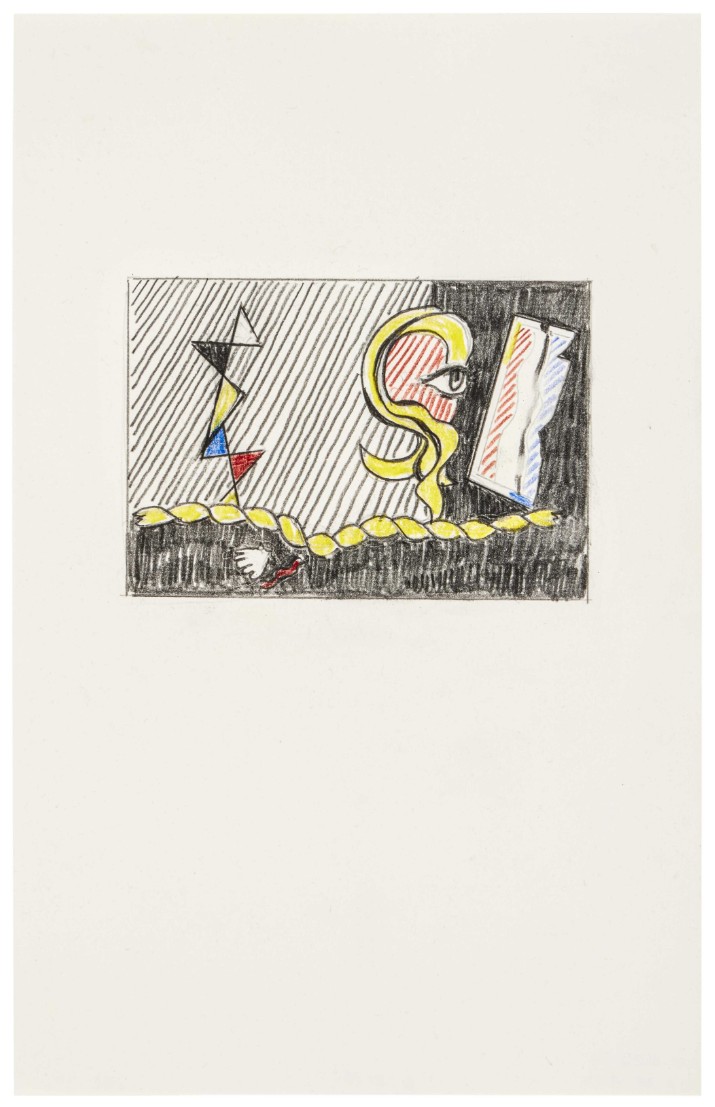
ROY LICHTENSTEIN (1923 – 1997)
Figures with Rope (Study), 1978
Graphite and colored pencil on paper
11 1/2 x 7 3/8 inches (29.3 x 18.6 cm)
Signed and dated ’78 (on the verso)
In Figure with Rope (Study) from 1978, Roy Lichtenstein opens a window into one of the most experimental and introspective periods of his career. The drawing belongs to a brief but ambitious series of works in which Lichtenstein, long celebrated for his bold comic-inspired Pop Art, turned toward the visual vocabulary of Surrealism. However, rather than embracing the movement’s emphasis on chance and subconscious automatism, Lichtenstein approached Surrealism as a structure to be dissected, reassembled, and ultimately reframed within his own graphic idiom.
Rendered in graphite and colored pencil, Figure with Rope (Study) exudes a playful tension between abstraction and cartoon-like formality. Lichtenstein constructs a composition of fragmented, angular shapes and bold, flat colours that seem to reference both Constructivist geometry and his signature Pop-inflected vocabulary. The rope, rendered in a bright yellow chain of loops, snakes across the lower portion of the image, functioning as both a physical boundary and a compositional anchor. The surrounding space resists traditional depth, instead presenting a tilted, striped void that flattens and destabilizes the scene. Rather than evoking a dreamlike atmosphere in the Surrealist sense, the study’s deliberate lines and graphic precision suggest a calculated dismantling of illusionism. Lichtenstein’s engagement here is less with subconscious automatism and more with the visual syntax of mass reproduction, infusing abstraction with the clarity and irony of the comic strip idiom.
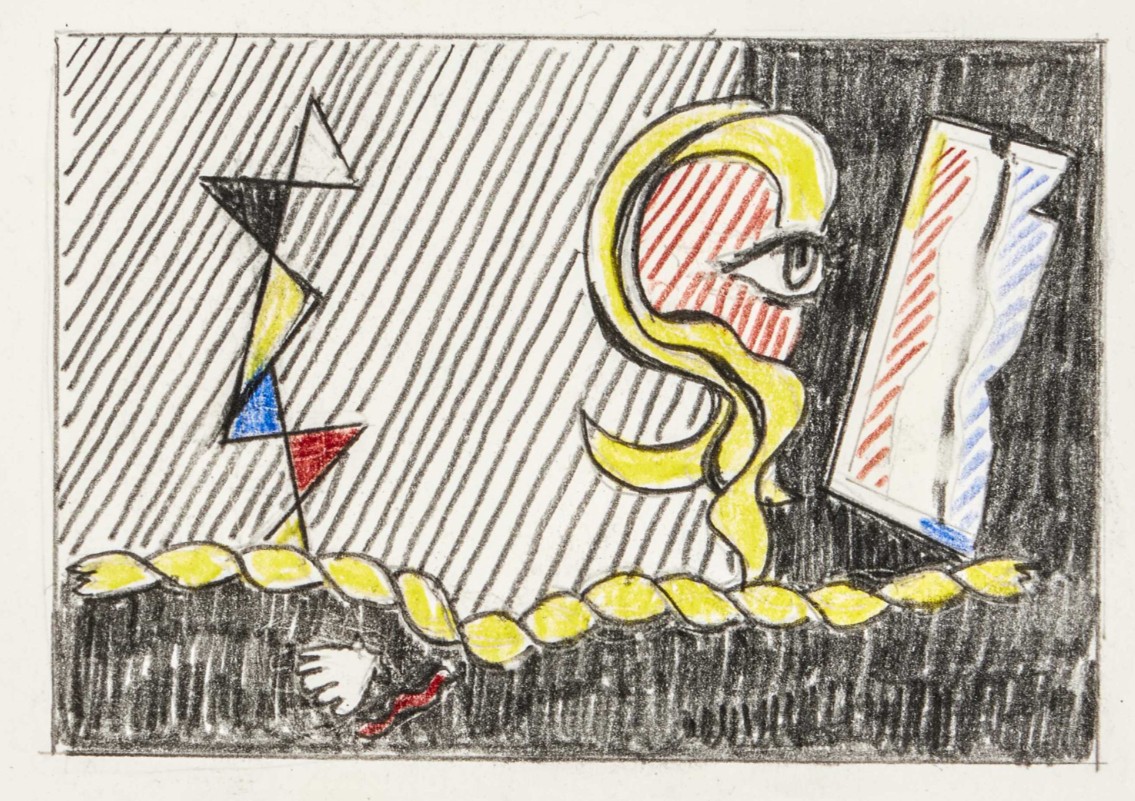
Within this framework, the “study” becomes a site of aesthetic experimentation. Here, Lichtenstein tests how visual elements interact: the curves of the figure against the taut tension of the rope and the layering of forms that simultaneously suggest volume and flatness. The clarity of line and sparseness of tone grant the drawing a sense of deliberate restraint, allowing Lichtenstein to isolate and evaluate compositional choices before committing them to canvas. This reflects a broader trend in his working process during the late 1970s, where preparatory works served as modular components, visual ideas developed in isolation and later assembled into larger, complex compositions. As such, Figure with Rope (Study) can be seen as part of the preparatory work behind Lichtenstein’s Surrealist paintings, offering key insight into how those densely layered final works took shape.
Lichtenstein’s engagement with Surrealism during this period was neither ironic detachment nor pure homage; it was, rather, a self-aware excavation of art history filtered through his Pop sensibility. Having witnessed the influence of European Surrealists on the American art scene in the 1940s, Lichtenstein was uniquely positioned to re-express these forms through the lens of postwar consumer culture. His Surrealist studies of the late 1970s reflect not only a return to earlier influences but also a conscious reassessment of his own artistic trajectory. Where Surrealism once sought to reveal the unconscious through irrational juxtapositions, Lichtenstein subverted this goal by deliberately fabricating the irrational, borrowing its imagery while refusing its methods.
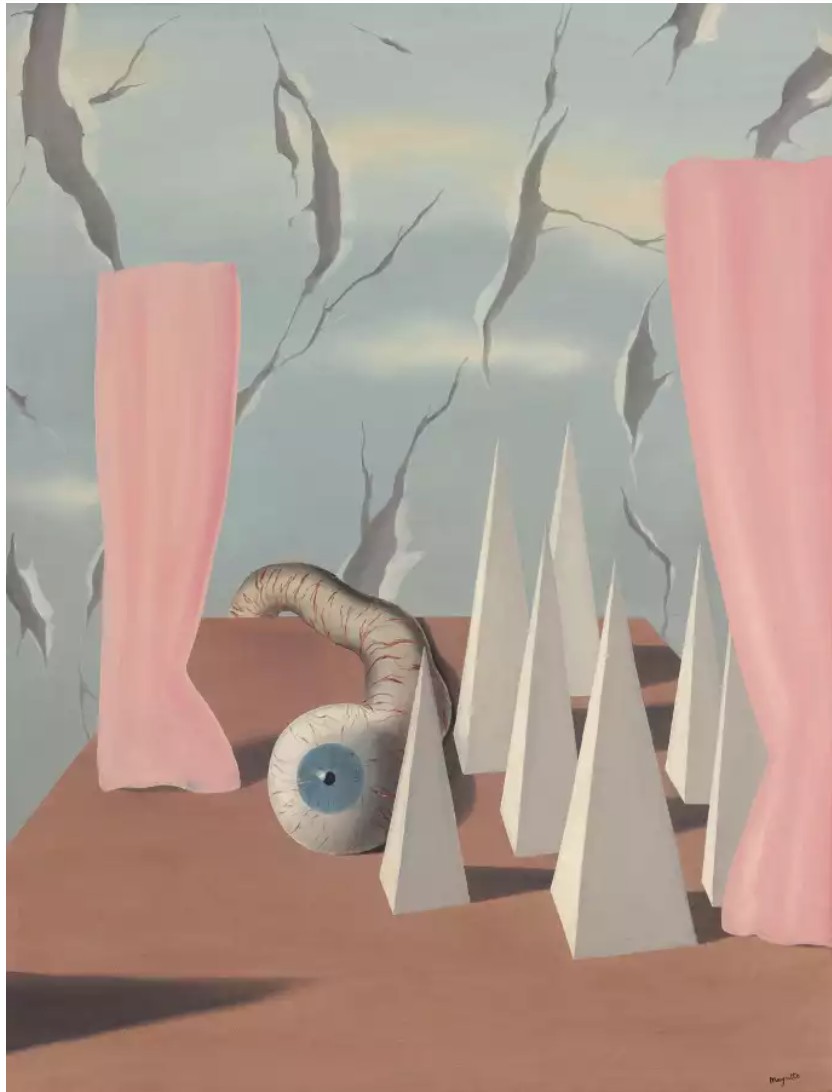
Rene Magritte, Le Monde poétique, 1926, Sold at Sotheby’s, New York, 18 May 2022 for $4,165,000.
Artwork: © ADAGP, Paris and DACS, London 2025
This tension between spontaneity and structure lies at the heart of what makes Lichtenstein’s Surrealist period so compelling. Even the rope in this study, an ostensibly simple object, can be read on multiple levels: as a binding motif, a formal echo of line and loop, or even a subtle metaphor for the constraints of historical tradition. The figure itself may call to mind the headless women of Max Ernst’s collages or the surreal anatomies of Rene Magritte, yet Lichtenstein’s treatment strips these allusions of their psychological weight, reimagining them through the cool lens of graphic stylization. His signature visual language, characterized by Ben-Day dots, bold contours, and minimal shading, is here transposed into a more subdued but equally calculated format, reminding us that even his most Surreal imagery is grounded in formal discipline. Ultimately, Figure with Rope (Study) encapsulates Lichtenstein’s approach to image-making at a turning point in his career. As with other works from this period, it underscores his ability to absorb, reinterpret, and recombine visual traditions into a cohesive and uniquely personal aesthetic. Lichtenstein was not merely referencing Surrealism; he was dissecting it, flattening its dreamscapes into diagrammatic puzzles and reassembling its forms within the visual logic of Pop. In doing so, he challenged the very notion of authenticity, spontaneity, and originality that so many of his sources held dear.