Introduction
Lichtenstein first engaged with Futurism as his subject matter in 1973, painting a limited number of Futurist-inspired works between 1974-1976. Examples of Lichtenstein’s Futurist paintings are held in prominent collections, his monumental The Red Horseman, 1974, resides at the Ludwig Forum for International Art, Aachen (currently on loan to the Museum Moderner Kunst Stiftung Ludwig, Vienna) and his Violin, 1976, at the Denver Art Museum. This cycle of works embodies Lichtenstein’s creative genius at the apex of his extraordinary career.
“I also started to use the work of modern masters as subject matter… Instead of using subject matter that was considered vernacular, or everyday, I used subject matter that was celebrated as art.”
Moving away from the comic-book aesthetic that had brought him to prominence in the 1960s, Lichtenstein’s abiding interest in questions of art’s meaning, form, content and style once again came to the fore in the early 1970s, as his practice became less narrative and more abstract. Examining higher artistic sources and the grandeur of artistic movements, he created compositions based on the avant-garde movements of 20th century art history, meditating on the nature of the creative enterprise itself. In his seminal canvases responding to Cubism, Futurism, Surrealism and German Expressionism, the pristine lines and precise dots underline Lichtenstein’s self-consciously cultivated aura of industrial production, intrinsic to the Pop Art narrative and his response to the painterly nature of Abstract Expressionist painting.
Auction Results
#1. Sailboats III, 1974
Sotheby’s New-York: 9 May 2012
Estimated: USD 6,000,000 – 8,000,000
USD 11,842,500
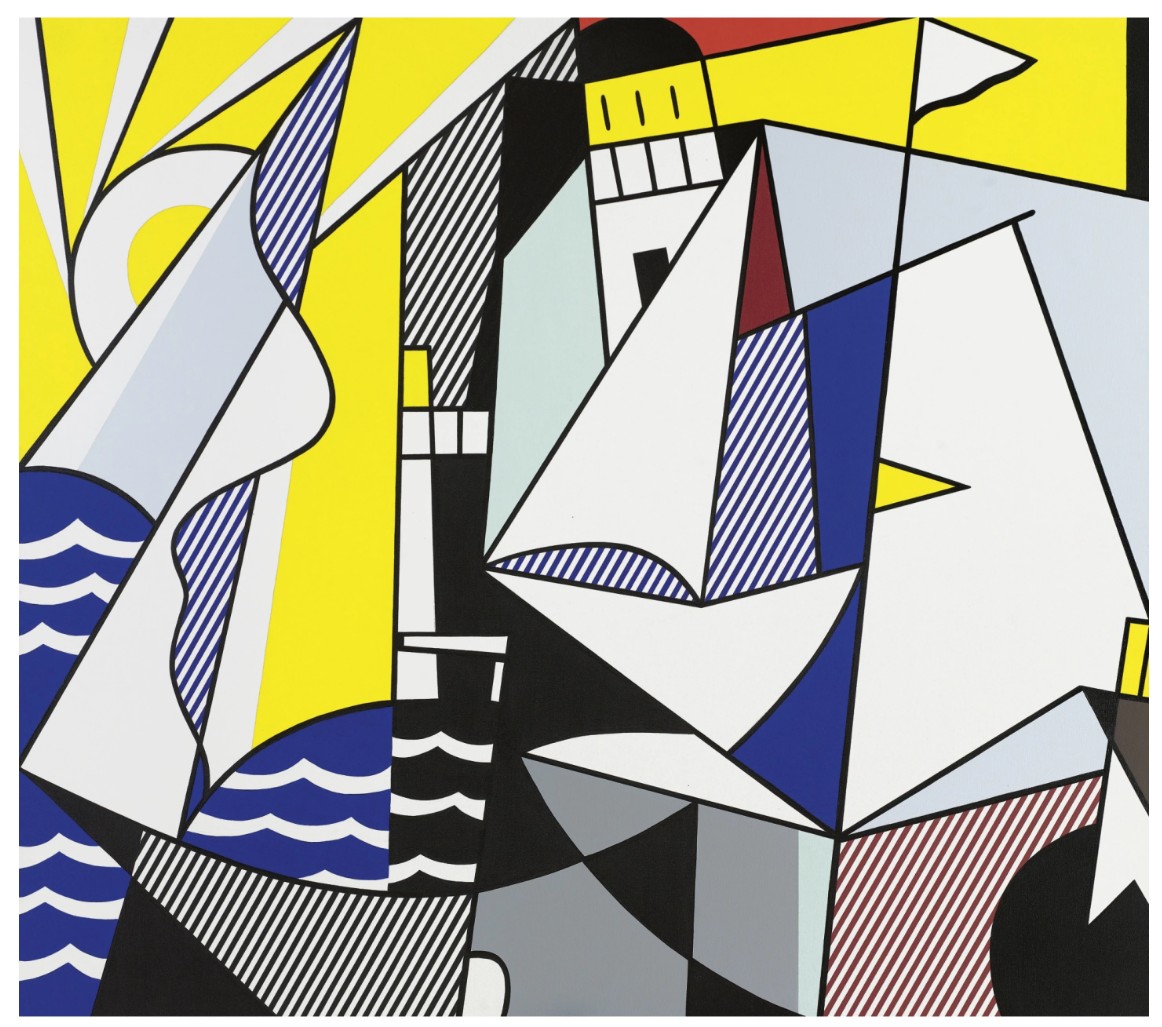
ROY LICHTENSTEIN
Sailboats III, 1974
Oil and Magna on canvas
70×80 inches (177.8 x 203.3 cm)
Signed and dated ’74 on the reverse
#2. Sailboats, 1973
Sotheby’s New-York: 10 May 2016
Estimated: USD 7,000,000 – 10,000,000
USD 8,677,000
Roy Lichtenstein (1923-1997), Sailboats | Christie’s
REPEAT SALE
Sotheby’s New-York: 14 May 2008
Estimated: USD 6,000,000 – 8,000,000
USD 7,041,000
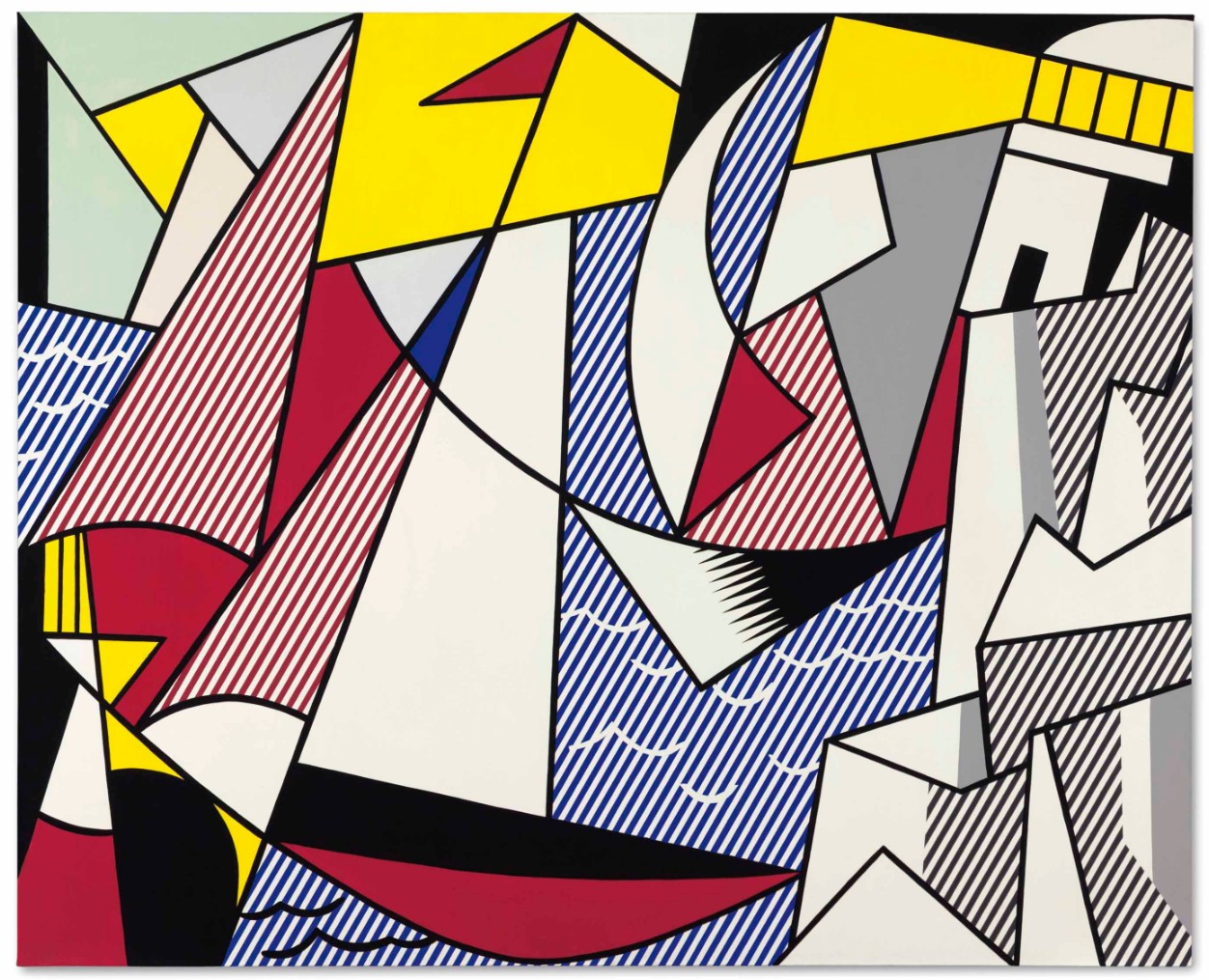
ROY LICHTENSTEIN (1923-1997)
Sailboats, 1973
Oil and Magna on canvas
60×74 inches (152.4 x 188 cm)
Signed and dated ‘rf Lichtenstein ‘73’ (on the reverse)
#3. The Conductor, 1975
Property from the Miles and Shirley Fiterman Collection
Phillips London: 27 June 2019
Estimated: GBP 4,000,000 – 6,000,000
GBP 4,977,000 / USD 6,306,805
Roy Lichtenstein 20th Century & Contemporary Art Evening Sale
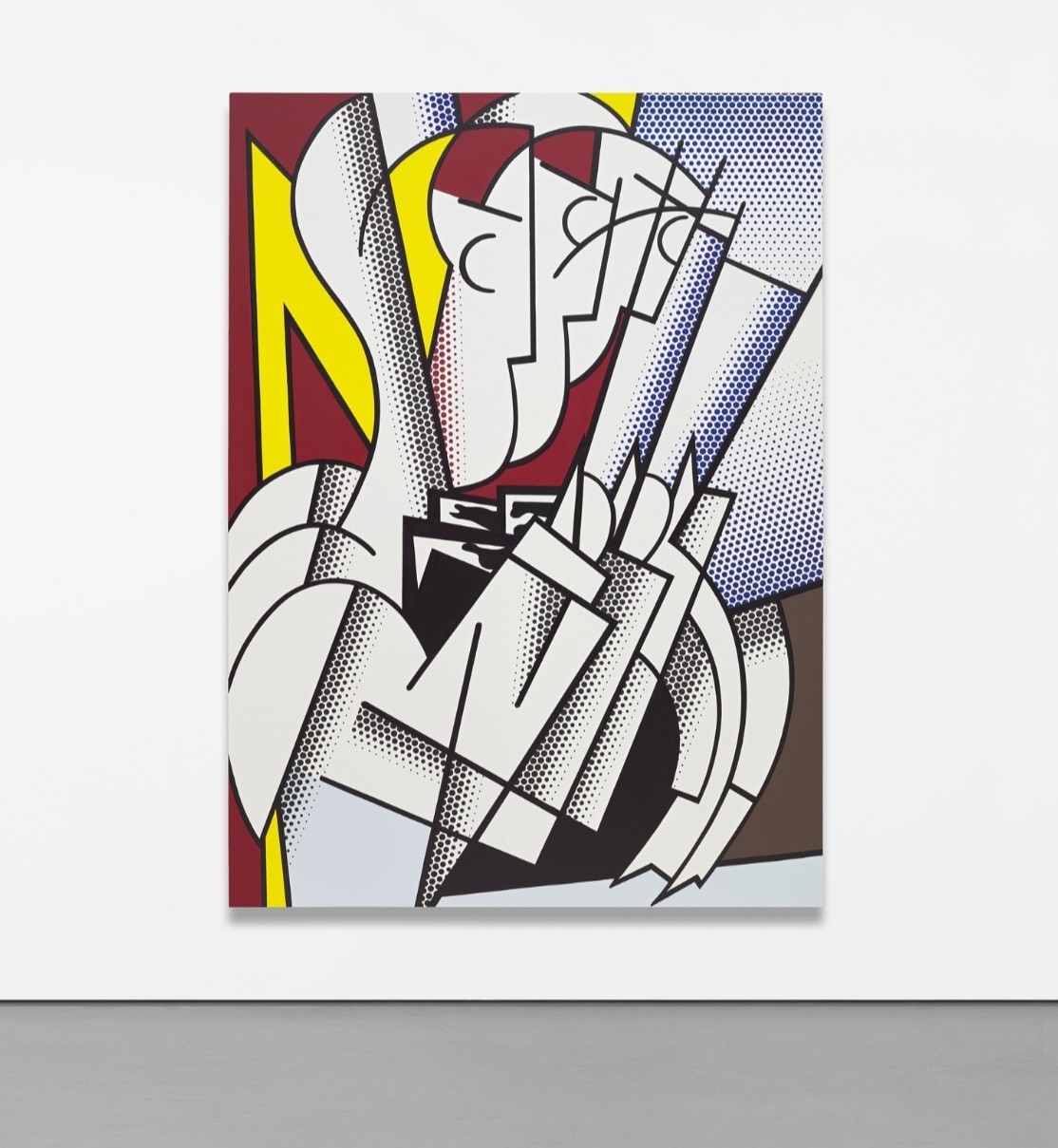
ROY LICHTENSTEIN
The Conductor, 1975
Oil and Magna on canvas
74×54 inches (188 x 137.2 cm)
Signed and dated ‘rf Lichtenstein ’75’ on the reverse
#4. Horse and Rider, 1976
Property from the Miles and Shirley Fiterman Collection
Phillips New-York: 16 May 2019
Estimated: USD 6,000,000 – 8,000,000
USD 5,955,000
Roy Lichtenstein 20th Century & Contemporary Art Evening Sale
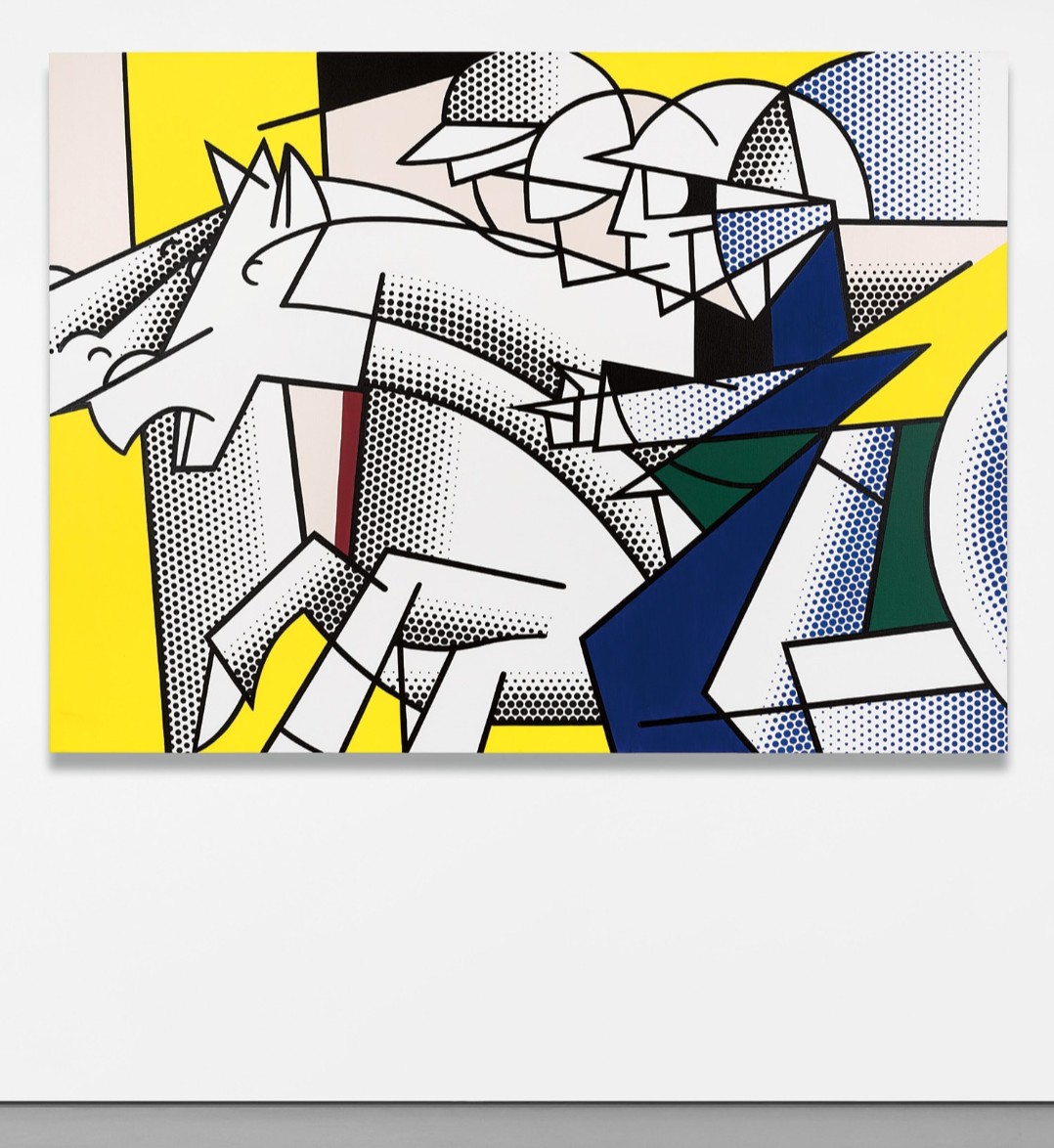
ROY LICHTENSTEIN
Horse and Rider, 1976
Oil and Magna on canvas
54×74 inches (137.2 x 188 cm)
Signed and dated “rf Lichtenstein ’76” on the reverse
#5. Self-Portrait, 1976
PROPERTY FROM THE COLLECTION OF ROBERT AND JEAN SHOENBERG
Christie’s New-York: 12 November 2008
Estimated: USD 3,000,000 – 4,000,000
USD 2,658,500
Roy Lichtenstein (1923-1997) , Self-Portrait | Christie’s
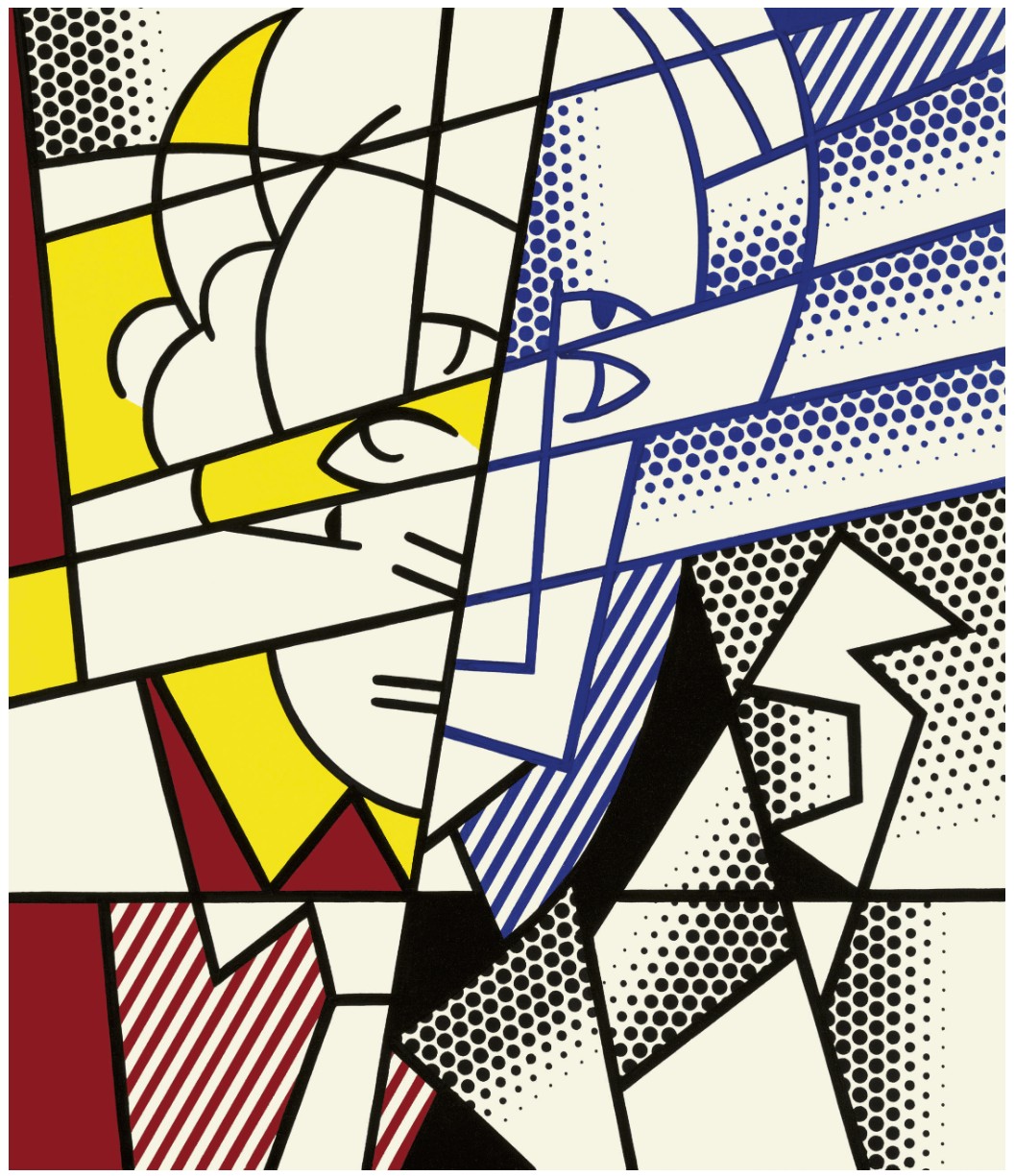
ROY LICHTENSTEIN (1923-1997)
Self-Portrait, 1976
Oil and magna on canvas
42×36 inches (106.7 x 91.4 cm)
Signed and dated ‘rf Lichtenstein ’76’ (on the reverse)
#6. Eclipse of the Sun II, 1975
Reflections on Pop: Works from the Collection of Dorothy and Roy Lichtenstein
Sotheby’s New-York: 26 September 2025
Estimated: USD 2,500,000 – 3,500,000
USD 2,576,000
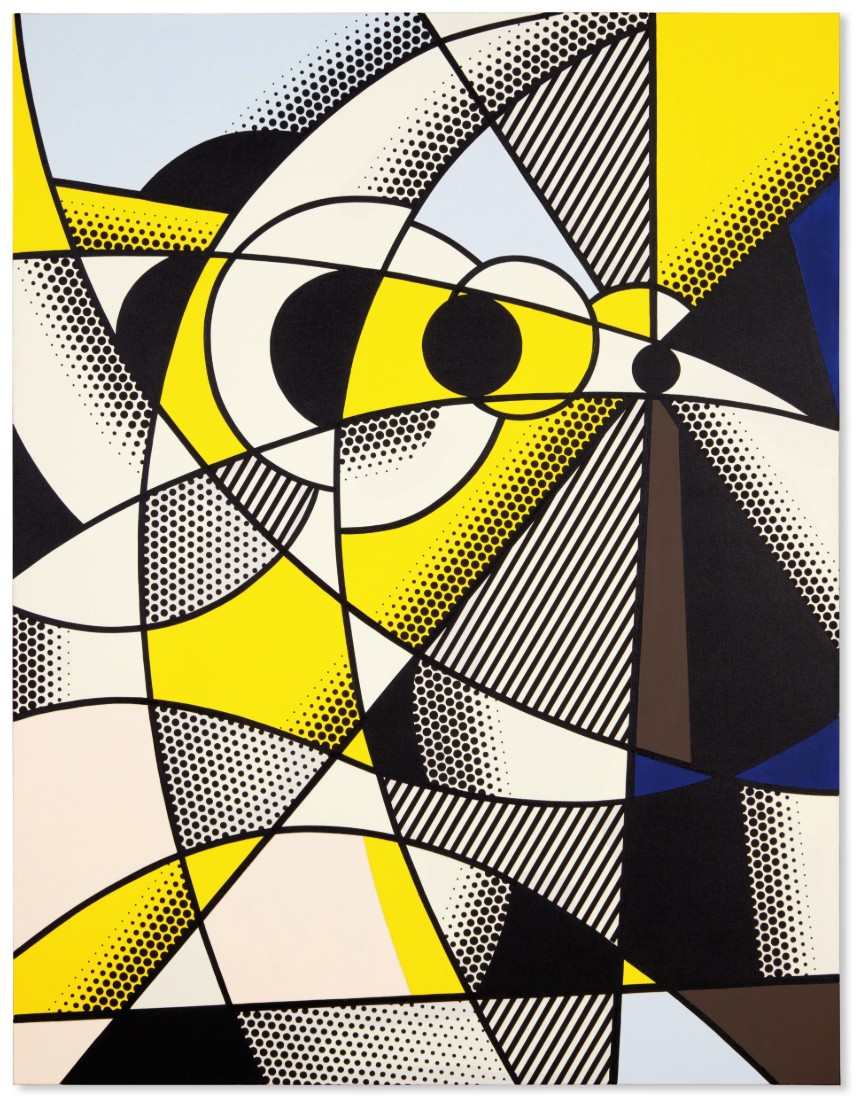
ROY LICHTENSTEIN (1923 – 1997)
Eclipse of the Sun II, 1975
Acrylic, oil and graphite on canvas
70×54 inches (177.8 x 137.2 cm)
Signed and dated ’75 (on the reverse)
The Red Horseman (Study), 1974
Christie’s New-York: 12 November 2021
Estimated: USD 500,000 – 700,000
USD 562,500
WORK ON PAPER
ROY LICHTENSTEIN (1923-1997), The Red Horseman (Study) | Christie’s
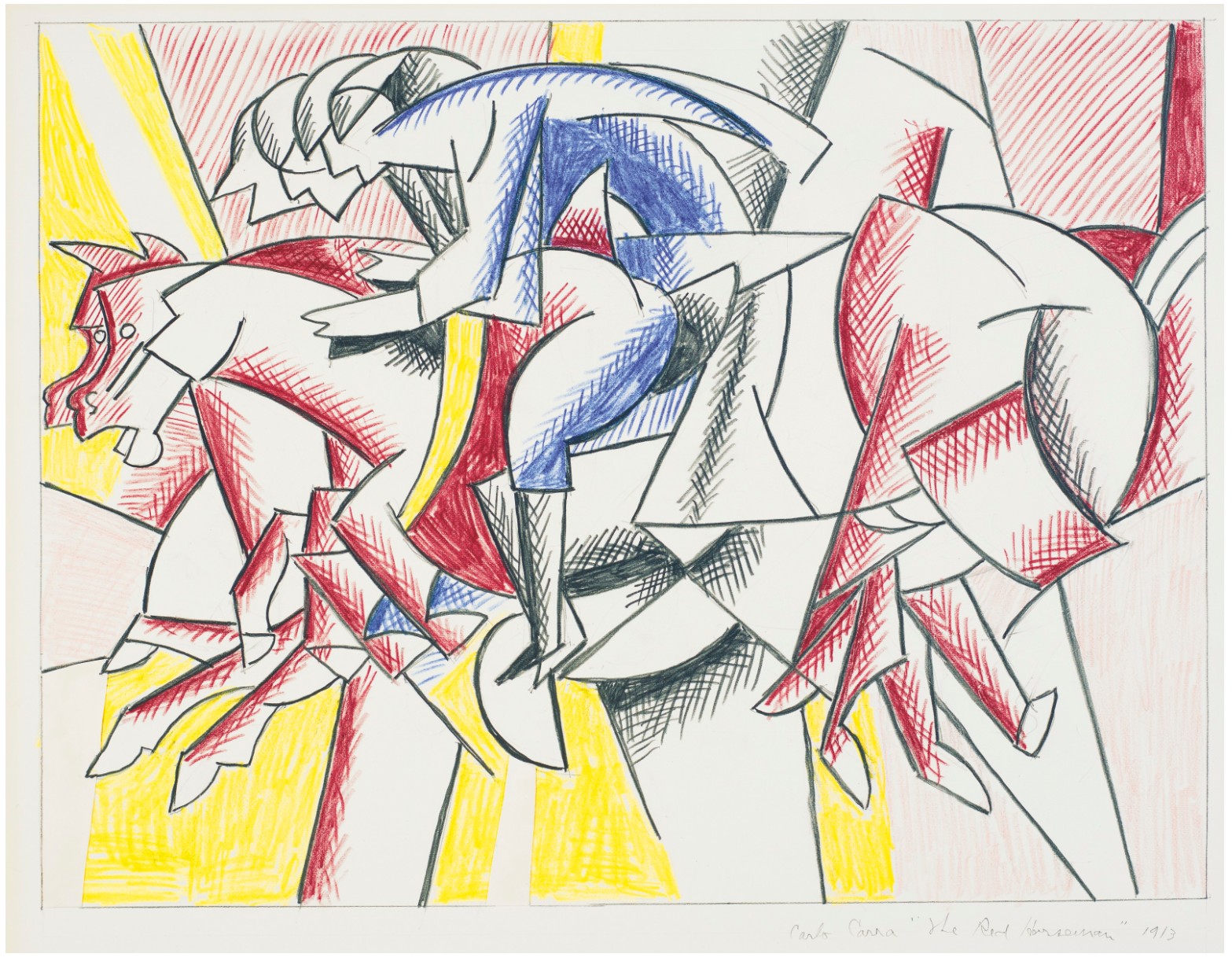
ROY LICHTENSTEIN (1923-1997)
The Red Horseman (Study), 1974
Colored pencil, graphite and paper collage on paper
Image: 14 3/4 x 19 1/2 inches (36.8 x 49.5 cm)
Sheet: 20 3/8 x 23 2/3 inches (51.8 x 59.7 cm)
Titled and inscribed ‘Carlo Carra “The Red Horseman” 1913’ (lower right)
Signed and dated ‘R Lichtenstein ’74’ (on the reverse)
PAINTINGS
Sailboats III, 1974
Sailboats III, 1974
Sotheby’s New-York: 9 May 2012
Estimated: USD 6,000,000 – 8,000,000
USD 11,842,500
ROY LICHTENSTEIN
Sailboats III, 1974
Oil and Magna on canvas
70×80 inches (177.8 x 203.3 cm)
Signed and dated ’74 on the reverse
Provenance
Leo Castelli Gallery, New York (LC# 668)
Carter Burden, New York (acquired from the above in February 1974)
Sotheby’s New York, November 10, 1988, Lot 32
Private Collection, Los Angeles (acquired from the above)
Christie’s New York, May 12, 1998, Lot 16
Acquired from the above
Lichtenstein’s Sailboat series consists of three paintings depicting heavily abstracted sailboats at sea. At the time he was working on this series, Lichtenstein was also painting his Cubist Still Lifes, Abstractions, and Still Lifes. In these four series from the early and mid 1970s, it is clear that Lichtenstein consciously looked for inspiration from the Cubists as well as more traditional nautical paintings that commonly appeared throughout art history. The fractures of Modernist composition are predominant in this period since they have a synergy and compatibility with Lichtenstein’s graphic techniques. These works all balance active and disrupted compositions with clear patterns and textures. Speaking about the inspiration for his paintings, the artist stated, “I think the aesthetic influence on me is probably more Cubism than anything. I think even the cartoons themselves are influenced by Cubism, because the hard-edged character which is brought about by the printing creates a kind of cubist look that perhaps wasn’t intended.” (Anthony d’Offay, ed., Some Kind of Reality: Roy Lichtenstein interviewed by David Sylvester in 1966 and 1997, London, 1997, p. 7).
The present work, Sailboats III, 1974 is the most active and complex composition of the three paintings on this subject. Lichtenstein created tension and displacement in the painting by presenting different viewpoints of the same image in one composition – very much a Cubist trope. The sailboat in the foreground, rocking among the waves with a white flag at the top of its mast, is the most easily understood rendering of an object in the present work. There are other triangular sail-like shapes in the background but it is difficult to read just how many boats are represented. The sail shapes differ and imply different effects of wind – some appear full as when boats race with the wind behind them and others fluff and ruffle as boats turn into the wind. This implied speed as sailboats careen in the wind is further amplified by the extreme motion as the boats seem to rock back and forth in the waves. The sky is also a fragmentary combination of shapes and colors butting up against each other and connecting to a heavily abstracted coast line in the upper quarter of the painting, only discernable from the fractured lighthouse in the center. This painting harnesses the rigorous stylistic order and overwhelming graphic clarity of the comic strip while simultaneously mimicking the modes of mechanical reproduction. Lichtenstein’s palette was reduced to the core primary colors which are kept as close as possible in feeling, texture and pitch to those used in advertising As the artist has said: “I use color in the same way as line. I want it oversimplified – anything that could be vaguely red becomes red. It is mock insensitivity. Actual color adjustment is achieved through manipulation of size, shape and juxtaposition.” (Exh. Cat., London, Tate Gallery, Roy Lichtenstein, 1993, p. 12). In Sailboats III, Lichtenstein has abstracted a scene into his own synthetic construct: while traditional landscape painters rely on a willing suspension of belief, asking the beholder – at least for a moment – to accept the representation as the scene itself, Lichtenstein, by contrast, stressed the artificiality of the representation, urging us to recall not the natural landscape but a generic vista as depicted in the mass media.
In Sailboats III, the viewer’s vantage point jumps from point to point and it is difficult to establish a sense of perspective. Although Lichtenstein had a general distaste for Feininger he was clearly looking towards his many Cubist representations of sailboats. The theme of the sailboat has been long explored by artists dating back centuries. Thomas Buttersworth and other 19th century American and British painters frequently turned towards the sailboat as subject matter and nautical scenes of commercial schooners or naval battles were common decorations in many homes. More contemporaneous with Lichtenstein, Andy Warhol also explored the sailboat in Do it Yourself (Sailboats), 1962 from his “paint by number” series. Lichtenstein depicted the sailboats in his own unmistakable graphic style that provides the painting with its eye-catching individuality while still giving a nod to genre masters before him. Inspired by the brilliant light and reflection of the sea at his home and studio in Southampton, the pure color and clarity of composition here are quite brilliant and impossible to reproduce accurately. Above all it is in the rendering of a three-dimensional landscape in a two-dimensional graphic style with its tenacious insistence on ineluctable flatness of the picture plane that silences his antagonistic critics in demonstrating his engagement with the same formal concerns that had been the overbearing preoccupation of his greatest ancestors.
The most inventive and intellectual artists knew that the investigation of the past can lead to the most enlightened and liberating innovations of the present. In the mid-late 1970s, Lichtenstein continued to turn to Cubism and abstract subject matter eventually leading to his Futurism series. Lichtenstein brought important artists, including himself, down from their fine art plinths. He displayed aesthetic clichés in all their commonly reproduced glory, only to breathe new life into them by placing them lovingly back on the rarefied museum walls. It is fitting that Mr. Forstmann owned this magnificent work as it was originally purchased from Leo Castelli by another highly esteemed collector Carter Burden, the great philanthropist committed to civic service and a pillar of the New York high society social scene. With undeniably impeccable provenance and exceptionally skillful execution, Sailboats III is a wonderful work that successfully brings together many of the themes of Lichtenstein’s career in a seminal composition of movement, geometry, and color that is unrivaled.
Sailboats, 1973
Sailboats, 1973
Sotheby’s New-York: 10 May 2016
Estimated: USD 7,000,000 – 10,000,000
USD 8,677,000
Roy Lichtenstein (1923-1997), Sailboats | Christie’s
REPEAT SALE
Sotheby’s New-York: 14 May 2008
Estimated: USD 6,000,000 – 8,000,000
USD 7,041,000
ROY LICHTENSTEIN (1923-1997)
Sailboats, 1973
Oil and Magna on canvas
60×74 inches (152.4 x 188 cm)
Signed and dated ‘rf Lichtenstein ‘73’ (on the reverse)
Provenance
Leo Castelli Gallery, New York
Galerie André Emmerich, Zurich
Lewis Kaplan, London and Felicity Samuel Gallery, London
Alain Mertens, London
O.K. Harris Works of Art, New York
Dr. Marvin Klein, Bloomfield Hills
Donald Morris Gallery, Birmingham
Private collection, 1984
Anon. sale; Sotheby’s, New York, 14 May 2008, lot 48
Acquired at the above sale by the present owner
Roy Lichtenstein’s Sailboats is a brilliantly original work from one of the artist’s most inventive decades. Flawlessly executed on a monumental scale, Sailboats weaves together a rich array of influences to capture the ephemeral effects of sailing upon the high seas. The strong forward motion of the boat as it cuts through the water creates a dramatic tension that is heightened by Lichtenstein’s signature palette of vivid primary colors and raking diagonal lines. Lichtenstein has long been an artist who sought innovation through the particular conventions of his trademark style, and in the 1970s, he left virtually no stone unturned as he produced series after series based on the great “isms” of Modern art. In 1973, he turned to Cubism, and a series of Cubist-inspired paintings that ensued seemed to filter Picasso through the prism of Pop Art.
Sailboats captures the ephemeral effects of ocean air and sea spray within a vibrant yet original arrangement that seems to recall a kind of Cubist stained glass. Vivid planes of color intersect at odd angles, shifting and curving to suggest the motion of a red sailboat as it glides across the water. Elsewhere, exquisitely painted areas of rich yellow imply a lighthouse beam that cuts through a dense fog. Along the right edge, black-and-white diagonals are used to indicate a rocky outcropping along the coast. Though composed primarily of flat, geometric forms, the painting evokes a lively sense of movement. A dynamic push-and-pull is felt, as enigmatic forms begin to emerge and dissolve, much like the atmospheric quality of the ocean and its many moods.
Whereas earlier paintings of the 1960s relied upon Ben-Day dots to indicate shading, mass or volume, in 1973 Lichtenstein developed the use of repeated diagonal lines to replicate shadow or half-tone. This particular diagonal technique lent itself quite readily to his exploration of Cubist form. In Sailboats, triangular sections of repeating diagonal red lines replicate the effects of a sail as it’s propelled by the wind, while elsewhere blue diagonals perfectly evoke the movement of waves across a body of water. Much in the same way the Cubists might depict several different angles of a single glass or other object within a two-dimensional plane, Lichtenstein likewise combines multiple viewpoints within the unified surface of the canvas through his rigorous exploration of Cubist style.
In Sailboats, Lichtenstein based his rendering on pages ripped from comic books, magazines, newspapers and phone books, that he pasted scrapbook-style in old-fashioned composition notebooks. The imagery he preferred often depicted the hyper-stylized sea-and-sky background of a tropical sunset or the peaceful idyll of sailboats gliding through the water. He also looked to black-and-white illustrations of sailboats and cruise ships that were used to promote the idea of a relaxing vacation. In this way, Lichtenstein borrowed from popular culture to present a flat, comic-book style pastiche of a romanticized seascape, from wild adventure set upon the high seas to the romantic lolling of the waves of a gentle, leisurely sail. In Sailboats, Lichtenstein’s stylized depiction of a battered, wind-swept coast, its rocky outcropping, and the lighthouse with its powerful, fractured beam seems to conflate the heroics of maritime art with a flat, comic-book style pastiche that recalls the amateur do-it-yourself aesthetics of a Paint-by-Numbers kit. It harkens to the kitschy regional art that one might find in a seaside cottage on Cape Cod or coastal Maine.
The Conductor, 1975
The Conductor, 1975
Property from the Miles and Shirley Fiterman Collection
Phillips London: 27 June 2019
Estimated: GBP 4,000,000 – 6,000,000
GBP 4,977,000 / USD 6,306,805
Roy Lichtenstein 20th Century & Contemporary Art Evening Sale
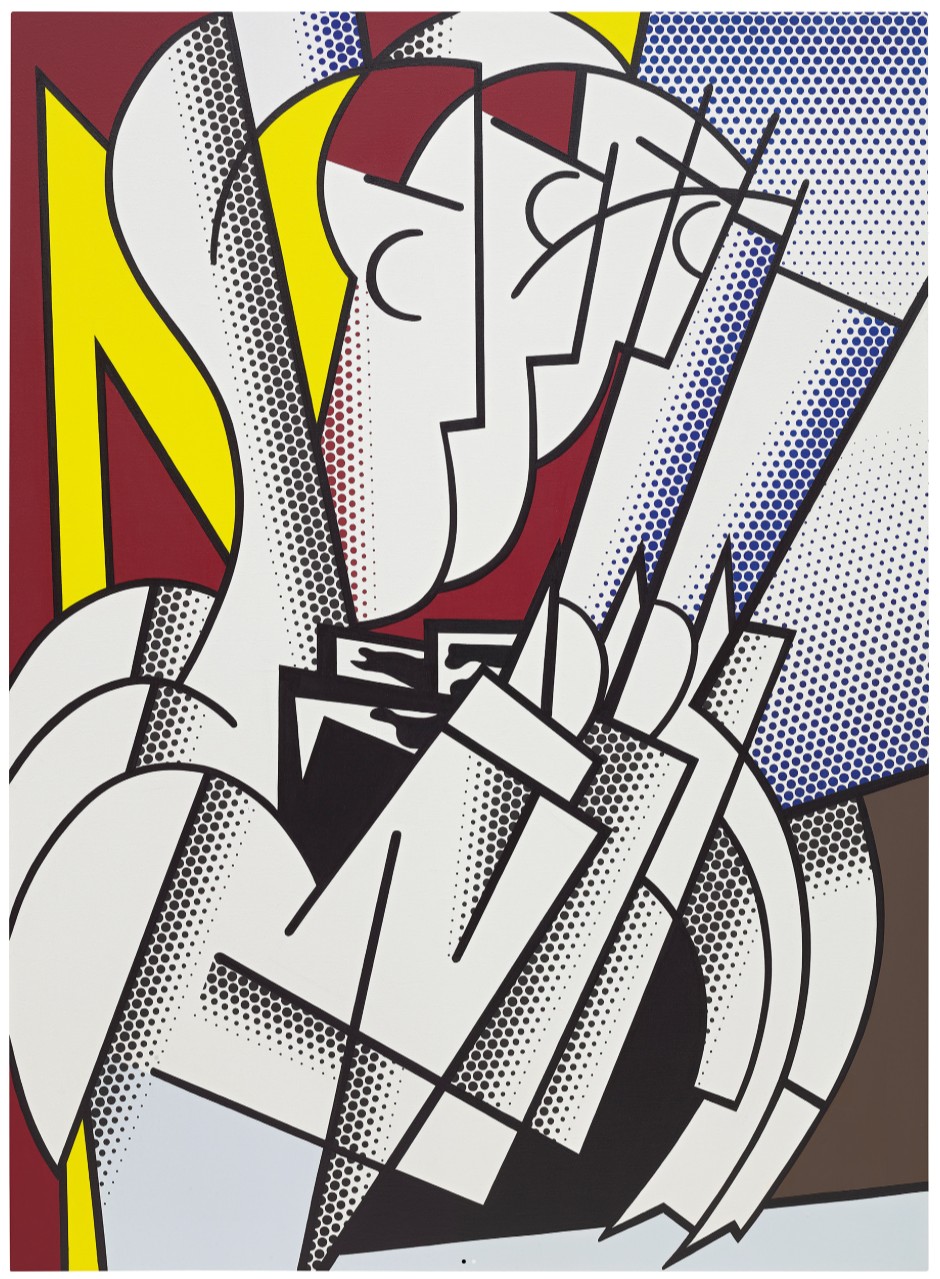
ROY LICHTENSTEIN
The Conductor, 1975
Oil and Magna on canvas
74×54 inches (188 x 137.2 cm)
Signed and dated ‘rf Lichtenstein ’75’ on the reverse
Provenance
Leo Castelli, New York
The Mayor Gallery, London (acquired from the above in early 1976)
Acquired from the above by the present owners on 3 June 1976
A virtuosic pop transformation of Italian Futurism, The Conductor, 1975, boasts Roy Lichtenstein’s characteristically delineated forms, his distinct red, blue and yellow color palette, and his iconic Ben-Day dots. Taking Gino Severini’s monumental Mare = ballerina (Sea = Dancer), 1914 as a point of departure, Lichtenstein reinterprets the Futurist composition and places it within his iconic visual syntax, rooted in the nostalgia and commercialism of comic books and advertising materials. The present work is an unquestionable masterpiece of Lichtenstein’s widely celebrated oeuvre, and one that additionally holds singular academic importance.
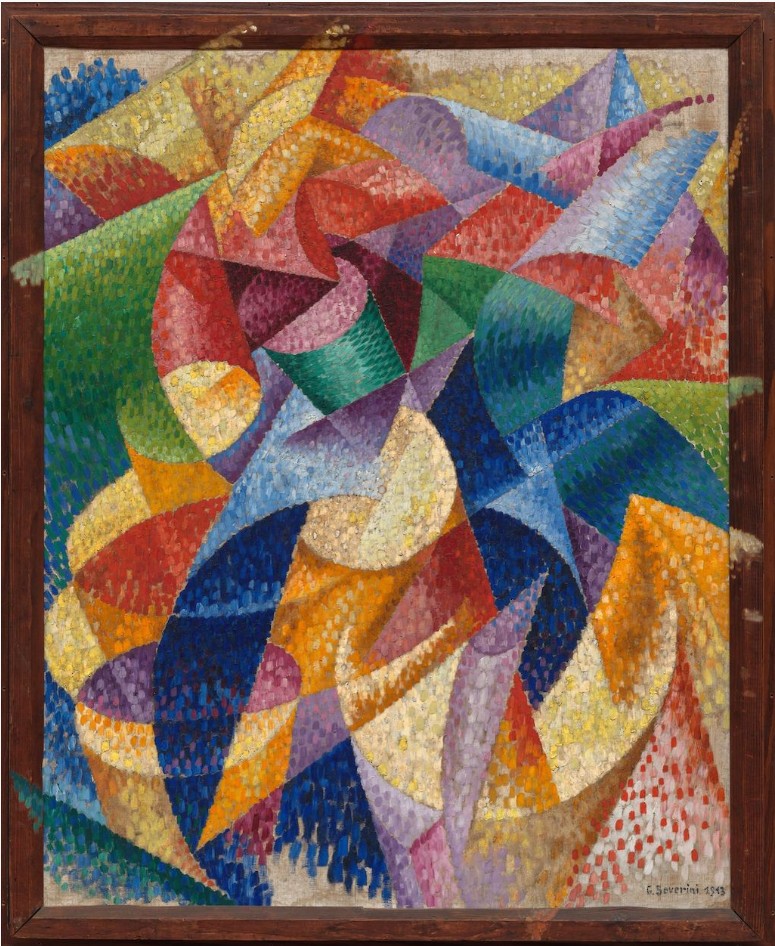
GINO SEVERINI (1883 – 1966) / Sea=Dancer (Mare=Ballerina), 1914 / Oil on canvas, in artist’s painted frame / 105.3 x 85.9 cm
Peggy Guggenheim Collection, Venice (Solomon R. Guggenheim Foundation, New York)
The Conductor, along with a panoply of works from the 1970s based on paintings by modern masters, demonstrates Lichtenstein’s renewed engagement with complex art historical themes that he had considered in early works such as Femme au Chapeau, 1962, and Woman With Flowered Hat, 1963, as well as other paintings based on works by Pablo Picasso, Paul Cézanne and Piet Mondrian. It was in 1974, however, one year before the execution of the present work, that Lichtenstein first engaged with Futurism as his subject matter, painting a limited number of Futurist-inspired works between 1974-1976. Examples of Lichtenstein’s Futurist paintings are held in prominent collections, his monumental The Red Horseman, 1974, resides at the Ludwig Forum for International Art, Aachen (currently on loan to the Museum Moderner Kunst Stiftung Ludwig, Vienna) and his Violin, 1976, at the Denver Art Museum. This cycle of works embodies Lichtenstein’s creative genius at the apex of his extraordinary career.
Reinterpreting Severini’s painting using his distinctively unmodulated colours, Ben-Day dots and a firm network of intersecting arcs and lines, Lichtenstein halted the image, suspending the futuristic sense of rapid motion. Instilling the work with renewed movement through the gradated Ben-Day dots, the artist placed the composition within his distinctly pop aesthetic. Lichtenstein’s monumental painting bridges the tense realm between originality, homage and imitation, moving beyond the pixelated ideals of his earlier comic book paintings, yet raising similar questions of legitimacy, parody, pastiche and transformation within artistic creation. In The Conductor, Lichtenstein reframes Severini’s Sea = Dancer both literally and metaphorically. Evocative of the work, but not directly quoting Severini’s composition, The Conductor marks a progression from Lichtenstein’s early art history paintings which, though rendered in a pop aesthetic, remain intrinsically attached to their source paintings. Taking the combined forms of Severini’s original canvas, Lichtenstein has fragmented, juxtaposed and recomposed the composition.
Portraying a conductor of machinery or a musical director, the lyrical yet fragmented nature of the composition alludes to both the musical and the technological, leaving the composition in a liminal state. Severini’s original canvas is thought to have a specific source in George Seurat’s pointillist Le Chahut, 1889-1890, exposing the continued importance of pastiche within the canon of painting. Le Chahut depicts a fleeting scene of Parisian nightlife in which women and men are dancing the risqué chahut, or can-can, legs and skirts whimsically aligned and thrown into the air. In the present work, Lichtenstein’s conductor appears to mirror the graduated lines and calculated arrangement of Seurat’s canvas, as does Severini’s, Sea = Dancer. Each canvas progresses through the modernity of its own space and time, yet the common fundamental concern with the effects of light and color and the compositional means of recreating these forces, remains. While Seurat employs his strict pointillist system of minute dots of paint, Severini applies larger divisionist brushstrokes, divided by the futuristic curvature of line. In Lichtenstein’s pop interpretation of the subject, the artist masterfully engages his characteristic Ben-Day dots to cast the illusion of motion as the conductor casts his signal, allowing the canvas to surge with the vivacity of a pointillist masterwork.
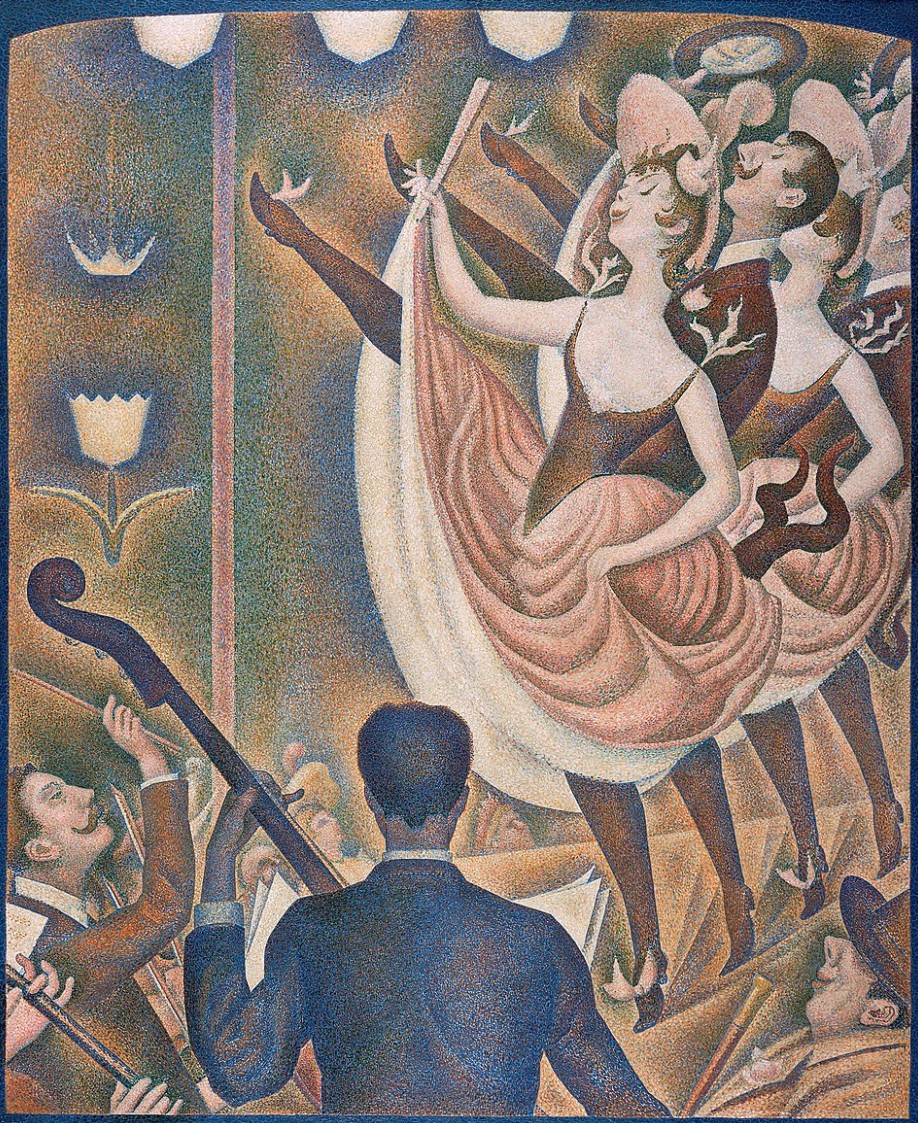
GEORGES SEURAT, Le Chahut, 1889–90, Oil on canvas, 170×141 cm
Kröller-Müller Museum, Otterlo, Netherlands
In The Conductor, Lichtenstein transforms the futuristic manner of depicting speed, systematically portraying jagged, dissected planes. The artist nods towards the hallmark of futurism, yet he takes the canvas beyond the confines of the earlier movement. Severini’s radiating power of light is transformed into Lichtenstein’s faceted plane and sliced composition. Appropriating Severini’s complex and dynamic painterly division, initially used by the Futurist master to evoke the sense of movement in space, Lichtenstein transposes the arcs of the original composition into his simplified forms allowing the intersecting black vectors to anchor the image to the canvas. Refining the already abstracted image, Lichtenstein questions the futuristic source image.
“Futurism does show motion, but it does not show motion very well, painting is not a time art. But I am interested in the quirky results of those derivatives of Cubism and like to push this quirkiness further toward the absurd. I am also interested in the relationship between depictions of movement in Futurism and in comic-strips.”
The Conductor, a singular example of Lichtenstein’s musings on modern art, was painted shortly after Diane Waldman published the first retrospective monograph on Lichtenstein in 1972, suggesting that perhaps Lichtenstein himself had been compelled to reflect on his previous work and his status as an artist within the established canon of 20th century art. A flawless union between Futurism and Pop Art, The Conductor is an eloquent example of Lichtenstein’s continued engagement with notions of creativity and authenticity, demonstrating his remarkable ability to celebrate the possibilities of popular imagery.
Horse and Rider, 1976
Horse and Rider, 1976
Property from the Miles and Shirley Fiterman Collection
Phillips New-York: 16 May 2019
Estimated: USD 6,000,000 – 8,000,000
USD 5,955,000
Roy Lichtenstein 20th Century & Contemporary Art Evening Sale
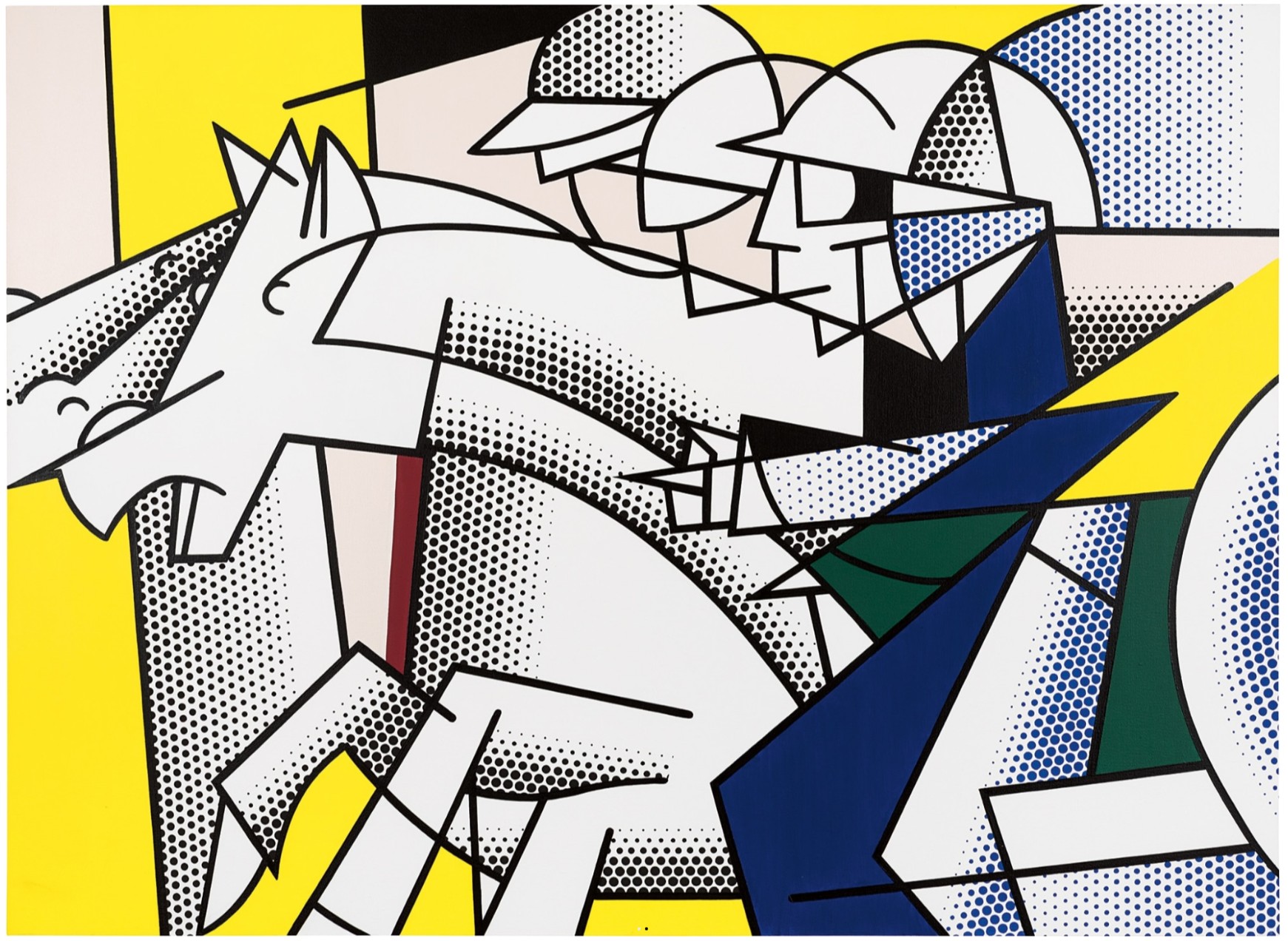
ROY LICHTENSTEIN
Horse and Rider, 1976
Oil and Magna on canvas
54×74 inches (137.2 x 188 cm)
Signed and dated “rf Lichtenstein ’76” on the reverse
Provenance
Leo Castelli Gallery, New York
The Mayor Gallery, London
Acquired from the above by the present owner
Creating a grand vista of fragmented geometric forms that coalesce into a dynamic equine tableau, Roy Lichtenstein’s engulfing Horse and Rider, 1976, exemplifies the painter’s enduring dedication to the appropriation of the art historical canon within his idiosyncratic Pop aesthetic. Adding to an oeuvre redolent with the influence of the 20th century’s most groundbreaking artistic movements, it was in 1974 that Lichtenstein began to pay homage to the pictorial strategies of Italian Futurism. Here, Lichtenstein draws from Umberto Boccioni’s exemplary 1914 painting Horse Rider and Buildings, reinterpreting its definitive pictorial strategies through the touchstones of his own visual vocabulary, rooted in comic book imagery and commercial printing. The Fitermans’ acquisition of this important painting evinces the unique scholarly rigor that informed their approach to collecting, and their sustained efforts, as both admirers and patrons, to situate Lichtenstein’s work within the grand history of painting.
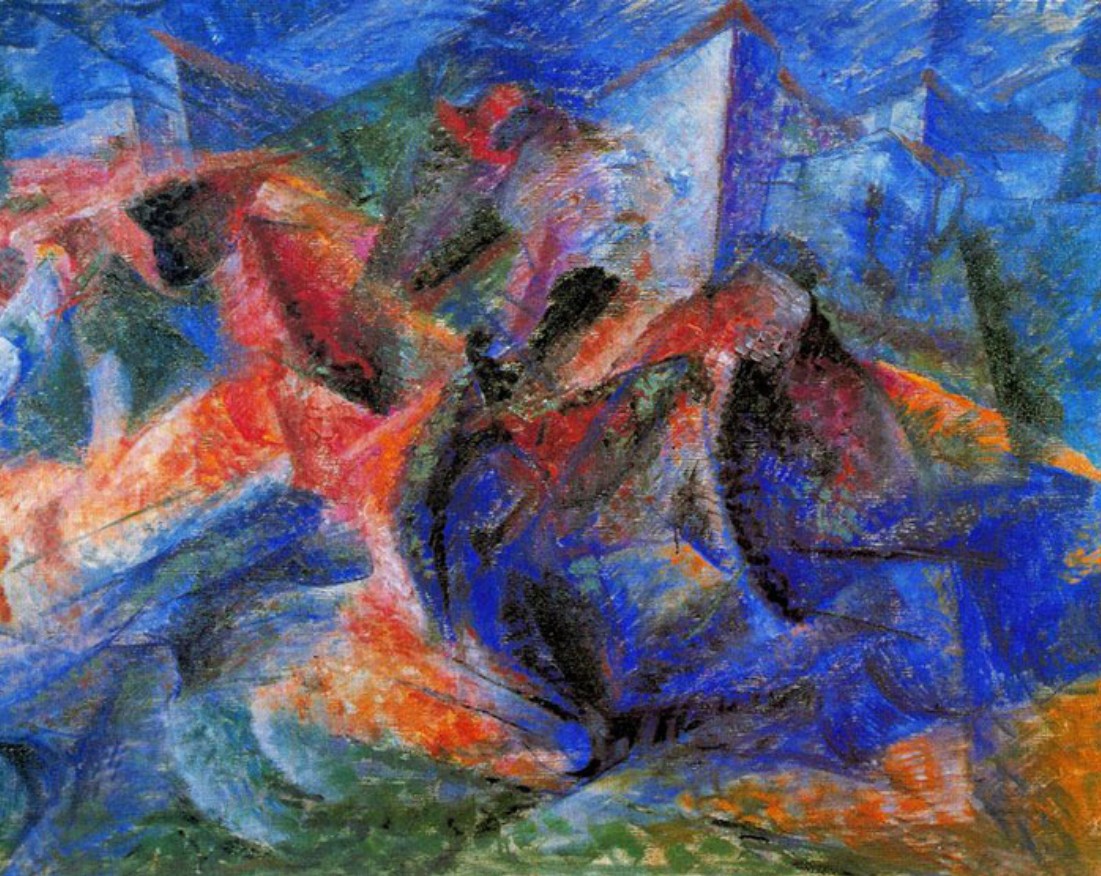
UMBERTO BOCCIONI, Horse and Riders and Building, Oil on canvas, 1914
Lichtenstein would only paint one other Futurist-inspired work on the subject of the horse, The Red Horseman, 1974, which resides in the collection of the Ludwig Forum for International Art, Aachen and is currently on loan to the Museum Moderner Kunst Stiftung Ludwig, Vienna. While The Red Horseman, which was widely disseminated as the poster image for the 1984 Los Angeles Olympic Games, provided a more faithful Pop Art equivalent of Carlo Carrà’s original painting with the same name, Lichtenstein takes more creative license, inventing a powerfully original composition in Horse and Rider. Succinctly manifesting an ambiguous position between homage and pastiche, the work embodies one of Pop Art’s most important underlying tenets. The result is an uncanny stylistic hybrid that makes an important addition to the longstanding genre of equestrian painting, as the employment of this historic motif allows for a unique dissection of the Futurist’s relentless quest for visual dynamism. As such, Horse and Rider is an indisputable masterpiece within Lichtenstein’s limited series of Futurist-inspired works.
Within the Futurist-inspired works, Horse and Rider is a masterpiece that illustrates the calculated tension Lichtenstein built between innovation and appropriation. Here the cascading equestrian scene, where a rider appears to be fractured to a stilled vision that moves across the canvas, is unequivocally redolent of foremost Futurist painter Boccioni’s Horse Rider and Buildings of 1914. While the artist had initiated a relationship with the Futurists’ draw to horse imagery two years earlier in The Red Horseman, the present work displays his greater confidence with the theme as he diverts further from the source painting by Boccioni. Lichtenstein creates an entirely unique composition of his own, evocative of but not reliant upon the motif so revered by the Futurists for its display of speed. This transition towards pastiche rather than direct reference is reflective of the developments in his relationship to artistic styles and artworks as his career progressed.
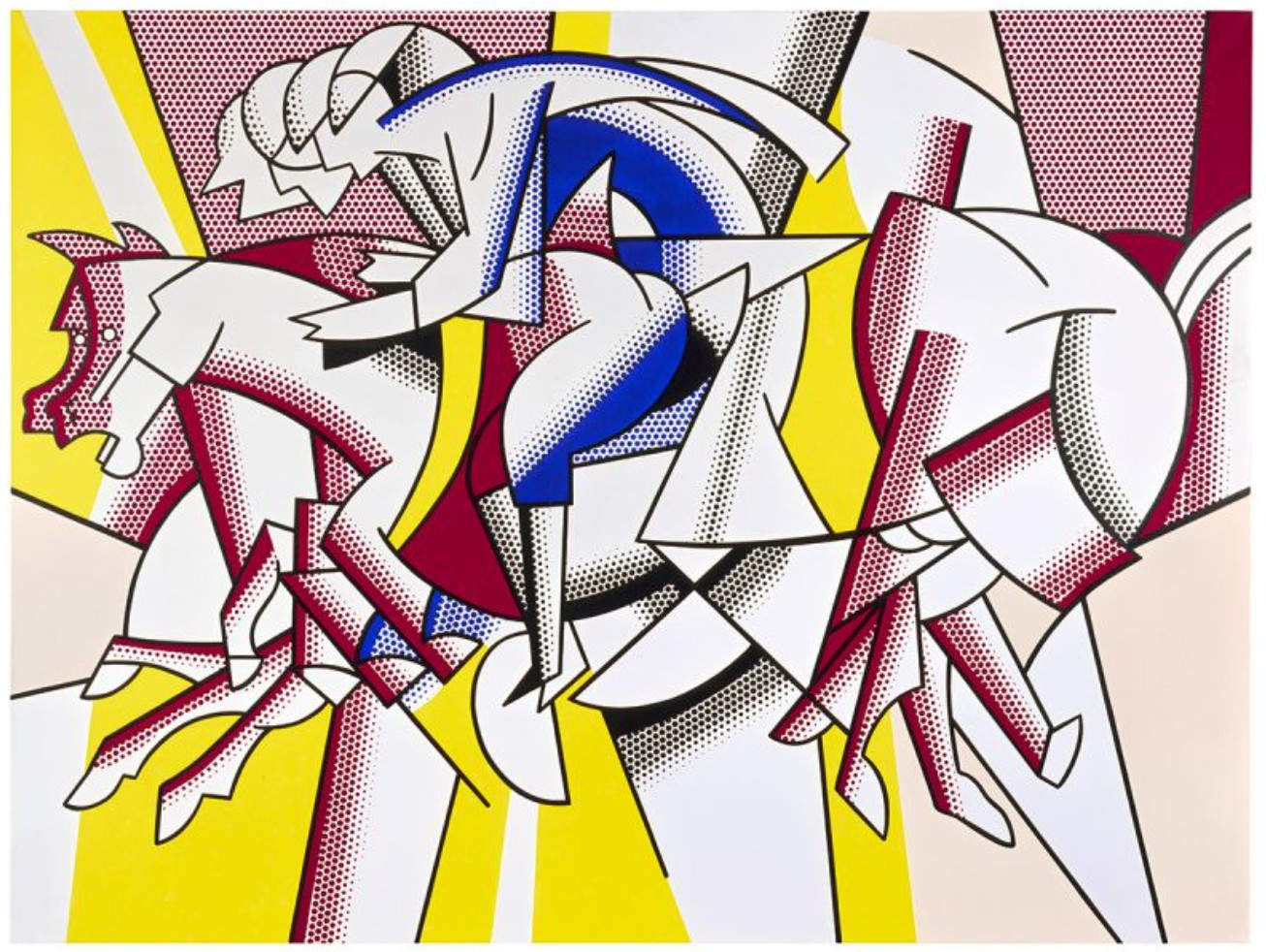
ROY LICHTENSTEIN, The Red Horseman, 1974, Acrylic, oil, graphite pencil on canvas
The Red Horseman, 1974 (RLCR 2315) | Catalogue entry | Roy Lichtenstein: A Catalogue Raisonné
In his equestrian scenes, Boccioni would typically create an optically sensational network of frenetic brushwork that made a tactile appeal to emotions through an excess of color. Lichtenstein maintains this crucial potency and makes an ode to technology through alternative means. He harnesses the power of calculated composition, stacking and layering his planar geometric forms to create a development that appears to fracture the figure over time. Appearing like a set of images from a film reel, Lichtenstein recalls the photographic experiments into the nature of motion made by Eadweard Muybridge in the late 1800s. These provided a crucial catalyst of inspiration for Futurist painters as well as Marcel Duchamp in his seminal work Nude Descending a Staircase, No. 2, Philadelphia Museum of Art.
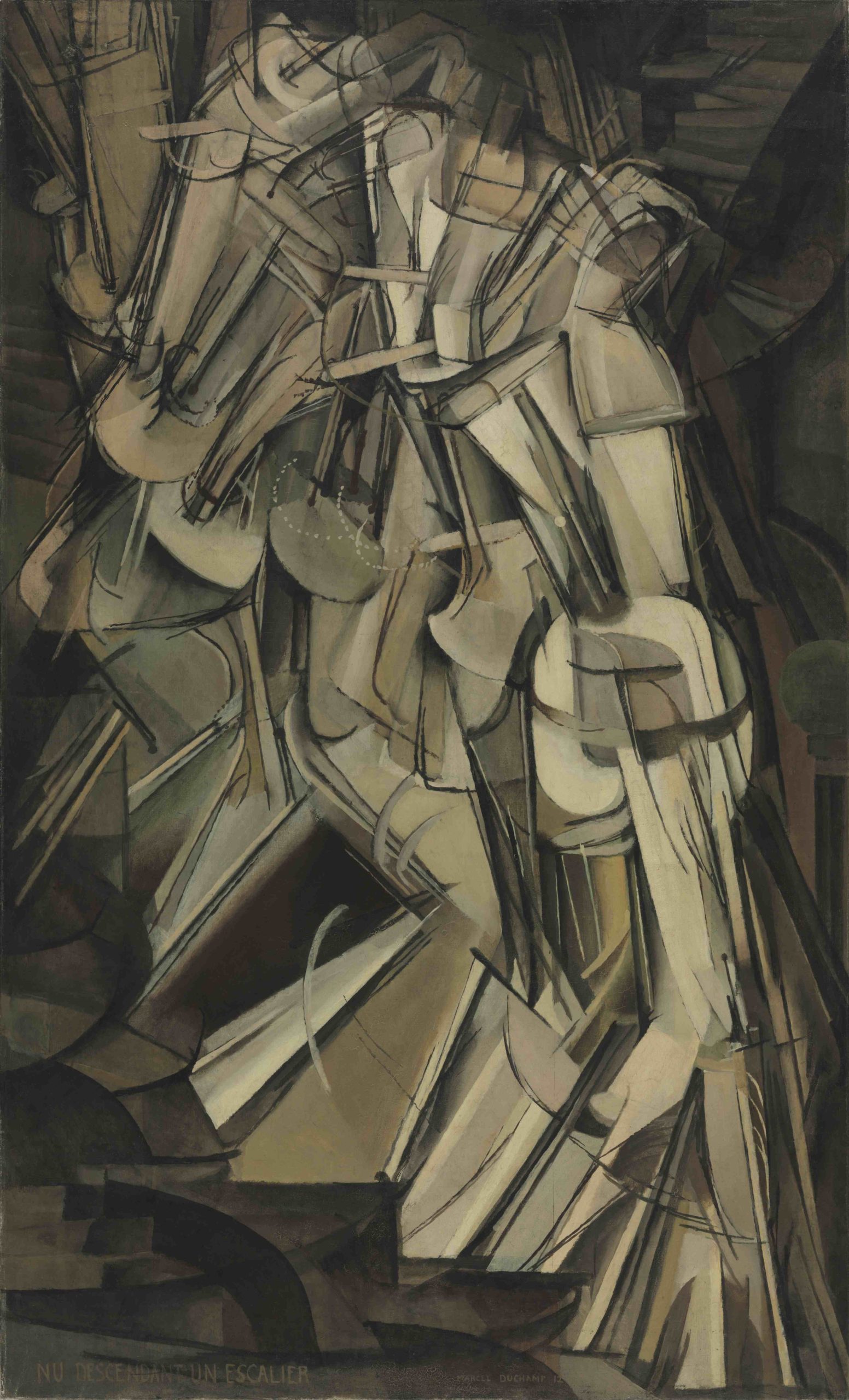
MARCEL DUCHAMP, Nu descendant un escalier n° 2, 1912, oil on canvas, 147 x 89.2 cm
Philadelphia Museum of Art, Philadelphia
In Horse and Rider, Lichtenstein actively expunged the darker political beliefs of the Futurist movement, with its links to early 20th century Fascism, and reclaims the aesthetic for his own apolitical Pop utopianism. Privileging the contrast of pure colors, Lichtenstein also harnesses a sense of movement in the gradation of Ben-Day dots that punctuate the surface. Rather than trying to imitate a sense of naturalistic depth and motion, he creates cerebral depth through interactions between colors and the hazy mesh of successive planes. In Horse and Rider, Lichtenstein enacts a perfect marriage between pop and Futurism, as dynamic movement is expressed through his own aesthetic ends. As such, the present work is a paradigm of his infallible ability to distill the formal vocabulary of a movement while maintaining the individualistic viewpoint that has made him one of the 20th century’s most influential painters.
Self-Portrait, 1976
Self-Portrait, 1976
PROPERTY FROM THE COLLECTION OF ROBERT AND JEAN SHOENBERG
Christie’s New-York: 12 November 2008
Estimated: USD 3,000,000 – 4,000,000
USD 2,658,500
Roy Lichtenstein (1923-1997) , Self-Portrait | Christie’s
ROY LICHTENSTEIN (1923-1997)
Self-Portrait, 1976
Oil and magna on canvas
42×36 inches (106.7 x 91.4 cm)
Signed and dated ‘rf Lichtenstein ’76’ (on the reverse)
Provenance
The Mayor Gallery, London
Acquired from the above by the present owner
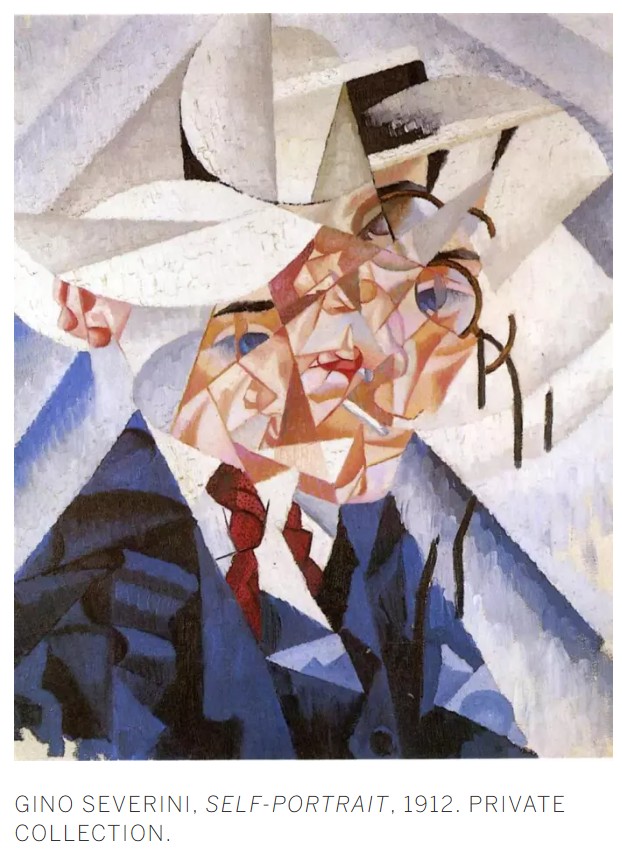
In his Self-Portrait of 1976 Lichtenstein brilliantly transforms Italian Futurism into his own distinct visual idiom, replete with the benday dots and vivid primary color palette that indelibly mark the painting as the work the Pop master. The present work is the first of Lichtenstein’s mature career to be titled a self-portrait. As is usual with the witty games Lichtenstein often plays with the viewer, it remains tantalizingly ambiguous as to whether his subject is the historical self-portrait, or his own self-portrait. Considering how extensively he altered Severini’s image, it would not be surprising if Lichtenstein was in fact representing his own image in this Futurist guise. Indeed, the graduated benday dots that he integrates into the image suggest his famed series of mirror paintings, alluding to the possibility that Self-Portrait captures the Pop master contemplating his image in a mirror.
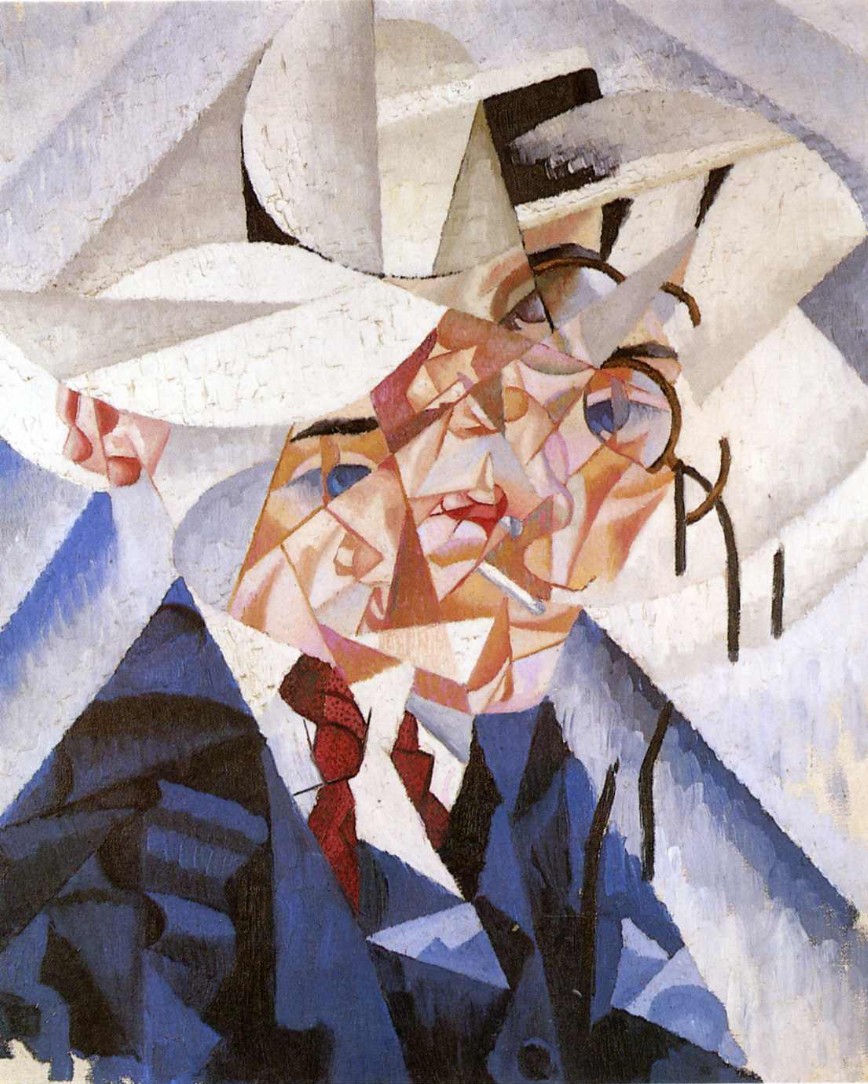 GINO SEVERINI, Self-Portrait, oil on canvas, 1912
Lichtenstein based Self-Portrait on a specific work which Italian artist Gino Severini painted in 1912, created at the height of the Futurist movement. Severini’s self-portrait had been featured in the Museum of Modern Art’s 1961 exhibition, which Lichtenstein, living in New York at the time may have seen. Working from a reproduction of the painting in 1976, Lichtenstein appropriated the image’s complex painterly faceting, which Severini intended to evoke the dynamic sense of a figure moving in space, and transformed it through his coolly detached manner. Lichtenstein maintains Severini’s simultaneous views of facial contours, as well as his recognizable collar and tie. Yet he freely interprets the rest of the composition, streamlining its forms in a style redolent of half-tone illustrations and comic strips. He distills Severini’s formal vocabulary further abstracting this already abstracted image, calling into question the very conventions of Futurist painting. Lichtenstein, true to form, appears to pay tribute to Futurism while also wittily parodying this historic style.
“I had no program; I always thought each one was the last. But then I’d see something like a way of doing a Monet through just dots that would look like a machine-made Impressionist painting.”
Although Lichtenstein self-consciously cultivated an aura of industrial production in his painting — a crucial part of Pop’s retort to the hegemony of Abstract Expressionist painterliness — he in fact carefully honed his composition for maximum visual impact. Indeed, before painting Self-Portrait, he worked out the composition in a preparatory drawing from 1975. The Futurist style of Self-Portrait was a particularly fitting subject for Lichtenstein on a number of levels. As Futurism set the mold for future avant-garde movements at the dawn of the 20th century, it in certain ways presaged Pop particularly in its youthful rejection of tradition and its controversial embrace of new technology. By systematically reducing the jagged planes that are a hallmark of Futurism, Lichtenstein casts a sardonic eye on the movement’s emotional expressiveness, yet at the same time he continues the Futurist interest in technology’s impact on modern life. Lichtenstein was clearly obsessed with speed, which was reflected in the many cars and airplanes that raced through his early Pop canvases. Indeed, in his formative Pop works based on comic strips, he frequently emphasized the force lines of a punch or an explosion, denotations of movement that are mass culture derivatives of Futurism’s vocabulary.
Eclipse of the Sun II, 1975
Eclipse of the Sun II, 1975
Reflections on Pop: Works from the Collection of Dorothy and Roy Lichtenstein
Sotheby’s New-York: 26 September 2025
Estimated: USD 2,500,000 – 3,500,000
USD 2,576,000
ROY LICHTENSTEIN (1923 – 1997)
Eclipse of the Sun II, 1975
Acrylic, oil and graphite on canvas
70×54 inches (177.8 x 137.2 cm)
Signed and dated ’75 (on the reverse)
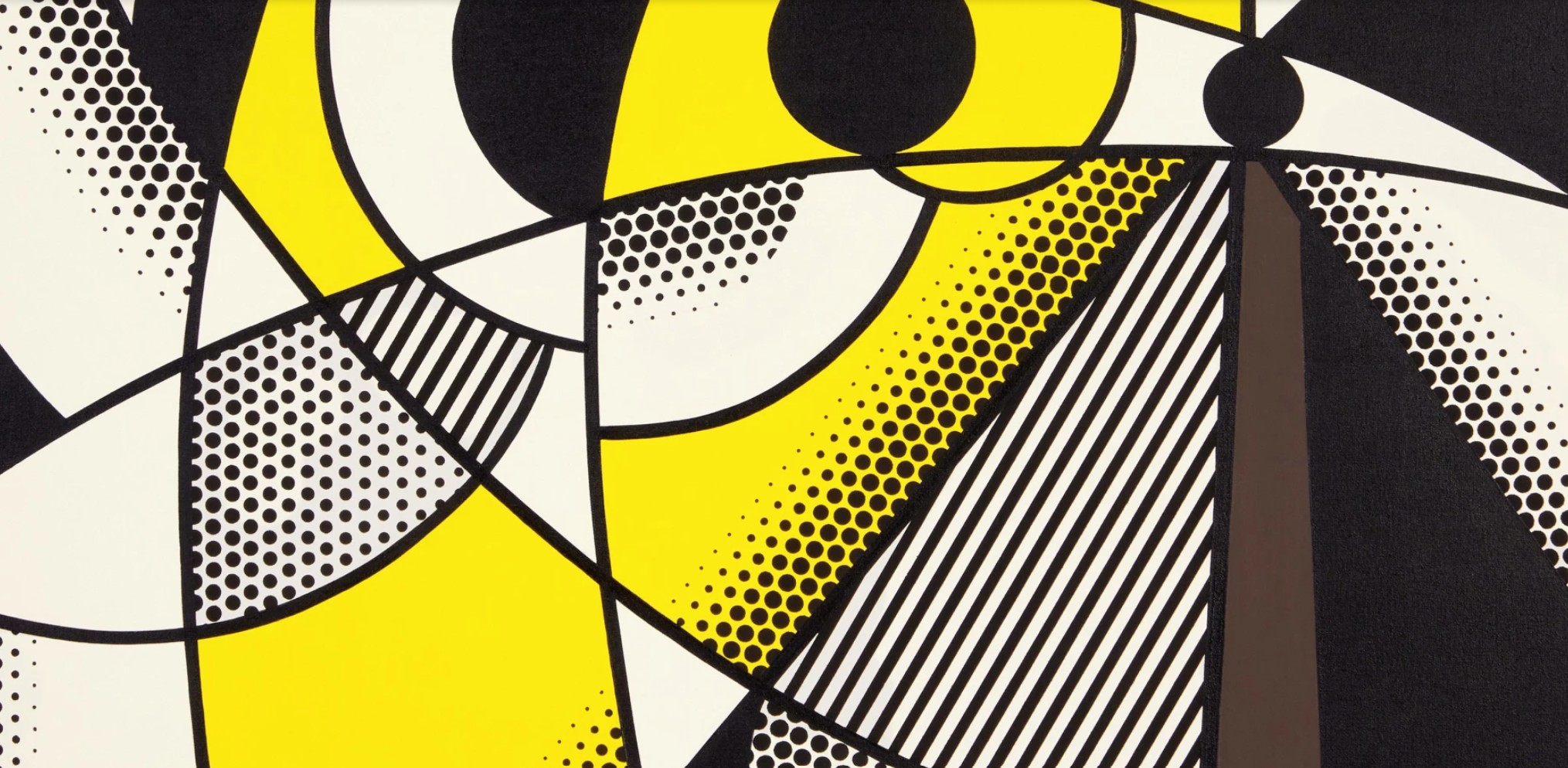
Executed in 1975, Eclipse of the Sun II stands as a pivotal achievement in Roy Lichtenstein’s career, showcasing his ability to transform historical and cultural imagery into the bold, graphic language of Pop Art while highlighting his sustained engagement with the dialogue between past and contemporary visual culture. As curator Diane Waldman observes, Eclipse of the Sun II opens up a transhistorical dialogue with the twentieth century movement of Futurism: “Giacomo Balla’s Mercury Passing in Front of the Sun as Seen through a Telescope, 1914, is the antecedent for Eclipse of the Sun II, 1975. In this painting, Lichtenstein has captured the centrifugal force, the intersecting arcs, the energy and thrust of the original and… made his own stylistic interpretation of the innovations that catapulted the Futurists into a prominent position among the early twentieth-century Modernists.” (Exh. Cat., New York, Solomon R. Guggenheim Museum (and traveling), Roy Lichtenstein: A Retrospective, 1993, p. 241). This monumental work unites Cubist and Futurist concerns of perspective and space with Lichtenstein’s practice of reflection, appropriation, and reimagination, all rendered in the precise, graphic style of his Pop vernacular. Returning to public view for the first time since the watershed exhibition Roy Lichtenstein: A Retrospective organized at the Solomon R. Guggenheim Museum, New York, Eclipse of the Sun II witnesses Roy Lichtenstein’s creativity at its peak.
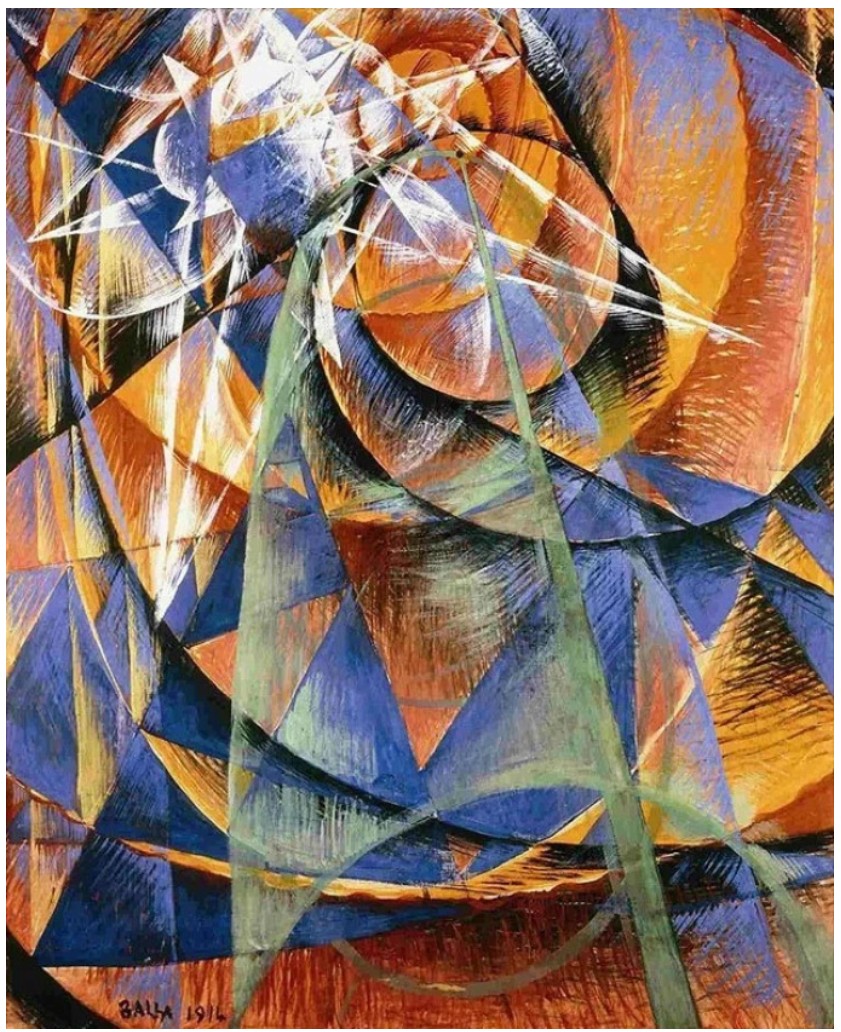
Giacomo Balla, Mercury Passing in Front of the Sun as Seen Through a Telescope, 1914.
Private Collection. Art © 2025 Artists Rights Society (ARS), New York / SIAE, Rome
Balla’s Mercury Passing in Front of the Sun as Seen through a Telescope is a series of paintings depicting the artist’s observation of the Transit of Mercury through a telescope, juxtaposing bright colors, overlapping spirals, and jagged angular motifs to capture a fleeting, transitional moment with a distinct optical dynamism. Central to his intellectual project was the Italian Futurist obsession with portraying movement, speed, motion, and energy, to make an art fit for a new world that opened up by the advent of the twentieth century. After observing the Transit of Mercury on November 7, 1914, Balla created these paintings that strongly reflect the assertions of the Futurist manifesto: “We declare that the splendor of the world has been enriched with a new form of beauty, the beauty of speed. … We will sing the praises of man holding the fly-wheel of which the ideal steering-post traverses the earth impelled itself around the circuit of its own orbit. The poet must spend himself with warmth, brilliancy and prodigality to augment the fervour of the primordial elements.” (Filippo Tommaso Marinetti, “Declaration of Futurism,” Poesia, vol. 5, no. 6, April 1909, p.1)
“I am nominally copying, but I am really restating the copied thing in other terms. In doing that, the original acquires a totally different texture. It isn’t thick or thin brushstrokes, it’s dots and flat colors and unyielding lines.”
While remaining faithful to Balla’s composition, Lichtenstein boldly reimagines the stellar phenomenon in his own singular vision. In Eclipse of the Sun II, a black circle arcs across the composition, suggesting Mercury passing in front of the Sun. Bright yellow planes evoke sunlight, while shadows appear in black, navy, and dark brown. From these rays, the artist’s iconic Ben-Day dots and diagonal lines add further nuance to the scene’s fractured optical complexities.
Lichtenstein’s invocation of Balla’s work in his characteristic Pop style immediately complicates the dichotomy between “high” culture of avant-garde art and the “low” aesthetics of commercial imagery. Here, the artist’s contention with art historical precedent at once honors the legacy of artistic forebears while brilliantly blurring the boundaries of art.
Eclipse of the Sun II represents Lichtenstein at the height of his intellectual and artistic rigor, interrogating notions of originality, authorship, and meaning while engaging with the visual language of earlier Modern masters. His precise, almost industrial brushwork creates a sense of stillness and permanence, contrasting with the dynamism of Balla’s original Futurist strokes. In doing so, Lichtenstein transforms the expressive gestures of Italian Futurism into his own system of mechanized mark-making, elevating the source material from simple reference to a site of critical play. Mercury Passing in Front of the Sun as Seen through a Telescope is no longer a radical spectacle of nature but a codified image, reinterpreted and recontextualized. Where Balla’s work invited viewers to experience the cosmic event anew, Lichtenstein extends that engagement a step further: appropriation twice removed, from nature to Balla, from Balla to Lichtenstein.
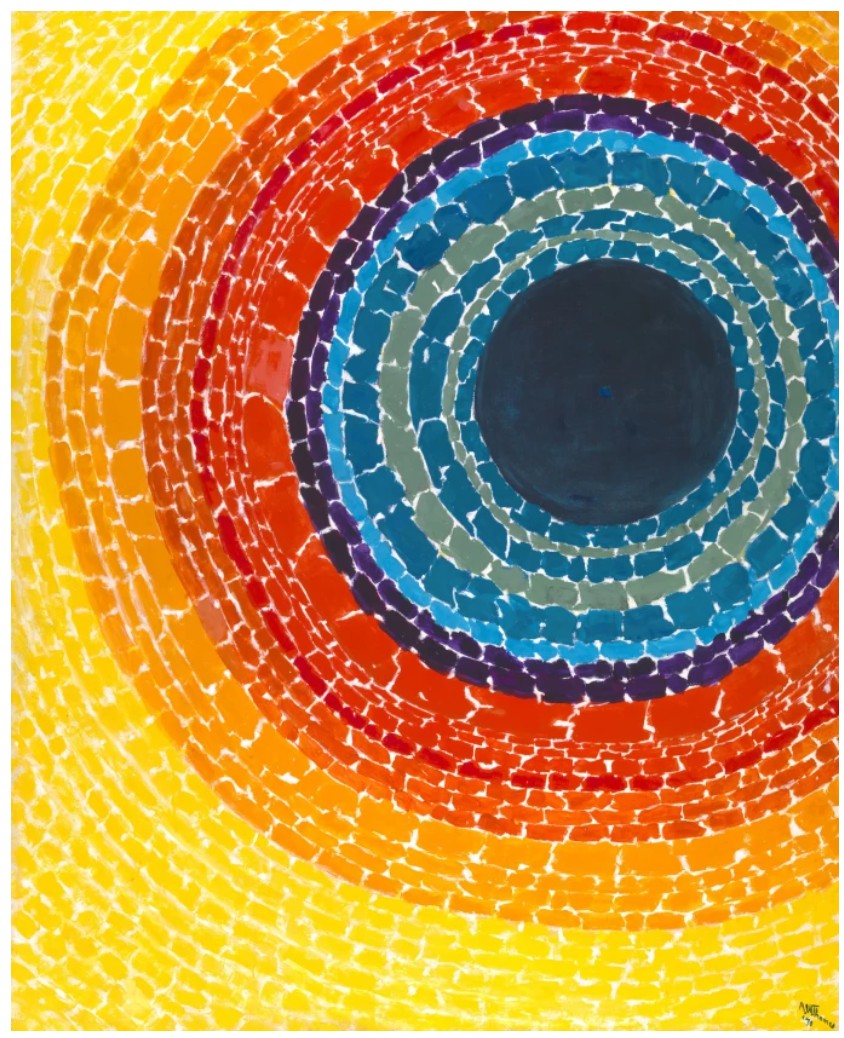
Alma Thomas, The Eclipse, 1970. Smithsonian American Art Museum. Art © 2025 Alma Thomas
Eclipse of the Sun II is a seminal example of Lichtenstein’s career-long engagement with paragons of the art historical canon through his distinctive Pop idiom. At its crux a painting about painting, the present work is a bold statement on the constructed nature of vision, the portability of style, the interlockings of art history, and the enduring dialogue between innovation and imitation. The present work and its sister work, Eclipse of the Sun from 1975, together shed light on Lichtenstein’s perspective on Futurism and the legacies of its visual dynamism. Its strategies of appropriation underscore the conceptual depth lying behind his artistic legacy of making art about art, rewriting art history in his singular sensibilities. Coming directly from the artist’s estate, Eclipse of the Sun II—with its conceptual depth and refined composition—stands at the center of Lichtenstein’s celebrated legacy.
STUDIES
The Red Horseman (Study), 1974
The Red Horseman (Study), 1974
Christie’s New-York: 12 November 2021
Estimated: USD 500,000 – 700,000
USD 562,500
WORK ON PAPER
ROY LICHTENSTEIN (1923-1997), The Red Horseman (Study) | Christie’s
ROY LICHTENSTEIN (1923-1997)
The Red Horseman (Study), 1974
Colored pencil, graphite and paper collage on paper
Image: 14 3/4 x 19 1/2 inches (36.8 x 49.5 cm)
Sheet: 20 3/8 x 23 2/3 inches (51.8 x 59.7 cm)
Titled and inscribed ‘Carlo Carra “The Red Horseman” 1913’ (lower right)
Signed and dated ‘R Lichtenstein ’74’ (on the reverse)
In The Red Horseman, Roy Lichtenstein turns away from the vernacular of comic strips to engage directly with the language of early twentieth-century modernism. Executed in 1974, the work belongs to a group of paintings in which Lichtenstein interrogates the visual grammar of historical avant-gardes, translating their formal ambitions into his own rigorously controlled pictorial system. The result is neither homage nor parody, but a precise act of re-articulation. The composition is derived from Il Cavaliere Rosso (1913) by Carlo Carrà, a canonical work of Italian Futurism. Carrà’s original painting sought to convey speed, force, and ideological momentum through fractured planes and centrifugal movement. Lichtenstein extracts this dynamic core while stripping it of its historical rhetoric, replacing expressive fragmentation with clean contours, flattened color zones, and a carefully calibrated sense of visual tension.
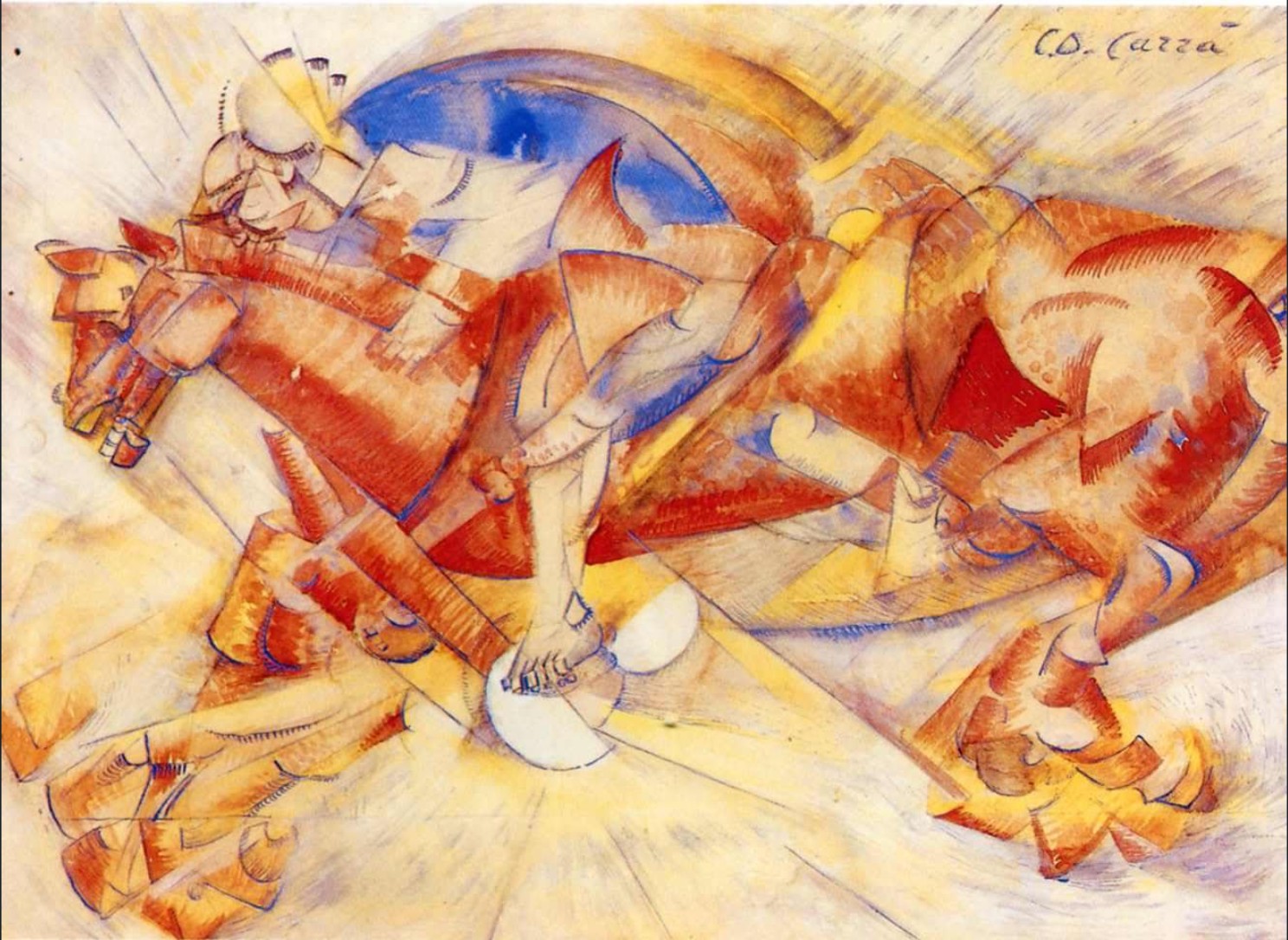
CARLO CARRA, Il Cavaliere Rosso (“The red knight”, 1913, tempera and ink on canvas paper
Civiche raccolte d’arte contempo, Milano (MI) – Milan, Lombardia – Lombardy, Italia – Italy
Red dominates the surface, functioning both as chromatic anchor and conceptual device. In Lichtenstein’s hands, color becomes declarative rather than expressive, reinforcing the work’s distance from Futurism’s emotional charge. Movement is suggested not through painterly agitation, but through the orchestration of diagonals, curves, and intersecting forms that remain resolutely graphic and self-contained. The painting exemplifies Lichtenstein’s mature engagement with art history, a period in which he systematically revisited Cubism, Futurism, Surrealism, and Abstract Expressionism. Rather than quoting style as surface effect, he subjected each source to a process of translation that exposed its structural logic. In The Red Horseman, this method produces an image that is simultaneously referential and autonomous, recognizably historical yet unmistakably Lichtenstein.
ROY LICHTENSTEIN, The Red Horseman, 1974, Acrylic, oil, graphite pencil on canvas
The Red Horseman, 1974 (RLCR 2315) | Catalogue entry | Roy Lichtenstein: A Catalogue Raisonné
Within the artist’s broader oeuvre, the work occupies a pivotal position. It demonstrates how Pop Art, often misunderstood as anti-intellectual or purely ironic, could operate as a sophisticated analytical tool. By filtering Futurist ambition through Pop discipline, Lichtenstein offers a meditation on how images survive, mutate, and retain power once detached from their original context. Today, The Red Horseman stands as a measured and cerebral work, emblematic of Lichtenstein’s ability to engage the past without nostalgia and to assert that modern art history itself could become legitimate subject matter, handled with clarity, restraint, and a quiet sense of authority.
In 1982, The Red Horseman entered a new phase of visibility through its inclusion in the official art program of the 1984 Summer Olympics. In the years leading up to the Games, the Los Angeles Olympic Organizing Committee commissioned a select group of internationally established artists to produce original images that would accompany the event and articulate its cultural ambitions. Lichtenstein was invited as one of the leading figures of postwar American art, alongside artists whose practices had already achieved broad institutional and public recognition.
The Olympic edition based on The Red Horseman was conceived not as a reinterpretation but as a faithful translation of the earlier pictorial concept into print form. The image’s equestrian motif resonated naturally with Olympic symbolism: strength, motion, discipline, and controlled energy. Stripped of narrative specificity, the horseman becomes an emblem rather than a character, aligning with the Games’ desire for universally legible imagery detached from national or ideological markers.
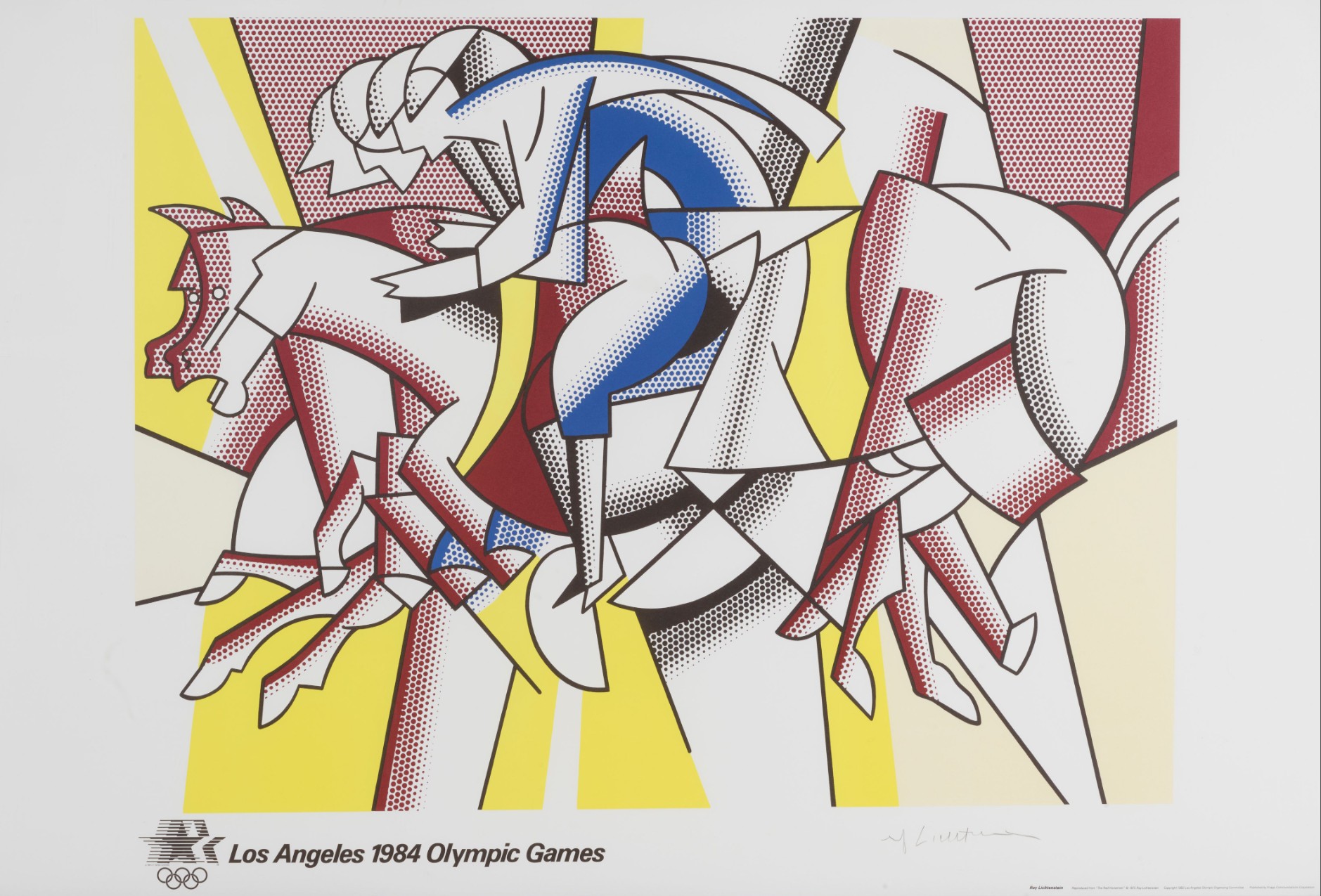
Produced as a high-quality screenprint, the Olympic version was issued in a limited, numbered, and signed edition, published under the strict standards imposed by the Olympic Fine Art Program. The output was intentionally restrained, reinforcing the project’s dual ambition: broad dissemination through posters and exhibitions, coupled with the creation of a collectible work destined for private and institutional collections. This balance between accessibility and scarcity echoes Lichtenstein’s long-standing interest in the mechanics of reproduction and cultural circulation.
The release of the Olympic Red Horseman coincided with a moment when the artist was increasingly engaged with historical sources and formal abstraction. Seen in this context, the print functions as a bridge between modernist reference and contemporary spectacle. The Olympic platform amplified the image’s reach, placing Lichtenstein’s refined, analytical vision into a global arena watched by millions. Within the broader Olympic art program, The Red Horseman stands out for its intellectual restraint. Rather than illustrating sport directly, it proposes an image of controlled momentum and graphic clarity. It confirms Lichtenstein’s capacity to operate within large public commissions without diluting his language, asserting that even in a mass-cultural framework such as the Olympic Games, rigor, distance, and formal intelligence could prevail.