Introduction
Championed by Le Corbusier, Fernand Léger, and Amédée Ozenfant, Purism arose in the 1920s, in the aftermath of Cubism as a movement that espoused an aesthetic tabula rasa. Seeking out everyday objects such as bottles and glasses as the subject matter for their still life compositions, Purism celebrated the functional quality of these utilitarian items by paring them down their most elemental form. Once seen as controversial, the Purist interest in flattening the images of the everyday became absorbed in the discourse of Modern Art. Informed both by the Purist interest in ubiquitous objects, and Pop’s engagement with generic consumer good advertisements, Lichtenstein’s Purist Pictures unite the mutual ambition of both movements to distil a composition to one which is immediately recognizable.
Employing his signature reductive strategies shared by cheap commercial printing processes, Lichtenstein’s Ben Day dots decontextualize high art into the realms of the tabloid, the billboard and the magazine. Testament to his own innovative artistic vision, Lichtenstein engrains his own instantly recognizable painterly language into the canon of art history with both irreverence with reverence. Elements of this painting resemble Mondrian more than they do Ozenfant or Léger, especially the squares and rectangles in the upper half. Indeed, a pervasive Purist or even Cubist aesthetic can be felt in the mechanical reduction of the composition to its only most necessary lines and omission of perspective.
Auction Results
#1. Purist Painting with Bottles, 1975
Christie’s London: 1 July 2014
Estimated: GBP 2,000,000 – 3,000,000
GBP 3,778,700 / USD 6,477,750
ROY LICHTENSTEIN (1923-1997), Purist Painting with Bottles | Christie’s
REPEAT SALE
Christie’s London: 8 February 2007
Estimated: GBP 1,500,000 – 2,000,000
GBP 2,484,000 / USD 4,864,450
Roy Lichtenstein (1923-1997) , Purist Painting with Bottles | Christie’s
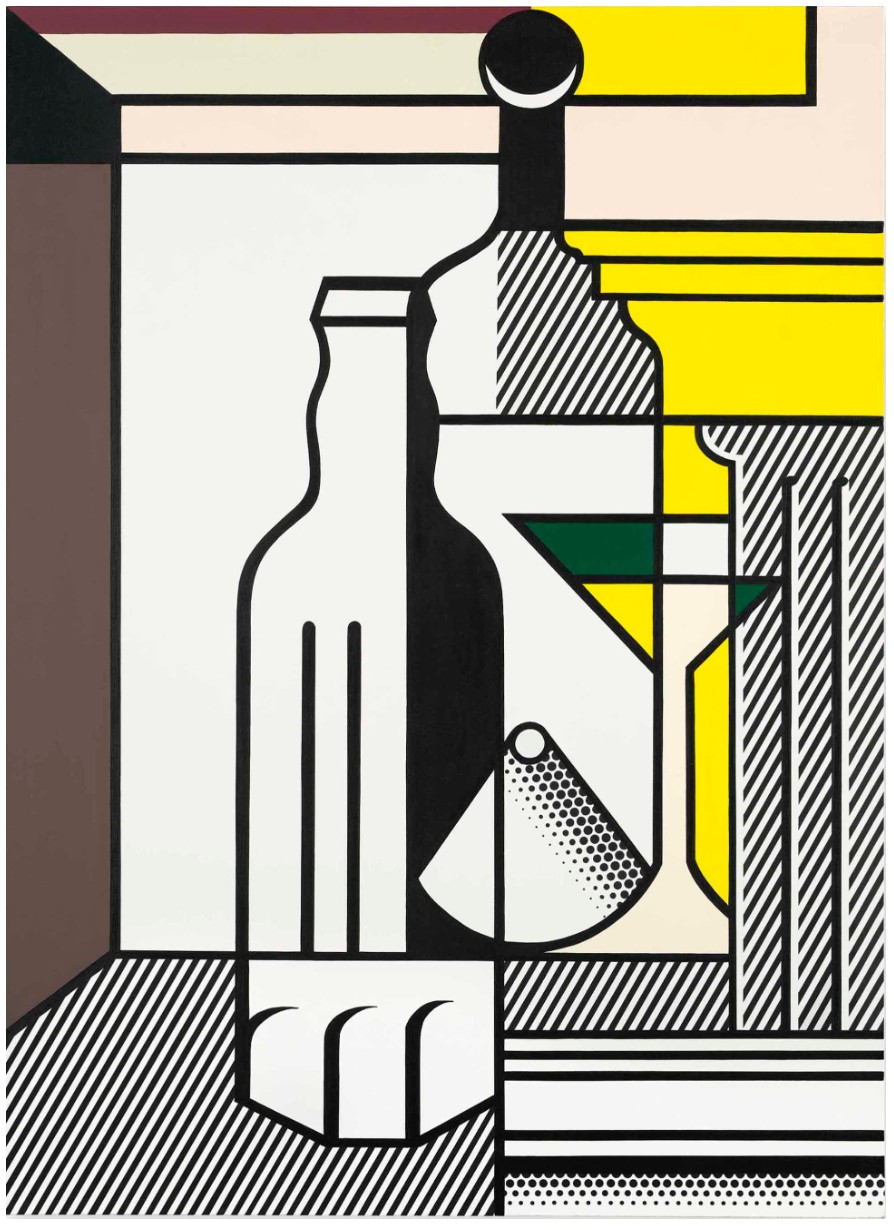
ROY LICHTENSTEIN (1923-1997)
Purist Painting with Bottles, 1975
Oil and Magna on canvas
74×54 inches (188 x 137.2 cm)
Signed and dated ‘rf Lichtenstein ’75’ (on the reverse)
#2. Purist Painting with Pitcher, Glass and Classical Column, 1975
Christie’s New-York: 19 November 2024
Estimated: USD 4,000,000 – 6,000,000
USD 4,648,000
ROY LICHTENSTEIN (1923-1997), Purist Painting with Pitcher, Glass and Classical Column | Christie’s
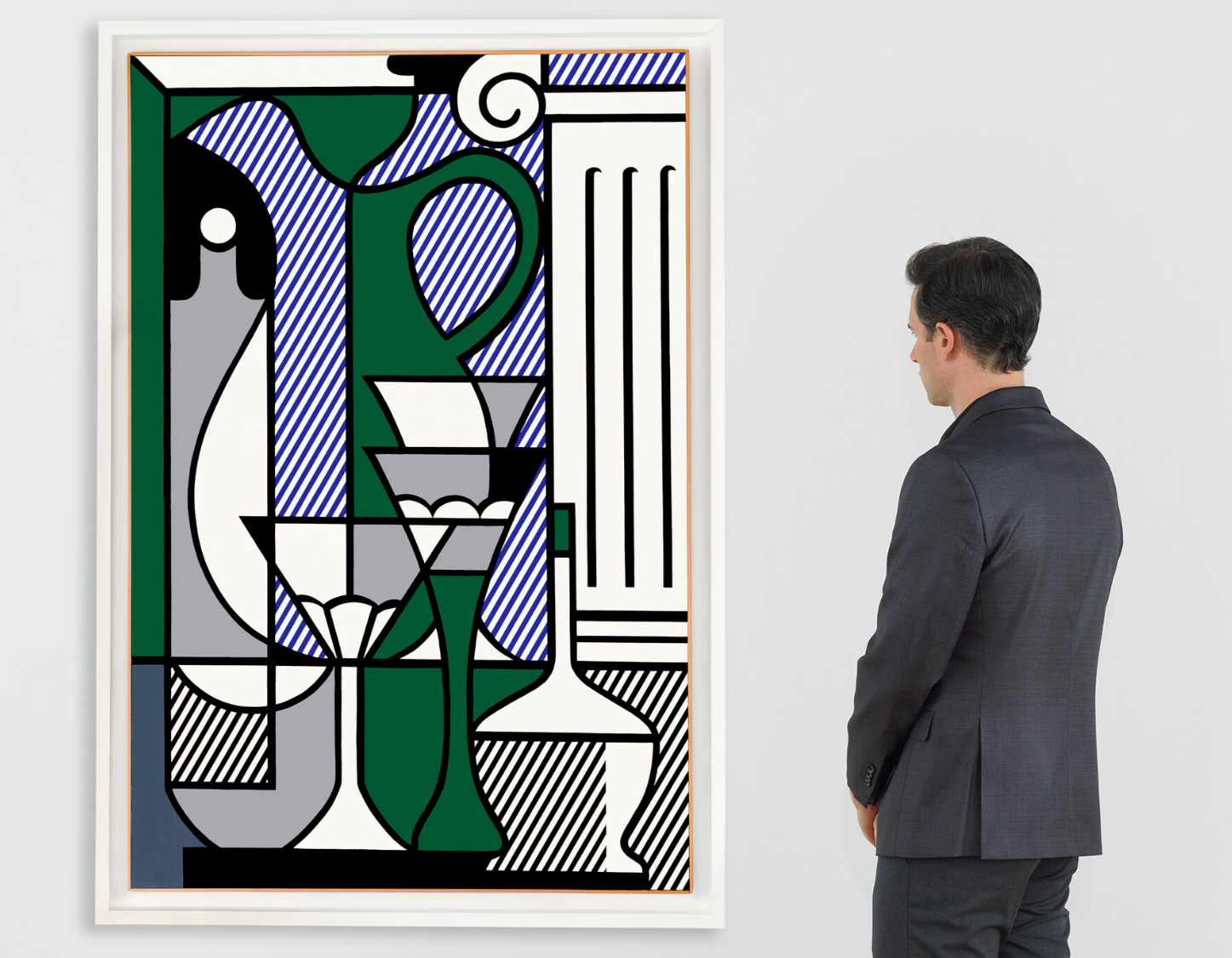
ROY LICHTENSTEIN (1923-1997)
Purist Painting with Pitcher, Glass and Classical Column, 1975
Acrylic, oil and graphite on canvas
60×40 inches (152.4 x 101.6 cm)
Signed and dated ‘rf Lichtenstein ’75’ (on the reverse)
#3. Purist Still Life with Pitcher, 1975
Works from the Collection of Dorothy and Roy Lichtenstein
Sotheby’s London: 24 June 2025
Estimated: GBP 2,500,000 – 3,500,000
GBP 3,151,000 / USD 4,253,850
Purist Still Life with Pitcher | Modern & Contemporary Evening Auction | 2025 | Sotheby’s
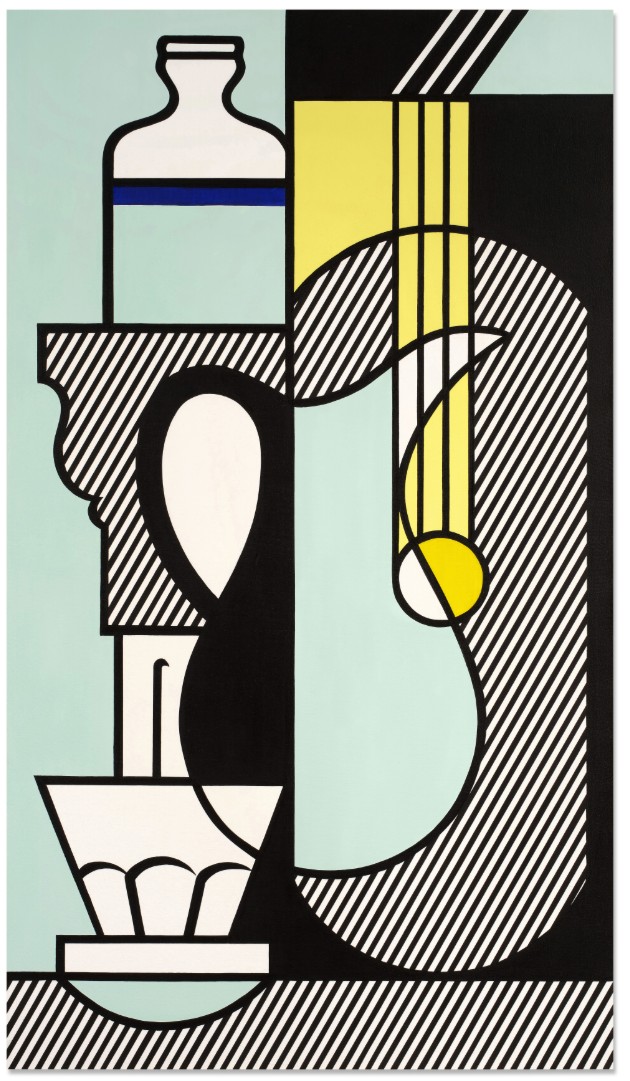
ROY LICHTENSTEIN (1923 – 1997)
Purist Still Life with Pitcher, 1975
Acrylic, oil and graphite on canvas
69 7/8 x 40 1/8 inches (177.6 x 101.9 cm)
Signed and dated ’75 (on the reverse)
#4. Purist Painting in Yellows, 1975
Christie’s London: 4 October 2018
Estimated: GBP 1,200,000 – 1,800,000
GBP 2,168,750 / USD 2,822,705
Roy Lichtenstein (1923-1997), Purist Painting in Yellows | Christie’s
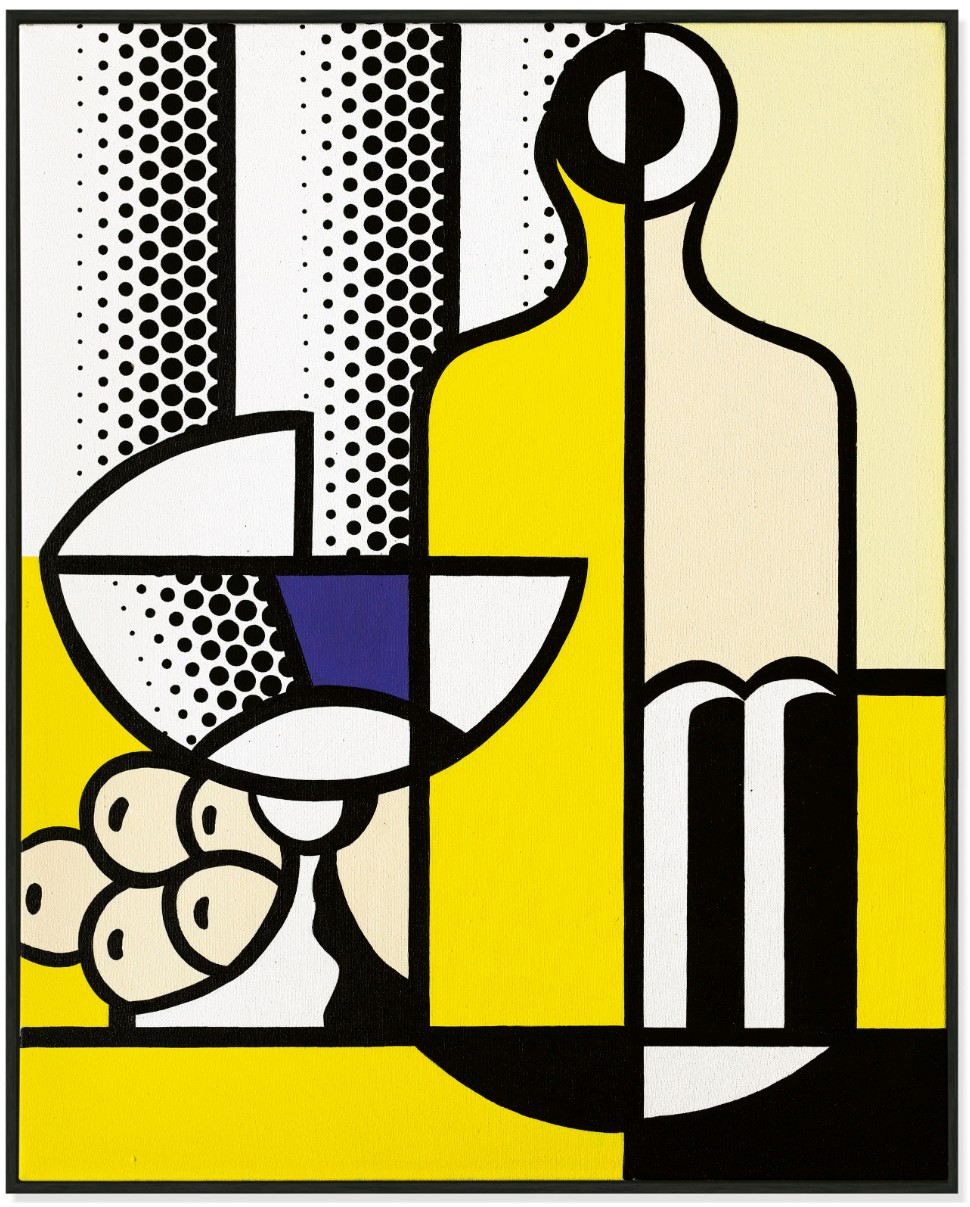
ROY LICHTENSTEIN (1923-1997)
Purist Painting in Yellows, 1975
Oil and Magna on canvas
29 7/8 x 24 inches (76×61 cm)
Signed and dated ‘rf Lichtenstein ‘75’ (on the reverse)
Purist Painting with Bottles, 1975
Purist Painting with Bottles, 1975
Christie’s London: 1 July 2014
Estimated: GBP 2,000,000 – 3,000,000
GBP 3,778,700 / USD 6,477,750
ROY LICHTENSTEIN (1923-1997), Purist Painting with Bottles | Christie’s
REPEAT SALE
Christie’s London: 8 February 2007
Estimated: GBP 1,500,000 – 2,000,000
GBP 2,484,000 / USD 4,864,450
Roy Lichtenstein (1923-1997) , Purist Painting with Bottles | Christie’s
ROY LICHTENSTEIN (1923-1997)
Purist Painting with Bottles, 1975
Oil and Magna on canvas
74×54 inches (188 x 137.2 cm)
Signed and dated ‘rf Lichtenstein ’75’ (on the reverse)
Provenance
Leo Castelli Gallery, New York.
Private Collection, Los Angeles (acquired from the above in 1975, and thence by descent).
Anon. sale, Christie’s London, 8 February 2007, lot 23.
Acquired at the above sale by the previous owner.
Modern art seen through Roy Lichtenstein’s signature Ben Day aesthetic, Purist Painting with Bottles, 1975, is one of a handful of works by the artist that addresses the post-Cubist movement of Purism. A departure from the 1960s pop culture imagery which he had already conquered, in the 1970s Lichtenstein turned his focus to the art historical canon. Having first embarked on a series of Cubist inspired still-lives from 1973, by 1975 Lichtenstein’s practice found affinity with the radical approach and visual kinship to Purism and Purist Painting with Bottles stands as an adroit yet playful homage to early 20th century Modernism. Overturning the ordered precision and rational, mathematically-based principles that govern Purist compositions, Lichtenstein’s hatching and Ben Day dots articulate and define the various shadings, textures and perspectives within this still life. Appearing like an illustration in an art history text book, here the Purist composition is built from layers of colored dots, which speak to the mechanical aesthetic of mass reproduction. Indeed, the Purist also embraced technology, focusing on mechanical and industrial subject matter. In this way, Lichtenstein transforms the Purist still life into a visual idiom more associated with printing, with pulp, and with Pop.
For Lichtenstein’s work to be recognized as related to comics or to advertisements, he needed to be able to condense the appearances of the various objects into an almost shorthand image reminiscent of the mass media – thus the martini glass and bottles of this work become archetypes in the same manner of his hotdogs and brushstrokes of his earlier works. Thus the methods of representation honed to perfection by the press and publishing industries and then high-jacked by Lichtenstein echo the idealism of Purist painting, as well as many other aesthetically driven movements: ‘That was the idea, in a way, of classical work: ideal figures of people and godlike people. Well, the same thing has been developed in cartoons. It’s not called classical, it’s called a cliché. Well, I’m interested in my work’s redeveloping these classical ways, except that it’s not classical, it’s like a cartoon’ (R. Lichtenstein, quoted in D. Sylvester, Interviews with American Artists, London 2002, pp. 226-227).
Lichtenstein is not the first artist to borrow concepts from his predecessors, but as a member of the Pop Art generation his approach to appropriation is a very modern one. During his graduate studies at art school he became interested in the psychology of perception and the problems of pictorial representation and was heavily influenced by the work of Picasso, Klee and Miró. He later became fascinated by the distinctions between so-called high and low art and this led him to produce several bodies of work in which he combined his own unique style with ideas he appropriated from some of the 20th century’s greatest artists. A pioneer of Pop art, one of Lichtenstein’s greatest legacies is initiating the dismantling of the traditional boundaries between high and low art. In doing so, he raised questions about not only the values of art in modern society but also he questions the wider values of that society as well. The processes and aesthetic values that Lichtenstein shared with Purism lends Purist Painting with Bottles an internal cohesion and logic greater than in many of his takes on other art movements. Indeed, with its removal of the painterly, with his insistence on a means of painting that removes the evidence of the artist’s hand and with the introduction of the strict lines, uniform colours and regular means of hatching, Lichtenstein has taken Purism beyond its former limits.
Purist Still Life with Pitcher, 1975
Purist Still Life with Pitcher, 1975
Works from the Collection of Dorothy and Roy Lichtenstein
Sotheby’s London: 24 June 2025
Estimated: GBP 2,500,000 – 3,500,000
GBP 3,151,000 / USD 4,253,850
Purist Still Life with Pitcher | Modern & Contemporary Evening Auction | 2025 | Sotheby’s
ROY LICHTENSTEIN (1923 – 1997)
Purist Still Life with Pitcher, 1975
Acrylic, oil and graphite on canvas
69 7/8 x 40 1/8 inches (177.6 x 101.9 cm)
Signed and dated ’75 (on the reverse)
Fusing a playful palette and a rigorous intellectual project, Purist Still Life with Pitcher is a stunning articulation of Roy Lichtenstein’s brilliant command of line, color and concept. In the late 1960s, Lichtenstein shifted his attention away from the comic-inspired paintings of the previous decade and toward the art historical canon of the 20th century, composing a series of paintings in a plethora of styles ranging from 19th-century American still life, to Art Deco, Impressionism, Cubism, and Purism. The present work from 1975 is the final and most resolved of a group of 13 Purist Still Lifes completed that year, at least 3 of which reside in major museum collections around the world. Exemplifying Lichtenstein’s celebrated reductive aesthetic and intuitive compositional awareness, Purist Still Life with Pitcher ironically translates the tenets and tropes of Purism into the artist’s own signature Ben-Day dotted Pop Art style. Using a minimum of colours and decorative art-nouveau forms, Lichtenstein here constructs his mock Purist composition from layered planes of juxtaposed color and line to achieve a uniformity and control which blends the mechanical aesthetic of mass reproduction with this bastion of Modernism. Testifying to its significance, the present work has been exhibited widely at institutions such as the Whitney Museum, New York; the Milan Triennale; Museo del Palacio de Bellas Artes, Mexico City; and Centro Cultural de Belém, Lisbon, among others. One of few works that Dorothy and Roy Lichtenstein retained for their personal collection, Purist Still Life with Pitcher, alongside the other choice examples from their collection, provides a rare glimpse into Roy’s process and artistic development.
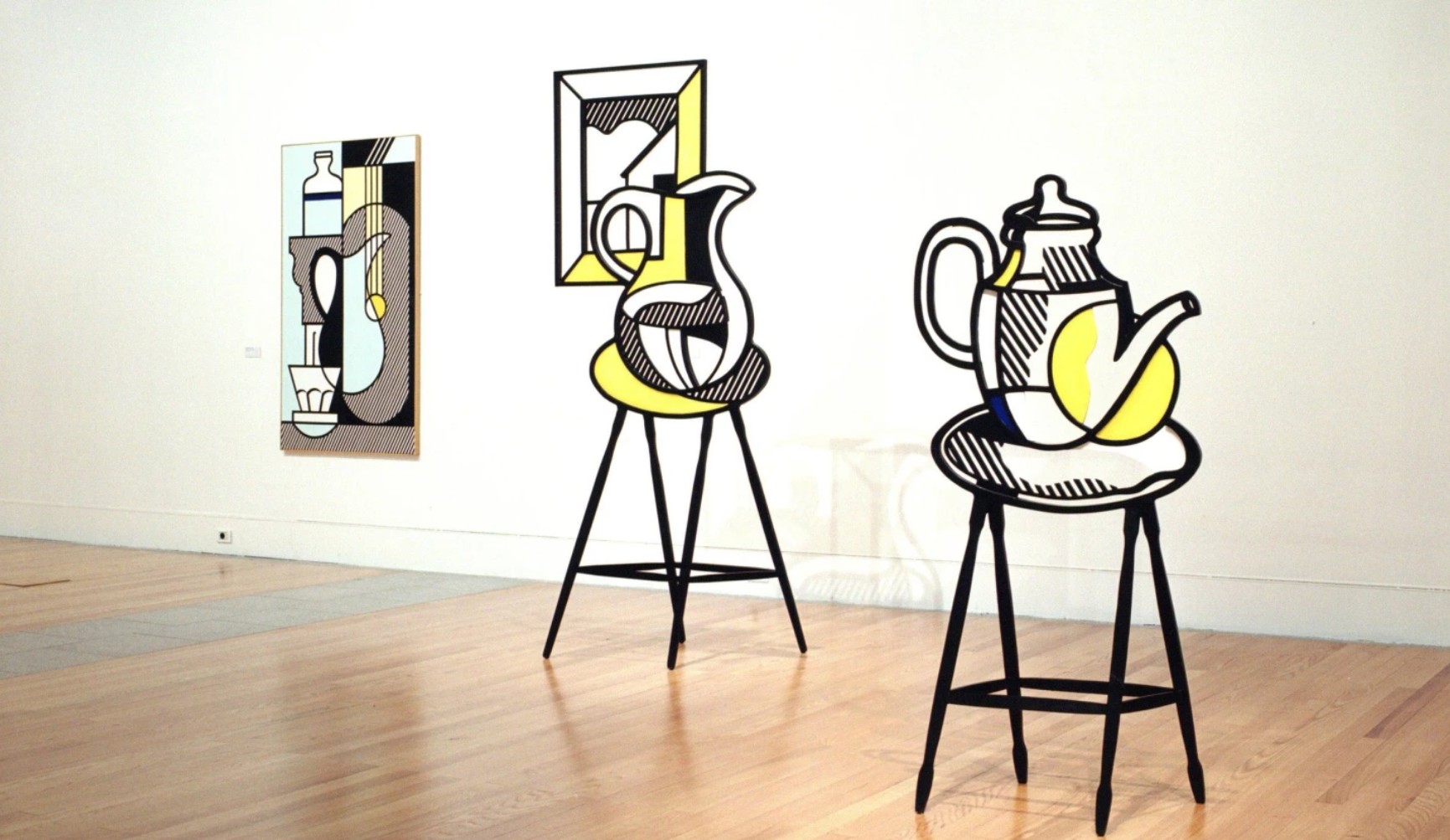
The present work installed in Roy Lichtenstein: Imagens Reconhecíveis, Centro Cultural de Belém, Lisbon, 2000. Image courtesy Centro Cultural de Belém. Artwork: © Estate of Roy Lichtenstein/DACS 2025
Lichtenstein first appropriated the still life as subject matter briefly in his early 1960s paintings of single objects, such as Tire, 1962 (MoMA, New York). Placed against a flat monochromatic background and rendered in black and white, Tire is a bold example of Lichtenstein’s early forays into the stark, graphic style common to print advertisements and mechanically reproduced images. Returning to the still life in 1971, Lichtenstein’s later canvases depict more complex compositions yet retain the highly graphic quality of his earlier works. Here, Lichtenstein balances between a harmonious dialogue with the tenets of modernism and a distinctly contemporary sensibility, inserting the artificiality and reproducibility of the modern-day image into the “high culture” of fine art. Thus, the present work destabilizes the very depth, form, and figuration that viewers come to expect from an orthodox still life work. Whether it be Dutch still lifes of resounding symbolic profundity, Cubist still lifes that wrestle with the limits of representation, or contemporary still lifes by contemporaries like David Hockney and Lucian Freud, the present work engages within a sincere conversation that interrogates the capacities and limits of the genre. Undeniably a metonym for the scaffolding principles of art history, the still life takes on a new role in Lichtenstein’s work and becomes a physical embodiment of the reflection on art history that defines the artist’s mature practice.
A departure from the 1960s pop culture imagery which he had already conquered, in the 1970s Lichtenstein turned his focus to the art historical canon. Championed by Le Corbusier, Fernand Léger, and Amédée Ozenfant, Purism arose in the 1920s, in the aftermath of Cubism as a movement that espoused an aesthetic tabula rasa. Seeking out everyday objects such as bottles and glasses as the subject matter for their still life compositions, Purism celebrated the functional quality of these utilitarian items by paring them down their most elemental form. Informed both by the Purist interest in ubiquitous objects, and Pop’s engagement with generic consumer good advertisements, Lichtenstein’s Purist Pictures unite the mutual ambition of both movements to distil a composition to one which is immediately recognizable. Overturning the ordered precision and rational, mathematically-based principles that govern Purist compositions, Lichtenstein’s hatching and Ben-Day dots articulate and define the various shadings, textures and perspectives within this still life. A crucial element of Purism was its embrace of technology and concurrent presentation of objects as basic forms stripped of detail – ideals which struck a chord with Lichtenstein’s own praxis and boldly diluted, machinated aesthetic. The processes and aesthetic values that Lichtenstein shared with Purism lends Purist Still Life with Pitcher an internal cohesion and logic greater than in many of his takes on other art movements.
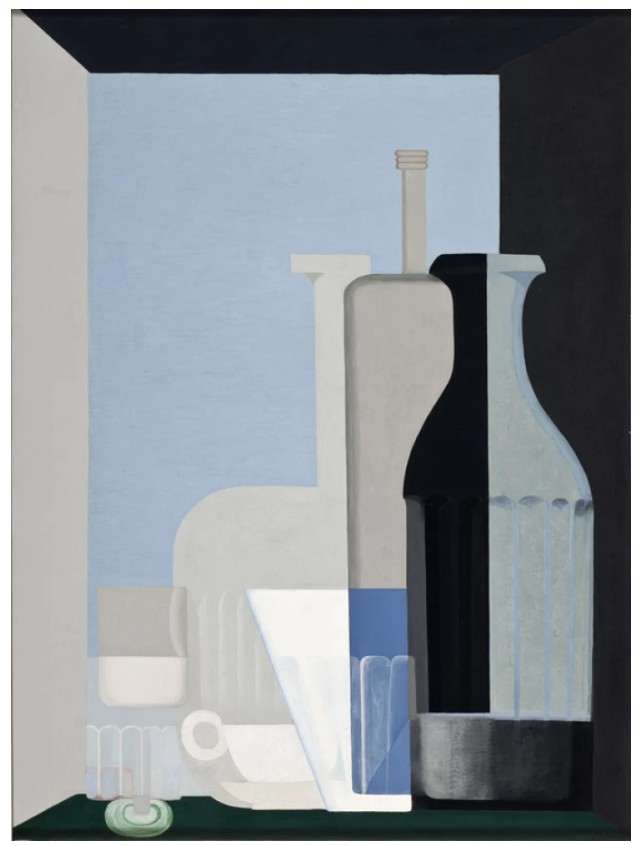
Amédée Ozenfant, Still Life with Bottles, 1922. Los Angeles County Museum of Art.
A departure from the 1960s pop culture imagery which he had already conquered, in the 1970s Lichtenstein turned his focus to the art historical canon. Championed by Le Corbusier, Fernand Léger, and Amédée Ozenfant, Purism arose in the 1920s, in the aftermath of Cubism as a movement that espoused an aesthetic tabula rasa. Seeking out everyday objects such as bottles and glasses as the subject matter for their still life compositions, Purism celebrated the functional quality of these utilitarian items by paring them down their most elemental form. Informed both by the Purist interest in ubiquitous objects, and Pop’s engagement with generic consumer good advertisements, Lichtenstein’s Purist Pictures unite the mutual ambition of both movements to distil a composition to one which is immediately recognizable. Overturning the ordered precision and rational, mathematically-based principles that govern Purist compositions, Lichtenstein’s hatching and Ben-Day dots articulate and define the various shadings, textures and perspectives within this still life. A crucial element of Purism was its embrace of technology and concurrent presentation of objects as basic forms stripped of detail – ideals which struck a chord with Lichtenstein’s own praxis and boldly diluted, machinated aesthetic. The processes and aesthetic values that Lichtenstein shared with Purism lends Purist Still Life with Pitcher an internal cohesion and logic greater than in many of his takes on other art movements.
Purist Painting with Pitcher, Glass and Classical Column, 1975
Purist Painting with Pitcher, Glass and Classical Column, 1975
Christie’s New-York: 19 November 2024
Estimated: USD 4,000,000 – 6,000,000
USD 4,648,000
ROY LICHTENSTEIN (1923-1997), Purist Painting with Pitcher, Glass and Classical Column | Christie’s
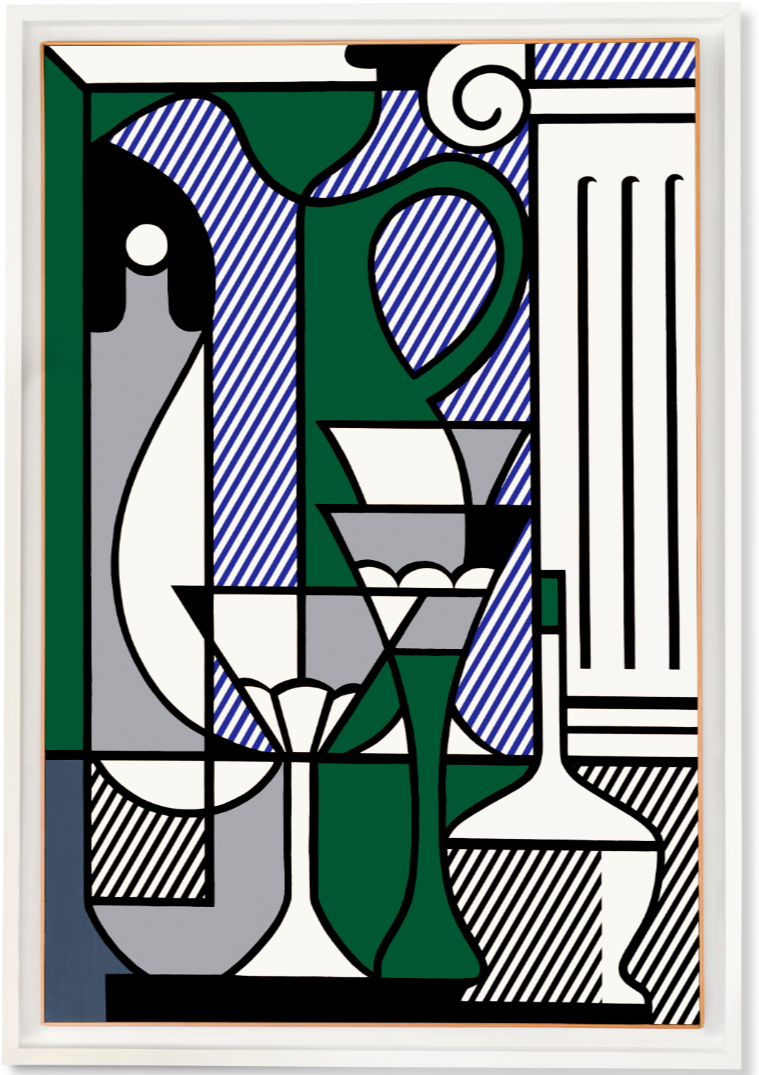
ROY LICHTENSTEIN (1923-1997)
Purist Painting with Pitcher, Glass and Classical Column, 1975
Acrylic, oil and graphite on canvas
60×40 inches (152.4 x 101.6 cm)
Signed and dated ‘rf Lichtenstein ’75’ (on the reverse)
In the 1970s, after devoting the previous decade to the iconic comic-book paintings that launched his career as one of the founders of Pop Art, Roy Lichtenstein set the comic-book aside and turned to art history as his muse. In this, an exceptional example from Lichtenstein’s series of Purist Paintings, the artist cunningly interrogates the pared-down simplicity and machine-like precision of Purism, a style pioneered by Fernand Léger and Amédée Ozenfant in 1918. The Purists felt that Cubism had become too decorative—almost a pastiche of itself—and instead wanted a radically-simplified style purged of extraneous detail. With his typical insouciant flair, Lichtenstein renders the classic elements of the Purist still life—wine bottles, glasses, and a pitcher—as if passed through a Pop Art lens.
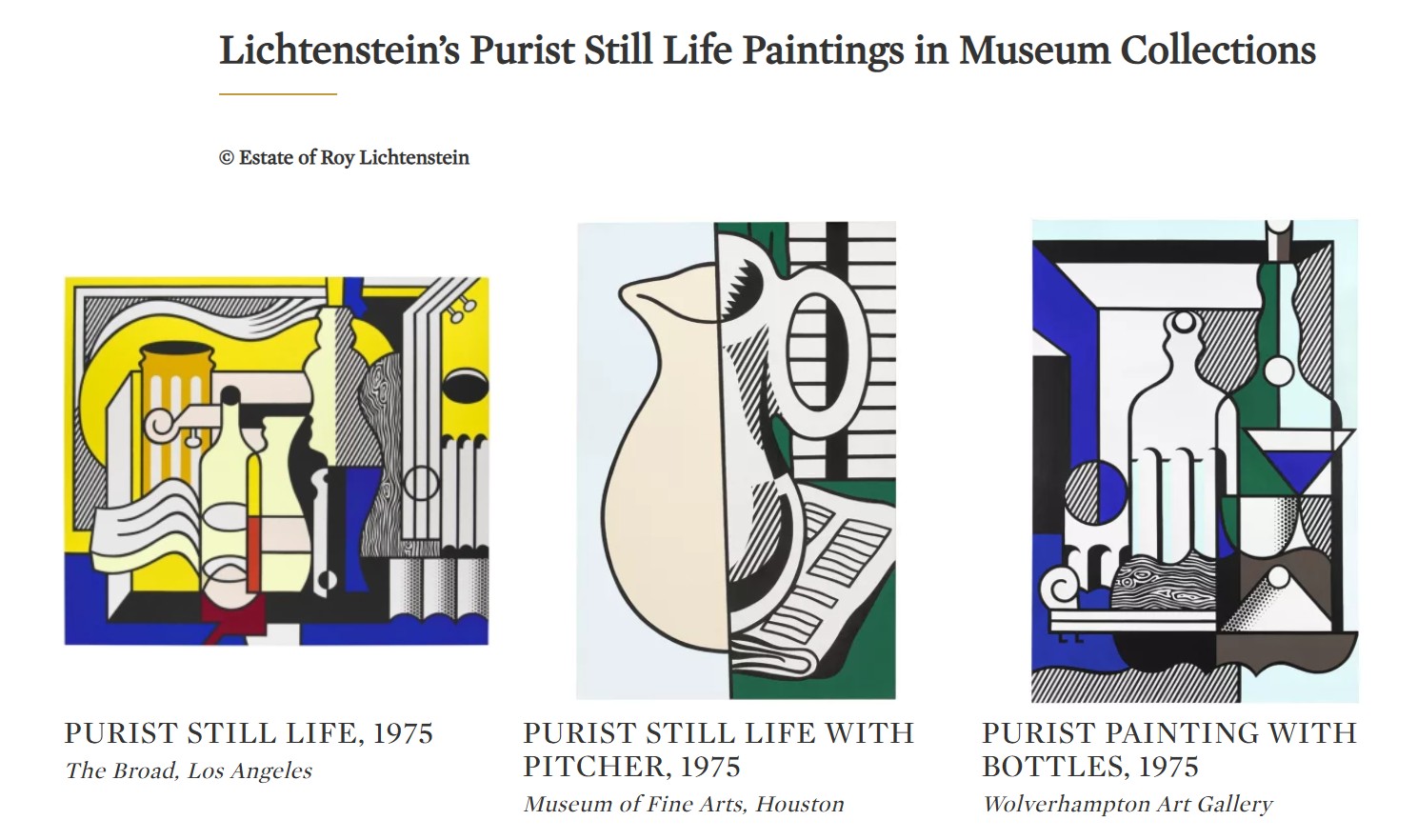
Lichtenstein created only thirteen purist still life paintings, of which several are now in important museum collections, including Purist Still Life (1975, The Broad, Los Angeles), Purist Still Life with Pitcher (1975, Museum of Fine Arts, Houston), and Purist Painting with Bottles (1975, Wolverhampton Art Gallery). These paintings demonstrate the quick-witted artist’s ability to adapt and transform the many “isms” of art history into his own unique vernacular. Beginning in 1972, the artist tackled Cubism, trompe l’oeil paintings, and Futurism before arriving at Purism.
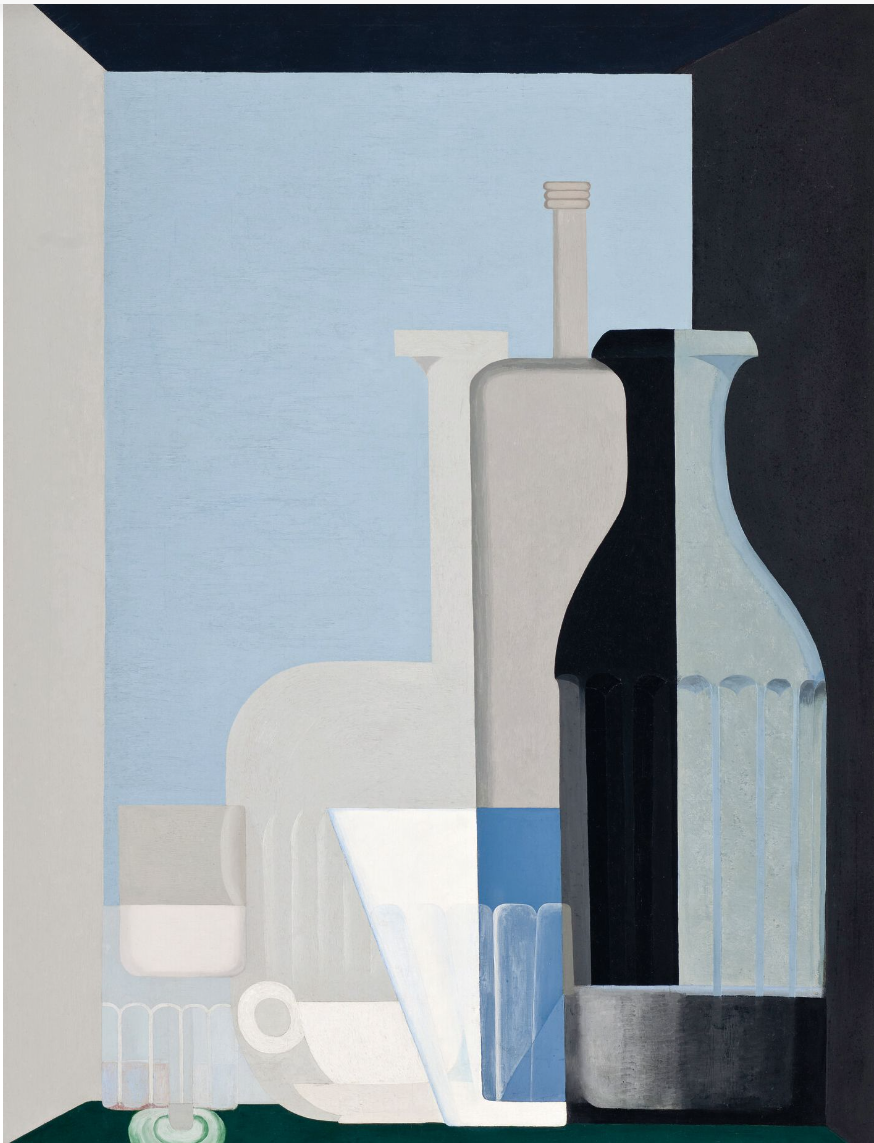
Amédée Ozenfant, Still Life with Bottles, 1922. Los Angeles County Museum of Art.
In Purist Painting with Pitcher, Glass and Classical Column, Lichtenstein depicts a pitcher and wine bottle that rests atop a flat surface. The shadow that is cast by the bottle is rendered in black diagonal lines, which can be seen directly underneath the bottle, as if it’s been reflected in a shiny surface. Nearby, two martini glasses with a decorative, beveled design sit alongside a chianti bottle, where the edge of the bottle is actually formed by the stem of one of the glasses. Above that, an ionic Greek column seems to sit on the same table top as the pitcher. Now the painting takes on the appearance of a large-scale landscape painting, with the tabletop actually forming a horizon line, and the pitcher now oversized and standing as large as the column itself. This distorts the illusion of the table-top in favor of a strange, enormous landscape, not unlike Giorgio de Chirico’s paintings of the same subject. In the present work, Lichtenstein’s resolutely flat surface design mimics the three-dimensional roundness of the objects themselves, but does so in a rather knowing manner. Here we see Lichtenstein conveying an accurate and recognizable sense of depth and three-dimensionality with a very limited set of means. The wine bottle and glasses somehow manage to be both transparent and flat at the same time, due to Lichtenstein’s clever use of gray and white to connote shadow and depth.
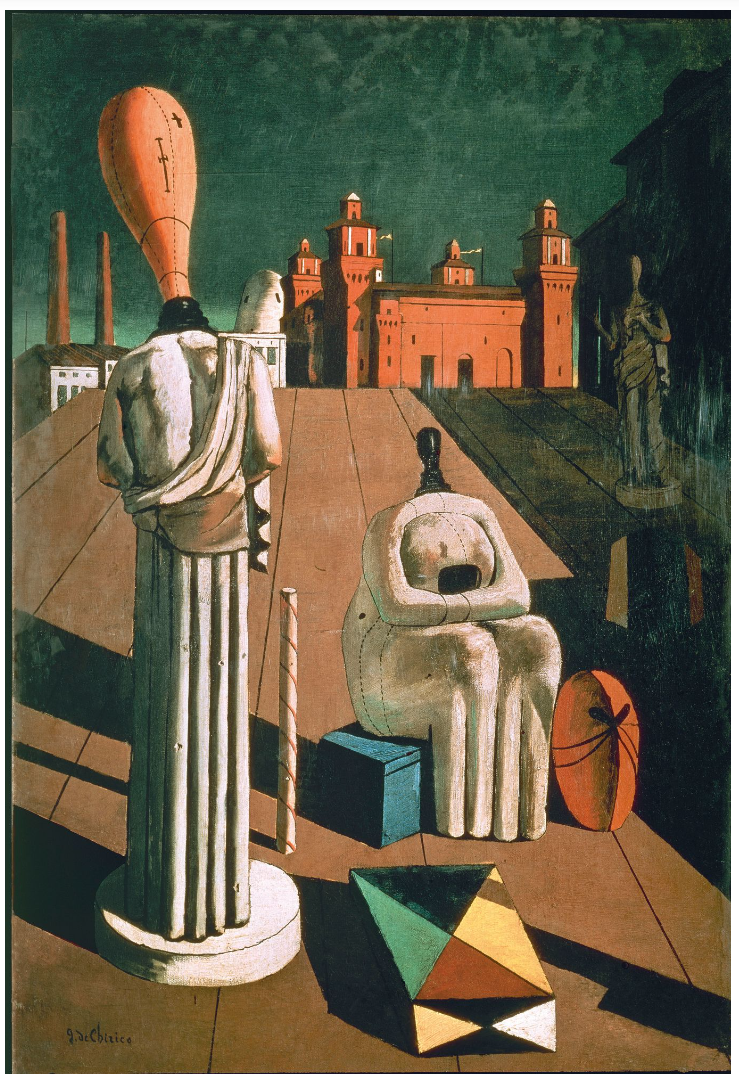
Giorgio de Chirico, Disquieting Muses, 1917. Gianni Mattioli Collection, Milan. Photo: Album / Art Resource, NY,
As in the present work, Lichtenstein has radically simplified the already pared-down simplicity of the Purist still life, using just a few colors and limiting his design to flat panels of color and diagonal cross-hatching. Like his signature Ben-Day dot—itself a shorthand used in the printing industry to connote roundness, depth and shadow—Lichtenstein use of diagonal hatching, which he started using in 1974, has become equally iconic, and he uses it with flair, alternatively to connote shadow, transparency or simply two-dimensional patterning in the present work.
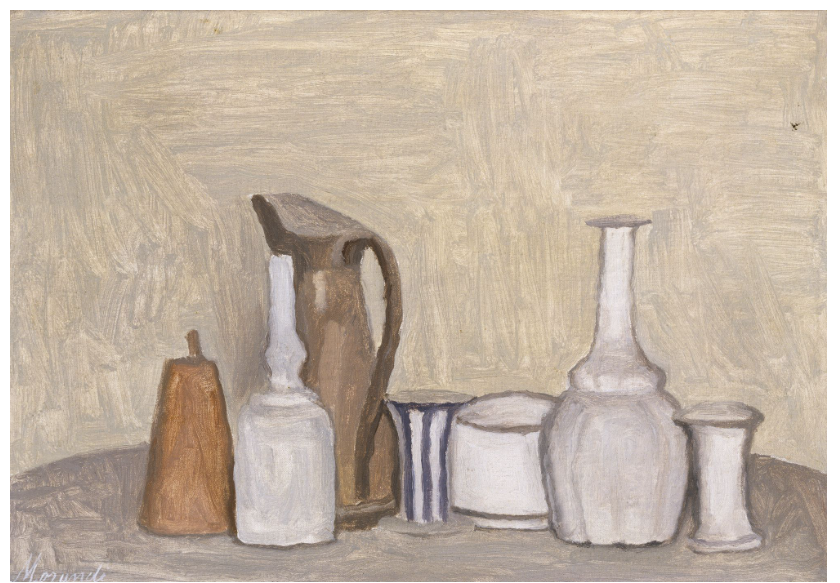
Giorgio Morandi, Natura Morta, 1950. Museum of Fine Arts, Houston. © 2024 Artists Rights Society (ARS), New York/SIAE, Rome.
Throughout the series, Lichtenstein was aware that the viewer’s relationship to Purism—and likewise Cubism, Futurism and Surrealism—was undoubtedly formed by a printed reproductions from a book or magazine, so his portrayal acknowledged that our perception was based on a copy of the real thing.
“I was interested in doing other artists’ works not so much as they appear but as they might be understood—the idea of them…”
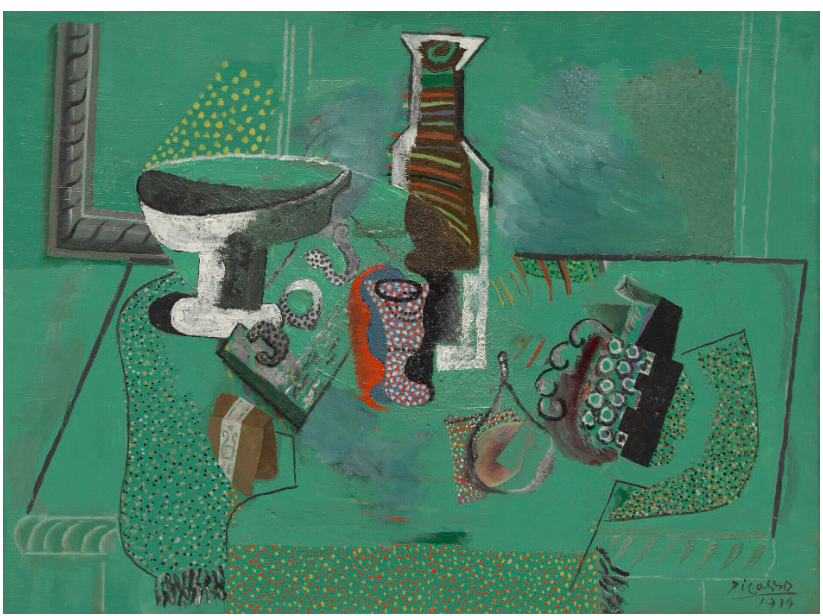
Pablo Picasso, Green Still Life, 1914. Museum of Modern Art, New York.
© 2024 Estate of Pablo Picasso / Artists Rights Society (ARS), New York.
Photo: © The Museum of Modern Art/Licensed by SCALA / Art Resource, NY.
Having been included in many major exhibitions of the artist’s work, including the 2012 retrospective at the Art Institute of Chicago, the present work has been recognized by curators and collectors alike for its importance. A few years after it was painted, Purist Painting with Pitcher, Glass and Classical Column was also included in an important exhibition devoted to Lichtenstein’s work of the 1970s, which originated at the Saint Louis Art Museum and later traveled to the Whitney Museum of American Art, New York. As a further testament to its significance within Lichtenstein’s oeuvre, the painting was once owned by the artist’s friend and dealer, Leo Castelli.
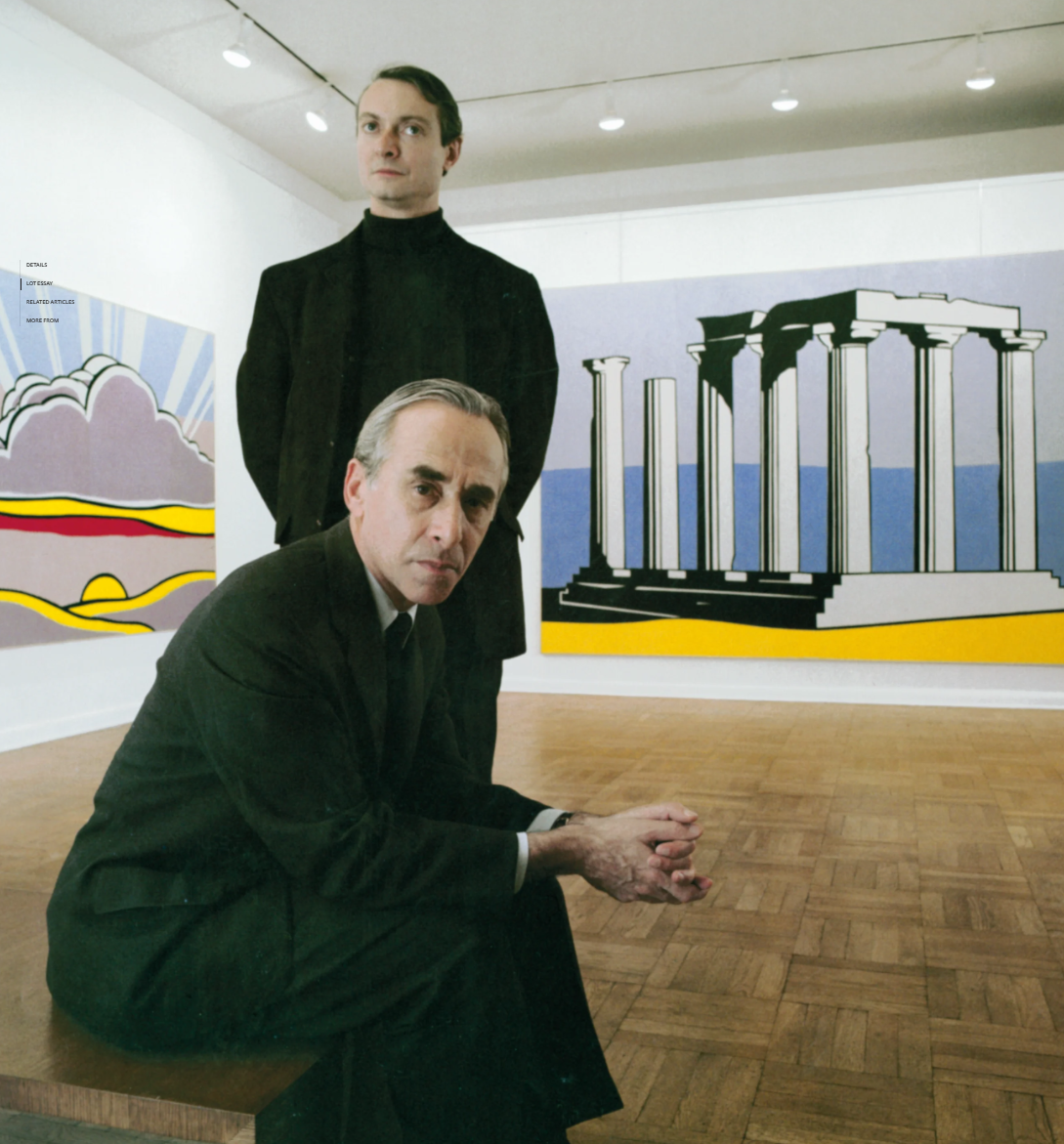
Roy Lichtenstein and Leo Castelli, New York, 1964.
Photo Ugo Mulas © Ugo Mulas Heirs. All rights reserved. Artwork: © Estate of Roy Lichtenstein.
While Lichtenstein’s paintings of the 1970s were a marked departure from the comic-book paintings of the previous decade, they have since become highly-coveted works that demonstrate the ingenious versatility of this beloved Pop artist.
Purist Painting in Yellows, 1975
Purist Painting in Yellows, 1975
Christie’s London: 4 October 2018
Estimated: GBP 1,200,000 – 1,800,000
GBP 2,168,750 / USD 2,822,705
Roy Lichtenstein (1923-1997), Purist Painting in Yellows | Christie’s
ROY LICHTENSTEIN (1923-1997)
Purist Painting in Yellows, 1975
Oil and Magna on canvas
29 7/8 x 24 inches (76×61 cm)
Signed and dated ‘rf Lichtenstein ‘75’ (on the reverse)
Provenance
Leo Castelli, New York
Mayor Gallery, London
Acquired from the above by the present owner in 1975
A sleekly distilled blend of Pop cool and Modernist ambition, Purist Painting in Yellows (1975) is one of an important series of works in which Roy Lichtenstein addresses the post-Cubist movement of Purism. In a departure from the 1960s Pop culture imagery which he had already mastered, Lichtenstein’s 1970s work saw him turn his focus to the art-historical canon. Having first embarked on a series of Cubist-inspired still lifes in 1973, by 1975 he had discovered a fertile affinity with the radical approach and crisp style of the movement that arose in Cubism’s aftermath. Purist Painting in Yellows depicts a decanter, a cocktail glass and a cluster of fruit in flat sections of black, yellow, cream and white, separated by bold lines that recall the geometries of Mondrian, or the divisions of a stained-glass window. Lichtenstein’s iconic Ben-Day dots add depth to an upper-left quadrant that might stand for the folds of a curtain; the dots refract through the bowl of the cocktail glass, which is enlivened by a flash of deep blue. Elegant, striking and unmistakably Lichtenstein, Purist Painting in Yellows stands as an adroit and playful homage to the artist’s early twentieth-century forebears.
Led by Le Corbusier and Amédée Ozenfant, who set out their ideas in the 1918 book Après le Cubisme (After Cubism), the Purists rejected Cubism’s fragmentation of the object. They proposed a mode of painting that instead explored powerful, coherent basic forms, flattened and stripped back to essentials. Presenting everyday objects such as bottles and glasses in their still-life compositions, the Purists celebrated these items’ functional beauty by paring them down to arrangements of elemental shape. Joined by artists like Fernand Léger, they embraced technology and the machine, aiming to infuse mechanical and industrial subject matter with a timeless grandeur. Ozenfant’s still-life compositions even employed references to ancient Greek architecture, with bottles and glasses fluted like Classical columns – a motif echoed by Lichtenstein in the lower-right corner of Purist Painting in Yellows. Controversial at first, the Purist impulse towards perfect, flat images of the everyday gradually became absorbed into the discourse of Modernism, and would later find a rhyme in the slick consumer goods advertisements that so fascinated Lichtenstein as a Pop artist. In his ‘Purist’ pictures, Lichtenstein investigates the overlap between the Purists’ interest in the ubiquitous, artificial and mechanical and his own Pop engagement with the same themes. Exploring the mutual ambitions of both movements, he employs his signature reductive visual strategies – most notably the Ben-Day dot, which refers directly to the processes of commercial printing – to disrupt high art with the vocabulary of the tabloid, the billboard and the magazine.
In condensing the glass and carafe of Purist Painting in Yellows to potent, fundamental form – they become archetypal, iconic objects like the hotdogs or brushstrokes of his earlier works – Lichtenstein reproduces the Purist aesthetic, but he also hijacks the powerful visual shorthand of cartoon and advertisement. The two modes of representation are hybridised to create a work of undeniable but disorienting impact. The flatly descriptive title Purist Painting in Yellows serves to heighten the sense of decontextualization: could a true ‘Purist Painting’ possibly be made half a century after the movement’s demise? By the 1970s, it was clear that the Purists’ optimistic attitude towards technology and future had hardly led to an ideal society; instead, this work implies, their idealising aesthetic was absorbed and repurposed by the graphic language of mass culture to help sell the very things the Purists had celebrated – before finding its way back into art through Lichtenstein’s Ben-Day conceptual lens. Lichtenstein superimposes and blurs these levels of transformation into a painting that is visually flat but conceptually many-layered, raising complex questions not only about the attitudes contained within works of art but also about the wider societal and cultural ideals that they enshrine.
The visual interests that Lichtenstein shared with Purism lend Purist Painting in Yellows an internal cohesion and logic stronger than in many of his takes on other art movements. Insisting on a non-painterly mode of painting that redacts evidence of the artist’s hand with strict lines, flat, uniform colours and regular Ben-Day dots, Lichtenstein amplifies some of Purism’s own traits; he revives and reframes it as a way of reflecting on a world defined by the mass-media that swallowed it up. Lichtenstein etches his own instantly recognisable approach into the canon of art history with a blend of satire and reverence, restating the art of the past in his own terms. ‘All painters take a personal attitude toward painting’, he said. ‘What makes each object in the work is that it is organized by that artist’s vision. The style and the content are also different from anyone else’s. They are unified by the point of view – mine. This is the big tradition of art’ (R. Lichtenstein, quoted in C. Tompkins, Mural with Blue Brushstroke, New York, 1987, p. 42).