Introduction
Typifying the virtuosic use of popular and mass-produced imagery that has come to define Lichtenstein’s signature mode, the inspiration for the Brushstroke paintings originated – like so many of the artist’s most iconic motifs – in imagery drawn from a comic book.
“It’s taking something that originally was supposed to mean immediacy and I’m tediously drawing something that looks like a brushstroke… I want it to look as though it were painstaking. It’s a picture of a picture and it’s a misconstrued picture of a picture.”
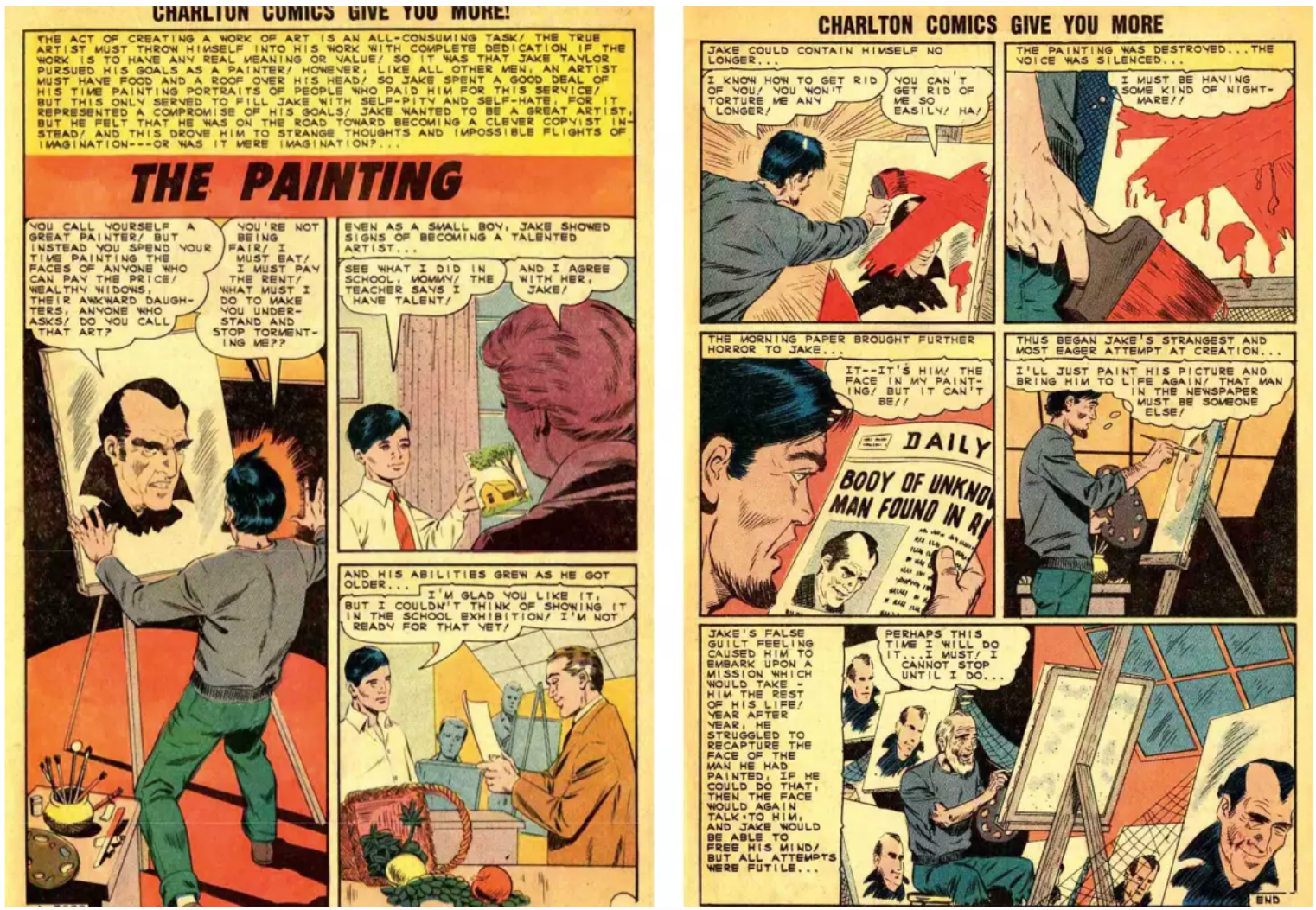
SOURCE IMAGERY FOR THE BRUSHSTROKES, EXCERPTED FROM “THE PAINTING” BY DICK GIORDANO, PUBLISHED IN STRANGE SUSPENSE STORIES, NO. 72, OCTOBER 1964, CHARLTON COMICS
The image originates in a story titled “The Painting,” printed in Strange Suspense Stories in October 1964, in which a tortured artist, Jake Taylor, battles a painting which appears to assume a life of its own; with almost uncanny prescience, the prologue of the story reads: “The act of creating a work of art is an all-consuming task! The true artist must throw himself into this work with complete dedication if the work is to have any real meaning or value… Jake wanted to be a great artist, but he felt that he was on the road toward becoming a clever copyist instead. And this drove him to strange thoughts and impossible flights of imagination…or was it mere imagination?”
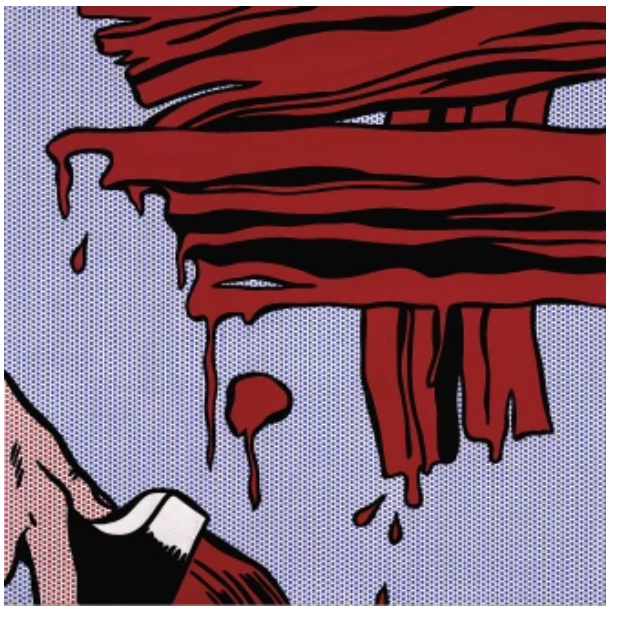
Brushstrokes, 1965
Private collection, Stockholm
Following the first Brushstroke painting, which directly duplicates a comic panel showing brushstrokes and a sliver of the artist’s hand and paintbrush, Lichtenstein refined his images to focus solely on the brushstrokes themselves. As he describes, “Although I had played with this idea before, it started with a comic book image of a mad artist crossing out, with a large brushstroke ‘X’, the face of a friend that was haunting him… Then I went on to do paintings of brushstrokes alone. I was very interested in characterizing or caricaturing a brushstroke.” Together, the fifteen Brushstroke paintings represent one of the most significant series of Lichtenstein’s long and prolific career. Although the initial group was produced over a span of only a few months, the motif would become a recurring theme in Lichtenstein’s work, appearing in drawings, sculptures, and prints throughout the following three decades.
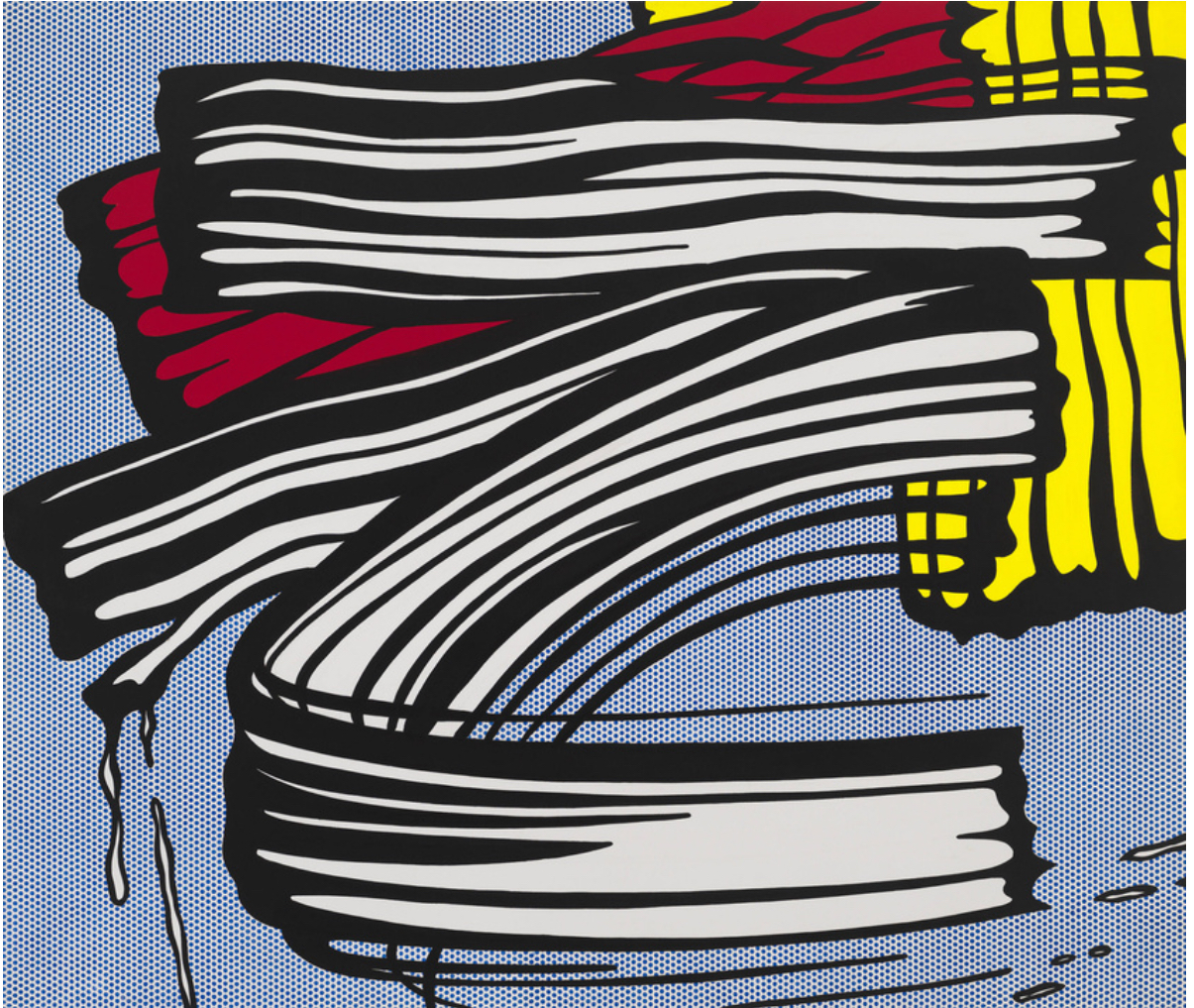
Little Big Painting, 1965
Whitney Museum of American Art, New-York
The Brushstrokes paintings mark a pivotal moment in the artist’s career-long consideration of art about art: here, for the first time, Lichtenstein turns his questioning gaze on the very act of painting itself. Replacing the popular and commercial imagery which inspired his earlier paintings, the Brushstrokes confront the weighty legacy of Abstract Expressionism as their source material. Searing in their crisp sophistication, Lichtenstein’s Brushstrokes offer wry commentary on the explosive strokes and splatters of such artists as Willem de Kooning, Jackson Pollock, and Franz Kline, whose action painting had dominated the critical discourse of the preceding decade. One scholar describes, “With the Brushstroke series the artist began to move away from direct appropriation of comics, advertising and other printed sources, and—as with the landscapes and mirror works of the late 1960s and early 1980s—he began to more fully exploit the abstract qualities of his pictorial idiom.” (Mark Lobel, Image Duplicator: Roy Lichtenstein and the Emergence of Pop Art, New Haven 2002, p. 161)
“Visible brushstrokes in a painting convey a sense of grand gesture. But, in my hands, the brushstroke becomes a depiction of the grand gesture. So the contradiction between what I’m portraying and how I’m portraying it is sharp. The brushstroke became very important for my work.”
At a time when such spontaneous, autographical marks were regarded as the ultimate demonstration of an artist’s prowess, Lichtenstein’s Brushstrokes challenge the authority of such inimitable gestures by interpreting painterly mark-making within a commercial, mass-produced style. Reflecting upon the singular significance of the Brushstroke paintings within his oeuvre, Lichtenstein described: “Visible brushstrokes in a painting convey a sense of grand gesture. But, in my hands, the brushstroke becomes a depiction of the grand gesture. So the contradiction between what I’m portraying and how I’m portraying it is sharp. The brushstroke became very important for my work.” (Roy Lichtenstein, A Review of My Work Since 1961, New York 1995, n.p.) Indeed, while White Brushstroke I is devoid of explicit motion, the sinuous contours and sporadic drips of the brushstroke itself hold the inherent suggestion of past movement – an artist’s hand and paint-laden brush, just beyond the confines of the picture plane. Presenting a satirical confrontation of the legacy of gesture itself, in White Brushstroke I Lichtenstein initiates a critical move away from the hegemonic formula of Abstract Expressionism and towards a more incisive and intellectually oriented Pop idiom.
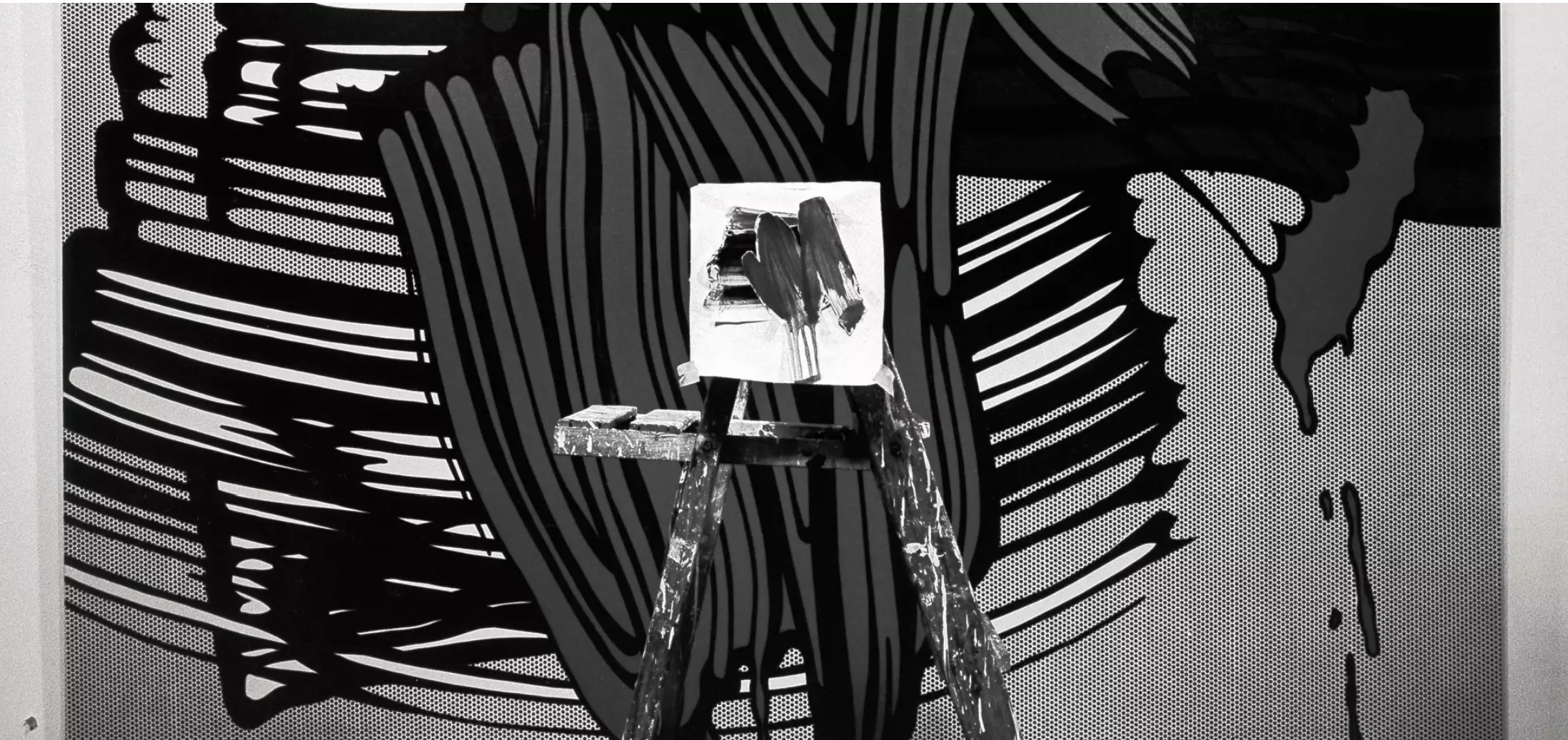
BIG PAINTING VI IN THE ARTIST’S STUDIO, NEW YORK, 1965. PHOTO BY UGO MULAS © UGO MULAS HEIRS. ALL RIGHTS RESERVED. ART © ESTATE OF ROY LICHTENSTEIN
Roy Lichtenstein created a group of 14 works during a span of only a few months and many are now regarded as pivotal works from the Pop Art movement and housed in major international museum collections. These include Brushstrokes (on long-term loan to the Moderna Museet, Stockholm), Big Painting, (Kunstsammlung Nordrhein-Westfalen, Düsseldorf), Little Big Painting (Whitney Museum of American Art, New York), Yellow Brushstroke I (Kunsthaus, Zürich), and Brushstroke with Splatter (Art Institute of Chicago). The brushstroke would become a theme which Lichtenstein would reference throughout his career. Although the initial series of paintings were restricted to 1965-1966, he worked with the motif—making other drawings and prints—until 1971 and would later return to the motif in more elaborate forms (including sculpture) in the 1980s and 1990s.
Auction Results
#1. Red and White Brushstrokes, 1965
Christie’s New-York: 17 May 2017
Estimated: USD 25,000,000 – 35,000,000
USD 28,247,500
Roy Lichtenstein (1923-1997), Red and White Brushstrokes | Christie’s
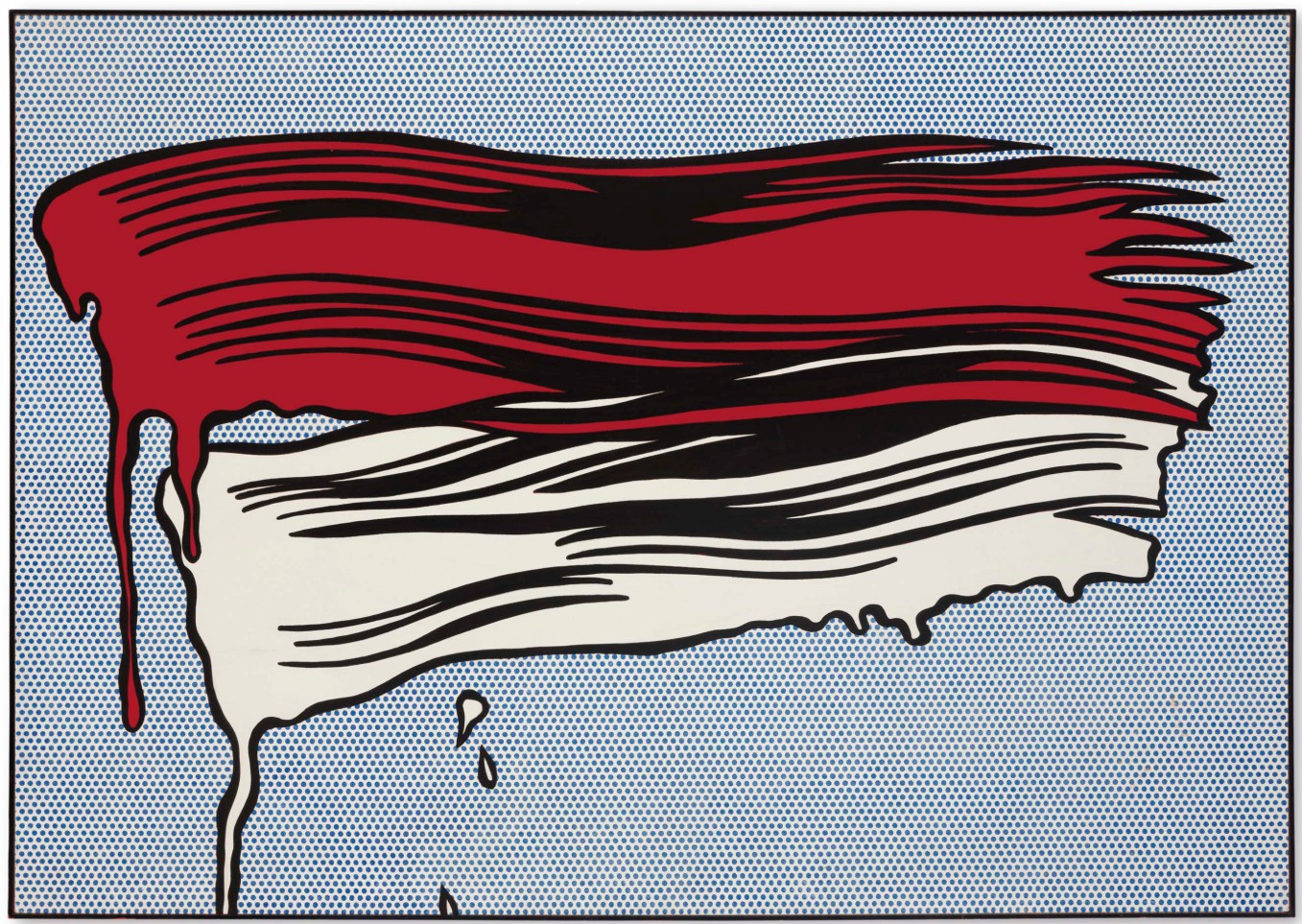
ROY LICHTENSTEIN (1923-1997)
Red and White Brushstrokes, 1965
Oil and Magna on canvas
48×68 inches (121.9 x 172.7 cm)
Signed and dated ‘rf Lichtenstein ’65’ (on the reverse)
#2. White Brushstrokes I, 1965
Sotheby’s New-York: 29 June 2020
Estimated: USD 20,000,000 – 30,000,000
USD 25,417,000
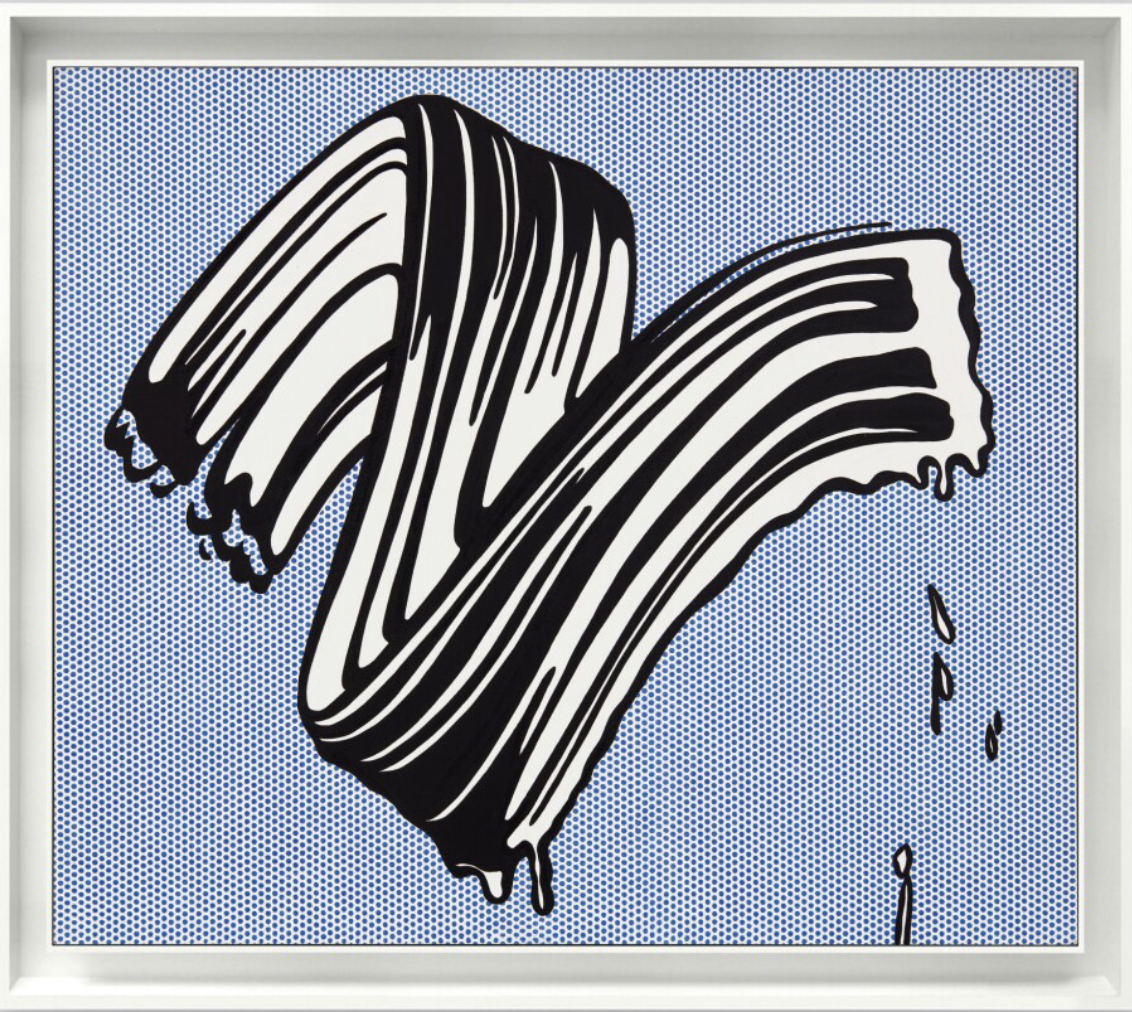
ROY LICHTENSTEIN (1923 – 1997)
White Brushstrokes I, 1965
Oil and Magna on canvas
48×56 inches (121.9 x 142.2 cm)
Signed and dated ’65 on the reverse
#3. Yellow and White Brushstrokes, 1965
Christie’s New-York: 15 November 2006
Estimated: USD 7,000,000 – 9,000,000
USD 9,536,000
Roy Lichtenstein (1923-1997) , Yellow and White Brushstrokes | Christie’s
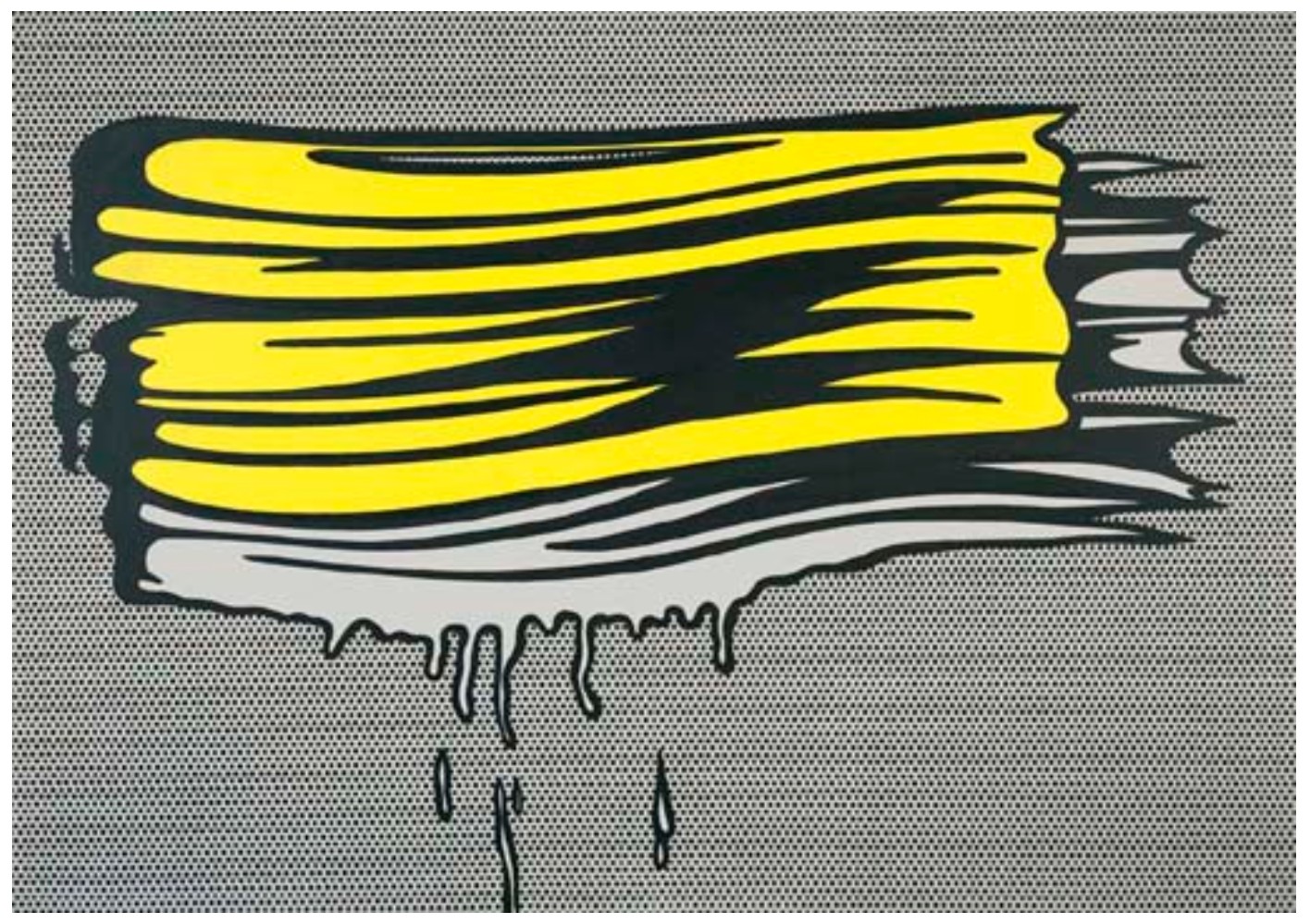
ROY LICHTENSTEIN (1923-1997)
Yellow and White Brushstrokes, 1965
Oil and magna on canvas
48×65 inches (122 x 165.2 cm)
Signed and dated ‘rf Lichtenstein ’65’ (on the reverse)
#4. Brushstroke, 1965
Christie’s New-York: 8 May 2012
Estimated: USD 800,000 – 1,200,000
USD 2,322,500
WORK ON PAPER
Roy Lichtenstein (1923-1997) , Brushstroke | Christie’s
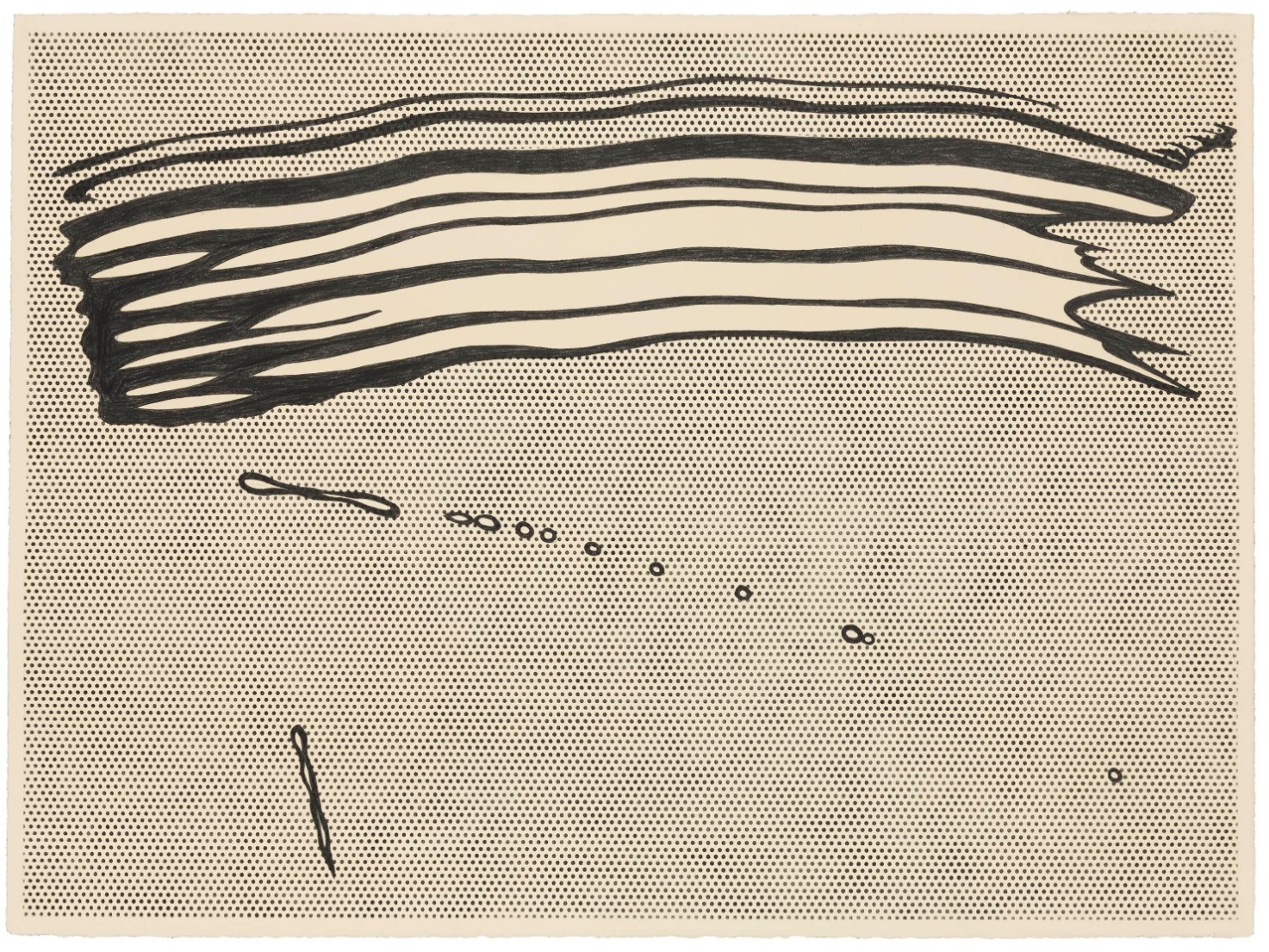
ROY LICHTENSTEIN (1923-1997)
Brushstroke, 1965
Graphite, pochoir, and lithographic rubbing crayon on paper
22 1/8 x 30 inches (56.2 x 76.2 cm)
Signed and dated ‘r.f. Lichtenstein 1965’ (on the reverse)
Brushstroke, 1965
WORKS FROM THE COLLECTION OF MICHAEL CRICHTON
Christie’s New-York: 12 May 2010
Estimated: USD 150,000 – 250,000
USD 782,500
EDITION OF 6
Roy Lichtenstein (1923-1997) , Brushstroke | Christie’s
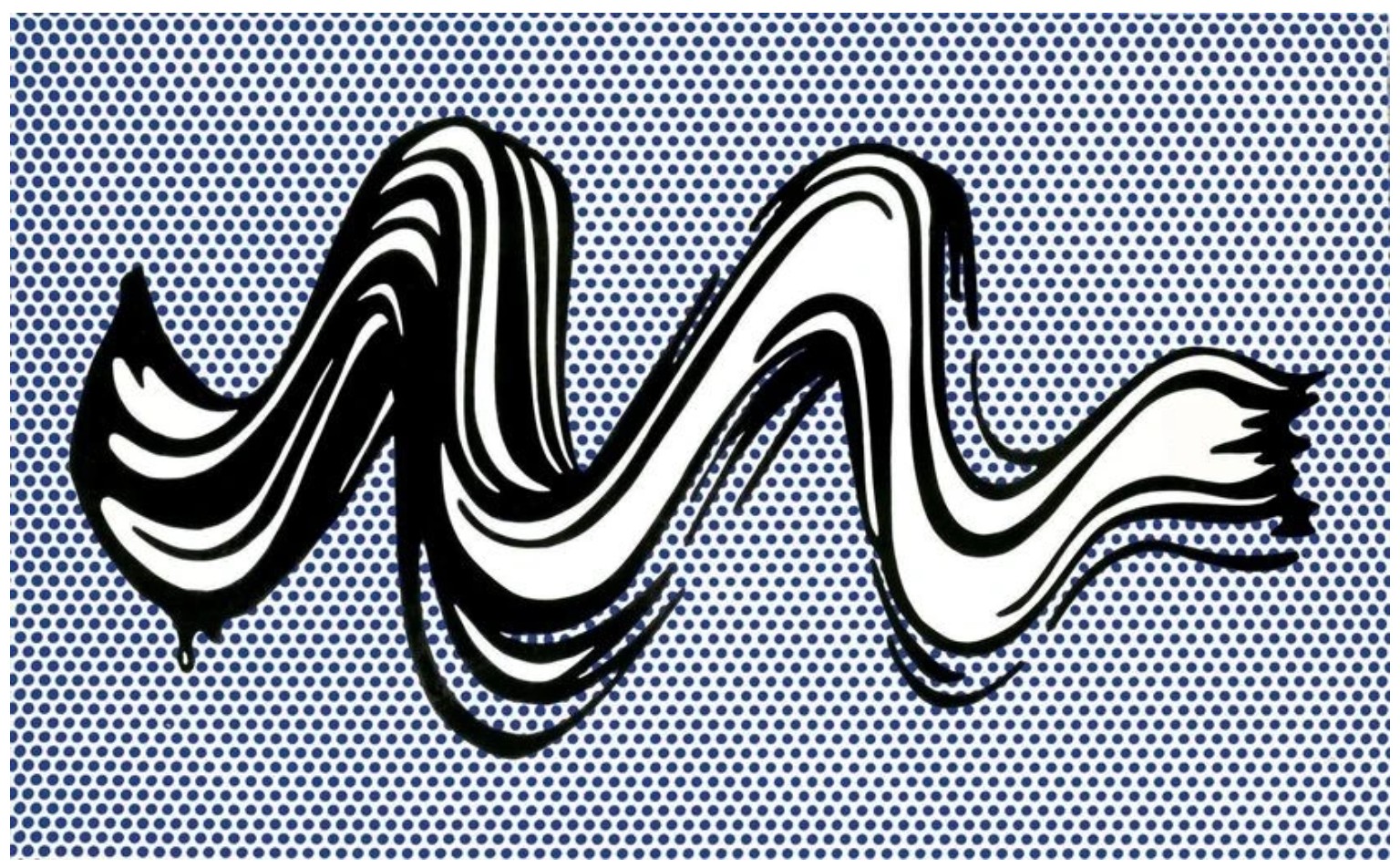
ROY LICHTENSTEIN (1923-1997)
Brushstroke, 1965
Porcelain enamel on steel
26×42 inches (66 x 106.7 cm)
This work is from an edition of six.
Brushstroke, 1965
Phillips New-York: 15 November 2017
Estimated: USD 500,000 – 700,000
USD 591,000
EDITION OF 6
Roy Lichtenstein 20th Century & Contemporary Art Day Sale – Morning Session
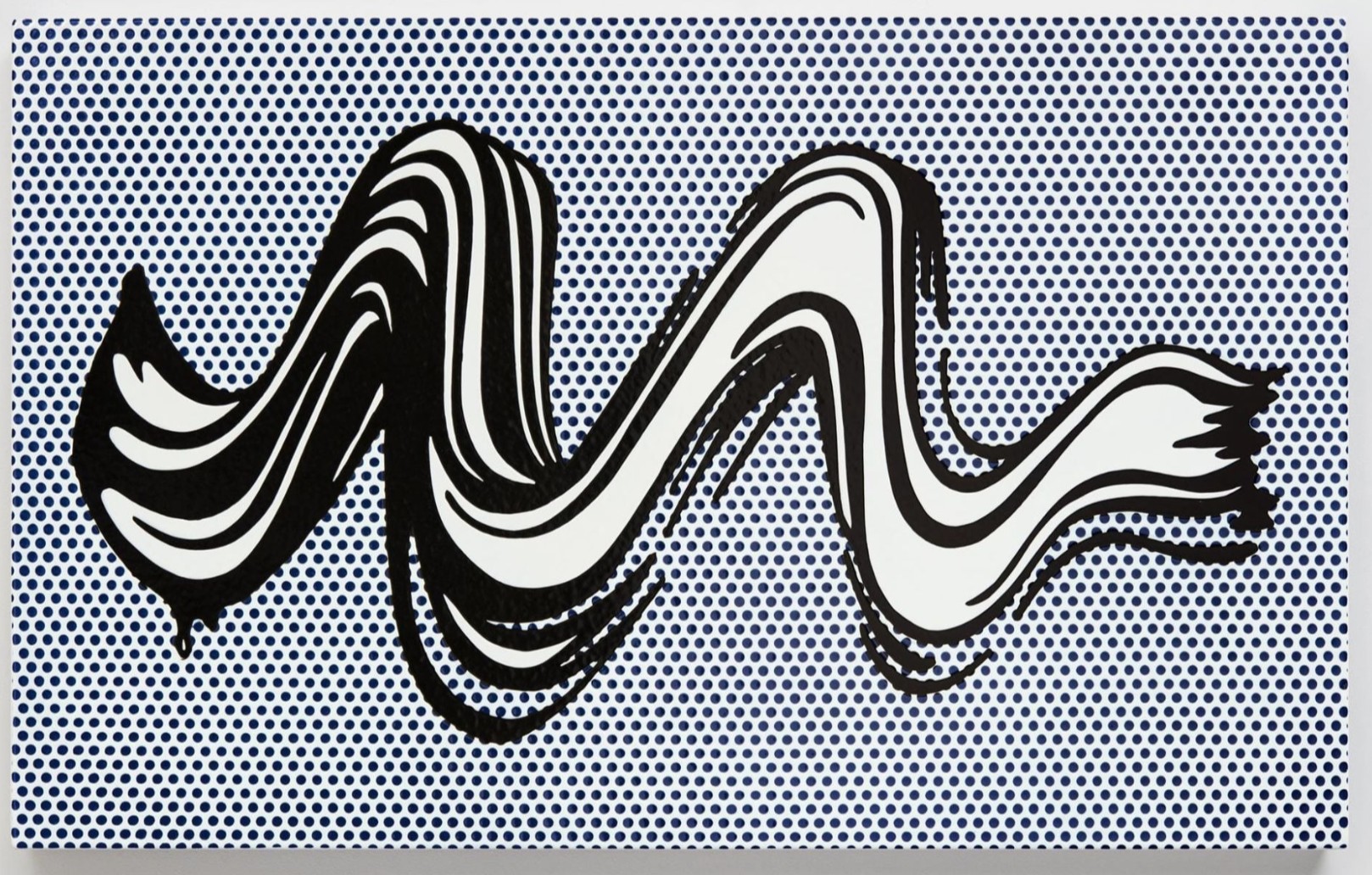
ROY LICHTENSTEIN
Brushstroke, 1965
Porcelain enamel on steel
26 1/8 x 42 1/8 inches (66.4 x 107 cm)
Executed in 1965, this work is number 4 from an edition of 6
Red and White Brushstrokes, 1965
#1. Red and White Brushstrokes, 1965
Christie’s New-York: 17 May 2017
Estimated: USD 25,000,000 – 35,000,000
USD 28,247,500
Roy Lichtenstein (1923-1997), Red and White Brushstrokes | Christie’s
ROY LICHTENSTEIN (1923-1997)
Red and White Brushstrokes, 1965
Oil and Magna on canvas
48×68 inches (121.9 x 172.7 cm)
Signed and dated ‘rf Lichtenstein ’65’ (on the reverse)
Provenance
Leo Castelli Gallery, New York
Mr. and Mrs. Serge Landeau, Paris, 1965
Private collection, Belgium, by descent from the above
Acquired from the above by the present owner
Painted in 1965, Roy Lichtenstein’s Red and White Brushstrokes is a quintessential Pop painting, but one which shrewdly questions fundamental beliefs about the traditional artistic process. With its bold rendition of two brushstrokes loaded with red and white paint, Lichtenstein calls into question the revered status of the painterly mark. Across this monumentally-scaled canvas, he takes the essence of painting—the sanctity of the brushstroke—and frames it within the Pop idiom. In an apparent jibe at the spontaneous and layered brushwork of Abstract Expressionism, the gesture reappears as controlled strokes, replete with drips, set against a field of regularized dots. One of only a handful of works from this pivotal series to remain in private hands, Red and White Brushstrokes demonstrates that Lichtenstein was not content to pay homage to his artistic antecedents, as here we begin to see the development of the artist’s insightful deconstruction of the visual language of mass communication and the consolidation of his signature style which did much to establish Pop Art as one of the dominant movements of the post-war period.
Set against a backdrop of the artist’s signature Ben-Day dots, Lichtenstein renders two broad strokes of red and white paint. The primary sweep of pigment is executed in brilliant white, positioned across the central portion of the canvas on a slightly inclined angle as Lichtenstein adroitly mimics the motion of moving the paint laden brush from left to right across the surface of the canvas. The presence of a heavily laden brush is suggested by the rippled contour of the brushstroke in conjunction with the appearance of a trail of excess paint that trickles off down to the left plus the drips and splashes of surplus pigment that adorn the lower portion of the canvas. On top of this initial brushstroke, the artist lays down a second, more dramatic, sweep of paint—this time executed in a vivid red. Here, he traces a more controlled, serpentine path as the heavily loaded brush snakes its way across the surface of the painting before culminating in a series of feathered marks as the filaments give up their last vestiges of pigment.
Initially, Lichtenstein’s Brushstroke series was thought to be a sly comment on the artistic dominance of Abstract Expressionism, in particular the authoritarian gestures of Willem de Kooning, Jackson Pollock and Franz Kline. During the movement’s heyday these autographical marks were often regarded as the ultimate demonstration of the artist’s prowess—fueled in part by influential magazines like Artforum and their copious use of close-up detail shots of these particular gestures. With Red and White Brushstrokes Lichtenstein began to challenge this hegemony, and by interpreting these spontaneous marks in a commercial, mass-produced style, he questioned the authority of these purportedly inimitable gestures.
“[I]t’s taking something that originally was supposed to mean immediacy and I’m tediously drawing something that looks like a brushstroke… I want it to look as though it were painstaking. It’s a picture of a picture and it’s a misconstrued picture of a picture”
By creating distance between the physical gesture and its interpretation, Lichtenstein breaks the perennial myth surrounding the notion of the artist’s hand and thus opens the traditions of art-making practice to a whole new range of possibilities. As one of the founders of the nascent Pop Art movement, Lichtenstein’s introspective examination of Abstract Expressionism might have been seen as an attack on the practices of what was ultimately America’s first true, great art movement. Lichtenstein was an enthusiastic student of art history and his Brushstroke paintings were some of the first canvases in which he would delve into the art historical canon as source material for his work. After Abstract Expressionism, he would look to German Expressionism, Impressionism and Post-Impressionism together with Surrealism and even Chinese landscape painting as a way of helping him to develop his own artistic language. Although not expressly referenced, there is also a Duchampian element to Lichtenstein’s work too. Both were fascinated by the pop culture of the 20th century, with Lichtenstein drawn to the banality of consumerism in addition to art history, appropriating the techniques of mass communication to depict the objects he observed. Duchamp also takes ubiquitous objects, particularly the iconic Mona Lisa, turning her world famous likeness into his sly and equally subversive L.H.O.O.Q.
The distinctive subject of Red and White Brushstrokes puts it at the very heart of Roy Lichtenstein’s legacy. Its iconic style was double edged, apparently naive but actually highly sophisticated. By taking something so fundamental as a the mark made by the stroke of a brush and rendering it in the style of a mass produced comic, Lichtenstein sought to question a thousand years or more of art history. His choice of images as well as his simplified reductive style, served to highlight his actual intentions in a way that made the paintings both accessible to the general public and irritating to traditional academic art scholars who viewed him as a philistine. Yet, with works such as this, Lichtenstein emerged as one of the most intelligent and innovative artists of the Pop Art movement.
White Brushstrokes I, 1965
White Brushstrokes I, 1965
Sotheby’s New-York: 29 June 2020
Estimated: USD 20,000,000 – 30,000,000
USD 25,417,000
ROY LICHTENSTEIN (1923 – 1997)
White Brushstrokes I, 1965
Oil and Magna on canvas
48×56 inches (121.9 x 142.2 cm)
Signed and dated ’65 on the reverse
Provenance
Leo Castelli Gallery, New York (LC#348)
Irving Blum, Los Angeles (acquired from the above in 1965)
Christie’s New York, 4 May 1993, Lot 31 (consigned by the above)
Private Collection, New York (acquired from the above sale)
Gagosian Gallery, New York
Acquired by the present owner from the above
Bold, brilliant, and thrillingly irreverent, White Brushstroke I is the ultimate embodiment of Roy Lichtenstein’s pioneering investigation into the form, content, and meaning of Contemporary Art. An exhilarating confrontation with the towering legacy of American Abstract Expressionism, White Brushstroke I invokes the impulsive, gestural mode of that movement within the sleekly commercial style of Lichtenstein’s signature Pop idiom. Perfectly centered against the artist’s trademark background of Ben-Day dots, the painter’s mark is transformed into a gesture of control rather than spontaneity in a daring challenge to the canonical hegemony imposed by that most essential motion of a painter’s practice. Painted in 1965, White Brushstroke I is among the most iconic of Lichtenstein’s limited group of fifteen Brushstroke paintings; regarded as pivotal masterworks of the Pop Art movement, eight of these paintings are already held in or promised to such museum collections as the Art Institute of Chicago, Kunsthaus Zürich, Kunstsammlung Nordrhein-Westfalen in Düsseldorf, and the Whitney Museum of American Art in New York, among celebrated others.
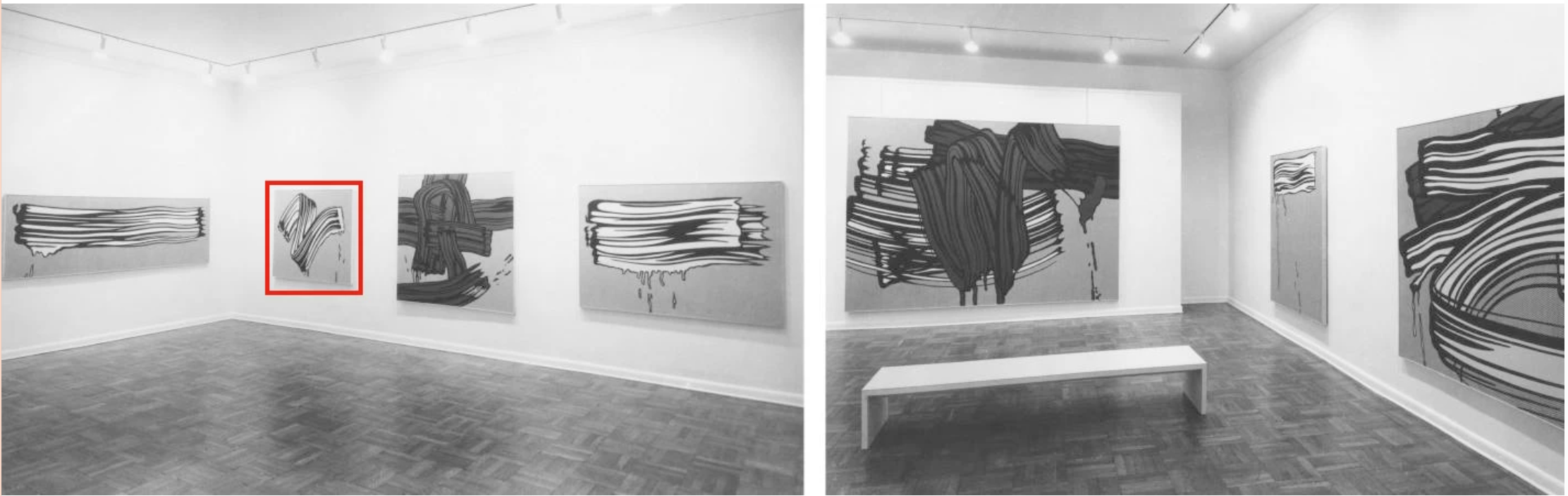
THE PRESENT WORK INSTALLED WITH A SELECTION OF BRUSHSTROKES IN THE EXHIBITION ROY LICHTENSTEIN: BRUSHSTROKES & CERAMICS AT LEO CASTELLI GALLERY IN NEW YORK, NOVEMBER – DECEMBER 1965. PHOTOS © CASTELLI GALLERY. ALL ART © ESTATE OF ROY LICHTENSTEIN
Underscoring the significance of the present work, White Brushstroke I has been featured in numerous seminal exhibitions of Lichtenstein’s oeuvre, including both the artist’s early survey at the Solomon R. Guggenheim Museum, New York in 1969 and the major traveling exhibition Roy Lichtenstein, organized by the Solomon R. Guggenheim Museum in 1993. The painting’s provenance is equally extraordinary: following its debut in the seminal Brushstrokes exhibition at Castelli Gallery in New York in 1965 alongside other key examples from the series, White Brushstroke I was acquired that same year by Irving Blum. The founder of the legendary Ferus Gallery in Los Angeles and Lichtenstein’s own West Coast dealer at the time, Blum held the present work in his celebrated personal collection for almost three decades. Utterly breathtaking in its conceptual potency and daring simplicity, White Brushstroke I is the quintessential masterwork—not only of Roy Lichtenstein’s oeuvre—but of Pop Art itself.
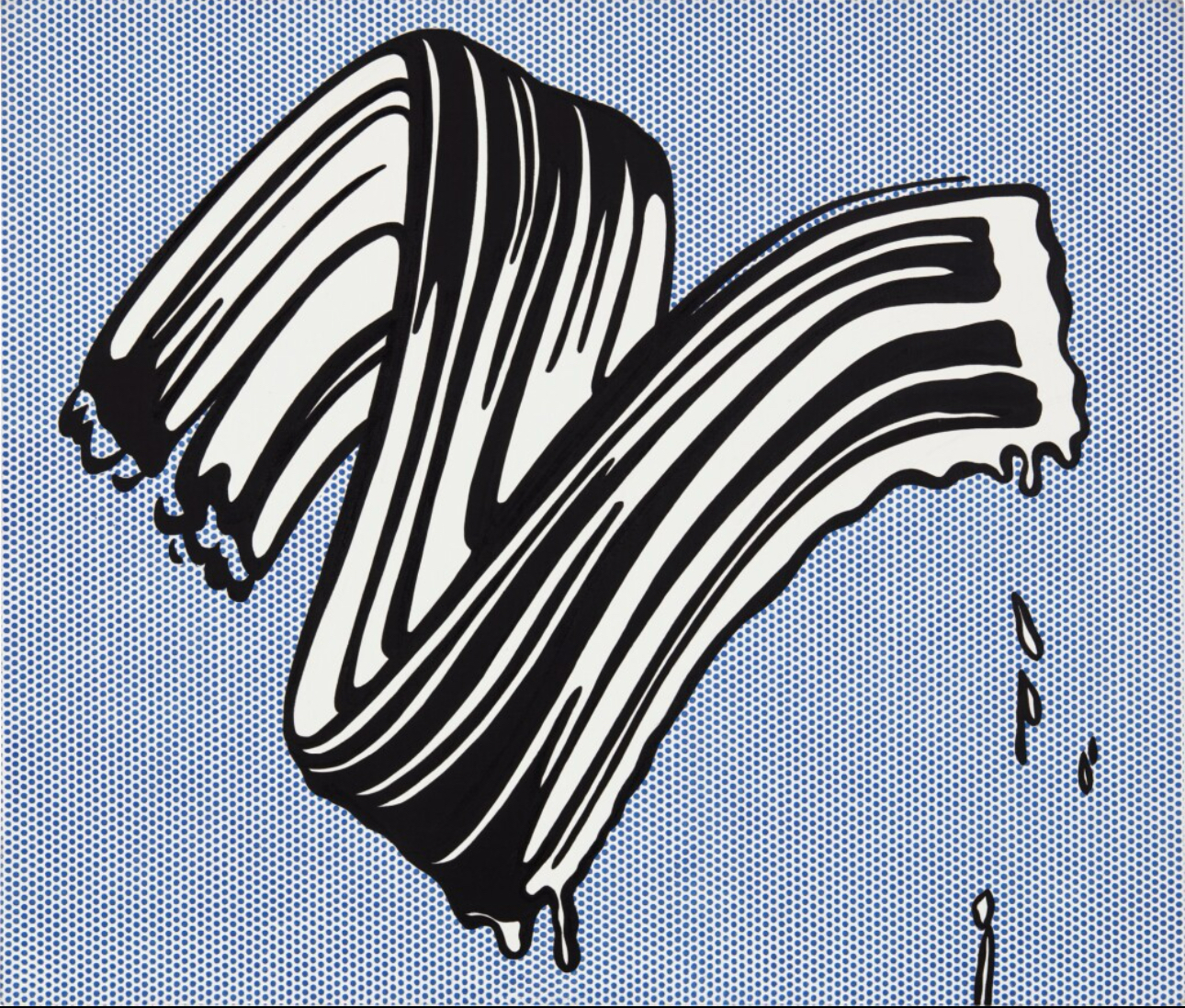
In its single, sinuous ivory form—complete with sumptuous drips and splatters—set against a precise field of Ben-Day dots, White Brushstroke I stands as the ultimate, elegant embodiment of this rarefied series; dispensing with the multicolored and layered strokes of his other Brushstroke paintings, the purified composition of the present work achieves a singular artistic statement of unparalleled visual potency. While other examples of the series suspend a single stroke above a larger expanse of Ben-Day dots, the arrangement of White Brushstroke I invokes the same compositional magnetism of the artist’s iconic single-object paintings of 1961-1963, in which the primary subject is centrally placed in relation to the canvas edge; much like Portable Radio or ice Cream Soda, the present work achieves an extraordinary purity of image-making. While Johns settled on the image of the flag as a blank slate upon which to explore the formal properties of paint, Lichtenstein remained highly aware that the viewer’s preconceptions of objects operate as an integral component of perception – as much so as color, composition and technique.
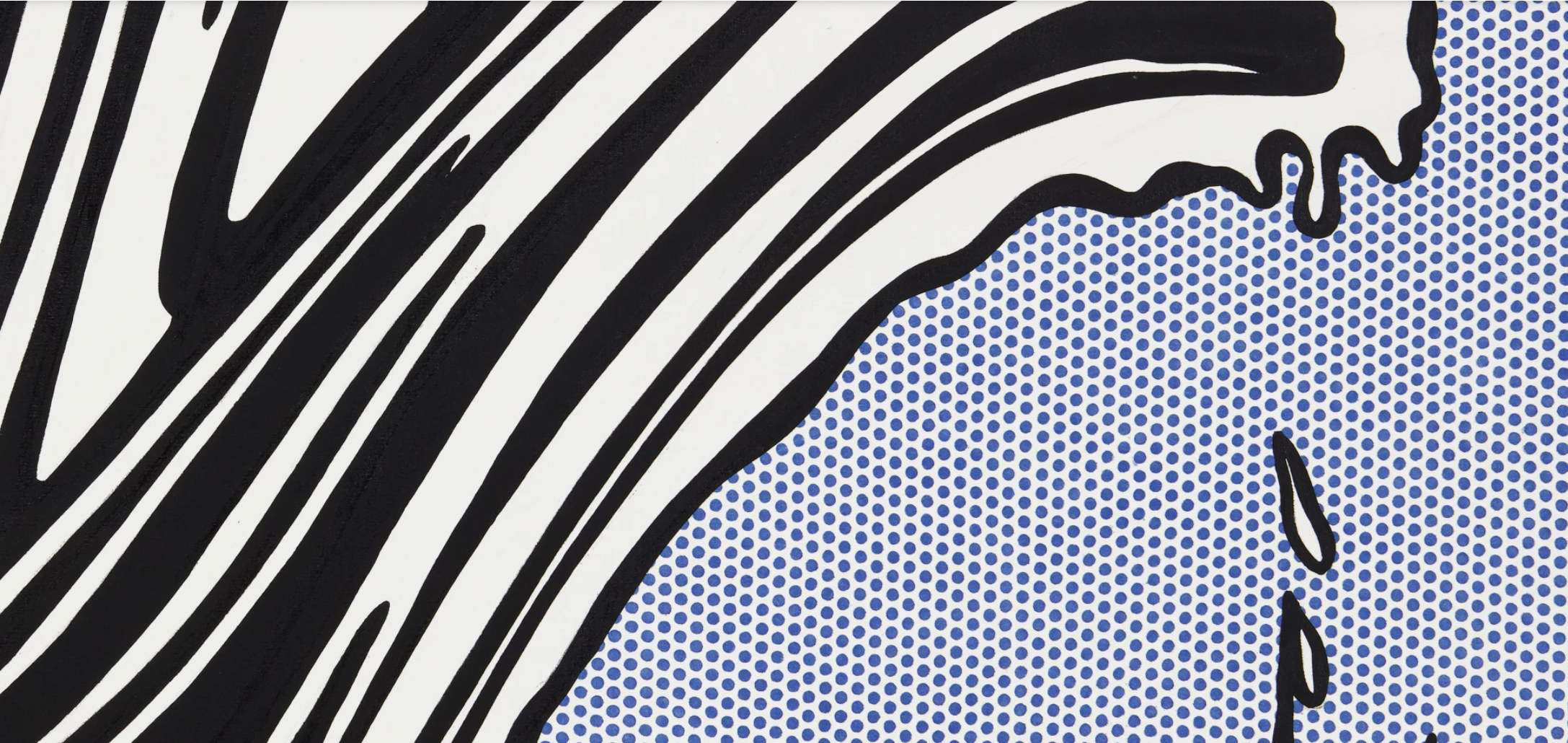
The sinuous black contours of the white brushstroke suggest inky shadows, emphasizing a sense of volume within the image; as if to underscore this three-dimensionality, Lichtenstein adds a final drip at the lower right of the canvas that seemingly slips off the picture plane entirely. Simultaneously, the crisp background of Ben-Day dots – their orderly repetition diametrically opposed to the rebellious contours of the brushstroke – powerfully recalls the two-dimensional nature of the image before us, providing a sharp contrast to the freedom of handling so characteristic of painterly expression. Upon close examination, the faint shadows of the artist’s original graphite under-drawing are discernible below the pristine painted image, serving as a subtle reminder to the viewer that, despite the suggestion of mass-production, the artist’s hand has created the painting before us. Within Lichtenstein’s composition, the brushstroke is at once object and image, moving and still, controlled and spontaneous, immaculate and intimate.
In its extraordinary investigation of painterly expression, White Brushstroke I stands at the very heart of Roy Lichtenstein’s extraordinary artistic legacy. Although timeless in its elegant simplicity, the single gesture of the present work succeeds in undermining centuries of art historical precedent, marking a pivotal moment in Lichtenstein’s career-long consideration of art about art. Describing the importance of this shift, Diane Waldman remarks: “Lichtenstein focused on [the Abstract Expressionist’s] brushwork as the signature of a style and used it – as he had done with the signature styles of Cézanne, Picasso, and Mondrian – to address the issue of what characterizes style in art. Is it defined by an artist’s brushstroke? Is it the result of the transmutation of one form into another? Or could it even be determined by an artist’s signature on a common object? Or does it embrace all of these? In White Brushstroke I and other paintings of the period, Lichtenstein implies that painting can be reduced to a sign and that brushstrokes can be the means by which we recognize, not only a style – but content.” (Diane Waldman in: Exh. Cat., New York, Solomon R. Guggenheim Museum, Roy Lichtenstein, 1993, pp. 156-157) A painting of unparalleled dynamism and graphic force, White Brushstroke I surges across the canvas to envelop the viewer in its pictorial exuberance and conceptual gravitas. Standing before this singularly mythic gesture—rendered with unerring accuracy and precision—the viewer is presented with the ultimate encapsulation of Lichtenstein’s most compelling subject matter: art that questions the nature of art itself.
Yellow and White Brushstrokes, 1965
Yellow and White Brushstrokes, 1965
Christie’s New-York: 15 November 2006
Estimated: USD 7,000,000 – 9,000,000
USD 9,536,000
Roy Lichtenstein (1923-1997) , Yellow and White Brushstrokes | Christie’s
ROY LICHTENSTEIN (1923-1997)
Yellow and White Brushstrokes, 1965
Oil and magna on canvas
48×65 inches (122 x 165.2 cm)
Signed and dated ‘rf Lichtenstein ’65’ (on the reverse)
Provenance
Leo Castelli Gallery, New York
Mr. and Mrs. Marvin Goodman, St. Louis
Greenberg Gallery, St. Louis
Acquired from the above by the present owner, 1983
In Yellow and White Brushstrokes, Lichtenstein takes the signature of Abstract Expressionism-the bravura brushstroke-and frames it within the Pop idiom. The spontaneous and layered brushwork of action painting reappears in the Brushstroke series as bold but controlled strokes, replete with drips, set against a field of regularized BenDay-dots. Lichtenstein’s uninflected and restrained rendering of the brushstroke belie their technical complexity and meticulous handwork. Formulating the brushstroke-the fundamental building block of artistic practice-was no easier for Lichtenstein than it was for his predecessors. Bernice Rose recalls:
Although the Brushstroke paintings were informed by Abstract Expressionism, their sources are more varied. Like Lichtenstein’s more familiar works, the starting point was a comic strip. One of the artist’s first Brushstroke paintings was a direct reprisal of a panel from the comic strip “The Painting” a horror story from Charlton Comics’ Strange Suspense Stories, no. 72 (October 1964). Here, the cartoonist indicates paint in two overlapping strokes of paint; it is from this comic strip image that Lichtenstein developed the visual vocabulary for his Brushstroke series and roots them in the iconography of his earlier paintings. Lichtenstein also acknowledged a debt to the painterly school of Renaissance art in inspiring his Brushstroke paintings. The extravagant and exaggerated brushwork of seventeenth-century artists, in particular those of the Dutch portraitist Frans Hals, are precursors to the assertive brushstrokes of action painting. In the works of both Hals and the Abstract Expressionists, the spontaneous gesture appears to be an end in of itself. It is from this richness of sources that Lichtenstein culls his inspiration for Yellow and White Brushstrokes and canonizes it alongside his comic strip paintings.
The comic strip provided the visual reference, but not the format, for Lichtenstein’s Brushstroke paintings, thus freeing him from the predetermined configuration of his earlier works. In contrast to the comic strip paintings, the Brushstroke series vary in size, color, and composition from the original inspiration. In Yellow and White Brushstrokes, the looping bands of color and stylized drips call to mind the gestural work of Jackson Pollock. By enlarging and centering the brushstroke, Lichtenstein acknowledges the authority of the brushstroke in the history of art. Yellow and White Brushstrokes was exhibited in the “Roy Lichtenstein-Brushstrokes & Ceramics” show at Leo Castelli in November 1965. The majority of the twelve paintings in this series are in museum collections.
Brushstroke, 1965
Brushstroke, 1965
Christie’s New-York: 8 May 2012
Estimated: USD 800,000 – 1,200,000
USD 2,322,500
WORK ON PAPER
Roy Lichtenstein (1923-1997) , Brushstroke | Christie’s
ROY LICHTENSTEIN (1923-1997)
Brushstroke, 1965
Graphite, pochoir, and lithographic rubbing crayon on paper
22 1/8 x 30 inches (56.2 x 76.2 cm)
Signed and dated ‘r.f. Lichtenstein 1965’ (on the reverse)
Provenance
Leo Castelli Gallery, New York
Foundation for Contemporary Performing Art, New York
Steve Schapiro, New York, 1969
Margo Leavin Gallery, Los Angeles
John and Nancy Merryman, Los Angeles, 1974
Daniel Varenne, Geneva
Pace Gallery, New York
Anon. sale; Sotheby’s, New York, 2 November 1978, lot 241
M. Knoedler & Co., Inc., New York
Andrew Crispo Gallery, New York
Anon. sale; Sotheby’s, New York, 5 November 1987, lot 122K
Kohji Ogura Gallery, Nagoya
Acquired from the above by the present owner
Part of Roy Lichtenstein’s select group of black-and white drawings, Brushstroke is the first of only two highly finished drawings of brushstrokes that the artist completed during the early part of his career. Resolutely figurative, yet at the same time intriguingly abstract, the bold rendition of the most painterly of gestures is one of Lichtenstein’s singularly striking drawings. Its remarkable simplicity combined with its unparalleled graphic quality is the result of the artist’s unique investigations into the visual language of representation. Not a study, but a complete work in its own right, Brushstroke joins the canon of the artist’s early master drawings executed between 1961 and 1968, which the artist described as drawings “just to be drawings”
Brushstroke is one of the most sophisticated of the artist’s black-and-white drawn images. Its bold, dramatic lines and use of iconic Benday dots is far advanced from earlier works such as Airplane and Knock Knock of 1961, whose simple lines lack the subtle touches provided by the Benday dots and the sensuously expressive depictions of paint splashes that distinguish this work. It marks the triumphal culmination of the artist’s reductive practice of representing an image in terms of the symbolic language of its formal composition. These visual elements, which mimic the mechanical processes by which strong profiles and volumes are rendered, derive from the advertising and graphic imagery that proliferated during the economic boom of the post-war years. As Bernice Rose, the Curator of Lichtenstein’s major drawings retrospective at the Museum of Modern Art in 1987 notes “the early black-and-white drawings form a coherent group, in which Lichtenstein pursues and develops the idea of a graphic style, quite apart from its use in painting” (B. Rose quoted by I. Deveraux, ibid., p. 18).
Yellow and Black Brushstroke (Eat Art) (Study), 1970
Yellow and Black Brushstroke (Eat Art) (Study), 1970
Works from the Collection of Dorothy and Roy Lichtenstein
Sotheby’s New-York: 16 May 2025
Estimated: USD 400,000 – 600,000
USD 889,000
Yellow and Black Brushstroke (Eat Art) (Study) | Contemporary Day Auction | 2025 | Sotheby’s
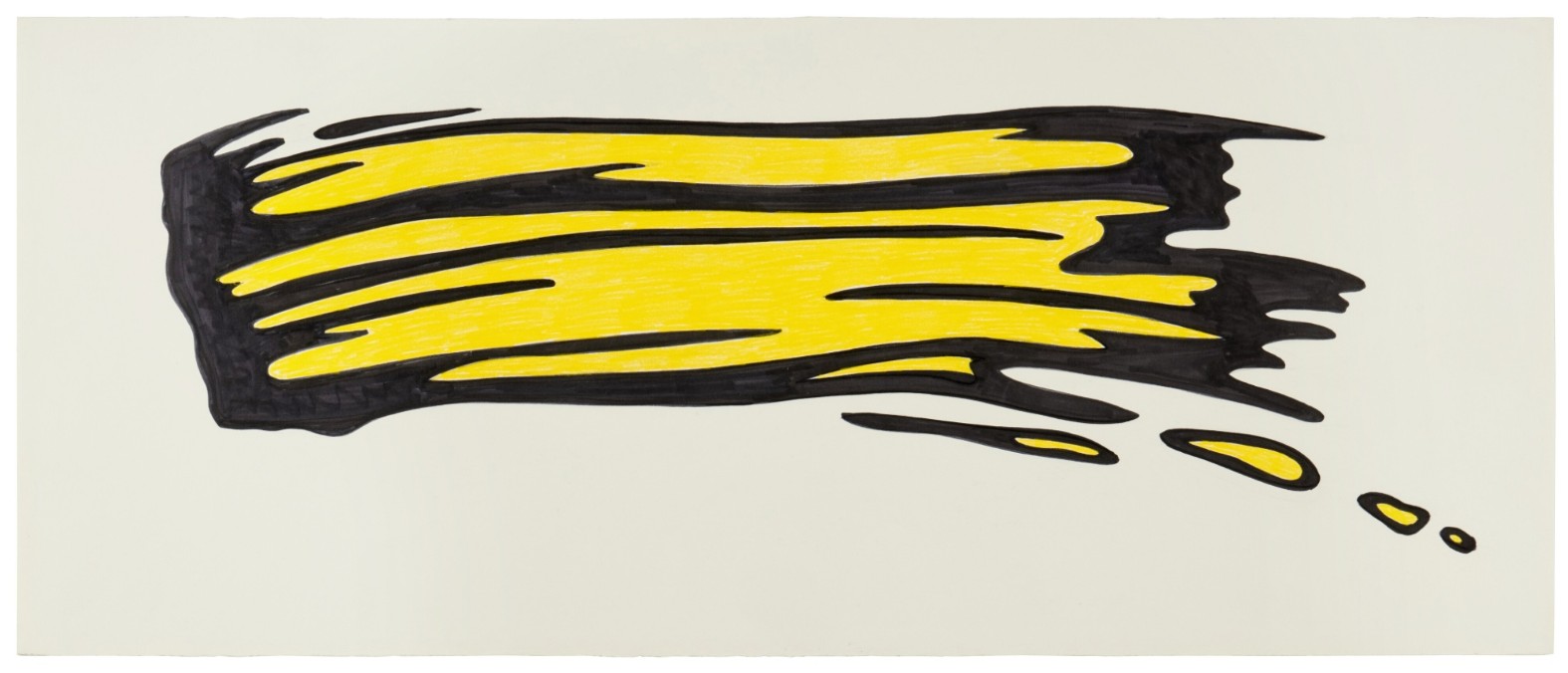
ROY LICHTENSTEIN (1923 – 1997)
Yellow and Black Brushstroke (Eat Art) (Study), 1970
Marker, colored pencil and graphite on paper
17 1/4 x 41 1/2 inches (43.8 x 105.4 cm)
“Visible brushstrokes in a painting convey a sense of grand gesture. But, in my hands, the brushstroke becomes a depiction of the grand gesture. So the contradiction between what I’m portraying and how I’m portraying it is sharp. The brushstroke became very important for my work.”
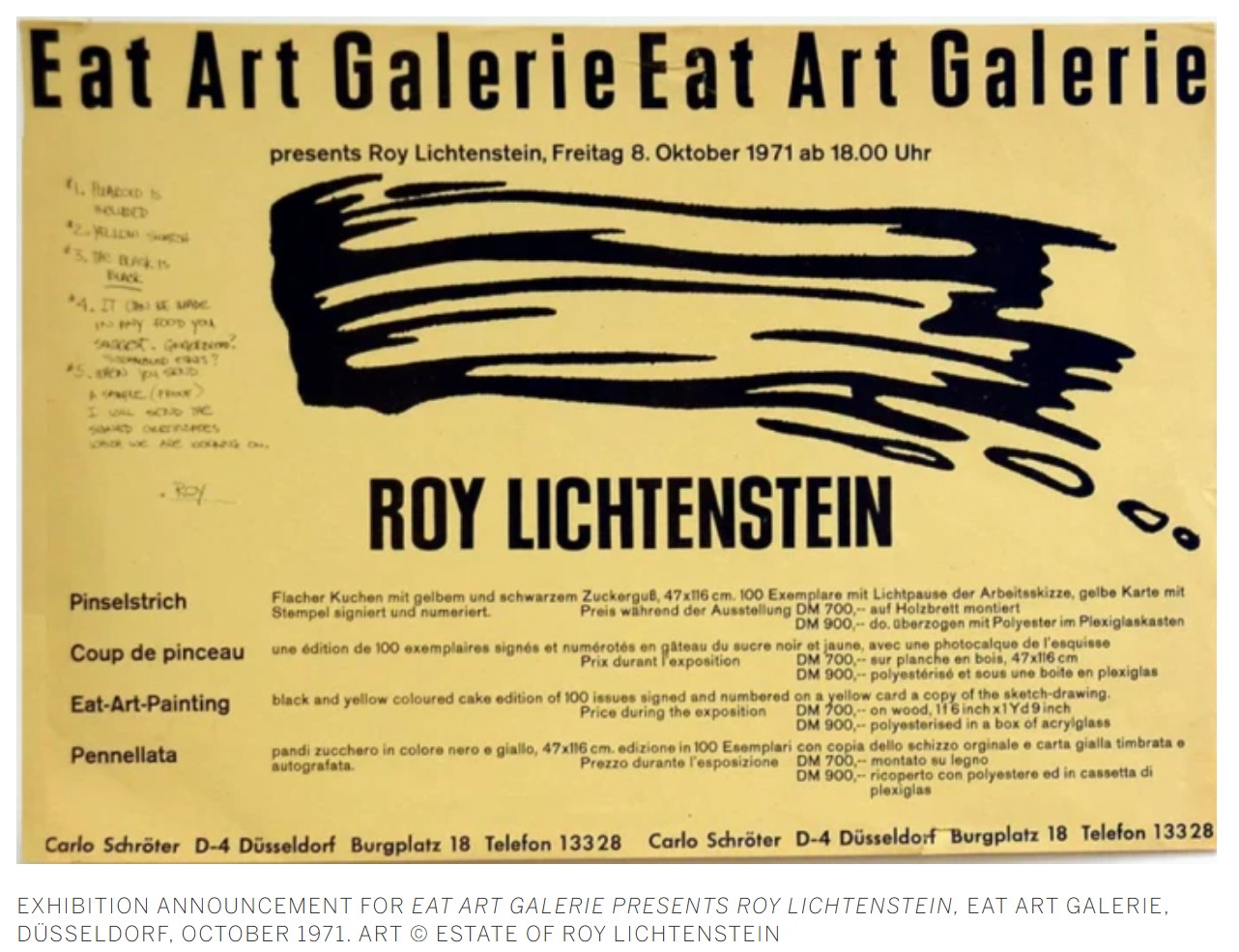
Brushstroke, 1965 (Enamel)
Brushstroke, 1965
Phillips New-York: 15 November 2017
Estimated: USD 500,000 – 700,000
USD 591,000
EDITION OF 6
Roy Lichtenstein 20th Century & Contemporary Art Day Sale – Morning Session
ROY LICHTENSTEIN
Brushstroke, 1965
Porcelain enamel on steel
26 1/8 x 42 1/8 inches (66.4 x 107 cm)
Executed in 1965, this work is number 4 from an edition of 6
At the onset of the 1960s, Roy Lichtenstein and his Pop contemporaries felt that the avant-garde Abstract Expressionist movement had lost its uniquely contemporary voice. As one of the leading Pop artists of the time, Lichtenstein began looking for ways to challenge the discourse surrounding the masterworks of the previous decades. In 1965, Lichtenstein set out on his first, direct reinterpretation of the Abstract Expressionism of artists like Jackson Pollock and Willem de Kooning in his Brushstroke series, all of which featured one or two brushstrokes, rendered with his characteristic Ben-Day dots. It was in this same first year that the present lot was executed. One from an edition of six created in this pivotal year, Brushstroke is the first early enamel brushstroke work to come to the market in almost a decade, and has remained in the same distinguished private collection for three decades.
In its technique, the present lot belongs to a series of enamel works begun in 1964, inspired by the metal subway signs of New York City with which Lichtenstein was fascinated. In choosing this surface, Lichtenstein aligned himself with his Pop contemporaries who sought out mass media imagery and found objects. Yet, in the subject matter of a single brushstroke, the work completely challenges the traditional notions of painting not only in its surface, but also in its pioneering simplification of the symbol of abstract painting. A singular, cartoon-like brushstroke painted in black and white enters the glossy, ceramic surface on which it rests from the left, extending in what is at once static and full of movement.
The depiction of an active brushstroke, arrested in a sea of midnight blue Ben-Day dots, is particularly evident in the glossy surface of the present lot. The glistening nature of the subject in this early enamel example is thus not only elegant and amusing, but art historically significant. Following the action painting techniques of his predecessors, Lichtenstein chose to suggest a sense of active movement in a different way.
Extensively exhibited from the year of its inception and into recent years, examples from the present lot have been shown in both solo and group exhibitions around the globe. One of the first of these exhibitions titled Art in the Mirror, a group show featuring works which reflect art and its place in the world both as a subject and a point of departure, began at the Museum of Modern Art, where an example of this work hung sandwiched between works by his contemporary Robert Rauschenberg and predecessor Marcel Duchamp. This placement among these artists only solidifies Lichtenstein’s importance in the continuous redefinition of art, even at a time when the artist’s renowned brushstroke works were just emerging from his studio.
Brushstroke, 1965
WORKS FROM THE COLLECTION OF MICHAEL CRICHTON
Christie’s New-York: 12 May 2010
Estimated: USD 150,000 – 250,000
USD 782,500
EDITION OF 6
Roy Lichtenstein (1923-1997) , Brushstroke | Christie’s
ROY LICHTENSTEIN (1923-1997)
Brushstroke, 1965
Porcelain enamel on steel
26×42 inches (66 x 106.7 cm)
This work is from an edition of six