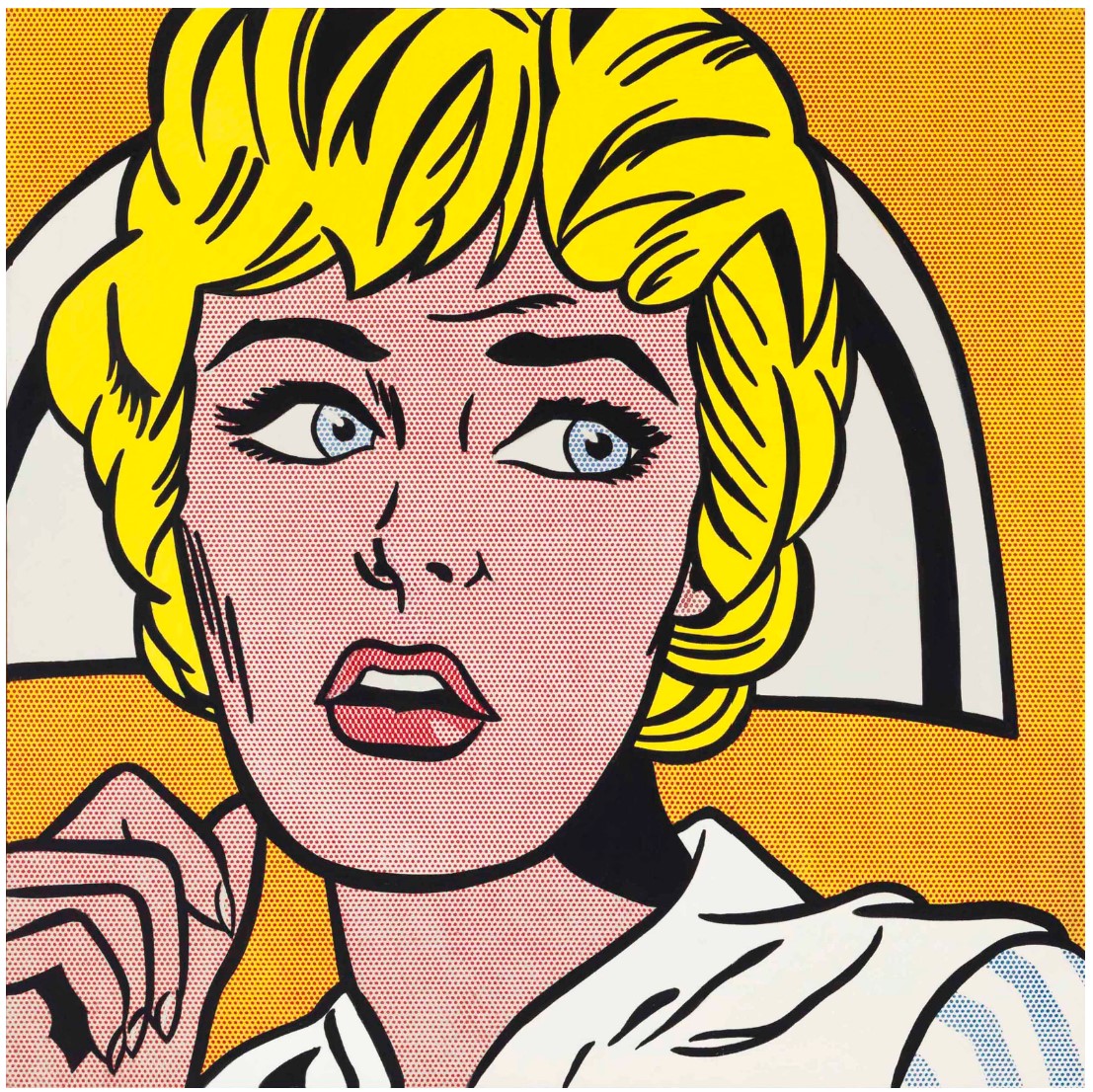
ROY LICHTENSTEIN (1923-1997)
Nurse, 1964
Oil and Magna on canvas
48×48 inches (121.9 x 121.9 cm)
Signed and dated ‘rf Lichtenstein ’64’ (on the reverse)
Provenance
Leo Castelli Gallery, New York
Leon Kraushar, New York
Karl Ströher, Darmstadt
Peter Brant, Greenwich
Anon. sale; Sotheby’s, New York, 2 May 1995, lot 27
Acquired at the above sale by the present owner
Auction History
Christie’s New-York: 8 November 2015
Estimate on Request
Price realized: USD 95,365,000
Roy Lichtenstein (1923-1997) (christies.com)
Painted at the height of his career, Roy Lichtenstein’s Nurse is a dazzling masterpiece—a celebration of the bold new imagery that changed the direction of art. The subject of this painting stands alongside Warhol’s Marilyn Monroe, Elizabeth Taylor and Jacqueline Kennedy as one of a distinguished group of icons who take their place in the history of figurative painting. Initially titled Frightenedness, the protagonist symbolizes her profession, however when seen through Lichtenstein’s prism, her anxious gaze and hand raised nervously upwards towards her face displays a palpable sense of drama that infuses the narrative with a sense of fear and foreboding. No words are spoken, no context is given—yet the artist’s exceptional understanding of the language of visual communication is able to set the stage for a complex drama that is about to play out before us. Nurse comes with the distinguished provenance of having been in some of the most important collections of Pop Art including both the legendary Kraushar Collection in New York and the influential collection of Karl Ströher in Germany. Having also been selected for inclusion in the artist’s seminal early retrospectives, including those organized by the Neue Nationalgalerie in Berlin in 1969 and the Solomon R. Guggenheim Museum in New York the same year, the painting has come to be regarded as a cornerstone of the artist’s career.
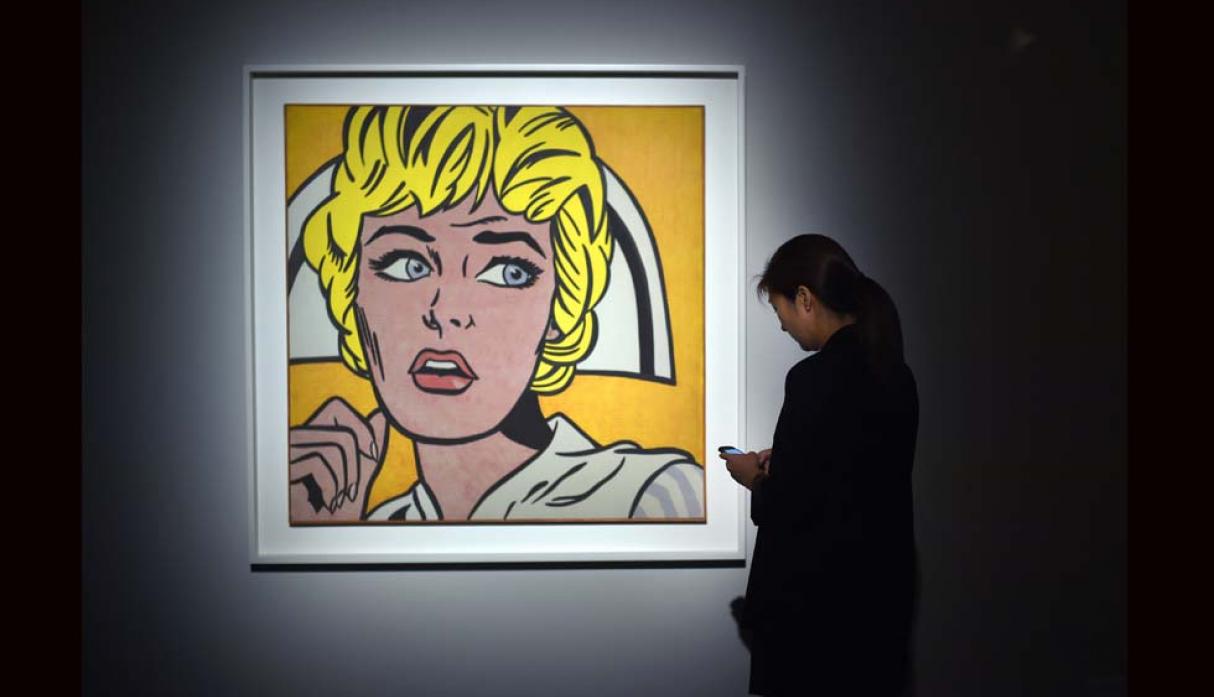
The subject of Nurse is a quintessential Lichtenstein heroine. His signature Ben-Day dots, her strong features and flawless skin mark her out as a striking woman. Her imposing uniform—as defined by the striped fabric of her dress, the stiff white collar and her starched white hat—clearly indicate that she is a member of the nursing profession. Yet her piercing blue eyes, bottle blond hair, and luscious red lips also lend the work a frisson of latent sexuality—less heavenly angel and more femme fatale. Thus, in addition to being a member of the caring profession, the nurse also becomes one of the ultimate male sexual fantasies, an image of immense complexity and human drama. Lichtenstein arrived at his now legendary depictions of women after sojourns into Cubism and Abstract Expressionism during the 1940s and 1950s. In 1961, he finally abandoned his colorful abstractions with Girl with Ball (Museum of Modern Art), a striking image of a beach belle inspired by an advertisement for the Mount Airy Lodge in the Pocono Mountains in Pennsylvania. The clarity of line and similarities to the aesthetic of the mass produced image was in stark contrast to what had previously been acknowledged as art. His first quintessential Girl painting is widely considered to be another 1961 work called The Engagement Ring, a straight forward appropriation of a comic strip in the Chicago Tribune. The origins of the artist’s signature style can clearly be seen here but reach new heights of sophistication with a 1962 painting called, appropriately enough, Masterpiece. This wry comment on the commodification of the New York art market contains all the elements that mark out what would become Lichtenstein’s mature style. Yet, with Nurse, he took this visual narrative to the ultimate level, removing all the extraneous visual material and forcing his heroine to fill the entire picture plane—leaving only the visual elements contained within to convey the narrative.
The protagonist in Lichtenstein’s Nurse is a complex character. Her anxious appearance suggests she is not necessarily the traditional figure of the Good Samaritan, the chaste care giver who puts the welfare of her patients before her own. Here, with her furrowed brow and nervous manner, the artist transforms her in an altogether more emotive figure. With her white starched uniform she is instantly recognizable as a nurse, yet her obvious state of distress conveys a disturbing sense of uneasiness that is a far cry from the romantic scenarios of the pulp fiction books from which Lichtenstein takes his source material. In these books, the nurse is often a virtuous figure whose quest for true love is a perfect counterpoint to the day-to-day melodrama of hospital life. But here, he has transformed her into a much more complex figure whose demeanor engenders uneasiness instead of lust and desire. Lichtenstein has managed to create an image of a nurse that uncomfortably straddles the domains of sexual fantasy and schlock-horror and in doing so has made it appear all the more raw, and more powerfully subversive than the harmless innocence of its original context. Richard Prince, a more contemporary artist who has drawn on the long running fascination with the image of the nurse in popular culture, insists that this dichotomy is what make the nurse such fascinating subject matter. “Some people say the nurse paintings are all about desire,” he said in a conversation about his own nurse paintings with fellow artist Damien Hirst, “but isn’t that more to do with their proximity to life and death? Isn’t that why we find nurses sexy—because they embody this ultimate contradiction? You’re the artist, you can tell me. As kids we are interested in sex and death because we can never imagine either one ever happening to us” (R. Prince, quoted in “A Conversation” in Damien Hirst: Requiem II, 2009).
The central character in Lichtenstein’s Nurse is also very much a product of her time. Unlike today’s highly qualified nursing professionals who often take on much of the treatment and diagnostic duties that were previously reserved strictly for doctors, Lichtenstein’s Nurse is a product of the 1950s. The nurses of that era were much more restricted in their duties, effectively only employed as care assistants to make their patients as comfortable as possible and assist the doctors in their medical duties. As such they often became the object of much male attention—from the perceived innocence of the Dr. Kildare style hospital romance to the slightly more salacious full-blown male fantasy. Here, by injecting this typecast character with a sense of drama and intrigue, Lichtenstein elevates her to become a much more central protagonist than would normally have been portrayed in popular culture.
Lichtenstein has seized on this theme to mark out his unique position in the pantheon of artists who dealt with female figure—a mainstay of art history. He always overtly stated his intention that he was making art about art, and in the case of his paintings (such as the present example) his subject matter aligned, and arguably overrode, his formal theories. With Nurse, Lichtenstein contributes to this legacy in his inimitable and ironic fashion. This subject matter enabled him to make a knowing and witty nod to art historical precedents and the result is a magnificent work that exemplifies the new approaches to visual practice in the post-modern era.