Artprice just released its annual report on the Contemporary Art Market. It can be downloaded through the link below.
The Contemporary Art Market Report 2023 (artprice.com)
We publish a few relevant excerpts here.
1. Key Figures
The Contemporary art market is undergoing a controlled correction while continuing to attract new buyers.
After two years of phenomenal growth and a historic increase in auction turnover following the Covid crisis, the Contemporary art market appears to have followed the general trend observed on the art market as a whole: an anticipated de-escalation in the high-end segments. The post-pandemic frenzy being clearly a cyclical movement, global turnover was bound to return to a more moderate and sober growth path.
In 2020, the health crisis generated unprecedented constraints leading to a near paralysis (postponements and cancellations) of auction sales during the first half of the year and to the temporary unavailability of masterpieces that usually drive the market.
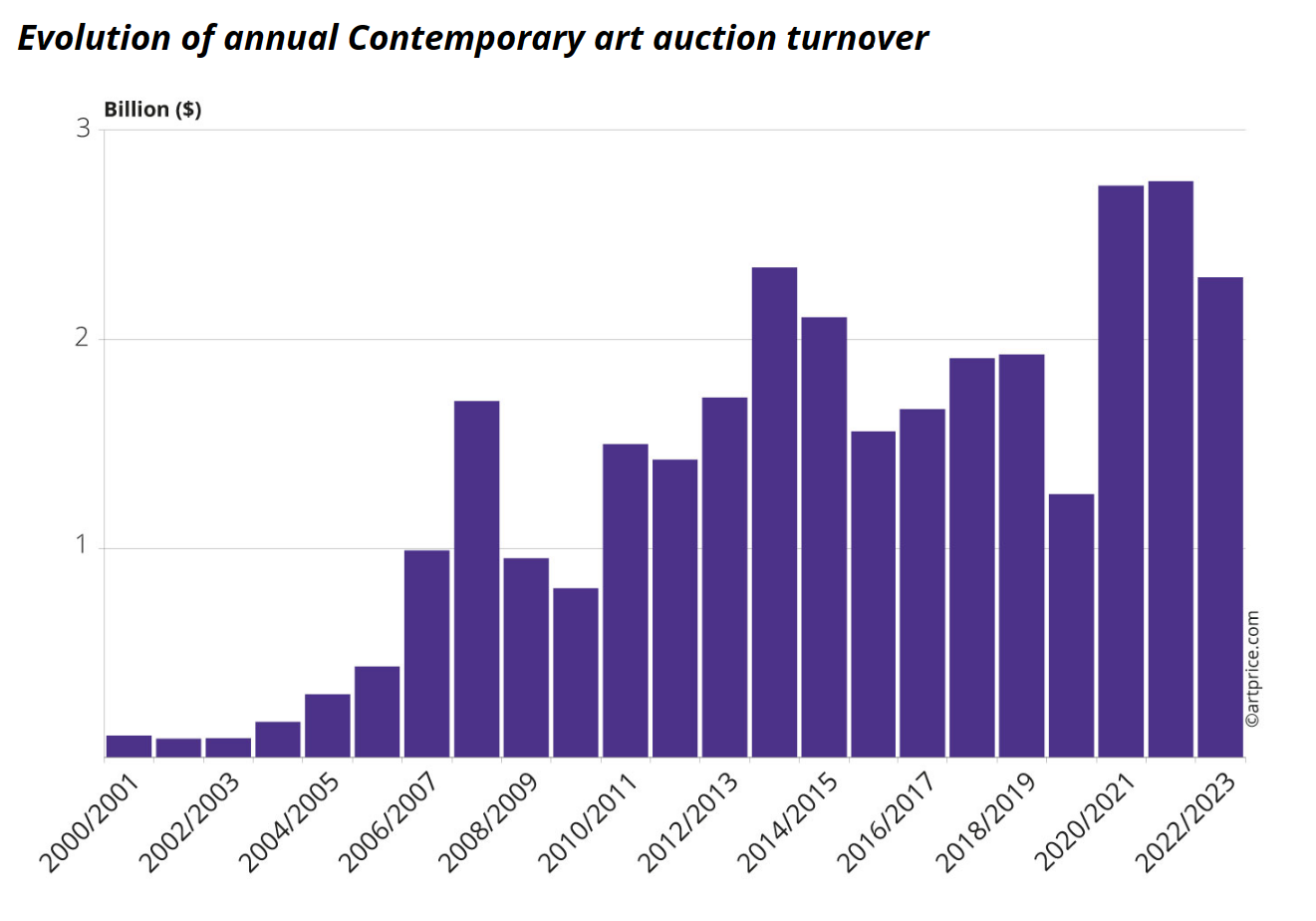
Following this period of forced inactivity, the sales companies quickly bounced back: Sotheby’s, Christie’s and Phillips all took on prestigious consignments at the start of summer of 2020 and collectors were clearly eager to get back into the market. In 2021 and 2022, museum-quality pieces from prestigious collections fueled a series of exceptional auction sales in the Modern Art and Post-War segments… and the Contemporary Art segment reached a new 12-month record at $2.7 billion!
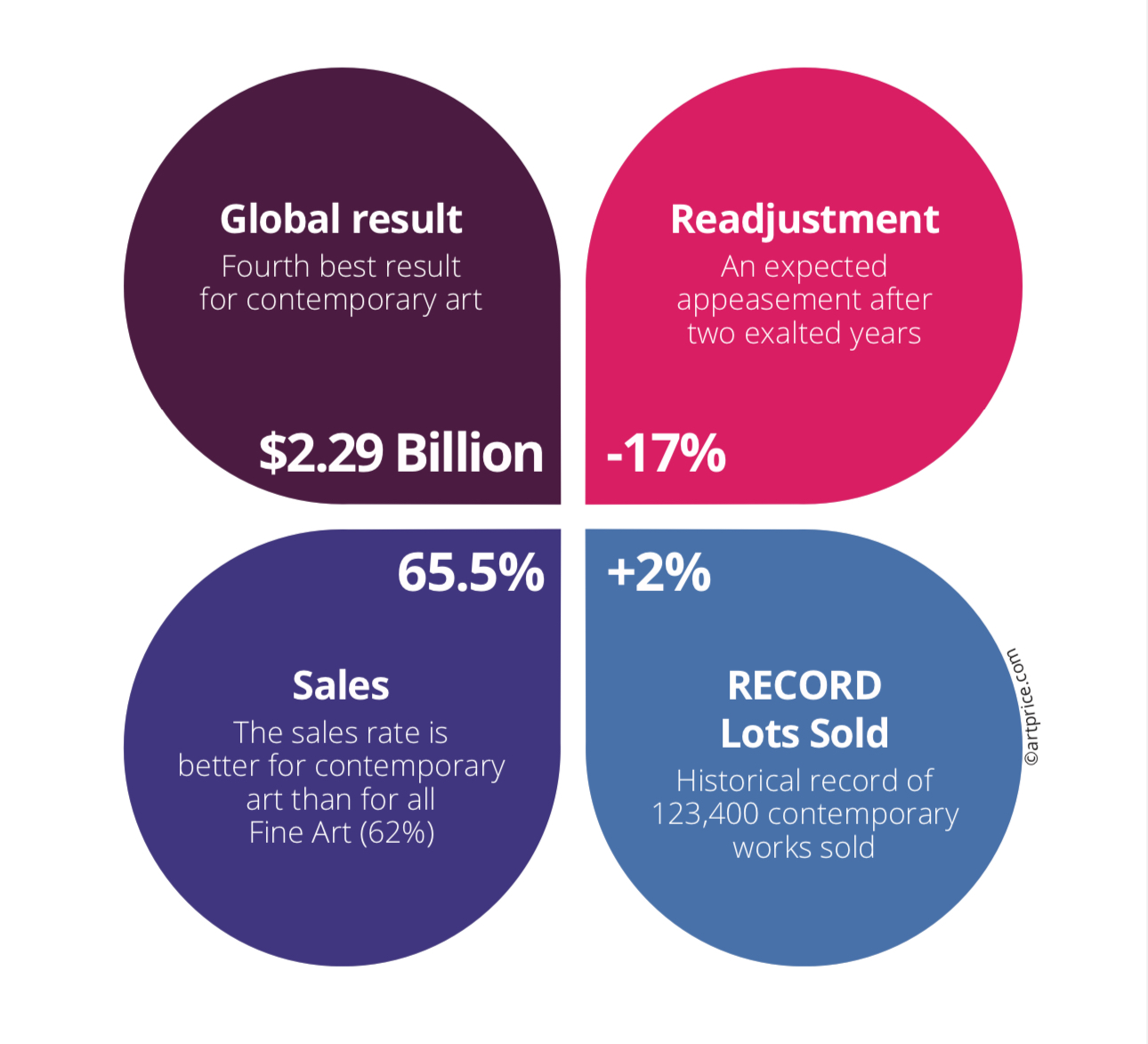
Following this extremely opulent 2021/2022 period, the results from the Contemporary art segment look substantially more modest, although the overall turnover figure is a perfectly respectable $2.29 billion and 2022/2023 turned out to be the fourth best performance in history. In fact, that total is twice the one generated during the health crisis, and 25 times higher than that counted 20 years ago (only $90 million in 2002/2003).
In short, the general contraction observed this past year reflects, above all, an unfavorable comparison effect (since last year was exceptionally good). Indeed, considering the multiple tensions experienced since the start of the war in Ukraine, it seems more pertinent to highlight the exceptional resilience of the global art market.
Over the past year, the global context has been particularly disruptive. Geopolitical and economic tensions, war, recession and inflation are all – à priori – unfavorable factors for the public sale of major artworks. Although we have still seen one or two examples of passionate buying of the most beautiful works at exceptional prices, a lot of collectors have demonstrated an understandable reserve, sometimes choosing to postpone their decision to sell, or even going through other channels to part with their works by ‘blue chip’ artists (the most recognized and expensive artists on the market). In a less euphoric climate than that of the impressive market recovery after the health crisis, the current caution is in fact a virtue and the nevertheless convincing results of 22/23 have revealed with greater clarity how the dynamic of art collection is still very much alive.
2. Geography
The slowdown in the main global marketplaces is due to a lower number of multi-million dollar auction results, the smallest share of the art market by volume.
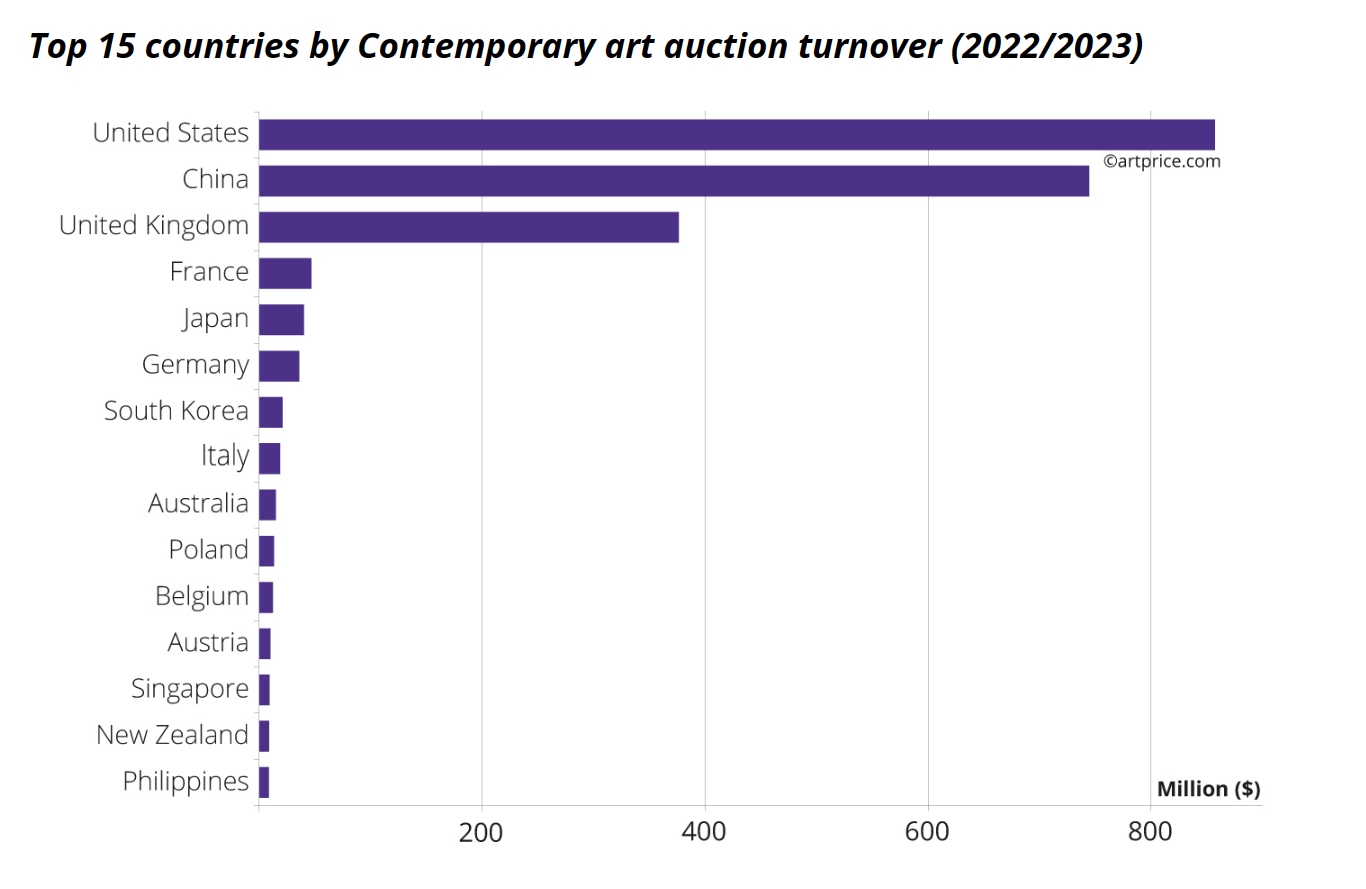
The 22% decline in million-plus auction results (in USD) has impacted the primary hubs of the Contemporary art market first and foremost, essentially the London and New York branches of Christie’s and Sotheby’s which usually account for the bulk of the segment’s global high-end turnover. In 22/23, the United States posted a 19% contraction and the UK’s auction turnover from Contemporary art shrank by 23%. Together, the two countries posted a shortfall of $300 million versus the previous 12-month period – a considerable sum indeed, but one that simply reflects the absence of a dozen or so highly sought-after Contemporary works on the auction podiums.
Nevertheless, the United States and the United Kingdom still clearly dominate the other Western art marketplaces. While the United States retained its leading position with $857 million (versus $1 billion last year), the United Kingdom hammered $376 million vs. $486 million the previous year. Together, the two countries accounted for 54% of the world’s Contemporary Art auction turnover. Ten years ago, this share was larger (65%) with a turnover that was half the size… that was before the expansion of the Asian art market.
3. Top Artists
Major fluctuations in global art auction turnover result from the presence or absence of works by a small number of ‘blue-chip’ artists that can fetch tens of millions of dollars.
With works valued at tens of millions of dollars, the tutelary signatures of Contemporary Art represent a huge percentage of the segment’s auction turnover… in fact, no less than 85% of the global total (i.e. $1.9 billion) comes from the world’s 500 top-selling Contemporary artists, and almost a third of the world’s total turnover from Contemporary Art comes from just ten signatures.
While works by blue-chip artists clearly add prestige to collections, both public and private, the prices they fetch depend above all on the financial health of those who wish to obtain them, the millions they are ready to part with and the auction records they want to break.
After the opulence of recent years, the artists at the top of the pyramid are currently experiencing a cyclical downturn. In 22/23, the auction turnover for the top 10 stars of the Contemporary market shrank, collectively, by almost $188 million versus the previous year.
Top-selling artists’ contributions to global Contemporary art auction turnover
Top 500 artists: $1.9 billion, or 85% of global turnover
Top 50 artists: $1.164 billion, or 51% of global turnover
Top 10 artists: $630.2 million, or 27% of global turnover
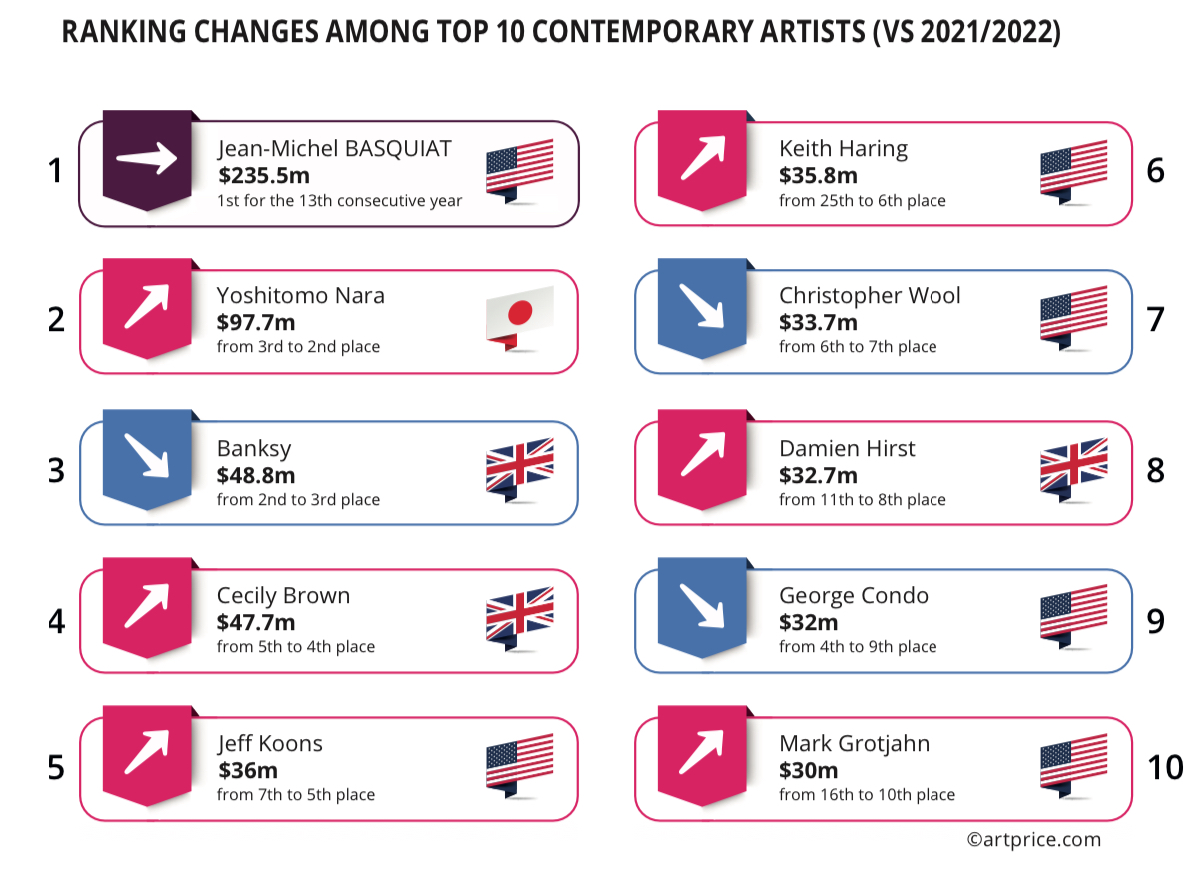
Of the ten most successful artists on the Contemporary Art market, BANKSY, ranked third in our global ranking but with a turnover down by $79 million vs. 21/22. This decline is based on two factors: a reduction of interesting pieces compared with those offered in 2021/2022, and the general return to a calmer mood at auctions. The flamboyant auctions of 2021 have – at least for the time being – given way to much greater sobriety. Last year, Banksy’s works fetched over $10 million on four occasions and even hit an unexpected result of more than 25 million dollars (Love is in the Bin). Several exhilarated collectors literally caused his prices to soar. One of his famous images – Love is in the air (15 copies and some artist proofs) – reached $12.9 million against an estimate of $3-5 million. In the fall of 2022, the most recent edition of the same work to be offered for sale fetched a much more sober $3.9 million, almost returning to its initial estimate.
This year, Banksy’s major works have all found buyers within their estimated ranges, exceeding them only rarely, and by little. However, the deceleration in the turnover generated by the artist has been accompanied by an upsurge in transactions. These results perfectly illustrate the adjustment that the Contemporary art market is currently undergoing: a less excited high-end segment and strong demand for more affordable works. Banksy’s auction transactions actually accelerated considerably this year (+55%), with more than 1,600 lots sold. The artist is in fact more in demand than ever before.
Basquiat is a veritable pillar of the Contemporary art market, in the same way that Picasso is for Modern Art. Sales of his works regularly generate approximately 10% of the global auction turnover on Contemporary art and his paintings are indeed the most valued on the market. In 2022/2023 no less than six of the eleven results above the $10 million threshold were for works by Basquiat. Among them, his El Gran Espectaculo (The Nile) (1983) was the only Contemporary work to fetch over $50 million. A monumental piece made up of three painted panels over 3.5 meters long, the painting sold for $67.1 million. The sale of this emblematic work, exhibited in various museums around the world, illustrates the spectacular capital gains that the best Jean-Michel BASQUIAT works can generate. Acquired at auction in 2005 for $5.1 million, its value was multiplied by 13 after just 18 years (Christie’s New York, 05/15/2023). Another example: his canvas Sugar Ray Robinson sold for $32.6 million in November 2022 at Christie’s, 15 years after its acquisition for $7.3 million at the same auction house.