
Jean Michel-Basquiat distinguished himself from his contemporaries by the amount of works on paper he executed, and the artistic achievements he realized with this medium. He treated drawing with the same importance as he treated painting, making each one a work of art in its own right. Basquiat was attracted to the immediacy of the act of drawing, and the similarities this medium shared with graffiti, having started as an artist on the streets. Drawing became a way of channeling his inner thoughts, impressions, memories, and fantasies. It is easy to see the appeal of paper as a medium for Basquiat. A self-taught artist, his genius lay in his instinctive understanding of composition and unique iconographic lexicon, and the immediacy of paper as a medium provided the perfect vehicle for Basquiat’s innate brilliance. Furthermore, the paper itself, which bears its history so lightly, with dust and footprints from the studio visible throughout, insists on the performative element of Basquiat’s practice.
Introduction
Jean-Michel Basquiat is often introduced through the glare of early-1980s New York: the SAMO era, the downtown scene, the meteoric gallery ascent, the painter who seemed to arrive fully formed and leave far too soon. But to understand how Basquiat thinks, you start on paper: because drawing wasn’t preparatory for him. It was a parallel mainline: a place where language, memory, protest, and private invention could happen at speed, with less ceremony and more risk. Works on paper also clarify a crucial point for any market-facing discussion: Basquiat’s “hand” is fundamentally that of a draftsman. Even when he’s painting, his approach remains graphic: writing as image, contour as argument, repetition as insistence. Museums routinely frame his practice through that fusion of text and mark-making, and the best works on paper show the mechanism exposed: the brain’s wiring diagram, still sparking.
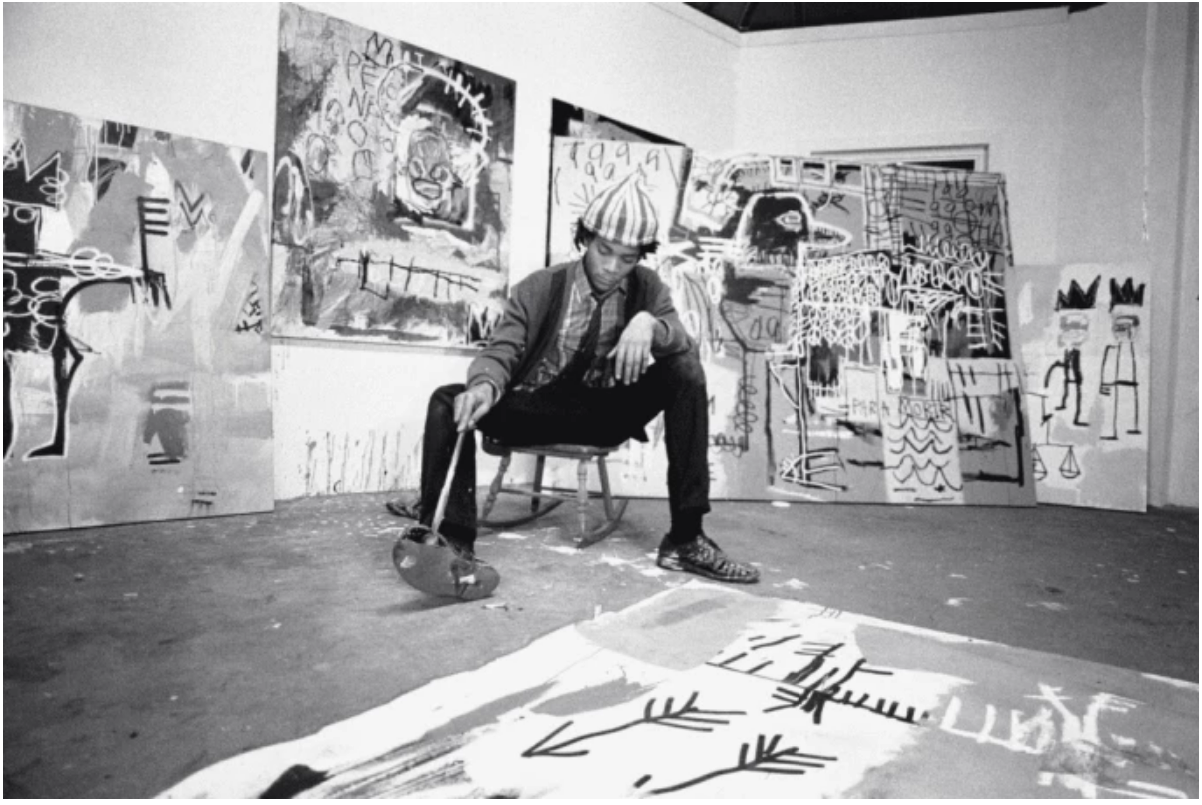
Basquiat filled notebooks with sketches, poems, lists, wordplay, and observations: material that ranges from street life and pop culture to race, class, and history. Those pages aren’t just ephemera; they are the studio in miniature, where themes are tested and sharpened before (or instead of) migrating elsewhere. The institutional validation is explicit: major exhibitions have centered the notebooks themselves, presenting them as primary documents of the work. Paper also enabled a different kind of intimacy. Many sheets feel like direct transmissions: fast, physical, sometimes rough in a way that is not “unfinished” but intentionally unfiltered. Recent curatorial narratives lean into that privacy: showing groups of drawings that Basquiat kept during his lifetime, where the urgency is less performative and more internal.
Materials, Technique and Recurring Thematics
Basquiat’s works on paper are often built from collisions: oil stick with ink, marker, crayon, acrylic, sometimes collage elements. Those materials that can look improvised but are handled with real control. Oil stick is especially telling: it lets him draw with the density of paint, drag pigment like a bruise, and overwrite himself repeatedly without losing velocity. Even when the palette is limited, the surfaces can be aggressive: smudges, pressure, scraping, evidence that meaning is being forced into being, not delicately coaxed.
Basquiat’s themes on paper mirror his larger project, but with a particular sharpness. The human head (mask, skull, haloed saint, wounded icon) appears as a core motif, treated as identity under pressure rather than portraiture in the traditional sense. A recent institutional show devoted exclusively to his depictions of the head concentrates on works from 1981–1983, underscoring how foundational this subject was in his early maturity.
Text is never merely caption. Words behave like arrows, receipts, chants, jokes, accusations, often crossed out to intensify them rather than negate them. Museums describing his practice repeatedly emphasize these dichotomies and tensions: wealth and poverty, integration and segregation, the collision between historical reference and contemporary critique. And then there are the modern saints of his personal pantheon (athletes, musicians, boxers, jazz figures) names deployed as both admiration and autopsy of fame: who gets celebrated, who gets consumed, who gets erased.
Institutional and Market Recognition
The museum world has increasingly treated Basquiat’s works on paper as essential, not auxiliary: notebook exhibitions have toured, and dedicated presentations of drawings continue to appear in serious contexts.
At the same time, Basquiat’s place in major collections is long settled—MoMA and the Whitney, among others, position him as a defining figure of postwar American art, and their interpretive texts foreground precisely the hybridity (text + image, abstraction + figuration, critique + autobiography) that works on paper often make most legible.
Auction results have also corrected an old misconception: that works on paper are simply the “accessible” Basquiat tier. Yes, they can function as a first point of entry relative to the top paintings, but the best drawings on paper are treated as major works, with pricing to match. Some works on paper have been recently selling for more than USD 10 million, a level that firmly places paper in the category of blue-chip trophy hunting when the image, scale, and provenance align.
Auction Market Overview
2025 Auction Highlights
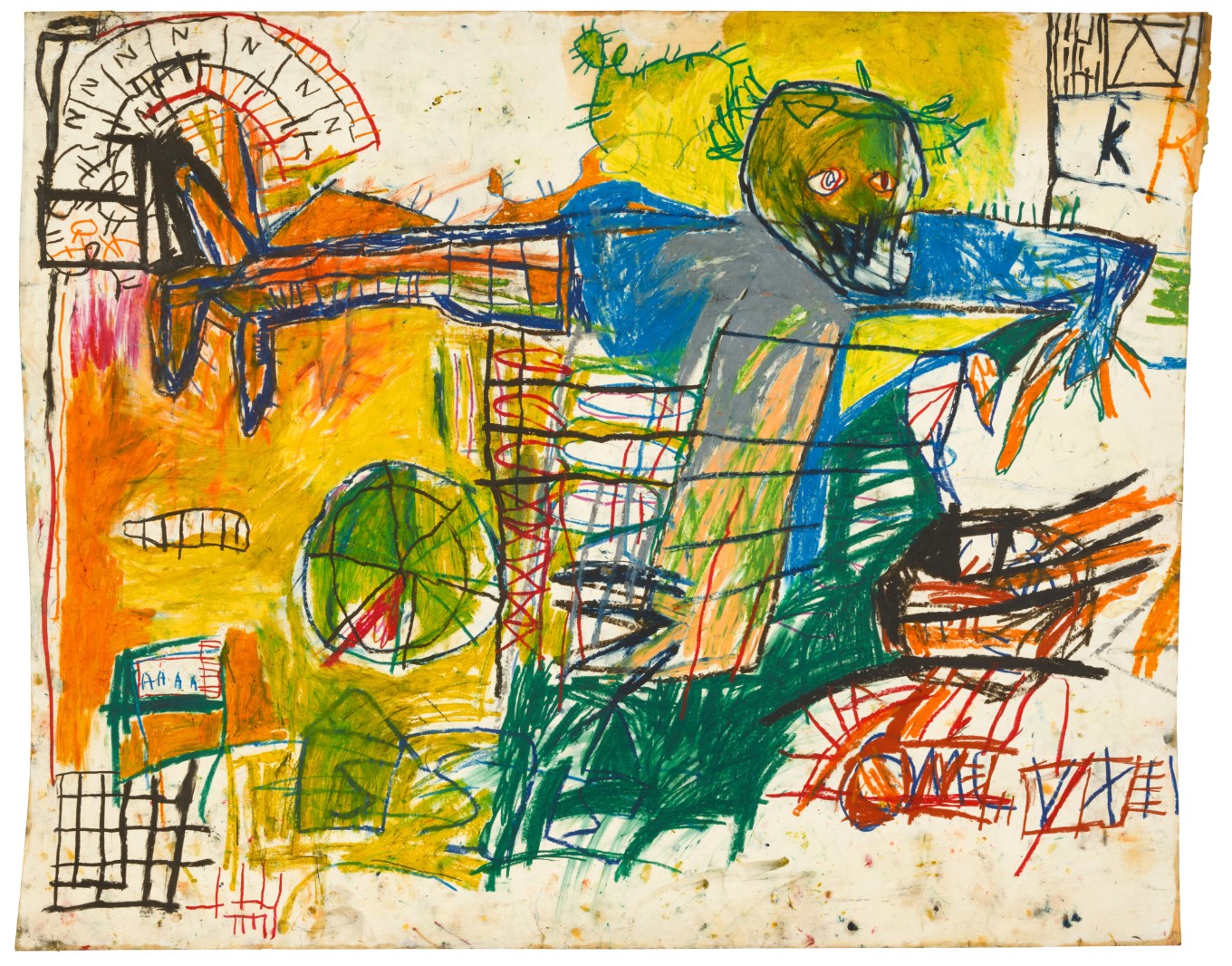
25 lots sold at auction in 2025 for a total turnover of USD 49,210,347. With no lot failing to sell, the sell-through rate is 100%. The highest price was achieved by Untitled, a drawing dated 1981, sold at Sotheby’s in New-York, on 15 May 2025 for USD 16,365,000.
2025 Top 5 Lots
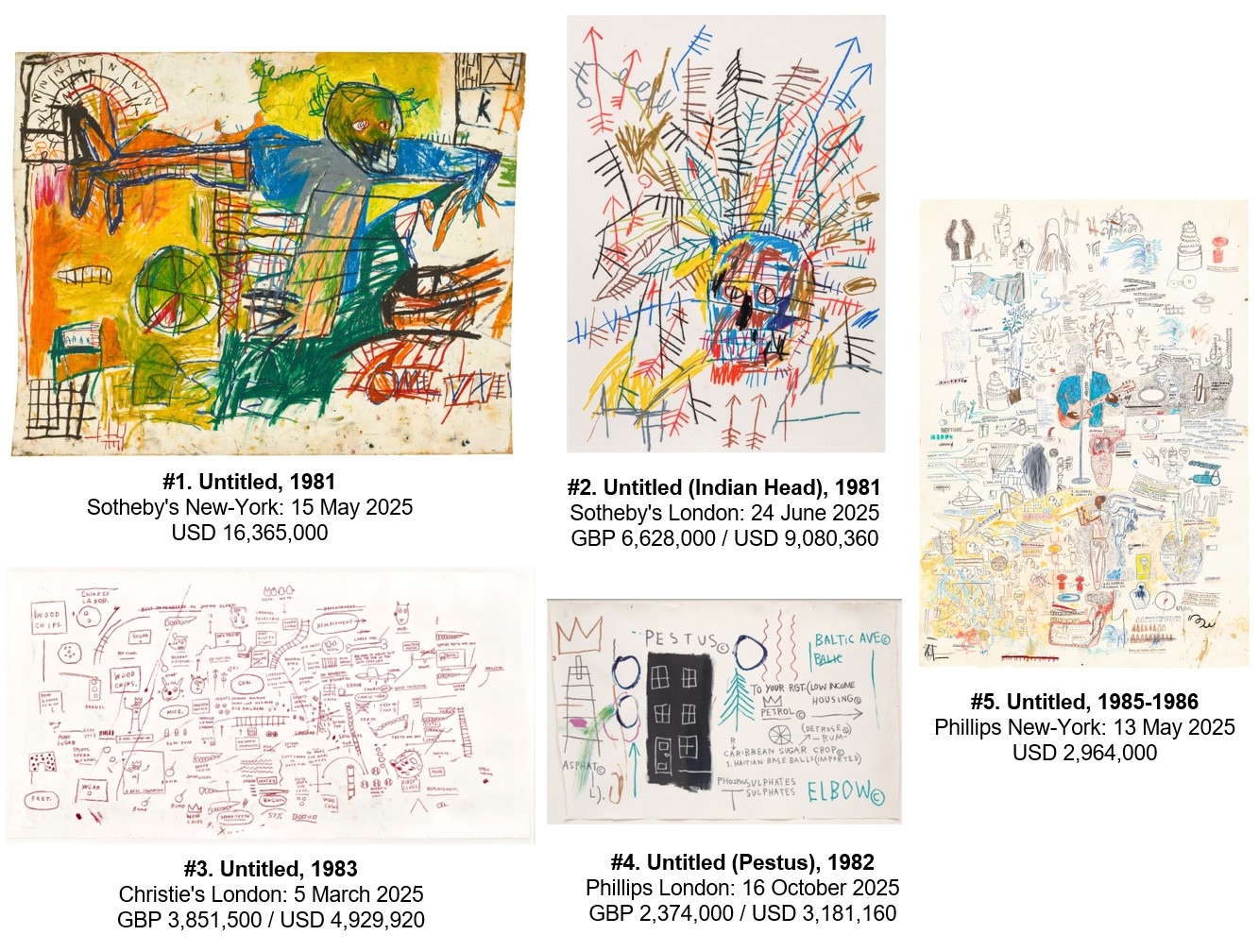
8 lots sold for more than USD 1 million, generating a cumulative turnover of USD 40,727,082, representing 82.8% of the total turnover in 2025. 17 lots sold for more than USD 500,000, generating a cumulative turnover of USD 47,216,428, representing 95.9% of the total turnover for 2025.
2024 Auction Highlights
17 Works on Paper sold at auction in 2024 for a total turnover of USD 34,586,490. With 3 lots failing to sell, the sell-through rate is 85%. The highest price for 2024 was achieved, by Untitled, a large scale drawing dated 1982, that sold at Christie’s in New-York on 21 November 2024 for USD 22,950,000, setting a new auction record for a drawing by Jean-Michel Basquiat.
2024 Top 5 Lots
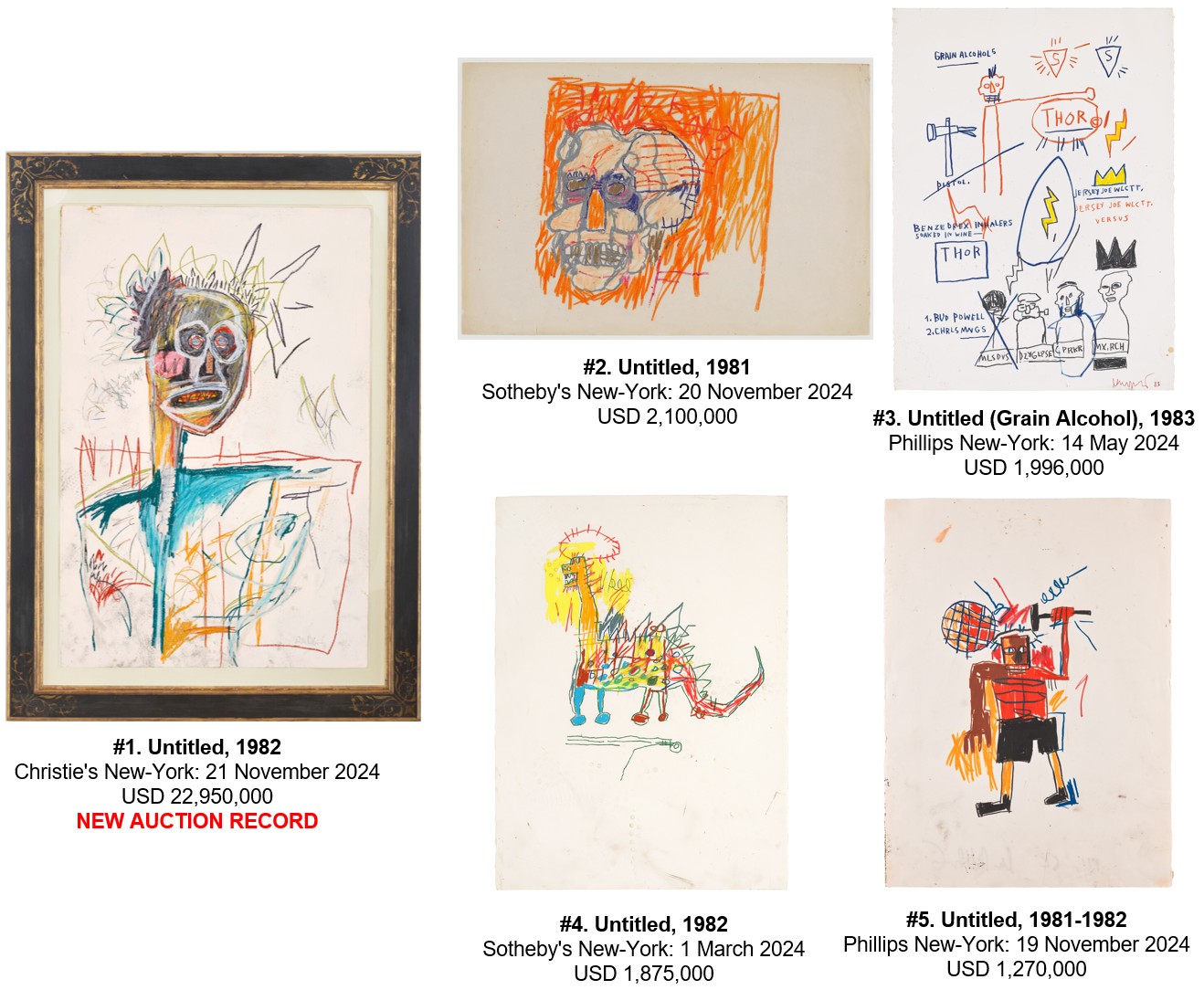
5 lots sold for more than USD 1 million, generating a cumulative turnover of USD 30,191,000, representing 87.3% of the total turnover for 2024. 8 lots sold for more than USD 500,000, generating a cumulative turnover of USD 32,491,200, representing 93.9% of the total turnover for 2024.
2023 Auction Highlights
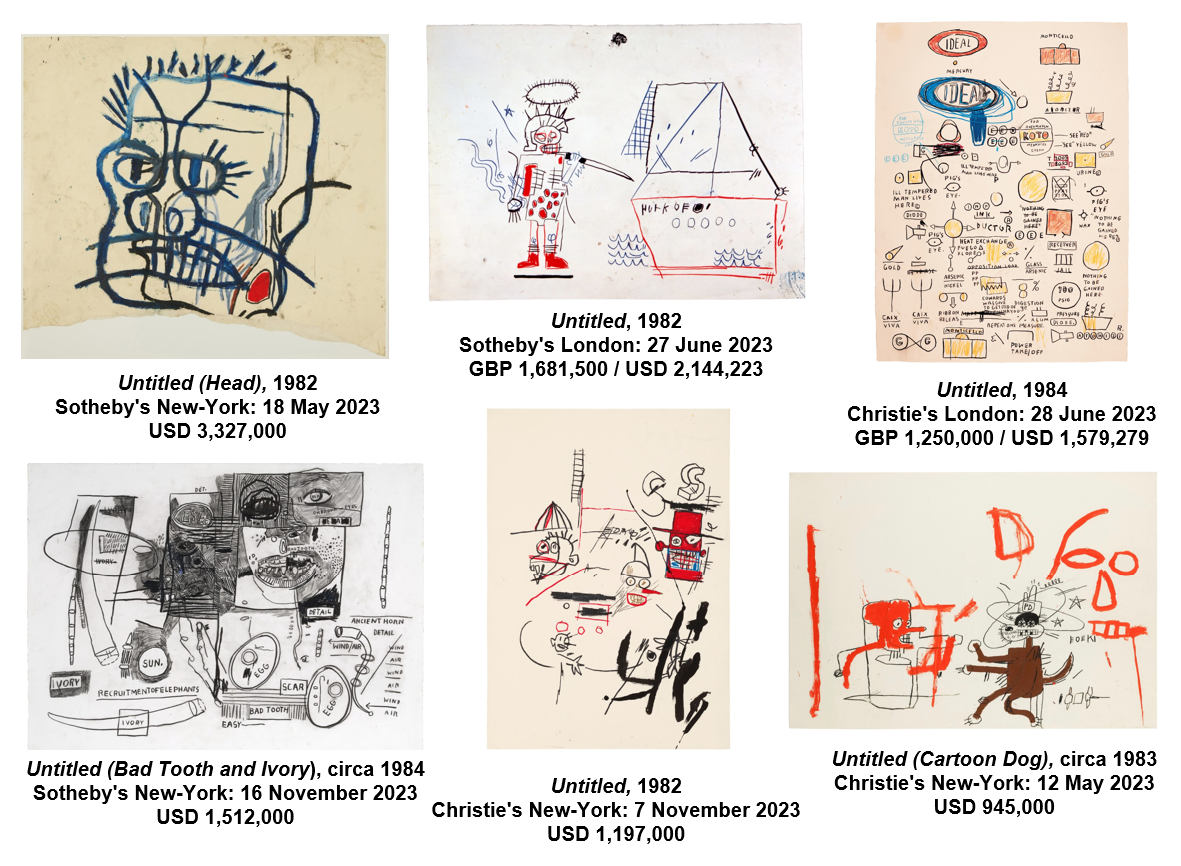
19 Works on Paper sold at auction in 2023 for a total turnover of USD 16,758,407. With 4 lots failing to sell, the sell-through rate is 81%. 5 lots sold for a price over USD 1 million, generating a turnover of USD 9,759,502, contributing 58.2% to the 2023 total turnover. The highest price was achieved at Sotheby’s in New-York on 18 May 2023, when Untitled (Head), a work on Paper dated 1982 sold for USD 3,327,000.
2023 Top 6 Lots
2022 Auction Highlights
20 Works on Paper sold at auction in 2022 generating a total turnover of USD 23,364,190. The highest price was achieved by Untitled (Self-Portrait), a drawing dated 1982, that sold at Christie’s in London on 28 June 2022 for GBP 7,961,000 (USD 9,7,831).
2022 Top 3 Lots
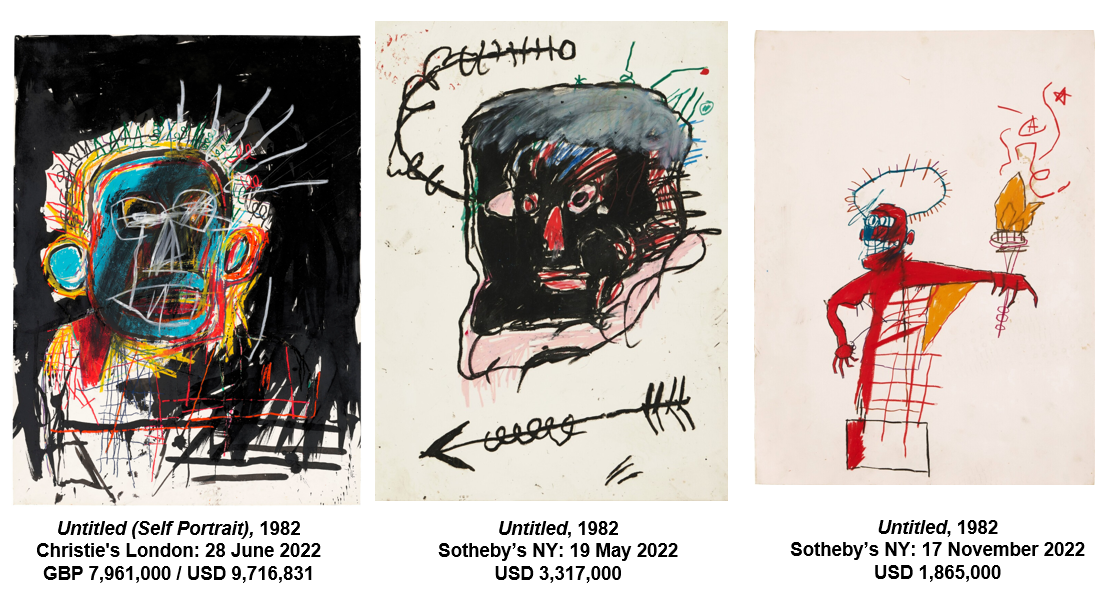
The average price paid at auction for a drawing created by Jean-Michel Basquiat is USD 1,168,210. 4 lots sold for a more than USD 1 million, generating a cumulative turnover of USD 16,414,759, contributing 70.3% to the total turnover for 2022.
2021 Auction Highlights
20 Works on Paper sold in 2021 for a total turnover of USD 21,664,822. The highest price of USD 3,166,000 was achieved at Sotheby’s in New-York on 8 December 2021 for Untitled, a work on paper dated 1983.
2021 Top 3 Lots
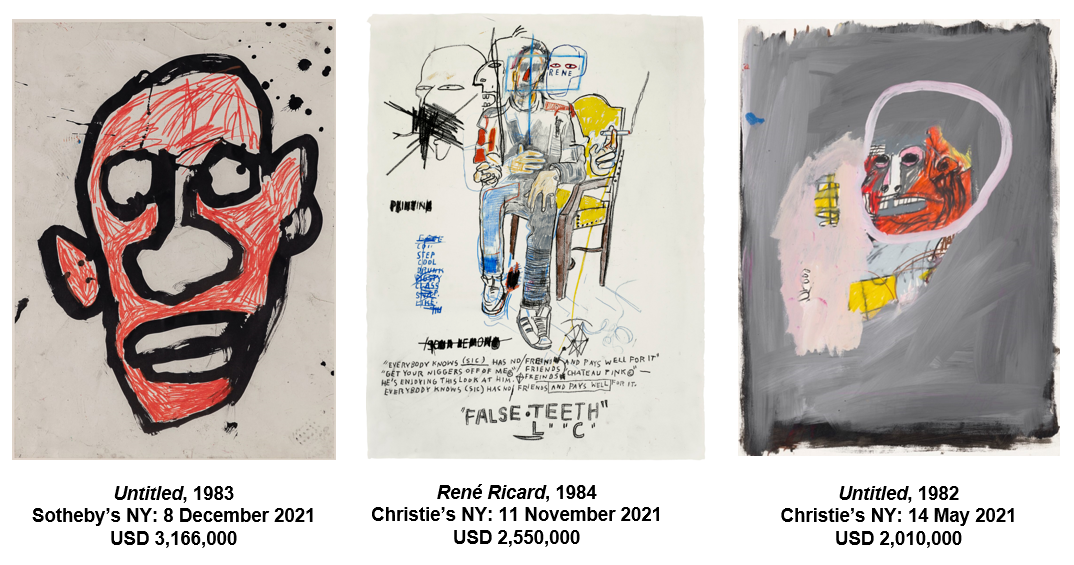
The average price paid for a drawing created by Jean-Michel Basquiat at auction in 2021 was USD 1,083,241. 9 lots sold for more than USD 1 million, generating a cumulative turnover of USD 17,134,637, contributing 79.1% of the total turnover for 2021.
Top Lots at Auction
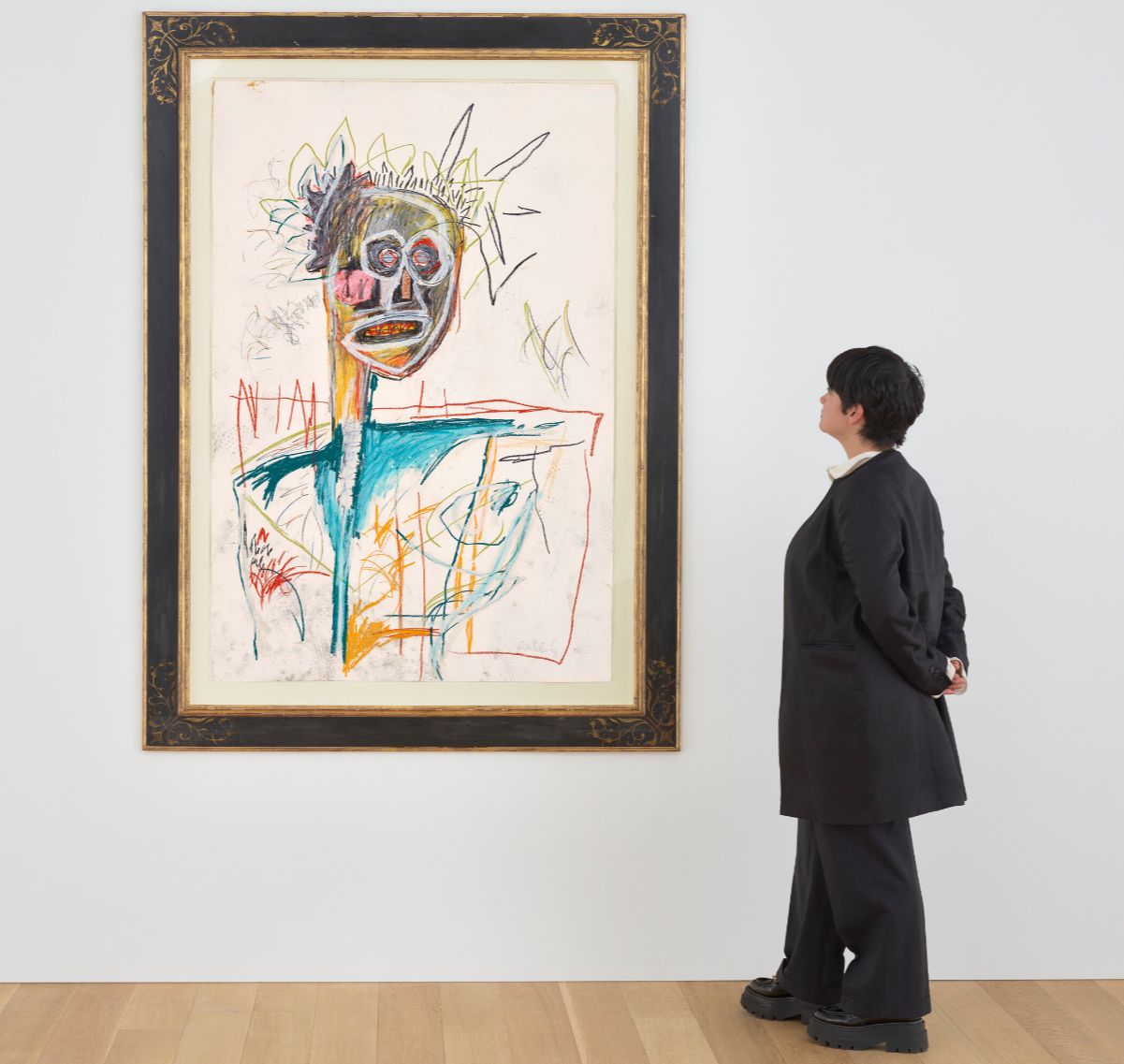
The highest price ever paid at auction for a work on paper created by Jean-Michel Basquiat is USD 22,950,000, a price achieved by Untitled, a drawing dated 1982, sold at Christie’s in New-York on 21 November 2024. Unlike the Top 10 in the paintings category, most of the auction records have been achieved prior to 2021, only one lot sold in 2025, one in 2024 and one in 2022 amongst the most recent ones, the oldest auction sale within the Top 10 was sold in 2013.
#1. Untitled, 1982
Christie’s New-York: 21 November 2024
Estimated: USD 20,000,000 – 30,000,000
USD 22,950,000
JEAN-MICHEL BASQUIAT (1960-1988), Untitled | Christie’s
JEAN-MICHEL BASQUIAT (1960-1988)
Untitled, 1982
Oilstick on paper
63 1/2 x 44 inches (161.3 x 111.8 cm)
Signed and dated ‘Jean-Michel Basquiat 1982’ (lower right)
USD 20 million
#2. Untitled, 1981
Sotheby’s New-York: 15 May 2025
Estimated: USD 10,000,000 – 15,000,000
USD 16,365,000
Untitled | The Now and Contemporary Evening Auction | 2025 | Sotheby’s
JEAN-MICHEL BASQUIAT (1960 – 1988)
Untitled, 1981
Oilstick on paper
50 1/4 x 63 7/8 inches (127.6 x 160 cm)
Signed (on the reverse)
#3. Untitled (Head), 1982
Sotheby’s New-York: 29 June 2020
Estimated: USD 9,000,000 – 12,000,000
USD 15,184,900
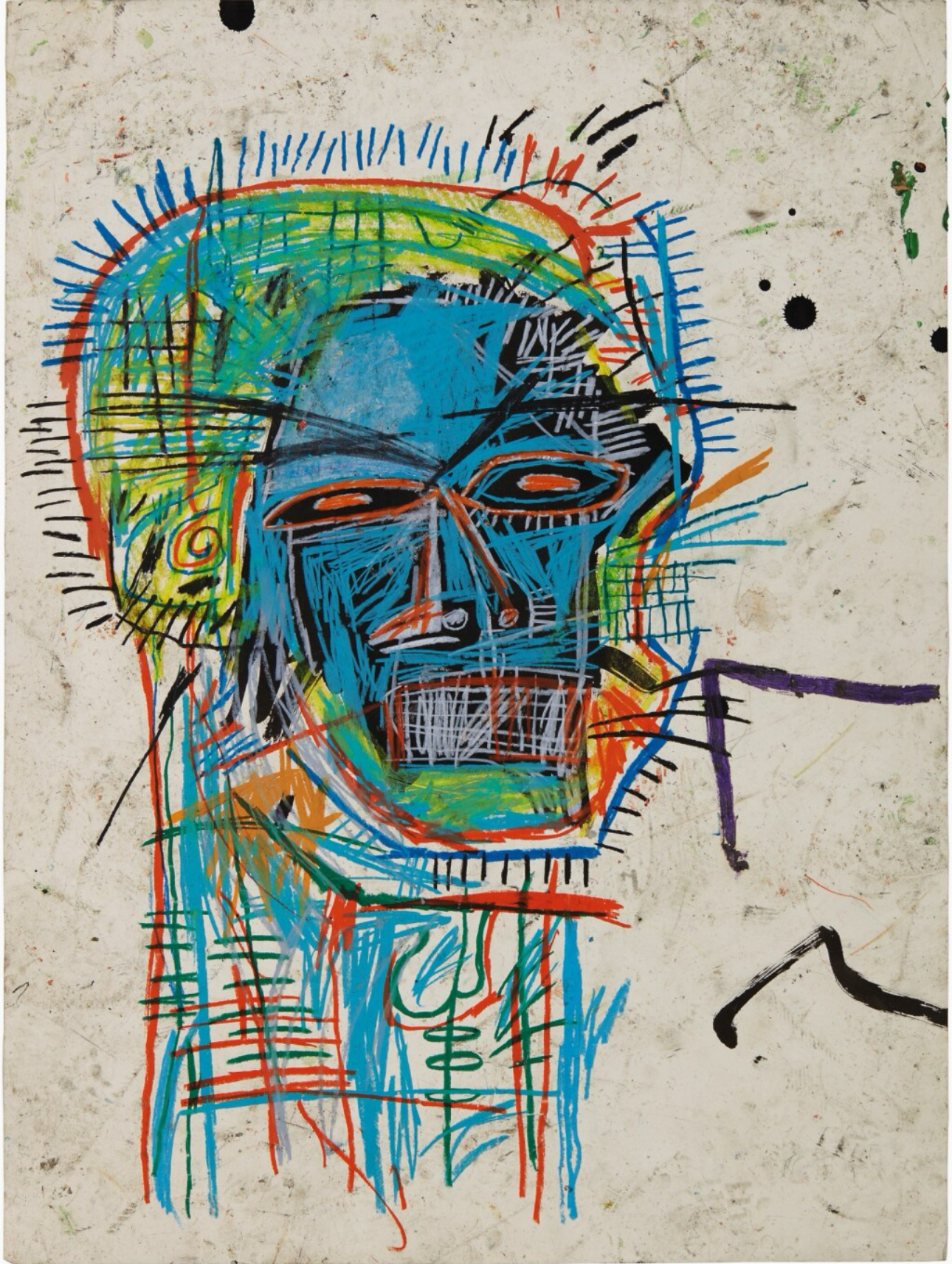
JEAN-MICHEL BASQUIAT (1960 – 1988)
UNTITLED (HEAD), 1982
Oilstick, ink and acrylic on paper
29 3/4 x 22 inches (75.6 x 55.9 cm)
#4. Untitled, 1982
Christie’s New-York: 11 May 2015
Estimated: USD 9,000,000 – 12,000,000
USD 13,605,000
Jean-Michel Basquiat (1960-1988) (christies.com)
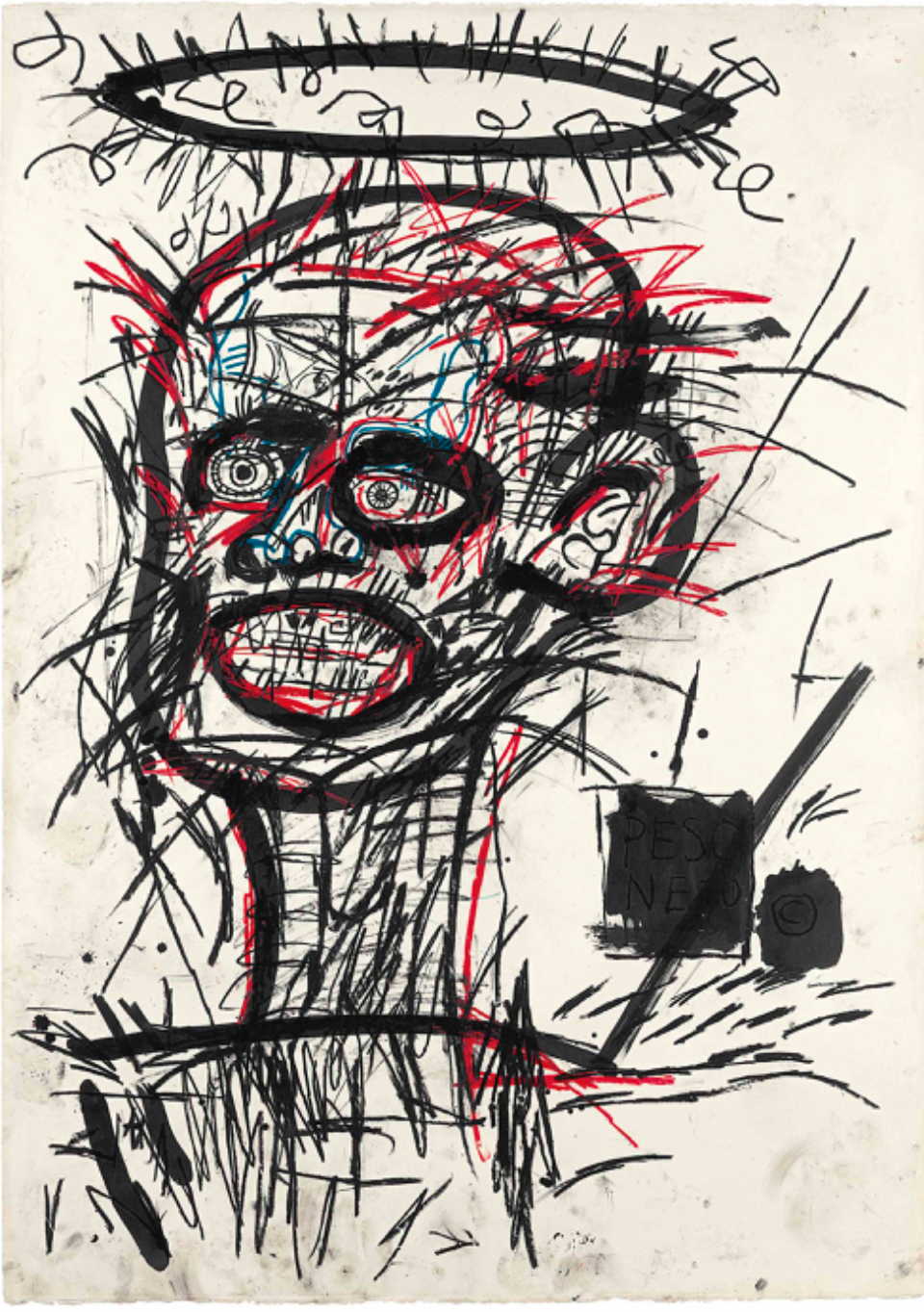
JEAN-MICHEL BASQUIAT (1960-1988)
Untitled, 1982
Oilstick and ink on paper
42 3/4 x 30 3/8 inches (108.6 x 77.2 cm)
USD 10 million
#5. Untitled (Self Portrait), 1982
Christie’s London: 28 June 2022
Estimated: GBP 4,000,000 – 6,000,000
GBP 7,961,000 / USD 9,716,831
JEAN-MICHEL BASQUIAT (1960-1988), Untitled (Self Portrait) | Christie’s
REPEAT SALE
Christie’s London: 26 June 2018
Estimated: GBP 1,500,000 – 2,500,000
GBP 3,892,250 / USD 5,153,168
JEAN-MICHEL BASQUIAT (1960-1988) (christies.com)
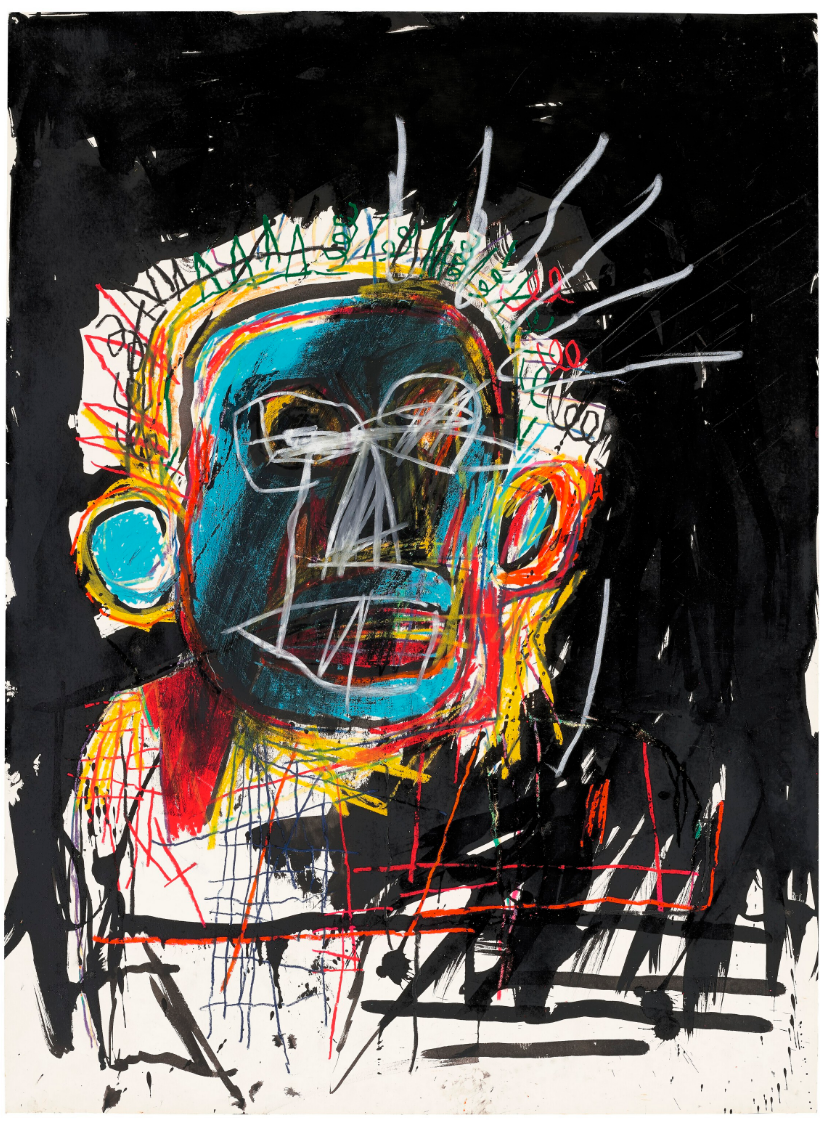
JEAN-MICHEL BASQUIAT
Untitled (Self Portrait), 1982
Oilstick and ink on paper
29.9 x 22 inches (75.9 x 55.9cm)
#6. Untitled, 1982
Christie’s New-York: 17 May 2017
Estimated: USD 7,000,000 – 9,000,000
USD 8,647,500
Jean-Michel Basquiat (1960-1988), Untitled | Christie’s
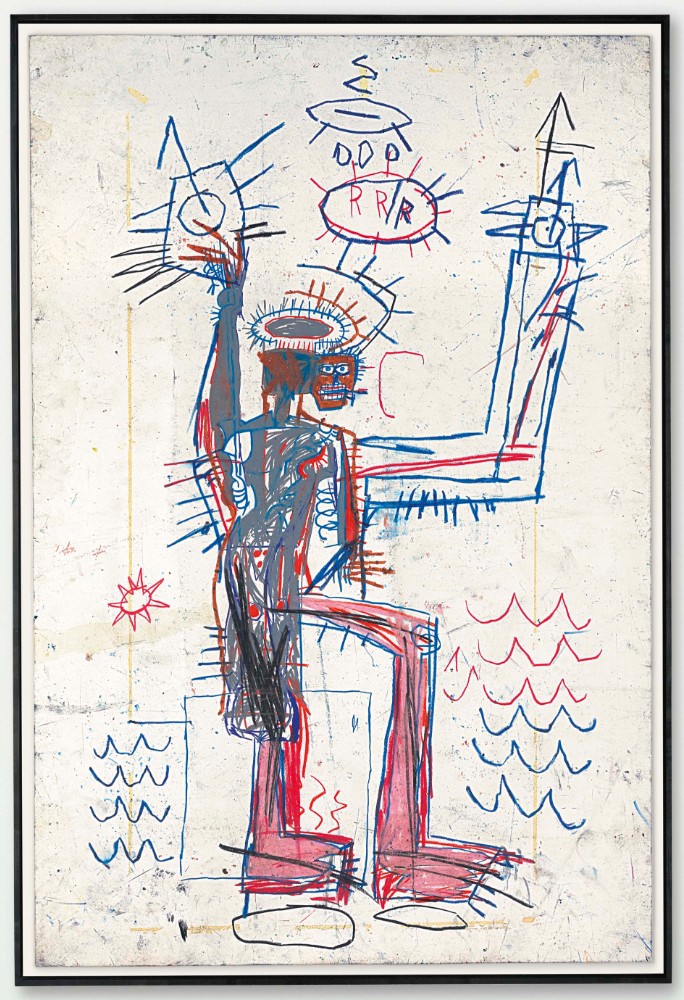
JEAN-MICHEL BASQUIAT (1960-1988)
Untitled, 1982
Oilstick on paperboard
60×40 inches (152.4 x 101.6 cm)
#7. Untitled, 1983
Christie’s New-York: 13 May 2014
Estimated: USD 6,000,000 – 8,000,000
USD 7,445,000
Jean-Michel Basquiat (1960-1988) (christies.com)
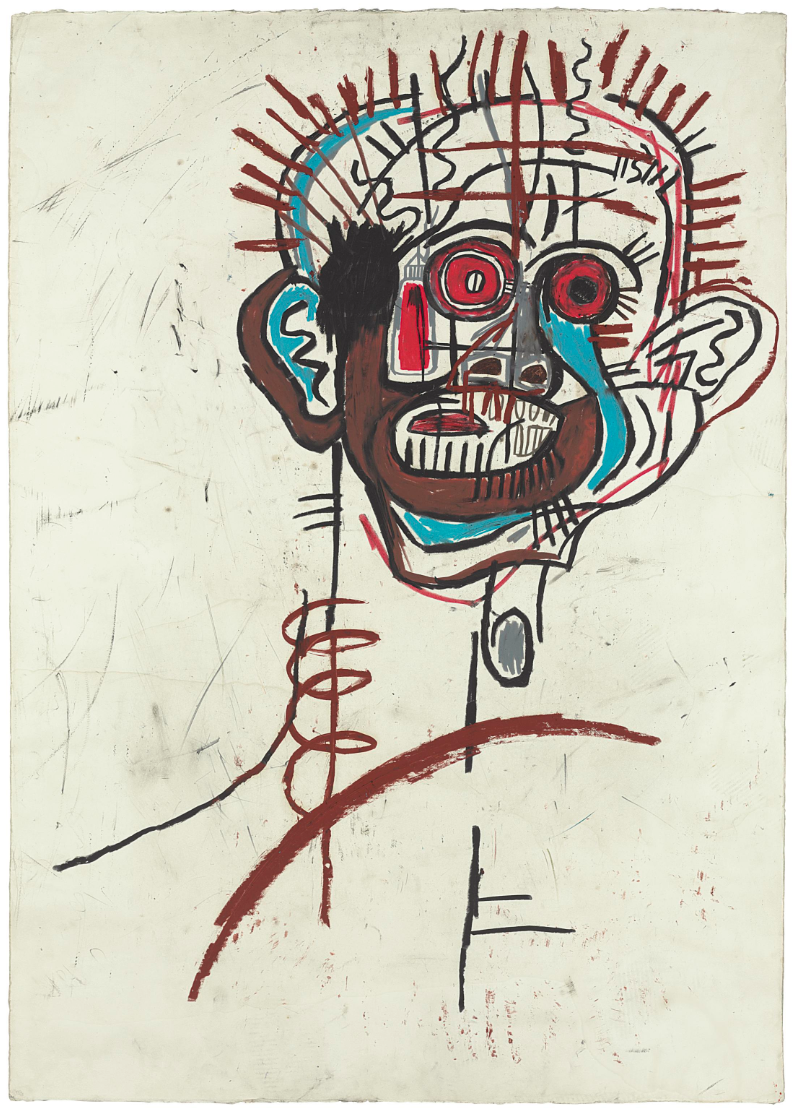
JEAN-MICHEL BASQUIAT (1960-1988)
Untitled, 1983
Oilstick on paper
42 1/2 x 30 1/4 inches (107.9 x 76.8 cm)
#8. Furious Man, 1982
Christie’s New-York: 15 May 2013
Estimated: USD 1,000,000 – 1,500,000
USD 5,723,750
Jean-Michel Basquiat (1960-1988) (christies.com)
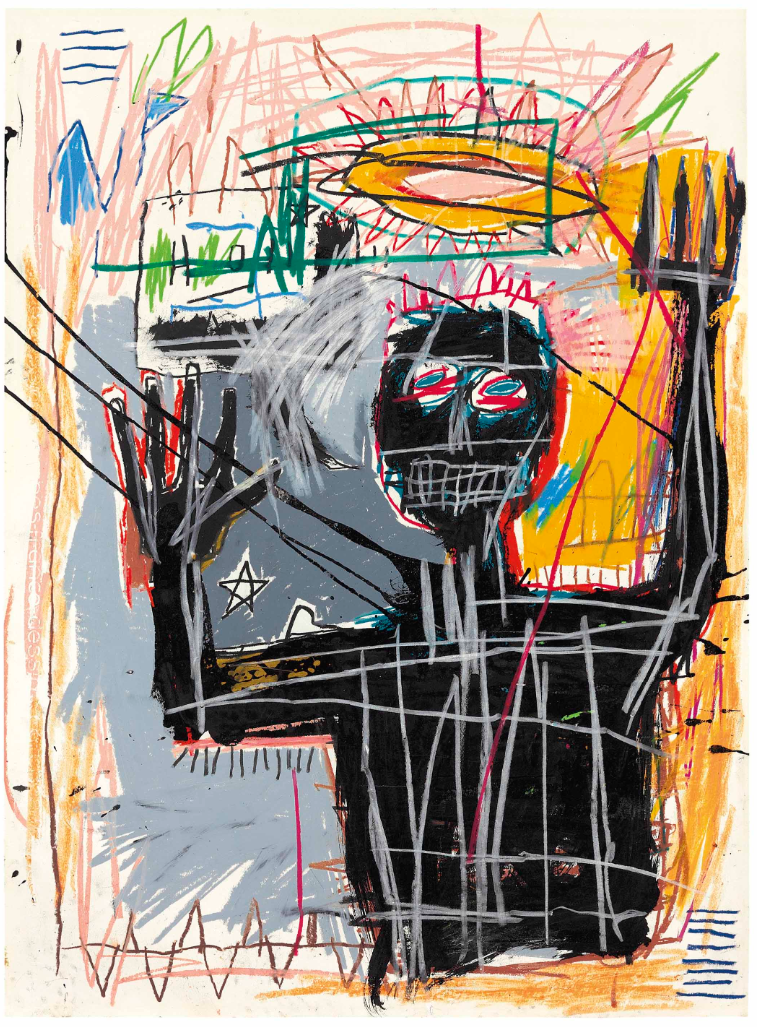
JEAN-MICHEL BASQUIAT (1960-1988)
Furious Man, 1982
Oilstick, acrylic, wax crayon and ink on paper
30×22 inches (76.2 x 55.8 cm)
#9. Brown Eggs, 1981
Sotheby’s New-York: 14 November 2019
Estimated: USD 2,500,000 – 3,500,000
USD 5,389,500
(#22) JEAN-MICHEL BASQUIAT | Brown Eggs (sothebys.com)
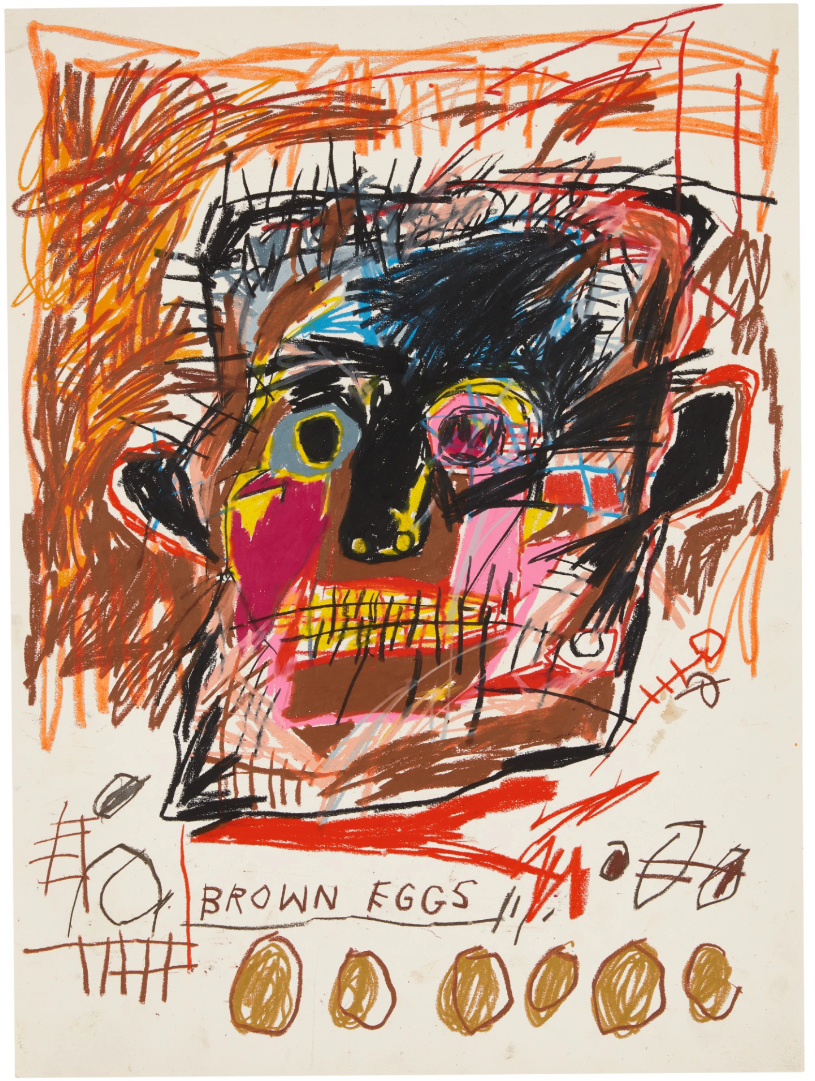
JEAN-MICHEL BASQUIAT
Brown Eggs, 1981
Oilstick on paper
24 1/4 X 18 inches (61.6 x 45.7 cm)
Titled; signed on the reverse
#10. Ribs Ribs, 1982
Christie’s New-York: 15 May 2013
Estimated: USD 3,000,000 – 5,000,000
USD 5,163,750
Jean-Michel Basquiat (1960-1988) (christies.com)
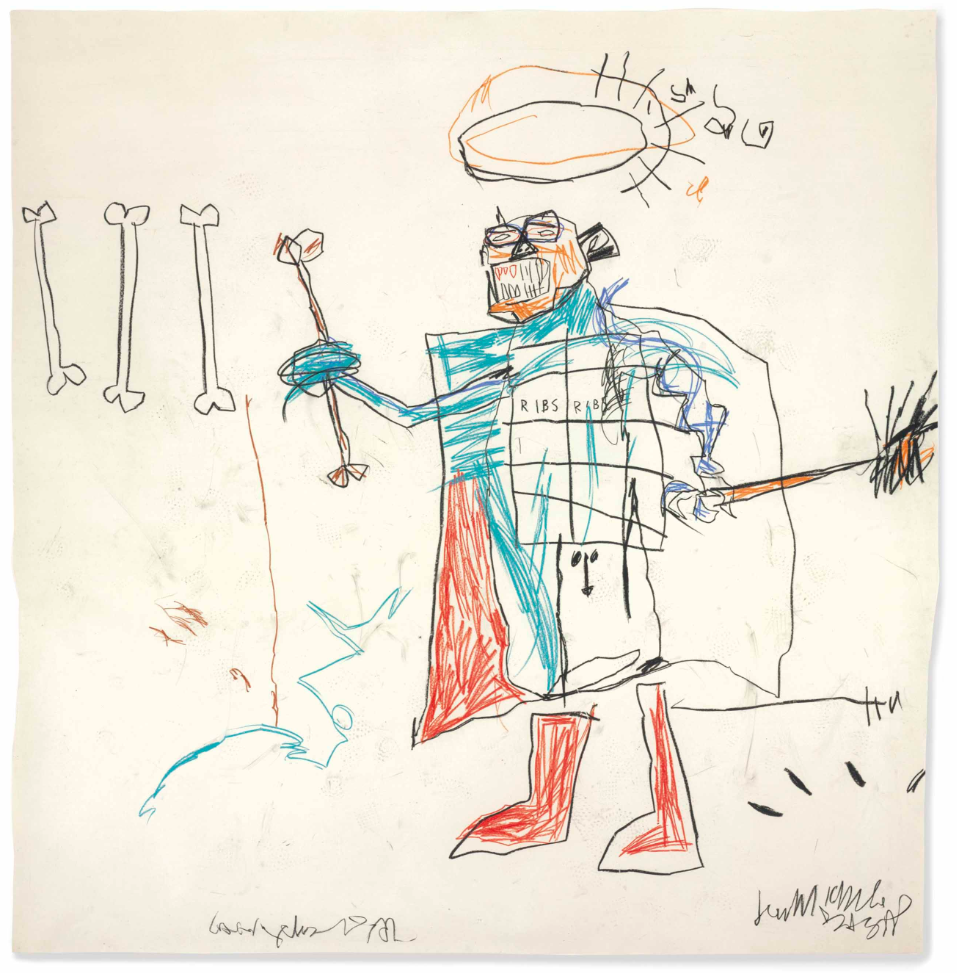
JEAN-MICHEL BASQUIAT (1960-1988)
Ribs Ribs, 1982
Oilstick on paper
97 x 95 3/4 inches (243.2 x 246.3 cm)
Signed Jean Michel Basquiat (lower right)
USD 5 million
#11. Untitled, 1982
Christie’s New-York: 10 July 2020
Estimated: USD 3,000,000 – 5,000,000
USD 4,928,500
Jean-Michel Basquiat (1960-1988) (christies.com)
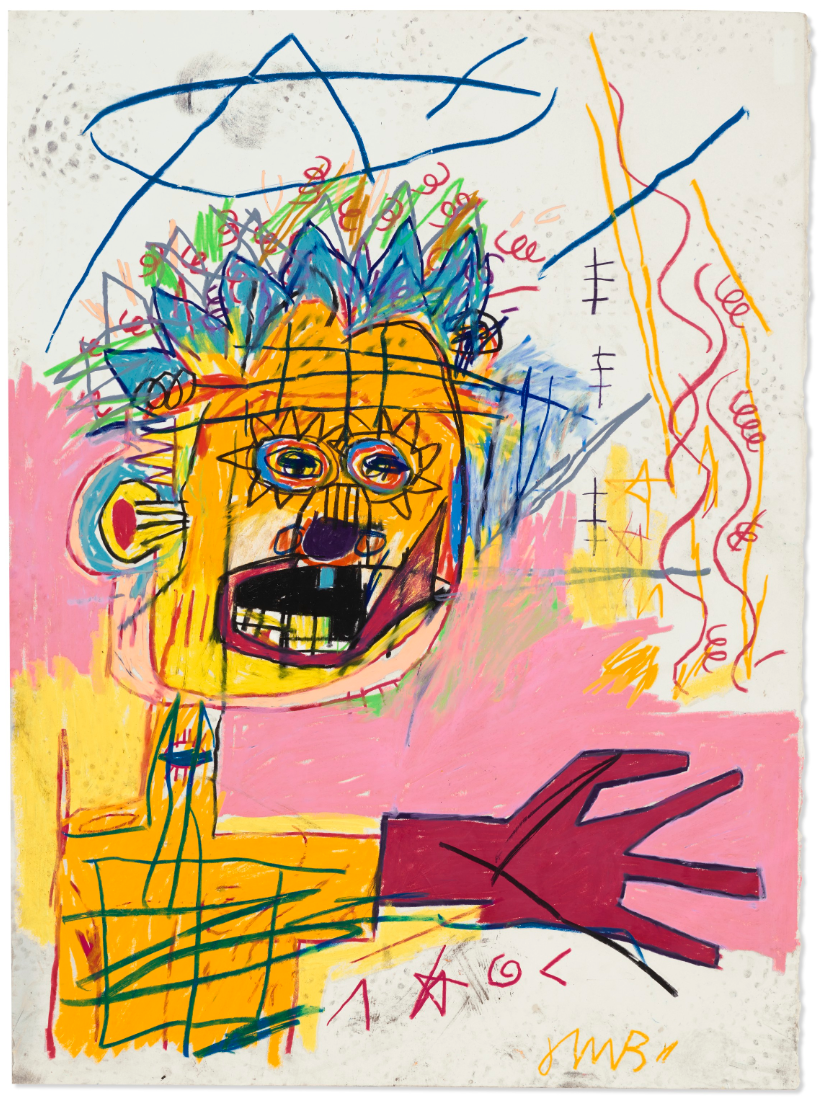
JEAN-MICHEL BASQUIAT (1960-1988)
Untitled, 1982
Oil pastel and wax crayon on paper
30 1/8 x 22 1/4 inches (76.5 x 56.5 cm)
Signed with the artist’s initials ‘JMB’ (lower right)
#12. Untitled, 1983
Christie’s London: 5 March 2025
Estimated: GBP 2,500,000 – 3,500,000
GBP 3,851,500 / USD 4,929,920
JEAN-MICHEL BASQUIAT (1960-1988), Untitled | Christie’s
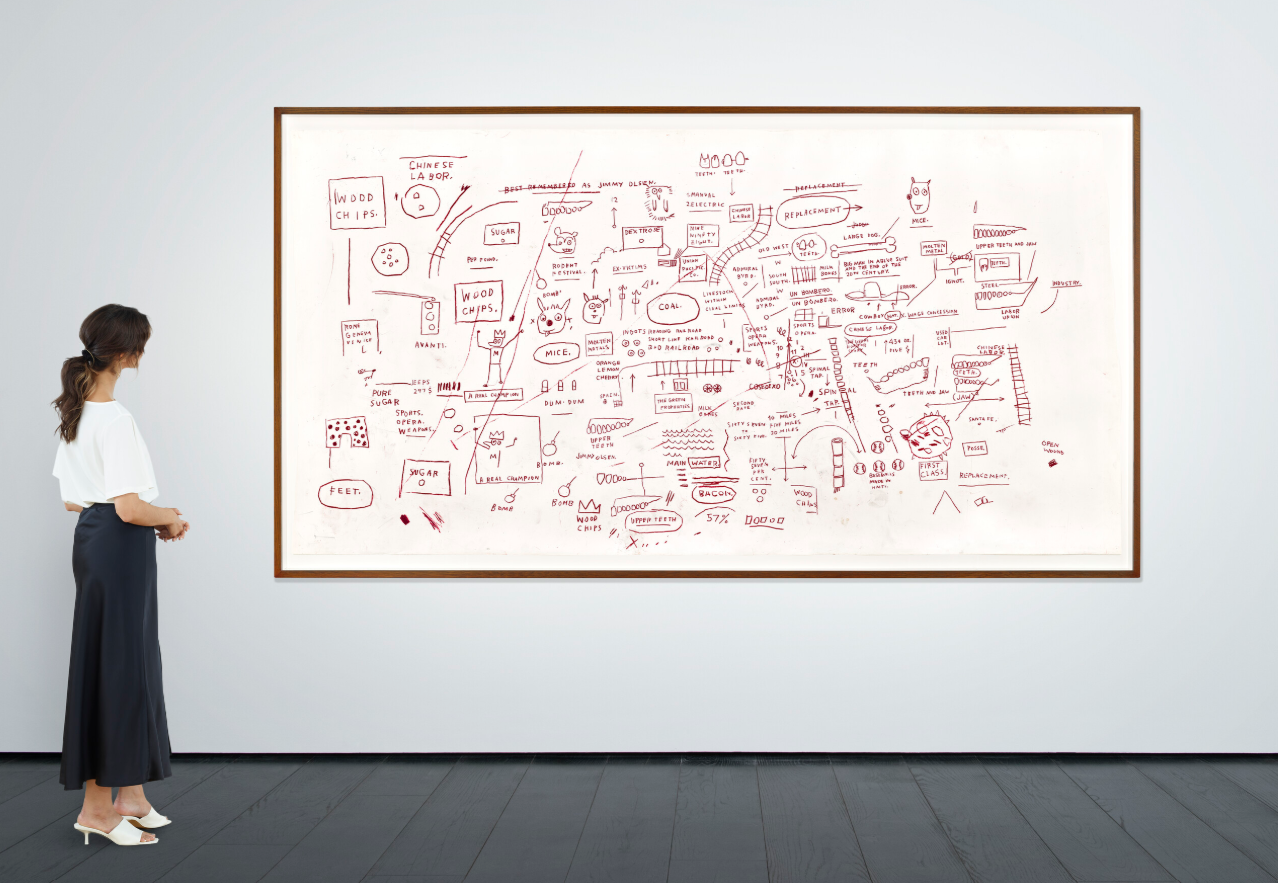
JEAN-MICHEL BASQUIAT (1960-1988)
Untitled, 1983
Oilstick on paper
50 1/3 x 98 1/2 inches (127.7 x 250.2 cm)
#13. Untitled, 1981
Phillips New-York: 15 November 2018
Estimated: USD 4,000,000 – 6,000,000
USD 4,575,000
Jean-Michel Basquiat – 20th Century… Lot 12 November 2018 | Phillips
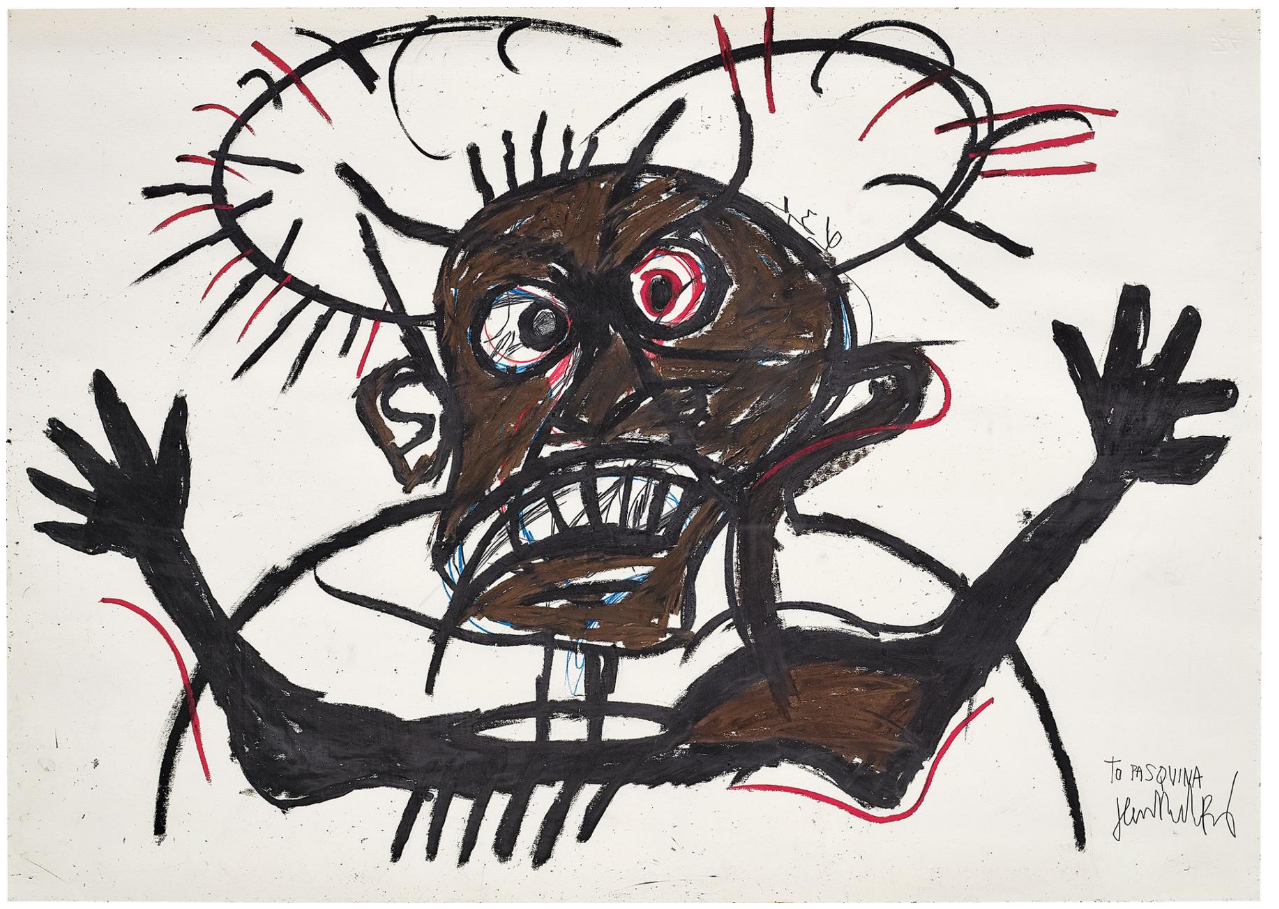
JEAN-MICHEL BASQUIAT
Untitled, 1981
Oilstick and graphite on paper
27 5/8 x 38 7/8 inches (70.2 x 98.7 cm)
Signed and dedicated “To Pasquina Jean-Michel Basquiat” lower right
#14. Untitled, 1982
Sotheby’s New-York: 14 November 2018
Estimated: USD 1,500,000 – 2,000,000
USD 4,455,000
(#7) JEAN-MICHEL BASQUIAT | Untitled
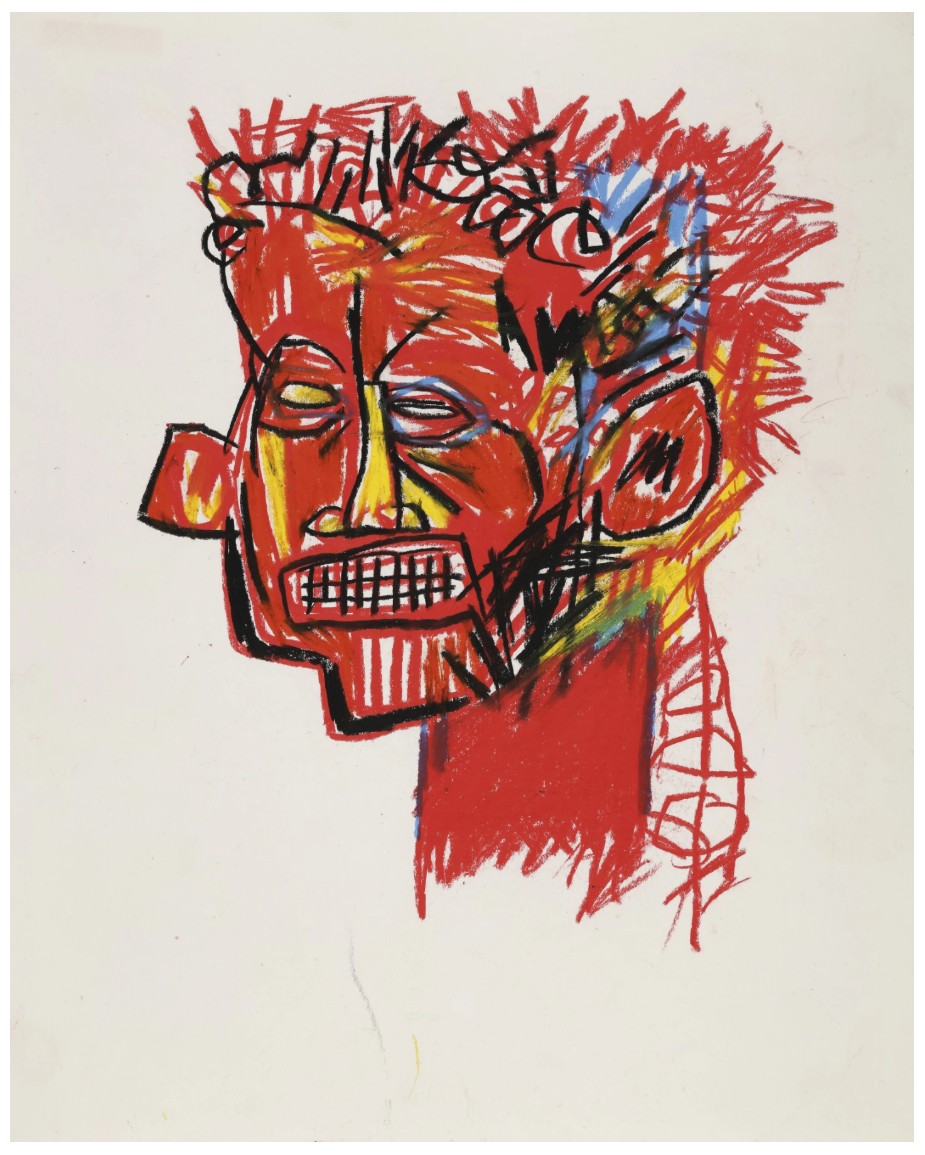 JEAN-MICHEL BASQUIAT
Untitled, 1982
Oilstick on paper
16 x 13 1/2 inches (40.6 x 34.3 cm)
Numbered BASQ-0547 on the reverse
Numbered JMB-0434 on a label affixed to the reverse
#15. Untitled (Head), 1982
Sotheby’s New-York: 16 May 2019
Estimated: USD 3,000,000 – 4,000,000
USD 4,100,000
(#8) JEAN-MICHEL BASQUIAT | Untitled (Head) (sothebys.com)
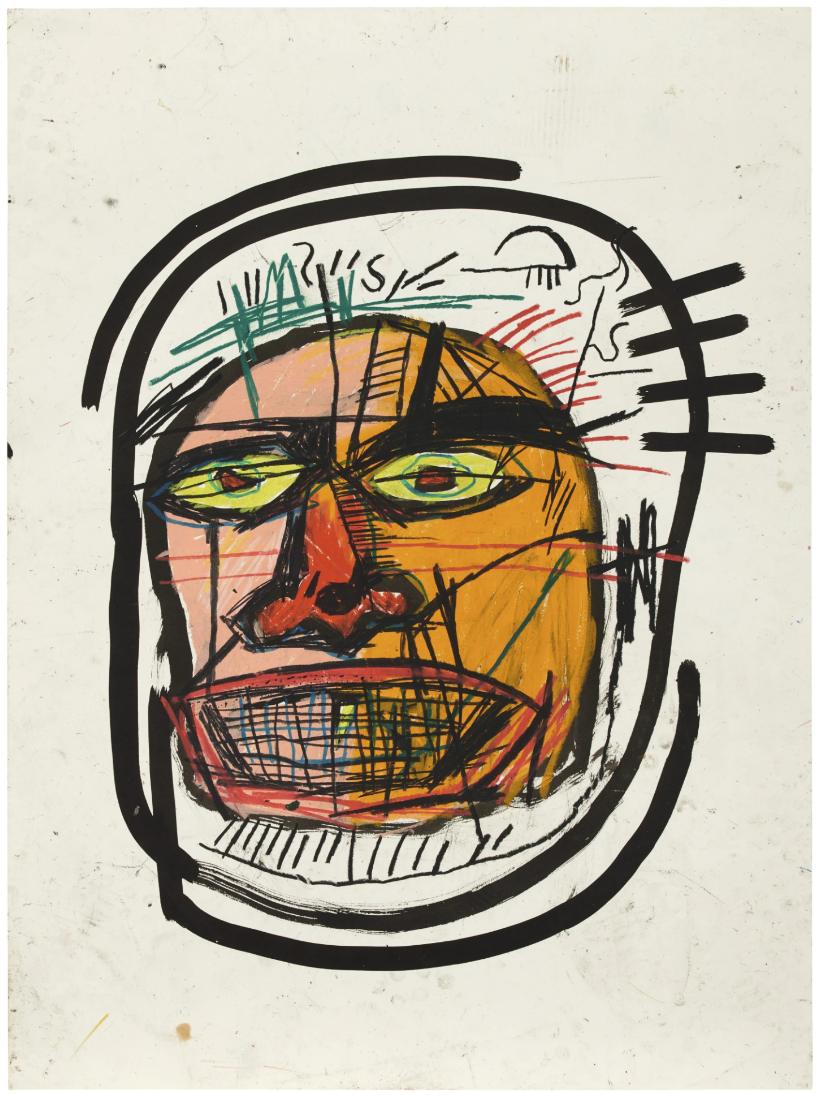
JEAN-MICHEL BASQUIAT
Untitled (Head), 1982
Ink and oilstick on paper
30×22 inches (76.2 x 55.9 cm)
Inscribed BASQ-0799 on the reverse
Repeat Sales
WORK IN PROGRESS
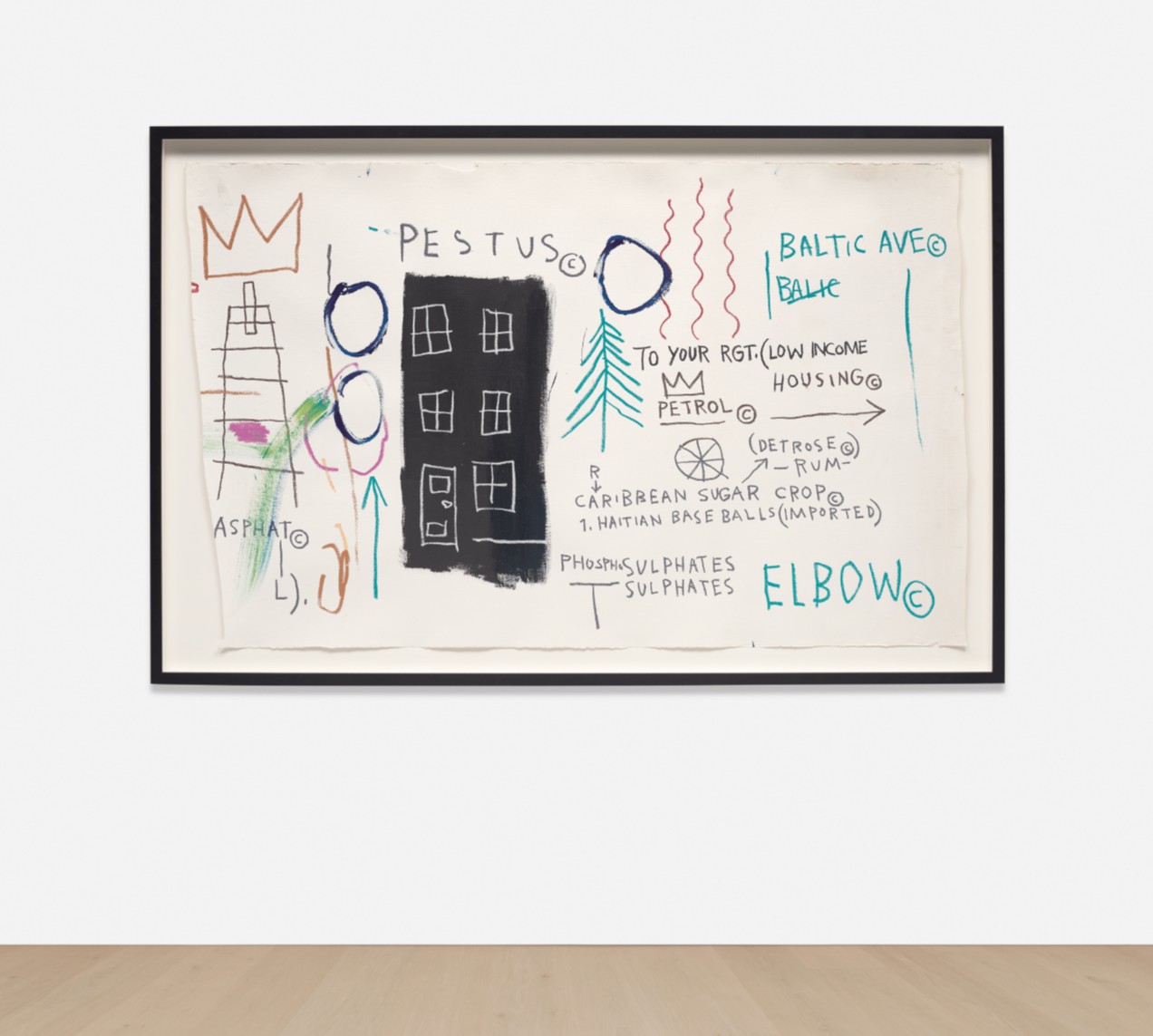
Untitled (Pestus), 1982
Phillips London: 16 October 2025
Estimated: GBP 2,000,000 – 3,000,000
GBP 2,374,000 / USD 3,181,160
WORK ON PAPER
Jean-Michel Basquiat Modern & Contemporary Art Evening Sale
REPEAT SALE
Phillips London: 20 October 2020
Estimated: GBP 2,000,000 – 3,000,000
GBP 2,200,500 / USD 2,849,770
Jean-Michel Basquiat 20th Century & Contemporary Art Evening Sale
Untitled, 1982
Phillips London: 6 March 2025
Estimated: GBP 400,000 – 600,000
GBP 609,600 / USD 780,288
WORK ON PAPER
Jean-Michel Basquiat – Modern & Contemp… Lot 5 March 2025 | Phillips
REPEAT SALE
Sotheby’s Paris: 5 December 2018
Estimated: EUR 300,000 – 500,000
EUR 393,000 / USD 446,055
WORK ON PAPER
(#1) JEAN-MICHEL BASQUIAT | Untitled
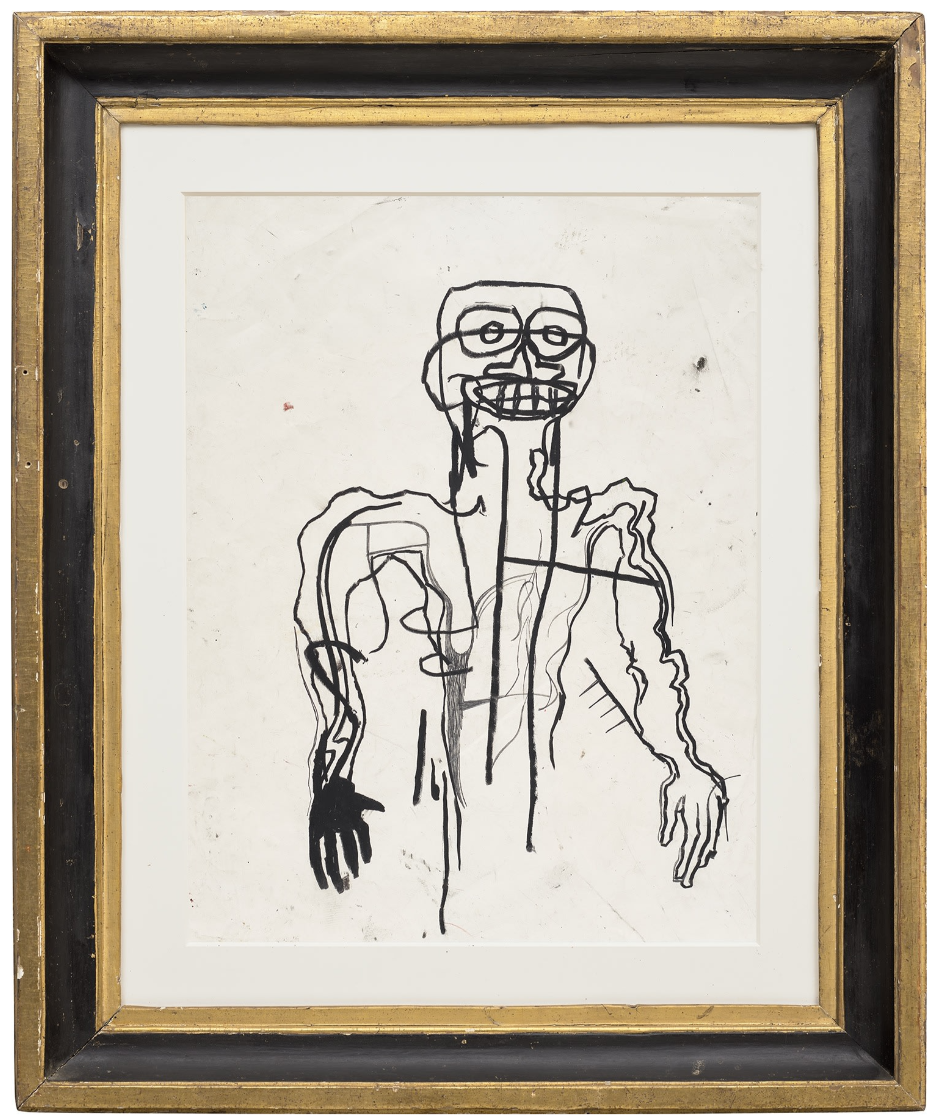
JEAN-MICHEL BASQUIAT
Untitled, 1982
Oilstick and pencil on paper
24 x 19 1/8 inches (61 x 48.5 cm)
Untitled, 1984
Sotheby’s New-York: 26 February 2025
Estimated: USD 800,000 – 1,200,000
USD 889,000
WORK ON PAPER
Untitled | Contemporary Curated | 2025 | Sotheby’s
REPEAT SALE
Christie’s New-York: 14 November 2019
Estimated: USD 500,000 – 700,000
USD 561,000
WORK ON PAPER
Jean-Michel Basquiat (1960-1988), Untitled | Christie’s
JEAN-MICHEL BASQUIAT (1960-1988)
Untitled, 1984
Oilstick and pastel on paper
30 x 22 1/4 inches (76.2 x 56.5 cm)
Untitled, 1984
Christie’s London: 28 June 2023
Estimated: GBP 1,000,000 – 1,500,000
GBP 1,250,000 / USD 1,579,279
WORK ON PAPER
JEAN-MICHEL BASQUIAT (1960-1988), Untitled | Christie’s
REPEAT SALE
Sotheby’s New-York: 8 December 2021
Estimated: USD 1,000,000 – 1,500,000
USD 1,532,500
WORK ON PAPER
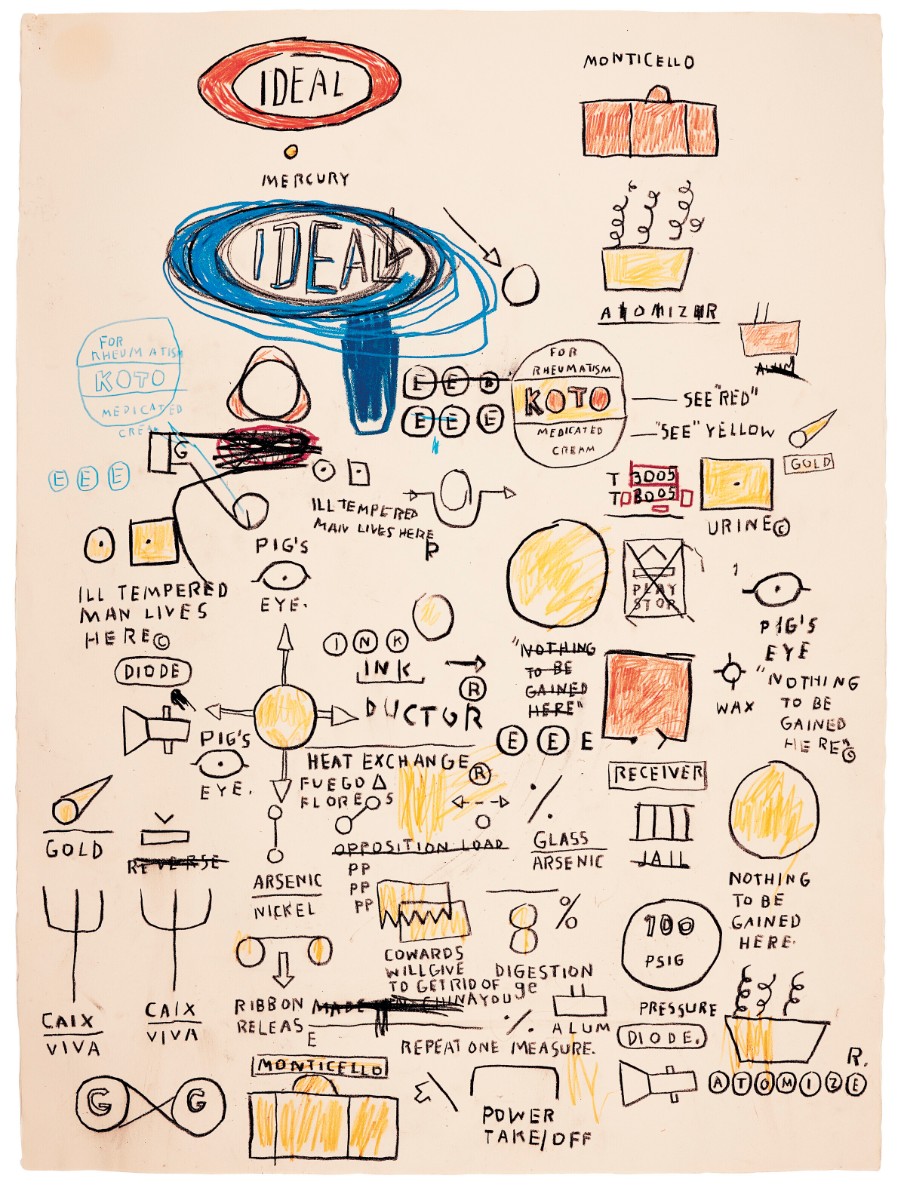
JEAN-MICHEL BASQUIAT (1960-1988)
Untitled, 1987
Wax crayon on paper
29 7/8 x 22 1/4 inches (75.9 x 56.5 cm)
Untitled (Cartoon Dog), circa 1983
Estimated: USD 600,000 – 800,000
USD 945,000
WORK ON PAPER
Estimated: GBP 200,000 – 300,000
GBP 620,000 / USD 854,229
WORK ON PAPER
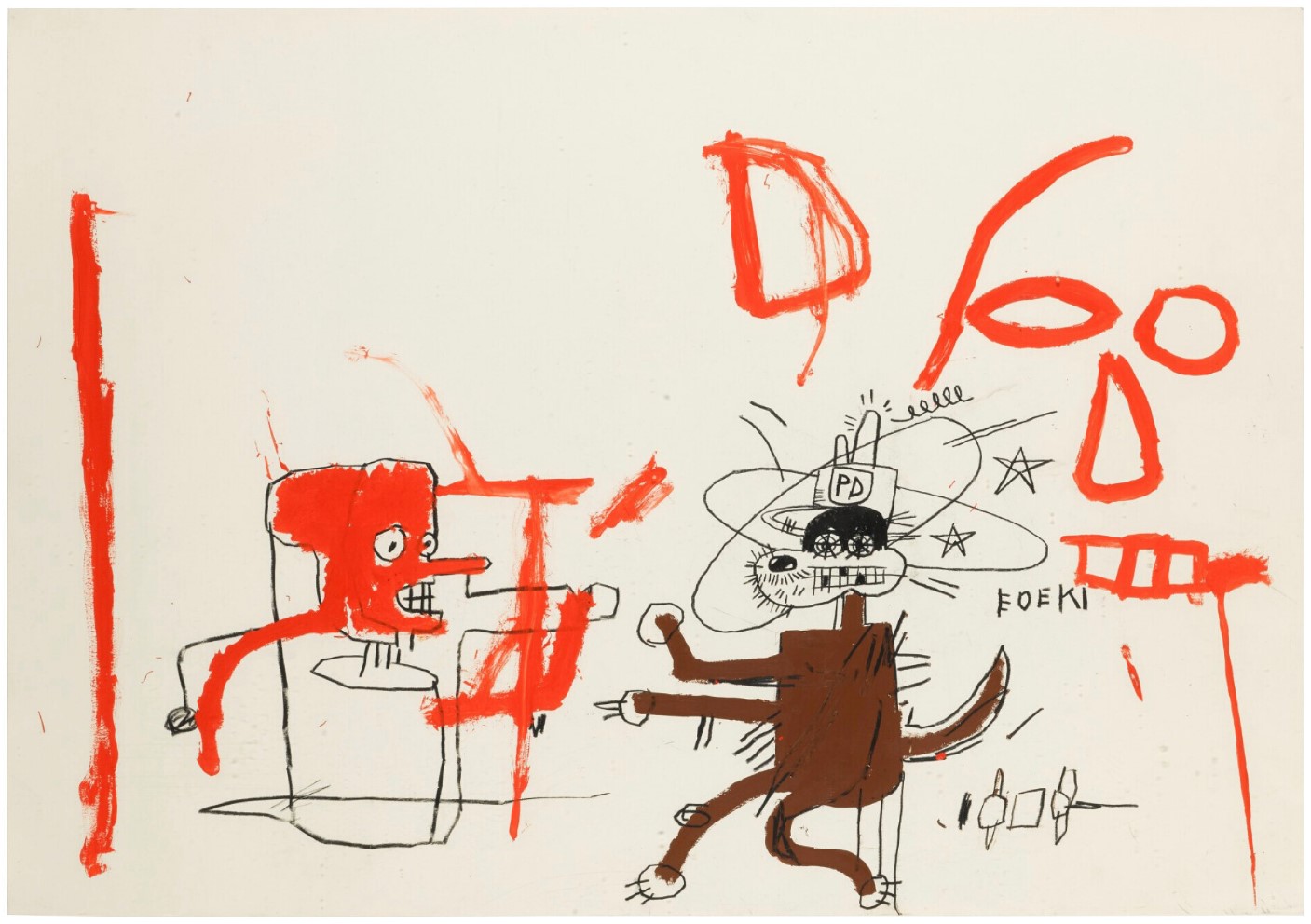
Untitled (Cartoon Dog), circa 1983
Acrylic and oilstick on paper
27 1/2 x 39 3/8 inches (69.9 x 100 cm)
Untitled (Self Portrait), 1982
Christie’s London: 28 June 2022
Estimated: GBP 4,000,000 – 6,000,000
GBP 7,961,000 / USD 9,716,831
JEAN-MICHEL BASQUIAT (1960-1988), Untitled (Self Portrait) | Christie’s
REPEAT SALE
Christie’s London: 26 June 2018
Estimated: GBP 1,500,000 – 2,500,000
GBP 3,892,250 / USD 5,153,168
JEAN-MICHEL BASQUIAT (1960-1988) (christies.com)
JEAN-MICHEL BASQUIAT
Untitled (Self Portrait), 1982
Oilstick and ink on paper
29.9 x 22 inches (75.9 x 55.9cm)
2026 Auction Results
PRELIMINARY AUCTION RESULTS
As of 1 June 2026
#1. Asbestos, 1982
Christie’s New-York: 20 May 2026
Estimated: USD 3,000,000 – 5,000,000
USD 6,541,000
WORK ON PAPER
JEAN-MICHEL BASQUIAT (1960-1988), Asbestos | Christie’s
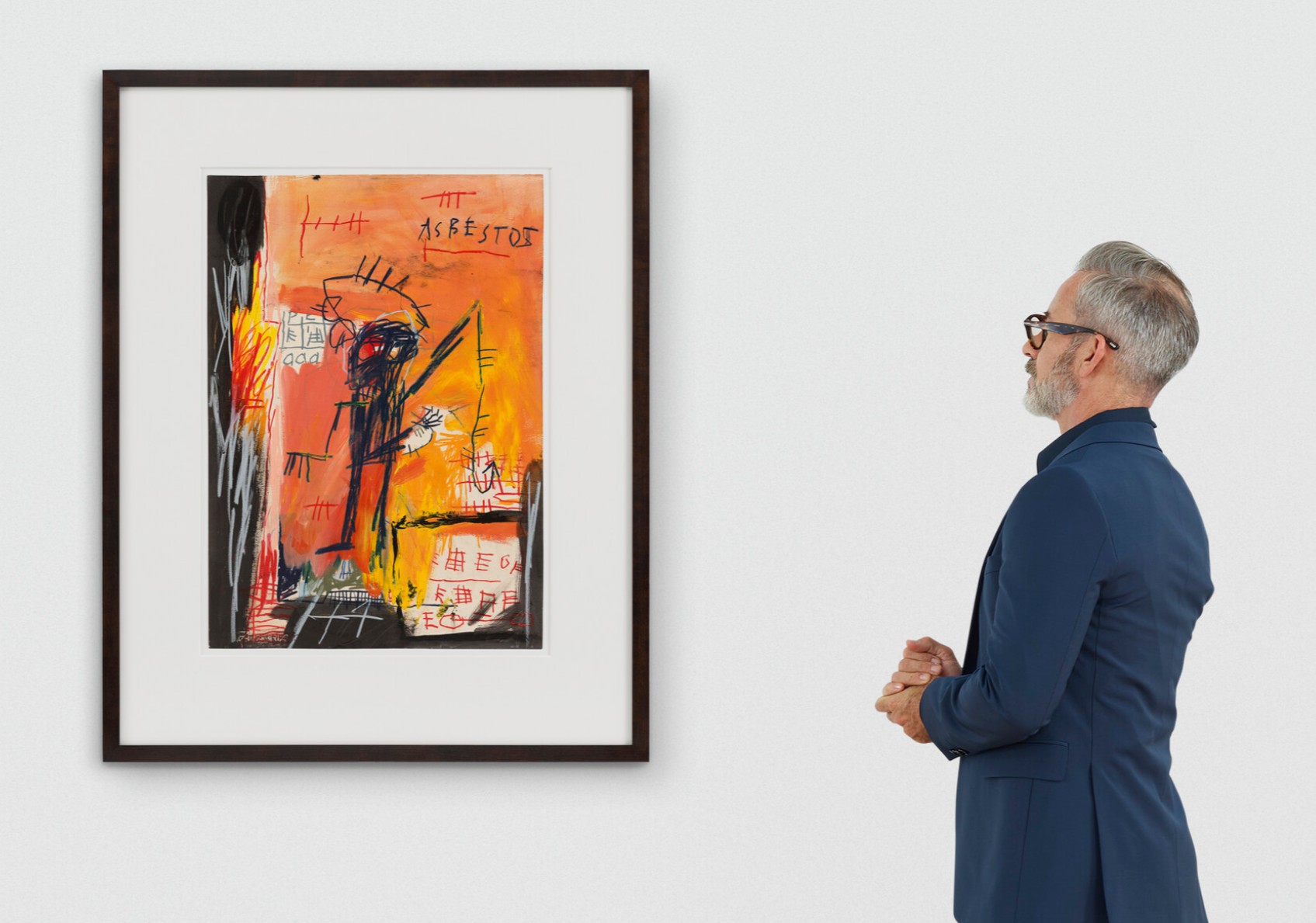
JEAN-MICHEL BASQUIAT (1960-1988)
Asbestos, 1982
Oil and oilstick on paper
27-5/8 x 19-3/8 inches (70.2 x 49.2 cm)
Signed and dated ‘BASQUIAT 1982’ (on the reverse)
#2. Untitled, 1981
PROPERTY FROM A DISTINGUISHED PRIVATE COLLECTION
Christie’s Hong-Kong: 27 March 2026
Estimated: HKD 18,000,000 – 28,000,000
HKD 22,216,000 / USD 2,837,290
JEAN-MICHEL BASQUIAT (1960-1988), Untitled | Christie’s
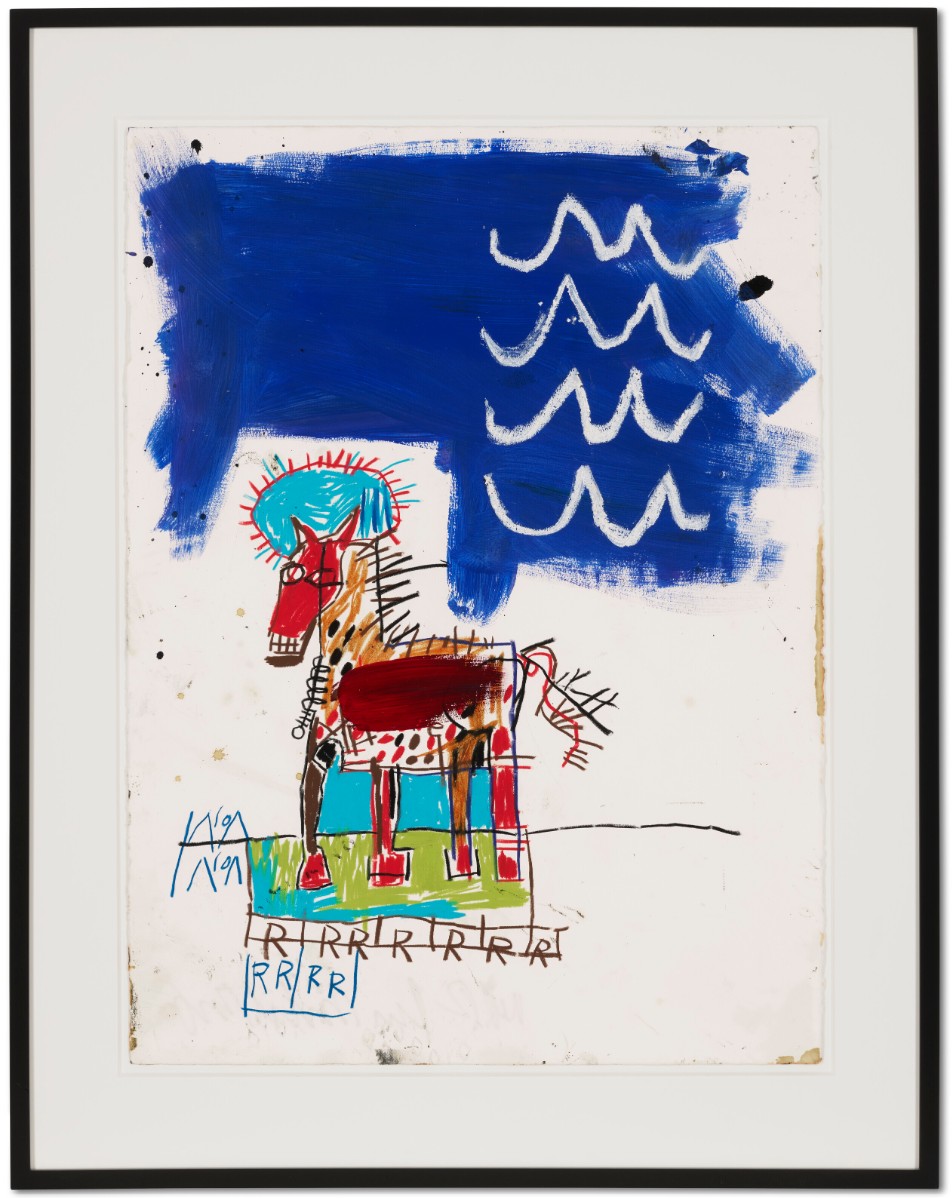
JEAN-MICHEL BASQUIAT (1960-1988)
Untitled, 1981
Oilstick and acrylic on paper
30 x 22-1/8 inches (76.2 x 56.1 cm)
Signed ‘Jean-Michel Basquiat’ (on the reverse)
#3. Untitled, 1985
Christie’s New-York: 21 May 2026
Estimated: USD 1,000,000 – 1,500,000
USD 1,966,000
WORK ON PAPER
JEAN-MICHEL BASQUIAT (1960-1988), Untitled | Christie’s
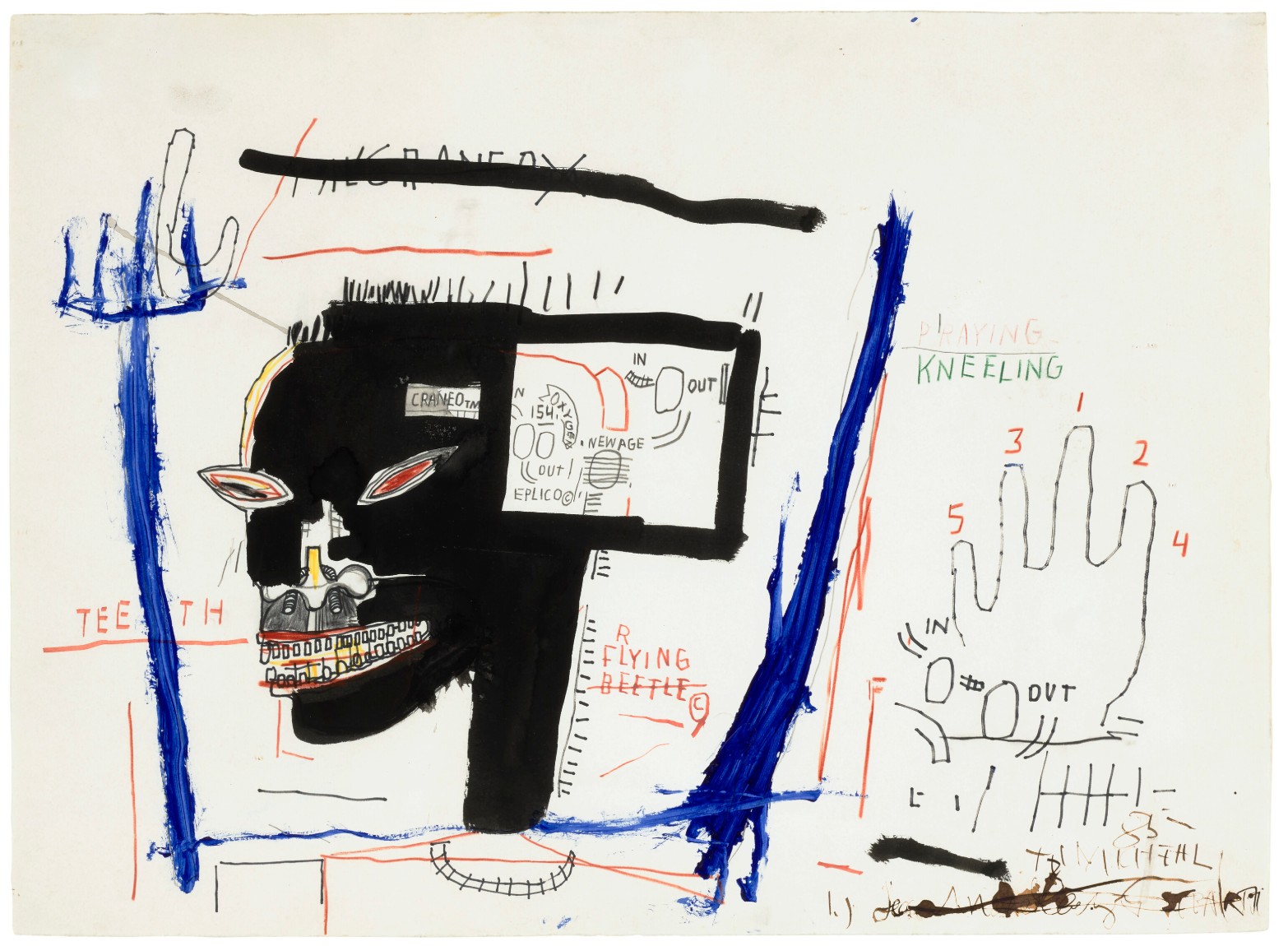
JEAN-MICHEL BASQUIAT (1960-1988)
Untitled, 1985
Ink, acrylic, marker, colored pencil and graphite on paper
19×26 inches (48.3 x 66 cm)
Signed, inscribed, dedicated and dated ‘’85 TO MICHAEL Jean-Michel Basquiat ST BARTH’ (lower right)
Registered with the Authentication Committee for the Estate of Jean-Michel Basquiat under transaction #60035
#4. Untitled, 1982
Christie’s New-York: 21 May 2026
Estimated: USD 800,000 – 1,200,000
USD 952,500
WORK ON PAPER
JEAN-MICHEL BASQUIAT (1960-1988), Untitled | Christie’s
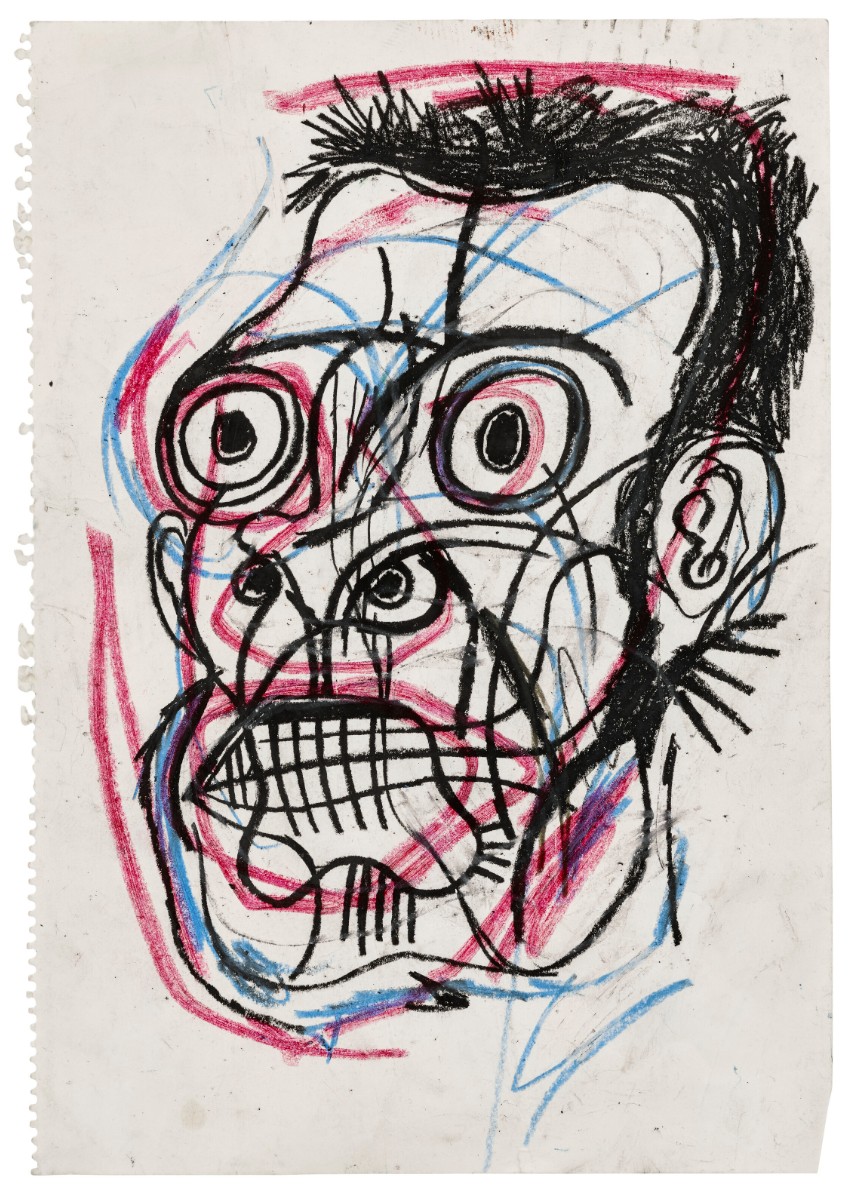
JEAN-MICHEL BASQUIAT (1960-1988)
Untitled, 1982
Oilstick on paper
14 x 9-3/4 inches (35.5 x 23.6 cm)
#5. Untitled (Spoon), 1988
Christie’s London: 7 March 2026
Estimated: GBP 350,000 – 750,000
GBP 508,000 / USD 678,635
JEAN-MICHEL BASQUIAT (1960-1988), Untitled (Spoon) | Christie’s
REPEAT SALE
Christie’s New-York: 27 September 2018
Estimated: USD 120,000 – 180,000
USD 324,500
Jean-Michel Basquiat (1960-1988), Untitled (Spoon) | Christie’s
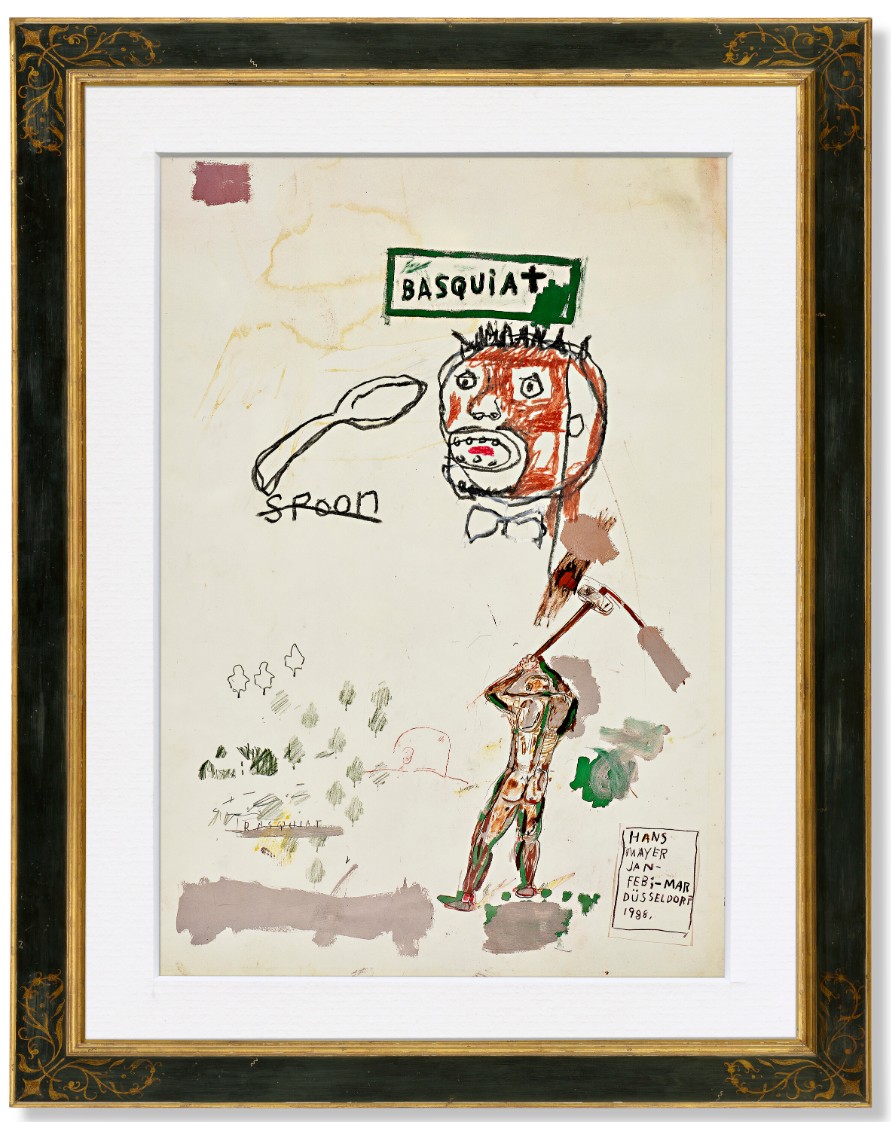
JEAN-MICHEL BASQUIAT (1960-1988)
Untitled (Spoon), 1988
Oilstick on offset lithograph
33-1/8 x 23-3/8 inches (84 x 59.4 cm)
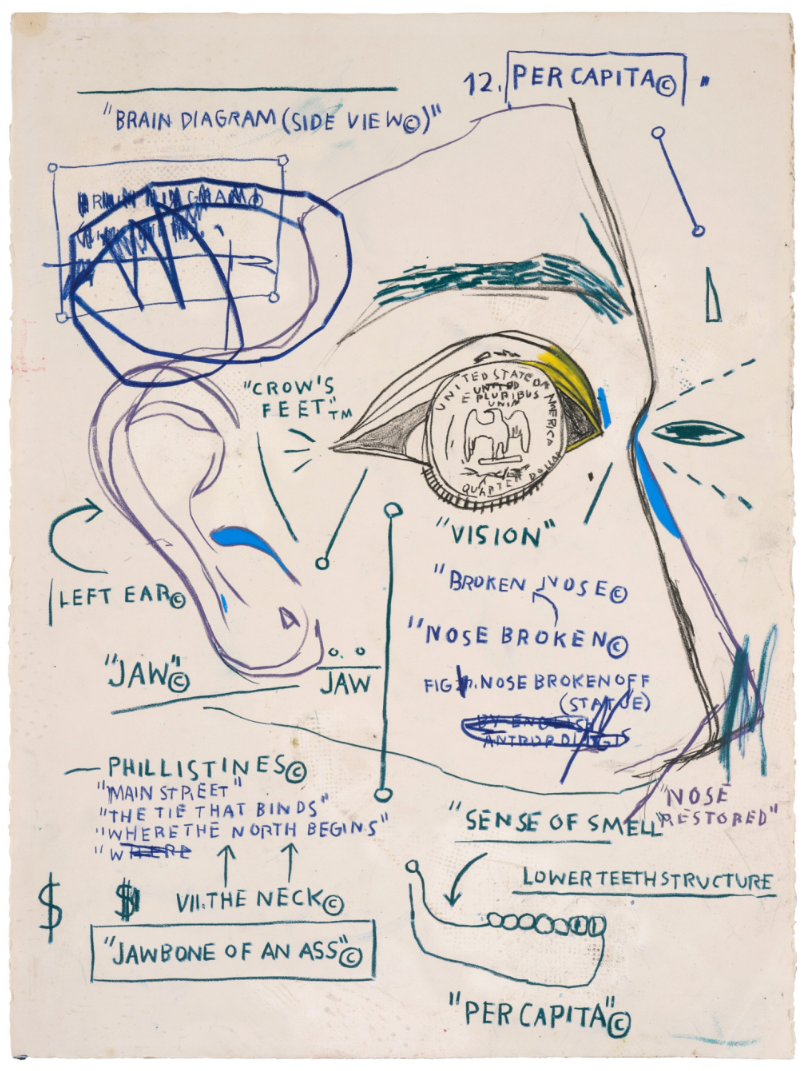
#6. Sans titre (Per Capita), 1981
Christie’s Paris: 15 April 2026
Estimated: EUR 250,000 – 350,000
EUR 381,000 / USD 449,510
Jean-Michel Basquiat (1960-1988), Sans titre (Per Capita) | Christie’s
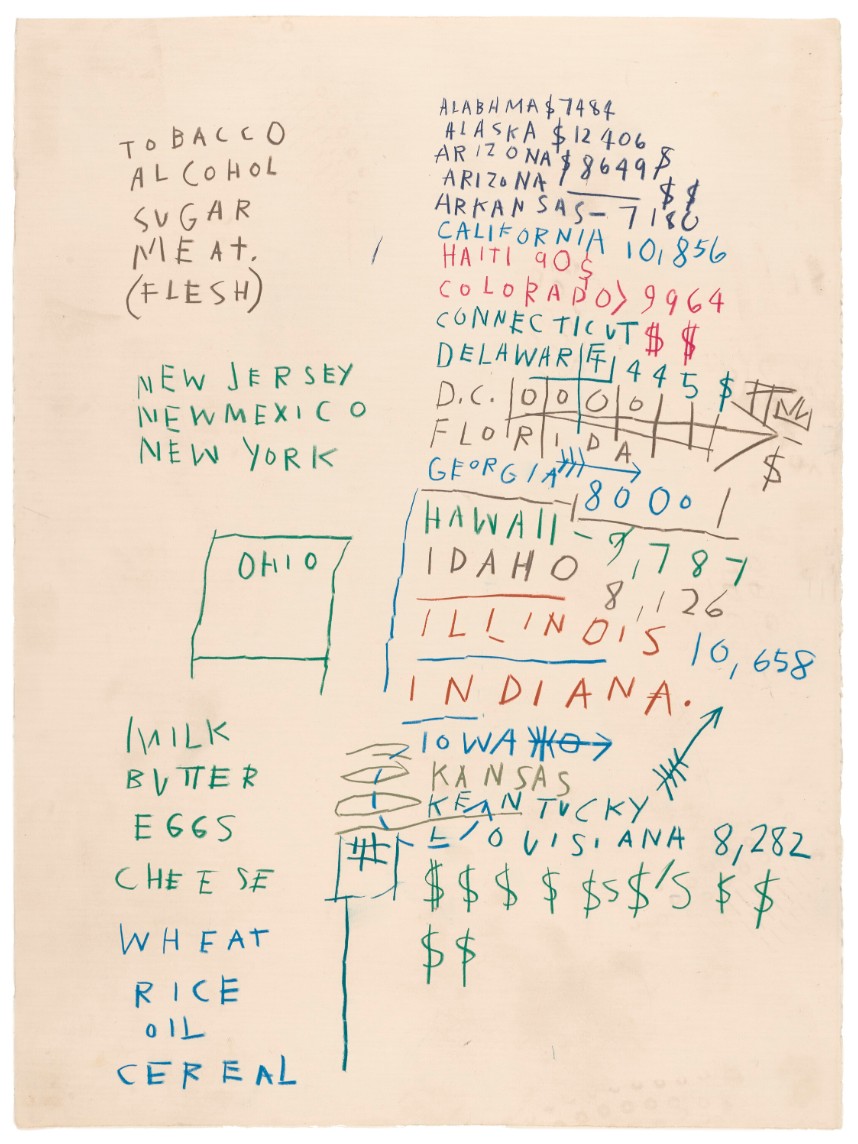
JEAN-MICHEL BASQUIAT (1960-1988)
Sans titre (Per Capita), 1981
Oil stick on paper
30 x 22-1/2 inches (76.4 x 57.2 cm)
Lots Withdrawn
Untitled, 1985
Sotheby’s Ryiadh: 31 January 2026
Estimated: USD 400,000 – 600,000
WITHDRAWN
Untitled | Origins II | 2026 | Sotheby’s
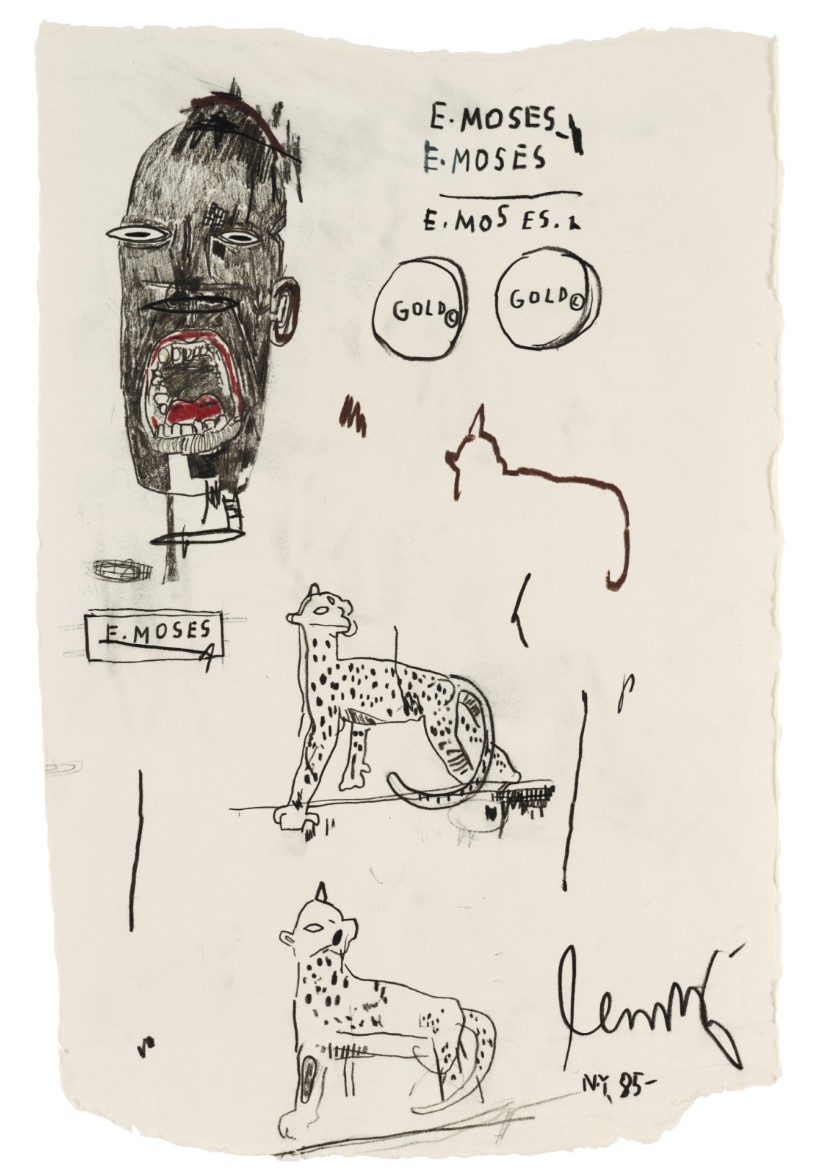
JEAN-MICHEL BASQUIAT (1960 – 1988)
Untitled, 1985
Oil stick and graphite on paper
16 x 10 1/2 inches (40.6 x 26.7 cm)
Signed and dated NY, 85 (lower right)
2025 Auction Results
25 lots sold at auction in 2025 for a total turnover of USD 49,210,347. With no lot failing to sell, the sell-through rate is 100%. The highest price was achieved by Untitled, a drawing dated 1981, sold at Sotheby’s in New-York, on 15 May 2025 for USD 16,365,000.
2025 Top 5 Lots
8 lots sold for more than USD 1 million, generating a cumulative turnover of USD 40,727,082, representing 82.8% of the total turnover in 2025. 17 lots sold for more than USD 500,000, generating a cumulative turnover of USD 47,216,428, representing 95.9% of the total turnover for 2025.
XXXXXXXXXX
#1. Untitled, 1981
Sotheby’s New-York: 15 May 2025
Estimated: USD 10,000,000 – 15,000,000
USD 16,365,000
WORK ON PAPER
Untitled | The Now and Contemporary Evening Auction | 2025 | Sotheby’s
JEAN-MICHEL BASQUIAT (1960 – 1988)
Untitled, 1981
Oilstick on paper
50 1/4 x 63 7/8 inches (127.6 x 160 cm)
Signed (on the reverse)
USD 10 million
#2. Untitled (Indian Head), 1981
Sotheby’s London: 24 June 2025
Estimated: GBP 4,000,000 – 6,000,000
GBP 6,628,000 / USD 9,080,360
WORK ON PAPER
Untitled (Indian Head) | Modern & Contemporary Evening Auction | 2025 | Sotheby’s
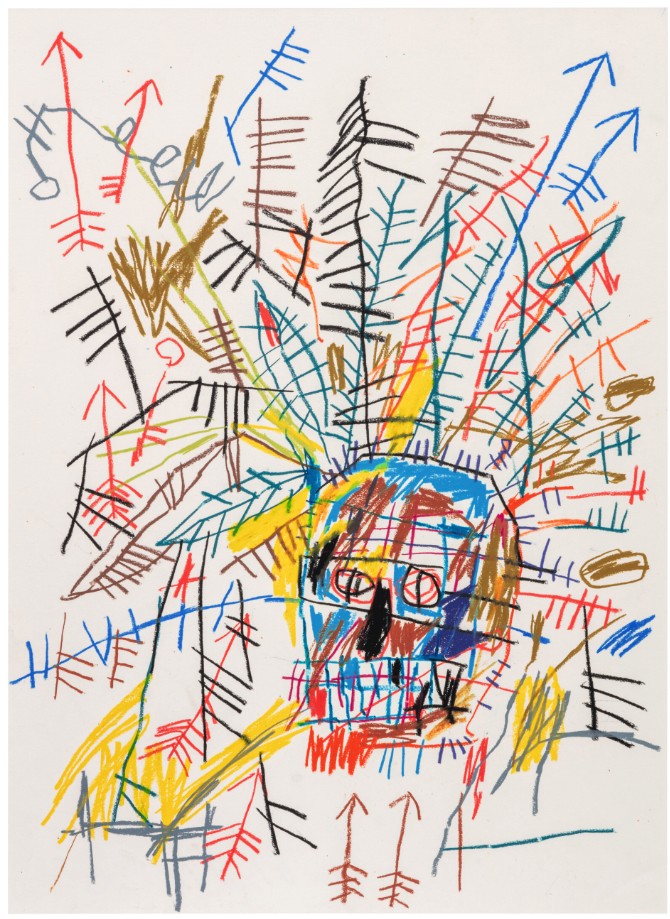
JEAN-MICHEL BASQUIAT (1960 – 1988)
Untitled (Indian Head), 1981
Oilstick on paper
24 1/4 x 18 inches (61.6 x 45.8 cm)
Signed and dated 81 (on the verso)
USD 5 million
#3. Untitled, 1983
Christie’s London: 5 March 2025
Estimated: GBP 2,500,000 – 3,500,000
GBP 3,851,500 / USD 4,929,920
WORK ON PAPER
JEAN-MICHEL BASQUIAT (1960-1988), Untitled | Christie’s
JEAN-MICHEL BASQUIAT (1960-1988)
Untitled, 1983
Oilstick on paper
50 1/3 x 98 1/2 inches (127.7 x 250.2 cm)
#4. Untitled (Pestus), 1982
Phillips London: 16 October 2025
Estimated: GBP 2,000,000 – 3,000,000
GBP 2,374,000 / USD 3,181,160
WORK ON PAPER
Jean-Michel Basquiat Modern & Contemporary Art Evening Sale
#5. Untitled, 1985-1986
Phillips New-York: 13 May 2025
Estimated: USD 1,500,000 – 2,000,000
USD 2,964,000
WORK ON PAPER
Jean-Michel Basquiat Modern & Contemporary Art Evening Sale
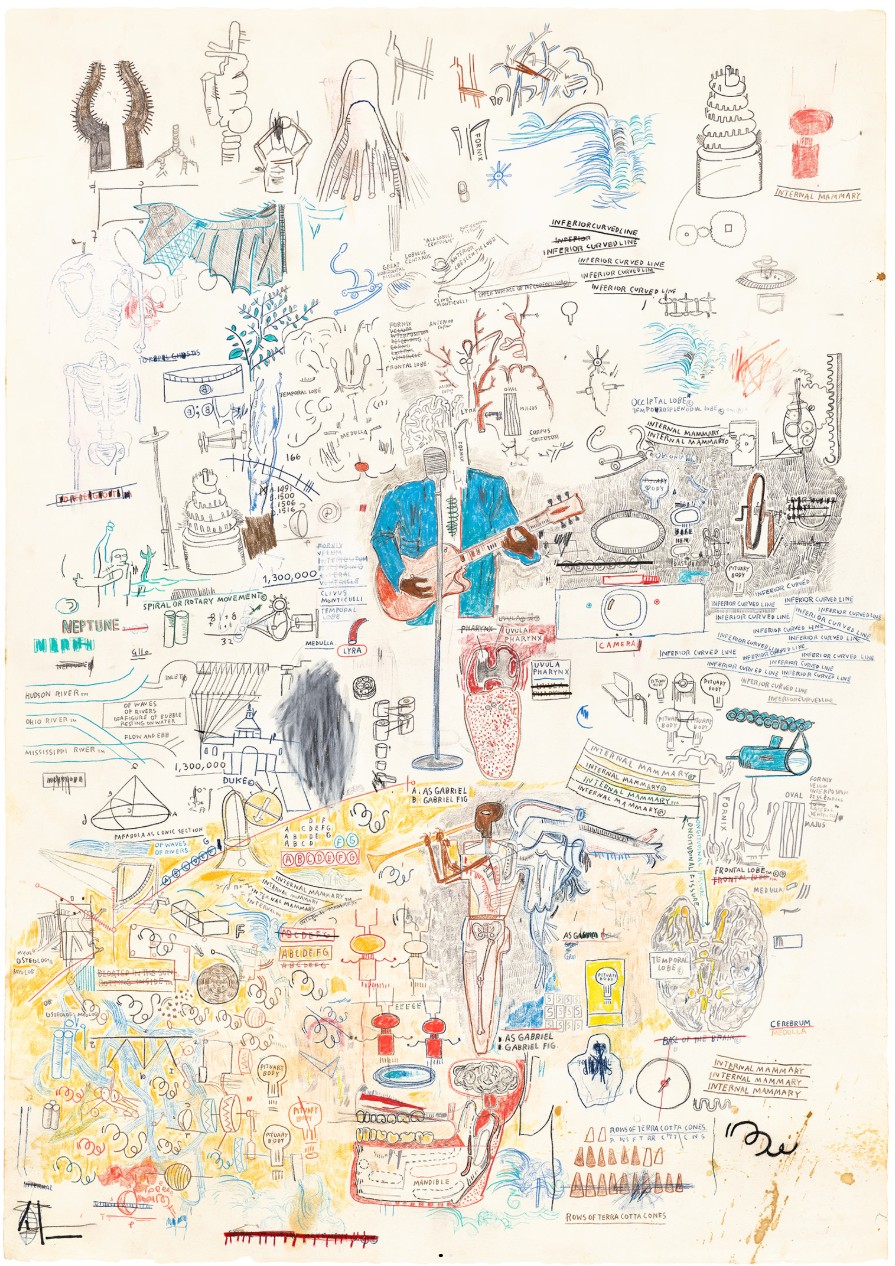
Untitled, 1985-1986
Oilstick and crayon on paper
#6. Foo, 1982
Sotheby’s New-York: 16 May 2025
Estimated: USD 600,000 – 800,000
USD 1,972,000
WORK ON PAPER
Foo | Contemporary Day Auction | 2025 | Sotheby’s
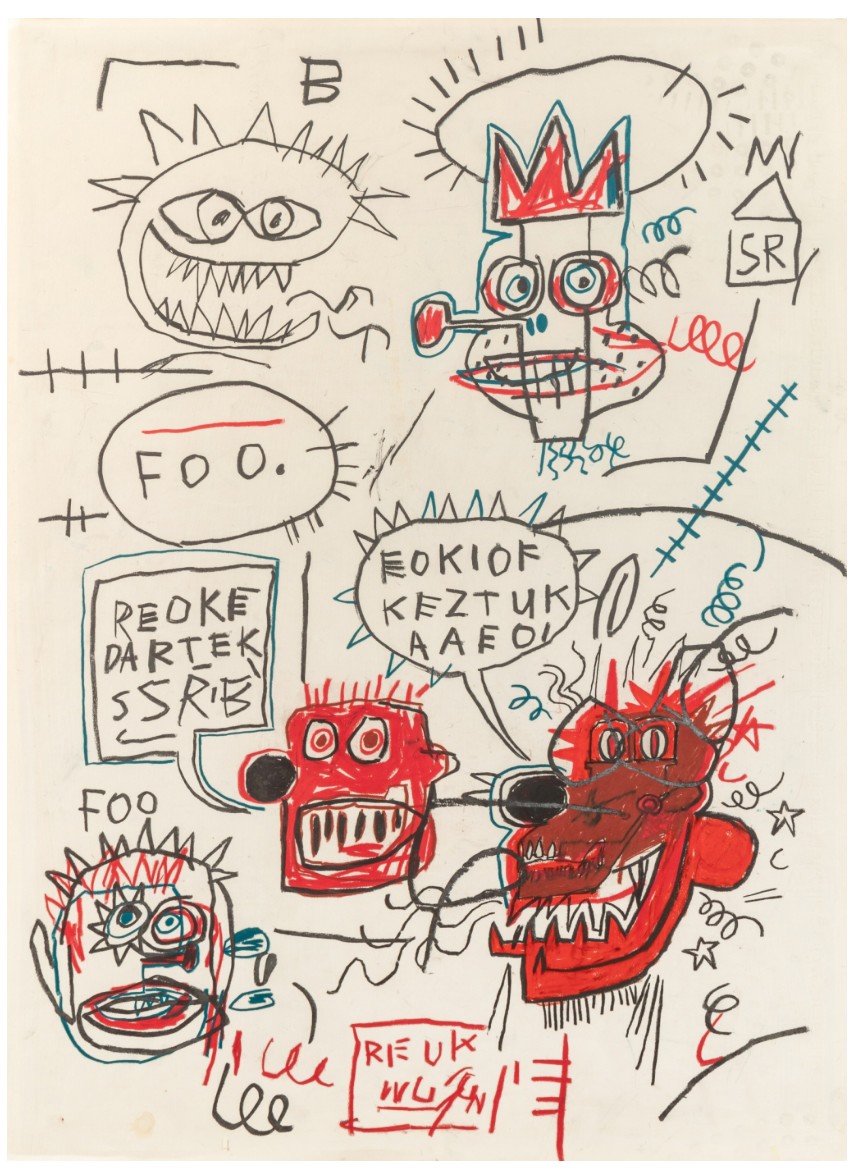
JEAN-MICHEL BASQUIAT (1960 – 1988)
Foo, 1982
Oil stick on paper
30×22 inches (76.2 x 55.9 cm)
Signed (on the verso)
#7. Untitled, 1982
Phillips New-York: 19 November 2025
Estimated: USD 800,000 – 1,200,000
USD 1,225,500
WORK ON PAPER
Jean-Michel Basquiat Modern & Contemporary Art Evening Sale featuring Cera the Triceratops
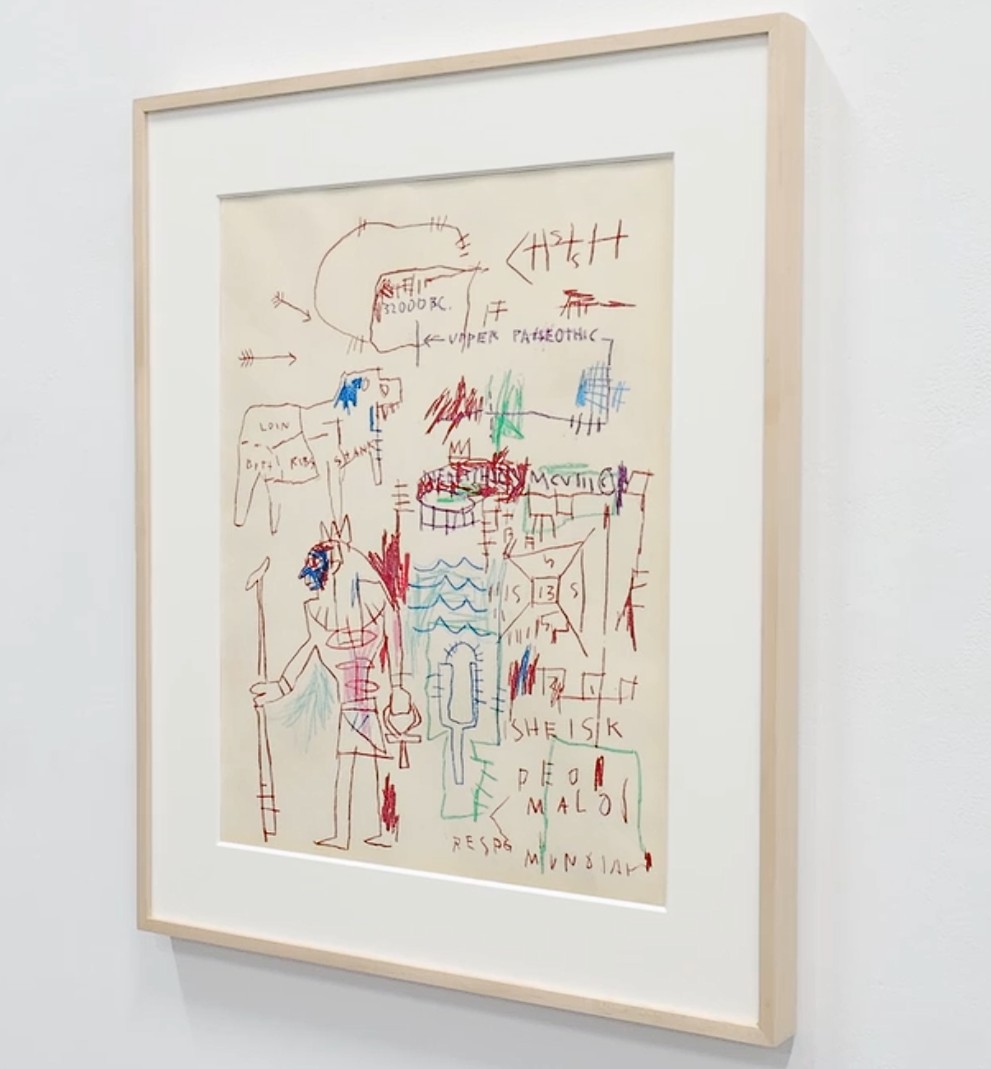
JEAN-MICHEL BASQUIAT
Untitled, 1982
Oilstick on paper
24 x 18 1/4 inches (61 x 46.4 cm)
#8. Untitled (NY CZAR), 1988
Sotheby’s London: 24 June 2025
Estimated: GBP 500,000 – 700,000
GBP 736,600 / USD 1,009,140
WORK ON PAPER
Untitled (NY CZAR) | Modern & Contemporary Evening Auction | 2025 | Sotheby’s
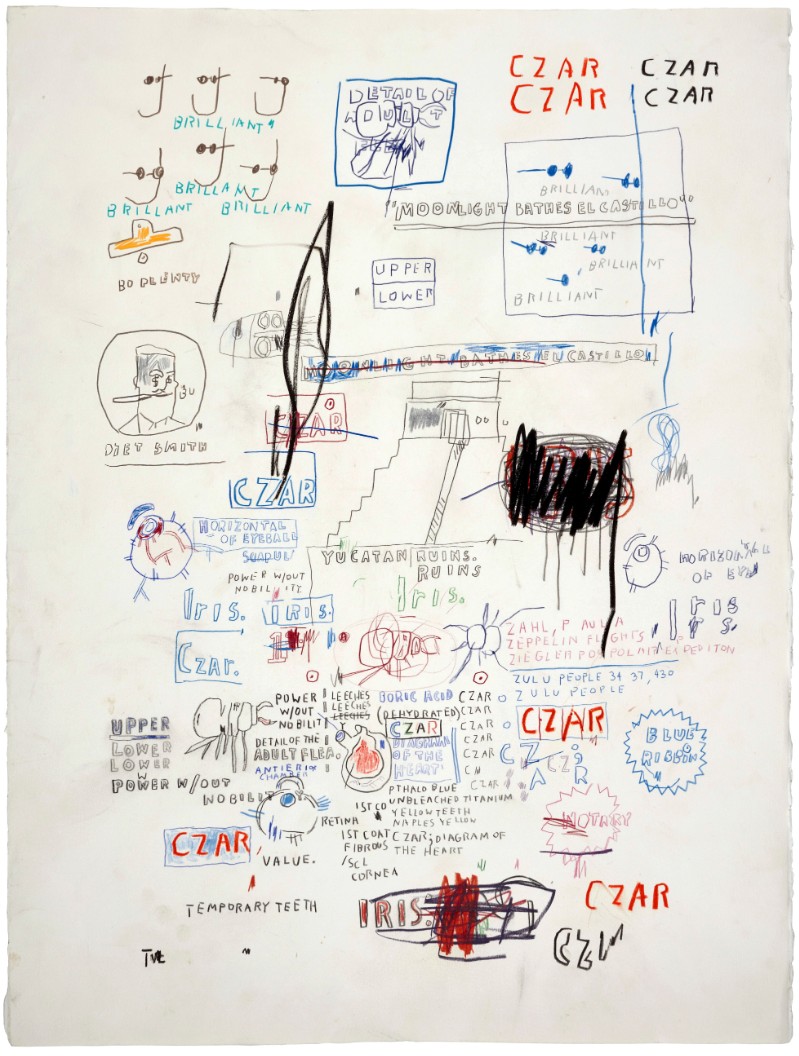
JEAN-MICHEL BASQUIAT (1960 – 1988)
Untitled (NY CZAR), 1988
Oilstick and graphite on paper
31 1/2 x 24 inches (80.4 x 61 cm)
Signed, titled, and dated 88 New York with drawing (on the verso)
USD 1 million
#9. Untitled, 1984
Sotheby’s New-York: 26 February 2025
Estimated: USD 800,000 – 1,200,000
USD 889,000
WORK ON PAPER
Untitled | Contemporary Curated | 2025 | Sotheby’s
JEAN-MICHEL BASQUIAT (1960-1988)
Untitled, 1984
Oilstick and pastel on paper
30 x 22 1/4 inches (76.2 x 56.5 cm)
#10. Untitled, 1982
Sotheby’s New-York: 19 November 2025
Estimated: USD 700,000 – 1,000,000
USD 889,000
WORK ON PAPER
Untitled | Contemporary Day Auction | 2025 | Sotheby’s
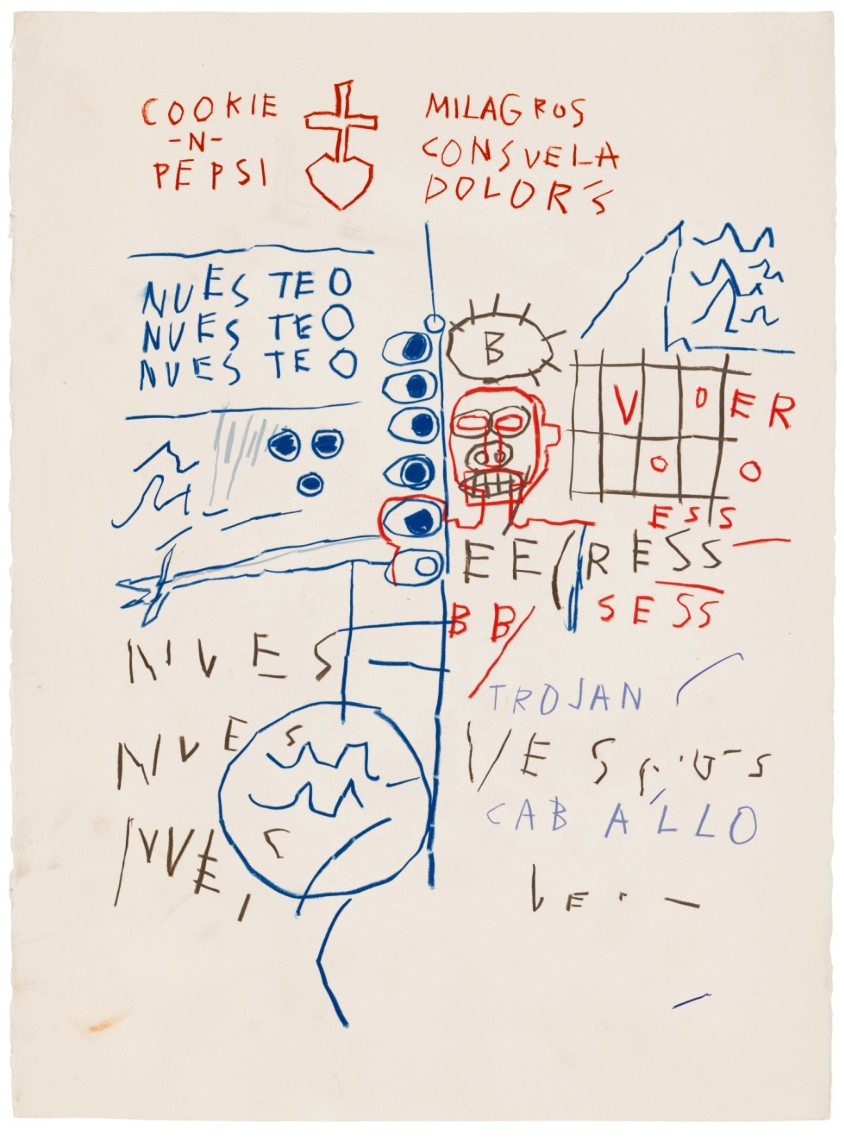
JEAN-MICHEL BASQUIAT (1960 – 1988)
Untitled, 1982
Oilstick and graphite on paper
30 x 22 1/2 inches (76.2 x 57.2 cm)
Signed (on the verso)
#11. Feng Yao, 1983
Phillips New-York: 28 February 2025
Estimated: USD 700,000 – 1,000,000
USD 825,500
WORK ON PAPER
Jean-Michel Basquiat – New Now: Mod… Lot 21 February 2025 | Phillips
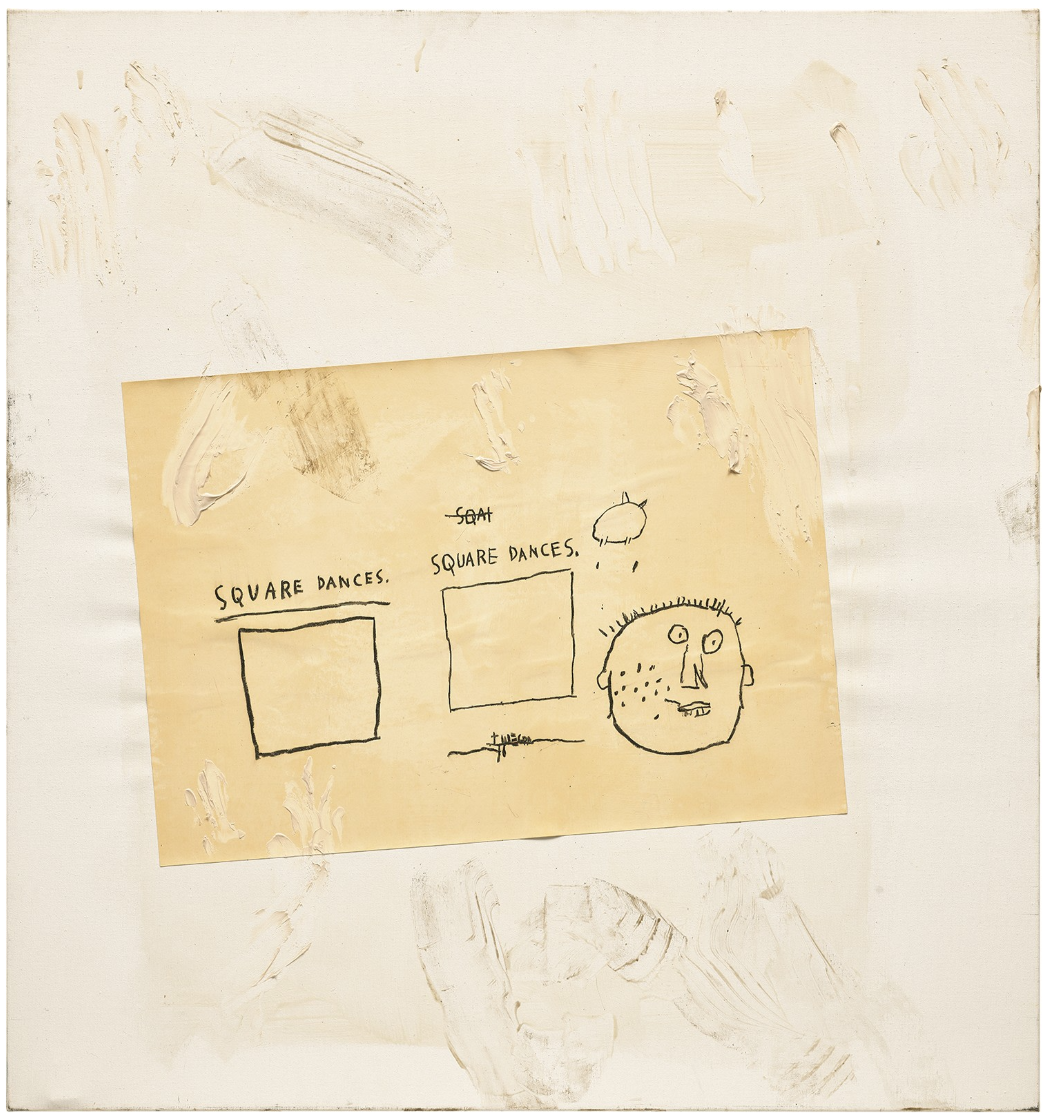
JEAN-MICHEL BASQUIAT
Feng Yao, 1983
Acrylic, oil stick and paper collage on canvas
63×59 inches (160 x 149.9 cm)
Signed, titled, inscribed and dated “”FENG YAO” Jean-Michel Basquiat FEB 1983, ST MORITZ.” on the reverse
#12. Untitled, 1982
Phillips London: 6 March 2025
Estimated: GBP 400,000 – 600,000
GBP 609,600 / USD 780,288
WORK ON PAPER
Jean-Michel Basquiat – Modern & Contemp… Lot 5 March 2025 | Phillips
JEAN-MICHEL BASQUIAT
Untitled, 1982
Oilstick and pencil on paper
24 x 19 1/8 inches (61 x 48.5 cm)
#13. Untitled, 1982
Christie’s London: 15 October 2025
Estimated: GBP 300,000 – 500,000
GBP 508,000 / USD 680,270
WORK ON PAPER
JEAN-MICHEL BASQUIAT (1960-1988), Untitled | Christie’s
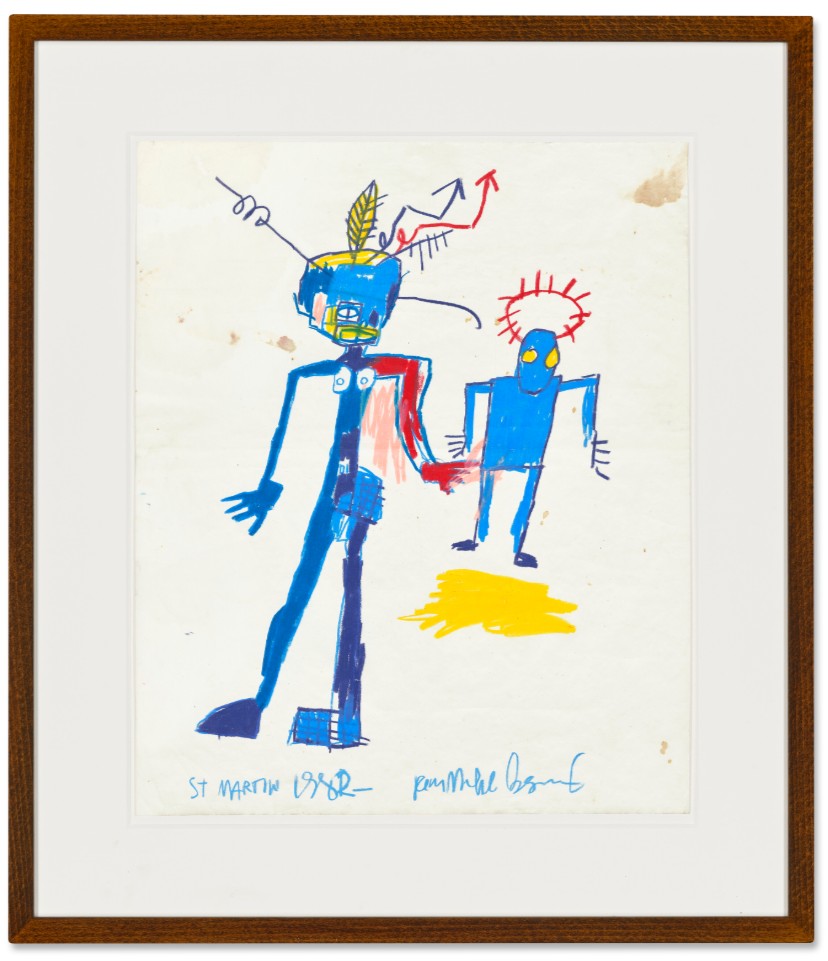
JEAN-MICHEL BASQUIAT (1960-1988)
Untitled, 1982
Oilstick on paper
17 x 13 7/8 inches (43 x 35.3 cm)
Signed, inscribed and dated ‘ST MARTIN 1982- Jean-Michel Basquiat’ (lower edge)
#14. Untitled, 1981
Sotheby’s London: 17 October 2025
Estimated: GBP 300,000 – 400,000
GBP 495,300 / USD 663,700
WORK ON PAPER
Untitled | Contemporary Day Auction | 2025 | Sotheby’s
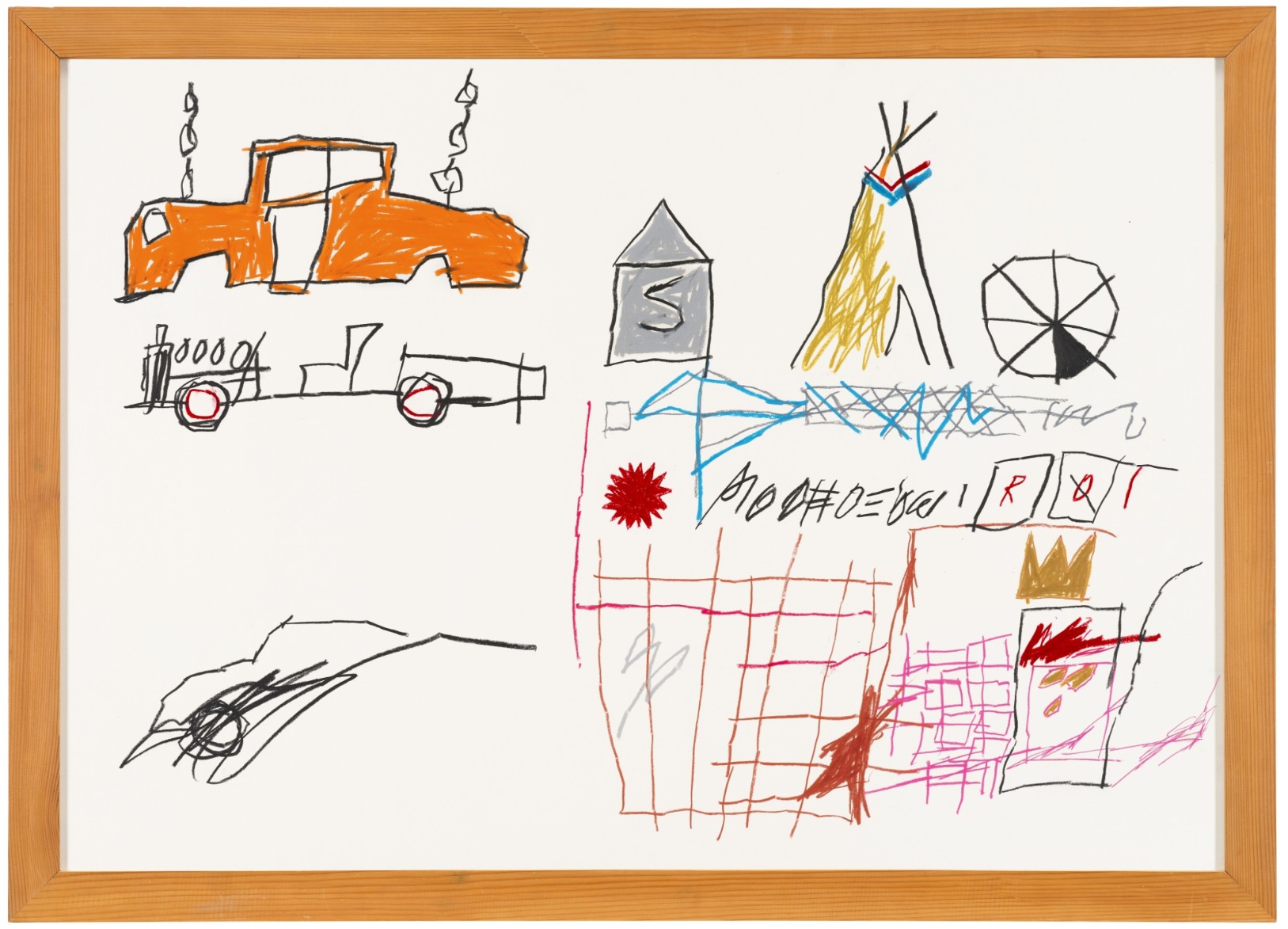
JEAN-MICHEL BASQUIAT (1960 – 1988)
Untitled, 1981
Oilstick on paper
27 1/2 x 39 3/8 inches (70×100 cm)
#15. Untitled, 1981
Sotheby’s New-York: 16 May 2025
Estimated: USD 700,000 – 900,000
USD 660,400
WORK ON PAPER
Untitled | Contemporary Day Auction | 2025 | Sotheby’s
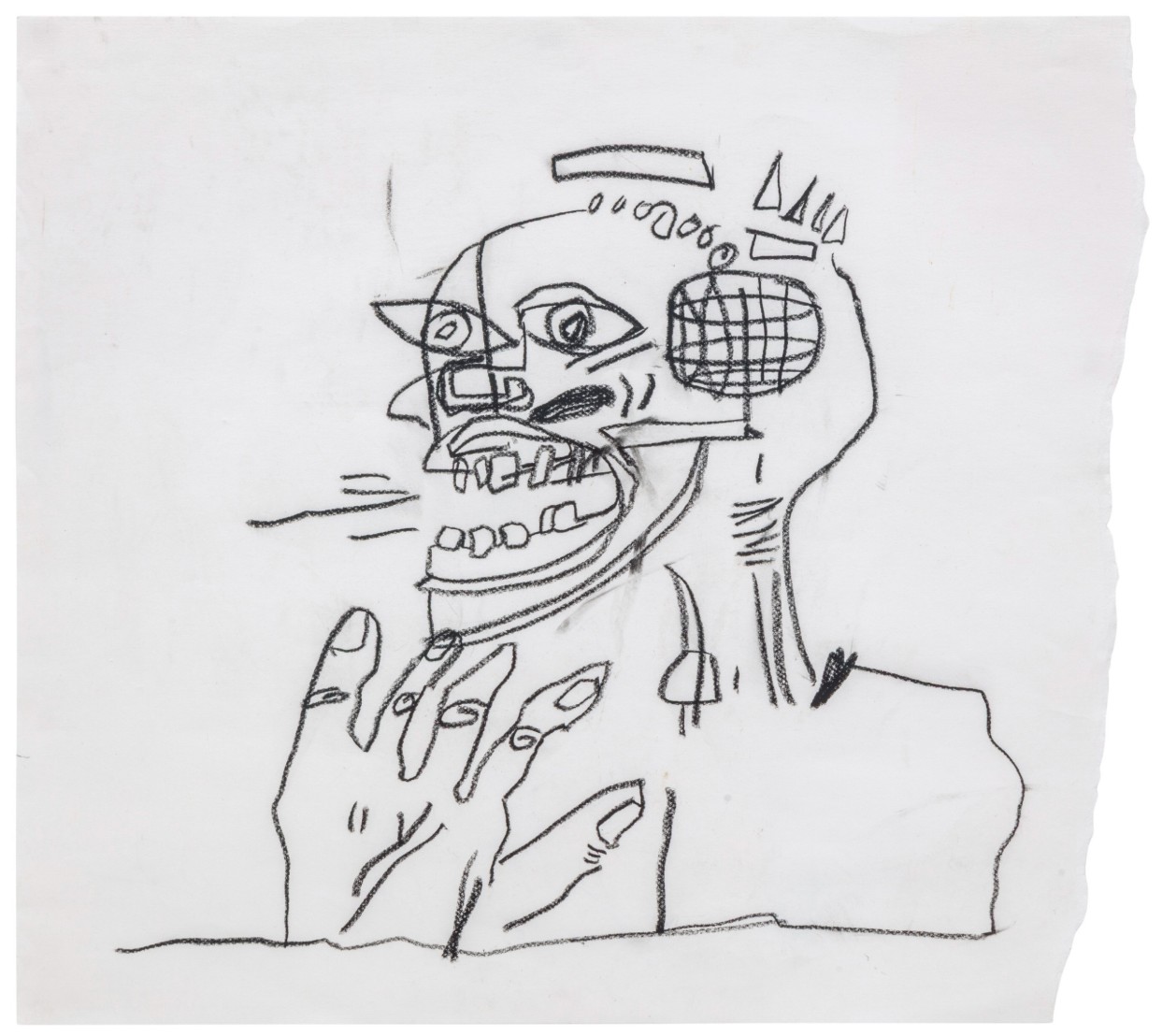
JEAN-MICHEL BASQUIAT (1960 – 1988)
Untitled, 1981
Oil stick on paper
20×22 inches (50.8 x 55.9 cm)
Signed (on the reverse)
Accompanied by a certificate of authenticity
Issued by the Authentication Committee of the Estate of Jean-Michel Basquiat
#16. Untitled, 1981
Christie’s London: 6 March 2025
Estimated: GBP 300,000 – 500,000
GBP 466,200 / USD 596,736
WORK ON PAPER
JEAN-MICHEL BASQUIAT (1960-1988), Untitled | Christie’s
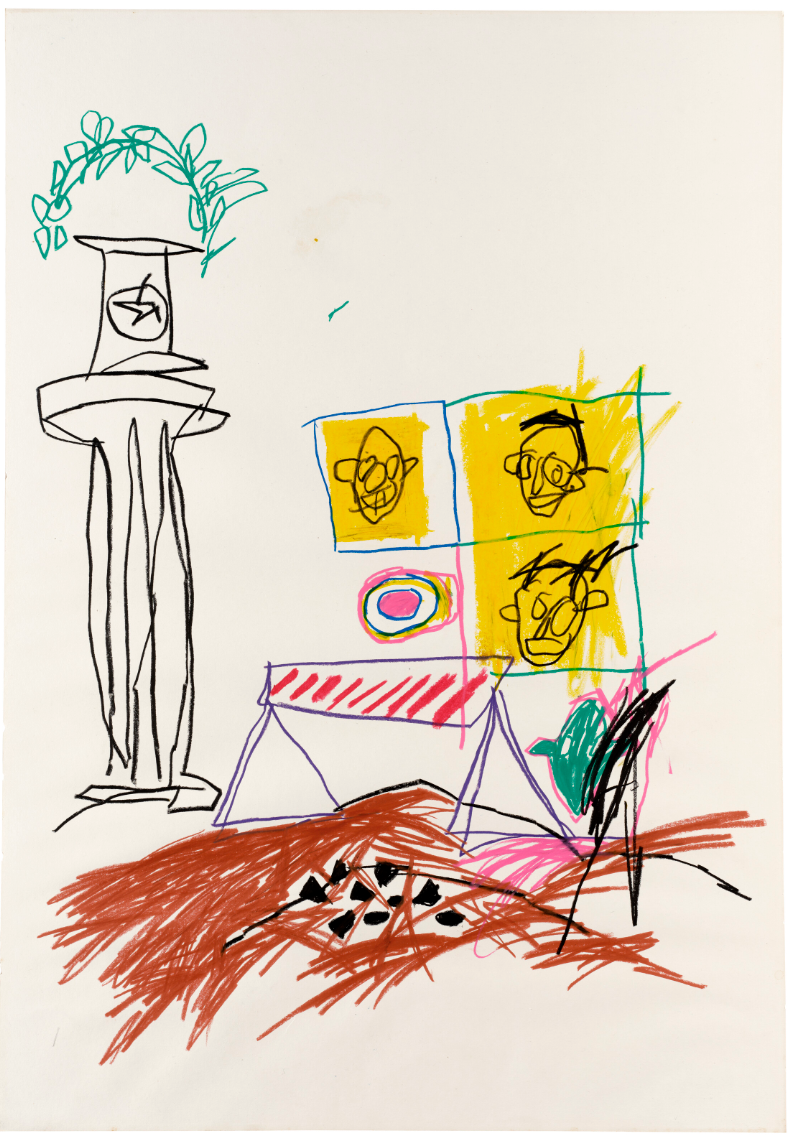
JEAN-MICHEL BASQUIAT (1960-1988)
Untitled, 1981
Oilstick on paper
42 3/8 x 27 1/2 inches (100.3 x 70 cm)
Signed, inscribed and dated ‘SAMO © MODENA 1981’ (on the reverse)
#17. Untitled (Ape), 1984
Christie’s New-York: 15 May 2025
Estimated: USD 500,000 – 700,000
USD 504,000
WORK ON PAPER
JEAN-MICHEL BASQUIAT (1960-1988), Untitled (Ape) | Christie’s
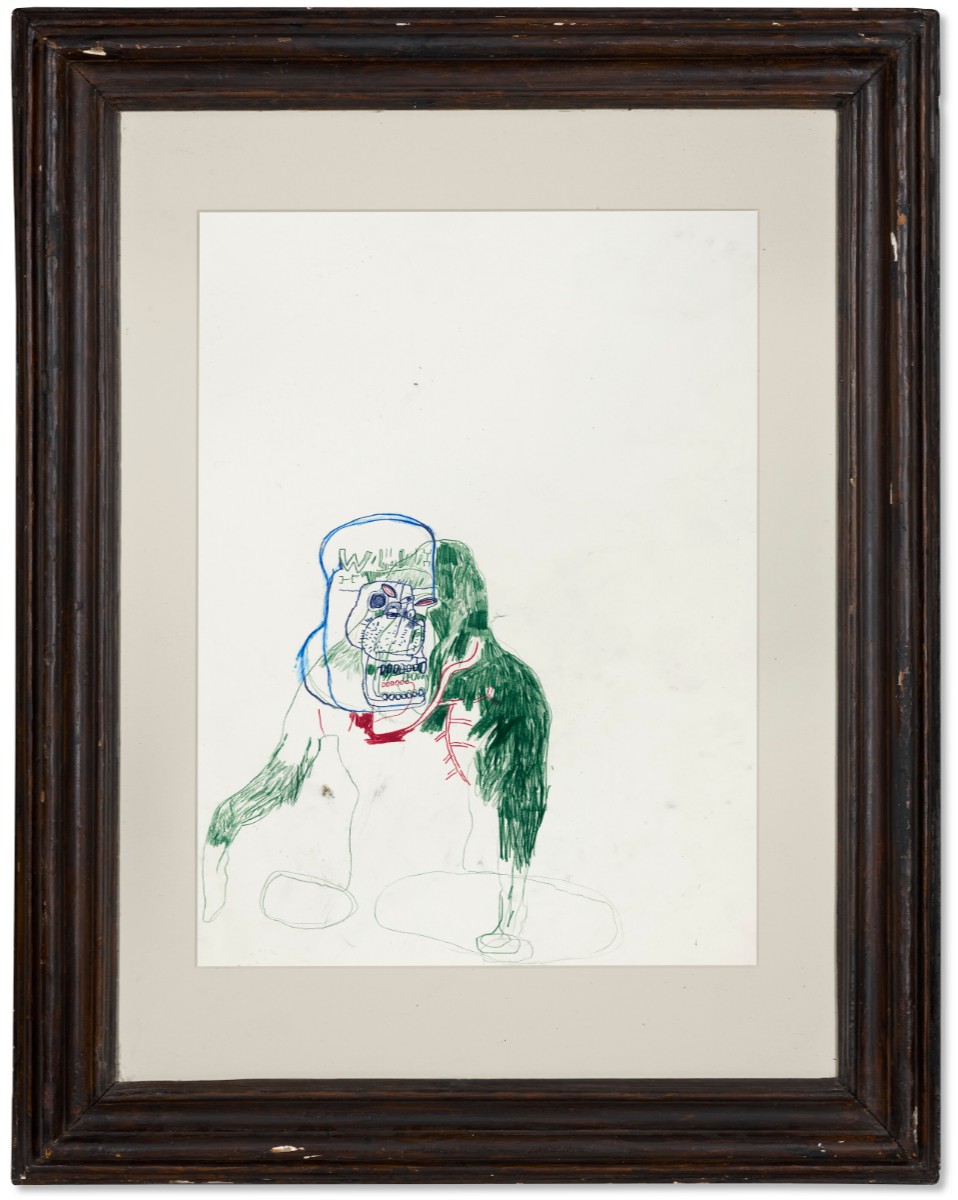
JEAN-MICHEL BASQUIAT (1960-1988)
Untitled (Ape), 1984
Oilstick and colored pencil on paper
30 x 22 1/4 inches (76.2 x 56.5 cm)
Signed and dated ‘Jean-Michel Basquiat 84’ (on the reverse)
Registered in the Authentication Committee of the Estate of Jean-Michel Basquia
Under transaction number 60740
USD 500,000
#18. Untitled, 1978
Sotheby’s New-York: 16 May 2025
Estimated: USD 100,000 – 150,000
USD 444,500
WORK ON PAPER
Untitled | Contemporary Day Auction | 2025 | Sotheby’s
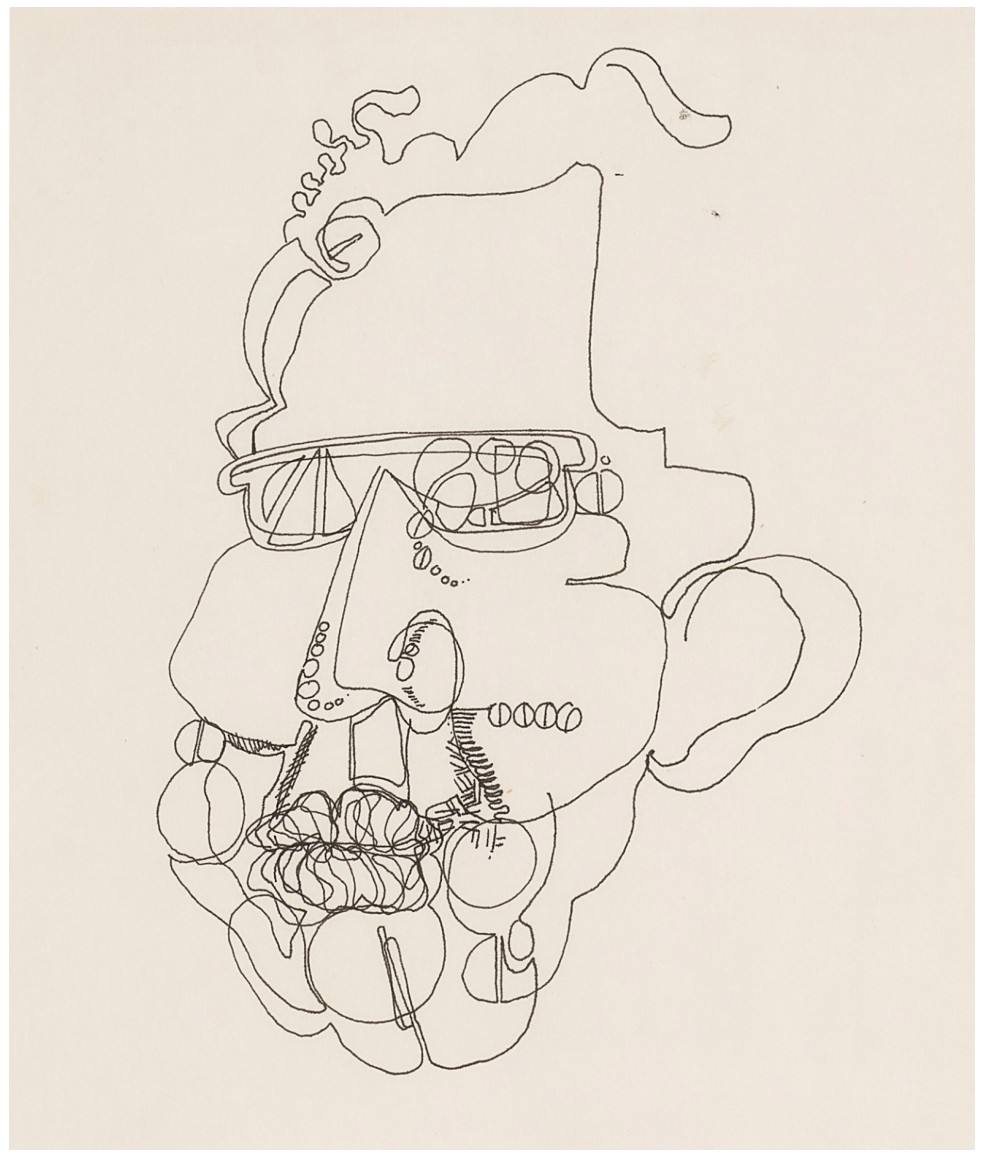
JEAN-MICHEL BASQUIAT (1960 – 1988)
Untitled, 1978
Ink on paper
Sight: 9 3/4 x 8 inches (24.8 by 20.3 cm)
Sheet: 13 7/8 x 11 inches (35.2 by 27.9 cm)
Accompanied by a certificate of authenticity
Issued by the Authentication Committee of the Estate of Jean-Michel Basquiat
#19. Untitled, 1982
Christie’s New-York: 15 May 2025
Estimated: USD 300,000 – 500,000
USD 390,600
WORK ON PAPER
JEAN-MICHEL BASQUIAT (1960-1988), Untitled | Christie’s
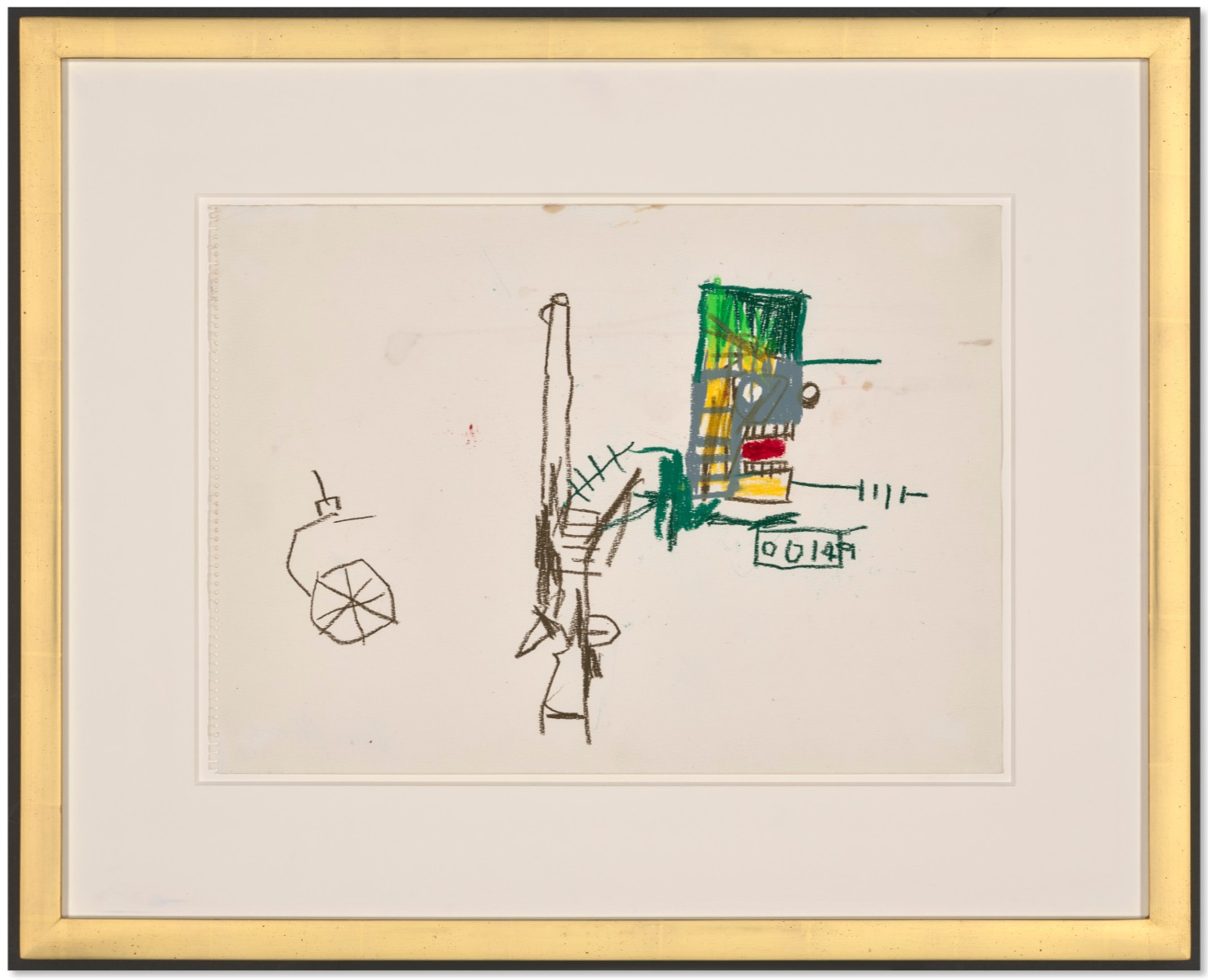
JEAN-MICHEL BASQUIAT (1960-1988)
Untitled, 1982
Oilstick on paper
12 1/2 x 17 1/4 inches (31.8 x 43.8 cm)
Accompanied by a certificate of authenticity
Issued by the Authentication Committee for the Estate of Jean-Michel Basquiat
#20. Untitled, 1981
Christie’s London: 26 June 2025
Estimated: GBP 100,000 – 150,000
GBP 277,200 / USD 379,765
WORK ON PAPER
JEAN-MICHEL BASQUIAT (1960-1988), Untitled | Christie’s
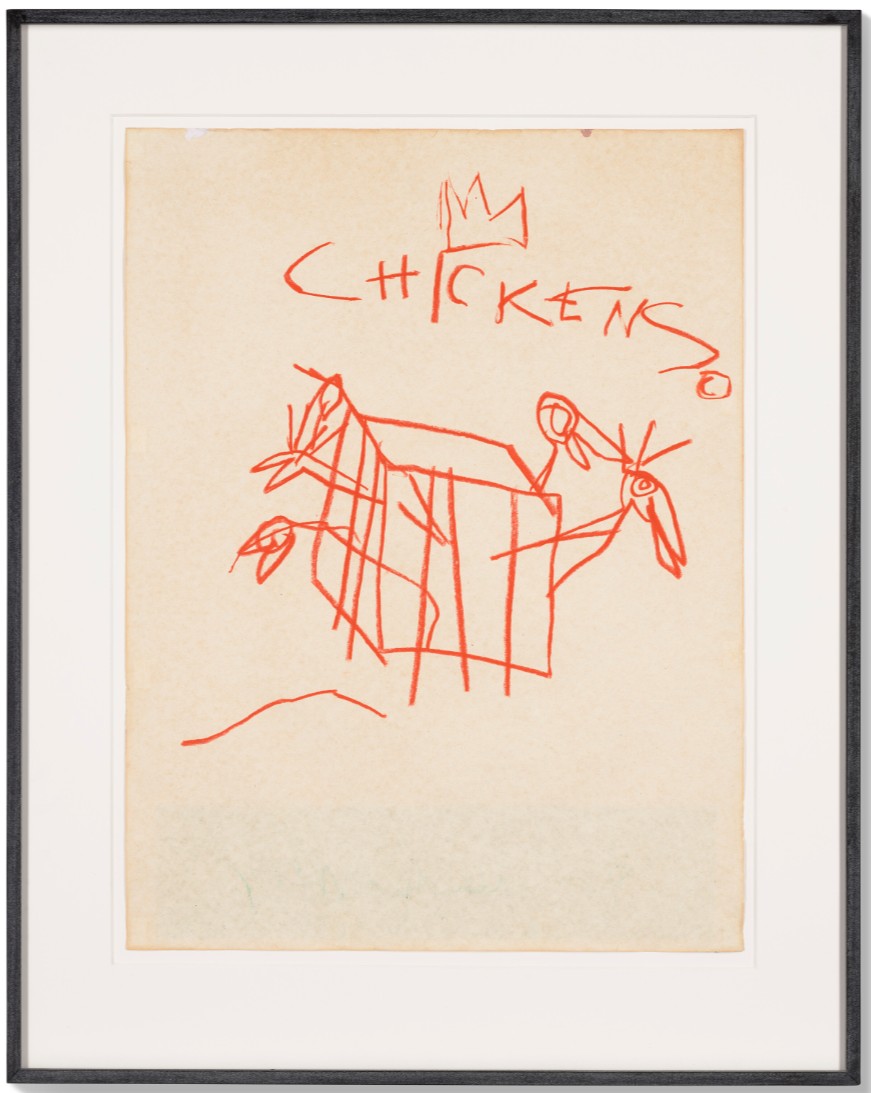
JEAN-MICHEL BASQUIAT (1960-1988)
Untitled, 1981
Oilstick on paper
24 x 17 7/8 inches (60.8 x 45.5 cm)
Signed and dated ’81 Jean Michel Basquiat’ (on the reverse)
#21. Untitled, 1981
Christie’s New-York: 20 November 2025
Estimated: USD 180,000 – 250,000
USD 317,500
WORK ON PAPER
JEAN-MICHEL BASQUIAT (1960-1988), Untitled | Christie’s
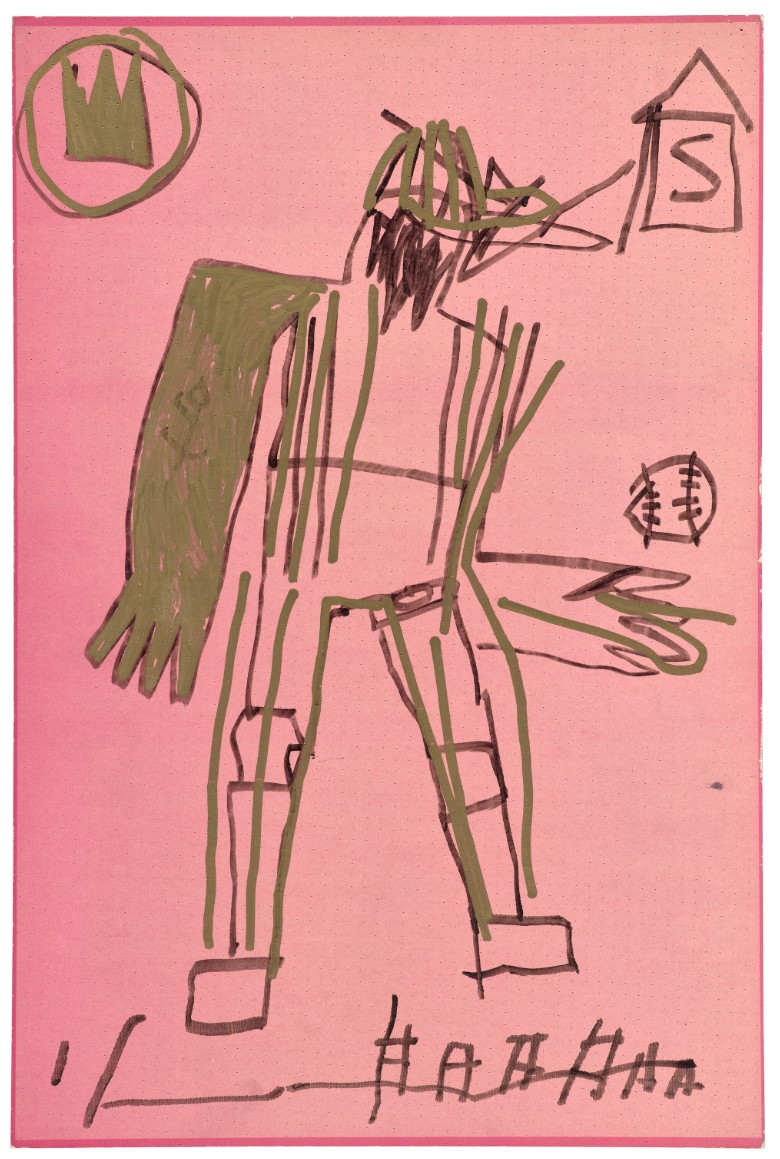
JEAN-MICHEL BASQUIAT (1960-1988)
Untitled, 1981
Paint pen and marker on colored illustration board
18 x 11 7/8 inches (45.7 x 30.2 cm)
Inscribed by Keith Haring (on the reverse)
#22. Suzanne, 1981-1986
Estimated: EUR 90,000 – 130,000
EUR 138,600 / USD 156,025
WORK ON PAPER
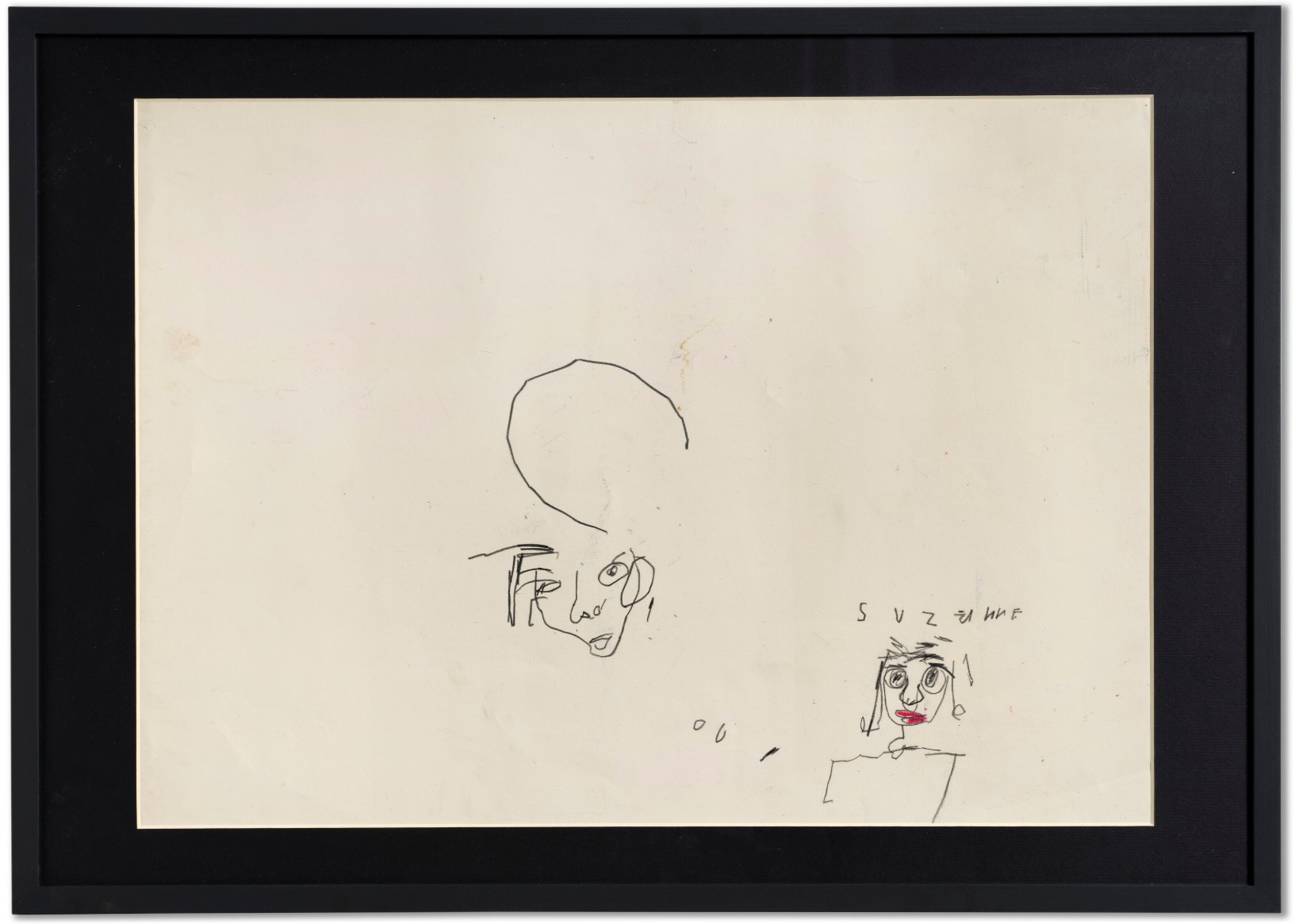
Suzanne, 1981-1986
Pastel and wax crayon on paper
22 x 29 7/8 inches (56×76 cm)
Signed, dated and located ‘Jean Michel Basquiat Bologna 1986’ (on the reverse)
#23. Untitled, 1981
Estimated: USD 60,000 – 80,000
USD 114,300
WORK ON PAPER
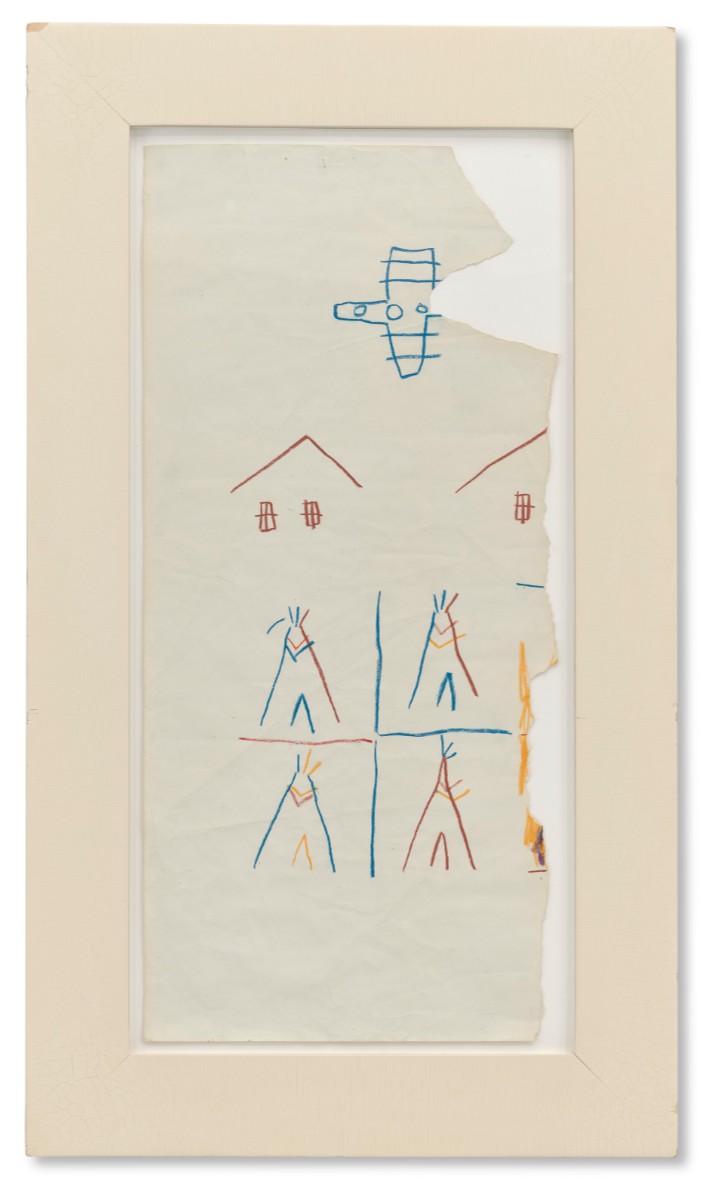
Untitled, 1981
Oilstick on paper
34 3/4 x 16 1/8 inches (88.3 x 41 cm)
USD 100,000
#24. Living sperm, circa 1986
Estimated: EUR 30,000 – 50,000
EUR 82,550 / USD 96,880
WORK ON PAPER
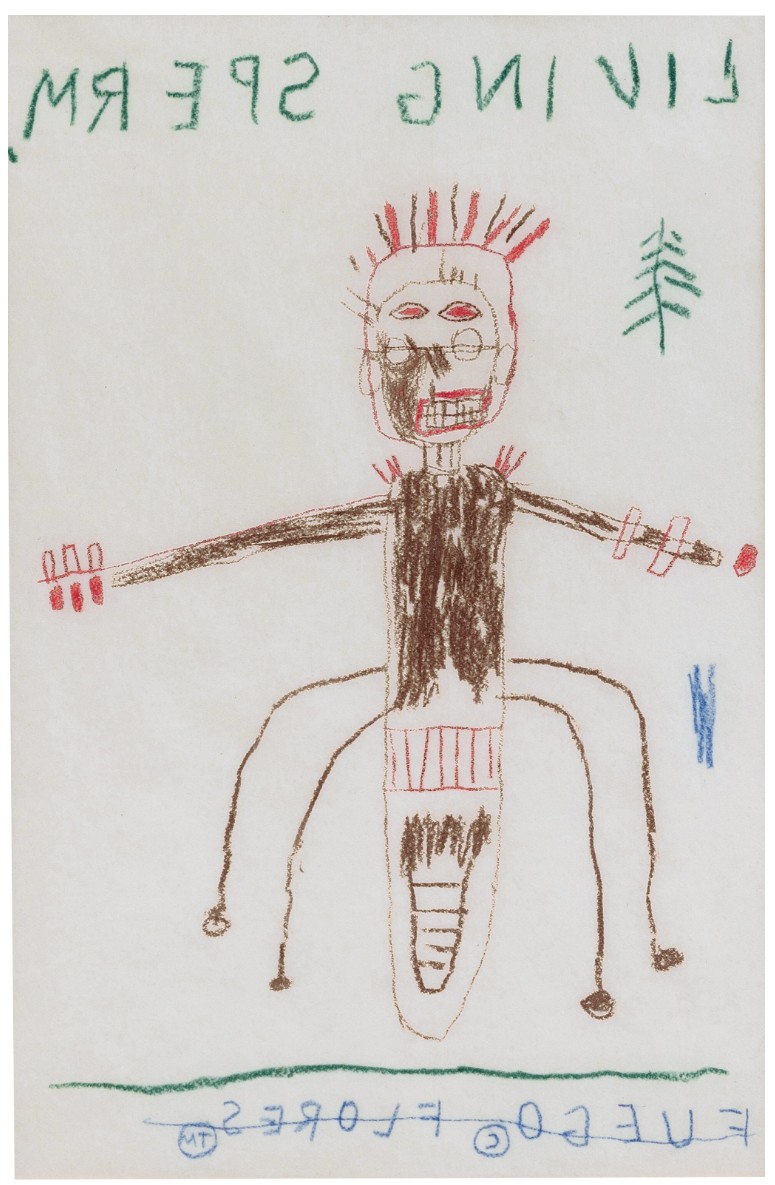
JEAN-MICHEL BASQUIAT (1960 – 1988)
Living sperm, circa 1986
Color pencils on paper calque, with aquatint printed in colours on Rives wove paper
Print by Aldo Crommelynck, New York
Drawing : 7 3/4 x 5 1/4 inches (20×13 cm)
Plate: 9 1/4 x 7 inches (23.8 x 17.7 cm)
Sheet: 15×11 inches (38×28 cm)
#25. Resume I; Resume II References, 1980
Christie’s New-York: 20 November 2025
Estimated: USD 60,000 – 80,000
USD 95,250
WORK ON PAPER
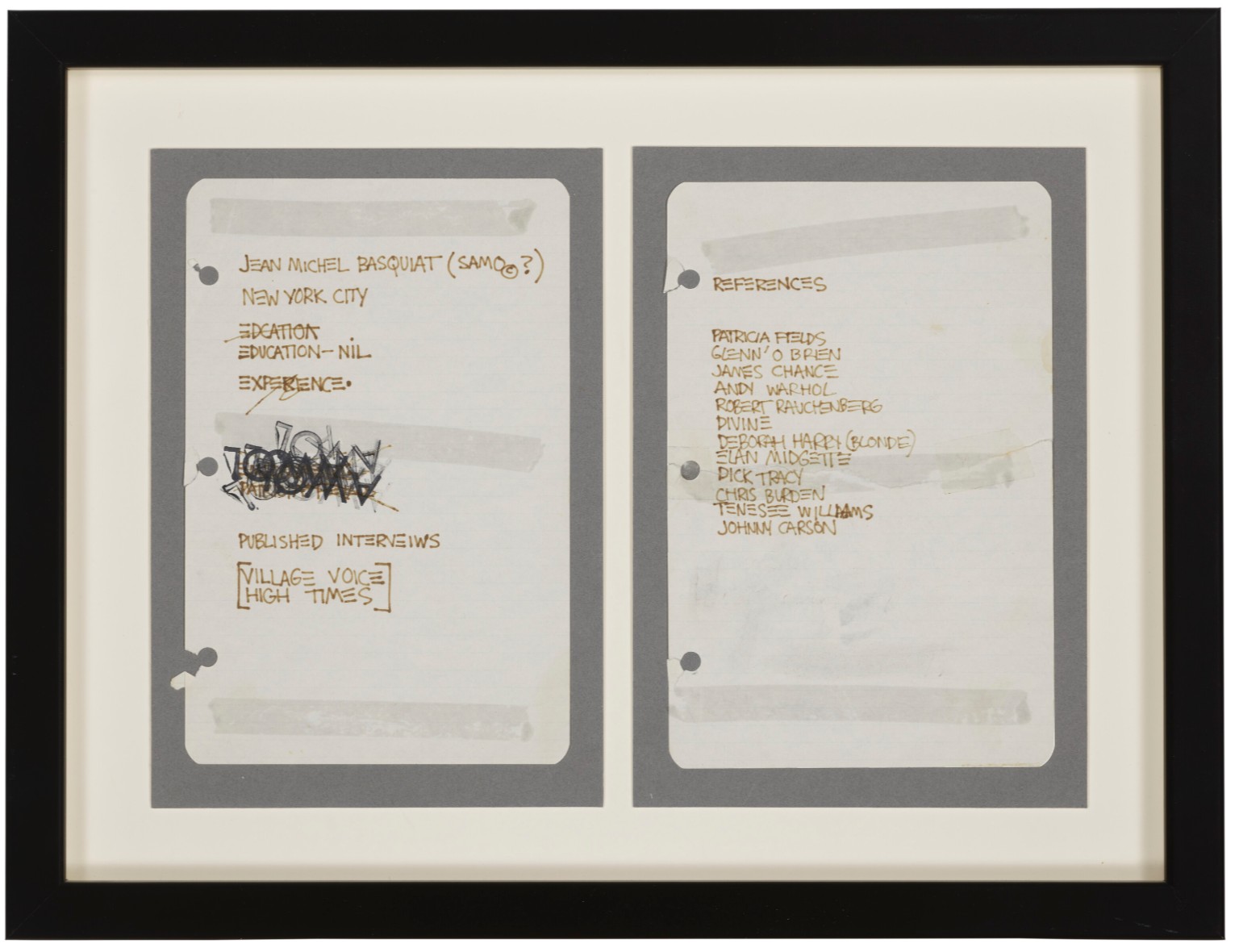
JEAN-MICHEL BASQUIAT (1960-1988)
Untitled (Resume I); Untitled (Resume II References) [Two Works], 1980
Ink on paper
Each: 8 3/8 x 5 1/2 inches (21.3 x 14 cm)
Lots Withdrawn
Untitled, 1986
Sotheby’s New-York: 19 November 2025
Estimated: USD 600,000 – 800,000
WITHDRAWN
Untitled | Contemporary Day Auction | 2025 | Sotheby’s
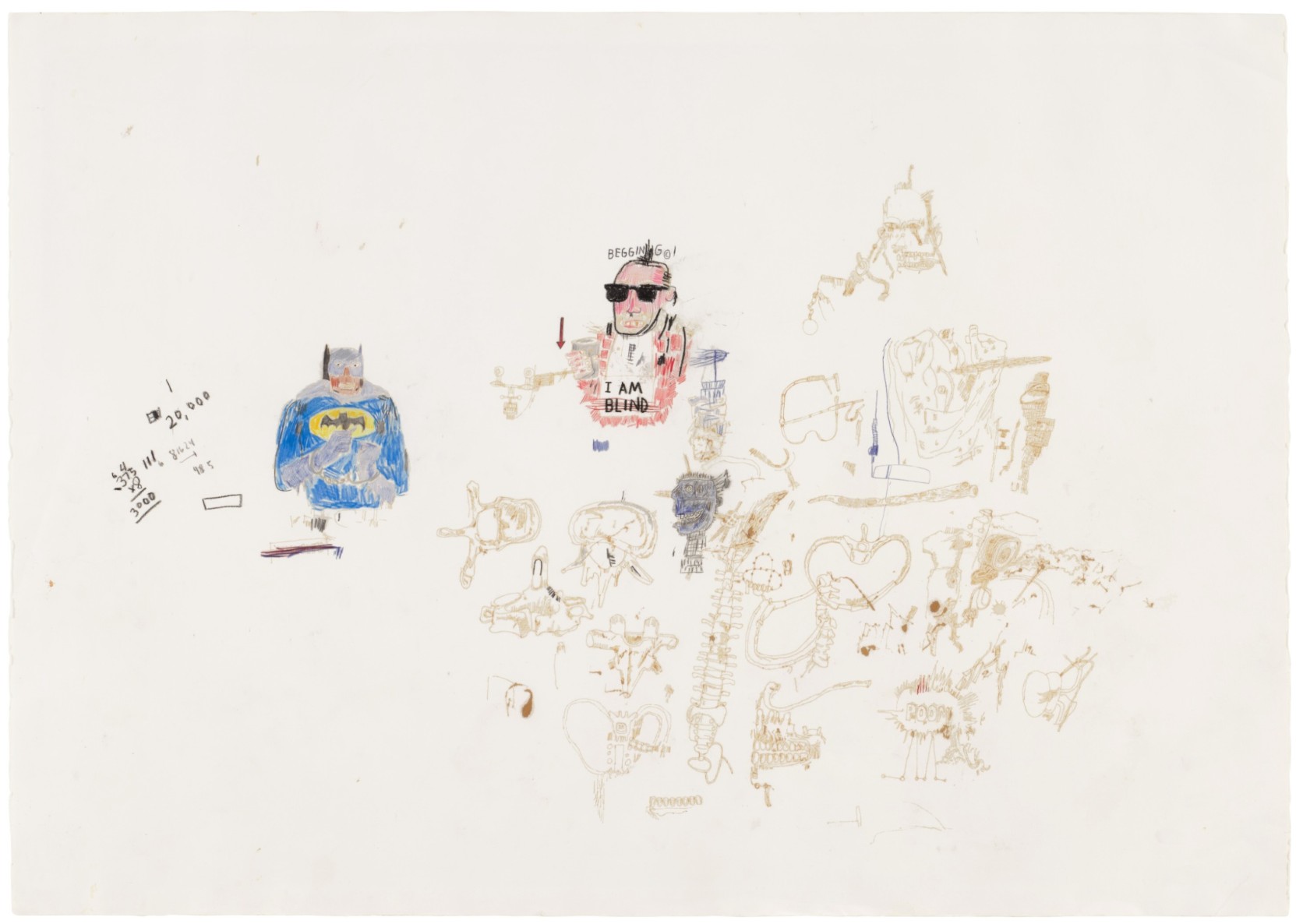
JEAN-MICHEL BASQUIAT (1960 – 1988)
Untitled, 1986
Colored pencil, graphite, ink and oilstick on paper
29 5/8 x 41 3/4 inches (75.2 x 106 cm)
Signed and dated 86 (on the verso)
2024 Auction Results
17 Works on Paper sold at auction in 2024 for a total turnover of USD 34,586,490. With 3 lots failing to sell, the sell-through rate is 85%. The highest price for 2024 was achieved, by Untitled, a large scale drawing dated 1982, that sold at Christie’s in New-York on 21 November 2024 for USD 22,950,000, setting a new auction record for a drawing by Jean-Michel Basquiat.
2024 Top 5 Lots
5 lots sold for more than USD 1 million, generating a cumulative turnover of USD 30,191,000, representing 87.3% of the total turnover for 2024. 8 lots sold for more than USD 500,000, generating a cumulative turnover of USD 32,491,200, representing 93.9% of the total turnover for 2024.
XXXXXXXXXX
#1. Untitled, 1982
Christie’s New-York: 21 November 2024
Estimated: USD 20,000,000 – 30,000,000
USD 22,950,000
WORK ON PAPER
AUCTION RECORD FOR A DRAWING BY JEAN-MICHEL BASQUIAT
JEAN-MICHEL BASQUIAT (1960-1988), Untitled | Christie’s
JEAN-MICHEL BASQUIAT (1960-1988)
Untitled, 1982
Oilstick on paper
63 1/2 x 44 inches (161.3 x 111.8 cm)
Signed and dated ‘Jean-Michel Basquiat 1982’ (lower right)
USD 10 million
#2. Untitled, 1981
Sotheby’s New-York: 20 November 2024
Estimated: USD 1,800,000 – 2,500,000
USD 2,100,000
WORK ON PAPER
Untitled | The Now and Contemporary Evening Auction | 2024 | Sotheby’s
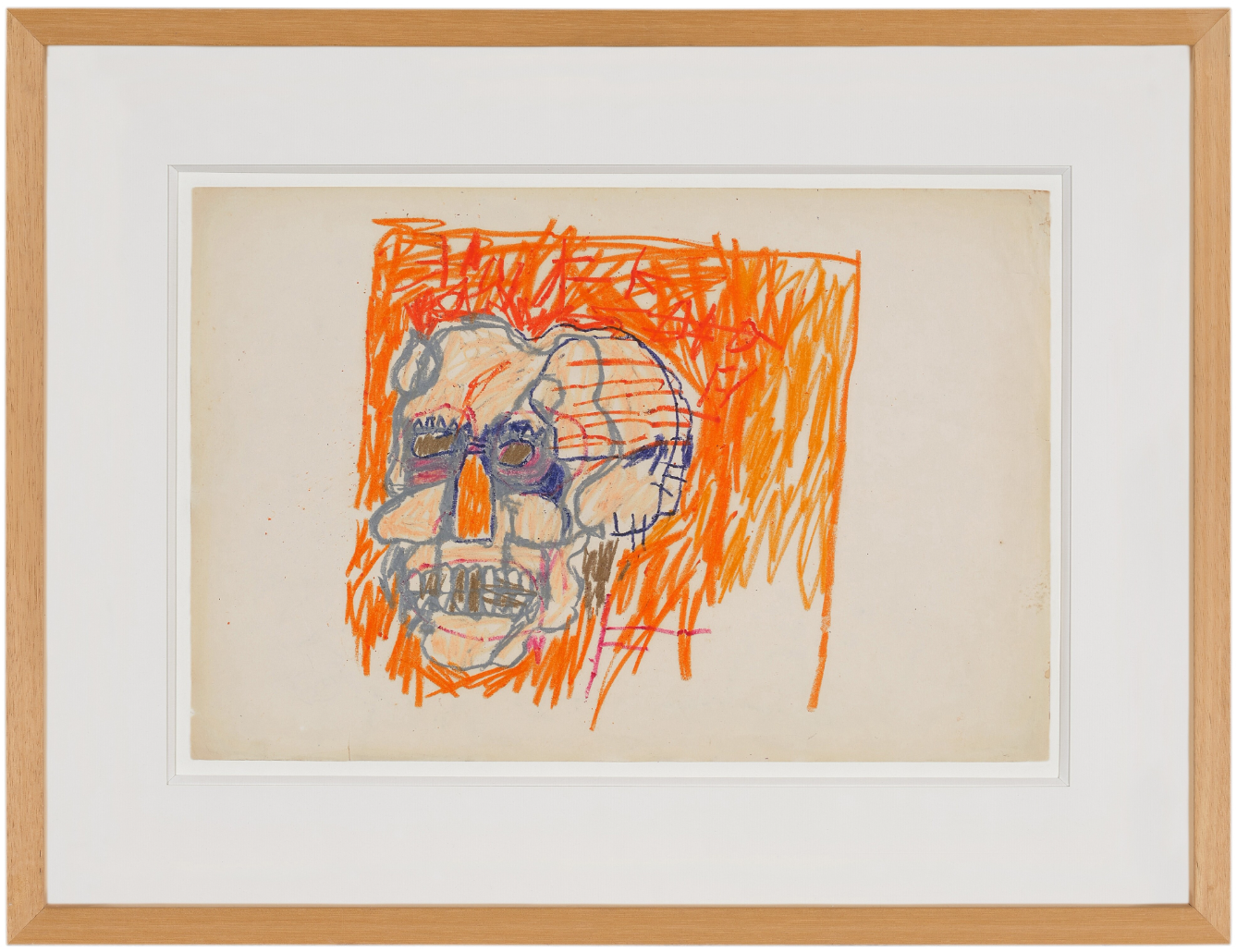
JEAN-MICHEL BASQUIAT (1960 – 1988)
Untitled, 1981
Oilstick on paper
11 7/8 x 17 7/8 inches (30.2 x 43.2 cm)
#3. Untitled (Grain Alcohol), 1983
Phillips New-York: 14 May 2024
Estimated: USD 1,000,000 – 1,500,000
USD 1,996,000
WORK ON PAPER
Jean-Michel Basquiat – Modern & Contempo… Lot 13 May 2024 | Phillips

JEAN-MICHEL BASQUIAT
Untitled (Grain Alcohol), 1983
Oilstick on paper
30×22 inches (76.2 x 55.9 cm)
Signed and dated “Jean-Michel Basquiat 83” lower right
#4. Untitled, 1982
Sotheby’s New-York: 1 March 2024
Estimated: USD 600,000 – 800,000
USD 1,875,000
WORK ON PAPER
Untitled | Contemporary Curated | 2024 | Sotheby’s (sothebys.com)
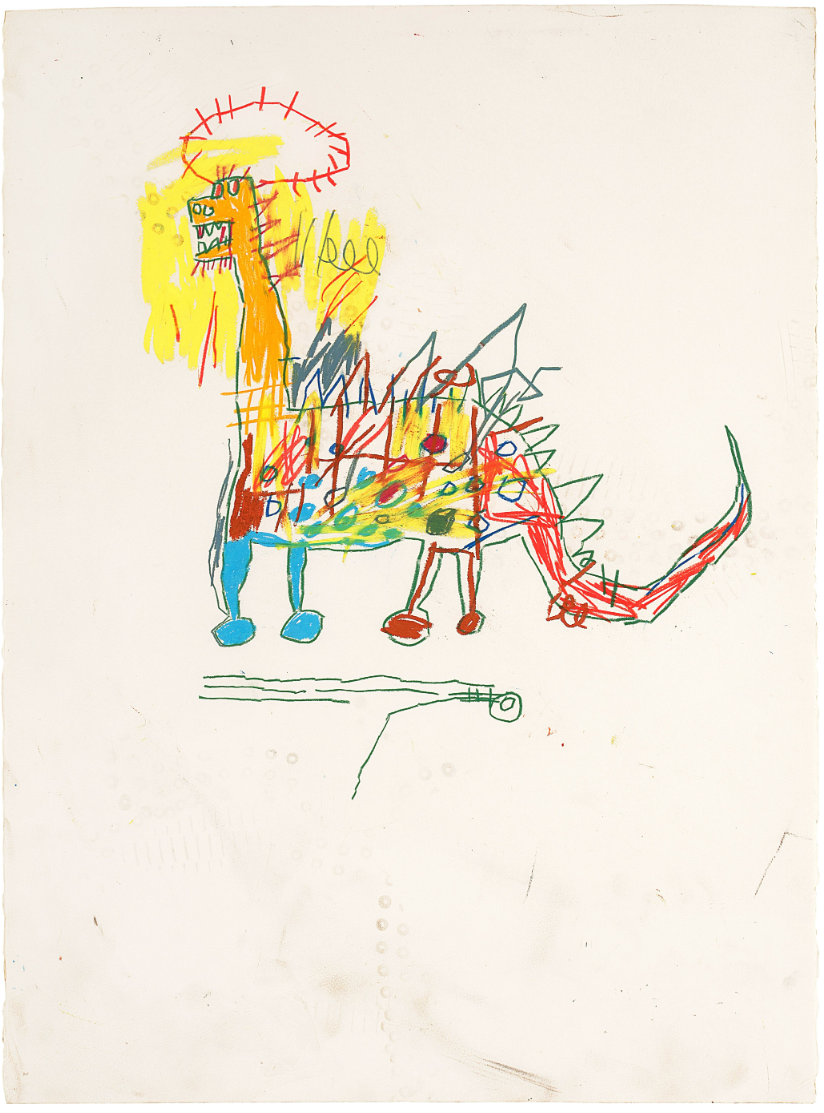
JEAN-MICHEL BASQUIAT (1960 – 1988)
Untitled, 1982
Oilstick and graphite on paper
30 1/8 x 22 3/8 inches (76.5 x 56.8 cm)
Signed and dated 82 (on the verso)
#5. Untitled, 1981-1982
Phillips New-York: 19 November 2024
Estimated: USD 1,000,000 – 1,500,000
USD 1,270,000
WORK ON PAPER
Jean-Michel Basquiat – Modern & Cont… Lot 6 November 2024 | Phillips
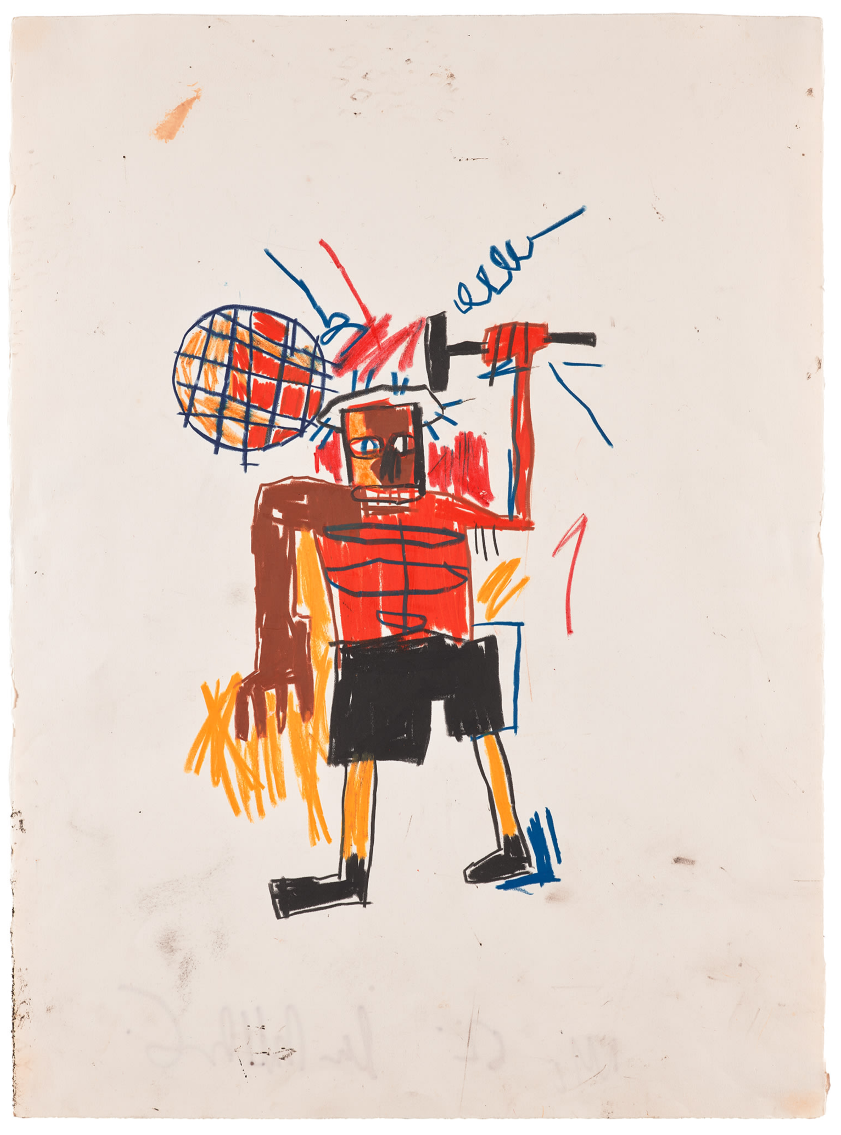
JEAN-MICHEL BASQUIAT
Untitled, 1981-1982
Oilstick on paper
30×22 inches (76.2 x 55.9 cm)
Signed, inscribed and dated “NY 82 Jean Michel Basquiat” on the reverse
USD 1 million
#6. Famous Negro Athletes, 1981
Christie’s New-York: 17 May 2024
Estimated: USD 500,000 – 700,000
USD 907,200
WORK ON PAPER
JEAN-MICHEL BASQUIAT (1960-1988), Famous Negro Athletes | Christie’s (christies.com)
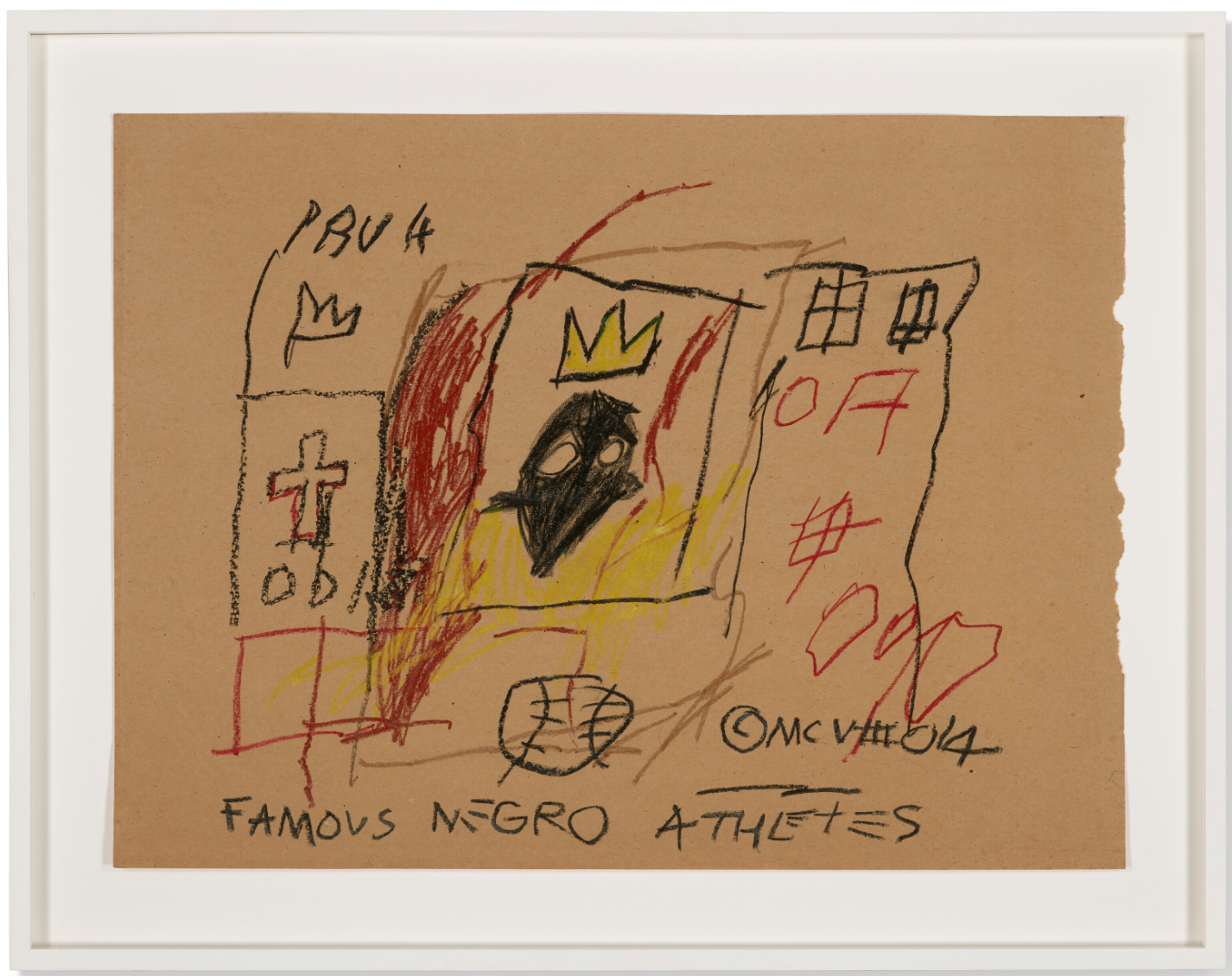
JEAN-MICHEL BASQUIAT (1960-1988)
Famous Negro Athletes, 1981
Oilstick and wax crayon on brown paper
17 3/4 x 23 7/8 inches (45.1 x 60.7 cm)
#7. Arteries of the Left Arm, 1983
Phillips New-York: 20 November 2024
Estimated: USD 800,000 – 1,200,000
USD 889,000
WORK ON PAPER
Jean-Michel Basquiat – Modern & Co… Lot 143 November 2024 | Phillips
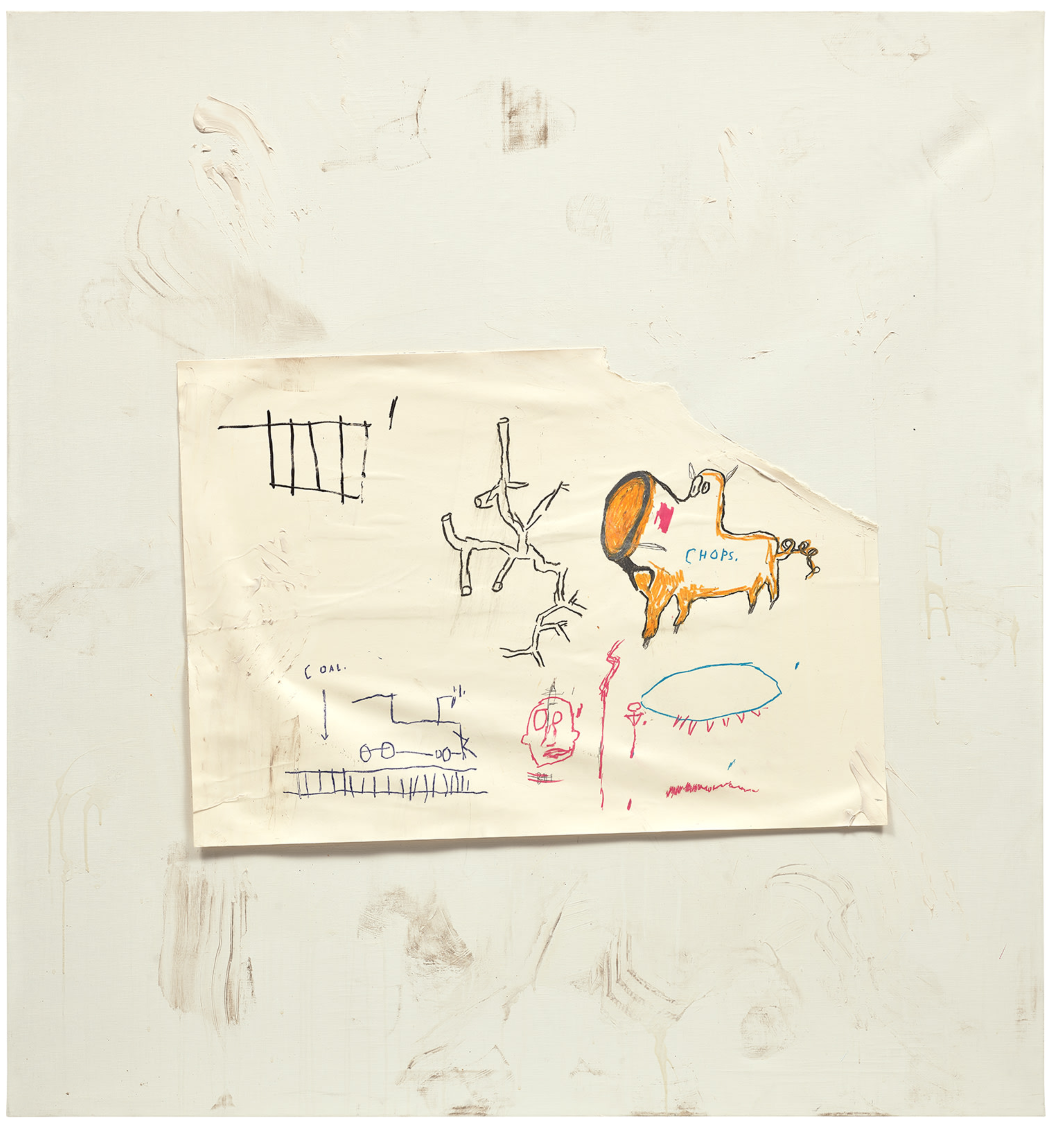
JEAN-MICHEL BASQUIAT
Arteries of the Left Arm, 1983
Acrylic, oilstick and paper collage on canvas
63×59 inches (160 x 149.9 cm)
Signed, titled, inscribed and dated “”ARTERIES OF THE LEFT ARM” Jean-Michel Basquiat FEB 1983. ST. MORITZ.” on the reverse
#8. Easy Mark Sucker – Coach, 1987
Christie’s New-York: 17 May 2024
Estimated: USD 400,000 – 600,000
USD 504,000
WORK ON PAPER
JEAN-MICHEL BASQUIAT (1960-1988), Easy Mark Sucker – Coach | Christie’s (christies.com)
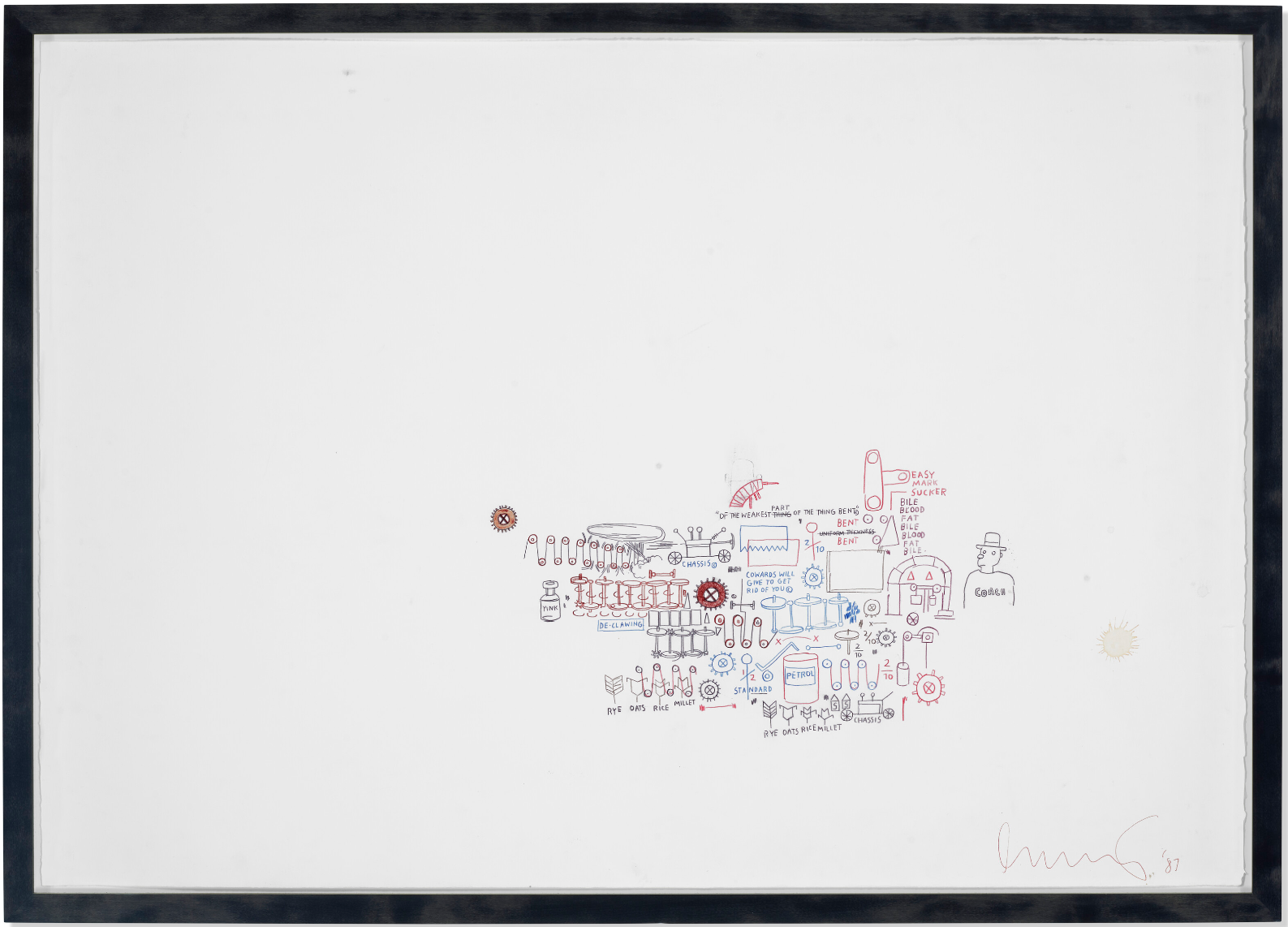
JEAN-MICHEL BASQUIAT (1960-1988)
Easy Mark Sucker – Coach, 1987
Colored pencil and graphite on paper
28 1/4 x 40 1/2 inches (71.8 x 102.9 cm)
Signed and dated ‘Jean-Michel Basquiat ’87’ (lower right)
USD 500,000
#9. Boxeo, 1986
Phillips Hong-Kong: 25 November 2024
Estimated: HKD 2,500,000 – 4,500,000
HKD 3,048,000 / USD 391,600
WORK ON PAPER
Jean-Michel Basquiat – Modern & Con… Lot 16 November 2024 | Phillips
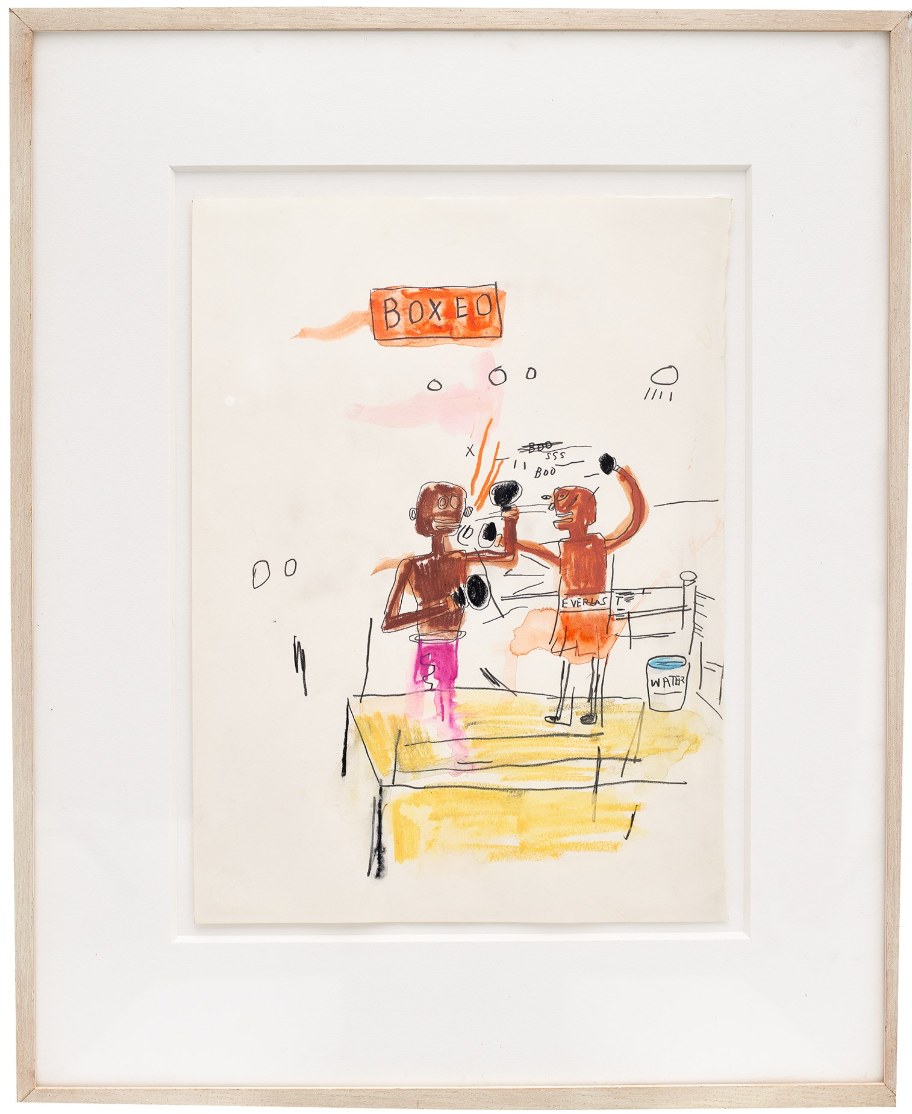
JEAN-MICHEL BASQUIAT
Boxeo, 1986
Graphite, watercolour and wax crayon on paper
14 1/2 x 10 3/4 inches (36.8 x 27.2 cm)
Signed and dated ‘Jean Michel Basquiat 86’ on the reverse
#10. Untitled, 1982
Christie’s New-York: 1 October 2024
Estimated: USD 150,000 – 200,000
USD 327,600
WORK ON PAPER
JEAN-MICHEL BASQUIAT (1960-1988), Untitled | Christie’s (christies.com)
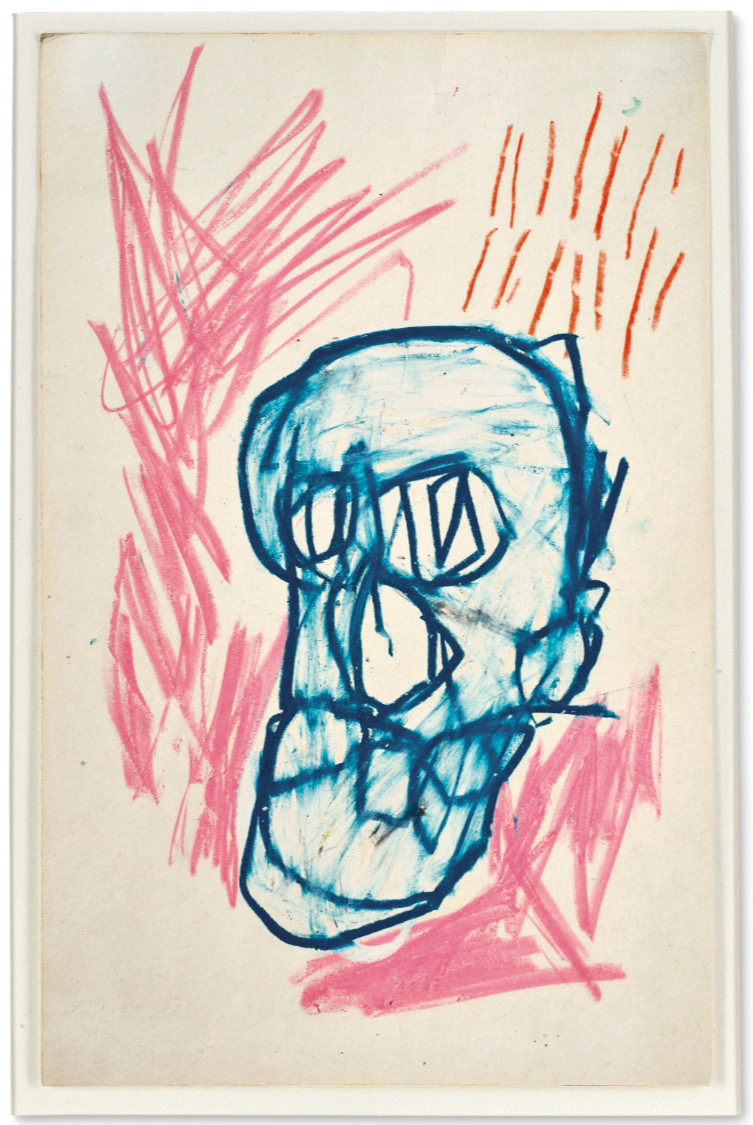
JEAN-MICHEL BASQUIAT (1960-1988)
Untitled, 1982
Oil stick on paper
11×7 inches (27.9 x 17.8 cm)
#11. Hong Kong, 1985
Christie’s New-York: 1 October 2024
Estimated: USD 350,000 – 550,000
USD 327,600
WORK ON PAPER
JEAN-MICHEL BASQUIAT (1960-1988), Hong Kong | Christie’s (christies.com)
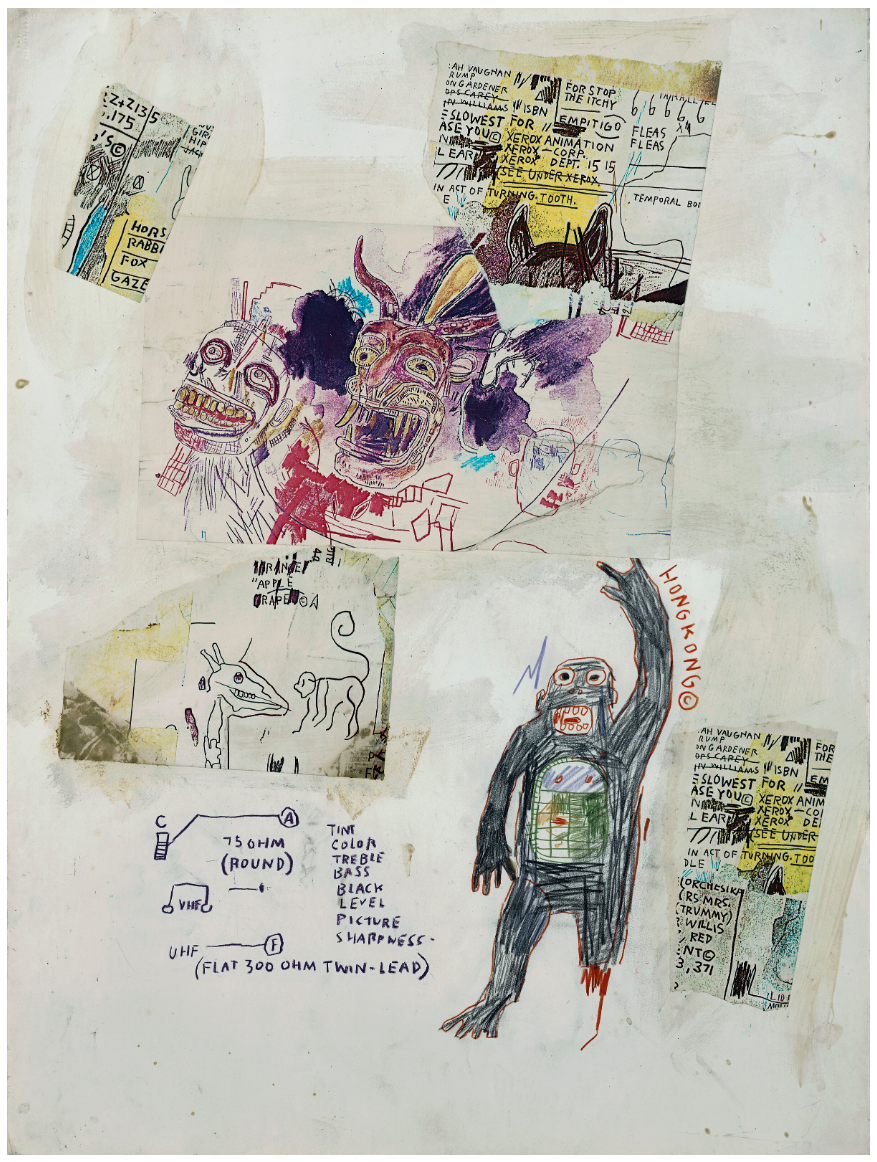
JEAN-MICHEL BASQUIAT (1960-1988)
Hong Kong, 1985
Graphite, colored pencil and Xerox collage on paper
30 x 22 1/2 inches (76×57 cm)
Signed and dated ‘Jean-Michel Basquiat 85’ (on the reverse)
#12. Untitled (Mother/Father), 1981
Sotheby’s Paris: 23 April 2024
Estimated: EUR 120,000 – 180,000
EUR 215,900 / USD 230,040
WORK ON PAPER
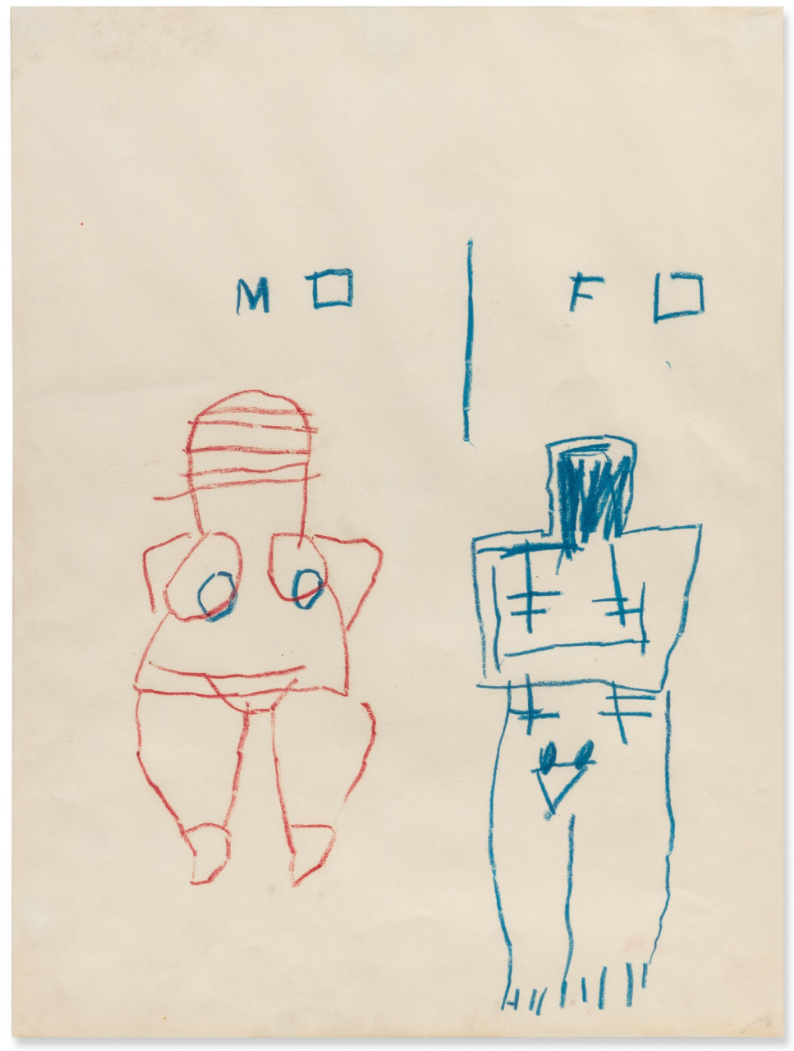
JEAN-MICHEL BASQUIAT (1960 – 1988)
Untitled (Mother/Father), 1981
Oilstick on paper
23 1/2 x 18 inches (59.7 x 45.7 cm)
#13. Untitled (Yen), 1983
Sotheby’s New-York: 1 March 2024
Estimated: USD 150,000 – 200,000
USD 190,500
WORK ON PAPER
Untitled (Yen) | Contemporary Curated | 2024 | Sotheby’s (sothebys.com)
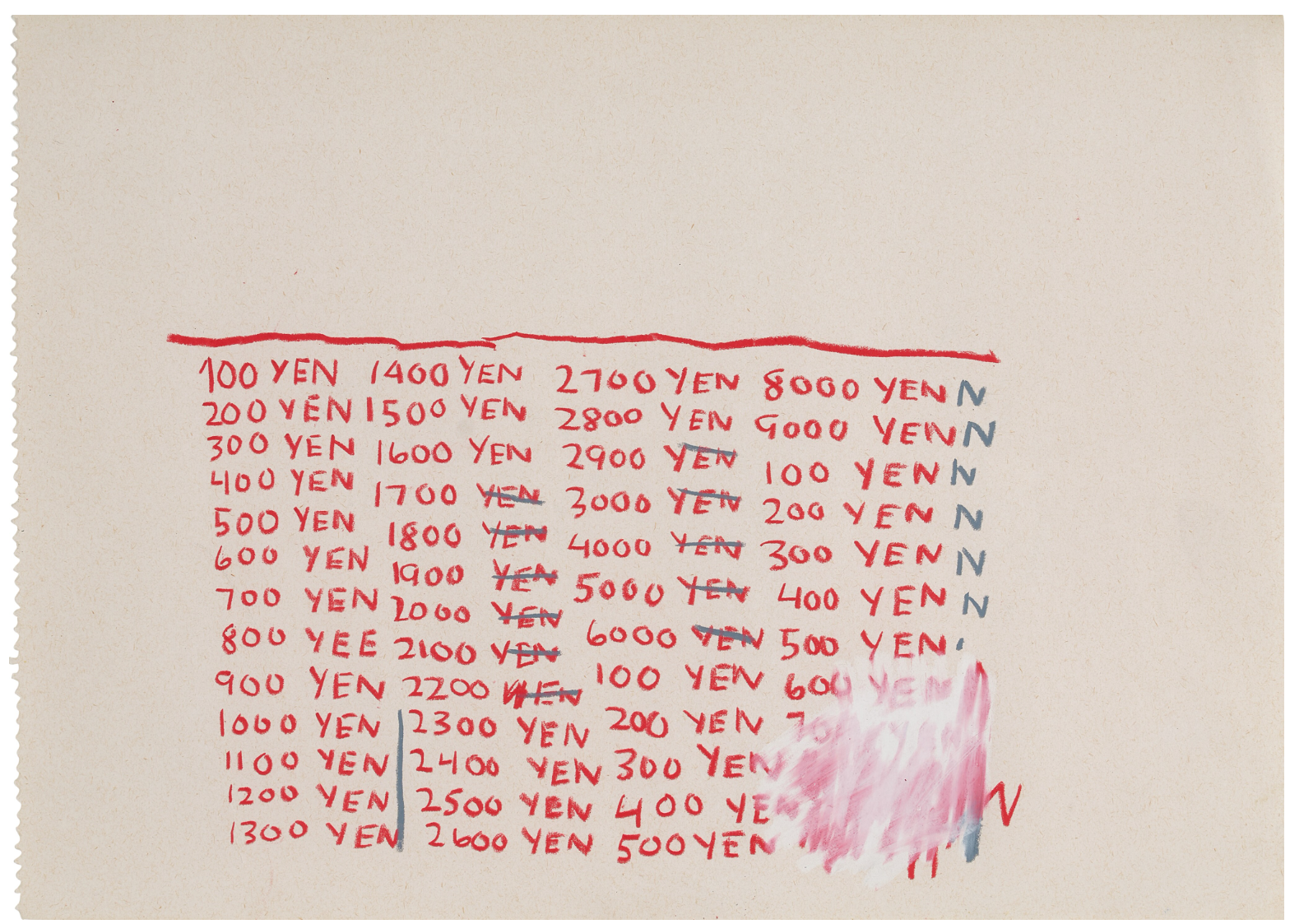
JEAN-MICHEL BASQUIAT (1960 – 1988)
Untitled (Yen), 1983
Oilstick on paper
11 1/2 x 16 1/4 inches (29.2 x 41.3 cm)
#14. Untitled, 1987
Phillips New-York: 15 May 2024
Estimated: USD 180,000 – 250,000
USD 190,500
WORK ON PAPER
Jean-Michel Basquiat – Modern & Contemp… Lot 146 May 2024 | Phillips
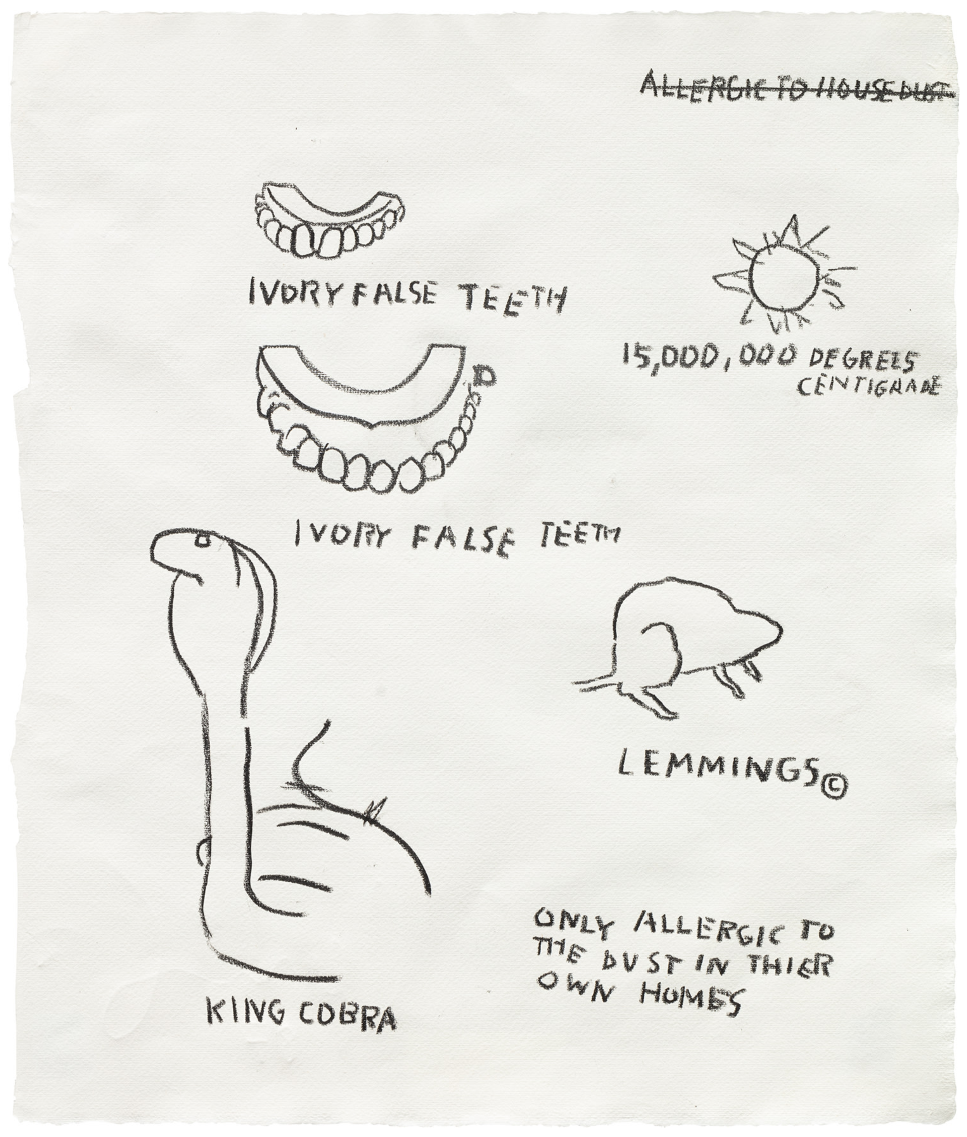
JEAN-MICHEL BASQUIAT
Untitled, 1987
Oilstick on paper
16 1/8 x 13 7/8 inches (41 x 35.2 cm)
Signed and dated “Jean-Michel Basquiat 87” on the reverse
#15. Free comb with Pagoda, 1986
Phillips New-York: 15 May 2024
Estimated: USD 80,000 – 120,000
USD 177,800
WORK ON PAPER
Jean-Michel Basquiat – Modern & Contemp… Lot 224 May 2024 | Phillips
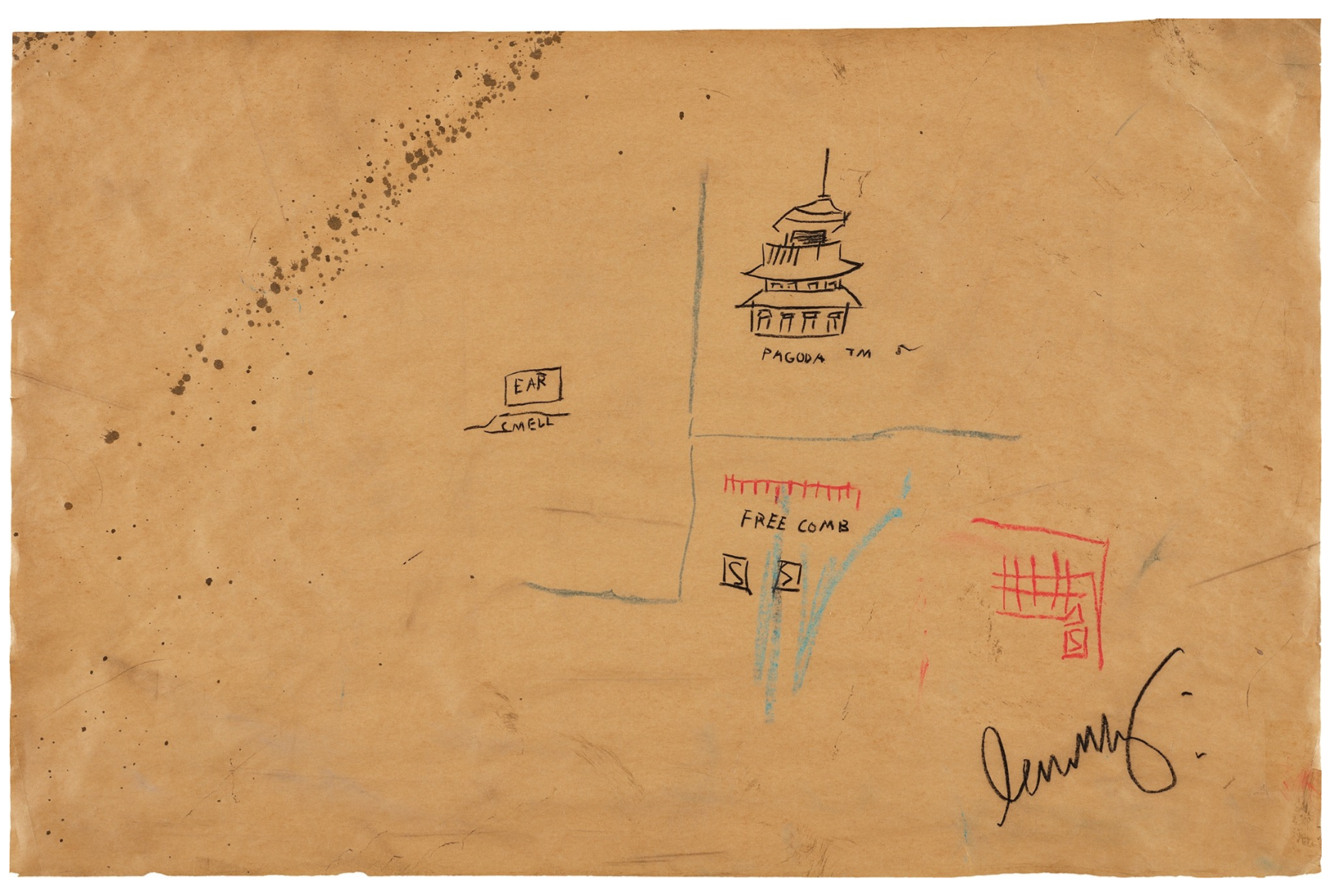
JEAN-MICHEL BASQUIAT
Free comb with Pagoda, 1986
Oilstick and mixed media on paper
15 3/8 x 23 7/8 inches (39.1 x 60.6 cm)
Signed “Jean-Michel Basquiat” lower right
#16. Untitled (History of Jazz), 1983
Sotheby’s New-York: 1 March 2024
Estimated: USD 80,000 – 120,000
USD 171,450
WORK ON PAPER
Untitled (History of Jazz) | Contemporary Curated | 2024 | Sotheby’s (sothebys.com)
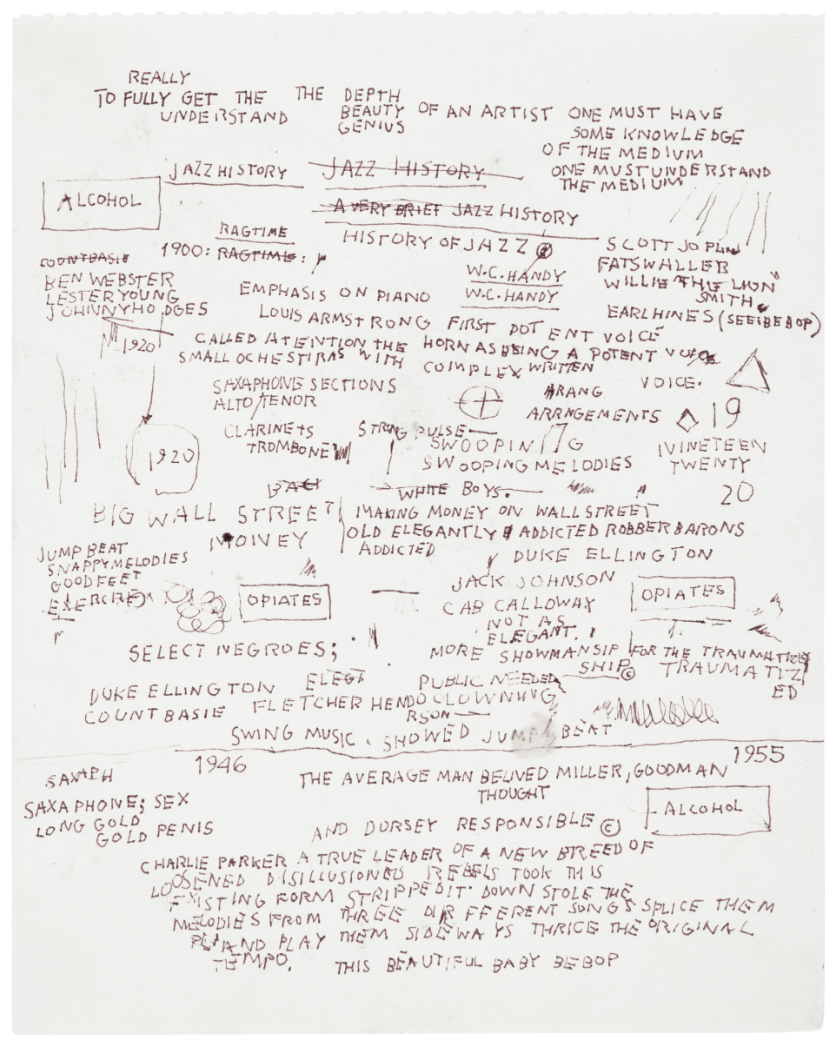
JEAN-MICHEL BASQUIAT (1960 – 1988)
Untitled (History of Jazz), 1983
Ink on paper
10 1/2 x 8 3/8 inches (26.7 x 21.3 cm)
2023 Auction Results
#1. Untitled (Head), 1982
Sotheby’s New-York: 18 May 2023
Estimated: USD 2,000,000 – 3,000,000
USD 3,327,000
WORK ON PAPER
Untitled (Head) | Contemporary Evening Auction | 2023 | Sotheby’s (sothebys.com)
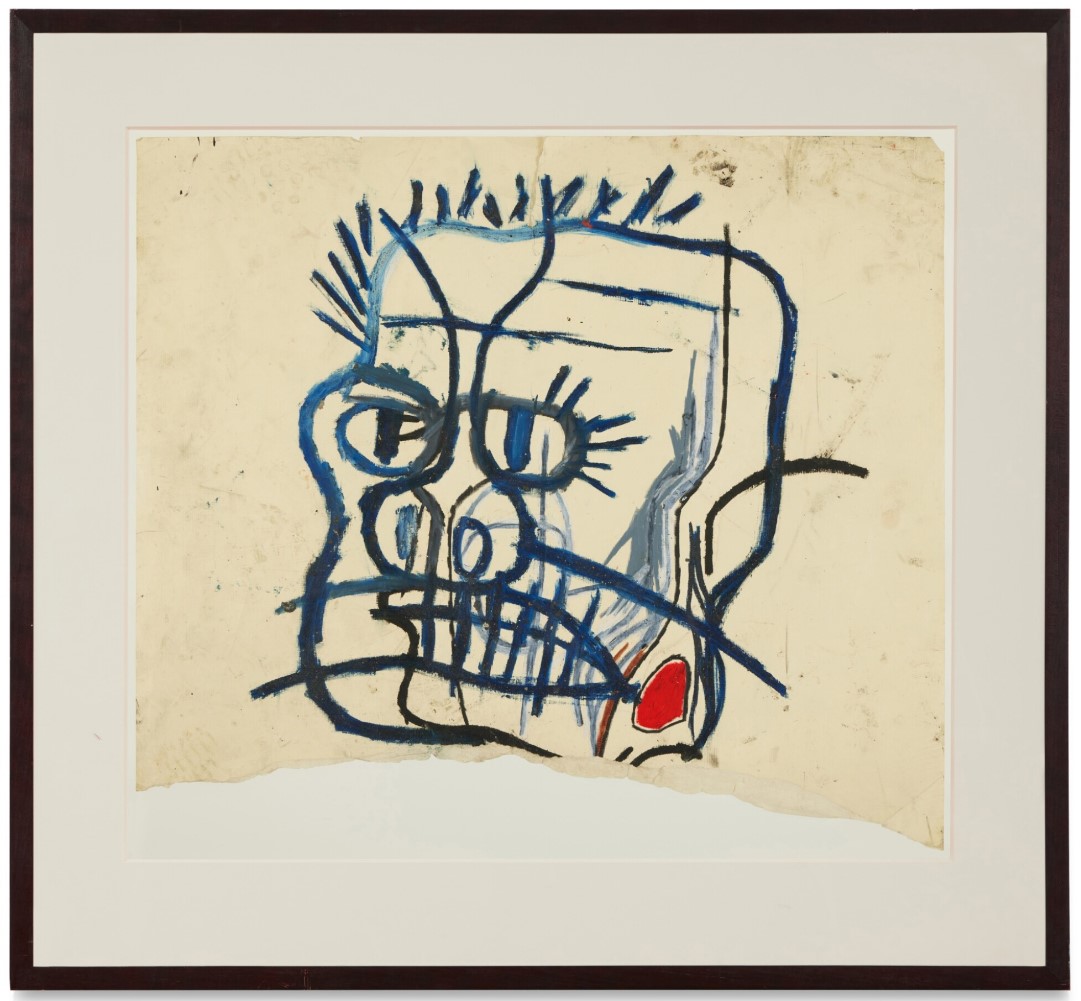
JEAN-MICHEL BASQUIAT (1960 – 1988)
Untitled (Head), 1982
Oilstick on paper
23 1/8 x 26 inches (58.7 x 66 cm)
#2. Untitled, 1982
Sotheby’s London: 27 June 2023
Estimated: GBP 1,200,000 – 1,800,000
GBP 1,681,500 / USD 2,144,223
WORK ON PAPER

JEAN-MICHEL BASQUIAT (1960 – 1988)
Untitled, 1982
Oilstick and marker pen on paper
22 1/4 x 30 1/8 inches (56.5 x 76.5 cm)
#3. Untitled, 1984
Christie’s London: 28 June 2023
Estimated: GBP 1,000,000 – 1,500,000
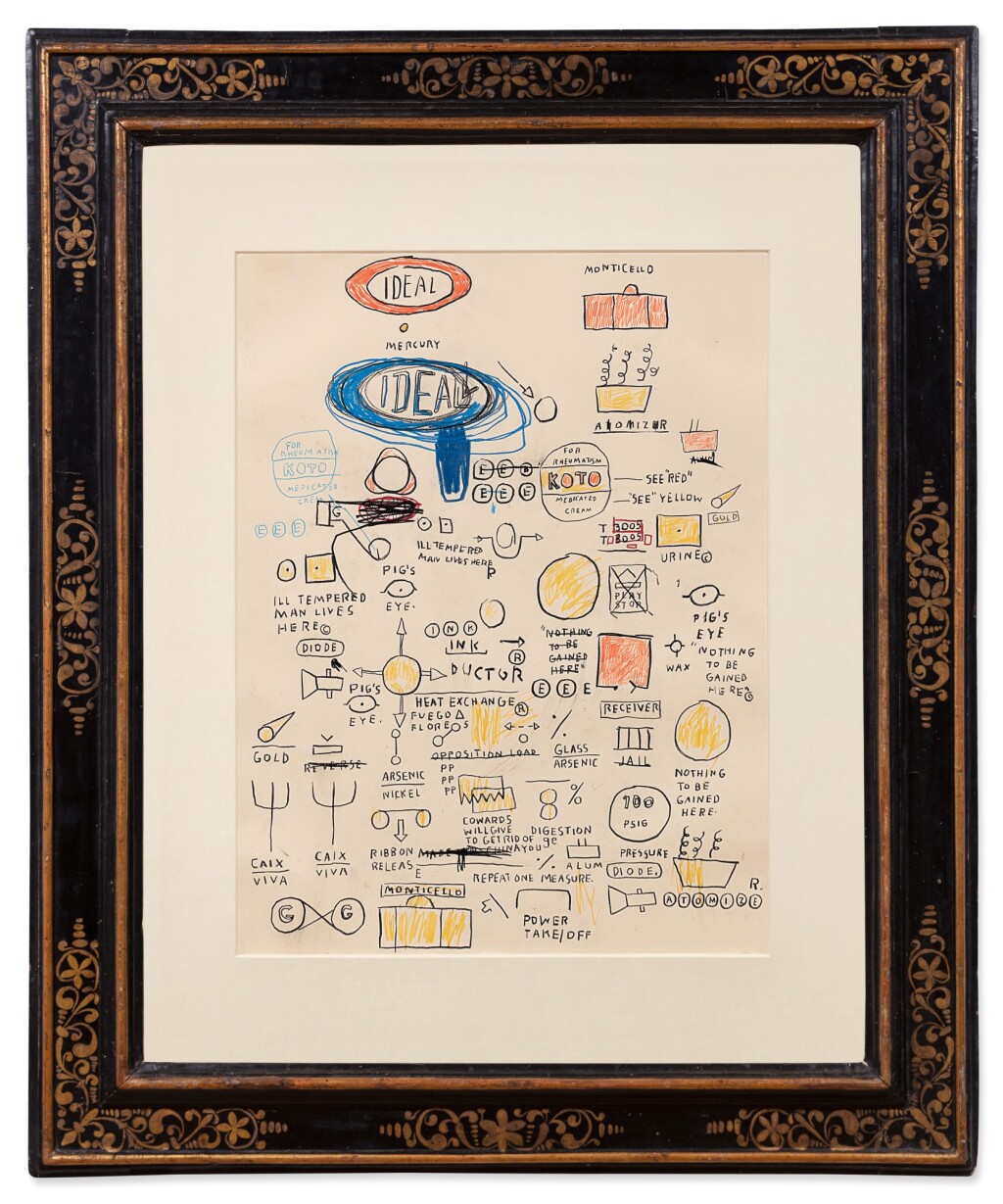
GBP 1,250,000 / USD 1,579,279
WORK ON PAPER
JEAN-MICHEL BASQUIAT (1960-1988), Untitled | Christie’s
REPEAT SALE
Sotheby’s New-York: 8 December 2021
Estimated: USD 1,000,000 – 1,500,000
USD 1,532,500
WORK ON PAPER
JEAN-MICHEL BASQUIAT (1960-1988)
Untitled, 1987
Wax crayon on paper
29 7/8 x 22 1/4 inches (75.9 x 56.5 cm)
#4. Untitled (Bad Tooth and Ivory), circa 1984
Sotheby’s New-York: 16 November 2023
Estimated: USD 1,200,000 – 1,800,000
USD 1,512,000
WORK ON PAPER
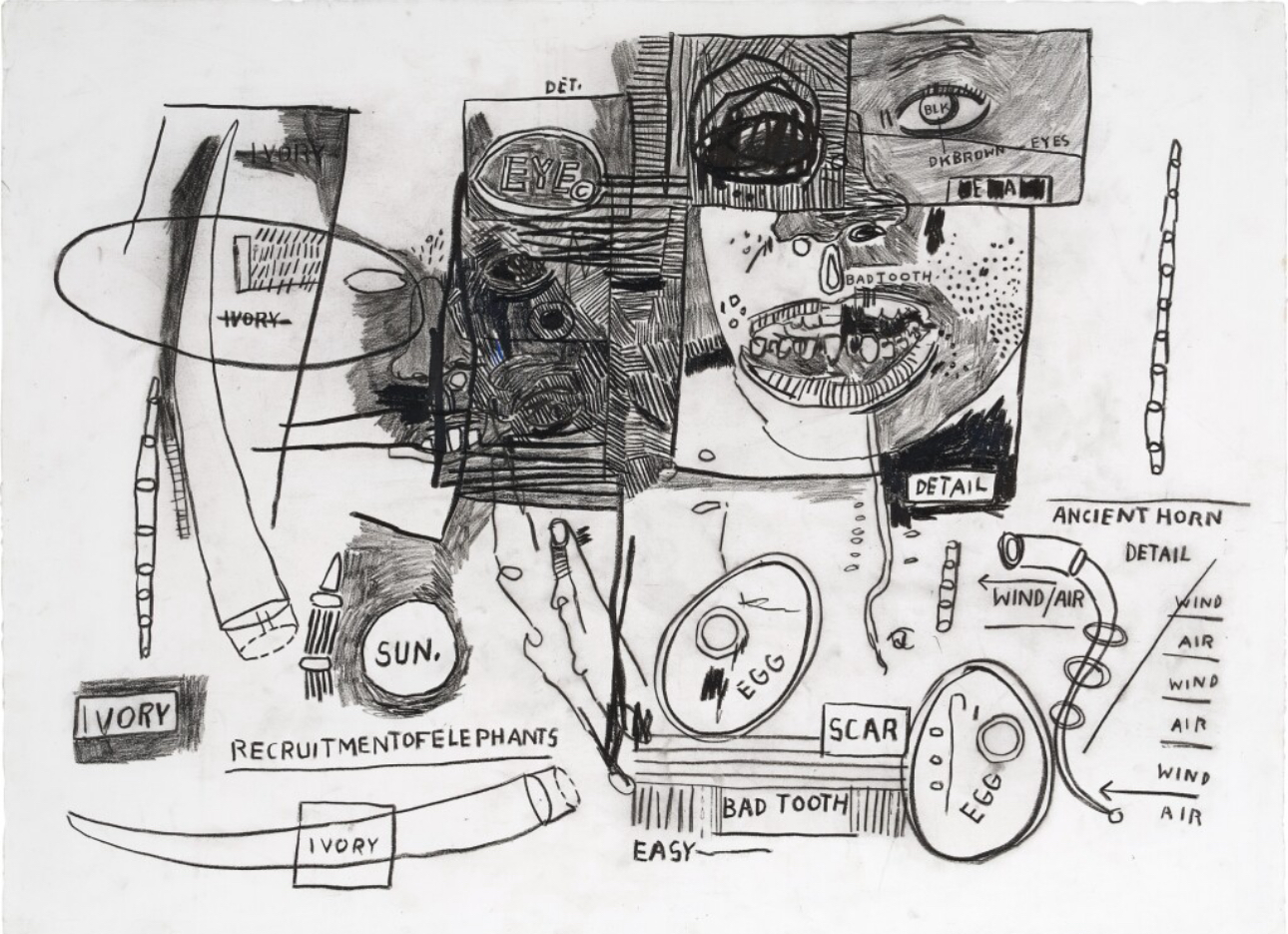
JEAN-MICHEL BASQUIAT (1960 – 1988)
Untitled (Bad Tooth and Ivory), circa 1984
Oil stick and graphite on paper
22×30 inches (55.9 x 76.2 cm)
#5. Untitled, 1982
Christie’s New-York: 7 November 2023
Estimated: USD 1,000,000 – 1,500,000
USD 1,197,000
WORK ON PAPER
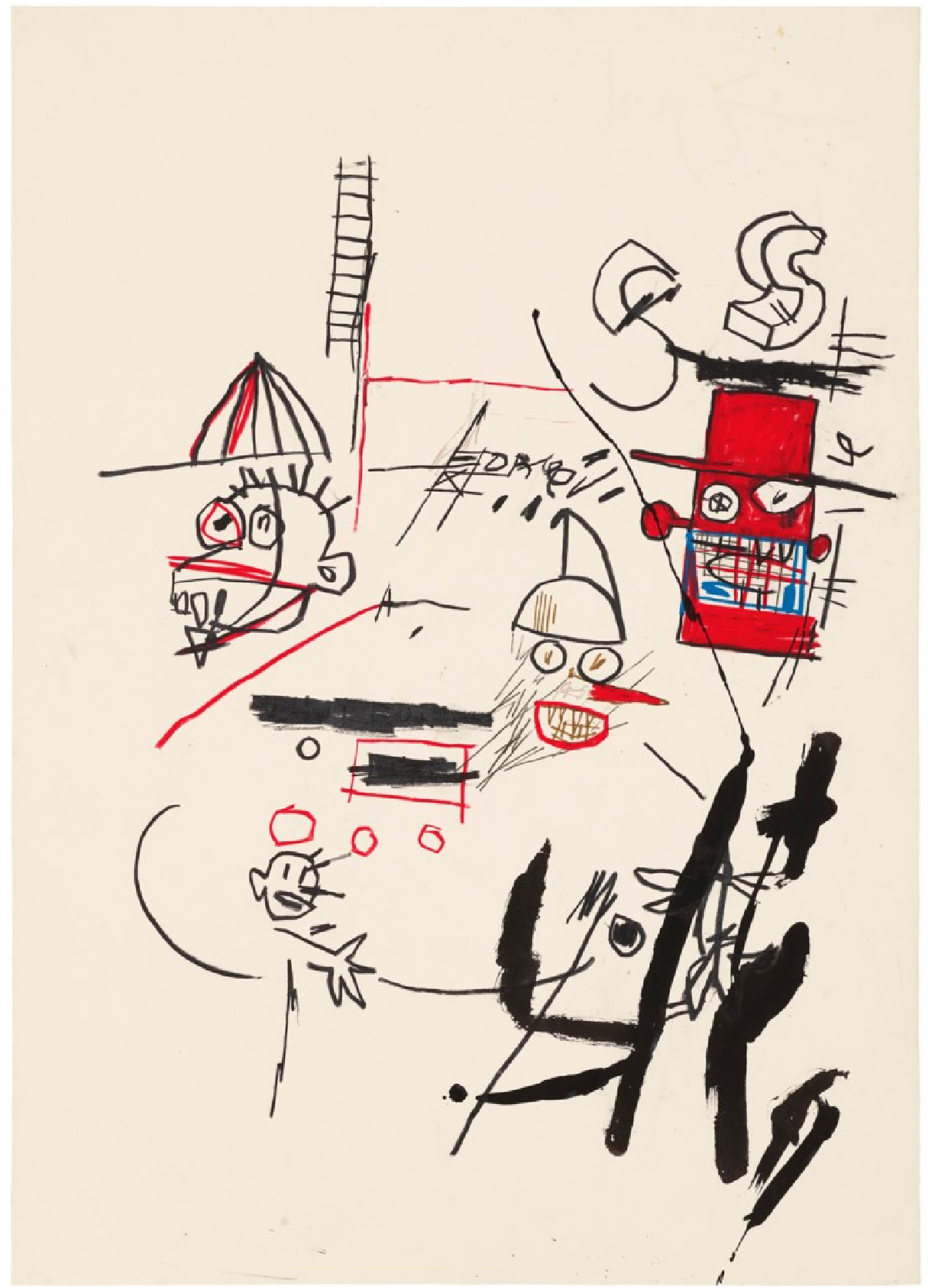
JEAN-MICHEL BASQUIAT (1960-1988)
Untitled, 1982
Oilstick, India ink, crayon and graphite on paper
40×28 inches (101.6 x 71.1 cm)
Signed with the artist’s initials and dated ‘JMB 82’ (on the reverse)
#6. Untitled (Cartoon Dog), circa 1983
Estimated: USD 600,000 – 800,000
USD 945,000
WORK ON PAPER
Estimated: GBP 200,000 – 300,000
GBP 620,000 / USD 854,229
WORK ON PAPER
Untitled (Cartoon Dog), circa 1983
Acrylic and oilstick on paper
27 1/2 x 39 3/8 inches (69.9 x 100 cm)
#7. Untitled (Caucasian / Negro), 1985
Sotheby’s New-York: 16 November 2023
Estimated: USD 600,000 – 800,000
USD 854,000
WORK ON PAPER
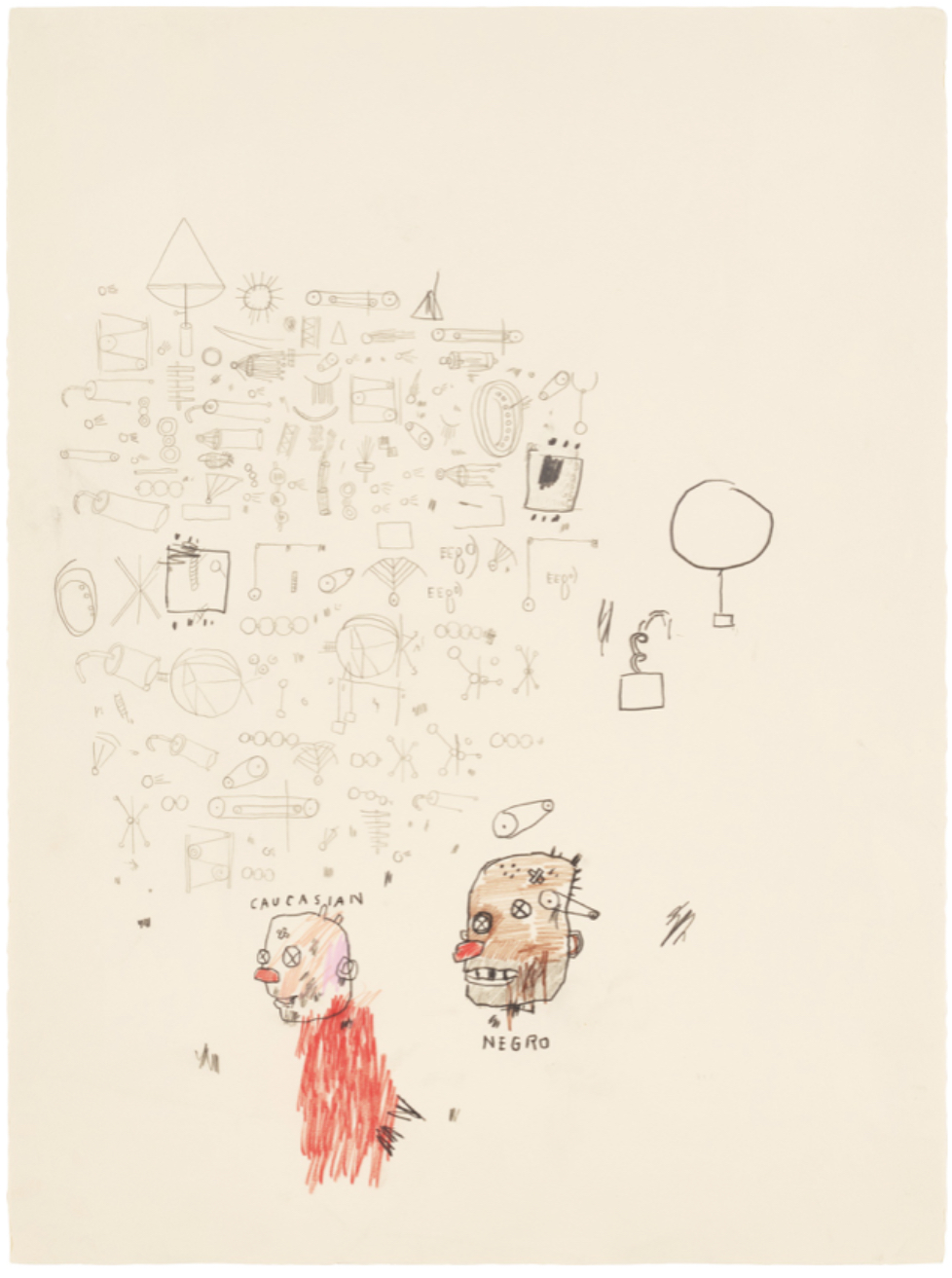
JEAN-MICHEL BASQUIAT (1960 – 1988)
Untitled (Caucasian / Negro), 1985
Oil stick, graphite and colored pencil on paper
30 x 22 1/4 inches (76.2 x 56.6 cm)
#8. Untitled, 1987
Sotheby’s New-York: 16 November 2023
Estimated: USD 700,000 – 1,000,000
USD 762,000
WORK ON PAPER
Untitled | Contemporary Day Auction | 2023 | Sotheby’s (sothebys.com)
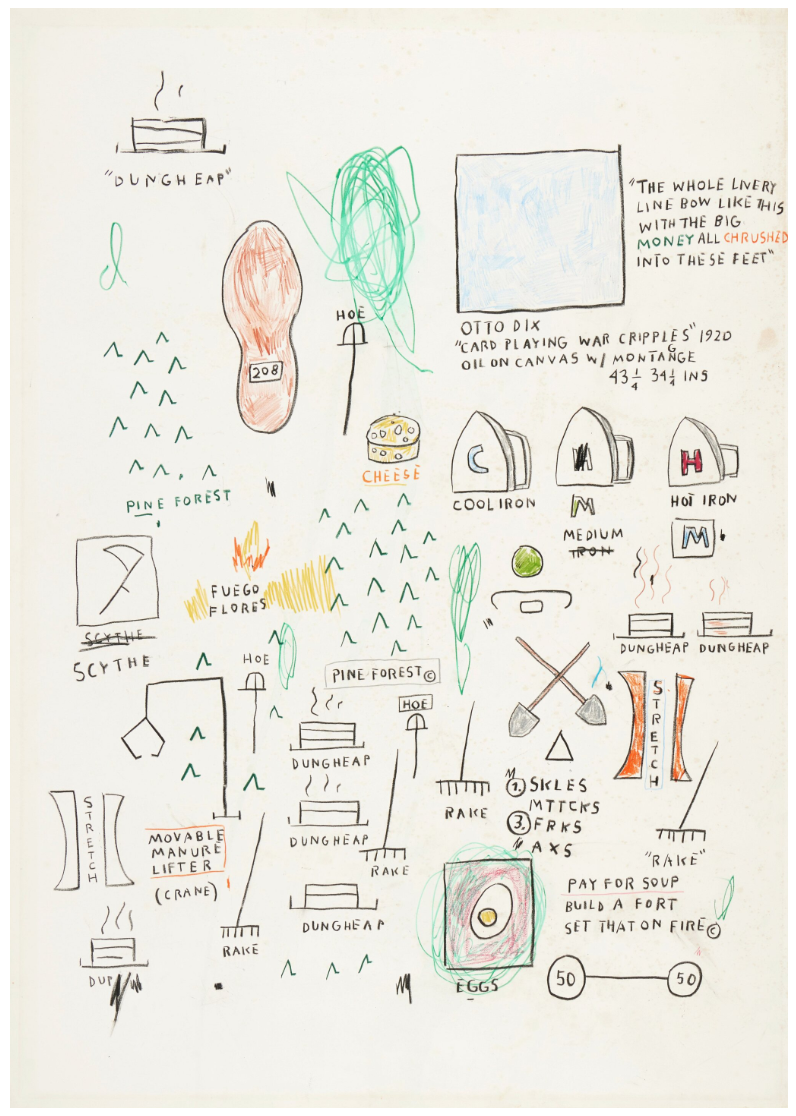
JEAN-MICHEL BASQUIAT (1960 – 1988)
Untitled, 1987
Crayon and colored pencil on paper
41 3/4 x 29 1/2 inches (106 x 74.9 cm)
Signed and dated 87 (on the verso)
#9. Muscles of Right Orbit, 1985
Sotheby’s New-York: 28 September 2023
Estimated: USD 500,000 – 700,000
USD 723,900
WORK ON PAPER
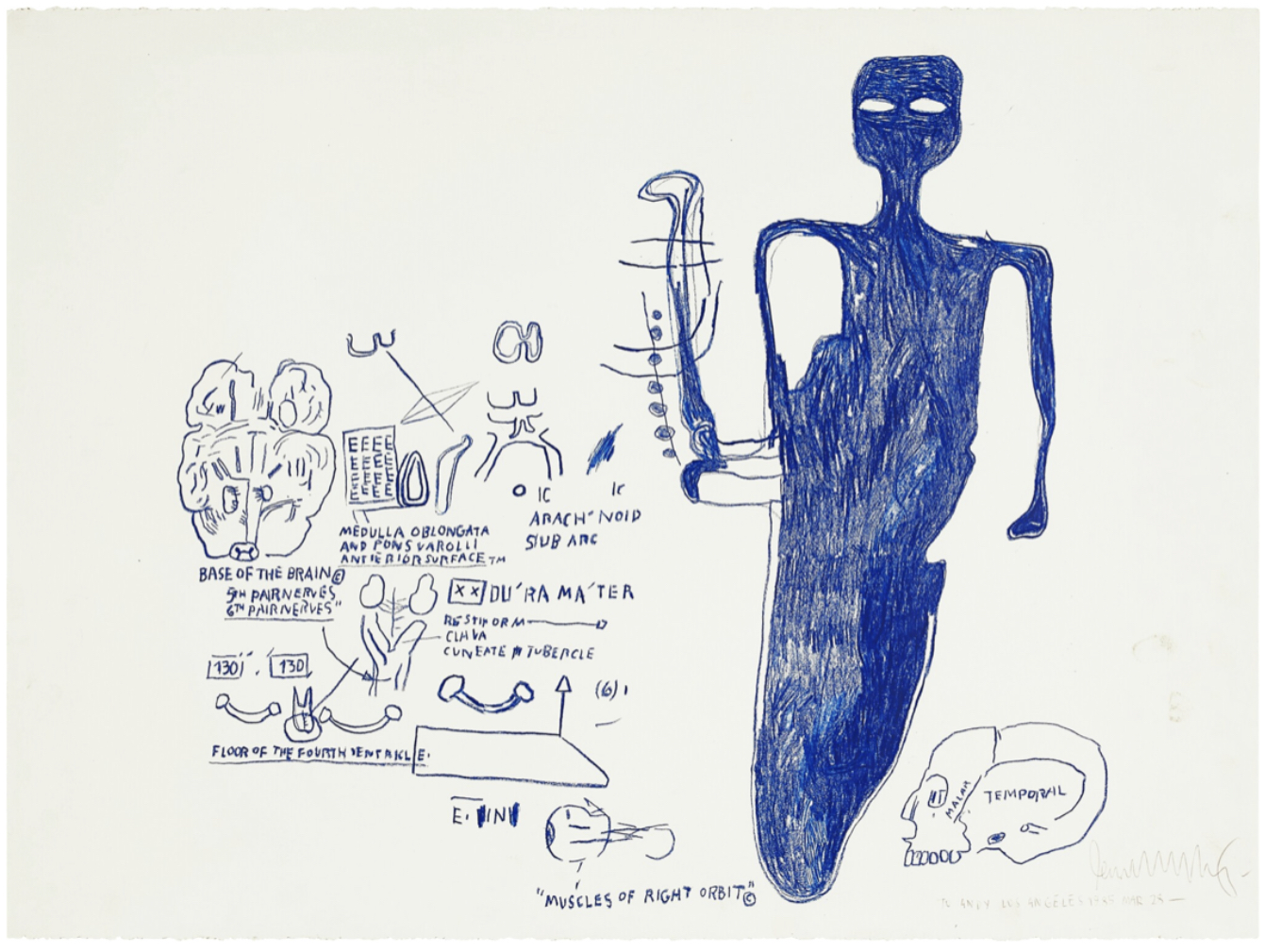
JEAN-MICHEL BASQUIAT (1960 – 1988)
Muscles of Right Orbit, 1985
Wax crayon on paper
22 1/2 x 30 1/2 inches (57.2 x 77.5 cm)
Signed, dated LOS ANGELES 1985 MAR 28 and dedicated To Andy (lower right)
#10. Untitled, 1981
Sotheby’s New-York: 19 May 2023
Estimated: USD 250,000 – 350,000
USD 635,000
WORK ON PAPER
Untitled | Contemporary Day Auction | 2023 | Sotheby’s (sothebys.com)
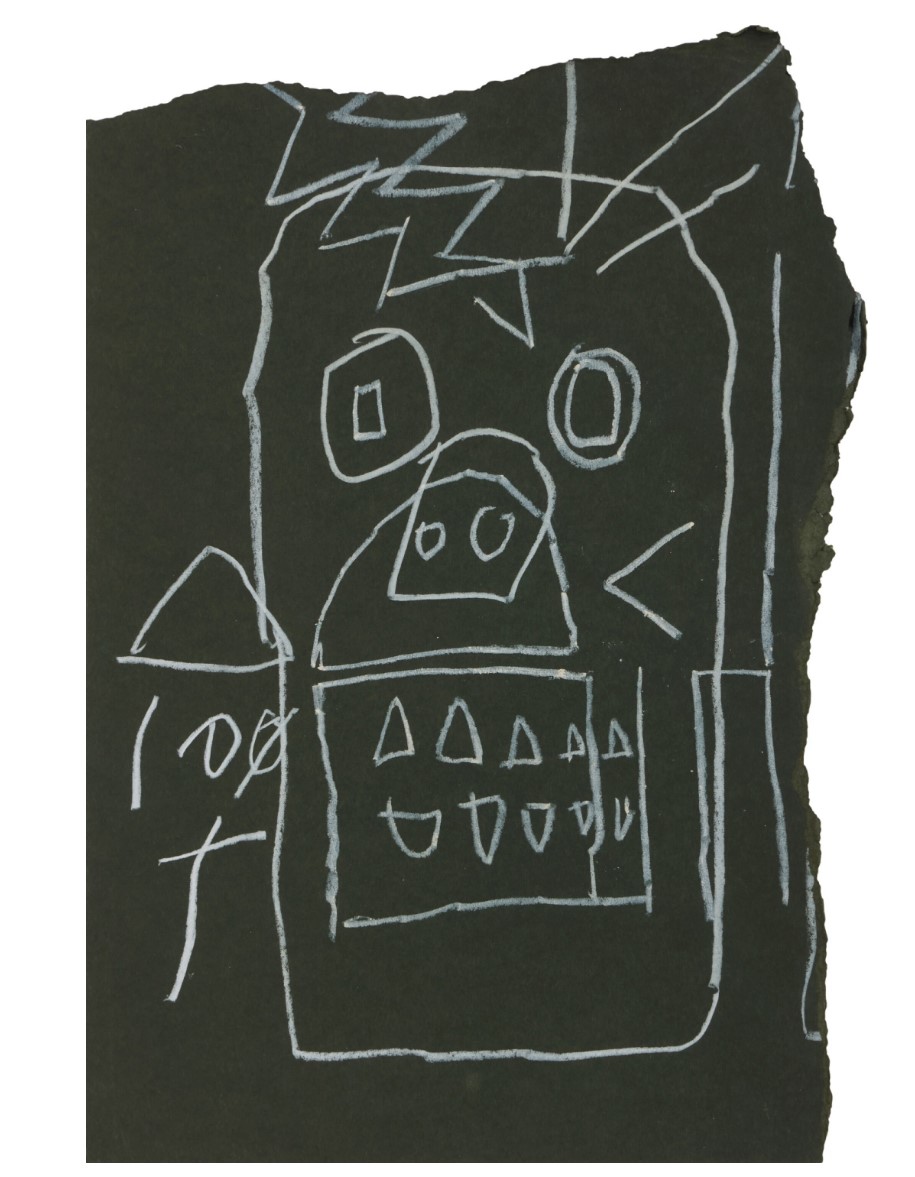
JEAN-MICHEL BASQUIAT (1960 – 1988)
Untitled, 1981
Chalk on paper
20 1/2 x 13 1/2 inches (52.1 x 34.3 cm)
#11. Untitled (Man with Crown), 1982
Christie’s New-York: 18 May 2023
Estimated: USD 800,000 – 1,200,000
USD 567,000
WORK ON PAPER
JEAN-MICHEL BASQUIAT (1960-1988)
Untitled (Man with Crown), 1982
oilstick on paper
17×14 inches (43.2 x 35.5 cm)
#12. Untitled, 1982
Sotheby’s New-York: 19 May 2023
Estimated: USD 500,000 – 700,000
USD 546,100
WORK ON PAPER
Untitled | Contemporary Day Auction | 2023 | Sotheby’s (sothebys.com)
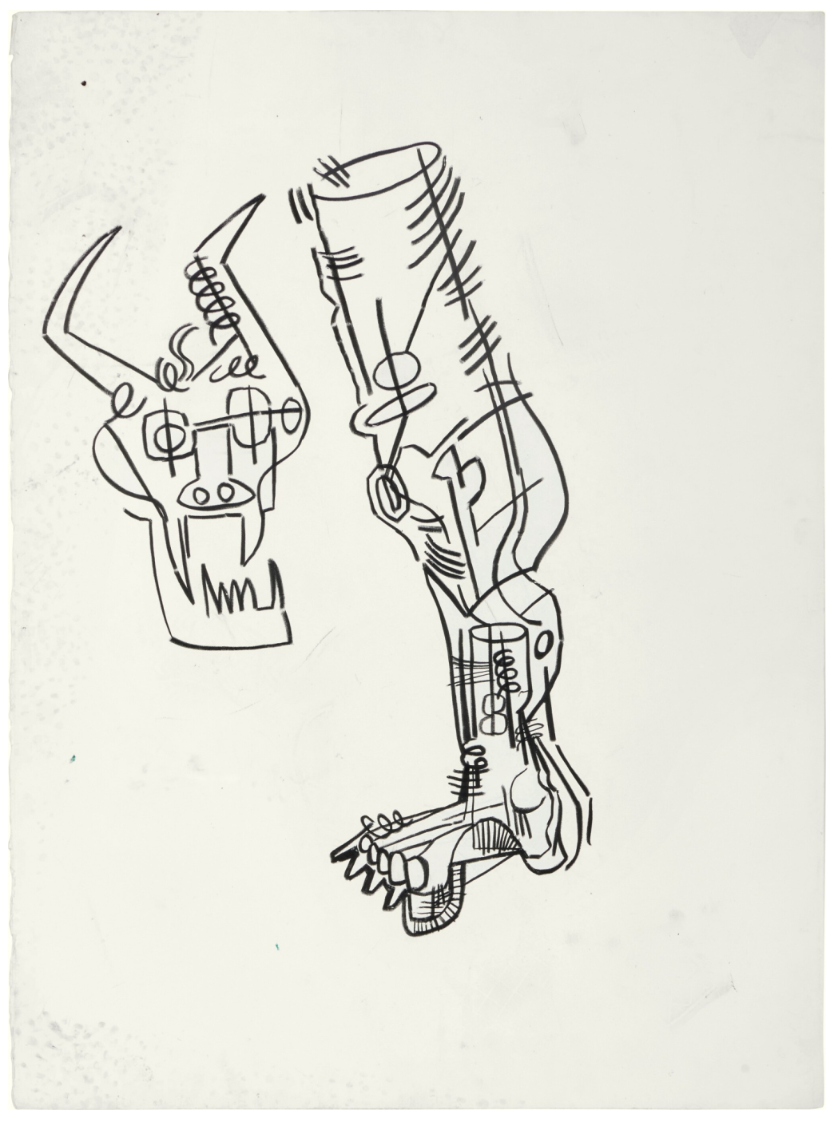
JEAN-MICHEL BASQUIAT (1960 – 1988)
Untitled, 1982
Oil stick on paper
30 1/8 x 22 1/4 inches (76.5 x 56.5 cm)
#13. Untitled (First Collage Experiment, Modena Italy), 1981
Christie’s New-York: 18 May 2023
Estimated: USD 200,000 – 300,000
USD 529,200
WORK ON PAPER
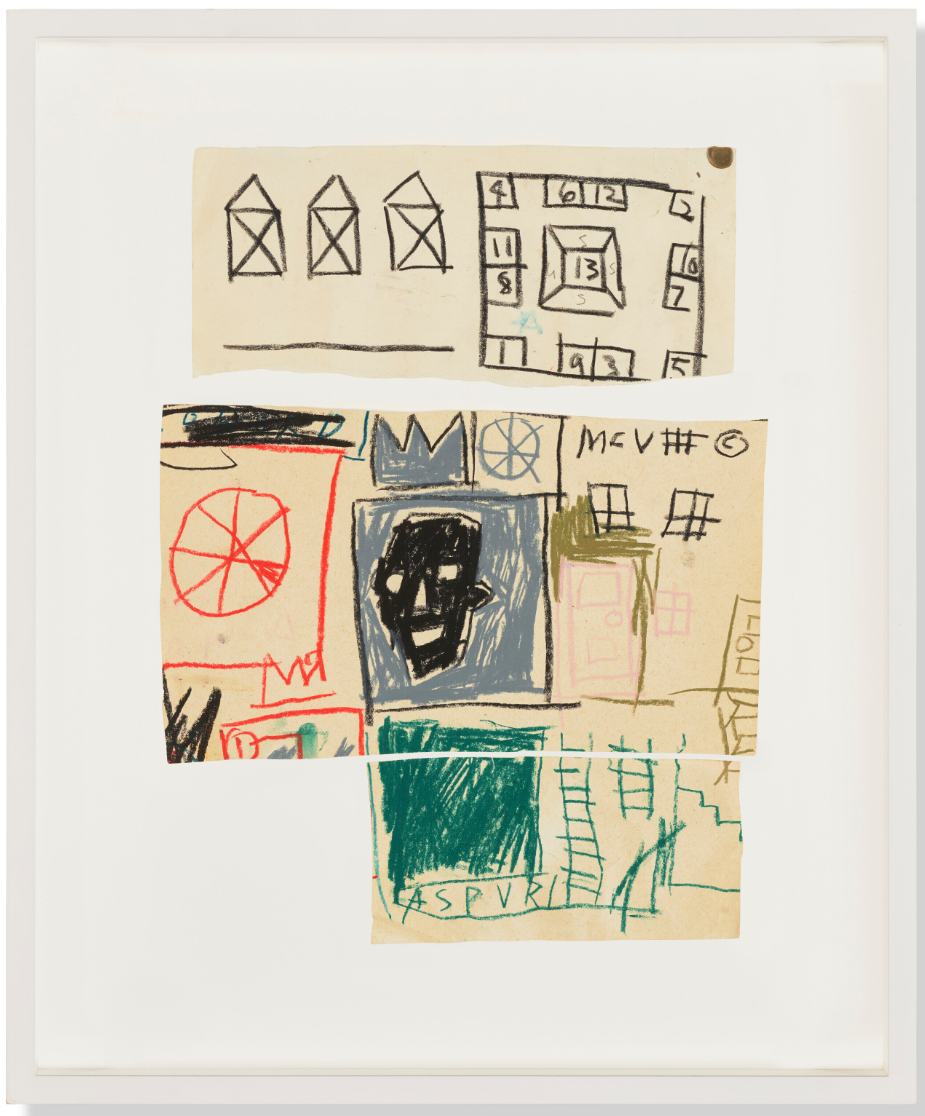
JEAN-MICHEL BASQUIAT (1960-1988)
Untitled (First Collage Experiment, Modena Italy), 1981
Acrylic and wax crayon on paper, in three parts
Overall: 17 1/4 x 13 inches (43.8 x 33 cm)
#14. Portrait of Joel Bernard, 1983
Sotheby’s New-York: 16 November 2023
Estimated: USD 800,000 – 1,200,000
USD 444,500
WORK ON PAPER
Portrait of Joel Bernard | Contemporary Day Auction | 2023 | Sotheby’s (sothebys.com)
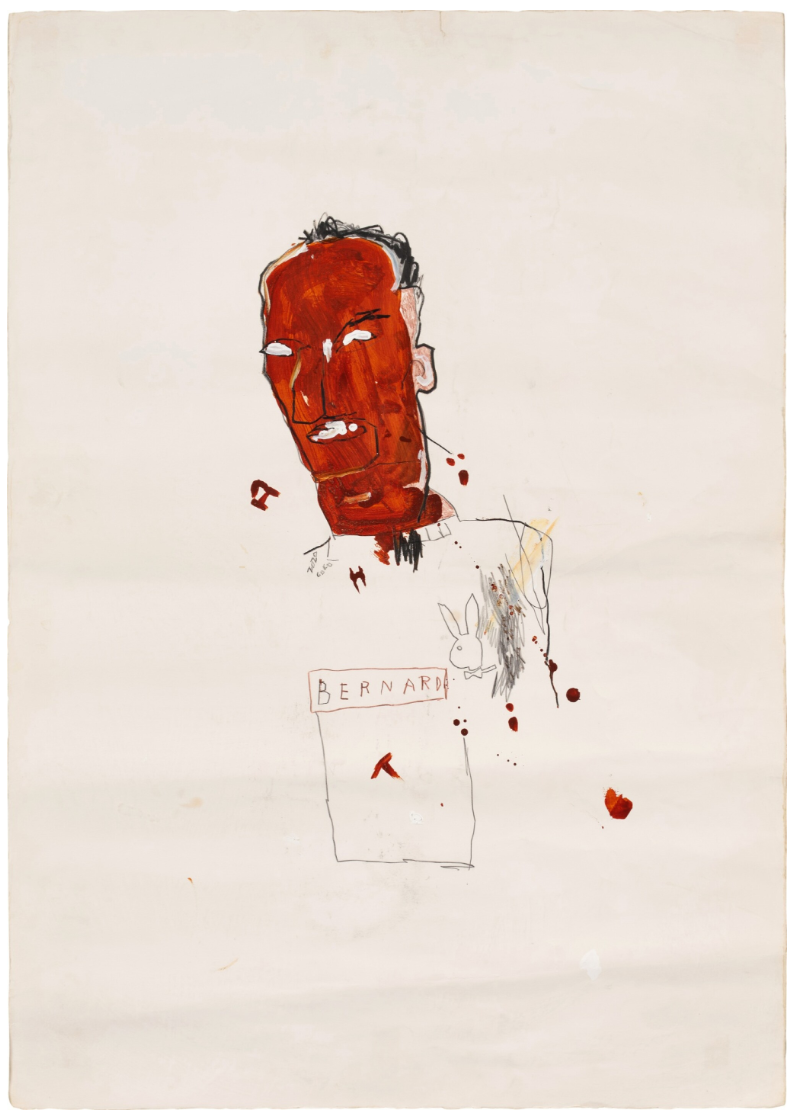
JEAN-MICHEL BASQUIAT (1960 – 1988)
Portrait of Joel Bernard, 1983
Acrylic, graphite and colored pencil on paper
41 5/8 x 29 1/2 inches (105.7 x 74.9 cm)
#15. Untitled (Wolf), 1984
Heritage Auctions: 23 May 2023
Estimated: USD 150,000 – 250,000
USD 287,500
WORK ON PAPER
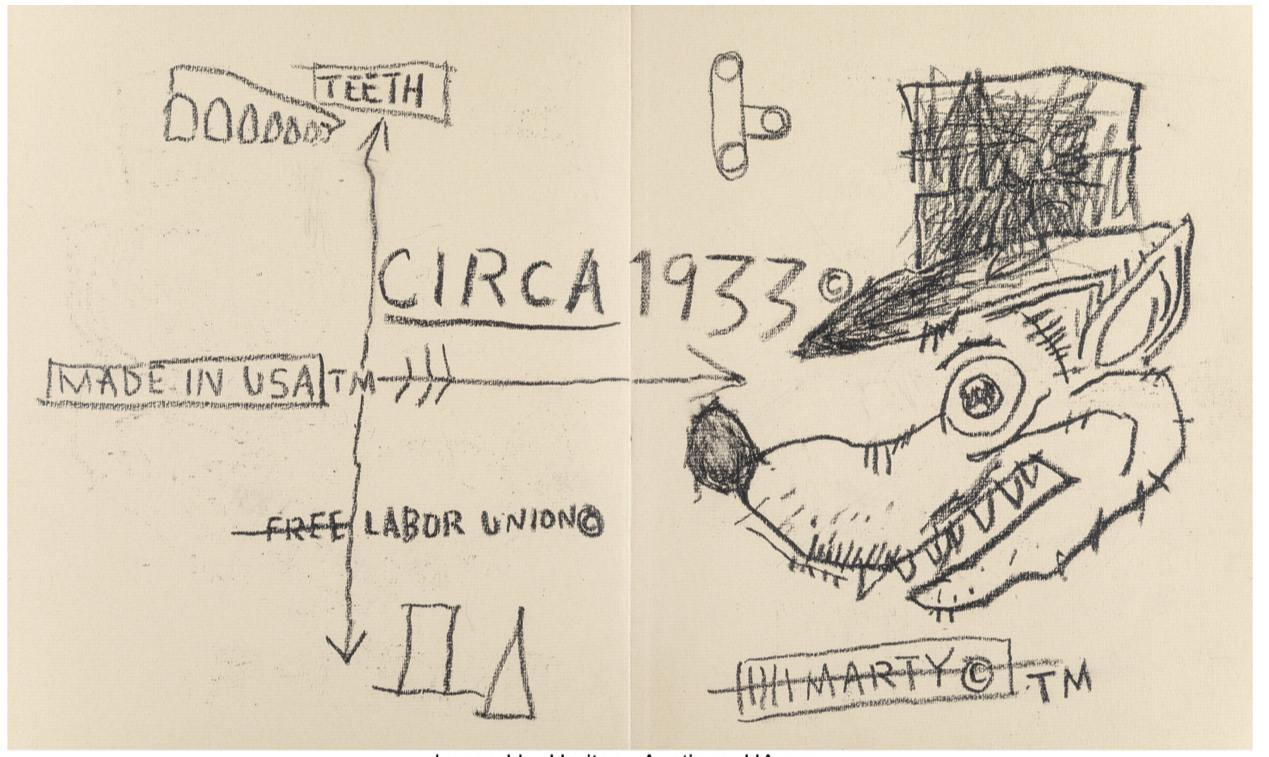
JEAN-MICHEL BASQUIAT (1960-1988)
Untitled (Wolf), 1984
Softcover book with crayon drawing
11 x 9 inches (27.9 x 22.9 cm) (cover)
11 x 18-1/4 inches (drawing on full spread)
Signed and inscribed on cover page: JMB 777-1881
#16. Untitled (Colored Boy Piano Player), 1987
Phillips London: 13 October 2023
Estimated: GBP 200,000 – 300,000
GBP 203,200 / USD 246,601
WORK ON PAPER
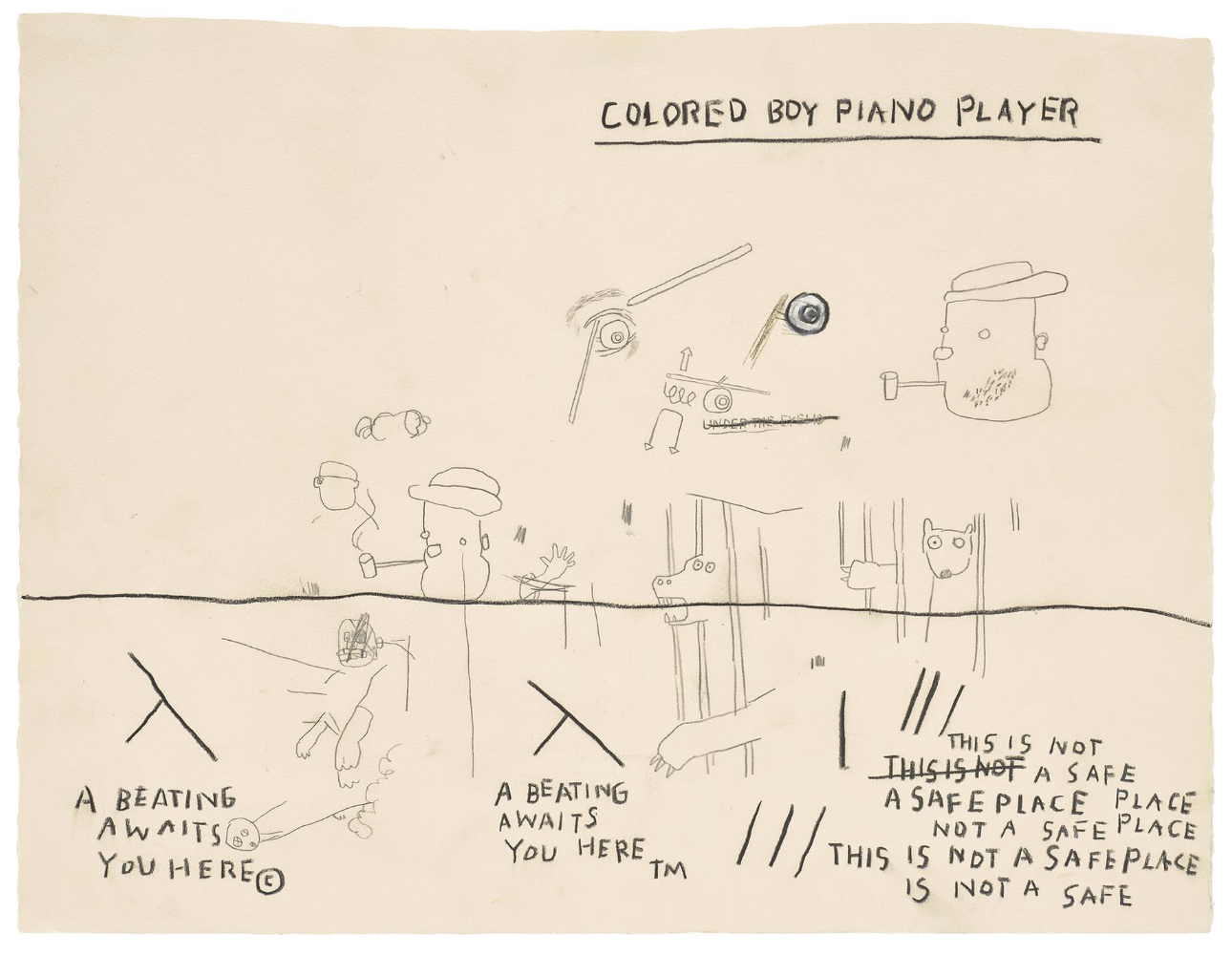
JEAN-MICHEL BASQUIAT
Untitled (Colored Boy Piano Player), 1987
Graphite and oilstick on paper
17 1/4 x 22 1/4 inches (43.8 x 56.5 cm)
Signed and dated ‘Jean-Michel Basquiat 87’ on the reverse
#17. Untitled (Car Crash), 1980
Dorotheum Vienna: 29 November 2023
Estimated: EUR 90,000 – 110,000
EUR 221,000 / USD 242,400
WORK ON PAPER
Jean-Michel Basquiat – Contemporary Art I 2023/11/29 – Realized price: EUR 221,000 – Dorotheum
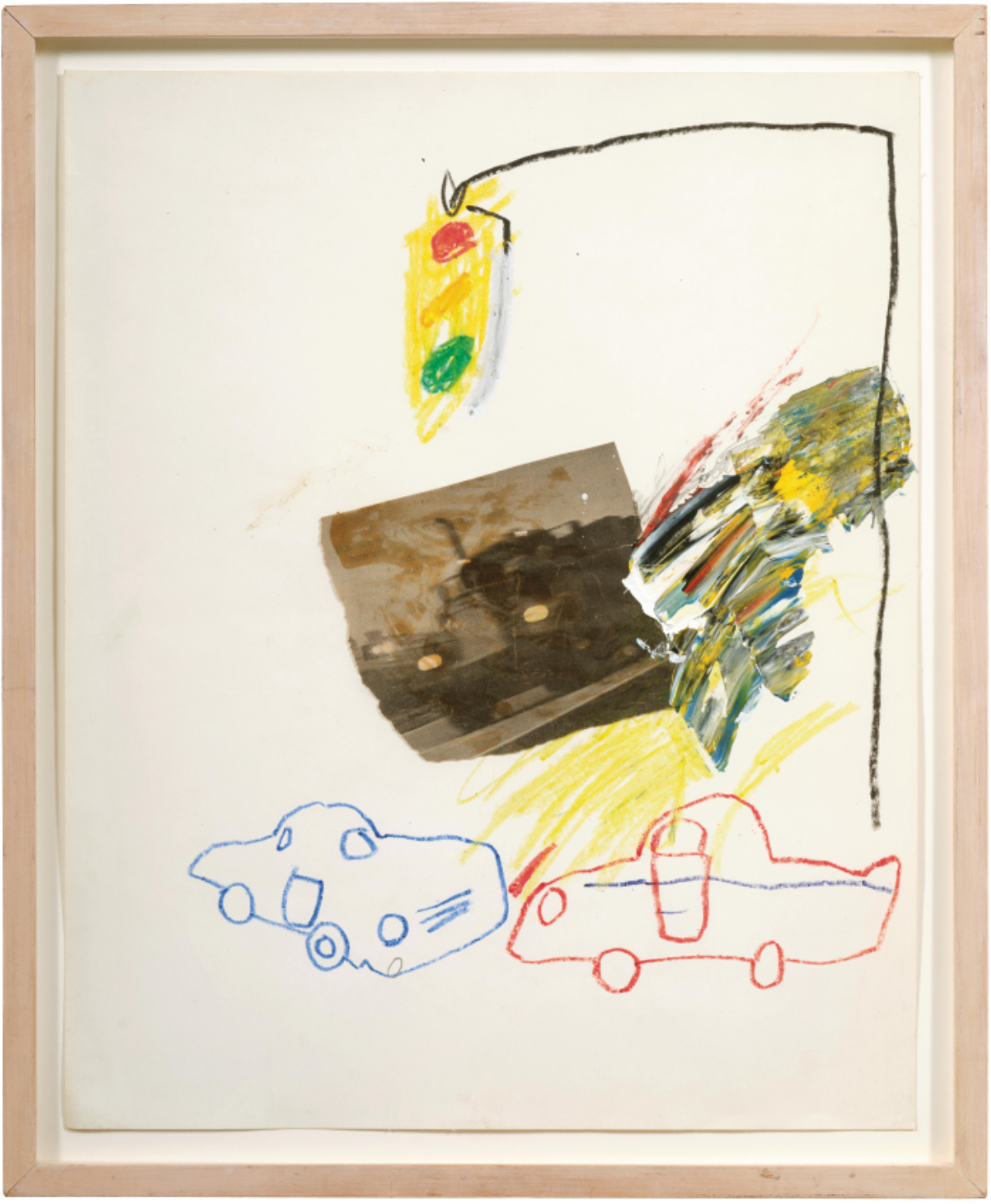
JEAN-MICHEL BASQUIAT (New York 1960–1988)
Untitled (Car Crash), 1980
Crayons, acrylic and collage on paper
19 5/8 x 15 5/8 inches (50×40 cm)
Inscribed “Drawing by Jean-Michel Basquiat, Jean-Michel gave me this in 1980, Stanley Moss” on the reverse
#18. Untitled, 1981
Sotheby’s New-York: 19 May 2023
Estimated: USD 80,000 – 120,000
USD 190,500
WORK ON PAPER
Untitled | Contemporary Day Auction | 2023 | Sotheby’s (sothebys.com)
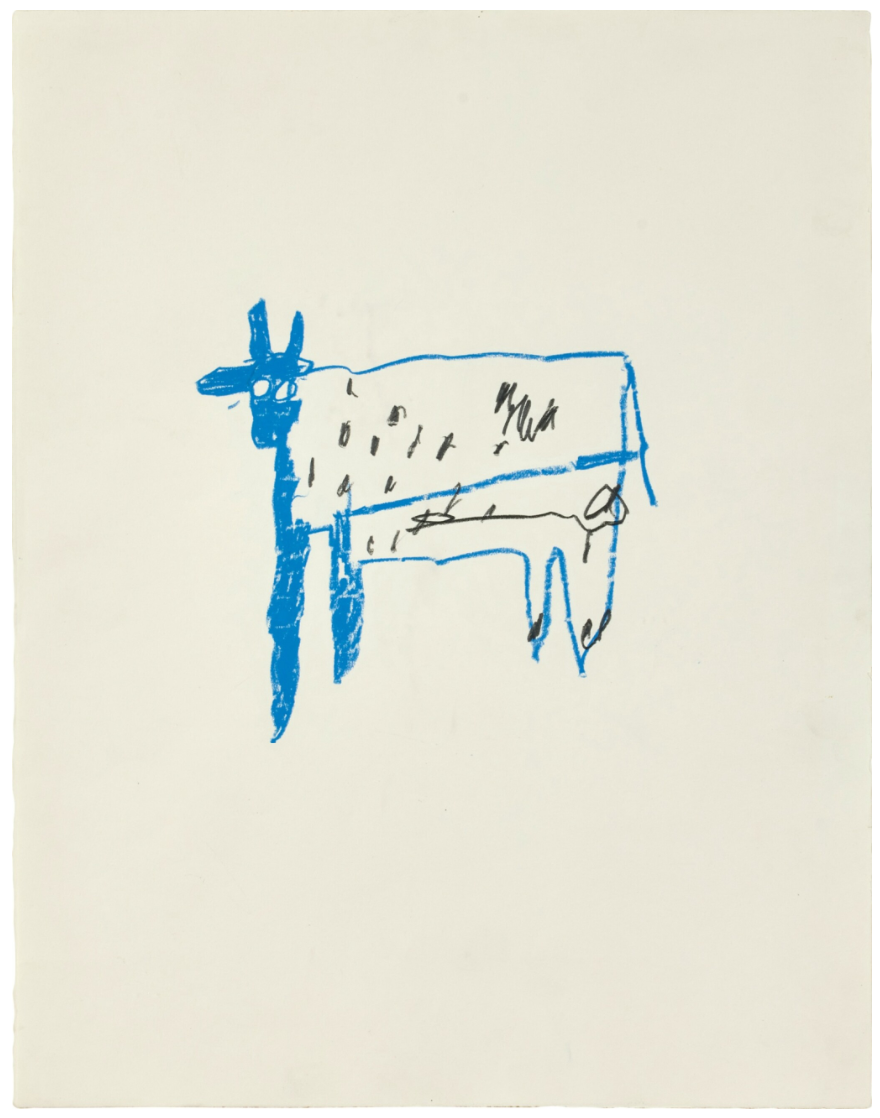
JEAN-MICHEL BASQUIAT (1960 – 1988)
Untitled, 1981
Oil stick and graphite on paper
22 1/2 x 17 1/2 inches (57.2 x 44.5 cm)
#19. TANK, 1981
Christie’s New-York: 29 September 2023
Estimated: USD 30,000 – 50,000
USD 25,200
WORK ON PAPER
JEAN-MICHEL BASQUIAT (1960-1988), TANK | Christie’s (christies.com)
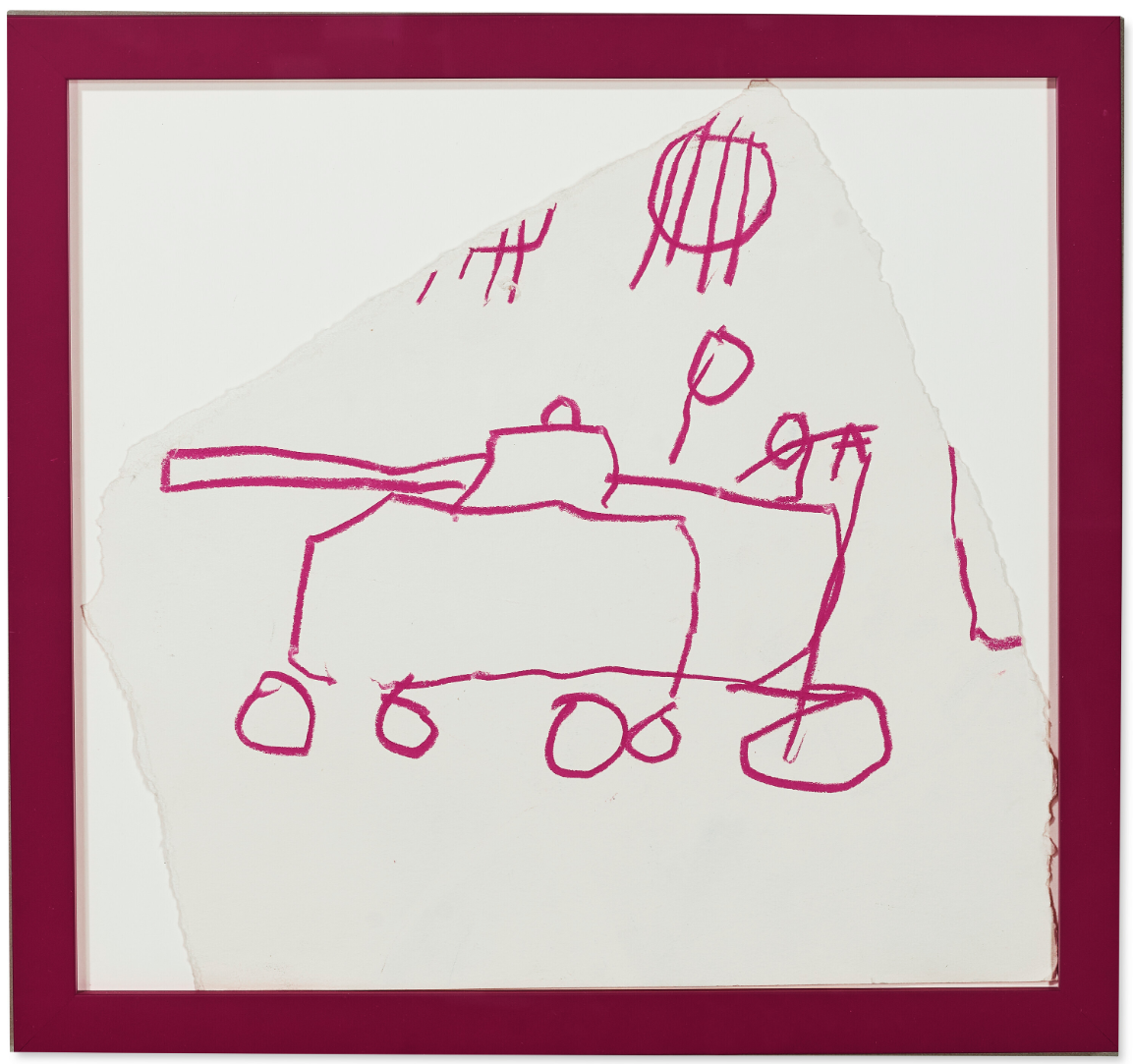
JEAN-MICHEL BASQUIAT (1960-1988)
TANK, 1981
Oil pastel on paper
12 7/8 x 13 5/8 inches (32.7 x 34.6 cm)
2022 Auction Results
#1. Untitled (Self Portrait), 1982
Christie’s London: 28 June 2022
Estimated: GBP 4,000,000 – 6,000,000
GBP 7,961,000 / USD 9,716,831
JEAN-MICHEL BASQUIAT (1960-1988) (christies.com)
JEAN-MICHEL BASQUIAT
Untitled (Self Portrait), 1982
Oilstick and ink on paper
29.9 x 22 inches (75.9 x 55.9cm)
#2. Untitled, 1982
Sotheby’s New-York: 19 May 2022
Estimated: USD 2,000,000 – 3,000,000
USD 3,317,000
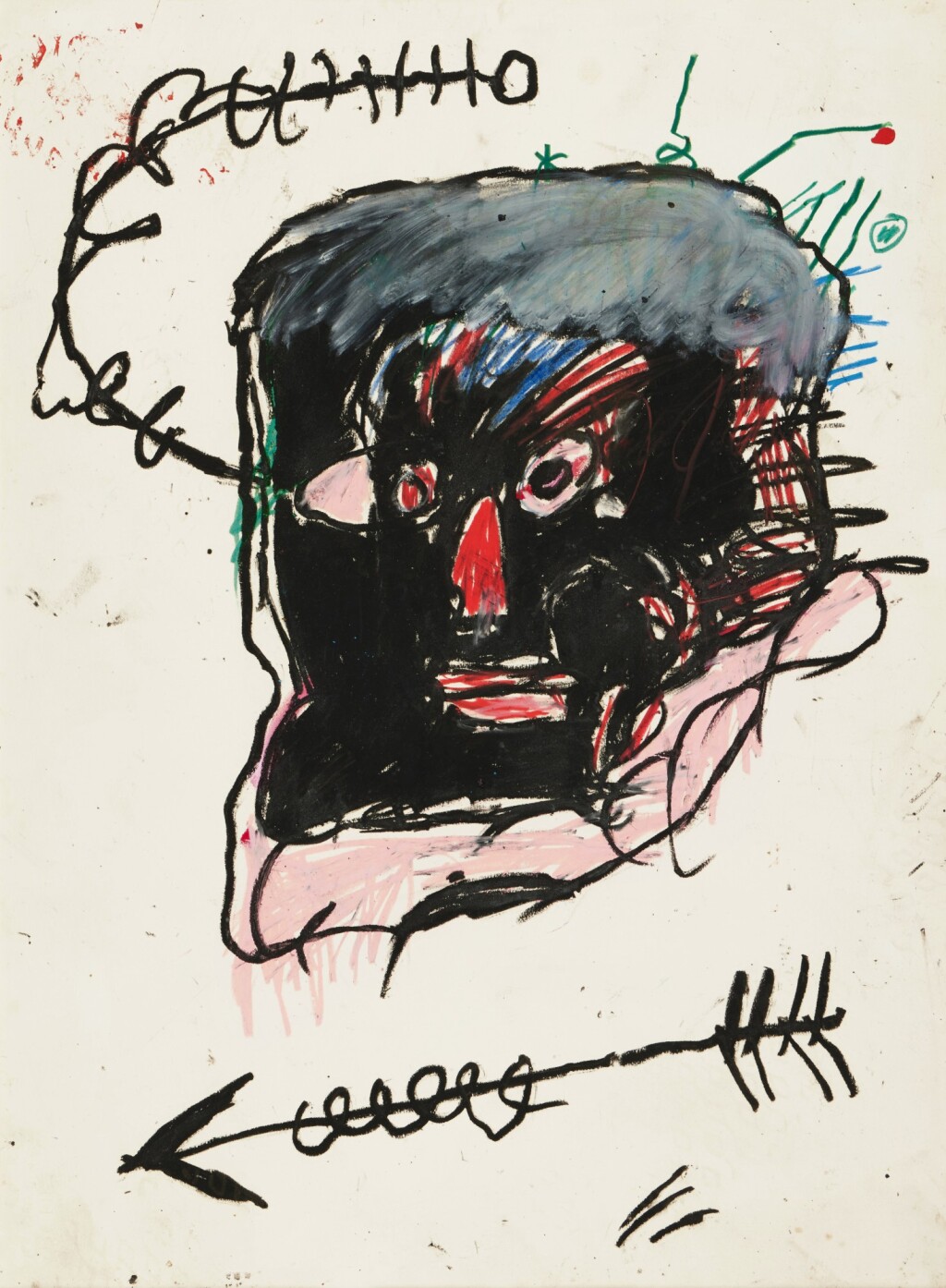 JEAN-MICHEL BASQUIAT
Untitled, 1982
Oilstick on paper
30.2 x 22.2 inches (76.5 x 56.5 cm)
#3. Untitled, 1982
Sotheby’s New-York: 17 November 2022
Estimated: USD 1,500,000 – 2,000,000
USD 1,865,000
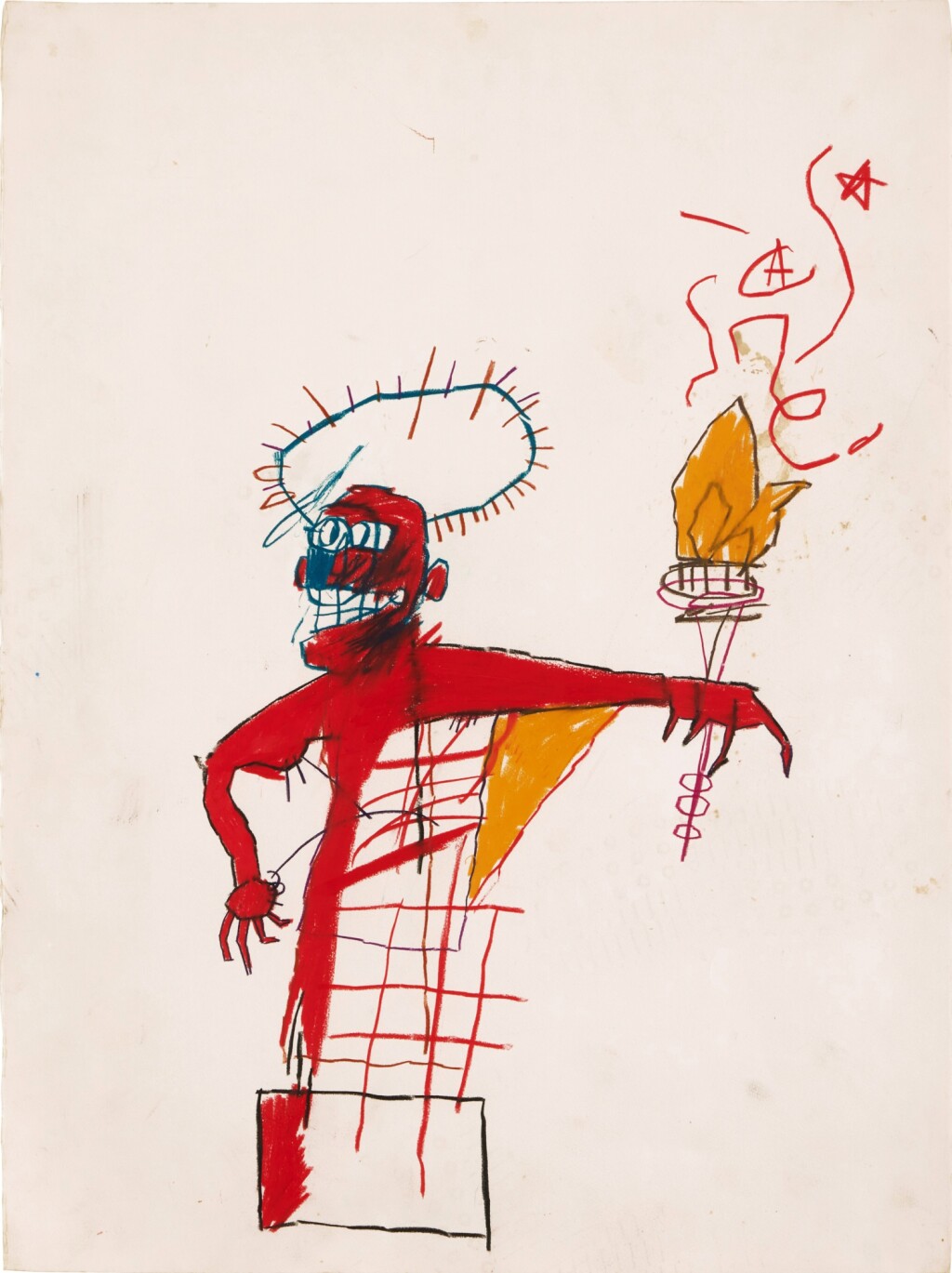
JEAN-MICHEL BASQUIAT
Untitled, 1982
Oil stick on paper
30 x 22 ¼ inches (76.2 x 56.5 cm)
Signed and dated NYC 82 (on the verso)
#4. Portrait of Keith Haring, 1984
Christie’s London: 28 June 2022
Estimated: GBP 1,200,000 – 1,800,000
GBP 1,242,000 / USD 1,515,928
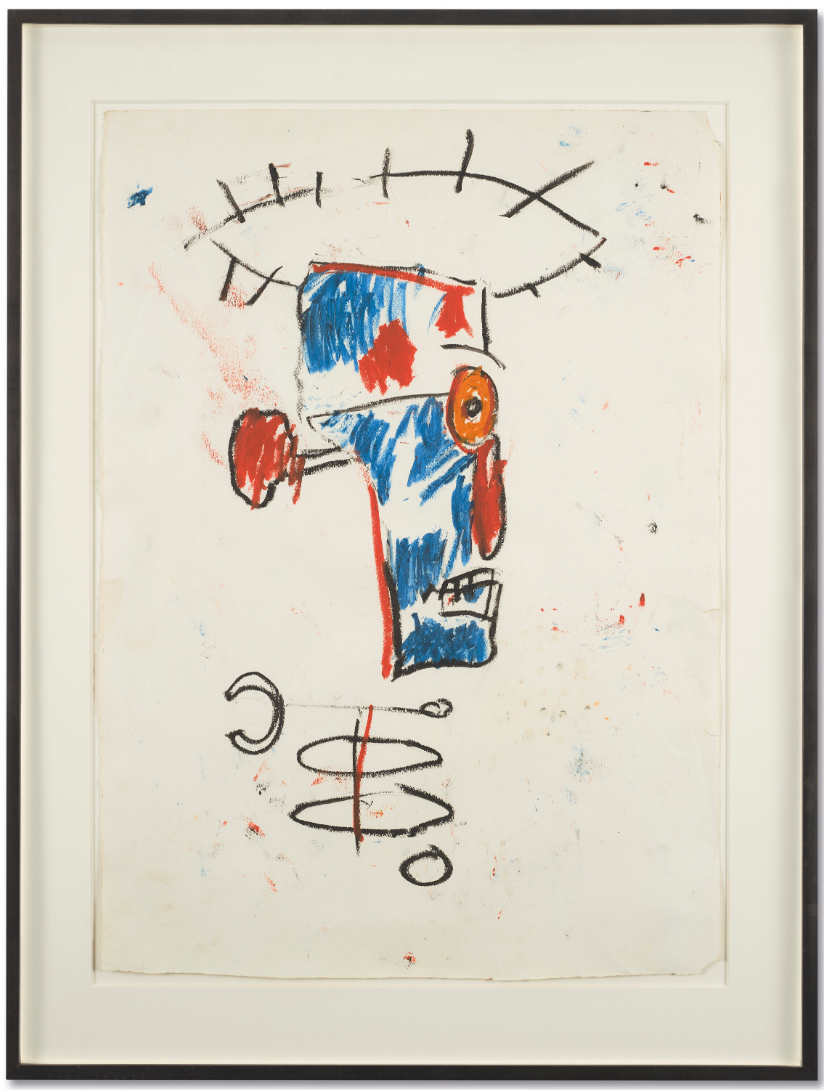
JEAN-MICHEL BASQUIAT
Portrait of Keith Haring, 1984
Oilstick on paper
29.7 x 20.5 inches (75.6 x 52.1cm)
#5. Untitled, 1981
Christie’s New-York: 12 May 2022
Estimated: USD 500,000 – 700,000
USD 945,000
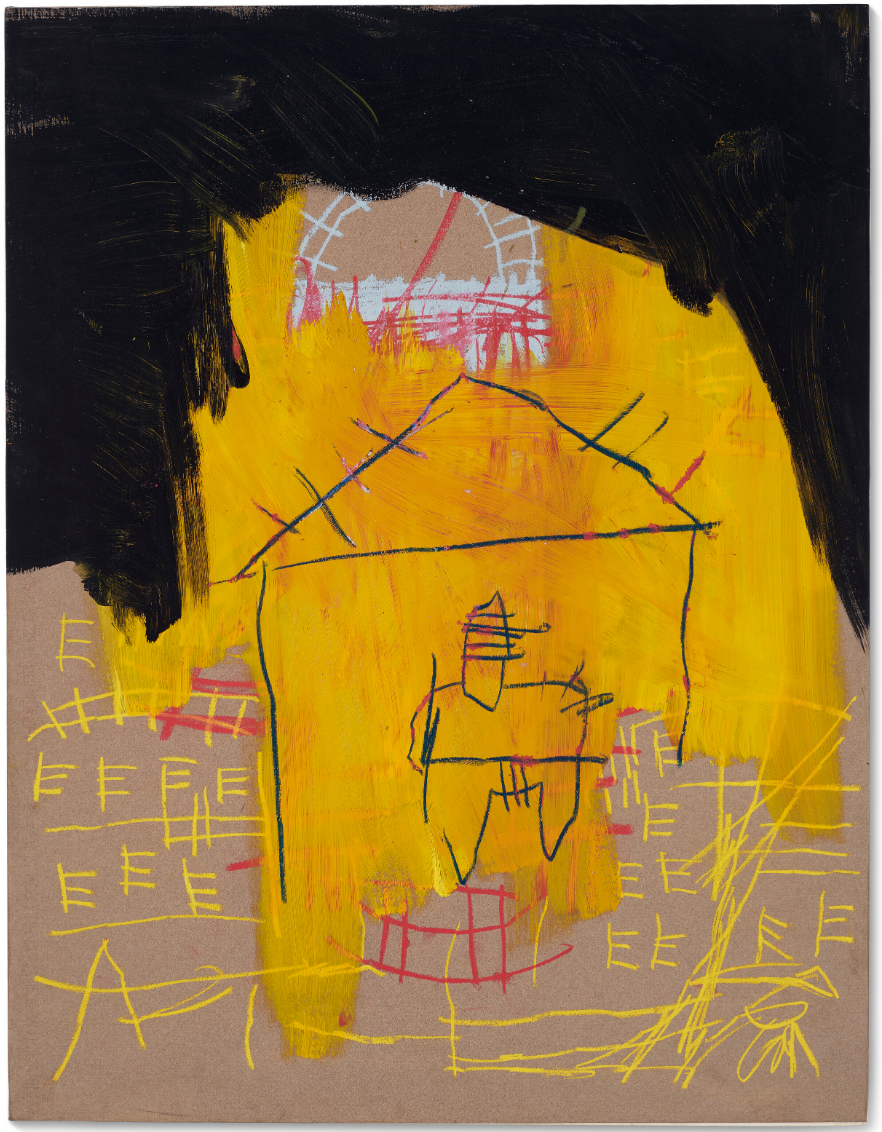
JEAN-MICHEL BASQUIAT
Untitled, 1981
Acrylic, oilstick and wax crayon on paper laid down on canvas
25.5 x 19.7 inches (64.8 x 50.2 cm)
#6. Untitled, 1984-1985
Phillips London: 3 March 2022
Estimated: GBP 600,000 – 800,000
GBP 688,000 / USD 916,477
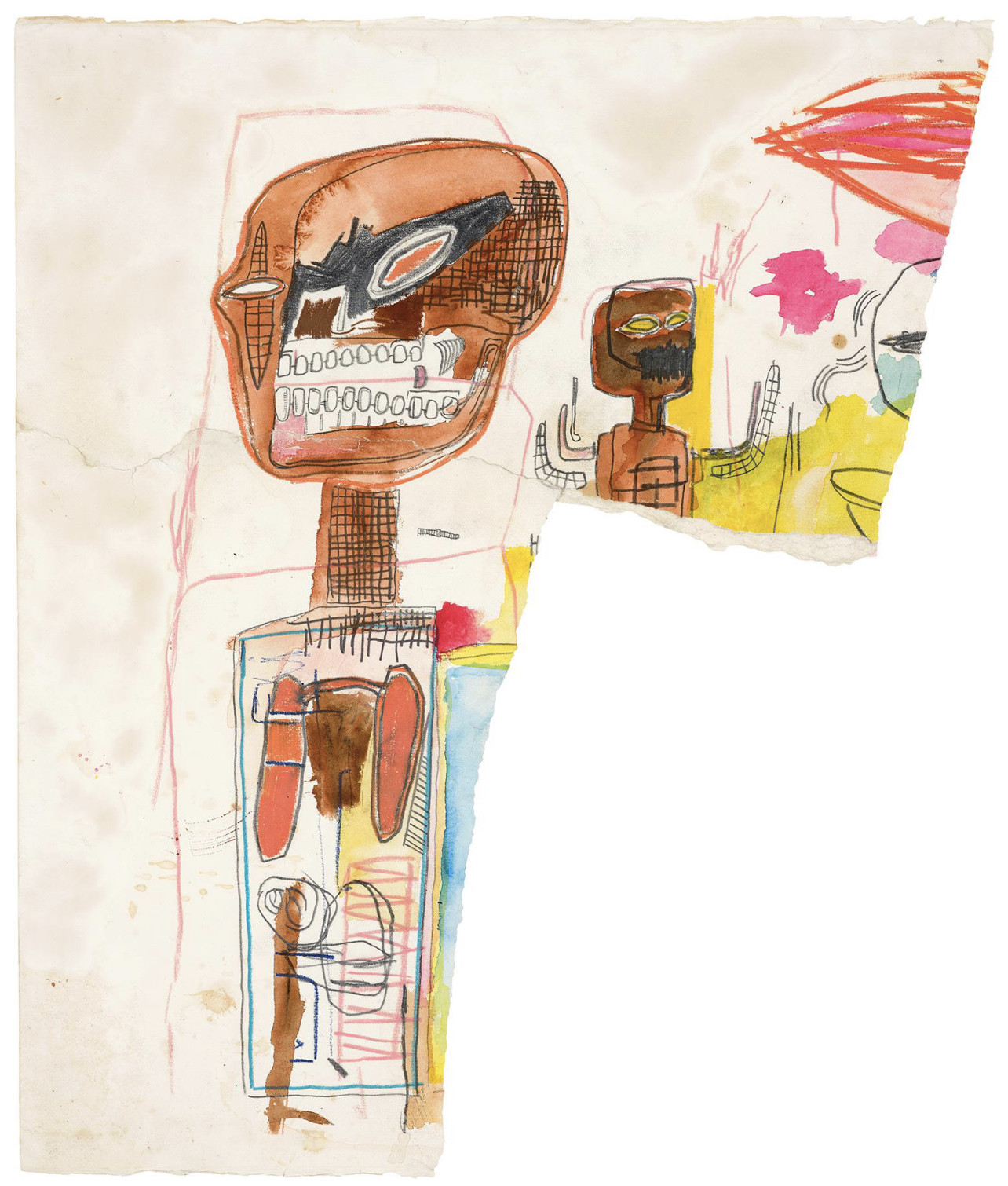
JEAN-MICHEL BASQUIAT
Untitled, 1984-1985
Watercolour, oil stick, crayon and pencil on paper
22 1/2 x 19 inches (57.2 x 48.3 cm)
#7. Untitled, 1987
Phillips New-York: 19 May 2022
Estimated: USD 600,000 – 800,000
USD 877,000
Jean-Michel Basquiat – 20th Century & C… Lot 120 May 2022 | Phillips
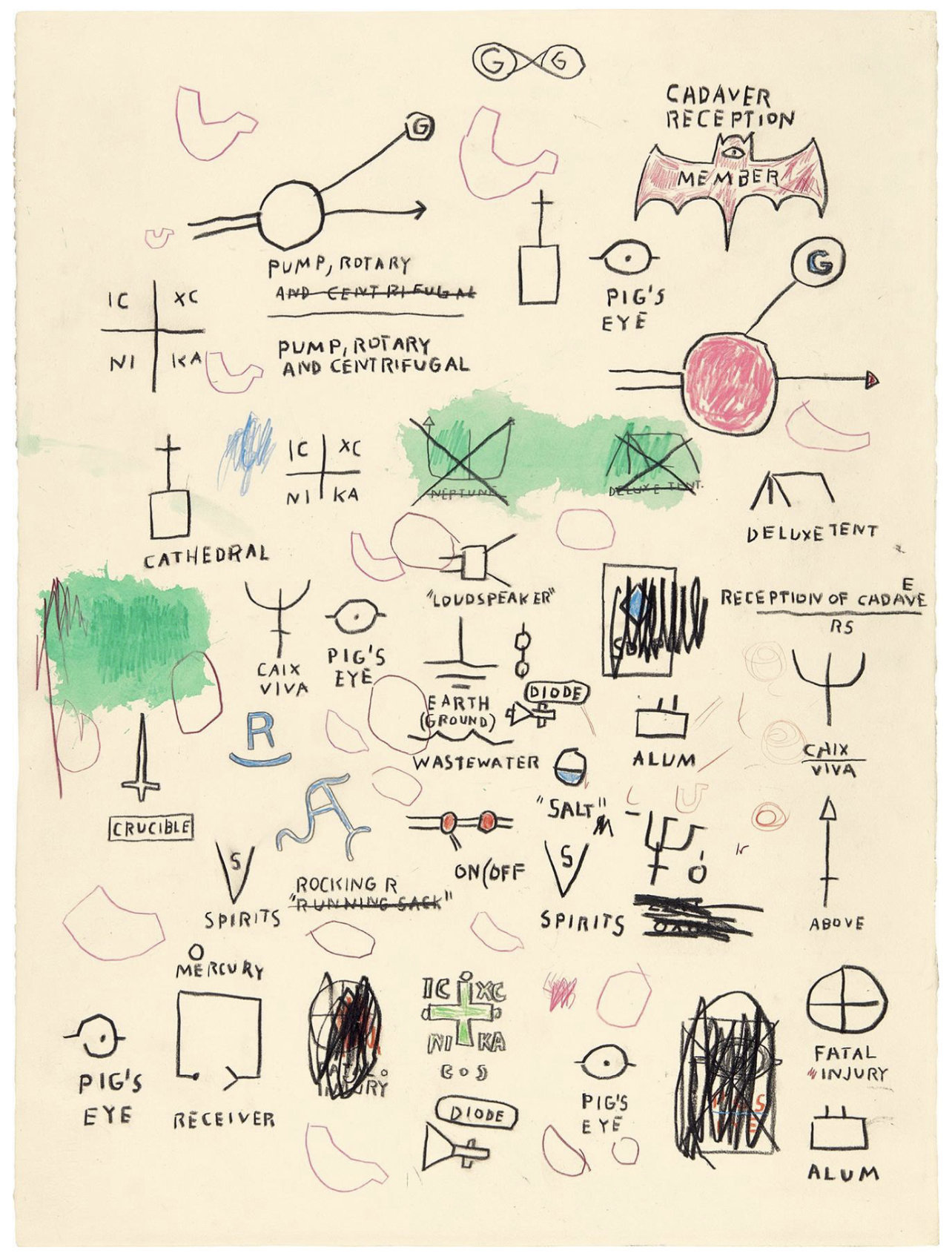
JEAN-MICHEL BASQUIAT
Untitled, 1987
Crayon and watercolor on paper
30 x 22 3/8 inches (76.2 x 56.8 cm)
Signed and dated “Jean-Michel Basquiat ’87” on the reverse
#8. Untitled, 1982
Christie’s New-York: 17 November 2022
Estimated: USD 800,000 – 1,200,000
USD 793,800
JEAN-MICHEL BASQUIAT (1960-1988) (christies.com)
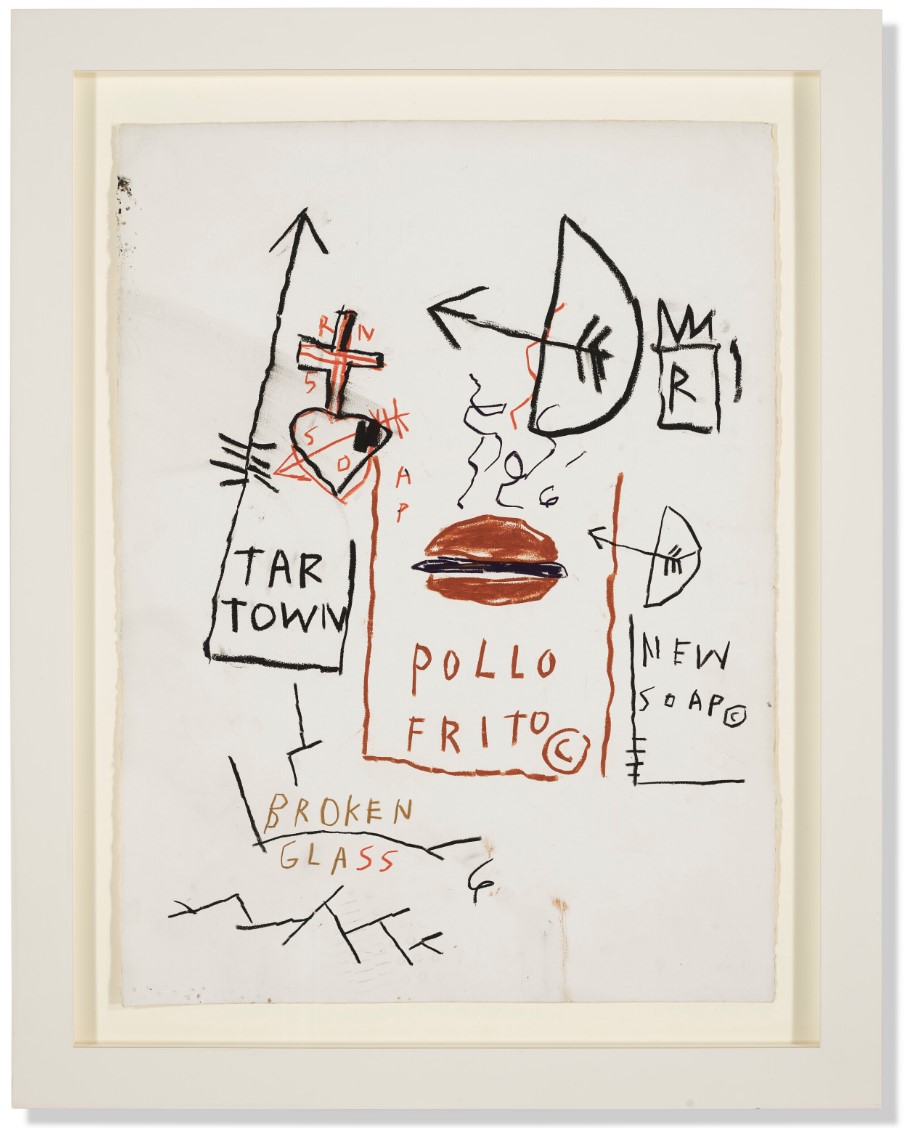
JEAN-MICHEL BASQUIAT (1960-1988)
Untitled, 1982
Oilstick on paper
30 x 22 1/4 inches (76.2 x 56.5 cm)
Signed and dated ‘Jean-Michel Basquiat 1982’ (on the reverse)
#9. Untitled, circa 1980s
Sotheby’s New-York: 30 September 2022
Estimated: USD 300,000 – 400,000
USD 529,200
Untitled | Contemporary Curated | 2022 | Sotheby’s (sothebys.com)
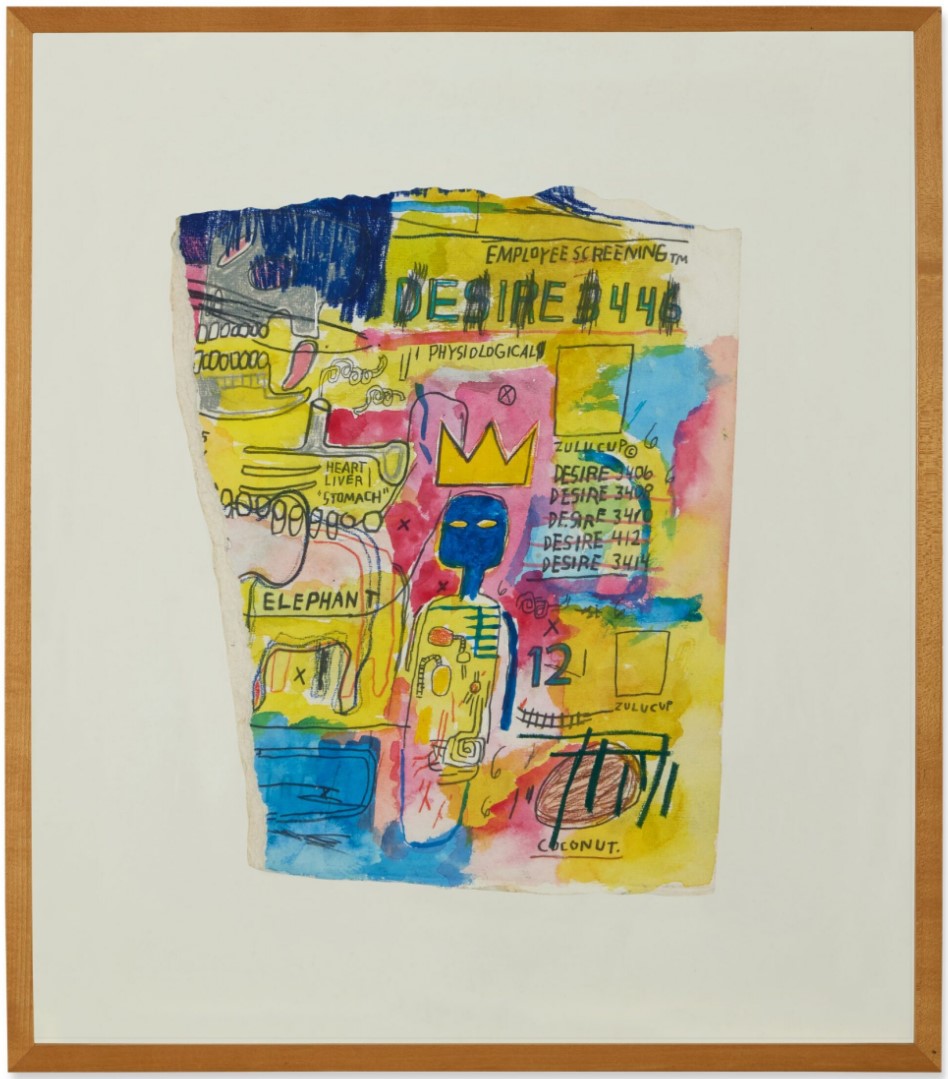
JEAN-MICHEL BASQUIAT (1960 – 1988)
Untitled, circa 1980s
Watercolor, graphite, colored pencil and crayon on paper
13 3/8 x 10 3/4 inches (34 x 27.3 cm)
#10. Untitled, 1987
Sotheby’s New-York: 20 May 2022
Estimated: USD 450,000 – 550,000
USD 529,200
Untitled | Contemporary Day Auction | 2022 | Sotheby’s (sothebys.com)
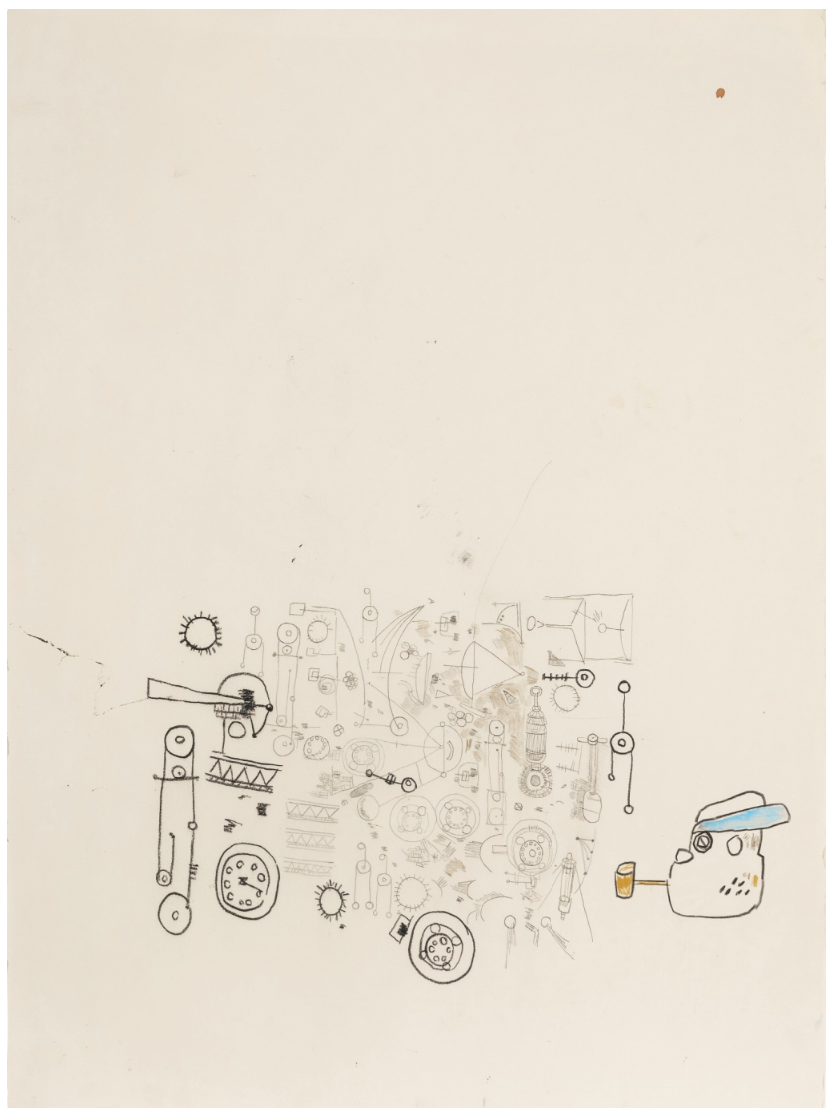
JEAN-MICHEL BASQUIAT (1960 – 1988)
Untitled, 1987
Graphite, colored pencil and charcoal on paper
30 1/4 x 22 inches (76.8 x 55.9 cm)
Signed and dated 87 (on the verso)
#11. Untitled, 1986
Christie’s New-York: 13 May 2022
Estimated: USD 400,000 – 600,000
USD 441,000
JEAN-MICHEL BASQUIAT (1960-1988), Untitled | Christie’s (christies.com)
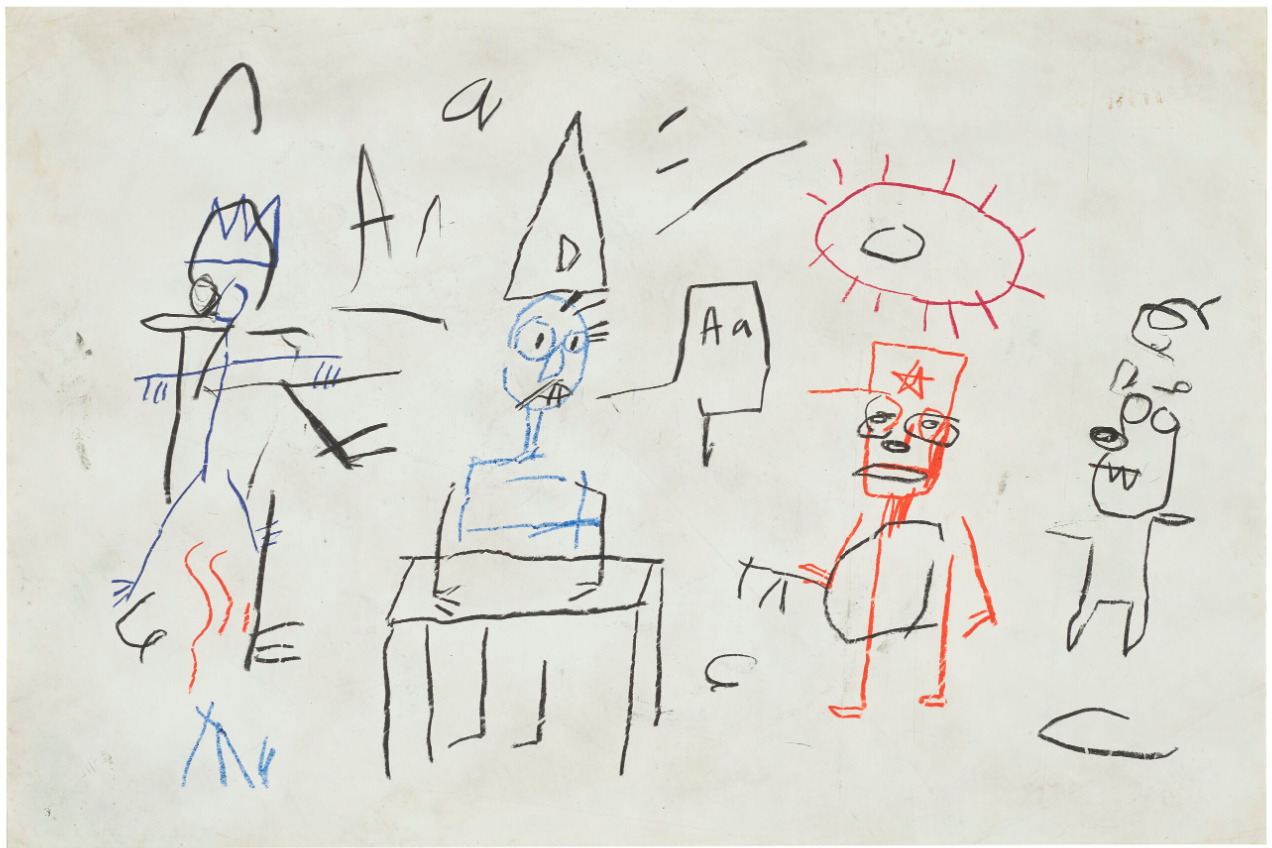
JEAN-MICHEL BASQUIAT (1960-1988)
Untitled, 1986
Oilstick and wax crayon on paper
24×36 inches (61 x 91.4 cm)
Signed and dated ‘Basquiat 86’ (on the reverse)
#12. Windmill, 1985
Phillips London: 4 March 2022
Estimated: GBP 220,000 – 280,000
GBP 327,600 / USD 432,818
Jean-Michel Basquiat – 20th Century &… Lot 155 March 2022 | Phillips
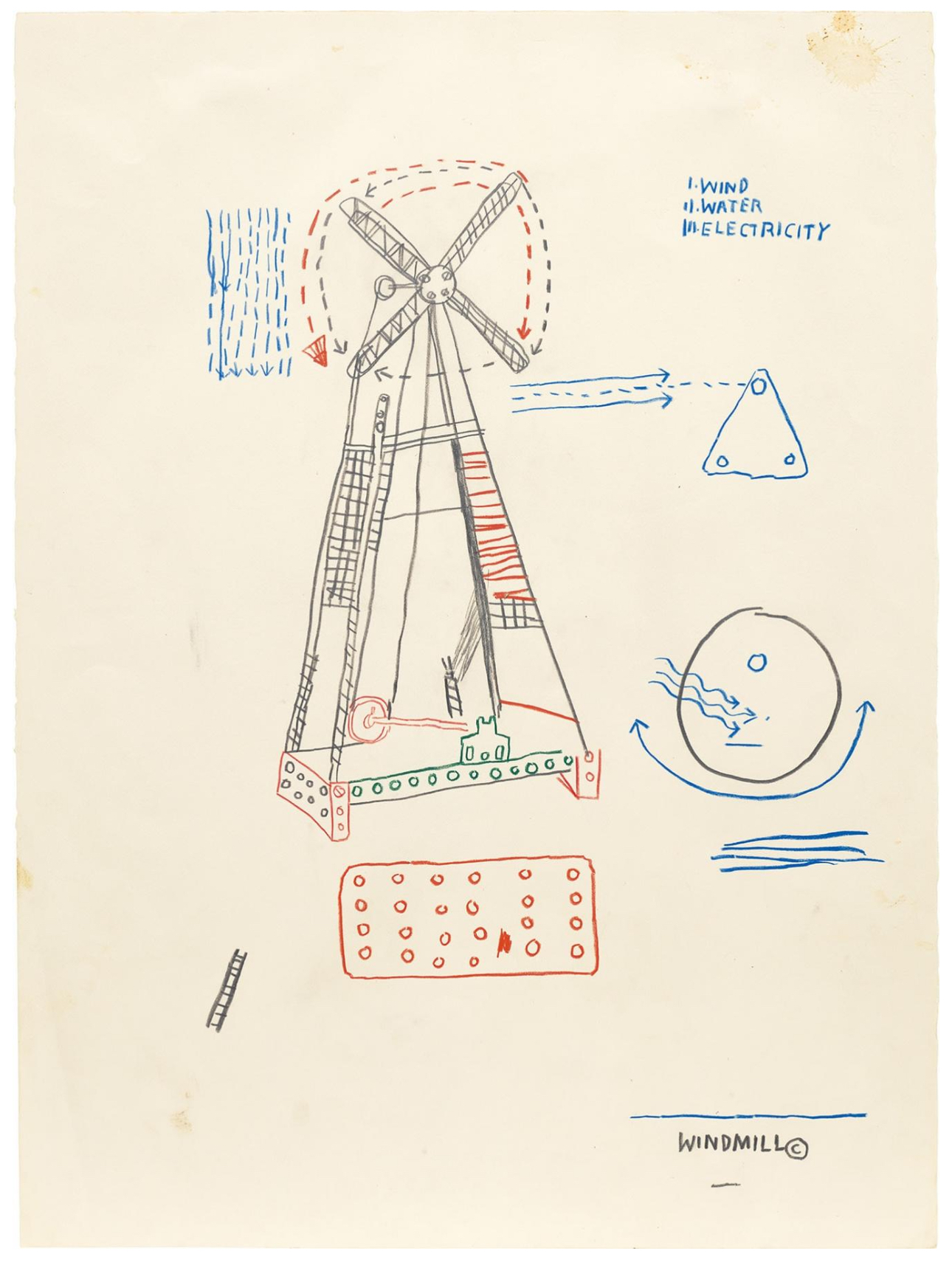
JEAN-MICHEL BASQUIAT
Windmill, 1985
Oilstick and graphite on paper
30 x 22 1/8 inches (76.2 x 56.3 cm)
Titled ‘WINDMILL©’ lower right; signed and dated ‘Basquiat 1985’ on the reverse
#13. Untitled (Man on the Street), 1981-1982
Christie’s New-York: 18 November 2022
Estimated: USD 300,000 – 500,000
USD 390,600
JEAN-MICHEL BASQUIAT (1960-1988) (christies.com)
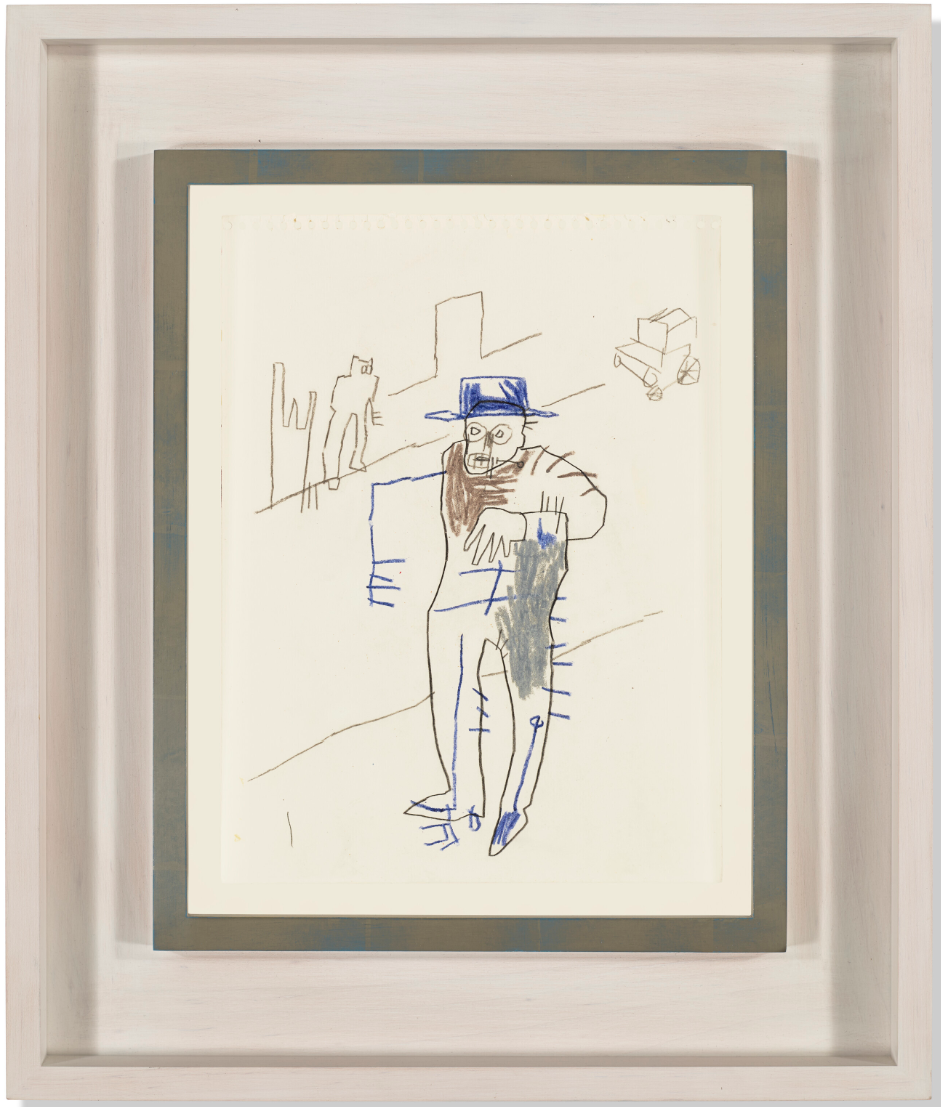
JEAN-MICHEL BASQUIAT (1960-1988)
Untitled (Man on the Street), 1981-1982
Wax crayon and graphite on paper
11 13/16 x 9 inches (30×22 cm)
#14. Untitled, 1988
Sotheby’s London: 28 April 2022
Estimated: GBP 100,000 – 150,000
GBP 226,800 / USD 282,089
Untitled | Contemporary Curated | 2022 | Sotheby’s (sothebys.com)
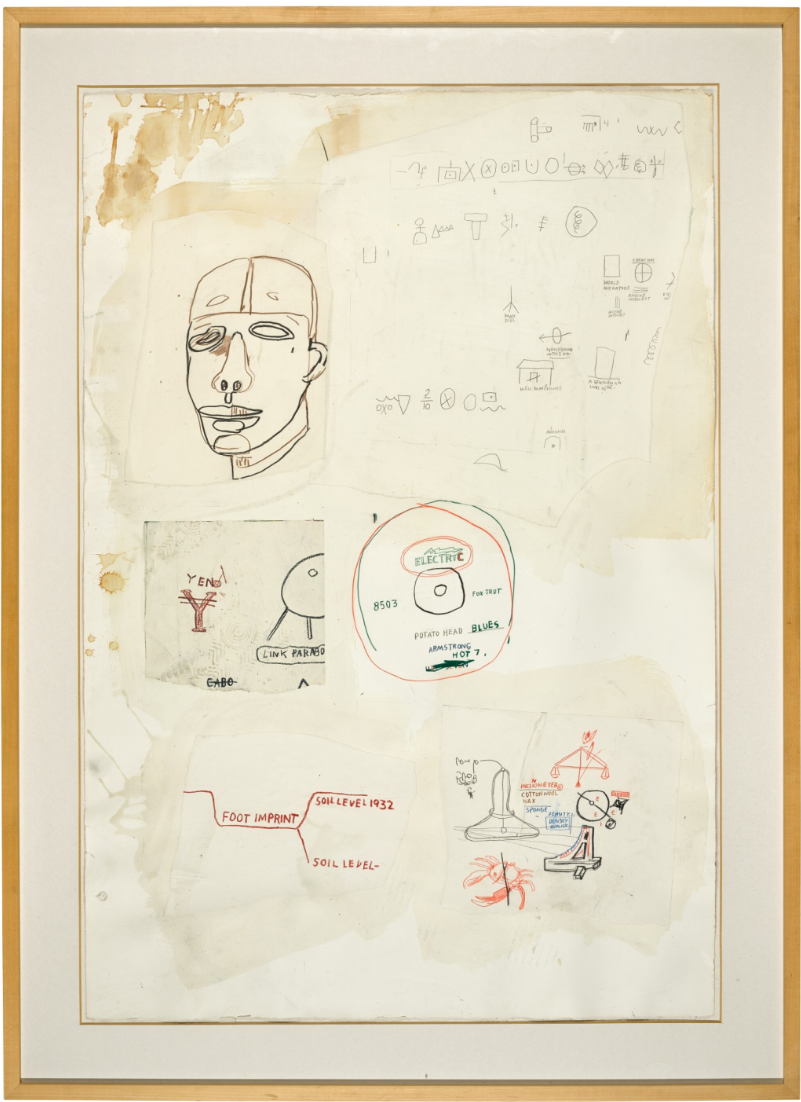
JEAN-MICHEL BASQUIAT (1960 – 1988)
Untitled, 1988
Crayon and xerox collage on paper
43 7/8 x 30 inches (111.5 x 76.2 cm)
Signed on the reverse
#15. Untitled, 1987
Christie’s London: 14 October 2022
Estimated: GBP 60,000 – 80,000
GBP 170,100 / USD 190,695
JEAN-MICHEL BASQUIAT (1960-1988), Untitled | Christie’s (christies.com)
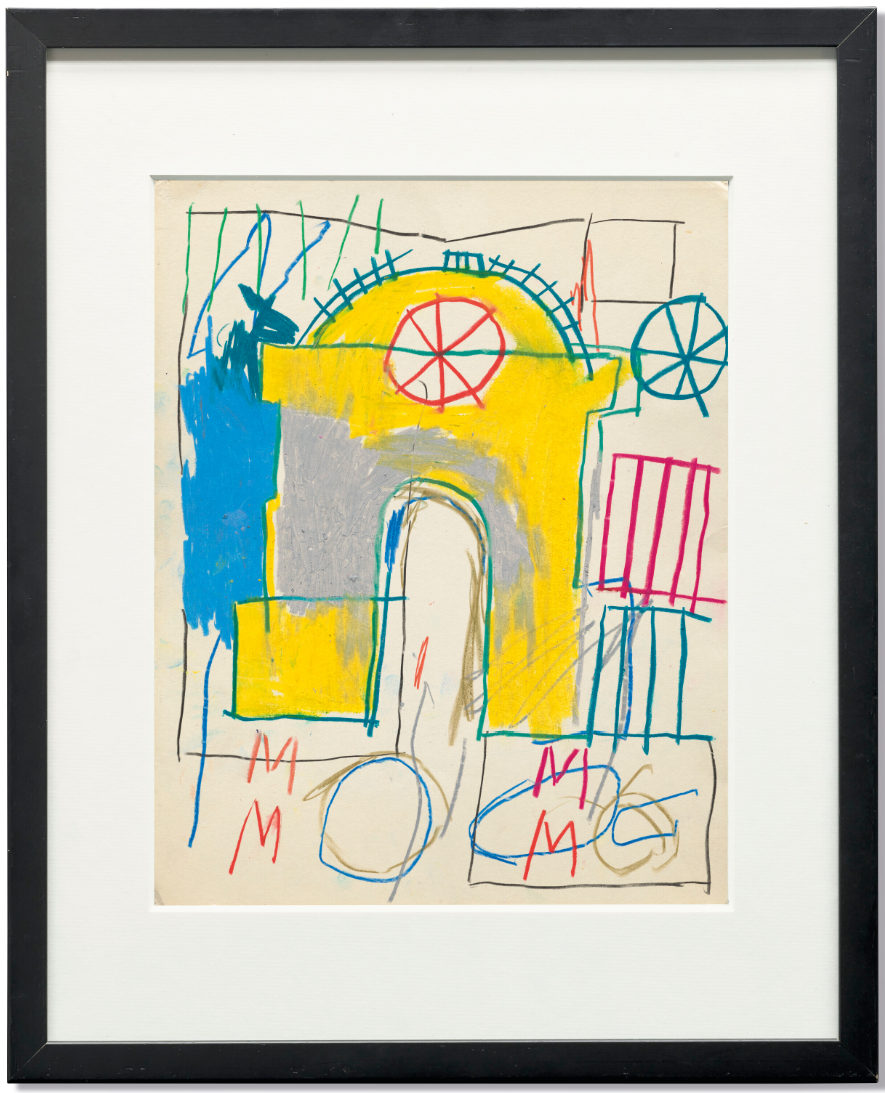
JEAN-MICHEL BASQUIAT (1960-1988)
Untitled, 1987
Wax crayon on paper
14×11 inches (35.7 x 28 cm)
Signed, signed with the artist’s initials, dedicated and dated twice ‘JMB 87 19 to ENES JEAN MICHEL BASQUIAT 87’ (on the reverse)
#16. MCVIIV9, 1981
Christie’s New-York: 29 September 2022
Estimated: USD 120,000 – 180,000
USD 189,000
JEAN-MICHEL BASQUIAT (1960-1988) (christies.com)
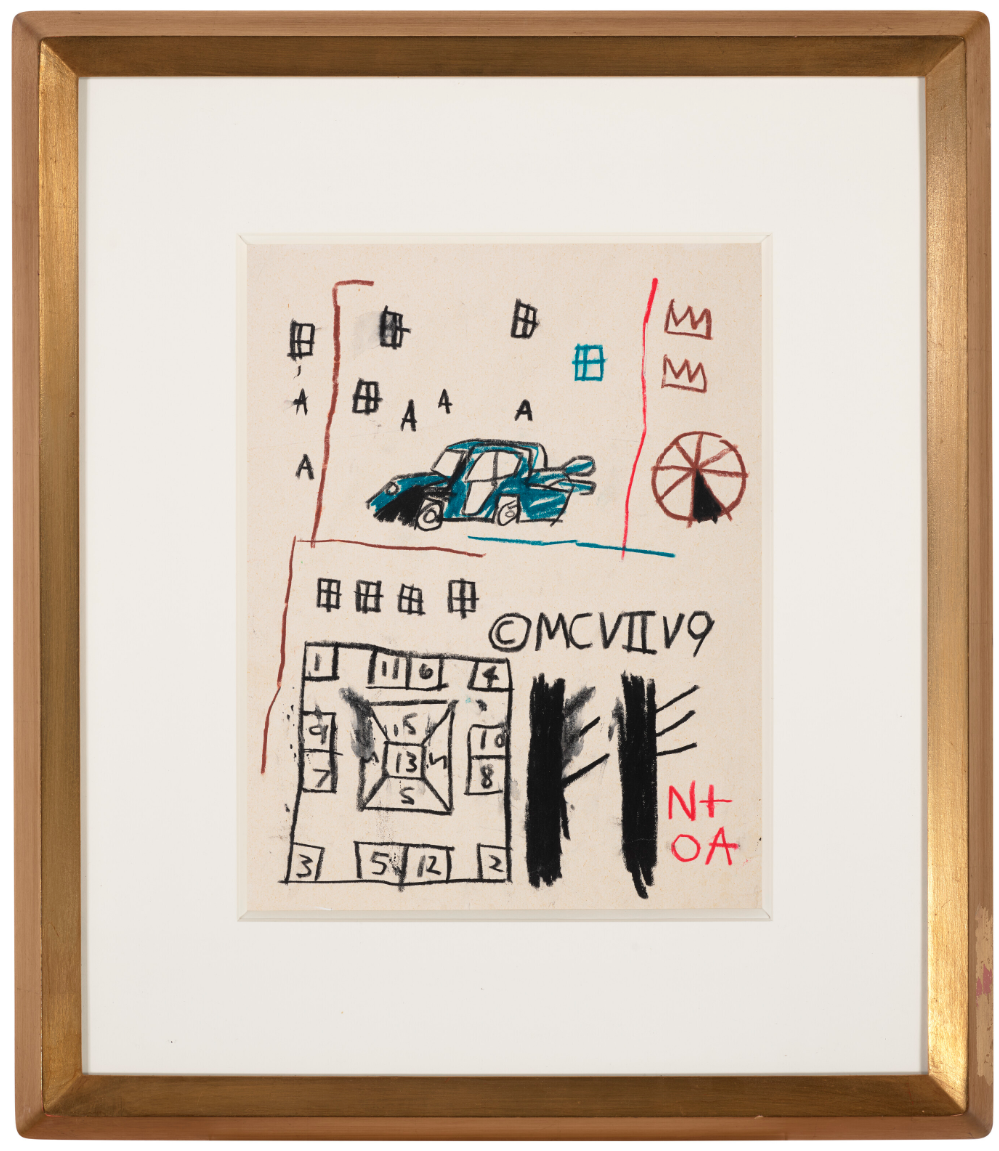
JEAN-MICHEL BASQUIAT (1960-1988)
MCVIIV9, 1981
Oil stick on paper
13 3/4 x 10 7/8 inches (34.9 x 27.6 cm)
#17. Untitled, circa 1985
Christie’s New-York: 13 May 2022
Estimated: USD 120,000 – 180,000
USD 176,400
JEAN-MICHEL BASQUIAT (1960-1988), Untitled | Christie’s (christies.com)
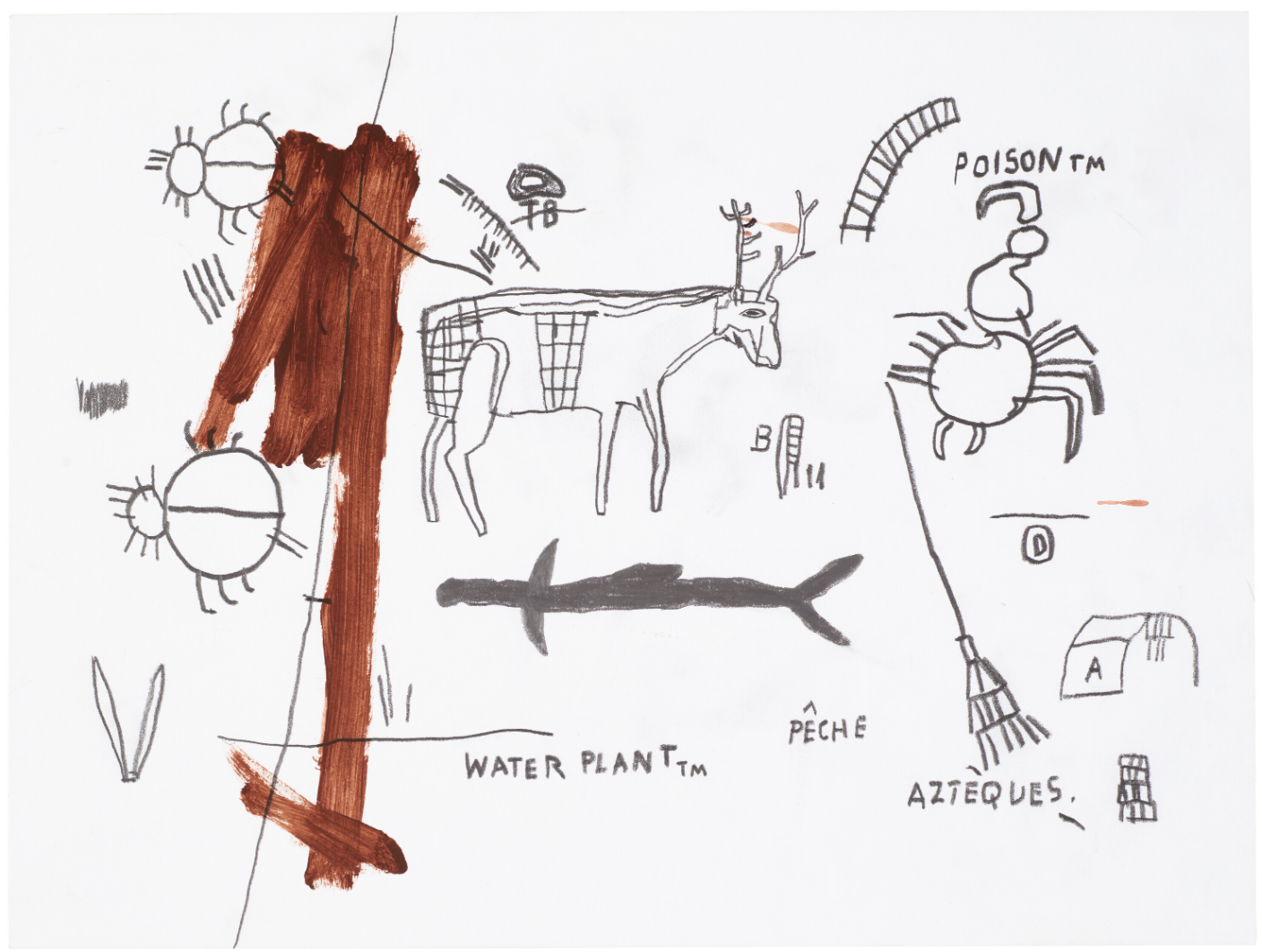
JEAN-MICHEL BASQUIAT (1960-1988)
Untitled, circa 1985
Acrylic and graphite on paper
9 1/2 x 12 1/2 inches (24.1 x 31.8 cm)
#18. Untitled, circa 1985
Christie’s New-York: 13 May 2022
Estimated: USD 120,000 – 180,000
USD 113,400
JEAN-MICHEL BASQUIAT (1960-1988), Untitled | Christie’s (christies.com)
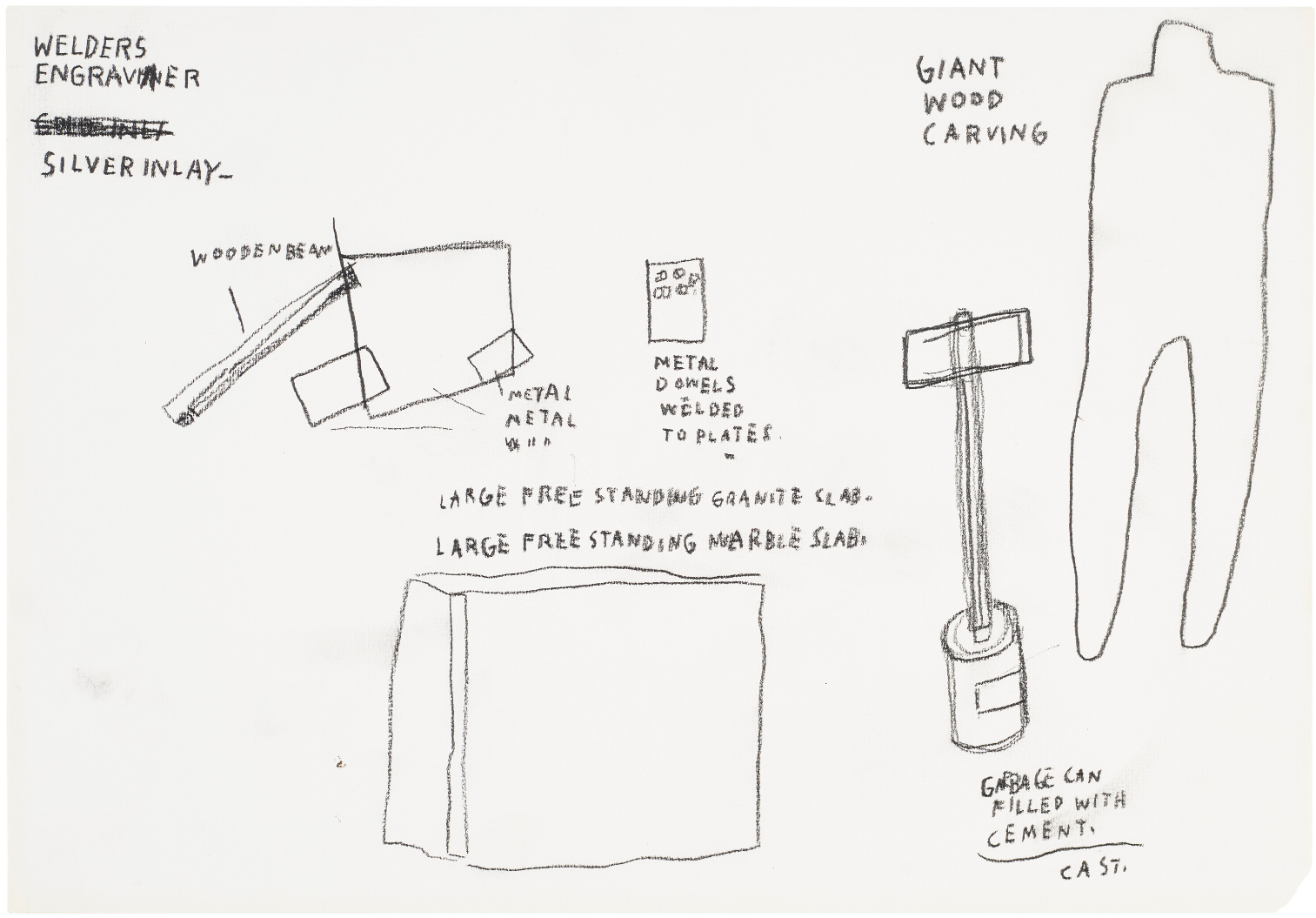
JEAN-MICHEL BASQUIAT (1960-1988)
Untitled, circa 1985
Graphite on paper
9 3/4 x 14 inches (24.8 x 35.6 cm)
#19. Untitled, 1982
Christie’s London: 14 October 2022
Estimated: GBP 70,000 – 100,000
GBP 65,520 / USD 73,452
JEAN-MICHEL BASQUIAT (1960-1988), Untitled | Christie’s (christies.com)
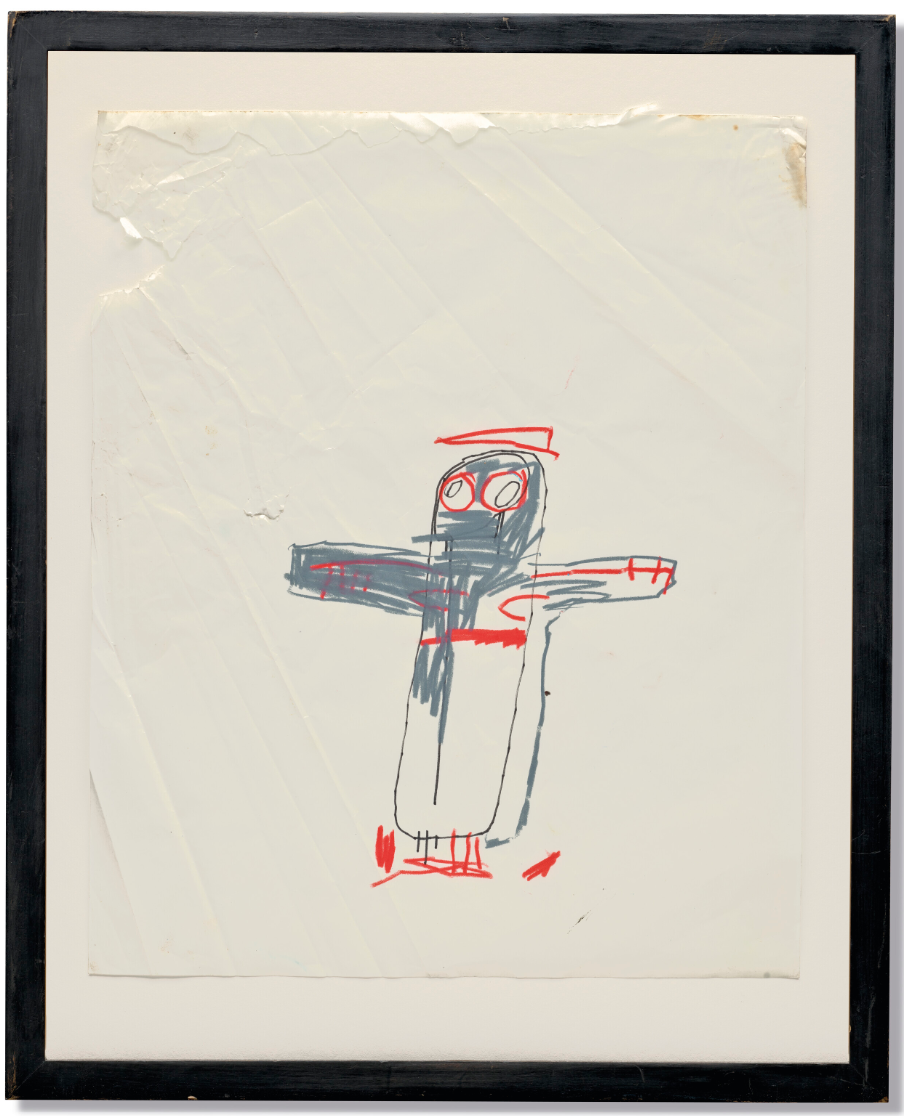
JEAN-MICHEL BASQUIAT (1960-1988)
Untitled, 1982
Felt-tip pen and crayon on tracing paper
17×14 inches (43.1 x 35.5 cm)
#20. Vehement Alley Cats, circa 1982
Phillips New-York: 16 November 2022
Estimated: USD 70,000 – 100,000
USD 69,300
Jean-Michel Basquiat – 20th Centur… Lot 155 November 2022 | Phillips
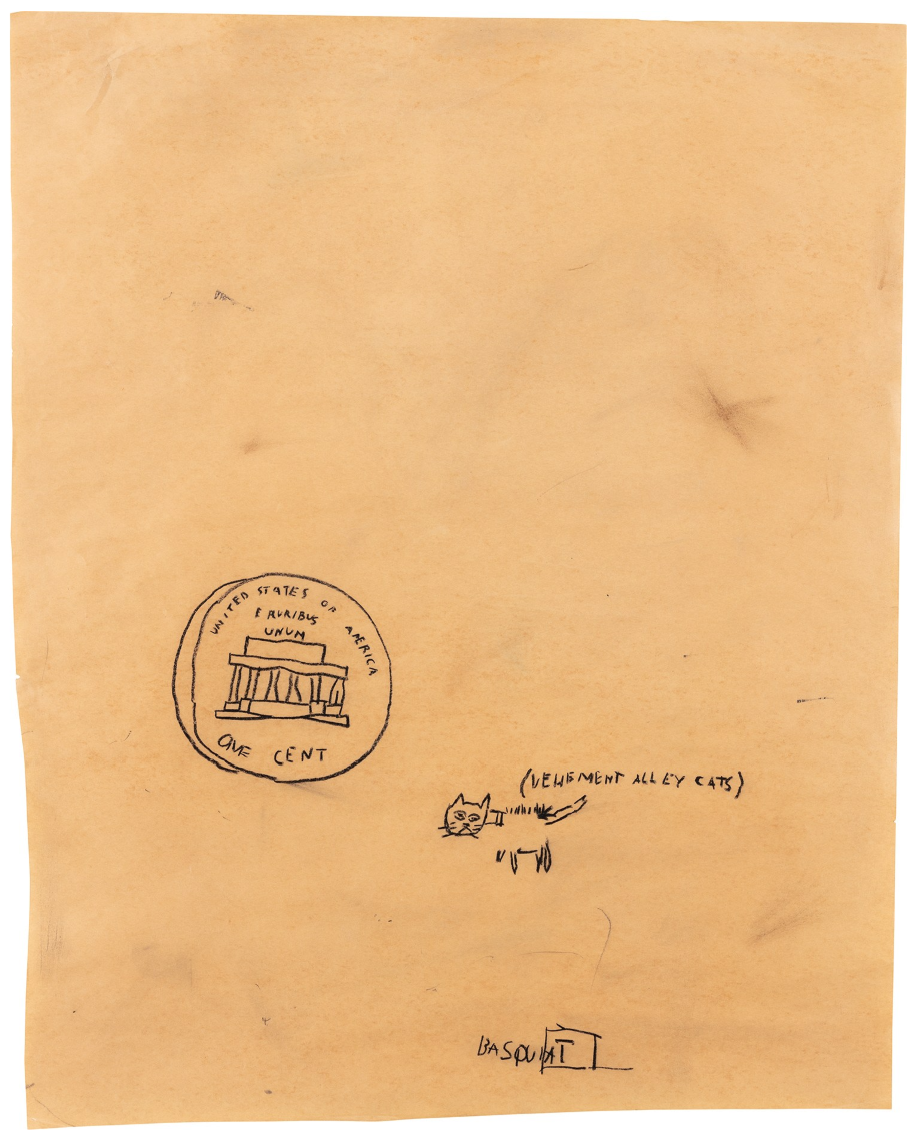
JEAN-MICHEL BASQUIAT
Vehement Alley Cats, circa 1982
Oilstick on paper
21 x 17 1/2 inches (53.3 x 44.5 cm)
Signed “BASQUIAT” lower center
2021 Auction Results
#1. Untitled, 1983
Sotheby’s New-York: 8 December 2021
Estimated: USD 3,000,000 – 4,000,000
USD 3,166,000
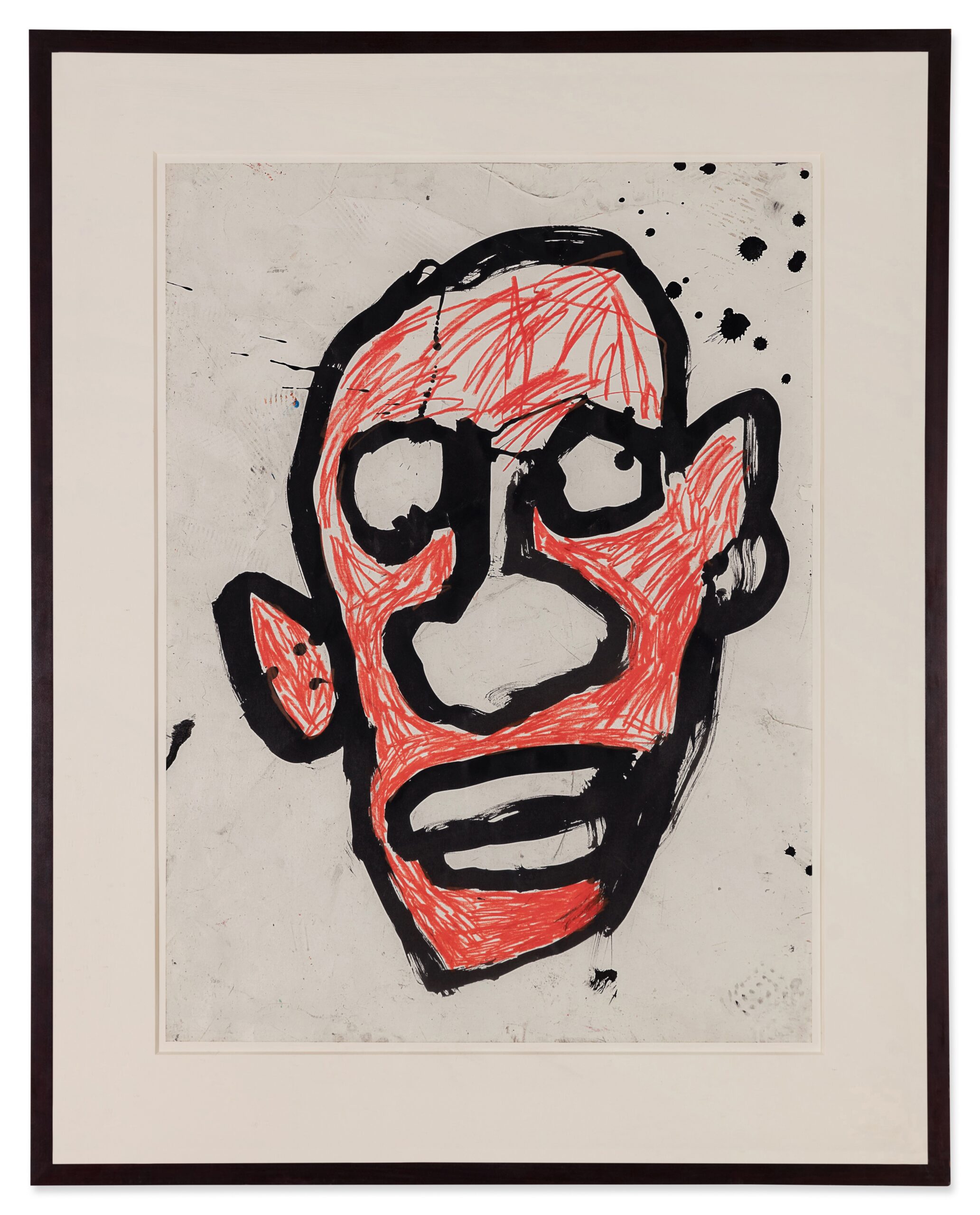
JEAN-MICHEL BASQUIAT
Untitled, 1983
Ink and oilstick on paper
29.7 x 22 inches (75.6 x 55.9 cm)
#2. René Ricard, 1984
Christie’s New-York: 11 November 2021
Estimated: USD 800,000 – 1,200,000
USD 2,550,000
JEAN-MICHEL BASQUIAT (1960-1988) (christies.com)
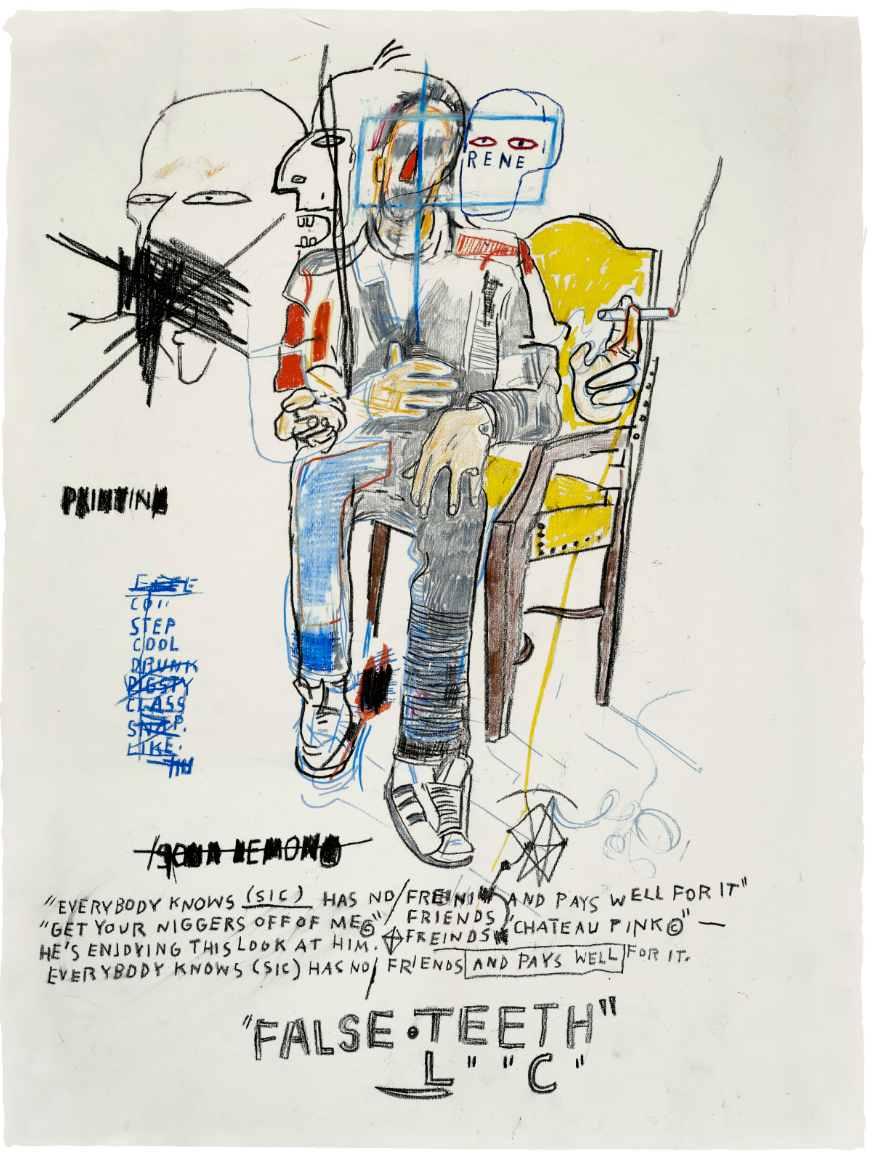
JEAN-MICHEL BASQUIAT
Réne Ricard, 1984
Oilstick, wax crayon, colored pencil and charcoal on paper
30 x 22.5 inches (76.2 x 57.2 cm)
#3. Untitled, 1982
Christie’s New-York: 14 May 2021
Estimated: USD 1,500,000 – 2,000,000
USD 2,010,000
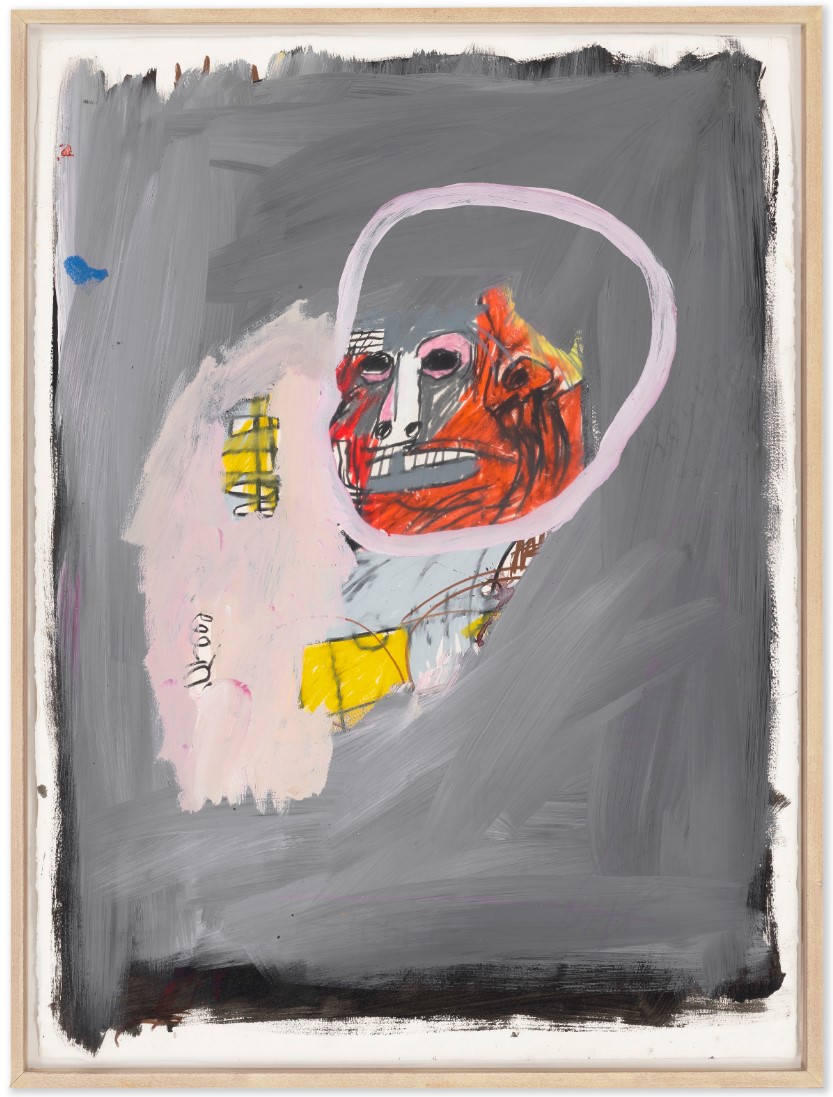
JEAN-MICHEL BASQUIAT (1960-1988)
Untitled, 1982
Acrylic and oilstick on paper
29 7/8 x 22 inches (75.9 x 56 cm)
Signed, inscribed and dated ’82 NYC Jean Michel’ (on the reverse)
This work is registered in the archives of Annina Nosei Gallery, New York, as no. PC-B182.
#4. Untitled, 1980-1985
Sotheby’s New-York: 18 November 2021
Estimated: USD 1,500,000 – 2,000,000
USD 1,835,000
Untitled | Contemporary Evening Auction | 2021 | Sotheby’s (sothebys.com)
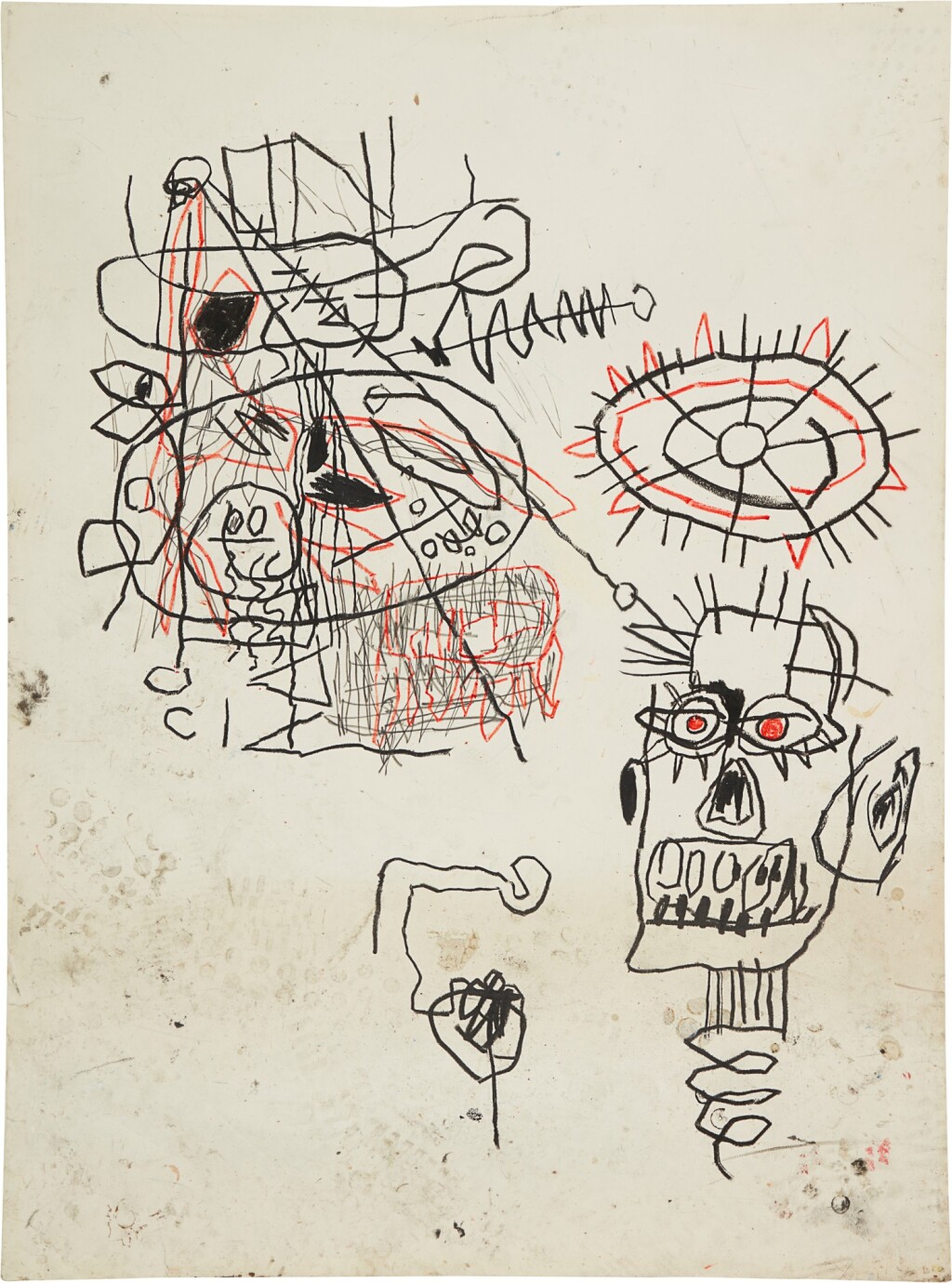
JEAN-MICHEL BASQUIAT
Untitled, 1980-1985
Oilstick and pencil on paper
30 x 22.5 inches (76.2 x 57.2 cm)
#5. Untitled (Black), 1984
Sotheby’s New-York: 13 May 2021
Estimated: USD 1,500,000 – 2,000,000
USD 1,835,000
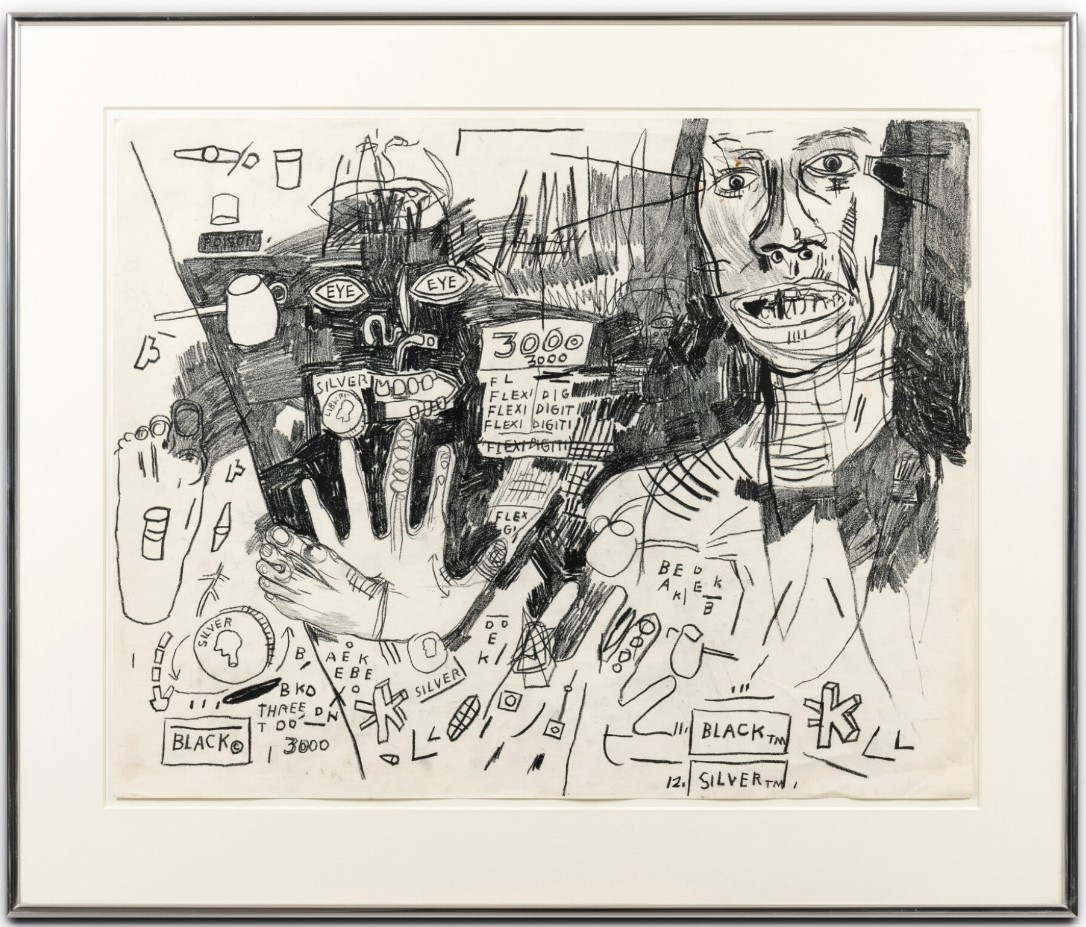
JEAN-MICHEL BASQUIAT (1960 – 1988)
Untitled (Black), 1984
Crayon and graphite on paper
23×29 inches (58.5 x 73.5 cm)
Signed and dated 1984 on the reverse
#6. Batman, 1983
Phillips New-York: 23 June 2021
Estimated: USD 1,600,000 – 2,000,000
USD 1,800,000
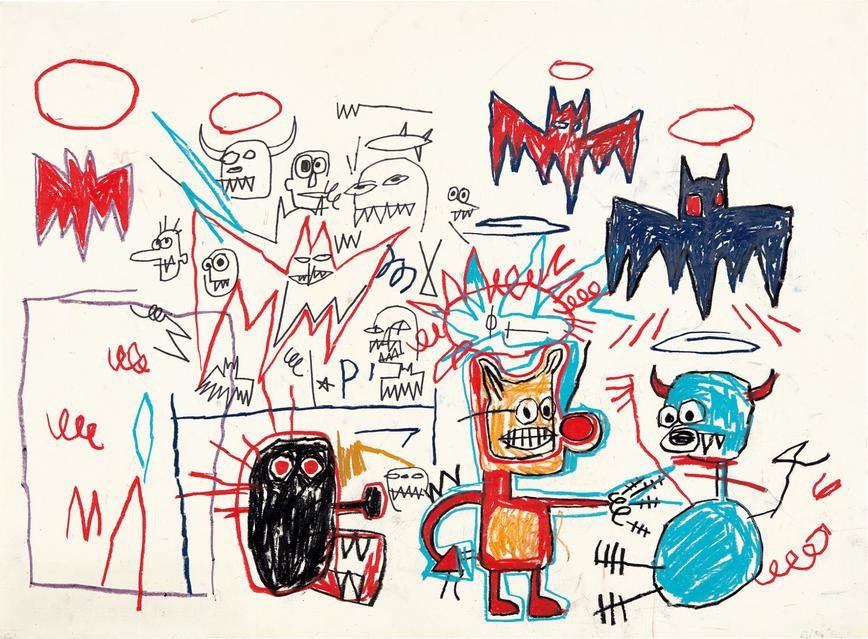
JEAN-MICHEL BASQUIAT
Batman, 1983
Oilstick on paper
22 x 29 7/8 inches (55.9 x 75.9 cm)
Signed and dated “1983 Jean-Michel Basquiat” on the reverse
#7. Untitled, 1987
Sotheby’s New-York: 8 December 2021
Estimated: USD 1,000,000 – 1,500,000
USD 1,532,500
WORK ON PAPER
JEAN-MICHEL BASQUIAT
Untitled, 1987
Wax crayon on paper
29.5 x 22.2 inches (74.9 x 56.5 cm)
#8. Untitled, circa 1982
Christie’s New-York: 14 May 2021
Estimated: USD 350,000 – 550,000
USD 1,230,000
JEAN-MICHEL BASQUIAT (1960-1988), Untitled | Christie’s (christies.com)
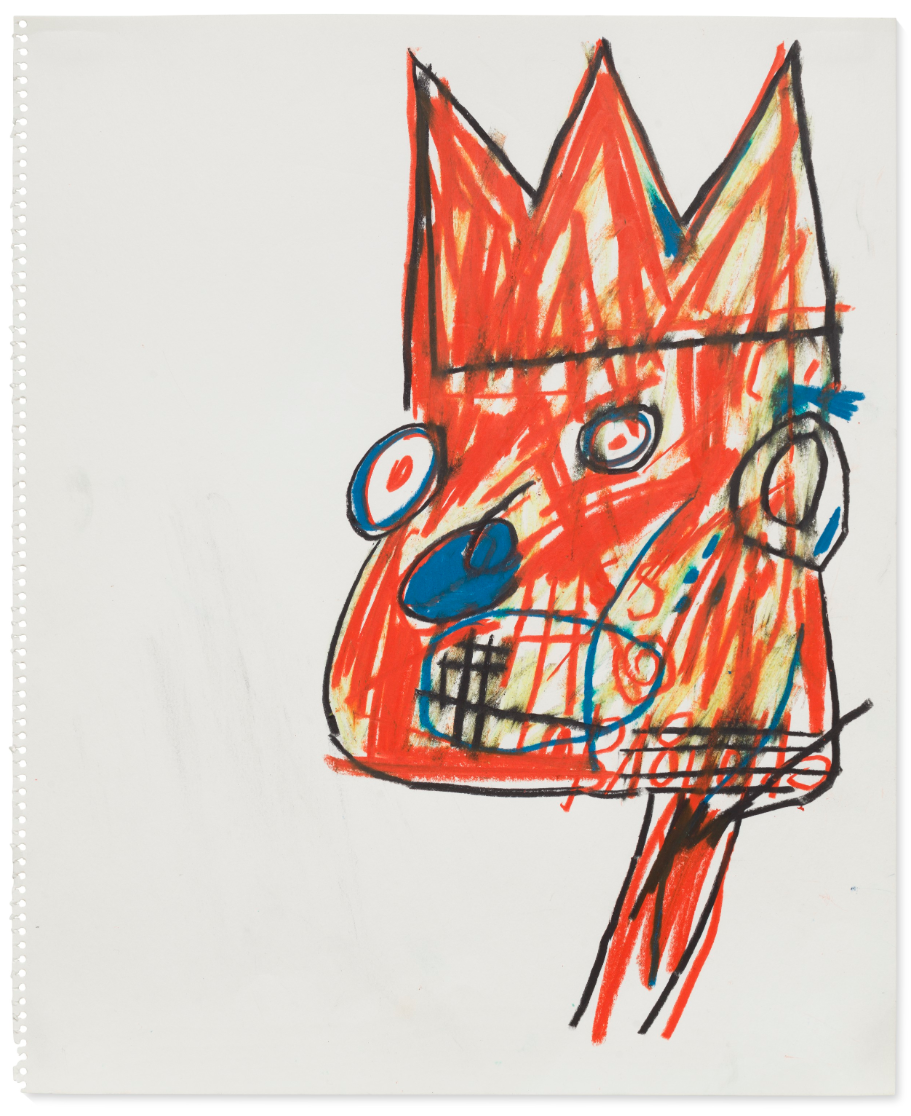
JEAN-MICHEL BASQUIAT (1960-1988)
Untitled, circa 1982
Oilstick on paper
18 1/4 x 15 inches (46.4 x 38.1 cm)
#9. Untitled, 1982
Christie’s Hong-Kong: 25 May 2021
Estimated: HKD 4,200,000 – 6,200,000
HKD 9,130,000 / USD 1,176,137
JEAN-MICHEL BASQUIAT (1960-1988), Untitled | Christie’s (christies.com)
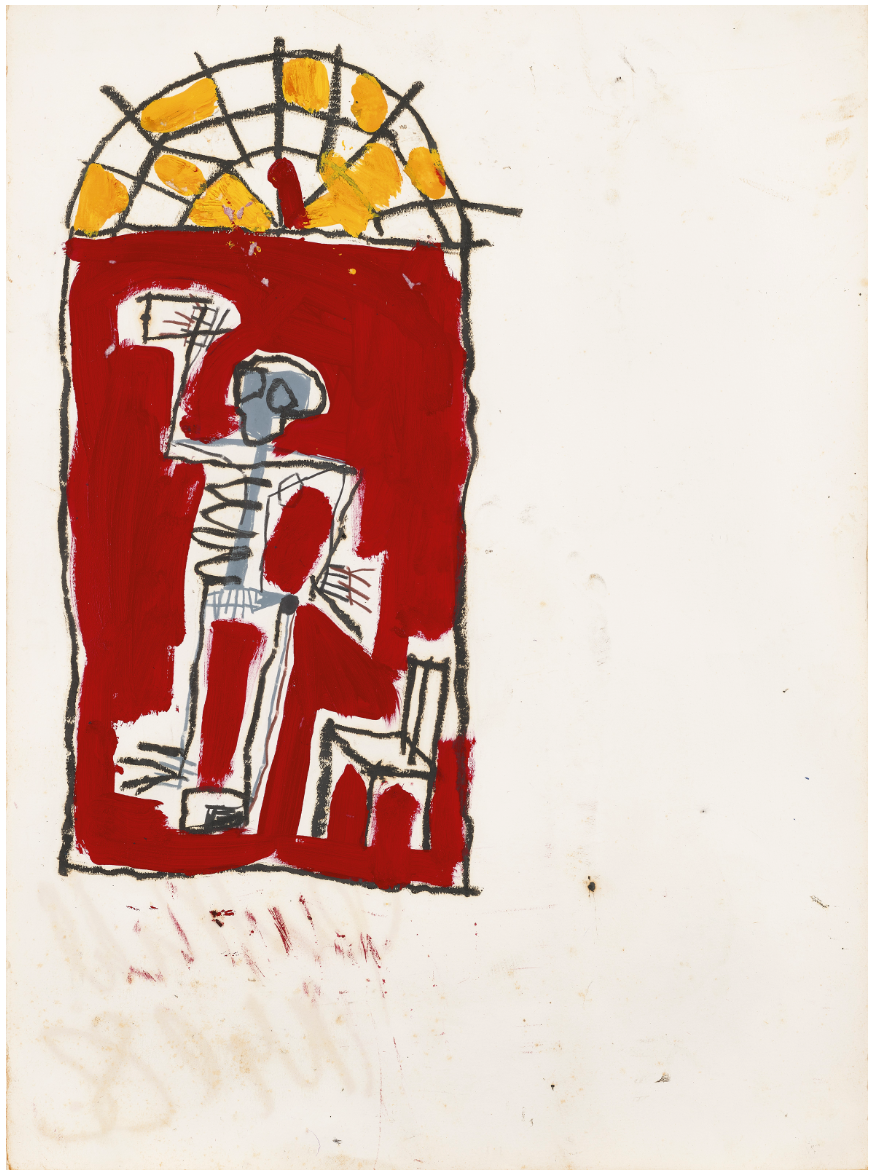
JEAN-MICHEL BASQUIAT (1960-1988)
Untitled, 1982
Acrylic and oilstick on paper
30×22 inches (76×56 cm)
Signed, inscribed and dated ‘Jean Michel NYC 82’ (on the reverse)
#10. Untitled, 1983
Sotheby’s London: 1 July 2021
Estimated: GBP 200,000 – 300,000
GBP 620,000 / USD 854,229
Untitled | Contemporary Art Day Auction | 2021 | Sotheby’s
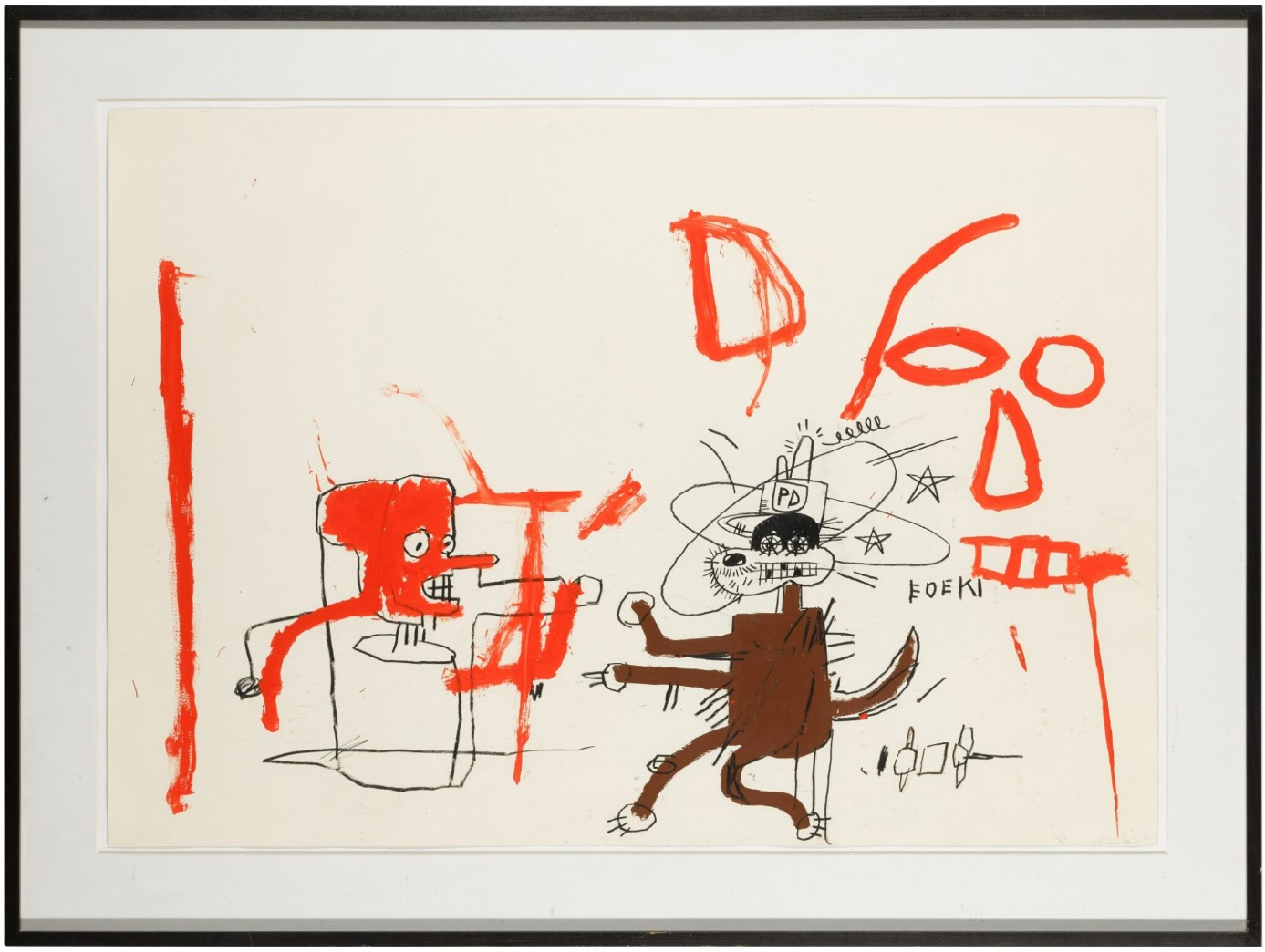
JEAN-MICHEL BASQUIAT (1960 – 1988)
Untitled, 1983
Acrylic and oilstick on paper
27 1/2 x 39 3/8 inches (70×100 cm)
#11. Poedi, 1981
Sotheby’s New-York: 30 September 2021
Estimated: USD 500,000 – 700,000
USD 685,500
Poedi | Contemporary Curated | 2021 | Sotheby’s (sothebys.com)
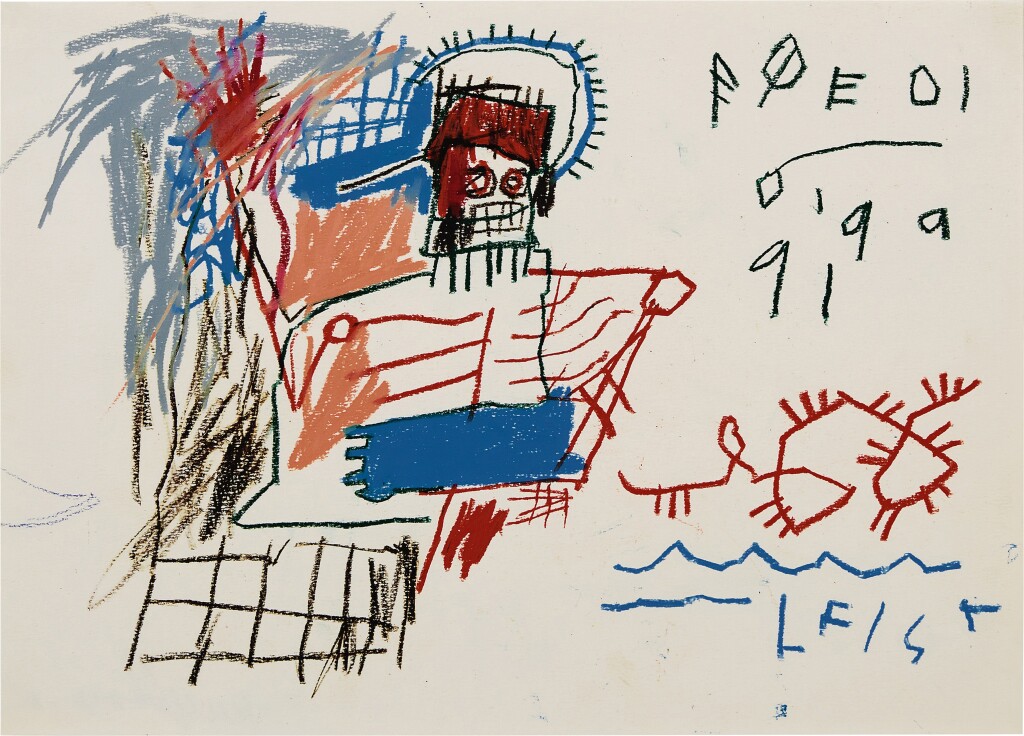
JEAN-MICHEL BASQUIAT
Poedi, 1981
Oil stick on paper
12.5 x 17.4 inches (32×44 cm)
#12. Bad Foot, 1985-1987
Christie’s New-York: 14 May 2021
Estimated: USD 400,000 – 600,000
USD 562,500
JEAN-MICHEL BASQUIAT (1960-1988), Bad Foot | Christie’s (christies.com)
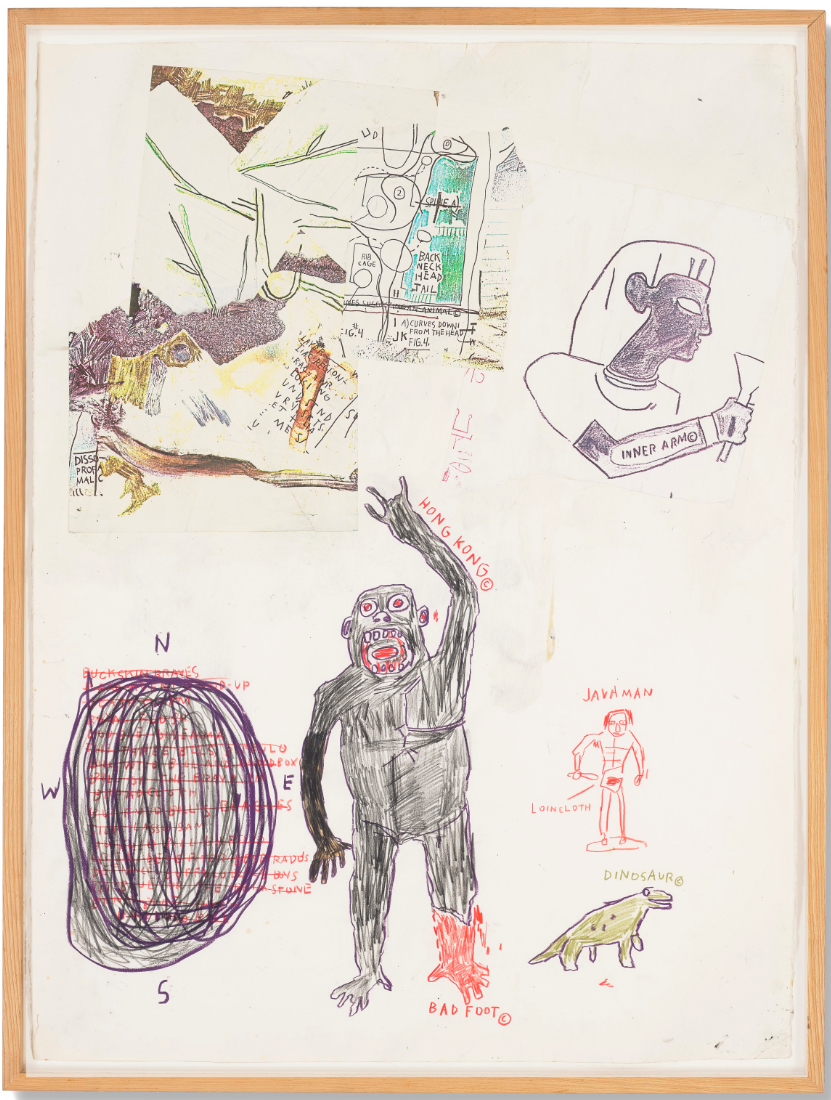
JEAN-MICHEL BASQUIAT (1960-1988)
Bad Foot, 1985-1987
Oilstick, colored pencil and Xerox collage on paper
29 3/4 x 22 1/4 inches (75.6 x 56.5 cm)
Signed with the artist’s initials and dated ‘JMB 85-87’ (on the reverse)
#13. Hong Kong, 1985
Christie’s Hong-Kong: 2 December 2021
Estimated: HKD 4,500,000 – 6,500,000
HKD 4,375,000 / USD 561,372
JEAN-MICHEL BASQUIAT (1960-1988), Hong Kong | Christie’s (christies.com)
JEAN-MICHEL BASQUIAT (1960-1988)
Hong Kong, 1985
Graphite, colored pencil and Xerox collage on paper
30 x 22 1/2 inches (76×57 cm)
Signed with artist’s signature and dated ‘85′ (on the reverse)
#15. Untitled (Starvation), 1981
Phillips New-York: 24 June 2021
Estimated: USD 250,000 – 350,000
USD 315,000
Jean-Michel Basquiat – 20th Century & … Lot 141 June 2021 | Phillips
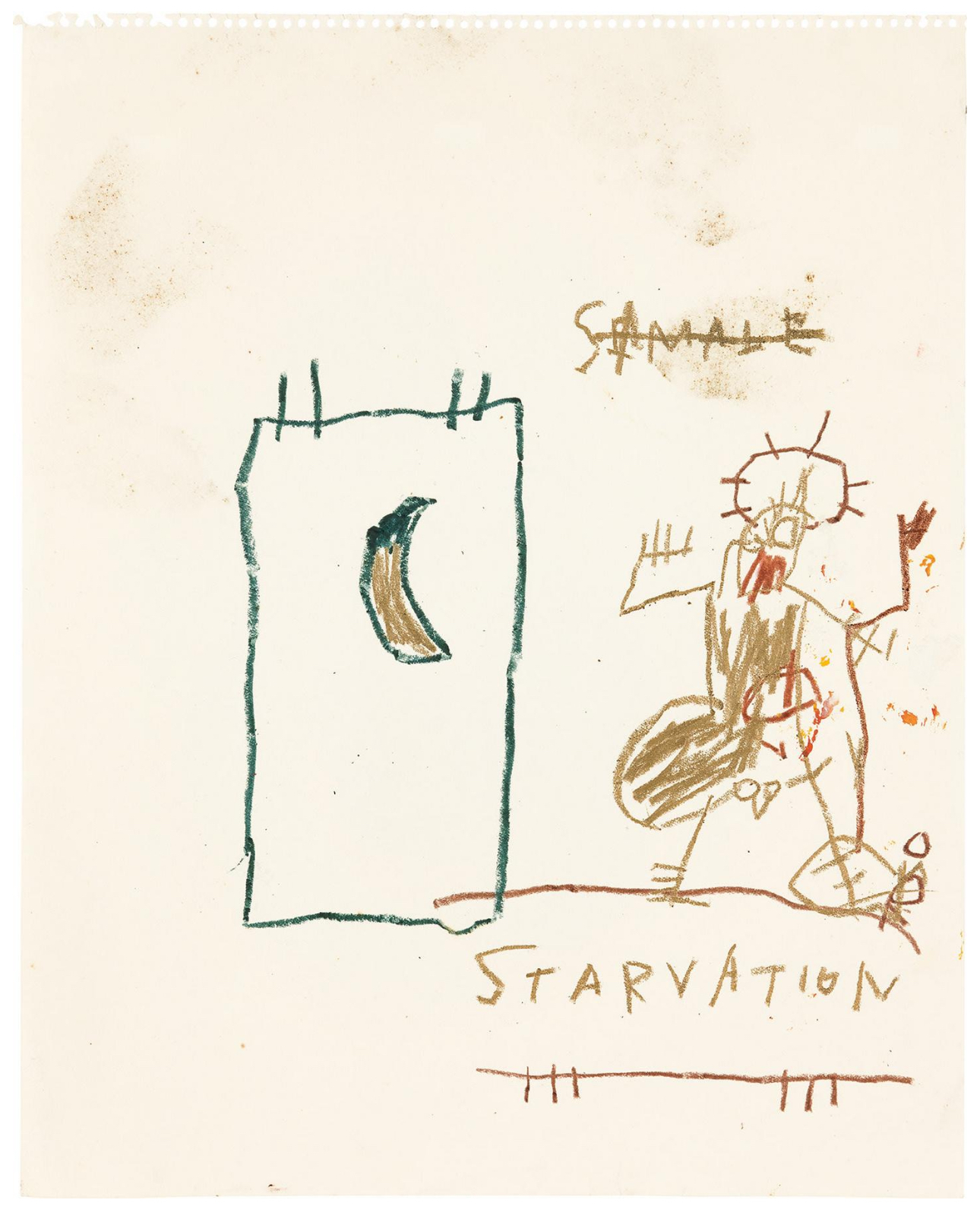
JEAN-MICHEL BASQUIAT
Untitled (Starvation), 1981
Oilstick on paper
19 7/8 x 15 7/8 inches (50.5 x 40.3 cm)
#16. Untitled (Karate III), 1983
Sotheby’s Hong-Kong: 10 October 2021
Estimated: HKD 2,300,000 – 4,000,000
HKD 2,268,000 / USD 291,348
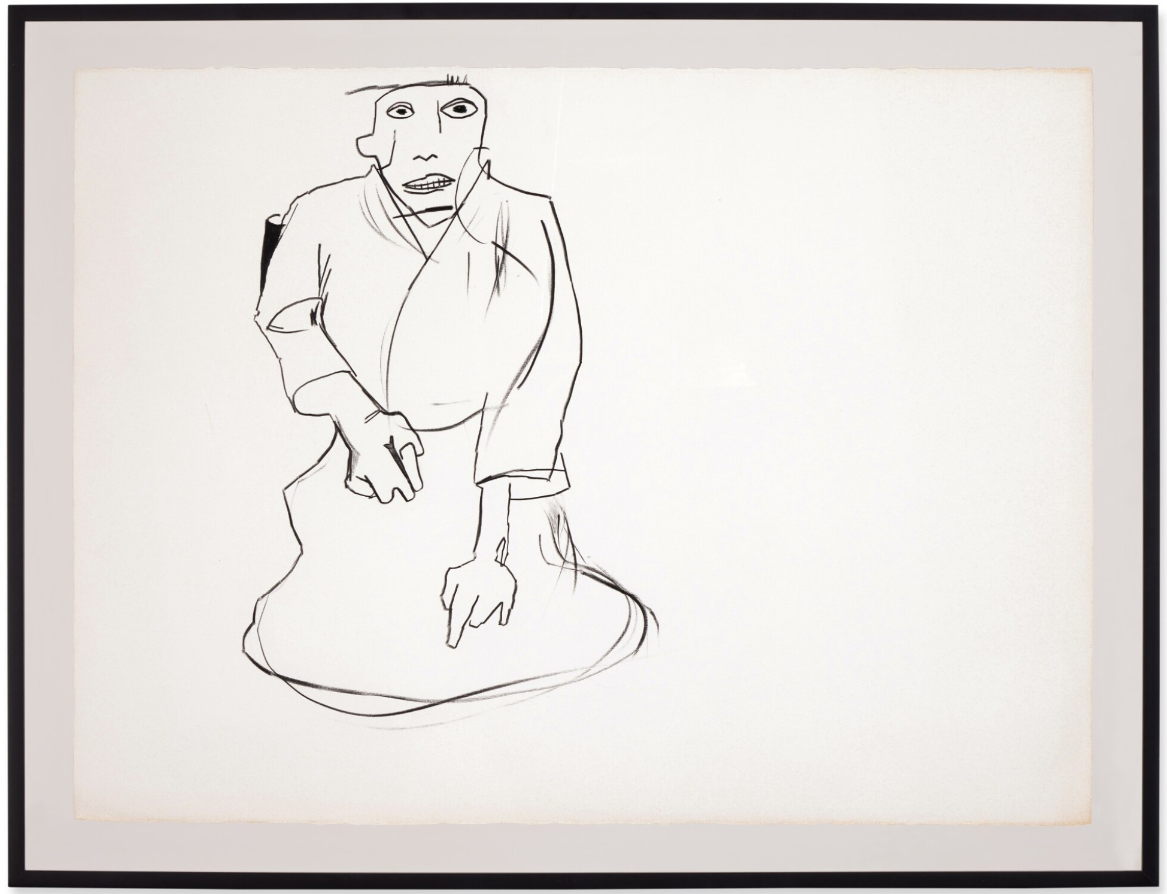
JEAN-MICHEL BASQUIAT (1960 – 1988)
Untitled (Karate III), 1983
Conte crayon on paper
22 1/4 x 30 inches (55.9 x 76.2 cm)
#17. Dealer’s dog, 1983
Sotheby’s Paris: 3 June 2021
Estimated: EUR 200,000 – 300,000
EUR 214,200 / USD 259,636
Dealer’s dog | Art Contemporain Evening Sale | 2021 | Sotheby’s (sothebys.com)
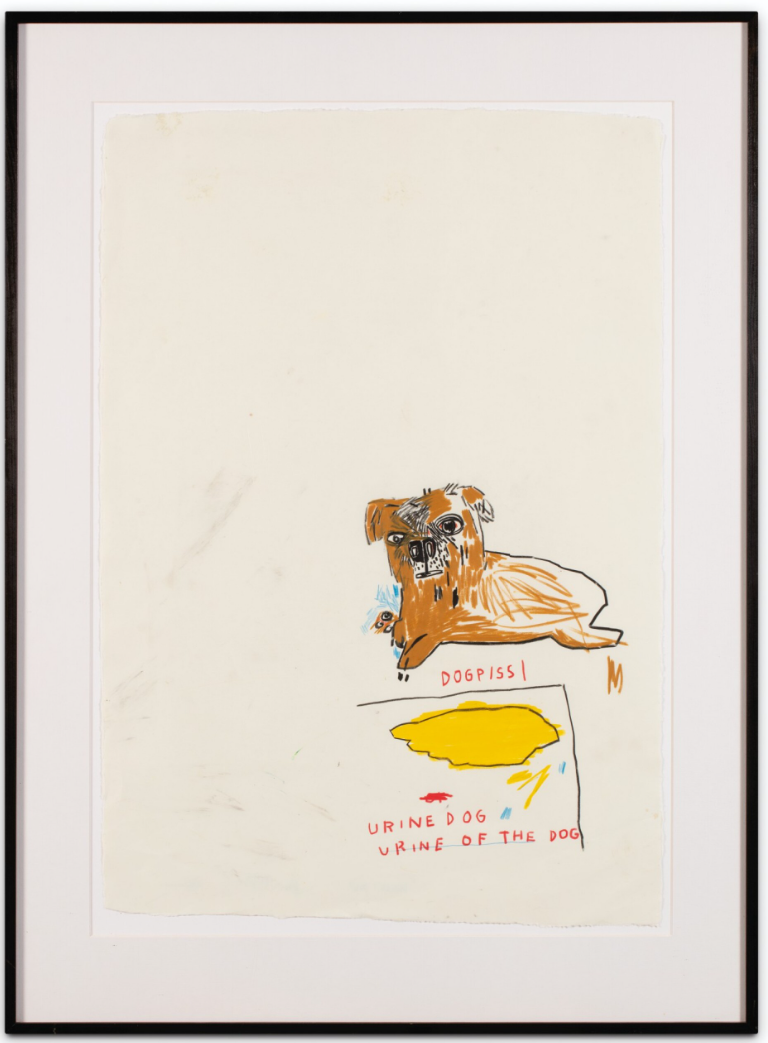
JEAN-MICHEL BASQUIAT (1960 – 1988)
Dealer’s dog, 1983
Oilstick on paper
35 7/8 x 24 3/8 inches (91×62 cm)
Signed, titled and dated 1983 on the reverse
#18. Untitled (Wooden Airplane), 1982
Christie’s New-York: 12 November 2021
Estimated: USD 150,000 – 250,000
USD 250,000
JEAN-MICHEL BASQUIAT (1960-1988), Untitled (Wooden Airplane) | Christie’s (christies.com)
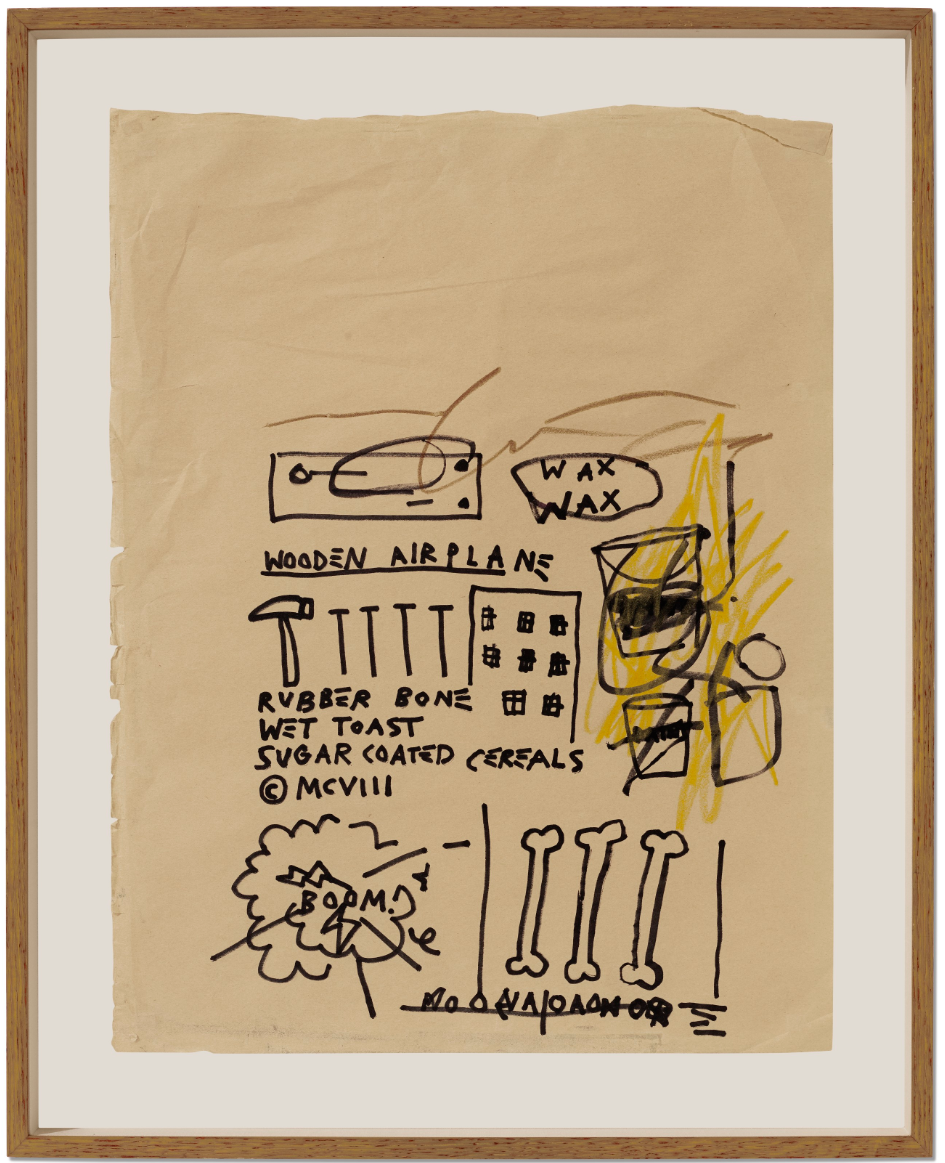
JEAN-MICHEL BASQUIAT (1960-1988)
Untitled (Wooden Airplane), 1982
Oilstick, crayon and felt-tip pen on paper
23×18 inches (59.5 x 45 cm)
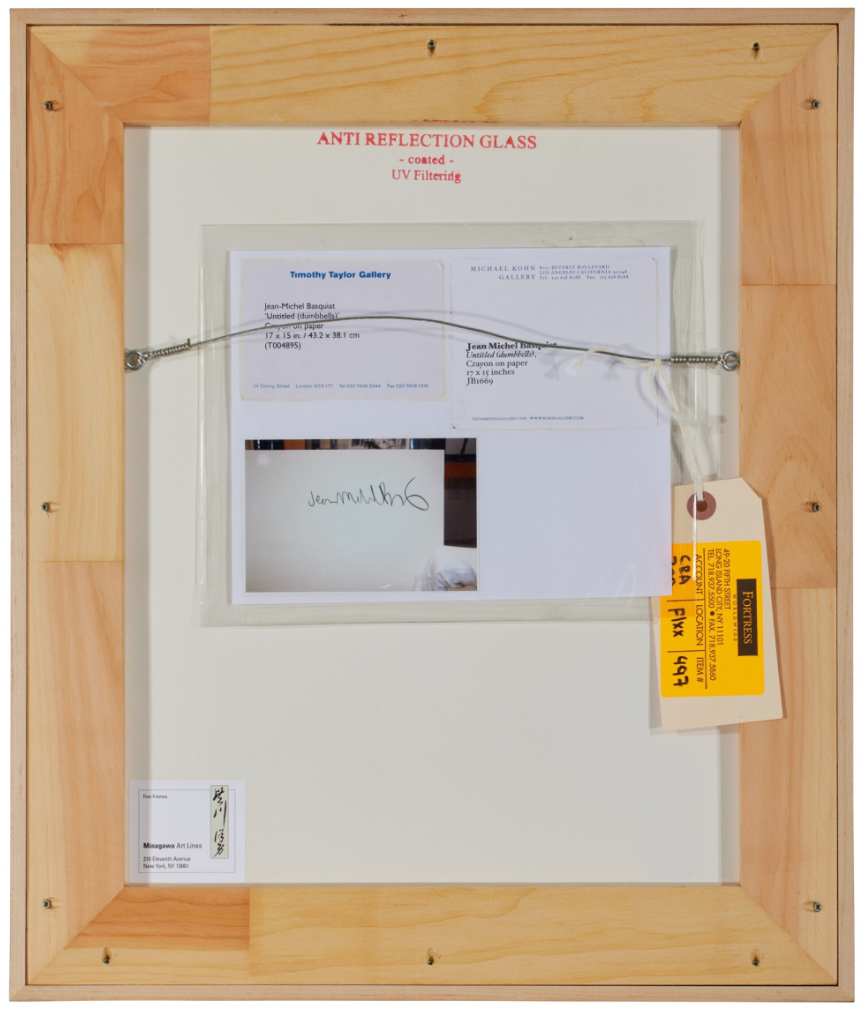
#19. Untitled (Dumbbells), circa 1983
Sotheby’s New-York: 19 November 2021
Estimated: USD 70,000 – 100,000
USD 201,600
Untitled (Dumbbells) | Contemporary Day Auction | 2021 | Sotheby’s (sothebys.com)
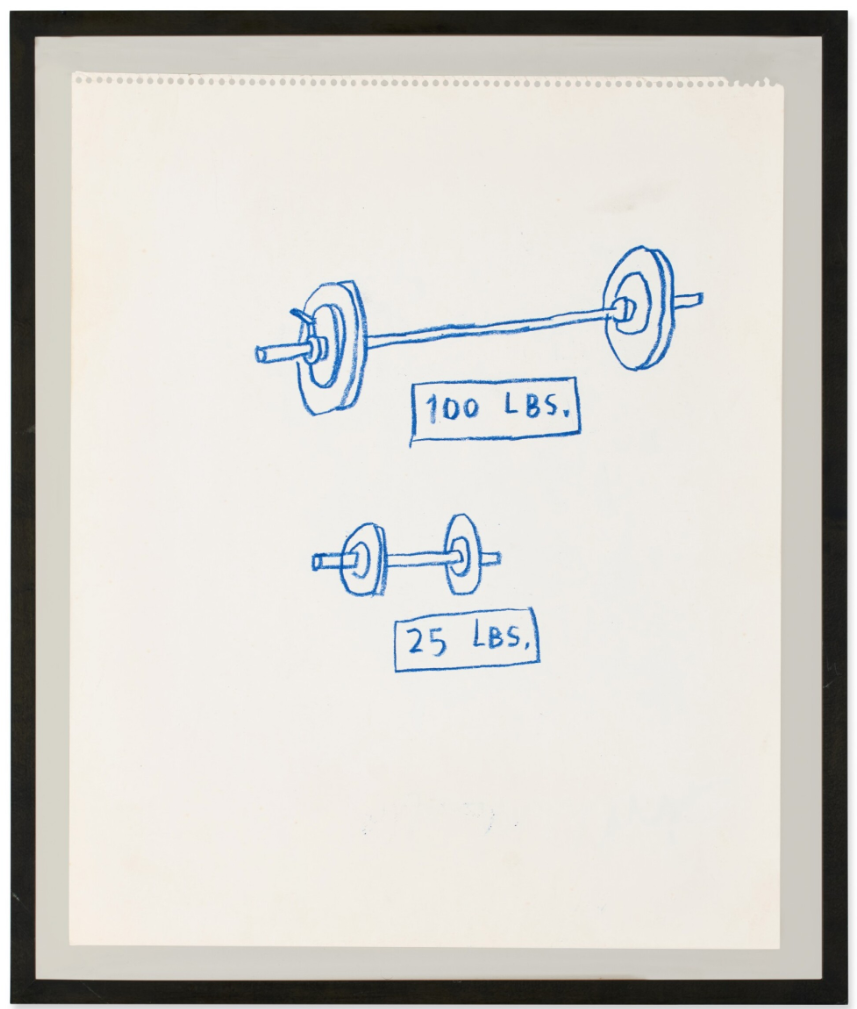
JEAN-MICHEL BASQUIAT (1960 – 1988)
Untitled (Dumbbells), circa 1983
Oilstick on paper
17 x 13 3/4 inches (43.2 x 34.9 cm)
Signed (on the verso)
#20. Famous Negro Athletes, 1981
Sotheby’s New-York: 12 March 2021
Estimated: USD 80,000 – 120,000
USD 189,000
Famous Negro Athletes | Contemporary Curated | 2021 | Sotheby’s (sothebys.com)
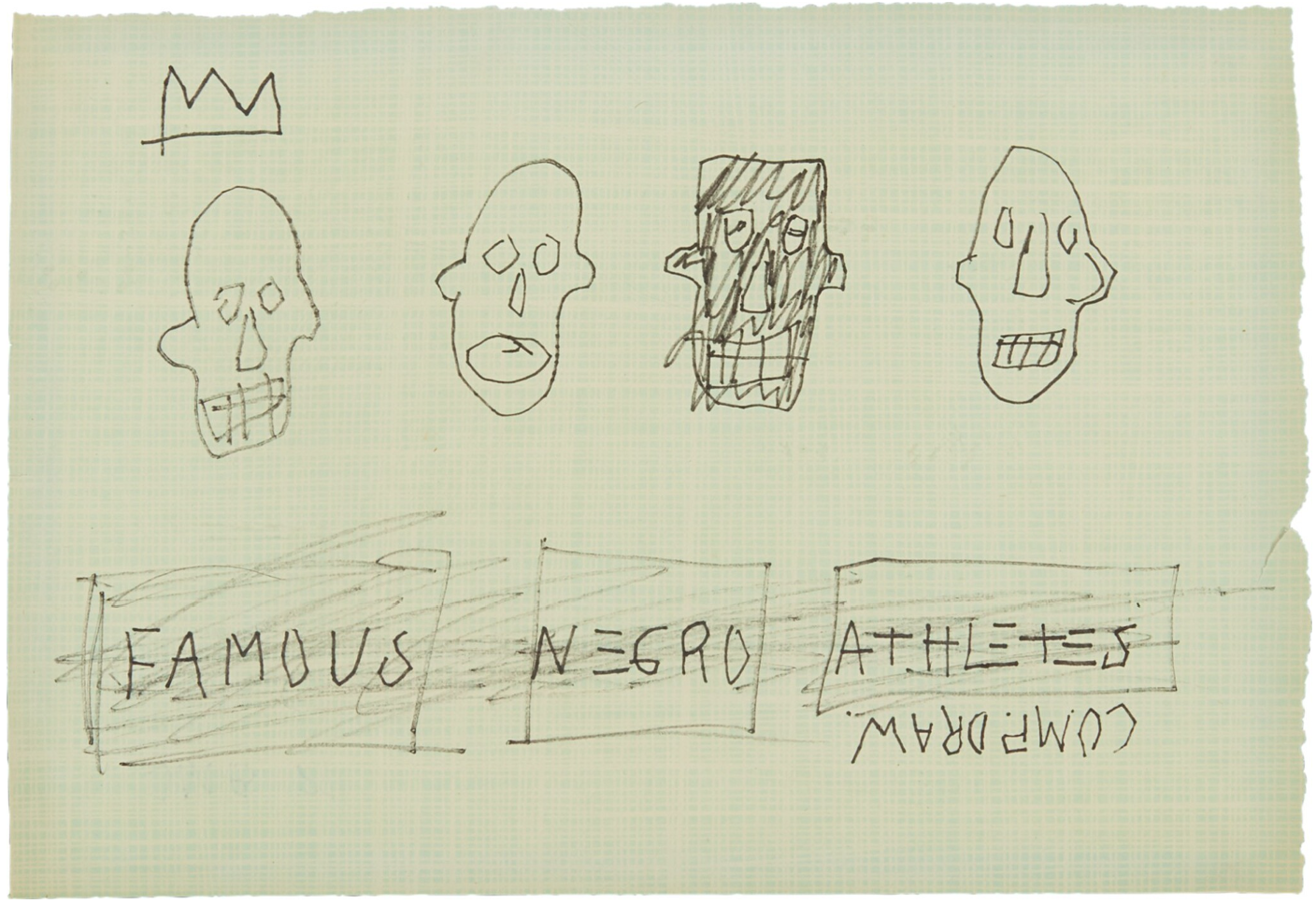
JEAN-MICHEL BASQUIAT (1960 – 1988)
Famous Negro Athletes, 1981
Marker on paper
7 3/4 x 11 3/4 inches (19.7 x 29.8 cm)
Signed with the artist’s intitials and dated 81 on the reverse
2020 Auction Results
WORK IN PROGRESS
#1. Untitled (Head), 1982
Sotheby’s New-York: 29 June 2020
Estimated: USD 9,000,000 – 12,000,000
USD 15,184,900
JEAN-MICHEL BASQUIAT (1960 – 1988)
UNTITLED (HEAD), 1982
Oilstick, ink and acrylic on paper
29 3/4 x 22 inches (75.6 x 55.9 cm)
#2. Untitled, 1982
Christie’s New-York: 10 July 2020
Estimated: USD 3,000,000 – 5,000,000
USD 4,928,500
Jean-Michel Basquiat (1960-1988), Untitled | Christie’s
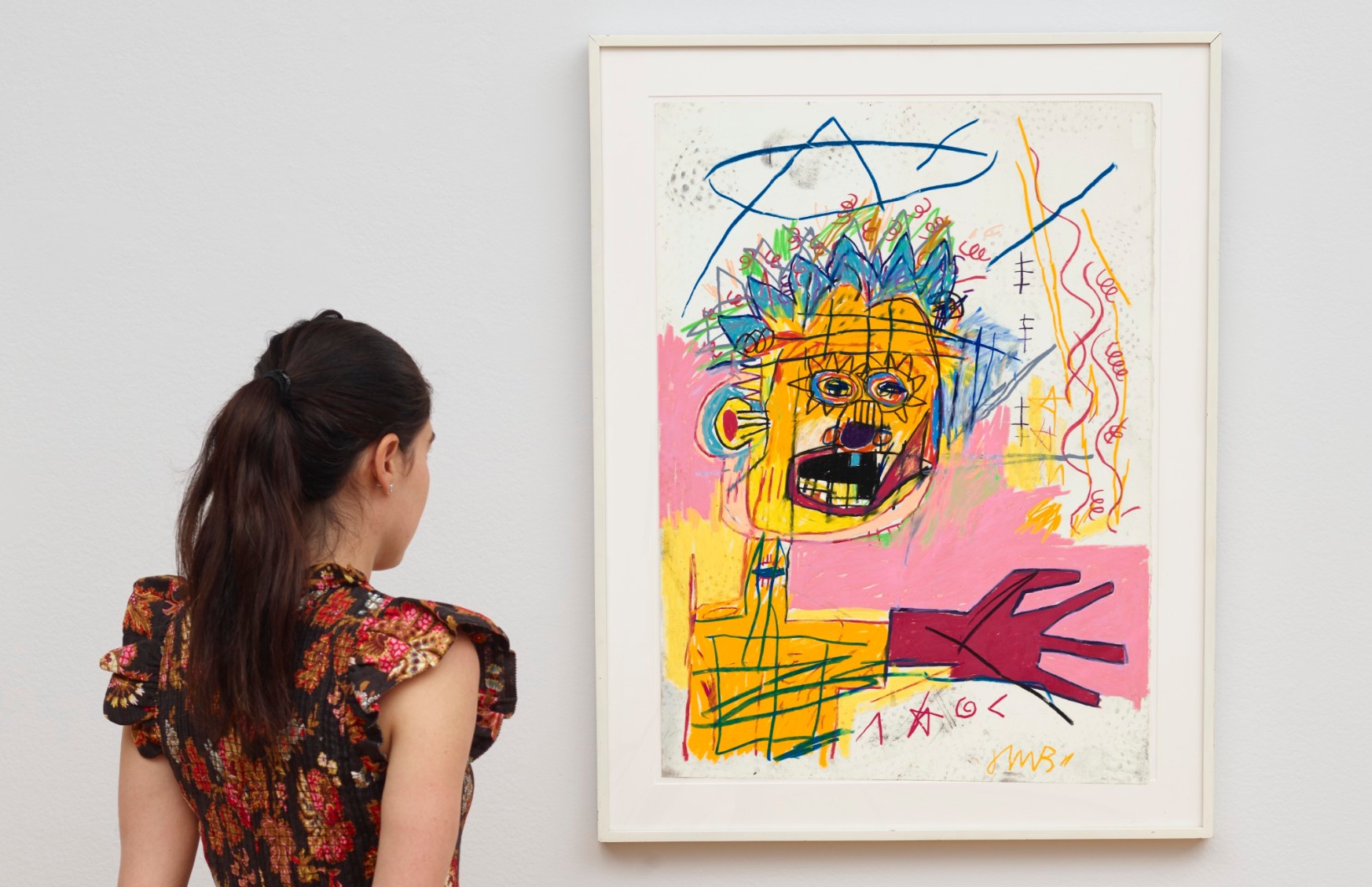
JEAN-MICHEL BASQUIAT (1960-1988)
Untitled, 1982
Oil pastel and wax crayon on paper
30 1/8 x 22 1/4 inches (76.5 x 56.5 cm)
Signed with the artist’s initials ‘JMB’ (lower right)
#3. Untitled (Pestus), 1982
Phillips New-York: 20 October 2020
Estimated: USD 2,000,000 – 3,000,000
USD 2,200,500
Jean-Michel Basquiat – 20th Century … Lot 17 October 2020 | Phillips
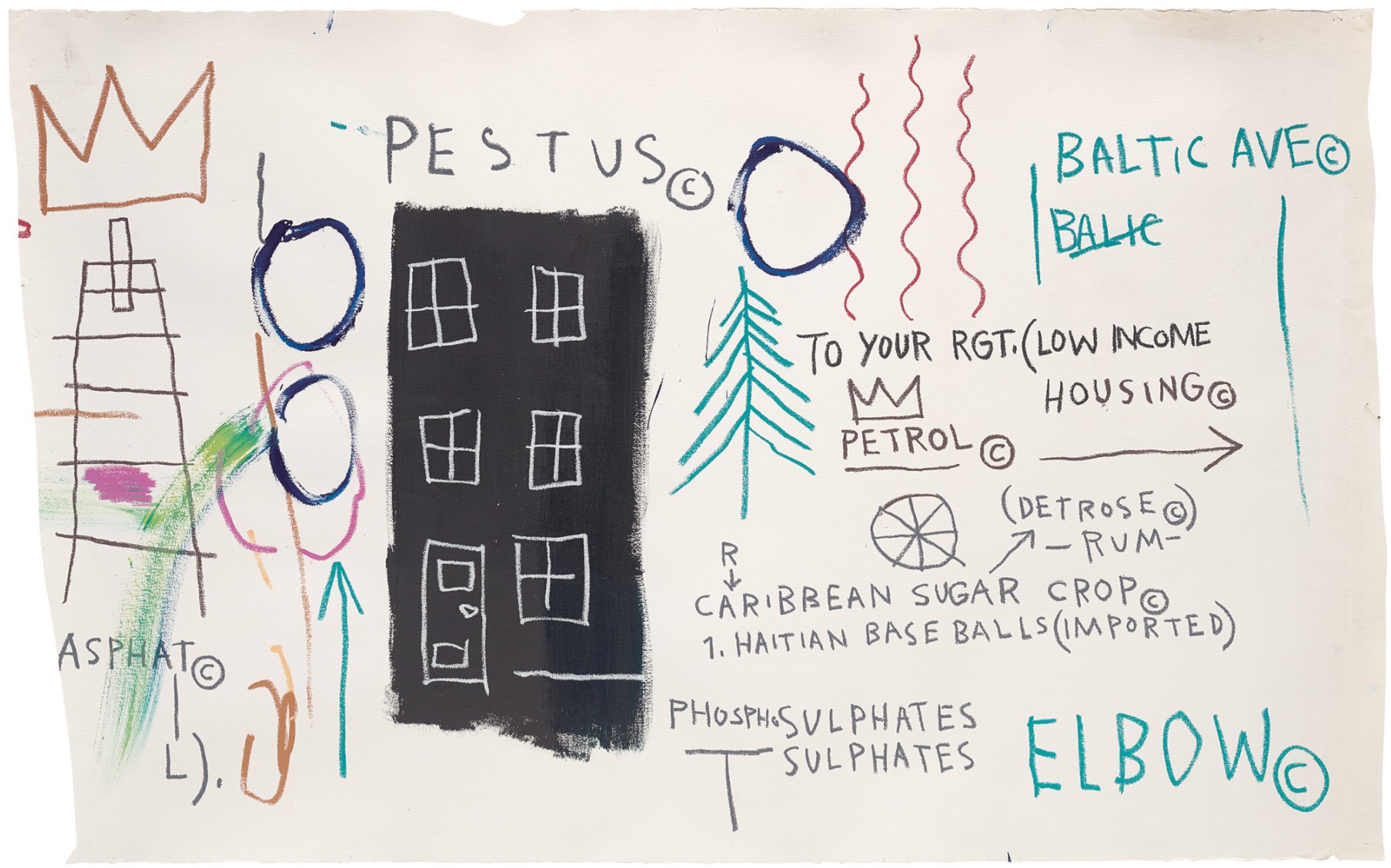
JEAN-MICHEL BASQUIAT
Untitled (Pestus), 1982
Acrylic and oilstick on paper
45 x 71 7/8 inches (114.3 x 182.8 cm)
#4. Untitled, 1981
Christie’s New-York: 10 July 2020
Estimated: USD 1,200,000 – 1,800,000
USD 1,815,000
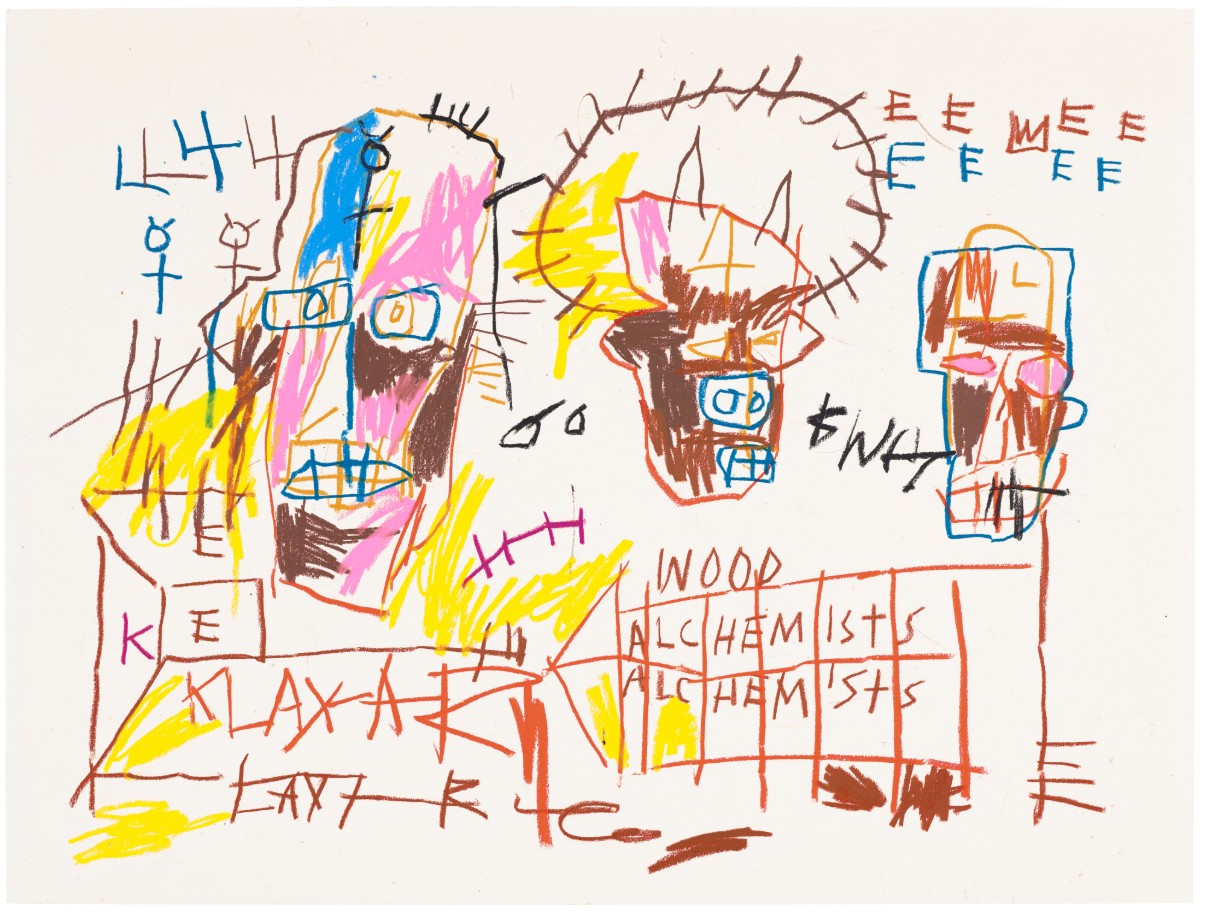
JEAN-MICHEL BASQUIAT (1960-1988)
Untitled, 1981
Oilstick on paper
17 3/4 x 23 5/8 inches (45×60 cm)
Signed and dated indistinctly ‘Jean-Michel Basquiat’ (on the reverse)
This work is registered in the archives of Annina Nosei Gallery, New York, as no. 1829
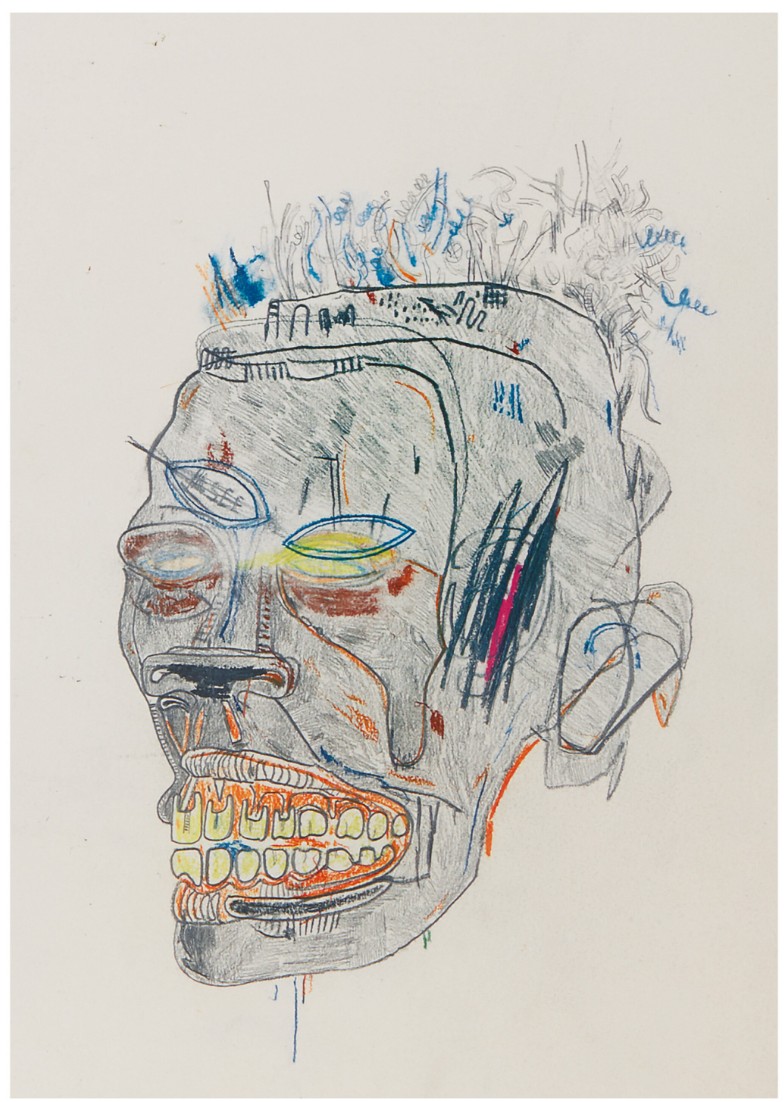
#5. UNTITLED (HEAD), circa 1980-85
Sotheby’s New-York: 2 October 2020
Estimated: USD 1,200,000 – 1,800,000
USD 1,351,000
JEAN-MICHEL BASQUIAT | UNTITLED (HEAD) | Contemporary Curated | 2020 | Sotheby’s
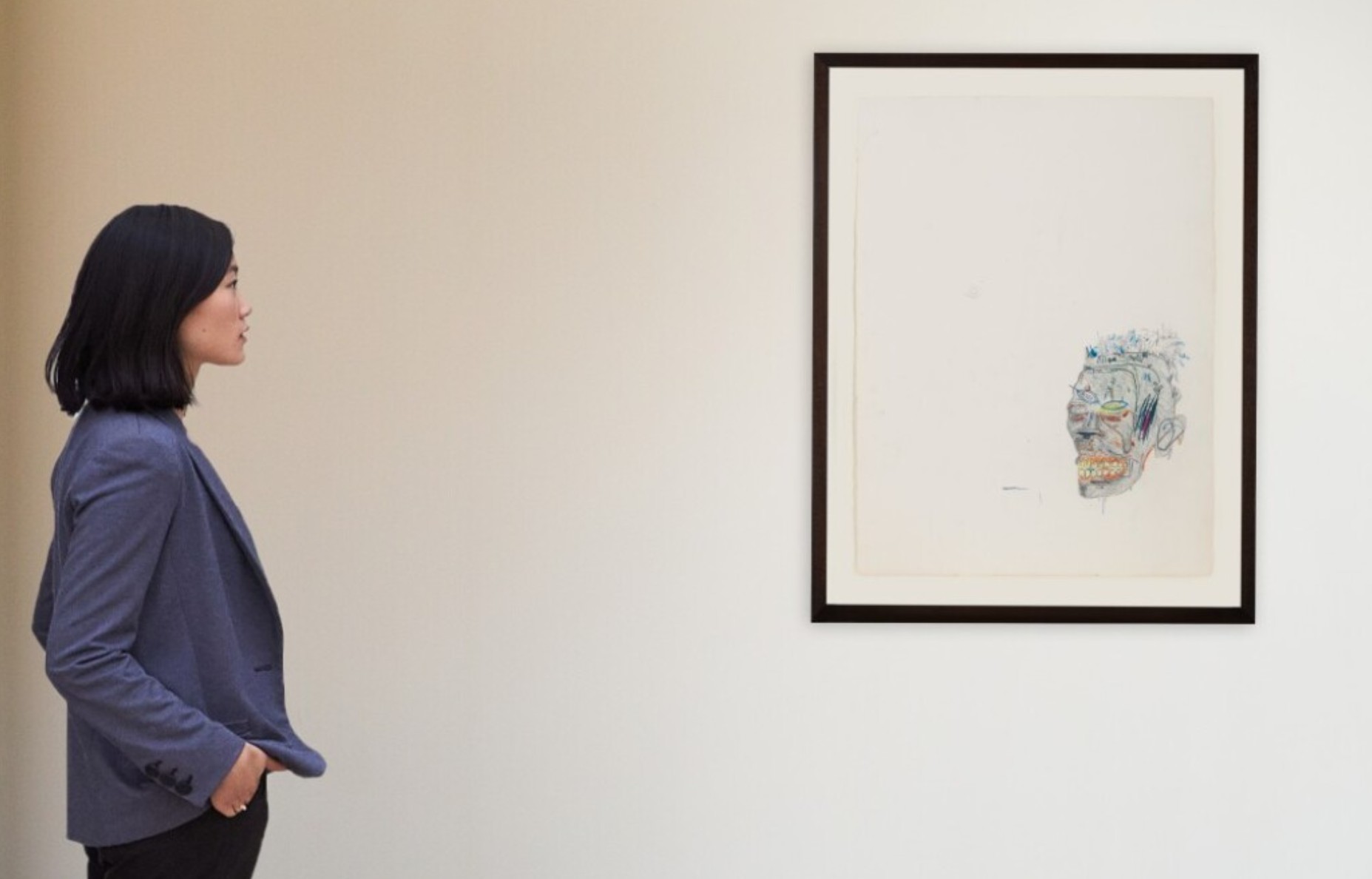
JEAN-MICHEL BASQUIAT (1960 – 1988)
UNTITLED (HEAD), circa 1980-85
Pencil and crayon on paper
30×22 inches (76.2 x 55.9 cm)
#6. Portrait of Jean Kallina, 1984
Christie’s New-York: 10 July 2020
Estimated: USD 1,000,000 – 1,500,000
USD 1,185,000
Jean-Michel Basquiat (1960-1988), Portrait of Jean Kallina | Christie’s
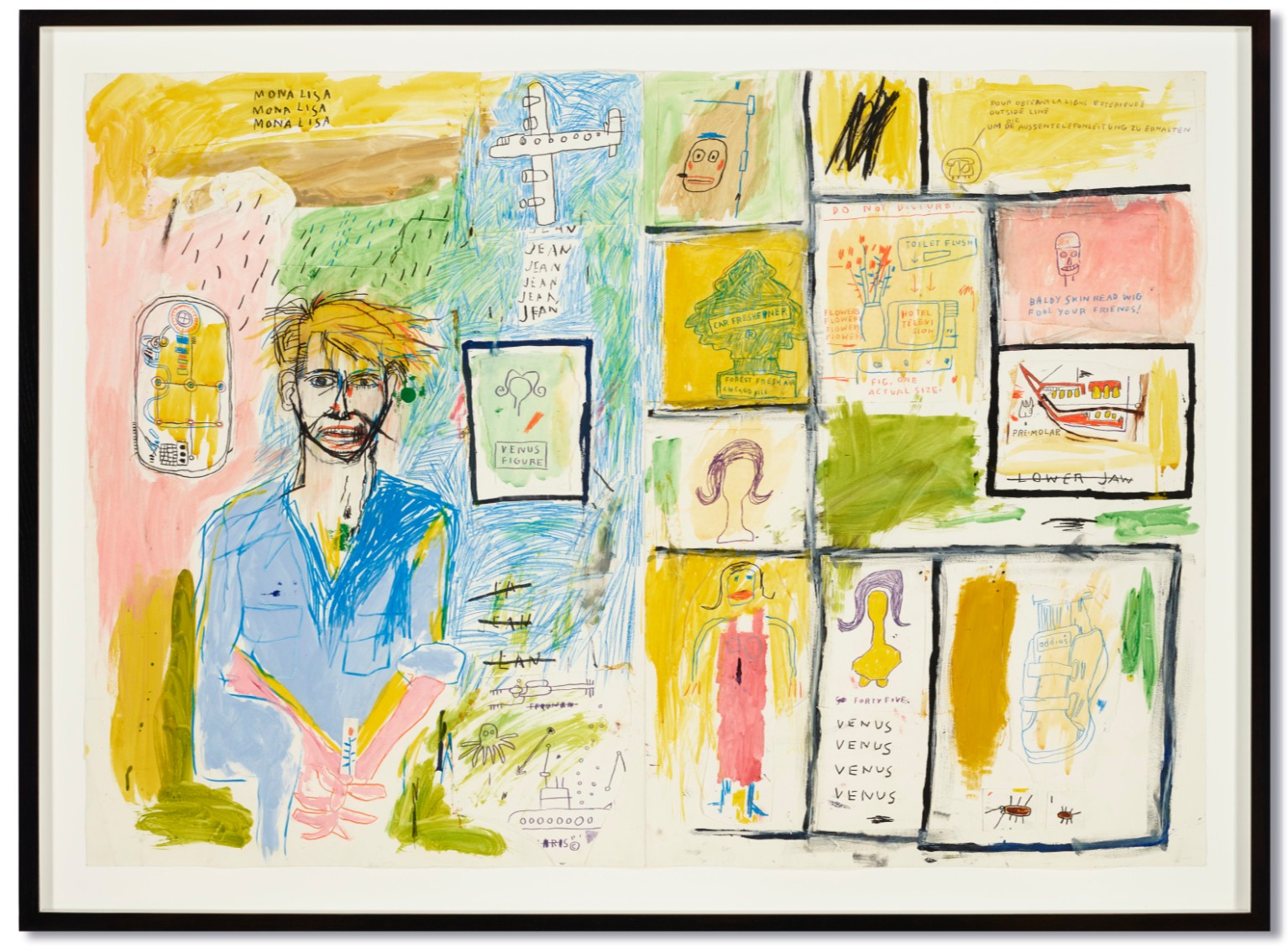
JEAN-MICHEL BASQUIAT (1960-1988)
Portrait of Jean Kallina, 1984
Gouache, watercolor, acrylic, oilstick, china marker, india ink, wax crayon and paper collage
On two joined sheets of paper
39 3/8 x 55 1/2 inches (100×141 cm)
#7. Untitled, 1988
Sotheby’s New-York: 17 November 2020
Estimated: USD 900,000 – 1,200,000
USD 1,000,100
Untitled | Contemporary Art Day Auction | 2020 | Sotheby’s
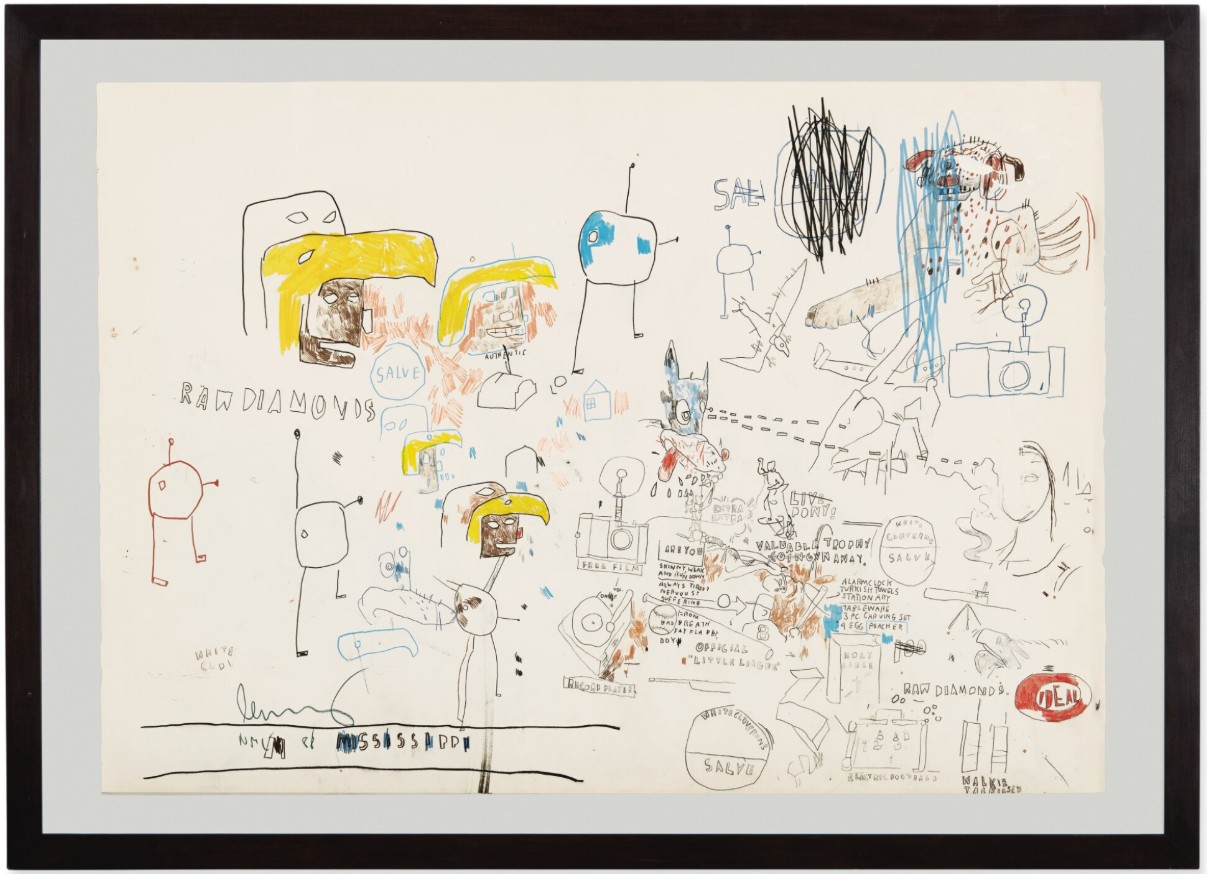
JEAN-MICHEL BASQUIAT (1960 – 1988)
Untitled, 1988
Graphite, colored pencil, oil crayon and acrylic on paper
29 5/8 x 41 3/4 inches (75.3 x 106.1 cm)
Signed and dated NYC 88
#8. Untitled, 1984
Christie’s London: 22 October 2020
Estimated: GPB 1,000,000 – 1,500,000
GBP 742,500 / USD 970,840
JEAN-MICHEL BASQUIAT (1960-1988), Untitled | Christie’s
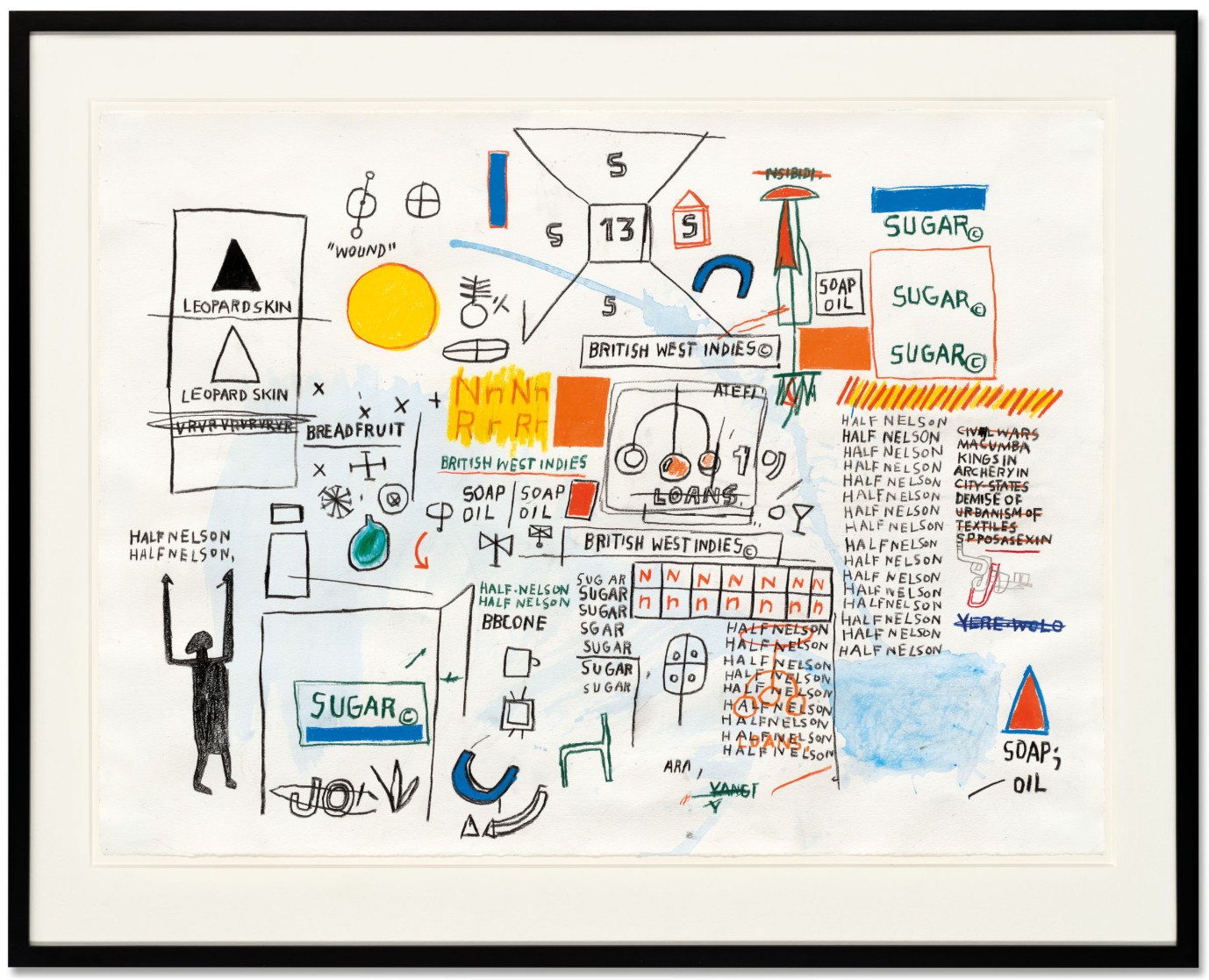
JEAN-MICHEL BASQUIAT (1960-1988)
Untitled, 1984
Wax crayon, watercolor and graphite on paper
22 1/4 x 30 1/8 inches (56.4 x 76.4 cm)
USD 1 million
#9. UNTITLED (STUDY), 1981
Sotheby’s New-York: 30 June 2020
Estimated: USD 800,000 – 1,200,000
USD 860,000
JEAN-MICHEL BASQUIAT | UNTITLED (STUDY) | Contemporary Art Day Auction | 2020 | Sotheby’s
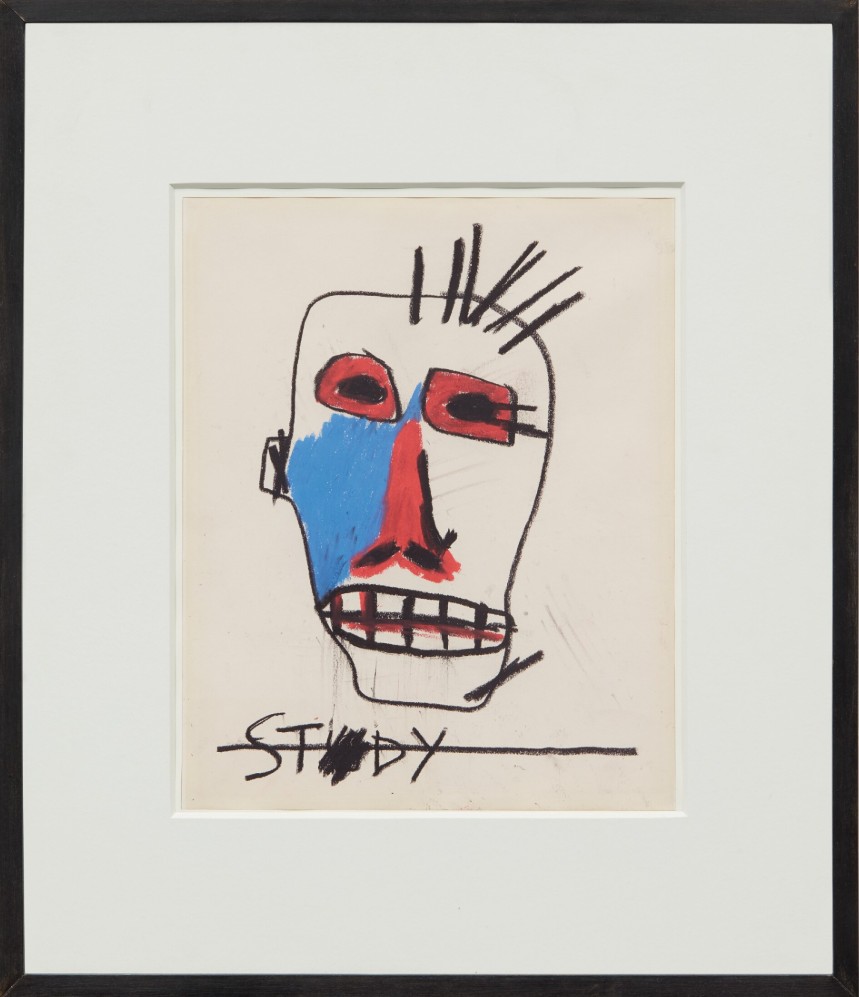
JEAN-MICHEL BASQUIAT (1960 – 1988)
UNTITLED (STUDY), 1981
Oilstick on paper
14×11 inches (35.6 x 27.9 cm)
Signed on the reverse
#10. Back of the Neck, 1983
Phillips London: 20 October 2020
Estimated: GBP 450,000 – 650,000
GBP 627,500 / USD 819,480
Jean-Michel Basquiat – 20th Century … Lot 11 October 2020 | Phillips
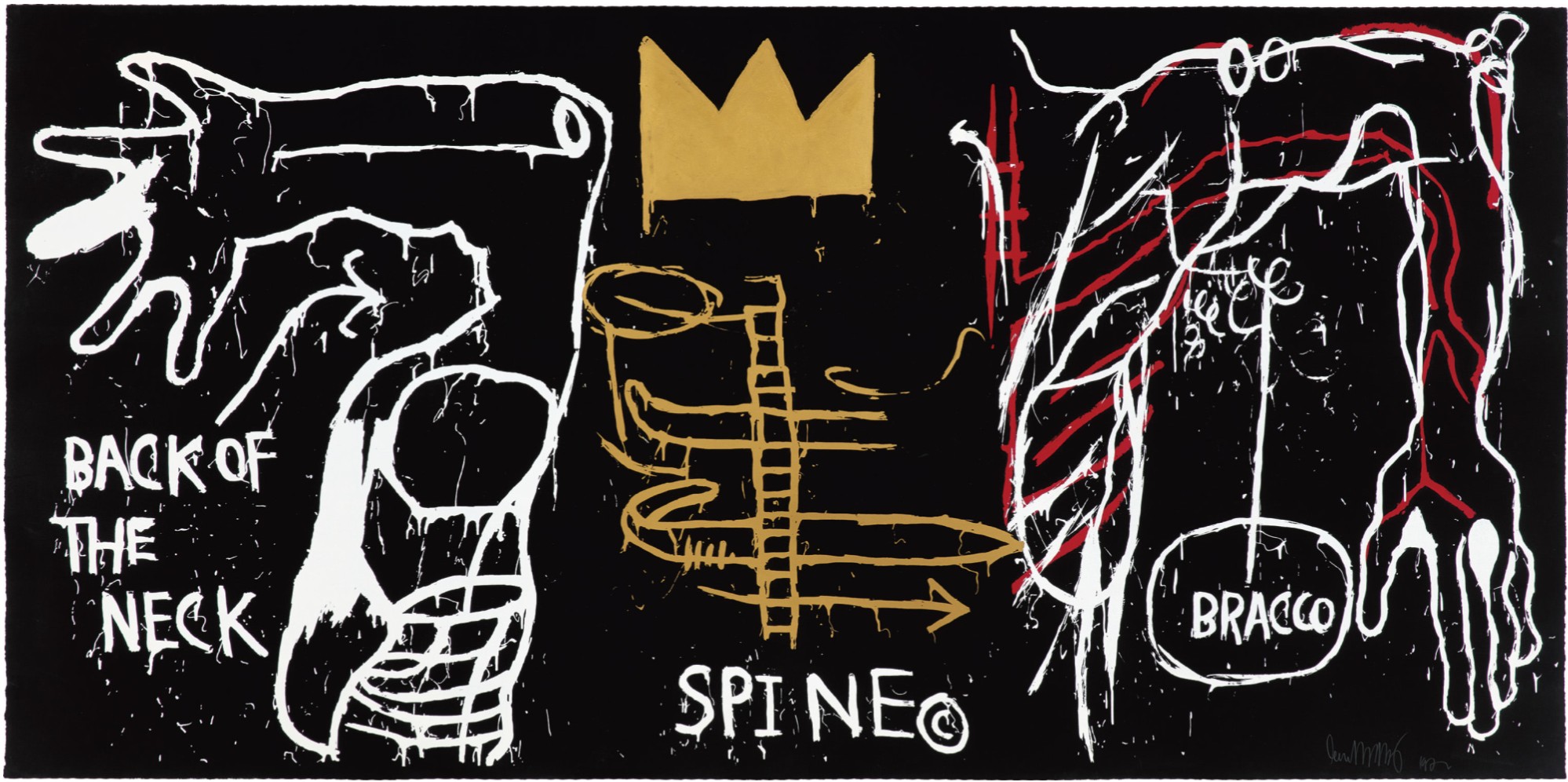
JEAN-MICHEL BASQUIAT
Back of the Neck, 1983
Screenprint with hand coloring on paper
50 1/4 x 101 1/2 inches (127.7 x 257.8 cm)
Signed and dated ‘Jean-Michel Basquiat 1983′ lower right
Further numbered ’13/24’ on the reverse
This work is number 13 from an edition of 24 plus 3 artist’s proofs
#11. Untitled, 1982
Christie’s London: 12 February 2020
Estimated: GBP 500,000 – 800,000
GBP 611,250 / USD 796,695
Jean-Michel Basquiat (1960-1988), Untitled | Christie’s
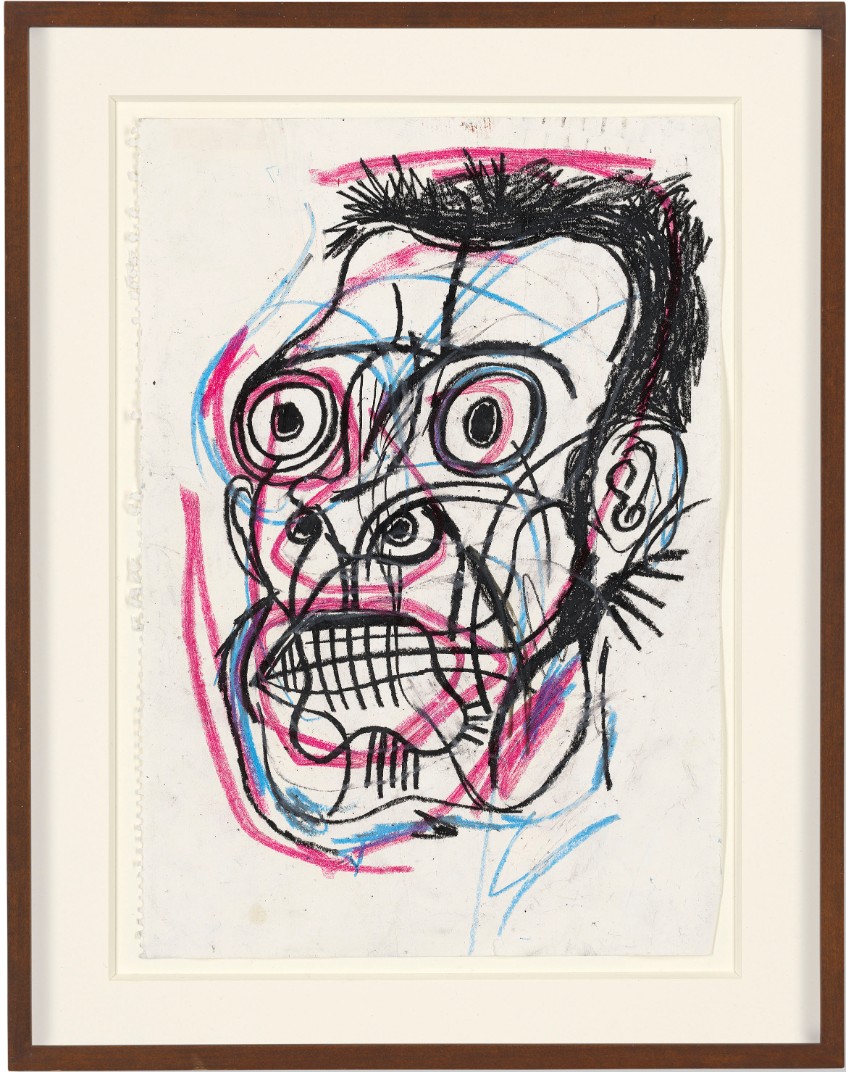
JEAN-MICHEL BASQUIAT (1960-1988)
Untitled, 1982
Oilstick on paper
14 x 9 7/8 inches (35.5 x 25 cm)
#12. Untitled, 1981
Christie’s New-York: 3 December 2020
Estimated: USD 400,000 – 600,000
USD 437,500
Jean-Michel Basquiat (1960-1988), Untitled | Christie’s
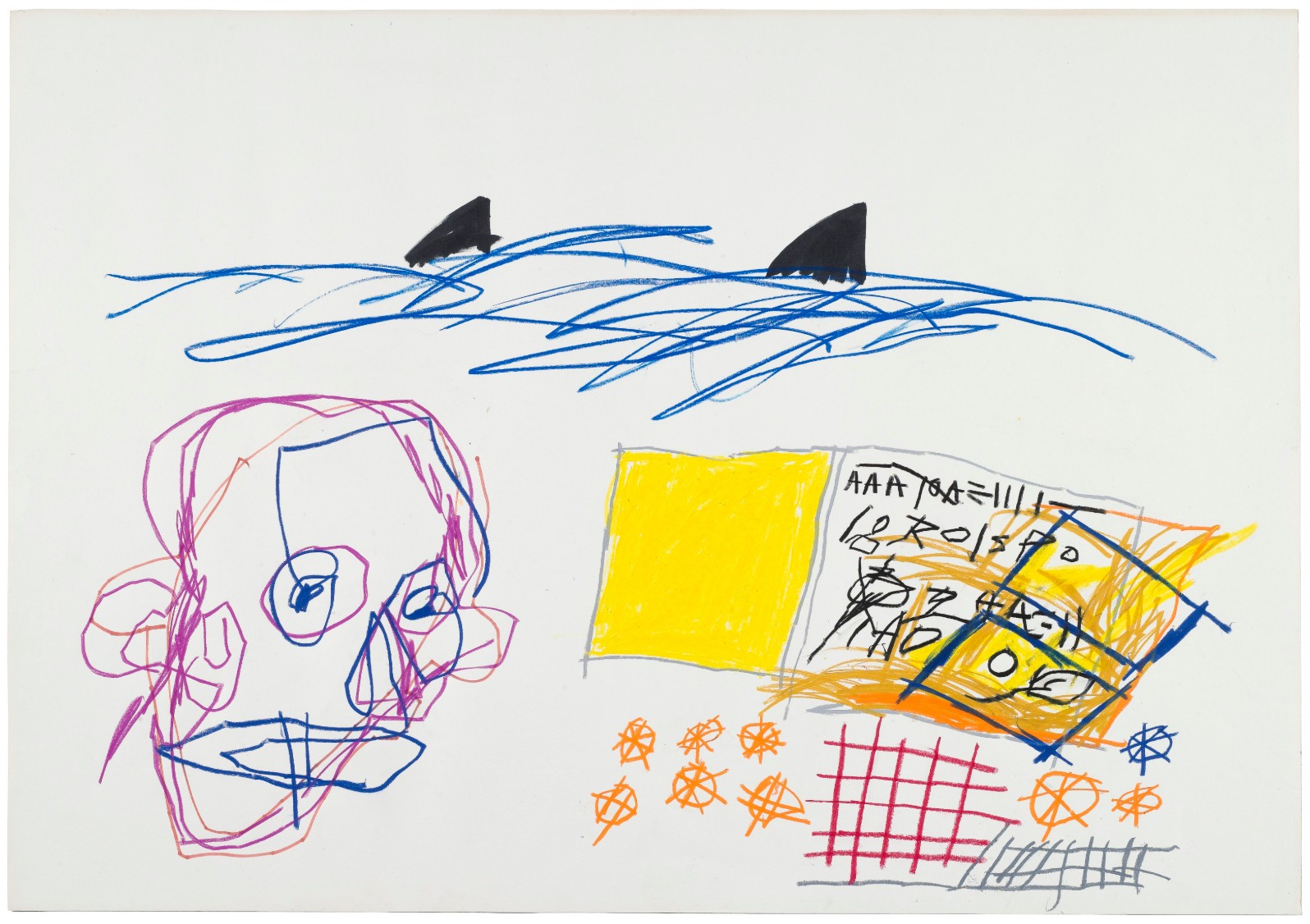
JEAN-MICHEL BASQUIAT (1960-1988)
Untitled, 1981
Oilstick and ink on paper
27 1/2 x 39 3/8 inches (70×100 cm)
Signed, inscribed and dated ‘SAMO © MODENA 1981’ (on the reverse)
#13. Untitled, 1982
Christie’s New-York: 7 October 2020
Estimated: USD 150,000 – 200,000
USD 400,000
Jean-Michel Basquiat (1960-1988), Untitled | Christie’s
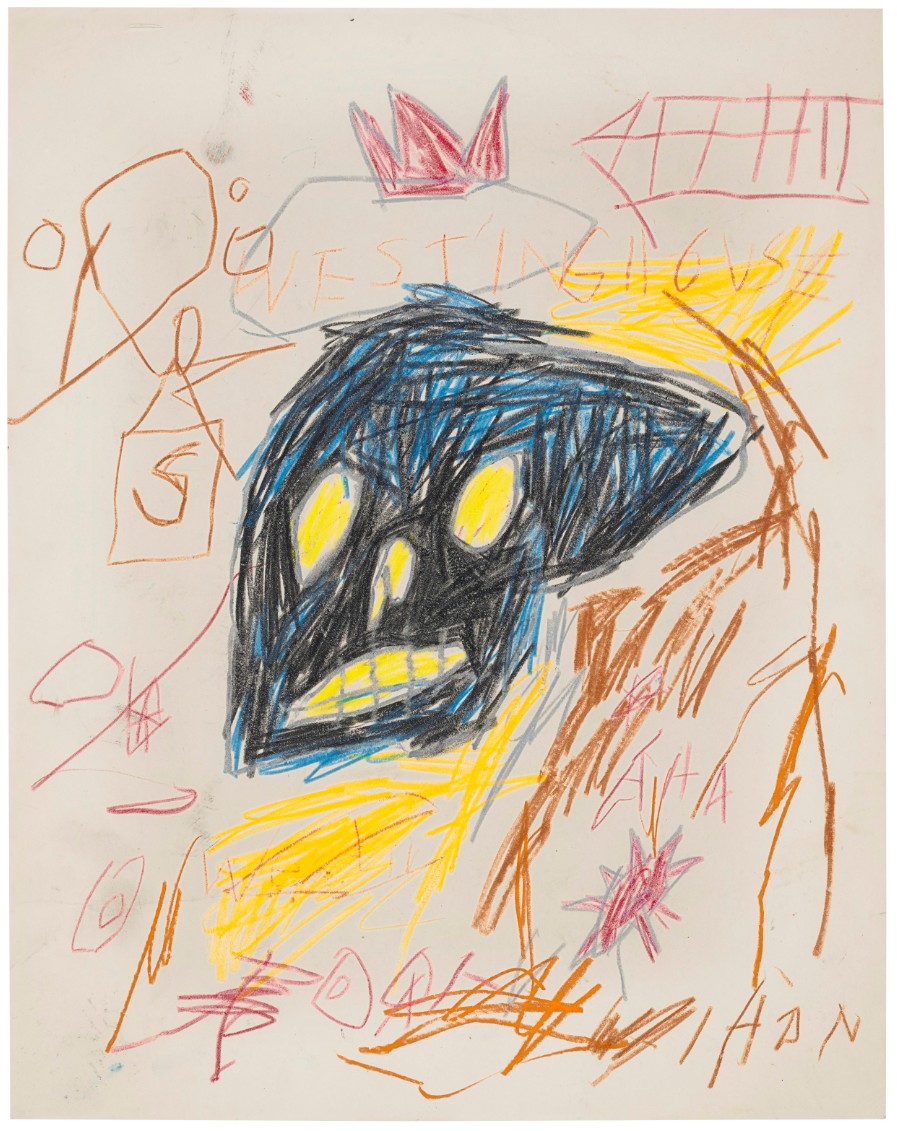
JEAN-MICHEL BASQUIAT (1960-1988)
Untitled, 1982
Wax crayon on paper
14×11 inches (35.6 x 28 cm)
#14. Untitled (Geese+), 1984
Phillips New-York: 8 December 2020
Estimated: USD 300,000 – 400,000
USD 302,400
Jean-Michel Basquiat – 20th c. and… Lot 165 December 2020 | Phillips
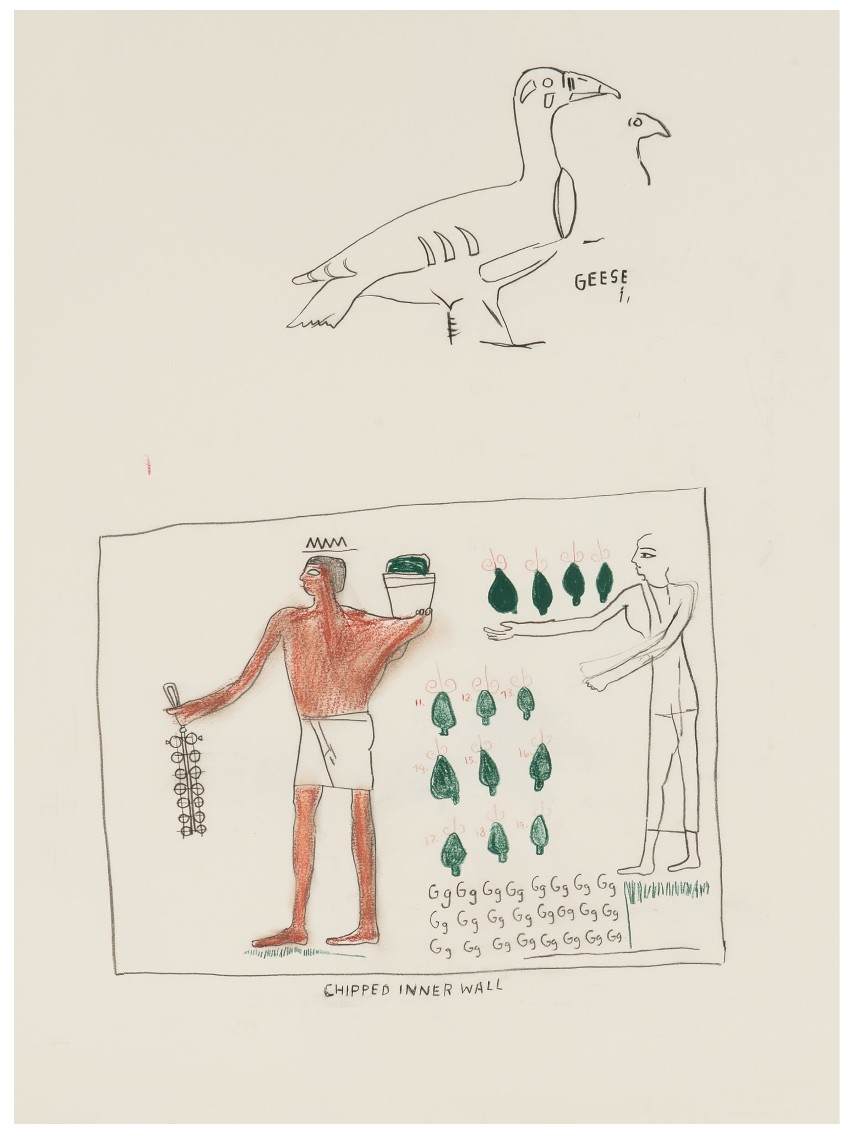
JEAN-MICHEL BASQUIAT
Untitled (Geese+), 1984
Oilstick and charcoal on paper
41 1/2 x 29 3/4 inches (105.4 x 75.7 cm)
Signed, dedicated and dated “To KIM Jean-Michel Basquiat 1984.” on the reverse
2019 Auction Results
WORK IN PROGRESS
#1. Brown Eggs, 1981
Sotheby’s New-York: 13 November 2019
Estimated: USD 2,500,000 – 3,500,000
USD 4,500,000
(#22) JEAN-MICHEL BASQUIAT | Brown Eggs
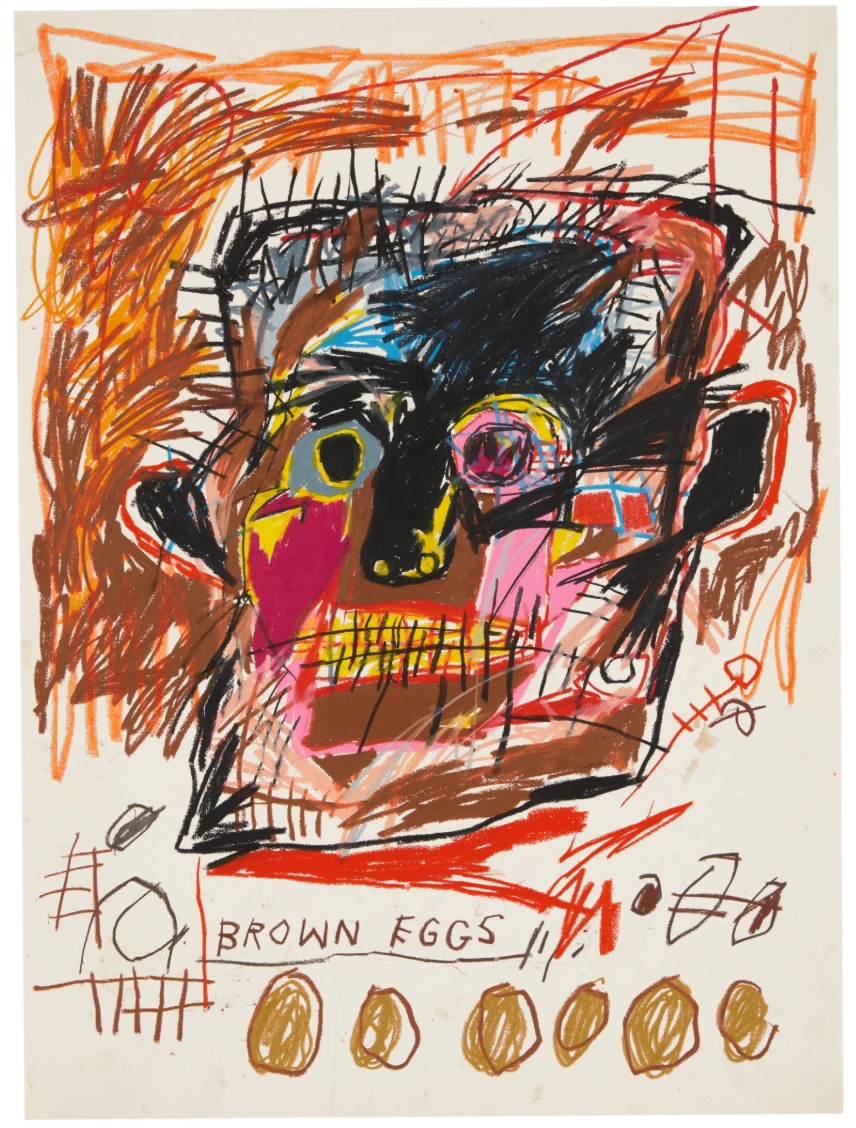
JEAN-MICHEL BASQUIAT
Brown Eggs, 1981
Oilstick on paper
24 1/4 x 18 inches (61.6 x 45.7 cm)
Titled and signed on the reverse
#2. Untitled (Head), 1982
Sotheby’s New-York: 15 May 2019
Estimated: USD 3,000,000 – 4,000,000
USD 4,100,000
(#8) JEAN-MICHEL BASQUIAT | Untitled (Head)
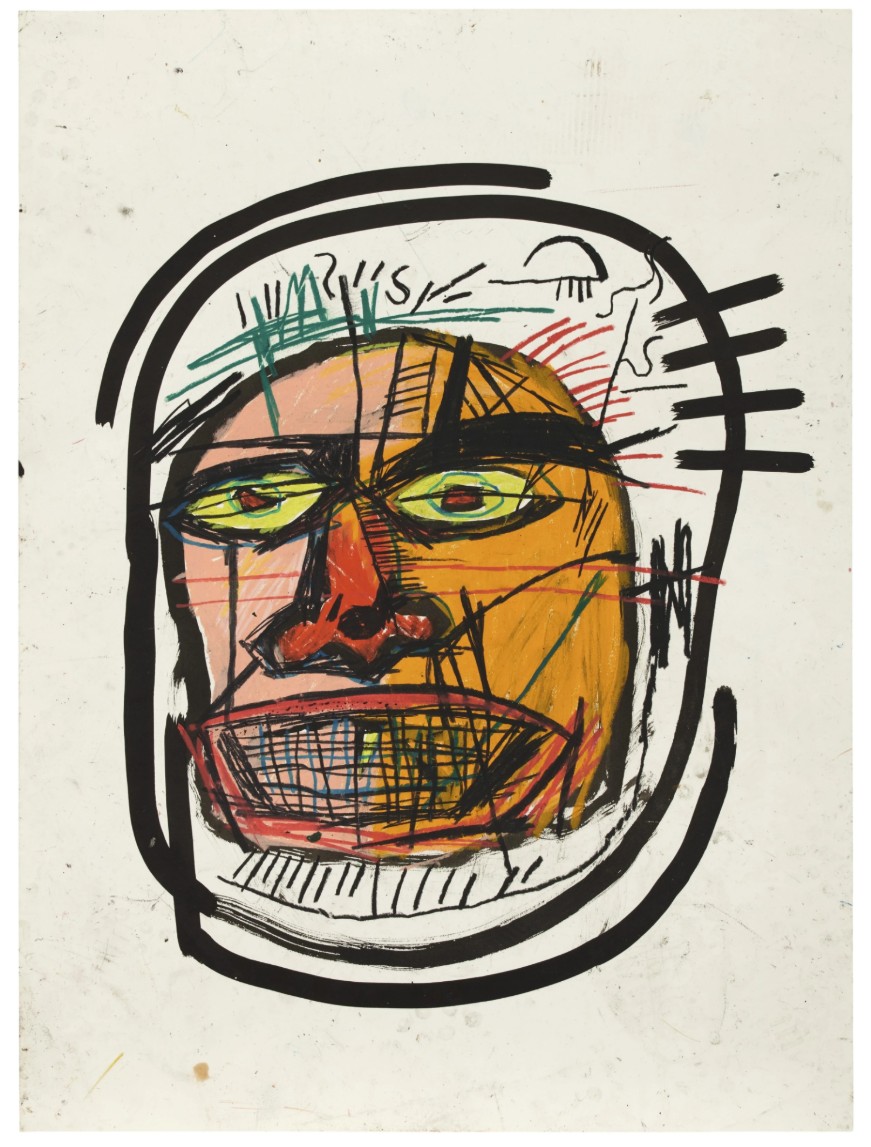
JEAN-MICHEL BASQUIAT
Untitled (Head), 1982
Ink and oilstick on paper
30×22 inches (76.2 x 55.9 cm)
Inscribed BASQ-0799 on the reverse
#3. Robot Man, 1983
Phillips New-York: 16 May 2019
Estimated: USD 2,500,000 – 3,500,000
USD 3,860,000
Jean-Michel Basquiat – 20th Century & Co… Lot 21 May 2019 | Phillips
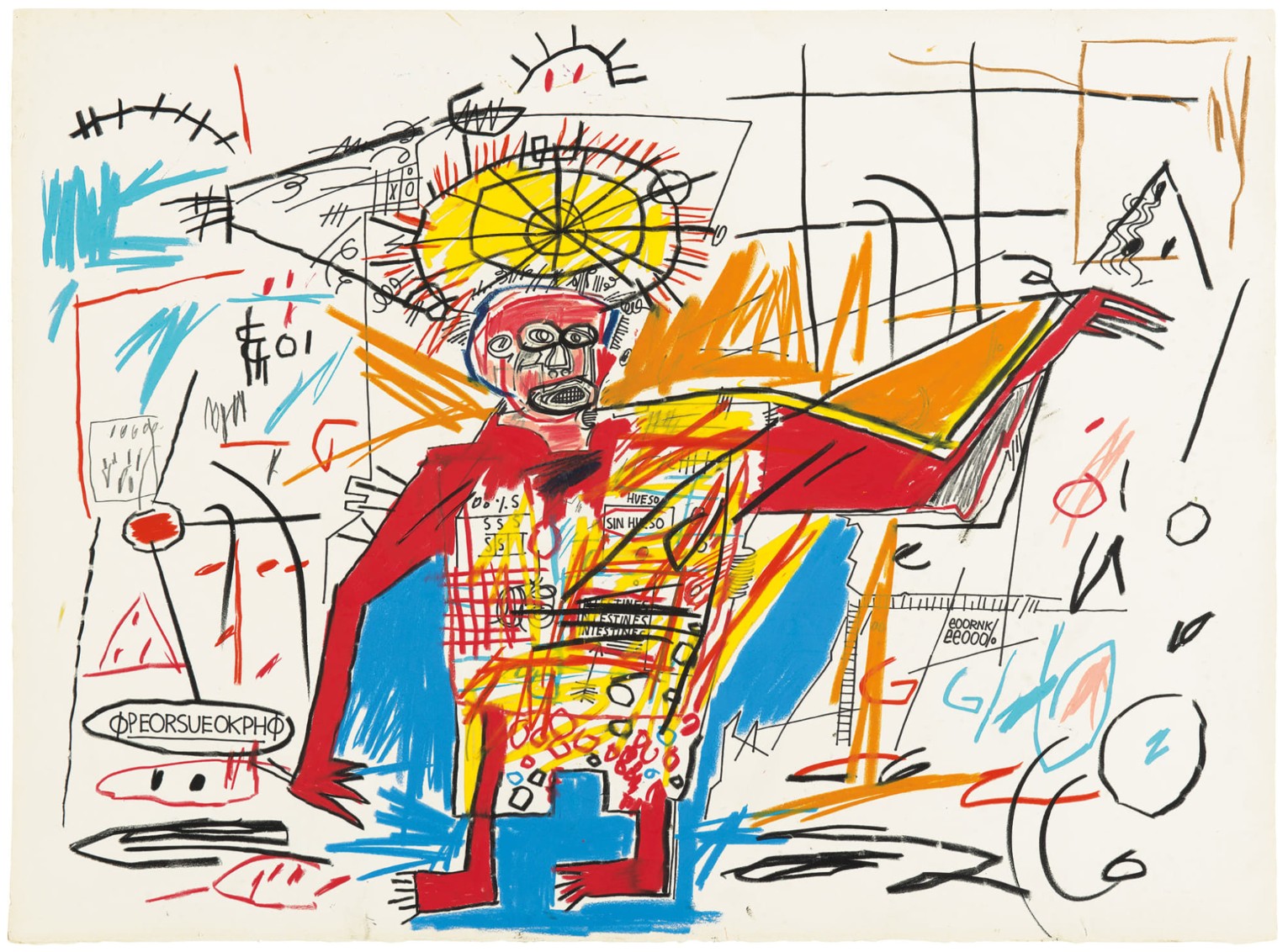
JEAN-MICHEL BASQUIAT
Robot Man, 1983
Oilstick on paper
22 1/4 x 30 1/8 inches (56.5 x 76.5 cm)
This work is registered under inventory number 1989 (Peorsveokpho) in the Annina Nosei Gallery Archive
Signed “Jean-Michel Basquiat” on the reverse
#4. Famous Negro Athletes, 1981
Sotheby’s New-York: 13 November 2019
Estimated: USD 2,500,000 – 3,500,000
USD 3,020,000
(#5) JEAN-MICHEL BASQUIAT | Famous Negro Athletes
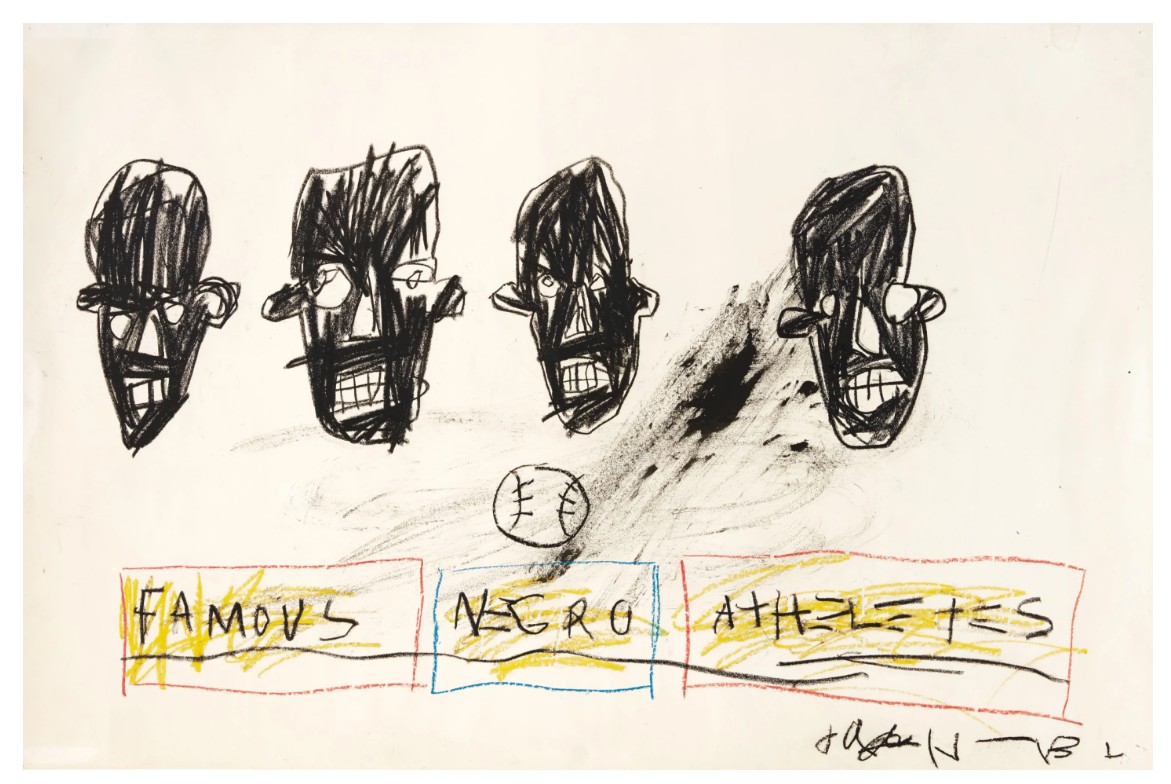
JEAN-MICHEL BASQUIAT
Famous Negro Athletes, 1981
Oilstick on paper
23 1/8 x 35 inches (58.7 x 88.9 cm)
#5. Untitled, 1983
Sotheby’s New-York: 17 May 2019
Estimated: USD 1,500,000 – 2,000,000
USD 1,820,000
(#515) JEAN-MICHEL BASQUIAT | Untitled
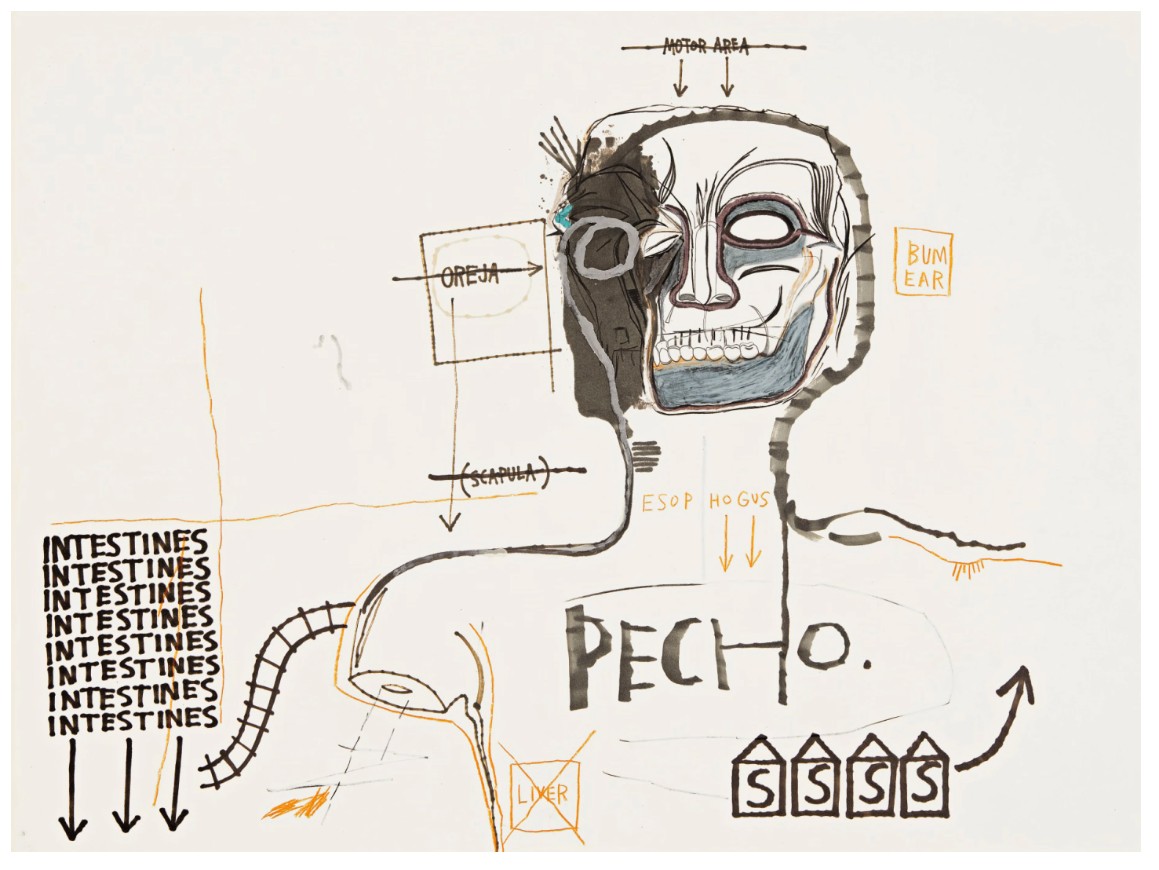
JEAN-MICHEL BASQUIAT
Untitled, 1983
Acrylic, oilstick and marker on fibreboard
30×40 inches (76.2 x 101.6 cm)
Signed on the reverse
#6. Untitled, 1987
Sotheby’s London: 5 March 2019
Estimated: GBP 300,000 – 400,000
GBP 1,125,000 / USD 1,480,770
(#51) JEAN-MICHEL BASQUIAT | Untitled
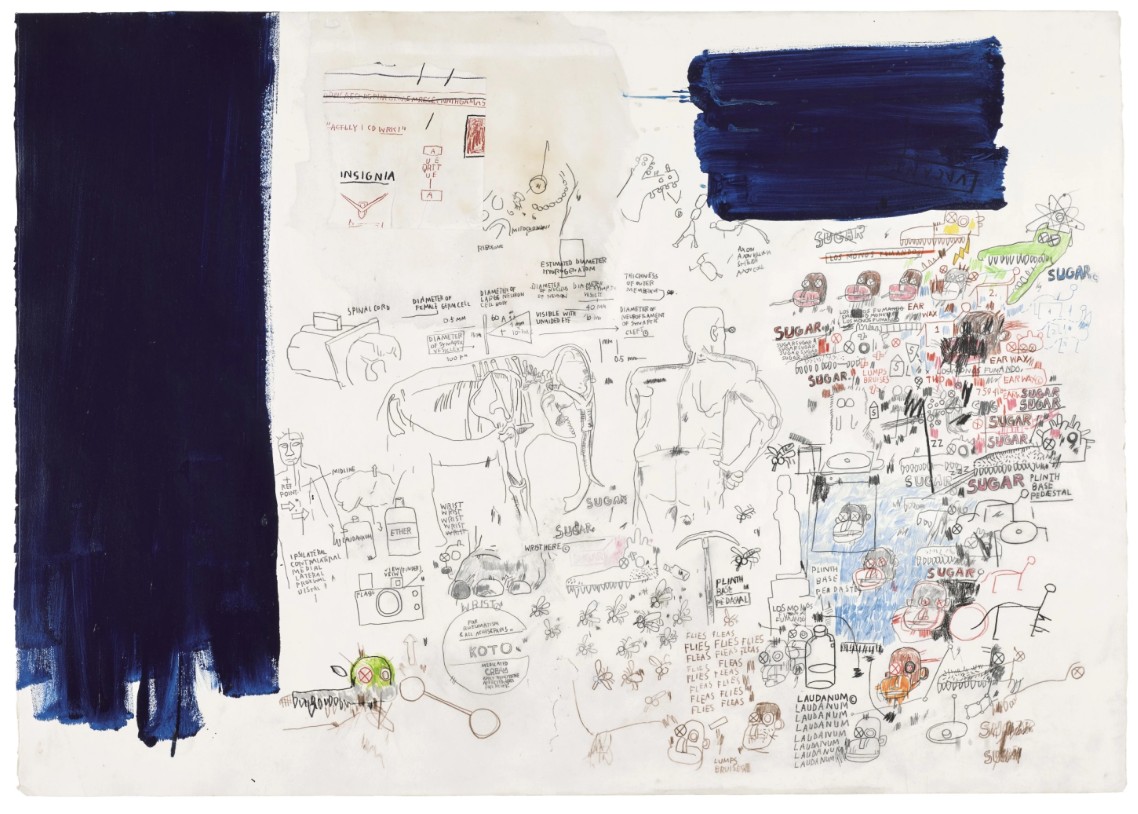
JEAN-MICHEL BASQUIAT
Untitled, 1987
Acrylic, oilstick, graphite, coloured pencil and Xerox collage on paper
29 1/2 x 41 3/4 inches (74.8 x 106.2 cm)
Signed and dated 87 on the reverse
#7. Untitled, 1987
Sotheby’s London: 5 March 2019
Estimated: GBP 400,000 – 600,000
GBP 1,005,000 / USD 1,322,195
(#52) JEAN-MICHEL BASQUIAT | Untitled
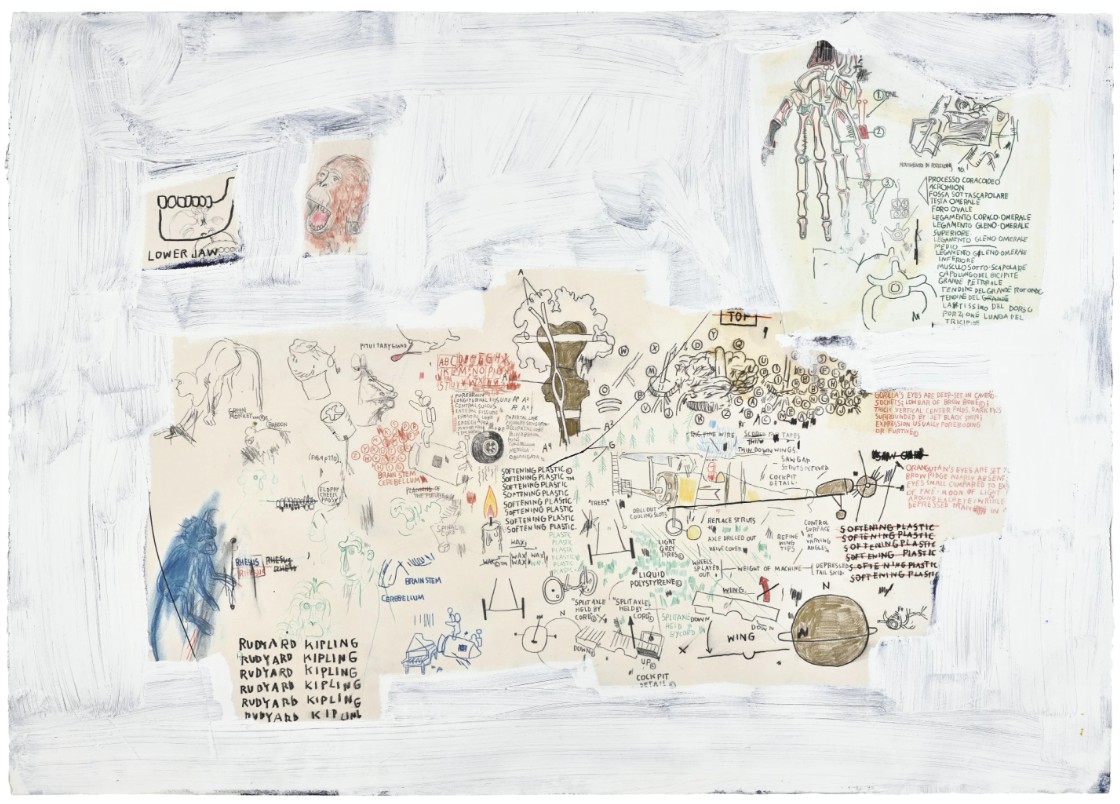
JEAN-MICHEL BASQUIAT
Untitled, 1987
Acrylic, oilstick, graphite, coloured pencil and collage on paper
29 5/8 x 41 7/8 inches (75.2 x 106.4 cm)
Signed, dated 87 and numbered IV. 7 on the reverse
USD 1 million
#8. Soothsayer, 1983
Sotheby’s London: 5 March 2019
Estimated: GBP 500,000 – 700,000
GBP 759,000 / USD 998,555
(#45) JEAN-MICHEL BASQUIAT | Soothsayer
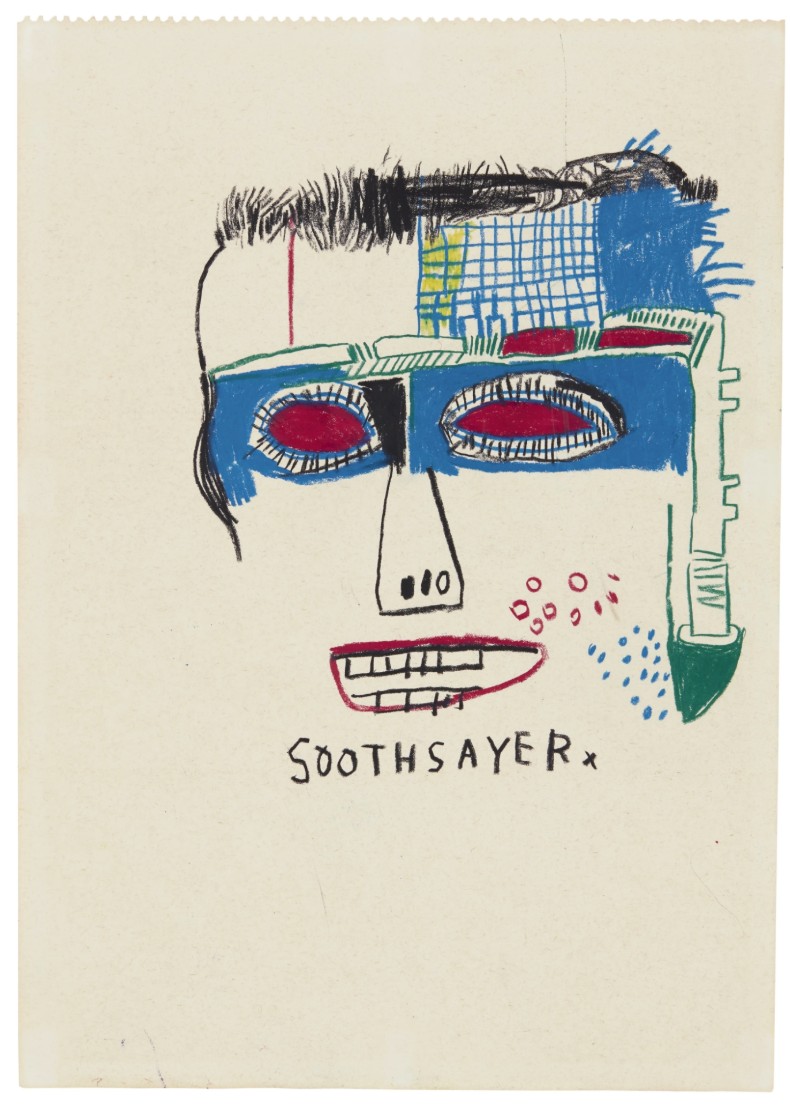
JEAN-MICHEL BASQUIAT
Soothsayer, 1983
Oil crayon on paper
16 x 11 5/8 inches (40.6 x 29.5 cm)
#9. Leverage, 1985
Sotheby’s New-York: 26 September 2019
Estimated: USD 800,000 – 1,200,000
USD 980,000
(#205) JEAN-MICHEL BASQUIAT | Leverage
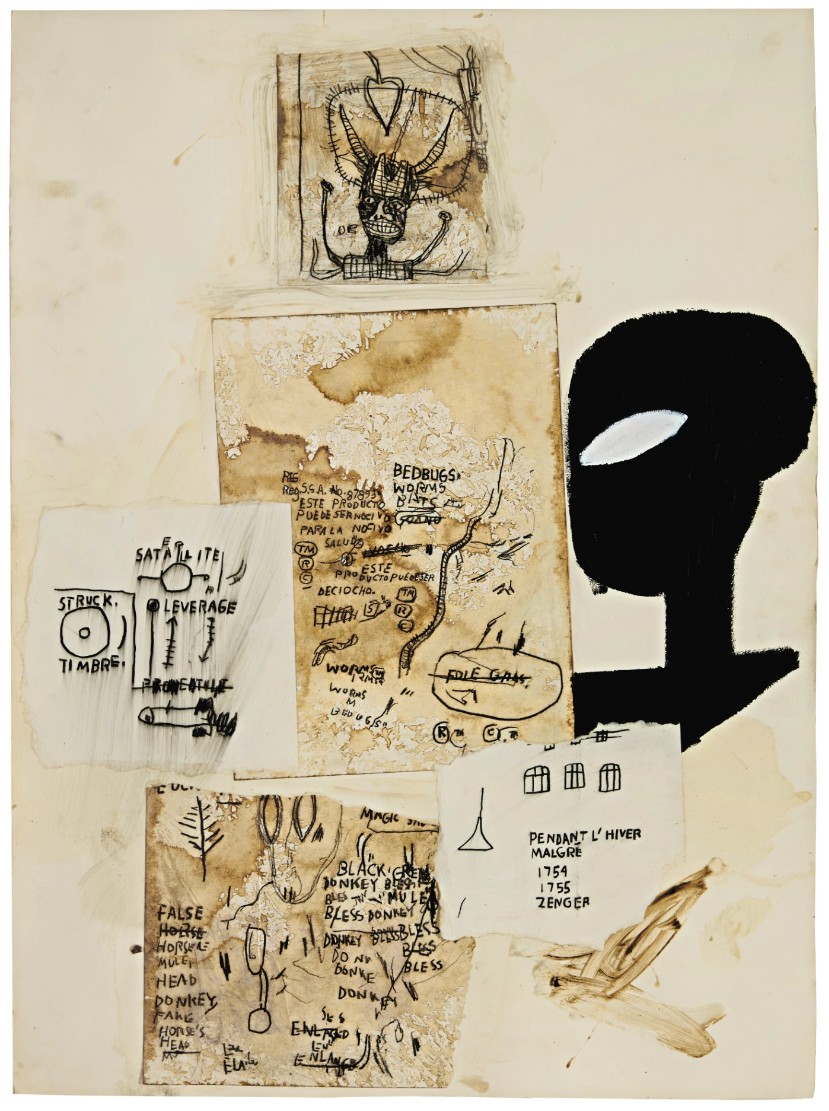 JEAN-MICHEL BASQUIAT
Leverage, 1985
Graphite, acrylic and paper collage on paper
29 7/8 x 22 1/4 inches (75.9 x 56.5 cm)
#10. Untitled, 1983
Phillips London: 7 March 2019
Estimated: GBP 500,000 – 700,000
GBP 681,250 / USD 891,795
Jean-Michel Basquiat – 20th Century & C… Lot 9 March 2019 | Phillips
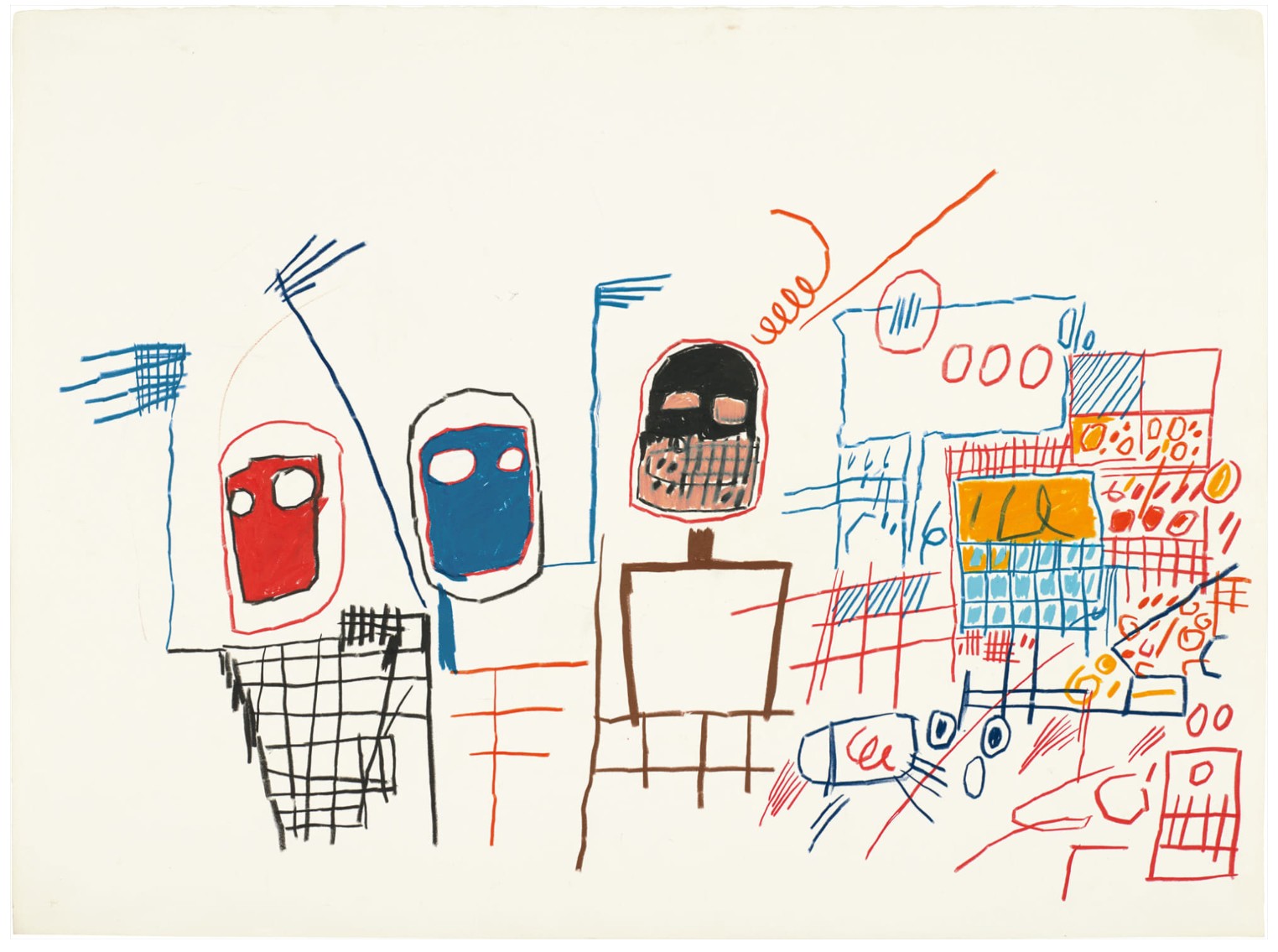
JEAN-MICHEL BASQUIAT
Untitled, 1983
Oilstick on paper
22 1/4 x 30 1/8 inches (56.5 x 76.5 cm)
#11. Untitled (Standing Male Figure), circa 1982-1983
Phillips New-York: 14 May 2019
Estimated: USD 100,000 – 1,o00,000
USD 800,000
Jean-Michel Basquiat – 20th Century & C… Lot 152 May 2019 | Phillips
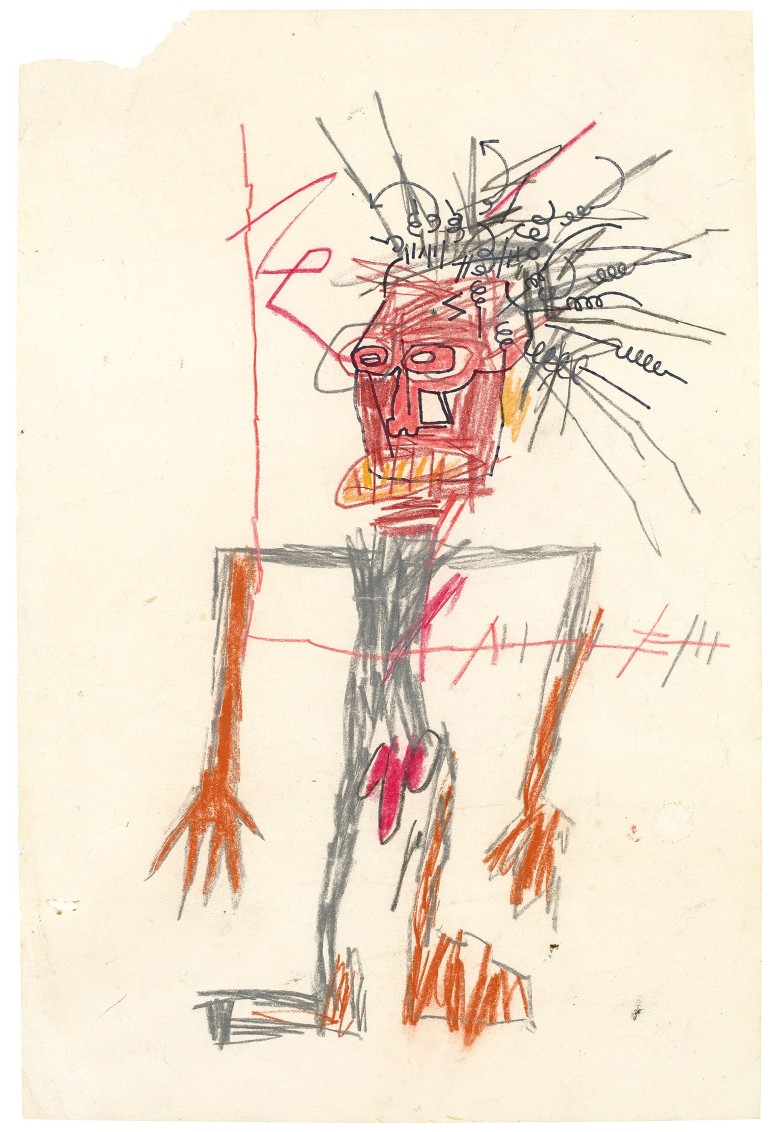
JEAN-MICHEL BASQUIAT
Untitled (Standing Male Figure), circa 1982-1983
Felt-tip pen, crayon and colored pencil on paper
17 7/8 x 12 inches (45.4 x 30.5 cm)
#12. Untitled (From Leonardo), 1983
Phillips London: 27 June 2019
Estimated: GBP 500,000 – 700,000
GBP 471,000 / USD 596,925
Jean-Michel Basquiat – 20th Century & C… Lot 36 June 2019 | Phillips
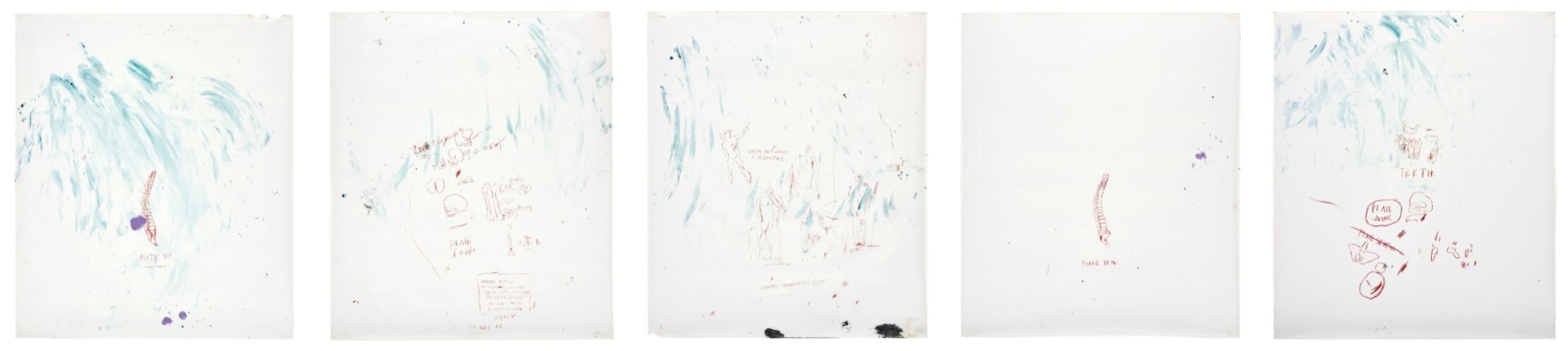
JEAN-MICHEL BASQUIAT
Untitled (From Leonardo), 1983
Oilstick and acrylic on acetate, in 5 parts
Each: 41 7/8 x 36 inches (106.5 x 91.5 cm)
#13. Untitled, circa 1982
Sotheby’s New-York: 15 November 2019
Estimated: USD 500,000 – 700,000
USD 596,000
(#447) JEAN-MICHEL BASQUIAT | Untitled
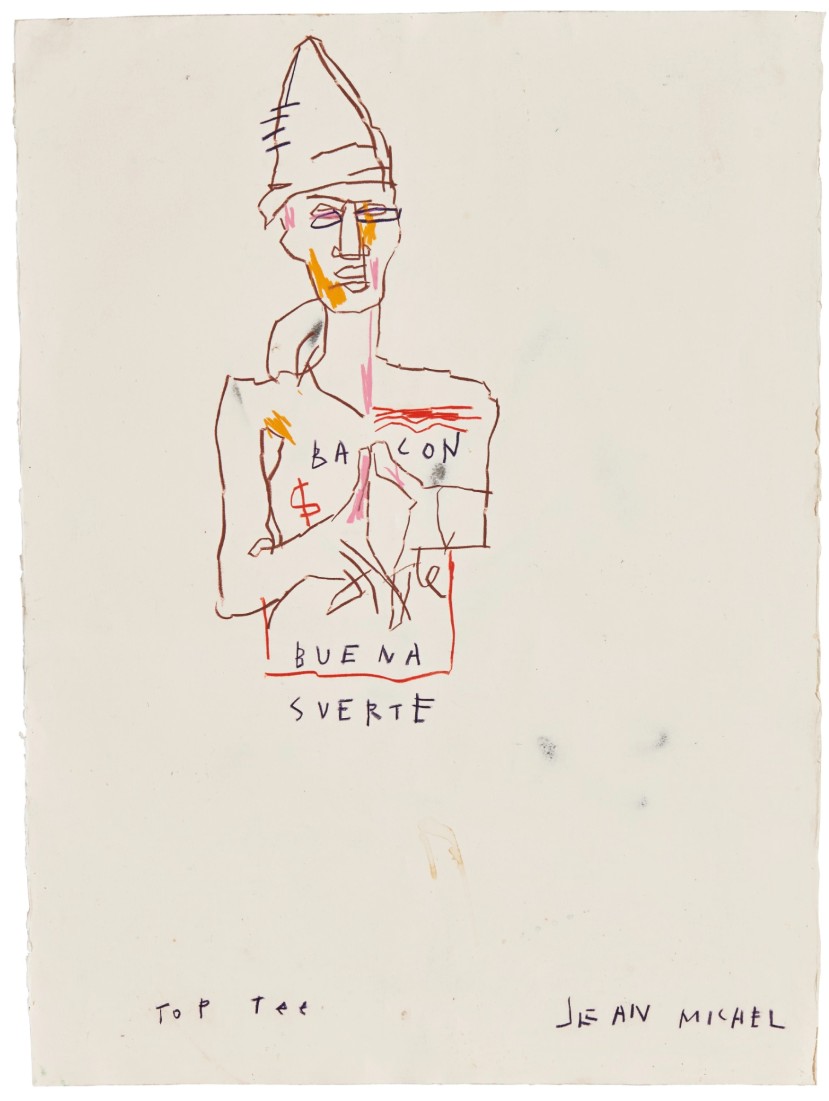
JEAN-MICHEL BASQUIAT
Untitled, circa 1982
Oilstick on paper
30 x 22 1/2 inches (76.2 x 57.2 cm)
Signed
#14. Untitled, 1984
Christie’s New-York: 14 November 2019
Estimated: USD 500,000 – 700,000
USD 561,000
Jean-Michel Basquiat (1960-1988), Untitled | Christie’s
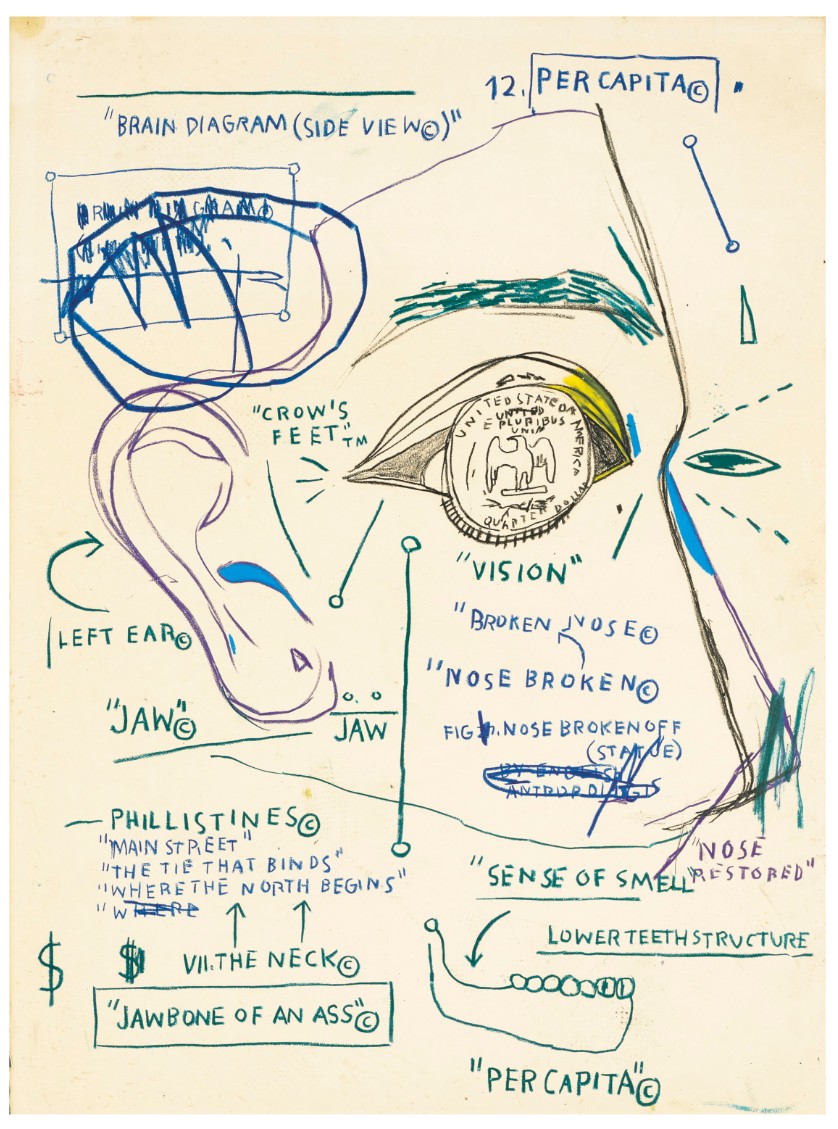
JEAN-MICHEL BASQUIAT (1960-1988)
Untitled, 1984
Oilstick and pastel on paper
30 x 22 1/8 inches (76.2 x 56.3 cm)
#15. Untitled (Figure with Blue Head), 1983
Phillips New-York: 15 May 2019
Estimated: USD 500,000 – 700,000
USD 437,500
Jean-Michel Basquiat – 20th Century & C… Lot 153 May 2019 | Phillips
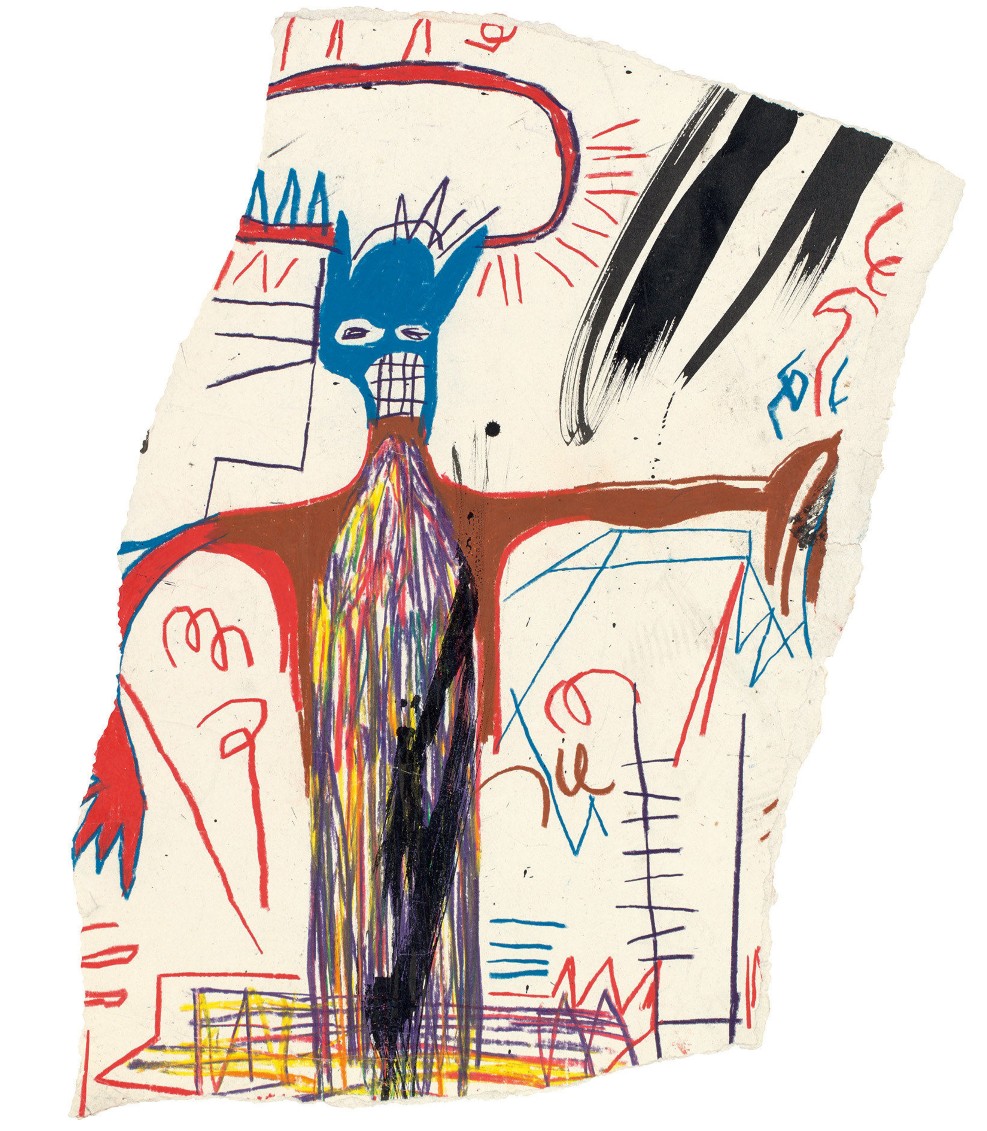
JEAN-MICHEL BASQUIAT
Untitled (Figure with Blue Head), 1983
Oilstick and India ink on Arches paper
21×15 inches (53.3 x 38.1 cm)
#16. Untitled (Red/Black Figure), 1982
Phillips New-York: 15 May 2019
Estimated: USD 400,000 – 600,000
USD 400,000
Jean-Michel Basquiat – 20th Century & C… Lot 151 May 2019 | Phillips
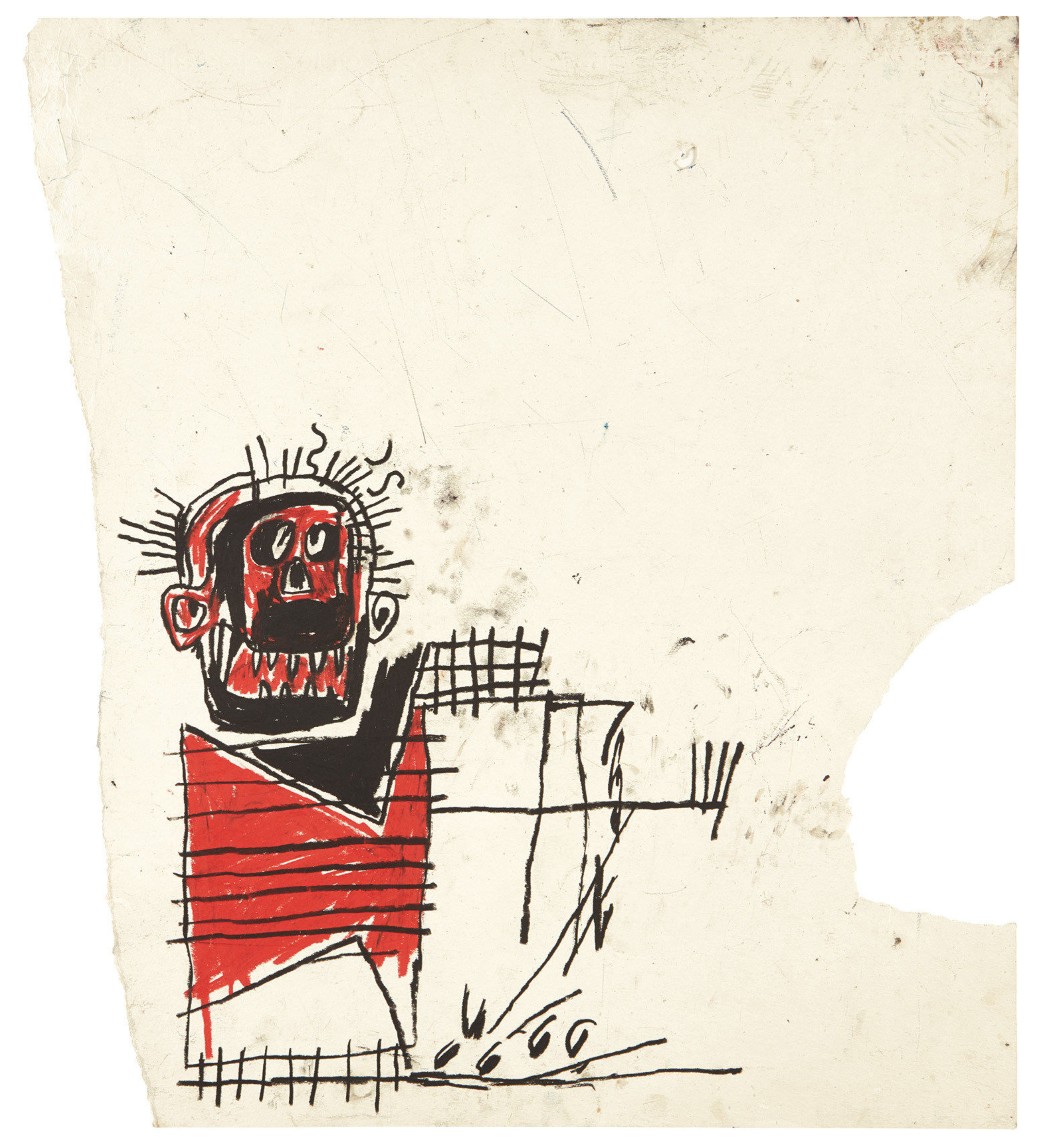
JEAN-MICHEL BASQUIAT
Untitled (Red/Black Figure), 1982
Oilstick on Arches paper
22 x 19 1/2 inches (55.9 x 49.5 cm)
#17. Untitled, circa 1981-82
Phillips New-York: 13 November 2019
Estimated: USD 300,000 – 400,000
USD 325,000
Jean-Michel Basquiat – 20th C. & C… Lot 169 November 2019 | Phillips
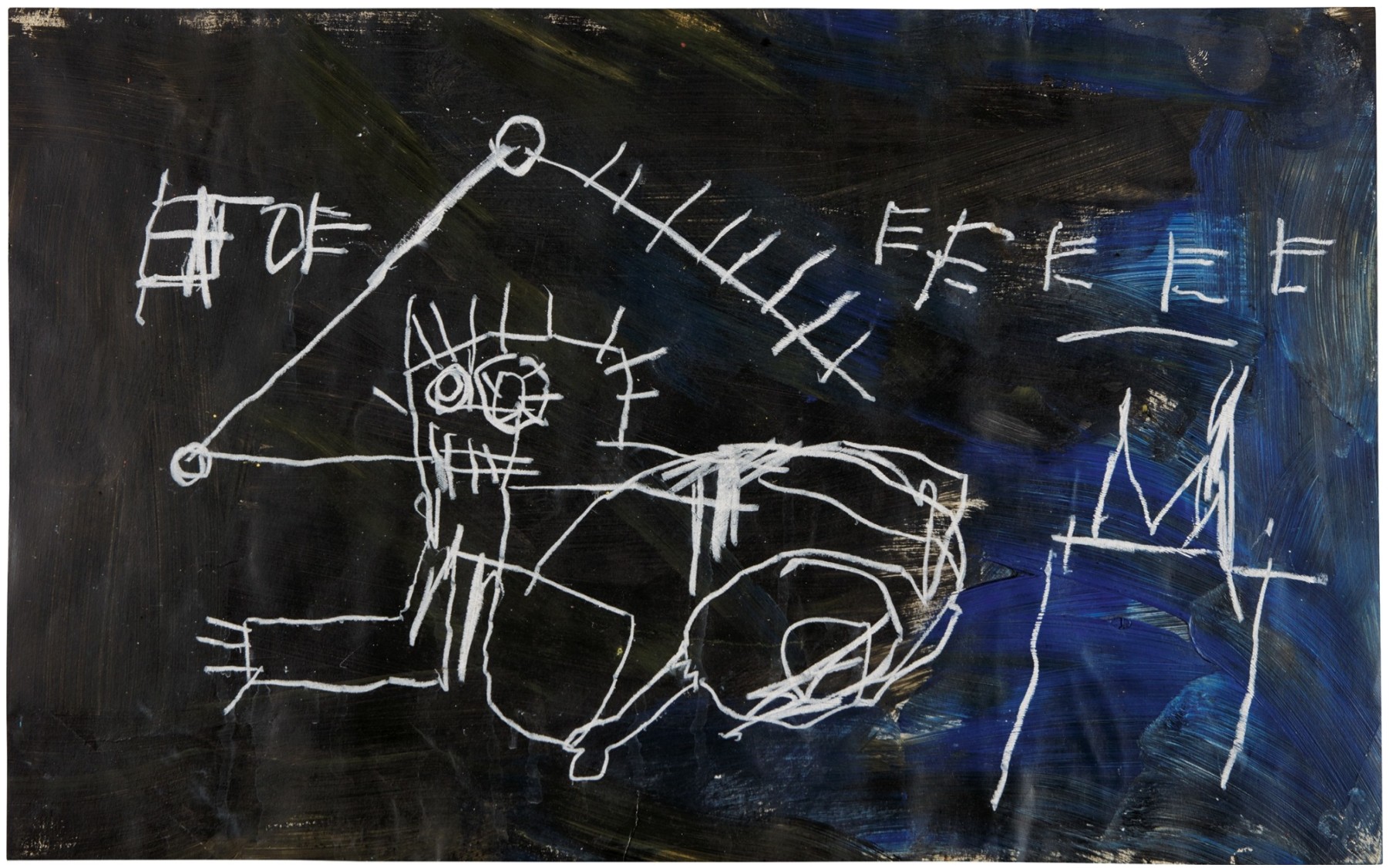
JEAN-MICHEL BASQUIAT
Untitled, circa 1981-82
Acrylic and white chalk on paper
14 1/4 x 22 7/8 inches (36.2 x 58.3 cm)
#18. Untitled, 1985
Sotheby’s New-York: 17 May 2019
Estimated: USD 200,000 – 300,000
USD 300,000
(#552) JEAN-MICHEL BASQUIAT | Untitled
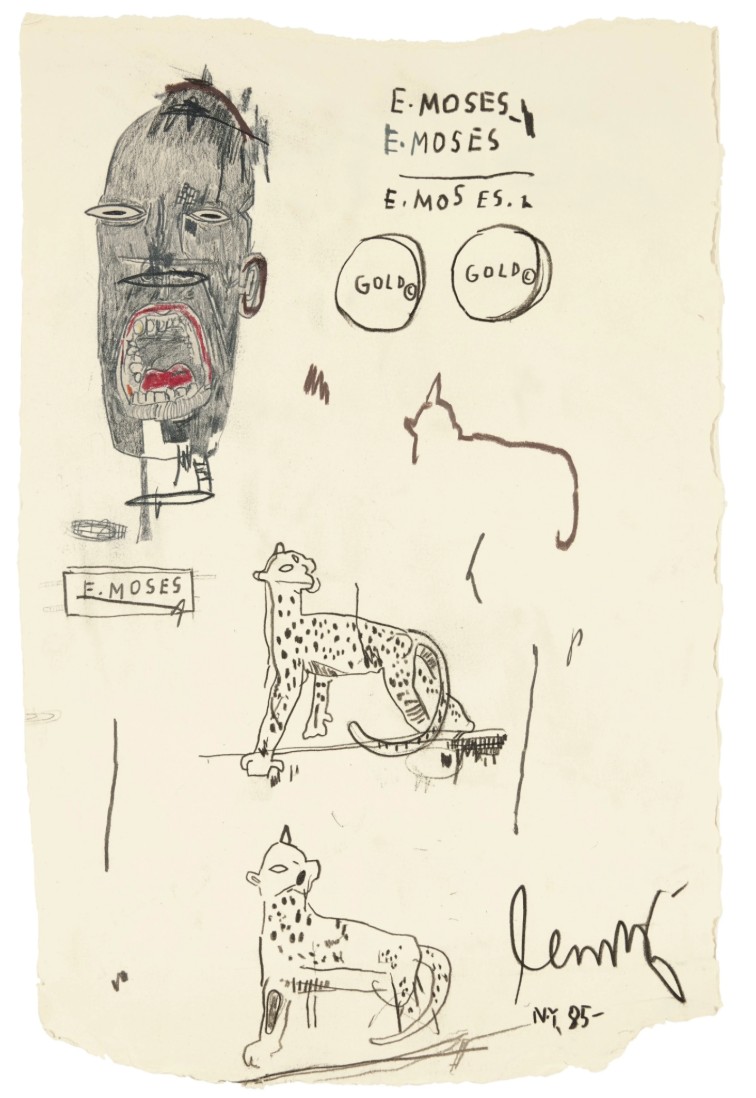
JEAN-MICHEL BASQUIAT
Untitled, 1985
Oilstick and graphite on paper
16 x 10 1/2 inches (40.6 x 26.7 cm)
Signed and dated NY, 85
2018 Auction Results
WORK IN PROGRESS
#1. Untitled, 1982
Sotheby’s London: 26 June 2018
Estimated: GBP 1,500,000 – 2,500,000
GBP 3,892,250 / USD 5,153,170
(#3) JEAN-MICHEL BASQUIAT | Untitled
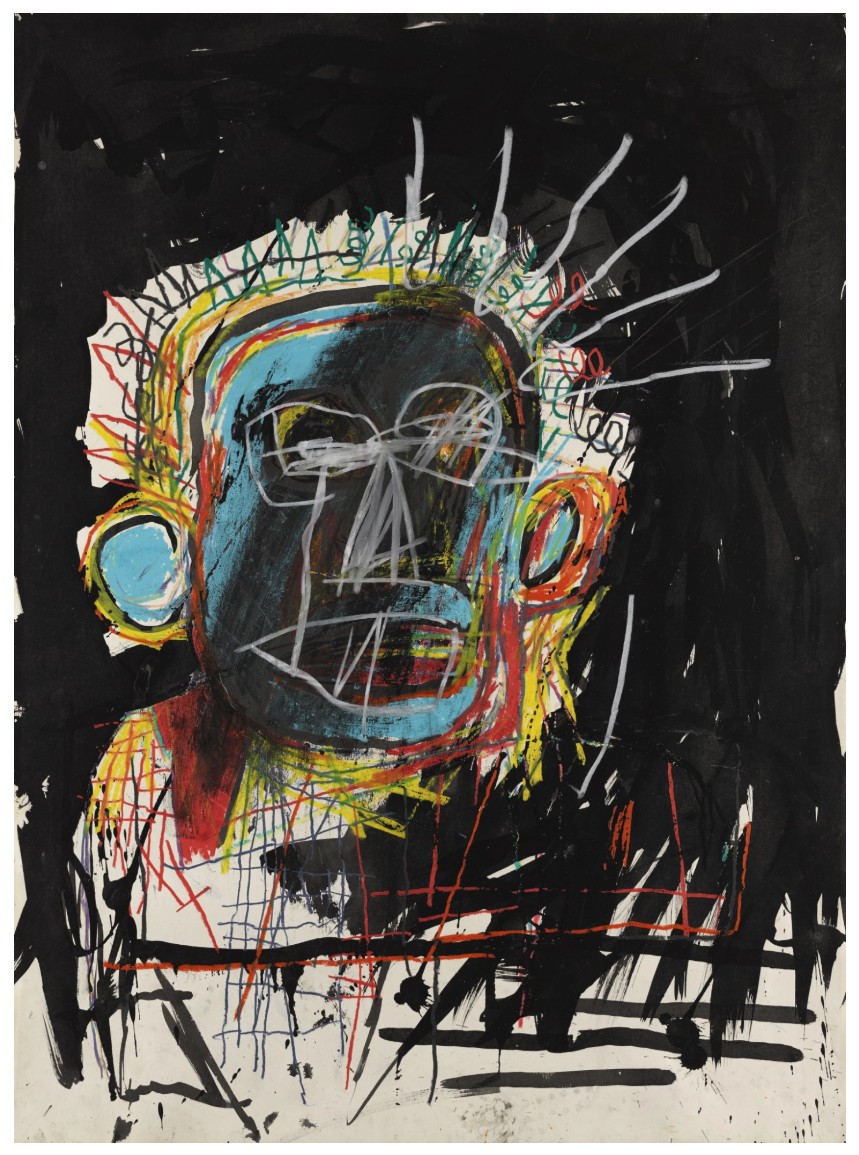
JEAN-MICHEL BASQUIAT
Untitled, 1982
Oilstick and ink on paper
29 7/8 x 22 inches (75.9 x 55.9 cm)
#2. Untitled, 1981
Phillips New-York: 15 November 2018
Estimated: USD 4,000,000 – 6,000,000
USD 4,575,000
Jean-Michel Basquiat – 20th Century… Lot 12 November 2018 | Phillips
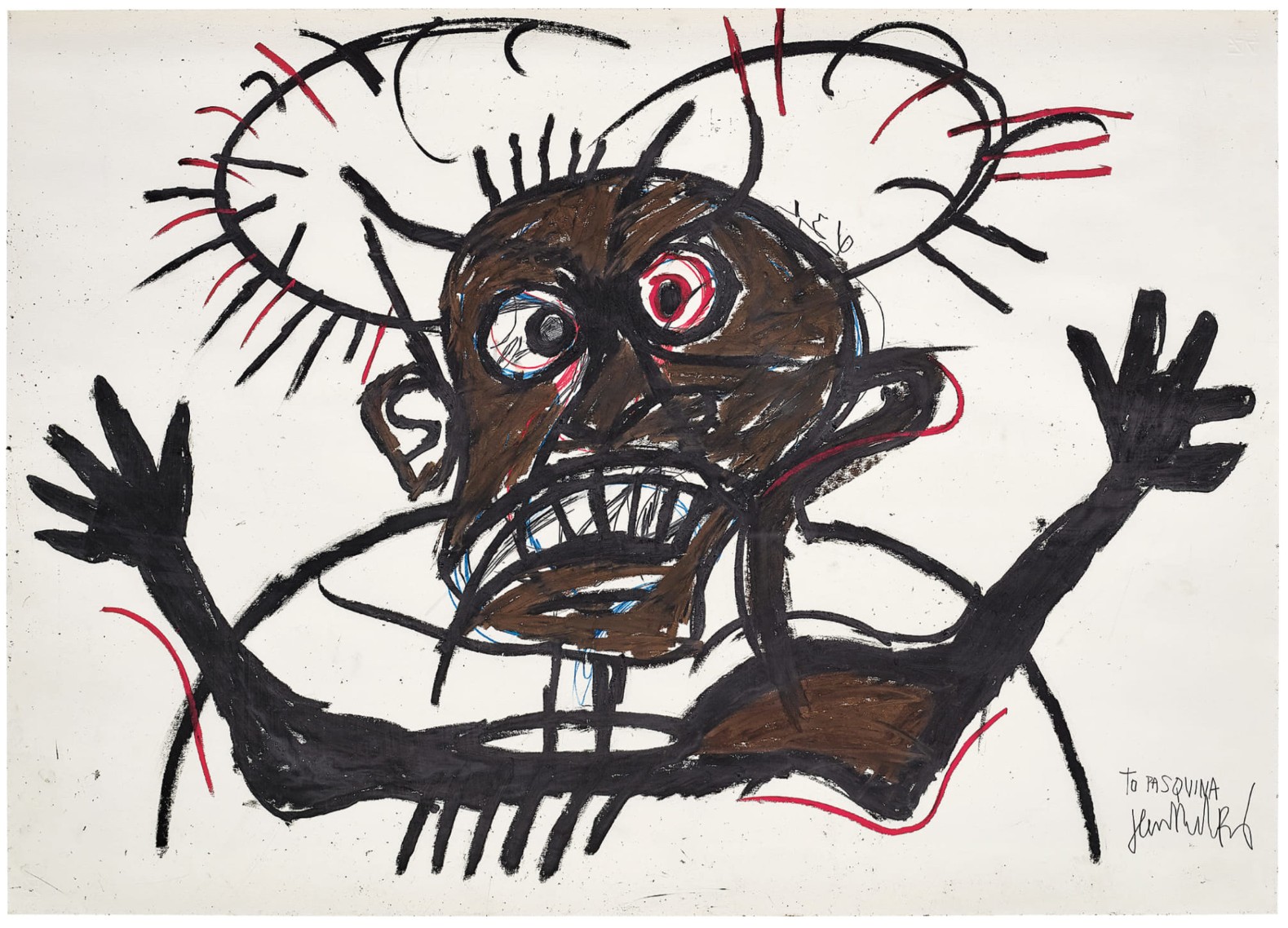
JEAN-MICHEL BASQUIAT
Untitled, 1981
Oilstick and graphite on paper
27 5/8 x 38 7/8 inches (70.2 x 98.7 cm)
Signed and dedicated “To Pasquina Jean-Michel Basquiat” lower right
#3. Untitled, 1982
Sotheby’s New-York: 14 November 2018
Estimated: USD 1,500,000 – 2,000,000
USD 4,455,000
(#7) JEAN-MICHEL BASQUIAT | Untitled
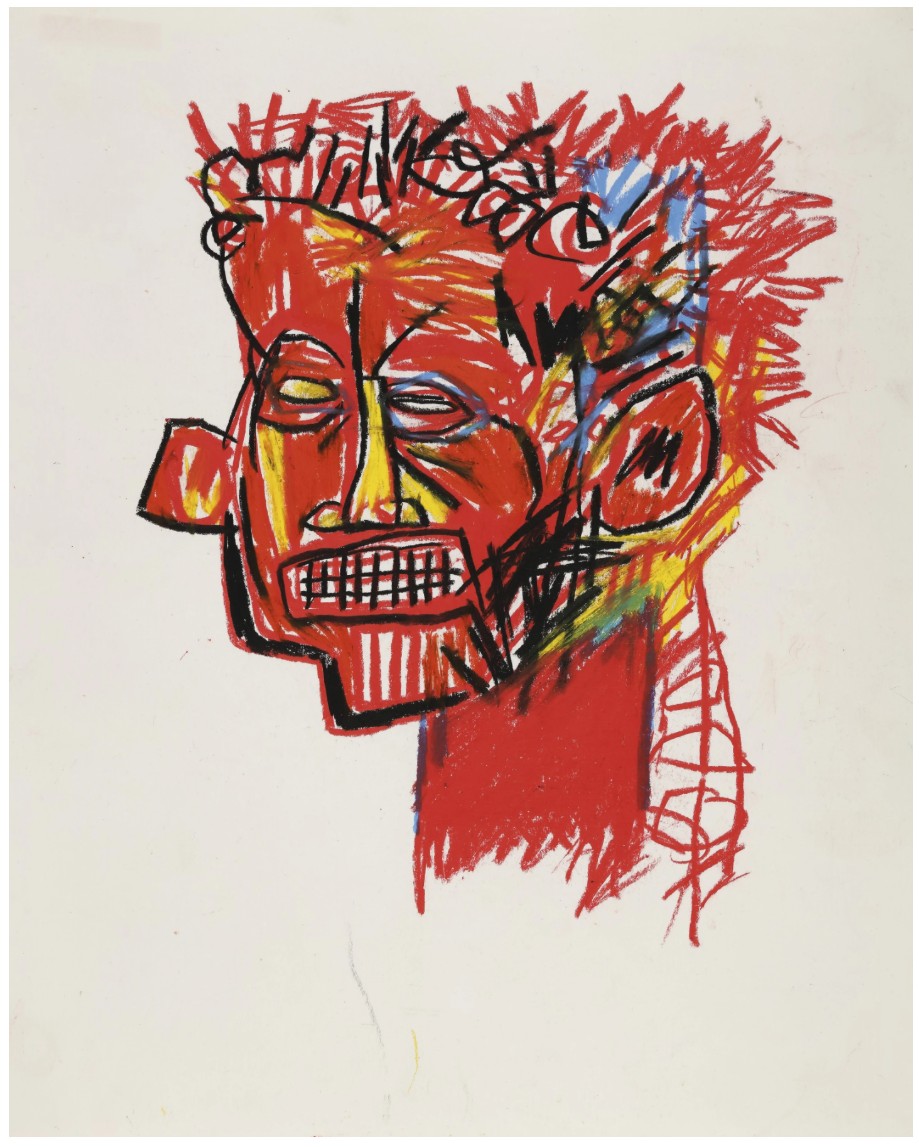
JEAN-MICHEL BASQUIAT
Untitled, 1982
Oilstick on paper
16 x 13 1/2 inches (40.6 x 34.3 cm)
Numbered BASQ-0547 on the revers
Numbered JMB-0434 on a label affixed to the reverse
#4. Untitled (Figure JMB #1), 1982
Sotheby’s London: 7 March 2018
Estimated: GBP 2,400,000 – 2,800,000
GBP 2,634,800 / USD 3,663,545
(#5) JEAN-MICHEL BASQUIAT | Untitled (Figure JMB #1)
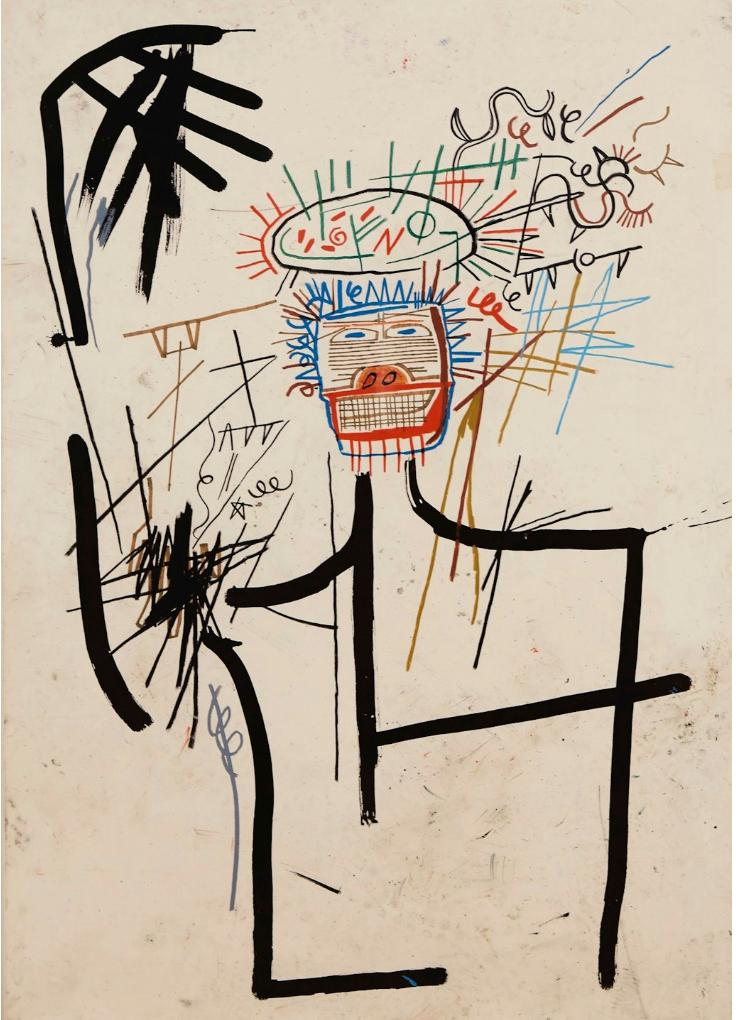
JEAN-MICHEL BASQUIAT
Untitled (Figure JMB #1), 1982
Acrylic and oilstick on paper
39 3/8 x 27 7/8 inches (100 x 70.7 cm)
#5. Untitled, 1982
Sotheby’s New-York: 14 November 2018
Estimated: USD 1,500,000 – 2,000,000
USD 2,535,000
(#22) JEAN-MICHEL BASQUIAT | Untitled
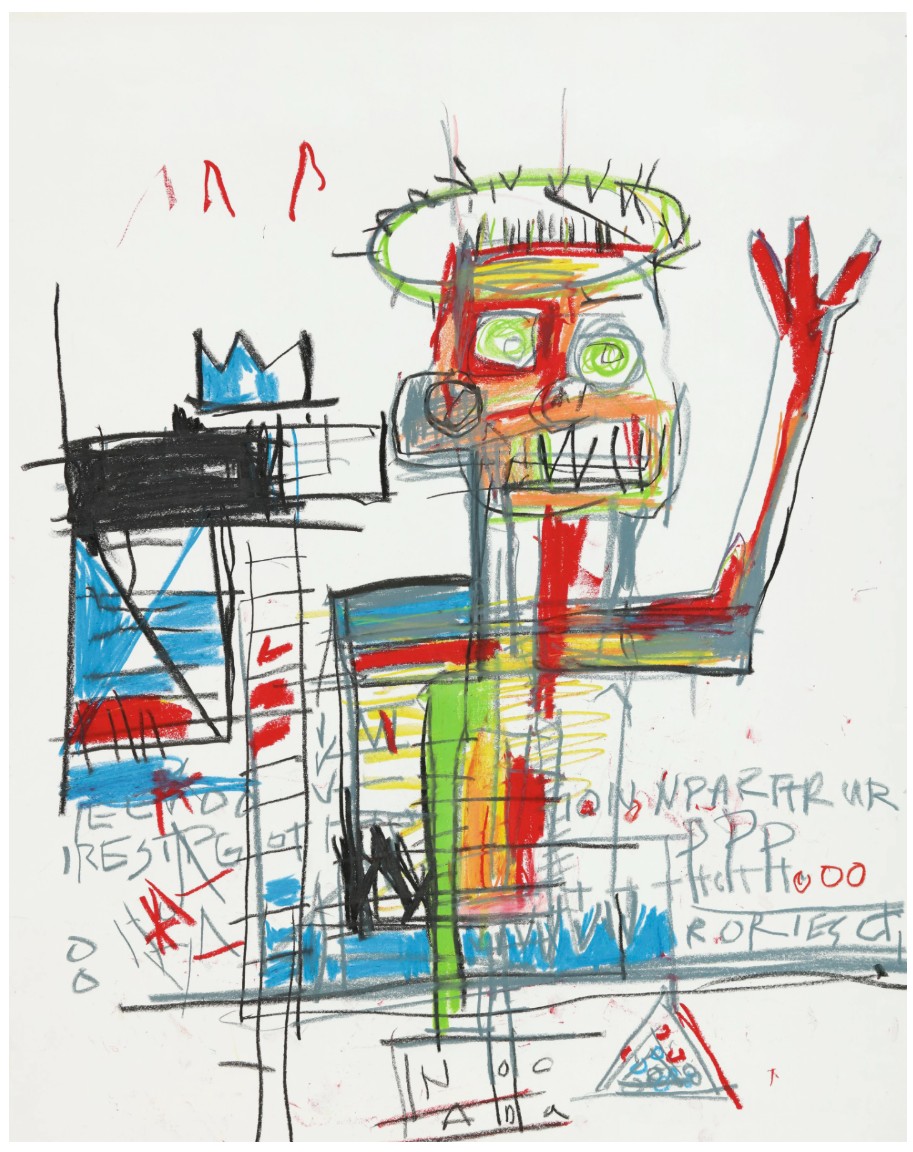
JEAN-MICHEL BASQUIAT
Untitled, 1982
Oilstick on paper
20 1/8 x 16 1/8 inches (51.1 x 41 cm)
Signed and dated 1982 on the reverse
#6. Untitled, 1983
Phillips London: 8 March 2018
Estimated: GBP 1,000,000 – 1,500,000
GBP 1,089,000 / USD 1,511,930
Jean-Michel Basquiat – 20th Century & … Lot 26 March 2018 | Phillips
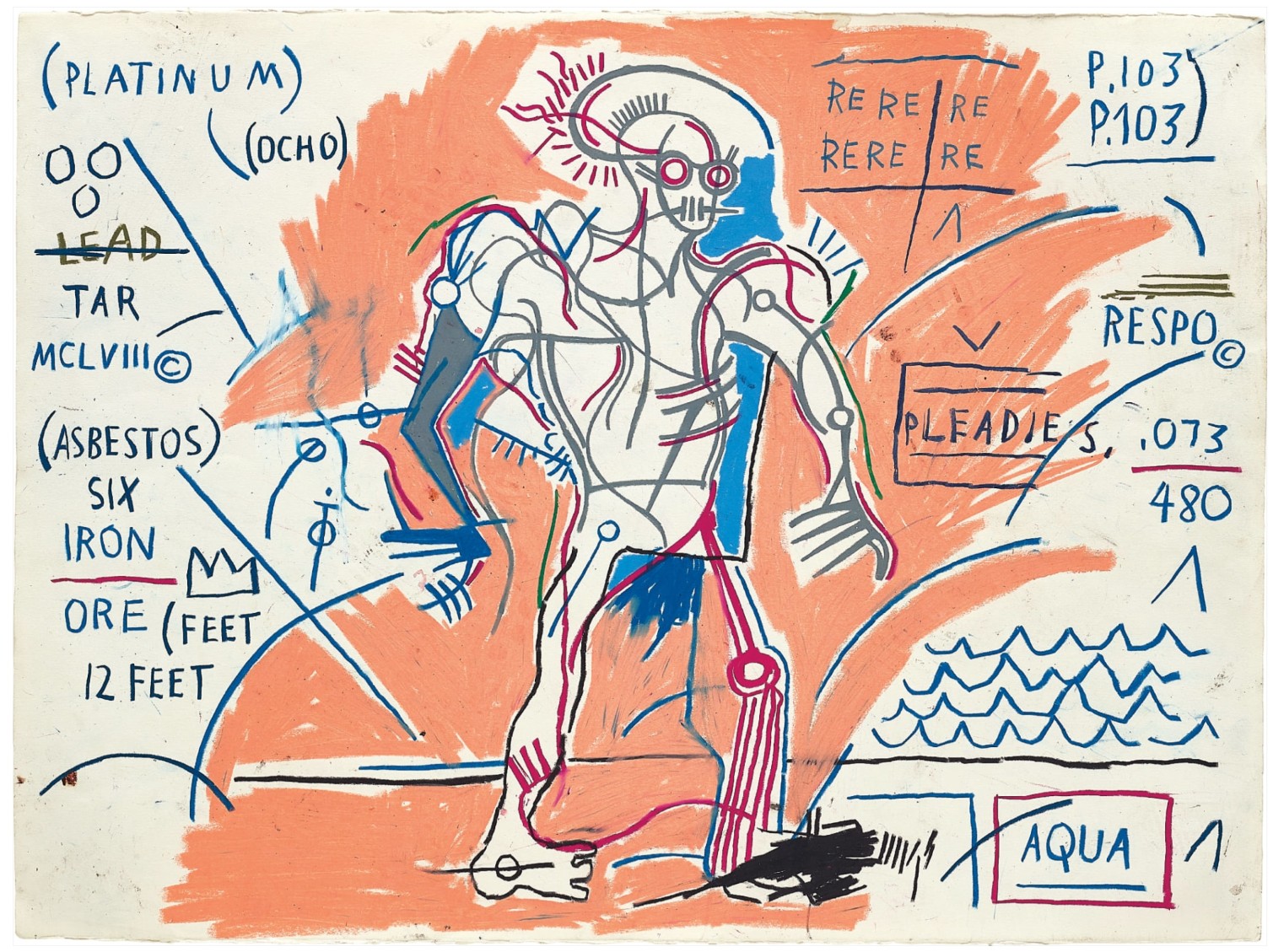
JEAN-MICHEL BASQUIAT
Untitled, 1983
Oilstick on paper
22×30 inches (55.9 x 76.2 cm)
#7. Untitled, 1982
Sotheby’s New-York: 14 November 2018
Estimated: USD 1,300,000 – 1,600,000
USD 1,500,000
(#449) JEAN-MICHEL BASQUIAT | Untitled
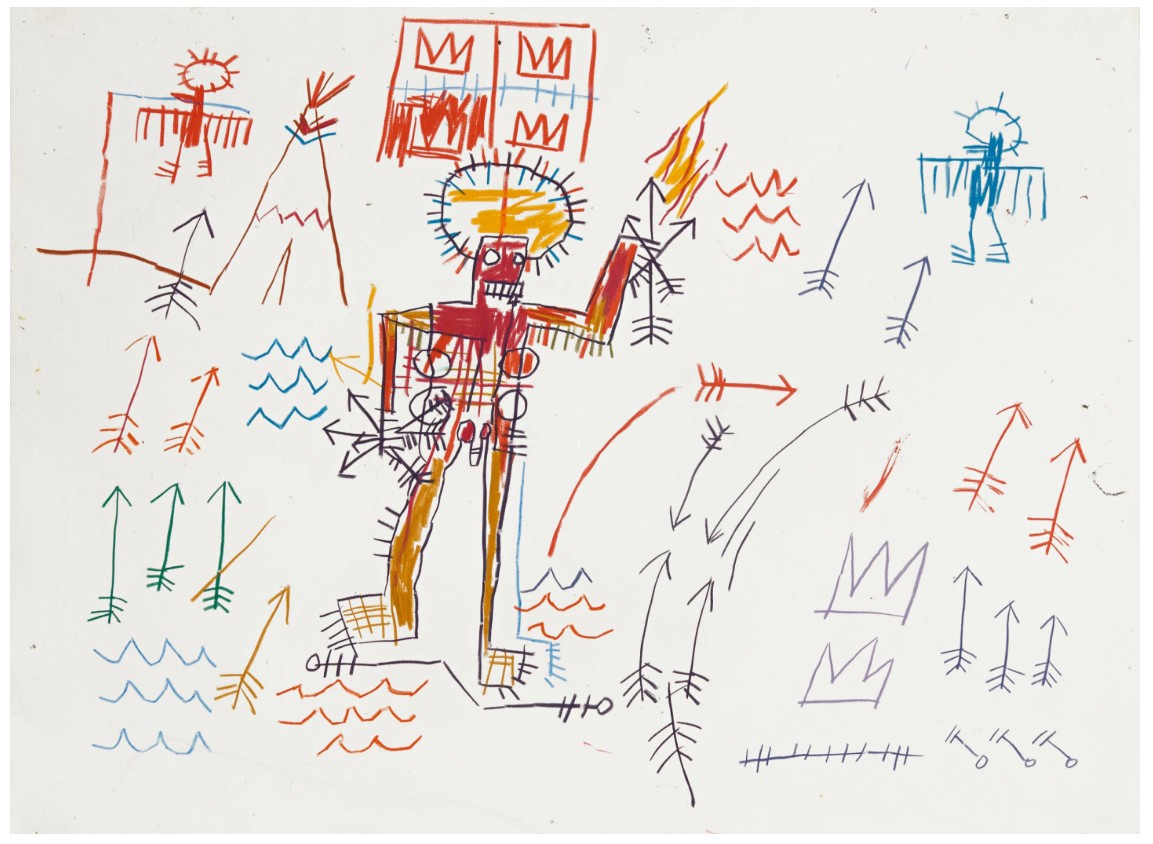
JEAN-MICHEL BASQUIAT
Untitled, 1982
Oilstick on paper
22 x 29 3/4 inches (55.9 x 75.6 cm)
#8. Untitled, 1981
Christie’s New-York: 18 May 2018
Estimated: USD 1,200,000 – 1,800,000
USD 1,332,500
Jean-Michel Basquiat (1960-1988), Untitled | Christie’s
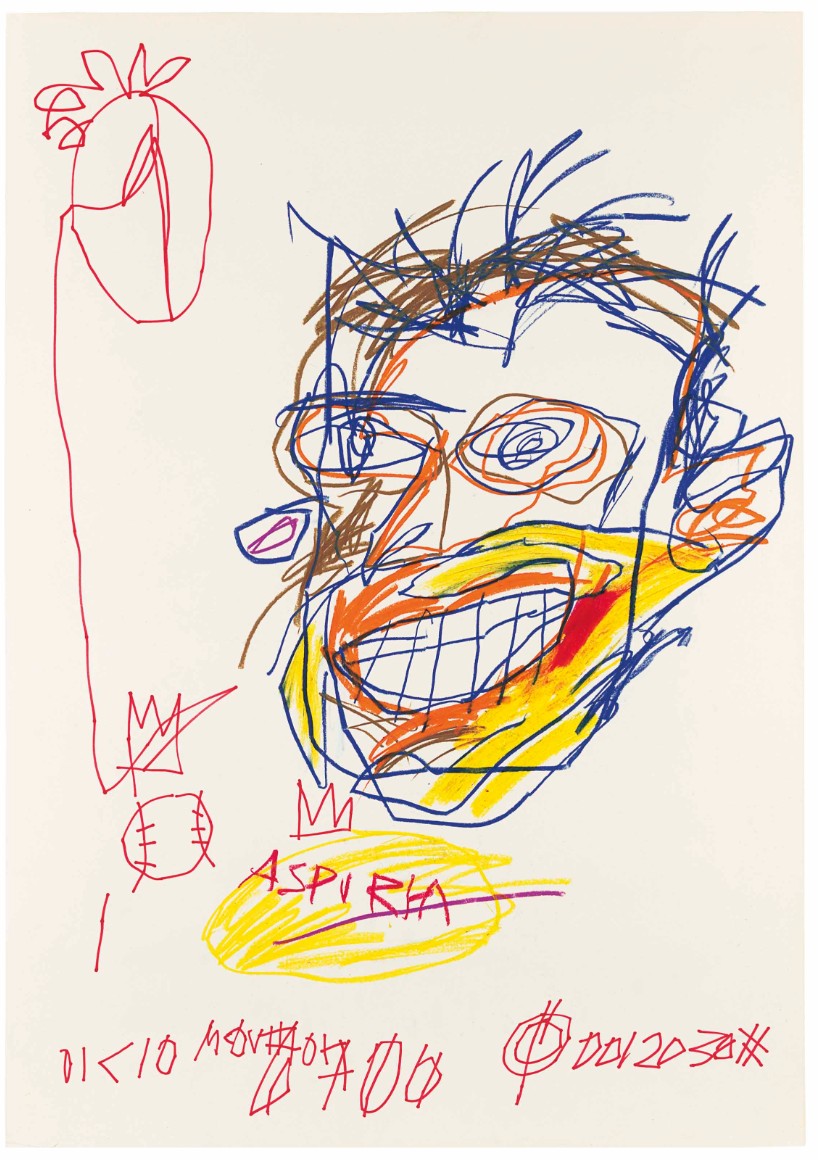
JEAN-MICHEL BASQUIAT (1960-1988)
Untitled, 1981
Ink and oilstick on paper
39 1/4 x 27 1/2 inches (99.7 x 69.9 cm)
Signed, inscribed and dated ‘SAMO © MODENA 1981’ (on the reverse)
#9. Untitled (Magic Worms), 1984
Phillips New-York: 17 May 2018
Estimated: USD 1,000,000 – 1,500,000
USD 1,139,750
Jean-Michel Basquiat – 20th Century & Co… Lot 16 May 2018 | Phillips
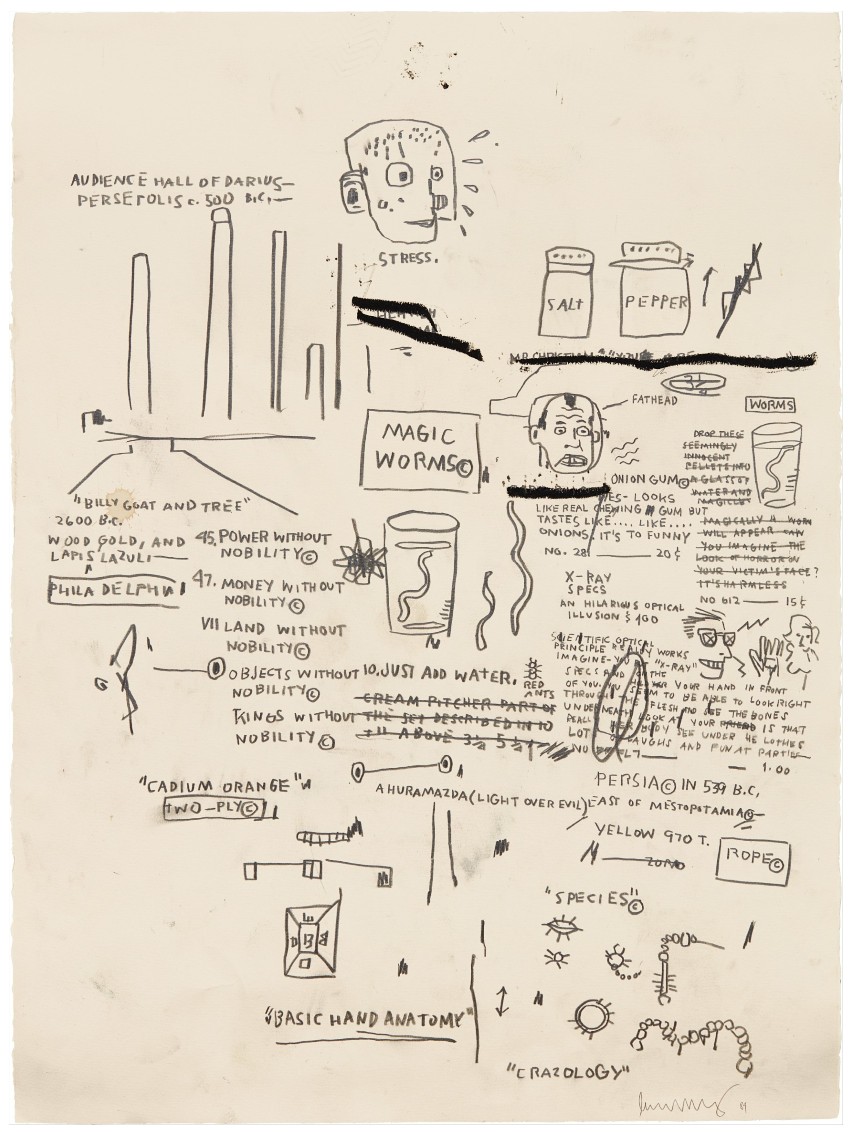
JEAN-MICHEL BASQUIAT
Untitled (Magic Worms), 1984
Graphite and oilstick on paper
29 3/4 x 22 1/4 inches (75.6 x 56.5 cm)
Signed and dated “Basquiat 84” lower right
USD 1 million
#10. Untitled, 1983
Christie’s Amsterdam: 24 April 2018
Estimated: EUR 300,000 – 500,000
EUR 727,500 / USD 890,315
Jean-Michel Basquiat (1960-1988), Untitled | Christie’s
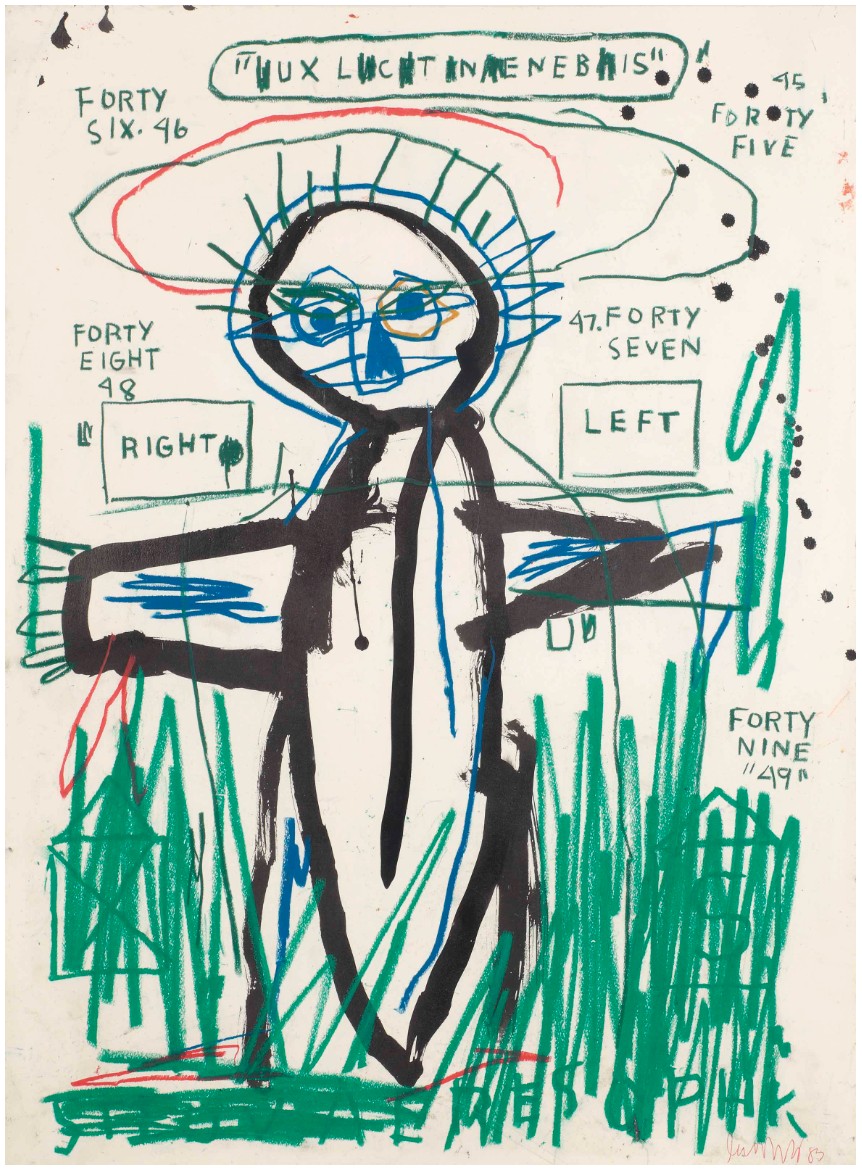
JEAN-MICHEL BASQUIAT (1960-1988)
Untitled, 1983
Oilstick and ink on paper
29 3/4 x 22 inches (75.5 x 56 cm)
Signed and dated ‘basquiat 83’ (lower right)
#11. Untitled, 1987
Sotheby’s New-York: 17 May 2018
Estimated: USD 600,000 – 800,000
USD 855,000

JEAN-MICHEL BASQUIAT
Untitled, 1987
Graphite on paper
29 1/2 x 42 inches (74.9 x 106.7 cm)
Signed and dated ’87 on the reverse
#12. Standard Saw, 1983
Christie’s London: 5 October 2018
Estimated: GBP 220,000 – 280,000
GBP 536,750 / USD 704,055
Jean-Michel Basquiat (1960-1988), Standard Saw | Christie’s
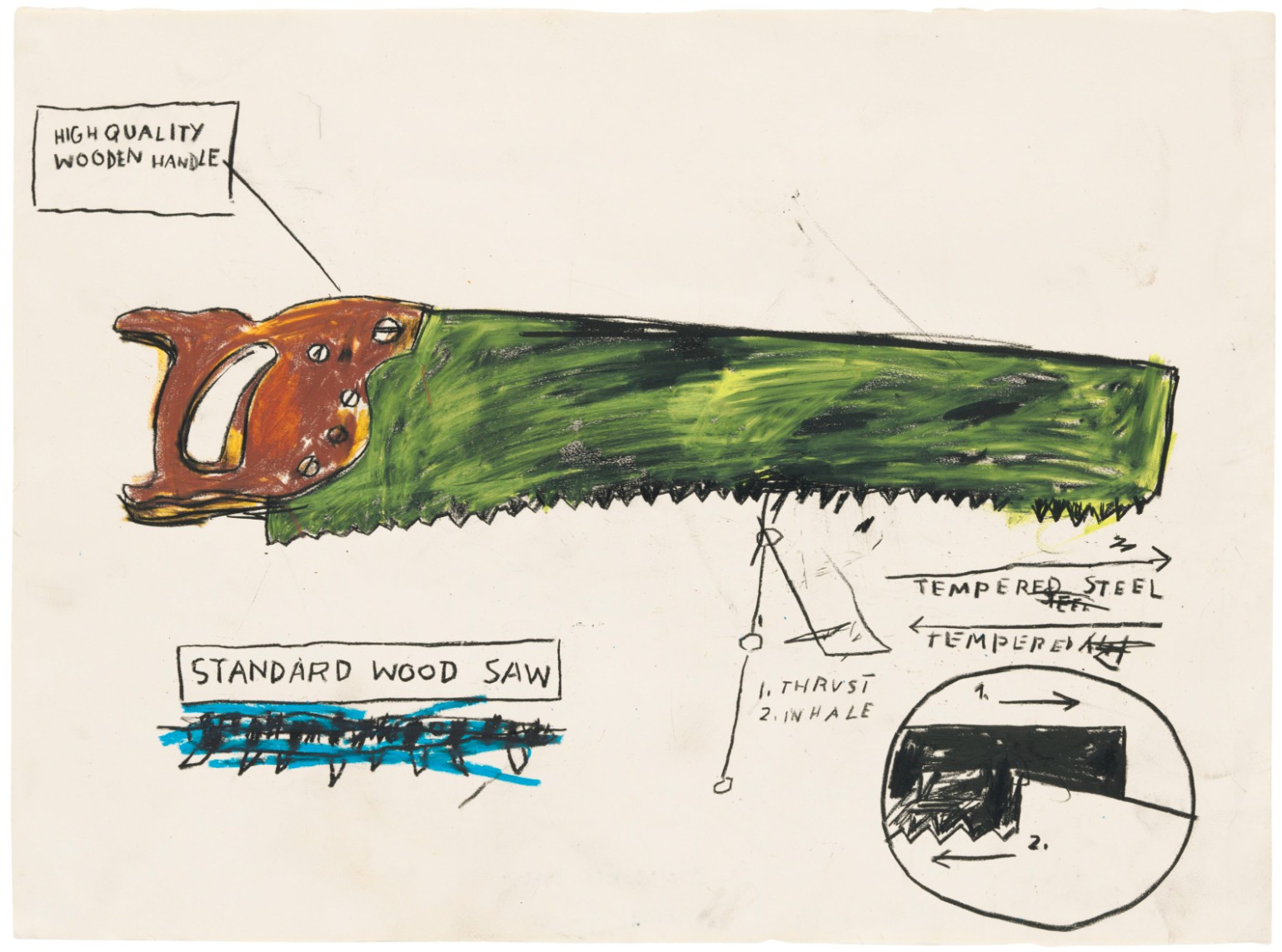
JEAN-MICHEL BASQUIAT (1960-1988)
Standard Saw, 1983
Oilstick on paper
22 x 29 7/8 inches (56×76 cm)
Signed, titled twice and dated ‘basquiat 1983 STANDARD SAW’ (on the reverse)
#13. Untitled, 1981
Sotheby’s Milan: 28 November 2018
Estimated: EUR 300,000 – 400,000
EUR 727,500 / USD 619,570
(#11) JEAN-MICHEL BASQUIAT | Untitled
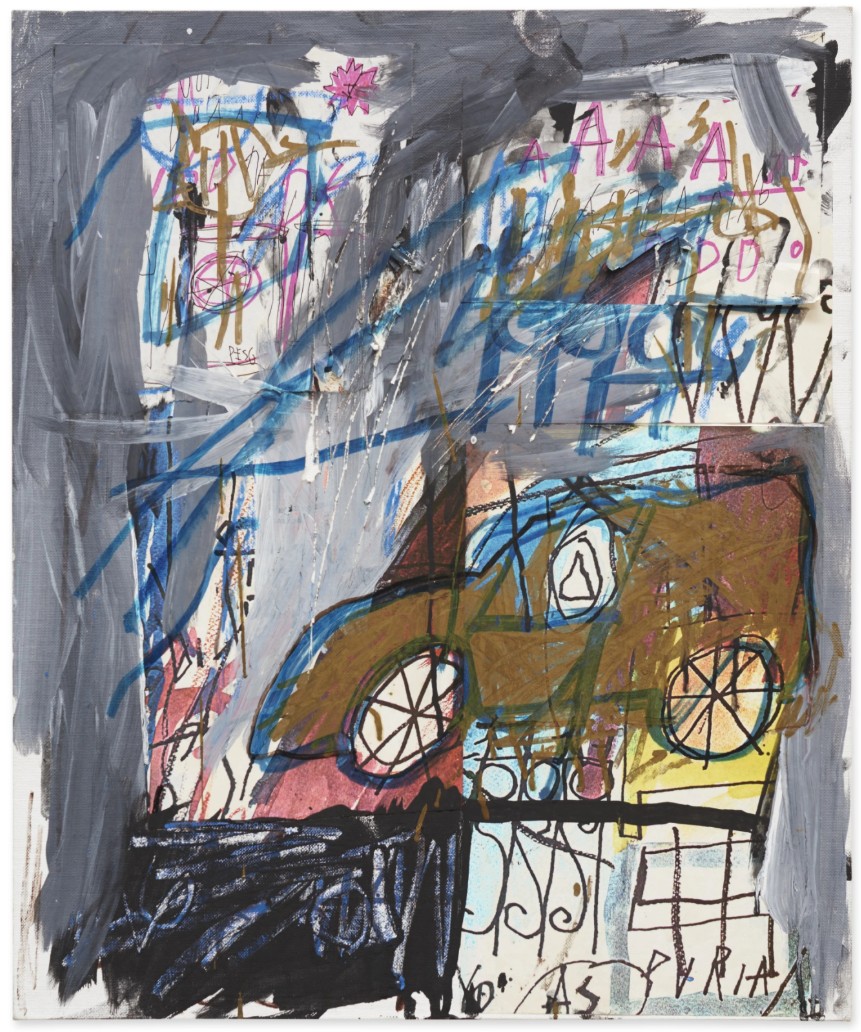
JEAN-MICHEL BASQUIAT
Untitled, 1981
Acrylic, wax crayons, felt-tip pen and collage on cardboard
24×20 inches (61×51 cm)
#14. Untitled (Oats), 1984
Sotheby’s New-York: 15 November 2018
Estimated: USD 180,000 – 250,000
USD 615,000
(#458) JEAN-MICHEL BASQUIAT | Untitled (Oats)
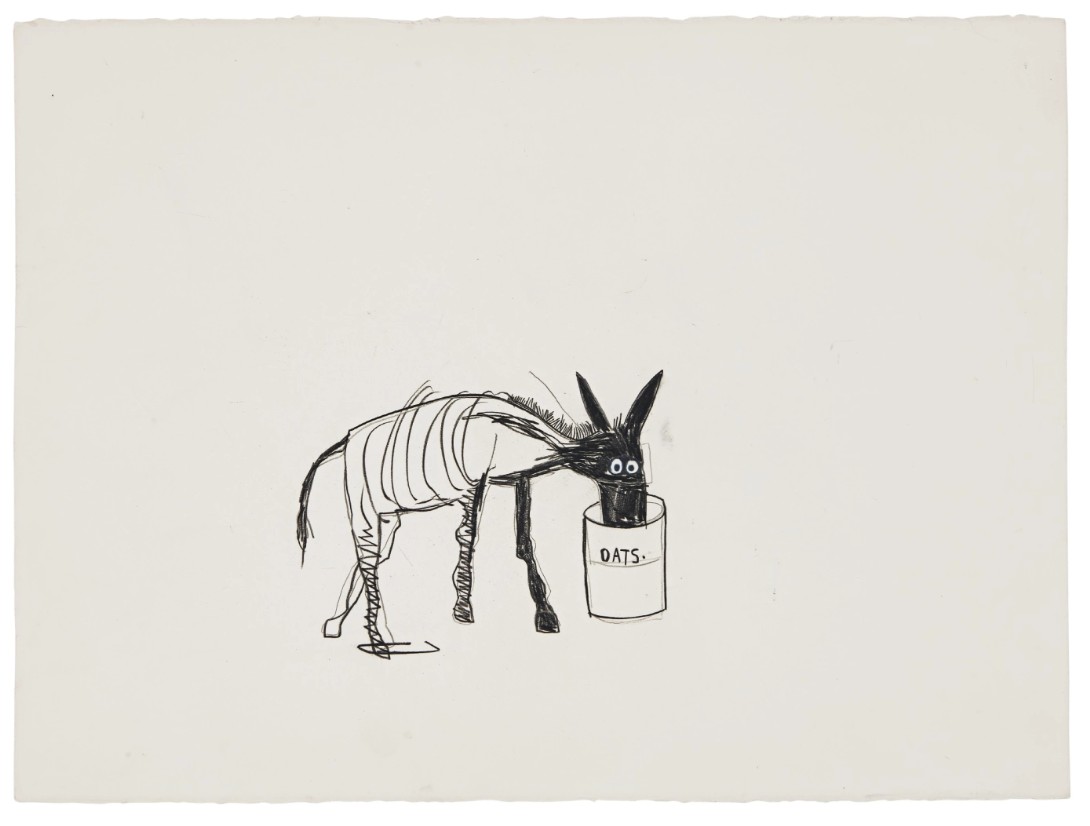 JEAN-MICHEL BASQUIAT
Untitled (Oats), 1984
Charcoal and graphite on paper
22 1/8 x 30 inches (56.2 x 76.2 cm)
#15. Untitled, 1987
Christie’s London: 5 October 2018
Estimated: GBP 400,000 – 600,000
GBP 464,750 / USD 609,610
Jean-Michel Basquiat (1960-1988), Untitled | Christie’s
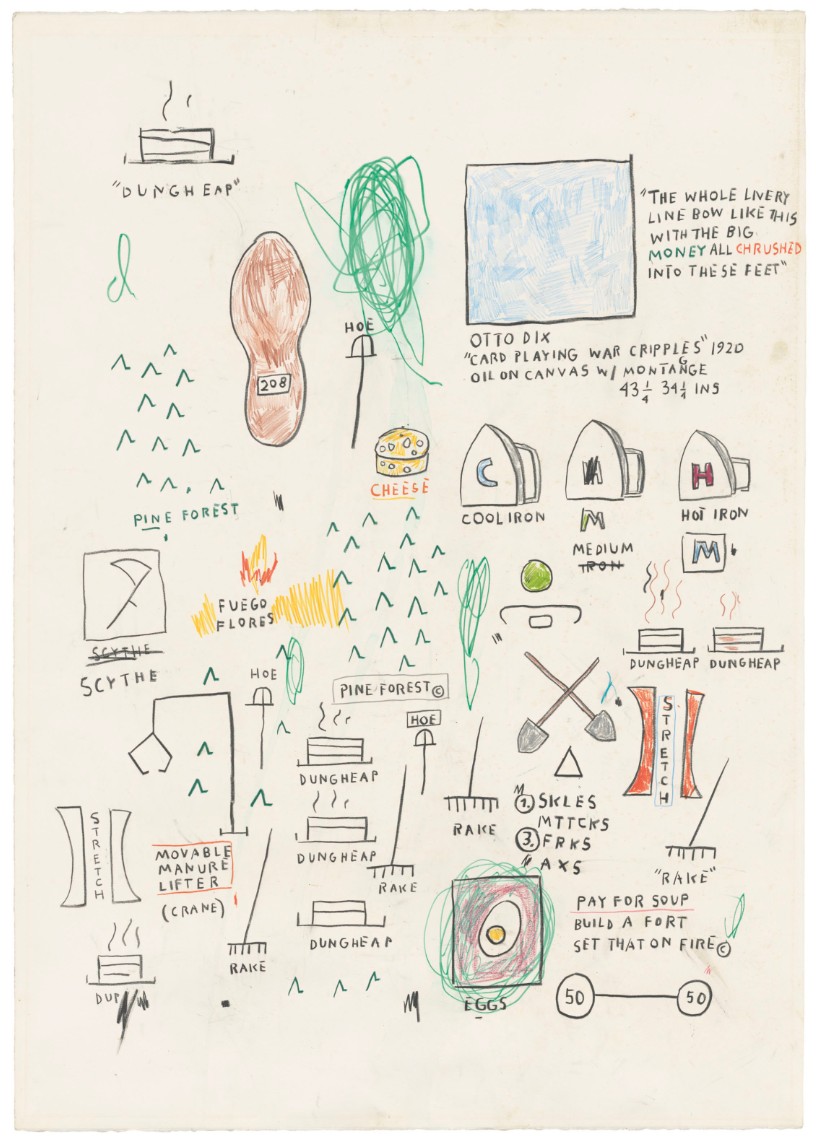
JEAN-MICHEL BASQUIAT (1960-1988)
Untitled, 1987
Oilstick and colored pencil on paper
41 3/4 x 29 5/8 inches (106 x 75.3 cm)
Signed and dated ‘JMBasquiat 87’ (on the reverse)
#16. Untitled, 1982
Sotheby’s Paris: 5 December 2018
Estimated: EUR 300,000 – 500,000
EUR 393,000 / USD 446,210
(#1) JEAN-MICHEL BASQUIAT | Untitled
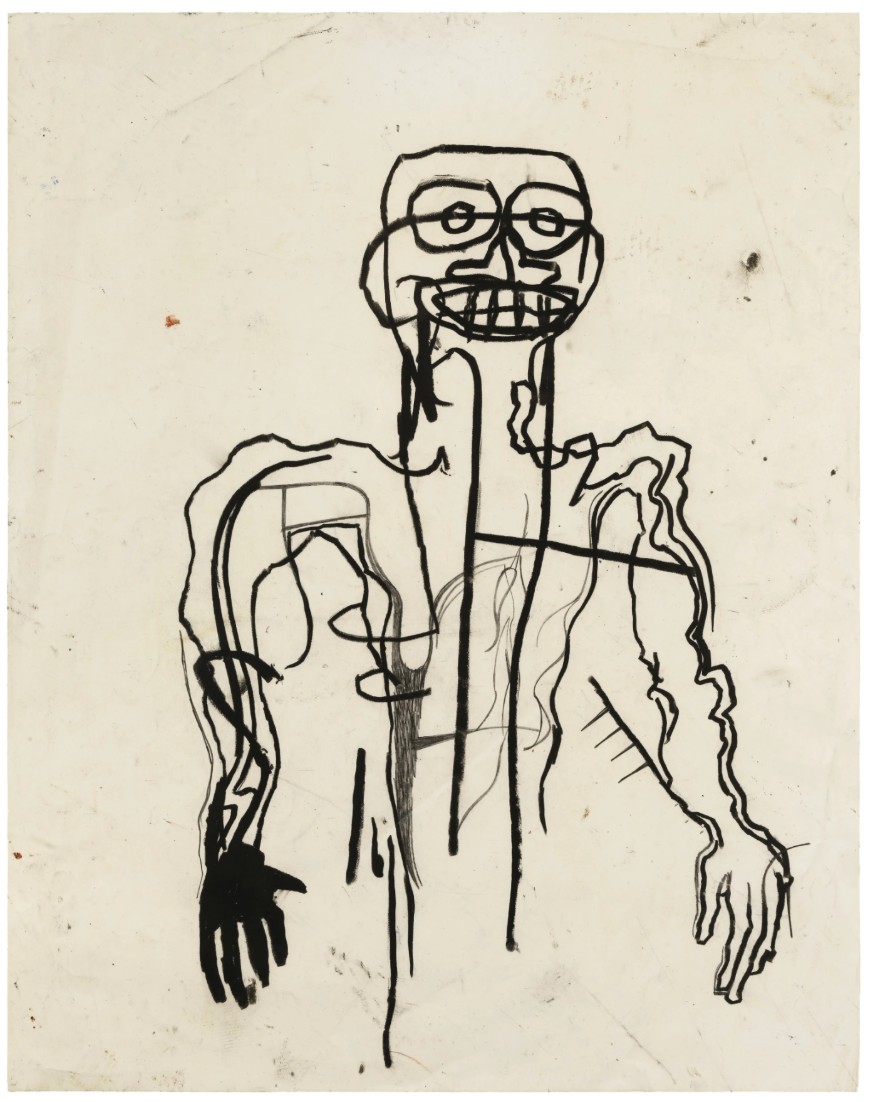
JEAN-MICHEL BASQUIAT
Untitled, 1982
Oilstick and pencil on paper
24 x 19 1/16 inches (61 x 48.5 cm)
#17. Untitled (Figure Holding Up Fish), 1981
Sotheby’s New-York: 15 November 2018
Estimated: USD 350,000 – 450,000
USD 435,000
(#459) JEAN-MICHEL BASQUIAT | Untitled (Figure Holding Up Fish)
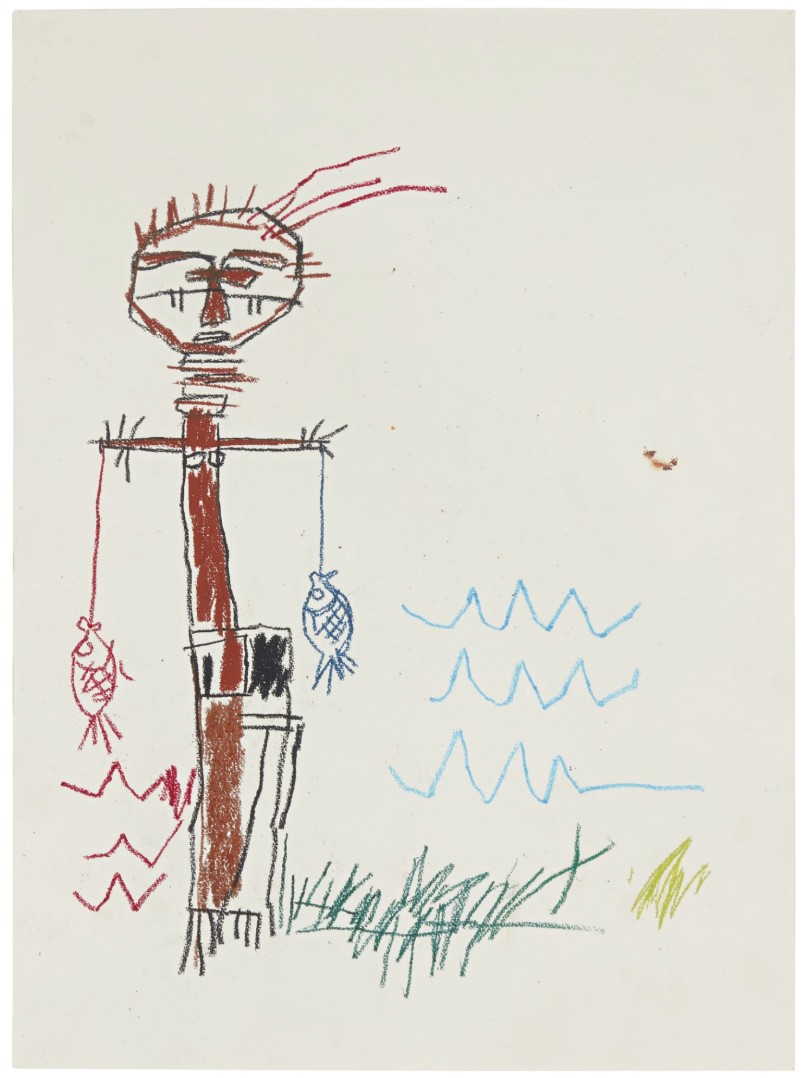
JEAN-MICHEL BASQUIAT
Untitled (Figure Holding Up Fish), 1981
Oilstick on paper
24 1/2 x 18 1/8 inches (62.2 x 46 cm)
Signed on the reverse
#18. Vincent Van Gogh in a Wax Museum in Amsterdam, 1985
Christie’s London: 7 March 2018
Estimated: GBP 120,000 – 180,000
GBP 260,750 / USD 362,560
Jean-Michel Basquiat (1960-1988), Vincent Van Gogh in a Wax Museum in Amsterdam | Christie’s
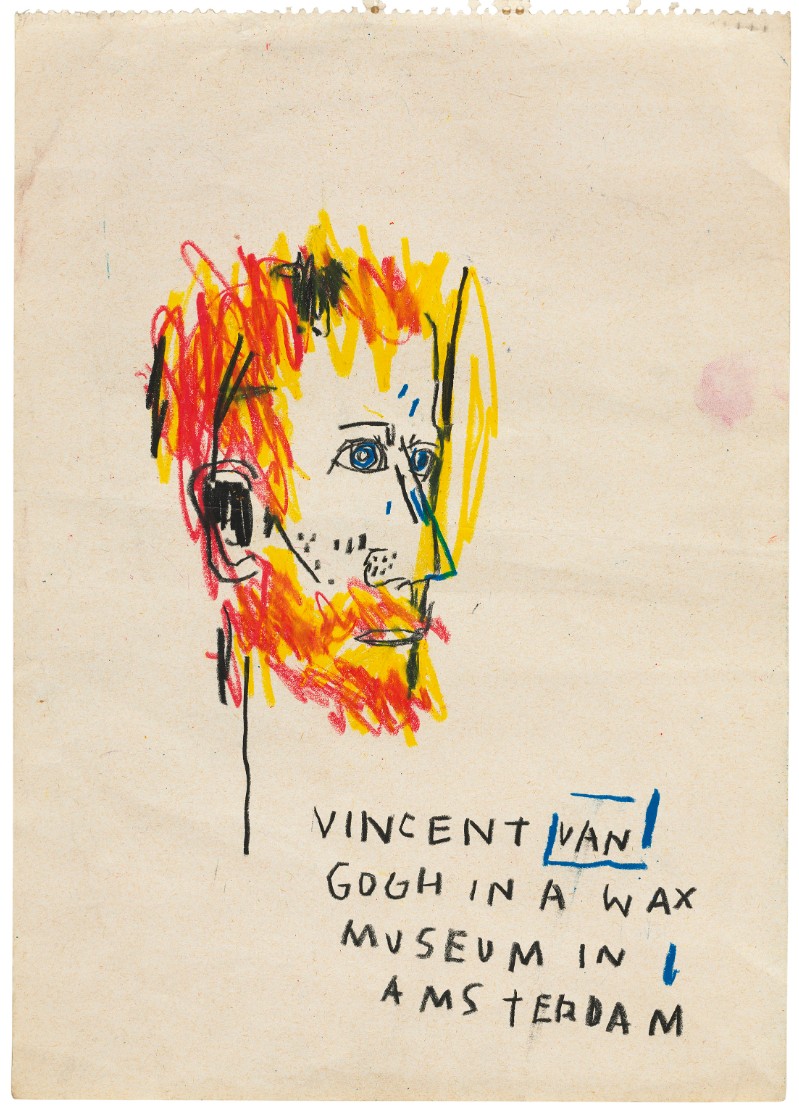
JEAN-MICHEL BASQUIAT (1960-1988)
Vincent Van Gogh in a Wax Museum in Amsterdam, 1985
Oilstick on paper
16 1/4 x 11 5/8 inches (41.2 x 29.5 cm)
#19. Untitled, 1986
Sotheby’s New-York: 25 September 2018
Estimated: USD 300,000 – 500,000
USD 362,500
(#47) JEAN-MICHEL BASQUIAT | Untitled
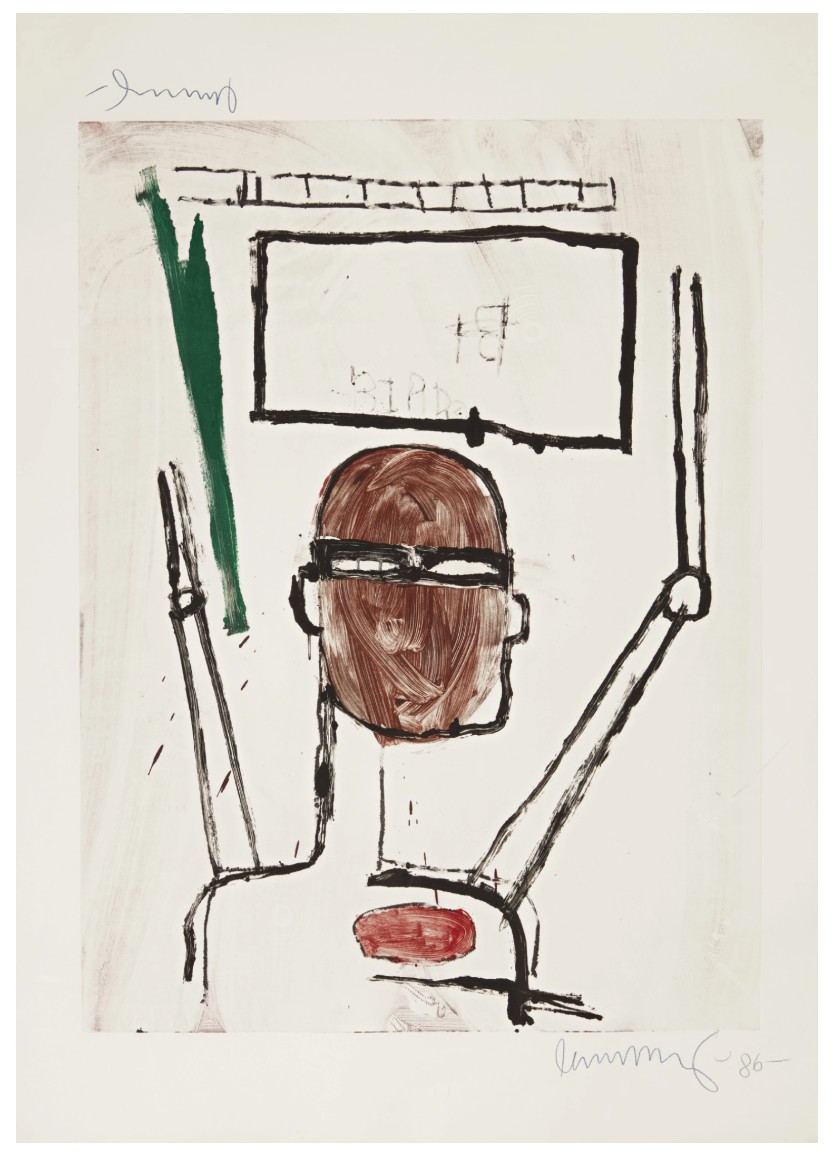
JEAN-MICHEL BASQUIAT
Untitled, 1986
Monotype on paper
Plate: 42 5/8 x 32 inches (108.3 x 81.3 cm)
Sheet: 53 3/4 x 39 inches (136.5 x 99.1 cm)
Signed twice and dated 86
#20. Untitled (Head), 1981
Sotheby’s New-York: 15 November 2018
Estimated: USD 150,000 – 200,000
USD 337,500
(#442) JEAN-MICHEL BASQUIAT | Untitled (Head)
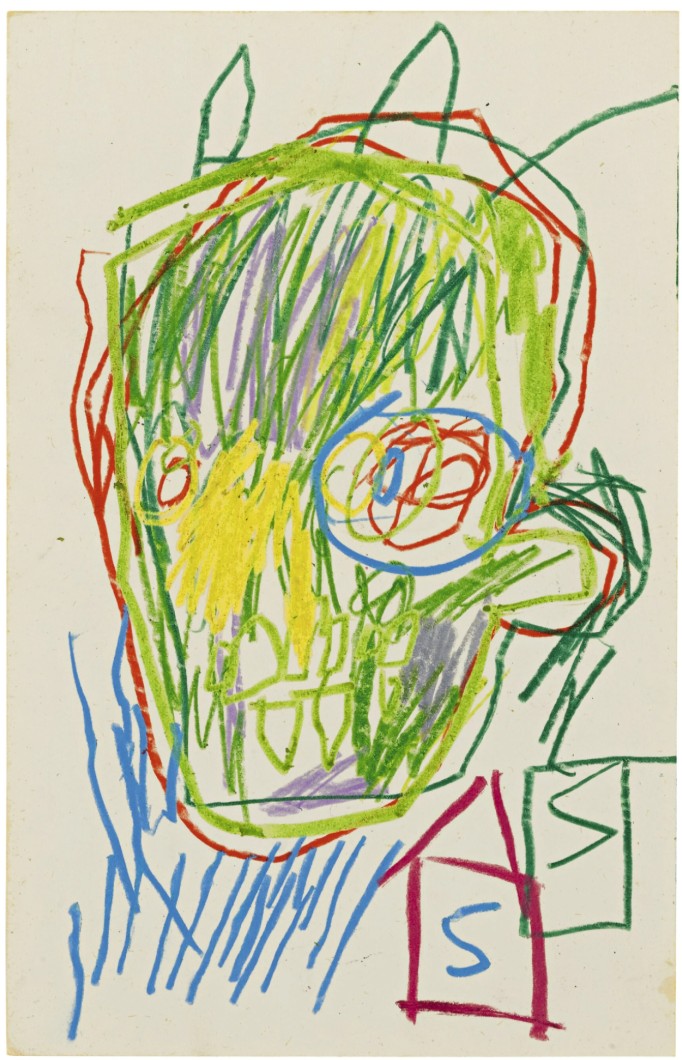
JEAN-MICHEL BASQUIAT
Untitled (Head), 1981
Oilstick and wax crayon on paper
11×7 inches (27.9 x 17.8 cm)
#21. Untitled (Spoon), 1988
Christie’s New-York: 27 September 2018
Estimated: USD 120,000 – 180,000
USD 324,500
Jean-Michel Basquiat (1960-1988), Untitled (Spoon) | Christie’s
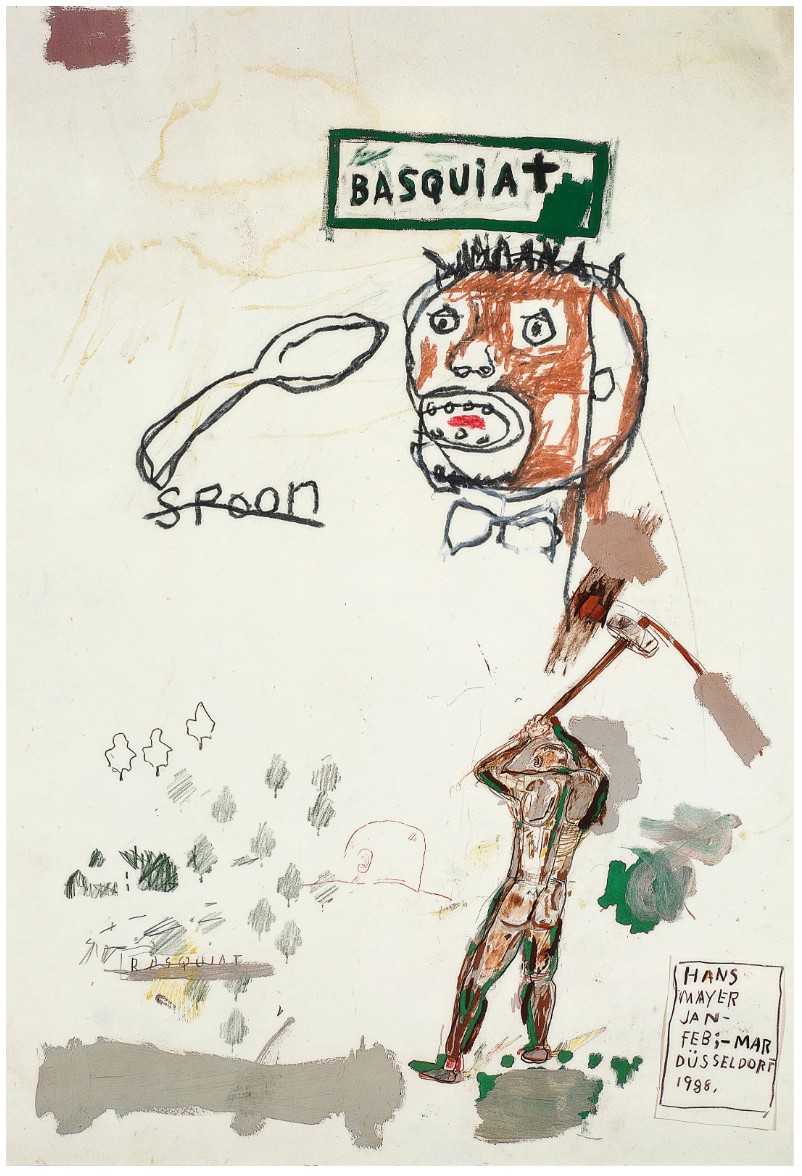
JEAN-MICHEL BASQUIAT (1960-1988)
Untitled (Spoon), 1988
Oilstick on offset lithograph
33 1/8 x 23 3/8 inches (84 x 59.4 cm)
#22. Untitled, 1985
Christie’s London: 7 March 2018
Estimated: GBP 100,000 – 150,000
GBP 212,500 / USD 295,470
Jean-Michel Basquiat (1960-1988), Untitled | Christie’s
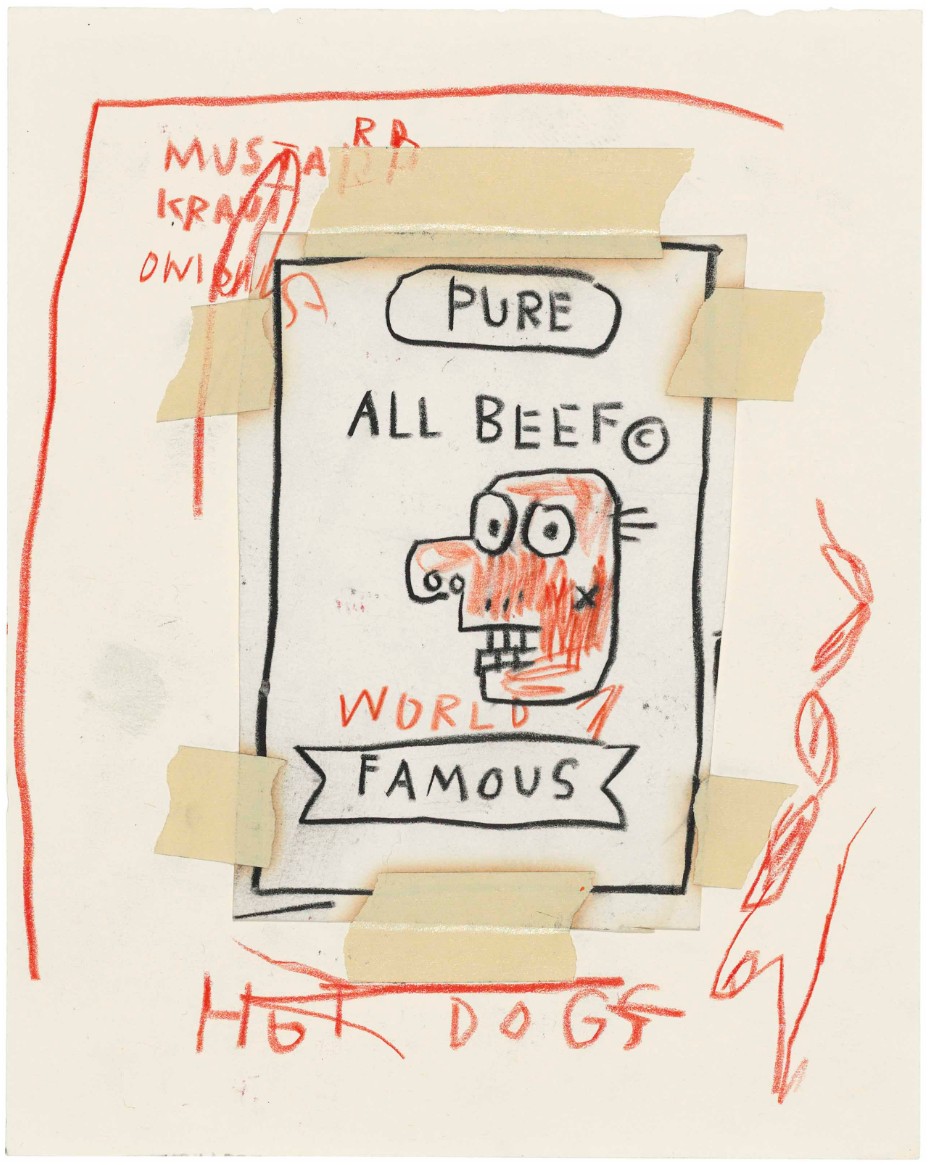
JEAN-MICHEL BASQUIAT (1960-1988)
Untitled, 1985
Oilstick and tape on paper collage
10 1/2 x 8 1/2 inches (26 x 20.9 cm)
#23. Untitled, circa 1981
Christie’s New-York: 1 March 2018
Estimated: USD 100,000 – 150,000
USD 250,000
Jean-Michel Basquiat (1960-1988), Untitled | Christie’s
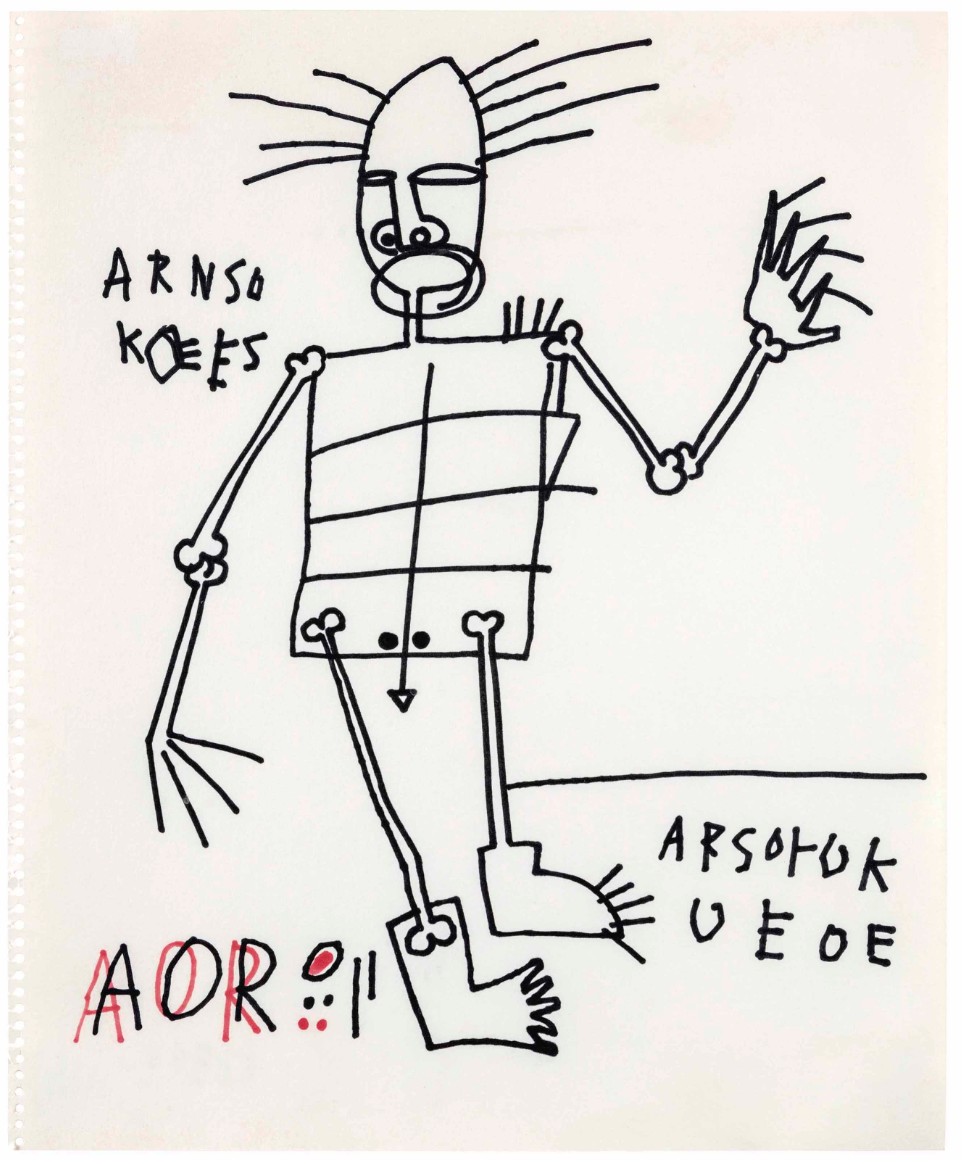
JEAN-MICHEL BASQUIAT (1960-1988)
Untitled, circa 1981
Marker on paper
16 x 13 3/4 inches (40.6 x 33.7 cm)
#24. Alchemy, 1985
Phillips London: 26 June 2018
Estimated: GBP 120,000 – 180,000
GBP 162,500 / USD 215,140
Jean-Michel Basquiat – 20th Century & … Lot 135 June 2018 | Phillips
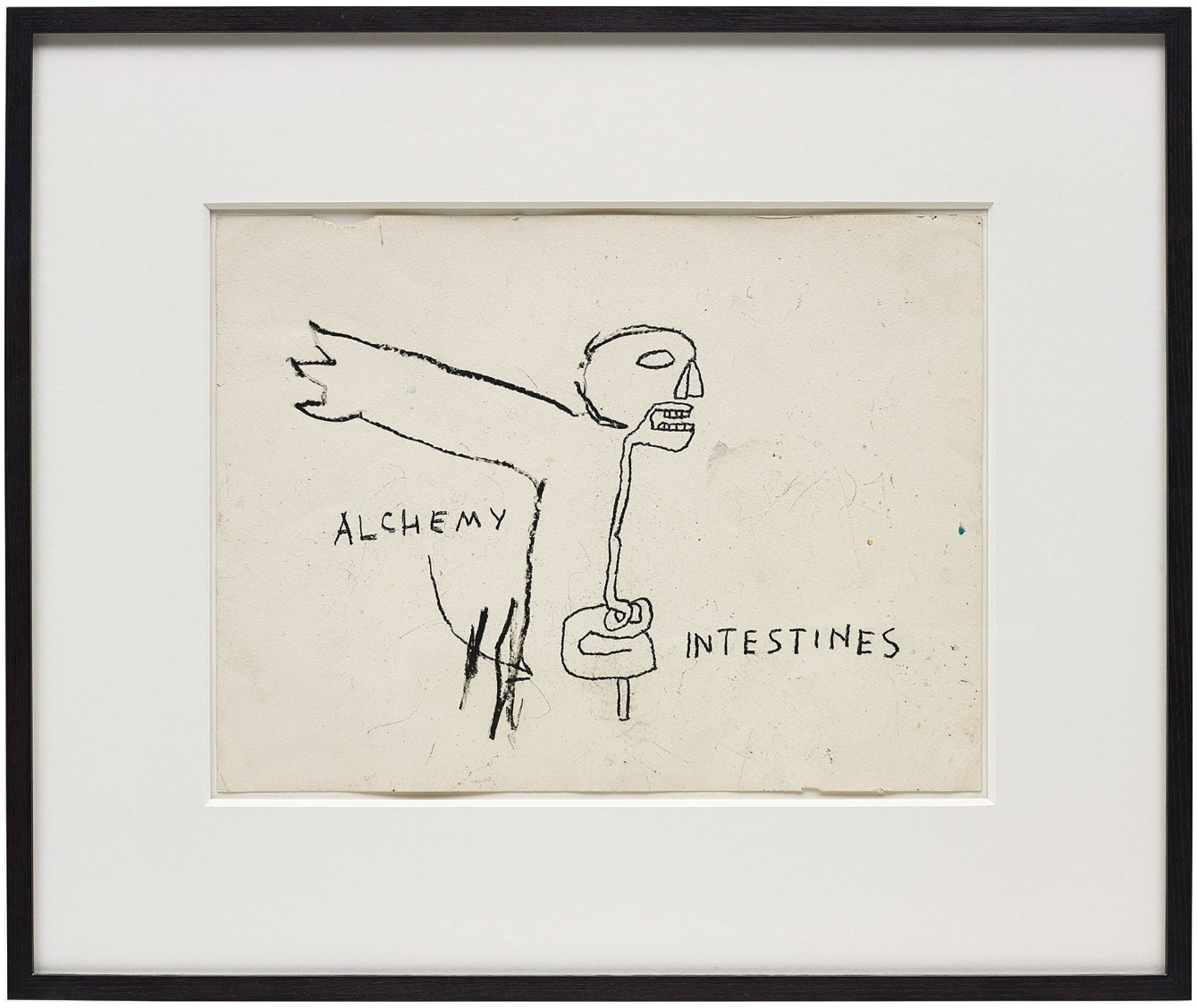
JEAN-MICHEL BASQUIAT
Alchemy, 1985
Oilstick on paper
15×20 inches (38.1 x 50.8 cm)
Signed and dated ‘Basquiat ’85’ on the reverse
#25. Untitled, 1981
Christie’s New-York: 16 November 2018
Estimated: USD 120,000 – 180,000
USD 200,000
Jean-Michel Basquiat (1960-1988), Untitled | Christie’s
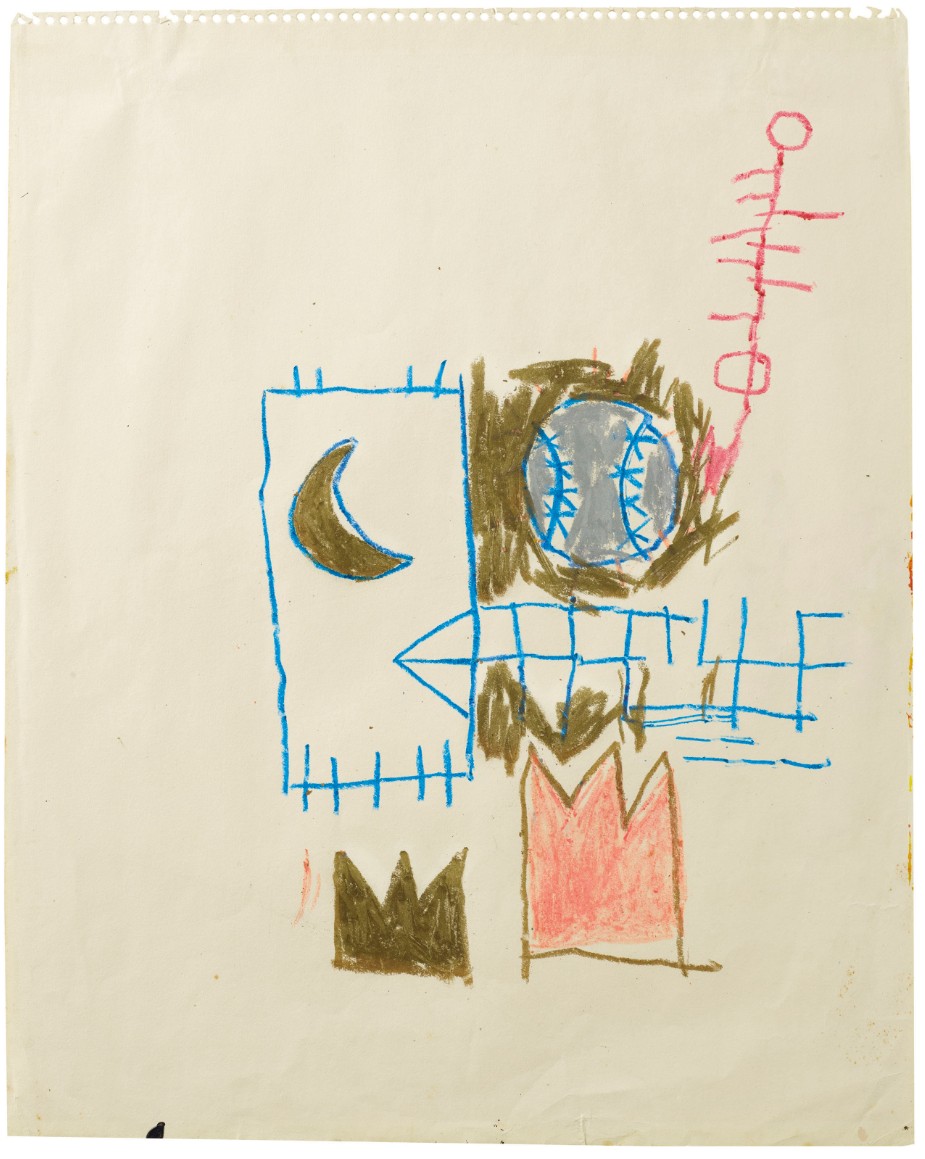
JEAN-MICHEL BASQUIAT (1960-1988)
Untitled, 1981
Oilstick on paper
20×16 inches (50.8 x 40.6 cm)
Signed ‘Jean Michel-Basquiat’ (on the reverse)
This work is registered in the archives of Annina Nosei Gallery, New York, as no. 3586
#26. Untitled, 1981
Sotheby’s New-York: 15 November 2018
Estimated: USD 100,000 – 150,000
USD 175,000
(#540) JEAN-MICHEL BASQUIAT | Untitled
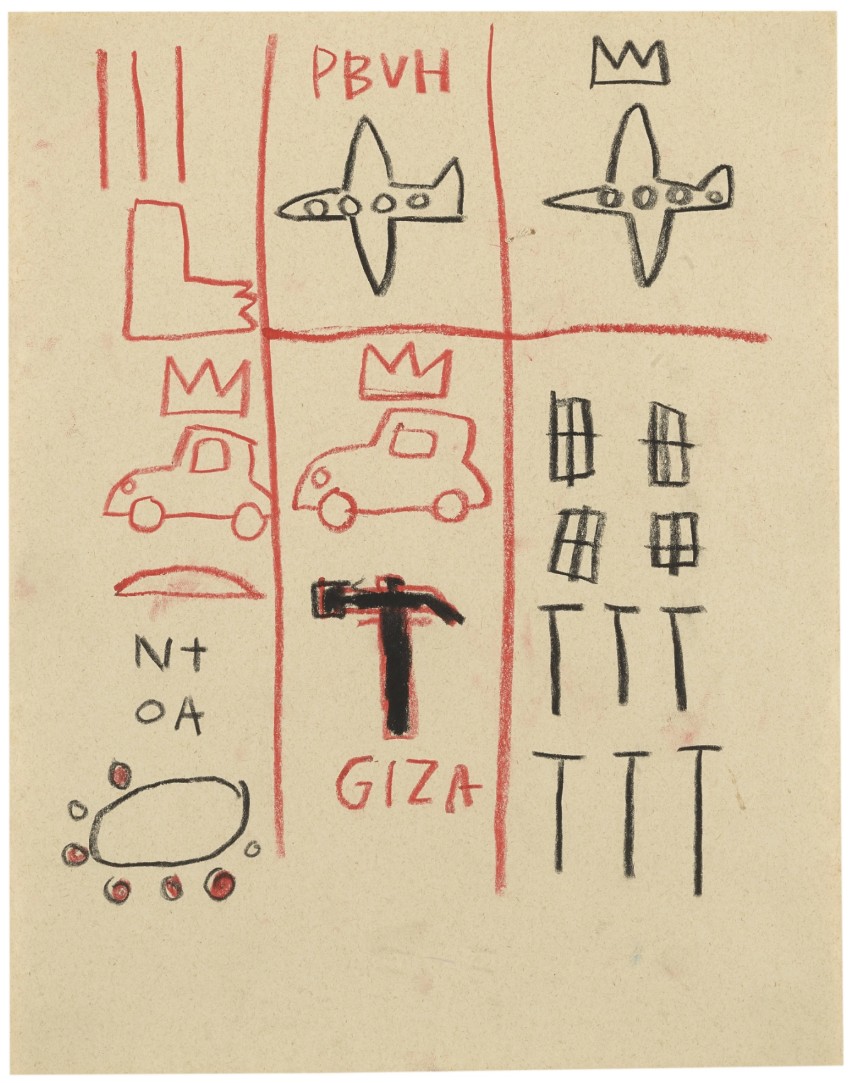
JEAN-MICHEL BASQUIAT
Untitled, 1981
Oilstick on paper
14×11 inches (35.5 x 27.9 cm)
#27. Untitled, circa 1981-1982
Phillips New-York: 28 February 2018
Estimated: USD 25,000 – 35,000
USD 168,750
Jean-Michel Basquiat – New Now Lot 54 February 2018 | Phillips
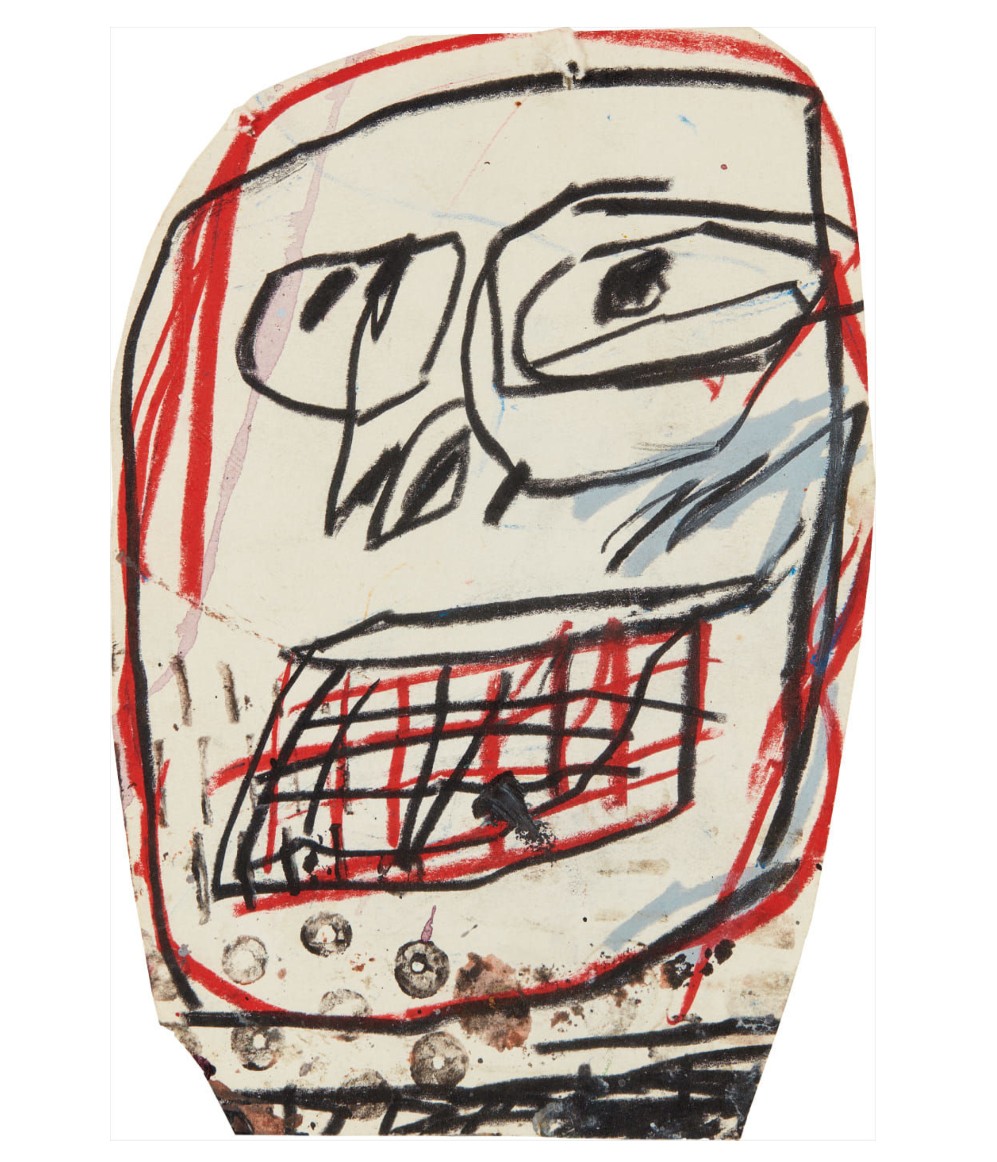
JEAN-MICHEL BASQUIAT
Untitled, circa 1981-1982
Crayon and ink on paper
8 1/8 x 5 5/8 inches (20.6 x 14.3 cm)
2017 Auction Results
WORK IN PROGRESS
#1. Untitled, 1982
Christie’s New-York: 18 May 2017
Estimated: USD 7,000,000 – 9,000,000
USD 8,647,500
Jean-Michel Basquiat (1960-1988), Untitled | Christie’s
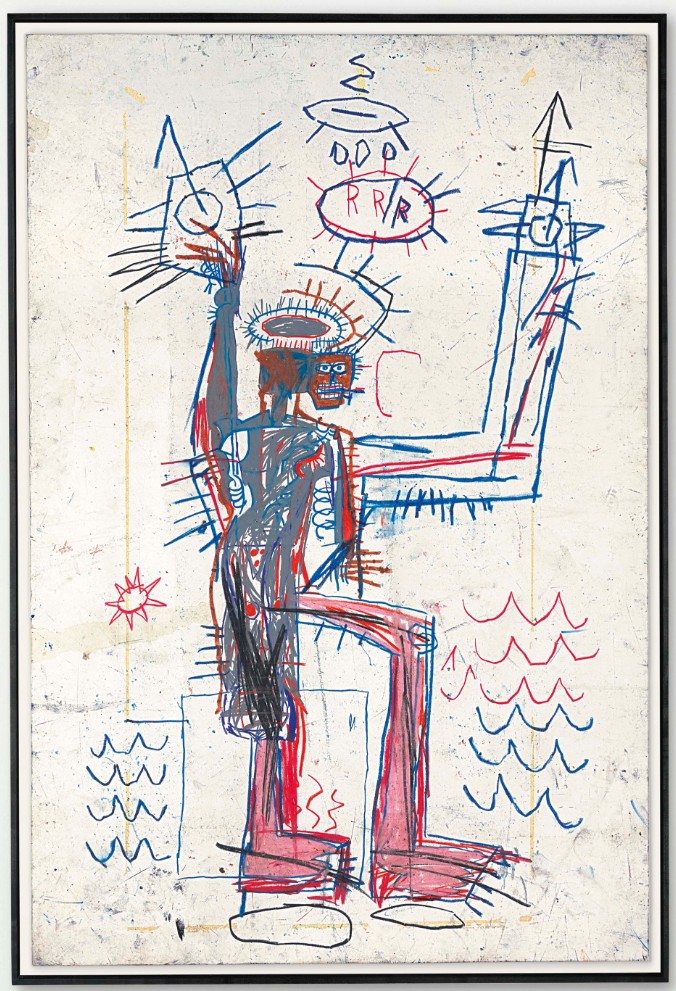
JEAN-MICHEL BASQUIAT (1960-1988)
Untitled, 1982
Oilstick on paperboard
60×40 inches (152.4 x 101.6 cm)
Repeat Sales
WORK IN PROGRESS
2025
Untitled (Pestus), 1982
Phillips London: 16 October 2025
Estimated: GBP 2,000,000 – 3,000,000
GBP 2,374,000 / USD 3,181,160
WORK ON PAPER
READ MORE IN FOCUS SECTION
Jean-Michel Basquiat Modern & Contemporary Art Evening Sale
REPEAT SALE
Phillips London: 20 October 2020
Estimated: GBP 2,000,000 – 3,000,000
GBP 2,200,500 / USD 2,849,770
Jean-Michel Basquiat 20th Century & Contemporary Art Evening Sale
Untitled, 1982
Phillips London: 6 March 2025
Estimated: GBP 400,000 – 600,000
GBP 609,600 / USD 780,288
WORK ON PAPER
Jean-Michel Basquiat – Modern & Contemp… Lot 5 March 2025 | Phillips
REPEAT SALE
Sotheby’s Paris: 5 December 2018
Estimated: EUR 300,000 – 500,000
EUR 393,000 / USD 446,055
WORK ON PAPER
(#1) JEAN-MICHEL BASQUIAT | Untitled
JEAN-MICHEL BASQUIAT
Untitled, 1982
Oilstick and pencil on paper
24 x 19 1/8 inches (61 x 48.5 cm)
Untitled, 1984
Sotheby’s New-York: 26 February 2025
Estimated: USD 800,000 – 1,200,000
USD 889,000
WORK ON PAPER
Untitled | Contemporary Curated | 2025 | Sotheby’s
REPEAT SALE
Christie’s New-York: 14 November 2019
Estimated: USD 500,000 – 700,000
USD 561,000
WORK ON PAPER
Jean-Michel Basquiat (1960-1988), Untitled | Christie’s
JEAN-MICHEL BASQUIAT (1960-1988)
Untitled, 1984
Oilstick and pastel on paper
30 x 22 1/4 inches (76.2 x 56.5 cm)
2024
2023
Untitled, 1984
Christie’s London: 28 June 2023
Estimated: GBP 1,000,000 – 1,500,000
GBP 1,250,000 / USD 1,579,279
WORK ON PAPER
JEAN-MICHEL BASQUIAT (1960-1988), Untitled | Christie’s
REPEAT SALE
Sotheby’s New-York: 8 December 2021
Estimated: USD 1,000,000 – 1,500,000
USD 1,532,500
WORK ON PAPER
JEAN-MICHEL BASQUIAT (1960-1988)
Untitled, 1987
Wax crayon on paper
29 7/8 x 22 1/4 inches (75.9 x 56.5 cm)
Untitled (Cartoon Dog), circa 1983
Estimated: USD 600,000 – 800,000
USD 945,000
WORK ON PAPER
Estimated: GBP 200,000 – 300,000
GBP 620,000 / USD 854,229
WORK ON PAPER
Untitled (Cartoon Dog), circa 1983
Acrylic and oilstick on paper
27 1/2 x 39 3/8 inches (69.9 x 100 cm)
2022
Untitled (Self Portrait), 1982
Christie’s London: 28 June 2022
Estimated: GBP 4,000,000 – 6,000,000
GBP 7,961,000 / USD 9,716,831
JEAN-MICHEL BASQUIAT (1960-1988), Untitled (Self Portrait) | Christie’s
REPEAT SALE
Christie’s London: 26 June 2018
Estimated: GBP 1,500,000 – 2,500,000
GBP 3,892,250 / USD 5,153,168
JEAN-MICHEL BASQUIAT (1960-1988) (christies.com)
JEAN-MICHEL BASQUIAT
Untitled (Self Portrait), 1982
Oilstick and ink on paper
29.9 x 22 inches (75.9 x 55.9cm)
1981 Drawings
Untitled, 1981
PROPERTY FROM A DISTINGUISHED PRIVATE COLLECTION
Christie’s Hong-Kong: 27 March 2026
Estimated: HKD 18,000,000 – 28,000,000
HKD 22,216,000 / USD 2,837,290
THIRD-PARTY GUARANTEE
JEAN-MICHEL BASQUIAT (1960-1988), Untitled | Christie’s
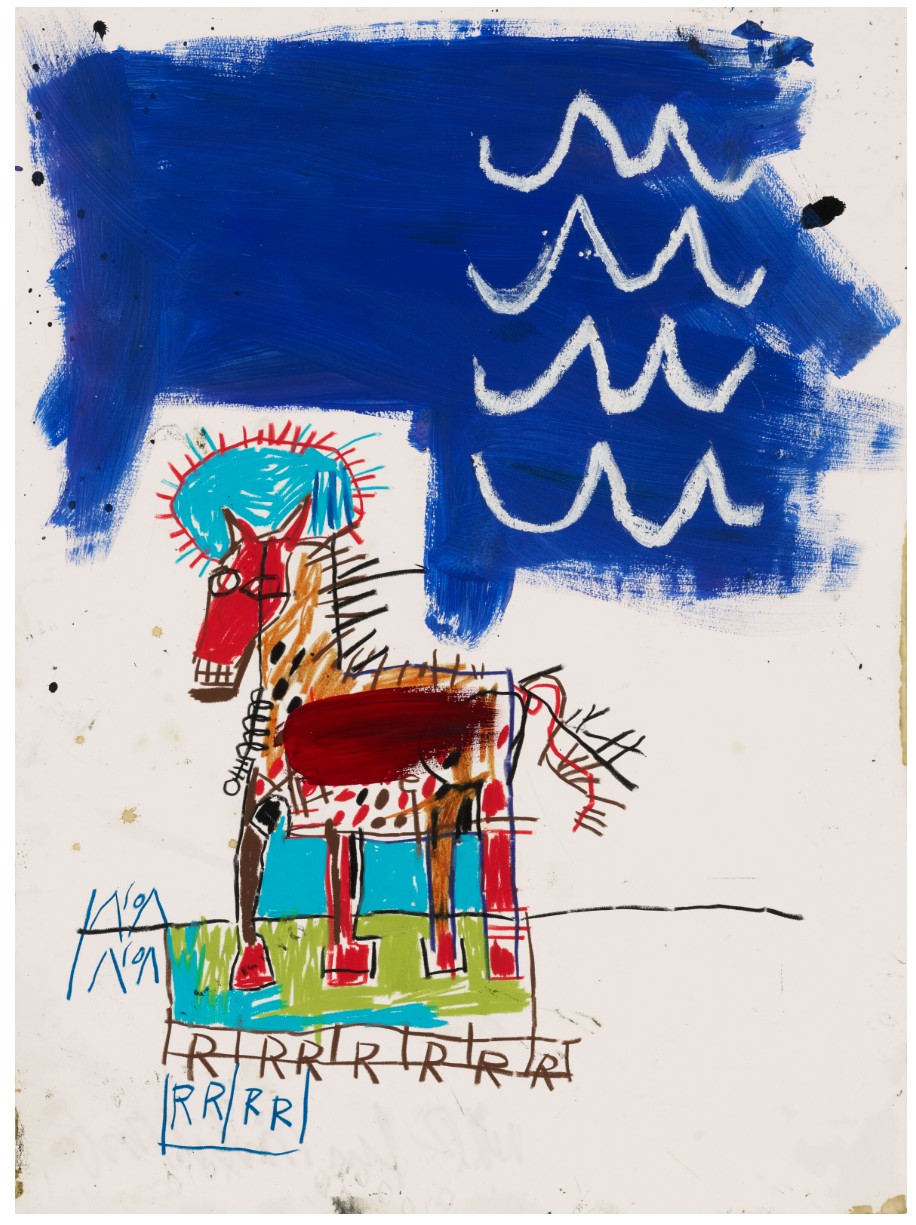
JEAN-MICHEL BASQUIAT (1960-1988)
Untitled, 1981
Oilstick and acrylic on paper
30 x 22-1/8 inches (76.2 x 56.1 cm)
Signed ‘Jean-Michel Basquiat’ (on the reverse)
With its vivid depiction of a horse, adorned with the artist’s signature ‘crown of thorns’, Jean-Michel Basquiat’s Untitled captures the explosion of his artistic language in 1981: a crucial year in his career. This was the moment Basquiat’s rise to fame accelerated, as critical buzz, key gallery support, and a rapidly expanding audience pushed him into the global spotlight. Rendered in explosive strokes of oilstick and acrylic, the work marks his monumental leap from street art practices to a distinctive, electrifying studio language. With its untamed, triumphant energy, it featured in the major survey exhibition Jean-Michel Basquiat: Now’s the Time at the Guggenheim Museum Bilbao in 2015.
Evoking power, heroism, and the relentless progression of human civilization, the horse is a dynamic, historically-charged subject. Across cultures and eras, it has been a faithful companion in battle, exploration, labor, and innovation. In Chinese culture, the horse is a powerful symbol of energy, speed, and success. As a fire sign in Chinese astrology, it signifies dynamism and passionate energy. Basquiat spent long hours in New York’s museums, and was attuned to the histories of art and mythology. He frequently referenced stories from Greek mythology, including the legendary Trojan Horse — an icon of meticulous military strategy that enabled the Greeks to infiltrate Troy marked pivotal moment that transformed the course of the Trojan War.
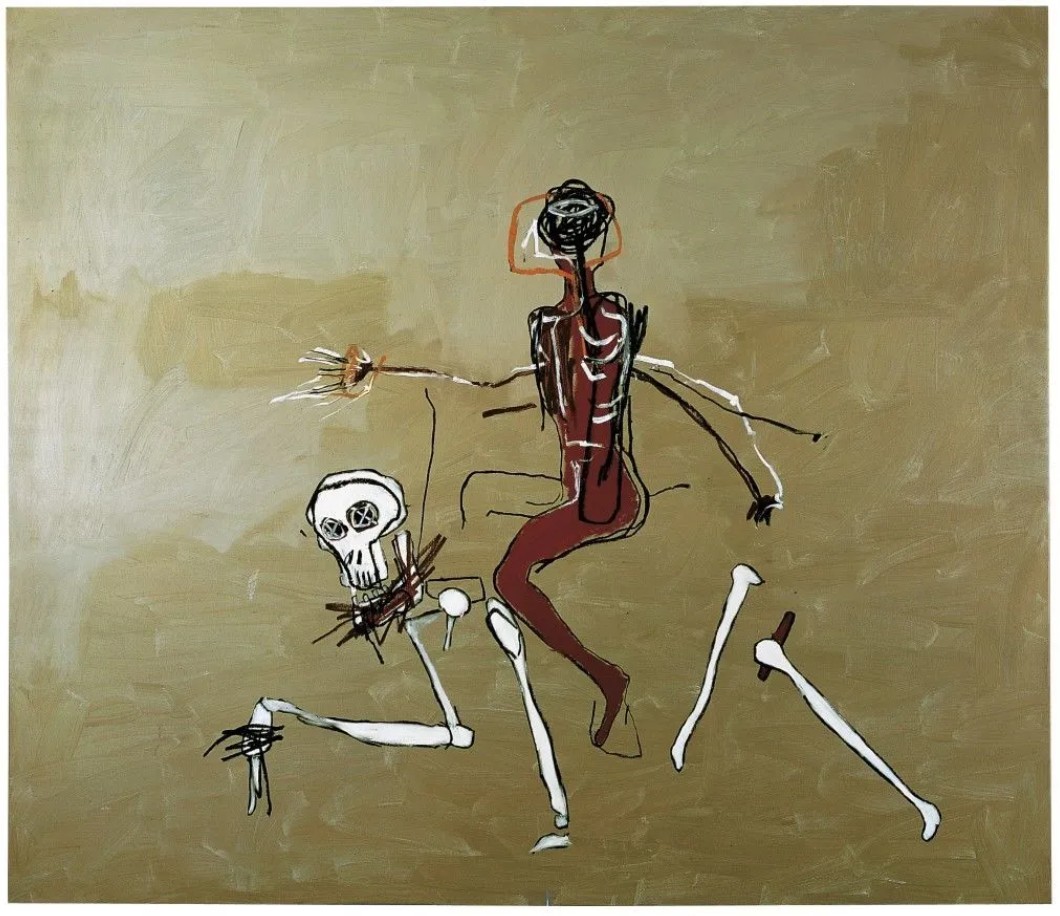
Jean-Michel Basquiat, Riding with Death, 1988
Horses were also used for royal processions, symbolizing prestige, authority, and elevated status. Basquiat would revisit the subject, subverted in haunting skeletal form, in his poignant masterwork Riding with Death (1988), executed in the final year of his life. In the present work, Basquiat embellishes the horse with one of his most important motifs. Evocative of religious iconography, yet simultaneously evoking a buzzing electric circuit, the halo-like crown of thorns became a symbol of bravado, martyrdom and creative energy. It crowned many figures across his practice: from fellow artists such as Keith Haring, to the celebrated Black musicians and athletes he admired, to his own self-image. Here, he pays tribute to an animal that has carried people through centuries of upheaval and transformation. At once celebratory and solemn, noble and burdened, the crown of thorns captures the complicated, often contradictory nature of heroism itself: the glory it bestows and the cost it demands.
“[I was] inspired by John Cage at the time – music that isn’t really music. We were trying to be incomplete, abrasive, oddly beautiful.”
During the early 1980s, Basquiat transformed visual mark-making into a rhythmic, almost musical force. Here, in dialogue with the horse motif, the repeated letters become a driving auditory pulse that animates the entire composition. The pictorial space crackles with repeated letters “RRR,” aggressive lines, and layered textures. This raw visual intensity is inseparable from his musical background. Basquiat spent his formative years in the band Gray, and even after leaving the group in 1981, the improvisational, percussive spirit remained deeply embedded in his artistic approach. His paintings feel alive, almost audible and buzzing with the restless pulse of music. Basquiat was also heavily inspired by cartoons and worked in his studio to a steady thrum of televisual noise. In this work, the insistent “RRR” seems to become a visual onomatopoeia, echoing the rumble of hooves and the breath of an animal in motion.
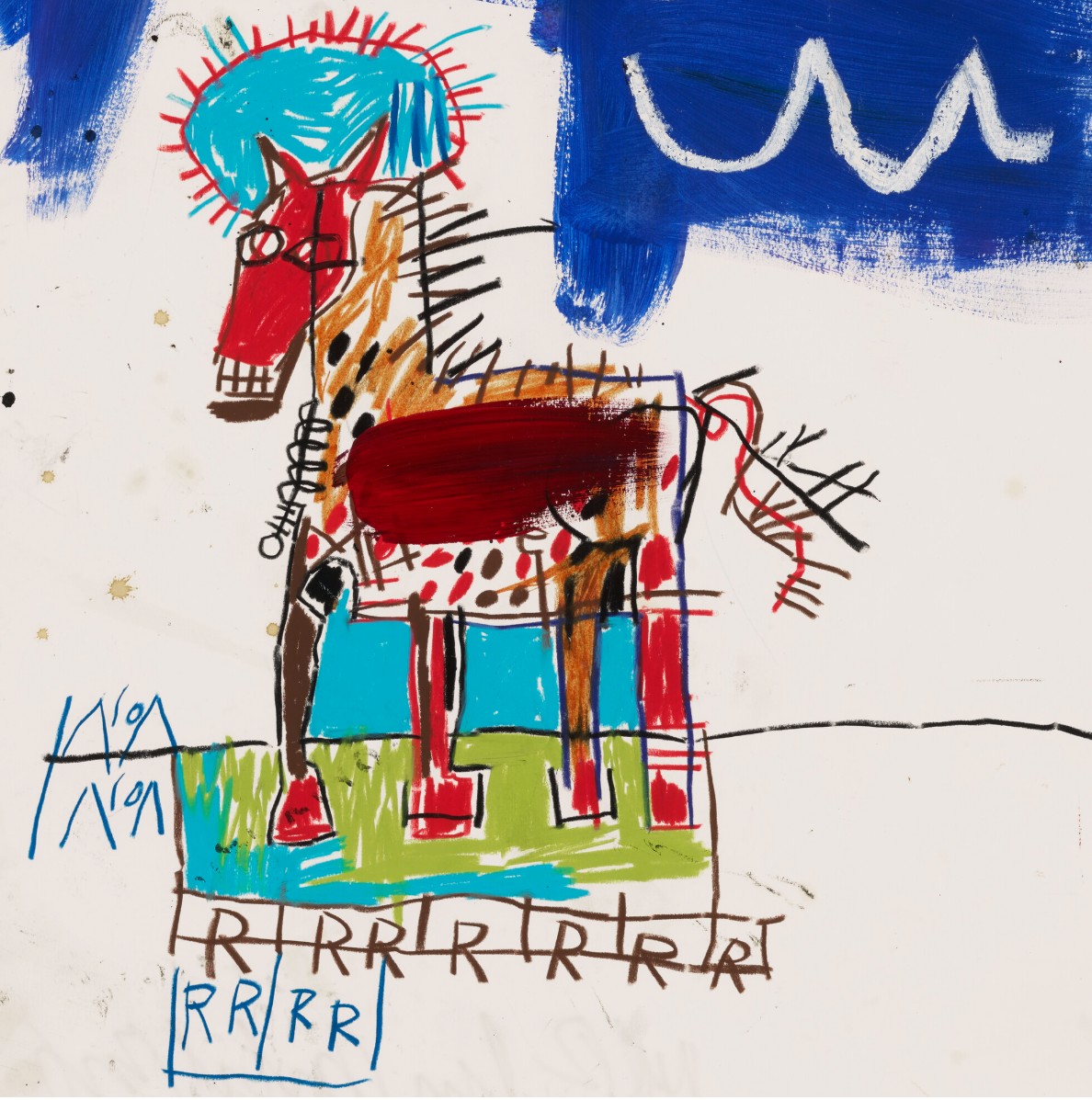
1981 stands as a watershed year in Basquiat’s career — the moment he transitioned from an emerging downtown talent to a formidable force in the international art world. During this pivotal period, he vaulted from the margins into widespread recognition: first catapulted into fame with his inclusion in Diego Cortez’s New York/New Wave exhibition. That show assembled artists such as Keith Haring and Andy Warhol, blending creative worlds in a way that echoed Basquiat’s own multifaceted sensibility. He subsequently held his first solo exhibition at the Galleria d’Arte Emilio Mazzoli in Modena, Italy, and secured a studio beneath his primary art dealer Annina Nosei’s Prince Street gallery, gaining rapid gallery and national visibility. By the end of the year, René Ricard crowned him ‘The Radiant Child,’ a title that would ignite his ascent to legend. Works from this period reveal a confident, ambitious young artist discovering the full potential of his visual language.
With its rich, neo-expressionist textures, the present work on paper belongs to a vital body of Basquiat’s output from 1981–83. The bold, vibrant acrylic paint and frenetic, quasi-spontaneous oilstick lines capture the immediacy, spontaneity, and gritty atmosphere of early 1980s New York. During these years, Basquiat’s works on paper were not secondary gestures but bold experiments where he forged a new syntax of mark-making. Many of these drawings remained unexhibited during his lifetime, underscoring their personal resonance: his oilstick heads from this period are currently the subject of a major exhibition at the Louisiana Museum of Modern Art in Denmark. The present work offers an intimate glimpse of Basquiat’s burgeoning language—direct, unfiltered, and alive with the creative urgency that would define his artistic approach.
Untitled, 1981
Christie’s New-York: 20 November 2025
Estimated: USD 180,000 – 250,000
USD 317,500
JEAN-MICHEL BASQUIAT (1960-1988), Untitled | Christie’s
JEAN-MICHEL BASQUIAT (1960-1988)
Untitled, 1981
Paint pen and marker on colored illustration board
18 x 11 7/8 inches (45.7 x 30.2 cm)
Inscribed by Keith Haring (on the reverse)
The remarkable provenance of this Jean-Michel Basquiat deserves recognition. Originally given by Basquiat to Keith Haring, the drawing was subsequently gifted by Haring to his friend and biographer John Gruen. The history of the piece is memorialized by Haring in his unmistakable penmanship on the reverse of the illustration board.
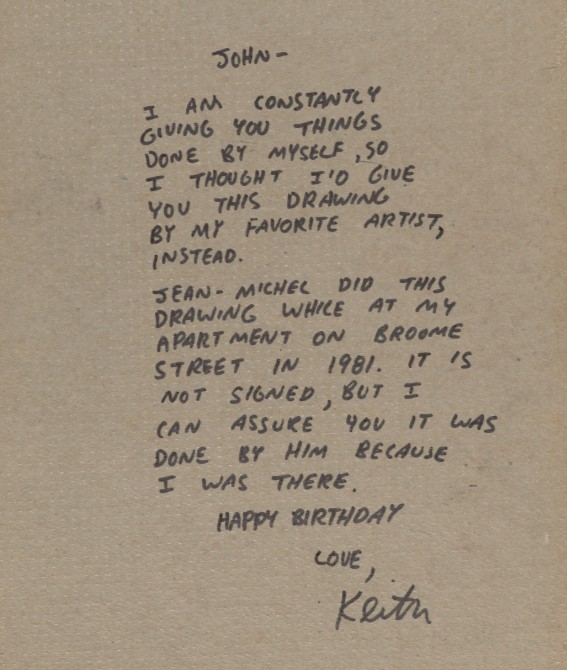
John Gruen was an important cultural critic, prolific writer, photographer and musician. He was also the author and editor of Keith Haring: The Authorized Biography, published in 1991, shortly after Haring’s death. The only ‘authorized’ Haring biography, it was compiled from long and intense interview sessions with Haring and his many friends and contemporaries in 1989 and 1990. The book stands as important and enduring oral biography of Haring and chronicles the time in which he lived. Basquiat is referenced in the book more than twenty times.
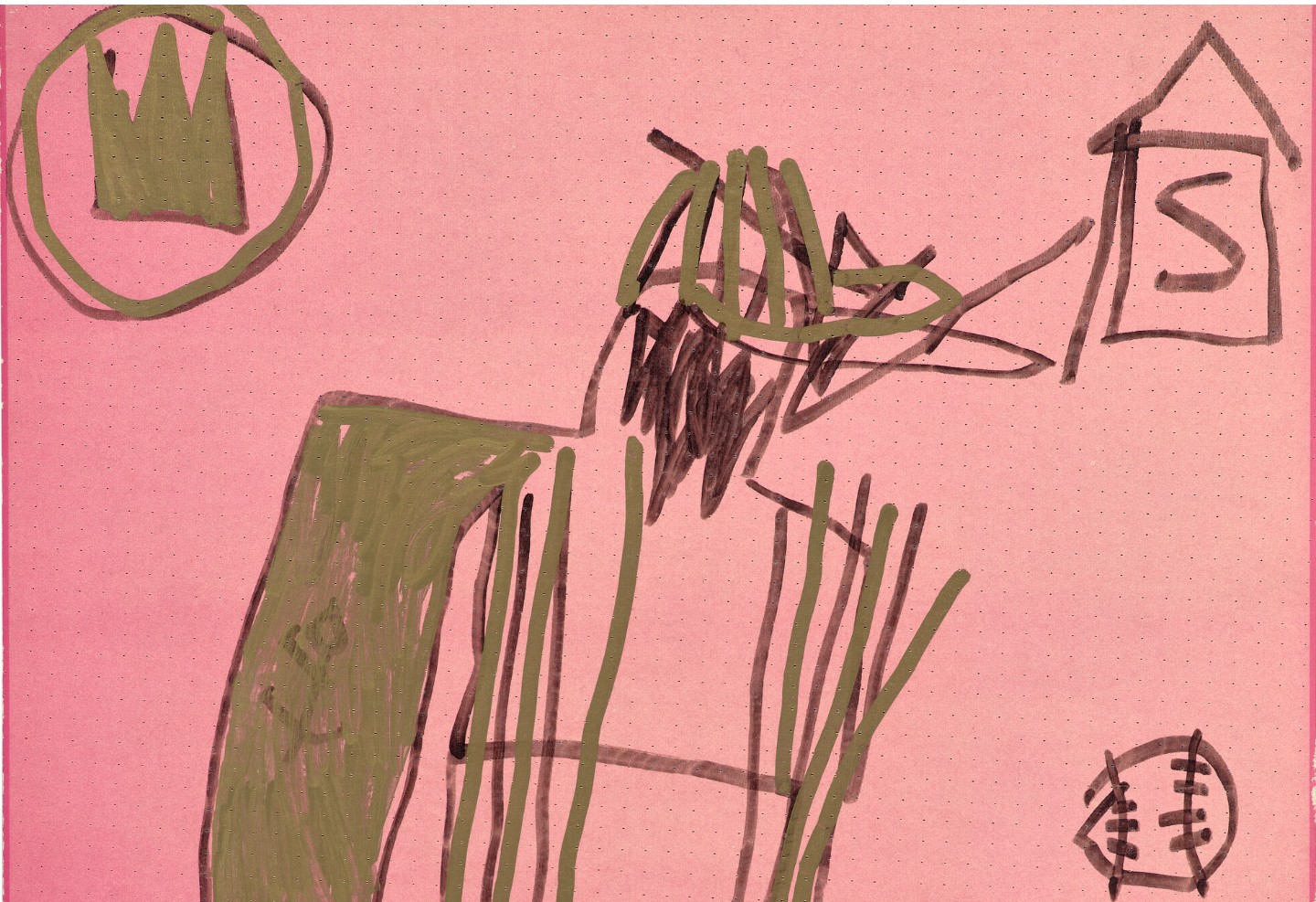
In the present drawing, Basquiat uses marker and a metallic paint pen to draw a baseball player, adorning the image with a crown and esoteric symbols that resemble the marks on a baseball scorecard. The image calls to mind famous baseball players such as Satchel Page and Hank Aaron. Aaron figures prominently in many of Basquiat’s works, and Basquiat’s frequent cryptic use of the letter ‘A’ and the name ‘Aaron’ are generally understood to be references to the famous ball player, who broke Babe Ruth’s all-time career home run record and received frequent death threats (due to his race) during his pursuit of the record.
Untitled, 1981
Sotheby’s London: 17 October 2025
Estimated: GBP 300,000 – 400,000
GBP 495,300 / USD 663,700
Untitled | Contemporary Day Auction | 2025 | Sotheby’s
JEAN-MICHEL BASQUIAT (1960 – 1988)
Untitled, 1981
Oilstick on paper
27 1/2 x 39 3/8 inches (70×100 cm)
Executed in 1981, Untitled, reveals much about Jean-Michel Basquiat’s early visual language, a condensed visual energy shaped by both raw iconography and complex allusion. First handled by Galleria d’Arte Emilio Mazzoli in Modena, the gallery that gave Basquiat his first European exhibition in 1981, the drawing soon entered the collection of Alessandro Grassi. Grassi was among the most perceptive early collectors of Basquiat, acquiring works at a time when the artist was still establishing his reputation outside New York. The work presents a group of cars, a New York skyscraper, a tipi tent, the artist’s signature crown motif, and the letters ROT. Each of these elements carry both literal resonance and symbolic charge. Together they afford us insight into Basquiat’s negotiation of modern urban life, speed, decay, and identity.
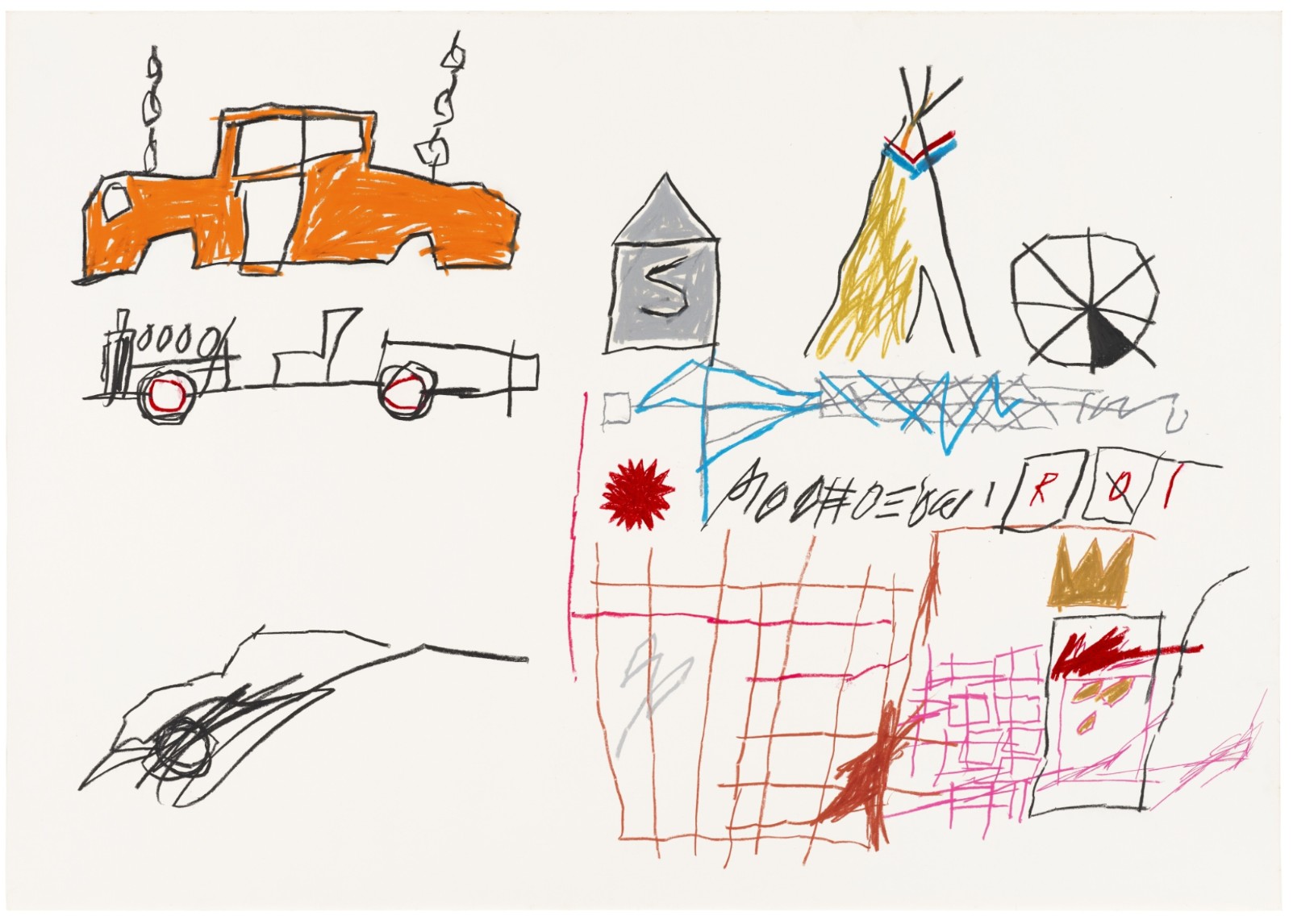
1981 was a pivotal year for Basquiat. At this moment he was beginning to consolidate his voice within the New York downtown art scene, having moved from graffiti interventions under the artist’s name SAMO to works that bridged drawing, painting, poetry and collage. He engaged with the energy of street culture, the improvisatory rhythms of jazz, and the layered histories of the African diaspora. References to colonial pasts, contemporary politics and consumer culture interwove with motifs drawn from anatomy, advertising and popular imagery. In this climate, machines, towers and vehicles were not celebrated as triumphant achievements but interrogated as contested symbols of modern life. They embodied both promise and contradiction, mobility and restriction, aspiration and decay.
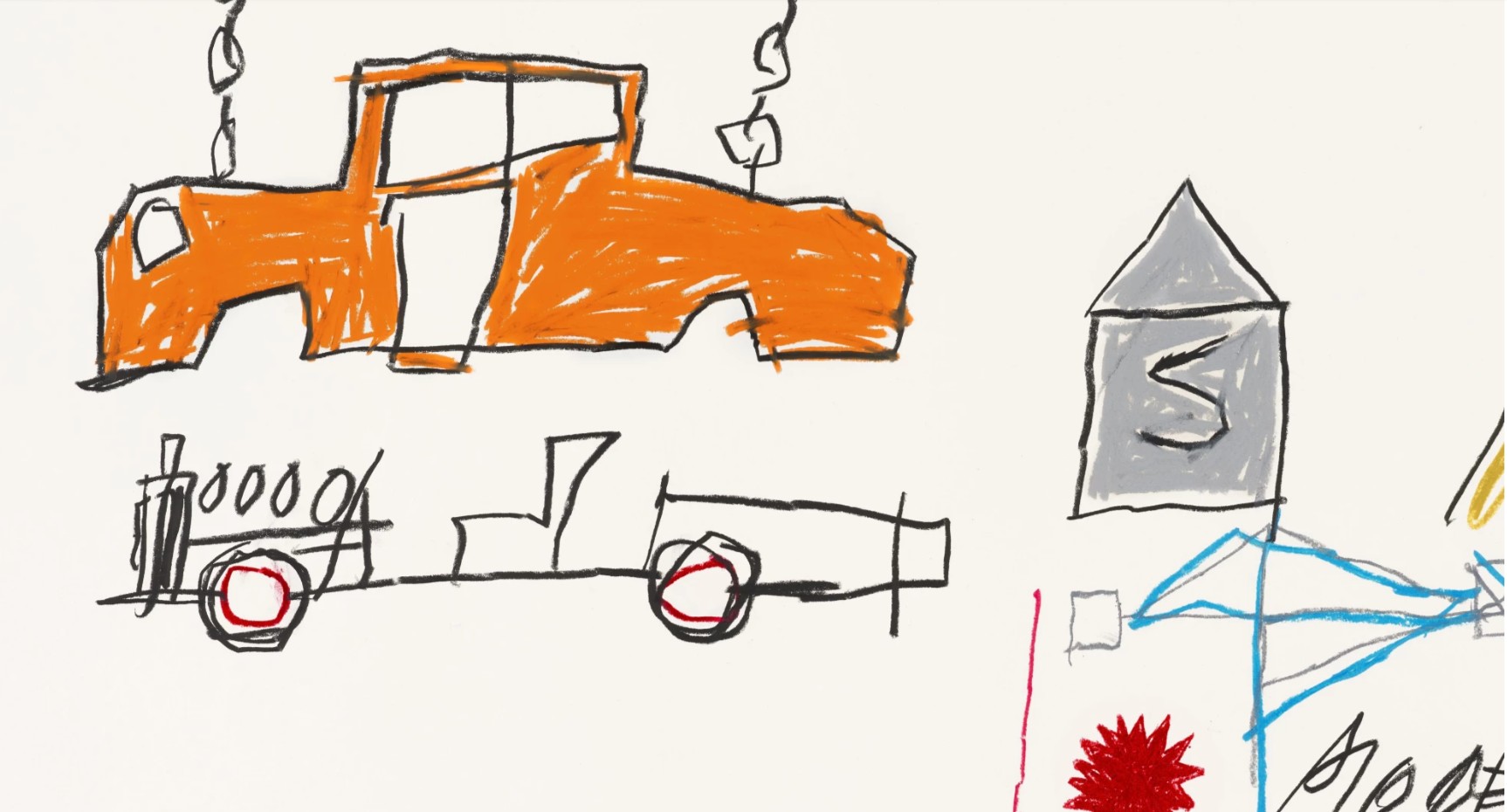
The cars in Untitled echo the dynamic futurist representations of movement. The Futurists, such as Luigi Russolo in his Dynamism of a Car, sought to capture not only the appearance of automotive speed but its pulsating motion and mechanized vitality. The overlapping planes, the blur, the sense that form is dissolving into motion were all meant to evoke the future, the machine, the modern age. In Basquiat’s work the cars are not rendered with such formally cubistic fragmentation or speed-lines but rather suggested through simpler, almost schematic means. In the context of Basquiat’s New York, the car is not simply a technological marvel but a site of cultural inscription. To draw cars is to evoke streets, to allude to movement through space, to suggest urgency. The sketchiness and immediacy of his lines resist the slick finish of commercial or industrial renderings. Where Futurists celebrated technology in an almost utopian register, Basquiat often situates it with social tension: an urban present defined by inequality and instability.
Luigi Russolo, Racing Car, 1913
Musée National d’Art Moderne, Paris
Alongside the cars stands a vertical structure that oscillates between castle tower and skyscraper. The ambiguity is crucial. The castle tower evokes history, defense and enclosure, while the skyscraper evokes capitalism, ambition and modernity. By refusing to resolve the form, Basquiat situates his imagery between feudal past and capitalist present. A tipi tent further introduces the theme of impermanence. It suggests shelter that is fragile, marginal and easily overturned. Read together, these architectural motifs articulate a city where permanence and fragility coexist, and where social structures are both fortified and unstable.
The iconic crown, which the artist deploys throughout his œuvre, appears here as a marker of recognition. He uses it not simply as a symbol of personal authority but as a divide that confers dignity on overlooked subjects. Crowns elevate the everyday, whether objects or words. In this composition, the crown places authority upon motifs that might otherwise be banal. The cars, the building, and the tent all become worthy of attention.
Basquiat often uses fragments of words and acronyms. The inclusion of the letters ROT can be read literally as decomposition, the erosion of structures and machines, or metaphorically as moral corruption. Its presence alongside symbols of speed and verticality confront the viewer with the inevitability of breakdown. In the world of speed and vertical aspiration there is breakdown. These three letters also carry the cadence of graffiti tags: abrupt and confrontational while commanding attention in the visual field.
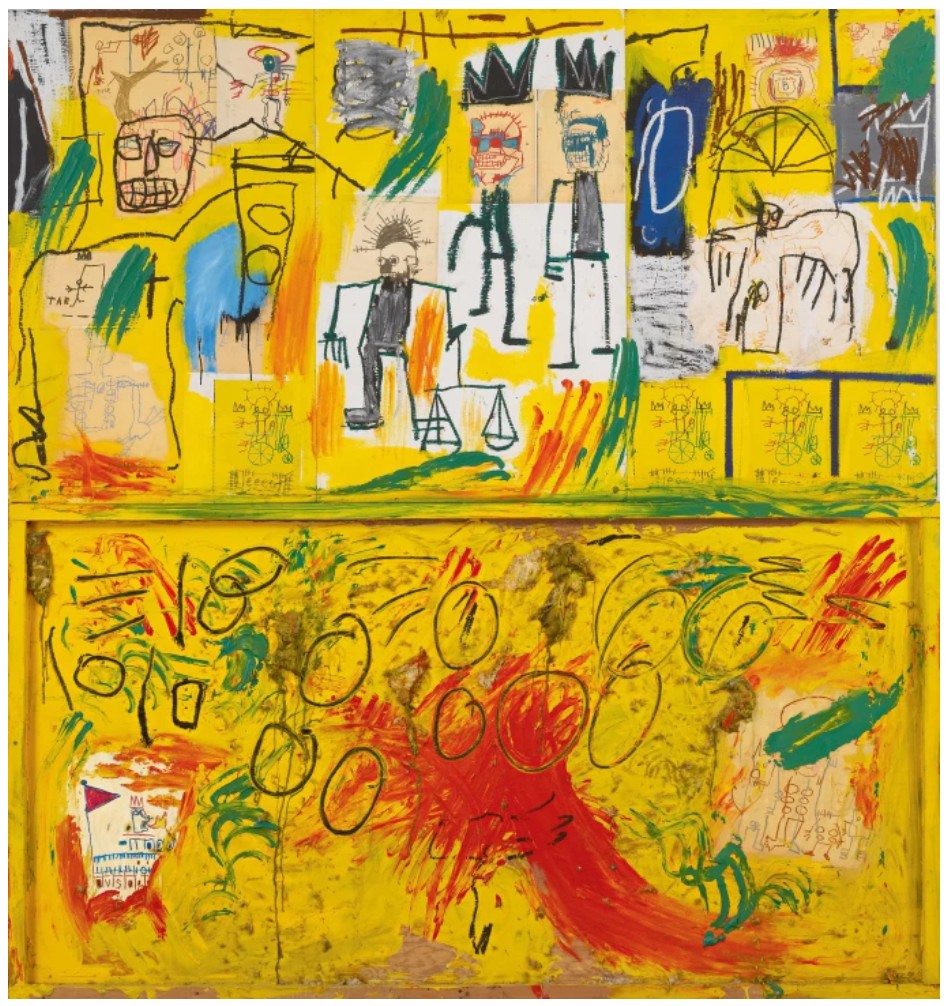
Jean Michel Basquiat, Untitled (Yellow tar and feathers), 1982
Sold for $25,925,000 in Sotheby’s New York, 13 November 2013, lot 10
Artwork: © Estate of Jean-Michel Basquiat. Licensed by Artestar, New York.
In the present work, one sees Basquiat’s hybrid approach to symbol, text, and image. The nature of a work on paoer is spontaneous, vulnerable and amplifies immediacy. The spontaneity of line, the layering of marks, the interplay between drawn image and written word all contribute to the work’s urgency. The composition does not resolve into harmony but holds together disparate signs, inviting interpretation while resisting closure. It is precisely this tension that has made Basquiat’s works on paper so resonant, offering a direct view into the restless energy of his imagination.
Seen within the context of his broader trajectory, Untitled encapsulates themes that Basquiat would continue to develop throughout his brief but fruitful career. The machine, the city, the crown, the language of breakdown and decay, the interplay of personal and collective histories are not incidental but foundational. Untitled is both a historical document and an artistic statement. It registers the pulse of 1981 New York, the tensions of modern life, and the brilliance of a young artist finding his form. At once playful and pressing, the present work exemplifies Basquiat’s ability to transform simple motifs into charged symbols of culture, identity and power.
Untitled (Indian Head), 1981
Sotheby’s London: 24 June 2025
Estimated: GBP 4,000,000 – 6,000,000
GBP 6,628,000 / USD 9,080,360
Untitled (Indian Head) | Modern & Contemporary Evening Auction | 2025 | Sotheby’s
JEAN-MICHEL BASQUIAT (1960 – 1988)
Untitled (Indian Head), 1981
Oilstick on paper
24 1/4 x 18 inches (61.6 x 45.8 cm)
Signed and dated 81 (on the verso)
Captivating in its electric immediacy, Untitled (Indian Head) is a superlative example from Jean-Michel Basquiat’s most celebrated and enduring motif, the iconic skull-like head. The Heads, shaped with corporal density and fervent expression, act as both self-portraits and icons, occupying a central place in his most acclaimed masterworks. Executed in 1981, the critical year which heralded his ascent from SAMO©, the street provocateur, to the prodigy of the mainstream art world – during which time he also began producing artworks under his own name – Untitled (Indian Head) powerfully asserts Basquiat’s instinctive and lauded abilities as one of the greatest draughtsmen of the twentieth century.
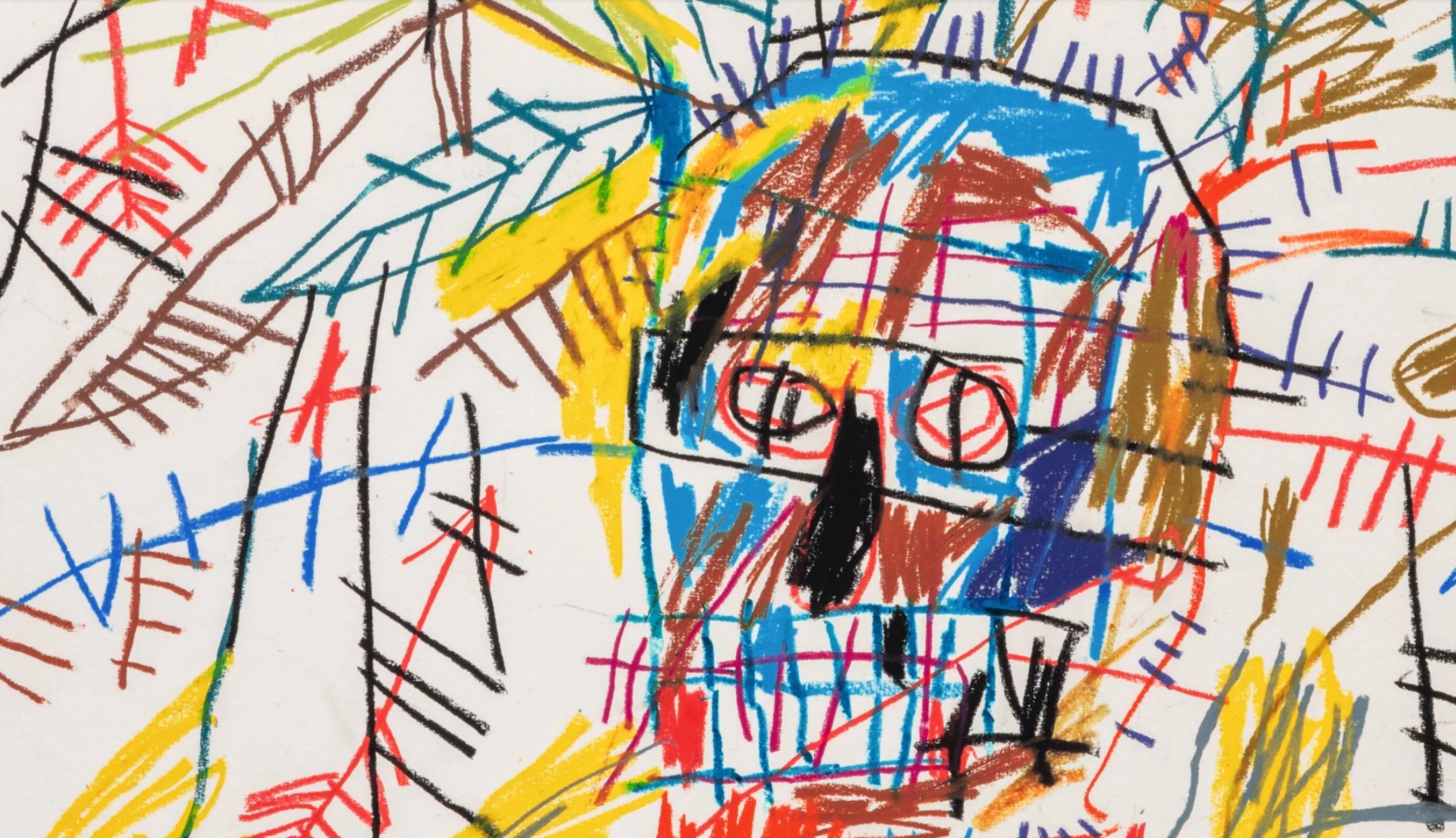
Here, in an explosion of vivid color and gestural fervor typical of his works on paper, the titular head is set against a flurry of arrows and crosshatches in a kaleidoscope of hues, pulsating with dynamic urgency. With exceptional fullness, the graphic intensity of the central figure is undeniably mesmerizing, its presence intensified by Basquiat’s frenzied application of oilsticks – red, orange, blue, yellow, teal, and black markings burst forth with expressionistic fervor. Encapsulating the incredible dexterity and draughtsmanship that defines the very best of the artist’s works, Untitled (Indian Head) is a heroic depiction that reflects the explosive talent and brilliance of its author.
Willem de Kooning, Abstraction, 1949-50. Museo Nacional Thyssen-Bornemisza, Madrid. Art
© The Willem de Kooning Foundation / DACS, London 2025
Numerous lines emerge from and surround the head in the present work – some resolve into the feathers of a war bonnet, others into flying arrows and tomahawks, while still others remain abstracted in crosshatches. Basquiat’s lexicon of cyphers and symbols in this work memorialises a similar visual strategy used by the First Nation cultures he references in the title: “the Indians used geometric forms in their paintings, figurines and masks. Here the head may be a circle, there a square and elsewhere a triangle… Thus forms do not represent appearances, but ideas” (Patrick Waldberg, quoted by Kirk Varnedoe in Exh. Cat., New York, Museum of Modern Art, Primitivism In 20th Century Art, vol. II, 1984, pp. 564-65).
Max Ernst, Unknown Gods, 1957. Museum Folkwang, Essen. Image: Bridgeman Images. © ADAGP, Paris and DACS, London 2025
The symbolic resonance of the present drawing cannot be overstated; Basquiat’s deep-rooted concerns about race, identity, and the accumulation of power and wealth are evident, and his repetitive layering transforms the arrow into a symbol replete with power, struggle and legacy. Coupled with the shamanistic skull and simultaneously connotative of centuries-old cave paintings and archery, the arrow has also long been used in cosmograms to signify direction and transformation. Thus, the present work can be seen as a depiction of a powerful warrior, a figure often used by Basquiat as a kind of self-portrait; dating to the early moment of 1981, amidst his meteoric rise to fame, Untitled (Indian Head) is thus a prescient proclamation of the artist’s grand ambitions.
In its appropriation of First Nation imagery, the present drawing formally recalls the work of early 20th century modernist Max Ernst, who, like Basquiat, drew inspiration from the myths and folklore of American, Latin, and Caribbean cultures. Ernst was deeply influenced by the Native American art and history he encountered in Sedona, Arizona, and the Southwest United States, where he lived with his wife, Surrealist painter Dorothea Tanning, between 1943 and 1957. In particular, the saturated hues his work adopted during this period can be directly traced to this influence; Basquiat likewise uses colour with symbolic intent. The colours of the Hopi (yellow and turquoise) Navajo (black, white, turquoise and yellow) and Apache (black, blue, yellow and white) peoples that influenced both artists are masterfully incorporated in the present work; Basquiat here stylizes his arrows in the native cultures’ colours to pay homage to these formative groups.
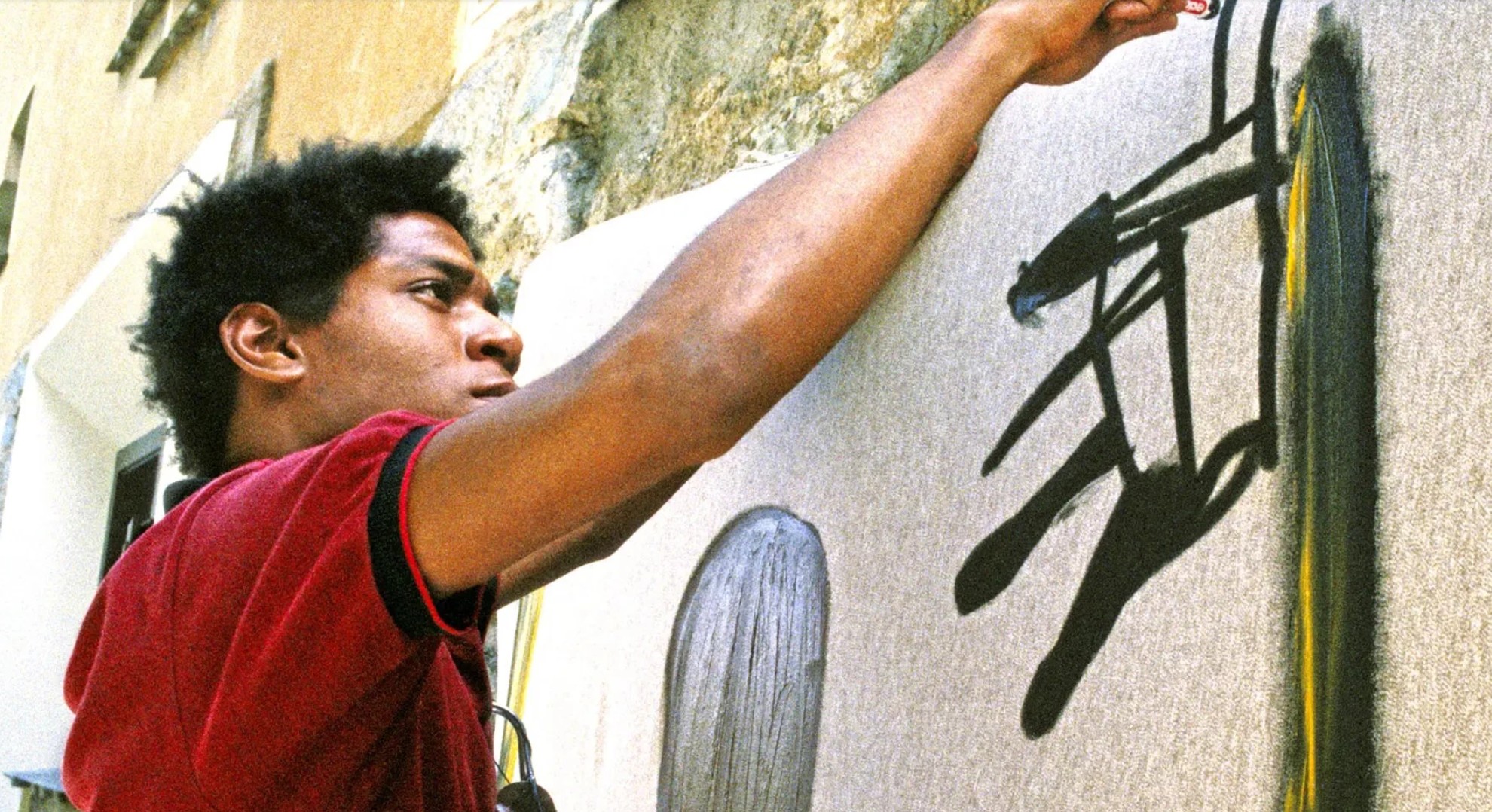
Jean-Michel Basquiat. Photo: Lae Jaffe/Getty Images
Evincing an intense scrutiny and breathtaking intimacy, Basquiat’s works on paper comprise a fundamental element of his prolific oeuvre and are essential to a comprehensive understanding of the diverse signs, symbols, and subjects which make up his staggeringly inventive output. Simultaneously appearing in frontal and three-quarters view, the head in the present work possesses a Cubistic multidimensionality. Slit-like pupils peer out of widened eye sockets while the figure’s jaw structure is rendered doubly in red and turquoise, making it appear as though the face is perhaps peering through a mask. This multilayered depiction of sight has been regarded by scholars such as Fred Hoffmann as a way to bridge the physical and the psychological.
Left: Pieter Claesz, Still Life with a Skull and a Writing Quill, 1628. The Metropolitan Museum of Art, New York
Right: Cy Twombly, Ferragosto IV, 1961. Private Collection. Art © Cy Twombly Foundation
The depiction of the mask-like head also represents Basquiat’s relentless exploration of cultural identity: the artist, who was born to a Haitian father and Puerto-Rican mother, often expressed his feelings of racialised otherness in a white-dominated art world. Basquiat’s use of the mask, a sacred object which historically functions in the Black diaspora as a mediator between the physical and spiritual realms, now becomes an unapologetic visual metaphor for black identity. Moreover, Basquiat makes further references to the vanitas paintings of the Old Masters through his usage of the iconic skull motif: invoking the symbolism of memento mori lends these forms preternatural potency as they channel anguished psycho-spiritual states of being. As Hoffman writes, “These figures are unsettling, leaving the viewer with the feeling that they exist in another realm. Peering out into our space, they are oracles conveying a message from another dimension” (Fred Hoffman, The Art of Jean-Michel Basquiat, New York, 2017, p. 79).
Andrea Manetegna, St. Sebastian, 1506. Galleria Giorgio Franchetti alla Ca’ d’Oro, Venice
The intensity and dynamism of Untitled (Indian Head) is largely indebted to Basquiat’s instinctive and idiosyncratic mastery of line. All the artist’s most celebrated works, whether ‘Heads’, ‘Warriors’ or text heavy masterpieces such as Hollywood Africans, are defined by his use of oilstick. Basquiat was always drawing, whether he was working on paper or canvas, and it is as a function of this that his works on paper became a cornerstone of his practice, privileged with a status far beyond the preparatory. As Hoffman again attests: “With the exception of Picasso, few acclaimed painters of the Twentieth Century invested the same time or energy to works on paper that is evidence in their painting. The search for pictorial solutions would have been fought out in front of the canvas. Yes, Twentieth Century painters drew and made masterful works in this medium, but drawing was always a secondary concern. For Basquiat, in contrast, there is often less of a distinction, in terms of intent, between working on paper and on canvas” (Op. cit., 2014, p. 33).
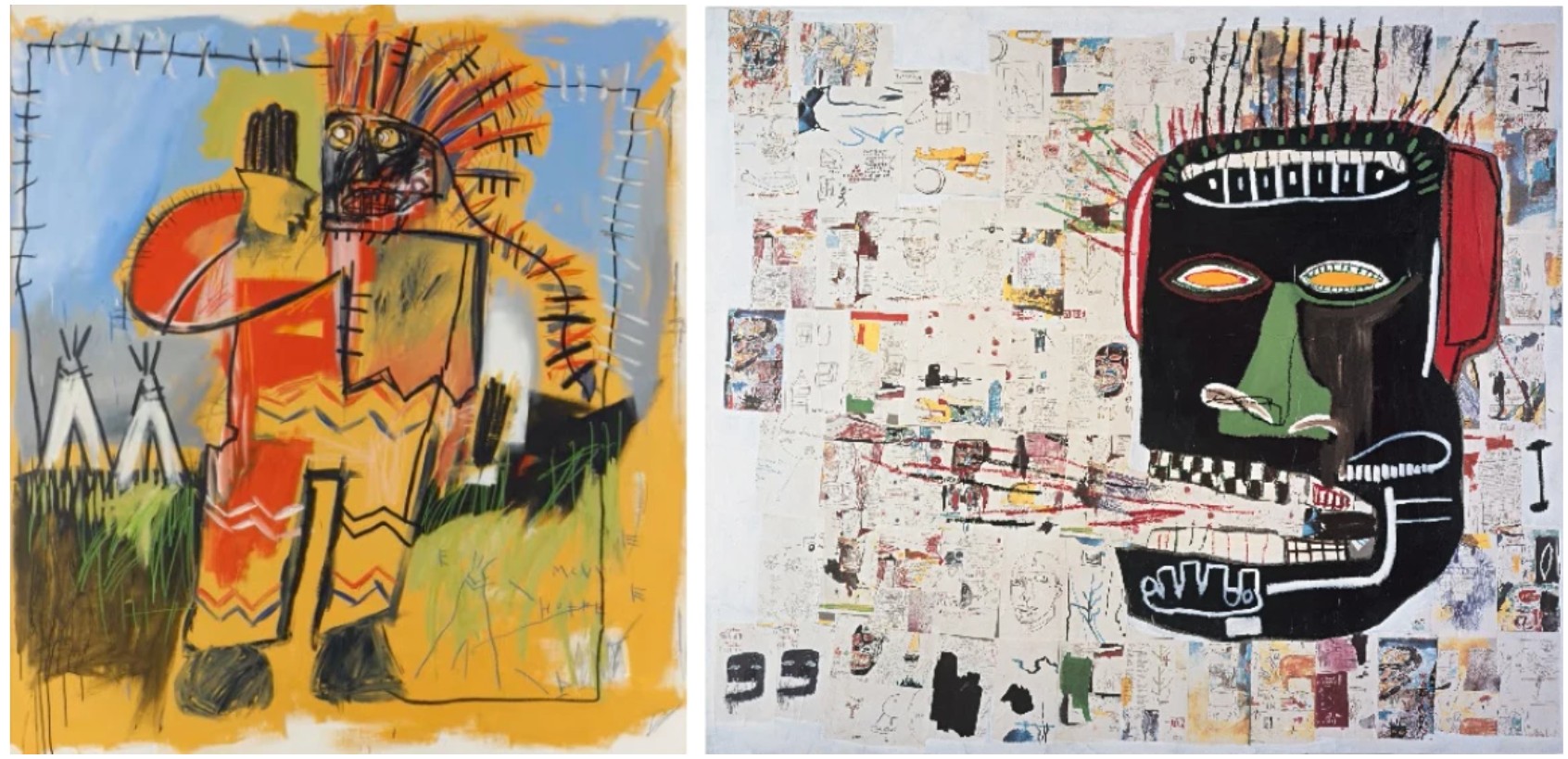
Left: Jean-Michel Basquiat, Tobacco Versus Red Chief, 1981-82. UBS Art Collection. Art © 2025 The Estate of Jean-Michel Basquiat / Licensed by Artestar
Right: Jean-Michel Basquiat, Glenn, 1984. Private Collection. Art © 2025 The Estate of Jean-Michel Basquiat Licensed by Artestar
From 1983, as collage became one of his principal media, Xerox-ed drawings from his studio would become the substrate for his paintings. Indeed, the present work reappears as a Xerox in later masterpieces on canvas such as Glenn from 1984, illustrated on the cover of the artist’s recent Taschen monograph. Without the possibility of correction through overpainting, the ferocity of Basquiat’s works on paper fuse the aggressive urgency of Willem de Kooning’s Women of the 1950s with the graphic ciphers of Cy Twombly’s Ferragosto suite, as vividly demonstrated by Untitled (Indian Head).
Vibrating with immediacy, consummate draughtsmanship and undeniable self-reflection, Untitled (Indian Head) is a masterful example of Basquiat’s revered corpus of works on paper. Capturing the expressive urgency of his street art origins, the visual voltage of the present work offers explicit reference to Basquiat’s idiom of the warrior figure that embodies the young artist’s fierce ascent to the heights of critical and commercial acclaim. With impassioned, almost compulsive vigour, the frenzied streaks of colour achieve a remarkably heightened power – with the present work, Basquiat delivers a fusion of internal and external sensory experiences with the electrifying force of a live wire.
Untitled, 1981
Sotheby’s New-York: 15 May 2025
Estimated: USD 10,000,000 – 15,000,000
USD 16,365,000
WORK ON PAPER
Untitled | The Now and Contemporary Evening Auction | 2025 | Sotheby’s
JEAN-MICHEL BASQUIAT (1960 – 1988)
Untitled, 1981
Oilstick on paper
50 1/4 x 63 7/8 inches (127.6 x 160 cm)
Signed (on the reverse)
An incendiary image of warrior, deity, artist, and hero erupts in technicolor in Untitled from 1981, in which Jean-Michel Basquiat prophetically manifests the invention, innovation, and staggering appetite for creation that would drive the rest of his career. Executed in 1981, the critical year which heralded his ascent from SAMO ©, the street provocateur, to the prodigy of the mainstream art world—during which time he also began producing artworks under his own name—Untitled powerfully asserts the clairvoyant vision of a figure predicting their own victory: aflame, unblinking, and crowned with a triumphal laurel wreath. Spanning more than five feet in width, the composition swells with the sheer enormity of the sheet, so heavily and repeatedly worked that it bears the full-throttle voltage of the artist’s best paintings. Treasured for more than three decades in the same private collection and virtually unseen by the public since its acquisition in 1989, Untitled stands vivid and alive, as vital now as it was at the moment of execution. Here, at just twenty years of age, Basquiat encodes Untitled with a kind of hieroglyphic power as he composes a mythology of his own invention, and, in doing so, simultaneously reifies and anticipates one of his most iconic proclamations: “I’m not a real person. I’m a legend.” (Jean-Michel Basquiat quoted in: Anthony Haden-Guest, “Burning Out”, Vanity Fair, November 1988, p. 197)
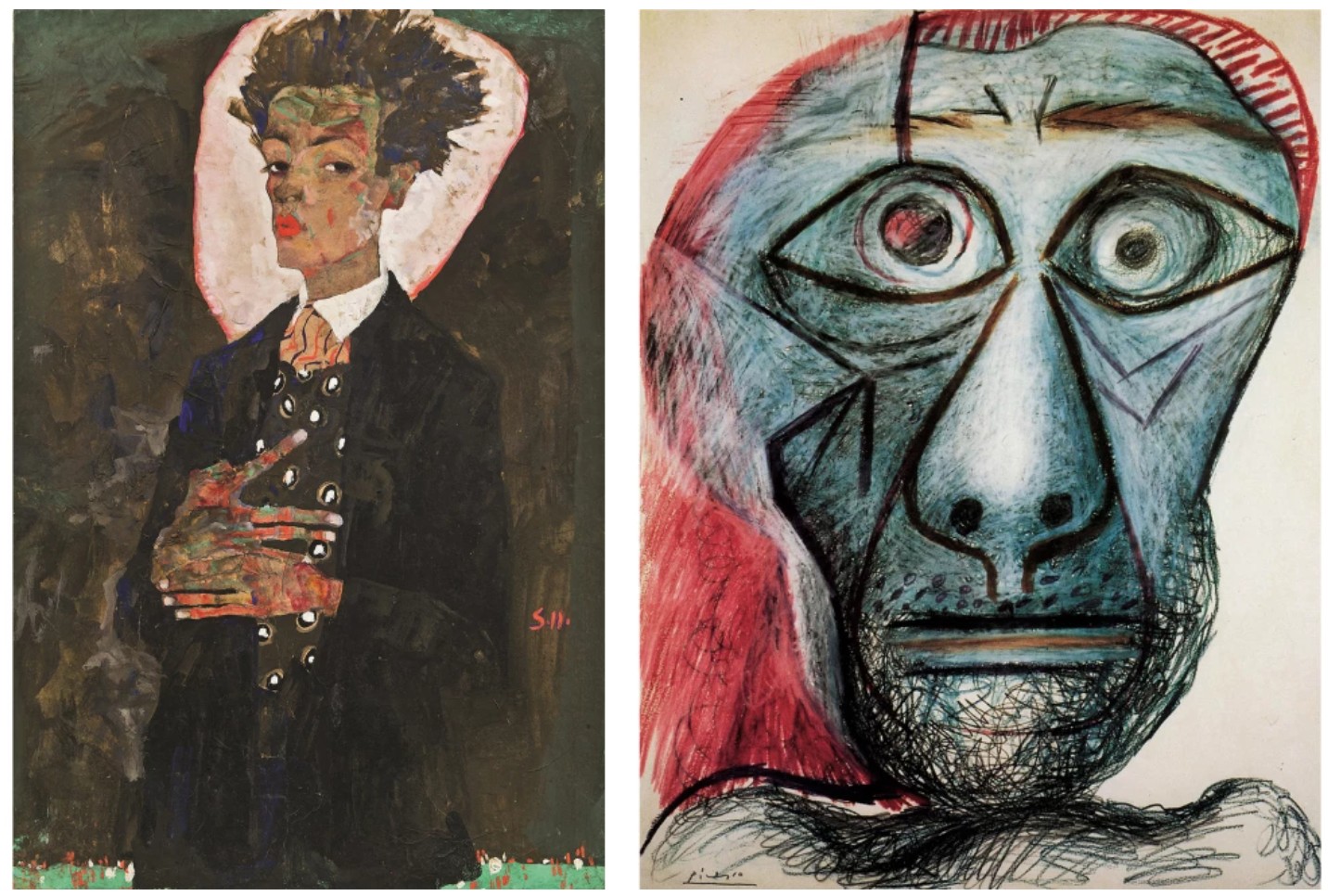
Left: Egon Schiele, Self-Portrait with Peacock Waistcoat, Standing, 1911. Private Collection. Image © Fine Art Images / Bridgeman Images. Right: Pablo Picasso, Self Portrait Facing Death, 1972. Fuji Television Gallery, Tokyo. Image © Fine Art Images / © Succession Picasso/DACS, London 2025 / Bridgeman Images. Art © 2025 Estate of Pablo Picasso / Artists Rights Society (ARS), New York
At the very core of Basquiat’s electric yet calamitously brief career was a spectacularly lucid iconographical infrastructure, one anchored by the signs and signals through which Basquiat communicated his worldview and personal history. Untitled sees Basquiat wrestle with the symbolic vernacular he would engage and expand throughout his career, among them antiquity and the self. Layer upon frenzied layer of emerald, vermilion, and turquoise oilstick burst forth like both flames and feathers, spraying a resplendent, chromatic kaleidoscope onto the ivory field of Basquiat’s sheet. With its clawed fingers, the lone figure resembles Aztec depictions of Quetzalcoatl, the feathered serpent god of creation and knowledge, while his outstretched arm compositionally echoes God’s posture in Michelangelo’s The Creation of Adam—both symbolic representations of the inception of man. Through these themes Basquiat tapped into the raw and unconcealed, exuding a palpable sense of confidence as he fashions a singularly victorious creature, perhaps alluding to a vision of his own future and legacy: a man on the verge of stardom, reborn as artist and icon. Around the figure Basquiat plots gauges, compasses, and charts, all of which are so furiously articulated they read like a frenzied oracle for his future, like a speedometer revealing Basquiat’s creative force accelerating beyond measure, malfunctioning in the face of Basquiat’s caustic, chaotic, and revolutionary pictures. 1981 represented a moment of meteoric rise and catalytic change for Basquiat. Executed in the throes of this metamorphosis, Untitled is legible as a parable of this transformation and the celebrity that would follow in 1982.
Untitled, 1981
Sotheby’s New-York: 16 May 2025
Estimated: USD 700,000 – 900,000
USD 660,400
Untitled | Contemporary Day Auction | 2025 | Sotheby’s
JEAN-MICHEL BASQUIAT (1960 – 1988)
Untitled, 1981
Oil stick on paper
20×22 inches (50.8 x 55.9 cm)
Signed (on the reverse)
Accompanied by a certificate of authenticity
Issued by the Authentication Committee of the Estate of Jean-Michel Basquiat
Executed in the catalytic year of 1981, Untitled captures a moment of raw, electrifying genesis in Jean-Michel Basquiat’s meteoric ascent from downtown street provocateur to international art icon. Rendered in his signature oil stick on paper, the composition distills many of the core visual motifs that would come to define his brief yet seismic career. The skeletal head, contorted in an expression of ecstatic aggression, is unmistakably Basquiat—simultaneously grotesque and magnetic, gesturing toward both anatomical study and symbolic mask. Yet what distinguishes this particular work is not only its early articulation of the now-mythic iconography of the skull and crown, but also its incorporation of a detailed, exaggerated anatomical hand—an element rarely seen in isolation and handled here with fierce urgency.
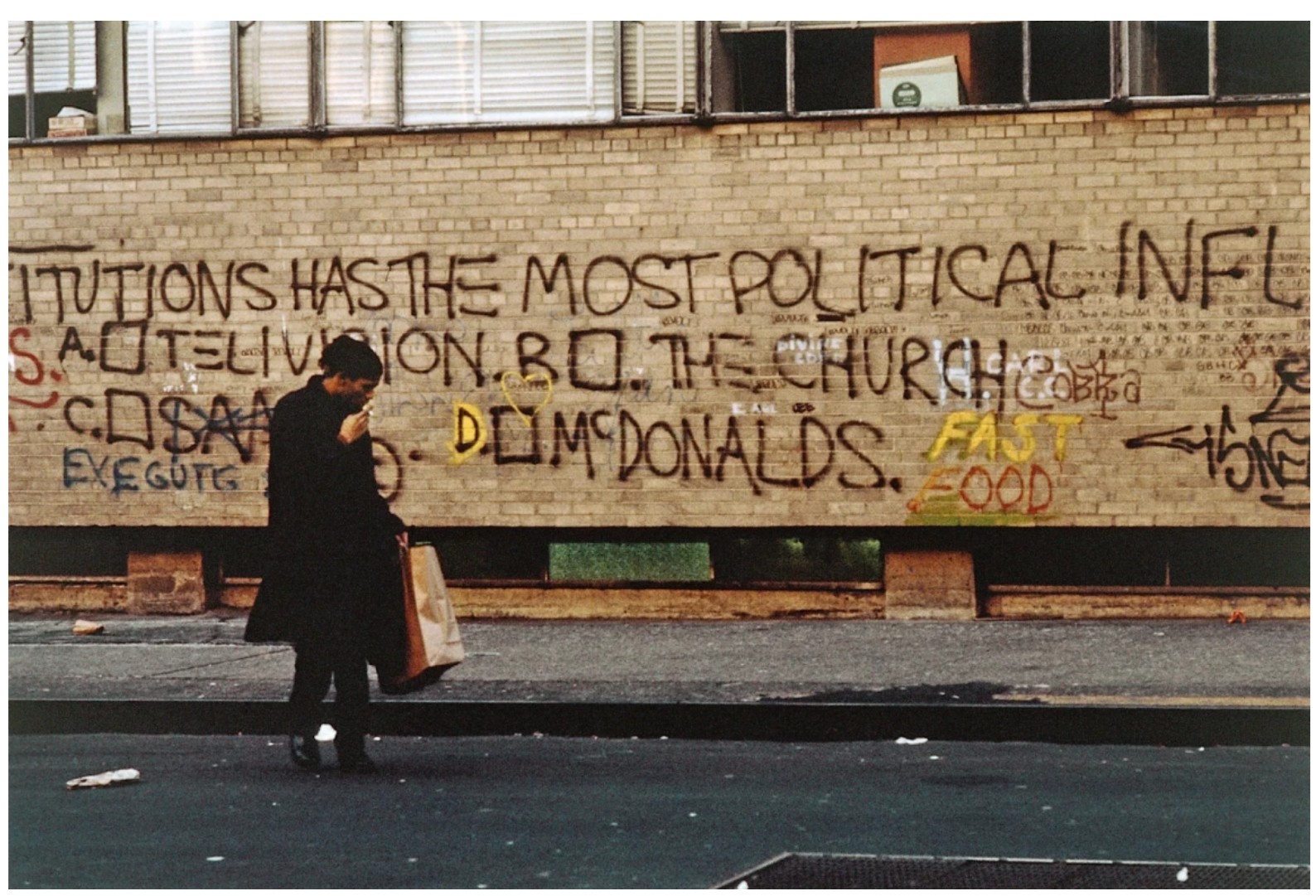
Jean-Michel Basquiat on the set of Downtown 81. Photo © Edo Bertoglio
Untitled emerges from a critical turning point in Basquiat’s practice: the year he transitioned from the peripheries of New York’s art world into its very center. 1981 marked the year of many exhibitions that brought Basquiat into the spotlight, including Diego Cortez’s watershed “New York/New Wave” show at MoMA PS1, and his debut solo exhibition later that year in Modena, Italy. This was also the period in which Basquiat began consistently exploring human anatomy, drawing from both textbook illustrations and the visceral traditions of Renaissance and Baroque medical diagrams. In this light, the inclusion of the hand—each finger articulated with rhythmic loops and calligraphic contour—serves as both corporeal symbol and expressive cipher. It reaches upward, grasping toward the figure of the skull, merging the living and the dead in one.
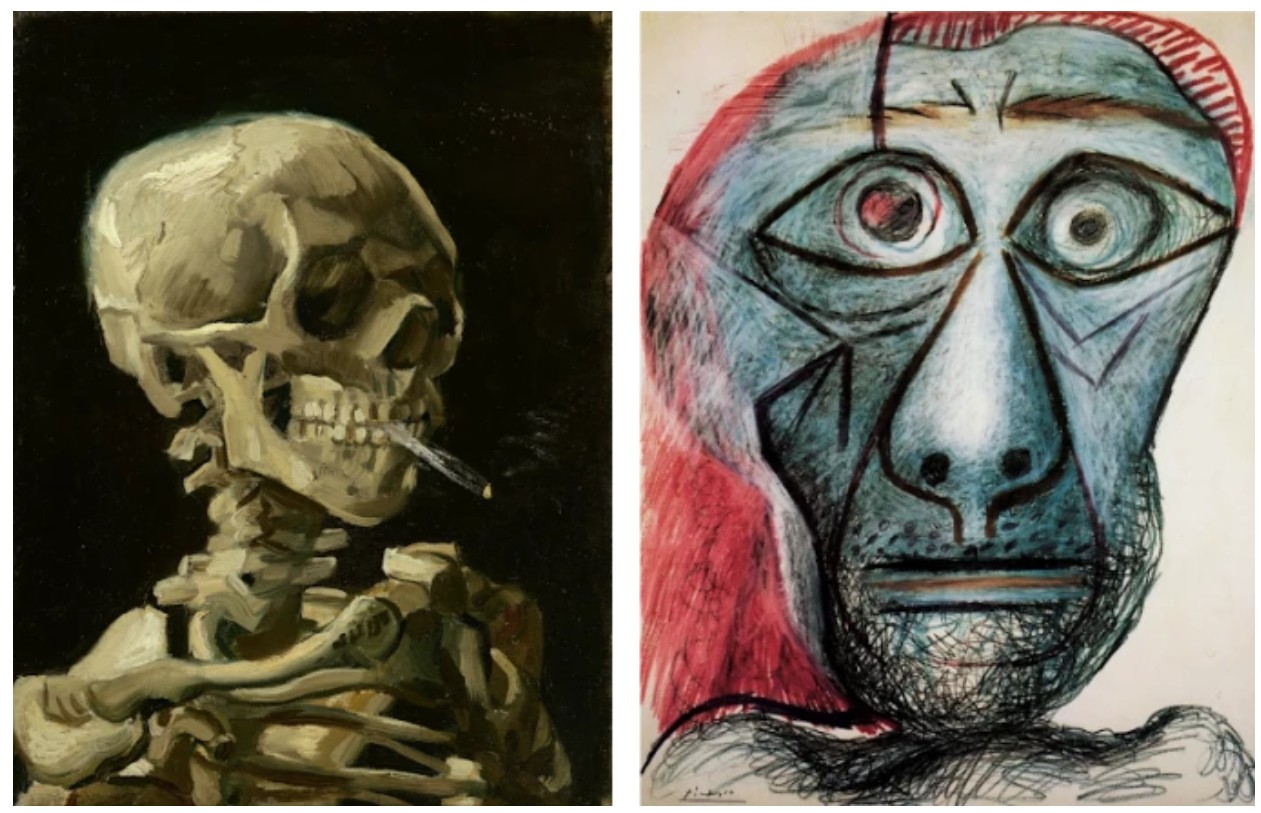
Left: Vincent van Gogh, Head of a Skeleton with a Burning Cigarette, 1886. Van Gogh Museum, Amsterdam.
Right: Pablo Picasso, Self Portrait Facing Death, 1972. Fuji Television Gallery, Tokyo. Art © 2025 Estate of Pablo Picasso / Artists Rights Society (ARS), New York
The head itself—distorted, howling, divided into compartments—resonates with the fractured identity that Basquiat explored throughout his oeuvre. His treatment of the skull, an enduring motif drawn equally from African masks, jazz iconography, and anatomical charts, here functions as a cipher for multiple identities: blackness and whiteness, beauty and decay, knowledge and madness. With elements of the visage abstracted into geometric forms—a lattice grid over the ear, expressive gashes suggesting both violence and exultation—Basquiat presents a diagram of the psyche, not merely a likeness. As in his most powerful heads of this period, the face is both portrait and mask, a double exposure of interior truth and exterior performance.
Notably, the crown—here represented in suggestive linear marks and rhythmic dashes above the skull—makes an embryonic appearance. It foreshadows what would soon become Basquiat’s most iconic symbol: a three-pointed halo of authority, majesty, and martyrdom. In 1981, these symbols had not yet hardened into canon; they were in flux, volatile and potent, raw emblems forged in real time. In Untitled, we witness the very moment of their formation, the volatile aesthetic and cultural energies condensing into a lexicon that would echo across contemporary art for decades.
Paul Cézanne, Pyramid of Skulls, c. 1901. Private Collection.
Executed with confident immediacy, Untitled is a pure distillation of Basquiat’s graphic power. The artist’s deft use of oil stick—a medium he favored for its tactile intensity and drawing immediacy—imbues the surface with a visceral physicality. The irregularities of pressure, the erratic linework, the ghostly smudging around the jaw and throat all speak to the urgency of the act of creation. Like a jazz solo or a spontaneous poem, the drawing exists in a suspended moment between control and chaos. In its synthesis of emerging iconography and rare anatomical detail, Untitled stands as a signal work from a pivotal year in Basquiat’s career. It embodies the restless intelligence and radical self-invention that would come to define his legacy. More than a preparatory sketch or study, the work is a standalone expression of Basquiat’s fully formed visual language—direct, unfiltered, and incandescent with meaning.
Untitled, 1978
Sotheby’s New-York: 16 May 2025
Estimated: USD 100,000 – 150,000
USD 444,500
Untitled | Contemporary Day Auction | 2025 | Sotheby’s
JEAN-MICHEL BASQUIAT (1960 – 1988)
Untitled, 1978
Ink on paper
Sight: 9 3/4 x 8 inches (24.8 by 20.3 cm)
Sheet: 13 7/8 x 11 inches (35.2 by 27.9 cm)
Accompanied by a certificate of authenticity
Issued by the Authentication Committee of the Estate of Jean-Michel Basquiat
Executed when Jean-Michel Basquiat was just eighteen years old, Untitled from 1978 is a rare and revelatory early work that foreshadows the explosive visual vocabulary that would come to define his mature career. Rendered in a continuous, trembling line with a ballpoint pen, the drawing captures a distorted, composite head—a subject that would become a cornerstone of Basquiat’s iconography and a key vehicle for his exploration of identity, intellect, race, and inner life. As one of the earliest known depictions of the head in Basquiat’s oeuvre, Untitled offers a crucial entry point into a motif that would remain central throughout his life. From early notebook drawings to his monumental canvases of the 1980s, the head served as a recurring site of meaning: an index of intellect and agency, a mask, a skull, a battlefield of historical memory. In later works, heads would appear crowned, x-rayed, diagrammed, or flayed—simultaneously heroic and haunted.
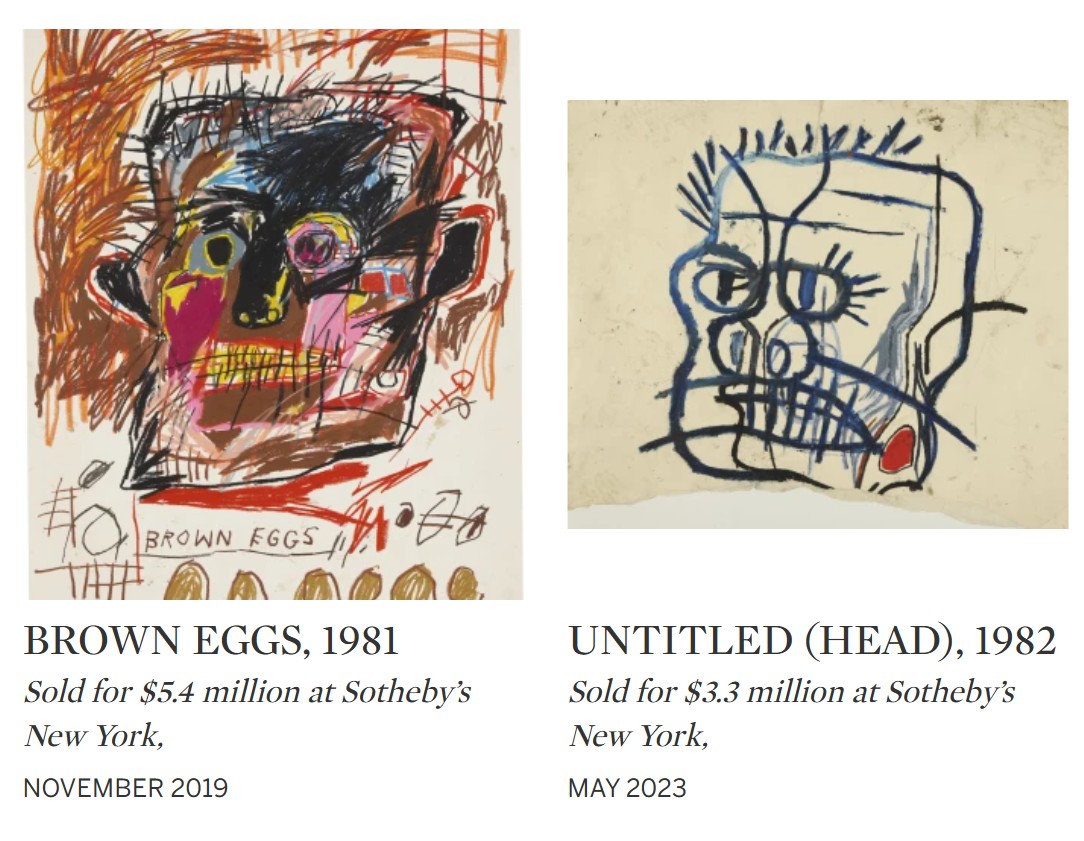
Even in its nascent form, the head in Untitled reveals Basquiat’s preternatural command of expressive mark-making and formal improvisation. The figure is both schematic and charged with psychological density: a jagged profile is superimposed with bulging lips, exposed teeth, clenched fists, tubes, and spirals. The lines pulse with nervous energy, coiling and unspooling into an almost anatomical delirium. Spectacles sit askew above a fractured nose, while internal mechanisms—reminiscent of musculature, wiring, or dental work—evoke both the physical and symbolic complexity of the human figure. This is not a likeness but an x-ray of consciousness: unfiltered, restless, and deeply alive.
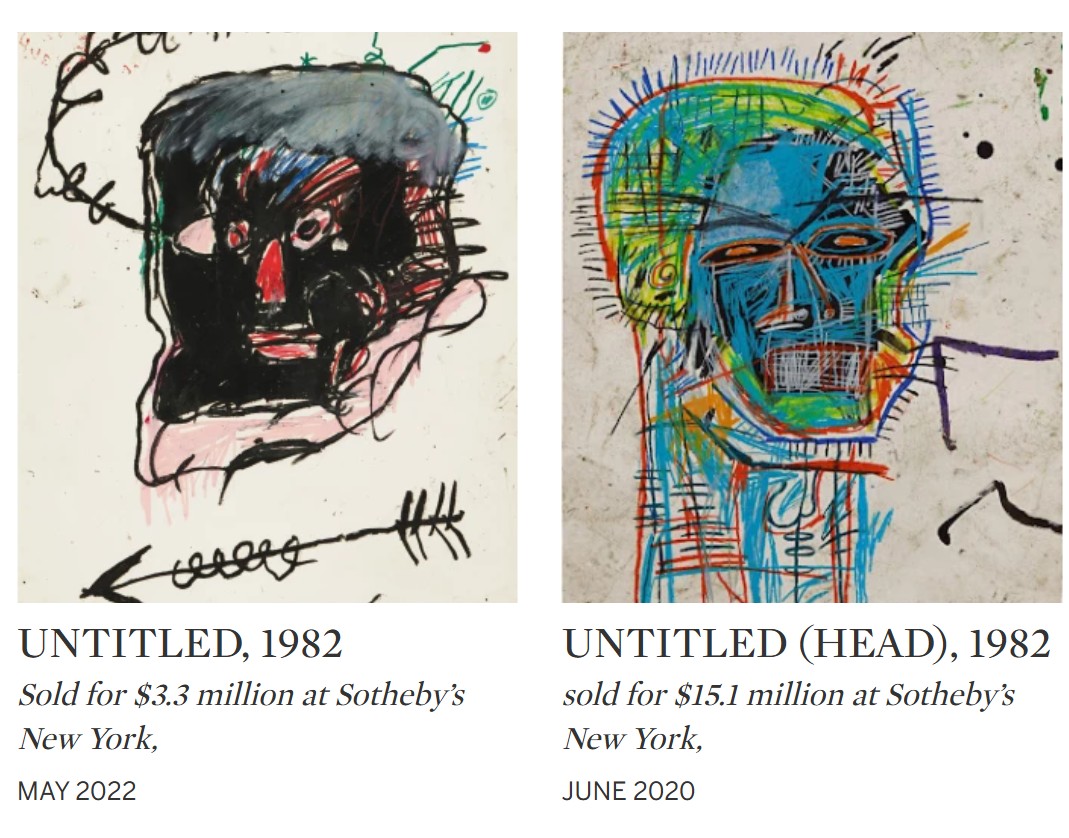
Jean-Michel Basquiat’s skull motif is one of his most iconic and enduring symbols throughout his meteoric rise to cultural and critical acclaim. The symbol of the skull reflects Basquiat’s deep engagement with themes of identity, mortality, and the African diaspora. Often depicted in a raw, almost anatomical style, the skull is not just a memento mori but a complex representation of Black life and struggle. In works like Untitled, Basquiat blends energetic draftsmanship, using the skull to confront the viewer with the realities of death, history, and cultural erasure. Entirely fresh to the market, this early example by Basquiat has never before appeared at auction, having been directly acquired from the artist the very year it was created. It resided in the same private collection for over twenty years, making this an exceedingly rare and prescient example of Basquiat’s genius.
Untitled, 1981
Christie’s London: 6 March 2025
Estimated: GBP 300,000 – 500,000
GBP 466,200 / USD 596,736
JEAN-MICHEL BASQUIAT (1960-1988), Untitled | Christie’s
JEAN-MICHEL BASQUIAT (1960-1988)
Untitled, 1981
Oilstick on paper
42 3/8 x 27 1/2 inches (100.3 x 70 cm)
Signed, inscribed and dated ‘SAMO © MODENA 1981’ (on the reverse)
Created on a formative visit to Modena, Italy, in 1981, the present work is an animated and effusive vision from Jean-Michel Basquiat. Across a large cream surface, Basquiat illustrates a medley of motifs drawn from both Classical antiquity and his contemporary world. A fluted column topped with a laurel wreath—a nod to ancient Greco-Roman architecture—stands next to a roadworks barricade, the clash of old and new evoking the layered histories of the city. Rendered in Basquiat’s characteristic oilstick, the palette is vivid, each color bursting off the paper with vivacious intensity. A trio of yellow faces and an alien-like green head gather over the scene, like figures on a billboard. The picture holds what critic Cathleen McGuigan referred to as the ‘seemingly contradictory forces’ that define so much of Basquiat’s art: ‘control and spontaneity, menace and wit, urban imagery and primitivism’ (C. McGuigan, ‘New Art, New Money’, New York Times, 10 February 1985, p. 20). It has been held in the same private collection for almost three decades.
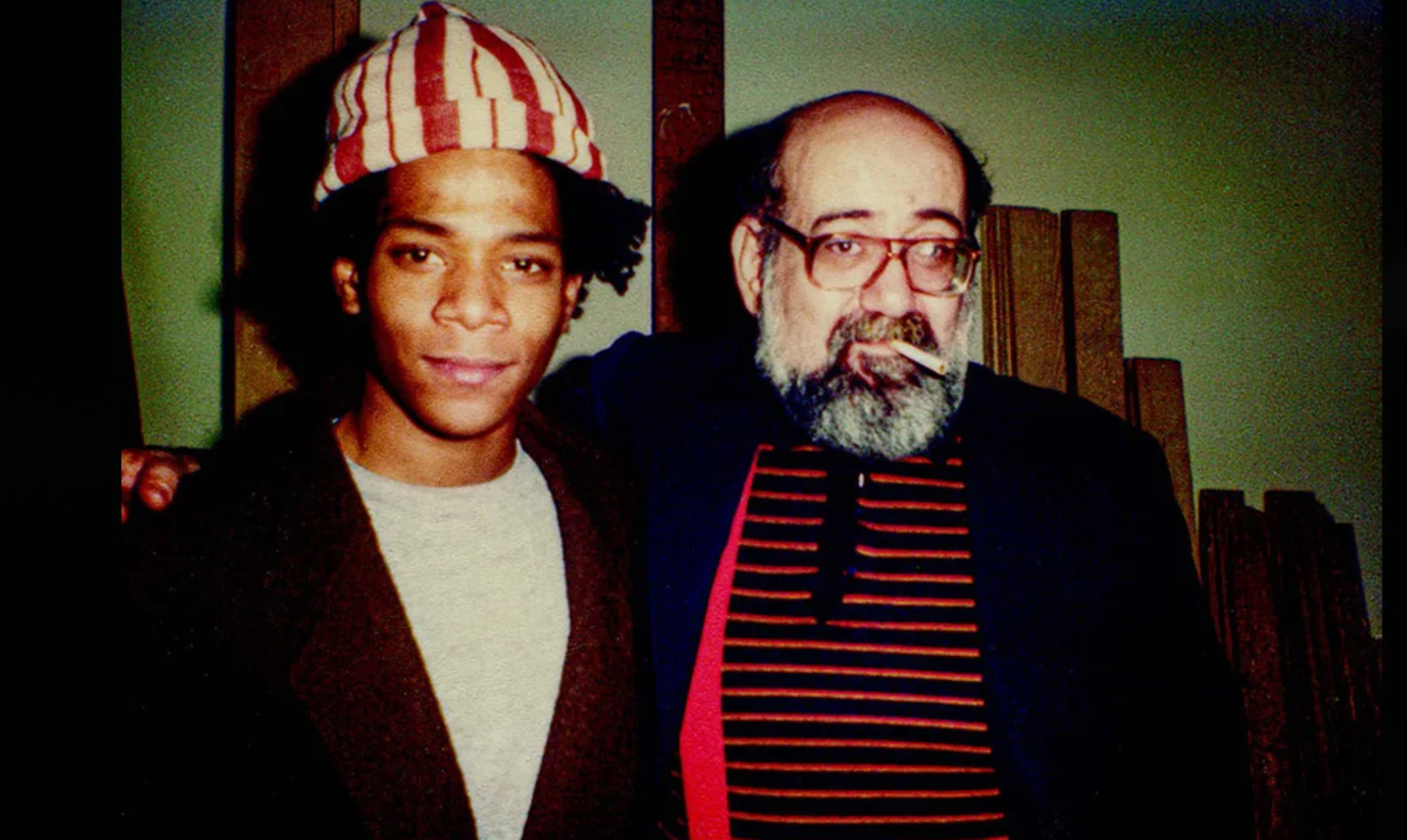
Jean-Michel Basquiat and Emilio Mazzoli, 1981. Photographer unknown.
In the wake of his participation in the now legendary Times Square Show in 1980, Basquiat was invited by the curator Diego Cortez to exhibit at P.S. 1 Contemporary Art Center in Queens. New York/New Wave opened in 1981, featuring more than twenty of Basquiat’s drawings and paintings, which were installed alongside works by Andy Warhol, Keith Haring, and Robert Mapplethorpe, among others. Basquiat’s contribution was enthusiastically received, and Cortez began to discuss the organization of a future exhibition with Emilio Mazzoli, whose gallery was located in Modena. That spring, Mazzoli came to New York and, after viewing Basquiat’s most recent compositions, bought several works. The plan for a solo show at Galleria Mazzoli quickly came together.
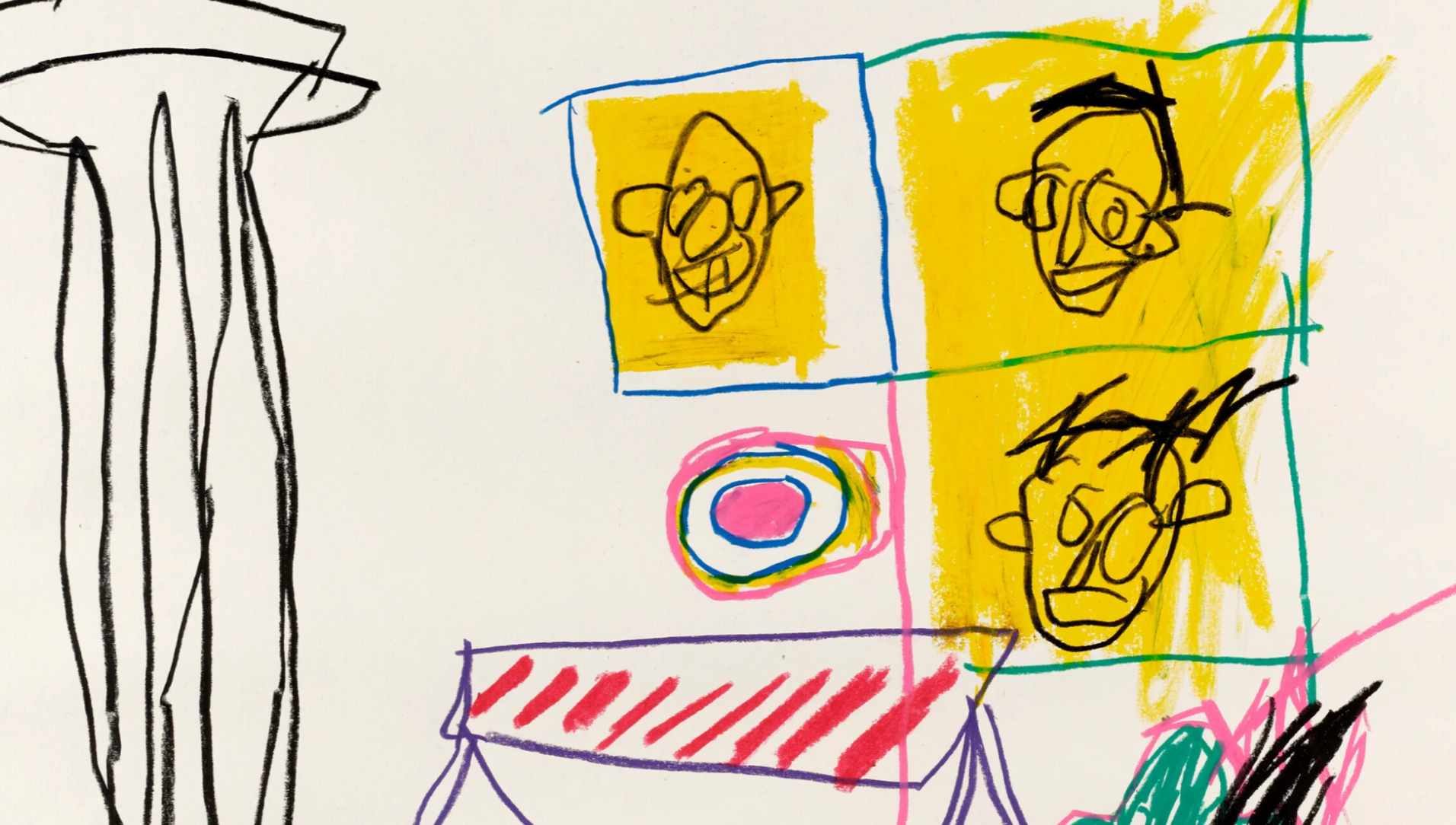
In May, Basquiat travelled to Modena. It was the first time he had been to Europe. He made drawings and paintings there, showing his art under his tag SAMO: the reverse of the present work is inscribed ‘SAMO © MODENA 1981’. Italy must have been fascinating for an artist so transfixed by history. Back in New York, Basquiat spent his days examining artefacts at The Metropolitan Museum of Art, trawling through encyclopaedias, and reading up on his artistic predecessors. Although decidedly of his era, Basquiat kept an eye firmly rooted in the past, and in both oil paint and oilstick, he captured the many ways that history made itself known within his own life.
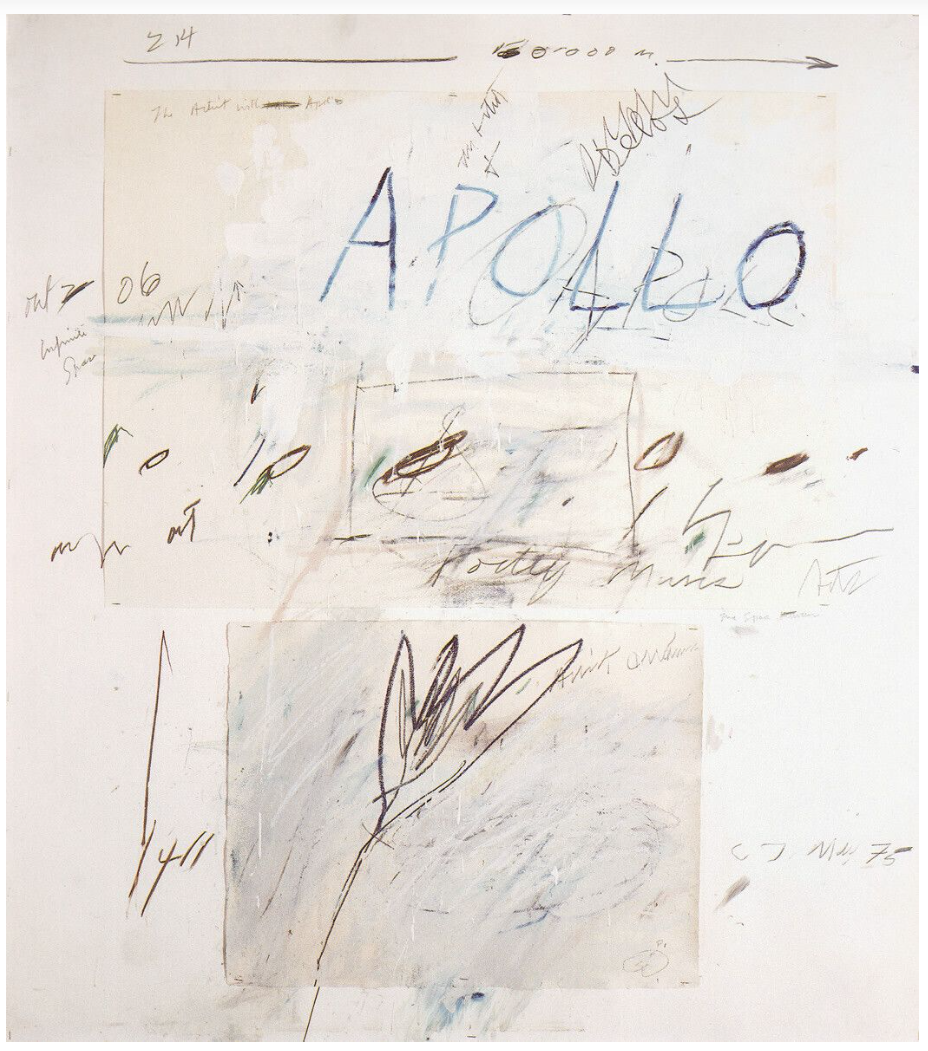
Cy Twombly, Apollo and the Artist, 1975. Artwork: © Cy Twombly Foundation.
In 1982, Basquiat would again travel to Modena to prepare for a second exhibition at the Galleria Mazzoli. There he painted a cycle of eight monumental canvases which, like the present work, juxtapose Classical imagery with contemporary motifs. The 1982 exhibition was never realized, and the works were subsequently scattered across the globe. In 2023, the Modena paintings were finally reunited and shown together in a landmark exhibition at the Fondation Beyeler, Basel. These two visits to Italy were transformative for Basquiat, who was swiftly becoming an international celebrity. His life had forever changed and works such as the present capture the urgency and excitement of this experience, one that was only just beginning to gather strength.
Untitled, 1981
Sotheby’s New-York: 20 November 2024
Estimated: USD 1,800,000 – 2,500,000
USD 2,100,000
Untitled | The Now and Contemporary Evening Auction | 2024 | Sotheby’s
JEAN-MICHEL BASQUIAT (1960 – 1988)
Untitled, 1981
Oilstick on paper
11 7/8 x 17 7/8 inches (30.2 x 43.2 cm)
A human skull is rendered with searing intensity in Jean-Michel Basquiat’s Untitled, embodying the prodigious brilliance that propelled Basquiat’s meteoric ascent from his street art origins to international stardom in the first year of his career. Executed in 1981, the present work is a stunning early representation of Basquiat’s most acclaimed motif, the skull-like head, evincing the vigorous drawing practice at the core of the artist’s oeuvre on an intimate scale. Talismanic in its potency, the skull functioned for Basquiat as both idiosyncratic self-portrait and shamanistic totem, serving as a primary graphic anchor throughout his practice.
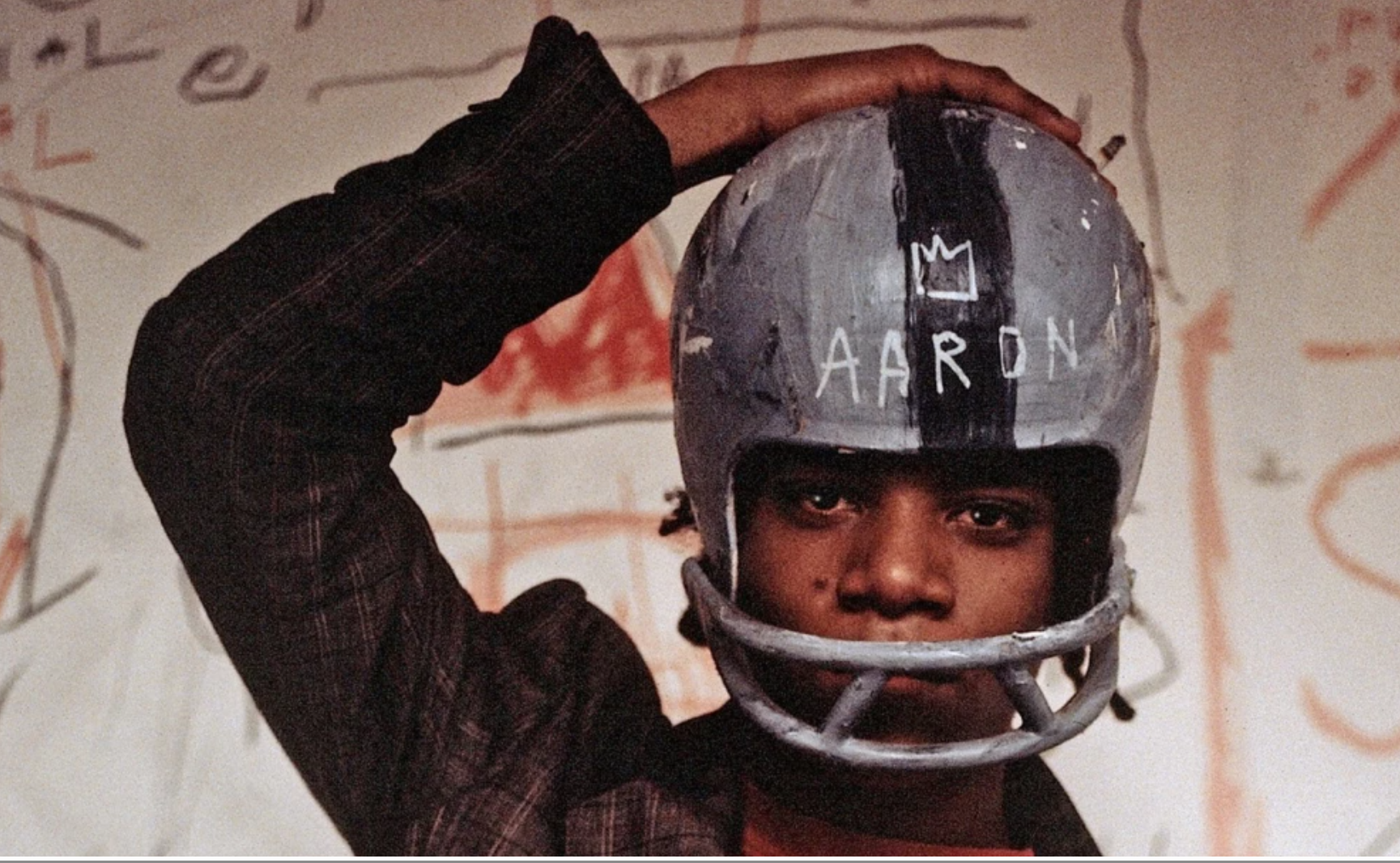
Testifying to its significance within Basquiat’s prolific output, Untitled bears an extensive exhibition history, including the critically acclaimed 2018-19 exhibition Jean-Michel Basquiat held at Fondation Louis Vuitton, Paris and the 2019 exhibition Jean-Michel Basquiat: Œuvres sur Papier at the Château La Coste in Provence. A consummate and riveting example of Basquiat’s early works on paper, Untitled embodies the artist’s innate ability to distill angst into visual dynamism and his newfound maturity as a deftly skilled draftsman.
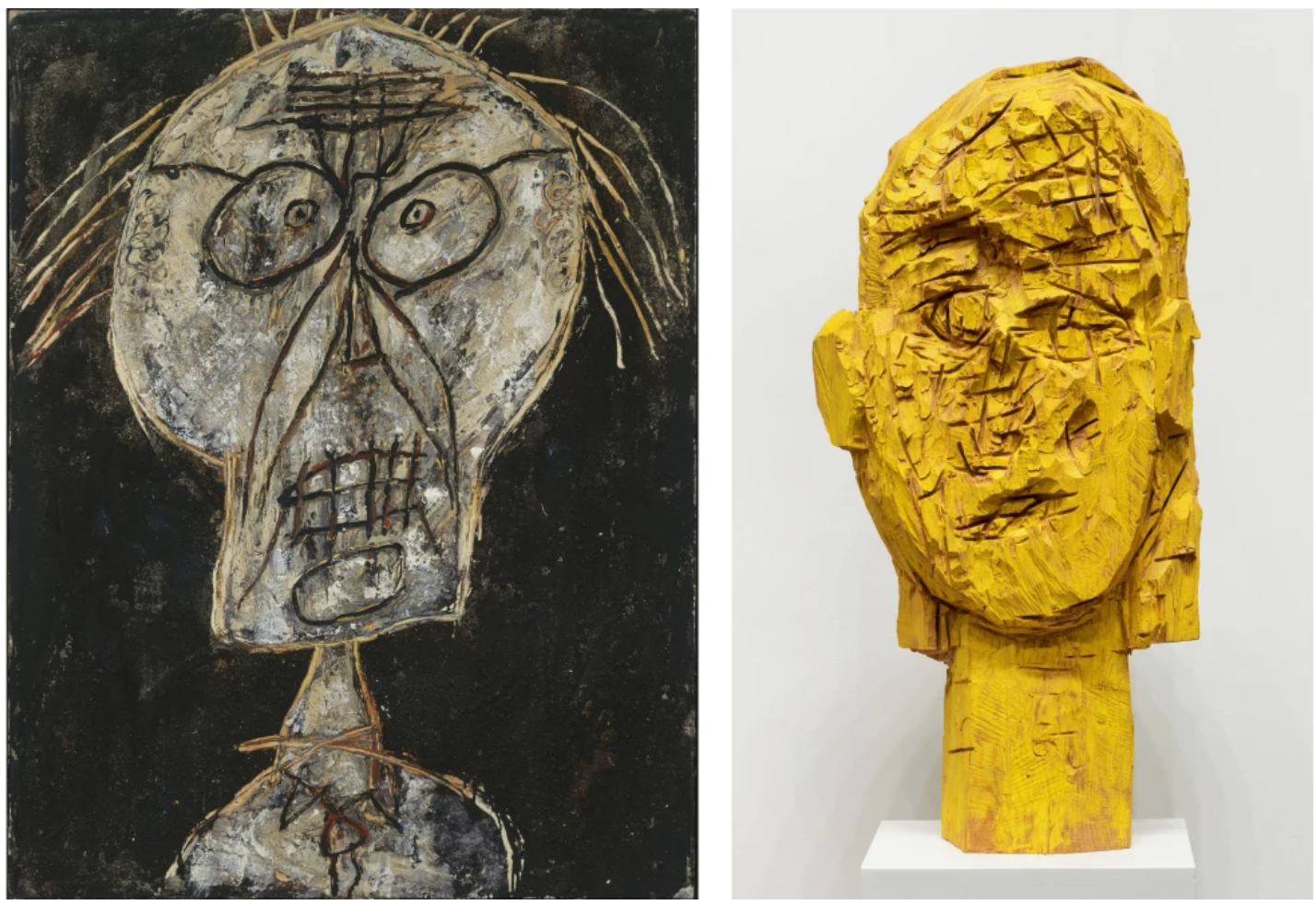
Left: Jean Dubuffet, Dhôtel shaded with apricot, 1947. Musée National d’Art Moderne/Centre Georges Pompidou, Paris. Image © CNAC/MNAM, Dist. RMN-Grand Palais / Art Resource, NY. Art © 2024 Artists Rights Society (ARS), New York / ADAGP, Paris. Right: Georg Baselitz, Dresdner Frauen – Besuch aus Prag (Women of Dresden – Visit from Prague), 1990. Sold at Sotheby’s New York in May 2022 for $11.2 million. Art © Georg Baselitz 2024
Articulated in Basquiat’s characteristically expressionistic scrawl, a ghost-like skull appears in Untitled simultaneously in frontal and three-quarters view, employing a Cubist style of multidimensionality. Set against writhing scribbles of red, orange, and yellow, the skull pulsates with a dynamic urgency that is just as much a study in chromatic variegation as it is in expressive line. The eye sockets, some of the teeth, and part of the jawbone luster in a luxurious gold while outlines of the skull’s bones gleam in silver, hinting at the influences and motifs lying in Basquiat’s mind; the alchemical color of these rare metals suggest a certain regality of kings while simultaneously the bright and eye-catching hues of metallic spray paint.
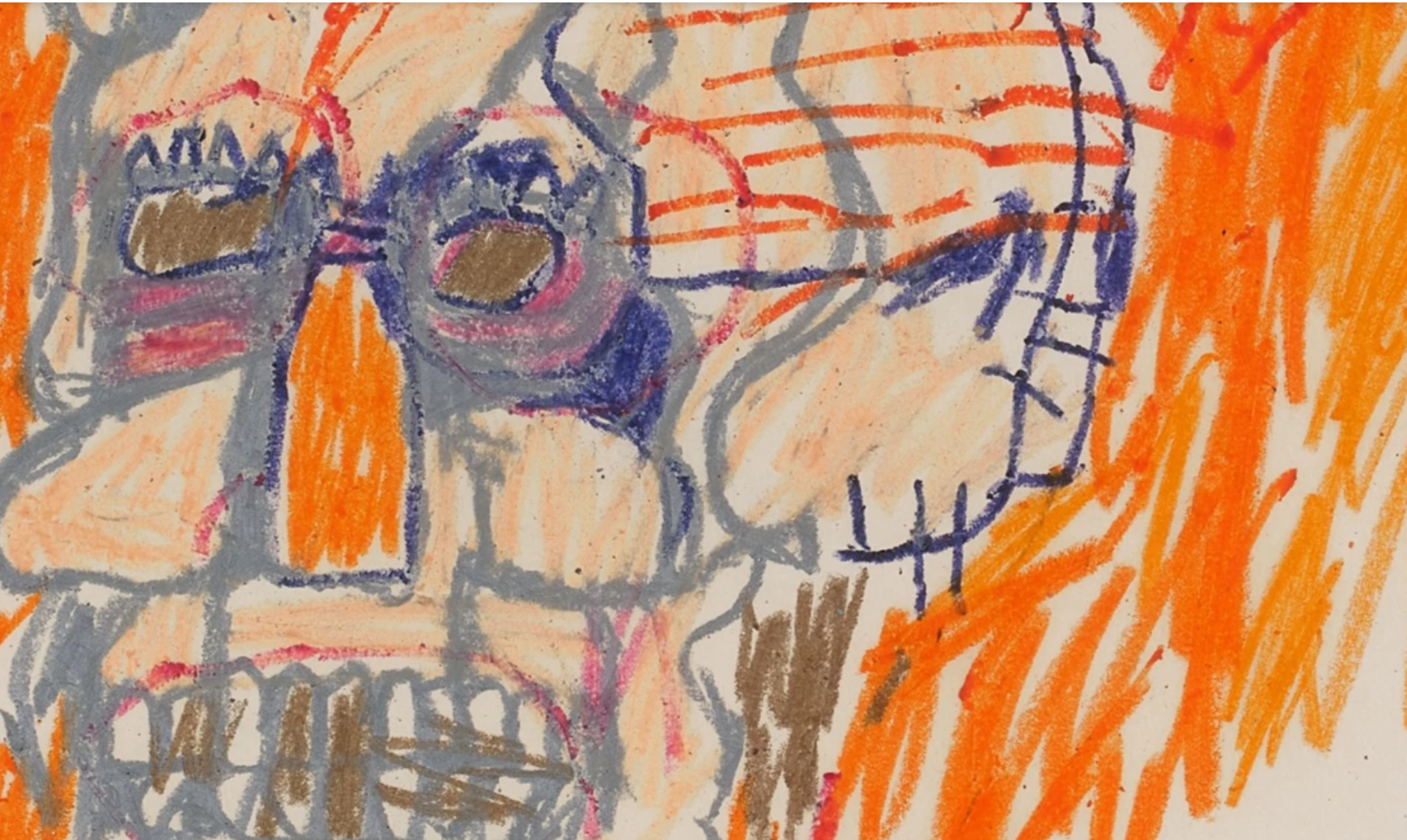
Here, the fiery palette of Untitled creates an electrifying contrast with icy silver and blues that form the disembodied head, underscored by jolts of pink. Together, the interplay of these saturated hues imbue the work with a painterly sensibility, as swathes of pigment lend depth and tonal complexity to the physiognomic figure.
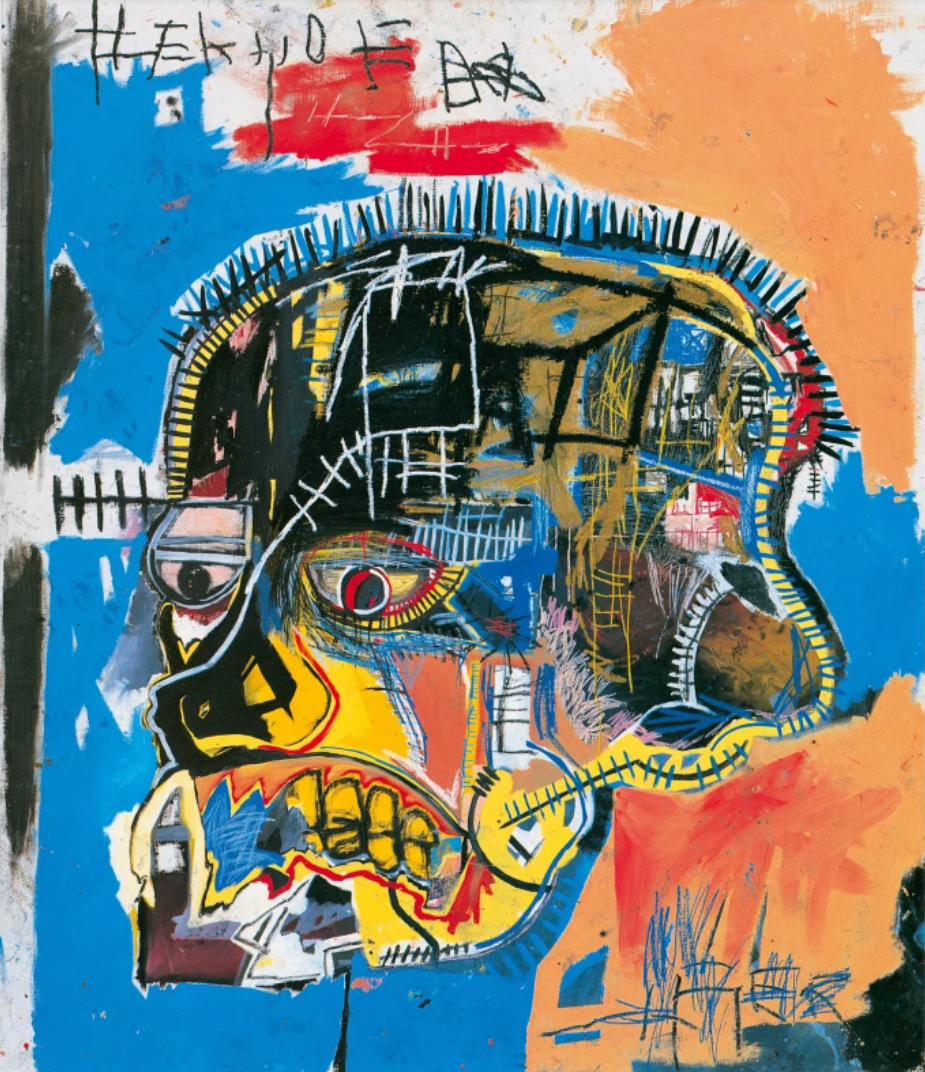
Jean-Michel Basquiat, Untitled, 1981. The Broad, Los Angeles. Art © Estate of Jean-Michel Basquiat. Licensed by Artestar, New York.
Drafted in a bold style with minimal facial detail, Untitled evokes the formal qualities of the legendary African masks Basquiat would have seen at the Metropolitan Museum of Art as a child. Much like Picasso, whose abstract aesthetic he took a particular interest to, Basquiat drew inspiration from ancestral African masks and their pictorial aesthetics in particular. Moreover, the depiction of the mask in this early work also represents Basquiat’s relentless exploration of cultural identity: the artist, who was born to a Haitian father and Puerto-Rican mother, often expressed his feelings of racialized otherness in a white-dominated art world. Basquiat’s use of the mask, a sacred object which historically functions in the Black diaspora as a mediator between the physical and spiritual realms, now becomes an unapologetic visual metaphor for black identity.
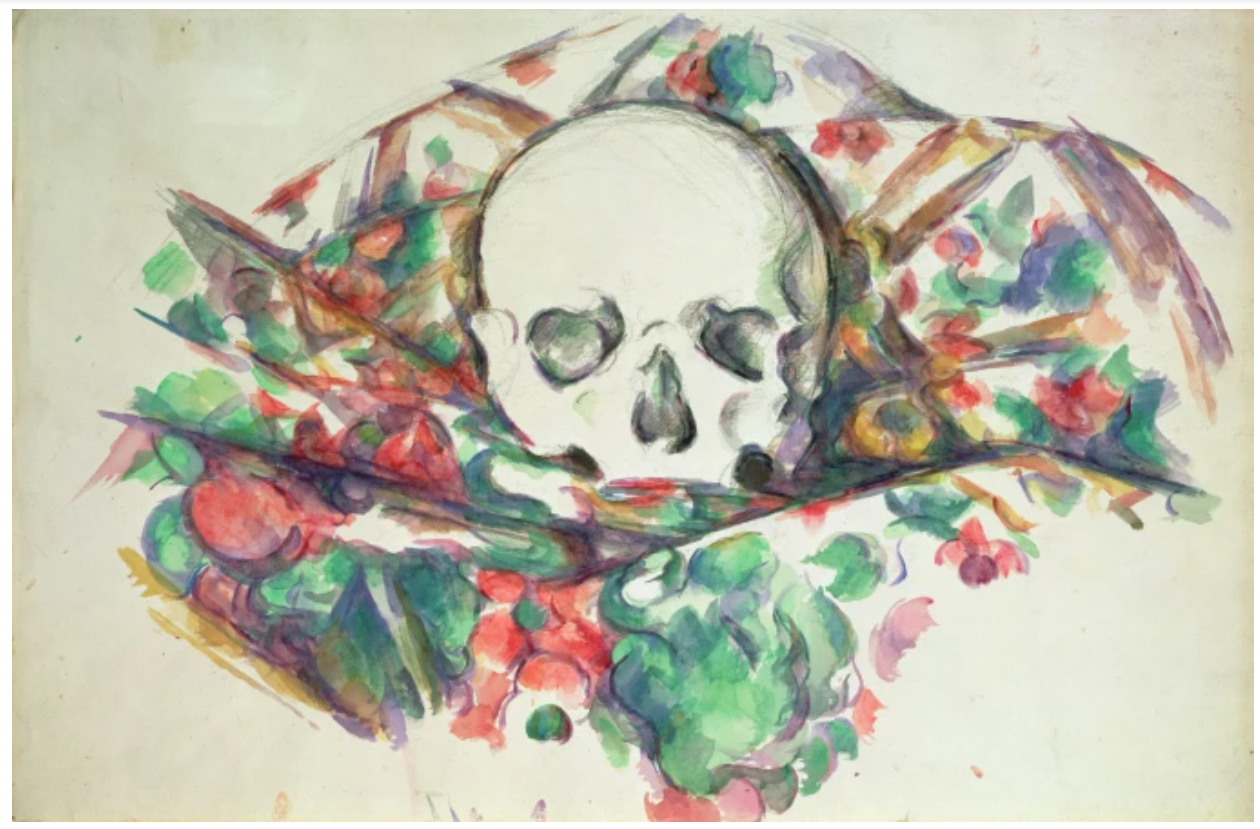
Paul Cezanne, Skull on Drapery, c.1902-06. Private Collection. Photo © Christie’s Images / Bridgeman Images
Riotous colors and charged lines blaze across the surface of Untitled with all the ferocious intensity of a wildfire, masterfully harnessed by the sheer sophistication of Basquiat’s draftsmanship. Capturing the expressive urgency of his street art origins, the visual voltage of Untitled reveals the impassioned, almost compulsive vigor Basquiat brought to both his works on paper and to his larger practice. Far from inanimate, the frenzied streaks of color achieve a remarkably heightened power – with the present work, Basquiat delivers a fusion of internal and external sensory experiences with the electrifying force of a live wire.
Untitled, 1981-1982
Phillips New-York: 19 November 2024
Estimated: USD 1,000,000 – 1,500,000
USD 1,270,000
Jean-Michel Basquiat – Modern & Cont… Lot 6 November 2024 | Phillips
JEAN-MICHEL BASQUIAT
Untitled, 1981-1982
Oilstick on paper
30×22 inches (76.2 x 55.9 cm)
Signed, inscribed and dated “NY 82 Jean Michel Basquiat” on the reverse
Executed in 1981-1982, Untitled exemplifies Jean-Michel Basquiat’s focus on the human figure as a vessel for intense gestural expression and symbolic richness. Untitled originated with the artist’s legendary dealer Annina Nosei, who sold the work to Larry Gagosian Gallery shortly after its completion in January 1982. Captivated by the young artist’s talent, Gagosian went on to stage Basquiat’s first West Coast solo show in April of that year, a significant milestone in Basquiat’s artistic growth and his rising recognition across the American art scene. Beyond its association with two of Basquiat’s key champions in the early 1980’s, the significance of Untitled is further highlighted by its inclusion in the 2015 exhibition Jean-Michel Basquiat: Now’s the Time at the Art Gallery of Ontario, the first major retrospective of the artist’s work in Canada.
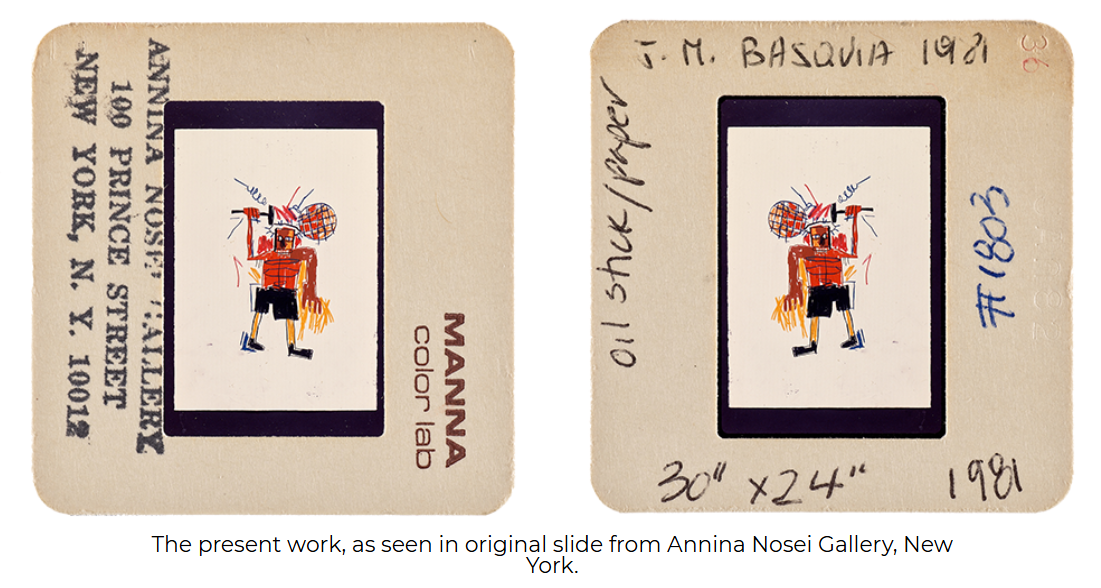
In Untitled, Basquiat channels the searing graphic intensity that defined his downtown alter-ego, graffiti-poet SAMO©, infusing the page with the raw energy and grit of 1980s Lower Manhattan. Depicting a towering, totemic figure wielding a hammer, Untitled blends anatomical detail with vibrant color and movement. The figure stands, teeth bared, one arm raised in poised action, embodying the tension and vitality that would come to define much of Basquiat’s work during this period.
For Basquiat, drawing was not merely preparatory but a primary means of expression, an arena for spontaneity and unfettered experimentation, equal to painting in importance and impact. His works on paper, including Untitled, reveal the urgency and immediacy of his creative process. The absence of coverup or correction highlights the rawness of Basquiat’s gestures, where each mark is preserved, capturing his thoughts as they emerge. Robert Storr captures this sense of tangible nearness, observing, “in drawings such as these—it is all still happening right before your eyes.” Such alacrity is visible in Untitled, where the tactile quality of the paper itself, recording and retaining the physical presence of the artist through smudges and fingerprints, reinforces this sense of proximity, making the act of creation palpable even now.
Famous Negro Athletes, 1981
Christie’s New-York: 17 May 2024
Estimated: USD 500,000 – 700,000
USD 907,200
22978 Basquiat, Famous Negro Athletes (shorthandstories.com)

JEAN-MICHEL BASQUIAT (1960-1988)
Famous Negro Athletes, 1981
Oilstick and wax crayon on brown paper
17 3/4 x 23 7/8 inches (45.1 x 60.7 cm)
Held in the collection of Jean-Michel Basquiat’s friend and fellow artist Brett De Palma since 1981, Famous Negro Athletes is a formative drawing that incorporates several of Basquiat’s iconic and resounding visual motifs. The artwork depicts an anonymous athlete surrounded by symbols: church to the left, home to the right, a crown above, and a baseball below. Frantic at first glance, the composition is in fact a delicate formal balance between two city buildings, with each cryptic symbol offsetting the position of another. Whether this is the athlete in the city, or an advertisement of the athlete flyposted on a city wall, the athlete is central to the psyche of the viewer and artist. As Thelma Golden aptly wrote, “Basquiat identified with these athletes, their prowess, and their stardom, which seems so analogous to his own.” In his own words, Basquiat’s description of his artwork’s subject matter could easily be a description of the present work: “royalty, heroism and the streets.”

Jean-Michel Basquiat, Untitled (Orange Sports Figure), 1982. © Estate of Jean-Michel Basquiat. Licensed by Artestar, New York.
The phrase “Famous Negro Athletes” is one of Basquiat’s most recognizable. It is a verbal trademark of the artist, comparable in importance and frequency to “Origin of Cotton,” “Tar Town,” and “Flats Fix.” The phrase appears in no less than five works from 1981-82, including a large work with the same title formerly in the collection of Glenn O’Brien, and an important Untitled 1981 suite of fourteen drawings. At face value, the titular phrase is merely descriptive –the figure is an athlete, and a famous one at that – and calls to mind great athletes such as Satchel Page, Jackie Robinson and Hank Aaron. Aaron figures prominently in many of Basquiat’s works, and Basquiat’s frequent cryptic use of the letter ‘A’ and the name ‘Aaron’ are generally taken to be references to the famous ball player, who broke Babe Ruth’s home run record, and received frequent death threats during his chase of the record. In the present work, the letter A in the upper right may signify such.

Basquiat’s art is most trenchant when it is socially critical. He often used art to comment on colonialism, racism, and classicism, and a deeper reading of the phrase “Famous Negro Athletes” reveals a similar commentary here – one that relates to Basquiat as a Black artist breaking into the ostensibly white New York art world. Basquiat’s insecurity and frustration at being perceived and written about in the press as a ‘Black’ artist, rather than simply an ‘artist,’ is echoed by the frustrations Black athletes felt during the segregation era of baseball, when Black and white players were made to play in separate leagues. The racist distinction of ‘Negro athletes’ and ‘white athletes’ is analogous to the racist distinction Basquiat must have felt, even at that early point in his career, when distinguished a ‘Black’ painter.
Though the recurring theme of baseball in Basquiat’s art has yet to be fully explored, we know as a child he often attended minor league baseball games with his father in Brooklyn, and later in life he related how much he enjoyed the process of filling out the scorecard in the game’s program. The visual and alphabetical influence of baseball scorecards on Basquiat’s work is apparent in the X’s and O’s, K’s, and arcane lists of numbers that populate his paintings and drawings.

Left: Jean-Michel Basquiat and Brett De Palma, New York, circa 1982. Photographer unknown.
Right: Jean-Michel Basquiat, Brett as Negro, 1982. © Estate of Jean-Michel Basquiat. Licensed by Artestar, New York.
The present work is also symbolic of the creative exchange between two important Lower East Side artists – Basquiat and Brett De Palma. Recalling his first meeting with Basquiat, De Palma recounted, “Diego [Cortez] introduced me to Jean-Michel at the opening of New York/New Wave, which I was in… Both Keith [Haring] and Jean gifted so many of us with their work. Keith painted a crib for our son when he was born and Jean left me a portrait [Brett as a Negro, 1982] that he did in Annina Nosei’s basement. I was working at a gallery in Soho when Jean first got his studio there and I would go over and hang out with him, and later at Crosby Street, but everybody came to that basement” (De Palma quoted in D. Buchhart, Jean-Michel Basquiat: Art and Objecthood, Berlin, 2022, p. 119). Both artists had solo exhibitions in 1982 with Emilio Mazzoli Gallery in Modena, Italy, and they exchanged a number of works with each other in the early 1980s, including the present lot. De Palma, In recalling when Basquiat drew the present work, remembered how the artist was drawn to the brown paper De Palma had available in his home, and how the roman numerals in the lower right came close to representing the date of execution. De Palma has owned this work since the day it was created, and he exhibited the piece at the 2018 exhibition, Zeitgeist: The Art Scene of Teenage Basquiat, curated by Sara Driver, Carlo McCormick, Mary-Ann Monforton and Howl! Happening, at the Maier Museum of Art at Randolph College.
Untitled, circa 1980s
Sotheby’s New-York: 30 September 2022
Estimated: USD 300,000 – 400,000
USD 529,200
Untitled | Contemporary Curated | 2022 | Sotheby’s (sothebys.com)
JEAN-MICHEL BASQUIAT (1960 – 1988)
Untitled, circa 1980s
Watercolor, graphite, colored pencil and crayon on paper
13 3/8 x 10 3/4 inches (34 x 27.3 cm)
Executed at the apex of Jean-Michel Basquiat’s career, Untitled offers a glimpse into the artist’s energetic, imaginative and ingenious mind. The present work illustrates a vibrant symphony of densely layered motifs and symbols that have come to characterize Basquiat’s diverse practice. Untitled is a masterly combination of symbols, words, and a central figure that is instantly recognizable as an iconic example of Basquiat’s oeuvre. The present work includes Basquiat’s most celebrated and coveted motifs, the crown, words, human anatomy, including a fragment of a skull, and a figure. Different from his paintings, the frenetic energy of Basquiat’s works on paper are unique in their raw immediacy that pave the way for his creative genius to shine through in an unaltered fashion. In Untitled, Basquiat substitutes perspectival accuracy and spatial recession for a pronounced flatness and a distinct emphasis upon bold color and expression. The facial features in the upper left of the work form a shape reminiscent of a jaw, which in turn constitutes a key motif present throughout Basquiat’s repertoire. The image of the skull is seemingly a personal gesture alluding to a childhood incident in which the artist was hit by a car while playing on the street, and subsequently hospitalized for serious internal injuries and broken limbs. While recuperating after the accident, Basquiat received a copy of Grey’s Anatomy as a gift from his mother, and the myriad anatomical and skeletal images exhibited in the book undoubtedly informed his own visual inventory as he became a working artist. While the image of the skull offers a persisting reminder of the fragility of the human body, it is also a significant symbol of Basquiat’s own childhood trauma and near-encounter with death.
MCVIIV9, 1981
Christie’s New-York: 29 September 2022
Estimated: USD 120,000 – 180,000
USD 189,000
JEAN-MICHEL BASQUIAT (1960-1988) (christies.com)
JEAN-MICHEL BASQUIAT (1960-1988)
MCVIIV9, 1981
Oil stick on paper
13 3/4 x 10 7/8 inches (34.9 x 27.6 cm)
Untitled, 1981
Christie’s New-York: 12 May 2022
Estimated: USD 500,000 – 700,000
USD 945,000
JEAN-MICHEL BASQUIAT (1960-1988) (christies.com)
JEAN-MICHEL BASQUIAT
Untitled, 1981
Acrylic, oilstick and wax crayon on paper laid down on canvas
25.5 x 19.7 inches (64.8 x 50.2 cm)
Untitled from 1981 vividly exemplifies the artist’s crude yet sophisticated style. 1981 was a momentous year for the preternaturally-talented young artist: René Ricard published The Radiant Child, the piece of writing that arguably launched Basquiat to gallery superstardom, and Basquiat also took part in the seminal New York/New Wave exhibition at MoMA PS1. Simultaneously brooding and playful, Untitled’s half-drawn, half-painted surface confronts the viewer with an explosion of bright yellow-orange which is then balanced out by an encroaching darkness from above. Basquiat’s painterly mannerisms are reminiscent of the Art Brut style, typified by artists such as Jean Dubuffet and Paul Klee, but Basquiat imbues this work with a visual lexicon and flamboyant color palette all his own.
Untitled, 1980-1985
Sotheby’s New-York: 18 November 2021
Estimated: USD 1,500,000 – 2,000,000
USD 1,835,000
Untitled | Contemporary Evening Auction | 2021 | Sotheby’s (sothebys.com)
JEAN-MICHEL BASQUIAT
Untitled, 1980-1985
Oilstick and pencil on paper
30 x 22.5 inches (76.2 x 57.2 cm)
Vibrantly and densely-layered, Untitled (1980-1985) is a masterful example of Jean-Michel Basquiat’s instinctive and lauded abilities as one of the greatest draughtsman of the Twentieth Century. Typical of his works on paper, the frenetic urgency of the mark-making, the unique variance in color, and the iconic motif of the central head are all effortlessly combined into a singularly sizzling composition that exemplifies Basquiat’s effortless creative genius. Intricately impastoed layers of oilstick in black and red are scrawled upon the surface of Untitled, culminating in a stream of consciousness made visual. The subject of Untitled is constructed of variegated geometrics passages, simple shapes and lines and arcs which coalesce to become both anatomical and schematic. While recovering from a car accident as a youth, Basquiat was given a copy of Gray’s Anatomy by his mother, and the formative text would prove to be influential on his later practice. In Untitled, the subject is depicted as if through an X-ray, their spinal cord visible through their broad exterior, bespeaking this early influence.
Untitled (from Famous Negro Athlete Series), 1981
Phillips New-York: 17 November 2021
Estimated: USD 750,000 – 1,100,000
USD 2,750,000
Jean-Michel Basquiat – 20th Century… Lot 25 November 2021 | Phillips
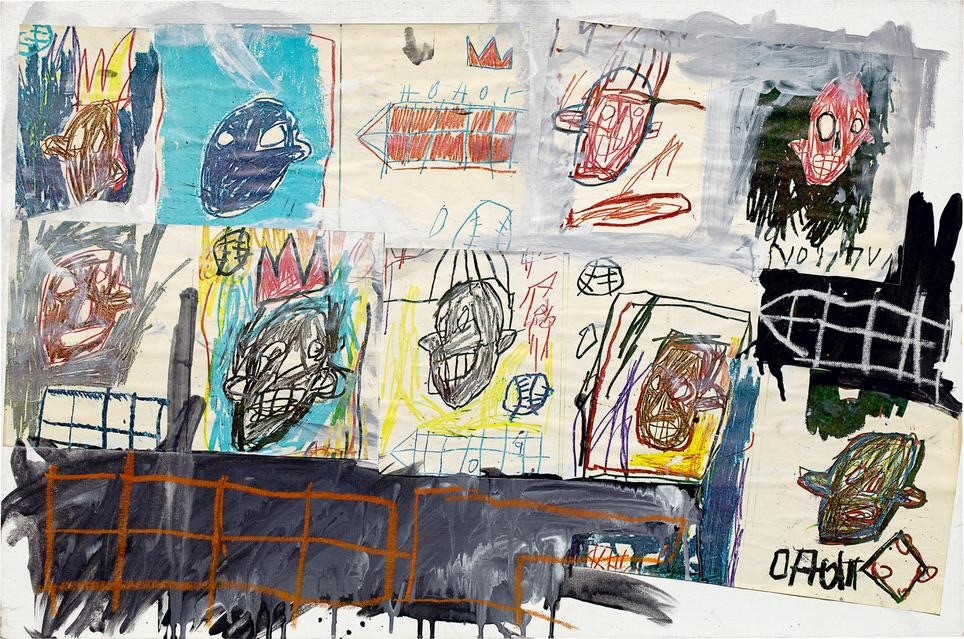
JEAN-MICHEL BASQUIAT
Untitled (from Famous Negro Athlete Series), 1981
Xerox, graphite, gouache and oilstick on canvas board
23 7/8 x 36 inches (60.6 x 91.4 cm)
With its gestural vigor and electric immediacy, Untitled (from Famous Negro Athlete Series) epitomizes the unbridled fervor that characterizes Jean-Michel Basquiat’s early work and his singular graphic language. Executed in 1981, the work marks the pivotal moment at the cusp of Basquiat’s meteoric rise to international acclaim and was notably a gift to his dear friend, Kai Eric, who had befriended Basquiat several years before his claim to fame and shared his apartment with the artist for a time. During the artist’s lifetime, Eric temporarily consigned Untitled (from Famous Negro Athlete Series) to Basquiat’s legendary art dealer Annina Nosei, and ultimately brought it to Mary Boone just before her first Basquiat show. Having been acquired by the present owner soon after, the present work arrives to the public for the first time in nearly four decades.
A significant conceptual anchor throughout Basquiat’s oeuvre, the theme of the Black athlete appears in myriad paintings and works on paper especially during his early years, often referencing renowned contemporaneous figures including Cassius Clay (Muhammad Ali), Joe Louis, Jersey Joe Walcott, Hank Aaron, and Jackie Robinson. In Untitled (from Famous Negro Athletes Series), Basquiat brings together his own kind of Hall, or Wall, of Fame, scrawling baseball imagery alongside his well-known crayon hopscotch squares and ambulances. Here, Basquiat’s signature three-pointed crowns thereby potently showcase their trademark symbolism of autobiographically alluding to himself as well as recognizing the regal stature of his heroes.
Untitled (Starvation), 1981
Phillips New-York: 24 June 2021
Estimated: USD 250,000 – 350,000
USD 315,000
Jean-Michel Basquiat – 20th Century & … Lot 141 June 2021 | Phillips
JEAN-MICHEL BASQUIAT
Untitled (Starvation), 1981
Oilstick on paper
19 7/8 x 15 7/8 inches (50.5 x 40.3 cm)
This work is accompanied by a certificate of authenticity from the Authentication Committee of the Estate of Jean-Michel Basquiat
Held in the extensive collection of Justice Alan and Diane Page for over 35 years, Untitled (Starvation)
is a milestone of the revolutionary approach that launched Jean-Michel Basquiat to international acclaim in 1981. This exemplary works depicts a subject that would become central to the vernacular of Basquiat’s all-too-brief output: an anthropomorphic god figure with the artist’s famous crown-of-thorns motif. The work expresses a uniquely subversive narrative, part of a mythology that interrogates the poetics and politics of identity, history, representation, and commodification. Basquiat’s unbridled genius shines in these pieces, executed when he was on the cusp of unprecedented critical and commercial success. In 1981 the artist was included in New York/New Wave, a highly-anticipated avant-garde group show at PS1 Contemporary Art Center, where his raw expressiveness caught the attention of gallerists Annina Nosei and Bruno Bischofberger, who would help catapult his work to greater recognition.
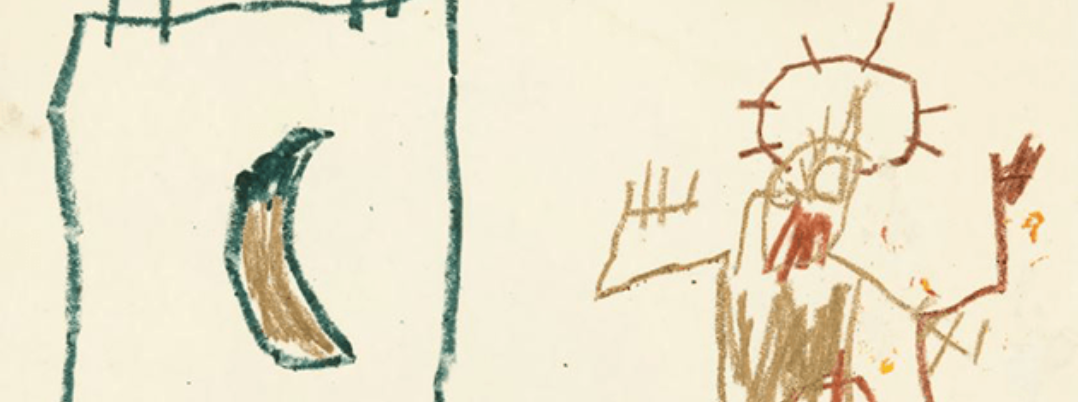
The formidable figure in Starvation shows his strength as he raises his arms in victory, warning, or supplication. The crossed-out text “Samale”—possibly an invocation of the fierce monkey-man god of African mythology—is juxtaposed here with a crown of thorns, a frequent element in Basquiat’s iconography. In this work the artist explores physicality and transcendence, placing his protagonist between an outhouse and a plant that appears to sprout from a pile of waste. Through his art, Basquiat confronted shifting cultural contexts even as he negotiated the complexities of his own multicultural identity. Basquiat’s creativity and curiosity led him to consult a broad range of sources, from African to Aztec artistic histories to popular culture. Many of his works reveal a fascination with the body, possibly inspired by his prolonged hospitalization after a childhood accident and his study of Gray’s Anatomy, a gift from his mother.
Brown Eggs, 1981
Sotheby’s New-York: 14 November 2019
Estimated: USD 2,500,000 – 3,500,000
USD 5,389,500
(#22) JEAN-MICHEL BASQUIAT | Brown Eggs (sothebys.com)
JEAN-MICHEL BASQUIAT
Brown Eggs, 1981
Oilstick on paper
24 1/4 X 18 inches (61.6 x 45.7 cm)
Titled; signed on the reverse
Rendered with ferocious intensity, the searing figurehead of Brown Eggs is a riveting embodiment of the instinctive and unrivalled brilliance which distinguished Jean-Michel Basquiat from the earliest years of his career. Executed in 1981, Brown Eggs exemplifies a selection of drawings that, in their haunting and unique renderings of skull-like heads, powerfully embody the extraordinary intensity, focus, and drive which fueled Basquiat at this pivotal moment in his burgeoning career. Within this rarefied corpus, the present work is remarkable for its saturated surface and exceptional diversity of mark-making; rendered in layers of furiously scrawled hazel and orange pigment, overlaid with furious incisions of black, scarlet, yellow, and blue, the frenzied intensity of Basquiat’s variegated strokes is contained only by crisp boundary of the sheet itself. Scrawled below the glowering figure, the inscribed title is irresistibly enigmatic, suggesting loaded commentary while evading clear translation. Vibrantly and densely-layered, the frenetic collision of mark, color, word, and form is, within Basquiat’s drawing, somehow transformed into a singularly sizzling composition that exemplifies the young artist’s effortless creative genius.
Untitled, 1981
Phillips New-York: 15 November 2018
Estimated: USD 4,000,000 – 6,000,000
USD 4,575,000
Jean-Michel Basquiat – 20th Century… Lot 12 November 2018 | Phillips
JEAN-MICHEL BASQUIAT
Untitled, 1981
Oilstick and graphite on paper
27 5/8 x 38 7/8 inches (70.2 x 98.7 cm)
Signed and dedicated “To Pasquina Jean-Michel Basquiat” lower right
1982 Drawings
Untitled, 1982
Christie’s New-York: 21 May 2026
Estimated: USD 800,000 – 1,200,000
USD 952,500
WORK ON PAPER
JEAN-MICHEL BASQUIAT (1960-1988), Untitled | Christie’s
JEAN-MICHEL BASQUIAT (1960-1988)
Untitled, 1982
Oilstick on paper
14 x 9-3/4 inches (35.5 x 23.6 cm)
Executed in 1982, Untitled is a powerful example of a motif that would underpin Basquiat’s work for the rest of his career. Executed in oilstick on paper, the present work dates to the apex of Jean-Michel Basquiat’s artistic exploration, a period distinguished by the production of some of his most accomplished and consequential works across both paper and canvas. Dominating the center of the composition, the fiercely expressive head – part skull, part self-image – stares fixedly out of the picture plane, one of the boldest symbols in Basquiat’s iconographic repertoire. The highly stylized face, with glaring eyes, flaring nostrils and bared teeth, evokes both the primitive scribbles of a child and the elaborate iconographies of ancient cultures. These were seminal influences on the young Basquiat, who, like his hero Picasso before him, interrogated long-forgotten artist traditions to interpret contemporary visual culture from a completely new perspective. With its electric presence, Untitled arbors the conceptual depth and the immediacy that propelled Basquiat to the forefront of the contemporary art world.
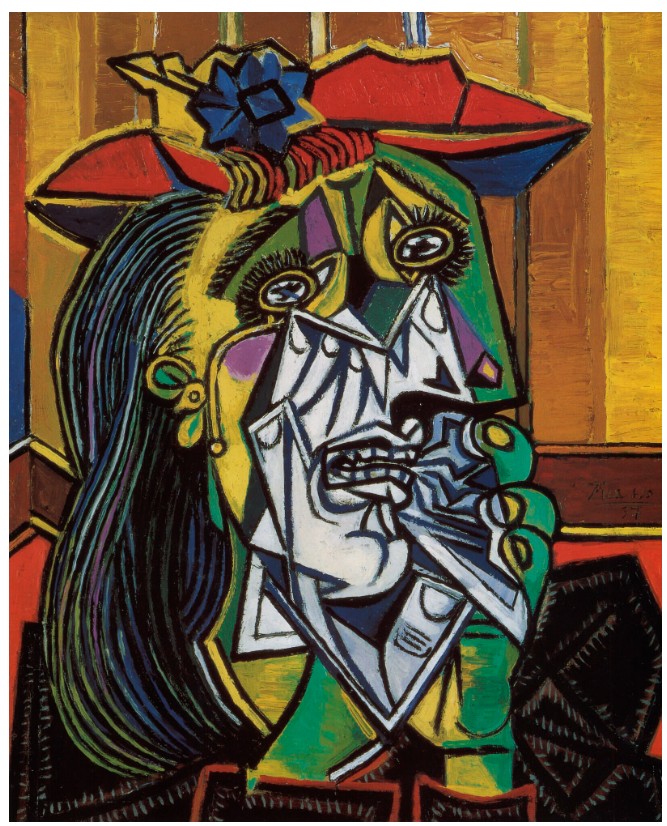
Pablo Picasso, The Weeping Woman, 1937. Tate, London. © 2026 Estate of Pablo Picasso / Artists Rights Society (ARS), New York.
The year 1982 constituted a pivotal turning point in the career of Jean-Michel Basquiat, when the gallerist Annina Nosei granted him access to a basement studio and, for the first time, placed professional materials at his disposal, an intervention that would prove instrumental in catalyzing his rapid artistic ascent. During this pivotal year, Jean-Michel Basquiat created what Fred Hoffman calls “an outpouring of unique and haunting images of heads […] With a few exceptions, each work presents a fully frontal head seeming to float against the white background of the paper. While the works share the physiognomy of overly large, almost bulging eyes as well as an enlarged, wide-open, teeth-bearing mouth, each image is distinct, presenting a completely different and individualized personage” (F. Hoffman, ‘Heads,’ in Jean-Michel Basquiat Drawing: Work from the Schorr Family Collection, exh. cat. Acquavella Galleries, New York 2014, p. 71).
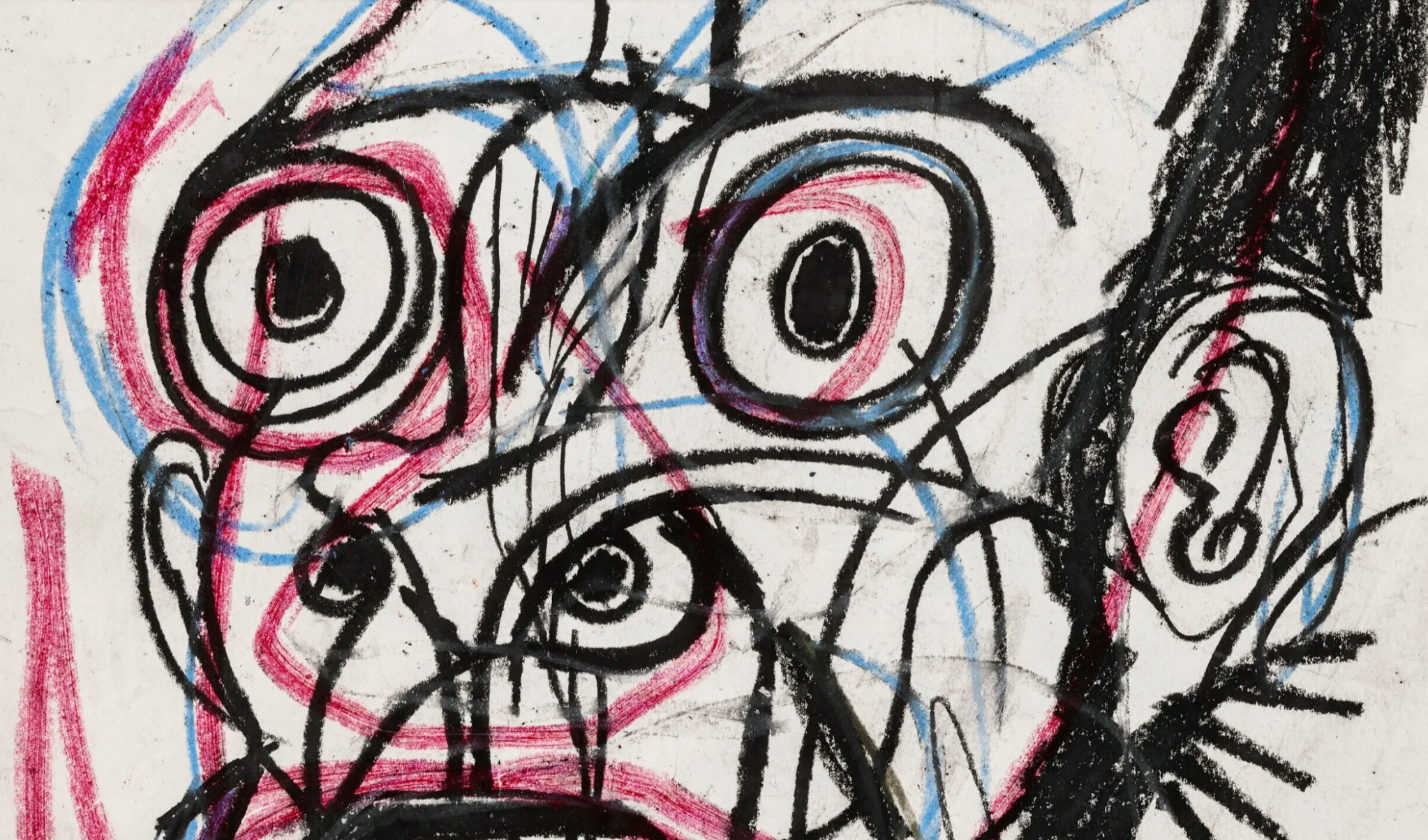
As a testament to the importance of the 1982 head studies, at the time of Basquiat’s death in 1988, no fewer than twenty-seven of the studies remained in the artist’s personal collection. Two years later, these drawings, including the present work, were presented in the seminal exhibition Jean-Michel Basquiat Drawings at Robert Miller Gallery where, hung salon style upon a single wall, they served as irrefutable testament to the gravity and intent with which the artist approached his works on paper.
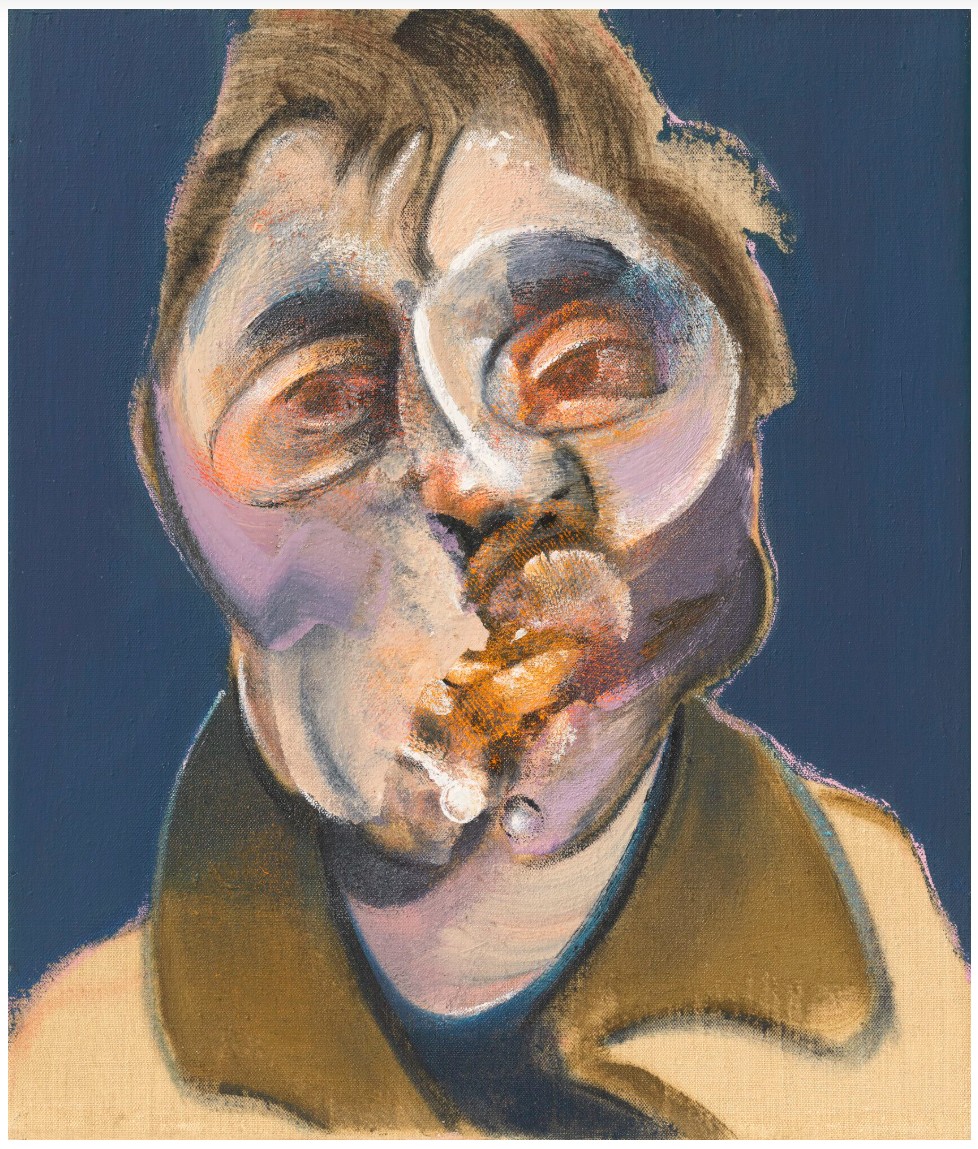
Francis Bacon, Self-Portrait, 1969. Sold at Christie’s, New York, Masterpieces from the S.I. Newhouse Collection, 11 May 2023 for $34,622,500. © The Estate of Francis Bacon. All rights reserved / DACS, London / ARS, New York 2026.
Central to Basquiat’s oeuvre is the human figure, and more specifically, the head as a site of both anatomical inquiry and psychological expression. From an early age, Basquiat was fascinated by the inner workings of the body, a curiosity famously sparked by his exposure to medical texts such as Gray’s Anatomy and a 1966 book of Leonardo’s drawings that he read while hospitalized as a child. As Jeffrey Hoffeld observes, “Basquiat’s repeated use of anatomical imagery – skeletons, musculature, and internal organs – coincides with an ever more widespread tendency in his work to turn things inside out. Inner thoughts are made public in graffiti-like litanies of words and other bursts of expression; distinctions between private spaces and public places are dissolved; past and present are interwoven, and levels of reality are multiplied and scrambled; the imagined realms of paradise, hell and purgatory become indistinguishable” (J. Hoffeld, ‘Basquiat and the inner self’, in Jean Michel Basquiat, Gemälde und Arbeiten auf Papier (Paintings and works on paper), exh. cat. Museum Würth, Künzelsau 2001, p. 27). Basquiat’s anatomical interests appear recurrently in his work through an X-ray-like vision, in which surface appearances are fractured to reveal underlying structures: bones, muscles, and unseen energies. In Untitled, the face becomes a multi-layered construct, oscillating between portrait, symbolic mask, and diagram.
Very much like Untitled (1981), held in the Broad Art Foundation, the present lot challenge conventional modes of representation, but they do so through different means—one through density and saturation, the other through compression and line—ultimately reinforcing Basquiat’s enduring preoccupation with the instability of the self and the expressive potential of the human face.
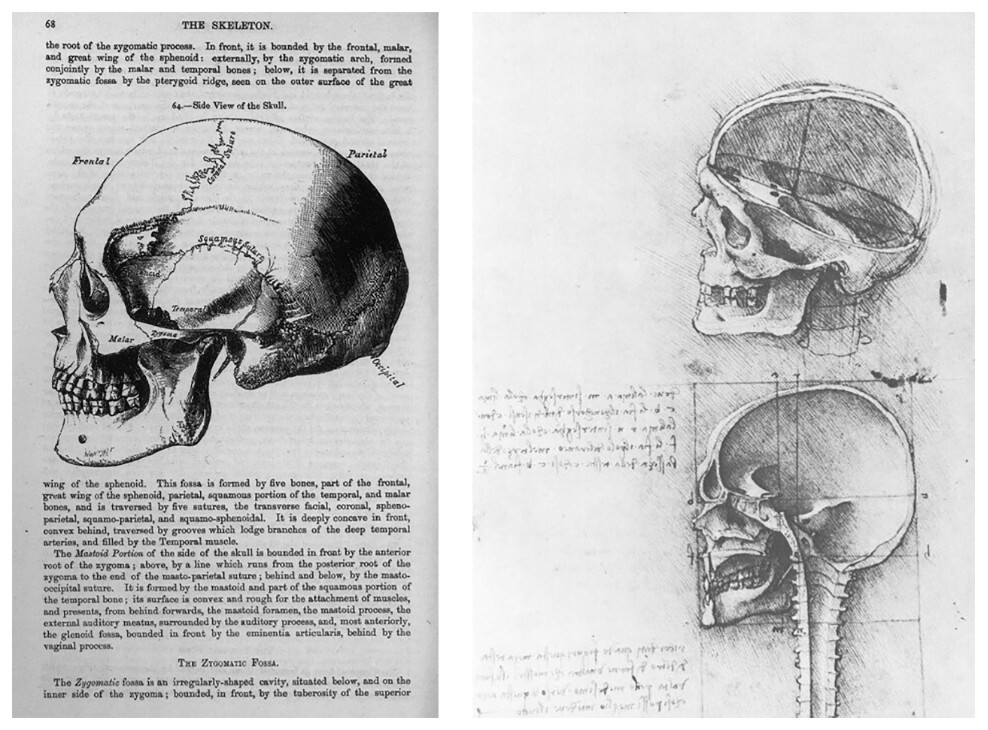
Left: Henry Gray, Gray’s Anatomy, 1858. Private collection.
Right: Leonardo Da Vinci, Two views of the skull, 1489. Royal Collection at Windsor Castle.
With a closer observation of the composition, it is possible to see a dense network of bold lines and colors that energize the surface of the work. Basquiat primarily used black oilstick to create Untitled, as the head is principally defined by interwoven black lines with passages of vivid pink and blue which trace and disrupt the structure of the face all while creating a sense of movement and instability. Rendered as big and bold concentric circles, the eyes dominate the composition, while the mouth fitted with a grid of teeth commands the bottom portion of the image with a grimacing intensity. On the other hand, the hair is drawn in thick and agitated strokes which frames the entirety of the head with a halo of energy. Basquiat’s technique appears to be at the same time instinctive and deliberate as the use of oilstick allows him to apply pigment on the paper directly all while preserving the immediacy of the artist’s hand while enabling an intense layering of lines and contours. The resulting surface almost appears to vibrate out of the paper as if the image were being continually constructed and deconstructed before the viewer’s eyes.
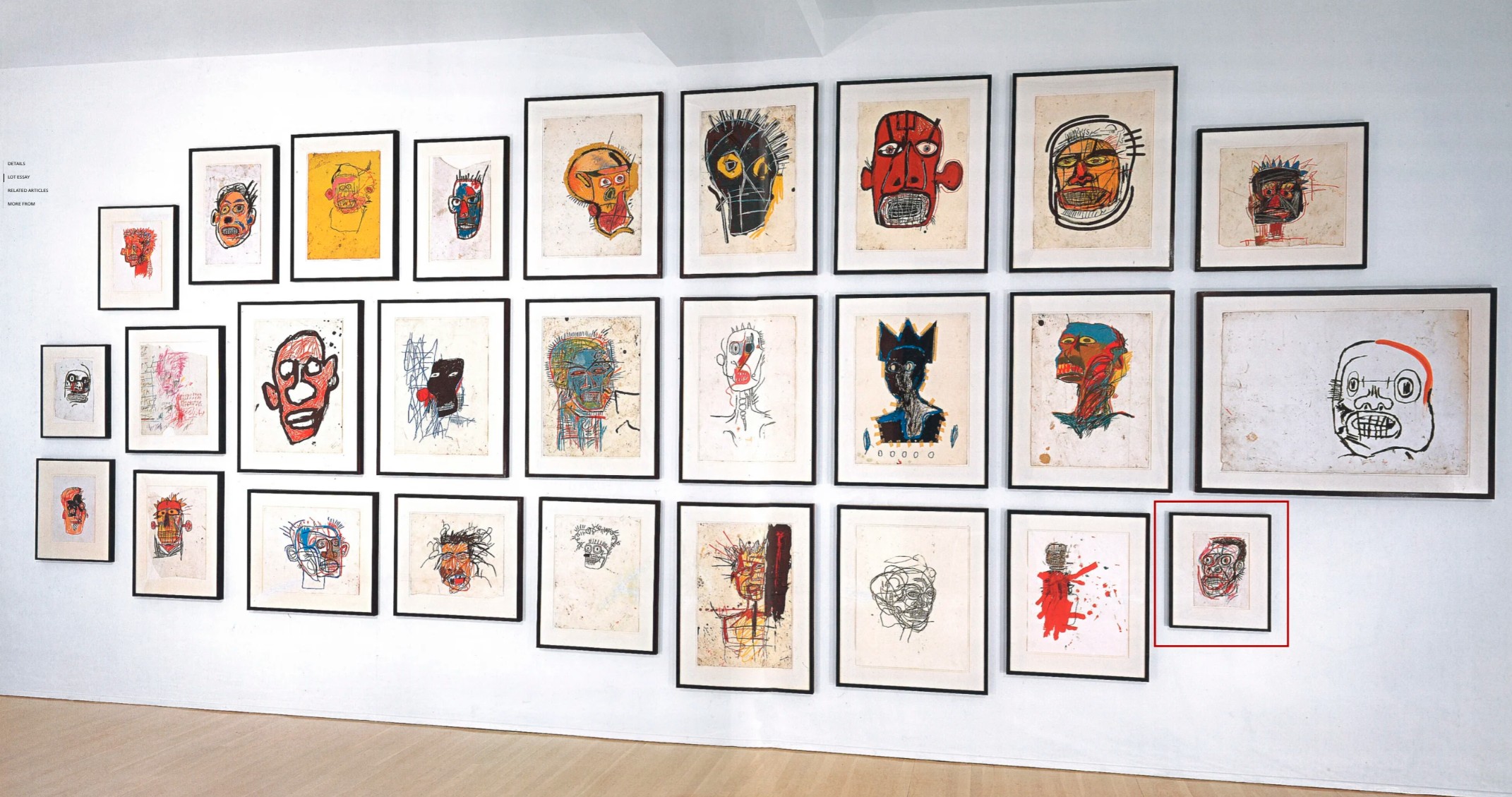
Installation view of Jean-Michel Basquiat: Drawings at Robert Miller Gallery, New York, November 1990.
Artwork: © Estate of Jean-Michel Basquiat. Licensed by Artestar, New York.
In the context of a renewed scholarly and institutional focus on Jean-Michel Basquiat’s works on paper, exemplified by the ongoing major solo exhibition Basquiat – Headstrong at the Louisiana Museum of Modern Art, the present work emerges as an especially timely and compelling opportunity. Untitled is a remarkable example of Basquiat’s celebrated head imagery, as this work fully captures the artist’s ability to combine raw expression with profound conceptual insight. Paramount to this painting is the voracious originality and dynamism resident in each stroke. Untitled unrestrained by convention; through its compositional vigor we sense the artist’s brilliant spirit at the moment that he launched his groundbreaking art practice onto the New York art world.
Asbestos, 1982
Christie’s New-York: 20 May 2026
Estimated: USD 3,000,000 – 5,000,000
USD 6,541,000
WORK ON PAPER
JEAN-MICHEL BASQUIAT (1960-1988), Asbestos | Christie’s
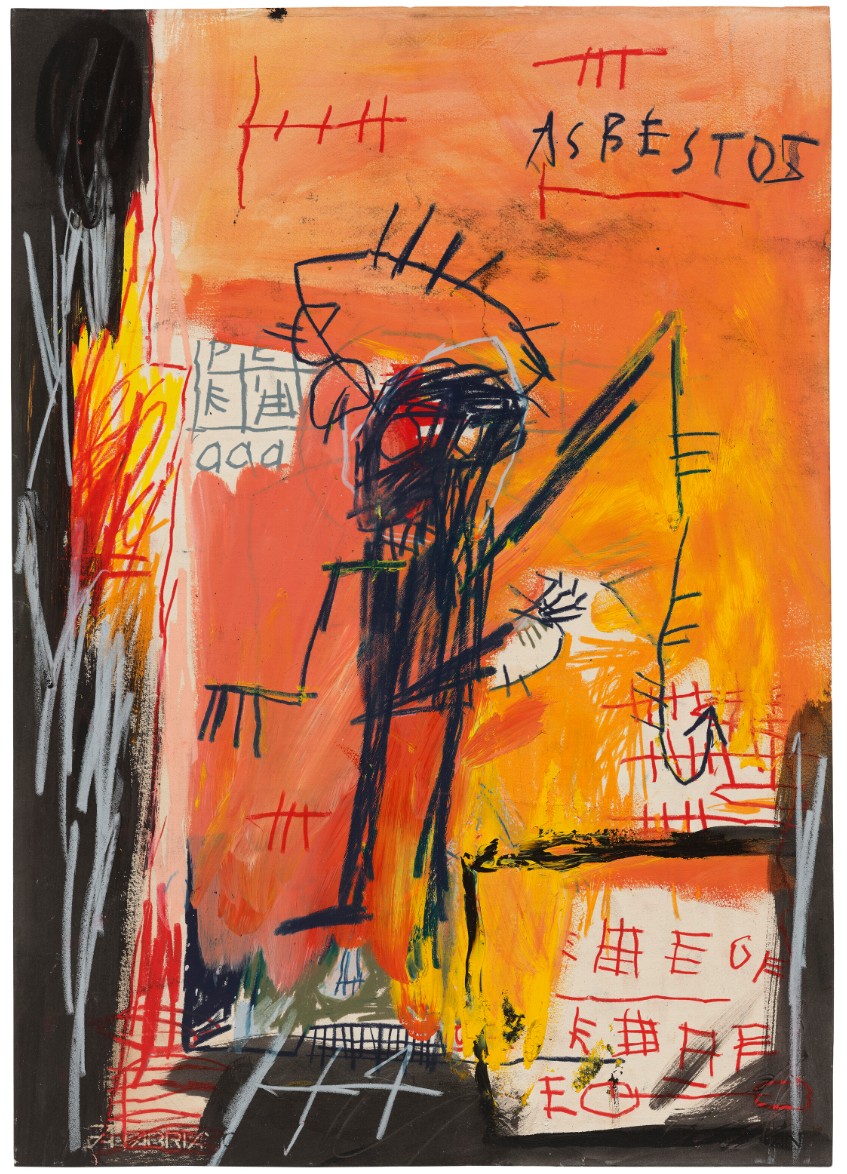
JEAN-MICHEL BASQUIAT (1960-1988)
Asbestos, 1982
Oil and oilstick on paper
27-5/8 x 19-3/8 inches (70.2 x 49.2 cm)
Signed and dated ‘BASQUIAT 1982’ (on the reverse)
Asbestos is one of Basquiat’s most charged and encompassing explorations of his identity. The fisherman is a figure he returned to throughout his career as both personal totem and autobiographical metaphor: the mediator between worlds, the one who crosses water, and, by implication, the painter himself. Set against a ground of scorched orange and yellow that seems almost to combust, this work carries the full weight of an Atlantic inheritance Basquiat assembled from Brooklyn, Haiti, Puerto Rico and West Africa.
“I’ve never been to Africa. I’m an artist who has been influenced by his New York environment. But I have cultural memory. I don’t need to look for it; it exists. It’s over there, in Africa.”
The painting’s ground is its first argument. Orange and yellow surge across the surface with the intensity of fire or late sun on open water, the warmth so total it reads almost as heat rather than color. Against this Basquiat set a standing figure in dark navy and black, drawn with the kind of compressed line that is somehow both urgent and precise: a torso, limbs, a head marked by a red form at the center that burns like an ember. The figure holds his fishing rod, and its feet are marked with tally lines that appear elsewhere in the composition, scratched in red in the upper corners like notation or count. To the left, a deep black border cuts the composition like a shoreline. Scattered throughout are Basquiat’s characteristic marks and glyphs, grid-like boxes filled with symbols, arrows and repeated strokes, a white rectangle near the lower right that accumulates signs as though it were a ledger. The word “ASBESTOS” is written across the upper right in dark oilstick, frank and declarative. The surface is layered, worked over, revised, alive.
Left: Gerard Basquiat with Jean-Michel at the beach, Jacob Riis Park, Queens, circa 1963. Photographer unknown.
Right: Gerard and Jean-Michel in Hana, Maui, Hawaii, 1984. Photographer unknown.
The fisherman is an established presence in Basquiat’s iconography. To understand why, one must follow his ancestry. He grew up in Brooklyn within reach of the Atlantic. His father was Haitian, his mother Puerto Rican. His racial heritage bore the trace of the Middle Passage and, before that, the West African coastline from which it originated. Across each of these worlds the fisherman was not a picturesque figure but a working one: economically essential, a constant of daily life. Anglers worked beneath the Brooklyn Bridge; pirogues dotted the Senegalese coast; painted canoes defined island life. The image was overdetermined before Basquiat ever put it to paper.
What accumulated on top of that material reality was spiritual weight. In Haitian Vodou theology, the sea was the threshold between the living and their ancestors, and the fisherman who moved across it daily took on a ceremonial function: the mediator between worlds, the one whose passage was itself a ritual act. As the art historian Robert Farris Thompson observed of Basquiat’s deep engagement with Atlantic spiritual traditions, his imagery drew on a reservoir of Kongo and Caribbean visual thinking in which the crossing was a site of profound metaphysical exchange (R.F. Thompson, “Royalty, Heroism, and the Streets: The Art of Jean-Michel Basquiat,” Jean-Michel Basquiat, exh. cat., Whitney Museum of American Art, New York, 1992, p. 32).
Left: Male Figure (Nkisi Nkondi), 1801-1875. Art Institute of Chicago.
Right: Fisherman Fresco from Akrotiri on the Aegean island of Thera. National Archaeological Museum, Athens.
Catholic iconography added another layer. Basquiat was raised Catholic, and in that tradition the fisherman carries a precise charge: Christ’s call to his disciples — “Come, follow me, and I will make you fishers of men” — transforms a practical occupation into a spiritual vocation, makes the casting of a net a metaphor for something far larger. For Basquiat, fluent in multiple theological registers at once, the figure absorbed all of these meanings without shedding any of them.
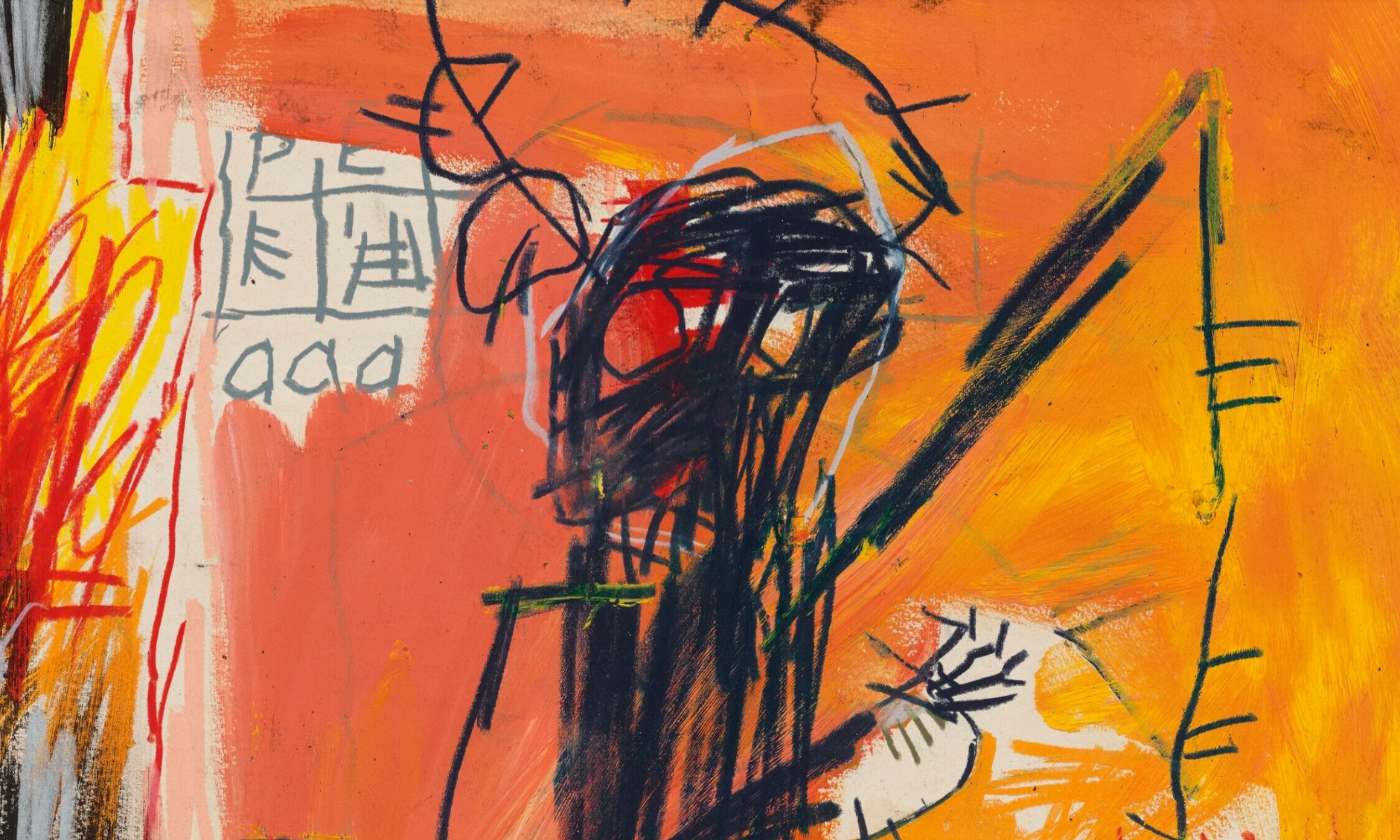
The self-portrait dimension of Asbestos follows directly. The fisherman who moves across the surface of the water, who punctures its membrane and retrieves things from beneath, is also the painter moving across the canvas. Basquiat was explicit about the relationship between his cultural inheritance and his art: “I’ve never been to Africa. I’m an artist who has been influenced by his New York environment. But I have a cultural memory. I don’t need to look for it; it exists. It’s over there, in Africa.” (J. M. Basquiat “Jean-Michel Basquiat.” Interview by Demosthenes Davvetas. New Art International, October–November 1988, p. xiii). Asbestos is the work that figure produces: an image in which the Atlantic world Basquiat carried with him is made visible, through a figure who always already belongs to all of it.
Pablo Picasso, Night Fishing at Antibes, 1939. Museum of Modern Art, New York.
© 2026 Estate of Pablo Picasso / Artists Rights Society (ARS), New York.
Jordana Moore Saggese, in her close reading of Basquiat’s iconographic systems, notes that his recurring figures operate less as representations than as “repositories of accumulated meaning,” absorbing cultural content across multiple contexts simultaneously (J.M. Saggese, Reading Basquiat: Exploring Ambivalence in American Art, Berkeley, 2014, p. 87). The tally marks in Asbestos — those insistent red counts scratched into the upper corners — push this further. They suggest enumeration, inventory, time kept or debt recorded, registers that in Basquiat’s hands carry the specific gravity of histories in which Black bodies were counted rather than named. Asbestos entered the collection of Ethel Scull, whom with her husband Robert maintained some of the sharpest collecting instincts of the Post-War period in America. The Sculls had built relationships with Rauschenberg, Warhol and Johns before those artists achieved canonical standing, and their engagement with Basquiat reflects the same quality of attention: an early, unequivocal recognition of genius. The Louisiana Museum’s current retrospective, Basquiat—Headstrong, has brought renewed critical attention to the genius of Basquiat’s draftsmanship specifically. Its focus on works on paper brilliantly making the case that Basquiat’s line: restless, economic, capable of conjuring a body or a glyph in a single stroke, was totally accomplished. The show’s success confirms what Asbestos demonstrates plainly: that the rawness of his mark-making was never naivety, but control exercised with haste but incredible depth of thought.
Untitled, 1982
Phillips New-York: 19 November 2025
Estimated: USD 800,000 – 1,200,000
USD 1,225,500
Jean-Michel Basquiat Modern & Contemporary Art Evening Sale featuring Cera the Triceratops
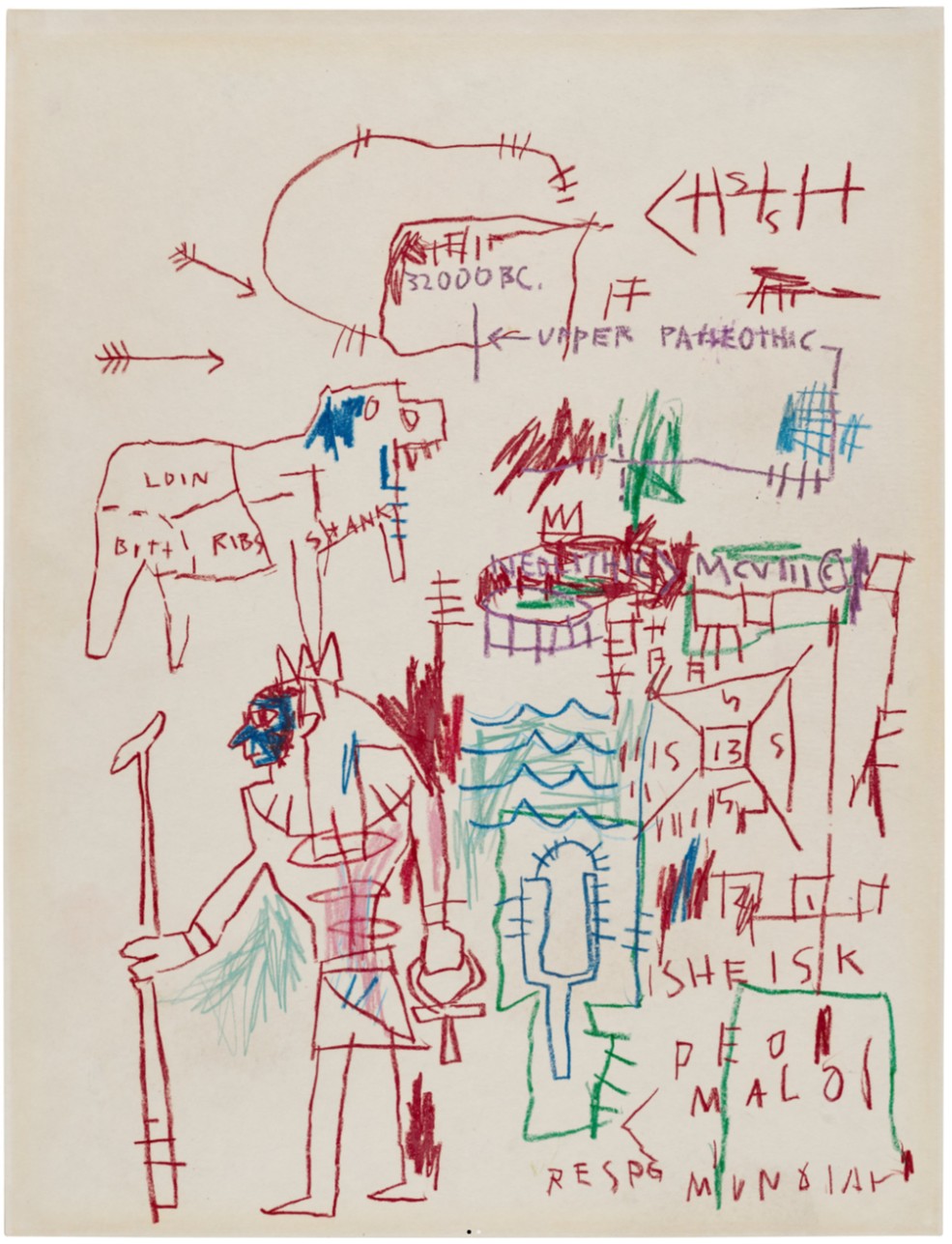
JEAN-MICHEL BASQUIAT
Untitled, 1982
Oilstick on paper
24 x 18 1/4 inches (61 x 46.4 cm)
The feverish torrent of energy unleashed in Jean-Michel Basquiat’s Untitled, 1982, with its rapid-fire strokes and frenetic oilstick markings, captures an artist on the brink of greatness. Created during what is widely regarded as his golden year, when he broke into the New York art world to instant acclaim, Untitled distills the immediacy and raw energy of Basquiat’s mark-making. A street poet drawing from the syncopated rhythms and contradictions of city life as well as ancient visual languages, Basquiat fused the urban and the primeval in a manner recalling Jean Dubuffet’s celebration of raw expression and material immediacy. After four decades in private hands, Untitled returns to auction for the first time since 1985.
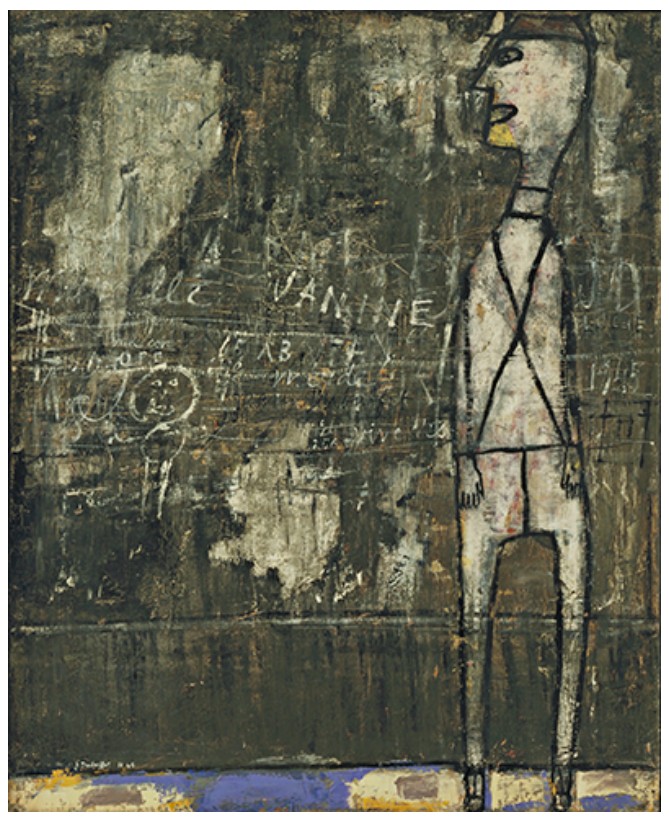
Jean Dubuffet, Wall with Inscriptions, April 1945. The Museum of Modern Art, New York. Image: © The Museum of Modern Art/Licensed by SCALA / Art Resource, NY, Artwork: © 2025 Artists Rights Society (ARS), New York / ADAGP, Paris
In Untitled, Basquiat conjures many of his signature motifs. The three-point crown hovers above a heroic figure rooted in ancient lineage, while a separate crown of thorns encircles a boxed date—“32000 BC”—beneath which fragments of words, equations, and his “©” symbol form a dense visual field. The central figure, a hybrid deity rendered in overlapping views, merges the anatomical clarity of medical illustrations with the hieroglyphic stylization of Egyptian art. With a mask-like face of bared teeth and hollow eyes, the figure radiates an unsettling power.
“I get my facts from books, stuff on atomizers, the blues, ethyl alcohol, geese in Egyptian glyphs …I don’t take credit for my facts. The facts exist without me.”
By 1982, Basquiat had become an overnight critical success. From sleeping on friends’ couches to preparing for shows across New York, Los Angeles, and Europe, his ascent was meteoric. Lacking mentors, he turned to groundbreaking athletes, musicians and writers—Dizzy Gillespie, Charlie Parker, Jackie Robinson, Langston Hughes—elevating them, and himself, into a pantheon of Black heroes. Saints, martyrs, kings, and gods became masks through which Basquiat negotiated fame and forged his own mythology.
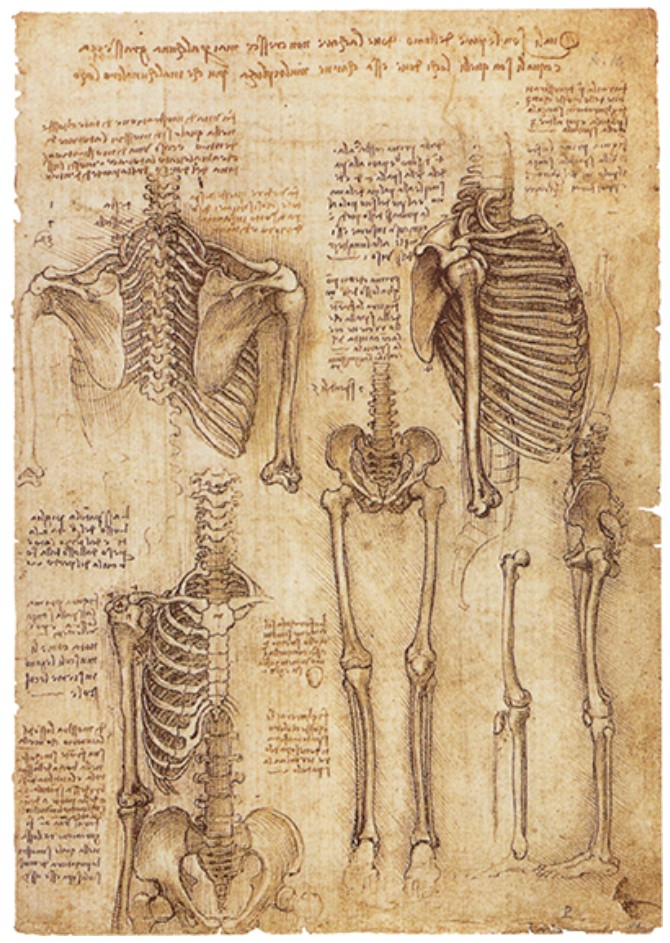
Leonardo da Vinci, The skeleton (recto); The muscles of the face and arm, and the nerves and veins of the hand (verso), c.1510-11. The Royal Collection Trust, London. Image: Gravure Francaise / Alamy Stock Photo
Basquiat’s fascination with anatomy, sparked by a childhood gift of Gray’s Anatomy, is central to his work. Here, jagged red lines trace a skeletal form whose exposed ribs and musculature suggest both vitality and vulnerability. His interest in dissection—rendering the body open and diagrammatic—connects him to Leonardo da Vinci yet diverges in its expressive urgency. To the left, a segmented animal labeled “LOIN,” “RIBS,” and “SHANK,” pierced by arrows, evokes the commodification of life. The image becomes an allegory for systems of exploitation—human and animal alike—casting the Black body as historically subjected to the same logic of consumption. Across the surface, Basquiat maps a visual history of the African diaspora, from Ancient Egypt to contemporary America, reframing the Black figure as central to Western civilization’s narrative.
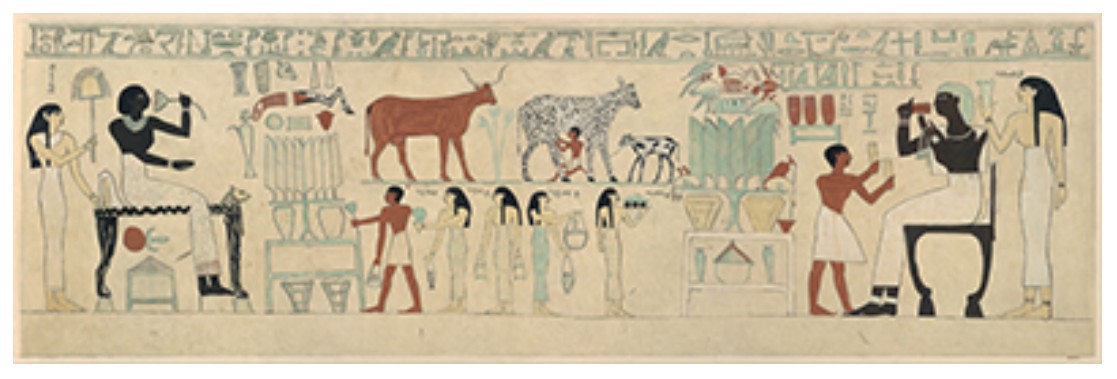
Facsimile of the painting on the inner back side of the sarcophagus of Aashyt, ca. 2051–2030 B.C. The Metropolitan Museum of Art, New York. Image: © The Metropolitan Museum of Art, New York, Rogers Fund, 1948, 48.105.31
During this period, Basquiat’s interest in African spiritualism and antiquity deepened. The pharaonic figure in Untitled—holding an ankh and staff—recalls Horus or Ra-Horakhty, deities symbolizing kingship and divine authority. Emerging from blue wave-like marks, it may allude to the Exodus story, a theme Basquiat builds on in the contemporaneous painting, now in the collection of the Guggenheim Museum Bilbao in Spain, Moses and the Egyptians, 1982, drawing parallels between biblical liberation and racial justice. His depictions of crowns, scepters, and hieroglyphic symbols challenge traditional art history by reimagining Black figures as royalty. Iterations of similar figures appear on the various funerary reliefs, stone tablets, and paintings found in the Ancient Egyptian wings of the museums Basquiat frequented, including an almost identical mirrored image of the figure in Untitled, as seen on an Illustrated Papyrus from 305-330 B.C.E in the Brooklyn Museum. Basquiat’s three-point crown, originating in his graffiti practice as SAMO©, became a declaration of authorship and resistance. In Untitled, the crown replaces the sun disk above the pharaoh’s head, emblematic of Basquiat’s own coronation within a predominantly white art world. That Basquiat was already attuned to the perils of visibility and success in 1982 is evident in another work from that year, Charles the First, where the prophetic warning “MOST YOUNG KINGS GET THEIR HEADS CUT OFF” is splashed across the painted surface.
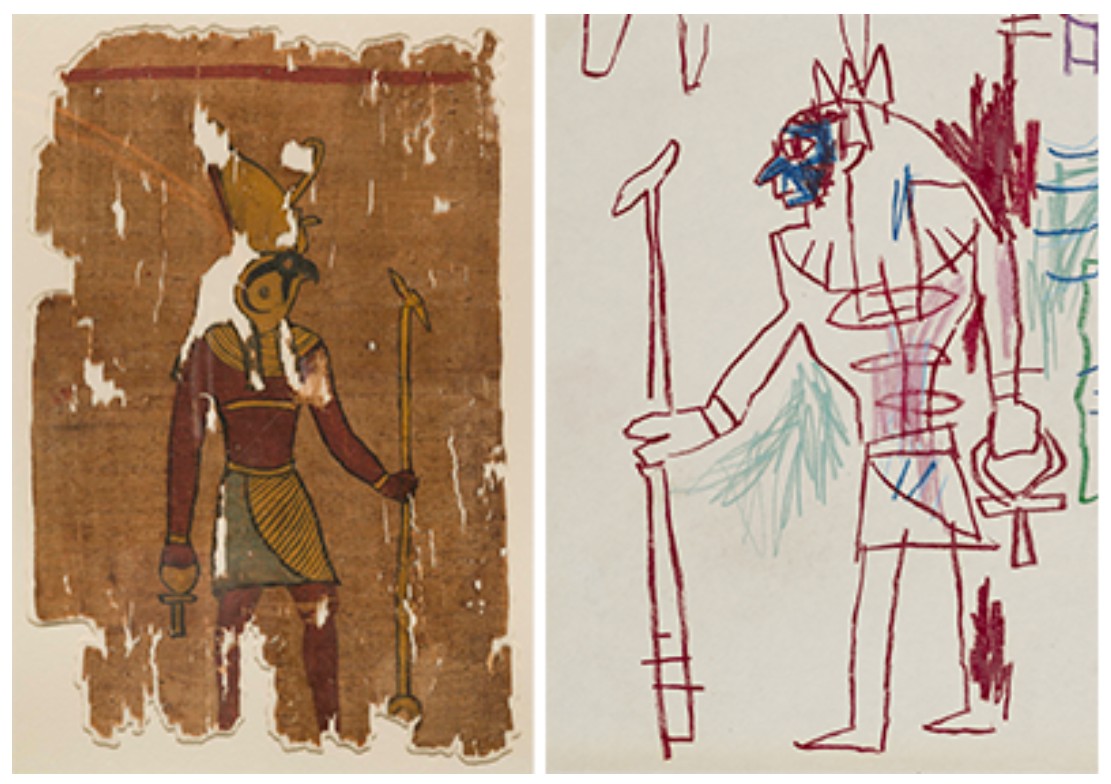
[Left] Illustrated Papyrus, 305–30 B.C.E. Brooklyn Museum, New York.
[Right] Detail of the present work.
Basquiat’s raw, graphic line translates the immediacy of graffiti to paper, fusing street art with semiotic experimentation. The composition brims with fragmented words and coded imagery, their meanings spanning languages and centuries. His inscriptions in Untitled resist fixed interpretation. By crossing out, repeating, and juxtaposing words, Basquiat achieves what scholars have called a “calculated incoherence,” leaving meaning perpetually in flux. To the right of the central figure, he scrawls “RESPO MUNDIAL,” a hybrid Spanish phrase translating roughly to “Global Responsibility.” This cryptic statement encapsulates the artist’s worldview—his awareness of power, history, and the collective burden of representation.
Untitled, 1982
Sotheby’s New-York: 19 November 2025
Estimated: USD 700,000 – 1,000,000
USD 889,000
Untitled | Contemporary Day Auction | 2025 | Sotheby’s
JEAN-MICHEL BASQUIAT (1960 – 1988)
Untitled, 1982
Oilstick and graphite on paper
30 x 22 1/2 inches (76.2 x 57.2 cm)
Signed (on the verso)
Composed of a striking network of words, symbols, and signs, Jean-Michel Basquiat’s Untitled from 1982 offers a vivid glimpse into the artist’s boundless imagination and inventive brilliance. Executed during the most celebrated year of his career, a period that witnessed his rapid ascent from downtown prodigy to international art-world icon, the present work stands as a testament to his singular visual language. Basquiat constructs an entire cosmology: a choreography of text and image that reveals the fusion of cultural, linguistic, and spiritual forces animating his practice. Jean-Michel Basquiat’s heritage, both his familial origins and his artistic beginnings, was always on display throughout his incandescent artistic career. Born to a Haitian father and Puerto Rican mother, Basquiat inherited a richly hybrid cultural identity that informed every work he created. He began his artistic journey as a graffiti artist in New York City, tagging cryptic phrases and symbolic codes across the facades of the Lower East Side. Language became his first canvas, and it remained the foundation of his art. In Untitled, this linguistic impulse finds profound expression: the artist fuses the sacred with the secular, the spiritual with the commercial, and the personal with the universal.
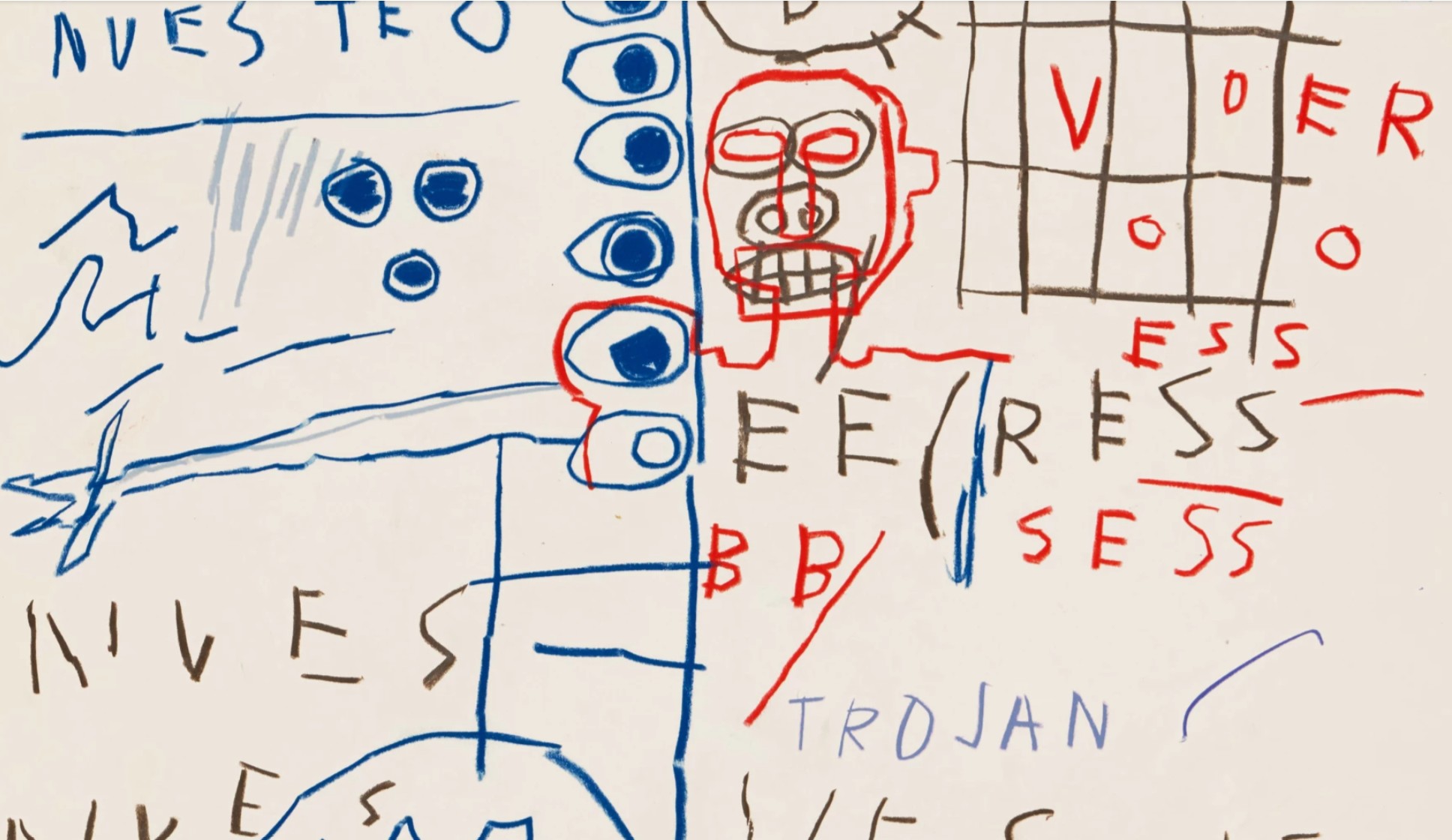
At the top of the composition, the words “COOKIE –N– PEPSI”, “MILAGROS”, and “CONSUELO DOLOR’S” appear in Basquiat’s unmistakable hand. Here, the sacred heart and cruciform icon coexist with corporate slogans, an audacious juxtaposition that collapses centuries of religious iconography into the consumerist vernacular of 1980s America. The Spanish inscriptions speak of pain, consolation, and miracles—evocations of Catholic devotion—while the crowned central figure, encircled by a halo of thorns, recalls a contemporary Christ figure. Yet Basquiat’s irreverence is never nihilistic. Rather, it is revelatory: a complex meditation on faith, commodification, and identity.
Across the page, repetitions of fractured words and phonetic distortions form a rhythmic refrain, as if language itself becomes an incantation. The text does not merely describe; it performs. It chants, interrupts, and provokes, mirroring the syncopated energy of jazz—a soundscape Basquiat often invoked in his paintings and drawings alike.
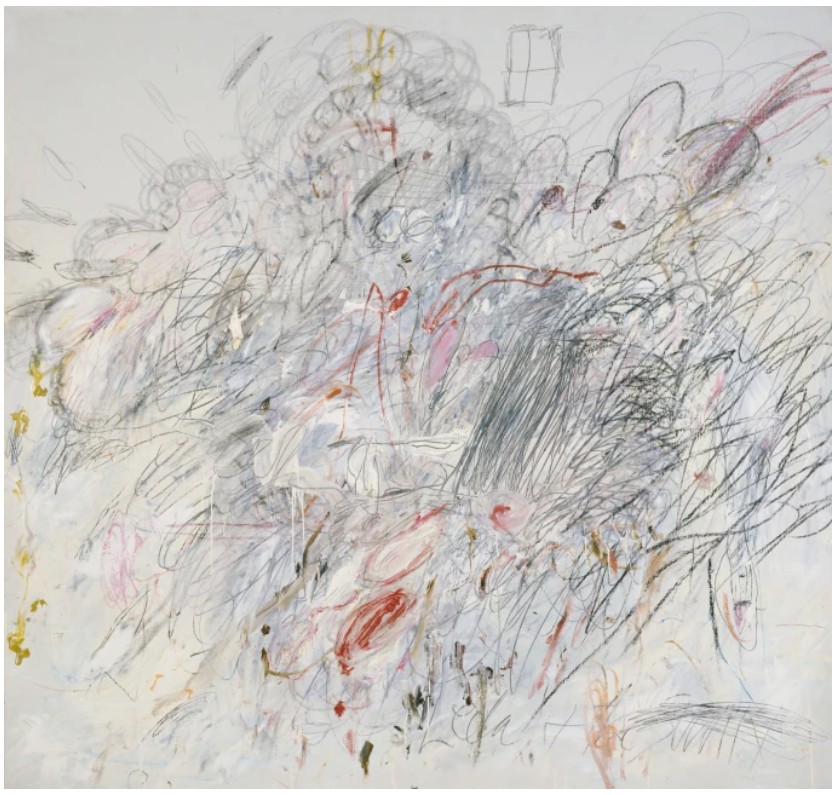
Cy Twombly, Leda and the Swan, 1962. The Museum of Modern Art, New York. Art © 2025 Cy Twombly Foundation
At the center, the schematic red head, part mask, part anatomical study, anchors the composition. Surrounded by gridlines and cryptic text, it invokes both spiritual icon and scientific diagram. In Basquiat’s world, these systems coexist: art history and anatomy, theology and street culture. The words “TROJAN” and “CABALLO” (Spanish for “horse”) inscribed near the bottom edge summon the legend of the Trojan Horse, a recurring metaphor in Basquiat’s lexicon. This ancient emblem of deception and infiltration becomes, in his hands, a symbol of cultural subversion—the artist as insurgent figure, smuggling new forms and narratives into the fortress of high art. Each reference doubles back upon itself, collapsing myth into history, irony into sincerity.
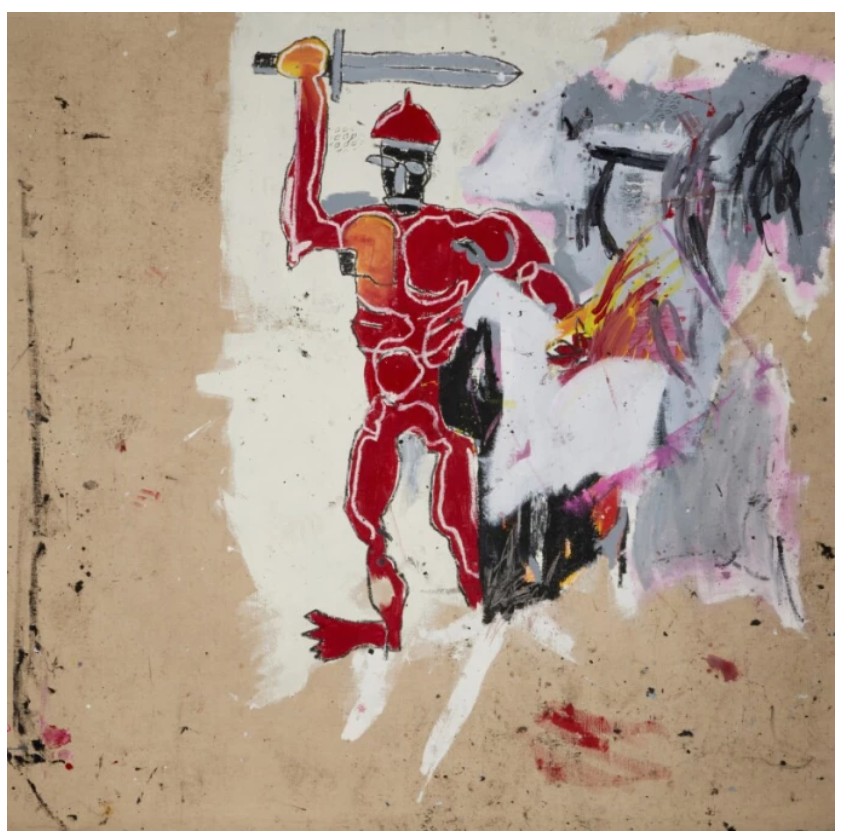
Jean-Michel Basquiat, Untitled (Red Warrior), 1982. Private Collection.
Art © 2025 Estate of Jean-Michel Basquiat. Licensed by Artestar, New York.
As an artist constantly on the move, Basquiat found in drawing the perfect medium for immediacy and reflection. Bending over sheets of paper that filled his studio floor, he treated drawing as both private meditation and public declaration. In this work, his stream of consciousness flows seamlessly between the poetic and the pictorial, the personal and the historical. Executed with the urgency of revelation, Untitled encapsulates Basquiat’s mastery of language and line, merging faith, heritage, and contemporary culture into a single dynamic field. The drawing reads as both confession and confrontation: a compact expression of the artist’s restless intellect and his unrelenting pursuit of truth. In its fusion of image and idea, it remains indelibly, unmistakably Basquiat: raw, radiant, and utterly alive.
Untitled (Pestus), 1982
Phillips London: 16 October 2025
Estimated: GBP 2,000,000 – 3,000,000
GBP 2,374,000 / USD 3,181,160
Jean-Michel Basquiat Modern & Contemporary Art Evening Sale
When asked directly to describe his subject matter in a 1983 interview with renowned curator of The Metropolitan Museum of Art, Henry Geldzahler, Jean-Michel Basquiat paused before replying succinctly: ‘Royalty, heroism, and the streets.’ Created in what would become widely regarded as the artist’s annus mirabilis as he broke through to the New York artworld to widespread and instant acclaim, Untitled (Pestus) deftly encompasses this vision, distilling the immediacy and raw energy of Basquiat’s mark making as he ‘tapped into the zeitgeist, bringing the satirical bite of the Beat writers into a new age’, a street poet whose drew his material from the syncopated urban rhythms and complex contradictions embedded in the social and historical fabric of the city itself in a manner that recalls French pioneer of Art Brut Jean Dubuffet’s celebration of the surfaces, textures, and material realities of postwar Paris.
Basquiat came of age in the gritty, electric atmosphere of 1970s New York in the midst of a cultural revolution defined by an emergent hip hop culture and burgeoning street art scene while experimental, underground artist communities blurred the lines between music, painting, film, and fashion. Downtown Manhattan, especially the Lower East Side, became a crucible for creative rebellion, where nightclubs doubled as galleries and sidewalks served as canvases. Although something of a golden era for the expansion of artistic freedoms and modes of expression, it was also a period of socio-economic crisis, with financial downturns, widespread unemployment, and soaring crime rates were set against a background of strikes, riots, and rampant police corruption For Basquiat, a young Black artist from Brooklyn, the contradictions of this environment were impossible to ignore. He navigated a city shaped by both innovation and inequality, quickly becoming attuned to the divides between visibility and marginalization, privilege and precarity, and the harsh truths of institutional racism that ran through daily life.
Jean Dubuffet, Apartment Houses, Paris, 1946, The Metropolitan Museum, New York. Image: © The Metropolitan Museum of Art/Art Resource/Scala, Florence, Artwork: © 2025 Artists Rights Society (ARS), New York / ADAGP, Paris
Street art and hip-hop both offered powerful creative outlets for channeling and challenging these power structures, finding new symbolic and linguistic modes for speaking out against the routine silencing of certain communities and individuals existing within such systems. Working with his childhood friend, the graffiti artist Al Diaz in the late 1970s, Basquiat created an enigmatic and politically charged mode of graffiti, tagging walls and sidewalks with the SAMO© insignia in a very literal mode of concrete poetry. The immediacy of graffiti, its ability to carry meaning, and the endlessly inventive combinations of text, image, and symbol that it presented was central in shaping Basquiat’s distinctive visual language, expressed most directly in his works on paper and especially resonant in works like Untitled (Pestus).
The second property featured on the Monopoly Board to which Basquiat made even more direct reference in his notebooks, ‘Baltic Avenue’ is shorthand for a low-income and economically depressed urban area associated with neglect, higher crime rates, and dereliction. Mapped on to the socio-economic geography of Atlantic City, Monopoly’s designation of Baltic Avenue as a lower-cost area also speaks to the historical segregation of the city that took root the 1930s during The Great Migration, where Black communities were barred from the wealthier or more exclusive neighborhoods, and were instead ghettoized in poorer ‘undesirable’ neighborhoods like Baltic Avenue and Mediterranean Avenue.
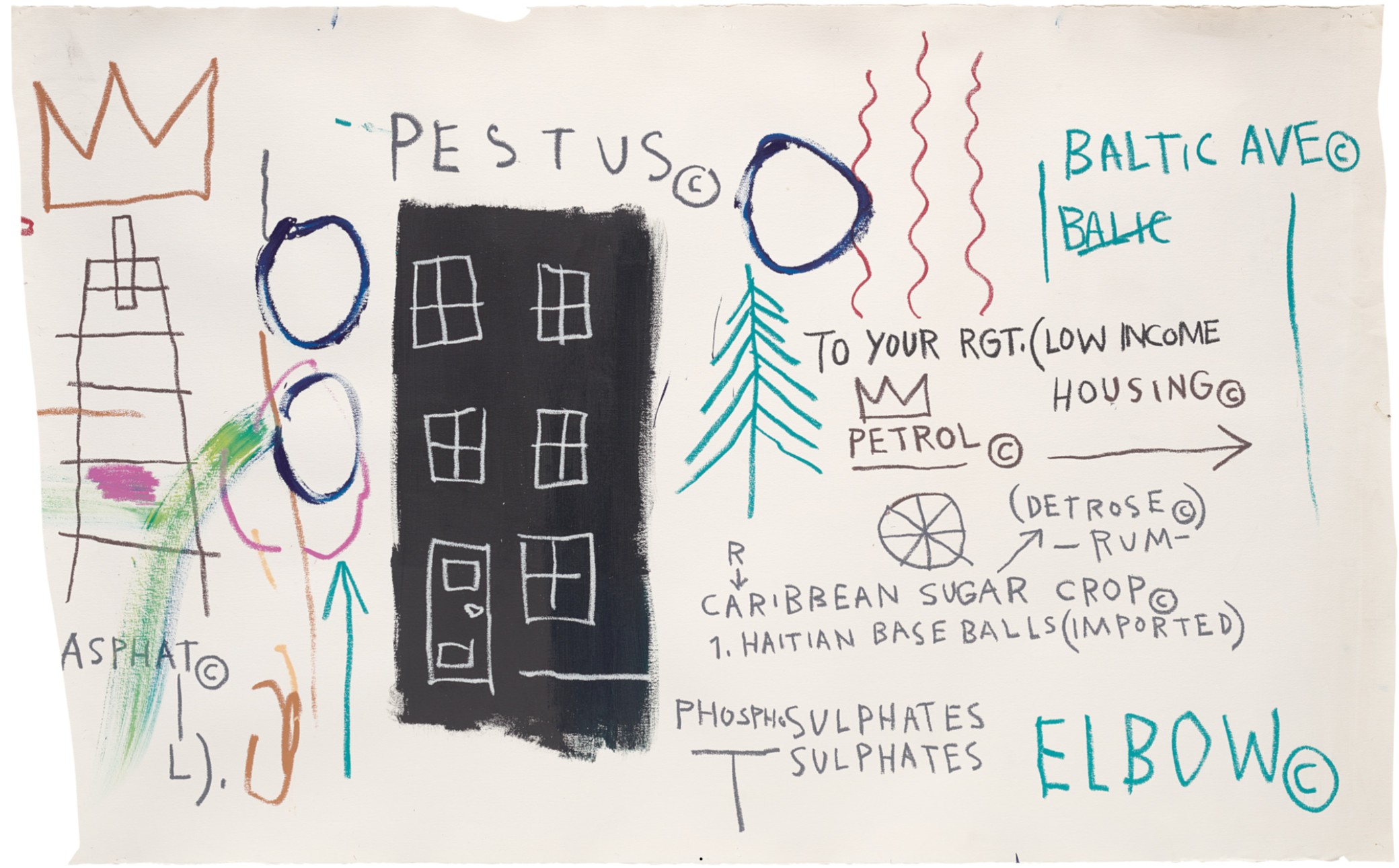
Invoking this history in Untitled (Pestus) alongside the scrawled inscription ‘CARRIBEAN SUGAR CROPS’ Basquiat directly and incisively connects present-day socio-economic realties for these communities with the fraught and deeply interwoven history of American economic success and the slavery of Afro-Caribbean peoples, identifying an ongoing legacy of systemic, structural oppression encoded in the geography of the city itself. The extent to which the legacies surrounding the exploitation of Black labor for the monetary gain, status, and leisure of white Anglo-Americans persists well into the 20th century and beyond is emphasized with the inclusion of ‘1. HAITAN BASE BALLS (IMPORTED)’, a direct reference to the manufacture of the official major league Baseballs by Rawlings factory based in Haiti, where it benefited from cheap labor costs until the 1980s when it relocated to Costa Rica following political unrest. While the mention of Haiti evokes Basquiat’s dual cultural inheritance, it also points to the kinds of conflicts that he might have been navigating during this period, poised between the subversive actions of a street artist exploring and existing within the urban landscape on the one hand, and the more upwardly mobile pathway of a commercially successful painter launched into the heady circles of New York’s cultural elite on the other. In Untitled (Pestus) we see the artist working through these dichotomous contradictions, the streets with their blocks of ‘LOW INCOME HOUSING’ and history of division along lines of race and class reclaimed as the space where true royalty and heroism might be forged, the propulsive upward energy of arrows and tree-like forms indicative of a kind of grittily determined aspiration against all the odds, culminating in the ladder motif to the left of the building, topped with Basquiat’s iconic three-pointed crown.
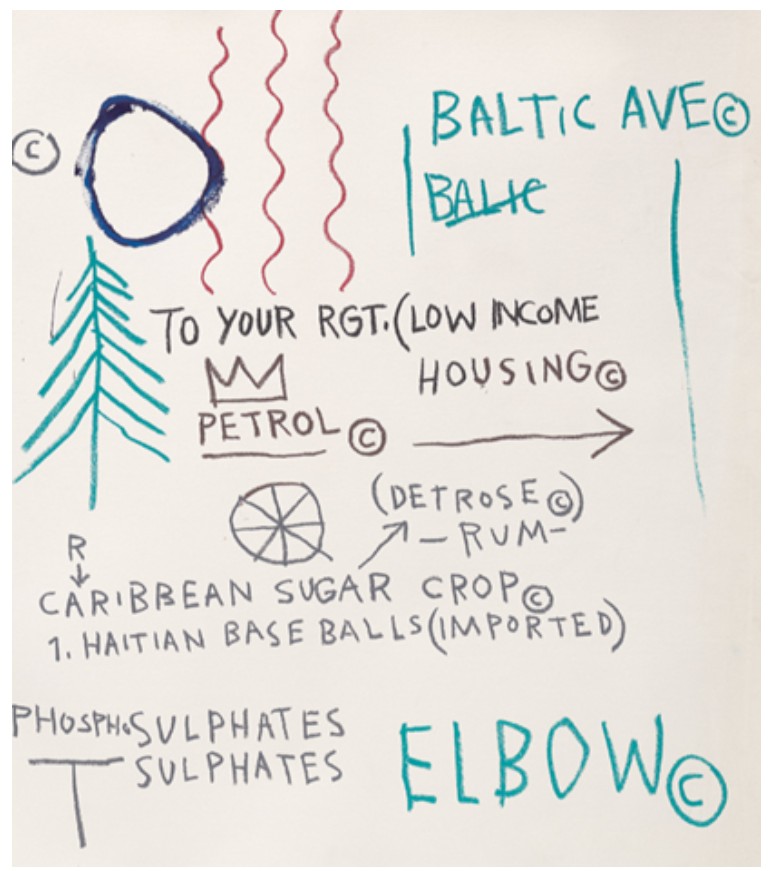
Undoubtably one of the most immediately recognizable and loaded pictographic symbols in Basquiat’s arsenal of motifs, the three-pointed crown is uniquely important in the artist’s practice, allowing him to directly challenge and subvert persistent racial biases as he generated an alternative pantheon of Black heroes including musicians, athletes, and civil rights activists, honoring their cultural contributions by ‘crowning’ them in his work. As well as acknowledging and honoring his heroes in this way, Basquiat also employed the three-pointed crown as a pictographic signature or self-portrait of sorts. Alongside the prominent inclusion of the motif above the ladder to the left of the building here, the crown also makes a second, more subtle appearance in the composition, significant in its proximity to another frequently employed motif. As a symbol of communication, its inclusion here in relation to the three-pointed crown is significant, emphasizing the warrior-artist’s duty to speak out and share his message with the world.
Untitled, 1982
Christie’s London: 15 October 2025
Estimated: GBP 300,000 – 500,000
GBP 508,000 / USD 680,270
JEAN-MICHEL BASQUIAT (1960-1988), Untitled | Christie’s
JEAN-MICHEL BASQUIAT (1960-1988)
Untitled, 1982
Oilstick on paper
17 x 13 7/8 inches (43 x 35.3 cm)
Signed, inscribed and dated ‘ST MARTIN 1982- Jean-Michel Basquiat’ (lower edge)
Two totemic figures dominate the picture plane in this vibrant, emblematic work by Jean-Michel Basquiat, executed in a striking primary palette in the artist’s trademark oilstick medium. A larger, female figure is described with an almost Cubist arrangement of form: simultaneously depicted frontally and in profile, she wears an elaborate headpiece crowned with a single, bright yellow feather.
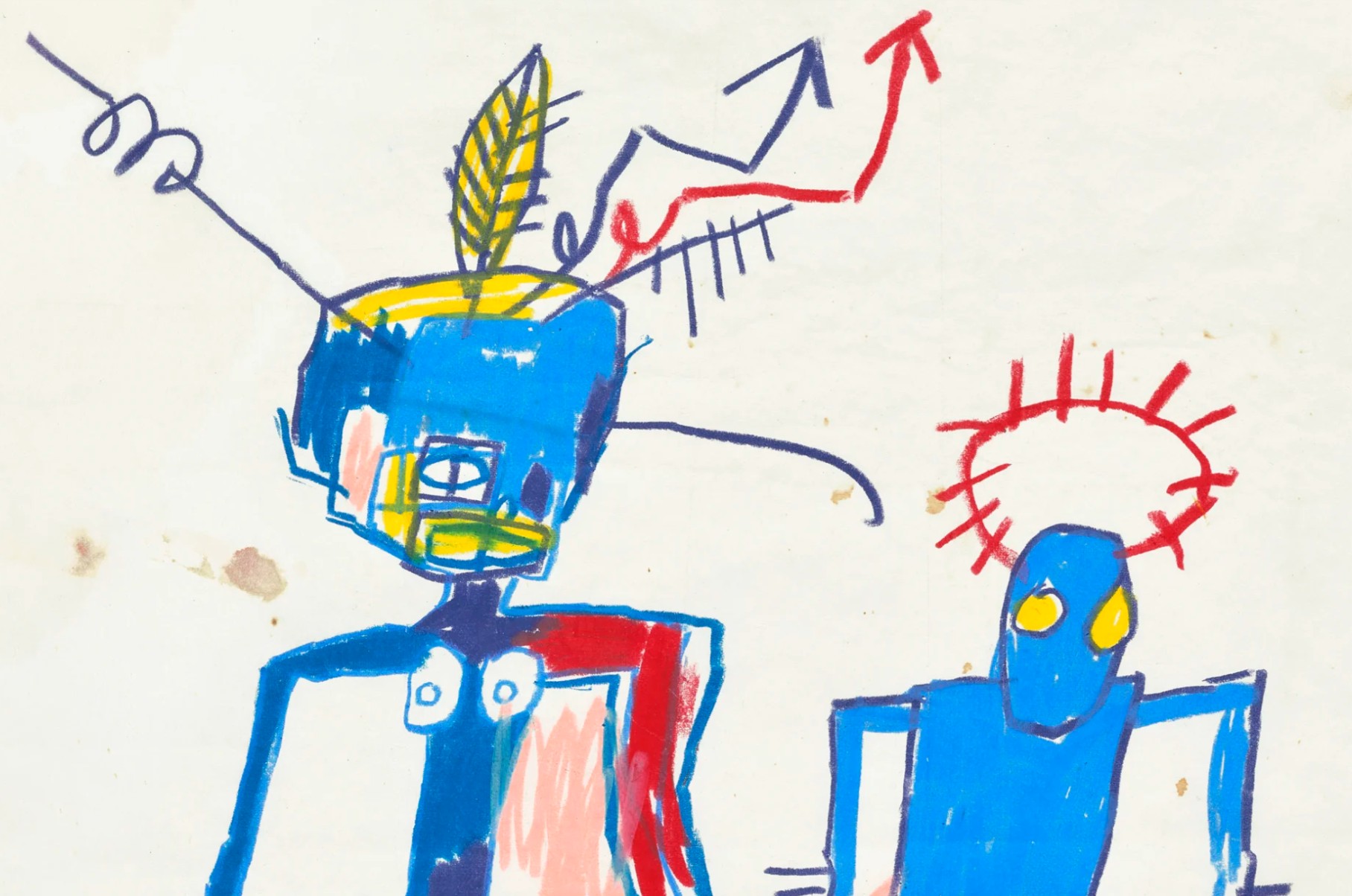
The second figure is angular and robot-like. Adorned with a bright red nimbus of thorns, its large yellow eyes gleam like beacons. Along the lower edge the sheet is signed and inscribed in Basquiat’s unmistakable graphic scrawl. It was only recently that Basquiat—known initially as the enigmatic street artist SAMO—had taken to signing works with his real name. The present work was executed in 1982, the exhilarating and pivotal year that saw him rise to stardom. His debut solo show at the Annina Nosei Gallery in New York in March precipitated a string of international solo exhibitions across the year, and that summer he was the youngest artist to be included in curator Rudi Fuchs’s documenta VII.
Pablo Picasso, Homme au chapeau de paille et au cornet de glace, 1938. Musée Picasso, Paris. Artwork: © Succession Picasso/DACS, London 2025. Digital image: © Photo Josse / © Succession Picasso/DACS, London 2025 / Bridgeman Images.
Basquiat worked amid a ferment of life and art, and his studio brimmed with drawings, paintings, and source material. From this profusion of inspiration, quickfire images poured fully formed from his mind. Drawing—on paper or canvas—formed the basis of his practice, typically with oilstick. The medium’s slick, tacky sheen suited his bold visual lexicon. There is an immediacy and intimacy to Basquiat’s works on paper, which frequently preserve the traces—coffee stains, footprints—of his daily life.
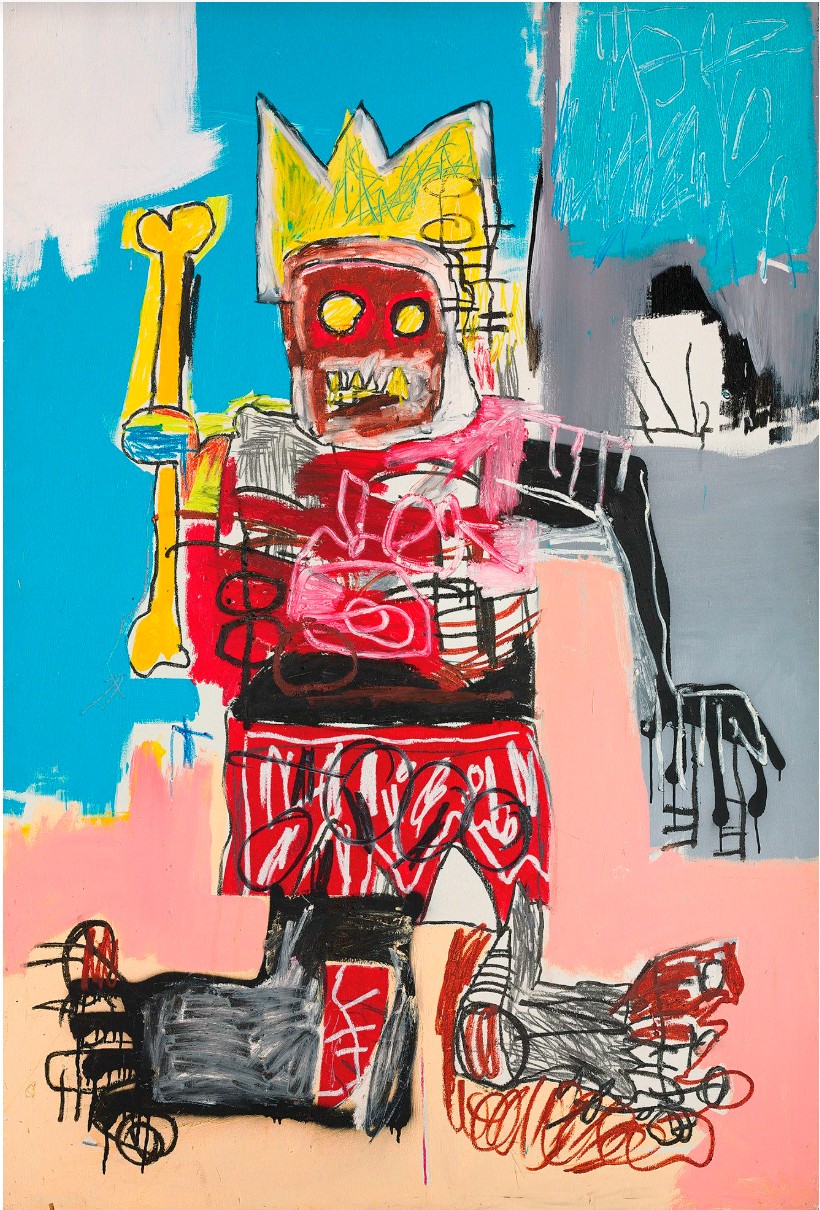
Jean-Michel Basquiat, Untitled, 1982. Private collection. Artwork: © Estate of Jean-Michel Basquiat. Licensed by Artestar, New York.
Basquiat lifted ideas from art history, popular culture and religious iconography. He pored over the collection catalogues of the Metropolitan Museum of Art and the British Museum, as well as books such as Burchard Brentjes’ African Rock Art (1969), often translating their idols and statuettes into his drawings. His oeuvre is replete with heroic imagery of crowns, halos, and masks, populated by archetypal images of royalty, athletes, warriors, and robots. Both figures in the present work are crowned in some way. One wears an elaborate plumed headpiece that crackles with electric lines, flying arrows, and antennae-like forms, like an exploding feathered war bonnet. For Basquiat crowns were ambiguous, even mocking: an allusion to the Western obsession with being on top, and the ease with which contemporary life could become a game of snakes and ladders. The brilliant red crown of thorns which adorns the second figure is a trademark motif in his work, emblematic of the weight of glory.
Piero della Francesca, Madonna del Parto, circa 1450-1470.
Musei Civici Madonna del Parto, Monterchi. Digital image: © 2025 Photo Scala, Florence.
Basquiat was of Haitian and Puerto-Rican descent, and the present work—inscribed ‘ST MARTIN’—may be a tribute to the island of Saint Martin in the northeastern Caribbean Sea. Another inspiration may have been Saint Martin de Porres, the patron saint of social justice, racial harmony and mixed-race people. Born illegitimately in 1579 to a Spanish aristocrat and freed black slave, Saint Martin struggled to be accepted into a religious order in his home city of Lima. Persevering, he volunteered within a Dominican monastery and eventually became one of the few mixed-race Dominican brothers of the time, widely respected for his devotion and compassion. Canonized in 1962, two decades before the present work was executed, his life and work would have resonated with Basquiat, who was keenly aware of the complexities of colonial history and similarly concerned with the plight of social justice. Through works such as the present, Basquiat constructed a bold new visual realm in which to counter the inequalities and hypocrisies built into the fabric of twentieth-century America.
Foo, 1982
Sotheby’s New-York: 16 May 2025
Estimated: USD 600,000 – 800,000
USD 1,972,000
Foo | Contemporary Day Auction | 2025 | Sotheby’s
JEAN-MICHEL BASQUIAT (1960 – 1988)
Foo, 1982
Oil stick on paper
30×22 inches (76.2 x 55.9 cm)
Signed (on the verso)
Executed at the pinnacle of Jean-Michel Basquiat’s career and illustrating a masterful combination of symbols, diagrams and words that are instantly recognizable features of his oeuvre, Untitled offers a glimpse into the artist’s energetic, imaginative and ingenious mind. Executed during an intense period of rapid evolution in his work, Foo captures the artist’s transition from his origins as a graffiti artist in New York City to a celebrated figure in the contemporary art scene. Foo is a vibrant reflection of the artist’s distinctive visual language, capturing the raw energy and inventive genius that would define his meteoric rise in the art world.
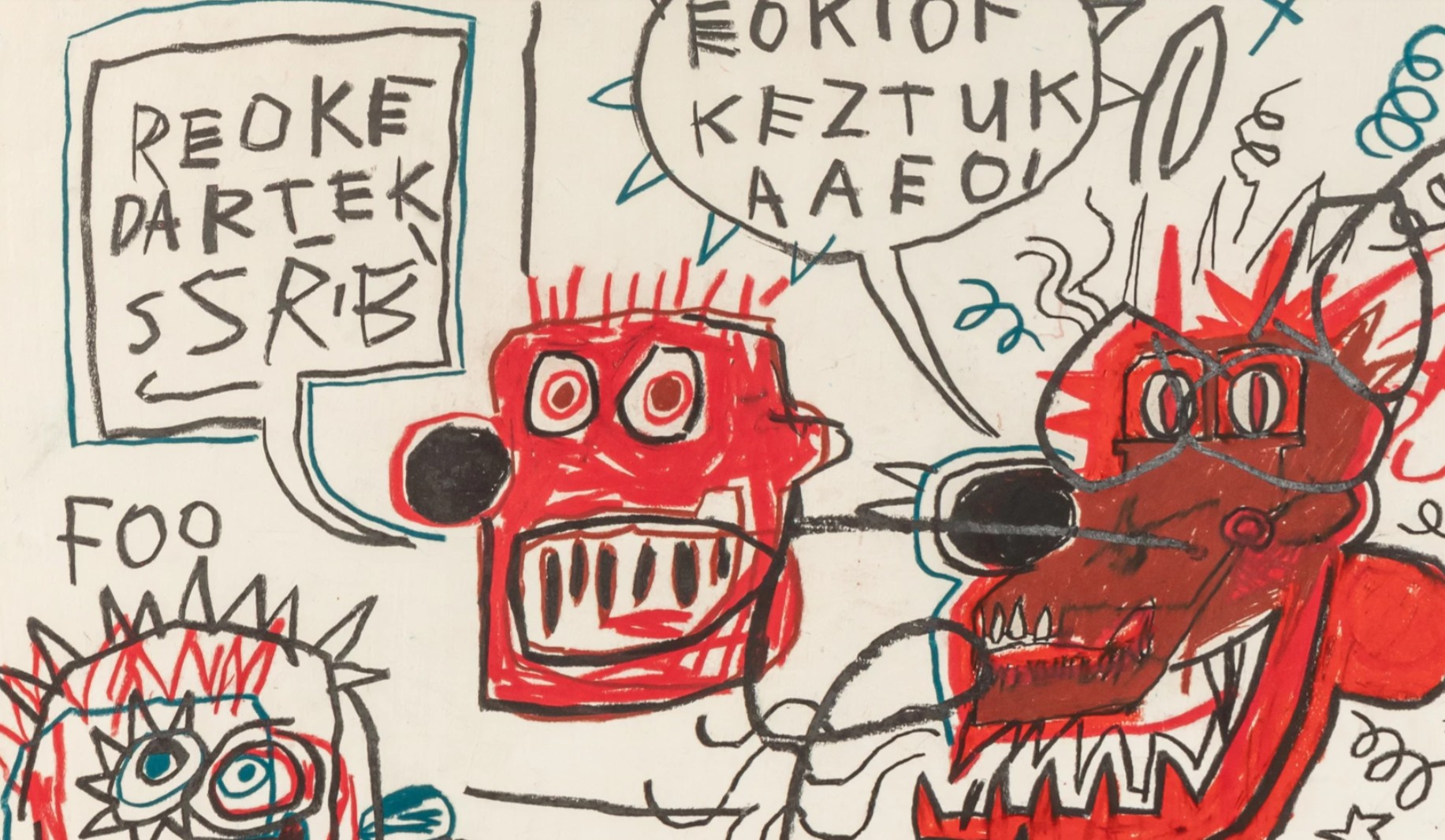
In Foo, Basquiat uses oil stick to create an intricate spread of his signature motifs, blending chaotic text with figures and abstract elements to form an enigmatic, almost symphonic, arrangement. Central to the composition are five distinct heads, some of the most instantly recognizable and important motifs of Basquiat’s oeuvre. The clown-like figure in the top right, crowned with a three-pointed diadem, stands as a defining image, with a protruding nose, eyes, and spring-like lines on the right that suggest a toy clown that jumps out of a box. This figure introduces a sense of absurdity, characteristic of Basquiat’s playful engagement with identity and iconography.
Two other figures in the composition wear crown-like shapes that echo the crown of thorns, further evoking religious and historical symbols. This recurring symbol draws attention to Basquiat’s unflinching exploration of authority, race, and identity, while also invoking a wider cultural history that incorporates elements of Christian iconography. These references, intertwined with Basquiat’s contemporary imagery, reflect his unique ability to bridge the gap between art history, popular culture, and the complex realities of Black identity.
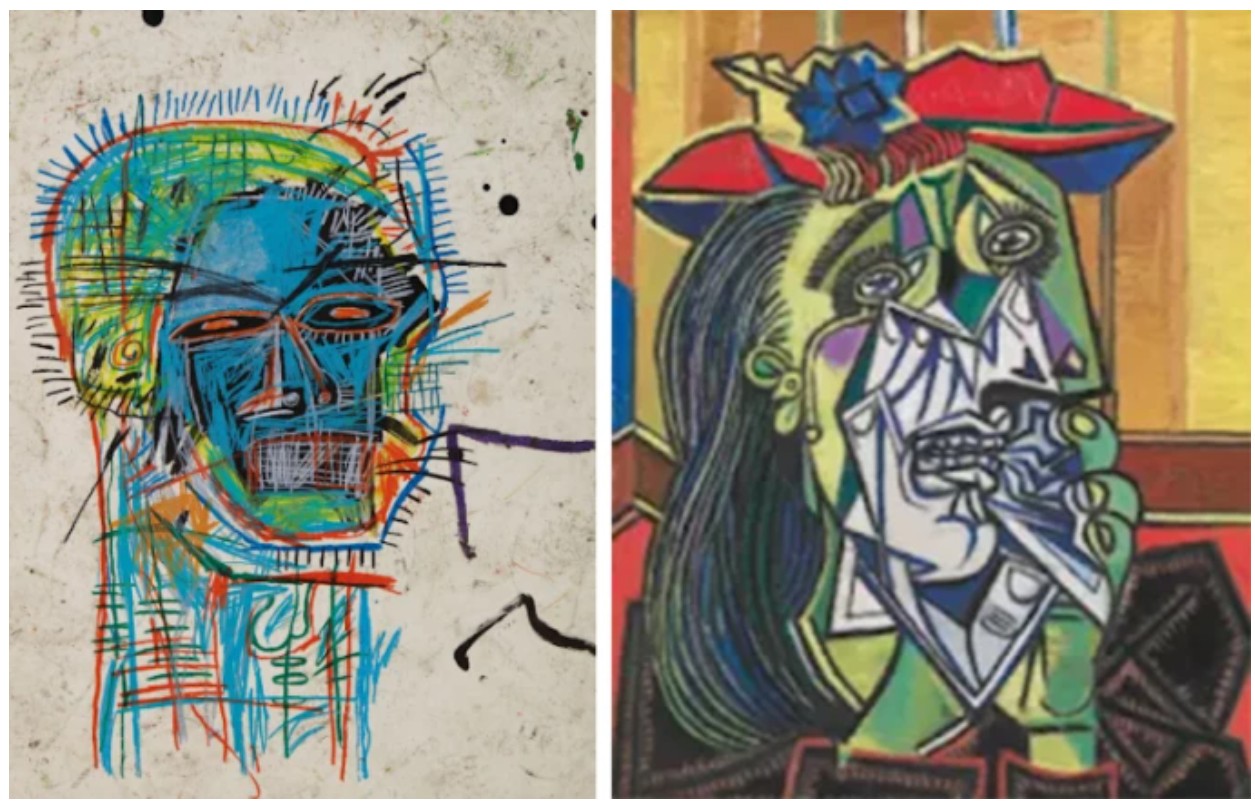
Left: Jean-Michel Basquiat, Untitled (Head), 1982. Sold at Sotheby’s New York, June 2020, for $15.1 million.
Right: Pablo Picaso, The Weeping Woman, 1937
The Tate, London. Art © 2020 Estate of Pablo Picasso / Artists Rights Society (ARS), New York
All figures in Basquiat’s oeuvre are depicted without bodies, focusing singularly on different representations of the head. This emphasis on the head is central to his work, capturing both the external and psychological complexities of human identity. Describing the singular importance of the head within Basquiat’s art in terms highly reminiscent of the present work, Phoebe Hoban reflects: “Start with the head. (He painted them obsessively). The hair was a focal point…Next, the eyes. There was that look… People said his eyes could eat through your face, see right through you, zap you like the x-ray vision of his comic book heroes” (Phoebe Hoban, Basquiat: A Quick Killing in Art, London 1998, p. IX). This fixation on the head reveals Basquiat’s recognition of its universal relatability, allowing viewers to see themselves within the work. By using the intensity of his line, the suppressed energy of his compositions, and the exuberance of his color, Basquiat creates a space where his audience can experience a degree of catharsis. In the case of Foo, the scorching gaze, bared teeth, and fiercely delineated physiognomy express a profound emotional intensity. This intensity reflects Fred Hoffman’s description of Basquiat’s keen observation of the psycho-spiritual states of being: “What drew Basquiat almost obsessively to the depiction of the human head was his fascination with the face as a passageway from exterior physical presence into the hidden realities of man’s psychological and mental realms… they not only peer out as if seeing, but also invite the viewer to penetrate within” (Exh. Cat., New York, Acquavella Galleries, Jean-Michel Basquiat Drawing: Works from the Schorr Family Collection, 2014, p. 74). Through this relentless focus on the head, Basquiat crafts a visual language that simultaneously confronts and invites, challenging the viewer to engage with the deeper, hidden layers of the human psyche.
Leonardo da Vinci, Superficial anatomy of the shoulder and neck (recto),c.1510
Basquiat’s integration of text into his work is a defining characteristic, and in Foo, the artist weaves language, part poetry, part cipher, seamlessly into the composition. Often, Basquiat’s words are not straightforward statements, but rather fragmented thoughts, rambling letters, and cryptic symbols, functioning as both a visual element and a means of communication. Through the fluidity of his text, Basquiat engages with the complexities of communication and perception, challenging the viewer to decode its meaning while simultaneously embracing the ambiguity.
Cy Twombly, Untitled (New York City), 1970. Private Collection. Sold Sotheby’s New York in November 2015 for $70.5 million Art
© Cy Twombly Foundation
Unlike Basquiat’s larger-scale paintings, the frenetic energy of his works on paper—such as Foo—captures a sense of raw immediacy. Working on paper, an unforgiving medium that offers little opportunity for overpainting or revision, allowed Basquiat to express his creative thoughts in their purest form. This unfiltered approach to creation is part of what makes his works on paper so compelling—they stand as tangible records of the artist’s distinctive and unrestrained way of thinking. A self-taught artist, Basquiat possessed an innate understanding of composition and an unparalleled ability to fuse different iconographies, creating a personal lexicon that speaks to both contemporary popular culture and the art historical canon. In Foo, we see the full breadth of his creative potential—his use of symbolism, text, and figure is unencumbered, reflecting his unshakable confidence as an artist during a period when his career was accelerating internationally. With museum exhibitions worldwide and a growing recognition of his genius, Basquiat’s work during this period offers a glimpse into the artistic mind of an emerging master.
Foo encapsulates the essence of Basquiat’s artistic vision, a dynamic, multifaceted piece that invites viewers into his imaginative world. Through its bold motifs, the piece offers insight into the artist’s restlessness and unyielding curiosity, establishing it as a crucial moment in Basquiat’s career. As such, Foo is not just a work of art; it is a direct testament to the artist’s creative brilliance and his enduring legacy in contemporary art.
Untitled, 1982
Phillips London: 6 March 2025
Estimated: GBP 400,000 – 600,000
GBP 609,600 / USD 780,288
Jean-Michel Basquiat – Modern & Contemp… Lot 5 March 2025 | Phillips
JEAN-MICHEL BASQUIAT
Untitled, 1982
Oilstick and pencil on paper
24 x 19 1/8 inches (61 x 48.5 cm)
Jean-Michel Basquiat’s Untitled is a masterful example of the artist’s instinctive yet conceptually rigorous drawing practice, a fundamental element of his oeuvre. An imposing, arresting figure dominates the composition, arms by its side, staring directly out at the viewer with bulging eyes and teeth bared. Expressionistic vertical and horizontal lines of thick black oilstick intersect with scrawled forms, congregating and coagulating against the off-white paper; there is a frenetic, fizzing urgency to the mark-making. As is typical, there is an immediacy and rawness to the composition that belies a particularly painterly kind of complexity. Deploying his signature pentimento technique, layers of grey graphite and black oilstick clot and emerge from the paper, culminating in a coolly graphic pictorial icon that evinces Basquiat’s enduring, bombastic genius. Executed in 1982, Untitled dates to the very year that Basquiat’s meteoric ascension from unknown to icon began. He received his first solo exhibitions with Annina Nosei in New York, Larry Gagosian in Los Angeles, and Bruno Bischofberger in Zurich, and was invited to participate in the international exhibition Documenta 7 in Kassel, becoming the youngest artist to do so. In the autumn of 1982, the artist moved to Southern California at the invitation of Larry Gagosian, living and working at the dealer’s Market Street residence in Venice, California between November 1982 and May 1984; this heralded a highly productive period of creativity.
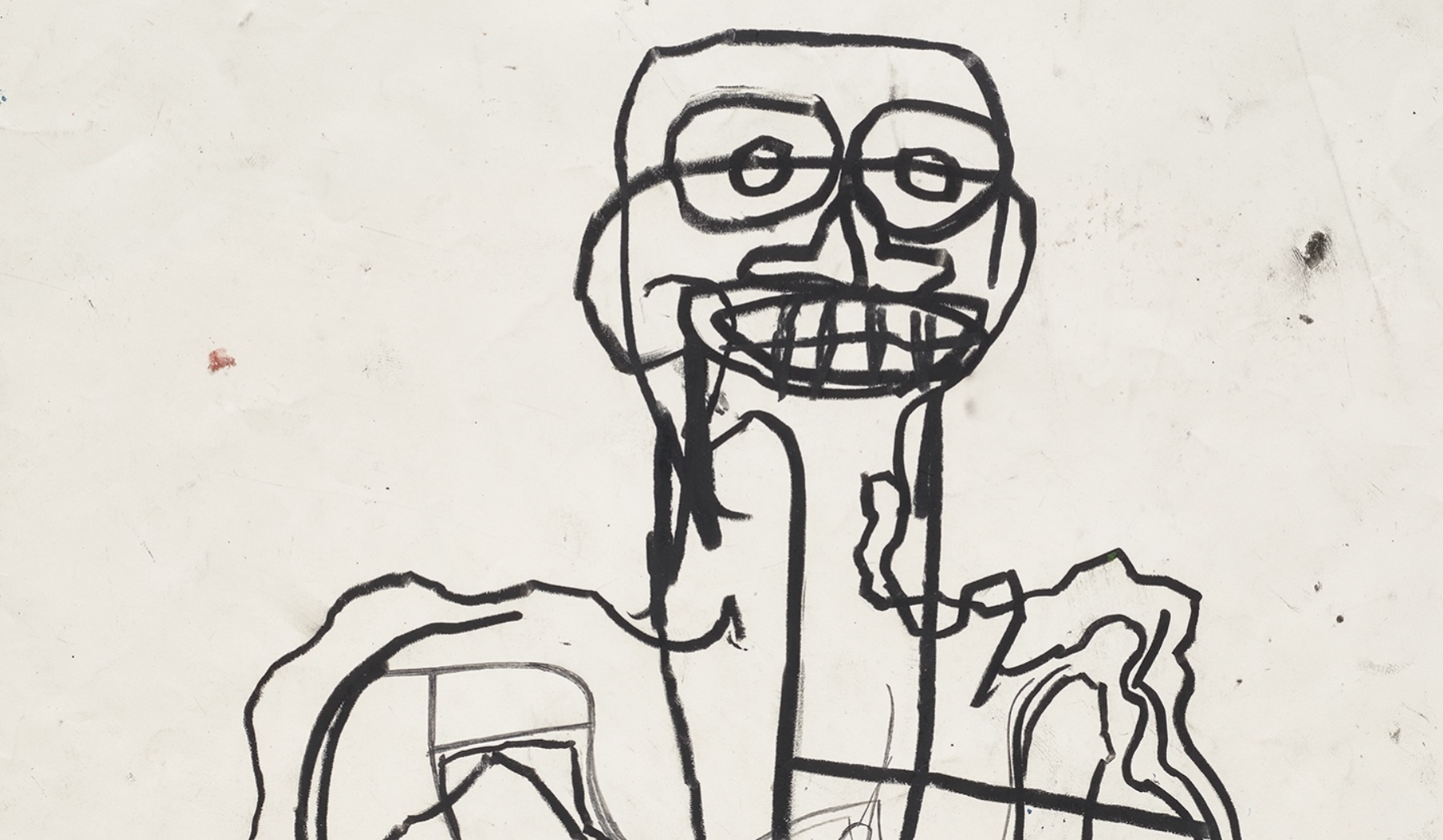
Basquiat’s rendering of the figure in Untitled oscillates between interior and exterior forms in a kind of pseudo-Cubist visual game, emphatically demonstrating the signature figuration that would come to define his output. Where the left hand is carefully drawn with an element of foreshortening to the fingers, a black mass pools in the right hand, pulled through veins and arteries towards the figure’s shoulder. Ribs, teeth, spine all appear fleetingly as if X-rayed, with quick gestural mark-making generating an overarching sense of brittle energy. This interest in anatomy can be traced back to the artist’s youth, when he was given a copy of the medical textbook, Gray’s Anatomy, by his mother whilst recovering from a car accident, and can be seen in the recurring skulls and skeletons throughout his oeuvre. In the present work, the figure appears as a composite of forms, a coalescing of geometries and schemes effected by Basquiat’s confident line. It is in this ambiguous tension between internal and external that the psychological power of the work resides. In the present work, aesthetic references to the African masks seen by the artist at the Metropolitan Museum of Art are linked through line to a kind of anatomical drawing found in Leonardo Da Vinci’s sketchbooks. In another way, the primarily monochromatic palette and highly gestural draughtsmanship also draw comparison with Abstract Expressionist artists such as Franz Kline. Confident, creative control over signs and symbols, forms and figures, drawn from a broad range of everyday, art historical and sociocultural sources defines Basquiat’s oeuvre: ‘Basquiat’s work, like that of most of his peers, was based on appropriation… the images he appropriated whether they were from the Bible or a chemistry textbook – became part of his original vocabulary… Basquiat combined and recombined these idiosyncratic symbols throughout his career: the recursive references to anatomy, black culture, television and history are his personal hieroglyphics’. In his works, visual idioms are recast and remixed to form a new language. Here, the so-called ‘primitivism’ of these skull-like forms and skeletal figures in Basquiat’s iconography gesture towards artists such as Jean Dubuffet and Pablo Picasso, demonstrating the complex and dynamic way in which he used and reused art historical precedent within his practice, reclaiming a cultural, racial identity for himself through his art.
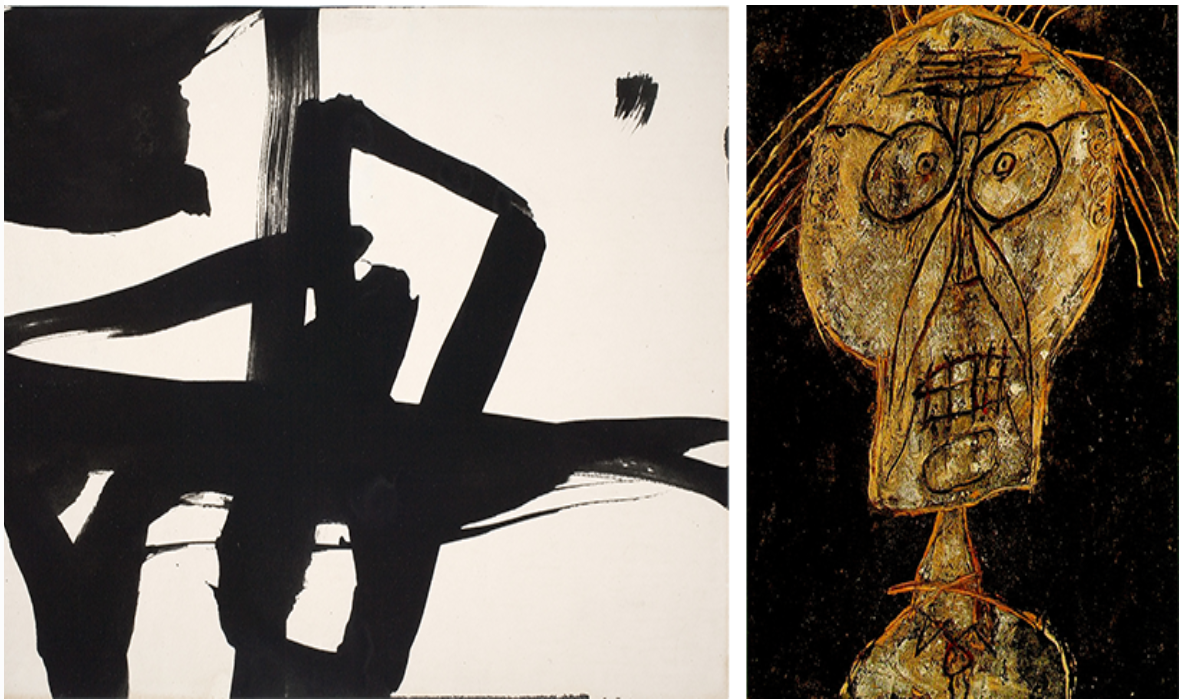
[Left] Franz Kline, Untitled, c. 1950, Davis Museum, Wellesley College. Image: © Davis Museum at Wellesley College / Given in memory of Mary Simpkins Lovell (Class of 1951) by her classmates / Bridgeman Images, Artwork: © ARS, NY and DACS, London 2025
[Right] Jean Dubuffet, Portrait of Dhotel, 1947, Private Collection. Image: Bridgeman Images, Artwork: © ADAGP, Paris and DACS, London 2025
Talismanic in its potency, Untitled stands as a paragon of Basquiat’s singularly electric artistic practice. In a different way to his paintings, the frenetic energy of Basquiat’s works on paper and the immediate freedom with which he draws and scrawls, carves and contours, synthesize his instinctive understanding of composition with his unique iconographic lexicon. As described by curator Diego Cortez, in his drawings ‘[Basquiat] constructs an intensity of line which reads like a polygraph report, a brain-to-hand “shake”. The figure is electronic-primitive-comic’. Teeth bared, eyes wide open, this figure transfixes every viewer, delivering a shock that reverberates off the paper.
Untitled, 1982
Christie’s New-York: 21 November 2024
Estimated: USD 20,000,000 – 30,000,000
USD 22,950,000
JEAN-MICHEL BASQUIAT (1960-1988), Untitled | Christie’s
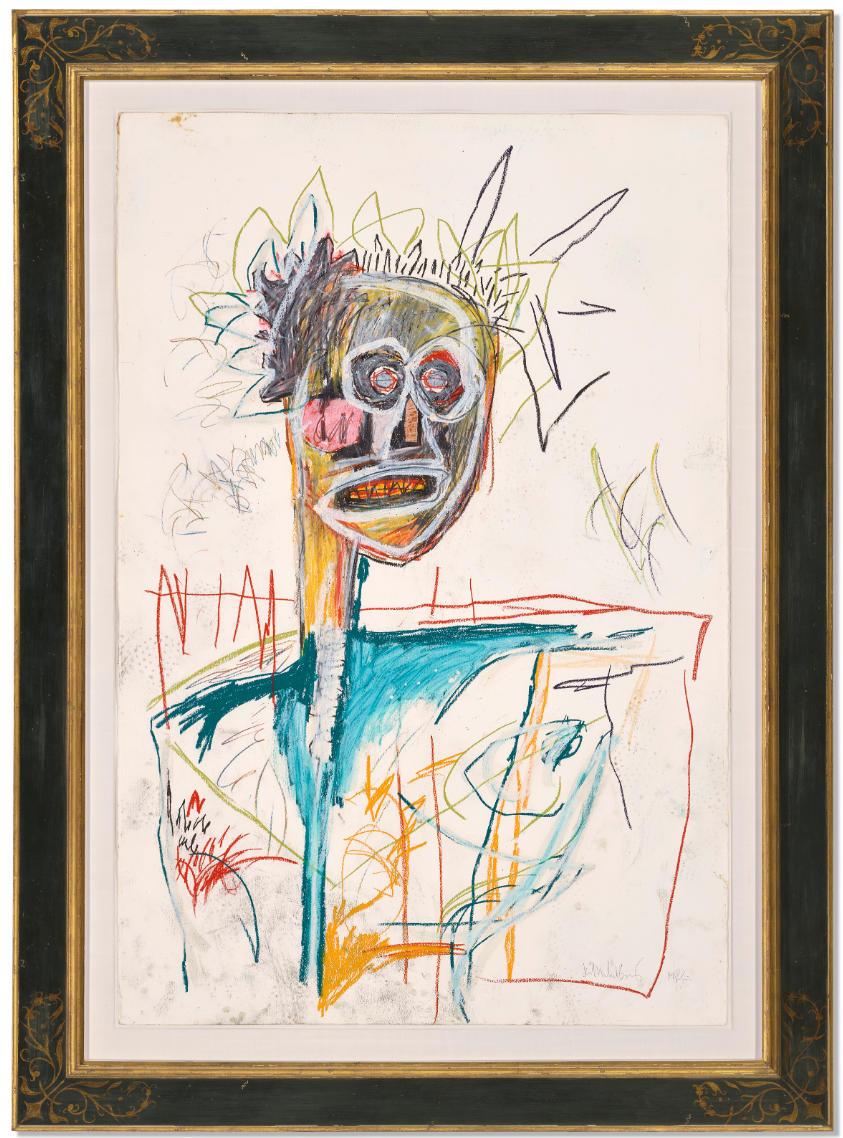
JEAN-MICHEL BASQUIAT (1960-1988)
Untitled, 1982
Oilstick on paper
63 1/2 x 44 inches (161.3 x 111.8 cm)
Signed and dated ‘Jean-Michel Basquiat 1982’ (lower right)
Measuring over five feet tall, Untitled is one of Jean-Michel Basquiat’s most impressive portraits—a monumental figure acting as a spectacular example of the artist’s totemic heroes. Comprised of highly worked passages packed with confident gestures, combined with pure expressionistic flourishes, this tour-de-force proudly displays Basquiat’s skill as a master draftsman. In concert with his painterly masterpieces, this portrait boldly reflects his interest in art and history. Basquiat often indicated the heroic status of his subjects by adorning their heads with a crown or a halo. Likely inspired by the artist’s passionate travels to Italy in 1981-1982, in Untitled, our hero is decorated by a laurel wreath—a symbol of triumph, honor, and victory in Greek and Roman mythology. Remarkably, this commanding subject also retains a characteristic air of self-portraiture, demonstrating Basquiat’s desire to take his own place in the canon as a young Black artist living and working in New York. Drawn in 1982, when the artist was just 21-years-old, Untitled demonstrates Basquiat’s remarkable maturity and skill at such a young age. Exhibited in the artist’s definitive retrospective at the Fondation Louis Vuitton in Paris in 2019, Untitled stands as one of the most accomplished works of the master’s short but explosive career. So accomplished in fact, that shortly after the artist’s tragic death in 1988, this was the painting chosen to represent the artist’s oeuvre in The New York Times’ report.
This man who audaciously locks eyes with us is composed of confident actions which represent the full range of Basquiat’s graphic arsenal. In the upper register, the artist lays down dense plates of color on top of which harried scribbles build up an almost three-dimensional image of this noble figure. The head is the result of successive applications of oilstick, with Basquiat building up layers of yellow, red, black and white to form the facial features. As such, Untitled is an exemplary example of how Basquiat used color to produce form. Beginning with a field of bold yellow, he then adds further layers of black to add both ‘shadow’ and body, before finally employing white oilstick to define the recognizable features such as the eyes, nose, and mouth. As with many of his best works, it is the intensity with which Basquiat embellishes these features that results in such a successful composition. Here, numerous applications of pigment, all applied in rapid circular motions result in a piercing—almost haunting—stare. Similarly, the figure’s intense grimace is only enhanced by the deliberative, forceful pressure of Basquiat’s application of oilstick. Building up consecutive layers of these energetic gestures imbues the figure with a dramatic sense of dynamic energy.
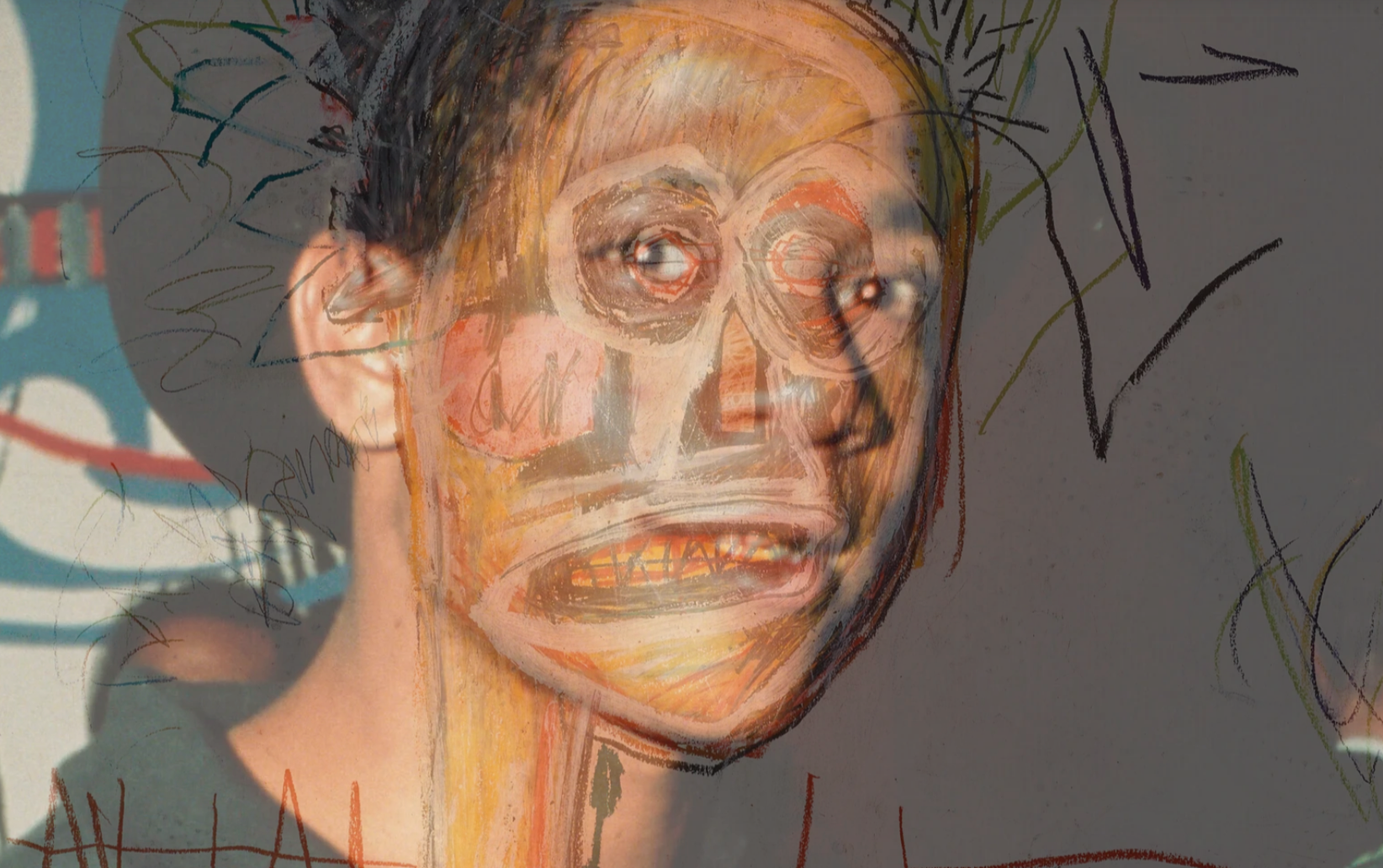
Basquiat’s iconic the three-pointed crown can be seen drawn in blue-green oilstick and placed jauntily on the left of the head; next—enveloping the head like a halo—are nine olive-green triangular leaf forms, evoking the wreaths of laurel leaves worn by Roman emperors. The rich symbolism of the laurel wreath originated in Greek mythology. It was later adopted by the Romans and worn by Julius Cesar to indicate his importance and godly status; the wreath’s circular form and use of evergreen material also symbolize continuous life and the immortality of the soul. Interspersed between the laurel leaves are darker elements—some short, some longer—which evoke the dreadlocks that Basquiat himself sported at this time, and which can be seen in photographs from the period. Such layering results in a complex figure, one that represents power, immortality, and triumph—much like the personification of Basquiat himself at the time. The rest of this remarkable figure is rendered in the artist’s signature rudimentary fashion. The body emerges from a suite of defining gestures that map out the upper half of a torso with broad shoulders. The muscular frame is indicated by Basquiat’s use of two shades of blue, a lighter hue for where the light falls on the chest and a darker shade for where the shoulders are cast in shadow. The artist’s interest in anatomy (something which he developed as a child when his mother gave him a copy of Gray’s Anatomy to occupy him during a hospital stay) can be seen in the vertebrae that Basquiat renders with looping movements of his oilstick. Elsewhere, an array of gestures fills out the frame, which itself is defined with a frame of red oilstick.
Untitled, 1982
Sotheby’s New-York: 1 March 2024
Estimated: USD 600,000 – 800,000
USD 1,875,000
Untitled | Contemporary Curated | 2024 | Sotheby’s (sothebys.com)
JEAN-MICHEL BASQUIAT (1960 – 1988)
Untitled, 1982
Oilstick and graphite on paper
30 1/8 x 22 3/8 inches (76.5 x 56.8 cm)
Signed and dated 82 (on the verso)
Baring its teeth and adorned with the crown of thorns, the protagonist of Jean-Michel’s Basquiat’s Untitled emerges from vigorous and animated markings in oilstick and graphite in saturated shades of scarlet, green, turquoise, and yellow along with black, which provides structure and a counterpoint to the rich and fiery colors. Executed in 1982, during what is considered to be one of the artist’s most productive years, the present work stands as a paragon of Basquiat’s singular vision at the height of his career. Acquired as a gift to the present owner in 1982, Untitled has remained in the same private collection for over four decades.
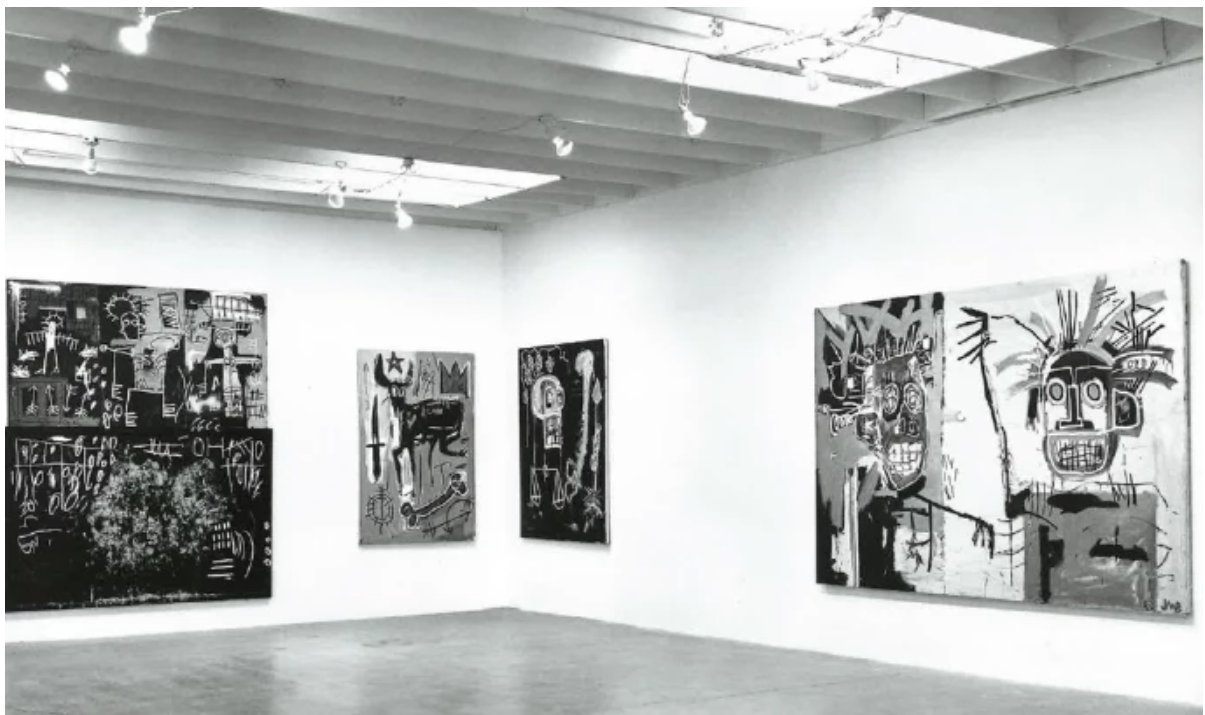
INSTALLATION VIEWS OF JEAN-MICHEL BASQUIAT: PAINTINGS, LARRY GAGOSIAN GALLERY, LOS ANGELES, APRIL – MAY 1982
In the spring of 1982, Basquiat received his first solo exhibitions in New York and Los Angeles, at Annina Nosei Gallery and Larry Gagosian Gallery, respectively, signaling the arrival of a critical new voice and art world prodigy. In the autumn of 1982, Basquiat moved to Southern California at the invitation of gallerist Larry Gagosian, where he lived and worked at Gagosian’s Market Street residence in Venice, California between November 1982 and May 1984. Although Basquiat remains most closely associated with New York, he thrived during his California residency, completing over 400 paintings, drawings and prints, of which Untitled is an iconic example of the artist’s electric talent.
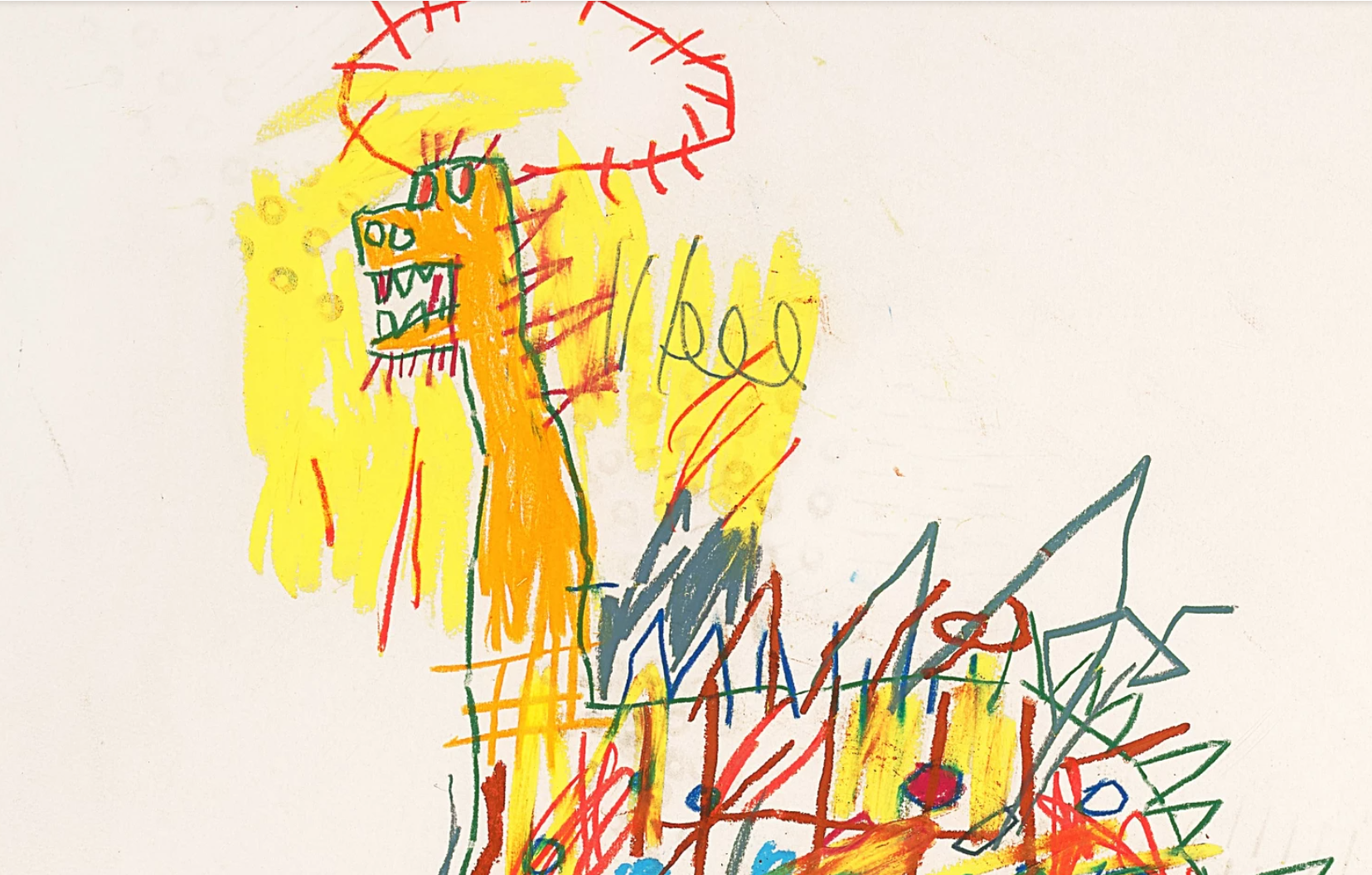
In Untitled, densely scrawled passages of slate and orange fill the barosaurus dinosaur’s emerald contours, showcasing the spirited, strategic movement of the artist’s hand and the chance mark making from the soles of Basquiat’s shoes. By positioning the creature in negative space, Basquiat effectively underscores its vivacity, as if resuscitating the beast from extinction. In its cacophony of line and color, Untitled also bears the influence of music on Basquiat’s artistic vernacular, particularly his Bebop heroes, Charlie “Bird” Parker and Dizzy Gillespie. Employing a kind of plastic improvisation, oilstick is scrawled freely across the surface: syncopation, tempo, and key are present in each compositional choice Basquiat conducts, as if the figure were reverberating off the page. As curator Robert Storr has remarked, “in drawings such as these – it is all still happening right before your eyes.” (Robert Storr, “Two Hundred Beats Per Min,” in: Exh. Cat., New York, Robert Miller Gallery, Basquiat Drawings, 1990, n.p.)
The fervor of Basquiat’s gesture is further aided by the creature depicted: the portrayal of animals in the history of art has been long charted, from the stags etched into the caves at Lascaux, to the dragons of the High Renaissance, through to the crying horses of Picasso’s Guernica. The impulse to tap into something rawer and more unmediated about the human experience has endured for millenia, as told through animals’ instinctual cycles of birth and copulation, death and survival. So resonant was this aesthetic and conceptual device that Basquiat would again return to the dinosaur, this time in paint, in his iconic Pez Dispenser of 1984.
Energetically capturing Basquiat’s characteristic graphic vocabulary, the beast is shown sainted, adorned with a crown of thorns, which is one of the artist’s most recurrent, and allegorically loaded motifs. Basquiat repeatedly summoned the crown of thorns in many of his most important works, appropriating a Christian symbol of sanctity to pose oblique commentaries on race, contemporary cultural values, and personal history. By juxtaposing the image of the extinct dinosaur with the sacred crown of thorns, the present work might be interpreted as a metaphor for Basquiat’s life. The artist spoke frequently of his own experiences with racism, and his grappling with such prejudice would play a continuous role in his oeuvre – which would be contradicted by his meteoric rise to stardom in a predominantly white, upper-class art world. At once alienated and sanctified, othered and exalted, Basquiat may have identified with the paradox this work depicts. In his revival of the dinosaur from extinction, Untitled potentially offers a parable of the transient nature of human life on earth, and perhaps Basquiat’s own fear that he, too, would fall from stardom.
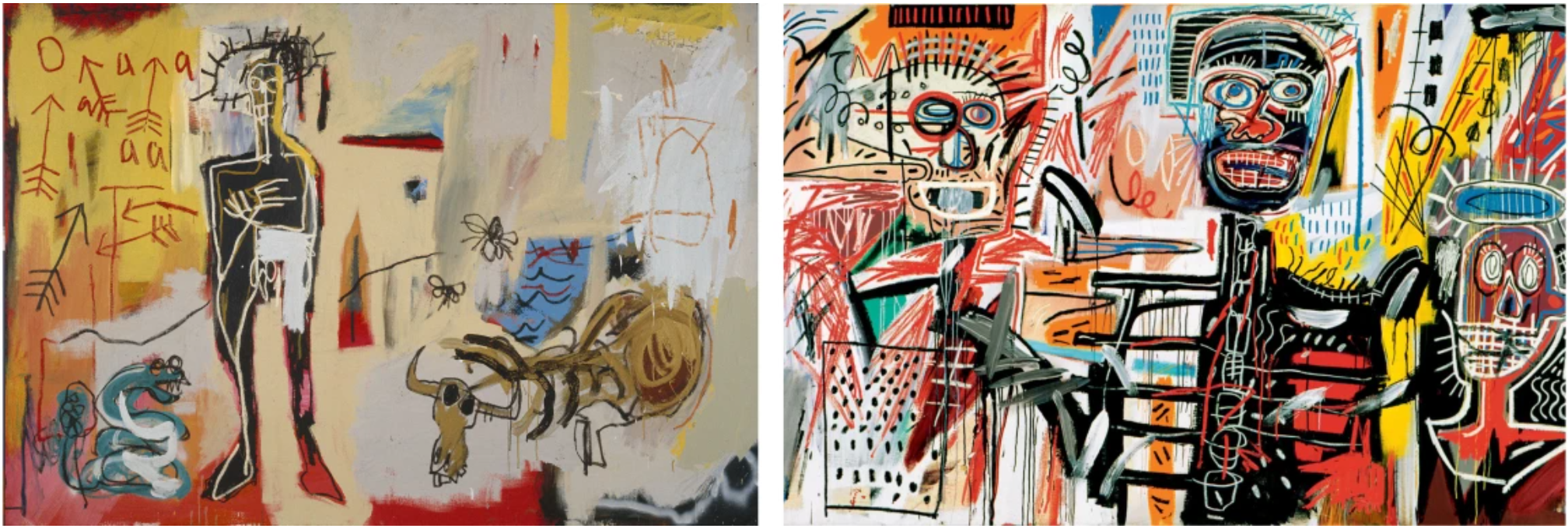
LEFT: JEAN-MICHEL BASQUIAT, ACQUE PERICOLOSE (POISON OASIS), 1981. THE SCHORR FAMILY COLLECTION, ON LONG-TERM LOAN TO PRINCETON UNIVERSITY ART MUSEUM. ART © 2024 ESTATE OF JEAN-MICHEL BASQUIAT. LICENSED BY ARTESTAR, NEW YORK.
RIGHT: JEAN-MICHEL BASQUIAT, PHILISTINES, 1982. PRIVATE COLLECTION. ART © 2024 ESTATE OF JEAN-MICHEL BASQUIAT. LICENSED BY ARTESTAR, NEW YORK.
At the very core of Basquiat’s explosive and all-too-brief career was a spectacularly lucid iconographical infrastructure, one anchored by the signs and signals through which Basquiat communicated his world view and personal history. Basquiat has projected his vision onto the crown and dinosaur with remarkable clarity, and the vibrancy of his style lies not only in aesthetics but in the way he actively engages the present he inhabits. Exemplary of the ingenuity for which Basquiat was and has remained lauded in the history of art, Untitled embodies the artist’s potent vitality for posterity.
Untitled, 1982
Christie’s New-York: 7 November 2023
Estimated: USD 1,000,000 – 1,500,000
USD 1,197,000
JEAN-MICHEL BASQUIAT (1960-1988) (christies.com)
JEAN-MICHEL BASQUIAT (1960-1988)
Untitled, 1982
Oilstick, India ink, crayon and graphite on paper
40×28 inches (101.6 x 71.1 cm)
Signed with the artist’s initials and dated ‘JMB 82’ (on the reverse)
Drawing was a constant creative outlet for Jean-Michel Basquiat. His mind overflowing with imagery and ideas, he constructed cryptic narratives on paper that combined his own symbolic vocabulary with observations and inventions from his daily life. Untitled is a particularly rich example of this output that alludes to some unknown storyline of which the viewer is only partially aware. Using red and black to pull us in, the artist constructs a sense of exploded space that expands outward into our realm. Talking about his nuanced use of text, imagery, and calligraphic line, actor and Basquiat enthusiast Johnny Depp noted rather astutely, “Looking at these works, one cannot escape without feeling the almost perverse sense of care taken to draw detail with what seems an acute distracted concentration…every line, mark, scratch, drip, footprint, fingerprint, word, letter, rip and imperfection is there because he allowed it to be there” (J. Depp in E. Navarra, Jean-Michel Basquiat, Paris 2000, pp. 16-17). Far from laying down errant marks and unimportant asides, Basquiat’s ability to coalesce competing forms into a writhing whole was unmatched. Color, line, and empty space are all in service of his final composition that highlights internal relationships within his nuanced arrangement.
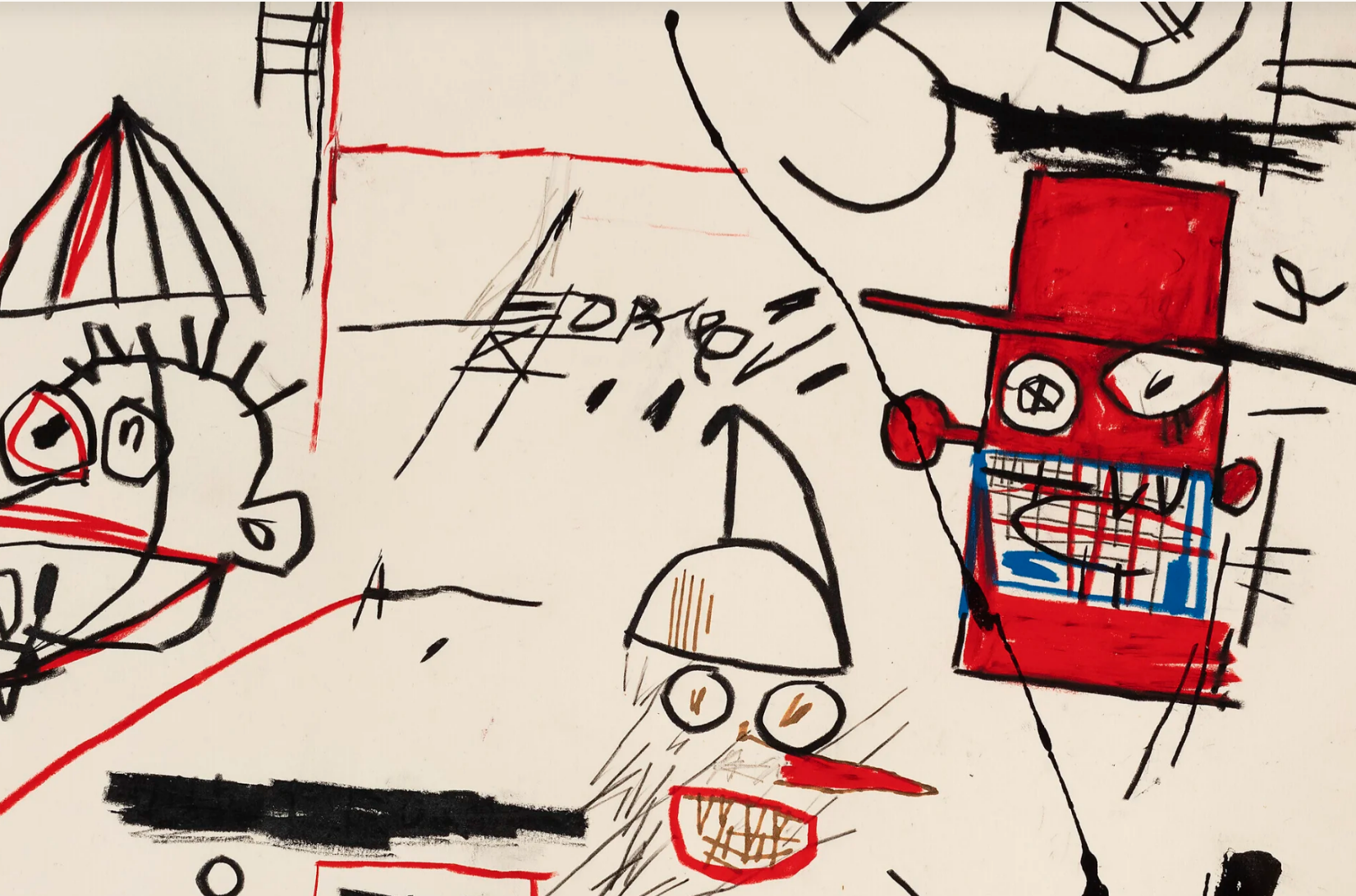
Rendered with his characteristically expressive use of oil stick, the disparate elements in Untitled come together into a cohesive visual whole under Basquiat’s frantic hand. Assessing the scene, one finds four faces in a variety of styles that stare out at the viewer. Three are situated in the middle of the work and, from left to right, show a boy with a floating baseball cap and spiked hair, a bizarre clown-like figure with a pointe red nose and cherry lips, and a glaring red mechanical man with top hat and protruding ears. Each is a distinct character without a body, their personalities wholly made of their facial features and the artist’s ability to imbue even the slightest line with magnetic energy. Untitled is a dynamic example of Basquiat’s predilection for drawing the human head in various guises. Fred Hoffman explained this habit when he noted, “What drew Basquiat almost obsessively to the depiction of the human head was his fascination with the face as a passageway from exterior physical presence into the hidden realities of man’s psychological and mental realms. As such, the two largest human orifices of the eye and mouth, the gateways enabling a passageway within, are depicted as both large and open. In the case of the eyes, they not only peer out as if seeing, but also invite the viewer to penetrate within” (F. Hoffman, Jean-Michel Basquiat Drawing: Work from the Schorr Family Collection, exh. cat., New York, Acquavella Galleries, 2014, p. 74). All three of the above-mentioned faces have large round eyes with chaotic pupils and open mouths that boast a horde of unnerving teeth. The fourth head is less brazen, situated in the lower left of the composition, it is paired with a small hand and exhibits vertical slits for eyes. Given its positioning and simplified rendering, as well as the swirling lines that seem to extend from its space, one can almost see it as a narrator of the scene that is explaining some unknown happening in vivid detail.
Untitled, 1982
Sotheby’s London: 27 June 2023
Estimated: GBP 1,200,000 – 1,800,000
GBP 1,681,500 / USD 2,144,223
JEAN-MICHEL BASQUIAT (1960 – 1988)
Untitled, 1982
Oilstick and marker pen on paper
22 1/4 x 30 1/8 inches (56.5 x 76.5 cm)
Jean-Michel Basquiat’s Untitled of 1982 is a masterful example of the artist’s instinctive and revered ability as a draughtsman. Typical of Basquiat’s works on paper, Untitled explodes with urgency in the repetitive mark-making, variance of colour and the frenetic economy of its composition. Here a pirate-like character brandishes a sword and stands tall; wearing a crown of thorns and sanctified by a halo, he is accompanied by a rudimentary sea-faring vessel. Herein, this piece includes one of the artist’s most iconic and well-known tropes – the warrior-like figure which dominates many of Basquiat’s most important large-scale works on canvas. Undeniably heroic, this is the kind of archetypal portrayal that forms the very cornerstone of Basquiat’s oeuvre. Calling upon an iconographic history of Christian imagery from Christ wearing the crown of thorns to the golden halos of hallowed saints and celestial beings, Basquiat assimilates an eminent art historical canon in an expression of contemporary popular culture and black identity. The figures that typically populate Basquiat’s work are those he feels motivated to ennoble and elevate – his heroes and himself. Channelling the influence of cartoons and television, Untitled fuses popular culture references with Basquiat’s idiosyncratic figuration in which art historical influence and Pop culture forge an important dialogue on contemporary representation.

Conjuring allusions to the graceful scrawls and scribbles of Cy Twombly – an artist for whom he held a deep admiration – the glimpses of Basquiat’s graphic forms invoke a sort of proto-handwriting: a primitive kind of expression that strives toward resolution and legibility but is suspended in a perpetual territory of formal symbolism, akin to our contemporary reading of pre-historic mark-making. Phoebe Hoban captures this notion saying that, “Basquiat’s work, like that of most of his peers, was based on appropriation… the images he appropriated whether they were from the Bible or a chemistry textbook – became part of his original vocabulary… Basquiat combined and recombined these idiosyncratic symbols throughout his career: the recursive references to anatomy, black culture, television and history are his personal hieroglyphics.” (Phoebe Hoban, Basquiat: A Quick Killing in Art, New York 1998, p. 332) The young artist sampled from everyday life, art history, and a variety of cultural and socio-political semiotics oftentimes separating and isolating signs and texts, each containing layered histories. This diverse lexicon served as both image and a chronicle of language itself, overheard and spoken, a voice which visualized the slogans and jargon of the moment.
Untitled (Head), 1982
Sotheby’s New-York: 18 May 2023
Estimated: USD 2,000,000 – 3,000,000
USD 3,327,000
Untitled (Head) | Contemporary Evening Auction | 2023 | Sotheby’s (sothebys.com)
JEAN-MICHEL BASQUIAT (1960 – 1988)
Untitled (Head), 1982
Oilstick on paper
23 1/8 x 26 inches (58.7 x 66 cm)
Rendered with ferocious intensity, the searing silhouette of Untitled (Head) is a riveting embodiment of the instinctive and unrivalled brilliance which distinguished Jean-Michel Basquiat from the earliest years of his career. The present work is notably large exemplar from a limited suite of drawings that, in their haunting and unique renderings of skull-like heads, powerfully exemplify the extraordinary intensity, focus, and drive which fueled Basquiat at this pivotal moment in his burgeoning career. Executed in 1982, Untitled (Head) dates to the very year that Basquiat’s meteoric ascension from unknown to icon began; indeed, it was in 1982 that Basquiat had his first solo exhibitions with Annina Nosei in New York, Larry Gagosian in Los Angeles, and Bruno Bischofberger in Zurich, establishing the young street artist formerly known as SAMO© as a key contributor to the bustling and competitive New York art scene. Exploding with gestural fervor and featuring a head more muscular than skeletal, Untitled (Head) embodies both the artist’s innate ability to distill angst into dynamism and his newfound maturity as a deftly skilled draftsman.
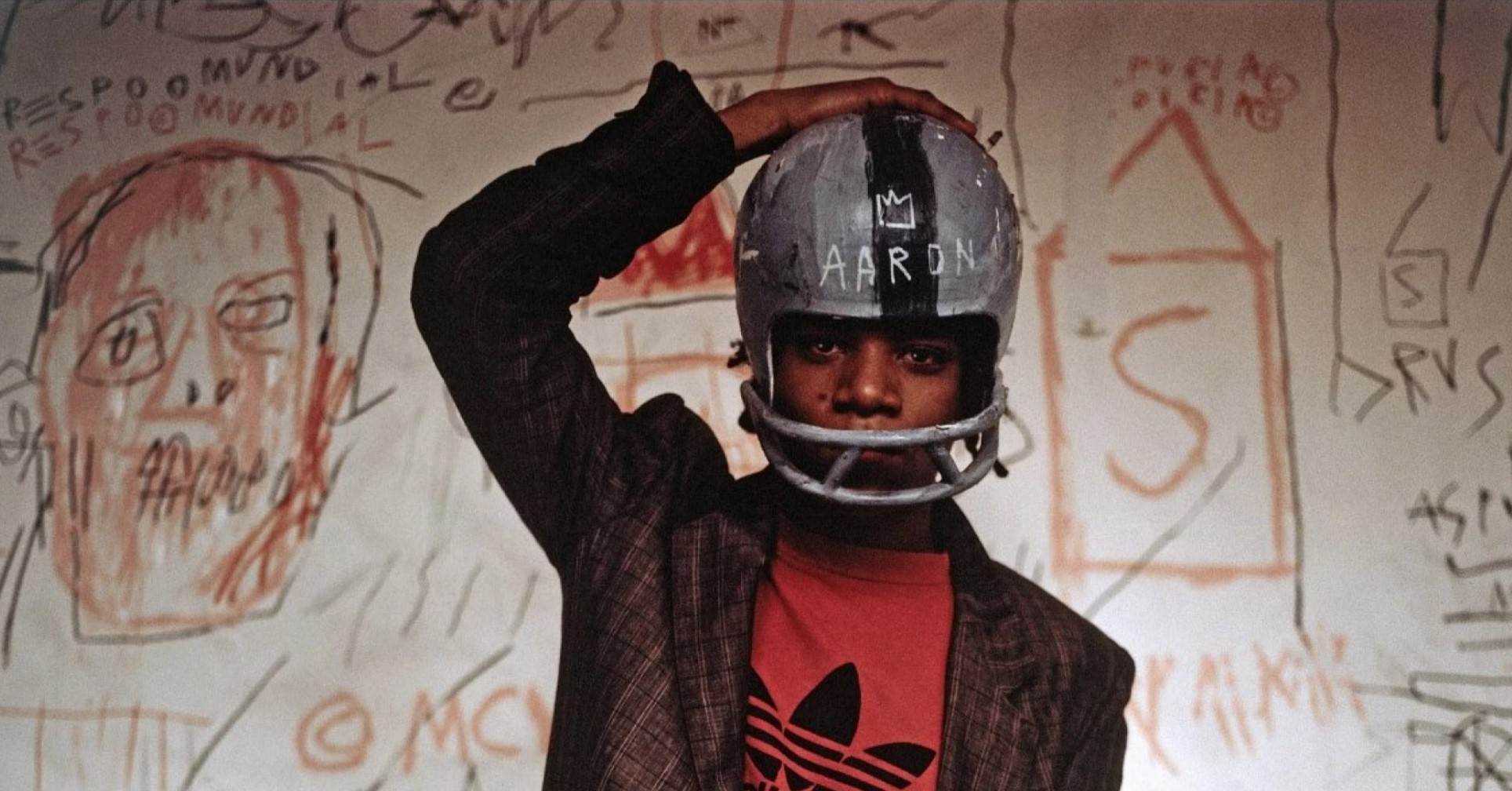
Holding a graphic power as potent today as the day they were drawn, Basquiat’s works on paper comprise a fundamental element of his prolific oeuvre and are essential to a comprehensive understanding of the diverse signs, symbols, and subjects which make up his staggeringly inventive output. In Untitled (Head), expressionistic strokes of black oil stick congregate against an off-white background to form a disembodied human head. The frenzied potency of Basquiat’s variegated strokes is contained only by the arresting confidence of his bold oil stick outline. As a testament to the importance of the 1982 head studies, at the time of Basquiat’s death in 1988, no fewer than twenty-seven of the studies remained in the artist’s personal collection. Fred Hofmann’s description of the 1982 heads: “These figures are unsettling, leaving the viewer with the feeling that they exist in another realm. Peering out into our space, they are oracles conveying a message from another dimension.” (Fred Hoffman, The Art of Jean-Michel Basquiat, New York 2017, p. 79) In its talismanic rendering of a skull, the present work is a paradigmatic example of the artist’s most iconic motif; compelling as both idiosyncratic self-portrait and shamanistic totem, the fierce character summoned in Untitled (Head) would prevail as a primary graphic anchor for Basquiat throughout his career, appearing in and dominating the majority of his best-known masterworks.
Untitled (Man with Crown), 1982
Christie’s New-York: 18 May 2023
Estimated: USD 800,000 – 1,200,000
USD 567,000
JEAN-MICHEL BASQUIAT (1960-1988) (christies.com)
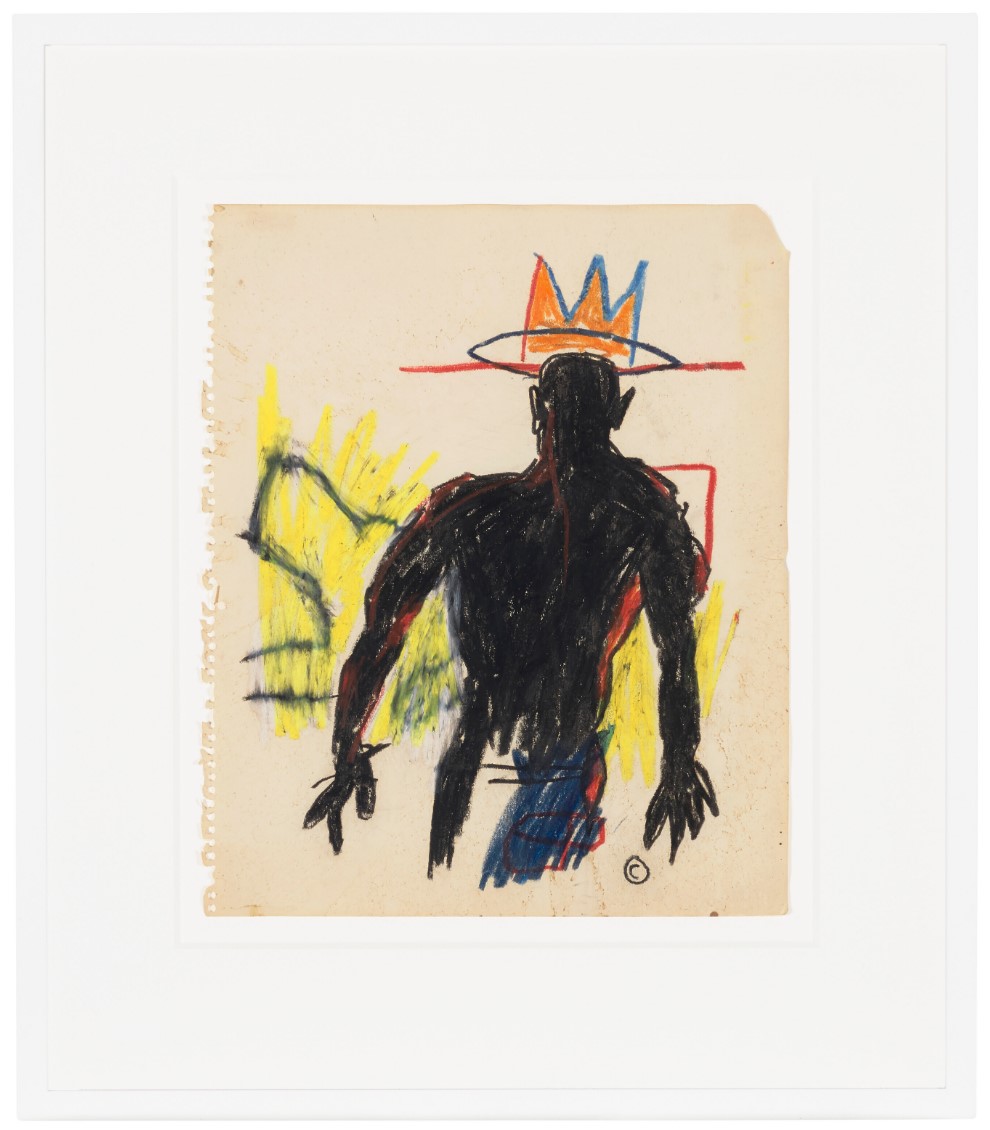
JEAN-MICHEL BASQUIAT (1960-1988)
Untitled (Man with Crown), 1982
oilstick on paper
17×14 inches (43.2 x 35.5 cm)
Jean Michel Basquiat’s Untitled (Man with Crown) is striking testament to the artist’s enduring exploration of the power of iconography. Executed in 1982, the present work exemplifies Basquiat’s persistent thematic engagement with sociopolitics through representations of race and power.
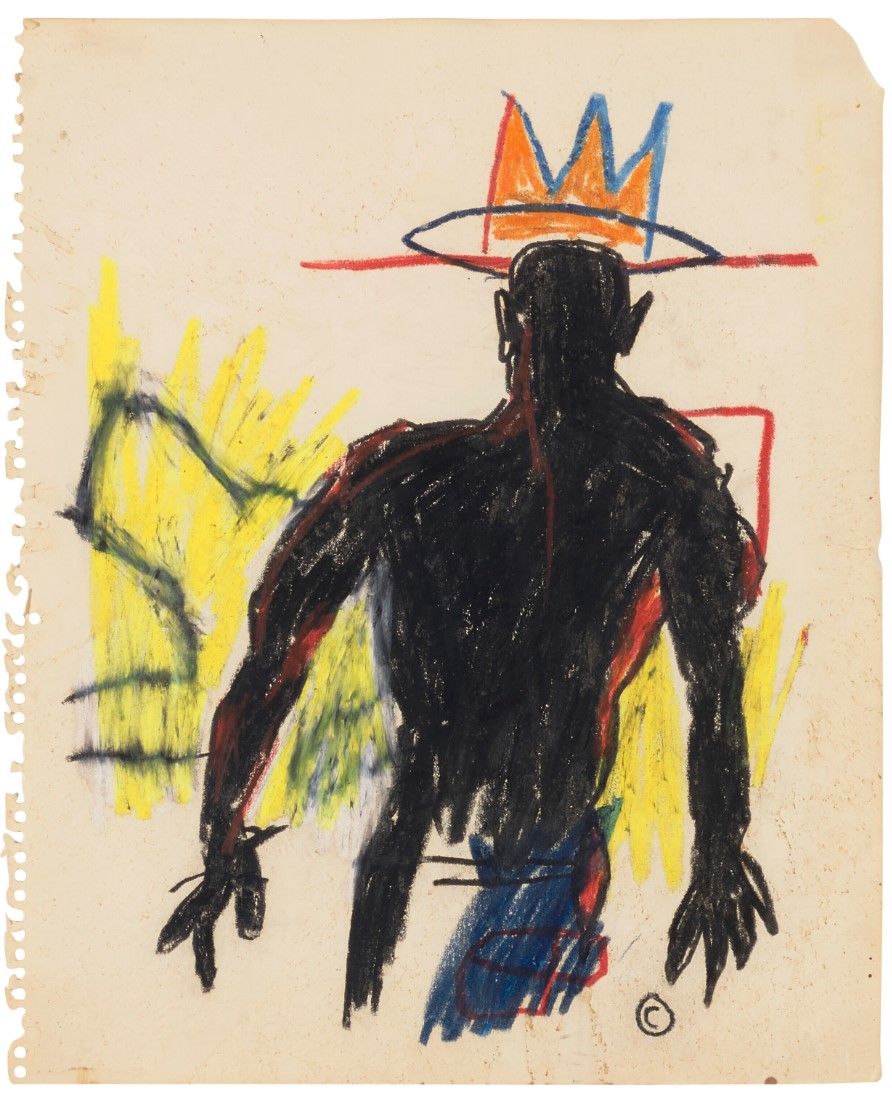
Untitled (Man with Crown)’s significant provenance enriches Basquiat’s connection to the downtown New York subculture of the 1980s. First in the collection of fellow artist Brett dePalma, Basquiat drew the present work after both artists had returned from Modena, Italy, in the aftermath of Basquiat’s incendiary first solo exhibition at Galleria d’Arte Emilio Mazzoli. Years later, the work then made its way into the stewardship of Diego Cortez – the artist-turned-curator best known for his support of the late artist, along with the epochal exhibition New York/New Wave at MoMA PS1 in 1981, where both Basquiat and dePalma were participating artists in the show. By bringing together “a coalition of punks, No Wave musicians, young painters, graffiti artists, poets, performers, and more radical-type forefathers,” Cortez’s landmark show played a crucial role in defining the sprawling energy of downtown New York art movement that had been brewing since the mid-1970s. (G. O’Brien, Artforum, New York, Vol. 41, no, 7, p. 108). This marked Basquiat’s first inclusion in a museum exhibition and the major launch pad for his breakthrough in the art world.
Cover of Diabolik – La Vittima Accusa, Astorina, 1982. Source image for the present lot.
The present work draws direct inspiration from the front cover of the Italian comic book Diabolik, which Brett dePalma had brought back with him from Modena. The original fumetti neri (Italian for “black comics”), this comic book series is named after its protagonist, an anti-hero who steals and kills but is respected for his high morals. Basquiat reimagined the composition – with the protagonist’s back occupying the foreground – and elevated it with his iconic crown symbol. In doing so, he not only complicates the distinguishment between good and evil, but also plays into the reading of the superhero as a conflicted character. The kinglike figure becomes a literal beacon of Basquiat’s composition – crowned and venerated, he radiates light rendered through energetic marks of yellow pastel. Still, the figure’s face remains unseen. The viewer comes to recognize the near-celestial power of the subject through iconography rather than physiognomic treatment. Here, Basquiat calls upon traditions of the comic book genre yet again. The vigilante superhero – whose ancillary qualities are his simultaneous anonymity and ubiquity – retains power despite and because of his varied identity markers.
Untitled, 1982
Sotheby’s New-York: 17 November 2022
Estimated: USD 1,500,000 – 2,000,000
USD 1,865,000
Untitled | Contemporary Day Auction | 2022 | Sotheby’s (sothebys.com)
JEAN-MICHEL BASQUIAT
Untitled, 1982
Oil stick on paper
30 x 22 ¼ inches (76.2 x 56.5 cm)
Signed and dated NYC 82 (on the verso)
Depicting one of the most iconic symbols of America, Jean Michel Basquiat’s Untitled unites multiple themes and key iconographic characteristics from the artist’s celebrated oeuvre in one extraordinary work on paper. Created in the key year of 1982, Untitled is a seminal work from the artist’s most influential period. The drawing belongs to an elite group of works on paper created at a time of extraordinary artistic freedom at the precipice of his meteoric career, predating commercial pressure, distractions, and drug use that would accompany his art world superstardom. Having been featured in the 1993 survey exhibition at the Dallas Museum of Art, the work was recognized early for its significance. A resounding metaphor for Basquiat’s own interpretation of the American Dream, the present work is a window into the artist’s unique perspective.
Untitled, 1982
Sotheby’s New-York: 19 May 2022
Estimated: USD 2,000,000 – 3,000,000
USD 3,317,000
Untitled | Contemporary Evening Auction | 2022 | Sotheby’s (sothebys.com)
JEAN-MICHEL BASQUIAT
Untitled, 1982
Oilstick on paper
30.2 x 22.2 inches (76.5 x 56.5 cm)
Captivating in its electric immediacy, Untitled from 1982 is a brilliant representation of Basquiat’s most acclaimed motif, the iconic skull-like head. He rendered in a searing black oil stick and punctuated by a spiked and coiled crown, the legendary motif was not only employed by the artist as a talismanic symbol, but also as a representative of his very being; in this way, the bewitching head provides a raw look into the mind of one of the most brilliant artists of the Twentieth Century. Executed in 1982, Untitled dates to the very year that Basquiat’s meteoric ascension from unknown to icon began to unfold. Indeed, it was in 1982 that Basquiat had his first solo exhibitions with Annina Nosei in New York, Larry Gagosian in Los Angeles and Bruno Bischofberger in Zurich, establishing the young street artist formerly known as SAMO© as a key contributor to the bustling and competitive New York art scene. Exploding with gestural fervor and featuring a head more muscular than skeletal, Untitled embodies both the artist’s innate ability to distill angst into dynamism and his newfound maturity as a fierce draftsman.
Untitled, 1982
Christie’s Hong-Kong: 25 May 2021
Estimated: HKD 4,200,000 – 6,200,000
HKD 9,130,000 / USD 1,176,137
JEAN-MICHEL BASQUIAT (1960-1988), Untitled | Christie’s (christies.com)
JEAN-MICHEL BASQUIAT (1960-1988)
Untitled, 1982
Acrylic and oilstick on paper
30×22 inches (76×56 cm)
Signed, inscribed and dated ‘Jean Michel NYC 82’ (on the reverse)
Painted at the peak of the artist’s meteoric rise to artworld supremacy, Untitled is a 1982 work from one of Jean-Michel Basquiat’s most prolific years in his artistic career. Demonstrating the artist’s thrilling and dynamic artistic language, Untitled exudes a visceral power with every brush mark. Of the painted area, the background bleeds an empowering, solid red wash of colour with a skeleton silhouette outlined with stark black oilstick. Trapped within this confined area with only a tiny chair, the holloweyed central figure is desperate to make his way out of it. A beacon of light radiates from the dome ceiling, suggesting a sense of hope and empowering the figure who is about to break free from this space with the hammer held in hand. The dome shape, coloured in yellow, also resembles gold royal crowns, rendering Untitled a portrait of a king and a self-referential painting representing Basquiat’s personal journey, in the similar way as the rooted royal portraits in the history of art. The working method as seen in Untitled also suggests his determination and urgency in changing the fate and perception of black artists. Well aware of his identity as a black artist in the whitedominated history of art during the 20th century, Basquiat’s legacy changed the culture in terms of how black artists are perceived in the art world. Seen from in the delineation of the skeleton figure, the artist creates a primitive artistic language that shares both the impulsive quality of New York City graffiti art and the childlike aesthetic characteristic of Jean Dubuffet’s Art Brut, resulting in his unique, buoyant style. Among all the works in his brief yet accomplished career, more than half of the top 10 auction record of Basquiat are creations from 1982. Liberated from the confines of traditional artistic production, Basquiat rebelled against the mainstreams within the established art world. In doing so, he himself became epitome and paragon for an entire era of artists who positioned themselves against the institutions.
Untitled, 1982
Christie’s New-York: 14 May 2021
Estimated: USD 1,500,000 – 2,000,000
USD 2,010,000
JEAN-MICHEL BASQUIAT (1960-1988) (christies.com)
JEAN-MICHEL BASQUIAT (1960-1988)
Untitled, 1982
Acrylic and oilstick on paper
29 7/8 x 22 inches (75.9 x 56 cm)
Signed, inscribed and dated ’82 NYC Jean Michel’ (on the reverse)
This work is registered in the archives of Annina Nosei Gallery, New York, as no. PC-B182.
Emerging through a smoky gray miasma, the head of Jean-Michel Basquiat’s Untitled looms into view, its fierce grin piercing the darkness. Painted in 1982, at the peak of the artist’s meteoric rise to art-world supremacy, the painting clearly demonstrates Basquiat’s unique graphic ability, which resulted in thrilling and dynamic works that exude a visceral power with every gesture. Basquiat’s ‘heads’ are among the artist’s most celebrated works; part self-portrait, part homage to the artist’s pantheon of personal heroes, they are among Basquiat’s most intimate incarnations. Originally sold by Basquiat’s preeminent supporter and dealer in New York, Annina Nosei, to Akira Ikeda Gallery in Nagoya, Untitled, which has been in the same private hands for almost two decades, is a remarkable example of this distinguished body of work. From the collection, Jean-Michel Basquiat, Figures of a King: Property from an Important Japanese Collection, this work is one of three examples of distinguished works on paper on offer. Defined by a single stroke of the artist’s brush, the profile of the figure in Untitled sits boldly against a field of gun-metal gray. While his silhouette might be simple, the rest of his facial features are made up of a complex array of layered gestures. Ruddy cheeks are defined by fields of striking red paint, upon which Basquiat defines the contours of the face with black oilstick. High cheekbones, a prominent ear and strong jawline are all created by the swift movement of the artist’s hand. Particular attention is paid to the wide grin, flayed nostrils and the deep pools of the figure’s black eyes. Below the face, hints of the figure’s body are glimpsed through the swaths of muted tones. Fleeting glimpses of what appear to be the fingers of a clenched hand can be seen through the gray clouds, together with sneaked glances of the yellow and the pale blue-green shirt worn by the mysterious figure.
Untitled (Head), 1982
Sotheby’s New-York: 29 June 2020
Estimated: USD 9,000,000 – 12,000,000
USD 15,184,900
JEAN-MICHEL BASQUIAT (1960 – 1988)
UNTITLED (HEAD), 1982
Oilstick, ink and acrylic on paper
29 3/4 x 22 inches (75.6 x 55.9 cm)
Executed in 1982, Untitled (Head) is an explosion of vivid color and frenzied mark making which stands as one of the most accomplished of Basquiat’s iconic ‘Head’ paintings. Enduring as both idiosyncratic self-portraits and skull-like talismanic icons, the single ferocious figures revealed in works such as Untitled (Head) prevailed as a key conceptual anchor for Basquiat throughout his career, appearing in and dominating the majority of his best-known masterworks. Remarkable for its fierce intensity, arresting coloration and visceral aesthetic impact, Untitled (Head) is a supreme masterpiece that embodies the overwhelming power of Basquiat’s creative insurgency. Encapsulating the incredible dexterity and draftsmanship that defines the very best of the artist’s works, and extraordinary for its use of India ink under the oilstick to lend depth and contrast to the composition, Untitled (Head) is a heroic depiction that reflects the explosive talent and brilliance of its author. It is an iconic work, as vivid and alive now as it was at the moment of execution.
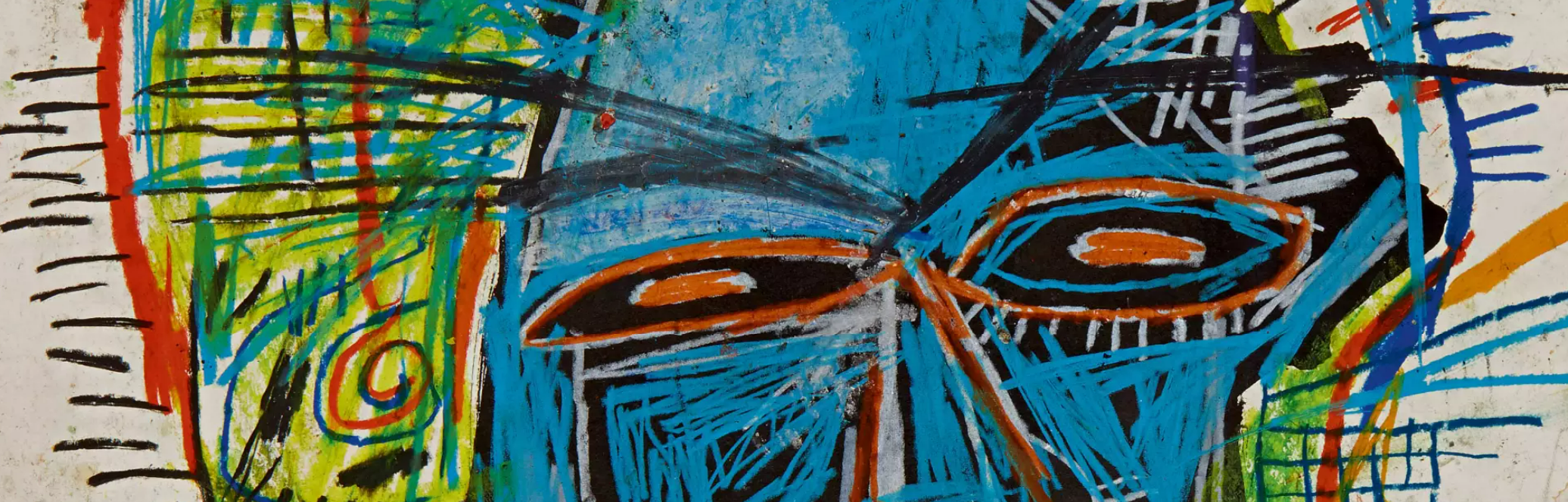
The intensity and dynamism of Untitled (Head) are largely indebted to Basquiat’s instinctive and idiosyncratic mastery of line. All the artist’s most celebrated works, whether ‘Heads’, ‘Warriors’ or text heavy masterpieces such as Hollywood Africans, are defined by his use of oilstick. Basquiat was always drawing, whether he was working on paper or canvas, and it is as a function of this that his works on paper became a cornerstone of his practice. From 1983, as collage became one of his principal media, Xerox-ed drawings from his studio would become the substrate for his paintings. Rather than studies for his paintings, Basquiat’s drawings were literally foundational to his practice, and would provide the stimulus needed to work on a larger scale. This reliance on drawings as a source of inspiration is further evidenced by his retention of several pivotal works on paper in his own collection until his untimely death in 1988. This group, which included the present work, were exhibited together in his celebrated posthumous show at Robert Miller Gallery in 1990, the show that cemented the reputation of Basquiat’s works on paper as a pivotal part of his oeuvre.
Untitled, 1982
Christie’s New-York: 11 May 2015
Estimated: USD 9,000,000 – 12,000,000
USD 13,605,000
Jean-Michel Basquiat (1960-1988) (christies.com)
JEAN-MICHEL BASQUIAT (1960-1988)
Untitled, 1982
Oilstick and ink on paper
42 3/4 x 30 3/8 inches (108.6 x 77.2 cm)
Jean-Michel Basquiat’s frenzied and electric Untitled of 1982 depicts one of the artist’s most celebrated themes, rendered in rapid-fire execution in dynamic slashes of red, blue and black oilstick. The human head is among Basquiat’s most autobiographical subjects, which he obsessively explored particularly during the pivotal year of 1982. His depiction here is violently slashed and scribbled in a seemingly feverish attempt to produce on paper the inner workings of his own mind, which is especially felt in the jutting red slashes that seem to burst forth from the totemic figure’s head and neck. The work belongs to a series of heads from 1982, many of which can be regarded as self-portraits that were executed at a crucial moment in the artist’s meteoric rise to fame. Untitled bears witness to Basquiat’s humble origins as the street artist SAMO, yet it also displays the sophistication that, by this stage in his short but brilliant career, had already made him the undisputed star of the New York art world.
Untitled (Self Portrait), 1982
Christie’s London: 28 June 2022
Estimated: GBP 4,000,000 – 6,000,000
GBP 7,961,000 / USD 9,716,831
Christie’s London: 26 June 2018
Estimated: GBP 1,500,000 – 2,500,000
GBP 3,892,250 / USD 5,153,168
JEAN-MICHEL BASQUIAT (1960-1988) (christies.com)
JEAN-MICHEL BASQUIAT
Untitled (Self Portrait), 1982
Oilstick and ink on paper
29.9 x 22 inches (75.9 x 55.9cm)
Furious Man, 1982
Christie’s New-York: 15 May 2013
Estimated: USD 1,000,000 – 1,500,000
USD 5,723,750
Jean-Michel Basquiat (1960-1988) (christies.com)
JEAN-MICHEL BASQUIAT (1960-1988)
Furious Man, 1982
Oilstick, acrylic, wax crayon and ink on paper
30×22 inches (76.2 x 55.8 cm)
Emphasizing the frantic discharge of Jean-Michel Basquiat’s distinct expressive power, Furious Man is haunted by the artist’s idiosyncratic dark skeletal figure, which emerges from a golden blaze onto a flat sea of gray with his ghostly face, illuminated halo, and upraised arms. With its heavy application of materials and the ink exploding off the paper, the raw energy and urban-primitive aesthetic of Furious Man mockingly assumes the mantle of the noble-savage that Basquiat himself tried to break away from, and stands out as the artist’s ultimate critique of the constitution of black identity at the peak of his creative powers. Characteristically aggressive, in Basquiat’s faux-naïve style, the gaunt figure appears as an energetic, even frantic, caricature of the artist himself; a projection of Basquiat’s fears, anxieties, and rebellious rage. Equally empowered and bewildered, with sunken bloodshot eyes, and short electrified hair atop a skull-like head, Furious Man evokes a potent sense of panic at the immediate prospect of danger. Set against a background of scattered lines, rudimentary patterns, scribbles, stars and geometrical shapes, the psychological chaos characterizing the figures mental state is made all the more evident.
Ribs Ribs, 1982
Christie’s New-York: 15 May 2013
Estimated: USD 3,000,000 – 5,000,000
USD 5,163,750
Jean-Michel Basquiat (1960-1988) (christies.com)
JEAN-MICHEL BASQUIAT (1960-1988)
Ribs Ribs, 1982
Oilstick on paper
97 x 95 3/4 inches (243.2 x 246.3 cm)
Signed Jean Michel Basquiat (lower right)
As one of the largest works on paper that Jean-Michel Basquiat ever executed, Ribs Ribs is an early example of the artist’s unique and remarkable style. Self-restrained, yet bursting with a diverse range of rich iconographic details, this monumental drawing demonstrates Basquiat’s incessant thirst for knowledge as he draws together and then disseminates his diverse range of interests including science, politics, childhood superheroes and his own rich cultural heritage. Leading the composition is Basquiat’s figure of a caped man, commanding yet also enigmatically transparent, his stylized rib cage clearly visible beneath the folds of his red and blue cape and re-enforced by the words RIBS RIBS written on either side of his sternum. In the figure’s left hand is a mace-like object, a piece of ancient weaponry that was often studded with sharp pieces of metal and used by foot soldiers to attack an enemy but is now more commonly used as a symbol of authority, as in the Parliamentary Mace used in the British House of Commons. In his other hand, the figure is holding a large bone, plucked from a row of four that Basquiat draws to his right. Topping off the composition, the figures wears a ‘crown of thorns’–a halo of light that hovers majestically above the figure’s head. Rendered in Basquiat’s distinctive schizophrenic style, parts of the composition are sparingly laid down whilst others are heavily rendered in primary colored oil paintstick. The rapid pace at which the artist works is driven by the speed of his thoughts as witnessed by the feverish renderings of the red and blue cape and the exquisite, more considered, detailing of the face. These are then complimented by a series of simple line drawings, giving the painting a more measured sense of balance.
Untitled, 1982
Christie’s New-York: 10 July 2020
Estimated: USD 3,000,000 – 5,000,000
USD 4,928,500
Jean-Michel Basquiat (1960-1988) (christies.com)
JEAN-MICHEL BASQUIAT (1960-1988)
Untitled, 1982
Oil pastel and wax crayon on paper
30 1/8 x 22 1/4 inches (76.5 x 56.5 cm)
Signed with the artist’s initials ‘JMB’ (lower right)
An electrifying vision dating from the height of Jean-Michel Basquiat’s meteoric rise to fame, Untitled is an extraordinary work that showcases the virtuosic force of his graphic practice. Ablaze with fiery orange tones, a maniacal figure looms large, his red-cloaked hand outstretched against the void. His eyes swirl like kaleidoscopes; his mouth hangs open in ecstasy, revealing scant rows of colored teeth. Skeletal lines quiver like x-rays, while sparks and stars circle his head as if reeling from a knock-out. Rich swathes of pink and yellow create a vibrant backdrop, punctuated with lines and symbols that explode into space like fireworks. Rendered with all the chromatic and textural drama of an oil painting, the work demonstrates the vast, ambitious range of Basquiat’s draughtsmanship in the heady early stages of his career. Multiple influences collide: from the works of Pablo Picasso and Egon Schiele, to the drawings of Leonardo da Vinci, ancient cave art, comics and anatomical textbooks. Loosely suggestive of Basquiat’s self-image, it is a vivid portrait of his creative process, conjuring the raw carnal energy with which he channeled his whirring imagination. Other elements of the artist’s symbolic universe shift in and out of focus: the messianic crown of thorns, the saintly halo and, perhaps, the glory of the boxing ring. It is a testament to the multiple personas—hero, martyr, victim and victor—through which he would present himself to the world.
Untitled (Head), 1982
Sotheby’s New-York: 16 May 2019
Estimated: USD 3,000,000 – 4,000,000
USD 4,100,000
(#8) JEAN-MICHEL BASQUIAT | Untitled (Head) (sothebys.com)
JEAN-MICHEL BASQUIAT
Untitled (Head), 1982
Ink and oilstick on paper
30×22 inches (76.2 x 55.9 cm)
Inscribed BASQ-0799 on the reverse
Bursting forth in a fury of radiant color and ferocious mark making, Untitled (Head) from 1982 is a compelling testament to Jean-Michel Basquiat’s singular and hyper-individualized mastery of expressionistic portraiture. A paradigmatic example of the artist’s most iconic motif, the skull-like visage of the present work is utterly mesmerizing in its emotive intensity; fixing the viewer with the ferocious gaze of its yellow almond eyes, the face demands recognition of Basquiat’s instinctive abilities as one of the greatest draughtsman of the Twentieth Century. In its searing and totemic rendering of a head, Untitled (Head) numbers among a seminal group of intensely worked and re-worked portrayals of skeletal craniums that the young artist created as, at the start of 1982, he began his extraordinary ascent to the highest echelons of Contemporary art. Within this rarified corpus, the present work is remarkable for its large size, electrifying use of color, and exceptional diversity of mark-making; rendered in brilliant crimson and orange pigment overlaid with furious incisions of inky black, the frenzied intensity of Basquiat’s variegated strokes is contained only by the arresting confidence of his bold oilstick outline. As a testament to the importance of the 1982 head studies, at the time of Basquiat’s death in 1988, no fewer than twenty-seven of the studies remained in the artist’s personal collection. Two years later, these compelling drawings – including the present work – were presented in the seminal exhibition Jean-Michel Basquiat Drawings at Robert Miller Gallery in 1990 where, hung salon style upon a single wall, they served as irrefutable testament to the gravity and intent with which the artist approached his works on paper. Rendered with ferocious intensity, the strident strokes of Basquiat’s preferred oilstick resolve to reveal a figure that, by sheer painterly force alone, utterly refutes the two dimensionality of the page. Executed in the early months of 1982, Untitled (Head) exemplifies a selection of drawings that, in their haunting and unique renderings of skull-like heads, represent a pivotal moment within the young artist’s developing practice. Concentrated against the stark white of the paper, each of these free-floating heads independently stands as a remarkable work within Basquiat’s oeuvre; while most share the physiognomy of searing eyes and bared teeth which typify his iconic warrior figure, each sheet is irrefutably distinct, confronting the viewer with a compelling cast of fully realized personas.
1983 Drawings
Untitled, 1983
Christie’s London: 5 March 2025
Estimated: GBP 2,500,000 – 3,500,000
GBP 3,851,500 / USD 4,929,920
JEAN-MICHEL BASQUIAT (1960-1988), Untitled | Christie’s
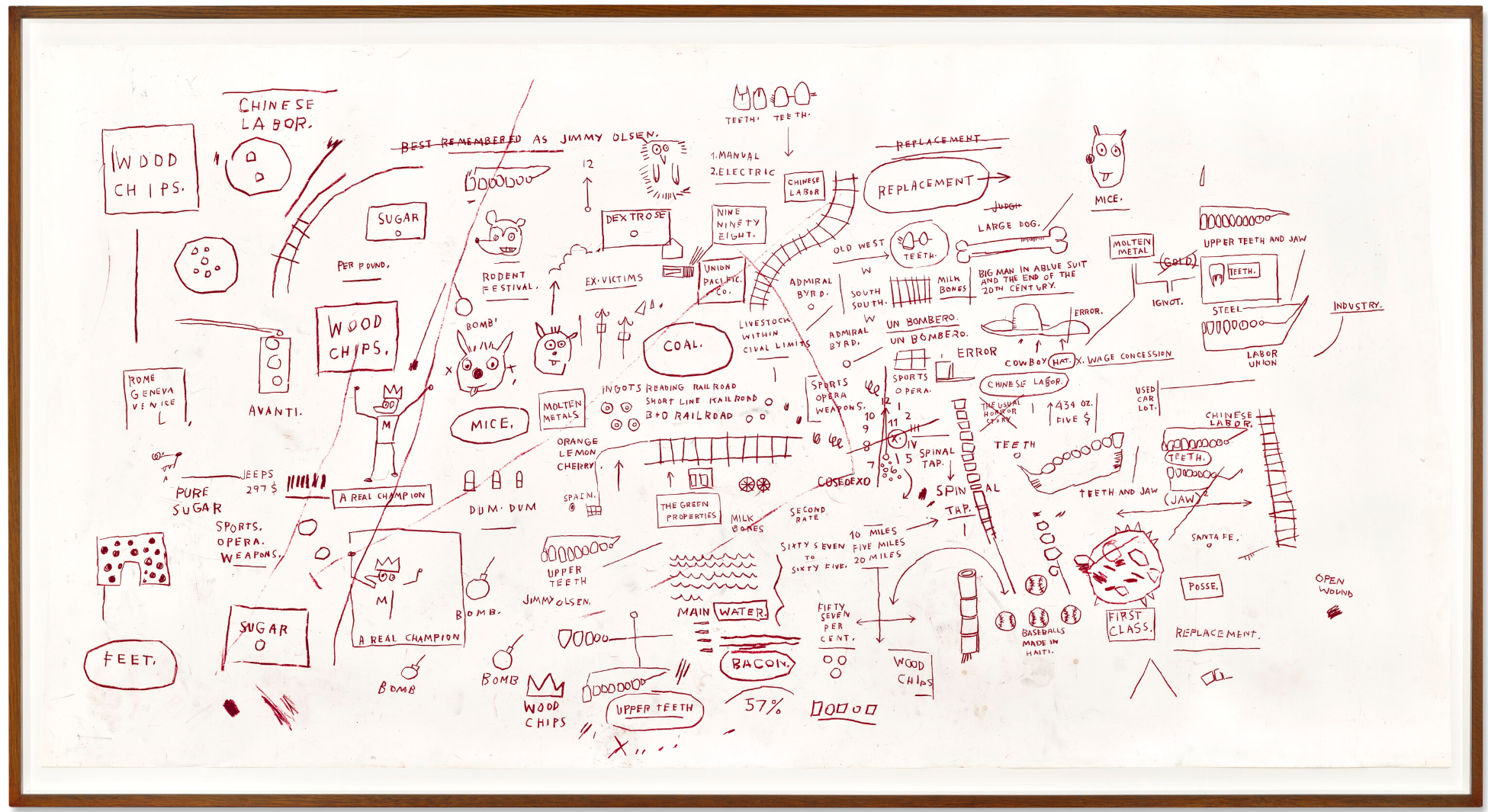
JEAN-MICHEL BASQUIAT (1960-1988)
Untitled, 1983
Oilstick on paper
50 1/3 x 98 1/2 inches (127.7 x 250.2 cm)
Stretching two and a half metres wide, Jean-Michel Basquiat’s Untitled (1983) is amongst the largest of the artist’s works on paper, impressively laden with his iconic, mesmeric visual poetry. Onto a vast surface spill the interior workings of Basquiat’s remarkable mind, a frenetic chorus of text and image which excavates popular culture and repressed history. The artist culls liberally from networks of movement, raw commodities, cartoons, sports, motifs of violence and anatomical drawings of the human body. The crown, Basquiat’s trademark assertion of presence and power, glints out several times across the sheet.
A frieze-like panel in monochrome red oilstick, the present work evokes Basquiat’s legendary graffiti origins, a medium which in the early 1980s was beginning a migration within public consciousness towards high art form. Basquiat, included in the influential 1981 exhibition ‘New York/New Wave’ at MOMA PS1, would become emblem and exemplar of this shift. Early practitioners of graffiti considered themselves writers rather than artists, and Basquiat’s inscriptions on the subway lines of the ‘D’ train were—from the start—socially engaged, intentional and astute. Throughout his storied career, as is exemplified in the present work, Basquiat would produce ‘work that is information, not work that is about information’ (R. Richard, ‘The Radiant Child’, Artforum, Vol. 20, No. 4, December 1981).
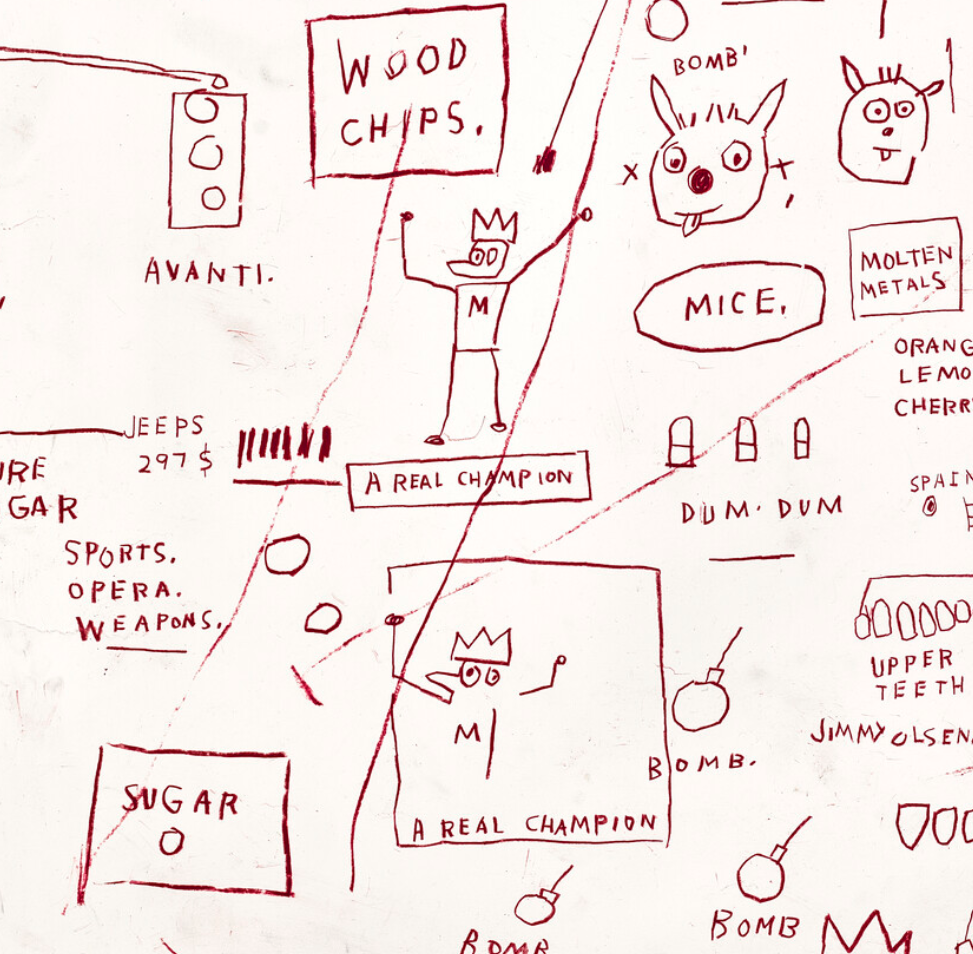
Across Basquiat’s oeuvre, sport recurs as a means by which individuals might raise themselves to positions of global visibility in an era of racism and discrimination. The figure of the black boxer becomes a powerful avatar of self-made power within a world premised on racial prejudice and endlessly stacked odds. Here, a triumphant boxer—perhaps the legendary Muhammad Ali, as suggested by the ‘M’ branded on the figure’s chest—lifts his gloved arms and crowned head in jubilation.
This is ‘A REAL CHAMPION,’ Basquiat tells us, not only for the match he has just won but the system he defeated to reach the ring. In the present work the boxer is depicted twice, once free and once confined within a box, as bombs rain down around him. While figures such as Muhammad Ali, Jesse Owens or Jackie Robinson propelled themselves to greatness, Basquiat reminds us that their pedestal was often a gilded cage, trapped as they were in the systematic bigotry of the industry, the cruelty of its fans, and the inordinate pressures which followed victory.
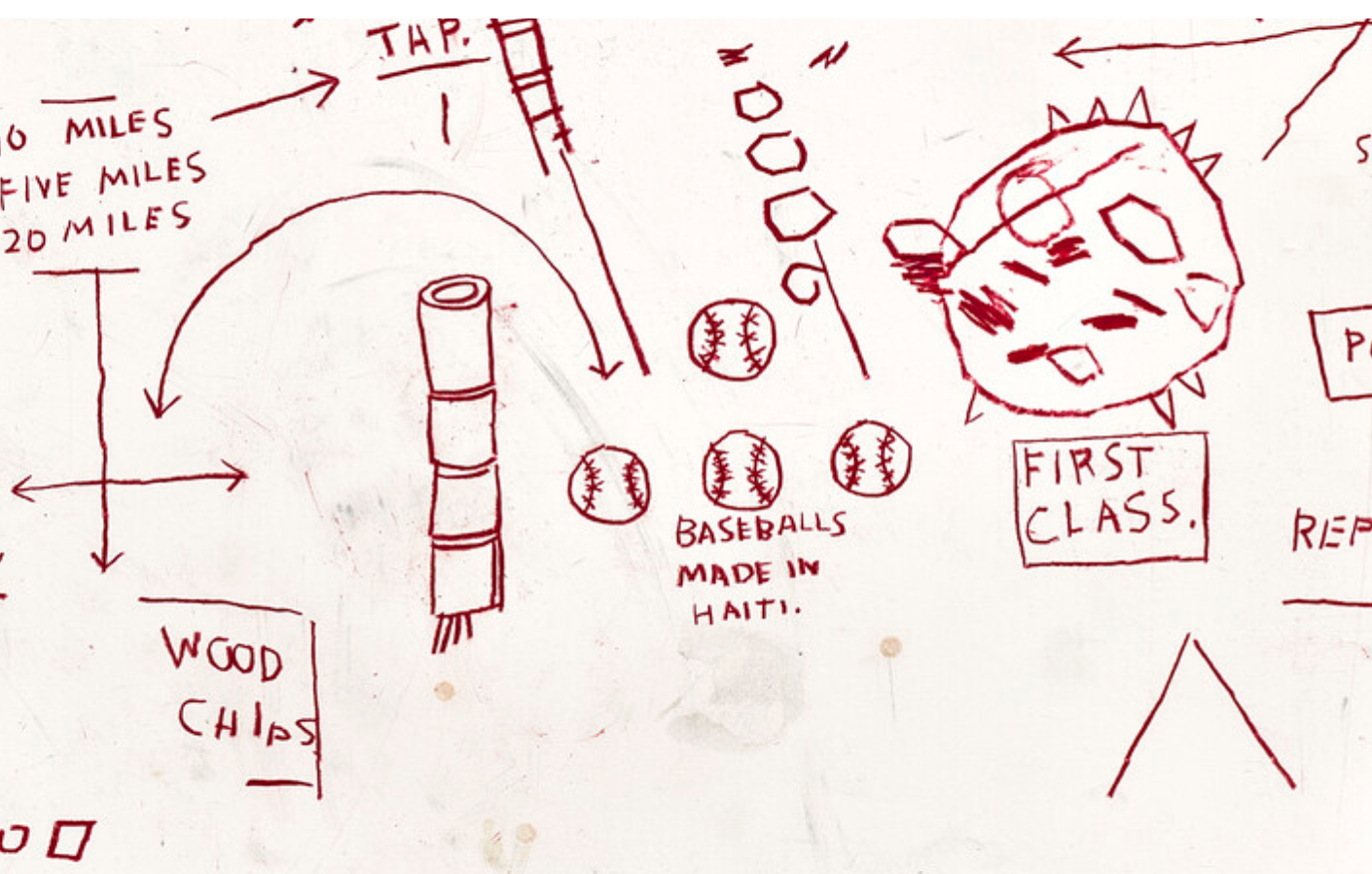
‘BASEBALLS MADE IN HAITI,’ Basquiat captions an illustration of four baseballs in the lower right corner. Here, his coded criticisms continue to reveal the injustices woven into the fabric of the sports industry in the United States. In the second half of the twentieth century Haiti—a country that didn’t play baseball—was a ‘giant baseball industry plantation’ shamelessly exploited for low wages and harsh working conditions by American manufacturers and Major League partners (K.B. Blackistone, ‘Baseball has a debt to Haiti, and it’s time the sport repaid it,’ The Washington Post, 22 September 2021). While black sportspeople were touted as examples of what could be achieved in America, they caught baseballs forged through the oppressed labor of thousands. For Basquiat, half-Haitian through his paternal side, the irony would not have been lost.
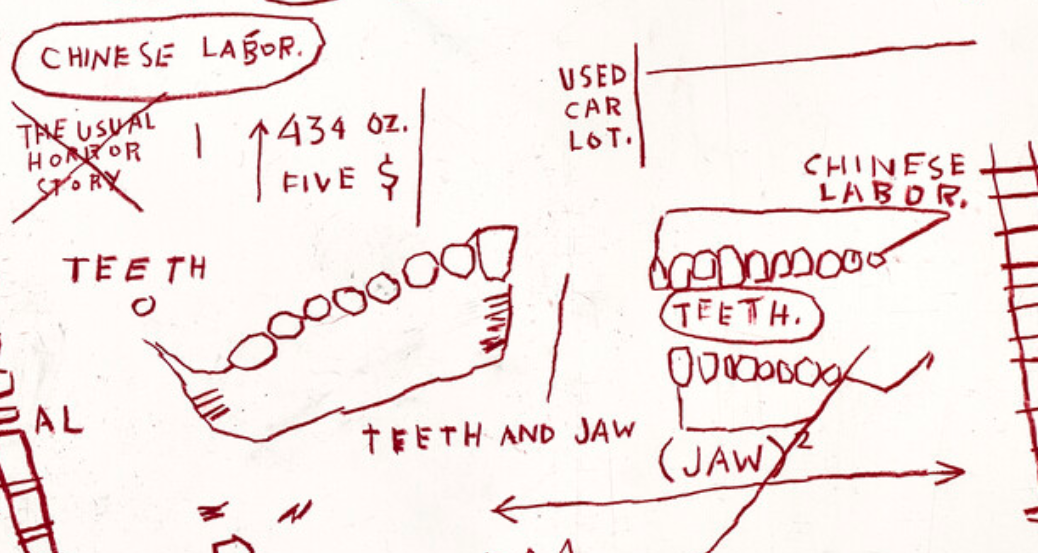
Diagrams of teeth and jaws recur across the present work, a reference to the iconic medical textbook Gray’s Anatomy. Received as a gift from his mother following a childhood car accident, Basquiat’s early exposure to this text—and to a book of drawings by Leonardo da Vinci—prompted a life-long interest in the inner workings of the human form. Basquiat pored over Gray’s Anatomy, drawing phrases and imagery from its pages onto his own, and adopting its title for the name of his experimental noise band, Gray, which was active from 1979 to 1981. Particularly affected by the brutal murder of black graffiti artist Michael Stewart in the year the present work was executed, Basquiat understood anatomy as a metaphor for the essential commonality of people. His anatomical drawings of skulls, bones, muscles and organs cut against the racism and discrimination of the time, which looked only skin-deep.
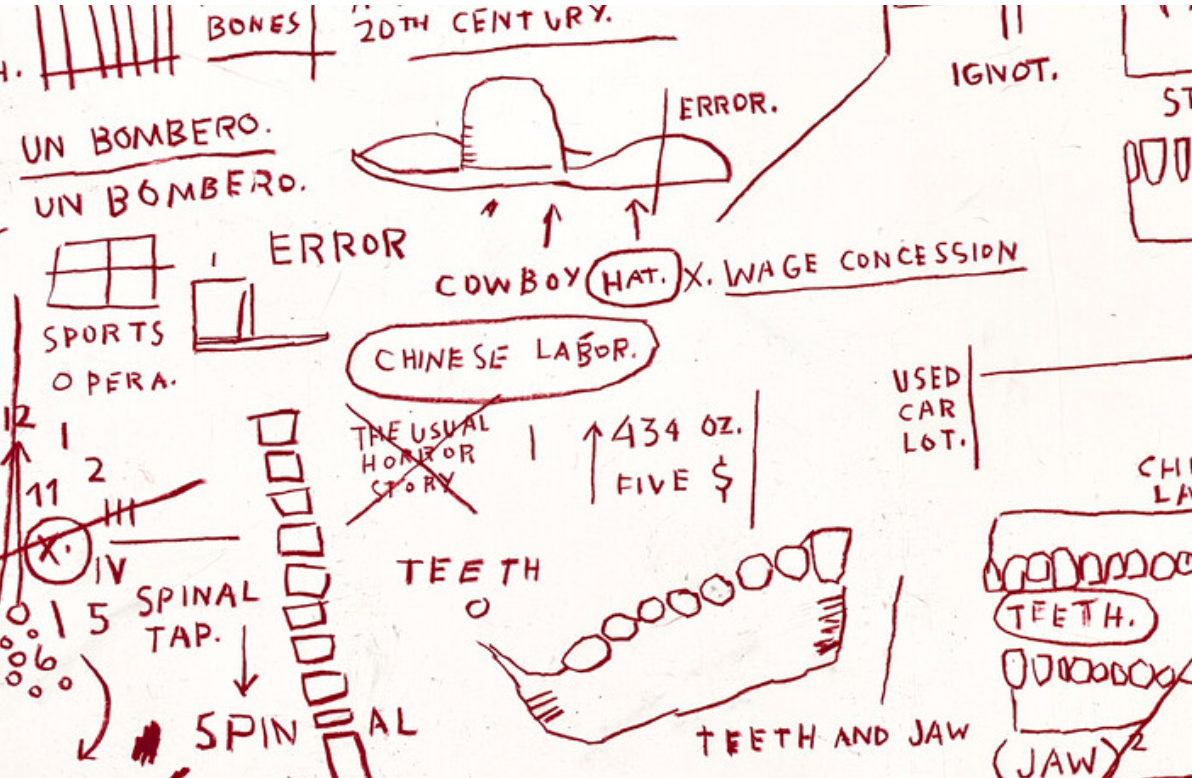
If the service of justice is to be lauded, it is its reverse—the perpetuation of injustice—which constitutes ‘THE USUAL HORROR STORY.’ This phrase, crossed out to the center-right of the composition, is no less important for its elimination.
“I cross out words so you will see them more. the fact that they are obscured makes you want to read them.”
The story Basquiat lays out is one of injustice and discrimination, of odds perpetually stacked against the deserving and disenfranchised. Railway tracks, leading the viewer through the composition, are adopted by Basquiat as a motif of embedded history, while at the same time recalling his first canvas of choice: New York City’s ‘D’ Train. In the late nineteenth century, thousands of Chinese railroad labourers forged through forests, canyons and mountains to build America’s Transcontinental Railroad. Companies such as ‘READING RAILROAD’ listed in Basquiat’s hand employed them for less than half the wage paid to white workers; they were in constant danger from explosives, rockslides and avalanches, and the death toll reached thousands. Juxtaposed against bombs, open wounds, and exploding ‘DUM DUM’ bullets, Basquiat reveals the violence which persists just beneath social consciousness as no less heinous for its veneer of industry and progress. To this day railways carry the raw materials of capitalist production—wood chips, coal, sugar—as the layers of injustice pile up.
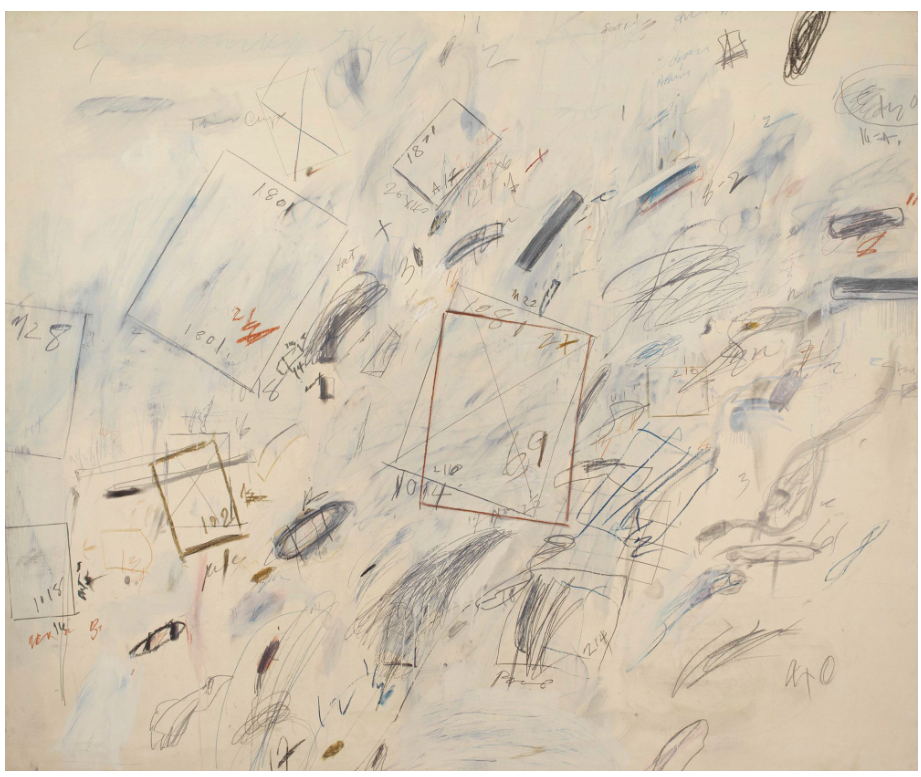
Cy Twombly, Untitled (Bolsena), 1969. Art Institute of Chicago.
Artwork: © Cy Twombly Foundation.
Digital image: © 2025 The Art Institute of Chicago / Art Resource, NY/ Scala, Florence.
Basquiat’s oeuvre betrays a sweeping, multisensory mode of perception, through which the colour and noise of life seeps onto canvas and sheet. Beside a simple sketch of spinal vertebrae Basquiat transcribes ‘SPINAL TAP’ twice, perhaps a nod to Gray’s Anatomy, but equally possibly an allusion to the fictional band Spinal Tap, of the popular early-1980s television programme The T.V. Show starring Rob Reiner. Every word carries a prompt to look, and look again. In places he catches the viewer off-guard: in a light-hearted provocation a large bone in the upper left—rather than a human specimen—is revealed to be a simple ‘MILK BONES’ dog biscuit.
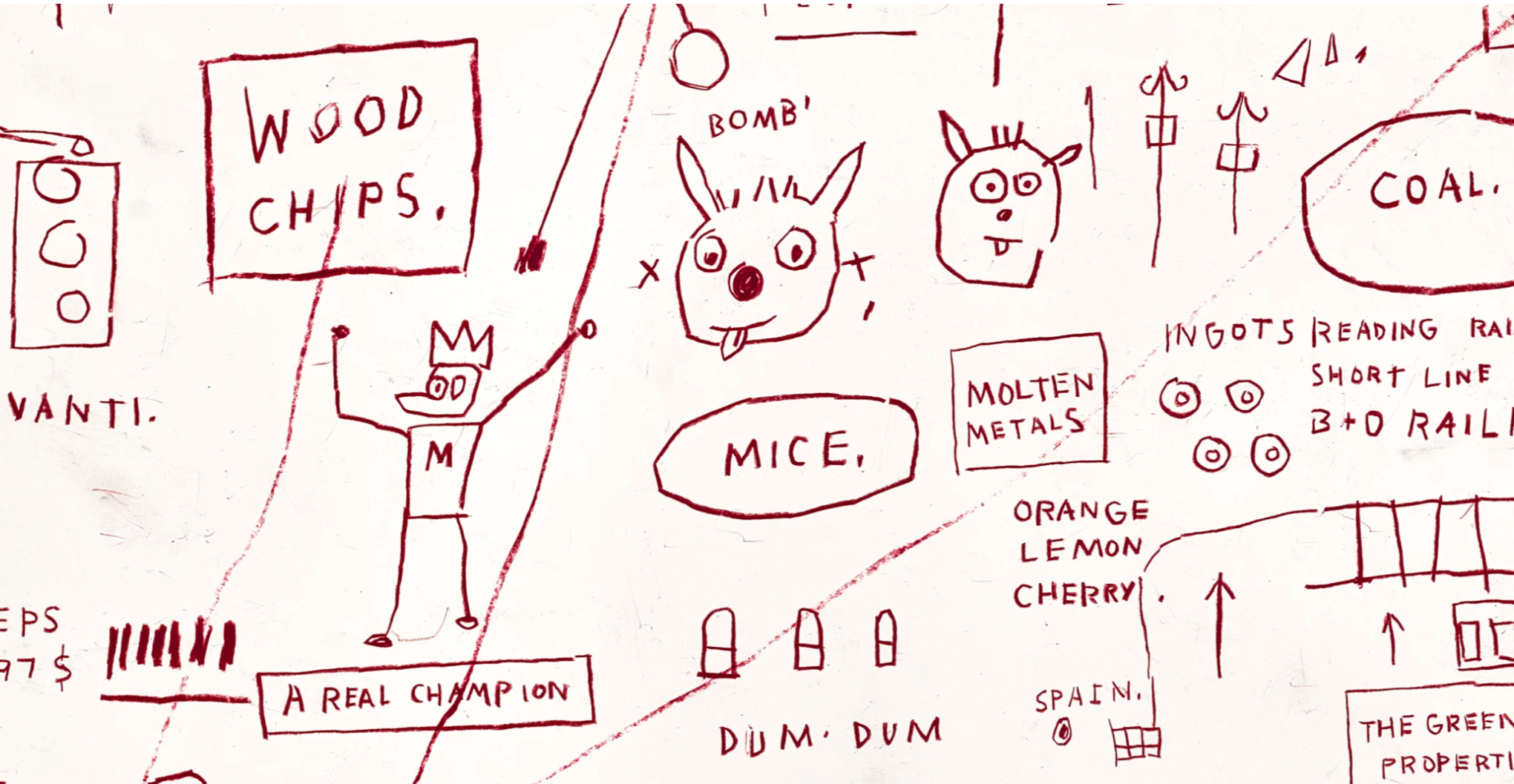
Taking inspiration from newsreels, cereal packets, comic books and cartoons, Basquiat peopled his works with a cast of fictional as well as real-life heroes, such as pioneering polar explorer Admiral Byrd, or Superman’s best friend and journalist Jimmy Olsen. The comic and cartoon character Mighty Mouse is accompanied by a ‘RODENT FESTIVAL’ of mouse peers, whose profiles gaze out at the viewer from across the vast page. Perhaps Basquiat had been watching ‘The Champion of Justice,’ a Terry Toons cartoon episode in which Mighty Mouse defeats a scheming villain to the relief of a colony of adoring mice. As he walked through grocery stores and billboard-lined sidewalks, or flicked through magazines and textbooks with the television blaring in the background and a jazz album filling gaps in the script, Basquiat forged a new way of looking and listening to the world around him. The result was an evocative, urgent visual idiom.
Jean Dubuffet, The Misunderstanding (La Mésentente), 1978. The Solomon R. Guggenheim Foundation, New York.
Artwork: © Jean Dubuffet, DACS, 2025.
Digital image: © 2025 The Solomon R. Guggenheim Foundation/Art Resource, NY/ Scala, Florence.
Within the present work words are revealed as raw material, oilstick put to paper as a painter wields his brush. Arranged intentionally—alone, in sentences and scatterings, boxed off or struck through—words come together and disperse like flecks of paint upon the surface of a canvas, evolving new sparks of inspiration or contemplation in their viewer. Traces of thought, phrases struck through but not erased, emerge as a kind of graphic pentimenti. Blank spaces become moments of silence and repose. Evolving Basquiat’s singular and iconic artform, the present work is intended to be read as much as seen, heard as much as read, a visual euphony of graffiti, fine art, jazz and concrete poetry.
Feng Yao, 1983
Phillips New-York: 28 February 2025
Estimated: USD 700,000 – 1,000,000
USD 825,500
Jean-Michel Basquiat – New Now: Mod… Lot 21 February 2025 | Phillips
JEAN-MICHEL BASQUIAT
Feng Yao, 1983
Acrylic, oil stick and paper collage on canvas
63×59 inches (160 x 149.9 cm)
Signed, titled, inscribed and dated “”FENG YAO” Jean-Michel Basquiat FEB 1983, ST MORITZ.” on the reverse
Jean-Michel Basquiat’s Feng Yao, executed in 1983, is a quintessential example of the artist’s lifelong commitment to merging visual language with textual elements, challenging the traditional distinctions between kitsch and fine art. Measuring five feet in height and width, the work confronts the viewer with a paper collage laden with Basquiat’s iconic imagery and frenetic mark-making, contrasted with the more traditional primed canvas to which it is mounted.
“I cross out words so you will see them more…”
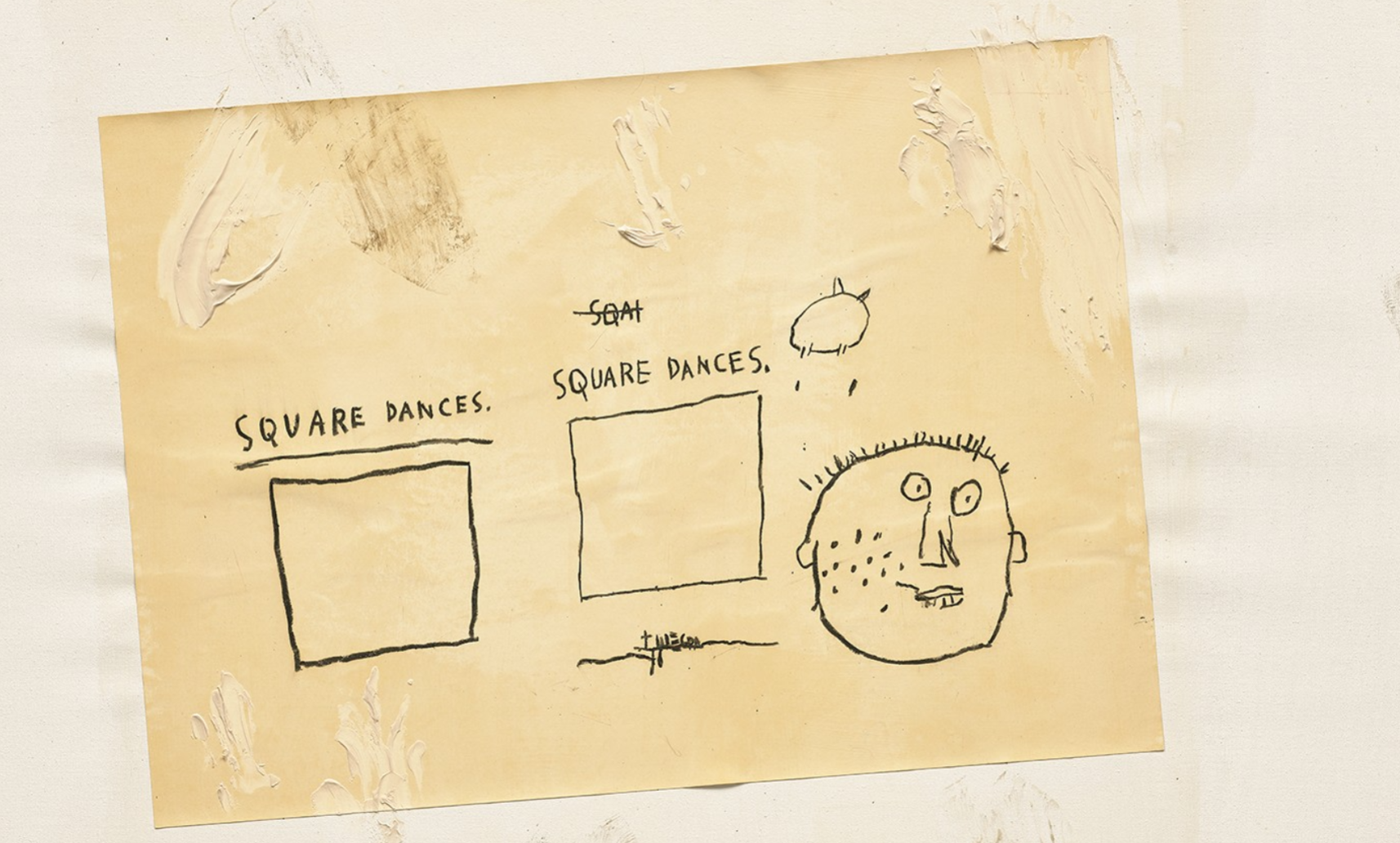
Basquiat’s work is celebrated for its infusion of symbols and pictograms, which convey complex narratives of identity, power, and social commentary. In Feng Yao, these symbols are coupled with a raw, gestural quality, evoking the artist’s unrestrained creative process. The margins of the work bear evidence of the artist’s physicality – with handprints and stray media smears emerging from the white backdrop. On the collage at the center of the work are various drawings, executed in the artist’s signature spontaneous, almost childlike way. Two outlined squares are accompanied by the phrase “SQUARE DANCES.” written above each of them, with the text partially inscribed for a third time, but misspelled and deliberately crossed out. To the right, Basquiat features a figure’s face – cheeks dotted with freckles and hair sprouting upwards. Other marks evade our understanding; a circular form drawn above the figure, and a hurried scrawl below the second square – calling to mind the evocation of graffiti in artworks by artists such as Cy Twombly. On the whole, Feng Yao finds resonance in its unpretentious quality. While appearing as if thrown together easily or even found on the studio floor, Feng Yao encapsulates Basquiat’s ability to distill his gestural vocabulary into its most essential and unpretentious form, radiating raw creative energy.
Cy Twombly, Untitled, 1964, The Whitney Museum of American Art, New York. Image: Whitney Museum of American Art / Licensed by Scala, Artwork: © Cy Twombly Foundation
Feng Yao was executed in 1983, which marked a pivotal year for Basquiat’s career. Following his debut solo exhibition in the United States at Annina Nosei Gallery, in New York in 1982, the artist’s rise to fame had only just begun. In 1983, Basquiat would leave Nosei’s gallery, joining forces with Swiss gallerist Bruno Bischofberger, who elevated Basquiat’s career on an international scale. It was in Bischofberger’s St. Moritz home in Switzerland that Feng Yao was created in February of that year, just prior to Basquiat’s inclusion as the youngest artist in the 1983 Biennial at the Whitney Museum of American Art in New York.
Feng Yao perhaps most vividly reflects Basquiat’s deep fascination with dance and music. The 1980s marked a dynamic period of creative flourishing in New York, spanning not only fine art but also music, fashion, and performance. Growing up in this culturally rich environment, Basquiat was immersed in the city’s thriving scenes of jazz, hip-hop, and funk. Alongside his visual art, he – like his close friend Andy Warhol – ventured into music production and was frequently seen at nightclubs alongside cultural icons such as Madonna. Basquiat often infused references to music and dance into his work, as evident in the present piece, where the two “dance squares” subtly evoke his expansive world.
Bruce Nauman, Dance or Exercise on the Perimeter of a Square (Square Dance), 1967-1968.
Artwork: © 2025 Bruce Nauman/Artists Rights Society (ARS), New York
A traditional American folk dance with European roots, a dance square refers to a social dance where four couples form a square and perform a series of steps. Particularly popular in the Southern United States, Basquiat’s interest in this particular style of dance is not quite evident. However, it is well known that the artist’s approach to art making was a physical one – not necessarily about careful planning but rather capturing an emotional and energetic release, much like the way a dancer expresses oneself through movement or a musician improvises. The artist was known for having a creative process which involved a great deal of physical engagement with the canvas. Though no literal footsteps are visible, the handprints and fingertip marks in Feng Yao underscore the artist’s visceral engagement with the canvas, akin to the bodily movements in dance. The work of artist Bruce Nauman also comes to mind, particularly his Dance or Exercise on the Perimeter of a Square (Square Dance) from 1967-1968, in which Nauman marked out a square on the floor of his studio with tape and rhythmically traced the outline of the square to the beat of a metronome. While Nauman may not have directly influenced Basquiat, it is interesting to posit both in the same lineage of artist’s evoking the ephemeral architecture of mechanical bodily gestures. In this manner, Feng Yao can be seen as a visual testament to Basquiat’s experiences with music and dance, both aesthetically and emotionally.
“I’d been sort of living off this pile of drawings from last year,
sticking them on paintings.”
Much about Feng Yao remains a mystery to the viewer. The title, which appears to be influenced by Mandarin, perhaps reflects the artist’s inclination to incorporate words and phrases from different languages into his artwork, reflecting his multicultural background and making statements about identity and belonging. The identity of the face eludes us as well, although it can be located within Basquiat’s signature pseudo-hieroglyphic symbols, harkening back to his career as a graffiti artist in the 1970s under the moniker of SAMO. Ultimately, however, one should take Feng Yao at face value. While simple in concept, what Basquiat enacts in the present work is an invocation of various art historical traditions and cultural references. Combining the patchwork quality of assemblage and collage with the physical implications of American folk dance, this work all but depicts the artist dancing himself.
Arteries of the Left Arm, 1983
Phillips New-York: 20 November 2024
Estimated: USD 800,000 – 1,200,000
USD 889,000
Jean-Michel Basquiat – Modern & Co… Lot 143 November 2024 | Phillips
JEAN-MICHEL BASQUIAT
Arteries of the Left Arm, 1983
Acrylic, oilstick and paper collage on canvas
63×59 inches (160 x 149.9 cm)
Signed, titled, inscribed and dated “”ARTERIES OF THE LEFT ARM” Jean-Michel Basquiat FEB 1983. ST. MORITZ.” on the reverse
A quintessential coalescence of language and symbols which together interrogate the notions of “high” and “low” art, Jean-Michel Basquiat’s Arteries of the Left Arm combines drawing and painting in both technique and physicality. Created in 1983 during the artist’s prime years, the present work confronts the viewer with a series of symbols in oilstick on paper, mounted to a minimally primed white canvas. Treating his works on paper with the same importance as his paintings on canvas —which he only began in earnest in 1982 – Arteries of the Left Arm combines the two disparate media into one unique work. Setting the drawing against a canvas riddled with hand and footprints from the artist’s studio, Basquiat gives the viewer a glimpse into the artist’s working practice at the height of his too-short career. Standing nearly five feet tall, the present work was acquired from Bruno Bischofberger, the Swiss dealer who represented the artist beginning in 1982, and who arranged for the pivotal meeting between Basquiat and Warhol in 1982 just a year before the creation of Arteries of the Left Arm. The work has remained in the same exceptional private collection since its purchase in 1989, and has been included in exhibitions worldwide in Seoul, Germany and Vienna.
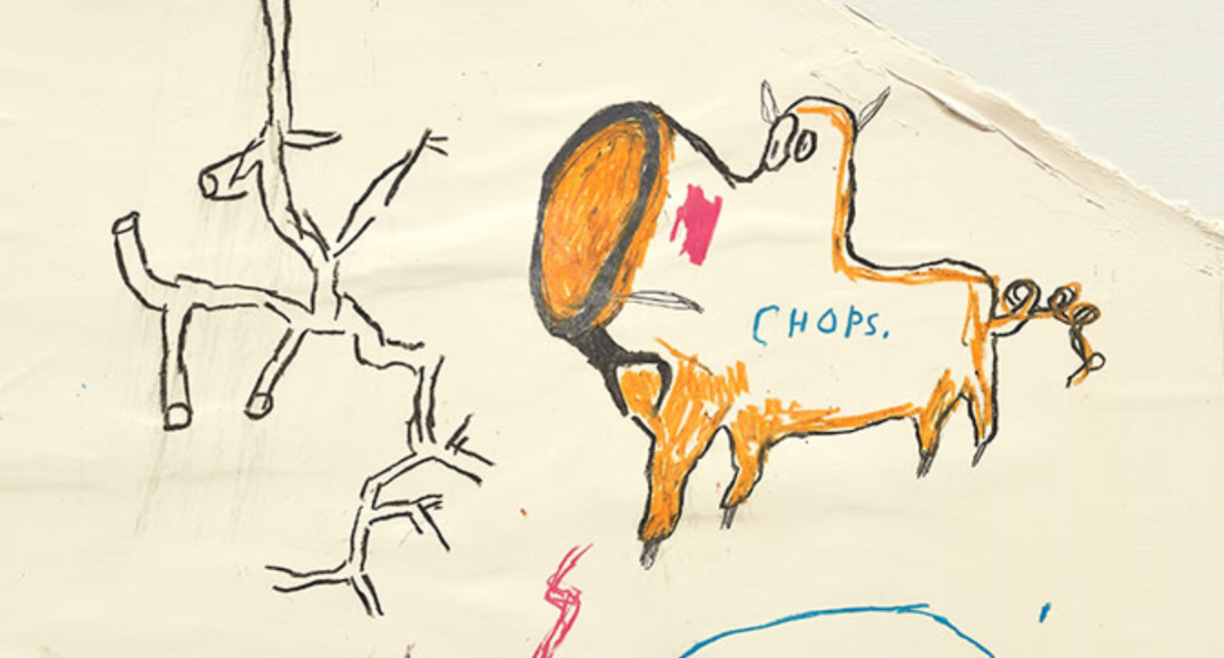
1983 would prove to be a pivotal year for Basquiat. Following his first solo exhibition in the United States at the Annina Nosei Gallery, New York in 1982, Basquiat’s star had only just begun to rise. It was in 1983 that Basquiat left Nosei’s Gallery, joining forces with Bischofberger until the artist’s death in 1988. The two would become close, with Basquiat frequently spending time at the dealer’s home in St. Moritz, Switzerland, where Basquiat created Arteries of the Left Arm in February 1983. Just a month after the creation of the present work, Basquiat became the youngest artist included in that year’s Biennial at the Whitney Museum of American Art, New York.
Infused with symbols and motifs, Basquiat’s work beckons to be understood. Harkening back to his career as a graffiti artist in the 1970s under the name SAMO©, the present work incorporates the pseudo-hieroglyphics Basquiat would spray on city walls, crudely rendered pictograms which resemble primitive writings and drawings. In the lower left of the drawing, a train seems to be running out of track, heading towards the skull with a dagger drawn in pencil piercing through it. To the right of that figure is a bug, a common motif within the artist’s practice, and above it a pig-like creature emblazoned “CHOPS,” shaded in a vibrant shade of orange. Running down the center of the paper is a web-like structure which resembles an artery or vein, calling back to the title of the piece and nodding to Basquiat’s fascination with the human body. While the composition yearns for understanding, it also exists without any clear message, presenting the figures and symbols in an almost childlike way.
Cy Twombly, Apollo and the Artist, 1975. Private Collection. Artwork: © Cy Twombly Foundation
Influenced by artists’ use of language in drawing and painting such as Cy Twombly, Basquiat emphasizes both the presence and absence of language in his works. In the present work, text is used to help viewer understand the symbols within – “CHOPS” in the pig’s abdomen and “COAL” at the rear of the train. We also see the beginnings of an attempt to communicate with crossed-out letters below the skull figure, presenting an insight into the artist’s process of revision within his practice.
Untitled (Grain Alcohol), 1983
Phillips New-York: 14 May 2024
Estimated: USD 1,000,000 – 1,500,000
USD 1,996,000
Jean-Michel Basquiat – Modern & Contempo… Lot 13 May 2024 | Phillips
JEAN-MICHEL BASQUIAT
Untitled (Grain Alcohol), 1983
Oilstick on paper
30×22 inches (76.2 x 55.9 cm)
Signed and dated “Jean-Michel Basquiat 83” lower right
Arriving to auction for the first time in nearly four decades, Untitled (Grain Alcohol) exemplifies the gestural prowess and distinctive iconography that denoted the peak of Jean-Michel Basquiat’s career. Executed in 1983, soon after his meteoric rise to fame, the work features the same interrogation of “high” and “low” culture that would typify the rest of his too-brief oeuvre. In its hieroglyphic composition, crudely-rendered pictograms, and textual acronyms, the work stylistically harkens back to Basquiat’s past as a graffiti artist in the late 1970s. It also represents many of Basquiat’s pictorial interests at the time, such as crowns, superhero imagery, and jazz musicians, specifically referencing Bud Powell, Charles Mingus (CHRLES MNGS), Miles Davis (MLSDVS), Dizzy Gillespie (DZYGLPSE), Charlie Parker (C PRKR), and Max Roach (MX RCH). These citations not only showcase Basquiat’s deep appreciation for jazz music and its cultural significance but also highlight his penchant for incorporating a range of influences into his work, creating a rich tapestry of diverse visual and thematic elements. Bringing together motifs drawn street art, music, and pop culture, Untitled serves as a vibrant testament to Basquiat’s extraordinary vision.

Jean-Michel Basquiat DJing at Area, New York, 1985. Photograph by Ben Buchanon.
Image: © Ben Buchanan. All rights reserved 2024 / Bridgeman Images
Jazz music, and specifically bebop, was an enduring source of inspiration for the artist, resurfacing time and time again in over thirty of his famous paintings, such as Horn Players, 1983, The Broad, Los Angeles. Basquiat’s fascination with the genre stemmed from his upbringing in New York City, where he was exposed to the vibrant jazz scene of the 1960s and 1970s. This early exposure was later evoked in the artist’s studio practice and epitomized in Untitled, which mirrors the spontaneity and improvisation of jazz music through its rhythmic composition and swiftly drawn oilstick lines. As a musician himself, Basquiat ardently admired and identified with many of these figures—a sentiment visible in the pantheon of bebop luminaries that occupies the lower half of the image. In Untitled, Basquiat’s reverence for the genre is palpable, as he pays homage to these legendary musicians while also infusing the painting with his own distinctive visual language.

Jean-Michel Basquiat, Horn Players, 1983. The Broad, Los Angeles. Artwork: © Estate of Jean-Michel Basquiat. Licensed by Artestar, New York
Central to Basquiat’s practice was a sanctification of notable African American figures, which Basquiat used as an iconographic device to coalesce art history, pop culture, and the Black experience. As an answer to the lack of Afro-diasporic representation he witnessed during his frequent visits to the Brooklyn Museum during his youth, the artist began to anoint cultural icons in his own distinctive form of royal portraiture, just as Western art history valorized saints and kings for millennia. In the present work, these pioneering jazz figures—as well as heavyweight champion Jersey Joe Walcott—are surrounded by superhero references, which were also found in his painting Charles the First (1982). At the top of Untitled are two Superman shields; just below is a human figure labelled twice as Thor, the Germanic pagan god who holds a hammer and was appropriated as a Marvel comic in the 1960s. Thor’s signature thunderbolt is repeated across the center of the image, elevating Basquiat’s subjects to a superheroic status. Crowns, one of the artist’s quintessential pictorial tropes, coronate Walcott and Roach and reinforce Basquiat’s exaltation of these figures. These symbols have a double meaning of “kingship,” serving as a nod both to Basquiat’s past as a street artist and to jazz culture. This history also resonates with jazz notions of “royalty,” in which musicians were granted informal honorific titles, such as the “Prince of Darkness” (Miles Davis) or Nat “King” Cole. Embodying both of these traditions, Untitled presents these figures as reigning figures within their respective realms.

Portrait of Charlie Parker, Tommy Potter, Miles Davis, Duke Jordan, and Max Roach, Three Deuces, New York, N.Y., ca. Aug. 1947.
Image: Library of Congress, Washington, D.C., William P. Gottlieb Collection
While the present work renders Basquiat’s superheroes at the height of their talents, it can also be interpreted as documenting their shared hardships. The scrawl “BENZEDREX INHALERS SOAKED IN WINE” refers to an over-the-counter nasal decongestant containing amphetamine, which was often abused by many jazz musicians—most notoriously Parker. The inhalers were typically broken apart to reveal a piece of cotton soaked in the drug, which would then be dipped in alcohol or coffee. Underscored by the work’s subtitle, Grain Alcohol, this reference foreshadowed Basquiat’s own addiction and premature death just five years after the execution of Untitled. In this way, the work serves as a poignant reminder of Basquiat’s kinship with his idols—illustrating how they were united by both their artistic brilliance as well as their struggles. Weaving together personal experience, popular culture, graffiti, and music, Untitled symbolizes Basquiat’s defiance against social and artistic hierarchies.
Untitled (Yen), 1983
Sotheby’s New-York: 1 March 2024
Estimated: USD 150,000 – 200,000
USD 190,500
Untitled (Yen) | Contemporary Curated | 2024 | Sotheby’s (sothebys.com)
JEAN-MICHEL BASQUIAT (1960 – 1988)
Untitled (Yen), 1983
Oilstick on paper
11 1/2 x 16 1/4 inches (29.2 x 41.3 cm)
Executed in 1983, Untitled (Yen) captures Jean-Michel Basquiat at the height of his interest in Japan and its culture. Having taken several trips to the Japanese capital around the time of the present work’s execution, Basquiat deftly illustrates his fascination with Japanese products through his idiosyncratic, densely scrawled penmanship. During this time, Japan was experiencing a meteoric rise in its cultural and economic capital, and consequently, Basquiat witnessed an explosion of toys, fashion, and movies produced in Japan and brought to the American mainstream.
As such, “MADE IN JAPAN,” emblazoned in the present work, pays homage to the nation’s cultural and material exports. Captivated by the country’s commercial output and drawn to its rich, historic culture, Basquiat’s interest in Japan would be thoroughly documented in the monumental 2019 exhibition at Mori Arts Center Gallery in Tokyo—Jean-Michel Basquiat: Made in Japan— as part of which the present work would be exhibited. Richard D. Marshall, who first acquired Untitled (Yen) as a gift from the artist, extensively aided in the preparation for that exhibition in the months leading up to his passing — a true testament to the depth of Marshall’s stewardship of the artist’s resounding legacy.
Untitled (Yen) also exemplifies the artist’s career-long integration of image and text. In organized rows of capital letters, the numbers and words are precisely written and clearly legible, but Basquiat crosses sections out and scribbles over others, inviting the spontaneous and the aleatory to intervene. Conflating the visual and the verbal, Basquiat relies on text alone to create the present composition, and his reliance on repetition as both an aesthetic and rhetorical strategy imbues the work with a historic sonority. Embedded in his origins as a street artist, Basquiat continually employed text as not only an aspect but at times the subject of his work.
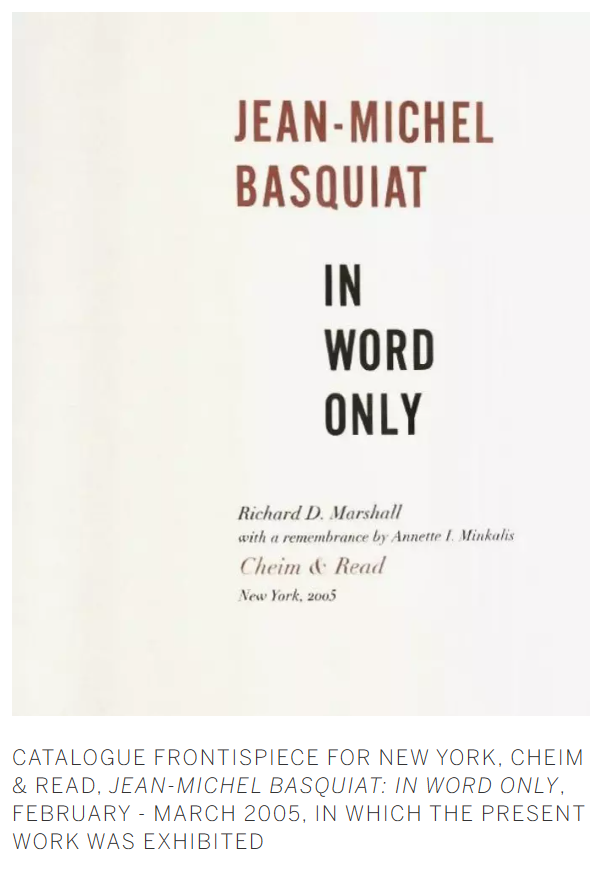
Alongside his broader iconographical lexicon of pictograms and symbols, words offered him a vehicle to communicate his attitude toward the canon of art history, contemporary culture, and his personal relationship to fame. Text allowed him to be cryptic, political, pointed, and humorous, but Basquiat was never too trusting of its credence. Untitled (Yen) was also a key work in Cheim & Reid’s presentation of Jean-Michel Basquiat: In Word Only in 2005. Additionally supported by Marshall with a thoughtful essay published in the accompanying exhibition catalogue, the exhibition highlighted Basquiat’s unique and significant use of language. Basquiat’s inclusion of text in Untitled (Yen) testifies to his career-long pursuit of integrating and blurring the lines between text and image. In organized rows of capital letters, the word “YEN” read steadily and repeatedly, as if it were representing the constant flow of Japanese products in circulation. Embedded in his origins as a street artist, Basquiat continually employed text as not only an aspect but at times the subject of his work. Alongside his broader iconographical lexicon of pictograms and symbols, words offered him a vehicle to communicate his attitude toward the canon of art history, contemporary culture, and his personal relationship to fame. Text allowed him to be cryptic, political, pointed, and humorous, but Basquiat was never too trusting of its credence.
Untitled (History of Jazz), 1983
Sotheby’s New-York: 1 March 2024
Estimated: USD 80,000 – 120,000
USD 171,450
Untitled (History of Jazz) | Contemporary Curated | 2024 | Sotheby’s (sothebys.com)
JEAN-MICHEL BASQUIAT (1960 – 1988)
Untitled (History of Jazz), 1983
Ink on paper
10 1/2 x 8 3/8 inches (26.7 x 21.3 cm)
Executed in 1983, Jean-Michel Basquiat’s Untitled (History of Jazz) delves into the narrative of jazz’s genesis in the United States, celebrating the pantheon of musicians who have served as profound sources of inspiration for the artist. Basquiat opens with a declaration: “TO FULLY UNDERSTAND THE IMPACT AND DEPTH, BEAUTY, GENIUS (ETC.) OF AN ARTIST, ONE MUST HAVE SOME WORKING KNOWLEDGE OF THE MEDIUM.” He borrowed the sentence from an abbreviated history of jazz, on which he kept diligent notes in his journal. Basquiat then acknowledges the roots of jazz — beginning with ragtime in early twentieth-century New Orleans, Basquiat honors jazz’s forefathers, among them pianist and vocalist Thomas Wright “Fats” Waller and trumpet player W. C. Handy, who dubbed himself the “Father of the Blues.” As his composition moves through decades of the genre’s history, Basquiat pays homage to some of jazz’s major players—namely, trumpet player and vocalist Louis Armstrong, pianists Duke Ellington and Count Basie, and saxophonist Charlie “Bird” Parker—the latter of which was one of Basquiat’s most praised personal heroes. His tribute, a common theme in many of the artist’s major paintings, is offset by Basquiat’s somber recognition of the alcoholism and opiate addiction which plagued many of jazz’s icons—a meditation on the consequences of fame that also plagued Basquiat.
JEAN-MICHEL BASQUIAT ON THE SET OF DOWNTOWN 81, 1980-81. PHOTO © EDO BERTOGLIO. ART © 2024 ESTATE OF JEAN-MICHEL BASQUIAT. LICENSED BY ARTESTAR, NEW YORK
In Untitled (History of Jazz), Basquiat, a musician in his own right, deftly illustrates the relationship between his staccato hand and the music he deeply respected. In rows of capital letters, the words read loudly, as though imbued with an auditory gravitas. Basquiat crosses sections out and scribbles in the margins, inviting the spontaneous to intercede as if they were variances in audible tone. Choreographed yet improvisational, the compositional balance of the various elements in the present work captures the very spirit of the genre itself. Rhetorical techniques, such as repetition, also draw inspiration from the methods of his jazz heroes. Charlie Parker, for example, honed his craft by imitating the solos of his teacher, Lester Young, note for note. Untitled (History of Jazz) was a key work in Cheim & Reid’s presentation of Jean-Michel Basquiat: In Word Only in 2005. Additionally supported by Richard D. Marshall with a thoughtful essay published in the accompanying exhibition catalogue, the exhibition highlighted Basquiat’s unique and significant use of language. In Untitled (History of Jazz), language manifests throughout as the artist multiplies names and verbs, imbuing the work with a poetic, even musical sonority.
Portrait of Joel Bernard, 1983
Sotheby’s New-York: 16 November 2023
Estimated: USD 800,000 – 1,200,000
USD 444,500
Portrait of Joel Bernard | Contemporary Day Auction | 2023 | Sotheby’s (sothebys.com)
JEAN-MICHEL BASQUIAT (1960 – 1988)
Portrait of Joel Bernard, 1983
Acrylic, graphite and colored pencil on paper
41 5/8 x 29 1/2 inches (105.7 x 74.9 cm)
Crawled and scribbled, enigmatic yet alluring, Jean-Michel Basquiat’s Portrait of Joel Bernard of 1983 is an instantly recognizable example from the artist’s prolific corpus of works on paper. Held in the personal collection of legendary gallerist and publisher of Basquiat’s first catalog of works on paper John Cheim, the present work boasts an illustrious exhibition history, most recently included in the celebrated Résonance: Jean-Michel Basquiat & L’Univers Kongo at Galerie Gradiva in Paris in 2022. Appearing straightforward or improvised at first glance, Portrait of Joel Bernard is laden with hidden meaning, complexity, and technical rigor that firmly establish Basquiat as one of the most important artists of his generation and of art history at large.
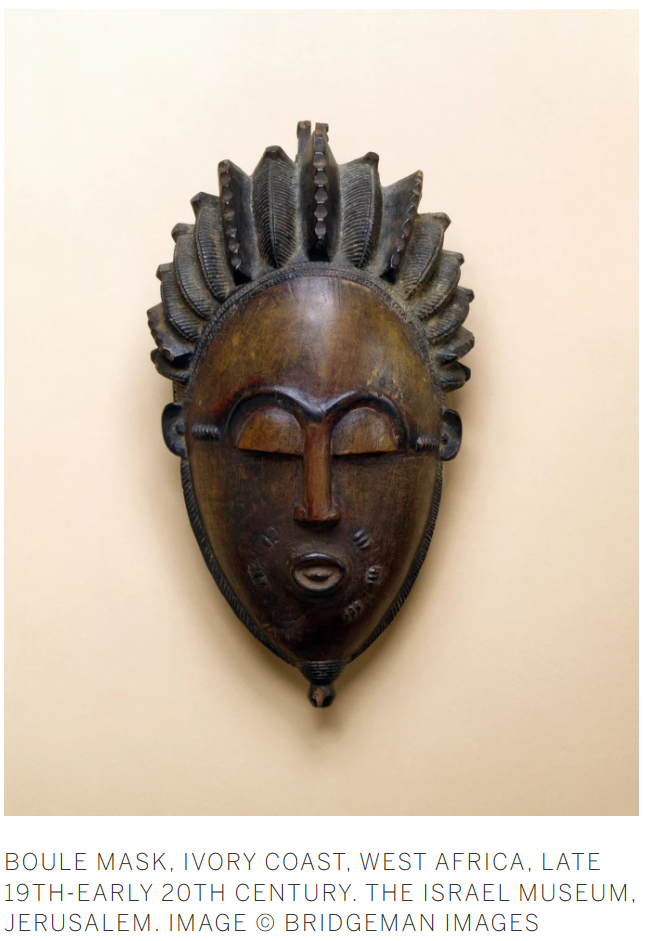
An autodidact, Basquiat’s genius lay in his instinctual understanding of composition and unique iconographic lexicon. For Basquiat, drawing was the swiftest and most direct way in which he could confront and translate his inner thoughts, and the raw immediacy of paper as a medium provided the perfect vehicle for illustrating his innate brilliance. In the words of Robert Storr, “Drawing, for him, was something you did rather than something done, an activity rather than a medium” (Robert Storr, “Two Hundred Beats Per Min,” in: Exh. Cat., New York, Robert Miller Gallery, Basquiat Drawings, 1990, n.p.). Unlike his paintings, which could be modified or corrected through overpainting, the frenetic energy of Basquiat’s works on paper allow his creative genius to shine through in an unaltered fashion. As a result, works on paper, including the present example, exist as evidence of the artist’s idiosyncratic way of thinking and in turn, his limitless potential.
Executed the year Basquiat truly cemented his international reputation, Portrait of Joel Bernard captures the artist at the height of his career. A fragmented figure occupies the center of the paper, exuding a ferocious, nearly autonomous energy on the page. The eponymous figure, Joel Bernard, was a white civil rights activist who was a New York Freedom Summer volunteer from New York City. Despite the specificity of the work’s title and inclusion of a nametag below the figure’s chest, the figure is ambiguously rendered with no definitive clarity of identity. Enshrouded in a pool of bold red acrylic, the subject’s head takes priority in the composition, standing in stark contrast to the remainder of the feverishly etched graphite body.
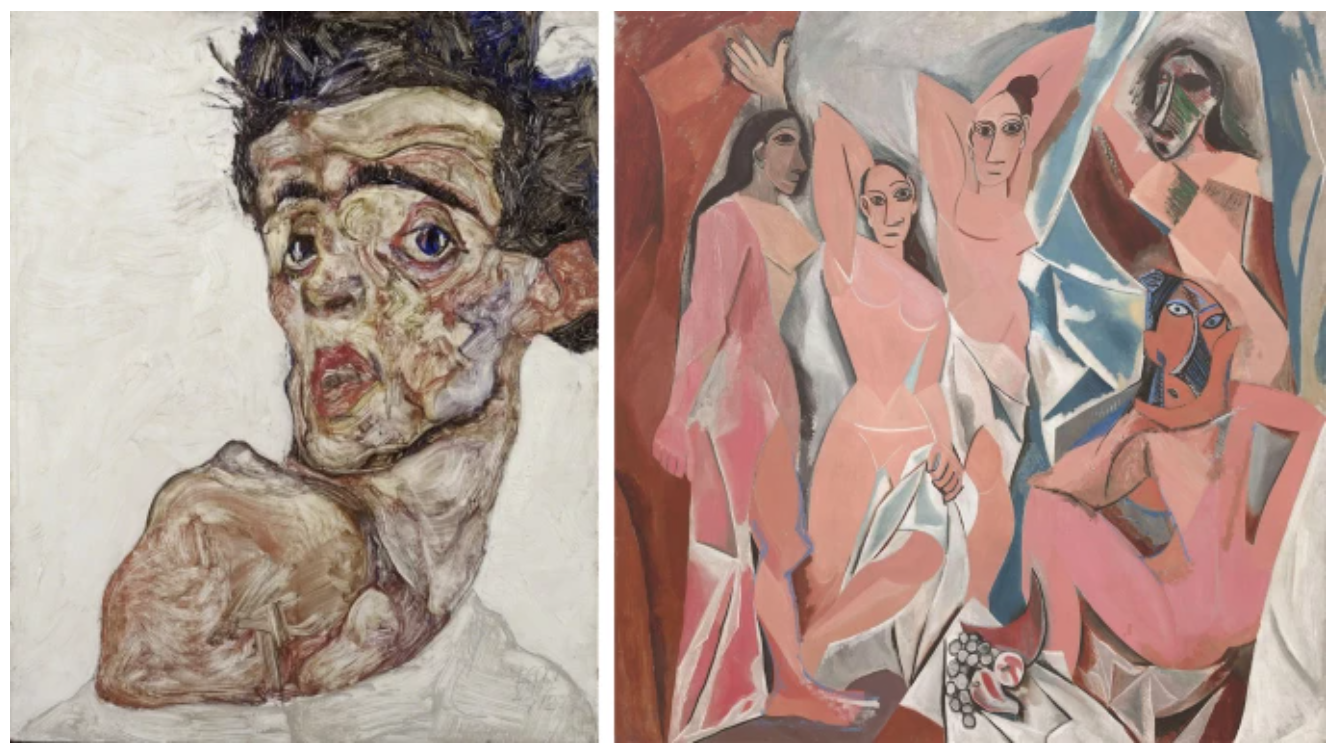
LEFT: EGON SCHIELE, SELF-PORTRAIT WITH RAISED BARED SHOULDER, 1912. LEOPOLD MUSEUM, VIENNA. IMAGE © LEOPOLD MUSEUM, VIENNA/MANFRED THUMBERGER 2023.
RIGHT: PABLO PICASSO, LES DEMOISELLES D’AVIGNON, 1907. MUSEUM OF MODERN ART, NEW YORK. IMAGE © SUCCESSION PICASSO/DACS, LONDON 2023 / BRIDGEMAN IMAGES. ART © 2023 ESTATE OF PABLO PICASSO / ARTISTS RIGHTS SOCIETY (ARS), NEW YORK
Indeed, Basquiat tirelessly explored the formal and connotative possibilities of the head in his practice. Beyond functioning as the site of cerebral activity, the head also serves as a polysemous symbol for his investigations of identity and race. Here, the head is crudely rendered as a mask-like block of red paint, with three vacant holes for its eyes and mouth. The adoption of the mask motif, one of the great hallmarks of Basquiat’s visual language and key formal devices in his study of heads, engages in a dialogue between traditional African masks, with their purportedly apotropaic and mythical properties, and the work of avant-garde painters such as Pablo Picasso and Henri Matisse, who were greatly inspired by then-called ‘primitive’ art. In works such as the present, Basquiat potently challenges such pre-existing tropes by reclaiming the image of the mask as a self-referential emblem. Brilliantly formulated in the artist’s intuitive and innovative psyche and then translated onto the paper surface, the present work is as vivid and alive now as it was at the moment of its execution in 1983. As Robert
Untitled, 1983
Sotheby’s New-York: 8 December 2021
Estimated: USD 3,000,000 – 4,000,000
USD 3,166,000
JEAN-MICHEL BASQUIAT
Untitled, 1983
Ink and oilstick on paper
29.7 x 22 inches (75.6 x 55.9 cm)
In Untitled, Basquiat substitutes perspectival accuracy and spatial recession for a pronounced flatness and a distinct emphasis upon bold color and expression. The facial features form a shape reminiscent of a skull, which in turn constitutes a key motif present throughout Basquiat’s repertoire. The image of the skull is seemingly a personal gesture alluding to a childhood incident in which the artist was hit by a car while playing on the street, and subsequently hospitalized for serious internal injuries and broken limbs. While recuperating after the accident, Basquiat received a copy of Grey’s Anatomy as a gift from his mother, and the myriad anatomical and skeletal images exhibited in the book undoubtedly informed his own visual inventory as he became a working artist. While the image of the skull offers a persisting reminder of the fragility of the human body, it is also a significant symbol of Basquiat’s own childhood trauma and near-encounter with death.
Untitled, 1983
Sotheby’s London: 1 July 2021
Estimated: GBP 200,000 – 300,000
GBP 620,000
Untitled | Contemporary Art Day Auction | 2021 | Sotheby’s (sothebys.com)
JEAN-MICHEL BASQUIAT (1960 – 1988)
Untitled, 1983
Acrylic and oilstick on paper
27 1/2 x 39 3/8 inches (70×100 cm)
Executed in 1983, Untitled is remarkable example of Jean-Michel Basquiat’s inimitable corpus of works on paper. Although impossible to dilute his imagery into one all-encompassing theme, the present work serves as a paradigm of Basquiat’s keen attention to detail and mastery of line. Basquiat’s drawings comprise a fundamental element of his prolific oeuvre and are essential to a comprehensive understanding of the diverse signs, symbols, and subjects which make up his staggeringly inventive output. In the present work, Basquiat details a confrontational clashing of characters; an omnipotent skull, typical of Basquiat’s visual lexicon, hovers, watching over the imagined scene. At the forefront, a Looney Tune style brown dog with missing teeth, appears to have been knocked unconscious, replete with dizzying stars and graphic orbital lines. Confronting the cartoonish canine, a rudimentary bust rendered in orange, part sculpture, part robot and machine, is indicated as the culprit of this quarrelsome chaos.
Batman, 1983
Phillips New-York: 23 June 2021
Estimated: USD 1,600,000 – 2,000,000
USD 1,800,000
Jean-Michel Basquiat – 20th Century & C… Lot 23 June 2021 | Phillips
JEAN-MICHEL BASQUIAT
Batman, 1983
Oilstick on paper
22 x 29 7/8 inches (55.9 x 75.9 cm)
Signed and dated “1983 Jean-Michel Basquiat” on the reverse
Revising cartoon imagery in his signature raw and expressive aesthetic, Jean-Michel Basquiat’s The present work was created at a time when the artist had already received significant recognition in the New York art scene. In 1982, he had exhibited at Documenta VII, Kassel and, in the following year, was included in the Whitney Biennial, becoming the youngest artist to represent the United States in a major international exhibition of contemporary art. In its thematic reverberation of the Bat-insignia, Batman represents one of Basquiat’s earliest mediations focused entirely on the caped crusader, along with his Television and Cruelty to Animals of the same year. The present work also anticipates Basquiat’s sustained return to comic book imagery and, specifically, the characters of Batman in 1986 and 1987 with works such as Untitled (Savoy) and Riddle Me This Batman.
Basquiat’s engagement with comic book characters was part and parcel of his immersion with popular culture in his oeuvre. Logos, characters, and phrases from Warner Brothers, Merrie Melodies, Gumby, Krazy Kat, and Porky Pig, among others, have all featured frequently in his practice. An avid admirer of cartoons and comic books, Basquiat recognized their ability to reflect the deeper issues he often grappled with in his art such as racism, discrimination, and erroneous representations of good and evil. Adorning bat-insignias and horned devils alike with haloes, Basquiat crystallizes these investigations in the present work. In doing so, he not only complicates the distinguishment between heroes and villains, but also plays into the reading of Batman as a conflicted character whose standing as an unimpeachable hero is often put to the test.
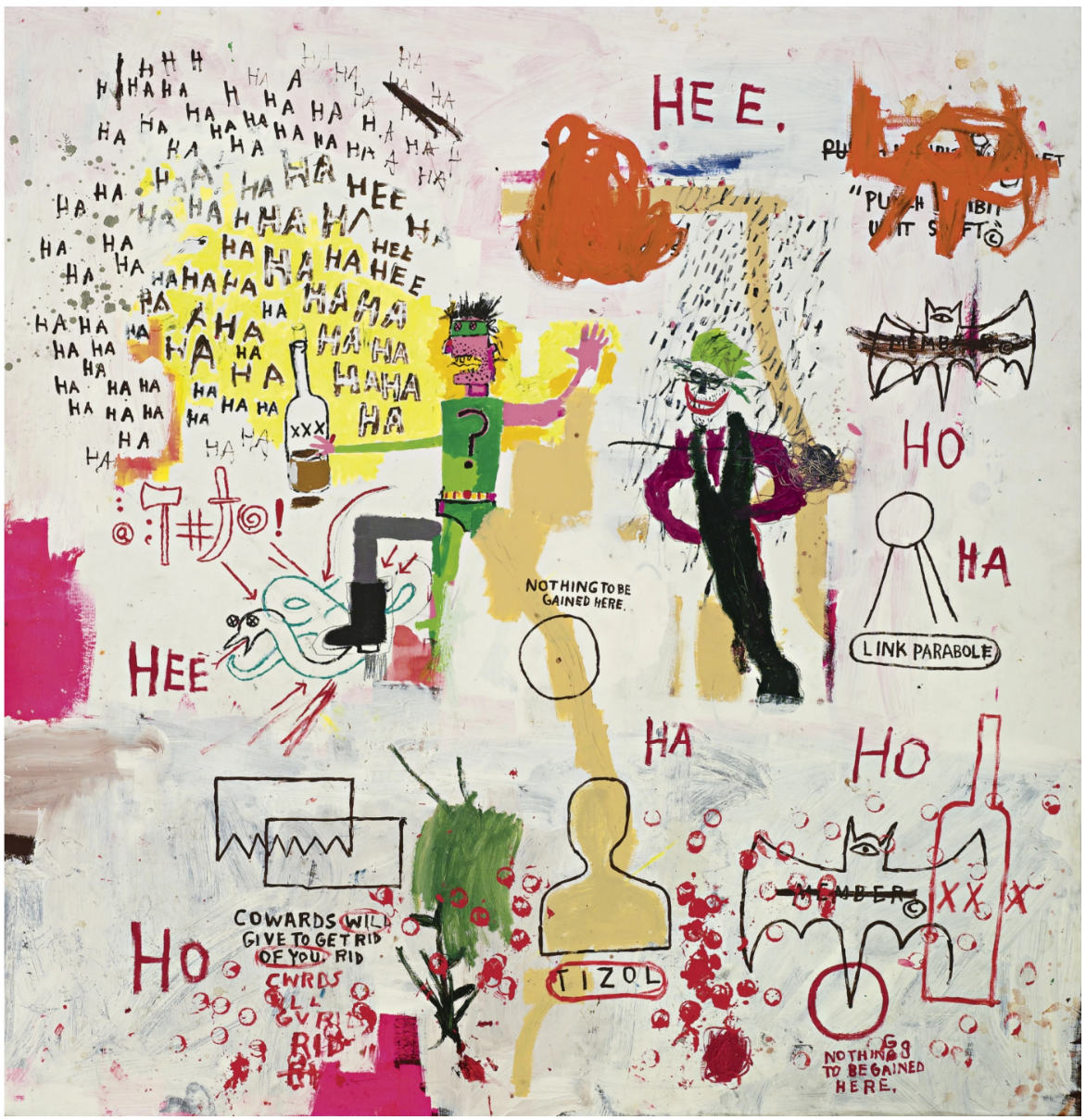
Jean-Michel Basquiat, Riddle Me This, Batman, 1987. Private Collection, Artwork: © 2021 Estate of Jean-Michel Basquiat. Licensed by Artestar, New York
Deftly executed with relish and alacrity, there is an immediacy to Batman that captures the spontaneous projection of the cartoon imagery which stands as its source of inspiration. His apparent quick-fire execution is mirrored in the signifiers taken from comics, imbuing the composition with sound, light, movement, and violence. In the present work, Basquiat leveraged his signature oilstick to assemble dramatic series of lines, marks, and gestures to produce the various figures. Deliberately flattened and reduced to their most essential forms, the Bat-insignia silhouettes are confidently articulated in thickly applied oilstick, with no pause nor hesitancy in the intent of his form, line, and color. Basquiat did not draw a distinction between his painting and drawing practices—some of his most admired artists were master draughtsman in their own right, including Leonardo da Vinci and Cy Twombly. Ultimately, as much as the compositional elements of the present work seemingly capture a stream-of-consciousness auto-drawing, they reveal a mastery of art historical precedent percolating in Basquiat’s mind.
Untitled, 1983
Christie’s New-York: 13 May 2014
Estimated: USD 6,000,000 – 8,000,000
USD 7,445,000
Jean-Michel Basquiat (1960-1988) (christies.com)
JEAN-MICHEL BASQUIAT (1960-1988)
Untitled, 1983
Oilstick on paper
42 1/2 x 30 1/4 inches (107.9 x 76.8 cm)
With his signature quick-fire execution, Jean-Michel Basquiat assembles a dramatic series of lines, marks and gestures to produce this energetic self-portrait. The artist often worked at great speed, disgorging his thoughts onto the graphic surface with great force and vigor. In Untitled, he effortlessly shifts between passages of exacting detail–painstakingly worked to conjure up the features he desires–to more inscrutable zones where only the slightest of references are made to actual objects, the rest being left for the viewer to decipher. This rapidity is also evident in the unworked sections of the sheet, which includes traces of an imprint of Basquiat’s sneaker as well as being filled with the vestige of the artist’s oilstick that trails in the wake of his swiftly moving hand. Executed in 1983 at the height of the artist’s career, this work still bears witness to Basquiat’s humble origins as the street artist SAMO, yet it also displays the sophistication that, by this stage in his short but meteoric career, had already made him the undisputed star of the New York art world.
1984 Drawings
Untitled (Ape), 1984
Christie’s New-York: 15 May 2025
Estimated: USD 500,000 – 700,000
USD 504,000
JEAN-MICHEL BASQUIAT (1960-1988), Untitled (Ape) | Christie’s
JEAN-MICHEL BASQUIAT (1960-1988)
Untitled (Ape), 1984
Oilstick and colored pencil on paper
30 x 22 1/4 inches (76.2 x 56.5 cm)
Signed and dated ‘Jean-Michel Basquiat 84’ (on the reverse)
Registered in the Authentication Committee of the Estate of Jean-Michel Basquia
Under transaction number 60740
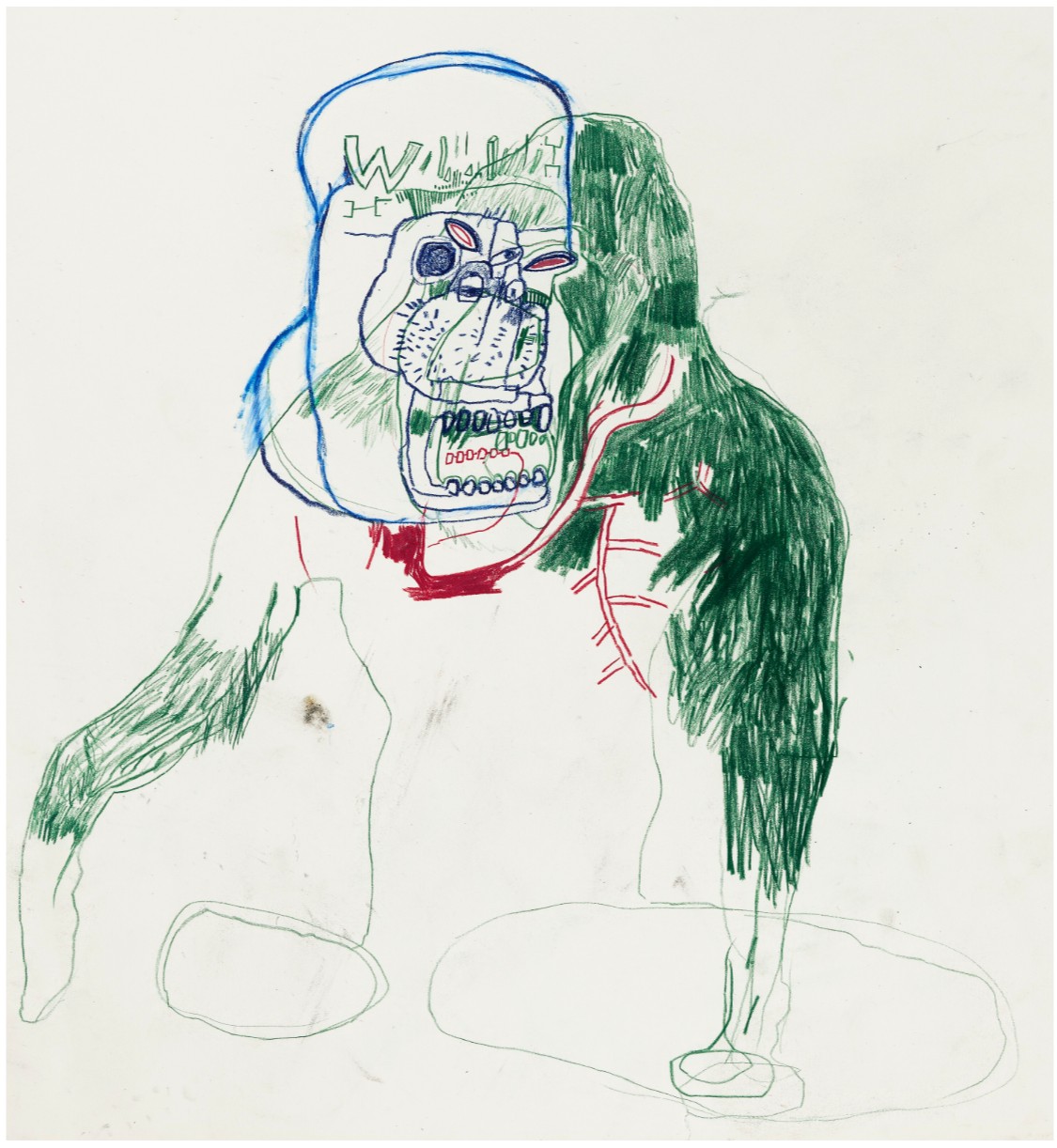
Untitled, 1984
Sotheby’s New-York: 26 February 2025
Estimated: USD 800,000 – 1,200,000
USD 889,000
Untitled | Contemporary Curated | 2025 | Sotheby’s
JEAN-MICHEL BASQUIAT (1960-1988)
Untitled, 1984
Oilstick and pastel on paper
30 x 22 1/4 inches (76.2 x 56.5 cm)
A symphonic arrangement of text, signifiers, and scrawled drawings, Jean-Michel Basquiat’s Untitled from 1984 highlights the artist’s distinctive visual language that saw the artist transcend his early origins as a graffitist in New York City. Densely layered with imagery drawn from everyday life, including literature, media, and the urban environment around him, Untitled reflects Basquiat’s profound engagement with semiotics that reflect on both art history and the sociopolitical issues facing him as a Puerto-Rican Haitian man living in America in the 1980s. Exemplifying the artist’s near constant interweaving of text and image, Untitled reveals a densely layered narrative of anatomical illustrations and charged social commentary.
A deconstructed anatomical diagram of a human face, Untitled highlights Basquiat’s deft hand presented as a stream of consciousness, his commentary pouring out onto the page in a careful equilibrium between urgency and coherence. The repetitive, frenetic mark-making is scrawled across the page, its varied color palette further disrupting any sense of the work’s structure. While the work is, immediately, an exploration of the anatomy of a human face, deconstructing it into its constituent elements from the brain, to the jaw, to the lower teeth, the work simultaneously serves as an autobiographical exploration of Basquiat’s own oeuvre, laden with references to the artist’s previous works including Per Capita (1981), Phillistines (1982), Jawbone of an Ass (1982), and future work, Monticello (1986). The former three, emblazoned onto the work with a copyright symbol, reference Basquiat’s frequent commentary on authorship and gesture of reclaiming words for his own use, doubly referencing the artist’s tongue-in-cheek inclusion of the copyright symbol next to his graffiti tag, SAMO.
Basquiat’s intense interest in exploring the anatomy of the human body can be traced back to his hospitalization at the age of seven due to a car accident, a traumatic event that would profoundly shape his artistic lexicon up until his untimely death. During his recovery, Basquiat’s mother gifted him a copy of Gray’s Anatomy, the 19th-century text known for its groundbreaking role in the history of understanding the human body. The book instilled in Basquiat an immense interest in the kinds of ways that the human – both literally and metaphorically – can be dissected, his own thoughts and brain quite literally spilling onto the page in the case of the present work.
Leonardo da Vinci, The layers of the scalp, and the cerebral ventricles, 1490-92. The Royal Collection Trust, London.
Scattered throughout the composition are further historical and cultural references, exemplifying Basquiat’s ingenious grasp of his sociopolitical environment and simultaneous interest in ancient myth. The quarter positioned in the eye of the subject, squeezed into it by its “crow’s feet,” alludes to the Greek myth of Charon’s obol, wherein one buries the dead with a coin near their face to give them passage to the ferryman of the underworld. The American quarter is emblazoned with its standard Latin expression “e pluribus unum,” or “from many, one,” yet the “unum” – a reference to America’s supposed unity – is crossed out, exposing the contradictions at the heart of American identity and his own as the son of immigrants to the country. Just below this motif, Basquiat scribbles a step-by-step textual walkthrough of a nose reconstruction – “broken nose, “nose broken,” “nose restored,” – a possible allusion to Basquiat’s close friend and collaborator Andy Warhol’s Before and After, 4 (1961), a commentary on America’s obsession with plastic surgery and artificiality. Below this, Basquiat writes “fig. Nose broken off (statue),” simultaneously referencing the difficult history of colonial looting of classical antiquities but also the ancient looters who deliberately chiseled the noses off of Egyptian statues in tombs in order to cut off the statue’s “life source” and prevent retribution in the afterlife, a further sign of the artist’s deep interest in the myths of antiquity.
Left: Andy Warhol, Before and After, 4, 1962. The Whitney Museum of American Art. New York. Art © 2025 Andy Warhol Foundation for the Visual Arts / Artists Rights Society (ARS), New York
Right: Ancient Egyptian artist. Head from a Female Sphinx, circa 1876–1842. Brooklyn Museum, New York.
Erupting into a visual cacophony of symbols, signs, and cyphers, Jean-Michel Basquiat’s Untitled (1984) offers a look into the artist’s imaginative and restless mind. Executed during a pivotal period in the artist’s short yet prolific career after the artist moved into a loft owned by Andy Warhol in 1983, Untitled reflects Basquiat’s burgeoning creative expansion and confidence in his role as an artist at a time when his career had begun to take skyrocket with museum exhibitions worldwide. An exquisite example of Basquiat’s distinctive Neo-Expressionist style and insistence on painting the myths of both past and present, Untitled’s scrawled anatomical drawings and lyrical text serve as a mirror of not only the artist’s own career to that point, but of a deep understanding of the complex layers of the history of the nation that he called home.
Untitled (Bad Tooth and Ivory), circa 1984
Sotheby’s New-York: 16 November 2023
Estimated: USD 1,200,000 – 1,800,000
USD 1,512,000
Untitled (Bad Tooth and Ivory) | Contemporary Day Auction | 2023 | Sotheby’s (sothebys.com)
JEAN-MICHEL BASQUIAT (1960 – 1988)
Untitled (Bad Tooth and Ivory), circa 1984
Oil stick and graphite on paper
22×30 inches (55.9 x 76.2 cm)
Executed at the peak of Jean-Michel Basquiat’s career, Untitled (Bad Tooth and Ivory) offers a glimpse into the artist’s energetic, imaginative and ingenious mind. The present work illustrates a masterful combination of symbols, words and figures that are instantly recognizable features of Basquiat’s oeuvre. In comparison to his paintings, the frenetic energy and immediacy of Basquiat’s works on paper are unique in their ability for Basquiat’s creative prowess to be presented in a completely unaltered fashion. In Untitled (Bad Tooth and Ivory), Basquiat substitutes perspectival accuracy and spatial recession for a pronounced flatness and a distinct emphasis upon bold colour and expression. The present work is imbued with many of Basquiat’s signature motifs – the skull, eggs, anatomy and words such as “IVORY,” “BAD TOOTH,” “BLK,” and “EGG,” among others. The image of the skull is seemingly a personal gesture alluding to a childhood incident in which the artist was hit by a car while playing on the street, and subsequently hospitalized for serious internal injuries and broken limbs. While recuperating after the accident, Basquiat received a copy of Grey’s Anatomy as a gift from his mother, and the myriad anatomical and skeletal images exhibited in the book undoubtedly informed his own visual inventory as he became a working artist. While the image of the skull offers a persisting reminder of the fragility of the human body, it is also a significant symbol of Basquiat’s own childhood trauma and near-encounter with death.
JEAN-MICHEL BASQUIAT, NEW YORK, C. 1981 © PIERRE HOULÈS
The composition of Untitled (Bad Tooth and Ivory) features several separate “close-ups,” window boxes, much like one would find surrounding a complex image in an anatomy textbook. Each box, or “detail” as Basquiat has titled them, is accompanied by text that labels the details in specific ways: a tooth is a “BAD TOOTH,” an eye covered in black line and another with “BLK” written inside of it are “dark brown eyes.” In typical Basquiat fashion, text and image build upon one another to add layered meanings to the composition, with motifs such as “EGG” appearing in his other compositions like the piece he completed with Andy Warhol the same year. As a result of the collaboration between text and image, the central face is transformed into a product whose individual parts are indispensable to viewing the whole, and whose descriptors are necessary to understanding the full meaning of the figures.
Untitled, 1984
Christie’s London: 28 June 2023
Estimated: GBP 1,000,000 – 1,500,000
GBP 1,250,000 / USD 1,579,279
Jean-Michel Basquiat (christies.com)

JEAN-MICHEL BASQUIAT (1960-1988)
Untitled, 1987
Wax crayon on paper
29 7/8 x 22 1/4 inches (75.9 x 56.5 cm)
Previously in the collection of Peter M. Brant, and recently included in the landmark retrospective Jean-Michel Basquiat: Of Symbols and Signs at the Albertina Museum, Vienna (2022-2023), the present work is a vivid example of Basquiat’s graphic practice, in which his use of text, product logos and other symbols approaches the condition of visual poetry. Executed in 1987, the composition’s lyrical, expansive quality is typical of Basquiat’s later drawings: in contrast to the pile-ups of information in some of his work, its various elements are free-floating and legible, their shapes, sounds and meanings playing off one another in space. Many of the icons and their captions, relating to areas from alchemy and astronomy to agriculture, engineering and the ‘hobo code’, derive from Henry Dreyfuss’ Symbol Sourcebook (1972), one of Basquiat’s favoured reference books. The emblem of the Ideal toy company, a manufacturer of popular boardgames and action figures during Basquiat’s childhood, is flanked by drawings of the label for KOTO medicated cream. The abstracted reverse of a five-cent coin, which depicts the façade of Monticello—the plantation house of Founding Father and slaveowner Thomas Jefferson—appears twice. Yellow, blue and orange scrawls strike notes of contrast and harmony.

Basquiat drew upon a vast range of sources, sampling, synthesizing and hybridizing ideas and images from Western and African art history, advertising, comic-books, anatomical drawings, sport, jazz, hip-hop and television. His drawings, which he made constantly and prolifically throughout his career, map the poetic, free-associative processes of his thinking with particular clarity. In the present work, the symbols for ‘heat exchange’ and ‘atomizer’ and the alchemical substances urine, alum, gold and calx viva (quicklime) suggest the transformation of base matter into something higher. This notion is echoed in the haloed ‘Ideals’ at the top of the picture. The ‘hobo code’ signs, however—‘nothing to be gained here’, ‘cowards will give to get rid of you’ and ‘ill-tempered man lives here’—add an edge of unease. So too does the doubled ‘Monticello’, which quietly captures the dark side of money and power in America. Basquiat’s play with ideas of raw material and value relates to his position as a Black artist in 1980s New York, deeply ambivalent towards the Midas touch of his own creative prowess.
Portrait of Keith Haring, 1984
Christie’s London: 28 June 2022
Estimated: GBP 1,200,000 – 1,800,000
GBP 1,242,000 / USD 1,515,928
JEAN-MICHEL BASQUIAT (1960-1988) (christies.com)
JEAN-MICHEL BASQUIAT
Portrait of Keith Haring, 1984
Oilstick on paper
29.7 x 20.5 inches (75.6 x 52.1cm)
A radiant icon topped with Jean-Michel Basquiat’s signature ‘crown of thorns’, Portrait of Keith Haring is a poignant tribute to one of the twentieth century’s great artistic relationships. Standing among the few direct portraits that Basquiat made of his friend and comrade—and, indeed, a rare instance of a named living subject in his oeuvre—it bears witness to the vital, creative camaraderie that flourished between two titans of the 1980s New York art scene. With the bold, graphic economy of an artist at the height of his powers, Basquiat seals Haring’s likeness in regal profile: teeth bared and eyes wide, his face is streaked with luminous gestures of red, blue and orange oilstick. His crown of thorns crackles like an electricity circuit: where Basquiat had made use of the structure to conjure ideas of sovereignty and martyrdom, here it takes on new dimensions, evocative of the glowing, radial lines with which Haring would encircle his own iconographic motifs. It is a powerful reminder of the friendship that would drive both artists to greater heights, and which would be brought to a tragic close by their untimely deaths just several years later. The work was acquired by the original owner from Now Gallery—a pioneering centre for urban art in New York—where it is believed to have been shown in one or more artistic gatherings during this period.
Untitled, 1984-1985
Phillips London: 3 March 2022
Estimated: GBP 600,000 – 800,000
GBP 688,000
Jean-Michel Basquiat – 20th Century & … Lot 41 March 2022 | Phillips
JEAN-MICHEL BASQUIAT
Untitled, 1984-1985
Watercolour, oil stick, crayon and pencil on paper
22 1/2 x 19 inches (57.2 x 48.3 cm)
A succinct presentation of Jean-Michel Basquiat’s remarkable ability to distil complex narrative elements into deceptively simple forms, Untitled captures the human condition with startling precision. Developing out the enigmatic symbols and simplified forms that Basquiat created as a street artist, Basquiat’s figure belies a complex engagement with both myth and the art historical canon, as well as with the human condition itself. Formerly in the esteemed collection of Lio Malca, Untitled has only been in two private collections since and comes to market with impeccable provenance. Included in the 2019 exhibition Jean-Michel Basquiat: Made in Japan at the Mori Arts Centre Gallery in Tokyo, the first full-scale exhibition of the artist’s work in the region, Untitled offers a uniquely important insight into Basquiat’s drawing practice, and his legacy today.
Highly energetic, Basquiat’s gestural brushwork here has rendered the subject’s body with a vigour and tenderness that highlights his deep engagement with sources as disparate as anatomical drawings, African art, and modern painting. Indeed, it was Basquiat’s representations of the human form that initially garnered him such widespread acclaim. As Kellie Jones notes, ‘Basquiat’s canon revolves around single heroic figures: athletes, prophets, warriors, cops, musicians, kings and the artist himself.’i The promethean figure here rises triumphantly despite his almost skeletal form; his fragility and his humanity openly evident to the viewer. Basquiat has chosen not to armour his hero with signs and symbols, nor has he adorned him with his signature crown. Instead, Basquiat peels back his figure, revealing the vulnerable soft tissue and organs within. In laying bare the raw physicality of his figure, Basquiat imbues his work with a vivid humanity that is at once both compassionate and evocative of African figurative traditions. The exaggerated cranium, the ordered rows of set teeth and contoured eyes recall the expressive and visually striking designs of African carved masks. The figure is then both a tribute and a rebuke to Western art history; whereas such African figures had so influenced Pablo Picasso amongst others, Basquiat firmly foregrounds the African figurative tradition in the familiar Western trope of the memento mori.
Untitled (Black), 1984
Sotheby’s New-York: 13 May 2021
Estimated: USD 1,500,000 – 2,000,000
USD 1,835,000
Untitled (Black) | Contemporary Art Day Auction | 2021 | Sotheby’s (sothebys.com)
JEAN-MICHEL BASQUIAT (1960 – 1988)
Untitled (Black), 1984
Crayon and graphite on paper
23×29 inches (58.5 x 73.5 cm)
Signed and dated 1984 on the reverse
Executed at the apex of Jean-Michel Basquiat’s career, Untitled (Black) offers a glimpse into the artist’s energetic, imaginative and ingenious mind. The present work illustrates a vibrant symphony of densely layered motifsand symbols that have come to characterize Basquiat’s diverse practice. A masterly combination of figuration and abstraction drawn purely in black and white, the present work reveals various faces, hands, feet, and coins along with letters and fragments of words that are instantly recognizable features of Basquiat’s oeuvre. Different from his paintings, the frenetic energy of Basquiat’s works on paper are unique in their raw immediacy that pave the way for his creative genius to shine through in an unaltered fashion. A self-taught artist, Basquiat’s genius lay in his instinctive understanding of composition and unique iconographic lexicon, and the immediacy of paper as a medium provided the perfect vehicle for Basquiat’s innate brilliance. It is easy to see the appeal of working on paper for Basquiat as there is little possibility of correction through overpainting. As a result, works on paper, including the present example, stand as tangible records of the artist’s otherworldly way of thinking and in turn his limitless creative potential. As seen in the present work, Basquiat repeatedly scratches off segments of the composition as well as leaves parts unfinished, unearthing the rapidness of his artistic thinking resulting in a raw work of art that holds true to the artist’s innate skill. The free-formed, distinctive articulations of Untitled (Black) are remnants of Basquiat’s short yet dynamite life and brilliance.
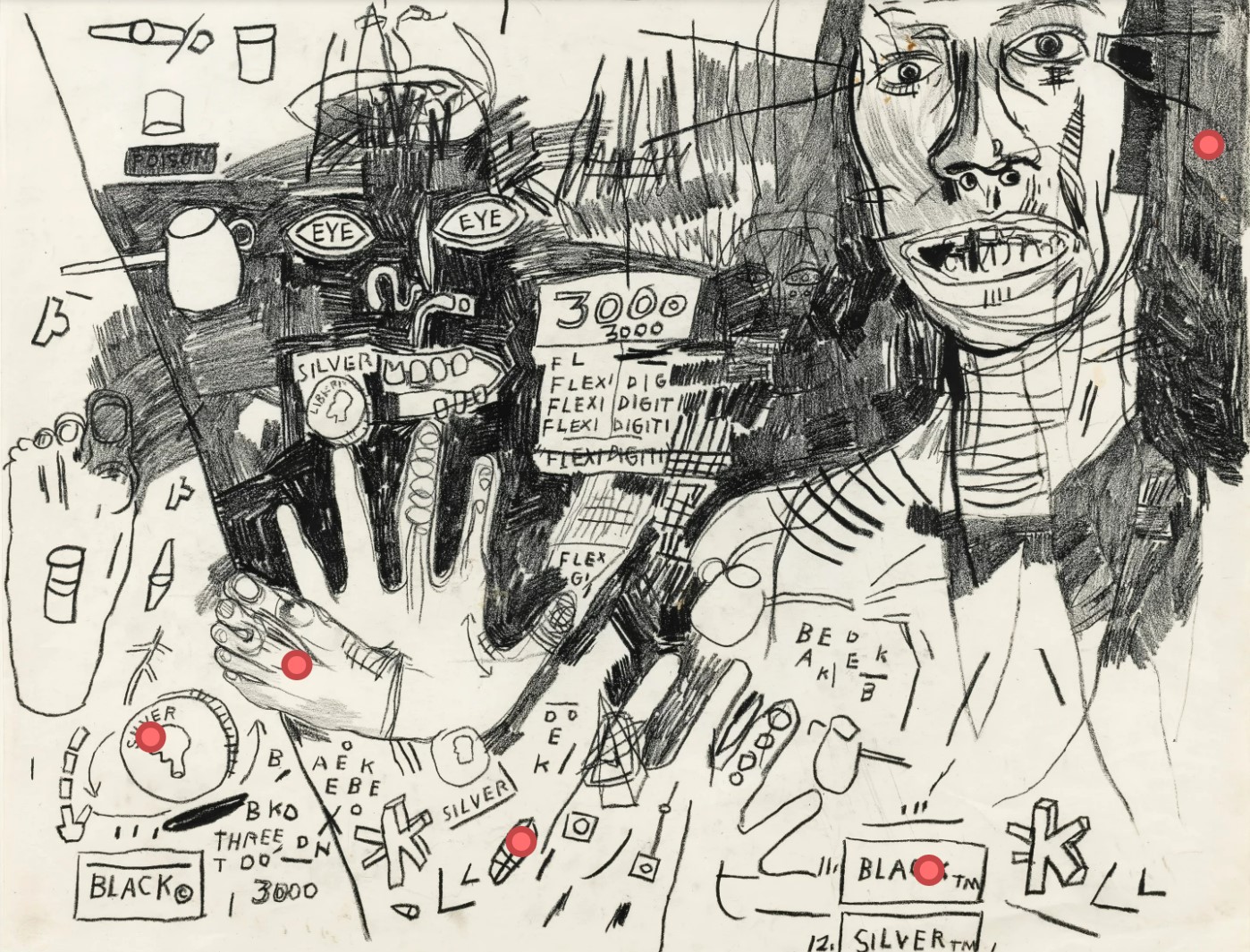
A combination of symbolic abstraction and categorical figuration, the present work includes various symbols that allude to Basquiat’s view of the world around him. Within the present work, words such as “FLEXI”, “SILVER”, and the trademarked “BLACK” as well as numbers like “3,000” are scattered throughout the composition. Several renditions of faces, hands, feet, and teeth, stemming from Basquiat’s fascination for Henry Gray’s Gray’s Anatomy , are revealed under a sea of black shading, that fills the composition through its horizontal and vertical lines. Images of U.S. quarters and watering pots as well as various geometric shapes stand out. The consistent use of the trademarked word “BLACK” could signal Basquiat’s identity. Most notably, however, is the drawing of a man’s face at the upper right corner of the composition. The gaping, voided stare is eerily reminiscent of Leonardo da Vinci’s Mona Lisa, which Basquiat admired and studied extensively.
The general darkened tone of the present work invokes a mysterious and supernatural aura that seemingly belongs to “another plane, a different dimension, in which the comic strip borders on the immateriality of the spirit world. The body, constantly evoked, becomes an idea, a fleeting trace without substance, all light and shadow. Like the maker of the image, it is both inside and out.” (Francesco Pellizzi, “Black and White All Over,” Exh. Cat., Art Gallery of Ontario, Jean-Michel Basquiat: Now’s the Time, 2015, pp. 187-189). The present work’s aggressive, exhilarating rhythm recalls the energy of 1980s Lower Manhattan, where Basquiat spent the majority of his time. Phrases and imagery mined from Basquiat’s lived experience and personal findings are transformed into verses as the artist breaks them down into shorter groups of words, conveying a lyrical sense of rhythm akin to the cadence of a Jazz song. Electric in its talismanic immediacy, Basquiat’s Untitled (Black) is packed with recurring themes from his artistic oeuvre, which send the viewer on an ongoing attempt to unpack the artist’s dense imagery.
Late Drawings (1985-1988)
Untitled, 1985
Christie’s New-York: 21 May 2026
Estimated: USD 1,000,000 – 1,500,000
USD 1,966,000
WORK ON PAPER
JEAN-MICHEL BASQUIAT (1960-1988), Untitled | Christie’s
JEAN-MICHEL BASQUIAT (1960-1988)
Untitled, 1985
Ink, acrylic, marker, colored pencil and graphite on paper
19×26 inches (48.3 x 66 cm)
Signed, inscribed, dedicated and dated ‘’85 TO MICHAEL Jean-Michel Basquiat ST BARTH’ (lower right)
Registered with the Authentication Committee for the Estate of Jean-Michel Basquiat under transaction #60035
Jean-Michel Basquiat’s Untitled from 1985 is a dynamic and commanding work on paper that compounds the artist’s intellectual proclivities with his iconic gesture and famed visual language. Rendered in ink, acrylic, marker, colored pencil and graphite, the composition presents an exceptionally detailed head that oscillates between figure, diagram, and symbol. Untitled exemplifies Basquiat’s ability to collapse distinctions between anatomy, language, and identity, producing an image that feels both active and deeply coded.
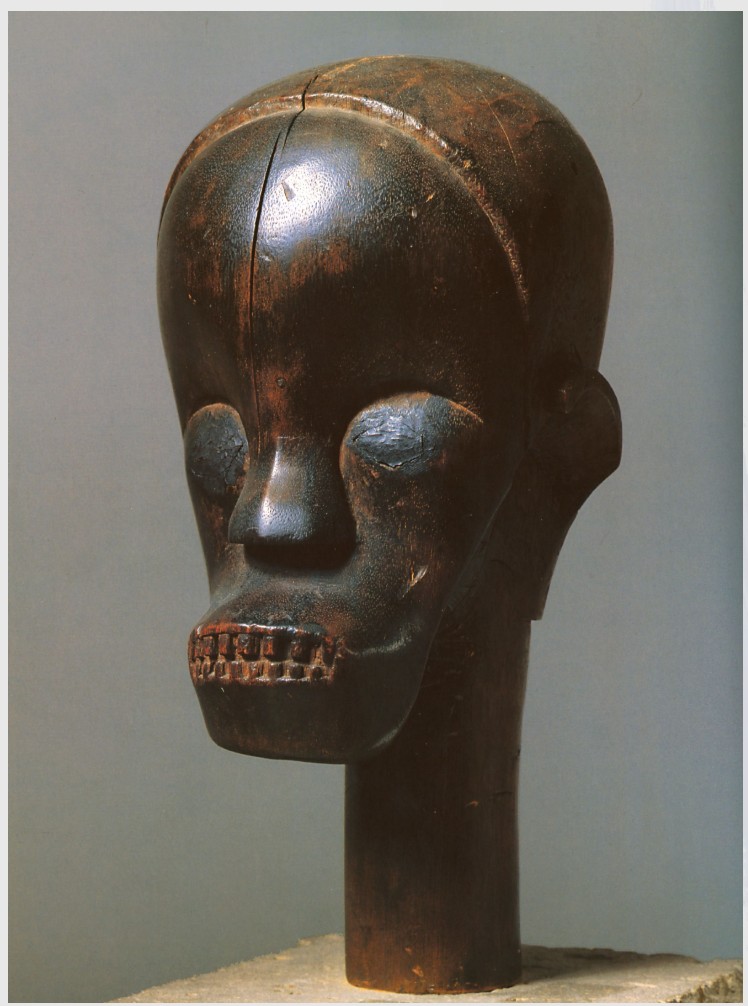
Fang Reliquary Head, Equatorial Guinea. Philadelphia Museum of Art.
Dominating the composition is a stark black head that is at once mask-like and anatomical, recalling the artist’s sustained engagement with both African sculpture and medical text books. This interest, rooted in Basquiat’s early exposure to Gray’s Anatomy, manifests here as an X-ray vision: the head is not merely depicted, but dissected. A square form cuts into the figure’s skull, offering the viewer a glimpse, perhaps, into the innerworkings of his brain, introducing vulnerability to the figure’s fierce gaze. Words such as “CRANEO” and diagrammatic notations embedded within the skull transform the figure into a site of analysis. Fully realized with impeccable detail in the present work, the subject of the human head was a recurring exploration throughout Basquiat’s life and career as an artist, “What drew Basquiat almost obsessively to the depiction of the human head”, writes Fred Hoffman, “was his fascination with the face as a passageway from exterior physical presence into the hidden realities of man’s psychological and mental realms.” (F. Hoffman, ‘Jean-Michel Basquiat Drawing’, in Jean-Michel Basquiat Drawing: Works from the Schorr Family Collection, exh. cat., Acquavella Galleries, New York, 2014, p. 74).
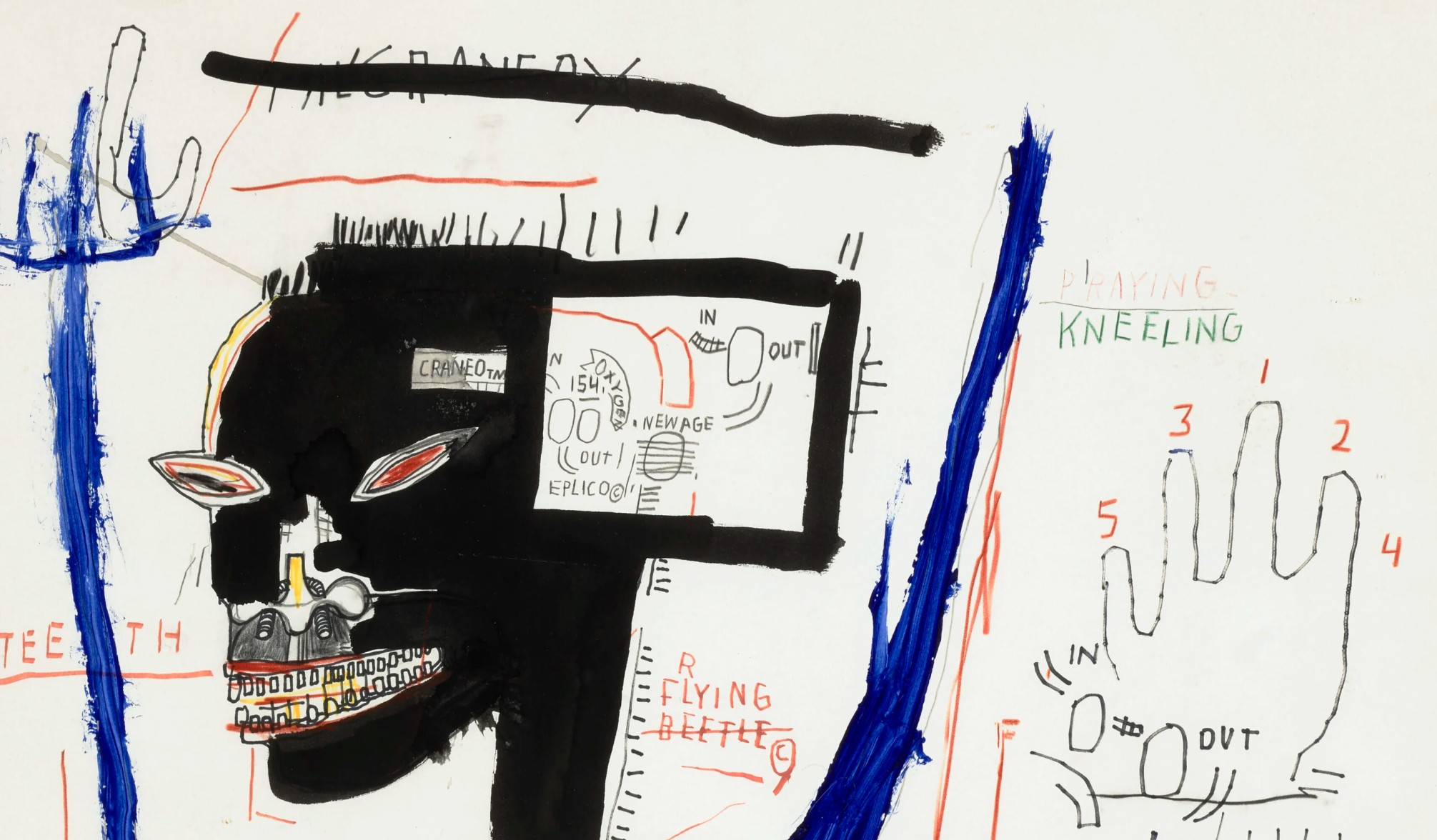
The present work was originally acquired from Basquiat by Michael Zimmer, a prominent New York socialite and thinker who hosted Basquiat in St. Barths in the mid-1980s. Zimmer was the son of a renowned Sanskrit scholar Heinrich Zimmer, and the grandson of a celebrated poet. Raised in the West Village, surrounded by artists and artworks, his upbringing inspired a lifelong commitment to the arts and artistic expression. His family collection included a famous Picasso self-portrait, Yo, Picasso, which Zimmer sold in 1970. The sale partially funded Zimmer’s move to St. Barths, where he built a community of eccentrics, artists, thinkers and likeminded people around him. Brice Marden, Keith Haring, Julian Schnabel, Basquiat and others visited regularly during the 1980s.
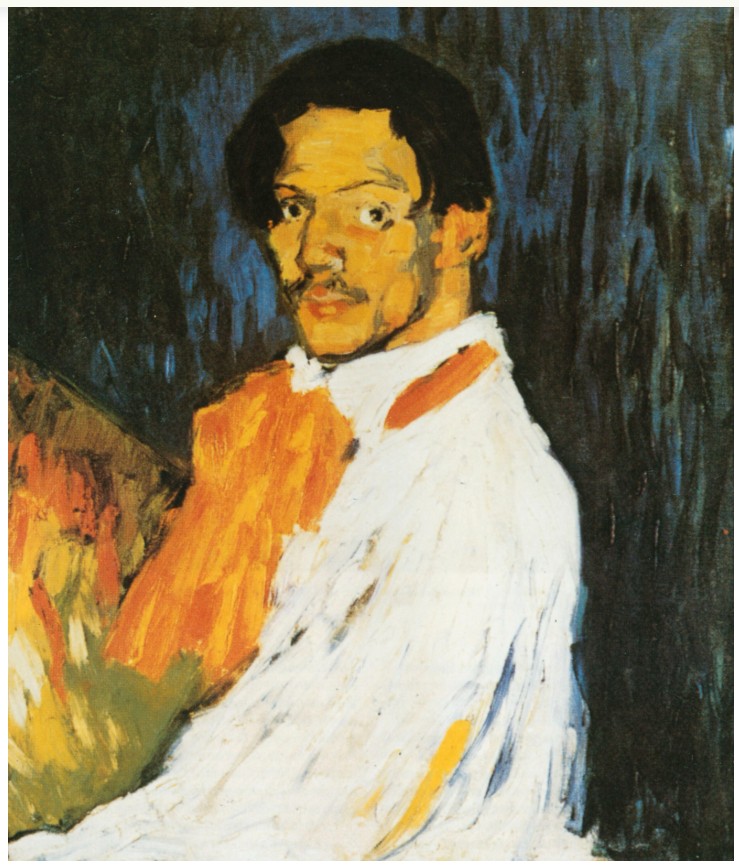
Pablo Picasso, Yo, Picasso, 1901. Private collection. © 2026 Estate of Pablo Picasso / Artists Rights Society (ARS), New York.
It was on St. Barths that Zimmer founded Le Camp, an arts collective that served as a retreat for artists, architects, designers and local personalities, built in the spirit of collaboration, innovation and artistic freedom. In exchange for room and board, artists would gift their works to Michael. Close inspection reveals that in the present work, Basquiat dedicates the work “TO MICHAEL” and inscribes “ST BARTH”. Zimmer was more than a collector, he was a participant in the social and artistic milieu that shaped Basquiat’s career. Their relationship suggests a space of exchange and affection.
Copy of a wall painting by Linant de Bellefonds, King Rameses II with boxes before Amen-Re, Abu Simbel, Great Temple, Great Hall. Kingston Lacy Estate, Dorset, Great Britain. Photo: © National Trust Photo Library / Art Resource, New York.
Untitled exemplifies Basquiat’s extraordinary ability to synthesize raw expression with intellectual depth. The work’s layered imagery, restless lines, and interplay of text and form create a composition that feels alive, continually shifting between construction and deconstruction. “In Basquiat’s drawings…you are sucked in and carried along an often intricate and complex journey through a maze of references which oftentimes make little rational sense but nonetheless feel like they have a reason to exist” (F. Hoffman, in Jean-Michel Basquiat: Drawing, exh. cat., Acquavella Galleries, New York, 2014, p. 37). In this charged space, the human figure becomes a site of inquiry, at the same time physical, psychological, and symbolic, capturing the urgency and brilliance of Basquiat’s artistic vision at its height.
Andy Warhol, Skull, 1976. Private collection.
© 2026 The Andy Warhol Foundation for the Visual Arts, Inc, / Artist Rights Society (ARS), New York.
In the present work, Basquiat’s fascination between external presentation and internal condition is tangible. The figure’s eyes, sharply executed, pierce beyond the painted space with an electric intensity, fueled by a blazing red in place of eyeballs. Yet, there is a keen sense of sensitivity to the figure’s demeanor. The teeth, grimacing on full display, and the exposed musculature and construction of his nose, suggest both a vitality and fragility. Basquiat’s recurring fixation on the head as a locus of identity and knowledge is made explicit here. The cranium is not sealed but rather opened, transformed into a container of signs and possibilities.
Muscle in the left hand, illustration from Gray’s Anatomy, 1858.
Beyond the figure, the sheet itself is teeming with referents. On the right side of the work, a schematic hand labeled with numbers extends the artist’s inclination for the anatomical. The juxtaposition of a head against a hand evokes the relationship between thought and action, cognition and creation. Furthermore, around the central component of the composition is a scaffolding of gestural marks and textual fragments. Blue vertical strokes frame the head like architectural supports, while orange and black lines intersect and cross out passages of writing. Words such as “TEETH,” “PRAYING,” and “KNEELING” appear in varying degrees of legibility, volleying between clarity and erasure. This layering of language is central to Basquiat’s practice. His inscriptions resist fixed meaning, instead functioning as rhythmic and visual elements that punctuate the composition.
Untitled (Spoon), 1988
Christie’s London: 7 March 2026
Estimated: GBP 350,000 – 750,000
GBP 508,000 / USD 678,635
JEAN-MICHEL BASQUIAT (1960-1988), Untitled (Spoon) | Christie’s
REPEAT SALE
Christie’s New-York: 27 September 2018
Estimated: USD 120,000 – 180,000
USD 324,500
Jean-Michel Basquiat (1960-1988), Untitled (Spoon) | Christie’s
JEAN-MICHEL BASQUIAT (1960-1988)
Untitled (Spoon), 1988
Oilstick on offset lithograph
33-1/8 x 23-3/8 inches (84 x 59.4 cm)
Hauntingly prophetic and deeply introspective, the present work stands among Jean-Michel Basquiat’s last self-portraits. Executed in 1988, shortly before his death in August that year, it captures the whirlwind of celebrity and anguish that defined his final days. The work is drawn on a lithograph of the artist’s own poster design for his exhibition at Galerie Hans Mayer, Düsseldorf, which took place in the early months of 1988.
“Most young kings get their heads cut off.”
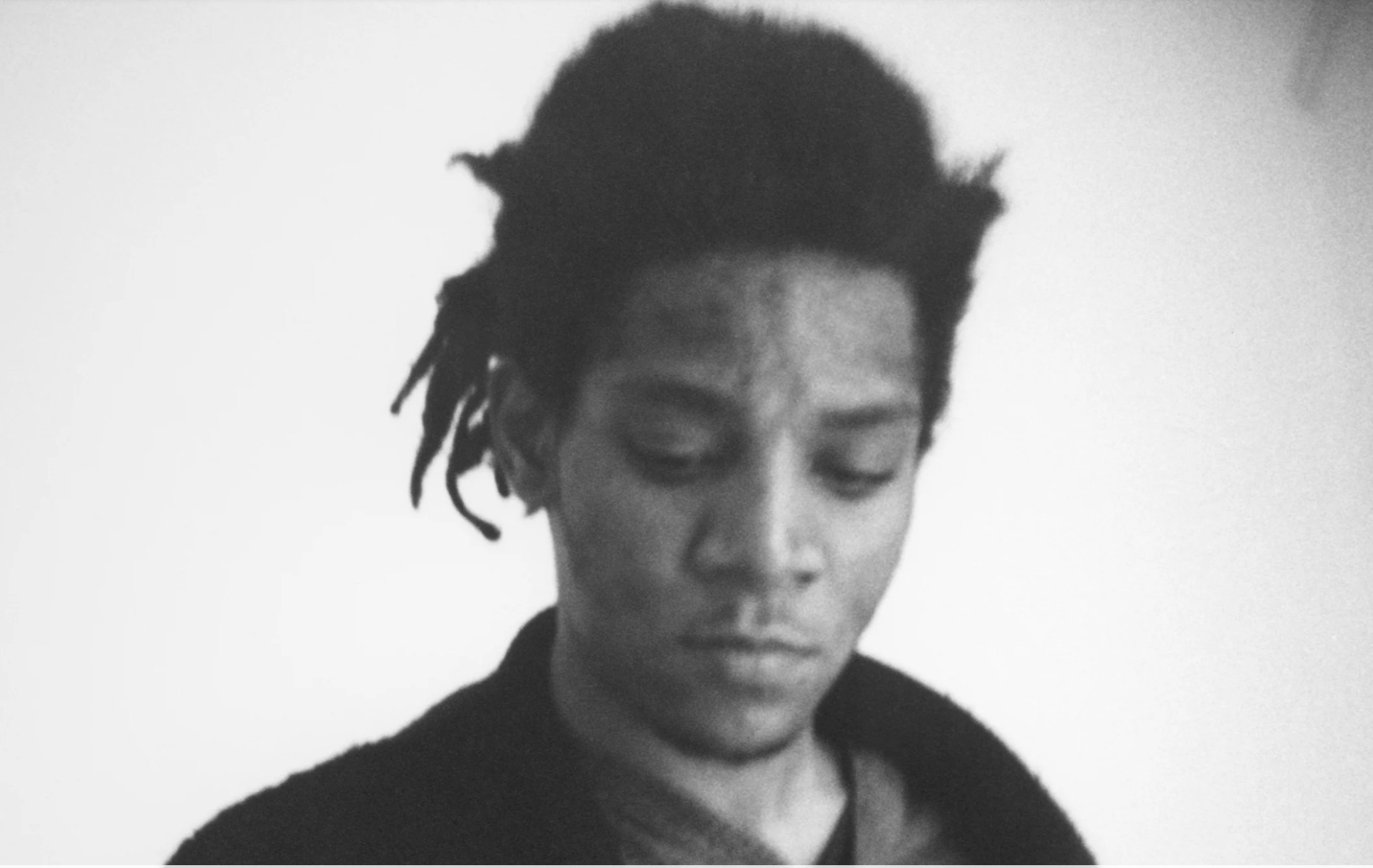
Jean-Michel Basquiat, 1988. Photo: Mark Sink/Getty Images.
Beneath his name, written over by hand, Basquiat has daubed his own image, rendered with visceral vitality of his early oilstick heads. He is clad in a bow tie: an art world star ready to receive his public. At the same time, his head is gaunt and skull-like, eyes glaring and mouth wide open. A spoon, laden with untold meaning, hovers before him, the word struck through in conflicted doubt. Basquiat painted self-portraits throughout his oeuvre, grappling repeatedly with the force of his own legend. In Riding with Death, the Eroica paintings and others of 1988, the twenty-seven-year-old artist began to picture his own mortality. Like the late self-portraits of Picasso, Van Gogh and Warhol, the present work weaves heroism and fatalism into a poignant reminder of life’s fragility.
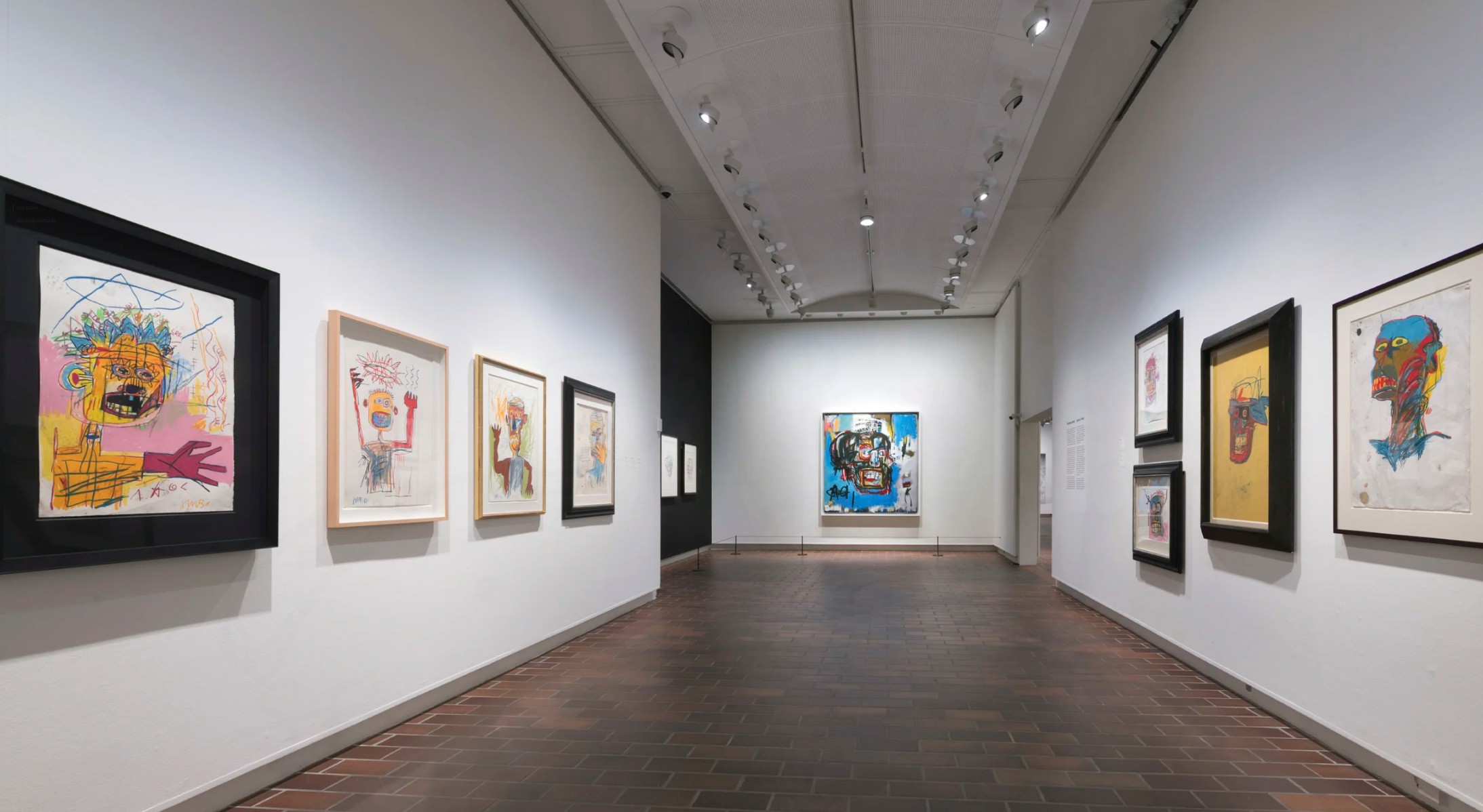
Basquiat – Headstrong, currently presented at the The Louisiana Museum of Modern Art, Humlebæk. Artwork: © Estate of Jean-Michel Basquiat. Licensed by Artestar, New York. Photo: Louisiana Museum of Modern Art, Denmark / Camilla Stephan, 2026.
Currently the subject of a groundbreaking exhibition at the Louisiana Museum of Modern Art, Humlebæk, Basquiat’s oilstick heads represent a key strand of his practice. Begun during the early 1980s, they took on a life of their own, with many only emerging after the artist’s death. These works remain some of his most raw, intimate and instinctive creations, channeling a lifelong fascination with human anatomy. Behind closed doors, and away from the machinations of the marketplace, the artist gave himself over to the fluid properties of oilstick, embracing its rich and expressive immediacy. Heads reigned supreme, their forms alive with electric, neuronal charge. The curator Anders Kold describes them as ‘archive[s] of emotions and spiritual and mental states’: sites where the noise of the outside world imploded (A. Kold, ‘Something Becomes Visible’, in Basquiat: Headstrong, exh. cat. Louisiana Museum of Modern Art, Humlebæk 2026, p. 30). While these works undoubtedly nourished Basquiat’s major skull paintings, they also stood alone, deeply wired into the artist’s hand and mind.
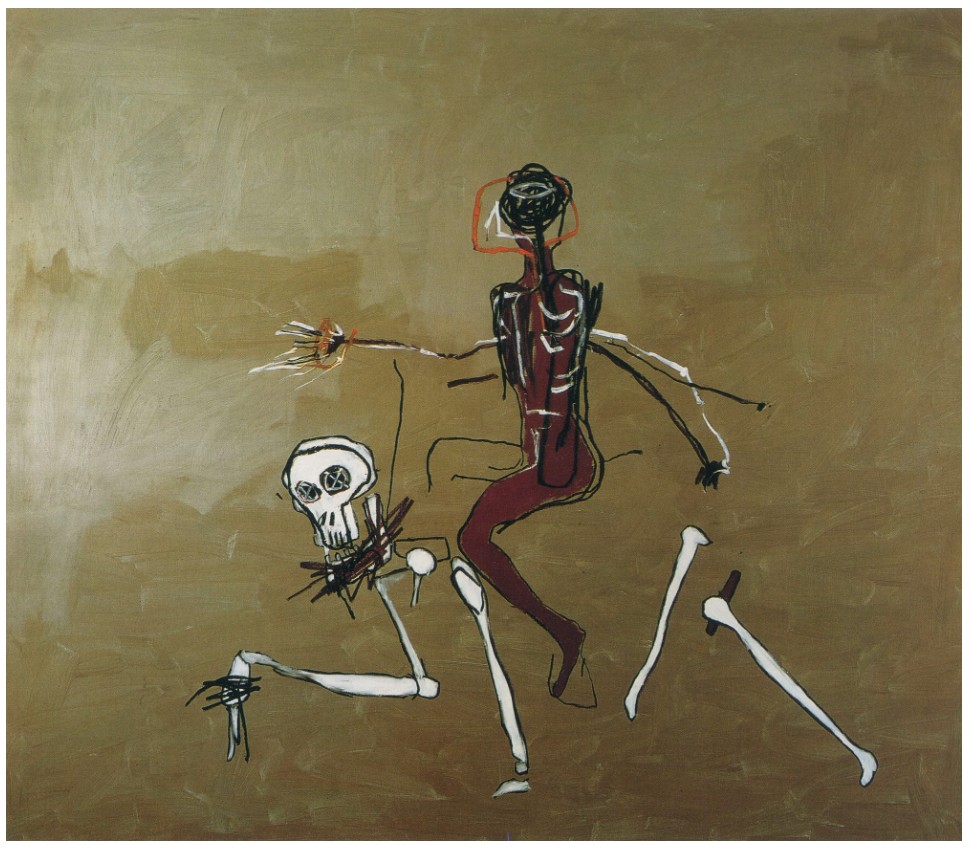
Jean-Michel Basquiat, Riding with Death, 1988. Private collection.
Artwork: © Estate of Jean-Michel Basquiat. Licensed by Artestar, New York.
Basquiat’s complex self-images run like a golden thread through his practice. The artist was just twenty when he shed the pseudonymous street tag ‘SAMO’, and took his place at the forefront of the New York art world. Within a year of his breakout exhibition at MoMA P.S.1, he had rocketed to international acclaim. In 1982 he was the youngest artist to exhibit at Documenta VII in Kassel; in 1985, he was hailed as the face of contemporary art on the cover of The New York Times Magazine. His self-portraits confronted his own spiraling mythology, casting himself by turns as hero and martyr. At times he aligned himself with the greats: the athletes, musicians and other icons he admired. The spoon in the present work might be seen to nod to the centuries-old ‘spoonful’ trope, a metaphor for pleasure, explored by blues songsters from Charley Patton to Howlin’ Wolf, Etta James and others. Elsewhere, Basquiat painted himself in crowns of thorns, riffing on Christian iconography. In one canvas, he famously scrawled the words ‘Most young kings get their heads cut off’.
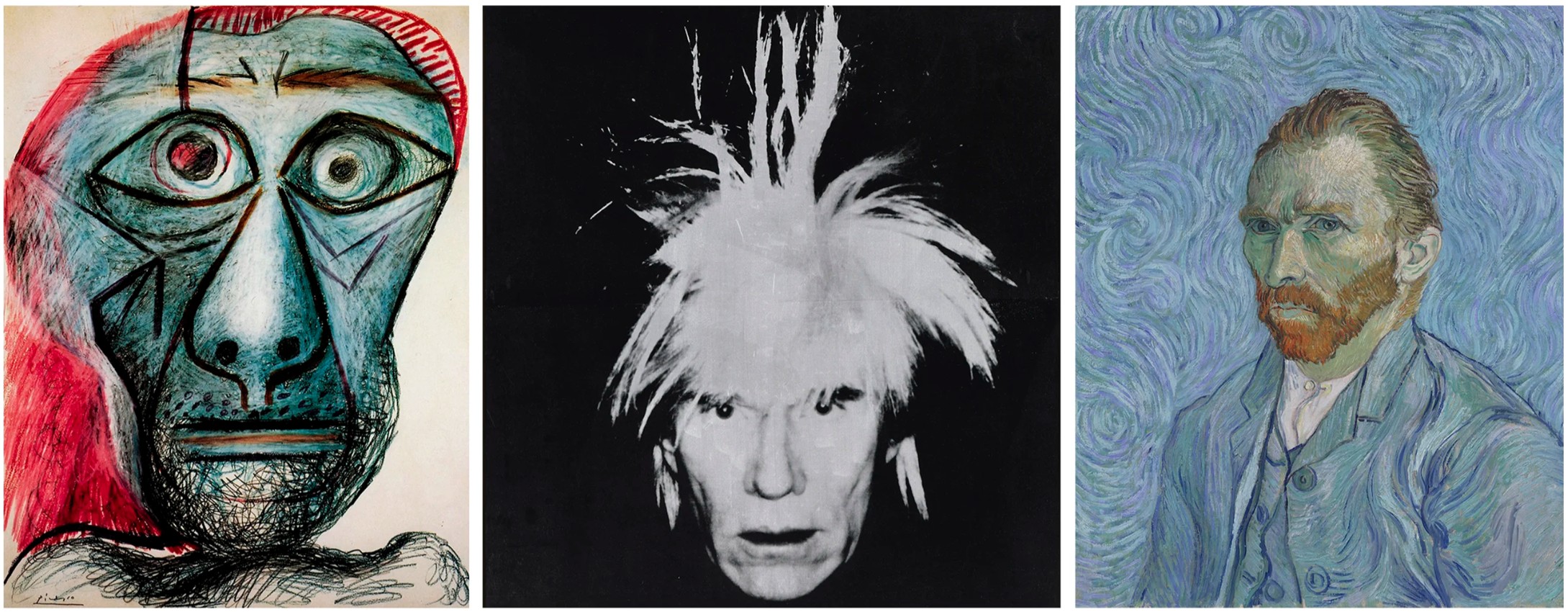
Left: Pablo Picasso, Tête (Autoportrait), 1972. Private collection. Artwork: Artwork: © 2026 Succession Picasso/DACS, London. Digital image: © 2026 Album/Scala, Florence.
Middle: Andy Warhol, Self-Portrait, 1986. Museum Brandhorst, Munich. Artwork: © 2026 The Andy Warhol Foundation for the Visual Arts, Inc. / Licensed by DACS, London. Digital image: © 2026 Scala, Firenze/bpk, Bildagentur fuer Kunst, Kultur und Geschichte, Berlin.
Right: Vincent van Gogh, Self-portrait, 1889. Musée d’Orsay, Paris. Digital image: Bridgeman Images.
By 1988 Basquiat was more conscious than ever of his conflicted status. ‘I’m not a real person. I’m a legend’, he said in one of his final interviews (J-M. Basquiat, quoted in A. Haden-Guest, ‘Burning Out’, Vanity Fair, November 1988, p. 197). The artist had been deeply affected by the death of Warhol the previous year. The two had become close friends as well as collaborators, with the older artist serving as something of a mentor to his young colleague. In his late series of self-portraits, Warhol had held a mirror up to his mercurial identity, seemingly bearing his soul to the viewer through his direct gaze yet ultimately—dressed in a wig—continuing to hide in plain sight. Basquiat’s grief continued to linger as he rode the waves of his own success: in tandem with the Düsseldorf exhibition in early 1988, he mounted shows at Galerie Yvon Lambert and Galerie Beaubourg in Paris, followed by further presentations in Salzburg and New York. A preoccupation with death wrote its way into his works, palpable in the skeletal danse macabre of Riding with Death, and the repeated incantation ‘man dies’ that proliferates across two Eroica paintings. Even his heroes, Basquiat realized, were not immortal.
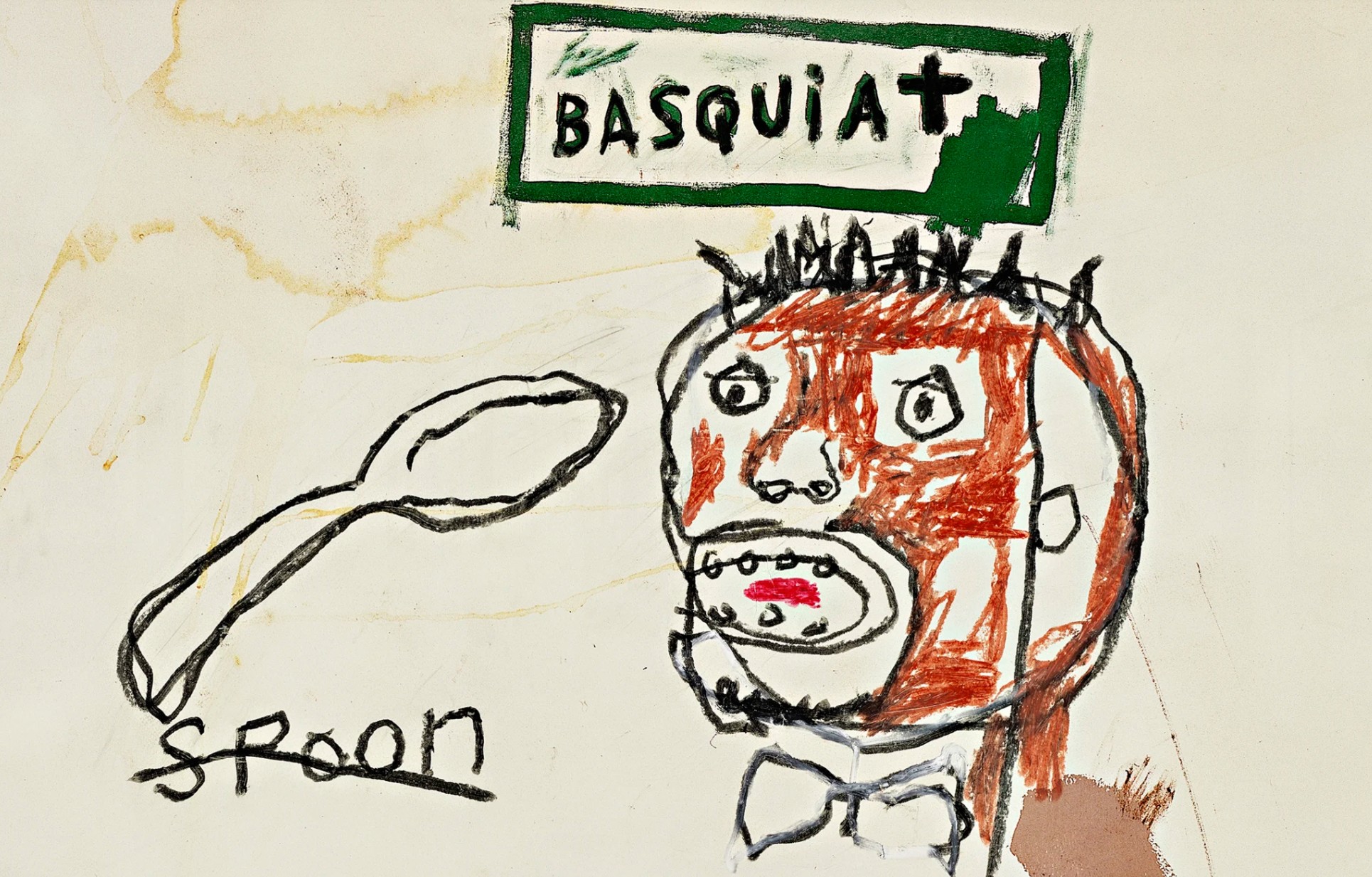
The curator Jeffrey Deitch delivered the eulogy at Basquiat’s funeral. ‘He was a personality unlike any other—a remarkable breadth, intelligence, passion, sympathy, generosity’, he told the congregation. His ‘charisma’ and ‘strength of character’, he went on, was such that even ‘a few lines drawn on paper could communicate so much’ (J. Deitch, quoted in P. Hoban, Basquiat: A Quick Killing in Art, London 1988, p. 311). The present work, ultimately, bears witness to this statement. Within a single oilstick head, Basquiat captures a life lived through art: from the child who pored over Gray’s Anatomy and the drawings of Leonardo da Vinci, to the young man working tirelessly in his studio to the thrum of cartoons and hip-hop music. It tells of days spent in the Brooklyn Museum looking at tribal masks and ancient Egyptian artefacts, and hours spent in front of Picasso’s Guernica at the Museum of Modern Art. His line crackles with energy; the surface quivers with the trace of his hand. It is a moving testament to an artist whose career was all too brief, and one who would live on through his art.
Untitled (NY CZAR), 1988
Sotheby’s London: 24 June 2025
Estimated: GBP 500,000 – 700,000
GBP 736,600 / USD 1,009,140
Untitled (NY CZAR) | Modern & Contemporary Evening Auction | 2025 | Sotheby’s
JEAN-MICHEL BASQUIAT (1960 – 1988)
Untitled (NY CZAR), 1988
Oilstick and graphite on paper
31 1/2 x 24 inches (80.4 x 61 cm)
Signed, titled, and dated 88 New York with drawing (on the verso)
Erupting into a visual cacophony of symbols, signs, and cyphers, Jean-Michel Basquiat’s Untitled (NY CZAR) of 1988 offers a glimpse into the artist’s energetic, imaginative and ingenious mind. Executed the same year as the artist’s untimely death at the age of 27, this arresting drawing stands as testament to the gravity and intent with which the artist approached his works on paper at the apex of his celebrated career. Within the present work, Basquiat frantically scratches away words and complete illustrations, scattering references to comic books, human anatomy, the natural world and his own cultural heritage seemingly at random across the picture plane. With its complex pantheon of intricate iconography, Untitled (NY CZAR) encapsulates Basquiat’s unique pictorial lexicon which wavers between the vivaciously dynamic and the quietly unsettling. Through seemingly disparate iconographic references culled from years of personal experience, Basquiat here creates a rigorous roadmap to his own unique vernacular, unparalleled and unrepeatable by any artist before or since.
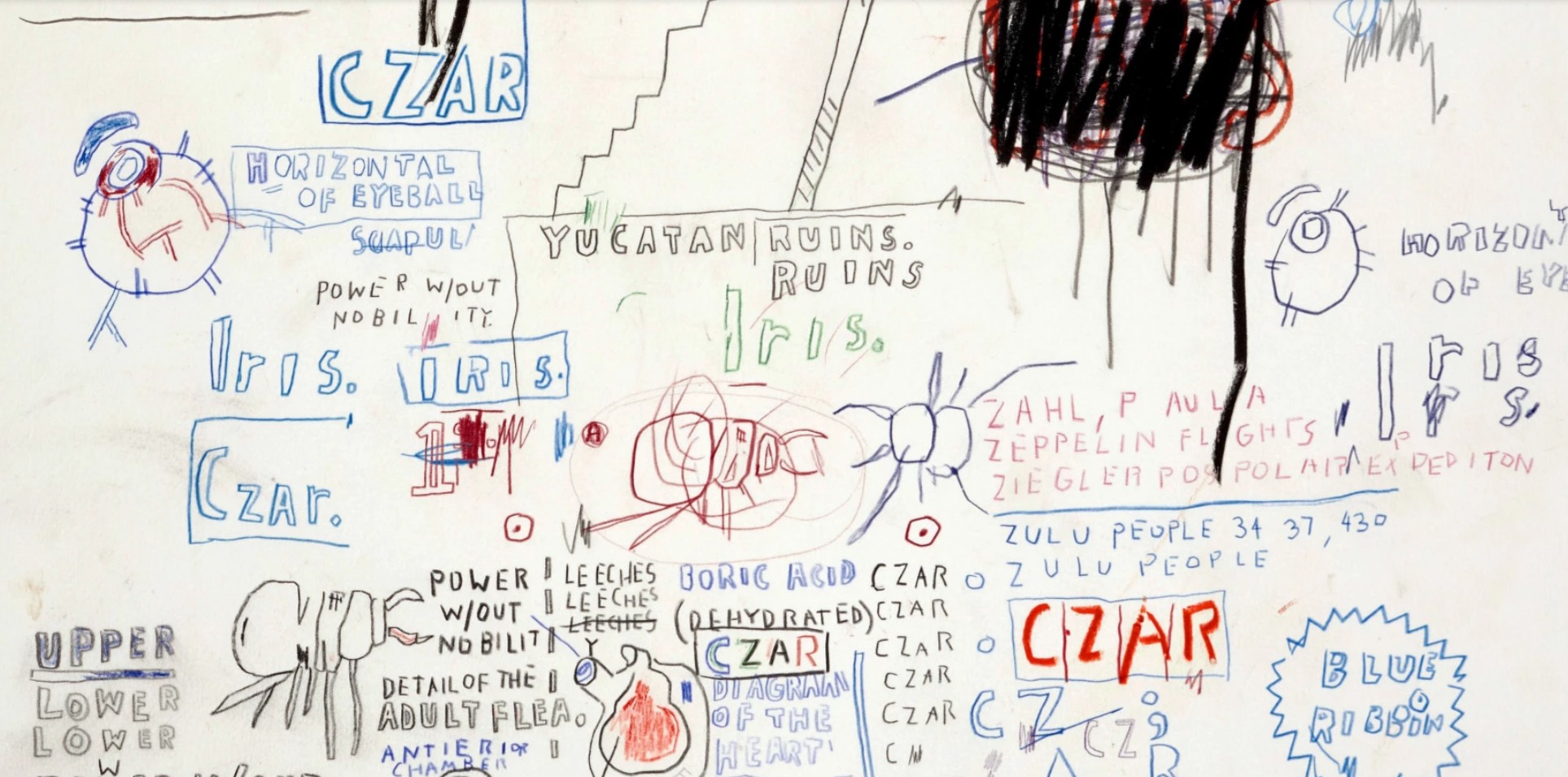
A complex labyrinth of symbols and images fills the sheet, the scattered words, staccato scribbles, and punctuating images conveying a lyrical sense of rhythm akin to the cadence of a jazz score. The titular “CZAR” is repeated no fewer than 19 times across the composition; this political term for a high-ranking official, coupled with phrases like “Power W/out Nobility,” “Leeches,” and “Dehydrated” as well as several drawings of adult fleas, offers clear insight into Basquiat’s perception of traditional power structures. Other cultural references are littered throughout. In the upper left, three characters from the early Dick Tracy comic books are referenced by name and image: Diet Smith, the industrialist and inventor; Brilliant, his blind genius son; and B.O. Plenty, a reformed criminal farmer. Appearing in many of Basquiat’s works from this period, the artist’s love of and familiarity with comic books and cartoons dates to his early childhood. A visual auto-didact, the images and animations of these books are amongst the vast and varied sources of rich visual media Basquiat collected over the course of his life and frequently appear in his paintings, creating a highly specific visual vernacular of cultural images and iconography at once universally familiar and entirely distinct. As well as cartoons, the present work also references an issue of National Geographic magazine: “Moonlight bathes El Castillo” appears twice above a sketch of “Yucatan Ruins.” Both the phrase and the image are quoted directly from a picture story on Maya’s sacred city. Fascinated by his own Caribbean and Hispanic cultural heritage, Basquiat’s works showcase his ever-expanding lens as to his place within the world, and the multitude of histories, myths, legends, and belief systems that shape us.
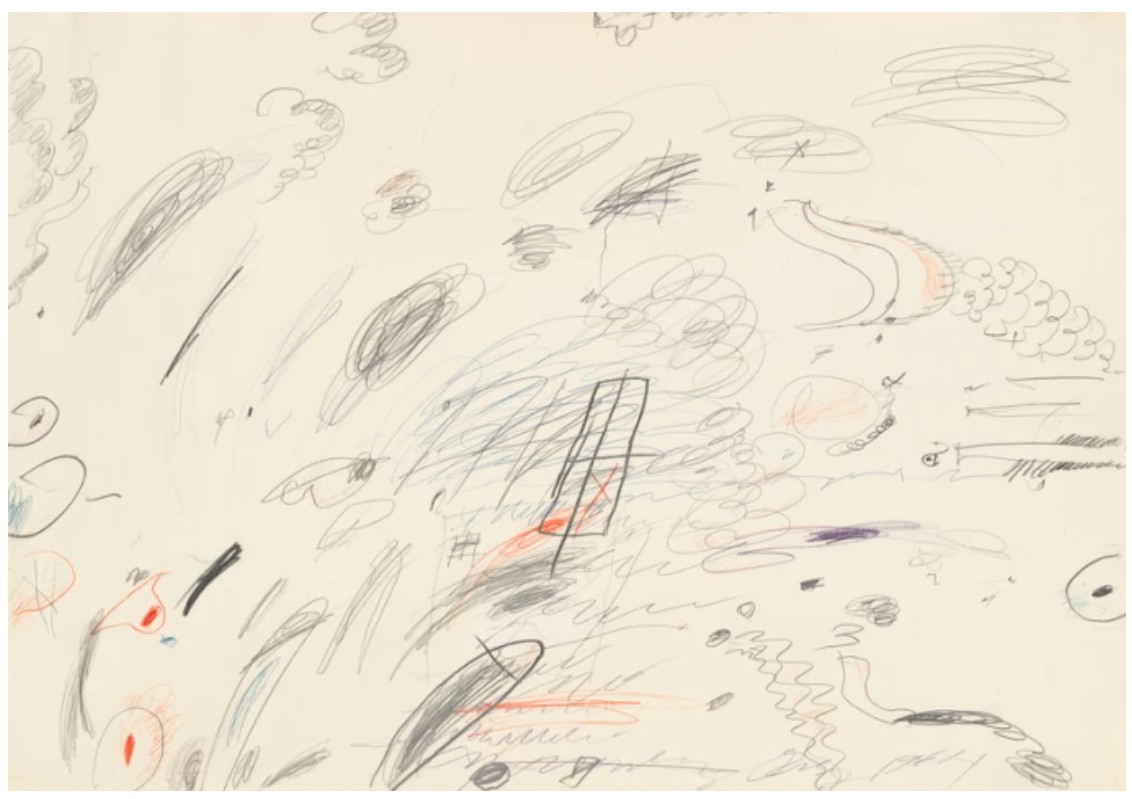
Cy Twombly, Untitled, 1964. Whitney Museum of American Art, New York. ©2025 Cy Twombly Foundation
Untitled (NY CZAR) also prominently features one of the artist’s most enduring motifs: the anatomical drawing. Several deconstructed diagrams of human eyeballs punctuate the surface, underscored by iterations of “Iris,” “Cornea,” and “Retina”, perhaps foregrounding the notion of perception.
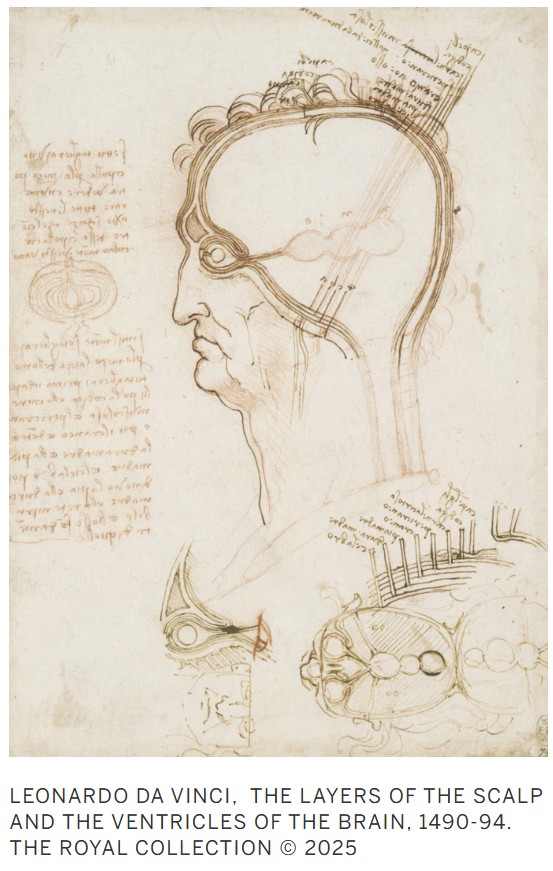
Basquiat’s intense interest in exploring the anatomy of the human body can be traced back to his hospitalization at the age of seven due to a car accident, a traumatic event that would profoundly shape his artistic lexicon up until his untimely death. During his recovery, Basquiat’s mother gifted him a copy of Gray’s Anatomy, the 19th-century text known for its groundbreaking role in the history of understanding the human body. The book instilled in Basquiat an immense interest in the kinds of ways that the human – both literally and metaphorically – can be dissected, his own thoughts and brain quite literally spilling onto the page in the case of the present work.
Moreover, as an artist constantly on the move from the earliest moments leaving his graffiti mark on the streets and buildings of New York City, through the inception and continued acclaim of his professional career, drawing as a medium was inherently more complementary to Basquiat’s peripatetic lifestyle. As part of the inherent intimacy of creating a drawing, Basquiat would bend over his paper surfaces so that the compositions occupied his entire realm of vision – eliciting a strong communion with the work and an intense introspection that his paintings, in their often-monumental scale, are unable to achieve. Working on paper, therefore, served a significantly more profound and personal end for Basquiat than as a mere preparatory tool. Untitled (NY CZAR) is brilliantly demonstrative of this concentrated energy; in its seamless integration of writing and drawing, image and text, the present work reads equally as a composition of depthless intricacy and curiosity while affording us a privileged glimpse into the deepest inner workings of its genius creator’s mind.
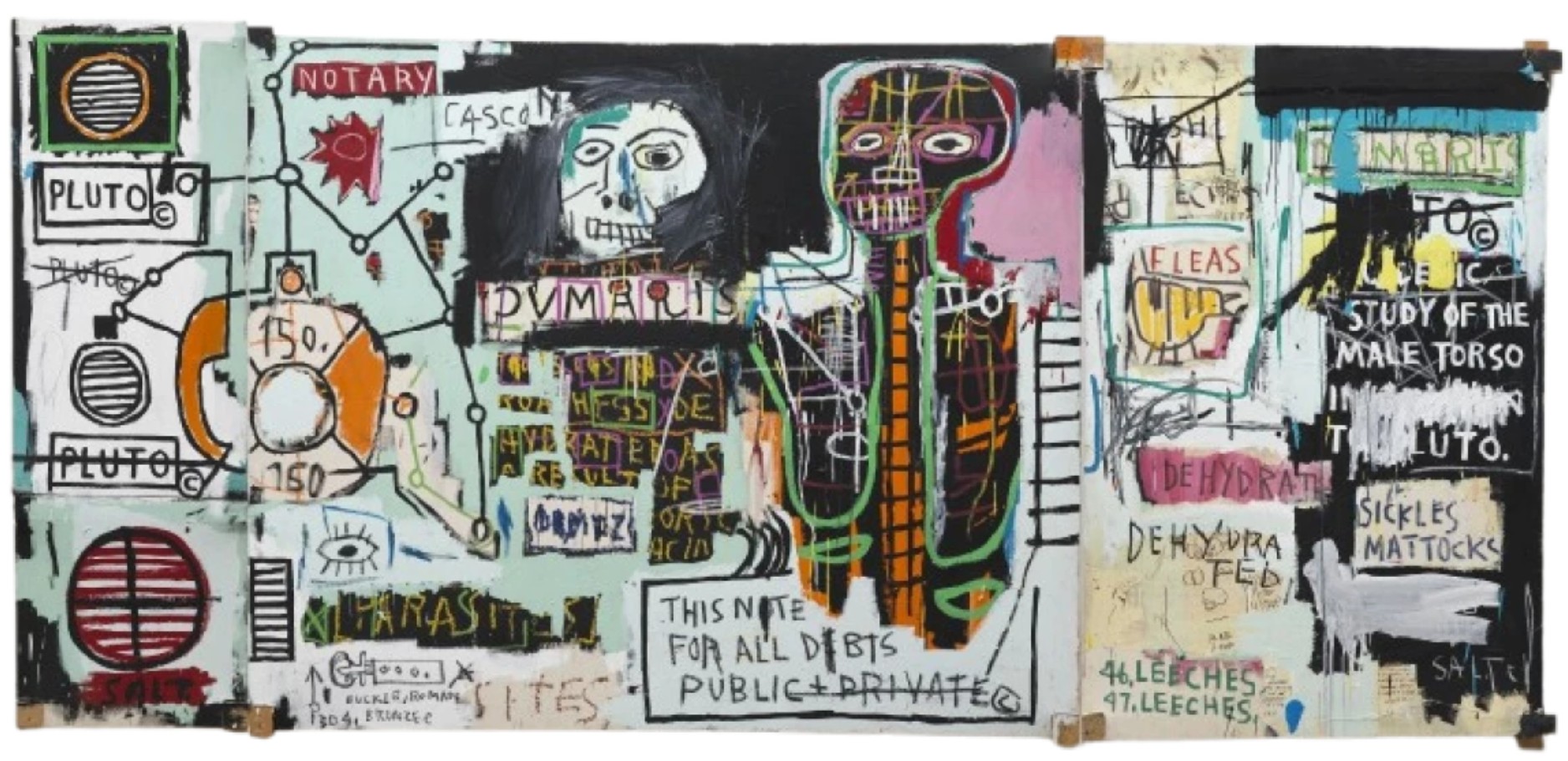
Jean-Michel Basquiat, Notary, 1983. Princeton University Art Museum, Princeton.
Image: Art Resource NY/Scala, Florence. Art © The Estate of Jean-Michel Basquiat, licensed by Artestar, New York
Thus the present work highlights Basquiat’s deft hand presented as a stream of consciousness, his commentary pouring out onto the page in a careful equilibrium between urgency and coherence. The repetitive, frenetic mark-making is scrawled across the page, showcasing the sheer range of Basquiat’s visual language in his works on paper. Brilliantly formulated in the artist’s innovative mind and then translated onto the paper, the drawing is as vivid and alive now as it was at the moment of its execution.
Untitled, 1985-1986
Phillips New-York: 13 May 2025
Estimated: USD 1,500,000 – 2,000,000
USD 2,964,000
Jean-Michel Basquiat Modern & Contemporary Art Evening Sale
Untitled, 1985-1986
Oilstick and crayon on paper
Executed between 1985 and 1986, Jean-Michel Basquiat’s Untitled offers a vivid view into the artist’s energetic, imaginative, and ingenious mind. This work illustrates a vibrant symphony of densely layered motifs and symbols characteristic of Basquiat’s multifaceted practice. A masterful blend of figuration and abstraction sprawls across the page like cryptic runes from an undiscovered world, reflecting Basquiat’s diverse interests: anatomical charts, bebop and jazz, language fragments, and semiotic structures. He merges image and text, revealing and concealing meaning, lifting iconography from its usual context and layering it with crossed-out and repeated fragments. Basquiat’s works on paper possess a raw immediacy that allows his creative brilliance to emerge unfiltered. The limitations of the medium—where overpainting is not possible—make works like this a direct and unmediated record of the artist’s visionary thinking. In Untitled, Basquiat’s partial erasures and incomplete passages highlight the rapidity of his process, yielding a dynamic and deeply personal artifact. The work’s distinctive, freeform articulations stand as enduring traces of a brief but incandescent life.
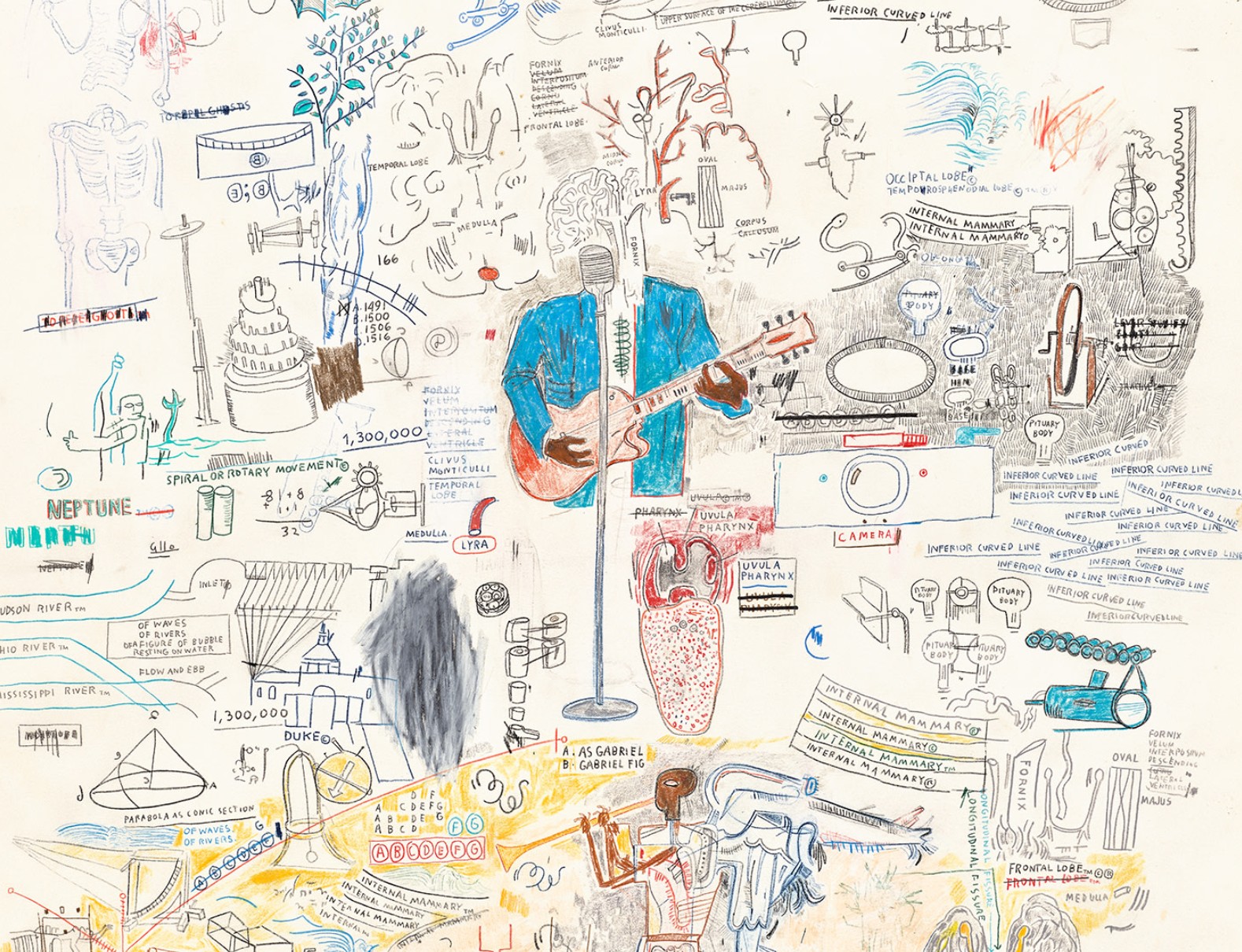
A thrilling rediscovery never before offered at auction, Untitled stands as a large-scale, intricately layered work that captures the expansive scope of Basquiat’s imagination and his relentless drive to innovate across disciplines. Notably, the painting was formerly in the collection of Willi Smith, the most high-profile Black fashion designer of the 1980s and founder of the influential label WilliWear. Often credited with pioneering a form of proto-streetwear—what Smith himself called “street couture”—he revolutionized fashion by creating accessible, collaborative, youth-driven designs that blurred the lines between art, performance, and everyday life. A creative force who worked with artists such as Christo and Jeanne-Claude, Nam June Paik, Keith Haring, and Spike Lee, Smith embodied a spirit of boundary-crossing innovation that resonates with Basquiat’s own artistic ethos. In Smith’s eclectic and visionary collection, Basquiat’s Untitled found a fitting home, bridging two groundbreaking talents who reshaped the cultural landscape of their time. Untitled revisits techniques Basquiat explored after his engagement with Xerox-based art. By 1983, collage became central to his process as he integrated photocopies into his paintings. The photocopier became such a vital tool that he acquired a personal color machine for his studio. Inspired by William S. Burroughs’ “cut-up” technique, Basquiat spliced and reassembled fragments into layered compositions enhanced with text, symbols, and imagery. Notably, this work reappears in four significant large-scale paintings: Harlem paper product, 1987; Icarus Esso, 1986; Dogman, 1986; and Untitled, 1984-1985.
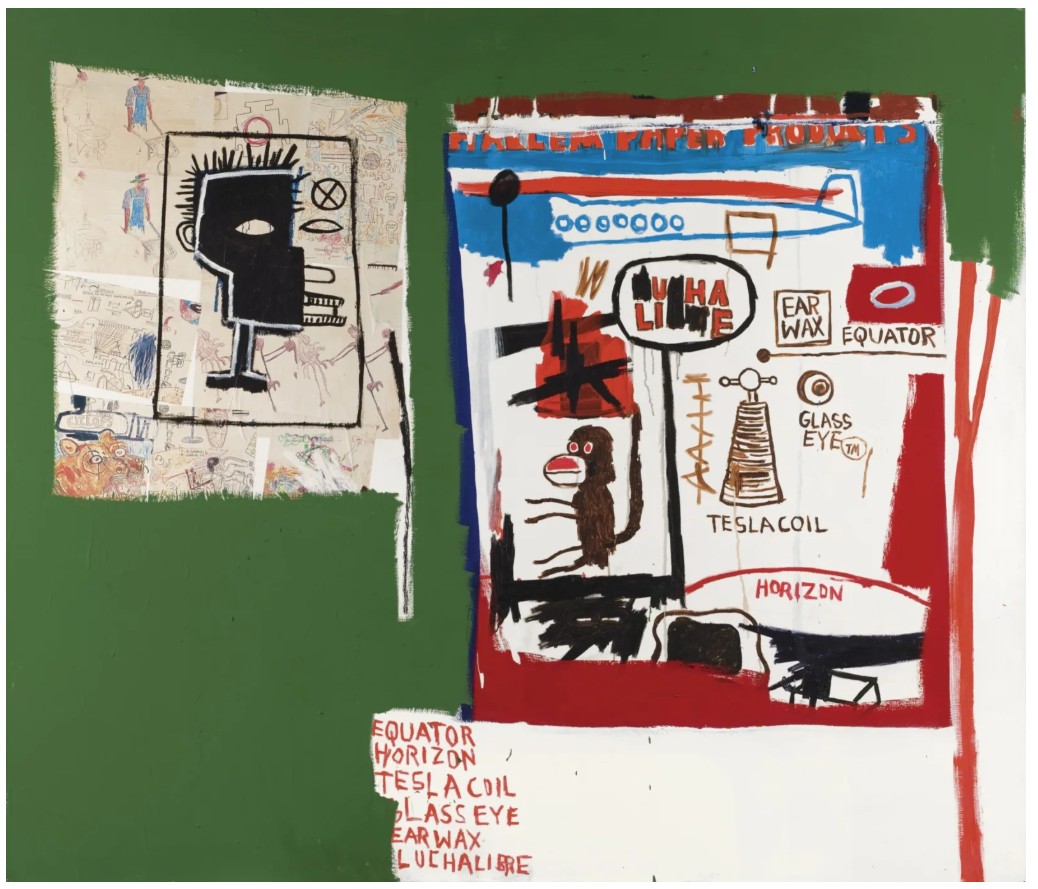
Jean-Michel Basquiat, Harlem paper product, 1987. Private Collection.
Artwork: © Estate of Jean-Michel Basquiat. Licensed by Artestar, New York
The present drawing represents a confident assertion of Basquiat’s draftsmanship and instinctive storytelling. The frenetic energy in his works on paper, evident in Untitled, differs from that of his paintings—here, expression is immediate, raw, and intense. Drawing was Basquiat’s most direct mode of translating his thoughts. Evocative of Cy Twombly—whom he admired—Basquiat’s marks suggest a proto-handwriting, an elusive language suspended between legibility and pure symbolism. Through recursive anatomy, television, history, and Black culture, Basquiat constructed a symbolic system all his own.
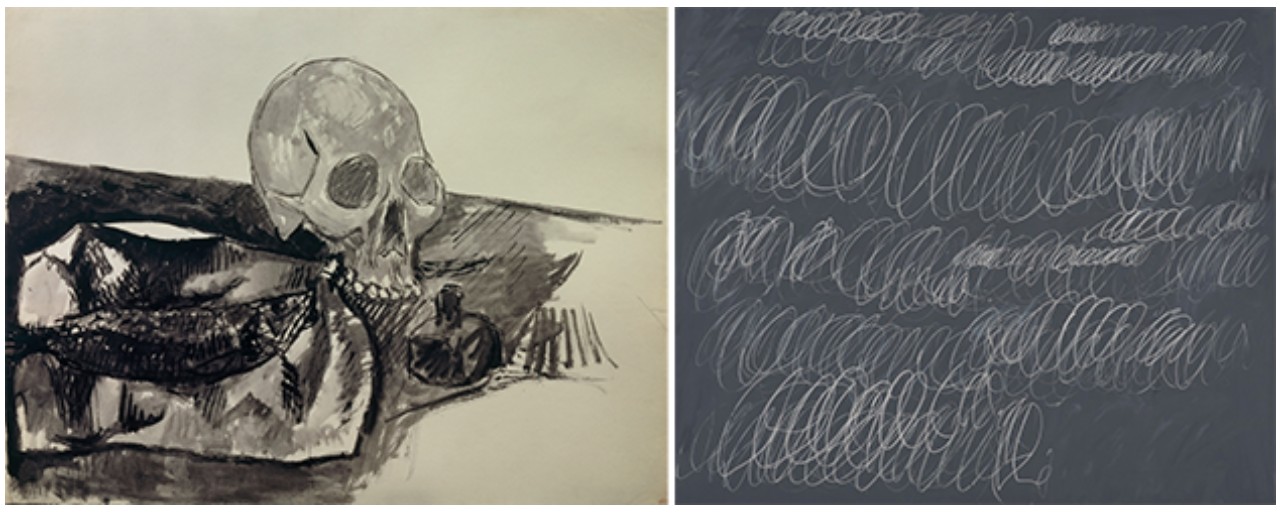
[Left] Pablo Picasso, Still life: fish, skull and inkwell, Paris, spring-summer 1908. Musée national Picasso, Paris. Artwork: © 2025 Estate of Pablo Picasso / Artists Rights Society (ARS), New York
[Right] Cy Twombly, Untitled, 1967. Museum of Contemporary Art, Los Angeles. Artwork: © Cy Twombly Foundation
The visual intensity of Untitled reflects Basquiat’s drive and meteoric success. The work displays his mature visual lexicon: a densely worked surface where incised oilstick marks create rich textural dimensions. Using both rapid gestures and precise detail, Basquiat blends text and image. Shifting between black, white, and color, he maps anatomy—the brain’s “FORNIX” and “LYRA”—and the torso of a guitar player, detailed but with a scribbled spinal column. In neuroanatomy, “Lyra” refers to a structure within the fornix, its name inspired by a triangular harp. This subtle reference—tied to Basquiat’s fascination with anatomy and music—exemplifies his ability to fuse scientific and artistic domains. His mother, Mathilde, nurtured these dual interests, introducing him to museums and gifting him Gray’s Anatomy (1878) after a childhood car accident. This event, which resulted in the removal of his spleen, profoundly influenced his recurring interest in the human body.
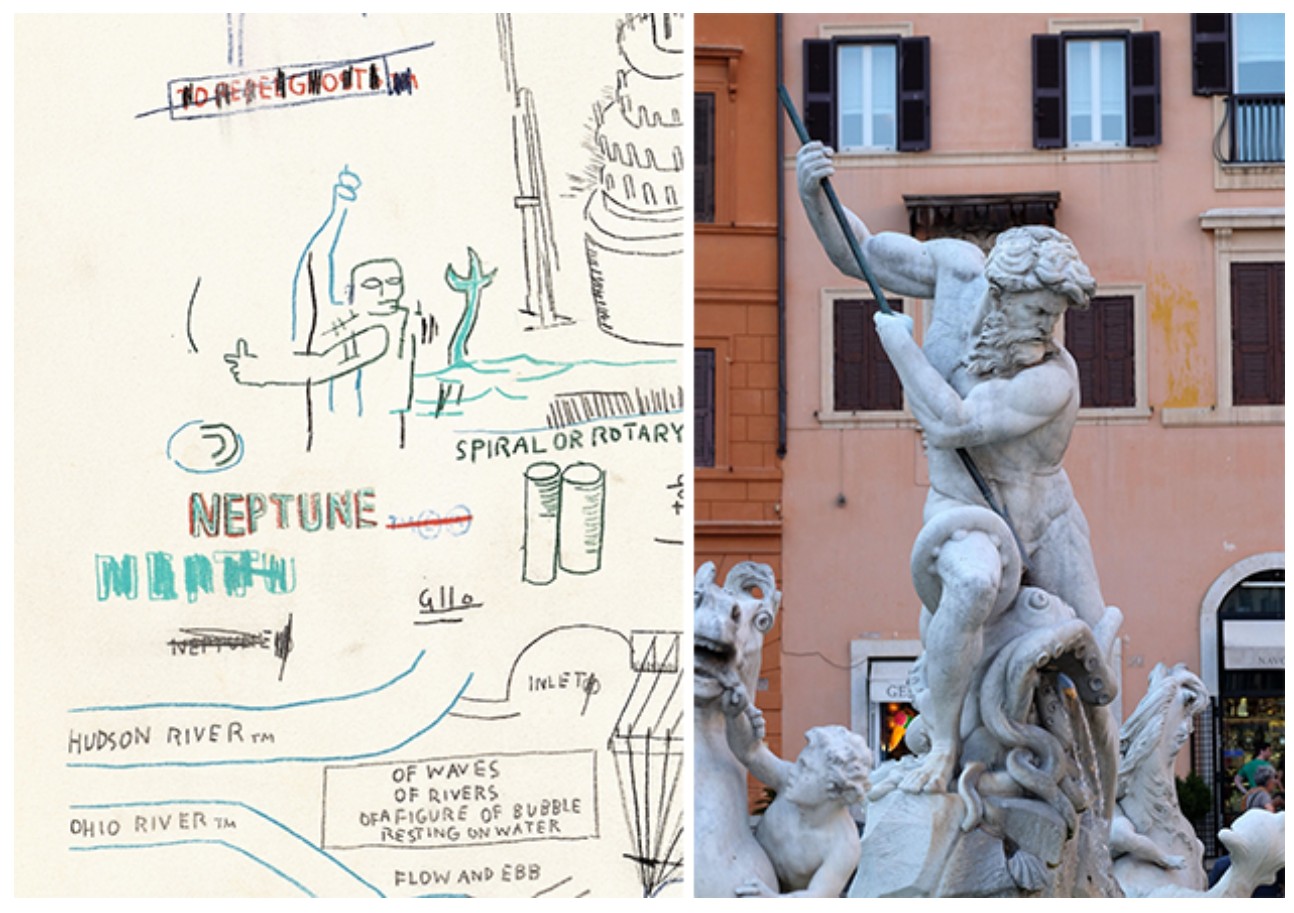
[Left] Detail of the present work.
[Right] Piazza Navona, Fountain of Neptune in Rome, Italy. Image: Panther Media GmbH / Alamy Stock Photo
In Untitled, detailed renderings of the throat and jaw highlight Basquiat’s stream-of-consciousness style—a careful balance of urgency and coherence. While anatomically investigative, the work also autobiographically surveys Basquiat’s oeuvre, referencing pieces such as the Brooklyn Museum’s Back of the Neck, 1983; Horn Players, 1983, at the Broad, Los Angeles; Jawbone of an Ass, 1982; and Monticello, 1986. Shared across these are themes of deconstructed anatomy, Black musicians, and biblical references. In Jawbone of an Ass, the title derives from Samson’s legendary feat—a gesture of strength and divine favor—reflecting Basquiat’s engagement with spiritual and mythological content. Here, Neptune is also depicted, identified by the label “NEPTUNE” and a figure with classical attributes, reinforcing mythic themes.
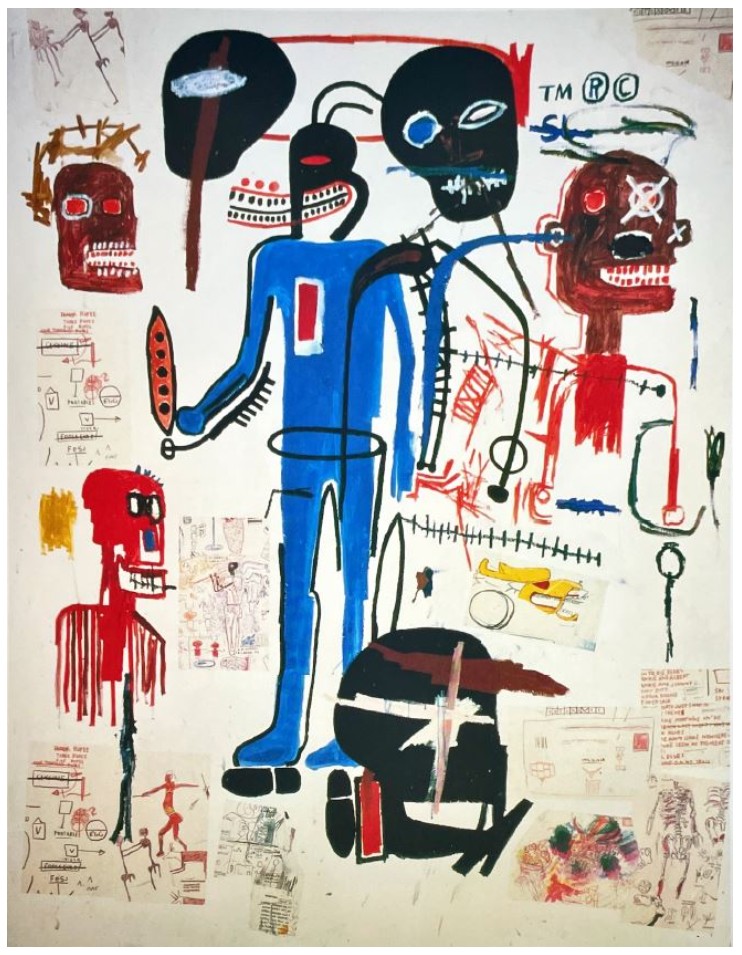
Jean-Michel Basquiat, Dogman, 1986. Private Collection. Artwork: © Estate of Jean-Michel Basquiat. Licensed by Artestar, New York
Historical and technical references further permeate Untitled. A bat wing in the lower half mirrors Leonardo da Vinci’s studies of flight, reflecting Basquiat’s polymathic interests. Inspired by Henry Dreyfuss’ Symbol Sourcebook (1972), Basquiat incorporated graphic and engineering symbols—visible here in the circular mechanical diagrams paired with river names like “MISSISSIPPI,” “OHIO,” and “HUDSON.” The repetition of “FLOW AND EBB” and “OF WAVES // OF RIVERS” links anatomy, myth, and machinery to a hydrodynamic metaphor of movement and memory.
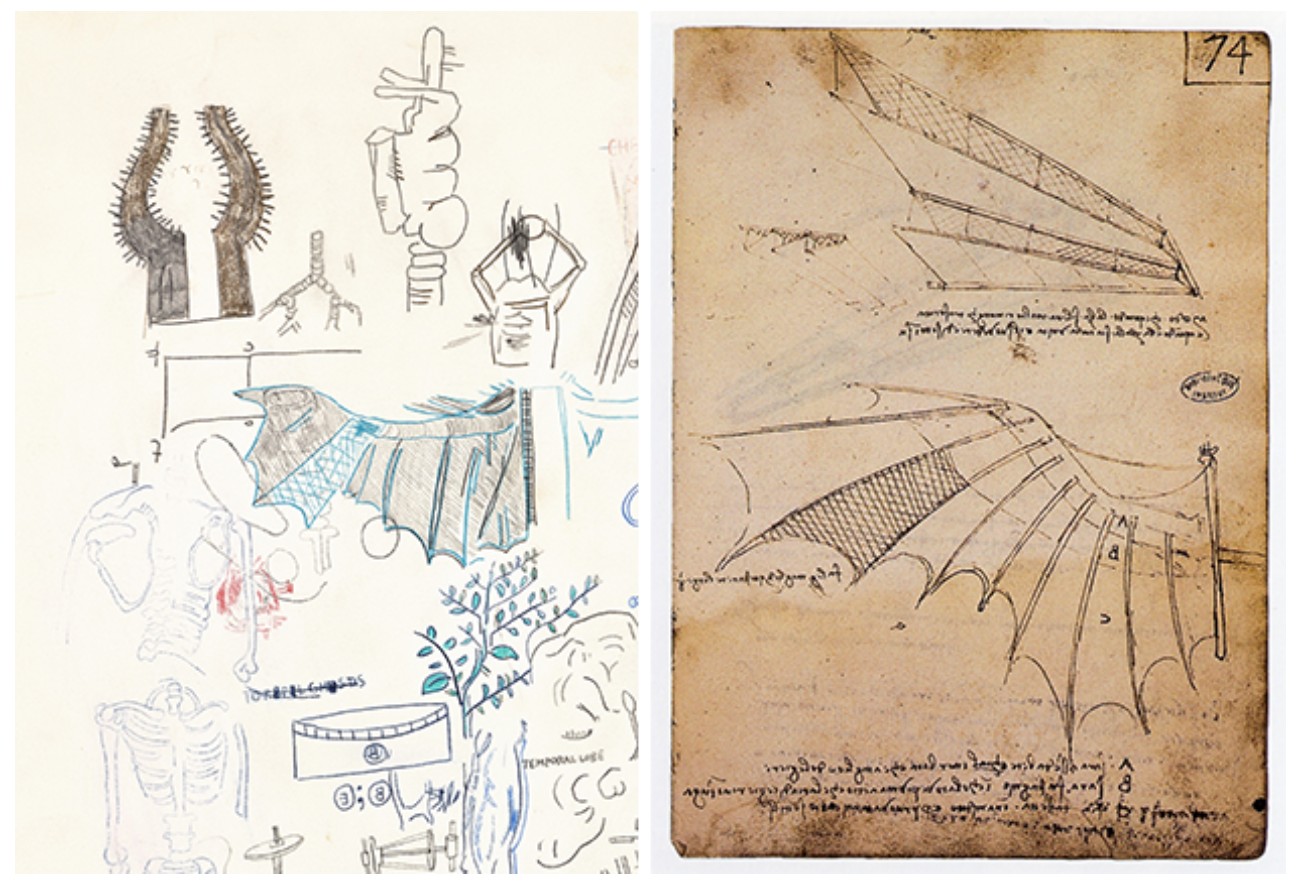
[Left] Detail of the present work.
[Right] Study of wing articulation. From da Vinci’s notebooks, circa 1487 – 1490. Image: Gravure Francaise / Alamy Stock Photo
Trademark and copyright symbols—ubiquitous in Basquiat’s work—appear throughout, referencing authorship and ownership. These markings also echo his graffiti roots and his use of the SAMO tag. The work’s central figures—a trumpet player labeled “AS GABRIEL // GABRIEL FIG.” and a guitarist in a blue suit—connect Basquiat to music and spirituality. The archangel Gabriel, associated with the trumpet and divine announcements, may also serve as a metaphor for the artist himself—a messenger, performer, witness, or even avatar. The central guitarist, faceless save for a floating brain, evokes sound through color and gesture. Capitalized words across the composition suggest rhythm, while scribbled-out passages heighten textual ambiguity, mirroring the improvisational spirit of jazz. Repetition, a core technique in both Basquiat’s work and jazz, reinforces this connection.
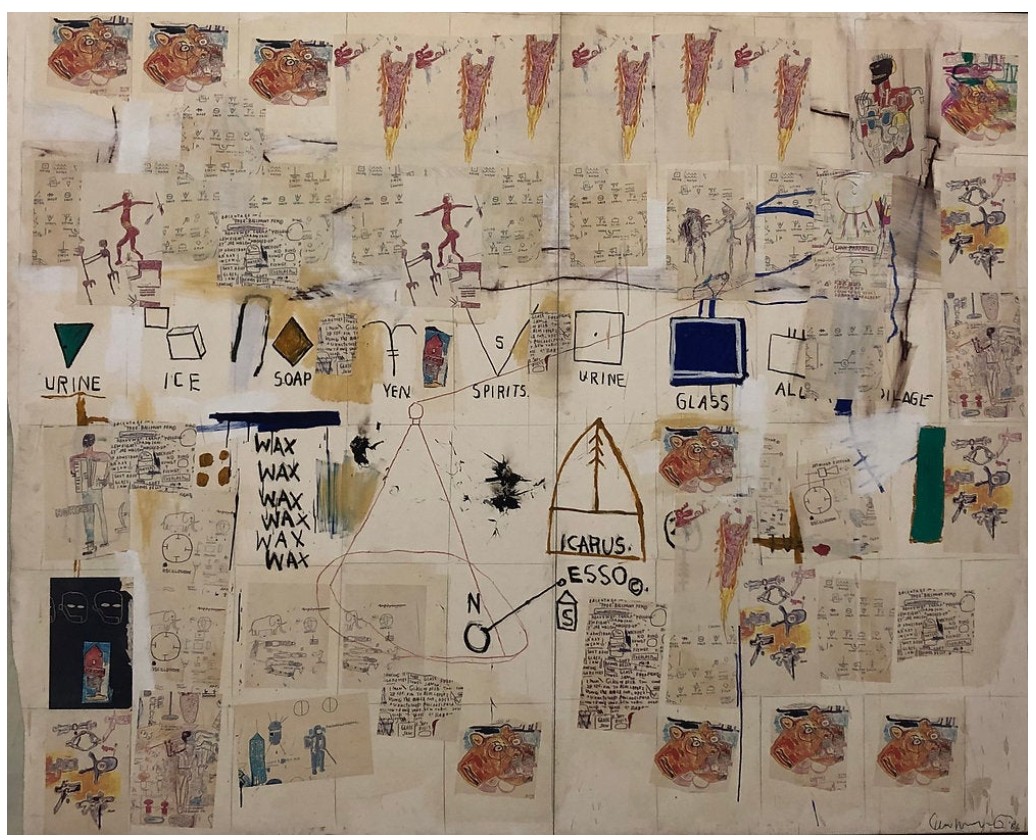
Jean-Michel Basquiat, Icarus Esso, 1986. Private Collection. Artwork: © Estate of Jean-Michel Basquiat. Licensed by Artestar, New York
Created during a pivotal period in the artist’s short yet prolific career, Untitled captures Basquiat’s creative expansion and growing confidence in his role as an artist, at a time when he was gaining international recognition and staging major museum exhibitions. In 1985, Basquiat experienced a landmark year, marked by a major show at the prestigious Mary Boone Gallery, a New York Times Magazine cover feature, and a collaborative exhibition with Andy Warhol.
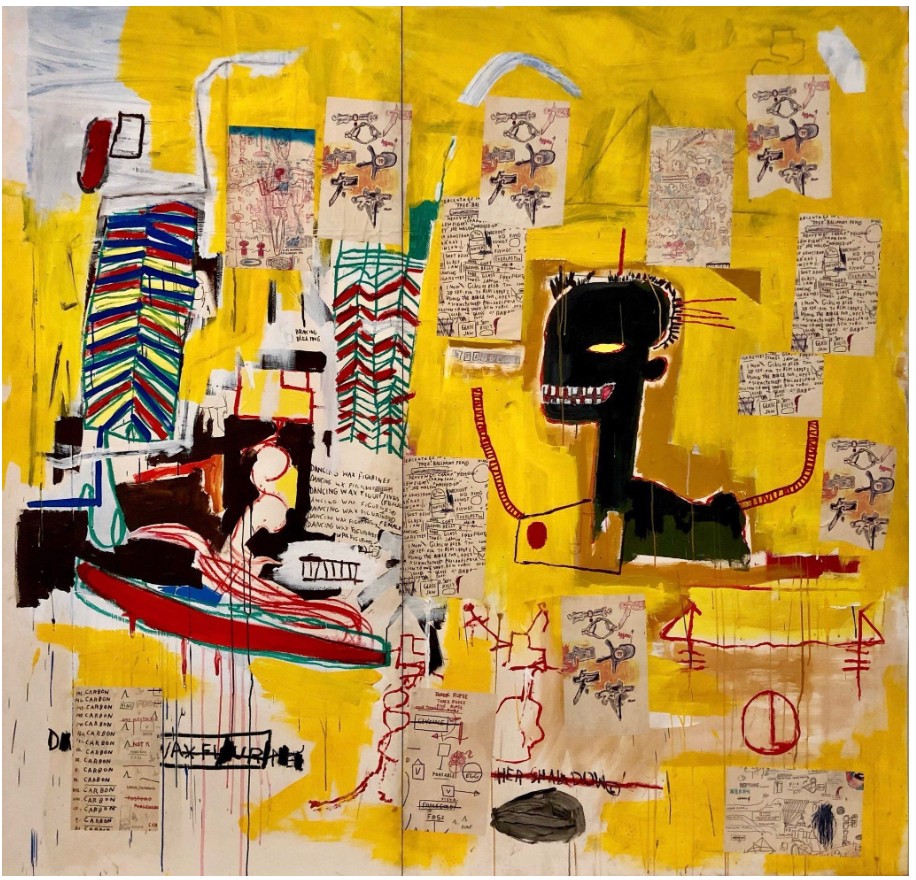
Jean-Michel Basquiat, Untitled, 1984-1985. Private Collection. Artwork: © Estate of Jean-Michel Basquiat. Licensed by Artestar, New York
The desire to communicate through his art while resisting categorization is powerfully evident in Untitled, where the artist’s unbounded curiosity and exceptional storytelling unfold across the page. An exquisite example of Basquiat’s signature Neo-Expressionist style and his commitment to reimagining the myths of past and present, Untitled—with its scrawled anatomical renderings and lyrical text—serves as both a mirror of his career to that point and a portrait of his imaginative, restless mind.
Boxeo, 1986
Phillips Hong-Kong: 25 November 2024
Estimated: HKD 2,500,000 – 4,500,000
HKD 3,048,000 / USD 391,600
Jean-Michel Basquiat – Modern & Con… Lot 16 November 2024 | Phillips
JEAN-MICHEL BASQUIAT
Boxeo, 1986
Graphite, watercolour and wax crayon on paper
14 1/2 x 10 3/4 inches (36.8 x 27.2 cm)
Signed and dated ‘Jean Michel Basquiat 86’ on the reverse
Throughout Jean-Michel Basquiat’s meteoric career, the theme of boxing consistently served as a compelling lens through which he explored racial identity and power dynamics. Created in 1986, a pivotal year for the artist–having gained widespread recognition transcending the gallery scene into popular culture and a notable show at the Whitney Museum of American Art – Boxeo embodies a raw energy and offers a nuanced commentary that solidified Basquiat’s revolutionary impact within the Neo-Expressionist movement of 1980s New York. The Spanish title of this work highlights Basquiat’s pride in his Latin American heritage–his mother was Puerto Rican– and pays homage to the esteemed role of boxing in Hispanic culture. This choice of language was deliberate; Basquiat often incorporated Spanish text into his art as both a cultural signifier and an act of defiance against the Anglo-centric world he was rapidly infiltrating.
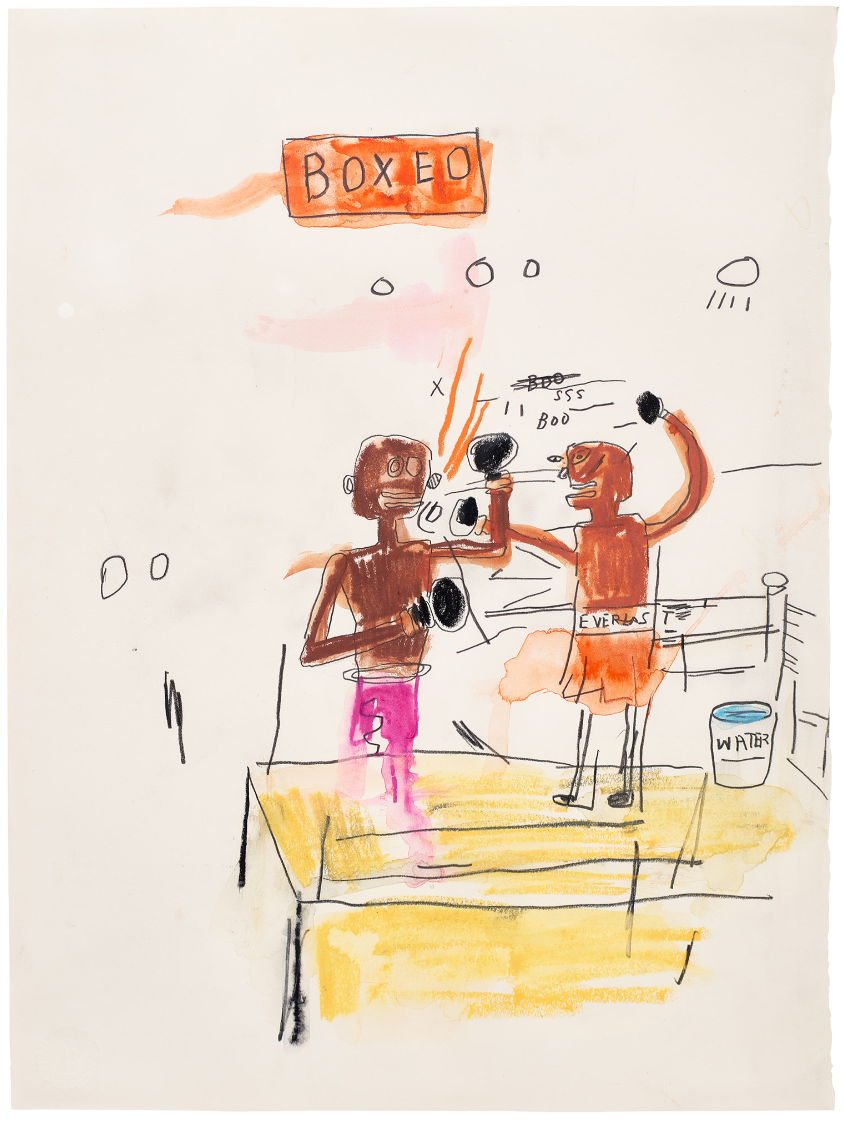
In this intimate work on paper, Basquiat portrays two Black fighters engaged in combat, their forms distilled to essential gestures that radiate vitality. The figure on the left, adorned in purple shorts, adopts a defensive stance against his opponent, who is marked with the EVERLAST logo – a commercial reference that anchors the scene in reality. The composition exemplifies Basquiat’s ability to blend a seemingly casual drawing style with sophisticated artistic choices. The boxing ring, indicated by minimal lines and a floor washed in yellow, hovers within a white space punctuated by his signature atmospheric marks–floating circles and cryptic notations that evoke a sense of frenetic energy. A water bucket at ringside contributes both narrative detail and compositional weight, while the floating “BOO” above the figures adds an element of sound and emotional tension to the scene.
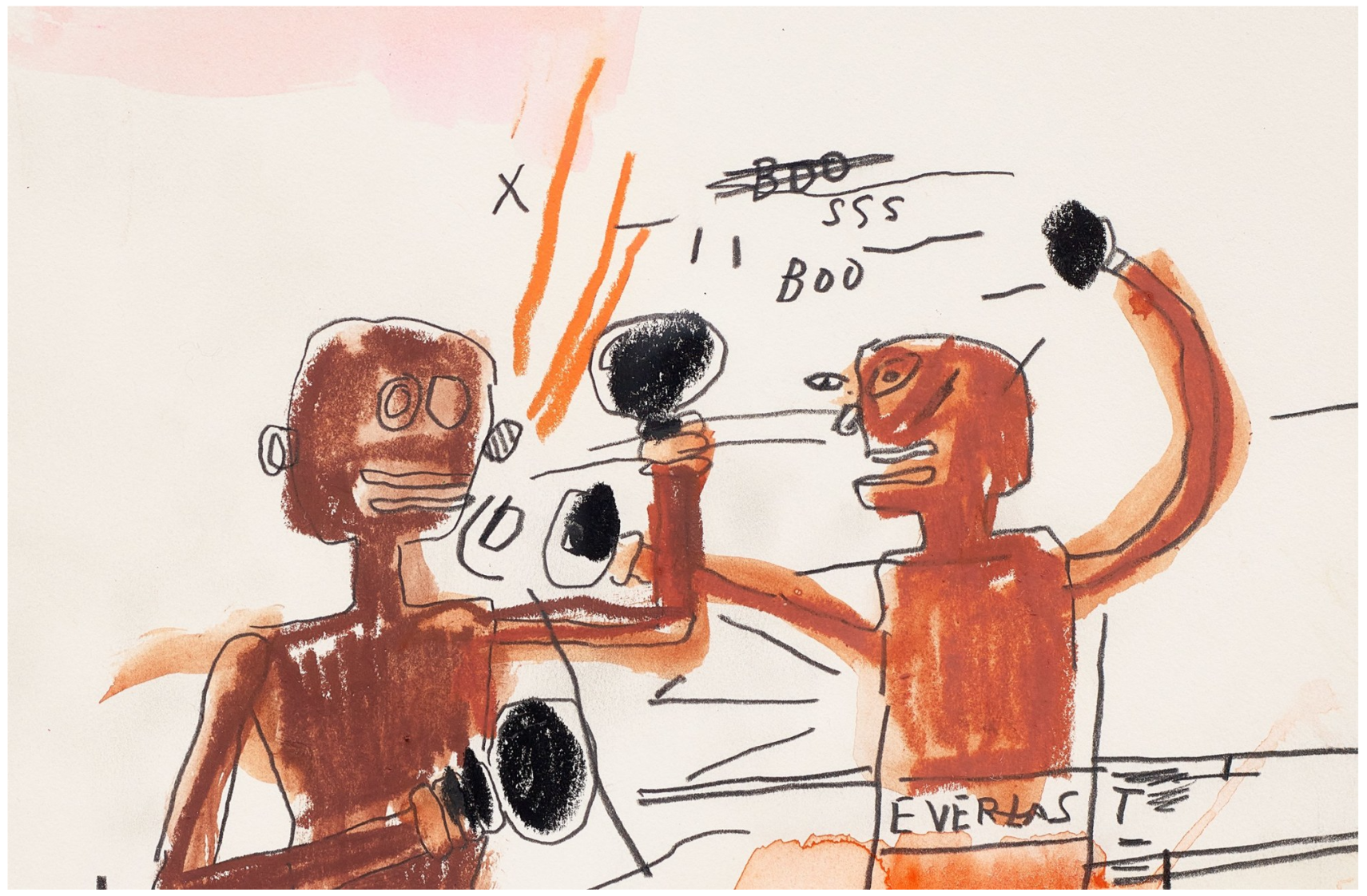
Notably, Boxeo recalls a significant moment in the art world, highlighted by the iconic dual portrait of Jean-Michel Basquiat and Andy Warhol, a central figure of the Pop Art movement. In 1985, during their creative collaboration—just a year before the present work was created—Basquiat enlisted American photographer Michael Halsband to design a poster for their joint exhibition at the Tony Shafrazi Gallery in New York. This photograph captures the unique friendship between these two iconic figures, showcasing Warhol in his trademark silver wig and sunglasses, while Basquiat exudes raw energy, both clad in Everlast boxer shorts. Their dynamic relationship can be likened to that of boxers in a ring as depicted in Boxeo. While each artist possesses a distinctive style and approach, they share a profound mutual respect—acting not as rivals, but as peers within the art world. The boxing ring serves as a metaphorical space where fighters demonstrate their skills and inspire one another to reach new heights. Similarly, the art world became Basquiat and Warhol’s arena, where challenging each other’s ideas and pushing boundaries, each contributing their unique strengths to the vibrant ‘ring’ of contemporary art.
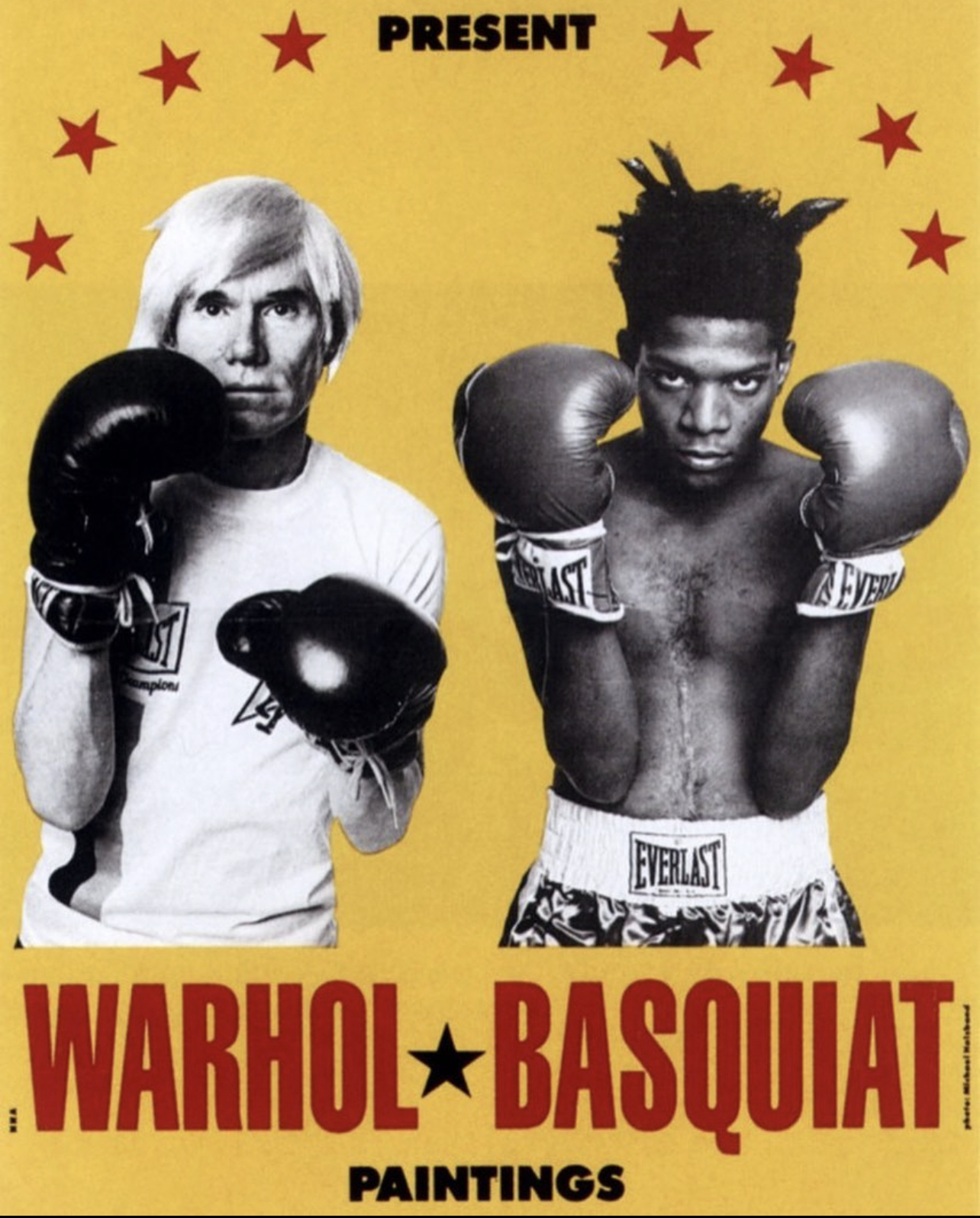
1986 marks an apex year in Basquiat’s rise as an international star in contemporary art, highlighted by a gallery presentation at Gagosian in January in Los Angeles. Much like the boxer characters depicted in Boxeo, Basquiat was fiercely fighting his way to the top, fuelled by raw talent and unyielding ambition. A palpable sense of confidence radiates from Boxeo, evident in every assured stroke and deliberate mark on the paper. On a broader level, the boxing theme held deep personal significance for Basquiat, who recognized parallels between fighters and artists of color navigating predominantly white establishments of their respective fields. He studied the careers of legendary boxers like Muhammad Ali, Joe Louis, and Sugar Ray Robinson–figures who achieved fame and fortune while grappling with systemic racism. Their struggles resonated with his own experience as a young Black artist striving for success in an art world that had historically marginalized people of color. This work exudes an almost raw energy reminiscent of Basquiat’s street-art days, yet it also showcases a more mature practice as he approached the final years of his life. In a sense, it bridges his SAMO© period (1978-1980) with his developed studio practice, merging the impact of graffiti with a more refined artistic approach. Like many of his most compelling works, Boxeo encapsulates Basquiat’s central themes: power, racial politics, and artistic triumph, while simultaneously functioning as both social commentary and personal expression. In the context of Basquiat’s meteoric rise–he would tragically pass away just two years later from an overdose–works like Boxeo take on an added poignancy. It captures a moment when everything seemed possible, reflecting a young artist fighting his way to the top with the confidence and skill of a championship boxer.
Untitled (Caucasian / Negro), 1985
Sotheby’s New-York: 16 November 2023
Estimated: USD 600,000 – 800,000
USD 854,000
Untitled (Caucasian / Negro) | Contemporary Day Auction | 2023 | Sotheby’s (sothebys.com)
JEAN-MICHEL BASQUIAT (1960 – 1988)
Untitled (Caucasian / Negro), 1985
Oil stick, graphite and colored pencil on paper
30 x 22 1/4 inches (76.2 x 56.6 cm)
Erupting into a visual cacophony of symbols, signs, and cyphers, Jean-Michel Basquiat’s Untitled (Caucasian/ Negro) of 1985 offers a glimpse into the artist’s energetic, imaginative and ingenious mind. Held in the personal collection of legendary gallerist and publisher of Basquiat’s first catalog of works on paper John Cheim, the present work boasts an illustrious exhibition history. In 1990, it was included in the seminal exhibition Jean-Michel Basquiat Drawings at Robert Miller Gallery, which was curated by Cheim himself. A testament to the gravity and intent with which the artist approached his works on paper, the exhibition was Basquiat’s first posthumous exhibition and the first to be solely dedicated to his drawings. With its complex pantheon of intricate iconography, Untitled (Caucasian / Negro) encapsulates Basquiat’s unique pictorial lexicon which wavers between the vivaciously dynamic and the quietly unsettling.
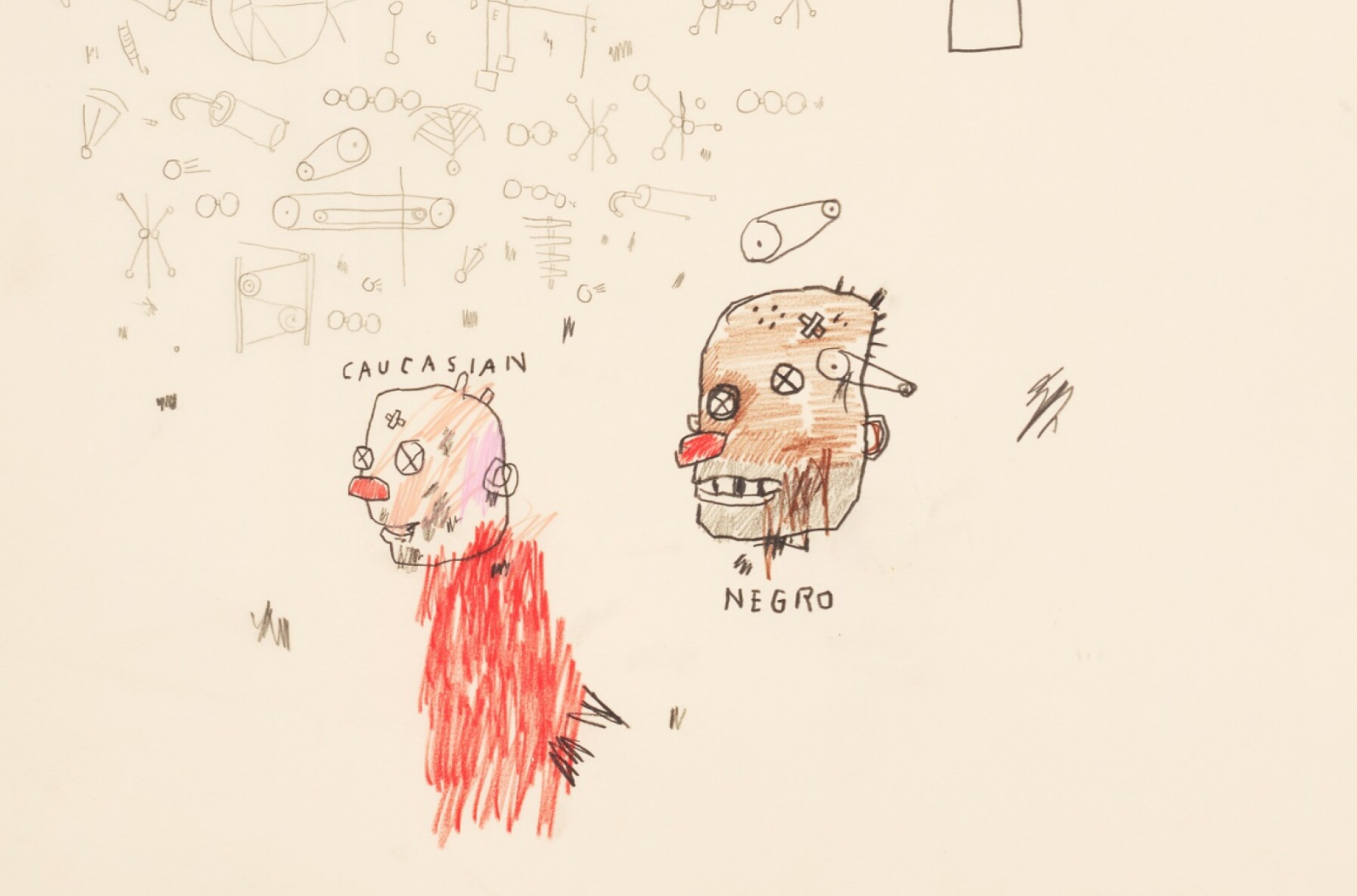
A complex labyrinth of symbols and images fills the space above two colorfully accentuated profiles of two heads. Reminiscent of the magical landscapes of pictorial metaphors and signs by Paul Klee, the symbols—largely references to chemistry, engineering and other scientific instruments from pulleys and gears to springs and weights—are not only an expression of the artist’s innovative visual lexicon but are indicative of Basquiat’s most impressive compositions. Descending from the constellation of mechanical drawings, viewers are struck by the two graphically composed heads of varying skin tones, aptly labeled “Caucasian” and “Negro.” Upon closer inspection, the bevy of scientific symbols appears to emerge exclusively from the “Caucasian” head, alluding to broader inequities baked in systems of knowledge. The “Negro” head, on the other hand, is excluded from this suggestive osmosis, cast to the side only to look upon its privileged neighbor.
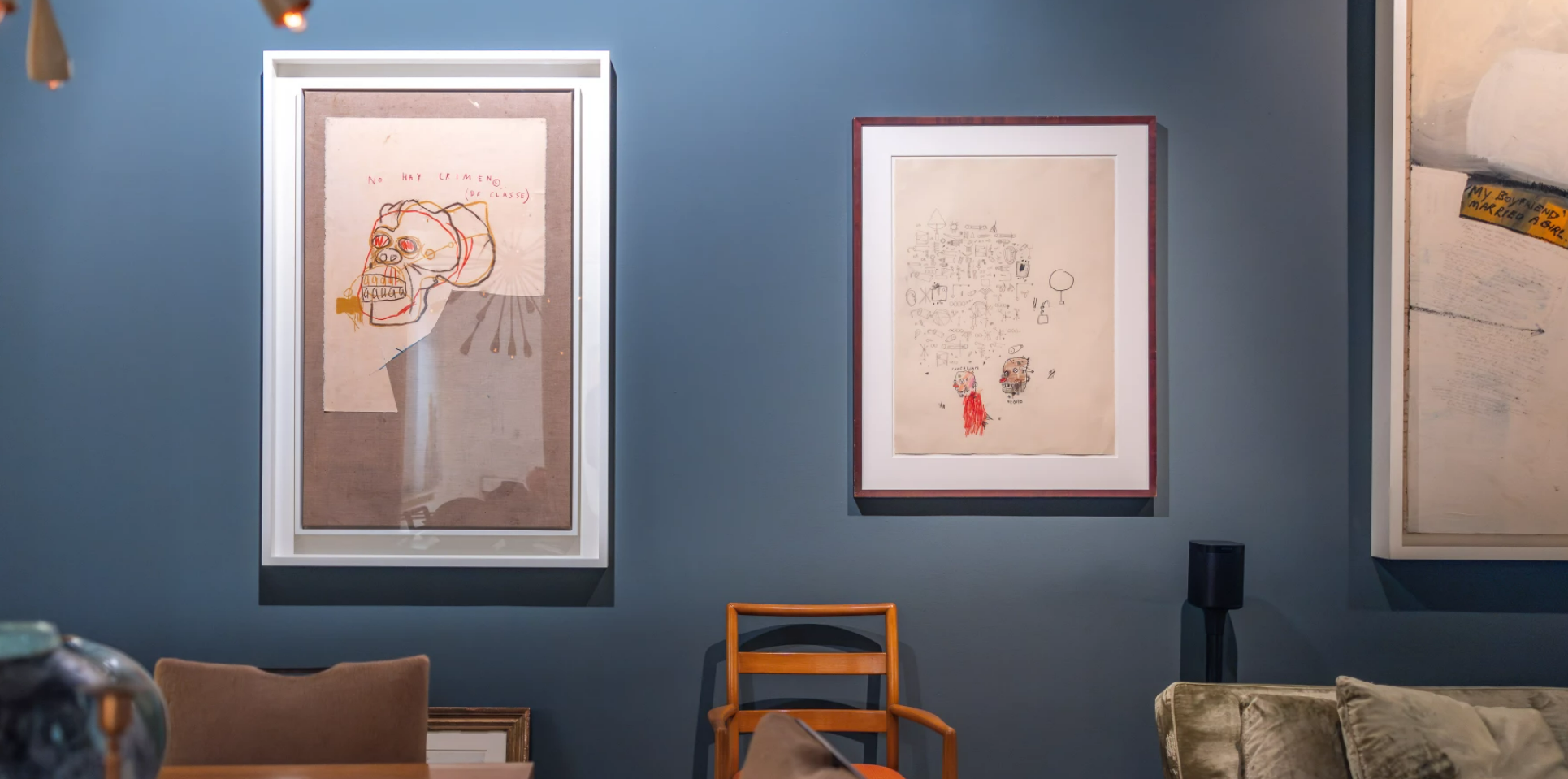
THE PRESENT WORK INSTALLED IN JOHN CHEIM’S NEW YORK LOFT.
Though Basquiat never strayed into the realm of the overtly political in his art, he was eternally conscious of his black identity within a white dominated art-world, and the subject of racial (in)equality nonetheless became an unequivocal focus of his creative vision. By presenting the two figures in this way and making explicit their racial distinctions, Basquiat directly confronts and brings to light the disparate conditions of the two races at the time. A vibrant symphony of densely layered motifs and symbols, the present work showcases the sheer range of Basquiat’s visual language in his works on paper. Brilliantly formulated in the artist’s innovative mind and then translated onto the paper, the drawing is as vivid and alive now as it was at the moment of its execution.
Untitled (Colored Boy Piano Player), 1987
Phillips London: 13 October 2023
Estimated: GBP 200,000 – 300,000
GBP 203,200 / USD 246,601
Jean-Michel Basquiat – 20th Century … Lot 24 October 2023 | Phillips
JEAN-MICHEL BASQUIAT
Untitled (Colored Boy Piano Player), 1987
Graphite and oilstick on paper
17 1/4 x 22 1/4 inches (43.8 x 56.5 cm)
Signed and dated ‘Jean-Michel Basquiat 87’ on the reverse
As his mother would recall, Basquiat drew from an early age, always carrying a notebook with him and allowing ‘impressions, thoughts, memories, associations, fantasies, and observations formulating in his mind to simply pass through him, making their way onto a sheet of paper. Immediate and intuitive, his approach to drawing as a mode of ‘channelling’ information – cultural history, politics, snatches of literary and art history, mythology, and music – was established early on and confirmed these works on paper as a distinct and hugely significant part of his practice that can be read independently of his paintings, even while it obviously informed them. In its pictographic arrangements and lively combination of image, symbol, and text, Untitled (Colored Boy Piano Player) exemplifies this ‘channelling’ practice as the artist ‘ate up every image, every word, every bit of data that appeared in front of him and he processed it all into a bebop cubist pop art cartoon gospel that synthesised the whole overload we lived under into something that made an astonishing new sense. Proud of his self-taught credentials, Basquiat devoured books, from Gray’s Anatomy to The Philosophy of Andy Warhol (From A to B and Back Again), The Bible to the Encyclopaedia Brittanica, writing these references and the processes of thinking them through into his densely citational paintings and drawings. In the present work, the repetition of certain symbols and phrases refers directly to Basquiat’s close reading of Henry Dreyfus’ 1972 semiotic study Symbol Sourcebook: An Authoritative Guide to International Graphic Symbols. A compendium of the graphic language of symbols, that includes the more familiar visible language of street signage and instructional codes designed to be immediately legible, regardless of the viewer’s language or level of literacy (a child recognizes the danger of a skull and cross bones sign on an everyday domestic cleaning fluid), to more esoteric symbolic systems.
“I get my facts from books, stuff on atomizers, the blues, ethyl alcohol, geese in Egyptian glyphs, […] I don’t take credit for my facts. The facts exist without me.”
Reproduced in a faint, chalky line to most accurately represent the way that the symbols would appear scrawled on rough wood or concrete surfaces, Deryfus’ ‘Hobo Signs’ were a source of great inspiration for Basquiat, both in their graphic, drawn immediacy, and in social contexts in which they operated. Cryptic pictograms, these symbols were a sophisticated and coded mode of communication shared between itinerant travellers or ‘hobos’ as a means of sharing important information about the places where the marks were left all across Depression-era America. As in more monumental pieces such Pegasus, created in the same year as the present work, Basquiat’s selection of more sinister icons in Untitled (Colored Boy Piano Player) speaks to his interest in the profound difficulties of navigating a cruel and dangerous world for those living on the fringes of society, and the strategies that these communities invented in order to survive.
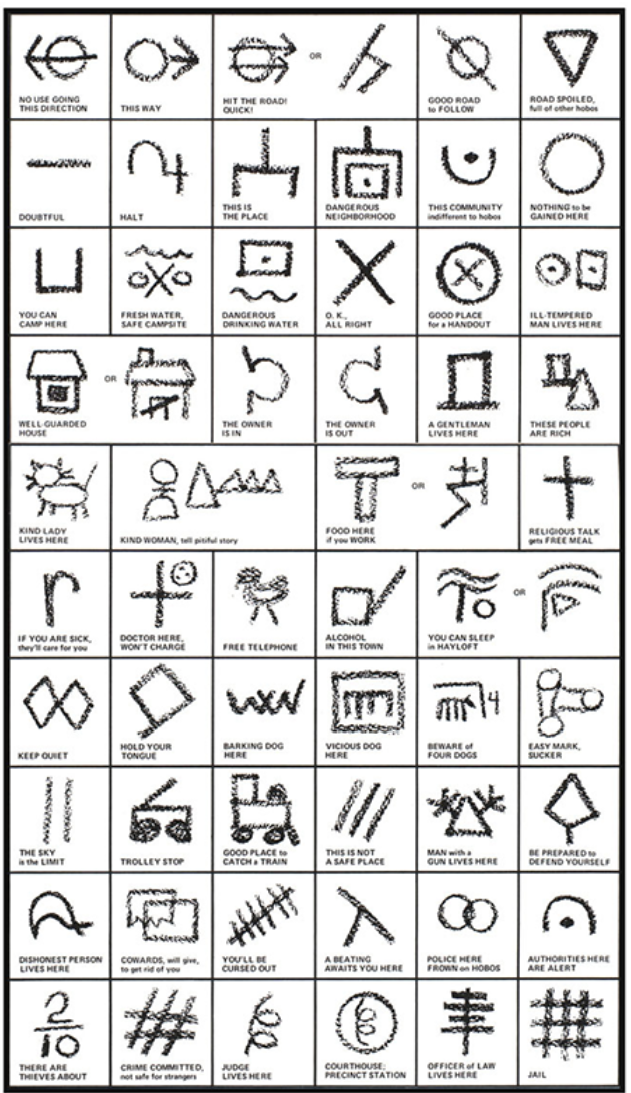
‘Hobo Signs’, from Henry Dreyfuss, Symbol Sourcebook: An Authoritative Guide to International Graphic Symbols, 1972
Reading the image from left to right, the graphic, comic strip style of the drawing takes on new significance, the repetitions of the symbols for ‘A beating awaits you here’ and ‘this is not a safe place’ visually replicating the itinerant wanderings of these individuals and reinforcing the relentless dangers that they faced on their travels. Combining image and text, Basquiat communicates this with striking directness, culminating in the rapid and running-on scrawled repetition of ‘this is not a safe place’ in the far left of the composition. In typical fashion, Basquiat’s social commentary here also invokes law keepers as dangerous figures, the coiled spring icon and circled symbols traditionally used to warn travelers of the proximity of judges and courthouses.
In bringing this coded visual language into his practice, Basquiat honors this sophisticated mode of visual communication, and the powerful ways in which it allowed the most unseen and ignored members of society to forge their own communities and remain visible to one another. Closely connected to Basquiat’s reference to the nomadic Blemyan tribe in the eastern Sahara in his inclusion of ‘Dumaris’ in a number of significant compositions, we might also read these pictograms as Basquiat’s ‘affirmation of his own nomadic journey’, his dedication to choosing his own path, connecting and communicating with fellow travellers along the way.
Muscles of Right Orbit, 1985
Sotheby’s New-York: 28 September 2023
Estimated: USD 500,000 – 700,000
USD 723,900
Muscles of Right Orbit | Contemporary Curated | 2023 | Sotheby’s (sothebys.com)
JEAN-MICHEL BASQUIAT (1960 – 1988)
Muscles of Right Orbit, 1985
Wax crayon on paper
22 1/2 x 30 1/2 inches (57.2 x 77.5 cm)
Signed, dated LOS ANGELES 1985 MAR 28 and dedicated To Andy (lower right)
A masterful amalgamation of symbols, words, diagrams and figuration, Jean-Michel Basquiat’s Muscles of Right Orbit is an instantly recognizable work from the artist’s celebrated oeuvre of works on paper. Produced in 1985, Muscles of Right Orbit is a mature and confident declaration of Basquiat’s unparalleled draftsmanship and instinctual storytelling abilities. Dedicated “To Andy,” Muscles of Right Orbit also alludes to the close relationship between Basquiat and Andy Warhol; at the time of the drawing’s execution, Warhol and Basquiat were collaborating for a joint exhibition at Tony Shafrazi Gallery in New York, which would open a few months later in September 1985. The frenetic energy contained within Basquiat’s works on paper, especially the present work, is unique from that in his paintings: his creative genius shines through the raw immediacy culminating in an expressionistic fervor. For Basquiat, drawing was the most immediate form of expression and the quickest artistic method in which he could translate his inner thoughts.
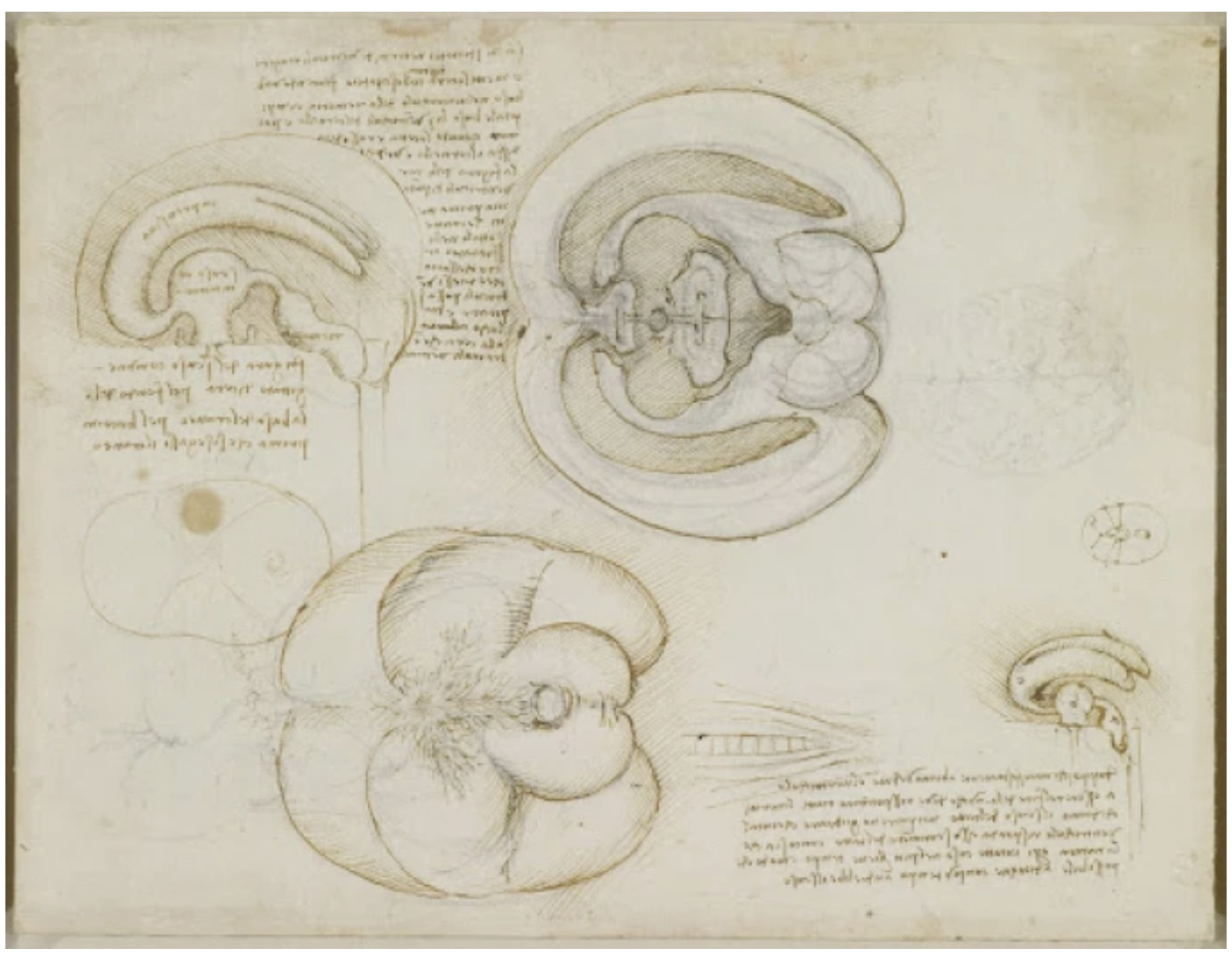
LEONARDO DA VINCI, THE BRAIN, C. 1508-09. THE ROYAL COLLECTION TRUST, LONDON.
When Basquiat was just eight years old, he was hit by a car near his home in Brooklyn. The accident, which led to the removal of his spleen, resulted in Basquiat spending over a month in the hospital. This experience fueled his fascination with the human body, inspiring recurring motifs of the skull in Basquiat’s work. In Muscles of Right Orbit, the head is paramount. Here, the head has been annotated and reduced to its most intricate elements in the brain, with the duality of the internal versus the external adding an additional symbolic layer. Basquiat stands apart for his ability to successfully blend language and image into an innovative visual lexicon, uniquely his own, which reinvigorated and elevated the status of drawing. The complex labyrinth of symbols and images are not only an expression of the artist’s innovative visual language, they are indicative of Basquiat’s most impressive compositions. Specifically detailing the complex anatomy of the brain, Muscles of Right Orbit is notable not only for its iconic imagery, but also for the fervor in which the artist created the work, transcending time and space.
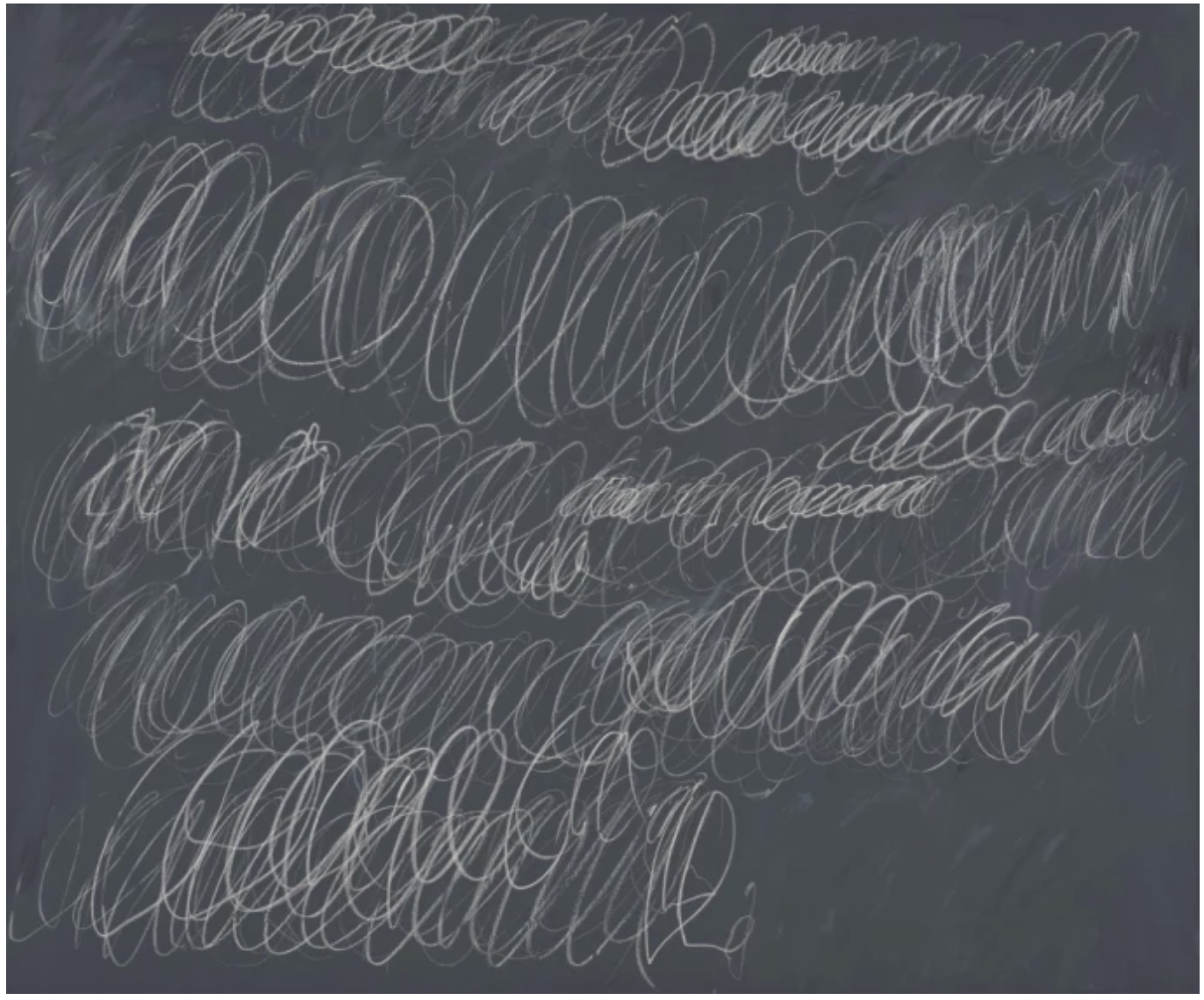
CY TWOMBLY, UNTITLED, 1967. MUSEUM OF CONTEMPORARY ART, LOS ANGELES. ART © 2023 CY TWOMBLY FOUNDATION
Conjuring allusions to the graceful scrawls and scribbles of Cy Twombly – an artist for whom he held a deep admiration – the glimpses of Basquiat’s graphic forms invoke a sort of proto-handwriting: a kind of expression that strives toward resolution and legibility but is suspended in a perpetual territory of formal symbolism, akin to our contemporary reading of pre-historic mark-making. Phoebe Hoban captures this notion saying that, “Basquiat’s work, like that of most of his peers, was based on appropriation… the images he appropriated whether they were from the Bible or a chemistry textbook – became part of his original vocabulary… Basquiat combined and recombined these idiosyncratic symbols throughout his career: the recursive references to anatomy, black culture, television and history are his personal hieroglyphics.” (Phoebe Hoban, Basquiat: A Quick Killing in Art, New York 1998, p. 332) The young artist sampled from everyday life, art history, and a variety of cultural and socio-political semiotics oftentimes separating and isolating signs and texts, each containing layered histories. This diverse lexicon served as both image and a chronicle of language itself, overheard and spoken, a voice which visualized the slogans and jargon of the moment.
Untitled, 1987
Phillips New-York: 19 May 2022
Estimated: USD 600,000 – 800,000
USD 877,000
Jean-Michel Basquiat – 20th Century & C… Lot 120 May 2022 | Phillips
JEAN-MICHEL BASQUIAT
Untitled, 1987
Crayon and watercolor on paper
30 x 22 3/8 inches (76.2 x 56.8 cm)
Signed and dated “Jean-Michel Basquiat ’87” on the reverse
Through an array of symbols and text, Jean-Michel Basquiat’s Untitled provides an intimate look at one of the most celebrated artists of the 20th Century. Executed in 1987, just a year before the artist passed away at the age of 27, Untitled was created at a time when Basquiat was struggling with the loss of his dear friend and mentor, Andy Warhol. Here, the artist invites the viewer into his own elaborate universe, creating a drawing that is both personal and encyclopedic. The present work portrays a narrative through motifs, short phrases, and signs. The composition is a recompilation of the most meaningful symbols and motifs Basquiat had been using in his work up until this point, bringing together the various sources and iconography that defined his entire practice from the early 1980s to his untimely death.
Untitled brings together the artist’s expressive rawness and primitive style, with a recording of phrases and hieroglyphics akin to stream-of-consciousness writing. “PUMP, ROTARY AND CENTRIFUGAL” and “FATAL INJURY” are some of the most noticeable phrases in the drawing. But even more captivating are the graphic symbols, inspired by Henry Dreyfuss’ Symbol Sourcebook: An Authoritative Guide to International Graphic Symbols published in 1972. After Basquiat studied this textbook, he started integrating many of the symbols Dreyfuss codified into his own works. In Untitled, one example is the circle with a diagonal line protruding from the top corner with a “G” at the end. Intertwined with this kind of symbolism, we find other recognizable motifs like the pig’s eye, the Batman logo, and a sword. The ambivalent references embodied in this work, also reveal Basquiat’s mental state during this time of his life, when he was struggling with addiction and intense personal loss. These emotions can be felt in the symbols of mortality, anatomy, and alchemy, alongside words like “CRUCIBLE” and “SPIRIT.” In Untitled, the symbols, imagery and text are rendered with a dark black crayon, making them stand out from the negative spaces in the sheet. These come into contact with a few bright green watercolor brushstrokes and scattered blue, red, and pink scribbles, all of which together illustrate how Basquiat embraced text and color seamlessly throughout his practice.
Windmill, 1985
Phillips London: 4 March 2022
Estimated: GBP 220,000 – 280,000
GBP 327,600
Jean-Michel Basquiat – 20th Century &… Lot 155 March 2022 | Phillips
JEAN-MICHEL BASQUIAT
Windmill, 1985
Oilstick and graphite on paper
30 x 22 1/8 inches (76.2 x 56.3 cm)
Titled ‘WINDMILL©’ lower right; signed and dated ‘Basquiat 1985’ on the reverse
Offered at auction for the first time in more than thirty years, Windmill (1985) is a fascinating example of the artist’s practice. The tri-tonal drawing, rendered in oilstick and graphite depicts Basquiat’s interpretation of the mechanical workings of a windmill, alongside annotations verging on the whimsical. At first glance, the structure recalls an engineer’s blueprint with red and black outlines denoting the supports and moving components. These are overwritten with dotted lines and arrows which seemingly represent wind direction and the additions of further abstract diagrams and the inscription to the upper right corner reading ‘WIND WATER ELECTRICITY.’ Basquiat’s playful approach to symbolism is apparent in the artist’s inclusion of arrows which meet at opposing angles, the packet of pills and the tilted ladder in the lower half of the work. These additions strongly hint at a coded meaning but leave it just out of the viewer’s grasp.
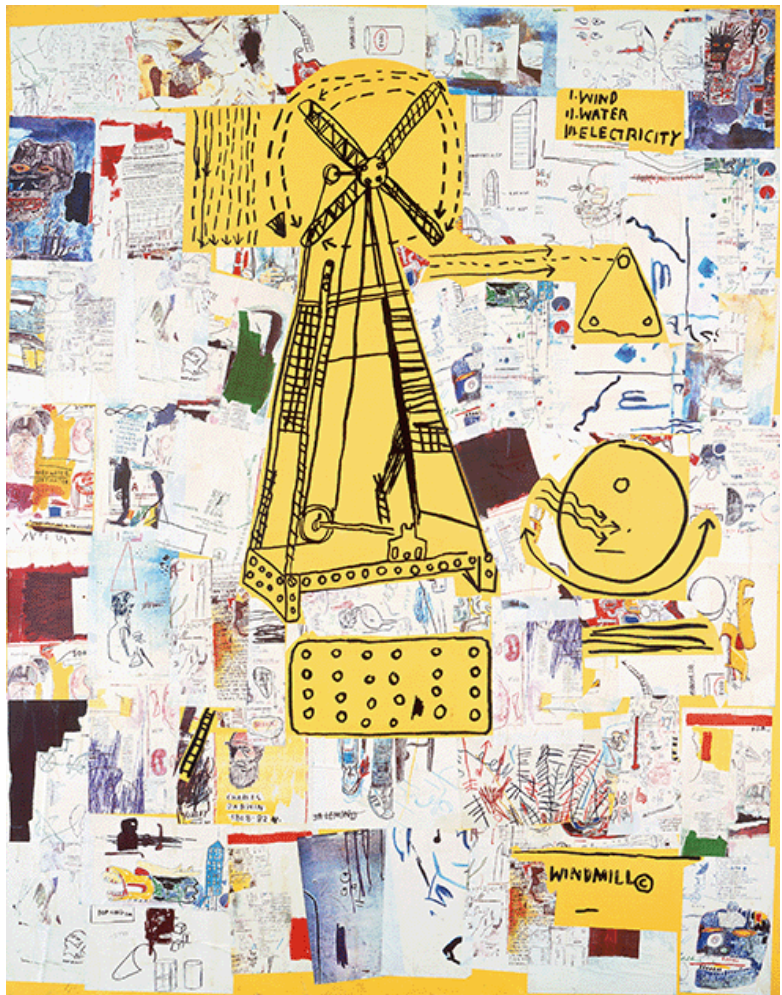
Jean-Michel Basquiat, QUIJ, 1985, Private Collection. Image: ADAGP Images, Paris / SCALA, Florence, Artwork: Artwork: © The Estate of Jean-Michel Basquiat / ADAGP, Paris and DACS, London 2022
At the lower right corner, the work is titled with the subject matter and trademarked with the copyright ©, a signal to the artist’s origins as a graffiti artist of the streets of New York City under the moniker SAMO © (short for ‘same old’). Executed after Basquiat’s first gallery representation with Annina Nosei in 1981 and his first solo exhibition in early 1982 at her eponymous SoHo gallery, Windmill supercedes the peak of his career. Basquiat became the youngest artist to exhibit in documenta at the 7th edition in Kassel, West Germany, alongside artist’s such as Georg Baselitz and Alberto Burri. It was during this time, the artist had access to the tools and studio space which afforded him the freedom to produce the monumental masterpieces which define this seminal year.
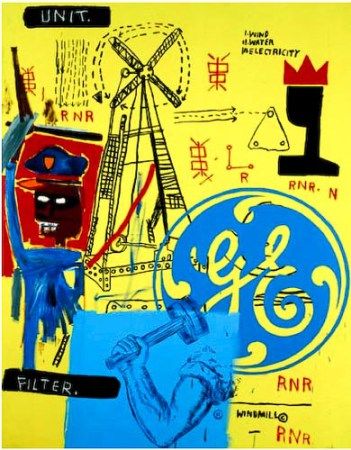
Windmill proved to be an important piece of work for Basquiat because it forms the basis for two large-format paintings. The first, Unit Filter GE, is key example of the works Basquiat created in collaboration with Andy Warhol at the suggestion of Bruno Bischofberger. Windmill is reproduced on an astringent yellow ground, overpainted with Basquiat’s capped figure on the left and black bust adorned with the artist’s iconic three-pointed crown. In the centre, Warhol’s contribution is a salute to his legacy as the founder of Pop Art with a pristine rendering of the logos of two ubiquitous American brands, General Electric and Arm and Hammer. In QUIJ from 1985, Basquiat revisited Windmill alone, this time making the drawing centre stage, encircled by colour Xerox prints depicting of careful selection of his earlier pictures. The work exemplifies a more retrospective moment in the artist’s career, as Basquiat could reflect on the stratospheric success of the early 80s and in which Windmill plays a central role.
Untitled, 1987
Sotheby’s New-York: 8 December 2021
Estimated: USD 1,000,000 – 1,500,000
USD 1,532,500
JEAN-MICHEL BASQUIAT
Untitled, 1987
Wax crayon on paper
29.5 x 22.2 inches (74.9 x 56.5 cm)
Executed at the apex of Jean-Michel Basquiat’s career, Untitled offers a glimpse into the artist’s energetic, imaginative and ingenious mind. The present work illustrates a vibrant symphony of densely layered motifs and symbols that have come to characterize Basquiat’s diverse practice. Untitled from 1987 is a masterly combination of symbols, words, and small figures that are instantly recognizable features of Basquiat’s oeuvre. Different from his paintings, the frenetic energy of Basquiat’s works on paper are unique in their raw immediacy that pave the way for his creative genius to shine through in an unaltered fashion.
Hong Kong, 1985
Christie’s Hong-Kong: 2 December 2021
Estimated: HKD 4,500,000 – 6,500,000
HKD 4,375,000 / USD 561,372
JEAN-MICHEL BASQUIAT (1960-1988), Hong Kong | Christie’s (christies.com)
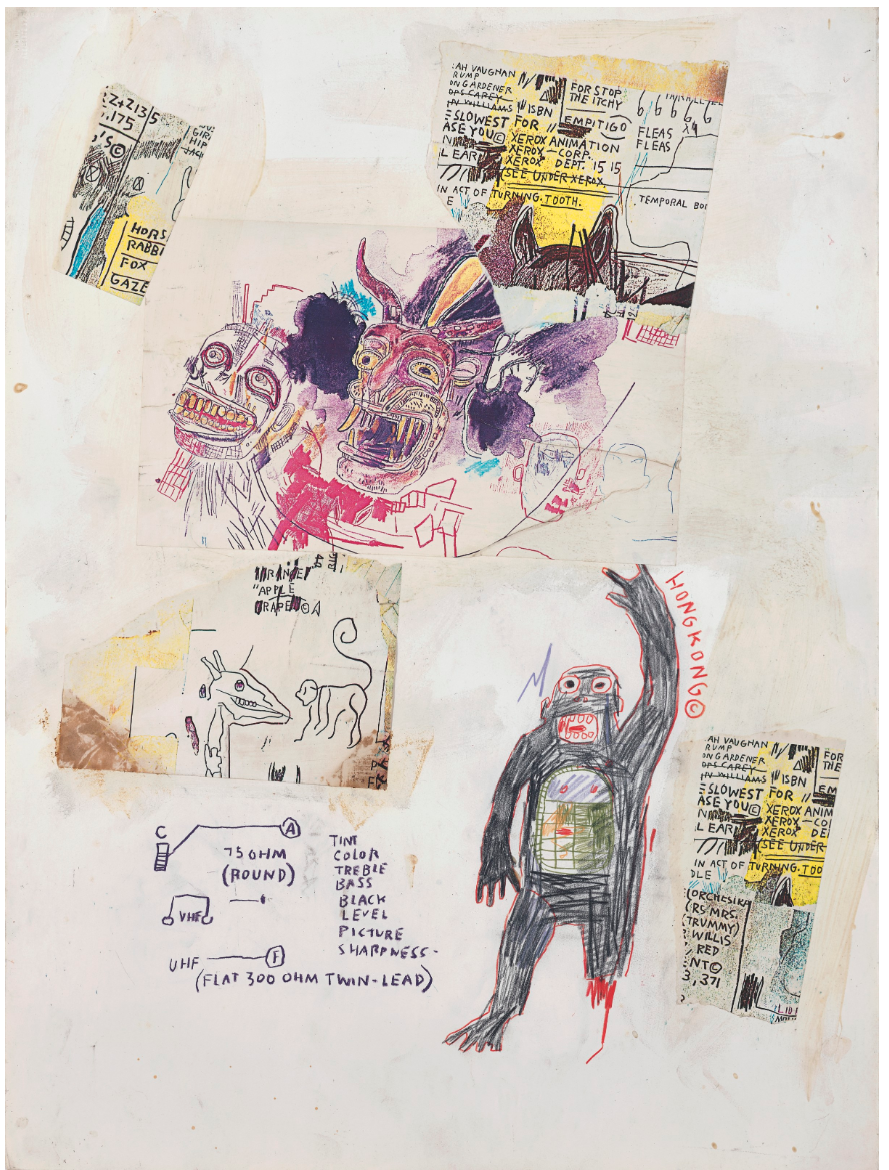
JEAN-MICHEL BASQUIAT (1960-1988)
Hong Kong, 1985
Graphite, colored pencil and Xerox collage on paper
30 x 22 1/2 inches (76×57 cm)
Signed with artist’s signature and dated ‘85′ (on the reverse)
Painted the year he visited the city, Hong Kong documents Jean Michel-Basquiat’s perception of the journey in April 1985. During that time, the rising star of the contemporary art world travelled with Michael Chow, a socialite in art and the owner of the upmarket restaurant chain in multiple cities. Centering the work are two gnarling heads depicted in the artist’s iconic anatomical style that resemble lion dance, a form of local traditional dance in lion costume to bring good luck and fortune. With the copyright symbol on King Kong, this not only labeled the figurine exclusive to Basquiat, but perhaps also signified the work as his memory and experience in the exotic city that no one else could “copy”.
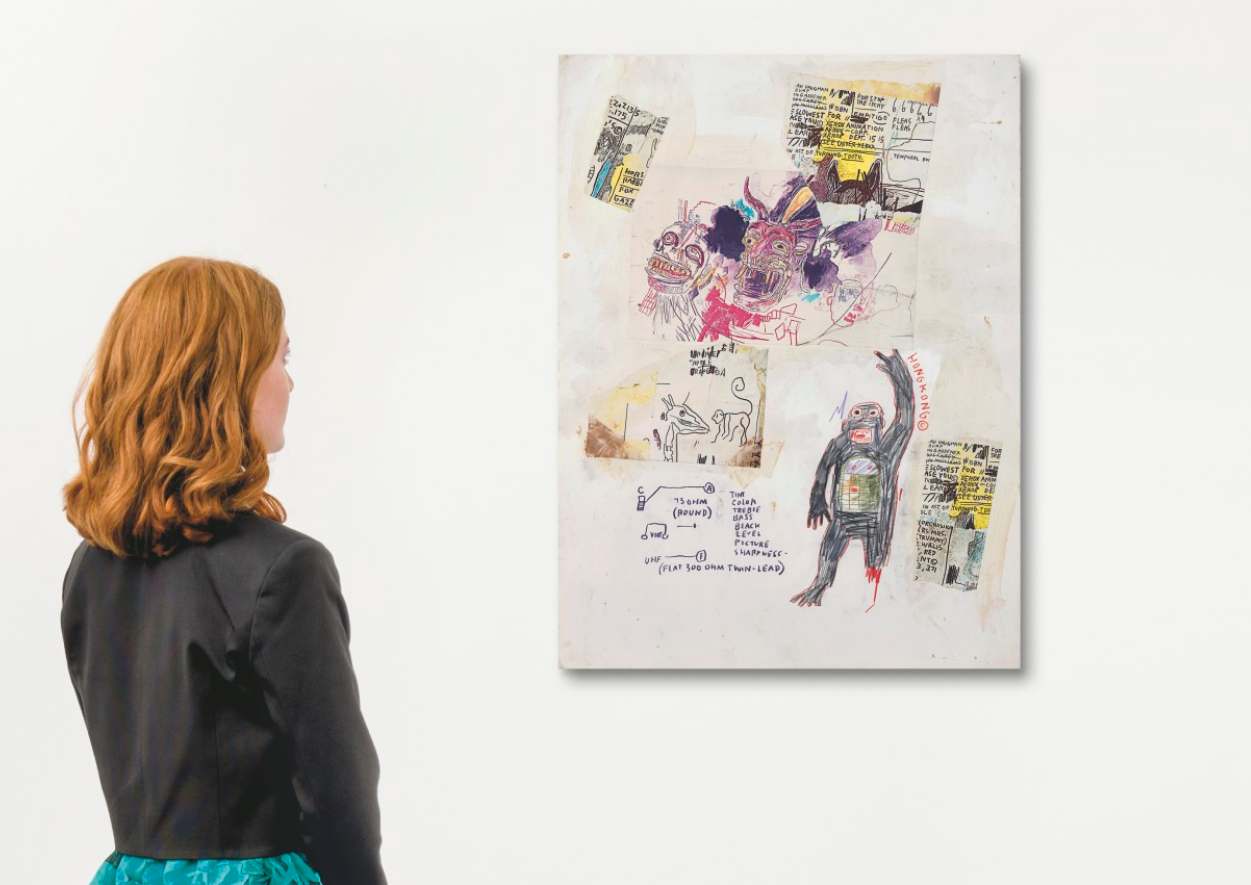
The 1980s was the golden age for Hong Kong film and Cantopop, and Basquiat was very likely to have experienced parts of it during the two-week visit. In the lower left corner of Hong Kong, the artist scribbled references of mass culture: the unreadable electronic circuit symbols, a series of words, like treble, picture, and sharpness, that associate with TV user manual, as well as the acronyms “UHF” and “VHF” that can be identified with radio, which was the main music streaming site back then. Chow recounted in an interview about the trip and this work, “he always picked up local culture… he recorded everything with his drawings, and Hong Kong was somewhere that was very exotic for him, so he automatically picked these objects.”
Editions
Back of the Neck, 1983
Sotheby’s London: 25 March 2021
Estimated: GBP 350,000 – 450,000
GBP 801,500
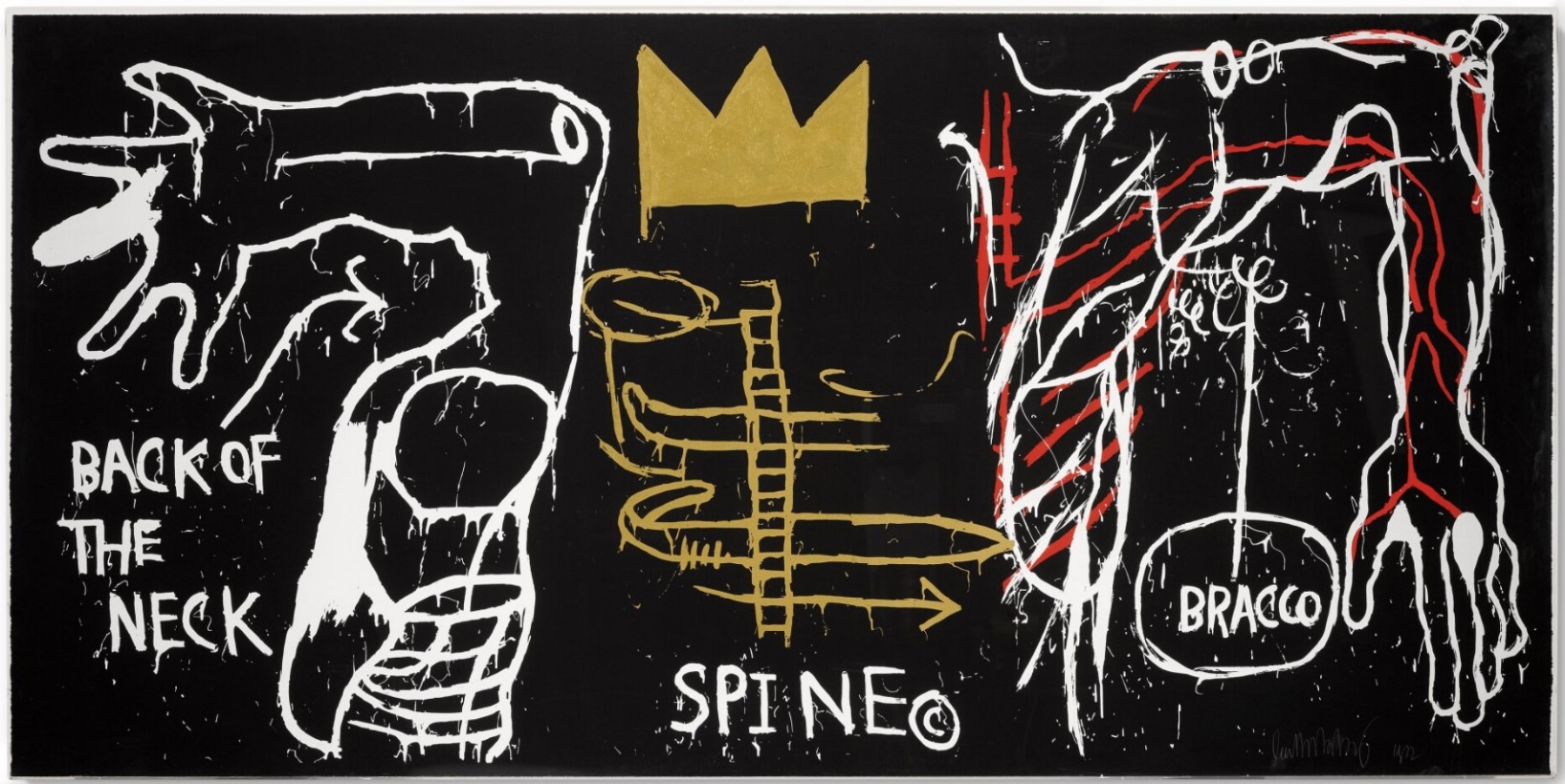
JEAN-MICHEL BASQUIAT (1960 – 1988)
Back of the Neck, 1983
Color screen-print with hand painting
50 1/8 x 101 7/8 inches (127.3 x 258.4 cm)
Signed and dated 1983; numbered 3/24 on the reverse
This work is number 3 from an edition of 24 plus 3 artist’s proofs
Executed in 1983 and part of a rare and monumental screen print edition by Jean-Michel Basquiat, Back of the Neck is replete with the artist’s hallmark iconography. One of only a handful of editioned screenprints produced by the artist in his lifetime, Back of the Neck brims with the dazzling graphic force of Basquiat’s obsession with anatomical imagery. In harmony with each other, ardent bodily sketches, the three-pointed crown, the copyright symbol and Basquiat’s idiosyncratic handwriting are here emblazoned across a monumental picture plane. Utterly epitomising Basquiat’s iconography, a work from the very same edition is housed in the permanent collection of The Brooklyn Museum, New York, while another example was included in the Guggenheim’s landmark exhibition Basquiat’s ‘Defacement’: The Untold Story in 2019.
Untitled (from Tuxedo), circa 1983
Phillips New-York: 14 May 2025
Estimated: USD 20,000 – 30,000
USD 342,900
Jean-Michel Basquiat Modern & Contemporary Art Day Sale, Morning Session
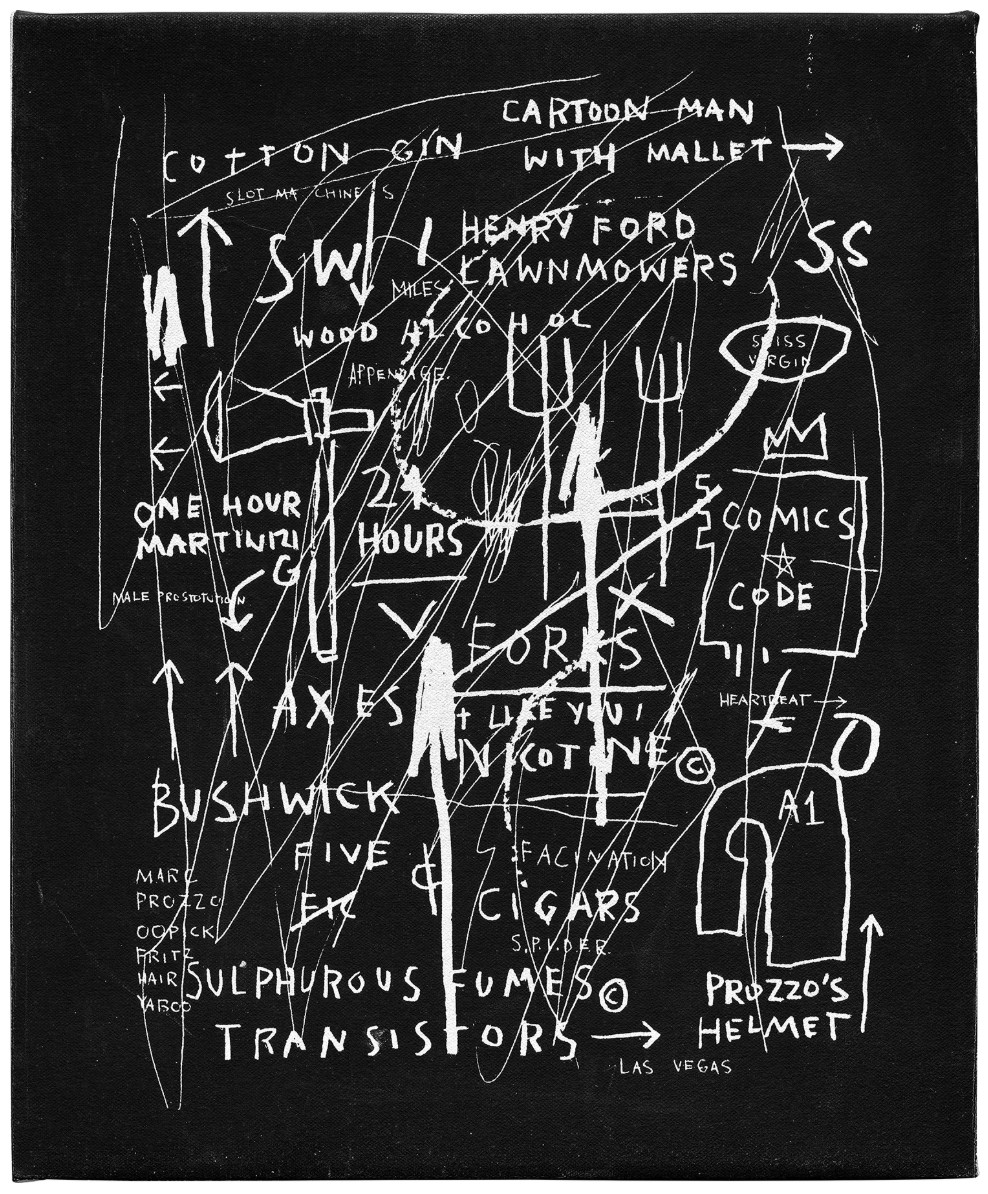
Untitled (from Tuxedo), circa 1983
Silkscreen on canvas
Created circa 1983, Jean-Michel Basquiat’s Untitled (from Tuxedo) is a small test that the artist made when creating Tuxedo, a monumental silkscreen on canvas work printed in an edition of 10. These “tests” are akin to prototypes, in which Basquiat explored the various placements of his screened text and imagery for the large-scale work. The present lot and the larger Tuxedo embody the artist’s connections to the graffiti and street scenes of downtown New York in the 1980s, frequent subjects within the artist’s oeuvre. This canvas was formerly in the collection of Joel Stearns, a printer who frequently collaborated with Basquiat on his silkscreened editions, including Tuxedo.
Heads
Untitled (Head), 1982
Sotheby’s New-York: 29 June 2020
Estimated: USD 9,000,000 – 12,000,000
USD 15,184,900
JEAN-MICHEL BASQUIAT (1960 – 1988)
UNTITLED (HEAD), 1982
Oilstick, ink and acrylic on paper
29 3/4 x 22 inches (75.6 x 55.9 cm)
Executed in 1982, Untitled (Head) is an explosion of vivid color and frenzied mark making which stands as one of the most accomplished of Basquiat’s iconic ‘Head’ paintings. Enduring as both idiosyncratic self-portraits and skull-like talismanic icons, the single ferocious figures revealed in works such as Untitled (Head) prevailed as a key conceptual anchor for Basquiat throughout his career, appearing in and dominating the majority of his best-known masterworks. Remarkable for its fierce intensity, arresting coloration and visceral aesthetic impact, Untitled (Head) is a supreme masterpiece that embodies the overwhelming power of Basquiat’s creative insurgency. Encapsulating the incredible dexterity and draftsmanship that defines the very best of the artist’s works, and extraordinary for its use of India ink under the oilstick to lend depth and contrast to the composition, Untitled (Head) is a heroic depiction that reflects the explosive talent and brilliance of its author. Itis an iconic work, as vivid and alive now as it was at the moment of execution.
The intensity and dynamism of Untitled (Head) are largely indebted to Basquiat’s instinctive and idiosyncratic mastery of line. All the artist’s most celebrated works, whether ‘Heads’, ‘Warriors’ or text heavy masterpieces such as Hollywood Africans, are defined by his use of oilstick. Basquiat was always drawing, whether he was working on paper or canvas, and it is as a function of this that his works on paper became a cornerstone of his practice. From 1983, as collage became one of his principal media, Xerox-ed drawings from his studio would become the substrate for his paintings. Rather than studies for his paintings, Basquiat’s drawings were literally foundational to his practice, and would provide the stimulus needed to work on a larger scale. This reliance on drawings as a source of inspiration is further evidenced by his retention of several pivotal works on paper in his own collection until his untimely death in 1988. This group, which included the present work, were exhibited together in his celebrated posthumous show at Robert Miller Gallery in 1990, the show that cemented the reputation of Basquiat’s works on paper as a pivotal part of his oeuvre.
Untitled, 1982
Christie’s New-York: 11 May 2015
Estimated: USD 9,000,000 – 12,000,000
USD 13,605,000
Jean-Michel Basquiat (1960-1988) (christies.com)
JEAN-MICHEL BASQUIAT (1960-1988)
Untitled, 1982
Oilstick and ink on paper
42 3/4 x 30 3/8 inches (108.6 x 77.2 cm)
Jean-Michel Basquiat’s frenzied and electric Untitled of 1982 depicts one of the artist’s most celebrated themes, rendered in rapid-fire execution in dynamic slashes of red, blue and black oilstick. The human head is among Basquiat’s most autobiographical subjects, which he obsessively explored particularly during the pivotal year of 1982. His depiction here is violently slashed and scribbled in a seemingly feverish attempt to produce on paper the inner workings of his own mind, which is especially felt in the jutting red slashes that seem to burst forth from the totemic figure’s head and neck. The work belongs to a series of heads from 1982, many of which can be regarded as self-portraits that were executed at a crucial moment in the artist’s meteoric rise to fame. Untitled bears witness to Basquiat’s humble origins as the street artist SAMO, yet it also displays the sophistication that, by this stage in his short but brilliant career, had already made him the undisputed star of the New York art world.
Untitled, 1983
Christie’s New-York: 13 May 2014
Estimated: USD 6,000,000 – 8,000,000
USD 7,445,000
Jean-Michel Basquiat (1960-1988) (christies.com)
JEAN-MICHEL BASQUIAT (1960-1988)
Untitled, 1983
Oilstick on paper
42 1/2 x 30 1/4 inches (107.9 x 76.8 cm)
With his signature quick-fire execution, Jean-Michel Basquiat assembles a dramatic series of lines, marks and gestures to produce this energetic self-portrait. The artist often worked at great speed, disgorging his thoughts onto the graphic surface with great force and vigor. In Untitled, he effortlessly shifts between passages of exacting detail–painstakingly worked to conjure up the features he desires–to more inscrutable zones where only the slightest of references are made to actual objects, the rest being left for the viewer to decipher. This rapidity is also evident in the unworked sections of the sheet, which includes traces of an imprint of Basquiat’s sneaker as well as being filled with the vestige of the artist’s oilstick that trails in the wake of his swiftly moving hand. Executed in 1983 at the height of the artist’s career, this work still bears witness to Basquiat’s humble origins as the street artist SAMO, yet it also displays the sophistication that, by this stage in his short but meteoric career, had already made him the undisputed star of the New York art world.
Untitled (Head), 1982
Sotheby’s New-York: 16 May 2019
Estimated: USD 3,000,000 – 4,000,000
USD 4,100,000
(#8) JEAN-MICHEL BASQUIAT | Untitled (Head) (sothebys.com)
JEAN-MICHEL BASQUIAT
Untitled (Head), 1982
Ink and oilstick on paper
30×22 inches (76.2 x 55.9 cm)
Inscribed BASQ-0799 on the reverse
Bursting forth in a fury of radiant color and ferocious mark making, Untitled (Head) from 1982 is a compelling testament to Jean-Michel Basquiat’s singular and hyper-individualized mastery of expressionistic portraiture. A paradigmatic example of the artist’s most iconic motif, the skull-like visage of the present work is utterly mesmerizing in its emotive intensity; fixing the viewer with the ferocious gaze of its yellow almond eyes, the face demands recognition of Basquiat’s instinctive abilities as one of the greatest draughtsman of the Twentieth Century. In its searing and totemic rendering of a head, Untitled (Head) numbers among a seminal group of intensely worked and re-worked portrayals of skeletal craniums that the young artist created as, at the start of 1982, he began his extraordinary ascent to the highest echelons of Contemporary art. Within this rarified corpus, the present work is remarkable for its large size, electrifying use of color, and exceptional diversity of mark-making; rendered in brilliant crimson and orange pigment overlaid with furious incisions of inky black, the frenzied intensity of Basquiat’s variegated strokes is contained only by the arresting confidence of his bold oilstick outline. As a testament to the importance of the 1982 head studies, at the time of Basquiat’s death in 1988, no fewer than twenty-seven of the studies remained in the artist’s personal collection. Two years later, these compelling drawings – including the present work – were presented in the seminal exhibition Jean-Michel Basquiat Drawings at Robert Miller Gallery in 1990 where, hung salon style upon a single wall, they served as irrefutable testament to the gravity and intent with which the artist approached his works on paper. Rendered with ferocious intensity, the strident strokes of Basquiat’s preferred oilstick resolve to reveal a figure that, by sheer painterly force alone, utterly refutes the two dimensionality of the page. Executed in the early months of 1982, Untitled (Head) exemplifies a selection of drawings that, in their haunting and unique renderings of skull-like heads, represent a pivotal moment within the young artist’s developing practice. Concentrated against the stark white of the paper, each of these free-floating heads independently stands as a remarkable work within Basquiat’s oeuvre; while most share the physiognomy of searing eyes and bared teeth which typify his iconic warrior figure, each sheet is irrefutably distinct, confronting the viewer with a compelling cast of fully realized personas.
Brown Eggs, 1981
Sotheby’s New-York: 14 November 2019
Estimated: USD 2,500,000 – 3,500,000
USD 5,389,500
(#22) JEAN-MICHEL BASQUIAT | Brown Eggs (sothebys.com)
JEAN-MICHEL BASQUIAT
Brown Eggs, 1981
Oilstick on paper
24 1/4 X 18 inches (61.6 x 45.7 cm)
Titled; signed on the reverse
Rendered with ferocious intensity, the searing figurehead of Brown Eggs is a riveting embodiment of the instinctive and unrivalled brilliance which distinguished Jean-Michel Basquiat from the earliest years of his career. Executed in 1981, Brown Eggs exemplifies a selection of drawings that, in their haunting and unique renderings of skull-like heads, powerfully embody the extraordinary intensity, focus, and drive which fueled Basquiat at this pivotal moment in his burgeoning career. Within this rarefied corpus, the present work is remarkable for its saturated surface and exceptional diversity of mark-making; rendered in layers of furiously scrawled hazel and orange pigment, overlaid with furious incisions of black, scarlet, yellow, and blue, the frenzied intensity of Basquiat’s variegated strokes is contained only by crisp boundary of the sheet itself. Scrawled below the glowering figure, the inscribed title is irresistibly enigmatic, suggesting loaded commentary while evading clear translation. Vibrantly and densely-layered, the frenetic collision of mark, color, word, and form is, within Basquiat’s drawing, somehow transformed into a singularly sizzling composition that exemplifies the young artist’s effortless creative genius.
Figures
Furious Man, 1982
Christie’s New-York: 15 May 2013
Estimated: USD 1,000,000 – 1,500,000
USD 5,723,750
Jean-Michel Basquiat (1960-1988) (christies.com)
JEAN-MICHEL BASQUIAT (1960-1988)
Furious Man, 1982
Oilstick, acrylic, wax crayon and ink on paper
30×22 inches (76.2 x 55.8 cm)
Emphasizing the frantic discharge of Jean-Michel Basquiat’s distinct expressive power, Furious Man is haunted by the artist’s idiosyncratic dark skeletal figure, which emerges from a golden blaze onto a flat sea of gray with his ghostly face, illuminated halo, and upraised arms. With its heavy application of materials and the ink exploding off the paper, the raw energy and urban-primitive aesthetic of Furious Man mockingly assumes the mantle of the noble-savage that Basquiat himself tried to break away from, and stands out as the artist’s ultimate critique of the constitution of black identity at the peak of his creative powers. Characteristically aggressive, in Basquiat’s faux-naïve style, the gaunt figure appears as an energetic, even frantic, caricature of the artist himself; a projection of Basquiat’s fears, anxieties, and rebellious rage. Equally empowered and bewildered, with sunken bloodshot eyes, and short electrified hair atop a skull-like head, Furious Man evokes a potent sense of panic at the immediate prospect of danger. Set against a background of scattered lines, rudimentary patterns, scribbles, stars and geometrical shapes, the psychological chaos characterizing the figures mental state is made all the more evident.
Ribs Ribs, 1982
Christie’s New-York: 15 May 2013
Estimated: USD 3,000,000 – 5,000,000
USD 5,163,750
Jean-Michel Basquiat (1960-1988) (christies.com)
JEAN-MICHEL BASQUIAT (1960-1988)
Ribs Ribs, 1982
Oilstick on paper
97 x 95 3/4 inches (243.2 x 246.3 cm)
Signed Jean Michel Basquiat (lower right)
As one of the largest works on paper that Jean-Michel Basquiat ever executed, Ribs Ribs is an early example of the artist’s unique and remarkable style. Self-restrained, yet bursting with a diverse range of rich iconographic details, this monumental drawing demonstrates Basquiat’s incessant thirst for knowledge as he draws together and then disseminates his diverse range of interests including science, politics, childhood superheroes and his own rich cultural heritage. Leading the composition is Basquiat’s figure of a caped man, commanding yet also enigmatically transparent, his stylized rib cage clearly visible beneath the folds of his red and blue cape and re-enforced by the words RIBS RIBS written on either side of his sternum. In the figure’s left hand is a mace-like object, a piece of ancient weaponry that was often studded with sharp pieces of metal and used by foot soldiers to attack an enemy but is now more commonly used as a symbol of authority, as in the Parliamentary Mace used in the British House of Commons. In his other hand, the figure is holding a large bone, plucked from a row of four that Basquiat draws to his right. Topping off the composition, the figures wears a ‘crown of thorns’–a halo of light that hovers majestically above the figure’s head. Rendered in Basquiat’s distinctive schizophrenic style, parts of the composition are sparingly laid down whilst others are heavily rendered in primary colored oil paintstick. The rapid pace at which the artist works is driven by the speed of his thoughts as witnessed by the feverish renderings of the red and blue cape and the exquisite, more considered, detailing of the face. These are then complimented by a series of simple line drawings, giving the painting a more measured sense of balance.
Untitled, 1982
Christie’s New-York: 10 July 2020
Estimated: USD 3,000,000 – 5,000,000
USD 4,928,500
Jean-Michel Basquiat (1960-1988) (christies.com)
JEAN-MICHEL BASQUIAT (1960-1988)
Untitled, 1982
Oil pastel and wax crayon on paper
30 1/8 x 22 1/4 inches (76.5 x 56.5 cm)
Signed with the artist’s initials ‘JMB’ (lower right)
An electrifying vision dating from the height of Jean-Michel Basquiat’s meteoric rise to fame, Untitled is an extraordinary work that showcases the virtuosic force of his graphic practice. Ablaze with fiery orange tones, a maniacal figure looms large, his red-cloaked hand outstretched against the void. His eyes swirl like kaleidoscopes; his mouth hangs open in ecstasy, revealing scant rows of colored teeth. Skeletal lines quiver like x-rays, while sparks and stars circle his head as if reeling from a knock-out. Rich swathes of pink and yellow create a vibrant backdrop, punctuated with lines and symbols that explode into space like fireworks. Rendered with all the chromatic and textural drama of an oil painting, the work demonstrates the vast, ambitious range of Basquiat’s draughtsmanship in the heady early stages of his career. Multiple influences collide: from the works of Pablo Picasso and Egon Schiele, to the drawings of Leonardo da Vinci, ancient cave art, comics and anatomical textbooks. Loosely suggestive of Basquiat’s self-image, it is a vivid portrait of his creative process, conjuring the raw carnal energy with which he channeled his whirring imagination. Other elements of the artist’s symbolic universe shift in and out of focus: the messianic crown of thorns, the saintly halo and, perhaps, the glory of the boxing ring. It is a testament to the multiple personas—hero, martyr, victim and victor—through which he would present himself to the world.