This auction season generated over USD 2.1 billion in revenues through the sale of 1,518 lots spread across 8 evening sales, and 8-day sales organized by Christie’s, Sotheby’s and Phillips. This compares to USD 1.8 billion generated in May 2023 through the sale of 1,980 lots.
TOTAL: USD 2,133,870,728
1,518 Lots
Sell-Through: 83.1%
Table of Contents
1. Summary Results
2. Top 10 Lots
3. Top 10 Artists
4. Sotheby’s Auctions
5. Christie’s Auctions
6. Phillips Auctions
1. Summary Results
TOTAL: USD 2,133,870,728
1,518 Lots
Sell-Through: 83.1%
This auction season generated over USD 2.1 billion in revenues through the sale of 1,518 lots spread across 8 evening sales, and 8-day sales organized by Christie’s, Sotheby’s and Phillips. This compares to USD 1.8 billion generated in May 2023 through the sale of 1,980 lots, and to USD 3.2 billion achieved in November 2022 (the sale of the Paul Allen Collection contributed over USD 1.6 billion that season).
1. Sotheby’s
Total: USD 1,098,629,821
728 Lots
Sell-Through: 83.2%
Thanks to the sale of the Emily Fisher Landau Collection Sotheby’s emerges as the winner of this Marquee auction season in New-York with 40.3% market share. Sotheby’s scored the highest day sales totals this season. It was the first billion-dollar week since May 2022, and Sotheby’s realized its third highest marquee week total in the auction house’s 279-year history.
The Emily Fisher Landau Collection: An Era Defined Evening Auction
USD 406,422,100 / 31 Lots
The Emily Fisher Landau Collection: An Era Defined Day Auction
USD 18,307,536 /80 Lots
Modern Evening Auction
USD 223,335,300 /31 Lots
The Now Evening Auction
USD 55,198,350 /18 Lots
Contemporary Evening Auction
USD 250,514,100 /43 Lots
Modern Day Auction
USD 62,571,575 /260 Lots
Contemporary Day Auction
USD 82,280,860 /265 Lots
2. Christie’s
Total: USD 860,843,252
559 Lots
Sell-Through: 83.6%
Christie’s achieved the highest total for an evening sale this season with its 20th Century evening sale totaling over USD 640 million. With substantially less lots sold that Sotheby’s, and without any headline private collection announced, Christie’s managed to set 16 new artists’ auction records including for Joan Mitchell, Fernando Botero, Richard Diekenborn.
21st Century Evening Sale
USD 107,451,800 / 39 Lots
2oth Century Evening Sale
USD 640,846,000 / 61 Lots
Post War and Contemporary Art Day Sale
USD 66,582,610 / 220 Lots
Impressionist and Modern Works on Paper
USD 10,670,504 / 80 Lots
Impressionist and Modern Art Day Sale
USD 35,292,338 / 159 Lots
3. Phillips
Total: USD 174,397,655
231 Lots
Sell-Through: 81.9%
Phillips realized USD 108 million in May 2023. The third global auction house has substantially increased its foothold in the art world, this year the sale of the Triton Foundation collection brought over USD 80 million to its total turnover.
Living the Avant-Garde: The Triton Foundation Collection
USD 84,719,440 / 30 Lots
20th Century and Contemporary Art Evening Sale Part II
USD 69,930,350 / 24 Lots
20th Century and Contemporary Art Day Sale Morning Session
USD 11,388,725 / 95 Lots
20th Century and Contemporary Art Day Sale Afternoon Session
USD 8,359,140 / 82 Lots
4. Price Segmentation
264 Lots sold over USD 1 million
Turnover: USD 1,892,887,900
88.7% of Total
This compares to 244 lots (USD 1.3 billion / 71.6% of total) in May 2023, and to 336 lots (2.99 billion / 94% of total) in November 2022.
31 Lots sold over USD 10 million
Turnover: USD 1,263,245,900
59.2% of Total
This compares to 37 lots (USD 830 million / 45.2% of total) in May 2023, and to 54 lots (1.9 billion / 60% of total) in November 2022.
8 Lots sold over USD 40 million
Turnover: USD 484,313,500
22.7% of Total
This compares to 5 lots (USD 248 million / 13.8% of total) in May 2023.
2. Top 10 Lots
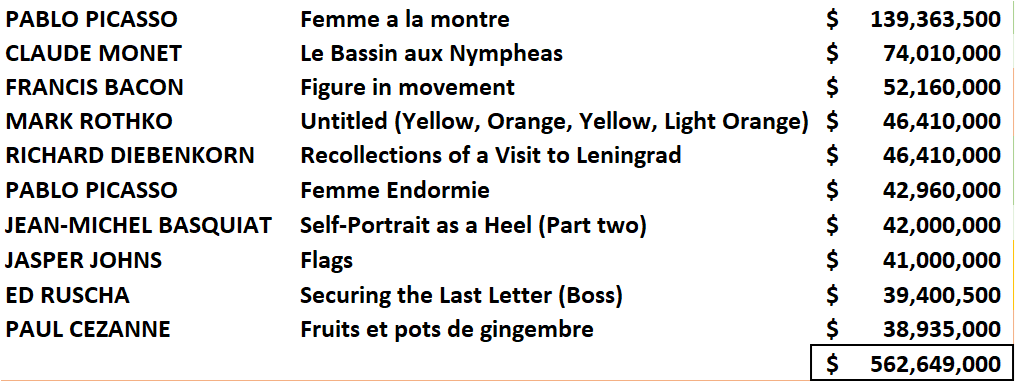
The top 10 lots sold contribute USD 562,649,000 to the total or 26.4% of total. Pablo Picasso, with two lots included in the Top 10, contributes one third in value.
#1. Pablo Picasso
Sotheby’s New-York: 8 November 2023
Estimate Upon Request
USD 139,363,500
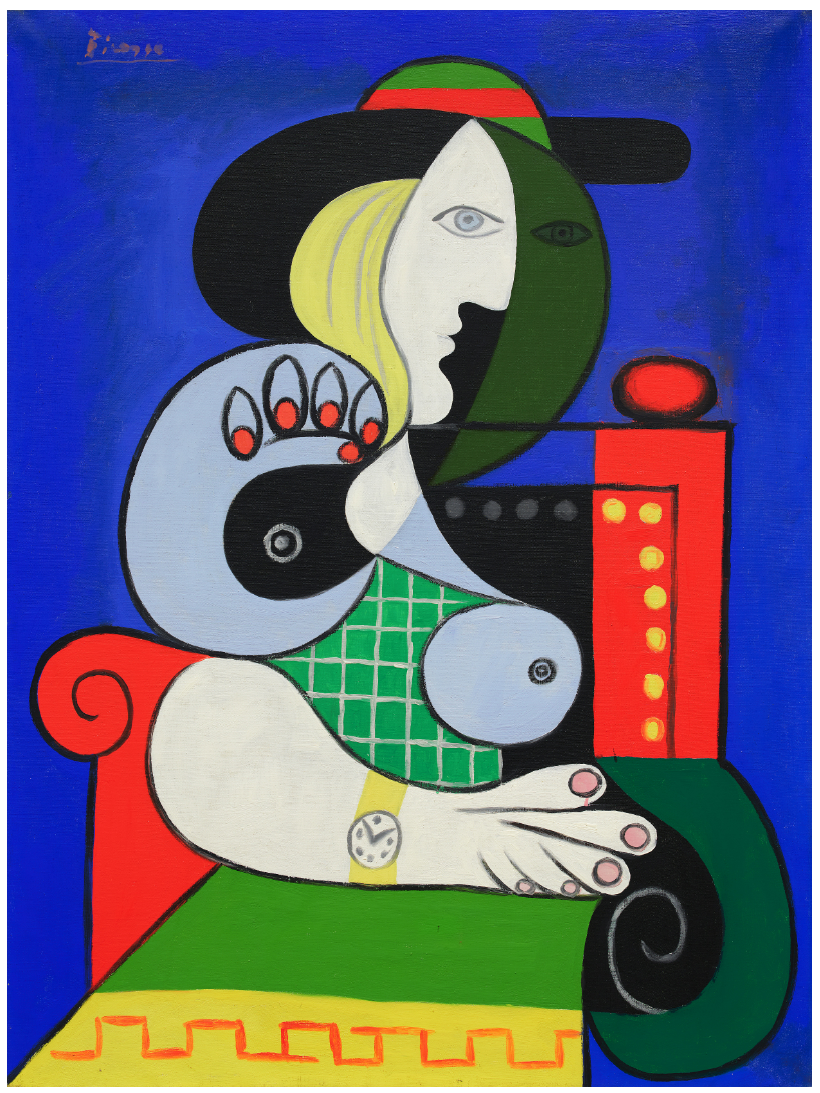
PABLO PICASSO (1881 – 1973)
Femme à la montre, 1932
Oil on canvas
130×97 cm (51 1/8 x 38 1/8 inches)
Signed Picasso (upper left)
Inscribed Boisgeloup and dated 17 Août XXXII. (on the stretcher)
Executed on 17 August 1932
#2. Claude Monet
Christie’s New-York: 9 November 2023
Estimate on Request
USD 74,010,000

CLAUDE MONET (1840-1926)
Le bassin aux nymphéas, 1917-1919
Oil on canvas
100.1 x 200.6 cm (39 3/8 x 78 7/8 inches)
Stamped with signature ‘Claude Monet’ (Lugt 1819b; lower right)
Stamped again with signature ‘Claude Monet’ (Lugt 1819b; on the reverse)
#3. Francis Bacon
Christie’s New-York: 9 November 2023
Estimate On Request
USD 52,160,000
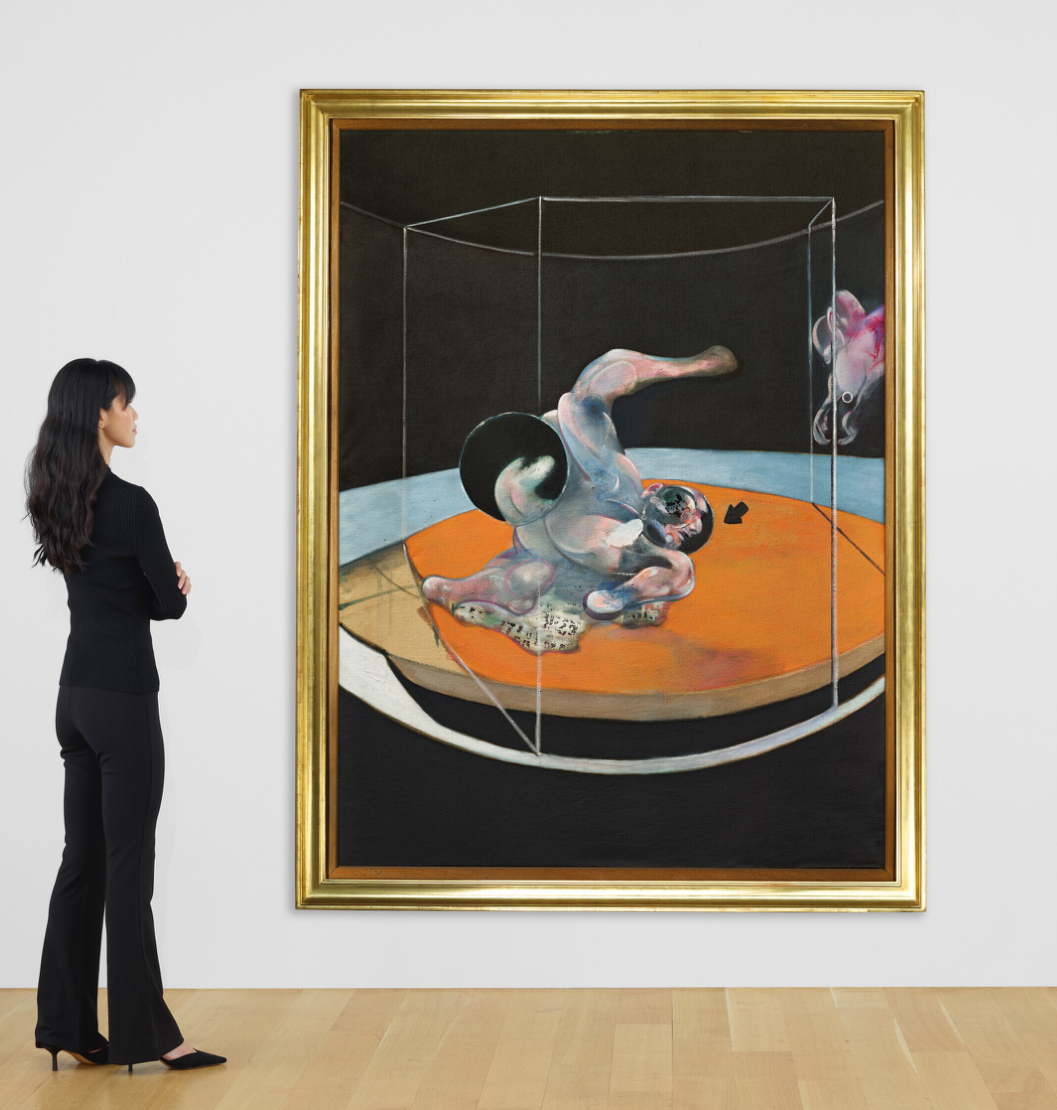
FRANCIS BACON (1909-1992)
Figure in Movement, 1976
Oil and dye transfer lettering on canvas
78 1/4 x 58 inches (198.9 x 147.3 cm)
Signed and dated ‘Francis Bacon 1976’ (on the reverse)
#4. Richard Diebenkorn
Christie’s New-York: 9 November 2023
Estimate On Request
USD 46,410,000
NEW WORLD RECORD FOR THE ARTIST
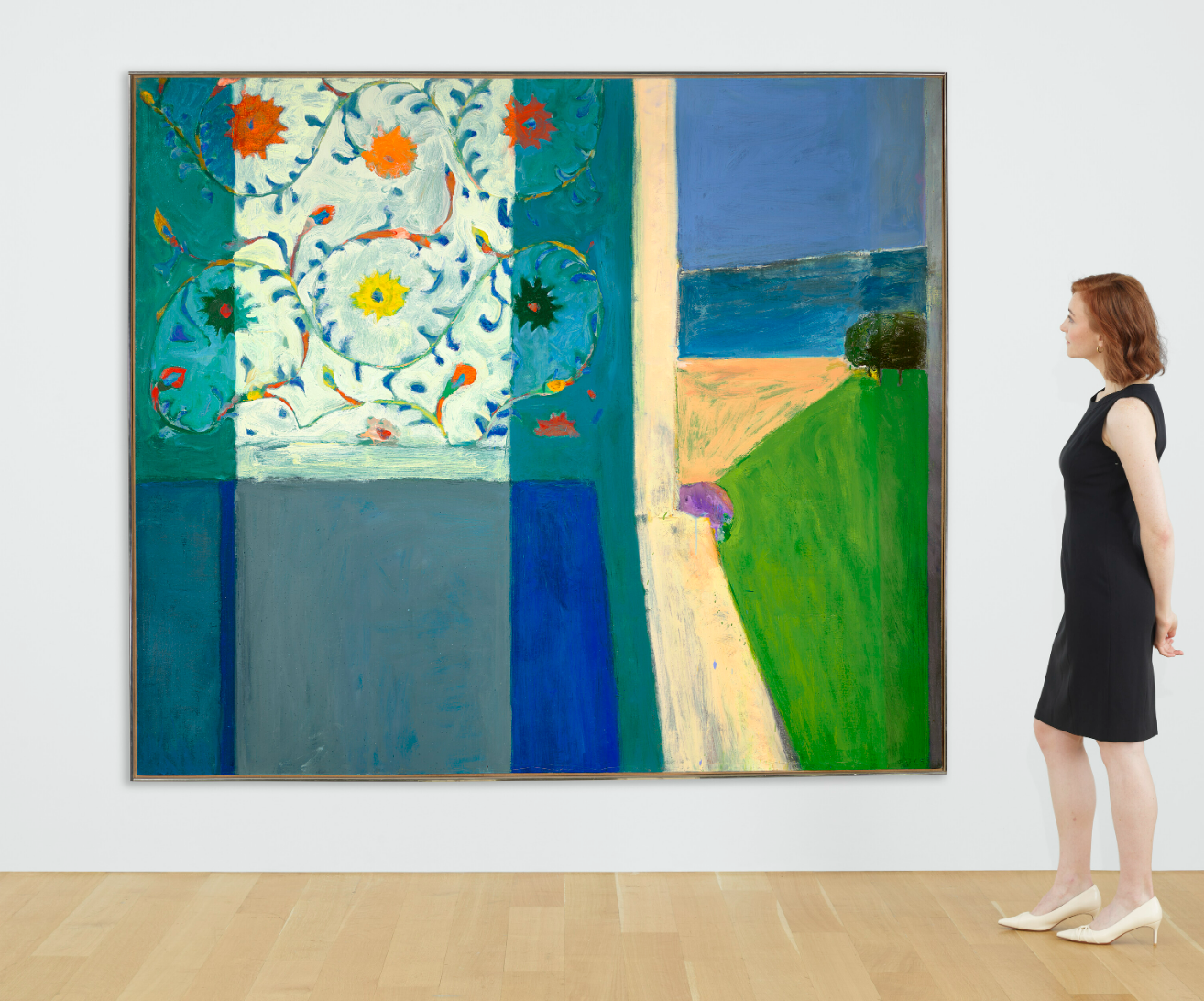
RICHARD DIEBENKORN (1922-1993)
Recollections of a Visit to Leningrad, 1965
Oil on canvas
71 3/8 x 83 1/8 inches (181.3 x 211.1 cm)
Signed with the artist’s initials and dated ‘RD 65’ (lower right)
#5. Mark Rothko
Christie’s New-York: 9 November 2023
Estimate on Request
USD 46,410,000
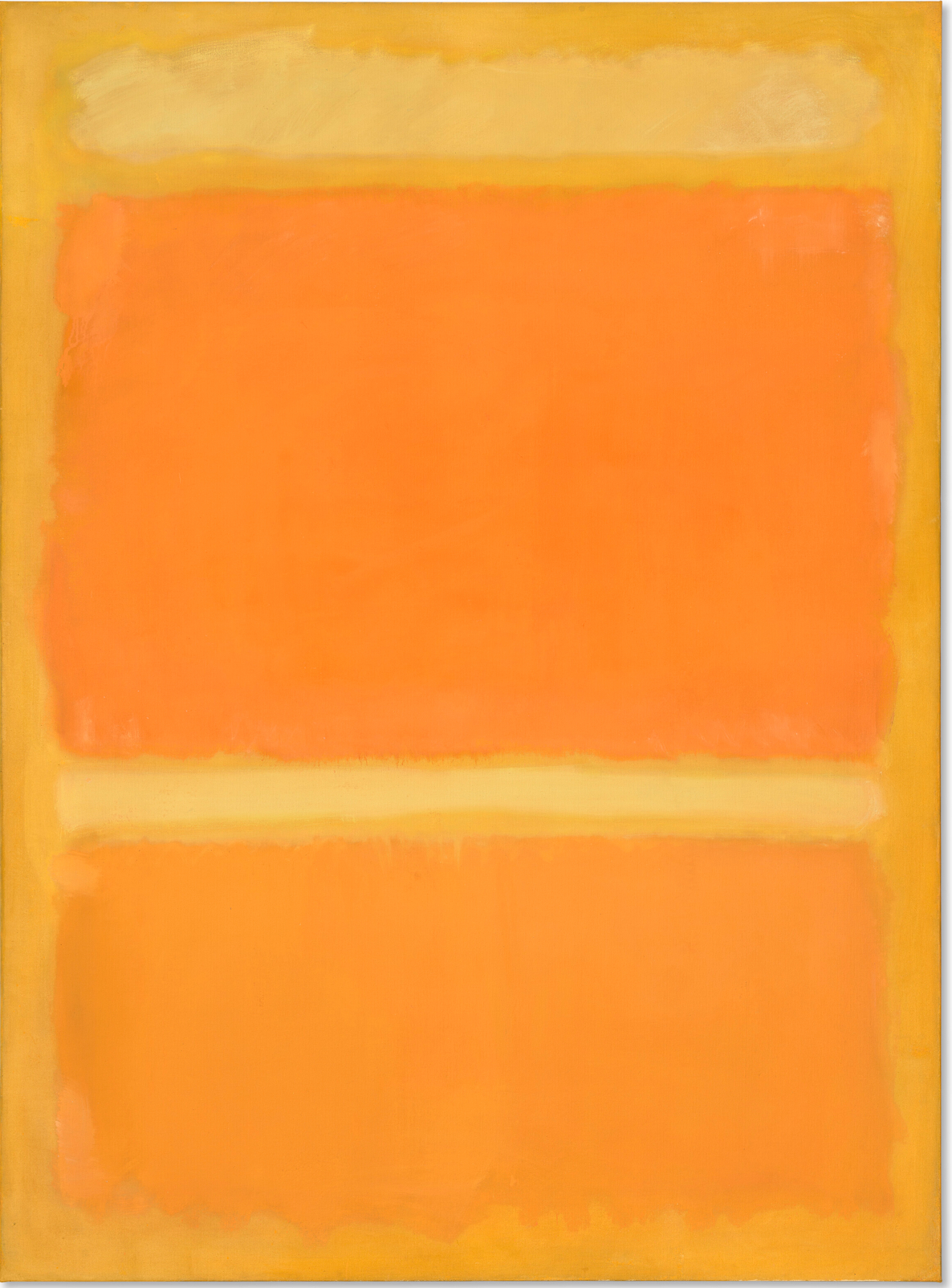
MARK ROTHKO (1903-1970)
Untitled (Yellow, Orange, Yellow, Light Orange), 1955
Oil on canvas
81 1/2 x 60 inches (207 x 152.5 cm)
Signed and dated ‘MARK ROTHKO 1955’ (on the reverse)
#6. Pablo Picasso
Christie’s New-York: 9 November 2023
Estimated: USD 25,000,000 – 35,000,000
USD 42,960,000
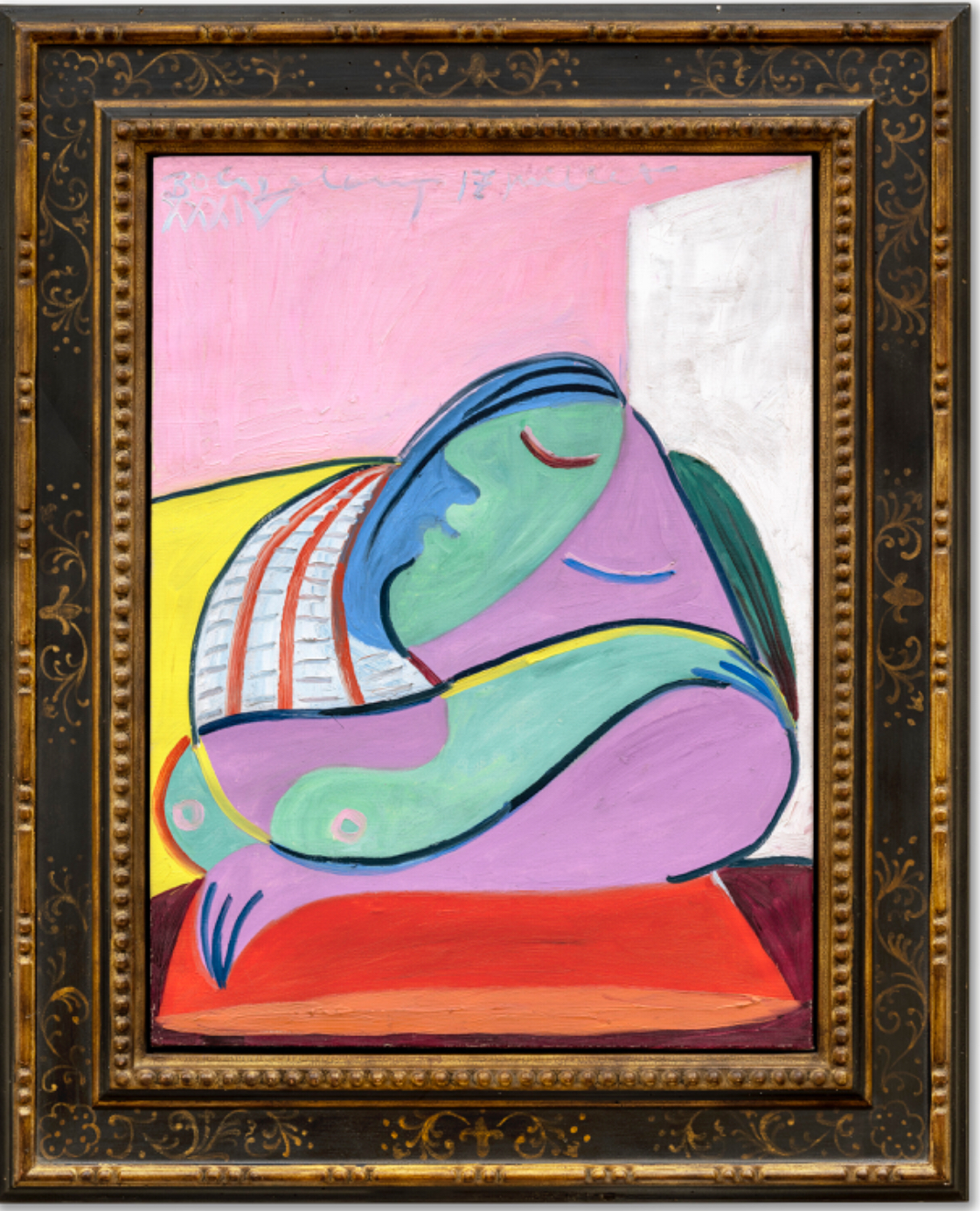
PABLO PICASSO (1881-1973)
Femme endormie, 1934
Oil on canvas
72.4 x 54 cm (28 1/2 x 21 1/4 inches)
Dated and inscribed ‘Boisgeloup 17 Juillet XXXIV’ (upper left)
#7. Jean-Michel Basquiat
Sotheby’s New-York: 15 November 2023
Estimated: USD 40,000,000 – 60,000,000
USD 42,000,000
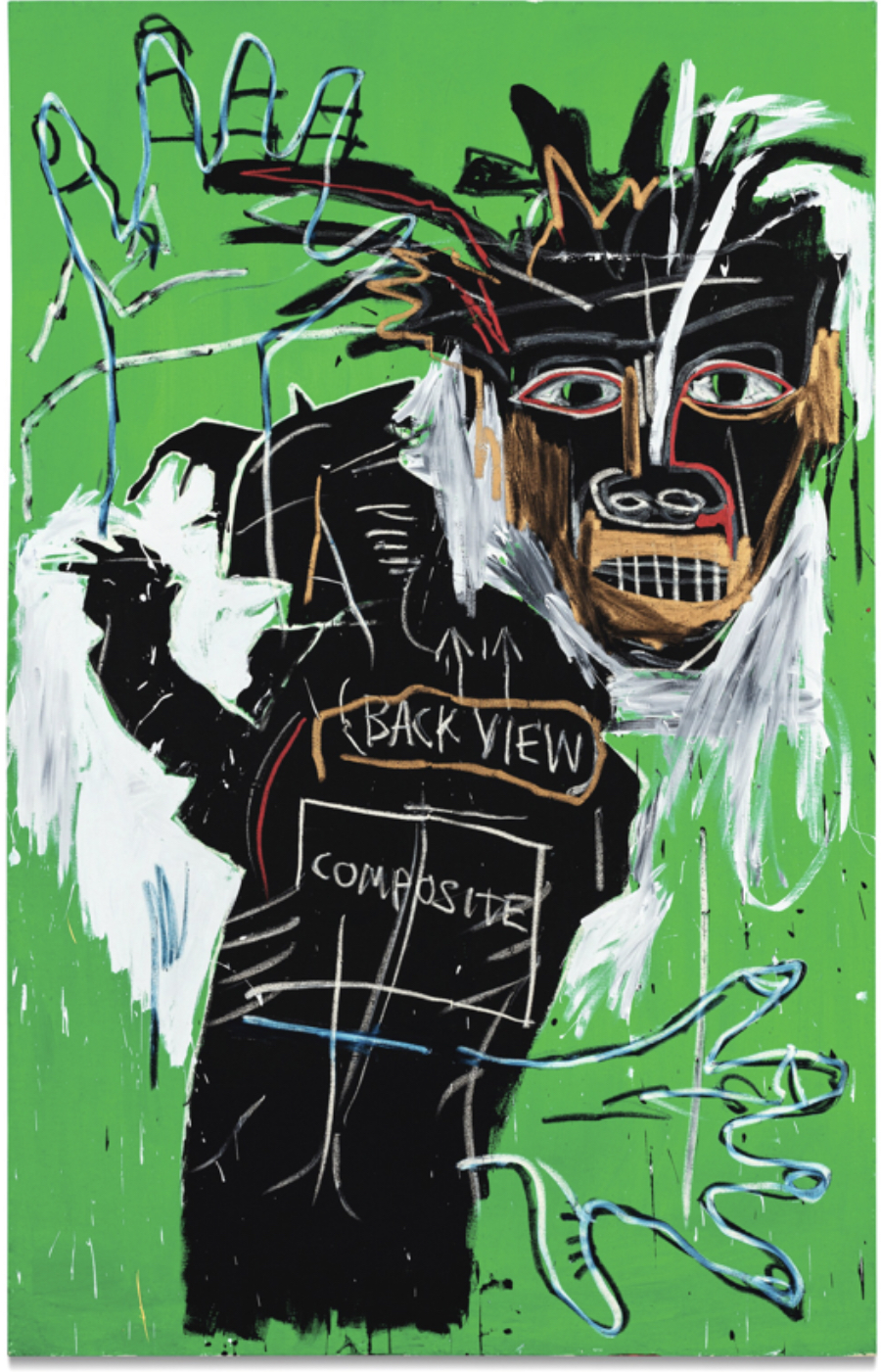
JEAN-MICHEL BASQUIAT (1960 – 1988)
Self-Portrait as a Heel (Part Two), 1982
Acrylic and oilstick on canvas
96 x 61 1/2 inches (243.8 x 156.2 cm)
Signed, titled, dated 1982 and variously inscribed (on the reverse)
#8. Jasper Johns
Sotheby’s New-York: 8 November 2023
Estimated: USD 35,000,000 – 45,000,000
USD 41,000,000
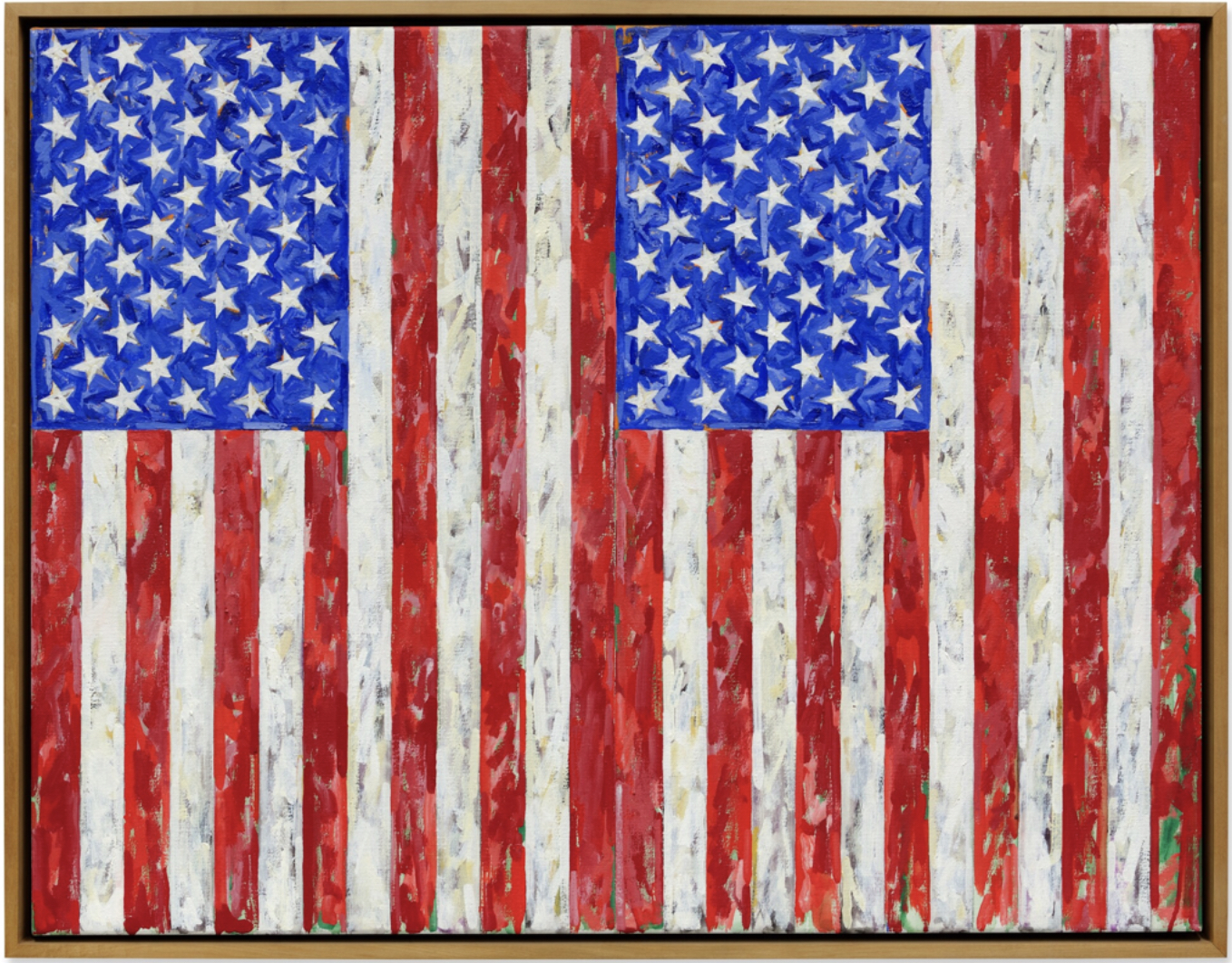
JASPER JOHNS (b. 1930)
Flags, 1986
Oil on canvas
25 5/8 x 33 1/8 inches (65 x 84.1 cm)
Signed, dated 1986 and variously inscribed (on the reverse)
#9. Ed Ruscha
Sotheby’s New-York: 8 November 2023
Estimated: USD 35,000,000 – 45,000,000
USD 39,400,500
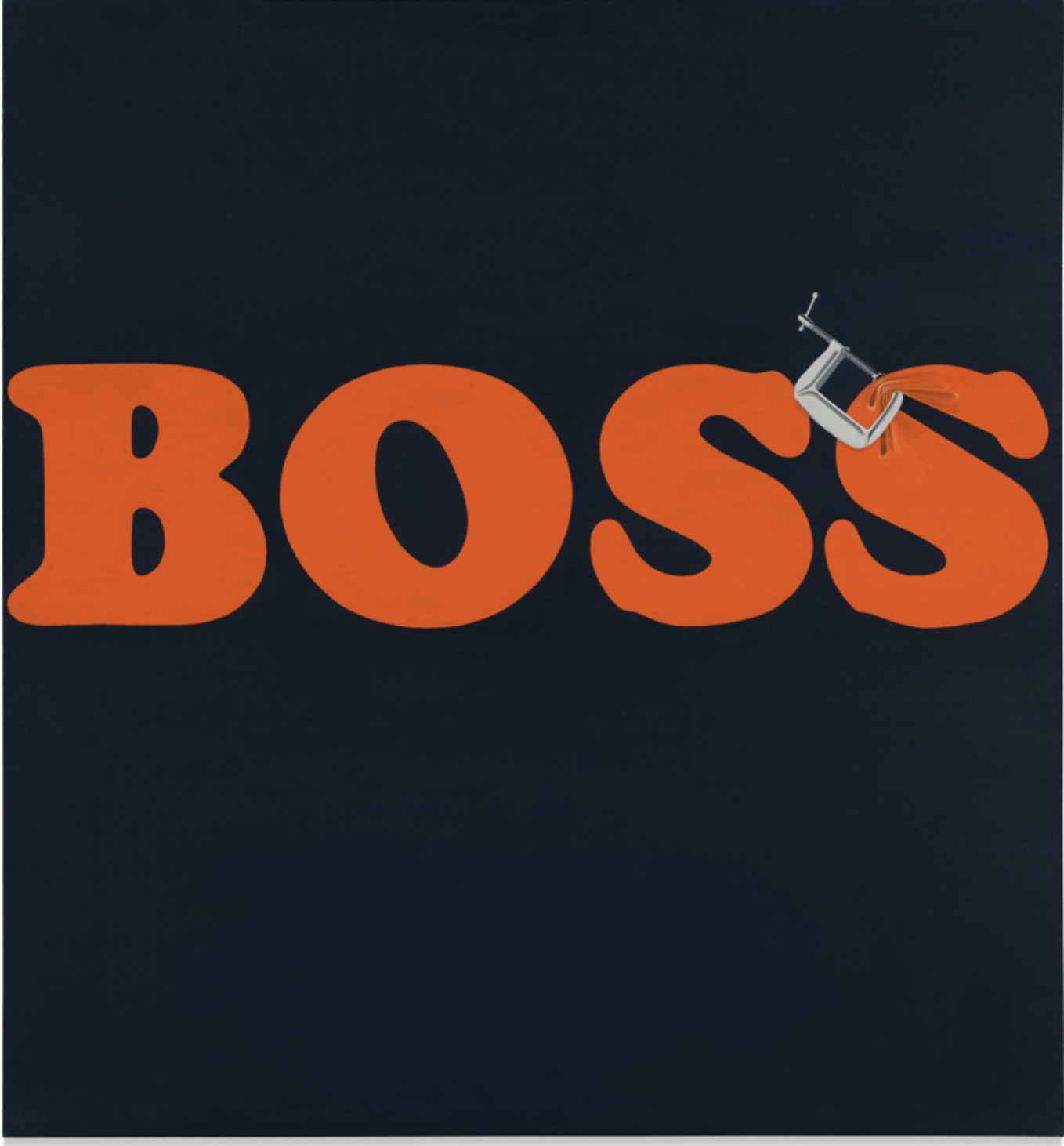
ED RUSCHA (b. 1937)
Securing the Last Letter (Boss), 1964
Oil on canvas
59 x 55 1/8 inches (149.9 x 140 cm)
Signed, titled and dated 1964 (on the stretcher)
#10. Paul Cezanne
Christie’s New-York: 9 November 2023
Estimated: USD 35,000,000 – 55,000,000
USD 38,935,000
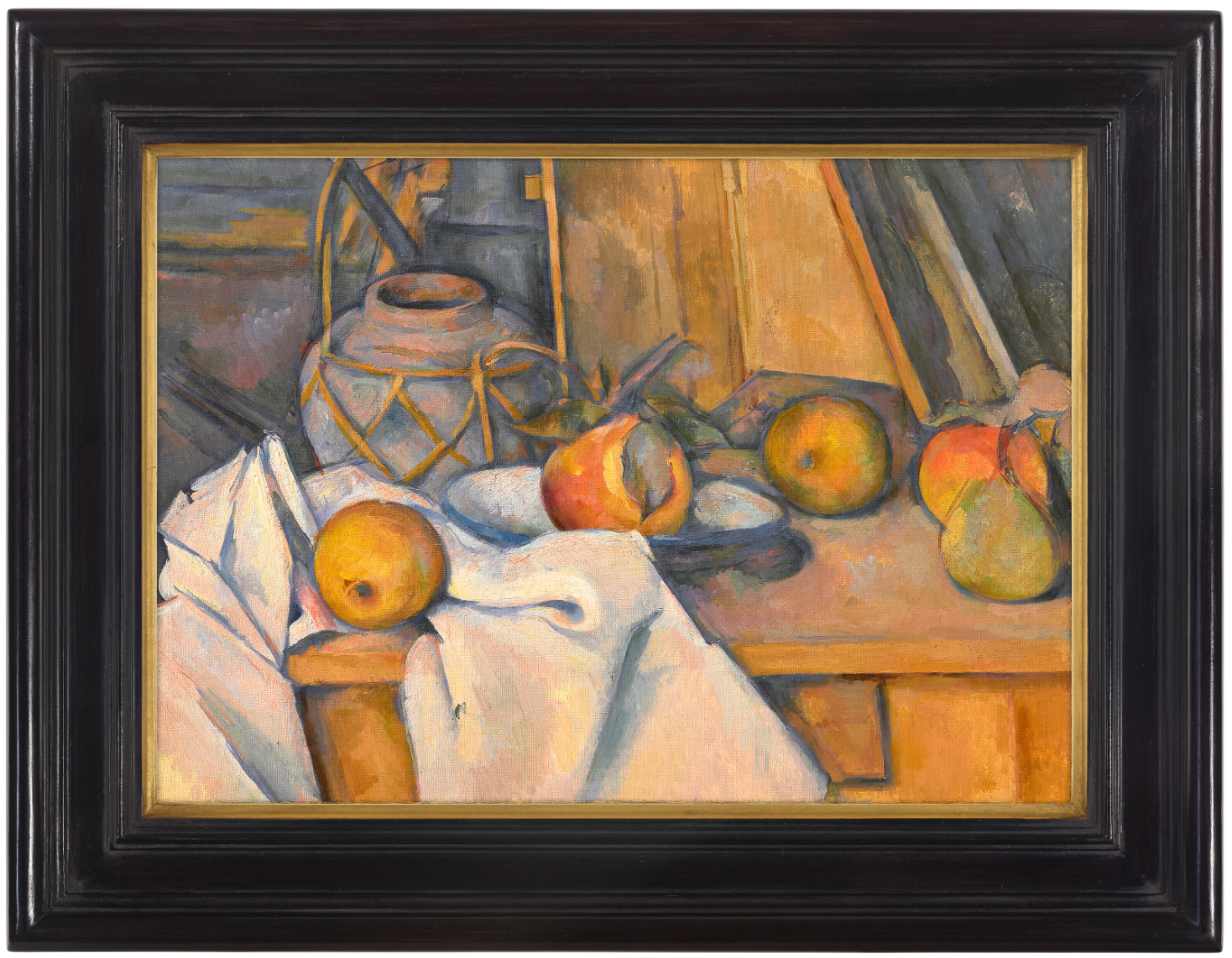
PAUL CEZANNE (1839-1906)
Fruits et pot de gingembre, 1890-1893
Oil on canvas
33.4 x 46.6 cm (13 1/8 x 18 3/8 inches)
Painted in 1890-1893
3. Top 10 Artists
#1. Pablo Picasso
Pablo Picasso is bar far the winner of this auction season with 12 paintings sold for a total turnover of USD 261 million.
12 Lots sold
Turnover: USD 261,073,000
#1. Femme à la montre, 1932
Sotheby’s New-York: 8 November 2023
Estimate Upon Request
USD 139,363,500
PABLO PICASSO (1881 – 1973)
Femme à la montre, 1932
Oil on canvas
130×97 cm (51 1/8 x 38 1/8 inches)
Signed Picasso (upper left)
Inscribed Boisgeloup and dated 17 Août XXXII. (on the stretcher)
Executed on 17 August 1932
#2. Femme endormie, 1934
Christie’s New-York: 9 November 2023
Estimated: USD 25,000,000 – 35,000,000
USD 42,960,000
PABLO PICASSO (1881-1973)
Femme endormie, 1934
Oil on canvas
72.4 x 54 cm (28 1/2 x 21 1/4 inches)
Dated and inscribed ‘Boisgeloup 17 Juillet XXXIV’ (upper left)
#3. Compotier et guitare, 1932
Sotheby’s New-York: 13 November 2023
Estimate on Request
USD 23,463,500
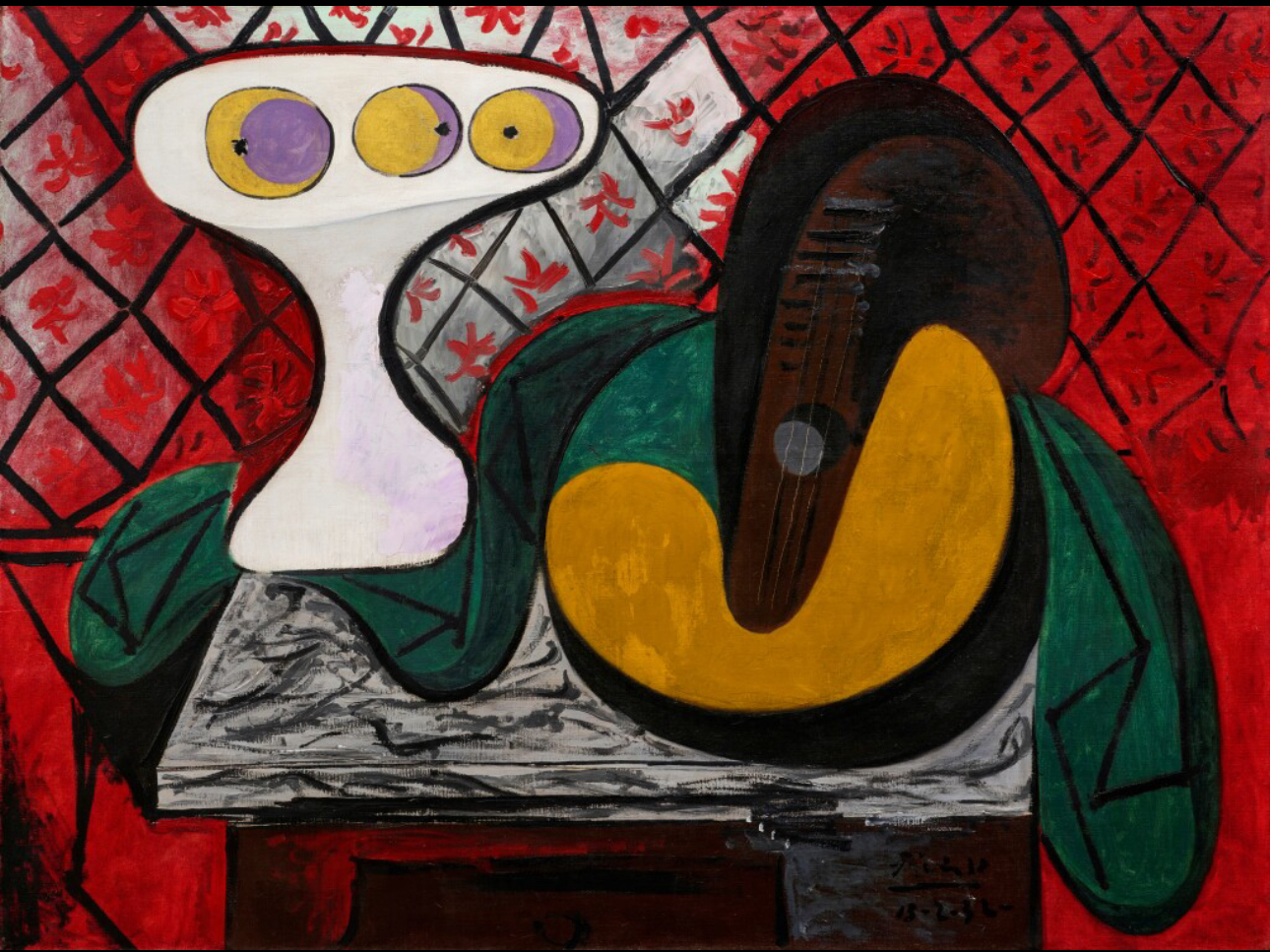
PABLO PICASSO (1881 – 1973)
Compotier et guitare, 1932
Oil on canvas
97.1 x 130.1 cm (38 1/4 x 51 1/4 inches)
Signed Picasso and dated 13.2.32 (lower right); dated and titled (on the stretcher)
#4. Femme en corset lisant un livre, 1914-1918
Phillips New-York: 14 November 2023
Estimated: USD 15,000,000 – 20,000,000
USD 14,762,500
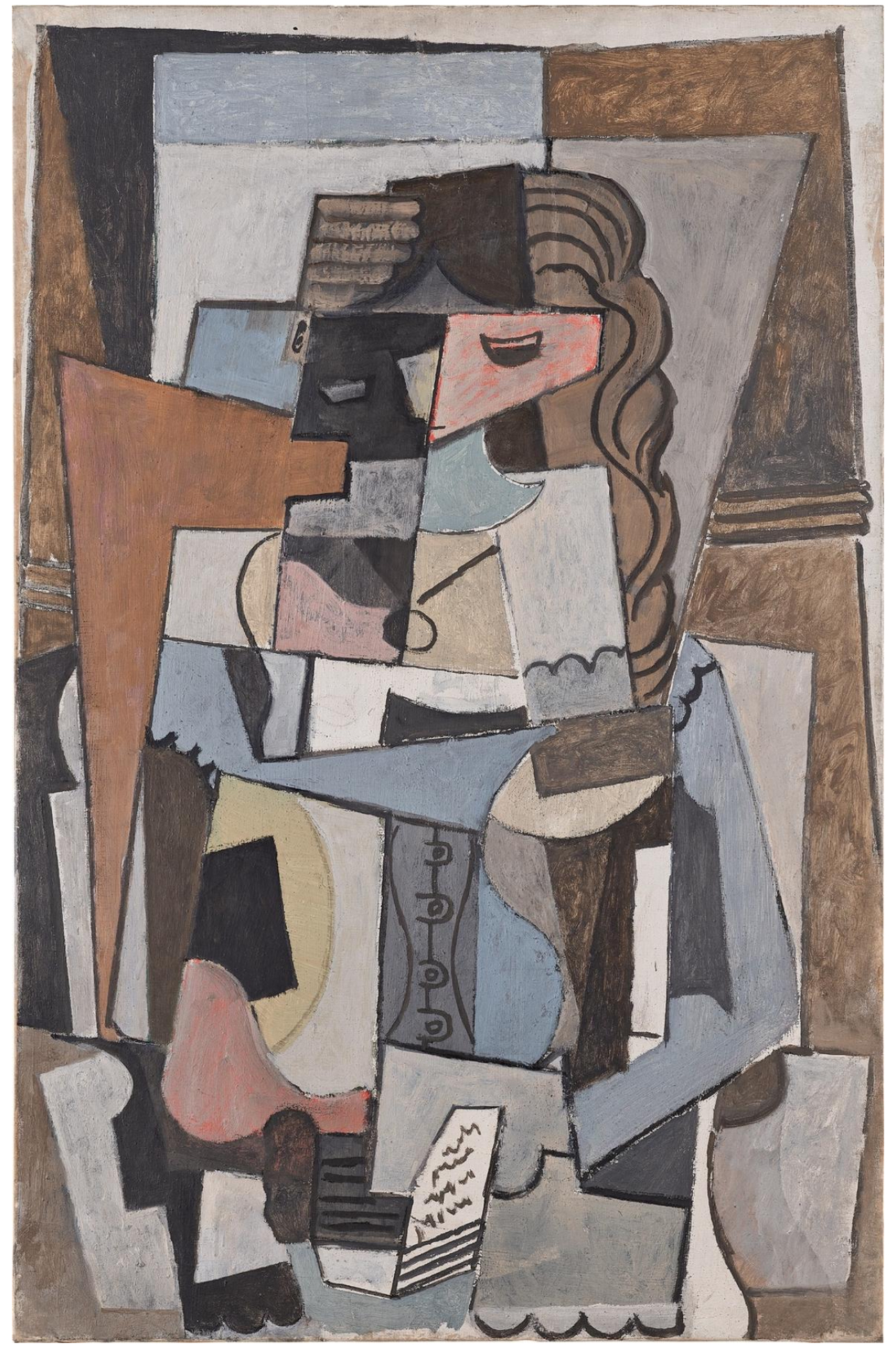
PABLO PICASSO
Femme en corset lisant un livre, 1914-1918
Oil and sand on canvas
91.8 x 60.3 cm (36 1/8 x 23 3/4 inches)
#5. Nu couché, 1968
Christie’s New-York: 9 November 2023
Estimated: USD 10,000,000 – 15,000,000
USD 13,635,000
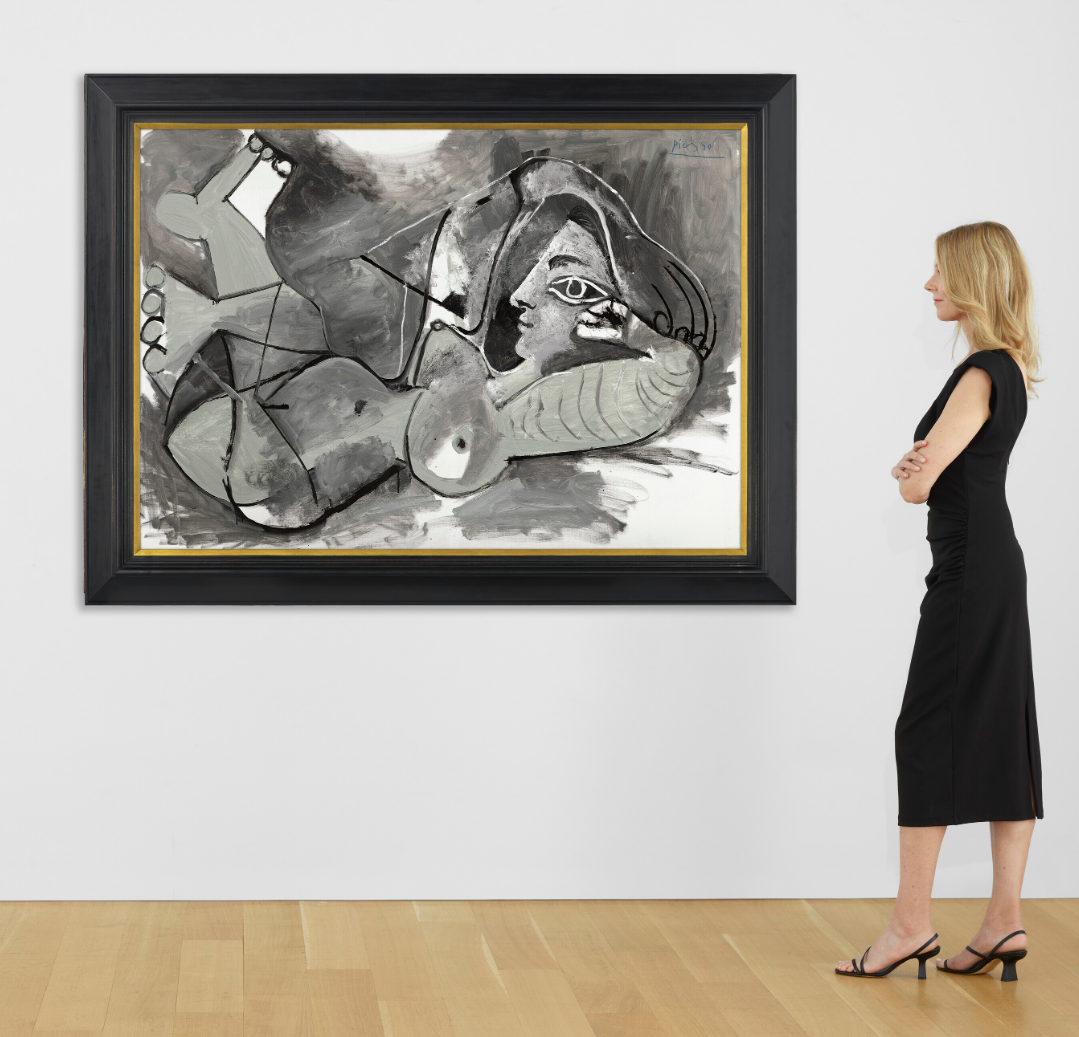
PABLO PICASSO (1881-1973)
Nu couché, 1968
Oil and Ripolin on canvas
114 x 162.5 cm (44 7/8 x 63 5/8 inches)
Signed ‘Picasso’ (upper right); dated and numbered ‘13.10.68. II’ (on the reverse)
#2. Claude Monet
Claude Monet, with USD 150.6 million in turnover through the sale of 6 paintings is the second most sold artist for this auction season.
6 Lots sold
Turnover: USD 150,558,800
#1. Le bassin aux nymphéas, 1917-1919
Christie’s New-York: 9 November 2023
Estimate on Request
USD 74,010,000
CLAUDE MONET (1840-1926)
Le bassin aux nymphéas, 1917-1919
Oil on canvas
100.1 x 200.6 cm (39 3/8 x 78 7/8 inches)
Stamped with signature ‘Claude Monet’ (Lugt 1819b; lower right)
Stamped again with signature ‘Claude Monet’ (Lugt 1819b; on the reverse)
#2. Peupliers au bord de l’Epte, temps couvert, 1891
Sotheby’s New-York: 13 November 2023
Estimated: USD 30,000,000 – 40,000,000
USD 30,783,000
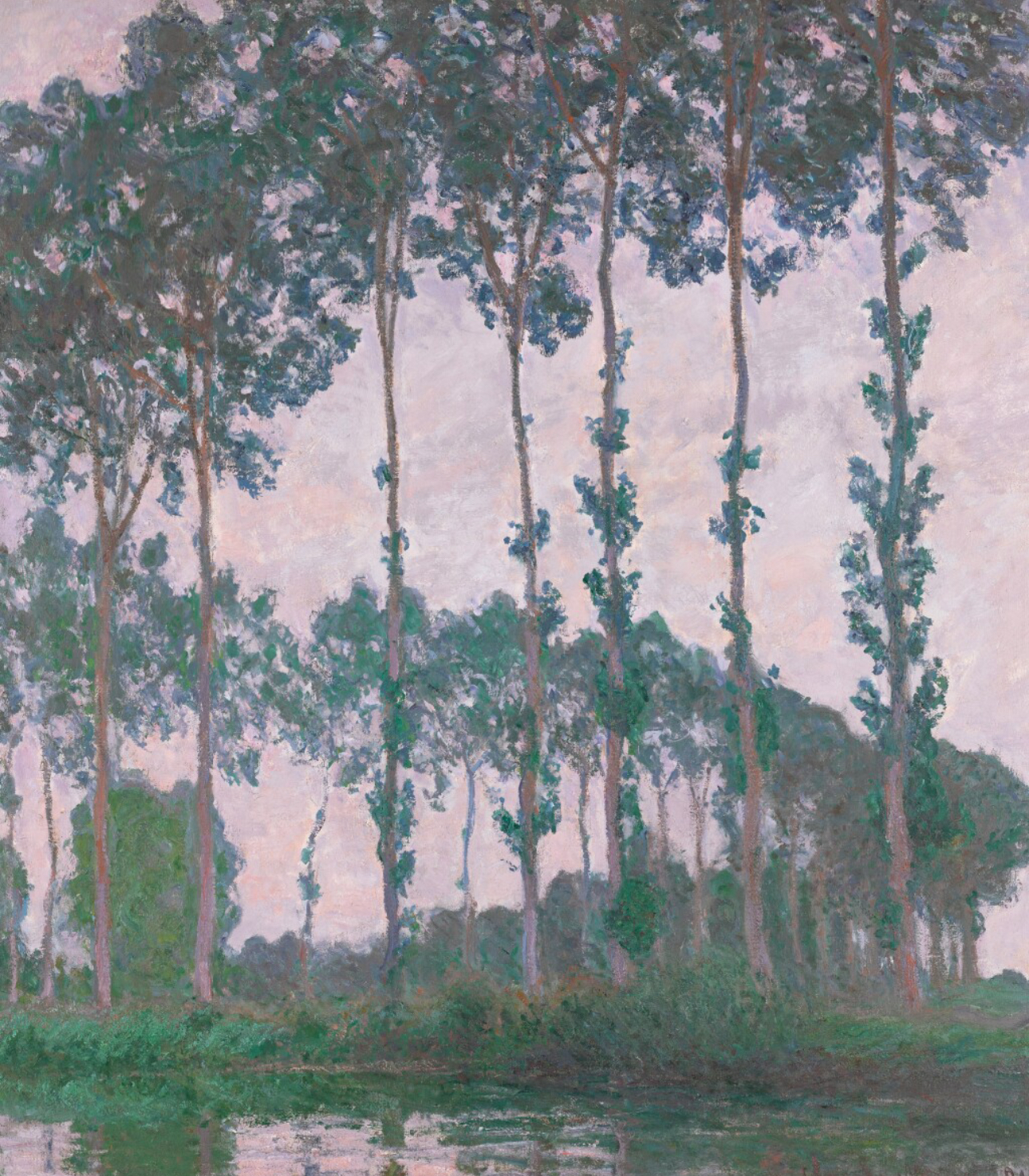
CLAUDE MONET (1840 – 1926)
Peupliers au bord de l’Epte, temps couvert, 1891
Oil on canvas
91.5 x 81.5 cm (36 x 32 1/8 inches)
Signed Claude Monet and dated 91 (lower right)
#3. Le Moulin de Limetz, 1888
Sotheby’s New-York: 13 November 2023
Estimated: USD 12,000,000 – 18,000,000
USD 25,612,500
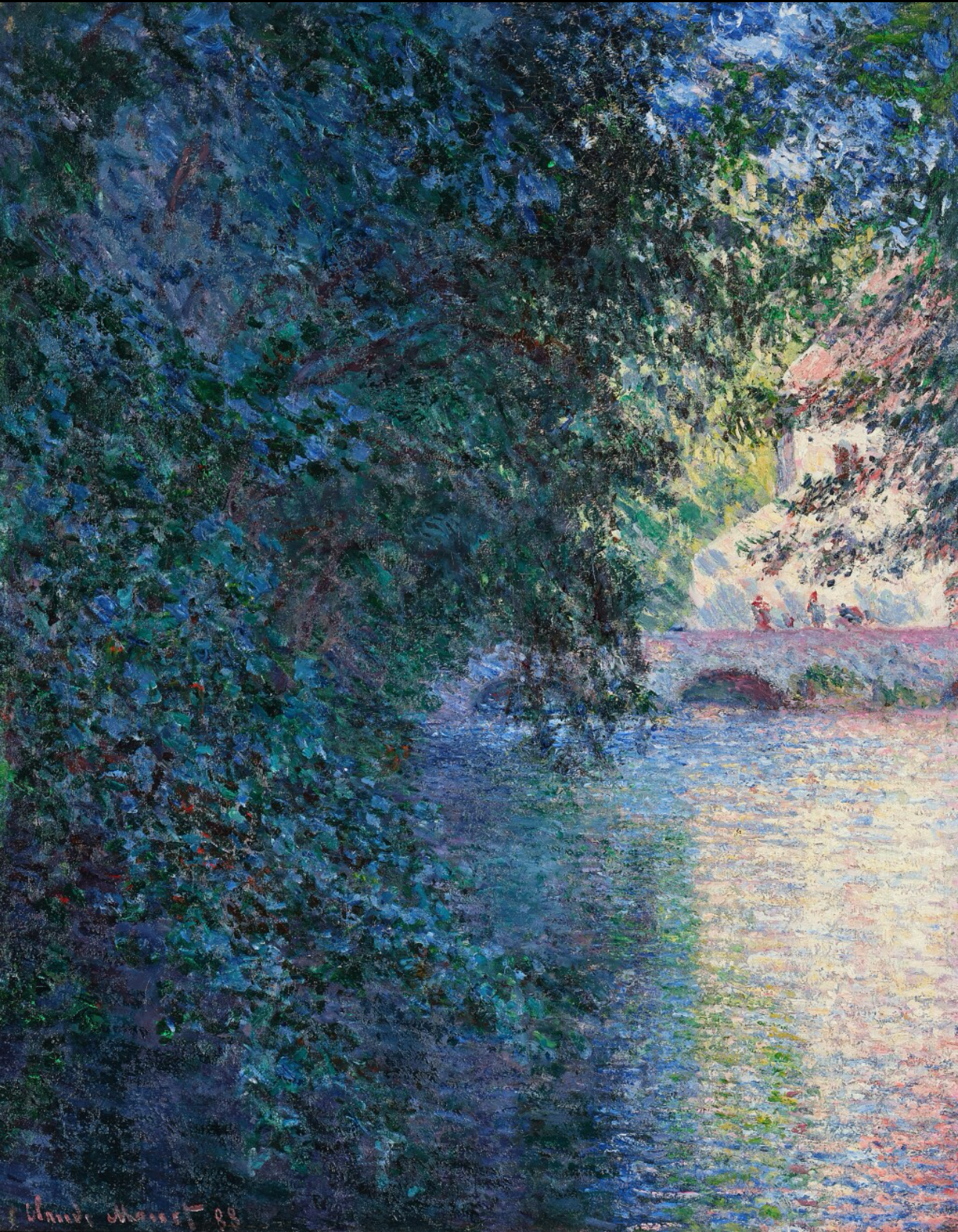
CLAUDE MONET (1840 – 1926)
Le Moulin de Limetz, 1888
oil on canvas
92 x 72.9 cm (36 1/4 x 28 3/4 inches)
Signed Claude Monet and dated 88 (lower left)
#4. Soleil sur la petite Creuse, 1889
Sotheby’s New-York: 13 November 2023
Estimated: USD 7,000,000 – 10,000,000
USD 8,607,300
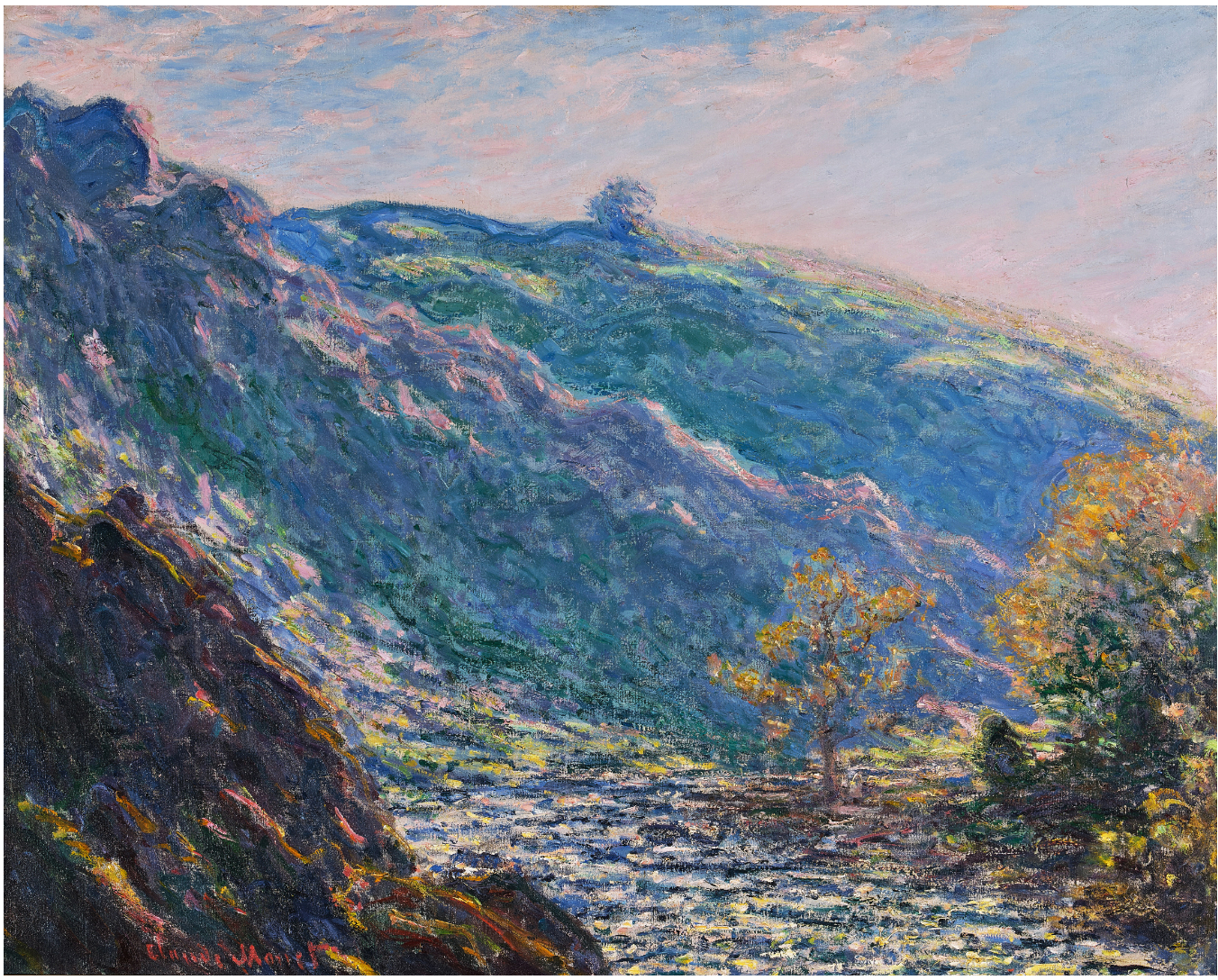
CLAUDE MONET (1840 – 1926)
Soleil sur la Petite Creuse, 1889
Oil on canvas
73 x 92.6 cm (28 3/4 x 36 1/2 inches)
Signed Claude Monet (lower left)
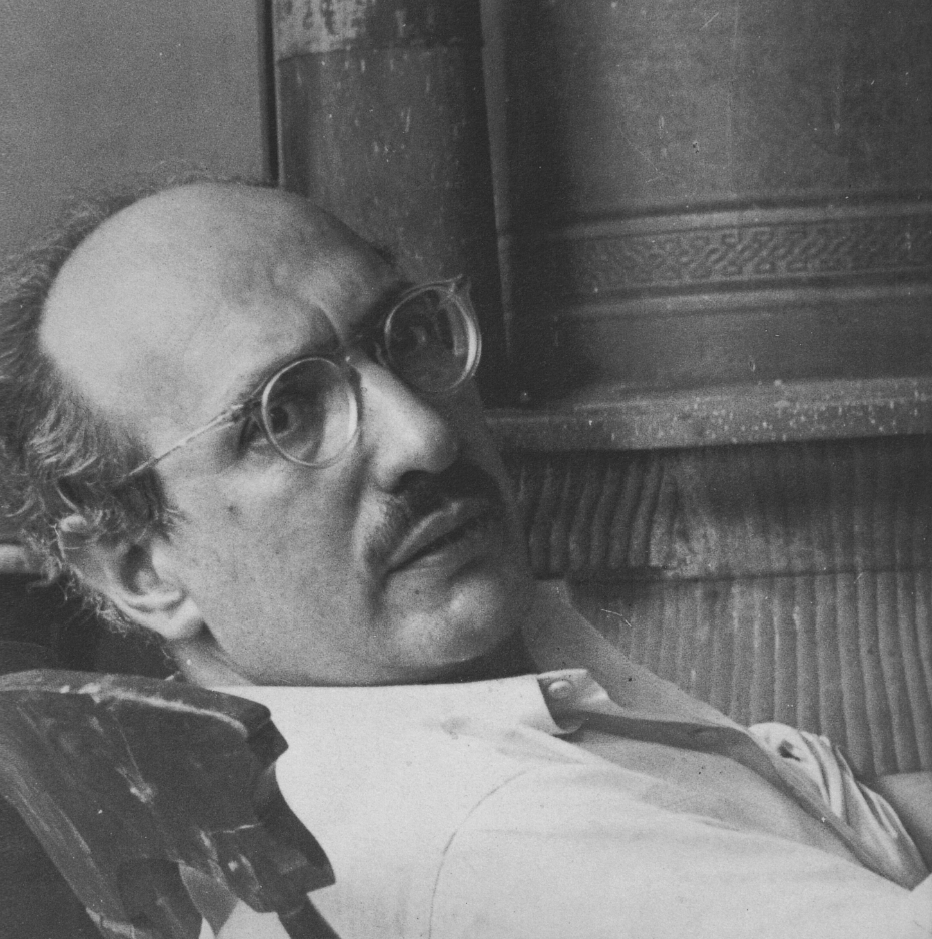
#3. Mark Rothko
With the sale of only four paintings, Mark Rothko is number third in the top 10 artists of this auction season, achieving a turnover just below USD 100 million.
4 Lots sold
Turnover: USD 99,048,500
#1. Untitled (Yellow, Orange, Yellow, Light Orange), 1955
Christie’s New-York: 9 November 2023
Estimate on Request
USD 46,410,000
MARK ROTHKO (1903-1970)
Untitled (Yellow, Orange, Yellow, Light Orange), 1955
Oil on canvas
81 1/2 x 60 inches (207 x 152.5 cm)
Signed and dated ‘MARK ROTHKO 1955’ (on the reverse)
#2. Untitled, 1968
Sotheby’s New-York: 13 November 2023
Estimated: USD 7,000,000 – 10,000,000
USD 23,889,000
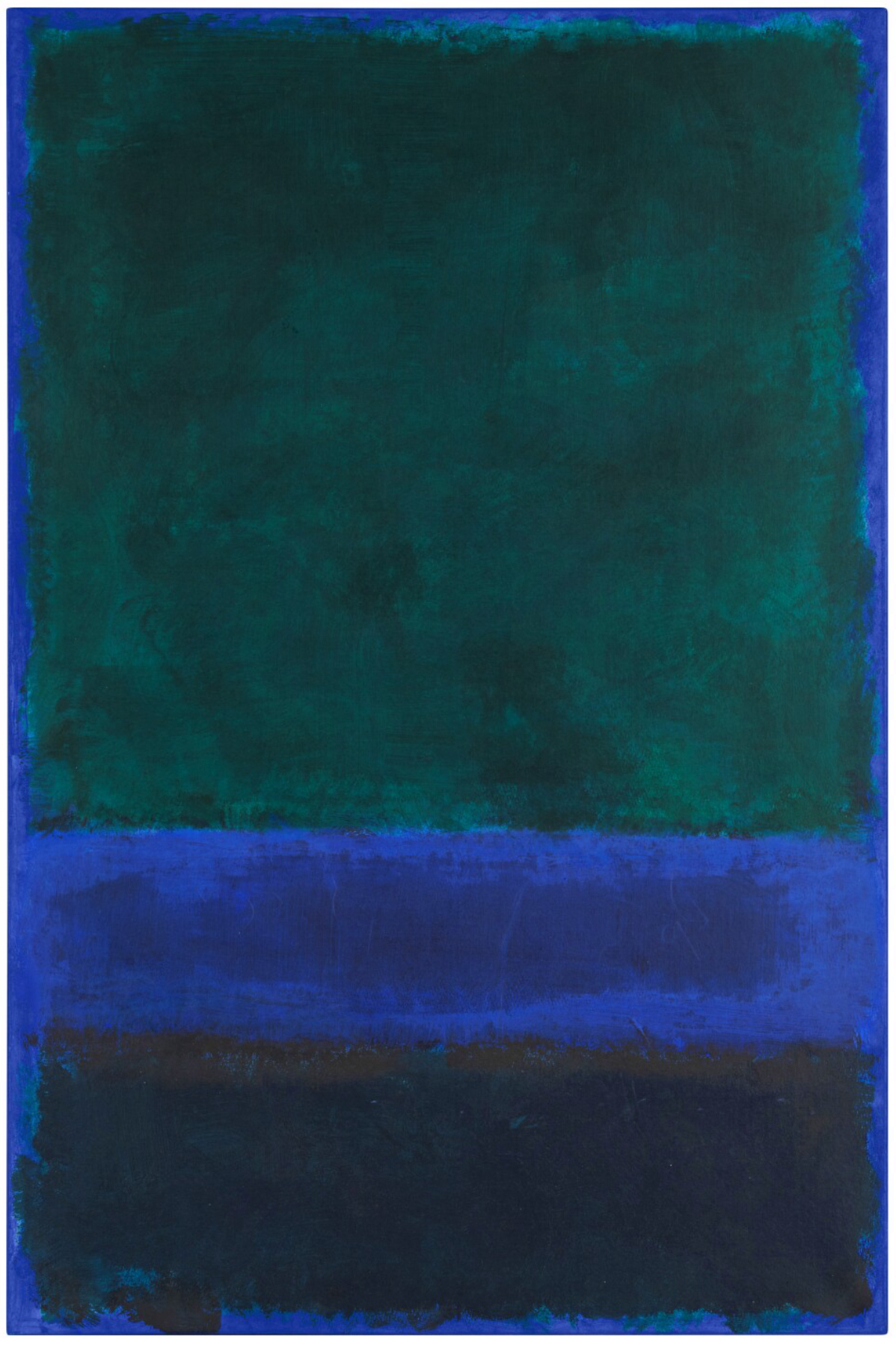
MARK ROTHKO (1903 – 1970)
Untitled, 1968
Oil on paper laid down on canvas
39 3/8 x 26 1/8 inches (100 x 66.4 cm)
Signed Mark Rothko, dated 1968 and variously inscribed (on the reverse)
#3. Untitled, 1958
Sotheby’s New-York: 8 November 2023
Estimated: USD 30,000,000 – 40,000,000
USD 22,165,500
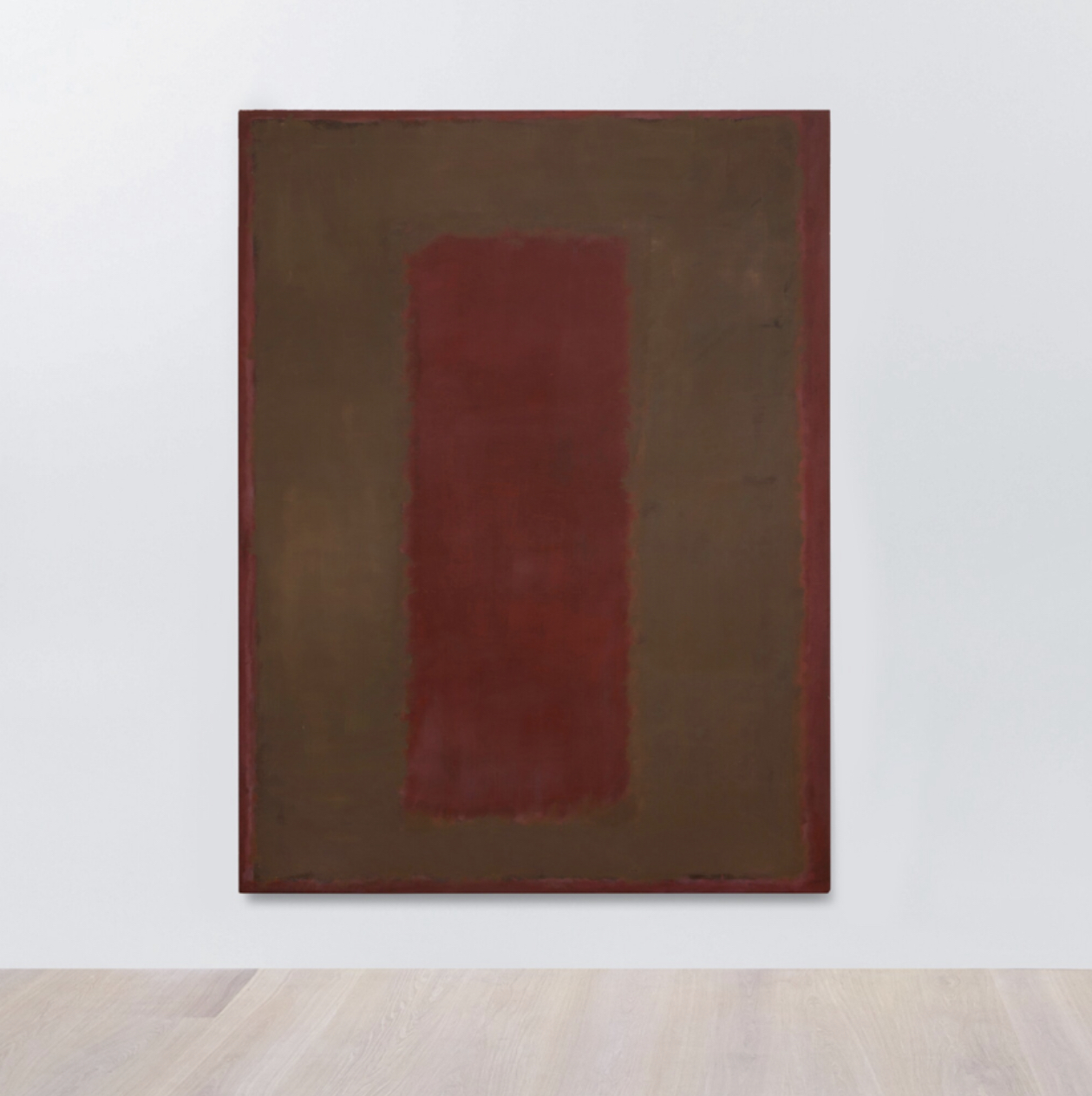
MARK ROTHKO (1903 – 1970)
Untitled, 1958
Oil on canvas
91 7/8 x 69 1/2 inches (233.4 x 176.5 cm)
Signed and dated 1958 (on the reverse)
#4. Untitled (Red, Orange on Pink), 1968
Christie’s New-York: 9 November 2023
Estimated: USD 6,500,000 – 8,500,000
USD 6,584,000
MARK ROTHKO (1903-1970) (christies.com)
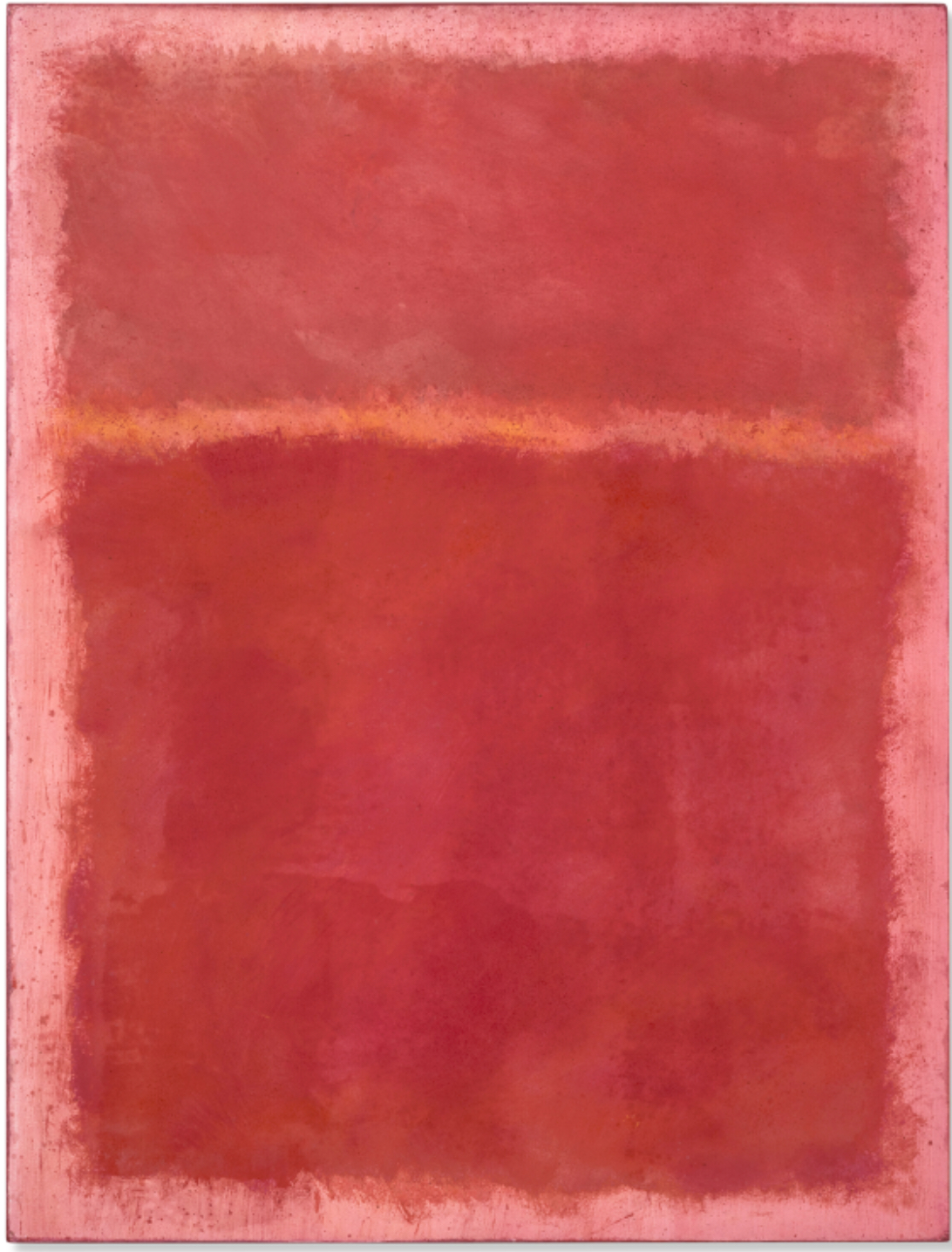
MARK ROTHKO (1903-1970)
Untitled (Red, Orange on Pink), 1968
Oil on paper laid down on canvas
33 1/2 x 25 3/4 inches (85.1 x 65.4 cm)
Signed ‘MARK ROTHKO’ (on the reverse)
#4. Gerhard Richter
Gerhard Richter, through the sale of 5 paintings, all from his iconic Abstraktes Bild series, two of which sold for over USD 30 million, realizes a turnover of USD 72,891,500.
5 Lots sold
Turnover: USD 72,891,500
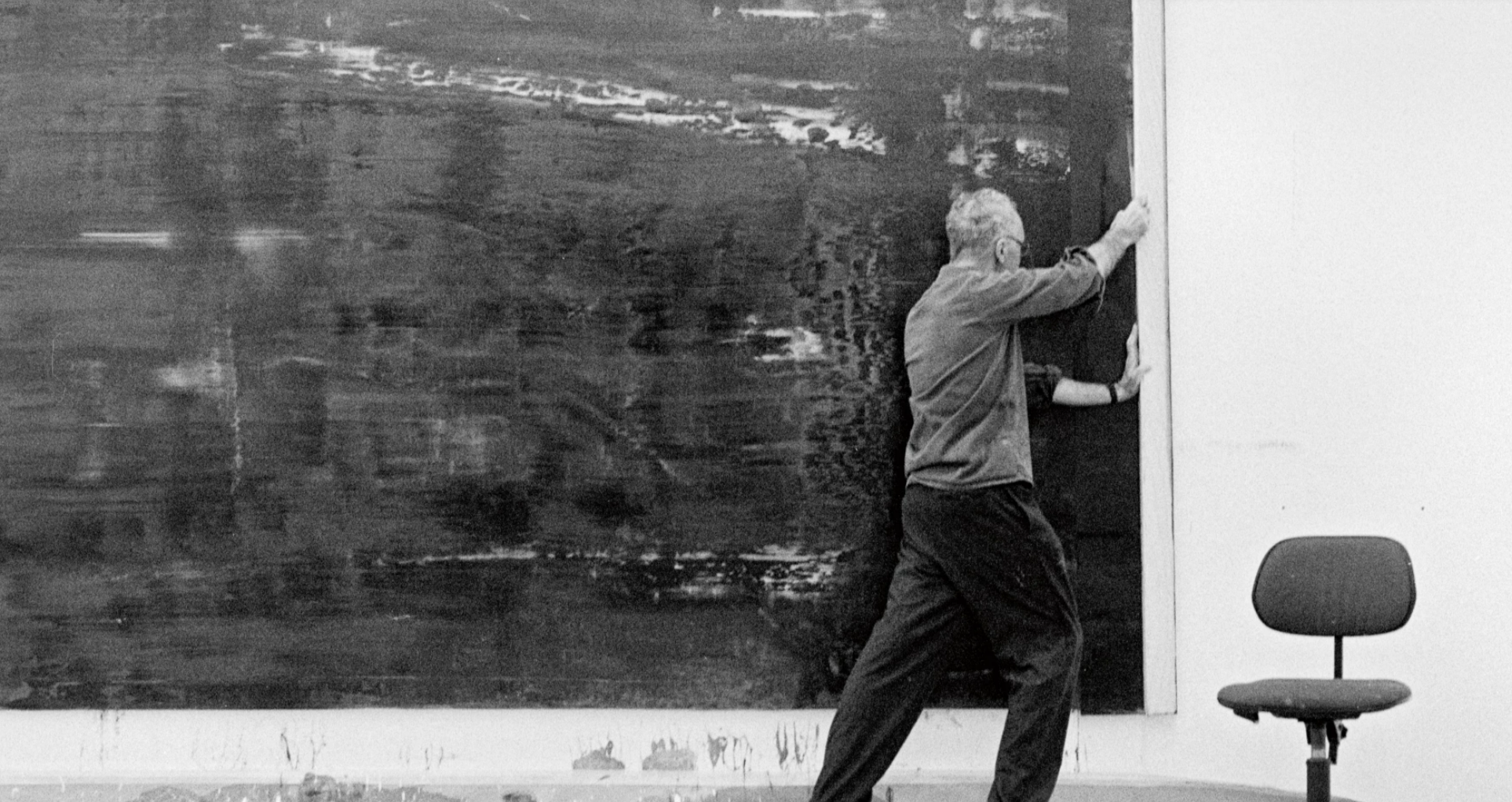
#1. Abstraktes Bild (636), 1987
Phillips New-York: 14 November 2023
Estimate on Request
USD 34,800,000
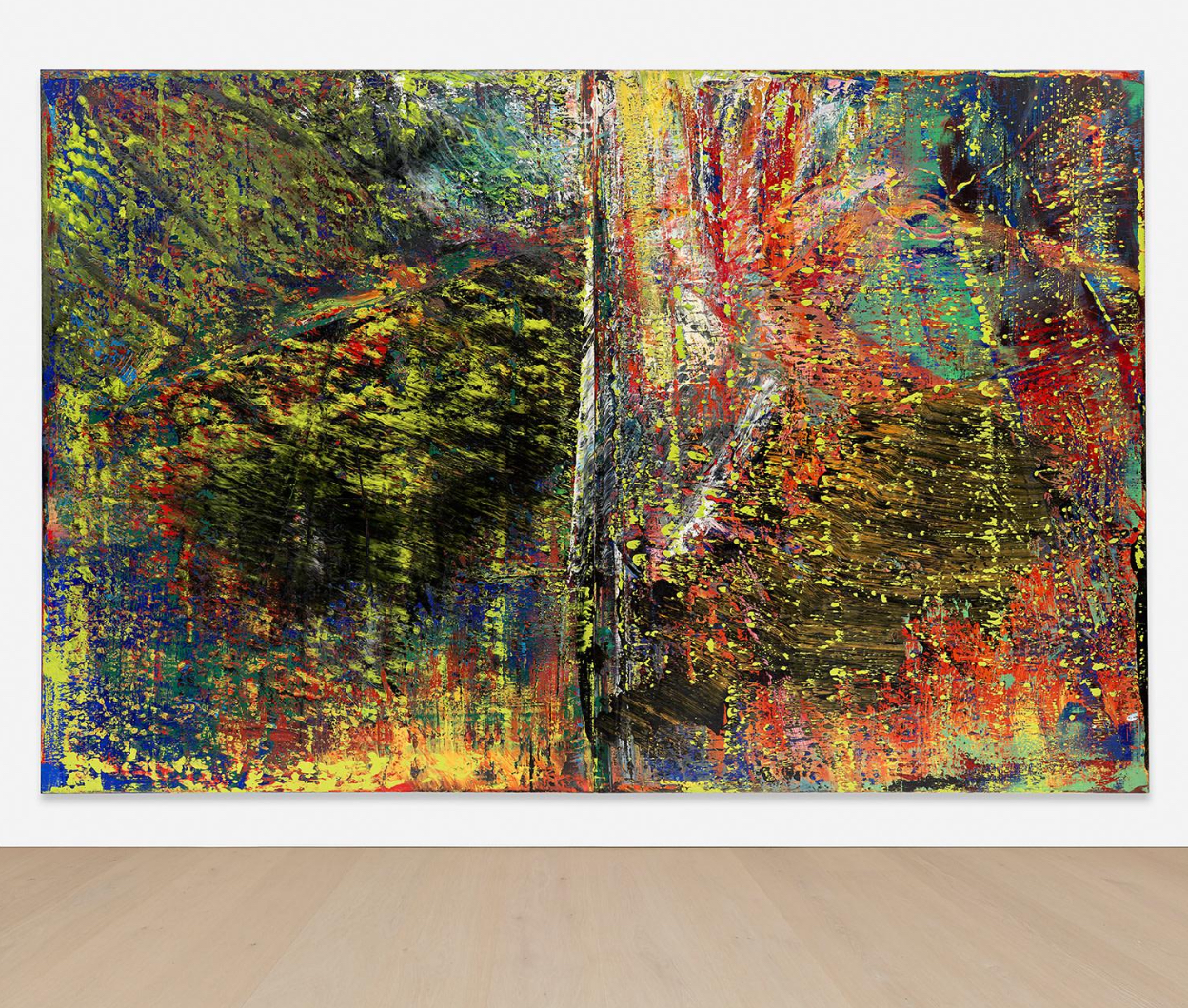
GERHARD RICHTER
Abstraktes Bild (636), 1987
Oil on canvas, in 2 parts
Each 102 1/2 x 78 7/8 in. (260.4 x 200.3 cm)
Overall 102 1/2 x 157 3/4 in. (260.4 x 400.7 cm)
Signed, inscribed and dated “636 Richter 1987” on the reverse of the left panel
Inscribed “636” on the reverse of the right panel
#2. Abstraktes Bild, 1997
Sotheby’s New-York: 15 November 2023
Estimated: USD 25,000,000 – 35,000,000
USD 31,932,000
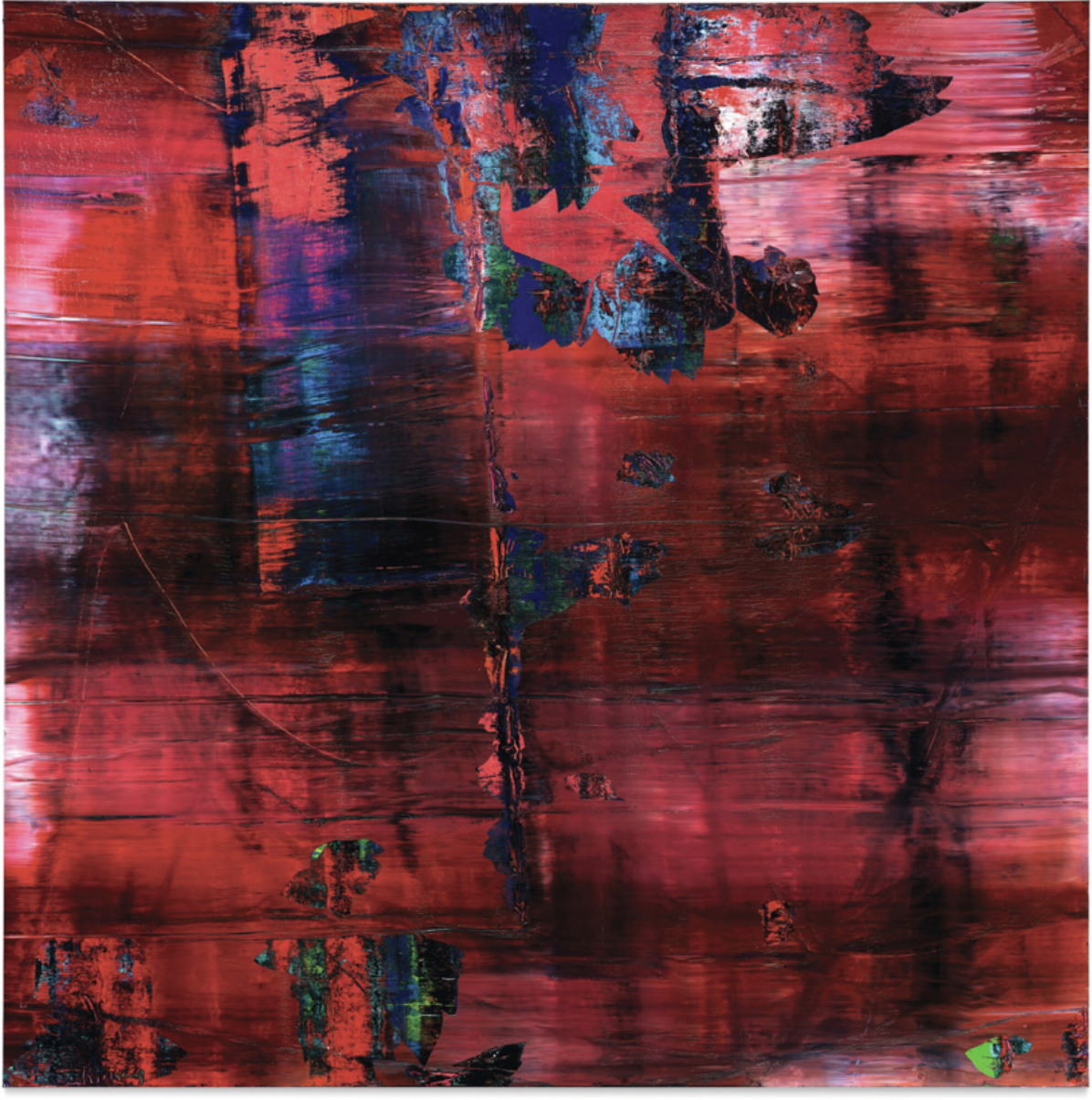
GERHARD RICHTER (b. 1932)
Abstraktes Bild, 1997
Oil on canvas
275×275 cm (108 1/4 x 108 1/4 inches)
Signed, dated 1997 and numbered 849-1 (on the reverse)
#3. Abstraktes Bild (890-2), 2004
Christie’s New-York: 7 November 2023
Estimated: USD 2,000,000 – 3,000,000
USD 2,591,000
GERHARD RICHTER (B. 1932) (christies.com)
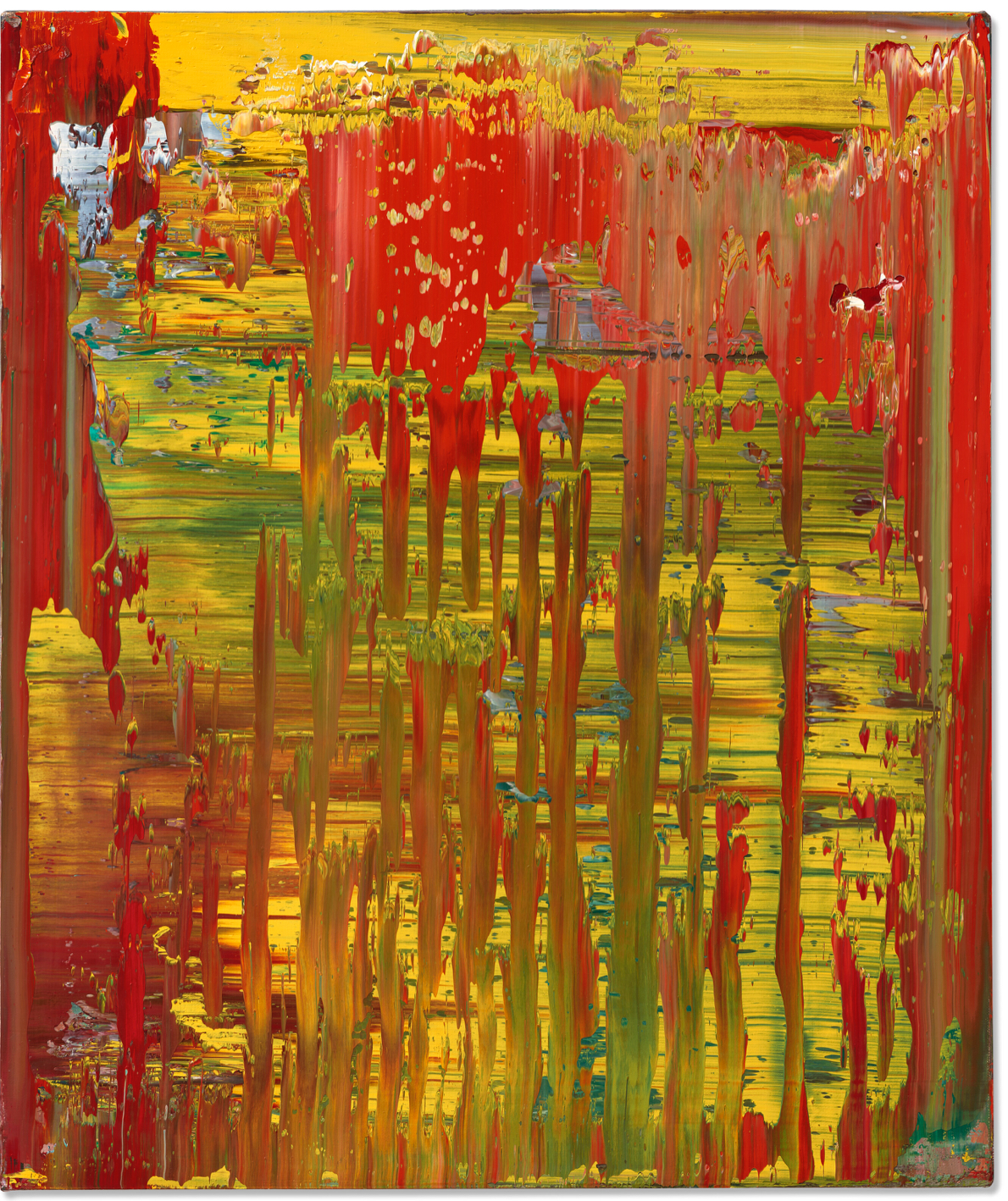
GERHARD RICHTER (B. 1932)
Abstraktes Bild (890-2), 2004
Oil on canvas
63 x 52.5 cm (24 3/4 x 20 1/4 inches)
Signed, inscribed and dated twice ‘890-2 R. 2004 Richter 2004’ (on the reverse)
#5. Joan Mitchell
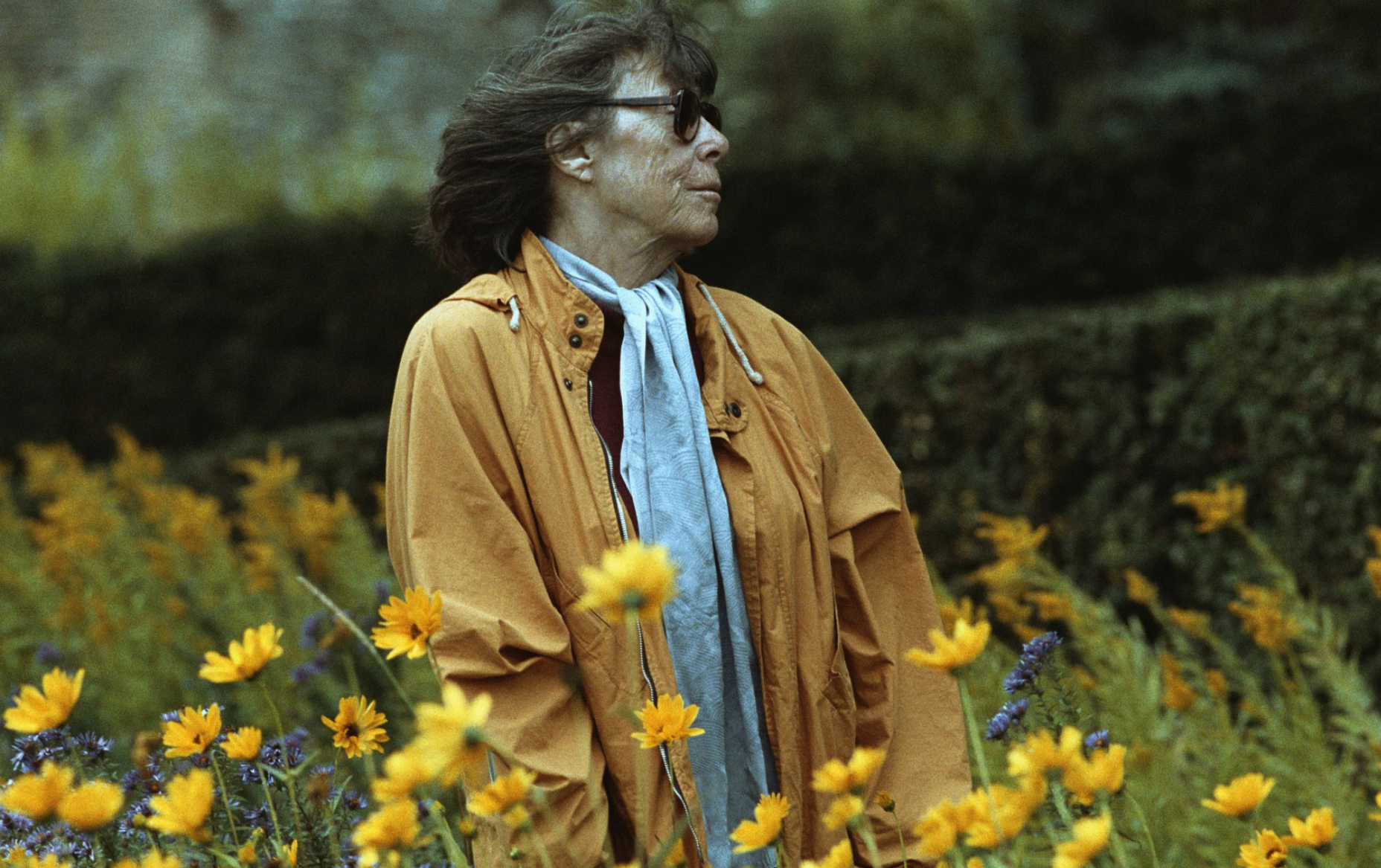
Joan Mitchell is the first woman artist in the Top 10 most sold artists for this auction season, with a new auction record set at Christie’s just over USD 29 million.
4 Lots sold
Turnover: USD 71,063,000
#1. Untitled, 1959
Christie’s New-York: 9 November 2023
Estimated: USD 25,000,000 – 35,o00,000
USD 29,160,000
NEW WORLD RECORD FOR THE ARTIST
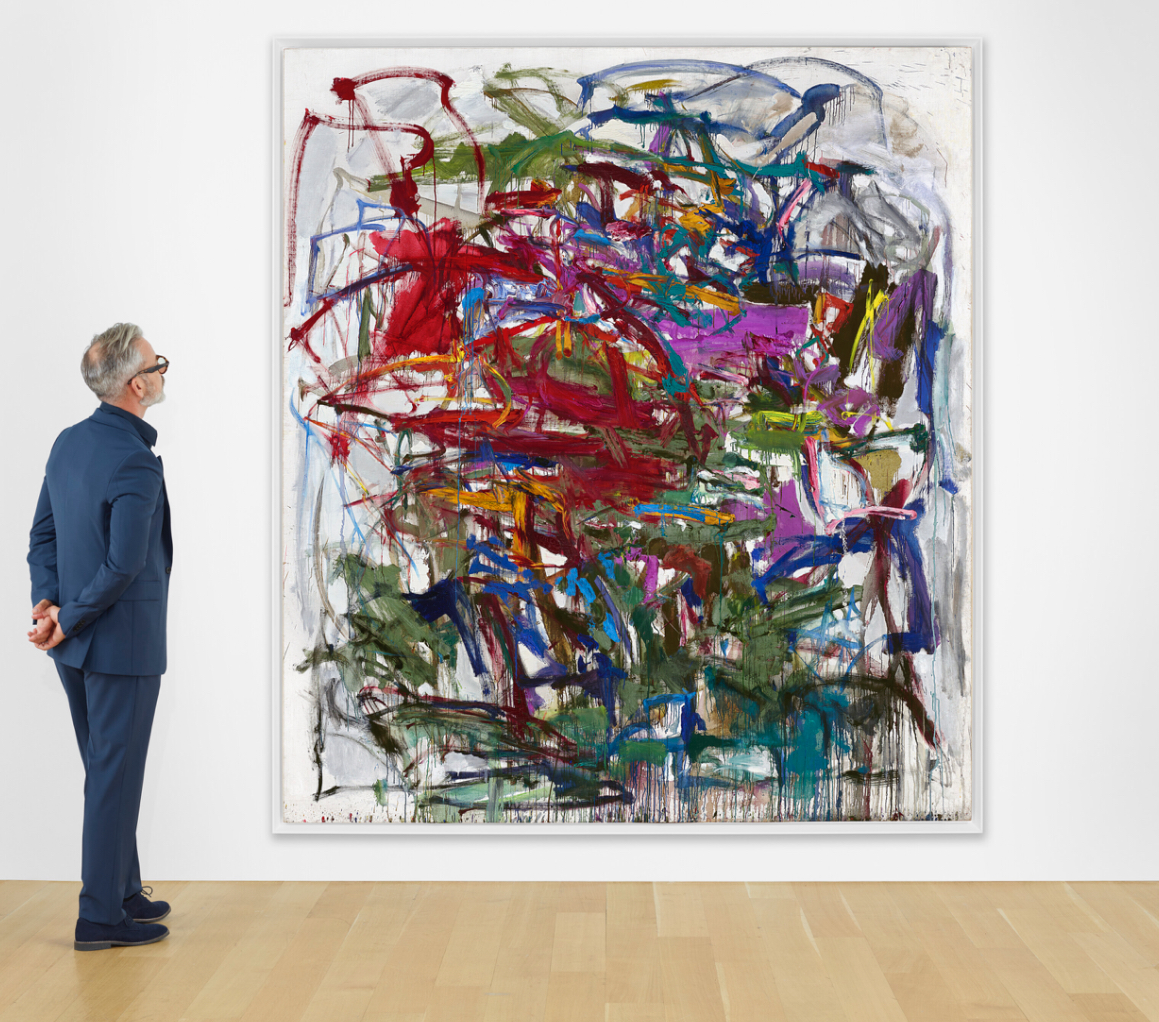
JOAN MITCHELL (1925-1992)
Untitled, 1959
Oil on canvas
97 1/2 x 86 1/2 inches (247.7 x 219.7 cm)
#2. Sunflowers, 1990-91
Sotheby’s New-York: 15 November 2023
Estimated: USD 20,000,000 – 30,000,000
USD 27,910,500
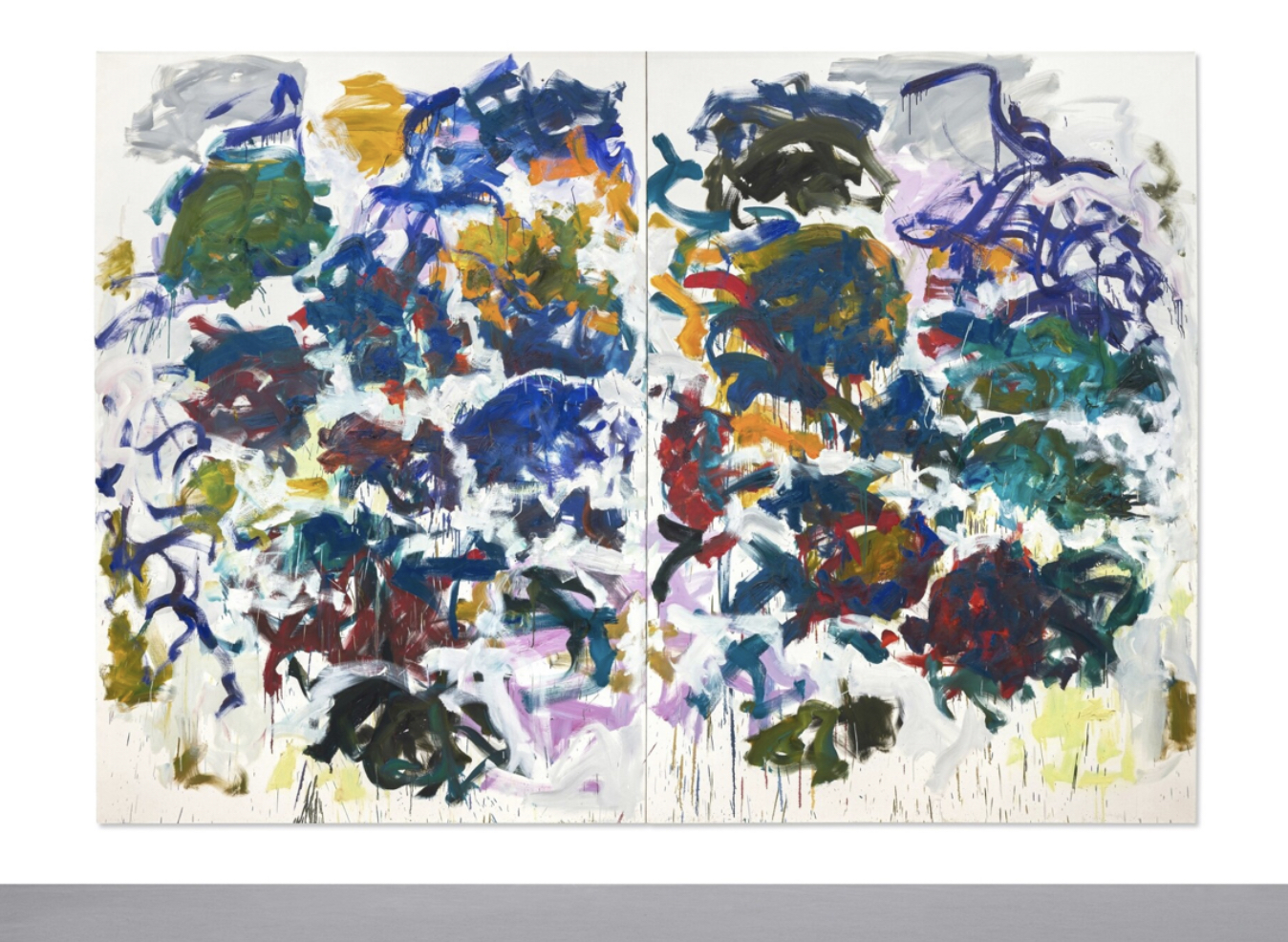
JOAN MITCHELL (1925 – 1992)
Sunflowers, 1990-91
Oil on canvas, in two parts
Overall: 280×400 cm (110 1/4 x 157 1/2 inches)
Signed (right panel, lower right)
#3. Untitled, 1953
Phillips New-York: 14 November 2023
Estimated: USD 4,000,000 – 6,000,000
USD 7,892,500
Joan Mitchell – Living the Avant-Ga… Lot 20 November 2023 | Phillips
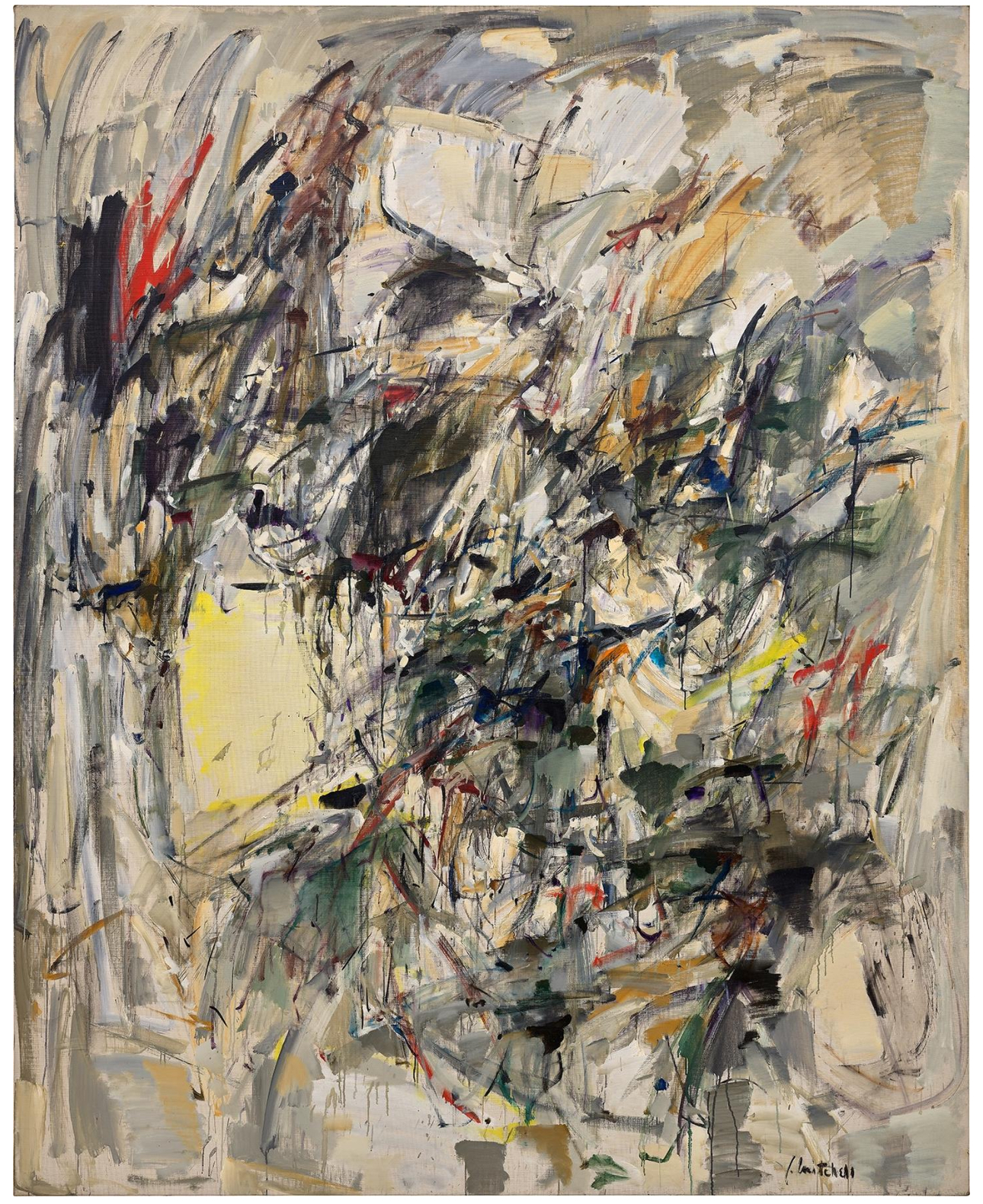
JOAN MITCHELL
Untitled, 1953
Oil on canvas
96 1/8 x 77 1/4 inches (244.2 x 196.2 cm)
Signed “J. Mitchell” lower right
#6. Jean-Michel Basquiat
With 6 paintings sold during this auction season totaling USD 69 million, including the large Self-Portrait as a Hell (Part 2) that sold for USD 42 million at Sotheby’s, Jean-Michel Basquiat ranks #6.
6 Lots sold
Turnover: USD 68,800,500
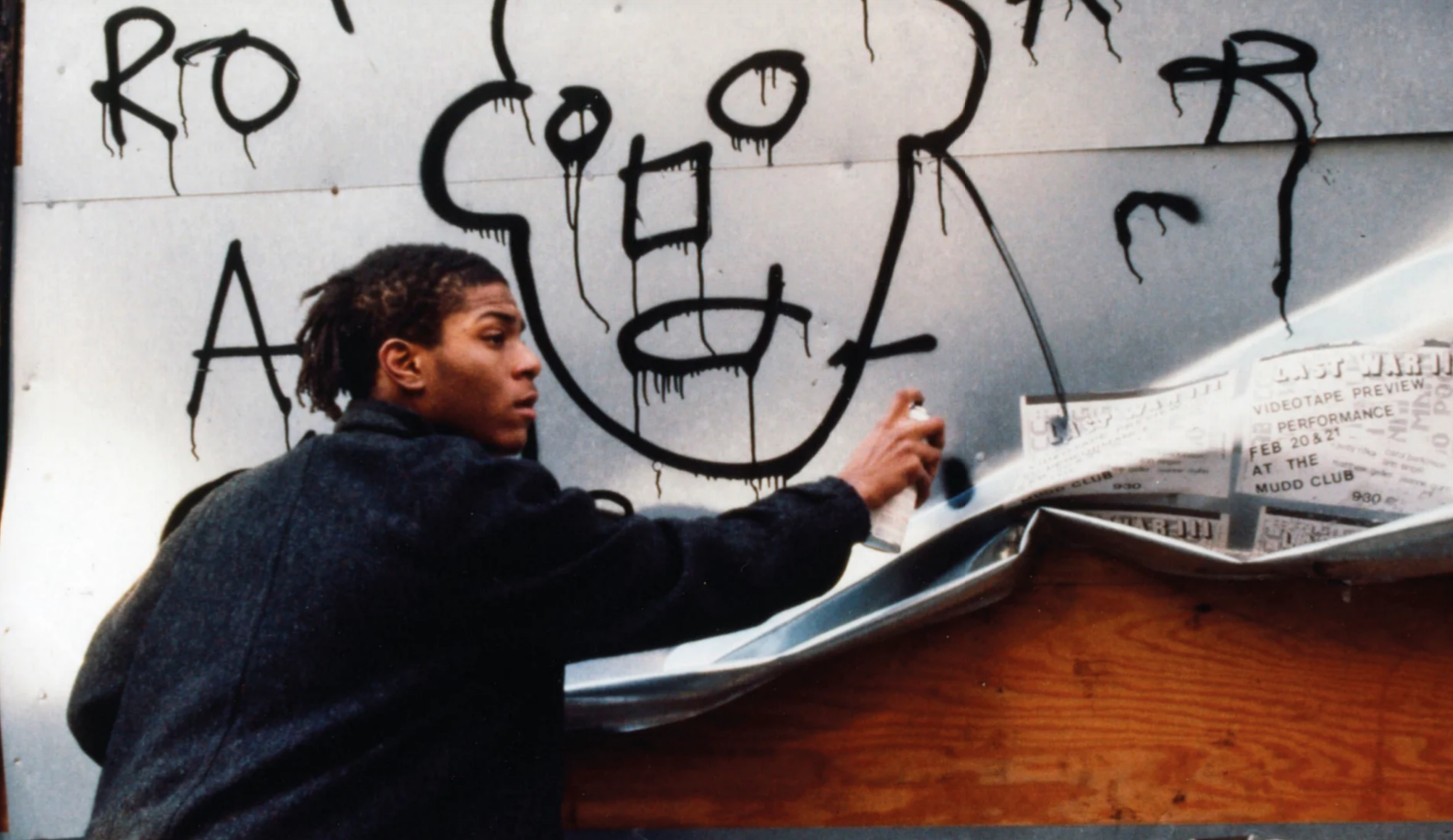
#1. Self-Portrait as a Heel (Part Two), 1982
Sotheby’s New-York: 15 November 2023
Estimated: USD 40,000,000 – 60,000,000
USD 42,000,000
JEAN-MICHEL BASQUIAT (1960 – 1988)
Self-Portrait as a Heel (Part Two), 1982
Acrylic and oilstick on canvas
96 x 61 1/2 inches (243.8 x 156.2 cm)
Signed, titled, dated 1982 and variously inscribed (on the reverse)
#2. Action Comics One, 1983
Sotheby’s New-York: 15 November 2023
Estimated: USD 6,000,000 – 9,000,000
USD 6,928,500
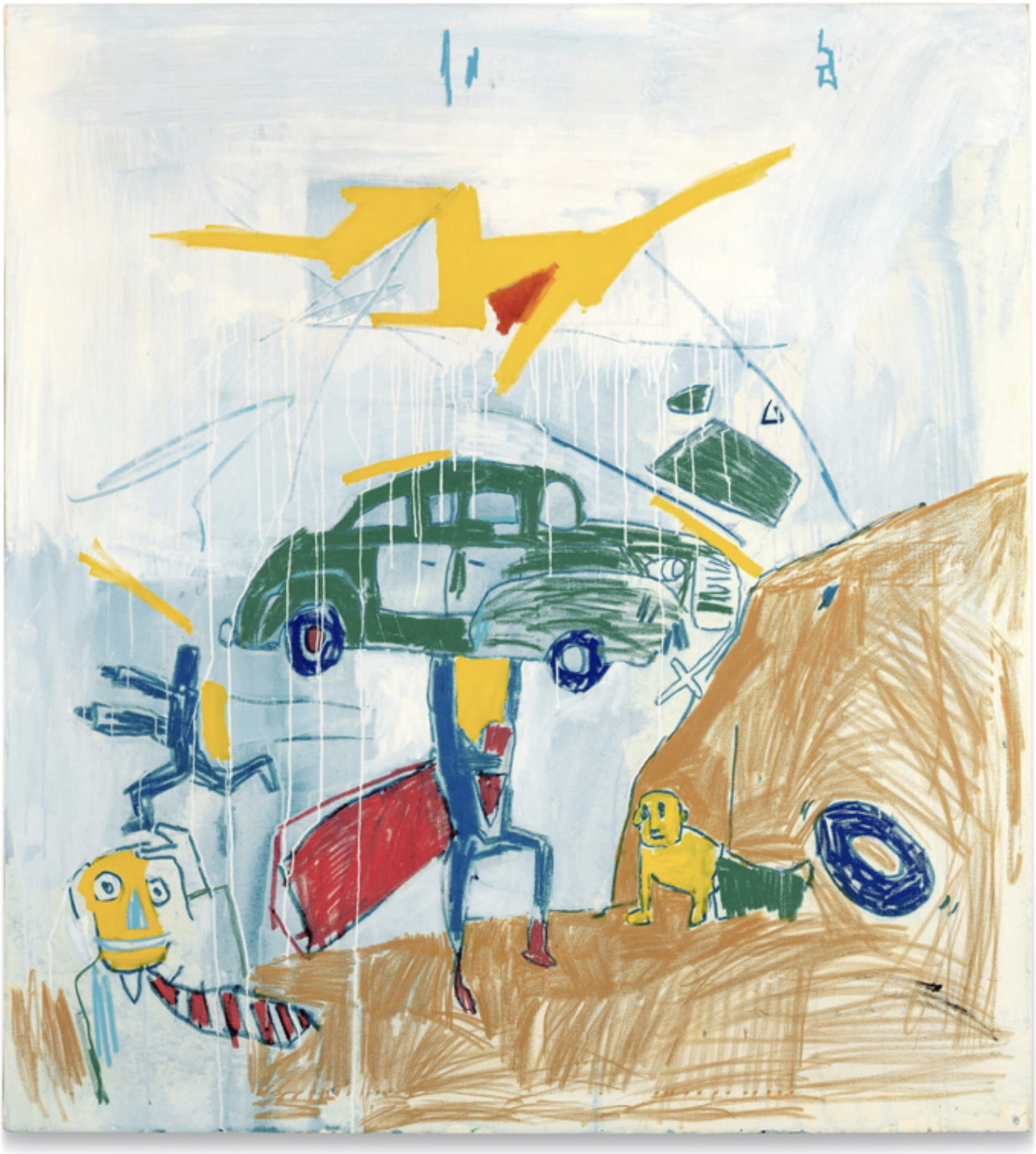
JEAN-MICHEL BASQUIAT (1960 – 1988)
Action Comics One, 1983
Acrylic, colored pencil and oilstick on canvas
66 1/8 x 60 1/4 inches (168×153 cm)
Signed, titled and dated Nov. 1983 (on the reverse)
#3. Untitled, 1981
Christie’s New-York: 7 November 2023
Estimated: USD 10,000,000 – 15,000,000
USD 11,910,000
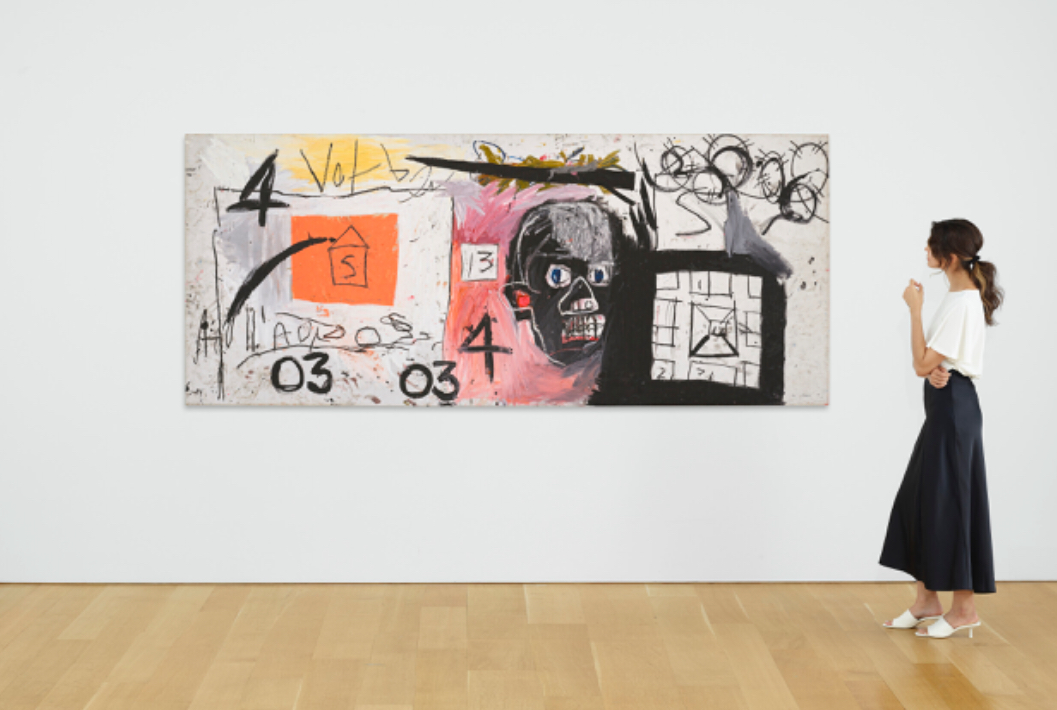
JEAN-MICHEL BASQUIAT (1960-1988)
Untitled, 1981
Acrylic and oilstick on canvas
50×119 inches (127 x 302.3 cm)
Signed and dated ‘Jean-Michel Basquiat 1981’ (on the reverse)
#4. Orange Joy, 1984
Christie’s New-York: 9 November 2023
Estimated: USD 4,000,000 – 6,o00,000
USD 4,769,000
JEAN-MICHEL BASQUIAT (1960-1988) (christies.com)
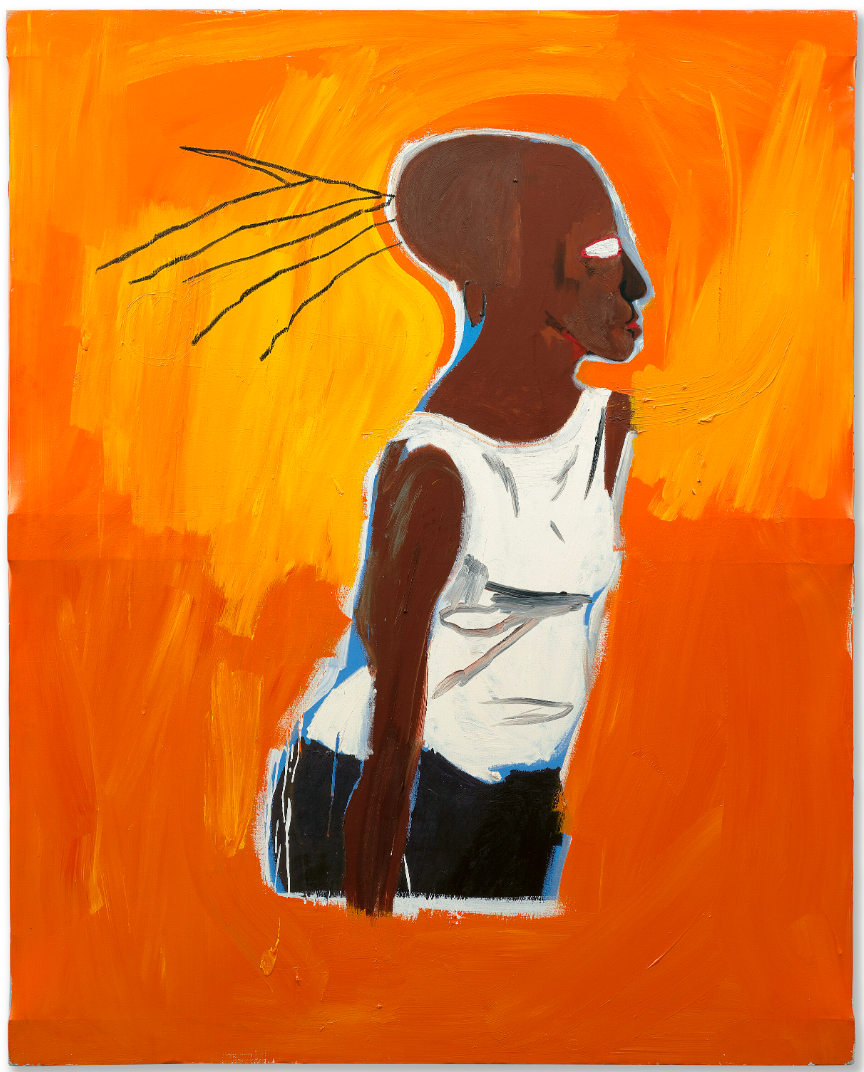
JEAN-MICHEL BASQUIAT (1960-1988)
Orange Joy, 1984
Acrylic and oilstick on canvas
78 1/2 x 62 3/8 inches (198.6 x 158.6 cm)
Signed, titled and dated ‘Jean-Michel Basquiat ORANGE JOY 84’ (on the reverse)
#5. No Hay Crimen ©, 1983
Sotheby’s New-York: 15 November 2023
Estimated: USD 1,200,000 – 1,800,000
USD 1,996,000
No Hay Crimen © | Contemporary Evening Auction | 2023 | Sotheby’s (sothebys.com)
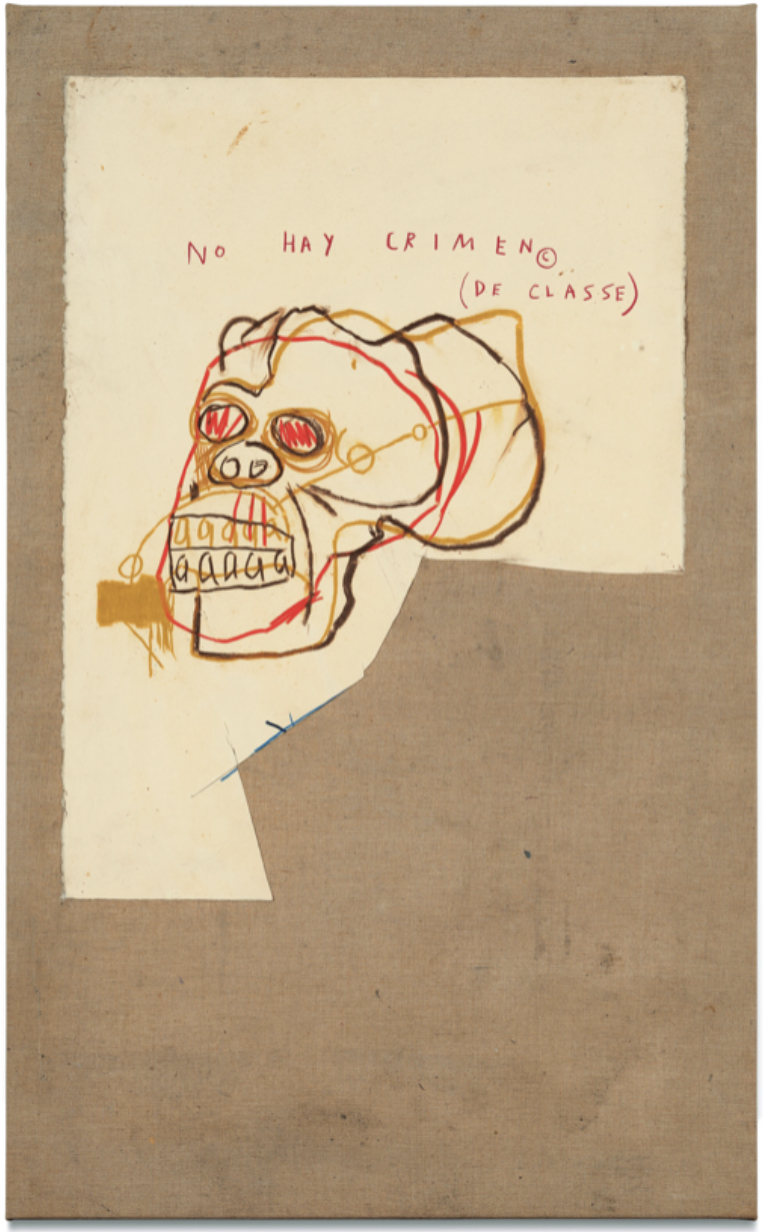
JEAN-MICHEL BASQUIAT (1960 – 1988)
No Hay Crimen ©, 1983
Oilstick, colored pencil and paper collage on canvas
44 1/2 x 27 1/4 inches (113 x 69.2 cm)
#7. Andy Warhol
With 10 lots sold and a total turnover of close to USD 64 million, Andy Warhol ranks #7 for this auction season. This is not a great performance for Andy Warhol who usually ranks among the Top 3 most sold artists in any season.
10 Lots sold
Turnover: USD 63,960,000
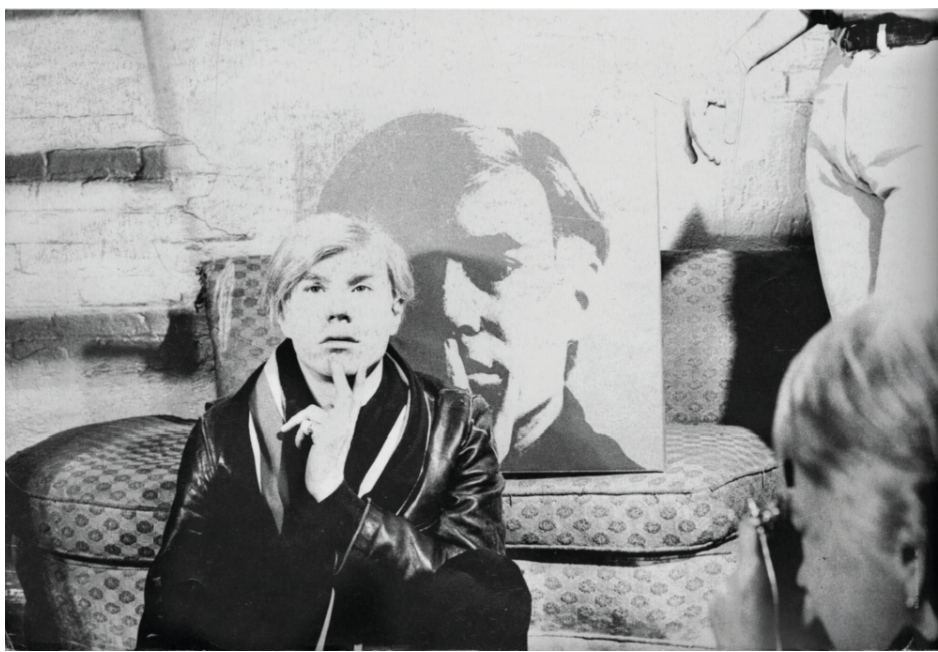
#1. Sixteen Jackies, 1964
Christie’s New-York: 9 November 2023
Estimated: USD 25,000,000 – 35,000,000
USD 25,940,000
ANDY WARHOL (1928-1987) (christies.com)
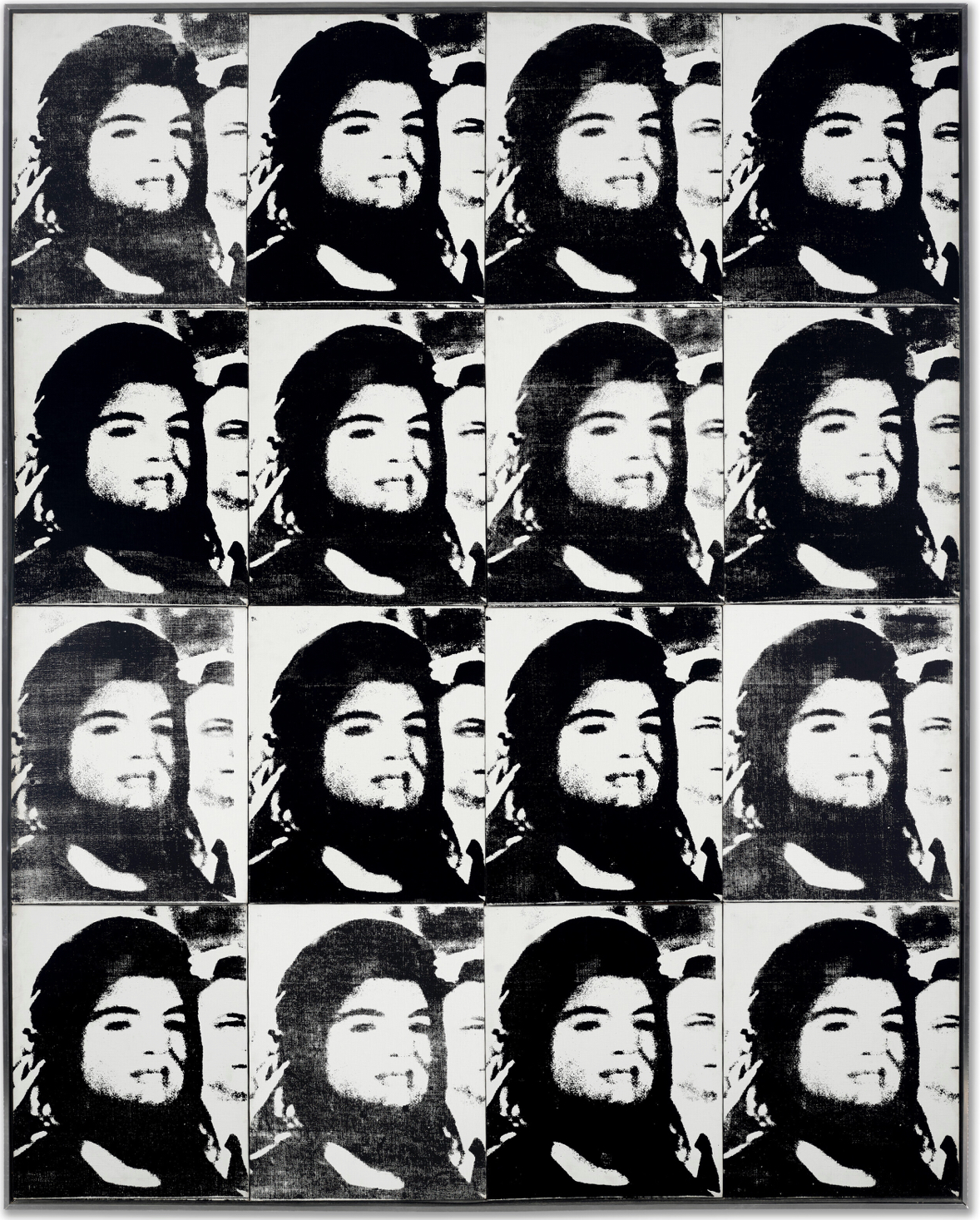
ANDY WARHOL (1928-1987)
Sixteen Jackies, 1964
Silkscreen ink on linen, in sixteen parts
Overall: 80×64 inches (203.2 x 162.6 cm)
Signed ‘Andy Warhol’ (on the overlap of four canvases)
#2. Self-Portrait, 1986
Sotheby’s New-York: 8 November 2023
Estimated: USD 15,000,000 – 20,000,000
USD 18,144,000
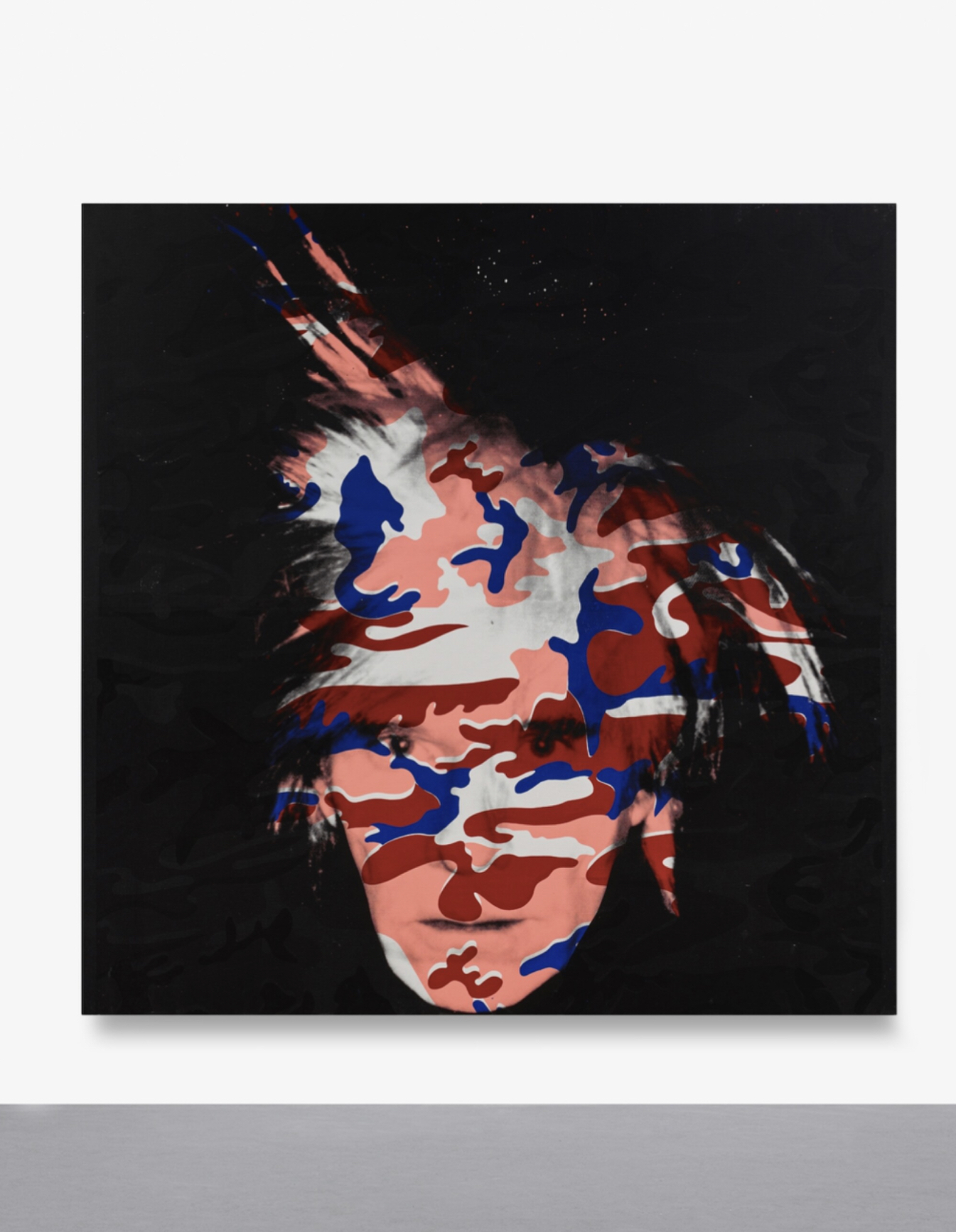
ANDY WARHOL (1928 – 1987)
Self-Portrait, 1986
Acrylic and silkscreen ink on canvas
80×80 inches (203.2 x 203.2 cm)
Signed and dated 86 (on the overlap)
#3. Self-Portrait, 1967
Christie’s New-York: 9 November 2023
Estimated: USD 5,000,000 – 7,000,000
USD 5,495,000
ANDY WARHOL (1928-1987) (christies.com)
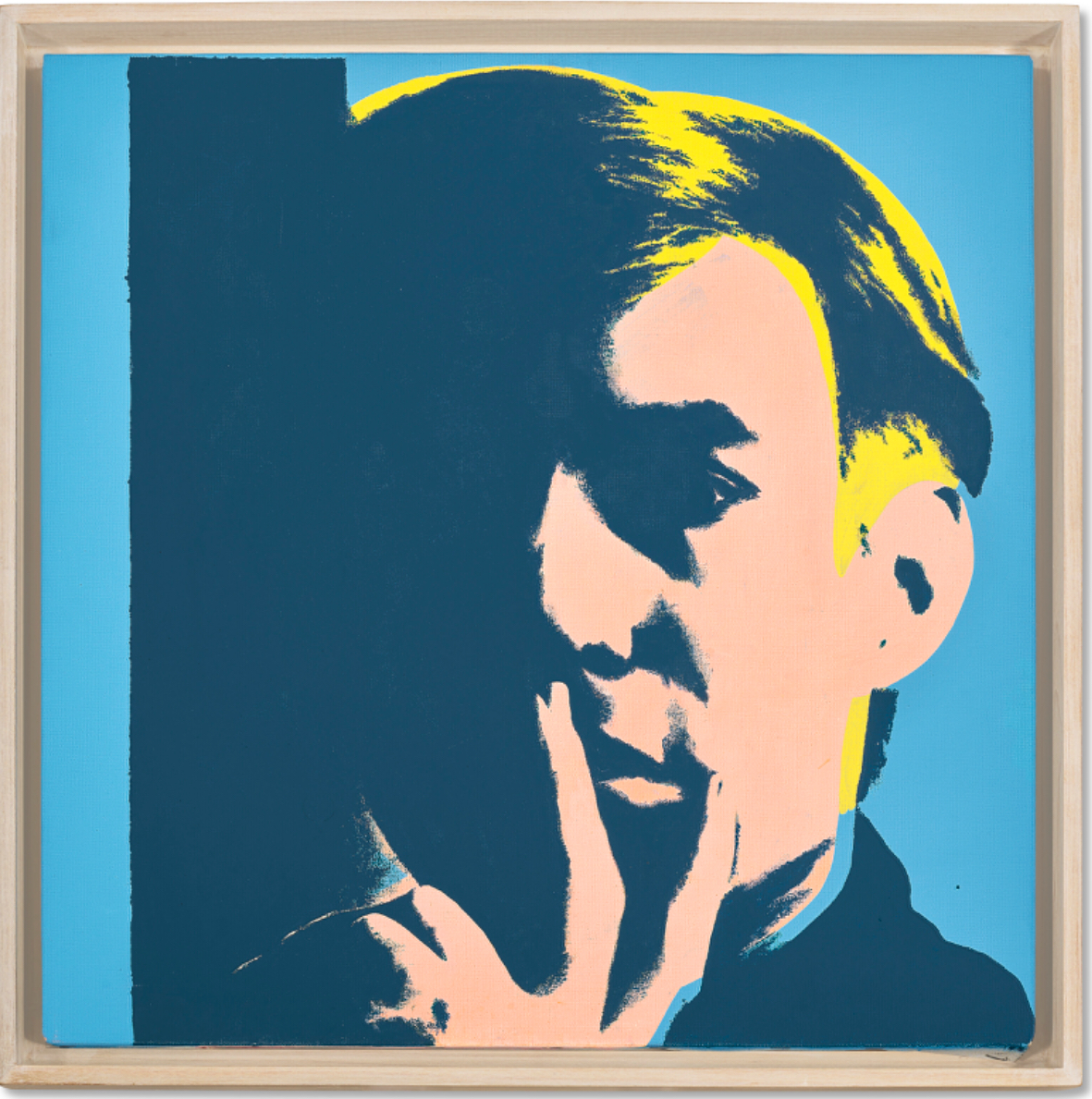
ANDY WARHOL (1928-1987)
Self-Portrait, 1967
Acrylic and silkscreen ink on canvas
22×22 inches (55.9 x 55.9 cm)
Signed and dated ‘Andy Warhol 67’ (on the overlap)
#4. Flowers, 1964
Christie’s New-York: 9 November 2023
Estimated: USD 1,500,000 – 2,000,000
USD 3,438,000
ANDY WARHOL (1928-1987) (christies.com)
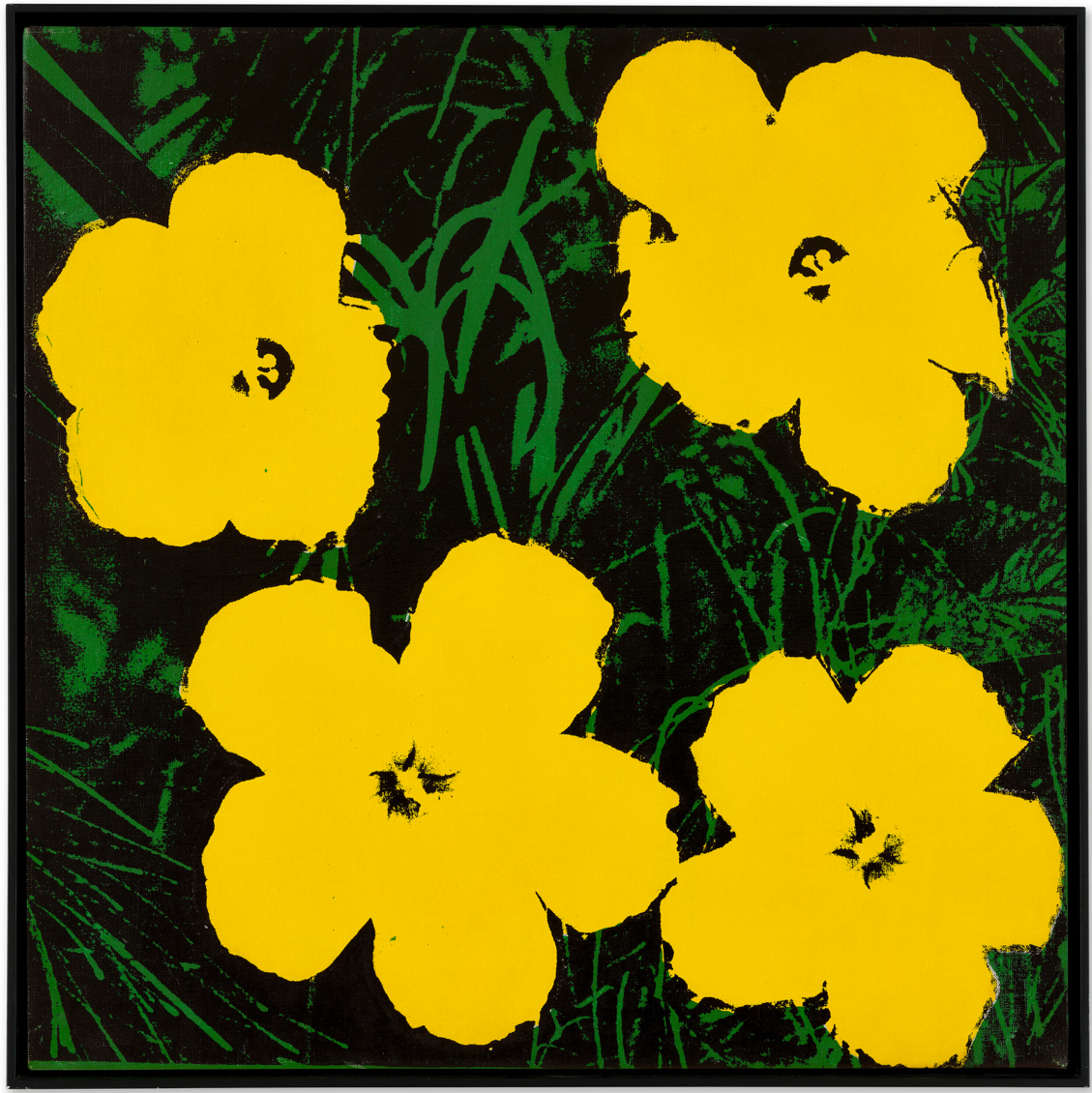
ANDY WARHOL (1928-1987)
Flowers, 1964
Acrylic and silkscreen ink on canvas
24×24 inches (61×61 cm)
Signed ‘Andy Warhol’ (on the overlap)
#8. Ed Ruscha
Ed Ruscha with 5 lots and a turnover of USD 61,3 million ranks #8, thanks to the sale of the Emily Fisher Landau Collection at Sotheby’s.
5 Lots sold
Turnover: USD 61,316,500
#1. Securing the Last Letter (Boss), 1964
Sotheby’s New-York: 8 November 2023
Estimated: USD 35,000,000 – 45,000,000
USD 39,400,500
ED RUSCHA (b. 1937)
Securing the Last Letter (Boss), 1964
Oil on canvas
59 x 55 1/8 inches (149.9 x 140 cm)
Signed, titled and dated 1964 (on the stretcher)
#2. Mint (Green), 1968
Sotheby’s New-York: 8 November 2023
Estimated: USD 10,000,000 – 15,000,000
USD 12,973,500
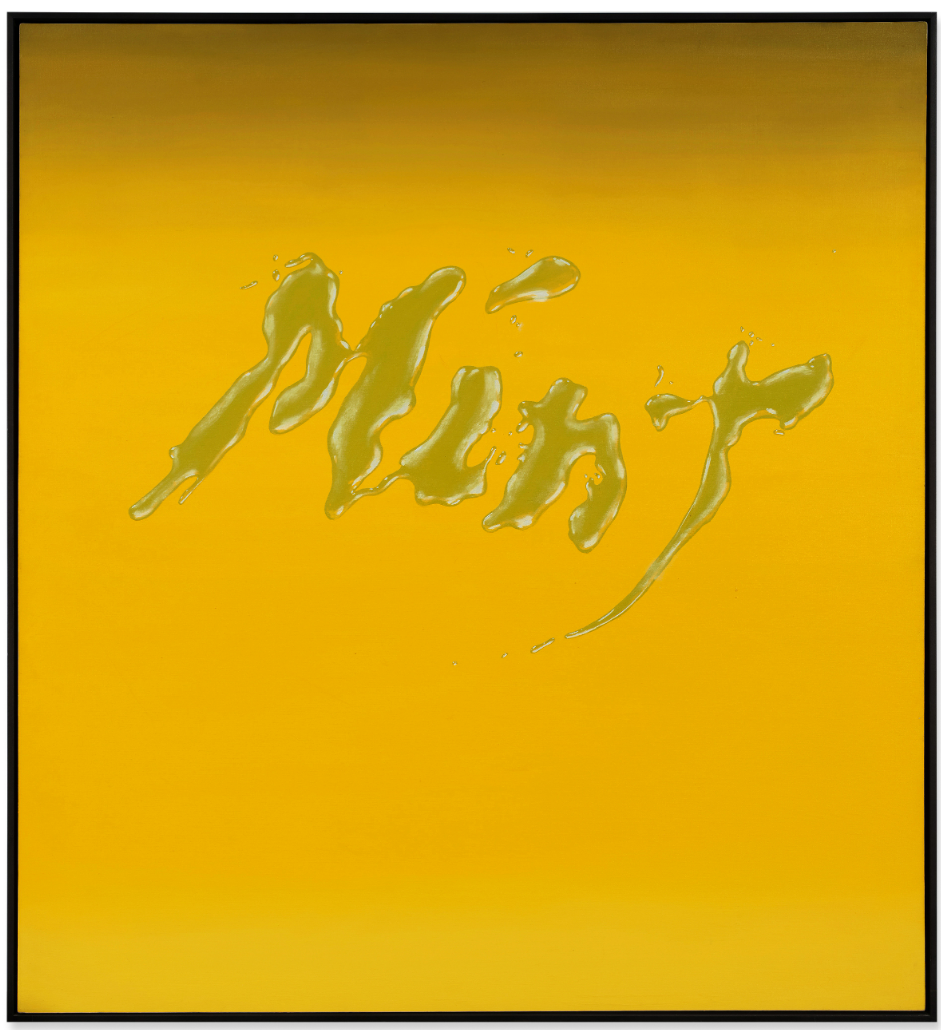
ED RUSCHA (b. 1937)
Mint (Green), 1968
Oil on canvas
60×55 inches (152.4 x 139.7 cm)
Signed and dated 1968 (on the reverse)
#3. Plenty Big Hotel Room (Painting for the American Indian), 1985
Sotheby’s New-York: 8 November 2023
Estimated: USD 5,000,000 – 7,000,000
USD 6,079,500
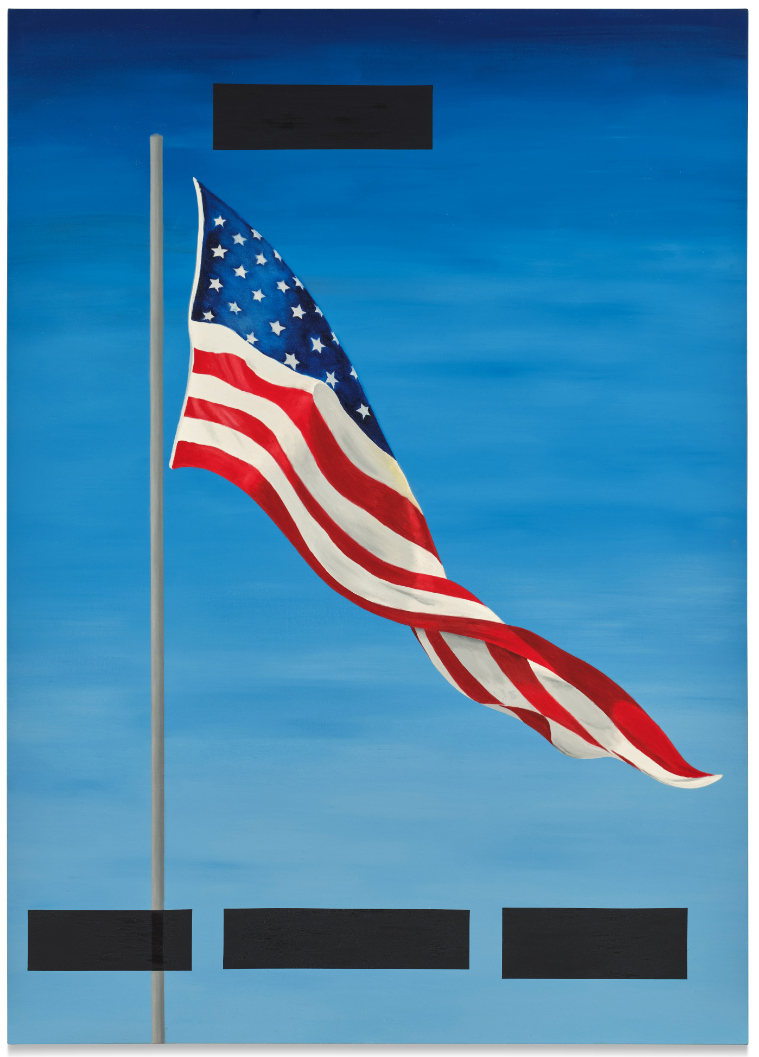
ED RUSCHA (b. 1937)
Plenty Big Hotel Room (Painting for the American Indian), 1985
Oil on canvas
84×60 inches (213.4 x 152.4 cm)
Signed and dated 85 (on the reverse)
#4. Chain and Cable, 1987
Christie’s New-York: 7 November 2023
Estimated: USD 2,500,000 – 3,500,000
USD 2,107,000
ED RUSCHA (b. 1937) (christies.com)
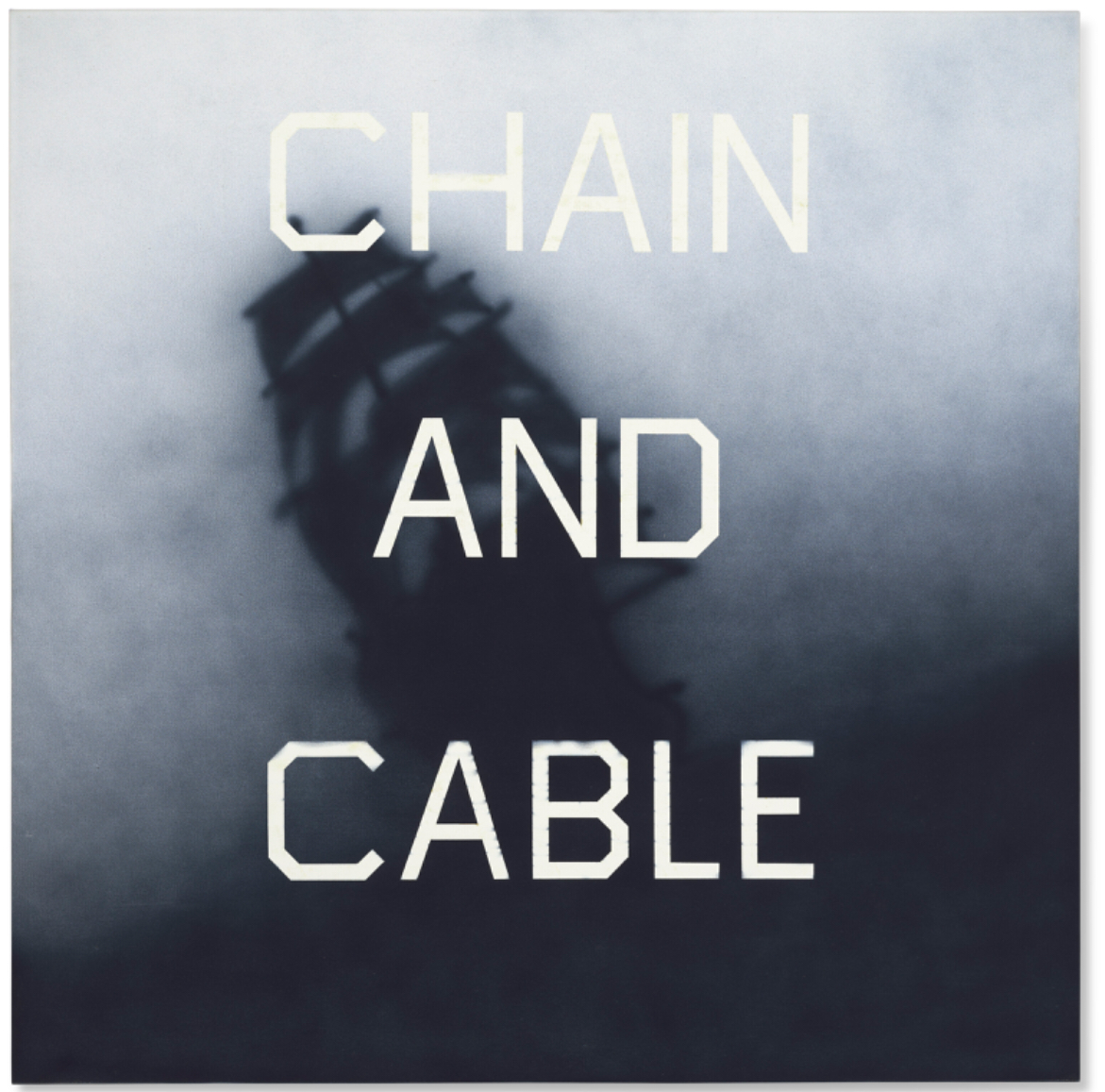
ED RUSCHA (b. 1937)
Chain and Cable, 1987
Acrylic on canvas
64×64 inches (162.6 x 162.6 cm)
Signed and dated ‘Ed Ruscha 1987’ (on the reverse)
Signed again, titled and dated again ‘ED RUSCHA “CHAIN AND CABLE” 1987’ (on the stretcher)
4. Sotheby’s Auctions
1. The Emily Fisher Landau Collection: An Era Defined Evening Auction
2. The Emily Fisher Landau Collection: An Era Defined Day Auction
3. Modern Evening Auction
4. Modern Day Auction
5. The Now Evening Auction
6. Contemporary Evening Auction
7. Contemporary Day Auction
1. The Emily Fisher Landau Collection: An Era Defined Evening Auction
8 November 2023
The Emily Fisher Landau Collection: An Era Defined | Evening Auction | Sotheby’s (sothebys.com)
The result of decades of inquiry and curiosity, the Emily Fisher Landau Collection is synonymous with connoisseurship and quality, and also speaks to Mrs. Fisher Landau’s voracious and instinctive approach to collecting. Presented as two standalone auctions during Sotheby’s Marquee sale season in New York, The Emily Fisher Landau Collection traces the greatest achievements of art in the past century. The dedicated Evening Auction is led by superb examples from the greatest artists of the 20th century, highlighted by Pablo Picasso’s Femme à la montre, Ed Ruscha’s Securing the Last Letter (Boss), Jasper Johns’ Flags, and Mark Rothko’s Untitled, as well as exceptional examples by Andy Warhol, Mark Tansey, Robert Rauschenberg, and Glenn Ligon.
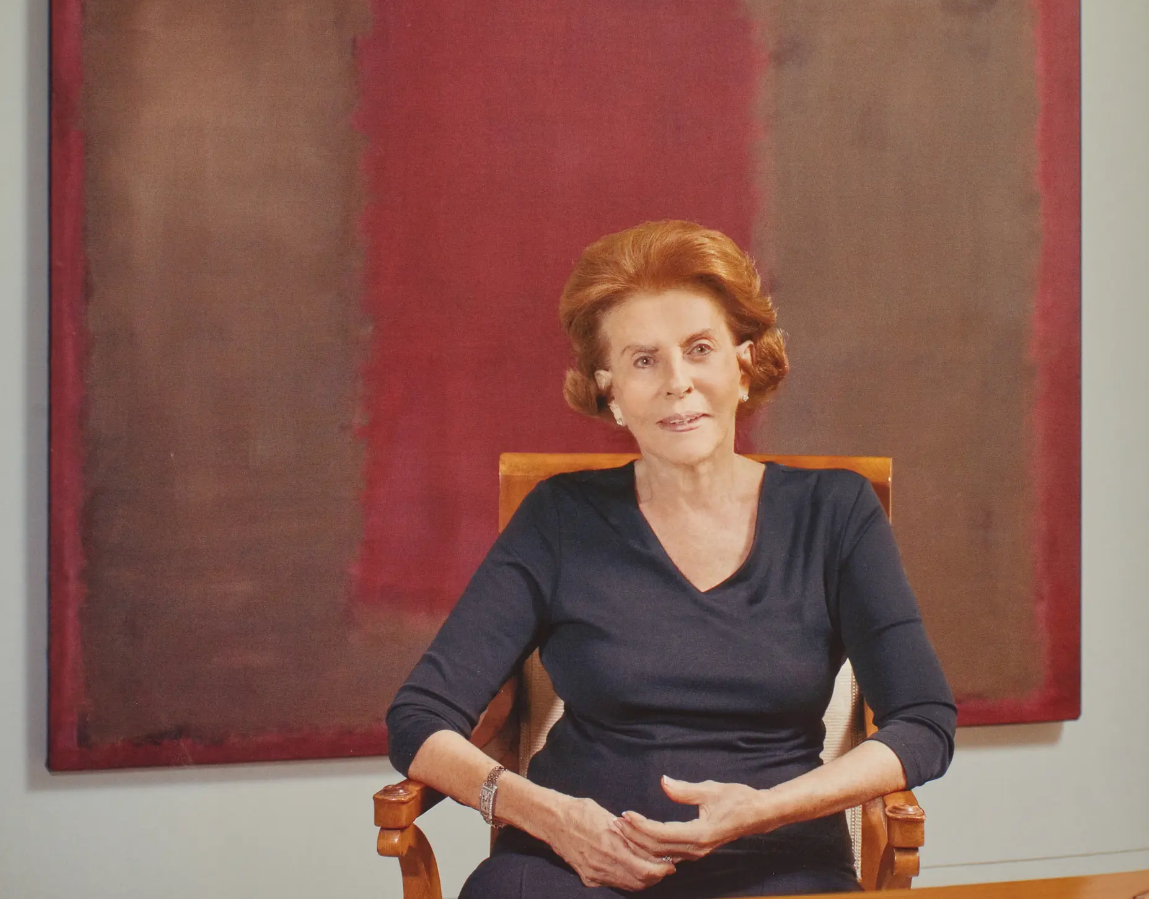
Over the course of the last century, a small number of individuals have played a vital role in shaping the unfolding story of 20th-century art. Emily Fisher Landau was a key member of this group: her deep and longstanding involvement with leading institutions; her profound engagement with the art of her time; and her unerring instinct as a collector at the highest level, all combining in one of the greatest patrons of ‘60s, ‘70s and ‘80s.
Auction Statistics
31 Lots
Low Estimate: USD 224,500,000
High Estimate: USD 310,100,000
Estimate Upon Request: 1
Total: USD 406,422,100
# Lots sold: 31
Sell-Through Rate: 100%
Top Lot: USD 139,363,500
19 Lots sold over USD 1 million
USD 405,025,100
(99.7% of total)
9 Lots sold over USD 10 million
USD 330,351,500
(81.3% of total)
Above Estimates: 5 Lots (16%)
Within Estimates: 19 Lots (61%)
Below Estimates: 6 Lots (19%)
Estimate on Request: 1 Lot (3%)
Top 5 Lots
#1. Pablo Picasso
Sotheby’s New-York: 8 November 2023
Estimate Upon Request
USD 139,363,500
PABLO PICASSO (1881 – 1973)
Femme à la montre, 1932
Oil on canvas
130×97 cm (51 1/8 x 38 1/8 inches)
Signed Picasso (upper left)
Inscribed Boisgeloup and dated 17 Août XXXII. (on the stretcher)
Executed on 17 August 1932
Among the representations of ardor and desire in the canon of twentieth-century art, Picasso’s sensuous depictions of his lover and muse Marie-Thérèse Walter reign supreme. Executed in 1932 at the pinnacle of Picasso’s impassioned affair, Femme à la montre exists as one of the most resolved and complex depictions from this highly charged year. The rapturous period from which Femme à la montre originates has been described by the artist’s biographer John Richardson as Picasso’s annus mirabilis or ‘year of wonders.’ In 1932, Picasso worked at a feverish pace, ceaselessly inspired by his new muse’s presence and the longing felt in her absence. Utterly consumed by his amour fou—the Surrealist notion of an obsessional, vortex-like desire—each work from this period reads like an entry in a diary, documenting the pair’s evolving relationship. Among the artist’s 1932 works, it is the monumental canvases like Femme à la montre, which unapologetically announce Marie-Thérèse’s presence, that are most widely acclaimed for their singular importance in Picasso’s oeuvre.
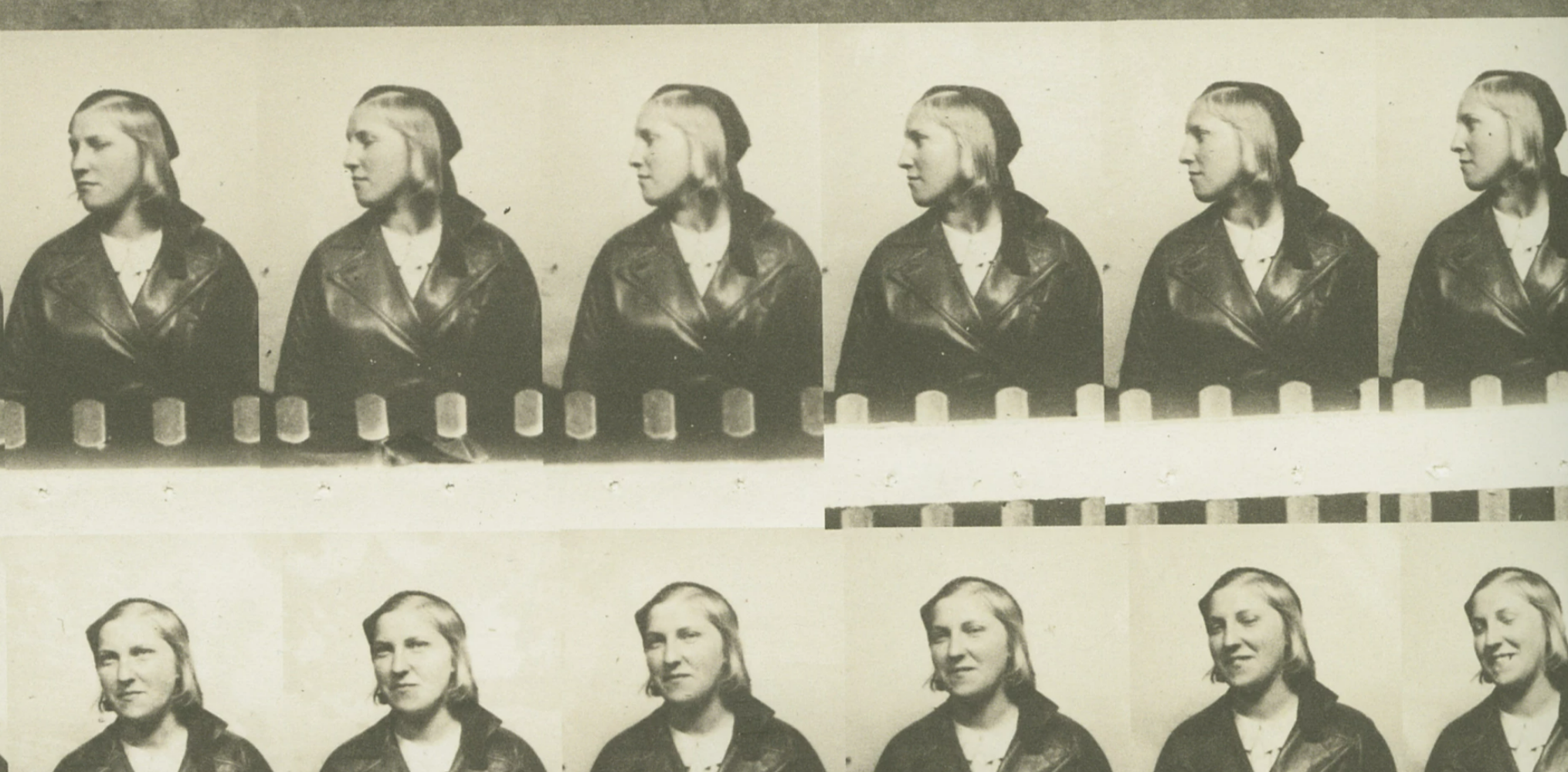
PHOTOGRAPHS OF MARIE-THÉRÈSE WALTER, 1930. PHOTO © COURTESY ARCHIVES MAYA WIDMAIER PICASSO.
Picasso’s infatuation took on near-mythic proportions, the likeness of Marie-Thérèse spilling out onto canvas after canvas, in sculpture and on paper. Due to the age difference and Picasso’s marriage to Olga, their relationship remained a secret and was hidden even from the artist’s innermost circle of friends. As a result, Marie-Thérèse’s identity is hidden in Picasso’s earliest works, obscured by his Surreal biomorphic interpretations, hinted at in shadowy profiles or tantalizingly suggested in the still lifes which conceal the initials ‘MT.’ As Françoise Gilot would later write, Marie-Thérèse was “the luminous dream of youth, always in the background but always within reach, that nourished his work… Marie-Thérèse, then, was very important to him as long as he was living with Olga because she was the dream when the reality was someone else” (quoted in Exh. Cat., London, Tate, Picasso 1932 – Love, Fame, Tragedy, 2018, p. 18).
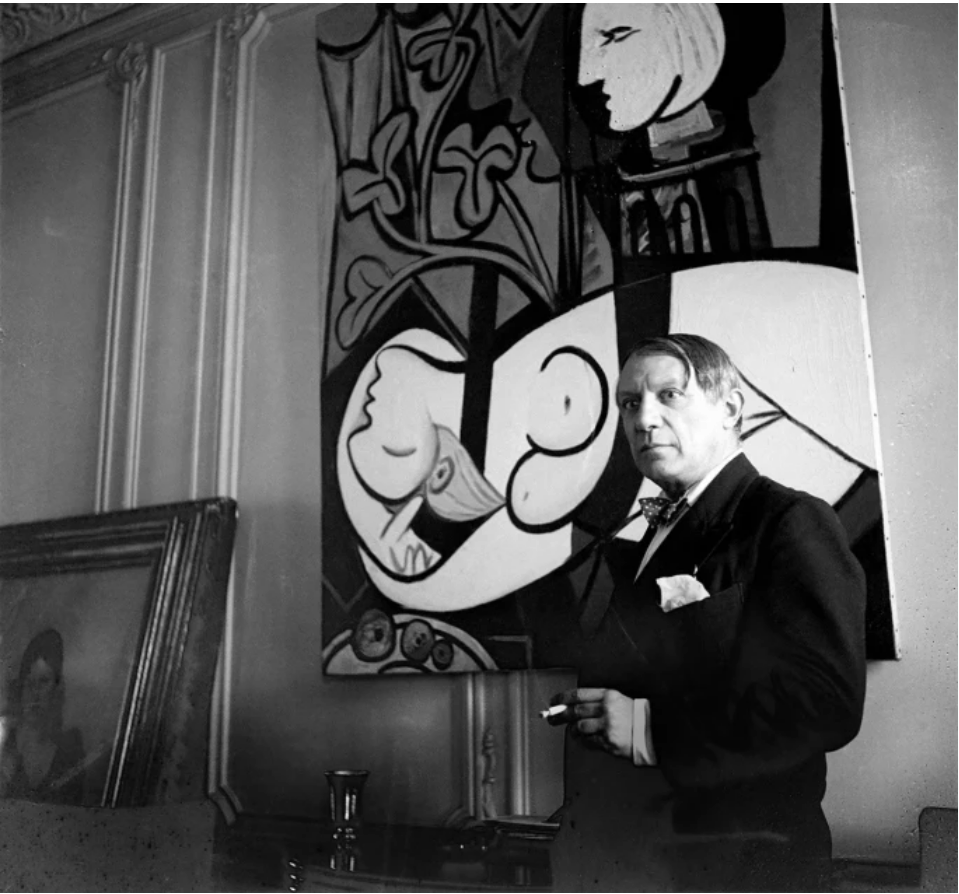
CECIL BEATON, PABLO PICASSO, RUE LA BOÉTIE, 1933. PHOTO © THE CECIL BEATON STUDIO ARCHIVE AT SOTHEBY’S. ART © 2023 ESTATE OF PABLO PICASSO / ARTISTS RIGHTS SOCIETY (ARS), NEW YORK
Their furtive liaison resulted in scores of coded images of his lover, eventually culminating in the undeniably bold and sensuous portraits of 1932 at the apex of their relationship. His muse’s potent mix of physical appeal and sexual naïveté had an intoxicating effect on Picasso, and his rapturous desire for the young woman brought about a wealth of images that have been praised as the most erotic and emotionally uplifting compositions of his long career. Augmented by the forbidden nature of their years-long relationship, Picasso’s unleashed passion is nowhere more apparent than in his 1932 depictions of his muse.
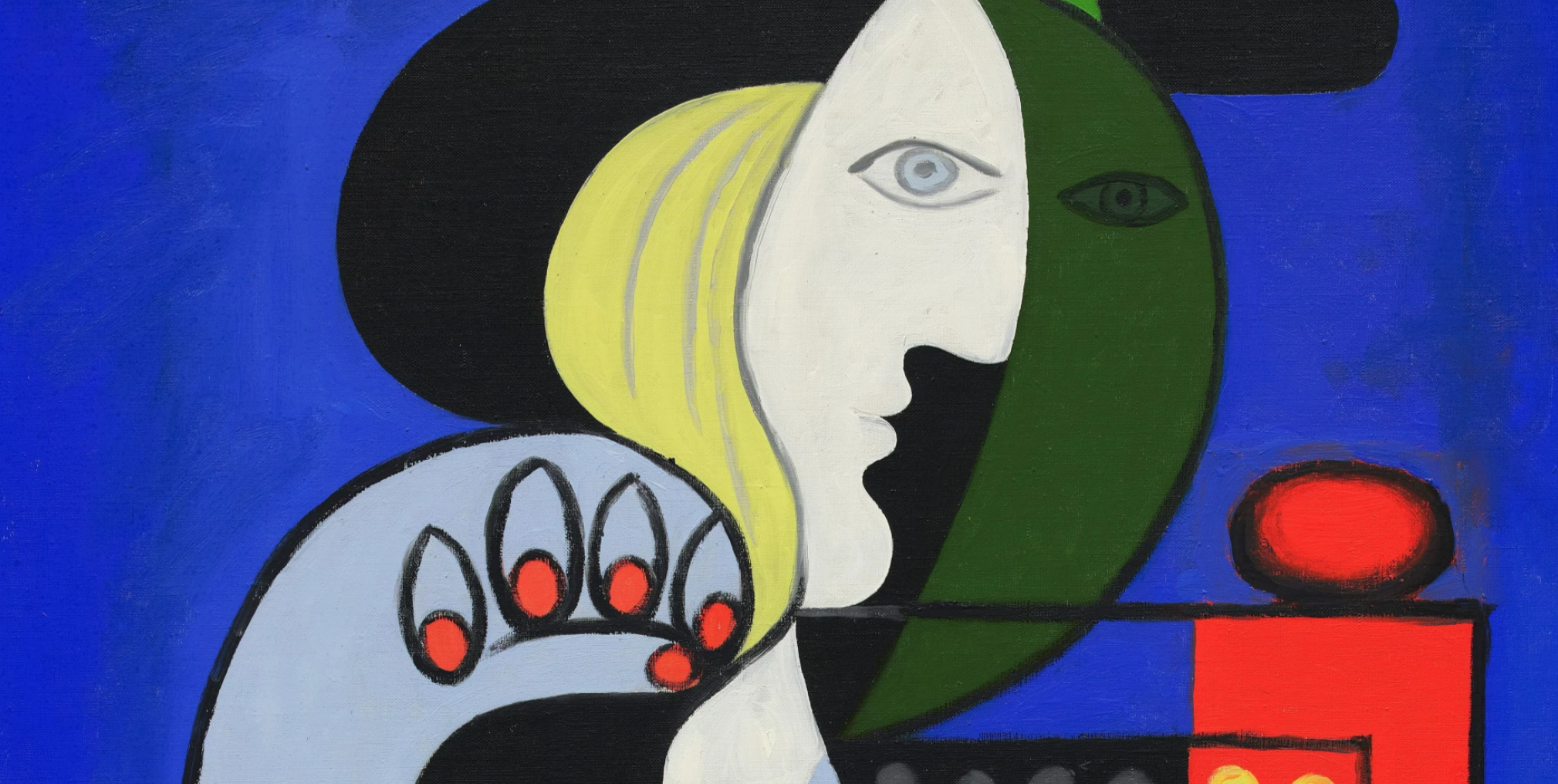
Executed in August of that year, Femme à la montre depicts a smartly dressed young woman seated in an armchair against a striking blue background. Back in Boisgeloup after the opening of his retrospective in Paris, Picasso enjoyed a calmer environment free of pre-exhibition stresses and time constraints. Consequently, the present work displays a heightened level of detail and pictorial complexity compared to related compositions from earlier in the year, resulting in one of the most compelling portrayals of his Golden Muse ever created.
Rendered in volumetric curves and set against geometric delineations of her dress and chair, Marie-Thérèse conveys a sense of poise and assuredness. Her gaze is directed at the viewer, the illuminated half of her visage mirrored and joined by the shaded half—like sun and moon—in the characteristic implication of Picasso’s own presence. The brilliant blue background against which Marie-Thérèse is posed is exceptional for seated portraits from the period. While the bold primary color is seen in a few of the reclining nudes, Femme à la montre is the only depiction to offer the numinous backdrop to such a powerful extent, lending the seated Marie-Thérèse a reverential, almost hallowed aura like a mandorla surrounding a Madonna.
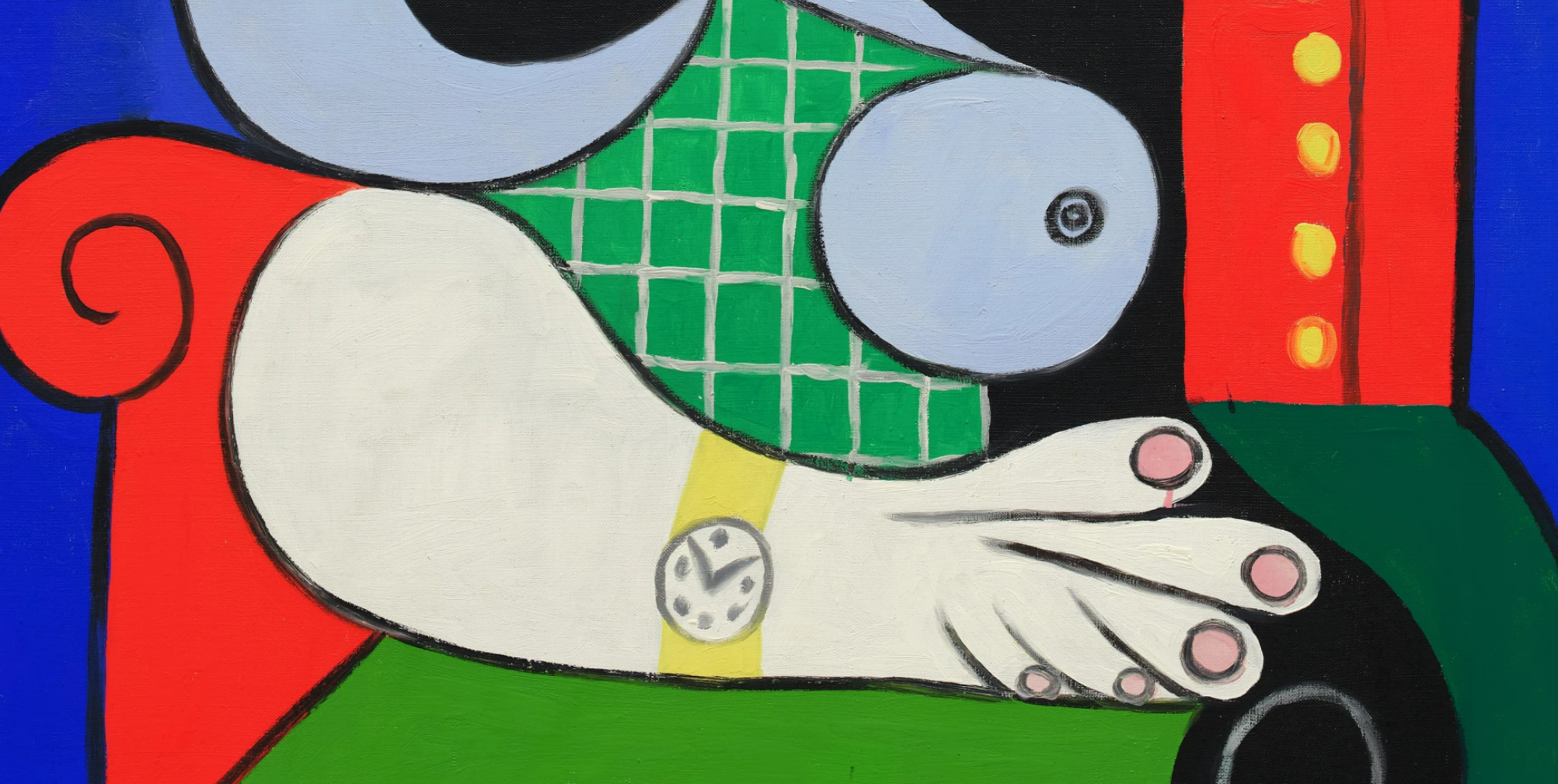
The present work is further distinguished by the crisply articulated lines and geometric forms of the armchair and pattered dress, each element carefully offset by contrasting colors and shapes. Marie-Thérèse’s green checked blouse can be read a direct reference to the patterned tapestries and garments found within Matisse’s canvases from the period, like his 1927 Femme à l’eveil, which was included in The Museum of Modern Art’s 1931 retrospective on Matisse. Accordingly, Femme à la montre acts not only as an ode to Picasso’s Madonna, but also as a direct riposte to his greatest artistic rival.
#2. Jasper Johns
Sotheby’s New-York: 8 November 2023
Estimated: USD 35,000,000 – 45,000,000
USD 41,000,000
JASPER JOHNS (b. 1930)
Flags, 1986
Oil on canvas
25 5/8 x 33 1/8 inches (65 x 84.1 cm)
Signed, dated 1986 and variously inscribed (on the reverse)
For over six decades, Jasper Johns has pursued an unprecedented painterly interrogation of image-making that, in its virtuosic ingenuity and unswerving resolve, constitutes one of the greatest artistic achievements of the twentieth century. A triumph of painterly and conceptual rigor alike, Johns’ Flags presents one of the most significant pictorial emblems from the artist’s oeuvre in exceptional form. At the young age of twenty-four, Johns dreamt of painting the illustrious American flag, an act which would launch him on an artistic journey spanning decades, beginning with his first iteration in 1954. Executed thirty years later in 1986, Flags is an important example of the artist’s nearly endless reworking of this iconic subject, here rendered in the iconic red, white and blue palette and mirrored twice, a reflection of the artist’s longstanding interest in doubling. In his painstaking rendering of this quintessentially American symbol, Johns relies on the ‘readymade’ image, unraveling the uncertain distinction between signifier and signified—between that which is seen and that which is implied—bringing to the fore the viewer’s own agency in perceiving and constructing the world around us. Flags is marked by an incredibly rich surface, and by the complementary ground layer of orange and green, which lends the composition an impressive sense of sculptural depth. Treasured in the most eminent personal collections and renowned museum collections around the world, variations on Johns’ Flags belong to such prestigious institutions as the Museum of Modern Art, New York; Metropolitan Museum of Art, New York; Whitney Museum of American Art, New York; Museum Ludwig, Cologne; Kunstmuseum Basel; and Museum Moderner Kunst Stiftung Ludwig, Vienna, testament to its remarkable relevancy. Directly acquired from Leo Castelli Gallery the year after its execution, Flags constitutes the ultimate summation of Johns’ signature artistic concerns: the modification of familiar images to engage, explore, and expose the ways in which art creates meaning within the mind’s eye.
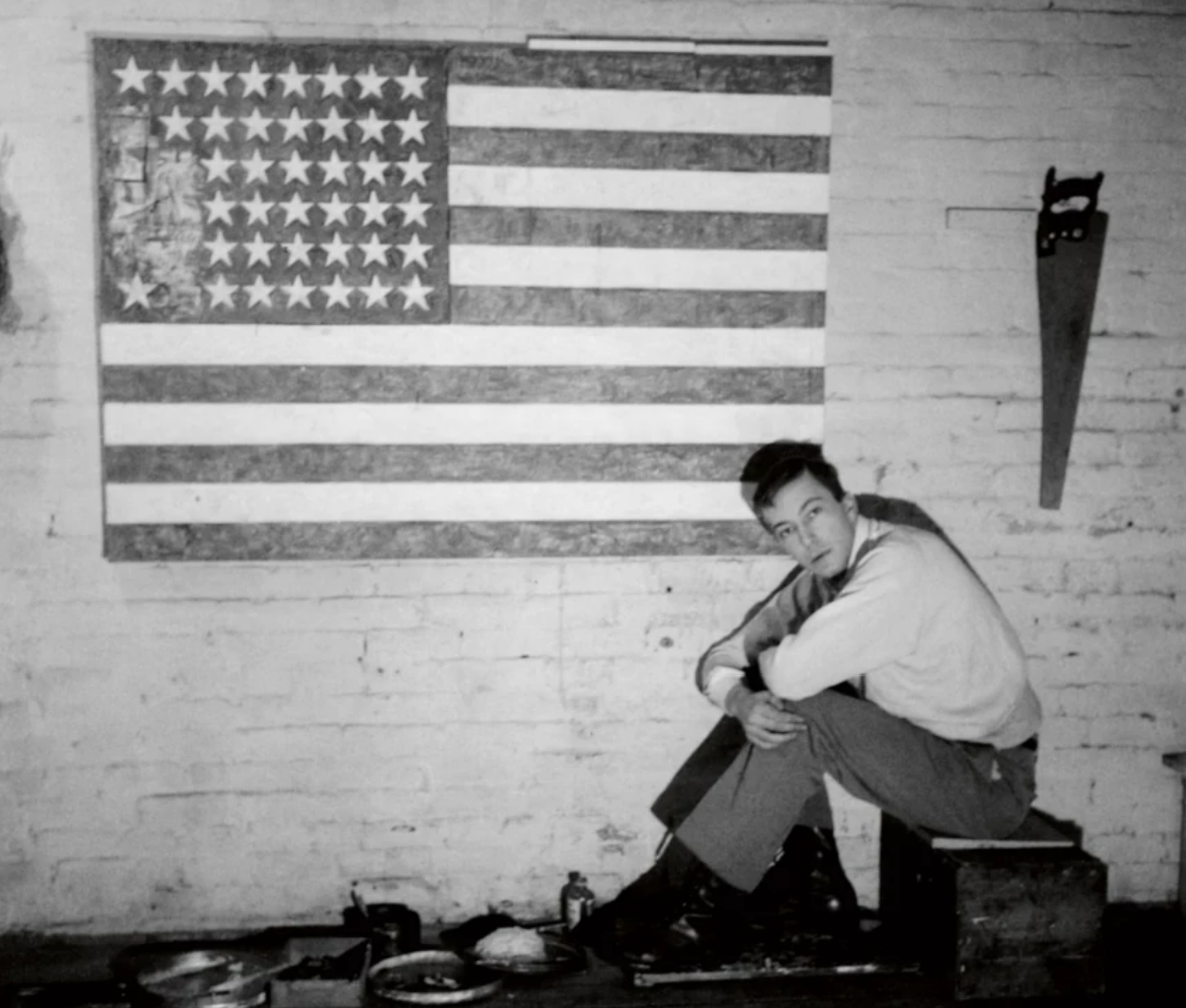
ROBERT RAUSCHENBERG, UNTITLED [JASPER JOHNS WITH FLAG PAINTING, PEARL STREET STUDIO], C. 1955. PRIVATE COLLECTION. ART © 2023 ROBERT RAUSCHENBERG FOUNDATION; 2023 JASPER JOHNS / ARTISTS RIGHTS SOCIETY (ARS), NY
At once intimate and uncanny, mysterious and matter of fact, Flags exemplifies that tautly thrilling ambiguity which marks the very best examples of the Johns’ output; standing before the present work, the image we see is both a flag and a painting of a flag, destabilizing traditional borders between the painted image and that which it represents. Since making his first Flag painting in 1954-55, Johns systematically broke down the homogenous unit of the flag, duplicating the form and rendering it in a side-by-side format with visibly rough brushstrokes that revealed the very process of creation. By rotating the flag to a vertical orientation, Johns negotiates the very idea of the flag. This arresting punch is amplified through the physical coercion of its design. The composition still says ‘flag’, yet not in the way one expects. With each stroke, duplication, and deliberate rotation, Johns challenges the viewer’s preconceptions of an aesthetic object, forcing a reconsideration of medium and form.
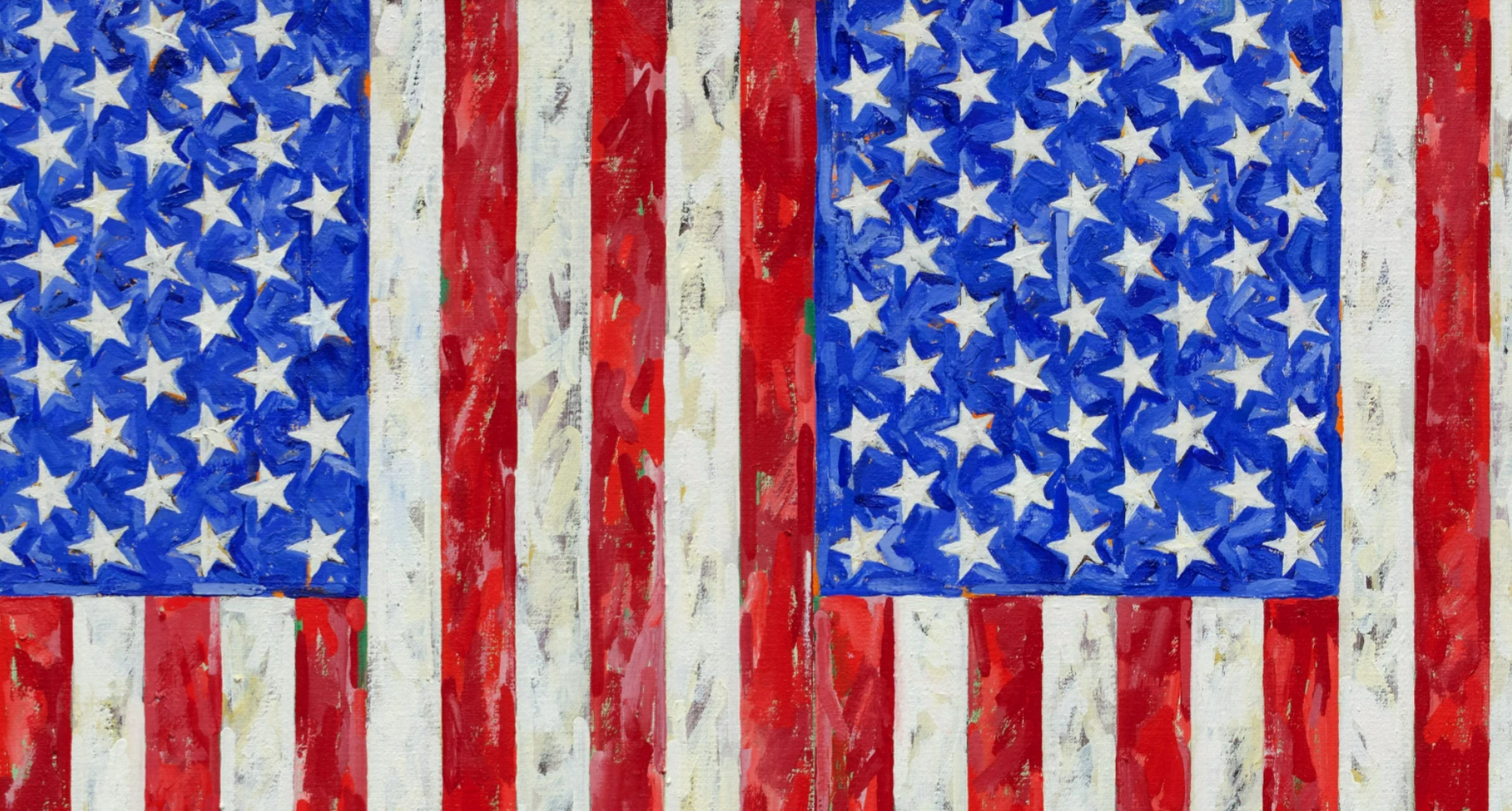
From within the pre-ordained parameters dictated by the flag’s strict design erupts a tightly controlled chaos of sharp staccato strokes. Flickers of orange, green, and yellow disobey the boundaries set forth by the alternating stripes and strictly traditional palette; the lower right corner in particular appears to devolve into alternative hues like a tattered flag beginning to fray in the wind. With each of the fifty white stars firmly planted at their customary coordinates, the terrain of swift blue strokes in which they are embedded encircles them, disrupting their purported regularity: as the blue imperfectly borders on the five-point perimeter of every star, Johns’ hand trespasses the prescribed straight lines, covering some edges while leaving around others some hints of the underlying orange. Even within the traditional red, white, and blue, Johns deploys strokes of varying tones, some lighter, some darker, imbuing the composition with the impression of movement and shadow, as if it were fluttering in the breeze. Johns’ Flags enthralls because it forces the viewer to ask questions that challenge our preconceptions about the status of an aesthetic object; it makes us truly examine the subject.
#3. Ed Ruscha
Sotheby’s New-York: 8 November 2023
Estimated: USD 35,000,000 – 45,000,000
USD 39,400,500
ED RUSCHA (b. 1937)
Securing the Last Letter (Boss), 1964
Oil on canvas
59 x 55 1/8 inches (149.9 x 140 cm)
Signed, titled and dated 1964 (on the stretcher)
Emblazoned in glowing orange, the word “BOSS” thunders from a contrasting expanse of midnight navy in Ed Ruscha’s Securing the Last Letter (Boss) from 1964. The booming clamor of the word here is interrupted only by the industrial C-clamp that squinches and compresses the final letter, warping the image with the full genius of the artist’s semiotic subversion. Merging Pop Art, conceptualism, and a distinct West Coast sensibility with an elemental graphic force, Ruscha’s Text paintings of the 1960s transformed ordinary language into arresting visual statements that launched the artist into the innovative forefront of American contemporary art. Heralding a milestone in his aesthetic evolution, Securing the Last Letter (Boss) is one of only 24 large-scale paintings measuring over fifty inches that Ruscha executed in the seminal period between 1960 and 1965, and it develops from his earlier 1961 painting Boss, now held in the Broad Museum, Los Angeles, by introducing the unexpected image of a C-clamp into the word. Further probing the materiality of language, the present work is thus an exceptionally rare masterpiece from a limited suite of only four large-scale Text paintings with the clamp motif, half of which now belong to prominent institutional collections; notably, the sister painting to the present work, Not Only Securing the Last Letter but Damaging It as Well (Boss) resides in the Museum Brandhorst, Munich, while Hurting the Word Radio #1 is held in the Menil Collection, Houston. Further testifying to its prodigious significance, Securing the Last Letter (Boss) bears exceptional provenance, having only belonged to notable collectors Ed and Audrey Sabol prior to Emily Fisher Landau, who acquired the present work in 1988 through Leo Castelli Gallery.
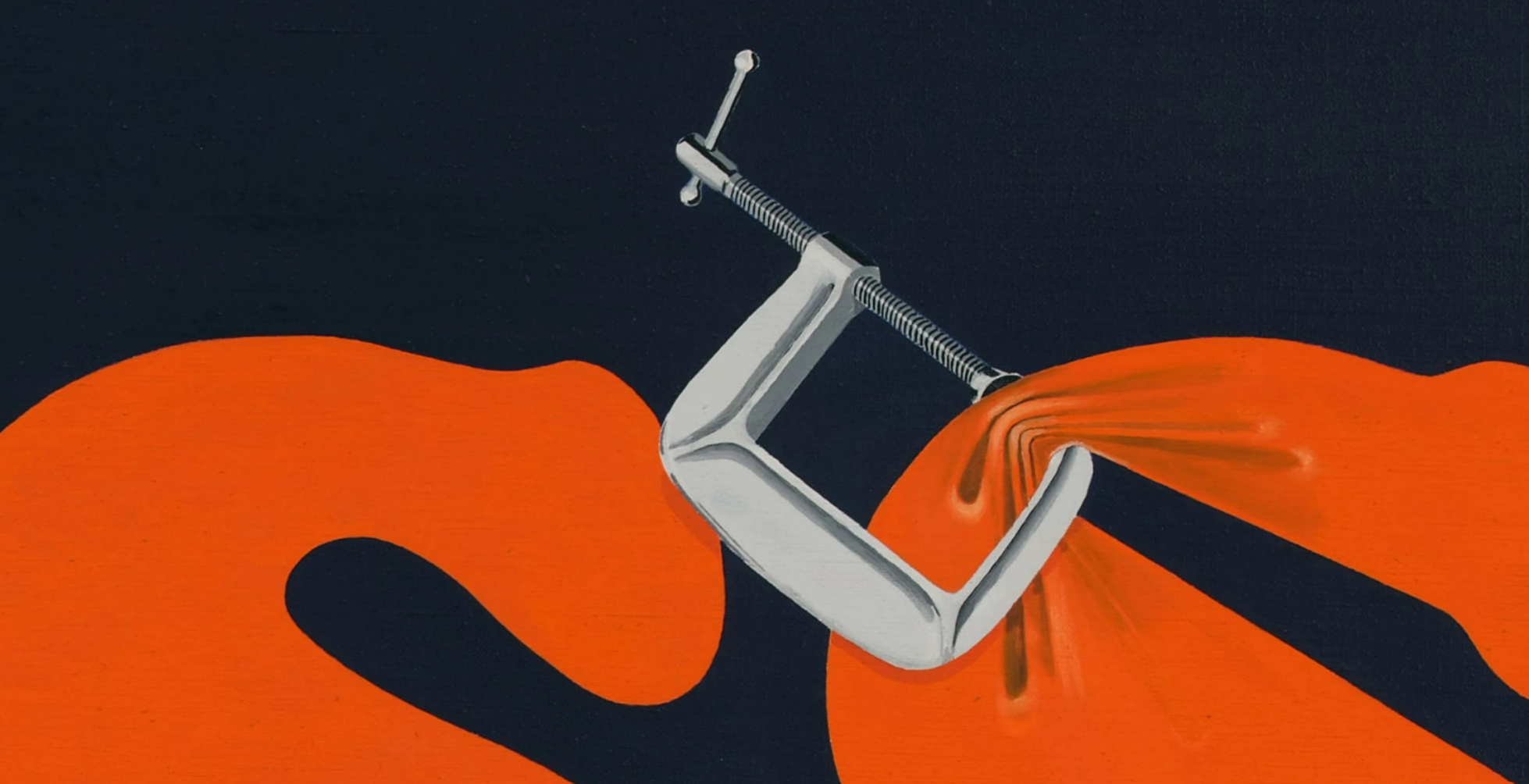
Theatrical in scale and cinematic in allure, in Securing the Last Letter (Boss), Ruscha spells out with bright, bolded letters a word that aptly parallels the palpable authority of its visual dynamism: “BOSS.” The graphic potency and commanding associations of the titular word strike both the eyes and the mind like a boxer’s punch, a forceful expression of dominance and cool. Any semantic association of authority, however, appears undermined by the metal clamp that clenches onto the orange skin of the final “S,” radically disrupting the presumed flatness of the given text and insisting on its sculptural physicality and symbolic potential instead. The C-clamp—a utilitarian metal device of mechanics and carpentry—introduces a trompe l’oeil that elevates text into object, language into art, colloquialism into critique: as Thomas Crow analyzes, “The accurately depicted clamp, like an illustration from a tool supply catalogue, shouts ‘actual size,’ as it reveals the orange letters to be made of some ostensibly malleable material… It is a C-clamp, its namesake letter parasitically making the nonsensical BOScS out of Boss, deflating the boastful overtones of the word and perhaps marking its having congealed into a commercialized cliché” (Thomas Crow, “Turn It Up: The Sounds of the Young Ed Ruscha” in Exh. Cat., Ed Ruscha: Ace Radio Honk Boss, Craig F. Starr Gallery, New York, 2018-2019, n.p.). As with the very best of Ruscha’s seminal Text paintings, the artist here transfigures the word “BOSS” into a vehicle for his formal and conceptual investigations, a signature interplay of semiotics that has since shaped the cornerstone of his prolific career.
#4. Cy Twombly
Sotheby’s New-York: 8 November 2023
Estimated: USD 20,000,000 – 30,000,000
USD 26,761,500
CY TWOMBLY (1928 – 2011)
Untitled, 1968
Oil-based house paint and wax crayon on canvas
67 7/8 x 86 inches (172.4 x 218.4 cm)
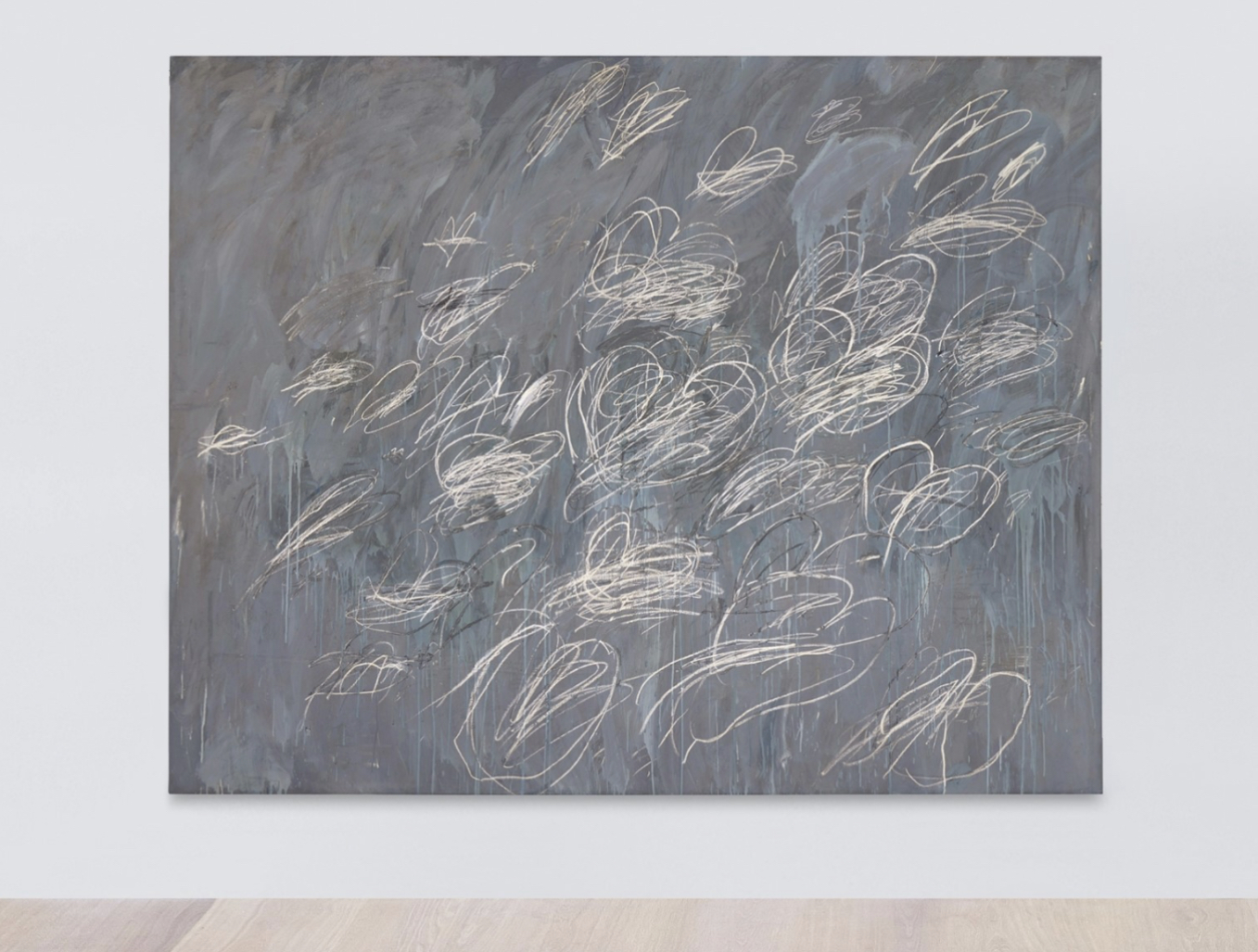
At once gracefully executed and dramatically scaled, Cy Twombly’s Untitled is a captivating exemplar of the artist’s renowned Blackboard paintings. Executed in 1968, the present work is amongst the most gesturally expressive invocations of the urgent, interrogatory mark-marking which distinguishes the very best examples of this celebrated series. Even within that rarified group, the present work rises to the fore: unlike those Blackboards restrained to neat rows of tightly coiled reverberations, or those which dissolve into complete frenetic abandon, the present work sees Twombly express the exact, thrilling boundary between control and anarchy, order and chaos, intention and accident. Here his lines appear to coalesce into heart-shaped forms that bloom across the surface, before ultimately dissolving into abstraction. Further distinguished by its exceptionally rich surface of splashes, drips, and smears in dynamically varied hues of grey, slate, and steel blue, Untitled is a spectacularly realized example of the ever-present tension between legibility and abstraction, gesture and expression, signifier and signified that lies at the very heart of Twombly’s extraordinary artistic practice. Bearing remarkable provenance, Untitled was previously held in the collection of the artist Robert Rauschenberg; acquired from Rauschenberg by Emily Fisher Landau in 1986, Untitled stands as a testament to Fisher Landau’s enduring patronage of both artists.
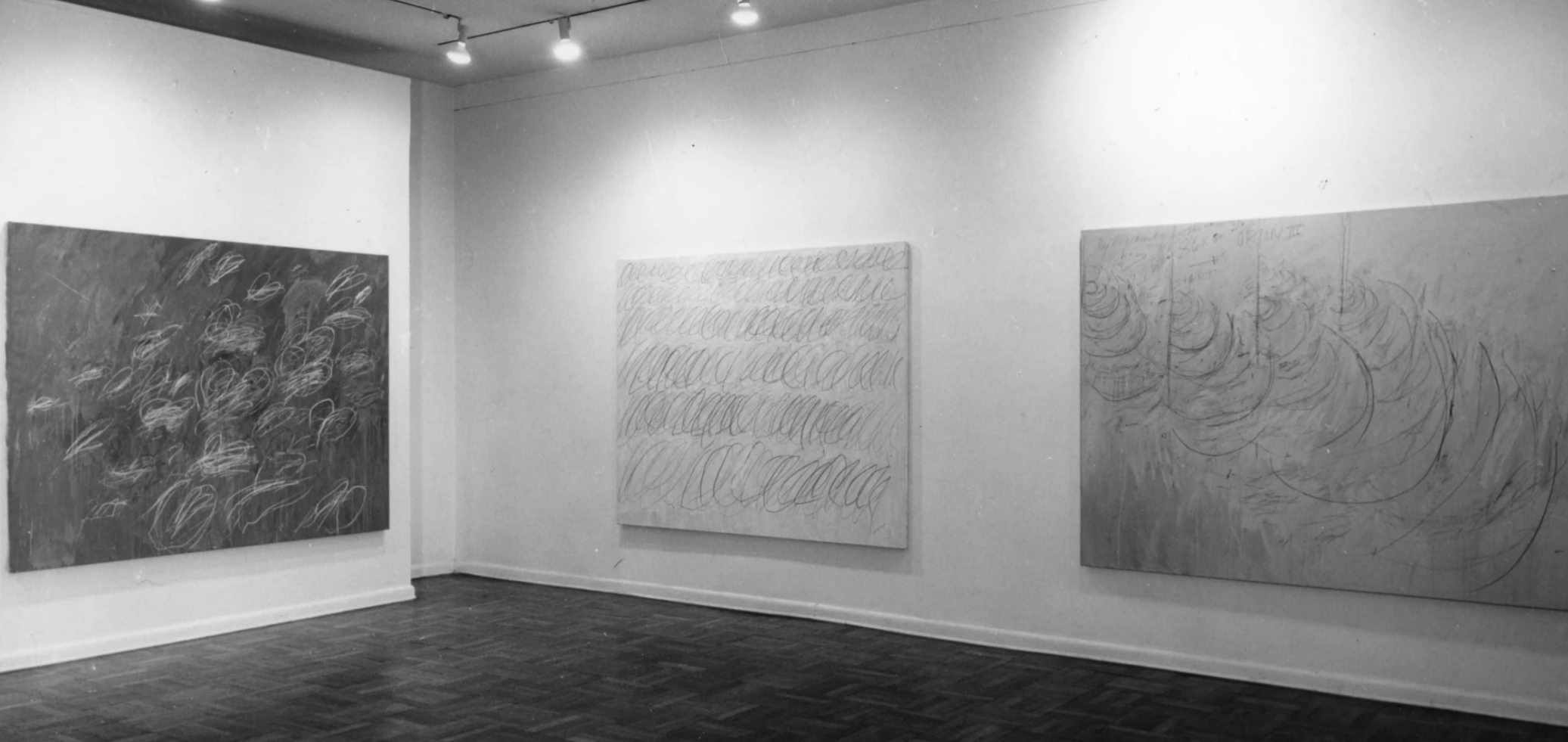
THE PRESENT WORK INSTALLED IN CY TWOMBLY, CASTELLI GALLERY, OCTOBER 1967. PHOTO © COURTESY CASTELLI GALLERY. ART © 2023 CY TWOMBLY FOUNDATION
An enigmatic and lyrically rendered composition, Untitled is emblematic of the artist’s pivotal Blackboard paintings, which characterize the apex of Twombly’s inimitable output. Twombly emerged as an artist in New York in the mid-1950s, developing a graffiti-like style influenced by Abstract Expressionist automatism. While prevailing tendencies of the period sought to abandon historical narratives altogether, Twombly directed his focus toward ancient, classical, and modern poetic traditions, developing a highly unique pictorial language that found its purest expression in a remarkable vocabulary of signs and marks and the fusion of image and text. Executed between 1966 and 1971, Twombly’s Blackboards marked a distinct shift from his Baroque paintings of the early 1960s, which were characterized by their extravagantly textured surfaces and bodily smears of red, pink, and white. Beginning in the latter half of the 1960s, the artist radically returned to his monochromatic artistic roots, galvanizing them with an erotic charge and embarking on an entirely new style of painting, which bridged Abstract Expressionism, Minimalism, and Pop, akin to his pioneering peers Robert Rauschenberg and Jasper Johns. Systematically repeating his sensuous loops on canvas in order to communicate that which neither visual image nor written word could accomplish alone, Twombly began presenting calligraphy as a moving image. Over seven feet long and five feet high, the expanding progression of spiraling lines and burgeoning forms distinguishes Untitled amongst the magnificent set of lasso-loop paintings made in this period that mark the culmination of a dramatic and extraordinary era in Twombly’s career.
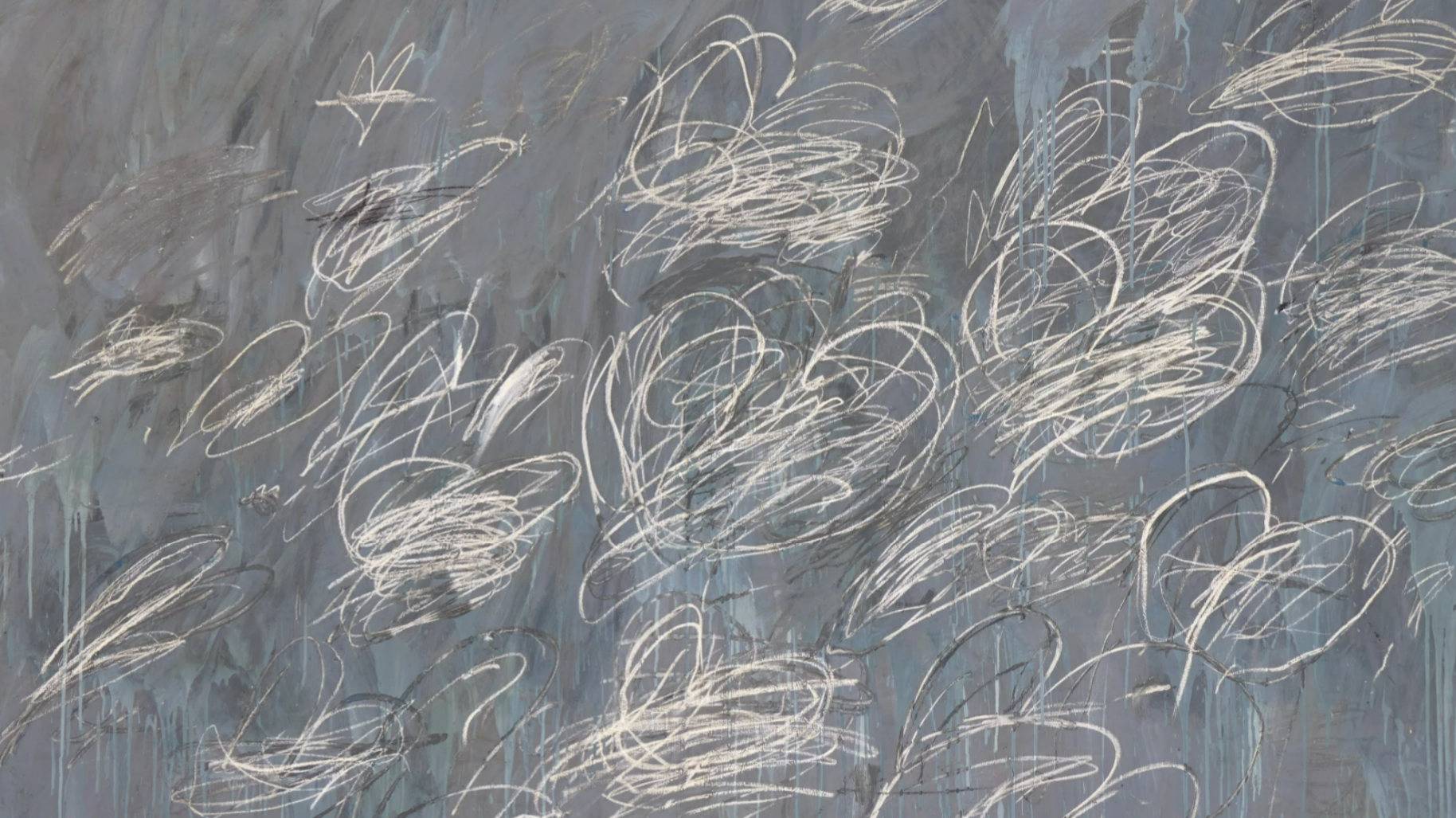
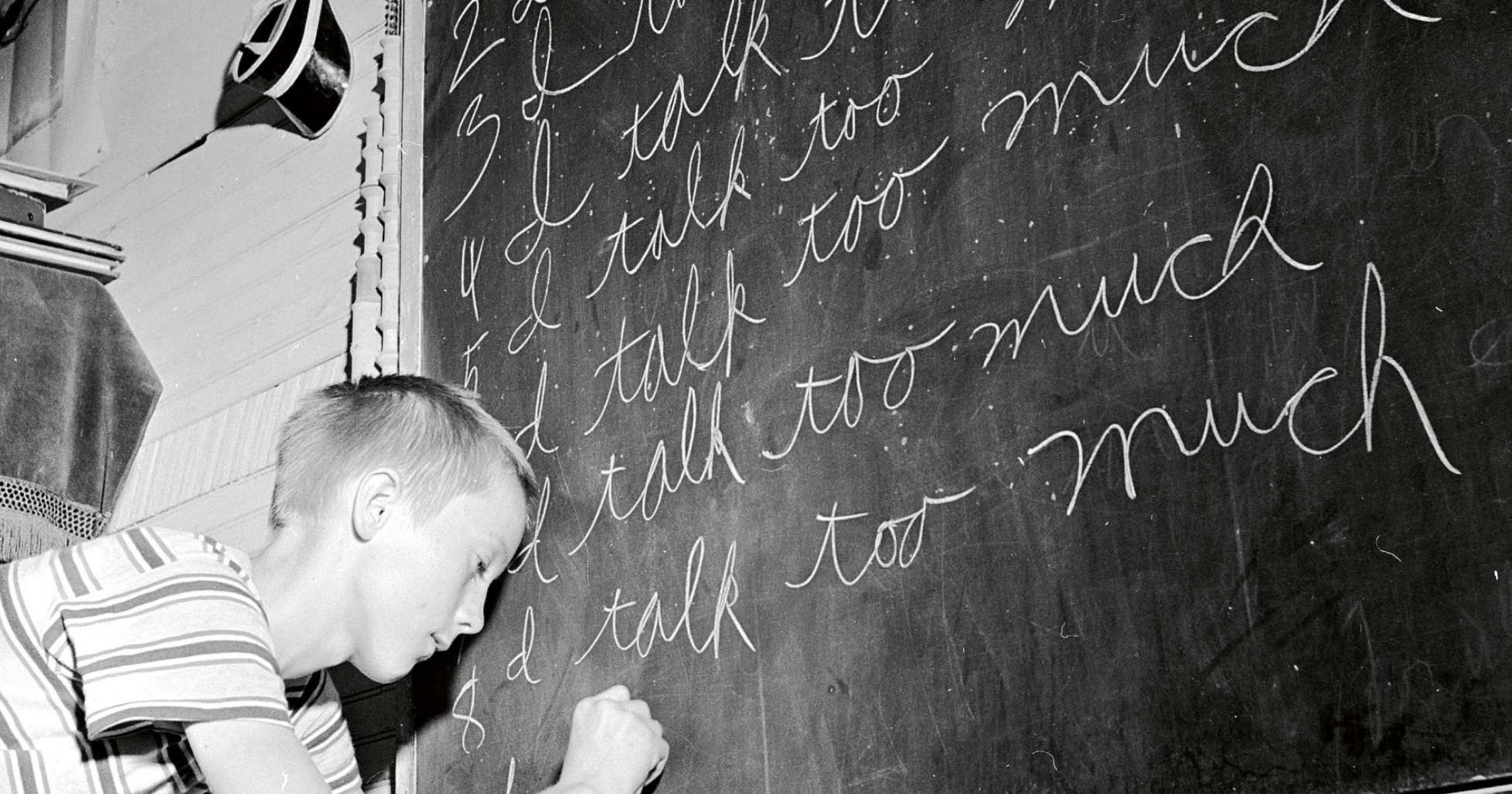
In the present work, the viewer is left to puzzle over the intricate arrangement of Twombly’s notations, which billow across the canvas in a flowing array of spiraling forms, in some places resembling hearts, in others dissolving into clouds. The spectacular scale of the present work amplifies the momentum of Twombly’s curving shapes that superimpose lines and forms across the canvas. Fully emergent in some areas and barely perceptible in others, the negative space establishes a counterpoint to the riveting lassoed lines. In 1968, Twombly produced his Synopsis of a Battle and Orion series; his Blackboard paintings of the same moment were simultaneously influenced by the build-up to the 1969 Apollo 11 moon landing, which Twombly, like Rauschenberg, followed closely, fascinated by space travel. Twombly’s forms appear like abstract visualizations of constellations, through which the artist interprets space and time. Like the Italian Futurists Giacomo Balla and Umberto Boccioni, Twombly sought to capture the dynamism and trajectory of movement in Untitled, mirroring the visual language of mathematical formulae and complex equations across a chalkboard.
BOY WRITING ON CHALKBOARD, C. 1960S. PHOTO © THREE LIONS/GETTY IMAGES
Calligraphic and painterly, this magnificent canvas cleverly evokes the chalklike notations of an educational lecture whilst remaining utterly illegible, revealing Twombly’s unique pictorial language. Working from the bottom of the painting and flourishing upwards, the series of expressive forms seem to flow continuously, expanding and blossoming outwards. Recalling the palimpsest-like nature of Roman graffiti, the forms in Untitled were in part inspired during Twombly’s time in Rome, where he settled permanently in 1957, before returning to New York a decade later. As Twombly described, “Generally speaking my art has evolved out of the interest in symbols abstracted, but never the less humanistic; formal as most arts are in their archaic and classic stages, and a deeply aesthetic sense of eroded or ancient surfaces of time” (Cy Twombly quoted in Nicola del Roscio, Ed. Writings on Cy Twombly, Munich, 2002, p. 199). Twombly’s first Blackboard paintings marked a period when he began to transition from an empty white ground to one of subtle gray using an oil-based house paint. Its look mimicked the appearance of an elementary-school chalkboard. While his earlier paintings and drawings on a predominately white background might feature scattered daubs of vermillion, purple or even pink, the Blackboard paintings are notably restrained. In graphic monochrome, their signature white-and-gray “chalkboard” look evokes the formal austerity of Minimalism, while still retaining the idiosyncratic touch of the artist’s hand.
#5. Mark Rothko
Sotheby’s New-York: 8 November 2023
Estimated: USD 30,000,000 – 40,000,000
USD 22,165,500
MARK ROTHKO (1903 – 1970)
Untitled, 1958
Oil on canvas
91 7/8 x 69 1/2 inches (233.4 x 176.5 cm)
Signed and dated 1958 (on the reverse)
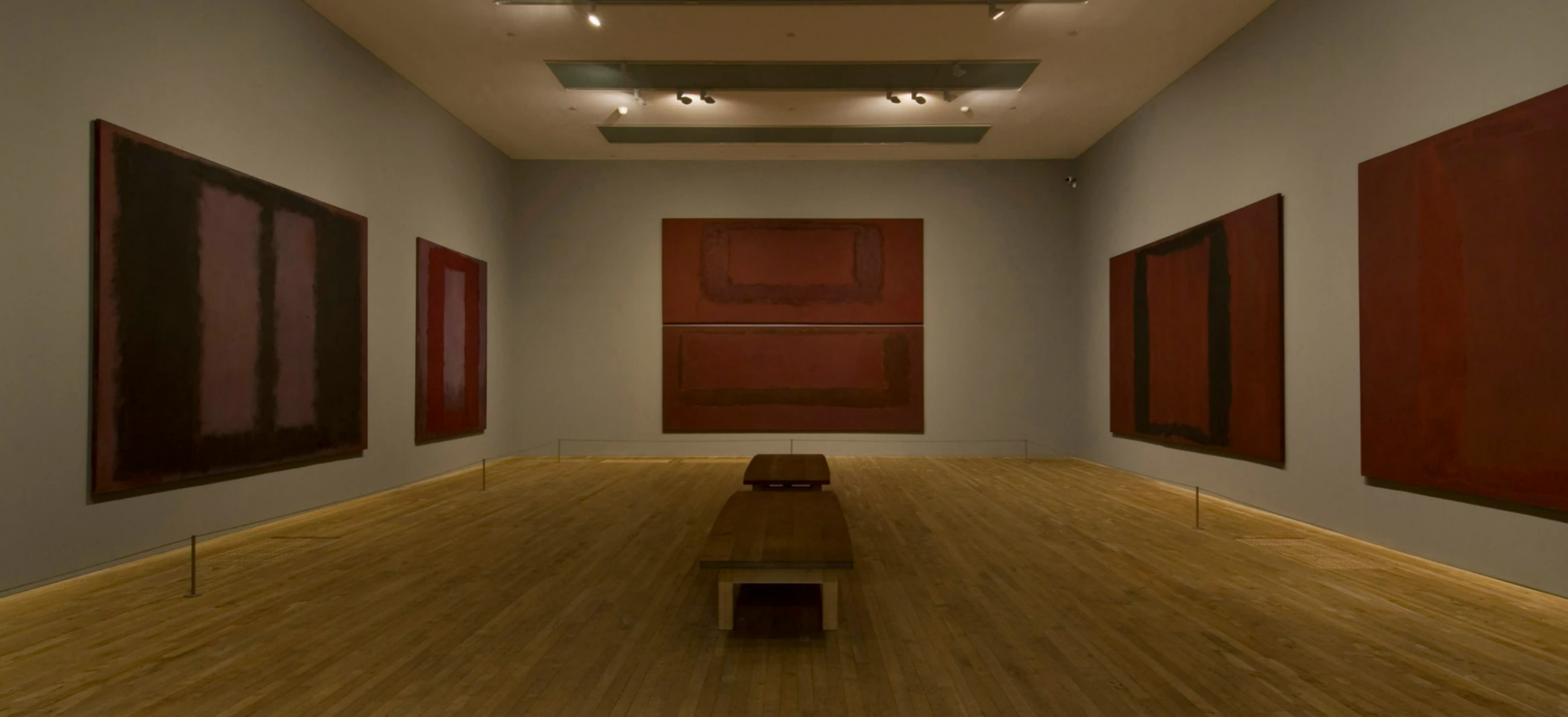
Illuminated by an enigmatic and mesmeric inner radiance, Untitled profoundly demonstrates the extraordinary alchemical genius that characterizes Mark Rothko’s inimitable oeuvre. Painted in 1958, at the apex of his artistic and critical achievements, the present work was completed in preparation for his infamous Seagram Murals. Indeed, partially titled “Seagram Mural Sketch,” Untitled is directly related to Section Four of the mural series, now held in the collection of the Tate, London, in its composition and inverted color scheme. Of the thirty paintings in the complete Seagram series, only four remain in private hands—with all the others housed in the permanent collections of the National Gallery of Art in Washington D.C., the Tate in London, and the Kawamura Memorial DIC Museum of Art in Sakura, Japan. In its own right, this shimmering canvas embodies the artist’s remarkable ability to evoke the sublime and inspire powerful, universal emotions through pure, elegant abstraction. Untitled appears to glow from within, a window-like grey form focusing our eye on the dark red center, which softly burns like the embers of a nascent flame. Form and color, the two fundamental elements of Rothko’s signature philosophical approach to painting, are here mystically united to transform the canvas into a breathtaking physical expression of the human condition. Enveloping the viewer in the grand scale of its meditative aura, the present work heralds the creative crescendo of the artist’s legendary career and demonstrates the spectacular chromatic chemistry that has cemented Rothko’s place as one of the greatest masters of twentieth-century painting.
MARK ROTHKO’S SEAGRAM MURALS INSTALLED IN TATE MODERN, LONDON, 2008. PHOTO © TATE PHOTOGRAPHY / MARCUS LEITH AND MARCELLA LEITH. ART © 2023 KATE ROTHKO PRIZEL & CHRISTOPHER ROTHKO / ARTISTS RIGHTS SOCIETY (ARS), NEW YORK
The dramatic and emotive pairing of grey and maroon exemplified by the present work is emblematic of the meditative palette for which Rothko is celebrated, and indeed conjures the twilight mystery the artist sought to impart in his canvases. By the time this work was executed in 1958, Rothko had moved away from the brilliant yellows, vibrant pinks, and sumptuous oranges of his earlier paintings and instead embraced a more somber and ominous palette, marking the beginning of what is now widely regarded as the most significant period of his career. In that year, Rothko was approached by architect Philip Johnson and Phyllis Lambert, heiress to the Seagram fortune, to produce a series of works for the Four Seasons restaurant on the ground floor of the Seagram’s new headquarters on New York’s Park Avenue.
Other Highlights
Agnes Martin
Sotheby’s New-York: 8 November 2023
Estimated: USD 6,000,000 – 8,000,000
USD 18,718,500
AGNES MARTIN (1912 – 2004)
Grey Stone II, 1961
Oil, gold leaf and pencil on canvas
72×72 inches (182.9 x 182.9 cm)
Signed, titled and dated 1961 (on the reverse)
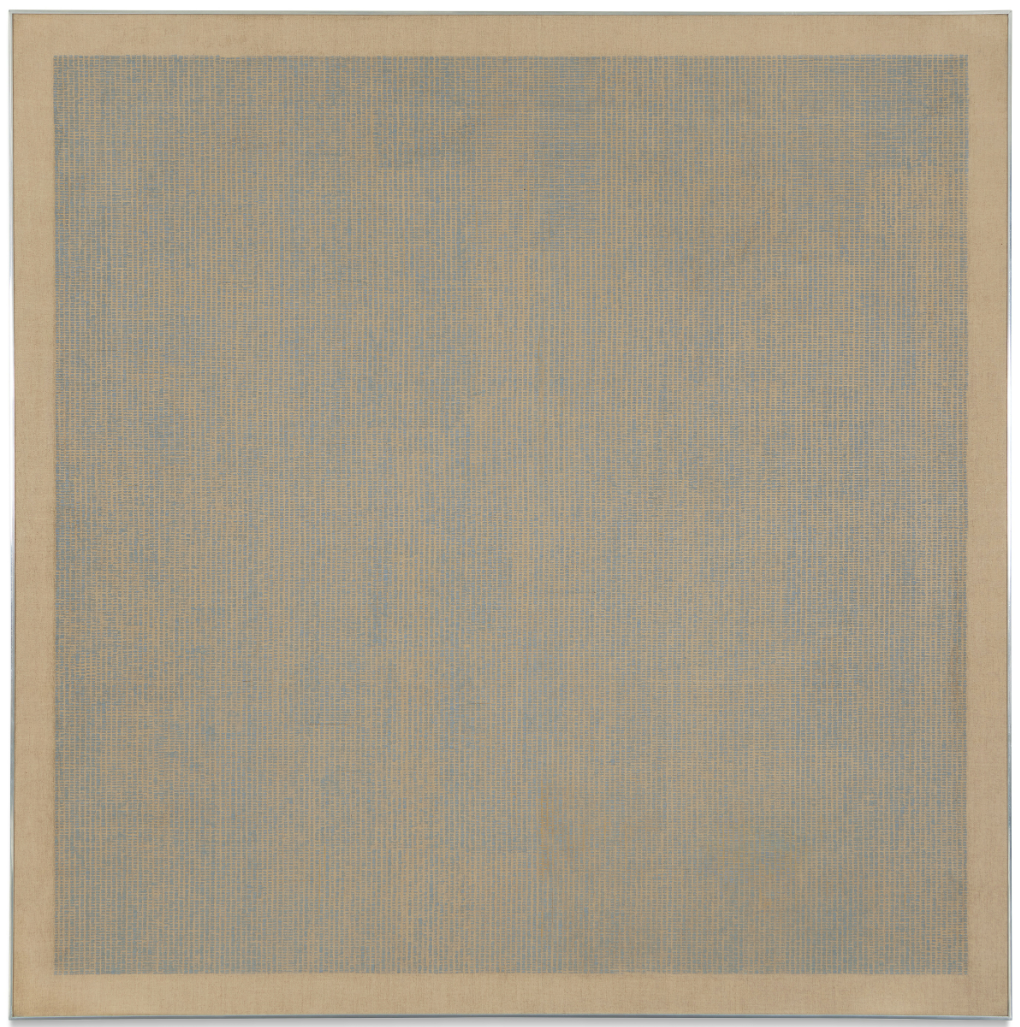
An exceptionally rare and exquisitely rendered example from Agnes Martin’s early career, Grey Stone II elegantly encapsulates the sublime expressiveness within minimal means that has come to define the artist’s unique brand of mark-making. Executed in 1961, the present work is a remarkably early example of Martin’s signature “grid” paintings, which stand as her most influential contribution to the discourse on painting in contemporary art. Painstakingly rendered using pencil, oil paint, and gold leaf, Grey Stone II is further distinguished as one of only five works from the artist’s corpus featuring this rarified gilt material. Of the other four paintings which incorporate this medium, two large-scale examples are housed in such prestigious institutional collections of The Museum of Modern Art, New York and the San Francisco Museum of Modern Art—with the remaining two measuring only 12 inches. The present work, at 72 inches square, is the largest example remaining in private hands. Widely exhibited over five decades, and held in Emily Fisher Landau’s private collection for nearly forty years, Grey Stone II is a unique and deeply significant example of Martin’s best work. Inspiring contemplation, even meditation, Martin’s paintings hint at spirituality as inherent in nature and allude to a transcendental reality. The grid, rendered in delicate pencil lines and soft daubs of blue-grey pigment, captures the artist’s touch and presence, defying the aesthetic predilection for bold statement and formal clarify that defined the dominant schools of painting in the early 1960s. At a distance, the almost Pointillist dots of paint blur and elide into a single hazy form, resulting in a sense of enveloping meditative calm. Emblematic of Martin’s quintessential emotive abstract mode, Grey Stone II is an extraordinary masterwork by one of the twentieth century’s greatest painterly masters.
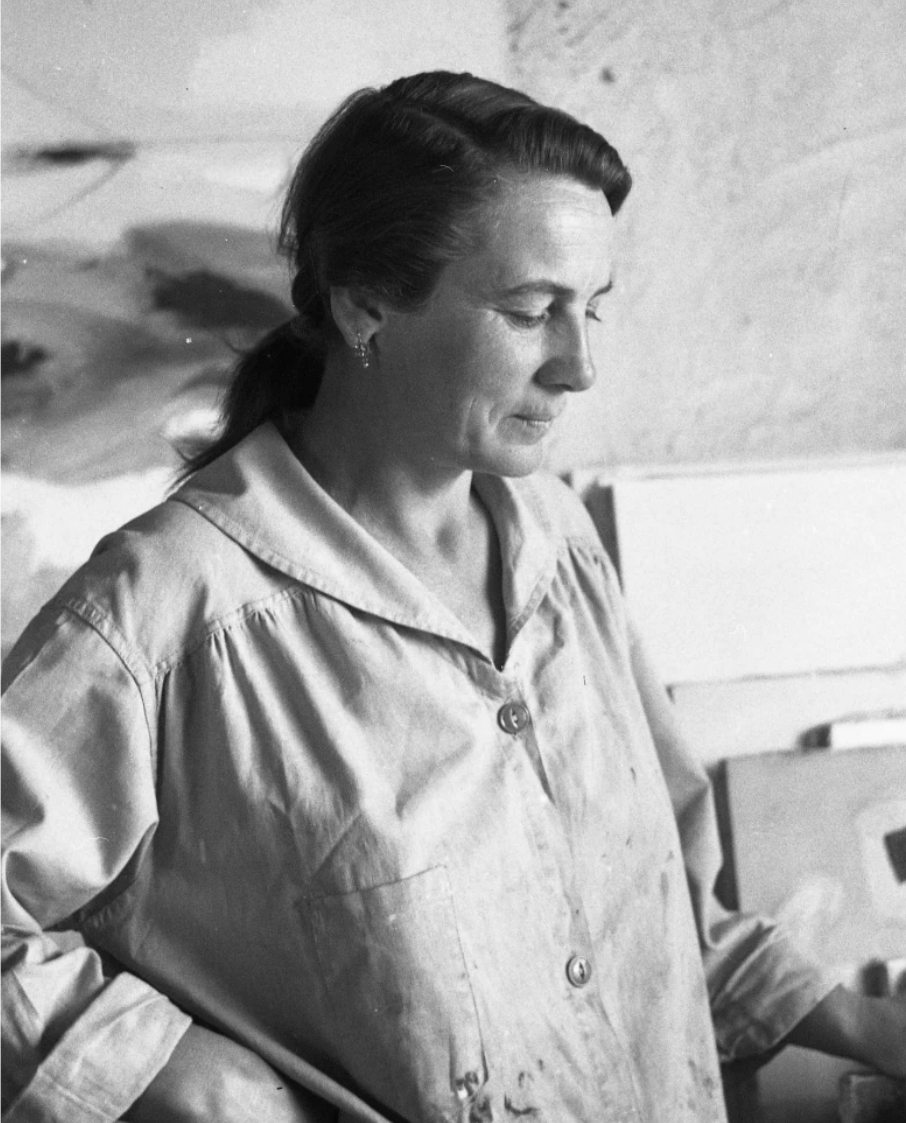
AGNES MARTIN IN HER STUDIO ON LEDOUX STREET, TAOS, NEW MEXICO, 1953. PHOTO © MILDRED TOLBERT / COURTESY OF THE HARWOOD MUSEUM OF ART, GIFT OF MILDRED TOLBERT. ART © 2023 ESTATE OF AGNES MARTIN / ARTISTS RIGHTS SOCIETY (ARS), NEW YORK
Grey Stone II belongs to a pivotal early moment in the artist’s career between 1958-63, when she was experimenting with a diverse range of media and produced some of her most unique and important canvases. The culmination of a rigorous and intensive process applying graphite lines, adhesive, gold leaf and oil paint, the present work demonstrates Martin’s acute fascination with materiality while also pre-figuring her mature compositional format. These early grids were constructed from a holistic system of coordinates that preserves symmetry as it hovers equidistant from the edges of a square canvas; this cool and calculated systematic organization bears a kinship to Piet Mondrian’s famed exclusion of curves and circles in favor of the rectilinear, yet its precise geometry is belied by the visibly hand-drawn gestures that re-center the artist’s touch. As Tiffany Bell described of these early experimental grids, “All convey a strong impression of the painstaking effort it must have taken to make them—it is as though the energy of a Pollock drip painting has been stretched out and carefully sustained over time” (Tiffany Bell, “Happiness is the Goal,” in Exh. Cat., London, Tate Modern, Agnes Martin, 2015, p. 27). By 1964, Martin had abandoned her use of other media in favor of “humble” materials such as ink, colored pencil and acrylic, a move which effectively “collapses the distinction between painting and drawing,” and establishes the foundation of her output for the following four decades (Tracey Bashkoff, “Agnes Martin,” audio transcript, Solomon R. Guggenheim, New York, 3 October 2016, online). Thus, Grey Stone II embodies a brief yet crucial moment in Martin’s career.
Andy Warhol
Sotheby’s New-York: 8 November 2023
Estimated: USD 15,000,000 – 20,000,000
USD 18,144,000
ANDY WARHOL (1928 – 1987)
Self-Portrait, 1986
Acrylic and silkscreen ink on canvas
80×80 inches (203.2 x 203.2 cm)
Signed and dated 86 (on the overlap)
Executed in 1986 as one of the final self-portraits that Andy Warhol would create before his untimely death the following year, Self-Portrait endures as his last grand artistic gesture and embodies the artist’s ultimate meditation on mortality, identity, and image: Warhol, who dedicated his career to exploring the construction of identity and the power of media, now turns to face his own mortality. Pulsating with the intensity of its confrontational gaze, Warhol’s unmistakable portrait emerges from inky black aura; he is obscured by a veil of camouflage, the silkscreen overlay of which graphically renders the dichotomy of inner and public self that pervaded Warhol’s enigmatic persona, while his patriotic palette of red, white and blue nod to the American identity and broader cultural milieu in which the artist operated. The present work’s monumental 80-inch format—exceeded only in scale by seven known 108-inch examples—endows it with a unique status as both an engulfing cenotaph and a highly personal encounter. Attesting to the undeniable and universally acknowledged significance of these works, other Fright Wig self portraits of the same 80-inch format grace international museum collections including the Tate Gallery, London; the San Francisco Museum of Modern Art; the Andy Warhol Museum, Pittsburgh; the Baltimore Museum of Art; and the Carnegie Museum of Art, Pittsburgh. The present work is further distinguished for its inclusion in Warhol’s seminal 1986 exhibition at Anthony d’Offay Gallery, London, from which Emily Fisher Landau acquired it the following year. Piercing and all-consuming, Self-Portrait presents a resounding memorial of both Warhol the man and Warhol the artistic phenomenon.
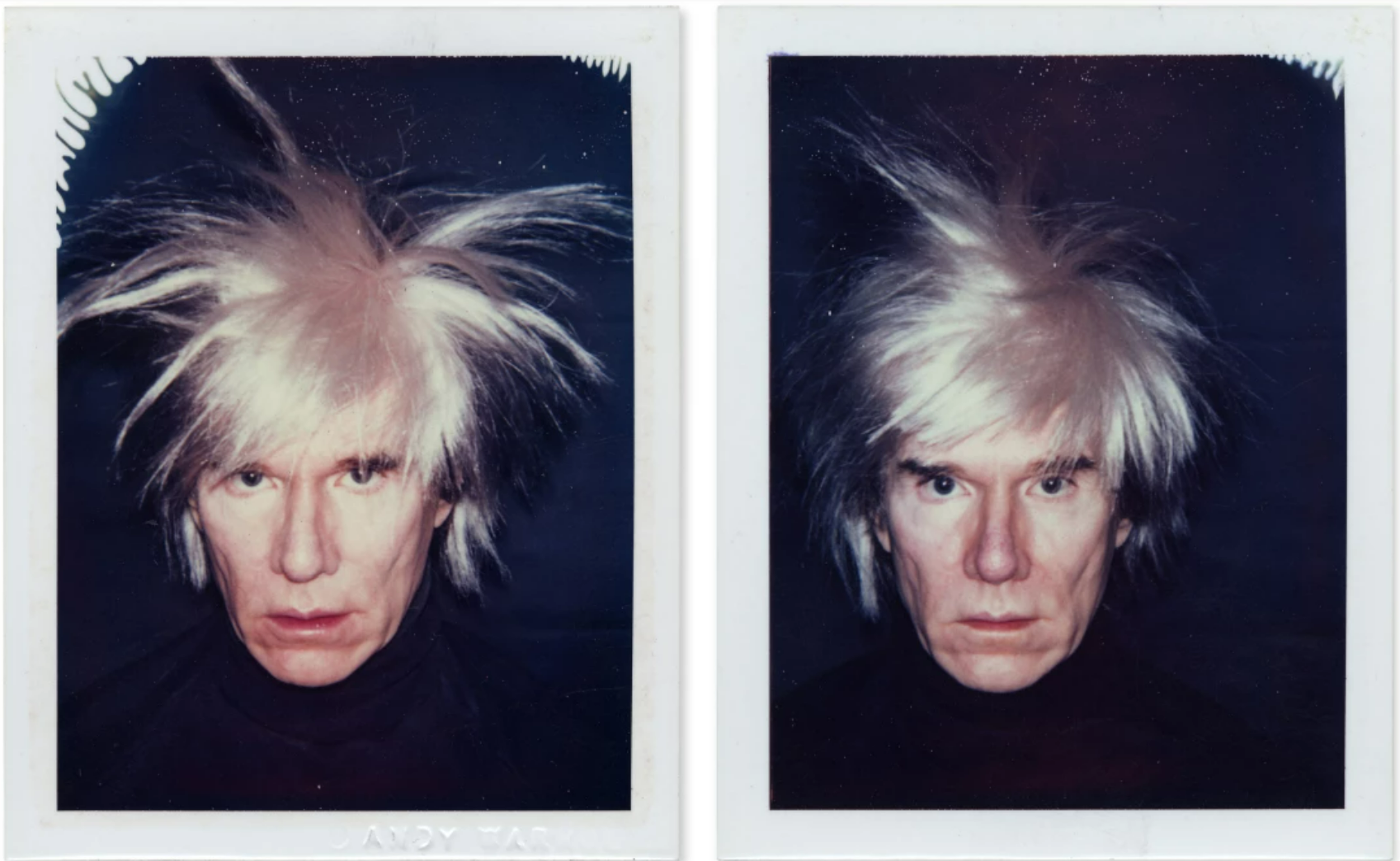
Warhol’s initial foray into self-portraiture began as a student in Pittsburgh in 1948, with an irreverent painting that he submitted to the city’s annual artists’ exhibition entitled The Broad Gave Me My Face, But I Can Pick My Own Nose. Whilst lacking the affected cool of his later output, this stridently humorous and attention-seeking performance anticipates the awareness of audience that would characterize the artist’s subsequent self-reflections. Warhol would return to self-portraiture in the 1960s—first in 1963-64, then in 1966-67. In contrast to the long-idealized view of a self-portrait stemming from an artist’s introspective volition, from its genesis Warhol’s self-portraiture was a means of performing for a public other. Maintained through his aloof conduct in interviews, wild social calendar and the styling of his physical appearance, his fastidiously constructed and highly affected public image was almost as famous as his artistic production. And, from Marilyn Monroe to Liz Taylor and Elvis Presley, Warhol assembled his legion of visual icons who, rendered in his unique Technicolor vision, came to define an entirely new aesthetic movement and celebrity culture of America beginning in the 1960s. Yet despite being the most famous American artist of his time, Warhol remained a private individual, shielded by the characters he played and the masks he wore, to which he alludes in Self-Portrait.
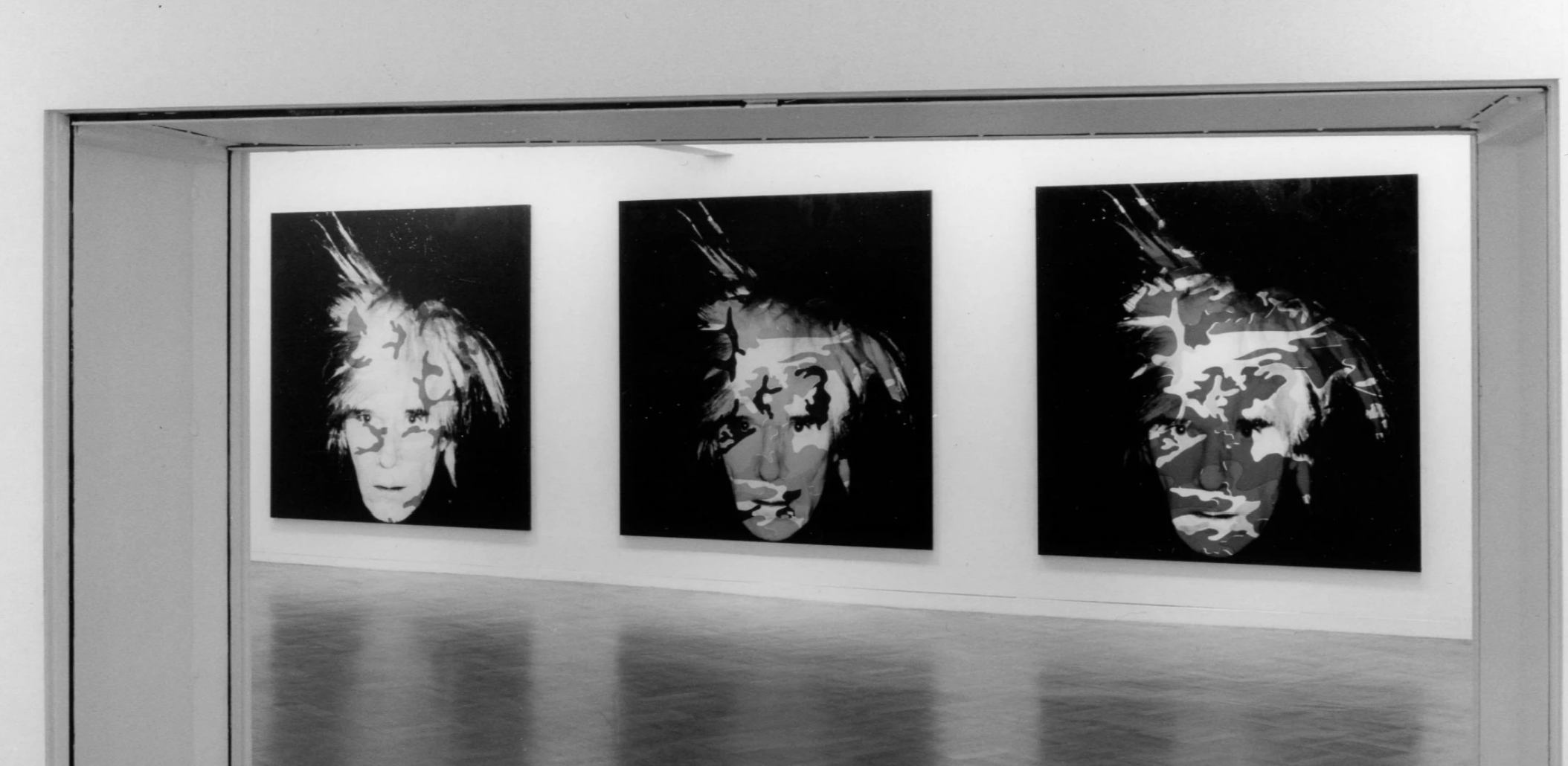
THE PRESENT WORK INSTALLED IN ANDY WARHOL: SELF PORTRAITS, ANTHONY D’OFFAY GALLERY, LONDON, 1986. PHOTO © COURTESY ANTHONY D’OFFAY GALLERY, LONDON. ART © 2023 ANDY WARHOL FOUNDATION FOR THE VISUAL ARTS / ARTISTS RIGHTS SOCIETY (ARS), NEW YORK
Designed originally for purposes of concealment and disguise, the camouflage pattern in Self-Portrait becomes a nuanced paradoxical motif when applied to the figure of Warhol himself: rather than blending into the background, Warhol is distinguished, even further amplified by his famous fright wig. Camouflage, in this way, embodies Warhol’s critical commentary on the artifice inherent in fame in his mature career, symbolizing the fraught tensions between visibility and invisibility that he experienced as both artist and persona, while his red, white and blue chromatic coating alludes to the American culture that his legacy forever changed. Indeed, for Warhol, the son of Slovakian immigrants in working class Pittsburg, fame in America was not merely the province of actors, musicians, or politicians; as he realized, fame could be harnessed by artists themselves, even manufactured.
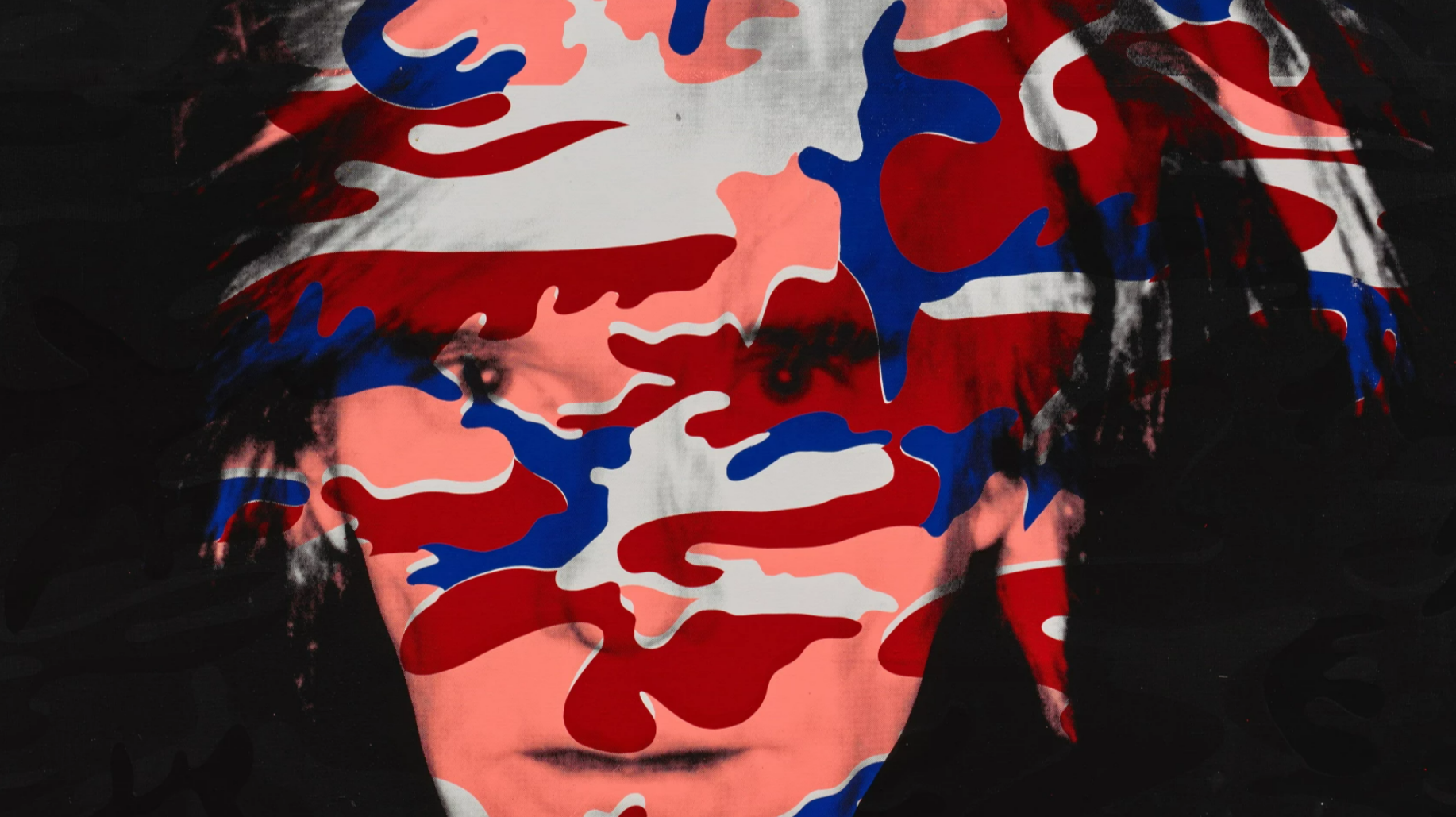
In Self-Portrait, each individual printed raster is discretely discernable and brought into the sharpest of focus, chiming in sonorous contrast as Warhol’s starkly illuminated countenance emerges in spectacular chromatic patterning from an abstract darkness. The perfected clarity of the transferred image in Self-Portrait reveals the artist at the apotheosis of his iconic silkscreen method: starkly anchored by Warhol’s disembodied visage – his iconic fright wig, pallid countenance, and intense gaze unmistakable, all cast in the electric and instantaneous glow of a camera flash—the composition offers a sense of unmediated access and scrutiny to his portrait never before afforded to his public. Amidst this act of radical revelation, Warhol employs his recurring motif of camouflage to deconstruct the underlying portrait, putting forth his genius for contradiction in full display and drama: he appears to hide in plain sight. Nevertheless evoking the primacy of raw unedited film or the printed newspaper, the slick and glistening graphic rendering recalls the stars of the silver screen whom Warhol had venerated in his early career, and indeed whose fame he had now come to surpass.
Ed Ruscha
Sotheby’s New-York: 8 November 2023
Estimated: USD 10,000,000 – 15,000,000
USD 12,973,500
ED RUSCHA (b. 1937)
Mint (Green), 1968
Oil on canvas
60×55 inches (152.4 x 139.7 cm)
Signed and dated 1968 (on the reverse)
As the word emerges with spectral liquid brilliance, “Mint” seizes the graphic yellow canvas with its sheer viscosity in Ed Ruscha’s Mint (Green), capturing the duality of transience and endurance that challenges the very fixity of semiotic meaning. Executed in 1968, Mint (Green) belongs to a highly limited series of twelve large-scale “liquid” or “wet” word paintings Ruscha created between 1966 and 1969, nine of which now reside in distinguished museum collections including The Art Institute of Chicago and The Broad Museum, Los Angeles. In this pivotal and provocative corpus, Ruscha continues to radically disrupt the act of reading by depicting text as if formed from water, oil, or another fluid matter, launching his painterly wordplay to new conceptual terrain while further probing the malleability of language that has remained the cornerstone of his career-long oeuvre. Indeed, with Mint (Green), Ruscha’s choice text metamorphosizes into a three-dimensional substance itself, settling in the precarious evanescence of elemental liquid form before a stark yellow background that recalls the artist’s aesthetic origins in commercial art and graphic advertisement. First exhibited at Alexander Iolas Gallery in 1970 and acquired by Emily Fisher Landau from Leo Castelli Gallery in 1988, Mint (Green) is a paragon of Ed Ruscha’s canonical art historical legacy, rippling with the mesmerizing innovations of his painterly breakthrough.
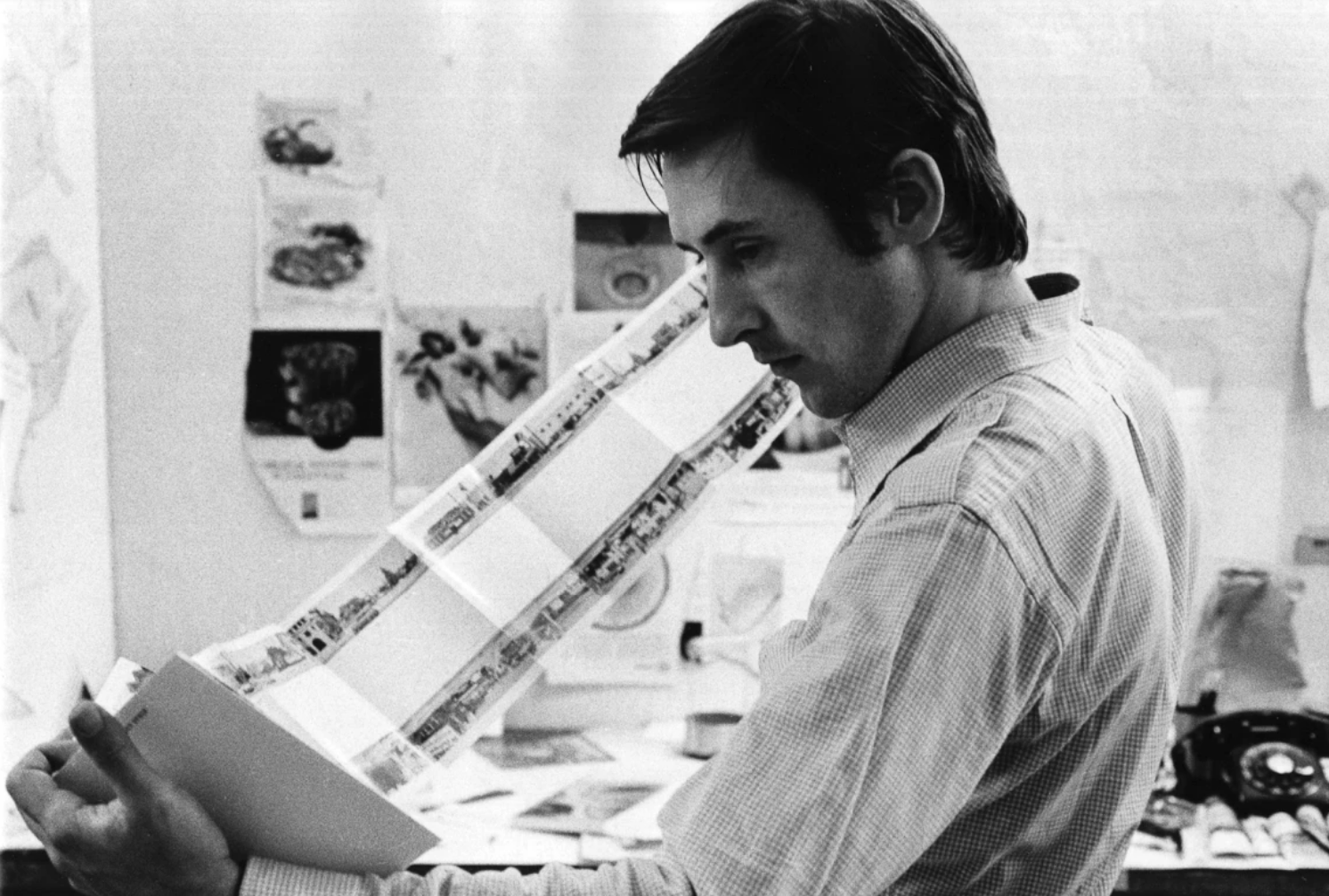
ED RUSCHA UNFOLDING EVERY BUILDING ON THE SUNSET STRIP BY JERRY MCMILLAN, 1967. PHOTO © COURTESY THE CRAIG KRULL GALLERY, SANTA MONICA. ART © 2023 EDWARD RUSCHA
In Ruscha’s canvases, words—typically seen as stable and concrete—become fluid and ephemeral, seeming to dissolve and reassemble before our very eyes to question the fixed nature of meaning and representation. Initially inspired by the synthesis of Pop and conceptualism pioneered by contemporaries such as Jasper Johns and Robert Rauschenberg, Ruscha began creating text paintings in the early 1950s that married the regimented world of printed matter with the expressive freedom of painting. Ruscha retained an aesthetic interest in such tensions between text and image from earlier experiences as a commercial sign painter, manifesting these concerns as he distorted words in seemingly endless permutations. Beginning with Annie, Poured from Maple Syrup from 1966—now in the permanent collection of Norton Simon Museum, Pasadena—Ruscha’s beguiling “liquid” paintings command the visual potency of painting to evoke the familiar appearance of wet surfaces, such as when raindrops descend upon an outdoor sign, or when shapes appear in condensation on the surface of a glass window. Signifying a key bridge between the material and the abstract, Mint (Green) is exemplary of Ruscha’s fusion of form and concept, with the illusionistic transparency of its letters compelling viewers to contemplate the layers of perception and meaning beneath its text.
Willem de Kooning
Sotheby’s New-York: 8 November 2023
Estimated: USD 6,000,000 – 8,000,000
USD 8,607,300
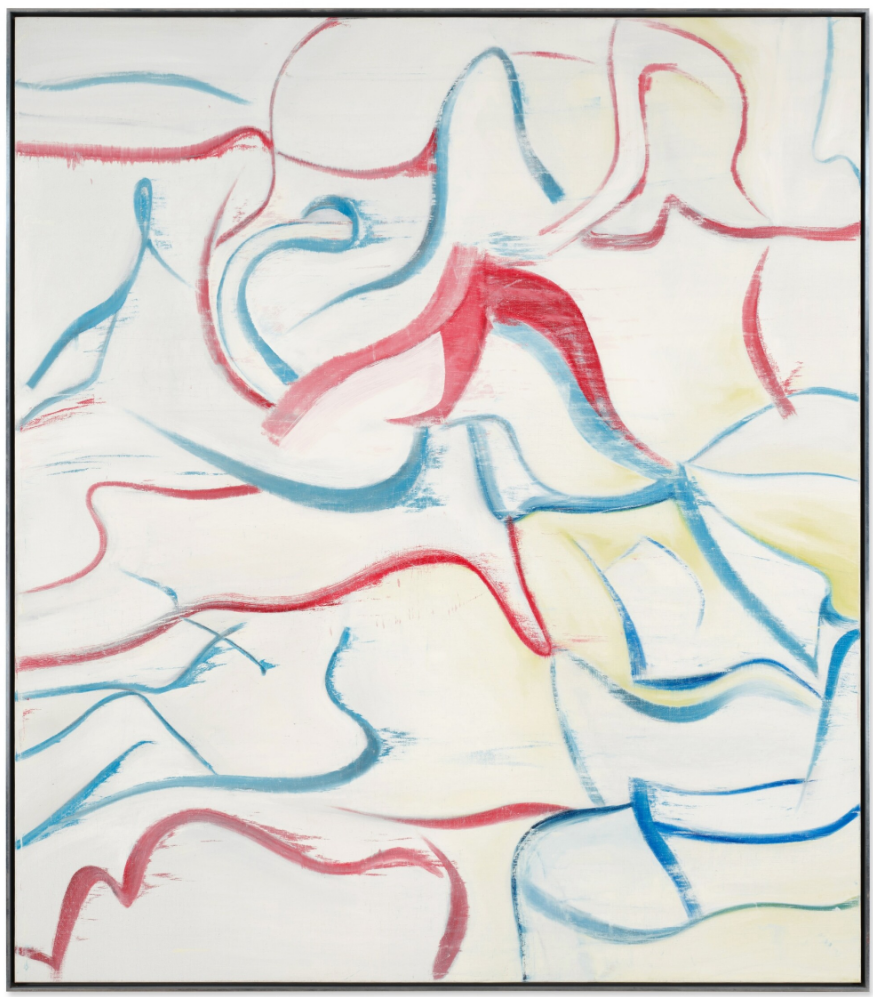
WILLEM DE KOONING (1904 – 1997)
Untitled XV, 1983
Oil on canvas
79 7/8 x 70 inches (202.9 x 177.8 cm)
Signed (on the stretcher)
Executed in 1983, Untitled XV singularly embodies the vibrancy and calligraphic lyricism of Willem de Kooning’s final decade—an unparalleled masterwork and triumphant apotheosis of the abstract vernacular he developed so tirelessly over his titanic fifty-year career. In 1981, de Kooning inaugurated a corpus of hauntingly poetic abstractions that consumed his practice for the remainder of his life, and nowhere is his genius as a colorist and draftsman so concentrated than in his mature output. In the present work, ribbons of cerulean and cadmium red pirouette across an expanse of white, curling and unfurling across underpainted passages of yellow. Acquired in 1987, only a few years after its execution, Untitled XV has remained in Emily Fisher Landau’s collection for more than three decades, a rare jewel distinguished for its gem-like chromatic clarity and sumptuous quality of line. The buoyant dynamism of these bands of scarlet and blue stands not only as a miraculous compositional balancing act but also as a testament to de Kooning’s protean style. The radical experimentation that transpired every decade of his working life culminates in the present work: ceaseless, repeated investigations of line, color and form embody the visceral interplay between strength and sensuality, delicacy and mass, marrying the resolved restraint of his later work with the palpably vigorous energy of his earlier Women and East Hampton scenes. A paragon of his mature output, Untitled XV is the product of a truly inimitable visionary at the height of his creative powers.
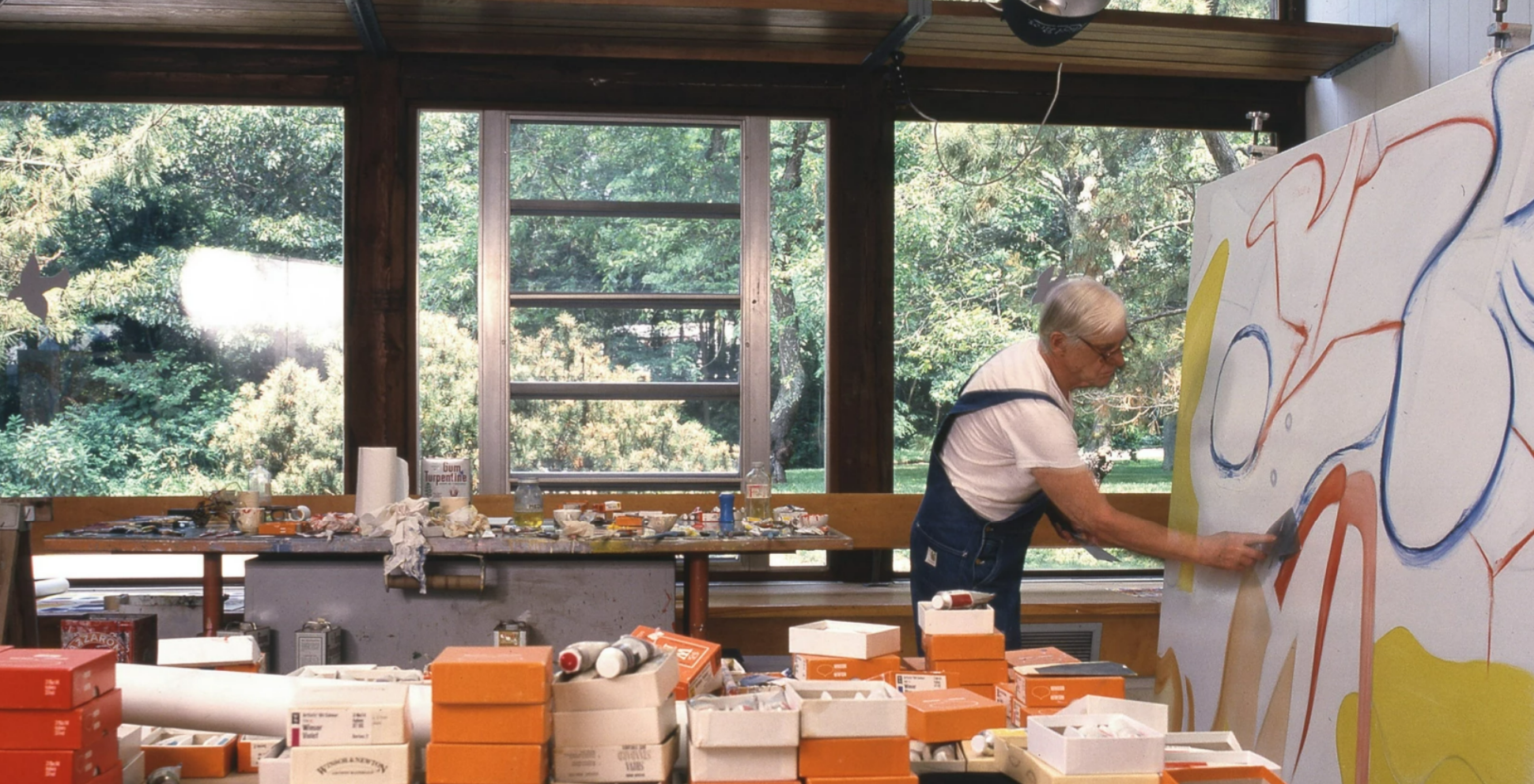
WILLEM DE KOONING IN HIS STUDIO, 1983. PHOTO © 1991 HANS NAMUTH ESTATE / COURTESY CENTER FOR CREATIVE PHOTOGRAPHY, UNIVERSITY OF ARIZONA. ART © 2023 THE WILLEM DE KOONING FOUNDATION / ARTISTS RIGHTS SOCIETY (ARS), NEW YORK
Heightened by its reduced palette, the treatment of line in the present work is utterly sensual, characterized in equal parts by tension and harmony, and is the result of a technical breakthrough: describing de Kooning’s methods in his late paintings, Carter Ratcliff observed, “Something extraordinary happens in the 1980s. Dragging a wide metal edge through heavy masses of paint, de Kooning turns scraping into a kind of drawing. A process of subtraction makes an addition, a stately flurry of draftsmanly gestures. De Kooning has always layered and elided his forms. Now he reminds us that he does the same with his methods” (Carter Ratcliff, “Willem de Kooning and the Question of Style,” in Willem de Kooning: The North Atlantic Light, 1960-1983, Amsterdam, 1983, p. 22). The forms wind and meander, as if uncontainable by the picture plane, extending beyond the edges of the canvas and into the air around us. The white pigment de Kooning so judiciously applies underneath, however, is not simply a void or background. It is as luxurious, luminous and intensely present as the crimson and ultramarine, even containing the subtlest pockets of yellow. By conflating figure and ground, and drawing upon the purity of the primary colors, de Kooning empowers his marks to float and dance, capturing a timeless and ineffable vivacity and marking a major achievement of pictorial distillation. Here, the full breadth of de Kooning’s mastery freely unfolds before us.
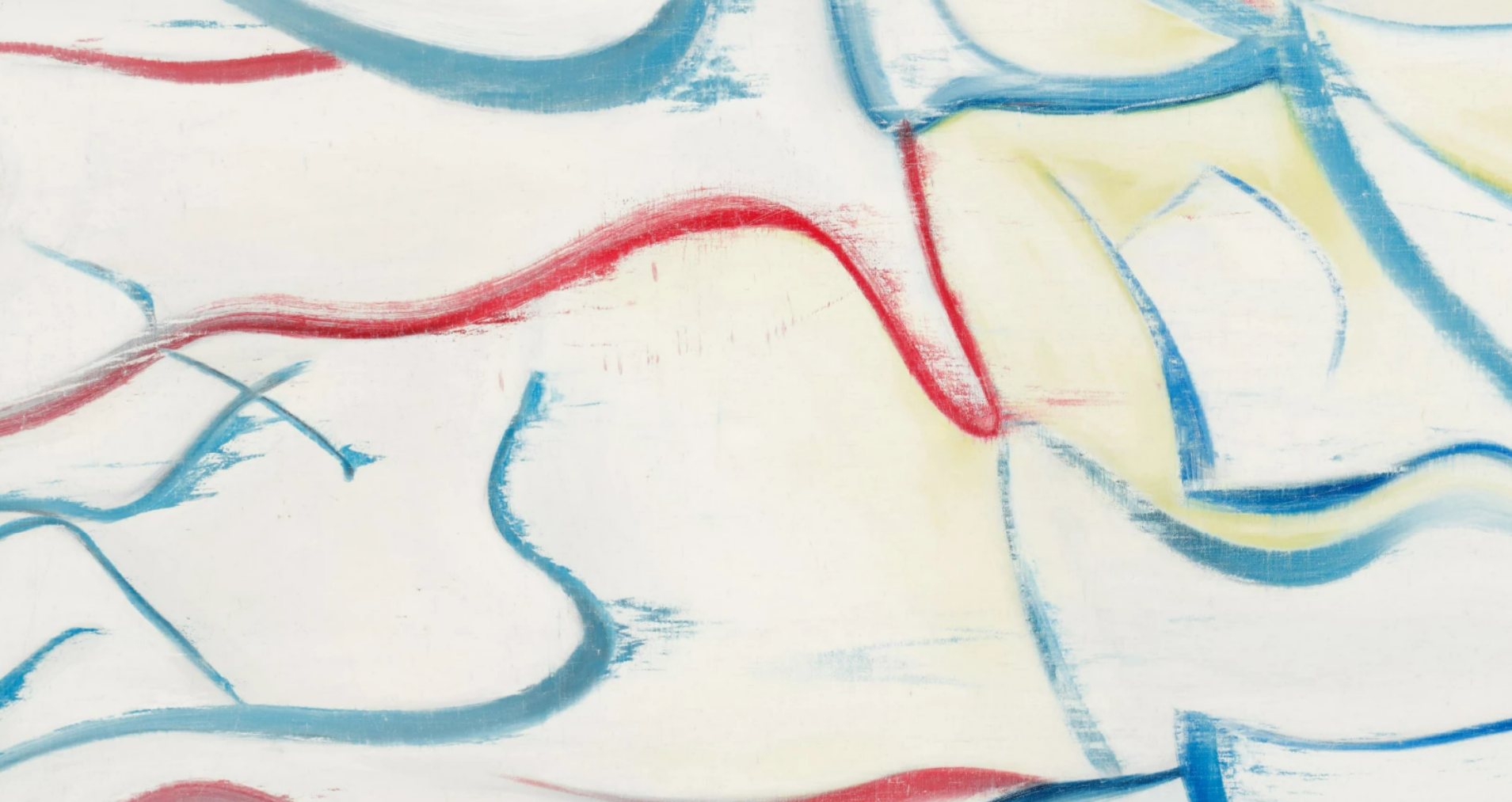
While consistent with the unmistakable traces of de Kooning’s remarkable touch—detectable even in his first canvases—Untitled XV in particular boasts an enlivened spirit, confidence and appetite for adventure. The artist’s celebration of line had been ascendant throughout his career, but his mature works bear a rhythm, cadence and ethereal levity unseen until the last decade of his life. Much like the Heroic works of Pablo Picasso or late cutout works by Henri Matisse such as Blue Nude II, de Kooning’s 1980s paintings contain the sustained energy and technical finesse of his earlier achievements. In the present work, the sinuous curvatures nod to his Woman series of the 1950s, and the wispy, horizontal and vertical textures recall the Long Island beaches that inspired his 1970s abstractions. The content of the 1980s paintings, however, has been radically simplified and illuminated, leaving behind the baroque flair of his earlier work to find a distilled fusion of color and line. Like Henri Matisse, whose late work, particularly his remarkable corpus of cutouts, similarly stages a collapse of the distinction between color and line, de Kooning achieves in the present work what can be considered the final goal of his career-long inquiry into the very nature of abstract art. As Gary Garrels described, “In the 1980s works, the essential procedures and techniques were not changed but simplified, and the vocabulary of forms was retained but clarified” (Gary Garrels, “Three Toads in the Garden: Line and Form,” in Exh. Cat., San Francisco, San Francisco Museum of Modern Art (and travelling), Willem de Kooning: The Late Paintings, the 1980s, 1996, p. 26).
Ed Ruscha
Sotheby’s New-York: 8 November 2023
Estimated: USD 5,000,000 – 7,000,000
USD 6,079,500
ED RUSCHA (b. 1937)
Plenty Big Hotel Room (Painting for the American Indian), 1985
Oil on canvas
84×60 inches (213.4 x 152.4 cm)
Signed and dated 85 (on the reverse)
An American flag blows adject to its flagpole, suspended in the wind and ostensibly untethered in Ed Ruscha’s uncanny Plenty Big Hotel Room (Painting for the American Indian) from 1985. Punctuated by four black “censor strips,” the inclusion of text with which Ruscha had become so synonymous has been redacted. In the 1960s, Ruscha first powerfully asserted that language itself was representation – that text could be legible as both words and objects – thus pushing the boundaries of the then-nascent Pop movement. In 1985, however, he begins to not only omit text but employ a device that signals its erasure, making the present work one of the earliest examples of this suggestive breakthrough. 1985 would also mark the first year the American flag would appear in Ruscha’s oeuvre, the present work being the second ever time he included the motif. Here, the flag stands as an intellectually loaded appropriation of the symbol that so many of his Pop peers – Jasper Johns, Claes Oldenburg, among others – interpreted and incorporated in their most seminal works, now functioning as a testament to Ruscha’s longstanding interest in the American West and solemn tribute to the indigenous peoples of the United States to whom this work is dedicated. Ruscha channels the political, cultural and art historical resonance of the American flag into Plenty Big Hotel Room (Painting for the American Indian) and turns it onto itself. The word “hotel” is used both critically and sardonically, a signifier Ruscha described as “luxury in a land taken over from the Indians” (the artist quoted in Robert Dean, ed., Edward Ruscha: Catalogue Raisonné of the Paintings, Volume Three: 1983-1987, New York, 2007, p. 154).
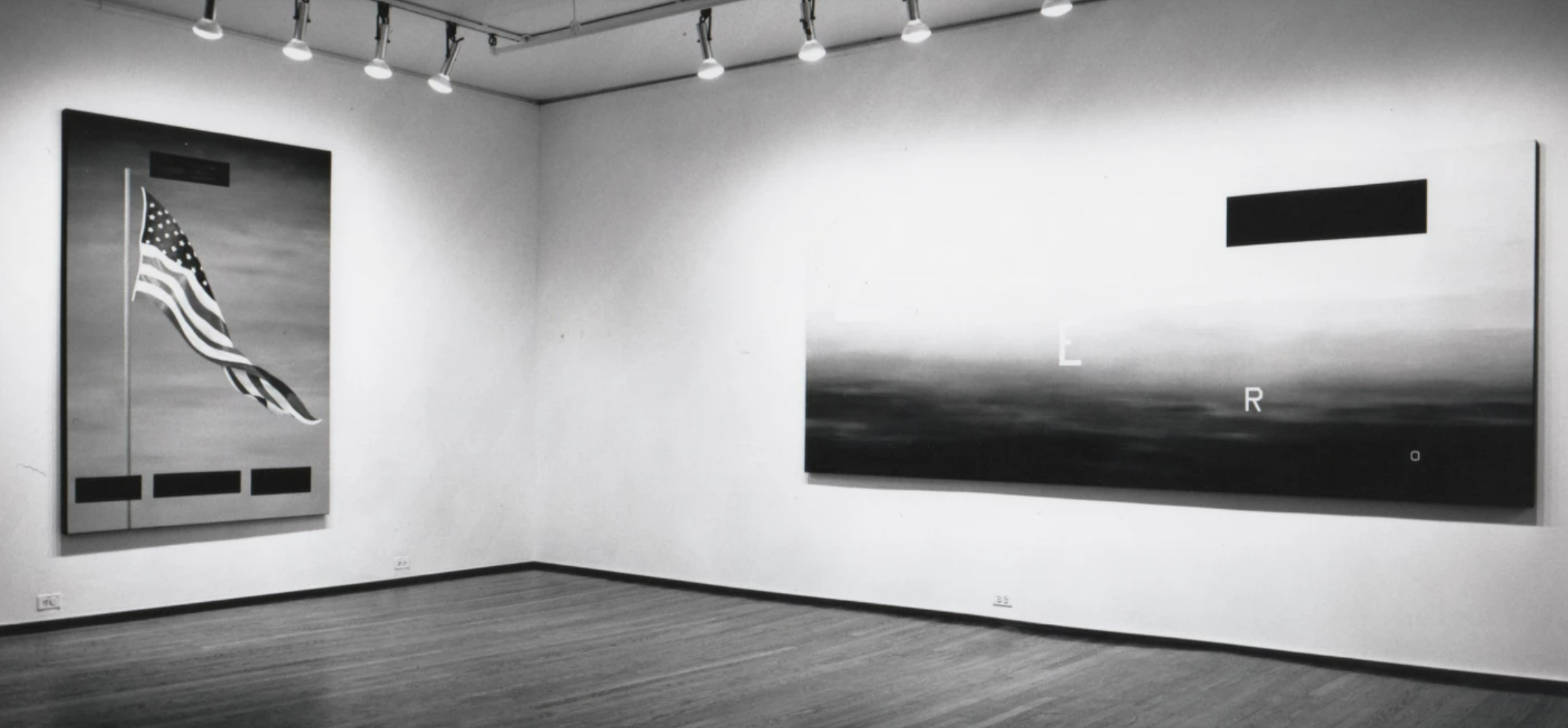
Further impressed upon the viewer by the present work’s monumental scale and surreal modulations of color and shadow, the claim to the North American continent is proven facile, Americana sentiments are made ironic and the nationalist valence of the ubiquitous flag is upended. Ruscha, whose text-centric paintings earned him international acclaim two decades earlier, proves himself continually innovative in his semantic sleight of hand. Simultaneously signaling absence and presence, the black bars of Plenty Big Hotel Room (Painting for the American Indian) and eerily free-floating flag testify to the gravity of this moment in Ruscha’s career and his keen attention to the full connotative nuances and broader historical implications of the words and images he relies upon. Billowing at the command of the wind and dramatically illuminated, the painted flag here is immediately understood to be its referent, but the image is not entirely coherent: the flag is not tied to its pole. As the canvas’ compositional logic unravels before the viewer, the flag’s associations with the triumph of Manifest Destiny begin to collapse as well. The American flag, infinitely deployed in American media, homes and public spaces, dichotomously stands an iconic nationalist image and fraught symbol of conquest, disenfranchisement and theft.

In a clever, Johnsian gesture, Ruscha’s use of his “censor strips” toys with what we understand or know to be true and here subverts it before our eyes. Ruscha began exploring the use of redacted text in 1985 with reverse stenciled censor strips, created by blocking out a rectangle of gessoed canvas with tape and leaving it unpainted. The formal properties of these strips allude to de-classified censored government documents, heightening the political implications baked into the iconography, and communicate the pervasive silencing of indigenous voices in the ownership and management of land that was theirs. Although Ruscha’s images purport a kind of apoliticism, his “censor strips” betray a different position. Functioning as an aesthetic and ontological play on what the mind assumes when left to its own devices, Ruscha’s redacted “text” is not text at all; there are no words underlying the strips that have been covered, and they were never there to begin with – so successful is Ruscha in this conceptual coup, however, that we interpret that to be the case. “This is Ruscha at his most slyly ironic,” Robert Dean and Erin Wright commented on the present work, “with the American flag seen as a symbol of hegemony, the plenty big hotel room of the title […] in tandem with its dedication to the American Indian would suggest reservation (with both meanings of the word) as well as what is transitory, nomadic, and vanishing.” (Robert Dean, ed., Edward Ruscha: Catalogue Raisonné of the Paintings, Volume Three: 1983-1987, New York, 2007, p. 154)
Andy Warhol
Sotheby’s New-York: 8 November 2023
Estimated: USD 2,000,000 – 3,000,000
USD 3,085,000
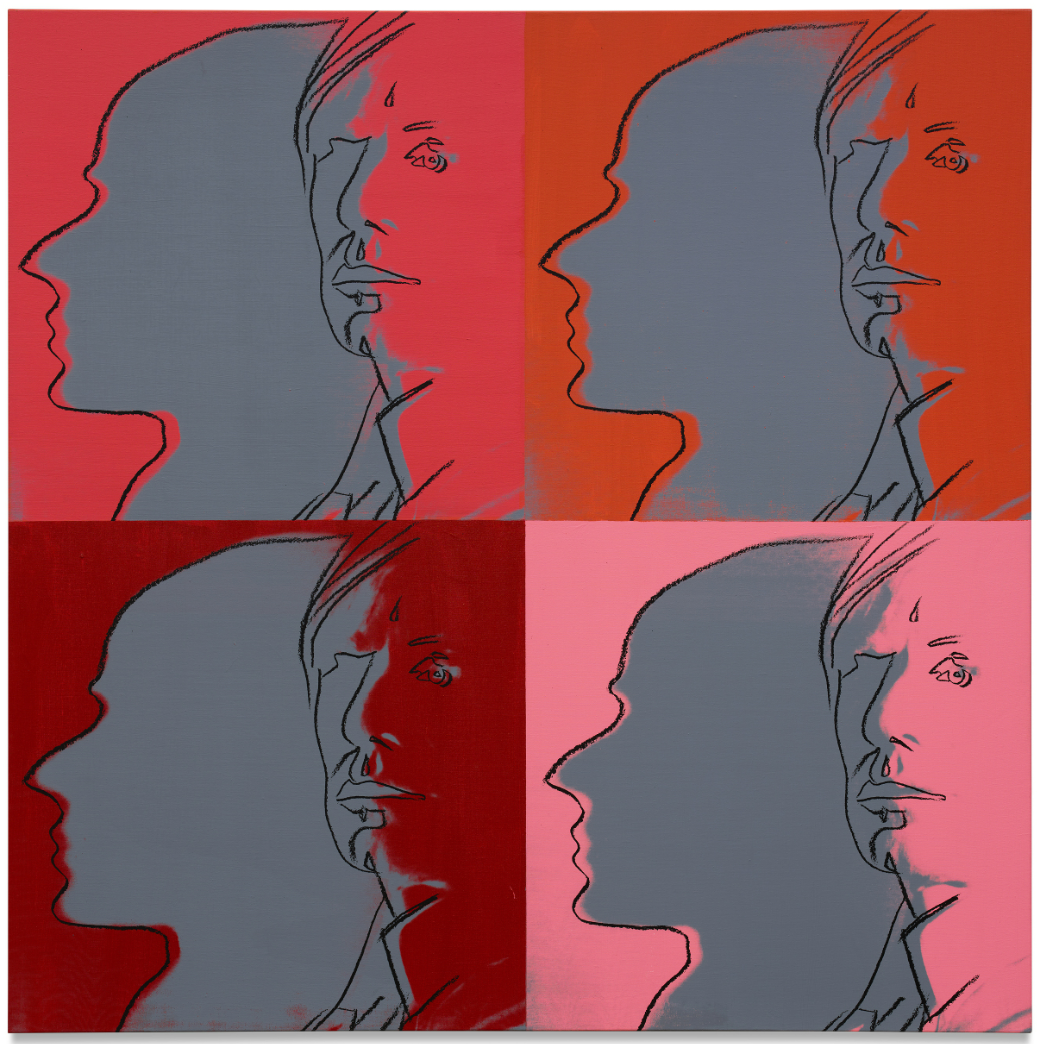
ANDY WARHOL (1928 – 1987)
The Shadow, 1981
Acrylic and silkscreen ink on canvas
60×60 inches (152.4 x 152.4 cm)
Signed and dated 1981, stamped by The Estate of Andy Warhol
Stamped by The Andy Warhol Foundation for the Visual Arts
Numbered PA51.002 (on the overlap and on the stretcher)
Shown in profile in fluorescent scarlet and pink, burgundy and navy, Warhol and his shadow appear four times over in his 1981 The Shadow: a mysterious and haunting immortalization of his meticulously cultivated artistic persona. The artist’s gaze alarmingly direct yet his face shrouded in harsh chiaroscuro, The Shadow presents a resounding image of Warhol as both man and legend, challenging the act of self-depiction with unrivaled experimentation and intensity. The Shadow belongs to Warhol’s Myth series, in which Warhol conjures characters from the pantheon of American popular culture—into which Warhol, notably, places himself. Uncle Sam and Mickey Mouse, Santa Claus and Superman happily coexist in Warhol’s electrically hued court, leaving the viewer struck simultaneously by fascination and anxiety. These are the contemporary celebrity’s predecessors, spectral and saturated in a pumped-up rainbow, and Warhol looks on as both prophetic creator and participant. Marrying themes and processes developed over the course of Warhol’s titanic career, The Shadow joins his punchy self-portraiture and chromatically brilliant silkscreen technique with the recurring shadow motif. The present work has remained in Emily Fisher Landau’s collection for over two decades, and other works containing this uncanny double portrait are held in such major museum collections as The Museum of Modern Art, New York; The Whitney Museum of American Art, New York and the Tate, London. Lauded for his catalytic recalibrations of American Pop, Warhol, alongside a posse of omnipresent, universally recognizable faces, asserts his status as an icon in his own right.
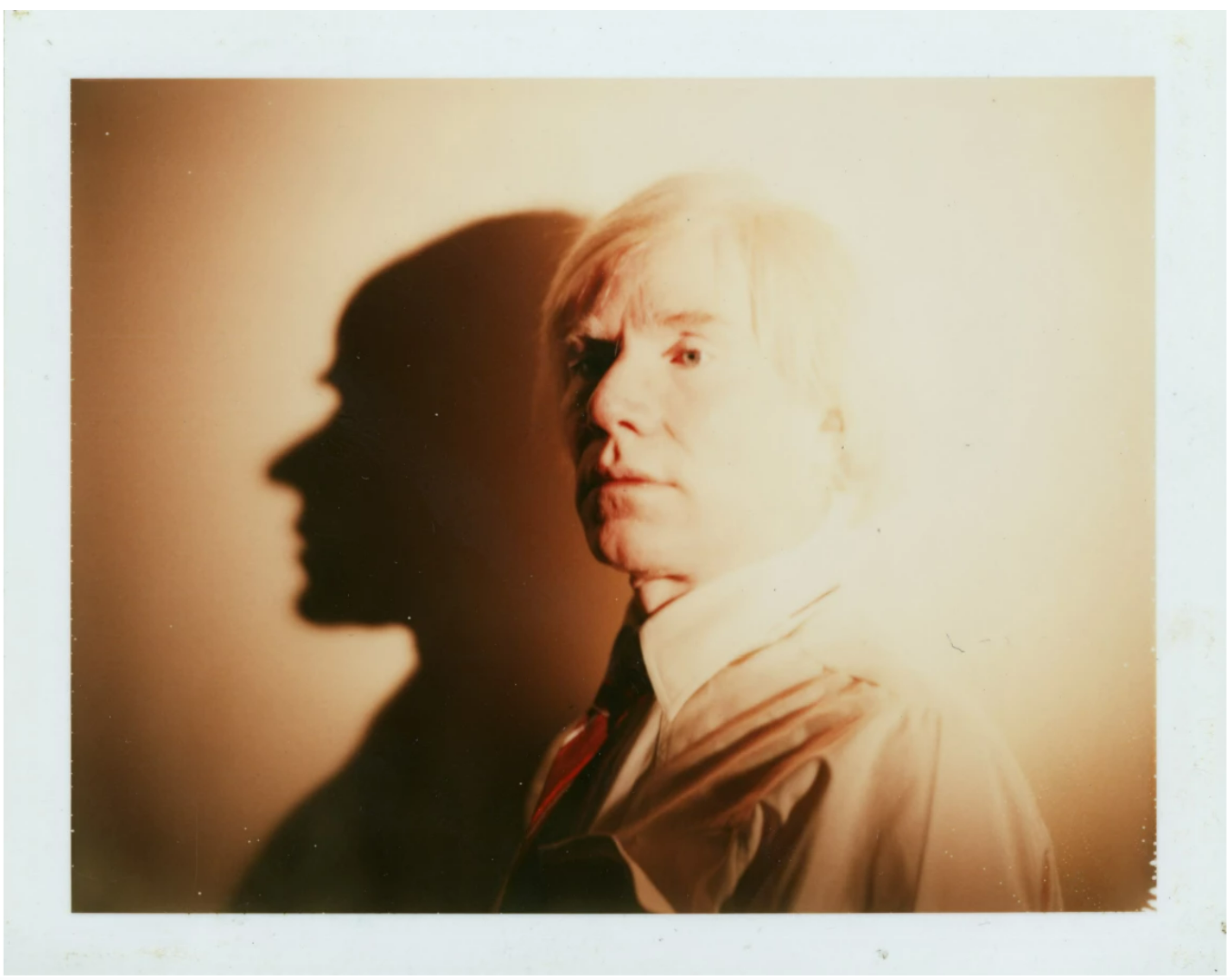
ANDY WARHOL, SELF-PORTRAIT, 1981. THE ANDY WARHOL MUSEUM, PITTSBURGH. IMAGE © THE ANDY WARHOL FOUNDATION FOR THE VISUAL ARTS, INC. COURTESY OF THE ANDY WARHOL MUSEUM AND THE POLAROID MUSEUM. ART © 2023 ANDY WARHOL FOUNDATION FOR THE VISUAL ARTS / ARTISTS RIGHTS SOCIETY (ARS), NEW YORK
Executed just six years before his unexpected death, the artist’s self-effacing portrait in The Shadow reflects Warhol’s lifelong concerns with the transience of life, conveying a prophetic consciousness of his fate. Warhol’s evasive and enigmatic manner of depicting himself is likewise a thread from his earlier production. In his first series of self-portraits as an established artist, created from 1963-64, Warhol shrouds himself in dark sunglasses and a trench coat, but in the present work, he unsheathes himself from his costume, relying only on his shadow to retain an air of inaccessibility. Throughout his entire career, Warhol employed his self-portraiture as a means of identity construction, and in The Shadow we witness the complete conflation of the artist and the sensational style for which he garnered so much fame and attention. In the tireless performance of his carefully preened persona, Warhol established an aura of both exposure and anonymity.
“I’d prefer to remain a mystery. I never like to give my background and, anyway, I make it different all the time I’m asked.”
In the present work, Warhol looks over his shoulder and casts a distorted, elongated shadow on the wall behind him. Under the theatrical lighting exaggerated further by the filter of his Polaroid camera, Warhol and his shadow appear conjoined. He once again calls upon the shadow as a tool, which appeared in his early portraiture and reappeared in his later abstractions. Here, it obscures nearly half of his face, reading as an opaque field and precluding any clear delineation of the contours on his proper right side. Throughout the 1960s, Warhol used the shadow to mystify and obscure his silkscreened icons, harnessing its associated symbolism to enhance a reading of transience and mortality. In the 1970s, he isolated the motif and abstracted it, transforming the shadow from an element of his canvases to the sole subject of them. Warhol’s re-visitation of the motif in the final decade of his career, however, signals his attempts to mask his persistent fears, insecurities and doubts, both serving as an aesthetic and metaphorical aid. Oxymoronically, the shadow, despite its association with darkness and absence, is inherently an ephemeral replication of a physical object: an indication of life. The shadow’s connotative contradictions offer clarity on the inclusion of this self-portrait in his Myths series. This moment of congratulation is met with vulnerability: he has cemented his place as an American icon, but the icons amongst which he situates himself are all notably past, a feeling for and fear of the closeness of an inevitable end.
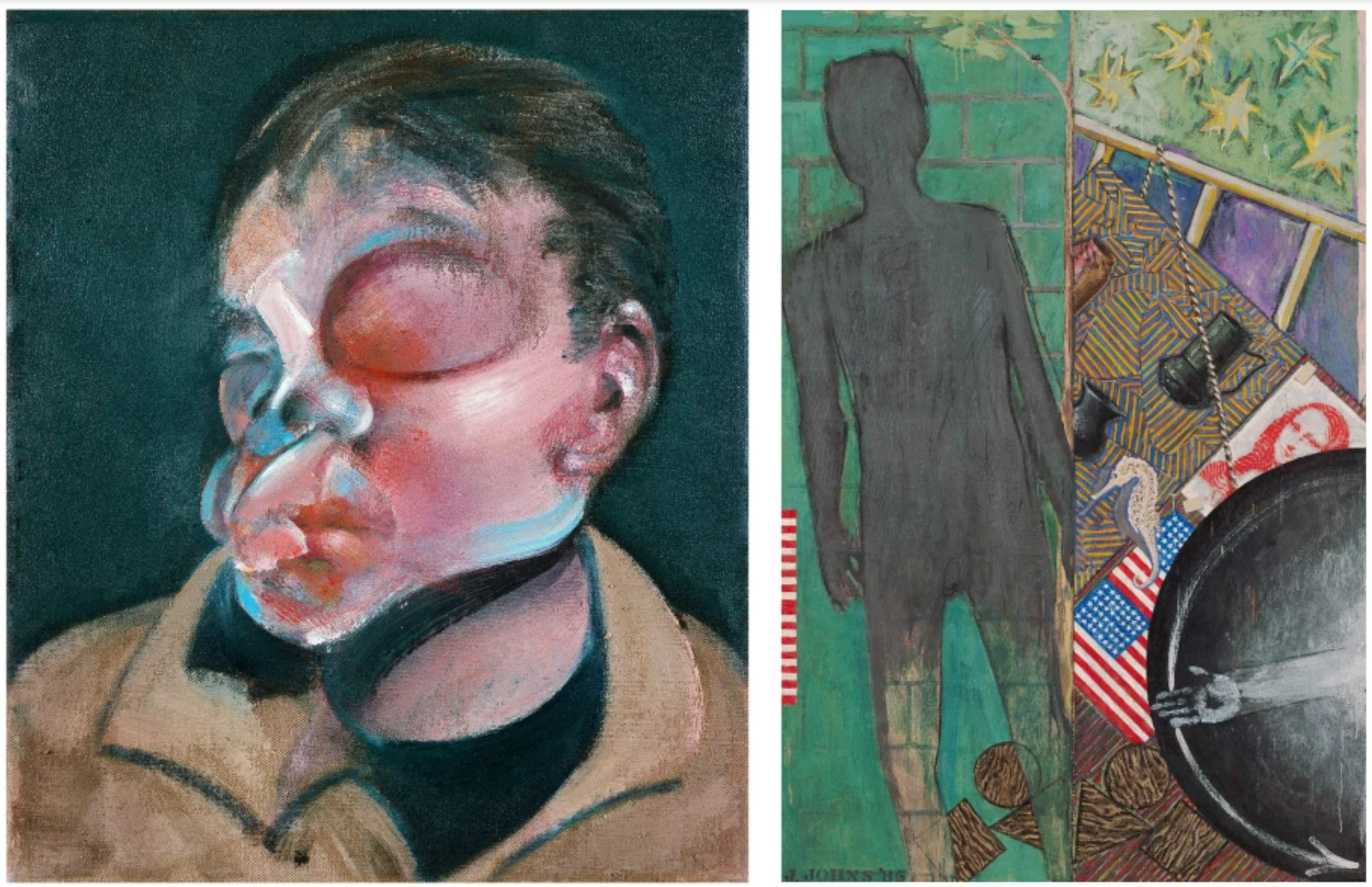
LEFT: FRANCIS BACON, SELF PORTRAIT WITH INJURED EYE, 1972. PRIVATE COLLECTION. ART © THE ESTATE OF FRANCIS BACON / DACS LONDON 2023. ALL RIGHTS RESERVED. RIGHT: JASPER JOHNS, SUMMER, 1985. IMAGE © THE MUSEUM OF MODERN ART/LICENSED BY SCALA / ART RESOURCE, NY. ART © 2023 JASPER JOHNS / ARTISTS RIGHTS SOCIETY (ARS), NY
More than any artist before him, Warhol’s image was inextricably bound to his art, as he lived within the realm of celebrity that his work so crucially examined. The Shadow epitomizes a lifelong obsession with image and identity, life and death, and depicts an artist who had become just as famous as the legion of celebrity sitters he had painted. Here the visage of the artist is of such closely choreographed clarity and obfuscation that we remain desperate to understand him, even once we cease to look. The silkscreen captures every minute detail of his face, from his lips, elegantly outlined, to his gaze over his shoulder. If Warhol’s credo was the seductive surface, here it reaches its apogee – he has compressed his identity, his interiority, his secrets in the totalizing flatness of this canvas. It is in the spectacular moments of introspection that characterize the artist’s last years that his conceptual premise reaches its height: the marriage of man and myth, the confrontation of death, and the incontestable gravity and immortality of Warhol’s work in the contemporary world.
2. The Emily Fisher Landau Collection: An Era Defined Day Auction
9 November 2023
The Emily Fisher Landau Collection: An Era Defined | Day Auction | 2023 | Sotheby’s (sothebys.com)
Auction Statistics
82 Lots
Low Estimate: USD 12,637,000
High Estimate: USD 18,471,000
Total: USD 18,307,536
# Lots sold: 80
Sell-Through Rate: 97.6%
Top Lot: USD 2,843,000
3 Lots over USD 1 million
USD 4,951,200
(27.0% of total)
Above Estimates: 53 Lots (65%)
Within Estimates: 12 Lots (15%)
Below Estimates: 15 Lots (18%)
Estimate on Request: 2 Lots (2%)
Top 3 Lots
#1. Ed Ruscha
Sotheby’s New-York: 9 November 2023
Estimated: USD 1,800,000 – 2,500,000
USD 2,843,000
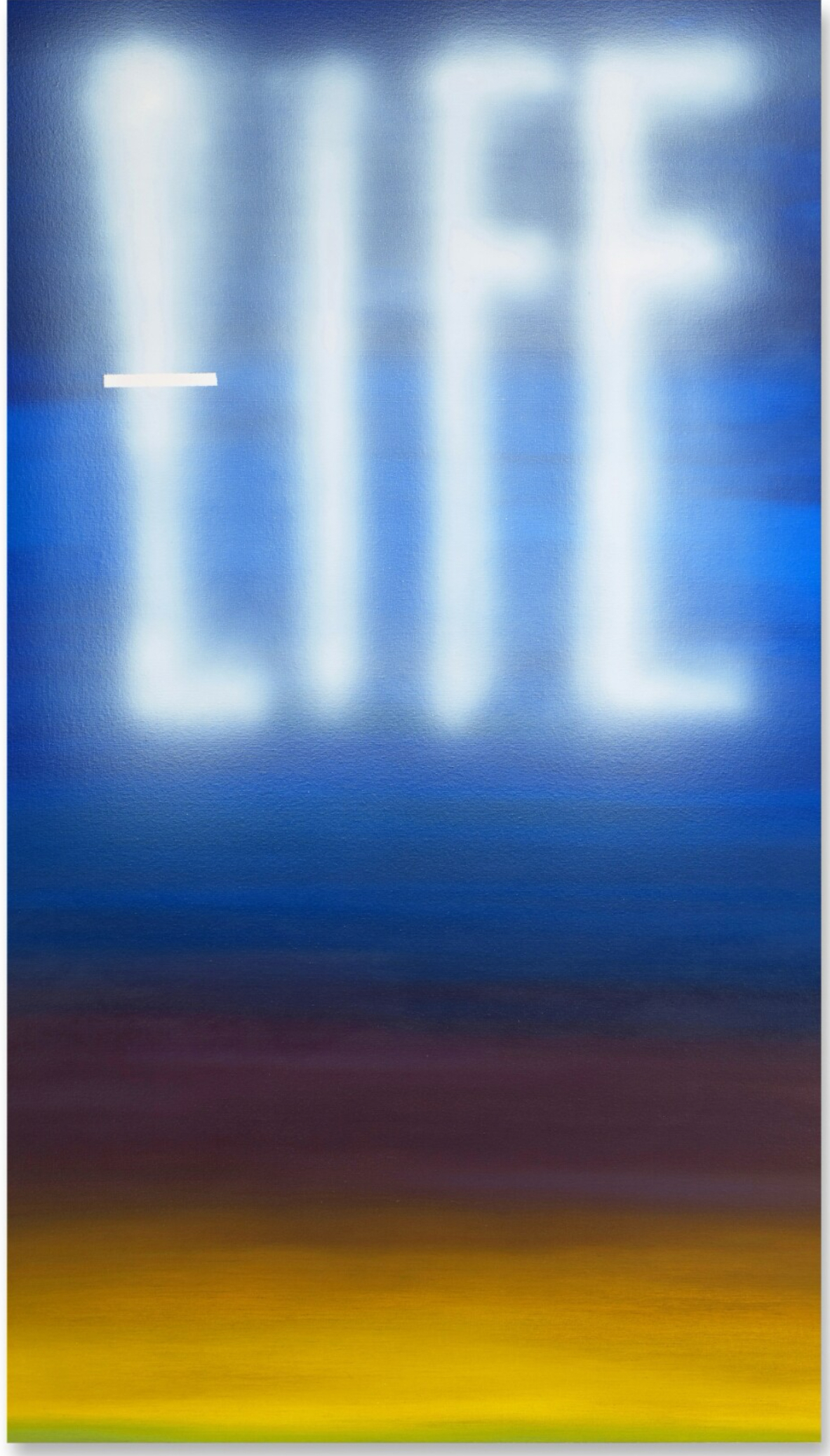
ED RUSCHA (b. 1937)
Life, 1984
Oil and enamel on canvas
84 1/8 x 48 1/8 inches (213.7 x 122.2 cm)
Signed and dated 1984 (on the reverse)
Encapsulating Ed Ruscha’s career-long exploration of semiotics and text, Life from 1984 embodies the conceptual rigor and signature style that have come to define the artist’s highly acclaimed practice. Held in the personal collection of Emily Fisher Landau for nearly 40 years, the work boasts an illustrious exhibition history, having been exhibited at the Fisher Landau Center for Art extensively from 1985 to 2017. Further attesting to the work’s importance, the painting was reproduced in a promotional poster for the Venice Art Walk by the Venice Family Clinic in 1988. Ed Ruscha is currently the focus of a long-awaited retrospective at the Museum of Modern Art in New York, open through January 2024, the most comprehensive exhibition of the artist’s work ever staged, and his first solo exhibition at the museum.
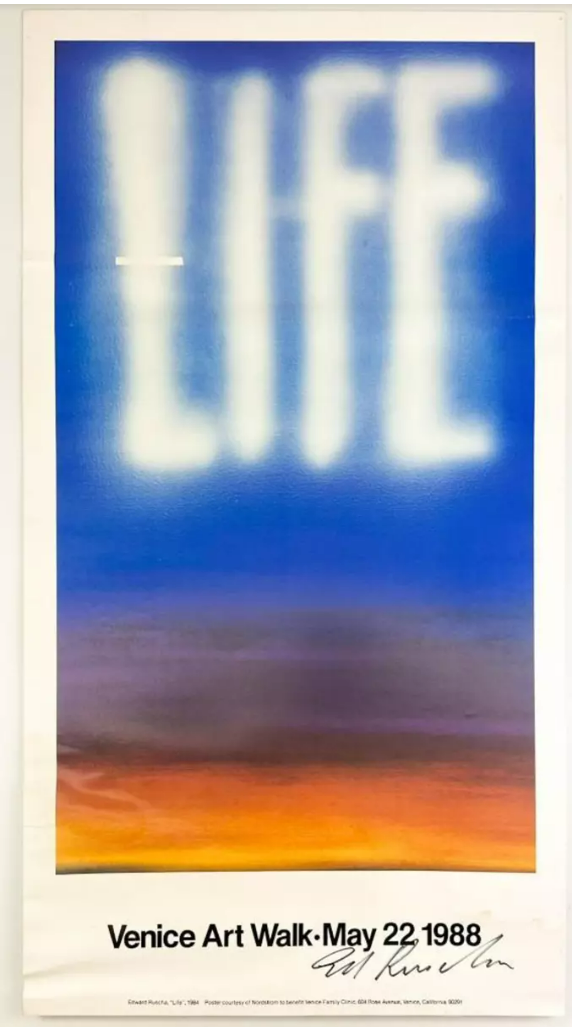
ED RUSCHA’S LIFE, 1984, ILLUSTRATED ON A POSTER FOR THE VENICE ART WALK, VENICE BEACH, MAY 1988. ART © 2023 EDWARD RUSCHA
Emerging from a magnificent dusk sky, the titular word, “LIFE” boldly confronts the viewer in a theatrical crescendo of text and image. Perhaps an ode to the iconic LIFE magazine, the present work appears to utilize the magazine’s bold white typeface, though enlarged, pressed, and refitted within the composition for his own investigations. Hazily rendered, the word floats like clouds on a chromatic plane, echoing the opening credits to a film or a fleeting glimpse of a roadside billboard designed to captivate in an instant. Significantly, Life reflects the first time the artist used an an airbrush technique to render the text which achieves a resounding effect as the canvas reverberates with an atmospheric glow. The bright, fluorescent white letters burst forth from the canvas, pulling themselves out from the dimming twilight with an energetic bravado. Prickling with electricity, “LIFE” comes in a flash, mimicking the blinding effect of oncoming headlights of a car speeding past on the highway.
#2. Cy Twombly
Sotheby’s New-York: 9 November 2023
Estimated: USD 400,000 – 600,000
USD 1,092,200
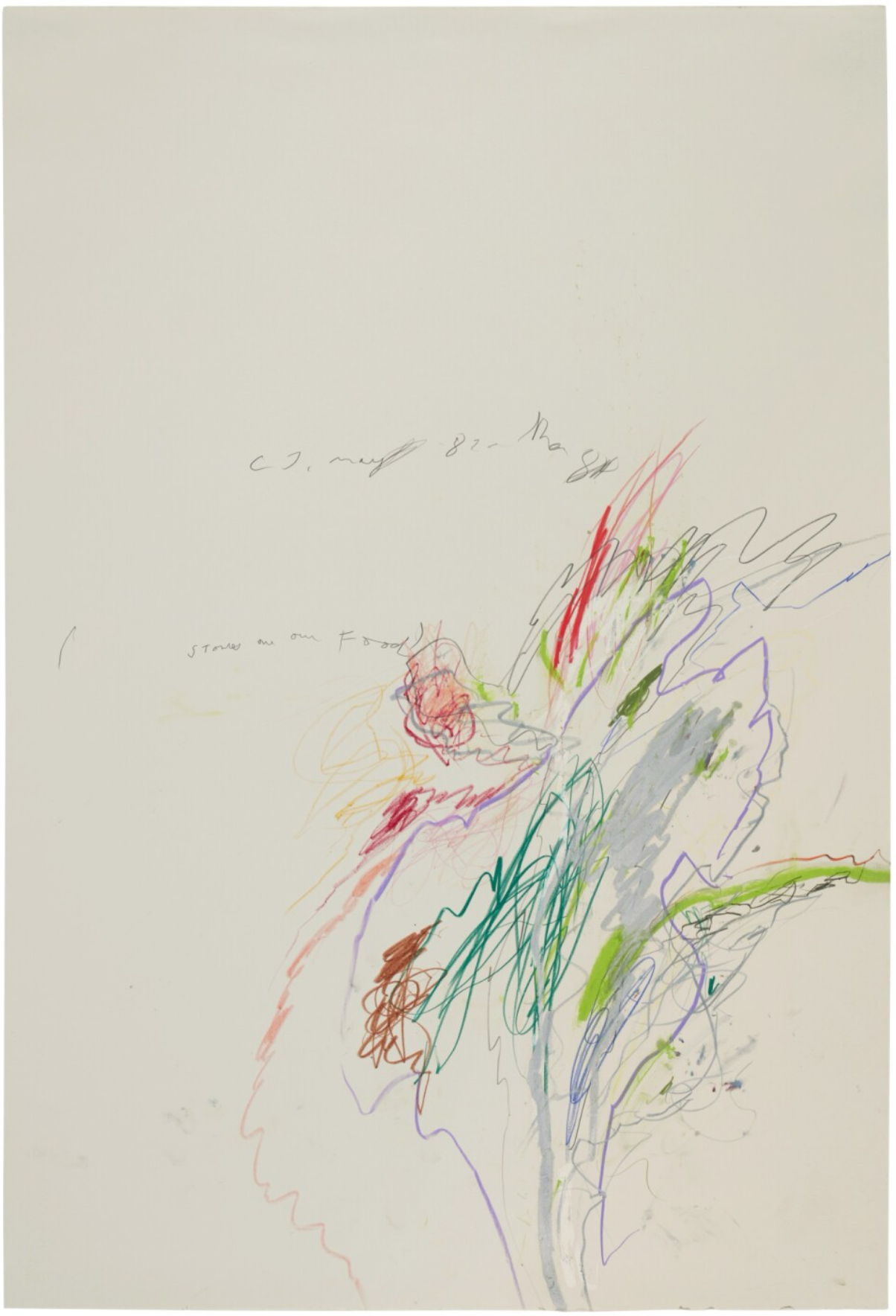
CY TWOMBLY (1928 – 2011)
Untitled, 1982-84
Oil, wax crayon, colored pencil and graphite on paper
44 1/2 x 30 inches (113 x 76.2 cm)
Signed with the artist’s initials, dated May 82 – March 1984
Inscribed Stones are our Food (center)
A vibrant and large-scale example of Cy Twombly’s extraordinary body of works on paper, Untitled, executed between 1982-1984, translates onto paper the artist’s signature gestural vigor, as liberated swirls of oil, wax crayon and colored pencil merge and attenuate in a magnificent conflation of the graphic and the painterly. In the years between 1982 and 1984, Twombly produced a unique and remarkable series of five large-format drawings of which the present work is a part. These artworks were a visual response to an article the artist encountered in National Geographic which described stones that had the intriguing ability to absorb water during the rainy season and release it during times of drought, thereby ensuring the land’s moisture as a result, life. This phenomenon formed a poetic image in Twombly’s mind. Learning that these stones were typically found in Armenia, the homeland of the renowned artist Arshile Gorky, Twombly thus dedicated this series to the older artist. Twombly held a deep admiration for Gorky’s bold and unconventional approach to art, a sentiment that had been strengthened when he attended Gorky’s retrospective at the Whitney Museum of American Art in 1951. In his own work, Twombly’s confident and expressive line work resonated with the wild and energetic strokes characteristic of Gorky’s art.
#3. Ed Ruscha
Sotheby’s New-York: 9 November 2023
Estimated: USD 800,000 – 1,200,000
USD 1,016,000
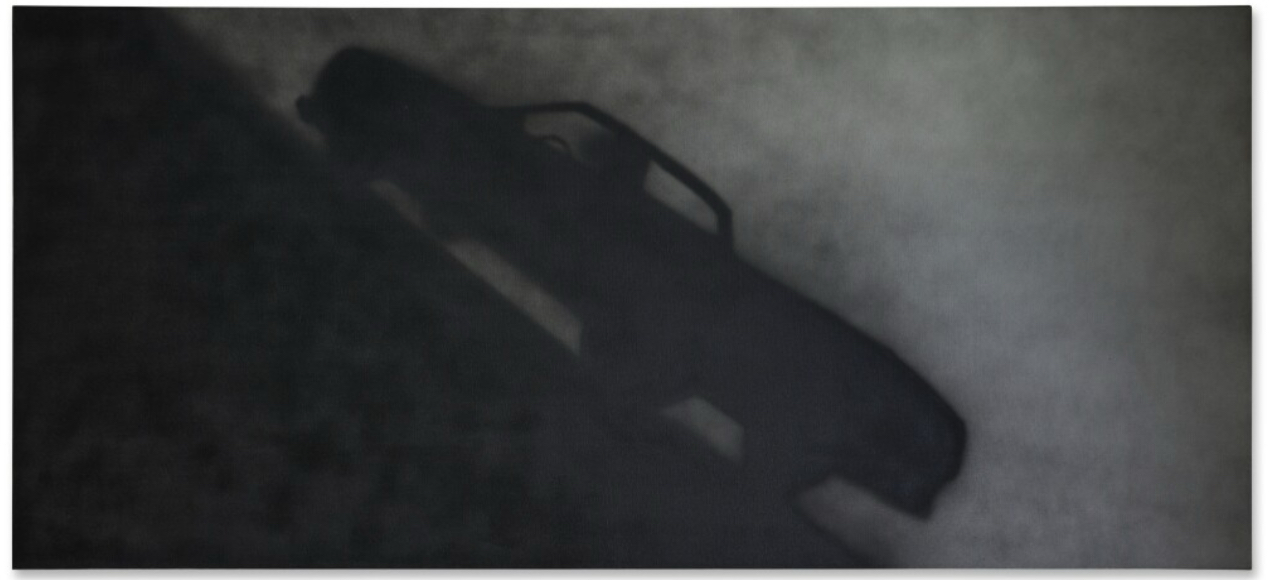
ED RUSCHA (b. 1937)
Uphill Driver, 1986
Acrylic on canvas
54×120 inches (137.2 x 304.8 cm)
Signed and dated 1986 (on the reverse)
Ed Ruscha’s Uphill Driver, executed in 1986, is exemplary of the artist’s career-defining series of Silhouette paintings by way of a hauntingly provocative image of a car poised on a steep hill. Ruscha’s Silhouette paintings, characterized by their black and white, hazily rendered airbrushed technique, boldly depart from the text-based paintings that initially earned him critical acclaim. In Uphill Driver, the viewer encounters an eerie sedan, frozen in time and space as it ascends a steep incline. A ghostly figure at the wheel is scarcely discernible – a mere grayish blur. Ruscha’s use of the airbrush imparts a palpable sense of mounting precarity, heightened by the inclusion of a striking diagonal element. As a lasting symbol of American cultural nostalgia, Uphill Driver offers a singular expression of Ed Ruscha’s remarkable ability to imbue the quotidian with the unnatural.
Other Highlights
Andy Warhol
Sotheby’s New-York: 9 November 2023
Estimated: USD 450,000 – 650,000
USD 444,500
ANDY WARHOL (1928 – 1987)
St. George and the Dragon (After Paolo Uccello), 1984
Silkscreen ink on paper
60×83 inches (152.4 x 210.8 cm)
Stamped by the Estate of Andy Warhol and numbered A891.116 on the verso
In 1984, Andy Warhol turned his focus away from his ubiquitous silkscreens of everyday, commercial objects and portraits of Hollywood’s elite to focus his attention on the history of art itself through his series Details of Renaissance Paintings. In doing so, not only did Warhol pay homage to the Renaissance masters, but he also placed himself as inheritor and predecessor of their revered lineage by incorporating excerpts of their acclaimed works and thus dramatically expanding the scope of his oeuvre. In St. George and the Dragon (After Paolo Uccello), Warhol appropriates Paolo Uccello’s circa 1470 painting Saint George and the Dragon using vibrant colors in a unique screenprint which acts as a crucial preparatory investigation anticipating the later works in his Details of Renaissance Paintings series. By cropping and distorting the original scale and color palette of Uccello’s original painting, Warhol shockingly transforms the iconic Renaissance painting from the canon of Art History into a remarkable Pop spin-off. Just as Warhol’s earlier silkscreen works from the 1960s radically exalted the commodification of American consumer brands and products, the composition of St. George and the Dragon (After Paolo Uccello) similarly examines and subverts the ways in which we consume artistic masterpieces.
PAUL UCCELLO, SAINT GEORGE AND THE DRAGON, C. 1470. THE NATIONAL GALLERY, LONDON.
The story of Saint George and the Dragon belongs to a popular collection of saint’s lives written by Jacopo de Vorgine in the 13th century, titled The Golden Legend. The original masterpiece by Uccello features two episodes from the story of Saint George: his defeat of the plague-bearing dragon that had been terrorizing the city, and the rescued princess bringing the dragon to heel using the belt from her dress as a leash. Warhol crops Uccello’s mythical scene down to the princess’s simple yet stoic profile and the dragon’s all-encompassing spotted wing at a drastically enlarged scale, essentially elevating a fraction of this art historical masterpiece into a Pop art model. The subtle and darker palette of Uccello’s original painting is replaced by a cacophony of striking fluorescent colors and asymmetrical linework which delightfully guide the eye and disguise the origins of the source image.
3. Modern Evening Auction
13 November 2023
Modern Evening Auction | intro | Sotheby’s (sothebys.com)
Auction Statistics
40 Lots
Low Estimate: USD 173,700,000
High Estimate: USD 249,700,000
Estimate Upon Request: 1
Total: USD 223,335,300
# Lots withdrawn: 7
# Lots unsold: 2
# Lots sold: 31
Sell-Through Rate: 93.9%
Top Lot: USD 30,783,000
28 Lots sold over USD 1 million
USD 221,272,700
(99.1% of total)
8 Lots sold over USD 10 million
USD 160,333,700
(71.8% of total)
Above Estimates: 6 Lots (18%)
Within Estimates: 18 Lots (55%)
Below Estimates: 6 Lots (18%)
Estimate on Request/Unsold: 3 Lots (9%)
Top 5 Lots
#1. Claude Monet
Sotheby’s New-York: 13 November 2023
Estimated: USD 30,000,000 – 40,000,000
USD 30,783,000
CLAUDE MONET (1840 – 1926)
Peupliers au bord de l’Epte, temps couvert, 1891
Oil on canvas
91.5 x 81.5 cm (36 x 32 1/8 inches)
Signed Claude Monet and dated 91 (lower right)
Belonging to one of the greatest series of his career, Monet’s Peupliers au bord de l’Epte, temps couvert stands among the finest depictions of the tree-lined banks of the river Epte. Executed beginning in the spring of 1891, the remarkable series of twenty four works stands at the crux of Monet’s acclaimed oeuvre, painted just after the iconic Meules series of 1890-91 and presaging the radical views of his London pictures, and ultimately, his defining Nymphéas.
Monet’s paintings executed in the Eure during the late 1880s and early 1890s offer a vision of pastoral contentment; the fecundity of France and its vibrant seasons are portrayed in the most advanced Impressionist style. Discussing the artist’s daily routine at his home, Claire Joyes wrote: “The landscape at Giverny fascinated him. He spent a long while exploring, walking over hills and through valleys, in marshes and meadows, among streams and poplars. Or, drifting down the quiet river in his boat he would watch with a hunter’s concentration for the precise moment when light shimmered on grass or on silver willow leaves or on the surface of the water. Suddenly or by degrees his motif would be revealed to him” (Claire Joyes, Monet at Giverny, London, 1975, p. 20). Once settled on a subject Monet would rise early, breakfast lavishly, and set out across the fields with his canvases and painting paraphernalia in a wheelbarrow, often accompanied by an “assistant” in form of his step daughter Blanche Hoschedé.
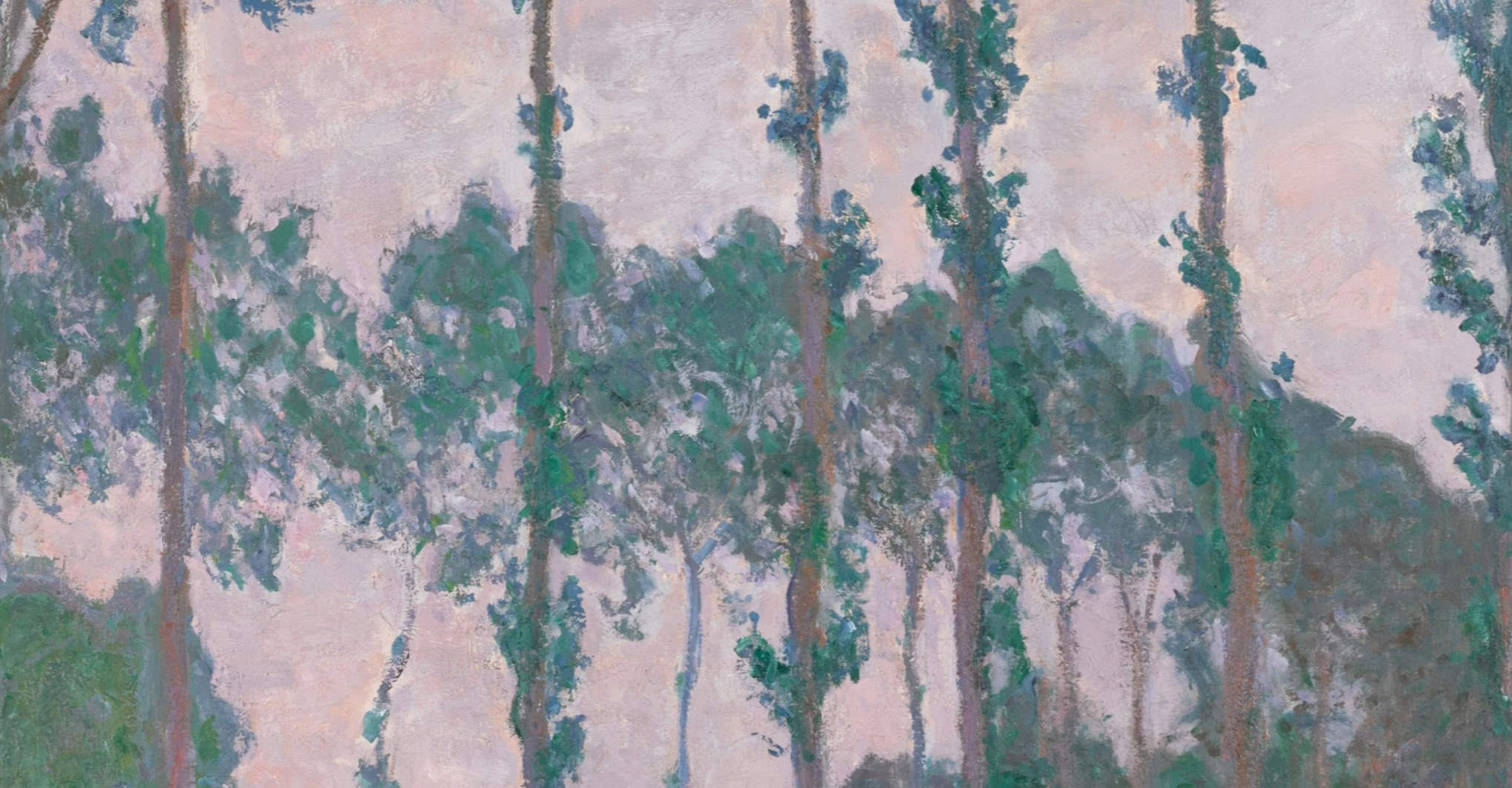
In the Spring of 1891, Monet began a group of twenty-four paintings of a group of poplars located two kilometers from his house in Giverny. The poplars lined the banks of the Epte in the nearby village of Limetz. As it happened, not long after Monet began to paint them, the town of Limetz decided to auction off the trees. They had been planted as a cash crop on property belonging to the town, and in the summer of 1891 they were ready to be harvested. Monet’s request to the town elders to delay their sale was turned down so he turned to the owner of the saw mill. As he relayed the story years later to René Gimpel he asked “what price he [the saw mill owner] was going to buy them for. ‘Go higher’ he said to the timber merchant. ‘I’ll pay the difference but let me have time to paint them” (René Gimpel, Diary of an Art Dealer, New York, 1987, p. 314). Monet’s particular requirements regarding time of day, light and weather, led to the artist modifying and actively painting multiple canvases each day.
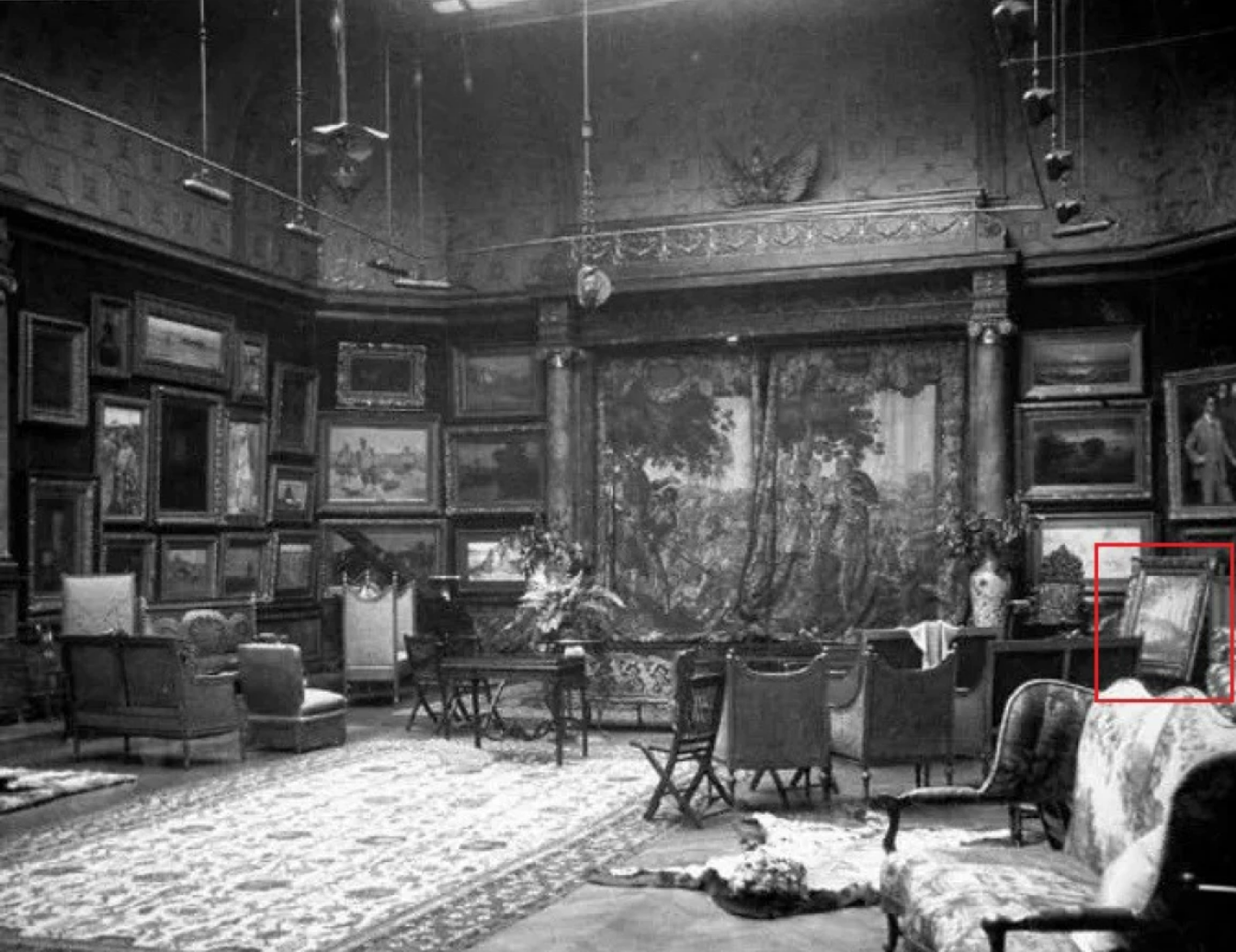
The provenance of the present work exemplifies the important role Monet’s early collectors and dealers played in the promotion of his work, especially in America. Comfortably the richest couple in Chicago at the time, Bertha and Potter Palmer were not averse to spending their prodigious wealth. From 1891 to 1892, Potter Palmer and his wife Bertha acquired a staggering amount of Impressionist art, primarily from the dealers Durand-Ruel in Paris and Knoedler in New York. Bertha was the driving force behind the collection, and intriguingly seems to have operated almost in the manner of a dealer, buying and selling works of art after owning them for a relatively short period of time. In the end, the Palmers had owned ninety paintings by Monet alone, including eight works from the Meules series of 1890-91, a great number of which were bequeathed to the Art Institute of Chicago in 1922. Their act of generosity helped to establish the museum as one of the greatest collections of Impressionist art in America. Among the twenty-three surviving works in the Peupliers series, the present work is one of the most lyrical examples, its cottony lilac-blue skies contrasted by brilliant gem-like hues of green. Peupliers au bord de l’Epte, temps couvert belongs to the smaller subset of works within the series which are painted in a squarer format, the broader canvas allowing for the sweeping serpentine curves of the line of poplar trees. The nearly-square format of Peupliers au bord de l’Epte, temps couvert also presages the aritst’s famed Nymphéas series, some of the earliest of which are executed on the same scale.
#2. Claude Monet
Sotheby’s New-York: 13 November 2023
Estimated: USD 12,000,000 – 18,000,000
USD 25,612,500
Le Moulin de Limetz | Modern Evening Auction | 2023 | Sotheby’s (sothebys.com)
CLAUDE MONET (1840 – 1926)
Le Moulin de Limetz, 1888
oil on canvas
92 x 72.9 cm (36 1/4 x 28 3/4 inches)
Signed Claude Monet and dated 88 (lower left)
Executed in 1888, Claude Monet’s Le Moulin de Limetz is an exceptionally luminous and prismatic encapsulation of Impressionist technique. One of only two canvases to feature this views of the grain mill at Limetz (the other example held in the collection of the Nelson-Atkins Museum of Art) , the present work was painted in the small village of Limetz on the River Epte, about a mile away from the artist’s Giverny home. Monet’s focus in both compositions is not the mill itself—visible at far right, dwarfed by distance and softened by the artist’s characteristic taches—but rather the dazzling diffusion of the mill’s reflection on the water’s surface, seen through the dense, thickly painted leaves of a willow tree that veil the mill and stone bridge. Monet likely advanced both canvases simultaneously, balancing the curtain of foliage at left with the rippling reflection of forms in the river at right.
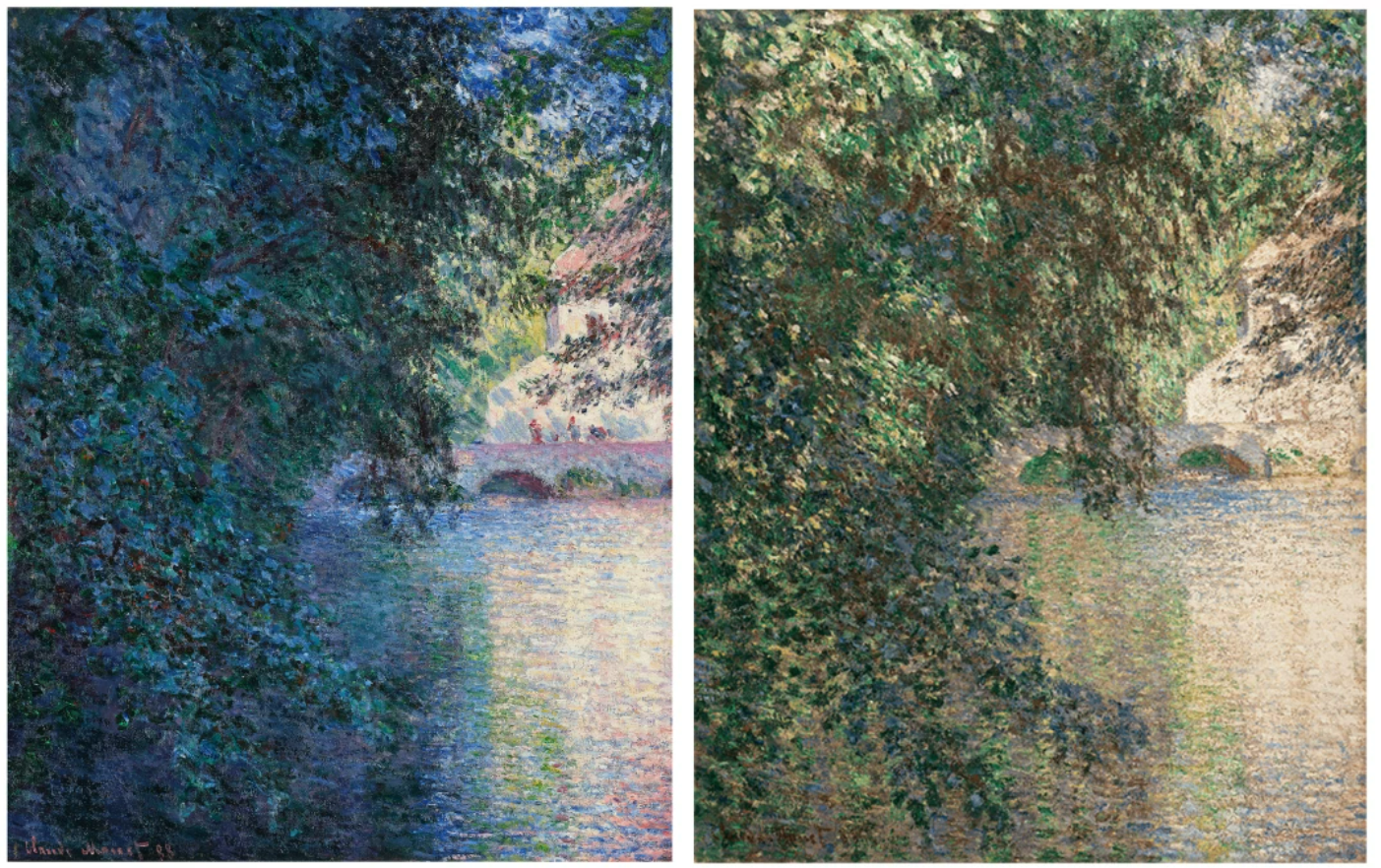
LEFT: THE PRESENT WORK
RIGHT: CLAUDE MONET, MOULIN DE LIMETZ, 1888, THE NESLON-ATKINS MUSEUM
Compared to the Nelson-Atkins version, which is dominated by a green and yellow palette, the present painting is a symphony of sparkling jewel-toned greens, purples, and pinks, punctuated by passages of nearly ecstatic light and bursts of red that altogether contribute to a radiant and ravishing view. The present composition was executed just a few years before Monet would experiment in earnest with a single subject across a series in his notable Meules of 1890-91, Peupliers of 1891, Cathédrales de Rouen of 1892-94, and, for the last 25 years of his life, his beloved Nymphéas at Giverny. Le Moulin de Limetz presages these radical pictorial experiments, already realizing the power of variations on a single motif.
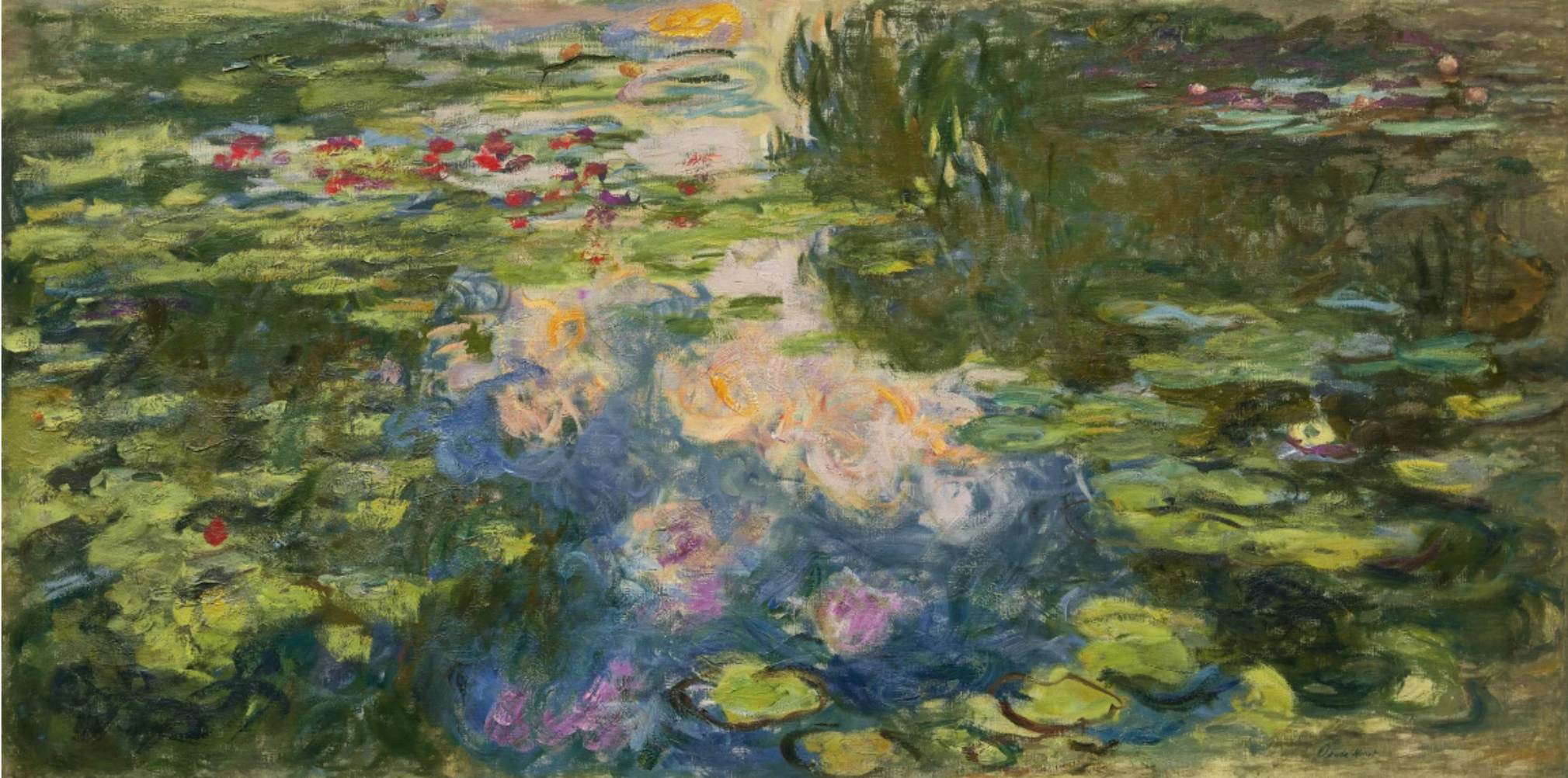
CLAUDE MONET, LE BASSIN AUX NYMPHÉAS, 1917-19
Striving to capture the fleeting effects of nature—light, water, air—Monet favored potent, newly commercially available prismatic colors that would continue to inform his palette in subsequent decades.The brilliant effects of light and shadow upon the rippling water in Le Moulin de Limetz prefigures the masterful interplay of color and texture which would define Monet’s later Nymphéas.
#3. Mark Rothko
Sotheby’s New-York: 13 November 2023
Estimated: USD 7,000,000 – 10,000,000
USD 23,889,000
Untitled | Modern Evening Auction | 2023 | Sotheby’s (sothebys.com)
MARK ROTHKO (1903 – 1970)
Untitled, 1968
Oil on paper laid down on canvas
39 3/8 x 26 1/8 inches (100 x 66.4 cm)
Signed Mark Rothko, dated 1968 and variously inscribed (on the reverse)
An illuminating vision of shimmering color and peerless painterly finesse, Mark Rothko’s Untitled from 1968 is a dazzling embodiment of the artist’s legendary abstractions. Emerging from a brilliant ground of cobalt blue, three fields of rich color, varying in tonality, emit a sumptuous glow. Built up of innumerable delicate strokes and thin washes, these luminescent forms emphatically attest to the artist’s mastery of light, color, and form. An exquisite example from Rothko’s later years, Untitled exemplifies the artist’s work in a medium that bore an increasingly profound significance in the twilight years of his career when, tirelessly seeking to broaden the horizons of his artistic practice, he focused his energies upon exploring the absolute limits of painting on paper. Bearing exceptional provenance, Rothko’s luminous Untitled has been held in the distinguished collection of Pitt and Barbara Hyde for nearly 20 years and is offered to benefit the Memphis Brooks Museum of Art. The Hydes have established a philanthropic legacy in their community, with deep-rooted ties to arts and education, and have acted as long-standing supporters of the Memphis Brooks Museum of Art. Proceeds from the sale of Rothko’s Untitled will support the construction of a new home for the museum, which will be renamed the Memphis Art Museum. Designed by Herzog & de Meuron, the new 122,000 square-foot landmark space on the city’s riverfront will open in 2026 as a center of cultural activity for Memphis.
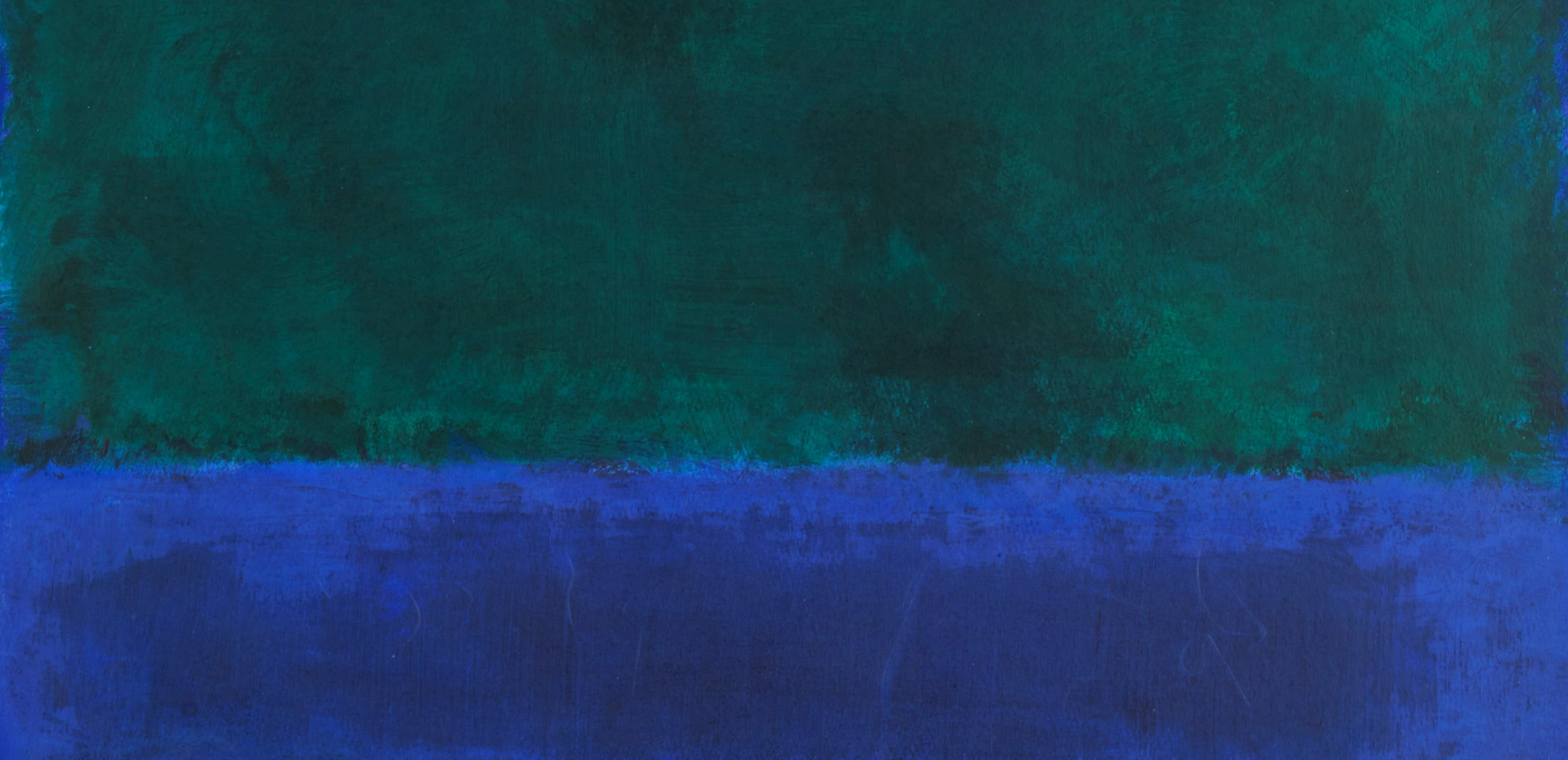
An exquisite summation of the artist’s signature practice, Untitled represents the breathtaking culmination of Rothko’s career-long pursuit of aesthetic transcendence through the conflation of pure color and light. While predominantly known and revered for his corpus of towering abstract canvases, Rothko produced a number of exceptional paintings on paper throughout his career that, in their subtly variegated hues and inherent luminosity, rank among the richest orchestrations of color within his output. Many of the greatest of these works date from the late 1960s, when, under doctor’s orders not to lift heavy canvases, Rothko turned to the lighter and more versatile medium of paper. Despite this apparent limitation, Rothko reached an apex in his artistic ambition, producing a series of works on paper as emotionally stunning as his best-known canvases. Paper, with its paradoxical ability to both absorb and reflect light, in many ways reinvigorated the artist’s quest to create nuanced luminosity within a reductive composition. Describing the significance of the medium within Rothko’s oeuvre, Clearwater notes: “These works…are essential to a fuller understanding of Rothko’s career. Together with the canvases, the works on paper chart the artist’s quest for an elemental language that would communicate basic human emotions and move all mankind” (Ibid., p. 17).
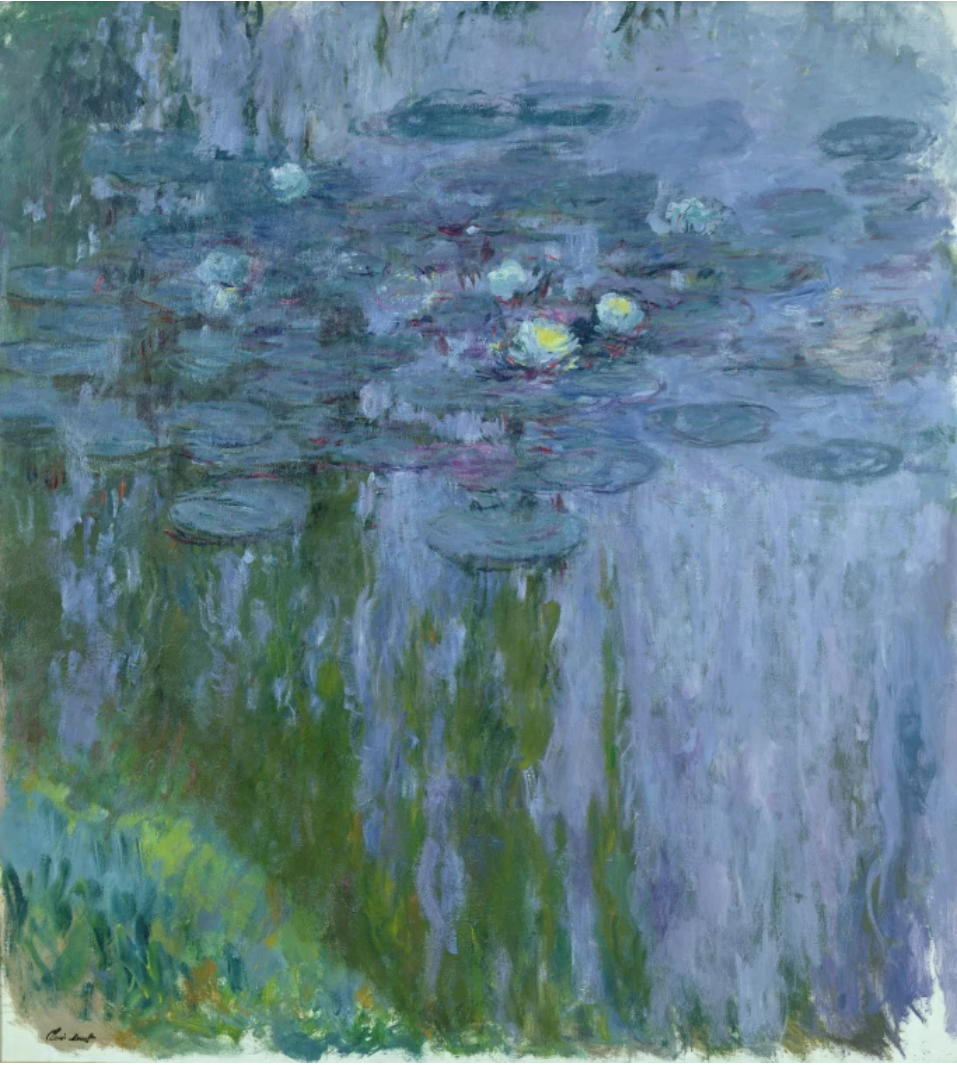
CLAUDE MONET, WATERLILIES, 1916-19. MUSEE MARMOTTAN MONET, PARIS BRIDGEMAN IMAGES
Against a luminescent ground of brilliant sapphire paint the rich, painterly forms of Untitled suggest both feverish movement and tranquil repose, emanating an enthralling tension that invites the viewer to lose him or herself completely in the diaphanous fields of unadulterated color. The present work evokes an analogous sense of pensive introspection and reflective thought, much like Henri Matisse in his contemplative Porte-Fenetre à Collioure from 1914. Dominating the upper register of the composition, the feathered edges of the largest green form push into the oceanic depths beneath and the subtle variations in intensity within the form itself create a sense of billowing cloud-like movement. In contrast, the more meditative passage of inky indigo along the bottom subtly structures the painting, grounding the green and blue forms above. The work’s resultant dynamism necessitates the viewer’s constant attention and provides an endlessly engaging experience. Here, Rothko attains chromatic resonance through the meticulous aggregation of translucent veils of brushed pigment, with especially close attention paid to the areas where the forms meet. Towards the feathered edges of the lowest band, a panoply of purples, greens and browns emerge, rewarding close examination. Similarly, despite the subtlety of tone in the central band, the concentration of more saturated blue pigment acts as a visual balance between upper and lower color fields: the light of one form is countered by the weightier density of the other as they hum quietly to each other across this blue bridge. Among the most spectacular examples of the artist’s works on paper, Untitled emanates an ethereal reverberation of color impossible to reproduce in illustration.
#4. Pablo Picasso
Sotheby’s New-York: 13 November 2023
Estimate on Request
USD 23,463,500
Compotier et guitare | Modern Evening Auction | 2023 | Sotheby’s (sothebys.com)
PABLO PICASSO (1881 – 1973)
Compotier et guitare, 1932
Oil on canvas
97.1 x 130.1 cm (38 1/4 x 51 1/4 inches)
Signed Picasso and dated 13.2.32 (lower right); dated and titled (on the stretcher)
Lauded as one of the most important periods of Picasso’s career, the year 1932 proved an incomparably fertile time for the artist. Painted just before Valentine’s Day, on the 13th of February 1932, Compotier et guitare is a triumph of the artist’s oeuvre and an ode to one of Picasso’s most indelible muses, Marie-Thérèse Walter. From December 1931 to April 1932, Picasso executed more than thirty new paintings intended for the upcoming retrospective. Historian Jack Flam later described this exuberant period as a time of “manic energy” and “appropriation of Matisse’s style and subject matter [which] grew out of his desire to produce an ecstatic outpouring of painted love poetry to Marie-Thérèse” (Jack Flam, Matisse and Picasso, 2003, p. 155). Works like Compotier et guitare provided a direct riposte to Matisse, whose odalisques from the 1920s garnered much acclaim and admiration just a few years earlier.
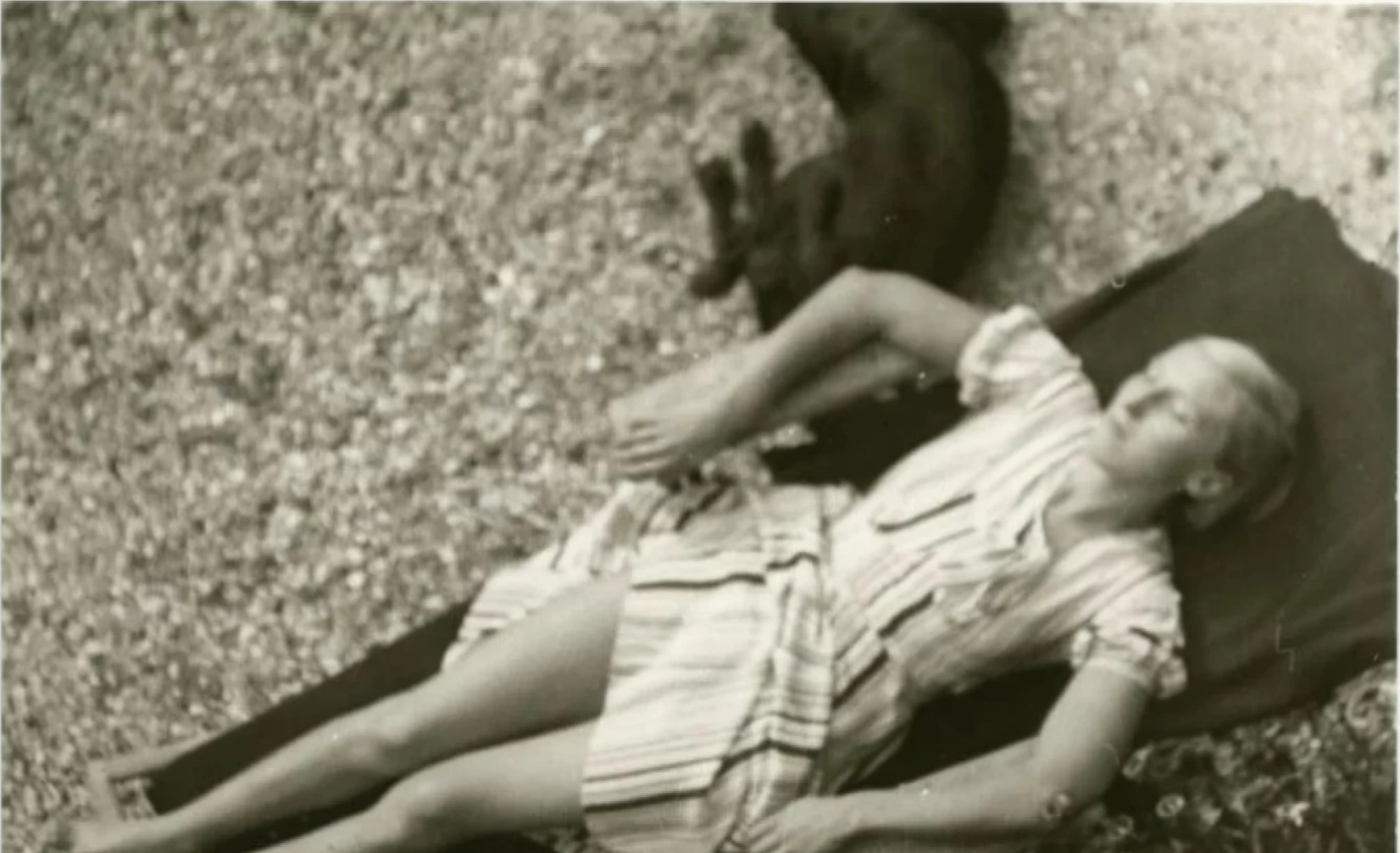
The present work captured the sumptuous palette of gold, vermillion and viridian utilized in Matisse’s Odalisque couchée from 1926 (see figs. 2-3) and reiterated its patterned background and arabesque curves. With Compotier et guitare, Picasso reimagined the reclining nude as a still life, with the curves and lines of the bowl, drapery and instrument echoing Matisse’s odalisque in reimagined forms. While the bold palette of Compotier et guitare is largely indebted to Matisse, the inspiration for this work and nearly all his paintings from 1932 stemmed directly from his l’amour fou with Marie-Thérèse. The covertness of their liaison had only intensified Picasso’s infatuation over the years, his growing obsession with the young woman resulting in increasingly erotic imagery. The intoxicating ardor culminated in 1932 with a suite of monumental canvases featuring sensual still lifes and seductive nudes that irrefutably affirmed Marie-Thérèse’s presence in Picasso’s life.
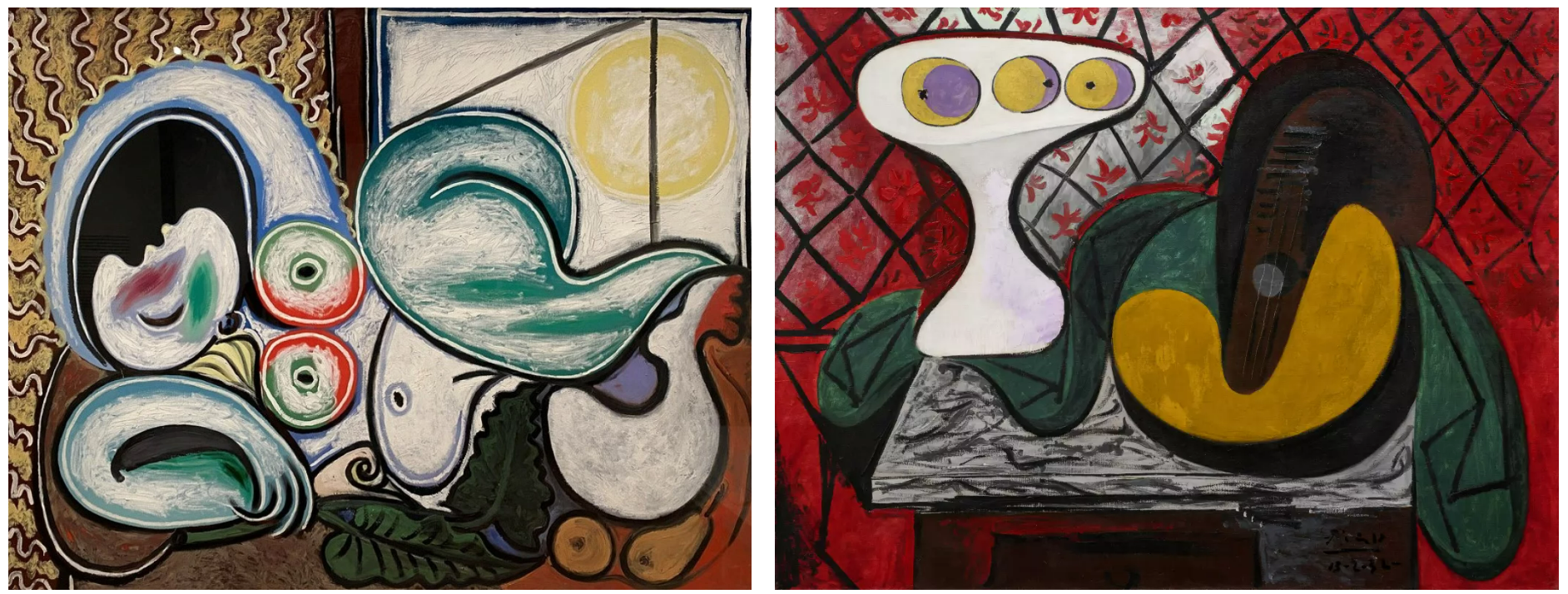
LEFT: PABLO PICASSO, NU COUCHÉ, 4 APRIL 1932, MUSÉE PICASSO, PARIS; RIGHT:THE PRESENT WORK © 2023 ESTATE OF PABLO PICASSO / ARTISTS RIGHTS SOCIETY (ARS), NEW YORK;
In the present work, the three pieces of fruit rendered in pale yellow and lavender serve as direct references to Marie-Thérèse. Standing in contrast to the audacious reds and emphatic contour lines of the rest of the work, the gentle palette of white, yellow and purple at left of the composition is a hallmark of Picasso’s depictions of his muse. Among the most prominent forms in the present work is the large two-toned guitar at the right of the composition. While the symbol of the guitar had long appeared in Picasso’s work and often in suggestive contexts, the present composition presents the object in a highly sexualized manner, as the curved neck of the instrument seems to penetrate the swelling body of the guitar. By contrast, the delicately rendered fruits—themselves a timeless emblem of fertility—echo his lover’s breasts and navel as exemplified by the comparison with Picasso’s Nu couché, now at the Musée Picasso in Paris (see fig. 13). Connected by the green drapery, these curvilinear forms combine to trace the outline of Picasso’s slumbering muse.
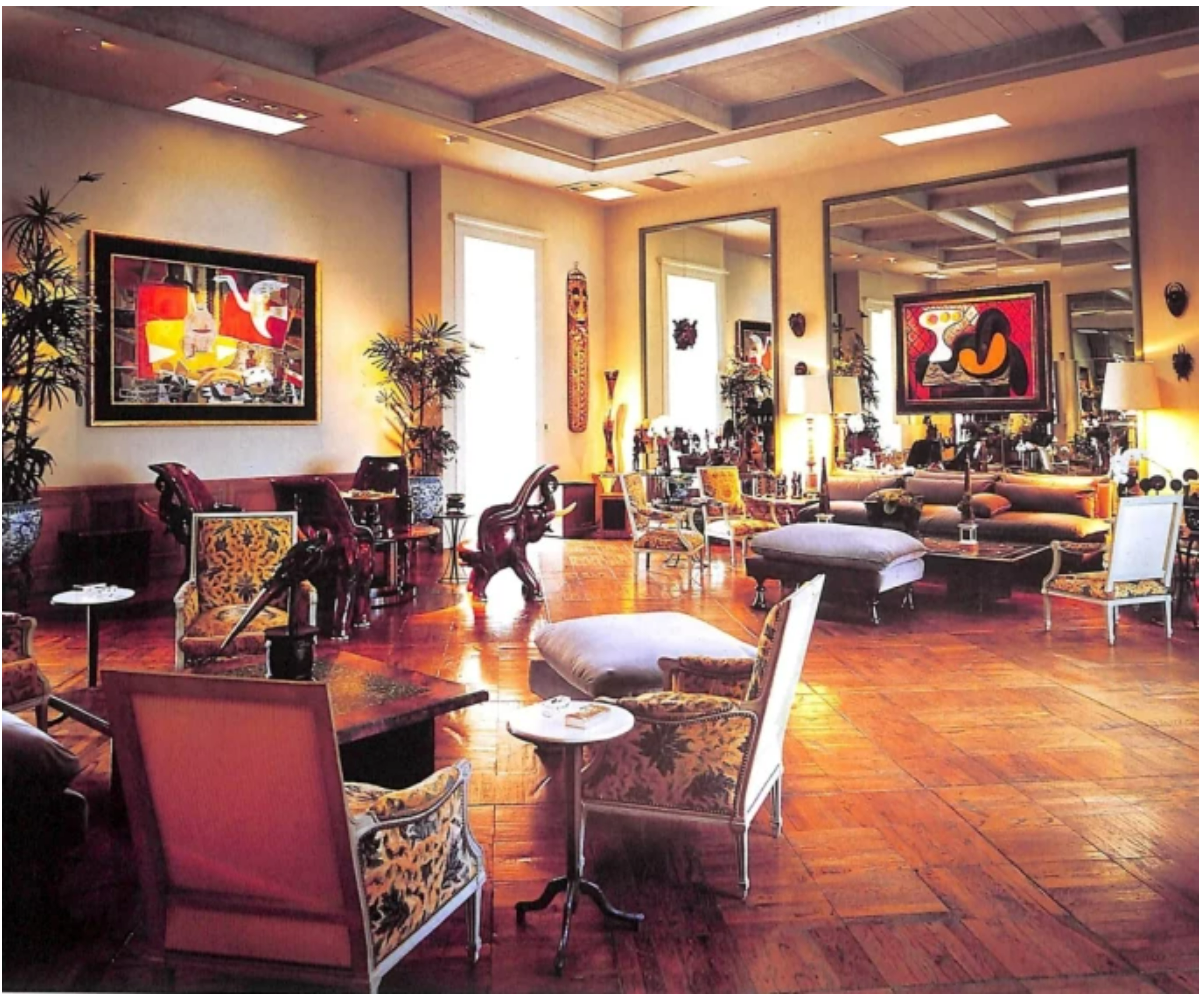
THE PRESENT WORK IN THE LIVING ROOM OF BILLY MCCARTY-COOPER’S RESIDENCE ON ORIOLE LANE, WEST HOLLYWOOD. ARTWORK © 2023 ESTATE OF PABLO PICASSO / ARTISTS RIGHTS SOCIETY (ARS), NEW YORK;
Such a complex and monumental work is accompanied by an equally illustrious provenance. Shortly after the 1932 exhibition, Compotier et guitare entered the collection of Paul Rosenberg, one of the twentieth century’s most influential dealers. A few years later, the critic, patron and friend of the artist Douglas Cooper acquired the painting from Rosenberg in exchange for Paul Cézanne’s La Préparation du banquet, now held in the The National Museum of Art in Osaka. An esteemed intellectual and collector, Cooper was the first scholar to write a major history on the Cubist movement. In all, his collection totaled nearly 150 works—many of them Cubist compositions—which came from the distinguished collections of Zoubaloff, Kahnweiler and Léonce Rosenberg. The present work remained in his collection until his death in 1984, after which it was inherited by his long-time partner, designer and philanthropist William “Billy” McCarty-Cooper.
#5. Marc Chagall
Sotheby’s New-York: 13 November 2023
Estimated: USD 12,000,000 – 18,000,000
USD 15,616,200
Au-dessus de la ville | Modern Evening Auction | 2023 | Sotheby’s (sothebys.com)
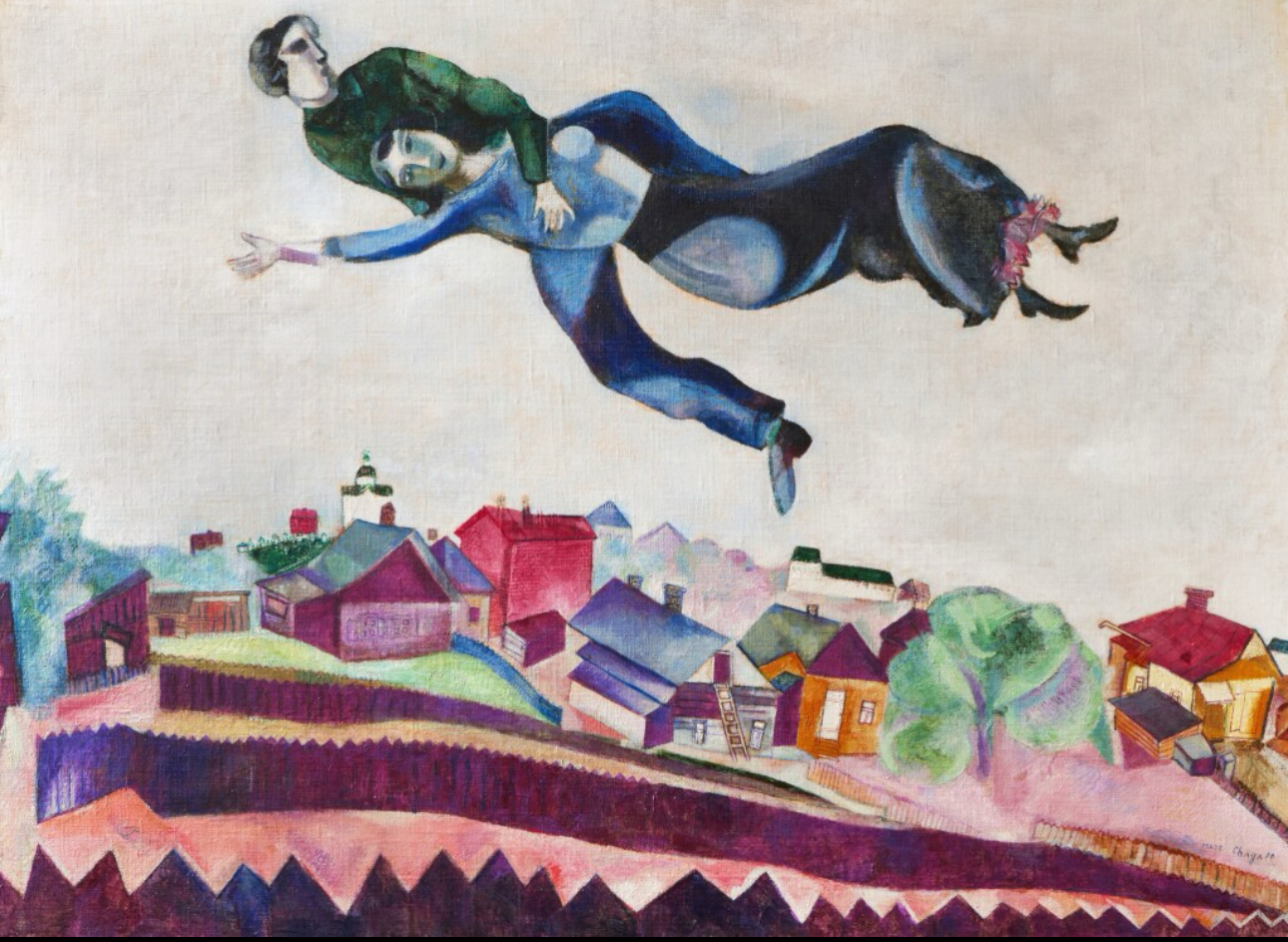
MARC CHAGALL (1887 – 1985)
Au-dessus de la ville, 1924
Oil on canvas
67.5 x 91 cm (26 5/8 x 35 7/8 inches)
Signed Marc Chagall (lower right)
Painted in 1924 after his return to Paris, Chagall’s Au-dessus de la ville epitomizes the mystical blend of wonder, romance and nostalgia which defines the artist’s greatest paintings. Inspired by the love of his life, Bella Rosenfeld, the present composition not only captures the affections of their nearly thirty-year marriage but also speaks to the artist’s identity amidst an era of international upheaval. When Chagall and Bella first met in 1909, they lived on opposite sides of the town’s Daugava River, she in a great stone house and he in a modest cottage shared with his parents and eight siblings.
MARC CHAGALL AND HIS WIFE BELLA ROSENFELD IN HIS STUDIO IN PARIS, 1926. © SZ PHOTO BRIDGEMAN IMAGES
In the present composition, the young Chagall and Bella float effortlessly above their shared hometown of Vitebsk, buoyed by their passions and alight with the glow of the newlywed. This version of Au-dessus de la ville was executed in Paris in 1924, shortly after the Chagalls relocated to France, at last fulfilling the plan set in motion nearly a decade earlier. Characteristic to his practice of reinventing early compositions, Chagall returned to the themes within the Tretyakov picture over the course of a decade in varying media and supports. As with his other Russian compositions (see figs. 4-6), which were either sold early in the artist’s career or otherwise lost between his peregrinations, Au-dessus de la ville proved among the most meaningful of his canvases and and one which merited revisiting in a new context.
Au-dessus de la ville was acquired by Etta and Mark C. Steinberg from Katia Granoff, one of the leading dealers of Chagall’s work, upon the couple’s first postwar trip to Paris. The present work proved the first major acquistion for the Steinbergs, who would become leading collectors and philanthropists in the St. Louis area in the subsequent years.
Other Highlights
Balthus
Sotheby’s New-York: 13 November 2023
Estimated: USD 12,000,000 – 18,000,000
USD 14,697,000
La Patience | Modern Evening Auction | 2023 | Sotheby’s (sothebys.com)
BALTHUS (1908 – 2001)
La Patience, 1943/1946-48
Oil on canvas
161.5 x 164.2 cm (63 5/8 x 64 5/8 inches)
Signed Balthus and dated 1943 (lower left)
La Patience is a much-celebrated masterpiece by Balthus that for many years has formed part of the Joseph Winterbotham collection at the Art Institute of Chicago. Begun in 1943, this famous picture is a poetic and masterful evocation of a strange, timeless world, full of melancholy and hope, that takes the form of a domestic interior in which a lone girl, absorbed in a world of her own, is seen playing of a game of patience (solitaire). Like all the finest of Balthus’s works, La Patience is a picture where time, magically, appears to stand still. It was painted in Balthus’s apartment in Fribourg, Switzerland, during the Second World War and is one of the best-known of a famous series of ‘interiors’ from the late 1930s and early ‘40s that showcase the artist’s uncanny ability to generate a haunting and mesmeric sense of what critics have often described as “time suspended.”
THE PRESENT WORK INSTALLED AT THE ART INSTITUTE OF CHICAGO IN 1975. © 2023 ARTISTS RIGHTS SOCIETY (ARS), NEW YORK / ADAGP, PARIS
This apparent “suspension” of time was Balthus’s unique ability to transform familiar-looking images—often in the form of adolescent women, seen alone in a room, lost in thought—in which the appearance of the reality we know, in all its apparent normality and ordinariness, is revealed also to be mysterious, magical, unsettling and strange. Evoking qualities that appealed to both Surrealists and Existentialists alike, it was precisely the unusual and even disquieting quality of pictures such as La Patience that prompted great literary figures of the period, such as Antonin Artaud, Albert Camus and artists like Pablo Picasso to openly praise and champion Balthus’s work. Indeed, not only did Picasso acclaim Balthus’s ability to conjure unique moods of intimacy and mystery in this series of ‘interiors’ but in 1941, he also took the rare step of purchasing one of these works: Les Enfants Blanchard of 1937. Of the other paintings from this great series begun in the late-1930s, the vast majority now belong to major North American museums: Jeune fille au chat of 1937 is also owned by the Art Institute of Chicago, for instance. Thérèse and Thérèse rêvant of 1938 belong to the Metropolitan Museum of Art, New York, Le Salon I of 1941-43 is in the Minneapolis Institute of Art, Le Salon II is in the Museum of Modern Art, New York and Les Beaux Jours of 1943-46 is in the Hirshhorn Museum and Sculpture Garden, Washington D.C.
Alberto Giacometti
Sotheby’s New-York: 13 November 2023
Estimated: USD 12,000,000 – 18,000,000
USD 12,650,000
Femme de Venise VIII | Modern Evening Auction | 2023 | Sotheby’s (sothebys.com)
ALBERTO GIACOMETTI (1901 – 1966)
Femme de Venise VIII, 1956
Bronze
Height: 122 cm (48 inches)
Inscribed Alberto Giacometti
Numbered 0/6 and inscribed with the foundry mark Susse Fondeur Paris
Stamped with the foundry mark Susse Fondeur Paris Cire Perdue (on the interior)
Conceived in 1956; this example cast in bronze by Susse Fondeur in 1973
Conceived in 1956 with the first examples cast in bronze the following year, the present sculpture is number eight in Giacometti’s celebrated series of nine standing female nudes, collectively known as the Femmes de Venise. These standing women are among Giacometti’s best known works, praised by many as the artist’s most significant contribution not only to the pantheon of modern sculpture but twentieth-century art at large.
ALBERTO GIACOMETTI WITH HIS SCULPTURES AT THE 28TH VENICE BIENNALE, JUNE 1956. THE PLASTER FOR THE PRESENT FEMME DE VENISE VIII IS ON THE FAR LEFT. PHOTO FEDELE TOSCANI, COURTESY OF GIACOMETTI FOUNDATION ARCHIVE. ARTWORKS © 2023 ARTISTS RIGHTS SOCIETY (ARS), NEW YORK
While Giacometti’s work had been featured in exhibitions around the world by the mid-1950s, the French State, Giacometti’s home for almost the entirety of his adult life, had yet to sponsor an exhibition of the sculptor’s work. It was long overdue—if not a bit ironic—when “in the autumn of 1955 he received an official invitation to exhibit a selection of his works not in France but in the main gallery of the French Pavilion at the Venice Biennale the following June” (James Lord, Giacometti: A Biography, New York, 1985, p. 355). With the Biennale and another exhibition at the Kunsthalle Bern both opening in June of 1956 Giacometti set to work producing a selection of fifteen standing female figures. Ten of these plaster figures were exhibited in Venice in groups of four and six as self-proclaimed “works in progress,” meanwhile the remaining five plasters were shown in Bern as Figures I-V. Shortly thereafter, Giacometti selected eight plasters from the Venice Biennale and one from the Kunsthalle Bern exhibition to cast in bronze, calling them collectively the Femmes de Venise, regardless of where they had been shown (see fig. 1). Within two years, bronzes of these static figures were exhibited in the United States at the Pierre Matisse Gallery in 1958 (see fig. 2). From this point forward, nearly all major subsequent exhibitions dedicated to Giacometti’s evocative works would include at least one of these acclaimed Venetian women.
5. The Now Evening Auction
15 November 2023
The Now Evening Auction | intro | Sotheby’s (sothebys.com)
Auction Statistics
19 Lots
Low Estimate: USD 43,690,000
High Estimate: USD 60,680,000
Total: USD 55,198,350
# Lots withdrawn: 1
# Lots sold: 18
Sell-Through Rate: 100%
WHITE GLOVE SALE
Top Lot: USD 10,905,300
9 Lots sold over USD 1 million
USD 49,163,800
(89.9% of total)
3 Lots sold over USD 10 million
USD 31,918,300
(57.8% of total)
Above Estimates: 9 Lots (50%)
Within Estimates: 8 Lots (44%)
Below Estimates: 1 Lots (6%)
Top 5 Lots
#1. Jenny Saville
Sotheby’s New-York: 15 November 2023
Estimated: USD 9,000,000 – 12,000,000
USD 10,905,300
Shift | The Now Evening Auction | 2023 | Sotheby’s (sothebys.com)
JENNY SAVILLE (b. 1970)
Shift, 1996-97
Oil on canvas
130×130 inches (330.2 x 330.2 cm)
Signed and dated 96-97 (on the reverse)
Tessellating, rippling, abundant flesh suffuses the surface of Jenny Saville’s Shift from 1996-97, the painting which announced her place in the pantheon of Contemporary art’s most important painters and singularly evinces the defiant reclamation of the female body for which she is best known. Exhibited prominently at the Royal Academy of Art’s era-defining Sensation: Young British Artists from the Saatchi Collection, Shift sees Saville at her very best: declarative, unashamed, resistant, renegade. Though bearing palimpsestic resonances to the nude’s centrality in the art historical canon, the women of Shift share nearly nothing with those that have preceded them. In a gluttony of breasts and belly, Saville quite literally inverts the viewer’s expectations of the female nude; we are smothered by her subjects’ totalizing frontality. Spanning nearly eleven feet in both directions, Shift impresses upon us a sense of scale, weight, and, above all, reality: whether in paint, literature, or legislation, women’s bodies have been crushed by expectation and forced into submission, made into vessels for consumption and sites of criticism. Nowhere in her inimitable corpus is her intransigent spirit and complete fluency in oil paint so colossally summarized than in the present work, and here, Saville aptly taps into the fraught tenuity of our collective relationship with femininity, art history, and the body.
LEFT: WILLEM DE KOONING, UNTITLED XXXIII, 1977. SOLD AT SOTHEBY’S NEW YORK IN NOVEMBER 2021 FOR $24.4 MILLION. PRIVATE COLLECTION. ART © 2023 THE WILLEM DE KOONING FOUNDATION / ARTISTS RIGHTS SOCIETY (ARS), NEW YORK. RIGHT: LUCIAN FREUD, STANDING BY THE RAGS, 1988-89. TATE MODERN, LONDON. IMAGE © THE LUCIAN FREUD ARCHIVE. ALL RIGHTS RESERVED 2023 / BRIDGEMAN IMAGES. ART © 2023 LUCIAN FREUD
On the opening day of Sensation, when Shift’s inclusion in the show was unveiled, complete uproar ensued. Protesters picketed outside of the museum’s entrance, and the media posted such inflammatory headlines as “Artrage!” and “Royal Academy of Porn!”; lines stretched around the Burlington House, and Royal Academicians resigned. Alongside Damien Hirst’s formaldehyde-pickled shark, Tracey Emin’s tent, Marc Quinn’s blood-soaked bust, and Chris Ofili’s portrait of the Virgin Mary, Shift was inducted into an art historical hall of infamy. Its candor proved too taboo for the time: larger-than-life dimples, stretch marks, cellulite, and pubic hair lushly articulated in sumptuous strokes indulge the full range and plasticity of its material properties. From slick to sticky, opaque to diaphanous, the sheer proficiency of Saville’s facture and the certain candor of her vision leave no room for idealization. On canvas she manages to conjure the very rage in her first viewers felt by those over a century earlier at the 1865 Paris Salon, when Édouard Manet’s Olympia made its debut. Despite hysteric accusations of promiscuity and wanton flagrancy, Olympia’s viewer – presumably male – consciously continued to look at her. Male spectatorship devoured her body, just as it did with Velázquez’s Rokeby Venus, as it did Titian’s Venus of Urbino, and the issue, Saville asserts, is that the viewer never simply looks at a nude woman but demands something of her. Poreless purity had long been codified in the annals of art history, but through the women of Shift, neither venus nor nymph, Saville intervenes.
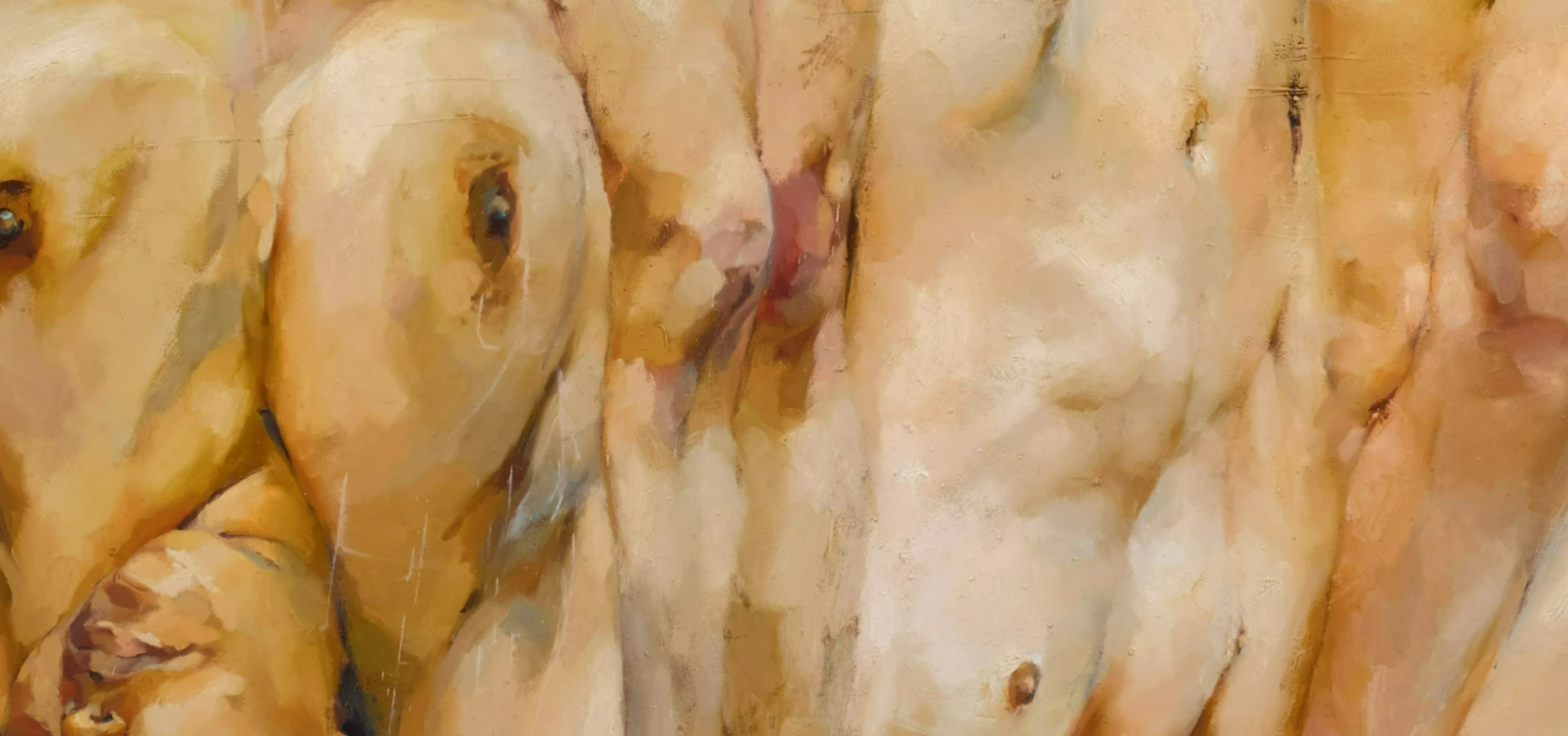
So beautiful is Saville’s treatment of flesh in Shift that it seems to contradict its wincing compositional and conceptual peculiarities. The women’s luminescence evokes the glistening musculature and perspiration of Peter Paul Rubens, but under Saville’s generous dose of light and warmth also exists squished limbs, skin stretched taut over rib cages, and bruised sternums, knees, and pelvic bones. Distorting her figures to the point of discomfort, Shift evokes the image of one of Saville’s greatest influences, Chaïm Soutine’s Carcass of Beef, and in drawing the connection suggests that women, historically and systematically, are depicted, treated, and consumed as such. It is in this incongruence between form and content that the humanity of Saville’s best paintings lies: the female body can be delicate, disturbing, and beautiful; troubled, miserable, and triumphant. The crisis of womanhood, Saville asserts, is the simultaneous, unrelenting battles waged between agency and subjectivity, empowerment and self-loathing.
This dichotomy is heightened by the present work’s enormity: there is the intense vulnerability that permeates Saville’s subjects, yet their immense size belies the impression of fragility. Veering into the realm of the maternal, the figures generate a sense of child-like intimacy, but their nurturing quality is not Saville’s sole intention. Mark Rothko famously advised that his paintings should be viewed from a distance of 18 inches, and Saville says the same. Her works are meant to draw us in, envelope us, infantilize us, before returning us back into the world, enlightened and implicated all the same. Often citing de Kooning’s Woman series as a source of inspiration, Saville has said of these works that in them she “made a body that was too big for the frame, literally too big for the frame of art history… I wanted them to confront you and exist.” (the artist quoted in: Simon Schama, Jenny Saville, New York 2005, p. 127) Thus, the effect of the present work’s size is not only to dwarf the viewer, however, but to intimidate them into not only seeing the image before them but hearing the message contained therein: Shift is unequivocally argumentative.
#2. Julie Mehretu
Sotheby’s New-York: 15 November 2023
Estimated: USD 7,000,000 – 10,000,000
USD 10,737,500
Walkers With the Dawn and Morning | The Now Evening Auction | 2023 | Sotheby’s (sothebys.com)
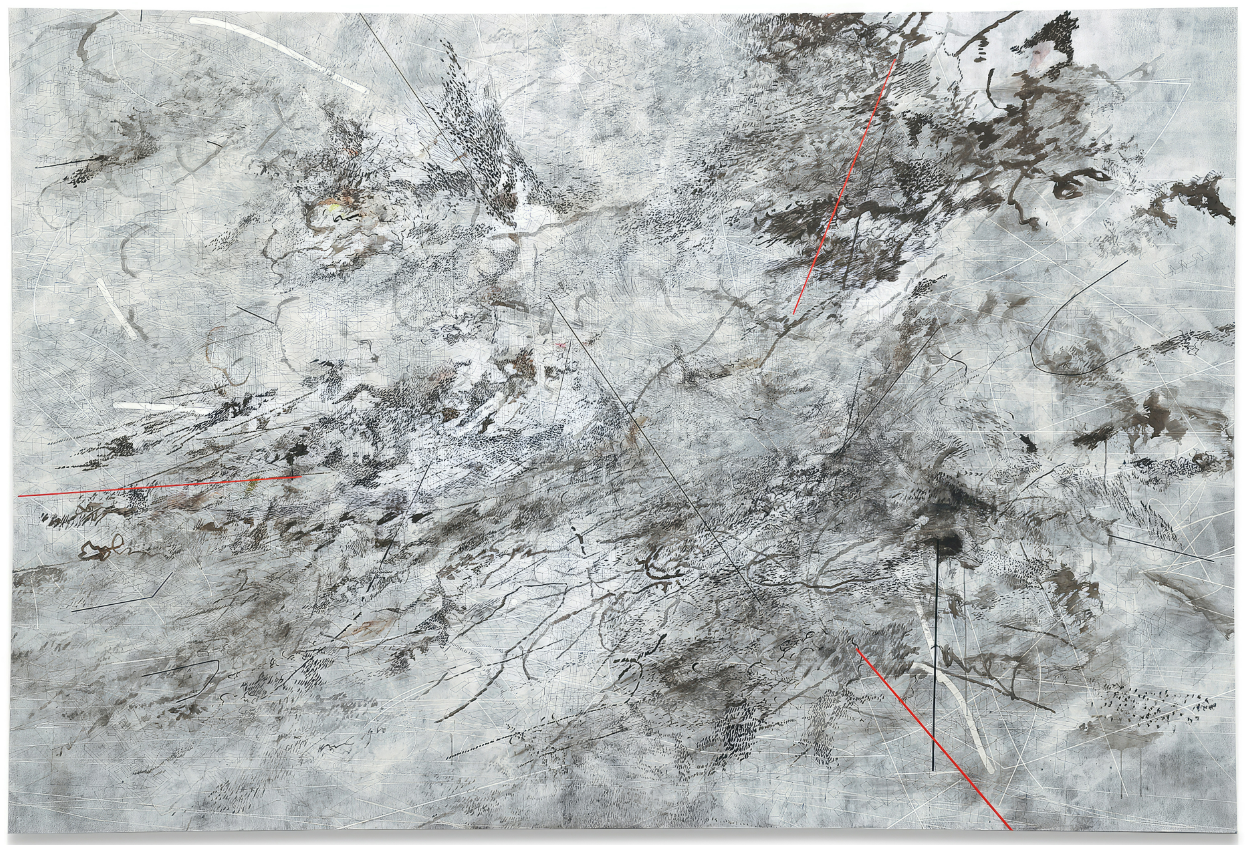
JULIE MEHRETU (b. 1970)
Walkers With the Dawn and Morning, 2008
Ink and acrylic on canvas
95 5/8 x 142 1/8 inches (242.9 x 361 cm)
A whirlwind of calligraphic marks set over an expanse of architectural drawing, Walkers With the Dawn and Morning from 2008 is an expansive celebration of Black perseverance post Hurricane Katrina, swirling with dense layers, choreographed linework, and bursts of bright color in a deep, tonal sea. Named after the eponymous poem by Langston Hughes, Walkers With the Dawn and Morning was painted for and first exhibited at Prospect. 1, the New Orleans Biennial inaugurated to stimulate art world participation and cultivation in the city in the wake of Hurricane Katrina. Just as Hughes’ poem represents the journey of the Black community in America, moving forward despite countless obstacles, Mehretu’s painting solidifies the sense of community and solidarity crucial to the survival of the Black population of New Orleans following its decimation by the disaster. Displaying the most lauded aspects of Mehretu’s oeuvre – exquisitely meticulous architectural renderings powerfully juxtaposed against gestural mark-making, dynamic and nuanced compositional layering, and thoughtful exploration of urban social spaces– Walkers With the Dawn and Morning simultaneously reflects human resilience after unthinkable disaster. One of the first major works by the artist to come to auction since her highly acclaimed mid-career retrospective organized by the Los Angeles County Museum of Art and Whitney Museum of Art in New York, Walkers With the Dawn and Morning is a tour de force of technical virtuosity; a bravura display of brushwork that constitutes an incisive social commentary.
JULIE MEHRETU IN HER STUDIO, 2021. PHOTO © TOM POWEL IMAGING. COURTESY THE ARTIST AND MARIAN GOODMAN GALLERY. ART © JULIE MEHRETU
Walkers With the Dawn and Morning, as a model of Mehretu’s unbridled visual and symbolic layering, requires both visual and metaphoric excavation. Since the late 1990s, Mehretu has employed architectural drawings, terrain maps, and construction blueprints as both formal and conceptual tools within her abstract lexicon, generating an intricate visual vocabulary compellingly rooted in social, historical, and geographic observations: global population shifts, mobilized armies, urban mapping and structural planning.
“I think architecture reflects the machinations of politics, and that’s why I am interested in it as a metaphor for those institutions. I don’t think of architectural language as just a metaphor about space. It’s about space, but about spaces of power, about the ideas of power.”
Walkers with the Dawn and Morning is still more specific, critically addressing the effect of Hurricane Katrina on the Black community in New Orleans. As such, beneath the immediate explosion of free-form scrawls and kinetic vectors lies a subtly rendered architectonic assemblage, anchoring the composition in formal geometric terms, yet resisting any initial legibility. Situated in the context of post-Katrina New Orleans, these markings evince the fragmented experiences and stimuli of the collective southern cityscape. Thus, Walkers With the Dawn and Morning not only maps a semi-imagined world but also captures and reconciles with massive tragedy.
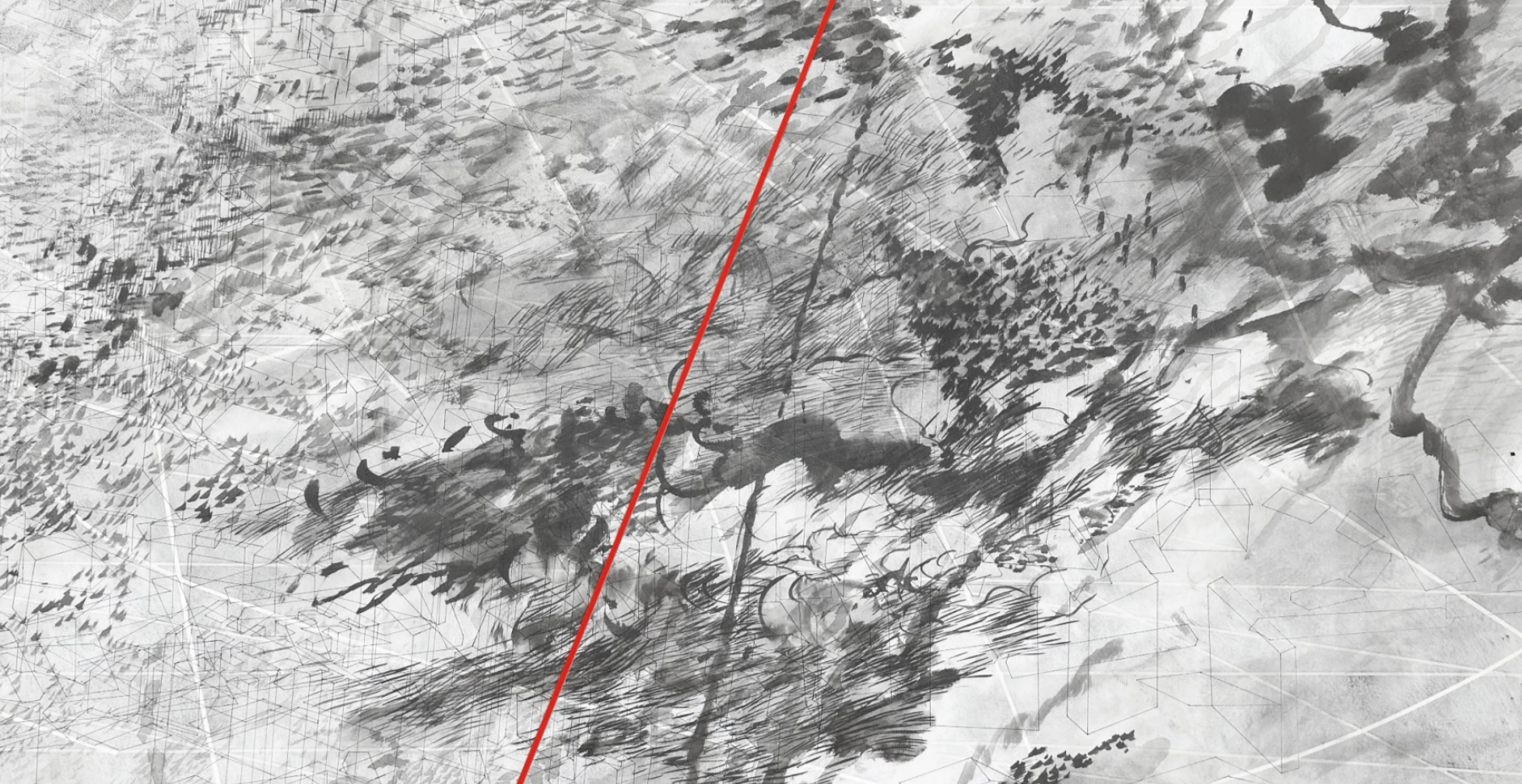
Hurricane Katrina is one of the greatest natural disasters in U.S. history and caused catastrophic death and damage to the city of New Orleans in August 2005. The Black community was overwhelmingly affected due to racially discriminatory housing practices which forced individuals towards the lowest-lying areas of the city’s topography. Hurricane Katrina’s upset is still intensely felt today, displacing hundreds of thousands of people to the outskirts of New Orleans, a city they once called home. In the aftermath of Hurricane Katrina, Prospect. 1 was established to expose people to different areas of New Orleans rich with visual arts and cultural communities while participating in the city’s rebuilding efforts by targeting revenue into local arts economies. Among acclaimed artists such as Mark Bradford, El Anatsui, and Wangechi Mutu, Mehretu was invited to produce new works for Prospect. 1; Walkers with the Dawn and Morning is one of five from a suite of paintings created specifically for the exhibition. Of Mehretu’s Prospect. 1 paintings, Walkers With the Dawn and Morning singularly mimics the thunderous weather of Katrina, presenting a turbulent, hurricane-like vortex with riotous dynamism and fierce, directional strokes. Primary hues subtly punctuate the grisaille surface, with intersecting red lines crossing inky black permutations and scattered yellow and blue hazes situated within shadowy forms.
#3. Kerry James Marshall
Sotheby’s New-York: 15 November 2023
Estimated: USD 9,000,000 – 12,000,000
USD 10,275,500
Plunge | The Now Evening Auction | 2023 | Sotheby’s (sothebys.com)
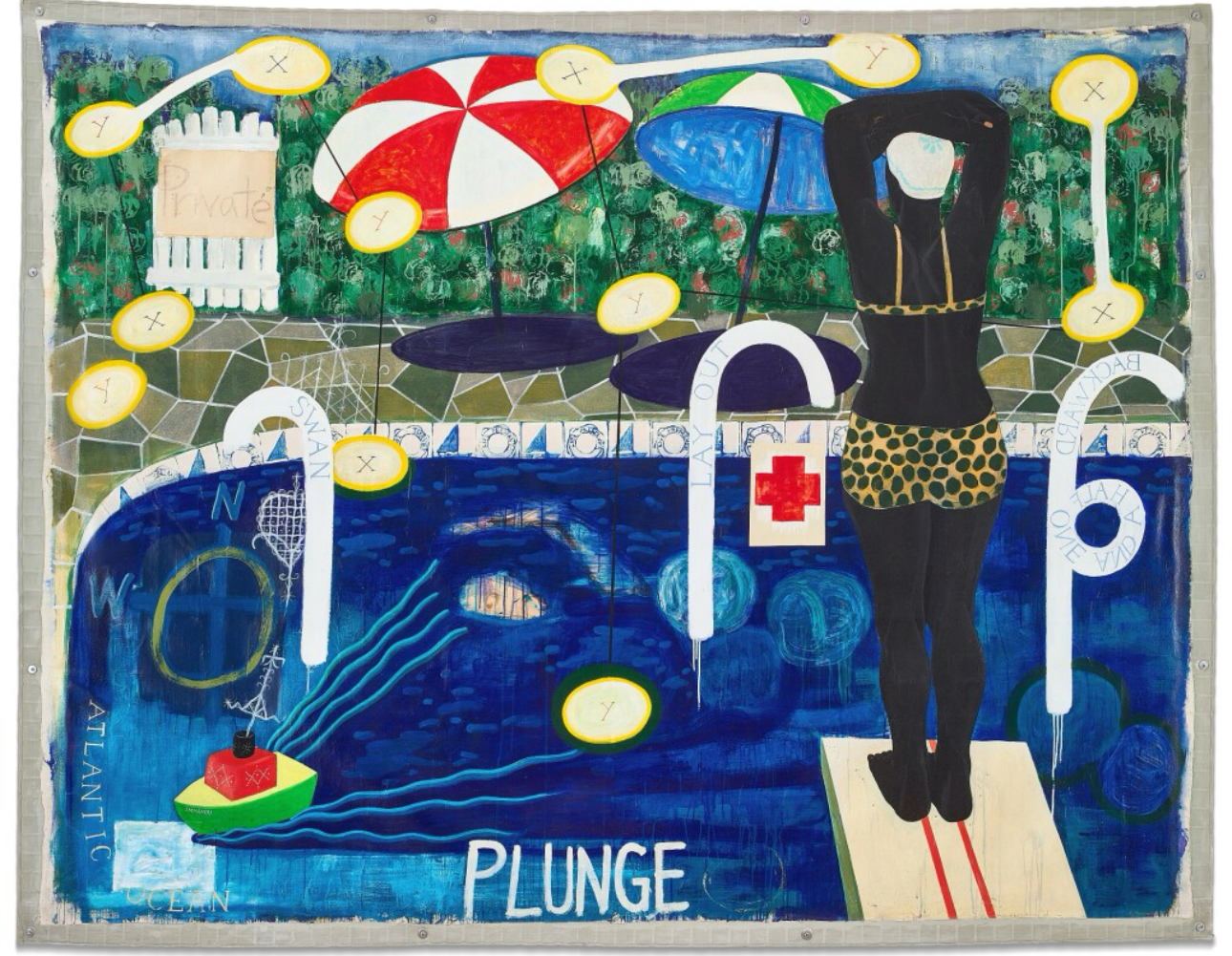
KERRY JAMES MARSHAL (b. 1955)
Plunge, 1992
Acrylic and paper collage on canvas
87×109 inches (220.9 x 276.8 cm)
Signed, titled and dated 92 (lower edge)
Text, collage, and politically potent iconographical and historical references find common ground in the richly built surface of Plunge, which stands as one of Kerry James Marshall’s most important works and sets forth a visual lexicon entirely his own. Marshall powerfully centers a Black female protagonist in an intellectually loaded investigation, situating her among all the trappings of suburban American leisure: the single-family residence, the backyard swimming pool, and white picket fence. Executed in 1992, the year prior to the artist’s debut show at Jack Shainman Gallery in New York and included in his seminal 2013 solo exhibition In the Tower: Kerry James Marshall at the National Gallery of Art, Washington, D.C., Plunge stridently declares the arrival of his mature artistic praxis: the interrogation of the Western art historical canon and rectification of the Black figure’s absence within it. One of the earliest examples of Marshall’s unstretched “tarp” canvases and belonging to his celebrated Housing series, the amplified scale of Plunge also marks a pivotal shift in Marshall’s work. Marshall, an incisive revisionist, has left his indelible mark on the history of art; Plunge, as in his best paintings, retains not only its incendiary freshness but testifies to the evergreen relevance of these pictures and their conceptual agenda.
THE PRESENT WORK INSTALLED IN KERRY JAMES MARSHALL: IN THE TOWER, NATIONAL GALLERY OF ART, WASHINGTON D.C., JUNE 2013 – DECEMBER 2013. PHOTO © COURTESY NATIONAL GALLERY OF ART, WASHINGTON D.C.. ART © 2023 KERRY JAMES MARSHALL
Arms stretched over her head, donning a swim cap and yellow polka dot bikini, a woman shown from behind stands at the edge of a diving board, evaluating the setting before her: a toy boat bobs in a cerulean swimming pool, abundant hedges bloom on either side of a white picket gate, and an unblemished sky shines overhead. The longer we look, however, the more we see: the pool’s water is so dark it becomes foreboding, and bulbs of light illuminate a scene ostensibly doused in daylight. As the scene unravels before our eyes, the earlier impression of a chlorinated, idyllic suburbia grows increasingly dubious. In the present work’s compositional inconsistencies lies Marshall’s critique of the apocryphal postmodern American dream: who are these neighborhoods meant for? Using whose labor was this “dream” made possible? Can the promise of upward social mobility be kept? “There is privilege and status embodied in the image of a flagstone-lined pool in a backyard,” the artist explains, “A little bit of ambivalence is created by the location of the sign on the gate. It says ‘Private’ on the inside. The figure is occupying the space you would have thought she might have been denied access to. Is this side ‘private’ — or is the other side?” (the artist quoted in: Exh. Cat., Washington, D.C., National Gallery of Art, In the Tower: Kerry James Marshall, June – December 2013, n.p.)
Central to Plunge is the inclusion of the pool and the metaphor contained therein. The word “ATLANTIC” and a ghostly compass are etched into the rippling water – here, Kerry has staged an allegorical Middle Passage. The toy boat symbolizes a slave ship, sailing east to west, and the once-innocuous swimming pool the Atlantic Ocean.
“Water was the locus of the trauma. The ocean is that vast incomprehensible, what appears to be nothingness. If you ever find yourself on a boat in the middle of the ocean you look around in every direction and don’t see anything. That’s a terrifying experience. Water still has significance relative to this idea of the Middle Passage. It enters into the suburban environment, through the pools in Plunge and Our Town and the water hose in Bang.”
The spectral, swimming figure is thus legible as a ghost of this history, and the iconography takes on a phantasmagoric valence: the flowers in the background, which, in their liquescent articulation recall Cy Twombly’s sprawling, bleeding blossoms, evoke the commemorative roses of a vigil. This scene of “leisure” affords its viewer no rest, rather prompting sorrow, lamentation, and a reconsideration of history as events that have passed and gone. The title of the work possibly alludes to racist policies in place at the pool at Brookside Park in Pasadena, California, colloquially referred to as the “Brookside Plunge.” The pool, which had opened in the summer of 1914, only permitted citizens of color to use its facilities on Wednesday afternoons and evenings – the last day before its weekly cleaning. In 1919, the National Association for the Advancement of Colored People, or NAACP, established its Pasadena branch, largely to fight the City on its policies of racial segregation and backed a group of Black taxpayers who demanded equal access to Brookside Park’s facilities. The City only marginally conceded, expanding “nonwhite” access to the pool to Tuesdays between 2 to 5 pm, calling it “International Day.” Though the present work’s pool is situated in a suburban home, its larger probes into the origins of Black trauma in the United States remain the basis for later policies maintaining institutionalized racism – as evinced by the case at the Brookside Plunge – even after slavery had been abolished, painfully returning to water as a conduit for racism, dehumanization, and disempowerment.
Other Highlights
Jonas Wood
Sotheby’s New-York: 15 November 2023
Estimated: USD 2,000,000 – 3,000,000
USD 4,295,000
Interior with Fireplace | The Now Evening Auction | 2023 | Sotheby’s (sothebys.com)
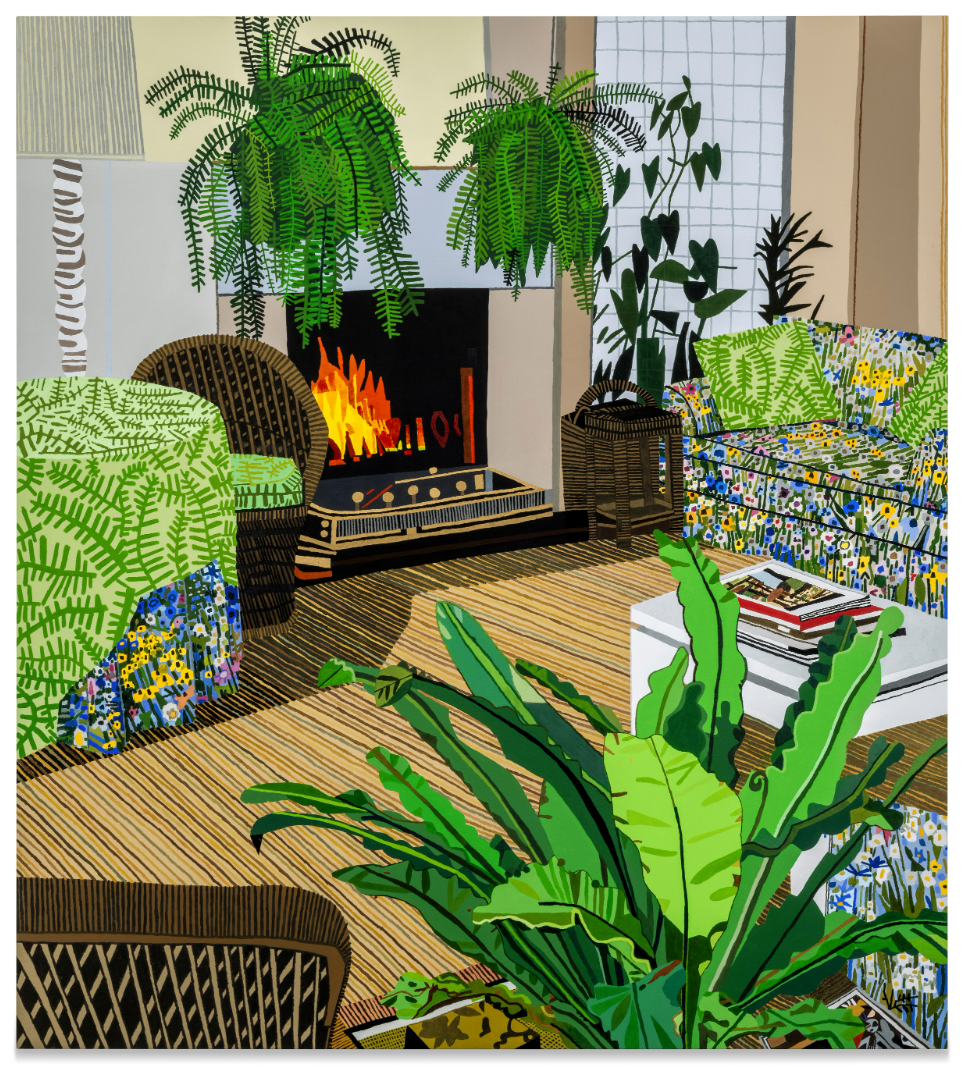
JONAS WOOD (b. 1977)
Interior with Fireplace, 2012
Oil and acrylic on canvas
102 x 92 1/4 inches (259.1 x 234.3 cm)
Initialed, titled and dated 2012 (on the reverse)
Rife with bold patterning and compelling perspective, Jonas Wood’s Interior with Fireplace is a vibrant exemplar of the artist’s signature hallmark of overflowing flora in an intimate domestic space. Employing artistic tropes of flattened colors and spatial distortion recalling French Post-Impressionist painting, Wood lends this quiet still life a striking whimsical flair. Through the careful placement of potted plants and outstretched leaves within the sun-drenched scene, the viewer is invited into the room to experience the illusion of depth created by Wood’s exaggerated stems, expertly layered within the space as if expanding to the very edges of the canvas. With intricately detailed brushwork and bright planes of color, Interior with Fireplace presents a fresh take on contemporary life where the seemingly mundane is elevated to the extraordinary.
JONAS WOOD IN HIS LOS ANGELES STUDIO, 2021. IMAGE © LAURE JOLIET.
Executed in 2012, Interior with Fireplace employs all the artist’s best-known techniques and symbols in one of Wood’s celebrated depictions of the home. His painterly style is a playful yet rigorous interrogation of the traditional representational challenge of capturing three-dimensional forms on the flat picture plane, generating highly stimulating, illusory canvases. Interior with Fireplace is a particularly palpable example, where contrasting textures of fabric pillows and couches overlap wicker furniture, and lush greenery bursts from a profusion of pots. Wood even goes so far as to mimic plant life in manmade objects: the base of a floor lamp closely resembles the trunk of a birch tree, and a lively fire mirrors the spiky peaks of a bird of paradise. Set upon a thin-grained wood floor, each vivid element becomes an unending spectacle, resulting in a composition which commands the eye and allures at every turn.
Wood’s visual vernacular is marked by a photo-based approach. Similar to Henri Matisse’s late process of cutting gouache-painted paper into a wide range of shapes and rearranging them into new compositions, Wood works from a personal archive of photographs and found imagery, making sketches and studies before creating preliminary collages. The cut-and-pasted images are then filtered through various layers of drawing until he arrives at his final composition. This fragmentary method is, in essence, a synthesized perception of time and space; as a result, the final works vibrate with an energetic rhythm and fantastical harmony.
Jade Fadojutimi
Sotheby’s New-York: 15 November 2023
Estimated: USD 600,000 – 800,000
USD 1,814,500
Teeter towards me | The Now Evening Auction | 2023 | Sotheby’s (sothebys.com)
JADE FADOJUTIMI (b. 1993)
Teeter towards me, 2019
Oil on canvas, in two parts
71 x 118 1/4 inches (180.2 x 300.4 cm)
Signed twice and variously inscribed (on the reverse of right panel)
A stunning mélange of rich, radiant hues and jubilant gesture, Teeter Towards me is a commanding example of Jadé Fadojutimi’s celebrated corpus of monumental abstractions. In her practice, Fadojutimi explores foundational elements of art history by layering grids, transparencies, and disparate methods of mark-making to illustrate processes of movement and burgeoning forms. In Teeter Towards me, arborescent pillars and cascading organic structures emerge, recalling a dense microscopic environment or lush landscape, which toe the line of abstraction and figuration, landscape and object. Teeter Towards me sublimely embodies the visually charged, rhythmic compositions that typify Fadojutimi’s complex ‘emotional landscapes,’ in which she reflects on her identity, everyday experiences, and memories through complex orchestration of color, space, and form. Now represented globally by Gagosian, Fadojutimi’s paintings were a highlight of The Milk of Dreams exhibition at the Central Pavilion at the Venice Biennale in 2022. Most recently, Fadojutumi was the subject of an acclaimed solo Exhibition at The Hepworth Wakefield which closed in March 2023 as well at a solo exhibition at the Institute of Contemporary Art Miami, which closed in April 2022. Fadojutimi’s paintings reside in prestigious museum collections, including The Studio Museum in Harlem, New York, The Walker Art Centre, Minneapolis, The Baltimore Museum of Art, Baltimore, and The Institute of Contemporary Art, Miami, and at just 30 years old, Fadojutimi is the youngest artist in the collection of Tate, London.
JADÉ FADOJUTIMI AT HER STUDIO IN LONDON, 2022. PHOTO © DAVID LEVENE/EYEVINE/REDUX. ART © 2023 JADÉ FADOJUTIMI
Coalescing in a vibrant entropy of gesturally charged mark-making, Fadojutimi’s graphic composition seeks to mine facets of her own identity, mapping the social and cultural elements that frame her emotive environment. Inspired by her own experiences, memories, and trauma, Fadojutimi’s compositions pulsate with the dream-like energy and dynamism that she draws from Japanese anime, video games, and soundtracks. With the vivacious energy of Action Painting, the present work recalls the mark-making Jackson Pollock, Willem de Kooning, and Joan Mitchell.
JACKSON POLLOCK, BLUE POLES, 1952. IMAGE © NATIONAL GALLERY OF AUSTRALIA, CANBERRA / PURCHASED 1973 / BRIDGEMAN IMAGES. ART © 2023 POLLOCK-KRASNER FOUNDATION / ARTISTS RIGHTS SOCIETY (ARS), NEW YORK
Through her lyrical process of mark-making, Fadojutimi meticulously layers thin swathes of pigment with rhythmic caresses before intuitively scraping and scratching the painting’s luminous surface to leave a myriad of dancing grooves and sweeping strokes in her wake. With a rhythmic cadence of color and line, Fadjotumi’s abstractions render the emotional complications of identity itself, unfurling across the canvas as the viewer’s eyes trace each vibrant line and experimental mark, communicating her connection to memory with subtle figurative punctuations. Amidst a lush and overgrown composition of burgundy pigment, a joyous revelry of color emerges splashes of lemon yellow, dashes of magenta, and streaks of gold race across the surface. A testament to the artist’s capacity to push boundaries and reinvent the tenets of contemporary painting, Teeter Towards me is a paragon of Fadojutimi’s vibrant aesthetic universe.
George Condo
Sotheby’s New-York: 15 November 2023
Estimated: USD 1,500,000 – 2,500,000
USD 1,775,000
The Good Old Days | The Now Evening Auction | 2023 | Sotheby’s (sothebys.com)
GEORGE CONDO (b. 1957)
The Good Old Days, 2015
Oil and pigment stick on canvas
78×74 inches (198.1 x 188 cm)
Signed and dated 2015 (on the overlap)
A kaleidoscope of surging forms and dense figuration, The Good Old Days is a sensational example of George Condo’s ability to meld flatness and sculptural depth with thrilling velocity. Through a dizzying assemblage of form and figure, the present work revels in Condo’s most significant touchstone: Picasso’s Cubist fracture. Playfully undermining the integrity of traditional portraiture through its masterful contusion of abstracted bodily forms, The Good Old Days is a striking reflection of Condo’s self-termed mode of ‘psychological cubism’. Further elaborating on his desire to reproduce the emotional spectrum of the human experience, Condo mused: “It’s what I call artificial realism. That’s what I do. I try to depict a character’s train of thoughts simultaneously – hysteria, joy, sadness, desperation. If you could see these things at once that would be like what I’m trying to make you see in my art.” (the artist quoted in: Stuart Jeffries, “George Condo: ‘I was delirious. Nearly Died,’” The Guardian, 10 February 2014) The gracefully churning collision of form that defines Condo’s oeuvre is perhaps one of the most honest and accurate representations of a complicated modern psychology in the art historical canon: glee, rage, insanity, loneliness, as well as cheeks, and eyes, are crushed together in a visceral state of being. Testament to the lasting impact of George Condo’s highly influential and experiential practice, works by the artist reside in permanent collections of esteemed institutions including the Broad Collection, Los Angeles; Metropolitan Museum of Art, New York; Solomon R. Guggenheim Museum, New York; Whitney Museum of American Art, New York; Centre Georges Pompidou, Paris; and the Tate Modern, London.
GEORGE CONDO IN HIS STUDIO, PHOTOGRAPH BY TINA BARNEY. ART © 2023 GEORGE CONDO / ARTISTS RIGHTS SOCIETY (ARS), NEW YORK
Executed in 2015, The Good Old Days marvels in Condo’s unraveling and subsequent reassembly of various pictorial languages. Strikingly reminiscent of The Portuguese – George Braque’s genre-defining Cubist masterpiece – the present work references this art historical period in both its compositional structure and nostalgically cliché title. Monumentally influential on Condo and his output, together Braque and Picasso possessed a distinct ability to overcome the unified singularity of objects and people, and instead transform them into something jarringly fragmented. In the same vein as his Cubist predecessors, The Good Old Days sees Condo breaking down a discrete character, tinkering with its parts, and welding it back together in new and inventive configurations, ultimately producing a painting that, in its alluring visual chaos, serves as fitting testament to the infinite variety and complications of the human psyche. A rich optical puzzle spliced by overlapping forms and charcoal lines, the figure’s human features clash, churn and collide in a prodigious yet whimsical riddle.
GEORGES BRAQUE, THE PORTUGUESE MAN, 1911. KUNSTMUSEUM, BASEL. IMAGE © BRIDGEMAN-GIRAUDON / ART RESOURCE, NY. ART © 2023 ARTISTS RIGHTS SOCIETY (ARS), NEW YORK / ADAGP, PARIS
Building upon years spent refining and maturing his iconic figurative style, The Good Old Days embodies an artist at the height of his career, utterly uninhibited and full of instinctive creative fervor. A knife-edge dance between the familiar and the alien, the beautiful and the grotesque, the present work symbolizes the splintering of identity and the challenge of maintaining a coherent sense of self, as materialized through fractured visages on the canvas. An inevitable result of the whirling abstraction and sinuous shapes of the present work, the moment one picks out a form, it slips back into the delirium of the whole. Exuding a mystifyingly psychological aura with dynamic permutations of line, color, and shape, The Good Old Days endures as a poignant and visually arresting reminder of Condo’s elusive genius that permeates from the battleground of his canvas.
6. Contemporary Evening Auction
15 November 2023
Contemporary Evening Auction | 2023 | Sotheby’s (sothebys.com)
Auction Statistics
46 Lots
Low Estimate: USD 202,030,000
High Estimate: USD 289,170,000
Total: USD 250,514,100
# Lots sold: 43
Sell-Through Rate: 93.5%
Top Lot: USD 42,000,000
33 Lots sold over USD 1 million
USD 243,737,800
(97.3% of total)
6 Lots sold over USD 10 million
USD 152,542,400
(60.9% of total)
Above Estimates: 22 Lots (48%)
Within Estimates: 13 Lots (28%)
Below Estimates: 8 Lots (17%)
Unsold: 3 Lots (7%)
Top 5 Lots
#1. Jean-Michel Basquiat
Sotheby’s New-York: 15 November 2023
Estimated: USD 40,000,000 – 60,000,000
USD 42,000,000
Self-Portrait as a Heel (Part Two) | Contemporary Evening Auction | 2023 | Sotheby’s (sothebys.com)
JEAN-MICHEL BASQUIAT (1960 – 1988)
Self-Portrait as a Heel (Part Two), 1982
Acrylic and oilstick on canvas
96 x 61 1/2 inches (243.8 x 156.2 cm)
Signed, titled, dated 1982 and variously inscribed (on the reverse)
Amidst a cacophony of fragmented body parts upon a luminescent green field, Basquiat’s collective image emerges piece by piece in his monumental Self-Portrait as a Heel (Part Two), wholly enveloping the viewer with the artist’s profound understanding of selfhood at the pinnacle of his brief but explosive career. By the time Basquiat painted the present work in 1982, he had already arrived at the center of critical acclaim as he ascended from SAMO ©, the street provocateur, to the avant garde prodigy of the mainstream art world. Emerging from the downtown crucible of his native New York, Basquiat executed Self-Portrait as a Heel (Part Two) during a pivotal visit to Los Angeles between 1982 and 1983, a critical turning point in his life when he debuted in his first West Coast exhibitions at Larry Gagosian Gallery and prominently featured the present work therein. Alongside Versus Medici and Anybody Speaking Words, the present work was originally one of several monumental standing Black figure paintings that formed the core of esteemed Belgian collector Stéphane Janssen’s collection – an esteemed Belgian collector and an early champion of Basquiat – and is distinguished today as among the artist’s most assured, early masterworks. Its sister painting, the first Self-Portrait as a Heel from 1982, similarly depicts a stylized rendering of the artist’s own head with swirling dreadlocks; meanwhile, the overall titular motif remained significant for the artist, notably continuing in an inscription “Self-Portrait as a Heel, Part Three” that is scribbled alongside a portrait of himself and two friends – Toxic and Rammellzee – in his later 1983 painting Hollywood Africans, now held in the Whitney Museum of American Art as an autobiographical depiction of his legendary experience in Los Angeles. A majestically viridescent monument to the inseparability between Basquiat’s art and his own life as a Black American man, Self-Portrait as a Heel (Part Two) powerfully reflects one of the artist’s most powerful and philosophical rendition of the self as, in his words here, a “COMPOSITE” – not only of who he understands himself to be, but also what others will inevitably perceive and identify him as.
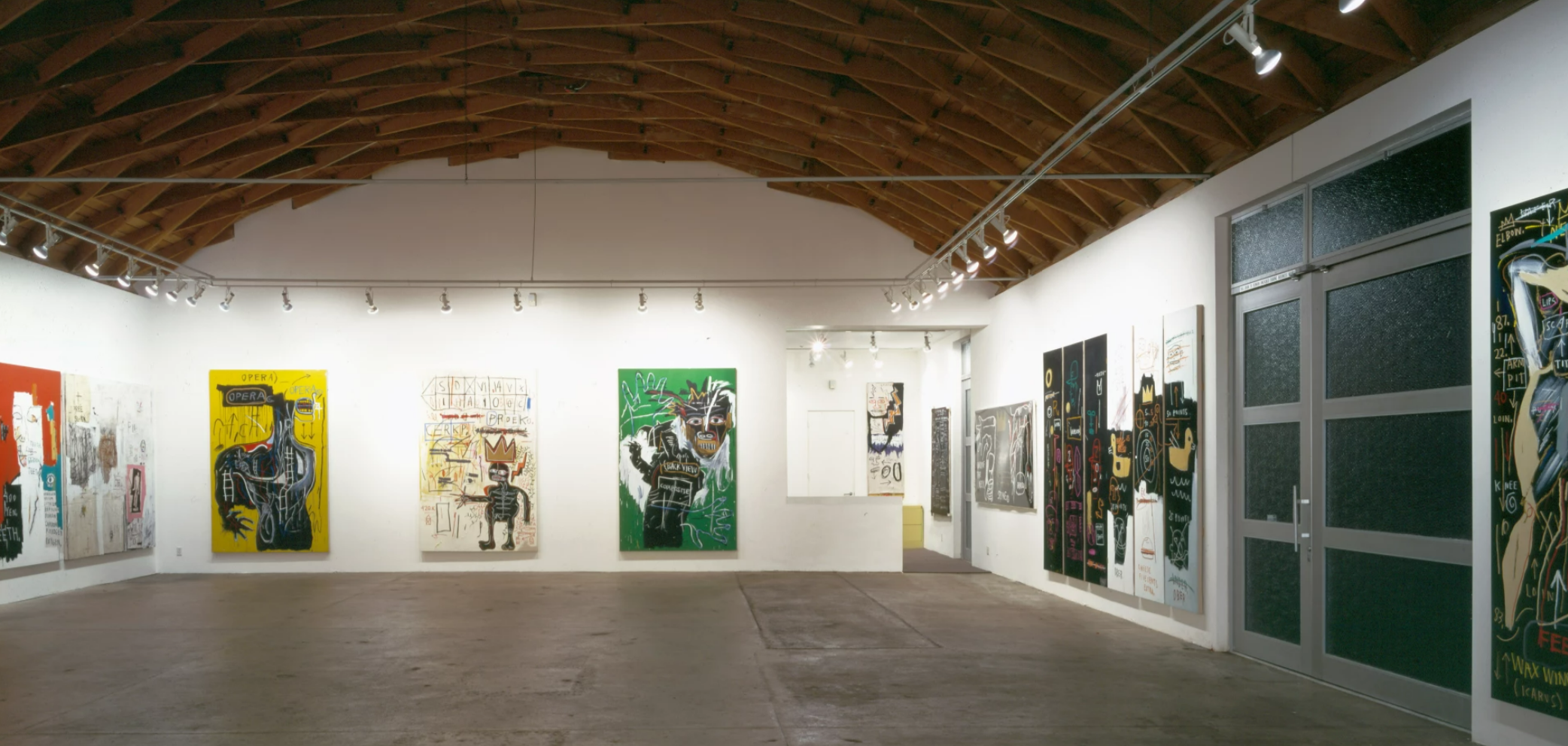
THE PRESENT WORK INSTALLED IN JEAN-MICHEL BASQUIAT: NEW PAINTINGS, LARRY GAGOSIAN GALLERY, LOS ANGELES, MARCH – APRIL 1983. ART © ESTATE OF JEAN-MICHEL BASQUIAT. LICENSED BY ARTESTAR, NEW YORK.
More so than depictions of himself, Basquiat’s self-portraits during the 1980s serve as nuanced portrayals of his self-consciousness as he navigated the white, Western artistic continuum: by representing himself from the “BACK VIEW” in Self-Portrait as a Heel (Part Two), Basquiat unmistakably presents an onlooker’s perspective of him while avoiding our direct gaze. Emerging with a halo of flurried white brushstrokes yet cast in the stark umbra of shadow, the artist’s black silhouette seems to lurk in sinister darkness, providing a counterpart to his disembodied head as it vigorously confronts us with contours resembling an African tribal mask and his signature crown of dreadlocks. In this context, the titular “heel” references not only the back of a shoe, but also the pejorative used to indicate a delinquent, or the boxing term for a professional wrestler who acts as the antagonist within a match, the foil to the boxer cast as the hero. Regarding Basquiat’s multivalent application of the word “heel”, Richard Marshall interprets it as “a self-deprecating description of himself as a ‘cad’ or ‘jerk,’ perhaps commenting on his behavior with friends, dealers, or girlfriends, and secondly, he enjoyed the act of labeling something a HEEL, in the same way he labeled parts of the body in his anatomical works.” (Richard D. Marshall and Jean-Louis Prat, Jean-Michel Basquiat, 1st. Ed., vol. I, Paris, 1996, p. 20). Lending his pithy poeticism to the canonical mode of self-portraiture, Basquiat allegorizes the dualities of his selfhood through the opposition between the “heel” and hero, and he contends with the cultural stereotypes and alienation that he encountered as a young Black man in Twentieth-Century America.
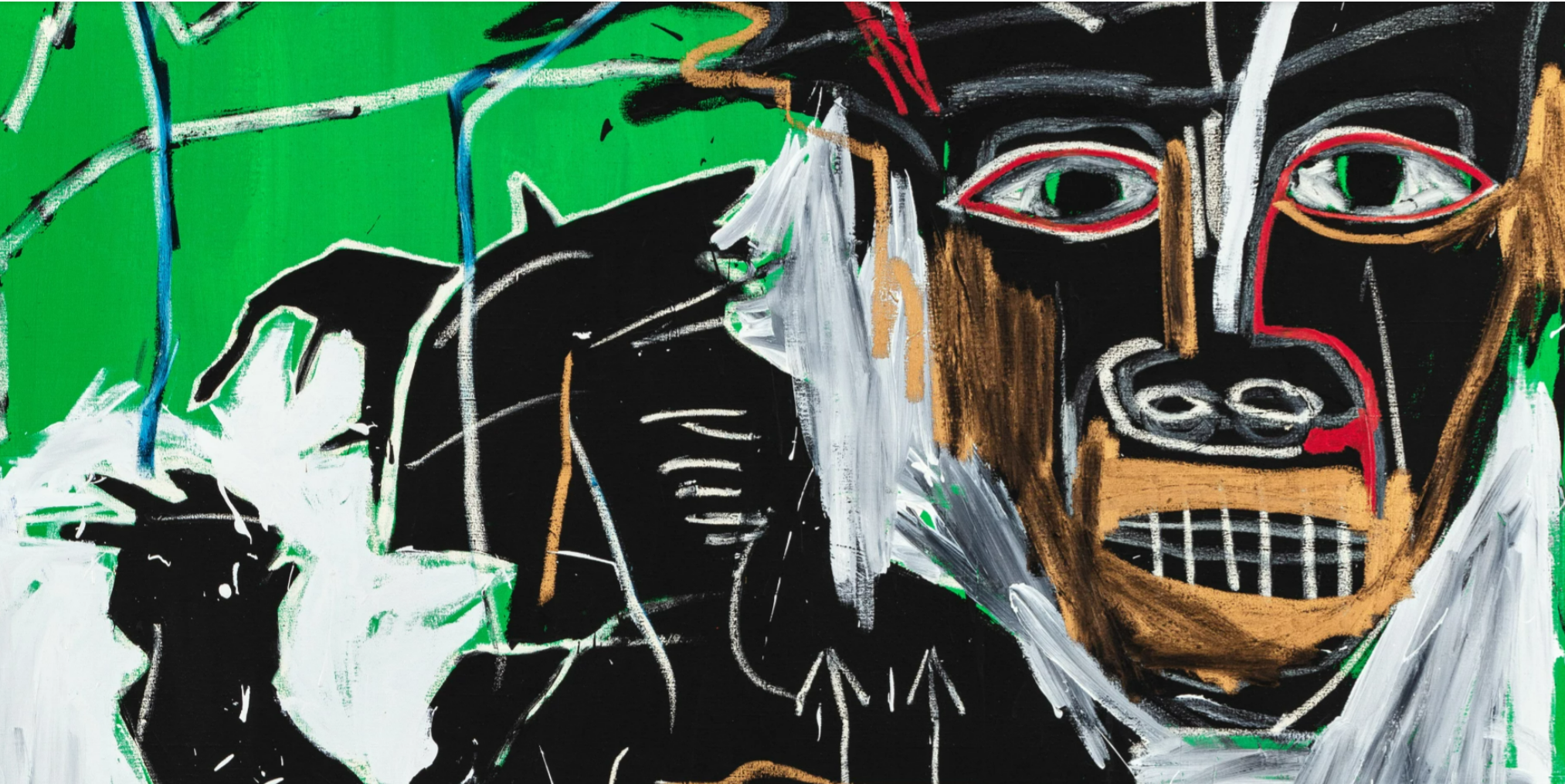
Gazing outward while simultaneously performing an inward examination, Basquiat lays bare the dialectical construction of public and private selves, while his hand sketches leave behind traceries of his struggle to grasp his own composition. Unfurled across the vibrant jade field, in Self-Portrait as a Heel (Part II), he scatters fragmented pieces of himself like entrails — raw, unconcealed, exuding a palpable sense of confidence and vulnerability at once. Ego, id, and superego subsequently collapse into a raw painterly manifesto of the self in this relic from the absolute apex of Basquiat’s career in 1982, testifying to the transcendental breakthrough that is the artist’s indelible legacy. “I knew he was great—he was electric,” recalls Glenn O’Brienn about the late artist. “A tesla coil with dreadlocks—cool fire emanating wherever he went. Magic.” (Glenn O’Brien, “Basquiat: The Show Must Go On,” 17 September 2013 (online)) Nowhere is this visceral sense of magic best exerted than in Self-Portrait as a Heel (Part II), a lustrous masterpiece of mystifying emerald green splintered into the philosophical throughlines of Basquiat’s selfhood, yet illuminated and enchanted with the seismic force of the artist’s gestural bravado. In this painterly battleground whereby Basquiat examines and poignantly reflects upon the precarity of own Black selfhood, he reifies one of his most iconic proclamations: “I’m not a real person. I’m a legend” (Jean-Michel Basquiat quoted in Anthony Haden-Guest, “Burning Out”, Vanity Fair, November 1988, p. 197 (online)).
#2. Gerhard Richter
Sotheby’s New-York: 15 November 2023
Estimated: USD 25,000,000 – 35,000,000
USD 31,932,000
Abstraktes Bild | Contemporary Evening Auction | 2023 | Sotheby’s (sothebys.com)
GERHARD RICHTER (b. 1932)
Abstraktes Bild, 1997
Oil on canvas
275×275 cm (108 1/4 x 108 1/4 inches)
Signed, dated 1997 and numbered 849-1 (on the reverse)
Presenting a magnificent vista of variegated abstraction and saturated hue, Abstraktes Bild from 1997 is an extraordinary exemplar of Gerhard Richter’s iconic Abstrakte Bilder, a series of paintings widely recognized as the preeminent venture in abstract art of the last fifty years. Even within this rarified group, Abstraktes Bild is indisputably one of the most visually striking and impressive paintings: towering at nearly eleven feet in both directions, Abstraktes Bild is one of only fifteen rare Abstraktes Bilder in this monumental square format and scale that the artist has produced to date, with other examples from the group held in the collections of the San Francisco Museum of Modern Art, the Froehlich Collection in Stuttgart, the Moderna Museet in Stockholm, and the Cage cycle, on long-term loan to the Tate Modern in London.
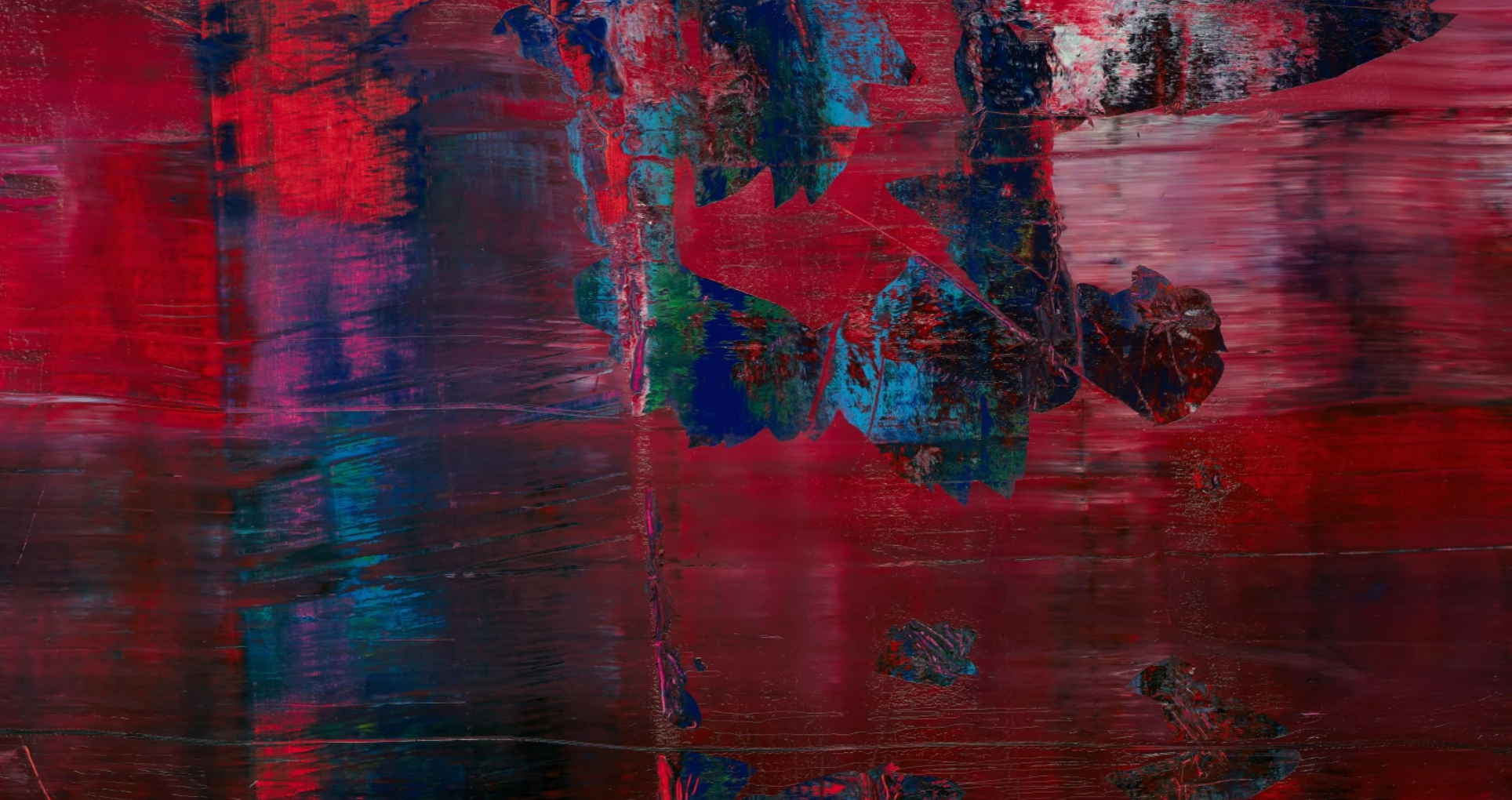
Across the colossal surface, swathes of scarlet and burgundy pigment are pulled aside like gestural veils, revealing underlayers of glimmering blue, green, and even alabaster pigment, the exquisitely ornate surface superbly exhibiting Richter’s command of medium, entirely innovative technique, and, most demonstrably in the present work, his unprecedented mastery of color. Here, we see the artist revel in the chance slippages of his signature squeegee tool, which Richter uses to simultaneously build and erode his mesmerizing surface. One of the last and largest canvases Richter executed in 1997, the present work is the first in a series of three monumental paintings from a limited cycle that Richter produced at the end of that year (numbered “849“). The artists initially painted the triad as a single monumental work, before choosing to split the painting into three sister works. Of the three, the present work is the only one remaining in private hands, with 849-2 held at the High Museum of Art in Atlanta, and 849-3 held in the collection of the Israel Museum in Jerusalem. Acquired directly from Anthony d’Offay Gallery following its debut exhibition there, present work has been held in the same prestigious private European collection for over two decades.
GERHARD RICHTER IN HIS COLOGNE STUDIO, 2006. PHOTO © HUBERT BECKER. ART © 2023 GERHARD RICHTER
In Abstraktes Bild, Richter’s odyssey into the realm of pure abstraction unveils his most extreme engagement with the medium – a raw examination of the very nature of paint itself, as a physical substance in both original and manipulated forms. Embracing an element of automatism, Richter compounds the full force of kinetic energy into the painterly surface of Abstraktes Bild as he draws his far-reaching squeegee across the canvas, layer after layer. Alternating in direction, density of paint, viscosity of the dragged movements, and the drying times between each wipe, Richter indulges in an infinite and unknowable number of permutations borne out of the interaction between oil pigments. As Benjamin Buchloch noted: “With so many combinations, so many permutational relationships, there can’t be any harmonious chromatic order, or compositional either, because there are no ordered relations left either in the colour system or the spatial system” (Benjamin Buchloh quoted in: Benjamin Buchloch, ed., “An Interview with Gerhard Richter,” Gerhard Richter: October Files, Massachusetts 2009, pp. 23-24). It is in this way that Abstraktes Bild resembles a confluence of many paintings at once and exhibits the ultimate painterly palimpsest: the exuberant strata of paint bear the ghosts of previous accretions, of color juxtapositions obsessively applied, erased, remade, and obliterated over again.
#3. Joan Mitchell
Sotheby’s New-York: 15 November 2023
Estimated: USD 20,000,000 – 30,000,000
USD 27,910,500
Sunflowers | Contemporary Evening Auction | 2023 | Sotheby’s (sothebys.com)
JOAN MITCHELL (1925 – 1992)
Sunflowers, 1990-91
Oil on canvas, in two parts
Overall: 280×400 cm (110 1/4 x 157 1/2 inches)
Signed (right panel, lower right)
Blooming upon the canvas in a shower of expressive brushstrokes and shocks of dynamic color, the magnificent Sunflowers is a profound testament to the singular creative vision and celebrated painterly acumen which characterize Joan Mitchell’s prodigious oeuvre. Painted in 1990-91, the penultimate years of the artist’s career, the present work stands as an unequivocal masterpiece of her late period and courses with the same remarkable vigor and vibrancy that marked the greatest works from her first decades. A confident ode to the physical act of painting displayed across the artist’s cherished diptych format, Sunflowers articulates Mitchell’s fusion of disparate artistic movements to create a style that is entirely her own. Though the gestural style of her American contemporaries—storied artists such as Franz Kline and Willem de Kooning—shaped her abstract painterly idiom, Mitchell’s profound appreciation for the beauty of the natural world fostered in her a strong connection to the French Impressionists and European Post-Impressionists, whose luminous landscapes enacted an equally acute influence upon her work. In Sunflowers, Mitchell draws upon a prismatic range of colors—not unlike those of Monet’s late garden paintings—to create striking contrasts: radiant, golden ochres tangle riotously with broad strokes of sharp cobalt, while budding shafts of earthy green mix and merge with incendiary daubs and smears of scarlet and rust, all interwoven within a smoky net of white and softest grey. The texture of the work is similarly varied, as Mitchell showcases the remarkable range of an abstract vernacular she shaped and perfected over the decades of her artistic practice.
THE ARTIST IN A FIELD OF FLOWERS. PHOTO © DAVID TURNLEY / CORBIS / VCG VIA GETTY IMAGES.
Widely referenced in literature and featured in many of the artist’s most significant exhibitions – including the recent celebrated retrospective at the San Francisco Museum of Modern Art and Baltimore Museum of Art, as well as the widely acclaimed Monet-Mitchell exhibition at Fondation Louis Vuitton in Paris – Sunflowers is a rare and significant masterwork from Mitchell’s mature métier. Having remained in the collection of John Cheim for nearly three decades, since it was gifted to him by the artist, Sunflowers also represents a deep and influential friendship in Mitchell’s life. Cheim, renowned among artists for his support, generosity, and curatorial acumen, began working with Mitchell through the Robert Miller Gallery in the mid-1980s. He continued to represent her and her estate, including with his own gallery, Cheim & Read, for decades, even mounting a major exhibition dedicated to her Sunflowers paintings in 2008. The two built a close friendship over these years, often visiting each other in New York and Vetheuil: “I love your loft and I love love you – thanks so very much” Mitchell once wrote to him following a dinner in her honor. Cheim acquired several works directly from the artist, including Sunflowers, which he chose following a deal with Mitchell in which she offered him any work as a gift. Thus, the present work is at once an exquisite example of the very best within the artist’s oeuvre, and also reflects the history of an important personal and professional relationship.
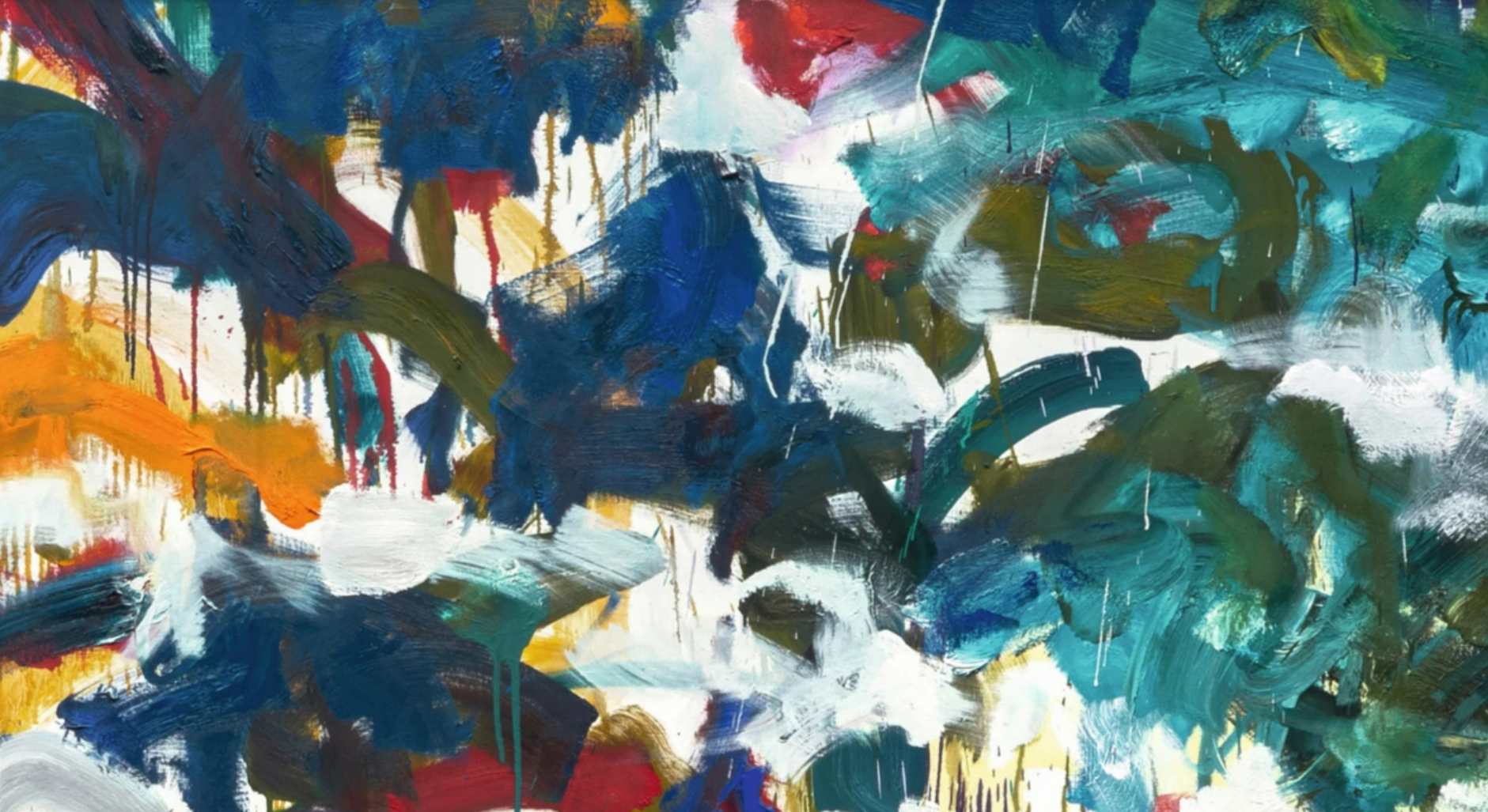
A monumentally epic composition of painterly prowess, sumptuous coloration, and ambitious mastery of scale, Sunflowers unequivocally announces itself as a glorious summation to Mitchell’s unparalleled career. The striking visual dynamism of the dense composition reveals the artist’s affinity for the American action painters, amongst whom she lived and worked in the initial decade of her career; as one of the few women to garner significant critical acclaim within the predominantly male Eighth Street Club, Mitchell is remembered by art history as the leading female voice of the Abstract Expressionist movement. Across the expansive face of Sunflowers’ dual canvases, Mitchell’s unencumbered gestural vocabulary invites the viewer to imagine the physicality of her creative process as, in bursts of physical energy and tactility that defied her ailing heath, she enacts the nuanced dialogue of her abstraction. Beneath her brush, Mitchell’s canvas ceases to be merely a surface, transforming instead into a performative arena upon which she stages a brilliantly choreographed ballet of ever-shifting light, color, movement, and texture. “She would open up the tenuous space of her compositions and dance ribbons of color and gesture across the surface, or construct compartmentalized passages of form and color that would coalesce into energized physical expressions. With apparent abandon, she threw, splashed, or forced paint onto the canvas in her distinctive colors and gestures: the paintings display her fondness for a palette of blue, green, orange, black, and white, together with her personal vocabulary of choppy vertical smears, washes of pastel hues, slashed aggressive hues, loops of joyful color, definite drips, thick orbs of paint, and eccentric composition.” (Richard D. Marshall quoted in Exh. Cat., New York, Cheim & Read, The Last Paintings, 2011, n.p.). Displaying an extraordinary synthesis of Mitchell’s earlier work and a more radical, free, and open configuration of abstract gesture, Sunflowers achieves a gestural dynamism rivaled only by the sensational, large-scale canvases of Willem de Kooning and Jackson Pollock.
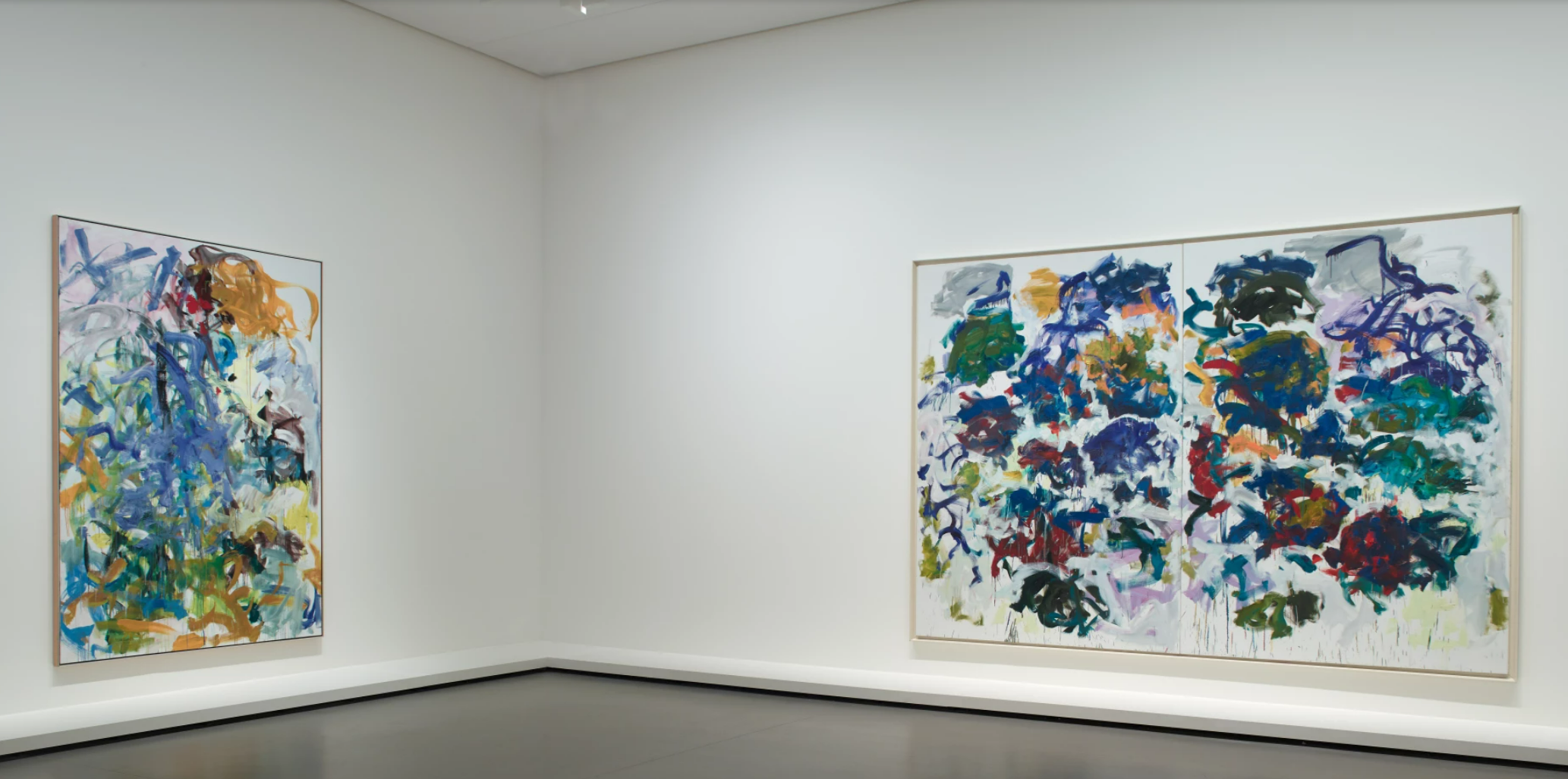
With remarkable dexterity, here Mitchell showcases the full range of her brushstroke, variously lavishing oil onto the canvas face in thick broad strokes, intricate passages of near pointillist precision, and thin sweeping veils of translucence. Unlike the often-spontaneous gestures of other Abstract Expressionist painters, Mitchell’s later brushstrokes were deliberate and calculated. Her concentrated, delineated orbs of pigment almost seem to float across the surface, reminiscent of Henri Matisse’s famed cutouts like La Gerbe (1953). Sunflowers is a visual poetry of line, a pulsating push and pull of entangled masses waltzing their way to the foreground. The painting is a series of oppositions: short sharp dashes of green and yellow condense into globes of color, while longer tendrils of blue and teal flash outward like whip cracks, and a torrent of drips and splashes rains down across the surface, creating a cumulative effect of immense energy and dynamism. Artist Stanley Whitney describes Sunflowers thus: “You never get tired of looking at it because every area is just so active. She’s such a physical painter. […] How she brings the drama between the dark colors and the light colors. […] And the gravity of it all – I mean, she loves the drips because the drips really show the gravity. […] And the great thing about this painting too, which I love about the late paintings, is the size of the brush. She has a really big thick brush. It’s not about whether this is right or wrong, beautiful or not, it just feels good. If it feels good, it stays. She’s so sure of herself” (“Artists on Artists: Stanley Whitney on Joan Mitchell’s Fearless Career and the Drama of Painting,” San Francisco Museum of Modern Art, 3 September 2021, online video). Like the title and subject itself, Mitchell’s vigorous mosaics, rich in tone, pay homage to Vincent van Gogh, seeming to match the passion and abandon of the grand master of the titular flower. Yet the genius of both painters was to exercise a subtle sense of structure amidst an ostensible excess.
#4. Lucio Fontana
Sotheby’s New-York: 15 November 2023
Estimated: USD 18,000,000 – 22,000,000
USD 20,556,900
Concetto spaziale, La fine di Dio | Contemporary Evening Auction | 2023 | Sotheby’s (sothebys.com)
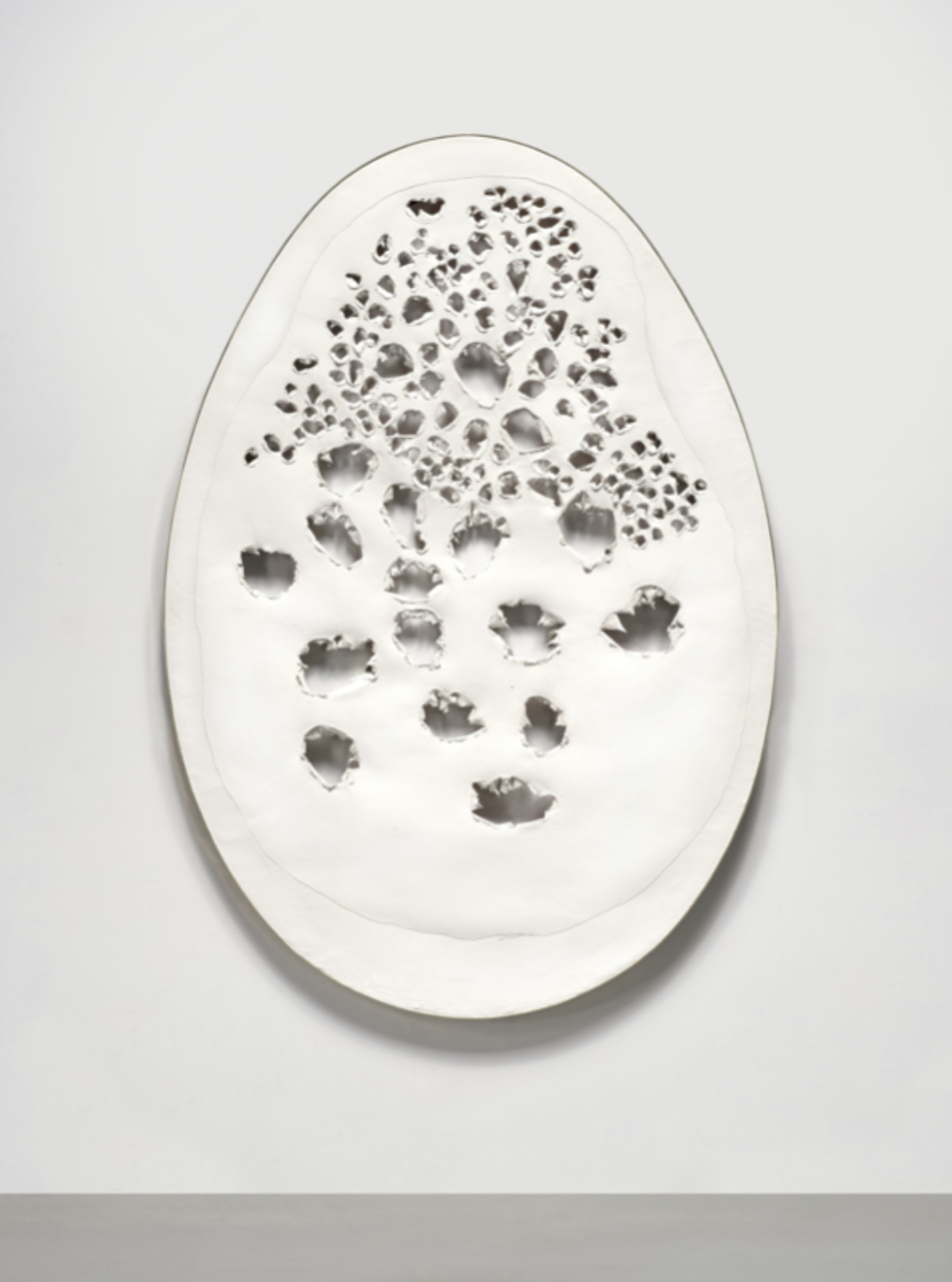
LUCIO FONTANA (1899 – 1968)
Concetto spaziale, La fine di Dio, 1963
Oil on canvas
178×123 cm (70 1/8 x 48 1/2 inches)
Signed (center left); signed (on the reverse); titled (on the stretcher)
Immediately arresting and emanating intense energy, Concetto spaziale, La fine di Dio epitomizes the very essence of Lucio Fontana’s iconic artistic practice. With the dawn of the Space Age, ushered in by Yuri Gagarin’s flight in 1961, came an entirely new dimension; this seminal moment in the history of mankind was the catalyst for Fontana’s La fine di Dio, a body of work that radically transformed the canon of twentieth century artistry. Without question Fontana’s most revered and renowned series, today, the Concetto spaziale, La fine di Dio paintings have come to represent the ultimate embodiment of not only Fontana’s oeuvre, but the Spatialist movement at large, of which Fontana was both founder and figurehead. Of the 38 canvases in the series, the present work is one of only five examples made in white – two of which are held in the permanent museum collections of Milan’s Fondazione Prada and the Museum of Contemporary Art of Tokyo. Befitting their importance, other works from the series are held in such prestigious museum collections as The Metropolitan Museum of Art, New York; Museo Nacional Centro de Arte Reina Sofía, Madrid; and Centre Pompidou, Paris.
LUCIO FONTANA IN HIS MILAN STUDIO, C. 1962. PHOTO © UGO MULAS/ UGO MULAS HEIRS. ART © 2023 ARTISTS RIGHTS SOCIETY (ARS), NEW YORK / SIAE, ROME
Profoundly influenced by the notion that man’s existence was no longer earthbound but instead could expand into the endless infinity of the cosmos, Fontana’s conceptual philosophy, today termed Spatialism, proposed to synthesize and transcend material properties to forge an entirely new direction for art. The pinnacle of this project was expressed most purely for Fontana in the creation of the void, the penetration of the traditional flat plane of the medium, which opened up the material of the canvas and infused it with the space endlessly expanding behind, around, and through it. With La fine di Dio (“the end of God”) – a series comprising a total of thirty-eight colossal ovoid canvases executed between 1963 and 1964 – Fontana achieved the ultimate manifestation of his life’s work. In his own words, they represented “the infinite, the inconceivable chaos, the end of figuration, nothingness,” an expression of the dimensionless void of space that is beyond the intellectual capacity of man to understand and therefore beyond his notion of God (the artist quoted in Exh. Cat., London, Hayward Gallery, Lucio Fontana, 1999, p. 198). In the present example from 1963, the pristine white façade of the surface is forcefully disrupted by the palpable materiality of the impastoed puncture wounds, which in turn contrast with the delicately incised ovular border line, evincing Fontana’s unparalleled ability to balance myriad dichotomies in his inimitable oeuvre. These perforations rupture not only the canvas itself, but the traditional boundary between painting and sculpture, establishing an utterly new dimension in artmaking. Concetto spaziale, La fine di Dio thus articulates the genesis of a new form of artistic expression and offers a reflection on the astral age. Like all truly great artists, Fontana both revolutionized precedent and created a conceptual ideology with a radical perspective that simultaneously reflected and impacted his own time.
Astral and mysterious, the La fine di Dio have a sense of impregnation and mystery that enables them to embody a range of diverse meanings both symbolic and formal. The pure white oval of the present work emits a reassuring tranquility that is dynamically contrasted with the raw and expressive surface. The notion of purity is profoundly associated with Fontana’s celebrated white canvases, for the color white offered the artist the cleanest and most proficient channel for temporal and spatial meditations: a powerful tabula rasa, a blank slate awaiting dynamic action. Its topography, like the face of the moon, is ravaged yet ebullient in its organic beauty. The slender, irregular border etched into the painting’s thick white skin confines the panorama of epic cavities within; concentrated in the upper register of the oval, the holes almost appear to float like bubbles to the top of a container.
#5. Frank Stella
Sotheby’s New-York: 15 November 2023
Estimated: USD 10,000,000 – 15,000,000
USD 18,718,500
Honduras Lottery Co. | Contemporary Evening Auction | 2023 | Sotheby’s (sothebys.com)
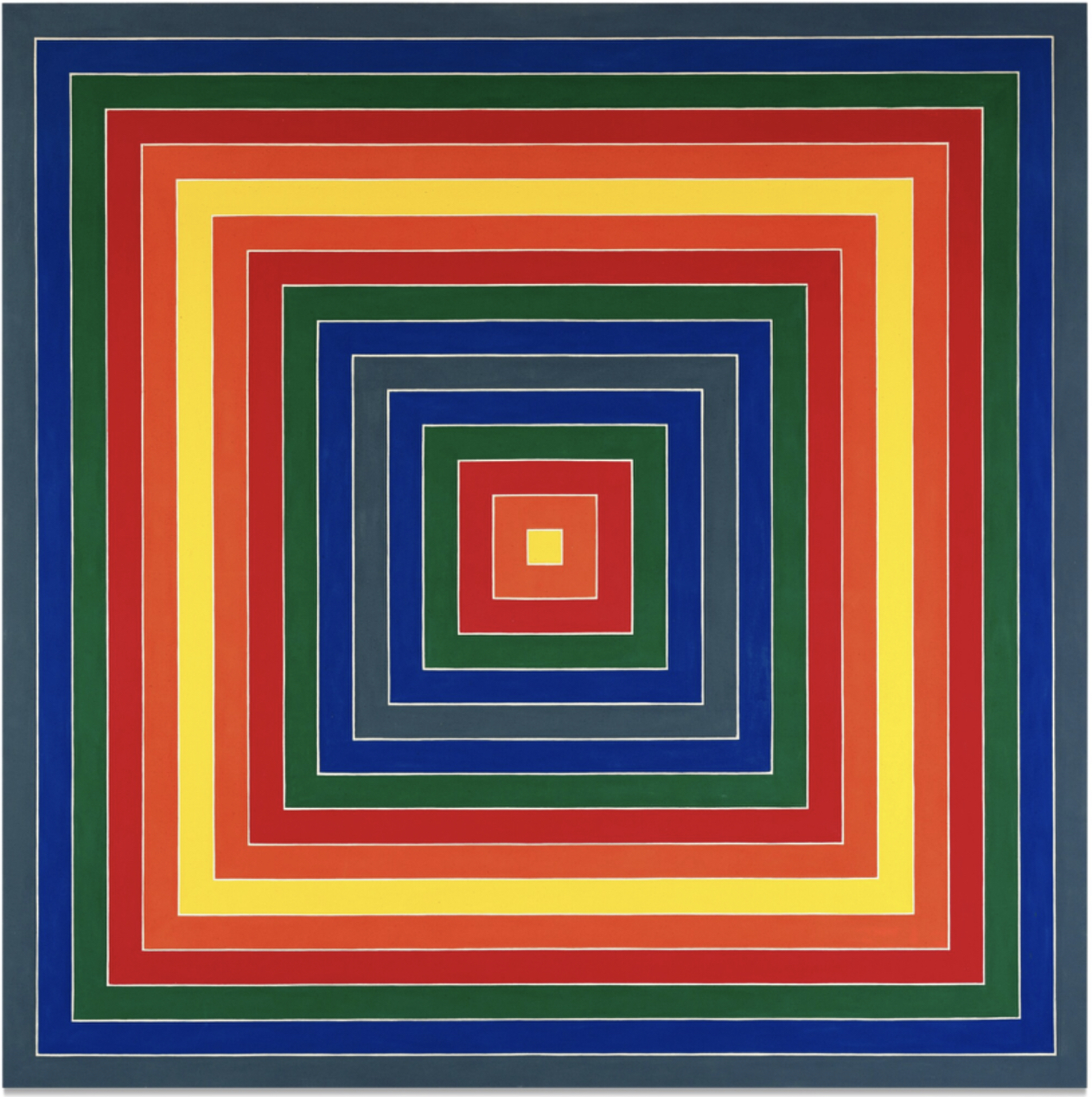
FRANK STELLA (b. 1936)
Honduras Lottery Co., 1962
Alkyd on canvas
85×85 inches (215.9 x 215.9 cm)
A mesmerizing crescendo of color, line, and painterly bravado, Honduras Lottery Co. announces the apex of Frank Stella’s artistic practice as applied to the very tenets of painting itself. Towering over seven feet in both height and length, Honduras Lottery Co. from 1962 is one from a limited suite of six Concentric Square masterworks of this scale that the artist painted that year, initiating a larger series that are today amongst the artist’s most iconic works. Testifying to the significance of this group, three of the paintings from this suite are already held in prestigious international museums, including the sister painting Louisiana Lottery Co. in the Hirshhorn Museum and Sculpture Garden in Washington, D.C. Underscoring its prominence within the artist’s oeuvre, the present work was notably included in one of Frank Stella’s first significant solo exhibitions at the legendary Ferus Gallery, Los Angeles, and has been held by several of the most prominent private collectors of California: first owned by Betty M. Asher, famed Los Angeles art patron and longtime affiliate of the Los Angeles County Museum of Art, the painting was subsequently owned by television titan Douglas S. Cramer. Following its acquisition in 2001 by California collector Chara Schreyer, the painting was notably featured as the prominent cover work for the now iconic book Art House, which covers Schreyer’s singular collection and extraordinary residences. Executed at a critical juncture in the trajectory of postwar art, Honduras Lottery Co. triumphantly testifies to the conceptual rigor of Stella’s signature style, singularly encapsulating his interrogations of the elemental structures underlying the act of painting itself and enduring today a singular masterpiece of 20th Century American painting.
IRVING BLUM, WALTER HOPPS, AND ED KIENHOLZ PHOTOGRAPHED IN FRONT OF HONDURAS LOTTERY CO. AS EXHIBITED IN THE LIVING ROOM OF DR. LEONARD AND MRS. BETTY ASHER, LOS ANGELES. PHOTO © MALCOLM LUBLINER PHOTOGRAPHY. ART © 2023 FRANK STELLA / ARTISTS RIGHTS SOCIETY (ARS), NEW YORK
Within the compositional kaleidoscopic Honduras Lottery Co., pure color reigns supreme: and within the predetermined format of the Concentric Squares, the absolute literalism of Stella’s canvas reverberates with the precision and radicality of the artist’s radical take on the dominant formal vocabulary of Minimalism. Beaming outward from the bright core, a rainbow of scintillating hues proceeds in a cyclical development: electric yellows and crimsons progress into saturated greens, blues, and a deep, rich indigo. Stella’s arrangement of color and line directs the eye to the center of the composition and indeed creates a dueling sense of receding and projecting depth. At the same time, coupled with the precise modulation of color and tonal values, the uniform schematic pattern collapses space together into a single flattened plane.
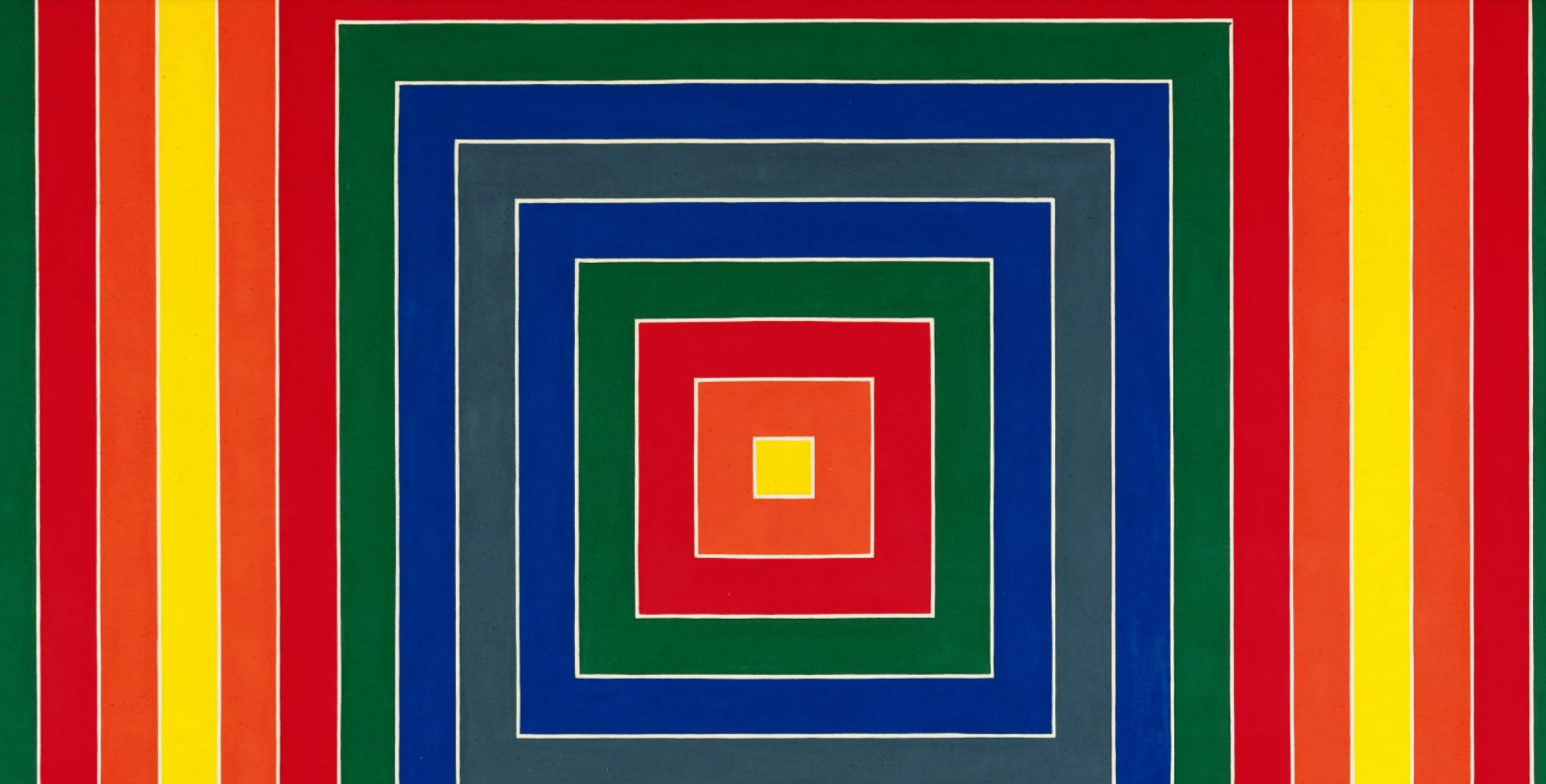
Pulsating and vibrating with a dizzying optical hum, Honduras Lottery Co. radically blurs the distinction between figure and ground, defying the static nature of the canvas to announce the apotheosis of Stella’s lifelong aesthetic project. Amongst the earliest of the Concentric Squares, at the time Stella embarked on this series, he was working and living as young artist in New York and using readily available house paints and housepainter’s tools to create these compositions. Abandoning the impassioned, improvisational immediacy of the Abstract Expressionism movement championed by his contemporaries, Stella acknowledges and embraces the flatness of the canvas. Just as the Abstract Expressionists were lauded by the likes of Clement Greenberg for their complete submission to the notion of art as simply paint on canvas, so too did Frank Stella literalize this concept – through a completely antithetical aesthetic strategy. As Honduras Lottery Co. exemplifies, he anarchically revels in a Minimalist level of standardization, clarity, and calculated precision.
Other Highlights
David Hockney
Sotheby’s New-York: 15 November 2023
Estimated: USD 4,000,000 – 6,000,000
USD 7,228,500
View From Terrace III | Contemporary Evening Auction | 2023 | Sotheby’s (sothebys.com)
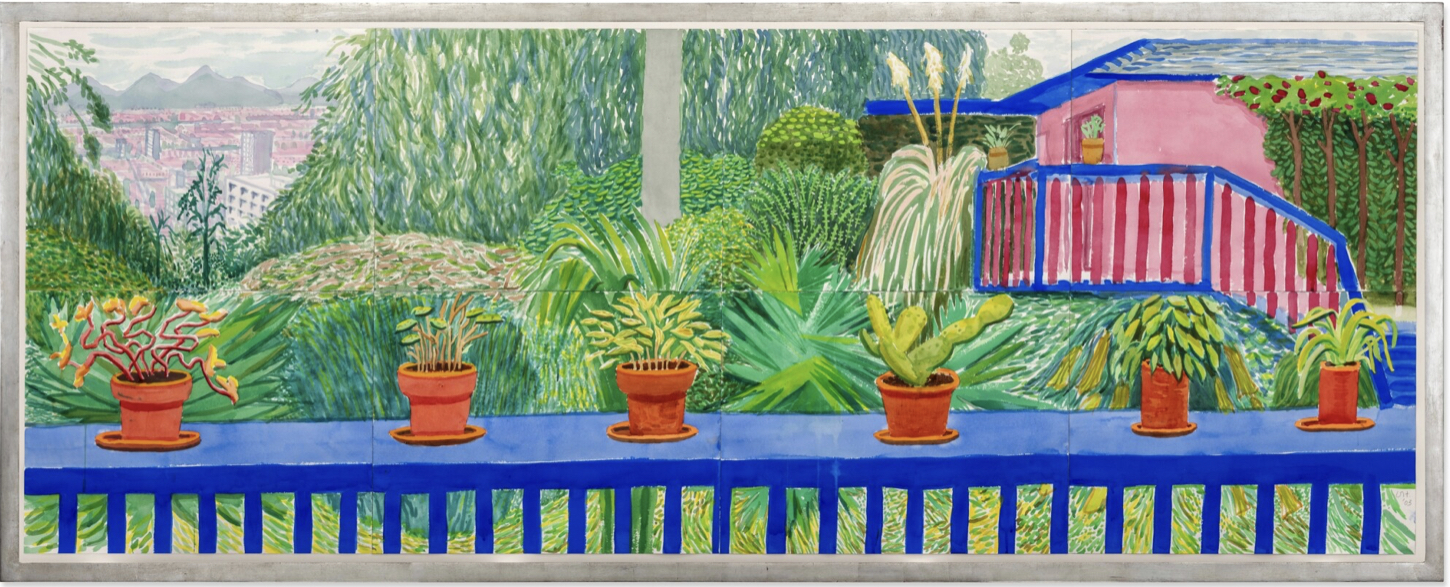
DAVID HOCKNEY (b. 1937)
View From Terrace III, 2003
Watercolor on paper, in eight sheets
Overall: 36 1/8 x 95 7/8 inches (91.8 x 243.5 cm)
Signed and dated 2003 (lower right)
Imbued with the bright glow of California sunshine and remarkably scaled across eight sheets of paper, View From Terrace III is a superb exemplar of David Hockney’s rare watercolor exterior scenes of his Hollywood Hills home. Upon his return to California in 2003 from a nearly year-long stay in London where his practice focused primarily on portrait drawings, Hockney immersed himself in watercolor painting, his spirited home soon becoming a favorite subject. Executed that same year, View From Terrace III displays Hockney at his best: rich with saturated color, complex in composition, and generously detailed. The blue porch of his abode, spanning the entirety of the scene in View From Terrace III, colorfully dotted with potted plants, is one of the most iconic motifs within the artist’s visual lexicon: a subject that Hockney returned to and reworked repeatedly, testifying to the magnitude of the present subject within the artist’s oeuvre. View From Terrace III is one of only 11 known watercolors of Hockney’s Hollywood Hill’s home exterior; notably, View from Terrace II, the sister painting to the present work, resides in the collection of the Museum Würth, Kunzelsau. An intimate, lush paradise overlooking the atmospheric cosmopolitan vista of Los Angeles, View From Terrace III embodies a commitment to gesture and emotive depth characteristic of Hockney’s vibrant and inviting oeuvre.
DAVID HOCKNEY ON THE PORCH OF HIS LOS ANGELES HOME, 1987. PHOTO © ANTHONY BARBOZA/GETTY IMAGES
Hockney purchased his home on Montcalm Avenue in the Hollywood Hills area of Los Angeles in the summer of 1979 and transformed it into an aesthetic paradise. The design of his home reflects the liveliness, propensity for color, and unconventionality which distinguishes his artistic style, so much so that his home, the patio, and surrounding landscaping became pivotal subject matter within his paintings of the time. Skewed structural geometries and unconventional angles painted in bright cobalt blues, cool pinks, and reds frame a backyard of dense, varied foliage, merging the glowing aura of California pop with overflowing natural growth. Thus, Hockney’s home, a colorful fantasy, seeped into his work, not only as reference to his inspirational environment itself, but as an ode to California itself. View From Terrace III exhibits this California idealism in an expansive panorama of sprawling trees, thick ivy, and potted cacti against Hockney’s iconic blue patio fence. While the focus of the composition is his porch, Hockney still highlights his beloved city, hazily rendered in the background.
Painted in 2003, the present work represents a pivotal moment in Hockney’s life and artistic career. Following a return to London in the late 1990s, Hockney was honored as the subject of two important exhibitions at the Centre Pompidou and Musée Picasso in 1999, after which he began a fascination with the camera lucida, an optical device used as a drawing aid. His output was primarily focused on camera lucida drawings until 2002, when a visit to an exhibition of Chinese watercolors at the Metropolitan Museum of Art spurred his interest in painting again. By 2003, Hockney had returned to his cherished Los Angeles home, bringing his newfound love of watercolor painting with him. Here, Hockney brilliantly capitalizes on the formal qualities of the medium, embracing the inherent ebb and flow of pigment. While Hockney pools the watercolor to yield concentrated, vivid, vibrant tones, he also captures unparalleled intricate detail indicative of his mastery. Only watercolor can achieve the formal nuances present in this composition with a remarkable purity of color and exquisite fullness. View from Terrace III reflects Hockney’s mastery of the watercolor medium, one that he has turned back to throughout his storied oeuvre.
Jean-Michel Basquiat
Sotheby’s New-York: 15 November 2023
Estimated: USD 6,000,000 – 9,000,000
USD 6,928,500
Action Comics One | Contemporary Evening Auction | 2023 | Sotheby’s (sothebys.com)
JEAN-MICHEL BASQUIAT (1960 – 1988)
Action Comics One, 1983
Acrylic, colored pencil and oilstick on canvas
66 1/8 x 60 1/4 inches (168×153 cm)
Signed, titled and dated Nov. 1983 (on the reverse)
Exemplifying the electrifying collision of mainstream imagery and searing gestural exhibition that defines Jean-Michel’s Basquiat legendary oeuvre, Action Comics One from 1983 forcefully showcases the wry commentary on pop culture and social mythology that is so central to his artistic practice. In the present work, Basquiat elevates and refines an action-packed cartoon scene of dramatic, heroic valor to the level of fine art through his deft draftsmanship and subtle symbolism, all while unpacking and provoking the politics of heroism and American cultural myths. Testament to the supreme rarity of the present work, Action Comics One belongs to a highly limited series of nine known superhero works that feature such popular figures such as Thor, Batman, and The Flash, all rendered in his signature lexicon of punchy, saturated colors, furious mark making, and his quintessential fusion of image and text. Held in the same distinguished private collection for over three decades, Action Comics One is a consummate example of Basquiat’s distinctive style, engagement with broader socio-political phenomena, and iconic personal cast of champions for which he is rightfully lionized in the canon of art history.
JEAN-MICHEL BASQUIAT IN A FILM STILL FROM DOWNTOWN ‘81, 1980-1981. PHOTO © METROGRAPH PICTURES/EDO BERTOGLIO
Appearing in a number of Basquiat’s paintings from this period, the artist’s love of and familiarity with comic books and cartoons dates to his early childhood. A visual auto-didact, the images and animations of these books are amongst the vast and varied sources of rich visual media Basquiat collected over the course of his life and subsequently appear in his paintings, creating a highly specific visual vernacular of cultural images and iconography at once universally familiar and entirely distinct. In title and content, Action Comics One directly references the first issue of Action Comics, widely attributed as the first publication of the superhero genre to introduce the character of Superman. As such, Action Comics established the foundations for the superhero genre as it is known today: mass-produced iconography of notable superheroes that have largely become household names, complete with blockbuster film premieres and branded merchandise. First published in 1938 during the Great Depression, the icon of Superman embodied the traditional American core values of resilience and heroism in the face of the most severe economic tragedy in modern history. Within the present work, Basquiat engages the figure of Superman as a visualization of physical and emotional strength: central figure of Superman is shown faceless in a skintight, unmarked uniform, yet ceremoniously adorned in a billowing cape and triumphantly lifting a car from a crouching victim’s wake.
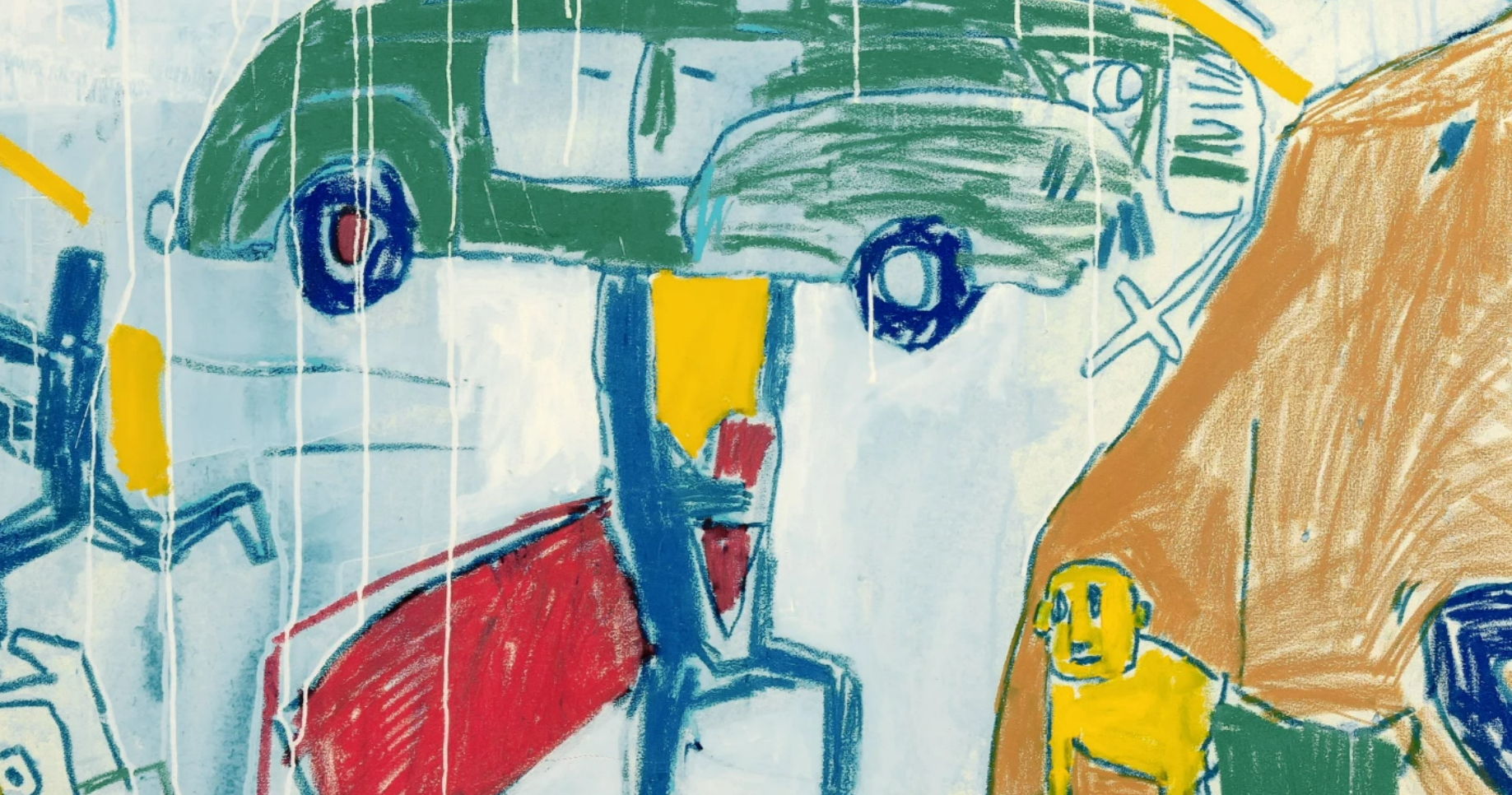
Central to Basquiat’s practice is his enduring concern with heroism, and particularly the cast of heroes adopted by young Black Americans. In many of his most significant works, Basquiat illuminates the shortcomings of American culture’s larger pantheon of heroes: notably, the lack of diverse representation. It is in this context that Basquiat’s personal legion of heroes emerges, most often Black athletes and musicians such as Charlie Parker, Muhammed Ali, Dizzy Gillespie, and Sugar Ray Robinson. Affectionately and reverently dubbing them his “kings” and “saints,” these personal myths contain a nuanced probe into the politics of race, class, identity, and mortality baked into the microcosm of children’s cartoons. In electing the most revered figure in American popular culture the subject of the present work, Basquiat taps into the very root of heroism at large and its origins in collective memory. An exceptionally painterly and richly worked example of one of Basquiat’s most celebrated series, Action Comics One valiantly sets forth an interpretation and intervention into ideas of American heroism. Invoking a painterly narrative of the United States’ most beloved hero, Basquiat probes the relationship between fiction and salvation. Indeed, the remarkable diversity of marks woven into the impenetrable layers of Action Comics One clearly articulates both the artist’s past as a celebrated member of Manhattan’s street art vanguard and of his present career as contemporary art’s dazzling prodigy.
Willem de Kooning
Sotheby’s New-York: 15 November 2023
Estimated: USD 2,500,000 – 3,500,000
USD 5,505,000
Untitled | Contemporary Evening Auction | 2023 | Sotheby’s (sothebys.com)
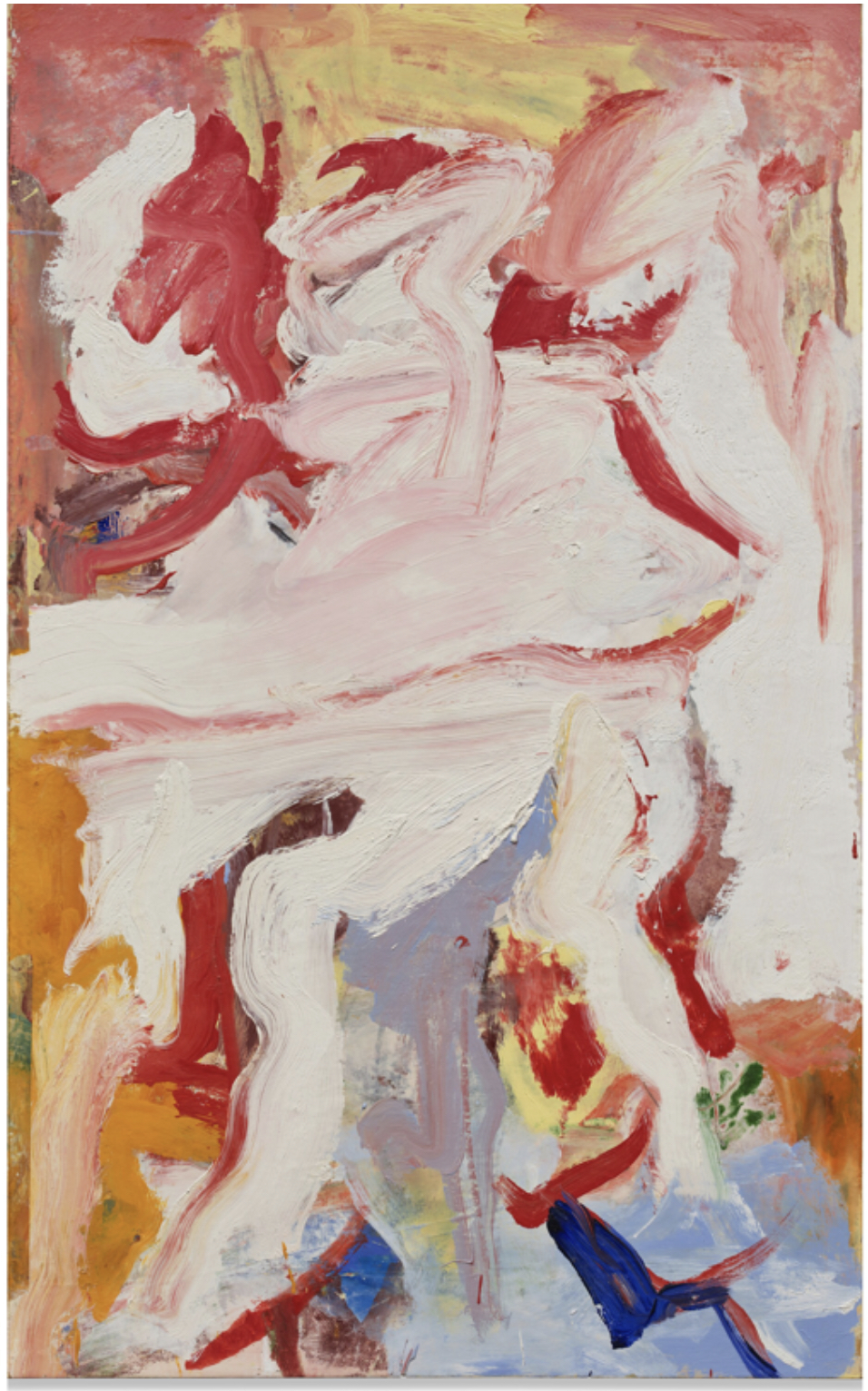
WILLEM DE KOONING (1904 – 1997)
Untitled, 1972
Oil on paper mounted on canvas
60 1/8 x 41 inches (152.7 x 104.1 cm)
A sublime testament to Willem de Kooning’s inimitable painterly bravura, Untitled emerges as an early paragon from the artist’s legendary oeuvre of the 1970s, when de Kooning’s outpouring of creativity engendered an illustrious series of lush and color-drenched works that rank among the finest achievements of his celebrated career. Executed in 1972, eight years after the artist had moved to East Hampton, and shortly following the revelation of his celebrated Woman paintings of the 1950s and 60s, the layers of lush pigment which eddy and pool across the present work resolve to present the artist’s iconic figural forms, transformed and intensified within the effervescent landscape of the artist’s coastal environment. Sublimely enveloping the viewer in a riot of brilliant hue and undulating collisions of line and form, the present work announces the unequivocal painterly supremacy of de Kooning at the absolute apex of his aesthetic prowess and was notably exhibited at Sidney Janis Gallery the same year it was executed. For its dazzling fusion of a melodic lyricism with the heroic and muscular gesture of de Kooning’s expressionism, the incandescent Untitled is a sensory delight and distinguished for its impressive scale for the artist’s works on paper mounted on canvas. A triumph for the artist from this momentous period of his career, Untitled beautifully links his earlier, more figurative paintings of female form, with the gestural abstraction of the mid -1970s.
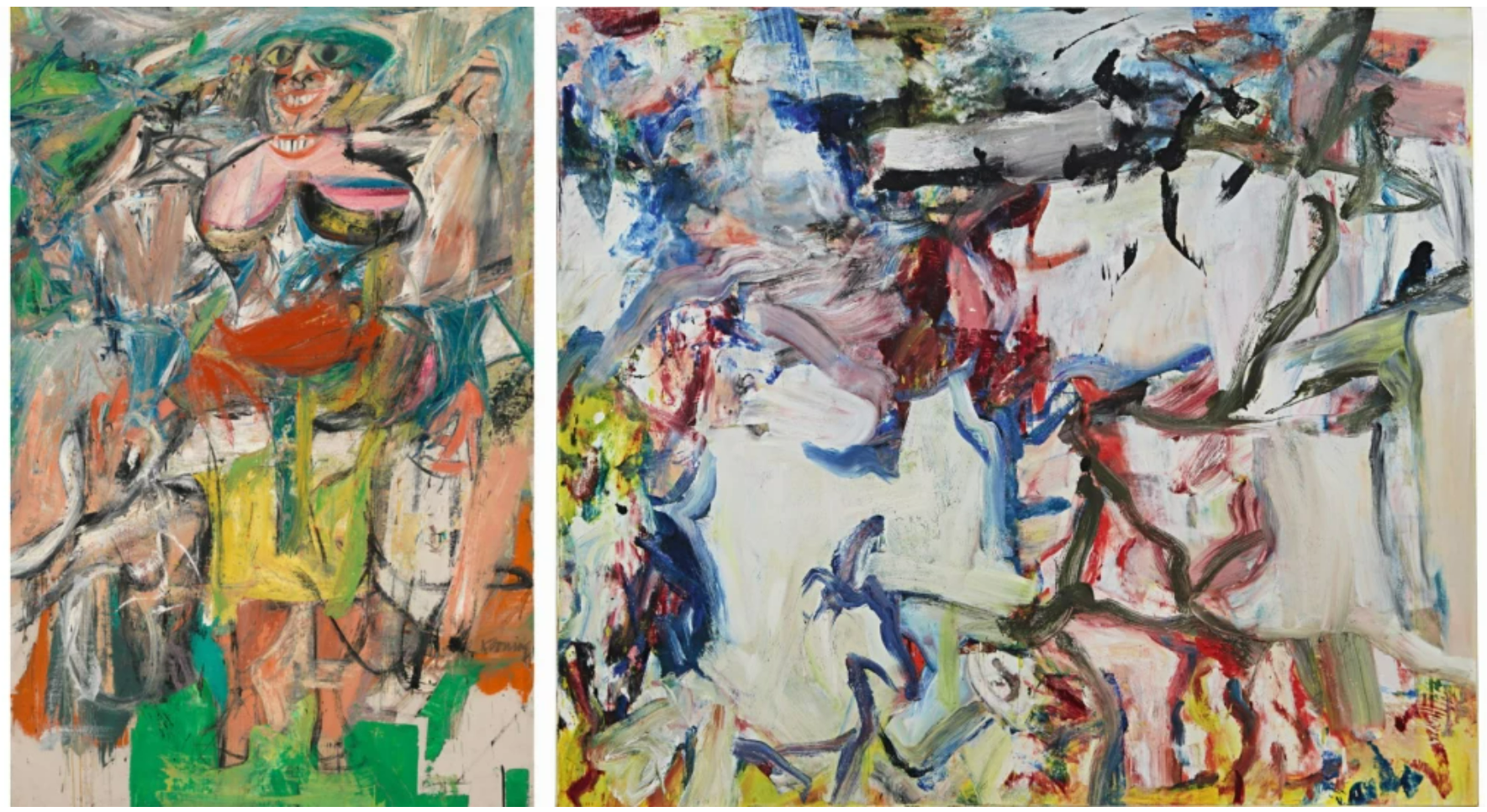
LEFT: WILLEM DE KOONING, WOMAN AND BICYCLE, 1952–53. IMAGE © WHITNEY MUSEUM OF AMERICAN ART / LICENSED BY SCALA / ART RESOURCE, NY. ART © 2023 THE WILLEM DE KOONING FOUNDATION / ARTISTS RIGHTS SOCIETY (ARS), NEW YORK. RIGHT: WILLEM DE KOONING, UNTITLED XXII, 1977. PRIVATE COLLECTION. SOLD AT SOTHEBY’S NEW YORK IN NOVEMBER 2019 FOR $30.1 MILLION. ART © 2023 THE WILLEM DE KOONING FOUNDATION / ARTISTS RIGHTS SOCIETY (ARS), NEW YORK
By the late 1960s, de Kooning had been painting for fifty years, and operated by the mantra that “you have to change to stay the same” (the artist quoted in: Karen Painter and Thomas Crow, Eds., Thoughts and Composers at Work, Los Angeles, 2006, p. 39). Although de Kooning’s celebrated Women of the 1950s were by no means resolutely figurative, this radiant work employs the vitality and gestural freedom of de Kooning’s abstract works from the late 1970s onwards but demonstratively draws upon elements of his celebrated 1950s figuration. Exemplified within the present work, de Kooning’s treatment of the paint, which veers from sinuous to strident, lyrical to brash, preempts the extraordinary balance of tranquility and chaos that defines those later paintings, in which riots of brilliant hues and undulating collisions of line and form combine to form perfectly balanced compositions. De Kooning famously claimed that “flesh was the reason oil paint was invented,” and that belief is visible in every exuberant brushstroke of Untitled (the artist quoted in: “The Renaissance and Order,” talk delivered at Studio 35, 8th Street, New York, Autumn 1949). Slim legs, pronounced breasts, and a shock of light yellow hair appear as the most legible demarcations of the figure who dominates the composition, a colorful and kaleidoscopic rendering of the female form which retains some of the visceral sexual energy of de Kooning’s earliest compositions. De Kooning revels in this salute to figurative painting, imbuing his most celebrated subject with all the ferocity and desire that characterize his Women from the previous decades, while moving towards the lyricism and tactility of his abstract masterworks from the late 1970s and 80s.
Rendered with the full force of de Kooning’s distinctive abstract vernacular, Untitled represents a pivotal moment of artistic and creative transformation within the artist’s storied career. While at once drawing upon elements of his famed figurative vernacular, de Kooning was certainly influenced by his new environment; compared to the city life, East Hampton provided lush greenery, bright blue skies, and calming waters as inspiration. Describing the profound inspiration and visceral pleasure he found in the luminous landscape of his East Hampton surroundings, de Kooning reflects: “I wanted to get in touch with nature. Not painting scenes from nature, but to get a feeling of that light that was very appealing to me, here particularly… I got into painting in the atmosphere I wanted to be in” (the artist quoted in Harold Rosenberg, “Interview with Willem de Kooning.” ARTnews 71, September 1972, p. 57). Bespeaking a deep engagement with the natural world, Untitled invokes the raucous, untamed beauty of bright daylight upon the Atlantic ocean; the jubilant white, pink, and scarlet passages swell into the warm golden forms like so many cresting waves as lush and verdant as wild beach flowers sprouting amongst pebbles on the beach.
Willem de Kooning
Sotheby’s New-York: 15 November 2023
Estimated: USD 5,000,000 – 7,000,000
USD 5,250,000
Untitled | Contemporary Evening Auction | 2023 | Sotheby’s (sothebys.com)
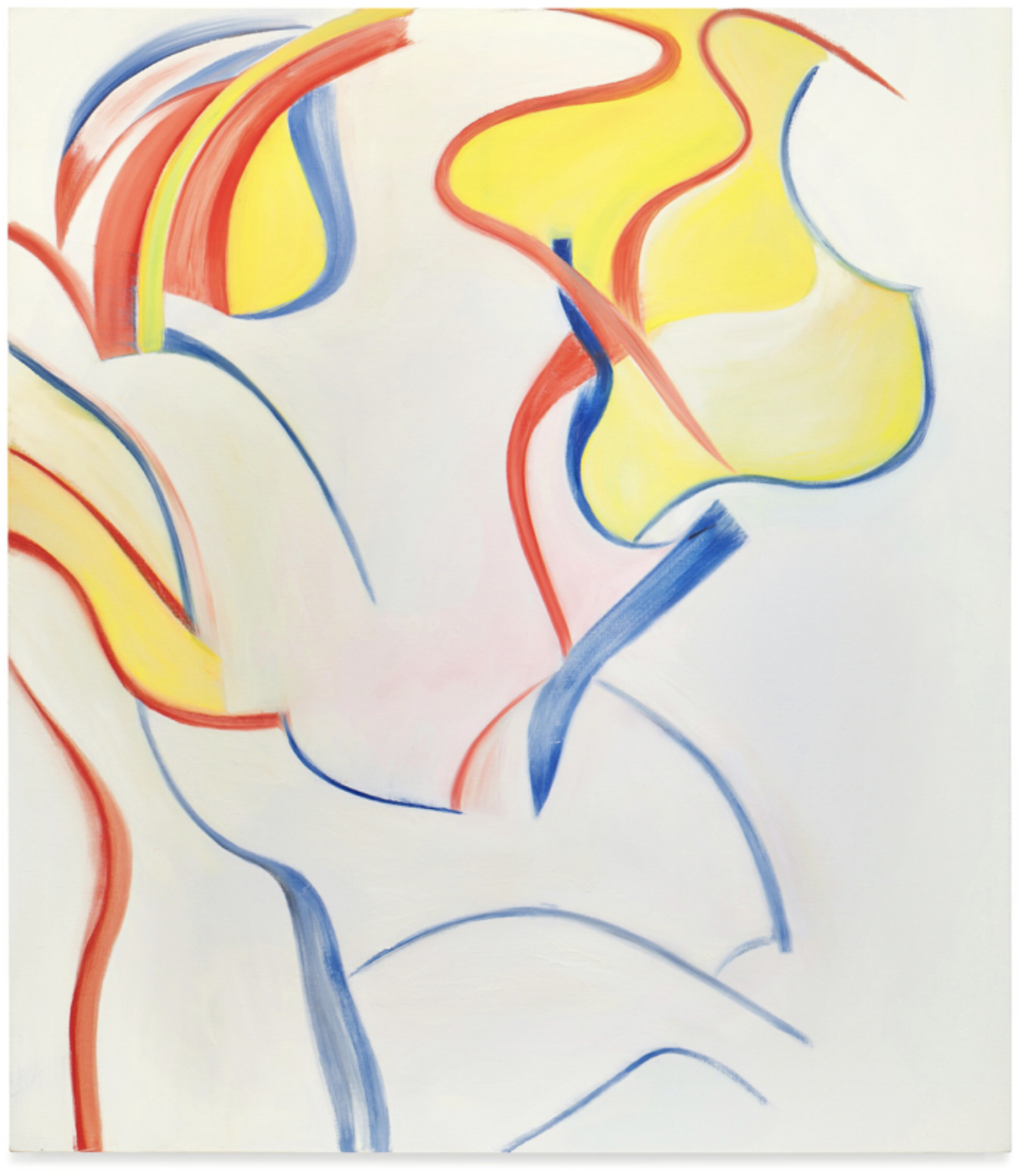
WILLEM DE KOONING (1904 – 1997)
Untitled, 1985
Oil on canvas
80×70 inches (203.2 x 177.8 cm)
Signed (on the stretcher)
Impressive in scale yet imbued with and exquisite compositional grace, Untitled from 1985 hails from the celebrated final decade of Willem de Kooning’s extraordinary sixty year artistic career. Onto the pristine white background of Untitled,– a canvas as tall and wide as the span of de Kooning’s outstretched arms–the artist floats and loops a series of delicate ribbons and planes of color that, in their ethereal beauty, evoke the striking elegance of Matisse’s late abstract cutouts. The buoyant strokes of de Kooning’s abstract calligraphy are utterly sensual, seemingly free from the clear reference to human or landscape that dominated de Kooning’s work of the preceding decades. To compliment the fluidity of these cascading lines, de Kooning opts for a reduced and lyrical palette; nowhere is his ability as a colorist more poetically asserted than in these late masterpieces. Exuding ease, poetry, technical finesse and groundbreaking innovation, Untitled epitomizes de Kooning’s life-long investigation into line, color and form, culminating in the radical transformation of his remarkable practice.
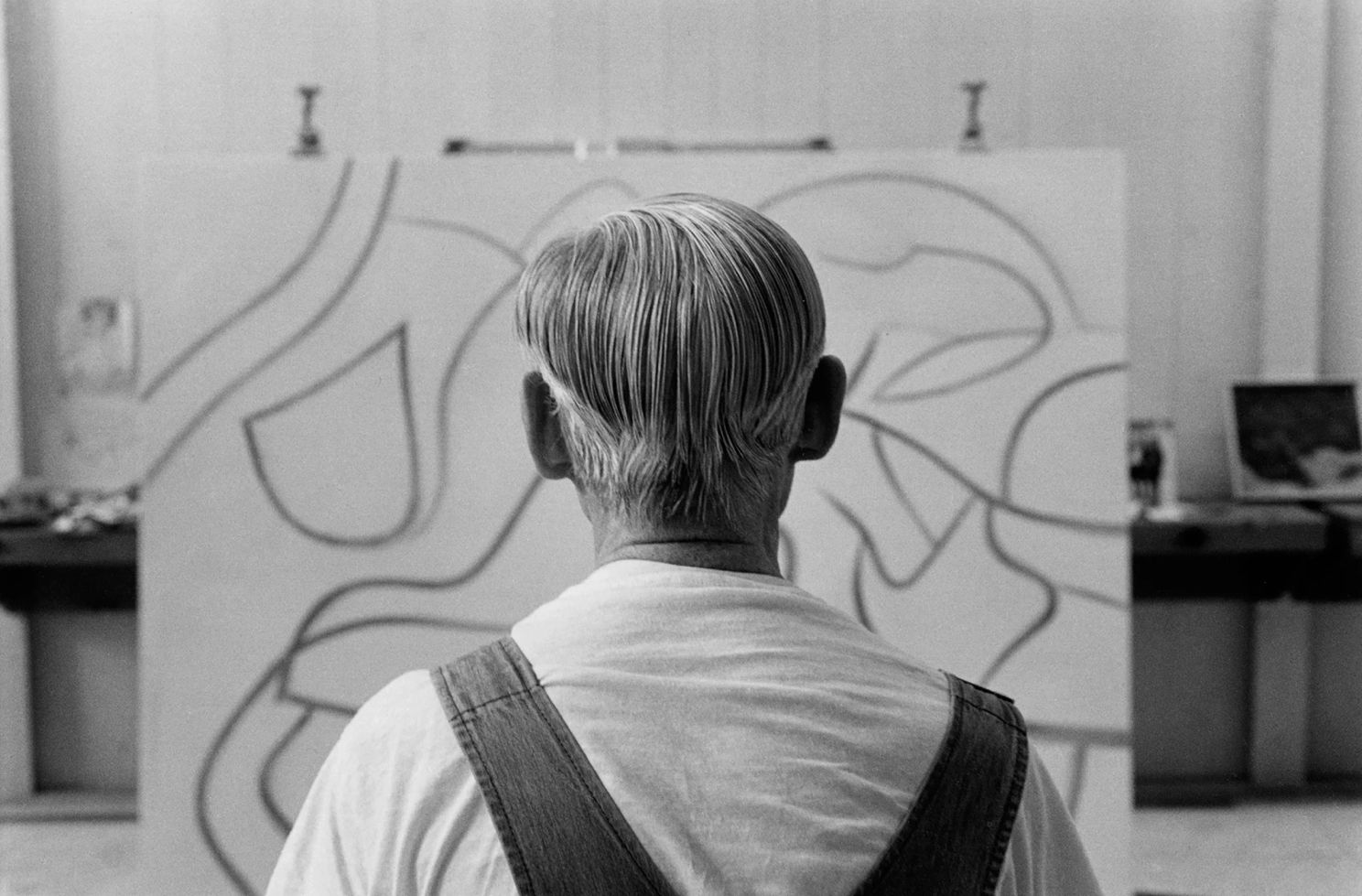
WILLEM DE KOONING IN HIS LONG ISLAND STUDIO, 1985. PHOTO © DUANE MICHALS. COURTESY OF DC MOORE GALLERY, NEW YORK. ART © 2022 THE WILLEM DE KOONING FOUNDATION / ARTISTS RIGHTS SOCIETY (ARS), NEW YORK
The paintings of the early 1980s announced a period of renewed activity in de Kooning’s creative output, heralding a new era of artistic production. Having moved full time to East Hampton by 1980, de Kooning began to paint with a new intensity which he viewed from the perspective of a long career as a premier artist. “I feel that I have found myself more, the sense that I have all my strength at my command. I think you can do miracles with what you have if you accept it …I am more certain of the way I use paint and the brush” (the artist cited in Exh. Cat., Washington, D. C., National Gallery of Art, Willem de Kooning: Paintings, 1994, p. 199). This new balance and clear-eyed confidence gave birth to an explosive creative energy and vigor which culminated in a series of extraordinary compositions. As seen in Untitled, de Kooning’s work is both kinetic and luminous, with dancing rhythms and diaphanous lines that are the ultimate realization and emancipation of his artistic vision. Unrestrained yet deliberate, his late paintings dazzle with musical vitality, their bold primary hues striking against the startling white ground that characterizes the series. Describing de Kooning’s technique in his late paintings, Carter Ratcliff observed: “Something extraordinary happens in the 1980s. Dragging a wide metal edge through heavy masses of paint, de Kooning turns scraping into a kind of drawing. A process of subtraction makes an addition, a stately flurry of draftsmanly gestures. De Kooning has always layered and elided his forms. Now he reminds us that he does the same with his methods” (Carter Ratcliff, “Willem de Kooning and the Question of Style”, in Willem de Kooning: The North Atlantic Light, 1960-1983, Amsterdam, 1983, p. 22). These paintings boast an enlivened spirit and a new freedom in which the artist’s innate gifts for line, color, and form remain paramount.
Select Late Paintings by Willem de Kooning in Museum Collections
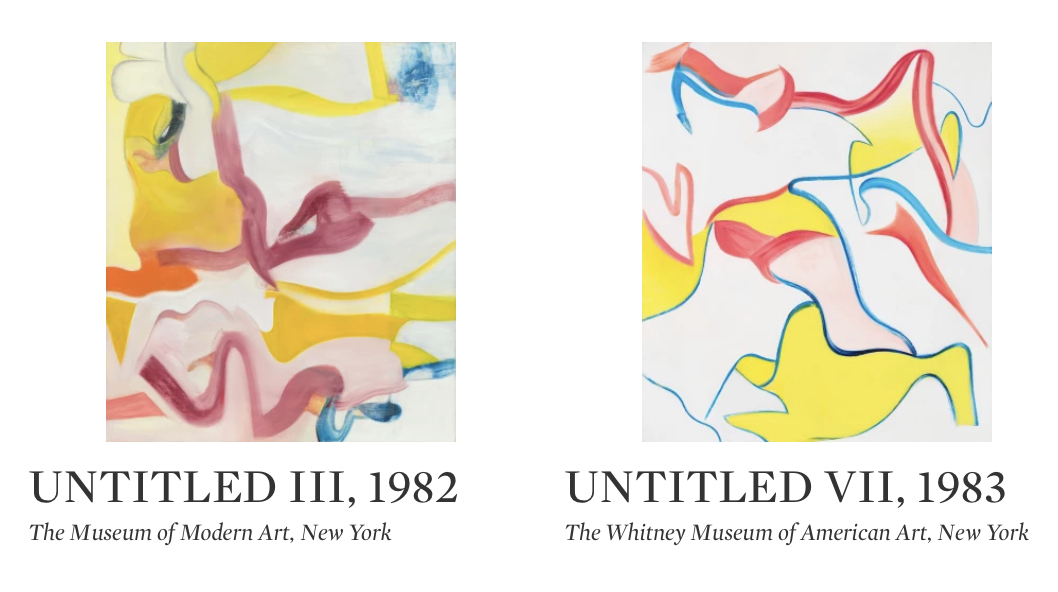
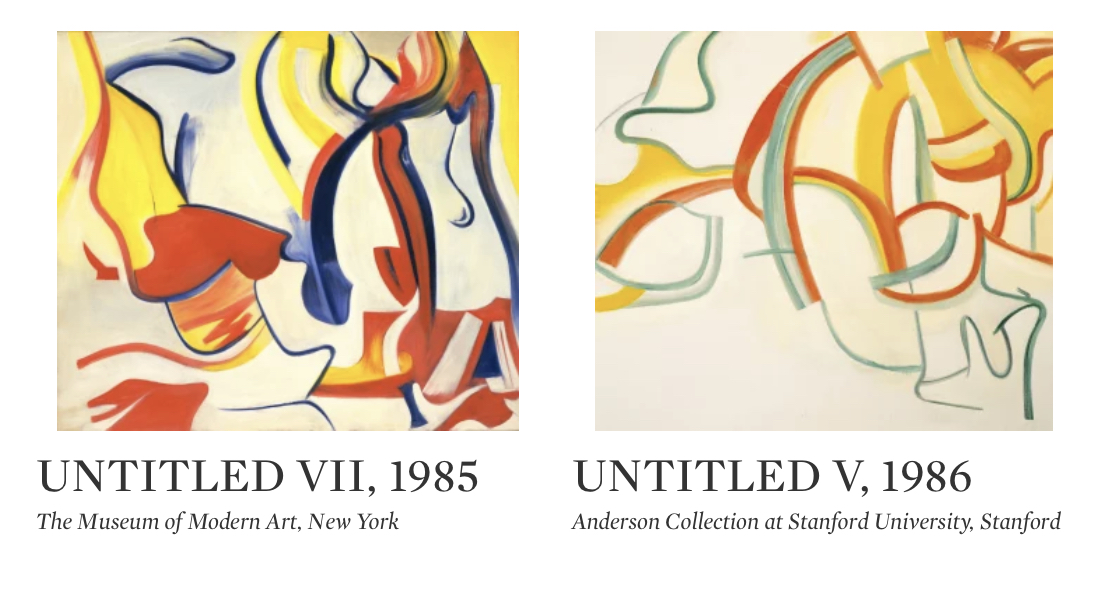
Notably, the “ribbon work” paintings executed from 1983 onwards exemplify de Kooning’s ultimate shift towards the use of thin evanescent layers of primary color. The diaphanous fluidity and rhythmic suppleness of de Kooning’s wrist here carves its way across the composition in meandering ribbons of vibrant red and broad flowing swathes of rich yellow. De Kooning channeled his wealth of creative experience into emotive construction by filtering the countless stylistic changes and compositions of the preceding decades into a radically distilled fusion of line and color. Enveloping the viewer with its vast, exhilarating visual plenitude, the present work reveals an artist that has reached complete union between his body, the paint, and the canvas. Executed on a grand scale, and with the finesse of an artist at the height of his aesthetic powers, Untitled emphatically extolls the supremacy of de Kooning’s inimitable abstract vernacular; as the critic Robert Storr noted of de Kooning’s paintings at this time,
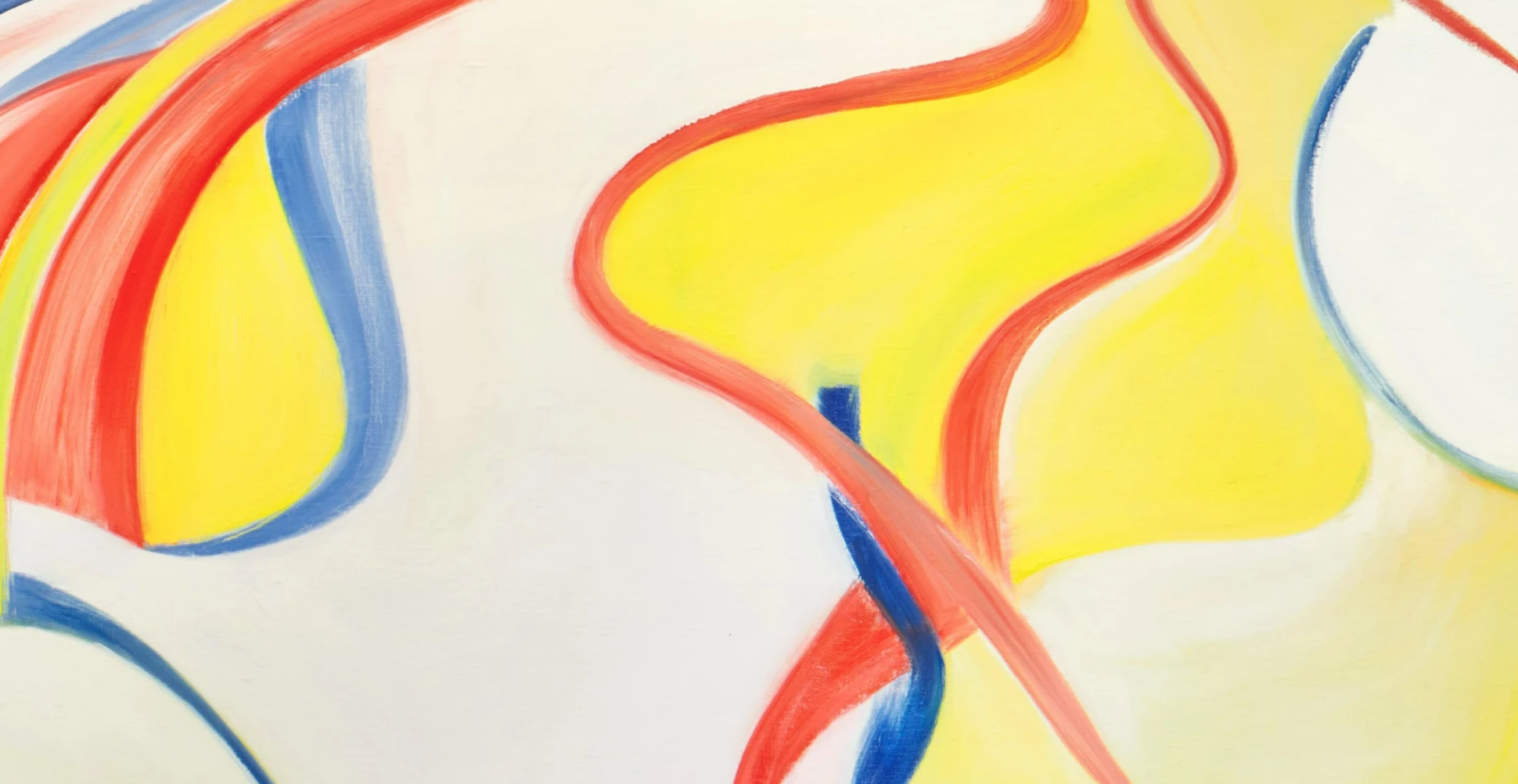
Much like the late work of Pablo Picasso, de Kooning’s paintings of the 1980s contain the sustained energy and technical finesse of earlier achievements, returning to the grandly lyrical manner of his Cubist abstractions of the 1940s. However, filtered through the experiences and paintings of the intervening decades, most notably the sun and light-filled East Hampton landscapes, the content of the 1980s paintings reach a peaceful serenity, leaving behind the baroque flourishes of paint-filled gestures in the 1970s. Untitled is the embodiment of the tranquility and confidence de Kooning gained through the experience of his unparalleled career which was punctuated by bursts of creativity that produced cohesive and startling shifts in his aesthetic while remaining acutely his own.
Roy Lichtenstein
Sotheby’s New-York: 15 November 2023
Estimated: USD 1,500,000 – 2,000,000
USD 2,964,000
Forms in Space | Contemporary Evening Auction | 2023 | Sotheby’s (sothebys.com)
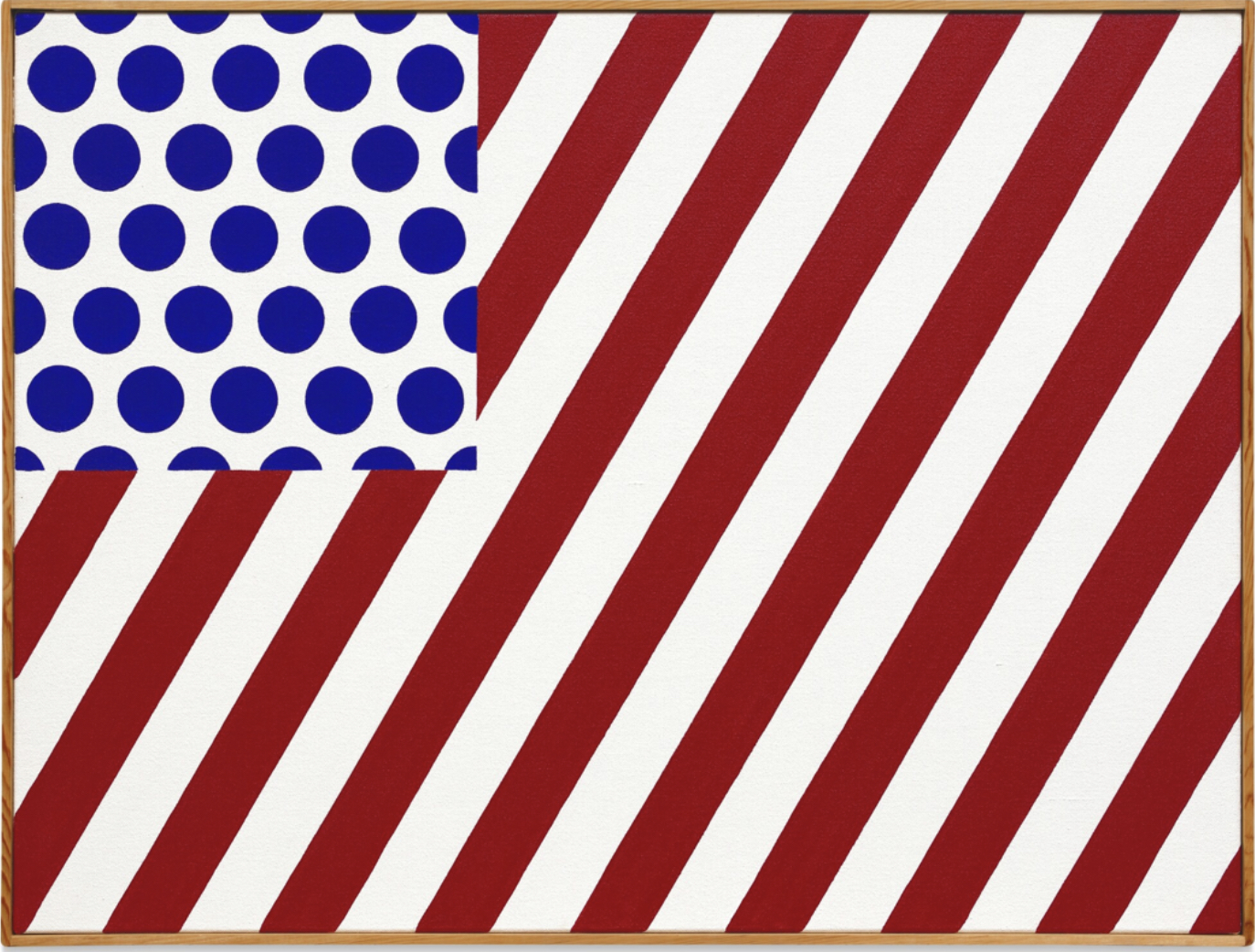
ROY LICHTENSTEIN (1923 – 1997)
Forms in Space, 1985
Acrylic, oil, graphite pencil on canvas
24 1/8 x 32 1/8 inches (61.3 x 81.6 cm)
Signed and dated ‘85 (on the reverse)
An elegantly rendered icon of American pop, Forms in Space from 1985 embodies Roy Lichtenstein’s prodigious exploration of commercial art and popular culture. Lichtenstein’s hallmark Ben-Day dots, primary hues, and bold lines are instantly within the present work, encapsulating the enduring potency of the artist’s signature pop aesthetic and visual language. Few symbols are as visually commanding and well-known as the American flag, which Lichtenstein examines alongside fellow Pop artists Jasper Johns and Andy Warhol as the most iconic symbol of American national identity. Through the diagonal stripes and dotted stars, Lichtenstein explores the mechanisms of perception itself, as the title suggests, examining the symbolic nature of form, space and color. Attesting to the rarity of the present work, Forms in Space is one of a series of only four canvases Lichtenstein produced inspired by the American flag within his oeuvre. Bearing exceptional provenance, the painting was held in the estate of the artist for decades, before being acquired directly from Leo Castelli Gallery by the present owner. A striking composition of saturated colors and searing forms, Forms in Space is a magnificent realization of Lichtenstein’s pioneering investigation into form, content, and semiotics.
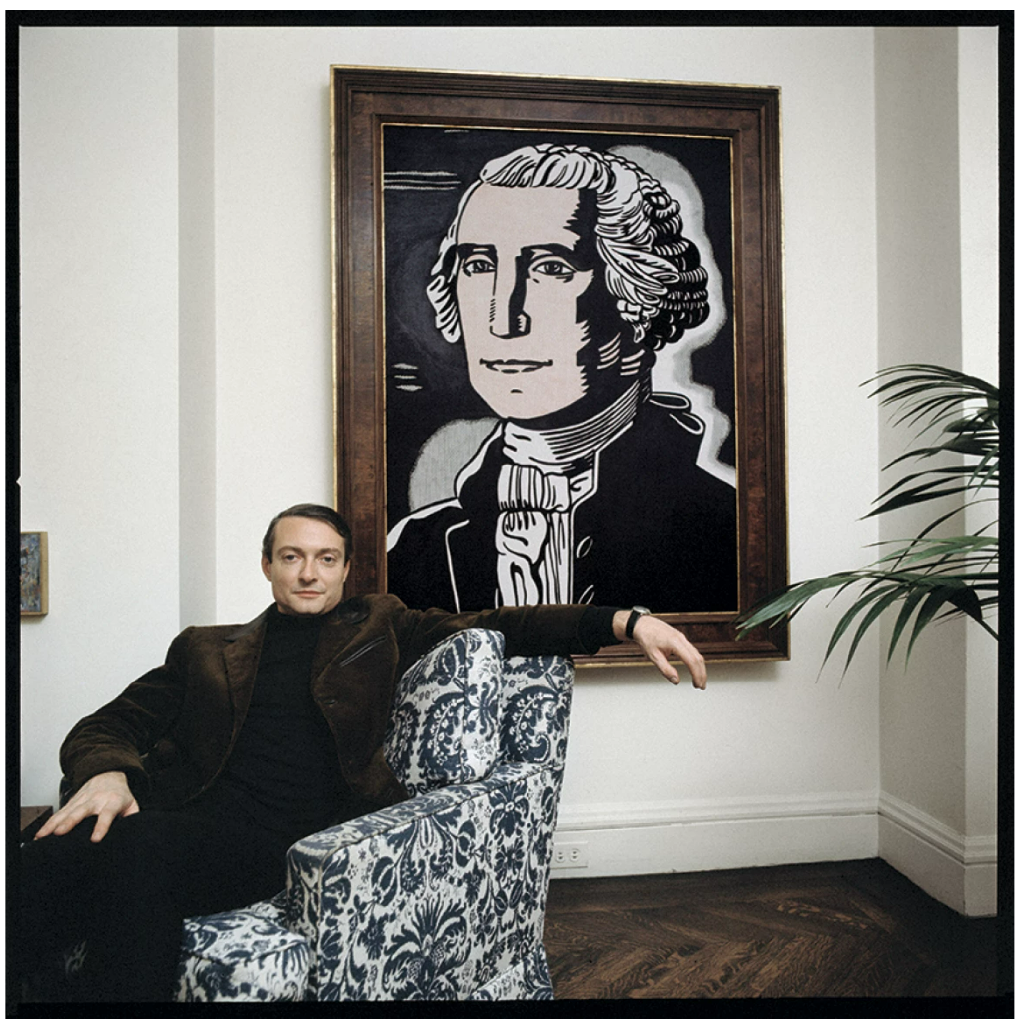
ROY LICHTENSTEIN IN NEW YORK, 1964. PHOTO UGO MULAS/ UGO MULAS HEIRS. ART © 2023 ROY LICHTENSTEIN
Taking the American flag as a point of departure, Lichtenstein examines and disrupts the flag’s formal qualities, questioning its essence as a symbol. Forms in Space poignantly encapsulates Lichtenstein’s unparalleled ability to examine the American psyche through the signs and symbols of twentieth-century consumer culture and, in doing so, raise complex conceptual questions about art and systems of representation. Lichtenstein’s oeuvre is predicated on a semiotic investigation of the ways in which systems of representation allow us to conceptualize and interpret the world around us. Like in his 1960s paintings, which appropriated images from popular war comics, Lichtenstein here examines a defiantly American subject matter rendered in a detached commercial style. As Lichtenstein described, “I was interested in anything I could use as a subject that was emotionally strong – usually love, war, or something that was highly-charged and emotional subject matter. Also, I wanted the subject matter to be opposite to the removed and deliberate painting techniques.” (The artist quoted in John Coplans, ‘Interview with Roy Lichtenstein’, Artforum, May 1967, p. 36)
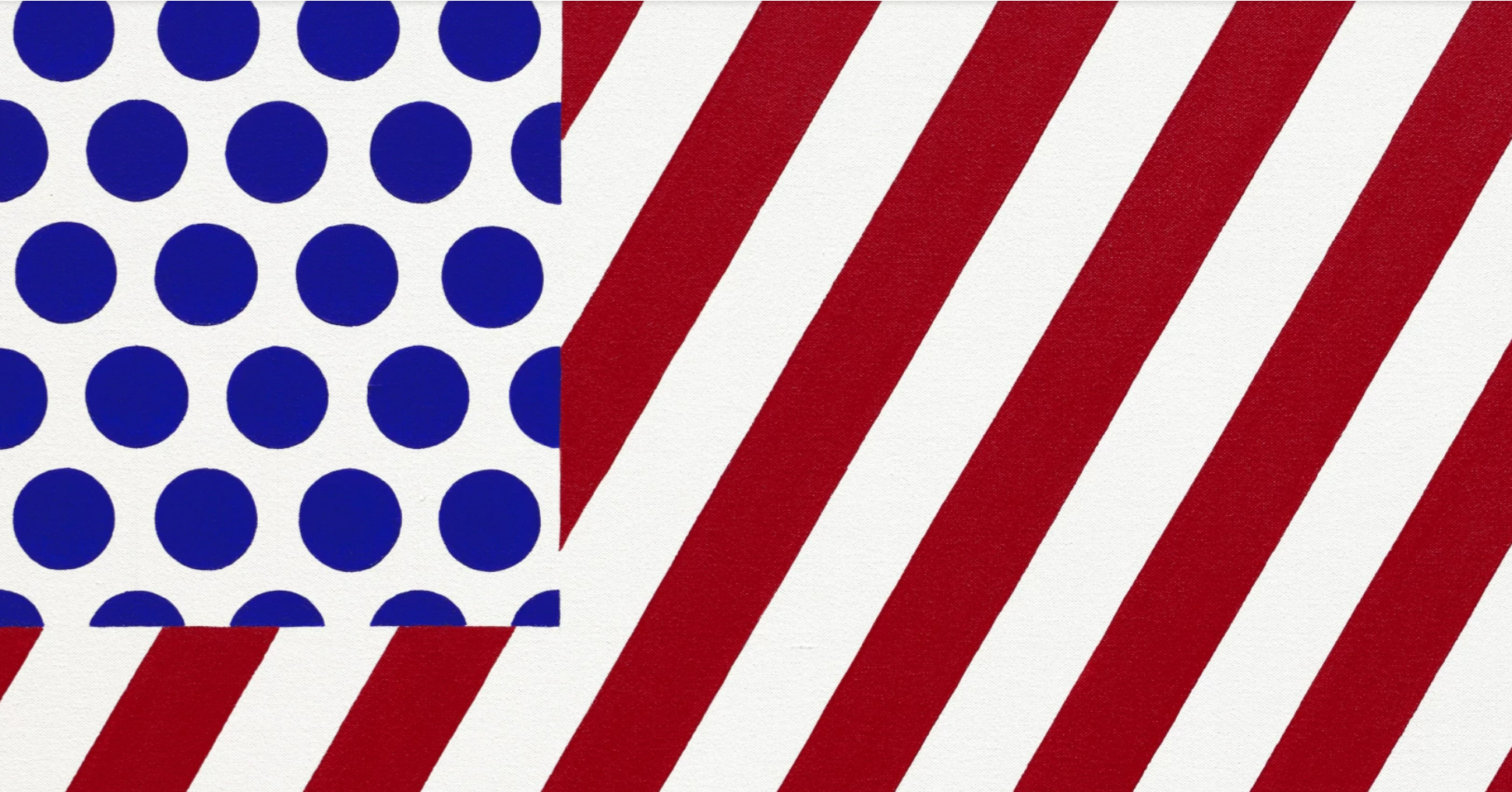
By appropriating the visual language of machine-printed comic strips in the uniform Ben-Day dots which comprise the surface of Forms in Space, thick, Lichtenstein conflates the culturally resonant mass-produced commercial image of a flag with the traditionally venerated medium of oil painting. Forms in Space sees Lichtenstein culling inspiration from everyday quotidian Americana to create a visually arresting super-reality. Although Lichtenstein’s compositions are most obviously rooted in twentieth-century commercial aesthetic norms, the artist also engaged in a dialogue with canonical art historical conventions. Exhibiting a geometric simplicity and vibrant palette, Lichtenstein’s abstracted forms recall the radical compositions of Piet Mondrian or Kazimir Malevich as much as those of his Pop contemporaries. Through mining art historical precedents and some of the most recognizable symbols within American visual culture, Lichtenstein questions the nature of representation and art itself. Meticulously interspersing his signature Ben-Day dots and diagonal lines to replace the stars and stripes of the American flag, Lichtenstein explores the artifice of perspective, toying with the mechanics of perception. Even when abstracted in Lichtenstein’s signature pop aesthetic, the red, white and blue of the flag triggers an infallible sense of recognition and unerring certainty within the viewer, which challenges our associations and reflexes.
“My use of evenly repeated dots and diagonal lines and uninflected color areas suggest that my work is right where it is, right on the canvas, definitely not a window into the world.”
Here, the profusion of dots and lines seeks not to mirror reality, but instead offers witty commentary on perception and the role of the artist, toying with the dichotomy between reality and illusion. Epigrammatic and playful, Lichtenstein’s Forms in Space defiantly embodies the underlying concerns of Lichtenstein’s career: to examine the signs and symbols that give meaning to contemporary life. Executed in 1985, Forms in Space is emblematic of Lichtenstein’s iconic visual style which has since become synonymous with Pop art itself.
Andy Warhol
Sotheby’s New-York: 15 November 2023
Estimated: USD 2,500,000 – 3,500,000
USD 2,601,000
Rorschach | Contemporary Evening Auction | 2023 | Sotheby’s (sothebys.com)
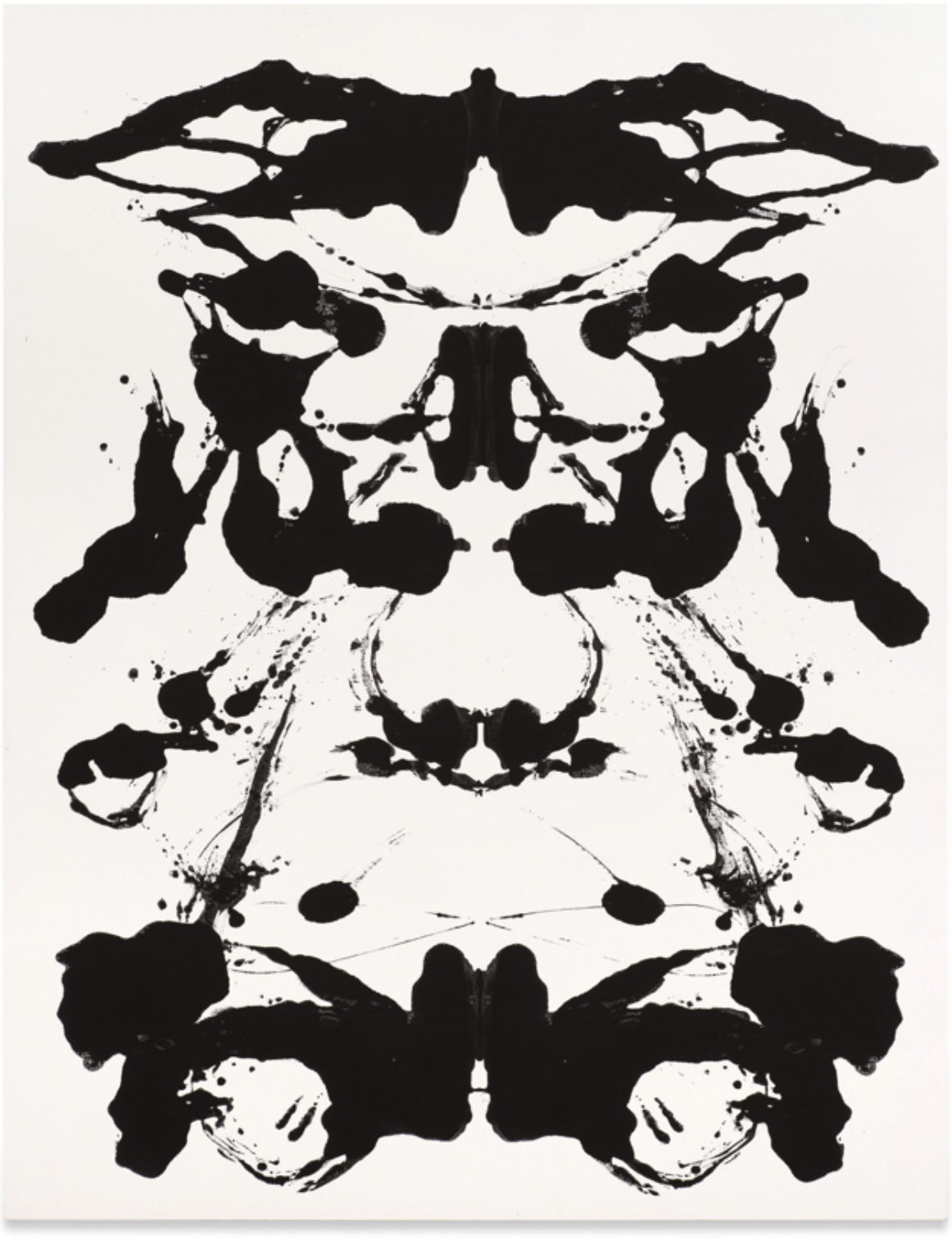
ANDY WARHOL (1928 – 1987)
Rorschach, 1984
Acrylic on canvas
90×70 inches (228.6 x 177.8 cm)
Numbered by The Andy Warhol Foundation for the Visual Arts PA 75.083 (on the overlap)
Mercurial, enigmatic and seductively experimental, Andy Warhol’s Rorschach envelopes the viewer in a mirage of black liquescent forms, unfolding across the monumental canvas with visual, conceptual and psychological complexity. The symmetric matrices of rich, inky paint produced by Warhol’s pour-and-fold technique in Rorschach show an artist who is as experimental as he is productive, constantly looking for new directions and once more returning to flirt with the potential of Abstract Expressionism. Executed in a fertile late burst of creativity in 1984, Warhol’s iconic series of Rorschach Paintings act as an effervescent gateway between the viewer’s and artist’s realms, between form and fantasy: with the basis for this series rooted in inkblot tests of psychological study, the present work develops a strong connection with the conscious mind, freely giving way to a spectrum of conceptual translation and emotional understanding as it conjures a deep variety of response and conversation. Testifying to its significance within Warhol’s career, the present work was exhibited at Andy Warhol: Rorschach Paintings, the first comprehensive exhibition dedicated to this timeless corpus of paintings held at Gagosian Gallery in New York in 1996.
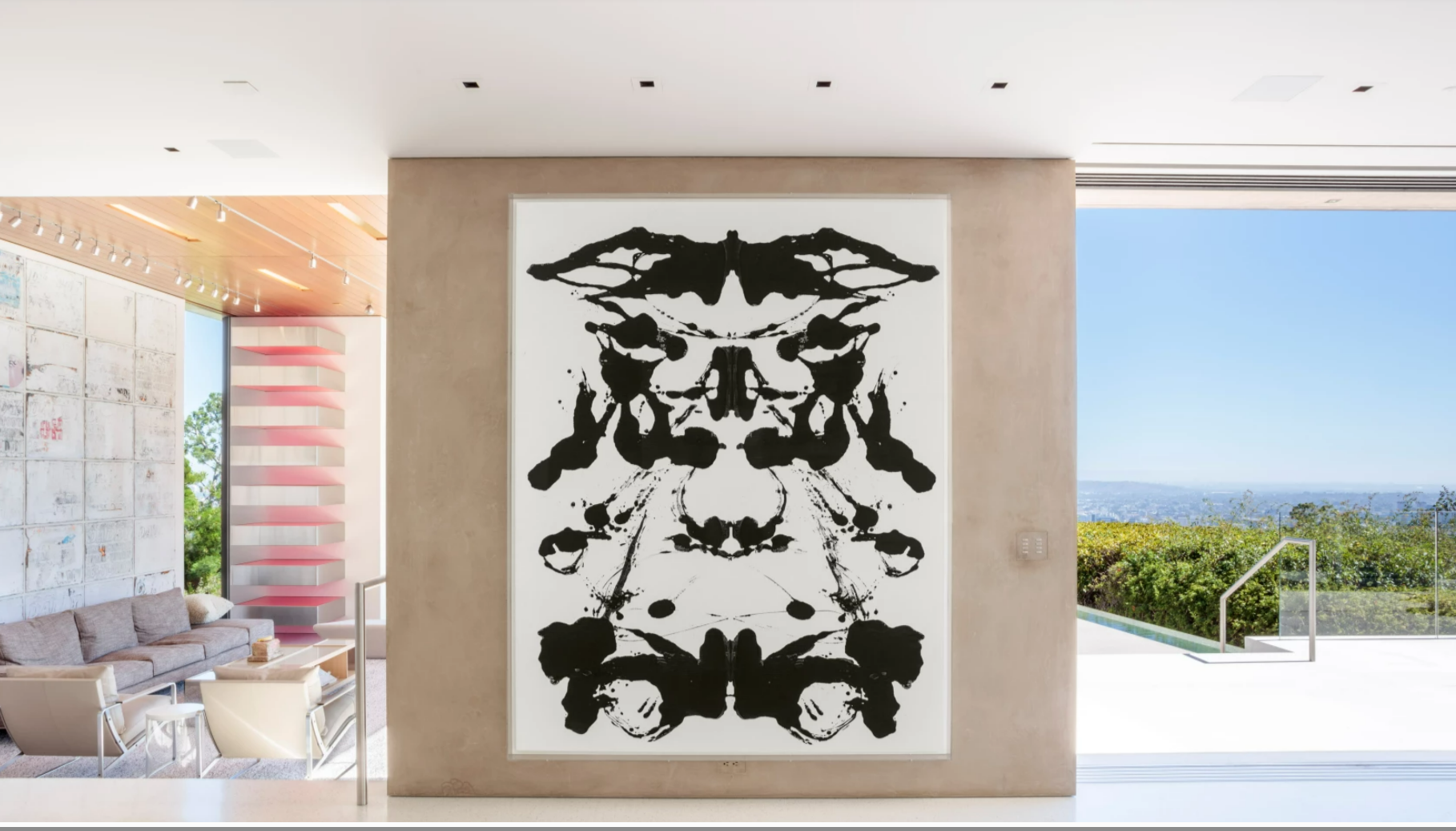
Named after the famed Swiss psychiatrist Hermann Rorschach, Warhol’s Rorschach paintings evoke a beguilingly hypnotic aura that encourages the viewer to impose their own interpretations and visions upon the open-ended symmetrical “ink blot.” Warhol draws directly from the Rorschach test, which provides ten different standardized blots of ink on paper for patients to decipher under the premise that their interpretations provide key insight into the inner workings of their consciousness. Warhol, however, had misunderstood how these tests were proctored, believing it was the patient who created these images as opposed to simply interpreting them: “I thought that when you went to places like hospitals, they tell you to draw and make the Rorschach Tests. I wish I’d known there was a set” (the artist quoted in: Rorschach, The Broad Museum, Los Angeles, ongoing (online)). In his brilliant faux-naive deadpan, he once explained: “I was trying to do these to actually read into them and write about them, but I never really had the time to do that. So I was going to hire somebody to read into them, to pretend that it was me, so that they’d be a little more…interesting. Because all I would see would be a dog’s face or something like a tree or a bird or a flower. Somebody else could see a lot more” (Andy Warhol quoted in conversation with Robert Nickas, “Andy Warhol’s Rorschach Test”, Arts Magazine, October 1986, p. 28).
RORSCHACH INK BLOT TEST AT HEADACHE CLINIC IN MONTEFIORE HOSPITAL, C. 1950. PHOTO BY ORLANDO /THREE LIONS/GETTY IMAGES
Intrigued by the Rorschach test’s serial repetitiveness and formulaic impersonality, the artist invented his own painterly version: in a stylized and dynamic performance not dissimilar to Jackson Pollock’s iconic drip dance, Warhol poured paint onto one side of a canvas before folding it vertically to imprint the other half. As Warhol’s assistant Jay Shriver recalls about the Rorschach Paintings, “Andy painted the big ones, and that’s why he was having so much fun. … We had these huge canvases that we had to fold over and press together so that the paint was evenly distributed on both halves of the canvas…The physical energy spent laboring over these massive canvases generated a great deal of excitement in the studio.” (Jay Shriver quoted in J.D. Ketner II, “Warhol’s Last Decade: Reinventing Painting” in Exh. Cat., Milwaukee Art Museum, Andy Warhol: The Last Decade, 2009, p. 45) In the present work, the latticework of shadowy black paint unfurls in a pictorial marriage of fluidity and abstraction that indexes this chance method of splattering and compressing, dripping and dragging paint across an open field of creamy white. Divided into symmetrical quadrants, Rorschach reveals the resulting mirrored image that emanates from the center point in silhouettes of black paint, viscous and opaque in certain areas, feathery and light in others. Imprecise and unpredictable, the totemic forms remain open to any form of interpretation, reminiscent of an inkblot test that creates enigmatic imagery onto which the viewer can project their own desires and fantasies.
Christopher Wool
Sotheby’s New-York: 15 November 2023
Estimated: USD 1,500,000 – 2,000,000
USD 2,238,000
Untitled | Contemporary Evening Auction | 2023 | Sotheby’s (sothebys.com)
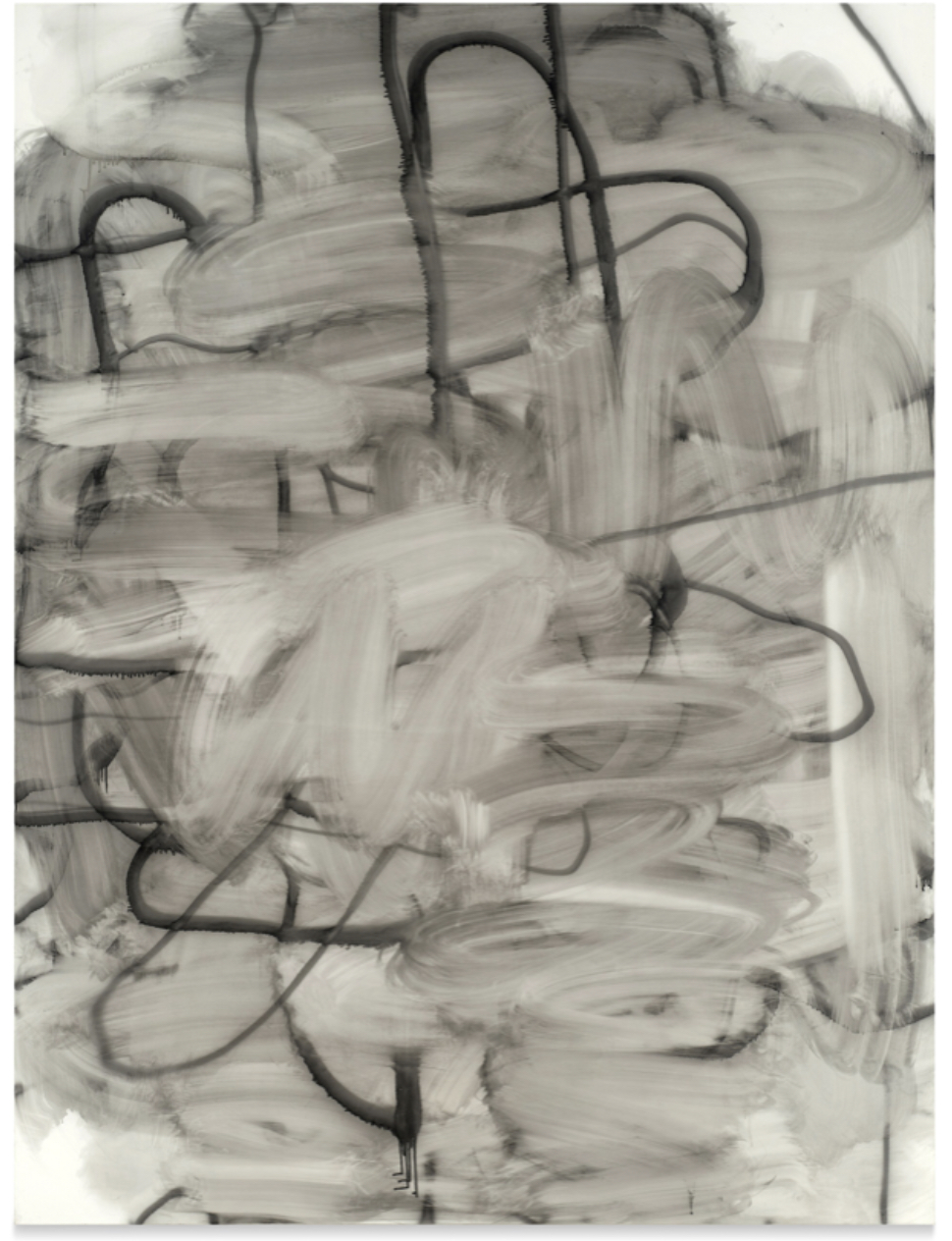
CHRISTOPHER WOOL (b. 1955)
Untitled, 2005
Enamel on canvas
96×72 inches (243.8 x 182.9 cm)
Signed, dated 2005 and numbered (P507) (on the overlap)
Emerging from a cycle of addition and subtraction, Christopher Wool’s Untitled is a monumental example of a painting imbued with unapologetic presence and remarkable tension. Executed in 2005, the present work illuminates a profound oscillation between the gestural immediacy of the artist’s hand and the calculated reduction of painting itself. Since the early 2000s, Wool has worked almost entirely with abstract forms, maximizing his expressive potential through techniques of replication, erasure, mechanical manipulation, and a highly restricted color palette. As Katrina Brown explains, with their grand scale and monochromatic confidence, “Wool’s paintings seem like an indescribable urban cool, a tense fusion of intellect and emotion, control and chaos.” (Katrina M. Brown cited in: Hans Werner Holzwarth, Ed., Christopher Wool, New York 2008, p. 296) Daring to challenge the status quo of painting by disrupting the medium itself, Untitled exists as a product of the continual evolutionary progress of Wool’s practice.
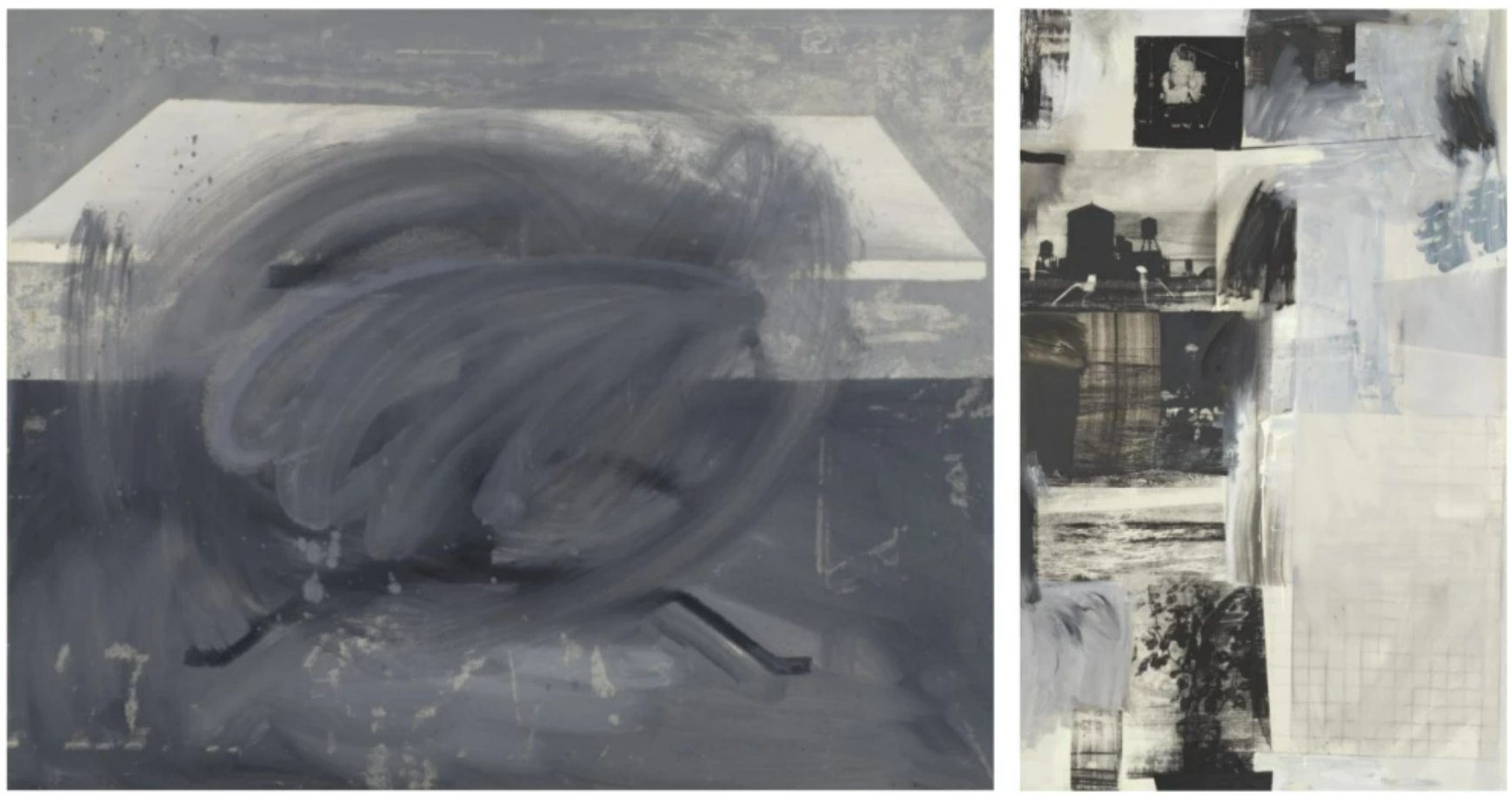
LEFT: GERHARD RICHTER, TABLE, 1962. PRIVATE COLLECTION. ART © 2023 GERHARD RICHTER. RIGHT: ROBERT RAUSCHENBERG, ALMANAC, 1962. IMAGE: © TATE, LONDON / ART RESOURCE, NY. ART © 2023 ROBERT RAUSCHENBERG FOUNDATION / LICENSED BY VAGA AT ARTISTS RIGHTS SOCIETY (ARS), NY
Messy, erratic, and gesturally kinetic, Wool’s seminal Gray Paintings both undermine the rigid compositional structure of his early output and ruminate on the future of painting. In the artist’s own self-reflexive words, “the traditional idea of an objective masterpiece is no longer possible.” (Christopher Wool quoted in: Kate Brinson, ‘Trouble is my Business’, in: Exh. Cat., New York, Solomon R. Guggenheim Museum, Christopher Wool, 2013, p. 47) The genesis of this series emerged in a moment of frustration, when Wool took to a composition of yellow enamel with a soaked rag in attempt to blot out his work, resulting in a chaotic yet compelling blurred mass. In 2000, following an accidental discovery of the interaction between turpentine and enamel paint, Wool developed the erasure technique that would become the defining hallmark of the Gray Paintings. Spontaneous in his act of radical mark making, Wool first smears and partially erases his existing black linear marks, then paints again atop the ghostly remainder. Through this act of self-repudiation, Wool learned to embrace the element of chance and reassert the presence of the artist’s hand within his practice. In his own words: “It starts someplace and reacting to itself progresses.” (Christopher Wool cited in: John Corbett, ‘Impropositions: Christopher Wool, Improvisation, Dub Painting’, in: Exh. Cat. Musée d’Art Moderne de la Ville de Paris, Christopher Wool, 2012, p. 8)
AGNES ZELLIN, ASTORIA PARK, 1981. IMAGE © THE MUSEUM OF THE CITY OF NEW YORK / ART RESOURCE, NY. ART © 2023 AGNES ZELLIN
Untitled is a defining example of Wool’s Gray Paintings, with tangles of black lines repeatedly puncturing fields of hazy washes. Illustrating that depth is as much an illusion as anything, the accretion of lines appear to be built on previous layers of paint. Yet, what these broad swathes often attempt to disrupt is regions on the canvas that were otherwise blank. Evoking the language of graffiti on city streets, Wool’s act of destruction became a process of creation: “I make a lot of mistakes but I keep them. I use and recycle them.” (Christopher Wool cited in: Stuart Jeffries, “Punk painter Christopher Wool: ‘I make lots of mistakes – and keep them in’, The Guardian, 2 June 2022, (online)) The urban vernacular of New York prevails on the surface of Untitled, as the painting itself seems to morph into an act of vandalism. At the height of the city’s graffiti movement in the 1980s, when Wool was first cutting his teeth as a practicing artist, legibility was pushed beyond its elastic limit and trumped by graphic spectacle. In the present work, legibility is abstracted even further, and figuration is referenced as something primal and alive. One can sense the rich interplay between uninhibited gesture and consequential interruption, between one moment’s impulse and another.
Jean-Michel Basquiat
Sotheby’s New-York: 15 November 2023
Estimated: USD 1,200,000 – 1,800,000
USD 1,996,000
No Hay Crimen © | Contemporary Evening Auction | 2023 | Sotheby’s (sothebys.com)
JEAN-MICHEL BASQUIAT (1960 – 1988)
No Hay Crimen ©, 1983
Oilstick, colored pencil and paper collage on canvas
44 1/2 x 27 1/4 inches (113 x 69.2 cm)
Charged with electric verve, Jean-Michel Basquiat’s silhouette of the skull fixes the viewer with its ruby gaze in No Hay Crimen © from 1983, epitomizing the vigorous drawing practice at the core of the legendary artist’s oeuvre. Atop his talismanic symbol, Basquiat scribbles in capital letters, “NO HAY CRIMEN © (DE CLASSE),” or “There is no crime (of class),” maintaining the enigmatic yet biting sociopolitical critique and the shorthand copyright symbol from his foundational street art origins. Furthermore, the skull-like visage in the present work is paradigmatic of Basquiat’s most iconic and timeless motif: utterly mesmerizing in its passionate intensity, the inner soul of the man appears to burst forth from his portrait in undulating red and yellow striations. Enduring as both idiosyncratic self-portraits and symbolic icons, the singular figure revealed in works such as No Hay Crimen © prevails as a key conceptual anchor for Basquiat throughout his career, appearing in and dominating the majority of his best-known masterworks. No Hay Crimen © bears an exceptional provenance that attests to Jean-Michel Basquiat’s expansive legacy on art history: first acquired by artist Richard Hambleton, Basquiat’s contemporary in the vanguard of the 1980s New York City art scene who is today recognized as the “Godfather of Street Art,” the present work has since belonged to esteemed gallerist John Cheim, who designed and edited Basquiat: Drawings, the first published book of Basquiat’s drawings coinciding with an acclaimed exhibition he curated at Robert Miller Gallery in November 1990.
JEAN-MICHEL BASQUIAT, FILM STILL FROM BOOM FOR REAL: THE LATE TEENAGE YEARS OF JEAN-MICHEL BASQUIAT, MAGNOLIA PICTURES, 2017. IMAGE © ALEXIS ADLER. PHOTO COURTESY OF MAGNOLIA PICTURES. ART © ESTATE OF JEAN-MICHEL BASQUIAT. LICENSED BY ARTESTAR, NEW YORK.
In No Hay Crimen ©, furious strokes of umber, ochre and cadmium red oil stick congregate against an off-white background to form a disembodied human head. The scorching gaze, bared teeth and fiercely delineated head seen in the present work express a degree of emotional intensity that evidences Basquiat’s astute observations in the psycho-spiritual states of being, an association further heightened by his tactile, stunningly immediate handling of oil stick. “What drew Basquiat almost obsessively to the depiction of the human head was his fascination with the face as a passageway from exterior physical presence into the hidden realities of man’s psychological and mental realms,” writes Fred Hoffmann. “They not only peer out as if seeing, but also invite the viewer to penetrate within.” (Exh. Cat., New York, Acquavella Galleries, Jean-Michel Basquiat Drawing: Works from the Schorr Family Collection, 2014, p. 74).
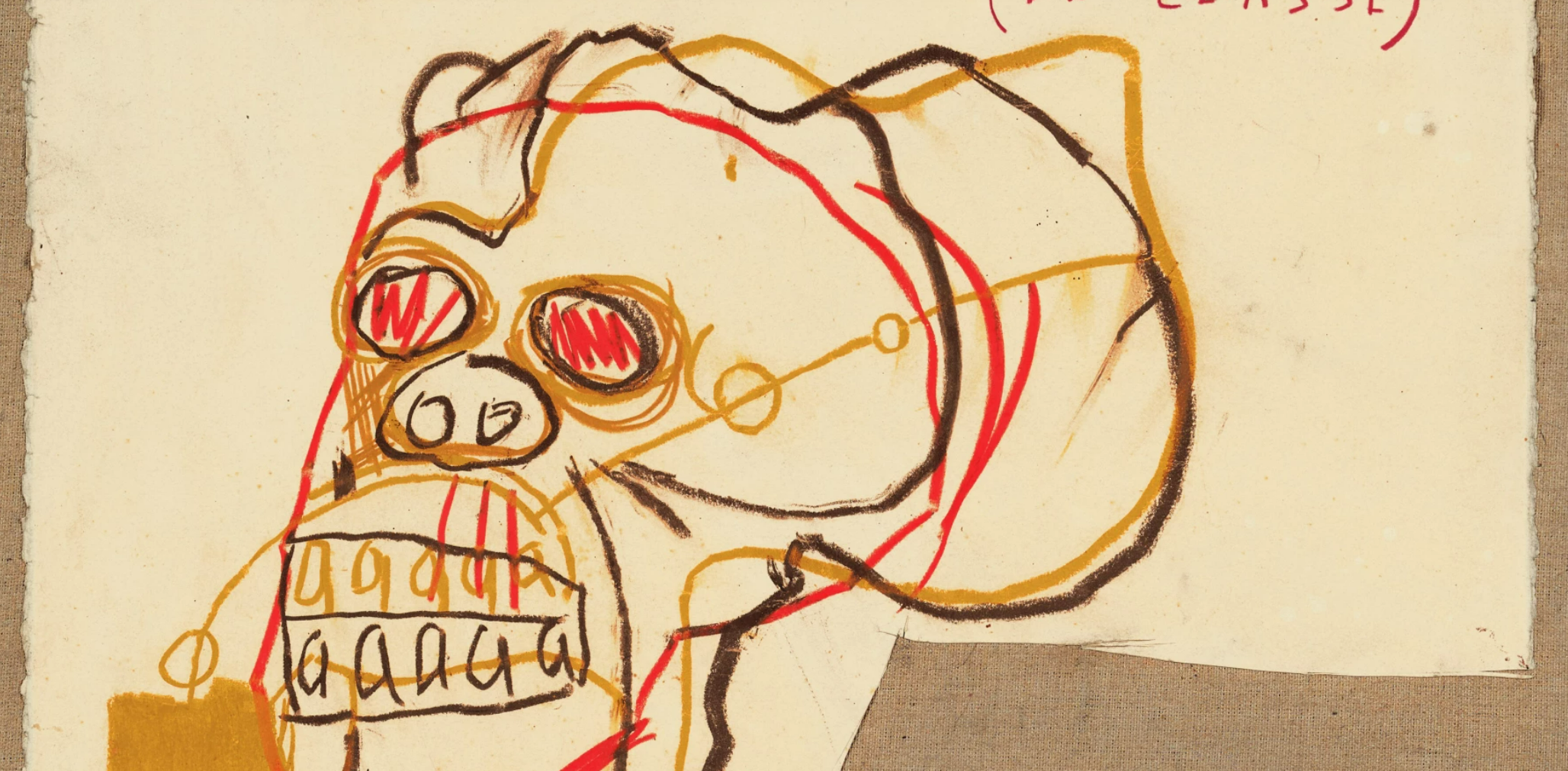
Glaring outwards with the skull’s bloodshot eyes, No Hay Crimen © breaks down the dichotomy between the external and internal, revealing the cacophonous innermost aspects of psychic life with intense dynamism. As Basquiat transitioned from street to studio, the skull served as one of his most resilient pictorial throughlines. In its unfiltered grit and guttural symbolism, the skull captured the vibrance of urban life with thrilling authenticity, simultaneously memorializing his past as a celebrated member of Manhattan’s street art vanguard and his remarkable future as contemporary art’s dazzling prodigy. Absorbing, warping and reshaping the myriad dissonant influences of the Downtown New York, Basquiat forged an extraordinarily lucid and intelligent pictorial vernacular that, while entirely his own, typified the language of the sidewalks and walls of the city with searing candor.
LEFT: VINCENT VAN GOGH, HEAD OF A SKELETON WITH A BURNING CIGARETTE, 1886. VAN GOGH MUSEUM, AMSTERDAM. IMAGE © BRIDGEMAN IMAGES. RIGHT: MICHELANGELO BUONARROTI, THE DAMNED SOUL, C. 1525. GALLERIA DEGLI UFFIZI, FLORENCE. IMAGE © BRIDGEMAN IMAGES
Above the cranial visage, Basquiat abandons none of the vehemence behind his marks as he scrawls the Spanish title of the present work in his own unmistakable handwriting: NO HAY CRIMEN [DE CLASSE]. Translating to “There is No Crime [Of Class],” this ambiguous inscription recalls Basquiat’s renegade sociopolitical musings as SAMO, his street art alter-ego of the late 1970s under which he roamed the streets of New York and emblazoned his moniker upon the abandoned walls of the city. Like personal hieroglyphs, the text reveals Basquiat’s complex worldview that encompasses the hard-hitting social concerns of class struggle and racial discrimination; not least within art itself.
Andy Warhol
Sotheby’s New-York: 15 November 2023
Estimated: USD 600,000 – 800,000
USD 1,016,000
Joseph Beuys | Contemporary Evening Auction | 2023 | Sotheby’s (sothebys.com)
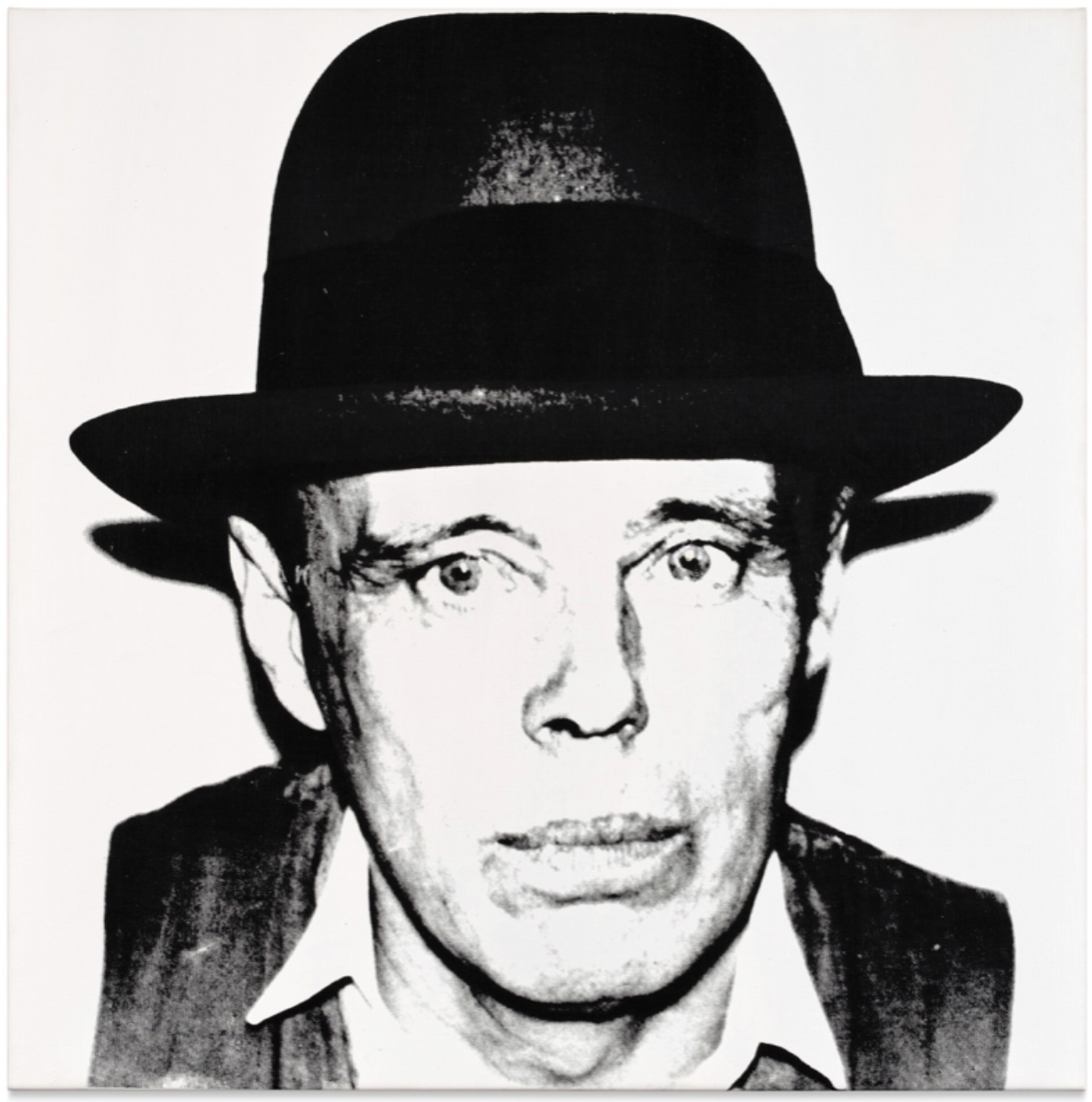
ANDY WARHOL (1928 – 1987)
Joseph Beuys, 1980
Acrylic and silkscreen ink on canvas
40×40 inches (101.6 x 101.6 cm)
Signed and dated 80 (on the overlap)
A bold exemplar of Andy Warhol’s iconic silkscreen portraits, Joseph Beuys from 1980 achieves a brilliant collision of likeness and divergence. Warhol and Beuys, the two giants of American and German post-war art, met for the very first time at a Warhol exhibition in May 1979 at Galerie Hans Mayer. “For those who witnessed them approaching each other across the polished granite floor,” recalls David Galloway, “the moment had all the ceremonial aura of two rival popes meeting in Avignon” (David Galloway, “Beuys and Warhol: Aftershocks,” Art in America, July 1988, p. 121). This momentous and historic moment led to one of Warhol’s most fascinating series of portraits, in which the now iconic face of Beuys was forever immortalized in the quintessentially Warholian body of silkscreen portrait paintings. In November that same year, the two artists met again, this time in New York at Beuys’ major retrospective at the Solomon R. Guggenheim Museum. It was here that the idea for this celebrated series was born, when Warhol captured Beuys in his habitual uniform of felt hat and sleeveless jacket in a sequence of Polaroid photographs that would form the fundamental basis of the works. Executed just one year after their initial meeting, the present work encompasses the vastly polarized yet equally radical advancements in post-war transatlantic art by “the two extreme souls of contemporary art”: Warhol and Beuys (Michele Bonuomo, Exh. Cat., Naples, Museo di Capodimonte, Vesuvius by Warhol, 1985, p. 33).
ANDY WARHOL AND JOSEPH BEUYS AT THE OPENING OF ANDY WARHOL JOSEPH BEUYS, LUCIO AMELIO GALLERY, 1980. PHOTO © NINO LO DUCA. ART © 2023 ANDY WARHOL FOUNDATION FOR THE VISUAL ARTS / ARTISTS RIGHTS SOCIETY (ARS), NEW YORK
By addressing and appropriating the mass reproduction of images in popular media, Warhol effectively transformed the parameters of visual culture within America and, indeed, within Contemporary art; his iconic body of portraiture can be seen to have irrefutably influenced today’s hyperawareness of wealth, celebrity, and consumerist culture. In contrast, Joseph Beuys’ philosophically based practice sought to heighten human perception, and was characterized by his creative, participatory role in shaping society and politics. Born in Germany in 1921, Beuys became widely recognized for his humanistic, almost spiritual approach to anthroposophy, social philosophy and environmental trends, ultimately endeavoring to create a ‘gesamtkunstwerk’ or what he believed was ‘a total work of art.’ Despite the stark disparities between Warhol’s and Beuys’ respective projects, their practices found a remarkable symbiosis; after their initial meeting in Düsseldorf in 1979, the two artists were to maintain an enduring respect for one another. It was precisely at this meeting that Warhol took the Polaroid photo of Beuys that, as demonstrated in the present work, would become the source of the Pop artist’s portraiture series depicting the self-appointed shaman of the European avant-garde.
ANDY WARHOL, JOSEPH BEUYS, 1980. CENTRE GEORGES POMPIDOU, PARIS. IMAGE © CNAC/MNAM, DIST. RMN-GRAND PALAIS / ART RESOURCE, NY. ART © 2023 ANDY WARHOL FOUNDATION FOR THE VISUAL ARTS / ARTISTS RIGHTS SOCIETY (ARS), NEW YORK
Evincing an elegant union of two distinct artistic personas, Joseph Beuys is a subtly self-referential painting, fusing Warhol’s lifelong infatuation with celebrity, consumerism and material culture with Beuys’ more somber investigations of humanism, social philosophy, and politics. Warhol, the progenitor of Pop and catalyst for a new cultural age, and Beuys, a radical who didactically transformed the landscape of both conceptual and performance art, were each pioneering leaders in their own spheres, both leaving behind respectively profound legacies. They were, as Michele Bonuomo attests: “Two opposite stories, two antithetical selves [who] deliberately chose the ideal place to observe and get mixed up with each other.” (Michele Bonuomo, Exh. Cat., Naples, Museo di Capodimonte, Vesuvius by Warhol, 1985, p. 33) Warhol’s series of portraits of Beuys potently conveys this majestic union of the material and the spiritual, the artificial and the natural worlds that each artist occupied and explored.
In its refined elegance and heightened sobriety, the monochrome Joseph Beuys indicates a larger transition within Warhol’s oeuvre which would, over the next decade, grow increasingly meditative and introspective in nature. Once the sovereign chronicler of the ’60s cult of mass media and glossy fame, Warhol had, by 1980, shifted his focus to subjects of greater psychological intensity and emotive depth; marked by such series as the Last Suppers, Shadows, and Rorschachs, Warhol’s works of the 1980s draw far closer to the metaphysical concerns of Beuys’ practice than his output of the preceding decades. In particular, the artist’s own somber visage as depicted in the renowned Fright Wig self-portraits of 1986, composed just a year before the artist’s death, seems to invoke Joseph Beuys as precedent, both confronting the viewer with an unblinking stare and stark physiognomy.
George Condo
Sotheby’s New-York: 15 November 2023
Estimated: USD 1,000,000 – 1,500,000
USD 850,000
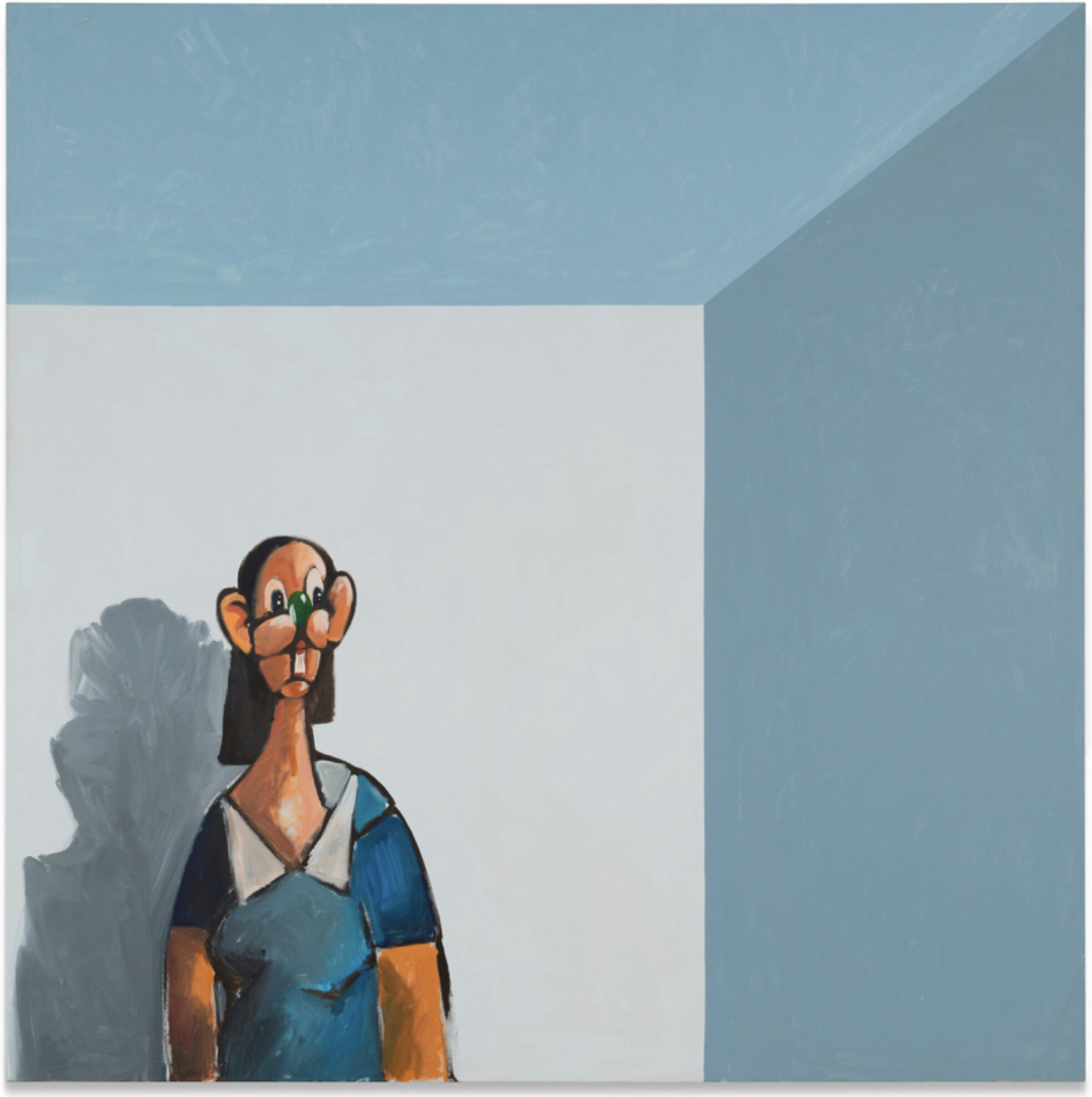
GEORGE CONDO (b. 1957)
Existential Traveler (Girl in Blue Box), 1996
Oil on canvas
80×80 inches (203.2 x 203.2 cm)
Signed and dated 96 (lower right)
A prodigious work that embodies the artist’s career-long exploration of “artificial realism,” George Condo’s Existential Traveler (Girl in Blue Box) stands as a strong and striking painting within the artist’s Imaginary Portrait series. Endearing yet subdued, the central figure is a sublime example of the construction of fictional characters that render a fantastical reflection of our contemporary world. The girl’s short, slicked-back hair and neatly rendered dress puts the viewer at ease, reminiscent of an individual they may know personally or have seen in pop-culture. The title of the painting Existential Traveler (Girl in Blue Box) only adds to the uncanny psychological complexity that immediately returns the viewer to a specific moment in time, temporarily altering their comfort. A testament to the artist’s unique virtuosity and highly celebrated style, the composition represents surprise through a lens that is simultaneously sympathetic and jarring.
GEORGE CONDO IN HIS STUDIO, PHOTOGRAPH BY TINA BARNEY. ART © 2023 GEORGE CONDO / ARTISTS RIGHTS SOCIETY (ARS), NEW YORK
The central figure’s facial features are reminiscent of Condo’s Pod characters, which reoccur throughout his oeuvre beginning in the 1990s into his Unedited Human Disaster series. Their embellished features contort into expressions of pain, anger, and loss, that are both compassionate and revolting, encouraging the viewer to wonder at their own nature. Playfully grotesque and amusingly uncanny, Condo’s paintings allow the viewer to step beyond the borders of our aesthetic inclinations, forcing us to consider how we feel and experience our own humanity in front of the surreal reflections of his figures. As noted by curator Simon Baker, “Condo’s ‘unedited human disasters’ can be understood as channeling the artist’s interest in the imaginary psychological and moral terrain of a whole host of characters, situations and emotional states that might plausibly be found in the real world, as seen through the warped lens of reworked memories of the history of art. But although in places the connections between reality and fantasy, however distorted or reconfigured, are still somehow evident, in others, the subjects are so extreme or perverse as to resist any kind of obvious symbolic explanation” (Simon Baker, George Condo: Painting Reconfigured, 2015, London, p. 254).
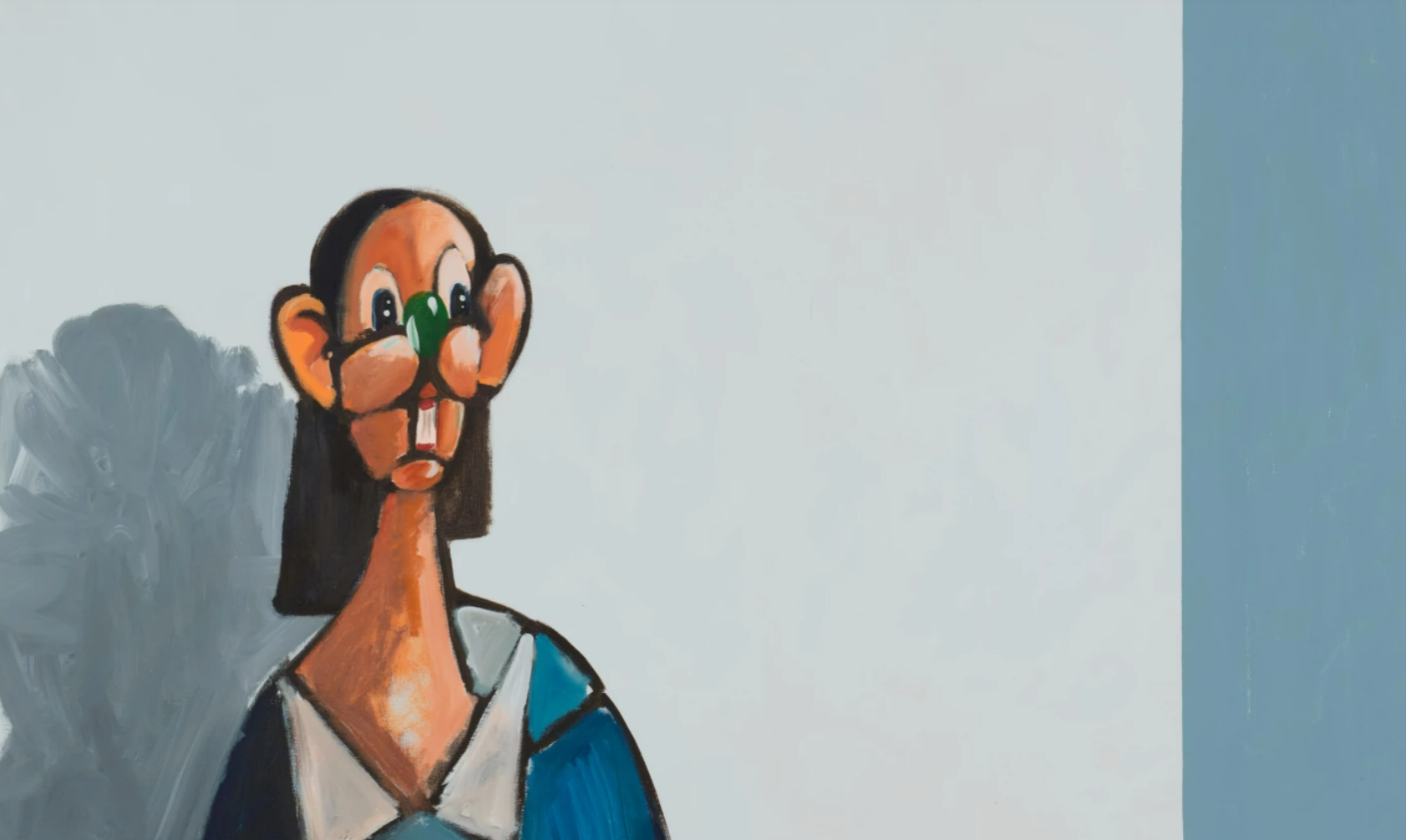
In contrast to the figure’s stark presence, an ominous shadow echoes backwards painted with gentle and refined brushstrokes. The traveler and its shadow are positioned against a crisp geometric background, demonstrating Condo’s mastery of the eighteenth-century Baroque depictions of portraiture as well as the pictorial plane. Condo embodies the dichotomy between past and present by frequently incorporating stylistic influences and formal qualities used by Old Master painters into his own work. Existential Traveler (Girl in Blue Box) elicits a degree of grandeur, glowing against the background. In traditional portraiture the figure is a willing sitter, and the commissioned painter is tasked to conceal any physical or emotive flaws, depicting the sitter at their most prestigious. It is in the revelation of human emotion that Condo pulls the genre of portraiture out of the past and into the present. Here, during a private moment in an unknown city, the girl feebly peers outwards, the precise moment Condo captures in the present work. The girl stands doe-eyed totally unprepared to be observed, challenging the viewer in evoking a degree of art historical charade.
7. Contemporary Day Auction
16 November 2023
Contemporary Evening Auction | 2023 | Sotheby’s (sothebys.com)
Auction Statistics
Total: USD 82,280,860
# Lots: 318
# Lots sold: 265
Sell-Through Rate: 83.3%
Top Lot: USD 3,811,000
33 Lots sold over USD 1 million
USD 243,737,800
(97.3% of total)
Above Estimates: 81 Lots (25%)
Within Estimates: 90 Lots (28%)
Below Estimates: 94 Lots (30%)
Unsold: 53 Lots (17%)
Top 5 Lots
#1. Joan Mitchell
Sotheby’s New-York: 16 November 2023
Estimated: USD 2,800,000 – 3,500,000
USD 3,811,000
Untitled | Contemporary Day Auction | 2023 | Sotheby’s (sothebys.com)
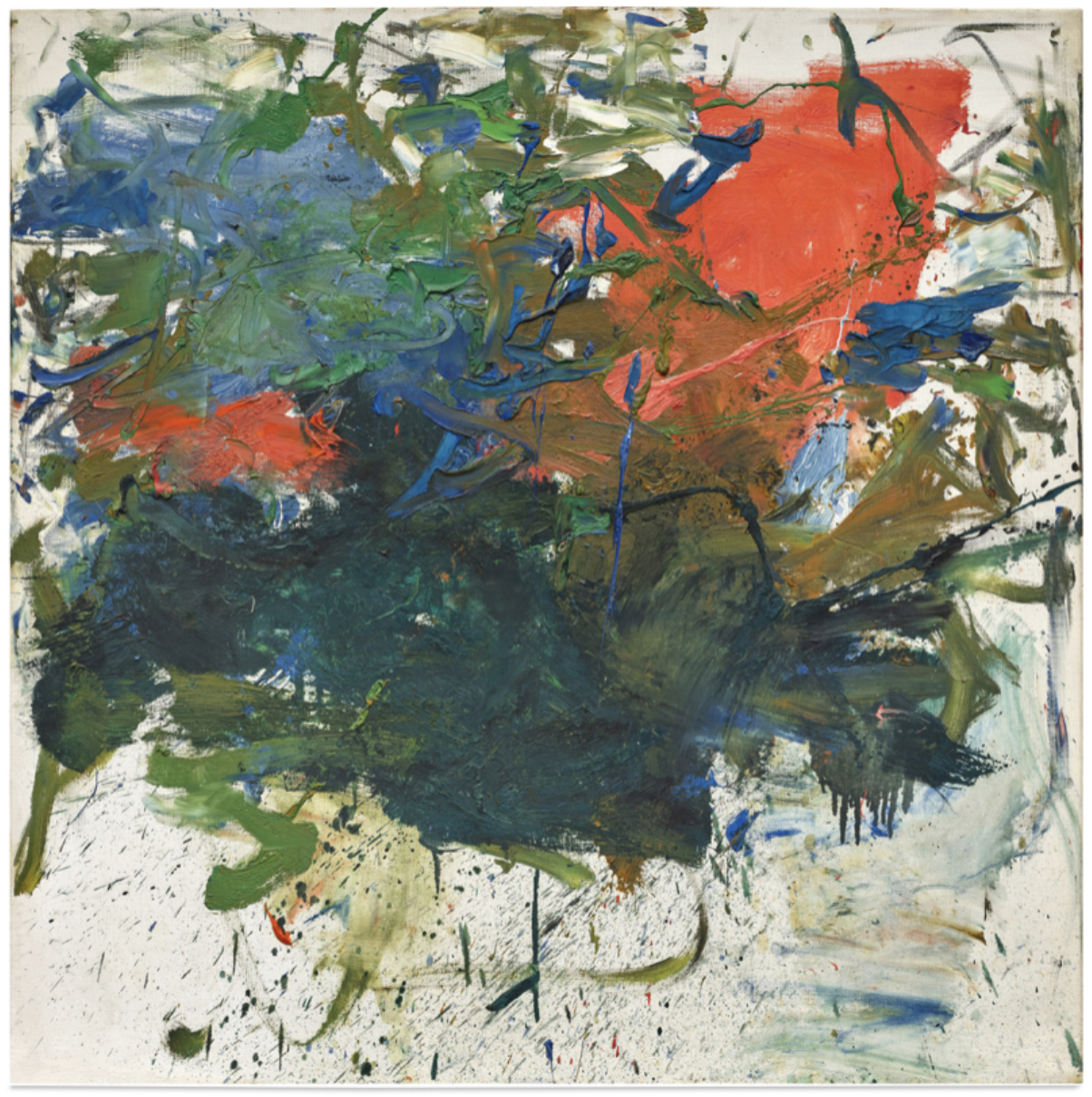
JOAN MITCHELL (1925 – 1992)
Untitled, 1960
Oil on canvas
39 3/8 x 39 3/8 inches (100×100 cm)
A spectacular assault of unrestrained expression and rich color, Untitled encapsulates the full force of Joan Mitchell’s singular abstract vernacular. Executed in 1960, during a critical early moment which is widely considered the most formative period of the artist’s career, Untitled represents the pinnacle of Mitchell’s unique mode of Abstract Expressionism. The present work is distinguished by its exceptional provenance; Untitled was held in the collection of the artist in her lifetime, then going to her Estate and eventually being acquired from the Joan Mitchell Foundation by the present owner, Mitchell’s longtime gallerist, John Cheim. Untitled is further distinguished by its exhibition history, having been included in many notable exhibitions, including Joan Mitchell: Paintings from the Middle of the Last Century 1953-1962 at Cheim & Read in 2018. Across the impastoed surface of the canvas, luscious swathes of radiant reds and blues are tempered by strokes of earthy green which anchor the composition. This rich blend of hues generates fluid suggestions of figure and ground, the component parts of which find harmony through the lyrical choreography and Mitchell’s extraordinary abstract markmarking. For its sheer force of painterly conviction, tactile physicality and complex coloration Untitled is an exceptional example of Mitchell’s highly acclaimed paintings from the early 1960s.
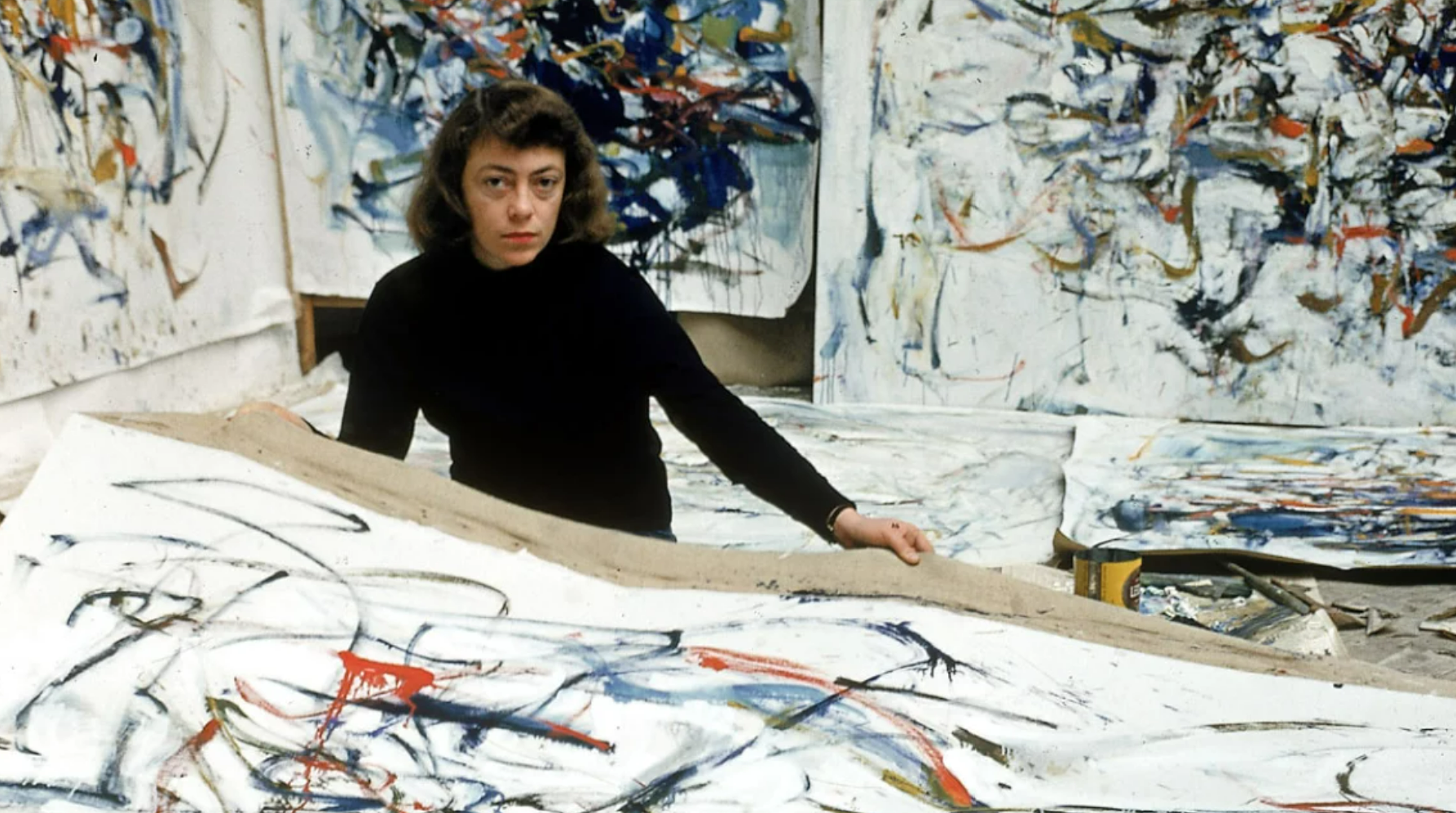
JOAN MITCHELL IN HER STUDIO, PARIS, 1956. PHOTO: LOOMIS DEAN / THE LIFE PICTURE COLLECTION / GETTY IMAGES. ART © ESTATE OF JOAN MITCHELL
The early 1960s simultaneously marked a period of artistic inspiration and deep personal turmoil for the artist and her works from this time, such as Untitled, are characterized by an overwhelming lyrical passion and intimate sentimentality. Her father had passed away in Chicago and her mother was diagnosed with cancer. Beneath her brush, the canvas of Untitled thus transforms into a performative arena, within which Mitchell has staged a furiously orchestrated symphony of chromatic activity, exploring pure expression. Breathtaking in its painterly bravura, Untitled constitutes a remarkable sensory engagement with nature, revealing Mitchell’s artistic fervor and personal turmoil and providing an endlessly engrossing and dynamic visual experience. In the present work, the vitality of nature takes center stage as her energetic brushwork conjures not only the evocation of a landscape, but also stimulates an immersive sensory experience. The present work endures as a beacon of colorful and textural vibrancy, played out on the canvas with a sense of intimacy and urgency that is singular to Joan Mitchell. A veritable tour de force of explosive, painterly expression, Untitled embodies the sublime confluence of emotional urgency, evocative color and form that characterizes the most formidable achievements of Mitchell’s oeuvre.
#2. Cecily Brown
Sotheby’s New-York: 16 November 2023
Estimated: USD 3,000,000 – 4,000,000
USD 2,960,000
One Touch of Venus | Contemporary Day Auction | 2023 | Sotheby’s (sothebys.com)
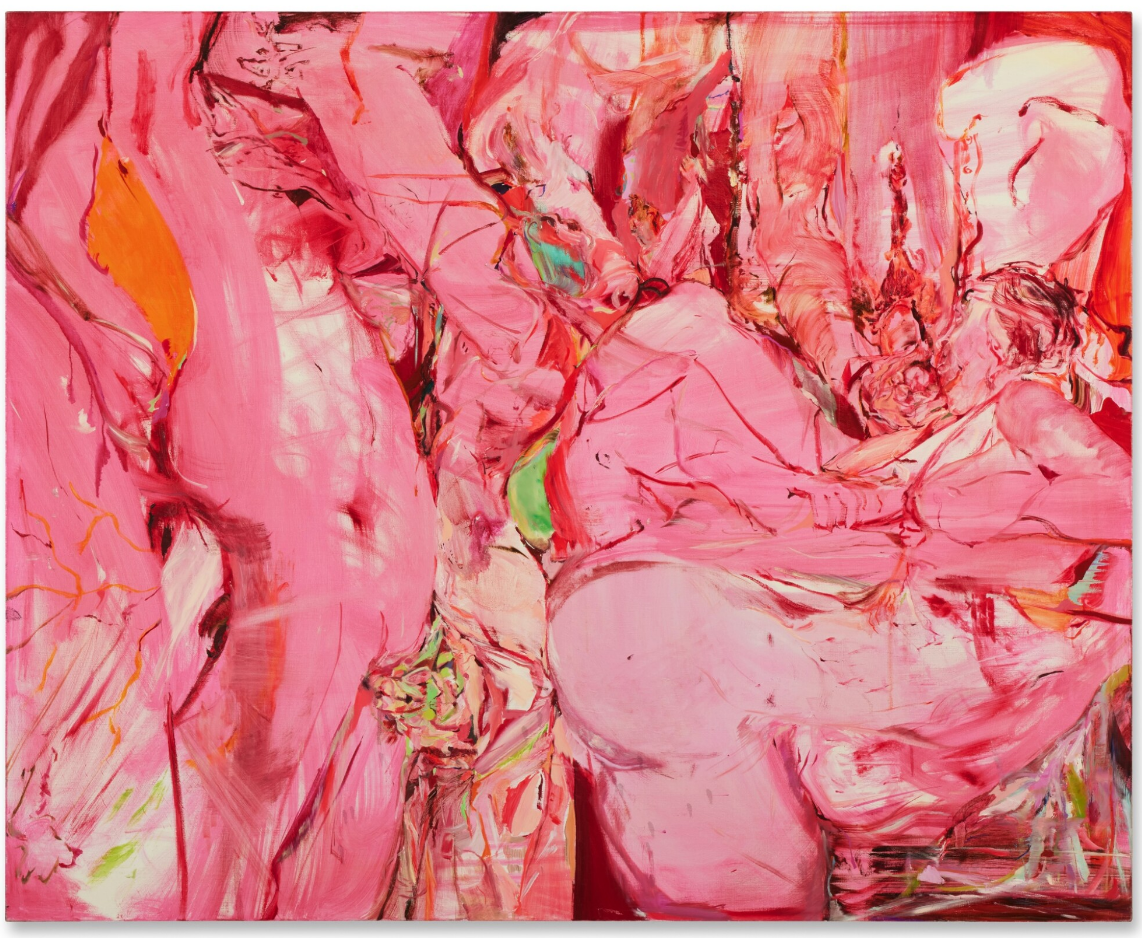
CECILY BROWN (b. 1969)
One Touch of Venus, 1999
Oil on canvas
60 1/4 x 75 inches (153 x 190.5 cm)
Signed and dated 1999 (on the reverse)
An erotically-charged spectacle spanning over six feet in width, Cecily Brown’s One Touch of Venus is a sensational exploration of the artist’s supreme mastery of gestural abstraction. Executed in 1999 and held in the same private collection since that very same year, the present work is entirely fresh to market. A tour de force of expressive markmaking, One Touch of Venus powerfully embodies the seductive fusion of rich abstraction and figurative allusion that has come to define Brown’s thirty-year long oeuvre. Immersing the viewer in a mesmerizing choreography of bubblegum pinks, fuchsias, and magentas, One Touch of Venus erupts in a cacophony of sumptuous color and movement, offering an enticing glimpse onto an unknown scene before evanescing into sheer painterly energy. The viewer is confronted by colliding pigment, forming a composition that is in a continual state of flux. Glimpses of undulating nude bodies mingle with broken rhythms of smaller brushstrokes, melting and morphing into the topography of Brown’s brushwork before vanishing altogether. Though she obfuscates any semblance of a clear narrative, her tactile handling of paint nevertheless commands the elusive power of suggestion, imbuing the work with a unique ebb and flow of chaotic sexuality.
#3. Lee Bontecou
Sotheby’s New-York: 16 November 2023
Estimated: USD 1,200,000 – 1,800,000
USD 2,722,000
Untitled | Contemporary Day Auction | 2023 | Sotheby’s (sothebys.com)
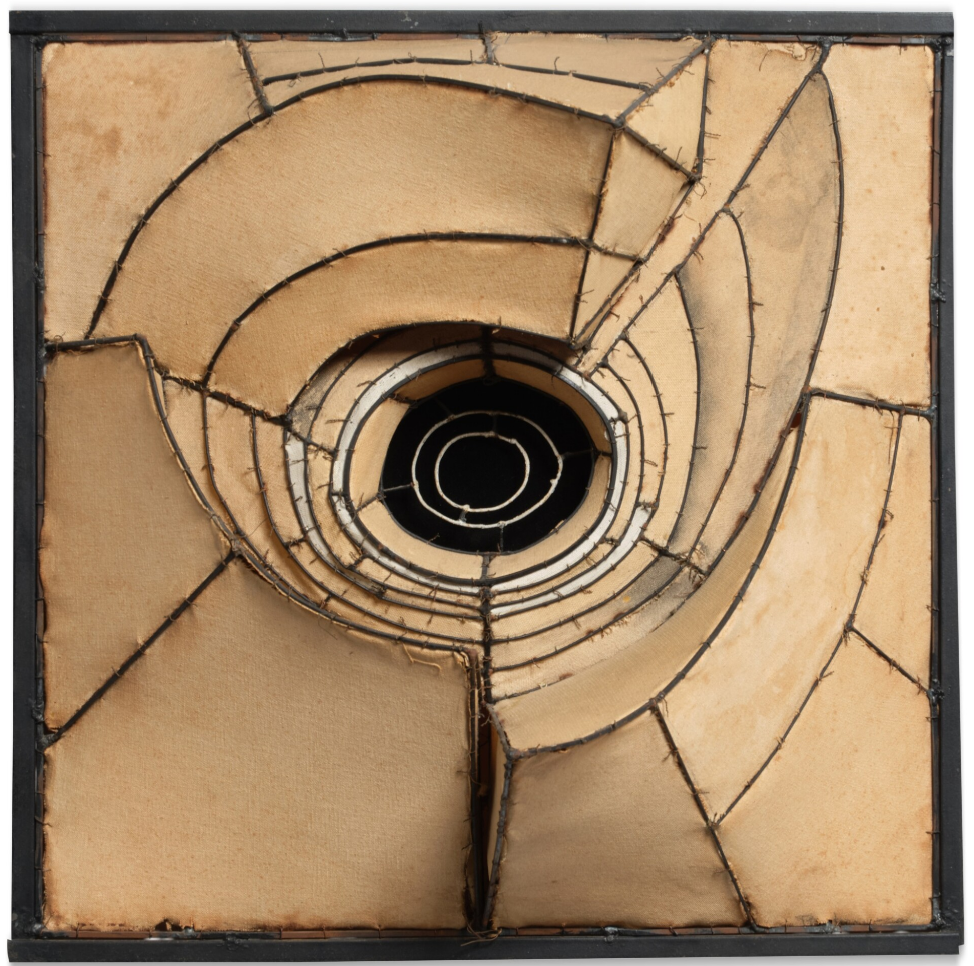
LEE BONTECOU (1931 – 2022)
Untitled, circa 1958
Welded steel, canvas and wire
20 1/2 x 20 1/4 x 9 inches (52.1 x 51.4 x 22.9 cm)
Lee Bontecou’s masterful ability to condense the dreams, anxieties, and fears of her time into sculptural form solidified her as one of the most fiercely individual artists of the mid-twentieth century. A sublime example of her most celebrated body of work, Untitled represents Bontecou’s uninhibited exploration of the organic and mechanical, abstraction and figuration, reality and fantasy. Bearing exceptional provenance, Untitled has remained a part of the collection of Richard and Kathy Feld, who were friends of the artist, since 1987. The power of Lee Bontecou stems from her fascination with the paradoxes of the human condition: in her own words, a long standing desire to express “as much of life as possible—no barriers—no boundaries—all freedom in every sense.” Employing an organic use of form–largely reminiscent of the Abstract Expressionist painters whom she describes as having energized her spirit–Bontecou forged a culturally inspired lexicon. The powerful authenticity of Lee Bontecou afforded her a singular and unprecedented position in the New York art scene: the sole female artist in Leo Castelli’s stable of artists throughout the 1960s, amongst the likes of Roy Lichtenstein, Jasper Johns, Frank Stella, Donald Judd and James Rosenquist. A pioneer in terms of both the moment and her method, Bontecou proudly stood at a historical crossroads. At once futuristic and fossil-like, graphic and rich, weighty and weightless, Untitled is a fascinating response to the unknown, the wondrous, and the sublime.
#4. Andy Warhol
Sotheby’s New-York: 16 November 2023
Estimated: USD 1,000,000 – 1,500,000
USD 2,359,000
Head (After Picasso) | Contemporary Day Auction | 2023 | Sotheby’s (sothebys.com)
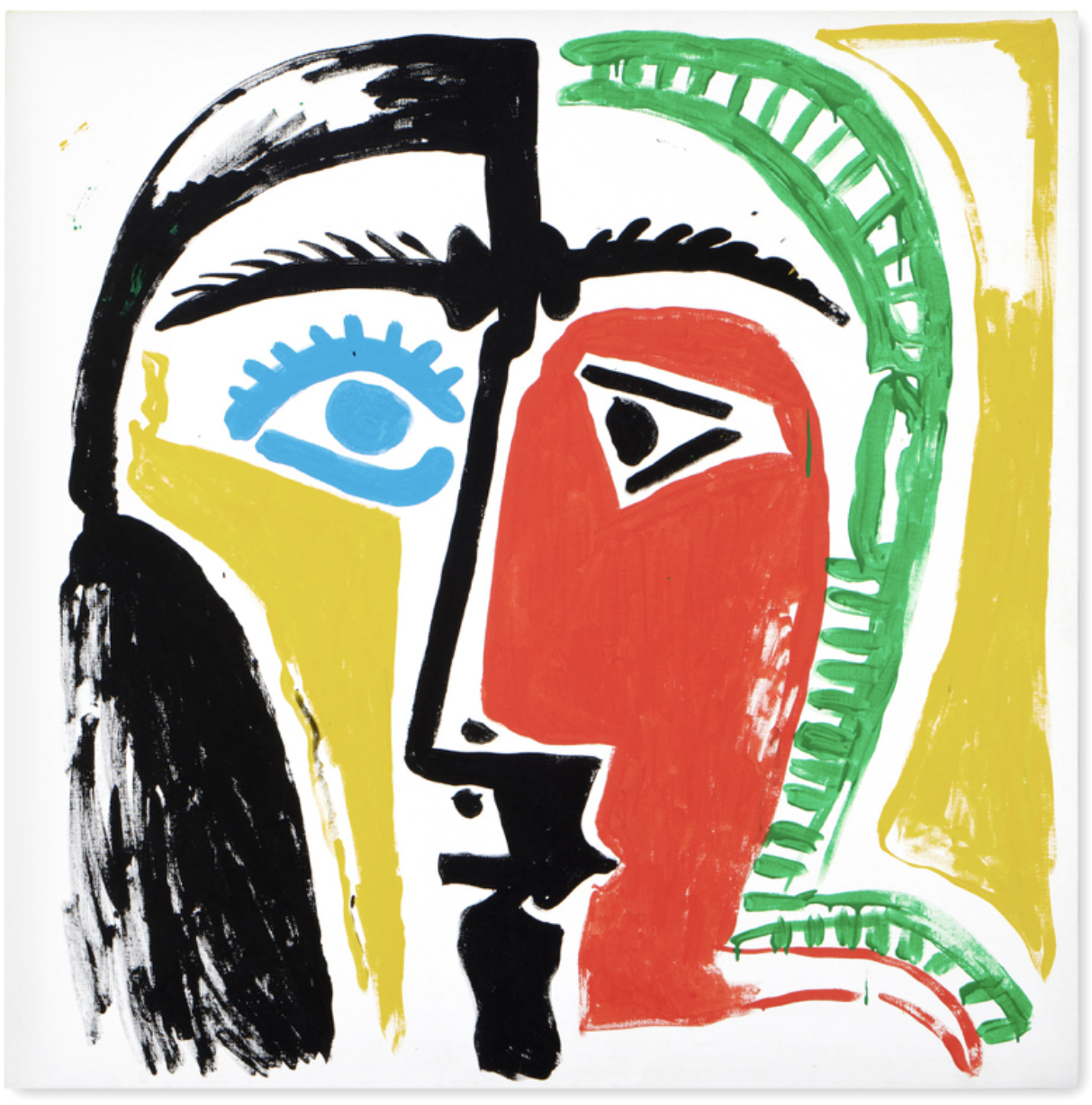
ANDY WARHOL (1928 – 1987)
Head (After Picasso), 1985
Acrylic on canvas
50×50 inches (127×127 cm)
Stamped by the Estate of Andy Warhol and the Andy Warhol Foundation for the Visual Arts Inc., New York and numbered PA37.022 on the overlap
A spectacular convergence between two of history’s most significant artists – Andy Warhol and Pablo Picasso – the present work, Head (After Picasso) from 1985, is an exceptional and conceptually profound work from the latter part of Andy Warhol’s career. In the mid-1980s, after two decades of re-establishing the definition of high art, and armed with the assurance of his own success as a major player of 20th century art, Warhol began to look at the encyclopedic inventory of old masters such as Giorgio de Chirico, Georges Matisse, Sandro Boticelli and of course Pablo Picasso, placing himself amongst their ranks. A profound exhibition at the Whitney Museum of American Art in New York in 1978 entitled, Art about Art, brought to the fore the abundance of art historical references in works by artist’s of Warhol’s own generation such as Robert Rauschenberg and Roy Lichtenstein. Furthermore, by this time, the art of appropriation was flourishing in the hands of younger artists, particularly homages to Picasso, ranging from Robert Colescott’s re-contextualizing of race in Demoiselles d’Avignon (1985) or Mike Bidlo’s scrupulous imitation of Guernica (1984) and his Picasso Women show at Leo Castelli in 1988.
THE PRESENT WORK EXHIBITED AT PARIS, THADDAEUS ROPAC, ANDY WARHOL HEADS (AFTER PICASSO), MAY – JULY 1997.
Warhol’s first foray in painting from the art historical canon was in 1963 when he reproduced Leonardo’s Mona Lisa – undoubtedly the most famous face in all of art history. Exhibited at the Metropolitan Museum in New York the work attracted significant media attention, the fact of which drew in Andy Warhol more so than the painting itself. Warhol subsequently revisited many of the most renowned and recognized works in the history of art by Sandro Botticelli, Edvard Munch, Henri Matisse and Pablo Picasso by repainting, repeating, and renewing these masterpieces in his distinctive and revolutionary aesthetic. When asked whether there is a difference between images taken from advertising, as he had done in his works from the 1960s and 70s, and those taken from art history, Warhol stated, “They are both images. One relates to products, the other to people, or historical events. Both are means of communication… I watch advertising just as much as I go to museums.” (Warhol verso de Chirico, New York, 1982, pp. 48-49).
THE PRESENT WORK USED AS A FLYER INSERT IN A SCHOLASTIC INSTRUCTOR MANUAL FOR A SERIES ENTITLED MASTERPIECE OF THE MONTH
Following a period of collaboration with Jean-Michel Basquiat in the mid-1980s, Warhol’s enjoyment for painting was revived and led him to an intensive study of Picasso’s work which eventually culminated in this series of Head (After Picasso). Taking as his point of departure Pablo Picasso’s work on paper, Tête, from 1960 (Christian Zervos, Pablo Picasso, Vol. XIX, no. 392, p. 188, illustrated), Warhol reproduced the image in vibrant reds, greens and yellows onto canvas. For this series, however, Warhol’s method differed significantly from his usual practice of screenprinting which had dominated his practice since the early 1960s. Here, Warhol instead projected a transparency onto the canvas of the black and white reproduction of Picasso’s original picture and sketched an outline of the enlargement. Rather than copying it intricately, Warhol instead used brushy and boldly interpretative strokes to retrace the contours and of the figure. The result is an almost poetic conflagration of the painterly and the precise. Warhol’s bold use of primary colors to present a Tête de femme which is so gesturally wrought results in something entirely unique. Neither entirely Warhol, nor entirely Picasso, Head (After Picasso) encourages us to think critically about Warhol’s artistic project. Here Warhol is encouraging us to reconsider portraiture, which historically in his output is a reflection on a particular person, a celebrity or society dilettante and their specific identity. In Head (After Picasso), Warhol is entirely redefining the context for this portrait, concerned with neither the identity of the sitter nor their comportment, but rather the loss of original identity through a physical and conceptual transformation.
#5. Roy Lichtenstein
Sotheby’s New-York: 16 November 2023
Estimated: USD 1,200,000 – 1,800,000
USD 1,996,000
Woman Contemplating Yellow Cup | Contemporary Day Auction | 2023 | Sotheby’s (sothebys.com)
ROY LICHTENSTEIN (1923 – 1997)
Woman Contemplating Yellow Cup, 1995
Paint and pigmented wax on aluminum
71 3/4 x 84 x 1 1/2 inches (182.2 x 213.4 x 3.8 cm)
Incised with the artist’s signature, date ’95 and number 3/6 (lower left)
This work is number 3 from an edition of 6
Woman Contemplating Yellow Cup is a testament to the brilliance, conceptual rigor, and ceaseless reinvention of craft that defines his artistic career. Embodying his characteristic sense of irony, Roy Lichtenstein playfully subverts the three-dimensional nature of sculpture in the present work. Executed in 1995 – the decade during which Lichtenstein would produce more dispersed and open-ended sculpture than ever before – Woman Contemplating Yellow Cup fuses the artist’s career-long fascination with both the female form and the domestic realm. Intentionally voyeuristic in its compositional nature, the viewer must assume the position of onlooker and peer over the shoulder of our singular and anonymous female character. Lichtenstein’s quintessential Benday dots pepper the woman’s cheek and spill further into the living space, cementing her as fully immersed in the tableau. Strikingly flat and reduced, Siegfried Gohr notes of Lichtenstein’s Women series: “Their artificiality cancels out the threatening aspect of female sexuality for a male gaze. And the sophisticated visual strategy pursued by Lichtenstein creates another perceptual problem: In the studio pictures and his other interiors he never makes it clear whether these are real women or works of art, reflections in mirrors or projected images, or fantasy figures whose slimness carries subliminal phallic connotations. These images of images, abstracted and transformed into ciphers, make us feel we are witnessing the union of painting with beauty. We are not deprived of this illusion immediately because the artist’s shaping hand grants everything a grain of truth without establishing absolute truths” (Siegfried Gohr, “Muses in Life and Art – Roy Lichtenstein’s Paintings of Women” in Exh. Cat., Bregenz, Kunsthaus Bregenz, Roy Lichtenstein – Classic of the New, June – September 2005, p. 81). Packed with references to his own seminal bodies of work as well as the history of Modernism, Woman Contemplating Yellow Cup represents a pivotal moment in Roy Lichtenstein’s mature output and career-long investigation of the art and artifice of twentieth-century society.
ROY LICHTENSTEIN WITH WOMAN CONTEMPLATING A YELLOW CUP IN HIS NEW YORK STUDIO, 1995
Woman Contemplating Yellow Cup features only the most pared-down, essential details of interior design. The simplicity of the scene is drawn not from a life study, but is instead mediated through the artist’s collection of printed source material: monotone newspaper and Yellow Pages advertisements for carpets, draperies, windows, sliding doors, lamps, sofa sets, and the like, which Lichtenstein cut out and pasted into notebooks. Lichtenstein begins his sculptural process on the page, with pencil sketches and color studies, then assesses his designs in a full-scale maquette before constructing the final work. Remarkable in its technical complexity and tremendous scale, the present aluminum wall relief is a collaborative feat, as achieved by Lichtenstein with the aid of artist scholar and innovator Donald Saff. In 1995, Saff proposed a new technique to Lichtenstein for combining metal and pigmented wax, ultimately “morphing a painting into a sculpture” (Roy Lichtenstein, “A Review of My Work Since 1961 – A Slide Presentation (November 11, 1995)” in Graham Bader, Roy Lichtenstein (October Files), Cambridge, 2001, p. 70). Through this radical development, he married flat symbols of perspective with three-dimensional objects. In the forthright embrace of negative space and paradox, Lichtenstein further invented his own brand of perception.
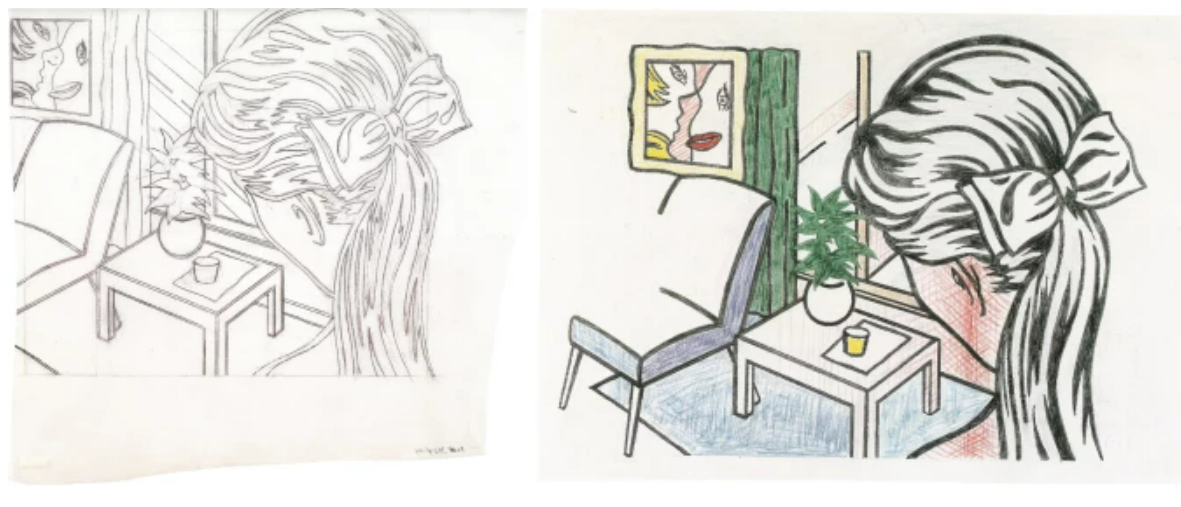
LEFT: DRAWING FOR SCULPTURE: US LOOKING AT GIRL LOOKING AT YELLOW CUP, 1994. ART © ESTATE OF ROY LICHTENSTEIN
RIGHT: DRAWING FOR SCULPTURE: US LOOKING AT GIRL LOOKING AT YELLOW CUP, 1994 [LATER TITLED WOMAN CONTEMPLATING A YELLOW CUP]. ART © ESTATE OF ROY LICHTENSTEIN
Lichtenstein’s sculptural output during the nineties is best recognized for its immense combinatory skill. Through the seamless melding of objects and figures, each component of the Interior compositions are considered equal. In his characteristically reductive manner, the artist translates furnishings such as Arco lamps and chairs by Saarinen into symbols of “modern” furniture, rendering them in his own vocabulary of graphic forms. Coolly temperate in his pictorial strategy of the 1990s, Lichtenstein’s women appear as items of decoration, contrasting with the human emptiness of the rooms themselves. Filled with quotations of elements of earlier paintings, Woman Contemplating Yellow Cup reincorporates Lichtenstein’s still life subjects–a practice of his output dating back to the 1960s. Historically referential, the reflection in the mirror is not of our female subject, but rather a Pop Art interpretation of one of Picasso’s female muses, hailing from his surrealist period. Through layered perspectives and a disorienting spatial organization, the hallmarks of Lichtenstein’s most iconic paintings are cast anew in this unprecedented exploration of space.
Other Highlights
Jean-Michel Basquiat
Sotheby’s New-York: 16 November 2023
Estimated: USD 1,200,000 – 1,800,000
USD 1,512,000
Untitled (Bad Tooth and Ivory) | Contemporary Day Auction | 2023 | Sotheby’s (sothebys.com)
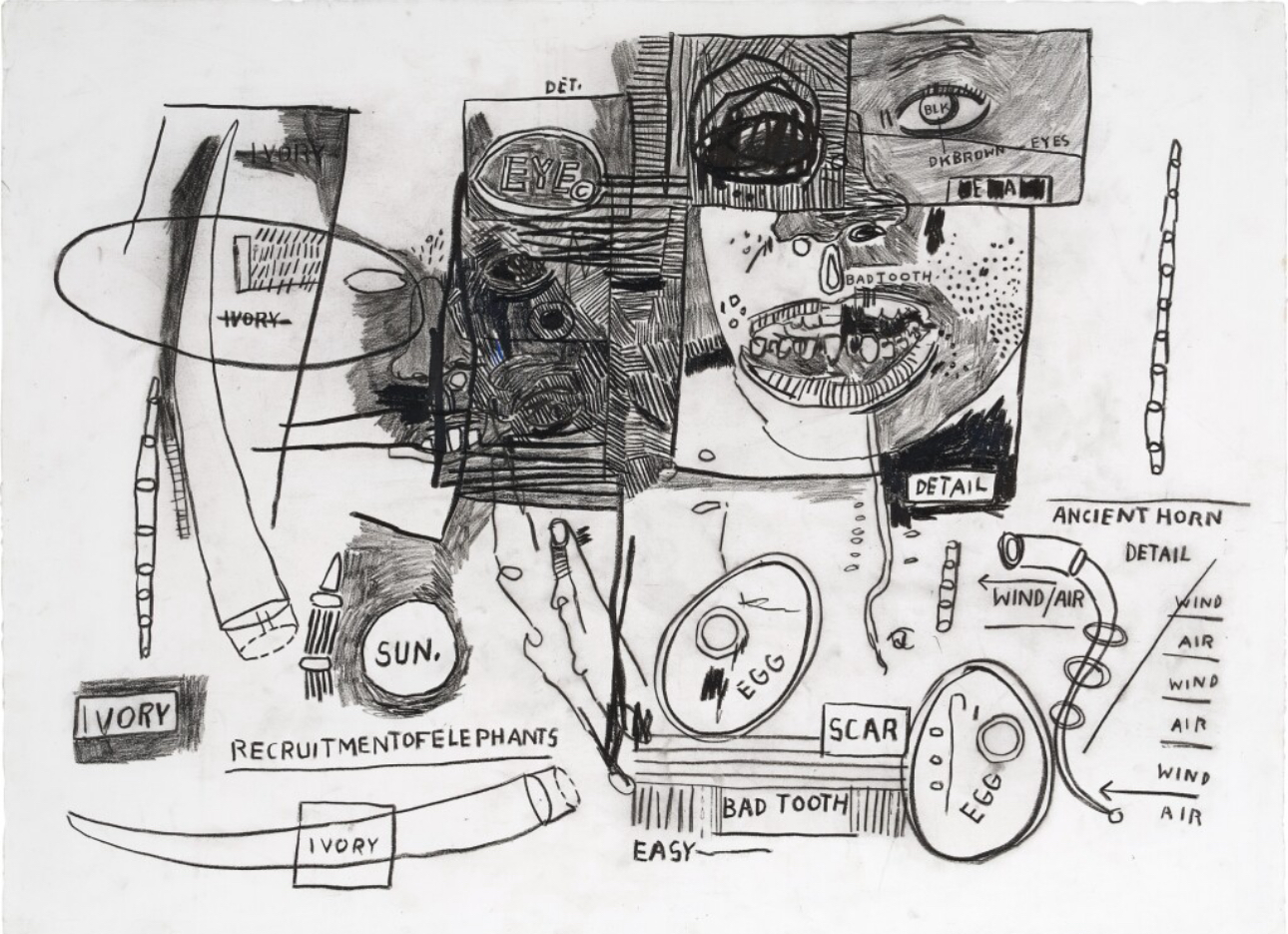
JEAN-MICHEL BASQUIAT (1960 – 1988)
Untitled (Bad Tooth and Ivory), circa 1984
Oil stick and graphite on paper
22×30 inches (55.9 x 76.2 cm)
Executed at the peak of Jean-Michel Basquiat’s career, Untitled (Bad Tooth and Ivory) offers a glimpse into the artist’s energetic, imaginative and ingenious mind. The present work illustrates a masterful combination of symbols, words and figures that are instantly recognizable features of Basquiat’s oeuvre. In comparison to his paintings, the frenetic energy and immediacy of Basquiat’s works on paper are unique in their ability for Basquiat’s creative prowess to be presented in a completely unaltered fashion. In Untitled (Bad Tooth and Ivory), Basquiat substitutes perspectival accuracy and spatial recession for a pronounced flatness and a distinct emphasis upon bold colour and expression. The present work is imbued with many of Basquiat’s signature motifs – the skull, eggs, anatomy and words such as “IVORY,” “BAD TOOTH,” “BLK,” and “EGG,” among others. The image of the skull is seemingly a personal gesture alluding to a childhood incident in which the artist was hit by a car while playing on the street, and subsequently hospitalized for serious internal injuries and broken limbs. While recuperating after the accident, Basquiat received a copy of Grey’s Anatomy as a gift from his mother, and the myriad anatomical and skeletal images exhibited in the book undoubtedly informed his own visual inventory as he became a working artist. While the image of the skull offers a persisting reminder of the fragility of the human body, it is also a significant symbol of Basquiat’s own childhood trauma and near-encounter with death.
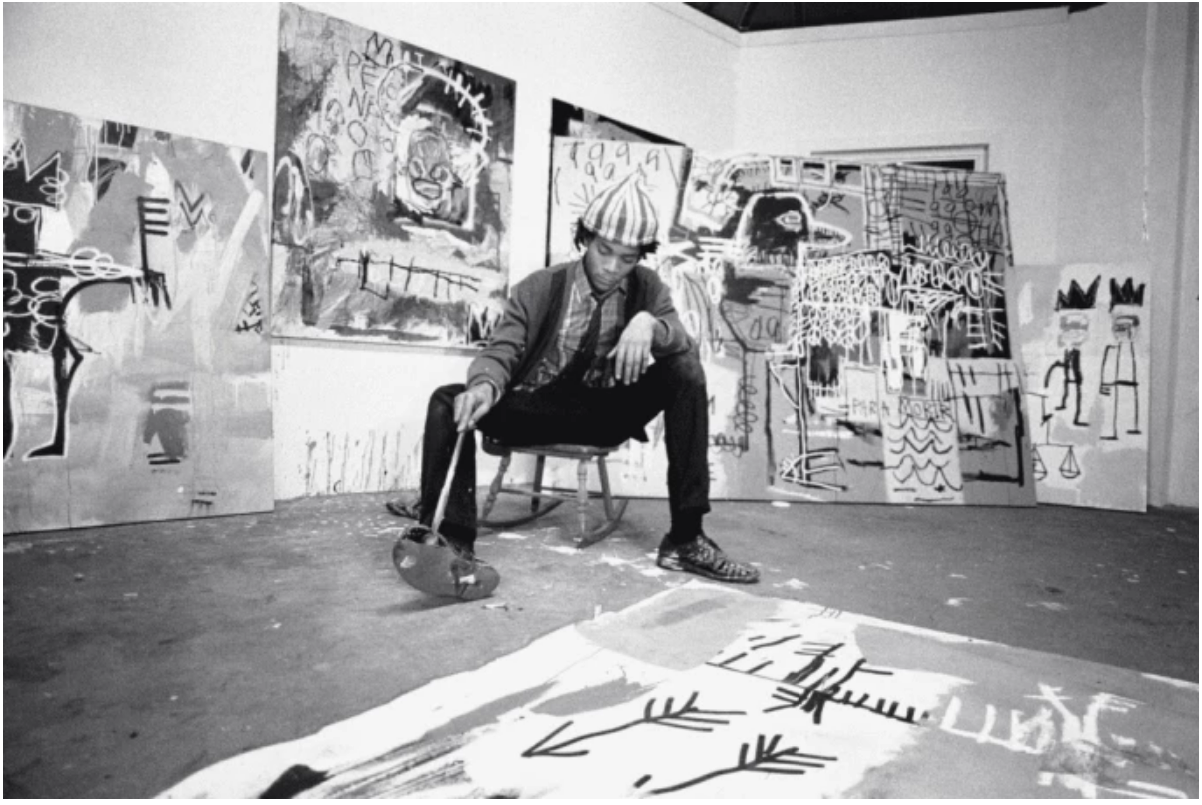
JEAN-MICHEL BASQUIAT, NEW YORK, C. 1981 © PIERRE HOULÈS
The composition of Untitled (Bad Tooth and Ivory) features several separate “close-ups,” window boxes, much like one would find surrounding a complex image in an anatomy textbook. Each box, or “detail” as Basquiat has titled them, is accompanied by text that labels the details in specific ways: a tooth is a “BAD TOOTH,” an eye covered in black line and another with “BLK” written inside of it are “dark brown eyes.” In typical Basquiat fashion, text and image build upon one another to add layered meanings to the composition, with motifs such as “EGG” appearing in his other compositions like the piece he completed with Andy Warhol the same year. As a result of the collaboration between text and image, the central face is transformed into a product whose individual parts are indispensable to viewing the whole, and whose descriptors are necessary to understanding the full meaning of the figures.
Yayoi Kusama
Sotheby’s New-York: 16 November 2023
Estimated: USD 1,200,000 – 1,800,000
USD 1,391,000
Dots Obsession | Contemporary Day Auction | 2023 | Sotheby’s (sothebys.com)
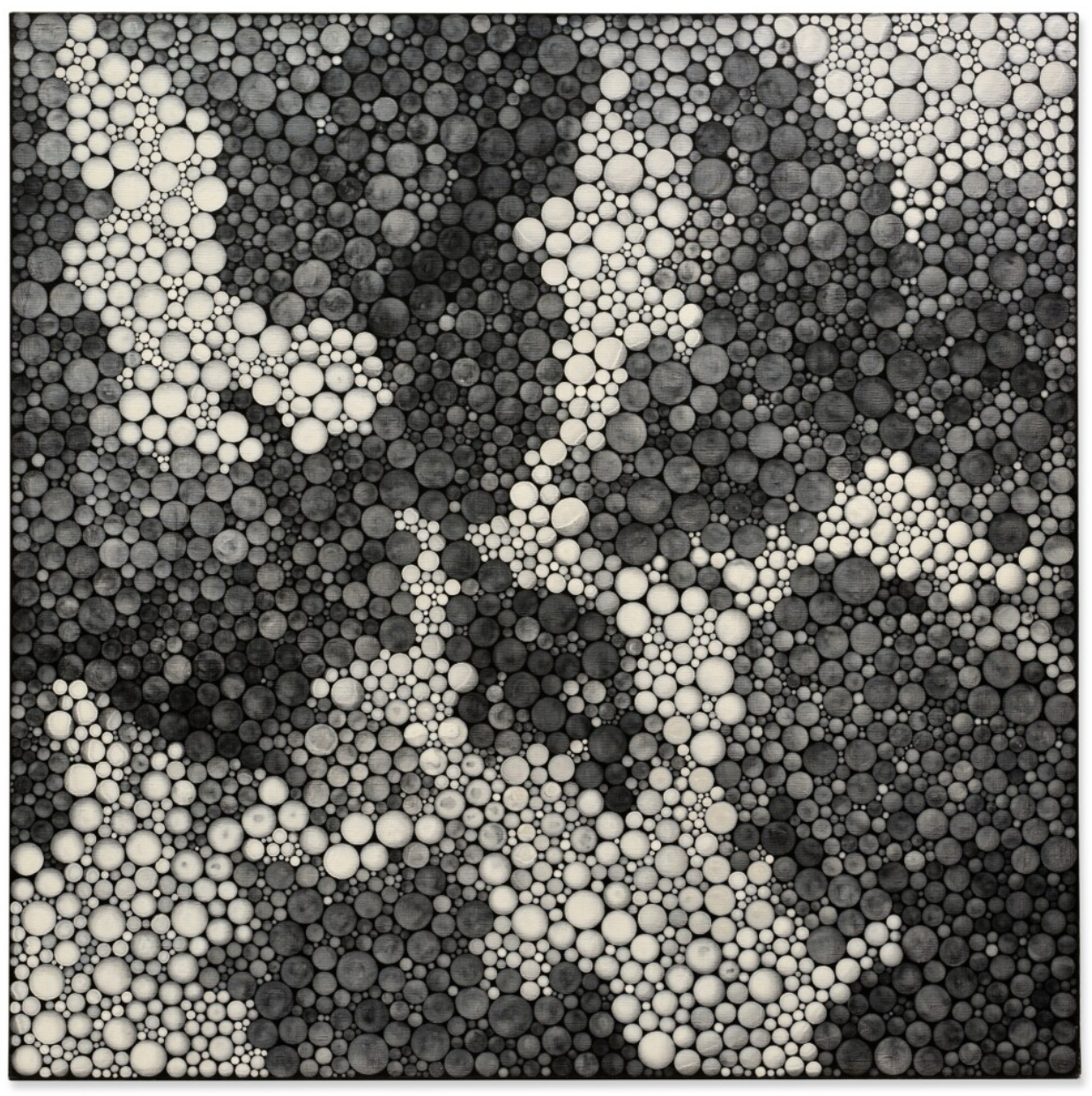
YAYOI KUSAMA (b. 1929)
Dots Obsession, 2004
Acrylic on canvas
145.4 x 146.1 cm (57 1/4 x 57 1/2 inches)
Signed, titled and dated 2004 (on the reverse)
Yayoi Kusama’s kaleidoscopic clusters reach their zenith in Dots Obsession, a large-scale example from the artist’s Dot series executed in 2004. A measured combination of white and gray polka dots undulates across the surface of the canvas creating a vertiginous illusion. Fastidious circles of varying sizes and tones cover every inch of canvas, pulsating with energy like organisms under a microscope. Rendered in grisaille, the present work ushers us through a looking glass into the hallucinatory visions that have plagued Kusama’s psyche since she was a little girl. Born in Matsumoto, Japan in 1929 to a merchant family who disapproved of her artistic aspirations, beginning at the age of 10 Yayoi Kusama would experience fleeting hallucinations; flashes of light, landscapes of dots and engulfing patterns would consume her field of vision. The artist famously recounted a childhood memory of a tablecloth with red flowers that tessellated onto the ceiling, walls and even her own body. Recalling her complete resignation to the hallucination, she says ‘the room, my body, the entire universe was filled with [patterns], my self was eliminated, and I had returned and been reduced to the infinity of eternal time and absolute space. This was not an illusion but a reality (Y. Kusama, quoted in L. Hoptman, Yayoi Kusama, London 2000, p. 36). To cope with her psychosomatic anxiety, Kusama obsessively painted her fearscapes resulting in a mesmerizing visual idiom of nets and dots stretching to infinity. She refers to this monotonous, yet cathartic, process as self-obliteration.
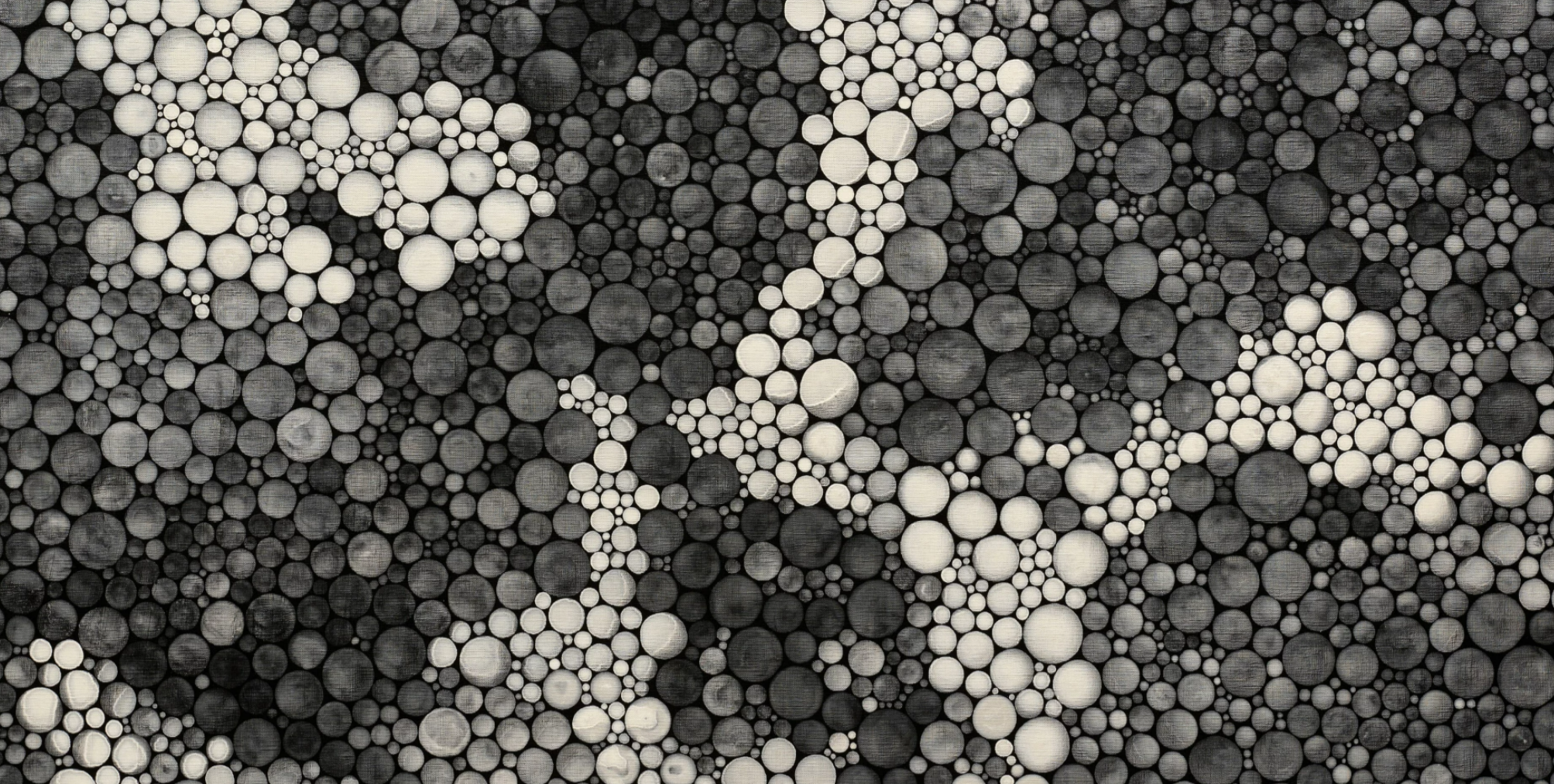
While far more compositionally complex than her early paintings, Dots Obsession, painted in 2004, hearkens back to Kusama’s earliest works from the 1950s. Over the course of 70 years, Kusama has steadfastly pursued themes of abstraction, ethereality and infiniteness with unerring continuity and unrelenting determination. She has refined her idiosyncratic and obsessive language, manipulating and multiplying her dots to the nth degree in large scale installation, painting, sculpture, fashion design and writing.
Jean-Michel Basquiat
Sotheby’s New-York: 16 November 2023
Estimated: USD 1,000,000 – 1,500,000
USD 1,270,000
Cannon (Act 1) | Contemporary Day Auction | 2023 | Sotheby’s (sothebys.com)
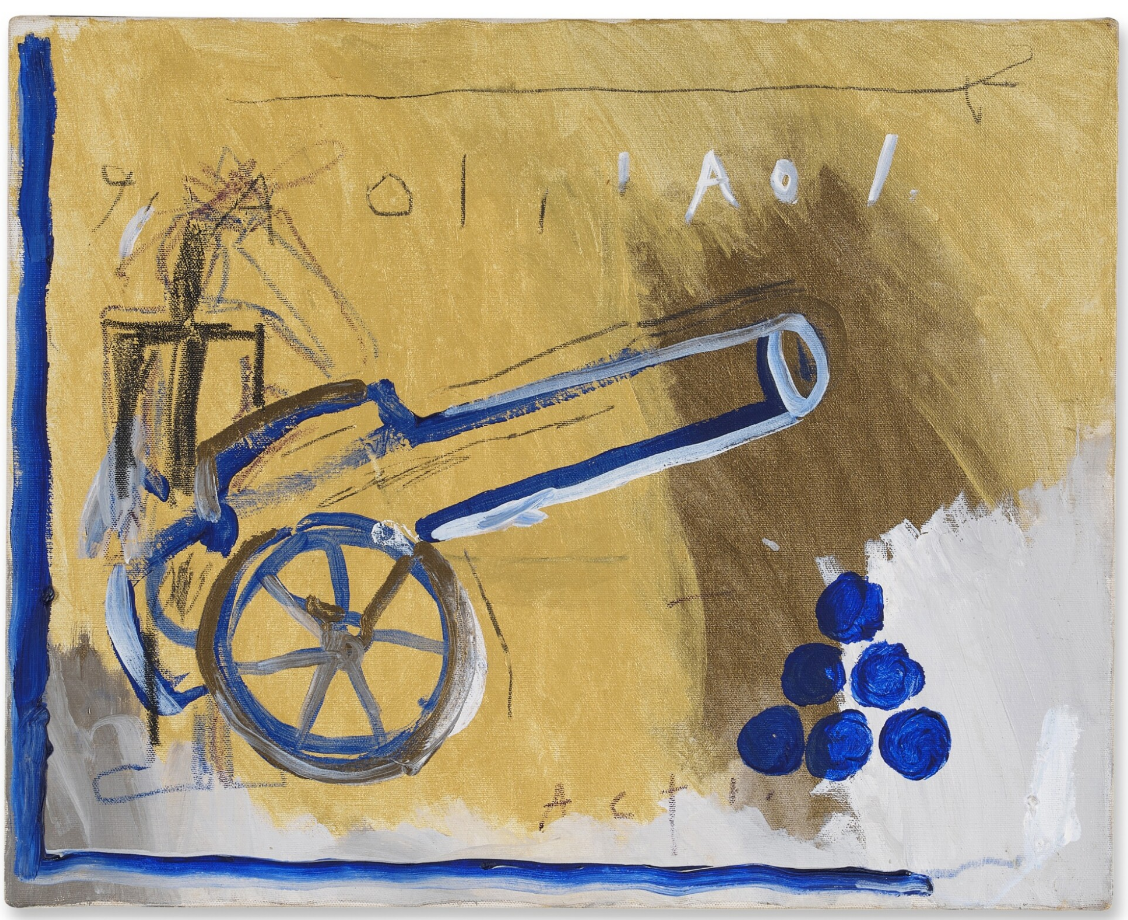
JEAN-MICHEL BASQUIAT (1960 – 1988)
Cannon (Act 1), 1981
Acrylic and oil stick on canvas
16×20 inches (40.6 x 50.8 cm)
Executed in 1981, Jean-Michel Basquiat’s Cannon (Act 1) chronicles a seminal year within the artist’s illustrious career. Characterized by raw expressionistic force and frenetic fervor, the present work stands as an intimate example of Basquiat’s early style at its very best. The frenzied composition erupts in a cacophony of expressive mark making, teeming with rich color and energy, while harnessing a myriad of references that evoke the language of a city in glorious disarray. The year 1981 marked a pivotal moment for Basquiat’s artistic career, setting the stage for his meteoric rise in art world. Prior to this year, his work was never exhibited or considered in a formal setting. However, in January, he took part in the now infamous multi-disciplinary show New York/New Wave hosted at the alternative gallery space, P.S.1. Even against the eclectic background of this exhibition, which celebrated the hip-hop, graffiti, and break-dancing cultures of New York, Basquiat’s work stood out. That same year, Annina Nosei invited Basquiat to join her gallery, and he subsequently occupied her basement as a studio for the majority of the year. In December, Artforum published Rene Ricard’s landmark essay The Radiant Child, defining Basquiat as one of the most important artists of his generation and shedding light on the East Village gallery scene of the early 1980s. It is against this backdrop that Cannon (Act 1) comes to fruition, taking its place in Basquiat’s narrative, on the cusp of a grandiose paradigm shift: From streets and subway trains to galleries and museums, from spray cans to brushes, and from brickwork to canvas. As its title suggests, the present work indeed symbolizes the opening act of a historic story — one which would chart the most prolific years of the artist’s career until his untimely death in 1988. Radically raw and evocative, Canon (Act 1) is a rare example of the confidence and dynamism with which the young artist, at only twenty-one years old, asserted his entry to the international art world.
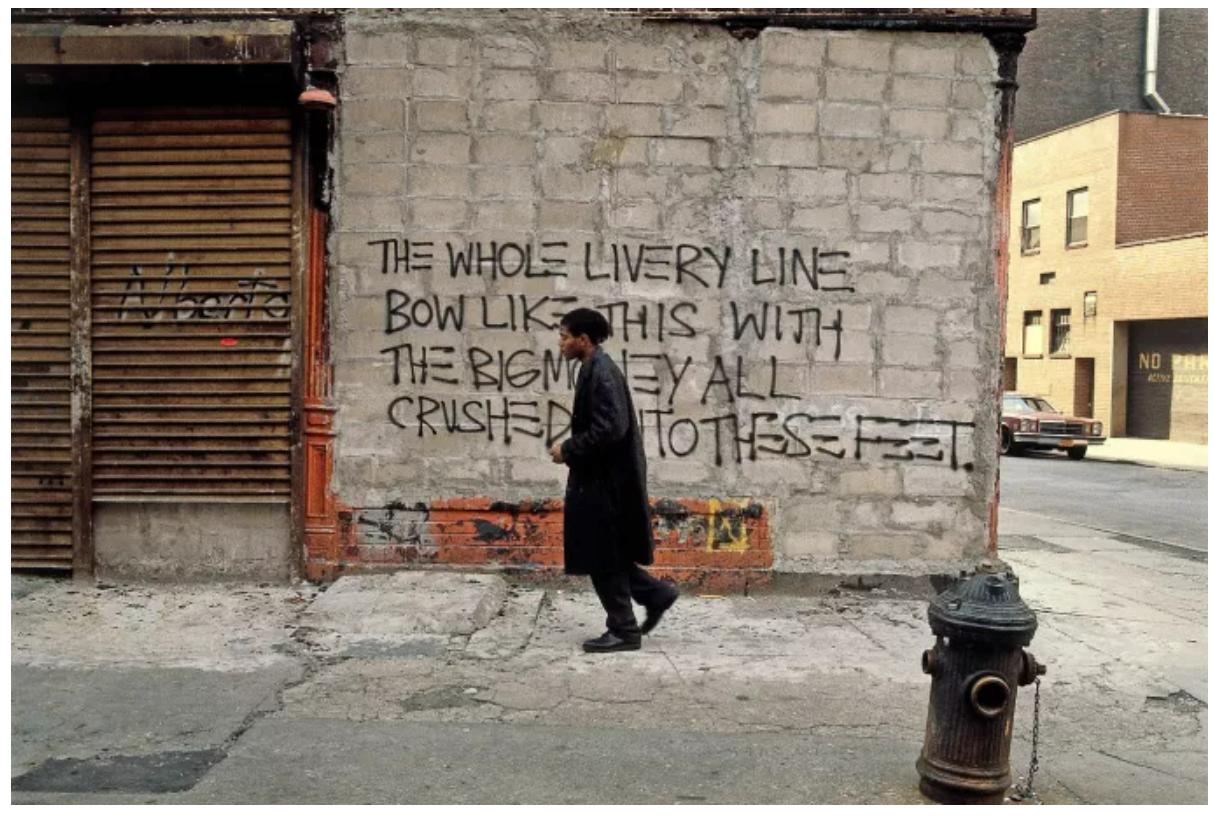
JEAN-MICHEL BASQUIAT ON THE SET OF DOWNTOWN 81, 1980-81. IMAGE: © EDO BERTOGLIO.
Cannon (Act 1) displays a great physicality of brushwork, as waves of gray and earthy brown clash with a rich gold background. As its title suggests, an imposing cannon mounted on a spoked wheel dominates the composition, its barrel pointing upwards and to the right. Crudely rendered in overlapping brushstrokes of cobalt, white, and raw umber, the cannon is primed for use, with six cannonballs neatly stacked in a pyramid nearby, poised to be loaded. Towering behind the cannon is a ghostly abstracted figure; scribbled in black, the scrawled figure teeters on the threshold of legibility, reflecting the near vertiginous speed with which Basquiat rendered his visual lexicon. Arm raised up, the figure’s faint gestures indicate a sense of readiness to operate the artillery when the proper moment arises. Thus, in its crescendo of rich color and painterly gesture, Cannon (Act 1) captures the palpable tension just before explosion, the thrilling moment before the breaking of the sound barrier. Taking an object of great power and clamor as his subject, Basquiat presents a visual counterpart to the perpetual noise, energy, and chaos of New York, offering a reflection of the bustling urban environment that inspired his artistic explorations.
Fernando Botero
Sotheby’s New-York: 16 November 2023
Estimated: USD 600,000 – 800,000
USD 1,270,000
Desnudo ante el espejo | Contemporary Day Auction | 2023 | Sotheby’s (sothebys.com)
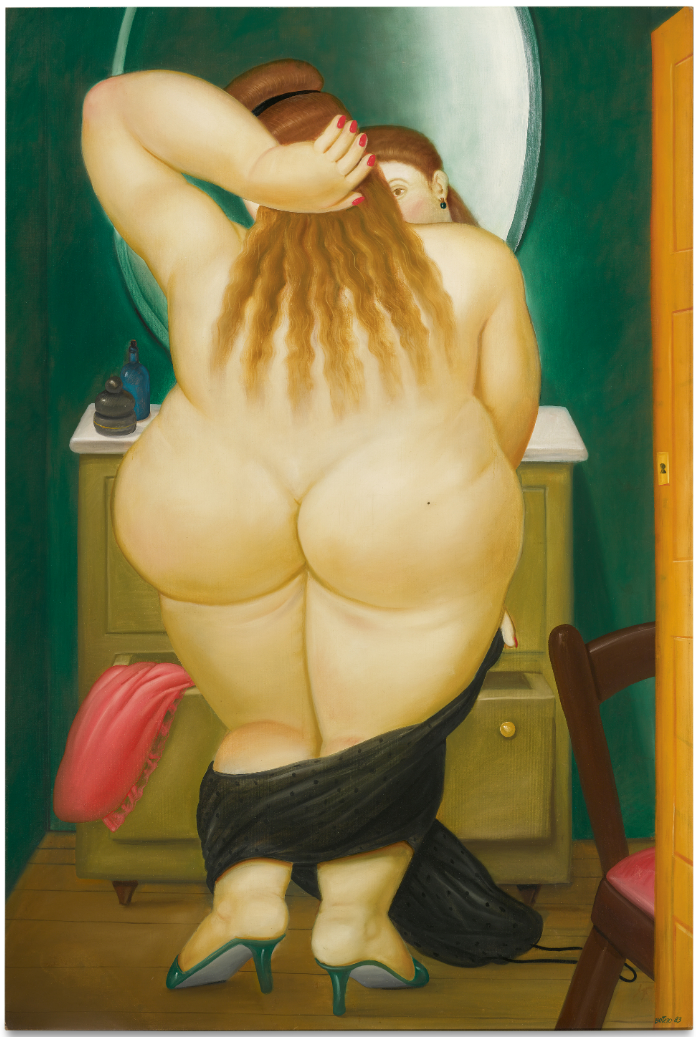
FERNANDO BOTERO (1932 – 2023)
Desnudo ante el espejo, 1983
Oil on canvas
181.6 x 120.3 cm (71 1/2 x 47 1/2 inches)
Signed and dated 83 (lower right)
Desnudo ante el espejo engages one of the most significant genres throughout the History of Art and Fernando Botero’s oeuvre: the female nude. In the monumental painting, a long-haired woman stands with her back to the viewer while gazing into a large round mirror. She is completely nude, save for the dark dress clinging to her calves, shiny green high heels and festive earrings dangling from her ears. These details, together with her freshly polished scarlet fingernails and unorganized open dresser suggest Botero’s subject had been getting ready – or unready – for a party – and may have brought the viewer home with her.
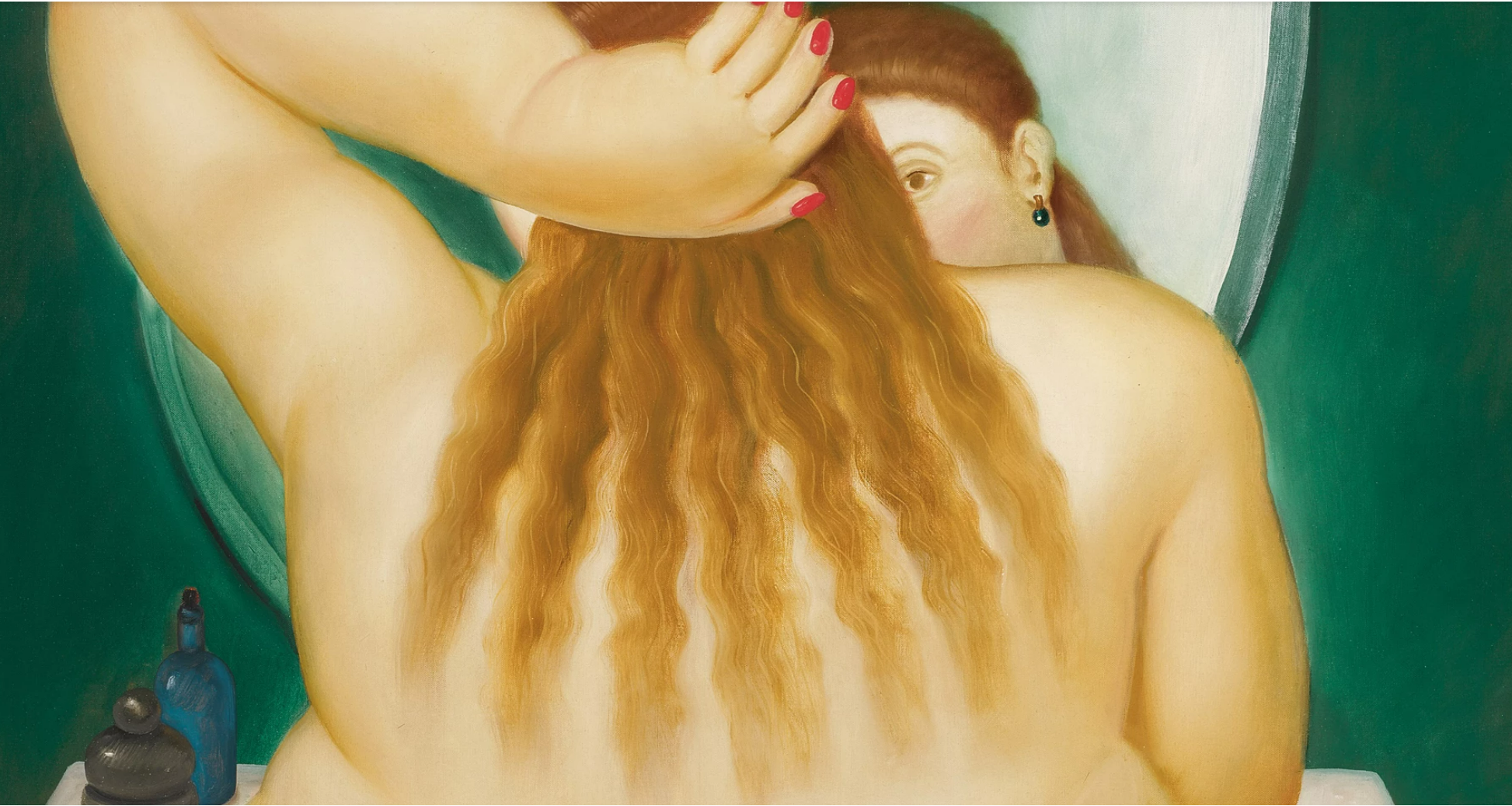
The woman appears either unaware or indifferent to our gaze – and Botero’s – which penetrates the intimate space of her bedroom. The sense of intrusion into her privacy is heightened by the door left ajar, that frames the figure along her right side. This architectural setting draws awareness to our encroachment into the physically enclosed bedroom, possibly adding to the thrill of impermissible desirability by interrupting the voyeuristic fantasy of the viewer. The general intimacy of the atmosphere is enhanced by the disproportionately large amount of space filled by the woman’s body in relation to the rest of the room. Ballooning with volume, the woman’s hips and backside expand outwards from the center of the composition so much that she begins to appear crammed into the space as if she were in a dollhouse.
Through these formal elements, Desnudo ante el espejo participates in a dialogue with traditional patterns of looking and being looked at present in representations of women by men throughout history and the History of Art. By depicting this dynamic in what is arguably considered to be the most private of all settings, Botero proposes the possibility that for women, there is no escape from the reality of being turned into an object of consumption and spectacle. The under-clothed woman’s weary expression as she looks at herself in the mirror while sweeping her hair across her shoulder certainly suggests that her being stared at is a common occurrence and voices the possibility of her bitter resignation.
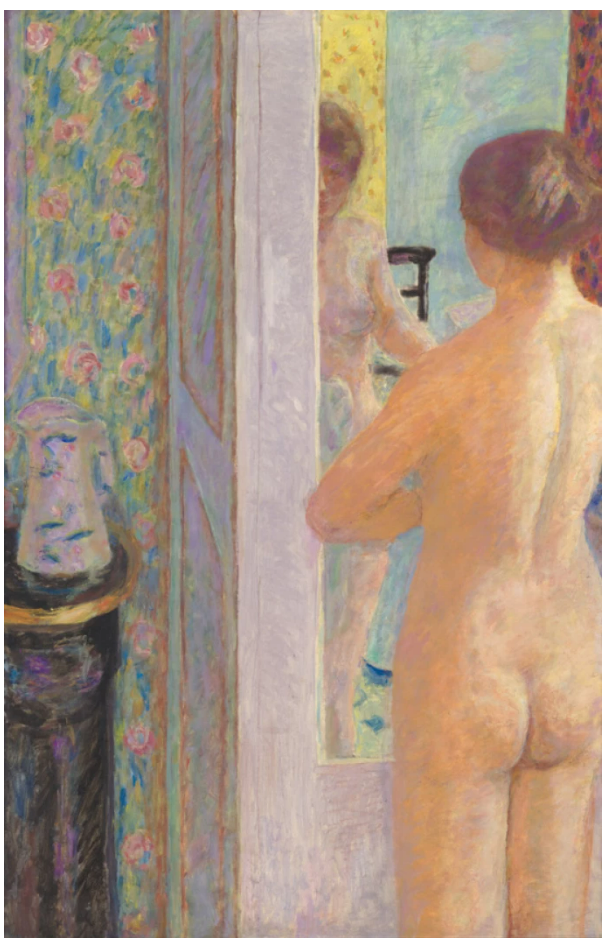
PIERRE BONNARD, LA TOILETTE, 1914, MUSÉE D’ORSAY COLLECTION
If public life has become a matter of spectatorship, Desnudo ante el espejo makes clear that the work of getting ready to go out into the world and “present” oneself is deliberate and active on the part of the women. By depicting the preparation for this spectacle, Botero reminds us of the mechanics of public life in general and implies that for modern women, leisure is still work.The parallel between the artificial nature of his media and the artificial nature of his subject’s presentation adds a provocative irony to Desnudo ante el espejo. The precisely executed painting, like its subject’s getting ready routine, emphasizes the intentional contrivement integral to its creation process. In doing so, Desnudo ante el espejo voices an awareness and possible disillusionment with modern culture’s institutional objectification of the female body. This awareness allows us, the viewer, to take on the position of the artist – or voyeur – and engage with the socially and historically charged dynamic at hand. The middle ground Botero stands on between engagement and awareness with this dynamic complicates the traditional narrative surrounding the act of looking and traditional relationships of power in Western visual culture.
Jeff Koons
Sotheby’s New-York: 16 November 2023
Estimated: USD 1,000,000 – 1,500,000
USD 1,143,000
Hot Dog | Contemporary Day Auction | 2023 | Sotheby’s (sothebys.com)
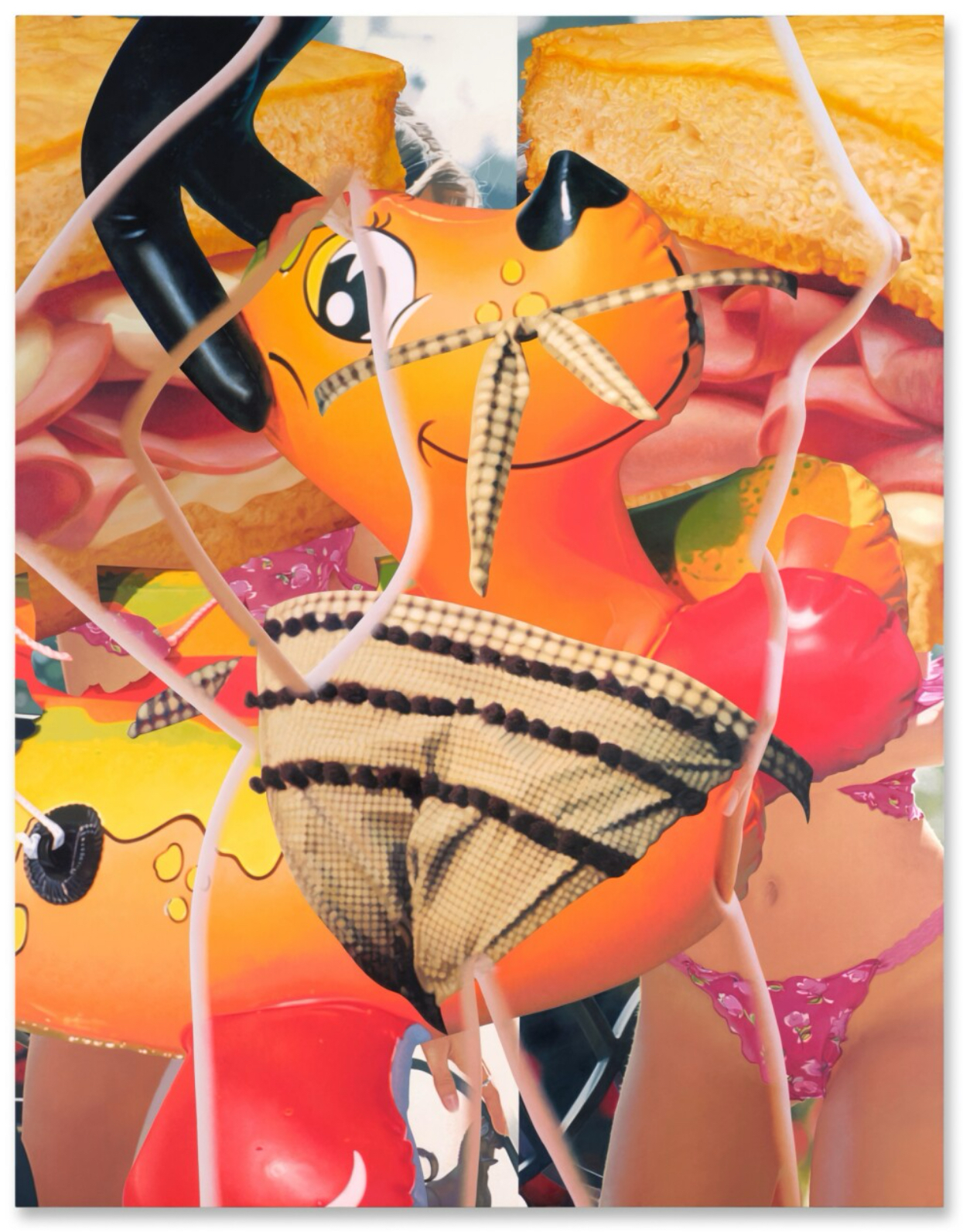
JEFF KOONS (b. 1955)
Hot Dog, 2002
Oil on canvas
108×84 inches (274.3 x 213.4 cm)
Signed and dated ’02 (on the overlap)
A frenetic amalgamation of unabashed sensuality and rapture, Hot Dog is an alluring embodiment of the virtuosic dexterity with which Jeff Koons has deftly reimagined the art historical canon throughout his artistic career. Executed in 2002, the present work belongs to the seminal Easyfun-Ethereal series, a festive collection of twenty-four paintings that unites cutout photographs culled from the glossy pages of fashion and cosmetic magazines, and advertisements on food product packaging, into seductive photorealistic murals with the aid of computer technology. Channeling the artist’s quintessential Pop sensibility, the present work weaves an exuberant tapestry of far-fetched imagery, from a ham and cheese sandwich and inflatable pool to the revealing lower half of a swimsuit model, into a kaleidoscopic tableau of excess. In a thought-provoking yet playful dialogue with a range of artistic precedents, Hot Dog seamlessly interlaces humor and sensuality with exceptional artistic bravado, all in powerful tribute to Jeff Koons’ unparalleled prominence in the post-Pop era.
Executed between 2000-2002, the Easyfun-Ethereal series was born out of a commission by the Deutsche Guggenheim, Berlin in 2000, following the zealous public reception of Koons’ Balloon Flower (Blue), a large-scale mirror-polished stainless-steel sculpture installed in Potsdamer Platz in Berlin the year before. Though the original commission only called for seven paintings, the free-flowing spontaneity inherent in their creative process spurred Koons to expand the series to twenty-four paintings over two years. As exemplified in the present work, Koons applies the same exacting perfectionism to his paintings as he does to his towering aluminum and stainless-steel sculptures of his earlier Celebration series, many of which similarly feature inflatable animal-shaped pool floats such as swans, monkeys, and dogs as their subjects. However, behind the photorealistic finish of Hot Dog lies a painstakingly detailed and time-intensive process. Koons first curates an assortment of found imagery culled from diverse print media and his personal photo archive before digitally manipulating and collaging the images in Adobe Photoshop. He then meticulously transfers the final composition by hand onto canvas with exacting precision.
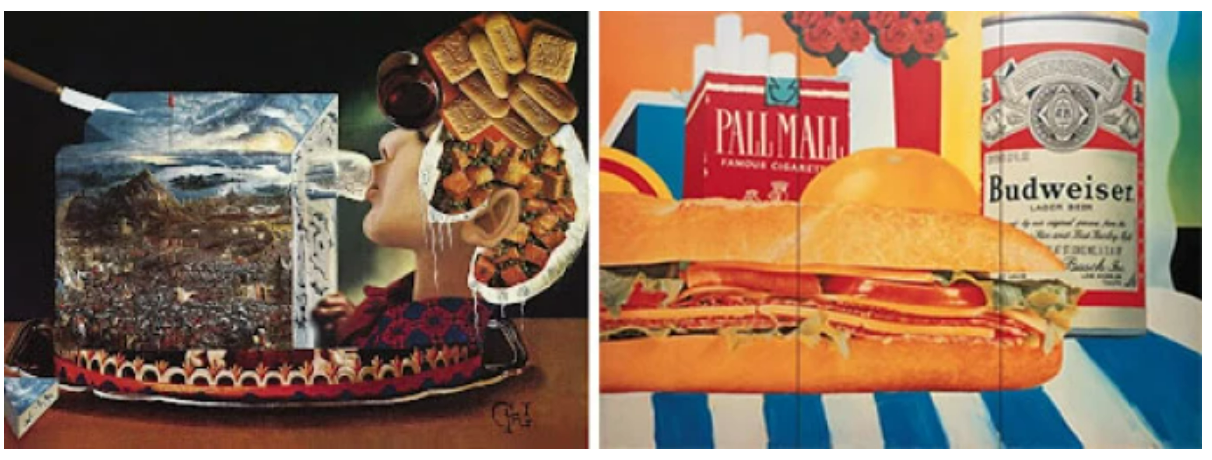
LEFT: PAGE FROM SALVADOR DALÍ’S COOKBOOK LES DÎNERS DE GALA, 1973
ART © 2021 SALVADOR DALÍ, GALA-SALVADOR DALÍ FOUNDATION / ARTISTS RIGHTS SOCIETY (ARS), NEW YORK.
RIGHT: TOM WESSELMAN, STILL LIFE #33, 1963
ART © TOM WESSELMANN/LICENSED BY VAGA, NEW YORK, NY
A masterpiece that deftly blends conceptual depth with visual impact, Hot Dog showcases Koons’ skillful incorporation of several of his most formative influences, both from the annals of art history and his personal life. Chief amongst these is Koons’ homage to his two artistic heroes: Salvador Dalí and Marcel Duchamp. Despite their stylistic and conceptual differences, Duchamp and Dali both used their art to render the ordinary extraordinary. So too does Koons’, uniting disparate aesthetic references to deli meats, skimpy bikinis, and inflatable pool toys, paradigms of popular taste and archetypes of kitsch sentimentality, all reimagined and articulated in his signature mode. The resulting work embodies a central tenet of Surrealism: the juxtaposition of two seemingly disparate entities to create an entirely novel object, verging on the absurd. Simultaneously, Hot Dog offers an altered concept of the Duchampian readymade, as Koons creates an entirely novel object based on emblems or ideas drawn from the mass consciousness.
Fernando Botero
Sotheby’s New-York: 16 November 2023
Estimated: USD 800,000 – 1,200,000
USD 1,079,500
Uomo a cavallo nudo | Contemporary Day Auction | 2023 | Sotheby’s (sothebys.com)
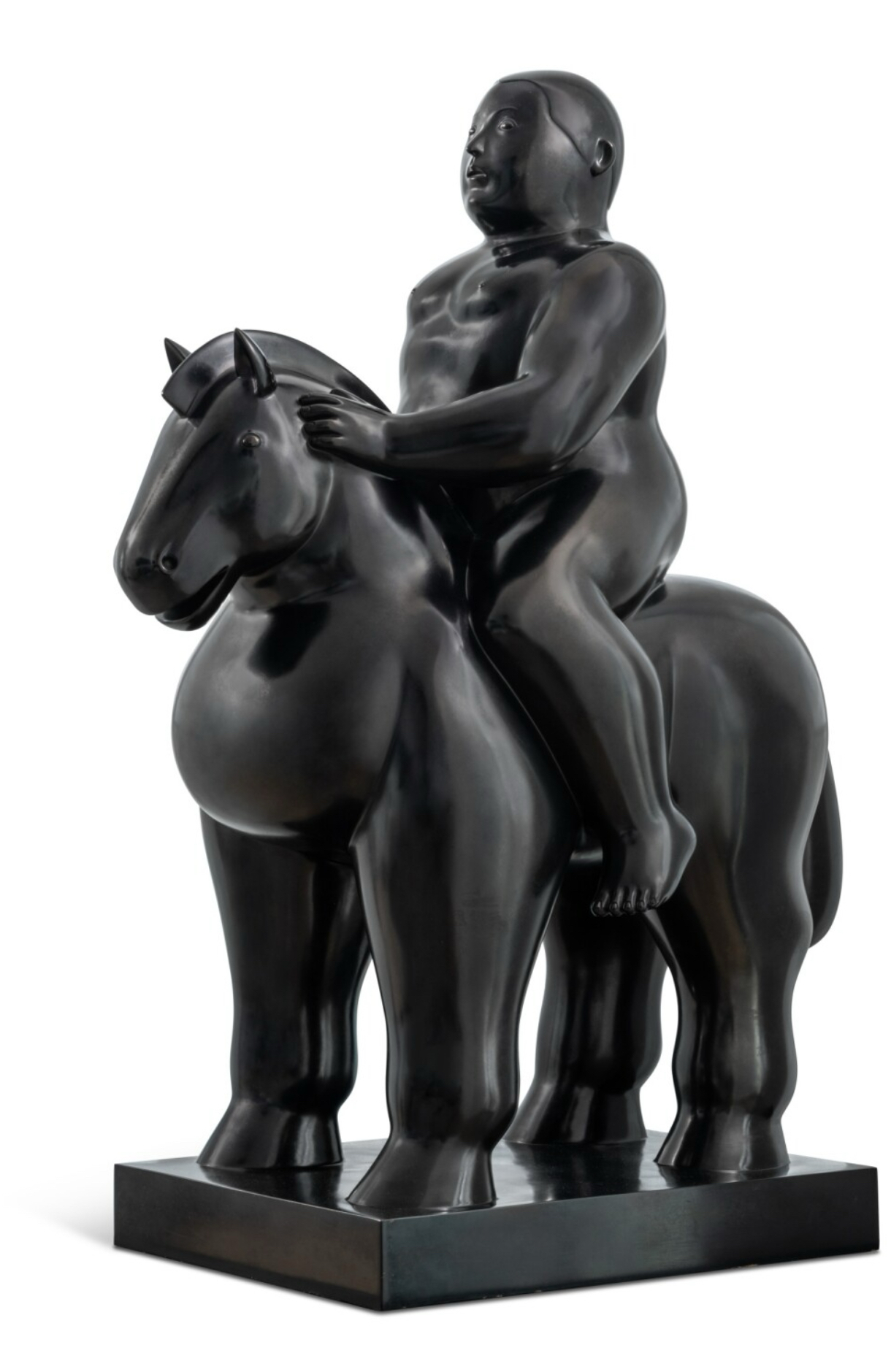
FERNANDO BOTERO (1932 – 2023)
Uomo a cavallo nudo, 2005
Bronze
109.2 x 83.8 x 49.5 cm (43 x 33 x 19 1/2 inches)
Incised with the artist’s signature, number 5/6 and stamped with the foundry mark (on the base)
This work is number 5 from an edition of 6 plus 2 artist’s proofs
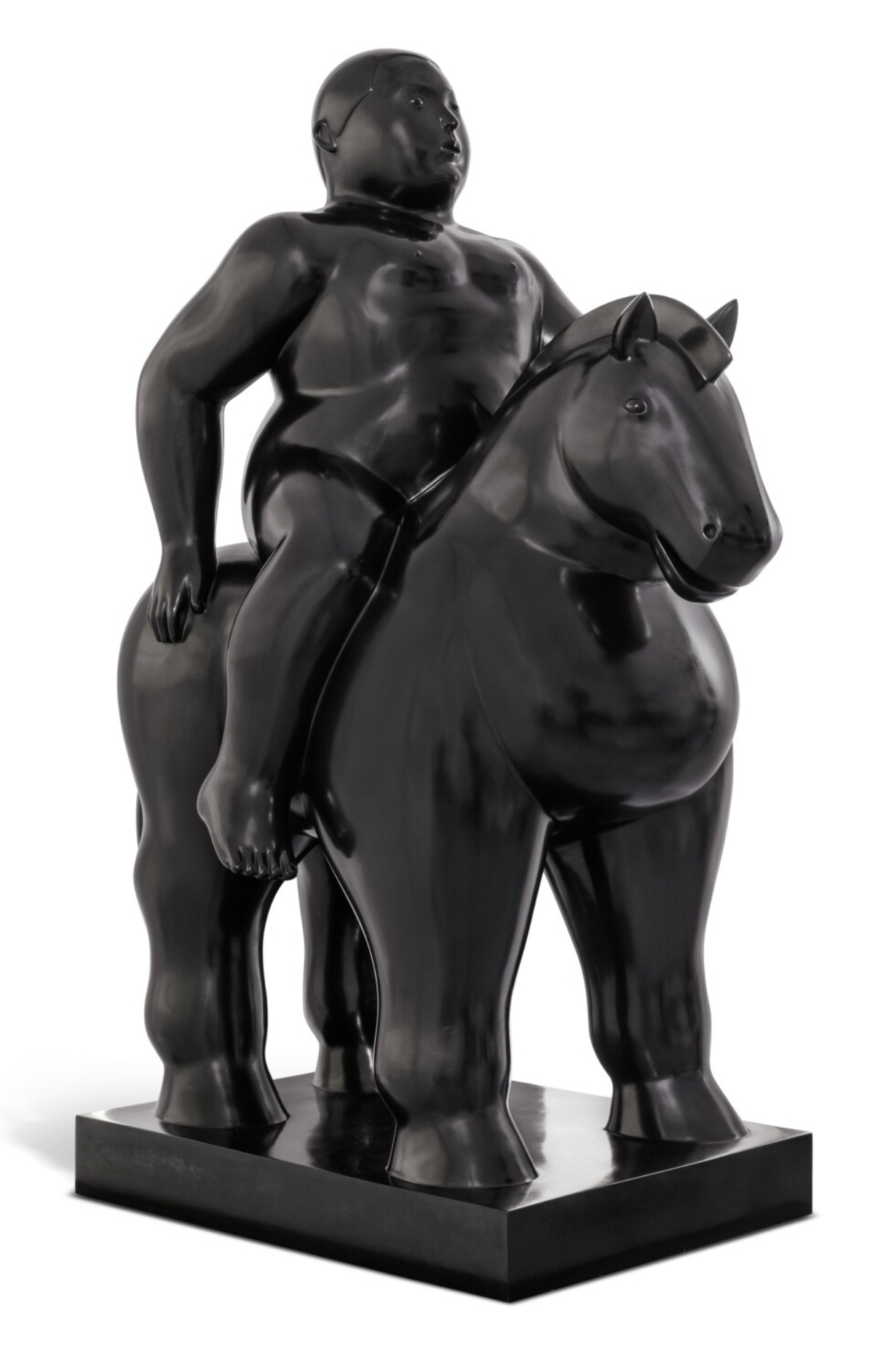
Fernando Botero
Sotheby’s New-York: 16 November 2023
Estimated: USD 800,000 – 1,200,000
USD 952,500
Rosalba | Contemporary Day Auction | 2023 | Sotheby’s (sothebys.com)
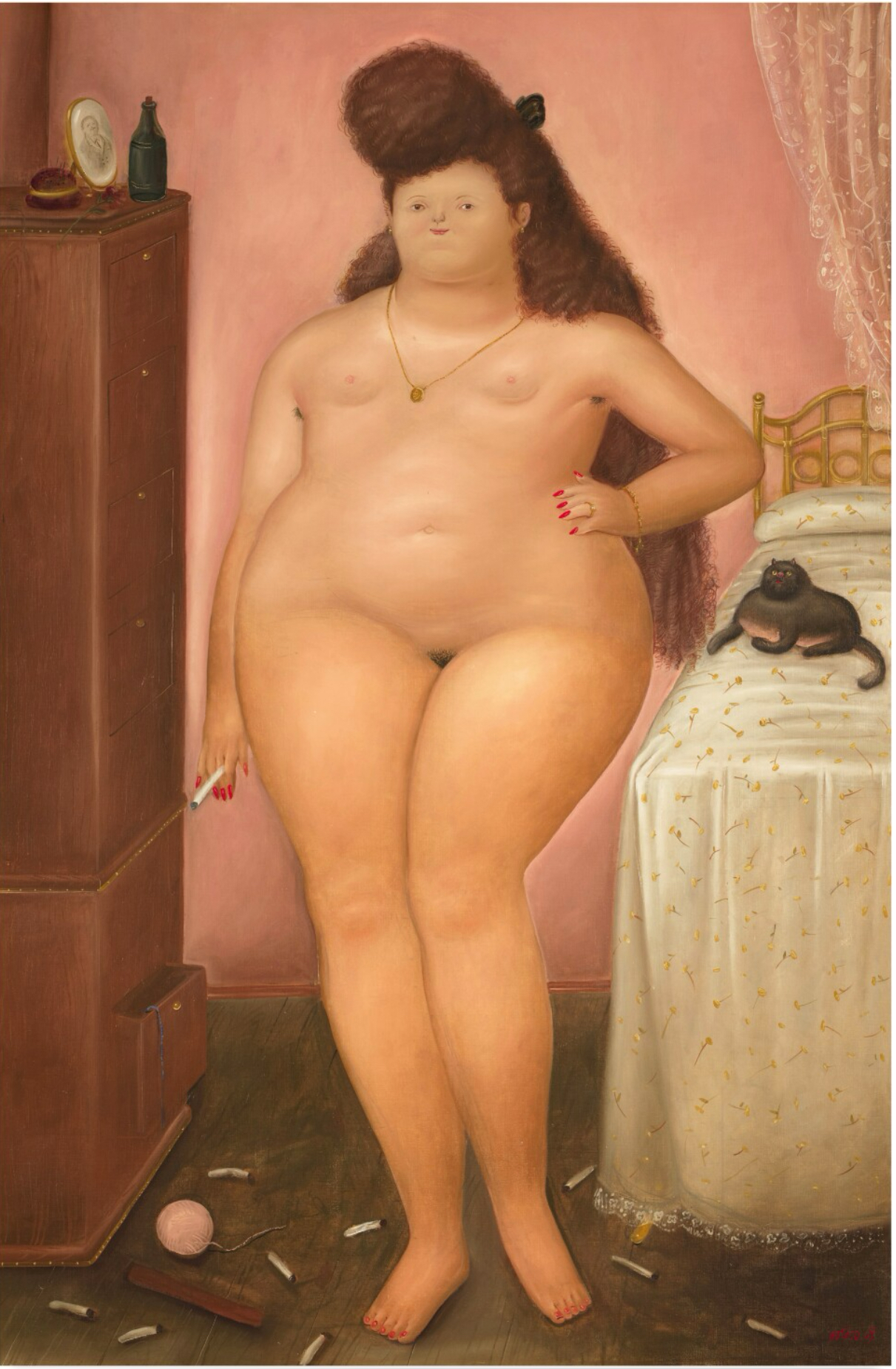
FERNANDO BOTERO (1932 – 2023)
Rosalba, 1969
Oil on canvas
193 x 125.7 cm (76 x 49 1/2 inches)
Signed and dated 69 (lower right)
Women – of all ages, social classes, mythological traditions and levels of undress – are a defining presence throughout the oeuvre of Fernando Botero. Rosalba, an iconic, consummate example from one of the Colombian artist’s earliest and most important series – stands out for its technical brilliance, pointed social engagement, and dialogue with the visual tradition of the female nude in the Western European canon.
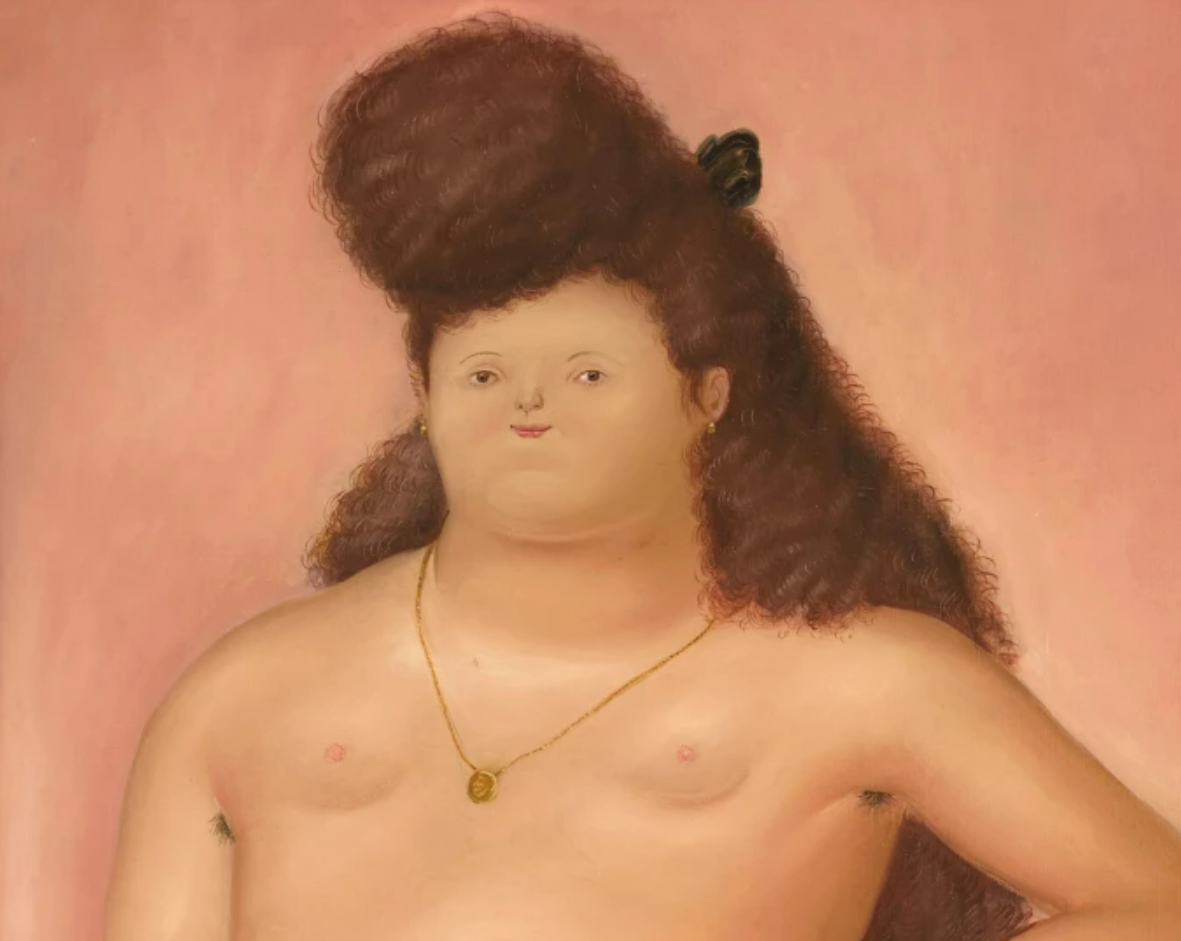
In the monumental portrait, a nude woman poses languidly with one hand on her hip and an unlit cigarette dangling from her other in a girlishly decorated bedroom. Although she is wearing no clothing, her delicately rendered hair is coiffed into an impossibly voluminous style, her nails and toes are freshly polished bright red and she wears gold earrings, a necklace, a bracelet, and a diamond ring on her ring finger. Strewn around Rosalba’s feet are nine discarded cigarettes, but interestingly no clothing, suggesting that she has been undressed in this room for quite some time. On the tidily made-up bed behind her, a chocolate-colored cat stares at us with piercing green eyes, keenly reminding us we are trespassing into this scene. Through these pictorial elements, a narrative story unfolds: we are in a brothel, and Rosalba is looking at us, maybe her next client, asking us to light her 10th cigarette. Executed in 1969, the present work stands as one of the earliest examples from Botero’s Bordello series from the early 1970s. The theme, which he continued to visit through his career, was absorbed by Botero during his studies in Europe as a young artist and the reportage he undertook while growing up in Medellín, Colombia.
JEAN AUGUSTE DOMINIQUE INGRES, GRANDE ODALISQUE, 1814, LOUVRE
The present work dialogues pointedly with the Modern Western tradition of brothel scenes – though Botero makes several careful, intentional edits to the canonized genre. In Jean Auguste Dominique Ingres famous Grande Odalisque (1814), for example, his nude subject is vulnerable, idealized, and in a horizontal (available) position, making her saccharinely packaged for easy consumption by the viewer. She is also exoticized, her setting references some distant “East,” further allowing for a certain kind of unproblematized voyeurism. Rosalba, on the other hand, is neither exoticized, nor mythologized – though she reflects a certain idealized beauty, she is very much of our world. Like Toulouse-Lautrec’s depictions of sex worker scenes that followed the Grand Odalisque by about 80 years, Botero’s painting strikes one as a frank, even friendly image of business as usual in the bordello. As Manet does in his Olympia, whose black cat Rosalba’s clearly echoes, Botero engages here with gender and social class dynamics by depicting a female sex worker looking pointedly back at us – rather than just being looked at. It is impossible to hide from Olympia or Rosalba’s gaze – they make us aware of the act of visual consumption (and perhaps of our enjoyment of it), and direct us to reflect on our role in that dynamic.
EDOUARD MANET, OLYMPIA, 1963, MUSEE D’ORSAY
Botero’s handling of Rosalba from a technical perspective and her large-scale format further unsettles art historical – and urban bourgeois – conventions. The bedroom’s gleaming surfaces, the painstaking rendering of each strand of Rosalba’s hair and cool-toned veins reflect Botero’s command of Old Master painting techniques. Botero’s signature, technically intensive sfumato style of the 1960s gives the work its compellingly hazy atmosphere, as if clouded with Rosalba’s perfume and the heavy smoke of her cigarettes. This devotion to the present work’s precise execution – a level of care historically unfit for a character of Rosalba’s station in society – is enhanced by her monumental proportions. Her voluminous figure – and hair – dominate the composition’s pictorial space, and her contrapposto mimics the gestural language of male heroes like Michelangelo’s David, demanding our attention. Alongside her heroic size, the strewn cigarettes depicted around Rosalba, the portrait on her nightstand, the carefully selected floral bedspread and curtain, the goofy cat – all contribute to offer up a charming, human portrait of a real woman. Where other artists approached the bordello and its workers with a dour, moralizing gaze (all the while exploiting these images for pleasure), Botero lends characters like Rosalba a sense of both whimsy and dignity. Rendered in the same monumental scale as his priests, presidents, and other patriarchal authorities, Rosalba is an essential character in Botero’s pictorial universe – where no one is spared a friendly lampooning.
Jasper Johns
Sotheby’s New-York: 16 November 2023
Estimated: USD 800,000 – 1,200,000
USD 889,000
Flags I | Contemporary Day Auction | 2023 | Sotheby’s (sothebys.com)
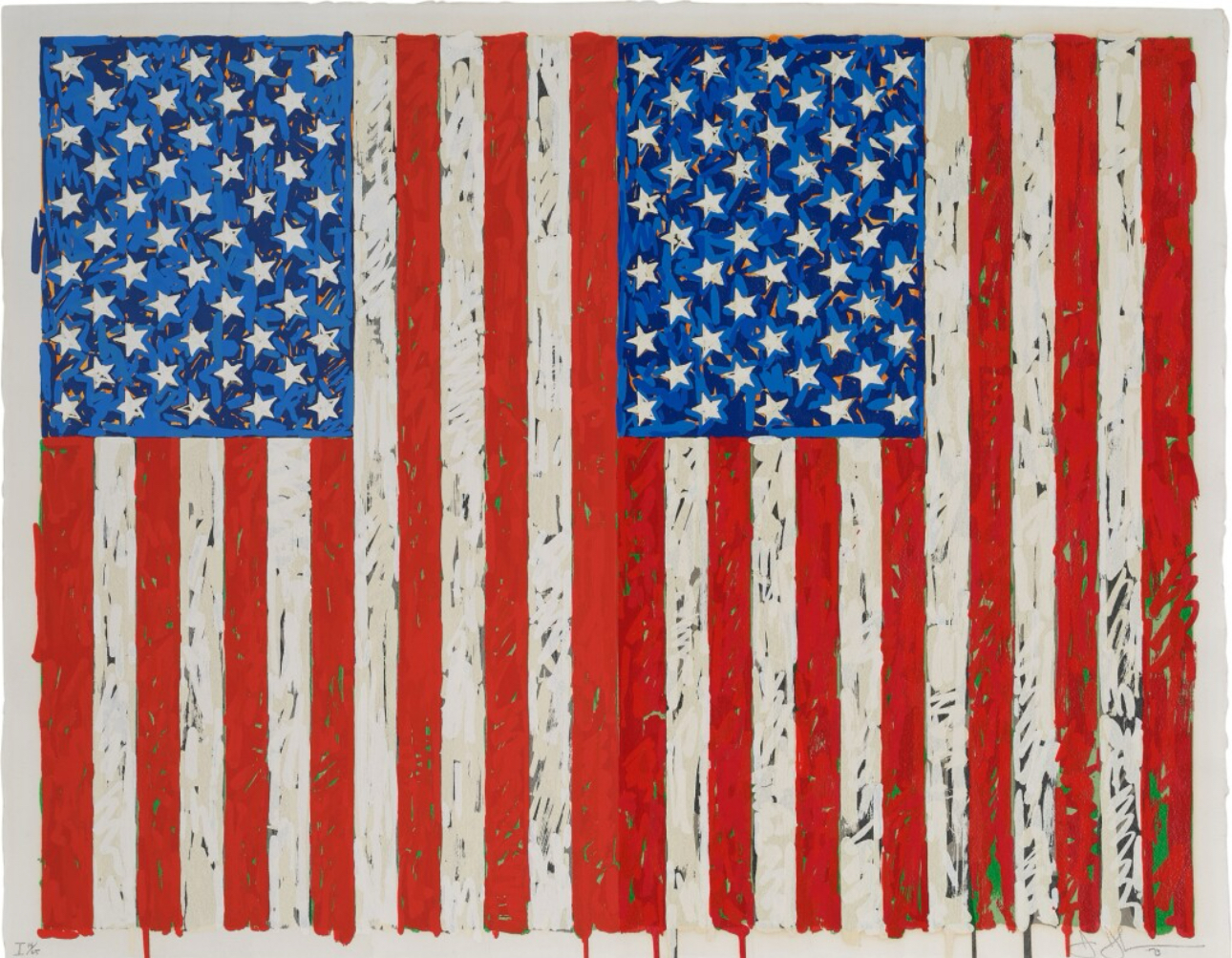
JASPER JOHNS (b. 1930)
Flags I, 1973
Screenprint in colors on J.B. Green paper
Sheet: 27 1/2 x 35 1/4 inches (69.9 x 89.6 cm)
Signed and dated in pencil (lower right)
Inscribed I and numbered 14/65 (lower left)
This impression is number 14 from the edition of 65 plus 7 artist’s proofs
Co-published by the artist and Simca Prints Artists, Inc.
Jean-Michel Basquiat
Sotheby’s New-York: 16 November 2023
Estimated: USD 600,000 – 800,000
USD 854,000
Untitled (Caucasian / Negro) | Contemporary Day Auction | 2023 | Sotheby’s (sothebys.com)
JEAN-MICHEL BASQUIAT (1960 – 1988)
Untitled (Caucasian / Negro), 1985
Oil stick, graphite and colored pencil on paper
30 x 22 1/4 inches (76.2 x 56.6 cm)
Erupting into a visual cacophony of symbols, signs, and cyphers, Jean-Michel Basquiat’s Untitled (Caucasian/ Negro) of 1985 offers a glimpse into the artist’s energetic, imaginative and ingenious mind. Held in the personal collection of legendary gallerist and publisher of Basquiat’s first catalog of works on paper John Cheim, the present work boasts an illustrious exhibition history. In 1990, it was included in the seminal exhibition Jean-Michel Basquiat Drawings at Robert Miller Gallery, which was curated by Cheim himself. A testament to the gravity and intent with which the artist approached his works on paper, the exhibition was Basquiat’s first posthumous exhibition and the first to be solely dedicated to his drawings. With its complex pantheon of intricate iconography, Untitled (Caucasian / Negro) encapsulates Basquiat’s unique pictorial lexicon which wavers between the vivaciously dynamic and the quietly unsettling.
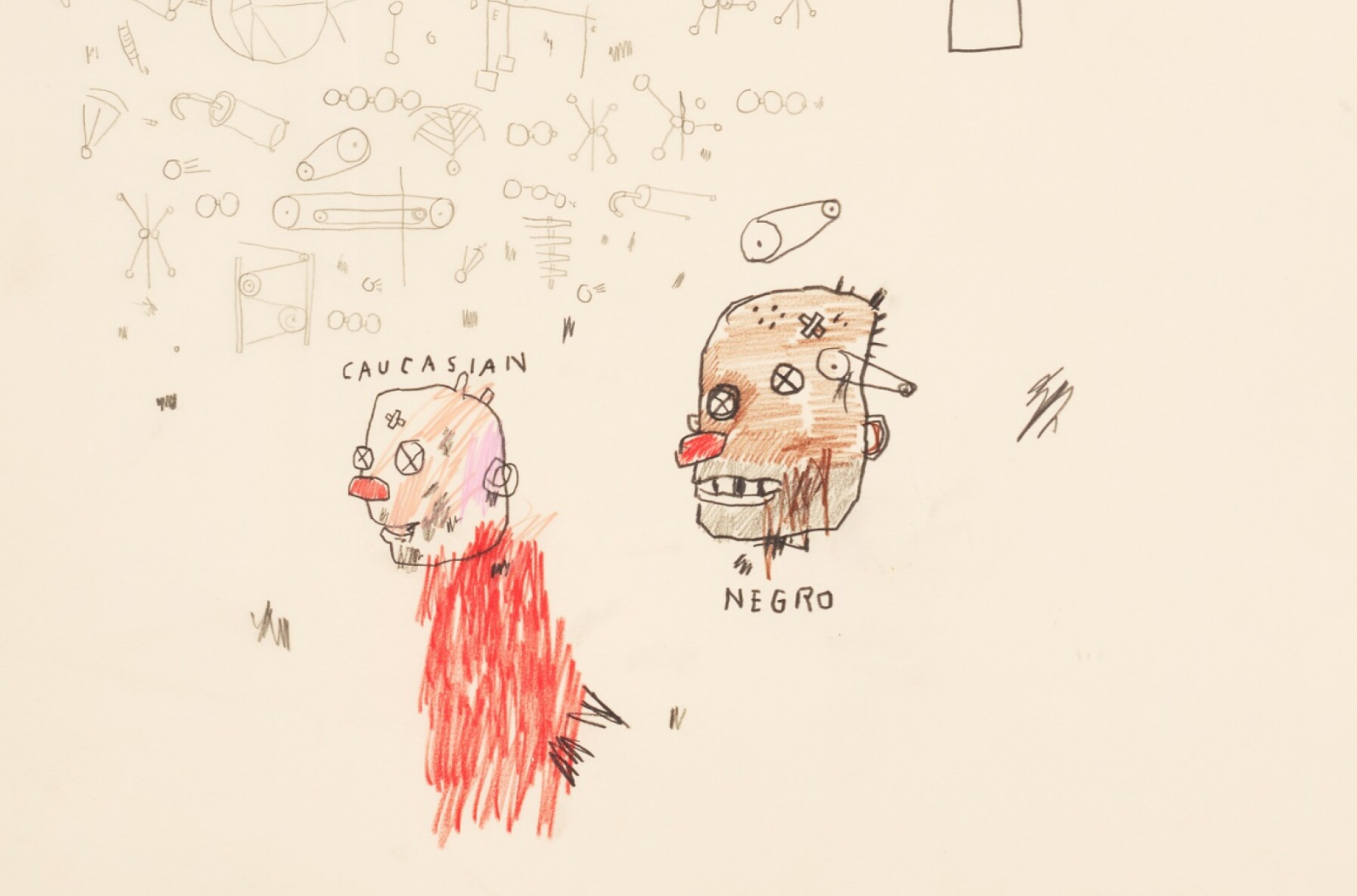
A complex labyrinth of symbols and images fills the space above two colorfully accentuated profiles of two heads. Reminiscent of the magical landscapes of pictorial metaphors and signs by Paul Klee, the symbols—largely references to chemistry, engineering and other scientific instruments from pulleys and gears to springs and weights—are not only an expression of the artist’s innovative visual lexicon but are indicative of Basquiat’s most impressive compositions. Descending from the constellation of mechanical drawings, viewers are struck by the two graphically composed heads of varying skin tones, aptly labeled “Caucasian” and “Negro.” Upon closer inspection, the bevy of scientific symbols appears to emerge exclusively from the “Caucasian” head, alluding to broader inequities baked in systems of knowledge. The “Negro” head, on the other hand, is excluded from this suggestive osmosis, cast to the side only to look upon its privileged neighbor.
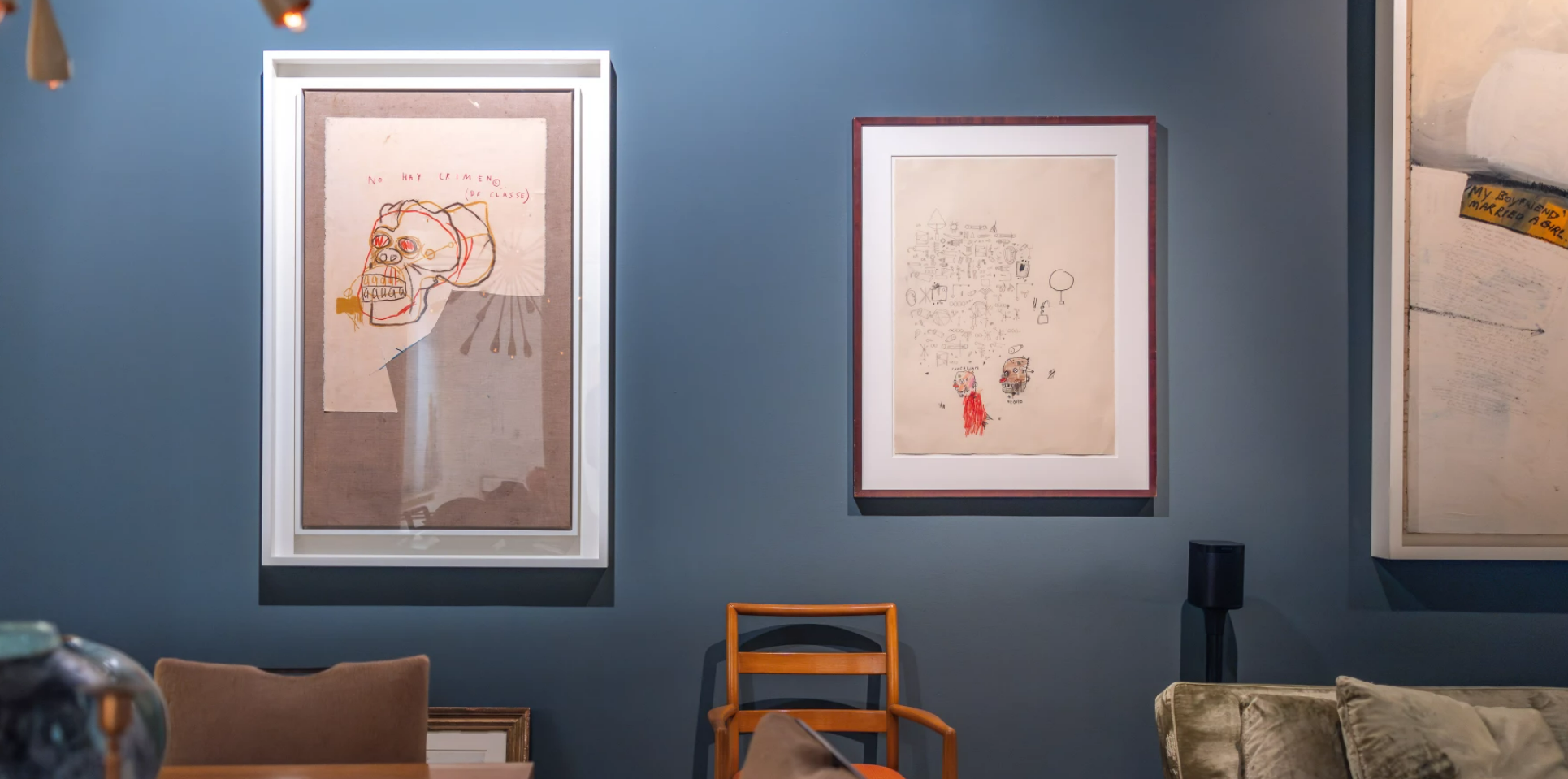
THE PRESENT WORK INSTALLED IN JOHN CHEIM’S NEW YORK LOFT.
Though Basquiat never strayed into the realm of the overtly political in his art, he was eternally conscious of his black identity within a white dominated art-world, and the subject of racial (in)equality nonetheless became an unequivocal focus of his creative vision. By presenting the two figures in this way and making explicit their racial distinctions, Basquiat directly confronts and brings to light the disparate conditions of the two races at the time. A vibrant symphony of densely layered motifs and symbols, the present work showcases the sheer range of Basquiat’s visual language in his works on paper. Brilliantly formulated in the artist’s innovative mind and then translated onto the paper, the drawing is as vivid and alive now as it was at the moment of its execution.
Andy Warhol
Sotheby’s New-York: 16 November 2023
Estimated: USD 800,000 – 1,200,000
USD 666,750
Jackie | Contemporary Day Auction | 2023 | Sotheby’s (sothebys.com)
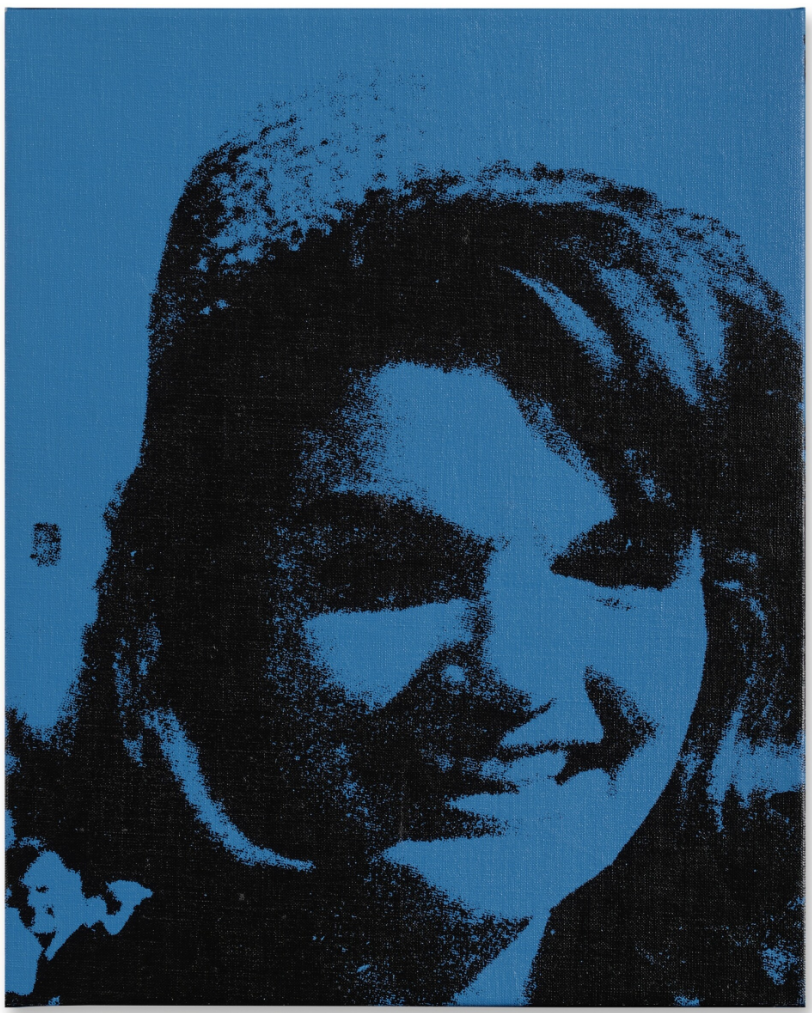
ANDY WARHOL (1928 – 1987)
Jackie, 1964
Acrylic and silkscreen ink on canvas
20×16 inches (50.8 x 40.6 cm)
Depicting one of the most beloved first ladies in American history, Andy Warhol’s Jackie is the ultimate expression of Warhol’s deep understanding of the American media landscape and an astute commentary on its perpetuation of fame. Executed in 1964, at the very height of Warhol’s most celebrated period, Jackie is a poignant and brilliantly rendered distillation of the core tenets of his aesthetic focus: death and celebrity. Here, First Lady Jacqueline Kennedy Onassis beams into the camera after arriving at Dallas Love Field airport on November 22nd, 1963: the day that her husband, United States President John F. Kennedy was assassinated. Moments after this photograph was taken, the couple would begin a limousine journey that would be interrupted by the most significant assassination of the Twentieth Century. Jackie is immediately striking for its vibrant blue coloring and the beaming smile which adorns the face of the First Lady. The innocence of her happiness invokes an emotional poignancy and sense of dread; her radiance suffuses the work with an inescapable mood of impending morbidity and portentous doom. This is only heightened by the completely veiled rendering of Kennedy Onassis’ eyes, which foreshadow the tragic event just on the horizon. Brimming with artistic genius and conceptual economy, Jackie encapsulates the allure of unlimited celebrity, critiques the manipulative power and replicating effects of mass-media, and is a groundbreaking response to one of the most devastating moments of recent American history.
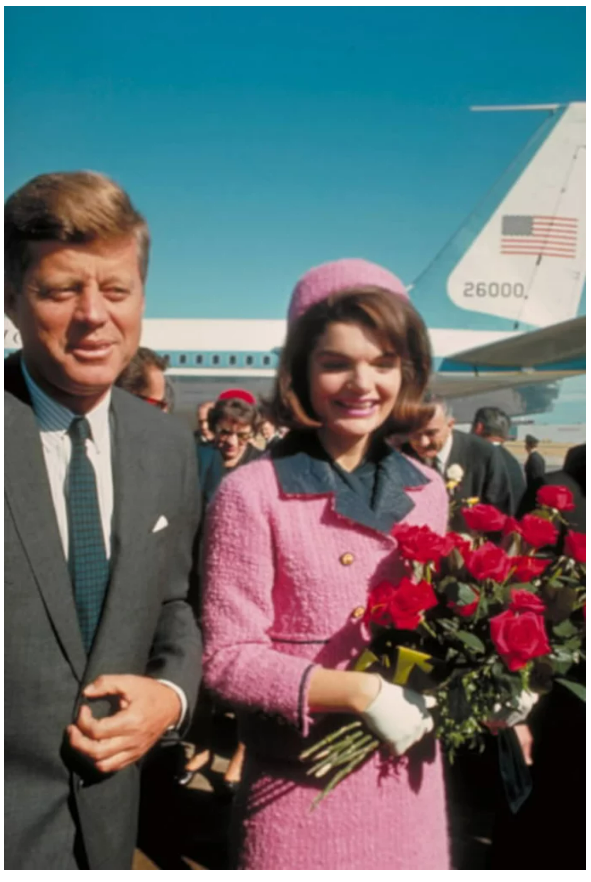
JOHN AND JACKIE KENNEDY AT LOVE FIELD IN DALLAS ON NOVEMBER 22, 1963. PHOTO © ART RICKERBY TIME & LIFE PICTURES/SHUTTERSTOCK
Warhol traces the media’s exposé of Jackie’s emotional journey by selecting source images from both before and after the assassination. As the media callously reported the catastrophe through photographs and speculation from its closest and most affected witness, Warhol emphasizes Jackie’s courage and resilience by purposefully recounting the president’s assassination through the candid expressions of Jackie as she was left to represent her family in the face of a grieving nation. In the original LIFE Magazine photograph of the President and First Lady’s arrival, we see just how infatuated with the Kennedy’s America truly was: hundreds of civilians lined the tarmac just to get a glimpse of the pair and the always-poised Jackie gracefully cradles a bouquet of red roses just gifted to her by the mayor’s wife. An emblem of youth, beauty, and style, Jackie became the ultimate feminized American dream. Warhol, aware of America’s infatuation for the First Lady, has closely cropped his image to reveal just her face, glowing with a pure and now-ironic sense of ease, allowing the viewer’s mind to complete the picture.
Andy Warhol
Sotheby’s New-York: 16 November 2023
Estimated: USD 300,000 – 400,000
USD 533,400
Chris Royer | Contemporary Day Auction | 2023 | Sotheby’s (sothebys.com)
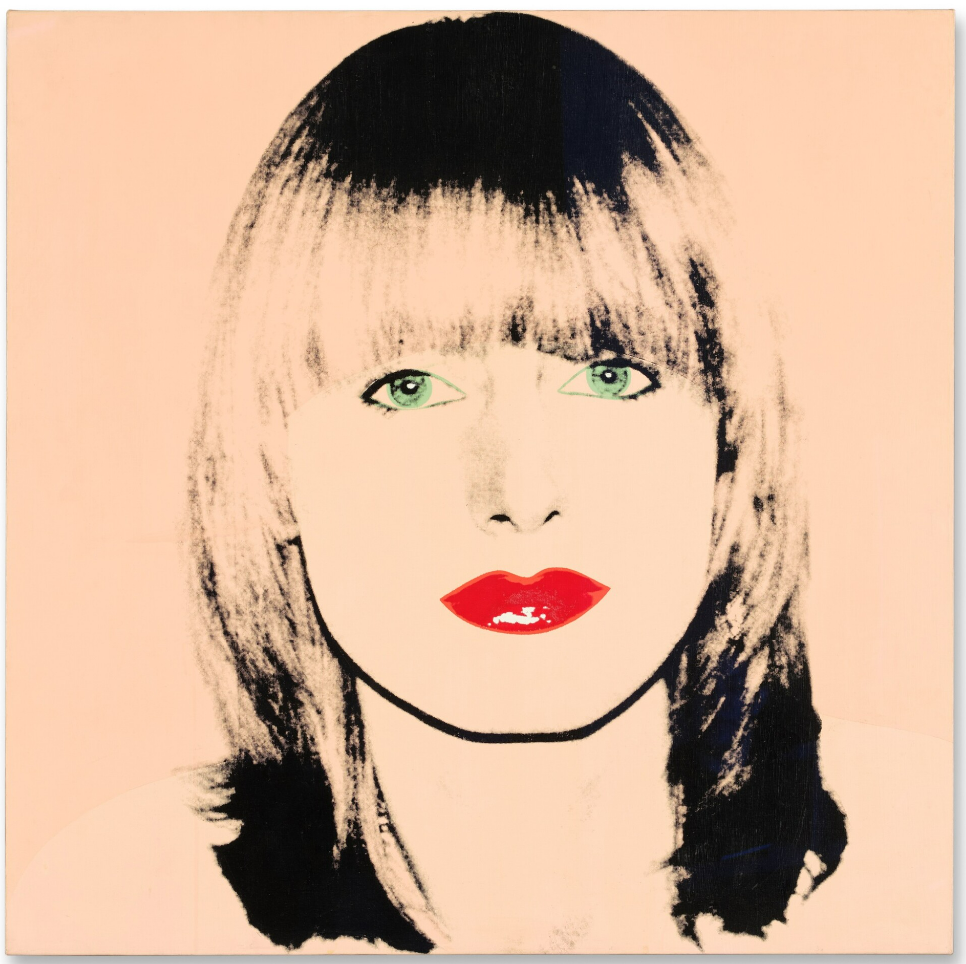
ANDY WARHOL (1928 – 1987)
Chris Royer, 1980
Acrylic and silkscreen ink on canvas
40×40 inches (101.6 x 101.6 cm)
Signed and dated 1980 (on the overlap)
Stamped by the Estate of Andy Warhol and numbered PO50.678 on the overlap
Executed in 1980, Andy Warhol’s sensational portrait of fashion muse and model Chris Royer forms part of the artist’s instantly recognizable portraits of his array of glamorous socialite friends. Conceived in his signature style reminiscent of his portraits of Marilyn Monroe and Jackie Kennedy, Chris Royer showcases the famous model with a soft smile, stunning bright green eyes and quintessentially Warholian red lips. A notable “Halstonette”, Chris Royer formed part of the charismatic group of models that encircled the dazzling fashion designer and close friend of Warhol, Roy Halston, whose designs defined the style and taste of the 1970s. Best known for inspiring Halston’s “Sarong” dress, Chris Royer belonged to history’s first internationally recognized group of models including Pat Cleveland, Billie Blair and Alva Chinn. Warhol, who was widely known to always surround himself with the most remarkable icons of high society, likely felt drawn to Chris Royer’s classical beauty and striking presence.
CHRIS ROYER AND ANDY WARHOL AT THE MET GALA CIRCA 1970S. IMAGE COURTESY CHRIS ROYER
Warhol began his silkscreen portraits by taking a polaroid of his subject. Always working from photographs, Warhol created this print of her likeness by utilizing compelling layers of colored paint. The result is a dynamic portrait filled with energy and vibrancy that parallels the remarkable life of the sitter. Modestly referring to himself as ‘just a travelling society painter’, Warhol’s innovative reinterpretation of portraiture is now hailed as having revived a dead art form. Indeed, Chris Royer locates itself at the intersection of tradition and popular culture, serving as both an exemplary portrait of his sitter and a memento of Royer’s important role within the history of fashion.
Keith Haring
Sotheby’s New-York: 16 November 2023
Estimated: USD 250,000 – 350,000
USD 533,400
Untitled | Contemporary Day Auction | 2023 | Sotheby’s (sothebys.com)
KEITH HARING (1958 – 1990)
Untitled, 1988
Sumi ink and gouache on paper
28 x 39 3/8 inches (71.1 x 100 cm)
Signed and dated 8.8.88 (on the verso)
Like his contemporary compatriots Jean-Michel Basquiat and Andy Warhol, Keith Haring was driven by a deep-rooted personal desire to serve as a narrator of the modern age. With Basquiat, Haring shared the kitsch, gritty origins of a street artist trained in the language of graffiti and tagging; with Warhol, he shared an interest in appropriating icons of socio-political ideals through reproduction and mass proliferation. Untitled bears witness to Haring’s deceptively naïve symbolic language, which became the activist compelling vocabulary through which he sought to impart political disquietude. The bold chromatic choice of color and the figures’ nearly grid-like formation are at once lyrical and balanced, conveying a potent energy that enlivens the picture with strong emotive power.
“I aim for an art which would be in immediate connection with daily life, which could start from our daily life and which would be a very direct and very sincere expression of our real life and real moods.”
Synergizing the tabulated code of graffiti, Haring positions himself as the artist-provocateur—responsible for speaking out against inequity, warning against oppression, and connecting with a public audience on issues such as AIDS, drug abuse, racism, mass-media, ecological preservation, or nuclear technology. Throughout his tragically short career, Haring was an adamant activist, and after being diagnosed himself with HIV/AIDS in 1987 and having watched many friends and members of his community succumb to the disease in years prior, Haring played a significant role in bringing awareness about the disease and promoting safe sex to help prevent more deaths from happening.
KEITH HARING, IGNORANCE = FEAR, 1989, POSTER DESIGNED FOR THE AIDS COALITION TO UNLEASH POWER (ACT UP).
In Untitled, 1988, Keith Haring presents the ‘see no evil, hear no evil, speak no evil’ motif, which originates in a Buddhist parable about three monkeys but would appear in Haring’s work as early as 1981 relating to religious themes the artist would reflect on given his devoutly Christian upbringing. During the AIDS crisis, at the time largely ignored for many years by the government and general public given the marginalized groups most affected, Haring returns to the motif to reappropriate it as an activist symbol that encouraged education and discussion of the virus in order to combat it. ‘See no evil, hear no evil, speak no evil’ thus becomes an important symbol representing the dangers of a society keeping quiet on a very serious issue they were watching destroy lives and communities. In 1989, Haring would even use the motif as part of an important poster designed to be used for the AIDS Coalition to Unleash Power (ACT UP) campaign, in which the artist directly establishes the relationship between ignorance and silence with fear and death, to spark education and speaking up as a way to fight for his community and fight for life.
Fernando Botero
Sotheby’s New-York: 16 November 2023
Estimated: USD 250,000 – 350,000
USD 444,500
Donna Sdraiata | Contemporary Day Auction | 2023 | Sotheby’s (sothebys.com)
FERNANDO BOTERO (1932 – 2023)
Donna Sdraiata, 2012
Carrara marble
25.7 x 61.3 x 22.9 cm (10 1/8 x 24 1/8 x 9 inches)
Incised with the artist’s signature (on the base)
Fernando Botero
Sotheby’s New-York: 16 November 2023
Estimated: USD 300,000 – 400,000
USD 444,500
Il Ratto d’Europa | Contemporary Day Auction | 2023 | Sotheby’s (sothebys.com)
FERNANDO BOTERO (1932 – 2023)
Il Ratto d’Europa, 2011
Bronze
74.9 x 45.1 x 30.2 cm (29 1/2 x 17 3/4 x 11 7/8 inches)
Incised with the artist’s signature and number 3/6 and stamped with foundry mark Da Prato (on the base)
This work is number 3 from an edition of 6 plus 2 artist’s proofs
5. Christie’s Auctions
1.21st Century Evening Sale
2. 20th Century Evening Sale
3. Post-War and Contemporary Day Sale
4. Impressionist and Modern Works on Paper Sale
5. Impressionist and Modern Art Day Sale
1. 21st Century Evening Sale
7 November 2023
21st Century Evening Sale (christies.com)
Auction Statistics
43 Lots
Low Estimate: USD 99,540,000
High Estimate: USD 143,676,000
Total: USD 107,451,800
# Lots withdrawn: 2
# Lots sold: 39
Sell-Through Rate: 95.1%
Above Estimates: 18 Lots (42%)
Within Estimates: 15 Lots (35%)
Below Estimates: 6 Lots (14%)
Withdrawn/Unsold: 4 Lots (9%)
Top 5 Lots
#1. Cy Twombly
Christie’s New-York: 7 November 2023
Estimated: USD 18,000,000 – 25,000,000
USD 19,960,000
CY TWOMBLY (1928-2011) (christies.com)
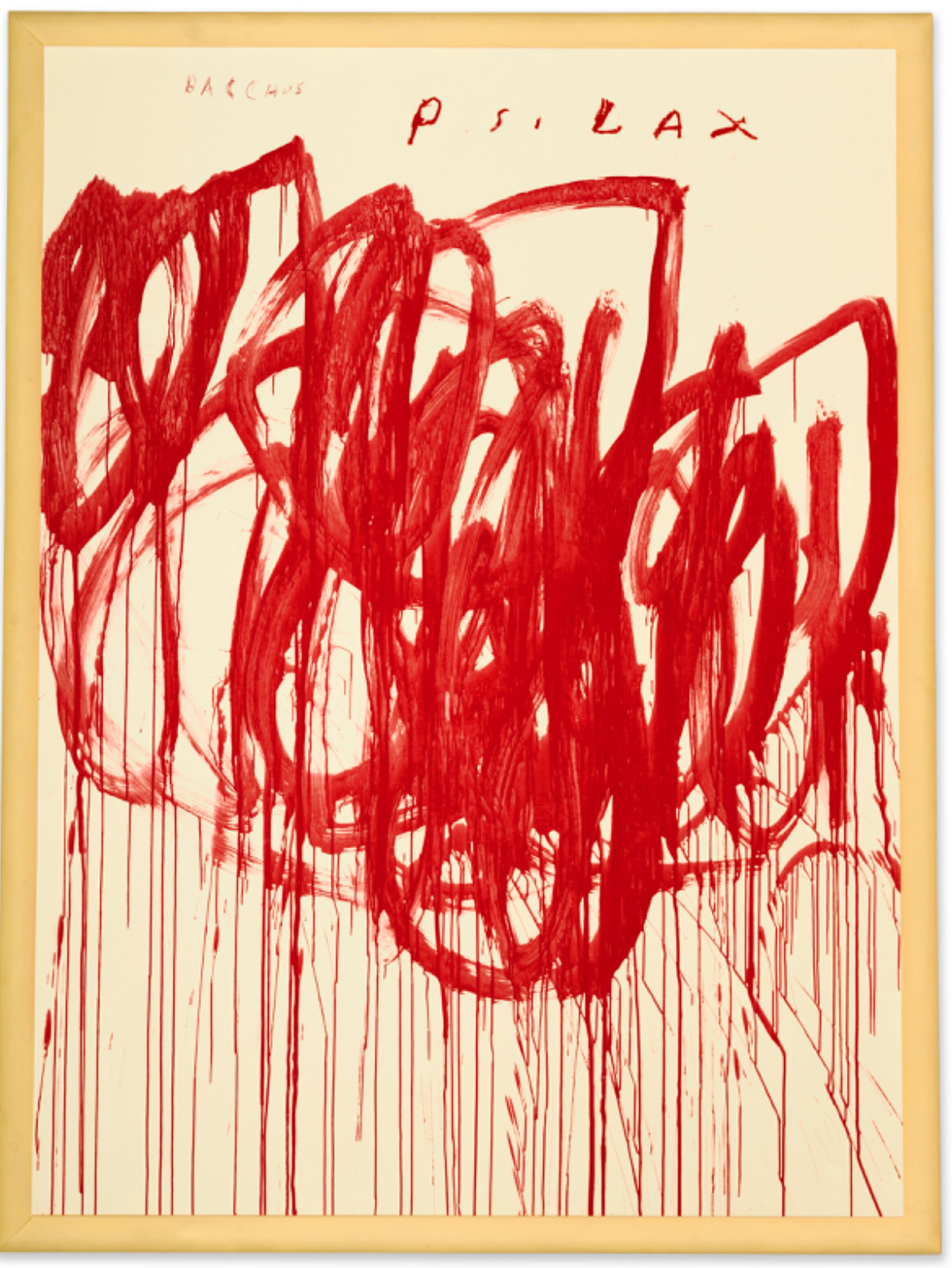
CY TWOMBLY (1928-2011)
Untitled (Bacchus 1st Version II), 2004
Acrylic, oilstick and crayon on wood panel, in artist’s wood frame
107×79 inches (271.8 x 200.1 cm)
Signed with the artist’s initials, inscribed and dated ‘C T. 04 Gaeta’ (on the reverse)
With its vermillion loops and swirls dancing before an ivory ground more than eight feet high, Untitled (Bacchus 1st Version II) is an explosive work from the first iteration of Cy Twombly’s late, great Bacchus cycle. It is one of six Bacchus paintings completed on wood panel in the artist’s studio in Gaeta, Italy, in 2004. He would go on to develop the series in two subsequent groups painted on canvas in 2005 and 2008: the three largest of the final group are now in the permanent collection of Tate, London. Here, the resistant wooden support amplifies the liquid drama of his brushwork, which pools, bleeds and rains red tracks down the surface. Twombly’s vivid, energetic gestures—remarkable for an artist in his seventies—capture the spirit of the deity who gives the series his name: Bacchus, or Dionysus, the Greco-Roman god of wine, revelry, ritual madness and religious ecstasy. Painted against the backdrop of unfolding conflict in Iraq, Twombly’s Bacchus works conjure a sense of violence and excess, while also embodying a vital, defiant and disinhibited life-force. Where some others in the group refer to Bacchus Mainomenos—the god in raging, violent frenzy—the present painting is inscribed Bacchus Psilax. Psilax denotes Bacchus’s “winged” aspect, invoking the Dionysian surrender-of-self to uplift, freedom and flight. The work is a transcendent climax to Twombly’s career-long engagement with mythic themes, and a paean to the exhilaration of the creative act.
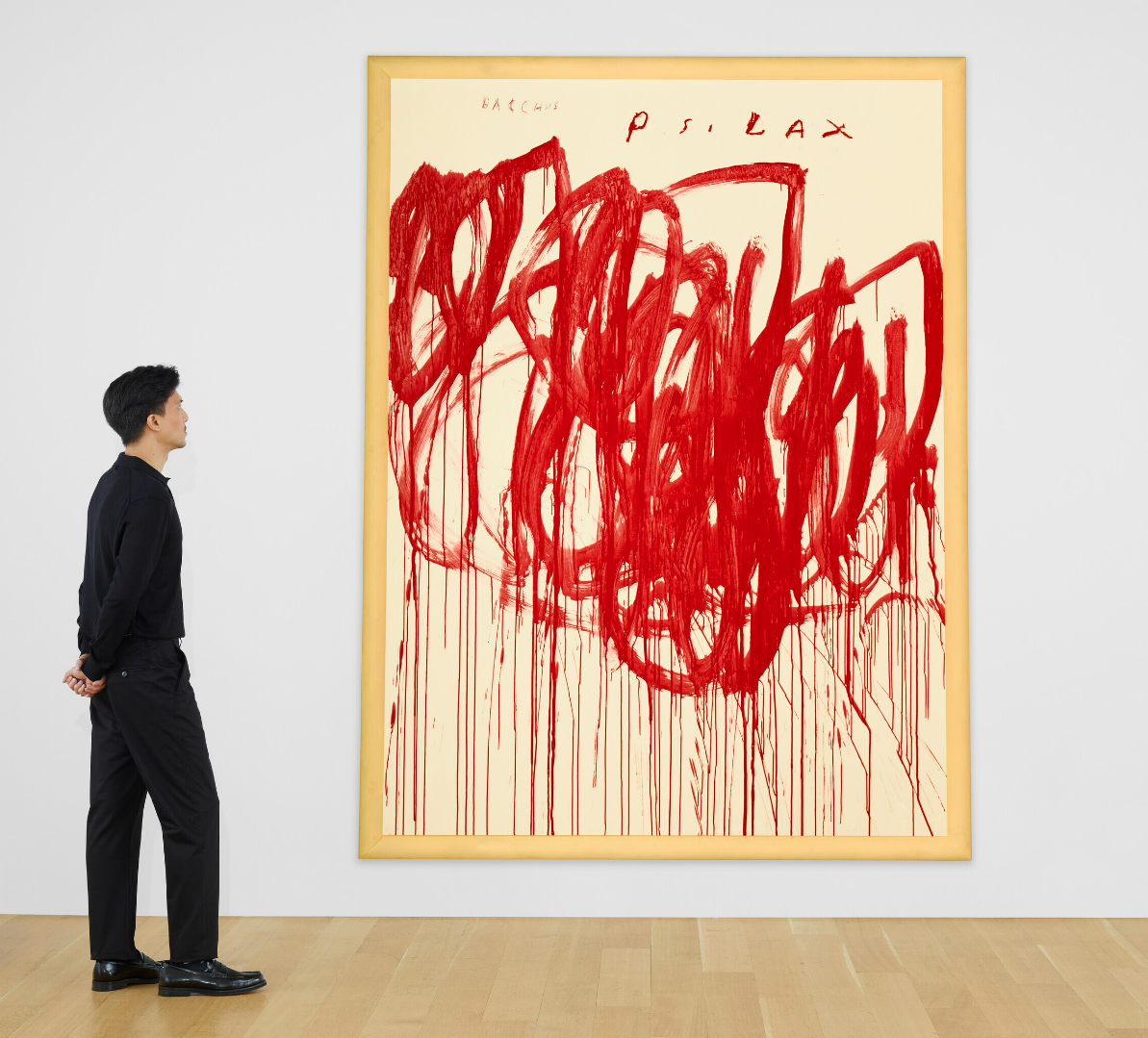
By the time Twombly painted the present work, Bacchus had been a presence in his art, in one form or another, for some four decades. His festive, orgiastic Ferragosto paintings of 1961, painted soon after he had settled in Rome, were bacchanals of color and flesh. The virile god was the subject of his phallic Dionysus collage of 1975. His Bacchanalia works (1977, Museum Brandhorst, Munich) placed a study for Nicolas Poussin’s 1636 party scene The Triumph of Pan amid the cycle of changing seasons. His Bacchus triptych of 1981 was adorned with a bunch of grapes. Real-world violence, too, had colored Twombly’s works before: the 1963 masterpiece Nine Discourses on Commodus (Guggenheim Museum Bilbao), inspired by the Roman emperor Aurelius Commodus’ descent into madness, has been seen as a response to the assassination of John F. Kennedy and the Cuban Missile Crisis. In his Bacchus paintings of the new millennium, Twombly achieved an epic synthesis of these ideas. Distilled to ribbons of red, the works are as concise as they are visceral: conflating wine and blood, celebration and carnage, they, like the god, are many things at once.
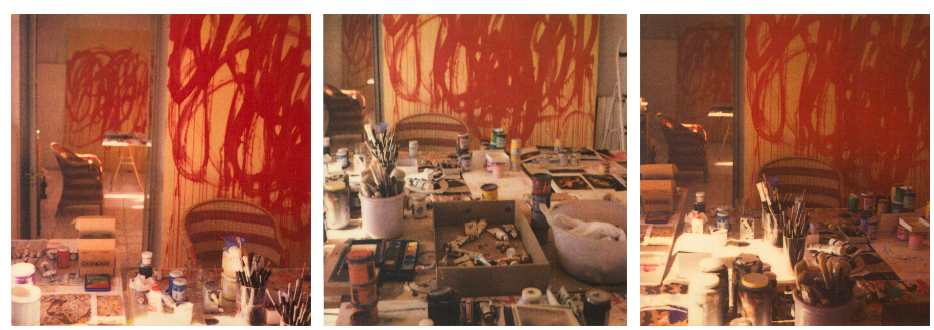
Cy Twombly, Studio (Detail Bacchus Painting), 2003.
Bursting and blooming in sanguine sweeps and coils, the present painting might track the upward flight-path of spirit in rapture, or a cataclysm of debauched violence. In Greco-Roman myth, the maenads or Bacchantes who followed Bacchus’ cult were women endowed with extraordinary strength: they would celebrate Bacchic rites by sacrificing animals and uprooting trees, drinking wine and consuming raw flesh. In Euripides’ tragedy The Bacchae, first performed in 405 BC, Bacchus punishes King Pentheus of Thebes, who claims that he is not a son of Zeus, by sending the city’s women into an ecstatic mania.
#2. Jean-Michel Basquiat
Christie’s New-York: 7 November 2023
Estimated: USD 10,000,000 – 15,000,000
USD 11,910,000
JEAN-MICHEL BASQUIAT (1960-1988) (christies.com)
JEAN-MICHEL BASQUIAT (1960-1988)
Untitled, 1981
Acrylic and oilstick on canvas
50×119 inches (127 x 302.3 cm)
Signed and dated ‘Jean-Michel Basquiat 1981’ (on the reverse)
Painted in 1981, Jean-Michel Basquiat’s Untitled displays all the energy, excitement, and ingenuity of a young artist on the verge of art-world superstardom. Completed when he was barely 20 years old, this canvas contains all the hallmarks of his subsequent career: dynamic mark-making, sophisticated paint handling, evocative numbers and symbols, and one of the artist’s most iconic motifs, a large head. This work in particular also pays homage to Basquiat’s origins as one of New York’s most talented and recognizable street artists. At a young age, he became a legend of the Downtown street culture, with his SAMO tag becoming a badge of honor that appeared all over the city. Elements of 1980s New York are visible in the present work, along with the highly sophisticated visual language that would come to exemplify his work. Acquired directly from the artist by his friend, the curator and cultural critic Diego Cortez, Untitled stands as a prescient example of Basquiat’s work as he stood on the verge of greatness.
Across this monumental canvas, Basquiat choreographs many of the visual elements that would become an important part of his oeuvre. Assorted numbers, scrawled words, and eclectic symbols capture the energy of the streets of New York. The grid laid out in the thick black box mimics the markings of a skelly court, a street game whose markings are scrawled in chalk onto the street or sidewalk. Sitting above the grid is another box containing the letter ‘S’ (a reference perhaps to Basquiat’s alter ego SAMO, or Suzanne Mallouk, his girlfriend at the time?) topped off with a curlicue of barbed wire, iterations of which would feature in several later important paintings including, Profit I, and Untitled (Boxer). Opposing this on the other end of the canvas is a comprehensive array of mysterious words, letters, and numbers set against a dynamic painted surface. Anchored by another boxed ‘S’ (set within a warm colored square), the repeated numbers 3 and 4 sit alongside enigmatic words, barely legible in their scrawled forms. This section is further embellished by an array of painterly techniques as, on a white ground, Basquiat applies diaphanous layers of gray, yellow, and pale blue embellished with drips, splashes and smears of paint.
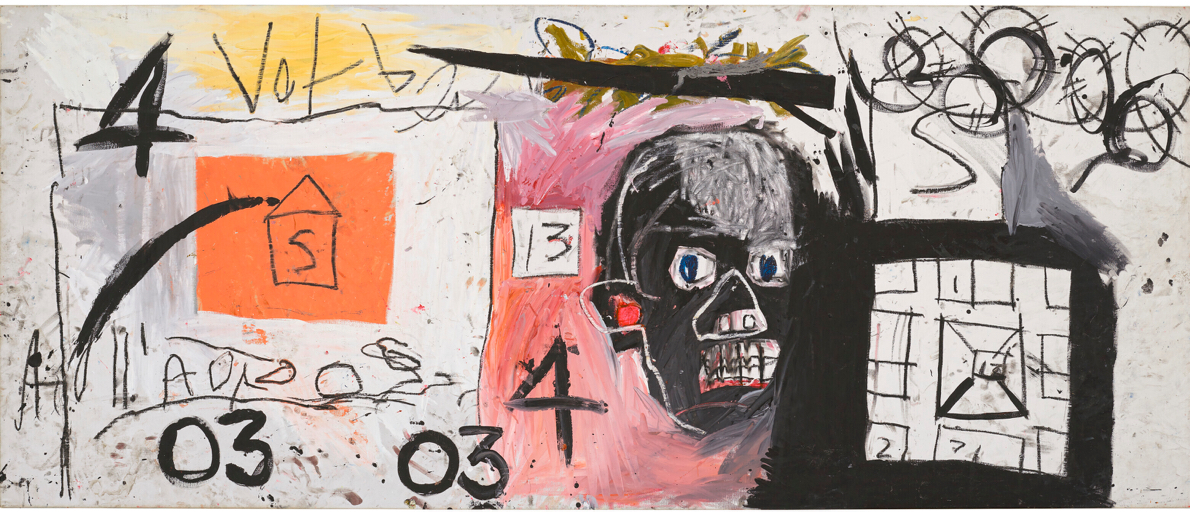
Dominating these active elements is a prominent black head. Seemingly carved out of successive painterly layers, the face provides ample evidence of Basquiat’s innovative approach to figuration. Onto the white ground, he forms the face out of substantial passages of black paint; leaving voids where the eyes, nose and mouth will be, he then proceeds to fill in the details with rapid movements of an oil stick, denoting dark blue pupils, flared nostrils, and a scowl of white teeth. A fiendish quality is added by flashes of red paint around the ears and mouth. To establish the final silhouette, Basquiat traces the outline of the head in white oil stick before surrounding it with a cloud of warm salmon pink. One of the other distinguishing qualities of the present work, along with much of his early work, is the references to the artist’s urban surroundings. Here, the outlines of the skelly court are one of the most prominent components of this composition. The street game was popular in the black neighborhoods of large urban centres, and particularly appealed to Basquiat because of its childlike qualities and graffiti-like origins.
Children playing Skelly, New York, 1995. Photo: © Edward Keating / New York Times Pictures.
The game was popular with kids and was played on a linear diagram that was drawn onto the surface of a street or sidewalk with chalk or paint. Players would then throw markers (rocks, coins, bottle caps etc.) into numbered boxes that are contained within a large square. The goal was to progress from box number one to the final box thirteen, which is located in the center of the court.
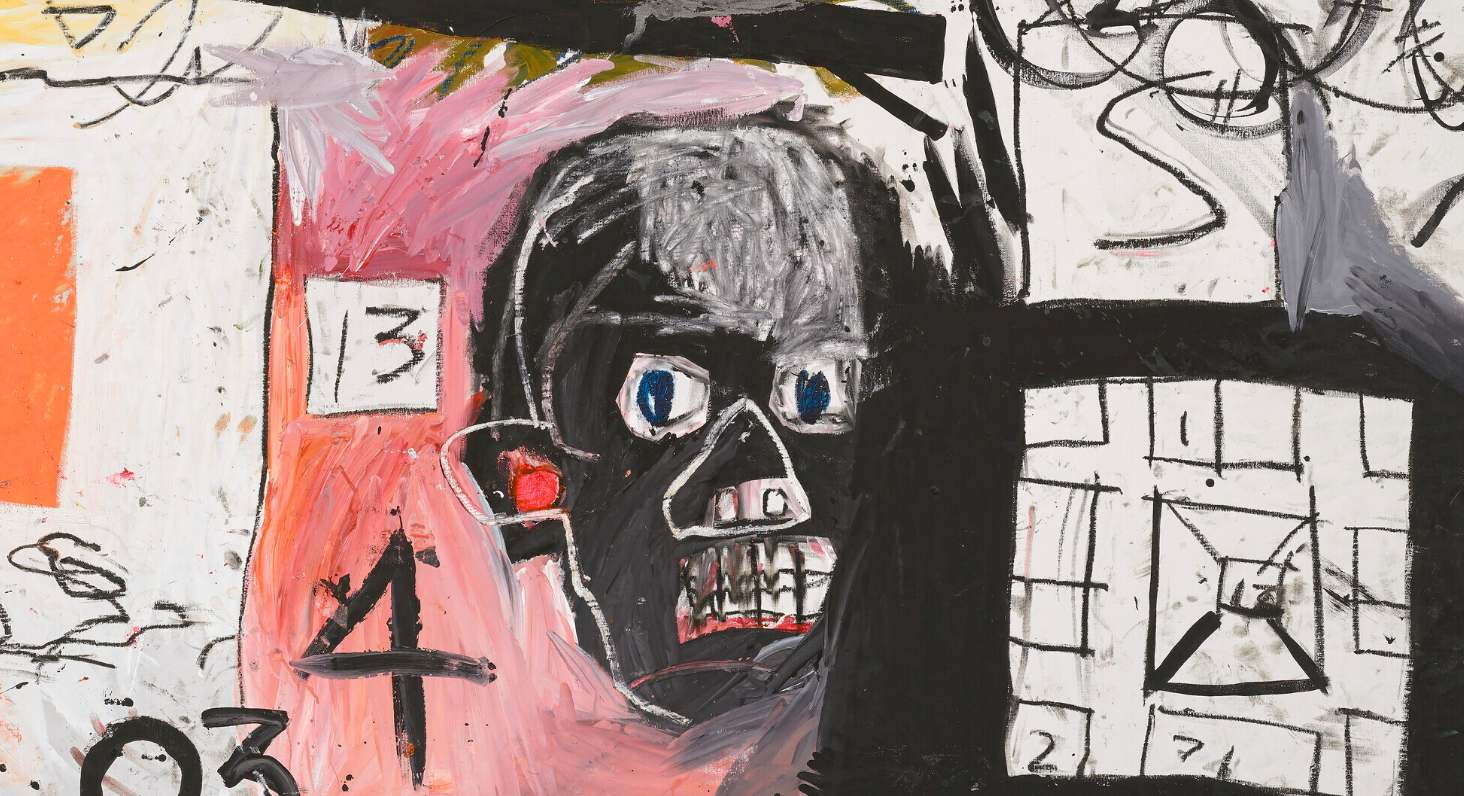
Untitled was acquired directly from the artist by Diego Cortez, curator of the 1981 New York/New Wave exhibition that changed the course of Basquiat’s career. Cortez was a key figure in the Downtown art and music scene in Manhattan in the 1970s and ‘80s, and was the founder of the iconic Mudd Club, a groundbreaking nightclub that saw performances by the likes of Talking Heads and Basquiat’s own band, Gray. In 1981 his legendary show at the cutting-edge P.S. 1 Contemporary Art Center (now MoMA PS 1) brought together the worlds of art and music that he knew so well, showing works by the likes of Basquiat, Robert Mapplethorpe, Keith Haring, Nan Golding, Andy Warhol, Fab 5 Freddy, and William Burroughs. As such, Untitled sits at a pivotal point in Basquiat’s brief but storied career. Painted when he was on the brink of becoming one of the defining artists of his generation, it contains the painterly qualities, and many of the motifs, that would define the rest of his oeuvre. It virtually pulsates with the bravado of youth, but also displays the maturity that made him stand in an already crowded field of young artists seeking to redefine the New York art scene.
#3. Brice Marden
Christie’s New-York: 7 November 2023
Estimated: USD 8,000,000 – 12,000,000
USD 9,840,000
BRICE MARDEN (1938-2023) (christies.com)
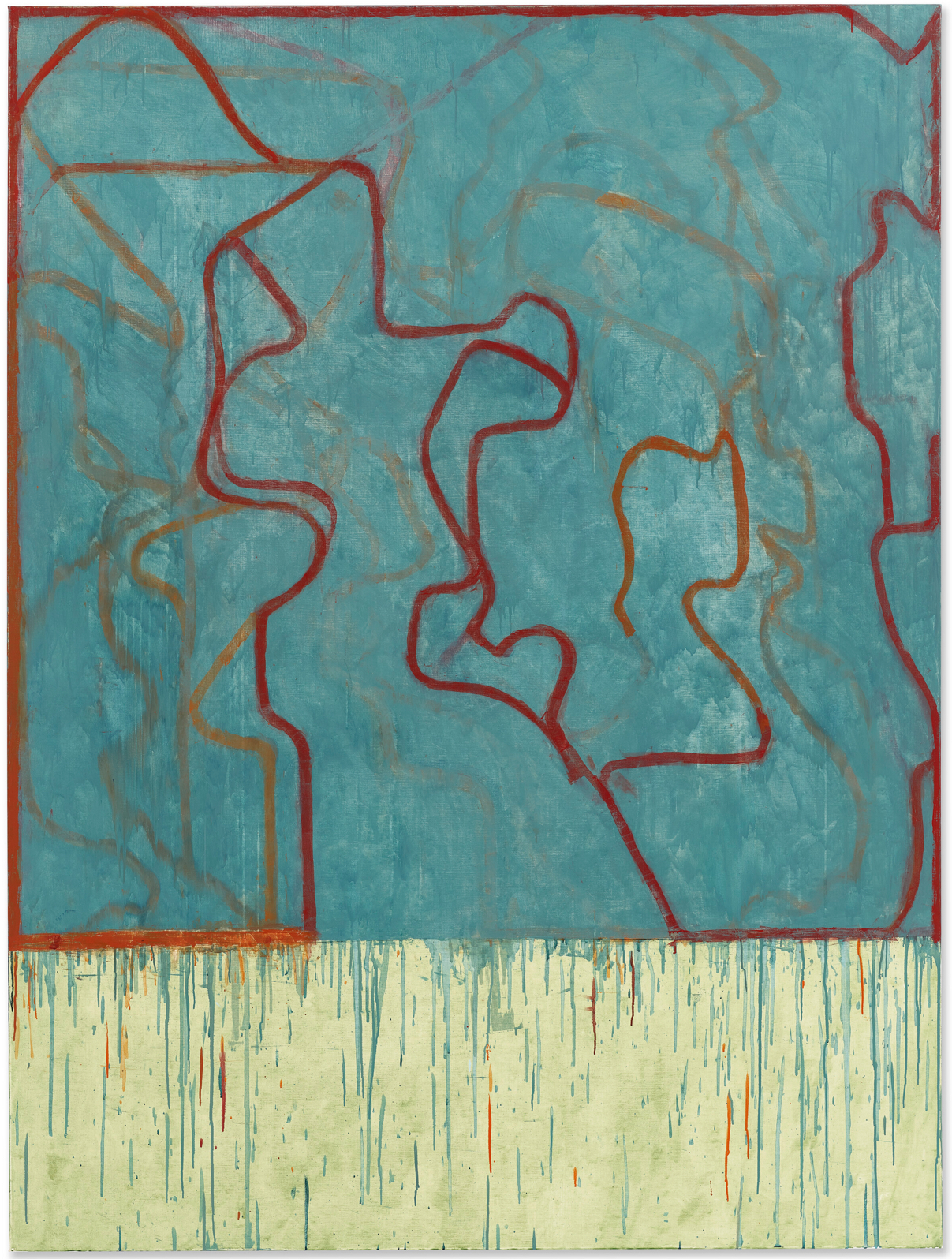
BRICE MARDEN (1938-2023)
Belle’s Turquoise, 2020-2021
Oil on linen
96×72 inches (243.8 x 182.9 cm)
Signed, titled and dated ‘BELLE’S TURQUOISE Brice Marden 2020-2021’ (on the reverse)
An intoxicating example of what Brice Marden once referred to as paint’s ‘shamanistic’ qualities, Belle’s Turquoise is an exemplary example of the profound and deeply poetic canvases for which he is celebrated. Ultimately devoting his six-decade long career to these enigmatic forms, from his early monochromatic paintings of the 1960s to the colorful lyricism of his ‘calligraphy paintings, Marden was able to demonstrate that his prolonged study of what he termed the “plane image” gave him access to a deeper, richer, and more sublime pictorial realm. Painted in 2020-21, Belle’s Turquoise offers up a hauntingly-beautiful glimpse into this inner world, where a softly-veiled web of colorful, meandering lines is offset by a light-filled panel at the lower edge. In this, one of the last paintings Marden would exhibit before his death earlier this year, the complex interplay of color, texture and form can be seen as the poetical culmination of his impressive, sixty year career.
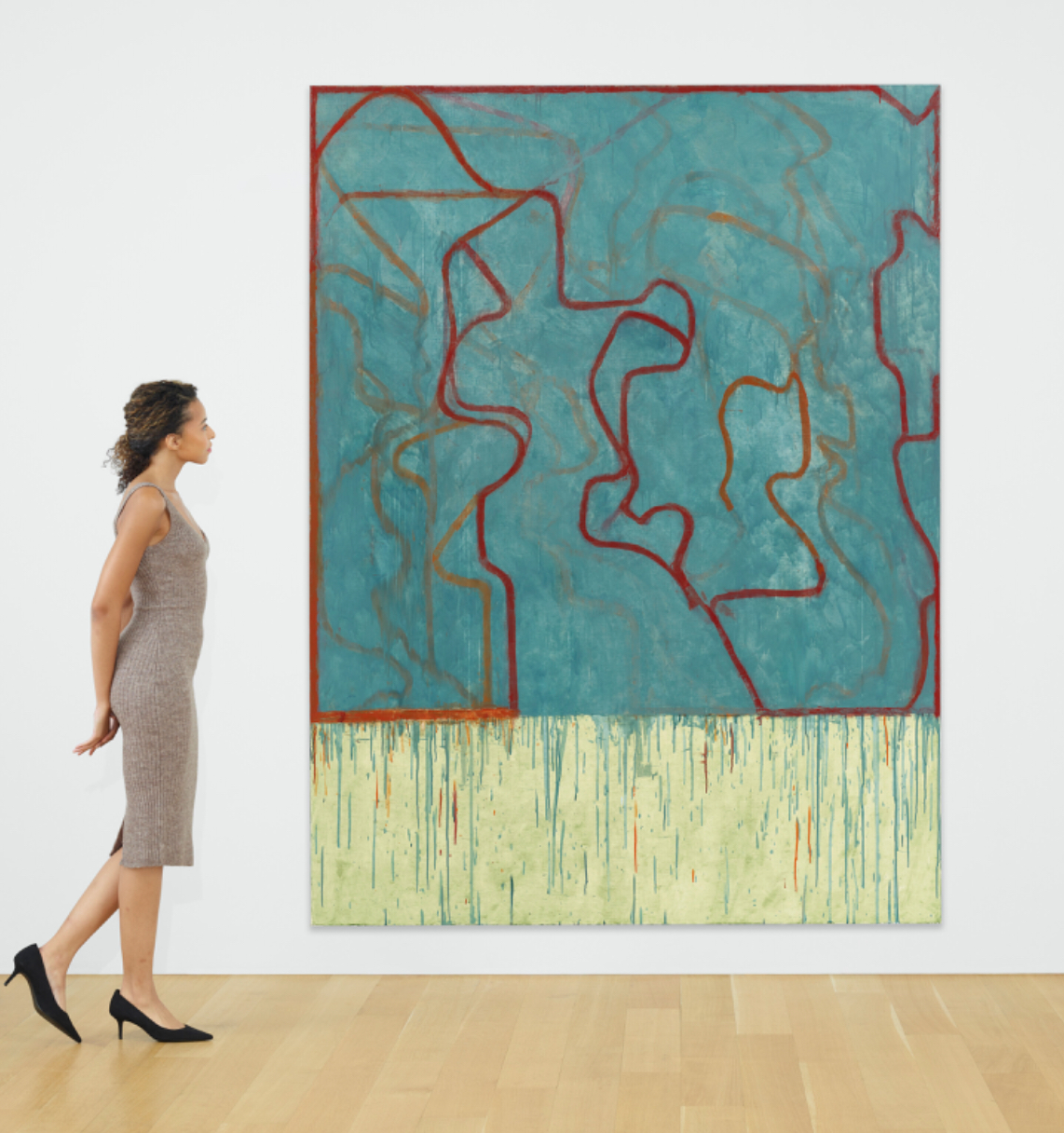
A visually majestic—yet conceptually rigorous—painting veiled in translucent blue washes, Belle’s Turquoise combines the lyrical abstraction of Marden’s calligraphy paintings with the minimalist elegance of his monochromes. Here, the artist has used a long brush to delineate a tangled network of wiry, sinuous lines, which snake in and out of a watery, blue realm in muted red and orange tones. The eye follows the curvature of each line, which flows up and around in tight twists, double-backs and ninety-degree angles. Certain lines end abruptly in mid-air, while others change color halfway through. The ghosted remains of previous lines linger just below the surface, bearing witness to the weeks, months and years of continuous revision and refinement that were part of Marden’s intuitive process. The sliver of light along the lower edge has the effect of intensifying the color relationships in the area above it, whilst also acting as a reservoir for its many drips. The sinuous linear elements feel electric, but also submerged—muted, almost like an echo of their former selves.
#4. Jia Aili
Christie’s New-York: 7 November 2023
Estimated: USD 1,000,000 – 2,000,000
USD 4,769,000
JIA AILI (B. 1979) (christies.com)
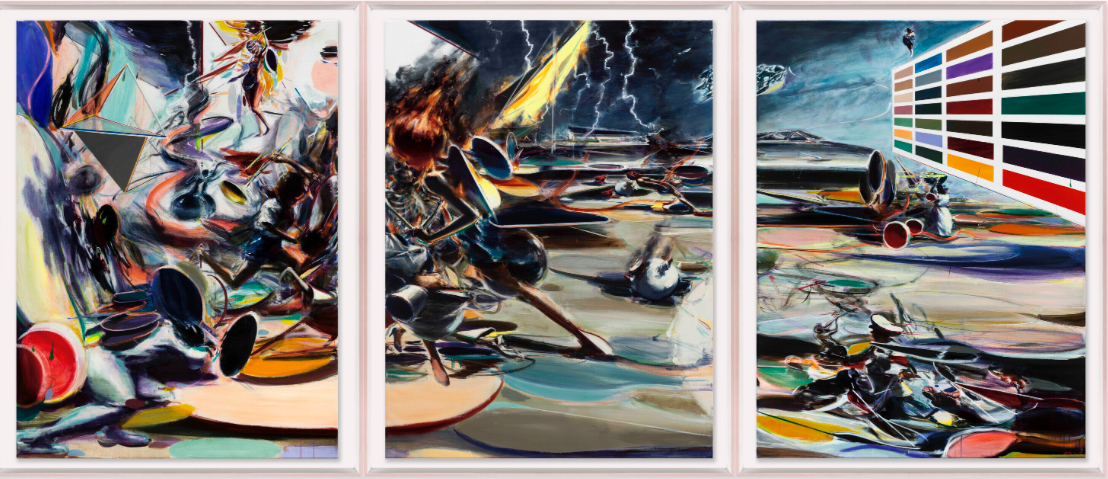
JIA AILI (B. 1979)
Combustion, 2016
Acrylic on canvas, in three parts, in artist’s designated frame
Each, framed: 85 x 65 1/4 inches (216 x 165.6 cm)
Overall: 85 x 195 3/4 inches (216 x 497.2 cm)
Signed with artist initials and dated ‘JAL 2016’ (lower right of the right panel)
Lia Aili, one of the most important Chinese artists working today, unites Surrealism, Futurism, and Minimalism in his monumental triptych Combustion. Referencing both destruction and regeneration, Combustion was also the name of Jia’s first New York gallery exhibition in 2019. Exhibiting a rigorous passion for painting and an eye for evocative juxtapositions (in the vein of James Rosenquist), the present work is at once dramatic, somber, absurd, complex, beautiful, and disarming. A world unfolds before us in three parts: the left panel is a cacophony of colors and forms with an insect-like being presiding over it like an ersatz angel, and the action unfolds in the middle panel with a violent thunderstorm. Death marches on to the final panel, which changes the nature of Jia’s landscape. Emerging from the edge of the canvas are blocks of color that form a wall or fence. What lies beyond this chromatic structure, we cannot know, but in Jia’s universe, nothing is as it seems. In its review of the artist’s debut Manhattan exhibition, The Brooklyn Rail praises this order within chaos, “It is as if we are witnessing some cosmic event happening in a split second and Jia has had the good fortune of pressing pause at just the right moment. By combining sharp, representational renderings with abstract shapes, Jia is able to disassociate his tableaux from the real world and more aptly illustrate his hazy visions and sense of unease” (G.W. Bell, “Jia Aili: Combustion,” The Brooklyn Rail, April 2019).
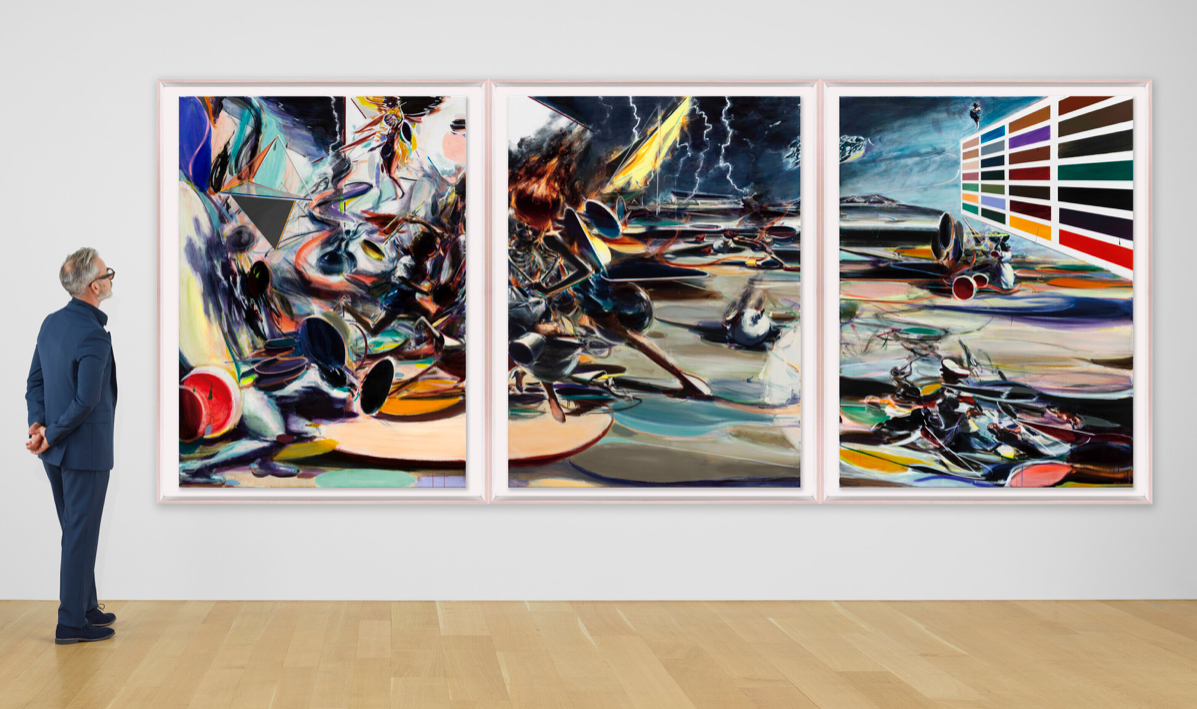
While Jia is based in China, he also keeps a studio in New York due to the demand for his work in both Asia and the Americas. Artnet News describes this unique position in the global art world, “He is a member of a new generation of Chinese artists, reared in the post-Mao Zedong era, who are known for eschewing the overtly political themes of previous generations in favor of merging classical Eastern modes of art-making with contemporary issues” (T. Dafoe, “Young Chinese Art Star Jia Aili on Why He Filled His New Gagosian Show With Paintings of the Apocalypse,” Artnet News, March 29, 2019). A dedication to formalism does not render Jia’s paintings quaint or merely beautiful. He simply refrains from being confined to art deemed political so that his message can resonate more widely and with diverse audiences.
#5. Nicolas Party
Christie’s New-York: 7 November 2023
Estimated: USD 3,800,000 – 4,500,000
USD 4,406,000
NEW AUCTION RECORD FOR THE ARTIST
NICOLAS PARTY (B. 1980) (christies.com)
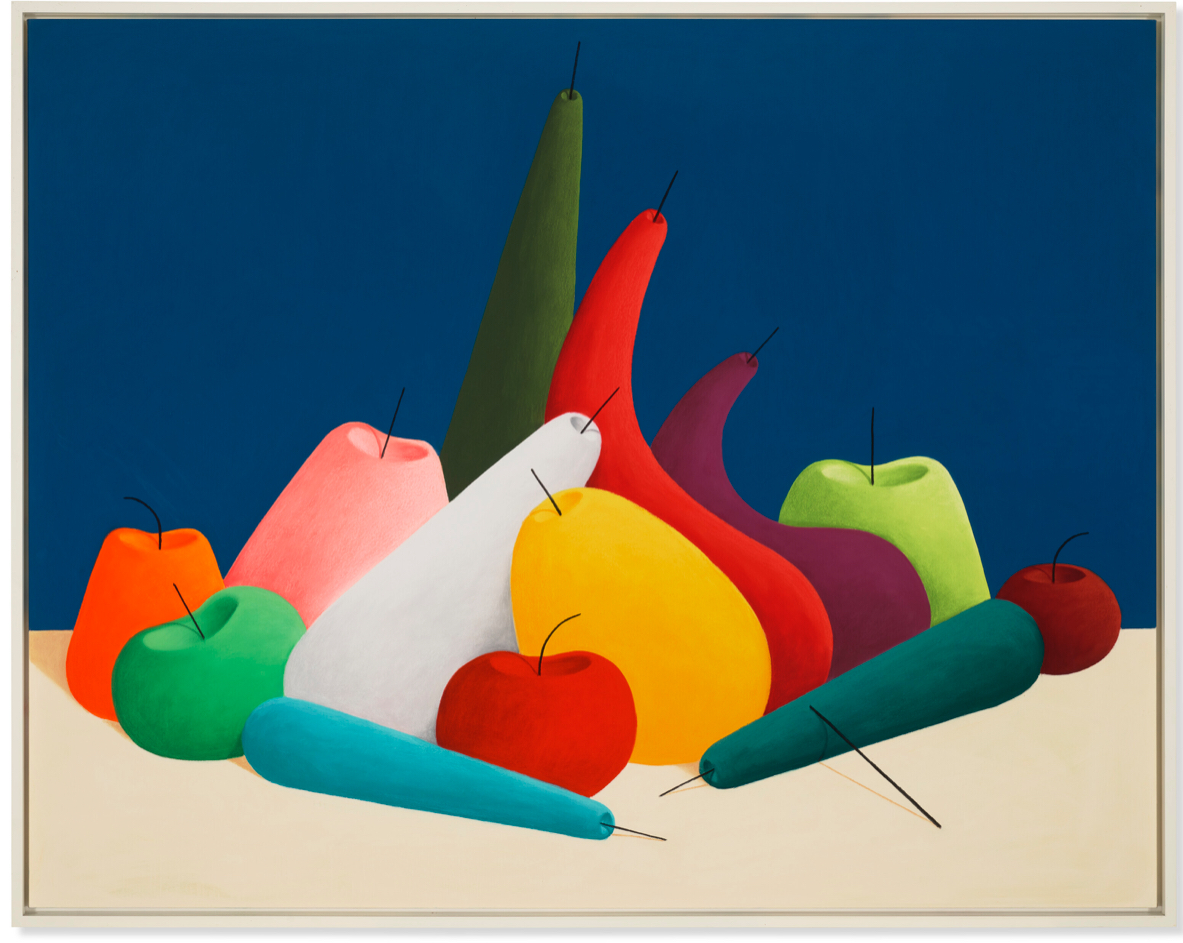
NICOLAS PARTY (B. 1980)
Still Life, 2015
Soft pastel on linen
150×190 cm (59 x 74 3/4 inches)
Fresh from the critical acclaim of his current installation at New York’s Frick Collection, Nicolas Party has cemented his status as one of the most important contemporary artists working today. Executed on a large scale, at nearly five feet by six feet, Still Life is rare in the history of its titular genre, which often focuses on smaller scenes meant to evoke the domestic interior. The present work, with its alluring, textured pigments and sensual forms, exemplifies Party’s unparalleled sensitivity to color and his mastery of pastel.
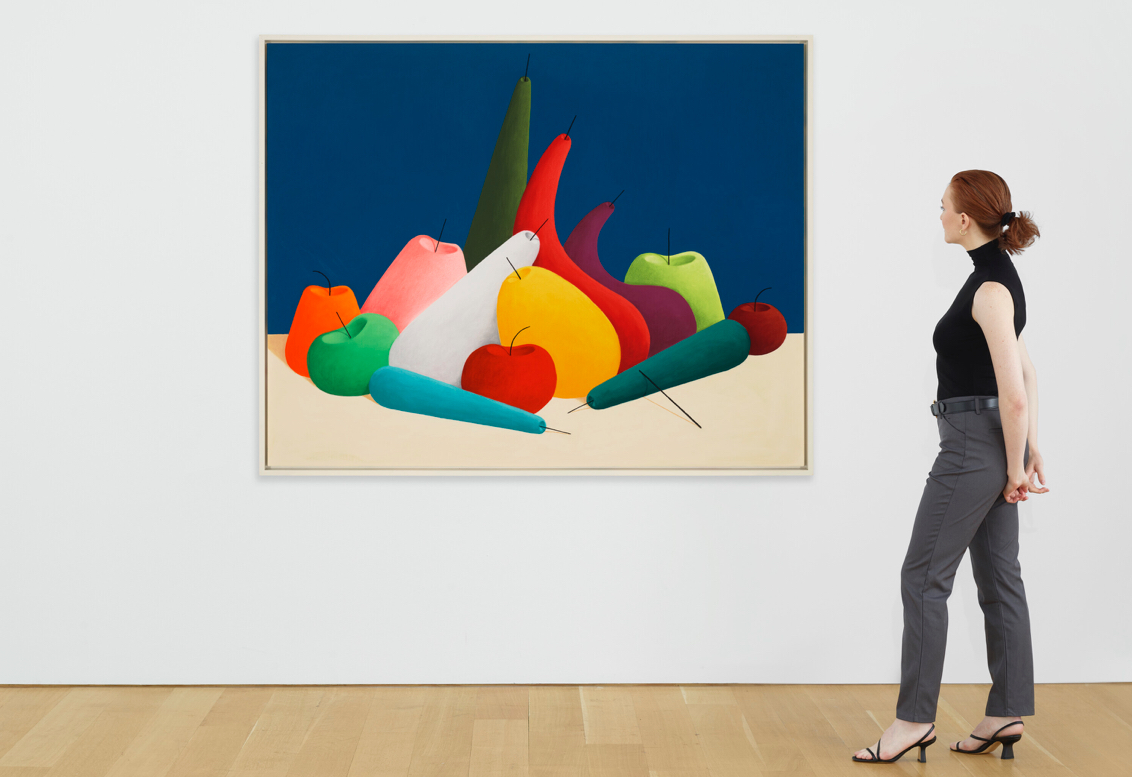
Unlike the static still lifes with which we are most familiar, the present work is highly sculptural, embodied, monumental, and textured. Still Life is among Party’s most significant investigations of this genre. Its fruits nestle together, overlap each other, and yet seem also to merge together even as they retain their individuality. The tactile qualities of the pastel medium enlivens the scene, as if a still life has transformed into flesh. Reminiscent of the milky hues of Chinese porcelain, the blue and cream background lends a subtle, earthy beauty. Party’s revival of the still life for our moment has as much to do with the medium he chooses as what he depicts. His work is currently on view at the Frick Collection, New York, where he has created an installation responding to the eighteenth century pastel masterpiece, Portrait of a Man in Pilgrim’s Costume (c. 1730) by Rosalba Carriera. Still Life connects to this long history of the use of pastel, which has been praised for its deep pigments and lustrous corporeality. The eighteenth-century saw an increased interest in pastels, driven by Carriera, Élisabeth Louise Vigée Le Brun, and Jean Baptiste Greuze, which were often created as site-specific commissions for aristocratic interiors. Party is an expert on this history.
Other Highlights
Matthew Wong
Christie’s New-York: 7 November 2023
Estimated: USD 2,000,000 – 3,000,000
USD 4,164,000
MATTHEW WONG (1984-2019) (christies.com)
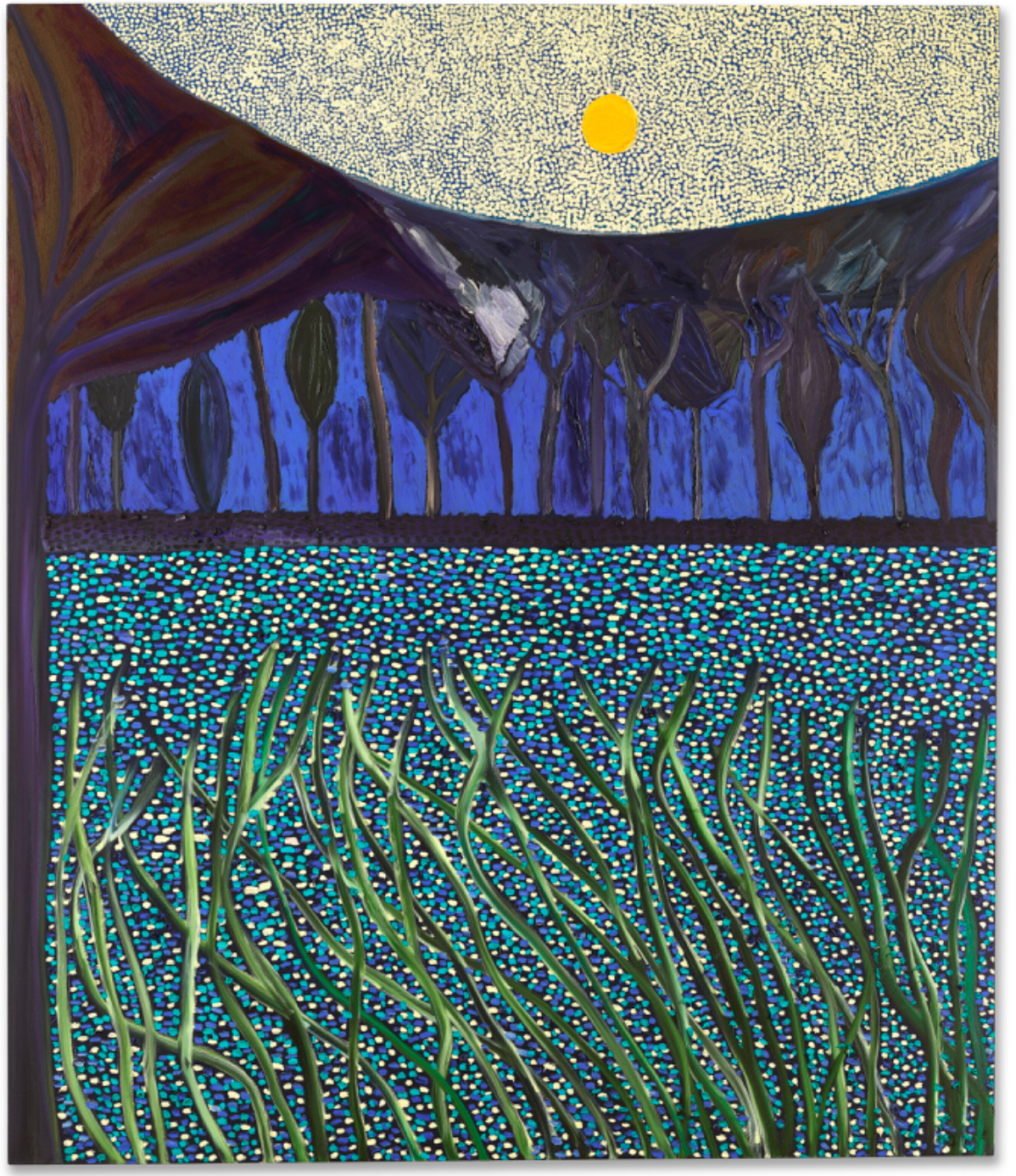
MATTHEW WONG (1984-2019)
Night 1, 2018
Oil on canvas
70×60 inches (177.8 x 152.4 cm)
Signed in Chinese, titled ‘NIGHT 1’ and dated in Chinese (on the reverse)
n this large-scale painting, Matthew Wong expands his signature aesthetic to embrace the mysterious beauty similar to that contained within Henri Rousseau’s luscious jungle landscapes. Wong created the present work using a wet-on-wet painting technique, which involves the layering of pigment before it dries. This process requires a fast and light touch, and what results is an enchanting landscape both ethereal and material. The New York Times co-chief art critic Roberta Smith hailed Wong as “one of the most talented painters of his generation” (R. Smith, “A Final Rhapsody in Blue From Matthew Wong,” New York Times, December 24, 2019), and Night 1 epitomizes the prescience of Wong’s unique vision, completed just a year before his untimely passing.
Though Wong did not have formal training in painting, he held a MFA in photography from the City University of Hong Kong. His paintings are coveted not only because of his short six-year oeuvre, but also because of their unparalleled emotional force. In Night 1, there is certainly melancholy, but also peace, as is often the case in Vincent van Gogh’s landscapes. The moon glows with subtle optimism upon a blue and green field. Trees in the distance do not obscure, but rather in the Romantic and Gothic traditions, signal the wistful passage of time. Alternatively, we could see Night 1 as a rendering not of a field, but of seedlings emerging from underground as they are fed by moonlight. The archetypal dark night of the soul could be a contemplative evening walk in nature wherein we can imagine a world that accepts us.
Jeff Koons
Christie’s New-York: 7 November 2023
Estimated: USD 4,000,000 – 6,000,000
USD 4,043,000
JEFF KOONS (B. 1955) (christies.com)
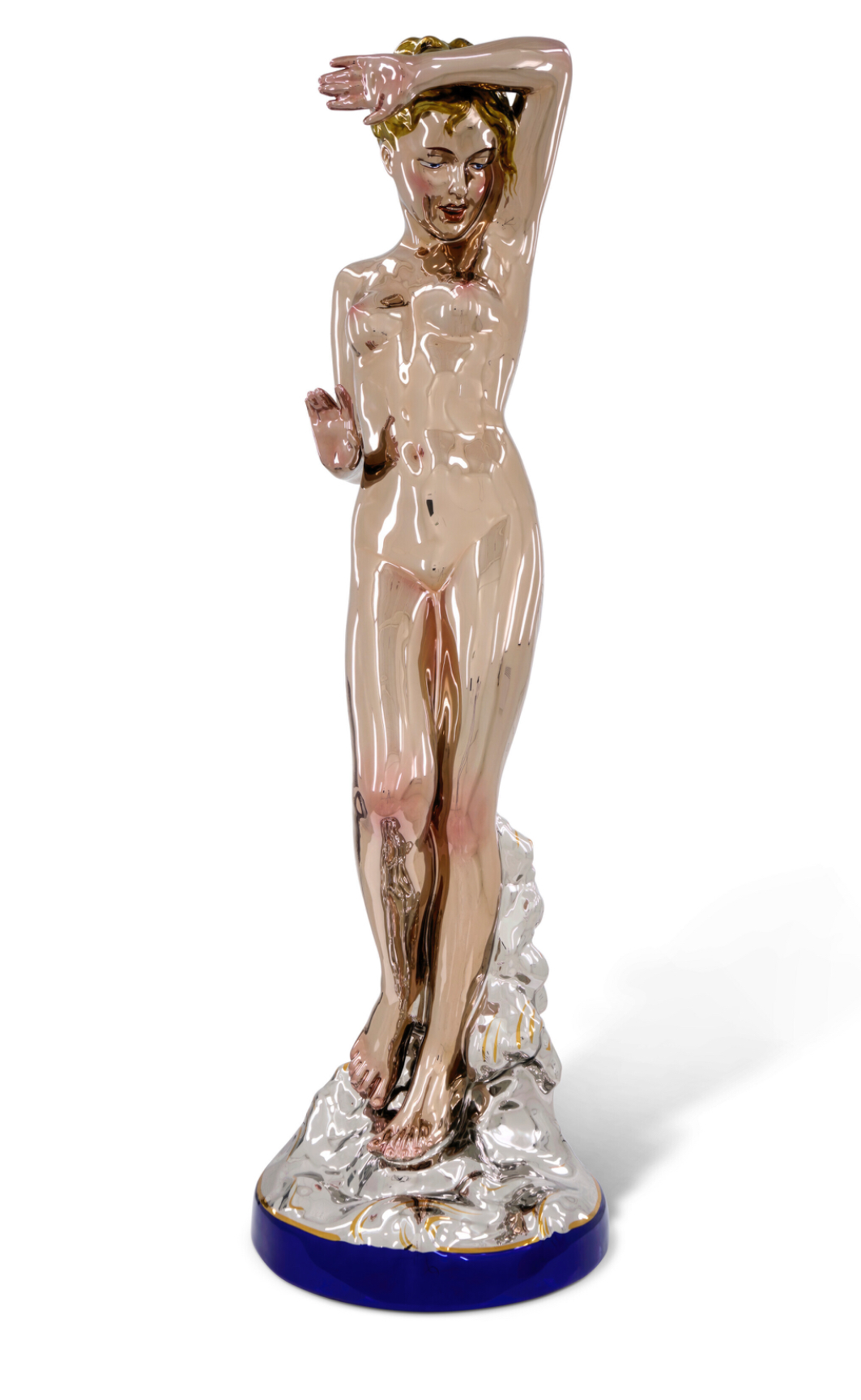
JEFF KOONS (B. 1955)
Aphrodite, 2016-2021
Mirror-polished stainless steel with transparent color coating
102 x 30 3/16 x 30 3/8 inches (259.1 x 76.7 x 77.2 cm)
This work is number one from an edition of three plus one artist’s proof.
Standing nearly nine feet tall, the subject of Jeff Koons’s Aphrodite lives among art history’s greatest sculptures, and under Koons’s tutelage the Greek goddess’s lustrous form is as desirable as any classical rendering of her. His precise, yet delicate, touch is on full display here as he offers us a sculpture that lies at a point between truth and fiction, movement and stasis, myth and the now. With works such as this, Koons established himself as a twenty-first century Pygmalion, who, driven by desire, breathes life into the inanimate. Indeed, Ovid could be describing Koons in his poem Metamorphoses, the source of the Pygmalion myth, “He carved a statue out of snow-white ivory, and gave to it exquisite beauty, which no woman of the world has ever equalled: she was so beautiful, he fell in love with his creation” (Ovid, Metamorphoses, Bloomington and Indianapolis, 1983, p. 242).
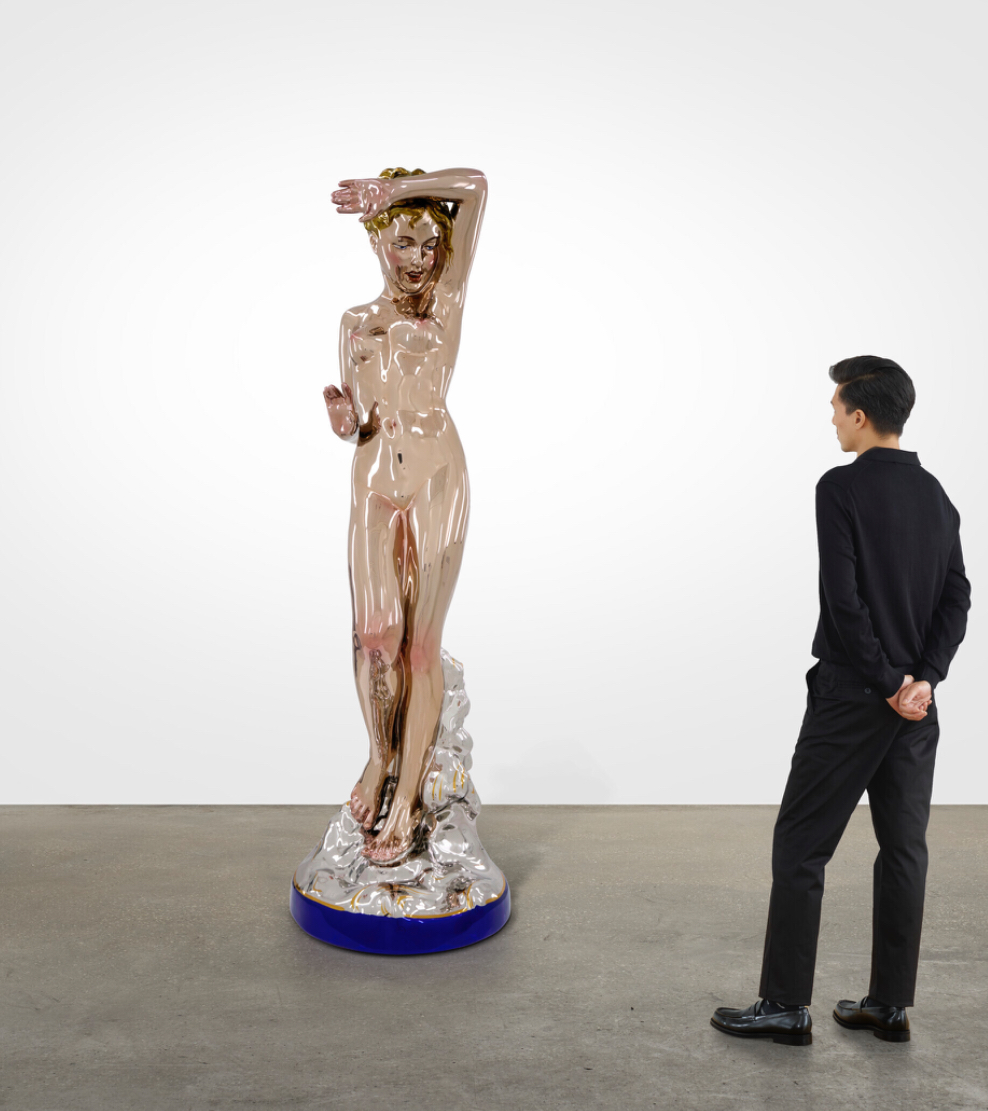
Koons’s references to Aphrodite are part of a long, fascinating history of the goddess within art history. He eloquently references the ‘readymade’ nature of Roman sculpture, which also characterizes his ouevre, “A lot of these pieces are copies, and you can feel the dedication that the Romans had to try to preserve all of the power within the original Greek pieces from the third century BCE. But at the same time, you always have the desire for a new form, a new material realization,” (J. Koons, The Artist Project: Jeff Koons, Metropolitan Museum of Art, June 6, 2016). As an example, one might look to the marble statue of Aphrodite in the collection of the Metropolitan Museum itself. This statue is a copy of a Greek original as Koons notes, and the legs are also their own copies as well; they were restored from a cast of the Medici Venus in Florence.
For his rendition of Aphrodite, Koons modeled his sculpture on a Royal Dux figurine. The early 20th century figurine was manufactured in the Czech Republic. The Porcelain series, which Aphrodite is part of, uses porcelain figurines as models which range from the 17th century to the present day. In antiquity, Aphrodite often used her hands to cover her breasts and pubic area, but Koons chooses to amplify her sexuality and use a source material that leaves her uncovered. Conversely, the Aphrodite of Knidos (4thcentury BCE), the first sculpture to show Aphrodite nude and the model upon which later sculptures of the goddess relied, leaves her breasts nude as Koons does (he explicitly used this iteration of Aphrodite in works such as Antiquity 4, 2010-2013). Furthermore, his Aphrodite, with her limbs intact, is both a readymade and an act of aspiration, a gesture of wholeness inspired by mass produced and repeated objects. It is also important to note that Koons’s appropriation of this porcelain figure instead of a Greco-Roman “original” is in fact truer to life. While we assume sculptures of antiquity have always been marble white, they were in fact polychromed, and their pigments have chipped off over the centuries.
An important Roman erotic text described the Aphrodite of Knidos as a spectacle of desire, “The goddess stands in the center; her statue made of marble from Paros. Her lips are slightly parted by a lofty smile. Nothing hides her beauty, which is entirely exposed, other than a furtive hand veiling her modesty. The art of the sculptor has succeeded so well that it seems the marble has shed its hardness to mold the grace of her limbs” (Lucian of Samosata, Erōtes, approx. 2nd-4th century CE). The same could be said of Koons’s Aphrodite, which is the culmination of his longstanding fascination with the goddess.
Jean Auguste Dominique Ingres, Venus Anadyomene, 1780-1867. Musée du Louvre, Paris. Photo: © RMN-Grand Palais / Art Resource, NY.
With Aphrodite, Koons transcends time. It reaches back into antiquity even as it references the birth of modernity in eighteenth and nineteenth-century Neoclassicism. Koons channels the unabashed sensuality of Alexandre Cabanel’s famous painting The Birth of Venus (1863, Musée d’Orsay, Paris), in which the titular figure looks coyly out at us with one barely open eye. The sculptural luxuriousness of the present Aphrodite is also apparent in Jacques-Louis David’s Mars Disarmed by Venus (1824, Musées royaux des Beaux-Arts de Belgique, Brussels), whose lush treatment of bodies has all the tactility and elegance of Koons’s. David’s Venus exhibits the impossibly extended back that would characterize much Orientalist and Neoclassical painting, a technique used to amplify the sexuality of the composition. The same could be said of the present work, whose lithe verticality presents the body in its idealized form.
George Condo
Christie’s New-York: 7 November 2023
Estimated: USD 3,500,000 – 4,500,000
USD 3,438,000
GEORGE CONDO (B. 1957) (christies.com)
GEORGE CONDO (B. 1957)
Monumental Abstract Self-Portrait, 2018
Oil on canvas
84×80 inches (213.4 x 203.2 cm)
The true nature of George Condo can be glimpsed within Monumental Abstract Self-Portrait. It is a treatise on how he has approached the history of painting and his own role within the ever-evolving timeline. Alongside his New York contemporaries like David Salle and Julian Schnabel, he helped to kickstart the turn toward figuration in the 1980s as they questioned the conjunction of abstraction and representative subjects. Reducing the figure down to a bust-length portrait, he instills the present example with an emotional and psychological depth made all the more poignant by his adept handling of material. “There was a time when I realized that the central focal point of portraiture did not have to be representational in any way,” he recalled. “You don’t need to paint the body to show the truth about a character. All you need is the head and the hands” (G. Condo, quoted in A. Bonney, “George Condo,” BOMB Magazine, Summer 1992). Monumental Abstract Self-Portrait shows just that: the fragmented, unruly head confronts the viewer while the artist’s hands make themselves known in the undulating, luxurious brushwork that brings this grinning visage to life.
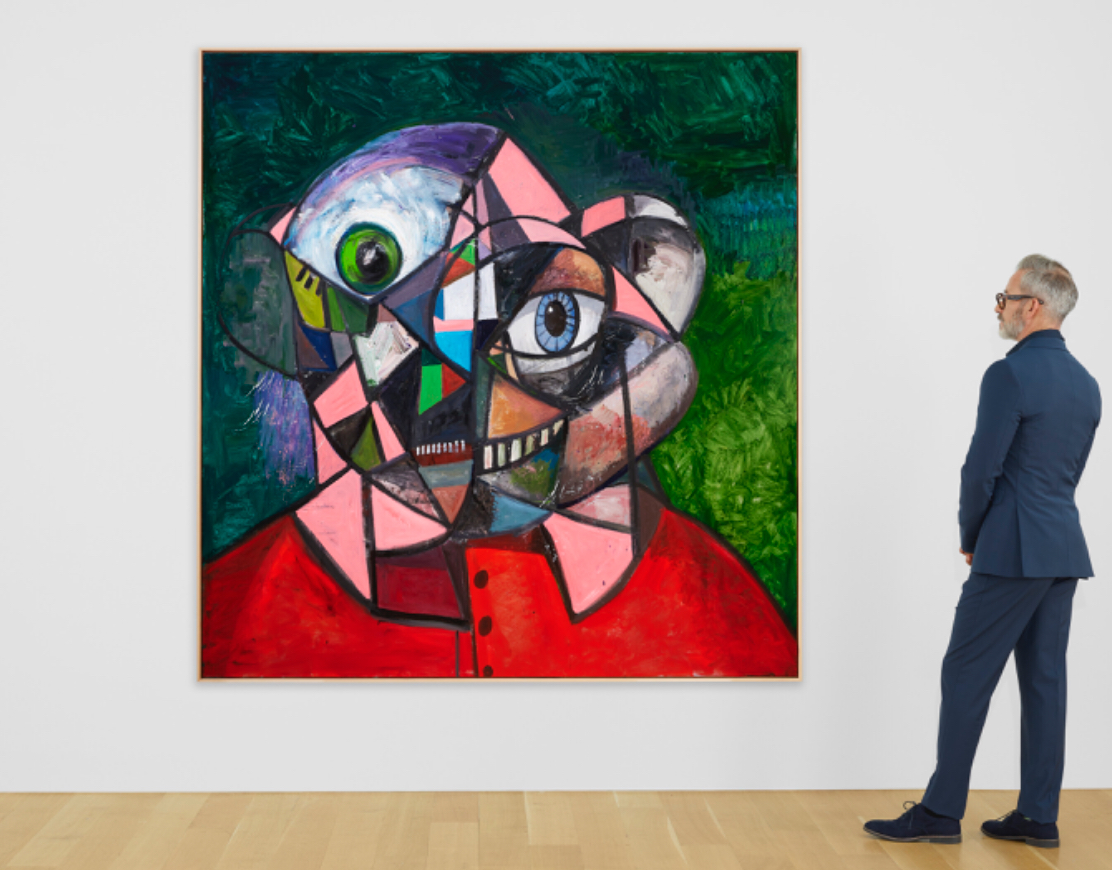
In the grand tradition of court painting and historic depictions of the wealthy, Condo positions himself as a noble subject in Monumental Abstract Self-Portrait. The sheer size, combined with the bold red vestment and the dark green backdrop allude to the works of Velázquez and Holbein while remaining firmly in the present. A dark outline defines the shoulders and then continues into the sitter’s head where it immediately splinters into a multi-faceted gem. The basic shape of the human head is there, but it only exists because of Condo’s ability to place certain signifiers in specific places that trigger our pareidolia. Two separate rows of grinning teeth are buffered by panels of bronze and black while the cheeks exist as both rounded, illusionistic objects and flat, geometric planes of salmon pink. Above this, two large eyes stare menacingly at the viewer and seem to pierce us with their gaze. The left eye is gray, its iris stylized with multiple black lines as a cartoon dot of light gleams on the upper pupil. The lid is drooping slightly and casts a subtle shadow across the white of the eye. In contrast, the right eye looms above as it seems to burst forth from the top of the artist’s head. Its green iris, as well as the rest of the protuberance, is brushy and shows Condo’s handling of paint as it swirls like a small hurricane. It is only barely contained by a shock of purple hair and the outline of an ear.
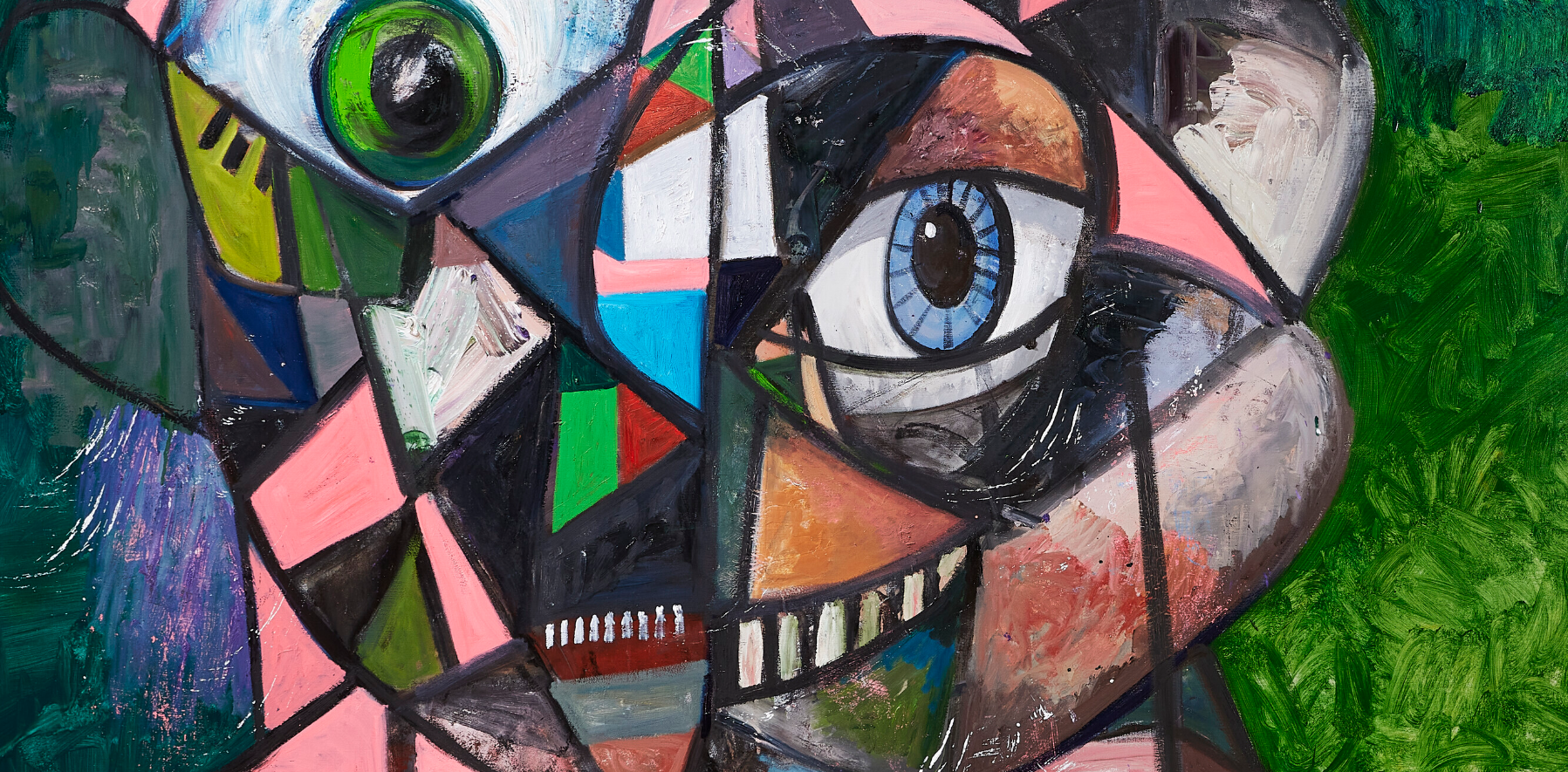
The result of this construction is a portrait that enthralls the viewer while simultaneously dislocating our idea of the human form. “Attention is what Condo’s figures initially demand, located as they are between the grotesque and the comic, protagonists caught between comedy and tragedy. Only on closer observation does the degree emerge to which his way of painting, his composition and his concept of the figure govern the actual attraction of his paintings, and how complex and independent is his engagement with a very personal tradition” (M. Brehm, “Tradition as Temptation. An Approach to the ‘George Condo Method'”, in T. Kellein, George Condo: One Hundred Women, exh. cat., Salzburg, Museum der Moderne, 2005, pp. 19-20). There is no way to escape Condo’s characters. Not only do we instinctively lock eyes with them, but by doing so we begin to be affected by their inner turmoil. Each painted plane becomes a different mental state within the figure that reveals itself the longer we stare.
Keith Haring
Christie’s New-York: 7 November 2023
Estimated: USD 3,500,000 – 4,500,000
USD 2,712,000
KEITH HARING (1958-1990) (christies.com)
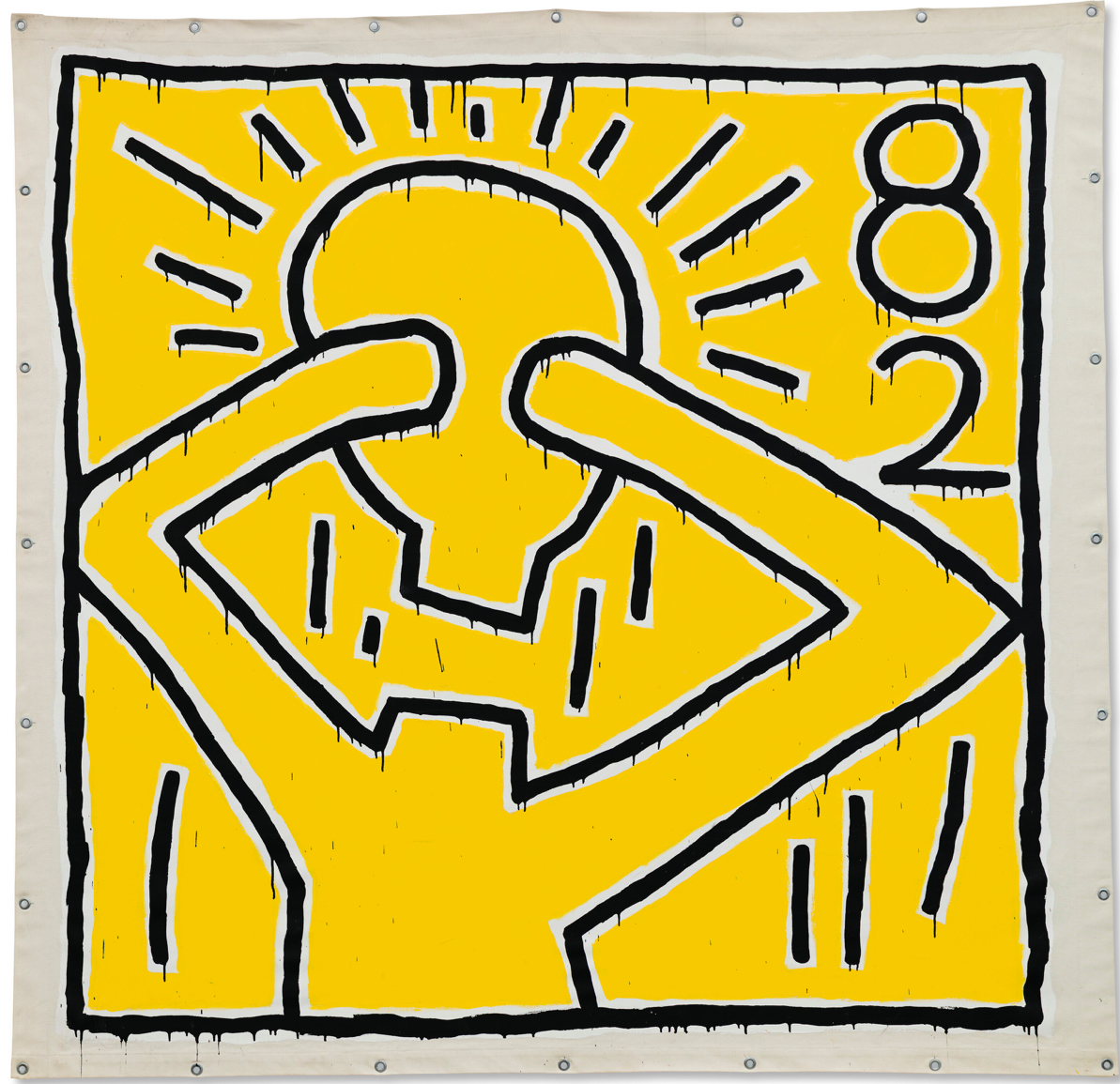
KEITH HARING (1958-1990)
Untitled, 1982
Acrylic on canvas tarp with metal grommets
99×97 inches (251.5 x 246.4 cm)
Dated ’82’ (upper right)
Signed, and dated again ‘K. Haring Feb. 20 – 82’ (on the reverse)
Untitled is an important early work that signals Keith Haring’s transition from urban graffito to meteoric art star. Pulling from the visual vocabulary established by his subway drawings, this dynamic canvas tarp shows dripping paint and energetic lines that tie his future fame to his humble beginnings. The present work was executed the same year that Haring began working with the gallerist Tony Shafrazi, a period that saw exponential growth for the painter. A year later, in 1983, he was included in Documenta and the Whitney Biennial, all while becoming an integral part of the burgeoning cultural scene in New York. However, far from becoming egotistical and falling into the trap of celebrity, Haring worked to create artwork that was accessible and went beyond the individual. “See, when I paint, it is an experience that, at its best, is transcending reality,” he once noted. “When it is working, you completely go into another place, you’re tapping into things that are totally universal, of the total consciousness, completely beyond your ego and your own self. That’s what it’s all about” (K. Haring, quoted in D. Sheff, “Keith Haring: An Intimate Conversation,” in Rolling Stone, August 1989). Balancing the stressors of the real world with a more free, animated ethos, Haring opened up the door for generations of artists to come.
Installation view, Keith Haring at Keith Haring (With LA2), Tony Shafrazi Gallery, New York, October 9 – November 13, 1982. Photo: Allan Tannenbaum. Artwork: © The Keith Haring Foundation.
Painted on industrial-sized canvas tarpaulin, utilizing quick, decisive strokes, Untitled is a bold example of Haring’s instantly recognizable iconography. Employing a singular thickness of solid black line, he frames a faceless figure in a yellow square. The subject’s fingerless hands grasp onto its head and pull upwards, a motion emphasized by the use of several speed lines reminiscent of comic book art and cartoons. The disconnected head emanates similar lines that can be interpreted as shock, energy, or a holy radiance like that of the cephalaphore St. Denis. Haring used these action marks throughout his oeuvre as a means of creating motion and intrigue within his sometimes sublimely simple compositions. The gallerist Jeffrey Deitch remarked on the complexity of Haring’s work, noting, “They are not just drawings but ‘signs.’ But these rings of meaning around the individual figures are only part of the Haring process. The work’s full impact results from a mélange of all these elements: context, medium, imagery; and their infiltration into the urban consciousnesses. […] They diagram the collective unconscious of a city—a city that moves along happily enough, but just barely enough to keep from degenerating into the dog-eat-dog, topsy-turvy world of Haring’s images” (J. Deitch, Keith Haring, New York, 2008, pp. 220-221). Prominently dated ‘82’ in the upper right corner, Untitled is of a specific time and place. The white halo left around each of Haring’s dripping black strokes creates a glowing effect that seems to separate it from the everyday, but at its core, this is a document of the vibrant scene in 1980s New York of which Haring became a revelatory figure.
Cecily Brown
Christie’s New-York: 7 November 2023
Estimated: USD 2,000,000 – 3,000,000
USD 2,712,000
CECILY BROWN (B. 1969) (christies.com)
CECILY BROWN (B. 1969)
Figures in a Garden, 2003
Oil on linen
48×60 inches (121.9 x 152.4 cm)
Signed and dated ‘Cecily Brown 03’ (on the reverse)
A sumptuous early painting by Cecily Brown, Figures in Garden is a cornucopia of color that transports us into a fantastical grove. Drenched in light and shadow, a forest of verdant green, warm orange, blue, and flesh tones seems to emerge from the four-by-five-foot canvas itself. The landscape feels mythical, as if it were a utopia outside time and space. Figures in Garden is thus reminiscent of Henri Matisse’s Fauvist masterpiece Luxe, Calme et Volupté (1904, Musée d’Orsay, Paris), whose title is drawn from Charles Baudelaire’s poem. In both paintings, quasi-abstract figures lounge near the water in a state of ecstasy. In the tradition of Matisse, Brown’s unmistakable brushstrokes sweep across the scene like a warm breeze, and from her bold marks she builds a landscape of uncommon beauty. As curator Ian Altveer observes, “She reexplores favorite themes in enchanting recurrence, resurrecting and restaging them in contexts and combinations that render the original sources nearly unrecognizable at first glance. With sustained looking, however, they may be suddenly and strangely familiar, rearing back into view” (I. Altveer, Cecily Brown: Death and the Maid, ex. cat., Metropolitan Museum of Art, New York, 2023, p. 26).
Currently the subject of Cecily Brown: Death and the Maid, her lauded survey at the Metropolitan Museum of Art, New York, Brown’s engagement with vanitas painting and still life has been central to the recent discourse. Yet in Figures in Garden, we can see other art historical traditions that fascinate Brown—the landscape and the fête galante, a Rococo style pioneered by Jean-Antoine Watteau. Fête galante paintings, exemplified by Watteau’s Pleasures of Love (1718-1719, Staatliche Kunstsammlungen Dresden) and The Embarkation for Cythera (1717, Louvre, Paris), depict courtship and leisure in outdoor settings, not unlike a garden party. Art historian Ewa Lajer-Burcharth describes Watteau’s work as a reformulation of time and space, and we could say the same of Brown, “Temporality—of a particular kind—is, in my view, the key aspect, indeed the very logic, of Watteau’s drawing oeuvre. It is not only that he represents time, but that time enters into the ways he uses his tools and materials, altering their customary effects and the effect of drawings produced with them” (E. Lajer-Burcharth, “Drawing Time,” October, Winter 2015, p. 6). This temporality is apparent in Figures in Garden, as we do not know where we are in time, but, more importantly, Brown’s skilled application of paint also evinces time: our time in looking at the image, her time in creating it, and the dilated time of art history. Brown brings the past into the present and reformulates staid traditions of painting into new alchemies of feeling, texture, and vision.
Jean Antoine Watteau, Embarkment for Cythera, circa 1709-1710. Städel Museum, Frankfurt. Photo: bpk Bildagentur / Städel Museum/ Art Resource, NY.
Yet Figures in Garden is purposefully more ambiguous than Watteau’s fêtes galantes. Brown’s landscapes are always obscured by abstract brushstrokes, which create a dreamlike, ethereal, and sensual atmosphere. In this way, she has much in common with the Impressionists, who took the fête galante from the mythical into the modern. Consider Figures in Garden alongside Claude Monet’s Le Parlement, soleil couchant (1900-1903, National Gallery of Art, Washington, D.C.), which is almost gothic in its moodiness and opacity. Brown shares this desire to both reveal and conceal, thereby showcasing the ability of paint to show the world as it is, and as it could be. Also relevant are the post-Impressionist landscapes of Georges Seurat, such as his Paysage et personnages (La jupe rose) (1884), whose figures, like Brown’s, exist in an amorous and abstract relationship.
In forging her own path in a loaded medium, Brown has secured her place among modern art history’s most absorbing painters. Brown lays bare her complex relationship with paint so that we can see it as an entity with its own history and agency.
Gerhard Richter
Christie’s New-York: 7 November 2023
Estimated: USD 2,000,000 – 3,000,000
USD 2,591,000
GERHARD RICHTER (B. 1932) (christies.com)
GERHARD RICHTER (B. 1932)
Abstraktes Bild (890-2), 2004
Oil on canvas
63 x 52.5 cm (24 3/4 x 20 1/4 inches)
Signed, inscribed and dated twice ‘890-2 R. 2004 Richter 2004’ (on the reverse)
Gerhard Richter’s Abstraktes Bild (890-2) is a vigorous example of his critically acclaimed abstract canvases that throw aside traditional values in favor of a heady combination of chance and control. Known early on for his work with photographic sources, the artist has always been interested in giving up some of his autonomy in an effort to let the work essentially plan and build itself. “I want to end up with a picture that I haven’t planned,” Richter has noted about his abstract process. “This method of arbitrary choice, chance, inspiration and destruction may produce a specific type of picture, but it never produces a predetermined picture. Each picture has to evolve out of a painterly or visual logic: it has to emerge as if inevitably” (G. Richter, quoted in D. Elger, Gerhard Richter: A Life in Painting, Chicago 2009, p. 312). His abstract paintings are the most clear example of Richter’s embracing these chance moments, the unexpected results while still retaining a programmatic sense of control over the entire proceedings. Though tangentially linked to the emphatic work of the Abstract Expressionists, pieces like the present example highlights Richter’s investigative technique over emotion and angst.
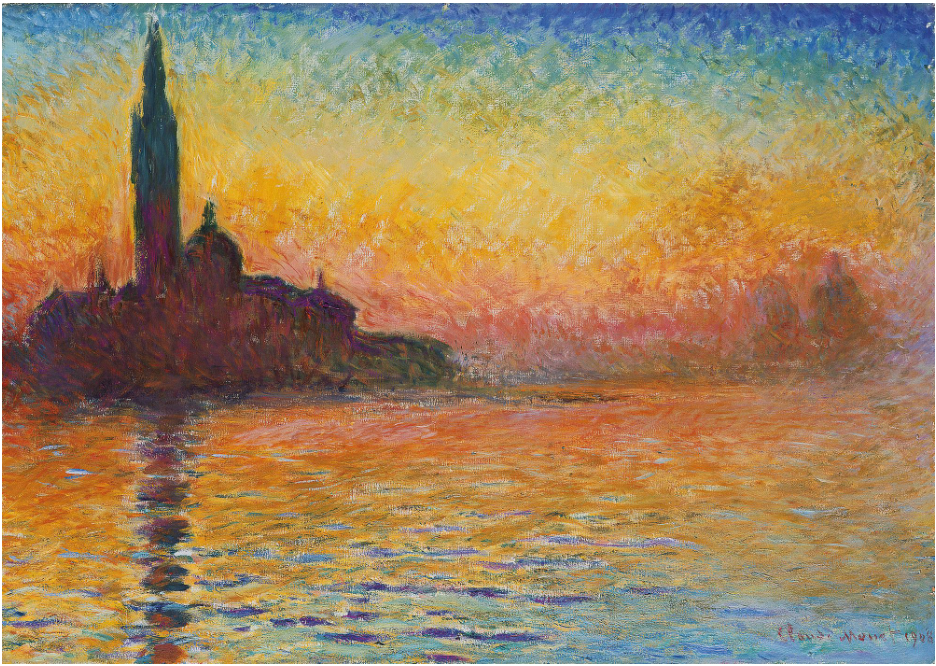
Claude Monet, San Giorgio Maggiore at Dusk, 1908. National Museum, Cardiff. Photo: © National Museum, Cardiff / HIP / Art Resource, New York.
One of his more intimate abstracts, Abstraktes Bild (890-2) is nonetheless rife with energy and painterly motion. Even at this smaller scale, the same depth and optical richness continue to play out upon the surface of the work. Constructed from a preponderance of yellow and red, the image highlights a variety of strokes that compete for the viewer’s attention. Horizontal bands of cheery yellow hover over darker areas, the underpainting bleeding into view like a shadow beneath. On the edges, rich red makes itself known in heavy layers that echo the central streaks of paint running vertically across the whole composition. It is these stripes that exhibit the telltale texture of Richter’s squeegee process. The result is a smoothly marbled surface where a variety of colors intermingle in a swirling dance. These mixtures force the eye to find other shades within the work, and by doing so one is allowed to enter the painting and begin to investigate the built environment which Richter has constructed. “[A] picture emerges that may look quite good for a while, so airy and colourful and new,” he notes. “But that will only last for a day at most, at which point it starts to look cheap and fake. And then the real work begins—changing, eradicating, starting again, and so on, until it’s done” (G. Richter, Panorama: A Retrospective, London, 2011, p. 17). Evidence of this meticulous work is brought to the surface by the artist’s machinations for a brief moment only to be plunged back into the depths with a decisive movement of his tools.
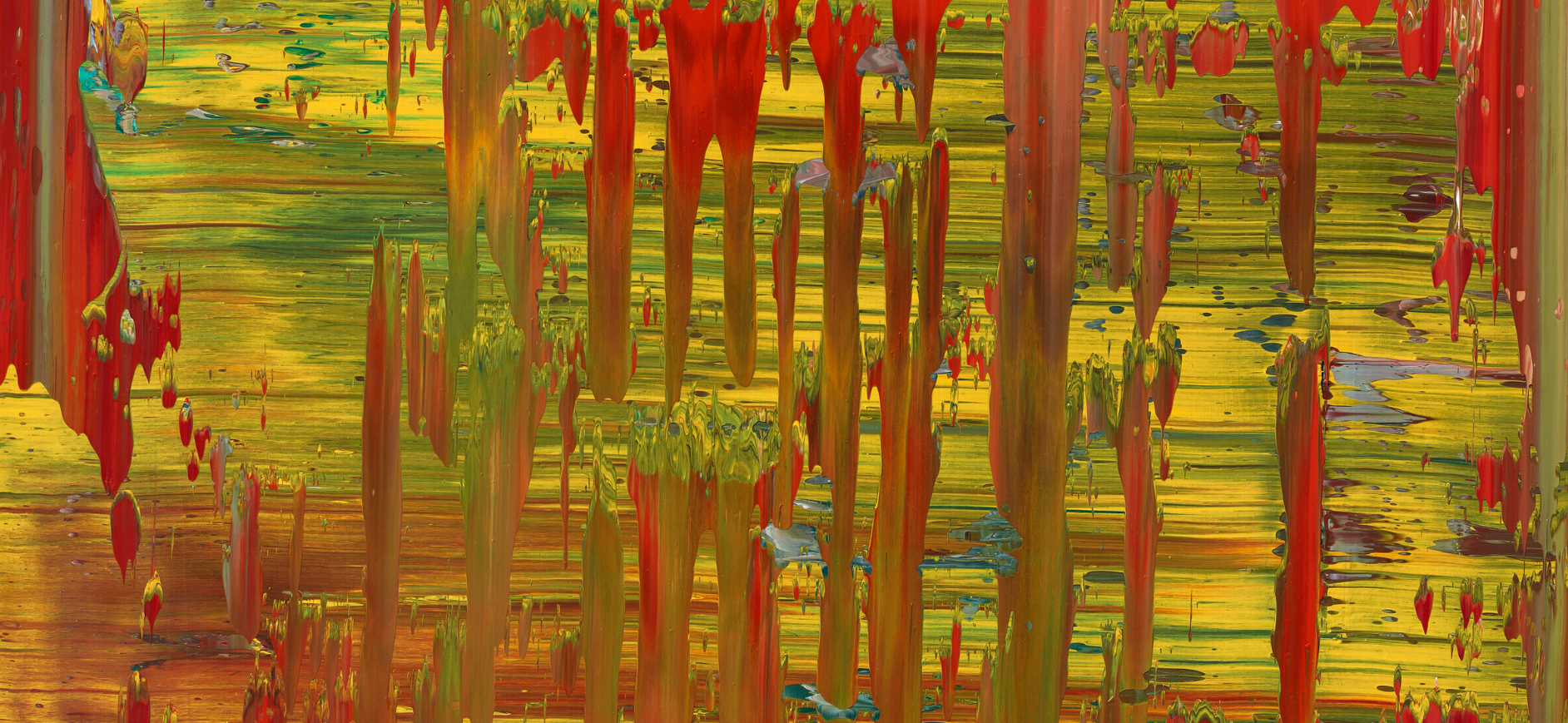
Part of his momentous series of squeegee paintings, Abstraktes Bild (890-2) and its brethren are a testament to Richter’s continued investigation of the painting process. Beginning with the photo-based works, the artist has worked in distinct groupings throughout his career. Rather than merely a fleeting blip within a larger thread, series like the Abstraktes Bilder exist in longer conversations that Richter has used to continuously challenge himself and his viewers. The current example shows a mixture of freedom and control that collide within the composition and hint at the artist’s meticulous work in the past and his journey toward a less controlled practice. When he first began making the abstract paintings, he noted that they “allowed me to do what I had never let myself do: put something down at random. And then, of course, I realized that it never can be random. It was all a way of opening a door for me. If I don’t know what’s coming—that is, if I have no hard-and-fast image, as I have with a photographic original—then arbitrary choice and chance play an important part” (G. Richter, quoted in Gerhard Richter: Text, London, 2009, p. 256). The squeegee paintings are created within a carefully tested system where the artist’s process rarely differs but the results can be wildly different. By choosing particular color combinations to highlight throughout the works and then smearing and dragging them around the canvas, Richter is able to form complex relationships that are not predetermined or rooted within visual tradition.
Jeff Koons
Christie’s New-York: 7 November 2023
Estimated: USD 3,000,000 – 5,000,000
USD 2,470,000
JEFF KOONS (B. 1955) (christies.com)
JEFF KOONS (B. 1955)
Baroque Egg with Bow (Pink/Gold), 1994-2008
Mirror-polished stainless steel with transparent color coating
78 3/8 x 76 13/16 x 76 inches (199x195x193 cm)
One of five unique versions:
Turquoise/Magenta, Blue/Turquoise, Blue/Gold, Orange/Magenta, Pink/Gold
Jeff Koons’s Baroque Egg with Bow (Pink/Gold) is a reminder of the artist’s unparalleled ability to infuse simple objects with complex layers of meaning. Standing nearly seven feet tall, the dazzling splendor of the present work conceals the complicated conceptual relationship between desire and consumption, and memory and joy. An outstanding example of the exacting fabrication for which the artist is celebrated, the luminous exterior celebrates Koons’s holistic approach to art, combining concept and construction to turn a moment of celebration into a moment of magic.
The egg, a symbol of fertility and completeness, has long inspired Koons and resulted in a sustained body of work. His choice of subject matter is not random, but rather intentionally used to evoke a variety of sensations and memories. From the mysterious world created by Hieronymus Bosch, to the extravagance of Peter Carl Fabergé’s bejeweled eggs for the Russian Imperial court, the egg has become a highly emotive symbol of the “balance of the symmetrical and asymmetrical, a sense of the fertile, and a sense of the eternal through biology and procreation, and then, on the other hand, you have the sense of the spiritual, very ethereal, eternal: the polarities” (J. Koons, quoted in A. Hüsch, ed., Jeff Koons: Celebration, exh. cat., Staatliche Museen zu Berlin, Berlin 2008, p. 87).
Faberge style egg. Photo: © David Muir / Getty Images.
Koons has often drawn inspiration from the Baroque, the period in the early to mid-seventeenth century characterized by opulent interiors and the intermixing of religious themes with eroticism. Koons explains, “I use the Baroque to show the public that we are in the realm of the spiritual, the eternal. The church uses the Baroque to manipulate and seduce, but in return it does give the public a spiritual experience. My work deals in the vocabulary of the Baroque” (J. Koons, quoted in A. Muthesius, Jeff Koons, Cologne, 1992, p. 158). During this period, the spiritual and the sensual were interconnected. Perhaps the most famous Baroque painting is Johannes Vermeer’s Girl with a Pearl Earring (c. 1665), whose smooth and alluring jewelry could be the seventeenth-century precursor to Koons’s egg. Koons and Vermeer are unmatched in their use of light and reflection, a skill that transforms the egg and the pearl earring alike into transcendent, ethereal beings rather than mute objects. It has been suggested that the pearl earring is in fact not pearl, but rather polished tin or silver, like the mirror polished stainless steel used by Koons. In any case, the gentle eroticism of Vermeer’s handling of the portrait can only be matched by Koons’s eye for the feminine curvature of Baroque Egg with Bow (Pink/Gold).
The influence of the House of Fabergé on Baroque Egg with Bow (Pink/Gold) cannot be overlooked. Koons and Fabergé share a dedication to their craft and a love for an opulent objet. Fabergé’s process required the utmost dedication, just as Koons’s eggs are likewise painstakingly executed, “[Fabergé] eggs could almost always be opened and there would be a surprise inside. For the most part, work on these eggs was very complicated. To avoid repetition we had to vary the materials, the exterior, and the content of the egg. The process of making these eggs usually took about one year” (G. von Habsberg, Fabergé: Imperial Jeweler, St. Petersburg, 1993, p. 452-453). Finally, the canonical Fabergé eggs were commissioned as gifts to be exchanged among the royalty of Imperial Russia, and it has always been Koons’s wish for his work to be understood as a gift, hence the intricate bow atop his sculptural confection.
Yayoi Kusama
Christie’s New-York: 7 November 2023
Estimated: USD 1,800,000 – 2,500,000
USD 2,107,000
YAYOI KUSAMA (B. 1929) (christies.com)
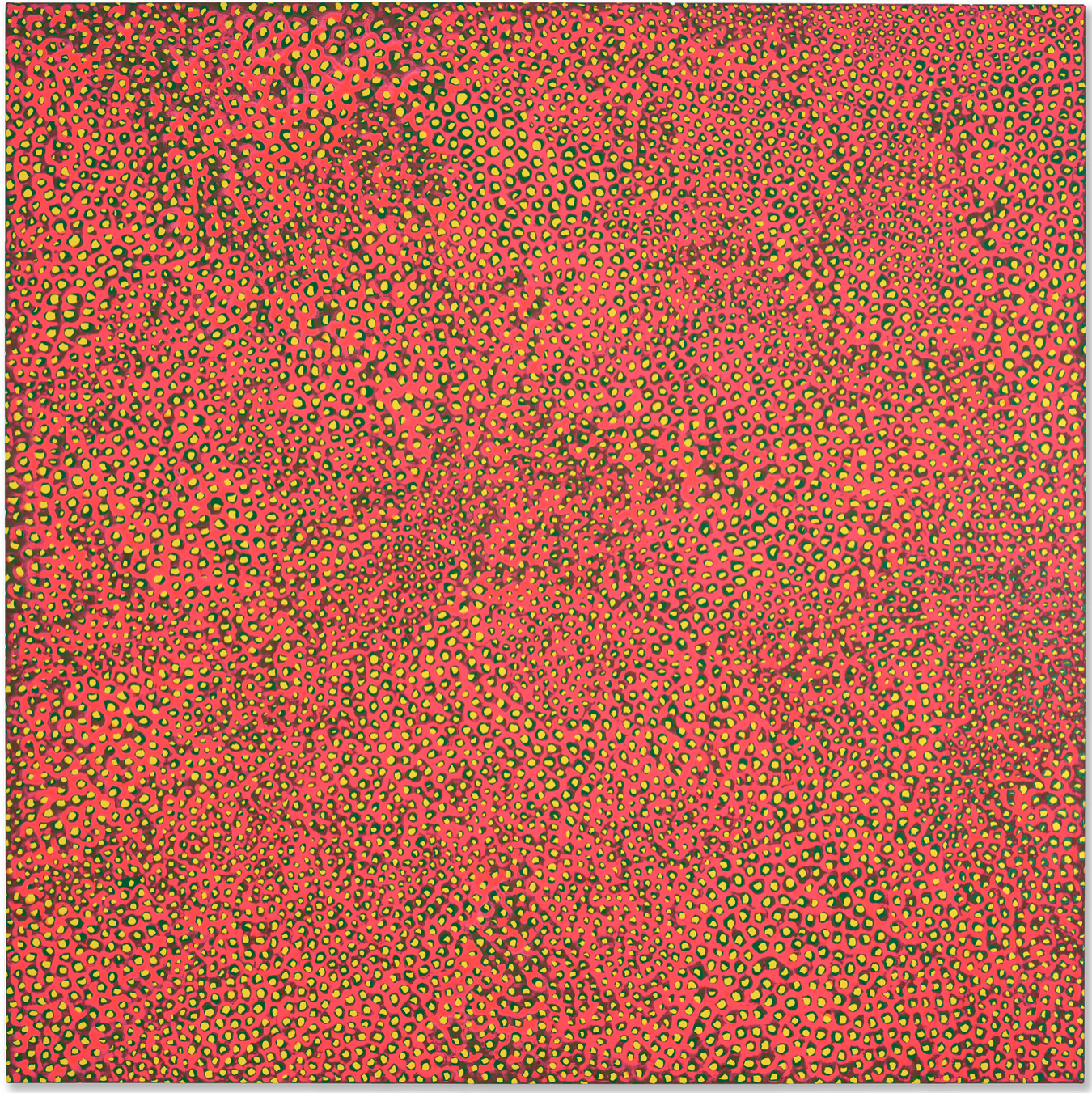
YAYOI KUSAMA (B. 1929)
Infinity Nets (ACWRTO), 2013
Acrylic on canvas
162.2 cm x 162.2 cm (63 7/8 x 63 7/8 inches)
signed, titled and dated ‘ACWRTO INFINITY-NETS YAYOI KUSAMA 2013’ (on the reverse)
Undoubtedly one of the world’s most celebrated living artists, Yayoi Kusama’s influential career has been a mainstay of the postwar and contemporary canon. Imbued with a singular vision that broke new ground in abstraction while remaining immensely personal in scope, the artist was praised by titans of American art from the very beginning, and has had an untold effect on the course of many major artistic revelations. Infinity Nets (ACWRTO) is a consummate example of Kusama’s signature motif and speaks to the re-evaluation and re-invigoration of her practice following a major New York retrospective in 1989. Along with the polka dot, the infinity nets have become an unmistakable mark of Kusama’s career and have found their way into every corner of visual culture. “Kusama is the Infinity Net and the polka dot, two interchangeable motifs that she adopted as her alter ego, her logo, her franchise and her weapon of incursion into the world at large. The countless artworks that she has produced and that carry Kusama’s nets and dots into the world, when seen as a whole are the mere results of a rigorously disciplined and single-minded performance that has lasted for almost fifty years” (L. Hoptman, cited in Yayoi Kusama: A Reckoning, London 2000, p. 14).
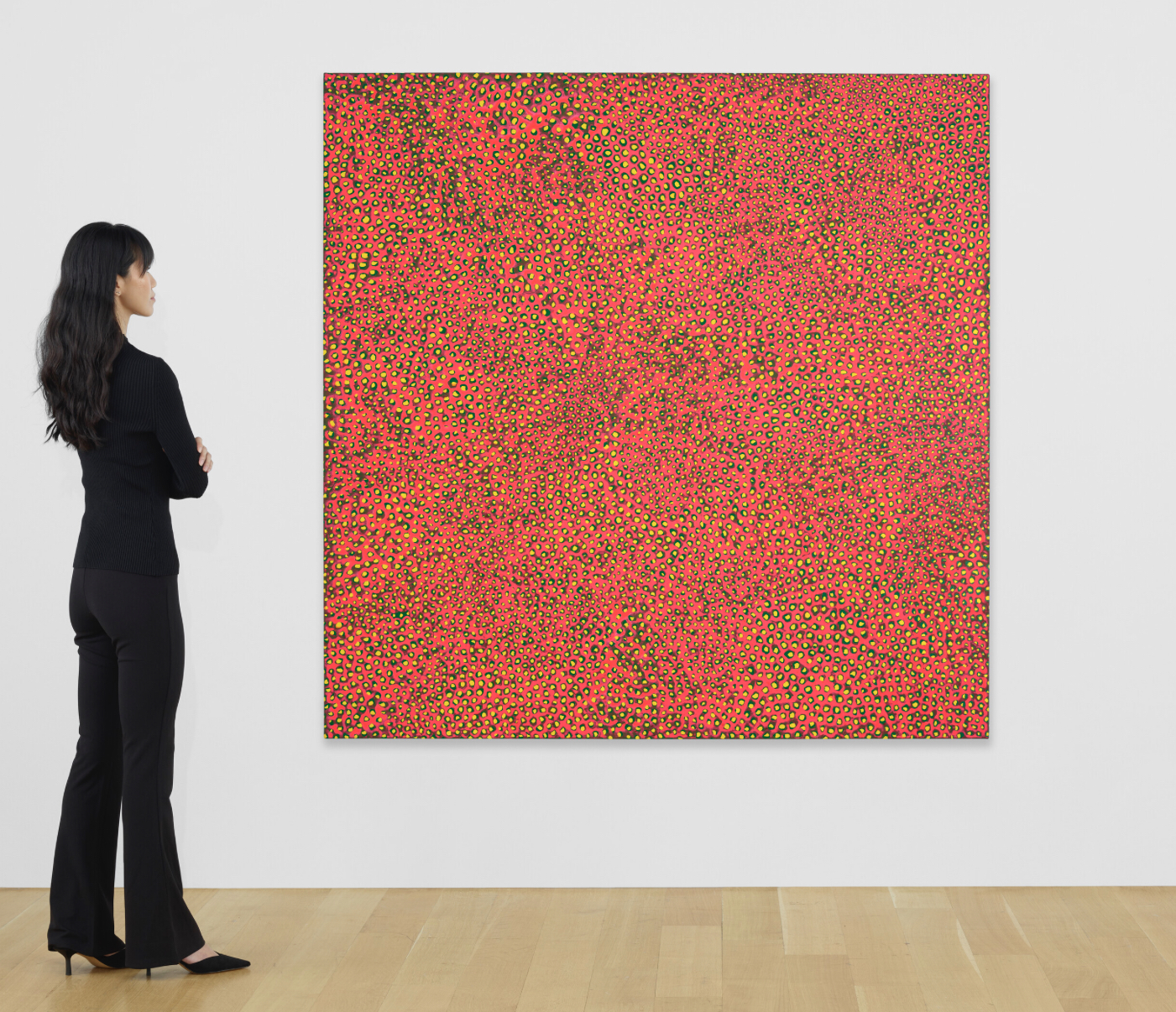
Optically dense and visually consuming, Infinity Nets (ACWRTO) is a hypnotic work of acrylic on canvas. Using a limited palette, Kusama has built a network of dots and loops that grow and undulate from edge to edge. Predominately rendered in a shade of fluorescent pink, the interconnected circles grow larger and smaller as the artist’s hand moves across the surface. Each loop surrounds a burning yellow dab of paint, and in the space between these elements, the dark green underpainting shows through. However, this is not a straightforward, orderly affair. Rather there are places within the canvas where the perceived uniformity is interrupted by variations caused by contrasting colors. These pairings in turn create shadow and space where only impasto acrylic exists.
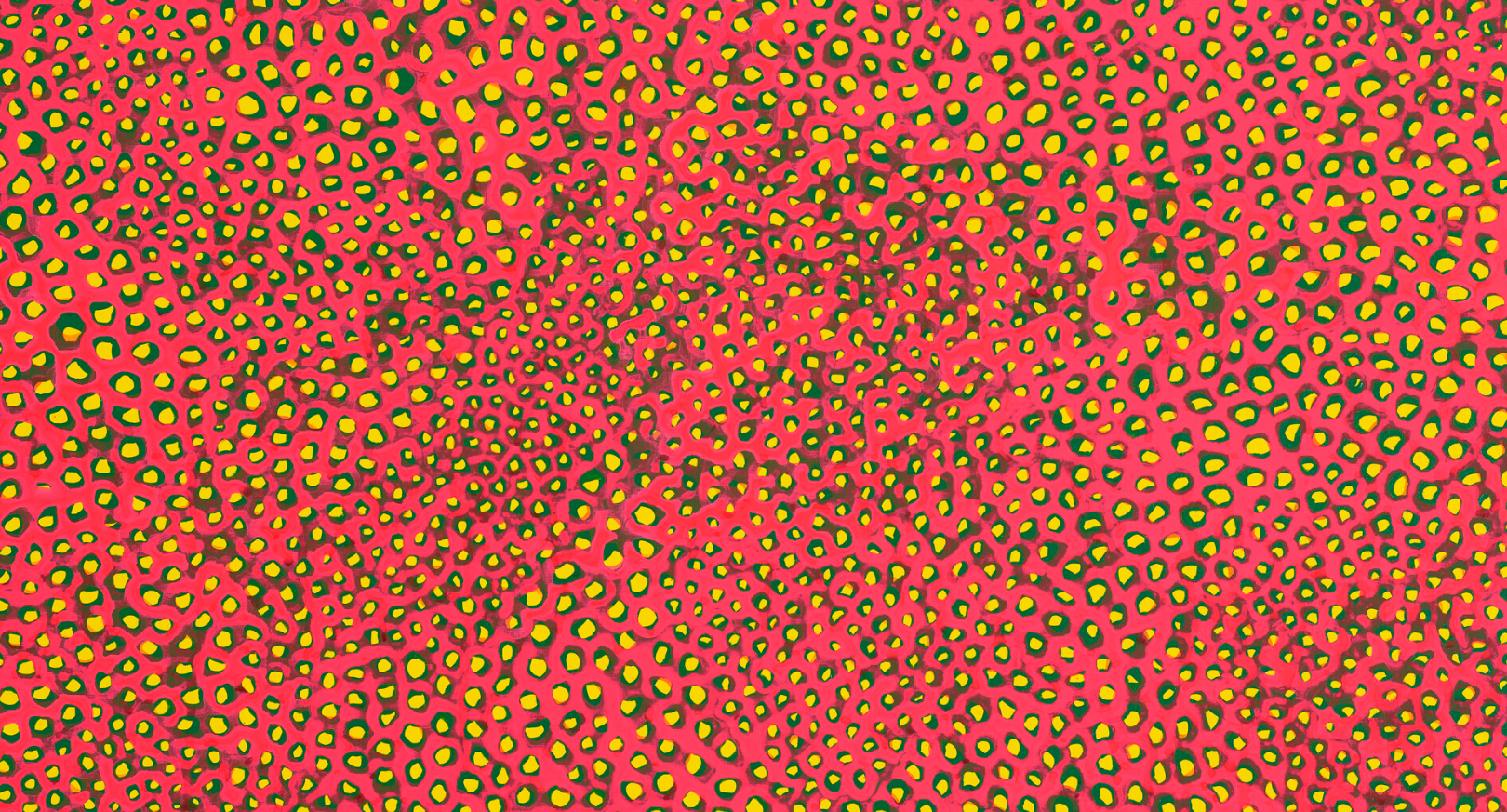
Works such as Infinity Nets (ACWRTO) engage the eye in the same way that Kusama creates them. Working on a horizontal surface instead of the traditional easel, she spends countless hours hovering over the work as she builds up each mass of repetitive strokes. Not being able to see the entire piece as she’s going, creating the net becomes an all-encompassing process that takes over her field of vision, much like the optical hallucinations that serve as their source.
Ed Ruscha
Christie’s New-York: 7 November 2023
Estimated: USD 2,500,000 – 3,500,000
USD 2,107,000
ED RUSCHA (b. 1937) (christies.com)
ED RUSCHA (b. 1937)
Chain and Cable, 1987
Acrylic on canvas
64×64 inches (162.6 x 162.6 cm)
Signed and dated ‘Ed Ruscha 1987’ (on the reverse)
Signed again, titled and dated again ‘ED RUSCHA “CHAIN AND CABLE” 1987’ (on the stretcher)
Ed Ruscha’s striking painting Chain and Cable occupies an important place within the artist’s singular career. Exhibited around the world and extensively cited in the literature on the artist, the lyrical and contemplative canvas tells an entire story within a single, large-scale canvas. Ruscha, currently the subject of an acclaimed retrospective at the Museum of Modern Art, New York, engages in his characteristic wordplay here: “chain” and “cable” are terms for parts of a ship’s anchoring apparatus, but they also could refer to the Biblical story of Cain and Abel. While our focus with Ruscha tends to be on these evocative puns, Chain and Cable also evinces his skill and subtlety as a painter.
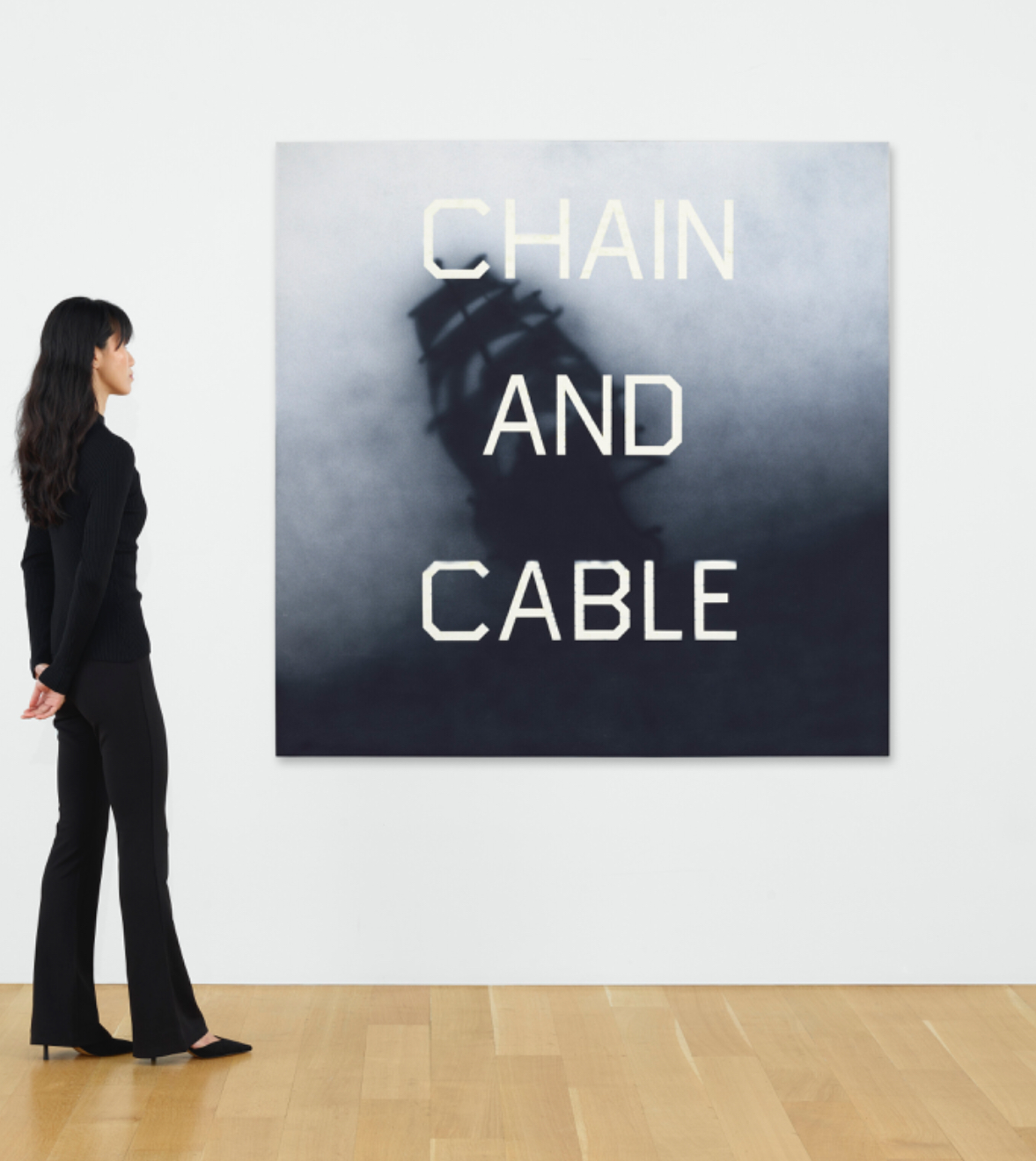
In the 1980s, Ruscha began using a spray gun (drawing on the Finish Fetish and Light and Space movements in Southern California), which lends the present work an atmospheric and sublime flair akin. There is a resemblance to an otherworldly daguerreotype, with its soft focus interspersed with fine detail. As critic Donald Kuspit wrote in his review of Ruscha’s 1987 Robert Miller Gallery show, where Chain and Cable was first shown, the artist “force[s] us into an uncertainty about the medium that makes the image seem to float free of its material base, as if in a memory” (D. Kuspit, “Ed Ruscha,” Artforum, February 1988, p. 145). Especially in these nautical works from the late 1980s, Ruscha proves that there is beauty in uncertainty, like a film noir or a message in a bottle.
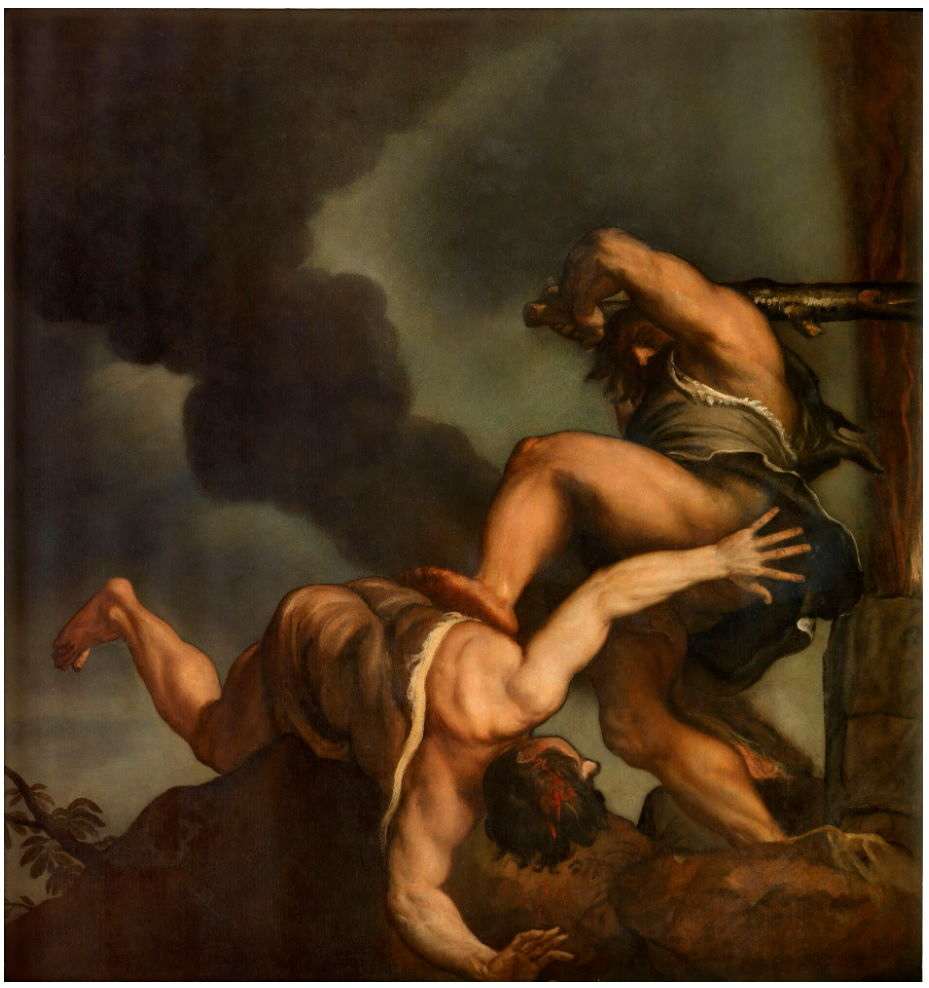
Titian, Cain and Abel, circa 1488-1576. S. Maria della Salute, Venice. Photo: Cameraphoto Arte, Venice / Art Resource, NY.
Chain and Cable combines Ruscha’s signature bold text with a misty scene, as if the words are emerging from the storm of paint. A ghostly ship barrels toward us, just as “chain” and “cable” scroll up across the scene like movie credits. Maybe this is a ghost ship like the Mary Celeste or the Flying Dutchman, a vessel that travels the sea without a soul aboard. Yet Ruscha’s soul is always in the words he chooses, which in this instance are both nautical and Biblical. Ruscha muses, “If someone wants to look at Chain and Cable and say ‘Cain and Abel,’ then I’ll say, yes, that is maybe a logical viewer’s response. That’s strictly the ballpark of the viewer” (E. Ruscha, quoted in R. Dean and E. Wright, eds., Edward Ruscha: Catalogue Raisonné of the Paintings, Volume Three: 1983-1987, New York, 2007, p. 322). In the book of Genesis, God punishes Cain for killing his brother Abel by casting him out into the cruel world. God says, “You will be a restless wanderer on the earth” (Genesis 4:12, New International Version). In Chain and Cable, we wander with Ruscha—not as a curse, but rather as an opportunity to really dive into his immense contribution to postwar art. A secular comparison for Chain and Cable could be James Joyce. Critic Robert Enright theorized, “With ‘chain and cable,’ you get a spoonerism [a type of humorous verbal error] that is a play to the ear with an industrial resonance. That’s how a poem would work, the layering you get in that simple phrase is the kind of thing Joyce plays with continually in Ulysses” (R. Enright, “The Painted Whirred: Ed Ruscha’s Spin on Language,” Border Crossings, 2008, p. 44).
Rashid Johnson
Christie’s New-York: 7 November 2023
Estimated: USD 800,000 – 1,200,000
USD 1,744,000
RASHID JOHNSON (B. 1977) (christies.com)
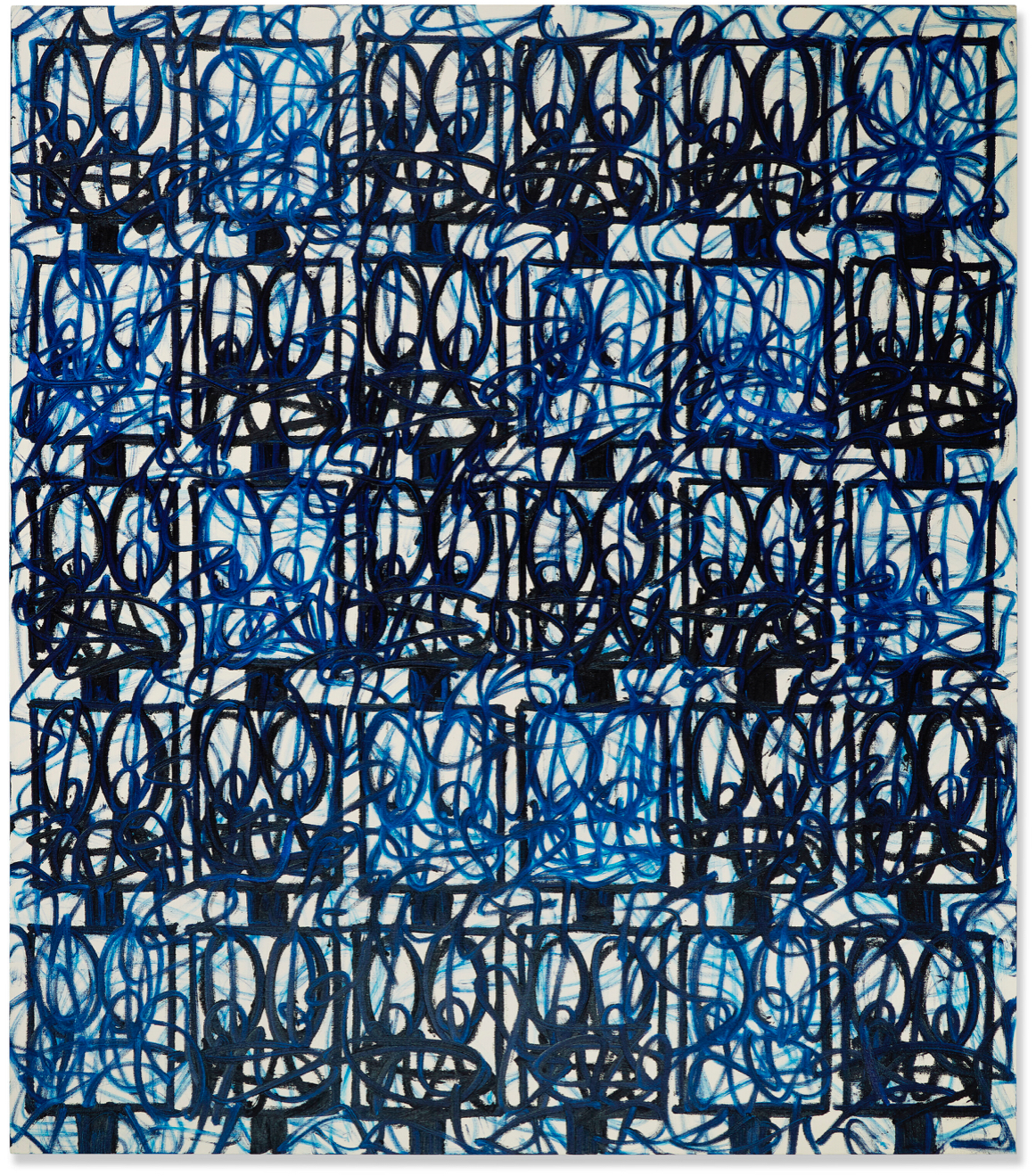
RASHID JOHNSON (B. 1977)
Bruise Painting “Picture Maker”, 2021
Oil on linen
96 1/4 x 86 1/4 inches (244.5 x 219.1 cm)
Signed with the artist’s initials ‘R A J’ (on the left side edge)
Bruise Painting by Rashid Johnson confronts the viewer with a multitude of black and blue forms, half-human faces rendered in vital planes of line and color. Measuring over eight feet by seven feet, this monumental painting acts like a mural that slowly unfolds its universal message of empathy and understanding. Bruise Painting becomes a skin of sorts comprised of the aleatory and grid-like patterns alike that build the natural world, and, as in nature, every cell is both connected and interdependent. Emerging from this latticework is a series of faces akin to the carnivalesque, surreal crowds of James Ensor. Yet even within this complex scene, we can be sure that there is some respite for these figures, since bruises are signs of the body’s healing. Subject matter is not the only appeal of Bruise Painting. Johnson’s technical rigor is evident in his creation of a signature pigment combination for this series. This combination of precisely formulated pigments with raw linen engenders a textured scene with a unique interplay of foreground and background.
Rashid Johnson in his home studio, Long Island, 2020. Photo: Jason Schmidt. Artwork: © Rashid Johnson. Courtesy the artist and Hauser & Wirth.
Emerging from Johnson’s celebrated Anxious Men series (2015-2017), the Bruise Paintings (2021—) respond to the COVID-19 pandemic and the accompanying political turmoil. Yet, as always, Johnson also shows his skilled command of art history. The bruise or wound in art history carries a religious connotation, especially with images of Saint Thomas, like Caravaggio’s Baroque masterpiece The Incredulity of Saint Thomas (1602). In it, we see the doubting disciple’s finger physically enter Christ’s flesh in a way that is both shocking and sensual. Similarly, in Caravaggio’s Young Sick Bacchus (c. 1593), there could be a correlation between the black and blue of Bruise Painting and the god’s sickly appearance inspired by the artist’s own grave illness. Fast forwarding to the twentieth century, perhaps the most famous comparisons would be Cindy Sherman’s Untitled Film Still #30 (1979) and Nan Goldin’s Heart-Shaped Bruise, NYC (1980). As with Bruise Painting, Sherman and Goldin focus on social ills with a disarming beauty. Given that the present work also has a filmic quality with its narrative progression of faces and scenes, we could also compare it to David Lynch’s Blue Velvet (1986). The blue tones of the film give the entire mise-en-scène a bruise-like quality, which is made flesh by Isabella Rossellini’s black eyes. This outpouring of emotion resonates throughout Bruise Painting, which translates a world of feeling into the language of abstraction.
The Bruise Paintings are also part of Johnson’s activist practice. Earlier this year, he donated a smaller work from the Bruise Paintings to an auction that raised $6 million to save the childhood home of musician and civil rights icon Nina Simone. This charitable stance also characterizes Johnson’s relationship with younger artists, especially Black artists in need of exposure and mentorships. In a recent encounter, curator Antwaun Sargent recounts his visit with Johnson, “In the southwest corner of the gallery, Johnson installed a chair sculpture with a speaker that serenades the room with Louis Armstrong’s ‘(What Did I Do to Be So) Black and Blue,’ a nod to the way modernism reflects jazz’s sense of improvisation and rhythm. ‘This is how Blackness enters the discourse of modern art!’ Johnson said” (A. Sargent, “The Anxiety and Ecstasy of Rashid Johnson,” GQ, October 3, 2023).
The present work distills Johnson’s emotionally, politically, and autobiographically replete body of work, which only continues to push the boundaries of painting, sculpture, and performance. In anxiety and angst, Johnson has found beauty without shying away from the hard truths he hopes to convey. With an unparalleled command of abstraction, Johnson paints universal symbols that draw connections among communities instead of sowing resentment. Bruise Painting is the work of an artist’s artist, and Johnson has garnered the praise of supporters within and beyond the art world with his incisive view of the human condition.
Jade Fadojutimi
Christie’s New-York: 7 November 2023
Estimated: USD 500,000 – 700,000
USD 1,683,500
JADÉ FADOJUTIMI (B. 1993) (christies.com)
JADÉ FADOJUTIMI (B. 1993)
A Thistle Throb, 2021
Oil and acrylic on canvas
70 3/4 x 70 3/4 inches (179.6 x 179.6 cm)
Signed ‘JADÉ’ (on the stretcher)
Signed again, titled and dated ‘March ’21 Jadé Fadojutimi ‘A Thistle Throb” (on the reverse)
A Thistle Throb by British painter Jadé Fadojutimi is a monumental and dazzling cornucopia of purple hues that recalls the deployment of this elusive color by Claude Monet, Gustav Klimt, and Helen Frankenthaler, something recently celebrated by Artforum in declaring that Fadojutimi “was giving Monet waterlilies” with her use of swirling, floral forms (K. Sutton, “Your Place or Mine? Kate Sutton around Amsterdam and London Art Weekends,” Artforum, June 8, 2023). Nearly six feet square, A Thistle Throb—a title that evokes movement, desire, and nature, is the artist’s vital contribution to the pantheon of abstraction. More than that, she has charted a unique and indispensable course in her deliberate and complex combination of figuration and abstraction. What results is a meditation on the personal. Fadojutimi poetically observes, “When I change, the work changes. We hold each other up. I think the biggest difference I notice is in myself. Having conversations around my work means I have been having more conversations around myself” (J. Fadojutimi, quoted in T. Moldan, “Jadé Fadojutimi: ‘When I change, the work changes,’” Ocula, November 24, 2021). A Thistle Throb is above all the impetus for a conversation.
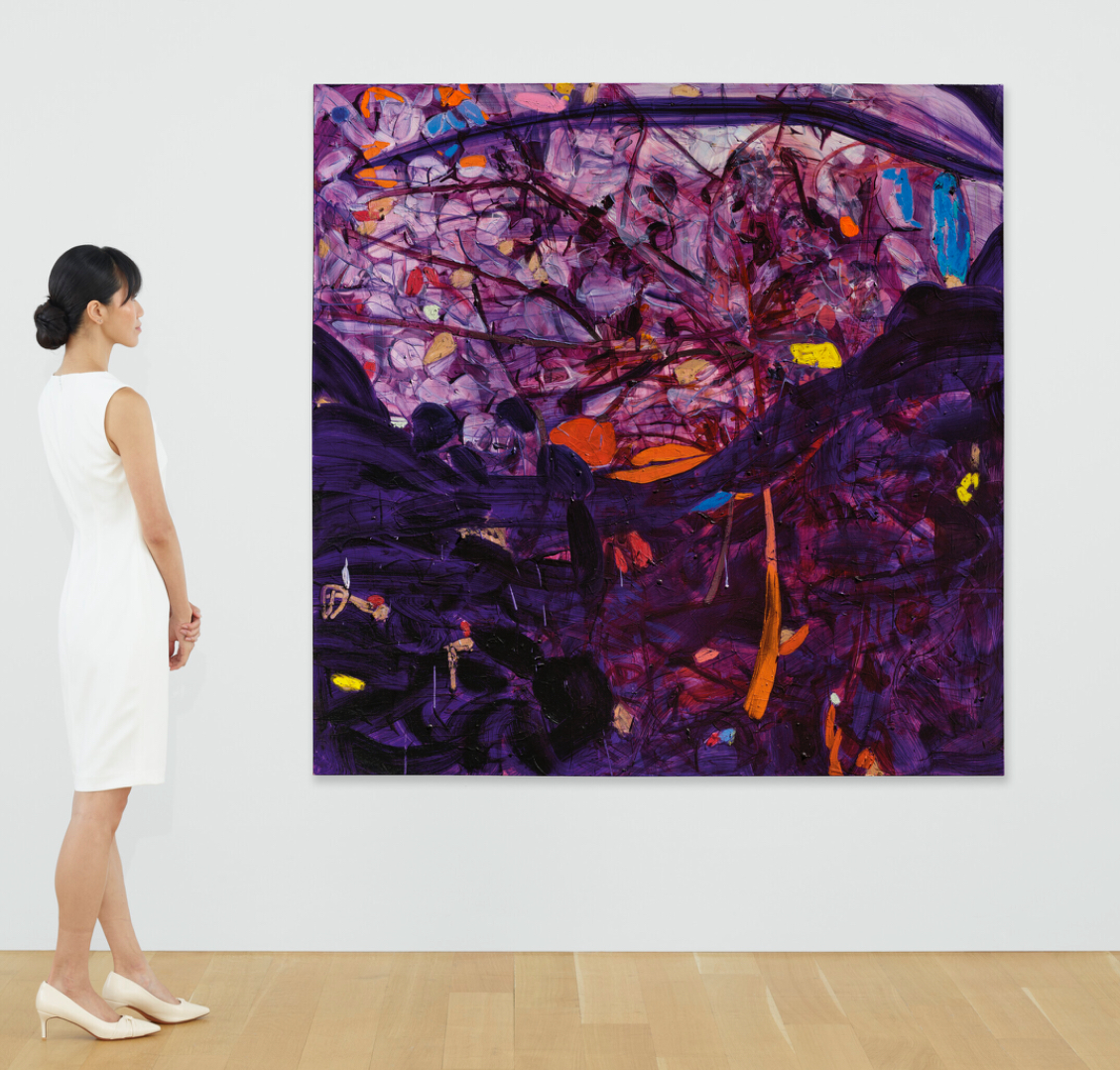
A Thistle Throb has all the sensitivity to space and form as Paul Cezanne’s foundational still lifes. It creates its own world through a collage-like cosmos of pigment and line. An interesting comparison is to Cezanne’s Still Life with Blue Pot (1900-1906, The J. Paul Getty Museum, Los Angeles), which, like A Thistle Throb, has a loosely pyramidal composition and features juxtapositions of blue and orange. Furthermore, not unlike the improvisations of Wassily Kandinsky, A Thistle Throb also has a lyrical element, as if it is comprised of floating musical notes. Like Kandinsky’s Blue Painting (1924, Solomon R. Guggenheim Museum, New York), A Thistle Throb allows color and form to work in tandem to create an orchestra. The artist states, “When I was really young, I wanted to be a fashion designer. And my dream is to be a composer. So now I call myself a composer of colour” (J. Fadojutimi, quoted in N. Trembley, Who is Jadé Fadojutimi, young painter already represented by mega-gallery Gagosian?,” Numero, March 31, 2023).
It is no mistake that Fadojutimi also mentions fashion. The verdant scene in A Thistle Throb connects to the interest in floral patterns by designers like Rodarte, Marni, and Anna Sui. Given the artist’s interest in Asian culture, one could look back to the Chinese state of Qi (1046 BCE–221 BCE), where purple was the center of fashion (China was also the first culture to create a synthetic purple). In a Western context, scientific advancements in the nineteenth century brought about the possibility of purple garments for common people and not just royalty. In this period, purple became a favorite of the Pre-Raphaelites, evinced by canvases like John Everett Millais’s, A Huguenot, on Saint Bartholomew’s Day, Refusing to Shield Himself from Danger by Wearing the Roman Catholic Badge (1851–1852). A Thistle Throb further democratizes a historically exclusive color, without forsaking its characteristic appeal and luxuriousness.
Andy Warhol
Christie’s New-York: 7 November 2023
Estimated: USD 1,500,000 – 2,000,000
USD 1,683,500
ANDY WARHOL (1928-1987) (christies.com)
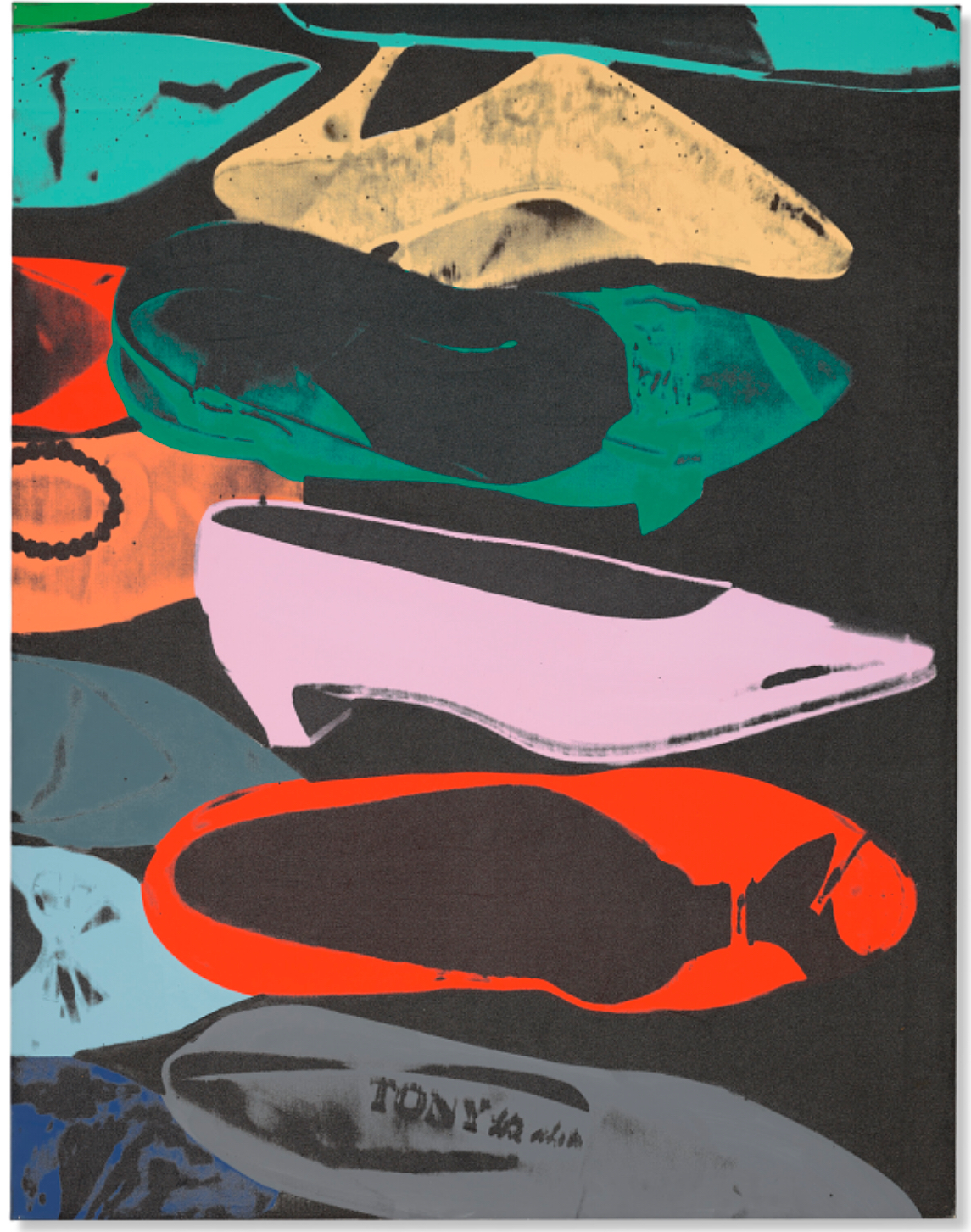
ANDY WARHOL (1928-1987)
Diamond Dust Shoes, 1980
Acrylic, silkscreen inks and diamond dust on canvas
90 1/8 x 70 1/8 inches (228.9 x 178.1 cm)
Andy Warhol’s ability to encapsulate the highs and lows of American consumerism ran alongside his insightful commentary on his own personal connections to the world of celebrity and popular culture. Diamond Dust Shoes is an alluring example of his ability to imbue mass media techniques with a poignant depth. His early career as a fashion illustrator set the stage for later endeavors that expanded outward and blurred the lines between consumer culture and art historical tradition. His first professional commission as an artist was drawing shoes for Glamour magazine in the 1940s, and he spent time in the following decade working for shoe brands to much acclaim. It was there that Warhol developed a lifelong obsession and appreciation for women’s shoes. This present work is an early example of a series of canvases that he began in 1980. “I’m doing shoes because I’m going back to my roots,” he noted later on. “In fact, I think I should do nothing but shoes from now on” (A. Warhol quoted in P. Hackett, (ed.), The Andy Warhol Diaries, New York, 1989, p. 306). Honing in on this particular object and symbolism shows how important the imagery from his early career, as well as his personal biography, remained throughout the decades.
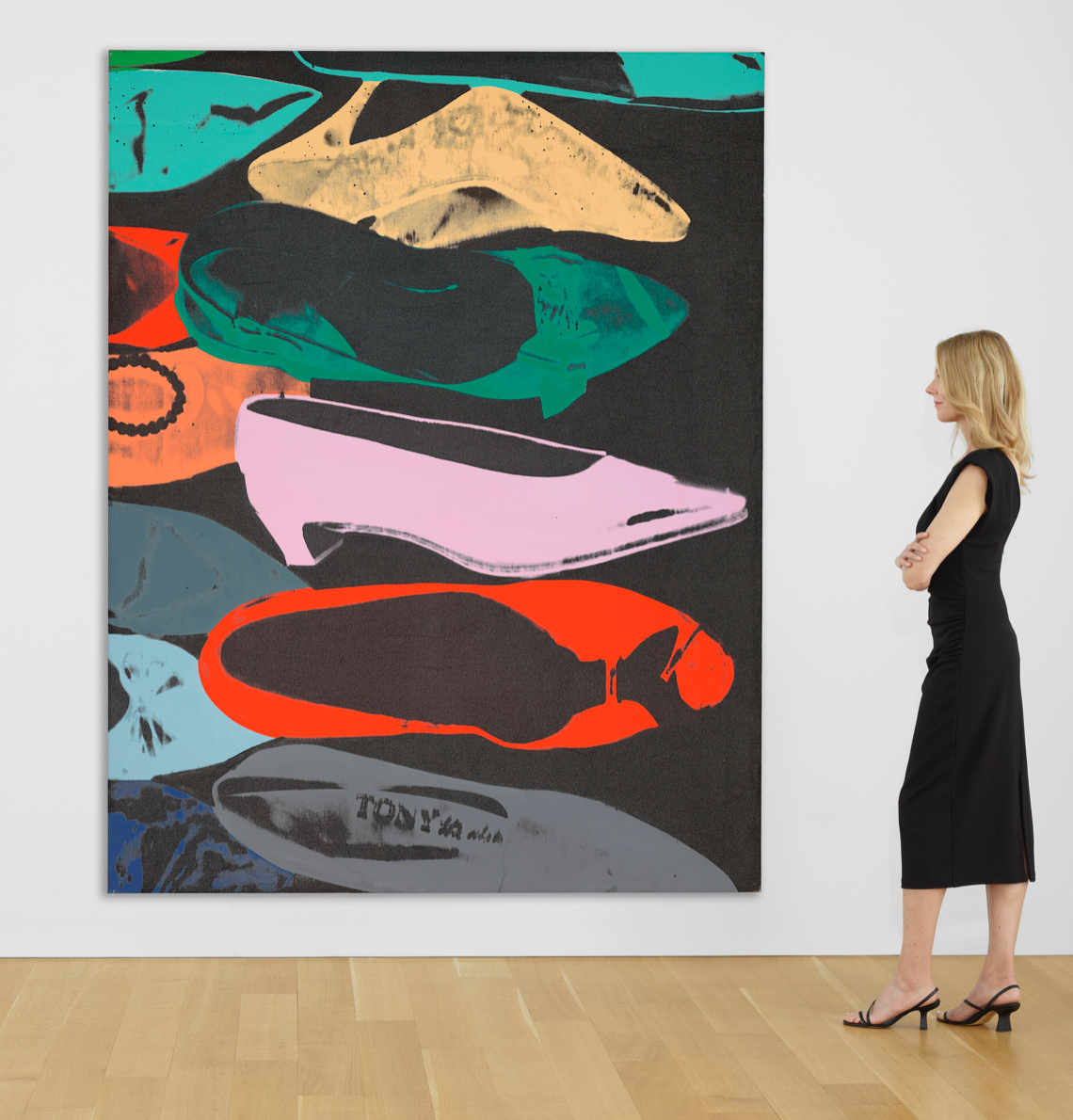
This striking canvas makes use of Warhol’s signature screenprinting techniques which marry photographic reproduction with saturated areas of color and deep black. Like a Xerox copy with the contrast turned up, expansive swathes of baby blue, crimson, slate, primrose, sea green and pastel yellow boldly represent each shoe, jumping out at the view with a graphic immediacy.
Here Warhol eschews traditional compositional techniques in favor of a more candid image that could have very well been cut from a magazine advertisement. The edges of the canvas frame a line of five central shoes with varying heel heights while other footwear spills off the border. Festooned with diamond dust, the work sparkles with a visual richness that points toward the luxurious goods pictured as well as the lifestyles that could afford such accouterments. As with many of his paintings, the repetition on view here was common throughout his career and plays directly with the notion of mass production and seriality. In the cultural consciousness, diamonds are often seen as a representation of ever-lasting love and eternity, their natural durability standing in as a symbol of strong adoration and commitment. With the Diamond Dust Shoes, Warhol subverts this feeling as the sparkly coating becomes a representation of superficial beauty and fleetingly glamorous lifestyles of the celebrity elite. “Andy created the Diamond Dust Shoe paintings just as the disco, lamé, and stilettos of Studio 54 had captured the imagination of the Manhattan glitterati. Andy, who had been in the vanguard of the New York club scene since the early 60’s, once again reflected the times he was living in through his paintings” (V. Fremont, Diamond Dust Shoes, exh. cat., Gagosian Gallery, New York, 1999, pp. 8-9). Foreshadowing the decade of excess that the 1980s would come to symbolize, these images of consumer goods were elevated to iconic status by the artist’s crystalline application.
Francois-Xavier Lalanne
Christie’s New-York: 7 November 2023
Estimated: USD 600,000 – 800,000
USD 1,502,000
FRANÇOIS-XAVIER LALANNE (1927-2008) (christies.com)
FRANÇOIS-XAVIER LALANNE (1927-2008)
‘Mouton de Laine’, 1992
Patinated bronze, wool, painted wood
33 ½ x 17 x 36 in. (85.1 x 43.2 x 91.5 cm)
Monogrammed twice fxl, numbered and dated 8⁄92
François-Xavier Lalanne’s works are playful and poetic, merging the surreal with the functionality of everyday furniture. The epitome of this can be found in his iconic Moutons de Laine. Revealed in 1965 at the Salon de la Jeune Peinture in Paris, Lalanne’s woolly sheep took the world by storm. Fellow artists and organizers of the exhibition were famously photographed lounging atop the sheep. The art critic Otto Hahn ended his negative review of the Salon with a note on its saving grace, “The Salon de la Jeune Peinture nevertheless holds one surprise: François-Xavier Lalanne’s chairs…he has brought an entire flock of sheep. It is the most amazing thing in the show” (O. Hahn in L’Express (Jan 24, 1966), quoted by D. Abadie, Lalanne(s), Paris, 2008, p. 298).
The flock of twenty-four sheep, were originally presented with the title Pour Polypheme, a nod to Homer’s Odyssey. In the Homeric tale, Odysseus and his men escape Polyphemus’s cave by clinging to the bellies of the sheep that the cyclops lets out to graze each day. Lalanne’s homage to the epic began as a single sheep executed in sheepskin and bronze in his apartment at the Impasse Robiquet, and soon grew to be a herd.
Lalanne recalled, “I wanted to create something very invasive because if you show small objects, no one notices them. You have to go in with something out of the ordinary and even somewhat embarrassing. If you arrive with a a snail the size of your thumb, no one notices you! [….] I made one sheep then decided to do a whole flock. The thought of a flock seemed to me to be a very peaceful idea. I thought that it would be funny to invade that big living room with a flock of sheep.
Damien Hirst
Christie’s New-York: 7 November 2023
Estimated: USD 1,000,000 – 1,500,000
USD 1,260,000
DAMIEN HIRST (B. 1965) (christies.com)
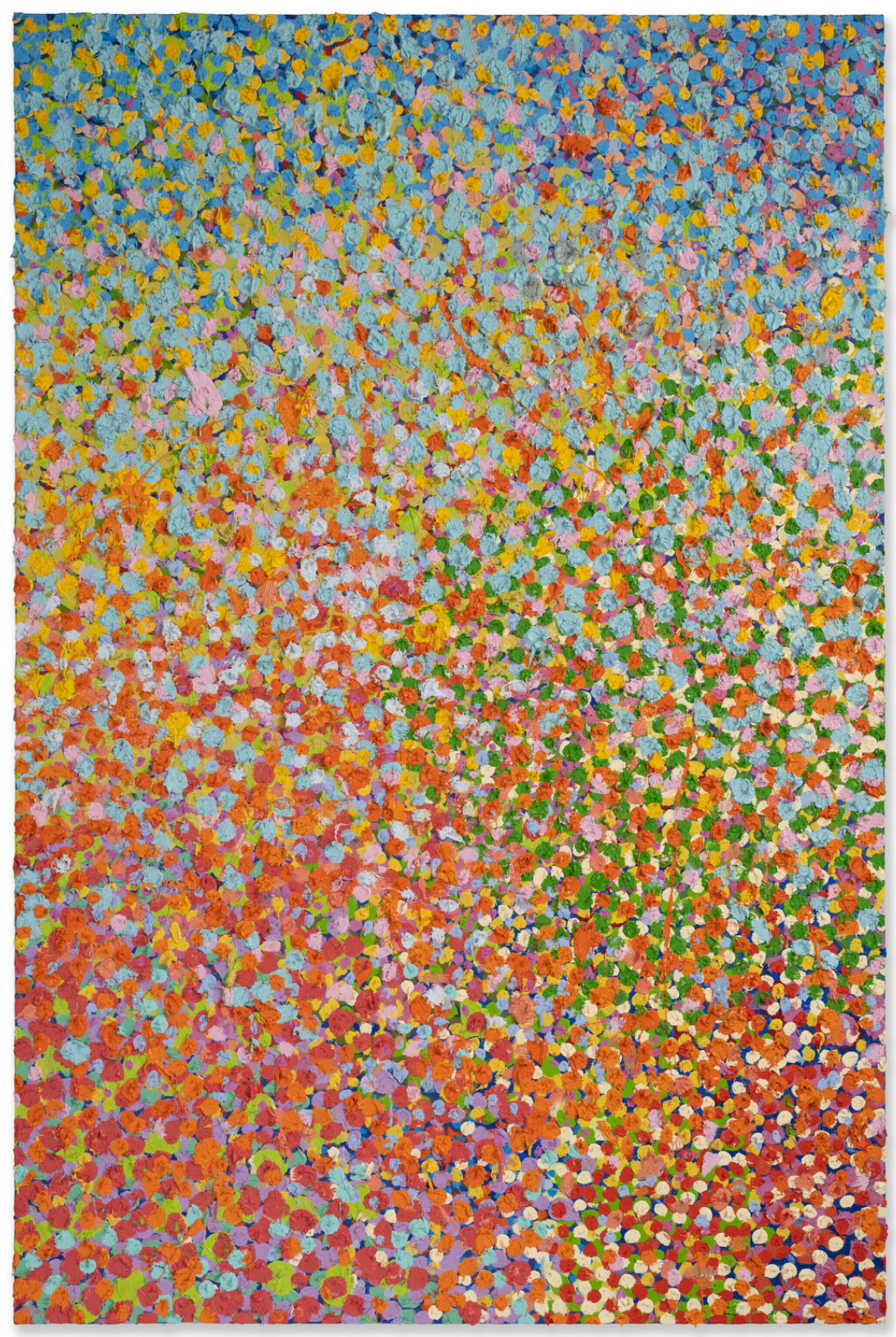
DAMIEN HIRST (B. 1965)
Veil of Imagination, 2017
Oil on canvas
72×48 inches (182.9 x 121.9 cm)
Signed, titled and dated ‘Damien Hirst 2017 ‘Veil of Imagination” (on the reverse)
Signed again ‘D. Hirst’ (on the stretcher)
Stretching six feet in height, Damien Hirst’s Veil of Imagination is a cascade of jubilant Technicolor. Across the expansive canvas, lilac, yellow, pale blue, and bubble-gum pink spots explode and flutter like confetti. The work is one of the artist’s Veil paintings. Conceived as a finite series each layered with dots, daubs and dollops of brightly-colored impasto. Marking a pivotal shift in his working methods, and indeed his approach to series more broadly, Hirst painted his Veil works alone, working on several canvases at once. Immersing himself totally in chromatic splendor, the works continue the artist’s career-long interest in the pleasurable optic effects of color, as can be traced through his seminal ‘Spot Paintings’ to his later ‘Spin Paintings’. “I believe all painting and art should be uplifting for the viewer”, Hirst has said, “I love color. I feel it inside me. It gives me a buzz” (D. Hirst, I Want to Spend the Rest of my Life Everywhere, with Everyone, One to One, Forever, Now, London, 1997, p. 246).
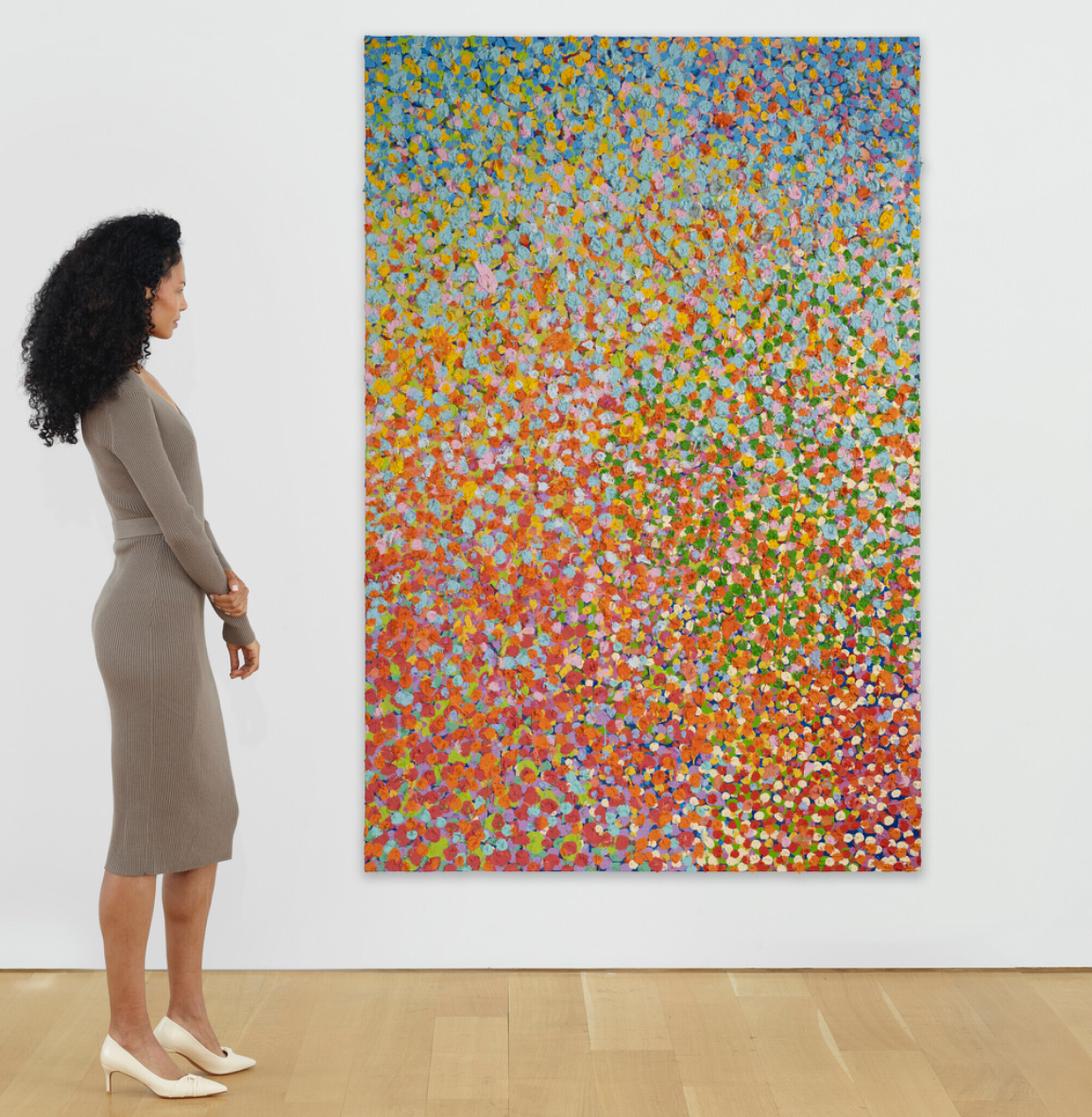
Indeed, Hirst pays homage to the iconic and unmistakable language of his spots in the present work. Describing the Veils, the artist revealed: “I have a selection of colors I love and use over and over again. They are like sweet shop colors and the colors of fruit and flowers” (D. Hirst interviewed by A. McDonald, “In The Studio: Damien Hirst’s Veil Paintings,” Gagosian Quarterly, July 4, 2020). Where his earlier works featured meticulously rendered, flat and almost machine-made spots, however, Veil of Imagination presents a rich field of texture. It flickers with live and unbridled potential. Starting by priming each canvas with a different color, Hirst went on to use a long bristle brush—around two to two-and-a-half feet long—to apply thick impasto stipples of pigment. Establishing crucial physical distance from his painterly surface, this technique meant he could perceive the dense tessellation of individual daubs as a coalescent whole, in which flecks of bright color meld and effervesce.
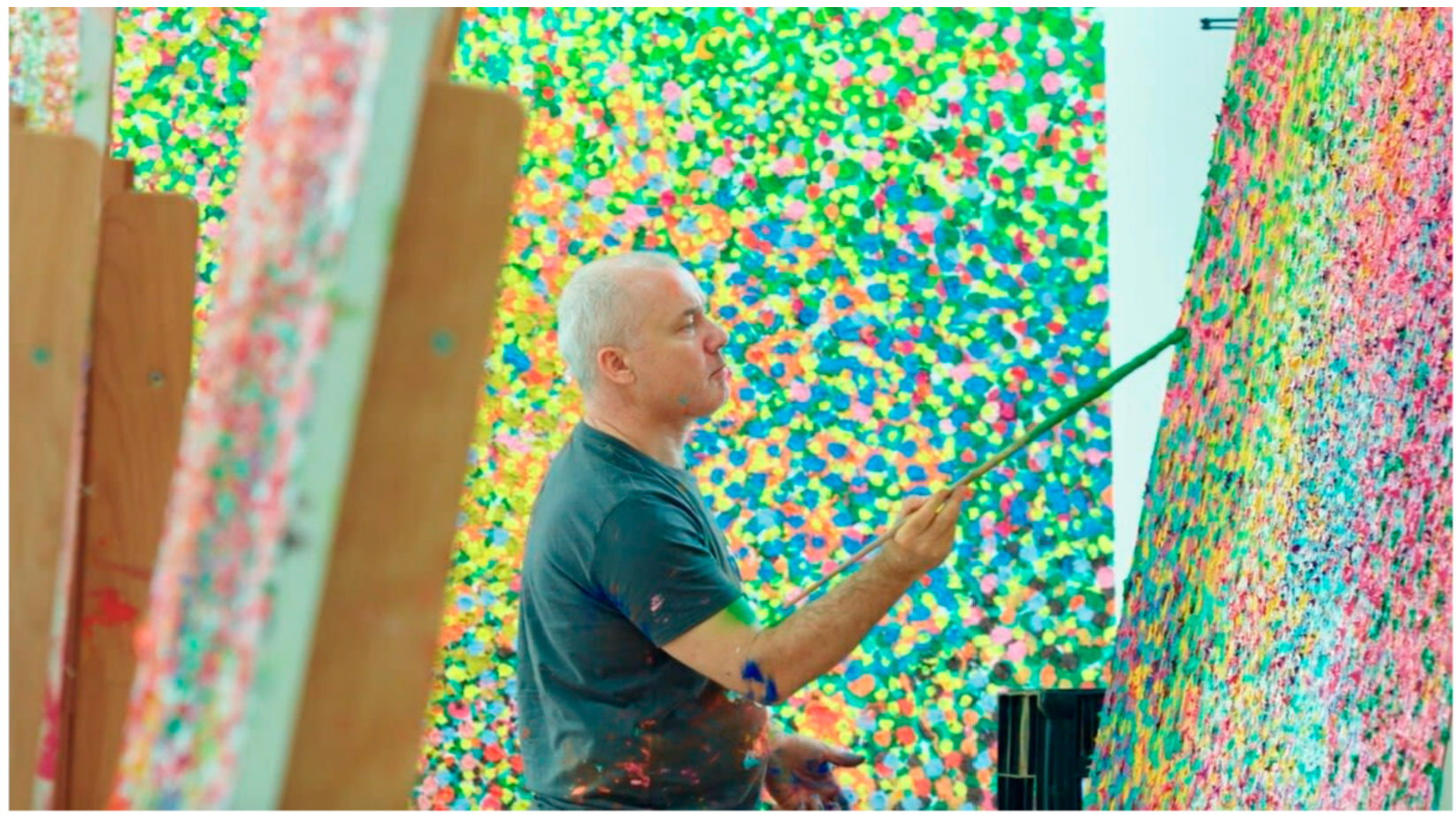
Damien Hirst in his studio, London, 2017. © Damien Hirst and Science Ltd. All rights reserved / DACS, London / ARS, NY 2023.
Hirst’s technique pays homage to the radical stylistic developments of late-nineteenth century Impressionism and post-Impressionism. Veil of Imagination feels like it could be a magnified sample of Seurat’s Pointillist landscapes, Bonnard’s interiors blooming with brilliant floral arrangements or Monet’s water garden at Giverny, speckled with pale flowers. Hirst himself has compared the effect of his Veil works to Monet’s dappled waterlily ponds. Just as the water’s surface had constituted a visually spectacular, reflective boundary worthy of representation upon the picture plane, Hirst considered his canvas itself as a “veil”, a fine film separating one realm from another. “I wanted to make paintings that were a celebration”, he says, “that revealed something and obscured something at the same time” (D. Hirst interviewed by A. McDonald, ibid.). Here, beneath a mesmeric surface of vibrating, fleeting color, he promises a world of imagination, fantasy, and delight.
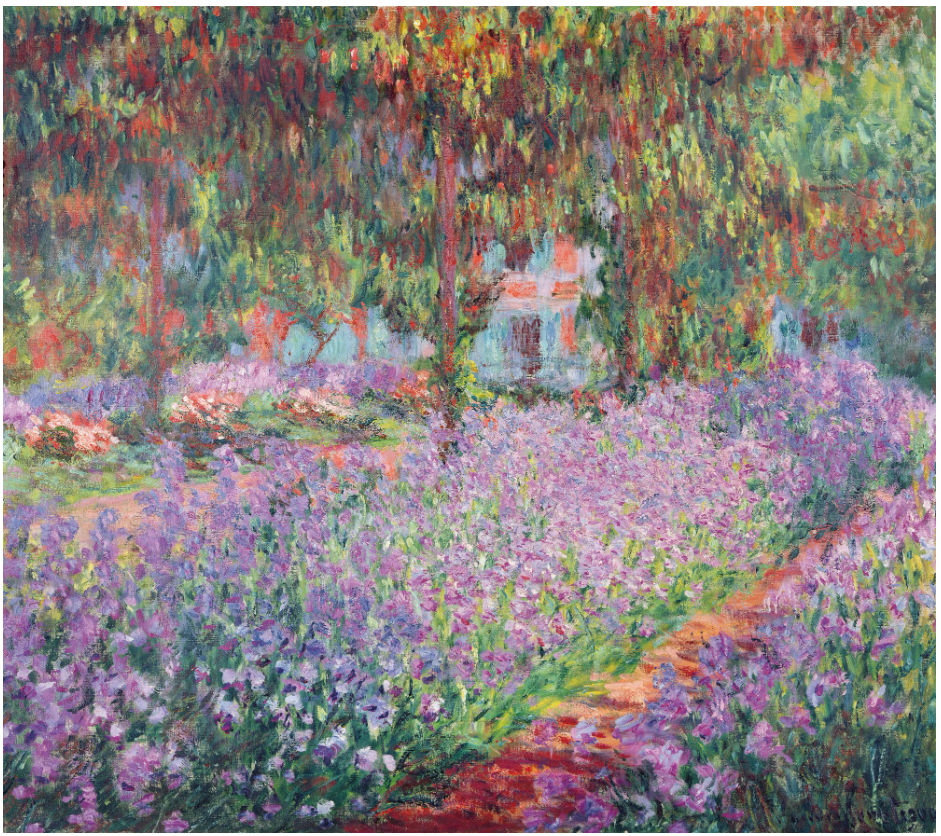
Claude Monet, The Artist’s Garden at Giverny, 1900. Musée d’Orsay, Paris. Photo: © Musee d’Orsay, Paris, / Giraudon / Bridgeman Images.
The Veil paintings mark a pivotal move away from the artist’s longstanding allegiance to hard-edged Minimalism—seen in his organization of form, painted or three-dimensional, within gridded, cubic structures like vitrines and cabinets and pharmaceutical packaging—towards a looser, gestural abstraction. Releasing form and color upon large-scale canvases, Hirst cultivates a sensorily immersive experience evocative of the “all-over” approach of Abstract Expressionism. His embrace of gestural mark-making and his fascination with the interactive, emotive effects of pure color denote the legacy of the New York School, which included such legendary painters as Willem de Kooning and Jackson Pollock. “I’ve always liked paintings that are exciting to the eye”, Hirst has said. “I suppose dots come out of that. It’s a surface that moves” (D. Hirst, quoted in D. Vankin, “Why Damien Hirst is seeing dots in his new work on view in Beverley Hills”, Los Angeles Times, March 23, 2018).
The artist has reflected on his attraction to series as a defining mode of his artistic expression. He relates them to the dialectic underpinning his practice, that of permanence and impermanence; mortality and immortality. “They are a battle with the idea of death”, he says. “The infinite series I made at the beginning of my career was a way for me to not face that. It’s a great way to imagine that you will last forever—even though you won’t. Now that I’m older the series are getting smaller, and that feels more realistic” (D. Hirst interviewed by A. McDonald, ibid.). Part of an intimate and purposeful series, the present work stands as a rare expression of unbounded joy in Hirst’s oeuvre, celebratory in the face of its own finitude.
Jean-Michel Basquiat
Christie’s New-York: 7 November 2023
Estimated: USD 1,000,000 – 1,500,000
USD 1,197,000
JEAN-MICHEL BASQUIAT (1960-1988) (christies.com)
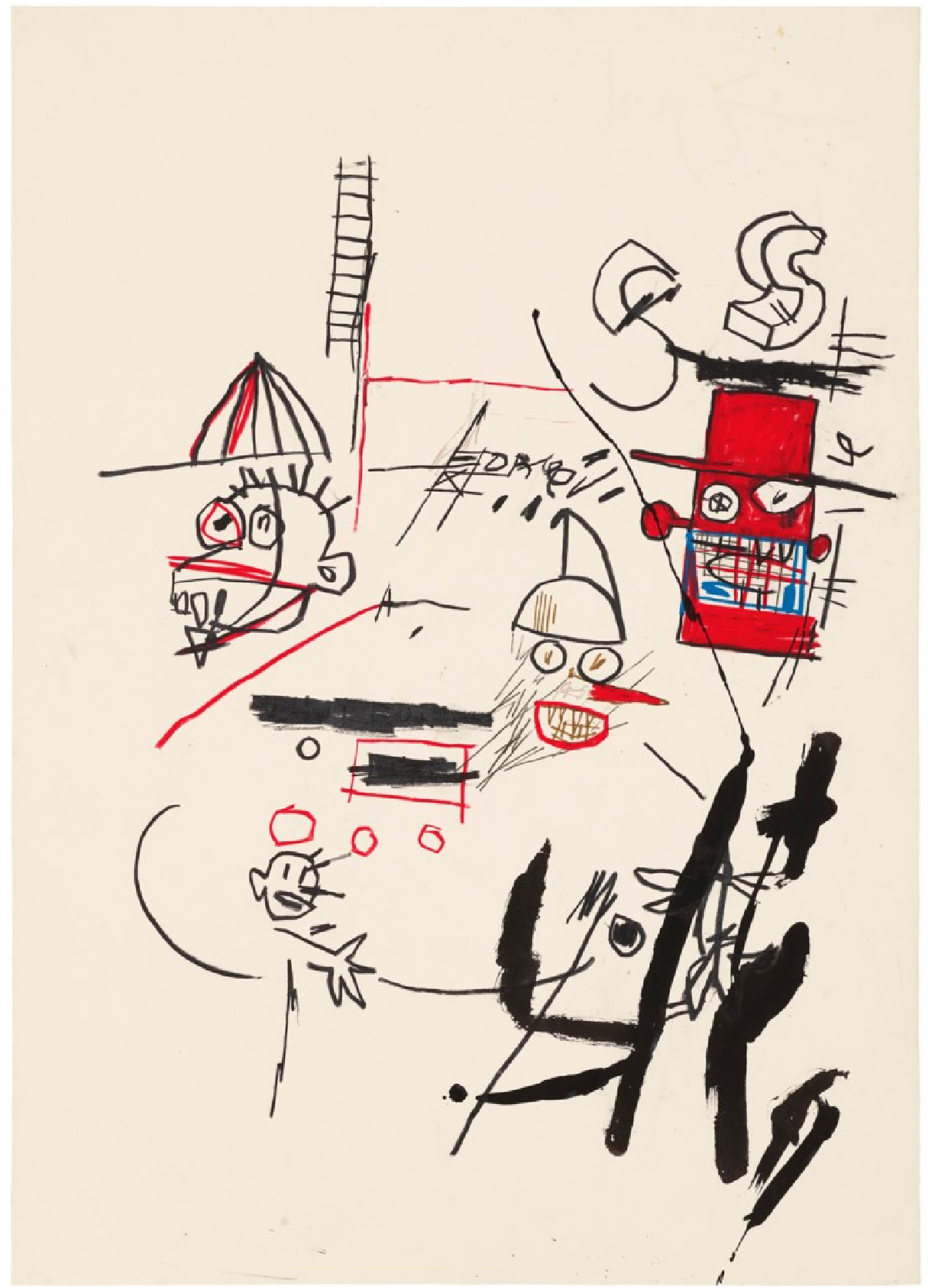
JEAN-MICHEL BASQUIAT (1960-1988)
Untitled, 1982
Oilstick, India ink, crayon and graphite on paper
40×28 inches (101.6 x 71.1 cm)
Signed with the artist’s initials and dated ‘JMB 82’ (on the reverse)
Drawing was a constant creative outlet for Jean-Michel Basquiat. His mind overflowing with imagery and ideas, he constructed cryptic narratives on paper that combined his own symbolic vocabulary with observations and inventions from his daily life. Untitled is a particularly rich example of this output that alludes to some unknown storyline of which the viewer is only partially aware. Using red and black to pull us in, the artist constructs a sense of exploded space that expands outward into our realm. Talking about his nuanced use of text, imagery, and calligraphic line, actor and Basquiat enthusiast Johnny Depp noted rather astutely, “Looking at these works, one cannot escape without feeling the almost perverse sense of care taken to draw detail with what seems an acute distracted concentration…every line, mark, scratch, drip, footprint, fingerprint, word, letter, rip and imperfection is there because he allowed it to be there” (J. Depp in E. Navarra, Jean-Michel Basquiat, Paris 2000, pp. 16-17). Far from laying down errant marks and unimportant asides, Basquiat’s ability to coalesce competing forms into a writhing whole was unmatched. Color, line, and empty space are all in service of his final composition that highlights internal relationships within his nuanced arrangement.
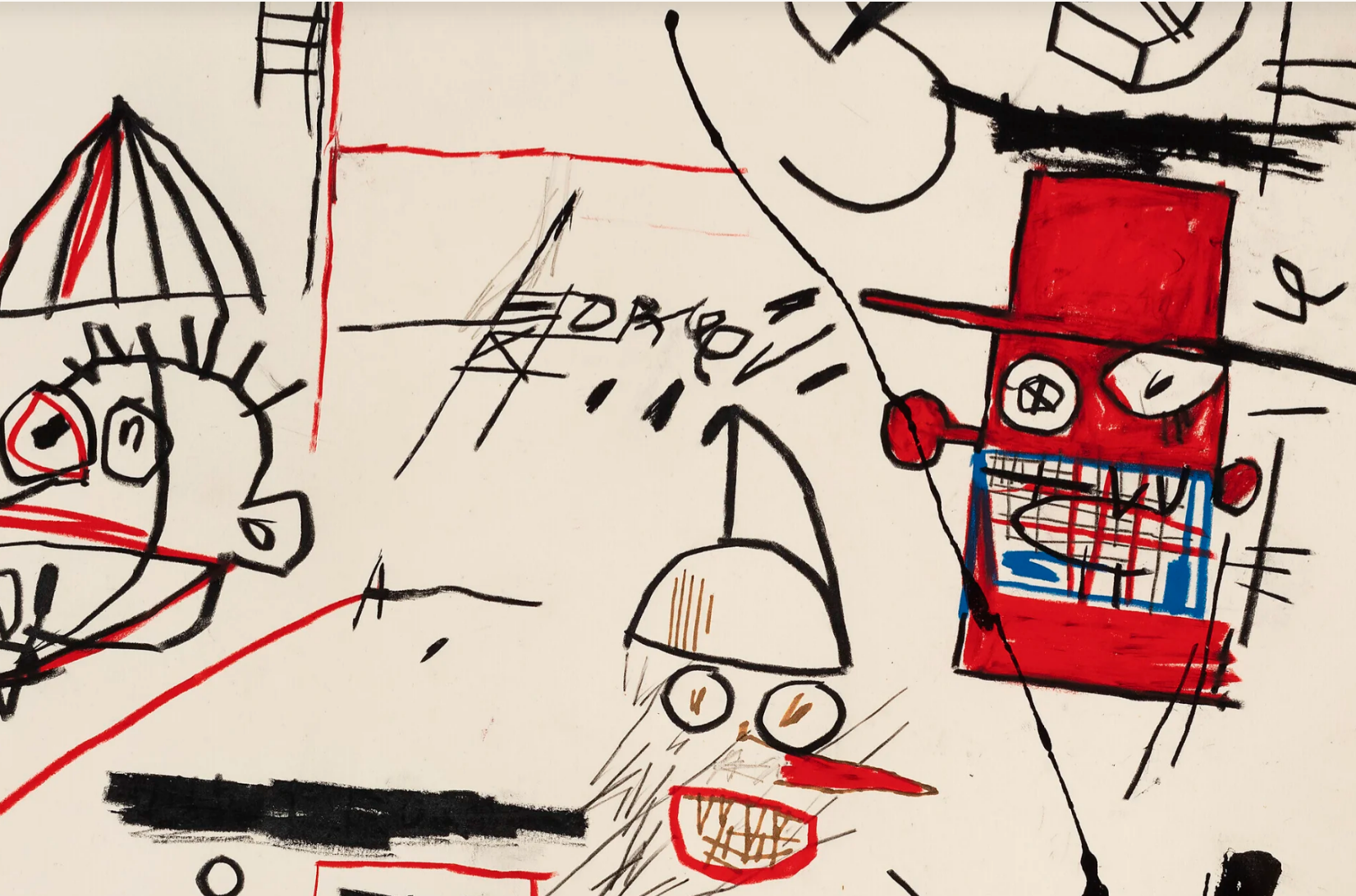
Rendered with his characteristically expressive use of oil stick, the disparate elements in Untitled come together into a cohesive visual whole under Basquiat’s frantic hand. Assessing the scene, one finds four faces in a variety of styles that stare out at the viewer. Three are situated in the middle of the work and, from left to right, show a boy with a floating baseball cap and spiked hair, a bizarre clown-like figure with a pointe red nose and cherry lips, and a glaring red mechanical man with top hat and protruding ears. Each is a distinct character without a body, their personalities wholly made of their facial features and the artist’s ability to imbue even the slightest line with magnetic energy. Untitled is a dynamic example of Basquiat’s predilection for drawing the human head in various guises. Fred Hoffman explained this habit when he noted, “What drew Basquiat almost obsessively to the depiction of the human head was his fascination with the face as a passageway from exterior physical presence into the hidden realities of man’s psychological and mental realms. As such, the two largest human orifices of the eye and mouth, the gateways enabling a passageway within, are depicted as both large and open. In the case of the eyes, they not only peer out as if seeing, but also invite the viewer to penetrate within” (F. Hoffman, Jean-Michel Basquiat Drawing: Work from the Schorr Family Collection, exh. cat., New York, Acquavella Galleries, 2014, p. 74). All three of the above-mentioned faces have large round eyes with chaotic pupils and open mouths that boast a horde of unnerving teeth. The fourth head is less brazen, situated in the lower left of the composition, it is paired with a small hand and exhibits vertical slits for eyes. Given its positioning and simplified rendering, as well as the swirling lines that seem to extend from its space, one can almost see it as a narrator of the scene that is explaining some unknown happening in vivid detail.
2. 20th Century Evening Sale
9 November 2023
20th Century Evening Sale (christies.com)
On 9 November Christie’s marquee week continued with the 20th Century Evening Sale. Led by auctioneers Jussi Pylkkänen and Adrien Meyer, the sale realized $640,846,00 and sold 97 per cent by lot and 105 per cent hammer against the low estimate. Nine works realized prices in excess of $25 million, including major paintings by Diebenkorn, Rothko, Picasso, Cezanne, Magritte, Mitchell and Warhol, in addition to the Monet and the Bacon.
Richard’s Diebenkorn’s Recollections of a Visit to Leningrad shattered the artist’s previous auction record, realizing USD 46,410,000 after five minutes of competitive bidding. The 1965 painting was completed after a life-changing trip to the Soviet Union in which he saw a trove of Henri Matisse’s work in person. It celebrates the artist’s admiration of Matisse while paving the way for his acclaimed Ocean Park series. The sale also saw an artist record for Joan Mitchell’s Abstract Expressionist Untitled, which realized USD 29,160,000. The circa 1959 painting’s seven-foot maelstrom of color and sweeping brushstrokes boasts all the hallmarks of Mitchell’s most celebrated paintings, making it a true masterpiece from the pivotal decade of her career.
Auction Statistics
65 Lots
Low Estimate: USD 318,240,000
High Estimate: USD 467,400,000
Estimate on Request: 5 Lots
Total: USD 640,846,000
# Lots sold: 61
Sell-Through Rate: 93.8%
Top Lot: USD 74,010,000
55 Lots sold above USD 1 million
USD 637,538,500
99.5% of Total
16 Lots sold above USD 10 million
USD 489,042,500
76.3% of Total
Above Estimates: 20 Lots (31%)
Within Estimates: 25 Lots (38%)
Below Estimates: 11 Lots (17%)
EOR/Unsold: 9 Lots (14%)
Top 10 Lots
#1. Claude Monet
Christie’s New-York: 9 November 2023
Estimate on Request
USD 74,010,000
CLAUDE MONET (1840-1926) (christies.com)

CLAUDE MONET (1840-1926)
Le bassin aux nymphéas, 1917-1919
Oil on canvas
100.1 x 200.6 cm (39 3/8 x 78 7/8 inches)
Stamped with signature ‘Claude Monet’ (Lugt 1819b; lower right)
Stamped again with signature ‘Claude Monet’ (Lugt 1819b; on the reverse)
Widely hailed as landmarks of late Impressionism, the paintings that Claude Monet made of his famed gardens at Giverny constitute some of the most innovative and influential works of his entire oeuvre. During the last twenty-five years of his life, Monet devoted himself almost single-mindedly to depicting the flowing planes of flowers, towering willow trees and the expansive lily-pond that he had fashioned within the grounds, producing an astonishingly complex and diverse group of canvases that capture the unique atmosphere of the artist’s own arcadia. Absorbing and expressionistic, with an extraordinary play of impasto and vibrant brushwork, Le bassin aux nymphéas is a key example from this famed series of works dedicated to the water lilies, executed on a large-scale canvas that stretches over two meters across. At once searingly modern and timeless, the painting focuses on the play of silvery light and the intricate dance of reflections across the lily-pond, conveying a vivid sense of the undulations of the surface of the water and the delicate bobbing flowers, as they shift and change in response to their surroundings.
Dating from 1917-1919, Le bassin aux nymphéas hails from an important period of renewal and experimentation in Monet’s painterly visions of the lily-pond, spurred on by his desire to create mural-scale images of the motif, rather than the smaller paysages d’eau that he had hitherto painted of his gardens. These grand, monumental depictions were filled with gestural, vigorous bolts of color that coalesce to form the watery landscape, the vibrancy and gestural quality of the brushwork revealing the impressive energy that lay behind the artist’s paintings, even at this late stage of his career. Though these revolutionary compositions initially met with mixed reactions from Monet’s contemporaries, they found favor among a younger generation of artists and collectors in later decades of the twentieth century, most notably among the painters of the bourgeoning Abstract Expressionist movement. Held in the same family collection for the past fifty years, Le bassin aux nymphéas is a captivating example from this great body of work, encapsulating Monet’s searing, prescient creative vision.

In Le bassin aux nymphéas, Monet’s innate ability to organize his sensations of the transience of natural phenomena is readily apparent. Here, he focusses principally on the surface of the water, stripping out all superfluous details, allowing the quicksilver-like water to fill the canvas, only interrupted by small constellations of floating water lilies. The flowers themselves are rendered with layers of rich impasto to give them a sculptural presence, affirming their position on the top of the pond, while in the watery areas, layers of color are laid on top of one another to suggest the refractions of light and the changing hues in the pond’s depths. It is the surface of the pond itself that captivates the artist’s imagination, rippling with the reflections of the willow trees that line the water’s edge as well as the slivers of intense, deep, lush lapis-colored sky above. While Monet has tightly focused his view on a small sliver of the vast pond, creating a closely framed composition that seemingly allows for no foreground or background, he has nonetheless used the water as a portal of sorts, allowing a complex interplay of the near and the far, in which the world beyond the pond exists in mirror-image.

The present canvas is one of an important sequence of works that emerged between 1917-1919, each of which offer subtle meditations on the atmospheric, enveloping environment of the pond across large, horizontal format canvases that thrusts the viewer right into the heart of the water. Monet initially had the idea of painting large-scale pictures of the water lilies in the late 1890s, and made several efforts before abandoning them.
#2. Francis Bacon
Christie’s New-York: 9 November 2023
Estimate On Request
USD 52,160,000
FRANCIS BACON (1909-1992) (christies.com)
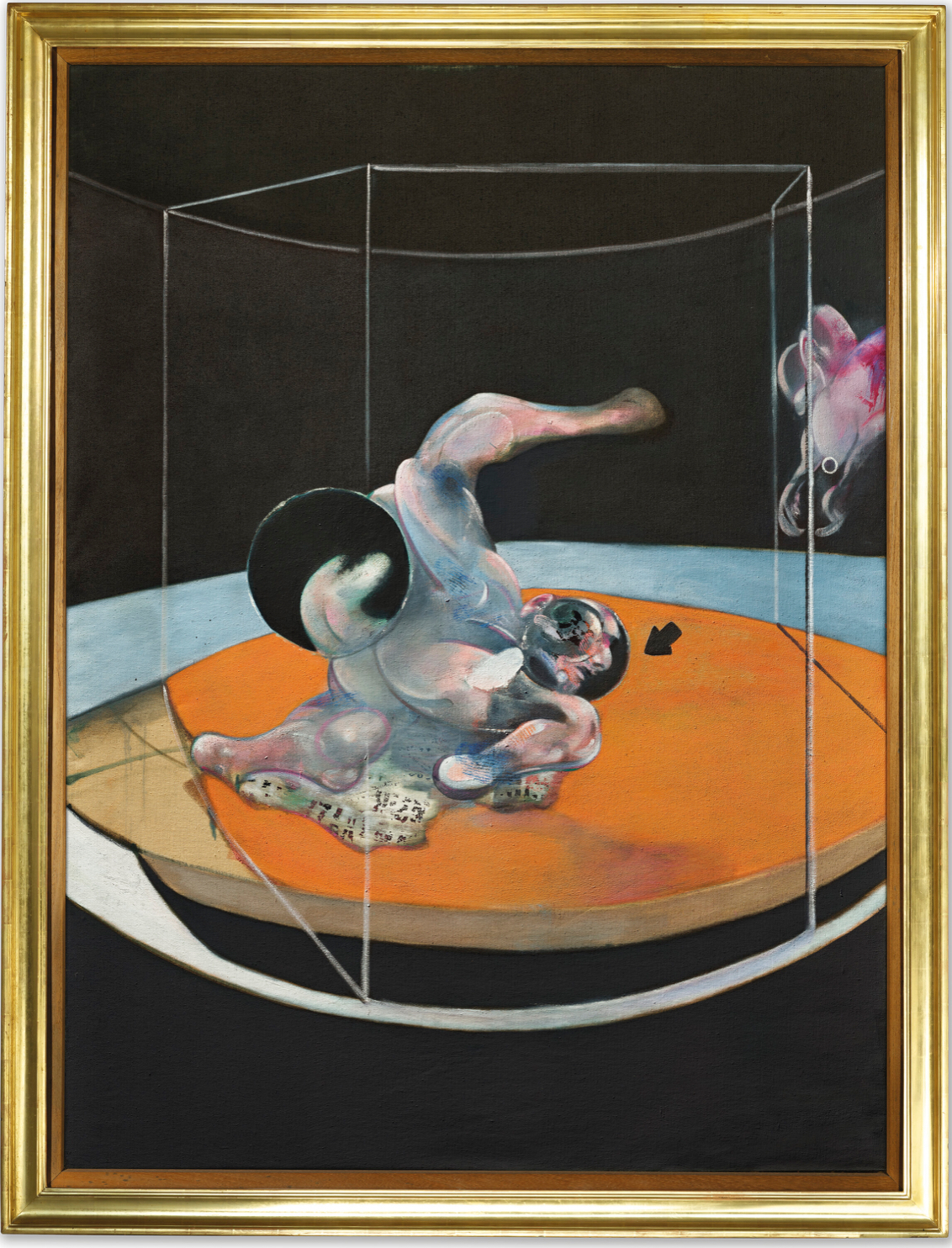
FRANCIS BACON (1909-1992)
Figure in Movement, 1976
Oil and dye transfer lettering on canvas
78 1/4 x 58 inches (198.9 x 147.3 cm)
Signed and dated ‘Francis Bacon 1976’ (on the reverse)
Standing among the great icons of Francis Bacon’s oeuvre, Figure in Movement is an extraordinary meditation on love, loss and the transience of the human condition. Painted in 1976, it takes its place within the canon of masterworks that followed the tragic death of his beloved George Dyer in 1971. Described by the critic David Sylvester as the greatest large single canvas produced during these years, it is a staggering image of human flesh in motion. A visceral tangle of limbs is suspended within an empty arena, shot through with the influence of Michelangelo and Muybridge. A circle magnifies the figure’s face, fusing hints of Dyer’s likeness with fleeting echoes of Bacon’s own. Illegible fragments of text spill onto the fiery orange ground like literature. In the corner hangs a bird-like spectre, referencing the ancient Greek “Furies” that had long haunted Bacon’s art. Conversant with the elegiac “black triptychs” that had dominated the artist’s output since Dyer’s death, it is a work of near-operatic grandeur: a fantasy of bodies entwined before the abyss, an image of life illuminated against the void, and a portrait of flesh on the brink of transcendence.
With an outstanding exhibition history that includes landmark retrospectives at the Tate Gallery, London, the Museo Correr, Venice and the Centre Georges Pompidou, Paris, Figure in Movement has been widely celebrated in scholarship. For Sylvester, whose seminal interviews with Bacon were published the year before the painting, it was a monument “to George Dyer’s tragic fall, in which a whole range of Baconian devices are brought together with a compelling mastery” (D. Sylvester, Francis Bacon in Dublin, exh. cat. Hugh Lane Municipal Gallery of Modern Art, Dublin 2000, p. 109). For Martin Harrison, author of Bacon’s catalogue raisonné, it is one of the artist’s “quintessential images of entropy, a boldly-colored masterpiece of disorder and inquietude” (M. Harrison, Francis Bacon Catalogue Raisonné: Volume IV 1971-92, London 2016, p. 1090). The poet Yves Peyré, meanwhile, wrote that “This picture paints man’s sui generis destiny … In the vehemence of its efficiency, this painting has the import of a treatise. It would be easy to think that few paintings could compare to this wonder” (Y. Peyré, Francis Bacon or The Measure of Excess, London 2019, p. 232).
Francis Bacon and George Dyer on the Orient Express Train to Athens, 1965. Photo: John Deakin. © The Estate of Francis Bacon. All rights reserved / DACS, London / ARS, New York 2023.
Bacon was fascinated by movement. He was particularly inspired by cinema and photography—most notably the work of Eadweard Muybridge, whose images captured moving figures in successive frames. Since the dawn of his practice Bacon had set out to paint what he described as the “emanation” of his subjects: the pulsations of energy that flowed through their veins and sent their spirit out into the world. He, in turn, drew heavily upon the motions and impulses of his own nervous system, seeking—as he put it—to “trap this living fact alive.” In the present work, his figure descends into metamorphosis. Harrison, in his commentary on the painting, invokes what the philosopher and Bacon scholar Gilles Deleuze termed “derisory athleticism”: a state of chaos, in which the flesh seems to escape its own confines. Like the Futurists’ depictions of speed, or Marcel Duchamp’s Nude Descending a Staircase, the body is fixed in multiple positions simultaneously. The figure seems to float in free-form through time and space, his flesh sublimated by forces beyond his control.
#3. Richard Diebenkorn
Christie’s New-York: 9 November 2023
Estimate On Request
USD 46,410,000
NEW WORLD RECORD FOR THE ARTIST
RICHARD DIEBENKORN (1922-1993) (christies.com)
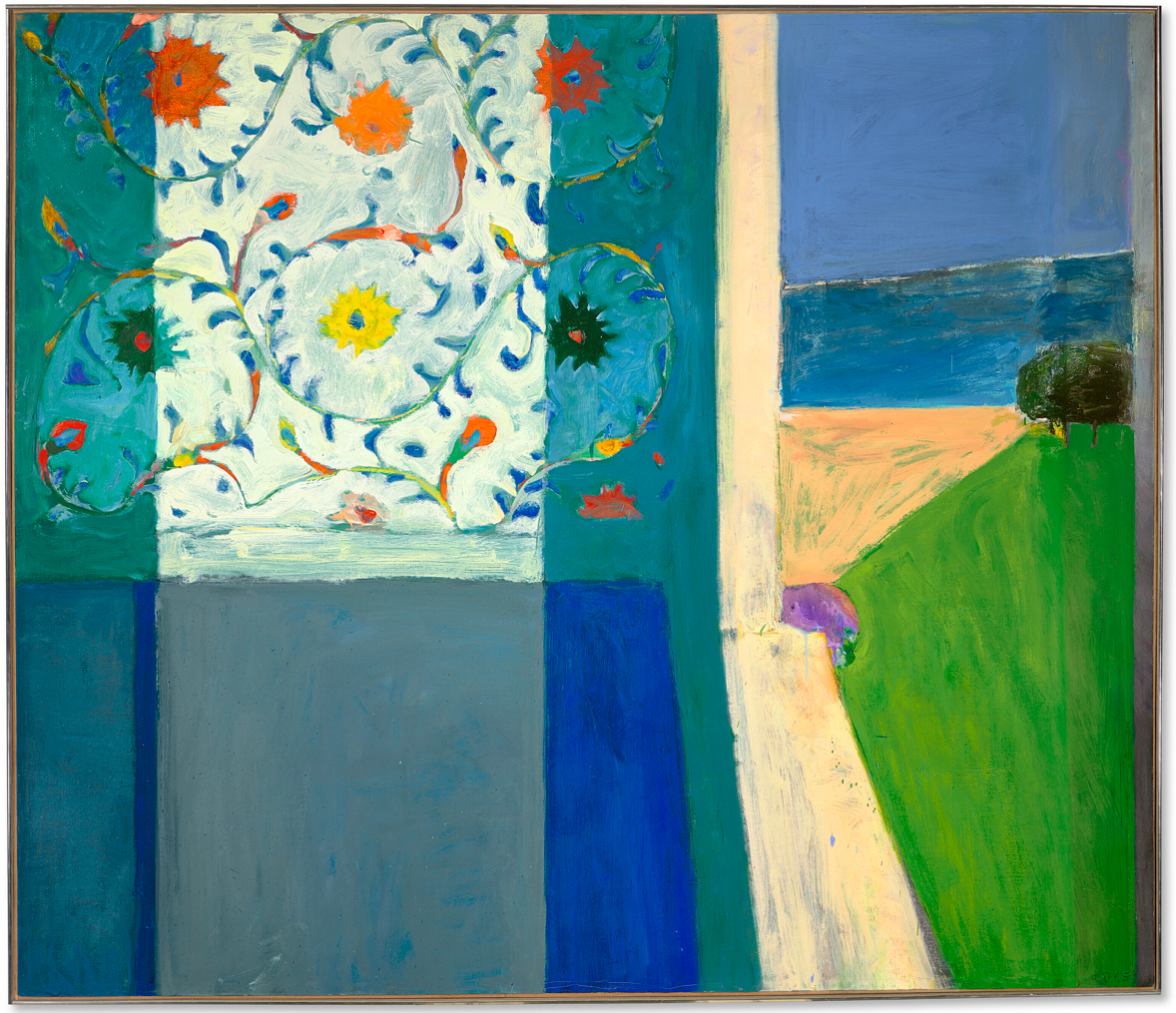
RICHARD DIEBENKORN (1922-1993)
Recollections of a Visit to Leningrad, 1965
Oil on canvas
71 3/8 x 83 1/8 inches (181.3 x 211.1 cm)
Signed with the artist’s initials and dated ‘RD 65’ (lower right)
Richard Diebenkorn’s Recollections of a Visit to Leningrad is a groundbreaking painting that celebrates his admiration for the work of Henri Matisse and the profound effect the French master’s paintings had on his own career. Previously only encountered through books, in the 1960s Diebenkorn made a rare trip to the Soviet Union where he saw dozens of Matisse’s paintings in person. This momentous encounter began Diebenkorn’s move towards the new abstracted planes of rich and vibrant color that would result in his iconic Ocean Park canvases. Not only is this particular painting an homage to Matisse, it also documents the tectonic shifts that were taking place in the wider art world at the time, as the influence of abstraction was beginning to wain with the emergence of Pop Art. Seeing the work of Matisse firsthand encouraged Diebenkorn to challenge the existing hegemony and pursue the emergence of his new artistic vocabulary. Widely published (including on the cover of the 2016 exhibition catalogue for Matisse/Diebenkorn at the Baltimore Museum of Art), and extensively exhibited around the world, this sumptuous canvas becomes a painting about painting, and celebrates two of the twentieth century’s most avant-garde artists.
Across the surface of this monumental canvas evidence emerges of the new direction which Matisse’s influence had prompted in Diebenkorn’s work. Gone is the dynamic brushwork that the American artist had employed to manipulate the fields of organic color in his Sausalito, Albuquerque, Urbana, and Berkeley paintings of the 1950s. Also absent are the figures that he had introduced into his work in the late 1950s and early 1960s, replaced instead by bold geometric planes of jewel-like color. Depth and perspective are still present, but in a much diminished form. Bisected by a series of strong vertical lines, the composition of the present work appears to be a highly abstracted view of a landscape as viewed through a window. In the distance, blocks of verdant green, warm cream, and azure blue evoke a lawn, beach and deep ocean respectively, while a highly abstracted floral pattern is carefully rendered in the upper left quadrant.
#4. Mark Rothko
Christie’s New-York: 9 November 2023
Estimate on Request
USD 46,410,000
MARK ROTHKO (1903-1970) (christies.com)
MARK ROTHKO (1903-1970)
Untitled (Yellow, Orange, Yellow, Light Orange), 1955
Oil on canvas
81 1/2 x 60 inches (207 x 152.5 cm)
Signed and dated ‘MARK ROTHKO 1955’ (on the reverse)
Currently the subject of a major international retrospective at the Fondation Louis Vuitton in Paris, Mark Rothko stands as one of the giants of twentieth-century art. Measuring nearly seven feet tall, the magisterial Untitled (Yellow, Orange, Yellow, Light Orange) encapsulates the aesthetic, emotional, and psychological complexity that is the hallmark of the artist’s most successful canvases. Its monumental size and intensity of color combine to envelop the viewer, pulling them into the visual and spectral drama that Rothko plays out across the surface of his paintings. Painted in 1955, this work represents a highpoint in the depiction of his dynamic fields of color, before the tumultuous years of the Seagram Murals project would cast a pall over the artist’s oeuvre. Untitled (Yellow, Orange, Yellow, Light Orange) remained in the artist’s collection until his death in 1970, before being acquired by the legendary collectors Paul and Bunny Mellon, and was in their possession for nearly 50 years. Mellon was one of the twentieth-century’s greatest art patrons, building an unrivalled collection of European and American masterworks, and endowing a number of institutions—including the East Wing of the National Gallery of Art in Washington (an institution to which the couple donated over 1,00 works of art), and the Yale Center of British Art. Untitled (Yellow, Orange, Yellow, Light Orange) was a pillar of their collection, and in both scale and scope is a highpoint of the twentieth-century canon.
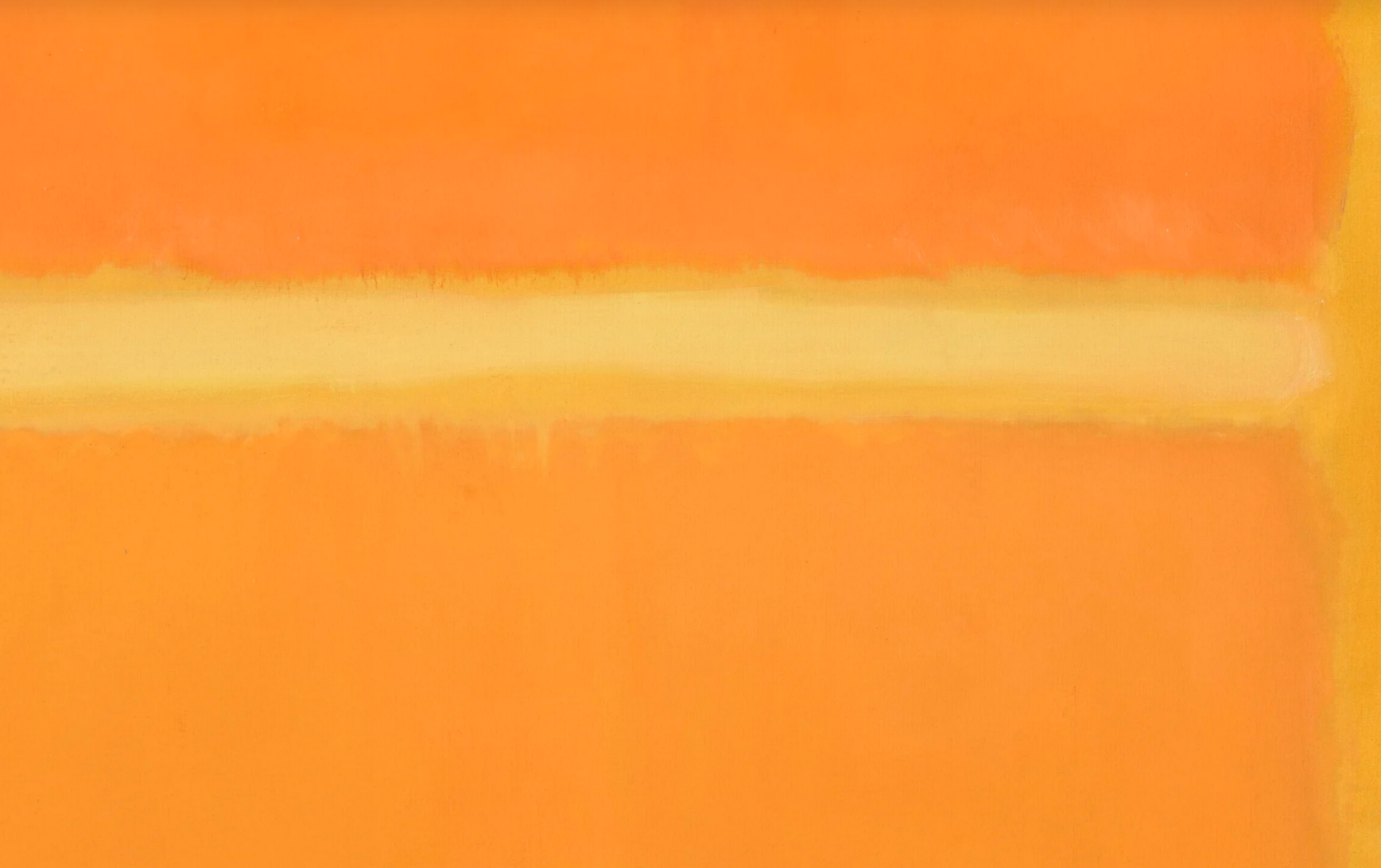
Standing in the presence of Untitled (Yellow, Orange, Yellow, Light Orange), the viewer is embraced by the almost palpable sense of heat that is emitted by the myriad of shades in golden yellows and warm oranges that Rothko expertly melds together. Asymmetrical blocks of color anchor the composition, two substantial passages of orange pigment that dominate the central portion of the canvas, divided by slender bands of paler pigment, separating these passage from each other and the edges of the picture plane. Within each of these areas, Rothko’s highly active surface is the result of applying consecutive thin washes of color that pool and dissolve into each other. The result is a surface that is alive with detail, constantly shifting chromatic effects that become visible with prolonged looking. Concentrated passages of color roil up to the surface before receding; flat surfaces sit next to areas of sublime depth; and broad strokes of substantial brushwork coalesce with delicate areas of where Rothko applies pigment with a delicate brush. The result is a painting which resonates with movement, a surface that constantly shifts as the viewer casts their eye across the surfaces or moves physically around the space it occupies.
Standing close to the surface of Rothko’s painting unleashes the full force of these dramatic canvases (Rothko himself specified that 18 inches was the optimum distance from which to fully appreciate his work). In Untitled (Yellow, Orange, Yellow, Light Orange), such examination reveals a cast of artistic elements that play starring roles in the overall drama of the overall composition. The narrow band that traverses the center is embellished by a multitude of delicate drips, spectral brushwork, and a gradual shifting of light to dark pigment that is easily overlooked. Yet it precisely in these areas that the drama reveals itself in full force. “Rothko’s shapes – his actors – are almost never singular; they are multiple. This not only lends the paintings their depth in the suspended fields but also energizes the edges, and it is at the edges that the visual cues coalesce and propel one’s awareness back into the interiors with a heightened apprehension of their status as congeries of many delicately coincident blocks of translucent color” (T. Crow, “The Marginal Difference in Rothko’s Abstraction,’ Seeing Rothko, Los Angeles, 2005, pp. 34-35). Thus, the competing forces of his contrasting color fields come into direct contact with each other, and it was here that Rothko felt that his paintings truly reached the apex of their power, “colors push outward in all directions,” he said, or “contract and rush inward. Between these two poles you can find everything I want to say” (M. Rothko, in conversation with A. Jensen, 17 June 1953, in J. E. B. Breslin, Mark Rothko: A Biography, Chicago, 1993, p. 301).
#5. Pablo Picasso
Christie’s New-York: 9 November 2023
Estimated: USD 25,000,000 – 35,000,000
USD 42,960,000
PABLO PICASSO (1881-1973) (christies.com)
PABLO PICASSO (1881-1973)
Femme endormie, 1934
Oil on canvas
72.4 x 54 cm (28 1/2 x 21 1/4 inches)
Dated and inscribed ‘Boisgeloup 17 Juillet XXXIV’ (upper left)
Painted in a whirl of vibrant, resplendent tones, Pablo Picasso’s 1934 composition Femme endormie is a deeply tender portrayal of his lover Marie-Thérèse Walter, the young, golden-haired woman whose presence had transformed every facet of his oeuvre since their fateful meeting in 1927. Inspired by her sensuous form and their passionate intimacy, Picasso’s creativity reached new heights over the course of their relationship, leading John Richardson to proclaim this the artist’s “most innovative period since Cubism” (A Life of Picasso, The Triumphant Years, 1917-1932, New York, 2007, vol. 3, p. 460).
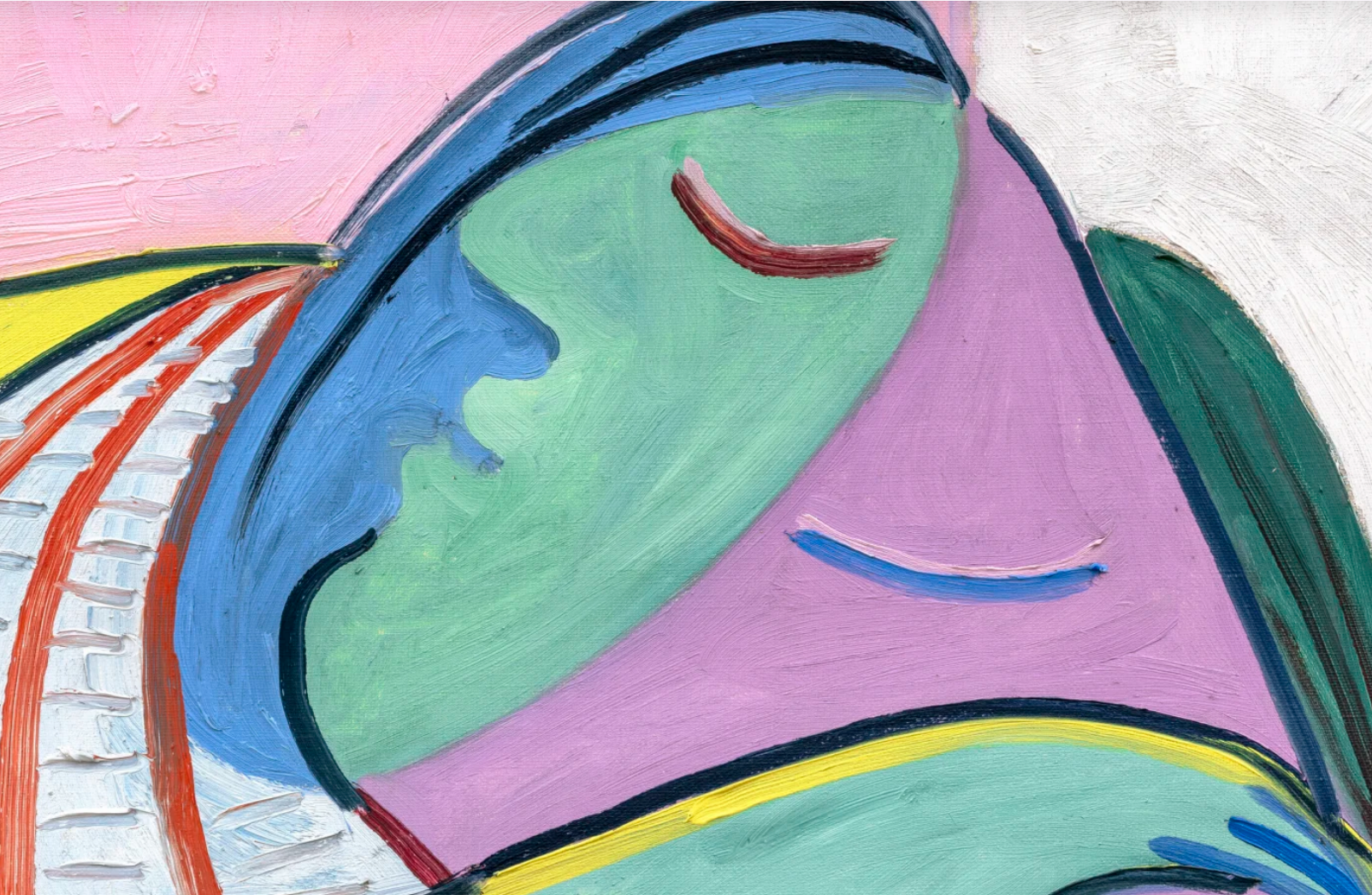
The mid-1930s was a particularly fraught period for Picasso, in which he was plagued by ever-worsening marital conflict and a growing anxiety regarding the darkening political situation across Europe, as Fascism took hold in both his native Spain and Germany, and France was hit by social upheaval. Painted on 17 July 1934, Femme endormie marks a rare day when the artist’s concerns and fears seem to have been momentarily allayed, and he was able to focus once again on his joyous, beloved muse. As such, the painting appears as an homage to Marie-Thérèse, her unmistakable cropped blonde hair, classical profile and athletic figure captured in a rich interplay of color and sinuous lines, as she indulges in a moment of pure relaxation. It is a testament to the fact that through all the upheaval of the period—the arguments, accusations and threats within his personal life, the encroaching violence and darkness of the outside world that seemed to increase with each day—Marie-Thérèse remained a source of solace and inspiration for Picasso, her presence continuing to elicit great, passion-filled outpouring of creativity within his art, even as events threatened to overwhelm him.
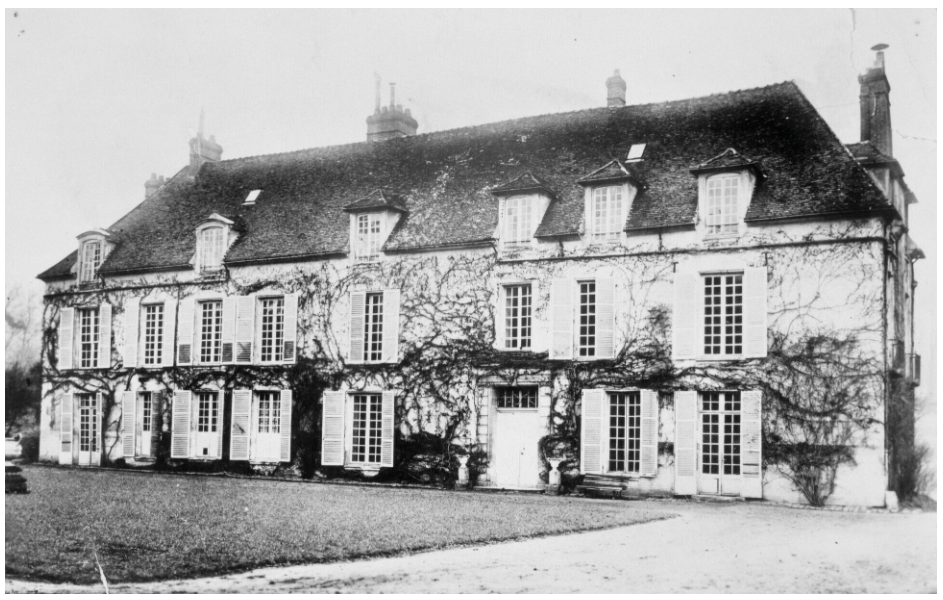
Château de Boisgeloup in 1931. Photographer unknown. Photo: © RMN-Grand Palais / Art Resource, NY.
Radiating bright summer light and saturated with the vibrant, color-filled palette that defined Picasso’s depictions of Marie-Thérèse, Femme endormie was painted in July 1934, at the artist’s country hideaway of Boisgeloup, an impressive seventeenth-century provincial château in rural Gisors, northwest of Paris. Having tired of carting his canvases, materials, and other artistic paraphernalia around his annual summer haunts, and seeking refuge away from his familial obligations in Paris, Picasso had bought the château in 1930. He immediately converted the outdoor stables into a sculpture studio, and devoted a large, light-filled room on the second floor to painting.
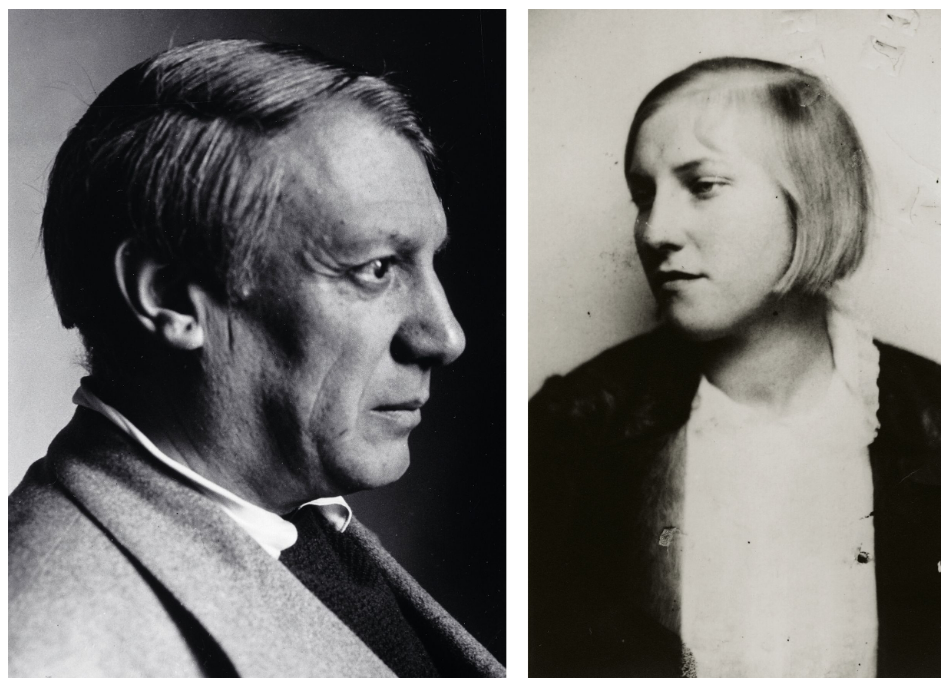
Left: Portrait of Picasso in his studio at rue de La Boétie, Paris, 1932. Photograph by Brassaï. © 2023 Estate of Pablo Picasso / Artists Rights Society (ARS), New York. Photo: © Estate Brassaï – RMN-Grand Palais. Digital Photo: © RMN-Grand Palais (musée national Picasso – Paris) / Franck Raux.
Right: Marie-Thérèse Walter, circa 1930. Photographer unknown. © Archives Maya Widmaier-Picasso.
Ensconced together at Boisgeloup, Picasso’s creativity flourished, and he painted myriad portraits of Marie-Thérèse in a variety of poses and situations, shifting from languorous and luxuriant to upright and alert, lost in the act of reading, writing, or simply daydreaming as she moved through the château. Surrounded by the verdant landscape of Gisors, her image was often linked to the natural world: she became a goddess, a blooming flower, a sun or moon. The pair appear to have spent much of the spring and summer of 1934 there together, with the artist’s granddaughter Diana Widmaier Picasso noting that “the frantic rate at which they exchanged letters abated,” offering a clear indication of their close proximity during this period (exh. cat., op. cit., p. 32). In March, Picasso embarked on a series of paintings focusing on Marie-Thérèse reading and writing letters, sometimes alone at a desk or table, but most often in the company of one of her sisters, who appears to have joined her at Boisgeloup for a brief sojourn. Through April and May, her features proliferate in his paintings and drawings, leading to a sequence of erotically-charged reclining nudes, celebrating his passionate adoration of his lover. In these works—many of which appear as a thematic continuation of the quick, gesturally painted reclining nude studies that had preoccupied him through much of 1932—Marie-Thérèse is seen in the painting studio at Boisgeloup, posed before a folding screen or alongside the windows thrown open to the landscape beyond, the sinuous curves and voluptuous lines of her body rendered in flowing, fluid brushstrokes.
#6. Paul Cezanne
Christie’s New-York: 9 November 2023
Estimated: USD 35,000,000 – 55,000,000
USD 38,935,000
PAUL CEZANNE (1839-1906) (christies.com)
PAUL CEZANNE (1839-1906)
Fruits et pot de gingembre, 1890-1893
Oil on canvas
33.4 x 46.6 cm (13 1/8 x 18 3/8 inches)
Painted in 1890-1893
Filled with a rich, internal balance, Fruits et pot de gingembre is one of a select group of canvases from the late 1880s and early 1890s in which Paul Cezanne reached a high point in his treatment of the still life. Exhibiting a new complexity and sophistication in his approach to form, color and space, these compositions occupy an important position within the evolution of his painting, inaugurating the series of “symphonic” still lifes that serve today—along with the artist’s late bathers and his views of Mont Sainte-Victoire—as a signature emblem of Cezanne’s revolutionary vision. For an artist obsessed by the act—and art—of looking and subsequently transcribing this vision and sensation into two-dimensional form, the still-life genre was the perfect vehicle for Cezanne’s artistic pursuits. As a solitary and methodical worker, it enabled him to arrange his everyday objects in precisely the positions he required, without concern as to the number of “sittings” involved: once the fruit, pots and tablecloth were arranged to his satisfaction, he was at liberty to explore and record his “sensations” thoroughly.
“I proceed very slowly, for nature reveals herself to me in a very complex form, and constant progress must be made. One must see one’s model correctly and experience it in the right way, and furthermore, express oneself with distinction and strength.”
Such sustained contemplation allowed Cezanne’s approach to evolve gradually as he worked—seeing new possibilities in the composition, he responded directly to the interactions and layering of colors on the canvas, and repeatedly reassessed the overall harmony and effect of the painting as it developed. From elaborate arrangements of fruits, objects, and patterned fabrics, to depictions of isolated apples or vibrant bouquets of flowers, the still life offered Cezanne a way of probing the boundaries of illusionism, exploring the relationships between one object and another, between the viewer and the painting, as well as the properties of paint itself.
The artist’s studio became a kind of laboratory—simple fruits and rustic tableware provided the chief objects of his research, humble props that belie the enormous complexity and inventiveness of these works. In many, apples, pears, melons, oranges, peaches and pomegranates take center stage, their varying textures and surfaces eloquently captured through delicate plays of color and tone. Far from a chance arrangement captured in passing, though, every aspect of Cezanne’s still-life compositions would have been meticulously planned.
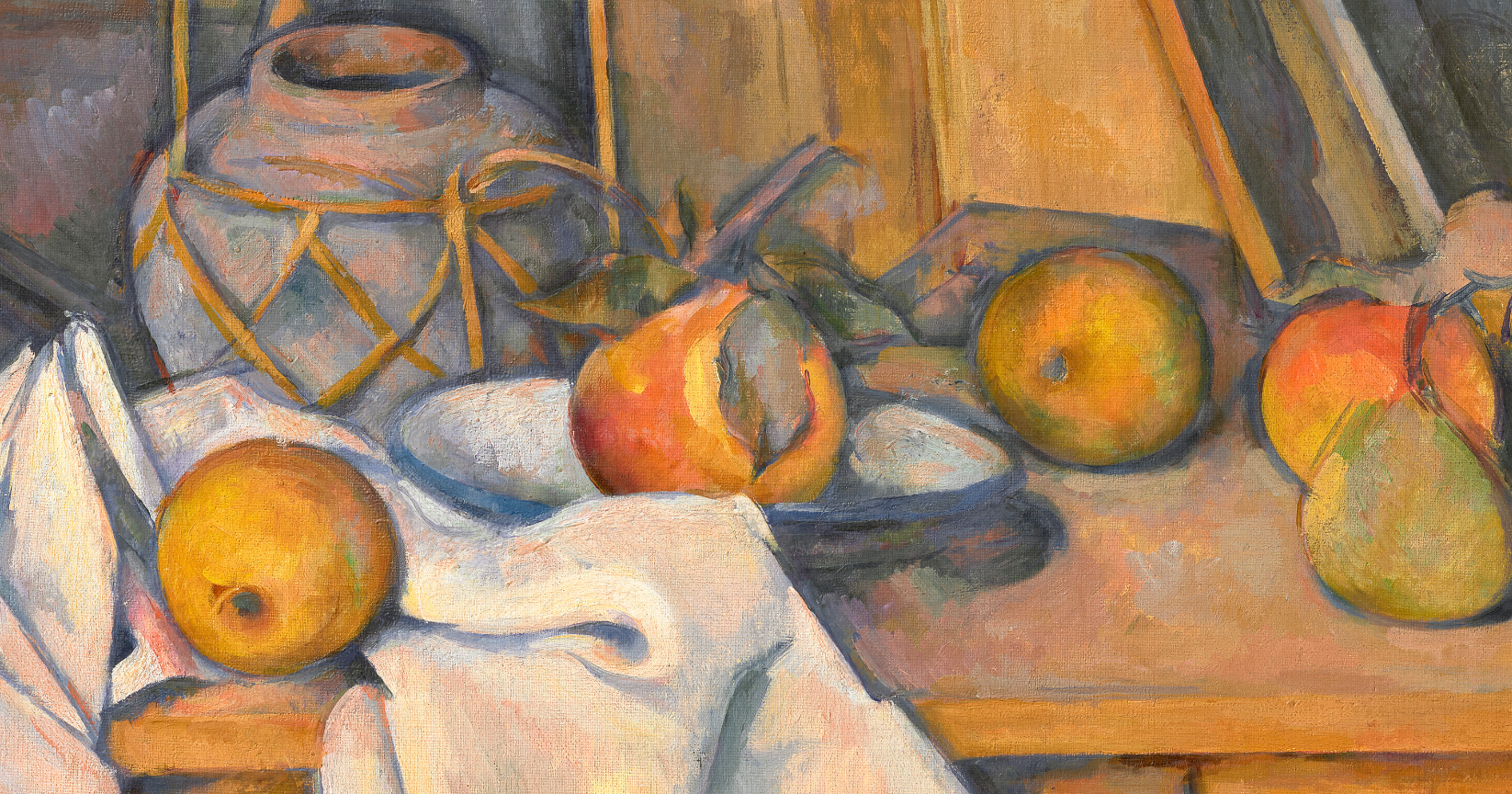
In Fruits et pot de gingembre, Cezanne explores an assortment of globular forms—a wicker-wrapped ginger jar, a large pomegranate, three apples, and a pear—and set himself the challenge of constructing from them a harmoniously unified whole. He positioned the pomegranate in the center of the composition on a subtly tilted white saucer, accentuating the elemental roundness of the fruit. At far left, a golden apple—its underside meeting the viewer’s gaze—lies set apart, its spherically volumetric form contrasting with the stiffly angular peaks and valleys of folds in the white table cloth. The ginger jar, a familiar leitmotif within Cezanne’s still-life paintings of these years, anchors this grouping of objects, its generously rounded shape and open mouth generating a complex rhythm of curve and counter-curve. The wooden tabletop extends the full width of the canvas, filling the picture plane, while the remaining trio of fruits are arranged loosely across its surface in a receding arc, counterbalancing the objects on the opposite end of the table.
Behind the central grouping, Cezanne offers a glimpse into the space in which he worked, most likely the studio he had established at his parents’ estate, Le Jas de Bouffan, on the outskirts of Aix. Conjuring an exceptionally deep and complex space through carefully positioned planes of color, he allows a series of intentionally mysterious ambiguities to infiltrate the scene. Behind the ginger jar, the studio’s iron stove is just discernible, rendered on an unexpectedly small scale—situated, apparently, at some distance from the table. The ocher-colored planes behind the pomegranate, which seem to alternately recede from and project toward the tabletop, represent the reverse of a tall, decorative screen that the artist kept in his studio. A cluster of thin rectangular objects to the right hand edge of the composition, meanwhile, appear to lean against this folding screen at a more dramatic angle, and may represent a group of books seen stacked on a nearby shelf in other still lifes from this period. Extracting the essential forms of each element, Cezanne distils these objects into an abstract armature of rectilinear contours that frames the still life, lending the composition a sense of structure and depth, while the exact details remain elusive.
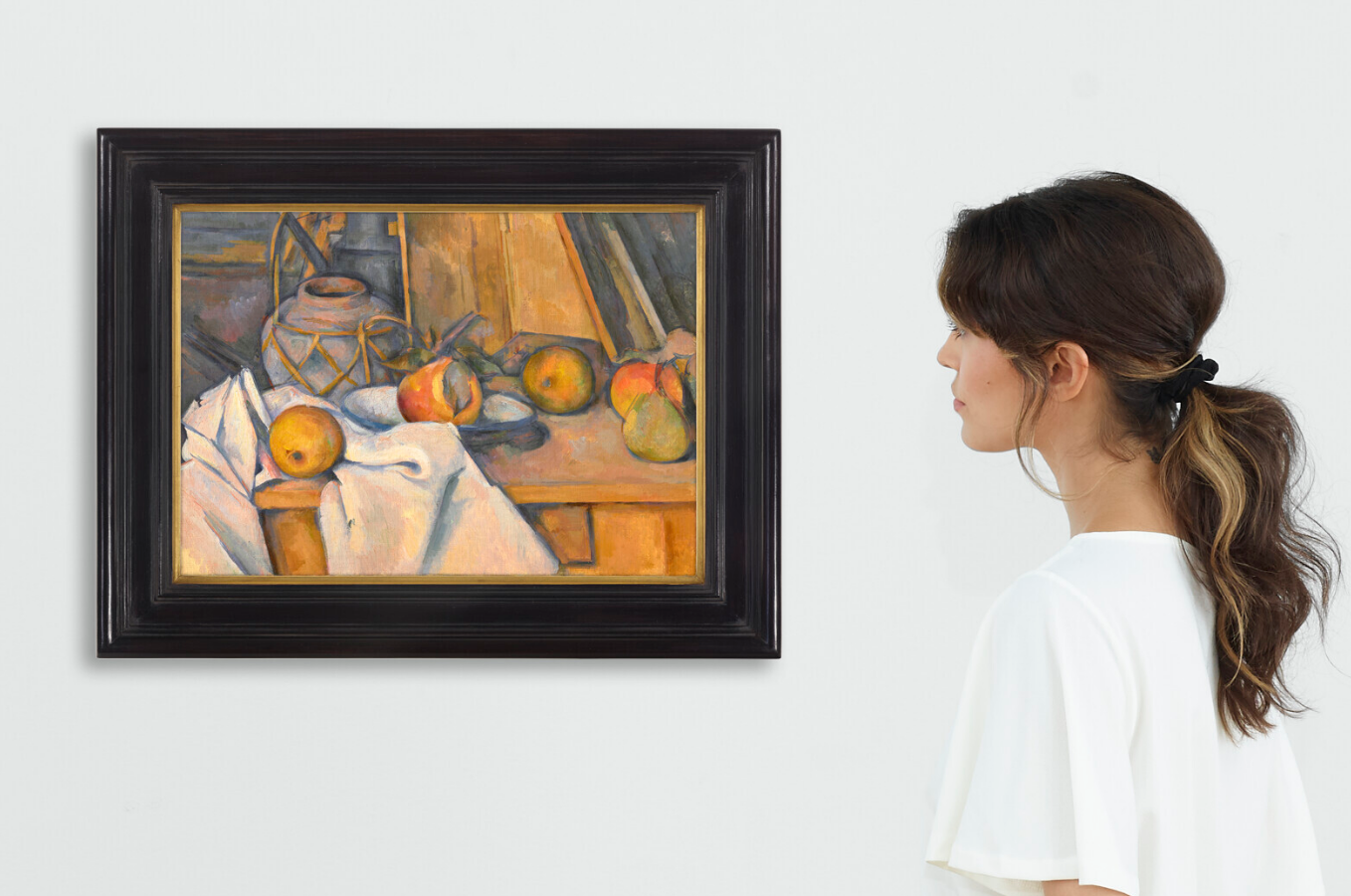
For Cezanne, the intrigue of such still-life scenes was rooted in the relationships and internal tensions that arose between his chosen objects.
“There’s talk going on between them. Endless confidences… Objects enter into each other… They never stop living, you understand… Imperceptibly they extend beyond themselves through intimate reflections, as we do by looks and words”
As a result, he typically focused on a limited repertoire of objects, revisiting a select group of items in slightly different configurations across several canvases. While the pomegranate and apples have been realized complete in Fruits et pot de gingembre, the pear at far right appears to be taking shape as we gaze upon it, it’s outline almost reverberating via a series of delicate, broken brushstrokes. The seeming uncertainty of this outline gives the impression that this quotidian piece of fruit is vibrating, drawing attention to the individual strokes of pigment that Cezanne has used to construct its form. In such passages the artist’s painterly process is made clearly visible, each touch of paint imbuing the composition with an internal energy, while also highlighting the presence of the figure behind the brush. Playing with such seemingly unresolved forms, Cezanne allows the viewer a glimpse into his unique approach to such subjects. Cezanne’s still-life paintings would have a profound impact on generations of young artists through the early twentieth century. Indeed, the influence of Cezanne’s radical rethinking of the genre can be detected in everything from the vibrantly colored still lifes of the Fauves, to the pioneering Cubist tabletop scenes created by Georges Braque and Pablo Picasso.
#7. Rene Magritte
Christie’s New-York: 9 November 2023
Estimated: USD 25,000,000 – 35,000,000
USD 34,910,000
RENE MAGRITTE (1898-1967) (christies.com)
RENE MAGRITTE (1898-1967)
L’empire des lumières, 1949
Oil on canvas
48.5 x 58.8 cm (19 1/8 x 23 1/8 inches)
Signed ‘Magritte’ (lower right)
Titled and dated ‘”L’EMPIRE des LUMIÈRES” 1949’ (on the reverse)
In 1949, René Magritte began to explore an intriguing new idea that had been occupying his imagination for some time. The resulting composition, known as L’empire des lumières, marked the arrival of a motif that quickly became one of the Belgian Surrealist’s most celebrated and iconic subjects. The present work is the very first oil painting Magritte completed under this title, and represents a landmark moment in his career. Filled with a rich sense of mystery that confounds and beguiles in equal measure, it focuses on the juxtaposition of a landscape bathed in deep shadow with the blue expanse of a day-lit sky above, a seemingly impossible collision of day and night in a single moment. The motif quickly became popular and between 1949 and 1964 Magritte created a total of seventeen versions in oil, with several more iterations in gouache, on the theme of the L’empire des lumières. Each subtly different from the next, with intriguing variations and diversions from canvas to canvas, these paintings demonstrate Magritte’s endless spirit of invention, as he probed the rich poetic potential of this deceptively simple subject.
As Magritte explained, the power of works such as L’empire des lumières lay in transforming the familiar, everyday world in unexpected ways: “For me it’s not a matter of painting ‘reality’ as though it were readily accessible to me and to others, but of depicting the most ordinary reality in such a way that this immediate reality loses its tame or terrifying character and presents itself with mystery” (quoted in H. Torczyner, Magritte: Ideas and Images, trans. R. Miller, New York, 1977, p. 203). Executed with a precision and attention to detail that only reinforces the uncanniness of the scene, the L’empire des lumières paintings offer an elegant summation of Magritte’s unique form of Surrealism, reveling in a game of unexpected contradictions, in which all is familiar and yet ultimately strange, and the ordinary is rendered extraordinary.
#8. Joan Mitchell
Christie’s New-York: 9 November 2023
Estimated: USD 25,000,000 – 35,o00,000
USD 29,160,000
NEW WORLD RECORD FOR THE ARTIST
JOAN MITCHELL (1925-1992) (christies.com)
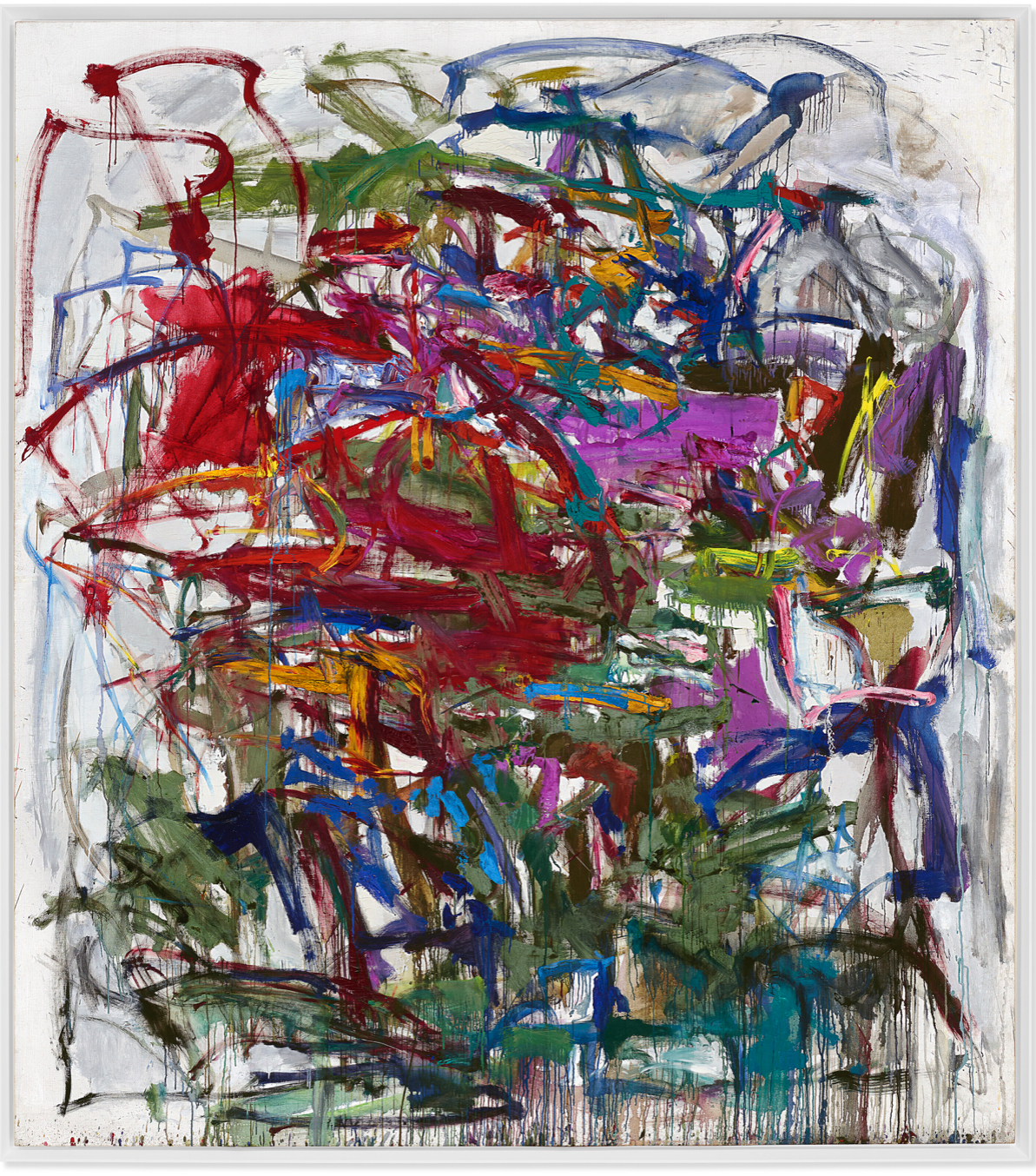
JOAN MITCHELL (1925-1992)
Untitled, 1959
Oil on canvas
97 1/2 x 86 1/2 inches (247.7 x 219.7 cm)
A majestic tour-de-force teeming with fierce, muscular brushstrokes, and a kaleidoscopic display of the most powerful colors in her arsenal, Joan Mitchell’s Untitled, circa 1959, boasts all of the hallmarks of her most celebrated pictures, making it a true masterpiece from the most pivotal decade of her career. Bolstered by mounting critical and commercial success, by 1959 Mitchell had established herself amongst the vanguard of New York’s Abstract Expressionist elite. In October 1959, she appeared in a multi-page photographic essay in Art News called “Mitchell Paints a Picture,” for which she was interviewed by Irving Sandler. (This recurring article was reserved for Abstract Expressionist heavyweights, and had previously featured Jackson Pollock and Willem de Kooning). It was rapidly becoming clear that Mitchell’s talent was being ranked by some enlightened critics as being on a par with her male peers. By the end of the 1950s, several important museums had acquired her work, with City Landscape (1954-55) going to the Art Institute of Chicago, Ladybug purchased by MoMA and Hemlock acquired by the Whitney. As the 1950s progressed, her visual vocabulary became more assertive and sophisticated, distinguishing from her contemporaries for her singular style that melds bravura with grace.
Untitled is an audacious painting, a powerful declaration of Mitchell’s almost preternatural understanding of color and the fearlessness with which she wielded her brush. Using broad, arcing brushstrokes that involved the full length of her body, Mitchell brushed, stabbed, swiped and dragged the pigment across the vast canvas, creating an enormous, churning maelstrom that envelops the viewer in its seven-foot expanse. The eye roams ceaselessly across its highly animated surface, only coming to rest in the airy perimeter, where lyrical, whiplash strokes of burgundy and cobalt offer a poetic coda to the tumultuous interior made up of dashes of sage, spectacular purple, teal and indigo, with flickers of brilliant blue and white. Typical of this highpoint in Mitchell’s career, she embraces a litany of opposites—thick, heavy pigment is paired with nearly translucent washes; crowded webs in the center give way to emptiness along the edge; and darker colors recede whereas brighter ones advance. Mitchell’s paintings were almost athletic events; using the full reach of her arms and often standing on tiptoe, she attacked the canvas with a relentless determination. At this time, it seems the towering scale of her paintings was only outmatched by the limitless scale of her ambition.
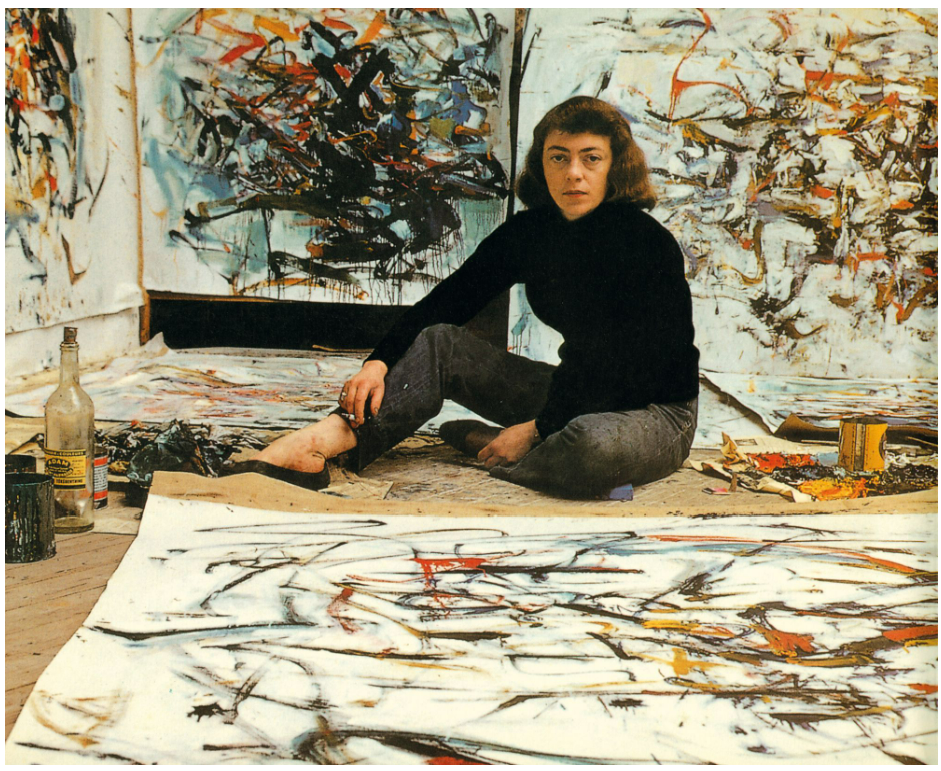
Joan Mitchell in her studio, 1956. Photographer unknown. Artwork: © Estate of Joan Mitchell.
For Joan Mitchell, the 1950s were a time of rapid development and energetic flux. In 1959, she emerged from a highly productive period between 1952 and 1958, lauded by Whitney curator Jane Livingston for their “sheer energy, quantity and finesse” (J. Livingston, The Paintings of Joan Mitchell, exh., cat., Whitney Museum of American Art, 2002, p. 21). By the late 1950s, Mitchell’s mastery over her craft was unparalleled, evidenced in seminal paintings like Ladybug (1957, Museum of Modern Art, New York) and Piano mécanique (1958, National Gallery of Art, Washingston, D.C.). Her lyrical abstractions brim with lush, unfettered colors infused with a powerful sense of light and atmosphere. As in Untitled, these paintings were comprised of linear elements known as “whiplash” strokes, which were held in taut suspension with the bare ground of canvas. As the decade progressed, these linear elements would proliferate and multiply, creating a veritable explosion of riotous color, texture and form. “Power is written all over Joan Mitchell’s new canvases,” the art critic Dore Ashton proclaimed in the late 1950s. “Her large canvases aggressively flaunt their muscles and there is no getting away from it, they are muscular paintings” (D. Ashton, “Art,” Art & Architecture, May 1958, p. 29).
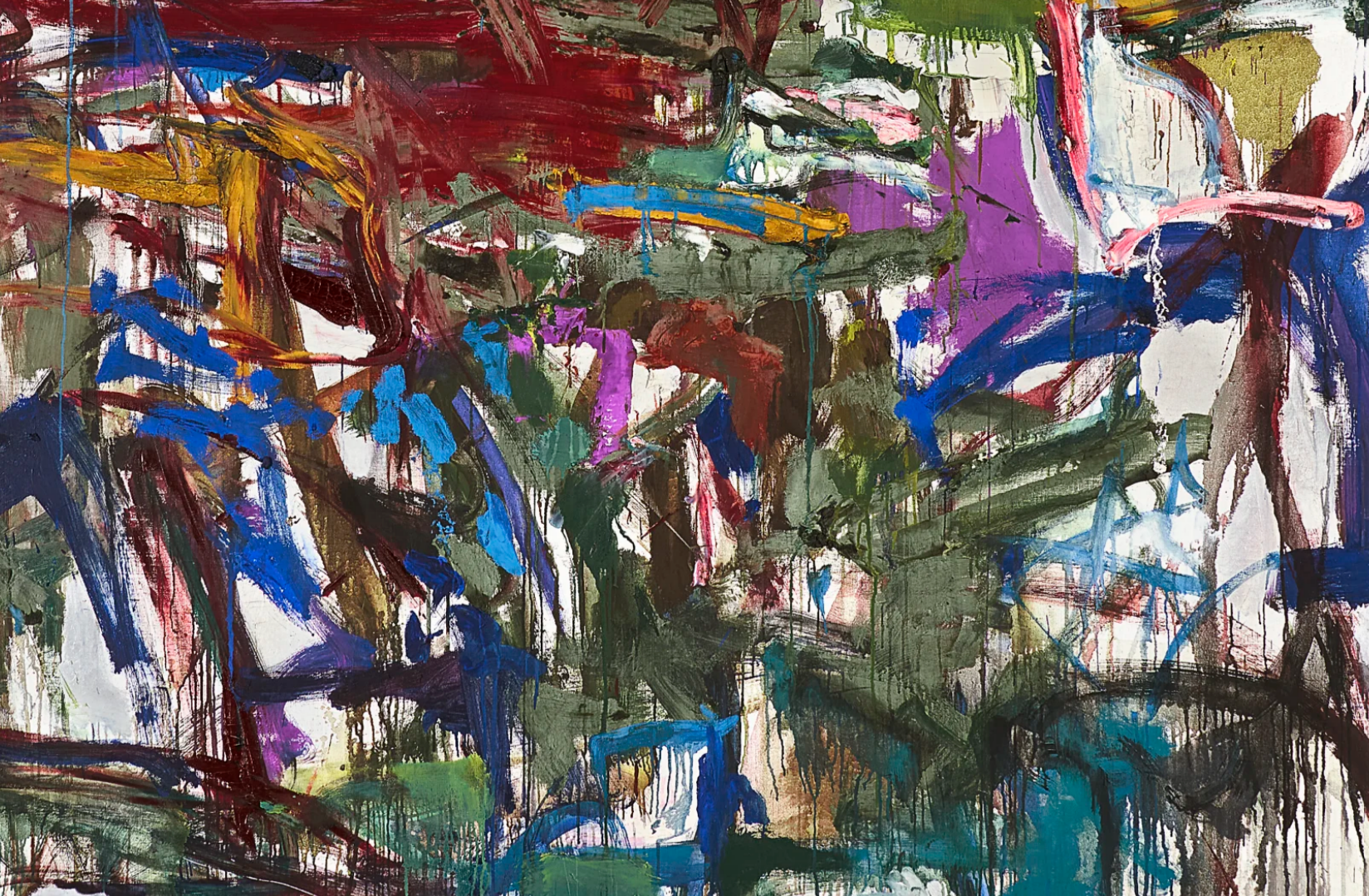
Notably in Untitled, Mitchell’s keen and judicious pairing of disparate colors, such as teal with crimson, forest green with bright ochre, and yellow with lavender, evidences the care and precision with which she arranged each stroke. Mitchell then infused this colorful structure with wedges of white and inflections of subtle metallics—either parts of blank canvas or areas of overpainting. This creates a kind of prism effect, in which shards of color and light break apart and multiply, yielding a powerful sense of restless energy and allover movement to the piece. It is here that the artist’s intense bond with her Abstract Expressionist peers is revealed, calling to mind the lyricism of Pollock’s drip paintings seen in Convergence (1952; Albright-Knox Art Gallery), the angular, abstract web of de Kooning’s Excavation (1950; Art Institute of Chicago), and the sturdy architectural line of Franz Kline’s Mahoning (1956; Whitney Museum of American Art, New York). At a time when women were largely sidelined by a male-dominated art world, Joan Mitchell was able to carve out a niche all her own. In the tradition of women painters such as Sofonisba Anguissola and Artemisia Gentileschi, Mitchell had to fight long and hard for the recognition that was due to her. She succeeded by inventing a forceful, yet lyrical, form of gestural abstraction based on her memories and feelings of the natural world. “I paint from remembered landscapes that I carry with me,” she said. “I could certainly never mirror nature. I would more like to paint what it leaves me with” (J. Mitchell, interview with J. I. H. Baur, Nature in Abstraction, exh. cat., Whitney Museum of American Art, New York, 1958, p. 73). Indeed, the natural world would prove to be Mitchell’s greatest and longest-running muse.
#9. Andy Warhol
Christie’s New-York: 9 November 2023
Estimated: USD 25,000,000 – 35,000,000
USD 25,940,000
ANDY WARHOL (1928-1987) (christies.com)
ANDY WARHOL (1928-1987)
Sixteen Jackies, 1964
Silkscreen ink on linen, in sixteen parts
Overall: 80×64 inches (203.2 x 162.6 cm)
Signed ‘Andy Warhol’ (on the overlap of four canvases)
The assassination of President John F. Kennedy on 22 November 1963 marked the death of an American icon and the end of a political era. The youth, vitality and optimism that had defined JFK’s administration had been cut short. In the words of the widowed Jacqueline Kennedy, the days of Camelot were over. From the moment of the gunshots in Dallas to the funeral procession in Washington DC four days later, the major television networks in the United States suspended commercials and aired wall-to-wall coverage of the proceedings. Throughout the world, the media was flooded with images of the fateful day and its aftermath.
Robert Kennedy and Edward Kennedy with Jacqueline Kennedy during the funeral of President John F. Kennedy on 25 November 1963, Washington DC. Photo by Keystone-France/Gamma-Keystone via Getty Images
All eyes were on Jackie, who became an icon of a nation in mourning. Amongst those watching was Andy Warhol who had made his reputation as an artist responding to mass media spectacle. According to Warhol’s friend and studio assistant Gerard Melanga, as soon as the tragic news reached them, Warhol’s only response was ‘Let’s go to work!’ In the weeks following the assassination, Warhol began sifting through and collecting images of Jackie that had been published in newspapers and tabloids. The resulting series of paintings, which meditated on these widely disseminated images of the former First Lady, became an essential chapter in the artist’s Death and Disaster body of work.
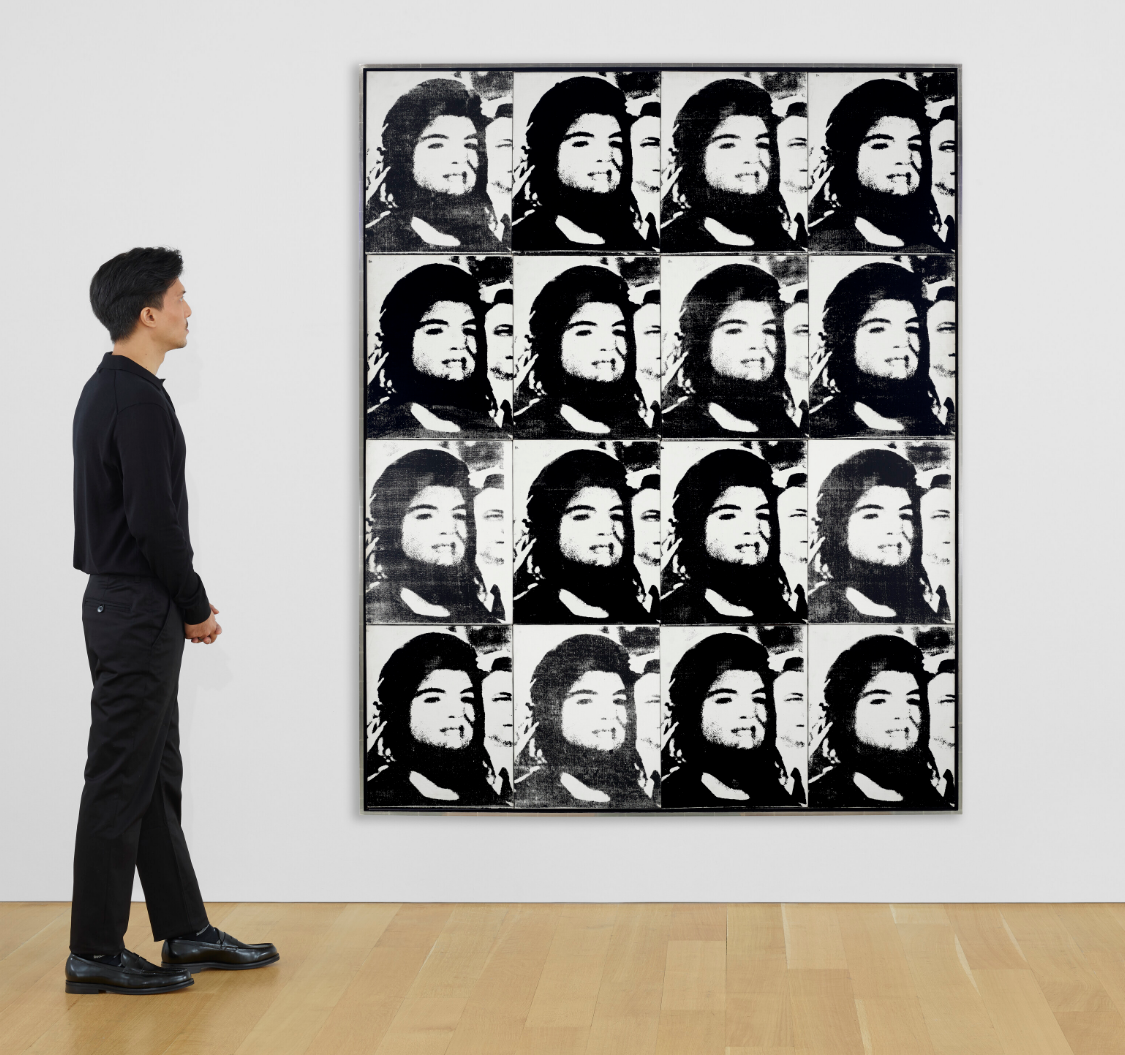
Sixteen Jackies, a monumental painting, made up of 16 joined canvases, represents the pinnacle of Warhol’s examination into the soul of America. In 1963 Warhol had only recently begun to realise his transformation from successful commercial illustrator to renowned Pop artist. After a couple years making paintings inflected by popular culture from Batman to Campbell’s Soup, in 1962 he began incorporating photographic silkscreen printing, elaborating on his critique of mass culture by adopting the commercial tools of reproduction into his painting process. The Jackie paintings would solidify his status as the foremost artist of American pop culture and celebrity. Warhol was drawn to the iconic visage of Jackie Kennedy, ubiquitous throughout media coverage of the event. As First Lady she had epitomised beauty and glamour, known for her Chanel suits and pillbox hats in cheerful pastels. After the tragedy she came to personify the nation’s grief, stepping off Air Force One dressed in all black.
Source for Warhol’s Jackie Series, 1963-1964. Collection of the Andy Warhol Museum, Pittsburgh.
Warhol selected eight news photographs of Mrs. Kennedy as the basis for a number of works in his Jackie series. Painted in 1964, the offered Sixteen Jackies is the only work from the series that repeats the same image in a 4-by-4 grid in a monochromatic palette. The painting captures Jackie’s personal grief, together with the shock of the entire world. The image that Warhol chose to repeat 16 times in this composition, is particularly powerful. Clipped from a photo of Jackie during the funeral procession for Kennedy, it crops into her stoic facial expression beneath a dark organdie veil. By isolating her image and further abstracting it through the silkscreen process, Warhol highlights the dichotomy of her iconic public image and her unknowable private grief. Warhol’s Sixteen Jackie sits at the pinnacle of the group of works that became known as his Death and Disaster paintings. From 1962 to 1965, the artist appropriated tabloid images of car crashes, nuclear explosions, electric chairs, race riots, poisonings and other violent events in popular culture, exploring the death and disaster that pervaded commercial messaging and mass media. In reproducing the images, often repeatedly, Warhol drew attention to the proliferation of brutal iconography in a growing multimedia world.
Other Highlights
Tamara de Lempicka
Christie’s New-York: 9 November 2023
Estimated: USD 7,000,000 – 10,o00,000
USD 14,785,000
TAMARA DE LEMPICKA (1898-1980) (christies.com)
TAMARA DE LEMPICKA (1898-1980)
Fillette en rose, 1928-1930
Oil on canvas
115.9 x 72.8 cm (45 5/8 x 28 5/8 inches)
Signed ‘DE LEMPICKA’ (lower right)
Between 1922 and 1933, Tamara de Lempicka painted six different portraits of her daughter Marie-Christine de Lempicka, known as Kizette. Capturing the young girl between the ages of six and sixteen, these were to be some of the most celebrated paintings of the artist’s career, and the works that brought Lempicka international renown. Examples of these paintings are held in the Musée national d’art moderne, Centre Georges Pompidou, Paris (Blondel, B.82) and the Musée des Beaux-Arts, Nantes (Blondel, B.81), the latter of which inspired a second incarnation, Fillette en rose, an intimate portrait of a girl on the verge of change and one of profound importance to Lempicka.
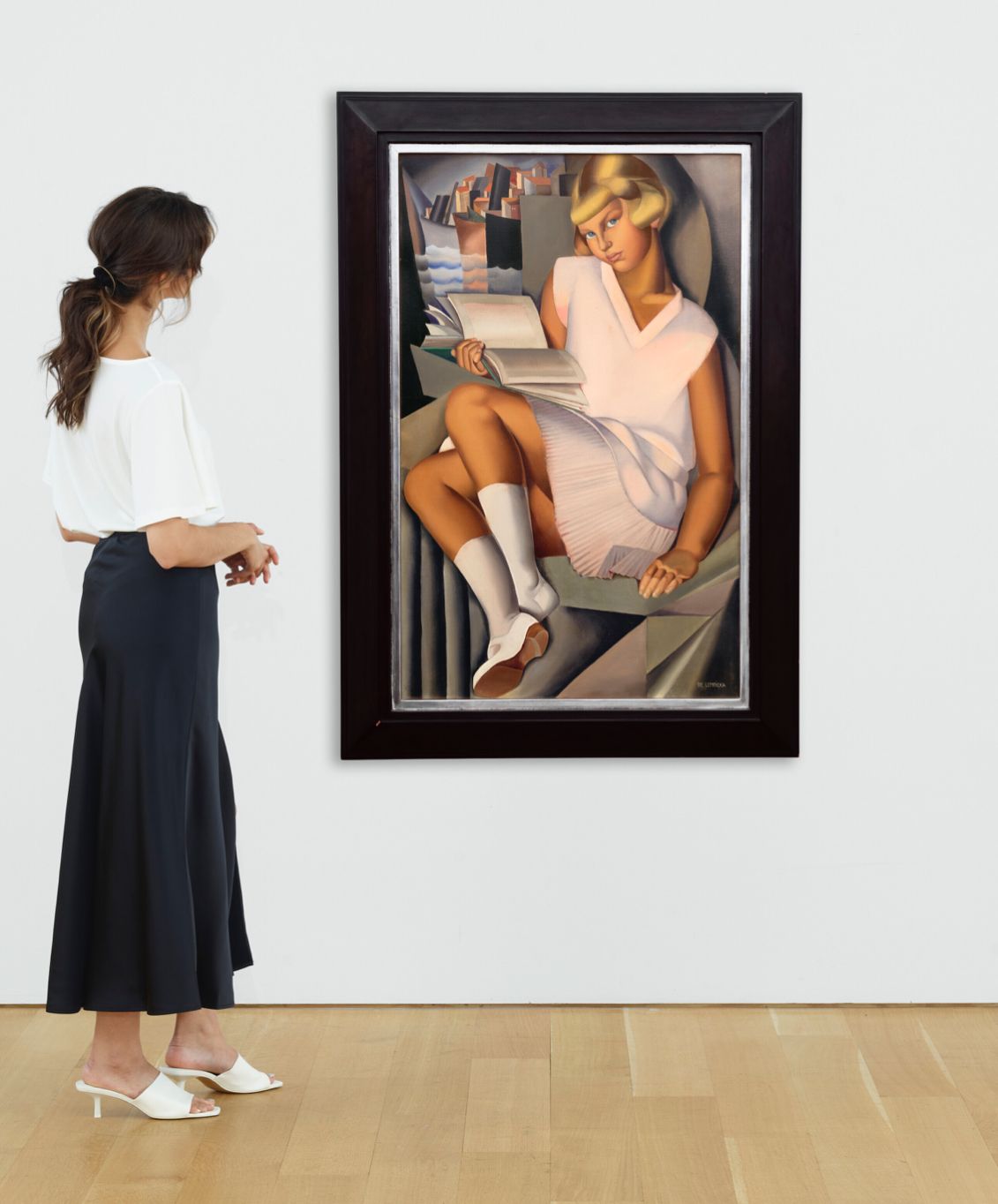
As much as this is a staged painting, Fillette en rose possesses a sense of vitality that was often absent in more traditional portraits of children, where the sitters were posed like adults in miniature. Far from playful or unrehearsed, conventional depictions showed children posed stiffly amongst the trappings of an aristocratic life. It was not until Impressionism that leisure and play were elevated as subjects, which in turn influenced portraiture. Indeed, some of the more animated images of the era were those that the artists painted of their own families. Lempicka imbues her portrait of Kizette with personality, with life, and the clutched book and missing shoe bring a dynamism to the painting, reflecting the intimacy mother and daughter shared.
Frida Kahlo
Christie’s New-York: 9 November 2023
Estimated: USD 8,000,000 – 12,o00,000
USD 8,230,000
FRIDA KAHLO (1907-1954) (christies.com)
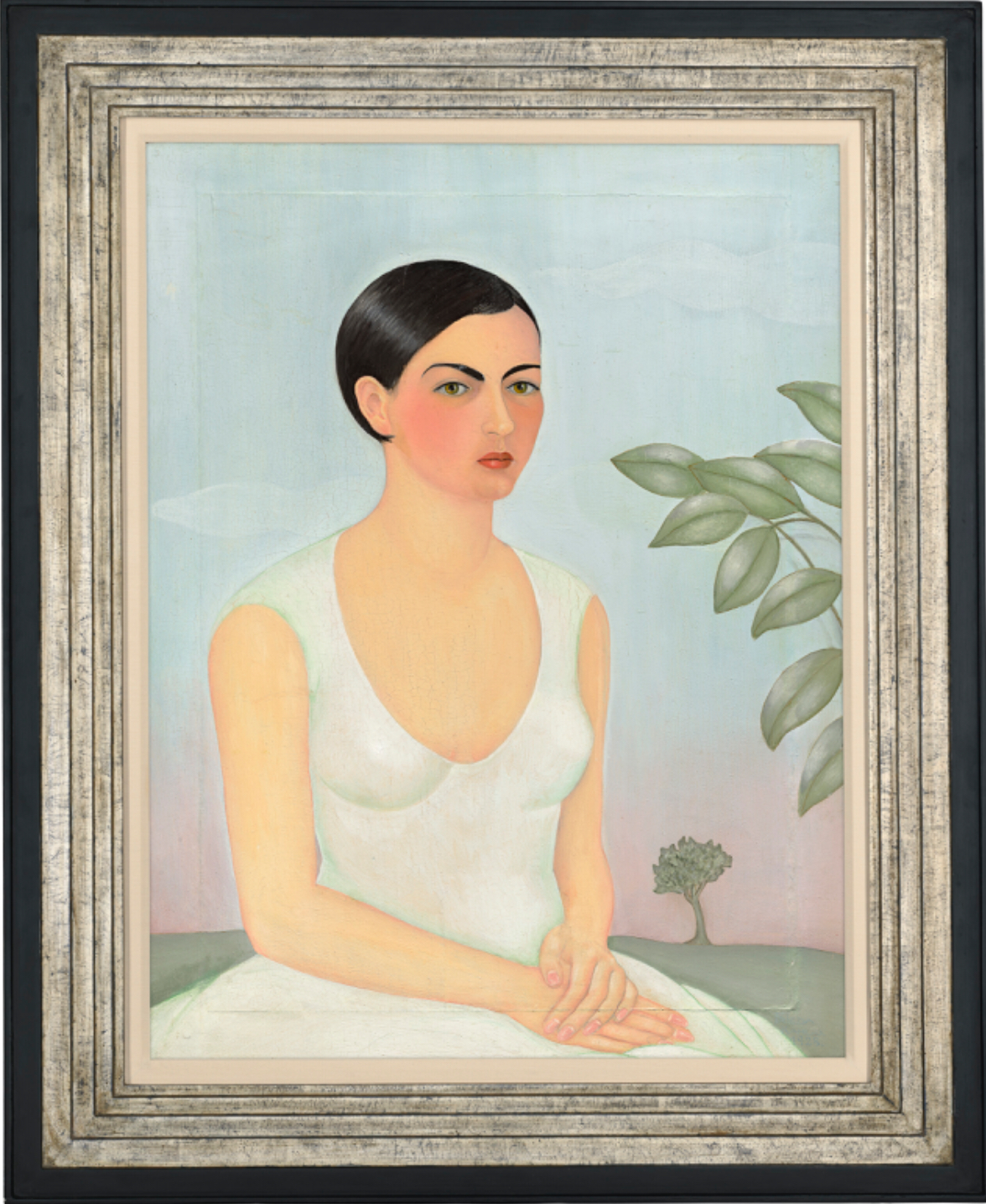
FRIDA KAHLO (1907-1954)
Portrait of Cristina, My Sister, 1928
Oil on panel
79.8 x 60.3 cm (31 7/8 x 23 2/4 inches)
Signed and dated ‘FRIEDA KAHLO, 1928’ (lower right)
“She lives a little bit in the… ether,” Frida once reflected of Cristina, the youngest of the four Kahlo sisters and in later years her closest confidante and caretaker. “Lively, generous, and beguilingly feminine,” in the words of Kahlo’s biographer Hayden Herrera, Cristina epitomizes a stylish, modern femininity in the present portrait with her sleek bob and red, Kewpie-doll lips (H. Herrera, Frida: A Biography of Frida Kahlo, New York, 1983, p. 182). Born in June 1908, only eleven months after Frida, Cristina was nineteen or twenty at the time this portrait was made; by the following year, she had married and become a mother. The painting came at a pivotal moment for Frida, as well. She had sufficiently recovered from a life-threatening (and life-defining) accident, when a trolley struck a bus that she was riding and a handrail impaled her pelvis, to venture out into the world again. “As soon as they gave me permission to walk and to go out in the street,” Kahlo recalled, “I went, carrying my paintings, to see Diego Rivera, who at that time was painting the frescoes in the corridors of the Ministry of Education” (quoted in ibid., p. 87). Portrait of Cristina, My Sister may well have been among the paintings that she showed to Rivera, already renowned as Mexico’s preeminent muralist and, within the next year, her husband. Cristina would remain a steadfast presence and companion throughout Frida’s life, and this early portrait captures her dreamy, ethereal elegance, just on the cusp of womanhood, and remains a testament to the abiding affection between the two sisters.
Mark Rothko
Christie’s New-York: 9 November 2023
Estimated: USD 6,500,000 – 8,500,000
USD 6,584,000
MARK ROTHKO (1903-1970) (christies.com)
MARK ROTHKO (1903-1970)
Untitled (Red, Orange on Pink), 1968
Oil on paper laid down on canvas
33 1/2 x 25 3/4 inches (85.1 x 65.4 cm)
Signed ‘MARK ROTHKO’ (on the reverse)
Mark Rothko’s sumptuous late work Untitled (Red, Orange on Pink) represents a final flourish in the life of one of twentieth-century’s greatest artists. Here, his signature color fields, composed of daring brushstrokes, are transcendent and contemplative; both weightless and earthbound, they sit somewhere between air, light, and the soil. The sense of drama and energy engendered in paintings such as this was summarized by Dore Ashton, critic, writer and Rothko’s frequent interlocutor, who offered a poetic assessment of her colleague’s final paintings, “His darkness at the end did allude to the light of the theater in which, when the lights are gradually dimmed, expectation mounts urgently” (D. Ashton, About Rothko, New York, 1983, p. 189). In the same private collection for nearly thirty years, this painting was included in the artist’s seminal 1998 retrospective at the National Gallery of Art, Washington, D.C., which later traveled to the Whitney Museum of American Art and the Musée d’Art Moderne de la Ville de Paris (1999).
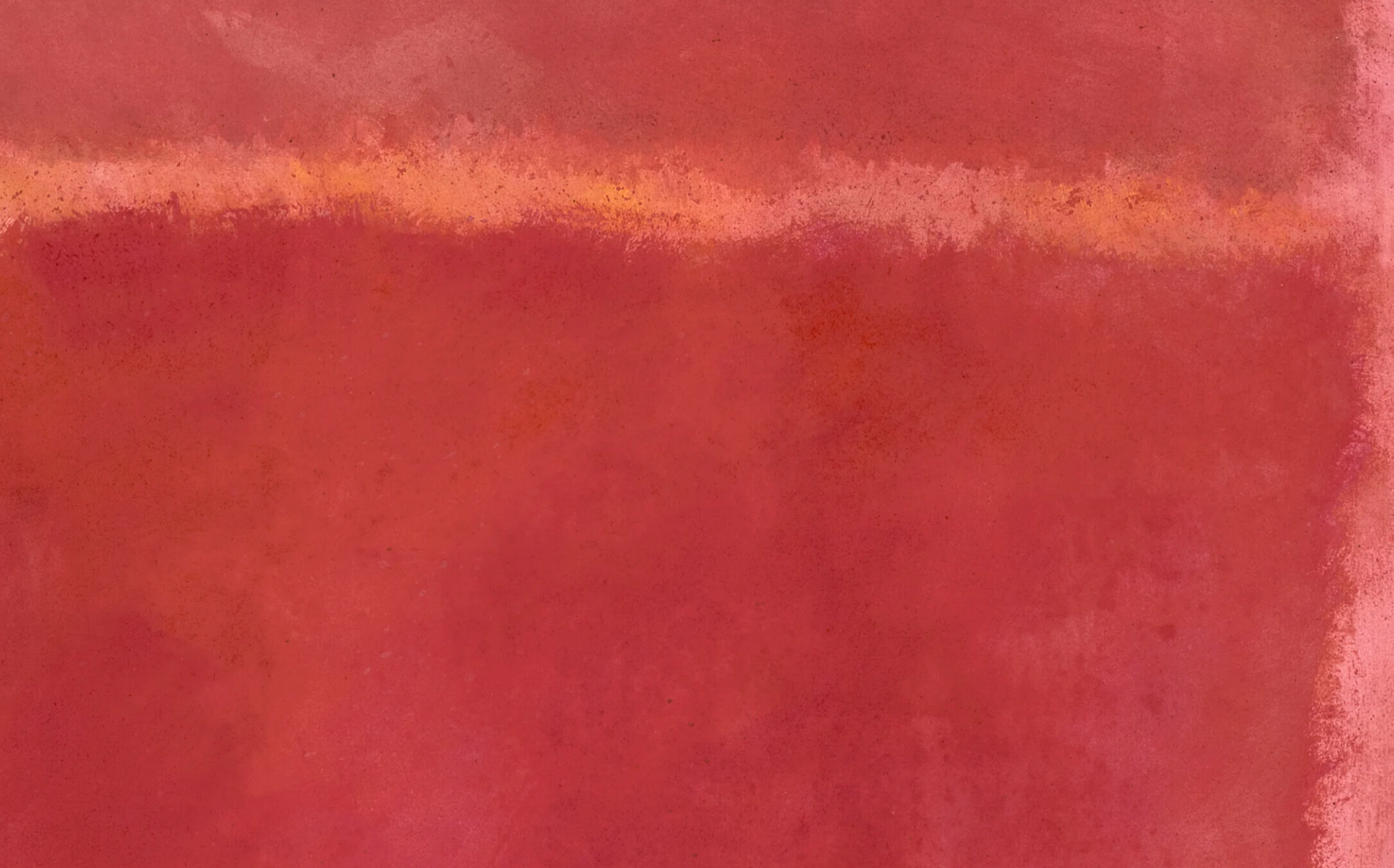
Untitled (Red, Orange on Pink) is among the artist’s most intimately scaled works, offering a chance to witness his unique process in uncommon detail. Instead of the immersion offered by his immense canvases, here we see Rothko at his most radically open. As his health began to fail, his doctors ordered him to not paint larger than a yard in height so as not to strain himself. Rather than a lively pink or a pure cadmium red, Untitled (Red, Orange on Pink) is almost fall-like. Moreover, an interplay of scale is important here, since, according to the artist, the paintings created during this period have all the emotional impact and grandeur of a mural. As Dore Ashton recalled of a visit she made to his studio in the spring of 1969, Rothko was immensely proud of his recent work: “He named the exact number with pride, as though to say, ‘with all my trouble, I was able to do this,’” she recounted. “Many are very haunting…I see them as consequent to the [Seagram Building] murals” (D. Ashton, quoted in J. E. B. Breslin, Mark Rothko: A Biography, New York, 1993, p. 511).
David Hockney
Christie’s New-York: 9 November 2023
Estimated: USD 5,500,000 – 6,500,000
USD 6,342,000
DAVID HOCKNEY (B. 1937) (christies.com)
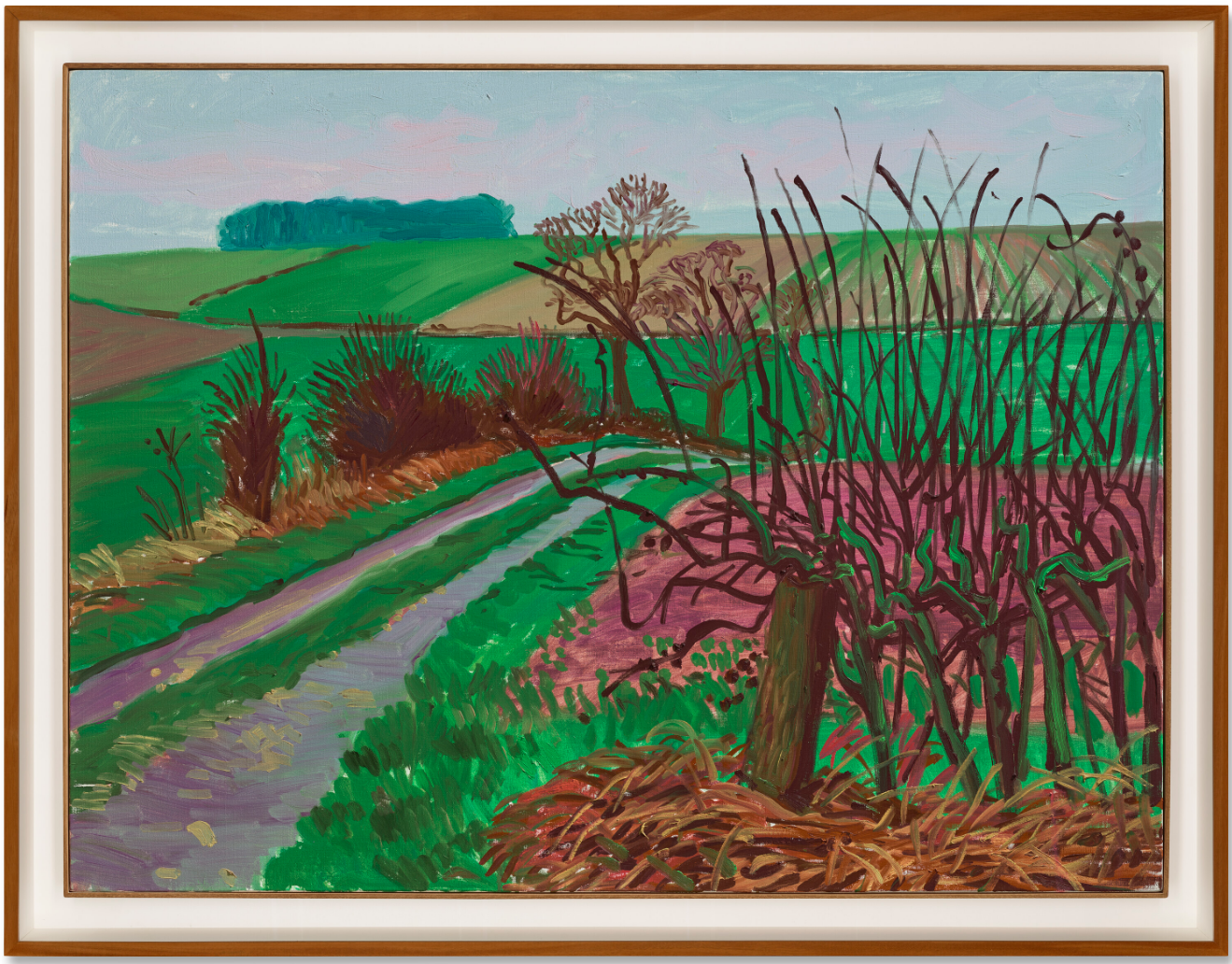
DAVID HOCKNEY (B. 1937)
Track and Hedgerow, January, 2006
Oil on canvas
36×48 inches (91.4 x 121.9 cm)
Signed and dated ‘David Hockney Jan 23 06’ (on the reverse)
Included in the artist’s landmark 2012 retrospective David Hockney: A Bigger Picture at the Royal Academy of Arts, London, Track and Hedgerow, January is a radiant love letter to his native Yorkshire landscape. With loose, impressionistic brushstrokes, Hockney pays tribute to the unspoiled beauty of his homeland: its lonely paths, atmospheric light and undulating fields, as rich and vivid as his childhood memories.
Described by Marco Livingstone at the time as “the most commanding [works] he has ever made,” Hockney’s depictions of the Wolds between 2005 and 2008 marked a major new chapter in his forty-year-long career (M. Livingstone, “Home to Bridlington: Routes to a Private Paradise,” in David Hockney: Just Nature, exh. cat. Kunsthalle Würth, Schwäbisch Hall, 2009, p. 188). The artist had made repeated visits home in the years leading up to his mother’s death in 1999, and was struck by the ever-changing splendour of his native county. Returning in 2004, he began to work outdoors, channelling the influence of Constable, van Gogh, Monet and Turner as he captured the shifting light and seasons. Saturated with the same life-affirming glow as his Californian paintings, Track and Hedgerow, January is a poignant elegy to home, infused with new passion, grandeur and technical bravura.
The present painting bears witness to Hockney’s deep and intuitive affinity with the Yorkshire soil. Its patchwork of nuanced light and colour is immediately recognisable to anyone who has taken a winter walk through the area. There is the thin band of sky, its veil of silver-grey cloud backlit with blue, and a distant, emerald stand of evergreens on the horizon. A reddish patch of ploughed earth shines bright among the chlorophyll of verge and field. Commanding the foreground, the leafless hedgerow reaches its dark boughs skyward. A video of Hockney at work shows him painting these branches in a thatch of deft, whiplash strokes. Devotedly en plein air, he wears a heavy coat and keeps warm with a Thermos flask as he paints. An assistant holds up the finished canvas against the landscape, and Hockney declares himself satisfied.
David Hockney, The Arrival of Spring in Woldgate, East Yorkshire in 2011, 2011. Centre Georges Pompidou, Paris. © David Hockney. Photo: © The David Hockney Foundation.
Hockney’s portraits, often depicting the same subjects over many years, reveal the intimacies and evolutions of his personal relationships. His Yorkshire landscapes display the same warm attention towards his homeland. On its 2006 debut in the exhibition David Hockney – A Year in Yorkshire at Annely Juda Fine Art, Track and Hedgerow, January was shown alongside paintings Hockney had made throughout the year; in the larger Royal Academy show, landscapes painted across several years were organized according to specific sites, so that viewers were taken on a journey through the East Riding. Seen together, the works bear witness to Hockney’s close engagement with the changing seasons. The present painting’s bare hawthorn hedges might elsewhere be seen bejeweled with young green leaves or bursting into the spectacular blossom of May. It is arguably in the wintry calm seen here, however, that Hockney’s vision is at its most sensitive. “Perhaps contrary to popular expectations,” writes Marco Livingstone, “the best circumstances for painting are not necessarily to be found on cloudless days in spring or summer: it is in autumn or winter, in fact, that this landscape can be studied at its most subtle, branches clearly demarcated when they are denuded of leaves and the colors of the soil and vegetation appearing more intense in the gentler light” (M. Livingstone, “The Road Less Travelled,” in David Hockney: A Bigger Picture, exh. cat. Royal Academy of Arts, London, 2012, p. 25.)

David Hockney in his studio with his new landscape paintings, 2007. Photo: Al Seib / Contributor. Artwork: © David Hockney.
Over the following years, Hockney would explore the most rural corners of the East Yorkshire landscape in almost every available medium: from watercolor, paint and pencil to photography, film and digital inkjet print. The result was not only one of his most distinctive bodies of work, but also an extraordinary technical tour de force. From 2008, he would even make use of the iPad and iPhone as drawing tools. Despite these technological forays, however, Hockney’s work remained firmly grounded in the lessons of art history. His resolve to paint outdoors increased when the major exhibition Constable: The Great Landscapes opened at Tate Britain in the summer of 2006. Hockney especially admired the artist’s “six-footers”—shown together there for the first time—which included loosely-painted full-scale “sketches” as well as polished final versions. He also stood in wonder before Monet’s Nymphéas on a trip to the newly refurbished Musée de l’Orangerie in Paris. Van Gogh, too remained a vital source of inspiration, admired for his ability to capture the eternal flux of the landscape. In California, Hockney had missed the thrill of the changing seasons; back in Yorkshire, they seemed more beautiful and vital than ever before. Bathed in winter light, Track and Hedgerow, January is alive with the revelations of both past and present, capturing the wonder and the familiarity of home.
Andy Warhol
Christie’s New-York: 9 November 2023
Estimated: USD 5,000,000 – 7,000,000
USD 5,495,000
ANDY WARHOL (1928-1987) (christies.com)
ANDY WARHOL (1928-1987)
Self-Portrait, 1967
Acrylic and silkscreen ink on canvas
22×22 inches (55.9 x 55.9 cm)
Signed and dated ‘Andy Warhol 67’ (on the overlap)
Bold, opulent, and surreal, Andy Warhol’s Self-Portrait is arguably one of the most enigmatic paintings of his prolific career. While he often used appropriated images of celebrities like Marilyn Monroe, Elvis, and Jackie Kennedy, this Self-Portrait is exemplary of his coextensive autobiographical process. Intimately scaled at about twenty-one inches square, the canvas is a portal into the artist’s mind. He brings us into his interior world, making us a part of his famed circle of glamorous confidants.
Andy Warhol, 1967 (present lot illustrated). Photo: © Billy Name Estate. Artwork: © 2023 The Andy Warhol Foundation for the Visual Arts, Inc. / Licensed by Artists Rights Society (ARS).
Emerging from the shadows and bathed in shades of blue, Warhol gazes upon us in a characteristically inscrutable fashion. He is self-confident and introspective. His hair is highlighted with yellow, and blue acrylic flows boldly onto his graceful fingers as they frame his lips. This bleeding is not an error, but rather a trademark effect of Warhol’s use of silkscreen, a medium that aims to reproduce, but evolves with each impression. The surreal vibrance of the canvas’s colors contrasts with the realism ushered in by Warhol’s use of a flesh tone for his face. He is both of our world and a vision of a dreamlike elsewhere. Like Titian’s 16th century portrait of Archbishop Filippo Archinto, who is partially obscured by a magnificent semi-transparent veil to symbolize his political biography, Warhol’s ‘Self-Portrait’ also reveals a character whose image is prolific yet unknowable.
Titian, Portrait of Cardinal Filippo Archinto, 1558. Philadelphia Museum of Art. Photo: The Philadelphia Museum of Art / Art Resource, NY.
Warhol began his self-portrait paintings in the early 1960s and continued them until his death. The present work epitomizes his most iconic series of self-portraits from 1966-1967, which are exuberant and colorful, as opposed to his rather somber later paintings. Begun as a commission for the American Pavilion at the 1967 International and Universal Exposition in Montreal, this series uses a single image, rather than a multiplied, repeated face that became a Warholian trademark. Each canvas in the 1966-1967 self-portraits utilizes new combinations of primary and secondary colors, with fascinating gradations in between that lends fabulous details.
Fernando Botero
Christie’s New-York: 9 November 2023
Estimated: USD 2,500,000 – 3,500,000
USD 5,132,000
NEW WORLD RECORD FOR THE ARTIST
FERNANDO BOTERO (1932-2023) (christies.com)
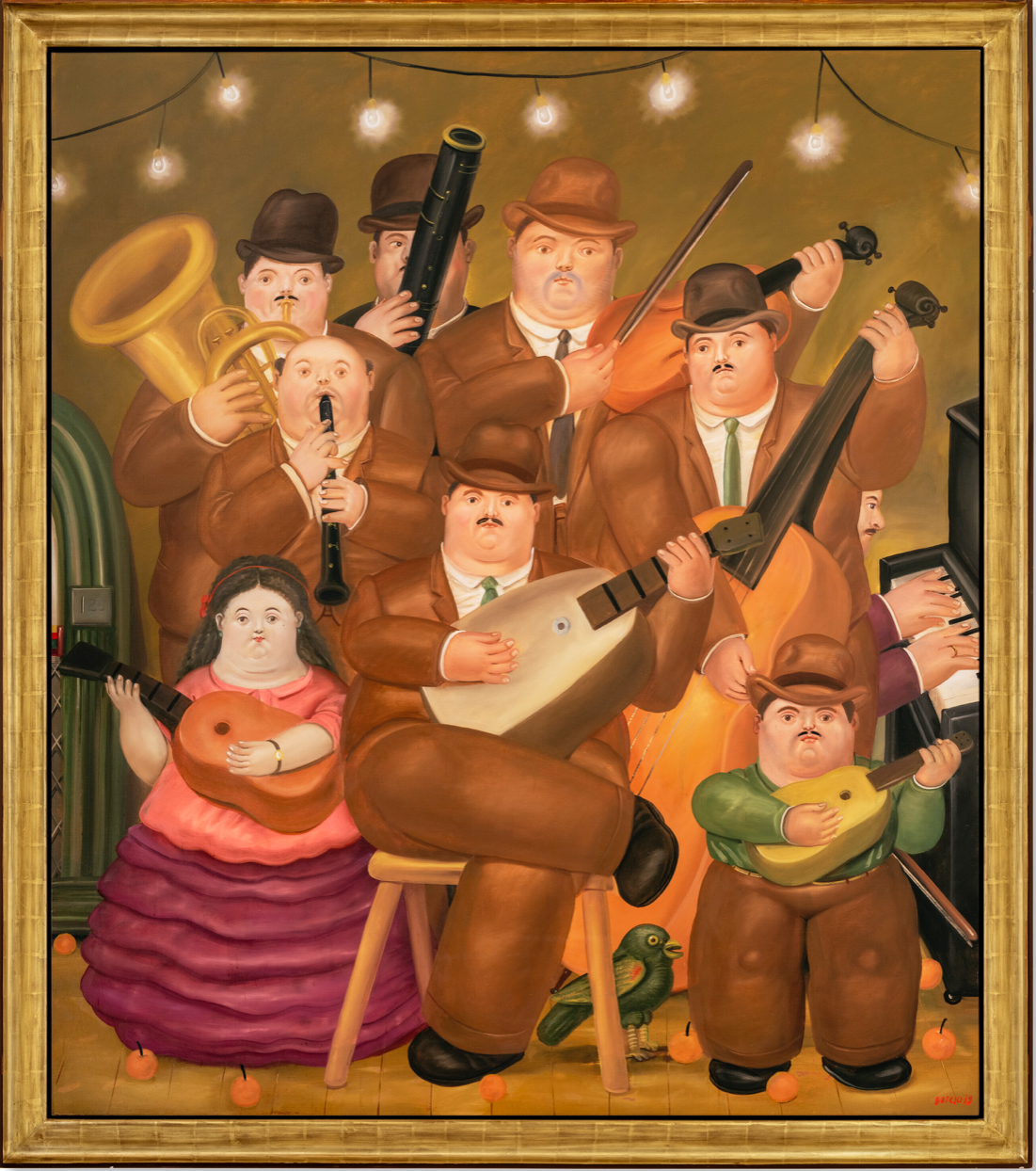
FERNANDO BOTERO (1932-2023)
The Musicians, 1979
Oil on canvas
217.2 x 189.9 cm (85 1/2 x 74 3/4 inches)
signed and dated ‘Botero 79’ (lower right)
Lit from above by a constellation of lights, a group of musicians are neatly arranged, each poised at the ready, in picture-perfect position, about to impress their audience with an undoubtedly well-rehearsed tune. Musicians take pride of place in Botero’s oeuvre as one of the artist’s most celebrated subjects. The present work, with its grand scale and complex composition, can be counted as one of the artist’s greatest achievements in oil, alongside such masterpieces as Dancing in Colombia from 1980 (The Metropolitan Museum of Art, New York) and Tablao flamenco from 1984. What makes these works truly exceptional is their ability to both parody and honor everyday life in Colombia, elevating the subject to the monumental dimensions of history painting.
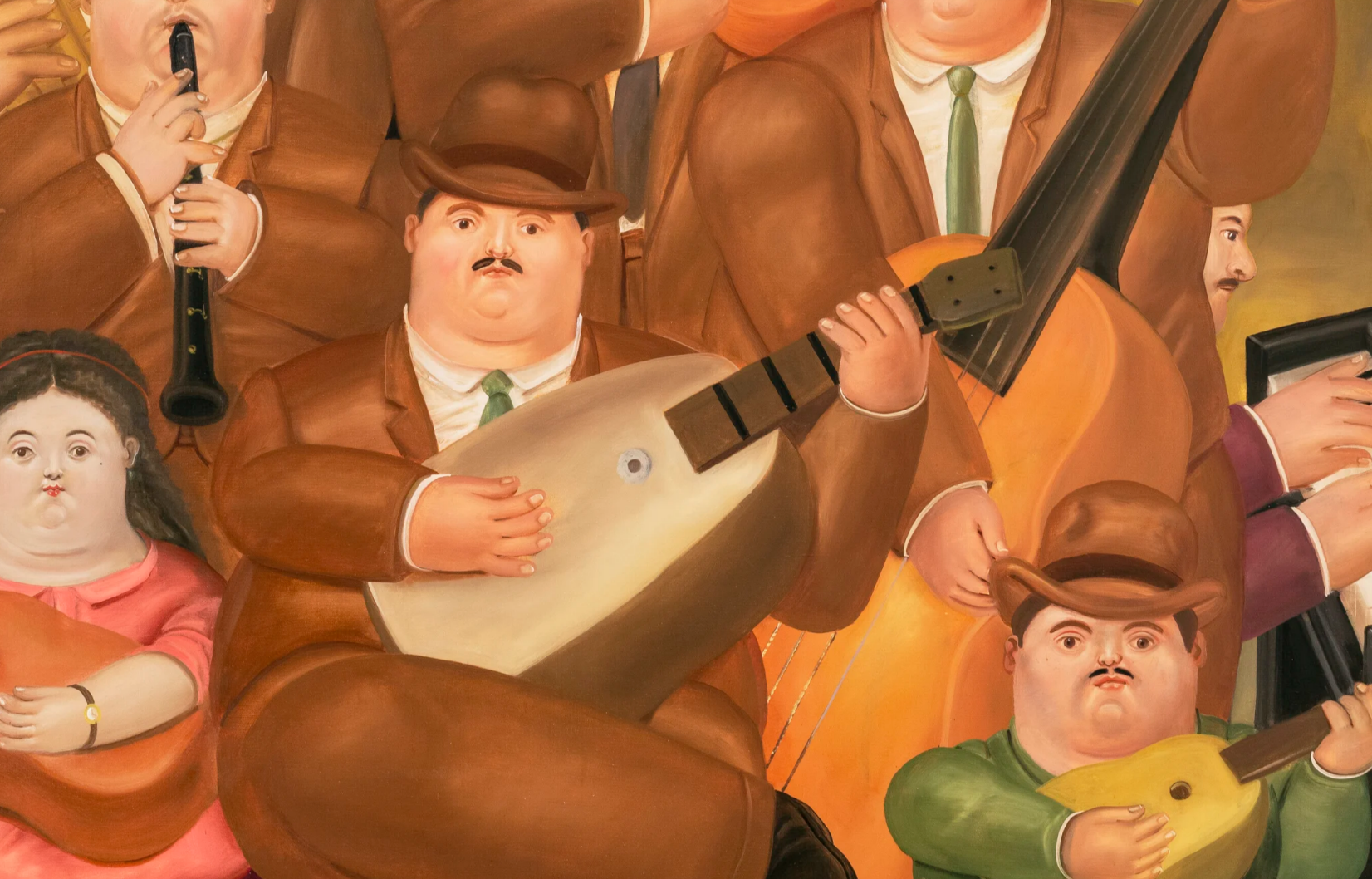
Drawing from a range of artistic influences, Botero approaches the time-honored theme of the musical performance from both local and international perspectives. Musicians, central to the cultural identity of Botero’s native Colombia, can also be seen as an essential motif within the broader context of 20th-century Latin American art as explored by modern masters such as Diego Rivera and Rufino Tamayo. This theme further recalls the legacy of early 20th-century European artists, like Picasso and Braque, who famously depicted guitar, violin and flute players in a Cubist idiom. Botero’s trademark voluminous figures arrive from similar origins, initiated by the artist’s earliest experiences in Colombia, but also steeped in European art history. Born in Medellín, Botero spent his early years surrounded by Catholic churches full of Baroque polychrome wooden sculptures that at times resembled porcelain. These colonial sculptural forms captured his imagination and contributed to the development of his rounded and monumental figural types. A serious student of art history, Botero later traveled to Italy and admired the volumetric figures of Piero della Francesca and other artists of the Quattrocento.
Jean-Michel Basquiat
Christie’s New-York: 9 November 2023
Estimated: USD 4,000,000 – 6,o00,000
USD 4,769,000
JEAN-MICHEL BASQUIAT (1960-1988) (christies.com)
JEAN-MICHEL BASQUIAT (1960-1988)
Orange Joy, 1984
Acrylic and oilstick on canvas
78 1/2 x 62 3/8 inches (198.6 x 158.6 cm)
Signed, titled and dated ‘Jean-Michel Basquiat ORANGE JOY 84’ (on the reverse)
seminal figure in the history of twentieth-century American art, Jean-Michel Basquiat was instrumental in revitalizing the black subject within the figurative tradition. Orange Joy is a potent example of the painter’s ability to draw intense emotional content out of seemingly simple compositions. He brings attention to the individual while also framing her with an almost golden halo of deep yellow and orange, a choice that serves to lionize the woman in a manner similar to the gold-leafed icons of some religious traditions. Well-versed in the trajectory of Western Art, Basquiat sought to dispel the myth of the primitive and bring attention to the contributions of the African diaspora throughout art history. Subverting the narrative of Pablo Picasso, Basquiat noted succinctly, “Picasso arrived at primitive art in order to give of its nobility to western art. And I arrived at Picasso to give his nobility to the art called ‘primitive’” (J. Basquiat, quoted in Jean Michel Basquiat, Museum Würth, 2001, p. 98). Leveraging his own rich heritage, the painter used autobiographical references and an iconic vocabulary extracted from the streets of the five boroughs of New York to create powerful compositions that broke away from tradition in search of a more inclusive visual language. Creating a charismatic and highly influential oeuvre in just a few short years, his mélange of styles and sources has forever altered figurative painting.
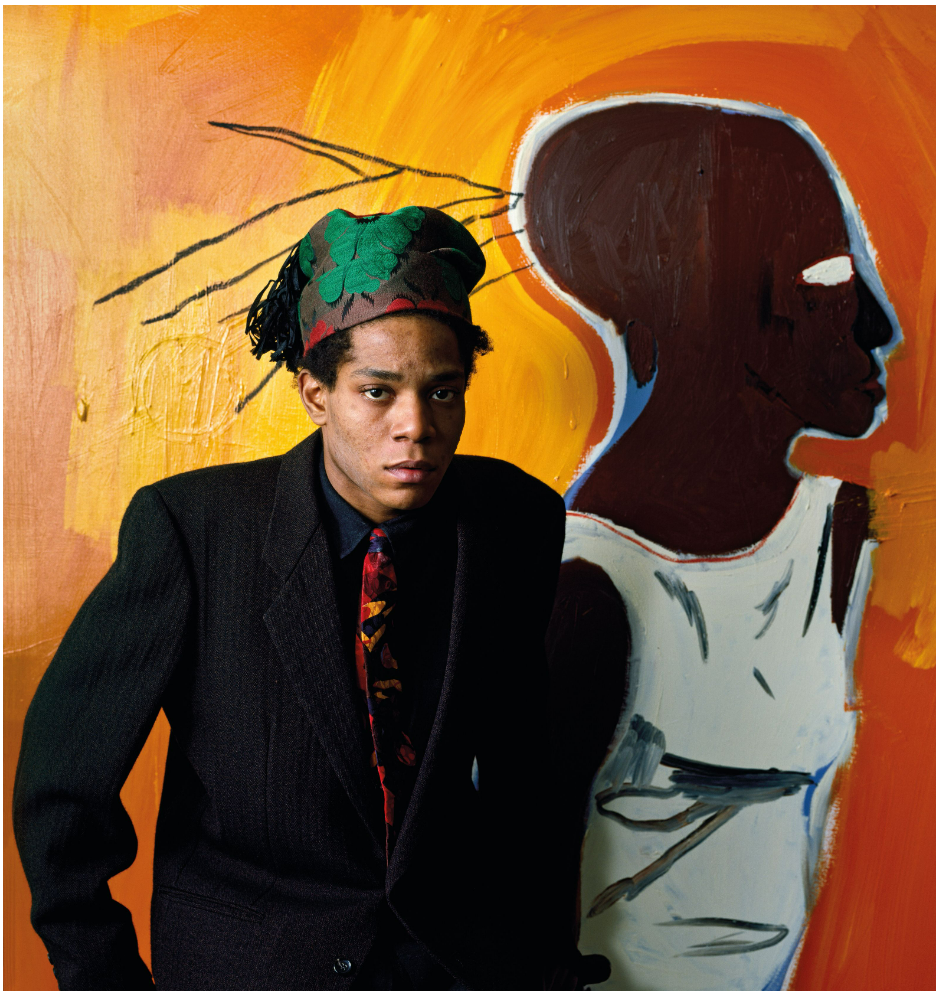
Jean-Michel Basquiat, New York, 1985 (present lot illustrated). Photo: Evelyn Hofer / Getty Images.
Rare for a prolific artist like Basquiat, Orange Joy shows a more intricate rendering of the figure. While still retaining the same style and energy as his other works, this example pays particular attention to the details of the central subject. The figure is presumed to be Joy Bouldin, one of the artist’s muses who Andy Warhol introduced him to at the Mud Club in the early 1980s. Joy sat for Jean-Michel several times in 1984 and is the subject of a small handful of titular paintings, all exuding a shared sense of magisterial bravado. Joy was known at the time not only for her distinct beauty, but also for her position of power and esteem at the exclusive club, Danceteria. As an icon of the downtown scene, Joy had full dominion over the front door, which is encapsulated masterfully in ‘Orange Joy.’
Thutmosis, Model Bust of Nefertiti, circa 1350 BCE. Staatliche Museen, Berlin. Photo: © bpk Bildagentur / Staatliche Museen /Sandra Steiß / Art Resource, NY.
Set against the gleaming background, the cropped form of a woman becomes our immediate focus. Arms at her side and shown in profile, she floats in the marigold brushwork in a white tank top and dark pants. As Marc Mayer notes, “With direct and theatrically ham-fisted brushwork, he used unmixed color structurally, like a seasoned abstractionist, but in the service of a figurative and narrative agenda. Basquiat deployed his color architecturally, at times like so much tinted mortar to bind a composition, at other times like opaque plaster to embody it. Color holds his pictures together, and through it they command a room” (M. Mayer, “Basquiat in History,” Basquiat, exh. cat., Brooklyn Museum of Art, 2005, p. 46). The immediacy of this talent can be clearly seen in Orange Joy as it glows with an innate warmth. The artist has edited out the lower part of the woman’s body which gives the impression of a cut-out or collage element that has been extracted from some other source. A halo of blue and white around the figure accentuates this feeling. The skull is elongated, casting allusions to the reign of the Ancient Egyptians and the stylistic tropes prevalent during that time. The woman’s eyes are white and lack pupils or irises, but the nose and lips are exquisitely rendered with a softness and nuance that beckons to Basquiat’s painterly skill. Quick marks in gray form the folds of her garments, their quick, brushy application pointing toward the artist’s quick proficiency with visual construction. From the back of the woman’s head, several black lines extend, their dreadlock-like forms at odds with the rest of the work. However, this juxtaposition serves to anchor the figure within the work and brings a subtle amount of dynamic tension to the composition. Their spindly presence creates a slight unease that piques the viewer’s curiosity and draws them further into the scene.
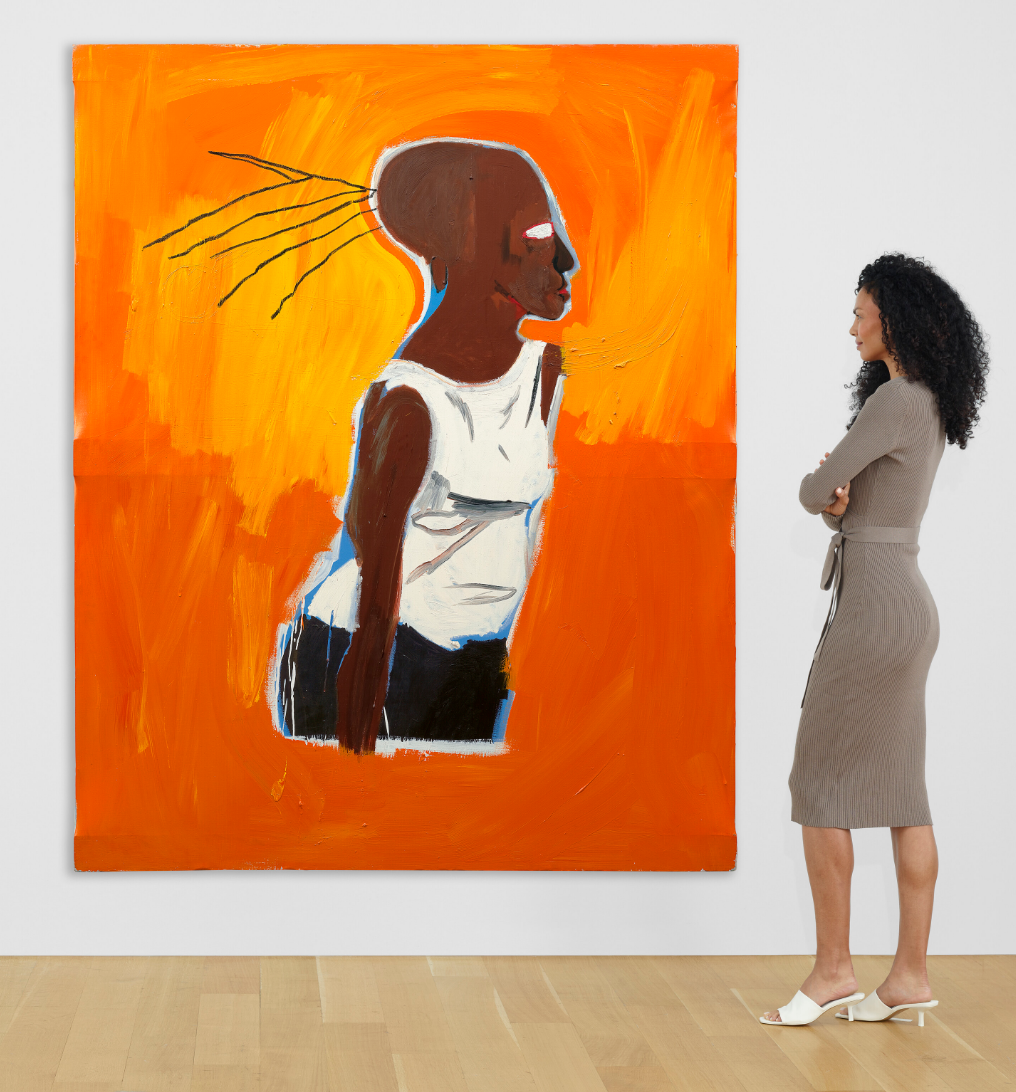
Like his fellow Neo-Expressionists, Basquiat took a pointed interest in introducing the figure back into the painted image. Harnessing the vigor and emotional complexity of the German Expressionists and New York School visionaries like Willem de Kooning, these young artists held the Modernist obsession with pure abstraction up to the mirror of history. At a time when some critics foretold the death of painting, Basquiat and his colleagues were inventing new ways to make it more relevant than ever. Specifically, the virtuosic Brooklyn artist focused on re-introducing the black figure back into art history and idolizing these subjects as they had not been throughout the Western world. Pairing them with words, symbols, and a depth of care not afforded to African-American subjects in the mainstream, he pushed for a more diverse representation within his work. For example, the crown, a signature of Basquiat’s iconography, was often used to exalt the figures within his paintings. He used it as an adornment for black musicians, writers, artists, and athletes in an effort to raise these historically undervalued individuals to the realm of royalty and even sainthood. As Fred Hoffman recognized, “Many of the dualities suggested in his work evolve out of the recognition of his predicament as a young black man in a white art world” (F. Hoffman, “The Defining Years: Notes on Five Key Works,” in op. cit., p. 130). By mining his own personal experiences and histories, the painter created an oeuvre that resonated with a wider audience.
Andy Warhol
Christie’s New-York: 9 November 2023
Estimated: USD 1,500,000 – 2,000,000
USD 3,438,000
ANDY WARHOL (1928-1987) (christies.com)
ANDY WARHOL (1928-1987)
Flowers, 1964
Acrylic and silkscreen ink on canvas
24×24 inches (61×61 cm)
Signed ‘Andy Warhol’ (on the overlap)
Andy Warhol’s ability to transform ubiquitous images into American icons is legendary. His investigation of consumer culture and advertisement practices launched the Pop art movement in the United States, and his work has become synonymous with the movement. Flowers is a pivotal example of his work with photographic sources filtered through the machinations of commercial imagery. By transforming a photograph of something in the real world to a symbol, he teased out the separation between everyday life and the constructed reality of capitalism in the late twentieth century. Speaking to his use of mechanical reproduction throughout his oeuvre, the artist once noted in his typical wry style, “I don’t want it to be essentially the same — I want it to be exactly the same. Because the more you look at the same exact thing, the more the meaning goes away, and the better and emptier you feel.” (A. Warhol, quoted in C. MacCabe, et al, eds., Who Is Andy Warhol?, The British Film Institute and The Andy Warhol Museum, Pittsburgh, PA, p. 119). Famous for his biting quips and detached demeanor, Warhol was a master provocateur.
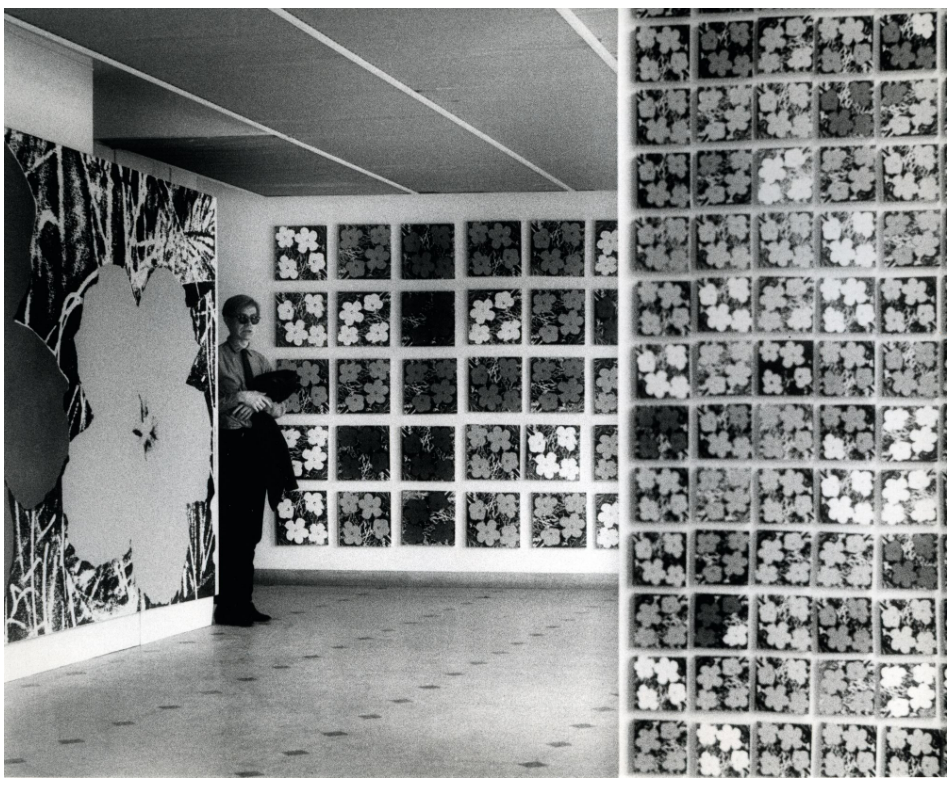
Andy Warhol at his exhibition of Flowers at Ileana Sonnabend Gallery, Paris, May 1965. Photo: Shunk-Kender © J. Paul Getty Trust. Getty Research Institute, Los Angeles. Artwork: © 2023 The Andy Warhol Foundation for the Visual Arts, Inc. / Artists Rights Society (ARS), New York.
The series was first exhibited at the Leo Castelli Gallery in 1964 in an exhibition that took the New York art world by storm as it connected with a public ready for something less shocking than the electric chairs and car crashes of the previous years. Rendered in different sized formats, the twenty-four inch square canvases were hung in a grid which created an overwhelming visual sensation. The even glow of yellow petals in the current work pierces the deep green and black surroundings much as it would in nature. However, these flowers are not made to attract pollinators. Instead, they draw the viewer in by leveraging a seemingly straightforward, recognizable subject and the dynamic style for which Warhol became famous. The artist always offered off-the-cuff remarks about superficiality and its relationship to his work and himself, saying sardonically, “If you want to know all about Andy Warhol, just look at the surface: of my paintings and films and me, and there I am. There’s nothing behind it” (A Warhol, quoted in G. Berg, “Andy: My True Story,” Los Angeles Free Press, March 17, 1967, p. 3). However, despite all of his outward displays and calculated cool, the true Warhol was much deeper, as a more intense study of Flowers will reveal. The artist’s long-time assistant Ronnie Cutrone noted, “we all knew the dark side of those Flowers” (R. Cutrone, quoted in J. O’ Connor and B. Liu, Unseen Warhol, New York, 1996, p. 61). Behind the cheery blooms was a darker layer that reflected upon the nature of life and death.
Gustav Klimt, Bauerngarten mit Sonnenblumen, 1905-1906. Belvedere Museum, Vienna. Photo: Erich Lessing / Art Resource, NY.
There are two sides to every Warhol work, just as there were two facets within the artist himself. The public-facing Pop glitz exists simultaneously alongside a darker, more introspective mode that prods at issues of mortality and time’s inevitable march. Though the latter shows itself more directly in the Skulls and Death and Disasters series, and the former is more evident in the celebrity portraits and diamond dust pieces, works like Flowers are quintessential Warhol.
Andy Warhol
Christie’s New-York: 9 November 2023
Estimated: USD 3,000,000 – 5,000,000
USD 1,986,000
ANDY WARHOL (1928-1987) (christies.com)
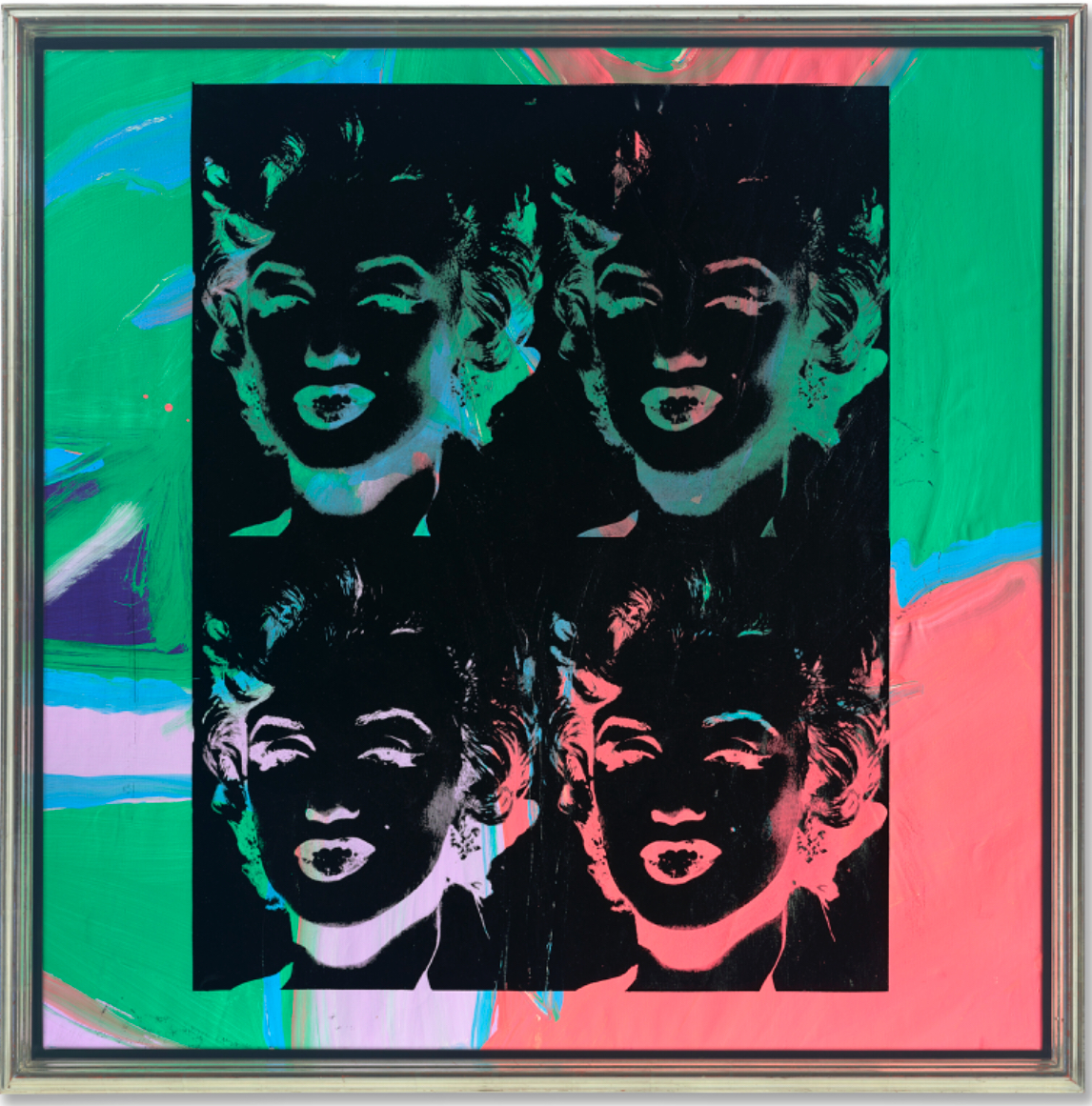
ANDY WARHOL (1928-1987)
Four Multicolored Marilyns (Reversal Series), 1979-1986
Acrylic and silkscreen ink on canvas
40×40 inches (101.6 x 101.6 cm)
Stamped twice with the artist’s signature ‘Andy Warhol’ (on the overlap)
Set within a large square canvas, Warhol repeats a negative black-and-white image of Monroe in a two-by-two grid formation. The four close crops of the actress’s face are pulled from the same source image he first used in his iconic painting Gold Marilyn Monroe (1962, Museum of Modern Art, New York), but are now infused with an ominous darkness. The black silkscreen has been applied over a swooping, dynamic canvas, and the areas of painted green, blue, red, and light purple swirl at the edges and peak through the negative spaces. This combination of painterly surface and crisp imagery exists throughout the artist’s oeuvre and serves as an important source of visual tension. The brushy abstraction is at odds with the photographic reproduction, creating a dialogue between the two styles that immediately entrances the viewer. Repetition had long been one of Warhol’s defining processes as he mimicked the consumerist modes of production and ushered in American Pop. Realizing that multiple versions of the same source image had more visual power than a singular picture, he often presented works in grids or series to emphasize the nature of commercialization.
3. Post-War and Contemporary Art Day Sale
10 November 2023
Post War & Contemporary Art Day Sale (christies.com)
Auction Statistics
261 Lots
Total: USD 66,582,610
# Lots sold: 220
Sell-Through Rate: 84.3%
Top Lot: USD 3,438,000
15 Lots sold above USD 1 million
USD 24,897,400
37.4% of Total
Above Estimates: 66 Lots (25%)
Within Estimates: 86 Lots (33%)
Below Estimates: 68 Lots (26%)
Unsold: 40 Lots (15%)
Top 3 Lots
#1. Andy Warhol
Christie’s New-York: 10 November 2023
Estimated: USD 2,000,000 – 3,000,000
USD 3,438,000
ANDY WARHOL (1928-1987) (christies.com)
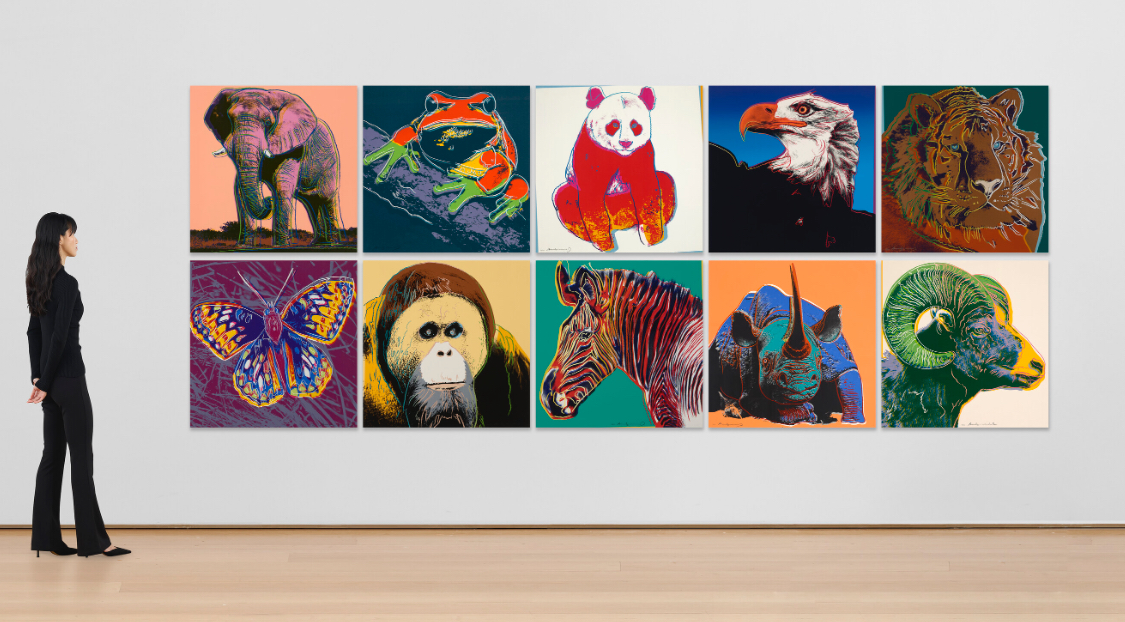
ANDY WARHOL (1928-1987)
Endangered Species, 1983
Screenprint in colors in ten parts on Lenox Museum Board
Each signed and stamp-numbered ‘Andy Warhol 83⁄150’
Andy Warhol created his Endangered Species complete set of screenprints in 1983, ten years after the passage of the United States Endangered Species Act. In the early 1980s Warhol had a discussion with art dealer and long-time political and environmental activists, Ronald and Frayda Feldman about beach erosion and several other ecological issues. Inspired by their conversation, the Feldmans, whose gallery Ronald Feldman Fine Art, New York was known for supporting innovative art projects and installations, commissioned Warhol to create a portfolio of ten silkscreen prints titled Endangered Species. Warhol, who had a deep fondness and interest in animals, embraced the idea. The subsequent screenprints highlight ten endangered animals in a colorful, upbeat manner, which Warhol described as” animals in make-up “. His focus on the animals in isolation, with his pop-art palette, puts them on a level of superstardom along with the famous screenprints of his past: Marilyn Monroe, Liz Taylor and Muhammad Ali.
Source for Black Rhinoceros screenprint in the New York Times. Photo: World Wildlife Fund.
Endangered Species was exhibited at the Museum of Natural History in New York following publication in addition to other natural history museums throughout the United States. Warhol personally selected the museum’s Reptile Room to exhibit the portfolio. Ronald Feldman recounts Warhol staying for hours in the museum. The staff however was surprised by the artist’s selection of the space and were concerned that the venue would dissuade partygoers from seeing the set, but Warhol loved the bright colors of the room’s inhabitants. Ultimately, Feldman recounts that the room was mobbed on the night of the event. Endangered Species has been viewed as one of Warhol’s most important works in the medium ever since.
Andy Warhol with Endangered Species screenprints, 1982. Photo: Brownie Harris. Artwork: © 2023 The Andy Warhol Foundation for the Visual Arts, Inc. / Licensed by Artists Rights Society (ARS) / Courtesy Ronald Feldman Fine Arts, New York.
Andy Warhol’s commitment to the environment continued following his death, endowing his beachfront property in Long Island to The Nature Conservancy from The Andy Warhol Foundation for the Visual Arts in order to preserve a section of the ecologically significant Montauk Moorlands. In the present moment, nearly all of the animals depicted remain in danger of extinction.
#2. Jean-Michel Basquiat
Christie’s New-York: 10 November 2023
Estimated: USD 2,500,000 – 3,500,000
USD 3,075,000
JEAN-MICHEL BASQUIAT (1960-1988) (christies.com)

JEAN-MICHEL BASQUIAT (1960-1988)
Untitled, 1981
Grease pencil and acrylic on wood
60 x 11 1/4 inches (152.4 x 28.6 cm)
The poetic genius of a young rising star blazes brightly in this 1981 work by Jean-Michel Basquiat. Executed at the dawn of his ascension to fame, the untitled work encapsulates the artist’s gift for wordplay and infallible instinct in creating works that are buzzing with electricity, multi-layered, and deeply personal. It is a cryptic cipher and examination into the artist’s views on the dichotomies he experienced as a black artist in the New York art world: utility and luxury, ignorance and respect, alienation and acceptance. The work is life-sized, with a skeletal, disjointed yet heroic figure standing resolutely in the center. Encircled in a halo and standing above one of his iconic crowns, no viewer can deny these authoritative symbols—Basquiat has made his figure royal and divine. The composition makes clear Basquiat’s artistic instinct, the secret ingredient that makes his work so powerful for viewers across generations. It was made spontaneously as a gift to his friend Tim Wright, after which it passed to the present owner in the early 1980s, where it has been since. Basquiat was just nineteen in this period of budding fame, but the works he created have proven to be some of the most sought after.

Painted in a bold white on a black wood board, the work is pulsing with Basquiat’s constant need to create. The jagged lines tell the story of Basquiat’s vision coming to life, momentary decisions revealing themselves all over the surface and energizing the surrounding space. At the figure’s feet, there is a three-pointed crown inside a box along with “TAR.” Wordplay is a central feature in Basquiat’s oeuvre, and the word TAR—as well as it’s anagrams, ART and RAT—appears frequently. Tar, aside from being a dark, viscous substance, is at times used as a derogatory term for black people. In the present work, the word has been crowned in an act of reclamation and empowerment. Basquiat wanted to correct the imbalance he saw in the predominantly white art world which he was just starting to make a name for himself in. On a trip to the MoMA in 1982, Basquiat said, “There are no black men in museums. Try counting…” (G. O’Brien, “Every Line Means Something,” Artforum, Vol. 53, No. 8, April 2015, p. 126). They did not find any. In most of Basquiat’s work, he made the protagonist a black man—heroic, crowned, and sanctified.
Well educated and knowledgeable in the humanities, Basquiat drew upon art history for inspiration. While he painted, he would often have art books scattered around him, referencing other artists just as he witnessed contemporary rappers sampling other musicians. Basquiat knew that in art history, crowns are symbols, rife with a history of privilege, power, and racism. Painted portraits of men sitting on gilded thrones, draped in ermine and silk, are steadfast throughout Western civilization. The halo present in this 1981 work is also a recurring symbol for Basquiat. The oblong circle bisected by short lines can also double as a crown of thorns, bestowing upon the figure the honor and burden of sainthood. The life-sized portrait on wood panel is evocative of paintings of saints, found in altarpieces beneath vaulted ceilings and illuminated by flickering candlelight. The halo along with the crown serve to make Basquiat’s figure transcendent, captured gloriously in a spontaneous moment of creation.
Lucas Cranach the Elder, Saint Maurice, circa 1522-1525. Metropolitan Museum of Art, New York. Photo: © The Metropolitan Museum of Art / Art Resource, NY.
“LEAD” and “GOLD” written above and below the figure bring to mind first the dichotomy between the two metals. Lead is utilitarian, gray, and was banned from use in housepaint just a few years before the execution of this painting. It is not deemed “precious” like its counterpart gold, but ultimately, they are both metal from the earth. The names of chemical elements and materials emerge frequently in Basquiat’s work, inspiring reflection on their history, uses, and prescribed values. In this work, it is interesting to note that gold, symbolic for wealth and luxury, has been placed at the bottom of the composition. At the top is lead, deemed less valuable, but perhaps more practical and useful than gold.
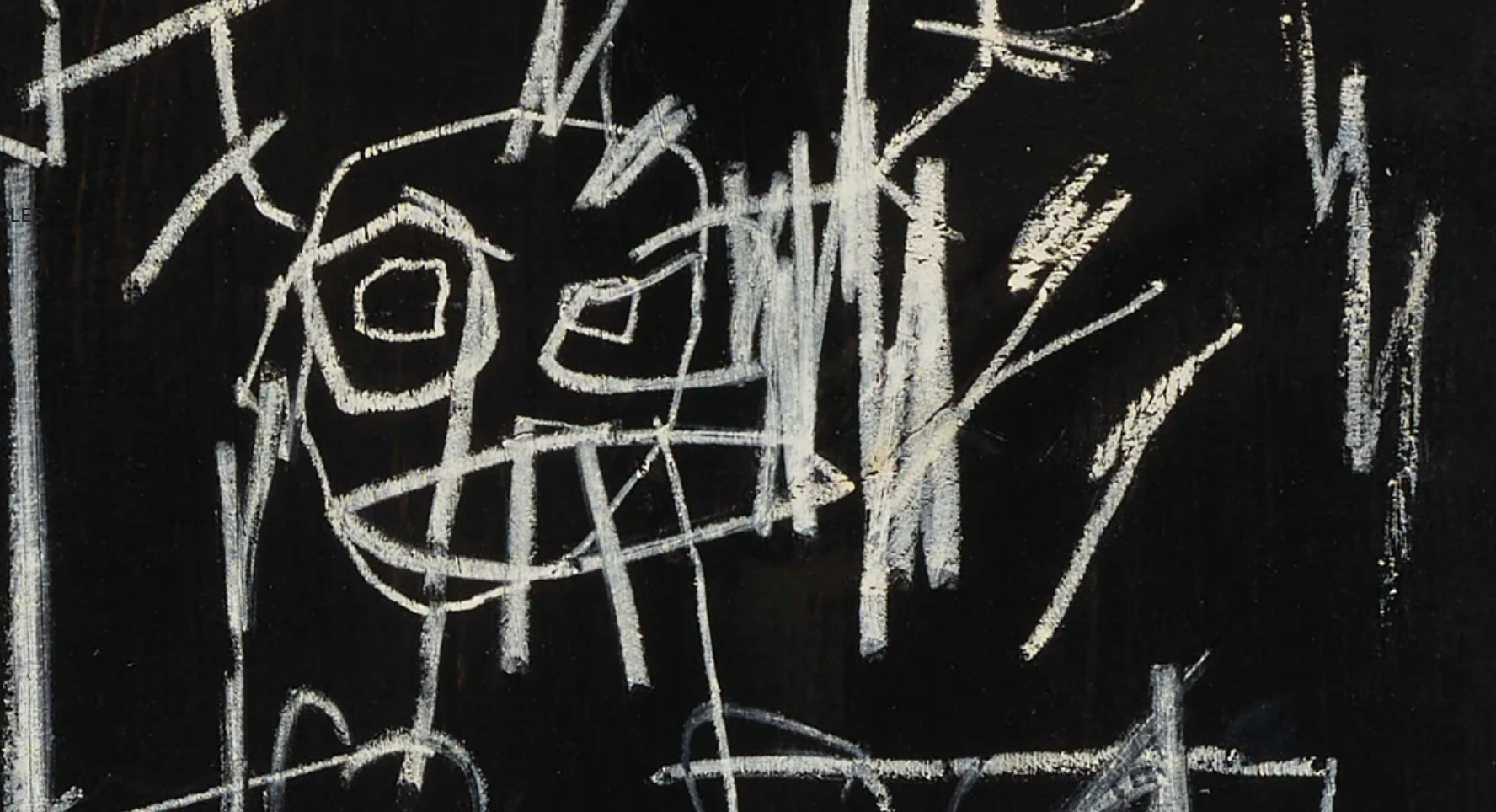
In 1981, Basquiat was gaining a lot of public attention very quickly, and soon he would become very wealthy. Perhaps at the time he executed this painting he was thinking about the ways in which his work, and by extension his persona, was being weighed and evaluated by other people. The work is an intimate look into his inner world, not made to be shown in a gallery but impromptu for his friend. Tim Wright was the bassist in the No Wave band, DNA, and he and Basquiat both performed in the indie film Downtown 81 the same year this work was executed. In the film, Basquiat plays the leading role—an artist who embarks on a journey around New York City to sell one of his paintings and encounters other artists and musicians, including DNA.
#3. Hans Hoffman
Christie’s New-York: 10 November 2023
Estimated: USD 1,000,000 – 1,500,000
USD 3,075,000
HANS HOFMANN (1880-1966) (christies.com)
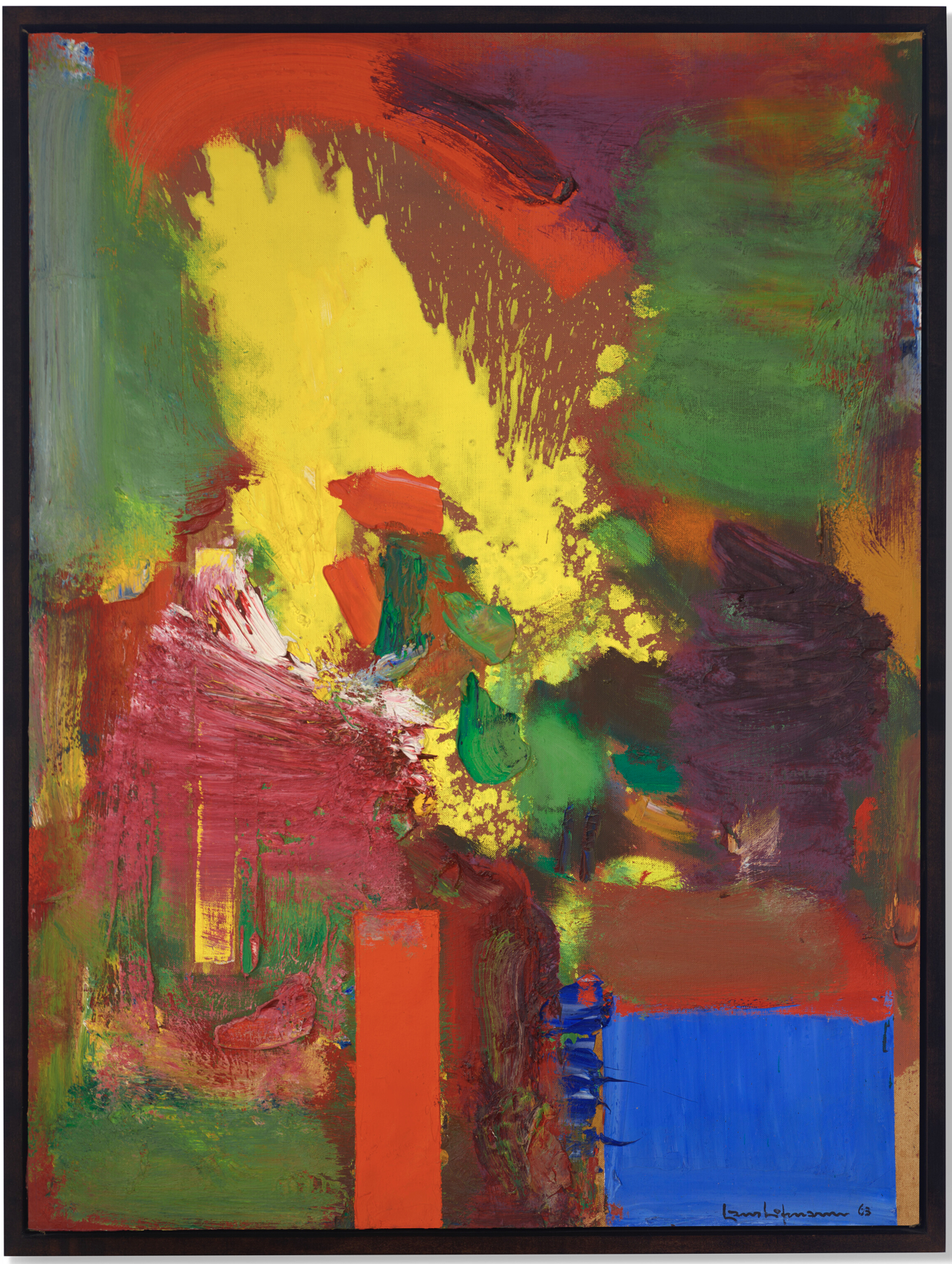
HANS HOFMANN (1880-1966)
First Blaze of the Rising Sun, 1963
Oil on canvas
48×36 inches (121.9 x 91.4 cm)
Signed and dated ‘hans hofmann 63’ (lower right)
First Blaze of the Rising Sun, executed in 1963, is a resounding, vibrant example of Hans Hofmann’s most successful period. This painting rewards the thoughtful viewer—enchanting with deep, autumnal colors dancing across the canvas and revelations in every corner. His push and pull philosophy is exemplified here by the colors and shapes culminating in a swirling rhythm with vibrant yellow and blue popping out against duller, darker hues. The picture plane pulses with energy, ready to burst forth like light creeping over the horizon. Hofmann mastered these effects in the last decade of his life. This late career blossoming came, in part, as a result of his retirement from teaching. Beginning at the end of World War I, he operated a respected art school with a star-studded student body, including Helen Frankenthaler, Joan Mitchell, and Frank Stella. Through this endeavor, Hofmann forged a new generation of modernist artists, though this devotion to education often overshadowed his personal craft. With his retirement in 1958 came a change in priorities and subsequently a monumental era of experimentation and public attention. In the same year this painting was executed, Hofmann received a monumental solo exhibition at the Museum of Modern Art which was met with critical acclaim. First Blaze of the Rising Sun is a shining beacon of Hofmann’s prowess and command over the canvas.
Other Highlights
Fernando Botero
Christie’s New-York: 10 November 2023
Estimated: USD 200,000 – 300,000
USD 1,865,000
FERNANDO BOTERO (1932-2023) (christies.com)
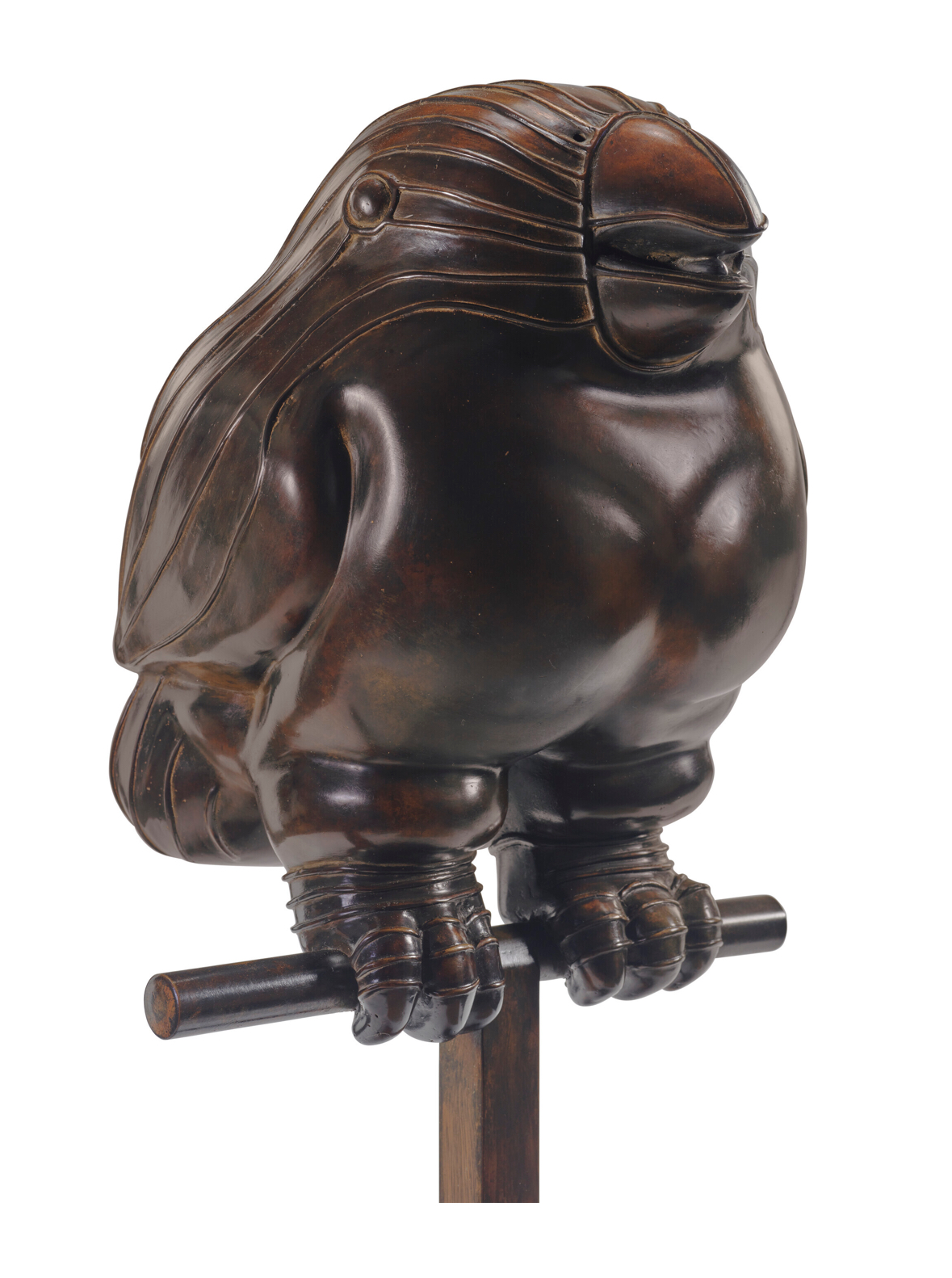
FERNANDO BOTERO (1932-2023)
Parrot, 1981
Bronze, on artist’s base
Overall: 58 ¼ x 16 ¼ x 16 ¼ inches (148 x 41.3 x 41.3 cm)
Signed and numbered ‘Botero 4⁄6’ (on the base)
This work is number four from an edition of six
Andy Warhol
Christie’s New-York: 10 November 2023
Estimated: USD 1,200,000 – 1,800,000
USD 1,320,500
ANDY WARHOL (1928-1987) (christies.com)
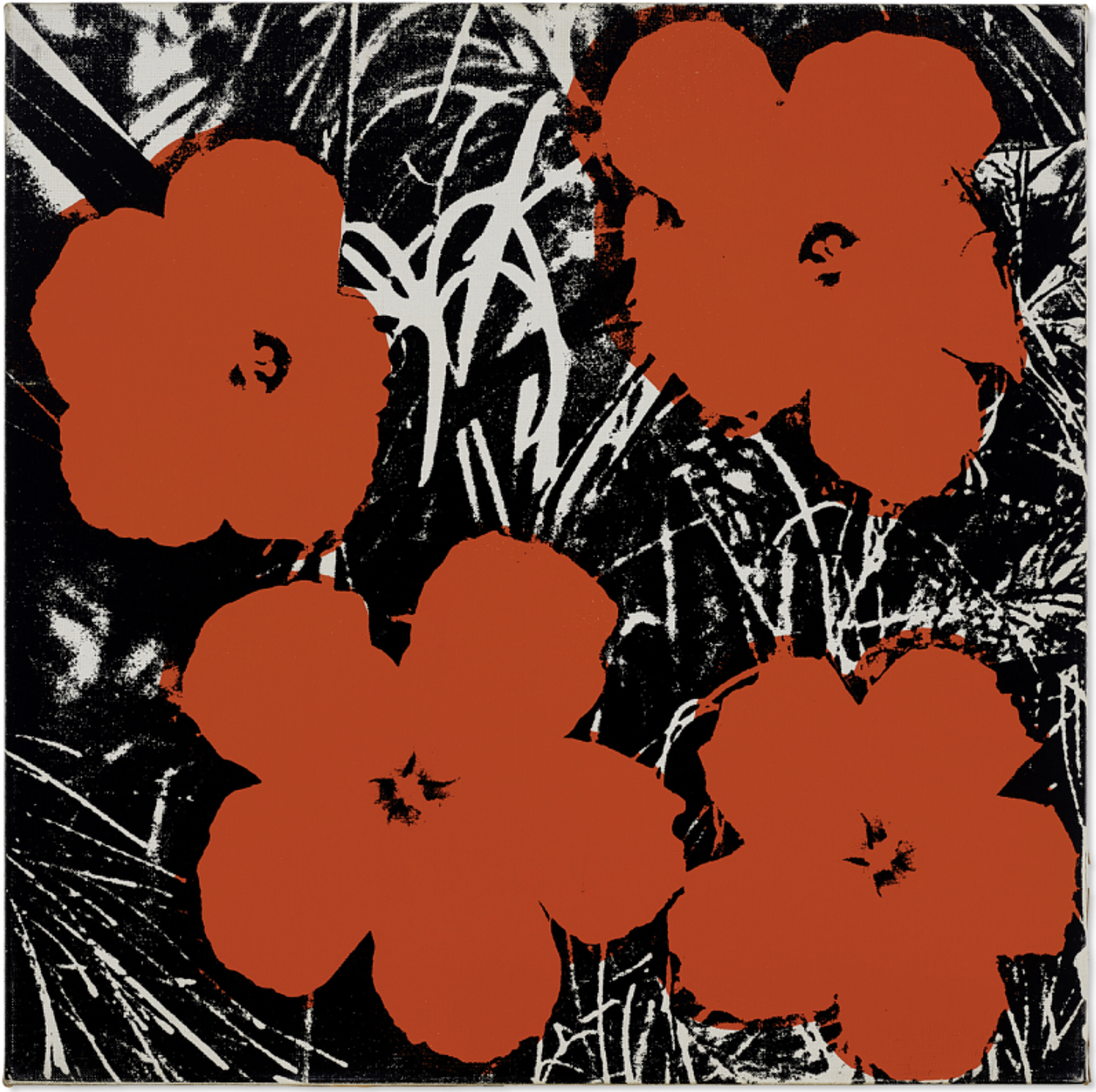
ANDY WARHOL (1928-1987)
Flowers, 1965
Silkscreen ink on canvas
22×22 inches (55.9 x 55.9 cm)
Set against a monochromatic background, the four blooms in Andy Warhol’s Flowers reverberate off the surface of the canvas with an exuberant energy. This combination of all red flowers set against a black-and-white ground is rare, with less than 10% of the series being devoted to this particular combination. Flowers was a radical departure for the artist at the time; eschewing the shocking drama of his Death and Disaster paintings, Warhol turned to something seemingly more traditional, yet infusing the subject matter with his own radical Pop sensibility. The idea was said to have come from Henry Geldzahler, the legendary critic and curator, who told Warhol, “it’s enough of disaster; it’s time for life again” (H. Geldzahler quoted in B. Gopnik, Warhol, New York, 2020, p. 385). Using a photograph from a popular photography magazine, in his signature style Warhol subtly manipulated the image to produce one of his most celebrated and recognizable works.
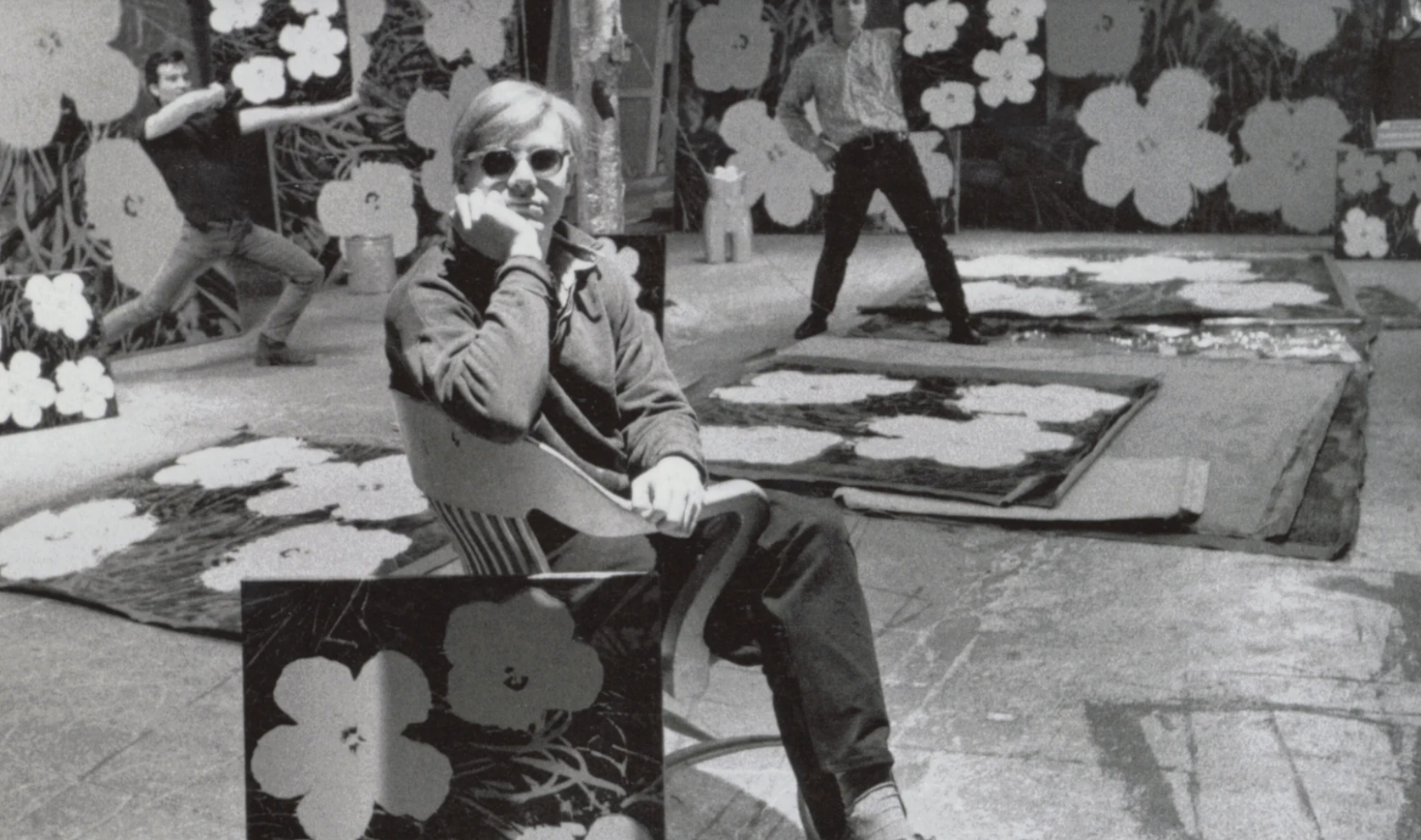
Andy Warhol in his studio, New York, 1964. Photo: Ugo Mulas © Ugo Mulas Heirs. All rights reserved. Artwork: © 2023 The Andy Warhol Foundation for the Visual Arts, Inc. / Licensed by Artists Rights Society (ARS).
The composition of Flowers is a testament to Warhol’s innovative and distinctive approach to art. By taking a pre-existing image, closely studying it’s formal qualities and re-interpreting it for the Pop age, Warhol demonstrates his thorough understanding of the language of looking. In the present work, he employes vivid hues to emphasize his subject matter, resulting in flat planes of red that are punctuated only by the delicate black anthers and stamens of the hibiscus plant. Concentrating his palette on just one color emphasizes this effect, allowing the optical resonance of the cadmium red to reverberate off the surface. Furthermore, by setting the flowers against a dark, monochromatic ground, Warhol almost pushes his subject matter through the picture plane.
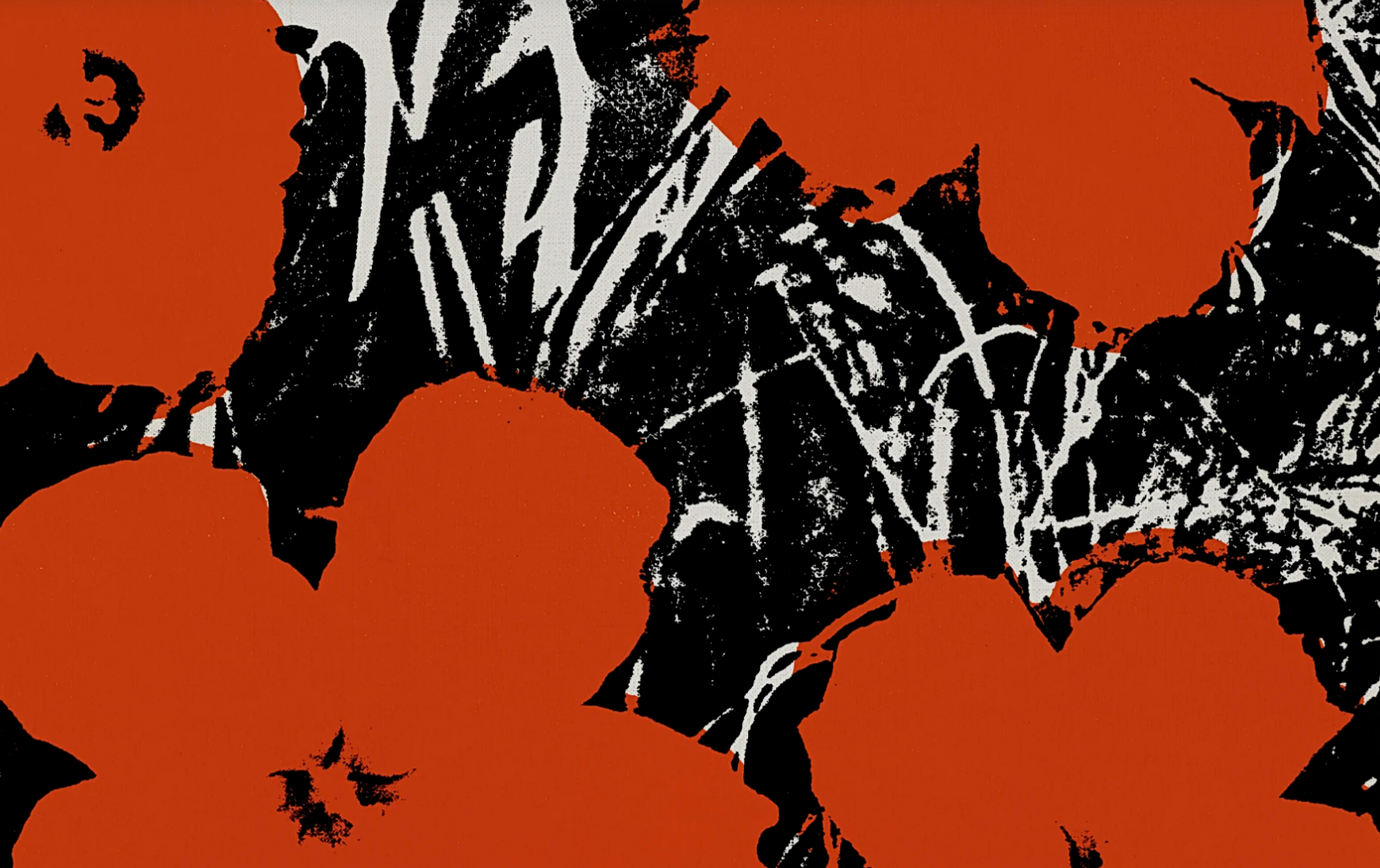
With such a meticulously structured composition, Warhol also emphasizes the sense of order and seriality that became a hallmark of his oeuvre. Just like his paintings of Campbell Soup Cans and Hollywood stars such as Marilyn Monroe, the repeated motifs in Flowers draw attention to the mechanical and mass-produced nature of the printed images. Yet, there is also something different in each work, as despite the artist’s adoption of the silkscreen technique, every work in the series is different in its own right, the technique allowing for the transfer of ink onto the canvas to be distinctive each time, resulting in a discretely unique image every time.
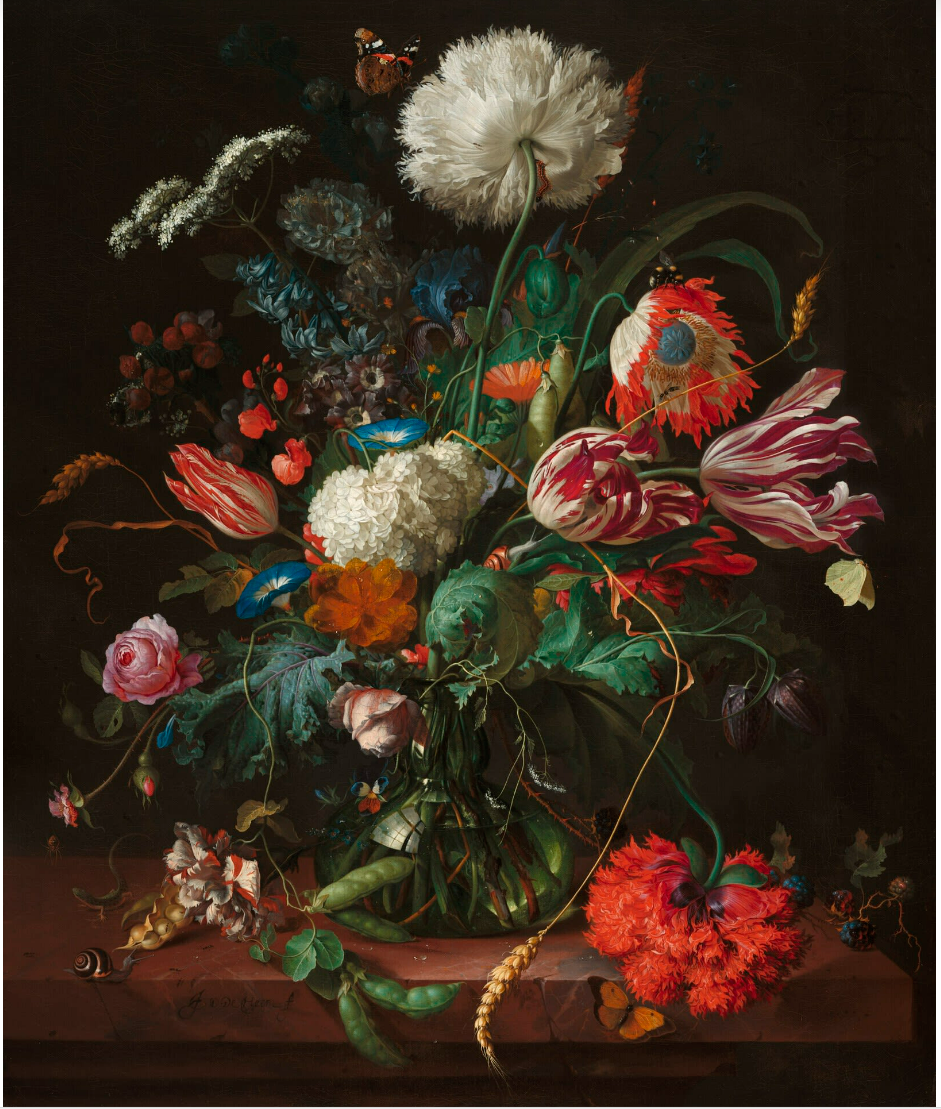
Jan Davidsz de Heem, Vase of Flowers, circa 1660. National Gallery of Art, Washington, D.C.
With his Flowers, Warhol also engages with the established canon of still-life painting, aligning himself with the romantic renderings of flowers by painters like the Dutch Golden Age painter Rachel Ruysch, Claude Monet or Vincent van Gogh. However, Warhol transformed the age-old genre with his color-blocked blossoms, utterly removed from nature. With an aerial viewpoint, he collapses space into one flat plane—making no distinction between horizon or ground. His style is adamantly the artist’s hand, and treats his traditional subject matter with the same detachment as his commercial imagery—in this way, he distills his reputation as a creative wunderkind on the level of the master painters before him. Gerard Malanga, Warhol’s longtime assistant who worked on the Flowers series, recognized the irony of the situation: “With Flowers, Andy was just trying a different subject matter. In a funny way, he was kind of repeating the history of art. It was like, now we’re doing my Flower period! Like Monet’s water lilies, Van Gogh’s Flowers, the genre” (G. Malanga quoted in D. Dalton, A Year in the Life of Andy Warhol, London, 2003, p.74).
Coming from Galerie Ileana Sonnabend in Paris and passing through Gian Enzo Sperone Gallery in Turin, Flowers then arrived to the collection of Marcello Rumma, a central figure in the Italian and international cultural debate between the 1960s and 1970s. A connoisseur and passionate collector, intellectual and friend of artists, organizing exhibitions and promoting publications dedicated to the most experimental artistic practices of his time, Marcello was a true pioneer during his brief lifetime in which he fostered a new generation of artists, by working closely with leading cultural figures such as Germano Celant and Achille Bonito Oliva.
With their intense colors and innovative compositions, Flowers exudes a sense of vibrancy and life that could only be captivated by Warhol himself. Through this series, Warhol has worked in the grand tradition of floral paintings in art history, but by adding his own interpretation on the flower motif, Warhol has created a staple composition to his oeuvre. Flowers serves as a symbol of Warhol’s ability to provoke thought and inspire conversation about the intersection of art, commerce, and culture, making Flowers an iconic and lasting symbol of the Pop Art movement, and one that will continue to bloom in the annals of art history.
George Condo
Christie’s New-York: 10 November 2023
Estimated: USD 300,000 – 500,000
USD 1,197,000
GEORGE CONDO (B. 1957) (christies.com)
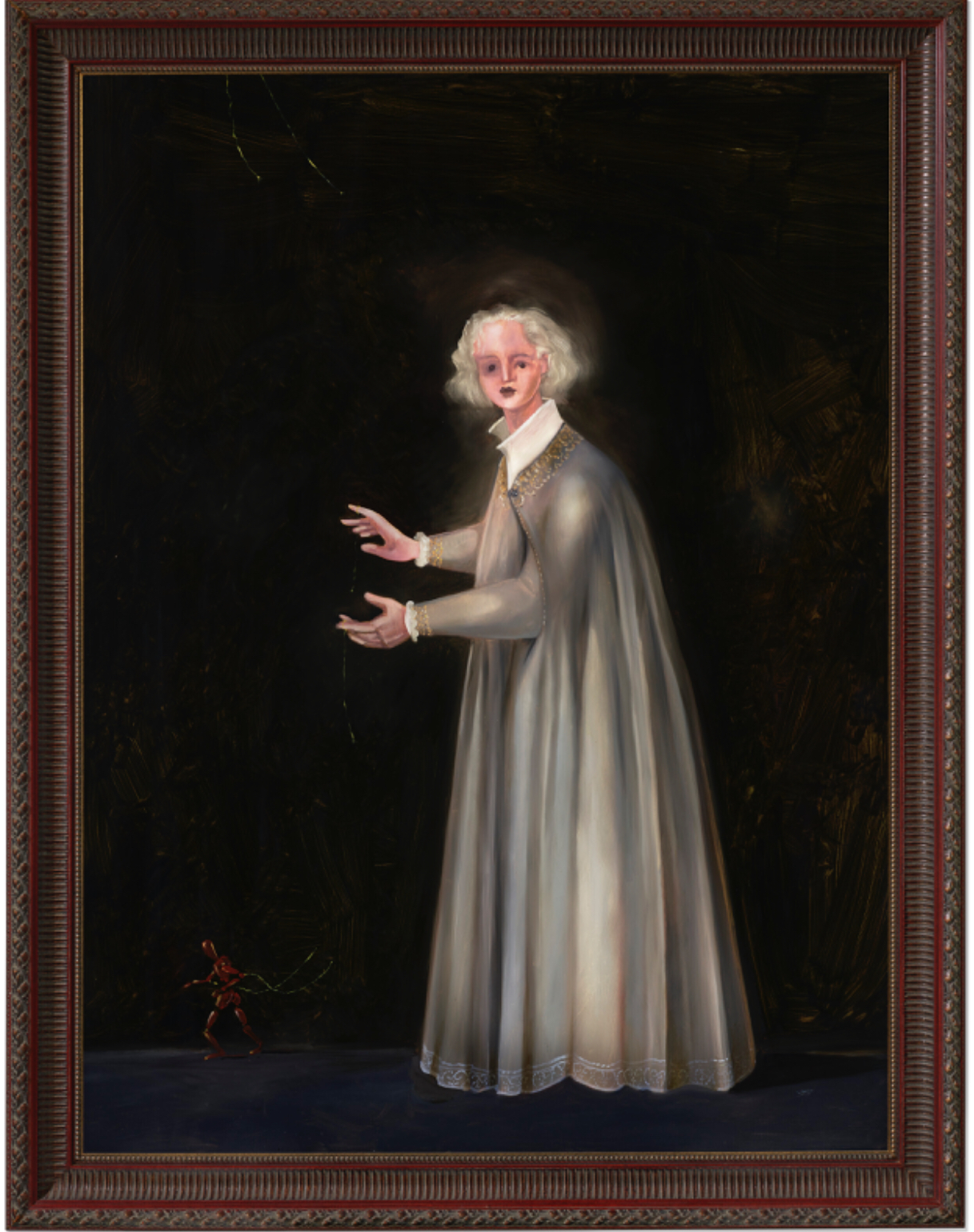
GEORGE CONDO (B. 1957)
The Psychoanalytic Puppeteer Losing His Mind, 1994
Oil on canvas
78 3/4 x 59 inches (200 x 149.9 cm)
Signed, partially titled and dated ‘Condo 94 The Psychoanalytic Puppeteer’ (on the reverse)
Scott Kahn
Christie’s New-York: 10 November 2023
Estimated: USD 150,000 – 250,000
USD 819,000
SCOTT KAHN (B. 1946) (christies.com)
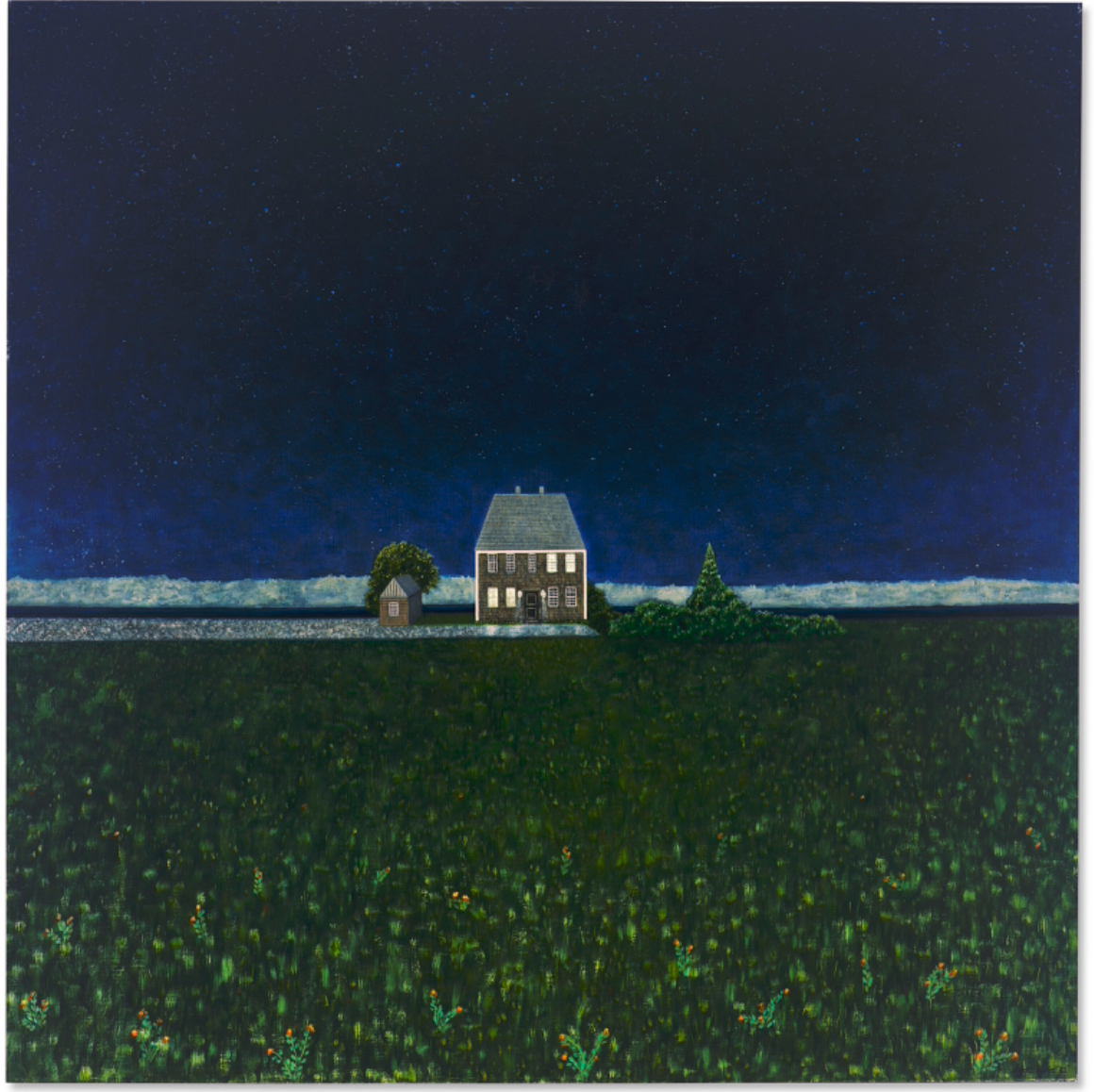
SCOTT KAHN (B. 1946)
Twilight, 1982
Oil on canvas
36 1/4 x 36 2/4 inches (92.1 x 92.1 cm)
Signed and dated ‘Scott Kahn ’82’ (lower right)
Signed again twice
Titled and dated again twice ‘TWILIGHT KAHN 1982 © 1982 by Scott Kahn’ (on the overlap)
Yayoi Kusama
Christie’s New-York: 10 November 2023
Estimated: USD 500,000 – 700,000
USD 756,000
YAYOI KUSAMA (B. 1929) (christies.com)
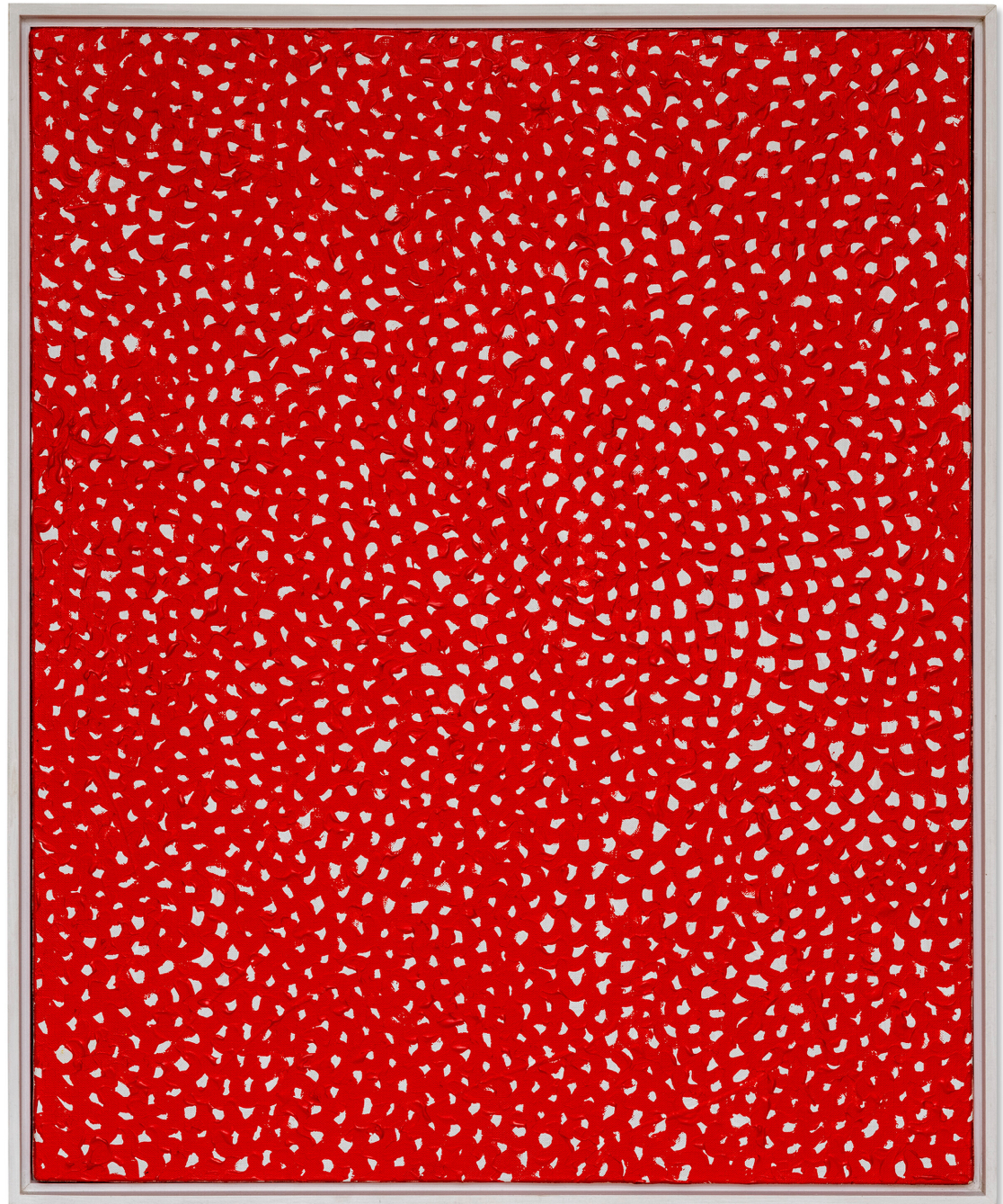
YAYOI KUSAMA (B. 1929)
Nets, 1998
Acrylic on canvas
65.4 x 53.3 cm (25 3/4 x 21 inches)
Signed, titled and dated ‘Yayoi Kusama 1998 Nets’ (on the reverse)
Kusama’s 1998 Nets is a mesmerizing exploration of repetition and infinity, the canvas serving as a portal to an ethereal realm of pattern. Through intricate, undulating configurations of nets, Kusama creates a sense of boundlessness that transcends the canvas. The nets, meticulously rendered with countless tiny loops, convey a sense of obsessive precision, and create a visual tapestry that seems to extend beyond the physical boundaries of the artwork. Kusama’s distinctive style is characterized by repetitive patterns and an exploration of the concept of infinity. Indeed, the artist’s signature motif is deeply intertwined with her personal experiences: from a young age, the artist experienced vivid hallucinations, including seeing patterns and dots enveloping her field of vision. These hallucinatory experiences became foundational for Kusama’s oeuvre, as her hallucinogenic imagery offers viewers a glimpse into her unique perspective. The subtle variations within the nets hint at the artist’s emotional depth as well, suggesting a delicate balance between order and chaos. In Nets, Kusama invites us to lose ourselves in the complex interplay of line, transcending the confines of the canvas into a contemplative exploration of the boundless. Furthermore, Kusama’s use of color adds another dimension, transforming the nets into vibrant, pulsating fields that evoke a sense of cosmic vastness. Kusama’s use of bold and blazing red in the present lot creates a rich background, which is enhanced further by the contrast of the delicate, lace-like pattern of white nets. This vibrant color combination makes Nets an advantageous addition to one of Kusama’s most influential and recognizable bodies of work.
Red has held a profound desirability throughout art history, captivating artists and viewers alike. It is a color of immense symbolic power, signifying both passion and danger, love and anger. In the art of the Renaissance, red was reserved for religious subjects, symbolizing divinity, or to denote wealth and social status. In more recent art movements like Abstract Expressionism, red became a conduit for raw emotion and intensity. Artists like Mark Rothko harnessed its depth to convey complex feelings. Beyond symbolism, red is inherently attention-grabbing, easily drawing the eye and conveying a sense of urgency or vitality. Its power not only lies in its significance throughout art history but also in its primordial ability to evoke visceral reactions and leave a lasting impression on the viewer.
Andy Warhol
Christie’s New-York: 10 November 2023
Estimated: USD 600,000 – 800,000
USD 756,000
ANDY WARHOL (1928-1987) (christies.com)
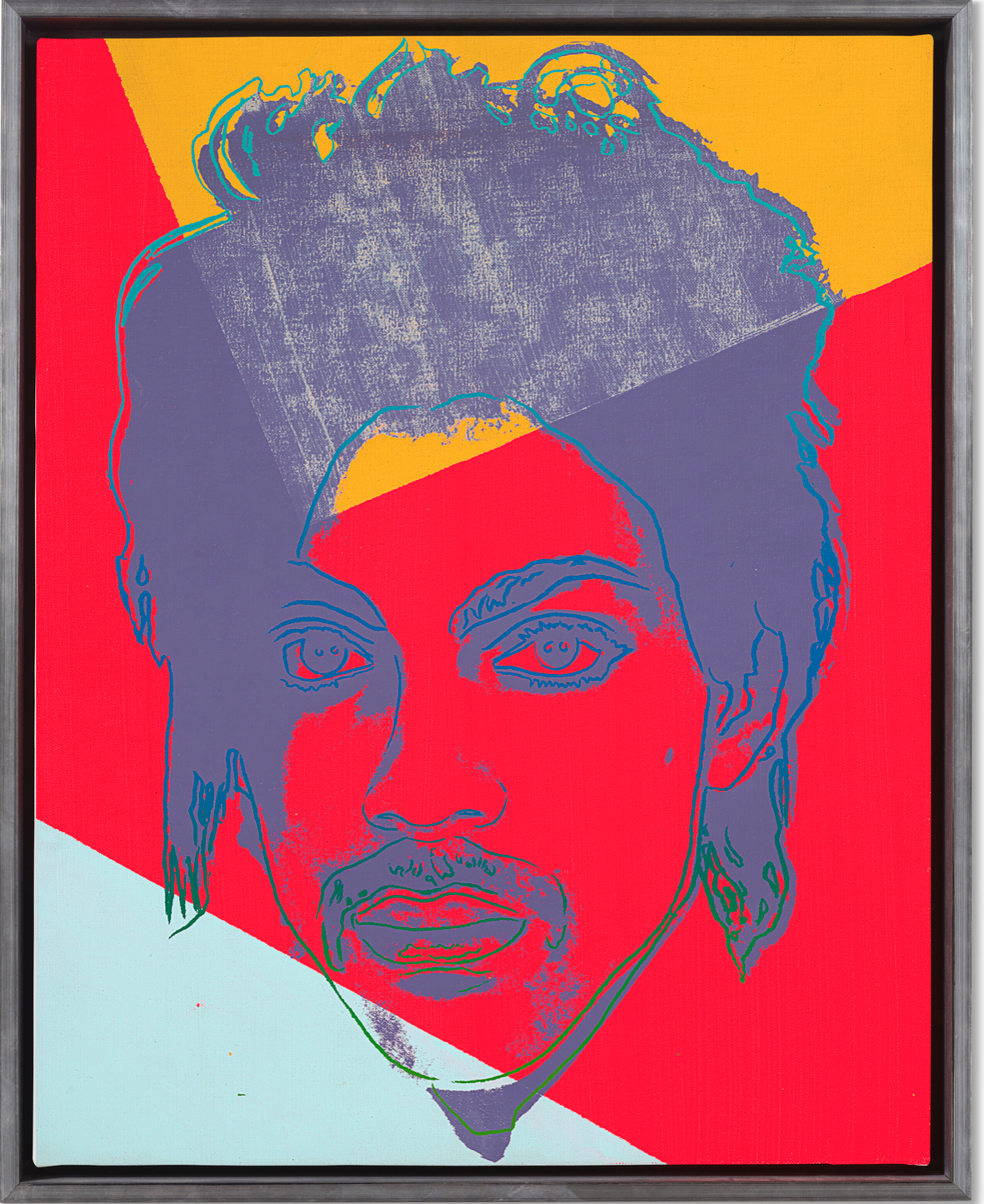
ANDY WARHOL (1928-1987)
Prince, 1984
Acrylic and silkscreen ink on canvas
20×16 inches (50.8 x 40.6 cm)
Stamped with the Estate of Andy Warhol and the Andy Warhol Art Authentication Board, Inc. stamps
Numbered ‘A105.0210’ (on the overlap); numbered ‘P050.539’ (on the stretcher)
Painted in 1984, Prince brings together two giants of popular culture. Andy Warhol’s obsession with celebrity and consumerism defined the Pop era of the 1960s, and Prince’s chart topping musical career made him one of the most recognizable voices (and faces) of the 1980s. In the present work, Warhol captures Prince’s unique features as a ghostly apparition in the pop star’s iconic shade of purple. When Warhol committed Prince to canvas, the musician was at the height of his fame, his Grammy Award winning album Purple Rain having been released the same year, and would go on to spend six months at the top of the Billboard chart. Thus, with this work, Prince joins Marilyn Monroe, Elizabeth Taylor, and Elvis Presley in Warhol’s pantheon of celebrity icons, captured by the ultimate chronicler of twentieth century culture.
The Trip Club advertising Andy Warhol’s The Exploding Plastic Inevitable show, Los Angeles, 1966. Photo: Steve Schapiro / Corbis via Getty Images.
The present work captures the essence of Prince’s multifaceted identity, showcasing his iconic fashion, distinctive expression, and overall charismatic presence. Warhol turns to bold colors and his silkscreen process to add depth and intrigue to his portrayal of the legendary musician. The neon shock of red carefully zig zagged across the center of the canvas draws the viewer’s eye deep into the painting, allowing them to connect with the subject. The bright orange and soft blue complement this, while adding balance to the composition, breathing life into the painting. Prince, of course, is rendered in purple, a nod to the singer’s iconic Purple Rain. The geometricity of the composition creates a unique layout, differing from other works in Warhol’s Prince series. Yet the present work is also steeped in Warholian traditions. Here, Warhol takes this ubiquitous image and transforms it using the silkscreen process, aligning it with Warhol’s other quintessential works, such as the Marylin, Jackie and Elvis series.
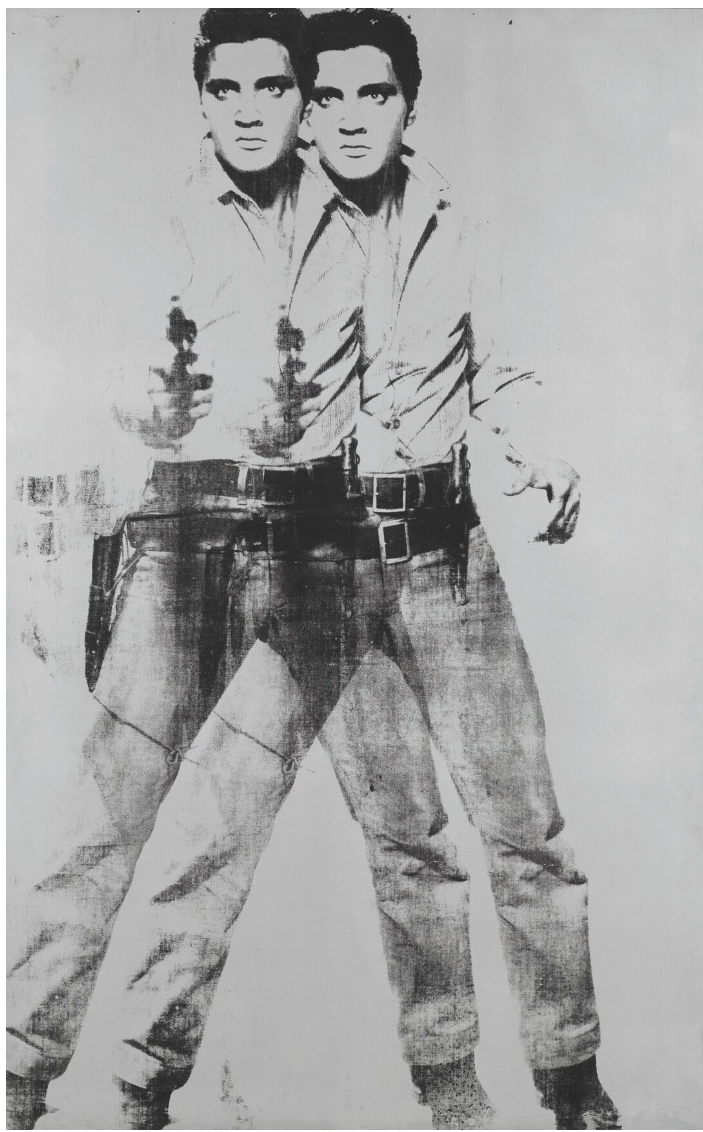
Andy Warhol, Double Elvis, 1963. Museum of Modern Art, New York. © 2023 The Andy Warhol Foundation for the Visual Arts, Inc. / Artists Rights Society (ARS), New York. Photo: © The Museum of Modern Art / Licensed by SCALA / Art Resource, New York.
Prince was a musical virtuoso, who left an unparalleled mark on the music world. With his extravagant style, supreme talent, and genre-defying approach to music, he became an icon of the 20th century. From Purple Rain to When Doves Cry, he weaved a sonic tapestry that encompassed funk, R&B, and pop. Beyond his musical prowess, Prince challenged conventions, embracing individuality, and advocating for artistic freedom. His enigmatic persona and electrifying stage presence made him a legend, and his legacy continues to inspire and resonate with individuals across the globe. With Prince reigning over the music industry and Warhol dominating the pop art scene, Warhol’s homage to Prince was inevitable.
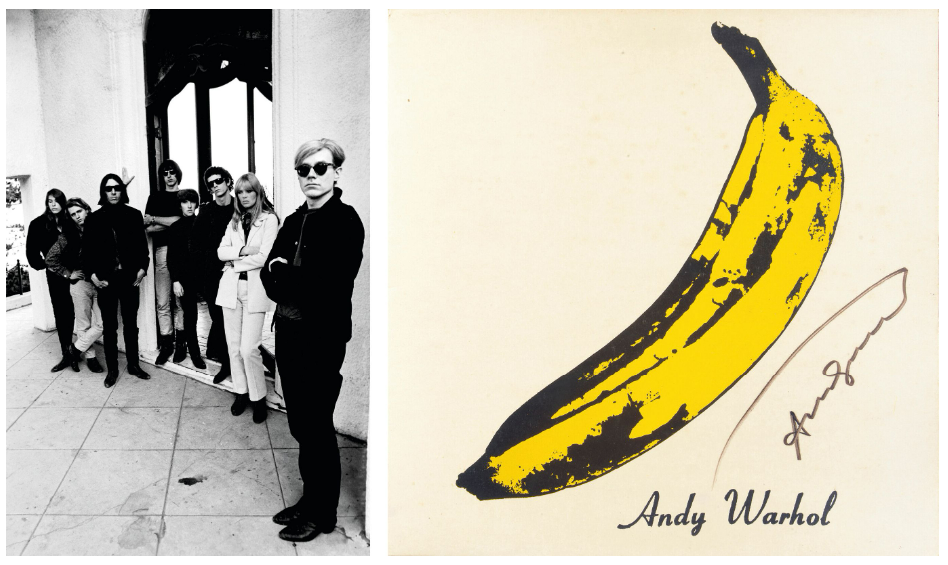
Left: Andy Warhol with The Velvet Underground, Los Angeles, 1966. Photo: Steve Schapiro / Corbis via Getty Images.
Right: Andy Warhol’s album cover for The Velvet Underground & Nico, 1967. © 2023 The Andy Warhol Foundation for the Visual Arts, Inc. / Licensed by Artists Rights Society (ARS).
Warhol’s musical collaborations extended far beyond the canvas of Prince. Former director of the Montreal Museum of Fine Arts, Nathalie Bondil, notes that Warhol was “the pop artist who wanted to be a pop star” (N. Bondil quoted in S. Aquin, Warhol Live: Music and Dance in Andy Warhol’s Work, Montreal, 2008, pg. 6). In 1965, Warhol started his legendary relationship with The Velvet Underground, one of the most notable rock bands of the age. He served as their manager as well as providing the band with artistic direction, and creating the classic banana peel cover for the band’s debut album. This collaboration not only introduced Warhol’s innovative artistic nature to the music world, but also pushed the boundaries of what music could be. Prince is a vibrant testament to the dynamic intersection of music and visual art, a celebration of two cultural behemouths who have left an indelible mark on their respective industries. Warhol’s unique visual langauge captures Prince’s larger-than-life personality and reputation, paying tribute to the pop star in the most fitting way. It brings together two artists who’s art defined a generation, cementing both men’s place in cultural history.
Gerhard Richter
Christie’s New-York: 10 November 2023
Estimated: USD 500,000 – 700,000
USD 630,000
GERHARD RICHTER (B. 1932) (christies.com)
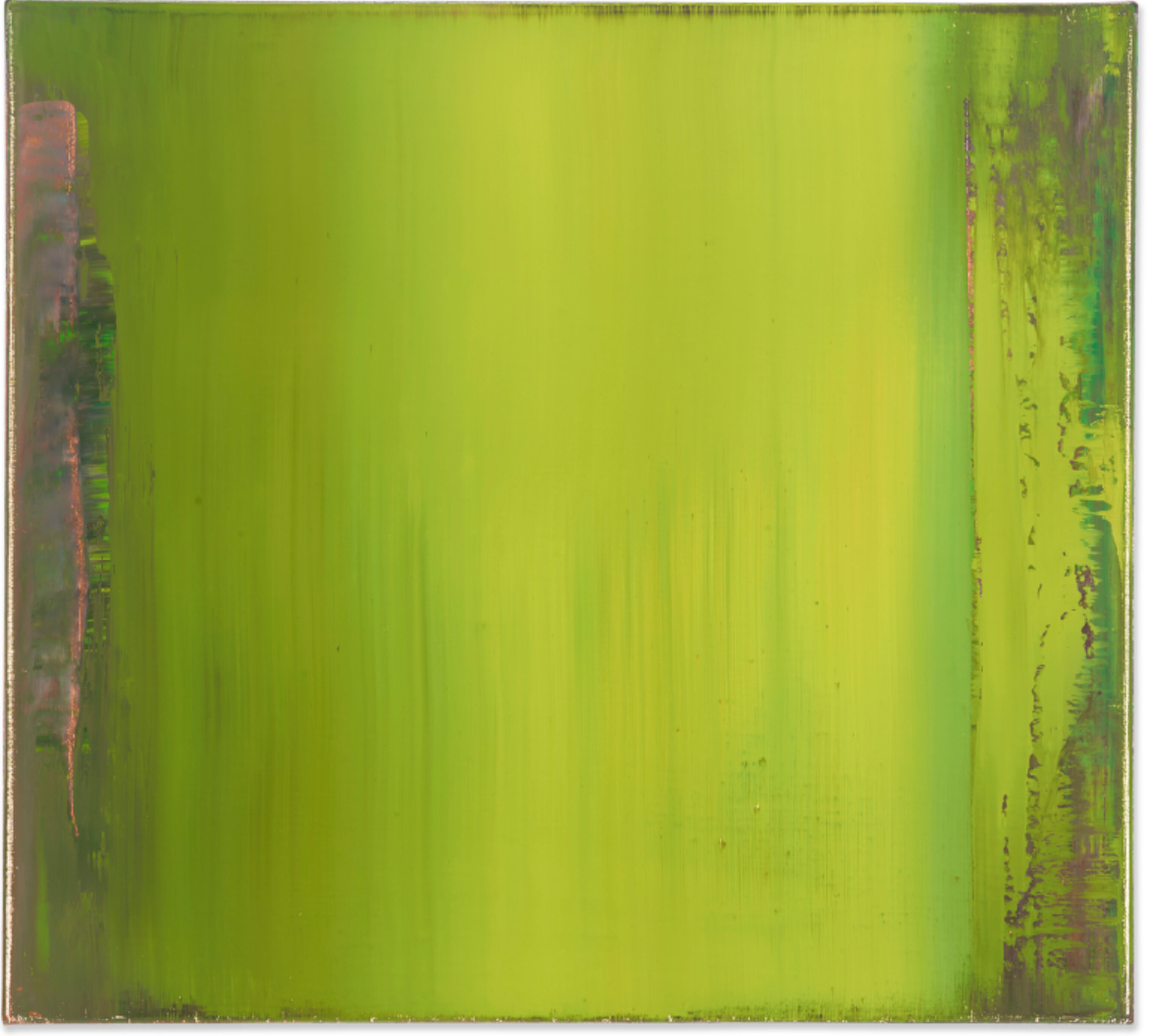
GERHARD RICHTER (B. 1932)
Abstraktes Bild, 1996
Oil on canvas
46.4 x 51.1 cm (18 1/4 x 20 1/8 inches)
Signed, inscribed and dated ‘836-3 Richter 1996’ (on the reverse)
Featuring a serene and otherworldly gradient of green-yellow punctuated by vertical swaths of Richter’s signature squeegee technique, Abstraktes Bild is a superlative example from Richter’s career-defining series reverberating on an intimate scale. In the present work, Richter manages to create a mirror-like surface that evokes watery depths, the banks of a secluded, forest pond, and the striations of precious gems and minerals. Glimmers of vibrant yellow shine through an impossibly smooth mossy gradient at center. The concentration of green-yellow soon flows into tantalizing ravines of effervescent pink and purple shades, unearthed by Richter’s vertical squeegee. The ethereal, atmospheric gradient of Abstraktes Bild combined with its intimate scale make this painting distinctly powerful. Although the painting is resolutely abstract, the richness of its colors and the intensity of its mystical depths conjures up the sublime, awe-inspiring paintings of the great German Romantics, such as Caspar David Friedrich. The present work is particularly exemplary in demonstrating how control and accident can coalesce to produce something striking and masterful. As in Richter’s greatest paintings, prolonged viewing of this work rewards the beholder. The luminous open center of green and yellow ripples with life, inspiring a wistful reverie and contemplation of the majesty of the natural world.
Rashid Johnson
Christie’s New-York: 10 November 2023
Estimated: USD 500,000 – 700,000
USD 630,000
RASHID JOHNSON (B. 1977) (christies.com)
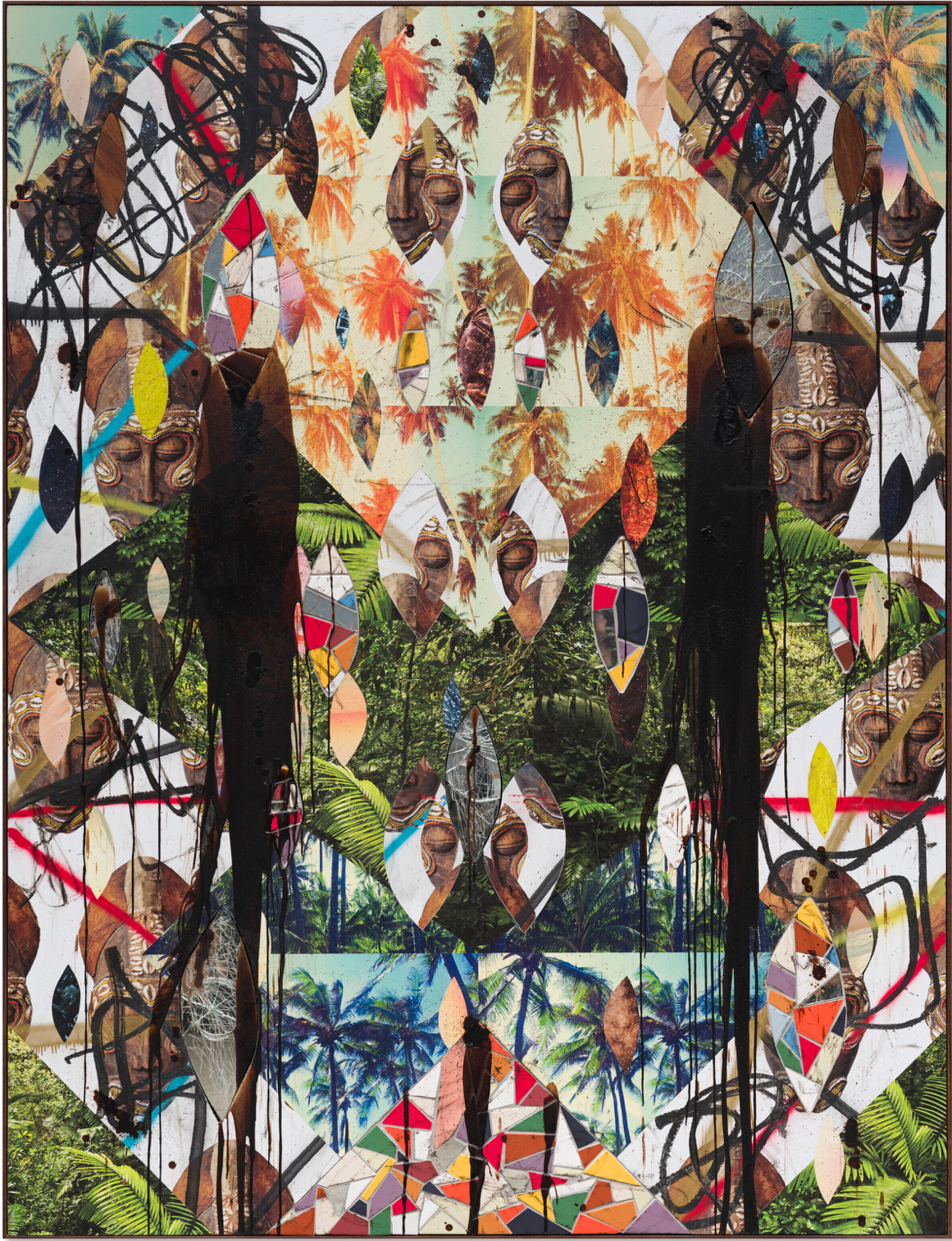
RASHID JOHNSON (B. 1977)
Untitled Escape Collage, 2021
Ceramic tile, mirror tile, branded red oak flooring, vinyl, spray enamel, oilstick, black soap and wax
94×72 inches (246.4 x 185.4 cm)
The hypnotic and hyperactive surface of Untitled Escape Collage is captivating example of Rashid Johnson’s artistic practice. Executed in 2021, Untitled Escape Collage is characterized, like Johnson’s oeuvre, by the dynamic interplay of imagery and materials. Here, Johnson sets the scene with a lush, tropical background. Images of palm trees and indigenous masks are then layered atop the mossy surface, creating a kaleidoscope effect amongst the materials and their respective subjects. His use of materials like ceramic tile and wax not only adds a unique tactile quality to his art but also imbues it with layers of symbolism and cultural references. In doing so, Johnson bridges the gap between traditional and contemporary art, making him a pivotal artist in the ongoing dialogue of art’s role in reflecting and influencing society. Johnson’s exploration of themes related to race, identity, and cultural heritage set him apart as an artist with a powerful and socially relevant message. Untitled Escape Collage serves as a testament to his ability to weave profound narratives, and provoke critical discussions within the realm of contemporary art. Through layers of symbolism and juxtaposition the present lot hits at the desire for liberation and escape.
Rashid Johnson
Christie’s New-York: 10 November 2023
Estimated: USD 450,000 – 650,000
USD 604,800
RASHID JOHNSON (B. 1977) (christies.com)
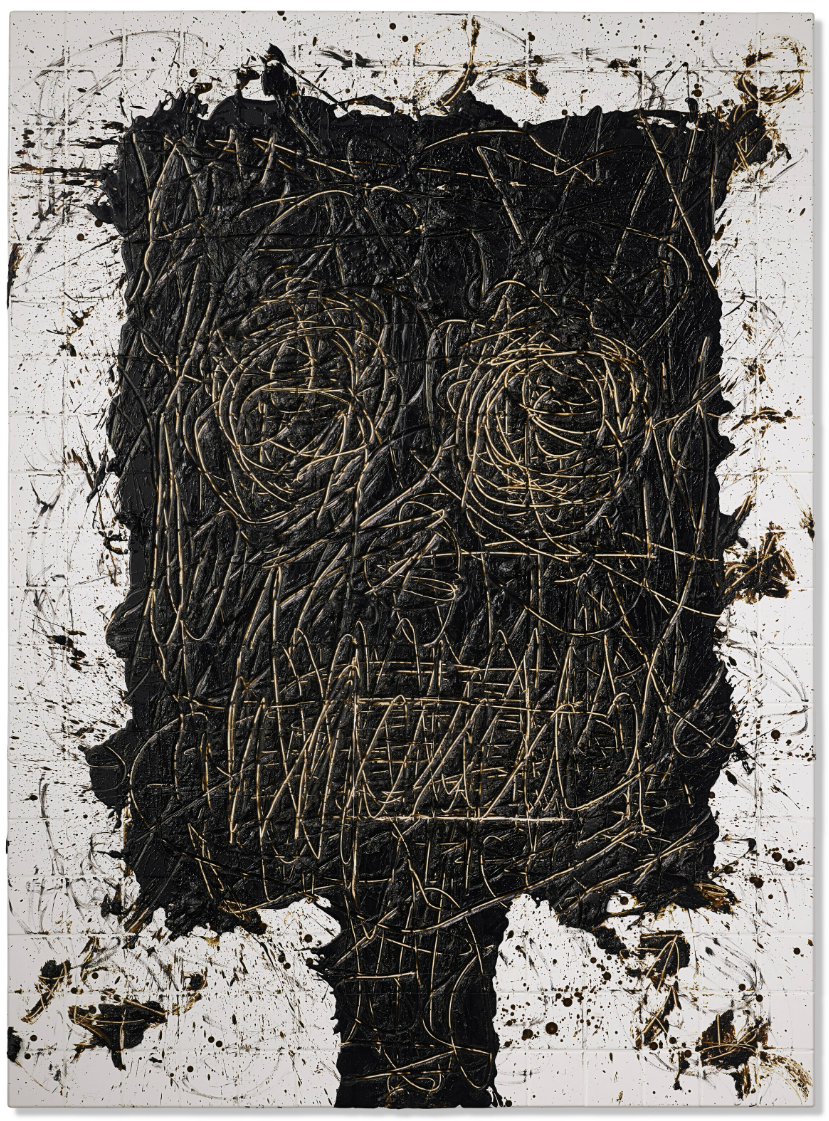
RASHID JOHNSON (B. 1977)
Untitled Anxious Men, 2015
White ceramic tile, black soap and wax
81 1/4 x 60 x 2 inches (206.4 x 152.4 x 5.1 cm)
Signed ‘Rashid Johnson’ (on the reverse)
“Fear is a stabilizer and anxiety is an alert system. There’s so many things happening today that my spidey sense goes off, and that’s my anxiety, and I’m happy to have it.”
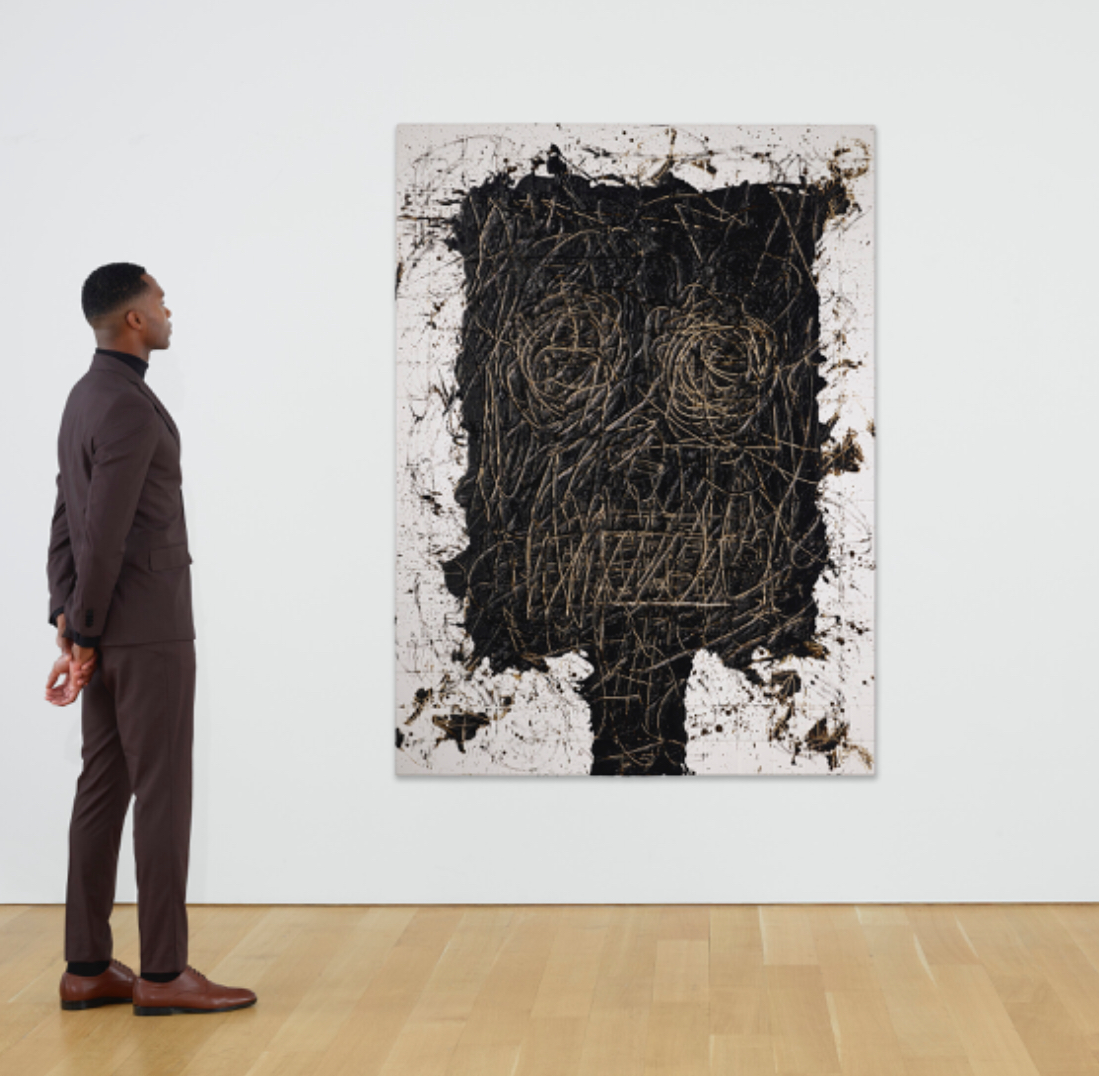
Keith Haring
Christie’s New-York: 10 November 2023
Estimated: USD 200,000 – 300,000
USD 478,800
KEITH HARING (1958-1990) (christies.com)
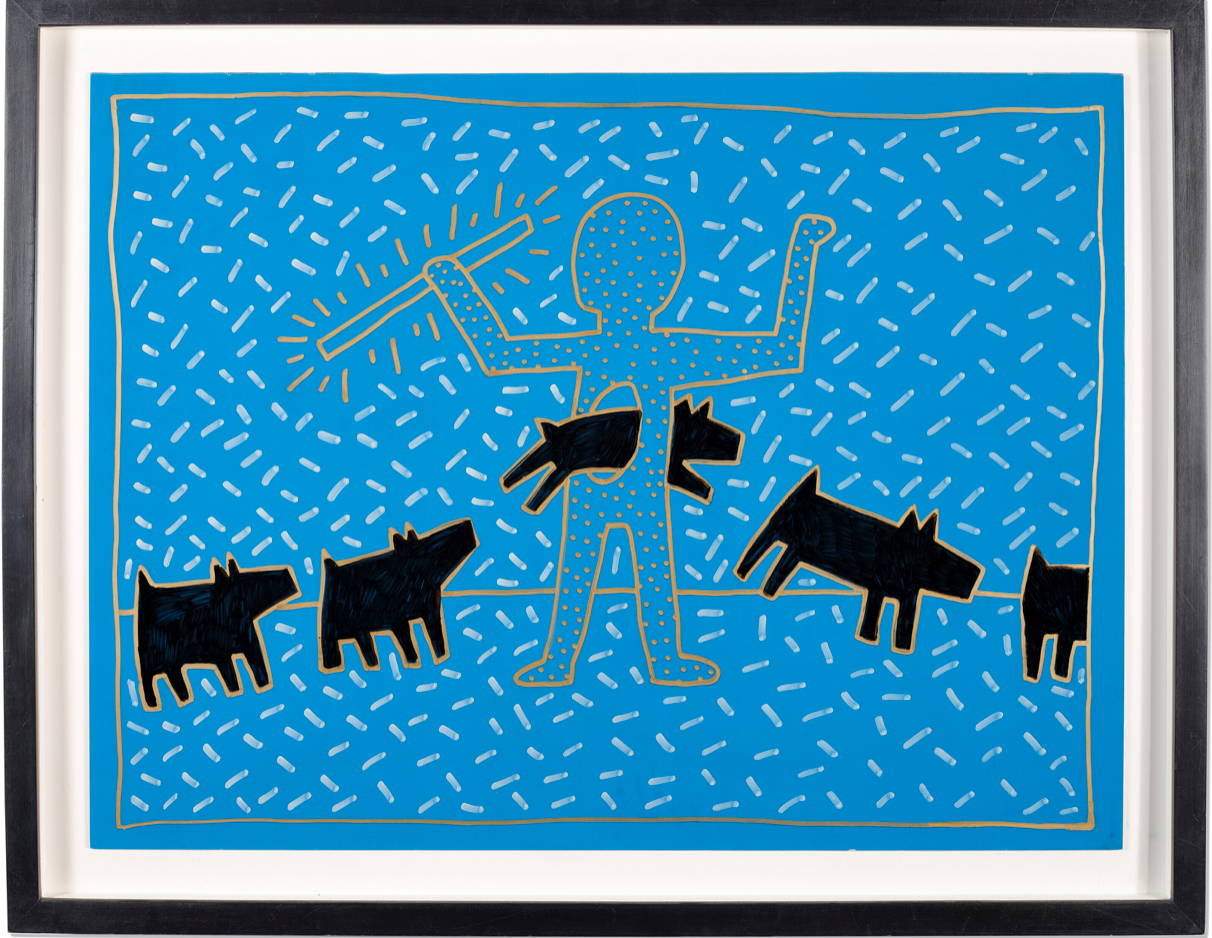
KEITH HARING (1958-1990)
Untitled, 1981
Felt-tip marker and paint pen on plastic
18×24 inches (45.7 x 61 cm)
Signed and dated ‘Keith Haring May 81’ (on the reverse)
Untitled (Blue) exudes a sense of movement and spontaneity. This, combined with the simplicity of Haring’s forms, creates an engaging and energetic visual experience, making Untitled (Blue) a classic and compelling Haring composition. Haring’s artistic style is marked by its distinctive and iconic characteristics. As shown in the present lot, Haring employed bold lines to create figures and shapes that are simple yet instantly recognizable. His use of vibrant, primary colors adds an unmistakably dynamic quality to his work. Untitled (Blue), from 1981, is a prime example of some of Haring’s most iconic motifs – the classic Haring dogs each jumping whimsically through the gold, spotted central figure, one by one – all against an eye-catching and vivacious blue background.
With deceivingly simple works like Untitled (Blue), Haring left an indelible mark on the art world. Haring’s fusion of graffiti, street art, and fine art challenged traditional artistic boundaries, democratizing art and bringing it to a wider audience. Beyond aesthetics, Haring’s work carried powerful messages about social and political issues. The artist’s commitment to using art as a tool for social change inspired countless artists and activists, and his influence can be seen in the evolution of street art and the embrace of art as a means of cultural and political expression.
Keith Haring
Christie’s New-York: 10 November 2023
Estimated: USD 300,00 – 500,000
USD 352,800
KEITH HARING (1958-1990) (christies.com)
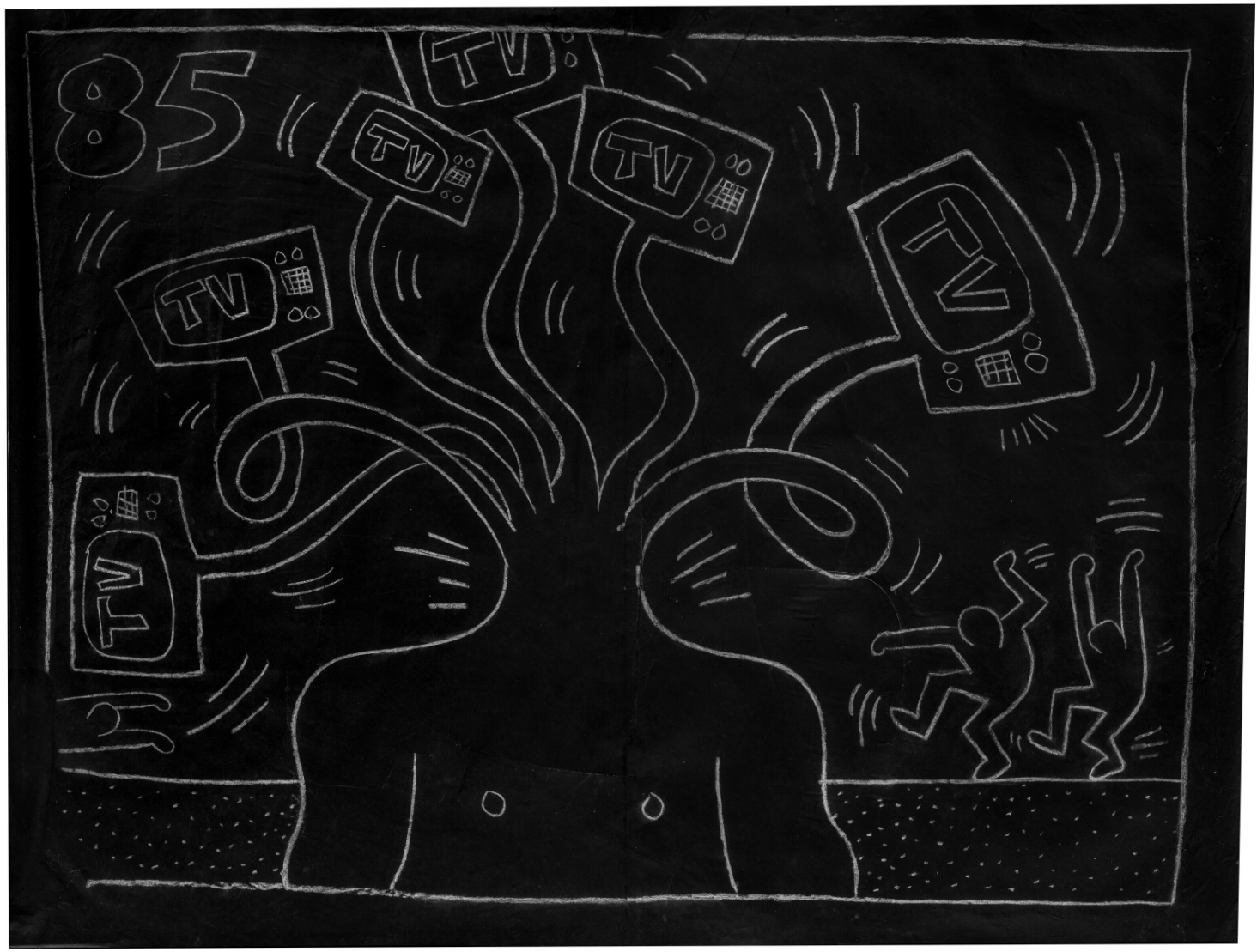
KEITH HARING (1958-1990)
Untitled (Subway Drawing), 1985
Chalk on black paper
45×60 inches (114.3 x 152.4 cm)
Dated ’85’ (upper left)
Andy Warhol
Christie’s New-York: 10 November 2023
Estimated: USD 300,000 – 500,000
USD 340,200
ANDY WARHOL (1928-1987) (christies.com)
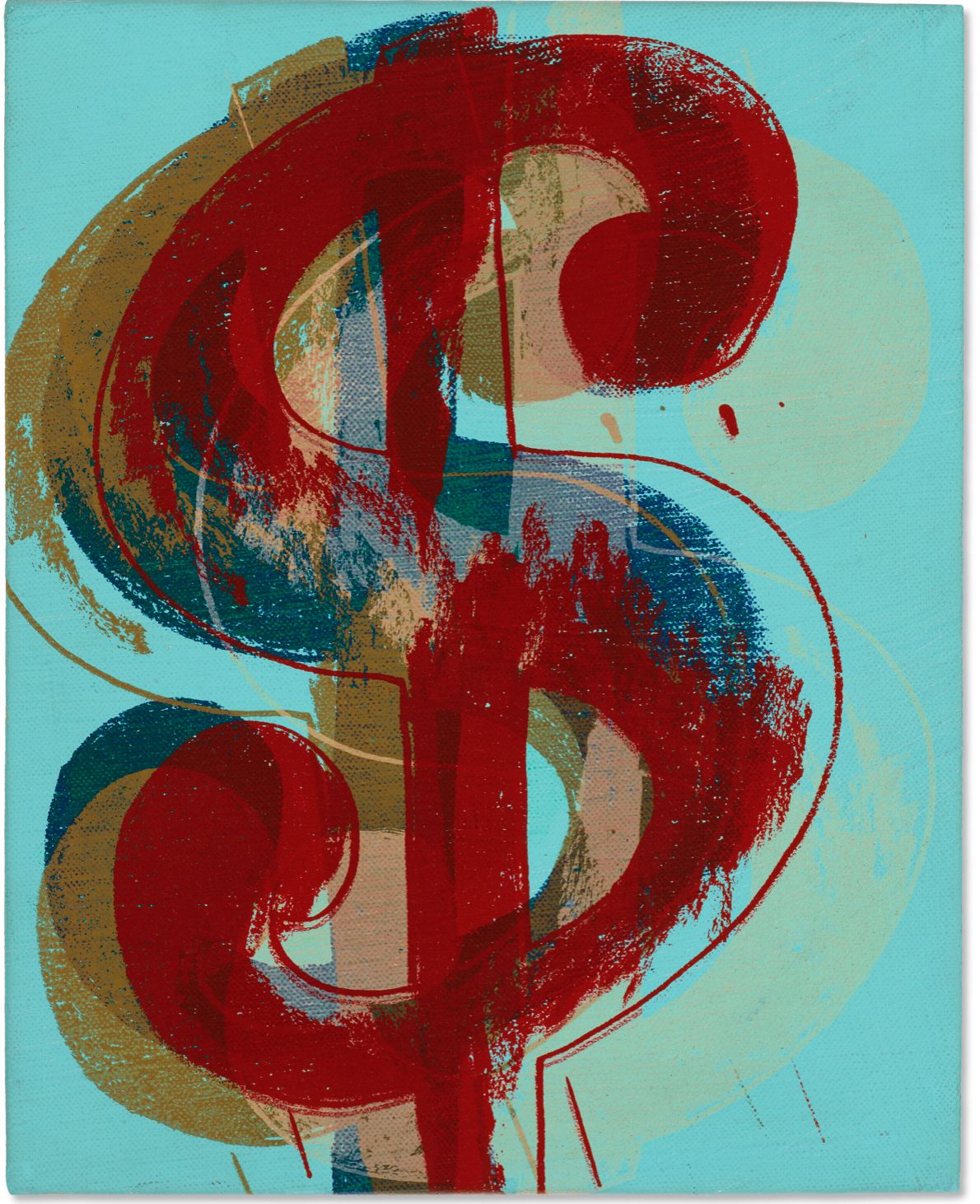
ANDY WARHOL (1928-1987)
Dollar Sign, 1981
Acrylic and silkscreen ink on canvas
10×8 inches (25.4 x 20.3 cm)
Signed, dedicated and dated ‘to Jennifer 81 Andy Warhol’ (on the overlap)
“Making money is art and working is art and good business is the best art.”
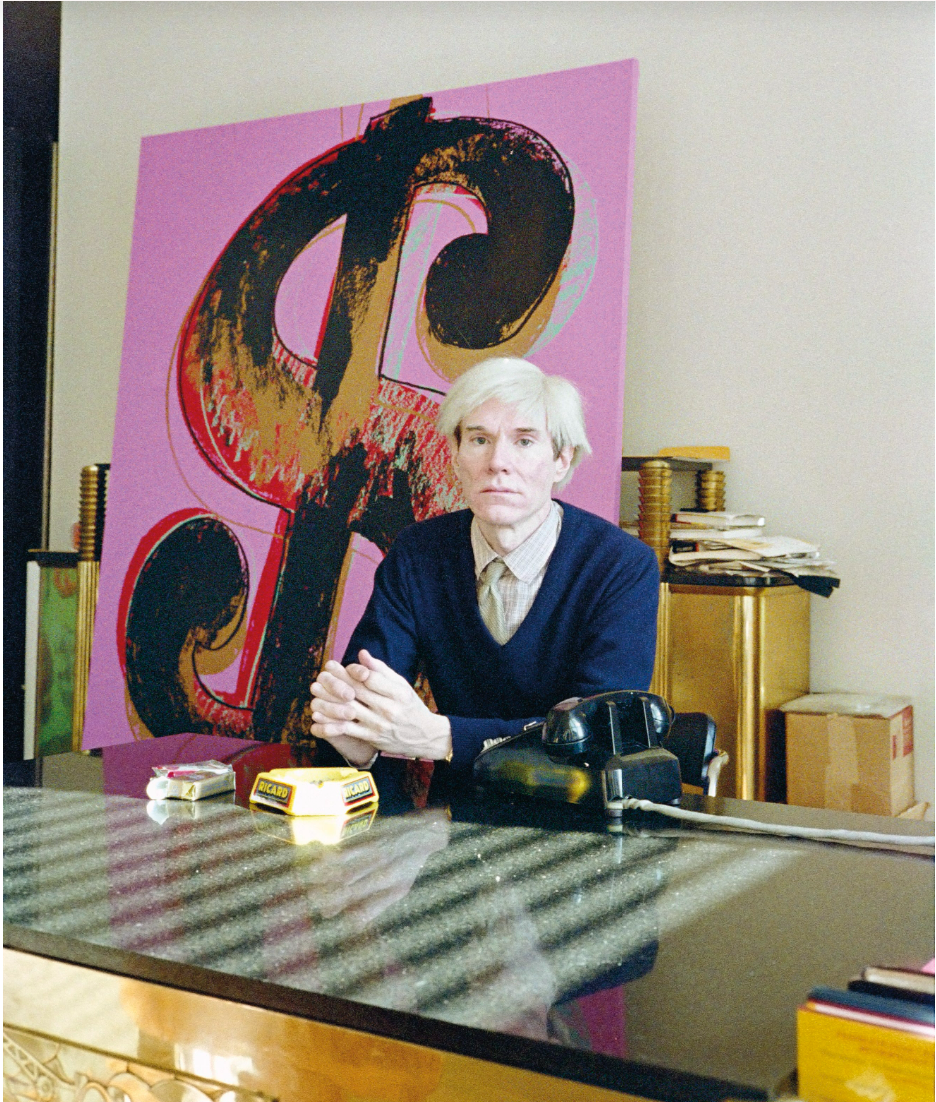
Warhol at his desk. Photograph: © Heiner Bastian. Artwork: © 2023 The Andy Warhol Foundation for the Visual Arts, Inc. / Artists Rights Society (ARS), New York.
5. Impressionist and Modern Art Day Sale
11 November 2023
Impressionist & Modern Art Day Sale (christies.com)
This auction is not covered by MMI
201 Lots
Total: USD 35,292,338
# Lots sold: 159
Sell-Through Rate: 79.1%
Top Lot: USD 3,438,000
8 Lots sold over USD 1 million
USD 15,767,000
(44.7% of total)
#1. Claude Monet
Christie’s New-York: 11 November 2023
Estimated: USD 1,500,000 – 2,500,000
USD 3,438,000
CLAUDE MONET (1840-1926) (christies.com)
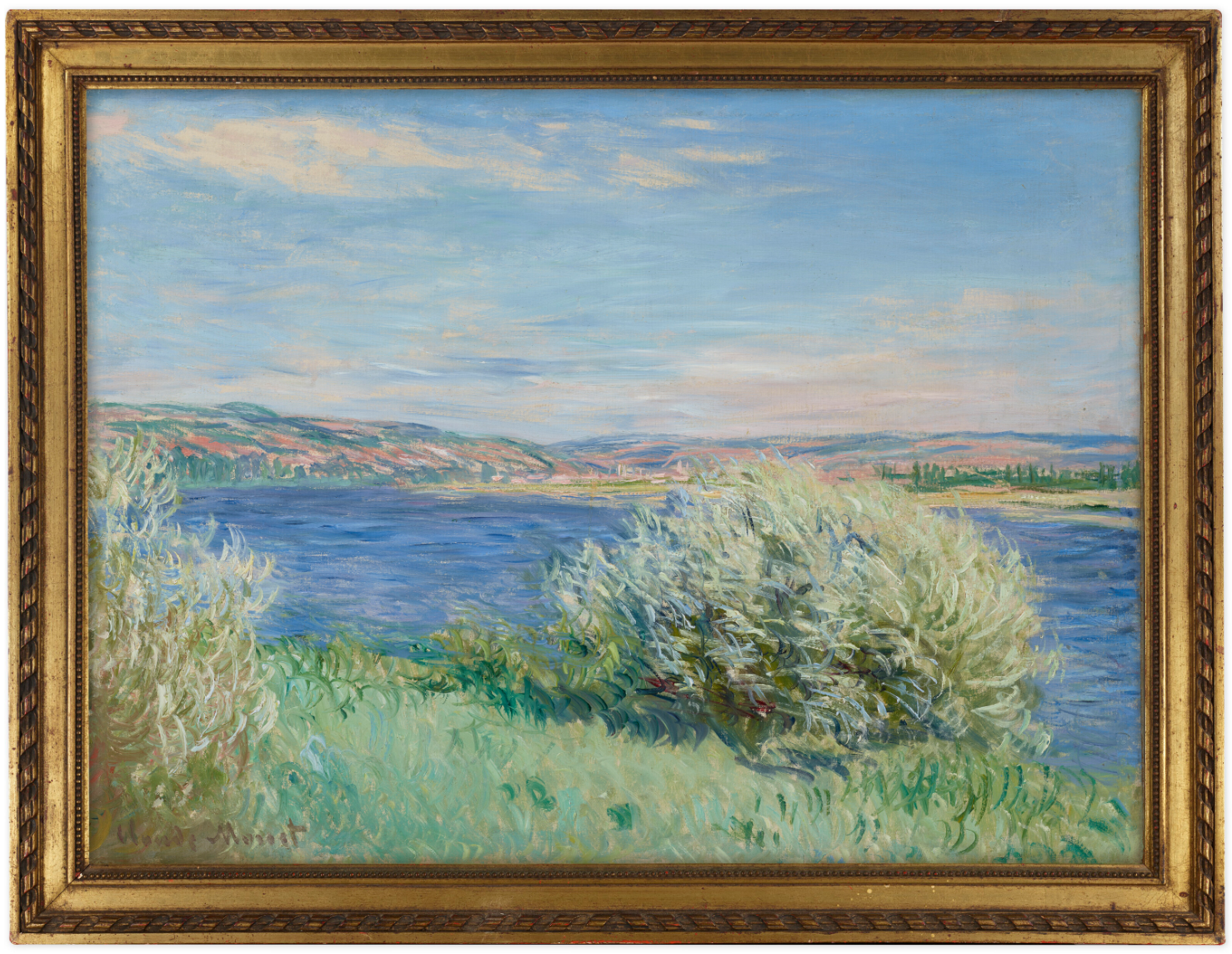
CLAUDE MONET (1840-1926)
Les bords de la Seine près de Vétheuil, 1881
Oil on canvas
58.4 x 78.7 cm (23×31 inches)
Signed ‘Claude Monet’ (lower left)
Unseen in public for nearly a century, Claude Monet’s exquisite Les cords de la Seine près de Vétheuil belongs to an important series of works depicting the landscape around the village where he lived and worked between 1878 and 1881. In 1878, beset with financial difficulties, Monet left the bustling suburban town of Argenteuil, his home since the Franco-Prussian war, and settled further down the Seine valley in Vétheuil, a small rural enclave. The appeal of Argenteuil had waned for the artist as the encroachment of modernity—new factories, expanded rail service, and a burgeoning tourist industry—increasingly disrupted its bucolic calm. Vétheuil, sparsely populated and situated on a wide oxbow bend of the river Seine, provided ample inspiration for Monet.
3. Phillips
1. The Triton Collection Foundation, Evening Sale Part I
2. 20th Century and Contemporary Art, Evening Sale Part II
3. 20th Century and Contemporary Art Day Sale, Morning Session
4. 20th Century and Contemporary Art Day Sale, Afternoon Session
1. Living the Avant Garde: The Triton Foundation Collection Evening Sale Part I
14 November 2023
Living the Avant-Garde: The Triton Collecti… New York November 2023 (phillips.com)
Living the Avant-Garde: The Triton Collection Foundation brings together thirty masterworks from the course of art history. These works span a century of innovation in the visual arts, and represent the key artists and movements that define our contemporary understandings of art and artistry. The Triton Collection Foundation gathered together this impressive group over the course of forty years, a testament to the discernment and commitment of the collectors, and the art historical significance of each individual work.
Auction Statistics
30 Lots
Low Estimate: USD 73,290,000
High Estimate: USD 104,750,000
Total: USD 84,719,440
# Lots sold: 30
Sell-Through Rate: 100%
Top Lot: USD 17,625,000
19 Lots sold over USD 1 million
USD 405,025,100
(99.7% of total)
9 Lots sold over USD 10 million
USD 330,351,500
(81.3% of total)
Above Estimates: 5 Lots (16%)
Within Estimates: 19 Lots (61%)
Below Estimates: 6 Lots (19%)
Estimate on Request: 1 Lot (3%)
Top 5 Lots
#1. Fernand Leger
Phillips New-York: 14 November 2023
Estimated: USD 15,000,000 – 20,000,000
USD 17,625,000
Fernand Léger – Living the Avant-Ga… Lot 10 November 2023 | Phillips
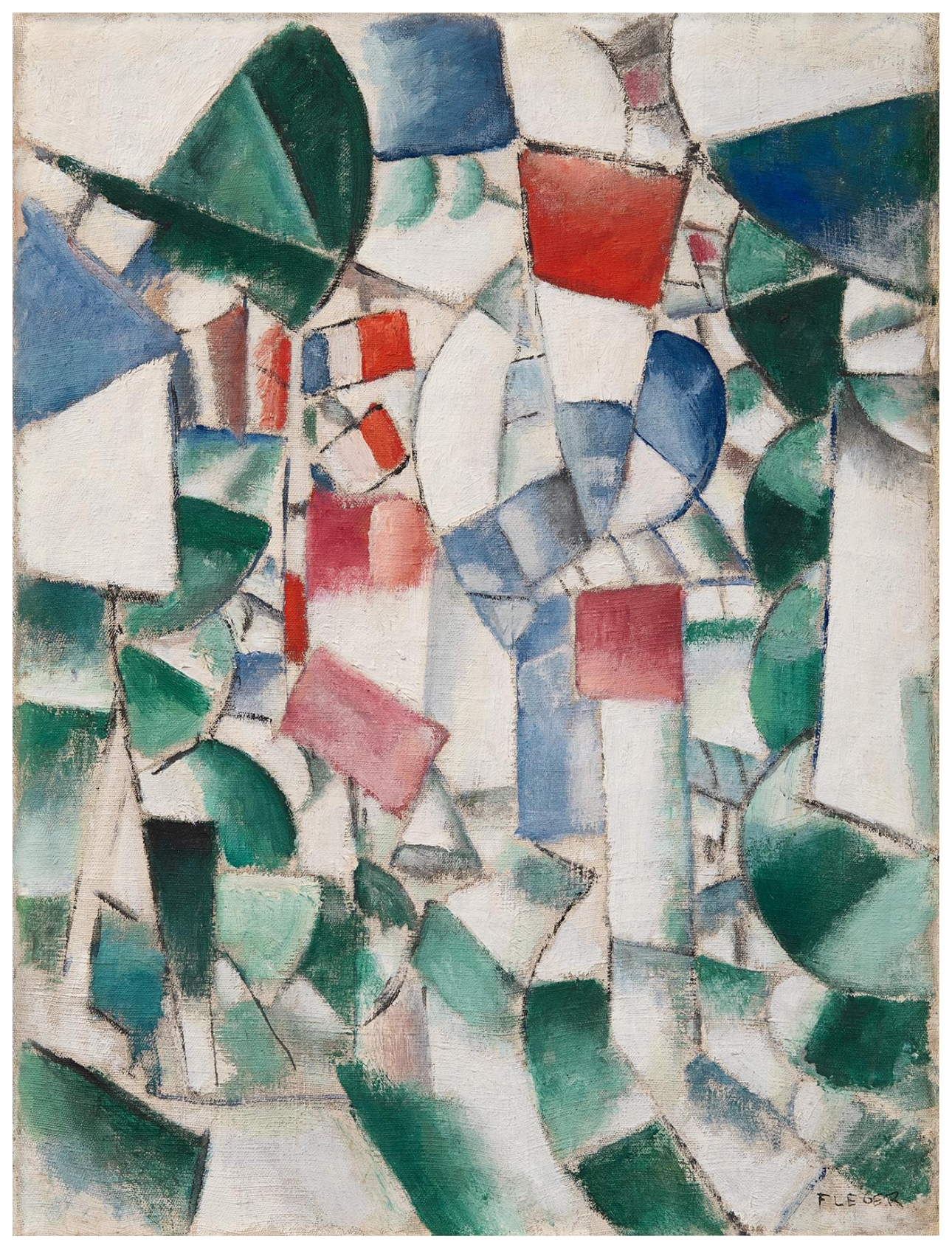
FERNAND LEGER
Le 14 juillet, 1912-1913
Oil on canvas, double-sided
60 x 45.7 cm (23 5/8 x 17 7/8 inches)
Signed “F LEGER” lower right
Lively and utterly absorbing, its joyous blend of bold colors and confidently realized forms deftly capturing the jubilance of the festival day that it commemorates, Fernand Léger’s Le 14 juillet is a work of remarkable significance, both within the contexts of the artist’s oeuvre, and as a record of his profound contribution to the development of Cubism in these pivotal years. Executed between 1912 and 1913, it crystalizes Léger’s unique application of Cubist principles in his own pictorial idiom, and epitomizes his celebrated Contrastes de formes series, examples of which are now almost all housed in prestigious institutional collections across the world. Remarkably, this work includes a second painting on the verso, an earlier work, long believed to have been lost, that further emphasizes the consistency of Léger’s vision. Representing a major art historical discovery, the identification of the hidden work as belonging to Léger’s Fumées sur les toits series—of which only seven other examples are known—not only illuminates the pictorial problems that the artist was working through across these two cycles of work, but reinforces the important conceptual and stylistic connections between the two.
Bastille Day celebrations at Place de la Concorde, July 14, 1919. Image: Bridgeman Images
First gifted by the artist to his close friend Marc Duchène on the occasion of his wedding, Le 14 juillet remained in the family’s collection for generations. Following Duchène’s premature death in service during the First World War, the work was removed from display in the family’s home. Writing to Louis Poughon on the 3rd of November, 1914 that the news of Duchène’s death had “broken my legs,” Léger powerfully expressed the depth of this personal loss, and of its resonance on a more collective level during this tumultuous period. Acquired by the Triton Collection Foundation in 1999, Le 14 juillet; Untitled from the series Fumées sur les toits represents a Cubist jewel in this illustrious collection and formed the focus of a major presentation of the Fumées sur les toits series in the 2022 exhibition, Fernand Léger and the Rooftops of Paris, hosted by the Kröller-Müller Museum, Otterlo.
#2. Pablo Picasso
Phillips New-York: 14 November 2023
Estimated: USD 15,000,000 – 20,000,000
USD 14,762,500
Pablo Picasso – Living the Avant-Ga… Lot 16 November 2023 | Phillips
PABLO PICASSO
Femme en corset lisant un livre, 1914-1918
Oil and sand on canvas
91.8 x 60.3 cm (36 1/8 x 23 3/4 inches)
A tender and lyrical portrait first commenced in Avignon circa 1914, Femme en corset lisant un livre documents the pivotal shifts in the visual language of Cubism pursued by Pablo Picasso in the years following the height of the movement’s so-called “Analytic” phase, pioneered by himself and Georges Braque between 1908 and 1912. While this earlier stage of Cubism was characterized by restricted palettes, and a fracturing of solid form and the space surrounding it to enable the simultaneous presentation of multiple perspectives on a single plane, its second “Synthetic” period was announced through the incorporation of color, texture, and the material of everyday life into their compositions. Although the interruption of the First World War and relocation of many artists (including Braque) to the front marked a natural end to the spirit of collaboration and creative exchange that had defined this era, Picasso would carry these lessons forward into his painting during these years as new personal and professional opportunities introduced a more playful note to these later Cubist experiments.
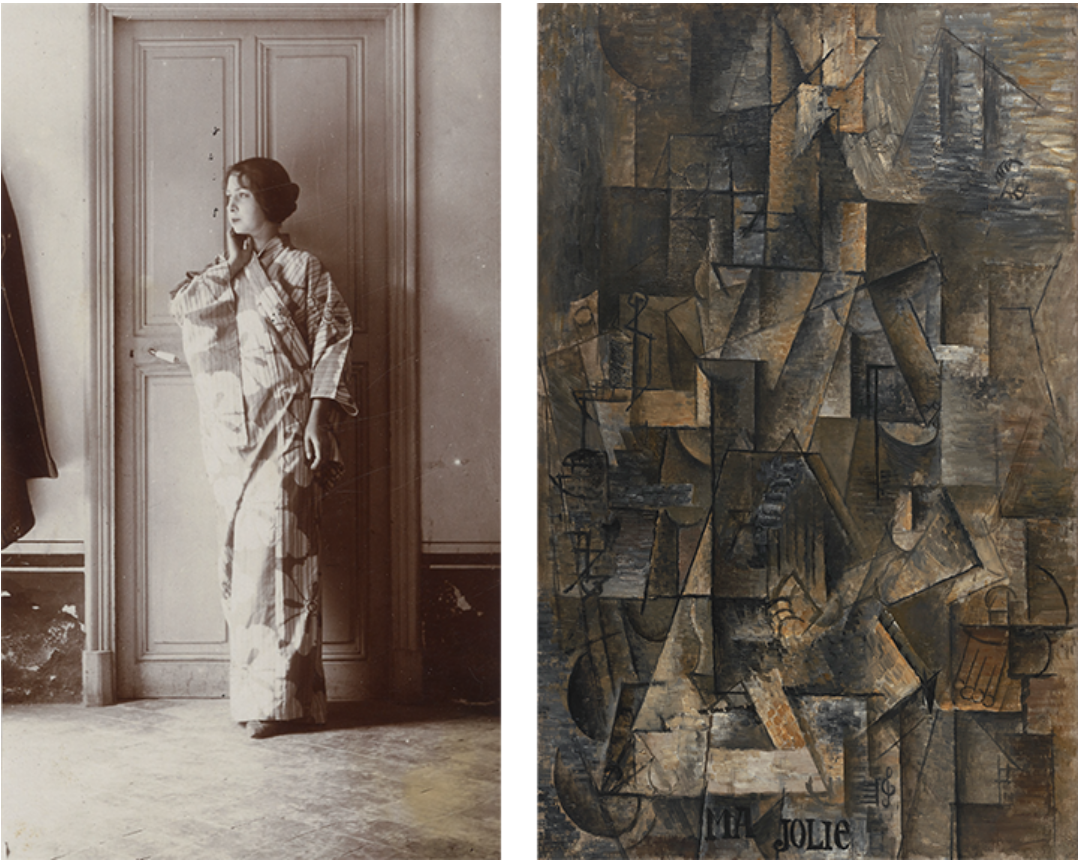
[Left] Eva Gouel, Picasso Archives. Image: Yale University Art Gallery, Beinecke Rare Book and Manuscript Library
[Right] Pablo Picasso, Ma Jolie, 1911-12. The Museum of Modern Art, New York. Image: © The Museum of Modern Art/Licensed by SCALA / Art Resource, NY, Artwork: © 2023 Estate of Pablo Picasso / Artists Rights Society (ARS), New York
Bold and beautiful, Femme en corset lisant un livre exemplifies the lessons learned from this intensive period of radical experiment in the years before war. The flattened sense of pictorial space, complex compositional arrangement, and playful interactions of color, texture, and pattern are all hallmarks of Picasso’s evolving style in these pivotal years. An intimate and innovative depiction of his muse and lover Eva Gouel, commenced just one year before her untimely death, and returned to in the years following, it also marks a triumphant reappraisal of portraiture that would henceforth come to define the artist’s oeuvre more completely than any other genre.
#3. George Braque
Phillips New-York: 14 November 2023
Estimated: USD 7,000,000 – 10,000,000
USD 8,465,000
Georges Braque – Living the Avant-Ga… Lot 5 November 2023 | Phillips
GEORGES BRAQUE
La bouteille de Bass, 1911-1912
Oil on canvas
41 x 32.5 cm (16 1/8 x 12 3/4 inches)
Signed “G Braque” on the reverse
Painted in 1911-1912, within the short period of intensive creative exchange and ferment that would mark the high point of the early, analytical phase of Cubism, George Braque’s La bouteille de Bass is an exceptional work from this defining chapter of painterly modernism. Working, as Braque would famously term it, like “a pair of climbers roped together,” he and Picasso would scale remarkable heights in these decisive years, pushing painting into radical new territory as they overturned centuries of pictorial tradition. While they had worked closely together in Paris, the innovations of one inspiring further feats of painterly daring in the other, in the spring of 1911 Braque was leading the charge. As John Richardson details, it was Braque who intensified the Cubist grid with the introduction of oval canvases, and who first applied stencil lettering to his compositions, experiments that would be most fully interrogated and extended by the two artists in Céret that summer, where they worked more closely together than ever before. While Picasso would redefine the terms of Cubist perspective, it was Braque who “invented the space in which Cubist objects could live and breathe.”
#4. Joan Mitchell
Phillips New-York: 14 November 2023
Estimated: USD 4,000,000 – 6,000,000
USD 7,892,500
Joan Mitchell – Living the Avant-Ga… Lot 20 November 2023 | Phillips
JOAN MITCHELL
Untitled, 1953
Oil on canvas
96 1/8 x 77 1/4 inches (244.2 x 196.2 cm)
Signed “J. Mitchell” lower right
Dynamic and vivid, Untitled, c. 1953, encapsulates the stylistic innovations forged by Joan Mitchell in a transformative period of her career. This early, large-scale masterpiece dates to the brief time in which the artist lived in Manhattan and established herself as a strong new voice amongst her predominately male Abstract Expressionist peers. With Untitled, Mitchell engages the practices and techniques of Willem de Kooning and Franz Kline, while pushing her own idiosyncratic, impassioned brushstroke to ever greater heights. Untitled sees an artist coming into her own: it functions as a bridge between Mitchell’s earliest canvases and the brightly colored, explosive compositions that she would go on to create in France.
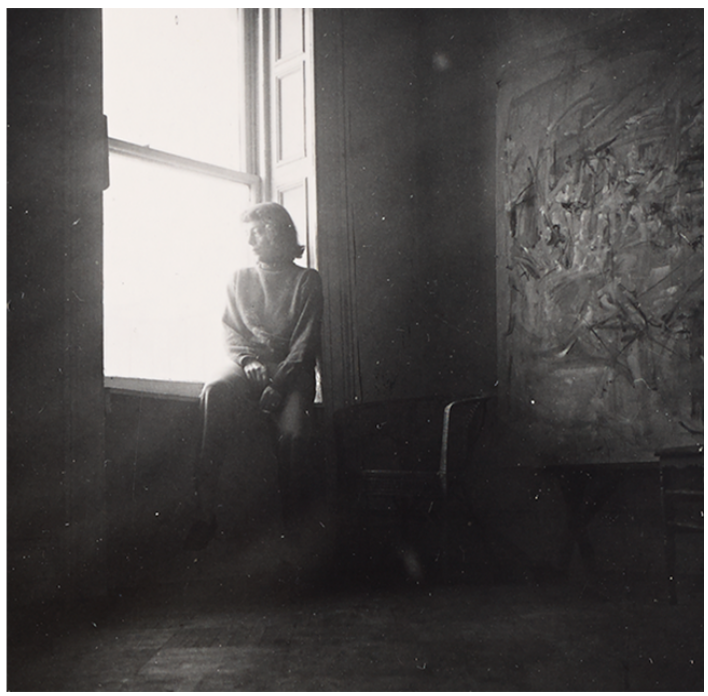
Joan Mitchell in her St. Mark’s Place studio, c. 1954. Image: Photo by Walter Silver. © The Miriam and Ira D. Wallach Division of Art, Prints and Photographs: The Photograph Collection, The New York Public Library
Painted circa 1953, Untitled belongs to a body of work which scholars have identified as one of the most critical in Mitchell’s entire career; the work was one of just three selected to represent this essential year in Mitchell’s posthumous retrospective at the Whitney Museum of American Art, New York, in 2002. As Nils Ohlsen explains, “a fundamental change occurred in Mitchell’s painting in the year 1952. By taking a decisive step away from the painted form to the autonomous brushstroke or gesture, she appeared to be expressing a radically changed view of what painting is… Color and composition no longer served Mitchell as a means of creating illusions in a very abstracted form, but instead became the actual purpose of the painting. The organization of the painted plane was identical with the spontaneous and direct form of artistic expression.”i
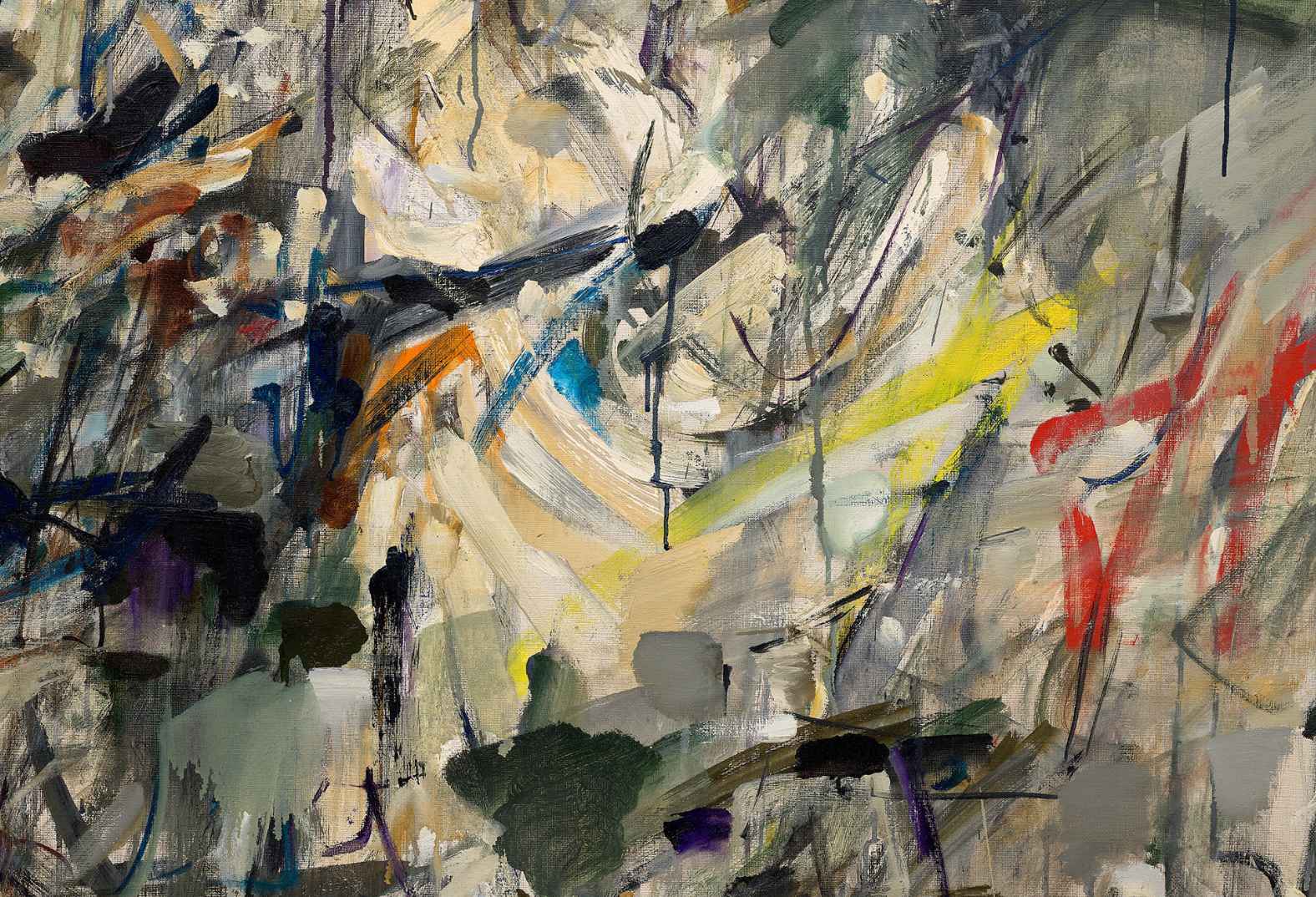
This fundamentally changed organizational principle for painting is clearly evident in the composition of Untitled. The work, as a bright, whirling mass of layered brushstrokes, is a painted record of Mitchell’s embodied, emotive practice. The composition trails along an x-shaped structure, with quick, thin, darker marks tracking from lower left to upper right, and a cascade of looser, grey and green marks from upper left to lower right. At the massive scale of Untitled, these brushstrokes express the widest reach of Mitchell’s body and paintbrush, emphasizing the full-body experience of painting.
#5. Amedeo Modigliani
Phillips New-York: 14 November 2023
Estimated: USD 4,000,000 – 6,000,000
USD 5,868,000
Amedeo Modigliani – Living the Avant… Lot 2 November 2023 | Phillips
AMEDEO MODIGLIANI
Tête de jeune fille (Louise), 1915
Oil on board
50.9 x 37.2 cm (20 x 14 5/8 inches)
Signed “Modigliani” upper left
With its near-sculptural use of paint, in brushstrokes built up in varying tones to give dimension to the face and head of the sitter, Tête de jeune fille (Louise) is a portrait of remarkable immediacy and intensity. Painted in 1915 during a pivotal moment in Amedeo Modigliani’s career, where the artist returned with force to painting after a period dedicated to his sculptural practice, Tête de jeune fille (Louise) draws on a range of stylistic influences, synthesized through the artist’s distinctive pictorial idiom and refined into what he would term “Le grand style.” Rendered in warm, terracotta tones with flushes of pink, and darker notes vibrantly accented by bold brushstrokes in blue and green, Tête de jeune fille (Louise) demonstrates the sophistication of Modigliani’s handling of paint. In keeping with Modigliani’s stylistic development during these crucial months, we can see all of the characteristics of his early style—the “importance of black in structuring the picture; mid-length, frontal figures against an indeterminate, deliberately rough background; the absence of details and the beginnings of distortion”—pushed in sophisticated new directions. With her elongated neck, elegantly sloping shoulders, and distinctive almond eyes, Tête de jeune fille (Louise) demonstrates the significant developments made in this important year towards realizing the artist’s signature style, notably in the more stylized treatment of her features and darker construction of the eyes that would be such a prominent feature of his portraits in the following years.
Amedeo Modigliani, Little Louise, 1915. Private Collection. Image: © Christie’s Images / Bridgeman Images
Although little is known about the sitter, Modigliani returned to her several times between 1914 and 1917, first in a sensitively rendered watercolor, in which she appears with the same dark headscarf that accentuates the smooth curve of her forehead and rounded face. The present work is most closely related to a slightly larger portrait, Little Louise, 1915, showing the model in the same pose, but presented in a three-quarter seated view. In focusing more directly on the face and head of the titular Louise with disarming directness in Tête de jeune fille (Louise), Modigliani generates a profound psychological charge, adding a note of sensuality in the delicate rendering of her gently parted lips and blushed cheeks. Just as in his earliest years in Paris, when the artist was based in Montmartre and painted his friends and neighbors gravitating around the rue du Delta, he resumed this practice when he returned to painting in 1915. Modigliani created portraits of the cosmopolitan collection of writers, dealers, and artists gathered around the bars and studios of Montparnasse including the likes of Chaïm Soutine, Juan Gris, and Moïse Kisling. As in Tête de jeune fille (Louise), the more closely cropped format of these bust portraits, and the sense of tender familiarity between artist and model that they document, work together to “underscore the intimacy and immediacy with which the artist approached his subject.”
Other Highlights
Jean Dubuffet
Phillips New-York: 14 November 2023
Estimated: USD 4,000,000 – 6,000,000
USD 4,900,000
Jean Dubuffet – Living the Avant-Gar… Lot 8 November 2023 | Phillips
JEAN DUBUFFET
Inspecteurs Sinoque et Dingue, 1967
Acrylic on canvas
129.9 x 162.2 cm (51 1/8 x 63 7/8 inches)
Signed and dated “J. Dubuffet 67” lower left
Signed, titled and dated “Inspecteurs Sinoque et Dingue J. Dubuffet janvier 67” on the reverse
With its squiggling, black-outlined forms, and red, white, and blue color palette, Inspecteurs Sinoque et Dingue, 1967, is a summative example of Jean Dubuffet’s L’Hourloupe series. An expansive body of drawings, paintings, and sculpture created between 1962 and 1974, L’Hourloupe grew out of Dubuffet’s subconscious, originating in a ballpoint pen doodle that the artist drew absentmindedly while on the telephone. The series had a devoted exhibition at the Solomon R. Guggenheim Museum, New York, one year prior to the present work’s facture, indicating that Inspecteurs Sinoque et Dingue dates to a peak of Dubuffet’s international recognition for L’Hourloupe. Though it belongs to such a large body of work, Inspecteurs Sinoque et Dingue has a robust exhibition history, including three shows in three different countries in 1968 alone, indicating, from the start, that Inspecteurs Sinoque et Dingue has been seen as a representative L’Hourloupe work.
Roy Lichtenstein
Phillips New-York: 14 November 2023
Estimated: USD 1,500,000 – 2,000,000
USD 1,996,000
Roy Lichtenstein – Living the Avant… Lot 15 November 2023 | Phillips
ROY LICHTENSTEIN
Woman Contemplating a Yellow Cup (Study), 1994
Tape, cut painted paper, cut printed paper and graphite pencil on board
36 1/8 x 44 3/4 inches (91.8 x 113.7 cm)
Signed and dated “Rf Lichtenstein ’94” on the reverse
The female figure made a triumphant reappearance in Roy Lichtenstein’s images in the 1990s, thirty years after his seminal Girl paintings. However, in this late body of work, the women have been lifted from their contrived, comic book settings to navigate worlds replete with motifs spanning the artist’s 50-year corpus. Often nude, they were birthed from his concurrent Interiors series that caricatured the sterile representations of Post-War bourgeois domesticity found in Architectural Digest spreads and Yellow Pages advertisements. First contained within decorative paintings on the walls, these women soon began to inhabit these homes themselves, their likeness as satirically commodified as the pristine furnishings which surrounded them.
“I don’t think the importance of the art has anything to do with the importance of the subject matter. I think importance resides more in the unity of the composition and in the inventiveness of perception.”
Woman Contemplating a Yellow Cup (Study) exemplifies this remarkable chapter of work Lichtenstein executed in his final years, an introspective group of images that brought his career full circle. Created in 1994, the collage prefigures a larger aluminum wall relief created the following year with a similar composition. A disembodied woman’s head peers into one of Lichtenstein’s immaculate rooms, empty spaces. The room is not a lived-in space but a liminal one: there is no evidence that anyone has ever drank from the cup perfectly placed on a small table or sat on the well-fluffed chair behind it. Even more disorienting is how the very vertical, horizontal, and diagonal lines that are meant to establish a three-dimensional configuration undermine it. A crooked border cuts off the bottom of the image; not entirely defined, the chair cushions disappear into space. These inconsistencies are reminiscent of printing glitches, collapsing the illusion of depth and disrupting any pictorial coherency.
Caspar David Friedrich, Woman at a Window, 1822. Alte Nationalgalerie, Berlin. Image: © NPL – DeA Picture Library / Bridgeman Images
The contouring suggested by Ben-Day dots, Lichtenstein’s stock-in-trade, further complicate the spatial logic of Woman Contemplating a Yellow Cup (Study). The artist’s subjects “are part light and shade, and so are the backgrounds, with dots to indicate the shade,” Lichtenstein elucidated.
“The dots are also graduated from large to small, which usually suggests modeling in people’s minds, but that’s not what you get with these figures.”
Though they allude to the building blocks of draftsmanship and rudimentary chiaroscuro, the dots here simply figure as a two-dimensional decorative patterning: by not corresponding to any conceivable delineation of positive and negative place, they ironically emphasize the flatness of the picture plane instead of concealing it. The formal idiosyncrasies of Woman Contemplating a Yellow Cup (Study) represent the culmination of Lichtenstein’s career-long efforts to convey a complete deconstruction of three-dimensional space. Though the protagonist is depicted as a Rückenfigur—a common art historical motif translating to “figure from the back”—it is clear by her perfectly-kept hair, gently tied back with a ribbon, that she epitomizes the Post-War feminine ideal. Lichtenstein’s often-blonde bombshells were typically sourced from 1960s romance comic books, which are evoked by the present work’s close-up framing and narrative simplicity. Within her field of vision is an emblem of Lichtenstein’s engagement with the lexicon of modernism—an enigmatic framed image harkening back to his “Surrealist” period in the late 1970s. The composition is particularly reminiscent of Pablo Picasso’s abstracted portrayals of his lover Marie-Thérèse Walter from the 1930s, which Lichtenstein was reminded of in 1994 when he visited the exhibition Picasso & the Weeping Women at the Metropolitan Museum of Art in New York. These feminine icons of the 20th century—Picasso’s women and Lichtenstein’s girls—meet in the present work, representing a direct confrontation between the “high culture” of modern painting and the “low culture” of comic book illustration.
2. 20th Century and Contemporary Art Evening Sale Part II
14 November 2023
20th Century & Contemporary Art, Evening Sa… New York November 2023 (phillips.com)
Auction Statistics
30 Lots
Low Estimate: USD 42,710,000
High Estimate: USD 59,840,000
Estimate on Request: 1 Lot
Total: USD 69,930,350
# Lots withdrawn: 4
# Lots sold: 24
Sell-Through Rate: 92.3%
Top Lot: USD 34,800,000
14 Lots sold over USD 1 million
USD 64,932,900
(92.8% of total)
1 Lot sold over USD 10 million
USD 34,800,000
(49.8% of total)
Above Estimates: 8 Lots (31%)
Within Estimates: 11 Lots (42%)
Below Estimates: 4 Lots (15%)
EOR/Unsold: 3 Lots (12%)
Top 5 Lots
#1. Gerhard Richter
Phillips New-York: 14 November 2023
Estimate on Request
USD 34,800,000
Gerhard Richter – 20th Century & Co… Lot 34 November 2023 | Phillips
GERHARD RICHTER
Abstraktes Bild (636), 1987
Oil on canvas, in 2 parts
Each 102 1/2 x 78 7/8 in. (260.4 x 200.3 cm)
Overall 102 1/2 x 157 3/4 in. (260.4 x 400.7 cm)
Signed, inscribed and dated “636 Richter 1987” on the reverse of the left panel
Inscribed “636” on the reverse of the right panel
Gerhard Richter pulls the squeegee across a luminescent expanse of sticking, shimmering oil paint. A central space of black grounds the artist’s brilliant gradations of strawberry red, acid yellow, bright cerulean, turquoise, and lime green. His tool swoops in wide diagonals; vertical and horizontal striations of pigment, a spackling of sunshine yellow and midnight blue. At such scale, the range of color, the prismatic rainbow of hues shining forth, is all-encompassing, overwhelming; astonishing in its depth, its encapsulation of the act of painting, of color played out across time. This is Abstraktes Bild, a painting of monumental scale, and a record of Richter, a true innovator, at the height of his powers.
Abstraktes Bild, 1987, comprised of two canvases, spans over eight feet in height and thirteen feet in width. The work is a consummate example of Richter’s skill with the squeegee, a tool he integrated into his abstract paintings only one year prior, which has become a hallmark and visual signature of his richly varied practice. With the squeegee, the artist pulls paint across the composition, working on both canvases at once, scraping layers out from under one another in a seemingly infinite field of color.
#2. Georg Baselitz
Phillips New-York: 14 November 2023
Estimated: USD 6,000,000 – 8,000,000
USD 7,320,000
Georg Baselitz – 20th Century & Con… Lot 36 November 2023 | Phillips
GEORG BASELITZ
Ein Roter, 1966
Oil on canvas
162×130 cm (63 3/4 x 51 1/8 inches)
Signed and dated “Baselitz 66” lower right
Ein Roter, 1966, is an icon of Georg Baselitz’s New Type, or Hero paintings (1965-1966). The work represents the solidification of Baselitz’s signature motifs across some of the most critical moments of his early career. It shows an artist coming into his own, navigating his cultural inheritance as a young German painter in the aftermath of World War II and a divided German state. Self-portrait and icon at once, the towering central figure of Ein Roter stands rooted, barefoot, in the barren countryside, his body loaded down with pack and military fatigues. The red beret and title, Ein Roter, which translates to “a red one,” hint to the Communist regime of Baselitz’s native East Germany, but any heroic Socialist Realism is quickly cancelled out by the hero’s unzipped trousers. Indeed, the painting is intentionally devoid of nationalism, or any sense of pride or boastfulness one might associate with a hero. The hero’s expression is wistful; he holds a striped flag of unknowable national origin, which falls between his legs. The scenery behind him is desolate, with a bare-bones house, a crushed wheelbarrow, and an ambiguous rectangle, perhaps a warehouse, or a large brick, sketched out in brown paint. The rest of the landscape scrapes like stubble across the background, then disappears into nothingness.
#3. Keith Haring
Phillips New-York: 14 November 2023
Estimated: USD 2,800,000 – 3,500,000
USD 3,206,000
Keith Haring – 20th Century & Conte… Lot 50 November 2023 | Phillips
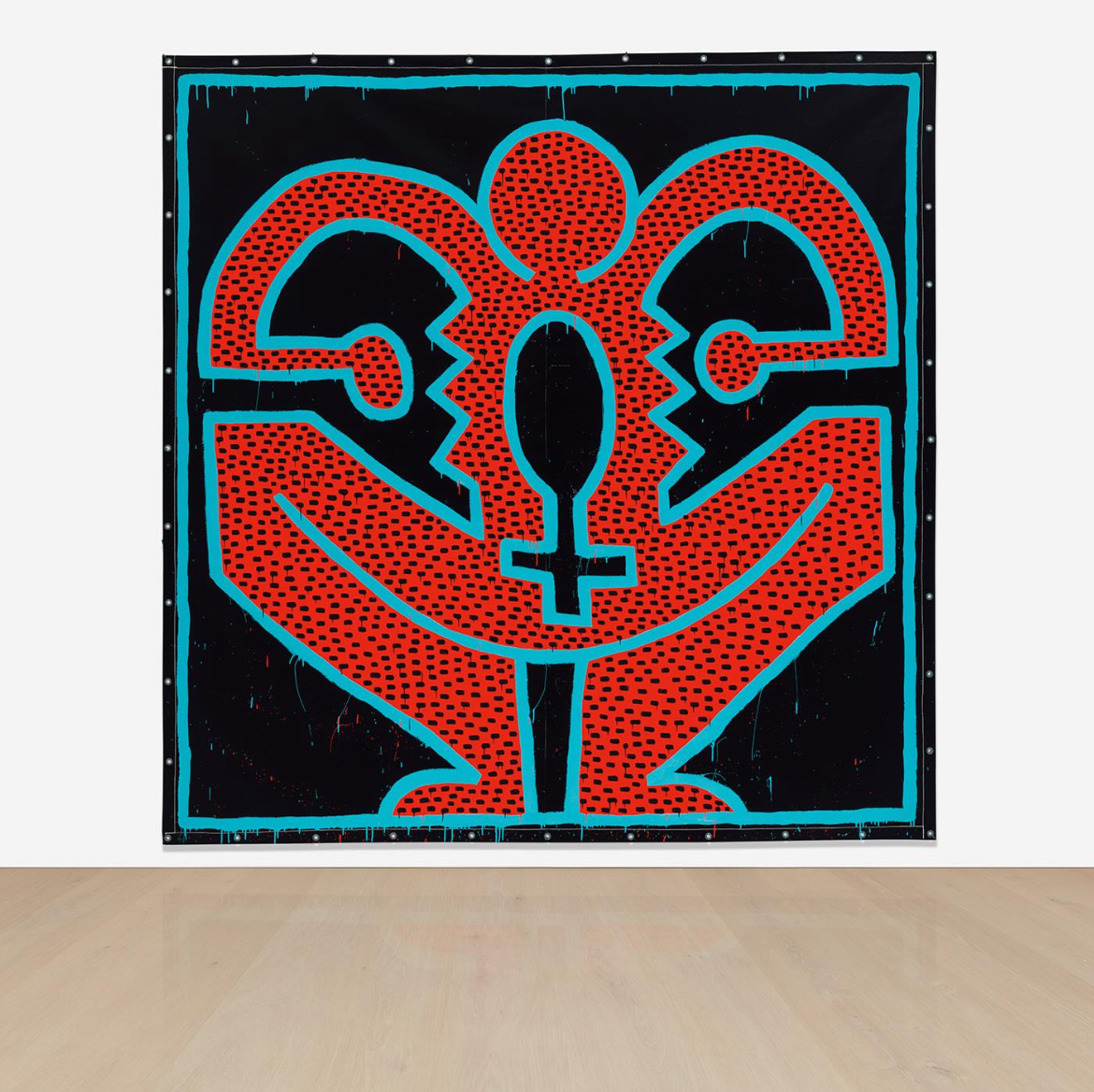
KEITH HARING
Untitled, 1983
Vinyl paint on vinyl tarpaulin with metal grommets
120×120 inches (304.8 x 304.8 cm)
Signed and dated ‘”JANUARY 1983 K. Haring ⨁” on the reverse
Keith Haring’s unique visual language and symbolic sensibility unfurl across the surface of Untitled, 1983. His totemic central figure—nearly the full height of the ten-foot square tarp—crouches in a dynamic squat that bristles with energy, like a freeze-frame of a dancer, with the gravitas and timelessness of prehistoric sculpture. A monumental example of Haring’s witty style, Untitled synthesizes the artist’s enduring ability to imbue his 1980s downtown New York social milieu with an archetypical simplicity of form, in a universal language of freedom of expression. Coming out of the downtown New York scene, Haring’s visual work takes on the vibrancy of the music and dance cultures that surrounded him. The rhythmic pose of the figure in Untitled recalls the boisterous physical movements of both break-dancing and voguing, in a dual reference to the underground hip-hop and queer communities that Haring circled within. Both dance styles are explosive, and take pleasure in physical distortion and the angles of the human body, and Haring captures this energy in the central figure of Untitled.
“1982 to 1984 was the peak of rap music and breakdancing, and graffiti was the visual tie-in. A lot of my inspiration was coming out of watching break-dancers, so my drawings started spinning on their heads and twisting and turning all around.”
House of Xtravaganza Legendary Voguers, Luis, Danny, Jose, and David Ian Xtravaganza, at Tracks, New York, 1989. Image: © Chantal Regnault
After signing with dealer Tony Shafrazi in 1982, Haring sought a new format for his large-scale paintings, that registered the gravitas of gallery representation without sacrificing the grit and edge of his street art origins. While walking the streets of New York, he noticed a Con Edison construction crew who covered their equipment with a large sheet of industrial tarpaulin. The large-scale and machine-made quality of the tarp appealed to Haring, who sought out a tarp manufacturer in Brooklyn and purchased a selection of “canvases” for his inaugural solo show with Tony Shafrazi Gallery later that year. Untitled represented this seminal body of work early the following calendar year, in the group exhibition at Tony Shafrazi, Champions, January 15 – February 19, 1983. Untitled is an aggrandizement of Haring’s astute linear sensibilities, as perfected in his practice of graffiti. Through street art, Haring honed an economy of line and energetic expression, which give work like Untitled its striking visual quality. Haring‘s unique ability to create work that popped off city walls is translated into the bright color palette and dynamism of Untitled. The central figure is composed of arching sky-blue lines, confidently brushed against the black vinyl tarp, and filled in with a matrix of scarlet red gridded with rectangular black dots. In purposefully limiting his palette to blue, red, and black, Haring allows the cleverness of his composition to shine through.
Lotus-Headed Fertility Goddess Lajja Gauri, Madhya Pradesh, India, c. 6th century CE. The Metropolitan Museum of Art, New York. Image: © The Metropolitan Museum of Art, New York, Samuel Eilenberg Collection, Bequest of Samuel Eilenberg, 1998, 2000.284.13
Untitled is not just one figure, but multiple images in one. Haring codes a smiley face into the dancer’s pose: their hands form the eyes, and the blue line of their legs turns into a smile. The negative space of Untitled holds symbolic value as well, most obviously in the feminine symbol, keyholded into the center of the figure. Further, the space under the arms of the figure cleaves into two halves of a broken heart locket, which wait to be reconnected by the feminine symbol “key.” The feminine symbol at the center of the work confirms a connection between the squatting pose of the figure and the forms of historic fertility and mother goddess sculptures, such as the Indian fertility goddess Lajja Gauri; the zig-zagged sides of the figure, too, recall the stylized body of the Ancient Roman she-wolf. These multivalent readings of Untitled, steeped in human history and Haring’s contemporary moment, speak to the universality of his visual idiom.
#5. Helen Frankenthaler
Phillips New-York: 14 November 2023
Estimated: USD 2,000,000 – 3,000,000
USD 2,480,000
Helen Frankenthaler – 20th Century … Lot 37 November 2023 | Phillips
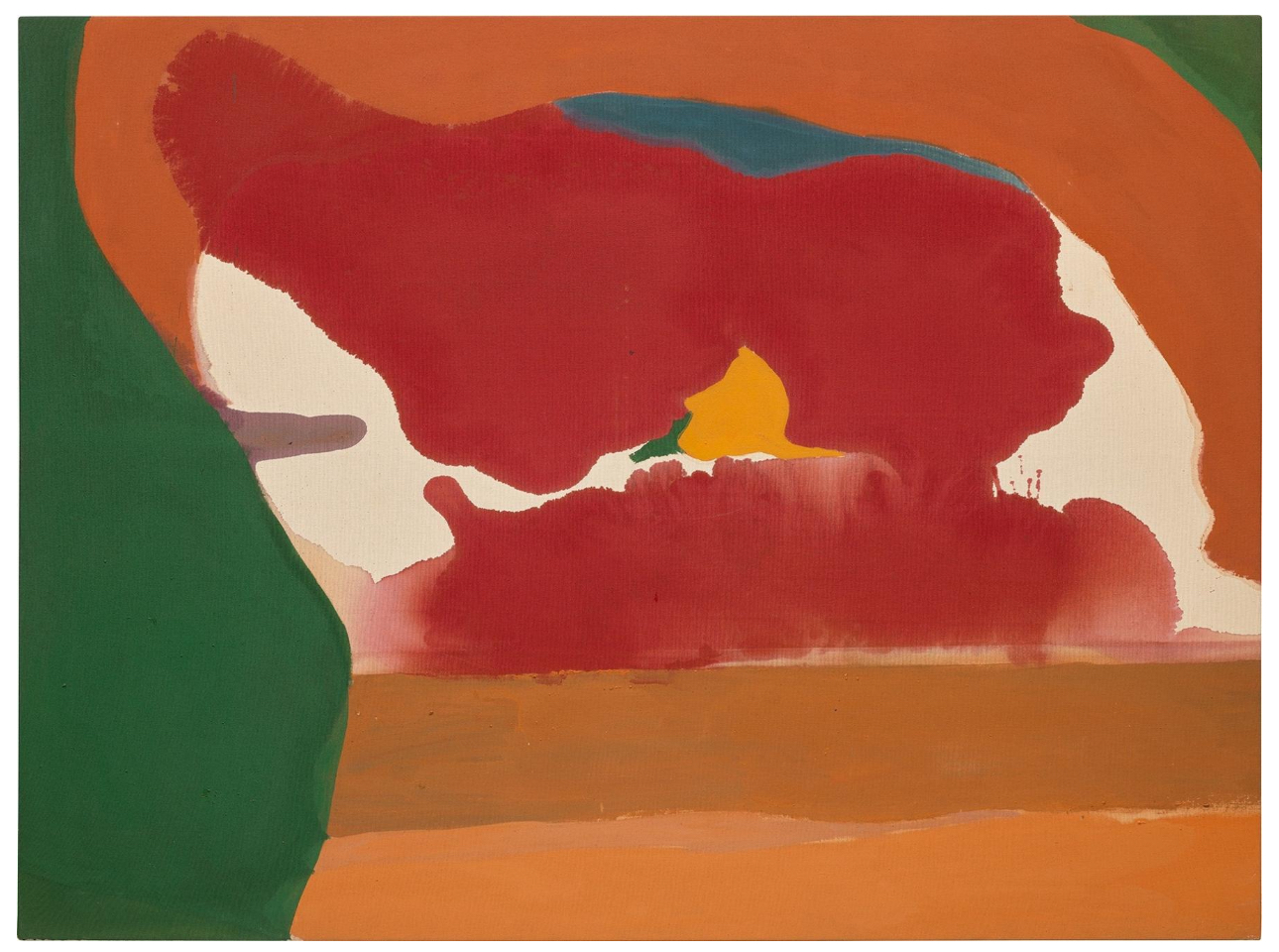
HELEN FRANKENTHALER
Fire, circa 1964
Oil on canvas
57 1/4 x 77 inches (145.4 x 195.6 cm)
Signed “Frankenthaler” lower right
Frankenthaler burst onto the New York painting scene in the early 1950s, combining the formal innovations and working methods of artists such as Willem de Kooning and Jackson Pollock with her own signature technique: the soak-stain. With the soak-stain, Frankenthaler thinned oil paint with turpentine to create a luminous wash of paint that soaked completely into the unprimed canvas, as seen in Fire, c. 1964. The technique, was, in its way, the apogee of influential critic Clement Greenberg’s definition of modern painting: in Frankenthaler’s work, paint and support became one united surface.
Helen Frankenthaler painting Fire in her studio, April 1964. Image: © J Paul Getty Trust, Getty Research Institute, Los Angeles, 2000.R.19, Artwork: © 2023 Helen Frankenthaler Foundation, Inc. / Artists Rights Society (ARS), New York
There is a physicality to Frankenthaler’s soak-stain technique, too, that resonates with the depth of emotion and interpretation that the viewer finds in her work. Photographer Alexander Liberman visited Frankenthaler’s studio circa 1964, where he captured the creation of Fire in a series of dynamic portraits—bringing the “action” of “action painting” to life. Liberman’s images reveal how bodily Frankenthaler’s painting process was: like Jackson Pollock, she spread her canvases on the floor of her studio to best brush and pour her brilliant expanses of color across them. In some images, Frankenthaler is standing, sock-footed, on the canvas itself; in others, she kneels, a bucket of paint in her hands. Fire, then, which seems to hold a distant horizon in its depth (perhaps with the orange orb, at center, like a setting sun), is all the more impressive, given the flatness inherent to her grounded working method.
Other Highlights
Gerhard Richter
Phillips New-York: 14 November 2023
Estimated: USD 2,000,000 – 3,000,000
USD 2,298,500
Gerhard Richter – 20th Century & Co… Lot 38 November 2023 | Phillips
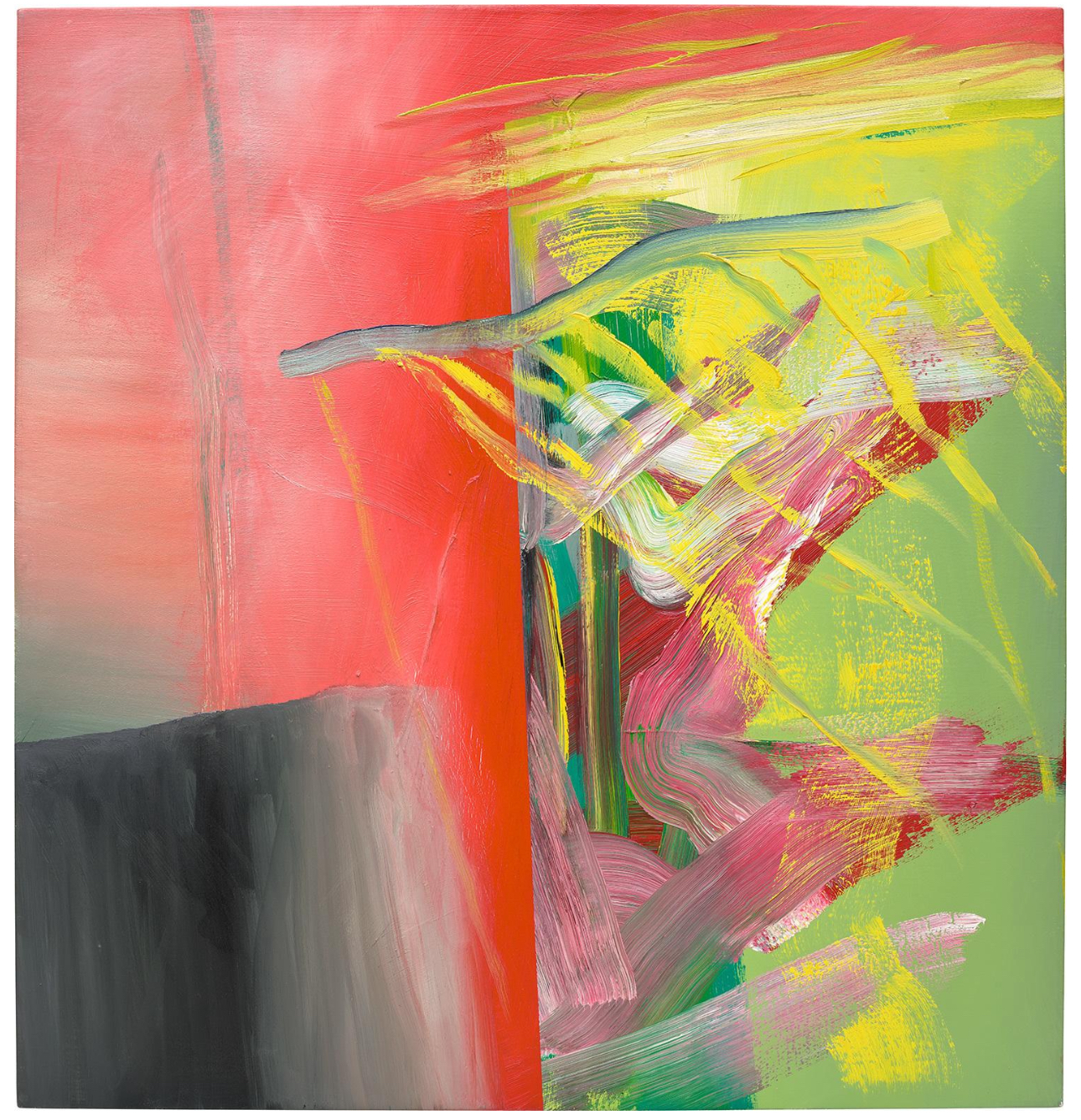
GERHARD RICHTER
Abstraktes Bild (557-3), 1984
Oil on canvas
41 3/8 x 39 3/8 inches (105.1 x 100 cm)
Signed, inscribed and dated “557-3 Richter 1984” on the reverse
With characteristic boldness and a bright sense of color theory, Gerhard Richter splits his 1984 Abstraktes Bild down the middle. To the left, perpendicular gradients of scarlet and grey create a sense of depth, as if viewing a fiery sunset over a mountain. Across the border, energetic brushstrokes of white, crimson, and phthalo green writhe against a lime green background that fades to a darker shade at far right. Diagonal strokes cross the center, like a storm cloud with lime green lightning bolts, uniting both sections in the same abstract ecosystem. These formal contrasts push and pull the eye over the canvas, across Richter’s virtuosic juxtaposition of complementary colors and variance of brushstroke.
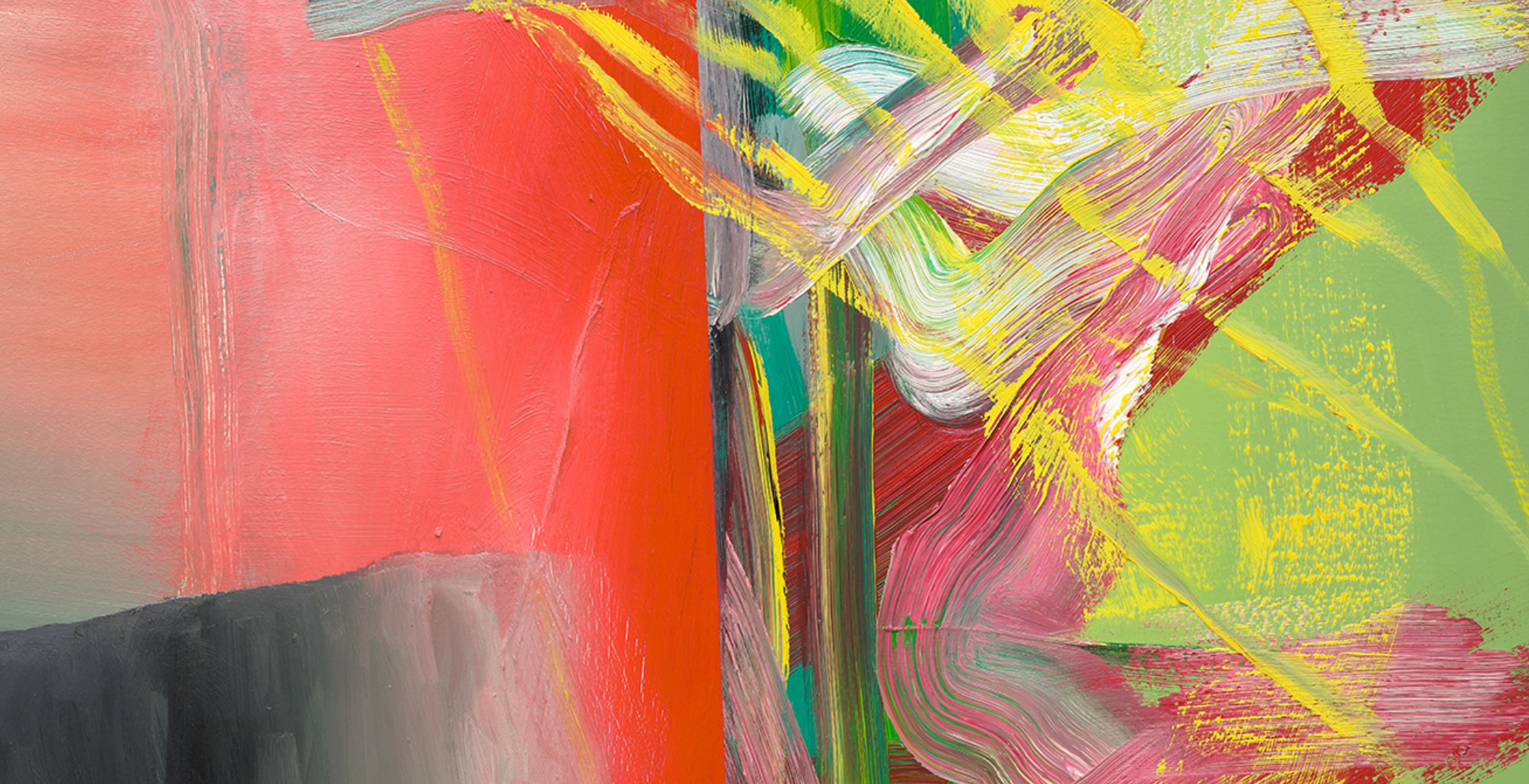
The 1980s were arguably the most important decade in Richter’s career, as the artist transitioned from a largely representational painting practice, defined by his blurred photorealist paintings, to a practice dominated by abstraction. In 1983, the artist moved to Cologne, where he has maintained residence ever since, making Abstraktes Bild one of the earlier works to come out of the studio in which he produced his most iconic work. In contrast to his abstractions in the 1960s and 1970s, such as the gridded Color Charts and monochrome Grey paintings, the Abstrakte Bilder of the 1980s burst out in dynamic, kaleidoscopic hues. The bright, even explosive handling of paint across the surface of Abstraktes Bild is far-removed from the strict rigor of the artist’s early abstractions. Richter’s work received increasing attention internationally and was shown more widely; in the year of Abstraktes Bild’s creation alone, he participated in the Venice Biennale (his third), and had four solo exhibitions across Europe. Abstraktes Bild was previously in the collection of U.S. Senator Thomas Eagleton and his wife, Barbara, a philanthropic couple who contributed funds to art museums in their home state of Missouri. The couple originally donated Abstraktes Bild to the Saint Louis Art Museum, which owns Richter’s 1989 suite, November, Dezember, and Januar, some of the finest of Richter’s Abstrakte Bilder in public collections in the United States. Perhaps one of Richter’s most iconic photorealistic paintings, Betty, 1988, resides in the Saint Louis Art Museum in part due to the Eagletons’ generosity. Their selection of the present work speaks to the museum quality of Abstraktes Bild.
Jade Fadojutimi
Phillips New-York: 14 November 2023
Estimated: USD 600,000 – 800,000
USD 1,935,500
Jadé Fadojutimi – 20th Century & Co… Lot 46 November 2023 | Phillips
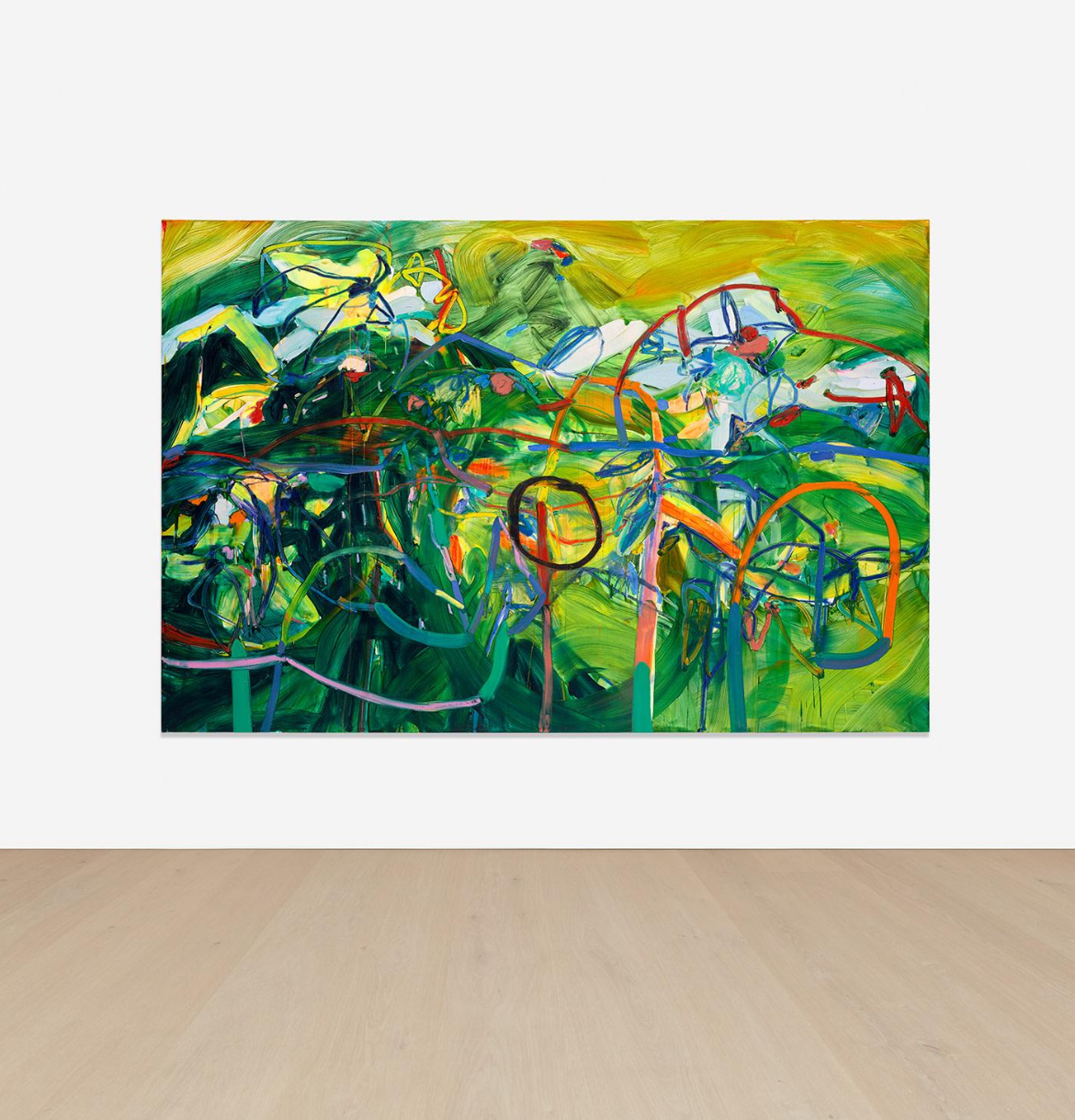
JADE FADOJUTIMI
Quirk my mannerism, 2021
Oil, oilstick and acrylic on canvas
200×300 cm (78 3/4 x 118 1/8 inches)
Signed twice and dated “Jadé Fadojutimi Feb ’21” on the reverse
Quirk my mannerism, 2021, exemplifies the mix of spontaneity, emotional vulnerability, and exploration inherent to Jadé Fadojutimi’s artistic process—sweeping, softened arcs of green sway across the background of the canvas, as jagged streaks of oilstick dart in a colorful tangle of drawn lines. The artist often creates a painting in a single night, moving through the actions that form each composition like a midnight ballet—brushing broadly across the canvas ground, dripping concentrated pigments in gestural sweeps, and drawing onto the canvas with oil sticks, often directly onto still-wet paint layers. None of these steps are predetermined; but rather, they occur in the moment, as Fadojutimi follows her intuition through a process she calls “orchestrating randomness.”
Animation still from My Neighbor Totoro, dir. Hayao Miyazaki, 1988. Image: Photo 12 / Alamy Stock Photo
Fadojutimi’s process follows in the footsteps of her twentieth-century forebears, including Lee Krasner and Joan Mitchell. These Abstract Expressionist painters emphasized spontaneity and the physical action of painting as central components of artmaking. Fadojutimi’s works build upon these traditions in distinctly contemporary ways, with a visually striking use of fluorescent colors and compositions that combine free line and fields of color.
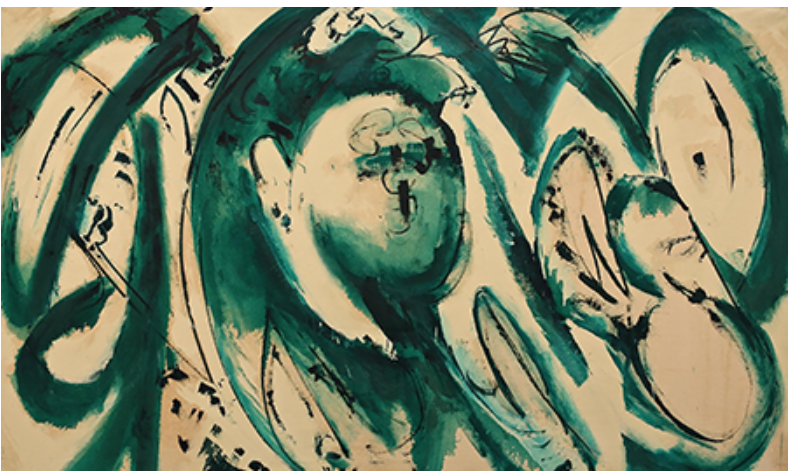
Lee Krasner, Portrait in Green, 1969. The Pollock-Krasner Foundation. Artwork: © 2023 Pollock-Krasner Foundation / Artists Rights Society (ARS), New York
These same dynamic combinations of line and color illustrate another major source of inspiration for the artist: Japanese anime. Within Quirk my mannerism, the neon pink and orange lines almost radiate with motion over the green and yellow background, as if depicting a character flying across an animated landscape. Fadojutimi also looks to more contemporary artists such as Amy Sillman, Laura Owens and Makiko Kudo, whose influence is evident particularly in the primacy of color in Fadojutimi’s practice and life.
KAWS
Phillips New-York: 14 November 2023
Estimated: USD 1,000,000 – 1,500,000
USD 1,875,000
KAWS – 20th Century & Contemporary … Lot 57 November 2023 | Phillips
KAWS
UNTITLED (DBZ2), 2007
Acrylic on canvas
40×70 inches (101.6 x 177.8 cm)
Signed, titled and dated “KAWS..07 DBZ2” on the reverse
Untitled (DBZ2), 2007, leverages KAWS’ understanding of both Japanese and American popular culture in the mid-2000s. In the legacy of Pop masters such as Andy Warhol and Roy Lichtenstein, mixed with the edge of Appropriation artists and street art, KAWS’ keenly deploys the universal language of cartoons in his work, filtered through his own iconic character, the COMPANION. At first glance, KAWS’ Untitled (DBZ2) seems to perfectly appropriate a still from the popular anime series Dragon Ball Z. The work presents the show’s main character, Goku, at left, and the god Kami, at right, facing the viewer in a yellow paneled room. However, KAWS has purposefully simplified the composition, removing the Japanese kanji on each character’s tunic, and replacing each face with the visage of the COMPANION.

Animation still from Dragon Ball Z, Raditz Saga, episode 6, “No Time Like the Present,” 1989. U.S. airdate: June 22, 2005.
Developed to accompany the advertisement models in KAWS’ graffiti works of the 1990s, the COMPANION has become an iconic figure in its own right. With its fluffy poufs, and blank, skull-like face with crossed-out eyes, the COMPANION is as recognizable as any other international cartoon character, Goku included. KAWS painted prolifically from popular cartoons in the early 2000s, from Dragon Ball Z to SpongeBob SquarePants and The Simpsons. With works like Untitled (DBZ2), KAWS proves how cartoons can be a universal language, and a ready surface for his own COMPANION character, that allows his work to transcend geographic and cultural differences to reach a worldwide audience. KAWS, born Brian Donnelly in New Jersey, first visited Japan in 1997, where he met fellow artists and culture makers including Yoshifumi “Yoppi” Egawa of HECTIC, Tomoaki “Nigo” Nagao (longtime KAWS collaborator and founder of A Bathing Ape), and Hikaru Iwanaga, founder of the toy design company, Bounty Hunter. These creatives introduced KAWS to the Japanese practice of creating high-quality, limited-edition collectible toys, and the subculture of otaku, an obsession with manga and anime (Dragon Ball Z included). This relationship between popular culture and commerce became a blueprint for KAWS’ own art practice, creating works that scaled from collectible toys to monumental sculptures.
George Condo
Phillips New-York: 14 November 2023
Estimated: USD 1,500,000 – 2,000,000
USD 1,391,000
George Condo – 20th Century & Conte… Lot 42 November 2023 | Phillips
GEORGE CONDO
Eyes Wide Open, 2022
Acrylic and oilstick on linen
50 x 46 1/4 inches (127 x 117.5 cm)
Signed and dated “Condo June 22” upper left
Eyes Wide Open, painted in 2022, represents a fresh iteration of George Condo’s signature, self-described techniques of artificial realism and psychological cubism. The human form is both recognizable as a Condo character, and unrecognizably abstracted—one cannot tell how many figures there are; which panes of peach-colored pigment are meant to be human skin; which cherry reds are tongues. With cheeks, chins, ears, and mouths fractured to cubist oblivion, George Condo keeps his figures’ eyes wide open.
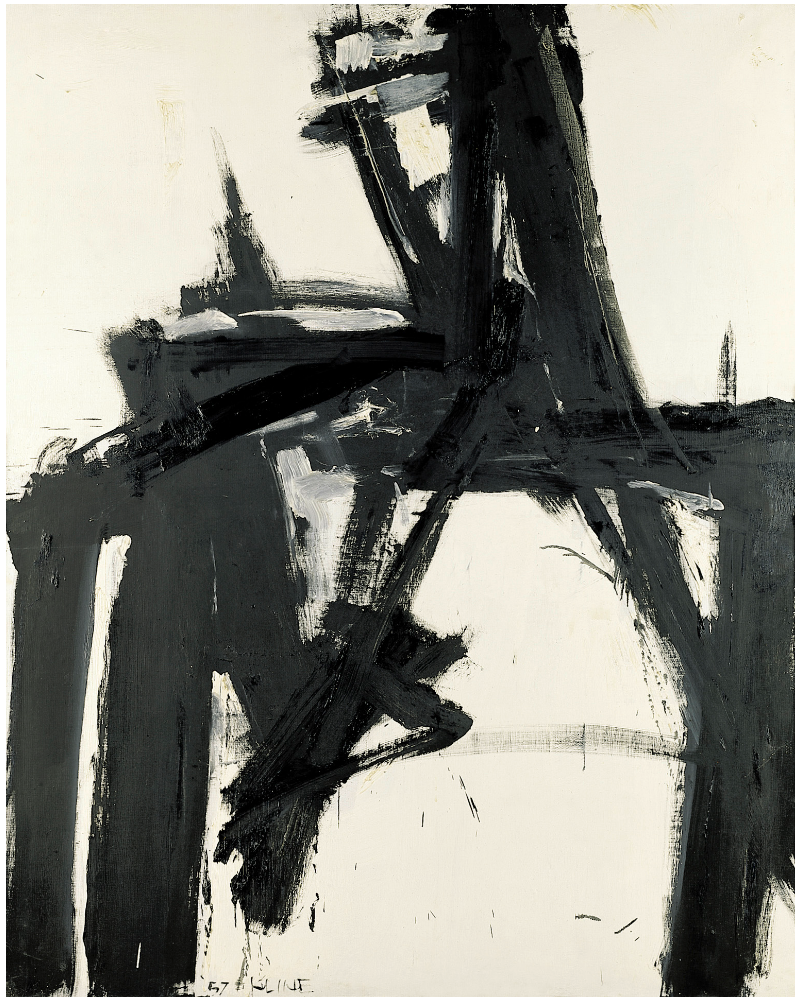
Franz Kline, Untitled, 1957. Kunstsammlung Nordrhein-Westfalen, Düsseldorf. Image: bpk Bildagentur / Kunstsammlung Nordrhein-Westfalen/ Walter Klein / Art Resource, NY, Artwork: © 2023 Artists Rights Society (ARS), New York / ADAGP, Paris
Condo first developed the concept of artificial realism in the late 1980s, as a way to free himself from the confines of realistic figurative representation. The framework doubled as an accurate assessment of the modern material world, and the visual inputs affecting contemporary artists. As Condo explained, it’s an idea “about representing reality, but reality being a construct of man-made appearances.”i Artificial realism functions on two levels in Condo’s work: first, at the level of his physical marks and painterly style, and then, second, on a more profound and philosophical level.
With Eyes Wide Open, Condo invokes the “artificial” visual realities of art history and popular media, synthesizing high and low culture in one aesthetic output. The work employs thick black lines like those of Franz Kline, and peachy pastels and pale blues reminiscent of Willem de Kooning’s Woman paintings. The black outlines of Eyes Wide Open also recall the aesthetics of newspaper comics and television cartoons, a connection furthered by Condo’s stylized eyeballs and pearl-like teeth in gaping black mouths. As Condo rightly argues, these visual phenomena, whether contained to canvas, newsprint, or a television screen, are no less real than the natural world.
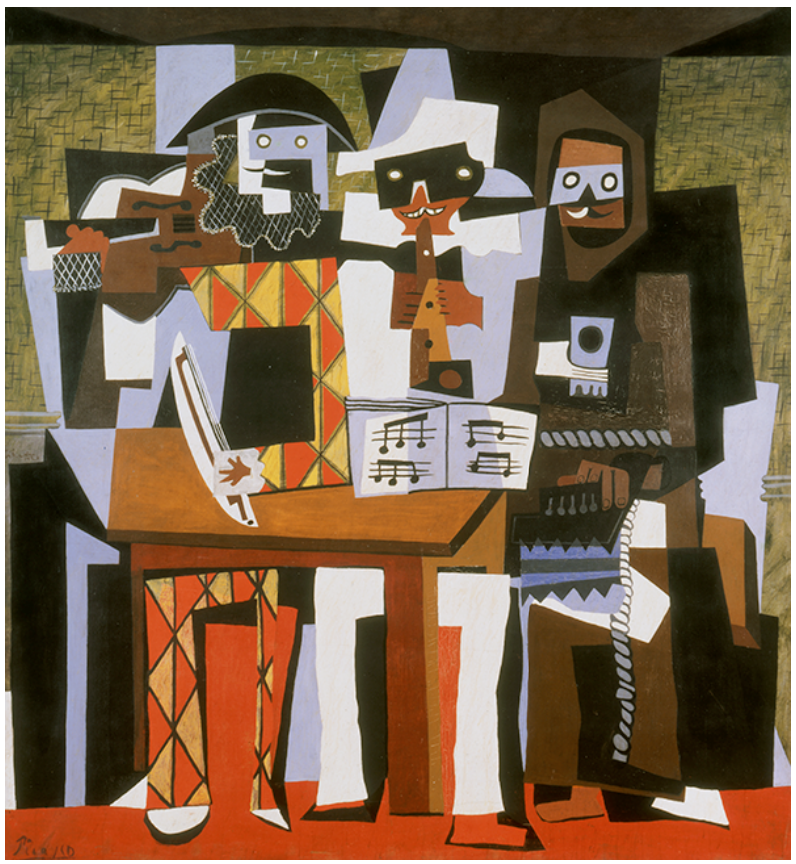
Pablo Picasso, Three Musicians, 1921. Philadelphia Museum of Art. Image: The Philadelphia Museum of Art / Art Resource, NY, Artwork: © 2023 Estate of Pablo Picasso / Artists Rights Society (ARS), New York
Eyes Wide Open captures the uniquely artificial reality of the internet and social media as well, and how Condo navigates those spaces as a contemporary artist and citizen. The work’s square canvas, for instance, is adroitly suited to be shared and re-shared on Instagram. As in his earlier works, which play with Old Master traditions of portraiture, Condo evokes centuries’ worth of representations of the human figure in Eyes Wide Open, and registers the emotional ambivalence of living in an image-saturated culture—especially one in which, thanks to social media, it can be difficult, if not impossible, to distinguish false images from reality.The splintering of the human form in Eyes Wide Open comes to resonate with the sensation of scrolling through social media, seeing slices of bodies, lives, and lifestyles, in an infinite queue of images.
Jeff Koons
Phillips New-York: 14 November 2023
Estimated: USD 1,000,000 – 1,500,000
USD 1,270,000
Jeff Koons – 20th Century & Contemp… Lot 58 November 2023 | Phillips
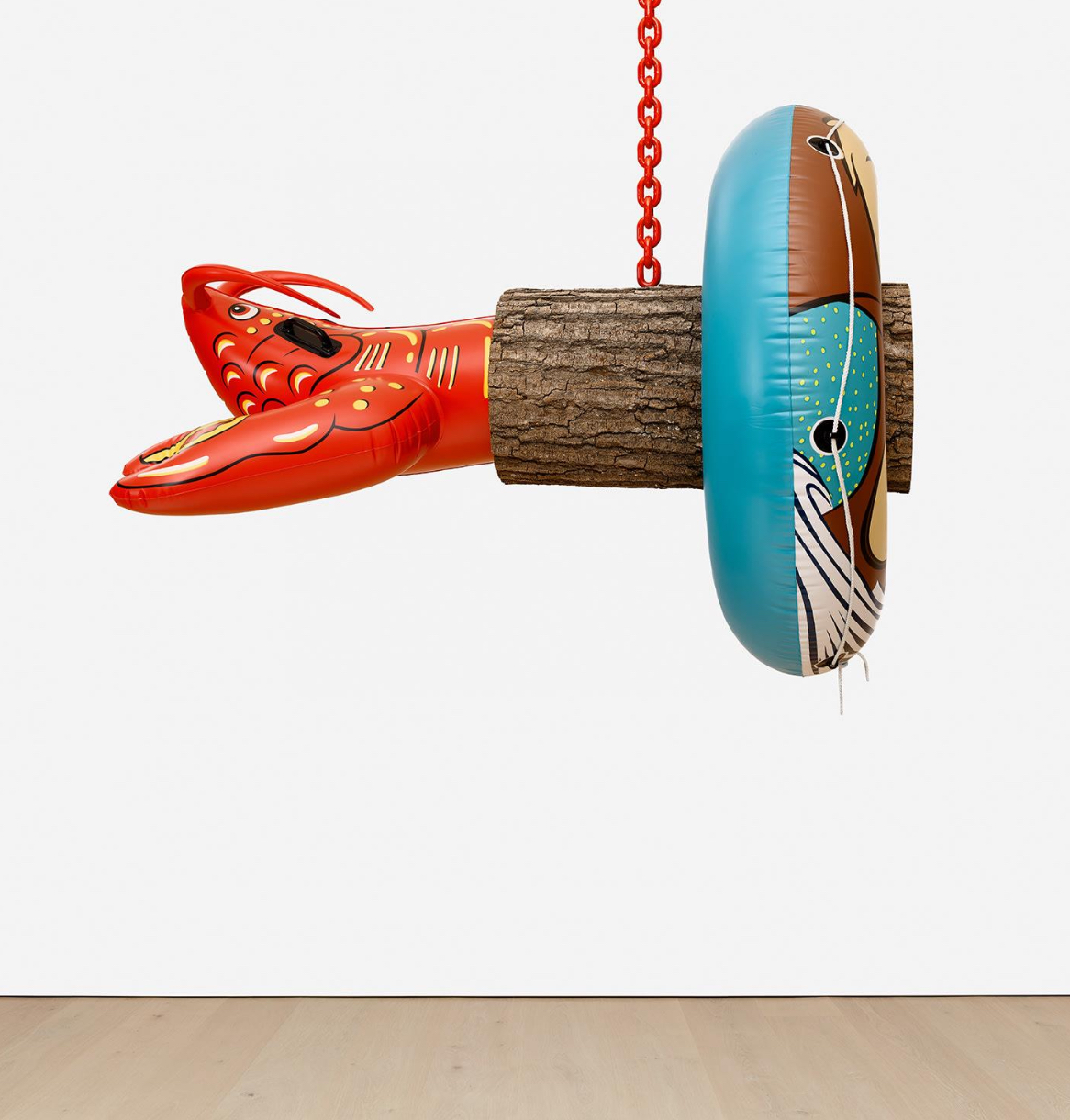
JEFF KOONS
Lobster Log, 2003-2012
Polychromed aluminum, wood, stainless steel and coated steel chain
42 x 56 1/8 x 42 inches (106.7 x 142.6 x 106.7 cm)
Chain length variable
This work is number 1 from an edition of 3 plus 1 artist’s proof
With his characteristic playfulness, Jeff Koons creates an assemblage of art history and personal memory in Lobster Log, 2003-2012. The work is a cadavre-exquis made of polished aluminum, wood, and steel, consisting of the front half of a lobster-shaped pool toy, a tubular pool float, and a log in place of a tail. Suspended from the ceiling by a red chain, it is as if Lobster Log swims through the air, wearing a pool floatie through a sea of Surrealist references and Koons’s own artistic motifs. Inflatables have been a staple of Koons’s art practice for decades, since the artist’s first Inflatables series of the late 1970s, which placed inflatable vinyl toys in dialogue with mirrors. Later bodies of work have brought inflatable and mirror together in one object; the artist’s famous sculptures in the forms of inflatable objects—toys, pool floats, and balloons—reflect the viewer and their surroundings in their highly-polished painted steel surfaces. Lobster Log is a trompe l’oeil inflatable object—or rather, an assemblage, in the absurdist lineage of Marcel Duchamp, that merges transformed readymades and everyday objects in unexpected combinations.
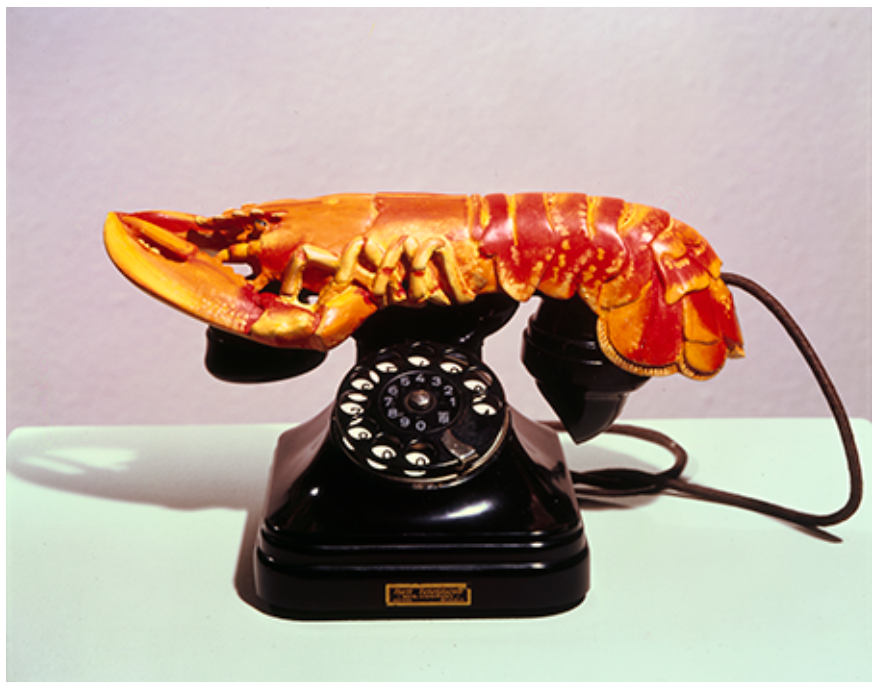
Salvador Dalí, Lobster Telephone, 1938. Tate Modern, London. Image: © Tate, London / Art Resource, NY, Artwork: © 2023 Salvador Dalí, Gala-Salvador Dalí Foundation / Artists Rights Society (ARS), New York
Lobster Log belongs to Koons’s Popeye series, a body of work named for the macho comic strip character, Popeye the Sailor Man, and defined by its pool party iconography and assemblage technique. Koons explains that, for the Popeye series, he chose to combine pool floats with readymade objects (such as the log in the present work) in order to “give the inflatable a cultural history… a sense of a past, something to have a relationship with.” Given that Koons views inflatables as anthropomorphic objects, it follows that the inflatable’s cultural past in Lobster Log aligns with Koons’s own childhood memories and art historical influences. As a child growing up in Philadelphia, Koons encountered Duchamp’s assemblage and readymade work at the Philadelphia Museum of Art by the age of seven. He also recalls the pool float as a “liberating” object from about the same time in his childhood, as it enabled him to swim without his parents’ assistance. However, Koons troubles a directly nostalgic reading of Lobster Log in material terms, as, by casting his lobster and inner tube in aluminum, he “liberates” them from any practical floating ability—Lobster Log would sink at any pool party, and yet, Koons suspends the object in midair. The viewer confronts this cognitive dissonance in the bold installation of Lobster Log.
Marcel Duchamp, Bicycle Wheel, 1913 (1951). The Museum of Modern Art, New York. Image: © The Museum of Modern Art/Licensed by SCALA / Art Resource, NY, Artwork: © 2023 Association Marcel Duchamp / ADAGP, Paris / Artists Rights Society (ARS), New York
A sole reading of childhood innocence and play, however, stands in contrast with Koons’s assertion that “there is a huge sexual fetish thing on the Web for pool toys.” The lobster, too, is a sexually charged object in Koons’s interpretation, and so its presence as a pool toy in Lobster Log is doubly loaded. For Koons, the lobster, itself an aphrodisiac dish, is a symbol of both male and female sexuality. He explains that the creature’s arms are “very strong, but they could be fallopian tubes and its body could be the womb. If you look at its tail, it’s almost like a stripper with a boa doing a feather dance, and also has tentacles that look like Dalí’s mustache. “Salvador Dalí, one of Koons’s favorite artists, and a direct artistic antecedent to the Popeye series, used the lobster as a symbol of erotic desire in his work. Lobster Log perhaps most closely parallels Dalí’s absurdist assemblage, Lobster Telephone, 1938, in which, as Terry Riggs wryly notes in his description of the piece for the Tate Modern, “the crustacean’s tail, where its sexual parts are located, is placed directly over the mouthpiece.” Like Duchamp and Dalí before him, Koons is aware of the seductive power of the fetish object—in both the sexual and consumerist connotations of the term. Lobster Log fuses multiple, overlapping meanings of desire, freedom, and play together in one object; the Popeye work is a keen deployment of what Arthur C. Danto—with Duchampian punning—calls Koons’s “Pop-eye.”
Lucy Bull
Phillips New-York: 14 November 2023
Estimated: USD 400,000 – 600,000
USD 1,041,400
Lucy Bull – 20th Century & Contempo… Lot 32 November 2023 | Phillips
LUCY BULL
Dark companion, 2020
Oil on canvas
60×30 inches (152.4 x 76.2 cm)
Signed and dated “Lucy Bull 2020” on the reverse
Diaphanous webs of vibrant color overtake the surface of Lucy Bull’s Dark Companion, 2020. Bull’s marks glitter and shift in thin gauzes of gold, coral, green, and blue, stretching and waving, threadlike, in layers of bioluminescent oils. The visual effect is somewhere between that of a Y2K desktop screensaver and the undulating fins of a deep sea creature—a tension between digital and natural, synthetic and organic associations that pervades Bull’s abstract oeuvre. The meditative canvas, open to prolonged contemplation and multivalent interpretation, gives life to the wanderings of a musing mind.
The viewer is hypnotized as they wander throughout the work, stepping into a universe in which neither time nor space are tangible, much less linear. Bull intuitively builds juxtapositions of light and dark color, in flashes of contrast which draw the eye along the featherlight golden strokes of her paintbrush. A base layer of navy blue, nearly black, lightens into bursts of bright teal; areas of slate grey dapple into golden yellow and fluorescent orange. Lemon yellow and hot pink spark across the canvas, while touches of white and lime green patter into small crescents, like the surfing edges of waves, or scales of a glistening dark creature. Bull’s painted “companion” is all-enveloping, and the viewer is happy to be lost in its depths.
Max Ernst, Profanation of the Spring, 1945. Private Collection. Artwork: © 2023 Artists Rights Society (ARS), New York / ADAGP, Paris
The cosmos Bull creates calls on the legacies of Surrealist artists, such as Max Ernst, who let the processes of the unconscious mind guide their artistic practice. Surrealist painters let the paint, brush, and gesture lead the way, with as little conscious intervention as possible. Bull cites Ernst’s experience of “being a spectator to the making of his own work” as akin to her own process. “When things finally open up and click,” she says, “it feels like magic.” Dark Companion is a mesmerizing journey through the depths of emotion and imagination, a testament to the power of art to transport us beyond the limits of language and into the uncharted territories of the mind. Bull “makes room for both precision and abandon, inviting viewers to participate in ever-unfinished processes of creation that she choreographs but never fully controls.”
Damien Hirst
Phillips New-York: 14 November 2023
Estimated: USD 700,000 – 1,000,000
USD 952,500
Damien Hirst – 20th Century & Conte… Lot 48 November 2023 | Phillips
DAMIEN HIRST
Covenant, 2007
Butterflies and household gloss on canvas
84×84 inches (213.4 x 213.4 cm)
Signed, stamped with the artist’s stamp, titled and dated “‘Covenant’ 2007 Damien Hirst” on the reverse
The vibrant, iridescent wings of exotic butterflies are among Damien Hirst’s most enduring materials, recurring time and time again in his oeuvre as a symbol of the transience of life. A kaleidoscopic mosaic of these gem-like insects, Covenant, 2007, is exemplary of the artist’s iconic large-scale butterfly paintings. The image so compelled the artist—and epitomized his practice—that he took it up once again for an edition of screenprints six years later. With concentric circles unravelling like a Catholic prayer labyrinth, Covenant is a poignant meditation on ephemeral beauty and renewal. Indeed, according to Rod Mengham, “Hirst’s prolonged exploration of the life cycle of the butterfly, its spectacular visual appeal, the mythological and cultural formations it has inspired, and the variety of forms of response it has provoked in both artists and scientists, is one of the most thoroughgoing and many-sided conceptual projects sustained by any contemporary artist.”

Buddhist mandala painting, Nepal. Image: Werli Francois / Alamy Stock Photo
The many themes that these butterflies represent for Hirst—the transience of living beings, the inevitability of death, and the possibility of an afterlife—synergize with those explored by religion. In 2007, the year Covenant was executed, the artist began to turn more explicitly to the Christian iconography he exposed to in his youth. Deliberately drawing from the visual language of stained glass, the present work evokes the grandeur of medieval Christian cathedrals. This engagement with spirituality is furthered by its title: Covenant, referring to a sacred biblical agreement between God and a religious community, which plays a central role in Judaism, Christianity, and Islam. Also resonating beyond the Abrahamic religions, the work’s concentric shape is redolent of the intricate mandalas used in Buddhist, Hindu, Shinto, and Jain traditions to picture the cosmos.
Damien Hirst, In & Out of Love (White Paintings & Live Butterflies), 1991, installed at Tate Modern, London, 2012. Image: © Damien Hirst and Science Ltd. All rights reserved, DACS/Artimage 2023. Photo: Prudence Cuming Associates Ltd, Artwork: © Damien Hirst and Science Ltd. All rights reserved/ DACS, London/ARS, NY 2023
The employment of butterflies in Hirst’s practice can be traced all the way back to his first solo exhibition, the legendary In and Out of Love installation, 1991, held at a vacant commercial space near Anthony d’Offay Gallery, where the artist worked as a part-time technician. Upstairs, butterflies hatched from pupae embedded in five white canvases, and spent the duration of the show mating, floating around, and laying new eggs; on view downstairs was a series of monochromatic paintings with dead butterflies pressed into the surfaces. The vivid and disconcerting image of these dead insects was so striking that a detail of one of these latter canvases was chosen for the cover of the pilot issue of Frieze magazine that same year. Inspired by a Victorian tea-tray in which butterflies were pressed under glass, Hirst returned to the motif for his Kaleidoscope series begun in the early 2000s, removing the insects’ bodies and arranging their wings into densely-patterned geometric compositions.

Hirst’s intention behind Covenant was therefore not to invoke a specific religious practice, but to interrogate the complex relationship between art, death, and belief. Symbolizing the fragility of life, the radiant metamorphosis of the butterfly is cut short by its very brief lifespan, which typically amounts to only two weeks. However, the butterflies are a metaphor not only for mortality but also for remembrance: after their death, their beauty is forever preserved in his paintings. “The butterfly’s life-cycle is one of regeneration and transformation,” the curator Andrew Wilson asserted, “and in Hirst’s hands this symbol of love becomes a powerful means by which the certainty of death can be apprehended from the point of view of a celebration of life and thought.”
Christina Quarles
Phillips New-York: 14 November 2023
Estimated: USD 250,000 – 350,000
USD 228,600
Christina Quarles – 20th Century & … Lot 54 November 2023 | Phillips
CHRISTINA QUARLES
Floored, 2017
Acrylic on canvas
40×50 inches (101.6 x 127.3 cm)
Signed, titled and dated “Christina Quarles 2017 “FLOORED”” on the reverse
Amorphous, dripping body parts spill across a yellow and black checkered floor in Christina Quarles’ Floored. Created in 2017, the year of the artist’s first ever solo exhibition, which launched her to widespread critical acclaim, Floored displays Quarles’ signature, undefinable bodies, bending and intersecting across a spliced picture plane, in a ripe visual synthesis of the multiple, shifting aspects of the self. Subverting the trope of the female nude in art history, Quarles’ paintings upend our preconceived notions of race, gender, and space. In Floored, it is challenging to discern how many figures are splayed across the floor—and which limbs belong to which person. Quarles eschews anatomical reality in order to paint “portraits of living within a body,” as she says; touching, feeling, moving—the seven-fingered hand stroking the face at upper left, for instance, registers how it feels to be touched from within the body, feeling fingers curve and brush against skin.
Egon Schiele, Kneeling Girl, Resting on Both Elbows, 1917. Leopold Museum, Vienna.
The artist relishes the ambiguity of her figures, and the way in which her compositions encourage the viewer look closely and puzzle out each body. “I like to play with the desire I think we all have to complete the image, and whenever possible, to complete it into a figure,” she explains. The viewer assumes, based on the presence of recognizable features, like the hands, feet, and breasts in Floored, that Quarles’ forms are all body parts; Quarles hopes to introduce just enough ambiguity to her compositions to “nudge people enough in the direction of questioning their initial assumptions.” The division of space in Floored, too, adds to the perceived ambiguity of the composition. As Quarles shares, she begins each painting with the fragmented shapes and abstract brushstrokes that will become her figures. Once these shapes are “fleshed out” on canvas, she pauses, photographs the work, and then takes it into Adobe Illustrator, where she digitally draws over the photograph to place “the patterns and the planes and the areas that really start to interrupt the figure.”vi After this digital intervention, Quarles returns to the canvas to complete the work; the splicing of her figures across planes, then, is quite literally built into her painting process, as she shifts from canvas, to computer screen, and back again. The figure(s) of Floored exist in three planes of reality at once—the pink sky, the checkered floor, and a murky, subterranean layer of hazy yellow and grey.
Mickalene Thomas, Racquel Reclining Wearing Purple Jumpsuit, 2016. Private Collection. Artwork: © 2023 Mickalene Thomas / Artists Rights Society (ARS), New York
Quarles’ ambitions to upend assumptions about figurative painting are inherently antipatriarchal, antiracist, and queer. With a traditional canon dominated by paintings of nude women by white men, Quarles’ queer gaze, like that of Mickalene Thomas or Jenna Gribbon, calls into question the power dynamics of her figurative representations. The practice of figure drawing—which Quarles has participated in since the age of twelve—relies on direct observation and rewards the artist who is best able to see the physical body before them. Quarles’ figures, with their twisting limbs, extra fingers, and blue-grey shadows, overlap and intersect in ways that defy any sense of figural reality; these are “bodies that resist a fixing gaze.”
3. 20th Century and Contemporary Art Day Sale
15 November 2023
Morning Session
20th Century & Contemporary Art Day Sale, M… New York November 2023 (phillips.com)
Afternoon Session
20th Century & Contemporary Art Day Sale, A… New York November 2023 (phillips.com)
Total: USD 19,968,205
# Lots 239
# Lots sold: 182
Sell Through: 76.1%
Andy Warhol
Phillips New-York: 15 November 2023
Estimated: USD 300,000 – 400,000
USD 952,500
Andy Warhol – 20th Century & Conte… Lot 130 November 2023 | Phillips
ANDY WARHOL
Kimiko Powers, 1972
Acrylic and silkscreen ink on linen
40×40 inches (101.6 x 101.6 cm)
Signed, partially titled and dated “Kimiko Andy Warhol 72” on the overlap
“I think [Andy Warhol] had the sharpest mind of anyone I have ever known. He could see it all, but never really showed it on the outside. He was very comfortable with John and me. I guess he just felt relaxed. He didn’t have to put up a façade, worrying about what he said, or what he did. That’s maybe the reason why we were good friends. He was the most generous artist.”
—Kimiko Powers
James Rosenquist
Phillips New-York: 15 November 2023
Estimated: USD 500,000 – 700,000
USD 736,600
James Rosenquist – 20th Century & … Lot 129 November 2023 | Phillips
JAMES ROSENQUIST
Dog Descending a Staircase, 1979
Oil on canvas
85 x 113 3/4 inches (215.9 x 288.9 cm)
In the present work, three canvases are positioned next to one another, each depicting strange and seemingly disparate scenes – a metal spool being formed at a factory in the far left, a dog walking down a set of stairs in the center, and a doll’s head positioned against a pale green background in the right square canvas. Self-described by the artist as “bleak” images, the paintings which make up James Rosenquist’s seminal Dog Descending a Staircase, 1979, reflect a surrealist interpretation of a domestic scene – the doll symbolizing a wife, the dog, the husband, and the tin mill image, his job. Imbuing the scene with a Pop-like sensibility rendered by hand, Rosenquist creates a commentary on everyday objects and subjects, instilling them with new meanings. First shown to the public at Castelli-Feigen-Corcoran Gallery in 1980, the painting was later reproduced in the form of a lithograph, created in an edition of 33.
Marcel Duchamp, Nude Descending a Staircase, 1912 / Philadelphia Museum of Art / Artists Rights Society (ARS), New York / ADAGP, Paris / Association Marcel Duchamp.
Referencing Marcel Duchamp’s Cubist masterpiece Nude Descending a Staircase, 1912, Philadelphia Museum of Art, in its title, the present work relies on the left to right orientation of the work to inform the composition, using the staggered canvases, which are an extension of the three steps in the center panel. As a reference, this equates Duchamp’s nude to Rosenquist’s titular dog. However, in Rosenquist’s rendition, the movements of the dog are rendered flat. Rosenquist was inspired by many of the Surrealists, as demonstrated by this painting’s fragmented imagery placed across the three canvases, broken up by color and scale. The result disrupts the reading of the painting and distorts the viewer’s understanding of the narrative, while instilling suspense.
Salvo
Phillips New-York: 15 November 2023
Estimated: USD 60,000 – 80,000
USD 406,400
Salvo – 20th Century & Contemporar… Lot 303 November 2023 | Phillips
SALVO
Se Elena mi chiede un quadro rosso tra zero e tutto questo è quello che posso, 2009
Oil on canvas
80×100 cm (31 1/2 x 39 3/8 inches)
Signed, indistinctly inscribed and partially titled “”SE ELENA MI CHIEDE UN QUADRO ROSSO TRA ZERO E TUTTO QUESTO È QUEL CHE POSSO” Salvo” on the reverse
While considered a figurative artist, Salvo rarely paints the figure; rather, he gives priority to what he sees as the true protagonist of his paintings—light. Light is everywhere in Se Elena mi chiede un quadro rosso tra zero e tutto questo è quello che posso from 2009: a cool glow reflects off the candy-hued tree in the foreground at right; the geometric, faceless buildings that populate his fictional town are steeped in lush gradients, diffused by the soft glow of the waning sun in the upper left. The artist’s masterful rendering of natural light in his otherworldly landscapes evokes the dreamy wash of memory. Salvo’s landscape is one shaped by empathy rather than reality.
Salvo was born Salvatore Mangione in 1947 in Leonforte, Italy. An Italian Modernist, Salvo’s practice originally consisted of conceptual photography and sculpture. He would later be associated with the 1960s Arte Povera movement—notably sharing a studio with Alighiero Boetti—before turning to painting in 1973. He would ultimately come to be known for the brightly colored landscapes he commended in the early 1980s, inspired by the likes of Giorgio de Chirico, and which would define the latter half of his oeuvre. Se Elena mi chiede un quadro rosso tra zero e tutto questo è quello che posso, which roughly translates to “If Elena asks me for a red painting between zero and all, that’s what I can do,” is iconic of the artist’s landscape practice and embodies the qualities of timelessness, nostalgic intimacy and a longing for solitude which are intrinsic to Salvo’s paintings. The work and its title are a cheeky response to gallerist Elena Zonca, Salvo’s close friend, who asked him to paint a red work for a show of monochromes she was organizing. Salvo, who of course never made monochromes, created the pink-hued example in response to her request. Painted in 2009, this work was created in Salvo’s twilight years, just a few years before his passing in 2015.
Salvo
Phillips New-York: 15 November 2023
Estimated: USD 60,000 – 80,000
USD 495,300
Salvo – 20th Century & Contemporar… Lot 305 November 2023 | Phillips
SALVO
Prima primavera, 1996
Oil on Masonite
70.2 x 110.2 cm (27 5/8 x 43 3/8 inches)
Signed and titled “Salvo PRIMA PRIMAVERA” on the reverse
Writing of Salvo for Artforum, Marco Meneguzzo describes the late artist as someone who “never wanted to belong to any movement but who could have been a leader of the Transavanguardia—gifted us with infinite landscapes, foreshortened city views, places without people, almost all small scale, more or less as big as the square backdrops used by strolling balladeers who, for a few decades more, could still be seen in Sicily where he was born in 1947.”i Salvo’s enduring muse of the Italian landscape is exemplified in Prima Primavera, 1996, and can be seen across his oeuvre with paintings that compositionally rhyme, reflecting a townscape as it gradually changes over times of day, seasons and years.
Originally from Leonforte in Sicily, Salvo’s artistic journey was profoundly shaped by his exposure to Arte Povera and interactions with influential figures such as Sol LeWitt, Robert Barry, and Joseph Kosuth during his developmental years in Turin. The pivotal year of 1973 marked Salvo’s return to painting, which saw the artist skillfully blend the avant-garde conceptualism of his early practice with a vibrant, representational painterly aesthetic. Salvo stands as a singular figure of his time: his bright, heavily stylized paintings belie their conceptual consideration, all the while referencing painters like the Surrealist Giorgio de Chirico and Futurist Carlo Carrà. His condensed representation of space, vertical compositional build and bright palette even recall the work of Italian Renaissance master Ambrogio Lorenzetti. Salvo’s paintings from 1980 to 2011 are characterized by hyper-saturated landscapes with globulous compositional elements. His style defied the prevailing aesthetics of the 1980s, positioning him as an outlier even amongst the decade’s painting resurgence. Salvo’s works blend real and imagined spaces in a meditation on the psychology of place and abstract concepts like time. Prima Primavera, like many of his other works named after seasons, months and times of day, exemplifies his masterful use of light and vivid colors to translate the passage of time and memory.
Matthew Wong
Phillips New-York: 15 November 2023
Estimated: USD 400,000 – 600,000
USD 431,800
Matthew Wong – 20th Century & Cont… Lot 324 November 2023 | Phillips
MATTHEW WONG
Blue Tree, 2016
Oil on canvas
36 1/4 x 24 1/8 inches (92.1 x 61.3 cm)
Signed and dated “Wong 2016 [in Chinese]” and titled “BLUE TREE” on the reverse
Dominated by an alluring cadmium red, the landscape in Matthew Wong’s Blue Tree, 2016, verges on the surrealist, featuring only a towering cherry blossom tree in full bloom. A cathedral top door reminiscent of monumental stone buildings frames the enigmatic composition, which opens to an otherworldly space that lies beyond its threshold. The present example comes to auction on the heels of the artist’s acclaimed exhibition Matthew Wong: The Realm of Appearances, currently at the Museum of Fine Arts, Boston and previously at the Dallas Museum of Art. In the years following Wong’s untimely death in 2019, his work has steadily garnered market and institutional recognition. In addition to the show at the MFA, his work is currently on view alongside that of Milton Resnick, who was an important influence on Wong, at the Milton Resnick and Pat Passlof Foundation, New York. Both exhibitions are accompanied by important new monographs of the artist’s work.
Blue Tree highlights the astute sensitivity of Wong to his surroundings. The humble composition evokes an interior retreat, looking out at the world from within an enclosed chapel. The aperture of the doorway is a recurrent motif in Wong’s oeuvre, which includes abundant framing devices like doorways, windows, and even openings within foliage. These portals became even more frequent in the later years of his career as his works become focused on solitary, quiet reflections on his surroundings. The present example, painted before Wong shifted to a blue-dominated palette, highlights a bright cherry blossom swaying beyond the archway, a bright beacon that spotlights the delicate impasto brushwork for which Wong is known.
Vincent van Gogh, Almond Blossom, Saint-Rémy-de-Provence, February 1890. Van Gogh Museum, Amsterdam. Image: Art Resource, NY
The unexpected title, Blue Tree, draws attention to the smallest detail: the bright splashes of azure and cobalt emerging through the dense layers of the tree’s trunk and limbs. The inventive combinations of chartreuse, gold, and red build upon the blue pigment with Fauvist-inspired technique. The influence of artists like André Derain and Henri Matisse and Post-Impressionists like Vincent van Gogh are felt through Wong’s imaginative color choices and loose rendering of flora. The present example recalls van Gogh’s Almond Blossom, 1890, with its delicate, pale pink blossoms atop unfurling branches. The blossoms used across both works flower in early spring symbolize new life. Wong’s bold use of red shares the compelling effect of Matisse’s red masterpieces, The Dessert: Harmony in Red, 1908 and The Red Studio, 1911.