Christie’s
1. 20th/21st Century London Evening Sale
13 October 2023
20th/21st Century: London Evening Sale (christies.com)
Auction Statistics
Total:
GBP 44,691,420
USD 54,237,146
———
# Lots: 51
# Lots sold: 45
Sell-Through Rate: 84%
———
Above Estimates: 21 (41%)
Within Estimates: 18 (35%)
Below Estimates: 6 (12%)
Unsold: 6 (12%)
———
Top Lot: GBP 10,430,000
Above GBP 1 million: 10 Lots
GBP 32,479,500
(72.7% of total)
Auction Highlights
#1. Jean-Michel Basquiat
Christie’s London: 13 October 2023
Estimated: GBP 9,000,000 – 12,000,000
GBP 10,430,000 / USD 12,707,119
Jean-Michel Basquiat (christies.com)
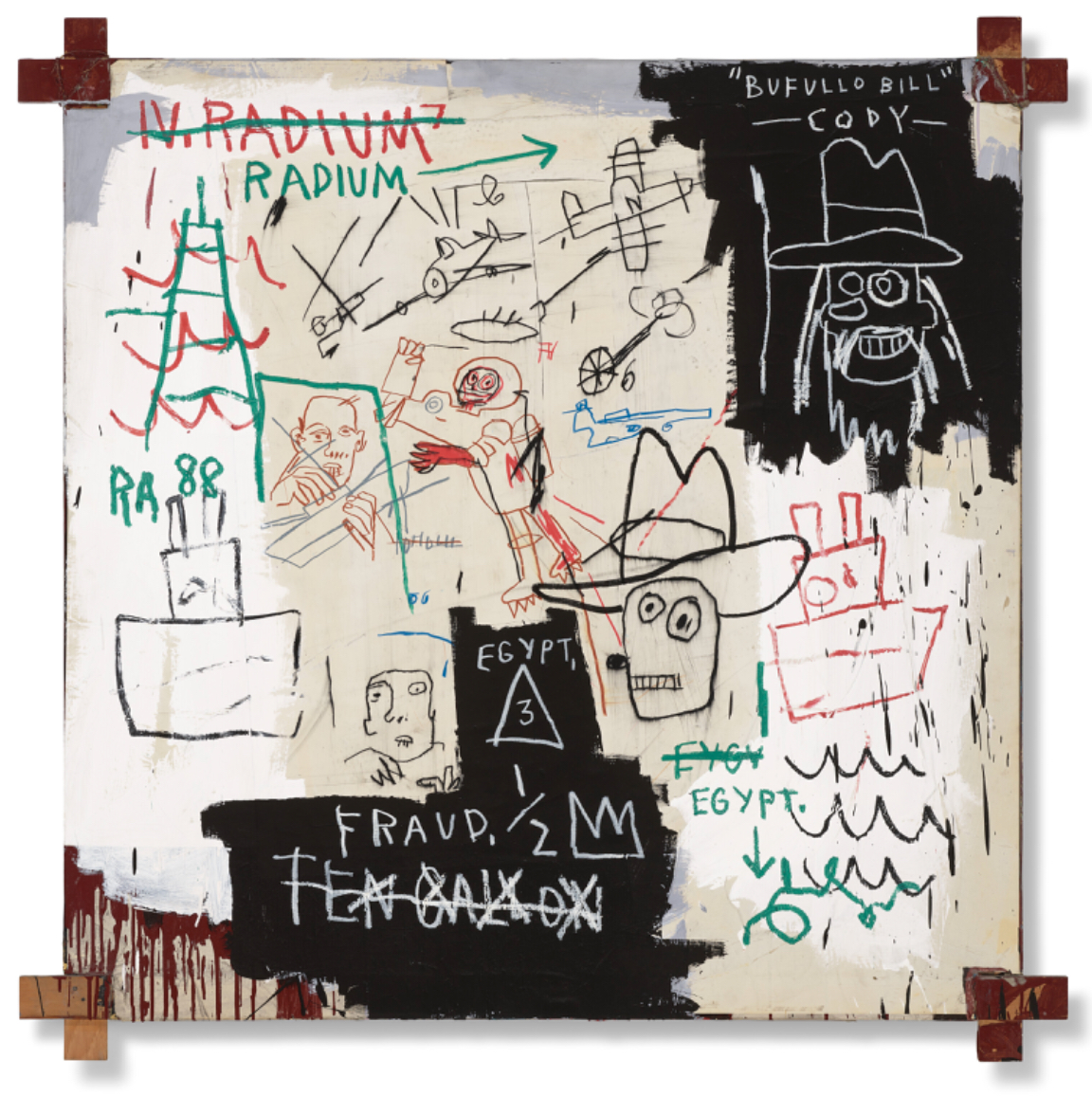
JEAN-MICHEL BASQUIAT (1960-1988)
Future Sciences Versus the Man, 1982
Acrylic, oilstick and paper collage on canvas with tied wood supports
60×60 inches (152.5 x 152.5 cm)
Signed, titled and dated ‘“FUTURE SCIENCES VERSUS THE MAN” JEAN MICHEL BASQUIAT 1982’ (on the reverse)
A masterpiece dating from Jean-Michel Basquiat’s finest period, Future Sciences Versus the Man is an outstanding work from his celebrated series of ‘stretcher’ paintings. A virtuosic meditation on the dreams and downfalls of humankind, it is an electrifying history painting that confronts the myths, marvels and mendacity of scientific progress. Astronauts and cowboys, warships and fighter jets, cannons and chemicals explode across the picture plane; Basquiat invokes the wonders of Egypt, the aspirations of America’s goldrush, the exploration of the cosmos and the threat of nuclear destruction. The work was begun in New York, where it was shown in the artist’s landmark exhibition at the Fun Gallery. It was embellished in Los Angeles later that year, where Basquiat made his stellar debut with Larry Gagosian, and featured on the invitation card for his second exhibition there in 1983. For over twenty years the work was owned by Hannelore B. Schulhof, whose extraordinary collection of post-war masterworks now resides in the Peggy Guggenheim Collection. More recently, it formed part of the spectacular display of stretcher paintings shown as part of the Brant Foundation’s major Basquiat exhibition in 2019.
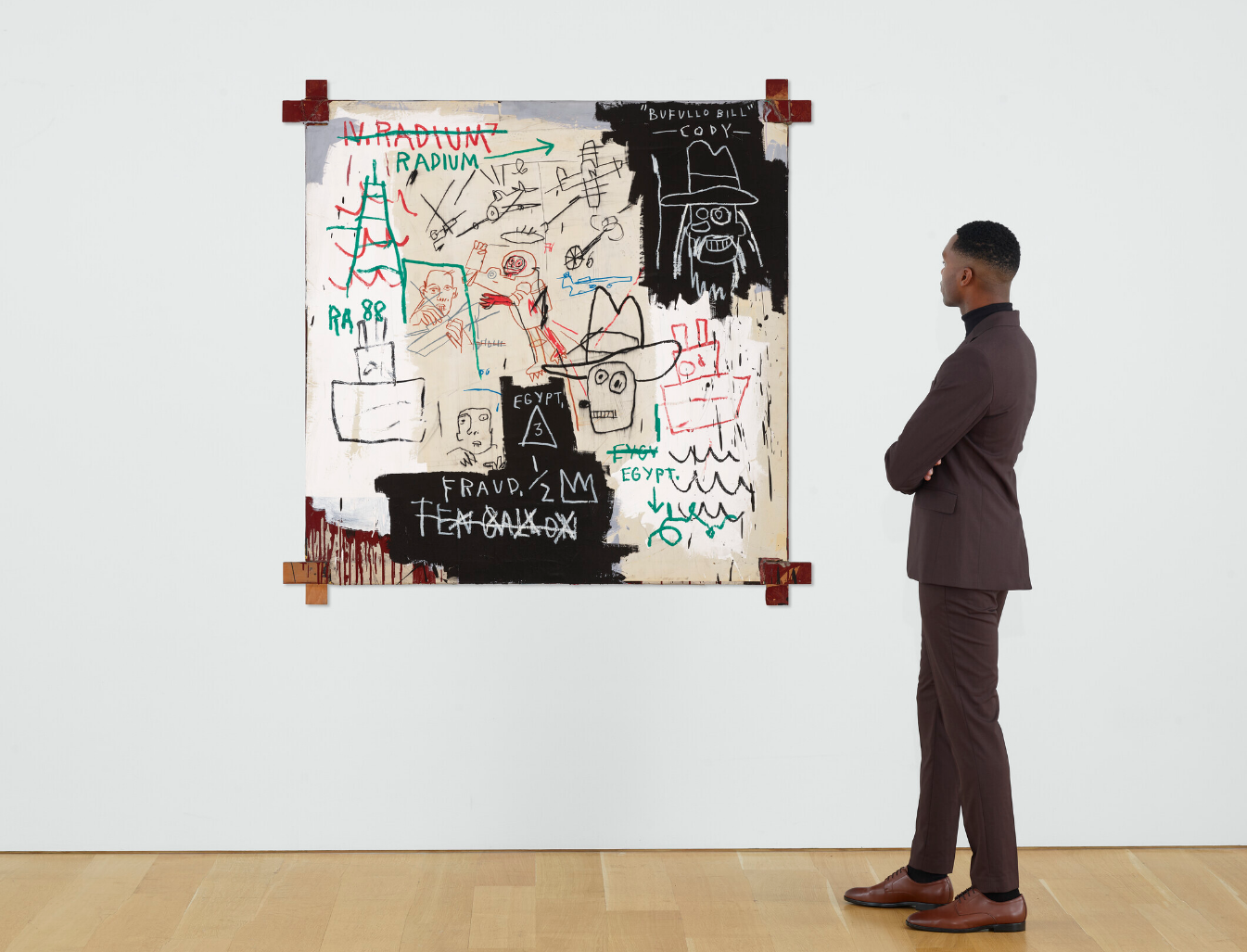
The work takes its place alongside Basquiat’s epic history paintings such as El Gran Espectaculo (The Nile) (1983). Woven into its survey of human civilization, however, is an ecstatic hymn to art. Basquiat conjures the work of painting’s own heroes and visionaries: from the visceral textures of Abstract Expressionism to the raw impulses of street art. There are echoes of Franz Kline’s black and white canvases, Clyfford Still’s jagged color fields and the rich, expressive impasto of Willem de Kooning. Its cryptic diagrams and numbers evoke Cy Twombly’s Bolsena paintings, wrought amid the scientific euphoria surrounding the Apollo moon landings in 1969. There are strains of Pablo Picasso’s Guernica in its elegy to human conflict; in its tactile, collaged surface are ghosts of Robert Rauschenberg’s Combines. At the same time, Basquiat ultimately overwrites these voices with his own. Paint drips, spatters and smears across the canvas, alive with his touch. His trademark symbols—the three-pointed crown, and the halo of thorns above the astronaut’s head—are quietly but unmistakably present. Painting, in the end, triumphs over science, with Basquiat emerging as its great pioneer.
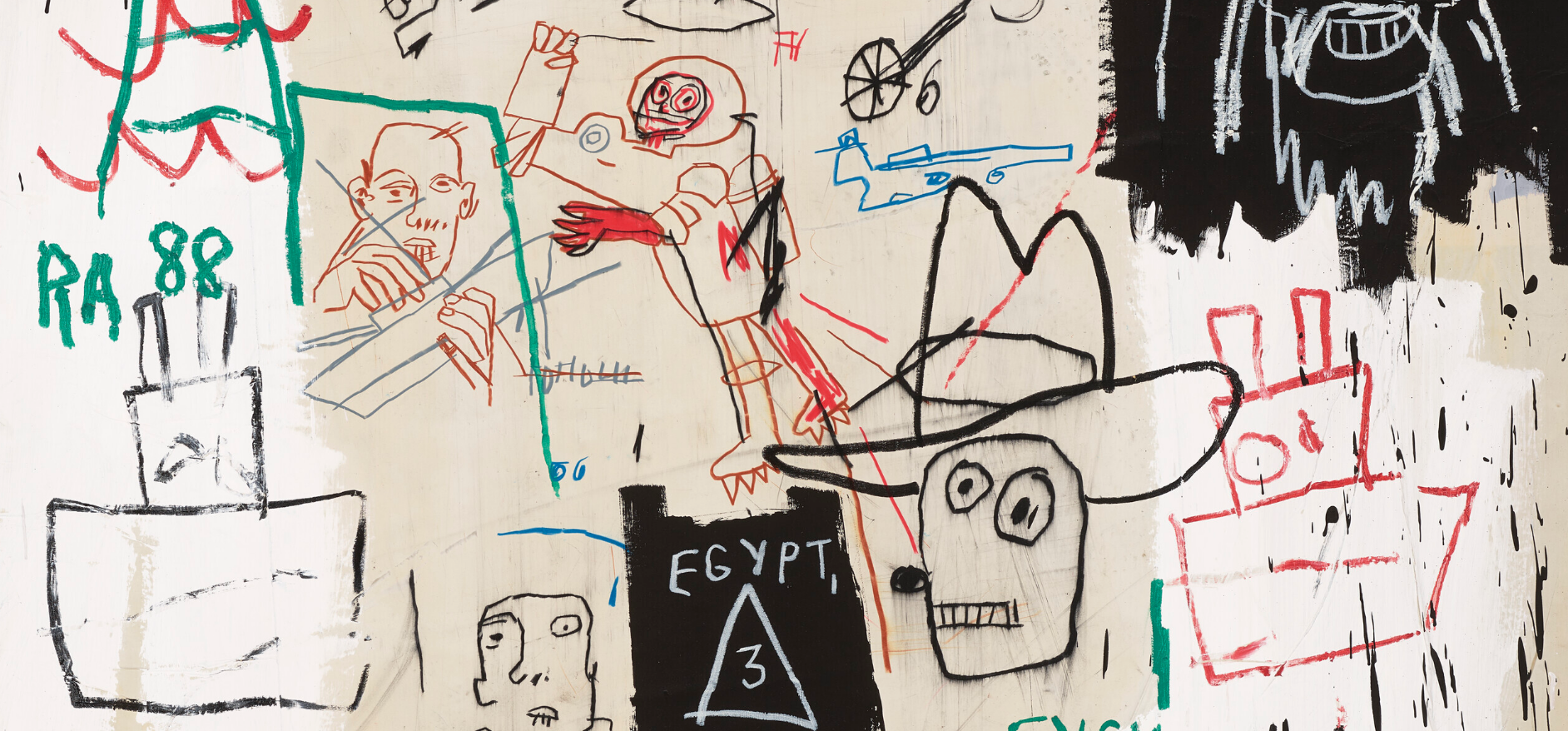
As the artist himself ascended to the stars in 1982, aged just twenty-two, thoughts of progress and invention were undoubtedly on his mind. At the center of his rise to fame were the stretcher paintings themselves. Defined by their exposed wooden bars, salvaged from the streets of the Lower East Side, these bold, near-sculptural icons have been described as ‘one of Basquiat’s original innovations’, and ‘one of his most important groups of paintings’. Examples are held in major institutions including the Whitney Museum of American Art, the Broad Art Foundation, the Menil Collection, the Museum of Art, Kochi, the Museum Boijmans Van Beuningen, the Ludwig-Forum, Aachen and the Montreal Museum of Fine Arts. These structures confront the viewer like urban architectural relics, alive with the spirit of the city in its post-punk heyday. Many of the stretcher paintings, including the present, also formed part of Basquiat’s exhibition at the Fun Gallery, or Fun Factory, in November 1982. It marked the end of an extraordinary year: one that, according to Jeffrey Deitch, had seen him transition from ‘a profusely talented and promising artist working on the street to a world-class painter, poised to become one of the most influential artists of his time’ (J. Deitch, Jean-Michel Basquiat 1981: The Studio of the Streets, exh. cat. Deitch Projects, New York 2006, pp. 10-13).
#2. Peter Doig
Christie’s London: 13 October 2023
Estimated: GBP 5,000,000 – 7,000,000
GBP 6,060,000 / USD 7,354,367
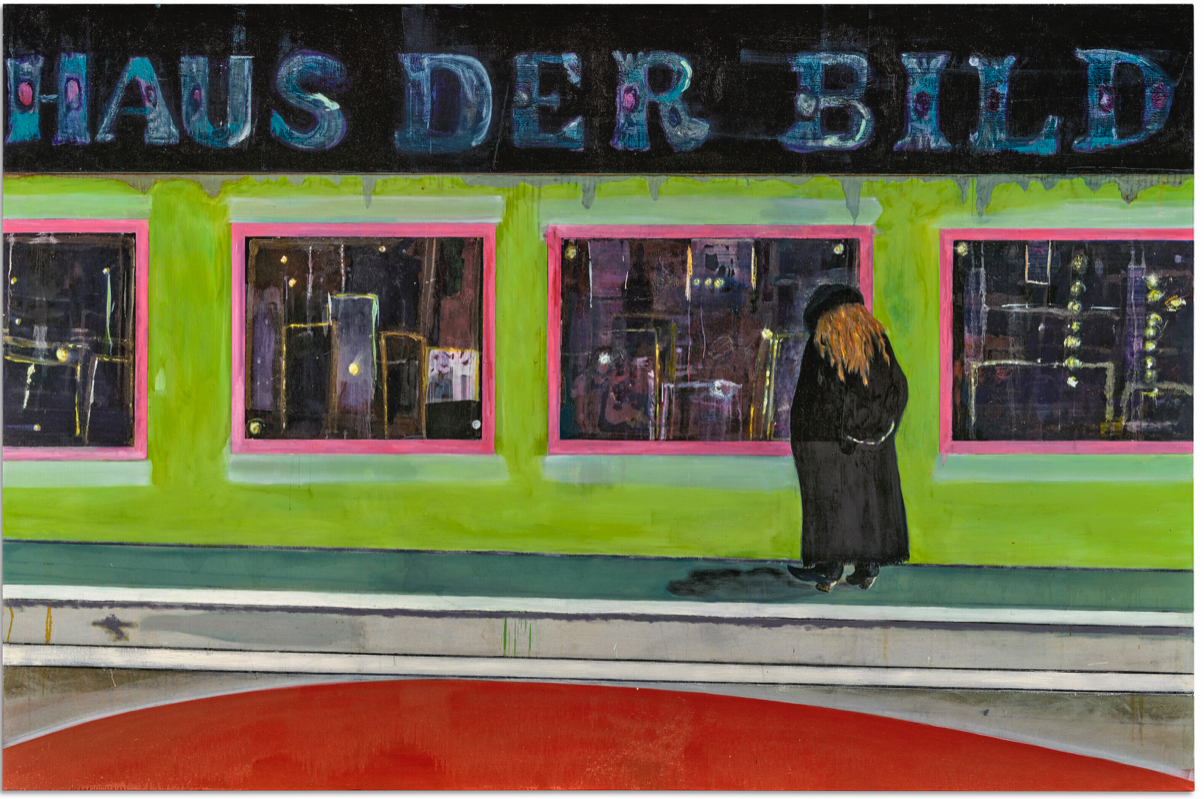
PETER DOIG (B. 1959)
House of Pictures (Haus der Bilder), 2000-2002
Oil on canvas
76 3/4 x 116 1/4 inches (194.9 x 295.3 cm)
Signed twice, titled, and dated
‘Peter Doig 2000⁄2002 House of Pictures (Haus der BILDER) PM Doig’ (on the reverse)
A monumental panorama spanning three meters in width, Peter Doig’s House of Pictures (Haus der Bilder) is an extraordinary painting that dramatizes the sensation of looking at art. Executed between 2000 and 2002, it is among the defining works of the thrilling, transformative period that straddled his return to Trinidad. Depicting a mysterious lone figure peering through a dark gallery window, the work is a masterpiece of self-reflection, capturing the spirit of an artist whose oeuvre is rooted in the observation and assimilation of images. Combining bold geometric rhythms with lyrical washes of electric color, it draws together a staggering array of sources, uniting references to art and film with Doig’s own photographs and memories. Originally held for sixteen years in the prestigious collection of David Teiger, the work is the grand centerpiece of a remarkable series that includes Metropolitain (House of Pictures) (2004, Pinakothek der Moderne, Munich) and House of Pictures (Carrera) (2004). It has been prominently exhibited throughout its lifetime, featuring in major touring retrospectives at the Scottish National Gallery, Edinburgh (2013) and the Fondation Beyeler (2014-2015).
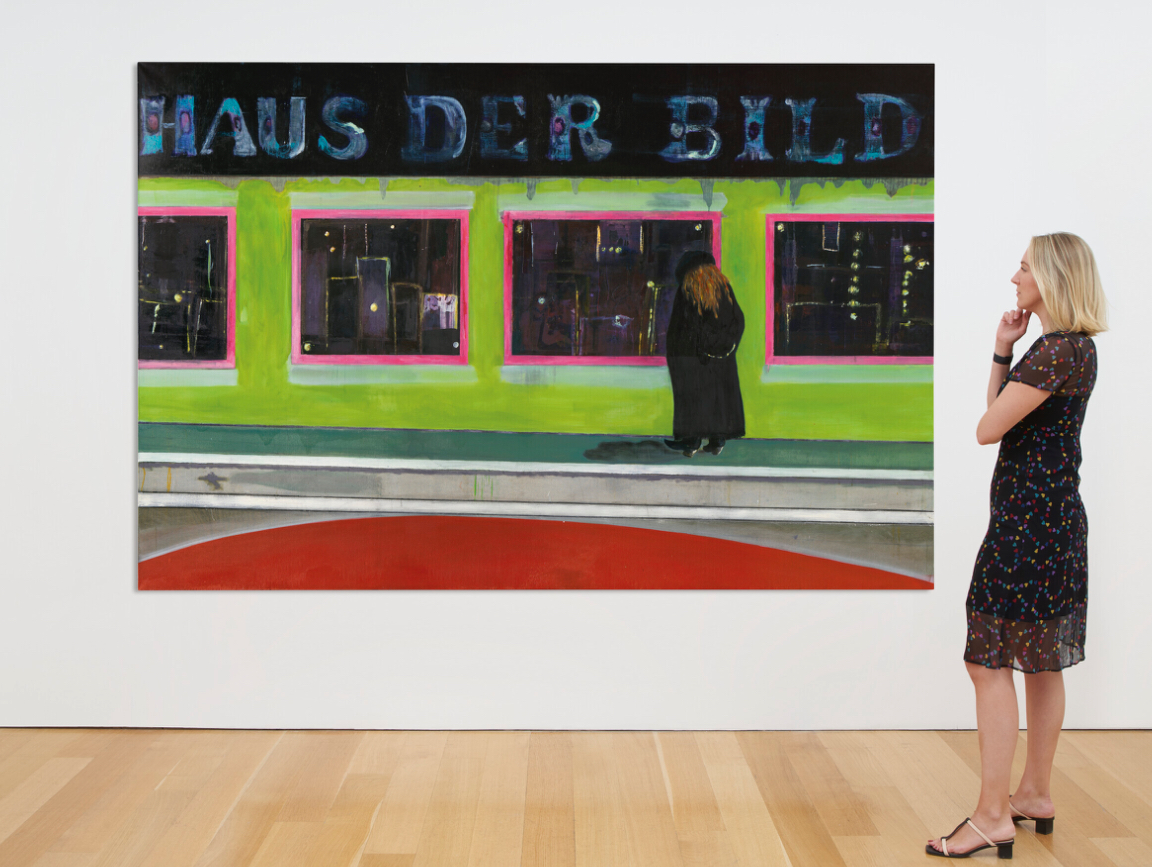
At the turn of the millennium, Doig was enjoying extraordinary international acclaim. In 2000, he undertook an artist’s residency in Trinidad, where he had spent his earliest childhood years. The trip sparked feelings of longing and nostalgia, prompting him to return to the island in 2002. The move brought about a significant shift in his practice. Where Doig’s paintings of the 1990s had been dominated by thick, near-sculptural layers of impasto, he now embraced thin washes of paint, translucent layers and luminous, hallucinogenic color. Along with masterworks such as 100 Years Ago (2001, Centre Georges Pompidou, Paris) and Gasthof zur Muldentalsperre (2000-2002, Art Institute of Chicago), House of Pictures takes its place at the dawn of this period. Rendered in dazzling tones of green, pink, red and blue, it confronts the viewer like a hazy mirage. Woven into its surface are echoes of art history: of Hopper’s lonely streets, the radiant hues of Matisse, the geometries of Minimalism and the rich, gestural textures of color field painting. It is a portrait of how looking at pictures can help us make sense of the world around us and return us to times and places lodged deep within our memory.
#3. Marlene Dumas
Christie’s London: 13 October 2023
Estimated: GBP 2,000,000 – 3,000,000
GBP 3,065,000 / USD 3,719,659
MARLENE DUMAS (B. 1953)
After the Kiss, 1996
Oil on canvas
200×100 cm (76 3/4 x 39 3/8 inches)
Signed, titled and dated ‘M Dumas. after the kiss 1996.’ (on the reverse)
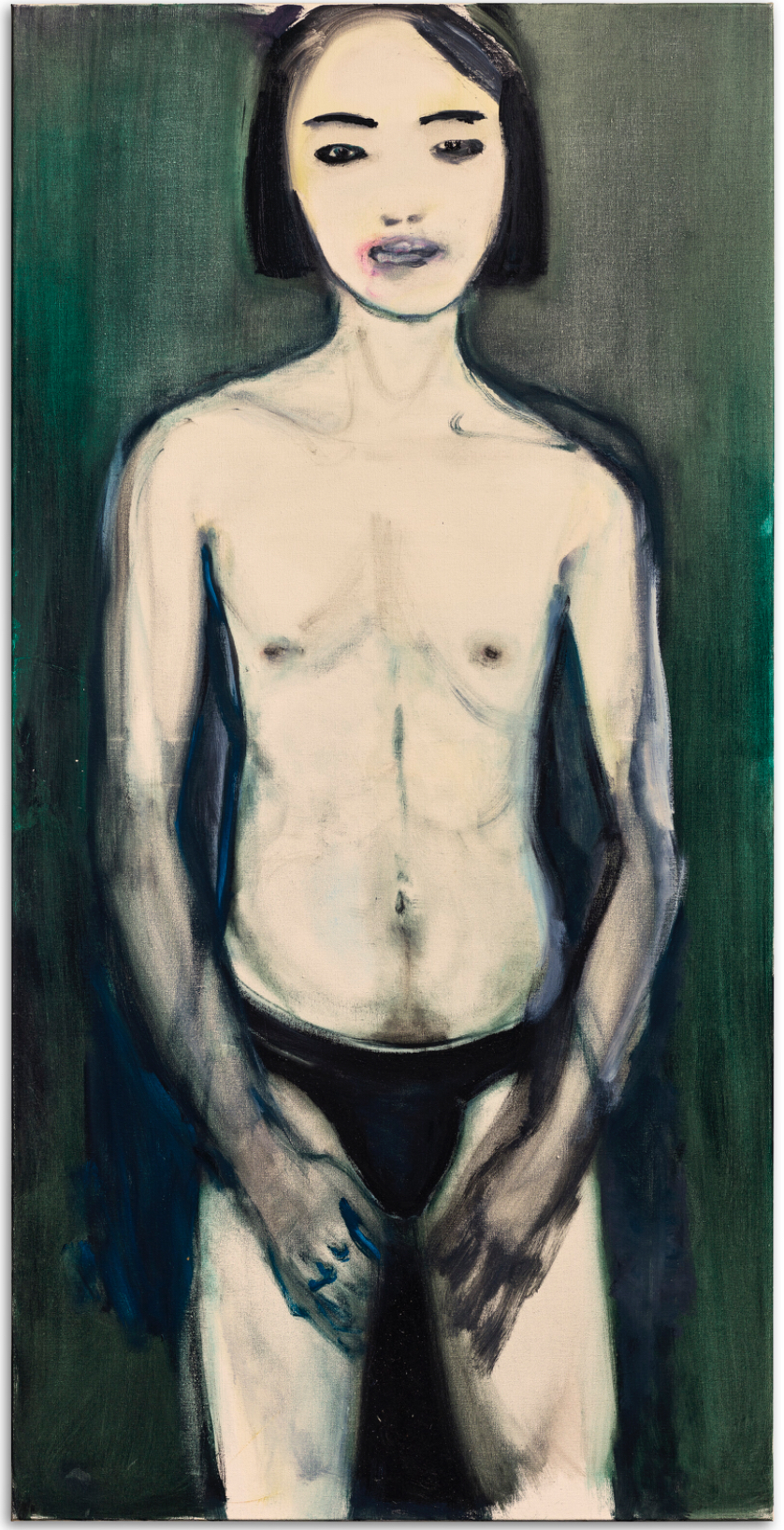
Looming larger than life from its two-meter-high canvas, After the Kiss (1996) is a powerful and incandescent portrait by Marlene Dumas. In her signature style—the paint is thinly applied and flushed with vivid, delicate color—the artist depicts a pale, androgynous figure against a shadowy backdrop. The darkness is washed in tones of midnight blue and teal, and the figure’s skin is ghostly white. Tints of ivory, and a rosy glow at the corner of the mouth—perhaps the trace of the title’s kiss—bring the face to life. Subtle strokes caress the clavicles and chest; the arms are wreathed in smoky grey, as if on the verge of dissolution. Dumas typically works from second-hand photographs and animates these sources with a distinctive new life through her tactile painterly technique. After the Kiss exemplifies the sensual, ambiguous and richly human presence she is able to achieve. The work was debuted in 1996 in Youth and Other Demons, an exhibition at Gallery Konayagi, Tokyo, which was reprised in the same venue the following year. In 2007, it was shown again in Marlene Dumas: Broken White, the artist’s landmark first Japanese survey show at the Museum of Contemporary Art, Tokyo. It has been held in the same private collection for the past decade.
#5. Gerhard Richter
Christie’s London: 13 October 2023
Estimated: GBP 1,800,000 – 2,500,000
GBP 2,097,000 / USD 2,544,902
Gerhard Richter (christies.com)
GERHARD RICHTER (B. 1932)
Abstraktes Bild, 1994
Oil on canvas
61×71 cm (24×28 inches)
Signed, numbered and dated ‘819-2 Richter 1994’ (on the reverse)
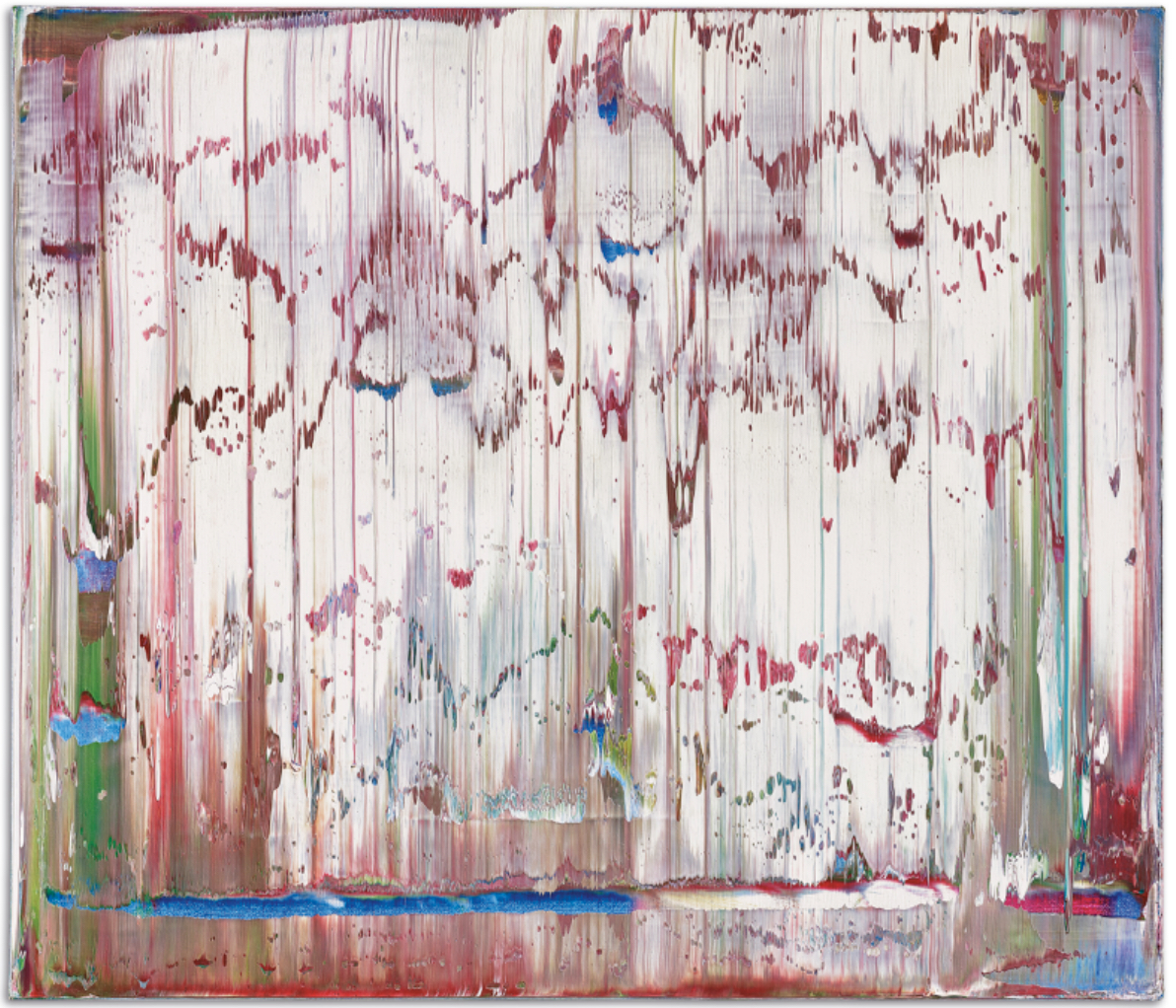
Painted in 1994, Abstraktes Bild is an exquisite work dating from the finest period of Gerhard Richter’s abstract practice. Rendered in a sumptuous palette of crimson, silver and ivory, spiked with flashes of blue, green, violet and magenta, its shimmering curtain of color hovers before the viewer. Paint cascades down the length of the picture, flickering in vertical bands like cinematic distortion. Layers of marbled texture glint through the surface. The work was created at the height of Richter’s international acclaim, following the critical success of his career-defining retrospective at the Musée d’Art Moderne de la Ville de Paris in 1993. The paintings of this period capture his consummate mastery of the squeegee—his signature tool—reveling in the relationship between chance and control. Many were included in the landmark 1995 exhibition Gerhard Richter: Painting in the Nineties at Anthony d’Offay Gallery, London. The present work was acquired directly from the show: other examples now reside in institutional collections including the Cleveland Museum of Art, Tate Modern, London, La Caixa Foundation, Barcelona, the National Museum of Modern Art, Tokyo and the Art Gallery of New South Wales.
George Condo
Christie’s London: 13 October 2023
Estimated: GBP 1,000,000 – 1,500,000
GBP 1,855,000 / USD 2,251,213
GEORGE CONDO (B. 1957)
In the Brothel, 2007
Oil and pastel on canvas
49 1/2 x 42 inches (125.7 x 105.4 cm)
Signed and dated ‘Condo 07’ (upper left)
Signed and dated ‘Condo 07’ (on the reverse)
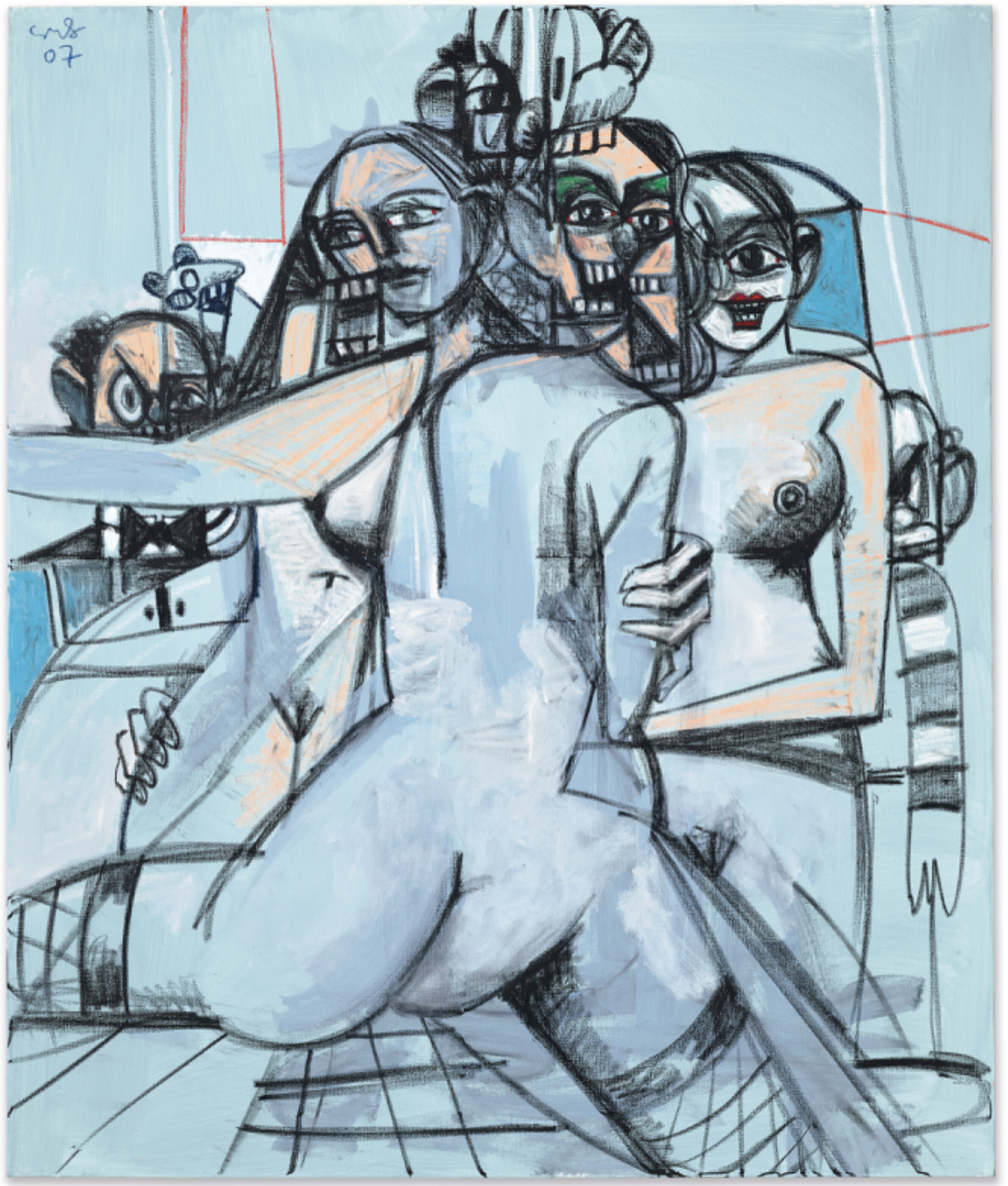
A tangled profusion of faces and bodies fills the canvas of George Condo’s In the Brothel (2007). Condo works in both oil paint and pastel: his dance between painterly and graphic registers complements the polyphonic energy of the picture, which flickers among Cubist, Neo-Classical and Abstract Expressionist modes in the signature style he has called ‘Artificial Realism.’ Riffing on the palette and structure of Pablo Picasso’s 1907 masterpiece Les Demoiselles d’Avignon, the work represents a close conversation with Condo’s great artistic hero. Black lines silhouette the figures against the sky-blue ground, which is heightened with lilac blushes. Loose strokes of peach illuminate nude skin, while red lines scaffold the composition. In the foreground is a nude woman with her back to us, stretching acrobatically in fishnet stockings. She merges with two frontal female forms, overlapping in a medley of limbs and grasping hands. The picture gathers in density around the women’s faces, which are combined with the multiplied features of Rodrigo—a dastardly, bow-tied valet who appears in many of Condo’s canvases—to form a prismatic mosaic of toothy grins, red lips and staring eyes.
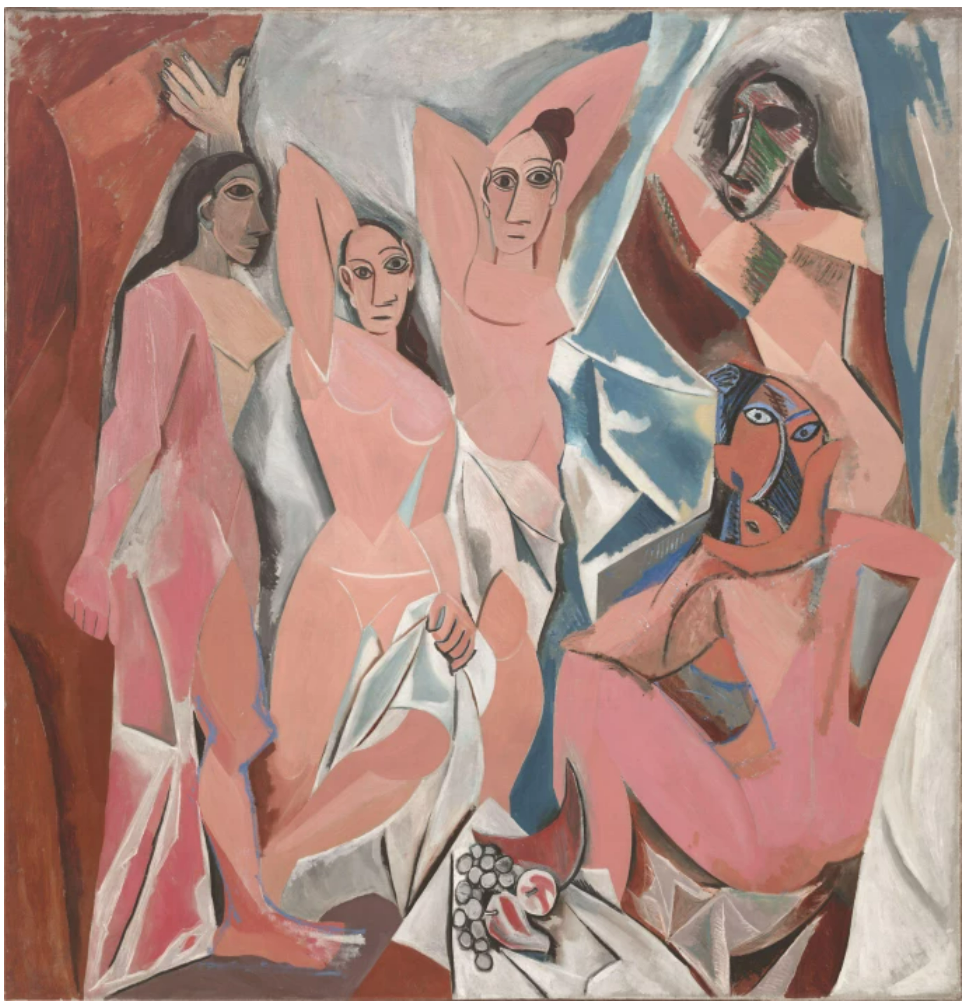
PABLO PICASSO, LES DEMOISELLES D’AVIGNON, 1907
THE MUSEUM OF MODERN ART, NEW YORK © SUCCESSION PICASSO/DACS, LONDON 2023
Condo has been engaged in a creative dialogue with Picasso for over three decades, restaging the Spanish master’s ideas in his own startling, comic and psychologically acute portraits of the human condition. ‘Picasso forced others into new directions, that was one of his greatest influences’, he has said. ‘… In relation to Cubism, I want to see a human face from four different perspectives and four different emotional perspectives. I want to get into their head’ (G. Condo, quoted in D. May, ‘Portrait of an Artist: George Condo,’ Vanity Fair, November 2017, p. 44). The present work’s imbroglio of smiles, frowns, screams and stares exemplifies Condo’s kaleidoscopic approach, creating a tapestry of seething, simultaneous mental states.
Condo’s ‘brothel’ foregrounds the erotic dynamics of Picasso’s work, which shocked viewers with its radical, shattered perspective and the women’s direct, confrontational stares. Preparatory sketches for Les Demoiselles d’Avignon show that Picasso originally planned to include two male figures, who are absent from the final painting. By enmeshing the cartoonish, menacing Rodrigo within the scene, Condo brings the male gaze back into the picture. A Breton-striped sleeve to the picture’s right might even belong to Picasso. More prominently, Condo also implicates himself: it is no coincidence that Rodrigo rhymes with ‘alter ego.’ Like all of us, he is tangled up in a complexity of sightlines, received histories and ways of seeing. In its playful patchwork of style, motif and expression—by turns deftly drawn and beautifully painted—Condo’s painting testifies to the wide-ranging power of his philosophical eye, and the endless, protean possibilities he finds in looking at the past anew.
Damien Hirst
Christie’s London: 13 October 2023
Estimated: GBP 1,500,000 – 2,500,000
GBP 1,492,000 / USD 1,810,679
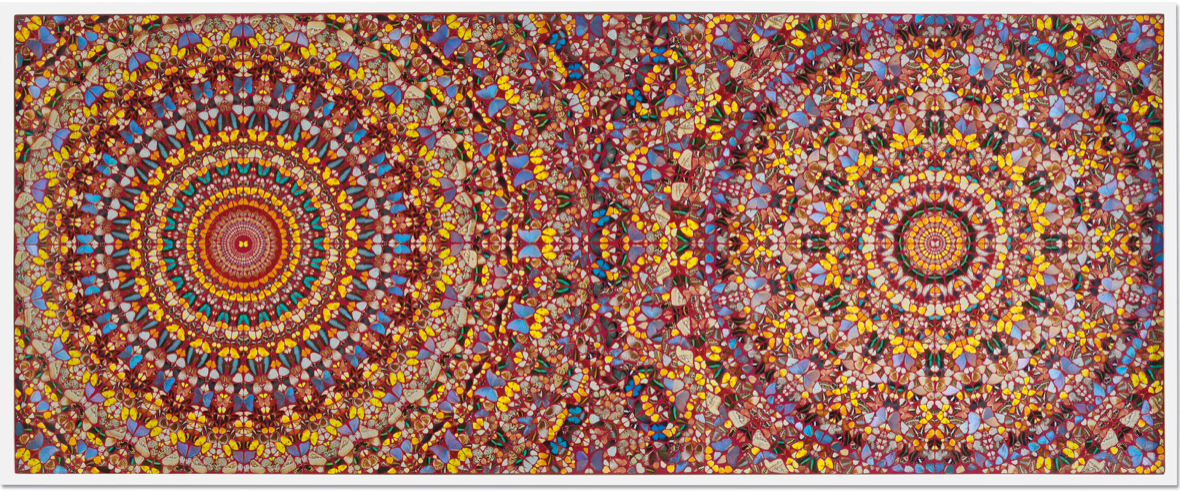
DAMIEN HIRST (B. 1965)
I am Become Death, Shatterer of Worlds, 2006
Butterflies and household gloss on canvas
84 1/8 x 210 inches (213.4 x 533.4 cm)
Signed three times, titled and dated
‘Damien Hirst “I am Become Death, Shatterer of Worlds” D Hirst D Hirst 2006’ (on the reverse)
A centerpiece of the artist’s landmark career survey at Tate Modern, London in 2012—and unseen in public since that time—I am Become Death, Shatterer of Worlds (2006) is the most spectacular butterfly painting Damien Hirst has ever created, and one of the very largest. Across a canvas more than five meters in width, two concentric explosions of vibrant, iridescent wings burst forth against a bright red backdrop. In brilliant yellows, metallic blues, blacks, greens and veined, marbled patterns, they are arranged in twin kaleidoscopes of radial symmetry, glowing with the light and color of an immense stained-glass window. Their splendor contrasts with the morbid undertones of the work’s creation, crystallizing the dualities that lie at the heart of Hirst’s outlook. Awe-inspiring and disquieting in equal measure, its title invokes one of the most infamous quotations of the twentieth century: a line from the Bhagavad Gita, an ancient Hindu text, used by J. Robert Oppenheimer in reference to his invention of the atomic bomb. In I am Become Death, Shatterer of Worlds, Hirst uses the visual language of the divine to touch on the majesty and terror of forces beyond human control.
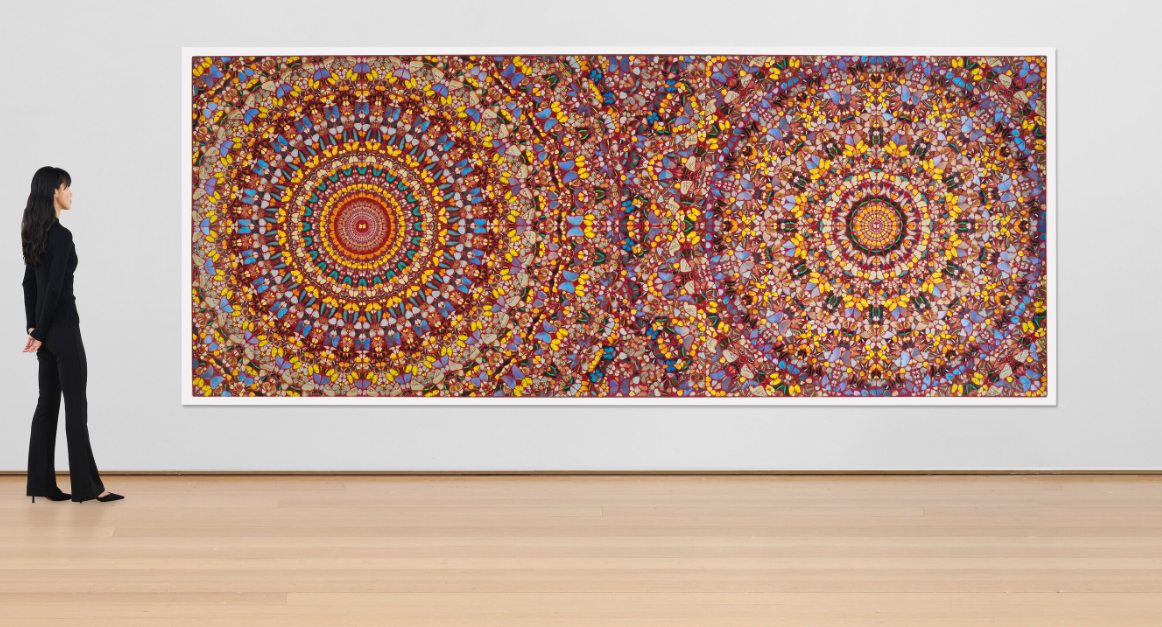
I am Become Death, Shatterer of Worlds represents the climax of a journey that began with In and Out of Love, Hirst’s seminal installation at the Woodstock Street Gallery, London, in 1991. There, pupae were affixed to primed canvases, gradually hatching into live butterflies that flew freely through the gallery space. A downstairs room featured paintings with dead butterflies entombed in their surfaces. Those works led to a series of butterfly monochromes pursued through the following decade, with the insects scattered—as if caught mid-flight—across fields of pristine gloss pigment. During the early 2000s Hirst took these ideas further with his Kaleidoscope series, which was sparked by the sight of a Victorian tea-tray decorated with butterfly wings under glass. The present work, incorporating more than 2,700 butterflies, is the ultimate example of these refractive, densely-patterned compositions. With its vast, panoramic scale, I am Become Death, Shatterer of Worlds invokes the aesthetic of the sublime: an intertwined experience of beauty and terror, where the viewer is overwhelmed by an object’s magnitude. The grandeur of a cathedral’s interior might inspire such a response. So too might a dramatic landscape, as explored in the 19th-century paintings of the German Romantics. The Abstract Expressionists in post-war New York—particularly Barnett Newman and Mark Rothko—saw their work in the same terms. These artists aimed to provoke intense emotional reactions, and their huge, immersive ‘color fields’, for some, offer an almost religious viewing experience.
Damien Hirst
Christie’s London: 13 October 2023
Estimated: GBP 600,000 – 800,000
GBP 756,000 / USD 917,475
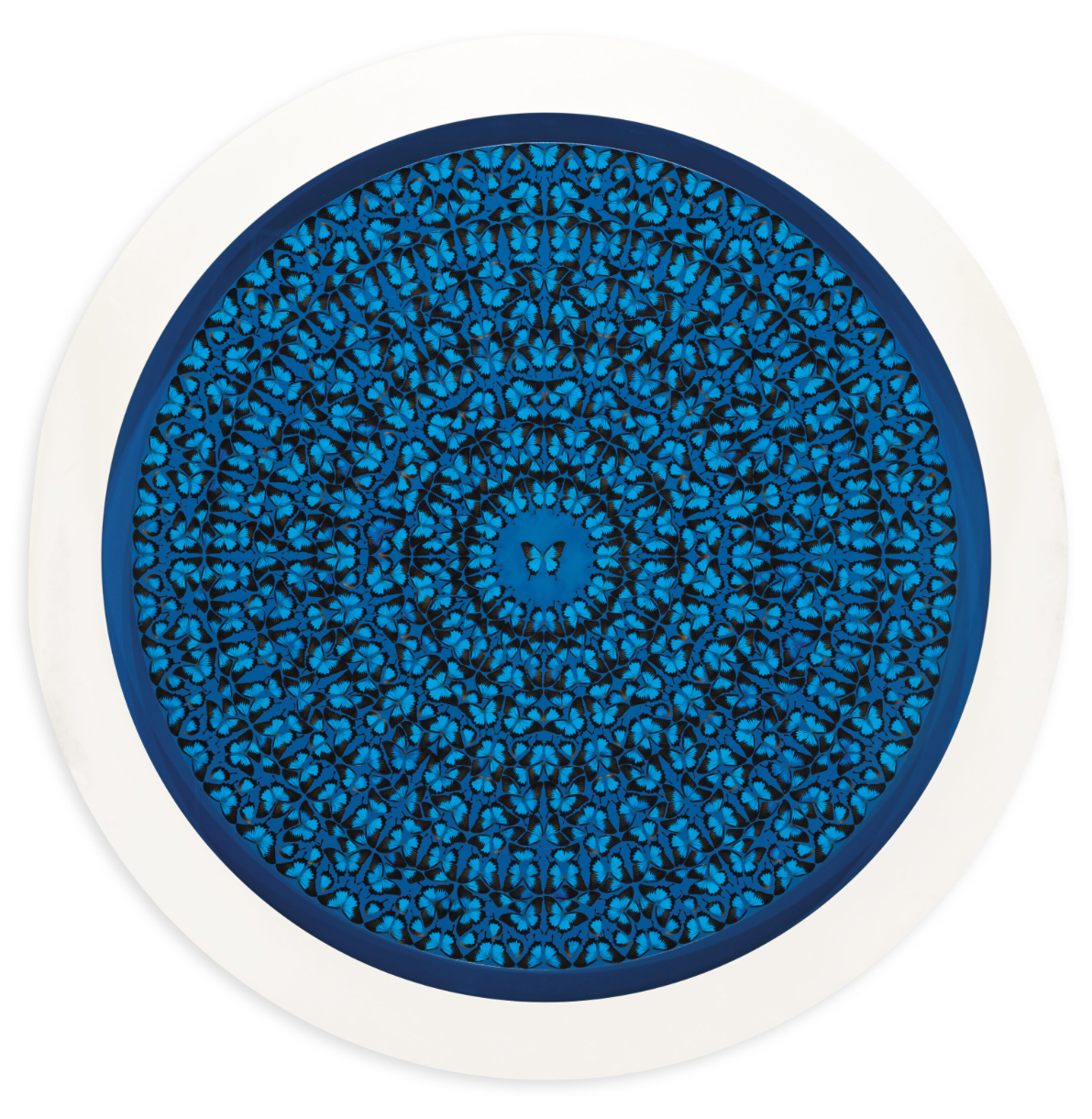
DAMIEN HIRST (B. 1965)
Ulysses, 2008
Butterflies and household gloss on canvas
Diameter: 84 inches (213.3 cm)
Signed, titled twice and dated ‘ULYSSES 2008 Damien Hirst ‘Ulysses” (on the reverse)
Created in 2008, Ulysses by Damien Hirst is a striking meditation on life and beauty. Within the monumental, round canvas, vibrant blue butterflies form concentric circles, together suggesting an infinite, unfolding expanse. Although the work stems from the artist’s Kaleidoscope series—initiated in 2001 and inspired by a Victorian tea tray decorated with butterfly wings—Hirst has employed butterflies in his practice for more than three decades, most famously in his 1991 solo debut In and Out of Love at London’s Woodstock Gallery. In this installation, butterflies emerged from pupae which had been previously affixed to painted canvases. As Hirst explained, he was interested in ‘the death of an insect that still has this really optimistic beautify of a wonderful thing’ (D. Hirst, quoted in Damien Hirst: The Agony and the Ecstasy, exh. cat. Museo Archeologico Nazionale di Napoli, Naples 2004, p. 83). Whereas In and Out of Love witnessed the butterfly’s entire lifecycle, trapped as they were within the gallery’s walls, in Ulysses, the creatures have been caught in a state of pure majesty.
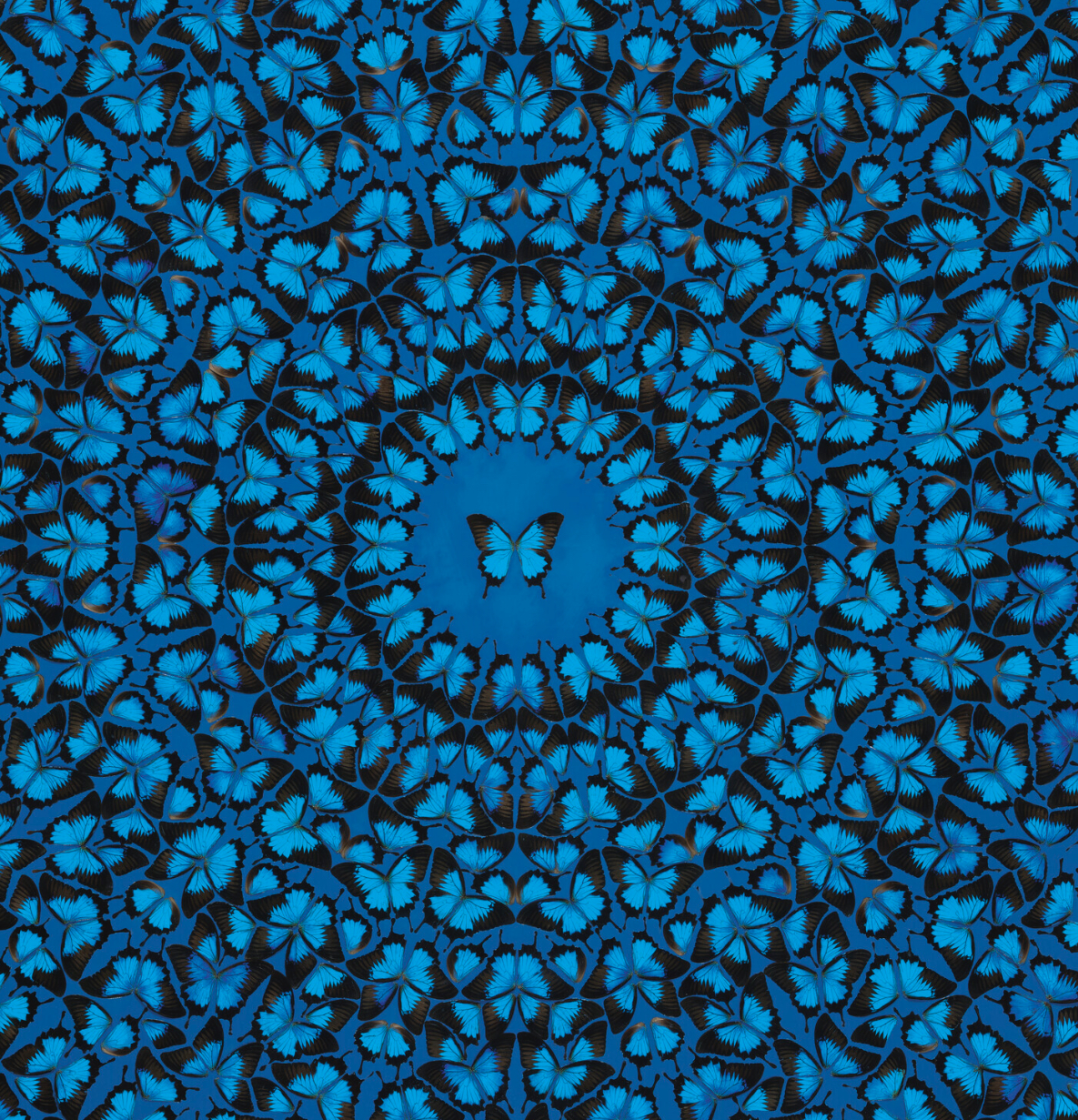
For Hirst, who is fascinated by the overlap of art and science, aesthetics and mortality, the butterfly holds particular appeal. He kept several in his bedroom in the run up to the opening of In and Out of Love. Hirst’s attraction to the creature lies in its layered and multifarious evocations. Across centuries and cultures, the butterfly has symbolized transformation, beauty, and precarity; to Christians, the resurrection; to the ancient Greeks, the soul. Within art history, these creatures were often depicted in vanitas paintings, a particular mode of the still life genre that comments on the ephemerality and transience of human life and rose in popularity during the Dutch Golden Age. Hirst’s enduring preoccupation with death places much of his oeuvre within this long tradition. Indeed, ‘the sensation or thrill of physical vulnerability’ is one proposed by vanitas paintings and acutely felt in Ulysses (B. Dillon, ‘Ugly Feelings’, in Damien Hirst, exh. cat. Tate Modern, London 2012, p. 28). The work’s deep blue surface, notably, conjures the otherworldly azure of Hirst’s celebrated formaldehyde tanks, which engaged with similar themes, as well as invoking the dazzling, opulent interiors of mosques and other Middle Eastern architecture.
Stanley Whitney
Christie’s London: 13 October 2023
Estimated: GBP 400,000 – 600,000
GBP 378,000 / USD 458,738
Stanley Whitney (christies.com)
STANLEY WHITNEY (B.1946)
Fellow Traveler, 2014
Oil on linen
72×72 inches (182.9 x 182.9 cm)
Signed, titled and dated ‘2014 “Fellow Traveler” Stanley Whitney’ (on the reverse)
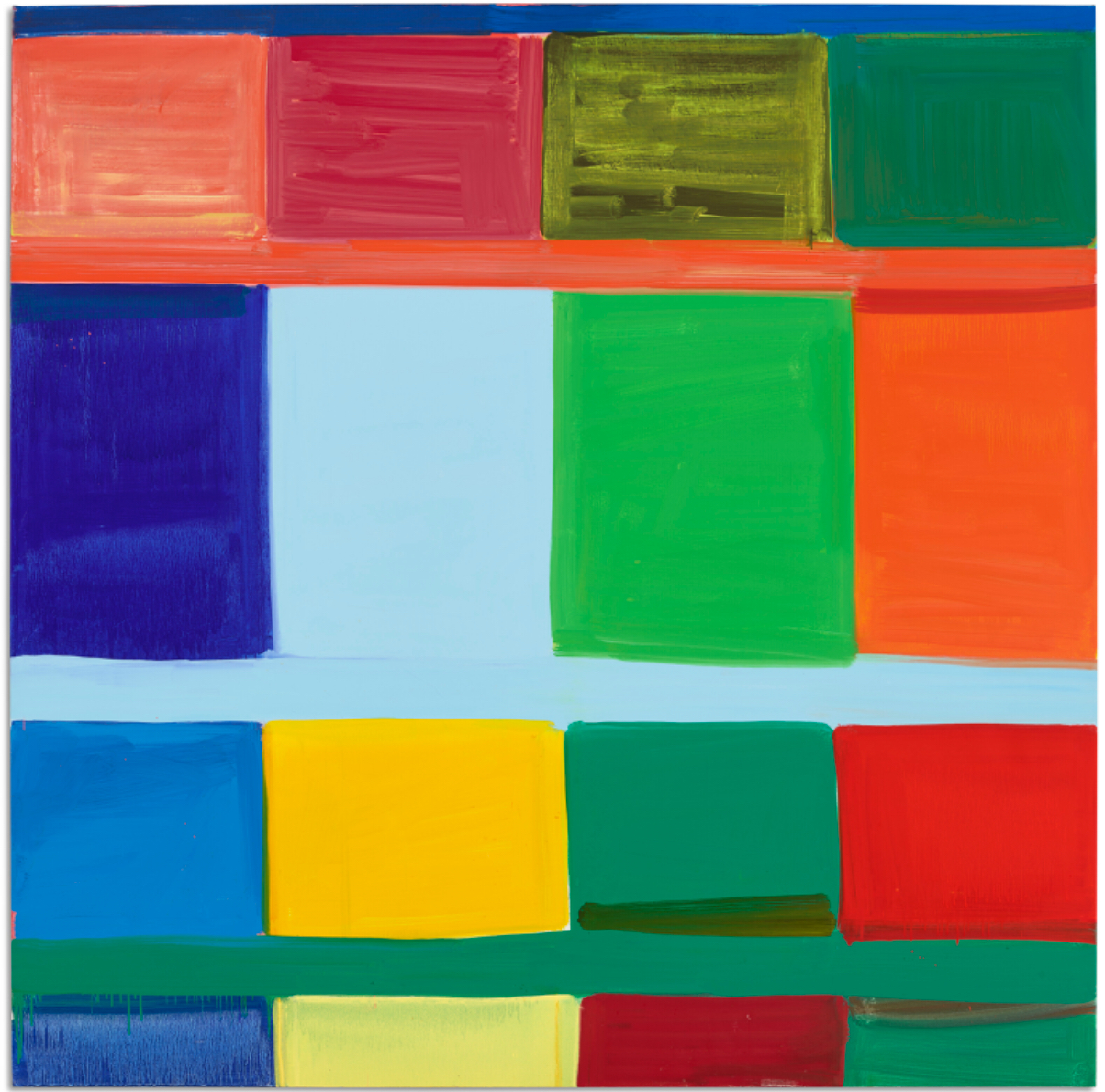
Spanning almost two metres in height and width, Fellow Traveler is a luminous large-scale painting by Stanley Whitney. Painted in 2014, the year before his breakthrough exhibition at the Studio Museum in Harlem, it captures the distinctive chromatic language for which he has since received widespread critical acclaim. Rendered in his signature format, and on one of his largest scales, the work comprises four rows of quivering coloured blocks, each intercepted by vertical bands. Tones of red, teal, sky blue and gold jostle and sing, each alive with the trace of the painter’s touch. Whitney draws inspiration from art history and jazz, as well as travels in Italy and Egypt: an influence conjured, perhaps, by the present work’s title. With a major solo exhibition at the Palazzo Tiepolo Passi during last year’s Venice Biennale—which included a number of works from this period—and a forthcoming retrospective at the Buffalo AKG Museum in 2024, he has taken his place as one of America’s greatest living abstract artists.
EWA JUSZKIEWICZ
Christie’s London: 13 October 2023
Estimated: GBP 180,000 – 250,000
GBP 352,800 / USD 428,155
Eva Juszkiewicz (christies.com)
EWA JUSZKIEWICZ (B. 1984)
Pukle (Locks), 2012
Oil and acrylic on canvas
51 3/8 x 39 1/2 inches (130.4 x 100.2 cm)
Signed, titled and dated ‘Ewa Juszkiewicz “Pukle” 2012’ (on the reverse)
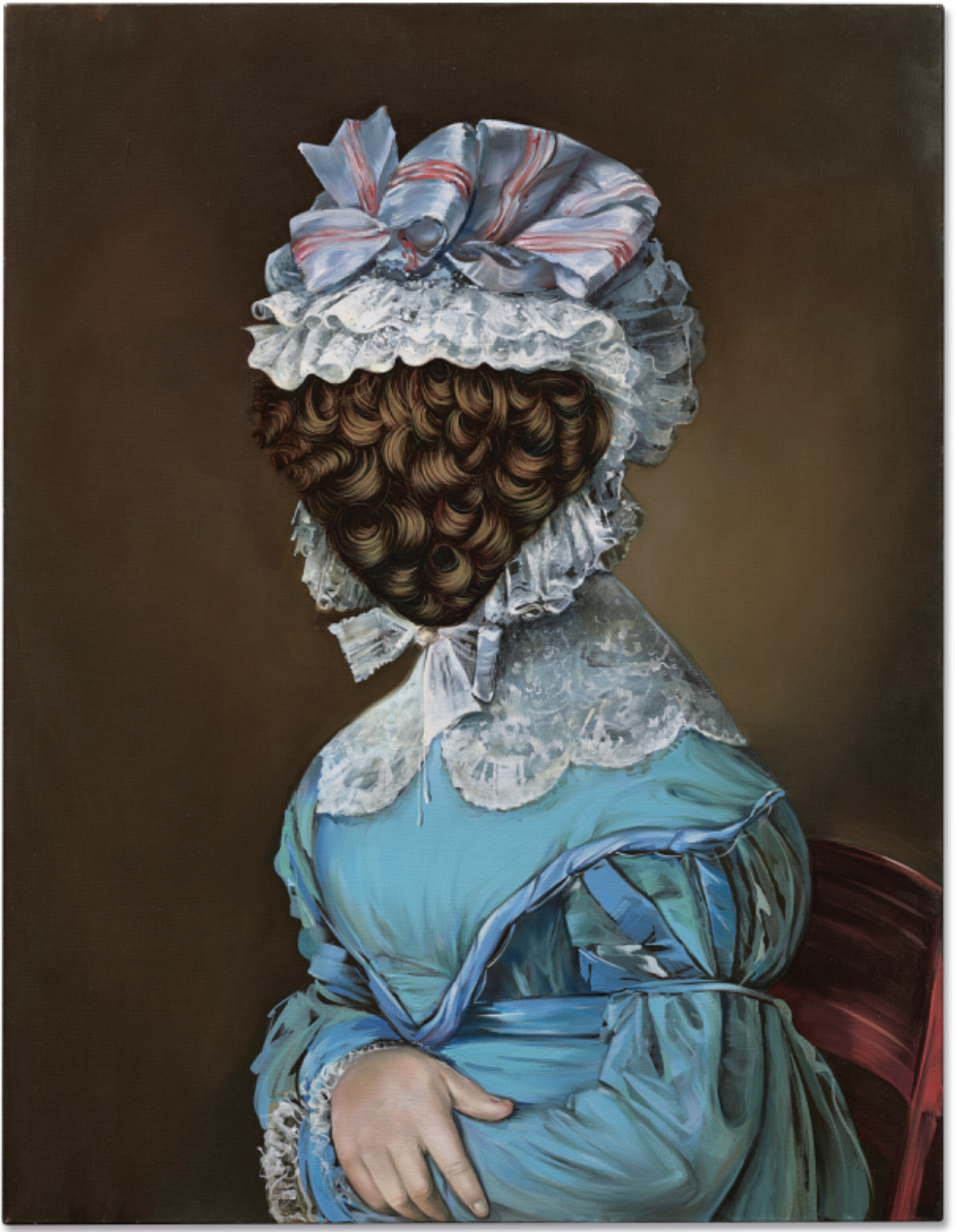
Painted in 2012, Pukle (Locks) stands among the very first examples of Ewa Juszkiewicz’s celebrated historical appropriations. In vivid, luxuriant detail, the artist reimagines the 1824 work Portrait of Baroness Alexandrina Simplicia Nicolai (1787-1824), née Princess Broglie by the Danish Golden Age painter Christian Albrecht Jensen. Set against a backdrop of velvety chiaroscuro, her dress and bonnet come to life in hyperreal splendour. The colour of the blue fabric is heightened and intensified; every wrinkle, crease and pattern in the lace is rendered with immaculate clarity. Her face, however, is obscured by a mass of curls, transforming her into a surreal apparition. Juszkiewicz is fascinated by the ways in which women were depicted in historical portraiture. Her practice, begun in 2011, seeks to highlight the anonymity and uniformity with which they were traditionally portrayed. By replacing their facial features with startling, elaborate disguises—from insect masks, flowers and drapery to the locks of hair seen here—she invests her subjects with new life, character and intrigue. The work was included in a number of Juszkiewicz’s early exhibitions in Poland, including at the Centrum Kultury Katowice shortly after its creation.
Caroline Walker
Christie’s London: 13 October 2023
Estimated: GBP 100,000 – 150,000
GBP 189,000 / USD 229,369
Caroline Walker (christies.com)
CAROLINE WALKER (B. 1982)
Chess, 2016
Oil on linen
71×61 inches (180.2 x 155.1 cm)
Signed, titled and dated ‘CHESS 2016 Caroline Walker’ (on the reverse)
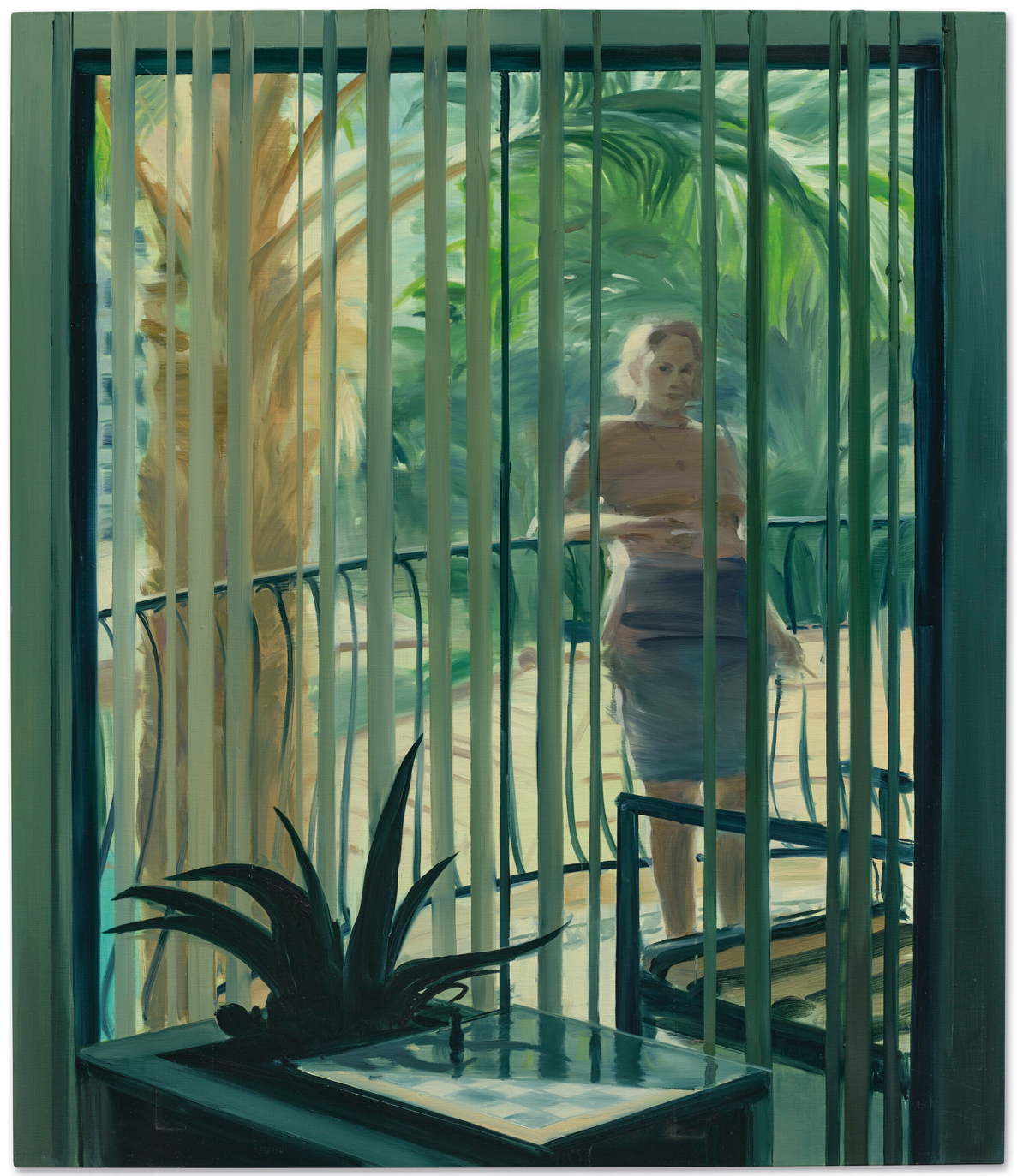
In her large-scale oil painting Chess (2016), the Scottish artist Caroline Walker grants us an intimate view of a private life. The work depicts a woman leaning on a metal balustrade. Cigarette in hand, she looks towards an unseen point with poise and confidence. Walker veils her subject with the vertical lines of half-closed blinds. The foreground of the painting details a shadowy sitting room, with a chair, a sharp-leaved houseplant and a chessboard. The gleaming board bears a single black chess piece and adds a narrative tension to the work: perhaps the woman is plotting her own next move. Behind her, there is verdant greenery, a sun-kissed palm tree and a patch of azure that suggests a swimming pool. The work forms part of Walker’s Downtown LA series. Simultaneously a portrait of a person and of a place, Chess takes us on a virtuosic journey through a darkened interior to the Californian sun.
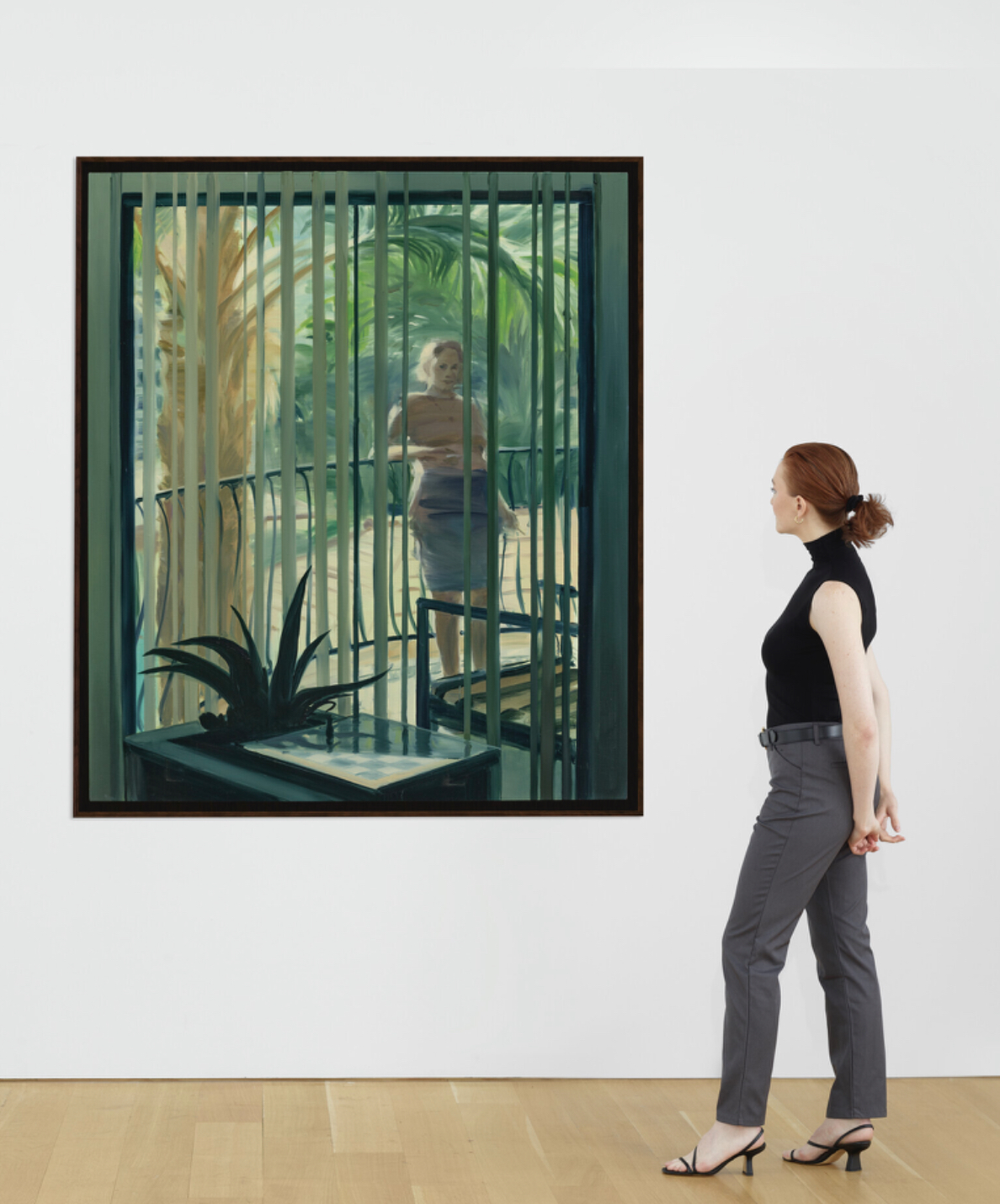
Walker has a lifelong interest in depicting domestic interiors: as a child she drew from a makeshift studio in a kitchen cupboard. The scenes she paints today often centre on women at work, at home or both.
“I paint women because in some ways I am always painting myself, and my own experiences or anxieties,’ she explains, ‘but from a distanced objective position which can hopefully also reflect how we all encounter the world.”
In this, Walker follows the precedent of 19th-century French realist and Impressionist painters like Edouard Manet and Edgar Degas, whose works often captured the relationship between humans and the modern city. In focusing on women within the home, she also extends an art-historical tradition that stretches back to Golden Age Dutch genre painters such as Johannes Vermeer. Like Vermeer’s works, Chess combines psychological penetration and pin-sharp detail to bring a moment in time to life.
2. Post-War and Contemporary Art Day Sale
14 October 2023
Post-War and Contemporary Art Day Sale (christies.com)
Total:
GBP 11,466,504
USD 13,903,836
———
# Lots: 164
# Lots sold:
# Lots withdrawn:
Sell-Through Rate: %
———
Above Estimates: 13 (24%)
Within Estimates: 17 (32%)
Below Estimates: 15 (28%)
Unsold: 8 (15%)
#1. Gunther Forg
Christie’s London: 14 October 2023
Estimated: GBP 220,000 – 320,000
GBP 441,000 / USD 534,739
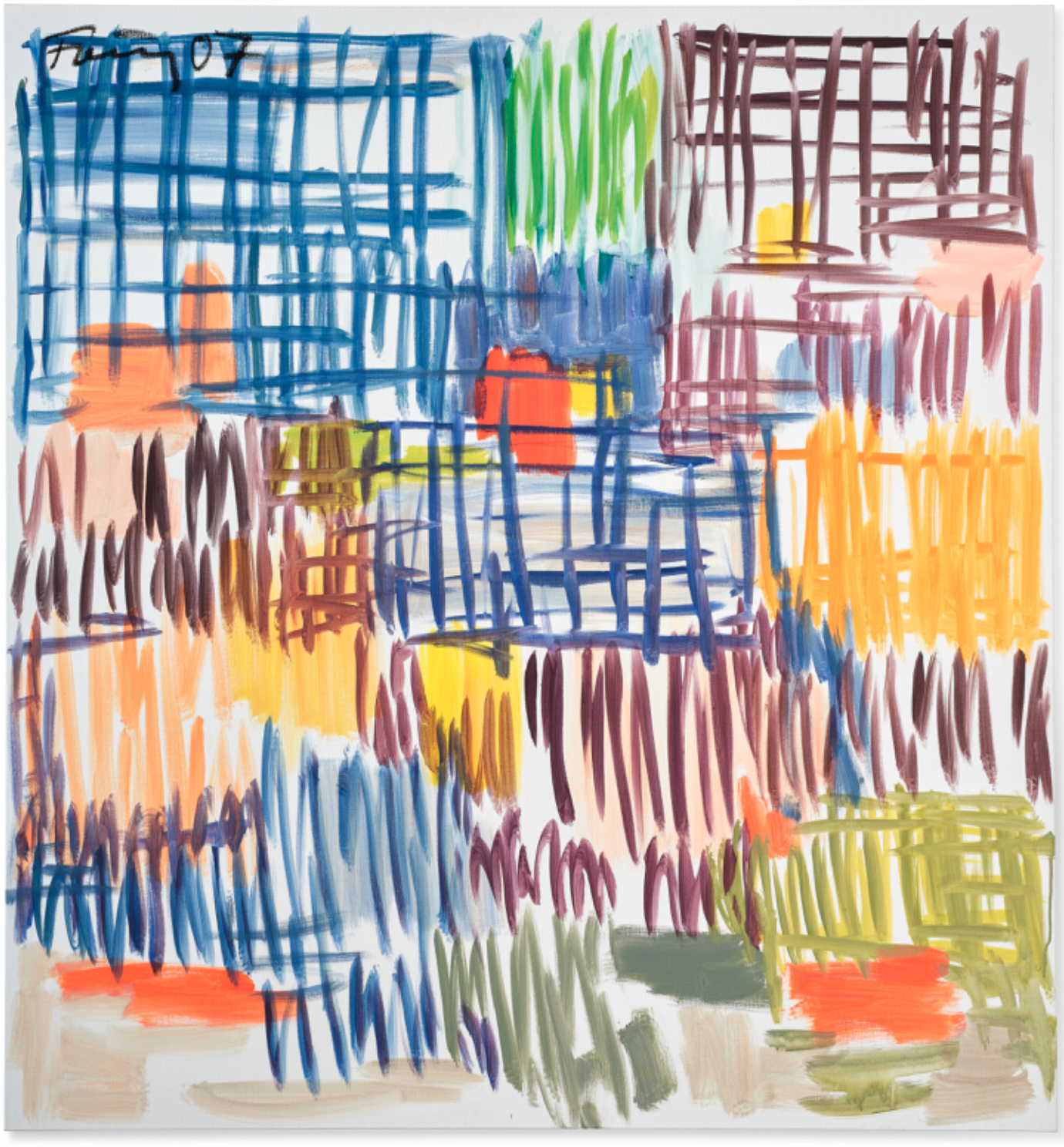
GÜNTHER FÖRG (1952-2013)
Untitled, 2007
Acrylic on canvas
59 x 55 3/8 inches (150 x 140.5 cm)
Signed and dated ‘Förg 07’ (upper left)
Painted in 2005, Günther Förg’s Untitled unfurls a magnificent patchwork of line, colour and form. Spanning a height of a metre and a half, the large-scale canvas comes from a crucial period of the artist’s pictorial development. Bearing the distinctive, gestural markings of both the Gitterbilder ‘Grid Paintings’ and Tupfenbilder ‘Spot Paintings’, the present painting seems to occupy the precise juncture between two of the artist’s most iconic and widely celebrated series. Beneath a lattice of emphatic vertical and horizontal lines, one can glimpse the artist’s unmistakable spots of vibrant orange, yellow and cadmium red. The daubs electrify the canvas from within, and, across its expansive surface, Förg masterfully balances tightly hatched structures with a chromatic intensity characteristic of his later oeuvre. Marking the artist’s return to the grid almost a decade after its inception, the present painting distinguishes the sensuous, invigorated evolution of Förg’s late practice. In loose and energized gestures, line is unleashed in autographic, scarcely legible scribbles—evoking the passionate expressions of abstract titans Cy Twombly and Jackson Pollock. Here, brushwork is Förg’s primary subject matter. Accentuated against a signature ground of white primer, scores of vivid color assemble like words on a page, inflected with an almost staccato rhythm. His graphic spots were part inspired by photographs he had seen of Francis Bacon’s studio, where residual marks left by the artist wiping excess paint from his brushes adorned the walls with patterns of colorful blotches. Indeed, evoking centuries-old traditional painting methods, Förg’s compositions are scattered with similar chromatic ‘workings-out’, where pigments are combined and tested, their color values determined. Drawing our attention to the pictorial surface with a palimpsest of gesture and color, Förg’s painting nods to the process of its own creation.
#2. Andy Warhol
Christie’s London: 14 October 2023
Estimated: GBP 280,000 – 350,000
GBP 371,700 / USD 450,709
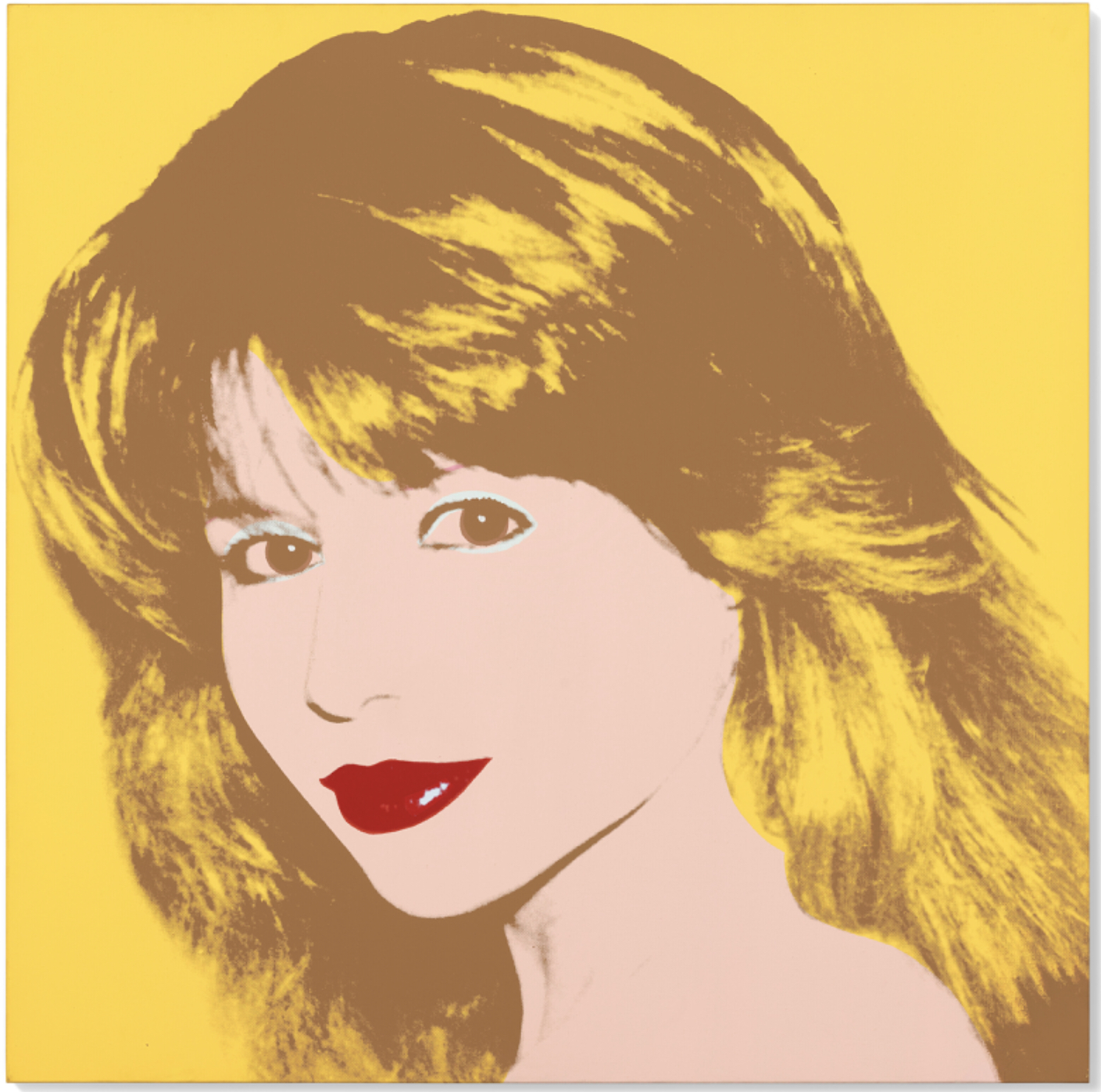
ANDY WARHOL (1928-1987)
Pia Zadora, 1983
Acrylic and silkscreen ink on canvas
40×40 inches (101.7 x 101.7 cm)
Stamped twice with the Andy Warhol Foundation for the Visual Arts, Inc. and the Estate of Andy Warhol stamps
Numbered ‘PO50.259′ (on the overlap)
Numbered ’10-960-2883 PO50.259’ (on the stretcher)
Executed in 1983, Pia Zadora bears every trace of Warhol’s most celebrated and iconic working methods. Rendered in flat, silkscreened layers of dazzling yellow gold and red, the Hoboken-born actress—who had won a Golden Globe for ‘New Star of the Year in a Motion Picture’ two years earlier—stares coolly out from the canvas. The work belongs to Warhol’s acclaimed series of ‘Society Portraits’, a systematized mode of portrait production which the artist honed to a slick operation during the 1970s. Capturing the likenesses of actresses, rockstars, politicians, businessmen, starlets and even royalty, Warhol’s series of large, square-format canvases constitutes an almost encyclopaedic visual catalogue of the upper echelons. Harnessing the technologies of the instant, readymade photograph within his portraits, these works draw on the contemporary language of the mass-produced, recalling imagery from glossy magazines, newspapers and Hollywood films. Resuscitating 20th-century portraiture in America after a succession of non-figurative artistic movements—Abstract Expressionism, Minimalism, and Conceptualism—Warhol’s Pop revitalisation of the genre is one of his greatest legacies.
After a decade silk-screening iconic Campbell soup cans, dollar bills and Coca-Cola bottles in the 1960s, Warhol turned to the celebrity—arguably America’s most revered commodity. Already captured and consumed, if not devoured, by popular visual culture and media, the society portrait provided Warhol all-exclusive access to the world of the rich and famous. The series forms his single largest body of work, and, executed exactly two decades after his first commissioned portrait of art collector Ethel Scull in 1963, Pia Zadora stands as testament to one of the artist’s most enduring preoccupations. By the time of our work in the early 1980s, Robert Rosenblum has argued that Warhol himself ‘had become a celebrity among celebrities’, taking on the role of the ‘ideal court painter to this 1970s international aristocracy’ (H. Geldzahler and R. Rosenblum, Andy Warhol: Portraits of the Seventies and Eighties, exh. cat. Anthony d’Offay Gallery, London 1993, p. 144). Conjuring a rich lineage of courtly and society portraitists from Singer Sargent to Van Dyke, Warhol’s works trace his own accelerated movement through high society. Indeed, known for obsessively recording his encounters with a tape recorder, and documenting interactions in his diary, in an entry from Thursday 28th July 1983, Warhol wrote: ‘Got up early and had to move fast because I had an early appointment at the office with Pia Zadora, so I was excited’ (A. Warhol quoted in P. Hackett (ed.), The Andy Warhol diaries, New York 1991, p. 517).
The portraits began with photographs taken by Warhol with a Polaroid Big Shot camera in his ‘Factory’ on Union Square, Manhattan. Enjoying the rudimentary appearance of its stark flash and fixed focus, Warhol often exaggerated its flattening effects by applying white based foundation and bright cosmetics to his sitters. In lieu of the traditional portraitist’s preparatory sketch, Warhol’s use of the inexpensive instant camera offered him equivalent immediacy with his subject, resulting in works with surprising glimmers of personality amidst a graphic, Pop surface. Zadora’s recollection of sitting for Warhol in the summer of 1983 captures the disarming intimacy of the process: ‘I was used to posing for photographers. But he said, “Sit in the corner and be yourself.” Well, who am I?’ (P. Zadora quoted in B. Sokol, ‘Show Us Your Warhol!’, The New York Times, 1 November 2018). Printing his favourite of the polaroids to acetates, Warhol would set to work, meticulously retouching his sitters’ faces, erasing the texture of fine lines and wrinkles to create smooth planes of dimension. On this occasion Warhol selected two photographs of Zadora to print from, suggesting a marked interest in her. He was particular about printing onto standardised canvases of 40 by 40 inches, envisaging an eventual, monumental display of the series side-by-side in a comprehensive ‘Portrait of Society’. Charged with the seductive glamour of a cosmetics advert, Pia Zadora attests to Warhol’s pleasure in rendering eyes and lips. He insisted that Zadora wore red lipstick for the shoot, and went on to accentuate the actress’s glossy pout, hand-painting a reflective shine in white acrylic. Submitting her image to Warhol’s well-oiled production line, here, Zadora is immortalized under a perfect sheen of brightly-colored paint.
#3. Yayoi Kusama
Christie’s London: 14 October 2023
Estimated: GBP 200,000 – 300,000
GBP 327,600 / USD 397,235
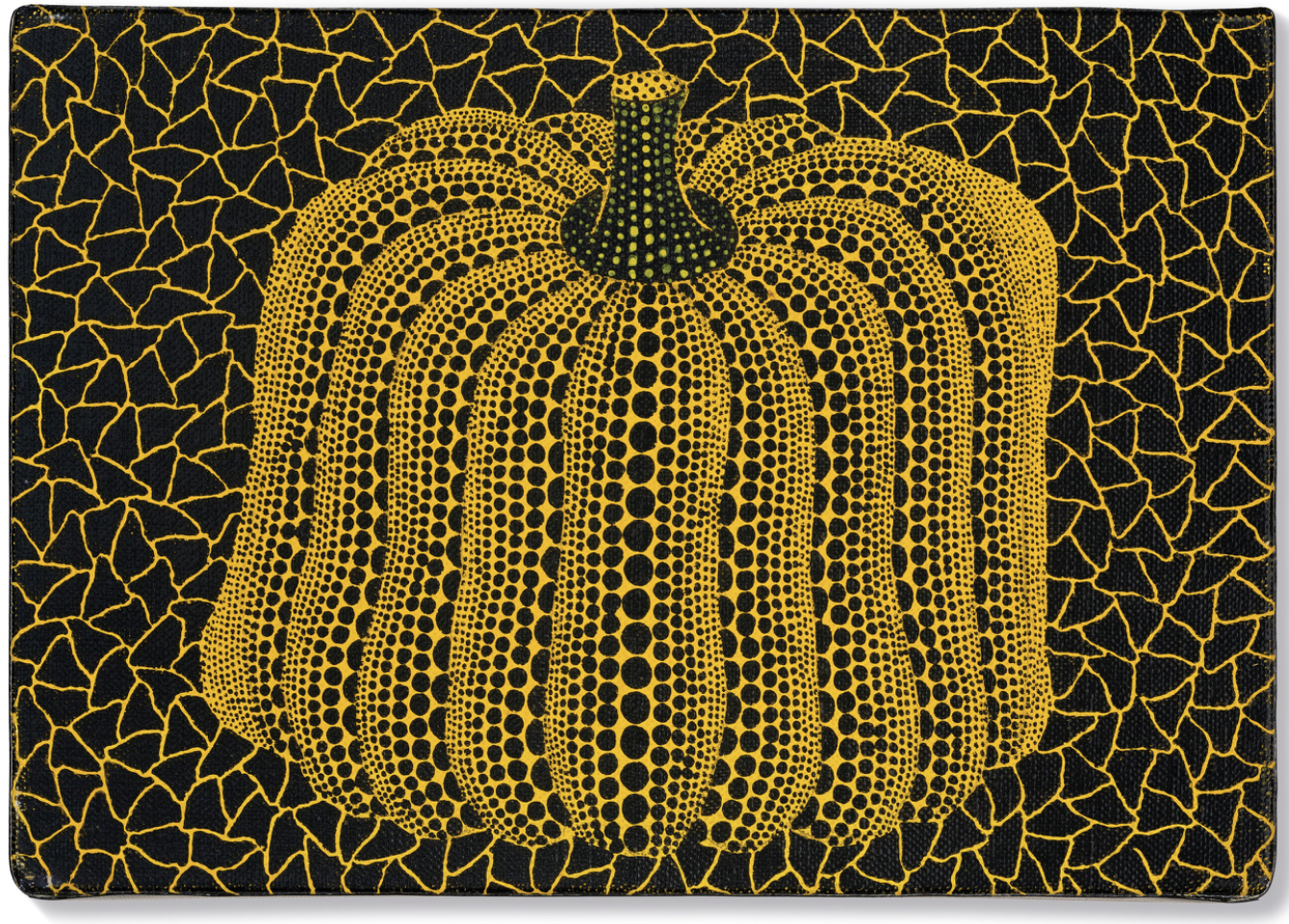
YAYOI KUSAMA (B. 1929)
Pumpkin, 1992
Acrylic on canvas
15.8 x 22.7cm (6 1/4 x 9 inches)
Signed, titled in Japanese and dated ‘YAYOI KUSAMA 1992’ (on the reverse)
Executed in 1992, a year before she was selected to represent Japan in the Venice Biennale, Yayoi Kusama’s Pumpkin is a vibrant depiction of her much beloved and career-defining subject. Rendered in her signature, two-tone colour palette of brilliant yellow and black, the ornate fruit gleams with dazzling streams of polka dots. Dilating and contracting in size, the spots are gradated to evoke a mesmeric play of light and shadow across its plump, distinctive furrows, creating a vivid sculptural dimensionality within the painting. In a hypnotic spectacle of pattern that blurs the abstract with the figurative, the pumpkin seems to shimmer, undulate, and intensify before the eye. Just as the Campbell’s soup can became a trademark for Andy Warhol in the 1960s, the pumpkin has become something of a metonym for Kusama. Instantly recognizable, it is a deeply personal motif: ‘Giving off an aura of my sacred mental state’, she has said, ‘they embody a base for the joy of living, a living shared by all of humankind on the earth. It is for the pumpkins that I keep on going’ (Y. Kusama, ‘On Pumpkins’, 2010). Energetic, sprawling and obsessive, the spotted pattern of the present painting evokes the iconic halftone and Ben-Day dots of Roy Lichtenstein’s Pop paintings, while the tessellated background forms visual parallels with the intricate webs of Kusama’s own ‘Infinity Nets’. Fusing together her enduring artistic interests in one canvas, Pumpkin is a spectacular vision of pulsating form and chromatic intensity.
#4. Andy Warhol
Christie’s London: 14 October 2023
Estimated: GBP 300,000 – 500,000
GBP 327,600 / USD 397,235
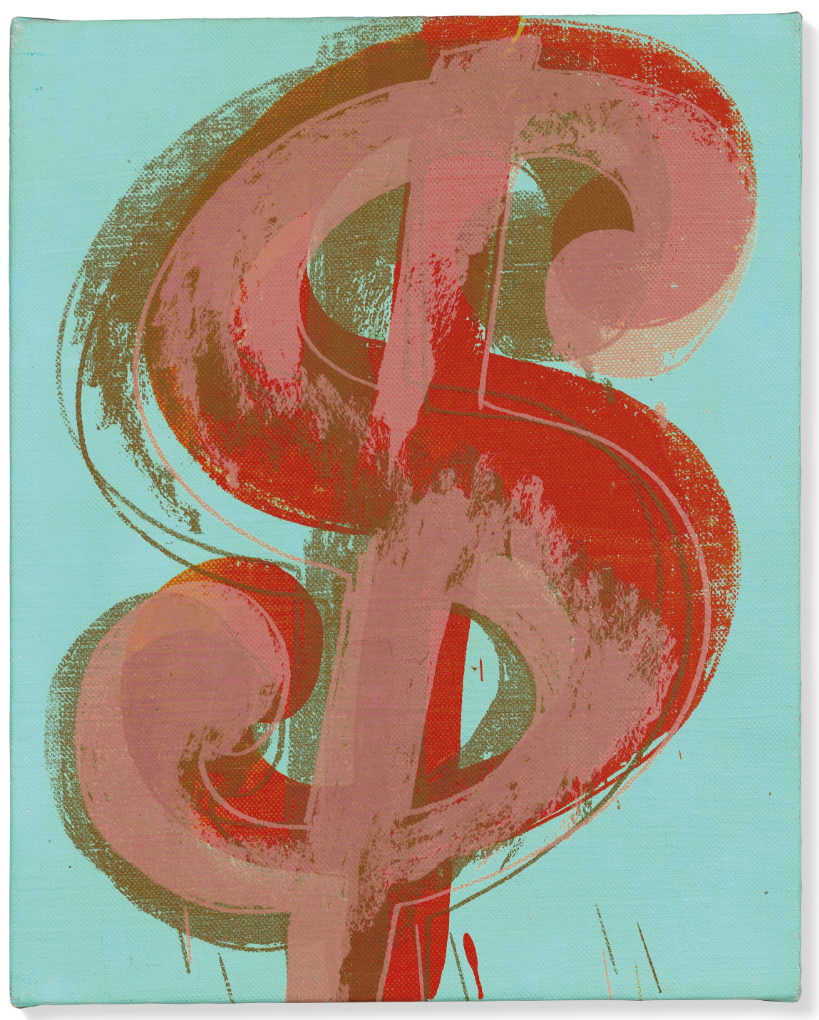
ANDY WARHOL (1928-1987)
Dollar Sign, 1981
Acrylic and silkscreen ink on canvas
9 7/8 x 8 inches (25.2 x 20.2 cm)
Signed, dedicated and dated ‘To Jade Andy Warhol 81’ (on the overlap)
Iconic, audacious, and unmistakable, Andy Warhol’s Dollar Sign is emblazoned with the symbol of the American dream. One of his most celebrated late series, the vivid dollar sign encapsulates the Pittsburgh-born artist’s enduring obsessions: money, celebrity, consumption and mass-production. Layering searing red, pink and gold, the present work’s symbol electrifies the pale blue canvas, reverberating with an onomatopoeic cha-ching. Painted in 1981, by which time Warhol was firmly positioned as the foremost Pop artist of his generation, Dollar Sign speaks to the artist’s own successful navigation of the booming commercial art world. Originally gifted to Jade Jagger, daughter of Warhol’s close friends Mick and Bianca Jagger, the work testifies to the legendary screenprint as the artist’s own form of social currency among the glamorous New York upper echelons. In his signature, brazen style, here, Warhol confronts head-on the ever relevant connection between art and money.
The artist’s fascination with money can be traced throughout his career. In the 1950s he created a drawing of a money tree, and by the early 1960s he started to draw and silkscreen images of one-dollar bills. Depicted rolled, folded, creased, or stacked, the tactile paper objects appealed to Warhol’s graphic eye. He once observed, ‘American money is very well designed, really. I like it better than any other kind of money’ (A. Warhol, quoted in The Philosophy of Andy Warhol: From A to B and back again, Orlando 1975, p. 137). In his 1980s Dollar Sign series, Warhol distils the dollar to its essential and ubiquitous signifier. Instead of copying a readymade image, Warhol worked from his own drawings of the dollar sign to render his silkscreened paintings. Printing onto canvas, Warhol parallels the production of money itself. Indeed, aside from its particularly seductive materiality, dollars are, like the paintings produced and reproduced by Warhol’s prolific studio machinations, American-made and mass-printed.
The Dollar Sign paintings were first exhibited at the Castelli Gallery, the epicentre of the New York art world in 1982. Reflecting on the show, Warhol’s close friend and art critic David Bourdon said that they ‘appeared as prophetic emblems of the huge amounts of money that would pour into the art world during the following years’. They hung as ‘brazen, perhaps insolent reminders that pictures by brand-name artists are metaphors for money, a situation that never troubled [Warhol]’ (D. Bourdon, Warhol, New York 1989, p. 384). What’s more, the works coincided with the neoliberal ‘Reaganomic’ policies launched by President Ronald Reagan at the beginning of the 1980s. Painted at the dawn of a period of new economic growth, Warhol’s emblem shines like a beacon. Brushed with opulent golden paint, the present work nods to bullion and gold standards, while also evoking the gilded haloes of Byzantine icons and saints. Exalted to the realm of the sacred and iconographical, Warhol’s dollar sign seems to satirically herald modern-day capitalism as America’s preferred ideological system, or indeed its faith. Examples from the series are held in notable international collections including Tate, London; the Museum of Contemporary Art, Amsterdam; and the Musée d’Art Moderne et d’Art Contemporain, Nice.
#5. Damien Hirst
Christie’s London: 14 October 2023
Estimated: GBP 200,000 – 300,000
GBP 327,600
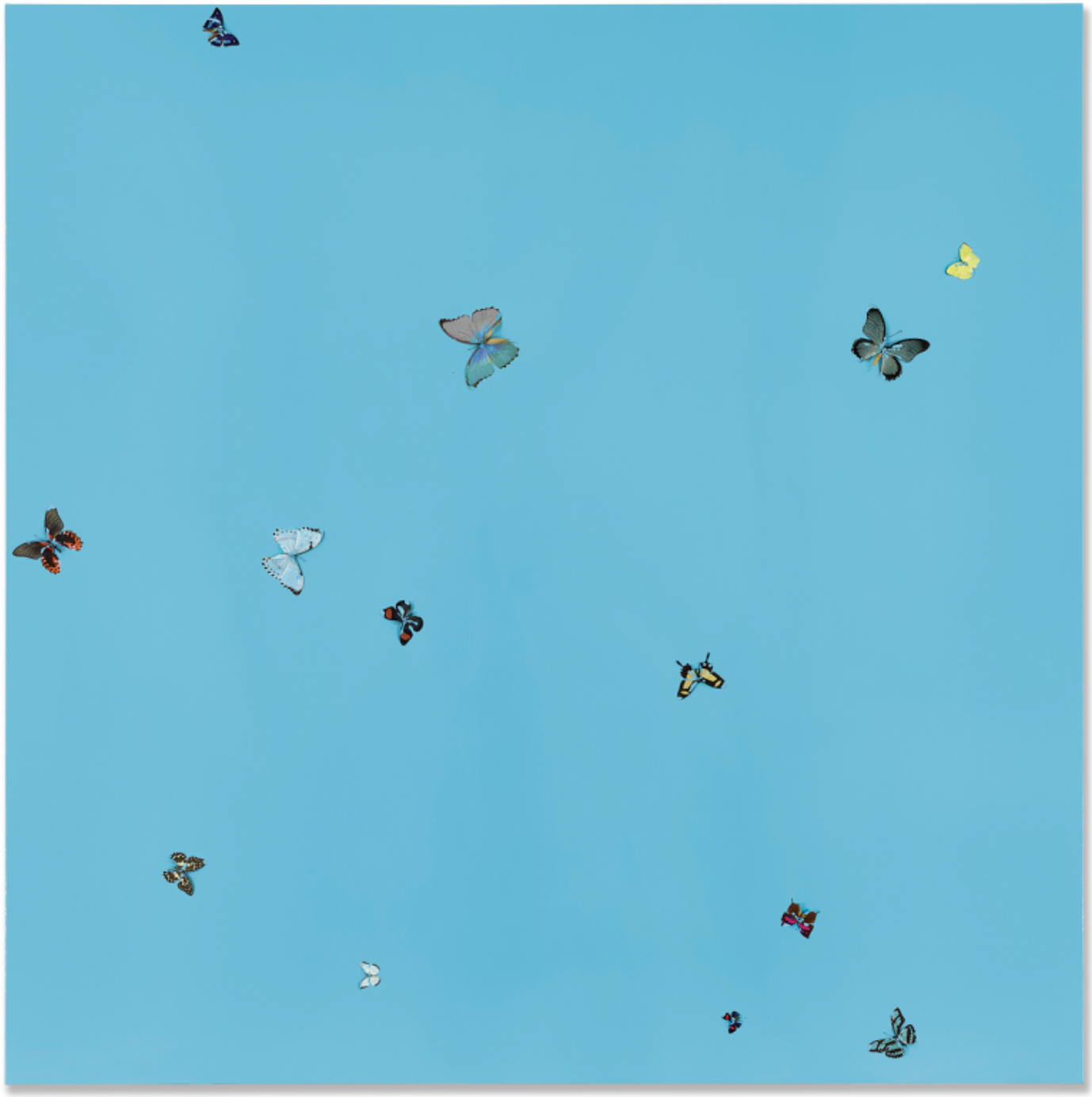
DAMIEN HIRST (B. 1965)
Wonderful Week, 2008
Butterflies and household gloss on canvas
72×72 inches (182.8 x 182.8 cm)
Signed, titled and dated ‘2008 “Wonderful Week” Damien Hirst’ (on the reverse)
Signed ‘Damien Hirst’ (on the stretcher)
Suspended across an immense and glossy sky-blue canvas of almost two by two metres, Damien Hirst’s Wonderful Week (2008) presents a mesmeric kaleidoscope of butterflies. In what is undoubtedly one of his most iconic and widely celebrated series, the iridescent butterflies in Hirst’s Butterfly Paintings are transfixed upon the canvas like inlaid gemstones, their diaphanous wings delicately spread open in a captivating display. Retaining an impossible, immaculate beauty even in death, the insect is a perfect embodiment of the inquiry at the heart of Hirst’s artistic practice, that of life, death, and perishability.
Fixed to the canvas in a fluttering array of yellows, whites and blues, the insects appear as though captured in flight amidst a cloudless sky. Conjuring the luminous, pale Venetian blues of Titian’s canvases, Hirst’s Wonderful Week is at first glance entrancingly lyrical. Belying the glossy surface of household paint however, are the potent and disquieting connotations of mortality. As though mimicking the twisted fantasy of the Victorian lepidopterist, piercing the specimens with pins upon a mount, Hirst captures the beauty of the living in an artificially preserved death. This timeless paradox has driven Hirst’s most acclaimed and radical works, notably his animal carcass and formaldehyde vitrines The Physical Impossibility of Death in the Mind of Someone Living, and Mother and Child Divided, which won him the Turner Prize in 1995. Like Hirst’s shark or calf, the butterflies in Wonderful Week are engulfed within an immense, spectacular pool of chemical blue; the canvas looms with the grandeur of an antiseptic tomb.
The use of exotic butterflies in his paintings and installations launched Hirst as a household name. In his seminal first solo exhibition In and Out of Love, 1991, Hirst installed a room of butterflies in a humidified Soho gallery space. Upstairs, live pupae were glued to white canvasses, from which butterflies hatched and flew. Feeding on sugared water, mating, laying eggs, and eventually dying, the warm room became a macabre sanctuary of an entire life cycle. Downstairs, Hirst hung eight of his first monochromatic, pastel Butterfly Paintings. Executed almost two decades later, Wonderful Week stands as a testament to the unabating significance of the butterfly motif. Like a contemporary play on the memento mori, a device popularised in oil paintings of the seventeenth century, Hirst confronts his present-day viewer with his elected symbol of mortality. Imbued with its own connotations of Christ’s resurrection, the butterfly, emerging reborn from its chrysalis, is an emblem of metamorphosis, and speaks to life beyond the bounds of the perishable body. Wonderful Week is an impressive example of what Hirst does best. Exploring highly conceptual notions of existence via the physical, tangible matter of the once-living, he sheds light on the strangely beautiful fragility of life.
Scott Kahn
Christie’s London: 14 October 2023
Estimated: GBP 100,000 – 150,000
GBP 302,400
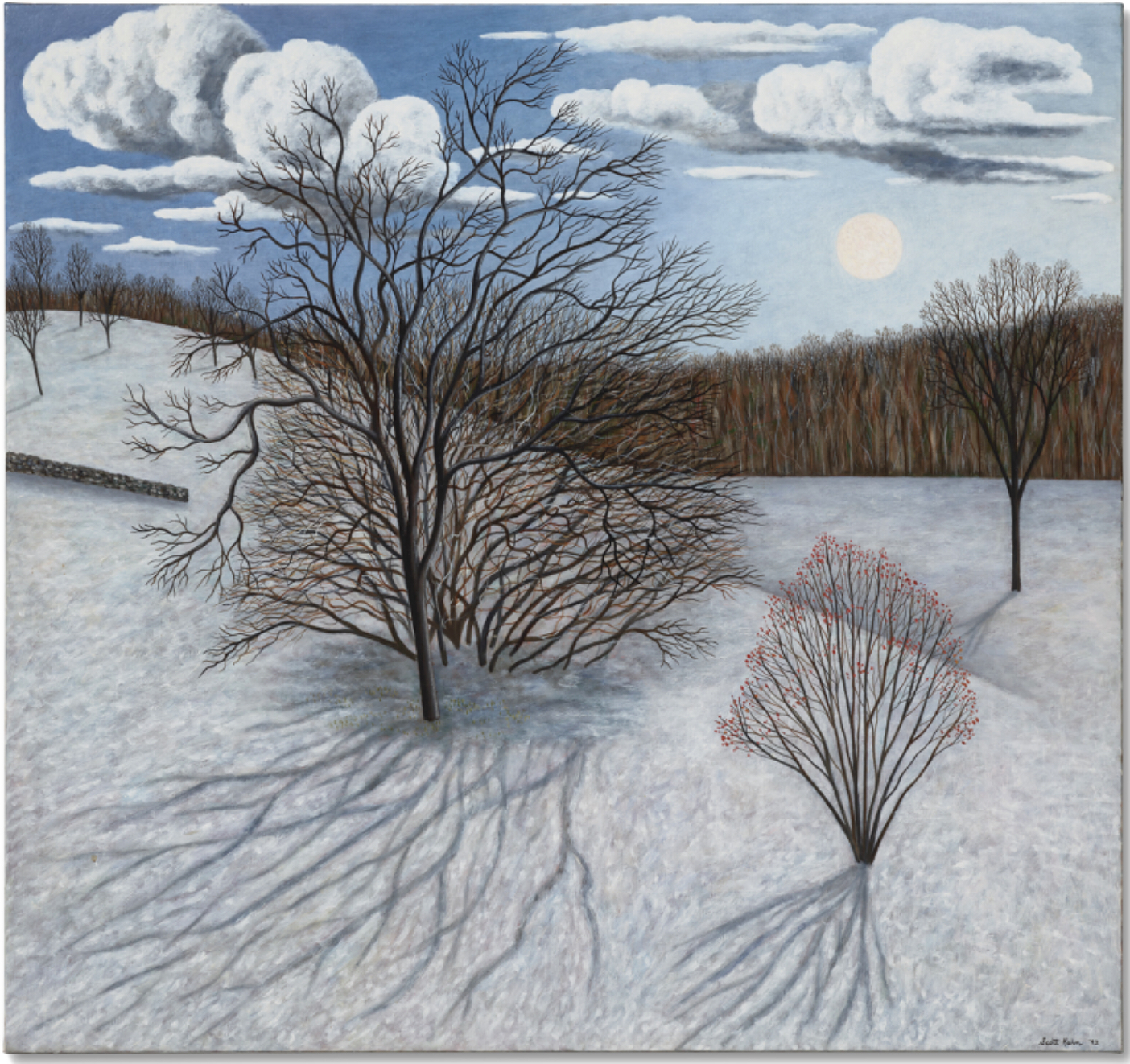
SCOTT KAHN (B. 1946)
Winter Morning, 1992
Oil on linen
30×32 inches (76.2 x 81.3 cm)
Signed and dated ‘Scott Kahn ‘92’ (lower right)
Signed, titled, inscribed and dated
‘WINTER MORNING KAHN 1992 ©1992 by Scott Kahn’ (on the overlap)
Painted in 1992, Scott Kahn’s frosty landscape heralds the first jubilant light of morning. Rising from behind a faraway woodland, the low, pendulous sun bathes the scene with a brilliant pale lustre. Trees stand bare and exposed to the winter chill, bristling with spectral drama. Their tangled branches cast long shadows onto the snow and seem to creep across the painting’s surface like tracery. Though devoid of human presence, except for a discreet stone boundary wall to the left of the canvas, the landscape teems with life. Deeply inspired by his natural surroundings, the present painting is one from a number of works executed while Kahn was residing at a patron’s home in Chester, Connecticut. Featuring soft rolling hills, thick fleecy clouds and bewitching winter trees, the Massachusetts-born artist evokes the familiar New England countryside. Recently achieving explosive, global success in the art market at the age of seventy, Kahn is widely known for his figurative, Magic Realist style. Conjuring distinctly atmospheric landscapes, still lifes, portraits and interiors, he draws not only from direct observation, but from recollected memory, dreams, and imagination.
Deeply sensorial, perceptive and attuned, Kahn work is, in his own words ‘inspired by my life as I live it’ (S. Kahn quoted in ‘Artist Spotlight: Scott Kahn’, ibid.). Each canvas constitutes a visual record not only of his physical environment, but of an inner mood. Working in this diaristic, autobiographical mode, Kahn constructs worlds that feel hinged in reality yet loose and faraway, as though recollected or imagined. Leitmotifs recur across his paintings, weaving through a thread of familiarity and association. At once we recognise the fluffy, exquisitely modelled clouds, and Kahn’s signature burning sun, rendered so often as a perfect and enigmatic disc that seems to singe through the canvas surface. Often painting scenes from memory and dreams, Kahn’s work speaks to early twentieth-century Surrealist invocations of the uncanny, the ‘familiar made strange’. Wanting to create work that ‘suggests something beyond what is actually being seen’, Kahn’s paintings can be defined by an atmosphere that is at once mesmeric and disquieting, real and imagined.
Takashi Murakami
Christie’s London: 14 October 2023
Estimated: GBP 250,000 – 350,000
GBP 264,600
Takashi Murakami (christies.com)
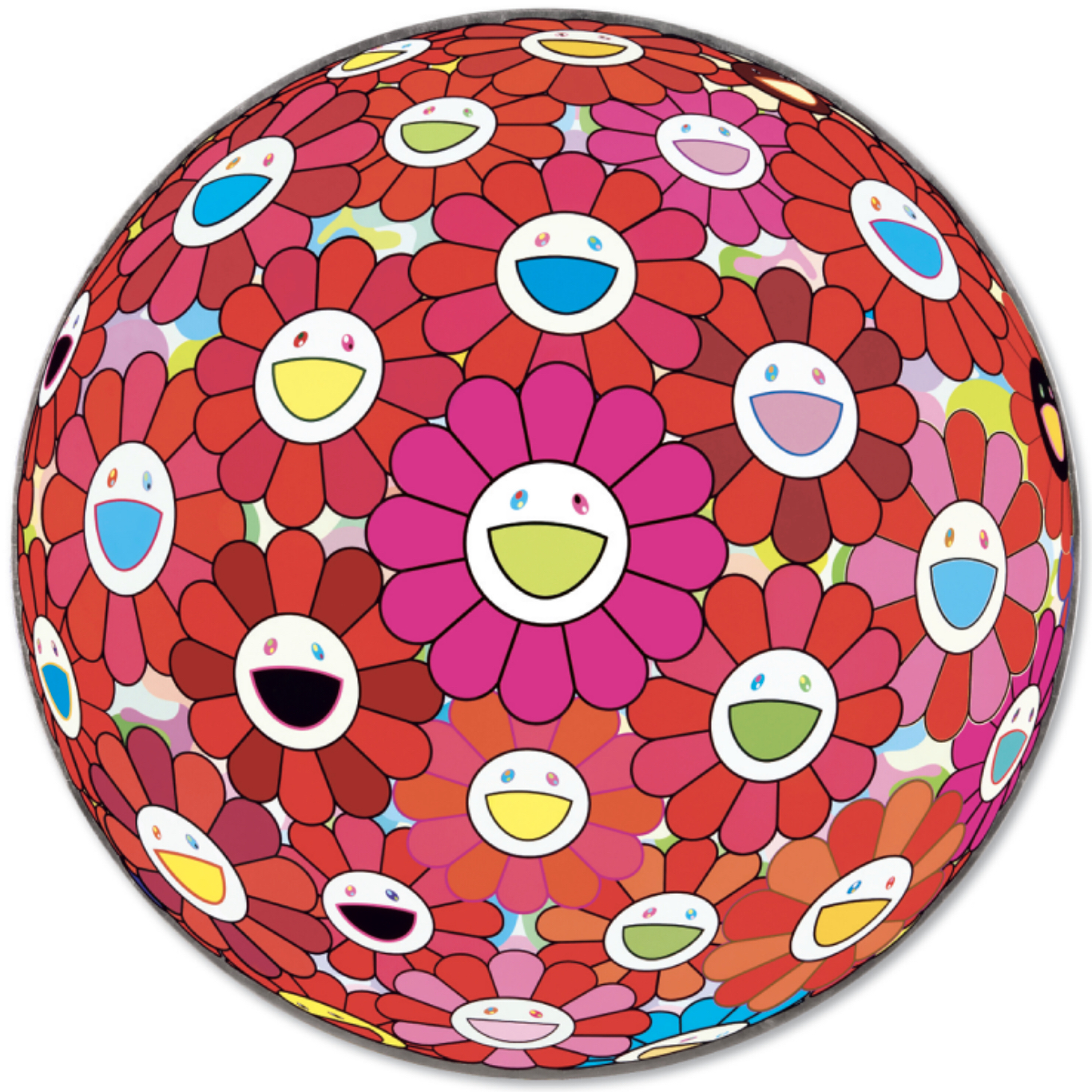
TAKASHI MURAKAMI (B. 1962)
Thinking Matter (Red), 2016
Acrylic and platinum leaf on canvas laid on panel
Diameter: 59 1/4 inches (150.5 cm)
Signed and dated ‘TAKASHI 2016’ (on the reverse)
Exuberant and cheerful, Murakami’s Thinking Matter (Red) teems with a mass of beaming flower heads. Rendered in acrylic and platinum leaf on canvas laid on panel, the painting bursts with vibrant colour and jubilation, and across its shimmering surface, pink and cherry-red petals bunch and blossom. Forming a spectacle of ornate pattern, the circular canvas evokes the composition of a tondo mosaic or a kaleidoscopic lens. Stretching one and a half metres in diameter, the painting immerses the viewer within its fantastical bouquet, offering a vivid sensory experience. Perhaps Murakami’s most iconic and widely-recognised motif, the flower is, according to the artist, ‘at the centre of my creative expression’ (T. Murakami quoted in, C. Pasori, ‘Takashi Murakami’s Iconic Flowers Are Becoming NFTs’, Architectural Digest, 25 March 2022). Offering Murakami the perfect vehicle to synthesise his interests in Japanese visual culture, the flowers denote a plethora of imagery—from 17th and 18th century decorative arts, to kawaii, manga, and anime film.
Known for his distinctly candy-coloured graphic idiom, Murakami pulls from a diverse repertoire of visual references in his practice. His oeuvre is broadly united under the notion of the ‘Superflat’, a term he coined to refer, in part, to the almost depthless surfaces he creates. Identifying a flattening embedded in Japan’s popular culture and history, Murakami’s work speaks to the invasion of Western culture in both its merging of traditional Japanese printing methods with the glossy, commercial language of 20th-century Pop Art—his canvases recall the iconic silkscreens made by Andy Warhol in the 1960s—and, more seriously, in the horrifying topographical flattening witnessed at Hiroshima and Nagasaki in 1945. Seeking to level high and low arts, fine art and craft, Murakami veils profound histories under his bright and joyful surfaces.
Murakami first began obsessively sketching flowers while preparing for the entrance exams at Tokyo’s National University of Fine Arts. After graduation, he spent almost a decade working at a preparatory school where he taught his students to draw flowers. ‘At the beginning,’ he remembers, ‘to be frank, I didn’t like flowers, but as I continued teaching in the school, my feelings changed: their smell, their shape—it all made me feel almost physically sick, and at the same time I found them very “cute.” Each one seemed to have its own feelings, its own personality … And these days, now that I draw flowers rather frequently, that sensation has come back very vividly. I find them just as pretty, just as disturbing. At the same time there is this strength in them; it is the same image of strength I find when drawing the human face. So I thought that if the opportunity arose, I would pretty much like to make a work in which I would represent them as if in a “crowd scene,” in the manner of these scenes of moving crowds that you see in films’ (T. Murakami, quoted in Takashi Murakami Kaikai Kiki, exh. cat. Fondation Cartier/Serpentine Gallery, Paris and London 2002, p. 84). Undoubtedly his most iconic motif, here, anthropomorphic flowers multiply and propagate across the canvas surface in a mesmeric, undulating display of magenta, scarlet and rose.
Damien Hirst
Christie’s London: 14 October 2023
Estimated: GBP 250,000 – 350,000
GBP 283,500
Malic Dehydrogenase from Bovine Heart (christies.com)
DAMIEN HIRST (B. 1965)
Malic Dehydrogenase from Bovine Heart, 1999
Household gloss on canvas
87×63 inches (221×160 cm) (3-inch spot)
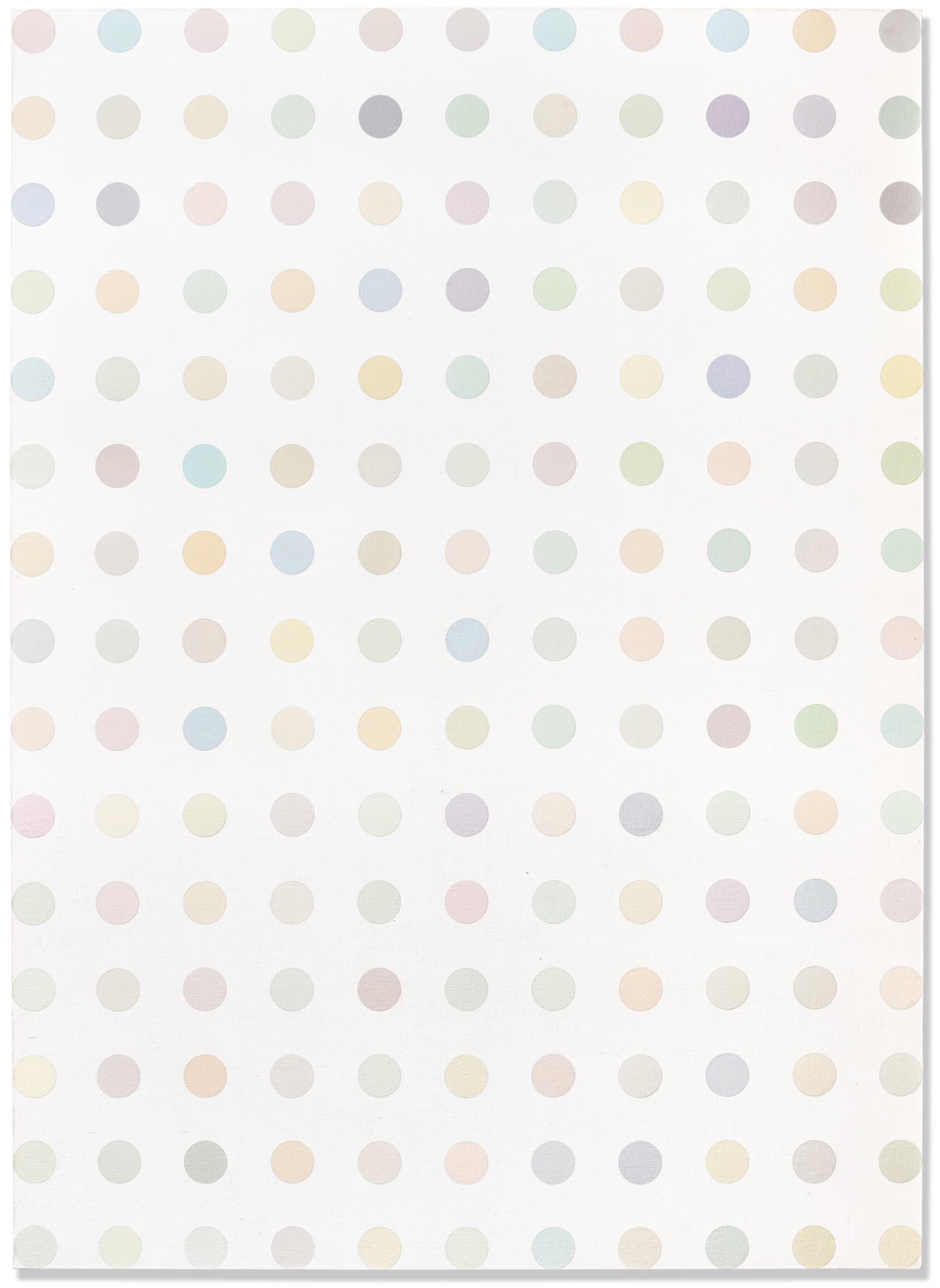
Standing at an impressive height of over two metres, Damien Hirst’s Malic Dehydrogenase from Bovine Heart (1999) is a rare and early work from his iconic ‘spot paintings’. Instantly recognisable, one hundred and sixty-five pastel spots are composed in perfect rows and columns upon a pale blue canvas. Measuring three inches in diameter and spaced exactly three inches apart, these meticulously hand-painted spots seem to have their own pulse, and engross the viewer in a state of perceptual rapture. The work belongs to Hirst’s ‘Venoms’ group, a subseries of spot paintings distinct for their lightly gradated, pale spots which denote the poisonous chemicals excreted by animals, namely snakes, bees and spiders. A scarce subgroup in 1999, the first of the Venoms on canvas dates from just one year before, making our work one of the earliest and also one of the largest of its kind at the time it was made. Famously thinking of his spots as cells under a microscope, Hirst’s man-made, clinical style draws parallels between the revered systems of belief that underscore his artistic practice: art, science and religion.
Employing a formal language that pays homage to his Minimalist forebearers, Hirst’s canvas is arranged with a mathematical precision. Pictorial form is abstracted to its constituent, molecular parts in a process akin to chemical filtration. The grid of uniquely coloured spots—the artist orders that no single spot is painted in the same shade—evokes a production line. Assuming the look of mechanically manufactured perfection, the neat rows recall pills and tablets sealed in shiny plastic and foil strips, or shelved medicines as seen in Hirst’s cabinet works and installation ‘Pharmacy’ (1992). Fascinated by the sanctity of drugs, which promise to cure ailments and prolong life, Hirst’s spot paintings conjure the quasi-religious rituals that surround pharmaceutics. Pills come with their own scripture, sacrosanct instructions and routines. The aesthetic language of Minimalism is rife in pharmacies and hospitals; cleanliness and purification are prerequisites for medical procedure. Hirst has observed ‘you’ve got to wash your hands before you start messing around with people’s bodies … you wear white coats because then you can see blood on it’, arguing that ‘with clear forms and perfect edges then people can feel secure. It’s a confidence’ (D. Hirst in conversation with G. Burn, 2001, quoted in ’Look Closer: Explore Damien Hirst’s Pharmacy’, Tate, online).
Beneath the satisfying simplicity of the present painting’s gentle pastel palette and polka-dot design lies a toxic chemical compound with lethal implications. Reflecting on his series, Hirst describes how ‘in every painting there is a subliminal sense of unease; the colours project so much joy it’s hard to feel it, but it’s there. The horror underlying everything’ (D. Hirst, I Want to Spend the Rest of My Life Everywhere, With Everyone, One to One, Always, Forever, Now, London 1997, p. 246). Contextualized in his broader oeuvre, the spot paintings speak to the artist’s life-long examination of the macabre within a hard-edged, sterile Minimalist framework. The present work—titled after an enzyme found in bovine tissue—further relates to the artist’s use of cow heads and cadavers in the 1990s. Famously, his Mother and Child Divided (1993), which won him the Turner Prize in 1995, comprised four stainless steel vitrines, containing the bisected bodies of a cow and a calf in formaldehyde solution. It is perhaps in Hirst’s Venoms series that the dialogue between beauty and mortality is most concisely addressed. Conflating cleanliness with the spot—itself a mark of impurity that threatens to spread and mutate infinitely beyond the canvas’s boundaries—the work holds the complex dualities of Hirst’s art in masterful tension.
Peter Halley
Christie’s London: 14 October 2023
Estimated: GBP 60,000 – 80,000
GBP 100,800
PETER HALLEY (B. 1953) (christies.com)
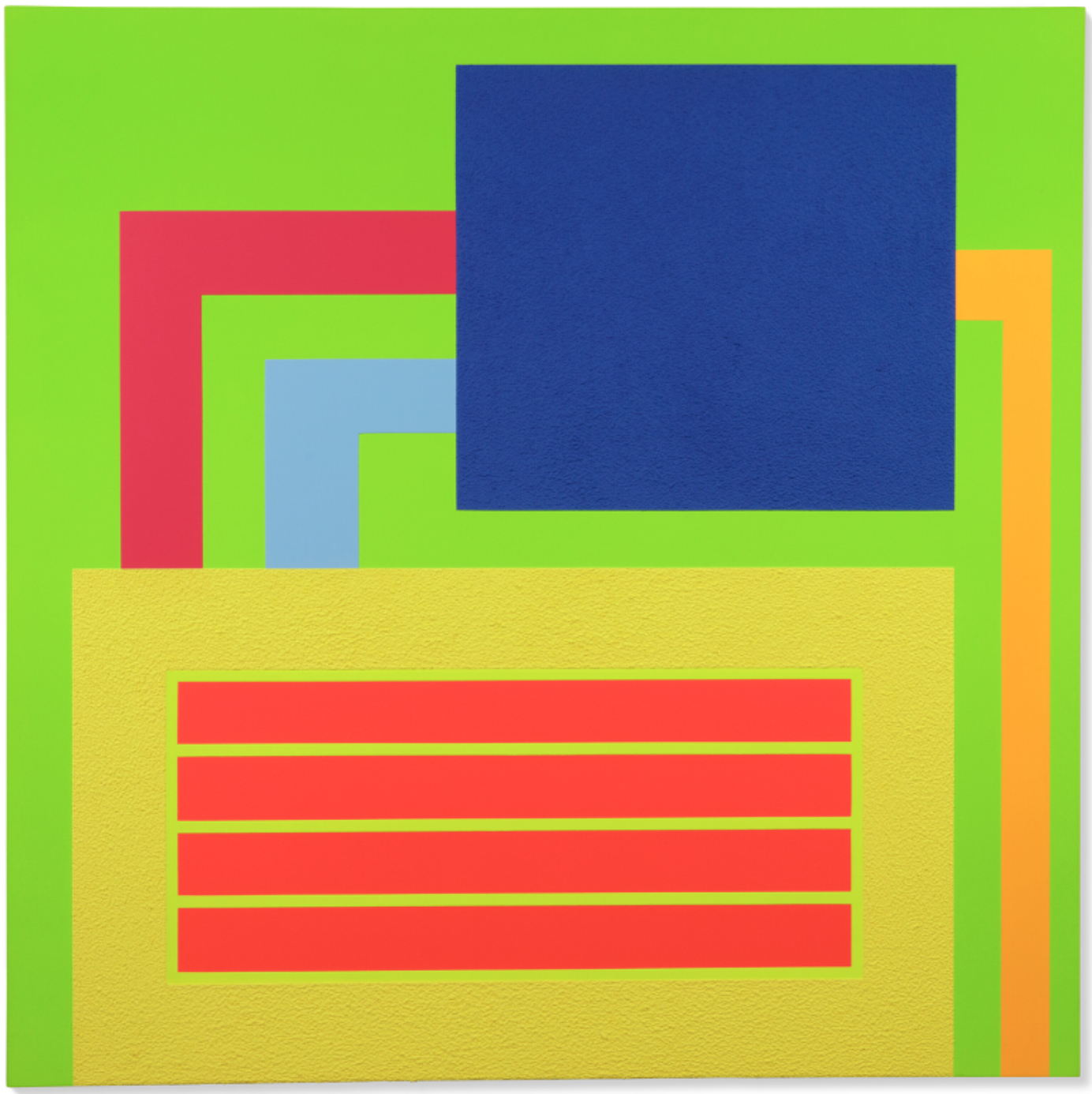
PETER HALLEY (B. 1953)
Matchbreaker, 2007
Acrylic, fluorescent acrylic and Roll-A-Tex on canvas
72×72 inches (183×183 cm)
Signed twice and dated ‘Peter Halley Peter Halley 2007’ (on the reverse)
Sotheby’s
1. The Now Evening Auction
12 October 2023
The Now Evening Auction | 2023 | Sotheby’s (sothebys.com)
Total:
GBP 15,505,450
USD 18,934,486
———
# Lots: 21
# Lots sold: 20
Sell-Through Rate: 95.2%
———
Above Estimates: 10 (48%)
Within Estimates: 10 (48%)
Unsold: 1 (4%)
#1. George Condo
Sotheby’s London: 12 October 2023
Estimated: GBP 2,000,000 – 3,000,000
GBP 2,993,000 / USD 3,654,903
Multicolored Female Composition | The Now Evening Auction | 2023 | Sotheby’s (sothebys.com)
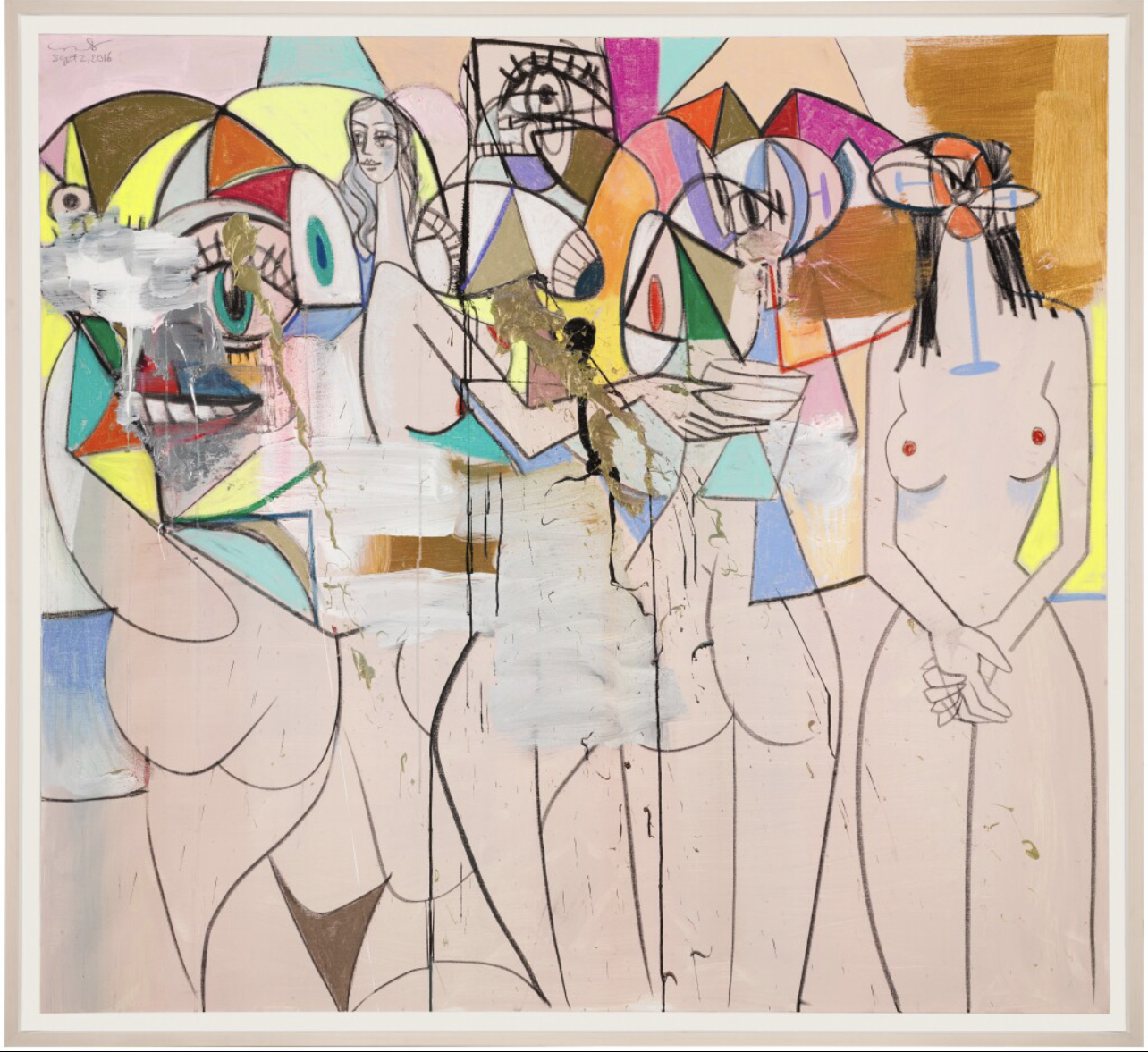
GEORGE CONDO (b. 1957)
Multicolored Female Composition, 2016
Acrylic, metallic paint, charcoal and pastel on linen, in artist’s frame
68 1/8 x 74 1/4 inches (173.1 x 188.6 cm)
signed and dated Sept 2, 2016 (upper left)
In the ever-evolving landscape of contemporary painting, George Condo has established himself as a prolific and influential artist whose work challenges the boundaries of tradition while drawing inspiration from art history’s vast and eclectic lineage. Multicolored Female Composition from 2016 stands as a testament to his remarkable ability to synthesized diverse influences into a singular and deeply compelling visual language. This painting, characterized by its striking composition of fractured figuration and colorful palette, invites viewers to explore the complexities of human existence and the interplay between the conscious and unconscious mind.
PABLO PICASSO, LES DEMOISELLES D’AVIGNON, 1907
THE MUSEUM OF MODERN ART, NEW YORK © SUCCESSION PICASSO/DACS, LONDON 2023
Teetering on the periphery of representation, Multicolored Female Composition is as a myriad of half-formed visages and voluptuous feminine silhouettes which tantalizingly emerge and recede across the picture plane. Drawing on the long lineage of the female nude, Condo fragments, abstracts and splatters, to create a meta-dialogue between the history of Western painting across the twentieth century. The geometrically fractured figures are distinctively Cubist and the large square format of the composition in the present work particularly evokes Pablo Picasso’s iconic masterpiece Les Demoiselles d’Avignon. At the same time, Condo employs vivid colours and bold graphic lines to create forms which recall Wassily Kandinsky’s colourful experimentations with geometric abstraction. Splattered across the figures are gestural splashes of gold paint which recalls Jackson Pollock’s drip paintings, while dynamic brushwork that scrapes, smudges and drips run across the canvas to add to the physicality embodied in action painting. Captured in the present work is the history of painterly traditions which sweep across the entire twentieth and twenty-first century, brought together through Condo’s unique visual lexicon.
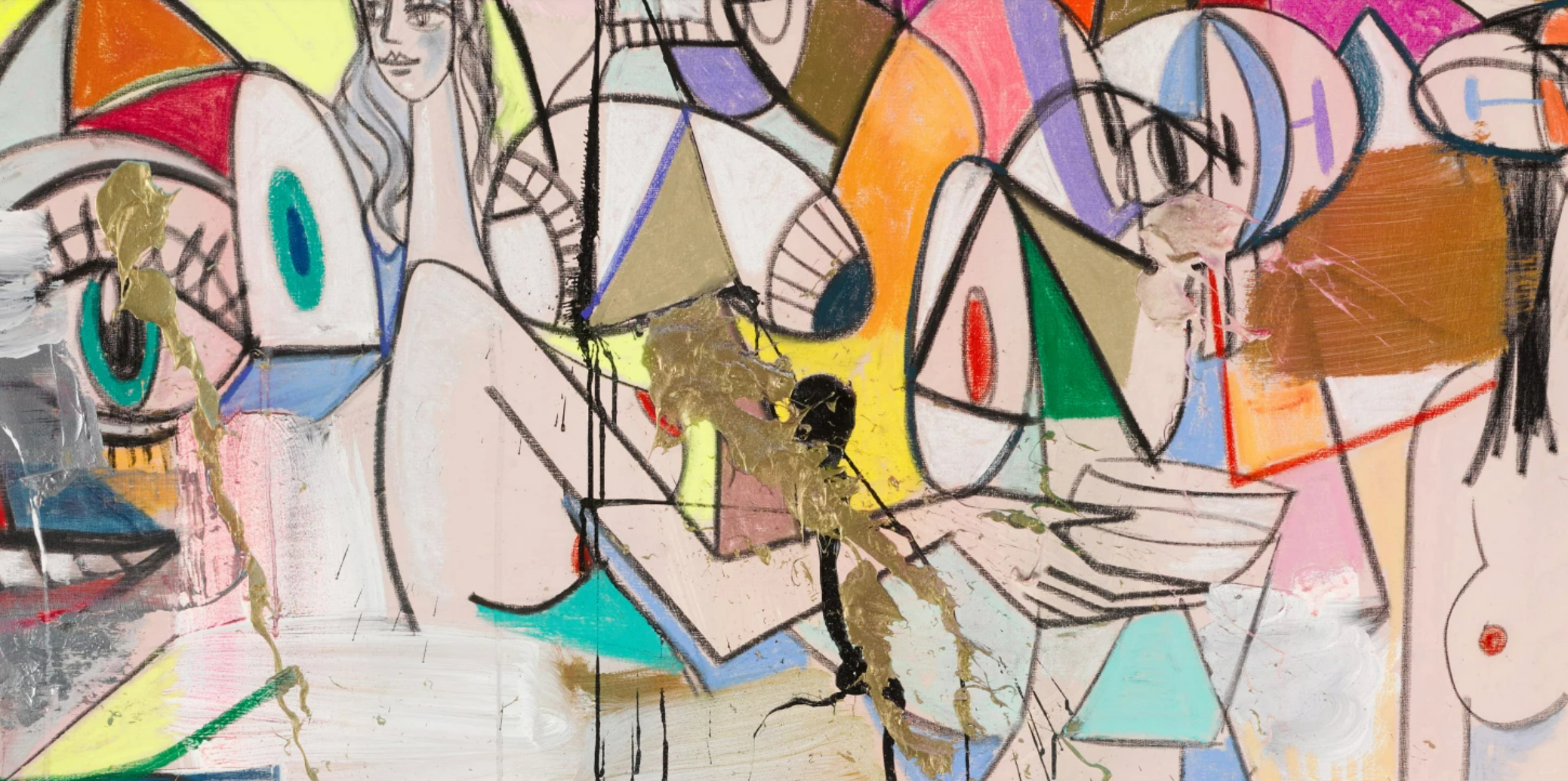
Condo’s artistic journey is marked by a relentless pursuit of innovation, a spirit that finds its ultimate expression in Multicolored Female Composition. At first glance, the canvas appears to be a cacophony of forms and colors, with layers of paint converging and diverging in a dance of chaos and order. Running across the canvas are fragmented figures and distorted faces emerging from the tumultuous sea of abstraction. These figures, though distorted, are undeniably human, reflecting Condo’s fascination with the psychological and emotional complexities of the human condition. The fractured visages are both haunting and captivating, as they oscillate between the familiar and the alien, the beautiful and the grotesque. Condo takes the Cubist impulse to represent objects and figures from multiple perspectives simultaneously, and applies it to the realm of the psyche, representing the inner lives which are similarly multi-dimensional and fragmented. The viewer is left to contemplate the intricacies of the mind, where memories, desires, and fears coexist in a complex web of interconnected thoughts and emotions. In what Condo has described as ‘psychological Cubism,’ his use of distortion and fragmentation serves as a reflection of the fractured nature of contemporary existence. In a world marked by constant change, uncertainty, and the relentless influence of technology and mass media, Condo’s fractured figures embody the splintering of identity and the challenge of maintaining a coherent sense of self. In this sense, Multicolored Female Composition speaks to the zeitgeist of the modern times, where the boundaries between reality and illusion, authenticity and artifice, are constantly blurred.
#2. Lynette Yiadom-Boakye
Sotheby’s London: 12 October 2023
Estimated: GBP 1,200,000 – 1,800,000
GBP 2,952,000
Six Birds in the Bush | The Now Evening Auction | 2023 | Sotheby’s (sothebys.com)
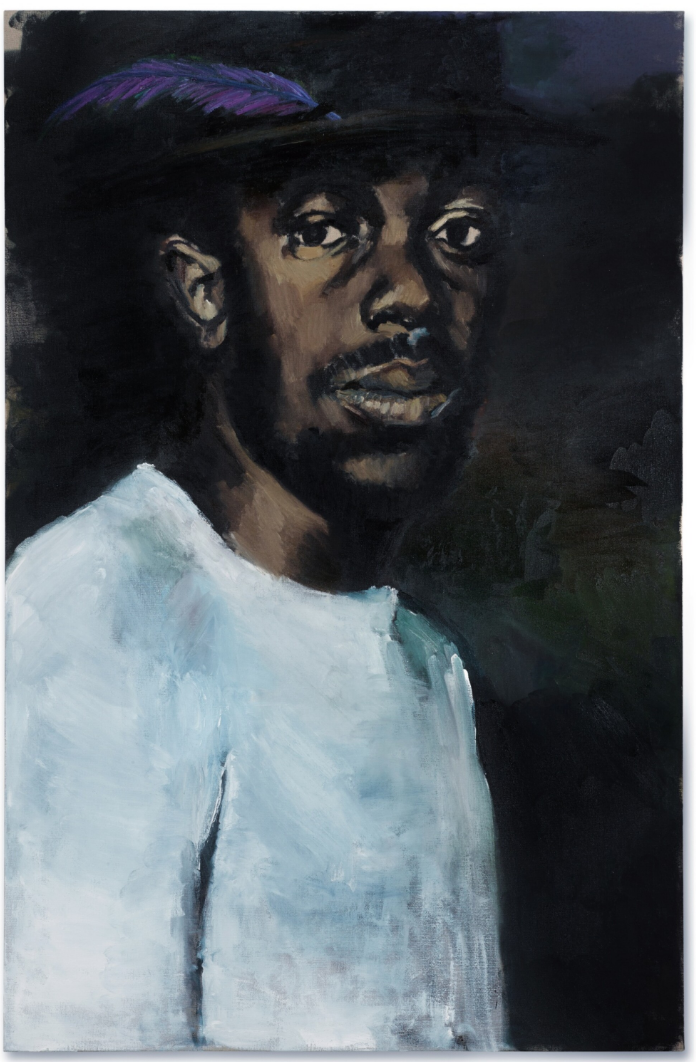
LYNETTE YIADOM-BOAKYEY (b. 1977)
Six Birds in the Bush, 2015
Oil on linen
200×130 cm (78 3/4 x 51 1/8 inches)
Signed with the artist’s initials, titled and dated 2015 (on the reverse)
British artist Lynette Yiadom-Boakye is world-renowned for her masterful large-scale canvases that imbue her subjects with a unique kind of magic. Six Birds in the Bush is a supreme example of the artist’s technical skill with paint and control over psychological complexity. It portrays a man who absentmindedly directs his gaze towards the public, as if interrupted in his thoughts. Full of charisma and a real, tangible personality, he wears clothes unattributable to a specific time and place. Indeed, Boakye’s figures are unplaceable in time and place and act as touchstones for personal reflections and individual ideas. This work very clearly and powerful encapsulates the artist’s historicising impulse in that sense, as the subject is both highly contemporary and yet seems to emerge from a history book. In the painting, the viewer is attracted by the playful assonance of some colours of the backgrounds that can be traced forward to the subject’s clothing: the blue and the greens move from the blurry plane behind the portrait and the reflections on the white shirt and the hat’s feather.
#3. Cecily Brown
Sotheby’s London: 12 October 2023
Estimated: GBP 1,200,000 – 1,800,000
GBP 2,589,000 / USD 3,161,558
Tricky | The Now Evening Auction | 2023 | Sotheby’s (sothebys.com)
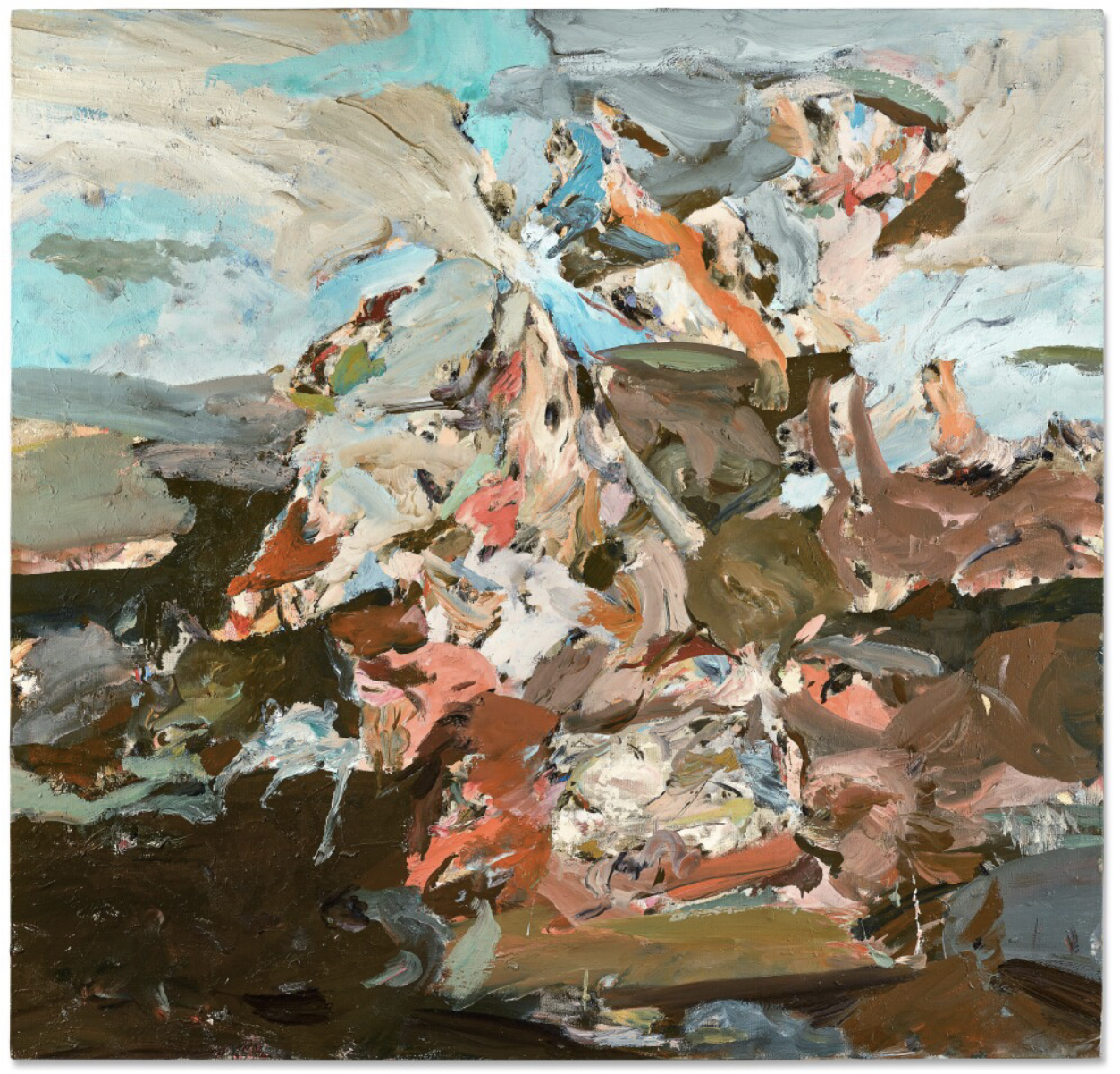
CECILY BROWN (b. 1969)
Tricky, 2001
Oil on linen
48 1/8 x 50 1/4 inches (122.2 x 127.5 cm)
Signed and dated 01 (on the reverse)
Executed in 2001, Tricky exemplifies Cecily Brown’s prodigious synthesis of gestural abstraction and figurative allusion. Sweeping strokes of impasto on the surface of the present work capture the sensual energy entrenched in Brown’s highly sought-after early canvases. Here, the artist deftly layers sumptuous passages of pale blue sky with glimpses of verdant green interwoven with earth tones that together crescendo and manifest in a scene bursting with life. Brown has witnessed renewed excitement and interest following the opening of her major career survey Cecily Brown: Death and the Maid at The Metropolitan Museum of Art in New York, which opened in April and will close in December 2023. Marking the first museum show of her work in New York since she moved there from London in the 1990s, the exhibition brings together fifty paintings, drawings, sketchbooks and monotypes to explore themes central to her practice. A testament to Brown’s status as one of the most sought-after artists on the rise today, this exhibition follows a number of critically acclaimed exhibitions in 2022, including Cecily Brown: Dream Spaces at Pinakothek der Moderne, Munich, and The Triumph of Death at Museo e Real Bosco di Capodimonte, Naples. The present work is an outstanding, early example of Brown’s pioneering painterly oeuvre.
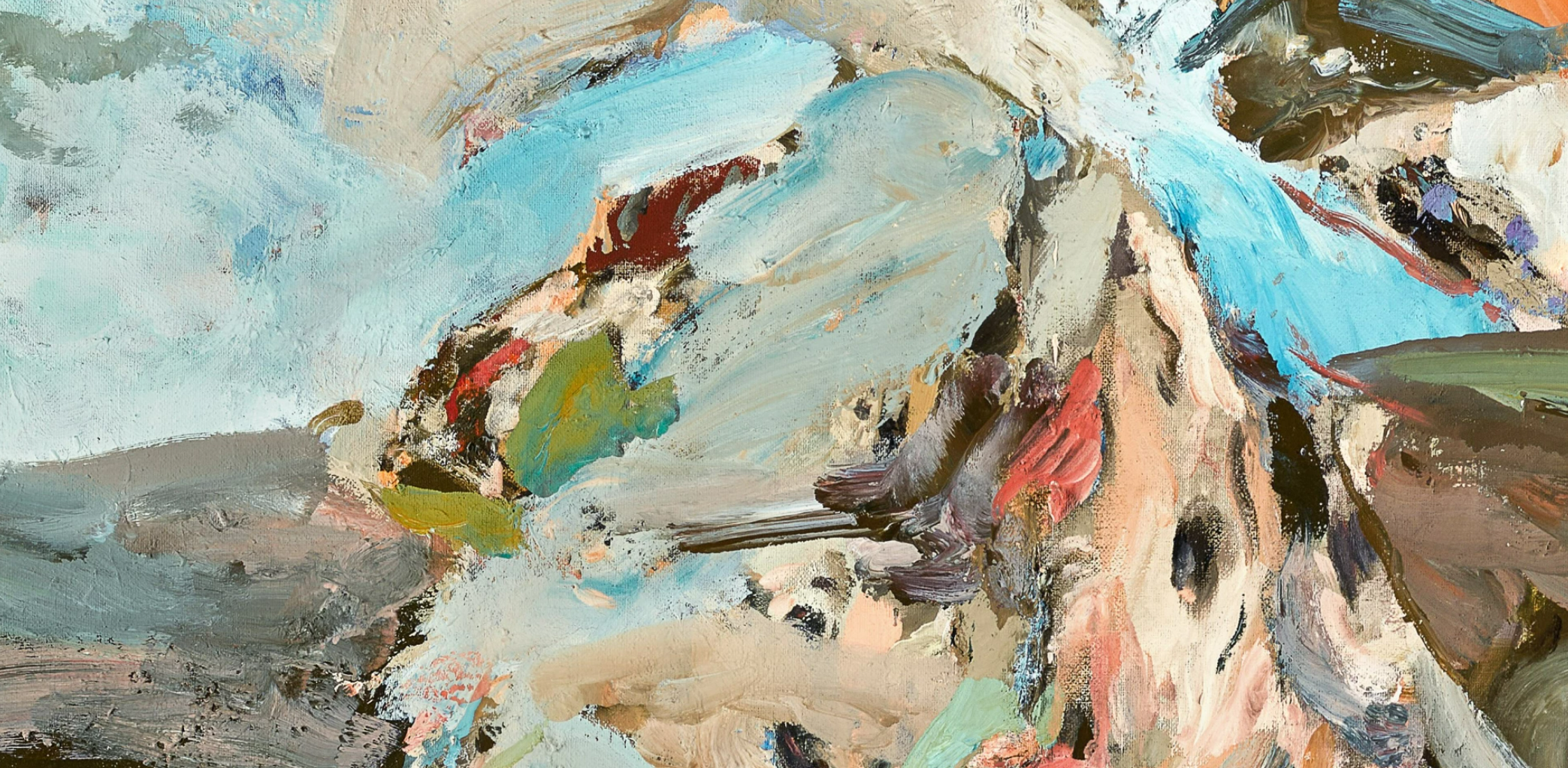
Effortlessly navigating the delicate balance between abstraction and figuration, the surface of Tricky pulsates with a rich tapestry of form and color, drawing the viewer into the painterly delight. Under the clear blue sky, fleshy, amorous forms dissolve into the rich umber tones, capturing indeterminate yet explosive forms. Brown’s canvas is an alcove for boisterous play, the threshold of which can be entered at the leisure of the viewer. Brown’s heated brushstrokes, emblematic of her distinct style, engage the language of painting itself, expressing both the sensuality of the medium and its ability to playfully manipulate the viewer’s perception through its expressive possibilities. Although abstract, Tricky presents Brown’s expert handling of paint in its commanding and elusive power of suggestion.
Jade Fadojutimi
Sotheby’s London: 12 October 2023
Estimated: GBP 400,000 – 600,000
GBP 495,300
Cradled | The Now Evening Auction | 2023 | Sotheby’s (sothebys.com)
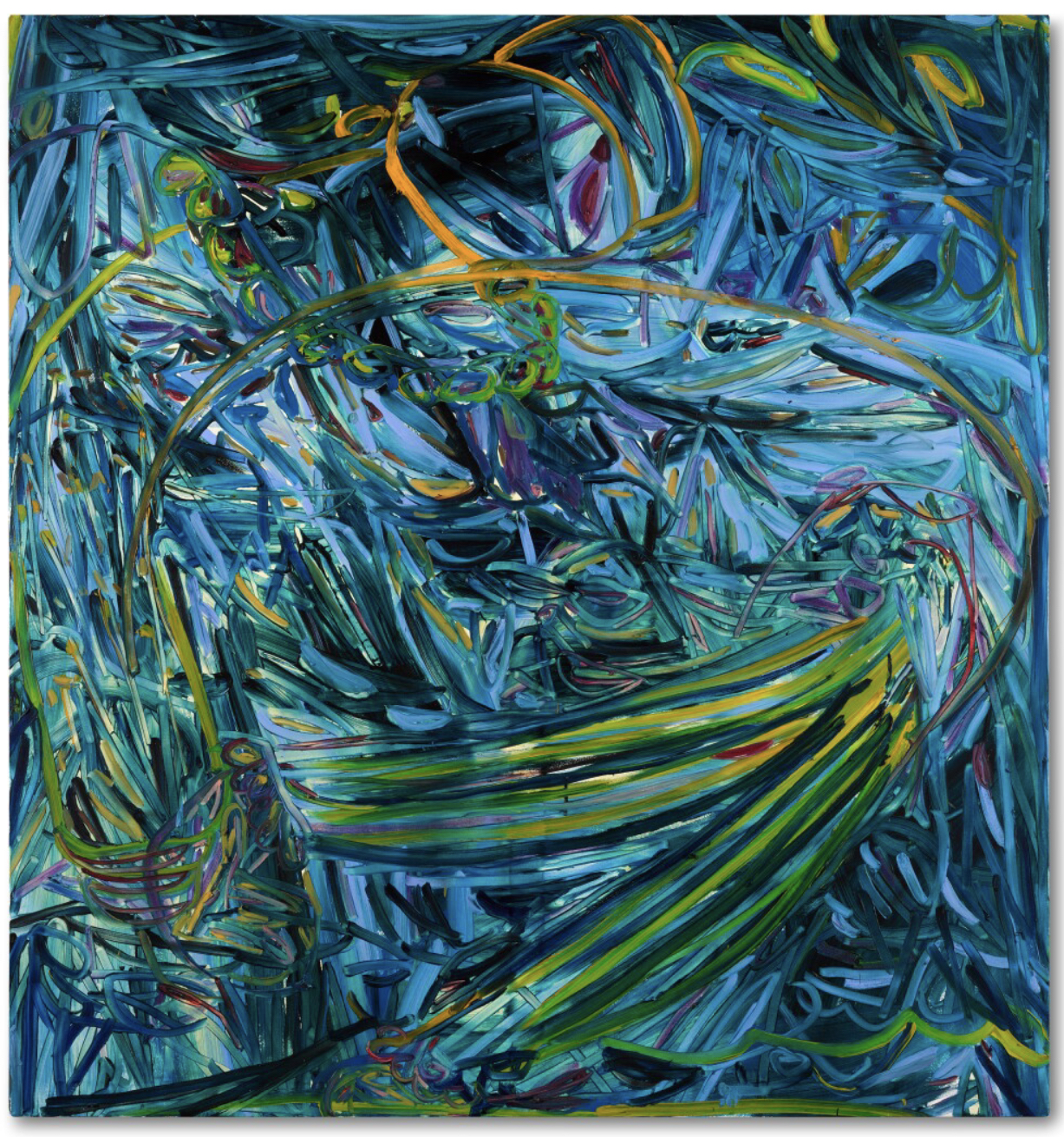
JADE FADOJUTIMI (b. 1993)
Cradled, 2018
Oil on canvas
181.3 x 170.5 cm (71 3/8 x 67 1/8 inches)
Signed twice and dated Jan ’18 (on the reverse)
Bursting with exuberant hues of blues, Cradled is an electrifying example of Jadé Fadojutimi’s dynamic painterly practice. Luscious strokes of indigo and teal coalesce with passages of vivid emerald and violet, creating a luminous sea of vibrant colors. Embracing chance and chaos, Fadojutimi’s intuitive practice transforms the canvas into a complex, emotional landscape. Undoubtedly one of the most exciting contemporary painters of our time, Fadojutimi’s paintings reside in prestigious museum collections including The Studio Museum in Harlem, New York; The Walker Art Centre, Minneapolis; The Baltimore Museum of Art, Baltimore; and The Institute of Contemporary Art, Miami, and at just 29 years old, Fadojutimi is the youngest artist in the collection of Tate, London.
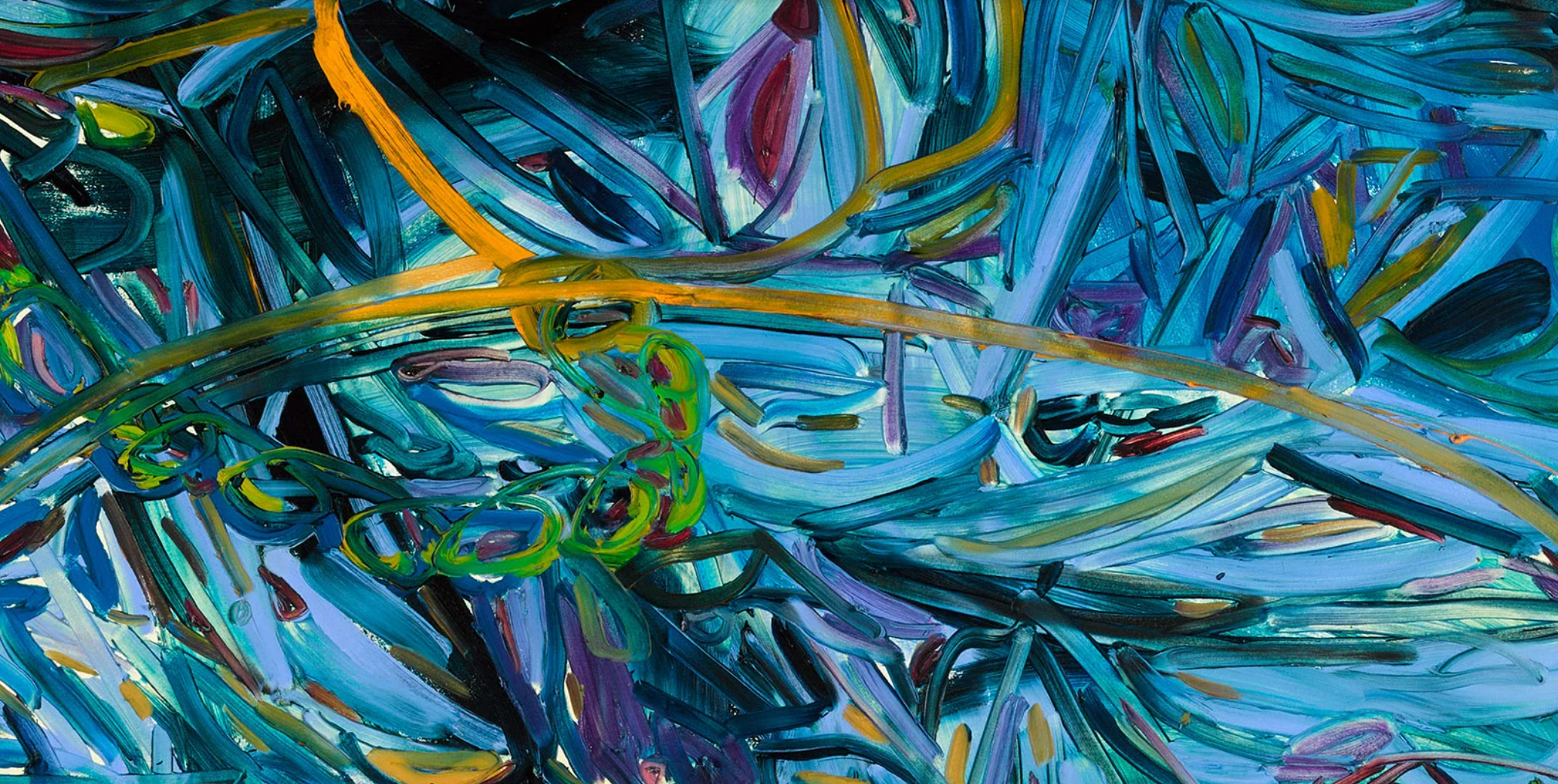
Fadojutimi’s lively and powerful mark making culminates in a symphony of colours which dance across the canvas in a vivacious celebration of paint. The richly saturated canvas pulses with gesture and movement as loose translucent washes collide with thick blows of impasto. Fadojutimi builds up thin layers of pigment with rhythmic caresses, before intuitively scraping and scratching the painting’s luminous surface to leave a myriad of dancing grooves and sweeping strokes. Shimmering washes of blues and greens evoke the ethereal light of stained-glass windows, while the buoyant strokes of thick oils recall the dynamic physicality associated with the abstraction of Jackson Pollock or Joan Mitchell. Amidst the myriad of gestural strokes, notes of figuration punctuate the composition. Charged with energy and emotion, Fadojutimi’s work is grounded in her environment and experiences, and every canvas is an encapsulation of her ever-changing self. She describes her work as a diary of her life, transposing the visual and emotional stimulus from her everyday onto the canvas. The artist also cites Japanese fashion, manga and anime soundtrack as important sources of inspiration, and this fascination manifests itself in an abundance of color and freneticism. As looping swirls cascade into nebulous streaks of blues, and confetti of orange flutter across the canvas, Cradled occupies a liminal space between a spectrum of figurative and abstract
Adrian Ghenie
Sotheby’s London: 12 October 2023
Estimated: GBP 300,000 – 400,000
GBP 317,500
Self-Portrait as Charles Darwin | The Now Evening Auction | 2023 | Sotheby’s (sothebys.com)
ADRIAN GHENIE (b. 1977)
Self-Portrait as Charles Darwin, 2012
Oil on canvas
50.3 x 40 cm (19 3/4 by 15 3/4 inches)
Signed and dated 2012 (on the reverse)
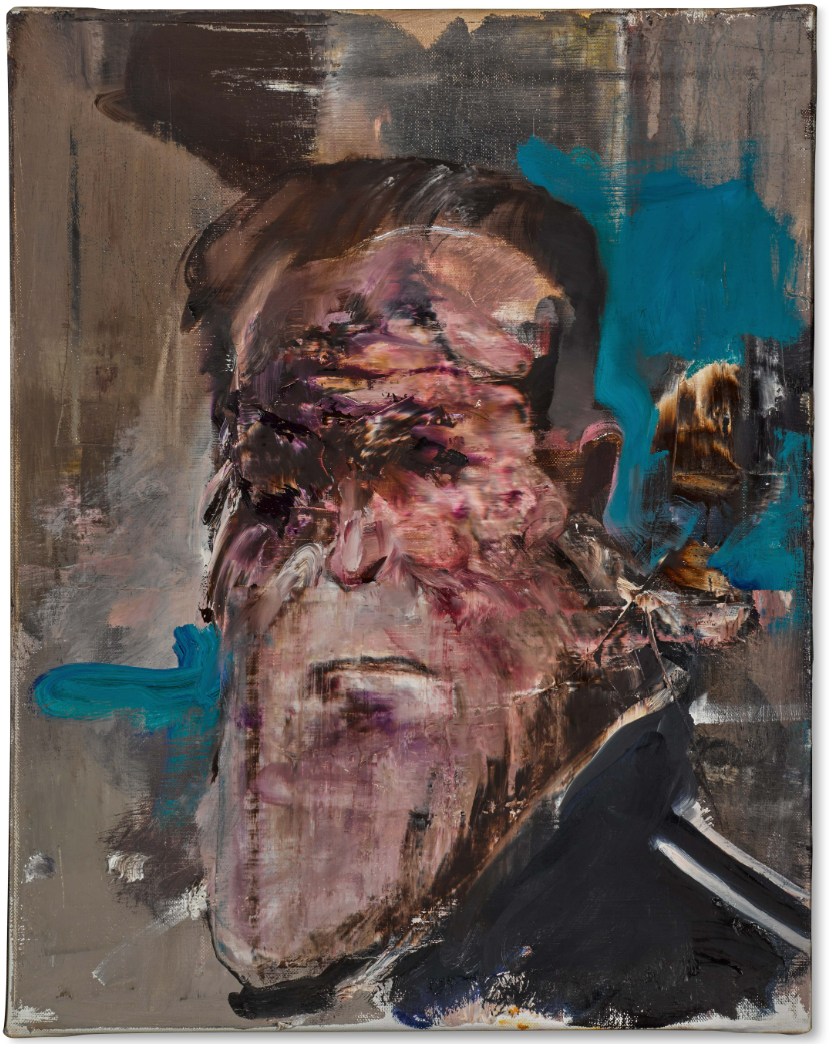
Self-Portrait as Charles Darwin pinpoints a milestone in Adrian Ghenie’s oeuvre. Created in 2012, the present work belongs to a series of works of Ghenie depicting himself as the renowned biologist, a thematic focus that has fueled his scrutiny of identity as subject to the darker vicissitudes of twentieth-century history. On the surface of the present work, the painter’s idiosyncratic haircut and black zip-up can be seen peeking through in rough strokes, as Darwin’s heavy brow and timeworn features are brought to near complete abstraction through flurried brushstrokes. Possessing a coalition of heavily labored medium, fluid brushwork, and exuberant tracts of dragged paint, this work exhibits Ghenie’s post-modern fluency as a painter. Much in the same way that Francis Bacon would blend his own likeness with friends and lovers, or with images culled from books, newspapers and films, Ghenie employs a similarly editorial painterly process. The result is a stratified visual and metaphorical palimpsest that harbours myriad allusions to art, history, science, and subjectivity. At once melding the squeegee scrape of Gerhard Richter’s post-photographic abstraction with the psychological intensity and corporeal manipulation of a Bacon self-portrait, Self-Portrait as Charles Darwin is one of Adrian Ghenie’s greatest achievements.
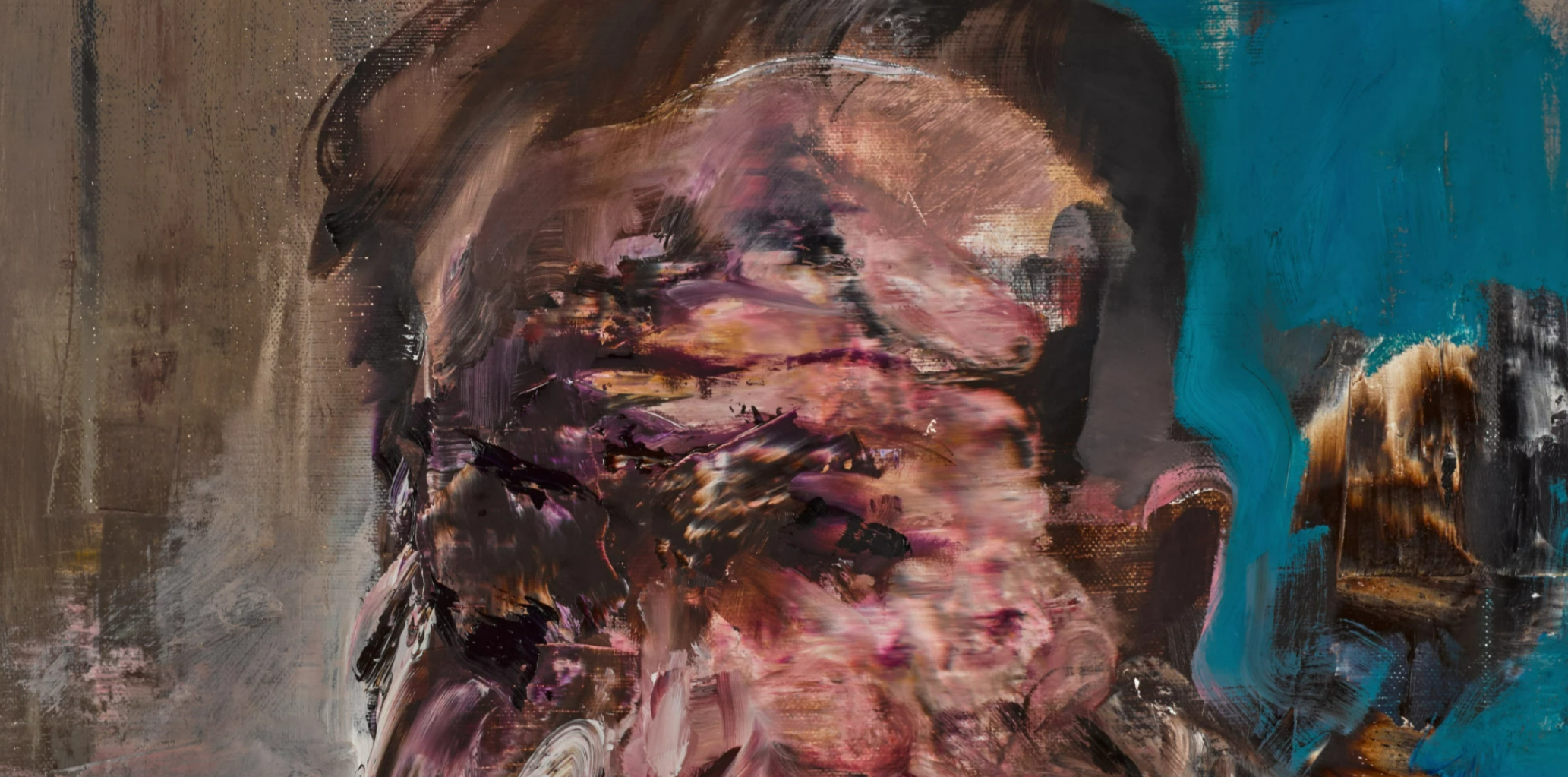
In many ways, the subject of this painting is the preeminent focus of Ghenie’s career: Darwin is the figure around which the artist’s incessant evocation of the Twentieth Century’s most troubling historical individuals triangulates. For Ghenie, Darwin’s ambiguous legacy finds disturbing repercussions through the exploitative services of political and social gain as embodied by the cast of political despots frequently pulled into focus: from Hitler and Dr Josef Mengele through to Stalin and Nicolae Ceaușescu. In 2013, Adrian Ghenie’s first exhibition with Pace in New York focused principally on this Darwinian dialogue, while in 2015, Ghenie would once again reprise the enquiry for his celebrated exhibition at the 56th Venice Biennale. Entitled Darwin’s Room and shown in the Romanian Pavilion as it would have appeared in 1938, this show explored the impact of Darwin’s revolutionary discoveries and followed the implications of ‘survival of the fittest’ through to some disquieting conclusions. Among the paintings of Darwin and portraits of Hitler, evocations of the infamous Nazi book burnings and Degenerate Art Exhibition of 1937 were shown alongside a host of self-portraits fused with Darwin’s likeness. As inaugurated by the present work in 2011, the artist’s merging of himself with Darwin is initially perplexing, given the perceived polarity between scientist and artist. Yet by filtering his appearance through this wizened visage – a countenance that utterly fulfils the classical epitome of European intellectualism as defined by Renaissance and Baroque painters – Ghenie positions himself in the mode of philosopher, meditating the controversies roused by man’s promethean progress.
Louise Bonnet
Sotheby’s London: 12 October 2023
Estimated: GBP 100,000 – 150,000
GBP 165,100
The Shirt | The Now Evening Auction | 2023 | Sotheby’s (sothebys.com)
LOUISE BONNET (b. 1970)
The Shirt, 2017
Oil on canvas
40×30 inches (101.7 x 76.2 cm)
Signed with the artist’s initials and dated 17 (on the reverse)
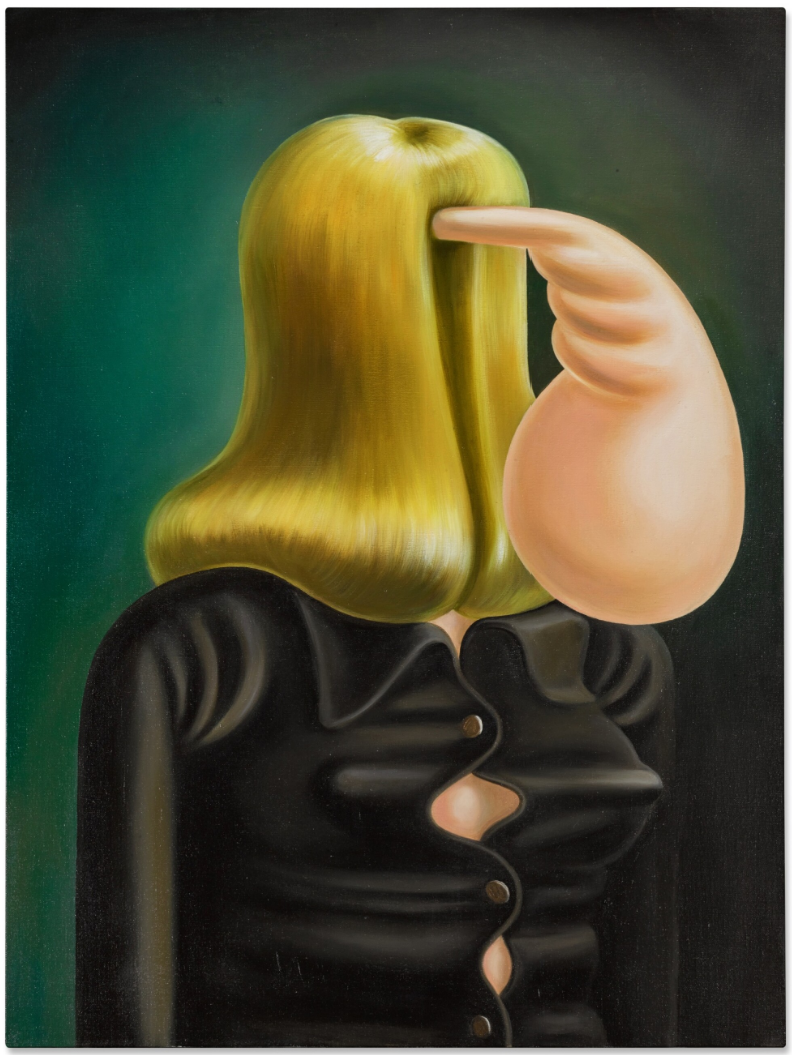
With an irresistible sense for the absurd, Louise Bonnet paints portraits that combine pain and beauty to facilitate the exploration of melancholy, nostalgia and displacement. A female figure with dense, glossy blonde hair is the subject of Bonnet’s The Shirt. With her physical anatomy satirically inflated – typical of Bonnet’s portraiture – the figure’s face is distorted and otherwise hidden behind the hair, while their black buttoned shirt appears ready to burst. Drawing on influences ranging from science fiction to comedic horror, such as David Cronenberg’s 1979 body horror film The Brood, Bonnet humorously directs our attention to our social discomfort around certain body parts and depictions of ugliness.
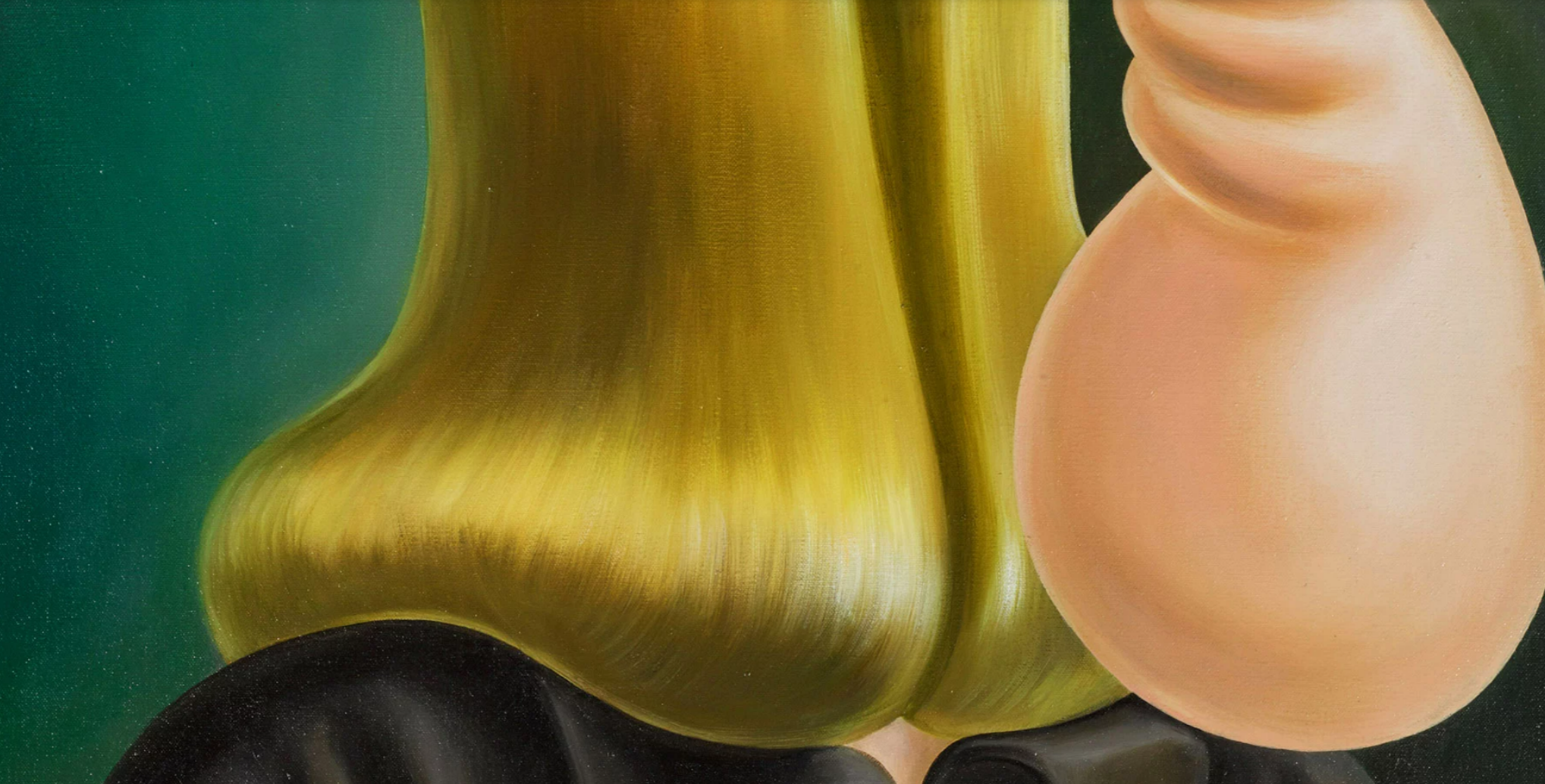
Bonnet’s decision to exclude eyes in The Shirt, and throughout her oeuvre, is motivated by the belief that eyes would attract all the attention; Bonnet “could never look at someone being shamed if I had to deal with their feelings of me looking at them” (Pac Pobric, “‘I Don’t Mind Being Repulsive’: Swiss Painter Louise Bonnet on the Lure of Ugliness and How Horror Films Inspire Her Work,” Artnet, 29 October 2020, online). The judgement exercised by eyes interferes with Bonnet’s aim: to depict shame and rage and death, freezing them within the canvas, so the viewer is able to look closely at them from outside. With a deft handling of colour and light, The Shift demonstrates a sensitivity to the formal and atmospheric possibilities of oil paint. Bonnet’s figure evokes an extreme psychological and physiological tension in a playfully confrontational approach.
2. Contemporary Evening Auction
12 October 2023
Contemporary Evening Auction | 2023 | Sotheby’s (sothebys.com)
Total:
GBP 30,121,100
USD 36,782,388
———
# Lots: 21
# Lots sold: 19
Sell-Through Rate: 90.5%
———
Above Estimates: 6 (29%)
Within Estimates: 8 (38%)
Below Estimate: 5 (24%)
Unsold: 2 (10%)
#1. Francis Bacon
Sotheby’s London: 12 October 2023
Estimated: GBP 3,500,000 – 4,500,000
GBP 4,283,000
Study for a Portrait | Contemporary Evening Auction | 2023 | Sotheby’s (sothebys.com)
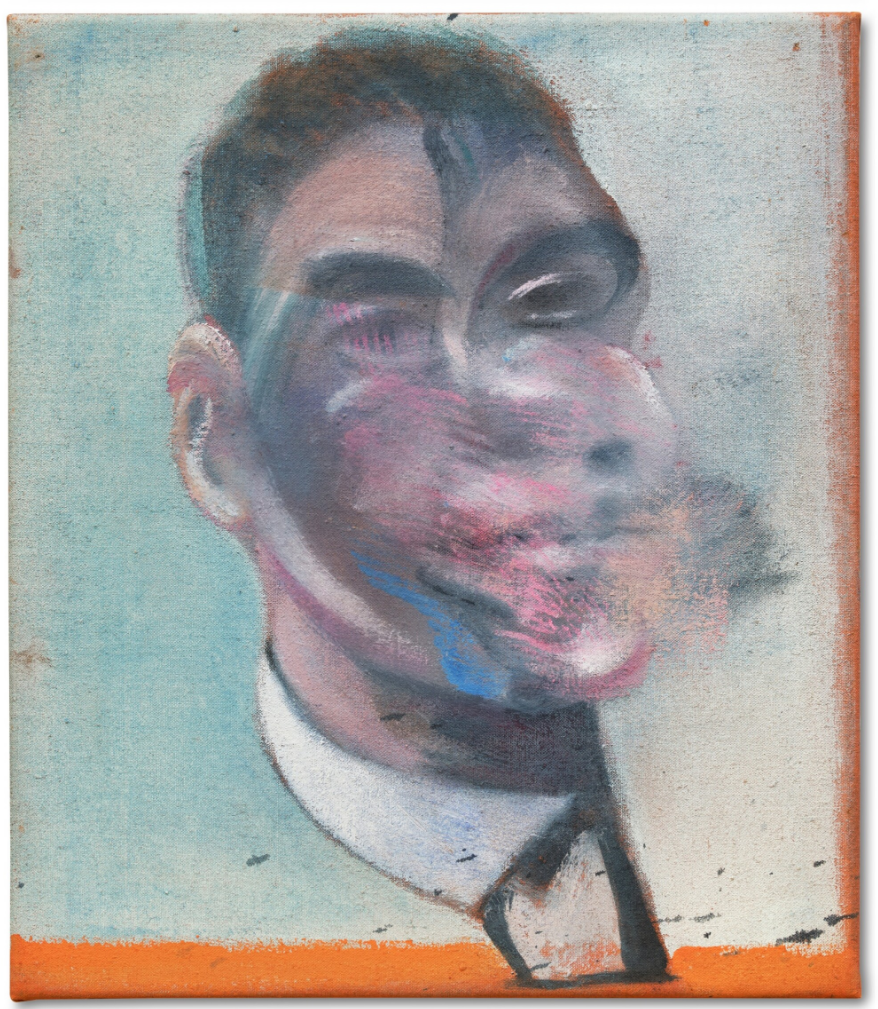
FRANCIS BACON (1909 – 1992)
Study for a Portrait, 1979
Oil on canvas
36.2 x 30.5 cm (14 1/4 x 12 inches)
Signed, titled and dated 1979 (on the reverse)
Combining both a dazzling display of painterly bravura and a multi-layered psychological intensity, Study for a Portrait from 1979 exemplifies the salient features of Francis Bacon’s tremendous output. Composed of a three-quarter profile set against a soft blue background and a strip of bright cadmium orange, the present work is a classic example from Bacon’s seminal suite of small portrait heads. The painting first began as a framed head nailed to a wall of cadmium orange, a prominent colour in Bacon’s 1970s works as well as in the 1944 Crucifixion triptych. When Bacon repurposed the original piece into the present smaller format, he retained a strip of cadmium orange at the bottom. The beautiful composition of the present work is thus arranged around a schema of framing devices: the overlapping matrices of paint hatching and modulations of texture carefully organise the containment of the head within the frame, preparing the viewer from the outset that this portrayal is pensive, focused and enduring.
The extraordinary compression of the image, together with the soft blue background heightens the drama and magnifies the prominence of the visage. Painted in an intimate scale, the intensity of each stroke is contained in the twisting head as it flickers with the faintest movement. Bacon preferred to paint in absentia relying predominantly on the combination of photographic material and memory to inform his image production. He viewed painting by nature as an artifice and felt that having the model before him suffocated spontaneous creative invention. Bacon spoke admirably of Picasso, especially his work of the 1920s and 1930s, in which he saw a syntax of “organic form that relates to the human image but is a complete distortion of it” (Francis Bacon quoted in: Milan Kudera and France Borel, Bacon: Portraits and Self-Portraits, London 1996, p. 10). Bacon consistently returned to the portrait format throughout his career and steadfast in his belief that abstraction was merely aesthetic, and that art devoid of human content lacked emotional resonance. As a committed portraitist, Bacon was seeking to visually explain the variations of the human condition and capture the distinct psyche and intensity of his sitters. As Christoph Heinrich notes, “Bacon paints not only ‘the person’, but also sets out to convey the specific energy of very different individuals through painting” (Exh. Cat., Milan, Palazzo Reale, Bacon, 2008, p. 55).
#2. Andy Warhol
Sotheby’s London: 12 October 2023
Estimated: GBP 1,200,000 – 1,800,000
GBP 3,315,000 / USD 4,048,113
Diamond Dust Shoes | Contemporary Evening Auction | 2023 | Sotheby’s (sothebys.com)
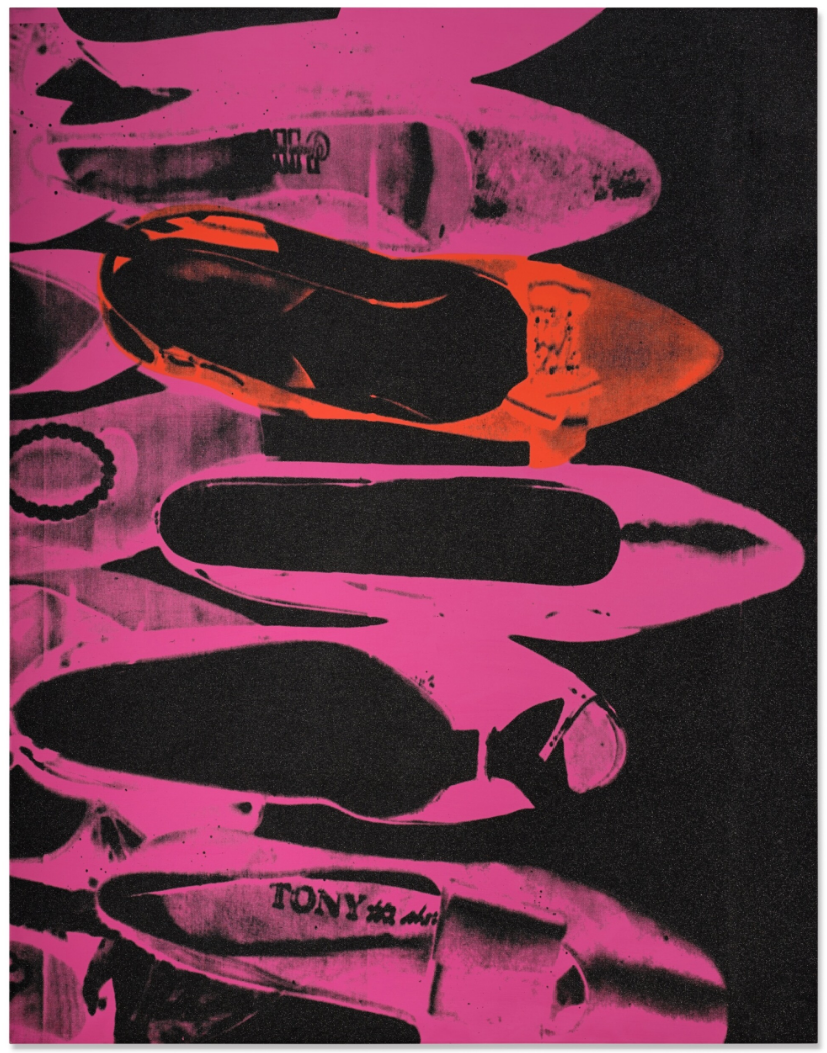
ANDY WARHOL (1928 – 1987)
Diamond Dust Shoes, 1980
Acrylic and silkscreen ink with diamond dust on canvas
90×70 inches (228.6 x 178.1 cm)
Numbered PA70.041 and stamped twice by the Estate of Andy Warhol, New York and the Andy Warhol Foundation for Visual Arts, Inc. (on the overlap)
Also numbered PA70.041 twice (on the stretcher)
The present work, created in 1980, is one of the most dazzling examples of Andy Warhol’s series of Diamond Dust Shoes; a series which shows Warhol at the height of his powers as he combines the luxuriousness of the 1970s Society Portraits with the subversive wit of the 1960s object paintings. Epitomising the artist’s fascination with consumerism and glamour, the present work simultaneously refers to his beginnings as a commercial and illustrator, reflects the hedonistic, glitzy mood of its contemporary context of creation and points towards his more subdued works of the 1980s. Elegiac and celebratory in equal measure, Diamond Dust Shoes is a monument to both an era and a scene. Vincent Fremont, the executive manager of Warhol’s studio, reflected on this spectacular series: “The merger of women’s shoes and diamond dust was a perfect fit… Andy created the Diamond Dust Shoe paintings just as the disco, glam, and stilettos of Studio 54 had captured the imagination of the Manhattan glitterati. Andy, who had been in the vanguard of the New York club scene since the early 60s, once again reflected the times he was living in through his paintings” (Vincent Fremont in: Exh. Cat., New York, Gagosian Gallery, Diamond Dust Shoes, 1999, pp. 8-9).
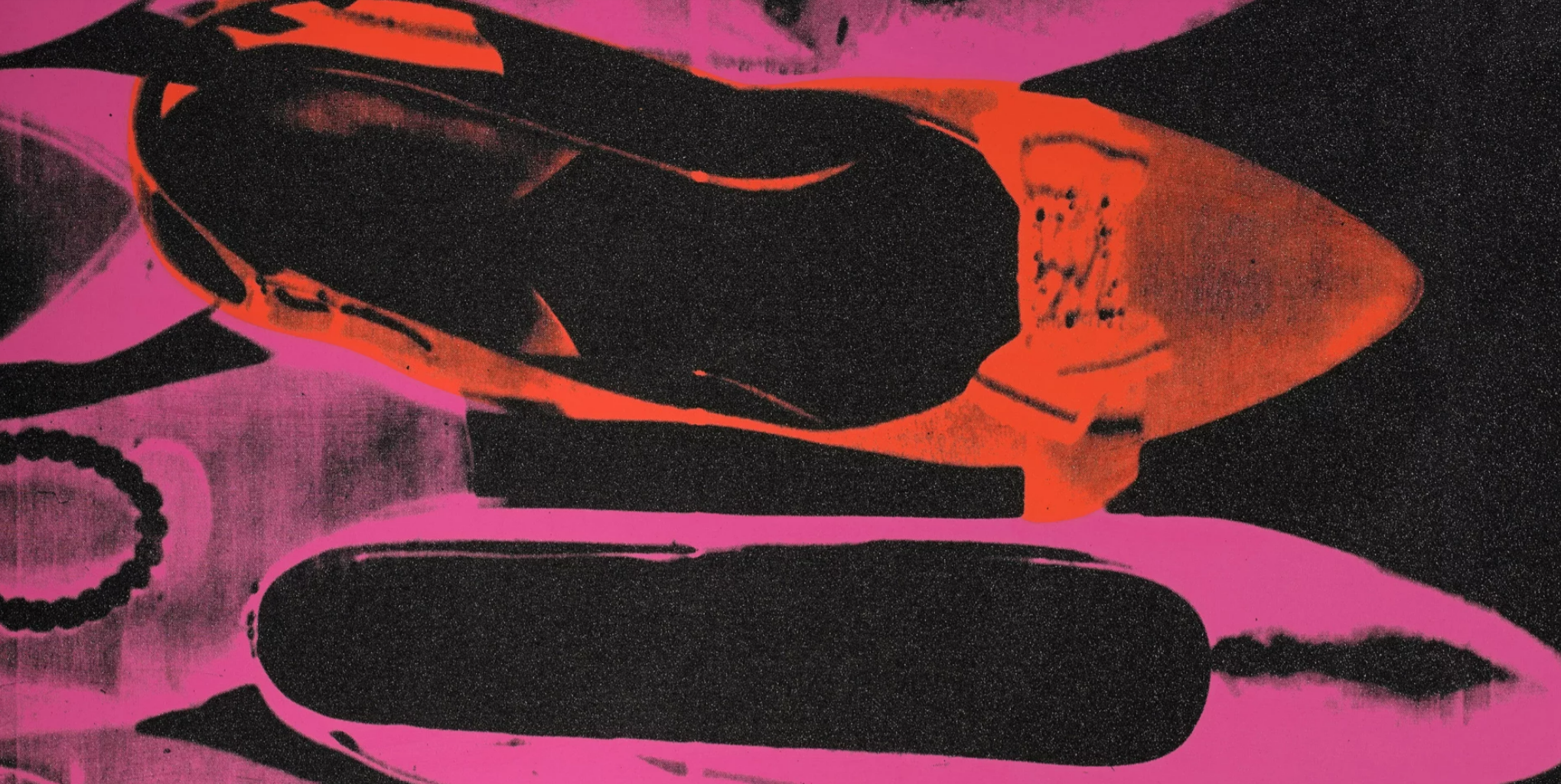
The shoe, as both motif and theme, anonymised beauty and allowed him to explore its implications on contemporary culture, perhaps more subtly than in the portraiture that had occupied him for more than a decade. Arriving in New York in 1949 with the intention of pursuing a career as a commercial illustrator, Warhol’s distinctive, detailed depictions of shoes and other commercial objects could soon be found in magazines and newspapers such as Harper’s Bazaar and Vogue. Throughout the early 1950s, he would be commissioned to create an array of campaigns, including advertisements for Neiman Marcus and Barney’s New York, as well as a formative collaboration with Richard Avedon’s fashion photos for a Mademoiselle magazine feature, “The Glass Slipper.” He achieved success in this field, even being described by Women’s Wear Daily as “the Leonardo da Vinci of the shoe trade” (David Bourdon, Warhol, New York, 1989, p. 42) for his work on a campaign for shoe designer I. Miller and Sons. These illustrations, executed in ballpoint pen and with his distinctive blotted line technique, were highly coloured and whimsical in nature. Accompanied by playful phrases or named after iconic movie stars such as Julie Andrews, these imagined objects held an inhabited quality and personality of their own, recognizable as a key aspect of Warhol’s artistic practice.
#3. Yayoi Kusama
Sotheby’s London: 12 October 2023
Estimated: GBP 2,400,000 – 4,000,000
GBP 3,073,000 / USD 3,752,595
Pumpkin (S) | Contemporary Evening Auction | 2023 | Sotheby’s (sothebys.com)
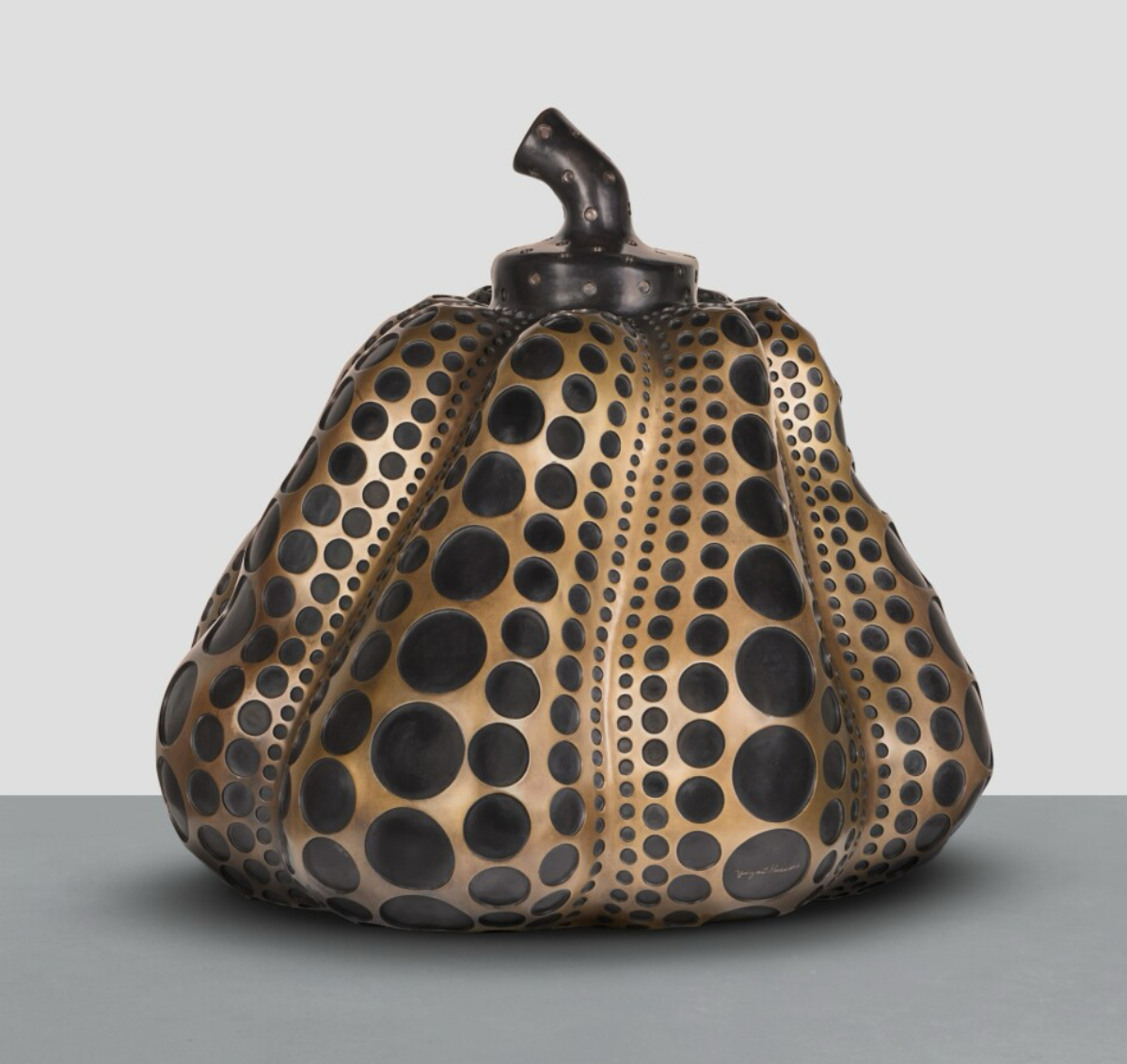
YAYOI KUSAMA (b. 1929)
Pumpkin (S), 2014
Bronze
108x114x114 cm (42 1/2 x 44 7/8 x 44 7/8 inches)
Incised with the artist’s signature (near the base)
This work is number 1 from an edition of 8 plus 2 artist’s proofs
Kusama’s 2014 Pumpkin (S) sings of her earlier paintings, prints and Fibreglass pumpkins, while simultaneously marking a sophisticated reimagining and recasting of the artist’s most beloved motif. The bichrome, freestanding bronze sculpture measures over one metre tall and wide, with a plucky, dot-covered peduncle that pulls the viewer’s gaze upwards from the rotund base that sits flush to the ground. Embodying the “fertile self-enclosure and radical openness to others” that characterises Kusama’s monumental sculpture, the present work emerges organically from the ground, inhabiting its environment and asserting its squat presence within the viewer’s world (Leslie Camhi, “Large Sculpture,” in Louise Neri and Takaya Goto, eds., Yayoi Kusama, New York 2012, p. 214). The artist’s characteristic polka dots flow in rows across the sculpture’s surface, advancing and receding rhythmically in a fastidiously precise yet dynamically organic manner, following the natural curves of the pumpkin itself: an effect which creates a sophisticated geometry and sense of bulging roundness. Each sectional ridge of the pumpkin frames an array of dots that increases in size as the rib crests towards the Centre, creating complex dimensional depth to the pumpkin’s skin and shell and generating the sensation of liveliness and animation that is characteristic of Kusama’s practice.
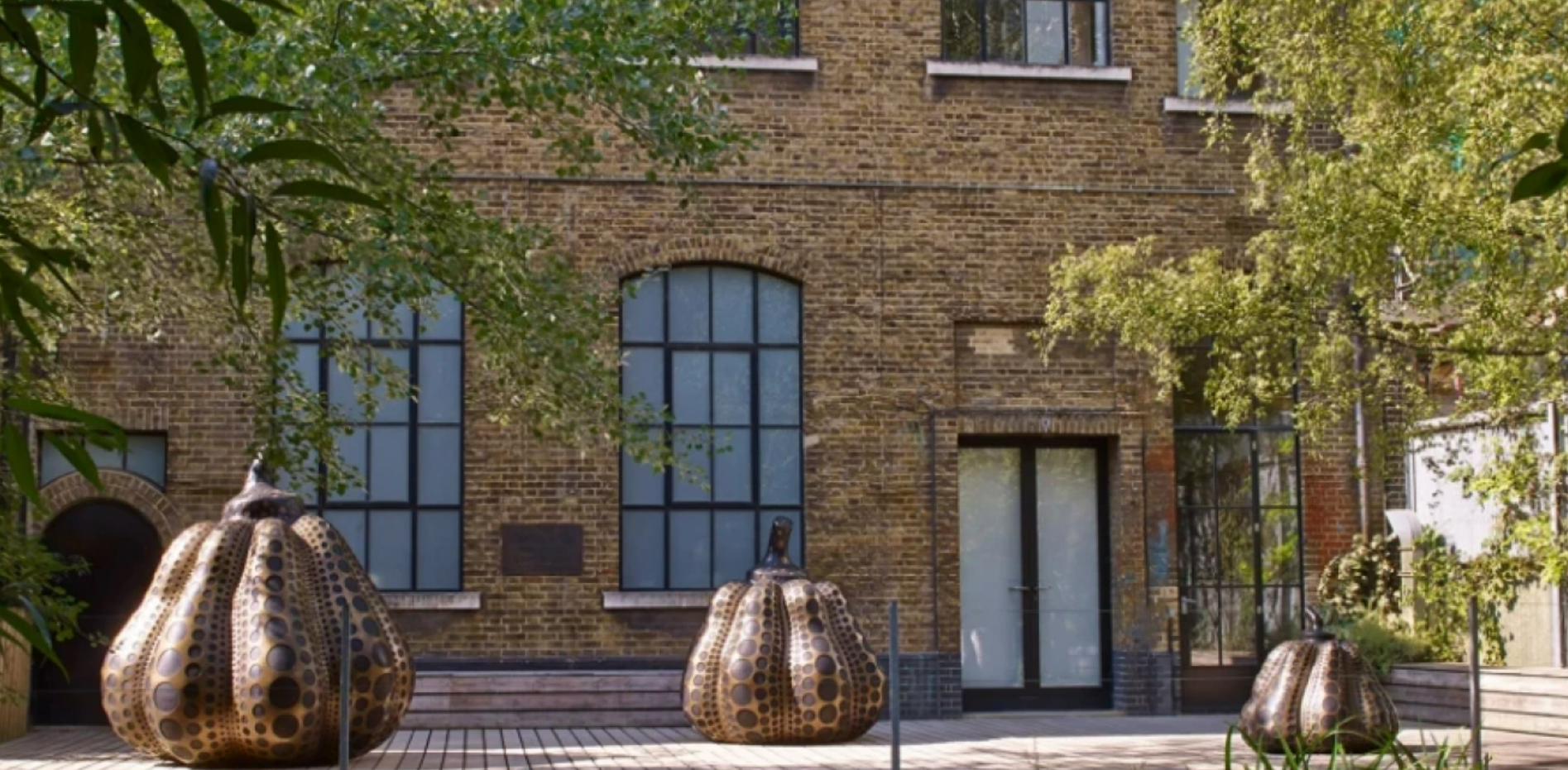
Reversing the coloring between the stem and body of the pumpkin, Kusama ensures that the eye is pulled towards its intricate dot-covered top. As Gilda Williams notes, “On Japanese farms, kabocha are harvested prior to full maturity and continue to ripen off of the vine; perhaps for this reason in Kusama’s sculpture the broken stem always emphatically protrudes upwards, untethered to the earth below” (Exh. Cat., London, Victoria Miro, Yayoi Kusama: Bronze Pumpkins, 2014, p. 6). The smallest in the series, Pumpkin (S) radiates the potential that it might continue to flourish and nourish even after being “plucked,” expanding the artist’s fantastical cosmos ad infinitum.
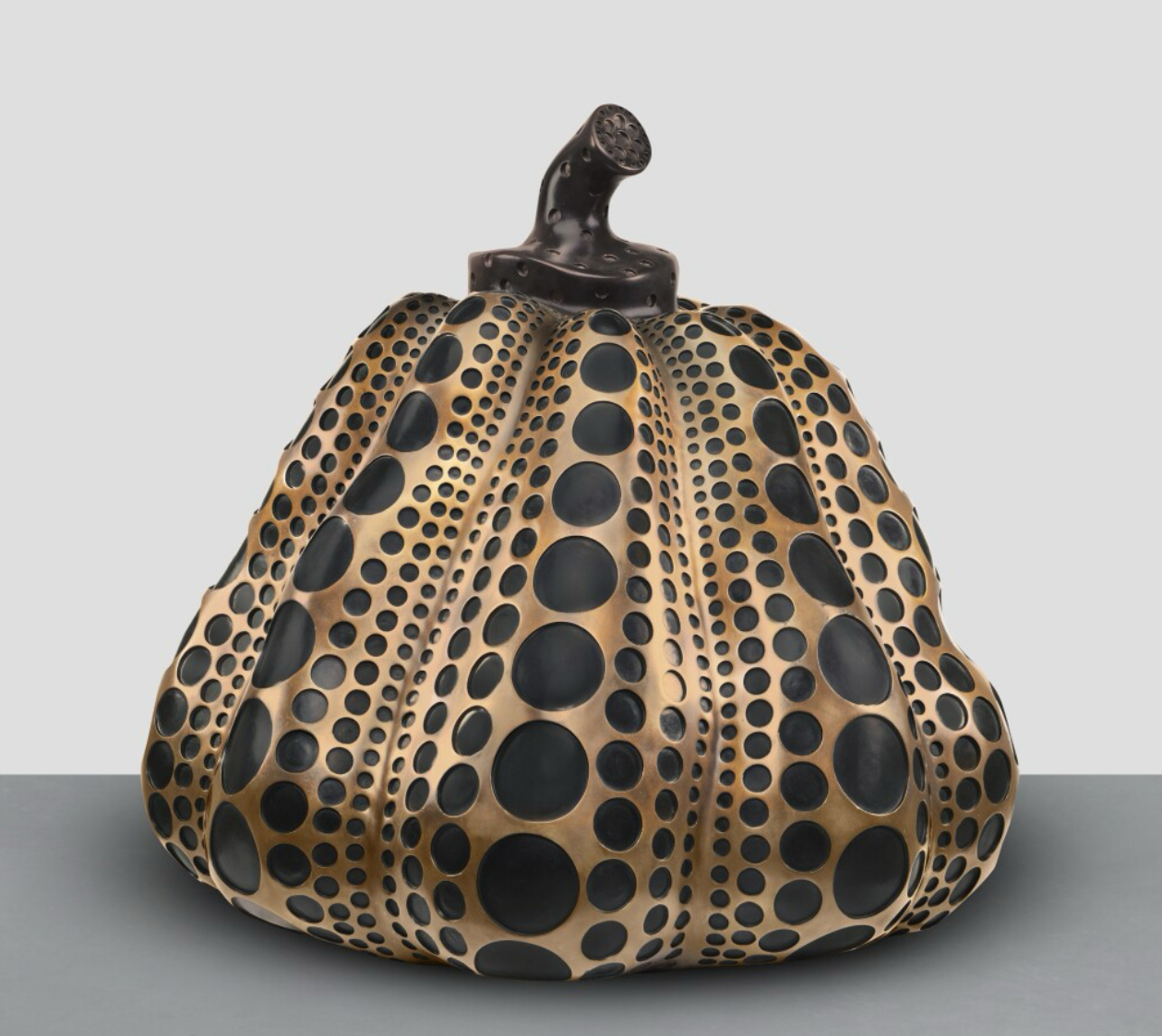
Produced for and exhibited in the artist’s installation at the Victoria Miro Gallery in 2014, a significant year for Kusama whose work was the subject of three international museum exhibitions, this meticulously executed sculpture was two years in the making and marks the first instance of the artist working with bronze on such a monumental scale. The bronze pumpkins integrate many key aspects of Kusama’s practice: the reflectivity of the mirror, the repeating pattern of dots, a juxtaposition of light and dark, connotations of growth and fertility and the almost mythical status of the pumpkin within her art. Pumpkin (S) is an emblematic example of this, enlivened as its pitted surface catches and reflects light in a way that earlier painted and Fibreglass pumpkins cannot.
#4. Philip Guston
Sotheby’s London: 12 October 2023
Estimated: GBP 2,000,000 – 3,000,000
GBP 3,073,000 / USD 3,752,595
The Canvas | Contemporary Evening Auction | 2023 | Sotheby’s (sothebys.com)
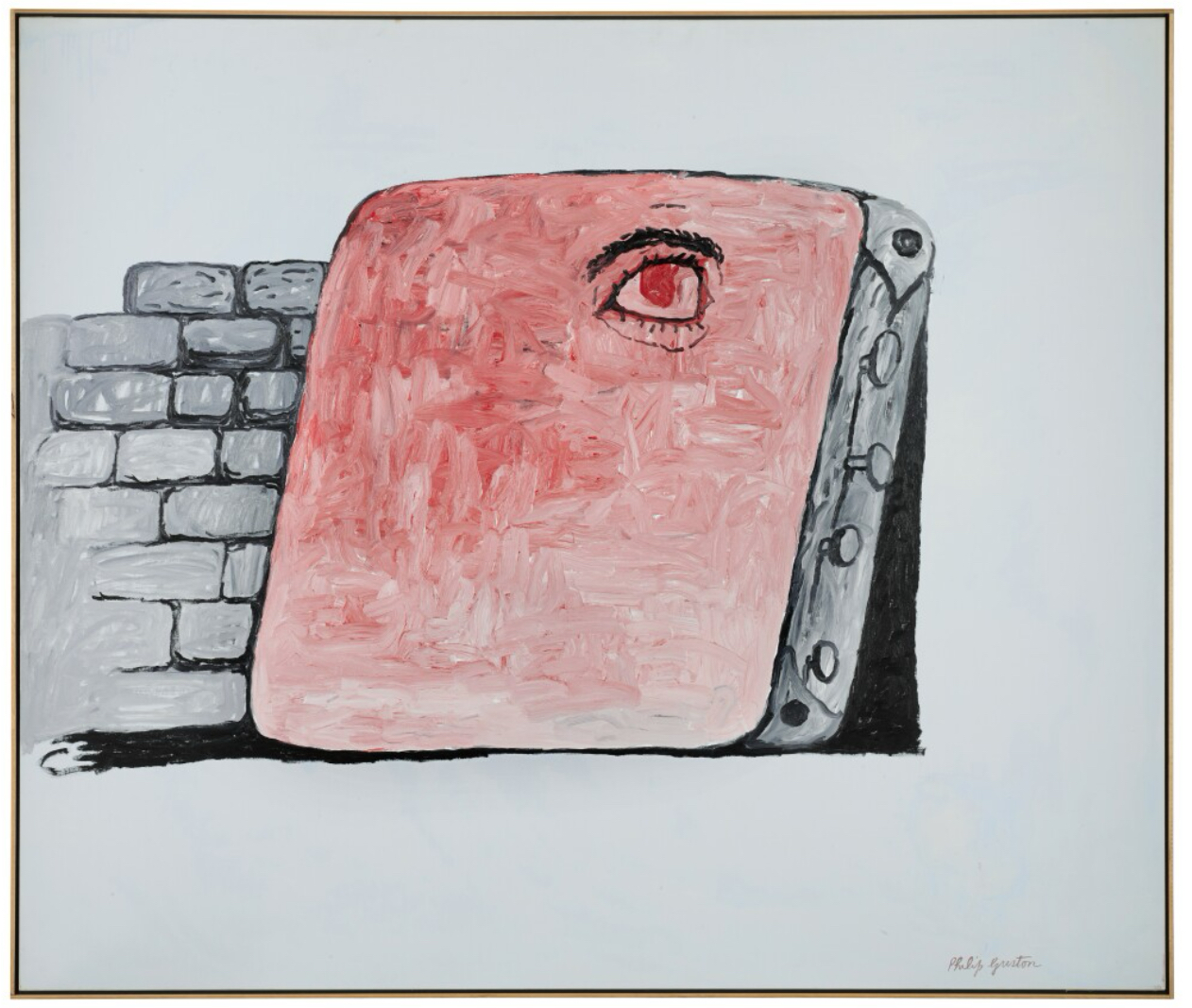
PHILLIP GUSTON (1913 – 1980)
The Canvas, 1973
Oil on canvas
67×79 inches (170.4 x 200.8 cm)
Signed (lower right)
Signed, titled, dated 1973 and variously inscribed (on the reverse)
Executed in 1973, Philip Guston’s The Canvas is an important example of his highly regarded later corpus of paintings. Painted during the final decade of his life, the present work depicts the artist’s own eye, floating on a blushing pink ground. The canvas, indicated by the fold of the fabric and nails to the right side, leans on a wall of bricks like an abandoned mattress. Loosely painted yet solid in mass, the curious eye of the canvas peers into the grey void. Depicting his own self as an anthropomorphised canvas, the present work is a deeply reflective and inquisitive work which captures Guston’s life-long exploration into the philosophies of painting. Currently the subject of a major travelling retrospective, Philip Guston Now, Guston’s daring works remain powerful and influential to this day. Having travelled from the Museum of Fine Arts, Boston; The National Gallery of Art, Washington D.C.; Museum of Fine Arts, Houston and finally opening at the Tate, London this October, the highly anticipated retrospective will chart Guston’s fifty-year career, exhibiting over 150 paintings and drawings, and revisit his continued importance and relevance.
Georg Baselitz
Sotheby’s London: 12 October 2023
Estimated: GBP 1,200,000 – 1,800,000
GBP 1,198,000 / USD 1,462,938
Untitled (Baum/Tree) | Contemporary Evening Auction | 2023 | Sotheby’s (sothebys.com)
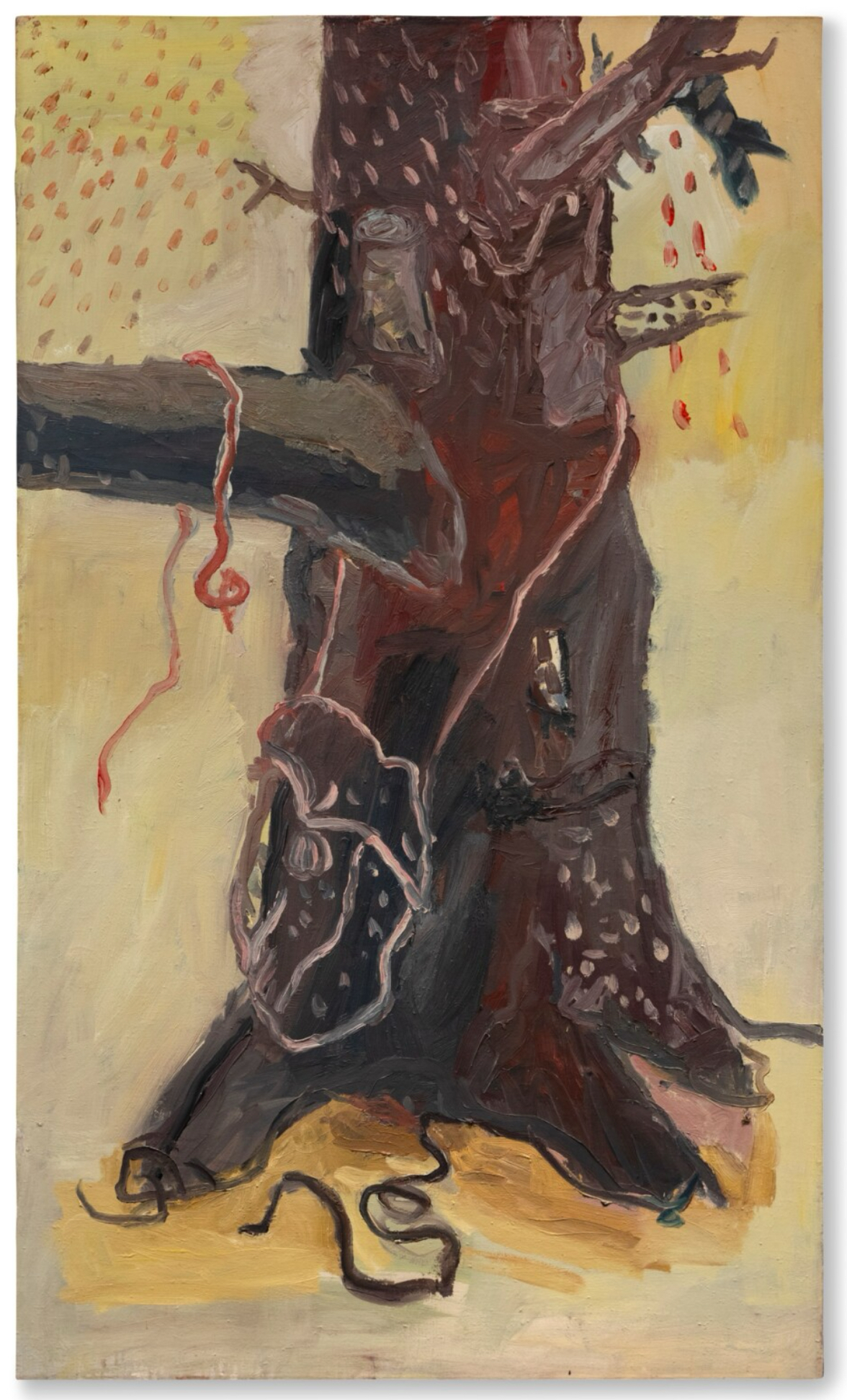
GEORG BASELITZ (b. 1938)
Untitled (Baum/Tree), 1965
Oil on canvas
135 x 78.7 cm (53 1/8 x 31 inches)
Executed in 1965, Untitled (Baum/Tree) is suffused by a poignant sense of remembered violence and loss. Typical of Georg Baselitz’s practice, the painting’s power is rooted in the visual and conceptual conceit of metonym, drawing on the corporeal slippage between natural and human bodies. A solitary tree stands out against a background of delicate yellow and ochre tones; at first calming for the eye, it conceals the restlessness of a dusty sky, a battlefield or a distant memory. Red flecks appear to fall from the stumpy, dismembered branches and the tree’s trunk is itself stained by a darker crimson, calling to mind open, seeping wounds. The artist most clearly anthropomorphises the tree through the visual alignment of the root, curling out from the base of the trunk, and the bright red entrails, hanging over a branch; a soldier’s saddlebag lies against the tree, sparsely picked out in white outline as if only half-remembered. A discomforting, violent image, Untitled (Baum/Tree) epitomises Baselitz’s ability to create powerful compositions through economical means. Moreover, it demonstrates his figurative impulse as a reaction to the growing influence of American abstraction and action painting. As he acknowledged, “I wanted to do something that totally contradicted internationalism: I wanted to examine what it was to be a German now” (Georg Baselitz quoted in: Nicolas Wroe, “Georg Baselitz: ‘Am I supposed to be friendly?’,” The Guardian, 14 February 2014, online).
3. Contemporary Day Auction
13 October 2023
Contemporary Day Auction | 2023 | Sotheby’s (sothebys.com)
Total:
GBP 12,556,095
USD 54,542,973
———
# Lots: 21
# Lots sold: 19
Sell-Through Rate: 95.2%
———
Above Estimates: 10 (48%)
Within Estimates: 10 (48%)
Unsold: 1 (4%)
Damien Hirst
Sotheby’s London: 13 October 2023
Estimated: GBP 50,000 – 70,000
GBP 60,960
2-Azido-2-Deoxyuridine | Contemporary Day Auction | 2023 | Sotheby’s (sothebys.com)
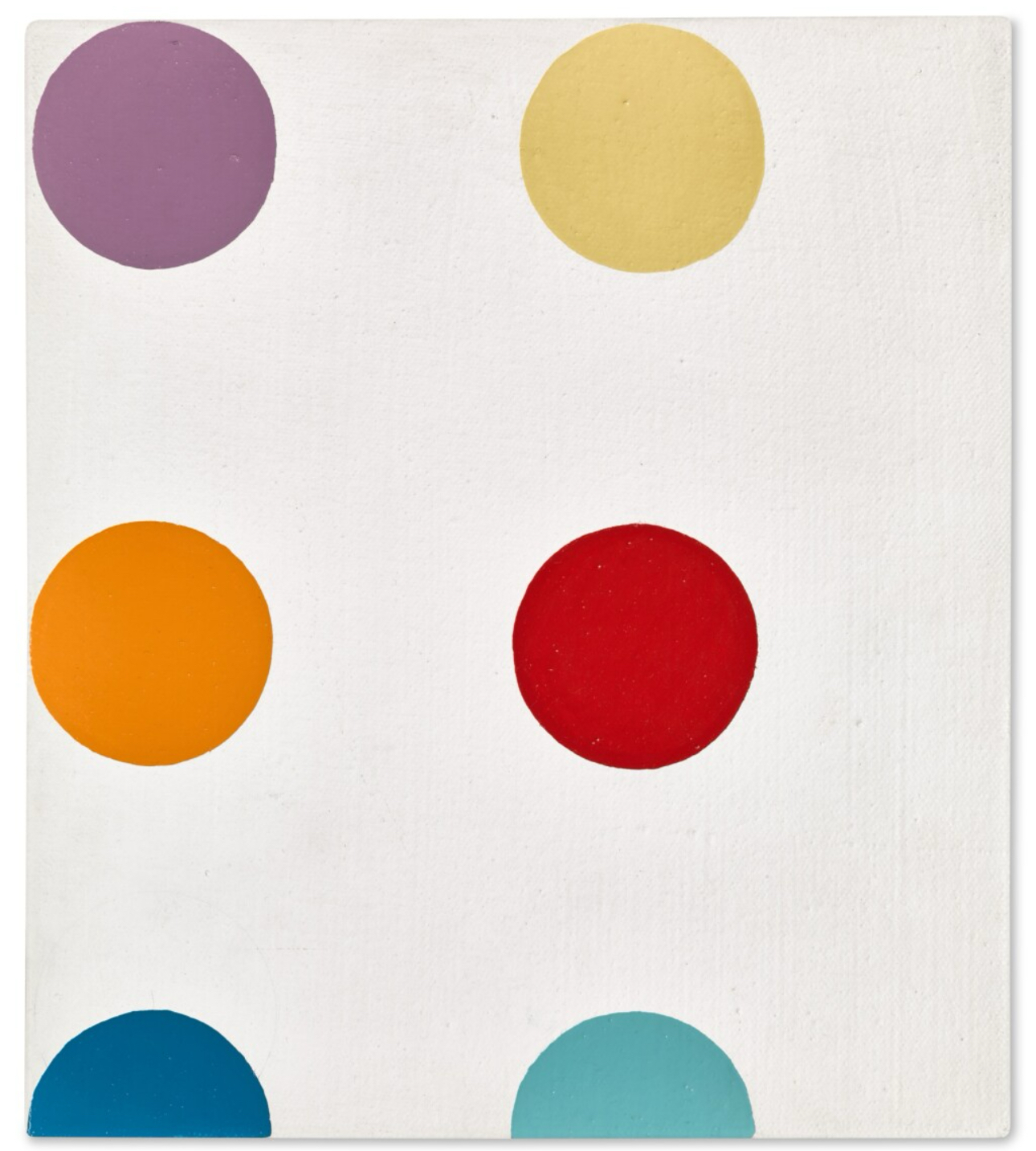
DAMIEN HIRST (b. 1965)
2-Azido-2-Deoxyuridine, 1995
Household gloss on canvas
9×8 inches (22.9 x 20.3 cm) (2-inch spot)
Signed and dedicated Thanks Terry love Damien (on the reverse)
“I once said that the spot paintings could be what art looks like viewed through an imaginary microscope.
I love the fact that in the paintings the angst is removed…
the colors project so much joy it’s hard to feel it, but it’s there.”
Damien Hirst
Sotheby’s London: 13 October 2023
Estimated: GBP 120,000 – 180,000
GBP 165,100
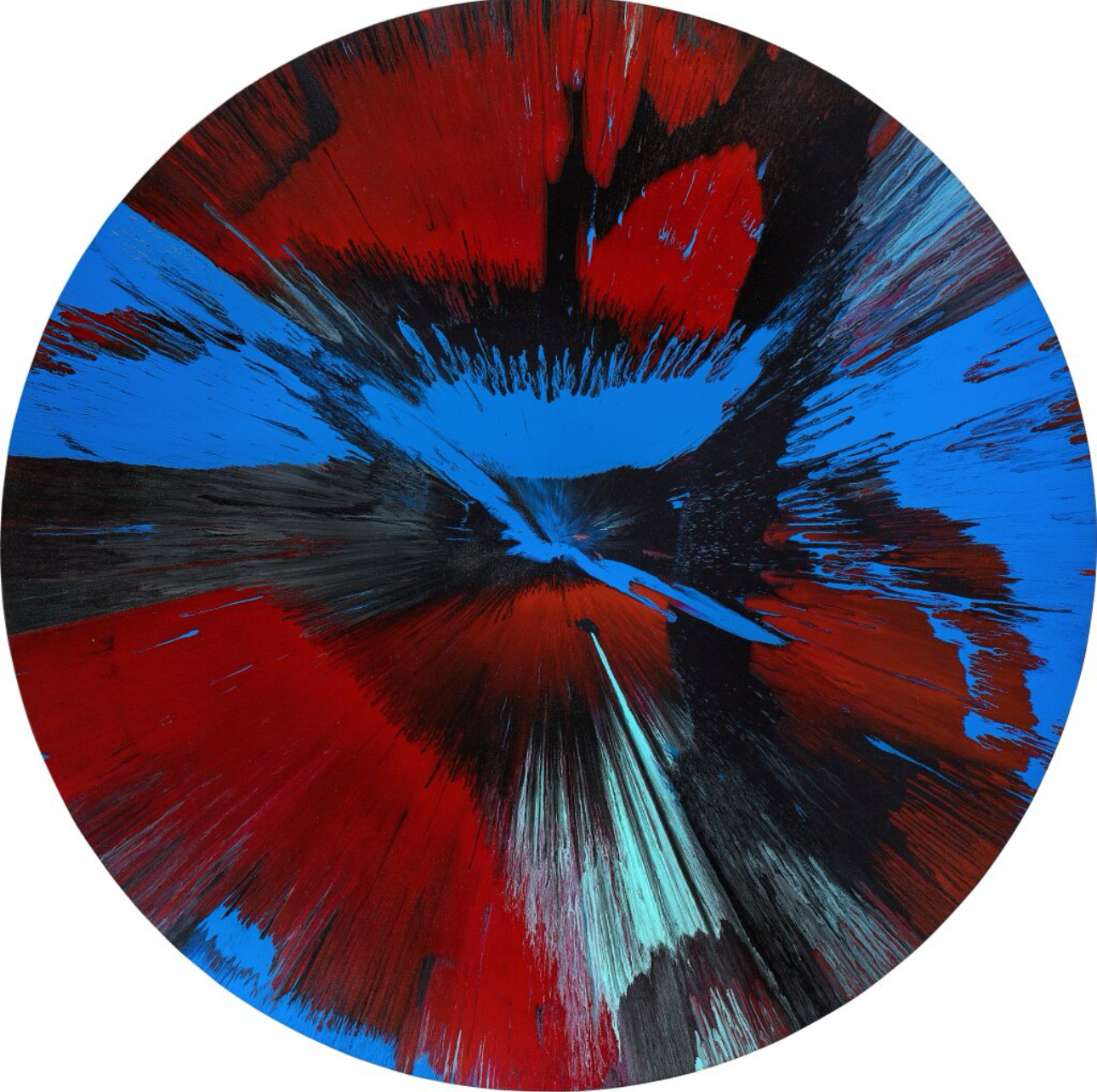
DAMIEN HIRST (b. 1965)
Beautiful, Eye-Opening, Hallucination of Breathtaking Spectacular Trip Gift Painting for John, 2016
Household gloss on canvas
Diameter: 72 inches (183 cm)
Signed (on the stretcher)
Signed, titled, dated 2016 and variously inscribed (on the reverse)
Executed in 2016, Beautiful Eye-Opening Hallucination of Breathtaking Spectacular Trip Gift Painting for John belongs to Damien Hirst’s iconic Spin Painting series. Created by pouring different colors of household paint onto a rapidly rotating canvas, Hirst’s renowned Spin Paintings are visually arresting for their colorful kineticism achieved through the spontaneous effects of chance, as the artist’s own hand is removed from the final product. Hirst’s approach recalls Jackson Pollock’s revolutionary drip paintings, which forever altered the trajectory of art in the 20th century through Pollock’s pioneering technique involving dynamic dripping and pouring skeins of paint on canvas or paper laid on the floor below him. Equally filled with dynamism and a cacophony of color, well beyond the limits of the canvas, Hirst’s Spin Paintings draw from the uncertainty intrinsic to the human experience and symbolize the artist’s ongoing quest to push beyond preordained limits.
Hirst created his very first Spin Paintings in 1992 in his studio in Brixton, London, titling the works with the amusingly convoluted titles which now distinguish the series, as exemplified by the present composition. One year after the series’ inception, Hirst set up a spin painting stall with fellow artist Angus Fairhurst at a street art fair called “A Fete Worse than Death”. Dressed-up as clowns by performance artist Leigh Bowery, Fairhurst and Hirst invited visitors to pay £1 to create their own spin paintings, which were later signed by the artists. Influenced by the postmodern privileging of chance and the alatory, Hirst exerts a limited amount of control in the creation of his iconic Spin Paintings, allowing the variegated surfaces of gravity-informed colour to bespeak the centrifugal energy of their execution. The rich blend of blue, red and black fill the circular piece with motion and excitement and forever preserve the highly performative moment in which Hirst captures the beautiful unpredictability of life.
Gerhard Richter
Sotheby’s London: 13 October 2023
Estimated: GBP 200,000 – 300,000
GBP 330,200
25 Farben | Contemporary Day Auction | 2023 | Sotheby’s (sothebys.com)
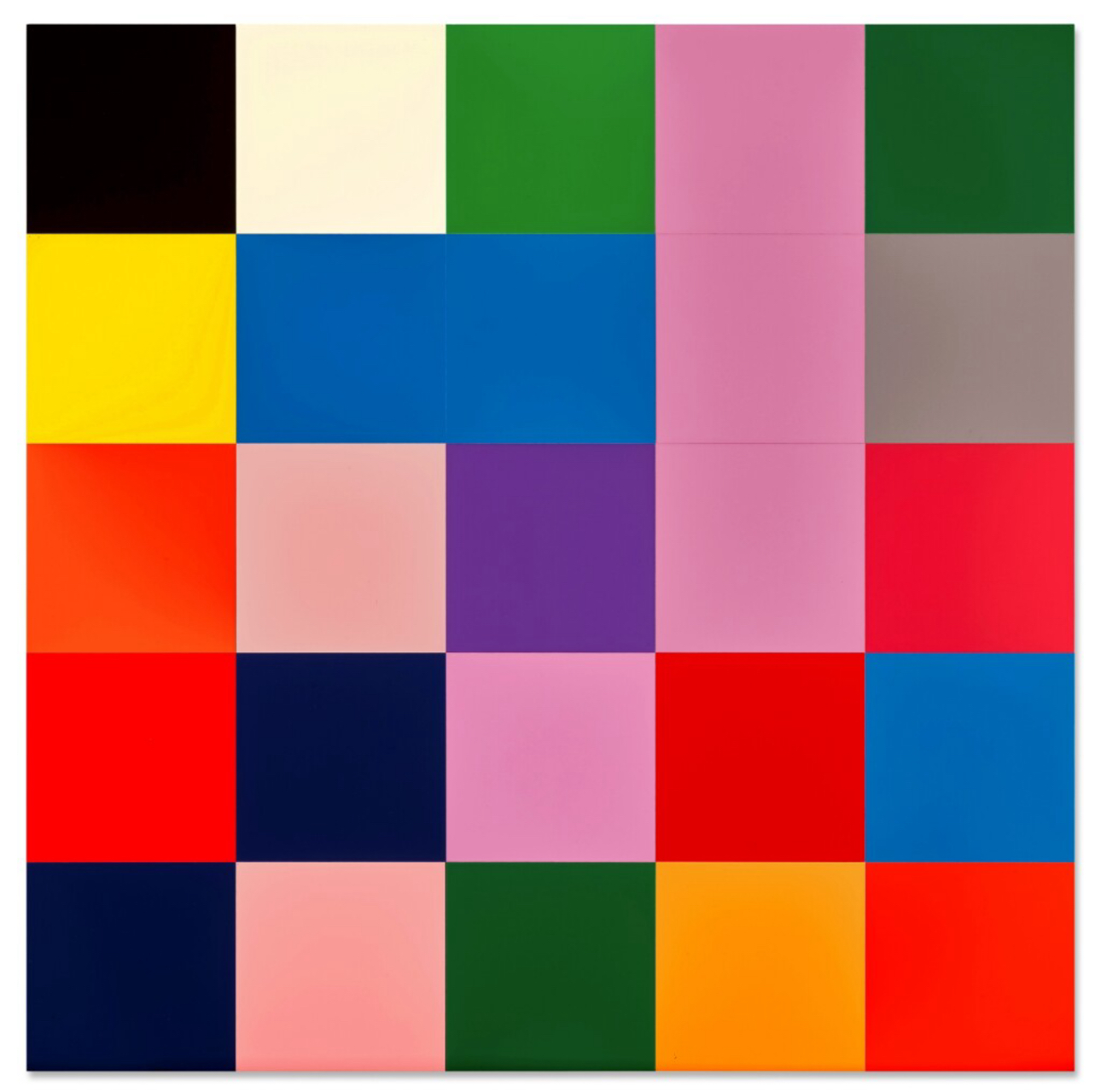
GERHARD RICHTER (b. 1932)
25 Farben, 2007
Lacquer on Alu Dibond
48.5 x 48.5 cm (19 1/8 x 19 1/8 inches)
Signed, dated 2007, and numbered 902-7 (on the reverse)
Gerhard Richter began his color chart paintings in 1966, challenging his own painterly concept and testing a new stylistic idiom. 25 Farben, completed in 2007, demonstrates Richter’s ongoing ability to stimulate new discussion on topics concerning notions of perception and creation, including chance, the ready-made and the purported “death” of painting. Achieved by eradicating any hierarchy of subject or representational intent and focusing solely on color to create an egalitarian language of art, Richter’s seminal Farben series exemplifies why the artist remains at the heart of painting today.
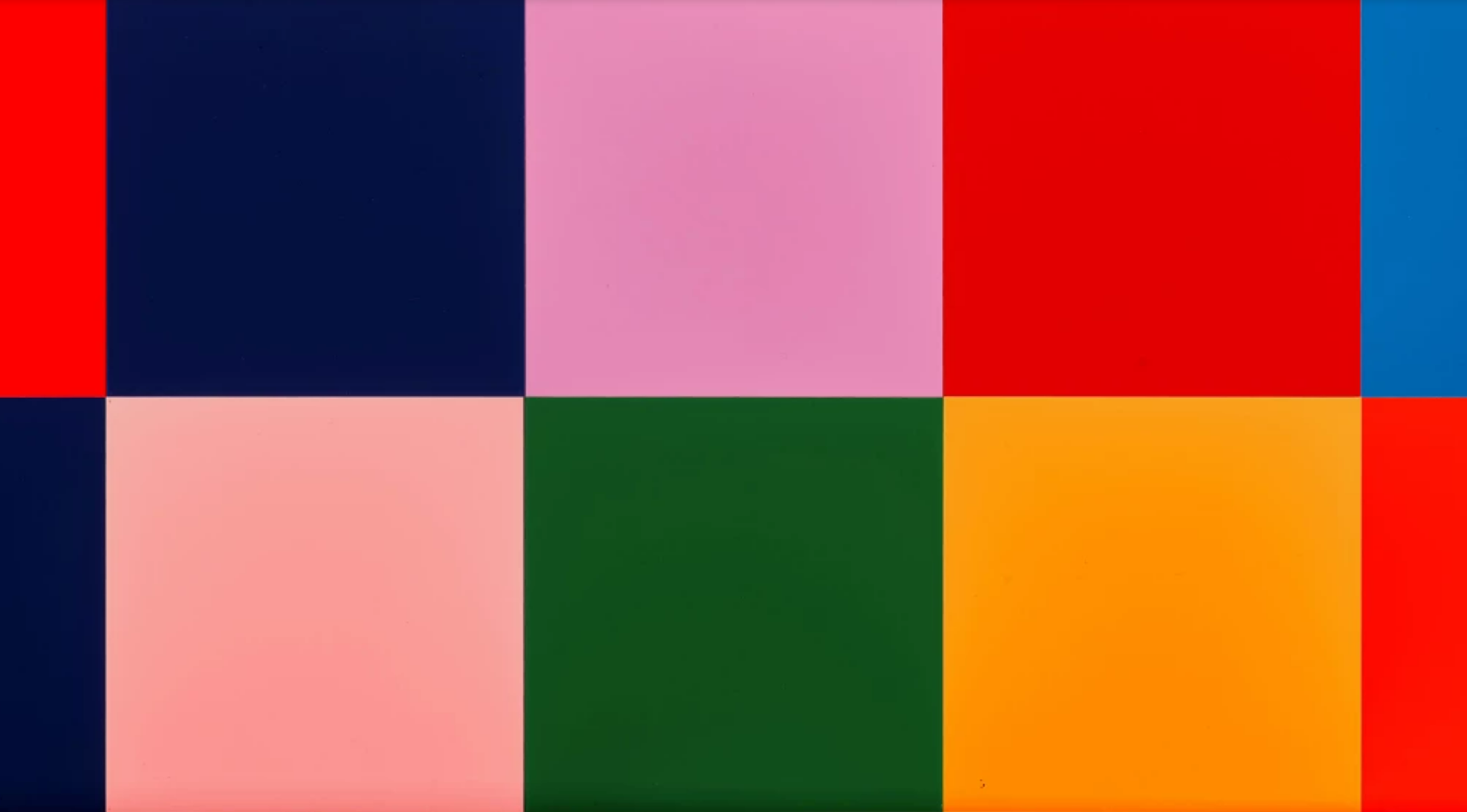
Outlining his methodology, Richter comments “Based on a mixtures of the three primary colors, along with black and white, I come up with a certain number of possible colors and, by multiplying these by two or four, I obtain a definite number of color fields that I multiply yet again by two, etc.,” (Gerhard Richter quoted in: Gerhard Richter, Dietmar Elger, Hans Ulrich Obrist, Eds., Text. Writings, Interviews and Letters, 1961-2007, London 2009). Indeed, Richter’s decision to render 25 Farben in lacquer stands in his continued reference to the longstanding tradition of paint as ready-made, a paradigmatic idea of twentieth century art, representing a radical way of making color, independent and autonomous. Originally inspired by the color sample cards easily obtained at paint shops, Richter’s earliest Color Charts were modelled from sample cards. Gradually, Richter favored color placement by random designation through the use of an algorithm that removed the restrictive confines of painterly expressiveness or artistic subjectivity.
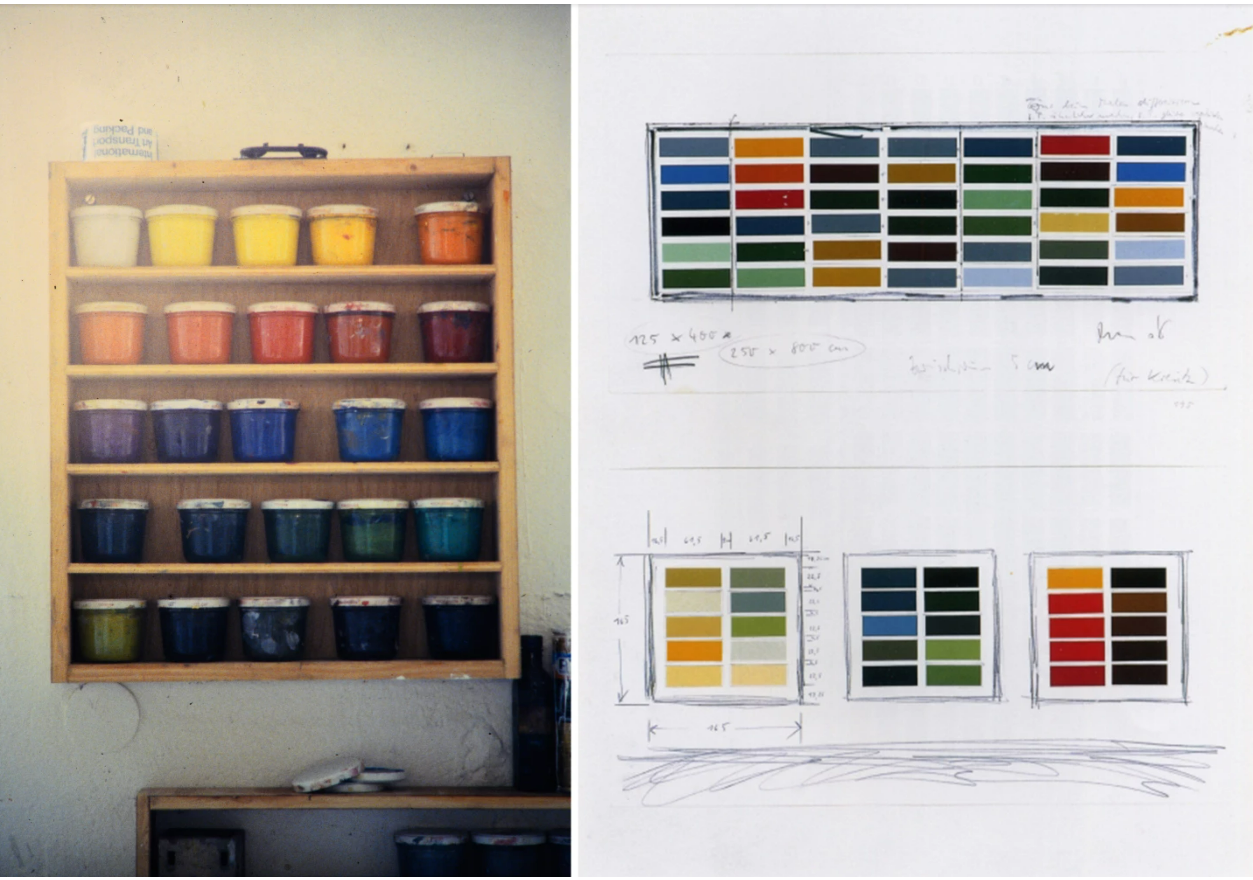
LEFT: GERHARD RICHTER’S STUDIO, DÜSSELDORF, 1981. PHOTO © AKG-IMAGES / BRIGITTE HELLGOTH.
RIGHT: GERHARD RICHTER, SKIZZEN (FARBTAFELN), 1966. STÄDTISCHE GALERIE IM LENBACHHAUS UND KUNSTBAU MÜNCHEN, MUNICH. ART © GERHARD RICHTER 2023 (28092023)
While Richter’s earliest Color Charts depict grids separated by thick white borders, these borders get progressively thinner until 1973, when Richter removes them entirely. A decision that has been adhered to in 25 Farben, Richter implemented this choice upon recognizing that “every colour matches wonderfully to each random other”. Indeed 25 Farben, the representative function of the image is limited and the focus, instead, turns to the fundamental elements of a picture – colour and structure – freed from any narrative function. Sitting outside earlier iterations of the series, 25 Farben was painted in the midst of Richter’s dramatic Abstraktes Bilder works. Employing a squeegee, Richter often describes how the Abstraktes Bilder are largely painted by chance, unable to dictate the result of the squeegee. In returning to the Colour Chart series with 25 Farben, Richter’s more directly broaches the discussion of chance in his oeuvre.
With Richter’s 25 Farben the artist, once again, demonstrates his extraordinary ability to challenge the notions of painting and the Readymade. A work of enduring importance, 25 Farben undoubtedly solidifies the importance of arguably the most significant abstractionist of our time. Testament to the importance of this series within the artist’s ouevre, 196 kaleidoscopic panels from Richter’s 2007 confrontation of the power color are housed in the Fondation Louis Vuitton in Paris.
Andy Warhol
Sotheby’s London: 13 October 2023
Estimated: GBP 150,000 – 200,000
GBP 190,500
Flowers | Contemporary Day Auction | 2023 | Sotheby’s (sothebys.com)
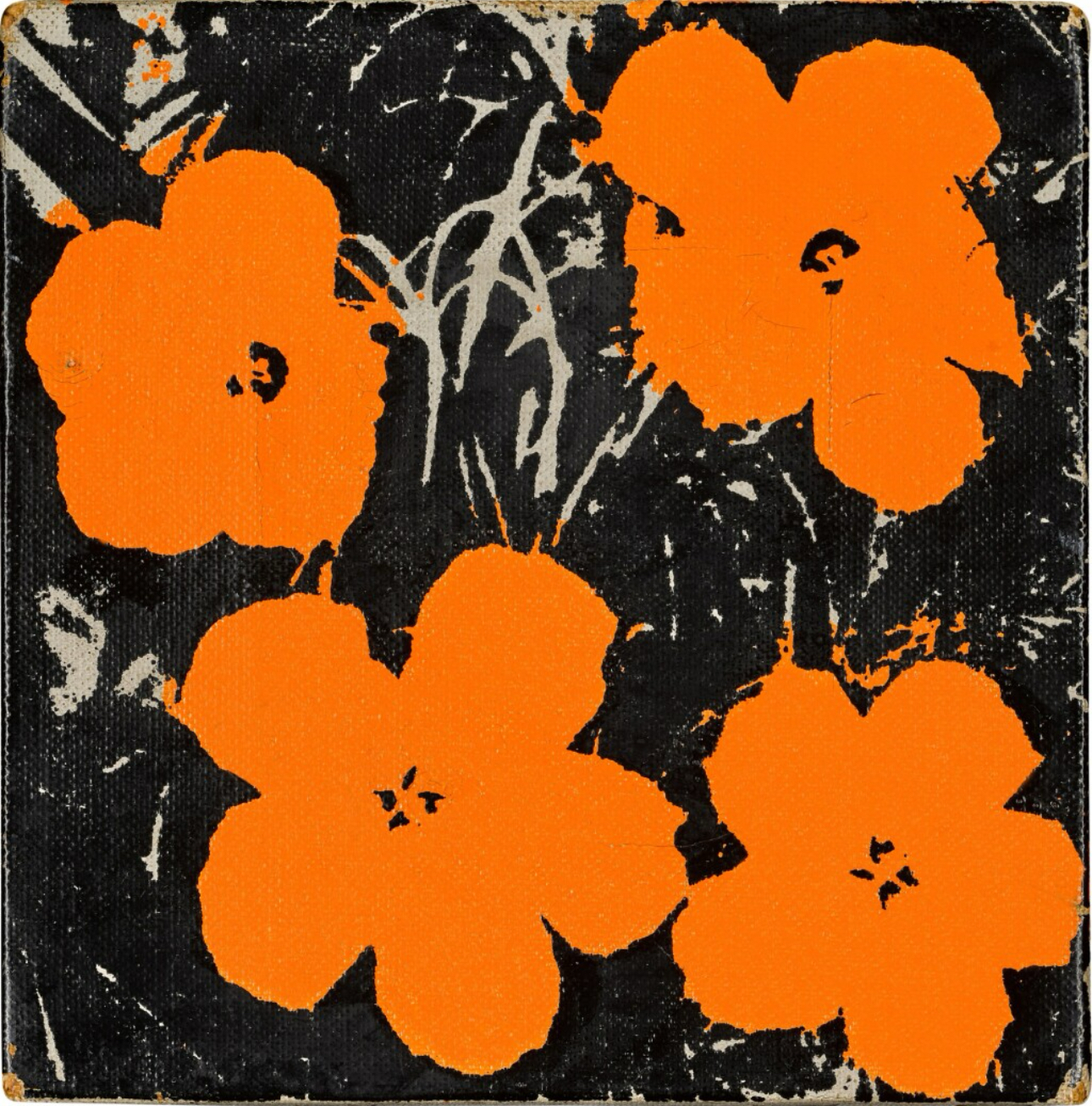
ANDY WARHOL (1928 – 1987)
Flowers, 1964
Acrylic on canvas
5×5 inches (12.7 x 12.7 cm)
Signed and dated 64 (on the overlap)
With bright orange blossoms gleaming against the ink black foliage beneath, the present composition belongs to one of Andy Warhol’s most celebrated and beloved series, the Flower Paintings of 1964. Since their execution, Warhol’s Flower Paintings have pervaded a global consciousness as the totemic standard of classic American Pop; their imagery acting as talismanic metaphor for a generation that changed not only artistic but also social and political topographies in a supremely transformative decade. Unlike the artist’s legendary subjects of that period concerned principally with consumerism, celebrity, death and disasters, the Flowers corpus was a significant departure towards a more abstract and philosophically charged motif. Warhol’s production of Flower Paintings has become legendary: during the summer of 1964 he created canvases in square formats measuring 82, 48 and 24 inches respectively, intended for a show with his new dealer Leo Castelli opening in New York in November of that year.
Andy Warhol
Sotheby’s London: 13 October 2023
Estimated: GBP 400,000 – 600,000
GBP 508,000 / USD 618,908
Superman, from Myths | Contemporary Day Auction | 2023 | Sotheby’s (sothebys.com)
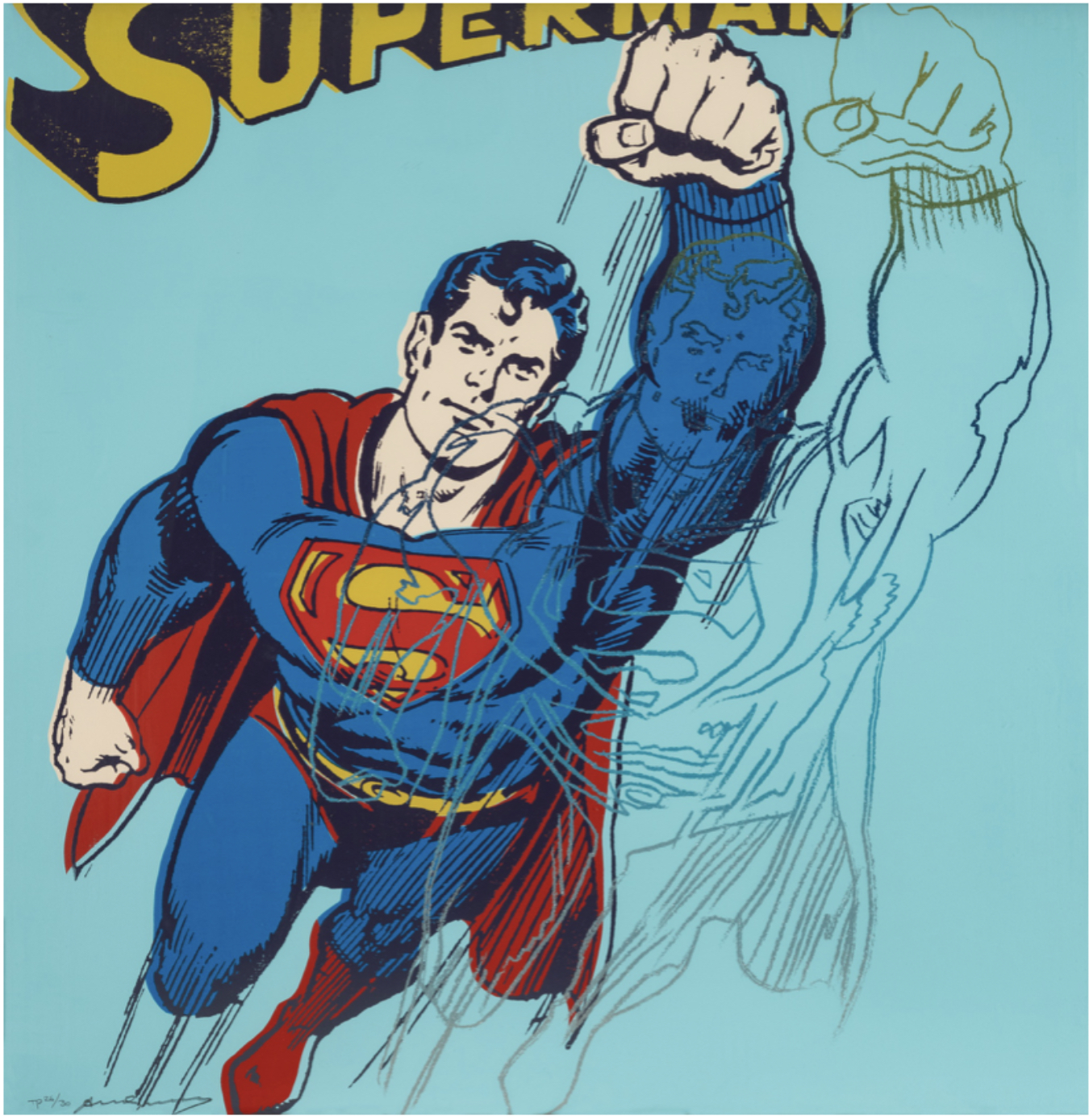
ANDY WARHOL (1928 – 1987)
Superman, from Myths, 1981
Screen-print in a unique color combination with diamond dust on Lenox Museum Board
Signed in pencil, inscribed and numbered TP 26/30 (lower left)
One of 30 unique trial proofs aside from the numbered edition of 200
Damien Hirst
Sotheby’s London: 13 October 2023
Estimated: GBP 220,000 – 280,000
GBP 266,700
Ammonium Pentaborate | Contemporary Day Auction | 2023 | Sotheby’s (sothebys.com)
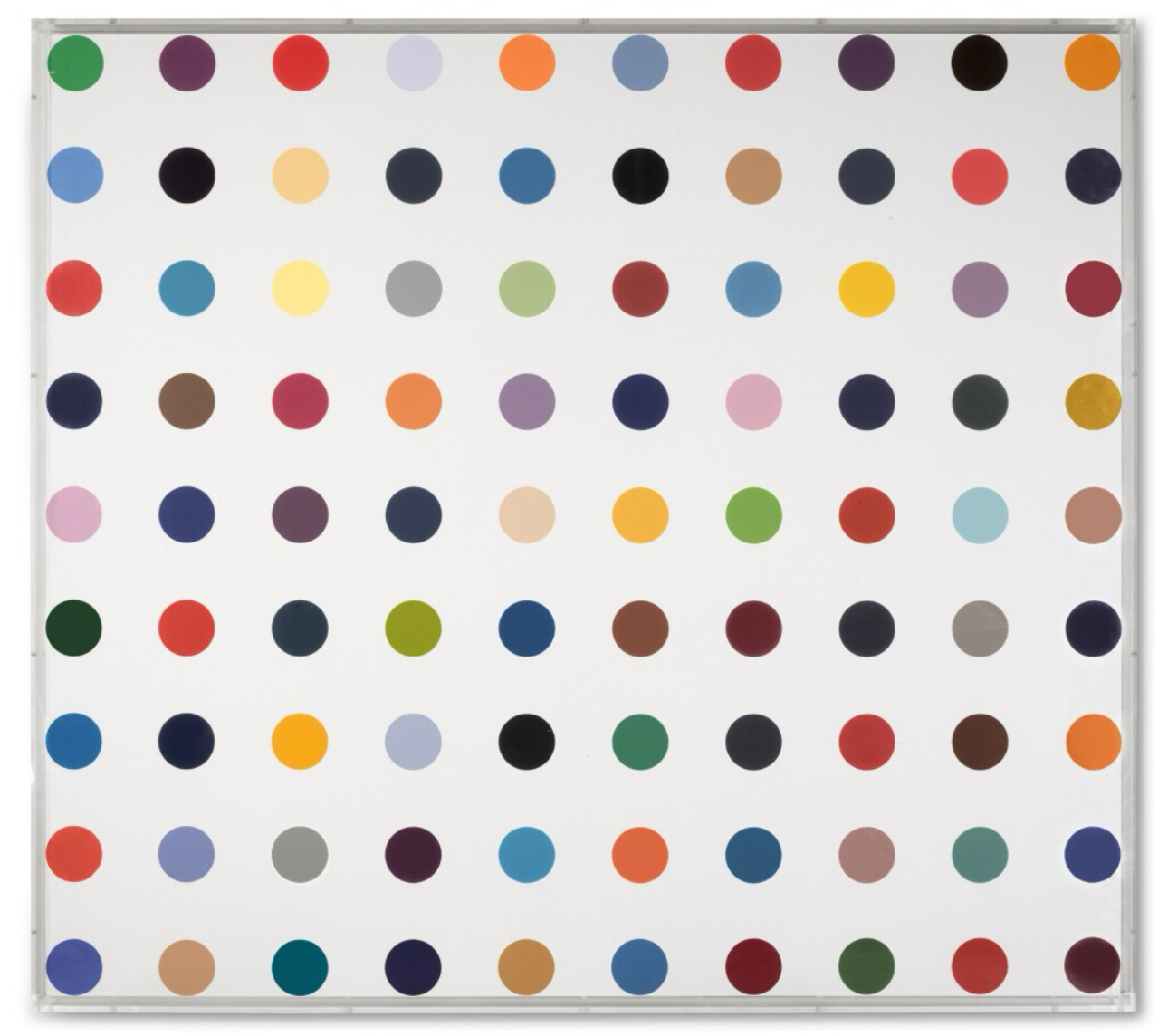
DAMIEN HIRST (b. 1965)
Ammonium Pentaborate, 2017
Household gloss on canvas
51×57 inches (129.5 x 144.8 cm) (3-inch spot)
Signed (on the stretcher); signed, titled and dated 2017 (on the reverse)
Bold and precise, Ammonium Pentaborate, is an immaculate example of Damien Hirst’s signature corpus of spot paintings. Uniquely-colored chromatic circles, ranging from bright tones to pastel hues, explode in a grid-like formation across the vast field of the pristine canvas.
“I started [the Spot Paintings] as an endless series like a sculptural idea of a painter (myself). A scientific approach to painting in a similar way to the drug companies’ scientific approach to life. Art doesn’t purport to have all the answers; the drug companies do. Hence the title of the series, The Pharmaceutical Paintings, and the individual titles of the paintings themselves…”
Within the thirteen sub-series of Spot Paintings, Hirst’s Pharmaceutical works are the most celebrated and prolific. Reflective of his interest in the connections between art and science, Hirst titled each work in this series after a unique chemical compound. In systematic fashion, he named these paintings alphabetically according to the Sigma Chemical Company’s catalogue, Biochemical Organic Compounds for Research and Diagnostic Reagents. Ammonium Pentaborate is a product resulting from the controlled reaction of ammonia, water and boric acid. The vibrant and delightful dots organized in neat rows across the canvas belie the sterile and medicinal nature of Hirst’s artistic experiment; like pills and products manufactured to ward of sickness and promote well-being, at the heart of these machinations is the inevitability of death.
David Hockney
Sotheby’s London: 13 October 2023
Estimated: GBP 70,000 – 100,000
GBP 139,700
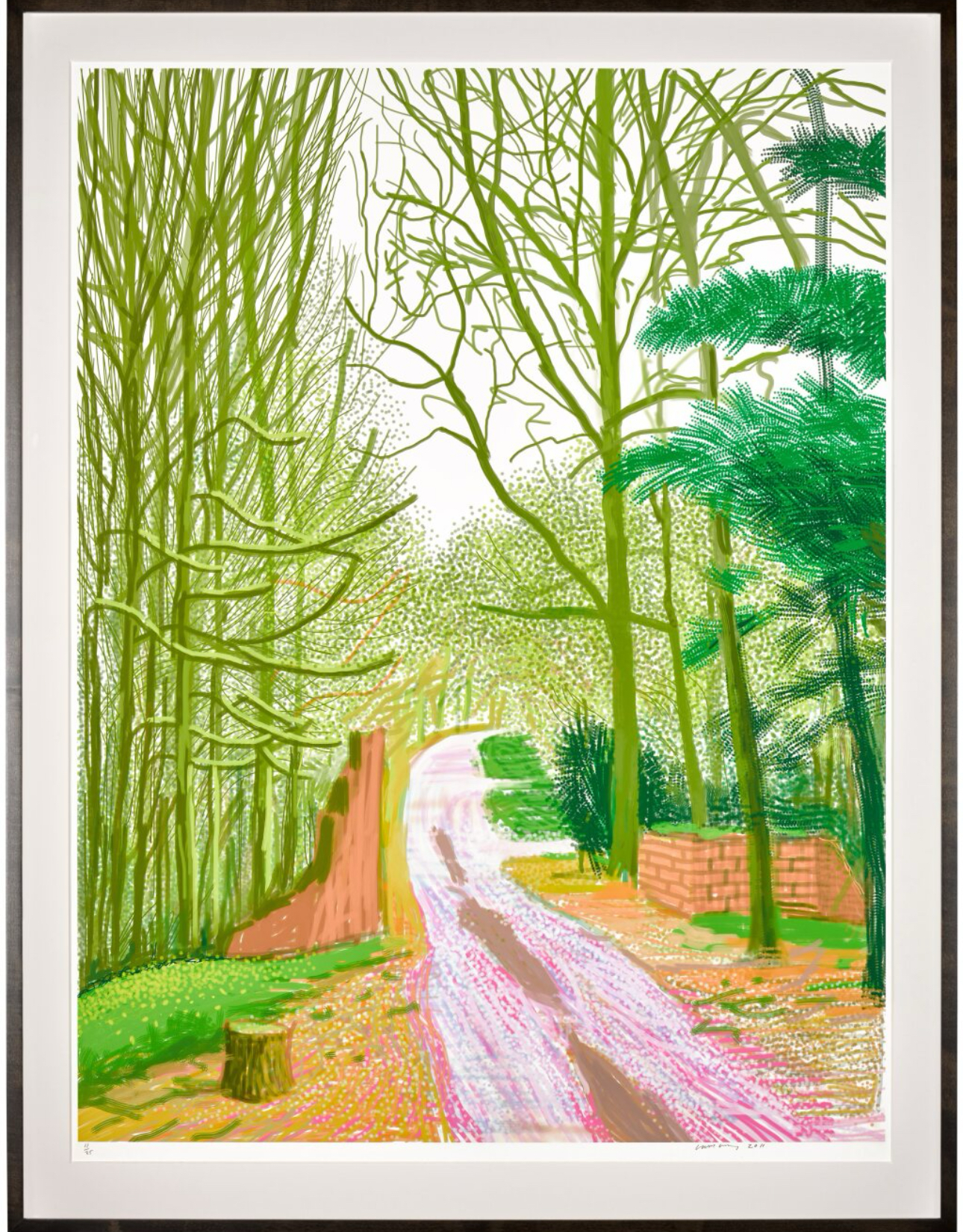
DAVID HOCKNEY (b. 1937)
The Arrival of Spring in Woldgate, East Yorkshire in 2011 (twenty eleven) – 30 March, 2011
iPad drawing printed on paper
139.7 x 105.4 cm (55 x 41 1/2 inches)
Signed and dated 2011 (lower right), numbered 11/25 (lower left)
“Spring is very energizing to me. I was in California for 30 years – you get spring there but it’s very slight – so when you come back [to the U.K.] the seasons hit you a lot more. I realised there was something I’d missed. Spring is a wonderful event to watch and I’m a very visual person.”
Roy Lichtenstein
Sotheby’s London: 13 October 2023
Estimated: GBP 100,000 – 150,000
GBP 127,000
Modern Room, from Interior Series | Contemporary Day Auction | 2023 | Sotheby’s (sothebys.com)
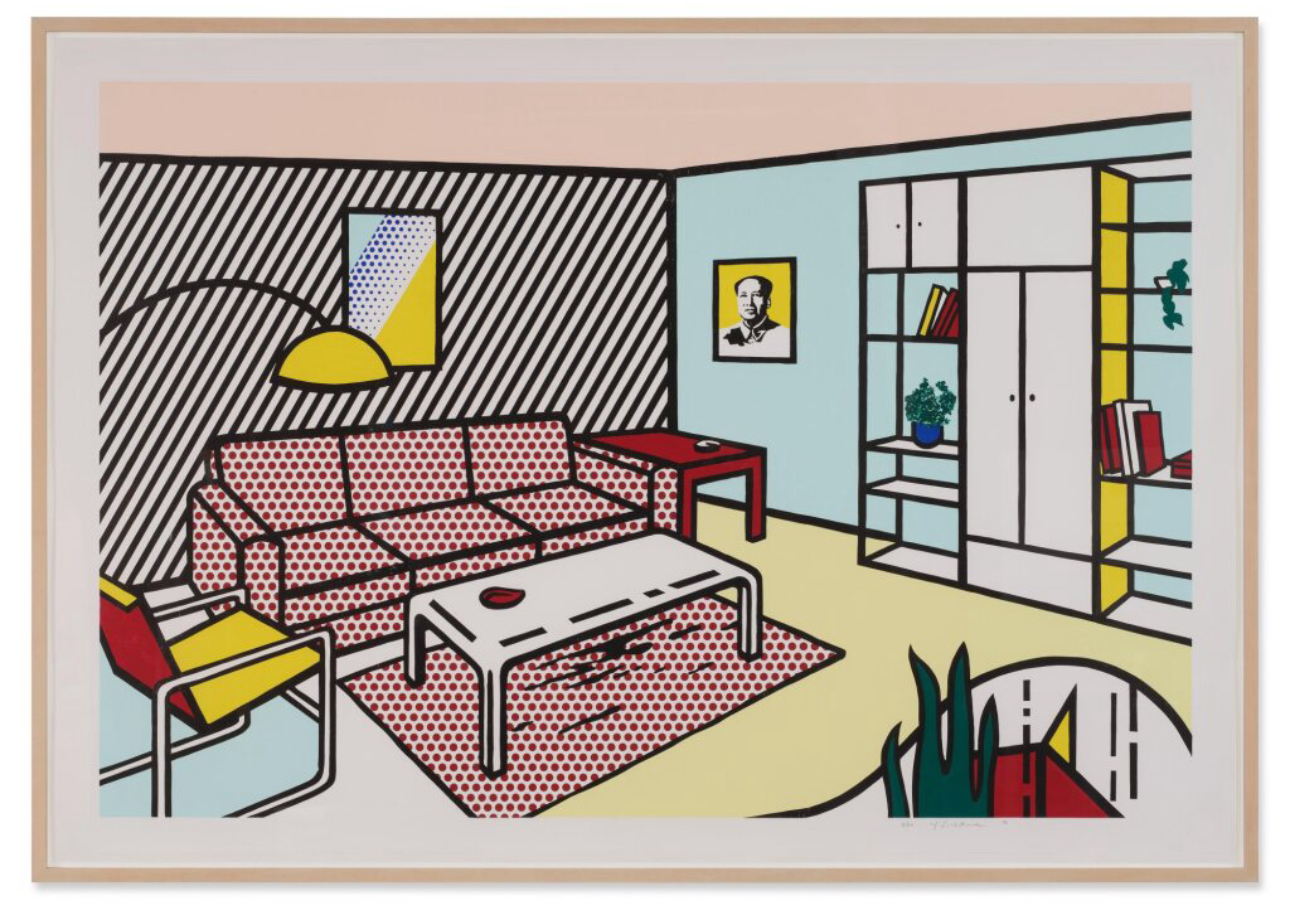
ROY LICHTENSTEIN (1923 – 1997)
Modern Room, from Interior Series, 1990
Lithograph, woodcut and screenprint in colors on Museum Board
56 1/8 x 80 3/4 inches (142.8 x 205 cm)
Signed in pencil, dated and numbered 9/60 (lower right)
Andy Warhol
Sotheby’s London: 13 October 2023
Estimated: GBP 100,000 – 150,000
GBP 158,750 / USD 193,408
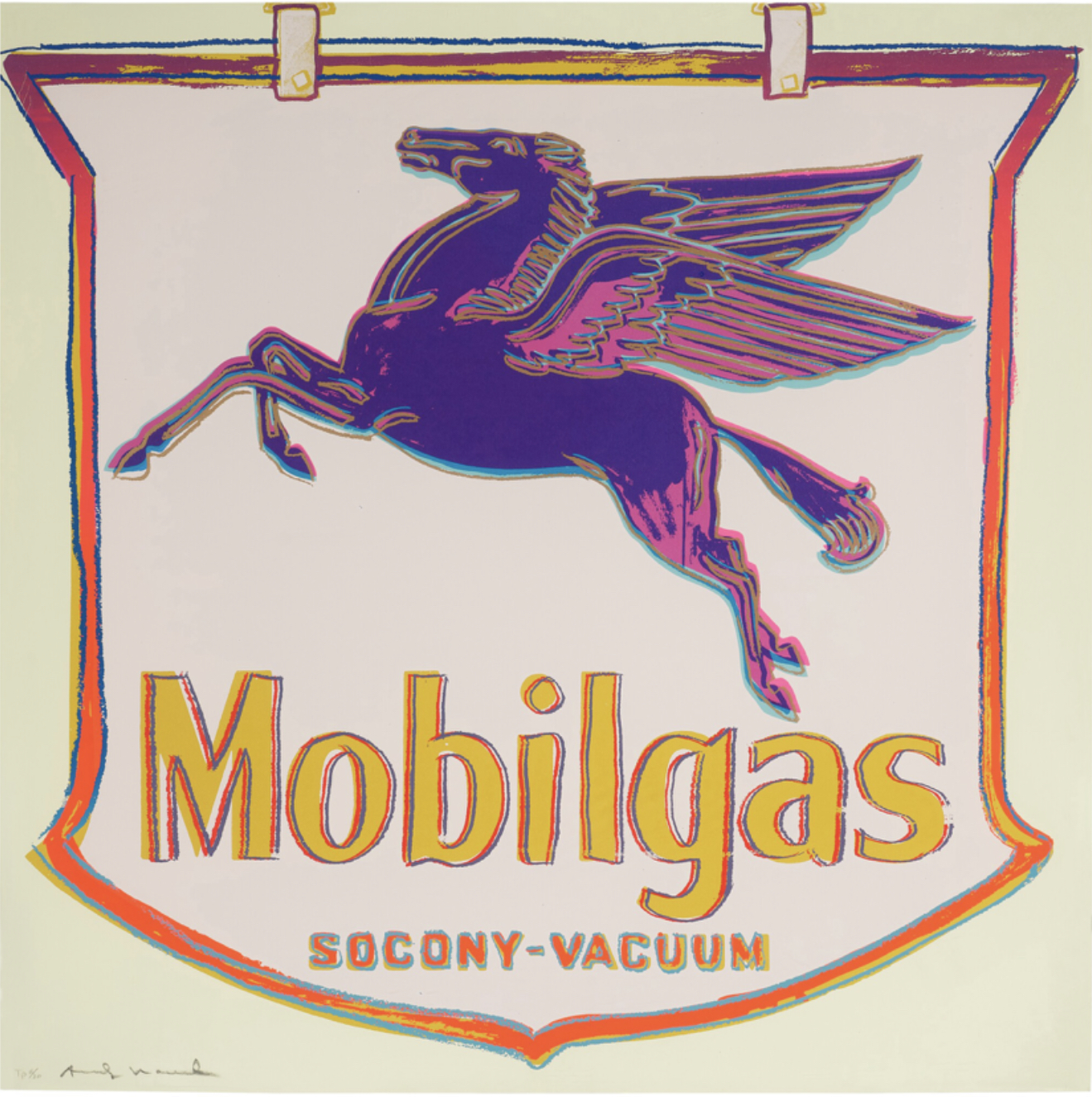
ANDY WARHOL (1928 – 1987)
Mobil, from Ads, 1985
Screen-print in a unique color combination on Lenox Museum Board
Signed in pencil, inscribed and numbered TP 6/30 (lower left)
One of 30 unique trial proofs aside from the numbered edition of 190
1931 saw a historic merger of two of America’s up-and-coming oil companies when Vacuum Oil and Standard Oil joined forces to become Socony-Vacuum Corp. Together they formed the world’s third-largest oil corporation and trademarked the now globally recognised Mobiloil/Mobilgas brand name. Soon after, they patented the “Flying Red Horse” logo, and their regal Pegasus appeared in advertising nationwide, accompanied by the promise, “A new sign rises to guide America’s car owners to the gasoline and service they want.” The Flying Red Horse became a familiar sight to all Americans, and an inviting beacon to drivers, with its crimson wings outstretched over gas stations across the country.
Decades later, the ubiquitous Pegasus – by then one of the most recognized corporate symbols in history – was re-imagined by Andy Warhol as part of his 1985 Ads series. The Ads portfolio, which comprises ten screenprinted re-interpretations of leading advertising campaigns, elevates commonplace imagery into high art while also simultaneously criticising and playing to America’s materialism. As a former commercial illustrator, Warhol was fascinated by mass media and enjoyed manipulating the art world’s view of consumer goods. In the standard edition of the Ads series, the Mobilgas Pegasus was printed in its traditional primary red pigment, with electric yellow linework on the logo and Mobilgas name. The present impression, however, is a rare trial proof aside from the final edition and is one of only thirty impressions printed in a unique colorway. This distinctive blue and magenta Pegasus stands out against contrasting orange and yellow lettering, inviting viewers to re-consider the familiar logo and appreciate it in a new light. While Warhol chose a 1980’s-inspired neon colour palette for this subject, he looked to a vintage iteration of the Mobilgas placard, one of the shield-like metal signs which would have swung in the breeze along Route 66. By taking a piece of Americana and giving it the Warholian twist, the artist looked to both America’s past and future, paving the way for a new generation of creators in the commercial sphere.
Sotheby’s London: 13 October 2023
Estimated: GBP 10,000 – 15,000
GBP 48,260
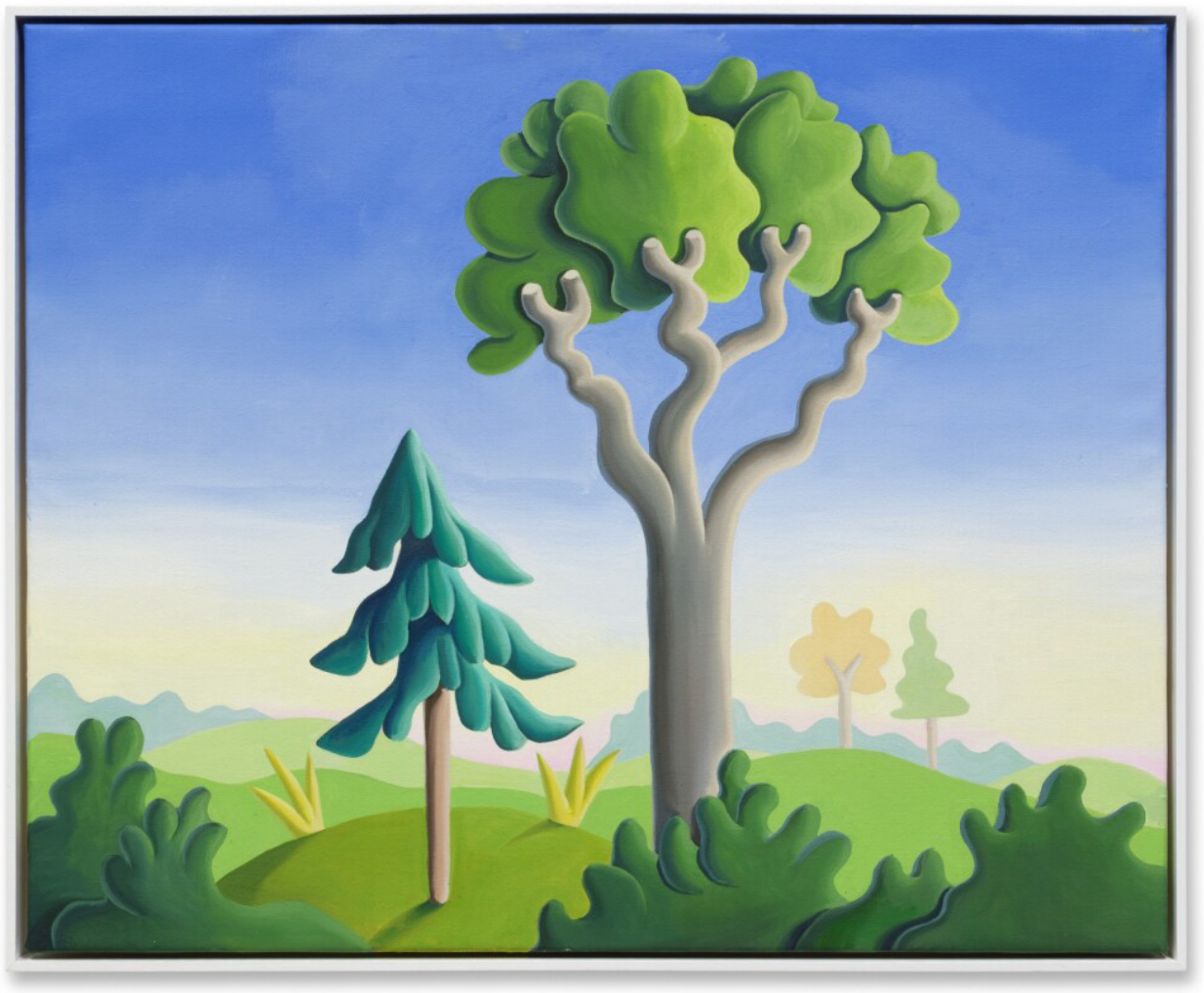
DAISY DODD-NOBLE (b. 1989)
Two Trees in The Foreground, Two Trees in The Distance, 2021
Oil on linen
65.6 x 80.9 cm (25 3/4 x 31 7/8 inches)
Signed with the artist’s initials (on the reverse)
Daisy Dodd-Noble is a painter based in London. She graduated from her MFA at the New York Academy of Arts in TriBeCa, New York in 2016, where she was in the class “painting from the imagination” with Inka Essenhigh and a tool class with Kurt Kauper and Jean Pierre Roy. Since then, her work has been exhibited in several countries including the United States, Italy and the United Kingdom.

Dodd-Noble paints caricatures of familiar landscapes such as hills, trees, and skies. Exploring the larger topic of environmentalism and consciousness, her surrealist scenes give way to an alternate reality. The artist invites us to consider the relationship between humans and the natural world by drawing on similar characteristics between people and trees.
Phillips
1. 20th Century and Contemporary Art Evening Sale
13 October 2023
20th Century & Contemporary Art Evening Sale: London October 2023 (phillips.com)
Total:
GBP 18,332,400
USD 22,386,614
———
# Lots: 46
# Lots sold: 38
# Lots withdrawn: 6
Sell-Through Rate: 95%
———
Above Estimates: 13 (24%)
Within Estimates: 17 (32%)
Below Estimates: 15 (28%)
Unsold: 8 (15%)
Christina Quarles
Phillips London: 13 October 2023
Estimated: GBP 450,000 – 550,000
GBP 508,000 / USD 618,908
Christina Quarles – 20th Century & Co… Lot 8 October 2023 | Phillips
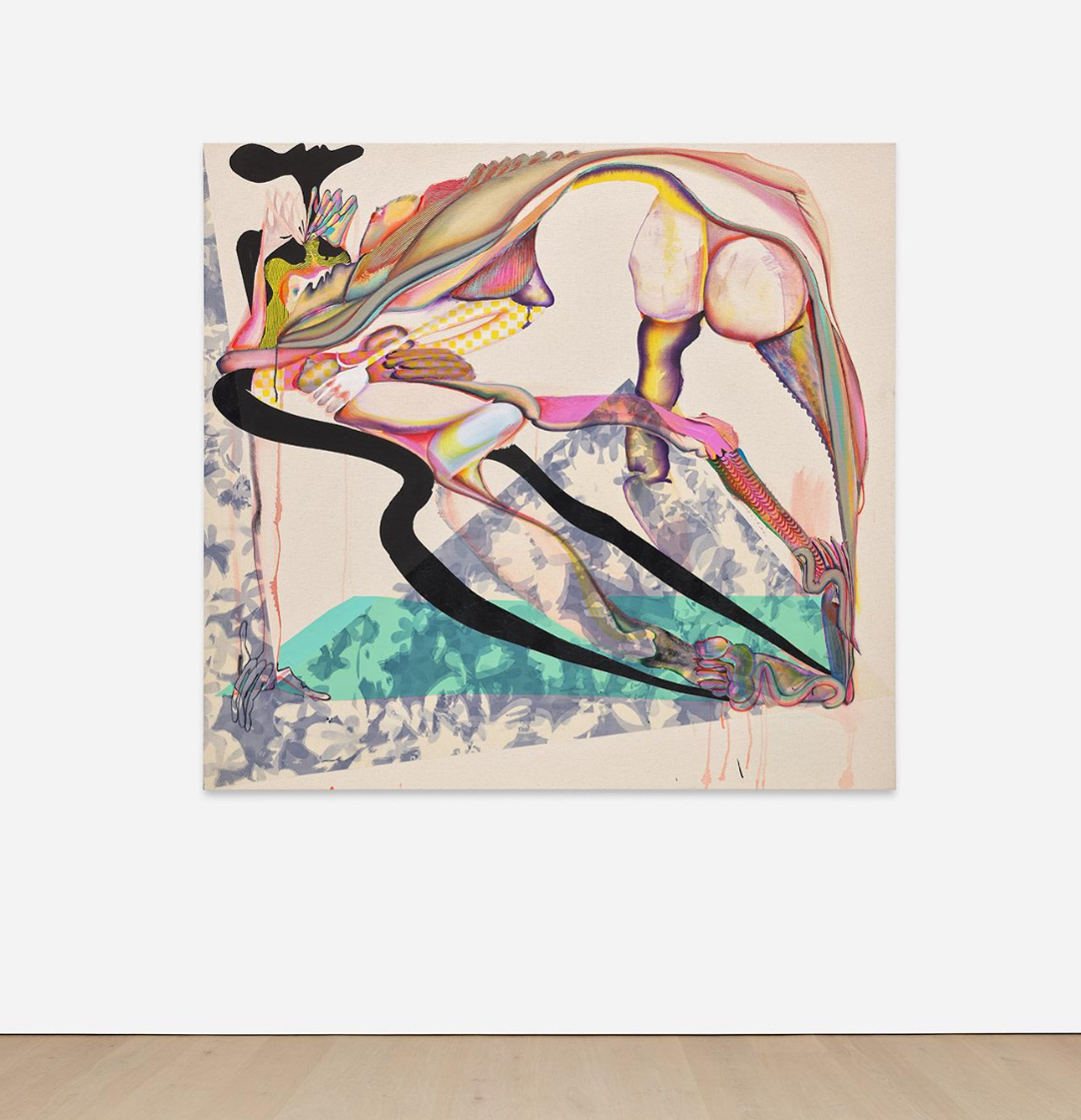
CHRISTINA QUARLES
Lil’ Dapple Do Ya, 2020
Acrylic on canvas
56×60 inches (141.9 x 152.4 cm)
Signed, titled and dated ‘Christina Quarles 2020 “LIL’ DAPPLE DO YA”’ on the reverse
Created in 2020 in direct response to the sudden limitations on movement and interpersonal contact brought about by the global pandemic, Christina Quarles’ Lil’ Dapple Do Ya is a visceral and affecting psychological portrait of our desire for human intimacy, and the complex experience of being in our bodies. A tangle of limbs, hands, buttocks, and breasts, two bodies violently collide and melt into one another, the whole composition charged with a searing sensuality and eroticism further amplified by the shocks of hot pink and acid yellows that offset fleshier tones. Although her fluid treatment of paint, and elongated, soft forms visually evoke the Surrealist visions of Salvador Dalí, Quarles’ compositions are rooted in the complexities of being in her own body, rather than occupying the realm of dreams and fantasy.
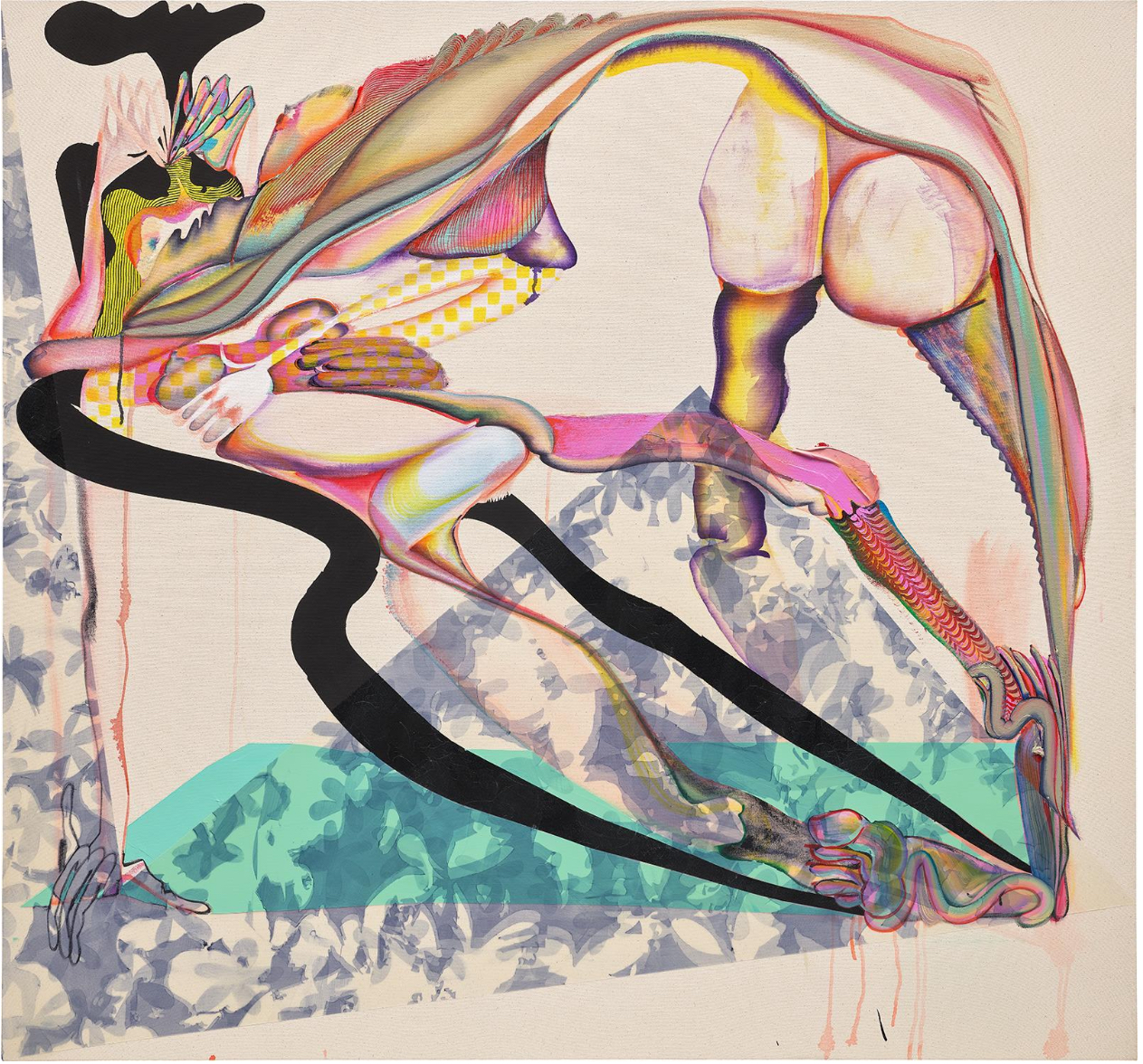
First presented in her 2020 solo show I Won’t Fear Tumbling or Falling / If We’ll be Joined in Another World alongside 8 other works created in the same intense and uncertain period, Lil’ Dapple Do Ya demonstrates the remarkable range of Quarles’ mark-making. Slipping seamlessly between painterly styles and techniques, we see smoother and more sculptural contour lines running up against more precise patterned planes, dreamy washes of color suddenly interrupted by more heavily impastoed areas, the artist layering paint over itself ‘to evoke woozy double vision, offset by smears of bubble-gum-pink paint, bared buttocks, and tentacular black limbs.’
Jade Fadojutimi
Phillips London: 13 October 2023
Estimated: GBP 150,000 – 200,000
GBP 177,800
Jadé Fadojutimi – 20th Century & Con… Lot 10 October 2023 | Phillips
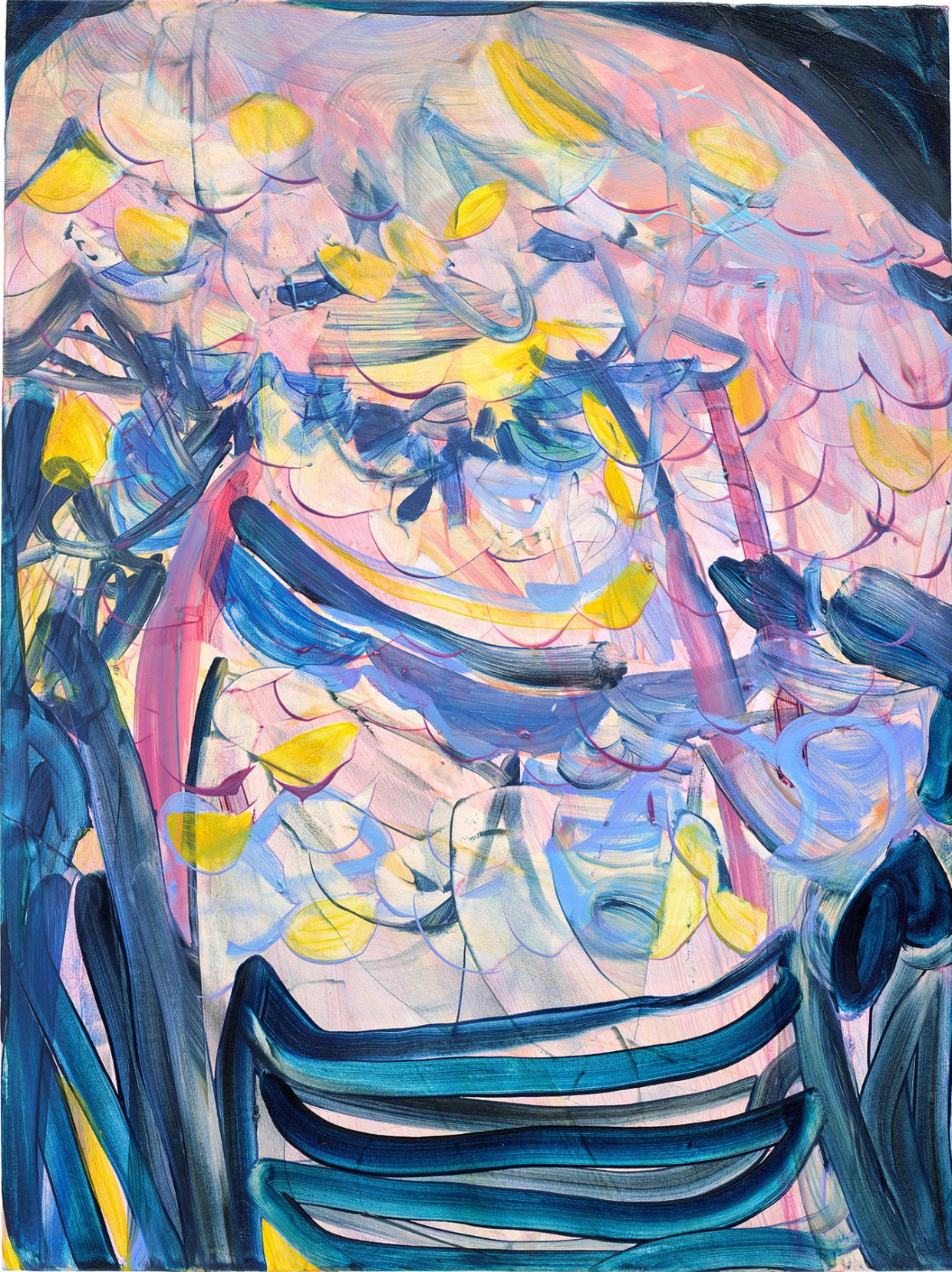
JADE FADOJUTIMI
Beneath the Petticoat, 2018
oil on canvas
101.4 x 76.3 cm (39 7/8 x 30 in.)
signed, titled and dated ‘‘Beneath the Petticoat’ July ’18 Jadé Fadojutimi’ on the reverse
One of Britain’s most promising and accomplished young artists, Jadé Fadojutimi creates vast and immersive compositions in vividly realised colour. Shifting rapidly between abstraction and moments of figuration, these paintings chart complex and stunningly beautiful ‘emotional landscapes’. Created in a burst of spontaneous, creative outpouring, her works thrum with a personality and vitality all of their own, their surfaces wonderfully alive like reflections caught in shifting water. Completed in 2018 and conceived as a sister piece to Bark – also offered concurrently as a highlight of our Day Sale – this sense of familial relationship and dialogue established between Fadojutimi’s works is especially pronounced in the present work, where the certain brilliant hues, forms, and gestural marks from the earlier composition repeat and respond like the alternating patterns of an antiphonal musical arrangement. Illuminating the astonishing maturity of her pictorial language, in placing these two works directly in dialogue with one another we might not only trace the development of her practice in fascinating ways, but also appreciate the profound consistency and focus of her creative vision.
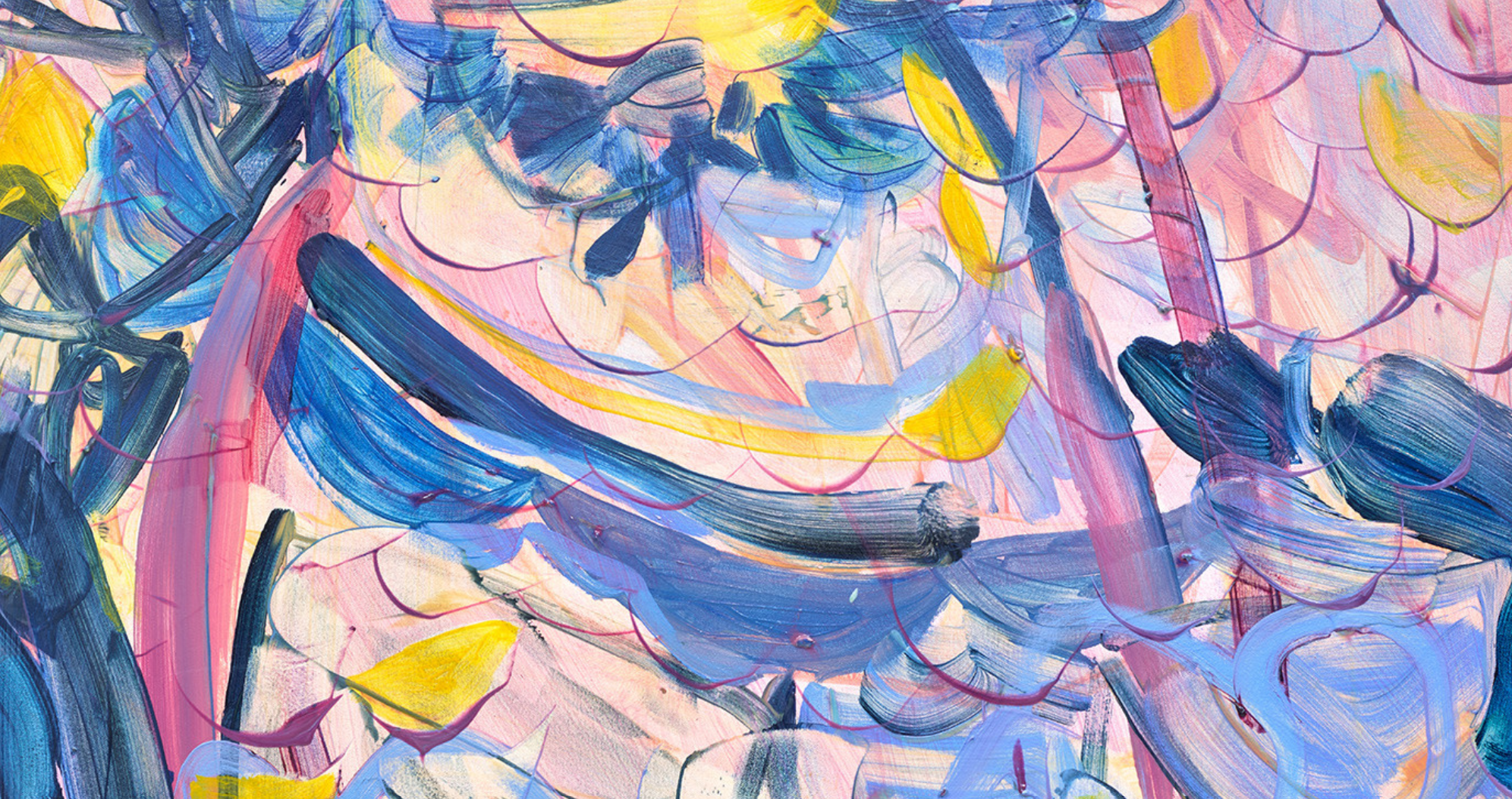
Working through formal, emotional, and sensorial elements in the process of their rapid execution, Fadojutimi’s paintings respond intuitively to memory, music, and feeling, placing an investigation of the complexities of lived experience and an investigation of identity at the heart of her project. Drawing together expressions of these more immaterial sensations with a profound sense of her being within her immediate surroundings, Fadojutimi’s compositions create their own emotional environments: as the artist herself suggests, through ‘form, color, or texture, or pattern […] they become spaces for me to exist’. Combining inside and outside in a single image, windows are powerfully symbolic objects for Fadojutimi, providing a real-world analogue for the spatial qualities of her paintings – flat, ultimately, but capable of combining multiple images on a single plane and capturing a whole world beyond their surface. Like the experience of catching the trace of your own reflection superimposed on the scene beyond the windowpane, the artist conceptualizes her paintings as ‘reflections of myself and the objects I surround myself with’, as well as spaces that she can escape into.
Caroline Walker
Phillips London: 13 October 2023
Estimated: GBP 100,000 – 150,000
GBP 565,150
Caroline Walker – 20th Century & Con… Lot 38 October 2023 | Phillips
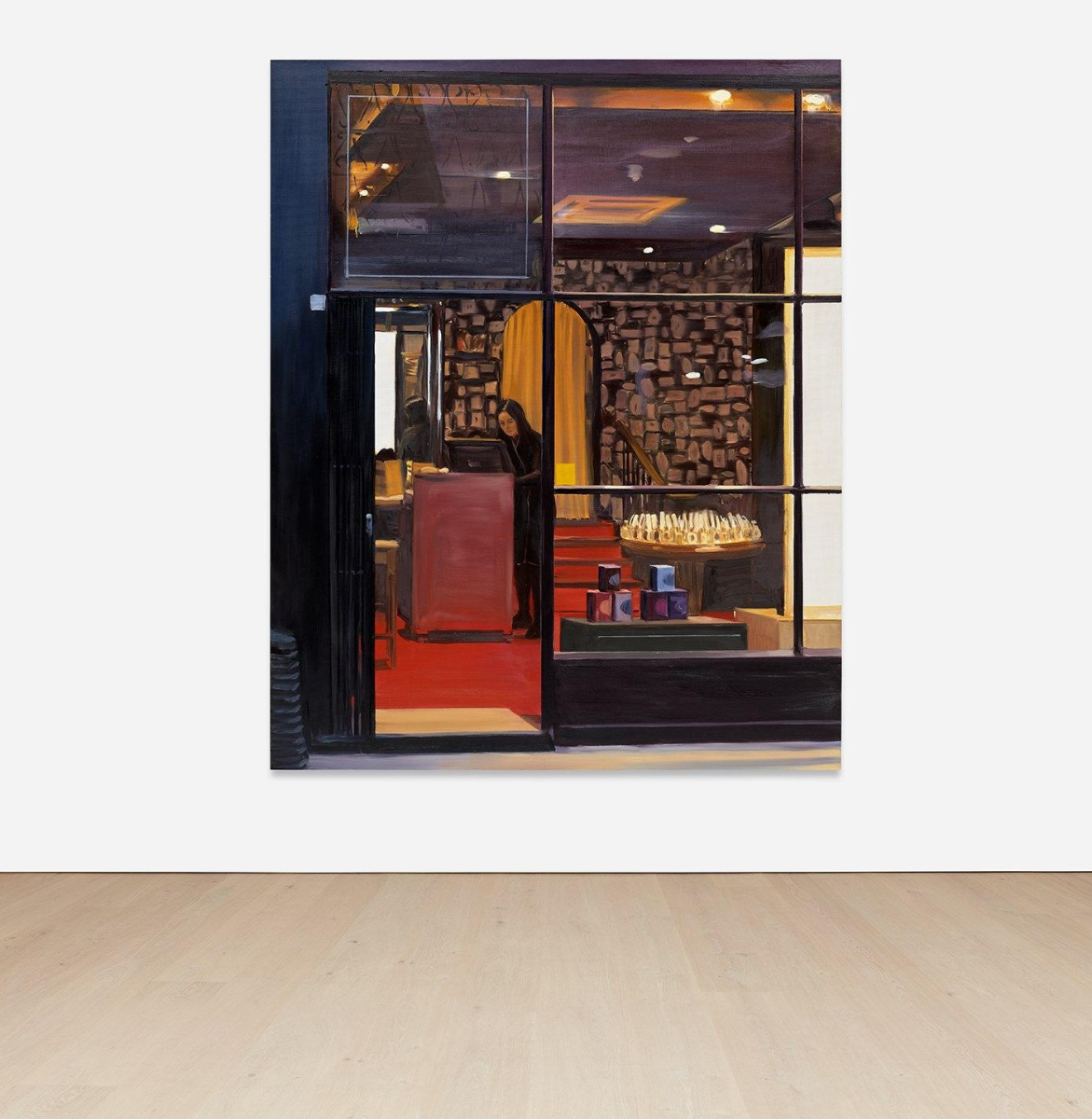
CAROLINE WALKER
Fragranced, 2019
Oil on linen
230×185 cm (90 1/2 x 72 7/8 inches)
Signed, titled and dated ‘FRAGRANCED 2019 Caroline Walker’ on the reverse
Caroline Walker’s large-scale, enigmatic canvases invite us into private interiors. The Scottish-born artist has gained critical acclaim for her sensitive portrayals of the modern-day woman, and her painterly realism and command for composition create balanced works that make close and careful reference to the Western canon of art history. As a viewer, we are often afforded the position of voyeur; in Fragranced, we peer through a window to see a woman at work in a perfumery. Exhibited in a major 2021 institutional show Windows, at Kunstmuseum Den Haag (K21), the work is representative of her more recent tendency to highlight the everyday experience of the working woman, which has included shopworkers, bakers, nail artists and cleaners. Walker is one of the most sought-after contemporary painters today, and since her first institutional show at Pitzhanger Manor Gallery in 2013 she has held numerous others at Kettle’s Yard, Cambridge; Fitzrovia Chapel, London; MAC, Birmingham; Nottingham Castle; KM21, The Hague; and K11, Shanghai. Her work is held in the collections of Museum of Fine Arts, Houston; Kunstmuseum Den Haag, The Hague; Arts Council England; National Museum Wales, Cardiff; and Longlati Foundation, China.
Perspective is carefully considered in Walker’s compositions. We are at once invited to partake in the scene before us, yet physical and architectural barriers, most frequently windows, prevent us from ever truly being involved. The woman depicted in Fragrance is alone in the shop, and we are permitted to trespass upon a moment of quiet, solitary work. This feeling of intrusion is a major motif within Walker’s oeuvre, and as a result her works are permeated with a tension that reflects the clandestine nature of our position as voyeur. ‘It probably stems from being nosey’ Walker has stated, ‘being delighted when I’m walking around in the evening and can see into houses’.
BANKSY
Phillips London: 13 October 2023
Estimated: GBP 2,200,000 – 2,800,000
GBP 2,710,000
Banksy – 20th Century & Contemporary… Lot 32 October 2023 | Phillips

BANKSY
Forgive Us Our Trespassing, 2011
Spray paint and domestic gloss on plywood
244×122 cm (96 1/8 x 48 inches)
Signed and dated ‘Banksy 11’ on the reverse
Emphasising the blend of linguistic dexterity and sharp social commentary that the anonymous street artist Banksy has become best known for over the years, Forgive Us Our Trespassing playfully evokes the Christian petition to ‘Forgive us our trespasses’, upending its meaning through the subtle substitution of one word for another.

Executed on a large scale and featuring a young child kneeling in prayer before a monumental Gothic stained-glass window with his head bowed towards his hands, the composition draws on the familiar iconography of devotional images, only to undercut this set of visual cues with the addition of contemporary urban clothing and the tools of the graffiti artist’s trade by the child’s side. His hoodie pulled up over a baseball cap, the child’s ‘trespassing’ here points to the fundamental action of graffiti and street art as a breaking of boundaries – both the physical boundaries of private property that is tagged in the process, and the questioning of societal rules that it often provokes.

[Left] Joshua Reynolds, The Little Samuel in Prayer, 1777, Musée Fabre, Montpellier. Image: © Photo Josse / Bridgeman Images
[Right] Detail of the present work
With its own long and often overlooked history stretching back to the Middle Ages, stained glass represents a fascinating aspect of our shared visual culture, and the role of images in communicating culturally important messages. Used almost exclusively in the decoration of churches and religious buildings before the 19th century, stained glass proved to be a versatile and valuable material, aiding devotional contemplation in muting the outside world, controlling the flow of light, and illustrating key scenes from the Bible, the lives of the saints or as a means of honouring local guilds and other patrons. Alongside illuminated manuscripts, stained glass represents the only major form of pictorial art to have survived the centuries and emphasises the hugely important role played by visual narratives in communicating important messages embedded in texts that were otherwise illegible to the masses. Given the religious significance of light itself, the effects of the gently shifting and brilliantly coloured patterns filtered through the glass was easily wedded to the ceremonial reverence of the space and its contemplative purpose, a testament to the skill of the artisans who worked on these stunning projects.
Echoing the shape of Gothic Rose windows, the colourful panels that fill the vaulting frame of Forgive Us Our Trespassing are not the biblical scenes that typically animate stained glass windows, but the looping scrawls and tags of the graffiti artist. Creating his own visual narrative of the history of street art, we can even discern familiar tags including Jean-Michel Basquiat’s iconic skull and crown, and graffiti artist Amok’s recognisable insignia. Kneeling in prayer before this alternative altar, the young child in the foreground pays homage to this the icons of the past, perhaps even contributing to their legacies. Just as the work of medieval artisans gives us a window into the world in which they were created, Banksy seems to suggest here that the graffiti artist occupies an equivalent position, providing an important social commentary on our own times one for which, perhaps, they deserve to be forgiven.

The north rose window of the Chartres Cathedral, Chartres. Image: PtrQs
An iconic Banksy image, the figure of the kneeling boy first appeared in Salt Lake City, Utah in 2010 and was used in the same year as one of the key images in the promotion of the artist’s film, Exit Through the Gift Shop. Coming to auction for the first time, the present work is one of only two compositions to feature the same pictorial elements, the first having achieved one of the highest prices at auction for the artist when it was sold in 2020. The smaller of the two, the present work was exhibited at Palazzo Cipola, Rome in 2016 and has been on long-term loan to the esteemed MOCO Museum in Barcelona, a testament to its significance, both within the context of Banksy’s practice, and in the broader landscape of contemporary art.
Embodying innocence, hope, and an almost impossible to regain freedom of self-expression, the child is a recurring motif in Banksy’s work, familiar from his most iconic and immediately recognisable images. Drawing on this universal trope, the child is the perfect cipher for Banksy’s antiestablishment message, dramatically juxtaposing individual innocence with institutional corruption, income inequality with corporate greed and pointedly underscoring the uneven distribution of wealth and resources and the devastating human and generational impact of capitalist, neo-imperial economic ideologies played out on a global stage. Frequently referenced as the nation’s favourite artwork, Girl with Balloon is perhaps the most immediately obvious example of the multiple associations attached to the image of childhood while other works deal more directly with issues such as economic equality (Very Little Helps); the human cost of military force (Bomb Hugger, Napalm); government failure (Nola); and the social structures that foreshorten childhood, curbing imagination and play (No Ball Games, Jack and Jill).
“Some people become cops because they want to make the world a better place. Some people become vandals because they want to make the world a better-looking place.”
In this context, the idea that a child could commit a sin (or a crime) in the act of being creative recasts graffiti and street art in quite a different light, Banksy proving highly adept at invoking certain assumptions, vocabulary, and beliefs in order to turn a mirror onto the hypocrisies and inequalities in our society. An image of the street artist as a child, Forgive Us Our Trespassing emphasizes the creativity and expressive freedom that graffiti represents, and the essential role that it plays in contemporary visual culture.
George Condo
Phillips London: 13 October 2023
Estimated: GBP 750,000 – 950,000
GBP 889,000
George Condo – 20th Century & Contem… Lot 35 October 2023 | Phillips
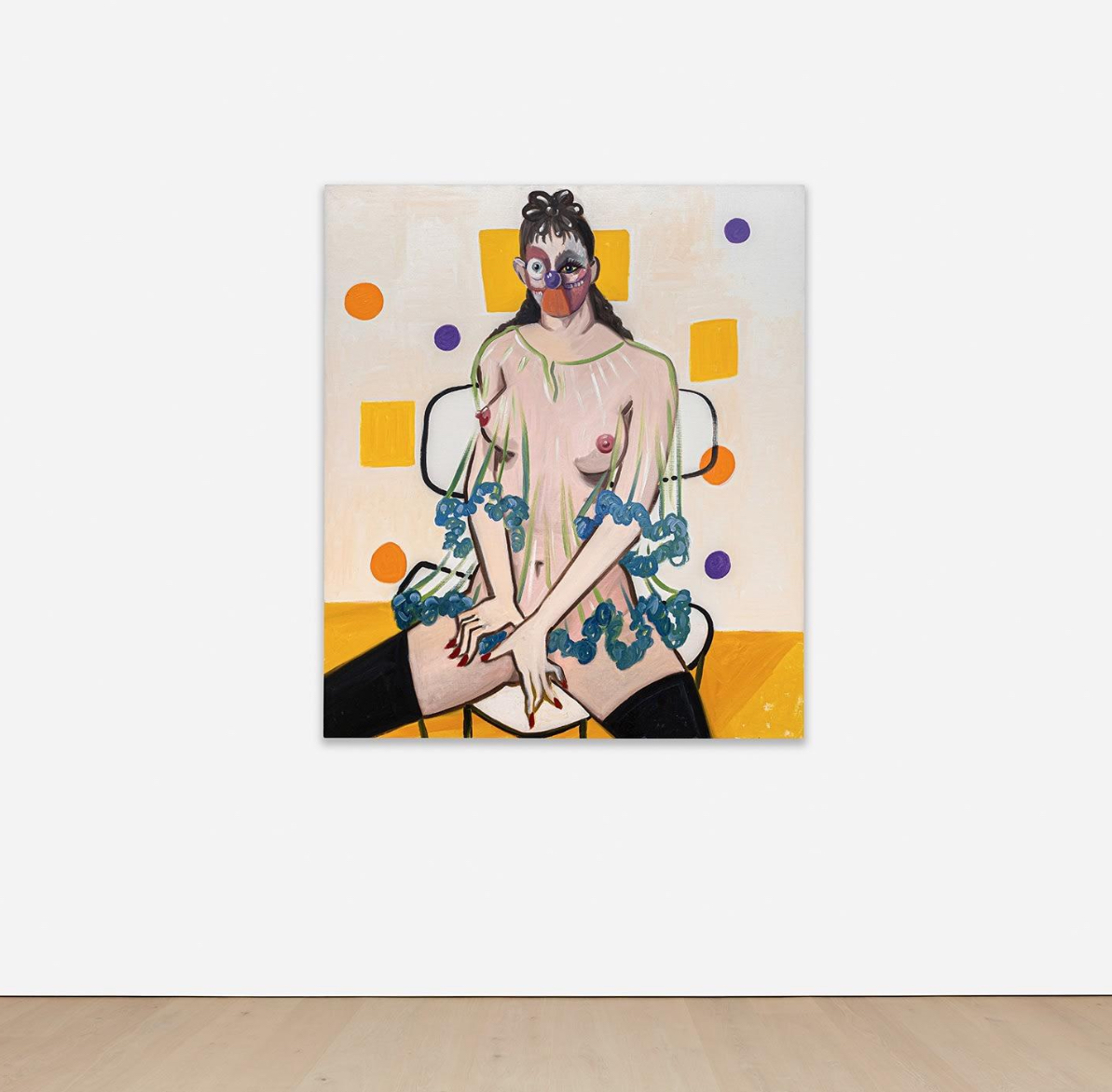
GEORGE CONDO
Seated Harlequin, 2007
Oil on canvas
134×117 cm (52 3/4 x 46 1/8 inches)
Signed and dated ‘Condo 07’ on the reverse
Wearing only black, thigh-high stockings and a sheer negligee, edged in knotted whorls of blue lace, George Condo’s Seated Harlequin meets our gaze with disarming directness, her provocative pose and grotesquely twisted features marking her out as a memorable addition to Condo’s cast of wildly inventive characters who reside within ‘a ribald world of crazed, comic engagement, theatrical logic, and a furious indifference to conventional niceties.’i Borrowing from the art historical traditions of the seated nude and the tragi-comic figure of the Harlequin, the artist plays very directly with questions of performance and spectacle here, and of the absurdity and violence involved in the confrontation between viewer and subject as multiple, conflicting states of human consciousness collide.
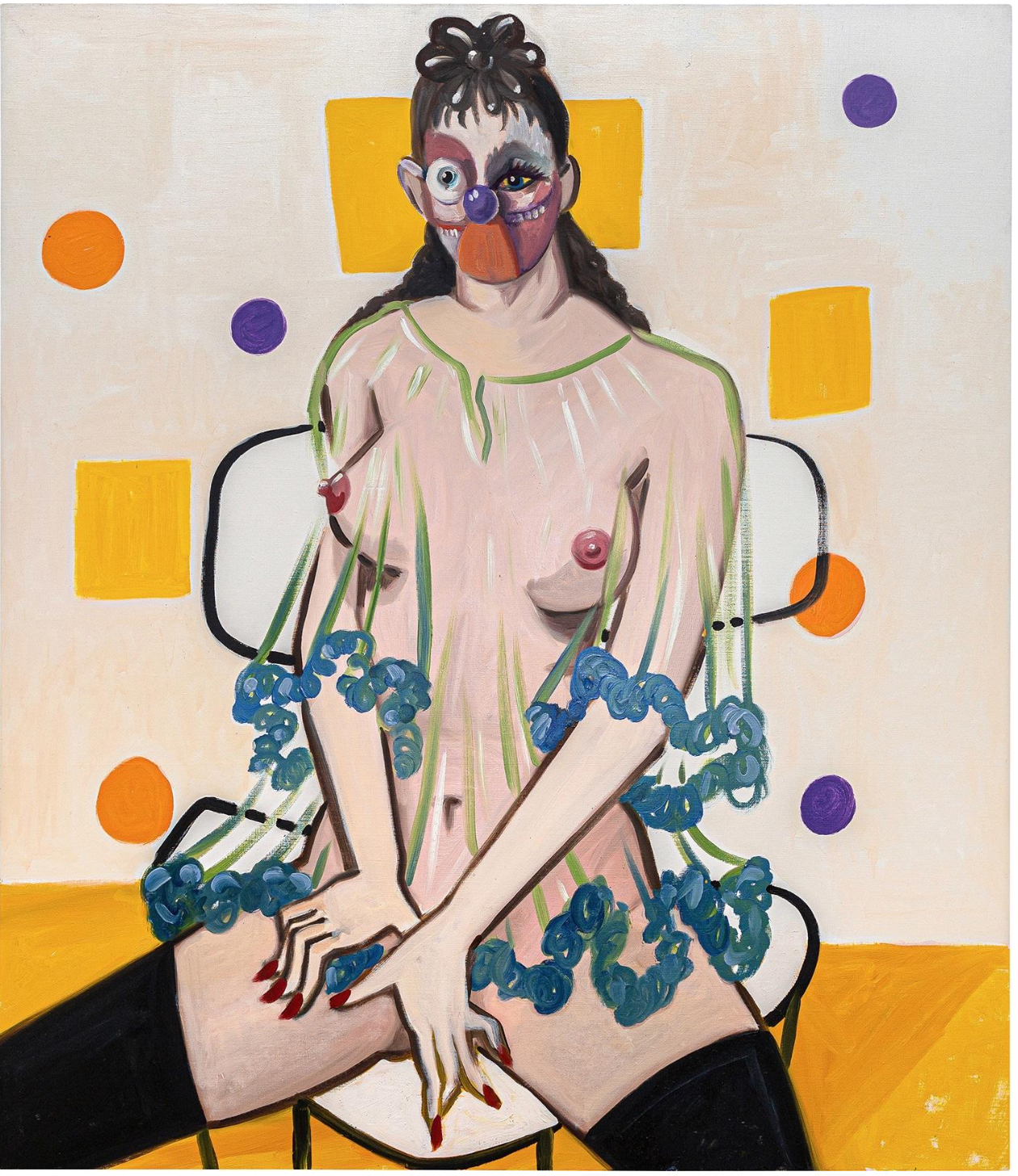
Provocatively posed on the edge of a chair, her clothes accentuating her nakedness and exposing rather than concealing her, Condo’s Seated Harlequin is at once confrontational and passive, violent and vulnerable, these conflicting states all combined in a vivid expression of Condo’s brand of psychological cubism. Sitting upright, looking out at us with her hands crossed, the arrangement of her body here visually recalls Ingres’ well-known portraits, the vivid blue of her negligee, boldly contrasted to the rich, golden ground and dancing squares of orange and yellow behind her brining to mind his iconic Joséphine-Élénore-Marie-Pauline de Galard de Brassac de Béarn, displayed at the Metropolitan Museum in New York. Stripped of the more gentile elements of her dress and rich surroundings, Condo’s Seated Harlequin exposes and dramatizes the underlying dynamics of Ingres’ presentation of a woman who – to paraphrase John Berger – watches herself be looked at.
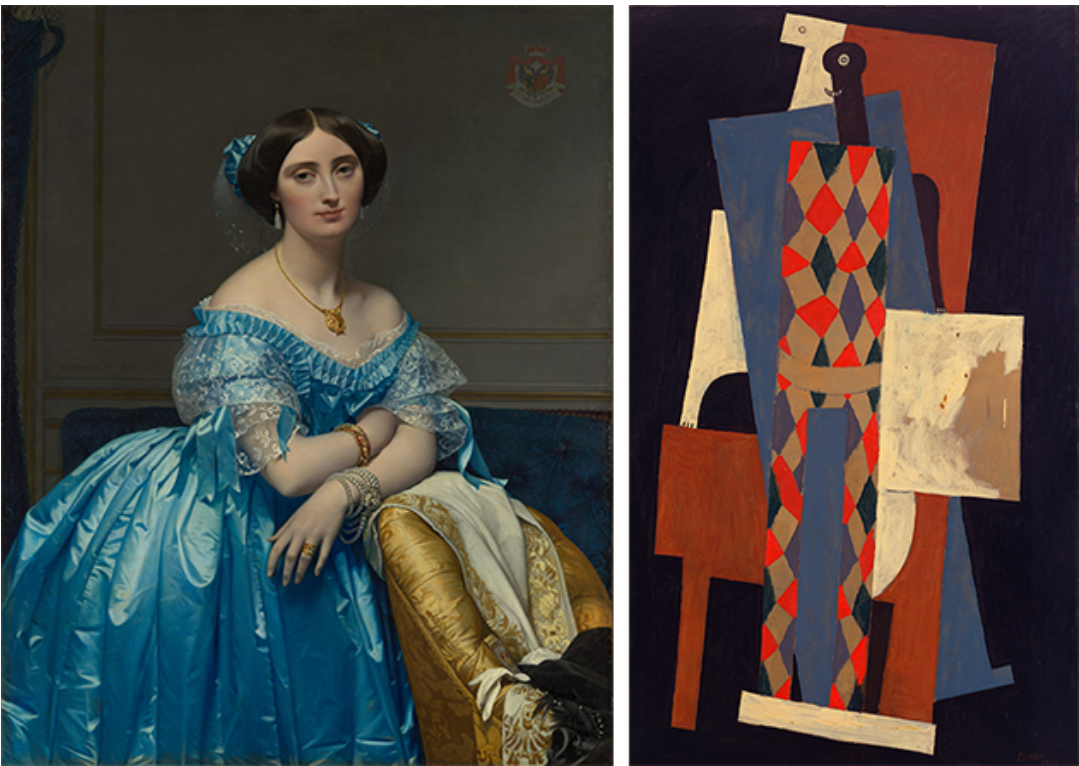
[Left] Jean Auguste Dominique Ingres, Joséphine-Élénore-Marie-Pauline de Galard de Brassac de Béarn, 1851-1853, The Metropolitan Museum of Art, New York. Image: © Metropolitan Museum of Art, New York, Bequest of Benjamin Altman, 1913, 14.40.611
Right: Pablo Picasso, Harlequin, 1915, The Museum of Modern Art, New York. Image: The Museum of Modern Art, New York/Scala, Florence, Artwork: © 2023 Estate of Pablo Picasso / Artists Rights Society (ARS), New York
Making notable appearances in the works of Jean-Antoine Watteau, Paul Cézanne, and Picasso, the harlequin has its own art historical lineage, allowing Condo to blend his investigations into the art of the past with his characteristic flair for the theatrical and darkly slapstick comedy. A character who combines the extremes of comedy and tragedy in a single entity, the harlequin is perhaps the supreme embodiment of Condo’s artistic project, speaking directly to the artist’s fascination for simultaneous, conflicting, psychological states. Presented to us nude, starkly lit and posed on a chair for our close contemplation, the Seated Harelquin captures the objectification involved in this performance, and of the titular character’s own recognition of herself as an object – like painting itself – to be looked at.
Dana Schutz
Phillips London: 13 October 2023
Estimated: GBP 250,000 – 350,000
GBP 495,300
Dana Schutz – 20th Century & Contemp… Lot 34 October 2023 | Phillips
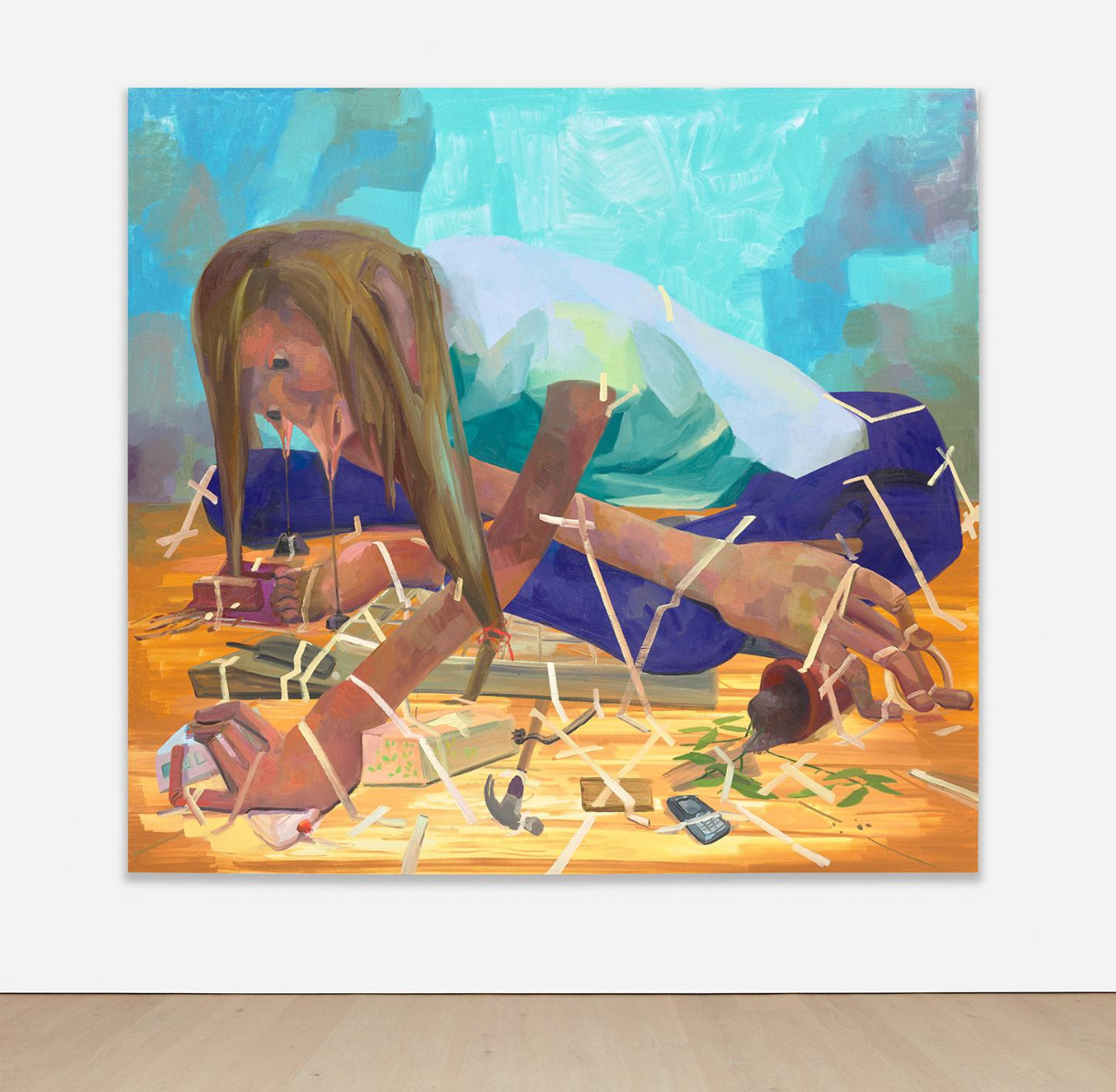
DANA SCHUTZ
Gravity Fanatic, 2005
Oil on canvas
73×79 inches (185.4 x 200.7 cm)
Signed and dated ‘Dana Schutz 2005’ on the reverse
Dana Schutz’s large-scale compositions feature subjects embroiled in absurd scenarios. In Gravity Fanatic, a woman has used tape and small weights to secure both herself and a variety of miscellaneous objects surrounding her to the ground. In the artist’s typical style, anatomy is elongated and distorted; legs seem impossibly crossed, fingers are bent at alarming angles and the skin of her face is being grotesquely stretched ‘like chewing gum’.i Schutz creates charged, exciting works – energetic brushstrokes and a thick application of paint give them a visceral impact that heighten the bodily, raw subject matter.
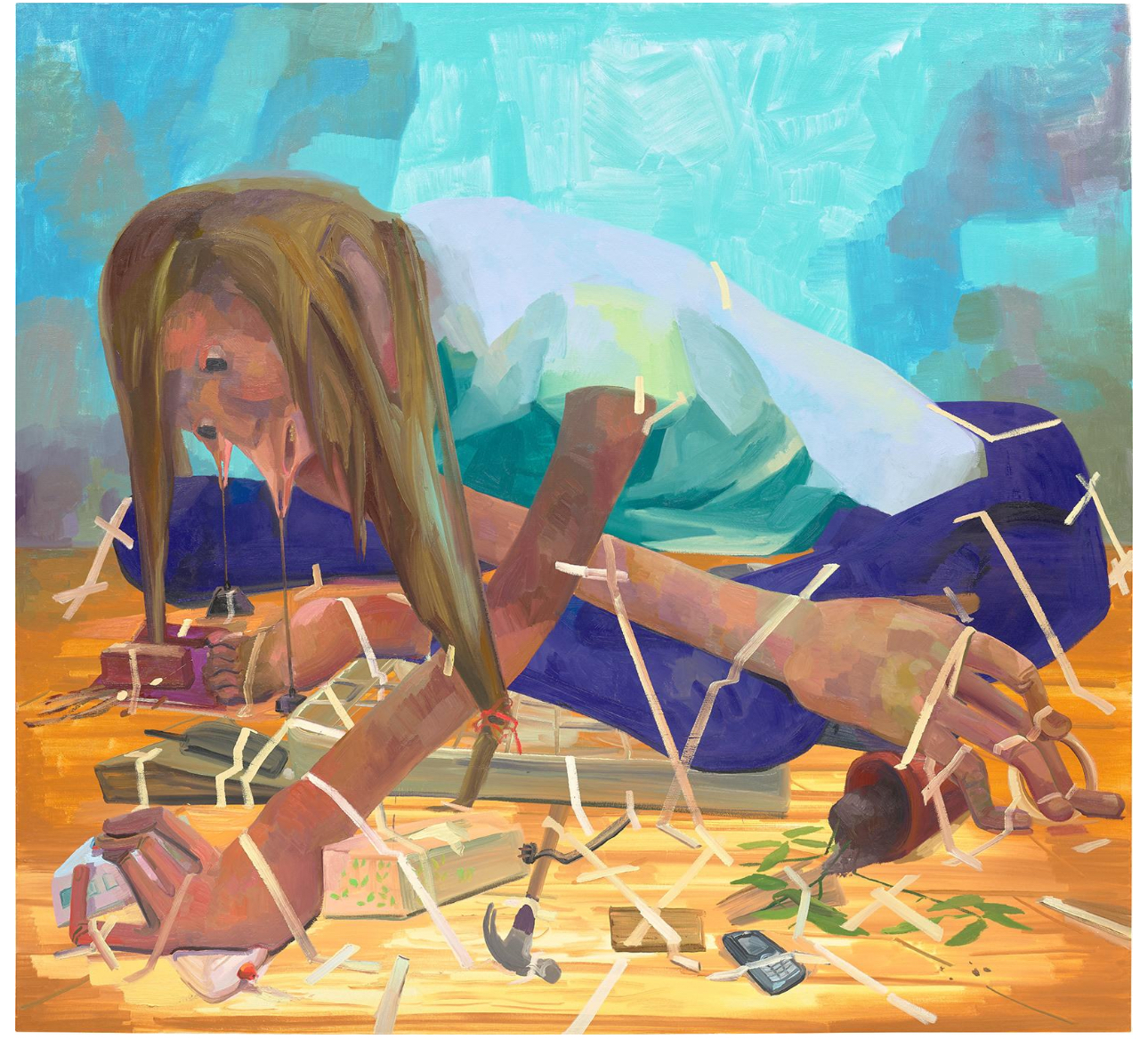
Schutz frequently plays with perspective and proportion in her work; ‘I want my subjects and paintings to feel like they have space in front of the picture plane, that’s a specific interaction with the viewer’.ii A visceral exchange between subject and viewer is something Schutz achieves with ease: In her Face Eater series, we are rendered helpless as we watch crazed, abstracted faces attempt to devour themselves – cropped closely to amplify the horror. The warped depiction of anatomy in Gravity Fanatic’s which occupies most of the canvas, exaggerated with angular streaks of white tape and tiny objects, make us feel as if we are both looking down and up at the looming figure. Whilst Schutz’s compositions are often bizarre and busy, she demonstrates a sophisticated understanding of pictorial logic to provide structure within her work – the crossed arms and legs and angular lines of her body acts a central point of focus amid a complex narrative.
A sardonic humour runs throughout Schutz’s corpus. In Gravity Fanatic, we are confronted with a subject, obsessed with the idea and effect of gravity, so much so that she secures herself and possessions to the floor. The arrangement of Schutz’s figures as a driving force of her narratives are both ‘entertaining and political’; an egalitarian means of parodying anyone and everyone.iii In many of her other works, Schutz calls upon an amalgamation of political, cultural and art historical references to inform her narratives. Men’s Retreat (2005) depicts a Lord-of-the-Flies-style outing of George Bush’s cabinet in jungle reminiscent of a Henri Rousseau painting; a wry, farcical composition that could have been taken straight from a contemporary satirical magazine like Private Eye.
Damien Hirst
Phillips London: 13 October 2023
Estimated: GBP 300,000 – 400,000
GBP 349,250
Damien Hirst – 20th Century & Contem… Lot 45 October 2023 | Phillips
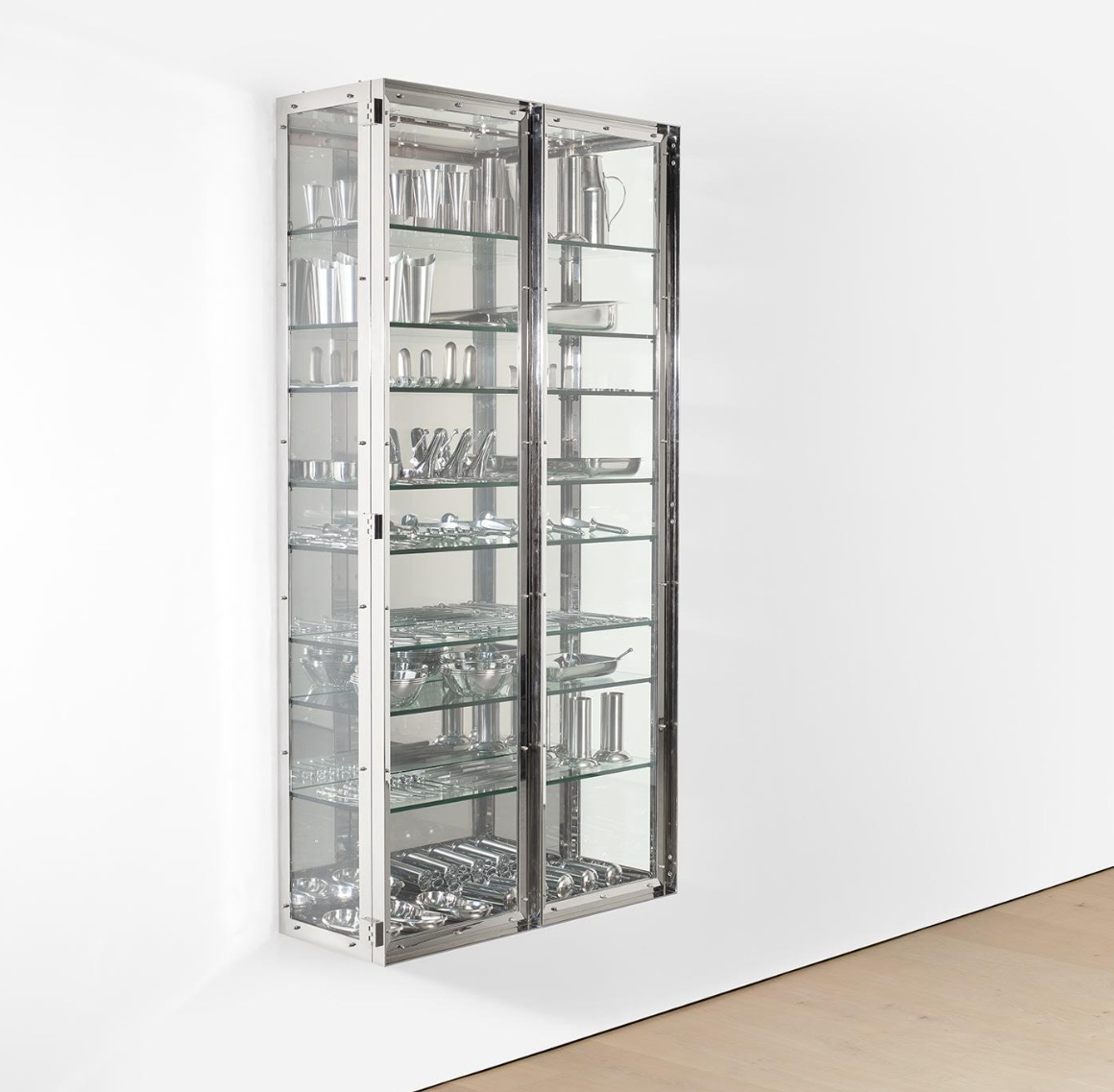
DAMIEN HIRST
Fear, 1994
Glass, stainless steel, steel, nickel, brass, rubber, medical and surgical equipment
180 x 92.5 x 36 cm (70 7/8 x 36 3/8 x 14 1/8 inches)
Stamped with the artist’s stamp ‘HIRST’ on some of the surgical instruments
An early and important example of Damien Hirst’s Instrument Cabinets, created at a pivotal moment in the Young British Artist’s career, Fear brings together key concepts and themes that continue to preoccupy the artist today. Executed on a human scale, the steel framed glass cabinet brings into sharp focus Hirst’s unwavering interest in mortality, the frailty of the human body, and the faith that we invest in the tools and promise of modern medicine. It is this paradox that underpins Hirst’s entire artistic project – while we know, and fear, our mortality, we also refuse to accept its permanence; or, in the artist’s own words, ‘I am going to die and I want to live forever. I can’t escape that fact and I can’t let go of that desire.’

Conceived in 1994, the year after Hirst was first nominated for the prestigious Turner Prize and the year before he actually won it, Fear comes from a pivotal moment in the young Hirst’s rapidly maturing practice, and in the broader contexts of contemporary British art at the turn of the century. Alongside sister works Still and Doubt now held in the prestigious collections of The Art Institute of Chicago and the Museum of Fine Arts Houston respectively, Fear stands in a close familial relationship to Hirst’s foundational Medicine Cabinets which he first embarked on in 1988 while still a student at Goldsmiths. Borrowing titles from the definitive late 70s punk album, Never Mind the Bollocks, Here’s the Sex Pistols, Hirst’s 1989 degree show presentation of thirteen Medicine Cabinets set the tone for the rebellious spirit that would come to define the art and personalities associated with the burgeoning YBA movement.
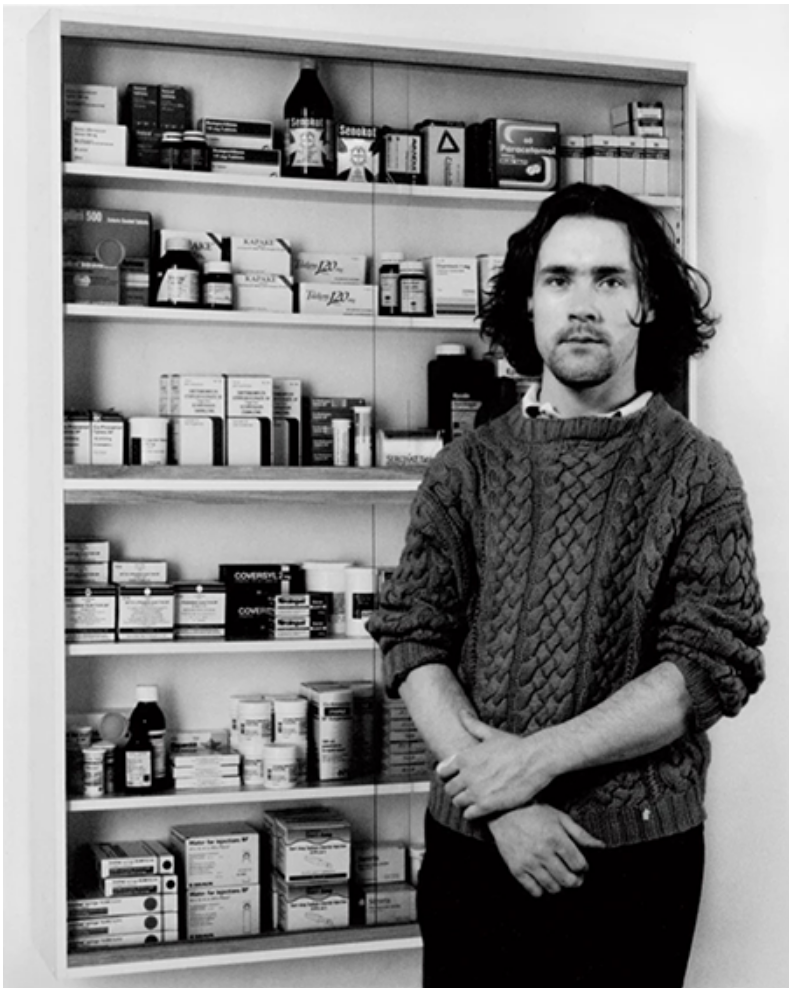
Damien Hirst at the No Sense of Absolute Corruption exhibition, Gagosian Gallery, New York, 1996. Artwork: © Damien Hirst and Science Ltd. All Rights Reserved, DACS 2023
Clean and precise in its presentation, Fear features rows of meticulously arranged surgical equipment, the cold, impersonal materiality of their sleek, stainless-steel surfaces visually referencing the simple geometries and seriality typically associated with Minimalism. Speaking about the broader series of Medicine Cabinets to which the present work is related, Hirst made this connection more directly, explaining: ‘I like the way that you’ve got all these individual elements inside a cabinet related to organs inside a body. I like the kind of Koons consumerist feel to it. And then a lot of the boxes of actual medicines are all very minimal and could be taken directly from minimalism, in the way that minimalism inspires confidence.’i Poignantly underscored by Hirst’s use of the medicine packets that his grandmother left behind after her death in these earliest cabinets however, the corporeal messiness of our own bodies is never far from these works, undercutting the more emotionally detached or Minimalist arrangement of its constituent parts.
As with his foundational Medicine Cabinets, the steel frame stands in directly for the body here, its fundamental fragility emphasised by the glass panels that encase it, but that also leave is contents poignantly exposed and vulnerable. Removing the corporeal messiness of the body, it is still powerfully evoked in Fear, the clinical arrangement of sterile, surgical instruments including kidney bowls, speculums, needle holders, and surgical scissors all highly charged with our knowledge of their functionality as tools to violently open the body. In its particularly evocative title, Hirst’s vision of the cabinet as ‘a kind of human, like with an abdomen and a chest and guts’ is especially pronounced, especially when considered in light of master of body horror cinema David Cronenberg’s 1988 film Dead Ringers, which Hirst has explicitly referenced in relation to the series.
Hirst’s fascination for the interwoven relationships between art, science, and faith have important art historical precedents in the long-held fascination with the human body, its anatomy, and dissection, most famously recorded in the sketchbooks of Leonardo da Vinci and in 17th century ‘anatomy lesson’ paintings. Significantly, in 2013 Fear was included in the Kunstmuseum de Haag presentation of The Anatomy Lesson: From Rembrandt to Hirst, where it was exhibited alongside all ten surviving anatomy lesson paintings produced in the Netherlands during this Enlightenment period, most notably Rembrandt’s masterwork of the Dutch Golden Age, The Anatomy Lesson of Dr Nicolaas Tulp.
Rembrandt Harmenszoon van Rijn, The Anatomy Lesson of Dr Nicoleas Tulp, 1632, Mauritshuis, The Hague
A gory spectacle, dissections were opened to public viewings once a year, taking place in theatres that still lend their name to the more clinical spaces of hospital operating rooms today. Commissioned by the Surgeons Guild for display in their meeting room, in The Anatomy Lesson of Dr Nicolaas Tulp the young Rembrandt radically altered the conventions of the genre. Set with dramatic contrasts of light and shadow, the mis en scène depicts the titular doctor exposing the musculature of the dissection subject’s arm to a group of fascinated onlookers. Drawing on Christ-like iconography in the artist’s presentation of the corpse, the painting crystalises the profound shift taking place across 17th century Europe as Enlightenment principles related to the pursuit of science, rationality, and the so-called triumph of reason challenged religion’s hitherto unwavering dominance as a framework for explaining the world. Like Rembrandt, in Fear Hirst draws on our compelling desire to make the unknown visible, the drive to demystify death and the deep anxieties provoked by an awareness of our own mortality. Playing on the densely woven web of fears and fascinations that has always characterised our relationship to medicine and the surgeon’s trade, the Instruments Cabinets also function in this respect like religious reliquaries, playing on our capacity for hope and belief, even in the face of impersonal and inevitable death.