Inspired by the ideals of “art as life” and moving the art experience out of galleries and into the streets, Haring’s first major works were his subway drawings. Haring produced over one hundred of these public works between 1980 and 1985, integrating his now-iconic exuberant, cartoonish outlined figures into everyday public space in a way that directly engaged its viewers. Haring recalled that the most important aspects of these works was the immediate engagement people had with them, asking him “what does it mean?” and giving him feedback that he’d then incorporate into future drawings. In this way, these works became reflections of the people who viewed them, responsive to and in dialogue with their environment. These works quickly garnered the attention of tastemakers in New York and his first solo exhibition was held at Westbeth Painters Space in 1981 and a celebrated show debuted at the high-profile Tony Shafrazi Gallery in New York the following year.

Throughout the 1980s, Haring was committed to democratizing the art experience and along with paintings, he also created theater sets, billboards, murals, advertising campaigns and even a line of Swatch watches. In 1986 he opened the Pop Shop in SoHo, selling apparel, posters and toys bearing his drawings. This was a controversial move, as many galleries criticized Haring for “de-valuing” the art object while others, such as Andy Warhol championed Haring’s insistence on making art accessible and affordable. Pop Shop was highly influential to contemporary crossovers of art and merchandise that are now so dominant. In addition to this ideology of accessibility, Haring was also very socially engaged and used his striking imagery to promote awareness of various political and social campaigns. His many notable public works included a mural on the western side of the Berlin Wall, the Crack is Wack mural in New York, and a mural for the 100th anniversary of the Statue of Liberty in 1986. Haring was diagnosed with AIDS in 1988 and used his presence in the arts community to raise awareness of the crisis. In 1989, a year before his death, he established the Keith Haring Foundation, whose mission is to raise funds for AIDS organizations and children’s literacy and arts programs.
Since his death in 1990, Haring has become one of the most widely-recognized and celebrated artists of the 20th century, priming the path for the rise of graffiti and street art in the 21st century and a socially-conscious approach to talking about sexuality, intimacy and visibility through public art. Famed New York gallerist Jeffery Deitch asserts that Haring made “works that can hang in museums alongside masterpieces…and hold their own as art-historically important pieces,” expressly because they embrace and engage popular culture with an immediate and dynamic visual language that celebrates the joy and chaos of our society.
This catalogue is the most comprehensive catalogue in existence today and showcases most prints that sold at auction for the past 10 years, including prints from some of the most celebrated series from the artist.
Number of Prints Referenced: 157
Total Impressions: 20,396
Number of Auction Results: 163
Keith Haring was also a prolific print-maker, he released around 200 prints between 1982 and 1990, amounting to around 25,000 impressions. Most Keith Prints are referenced in the Littmann Catalogue Raisonne, which is not very generous in details, for example, it does not list any numbers for Artist’s Proofs, or Hors Commerce that also form part of the impressions currently sold at public auction.
1. 1982 Prints
1982 Prints
13 Prints
770 Impressions
Keith Haring started print-making in 1982 when he created his first poster and his first prints destined to be sold. The Bayer Suite was commissioned by Bayer AG at the occasion of the release of an heart medication. Untitled 1-6 is a series of six prints in black and white published by Barbara Gladstone.
The Bayer Suite
6 Prints
Edition: 70
 The Bayer Suite, 1982
The complete set of six offset lithographs in colors on thin wove paper
Sheet: 11 3/4 x 9 1/2 inches (29.8 x 24.1 cm)
Edition: 70 (signed in the plate)
Published by Bayer AG on the occasion of the release of the medication Sali-Adalat.
USA 19-82
1 Print
Edition: 50 + 12 AP
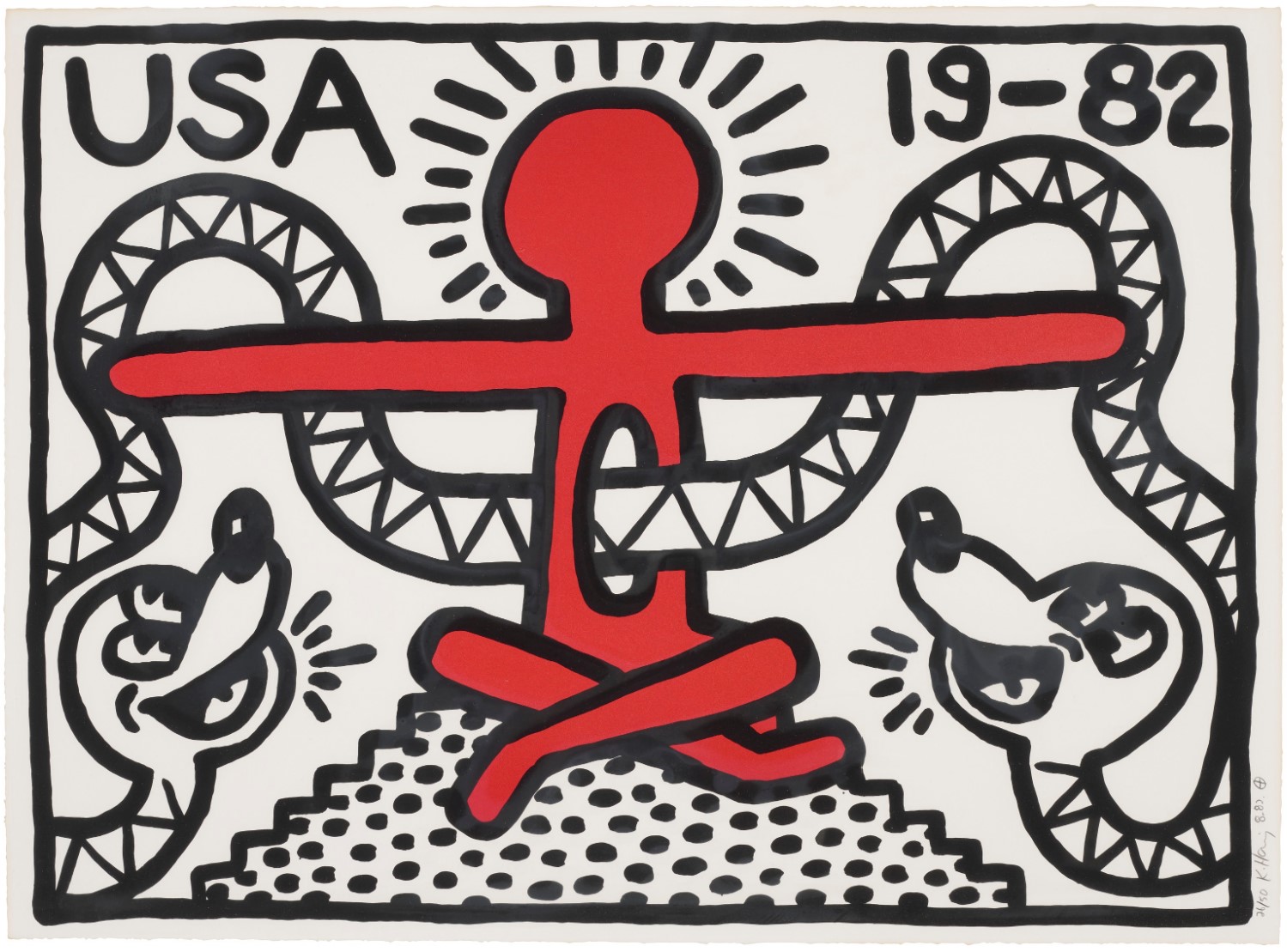
USA 19-82, 1982
Lithograph in black and red, on Copperplate Deluxe paper
Sheet: 22×30 inches (56 x 76.2 cm)
Edition: 50 + 12 AP
Literature: Littmann pp. 16-17
Untitled 1-6
Edition: 40 + 8AP

Untitled 1-6, 1982
The complete set of six lithographs on Rives BFK paper
Sheet: 24×36 inches (61×91 cm)
Edition: 40 + 8 AP
Publisher: Barbara Gladstone Editions, New-York
Literature: Littmann pp. 18-21
Untitled 1 (L. p. 19)
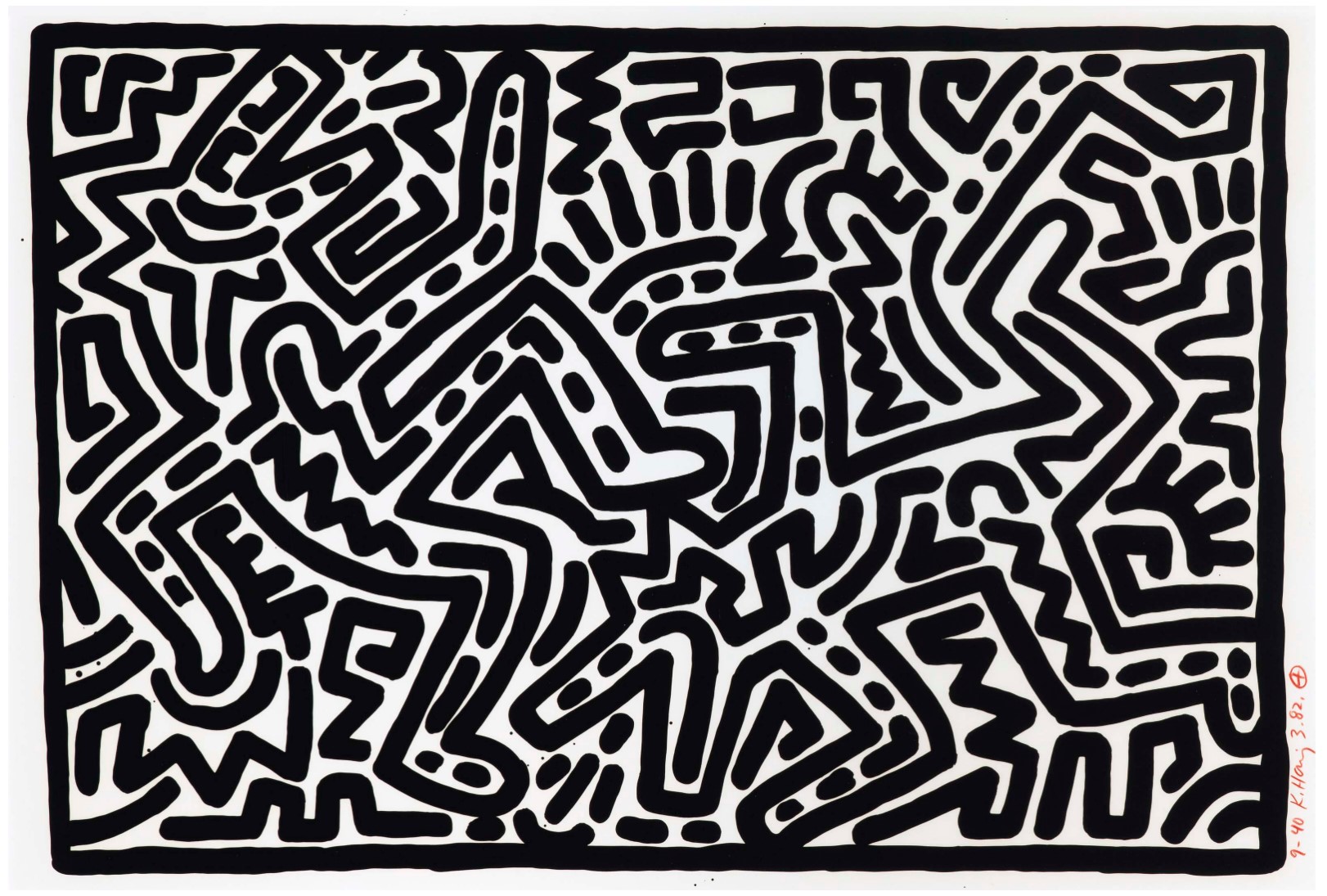
Untitled 2 (L. p. 19)
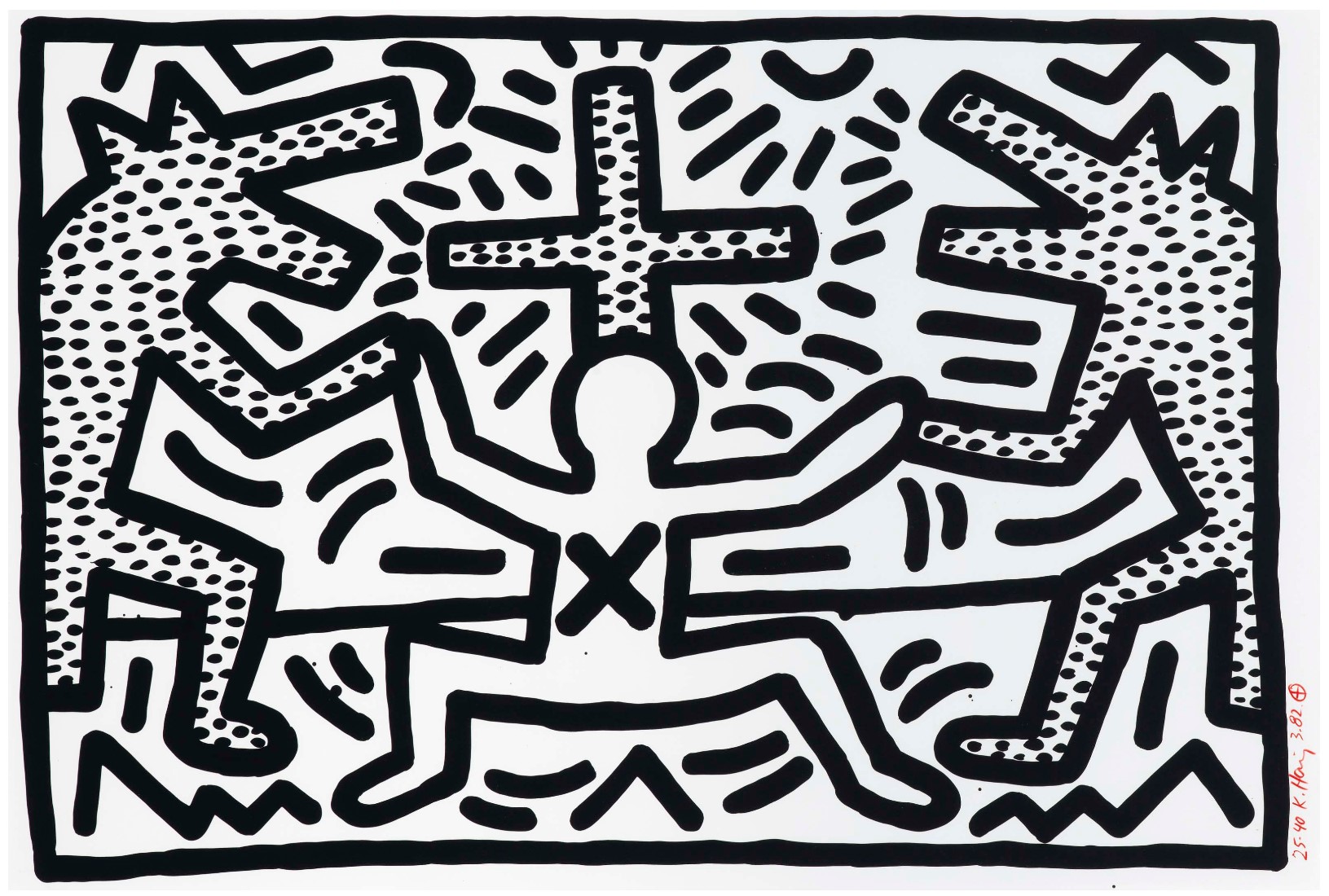
Untitled 3 (L. p. 20)
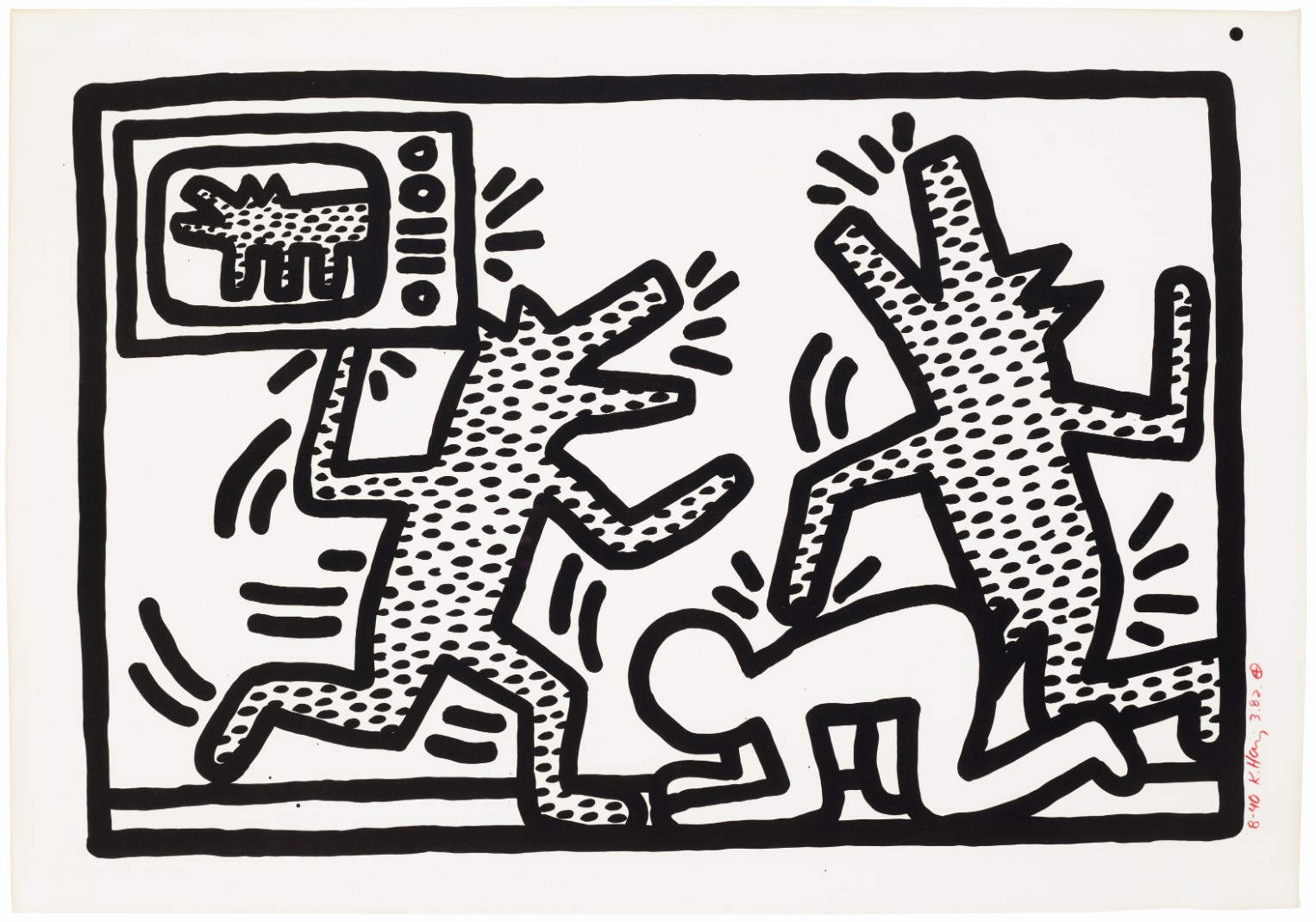
Untitled 4 (L. p. 20)
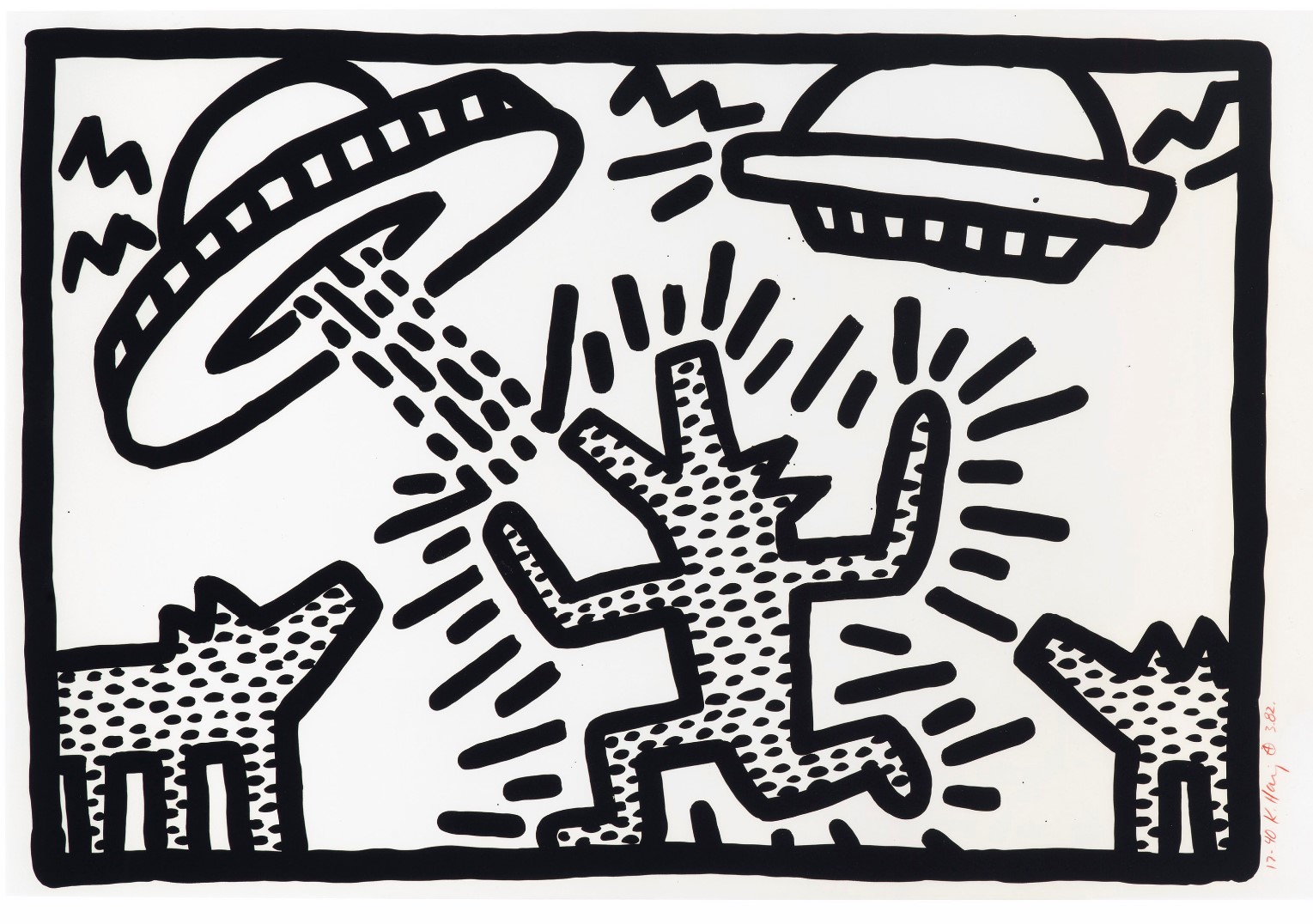
Untitled 5 (L. p. 21)
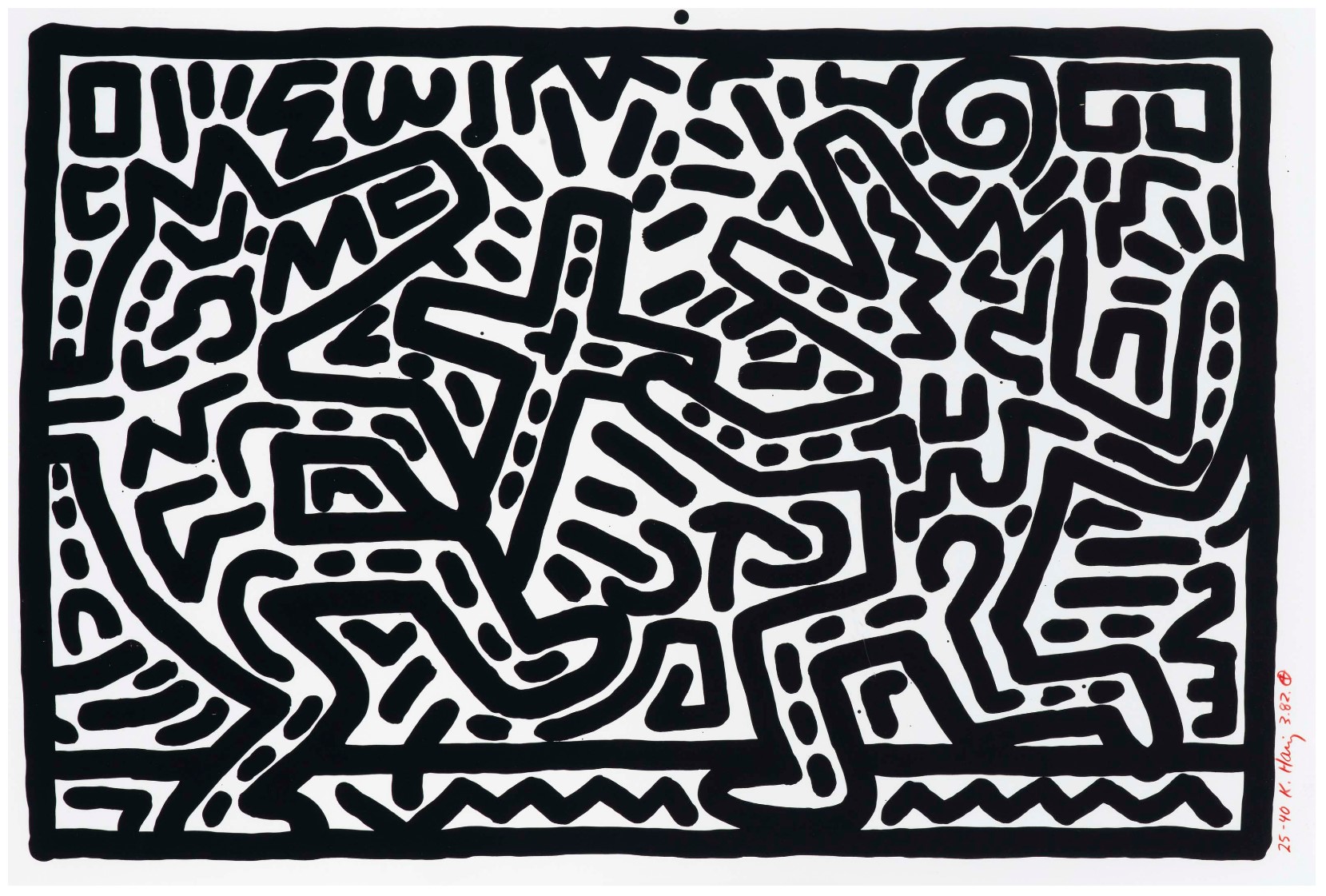
Untitled 6 (L. p. 21)

2. 1983 Prints
1,983 Prints
10 Prints
947 Impressions
In 1983, Keith Haring introduced large and bold block of colors in his prints. The artist was commissioned by the Jazz Festival in Montreux to work on the official poster. The artist also created two vibrating woodcut in red and in green. Finally, the artist released his first iconic suite, Fertility, comprised of 5 prints.
Montreux
3 Prints
Edition: 80

Montreux Jazz Festival, 1983
The complete set of 3 screen-prints in colors on smooth wove paper
Sheet: 39 3/8 x 27 5/8 inches (100×70 cm)
Edition: 80
There is also an unsigned edition of unknown size
Publisher: The Montreux Jazz Festival, Montreux
Montreux #1 (L. p. 25)

Montreux #2 (L. p. 26)

Montreux #3 (L. p. 27)

Untitled (L. p. 28)
1 Woodcut
Edition: 60 + 6 AP
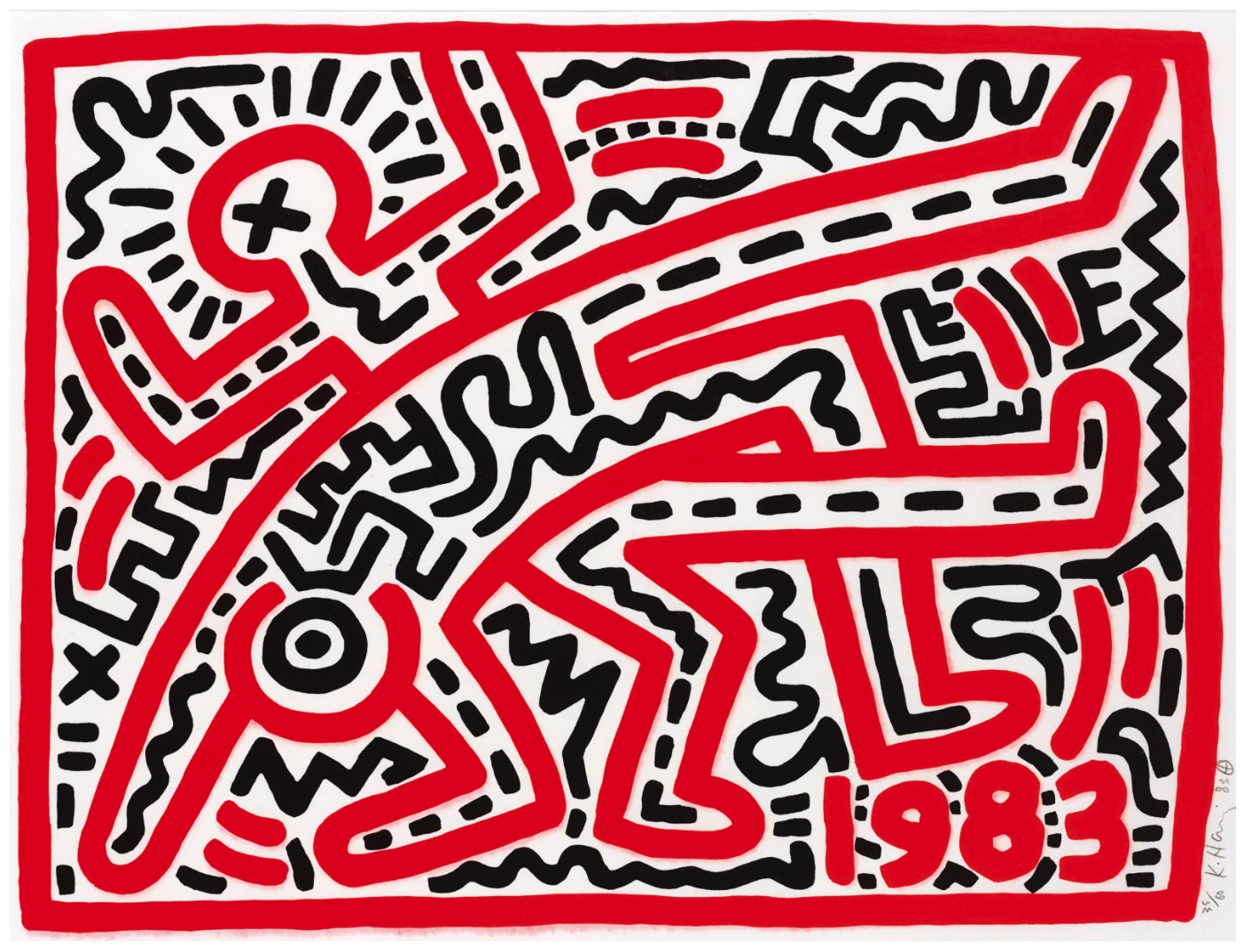
Untitled, 1983
Woodcut in colors on Japon paper
Sheet: 24×30 inches (61×76 cm)
Edition: 60 + 6 AP
Literature: Littmann p. 28
Untitled (L. p. 29)
1 Woodcut
Edition: 60 + 6 AP
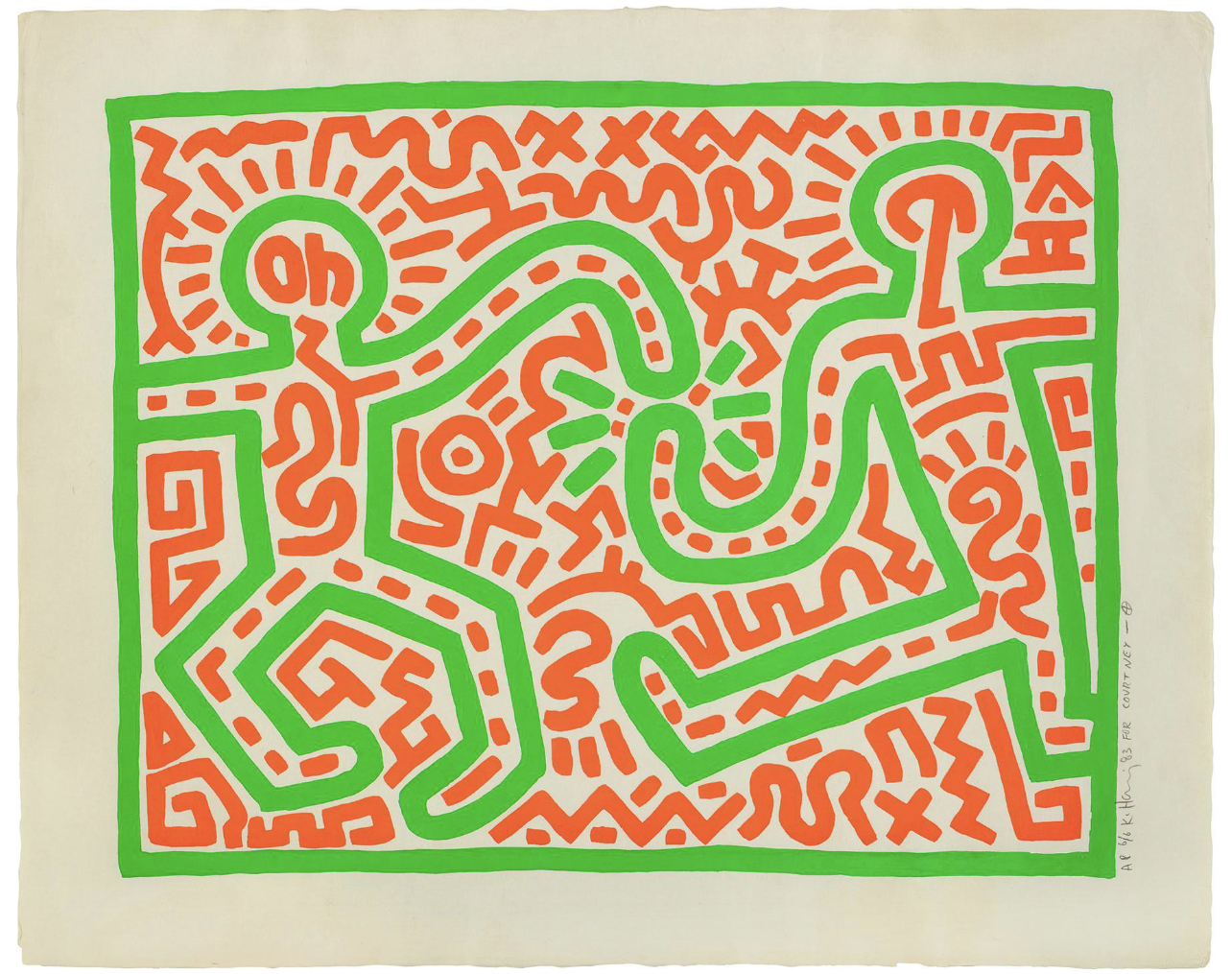
Untitled, 1983
Woodcut in colors on Japan paper
Sheet: 24×30 inches (61×76 cm)
Edition: 60 + 6 AP
Literature: Littmann p. 29
Keith Haring was a staple at Paradise Garage, a legendary nightclub celebrated for its multi-cultural gay dance scene and commemorated as the birthplace of the modern nightclub. Haring is credited as the key figure behind the exuberant convergence of art, music and performance that developed there. From the early 1980s up until its closure in 1987, Paradise Garage was central to Haring’s world to the extent that he would schedule his trips abroad for his international exhibitions around the nightclub’s biggest nights, leaving on Sundays and returning before or on Saturdays.
Fertility
5 Prints
Edition: 100 + 15 AP
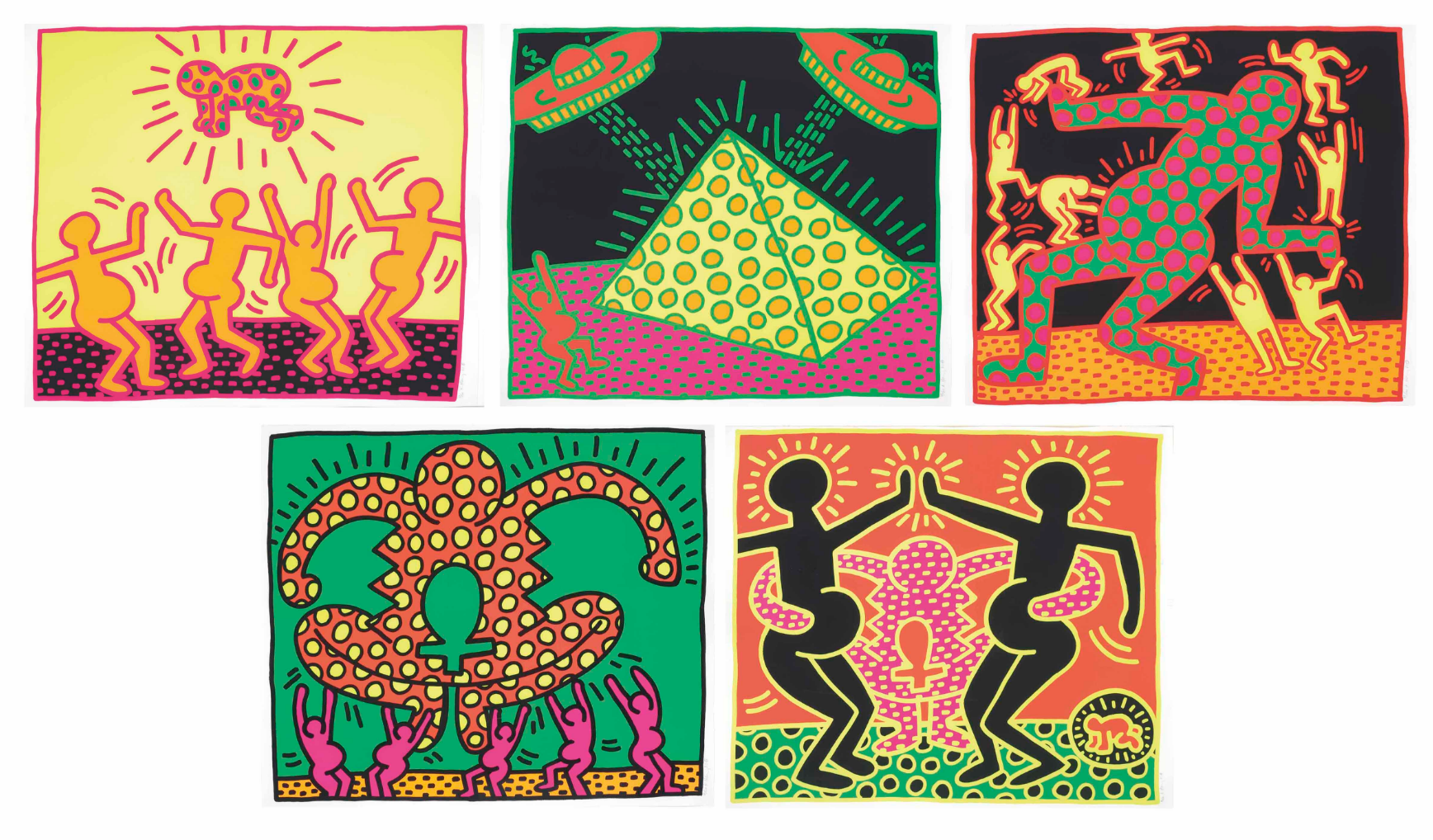
Untitled (Fertility), 1983
The complete set of five screen-prints in colors on wove paper
Each Sheet: 42×50 inches (106.7 x 120 cm)
Edition: 100 + 15 AP
Publisher: Tony Shafrazi Gallery, New-York
Literature: Littmann pp. 30-33
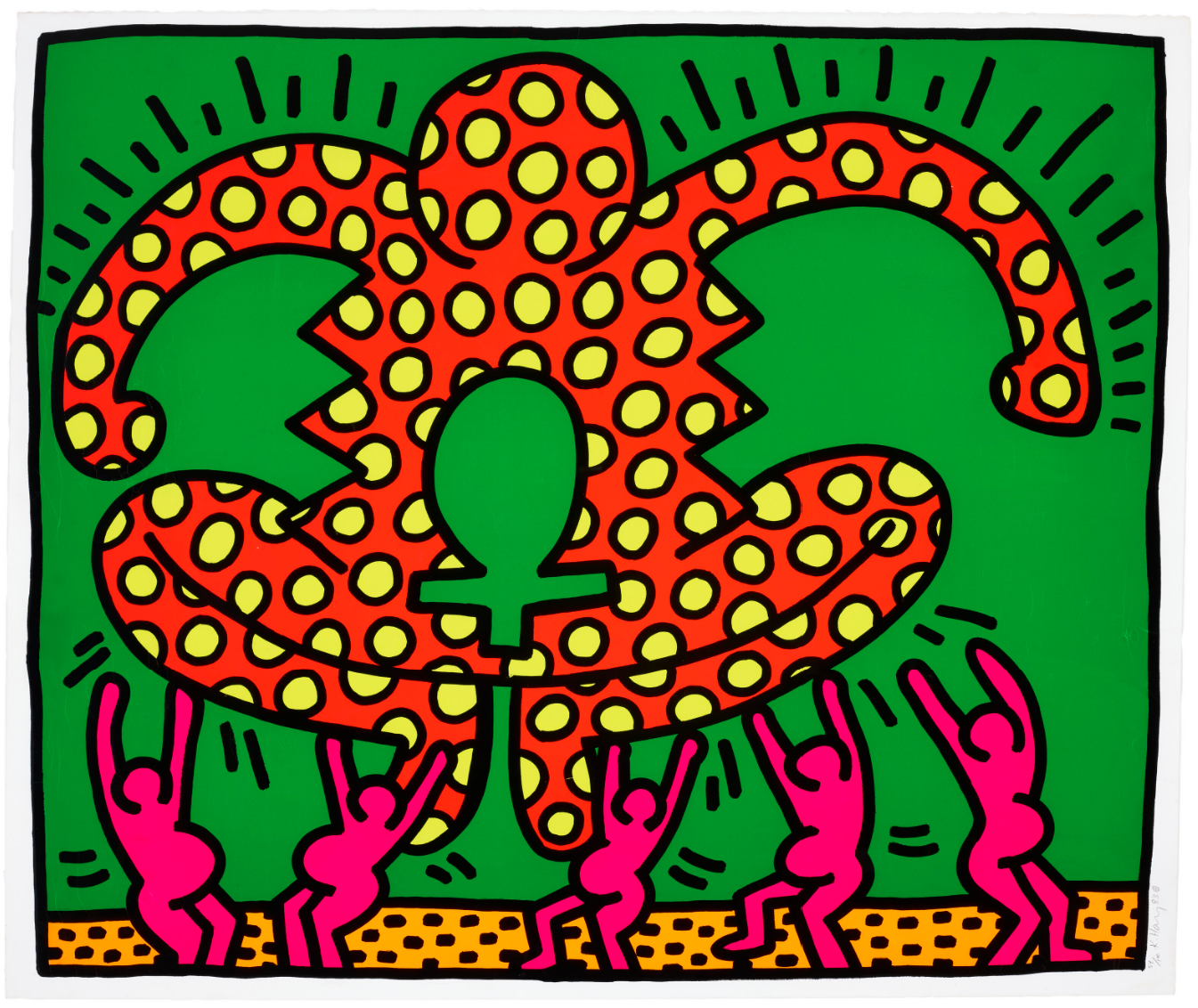
Haring’s Fertility Suite series is exemplary of the way in which he used a positive visual language to speak out against hard hitting subjects such as racism, homophobia, the apartheid in South Africa and HIV/AIDS. Fertility 1 alludes to the high prevalence of HIV infection among pregnant women in Sub-Saharan Africa in the 1980s, notably the transmission of the virus from mother to child. Fertility 1 uses the artist’s trademark visual language of bold colors and simplified form to depict pregnant women dancing in energetic bodily motions that recall African fertility dances. Four pregnant figures are shown dancing on a dotted landscape, and Haring shows his trademark radiant baby symbol as the print’s centerpiece to reflect this idea of celebrating fertility and life. Fertility 2 features a brightly colored and spotted ancient Egyptian pyramid, a common motif in Haring’s work that symbolized both antiquity and eternity. Haring’s allusion to the mysteries of ancient civilization are juxtaposed with the imagination of extraterrestrial civilization through the depiction of UFOs that have come to represent positive energy and empowerment to those who are situated outside of accepted social norms. Fertility 4 shows a bright pink figure covered in yellow dashes squatting in the center of the work, with its arms around two pregnant figures shown in black and outlined in neon yellow. Due to the dashes on the figure’s body the central figure represents HIV/AIDS in this print and has a threatening presence. However, Haring includes an ankh cross, the Egyptian hieroglyphic for ‘life’ at the center of the figure’s stomach, thus presenting the paradox between the celebration of life and living with HIV/AIDS. Fertility 5 uses some of Haring’s most recognizable symbols, dotted and pregnant figures, holes in the stomach, and bold, rounded lines to evoke a sense of movement in the image. The suite is an early screen print by Haring that represents the significance of his work to HIV/AIDS activism through unique symbols that are widely recognized and understood by the public.
Fertility 1 (L. p. 31)
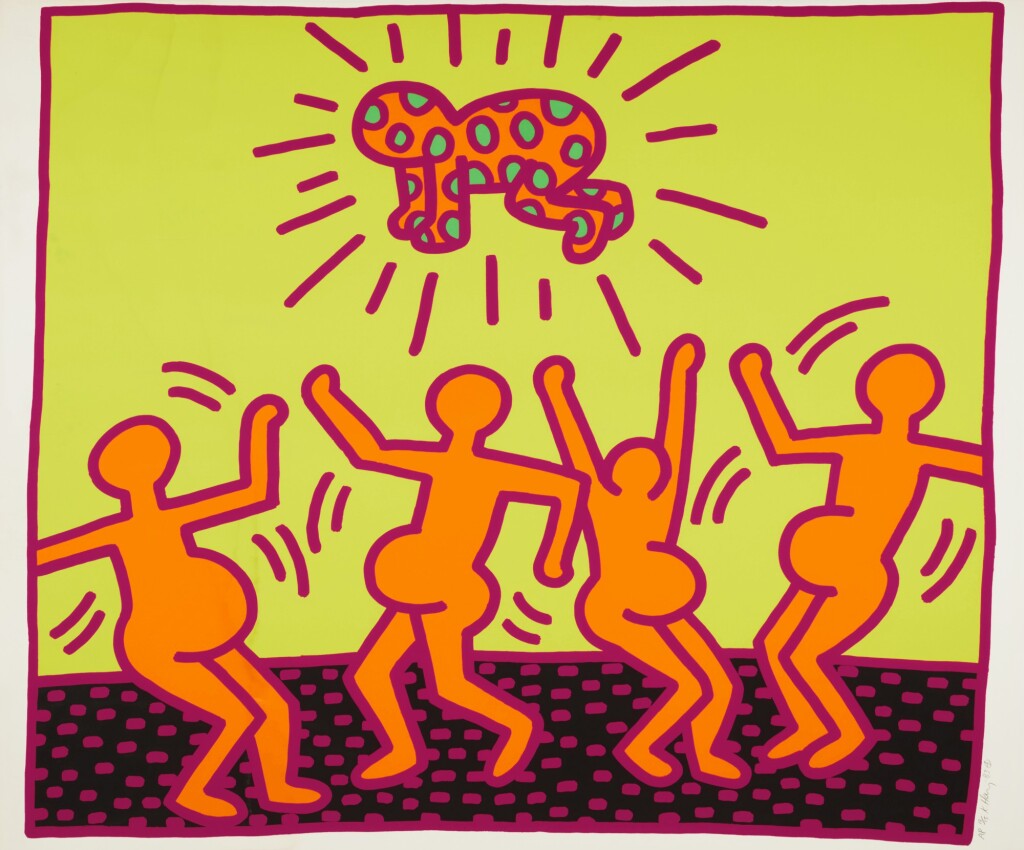
Fertility 2 (L. p. 32)
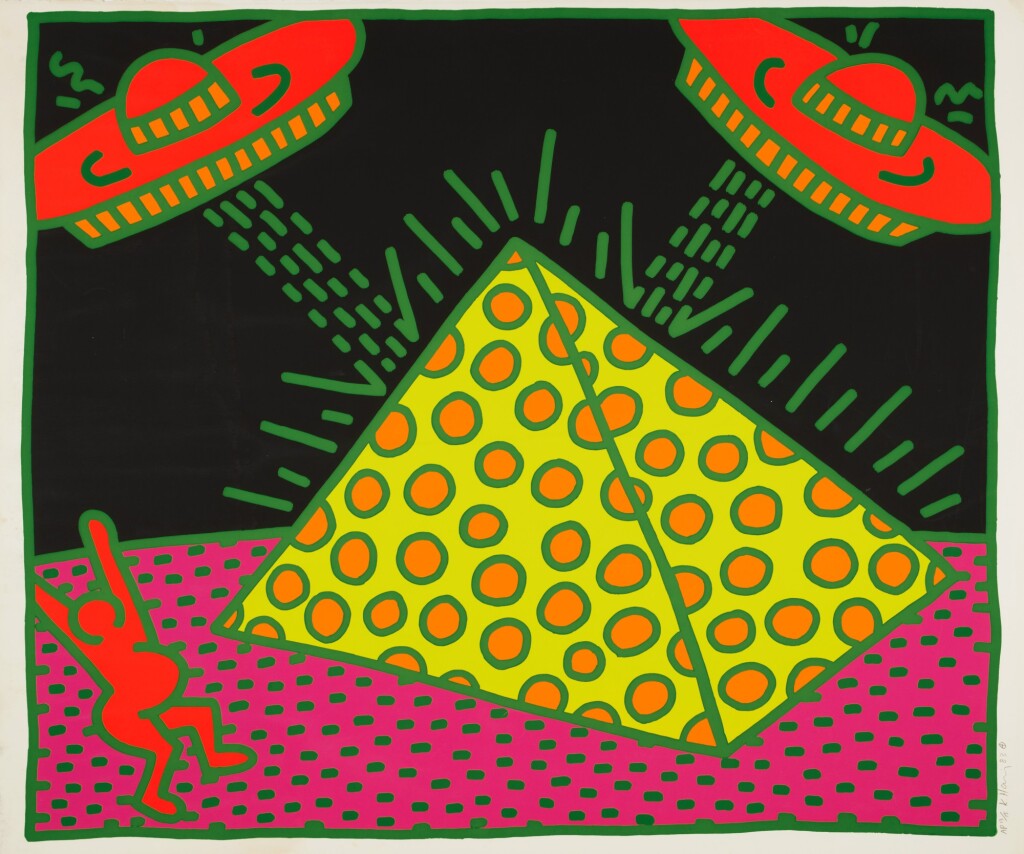
Fertility 3 (L. p. 32)
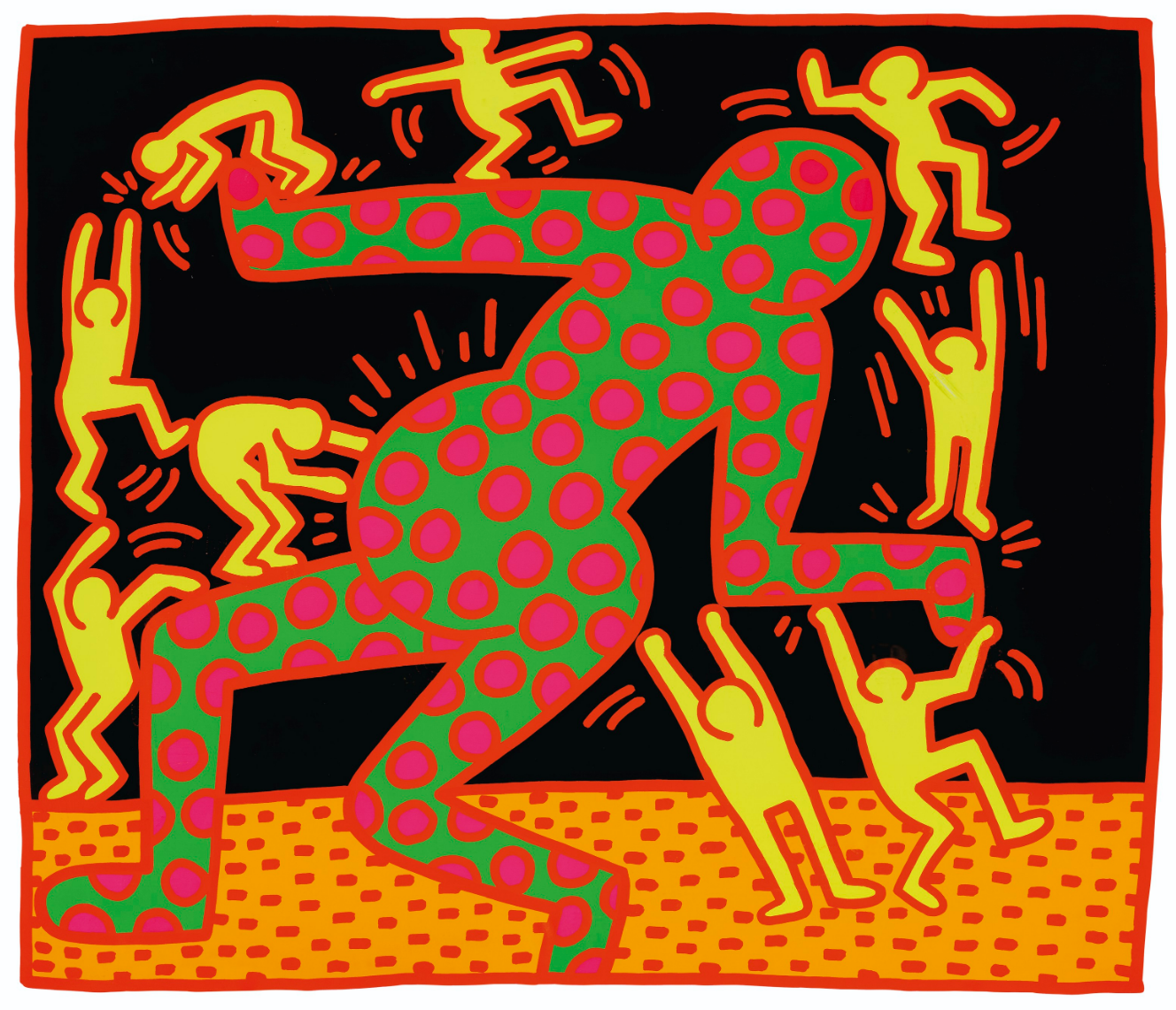
Fertility 4 (L. p. 33)

Fertility 5 (L. p. 33)
3. 1985 Prints
1985 Prints
16 Prints
2,360 Impressions
Keith Haring released three series of lithographs in Red and Black, Three Lithographs, Free South Africa, and Ludo 1-5.
International Youth Year
1 Lithograph
Edition: 1,000

International Youth Year, 1985
Lithograph printed in colors with collage on wove paper
Sheet: 11 x 8 1/2 inches (27.9 x 21 cm)
Edition: 1,000
Publisher: World Federation of the United Nations Associations, New York
Literature: Littmann pp. 36-37
The year 1985 was declared the International Youth Year by the United Nations with three central themes of participation, development, and peace. It was held in order to bring attention to issues concerning and affecting youth around the world. Activities coordinated by the Youth Secretariat of the Centre for Social Development and Humanitarian Affairs took place across the globe and included the International Youth Conference and World Youth Festival in Jamaica, the Friendly Gathering of Youth in Beijing, the 12th World Festival of Youths and Students in Moscow, and the International Youth Year Conference on Law in Montreal. Keith Haring’s colorful, joyous, widely appealing imagery was a perfect fit for this unique, global celebration.
Three Lithographs
3 Lithographs
Edition: 80 + 20 AP
Three Lithographs are typical of Keith Haring’s iconography. Created in the style of a comic book, only show-casing red and black, the artist is using think lines, and his signature radiating symbolism to depict a character who seems to be exploring ideas around gay sexuality, and substance abuse. Of course, as typical of many works by the artist, those visuals are at the same outrageous in their representation and show comical compositions to illustrate social commentaries.
Three Lithographs: Plate 1 (L. p. 39)
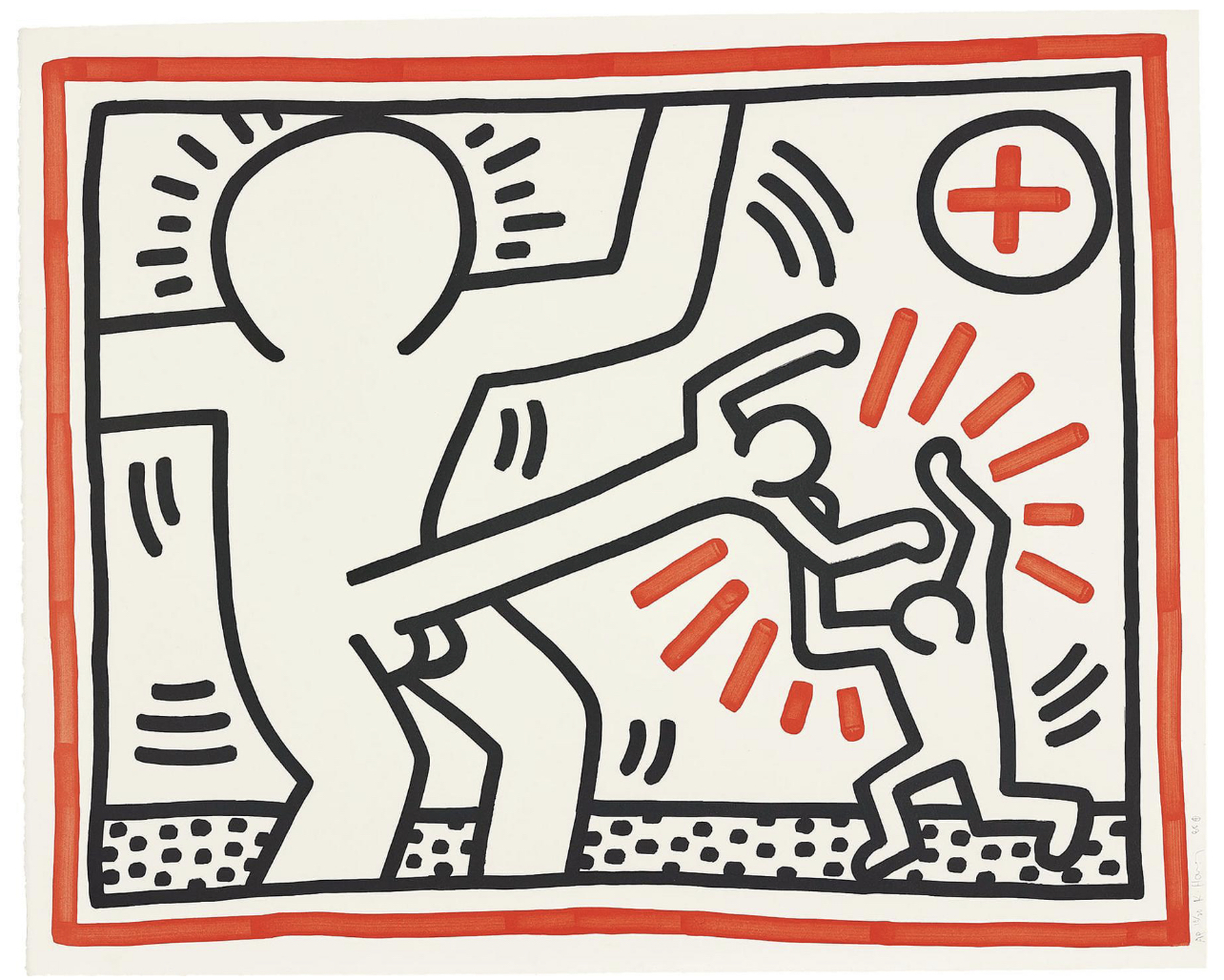
Three Lithographs: Plate 1, 1985
Lithograph in black and red on BFK Rives paper
Sheet: 32×40 inches (81 x 101.5 cm)
Edition: 80 + 20 AP
Publisher: Edition Schellmann, Munich and New York
Literature: Littmann pp. 38-39
Three Lithographs: Plate 2 (L. p. 40)
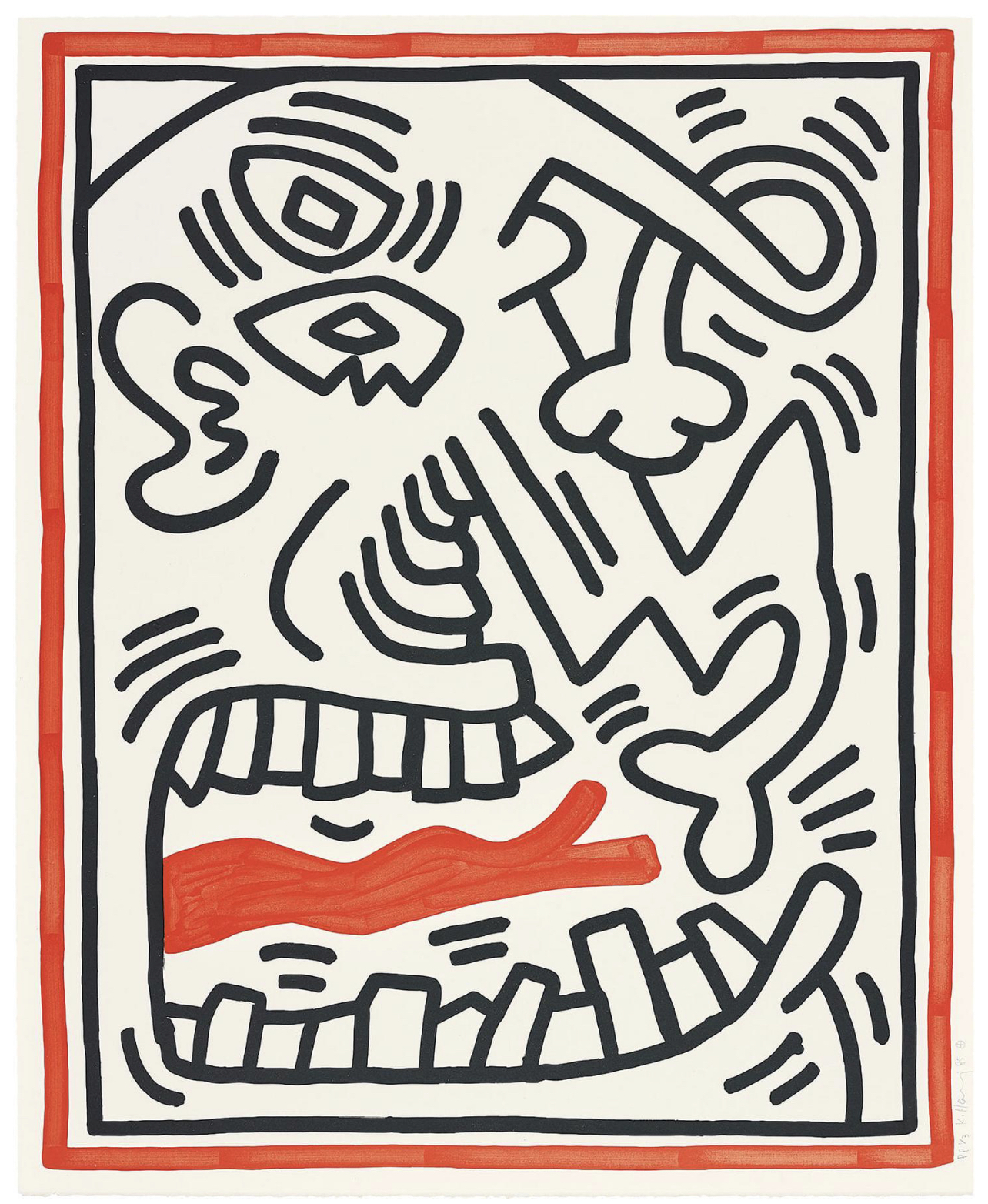
Three Lithographs: Plate 2, 1985
Lithograph in black and red on BFK Rives paper
Sheet: 40×32 inches (81 x 101.5 cm)
Edition: 80 + 20 AP
Publisher: Edition Schellmann, Munich and New York
Literature: Littmann p. 40
Three Lithographs: Plate 3 (L. p. 41)
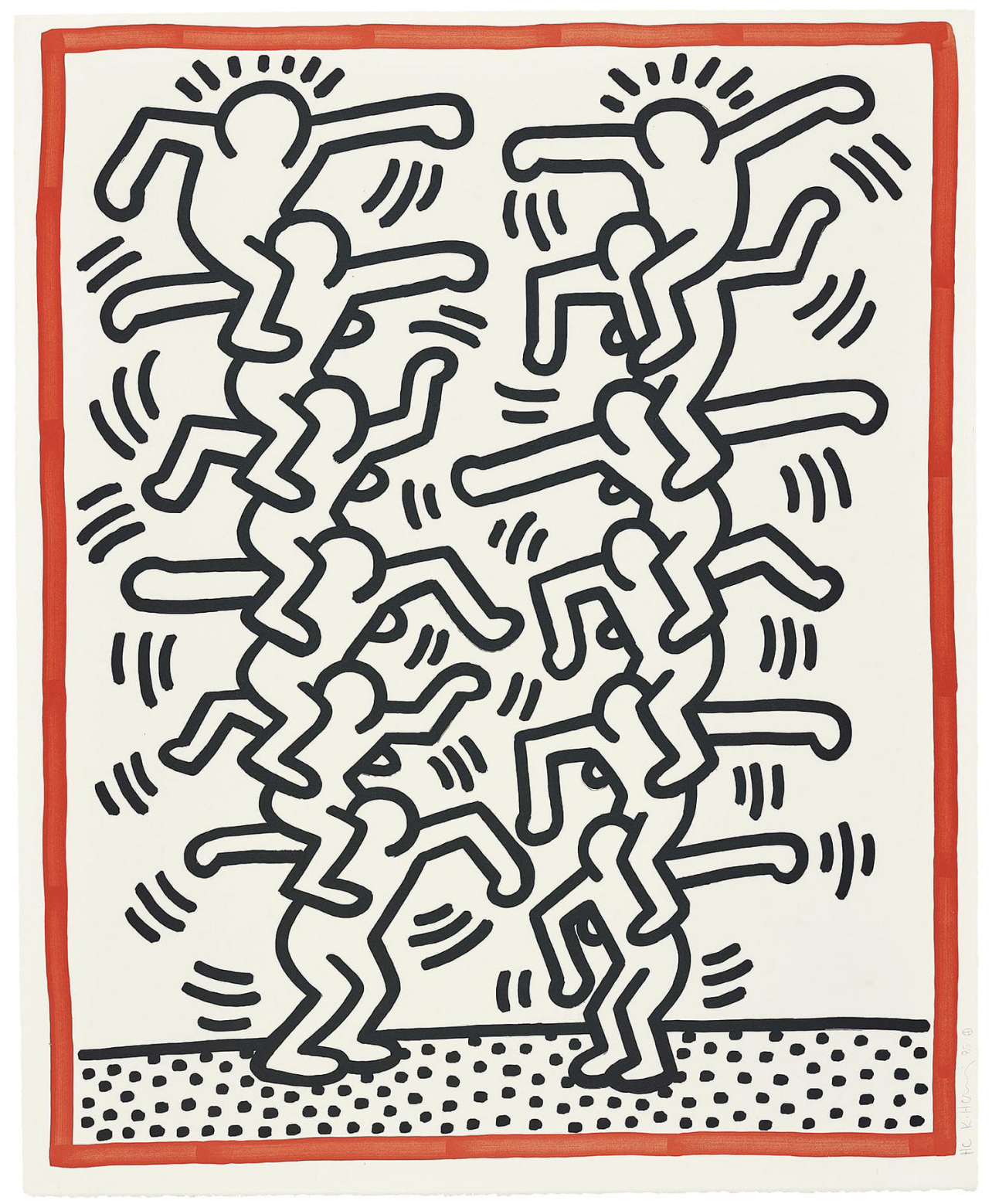
Three Lithographs: Plate 3, 1985
Lithograph in black and red on BFK Rives paper
Sheet: 40×32 inches (81 x 101.5 cm)
Edition: 80 + 20 AP
Publisher: Edition Schellmann, Munich and New York
Literature: Littmann p. 41
Untitled 1-3 (Free South Africa)
3 Lithographs
Edition: 60 + 15 AP
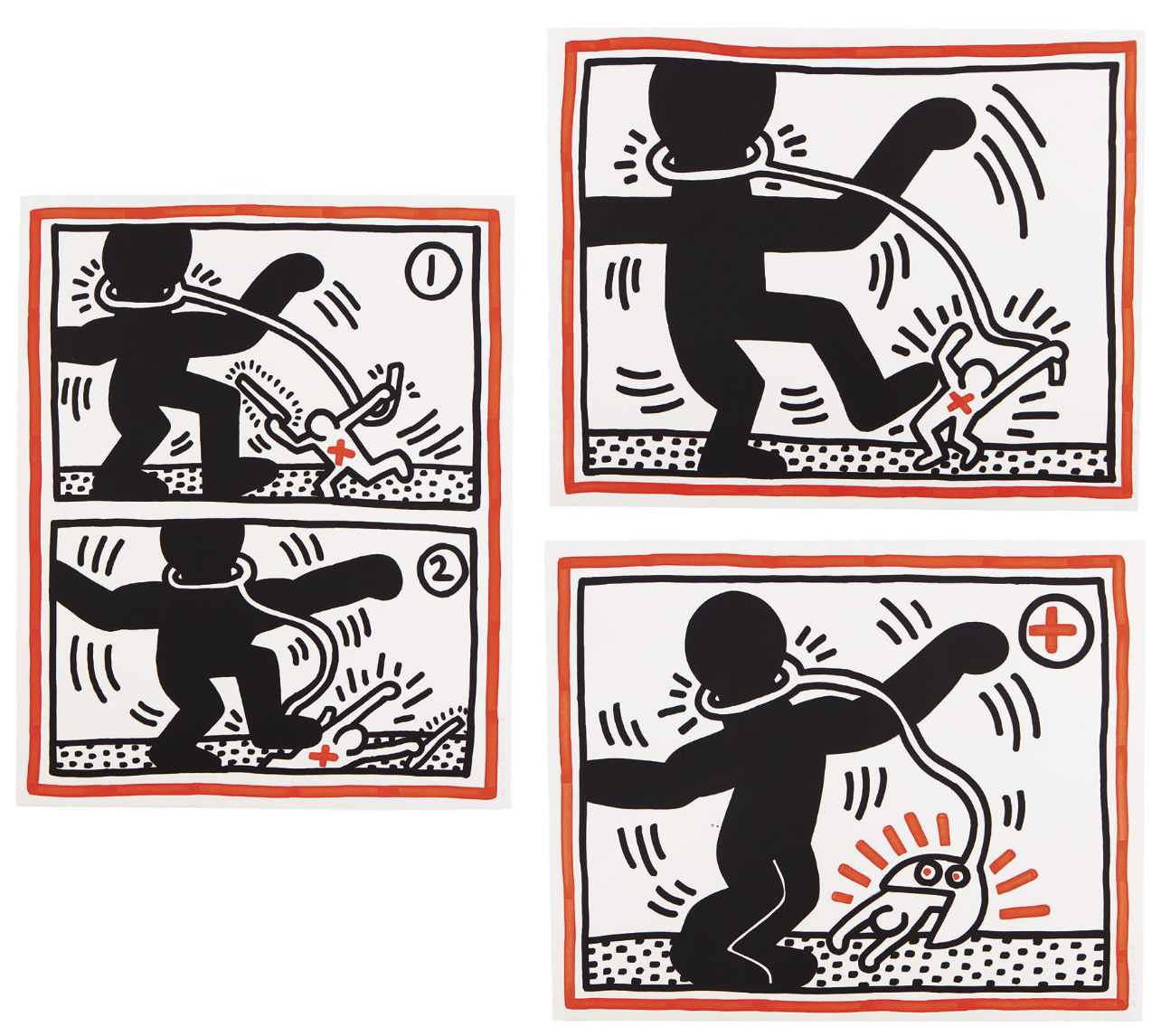
Untitled (Free South Africa), 1985
The complete set of three lithographs in black and red on Rives BFK paper
Each Sheet: 32×40 inches (81×100 cm)
Edition: 60 + 15 AP
Publisher: Edition Schellmann, Munich and New York
Literature: Littmann pp. 42-43
Keith Haring was a dedicated social activist. He vigorously advocated for the LGBT community, particularly those diagnosed with HIV/AIDS, and condemned racism, inequity, and social injustices. Haring, therefore, found himself joining the international anti-apartheid movement against the oppressive and racially based power of the South African government.
“Control is evil. All stories of white men’s ‘expansion’ and ‘colonization’ and ‘domination’ are filled with horrific details of the abuse of power and the misuse of people”

His poster Free South Africa originated from a painting in 1984 of the same design. In 1985, he transformed the painting into lithograph and added the text “Free South Africa” to the lower border of the composition. It is said that Haring distributed around 20,000 poster versions of this print in New York City in 1986 in an effort to mobilize support against the apartheid.
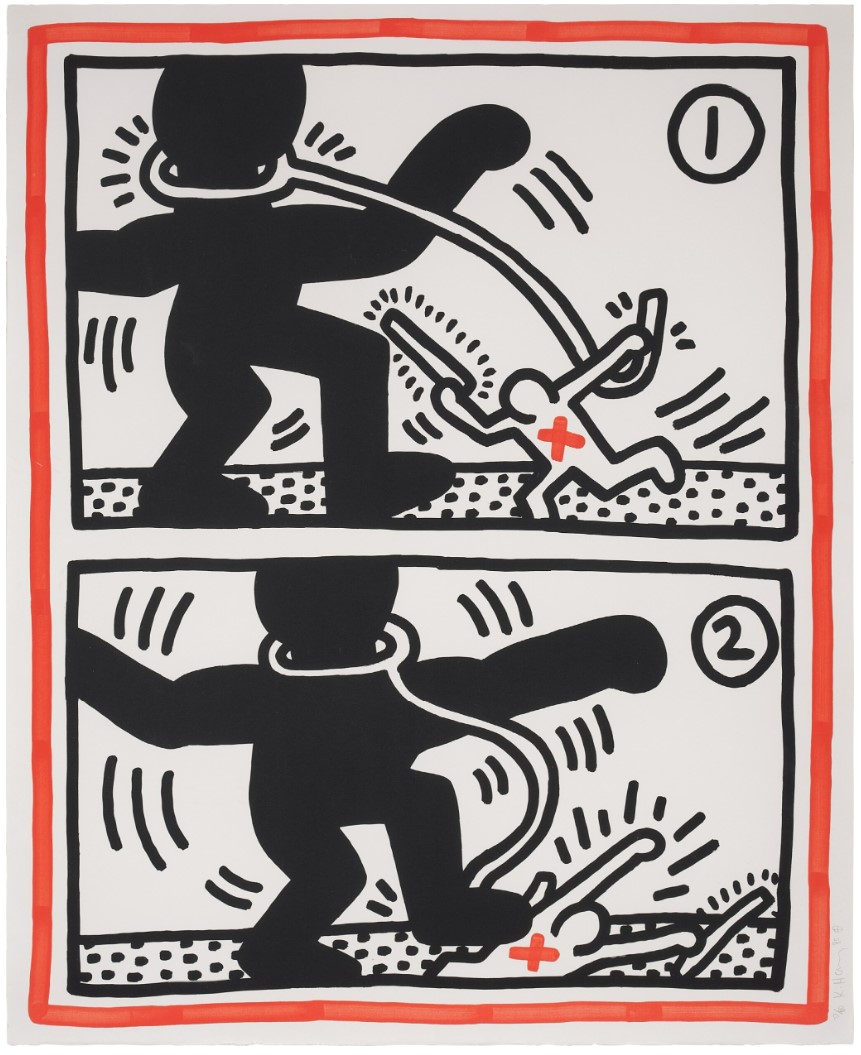
Untitled 1 (L. p. 42)

Untitled 2 (L. p. 42)
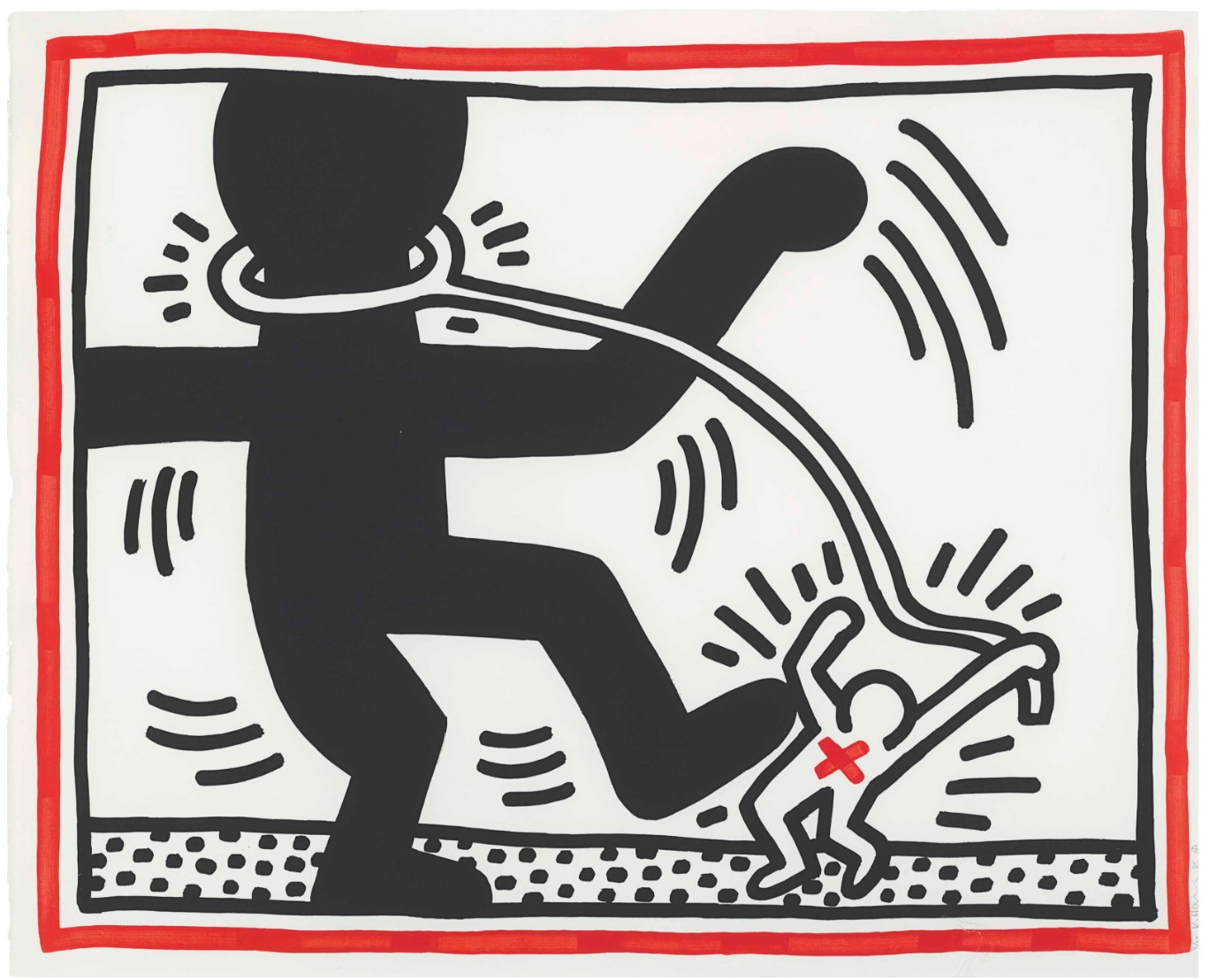
Untitled 3 (L. p. 43)
Ludo 1-5
5 Lithographs
Edition: 90 + 15 AP
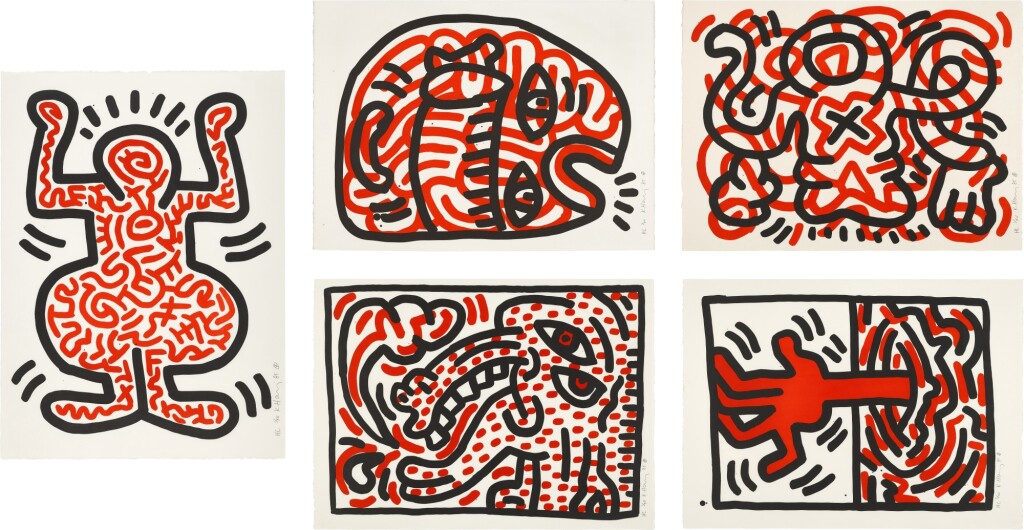
Ludo 1-5, 1985
The complete portfolio comprising five lithographs printed in colors on Arches wove paper
Sheet: 26×19 inches (66×48 cm)
Edition: 90 + 15 AP
Printer/Publisher: Éditions F.B./Atelier I. D. L., Paris
Literature: Littmann pp. 44-47
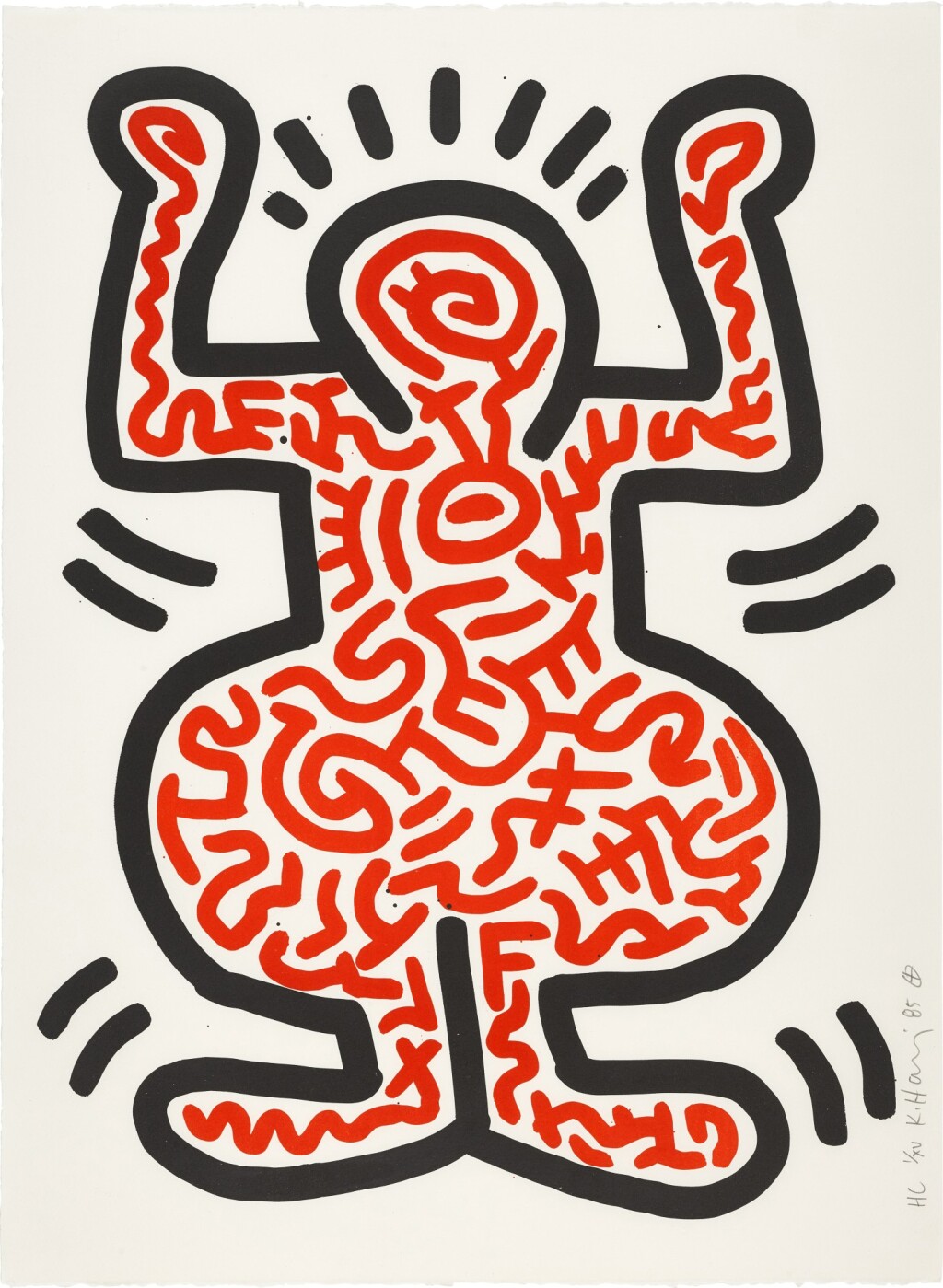
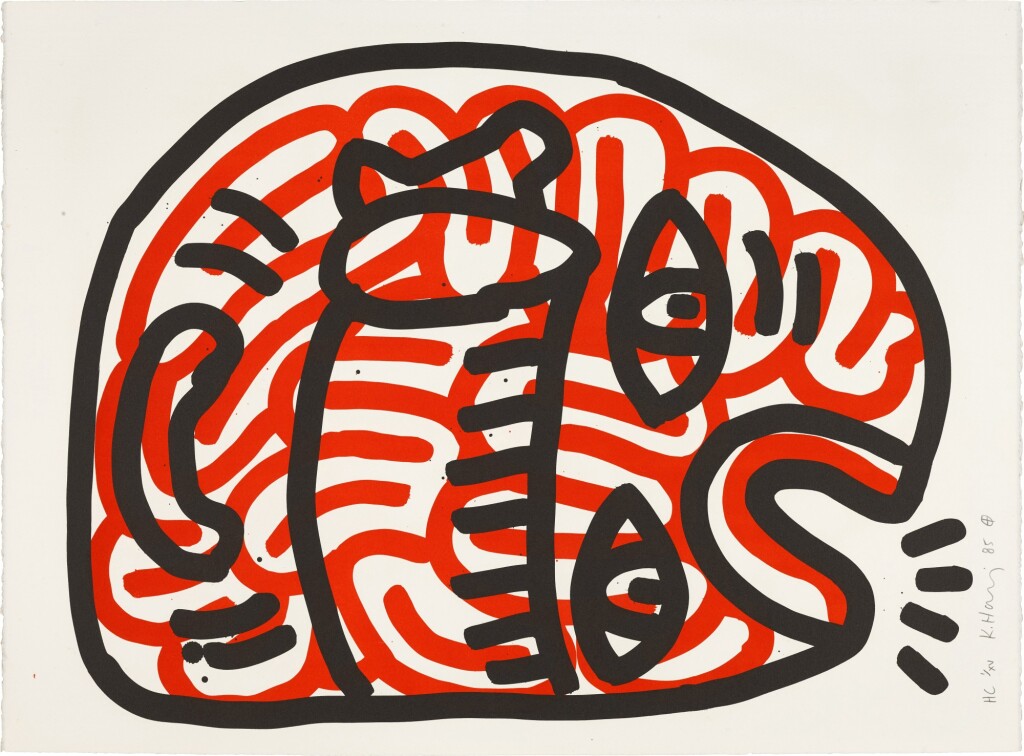
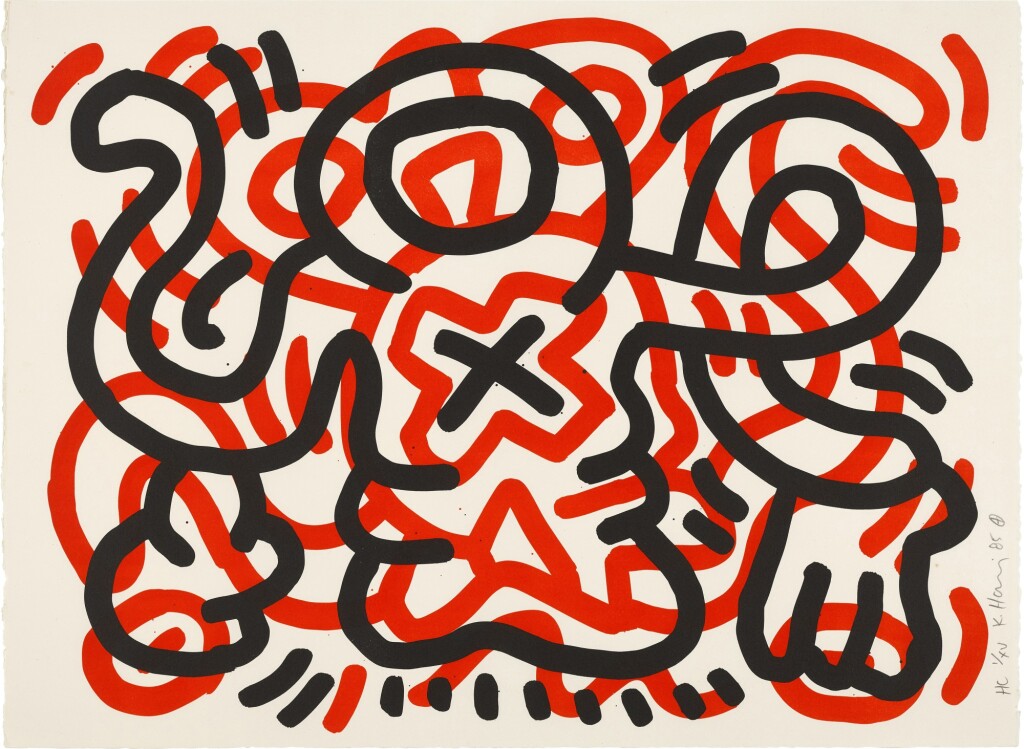
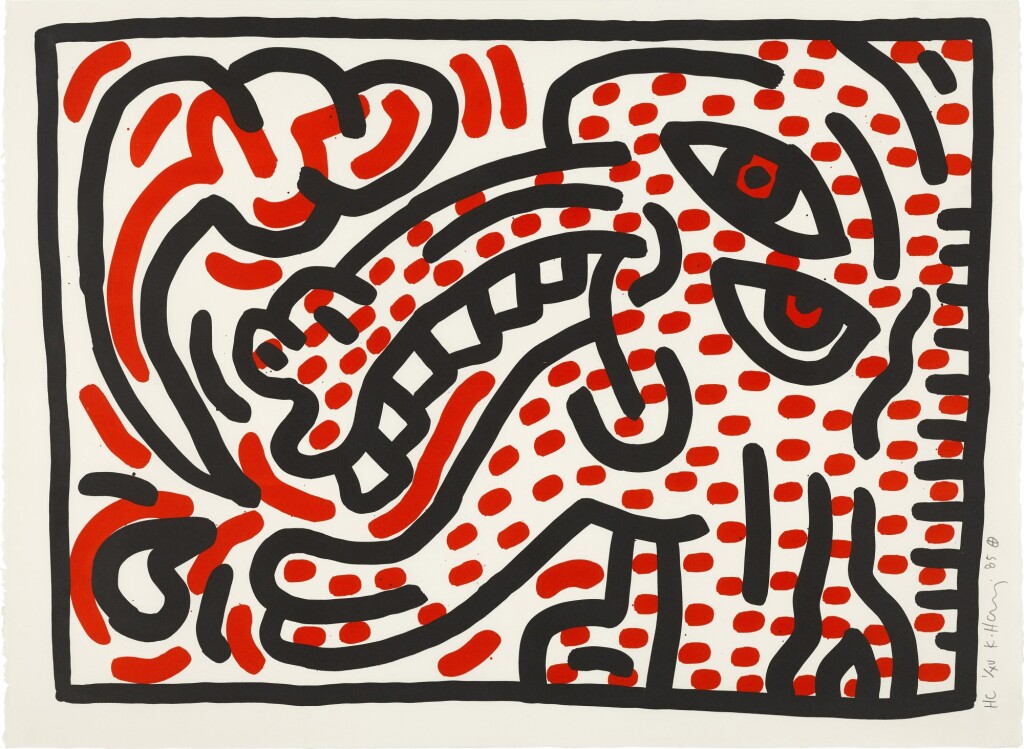
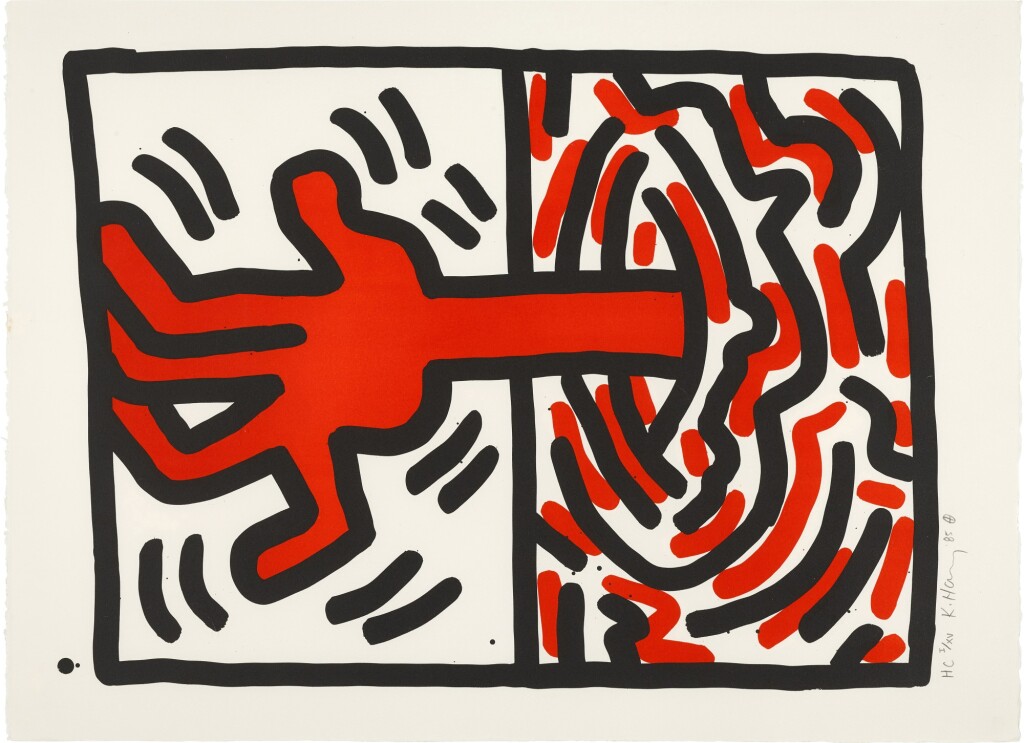
Throughout the Ludo series, Haring maintains a dominance of the color red, depicting eyes, limbs, and other body parts in abstracted forms. There is a sense of anxiety running through each print that differs from much of his earlier work, alluding to a turning point in Haring’s life. As the AIDS epidemic overwhelmed his community in the mid-1980s, Haring’s work began to reflect the difficulties he was facing in his personal life. In Ludo 1, a figure raises its arms high. In a departure from his usually narrow stick figures, this subject’s hips extend outward as wide as the feet and hands. Haring’s characteristic energy marks emanate from the head, elbows and feet, giving the standing figure a sense of movement. This reflects the motion of the chaotic red interior. The limited color palate characterizes much of Haring’s work and is most reminiscent of his Free South Africa series from the same year. Ludo 1 is the only truly figurative image in the series. The following prints of the Ludo series depict eyes, limbs, and other body parts in abstracted forms. The series’ simplified forms, like Haring’s other work, betrays the influence of the Pop Art movement and a childhood filled with Dr. Seuss, Disney, and Looney Tunes. However, the Ludo series comes at a moment of transition for Haring. As the AIDS epidemic overtook his community in the mid-1980s, Haring’s artwork reflected his increasing involvement in advocacy for the disease.
Ludo 1 (L. p. 45)
Ludo 2 (L. p. 46)
Ludo 3 (L. p.46)
Ludo 4 (L. p. 47)
Ludo 5 (L. p. 47)
Dog
1 Lithograph
Edition: 40 + 10 AP
1 curved painted plywood
Edition: 15 + 10 + 10 + 7 AP
First appearing in a subway drawing series from 1980-85, the barking dog is one of Keith Haring’s most well-known subjects. Both dogs and dog-human hybrids feature prominently in his works. Interpreted as a universal symbol of resistance and protection, barking to call out social injustice, the dog warns viewers of the abuses of power that pervade everyday life in America and beyond.
“I am intrigued with the shapes people choose as their symbols to create a language. There is within all forms a basic structure, an indication of the entire object with a minimum of lines that becomes a symbol. This is common to all languages, all people, all times.”
Haring’s use of canine imagery reflects the politically charged status of both dogs and gay men in New York at the time. In the 1970’s public anxiety about the number of dogs in the city exploded. Fueled by racism and gentrification, public health campaigns pushed for dog owners to clean up after their pets, and ‘put children before dogs’. The subtext of the campaigns was not lost on the gay community, as it echoed the homophobic public discourse around gay sex, becoming increasingly visible as liberation movements grew in power. Haring was not alone in using the dog as an emblem of queer resistance, and was joined in appropriating this symbolism by David Wojnarowicz, Jenny Holzer, and Martin Wong. Each artist used the dog as subject to challenge the surrounding narrative of fear and contagion. Haring mocks the hypocritical nature of larger society, who flippantly reject the unknown. Within this context, Haring’s Dog not only reflects the need for voices against injustice but highlights a period of creative revolution against the dehumanization of gay desire.
Dog (Lithograph)
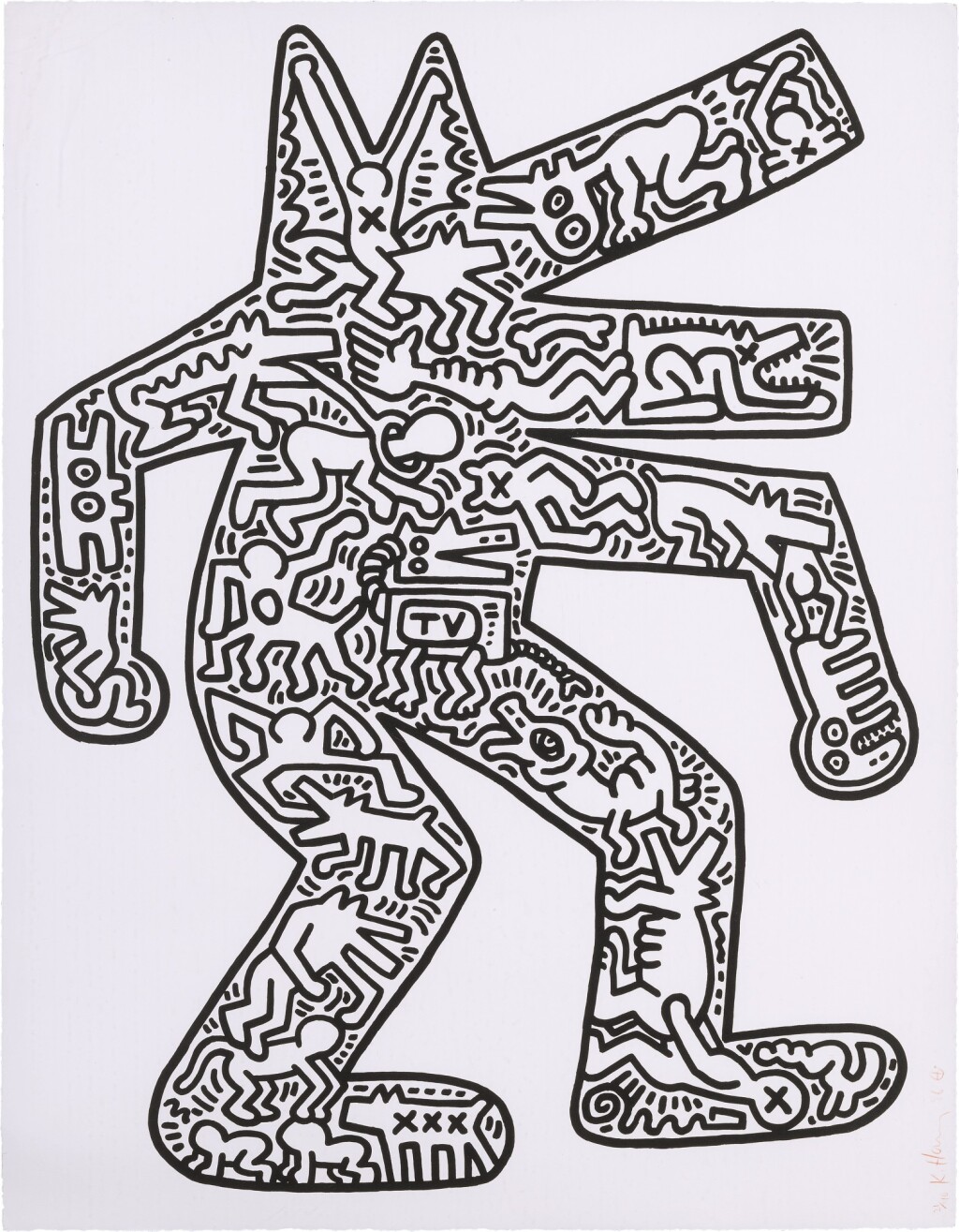
Dog, 1985
Lithograph on BFK Rives paper
Sheet: 45 x 35 1/2 inches (114×90 cm)
Edition: 40 + 10 AP (Artist’s Proofs numbered in Roman numerals)
Publisher: Edition Schellmann, Munich and New York
Literature: Littmann pp. 48-49
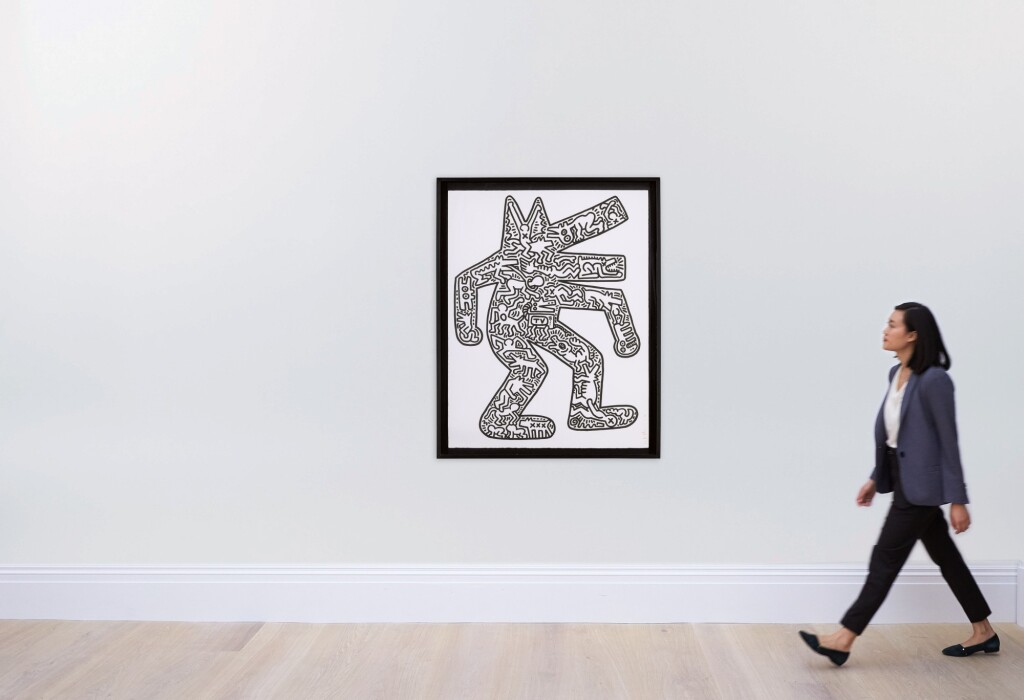
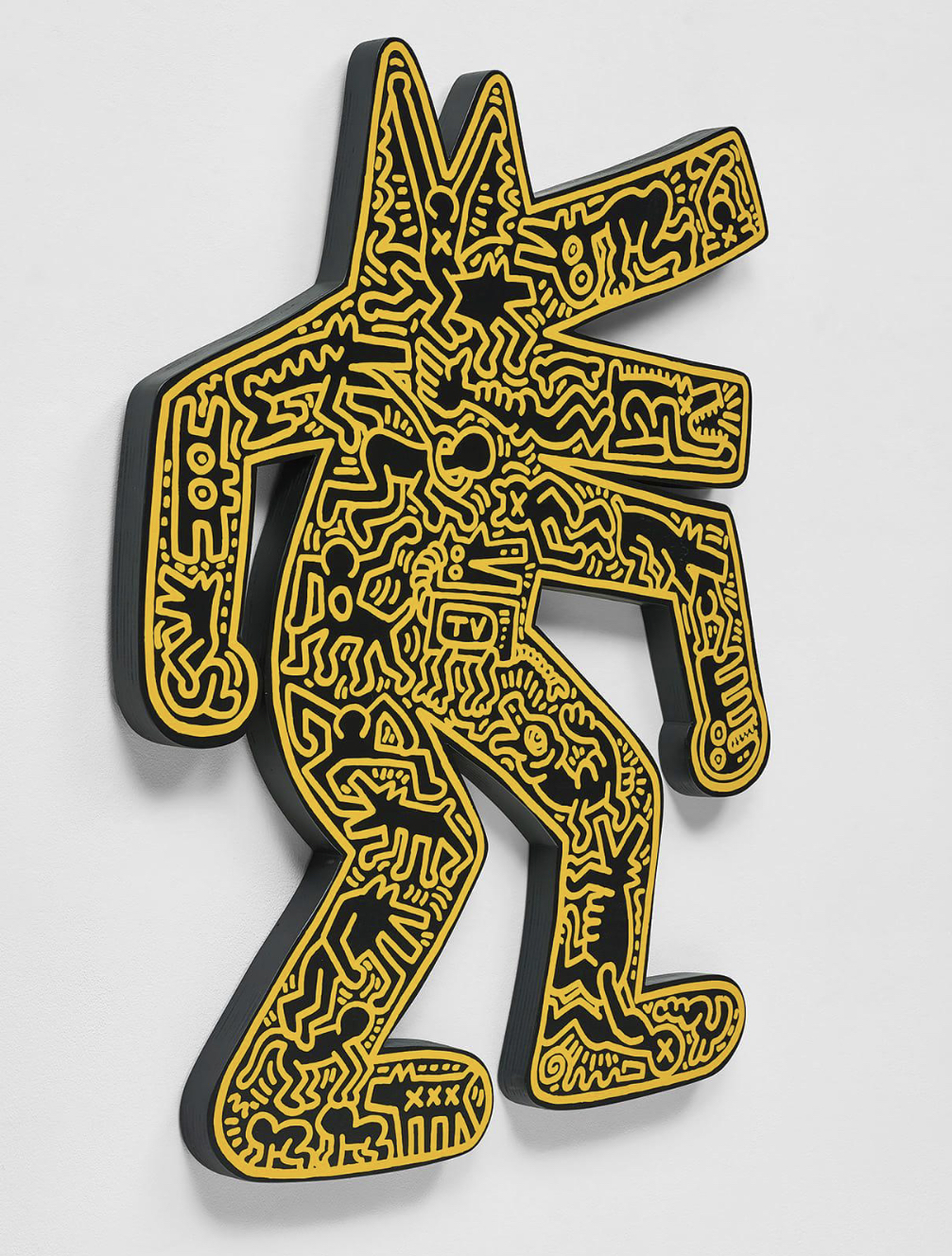
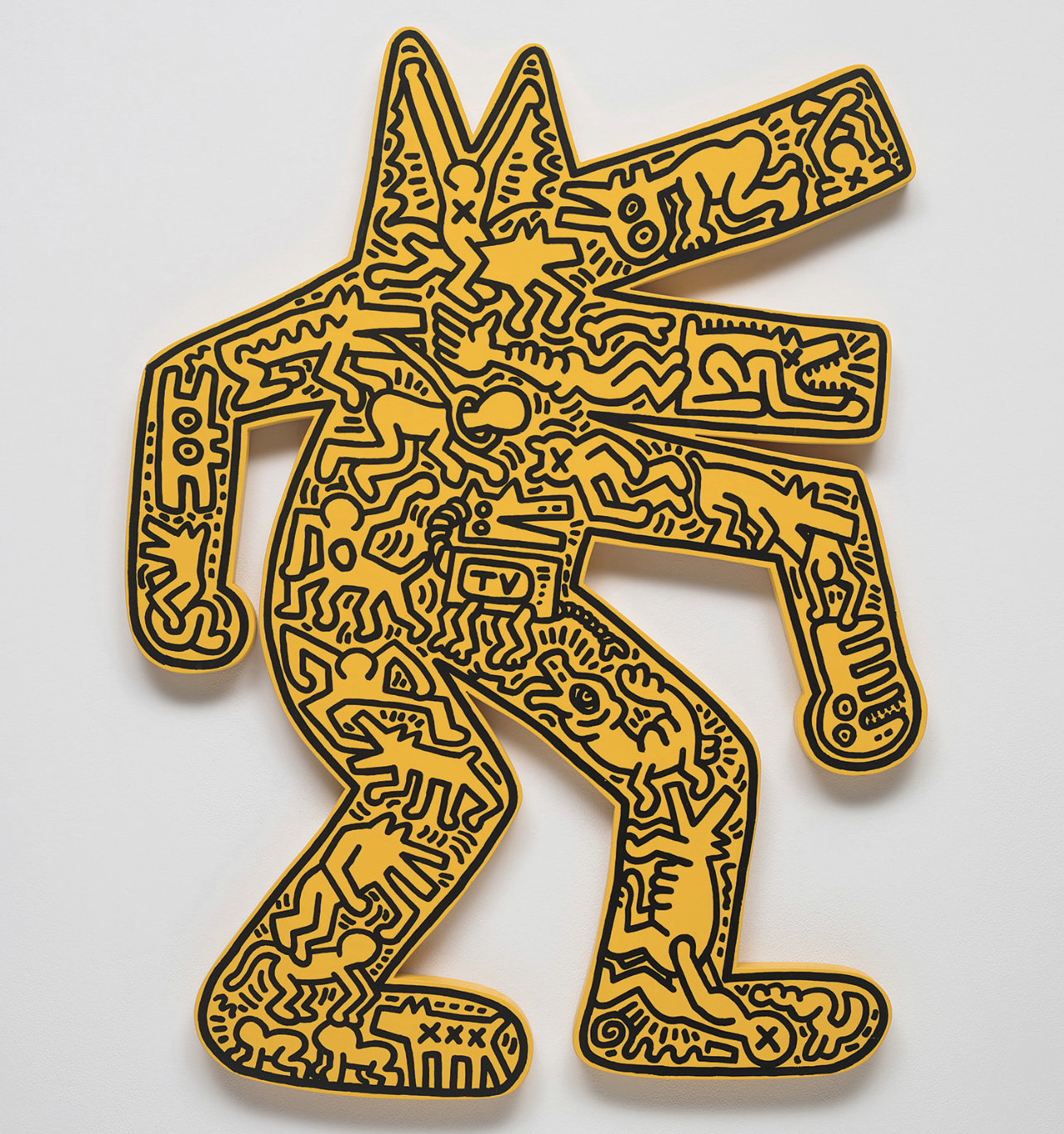
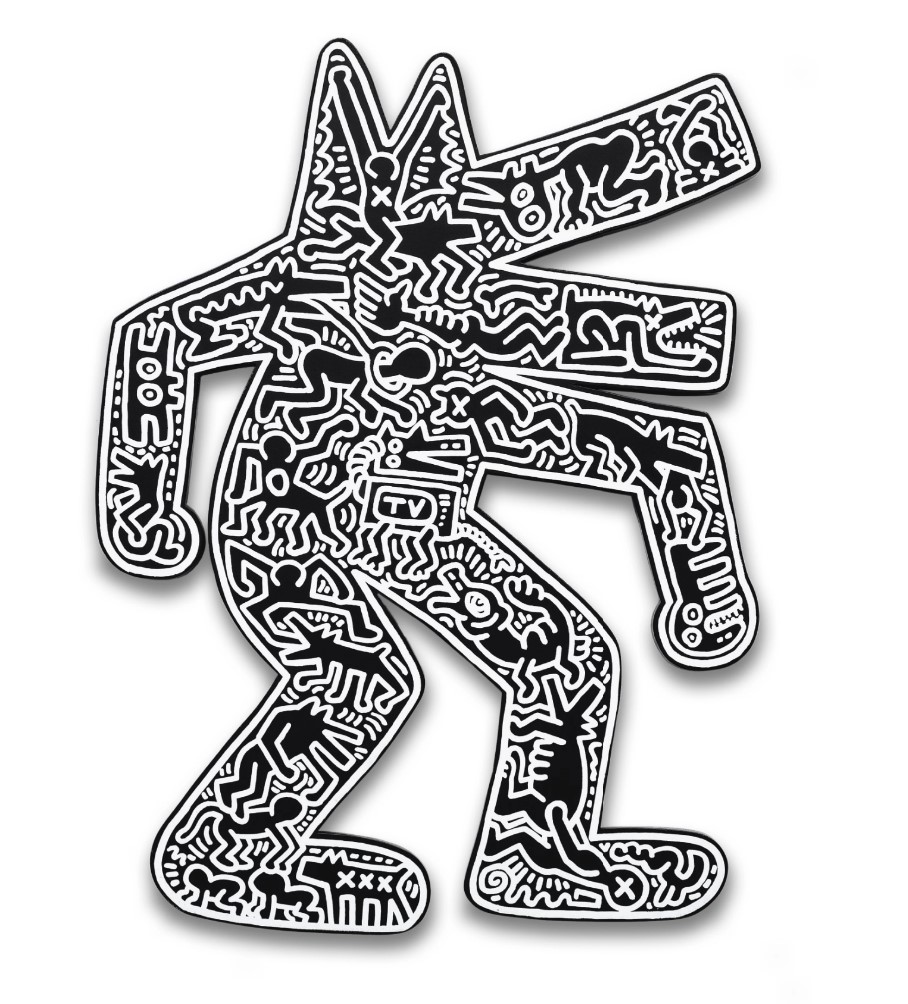
Dog (Plywood)
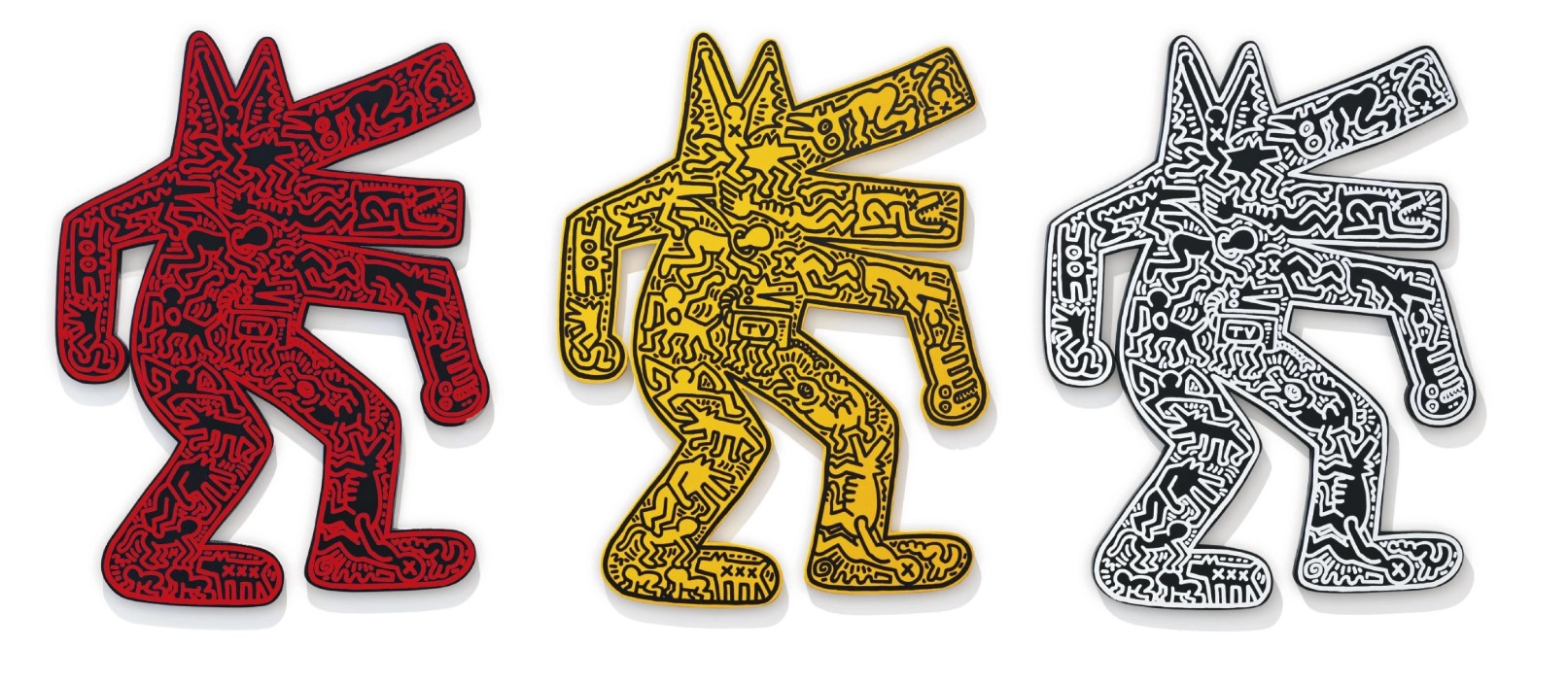
Dog, 1986
Plywood painted in yellow enamel with screen-print in black
Dimensions: 50 3/8 x 37 3/4 x 1 5/8 inches (128x96x4 cm)
Edition: 15 (white on black) + 10 (red on black) +10 (yellow on black) + 7 AP
Trial Proofs: 3 unique color variants
Publisher: Edition Schellmann, Munich and New York

Untitled (L. p. 50)
1 Print
Edition: 150 + 20 AP
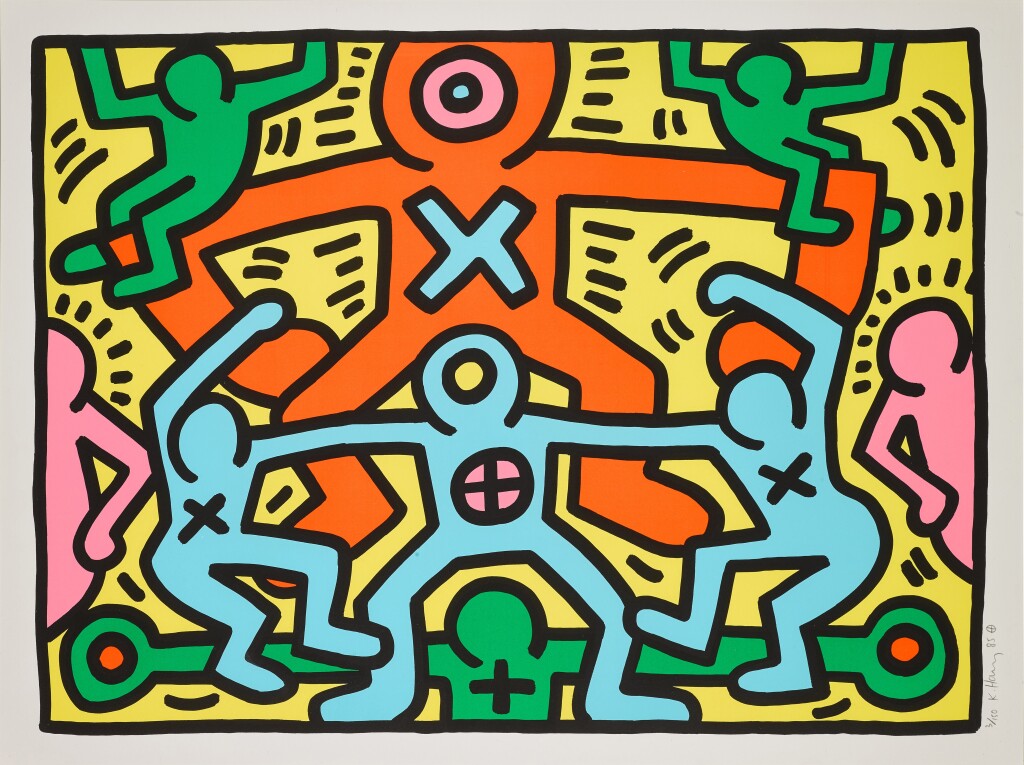
Untitled, 1985
Screen-print in colors on Rives BFK wove paper
Sheet: 23 1/2 x 31 1/2 inches (60×80 cm)
Edition: 150 + 20 AP
Literature: Littmann p. 50
This pulsating print features a large and vivid red figure with an “X” prominently displayed on its body. This central figure is a focal point that sets the stage for the narrative that unfolds within this striking visual. This red figure, rendered in the artist’s signature bold lines conveys a sense of strength and authority as it seems to watch some form of chaos in every free space of the composition. The simplicity and vibrancy of the color palette can evoke some form of nostalgia for classic children’s animations. Other figures in the composition carry the “X” mark as well suggesting a form of connection and shared experience. Obviously, this sign symbolizes societal challenges, stigmatization, related to themes of identity, conformity or resistance. Haring addresses themes that are both personal and universal, advocating for inclusivity, equality, and human rights, exploring the complexities of human relationships, power dynamics, and all the struggles inherent in navigating societal structures.
4. 1986 Prints
1,986 Prints
17 Prints
844 Impressions
Keith Haring released 17 prints in 1986, including Bad Boys, a portfolio of 5 erotic oriented prints, and the iconic Andy Mouse set.
Medusa Head
1 Aquatint
Edition: 24
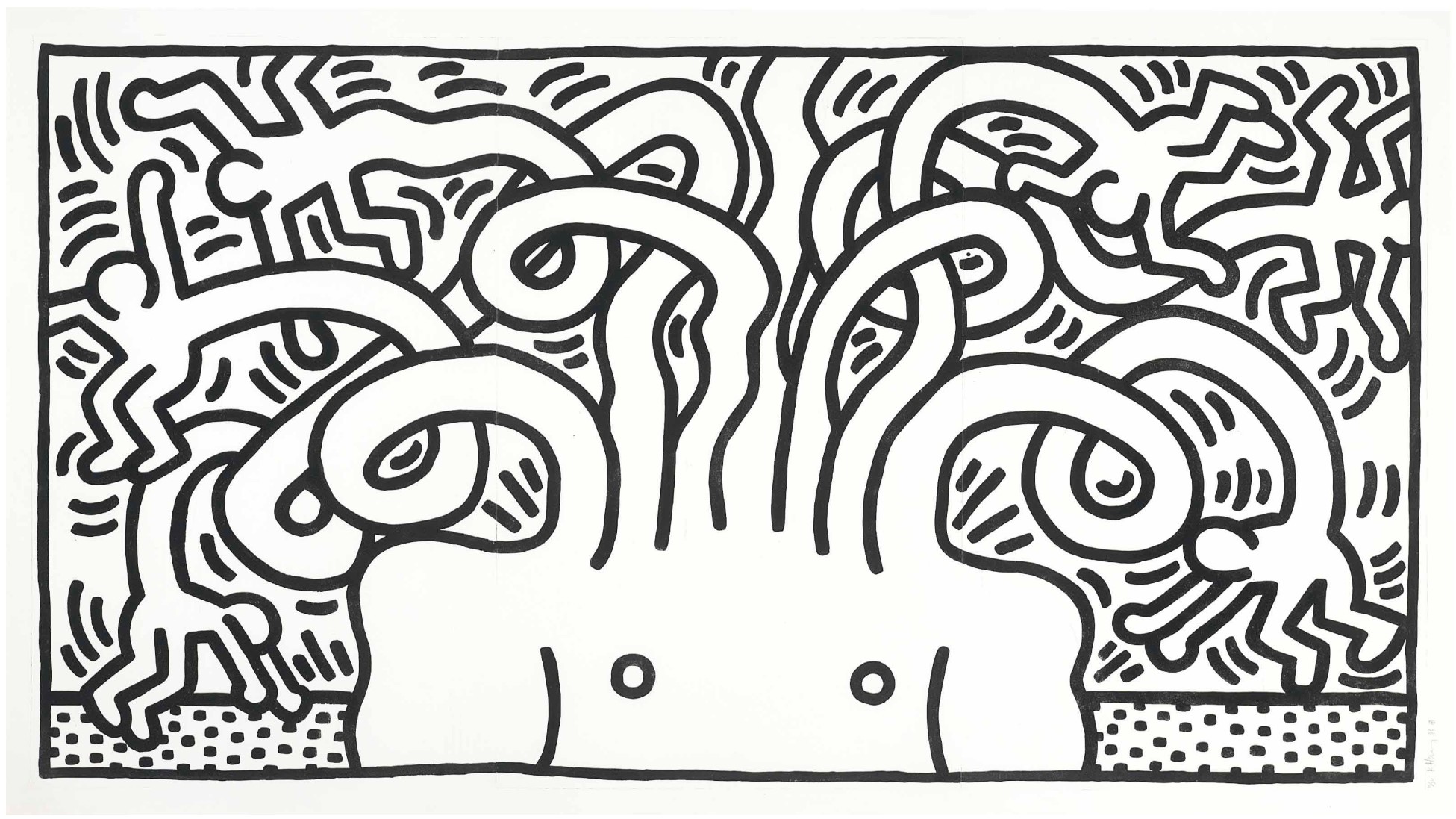
Untitled (Medusa Head), 1986
Aquatint on Hahnemühle paper
Sheet: 54 1/4 x 97 3/4 inches (138.5 x 248.3 cm)
Edition: 24
Publisher: Niels Borch Jensen Editions, Copenhagen
Literature: Littmann pp. 54-55
Bad Boys
6 Prints
Edition: 30 + 7 AP

Bad Boys, 1986
The complete set of six screen-prints in black on BFK Rives wove paper
Sheet: 20×26 inches (50.6 x 65.9 cm)
Edition: 30 + 7 AP
Publisher: Bébert, Rotterdam
Literature: Littmann pp. 56-59

Bad Boys Plate #1 (L. p. 57)

Bad Boys Plate #2 (L. p. 58)

Bad Boys Plate #3 (L. p. 58)

Bad Boys Plate #4 (L. p. 59)

Bad Boys Plate #5 (L. p. 59)

Bad Boys Plate #6 (not in Littmann)

Portrait of Joseph Beuys
1 Print
Edition: 90 + 6 AP + XXX

Portrait of Joseph Beuys, 1986
Screen-print in brown on canvas
Dimensions: 31 1/2 x 23 1/2 inches (80×60 cm)
Edition: 90 + 6AP
Publishers: Edition Schellmann, Munich and New York, and Galerie Bernd Klüser, Munich
Literature: Littmann pp. 60-61
Haring depicts Beuys as an oak tree, an homage to Beuys’ installation at Documenta 7 where the artist planted 7,000 oak trees throughout the city of Kassel. Haring, who was also participating in Documenta 7, appreciated the older artist’s emphasis on creating works that would help society.

Edition: XXX
Untitled (L. p. 62)
1 Lithograph
Edition: 38 + 4 AP
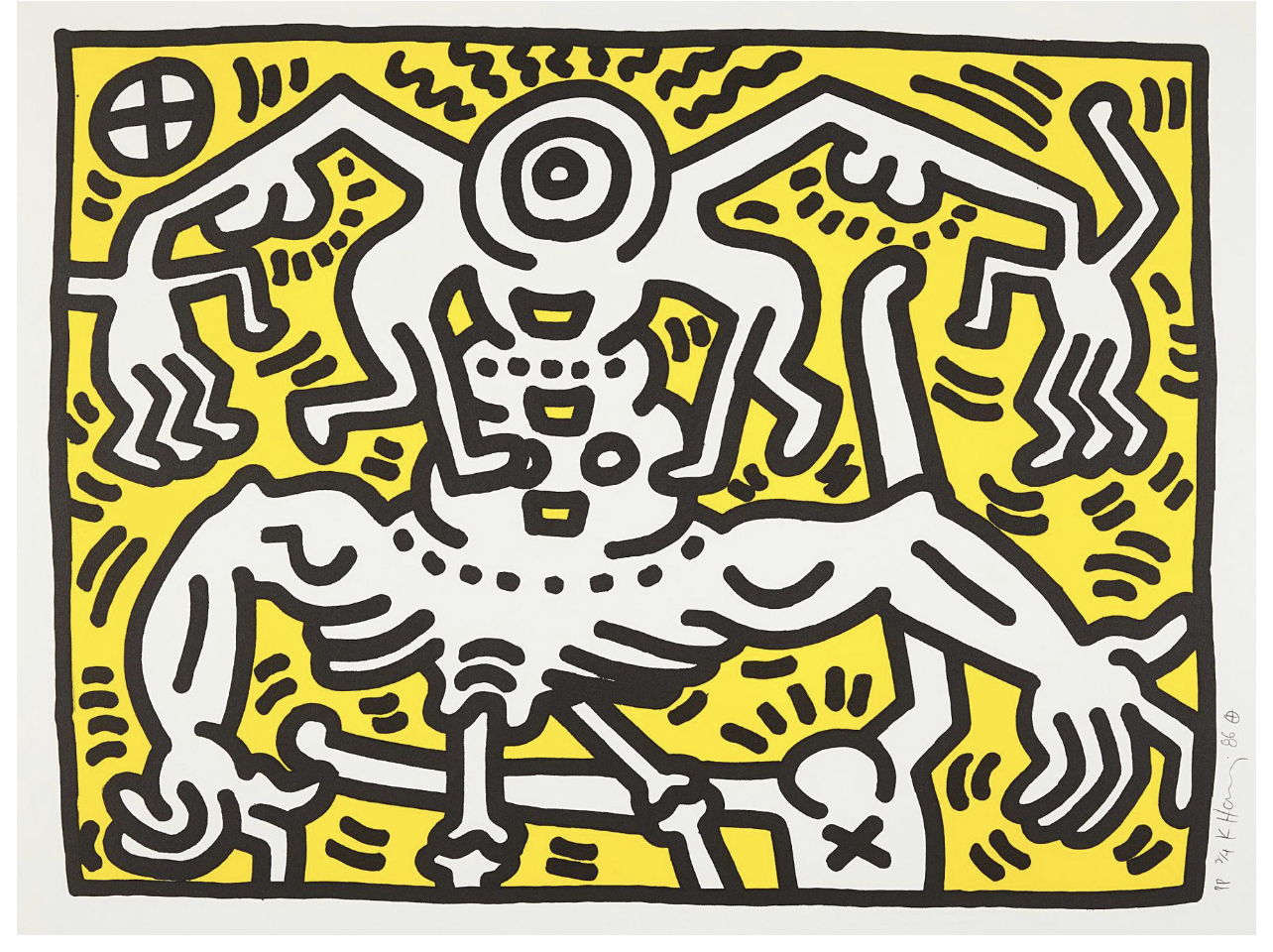
Untitled, 1986
Lithograph in colors on wove paper
Sheet: 24×32 inches (61×81 cm)
Edition: 38 + 4 AP
Literature: Littmann p. 62
Double Man
1 Lithograph
Edition: 85 + 15 AP
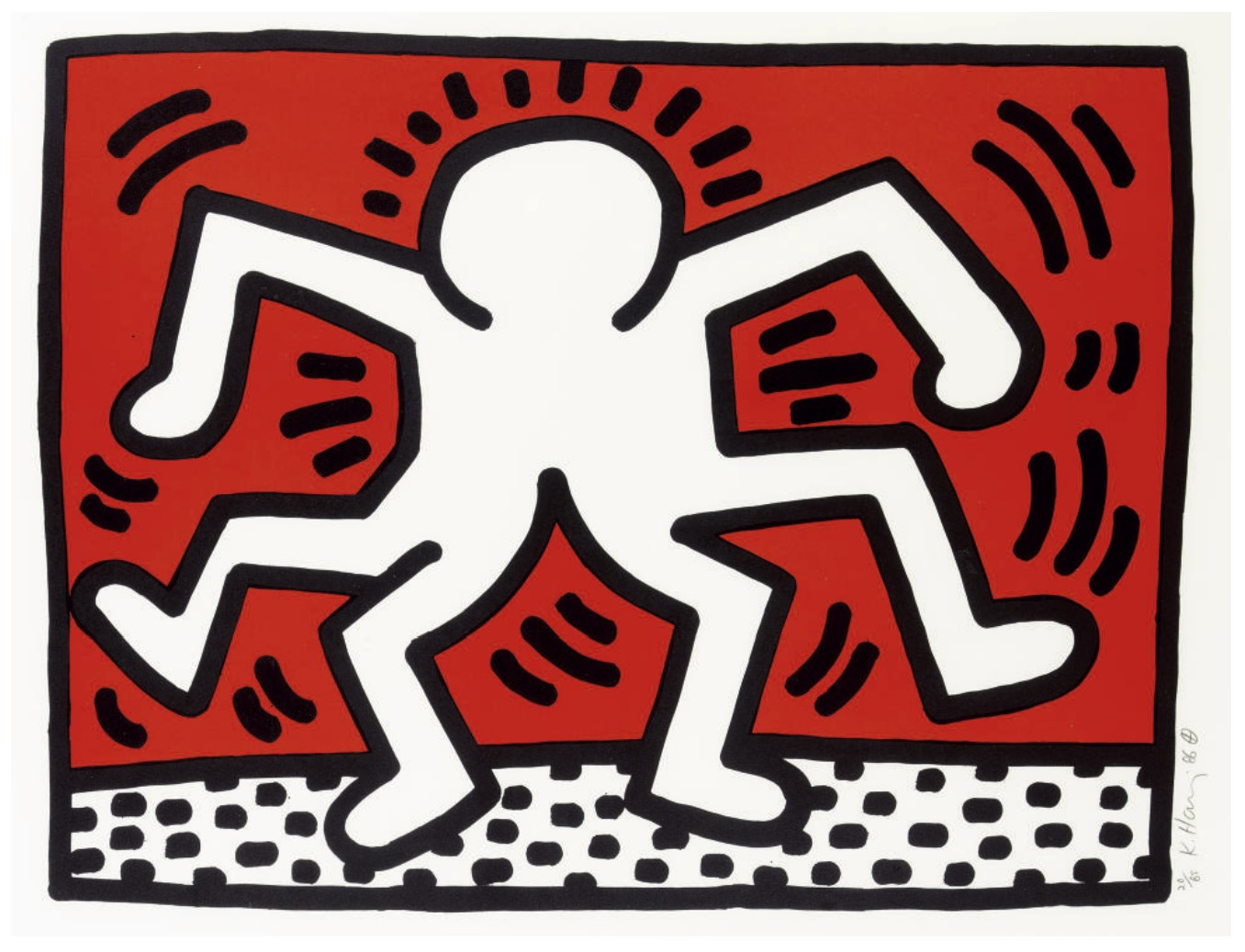
Double Man (from Portfolio of 5 Artists in Support of Bill T. Jone/Arnie Zane & Company), 1986
Lithograph in black and red on wove paper
Sheet: 22×29 inches (56.5 x 74.3 cm)
Edition: 85 + 15 AP
Literature: Littmann p. 62
Statue of Liberty
1 Print
Edition: 100 + 25 AP + XXX
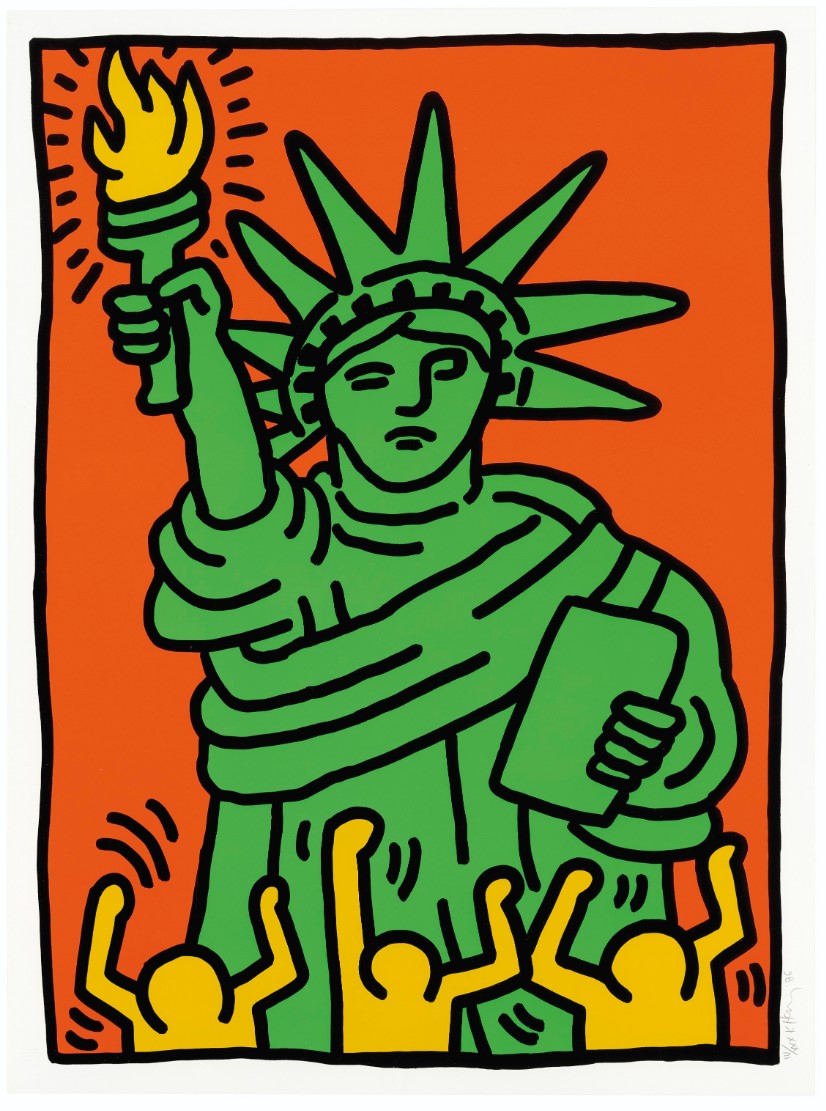
Statue of Liberty, 1986
Screen-print in colors on thick wove paper
Sheet: 37 7/8 x 28 1/4 inches (96.3 x 71.6 cm)
Edition: 100 + 25 AP + XXX (30 numbered in Roman numerals)
Publisher: Martin Lawrence Limited Editions Inc., New York
Printer: Rupert Jasen Smith, New York
Literature: Littmann p. 63
In 1986, Keith Haring was commissioned to produce a mural commemorating the 100-year anniversary of America receiving the Statue of Liberty from France. Over a period of three days at the Jacob Javits Convention Center, hundreds of kids from all five New York City Boroughs were orchestrated and instructed by Haring to add their own contributions to the banner, a 2-ply fire retardant nylon that weighs 190 lbs, citing what they thought Liberty meant to them. Given the overt uniqueness of the banner’s conception, it is often referred to as one of the most meaningful works of art in the entire Haring oeuvre.

The completed banner debuted at Liberty Tower in Battery Park City over the 1986 Fourth of July celebration, and has subsequently been exhibited in Europe and throughout the United States. Painted in tandem with the CityKids foundation and over 1,000 young people from across the city, Haring created an emblematic scenario that brought together hundreds of people in his community to create an inspiring reminder of what liberty truly means.
Andy Mouse
4 Prints
Edition: 30 + 10 AP + 5 HC
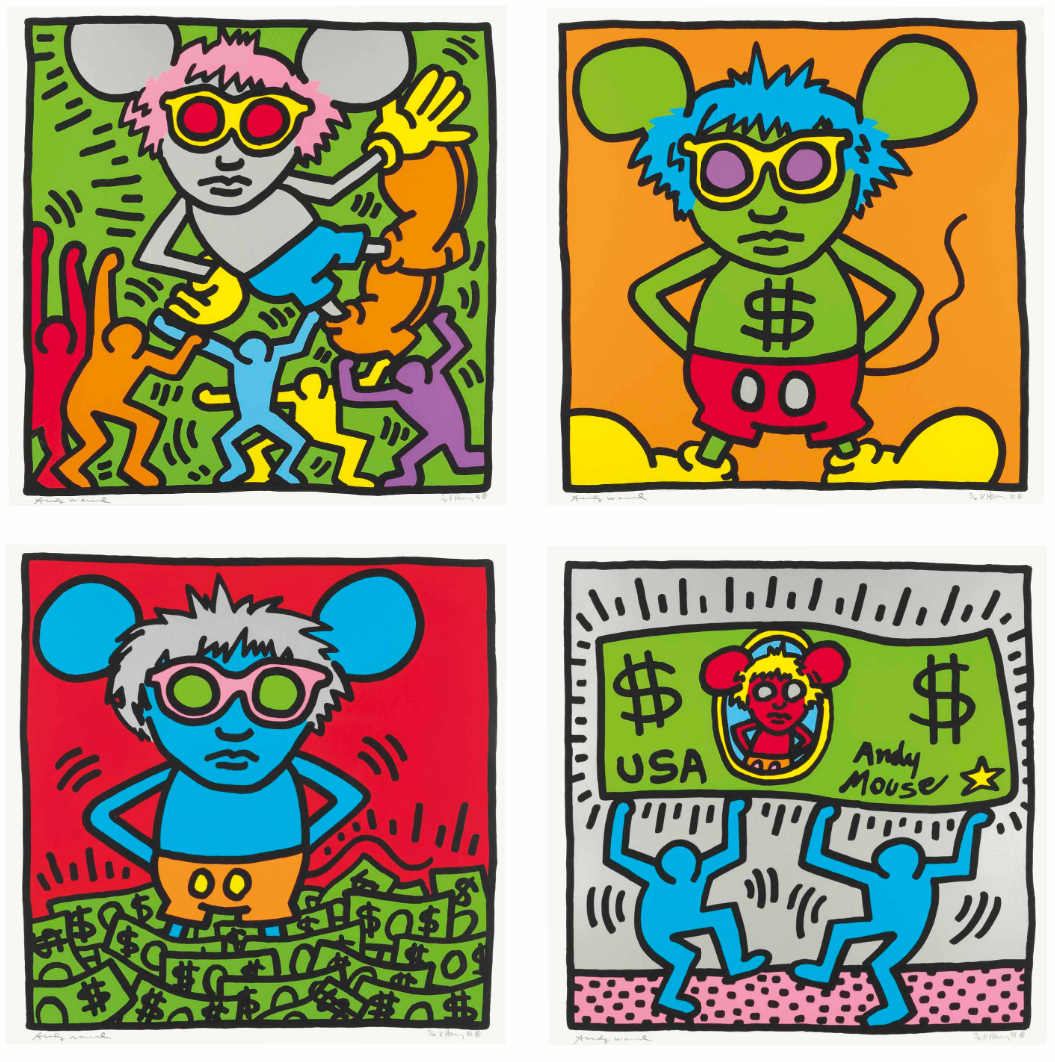
Andy Mouse, 1986
The complete set of four screen-prints in colors on Lenox Museum Board
Sheet: 38×38 inches (96.4 x 96.4 cm)
Edition: 30 + 10AP + 5 HC (Hors Commerce impression)
Publisher: George Mulder Fine Art, New York
Literature: Littmann pp. 64-65
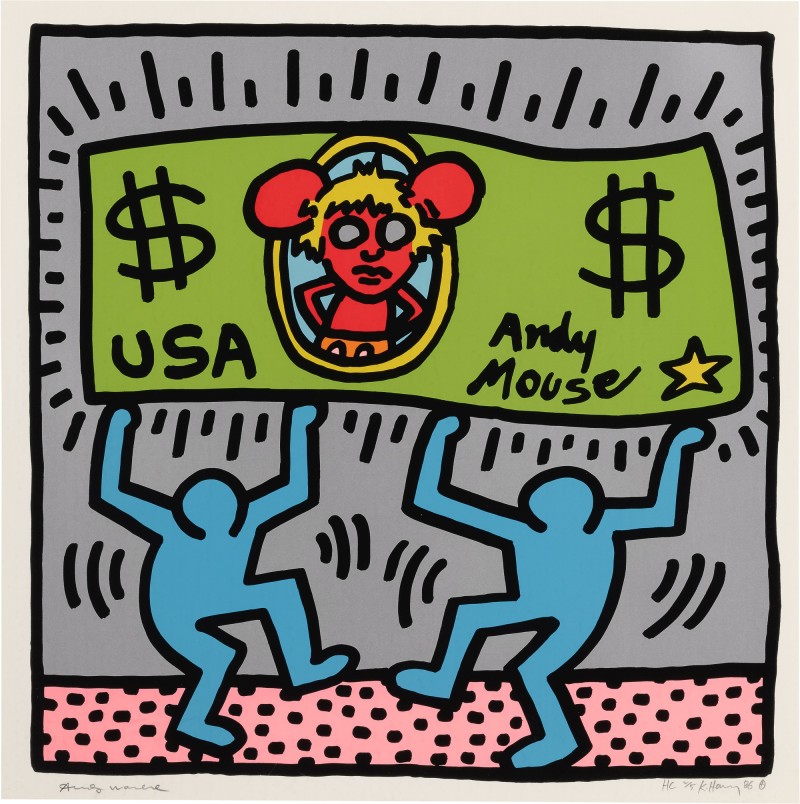
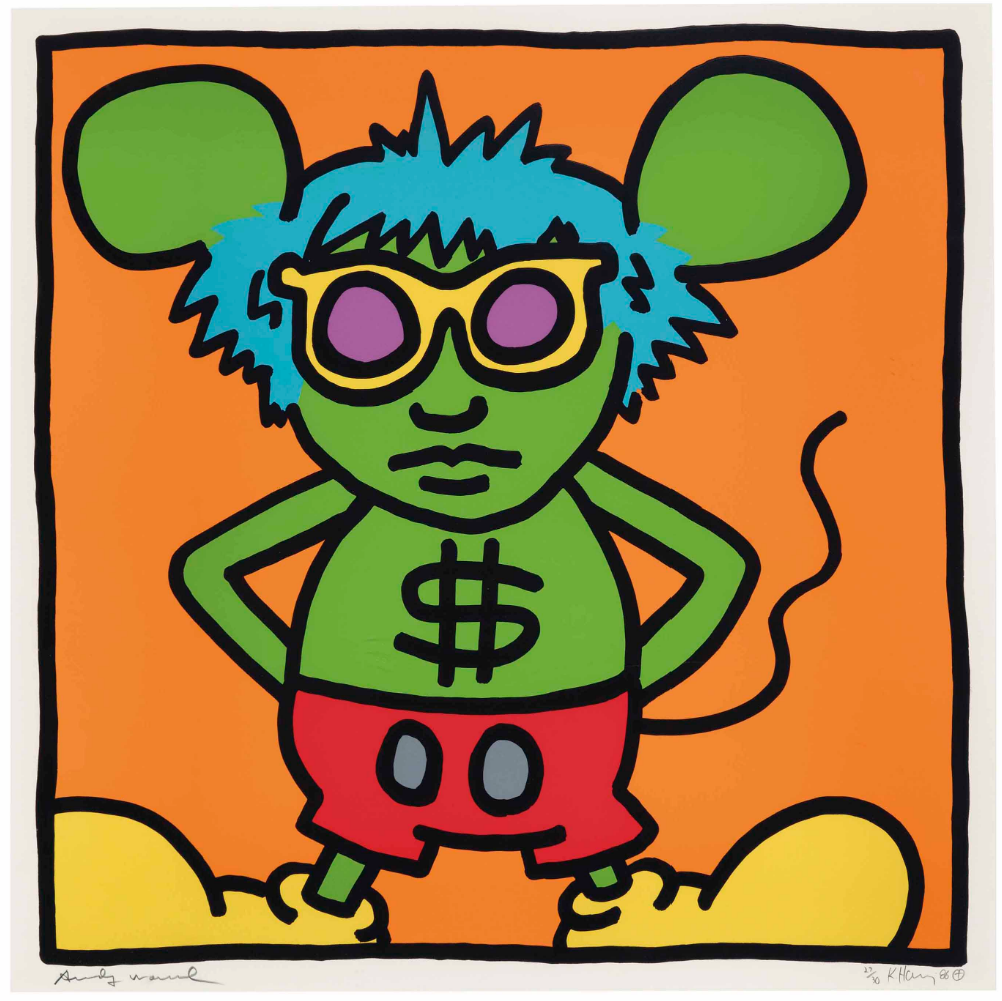
Keith Haring’s Andy Mouse is a superlative example of the artist’s iconic pop art vernacular and a testament to his relationship with Andy Warhol, both an artistic contemporary and friend of Haring. Depicting Warhol with features referencing Walt Disney’s Mickey Mouse, the present work draws a parallel between Disney’s children’s cartoons and Warhol’s complex social commentary, perhaps alluding to the capitalist foundations of entertainment and media. A thorough embodiment of the Pop Movement, Andy Mouse features the key elements of money, media, and art which propelled the likes of Warhol and Haring to cultural stardom. The very serialization of this work, both as a set of four images and as an editioned print, alludes to these ubiquitous pop-themes. An homage to his mentor and friend Andy Warhol, the present work demonstrates Haring’s masterful ability to unite a nostalgia for his American upbringing during the ‘golden age of television’ with a recognition of what Warhol recognized as emblems of the profound impact these commercial images had on contemporary culture. Printed in seven colors (black, grey, green, blue, yellow, red, pink and orange) in an edition of 30, the Andy Mouse series is significant for its formal qualities as well as its subject. Though Haring had experimented with print techniques such as lithography in the late 1970s it wasn’t until 1983 that he began making screen prints. Adopted from the world of commercial printing, this method offered a way of creating multiple images with vivid colors and little variation between prints. It soon became evident that the energy and curiosity Haring demonstrated for painting translated perfectly into printmaking and he began to work with publishers across the US, Switzerland, Japan, Germany, France, Denmark and Holland, producing ever more inventive and daring work. Though many of his prints were made in editions of 100 or more, there is an element of precision in every single one that shows the level of care with which he supervised the process.
Andy Mouse Plate 1 (L. p. 64)
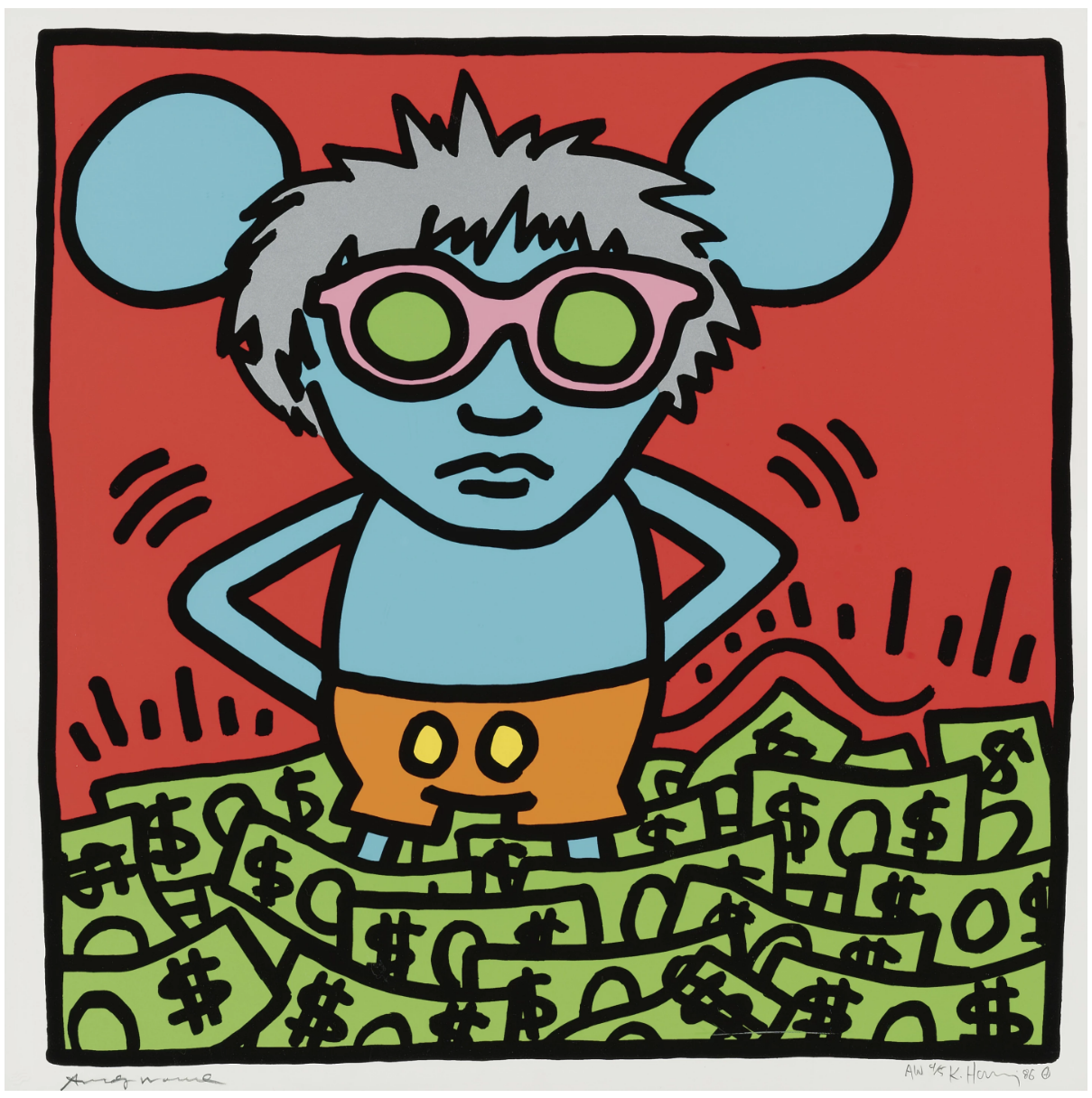
Andy Mouse Plate 2 (L. p. 64)
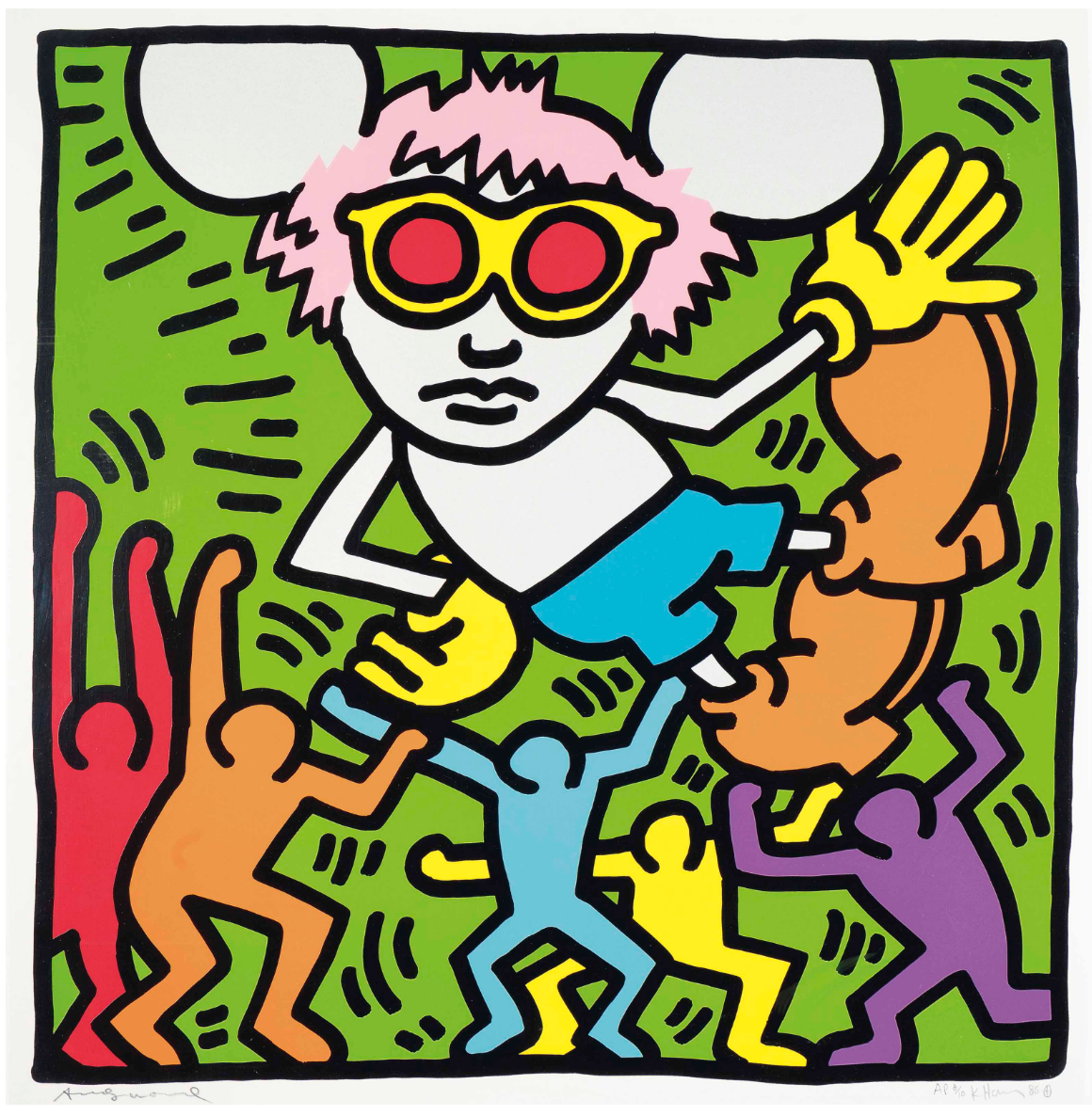
Andy Mouse Plate 3 (L. p. 65)
Andy Mouse Plate 4 (L. p. 65)
Self-Portrait
1 Print
Edition: 25
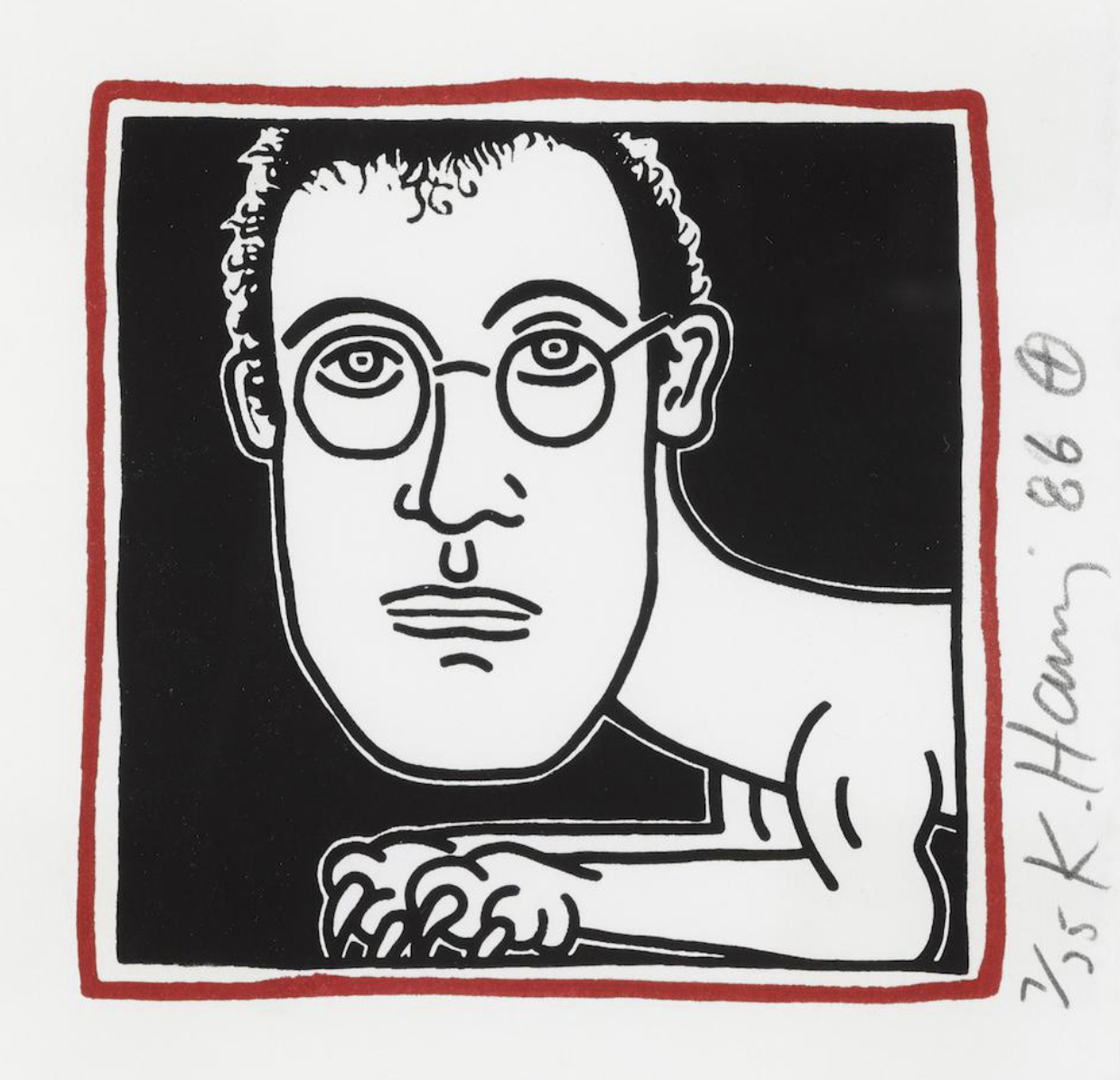
Self-Portrait, 1986
Screen-print in colors on wove paper
Sheet: 6×6 inches (15×15 cm)
Edition: 25
Literature: Littmann pp. 66-67
5. 1987 Prints
1987 Prints
16 Prints
1,990 Impressions
In 1987, Keith Haring released Untitled, a set of four lithographs composed with his signature-style figures, his first Pop Shop series (see separate section), a series of prints commissioned by Lucky Strike.
Untitled
4 Lithographs
Edition: 100 + 10 AP
Untitled, 1987
The complete set of 4 lithographs in colors on BFK Rives paper
Sheet: 11 x 14 3/4 inches (28×37 cm)
Edition: 100 + 10 AP
Publisher: Martin Lawrence Ltd., New York
Literature: Littmann pp. 74-75
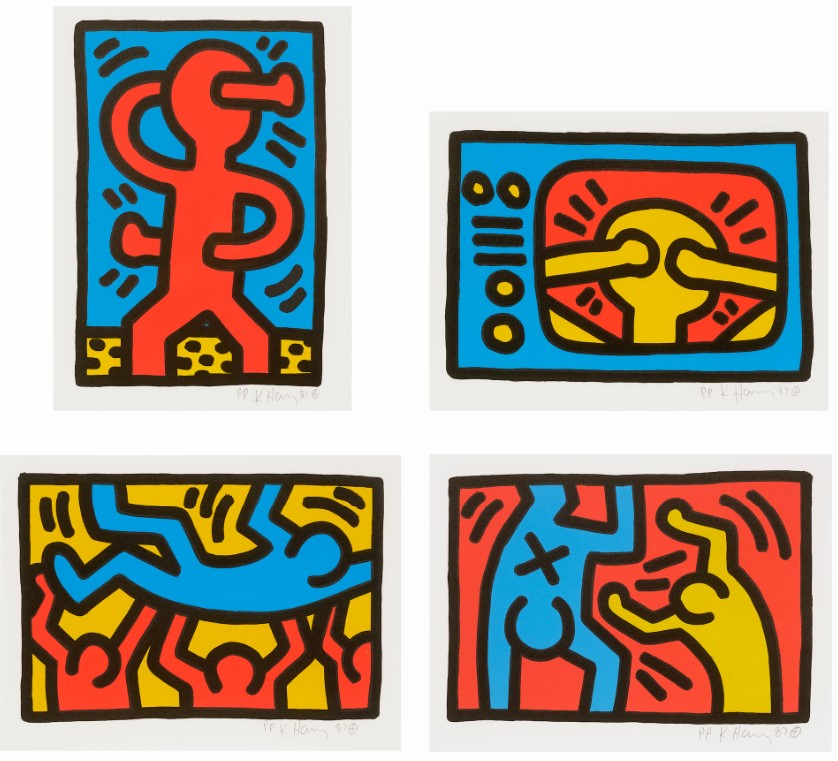
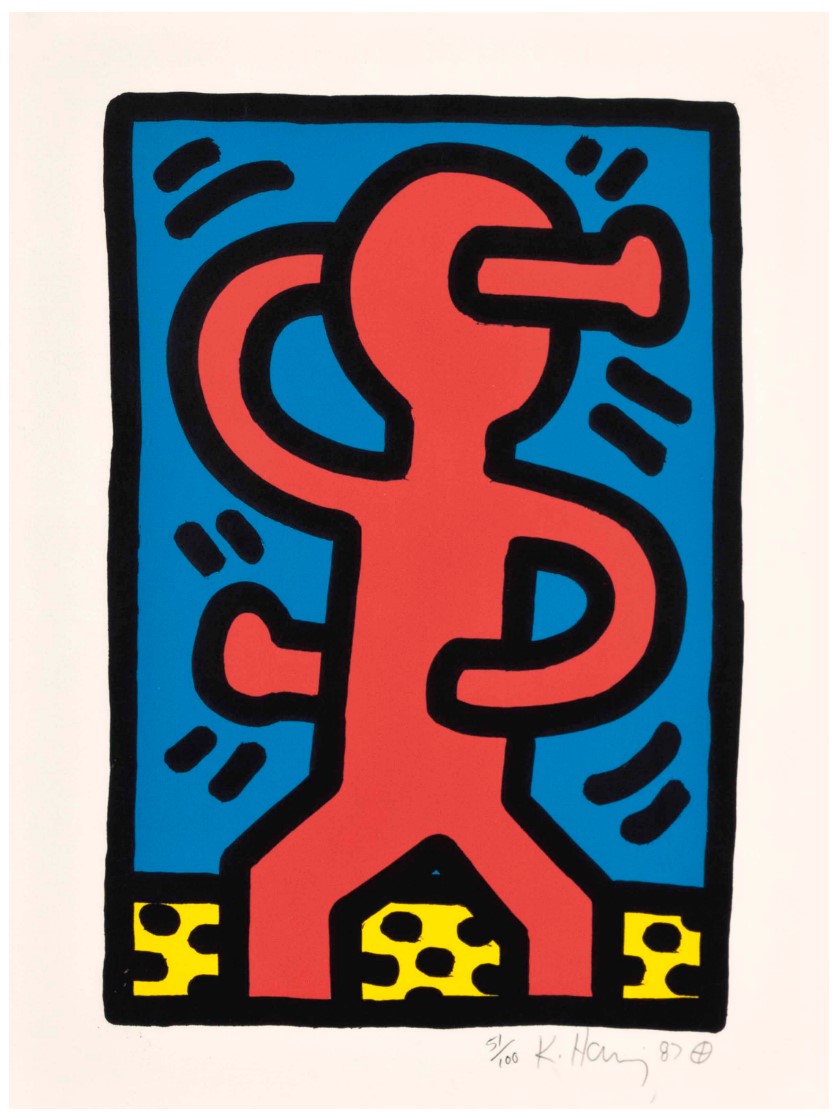
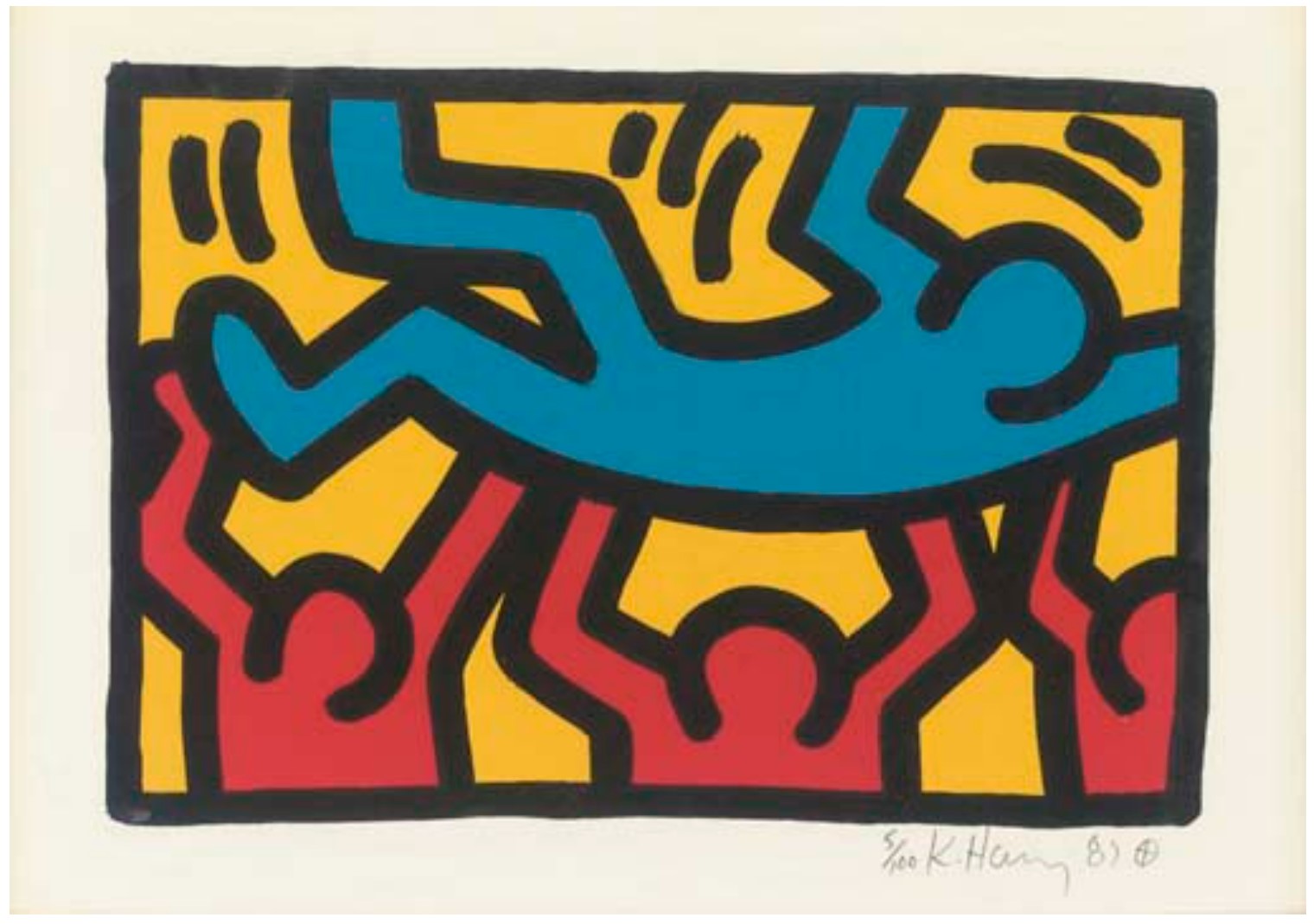
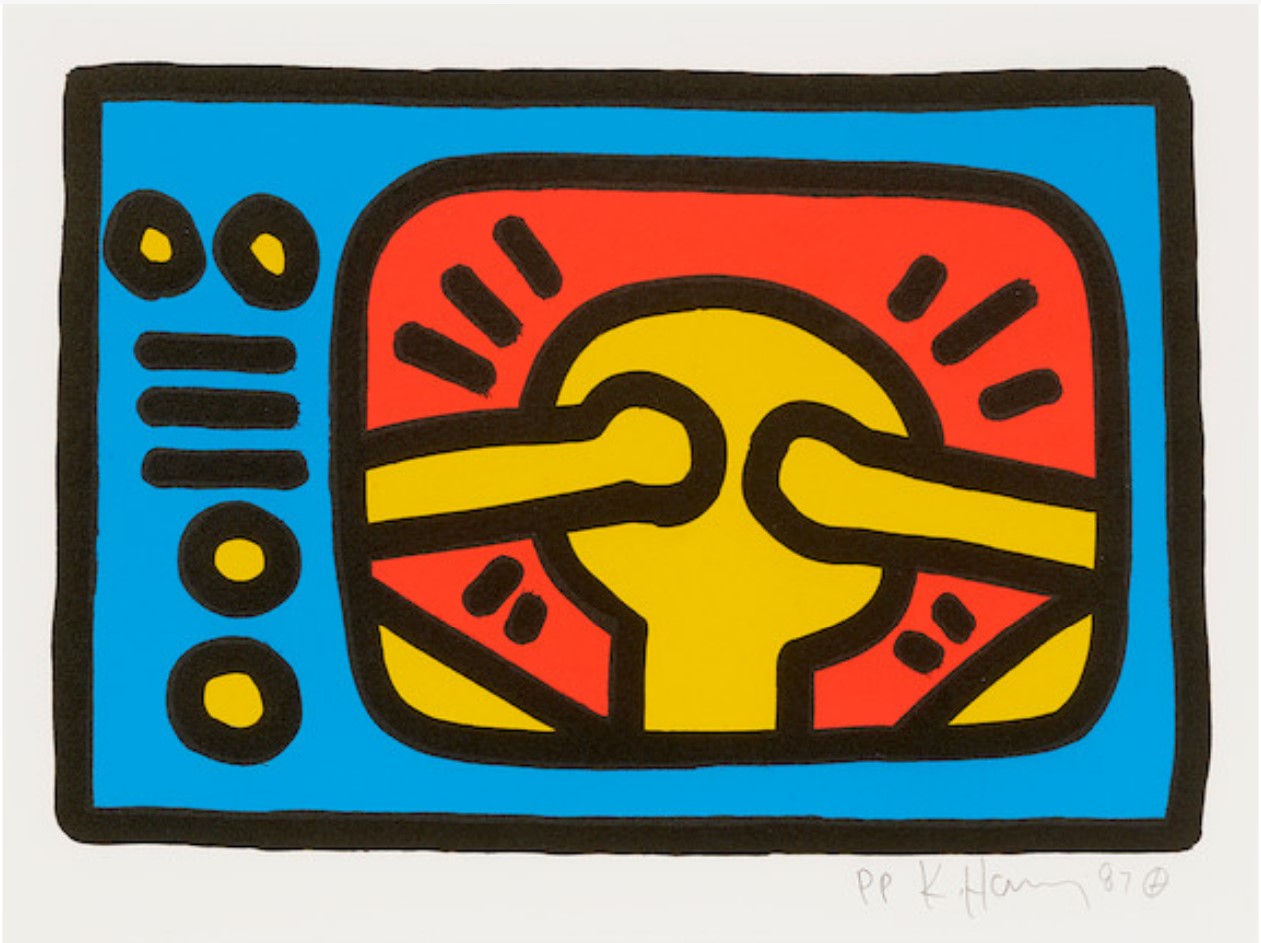
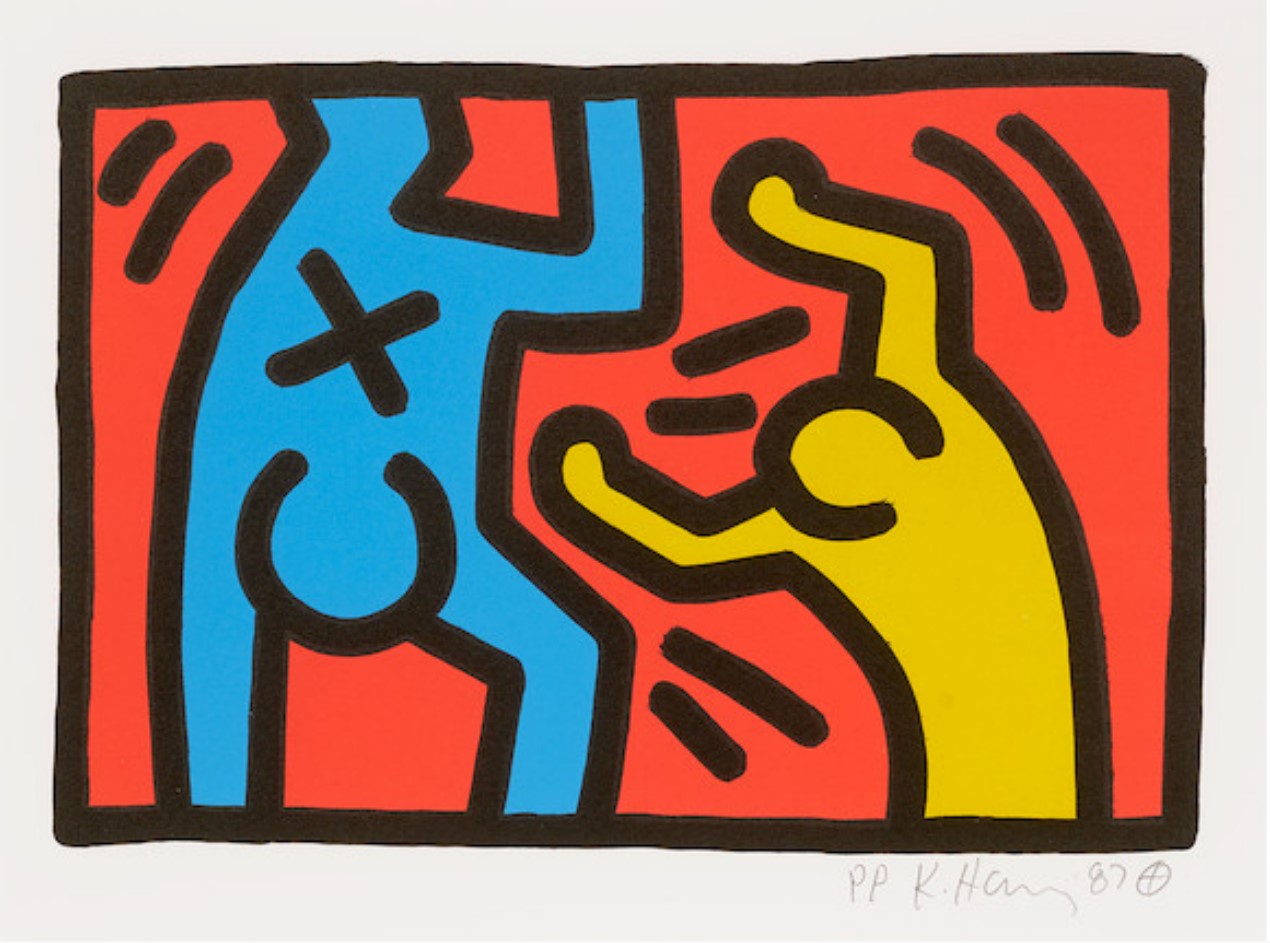
The Untitled 1987 suite is comprised of four lithographs typical of Keith Haring’s signature style. The artists used a restricted palette of only three primary colors: red, blue and yellow with bold graphic outlines made of black. They depict four naively rendered figures in various dynamic poses and interacting with each other. Those works are a clear precursors of the Pop Shop series showcasing an imagery easily understood by all across borders, cultures, and age.
Untitled Plate I (L. p. 74)
Untitled Plate II (L. p. 74)
Untitled Plate III (L. p. 75)
Untitled Plate IV (L. p. 75)
Lucky Strike
Lucky Strike 1 & 2: 2 Prints
Edition: 30 + 6 AP
Lucky Strike 3&4: 2 Prints
Edition: 80 + 6 AP
Lucky Strike 5: 1 Print
Edition: 50 + 6 AP
In 1987, Keith Haring created a portfolio of five screen-prints commissioned by British American Tobacco for Lucky Strike. This body of work depicts boxes of Lucky Strike cigarettes, the top-selling brand of cigarettes of the 1930s and ‘40s, alongside some of the artist’s signature illustrations. All five pieces in this portfolio are screen-prints, a method of printing that allows the artist to maintain bold colors and precise line
Lucky Strike Plate I (L. pp. 76-77)
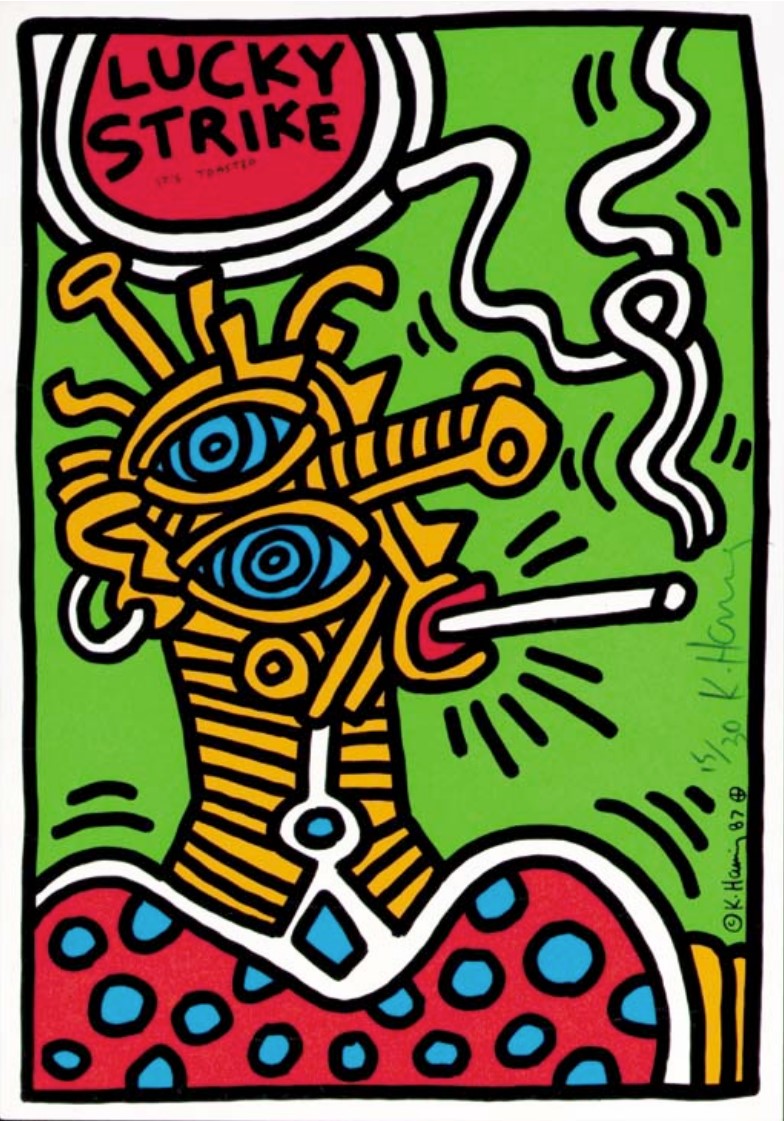
Lucky Strike: Plate 1, 1987
Screen-print in colors on wove paper
Sheet: 11 1/2 x 8 1/4 inches (29.7 x 21 cm)
Edition: 30 + 6 AP
Publisher: Pierre Keller, Switzerland
Literature: Littmann p. 77
In this work, Haring illustrates a peculiar figure in yellow, blue, red and white atop a green background. The figure’s entire body is composed of cross contours that renders her into disfigurement. She is adorned in a red dress that mimics popular women’s attire of the 1930s and ‘40s, the most lucrative period for Lucky Strike cigarettes. The woman smokes a “lucky,” and from its smoke arises the Lucky Strike logo above the figure’s head. This imagery mimics visual advertising for cigarettes, but alongside the deformed figure, it propagates the adversities of smoking to the masses.
Lucky Strike Plate II (L. p. 78)
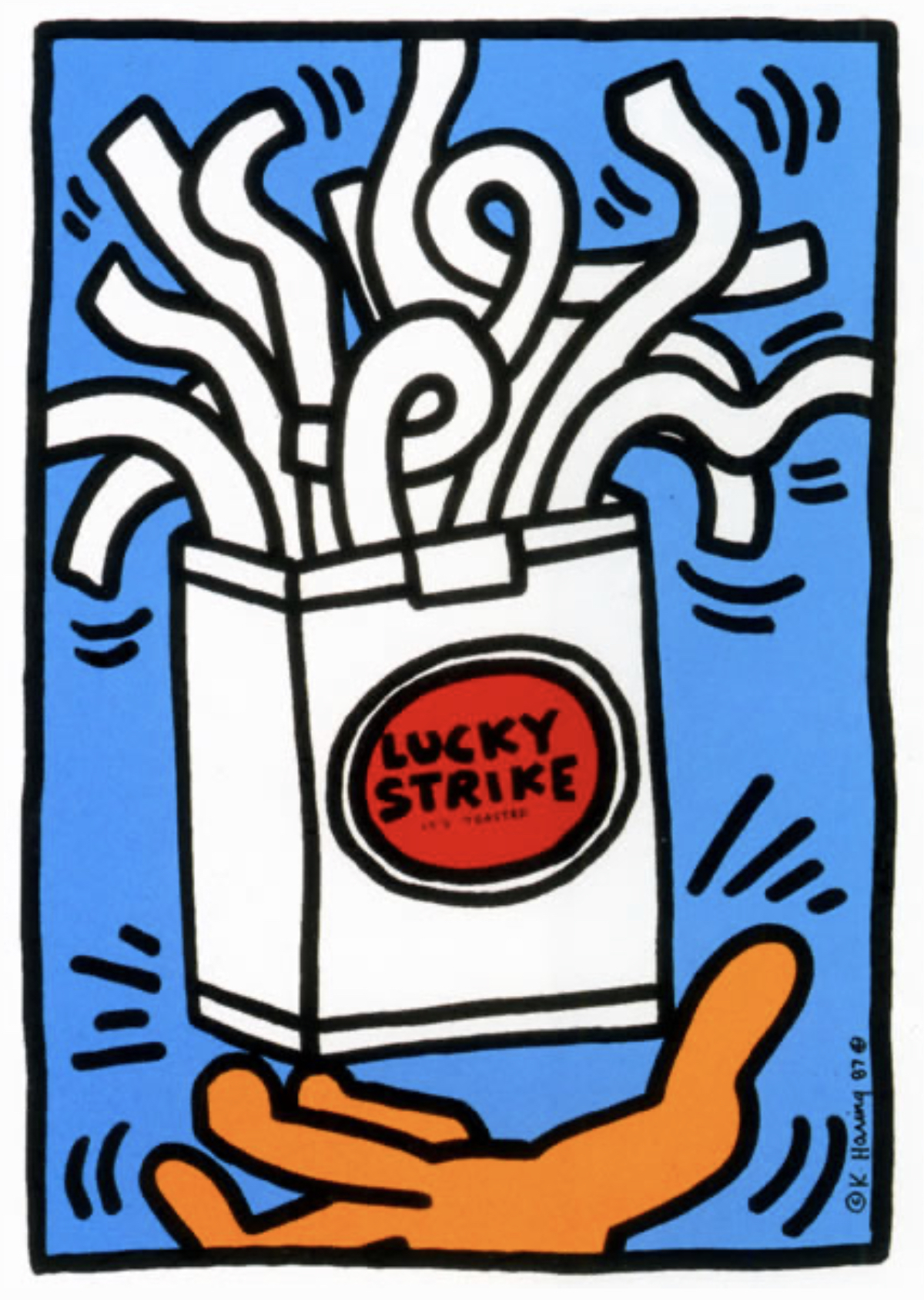
Lucky Strike: Plate 2, 1987
Screen-print in colors on wove paper
Sheet: 11 1/2 x 8 1/4 inches (29.7 x 21 cm)
Edition: 30 + 6 AP
Publisher: Pierre Keller, Switzerland
Literature: Littmann p. 78
In this work, Keith Haring illustrates an open box of Lucky Strike cigarettes hovering above an open orange hand over a blue background. These forms are rendered in bold and precise line and color, staples of Haring’s work that are enhanced by the printing method known as screen-printing. The cigarettes extruding out of the top of the box are not stiff and straight like the average cigarette; they curve and wind upwards in a chaotic motion. In this series, Haring uses the visual language of advertising to project his ideas forward.
Lucky Strike Plate III (L. p. 78)
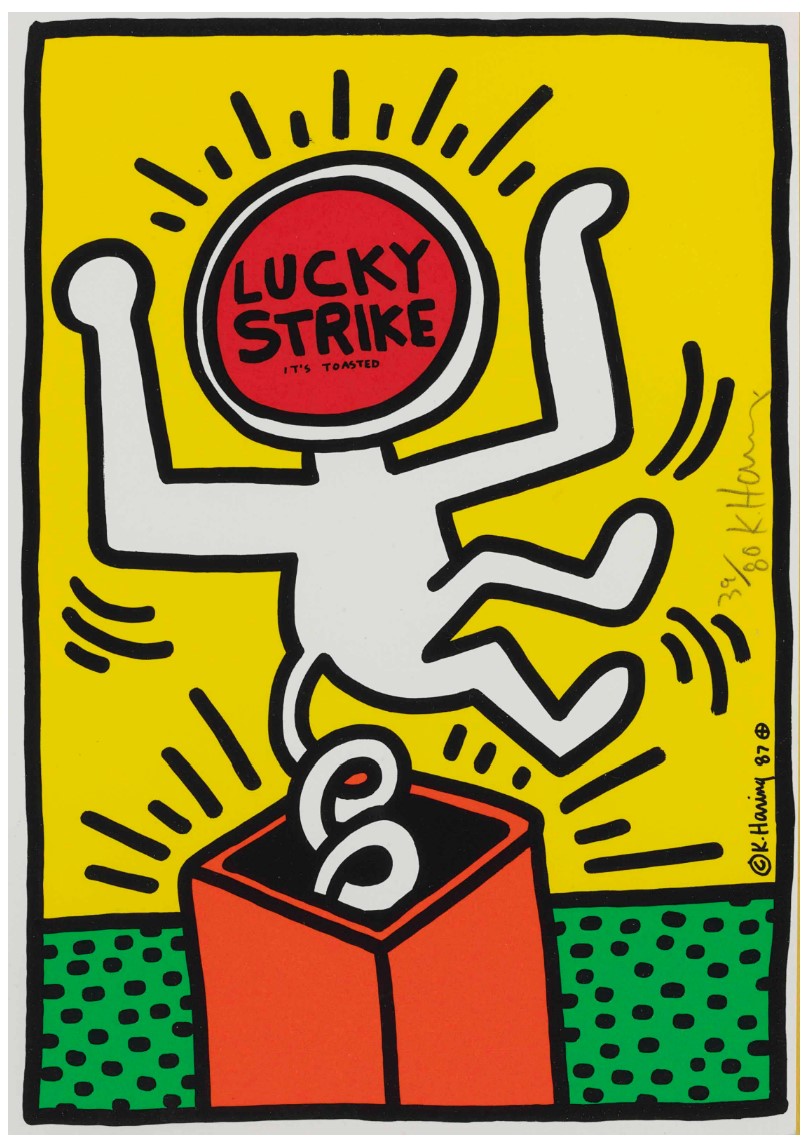
Lucky Strike: Plate 3, 1987
Screen-print in colors on wove paper
Sheet: 11 1/2 x 8 1/4 inches (29.7 x 21 cm)
Edition: 80 + 6 AP
Publisher: B. A. T. Suisse SA, Geneva
Literature: Littmann p. 78
Keith Haring illustrates a white figure with a spring coming from its back jumping out of an orange box at the bottom of the composition. The head of the figure has been replaced with the logo of Lucky Strike, the top-selling brand of cigarettes in the 1930s and ‘40s. These forms are laid on top of a yellow and green background which contrasts the subject matter and emphasizes their presence. The artist has rendered black action lines that surround the main figure and the package where it comes out of, implying that the figure has erupted from the container with great force.
Lucky Strike Plate IV (L. p. 79)
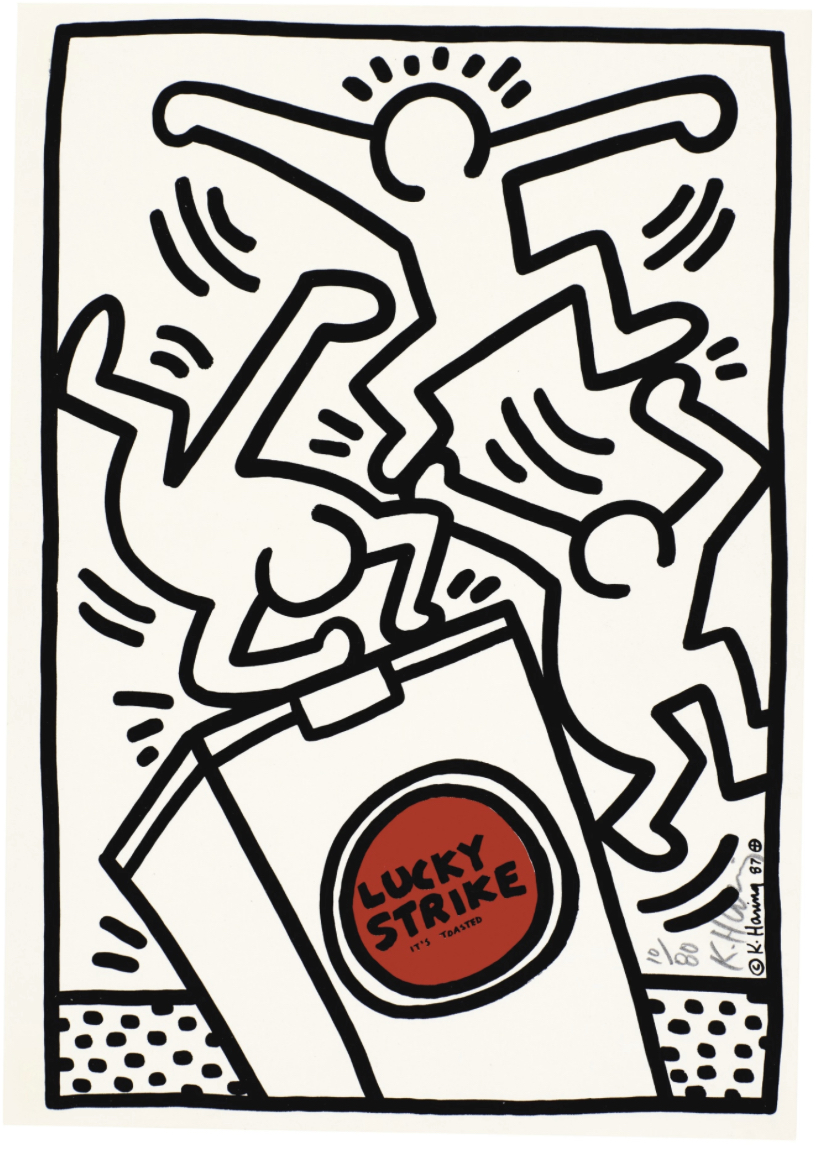
Lucky Strike: Plate 4, 1987
Screen-print in black and red on wove paper
Sheet: 11 1/2 x 8 1/4 inches (29.7 x 21 cm)
Edition: 80 + 6 AP
Publisher: B. A. T. Suisse SA, Geneva
Literature: Littmann p. 79
In this work the artist illustrates three of his signature icons causing a racket, trying to open a box of Lucky Strike cigarettes. Haring uses the method of screen printing to execute precise linework in beautifully saturated tones; this work is rendered entirely in black and white except the bright red logo of the cigarette carton. The stark contrast that the red hue provides draws the eye directly to the Lucky Strikes, the top-selling brand of cigarettes in the 1930s and ‘40s. In this way, the artist utilizes the visual language of advertising to bring attention to the “luckies” and the way his figures interact with them. The three signature Haring figures create a ruckus trying to get the box of cigarettes open, signifying their reliance on the tobacco inside. Haring ruminates on addiction in this work and presents it to his viewers in a manner that appeals to the masses.
Lucky Strike Plate V (L. p. 79)
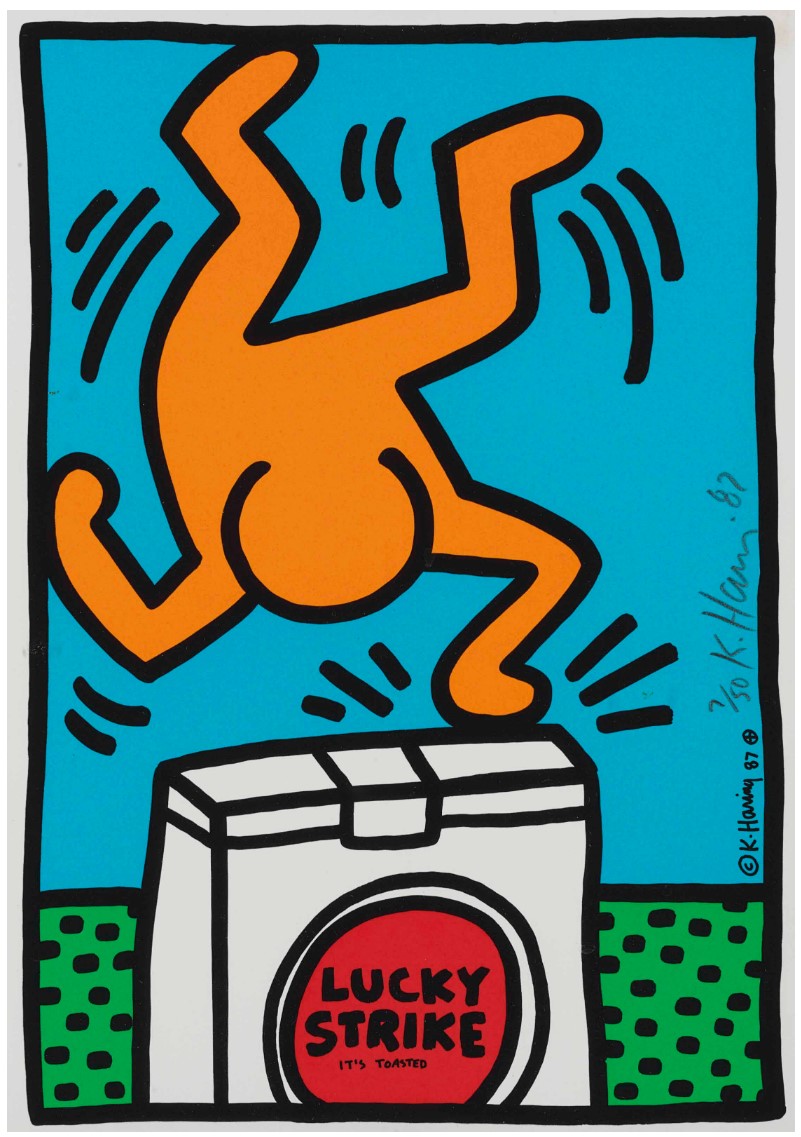
Lucky Strike: Plate 5, 1987
Screen-print in colors on heavy wove paper
Sheet: 11 1/2 x 8 1/4 inches (29.7 x 21 cm)
Edition: 50 + 6 AP
Publisher: B. A. T. Suisse SA, Geneva
Literature: Littmann p. 79
This work bears a striking resemblance to the previous installment in this series, Plate IV. However, while the fourth installment is rendered in a limited palette of black, white and red, this Plate is illustrated in a refined palette of black, white, orange, blue, red and green. The symbol of the Lucky Strike cigarette box that appears in every work in this series maintains its bright red which continues to draw the viewers eye directly to it. An orange figure stands upside down on top of the box, balancing on one hand. The black action lines that surround this signature icon imply vigorous movement, perhaps in an attempt to open the box to get to the contents inside.
Man on a Dolphin
1 Lithograph
Edition: 170 + 25 AP
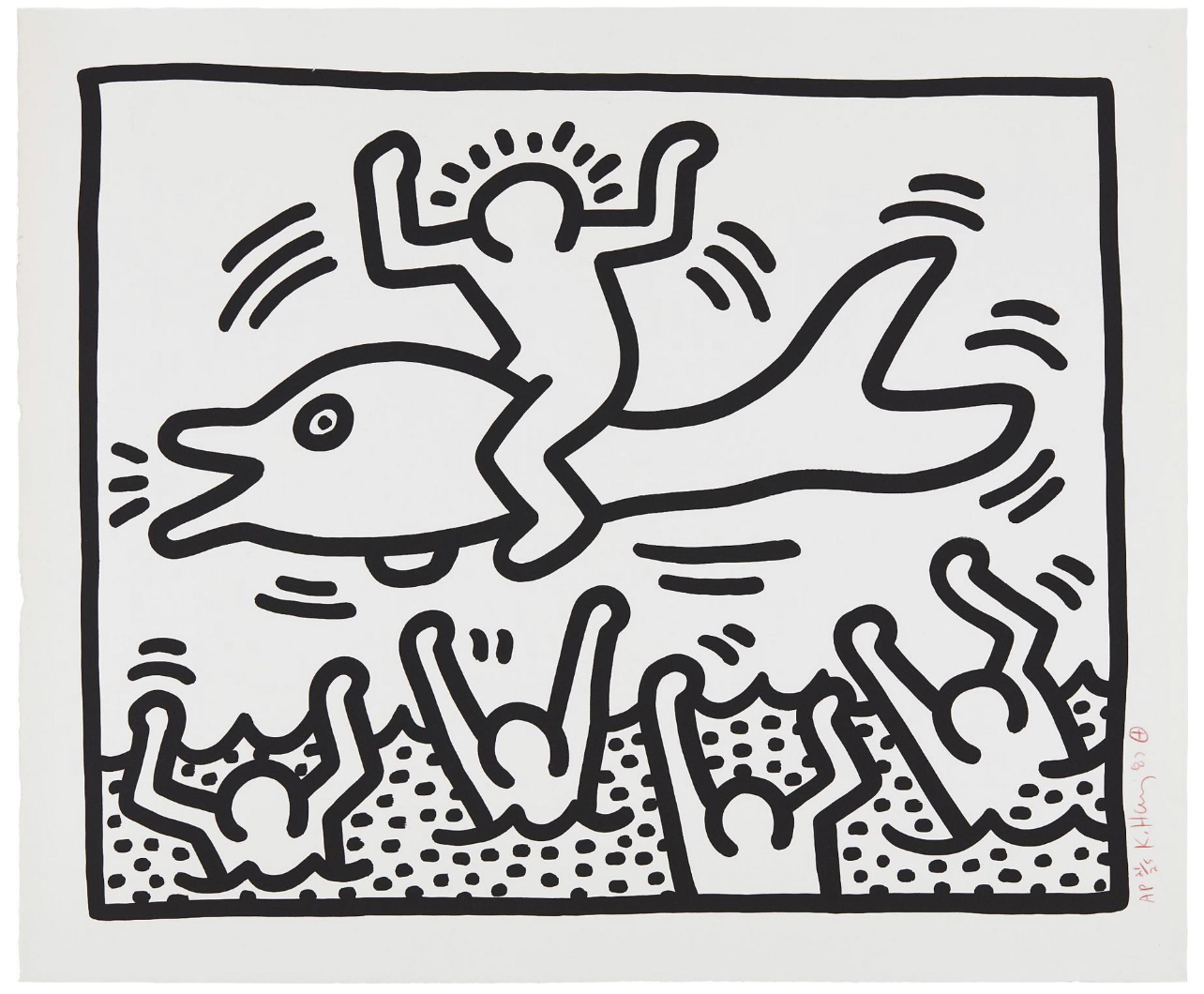
Untitled (Man on Dolphin), 1987
Lithograph in black and white on wove paper
Sheet: 29 1/2 x 35 3/8 inches (74.8 x 90 cm)
Edition: 170 + 25 AP
Literature: Littmann p. 84
Untitled (L. p. 85)
1 Print
Edition: 50
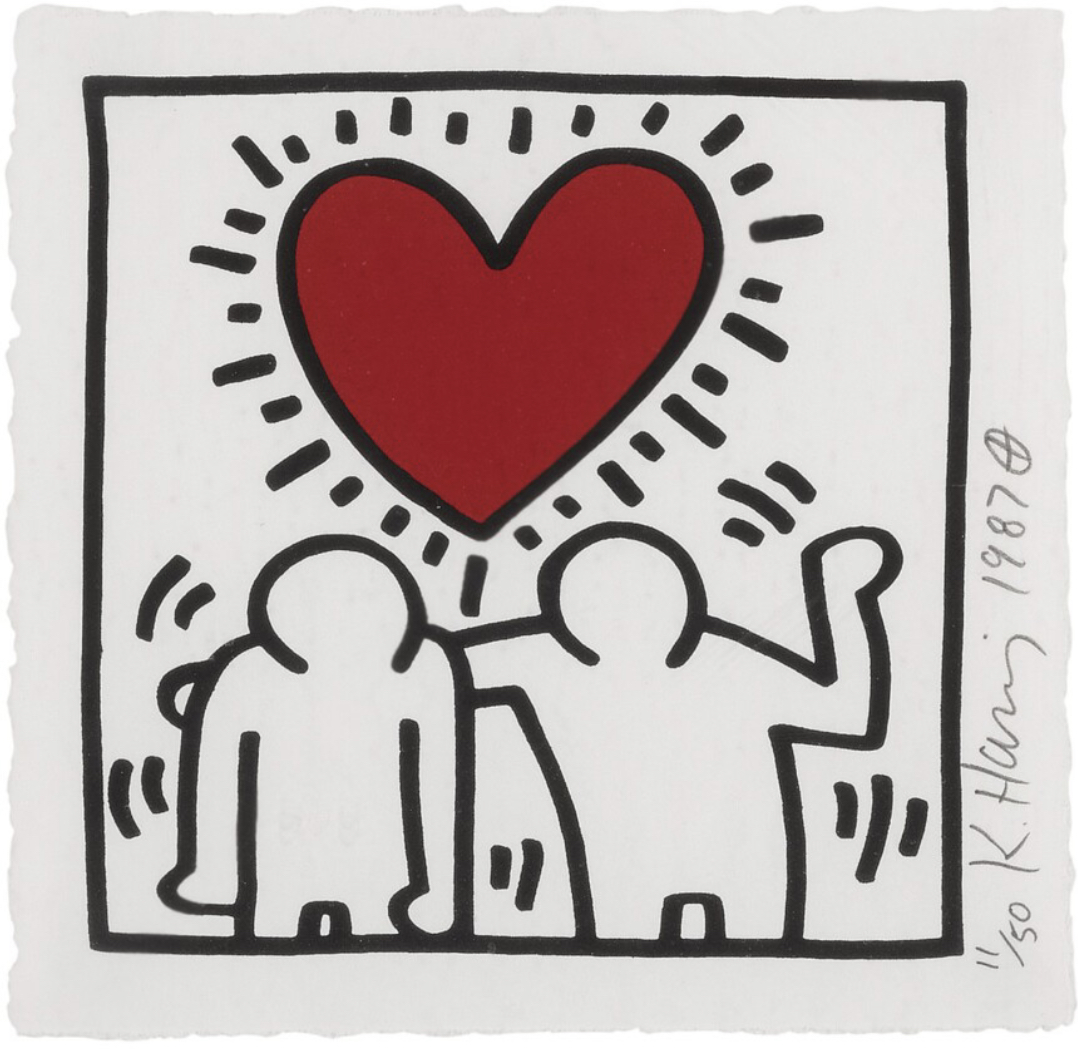
Untitled, 1987
Screen-print in red and black on wove paper
Sheet: 6×6 inches (15.2 x 15.2 cm)
Edition: 50
Literature: Littmann p. 85
6. Pop Shop Prints (1987-1989)
Pop Shop Prints
30 Prints
6,320 Impressions
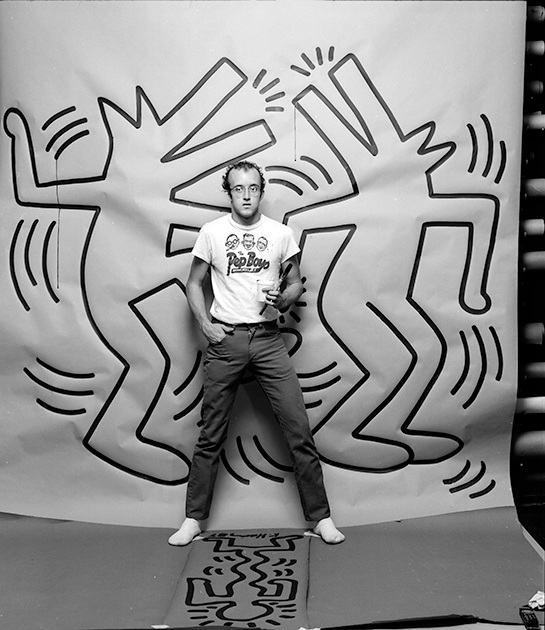
Keith Haring released 6 portfolios of Pop Shop Prints, starting in 1987, a year after the artist opened his first Pop Shop in downtown Manhattan. Aimed at kids and collectors alike, the Pop Shops were a place where Haring could sell his art for as little as 50 cents. The store stocked t-shirts, badges and magnets featuring his now ubiquitous designs.
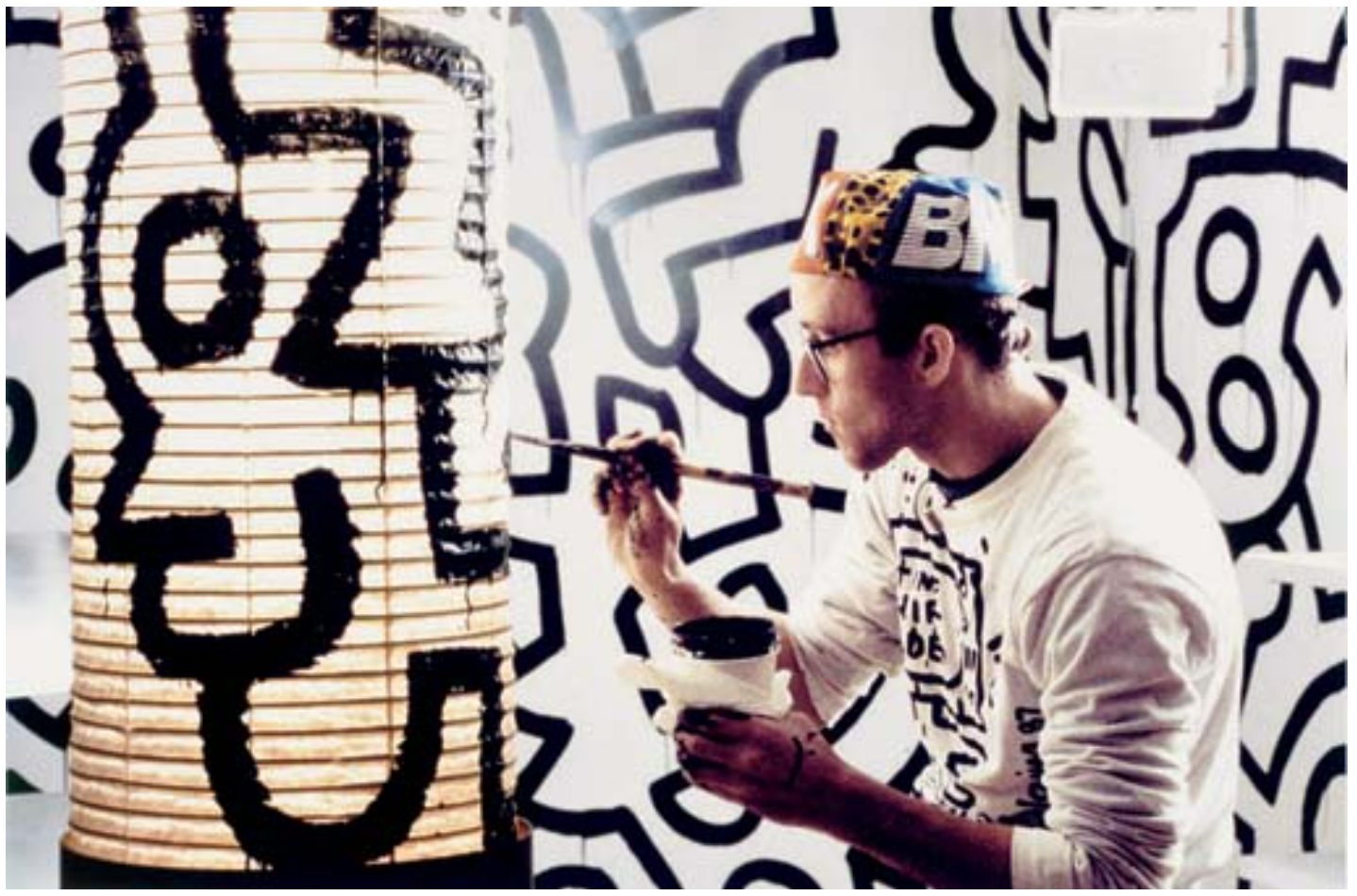
TSENG KWONG CHI (1950-1990), Keith Haring at the Pop Shop, c. 1985
While the project was praised by friends such as Andy Warhol who was fascinated by the possibilities of the work of art in the age of mechanical reproduction, it was snubbed by many leading art world figures who placed more value on original works of art.
“I could earn more money if I just painted a few things and jacked up the price. My shop is an extension of what I was doing in the subway stations, breaking down the barriers between high and low art”.
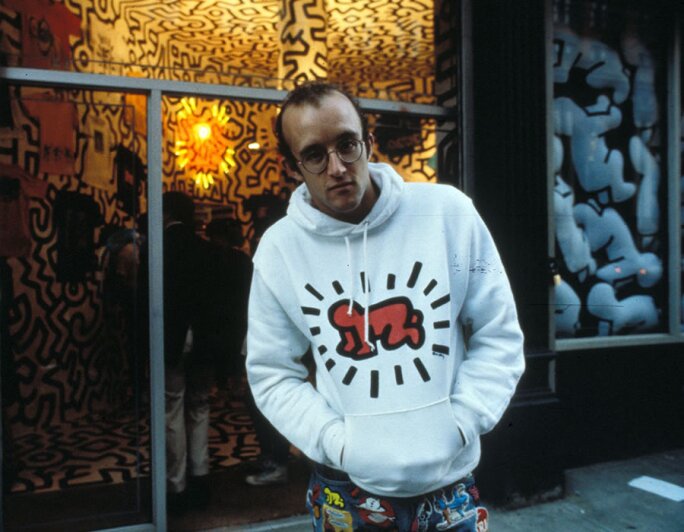
His love for commercial and Pop art was evident in his first experiments with street art which saw him creating signature figures he named ‘icons’, such as the barking dog, the radiant child and the winged superman. He would reproduce these figures over and over again, in bright colors reminiscent of advertising and later, just before his death from AIDS in 1990, in plain white embossings.
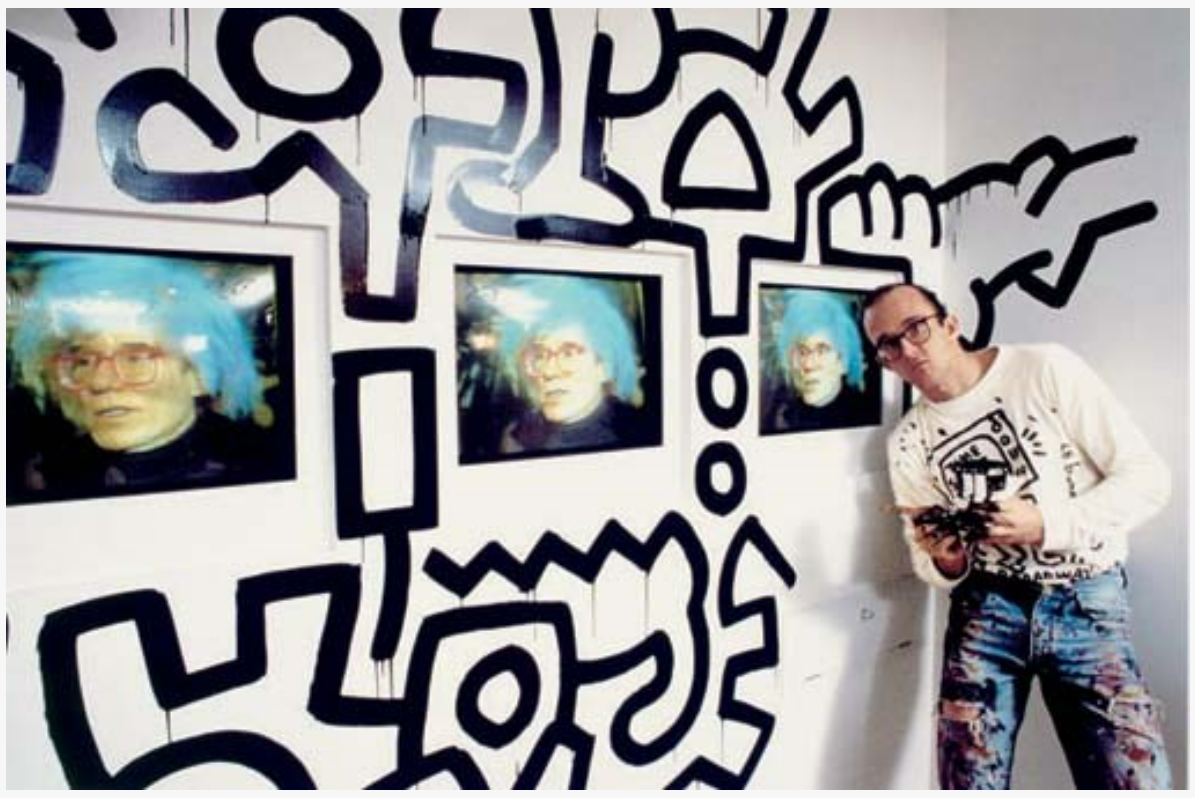
TSENG KWONG CHI (1950-1990), Keith Haring at the Pop Shop, c. 1985
Printed in various rich layers of colors, those portfolios show Haring’s mastery of screen printing as a medium. Though he had experimented with print techniques such as lithography in the late 70s and 80s it wasn’t until 1983 that Haring began making screen prints, or serigraphs, which offered a way of creating multiple images, that artists had adopted from the world of commercial printing. This move to screen printing was undoubtedly due in part to the method being popularized by Warhol, one of Haring’s most important influences, and soon he was producing ever more inventive and daring work.
Each Pop Shop portfolio was released in various editions: editions of 200 as individual works within a set of four works (Pop Shop), as a single print in an edition of 45/75 (Pop Shop Quad).
1. Pop Shop I
Pop Shop I: 4 Prints
Edition: 200 + 30 AP + 10 HC
Pop Shop Quad I: 1 Print
Edition: 45
The first of Haring’s iconic Pop Shop series, Pop Shop I encapsulates Haring’s ingenuity of form and subject. Complete with his dancing figures, energy lines and an underlying sense of community and pride, it represents a culmination of Haring’s practice as an artist who believed in the importance of art being for everyone. Printed in five layers of color (black, red, blue, magenta and yellow), this portfolio shows Haring’s mastery of screen printing as a medium.
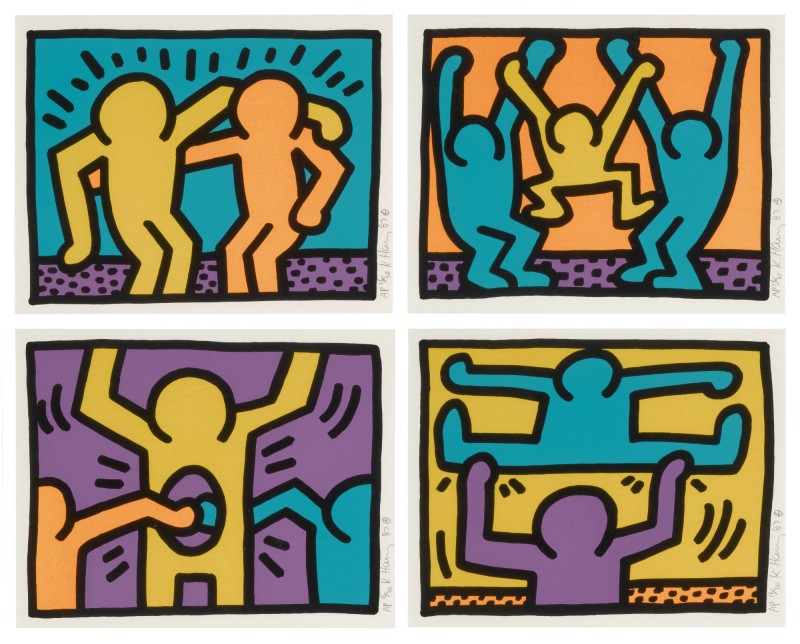
Pop Shop I, 1987
The complete set of four screen-prints in colors on Coventry rag paper
Sheet: 12×15 inches (30.5 x 38 cm)
Edition: 200 + 30 AP + 10 HC
Publisher: Martin Lawrence Limited Editions, New-York
Literature: Littmann pp 82-83
Plate I (L. p. 82)
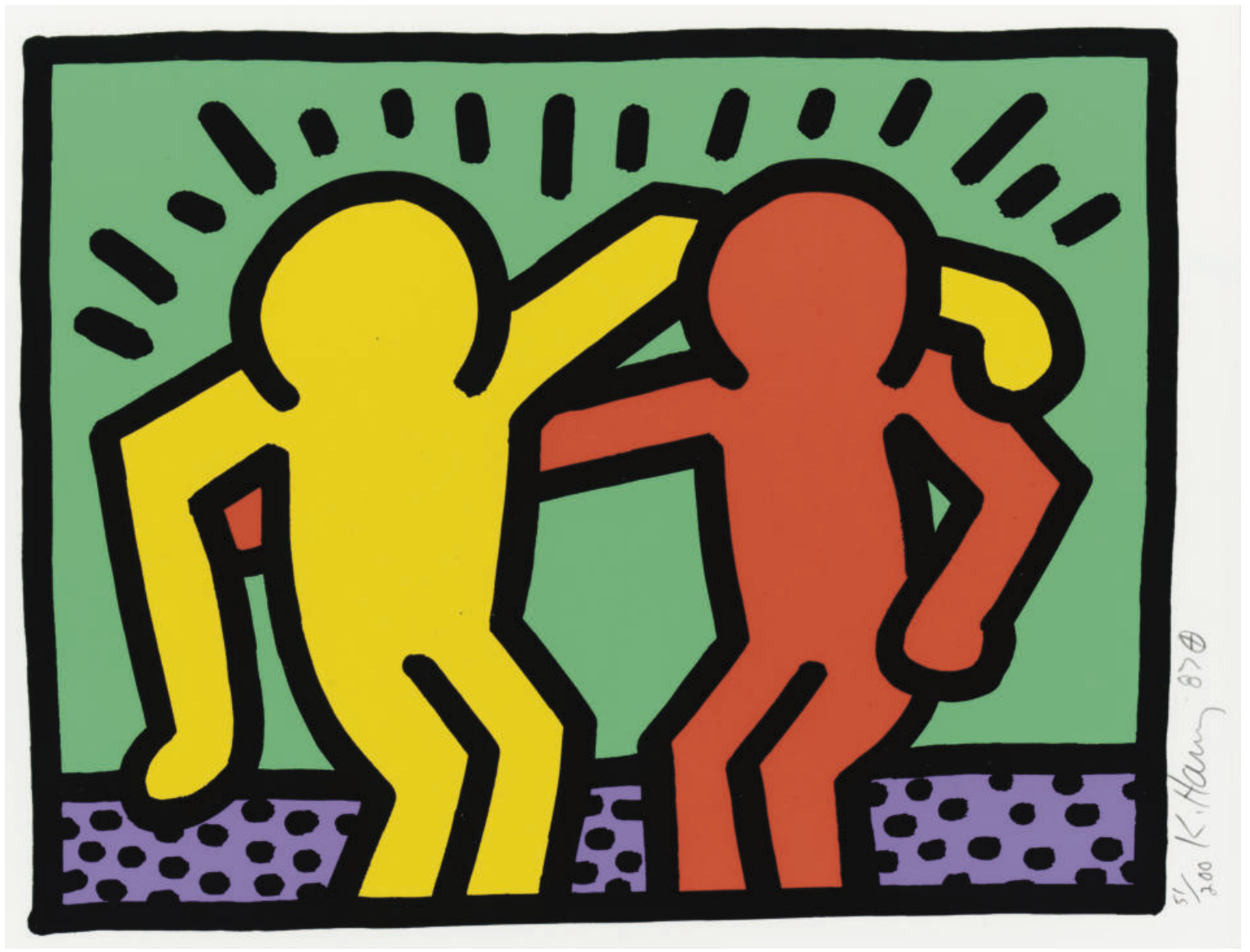
Plate II (L. p. 82)
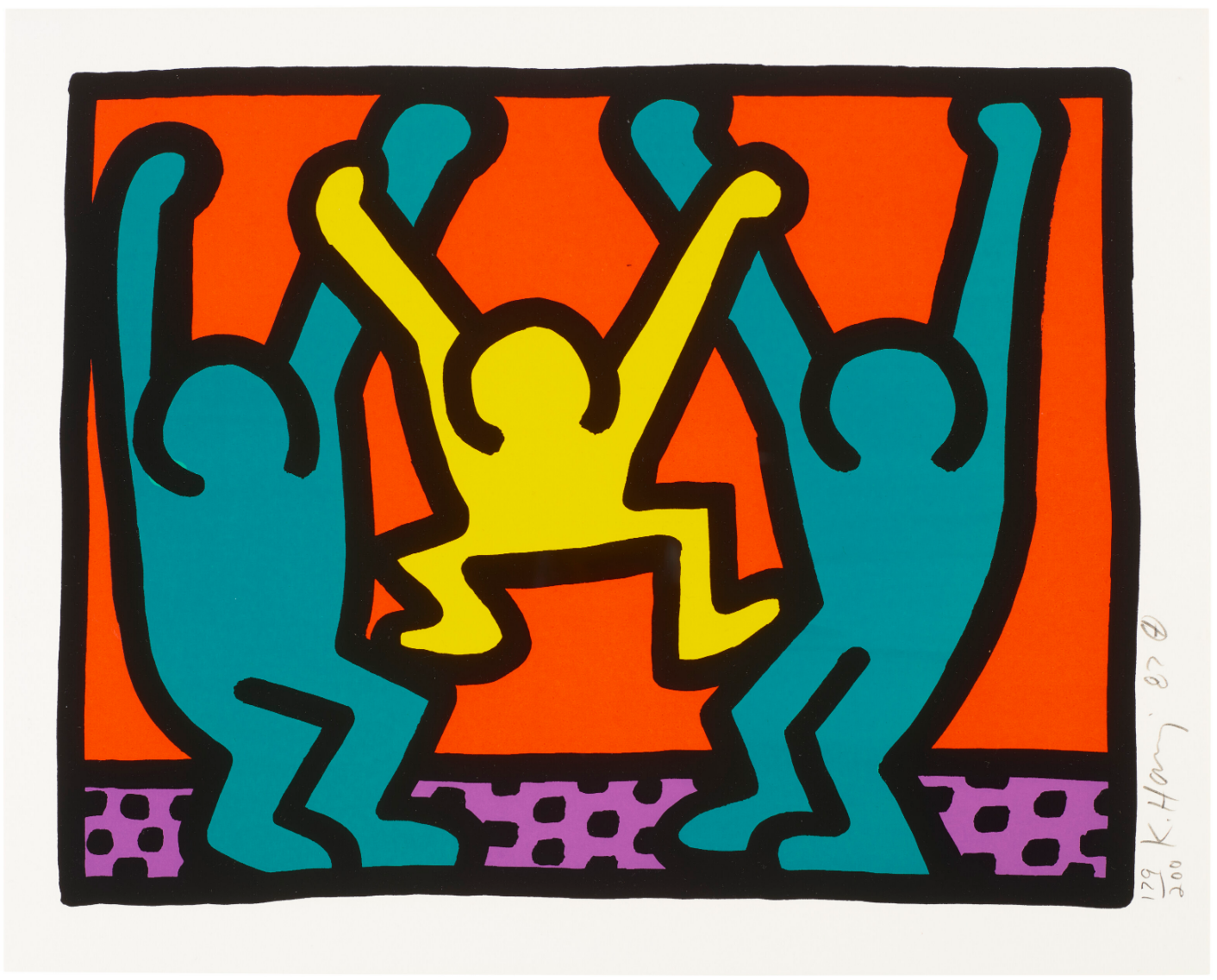
Plate III (L. p. 83)
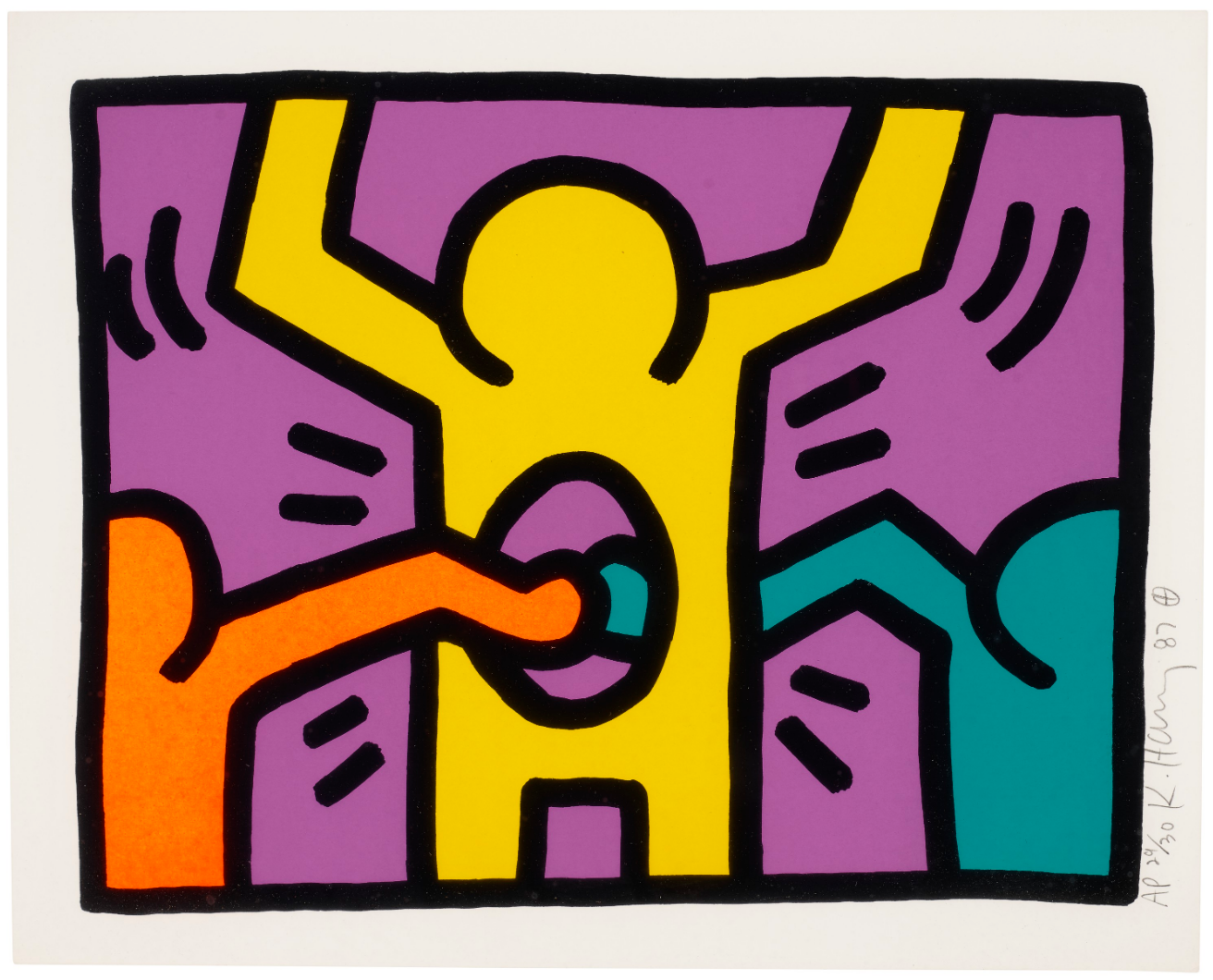
Plate IV (L. p. 83)
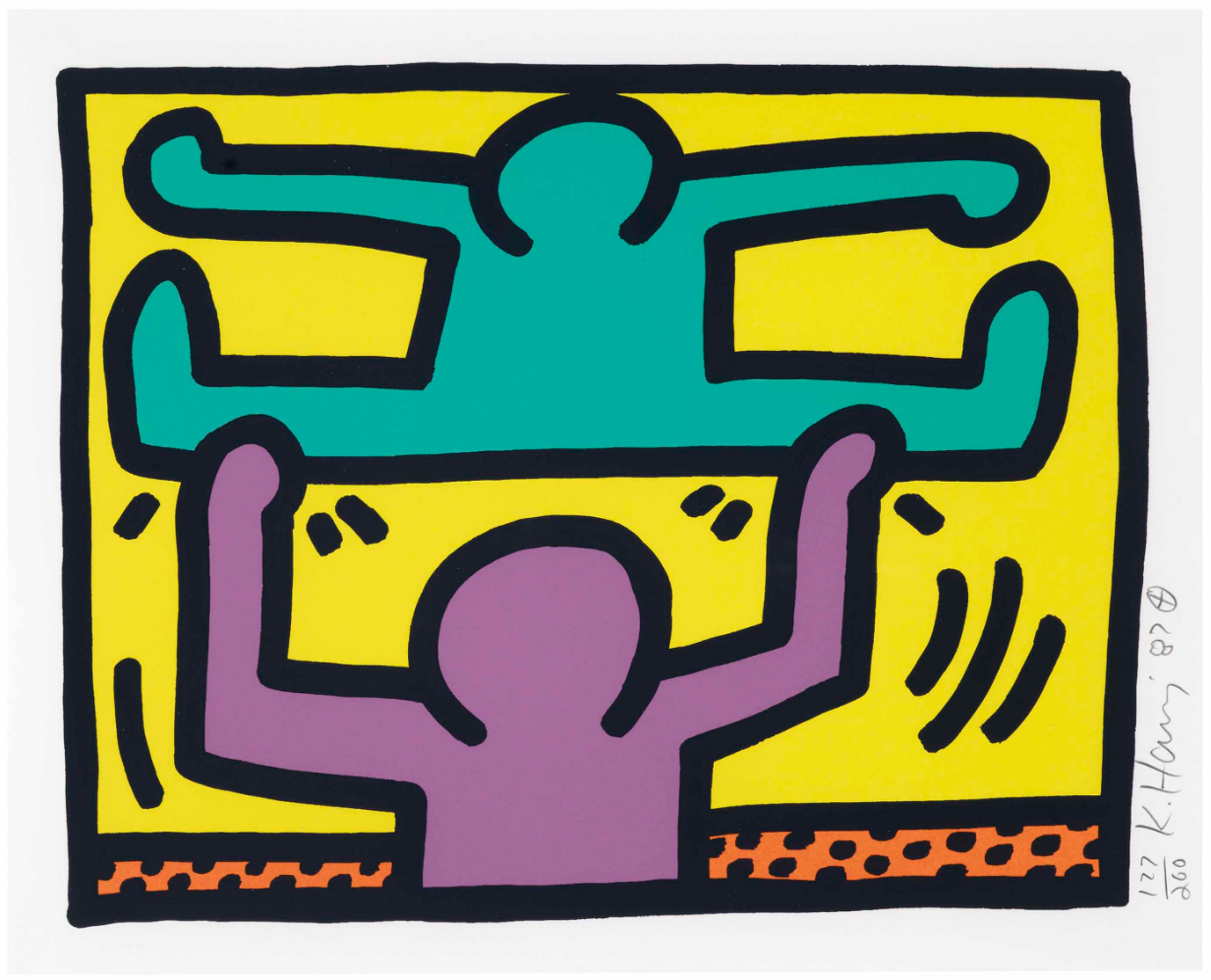
Pop Shop Quad I (L. p. 81)
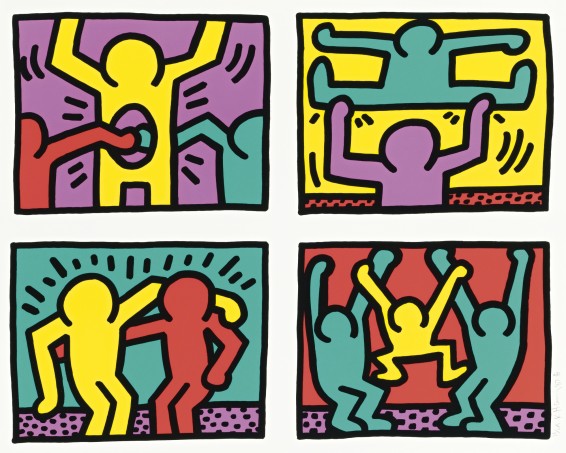
Pop Shop Quad I, 1987
Screen-print in colors on heavy wove paper
Sheet: 24 3/4 x 30 inches (63×76 cm)
Edition: 45
Publisher: Martin Lawrence Editions, Ltd., New York
Literature: Littmann pp. 80-81
2. Pop Shop II
Pop Shop II: 4 Prints
Edition: 200 + 20 AP + 20 HC
Pop Shop Quad II: 1 Print
Edition: 75
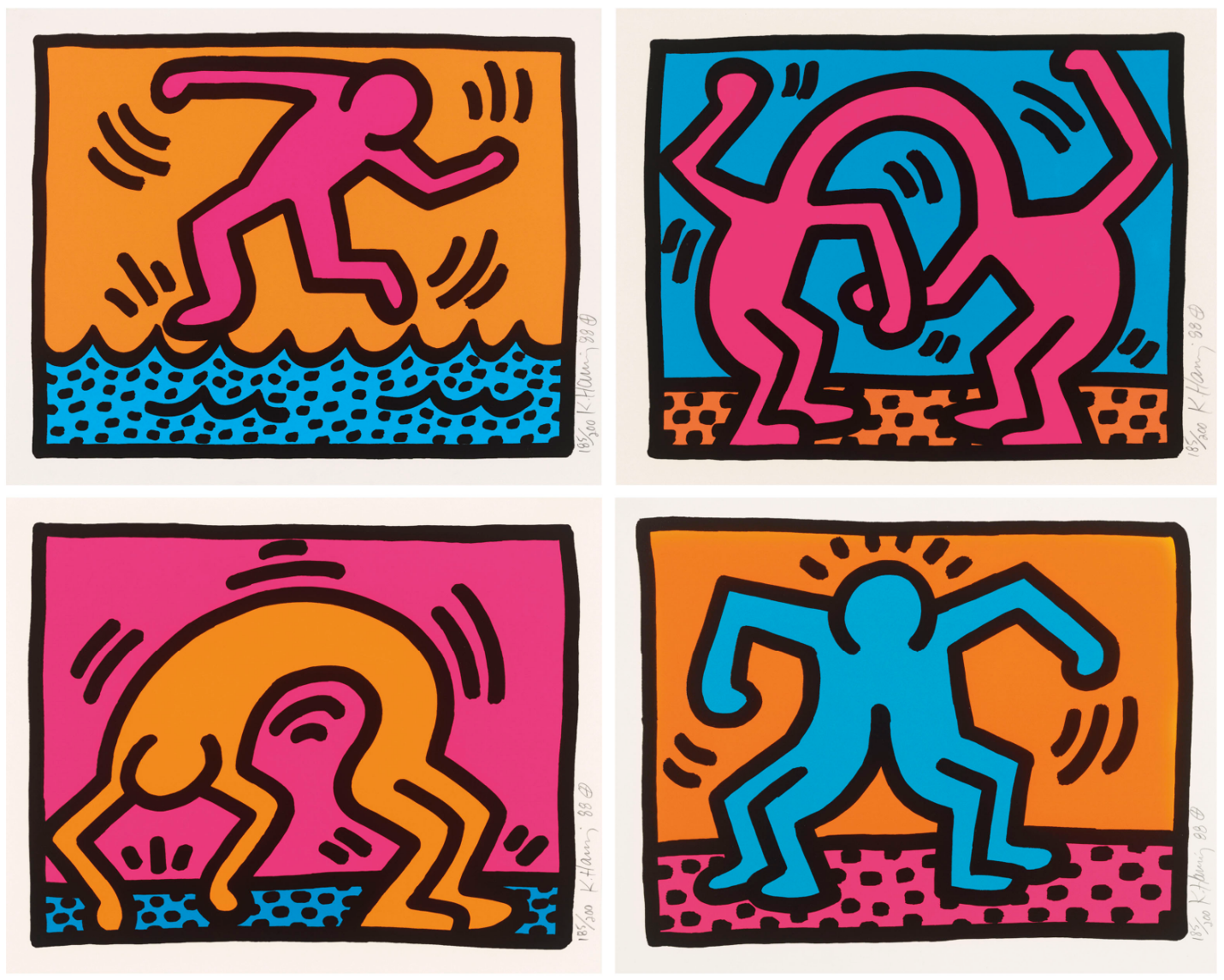
Pop shop II, 1988
The complete set of four screen-prints in colors on wove paper
Sheet: 12×15 inches (30.6 x 38.1 cm)
Edition: 200 + 20 AP + 20 HC
Publisher: Martin Lawrence Limited Editions, New-York
Literature: Littmann pp. 96-97
Plate I (L. p. 96)
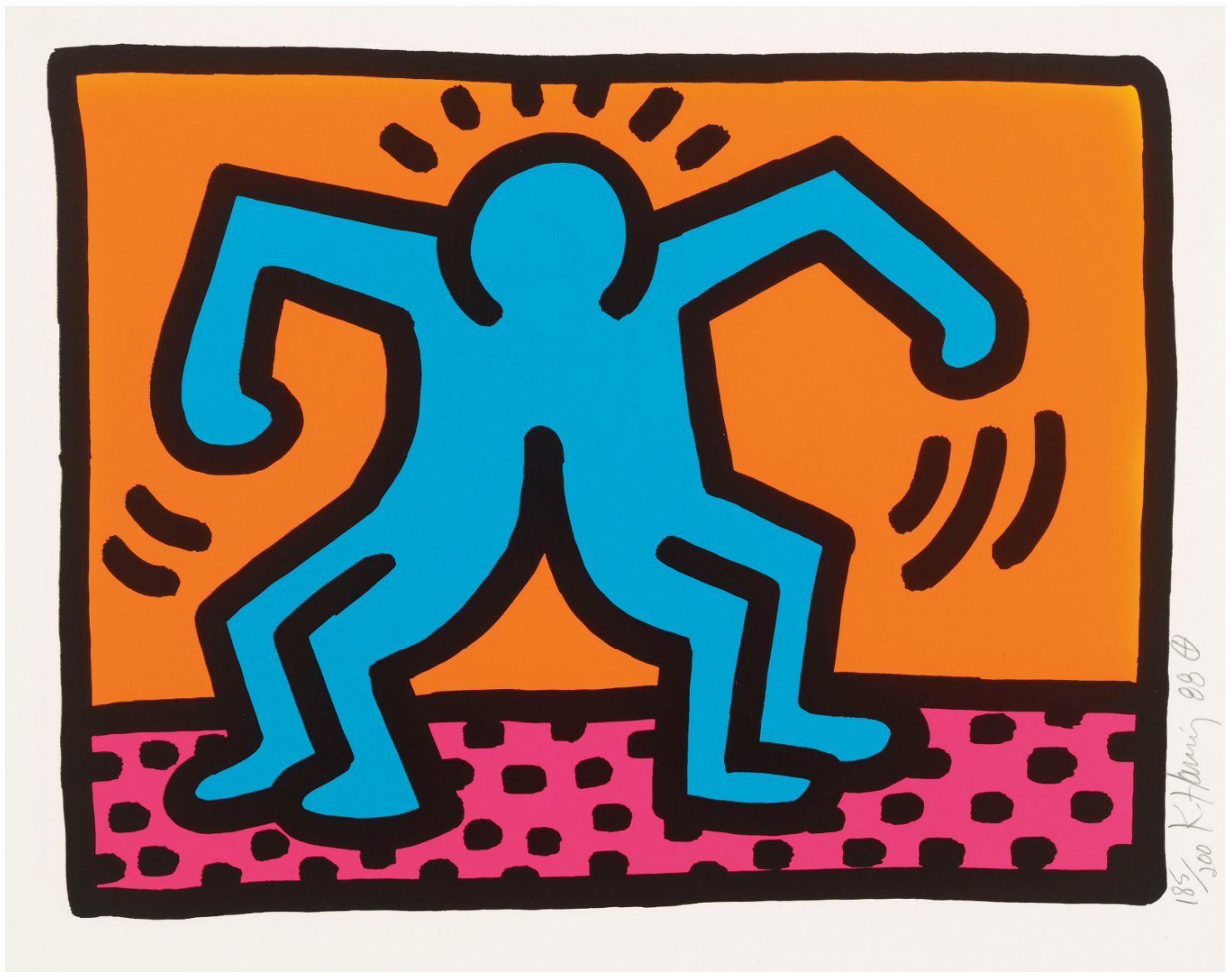
Plate II (L. p. 96)
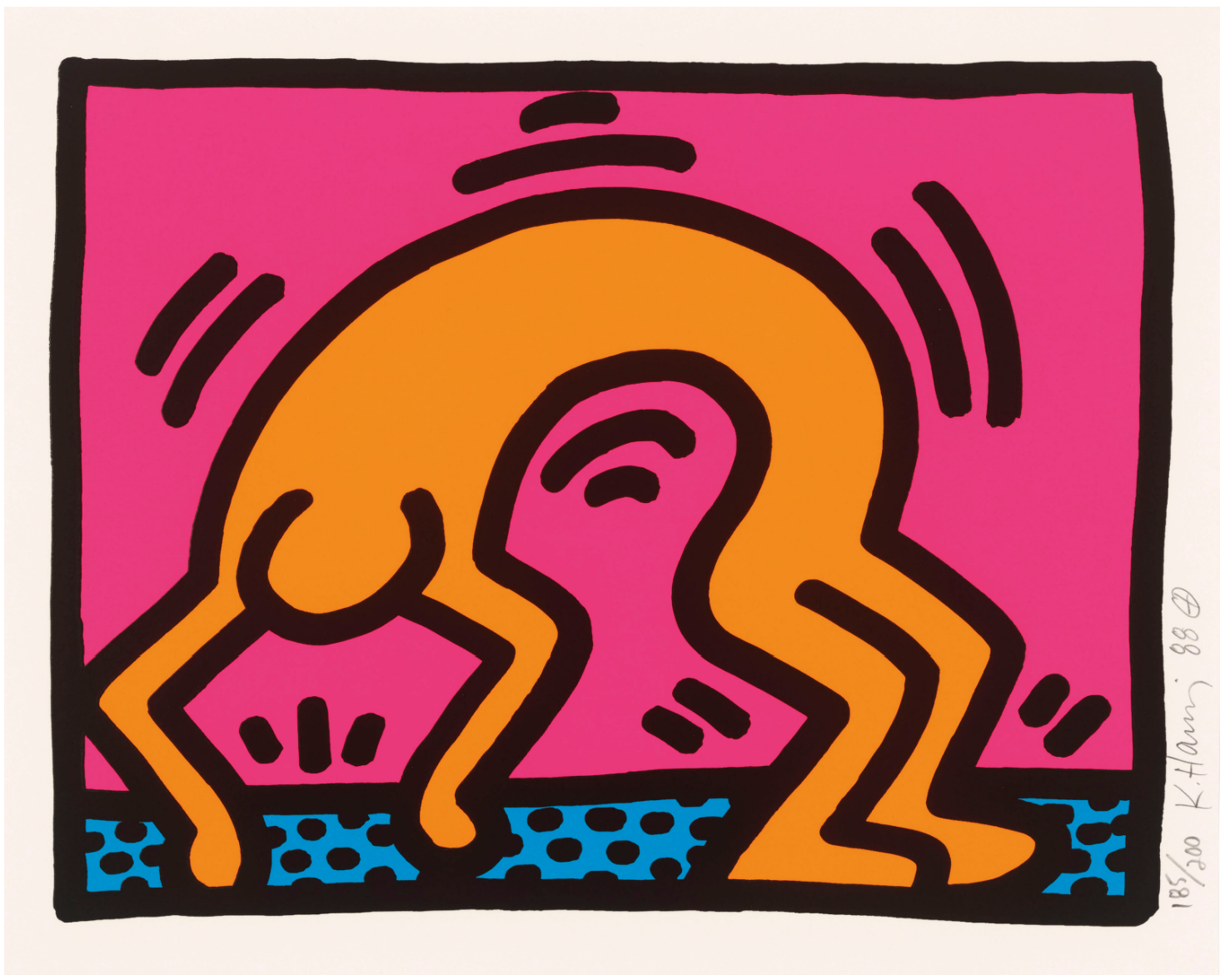
Plate III (L. p. 97)
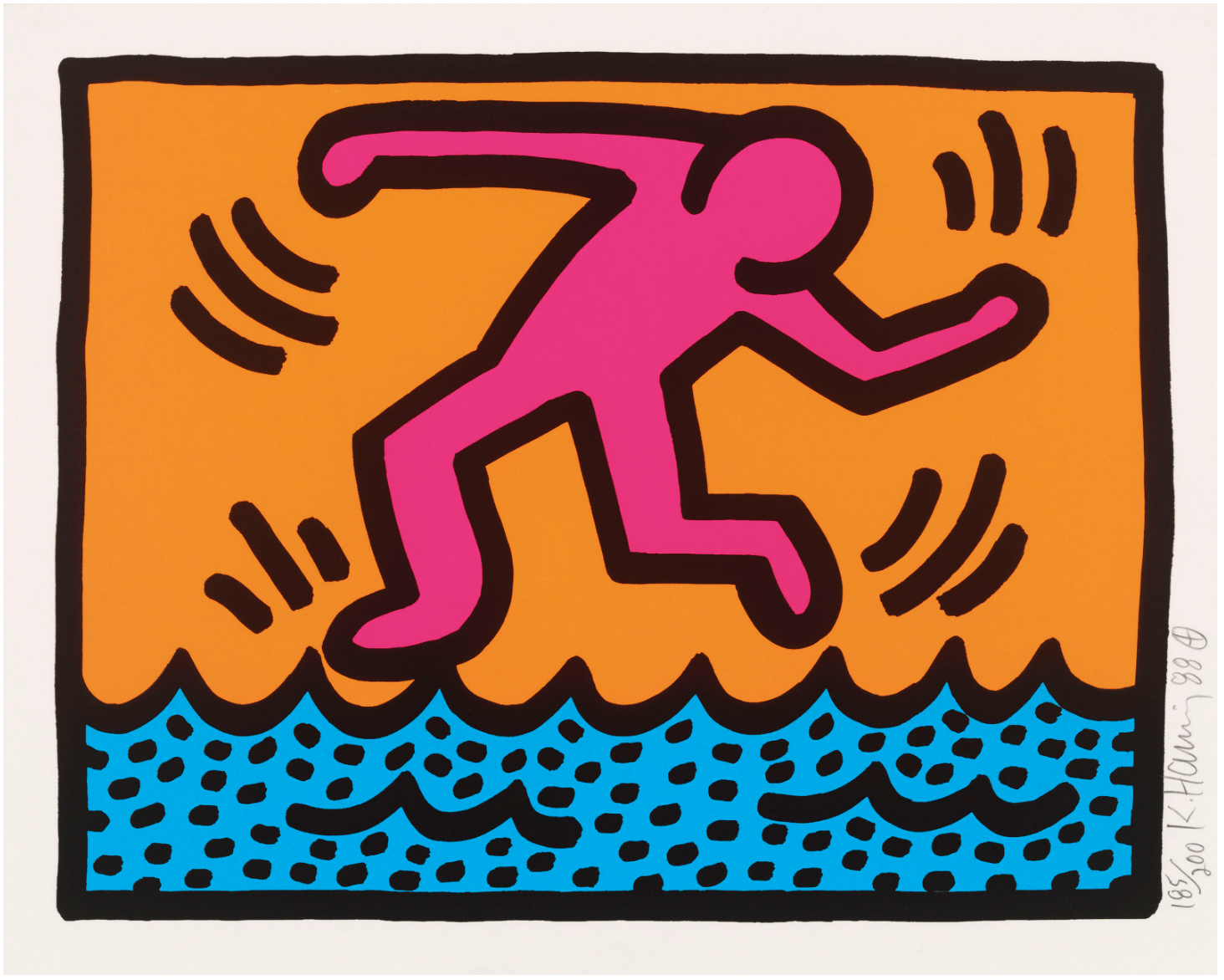
Plate IV (L. p. 97)
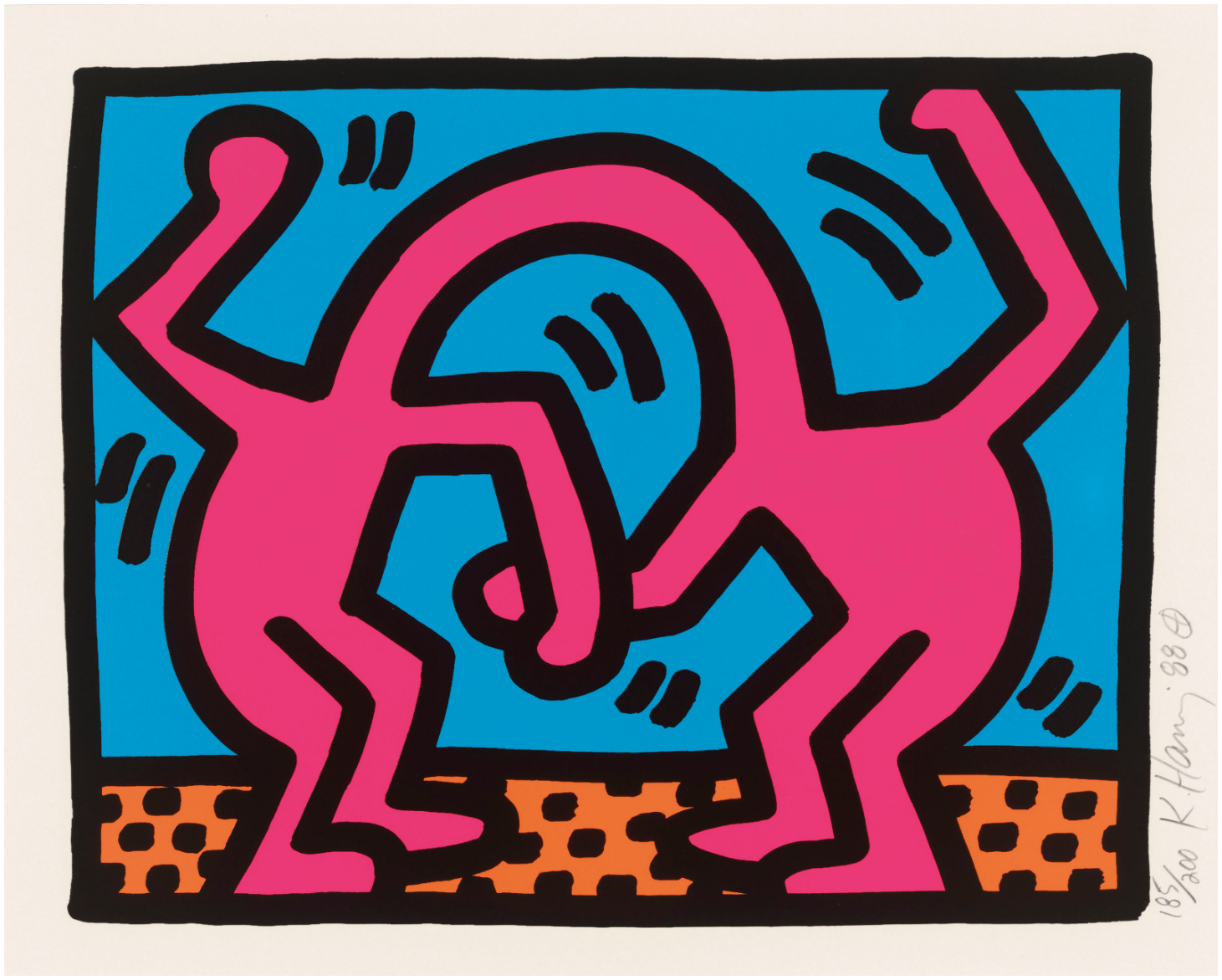
Pop Shop Quad II
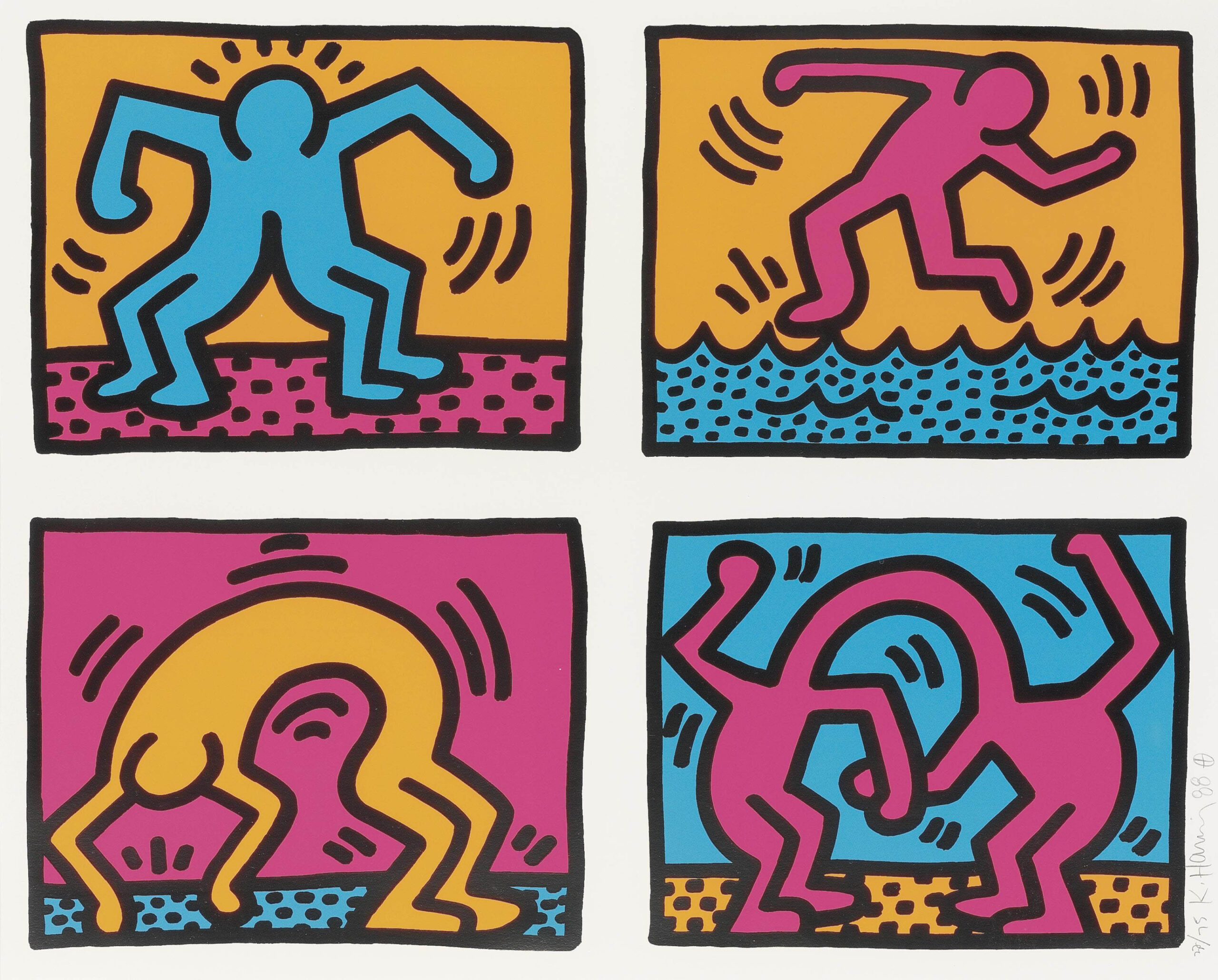
Pop Shop Quad II, 1988
Screen-print in colors on wove paper
Sheet: 22×30 inches (56×76 cm)
Edition: 75 + 15 AP
Publisher: Martin Lawrence Limited Editions, New-York
Literature: Littmann page 95
3. Pop Shop III
Pop Shop III: 4 Prints
Edition: 200 + 20 AP + 20 HC
Pop Shop Quad III: 1 Print
Edition: 75
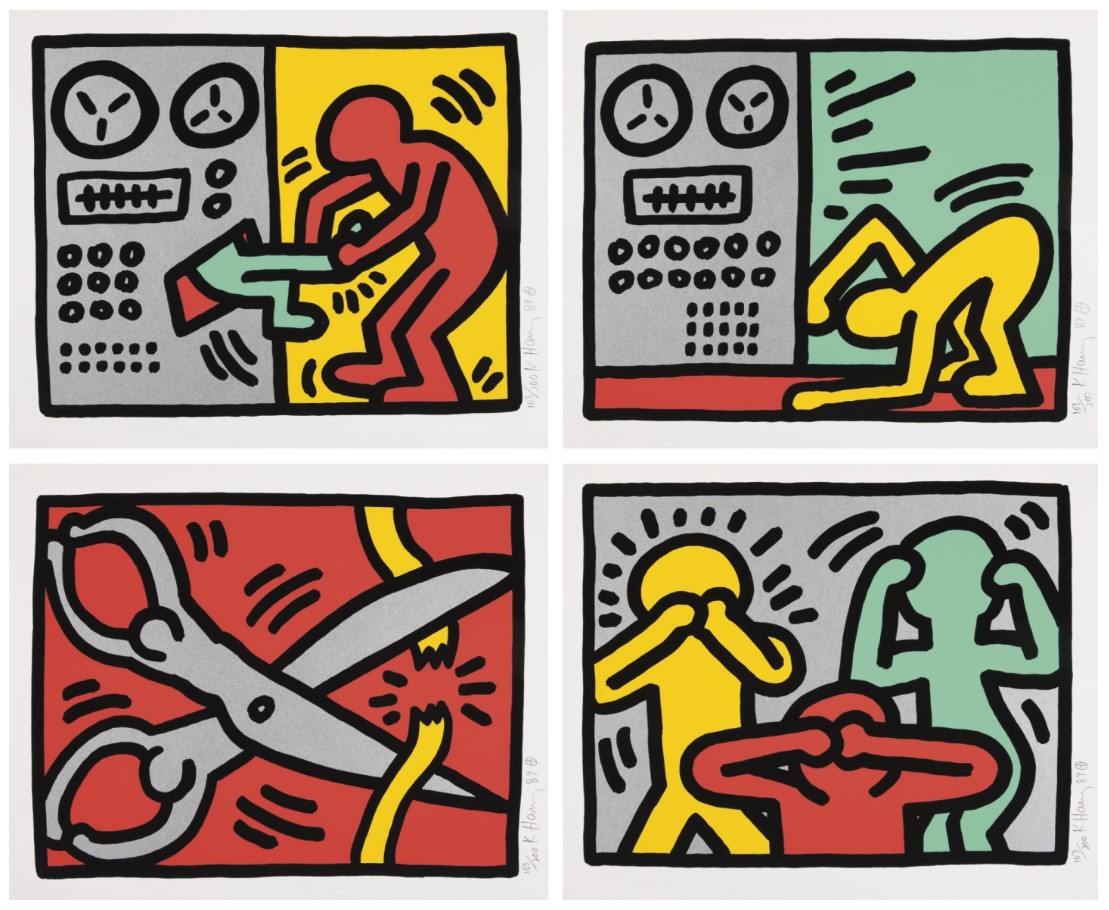
Pop Shop III, 1989
The complete set of four screen-prints in colors on wove paper
Sheet: 13 1/2 x 16 1/2 inches (34×42 cm)
Edition: 200 + 20 AP + 20 HC
Publisher: Martin Lawrence Limited Editions, New-York
Literature: Littmann pages 144-145
Plate I (L. p. 144)
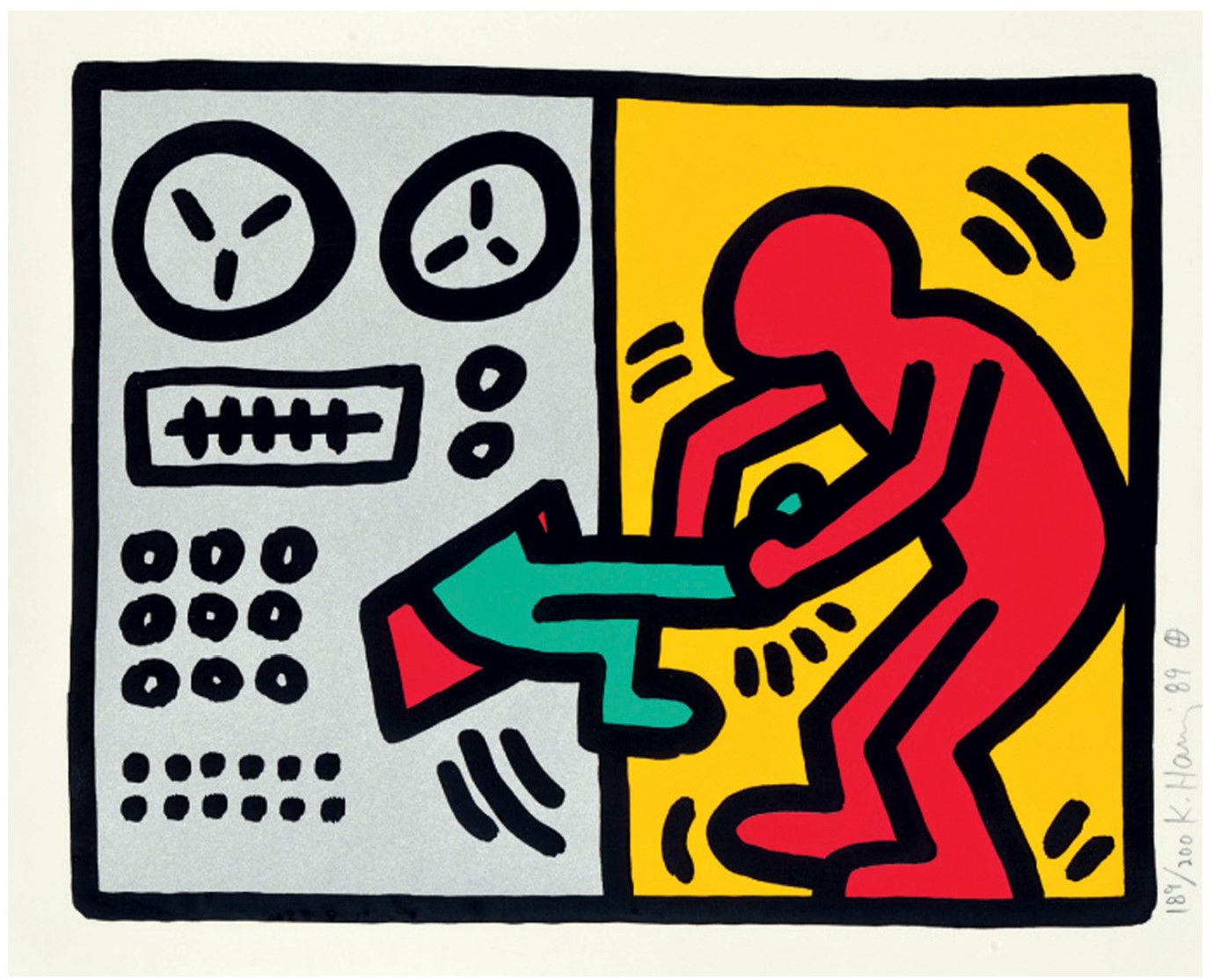
Plate II (L. p. 144)
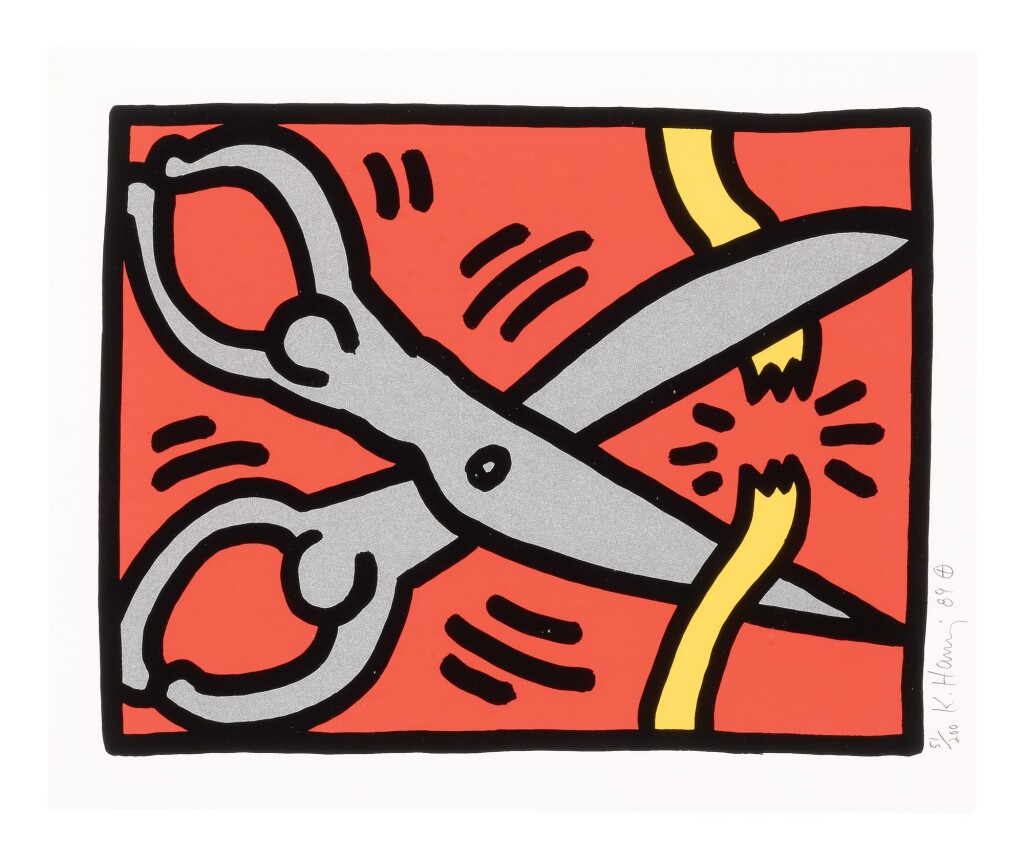
Plate III (L. p. 145)
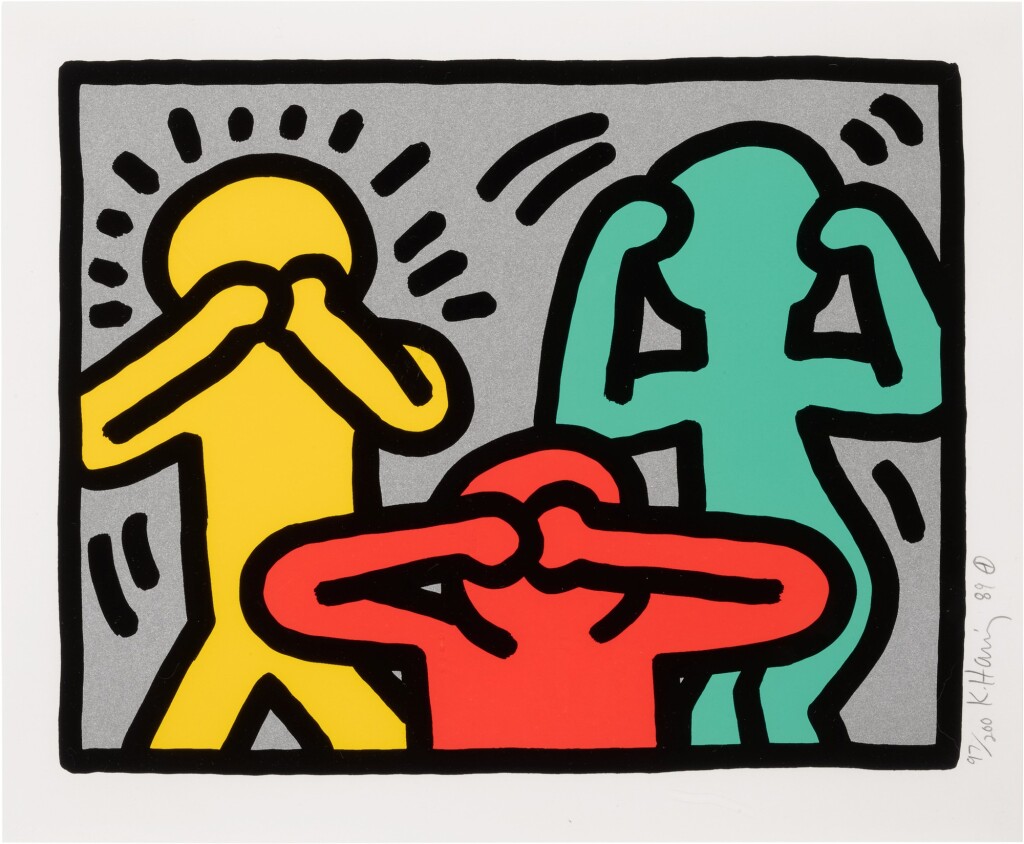
Plate IV (L. p. 145)
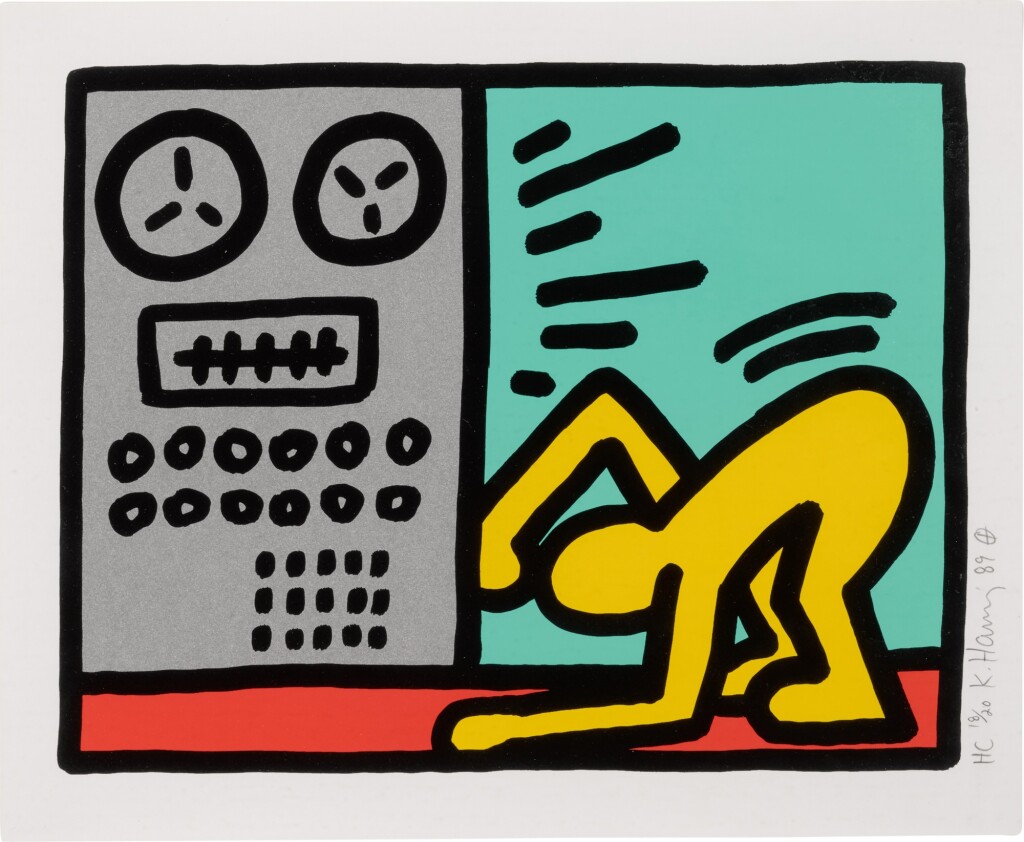
Pop Shop Quad III
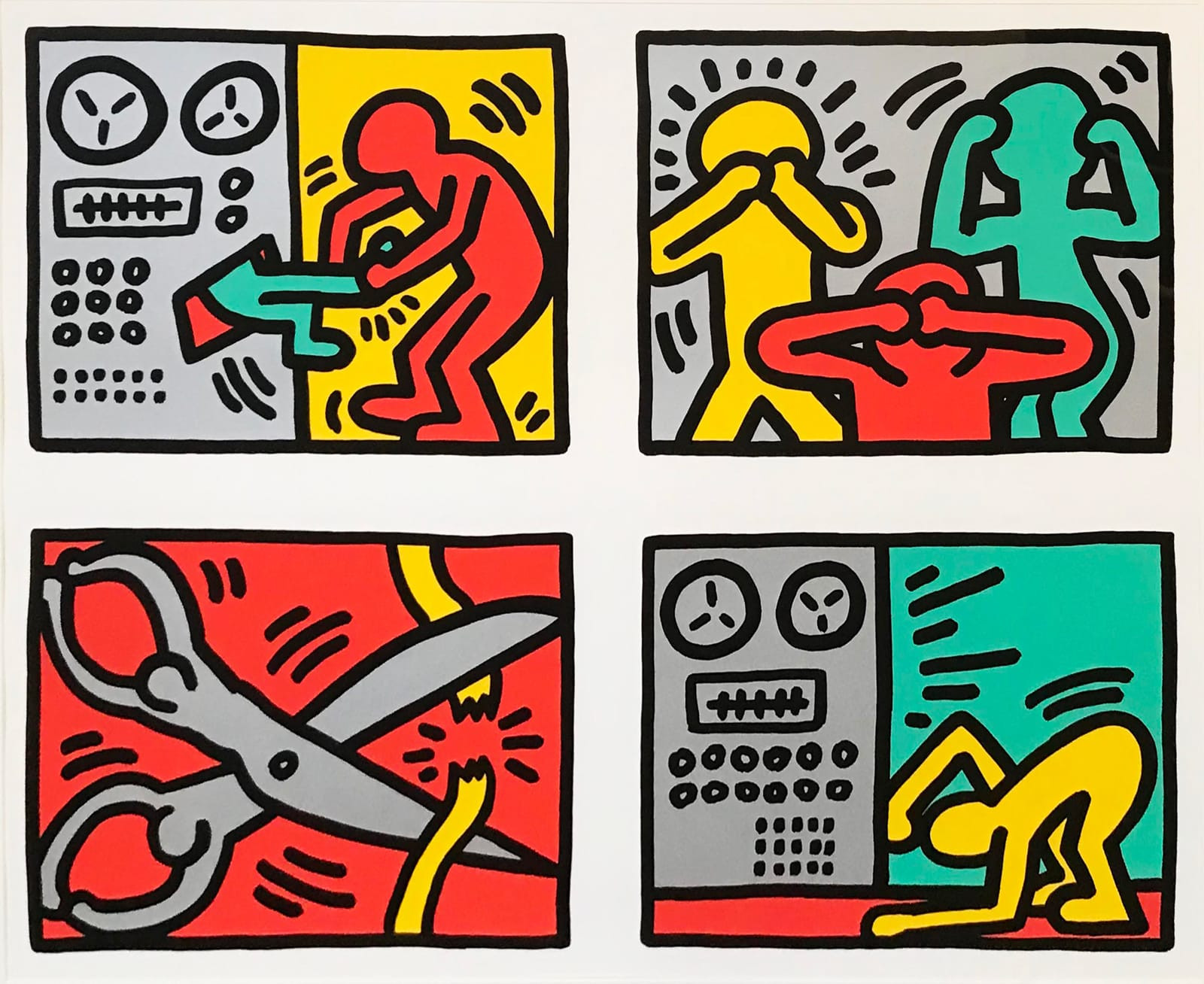
Pop Shop Quad III, 1989
Screen-print in colors on wove paper
Sheet: 27×33 inches (68.5 x 83.5 cm)
Edition: 75
Publisher: Martin Lawrence Limited Editions, New-York
Literature: Littmann p. 142
4. Pop Shop IV
Pop Shop IV: 4 Prints
Edition: 200 + 25 AP + 20 HC
Pop Shop Quad IV: 1 Print
Edition: 75
Perhaps one of the most recognizable portfolios in the Pop Shop series, Pop Shop IV features almost all of Haring’s ‘icons’: the radiant child, the barking dog and the winged superman, all surrounded by joyous energy lines and depicted in the bold contrasting colors he became known for. This series is a tour de force of composition, displaying Haring’s intimate knowledge of the language of cartoons and street art alike, and evoking the playfulness that characterized all the work he made for his Pop Shops.
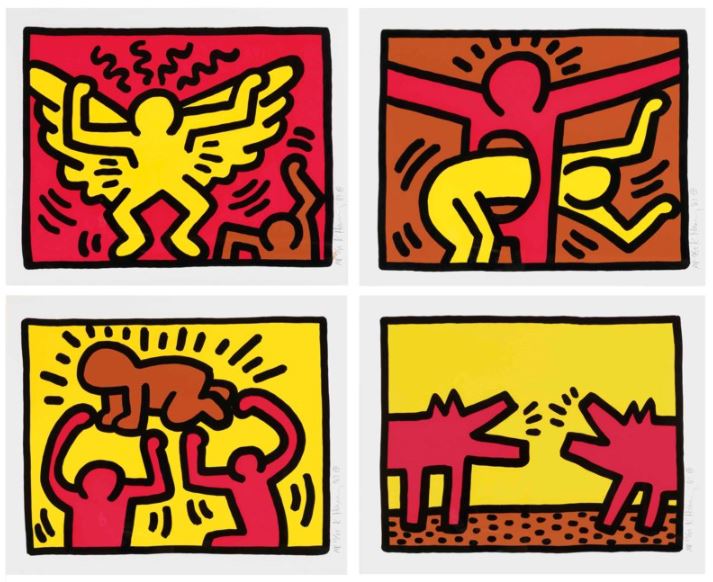
Pop Shop IV, 1989
The complete set of four screen-prints in colors on wove paper
Sheet: 13 1/2 x 16 1/2 inches (34×42 cm)
Edition: 200 + 25 AP + 20 HC
Publisher: Martin Lawrence Limited Editions, New-York
Literature: Littmann pp. 146-147
Plate I (L. p. 146)
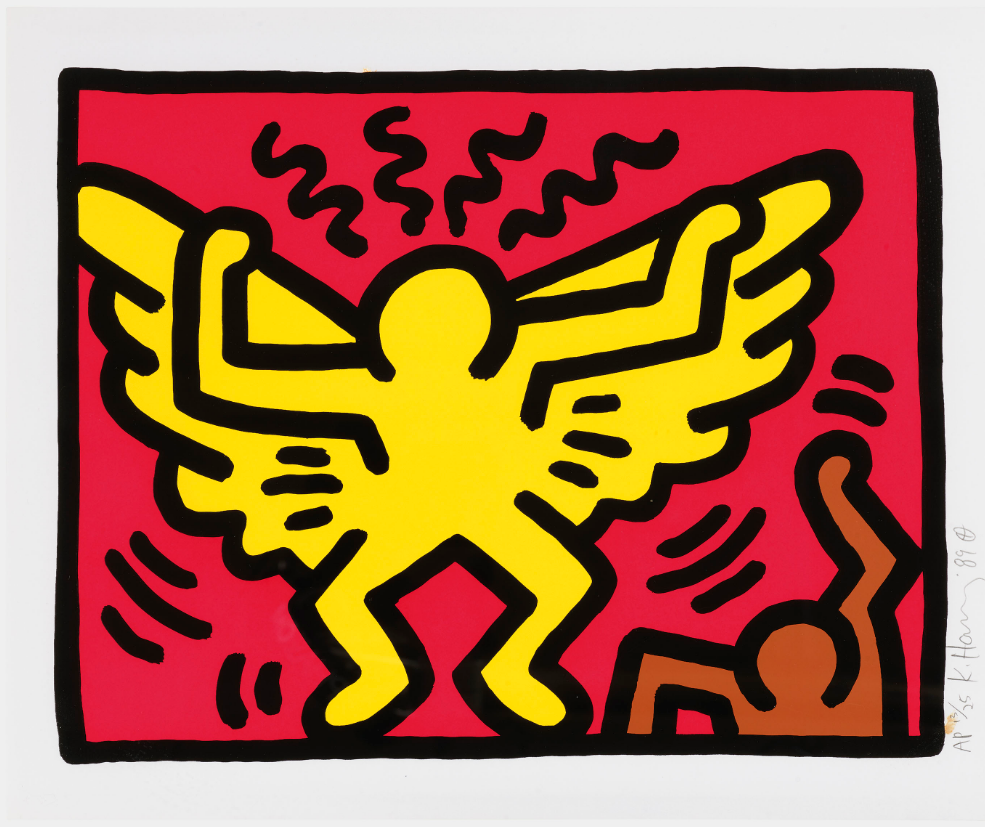
Plate II (L. p. 146)
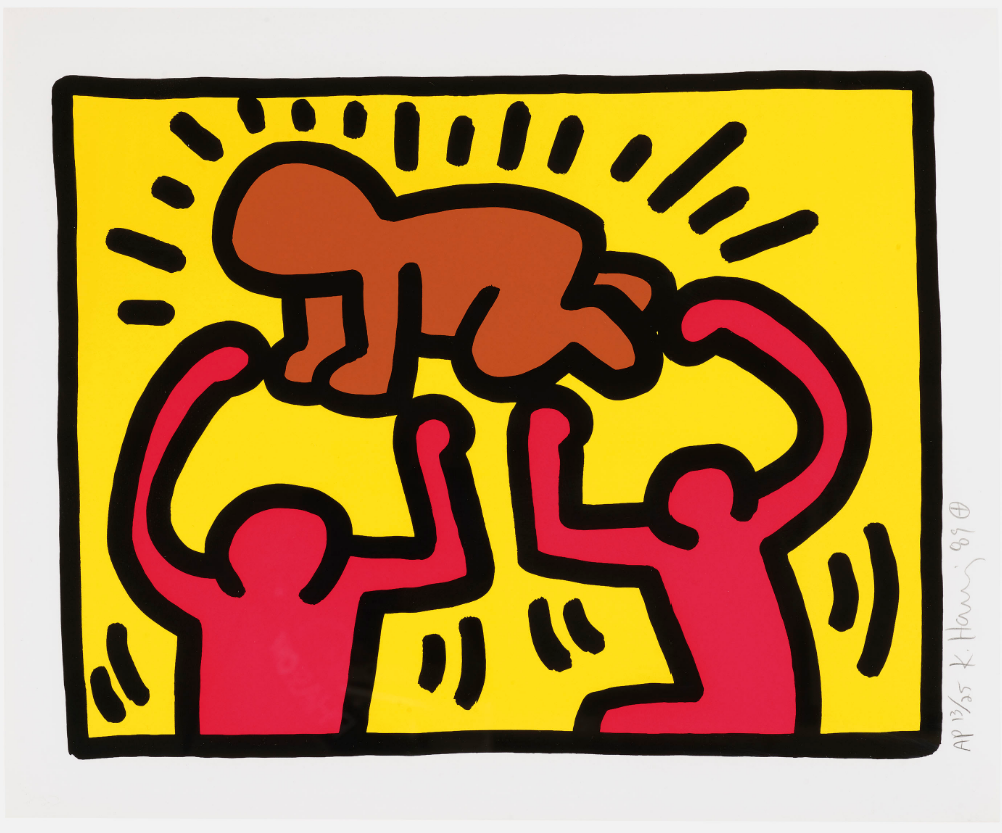
Plate III (L. p. 147)
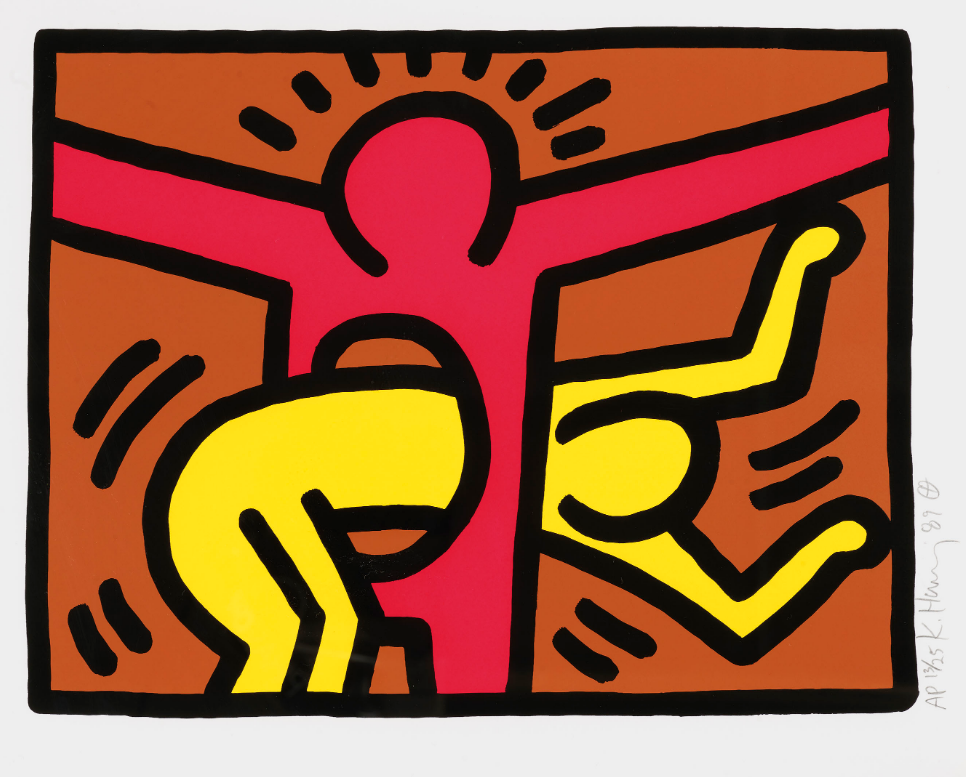
Plate IV (L. p. 147)
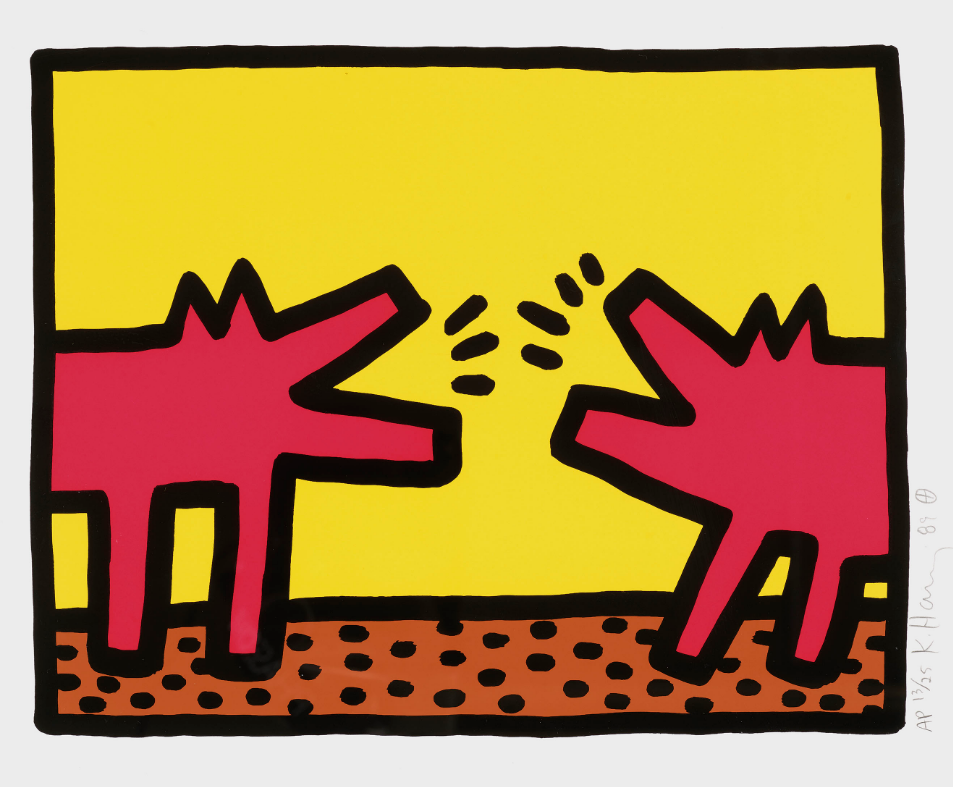
Pop Shop Quad IV
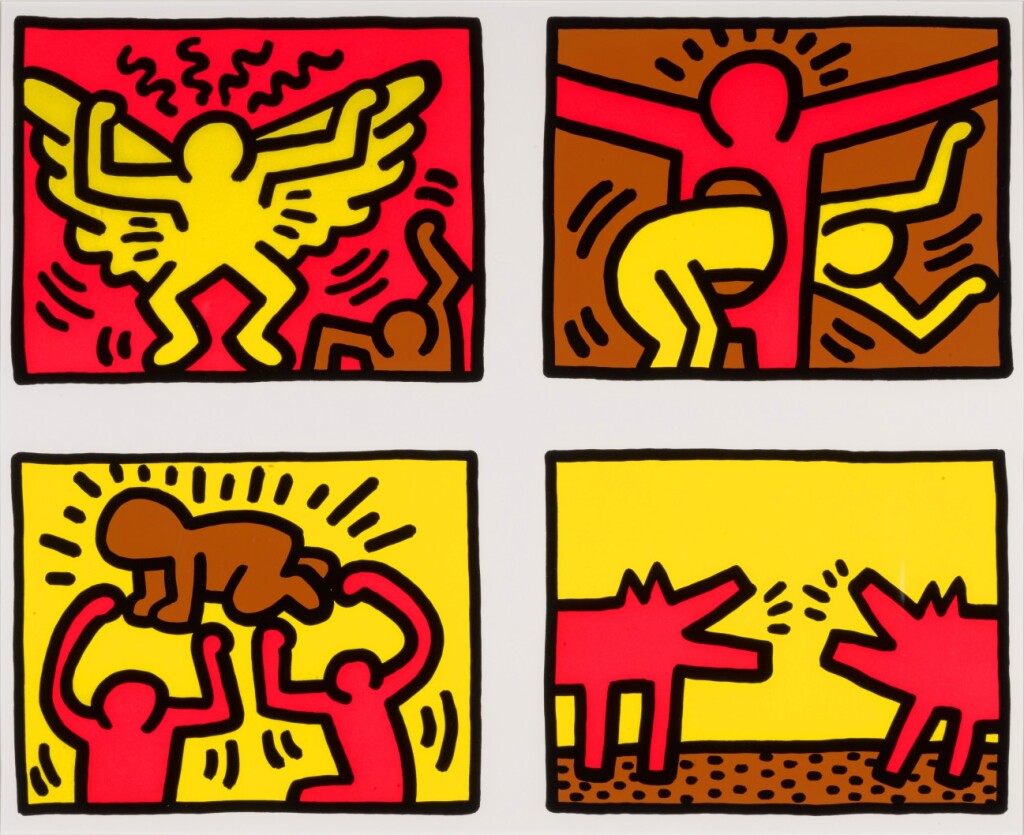
Pop Shop Quad IV, 1989
Screen-print in colors on wove paper
Sheet: 24×30 inches (61×76 cm)
Edition: 75 + 15 AP
Publisher: Martin Lawrence Limited Editions, New York
Literature: Littmann p. 142
5. Pop Shop V
Pop Shop V: 4 Prints
Edition: 200 + 25 AP + 20 HC
Pop Shop Quad V: 1 Print
Edition: 75
Pop Shop V is notable for its combination of pink, red and turquoise as well as its subject matter. Here, swimming dolphins, walking dolphins, androgynous figures and a winged angel play out a joyful scene over four boxes in a style that is reminiscent of comics or cartoons. Boldly outlined in black, the figures recall Haring’s beginnings in street art and his earliest ‘subway drawings’ that made his name while he was still a student. By the time those prints were made however, Haring was at the top of his career and sadly only one year from his death.
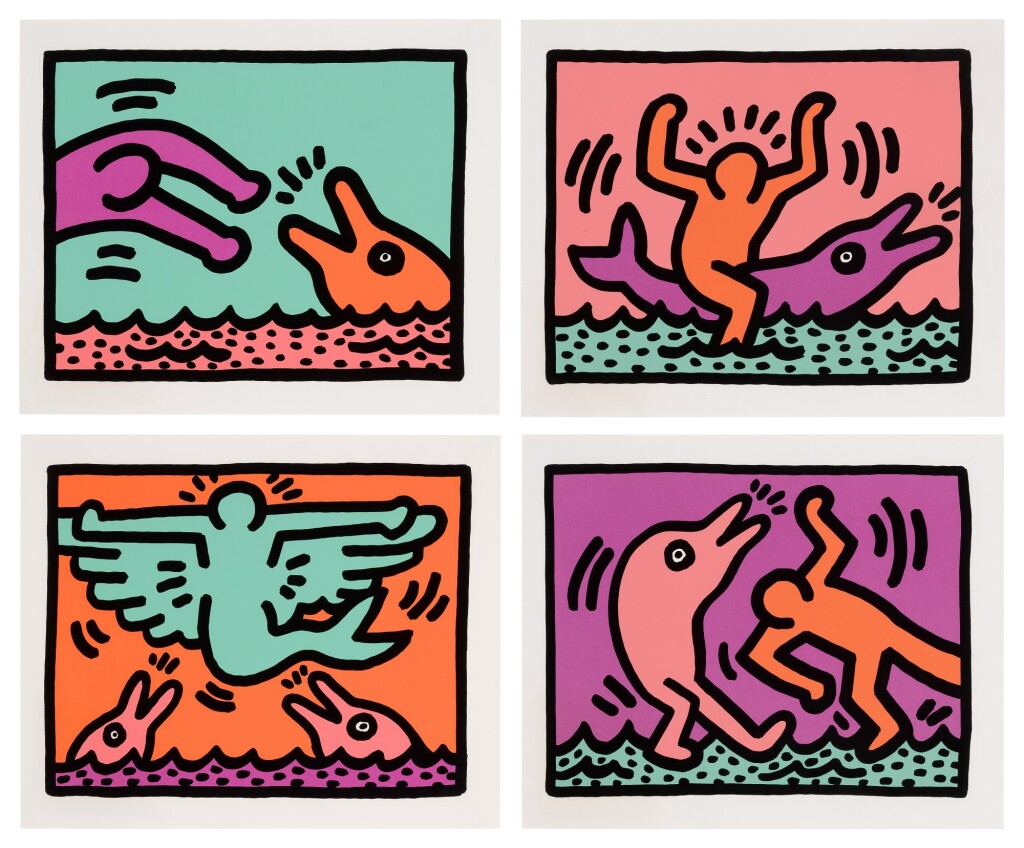
Pop Shop V, 1989
The complete set of 4 screen-print in colors on wove paper
Sheet: 13 1/2 x 16 1/2 inches (34×42 cm)
Edition: 200 + 25 AP
Literature: Littmann pp. 148-149
Plate I (L. p. 148)
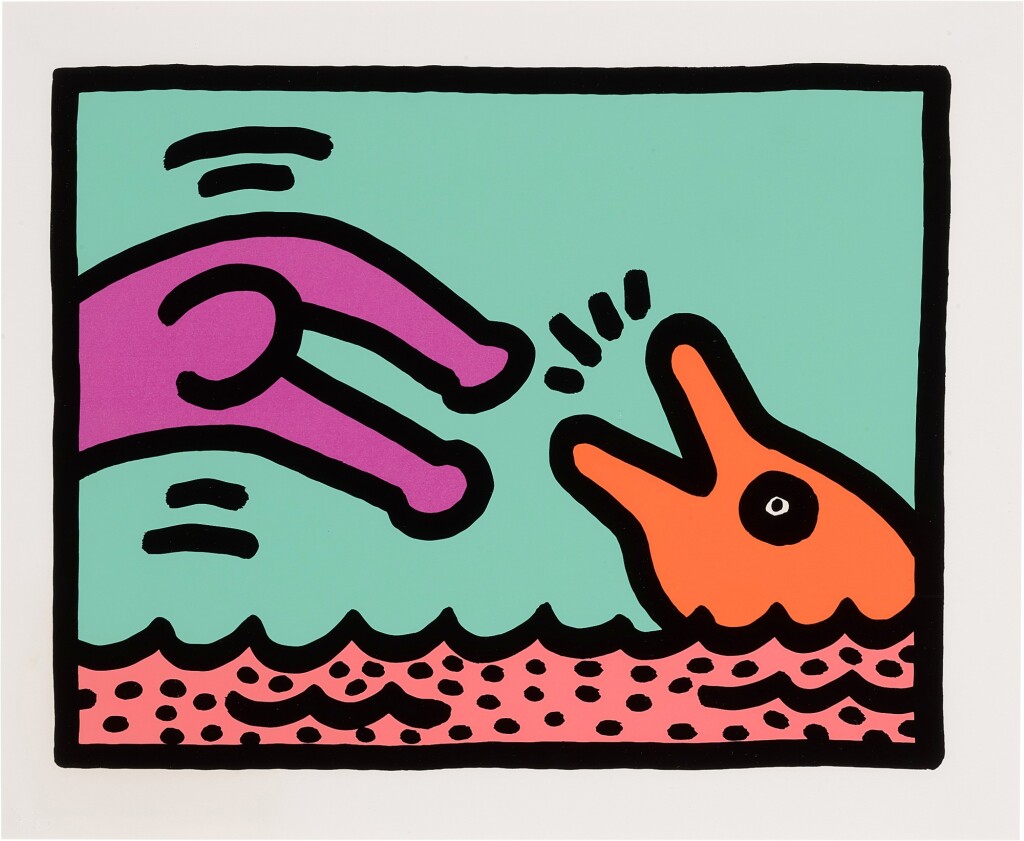
Plate II (L. p. 148)
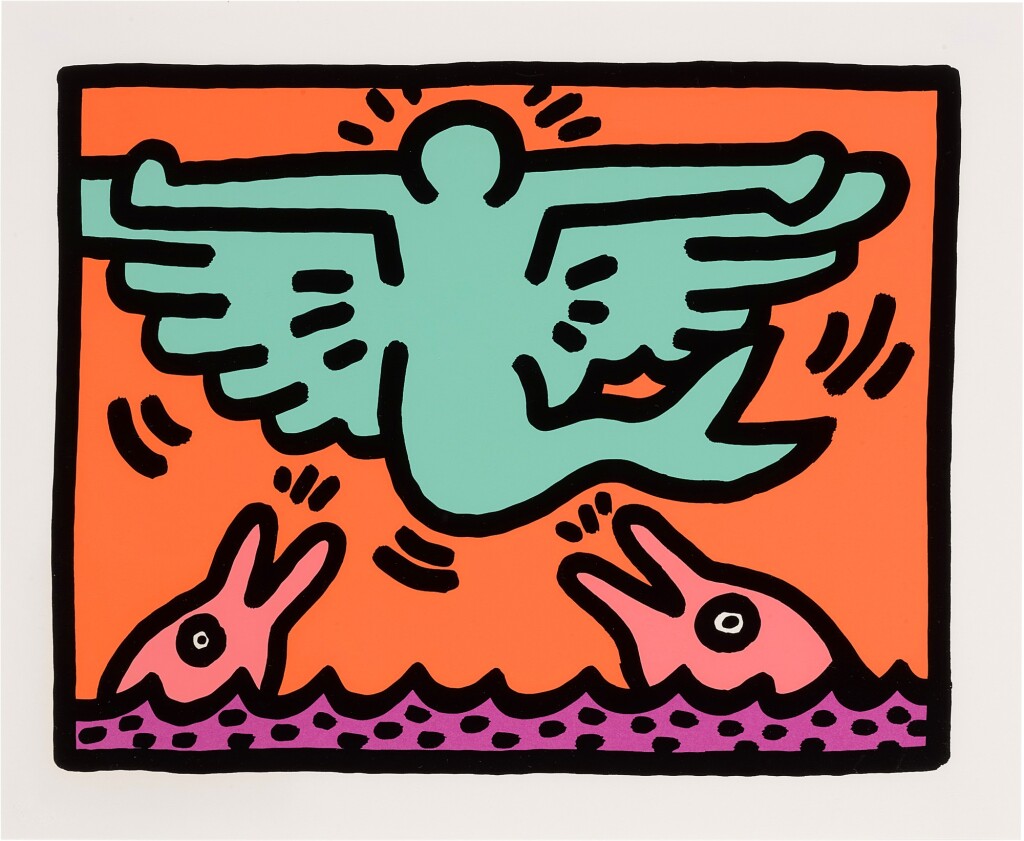
Plate III (L. p. 149)
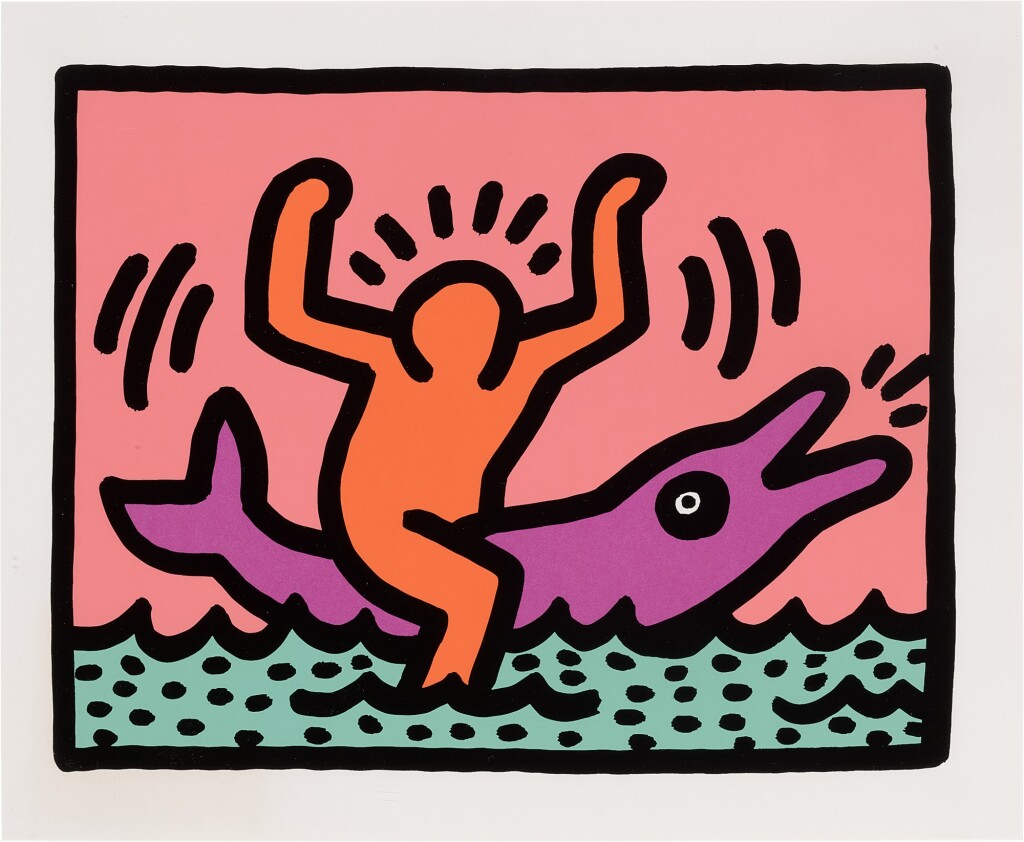
Plate IV (L. p. 149)
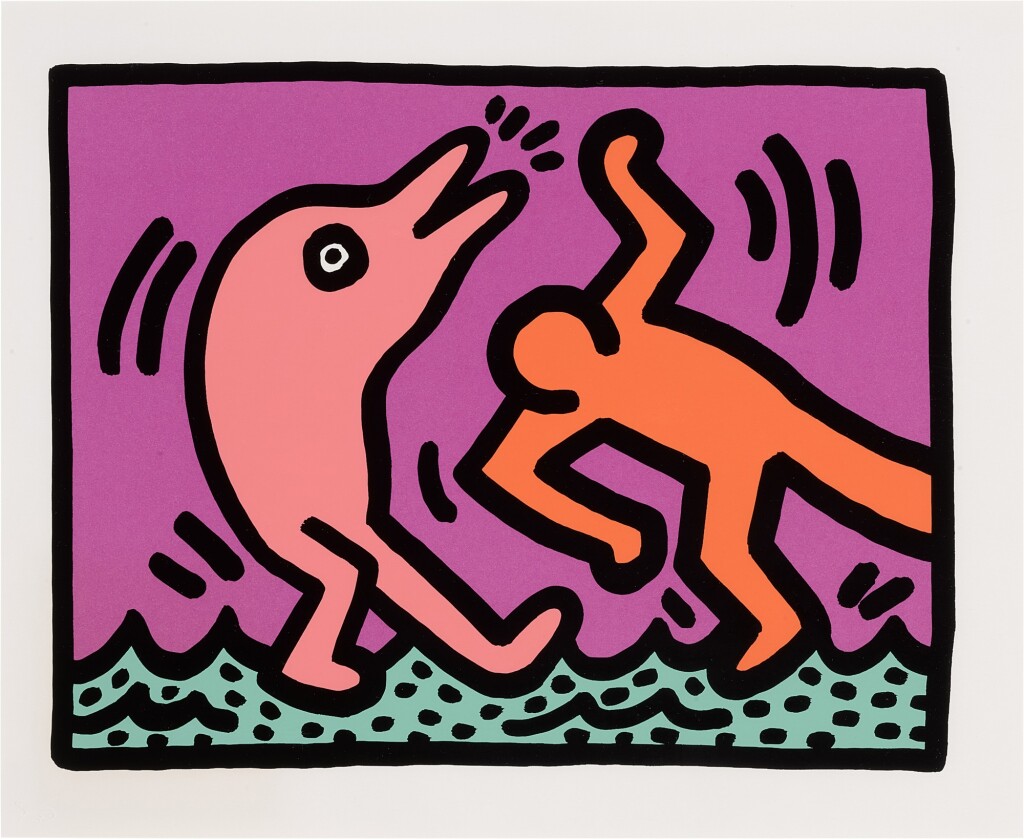
Pop Shop Quad V
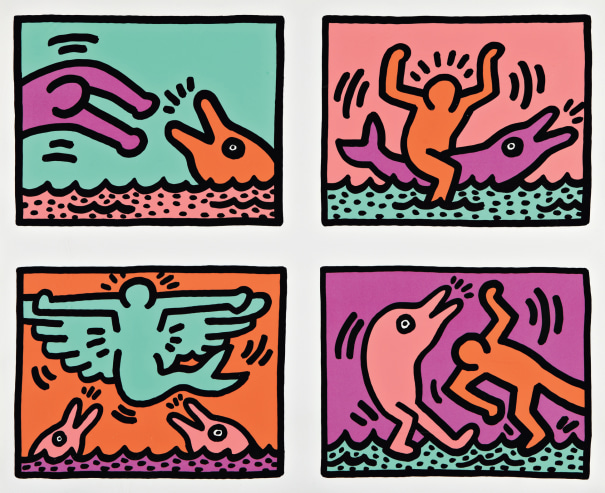
Pop Shop Quad V, 1989
Screen-print in colors on wove paper
Sheet: 27×33 inches (68.5 x 83.5 cm)
Edition: 75 + 5 AP
Literature: Littmann p. 143
6. Pop Shop VI
Pop Shop VI: 4 Prints
Edition: 200 + 25 AP + 20 HC
Pop Shop Quad VI: 1 Print
Edition: 75
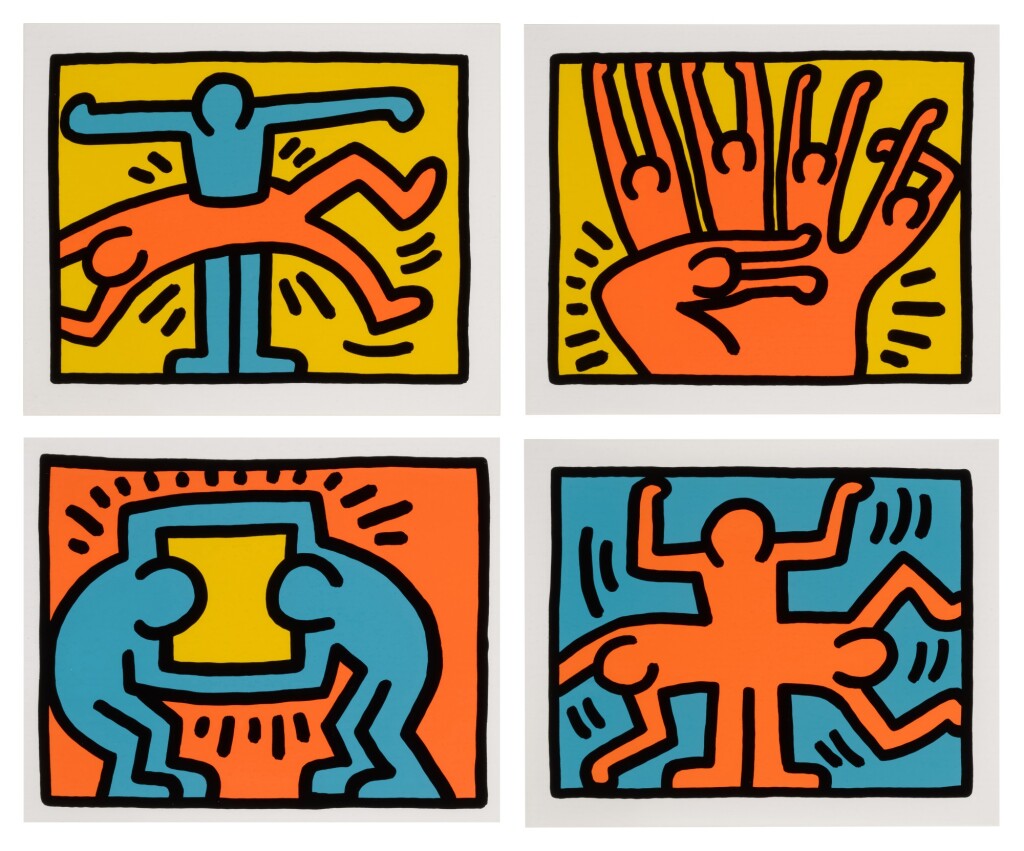
Pop Shop VI, 1989
The complete set of four screen-prints in colors on wove paper
Sheet: 13 1/2 x 16 1/2 inches (34×42 cm)
Edition: 200 + 25 AP
Publishers: Martin Lawrence Limited Editions and The Artist
Literature: Littmann pp. 150-151
Plate I (L. p.150)
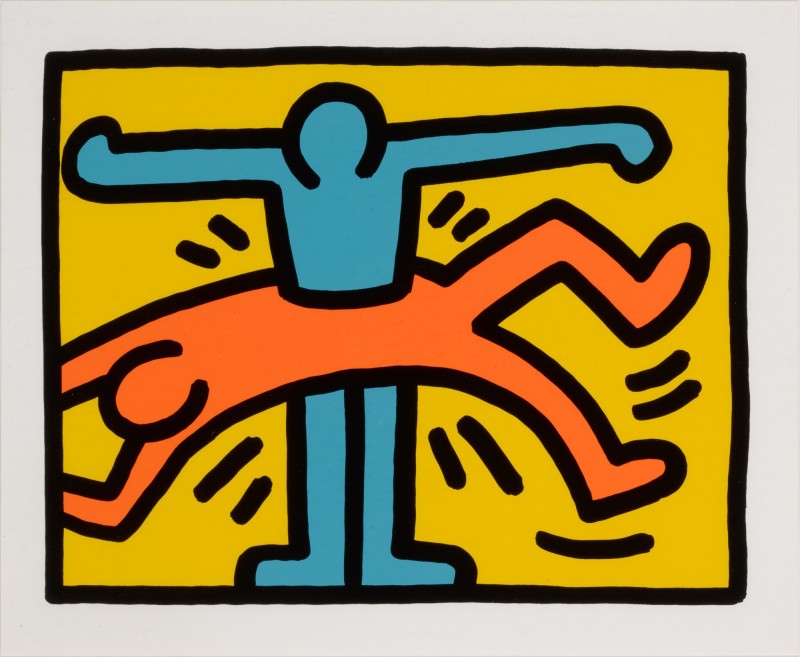
Plate II (L. p. 150)
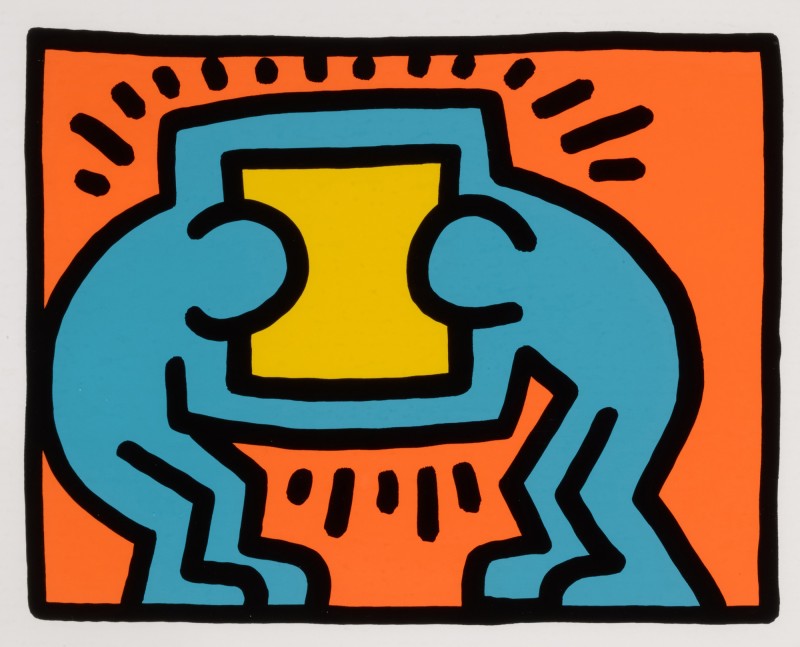
Plate III (L. p. 151)
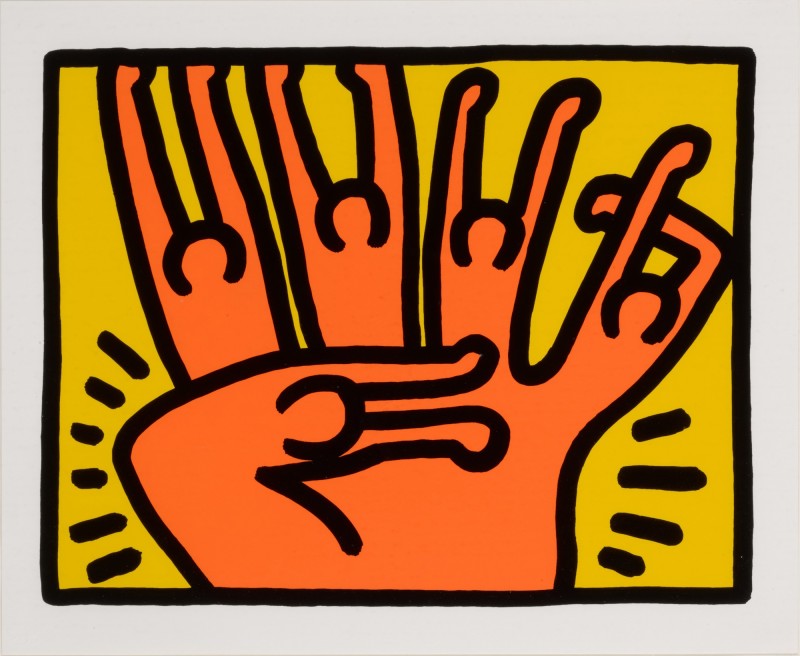
Plate IV (L. p. 151)
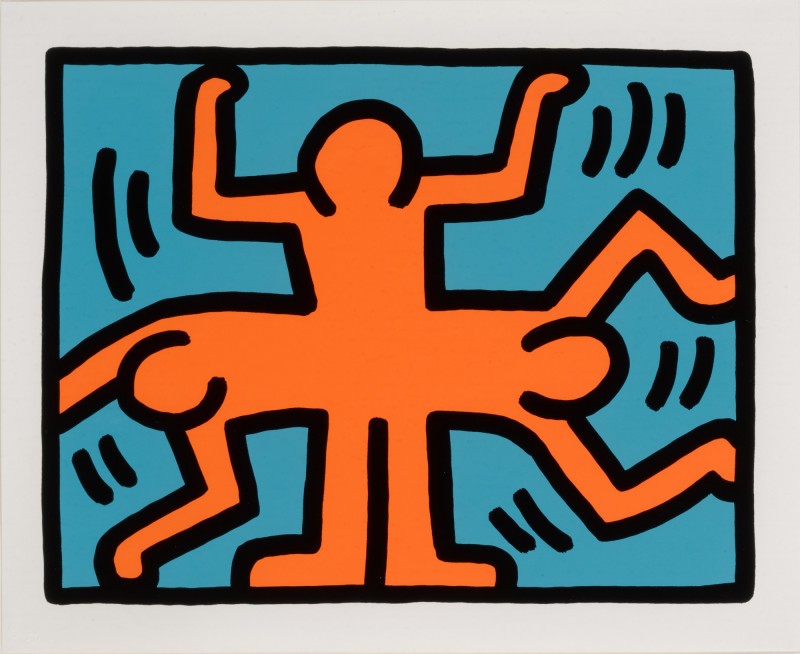
Pop Shop Quad VI
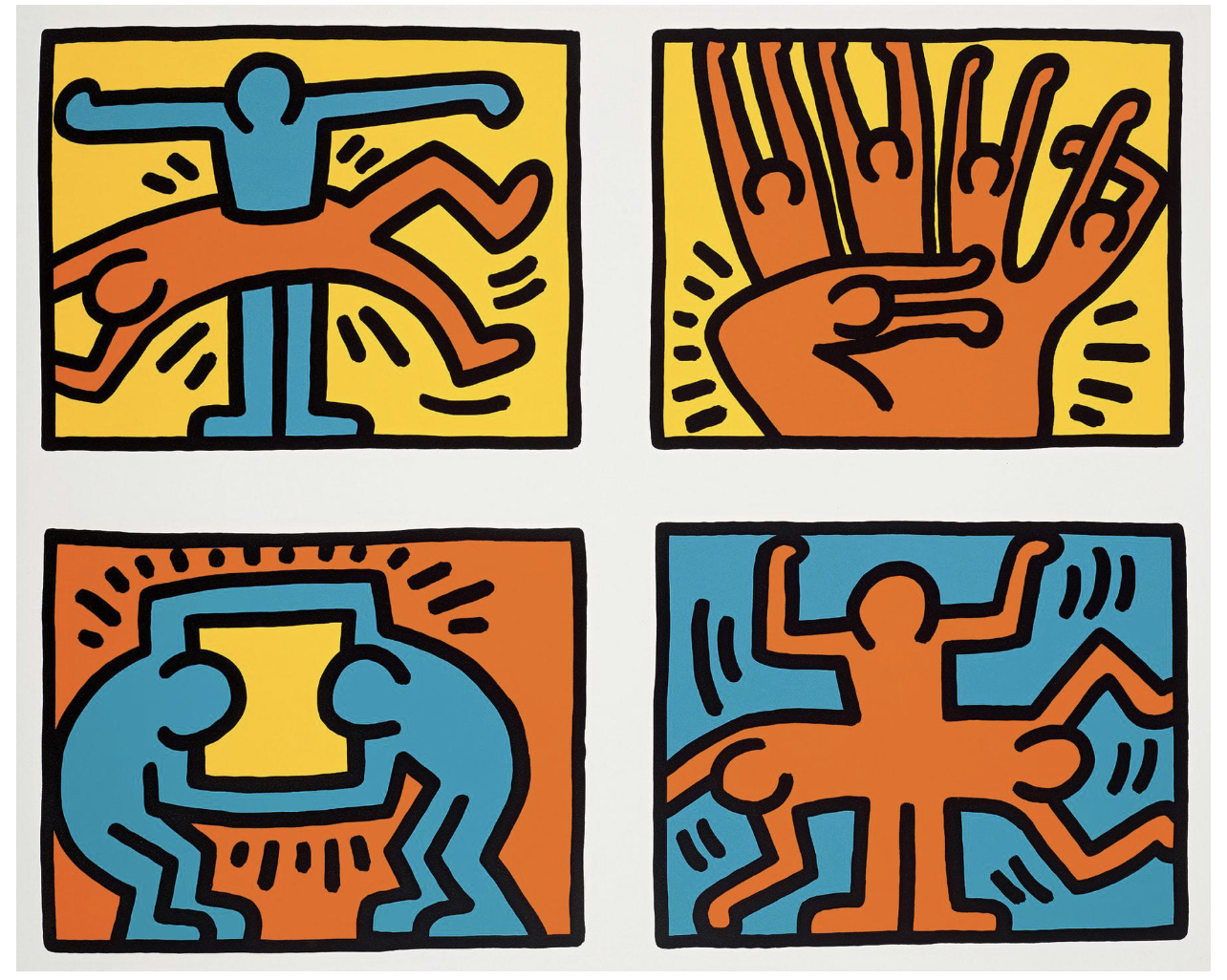
Pop Shop Quad VI, 1989
Screen-print in colors on wove paper
Sheet: 24×30 inches (61×76 cm)
Edition: 75
Publisher: Martin Lawrence Limited Editions, New York
Literature: Littmann p. 143
7. 1988 Prints
1988 Prints
24 Prints
4,145 Impressions
In 1988, Keith Haring released Growing, an iconic series of 5 prints, epitomizing the artistic power of the artist reaching full maturity. Growing was also issued with Trial Proofs of unique color combinations. The artist also released Apocalypse, another grandiose maturity oeuvre.
Growing
5 Prints
Edition: 100 + 15 AP + 40 TP
First State: 1o TP
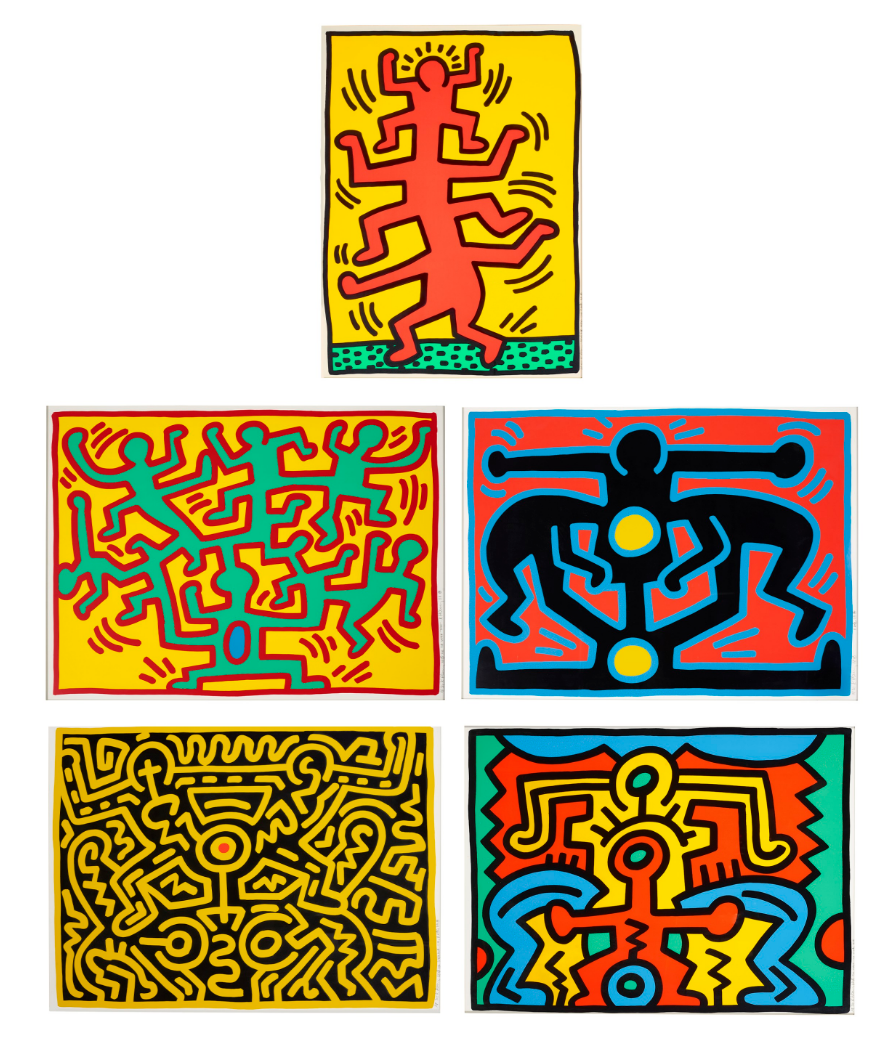
Growing, 1988
The complete set of five screen-prints in colors on Lenox Museum Board
Sheet: 30×40 inches (76×102 cm)
Edition: 100 + 15 AP + 15 HC
Trial Proofs: 40, each with a unique color combination
Growing First State: 10 Trial Proofs in Black and White (numbered in Roman numerals)
Publisher: Martin Lawrence Editions, Greenwich, New-York
Literature: Littmann pp 88-91
Growing: First State
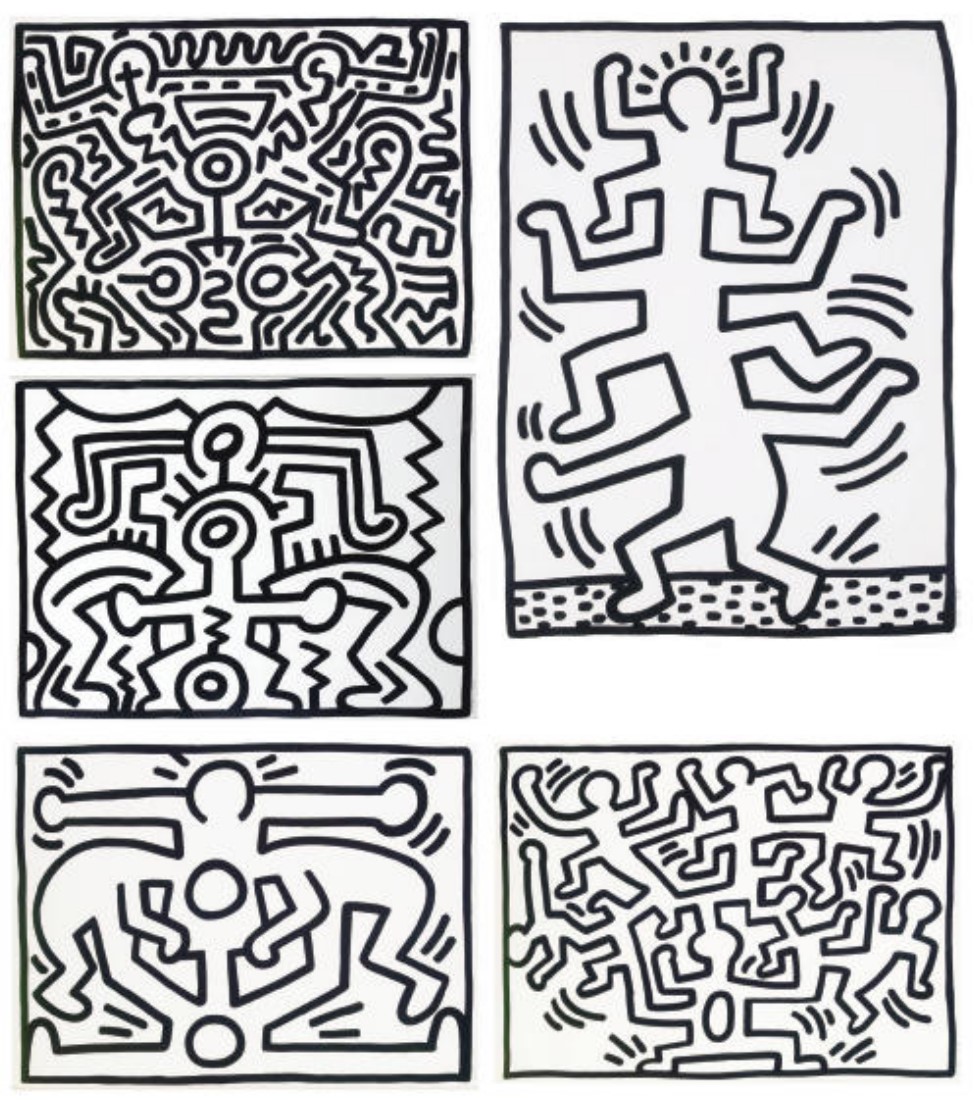
Growing Suite is comprised of five screen-prints with vibrant color and bodies-in-motion, a style that is pure Haring.
“Because the hand is central to Keith’s process, his work comes right out of his body.”
Jeffrey Deitch
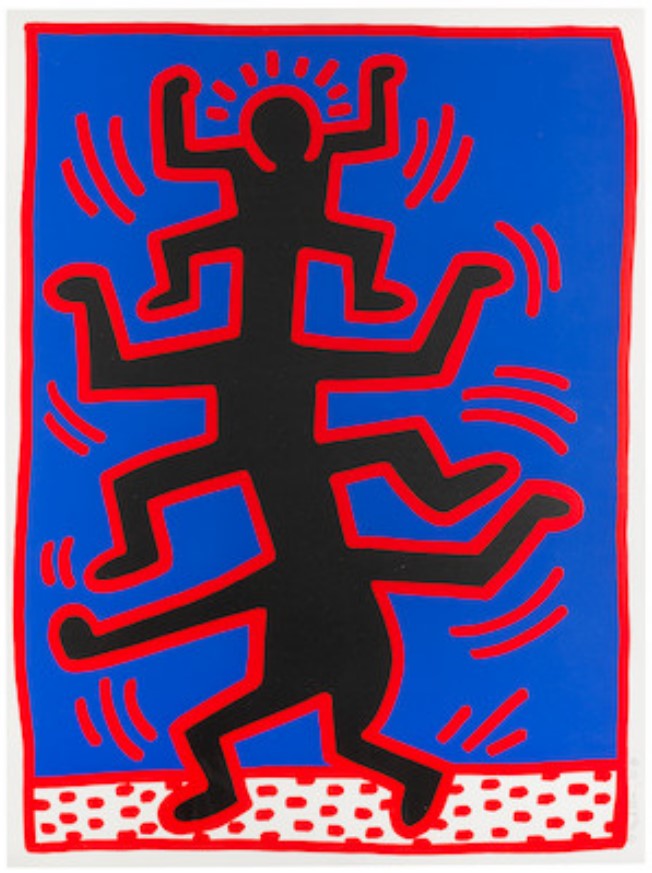
This notion of Haring’s prints as a mobile extension of the artist’s body emanates from the Growing Suite, both in its ecstatic, interconnected content and the chosen medium of screen-printing. In subject, the works bear similarity to the Pop Shop I and Pop Shop II series of that same era; all three series feature Haring’s iconic human figures in various stages of movement and convergence. As its title suggests, Growing’s forms are transitory, in-process, and, significantly, interdependent. Circles appear (often interchangeably) as heads and abdomens within the series, suggesting seeds and sources of origin. In one work, a single figure branches upward and outward into multiple figures like a tree growing towards the sun. That upward thrust appears again in the “people ladder,” where a smaller, child-like figure appears lifted into being by two supporting figures.
Growing #1 features an image of a ‘People Ladder’, one of Haring’s most recognizable motifs, representing a tower of 1980s break-dancers stacked on top of one another. Haring uses thick bold lines and flat saturated colors to produce an image that bursts with energy and vigor.
Growing #1 (L. p. 89)
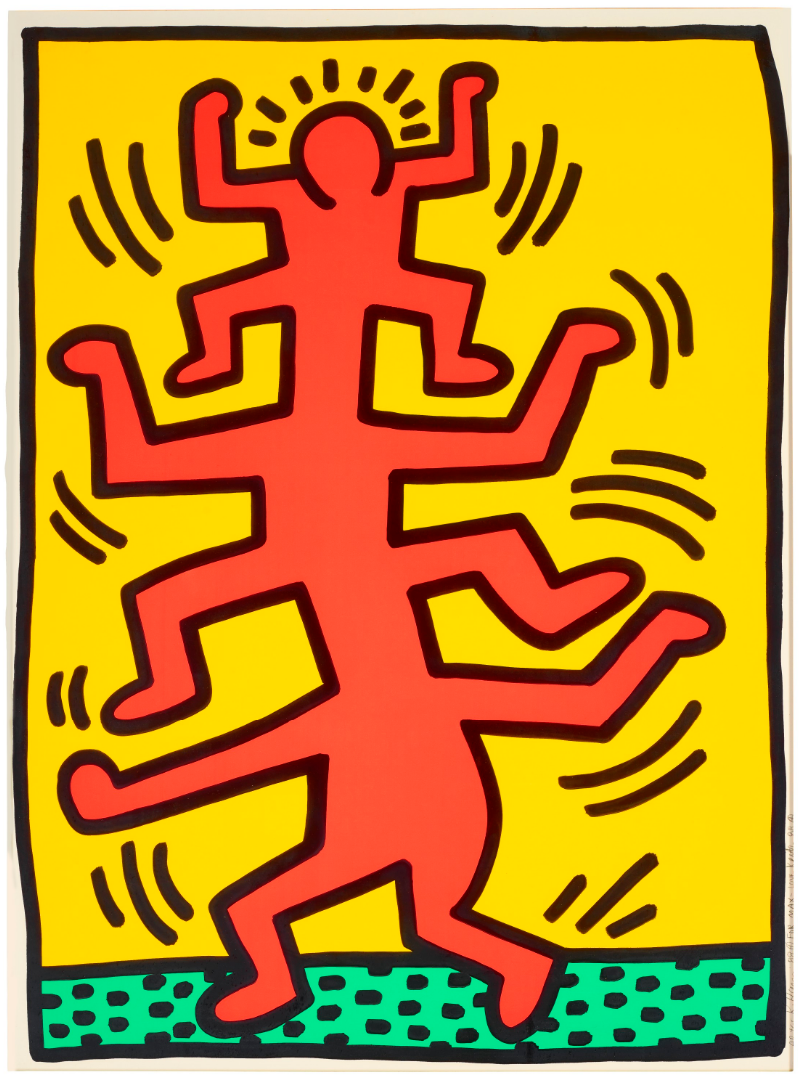
Growing #1 TP 30/40
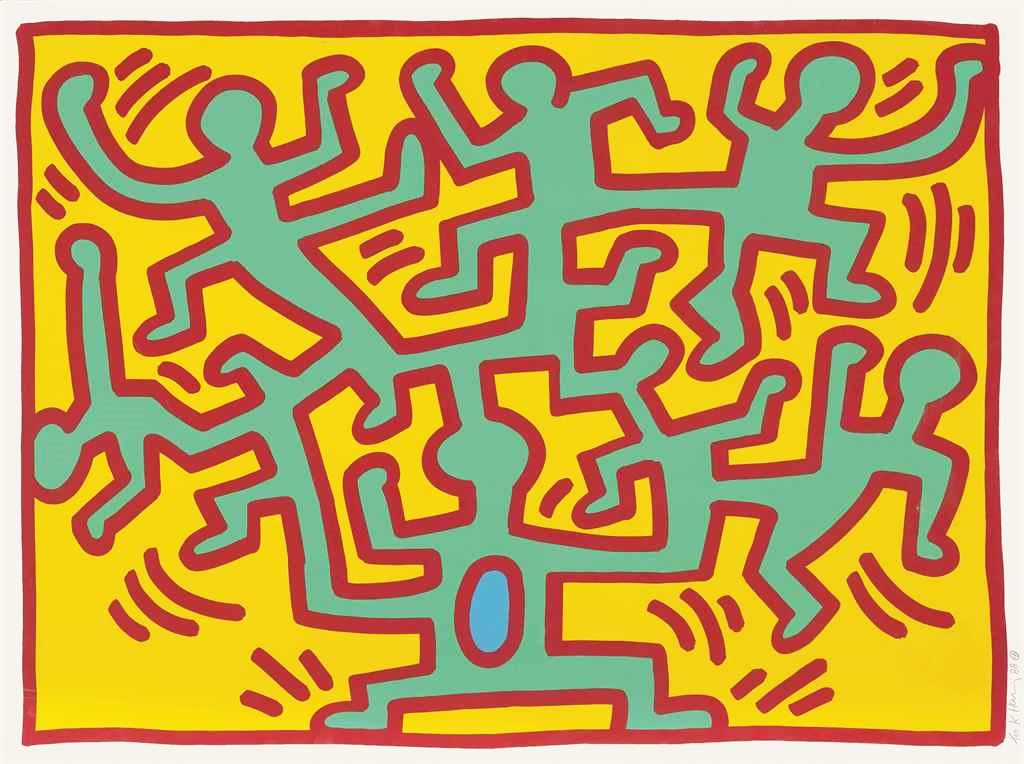
Growing 2 shows a brightly colored image of a number of stick figures conjoined and stemming from a single, central figure. The composition develops organically outwards and resembles the shape of a tree, the central figure acting as a trunk and limbs of the bodies like branches.
Growing #2 (L. p.90)
Growing 3 shows a symmetrical image of four figures interconnected and conjoined by the torso of the central figure. Haring depicts these figures in black and contours the subject in blue, rounded outlines, setting the image against a vivid red backdrop. Typical of Haring’s figurative style, rounded lines are used to create a sense of energy and movement in the print, as though these figures are dancing or working with one another.
Growing #3 (L. p. 90)
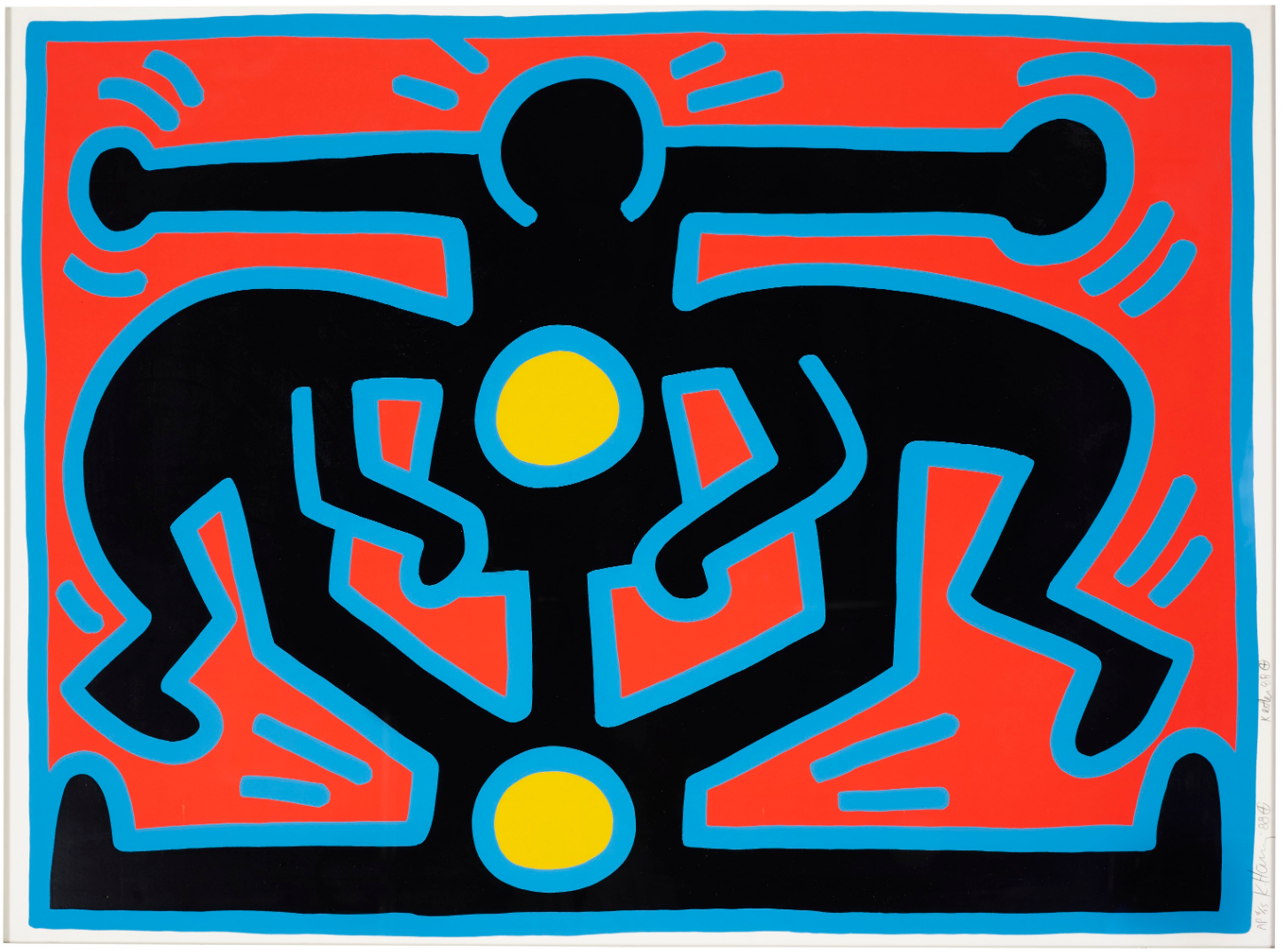
Growing #3 TP 26/40
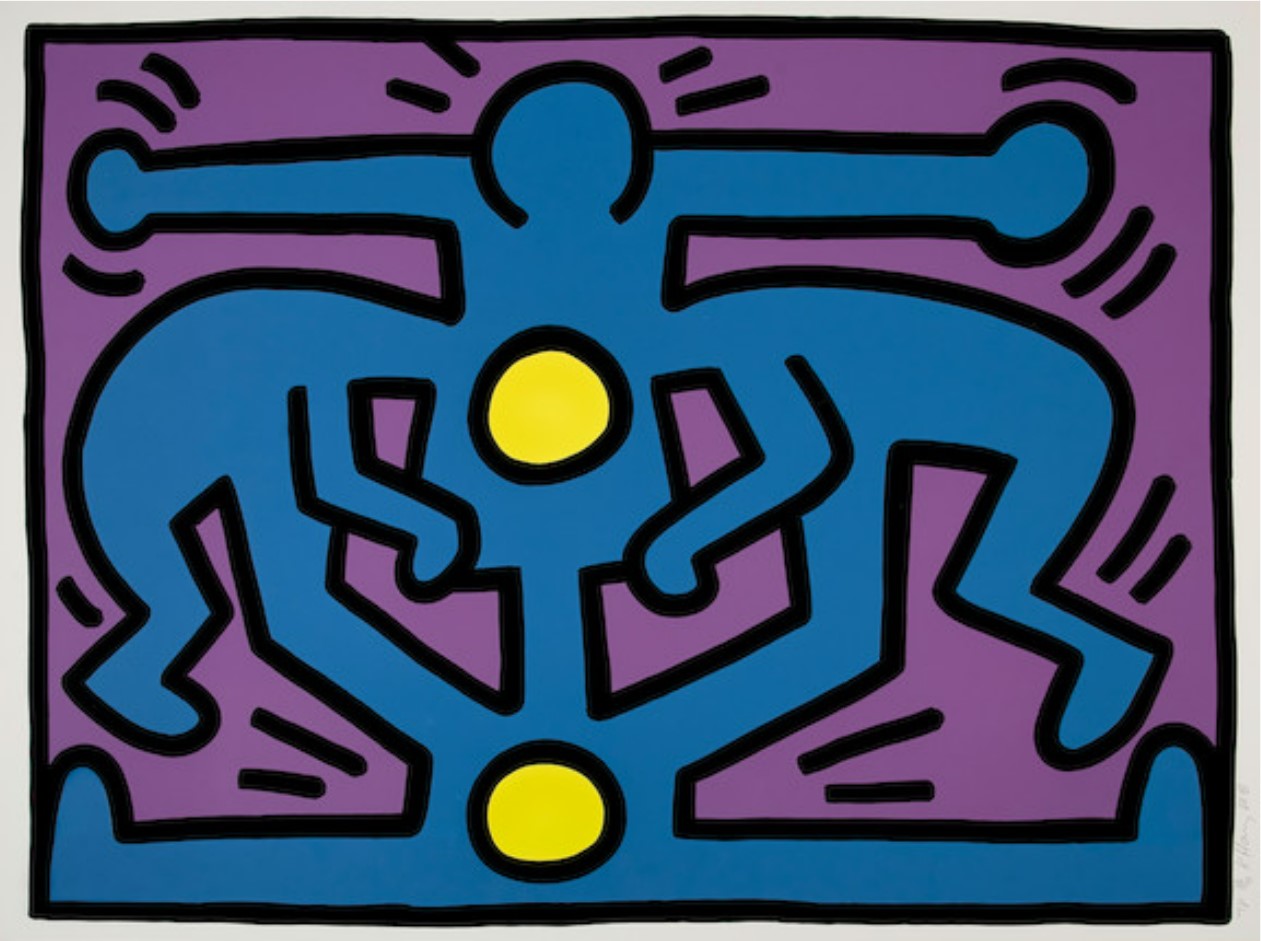
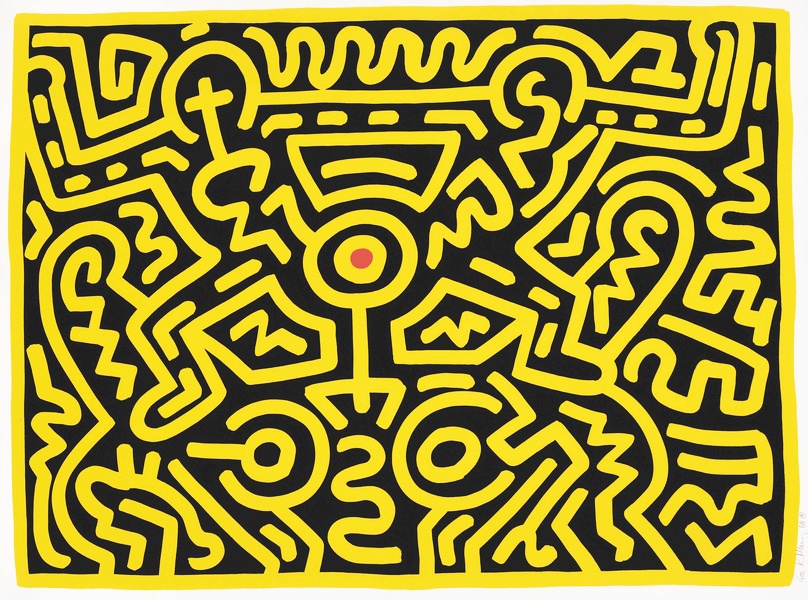
Growing 4 shows two figures conjoined at the hip by a target symbol in the center of the image, depicted in rounded yellow lines against a black backdrop. There is a clear focus on pattern across the entire image and the symmetry of the composition organically develops outwards from the center. As the Growing Series progresses, it is unclear where some figures begin and end as Haring’s compositions become more complex and interconnected.
Growing #4 (L. p. 91)
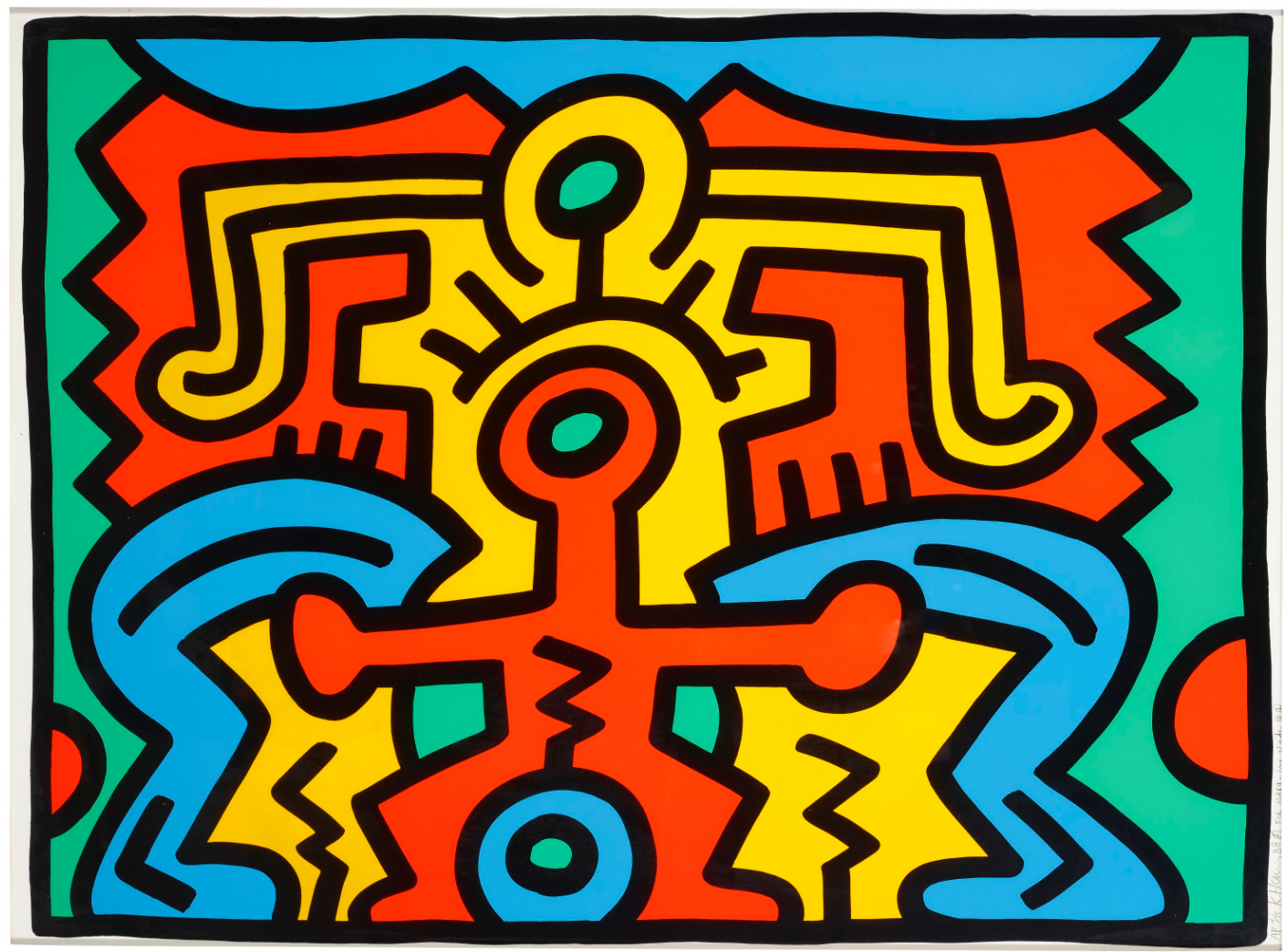
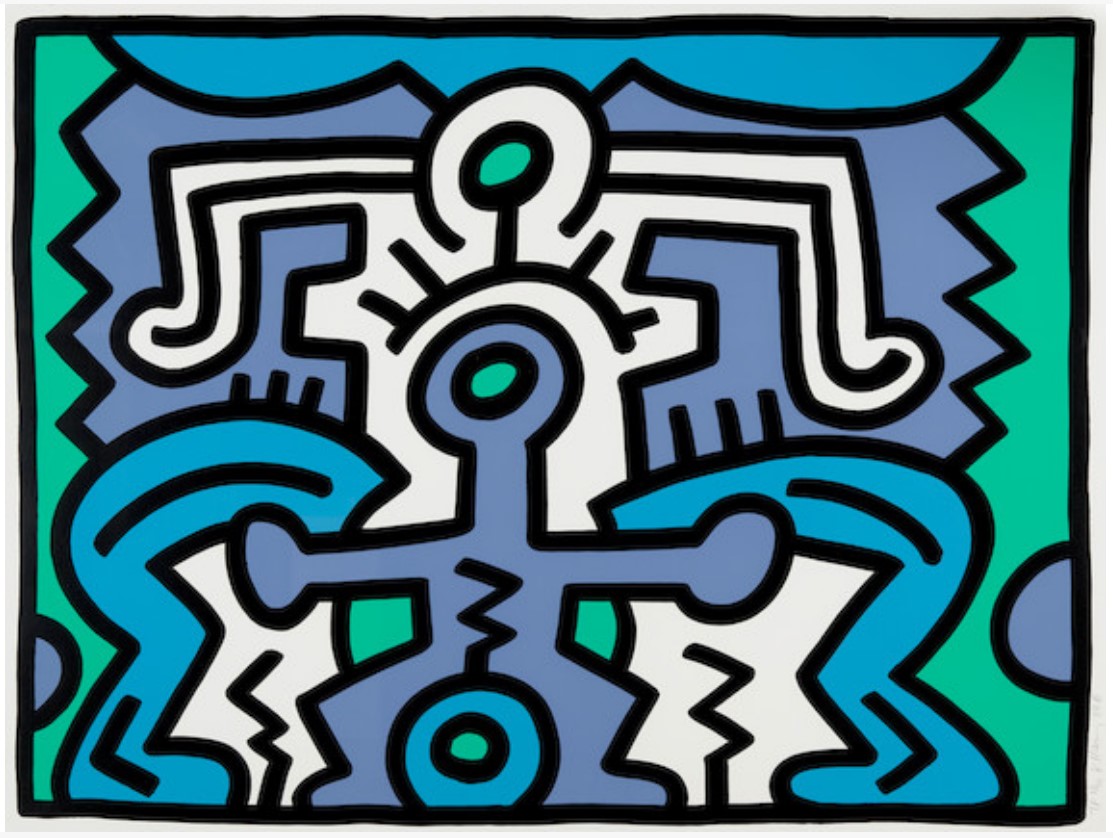
Striking in its use of bright color and bold shapes, Growing #5 shows an unusual arrangement of figures. Unlike other works in the series, the image is symmetrical in composition, showing two central figures with their arms outstretched and a figure on either side with their bodies bent over inwards, hiding their heads.
Growing #5 (L. p.91)
Growing 5 TP 22/40
Untitled
1 Print
Edition: 150

Untitled, 1988
Screen-print in colors on wove paper
Sheet: 10 1/4 x 8 1/8 inches (26 x 20.7 cm)
Edition: 150
Literature: Littmann p. 92
Dr Winkie Wedding Invitation
1 Print
Edition: 125

Untitled (Dr. Winkie Wedding Invitation), 1988
Screen-print in colors on unstretched canvas
Sheet: 7 3/4 x 7 1/4 inches (19.7 x 18.5 cm)
Edition: 125 (Littmann calls for an edition of 20)
Literature: Littmann p. 92
Created and printed for the marriage of Estefania Kong to Lawrence “Dr. Winkie” Lin, San Francisco
International Volunteer Day
1 Lithograph
Edition: 1,000

International Volunteer Day, 1988
Lithograph in colors on Arches rag paper
Sheet: 11 1/4 x 8 1/2 inches (28 x 21.5 cm)
Edition: 1,000
Publisher: The United Nations, New-York
Literature: Littmann p. 93
Apocalypse
10 Prints
Edition: 90 + 20 AP + 5 HC
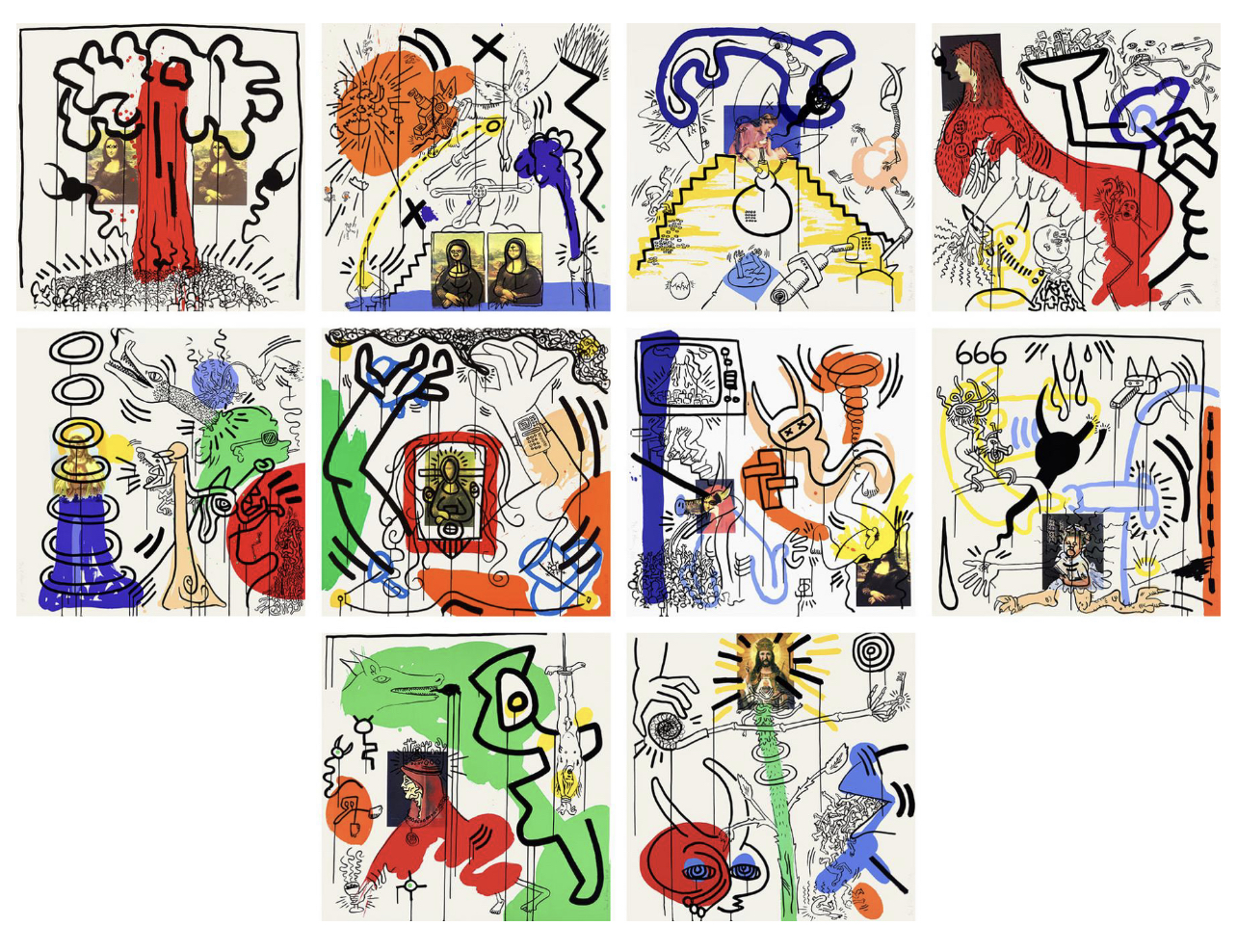
Apocalypse, 1988
The complete set of 10 screen-prints in colors on Museum Board, with accompanying text by William Burroughs screen-printed on acetate
Each Sheet: 38×38 inches (96.5 x 96.5 cm)
Edition: 90 + 20 AP + 5 HC
Publisher: George Mulder Fine Arts, New York
Literature: Littmann pp. 98-109
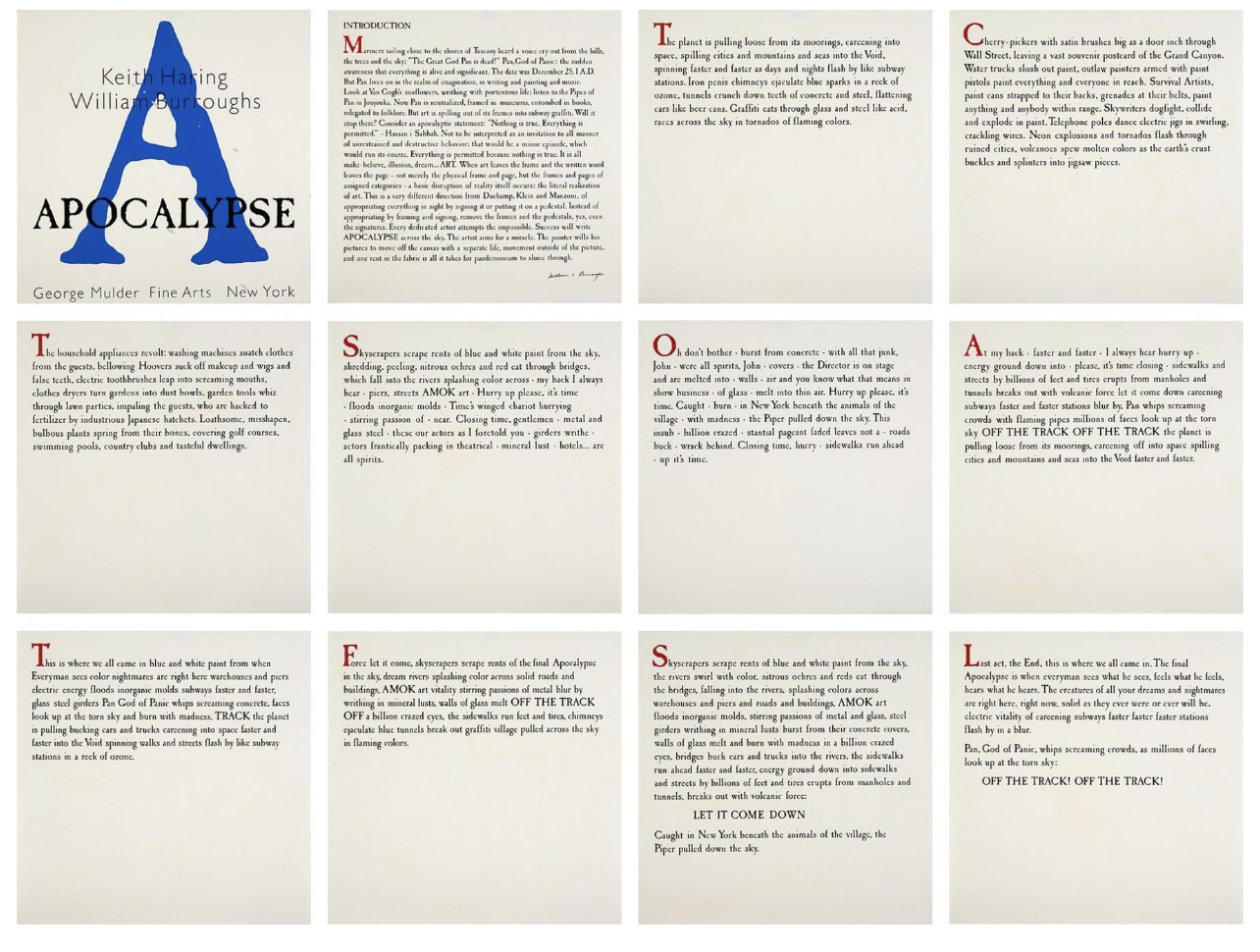
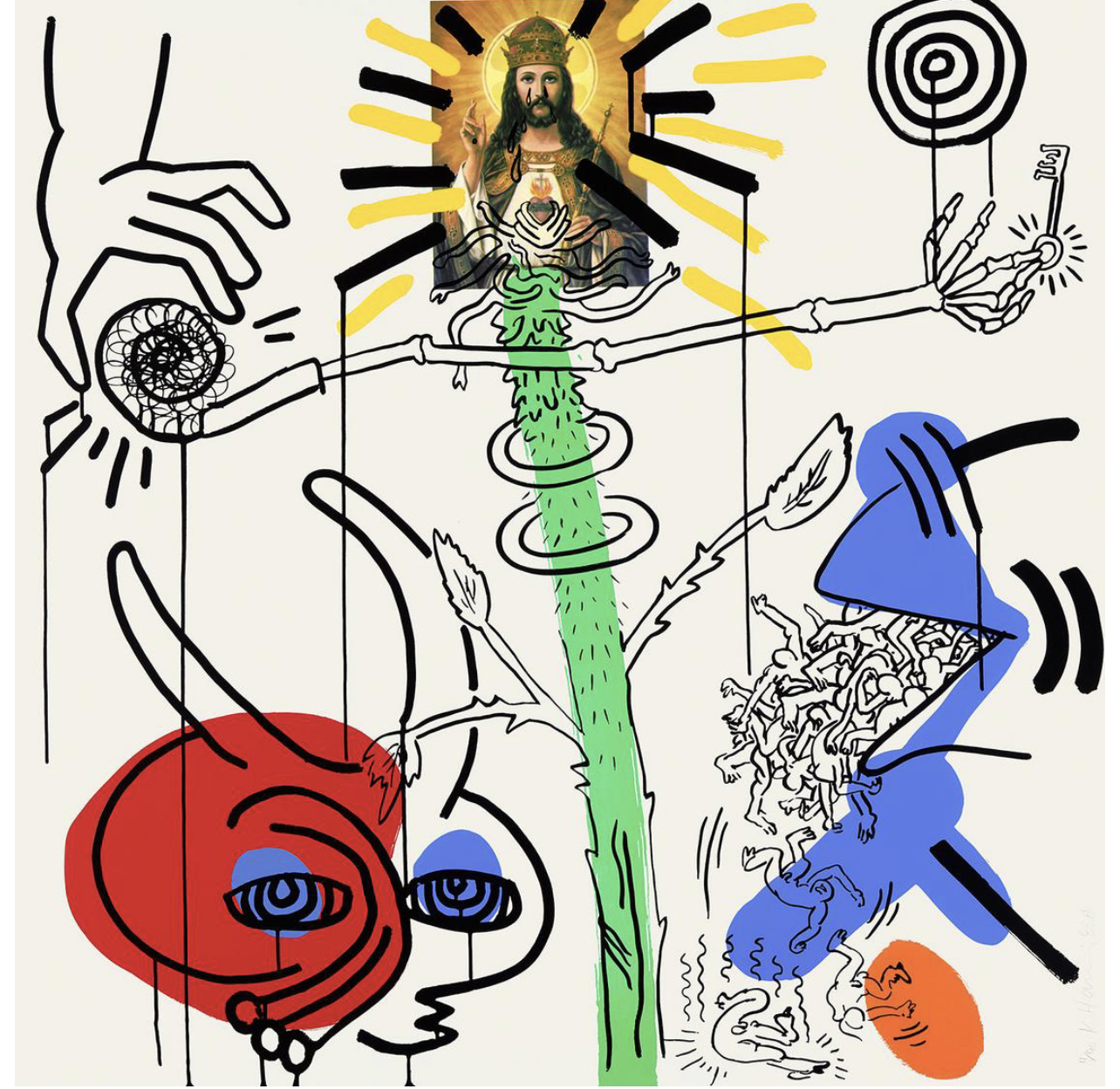
From the very beginning of Keith Haring’s career, the influence of Beat Era poet and novelist William S. Burroughs (1914–1997) and artist Brion Gysin (1916–1986) was immense. Haring’s first interaction with them came in 1978. While a student at the School of Visual Arts, he happened upon the Nova Convention, a gathering of Beat poets and downtown artists, including Burroughs, Allen Ginsberg, Laurie Anderson, and Patti Smith. After this introduction, Haring read and followed the exact methods laid out in Burroughs and Gysin’s 1977 book The Third Mind, which describes ways of breaking down language. Theirs was the text-based foundation upon which Haring broke forward with his visual style in 1980, introducing his inimitable line to their “cut-up” method, and creating a form of pictorial communication that expanded beyond what ideas in traditional language could accomplish.
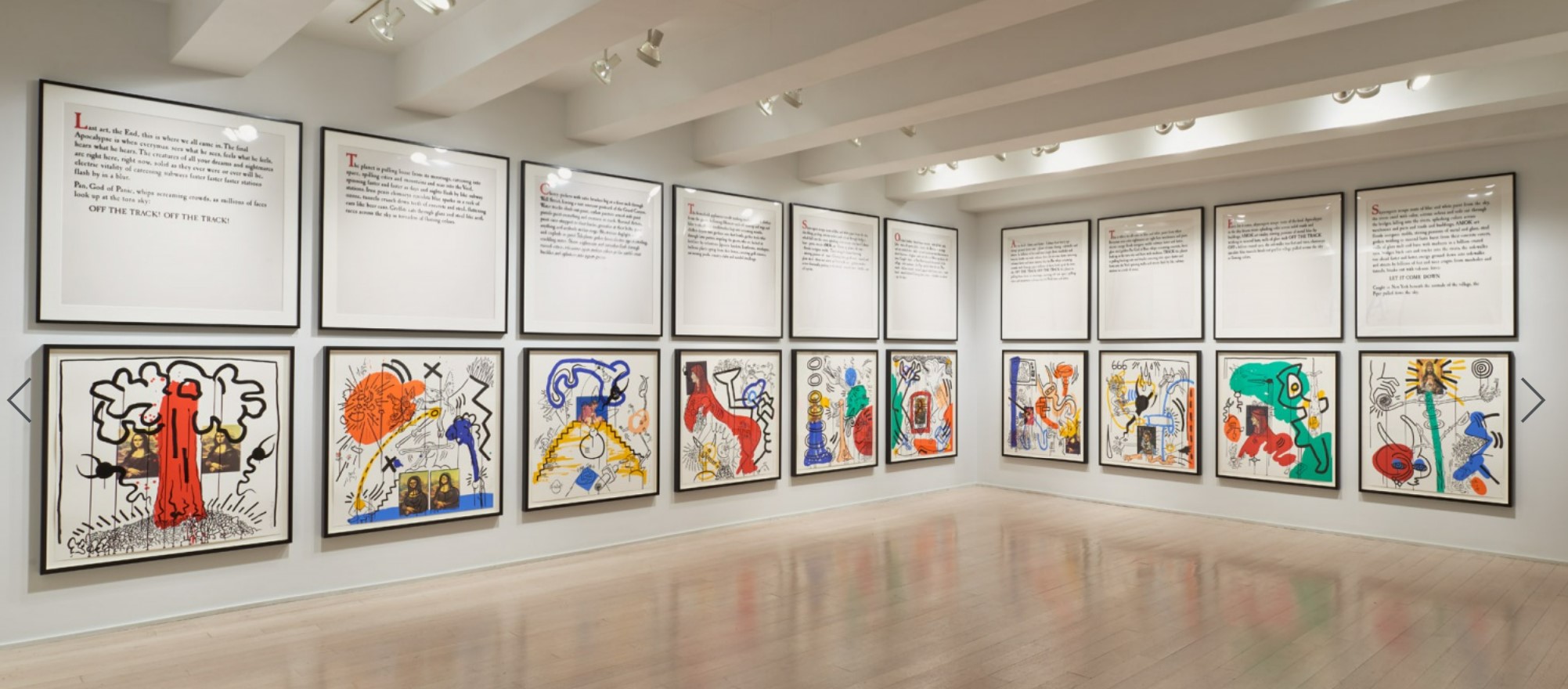 Installation View of Keith Haring: Apocalypse, Pace Prints, New-York
Haring often worked with other artists, writers, children and activists throughout his short but abundantly productive career. Perhaps most meaningful were his collaborations with Burroughs. Apocalypse consists of ten pages of Burroughs’ text along with ten images by Haring. It was created by both artists in 1988. Haring’s work often touches on the paradoxical: life and death, religion and sexuality, heaven and hell, and political activism and conformity. In fact, his two most cited works of influence are Dante’s Inferno and Hieronymus Bosch’s The Garden of Earthly Delights. These tropes become all the more prominent in his series with Burroughs. With Burroughs’ free-form text, Haring appropriated and collaged symbols of mass consumerism, religion, art and advertisements upon which he created both imagery from his iconic vocabulary and stream-of-thought line. 1988 was the year that Haring was diagnosed with AIDS, though its effects on the New York downtown community had been present for years. Computers, spermatozoa, devils, halos, divine light and radiance show the complexity, struggles, torment and illusory bliss of life at that very time. Burroughs’ text pages, printed on acetate film, are written and segmented words that heighten the polemics of euphoria and fear, and are ever as relatable today, albeit for different reasons, as they were when written in 1988.
Apocalypse 1 (L. p. 101)
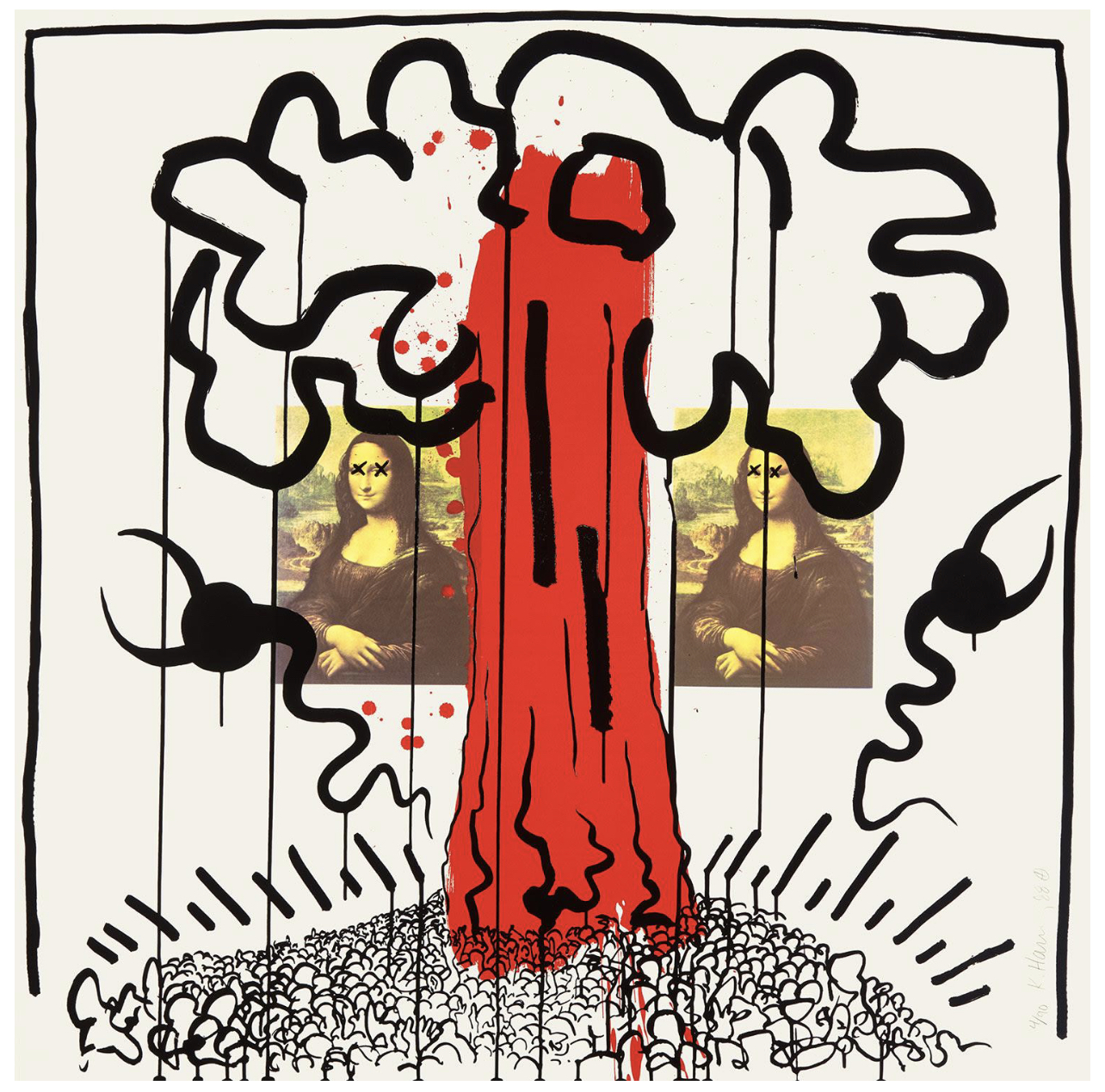
Apocalypse 2 (L. p. 101)
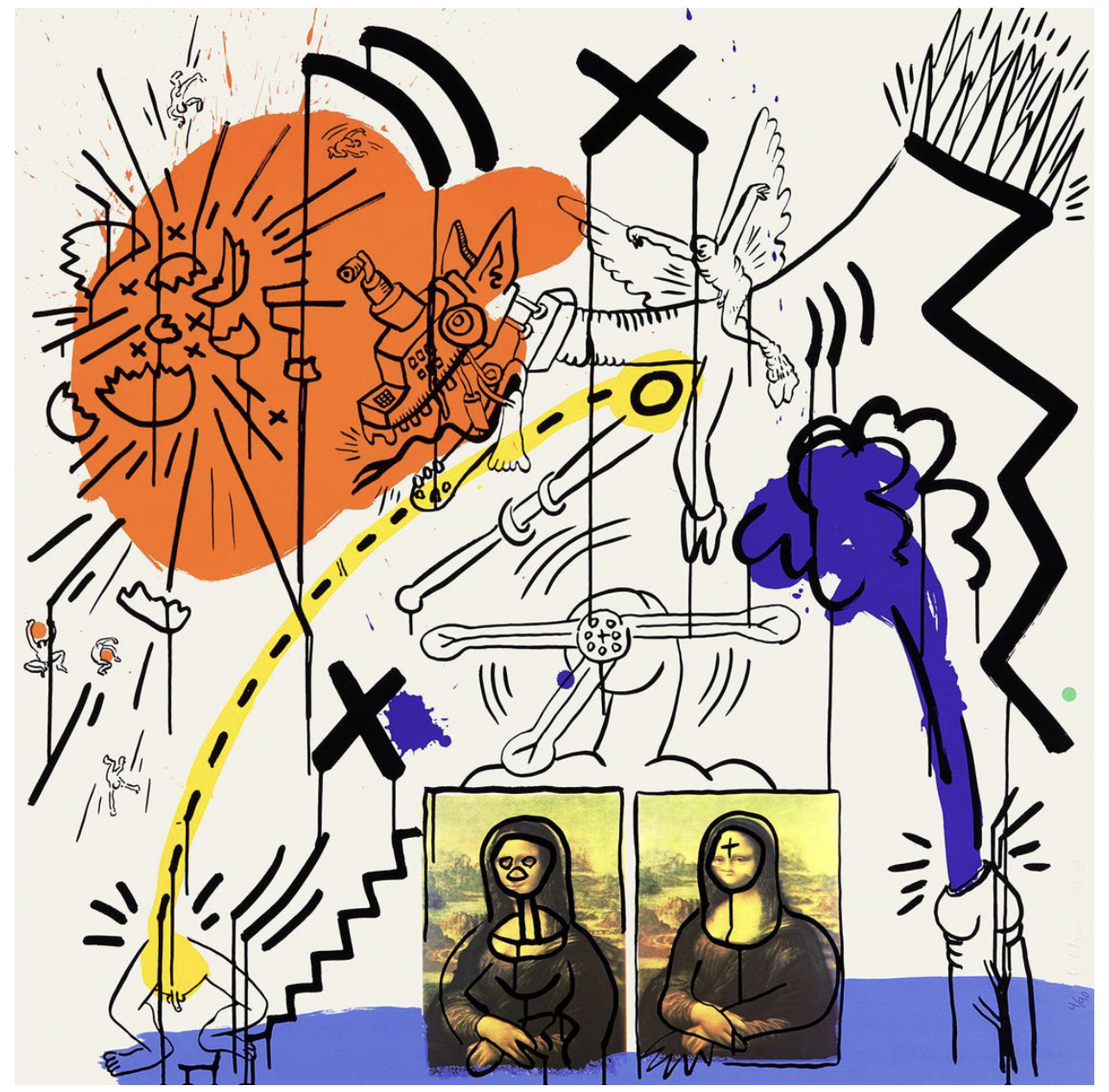
Apocalypse 3 (L. p. 102)
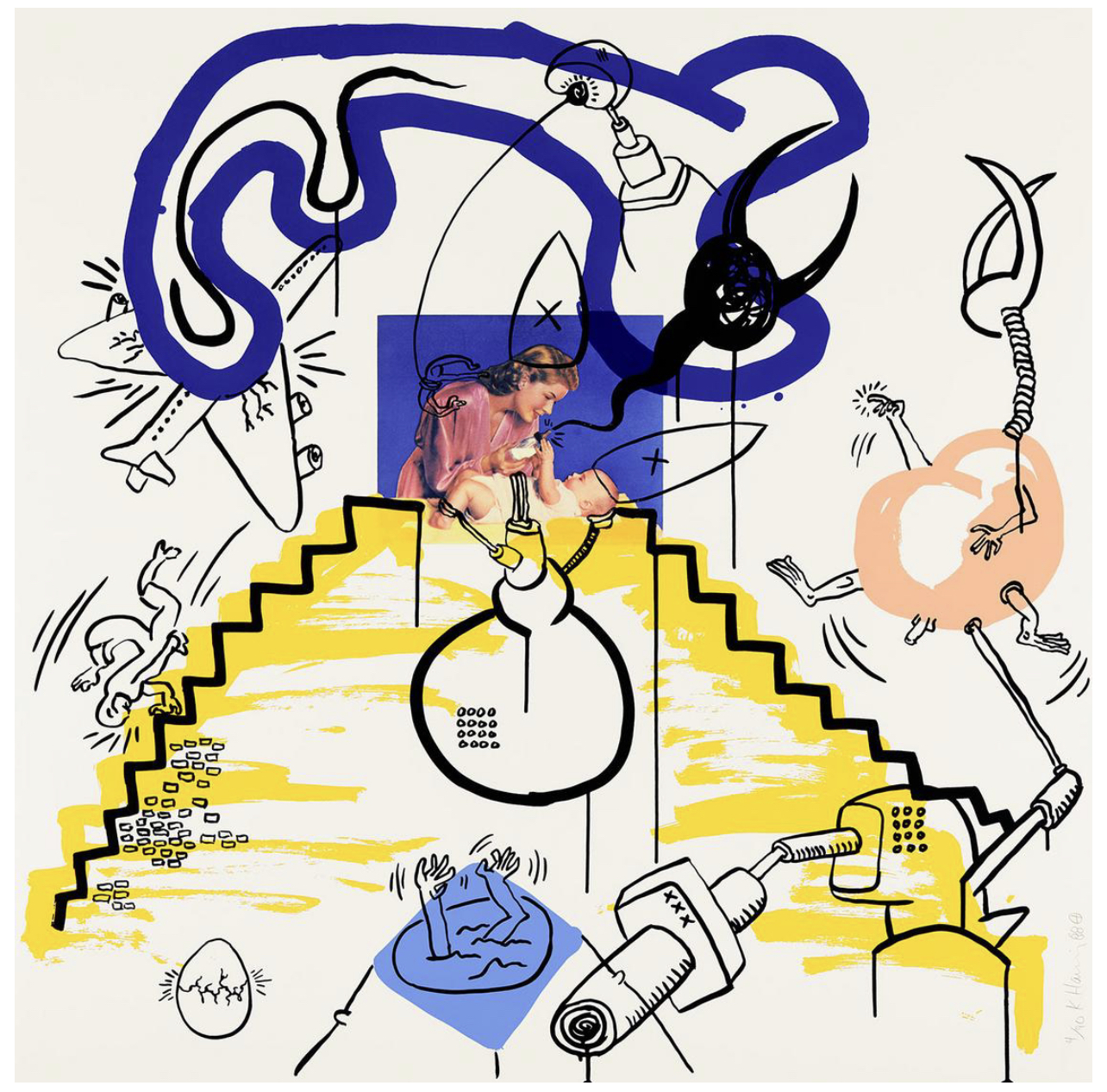
Apocalypse 4 (L. p. 102)
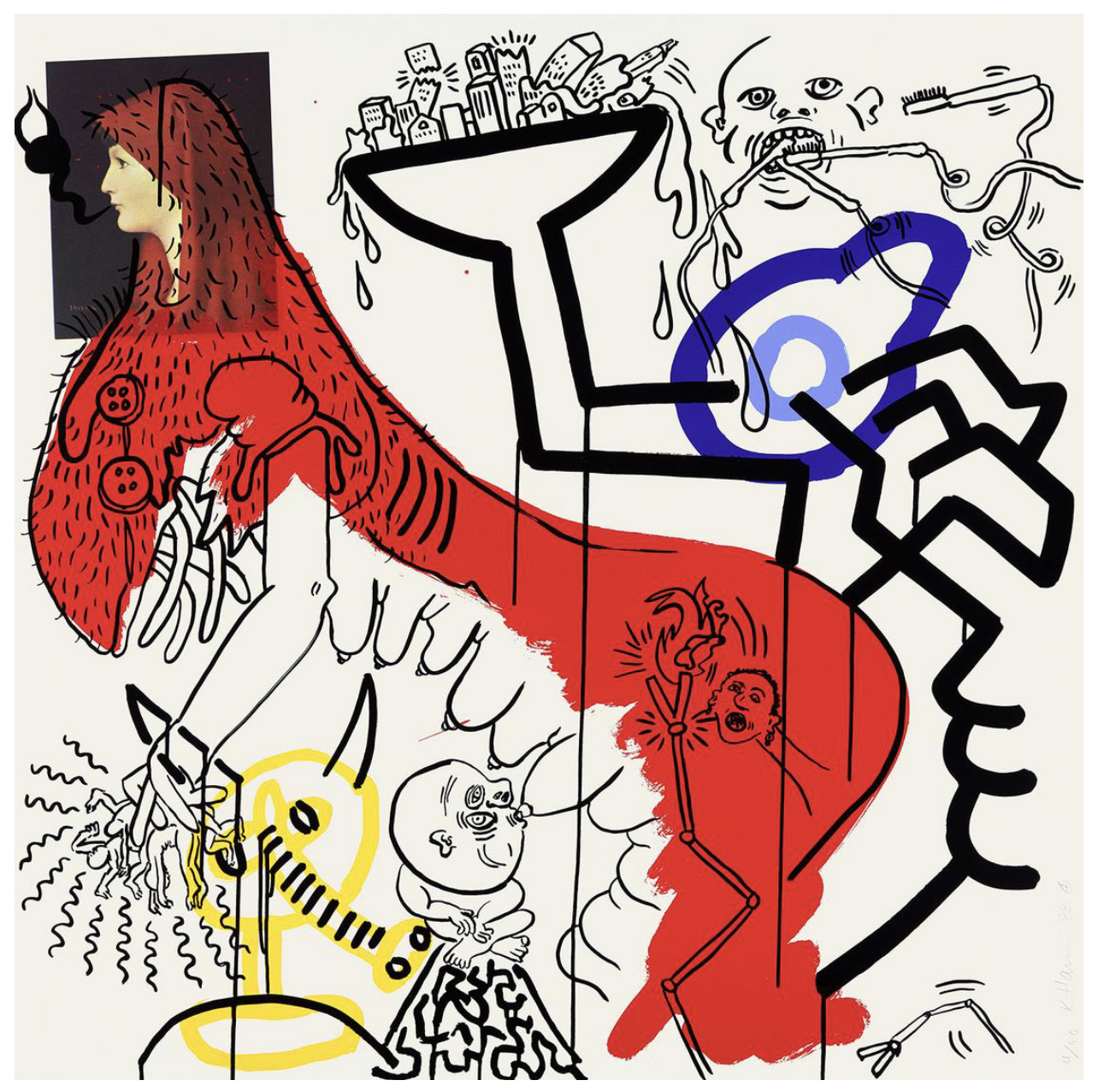
Apocalypse 5 (L. p. 105)
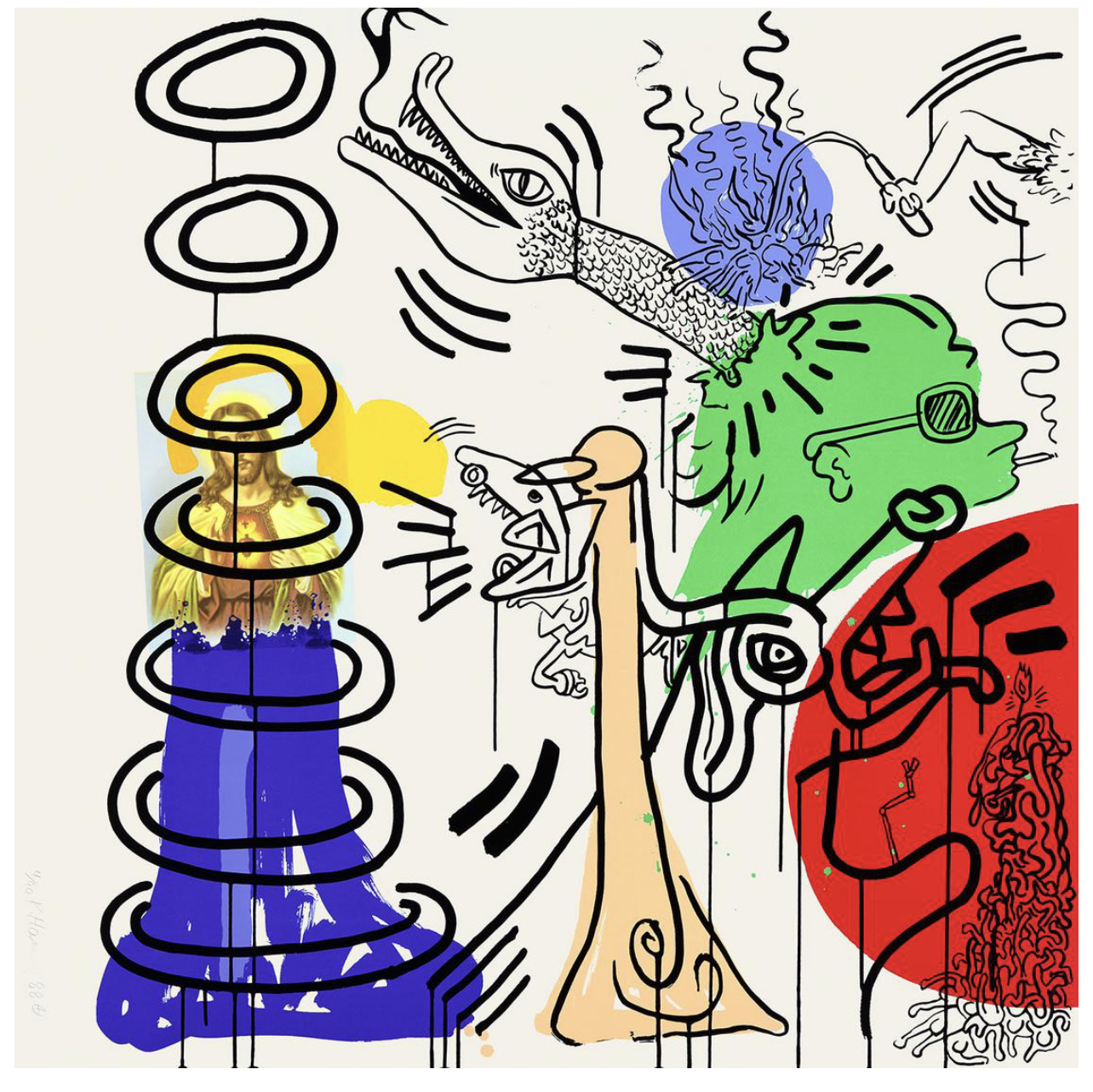
Apocalypse 6 (L. p. 105)
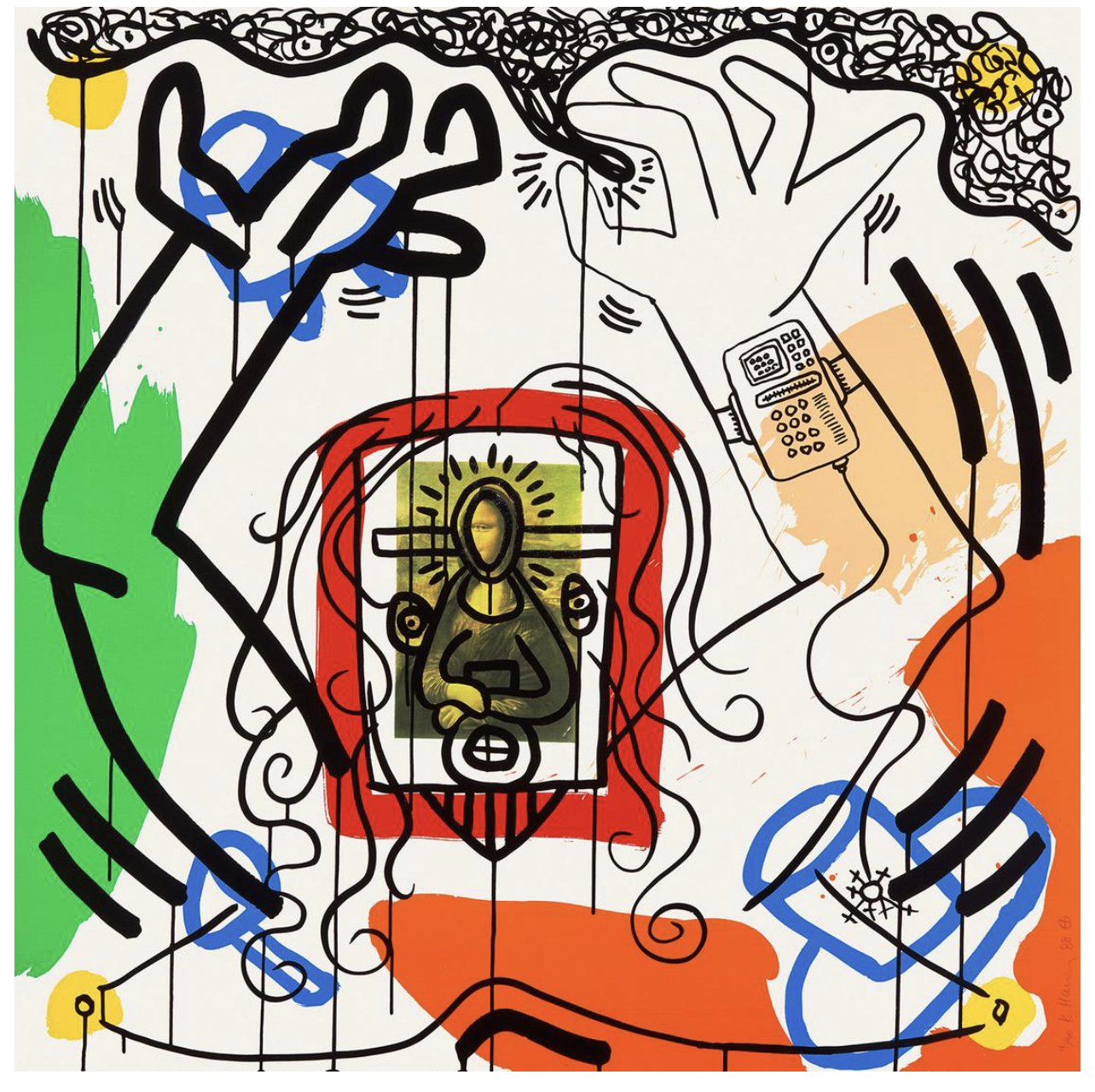
Apocalypse 7 (L. p. 106)
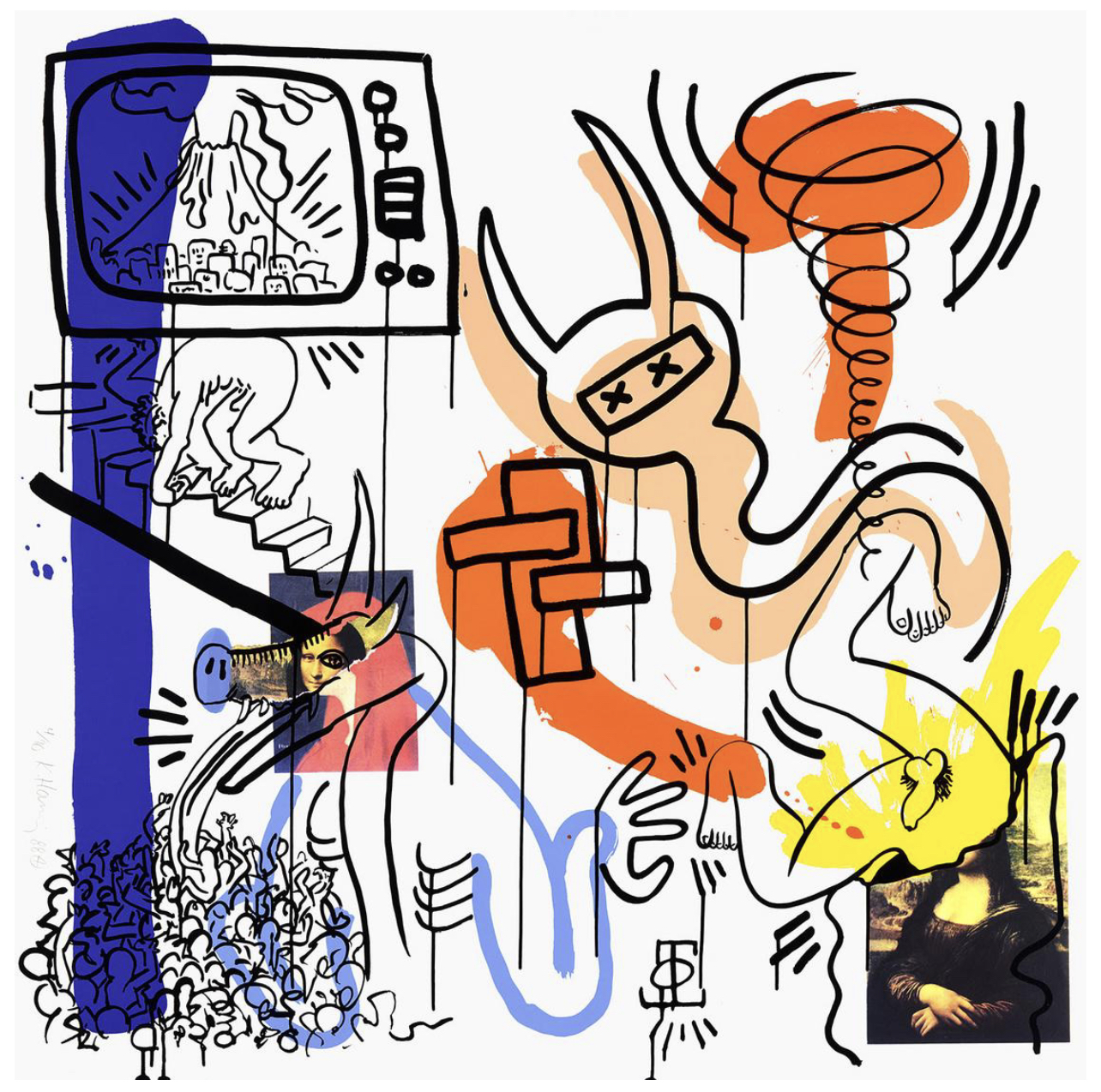
Apocalypse 8 (L. p. 106)
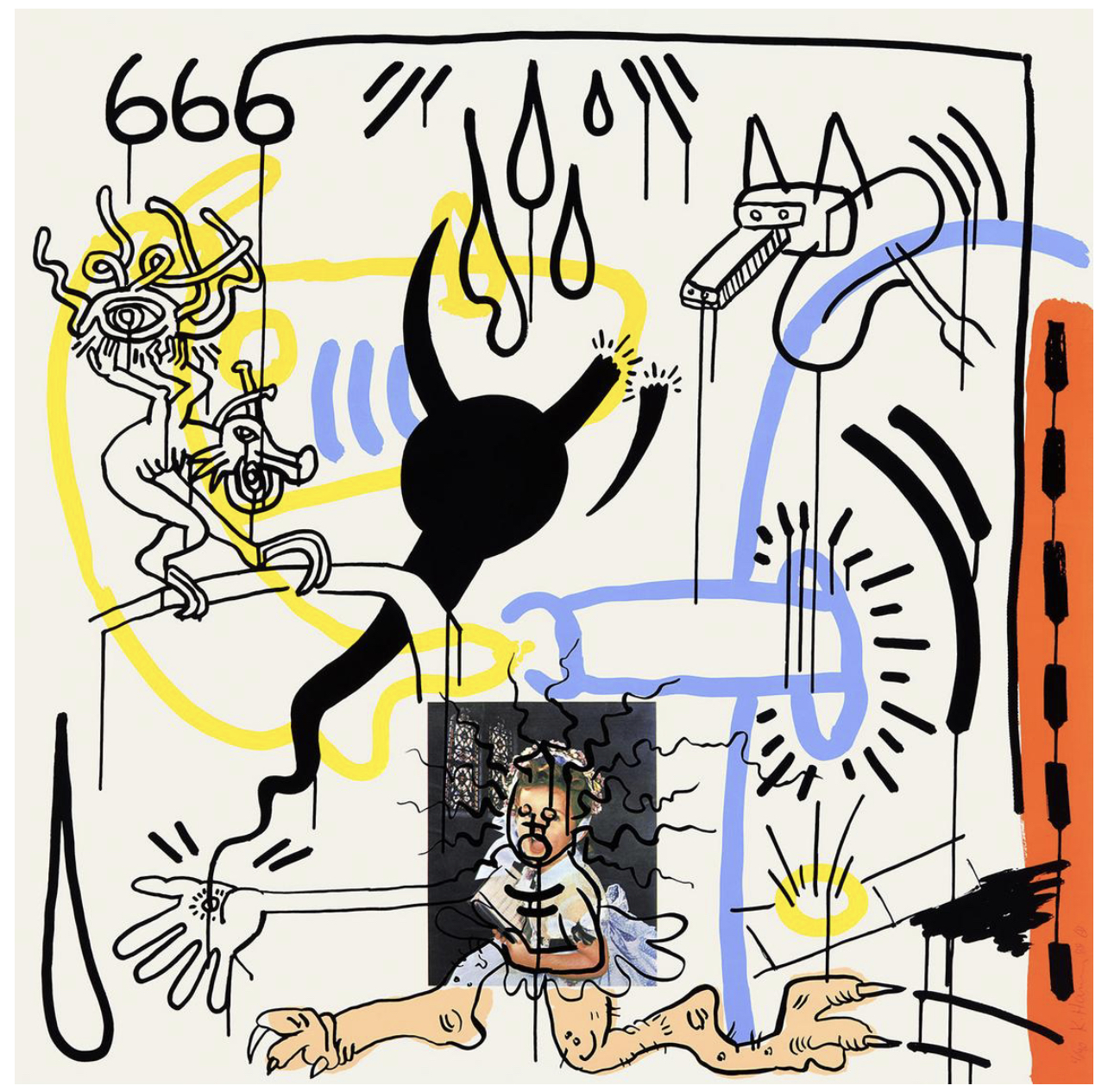
Apocalypse 9 (L. p. 109)
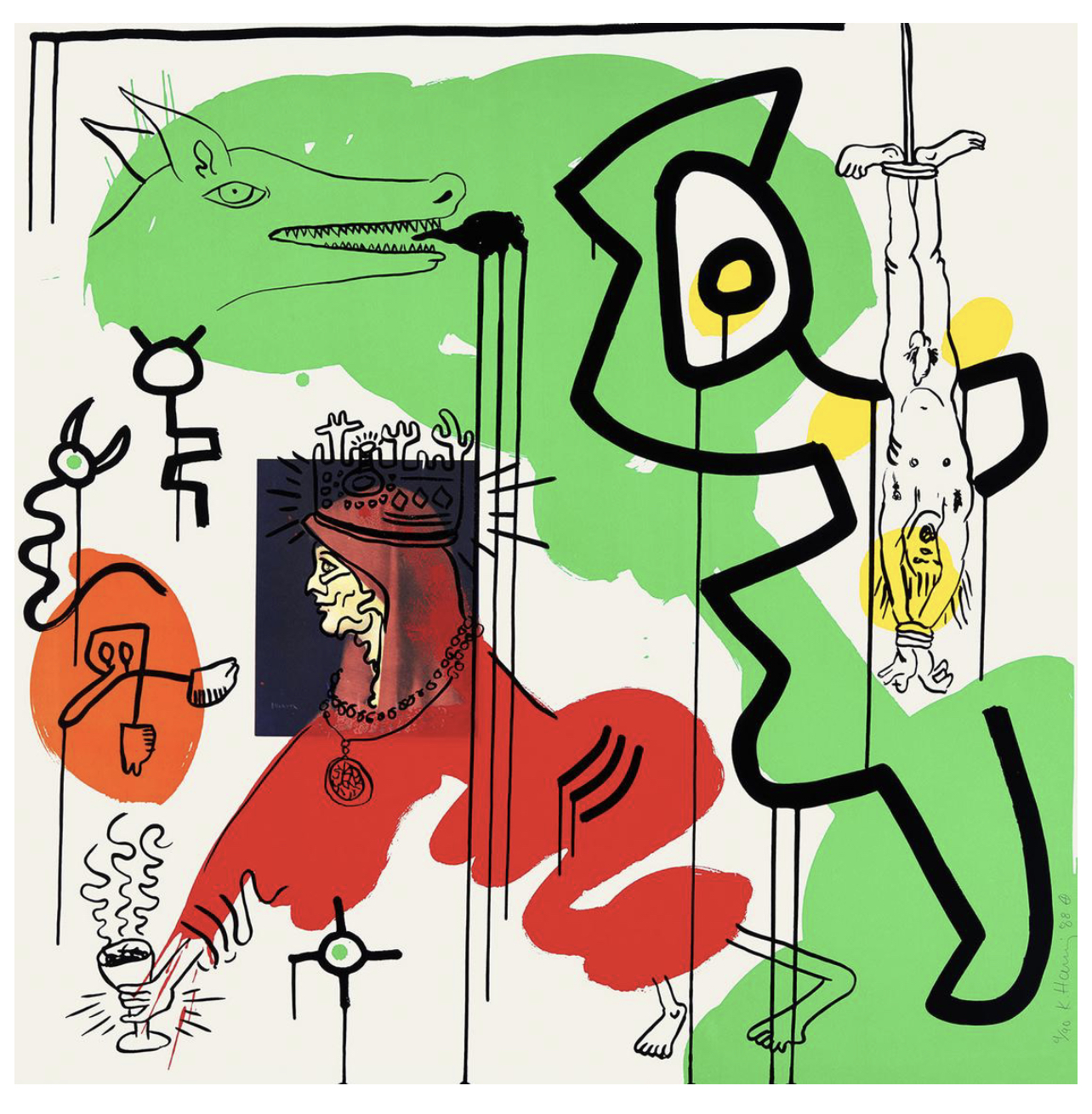
Apocalypse 10 (L. p. 109)
8. 1989 Prints
1989 Prints
78 Prints
9,537 Impressions
The Paris Review
1 Print
Edition: 200 + 30 AP

The Paris Review, 1989
Screen-print in colors on wove paper
Sheet: 22×30 inches (56×76 cm)
Edition: 200 + 30 AP
Publisher: The Paris Review, New-York
Literature: Littmann p. 114
Cupman
1 Print
Edition: 100
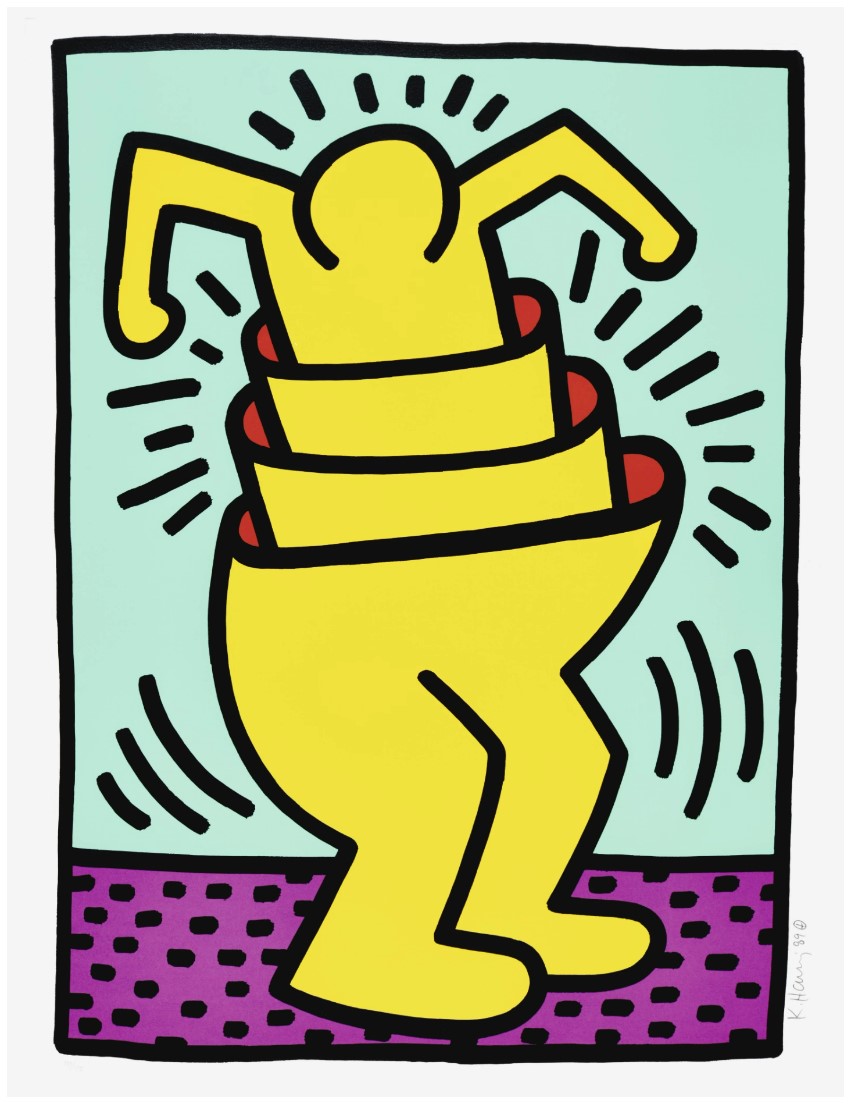
Untitled (Cupman), 1989
Screen-print in colors on wove paper
Sheet: 30 x 20 3/4 inches (76×53 cm)
Edition: 100
Publisher: Edition Domberger, Filderstadt, West Germany
Literature: Littmann pp. 116-117
Retrospect
1 Print
Edition: 75 + 7 AP + 3 PP + 10 (Black & White)
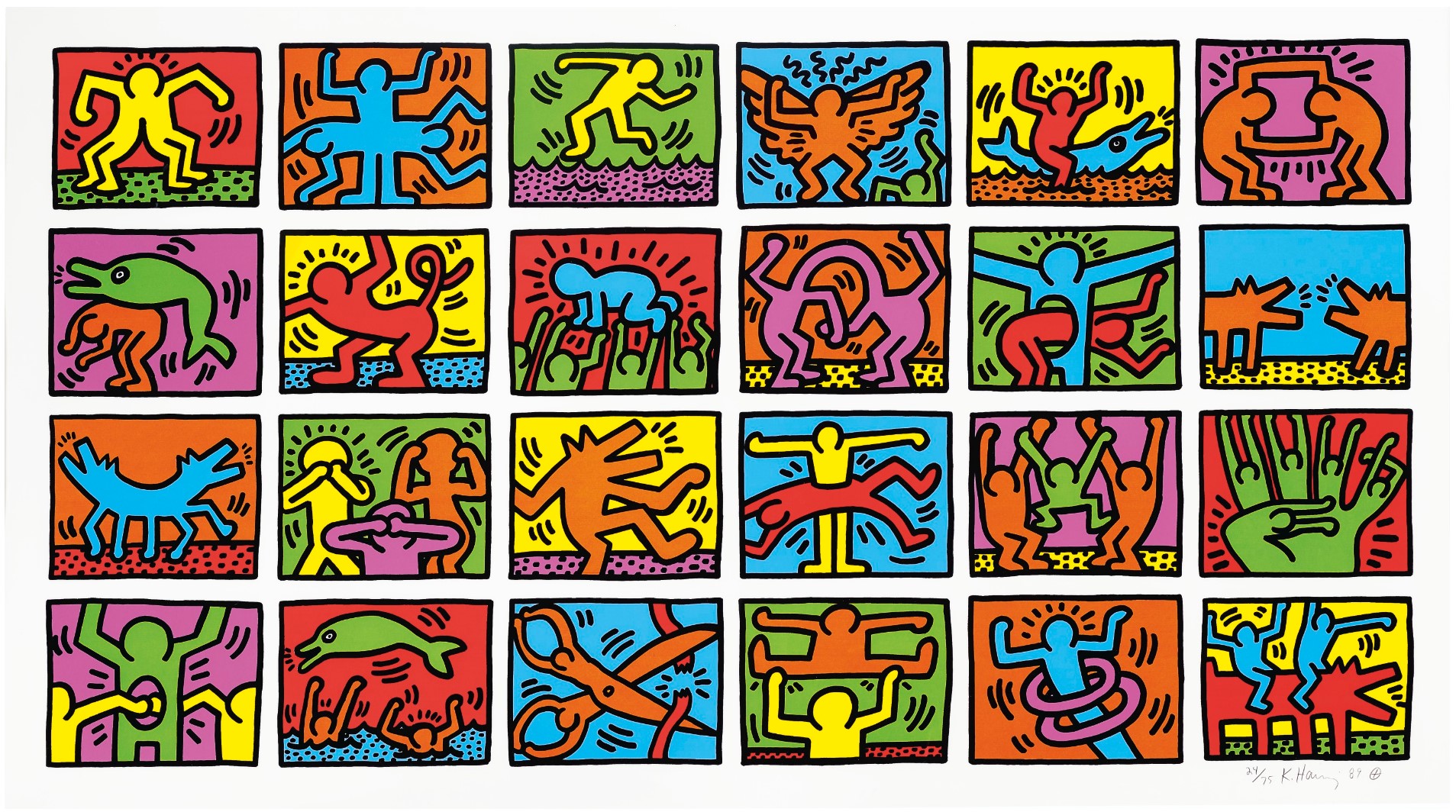
Retrospect, 1989
Screen-print in colors on heavy wove paper
Sheet: 46×82 inches (117×208 cm)
Edition: 75 + 7 AP + 3 PP
Black & White: 10
Publisher: Martin Lawrence Editions, New-York, Los Angeles
Literature: Littmann pp. 120-121
Retrospect is an edited survey of Haring’s series Pop Shop I-VI and features many of the artist’s most famous motifs, including barking dogs, dog man, angel and radiant baby. Made at a time when the artist was ailing from HIV Aids, Retrospect also includes several new images which do not appear in previous Pop Shop iterations and which were presumably intended for another series, tragically never realized. In an interview given a few months before his death in February 1990, Haring movingly talks about the new perspective his illness had given him as an artist:
Chocolate Buddah
5 Lithographs
Edition: 90 + 15 AP
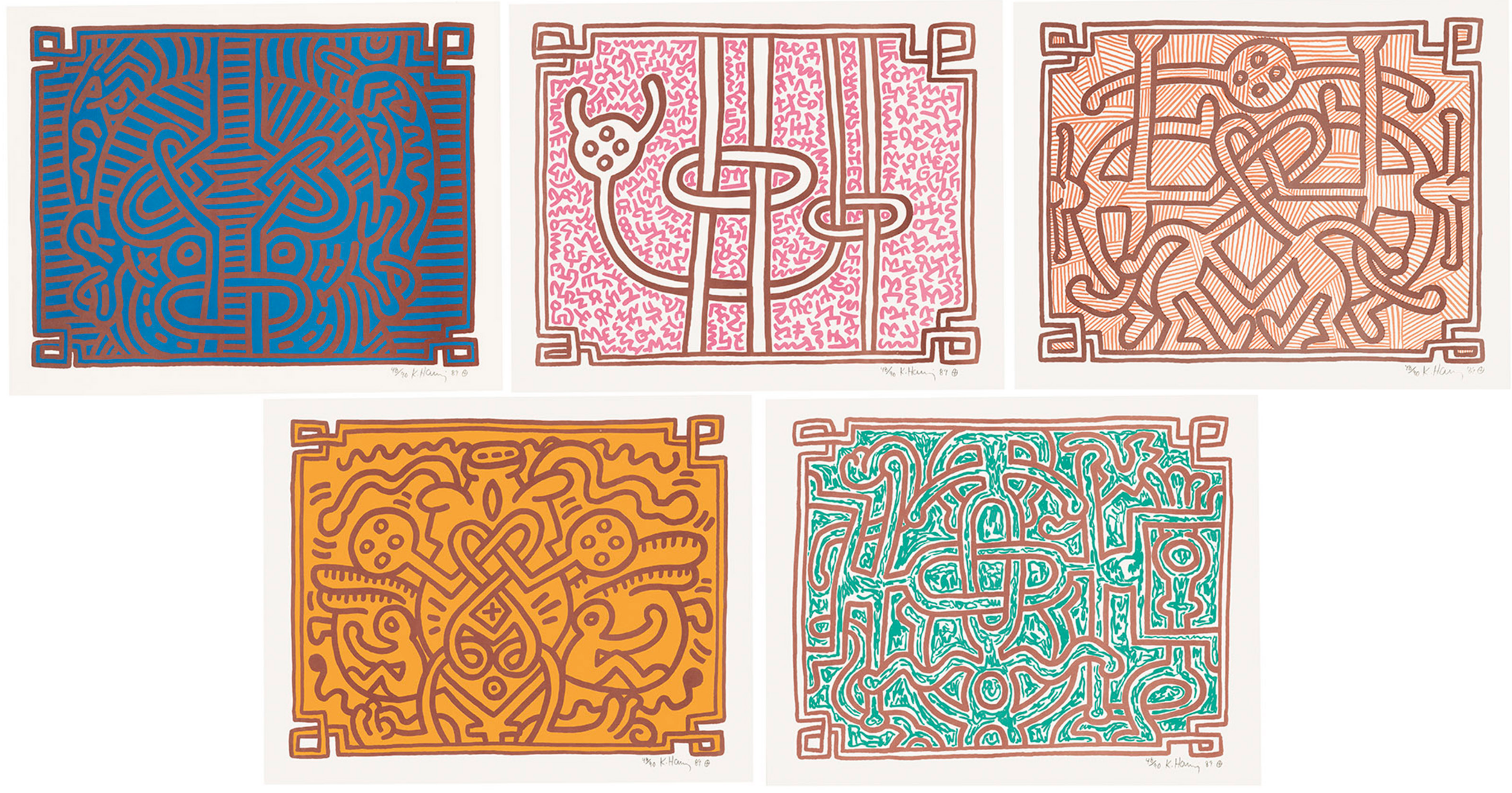
Chocolate Buddha 1-5, 1989
The complete set of five lithographs in colors on Arches Infinity Paper
Sheet: 22 x 27 3/4 inches (55.9 x 70.5 cm)
Edition: 90 + 15 AP
Publisher: Editions F.B./Arts-Litho, Paris
Literature: Littmann pp 122-125
The Chocolate Buddha series creates complex, symmetrical patterns through the interlocking of limbs, creatures and objects. Each print features a variety of figures, creatures and objects, their limbs intertwined to create complex, symmetrical patterns. Completed one year before Haring’s death, this series amalgamates the artist’s clear-line figurative style with more complex and integrated compositions to form a series of highly abstracted images. Recalling styles of the ancient world such as Eastern Mandalas and Australian Aboriginal art, the Chocolate Buddha series also shows influence from the European Modernists. This is notable from the way in which the prints focus on flat, richly colored shapes and patterns that play out across the image surface.
Striking a balance between figuration and abstracting, Haring’s Chocolate Buddha series has a kinetic energy, produced through his use of jarring colors and complex patterns. The series has a compulsive quality that fills out across each print in the series that injects the static images with a sense of movement. Furthermore, there is an electric flow of line that is satisfying for the viewer to follow, emphasized by each print’s symmetrical composition. By limiting himself to the use of two tones in each print, and by using his trademark, bold, thick lines, this set of prints maintain the eye-catching simplicity that Haring is so famous for.
Chocolate Buddah 1 (L. p. 123)

Chocolate Buddah 2 (L. p. 124)

Chocolate Buddah 3 (L. p. 124)

Chocolate Buddah 4 (L. p. 125)

Chocolate Buddah 5 (L. p. 125)

The Story of Red + Blue
Edition: 90 + 10 AP
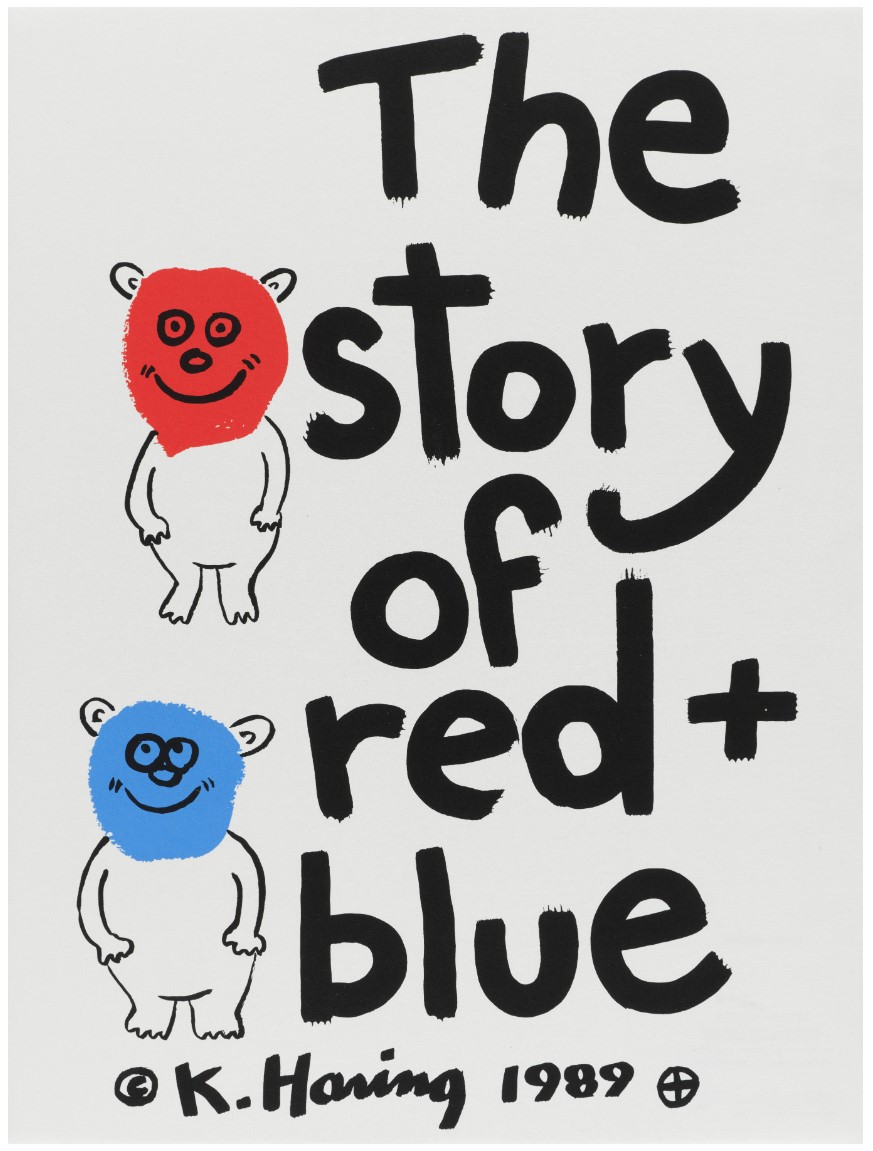
The Story of Red and Blue, 1989
The complete portfolio comprising 20 lithographs printed in colors on thin wove paper
Sheet: 22 x 16 1/2 inches (56×42 cm)
Edition: 90 + 10 AP
Publisher: Keith Haring Estate, New-York
Literature: Littmann pp. 128-133
The Story of Red and Blue depicts various characters playing with the blue and red colors. The prints alternate between blue and red until they finally mix together in the final print to take the form of an egg held in a human hand communicating hope and love. Presented like some kind of children’s storybook, this series is a great example of Keith Haring’s desire to create a simple, yet artistic visual language appealing to adults and children. The artist restricts his color palette to only red and blue.
The Story of Red and Blue #1 (L. p. 129)
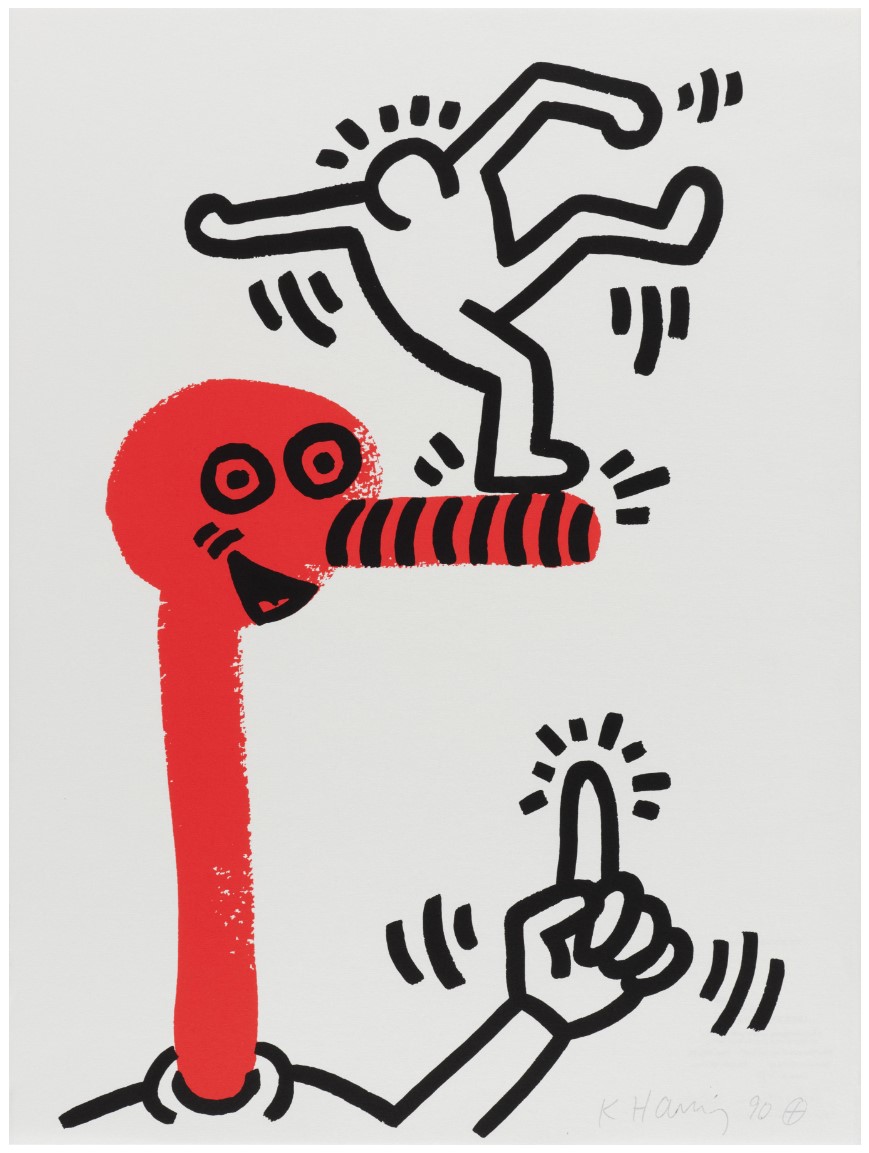
The Story of Red and Blue #2 (L. p. 129)
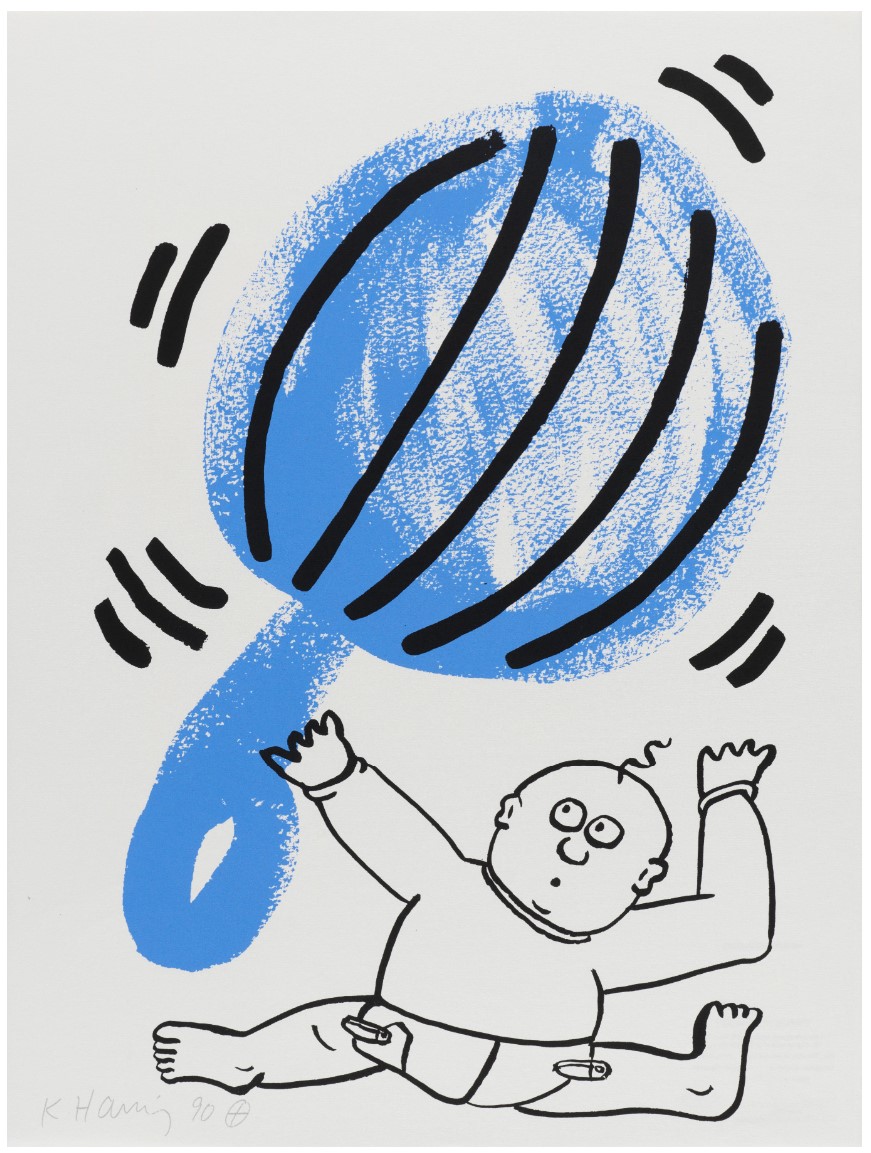
The Story of Red and Blue #3 (L. p. 129)
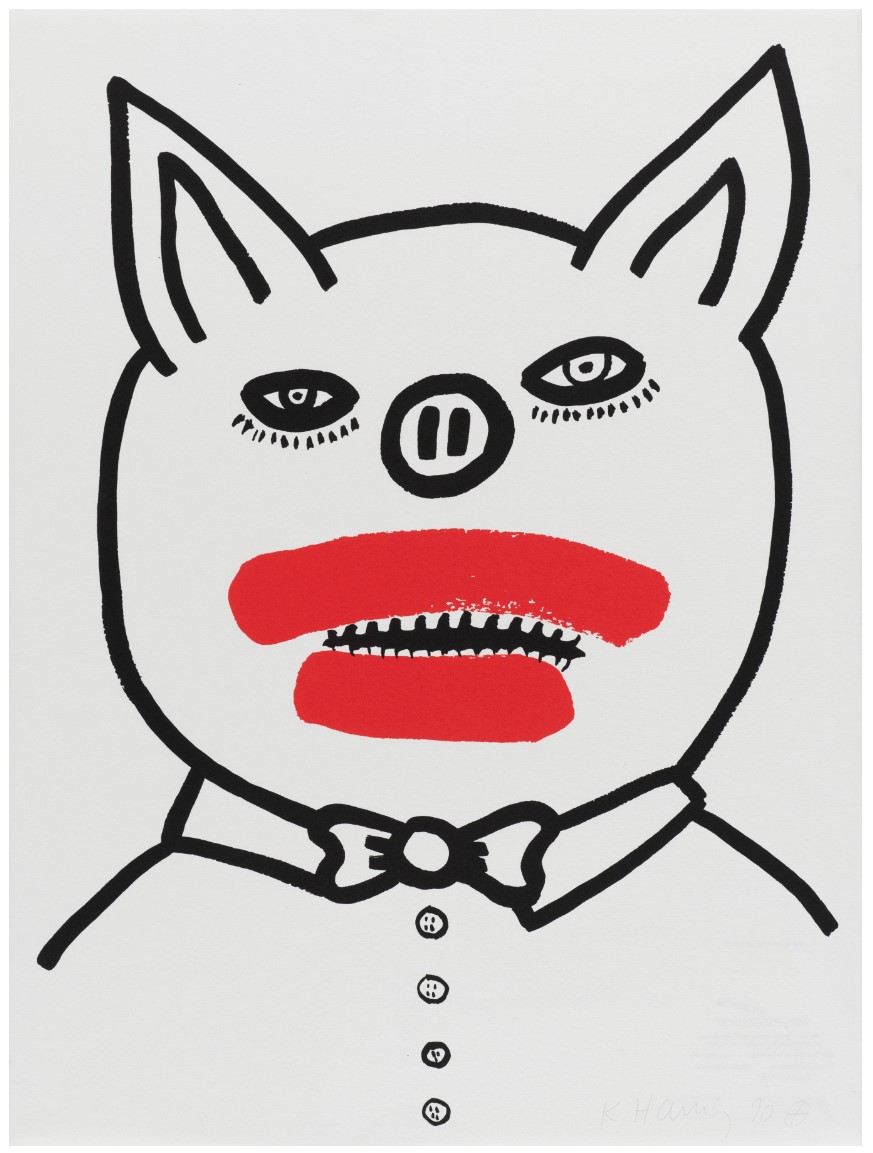
The Story of Red and Blue #4 (L. p. 129)
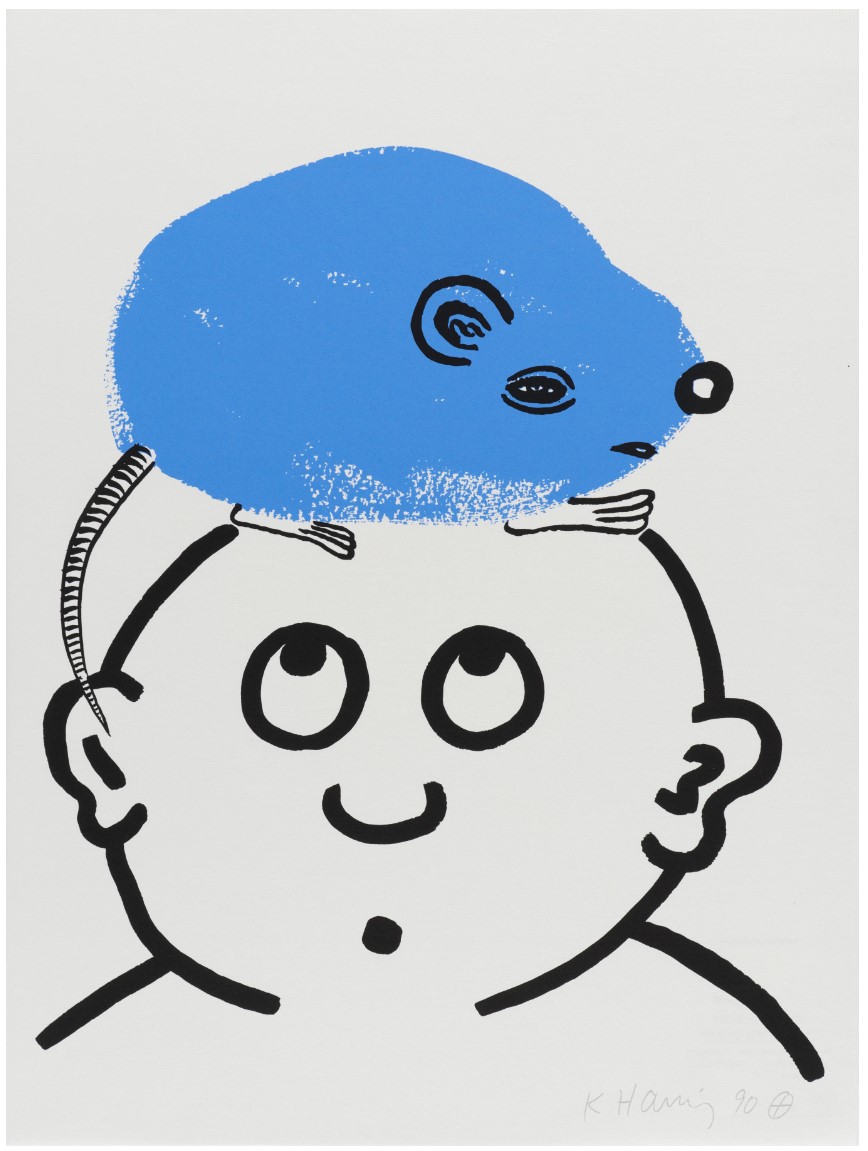
The Story of Red and Blue #5 (L. p. 130)
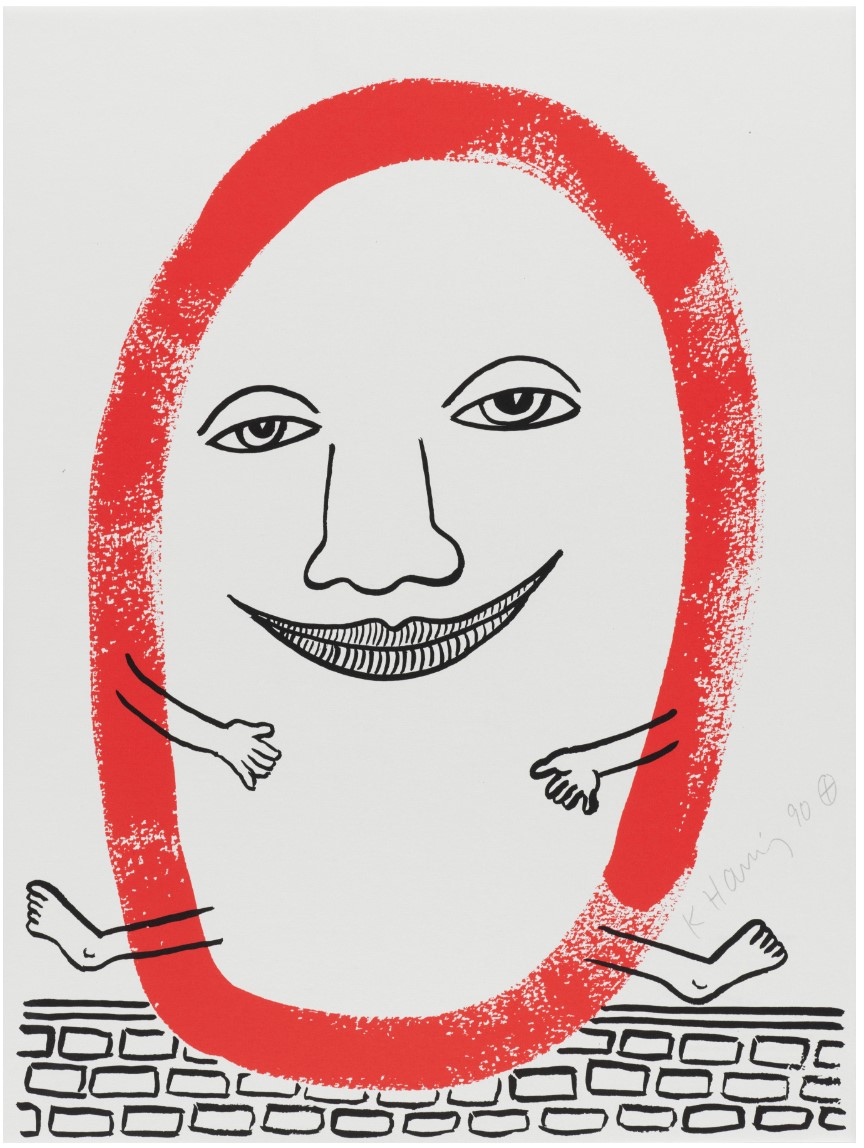
The Story of Red and Blue #6 (L. p. 130)
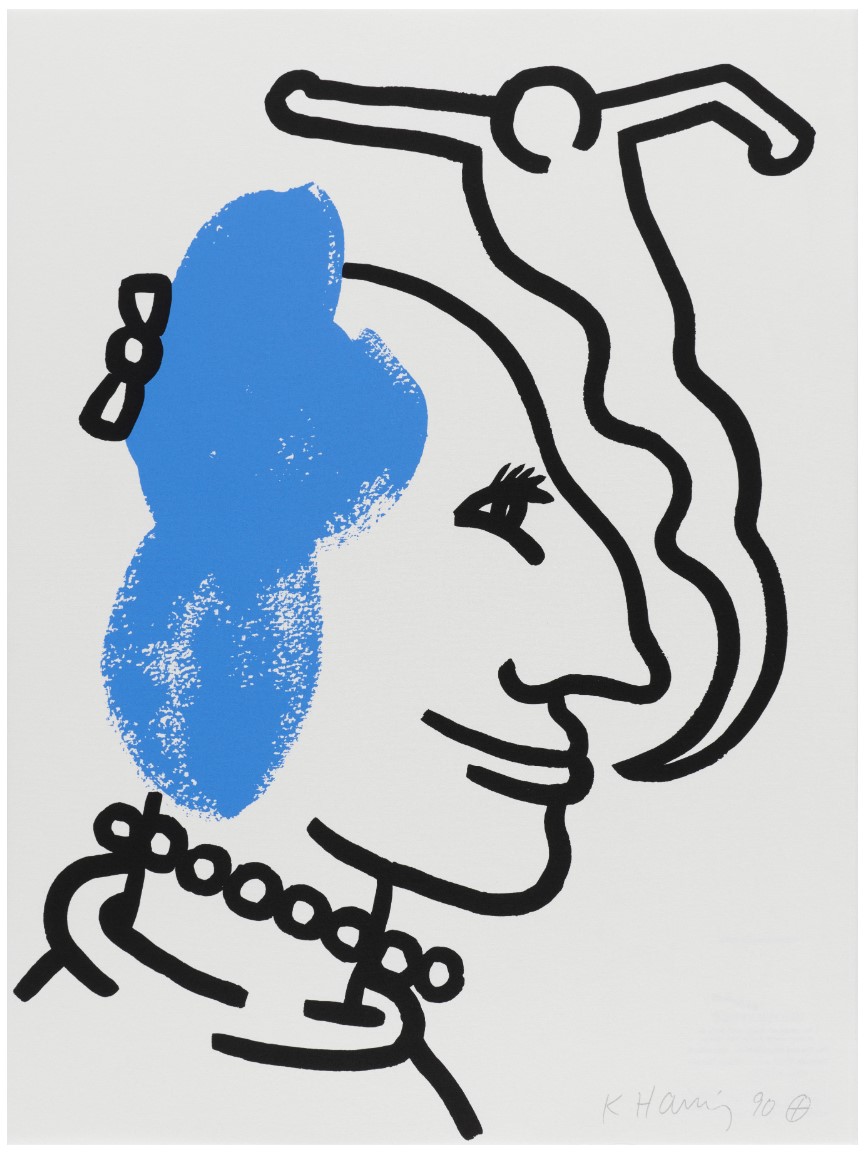
The Story of Red and Blue #7 (L. p. 130)
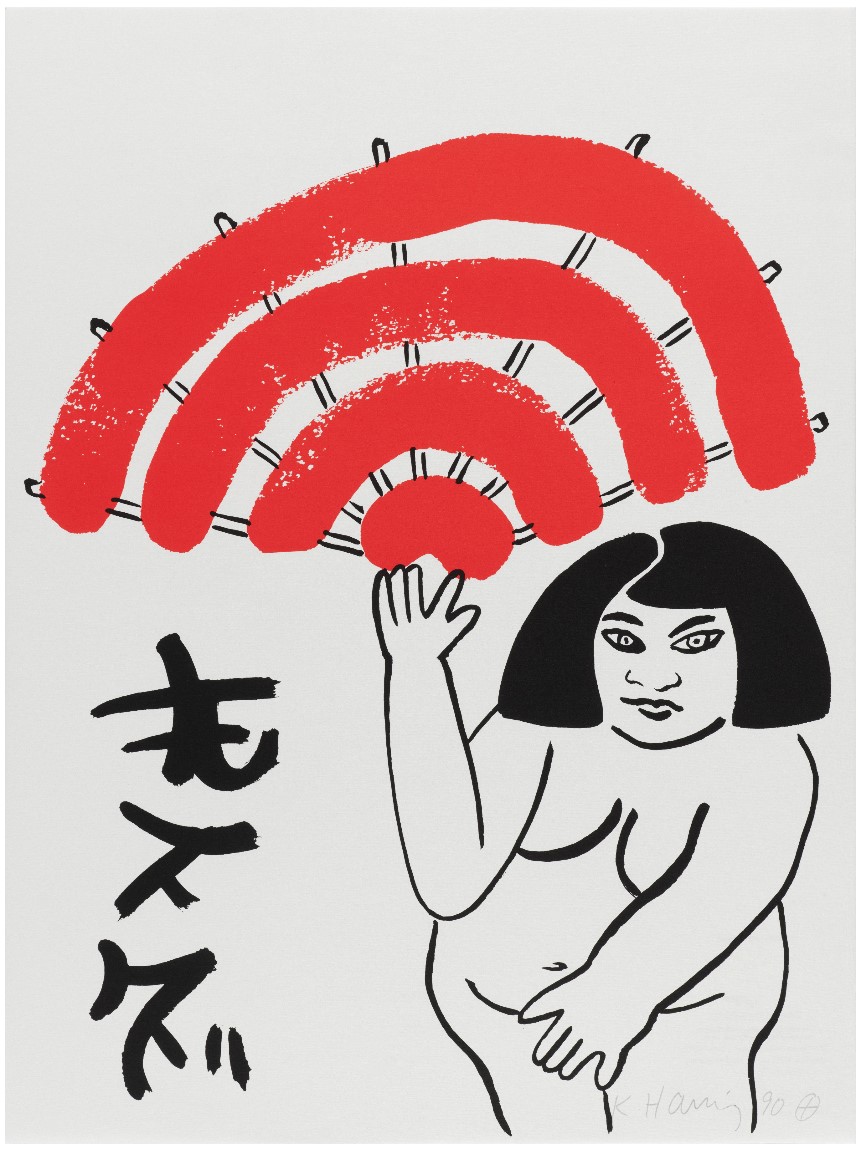
The Story of Red and Blue #8 (L. p. 130)
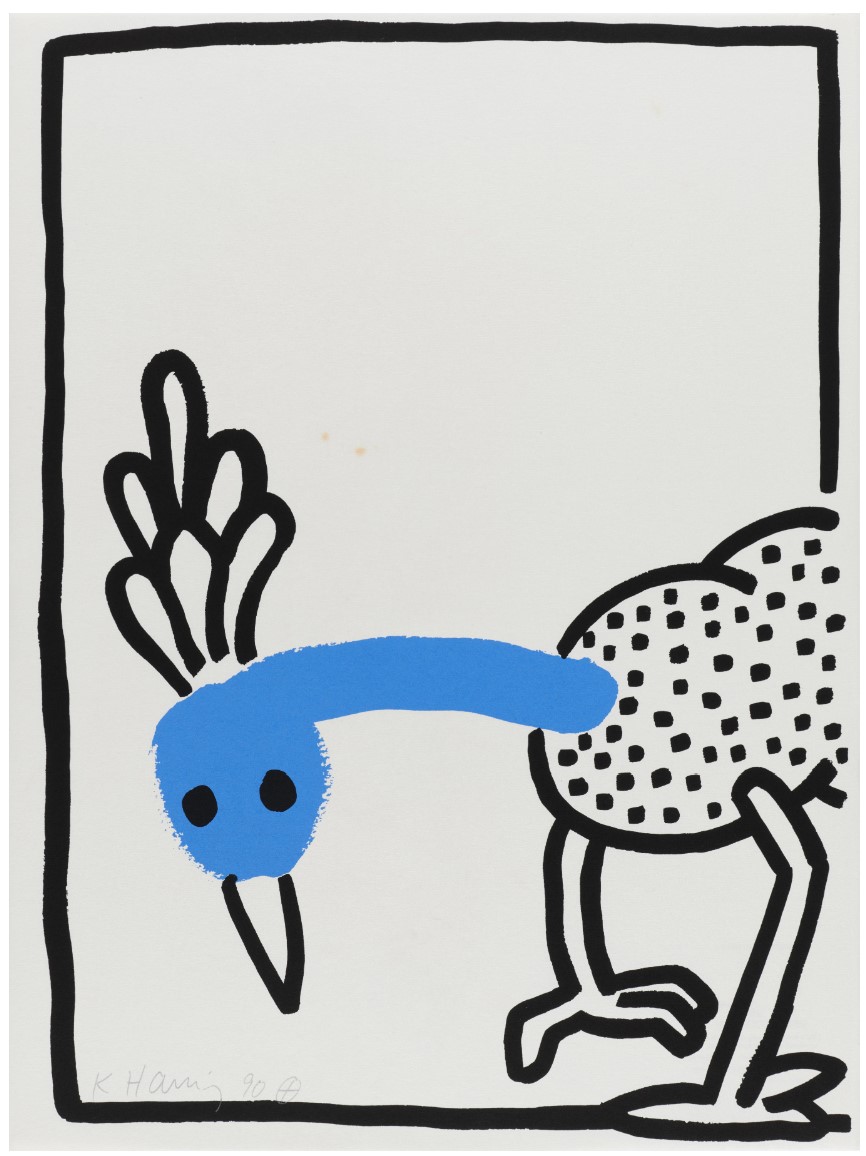
The Story of Red and Blue #9 (L. p. 131)
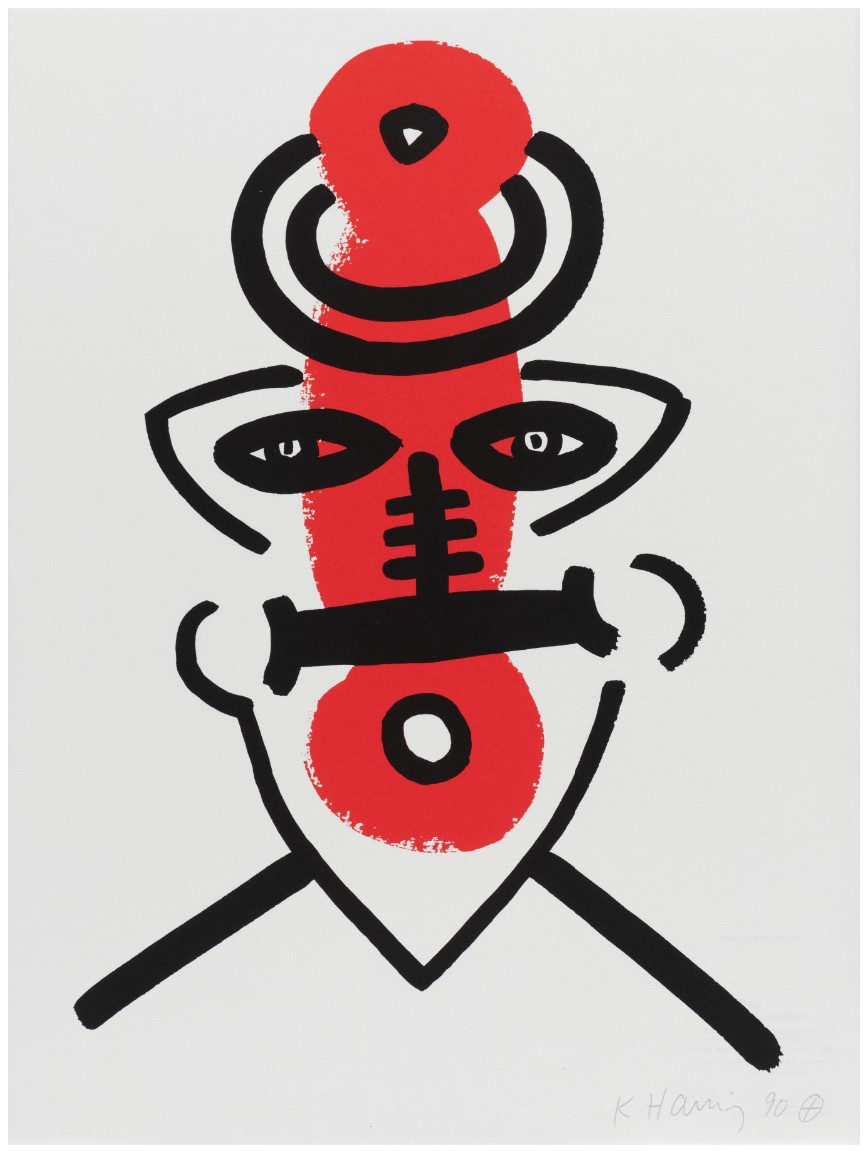
The Story of Red and Blue #10 (L. p. 131)
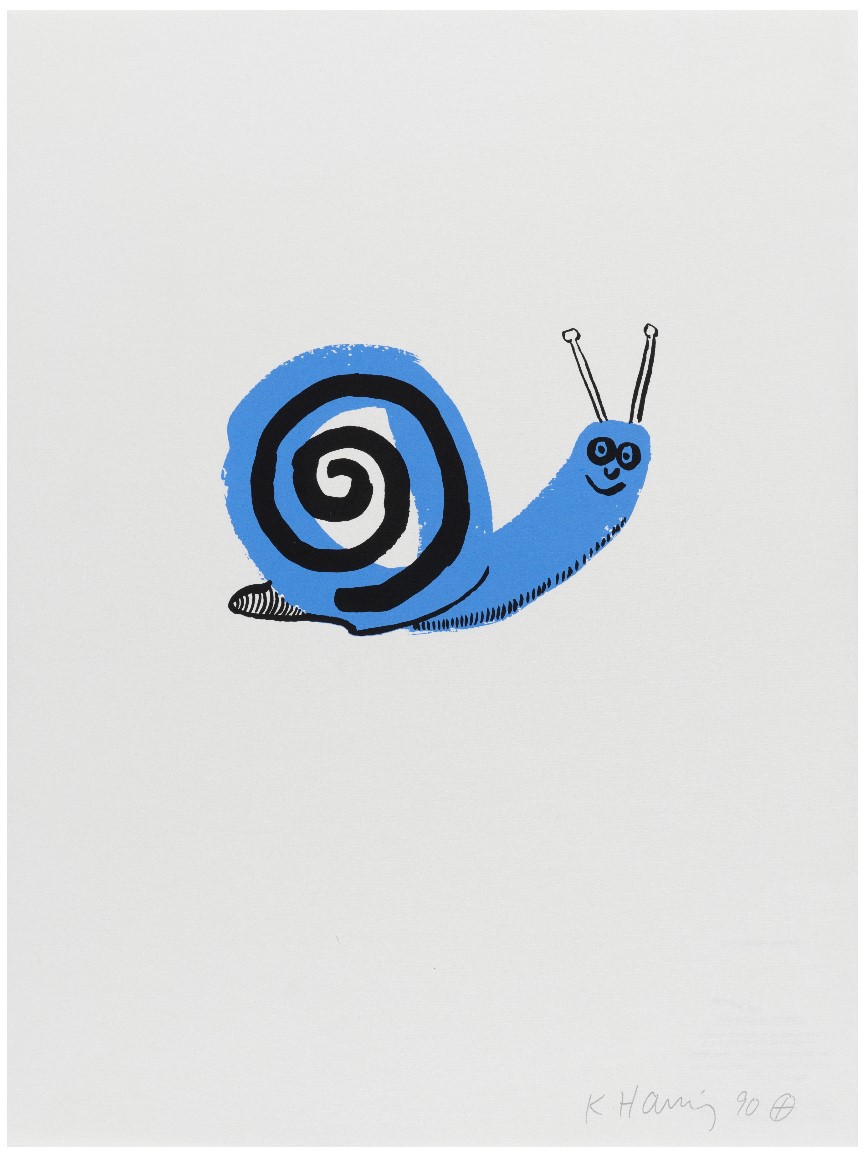
The Story of Red and Blue #11 (L. p. 131)
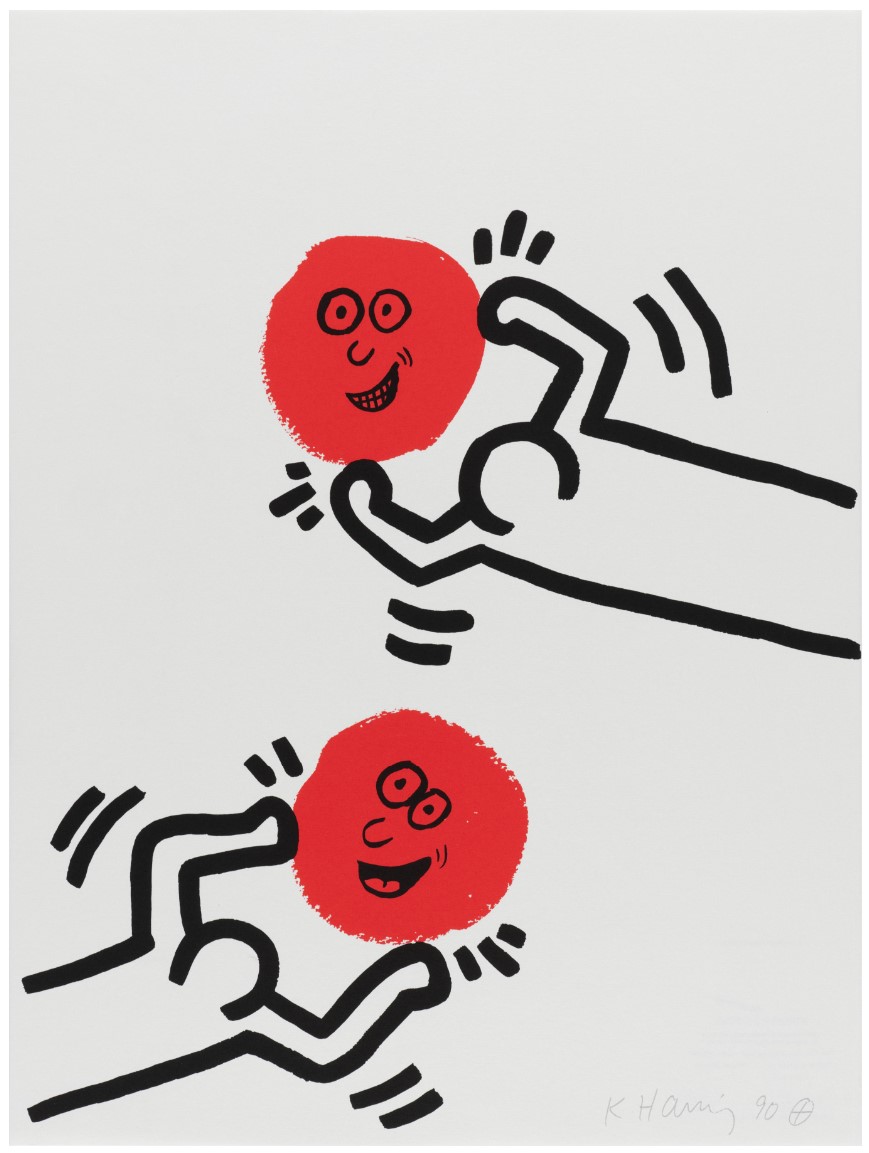
The Story of Red and Blue #12 (L. p. 131)
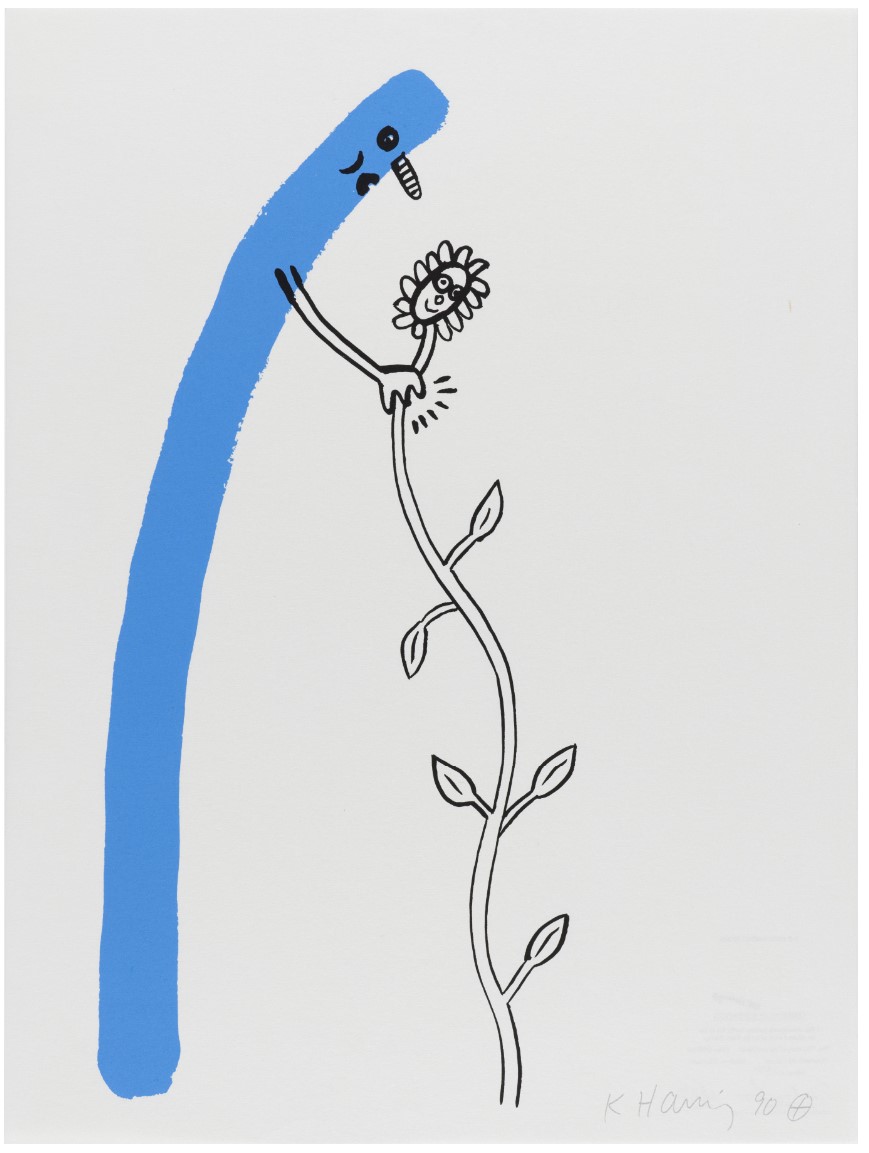
The Story of Red and Blue #13 (L. p. 132)
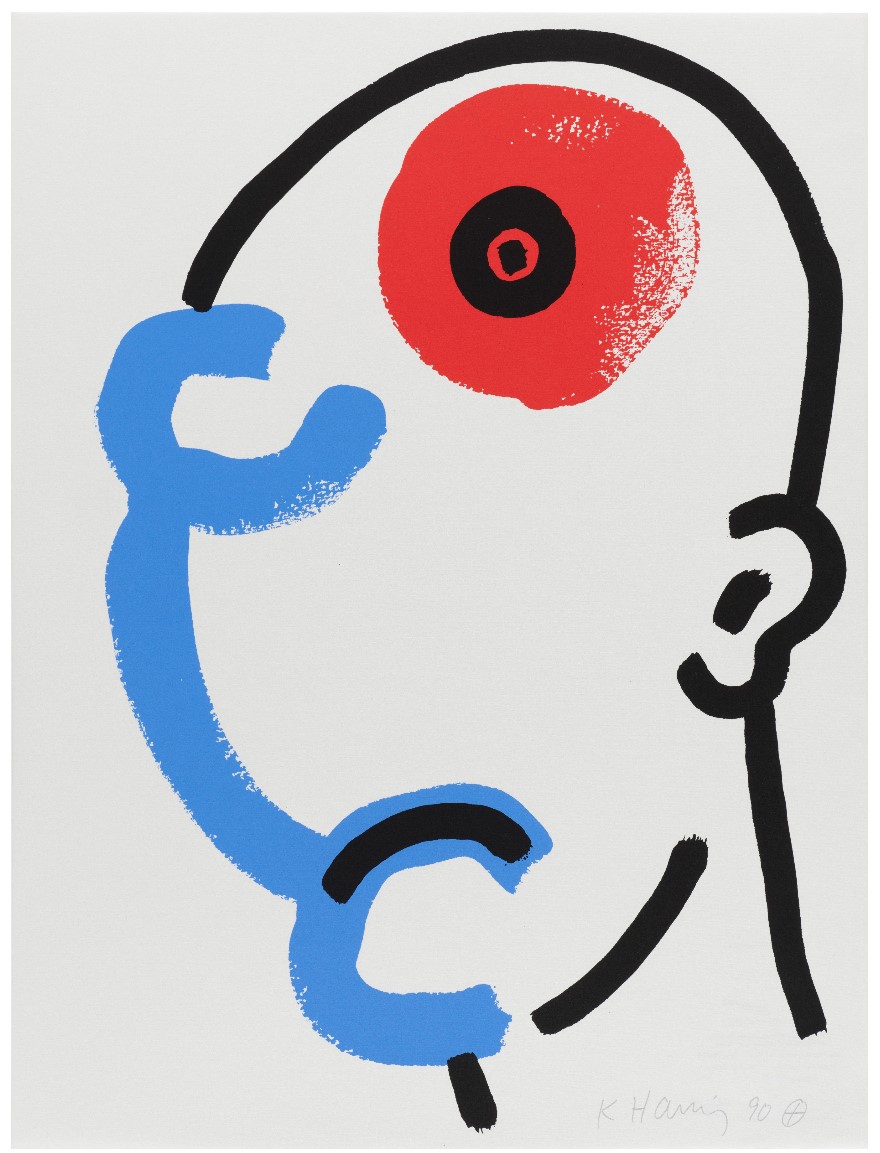
The Story of Red and Blue #14 (L. p. 132)
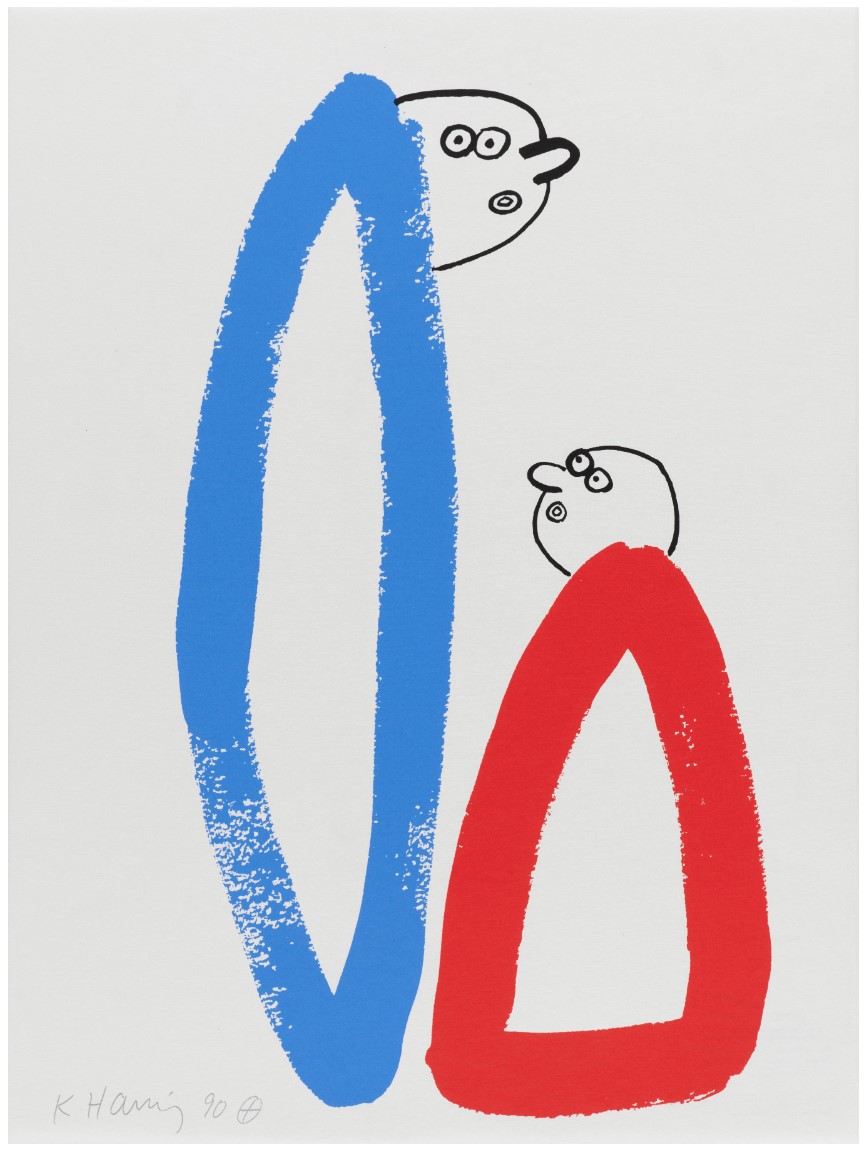
The Story of Red and Blue #15 (L. p. 132)

The Story of Red and Blue #16 (L. p. 132)

The Story of Red and Blue #17 (L. p. 133)

The Story of Red and Blue #18 (L. p. 133)

The Story of Red and Blue #19 (L. p. 133)

The Story of Red and Blue #20 (L. p. 133)

Kutztown
1 Print
Edition: 99

Kutztown, 1989
Screen-print on wove paper
Sheet: 30×22 inches (76×56 cm)
Edition: 99
Publisher: The Keith Haring Estate
Literature: Littmann pp. 134-135
Though he later became inextricably linked with the New-York City art scene, Keith Haring spent his childhood in Kutztown, a small Dutch farm community in Pennsylvania. He never forgot his roots and made a habit of introducing himself as ‘Keith from Kutztown’.
“Kutztown has its good points. Excessive amounts of love and sanity. Precise order. Fresh air. A different background noise… still a hum but a softer, more natural buzz. Time to contemplate, time to reflect and dream.”
The Valley
15 Etchings
Edition: 80 + 13 AP

The Valley, with William S. Burroughs, 1990
The complete portfolio of fourteen etchings on Twinrocker HMP paper
With text (etchings) by William S. Burroughs and colophon
Portfolio: 16 3/8 x 14 1/2 x 2 5/8 inches (41.6 x 36.8 x 6.7 cm)
Edition: 80 + 13 AP
Publisher: George Mulder Fine Art, London
Literature: Littmann pp. 136-141
The Valley is comprised of 14 etchings born from a collaboration with the poet and novelist William S. Burroughs known for his method of breaking down language. The etchings are accompanied by Burroughs texts which have been copied by hand on tracing paper, then photo-etched onto copper plates and printed in red ink. Read together with the broken free-form text, Haring’s etchings represent violent episodes that imagine the end of times.

The Valley Etching #2

The Valley Etching #8

The Valley Etching #9

The Valley Etching #11

The Valley Etching #13

The Valley Etching #14

The Valley Etching #15

Silence = Death
1 Print
Edition: 200 +25 AP
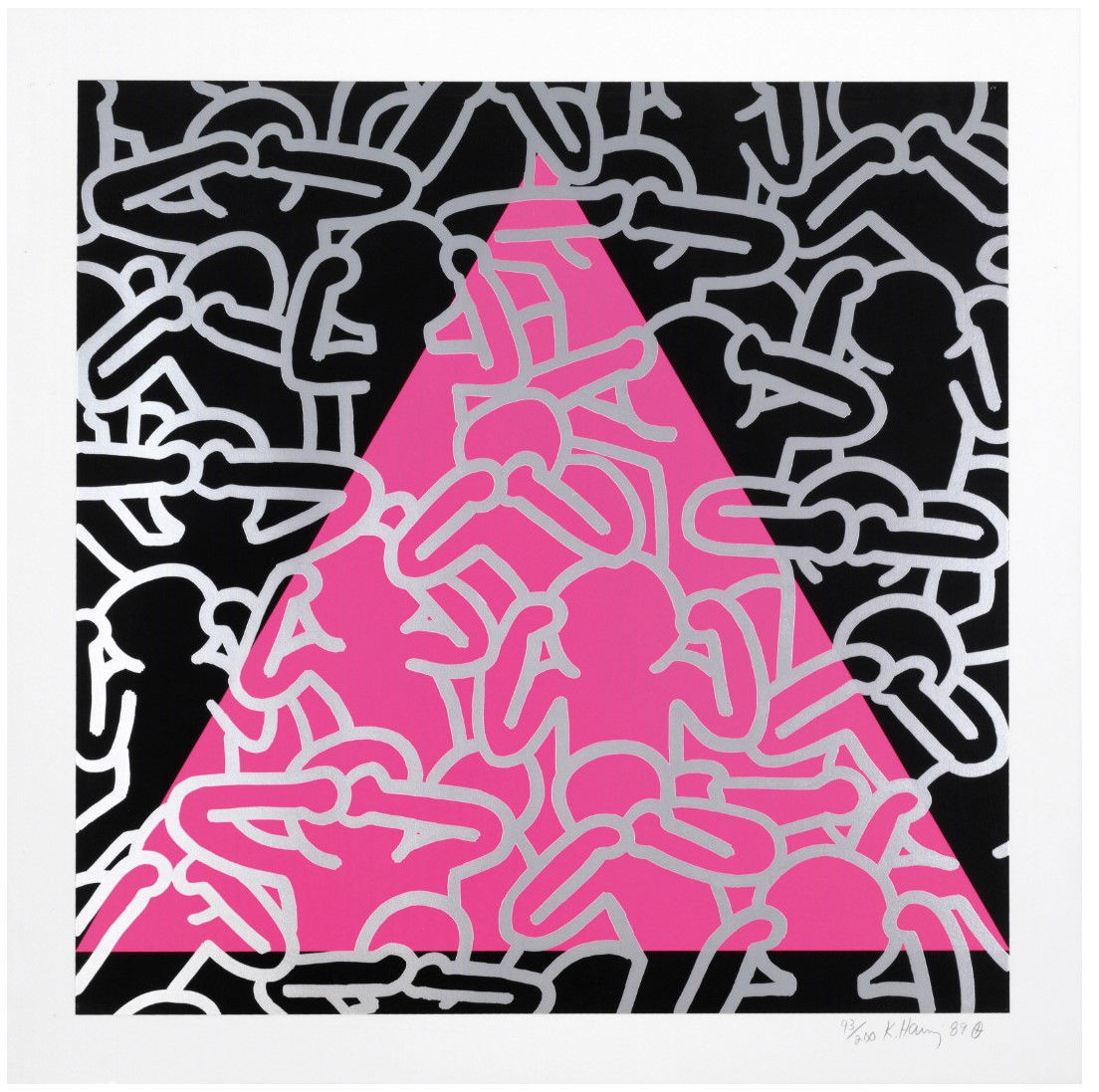 Silence = Death, 1989
Screen-print in colors on heavy wove paper
Sheet: 39×39 inches (99.1 x 99.1 cm)
Edition: 200 + 25 AP
Publisher: George Mulder Fine Arts, New York, for the Arts Outreach Fund for AIDS
Publisher: The Outreach Fund for AIDS
Literature: Littmann p. 152
Silence Equals Death is a remarkable work completed in the final year of the Keith Haring’s life. The work is an adaptation of the iconic political poster for the Silence=Death Project, a collective from which the title of this work is derived. This poster, which featured a bright pink triangle atop a solid black background, was a central image in the organization’s activist campaign against the AIDS epidemic.
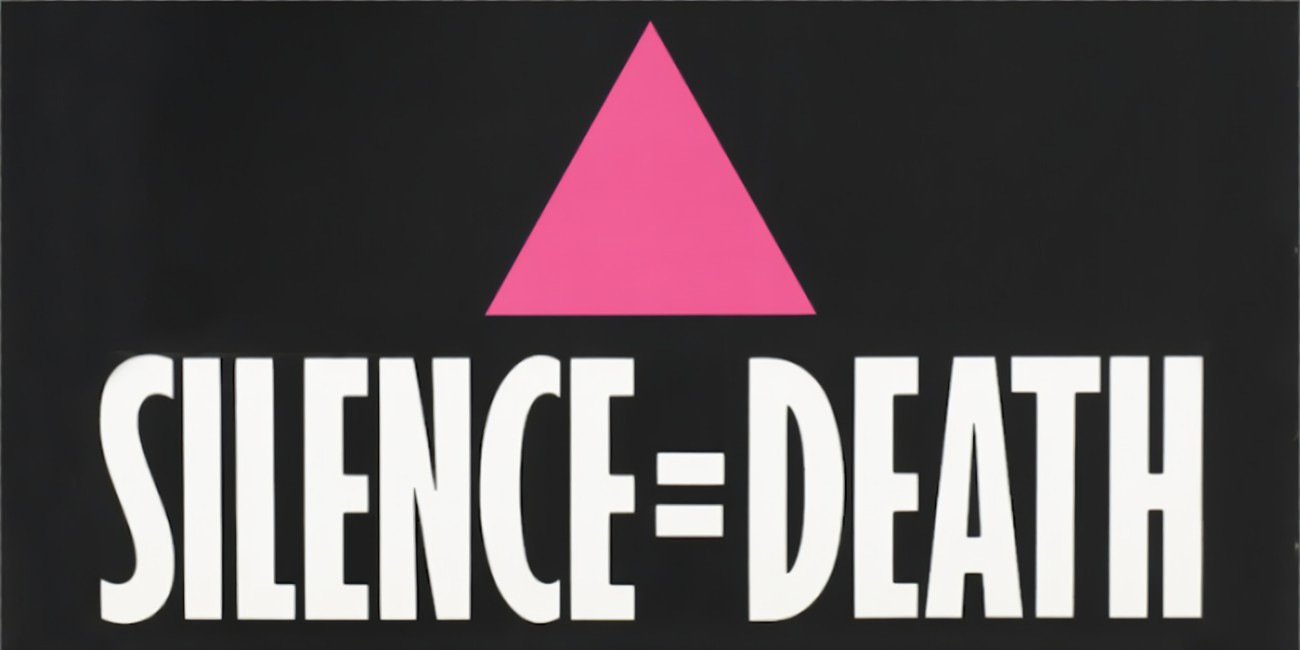
The image of the pink triangle was first used by Nazi Germany to identify gay men and transgender women. It has since been reclaimed by the LGBTQ community as a symbol of gay pride. Haring’s version of the prominent poster features a large pink triangle that dominates nearly the entire composition and is surrounded by solid black. Renderings in silver ink of numerous figures which illustrate the pictorial maxim “hear no evil, see no evil, speak no evil” are overlaid across the entire composition.

This work expresses extreme discontent with the silence of the Reagan administration’s suppression of discussion of the AIDS crisis which caused thousands of deaths in the queer community. This work was completed one year after the artist’s tragic AIDS diagnosis and just months before his death in 1990.
Two Lovers
1 Print
Edition: 60 + 25 AP
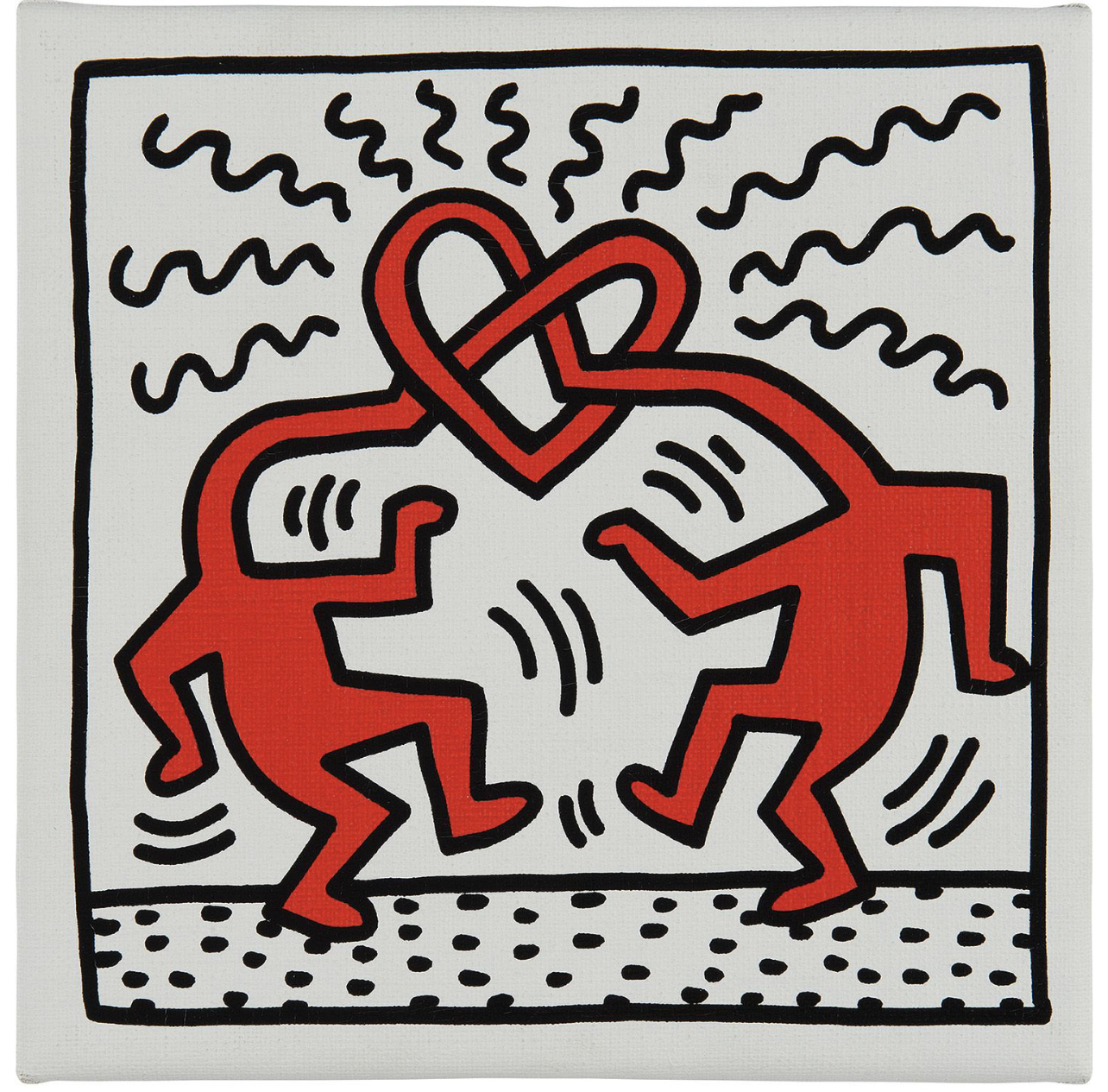
Untitled (two lovers), 1989
Screen-print in colors on canvas over wood stretchers
Size: 8×8 inches (20.3 x 20.3 cm)
Edition: 60 + 25 AP
Literature: Littmann p. 153
Totem
Totem (Woodcut)
Edition: 60 + 12 AP + 10 HC
Totem (Concrete)
Edition: 25 + 7 AP + V
Totem (Carved plywood)
Edition: 35 + 7 AP
A totem, or doodem, is a spirit being, a sacred object that serves as an emblem of people. Borne of the North American Ojibwe culture, who believe in tutelary spirits and deities, the term has evolved and been incorporated into various cultures worldwide to represent a personal identification with a spirit guide. Doodem directly translated means ‘to do with one’s heart’ and is connected to a clan or ancestry, linking the living to the dead, and the past to the present.
For Keith Haring, who had been drawn to the imagery of ancient and primitive cultures throughout his career, the symbolic spiritualism of a totemic object made it the perfect form for his own idiosyncratic visual lexicon of signs and symbols. Made the same year as the artist was diagnosed with AIDS, the sarcophagus shape recognizes man’s mortality but hints at an embalmed, immortal afterlife. Within the confines of the concrete sarcophagus outlines, Haring’s energetic and busy figures are pushing the boundaries in which they’ve been encased. Jumping and reaching toward the sun, the two figures at the top of Totem are living, striving for that which we all chase. Reflective of Haring’s own history, challenging societal norms, Totem captures the vitality of life but reminds us of its impermanence.
Totem (Woodcut) (L. pp. 158-159)
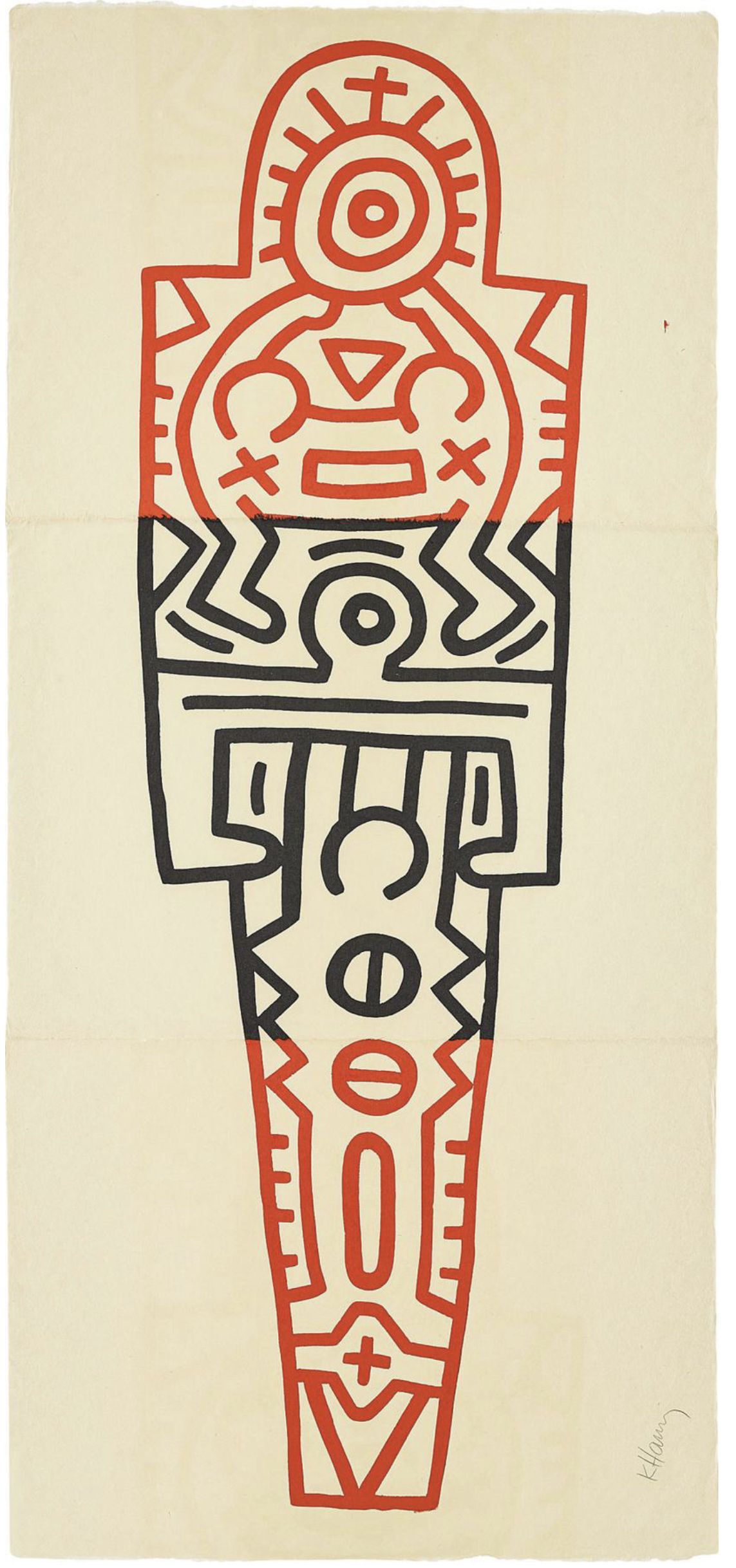
Totem, 1989
Woodcut in black and red on three sheets of Inshu-Kozu Japanese paper
Sheet: 75 1/2 x 35 inches (192×89 cm)
Edition: 60 + 12 AP + 10 HC
Publisher: Edition Schellmann, Munich and New York
Literature: Littmann pp. 158-159
Totem (Concrete)
 Totem (Concrete), 1989
Cast concrete wall relief
Size: 70 5/8 x 21 1/2 x 1 7/8 inches (179.5 x 54.5 x 5 cm)
Edition: 25 + V + 7 AP
Trial Proofs: A few with unique color variant
Publisher: Edition Schellmann, Munich and New York
Totem (Carved Plywood)
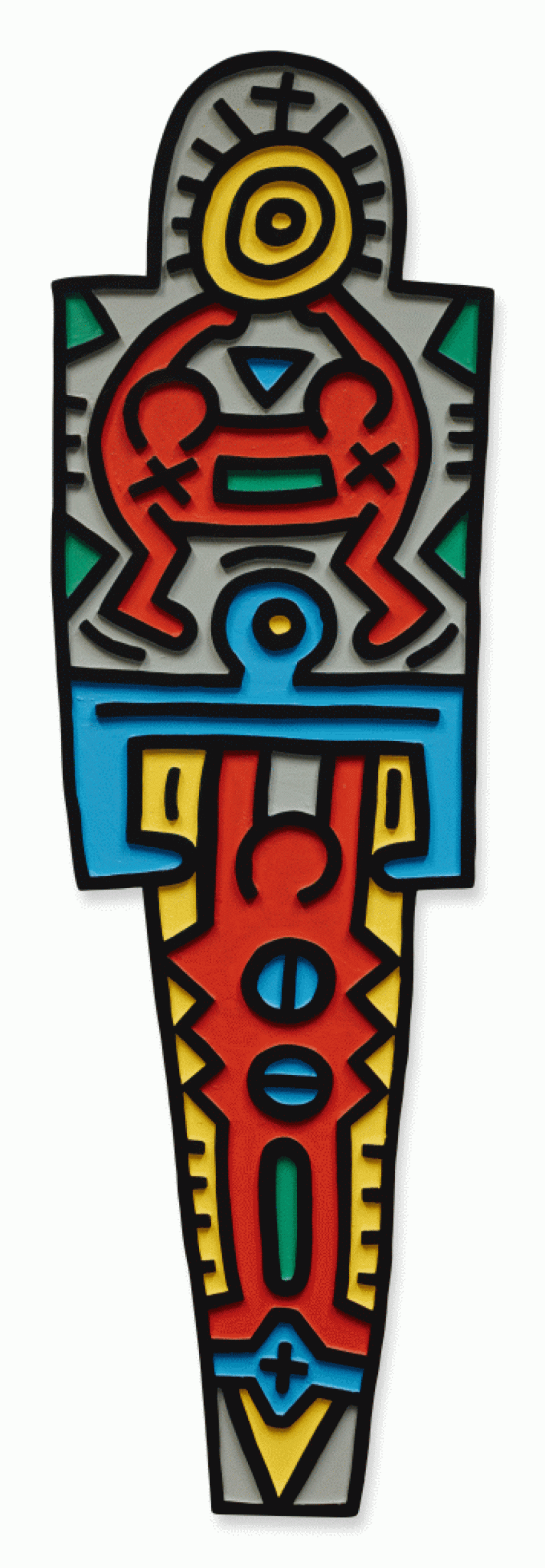
Totem, 1989
Carved plywood painted with enamel in colors
Size: 72 1/4 x 21 7/8 x 2 inches (183.5 x 55.5 x 5 cm)
Edition: 35 + 7 AP
Publisher: Edition Schellmann, New York
10. 1990 Prints
Flowers
5 Prints
Edition: 100 + 15 AP
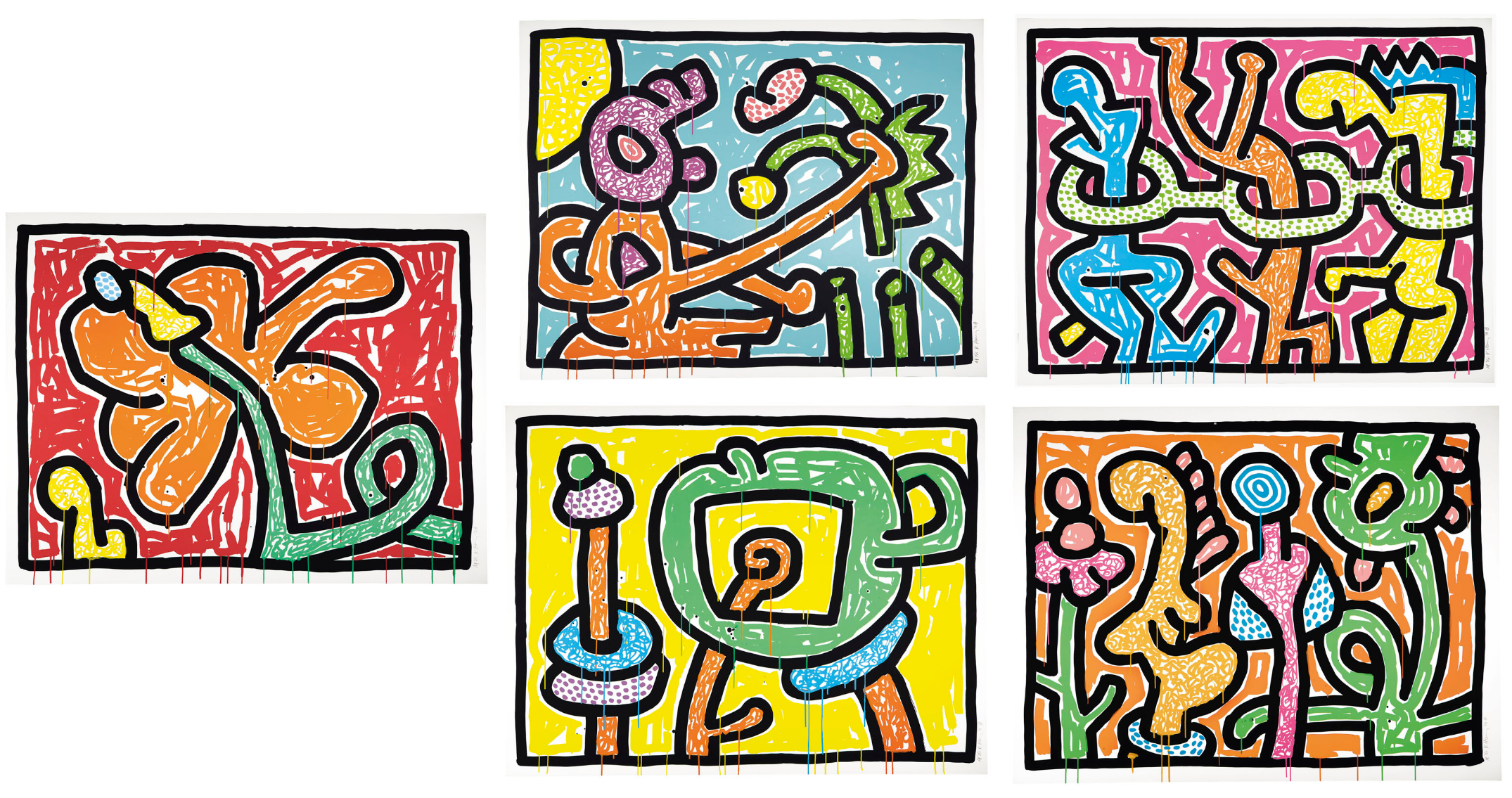
Flowers, 1990
The complete set of five screen-prints in colors on Coventry Paper
Sheet: 36×50 inches (91.5 x 127 cm)
Edition: 100 + 15 AP
Publisher: Tony Shafrazi Editions Inc., New-York
Literature: Littmann pp. 164-167
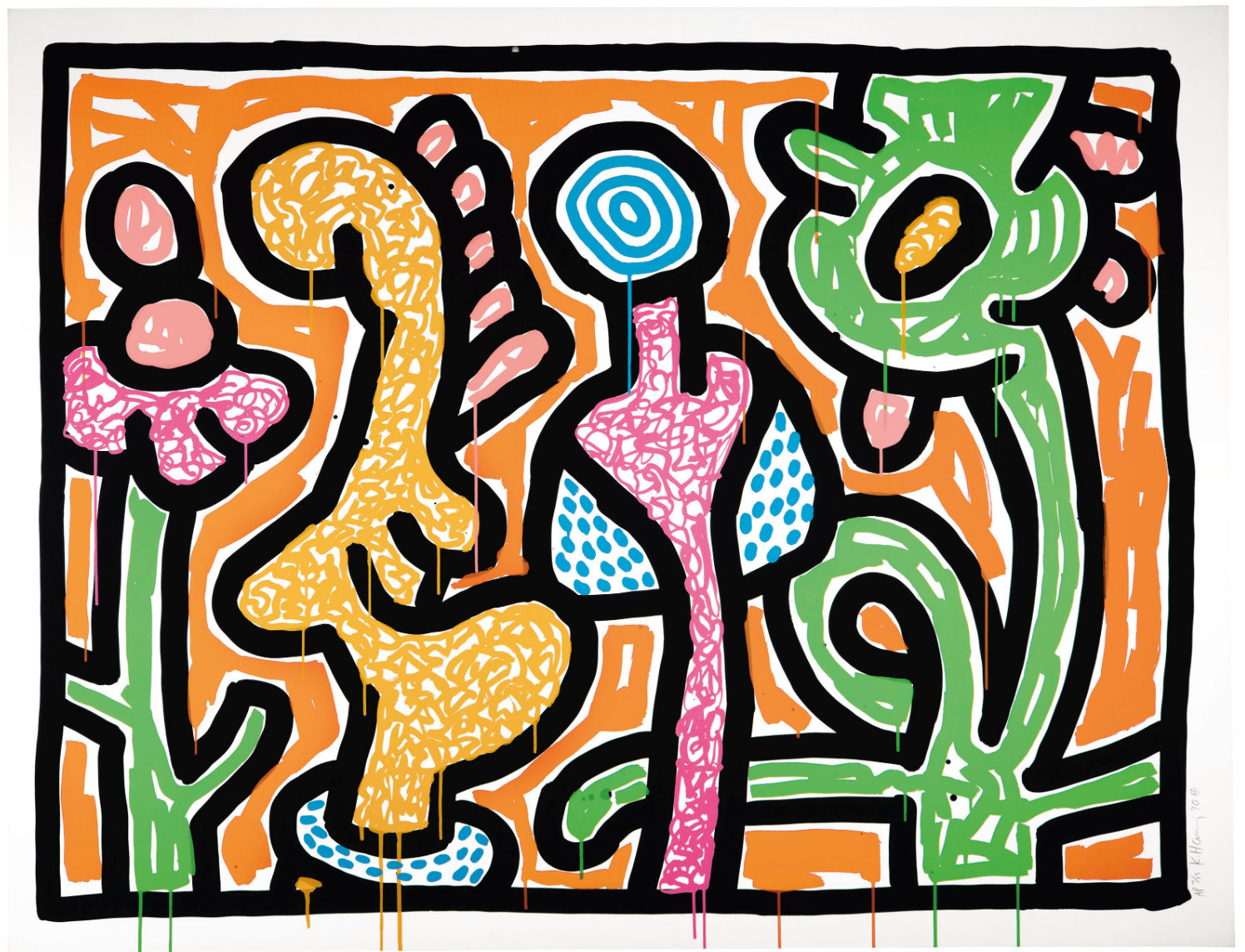
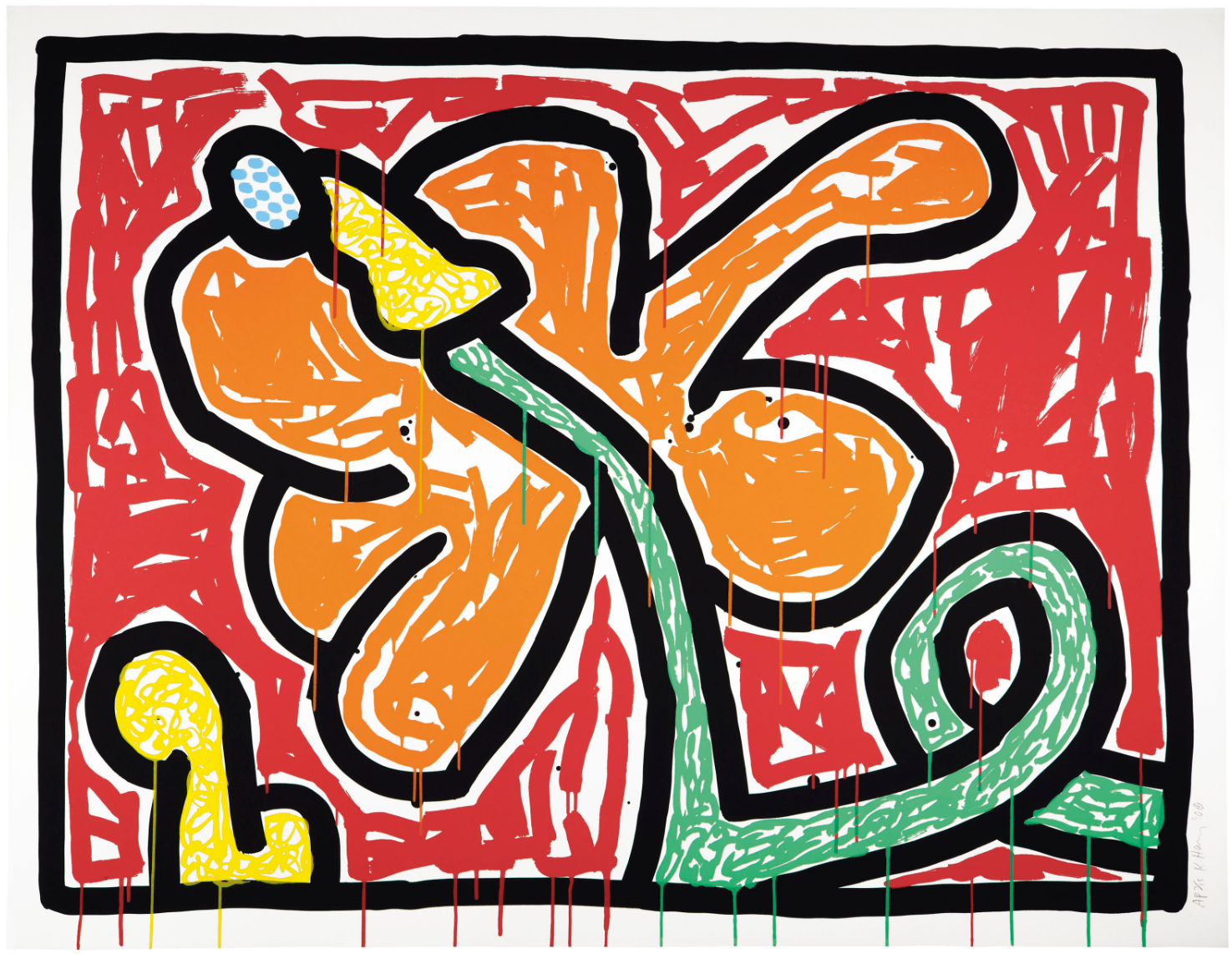
Completed only a few short months before his untimely tragic death in 1990, Keith Haring’s Flowers are vibrant prints that are rendered in his recognizably distinct pop-graffiti style. Throughout the set of fives works, Haring illustrates a variety of fluid, and rhythmic shapes resembling plant forms and their ultimate growth, with a visceral, painterly quality. Heavily inspired by his contemporaries Jackson Pollock and Willem de Kooning from the abstract Expressionist movement of the ‘40s and ‘50s, Haring learned to incorporate the gestural movements into his Flowers . While creating works, he would use the screen print ink and would allow them to drip down the image, creating thin, brightly colored streaks and splatters that are visually striking when placed against the dark, bold outlines his works almost all typically have. Following his AIDS diagnosis in 1988, Haring completed his Flowers only months before his tragic death in 1990. They all demonstrate dense, rhythmic lines and the screen print ink has been allowed to drip down the image, forming thin streaks of color that stand out against the solid black outlines. The drip lines and splatter marks were intentionally left by Haring as an expression of his bodily suffering, whilst also to acknowledge the legacy of figures like Jackson Pollock and Willem de Kooning from the Abstract Expressionist movement.
Flowers 1 (L. p. 165)
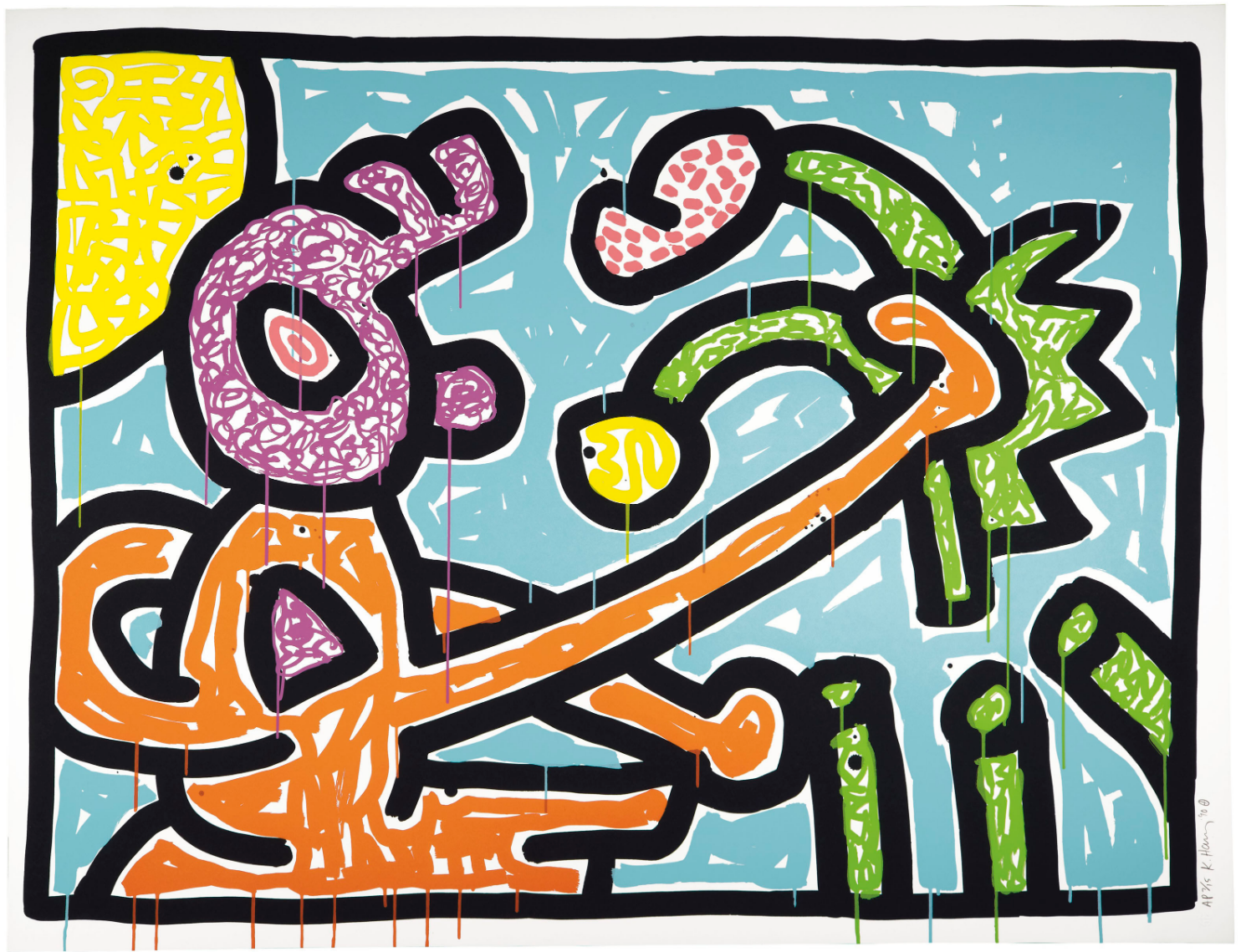
Flowers 2 (L. p. 166)
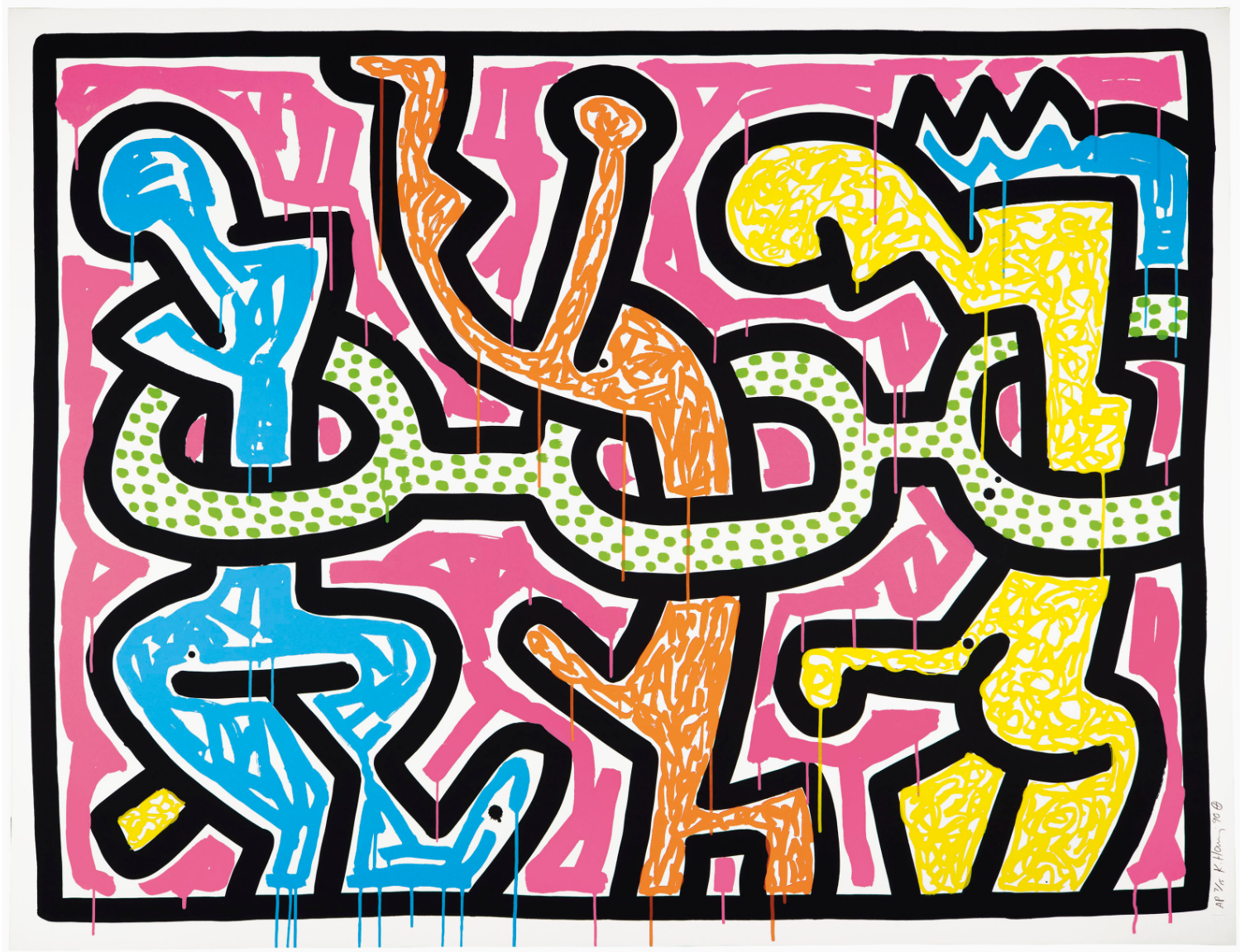
Flowers 3 (L. p. 166)
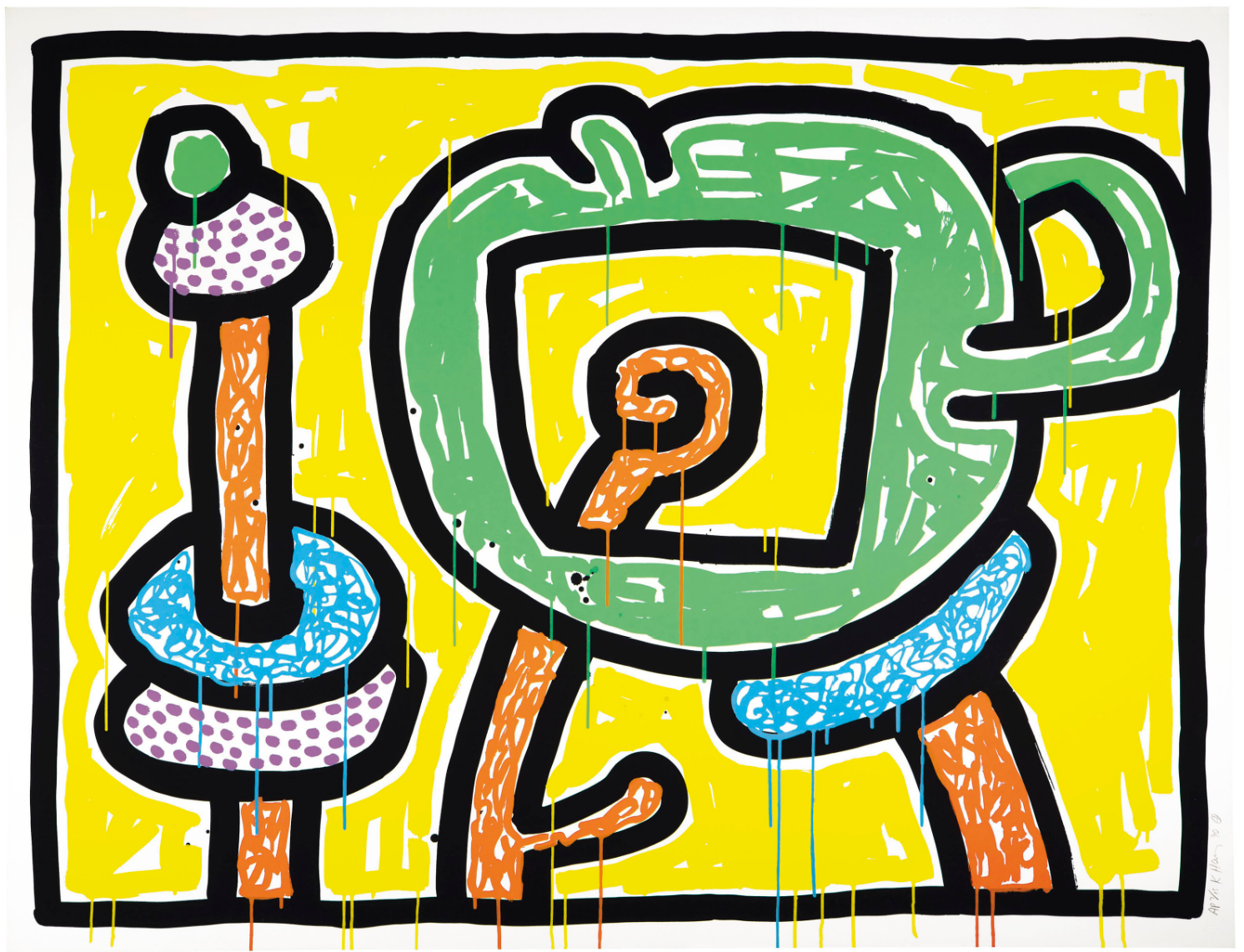
Flowers 4 (L. p. 167)
Flowers 5 (L. p. 167)
Fight Aids Worldwide
1 Lithograph
Edition: 1,000

Fight Aids Worldwide, 1990
Lithograph in colors on wove paper
Sheet: 11 x 8 1/2 inches (28 x 21.5 cm)
Edition: 1,000
Publisher: World Federation of United Nations Associations, New-York
Literature: Littmann pp. 168-169
Icons
5 Prints
Edition: 250 + 25 AP + 25 HV
White Icons: 60 + 10 AP
Icons, 1990
The complete portfolio comprising five screen-prints in colors with embossing on Arches Cover paper
Size: 21×25 inches (53.5 x 63.5 cm)
Edition: 250 + 25 AP + 25 HC
White Icons (embossing): 60 + 10 AP
Publisher: Tony Shafrazi Editions Inc., New-York
Literature: Littmann pp. 170-171
White Icons: Littmann pp. 172-173
Each signed and numbered in pencil on verso by Julia Gruen (the executor of the Keith Haring Estate), with the estate stamped certificate of authenticity, and the publisher’s blindstamp
White Icons

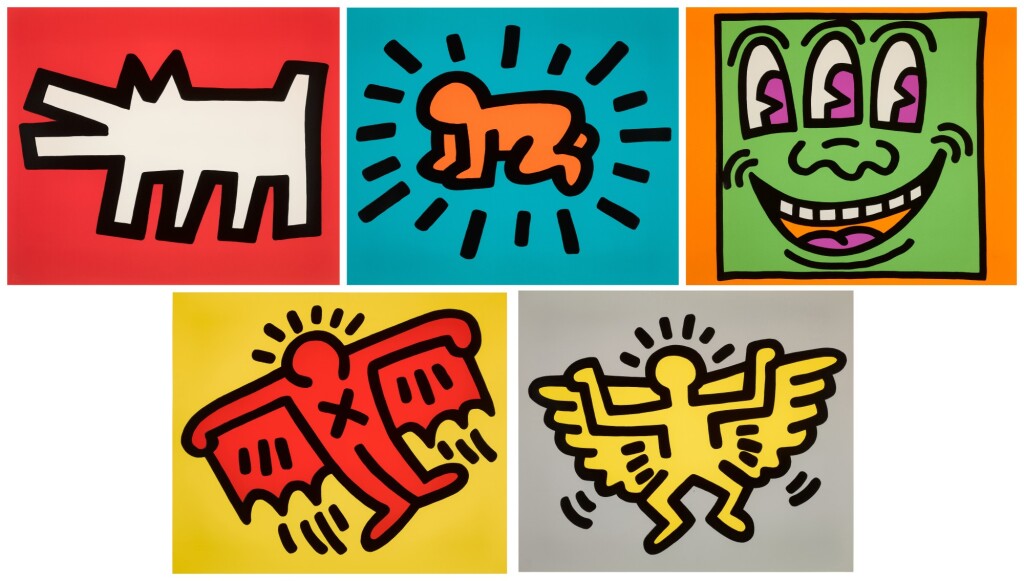
The Icons series prints are rendered in flat, saturated colors as a nod to the rise of commercialism and mass production in Haring’s lifetime. Heavily influenced by Andy Warhol and the wider Pop Art movement of the 1960s, his work bridges the gap between high art and mass consumerism so as to dissolve boundaries between fine art, political activism and popular culture.
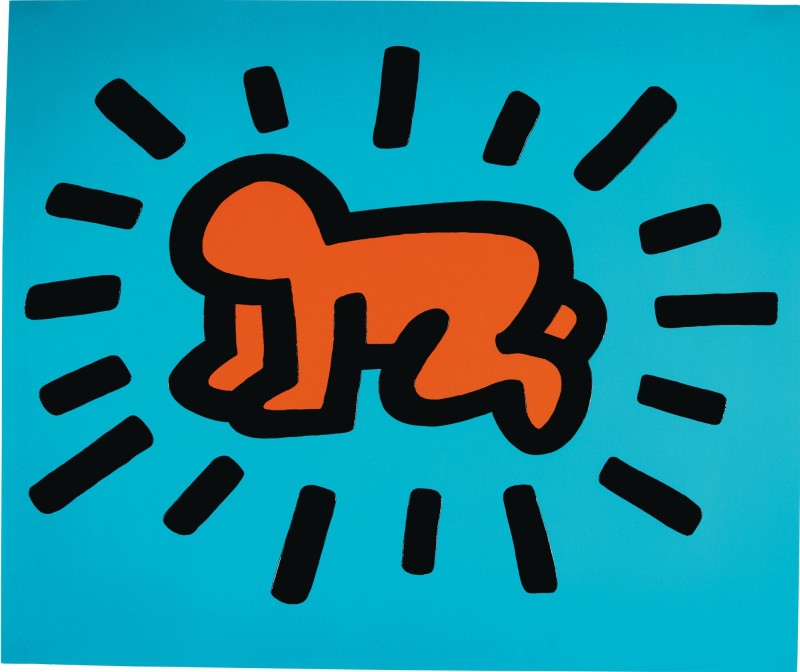
Radiant Baby is one of Keith Haring’s most recognizable prints from the Icons series (1990). It shows a bright orange cartoon child, crawling on its hands and knees, with a sky-blue backdrop. Rendered in his characteristic pop-graffiti style, the figure is boldly outlined in black with thick, radiating lines pulsating from its body. The symbol first emerged in Haring’s work during his days as a subway artist in New York, where he used the Radiant Baby in place of his signature, known as his ‘tag’, on public art projects.
Radiant Baby (L. p.170)
White Icon – Radiant Baby (L. p. 172)

Angel features a yellow-winged figure with its arms and legs spread outwards. Emphasized by Haring’s trademark bold lines, the figure is shown to be vibrating, as though dancing. Angel is demonstrative of the way Haring shapes religious source material to reflect contemporary concerns of his generation.
Angel (L. p. 171)
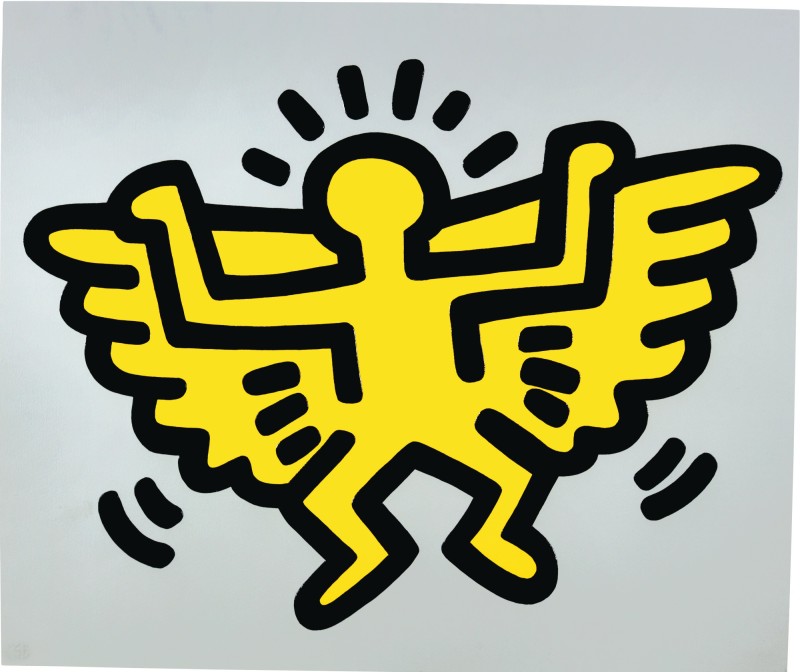
White Icon – Angel (L. p. 173)

One of the most widely recognized symbols amply used by Keith Haring, Barking Dog features a simplified image of a dog barking. Rendered in white with thick, squared-off black outlines, the image of the dog is set against a vivid red backdrop and conveys a sense of urgency to the viewer.
Barking Dog (L. p. 171)
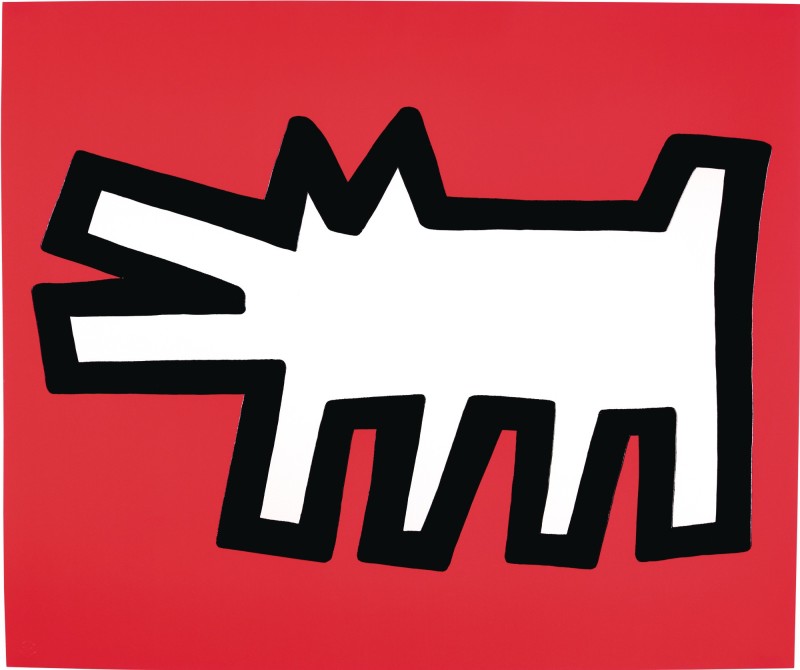
White Icon – Barking Dog (L. p. 173)

Flying Devil is a print from Keith Haring’s Icons series (1990), a set of five screen prints each showing a single symbol rendered in his vivid and linear style. Using bold, rounded lines to cultivate a sense of energy and movement, this particular print depicts a striking red-winged devil with a cross on its chest, set against a bright yellow backdrop. Haring’s trademark graphic symbols, bursting with color and vigor, work to create an open-ended visual language, seen and understood by thousands of people in New York City amidst the Cold War, the HIV/AIDS crisis and the crack epidemic.
Flying Devil (L. p. 171)
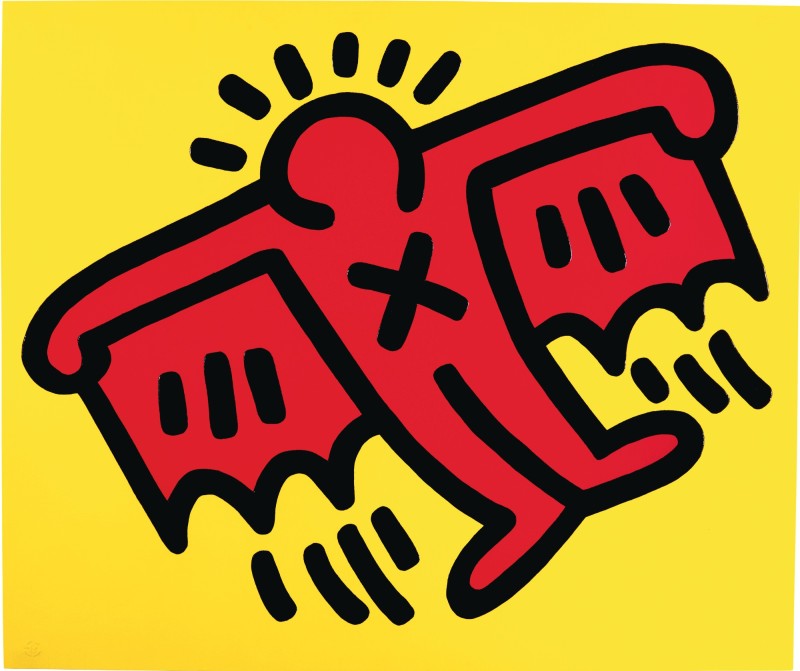
White Icon – Flying Devil (L. p. 173)

Three Eyed Monster features one of the artist’s most widely known motifs. It shows a green, square smiling face with three bright eyes looking avidly to the right, set against a saturated orange background. Haring’s choice of color and subject gives this print a garish and jarring quality that emphasizes both the playful and grotesque in his work.
Three Eyed Monster (L. p. 171)
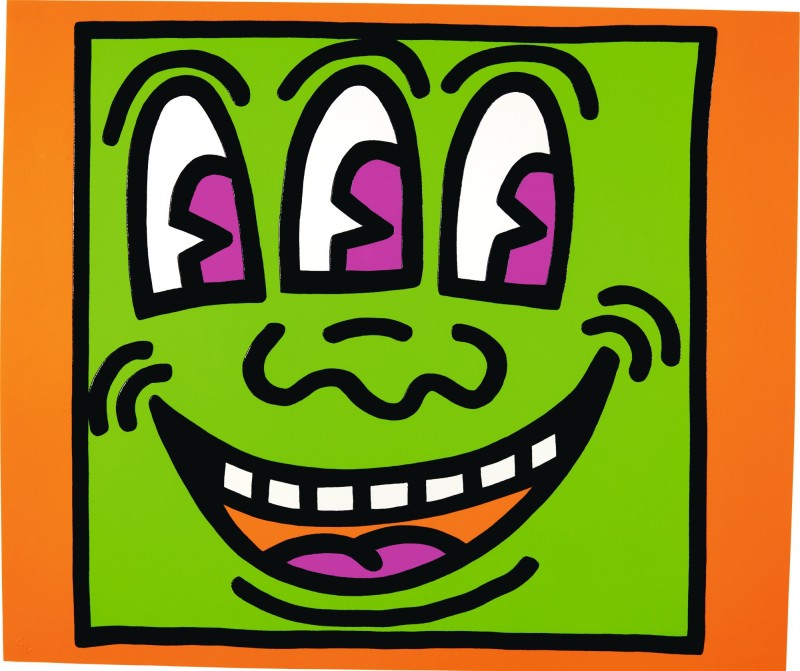
White Icon – Three-Eyed Monster (L. p. 173)

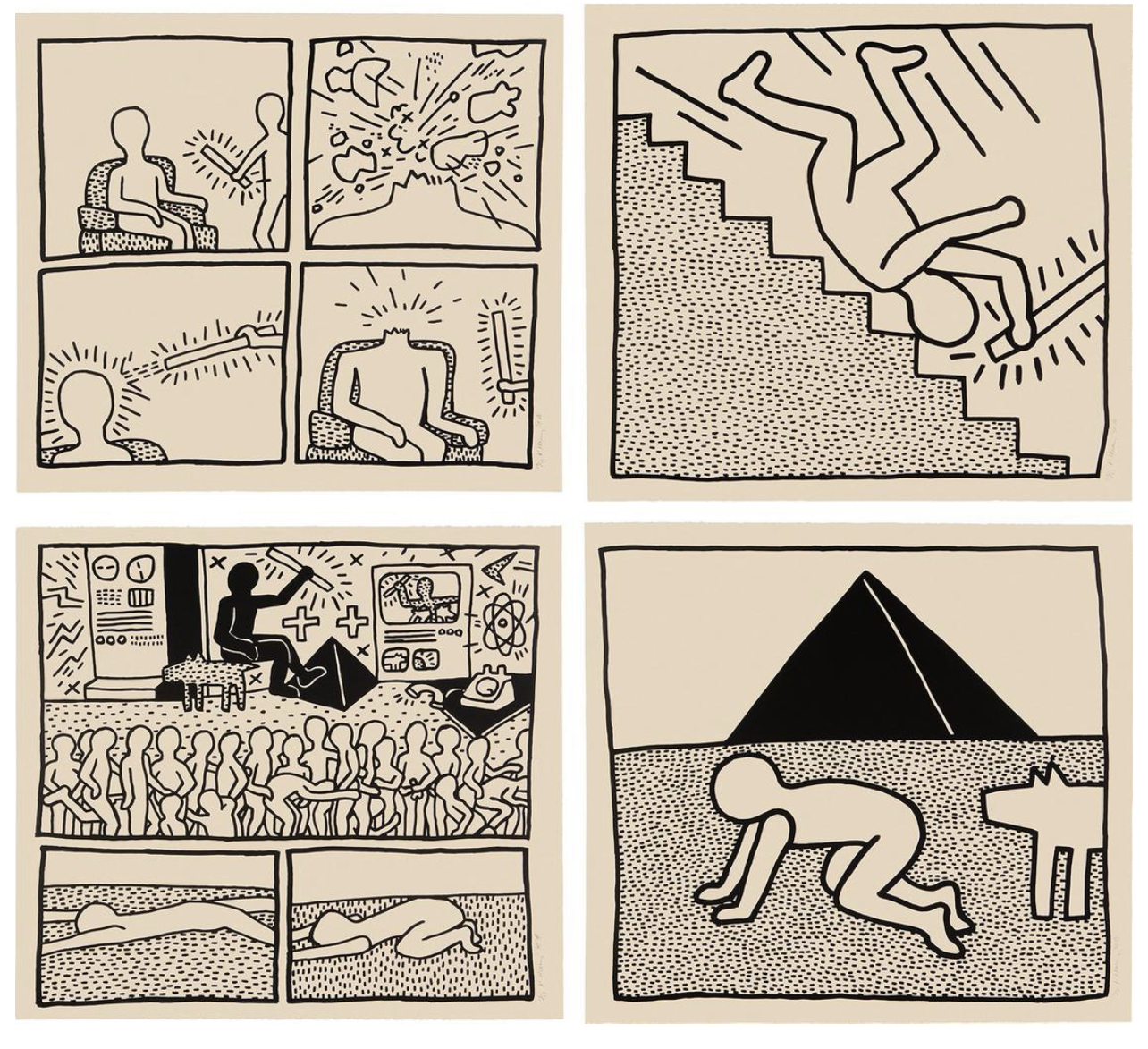
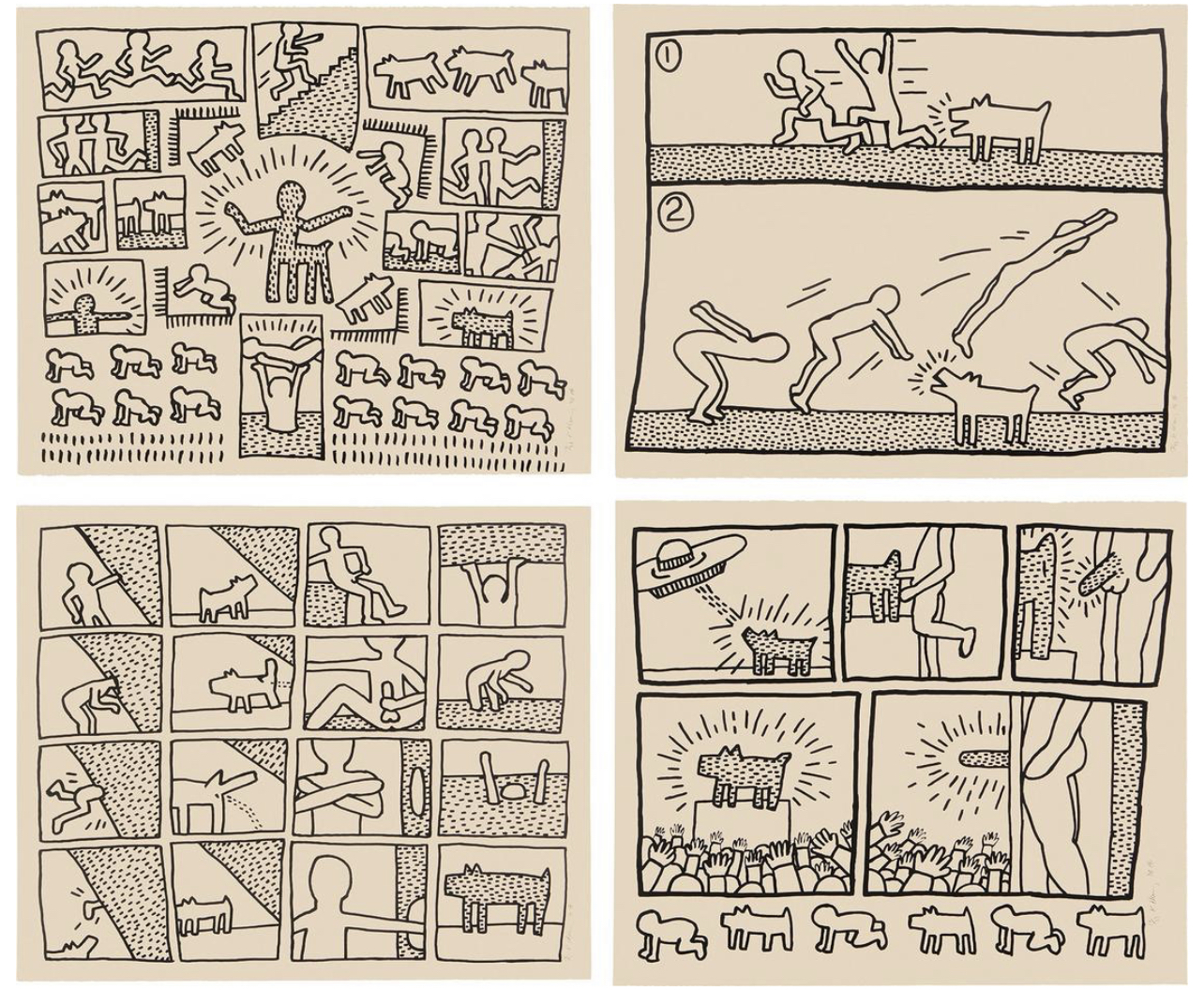
The Blueprint Drawings
17 Prints
Edition: 33
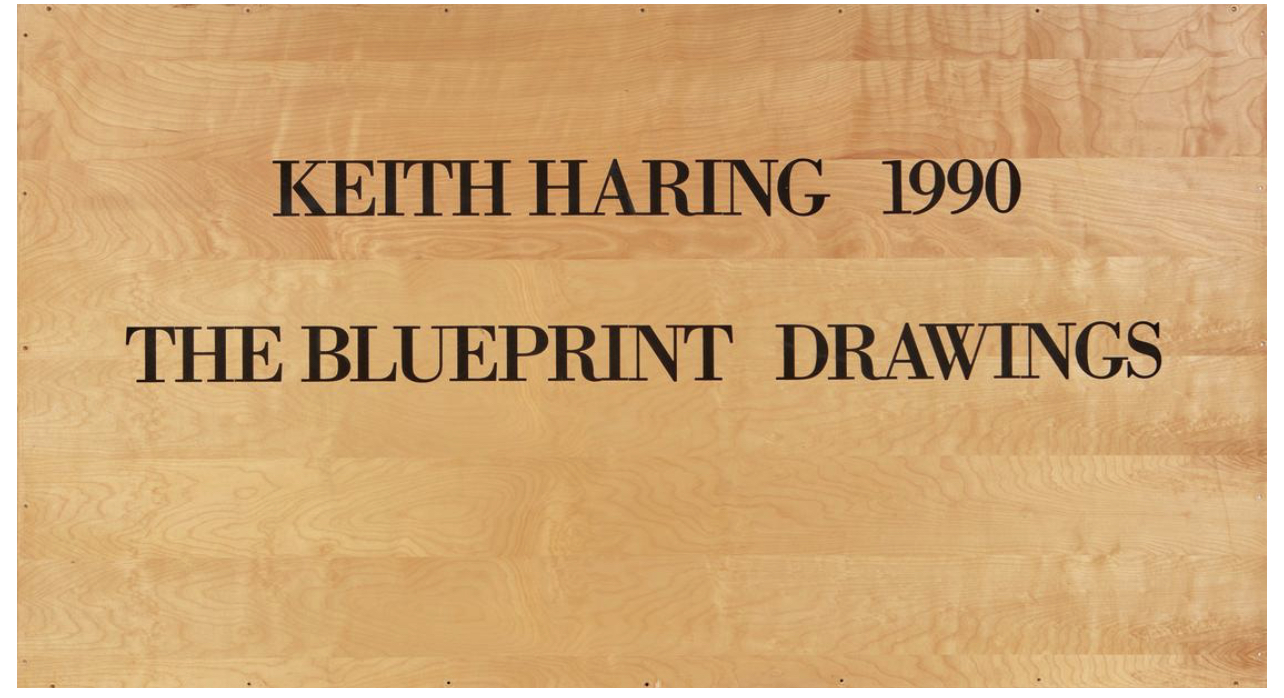
The Blueprint Drawings, 1990
The complete set of 17 screen-prints on Arches Cover paper
Smallest Image: 39×42 inches (99.1 x 106.7 cm)
Largest Sheet: 42 1/2 x 79 inches (108 x 200.7 cm)
Edition: 33
Publisher: Durham Press, Durham, Pennsylvania
Literature: Littmann pp. 174-183
“These 17 drawings were created over a period of a few weeks between December 1980 and January 1981.”
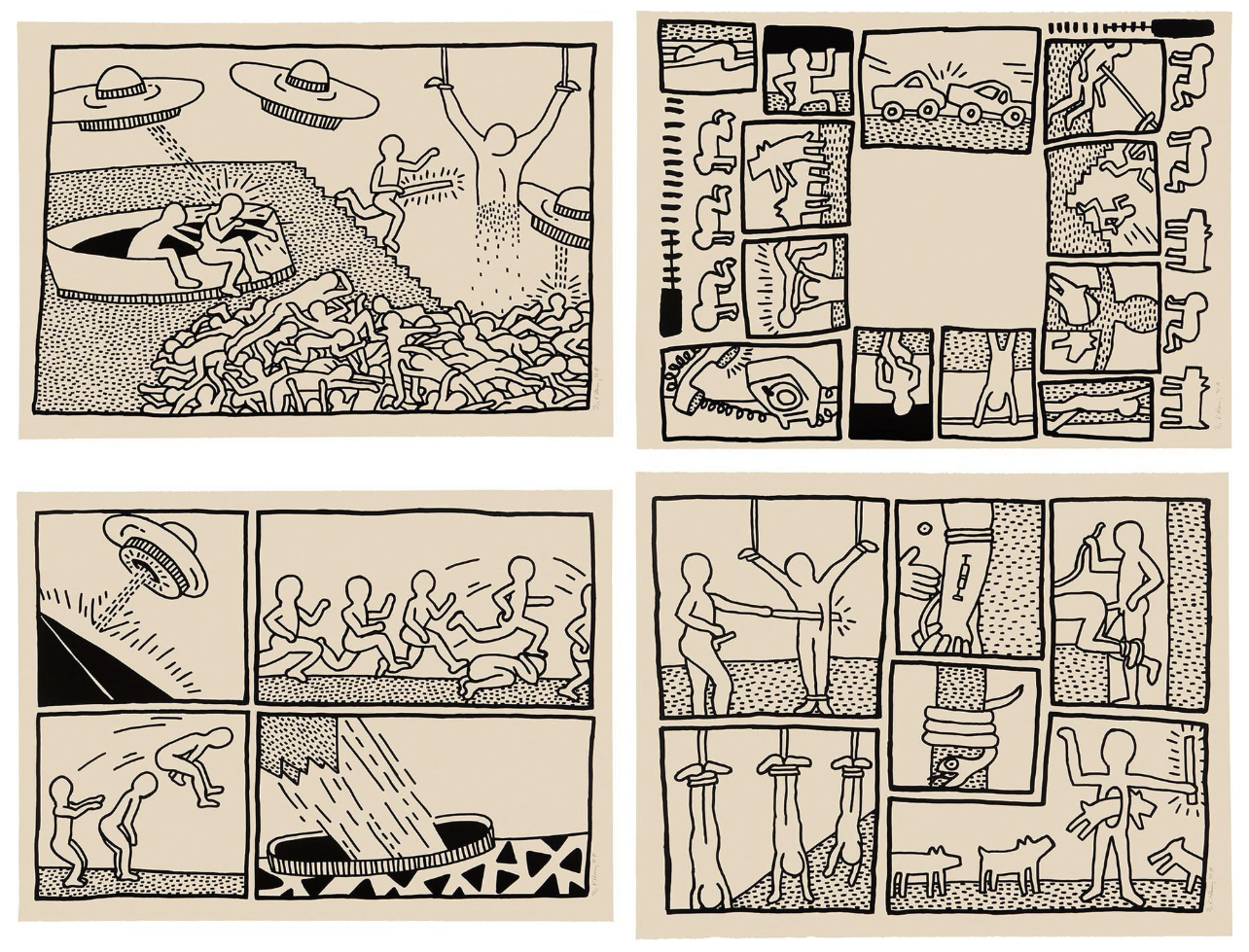
“The original drawings were executed on vellum with Sumi ink because I intended to make blueprint copies of each of the drawings. Periodically I would take my drawings to the local blueprinters, where I had much enjoyment trying to explain the content of these works to the men who operated the blueprint machines.”
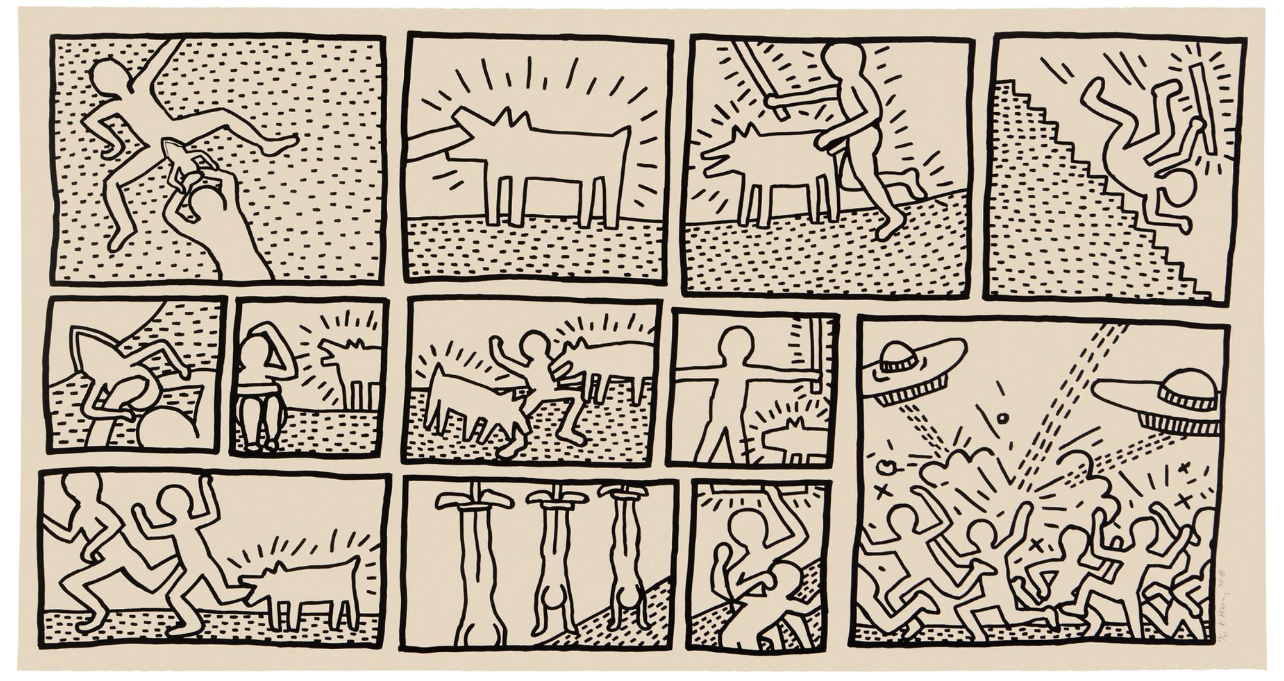
“After a few weeks, everyone in the shop was familiar with my drawings. This was also the time I began drawing in the NYC subways.”
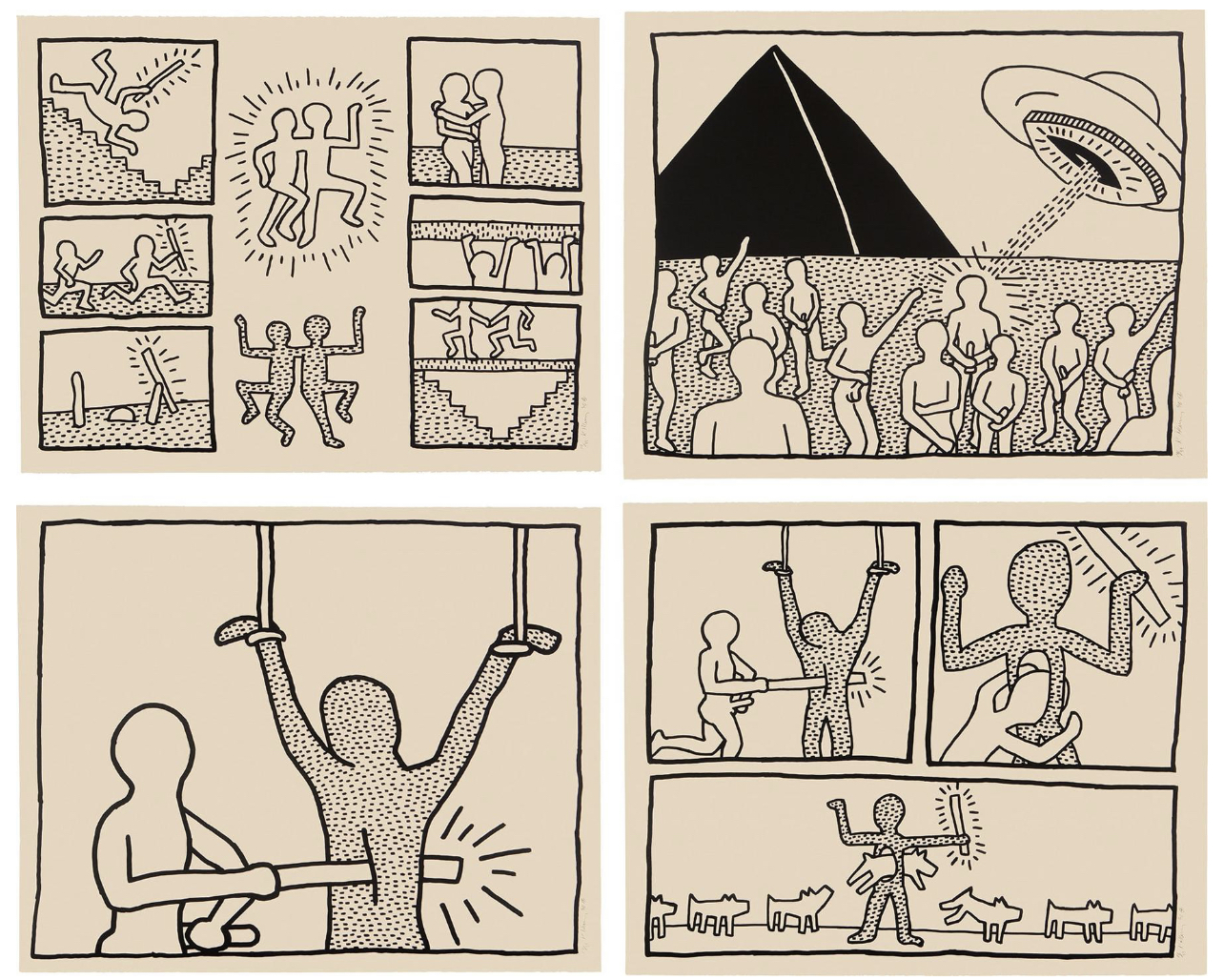
“The drawings were exhibited in a small gallery space at Westbeth Painter’s Space in February 1981.
It was my first one-man exhibition in New York City.”
“The exhibition lasted for one week, during which time I sold several blueprint copies of the drawings, but no original drawings.”
“Since then many of the drawings have been sold and I don’t know their whereabouts. However, before I sold any of them I made photostats of each of the drawings.
These prints were made from those stats.
They form a perfect time capsule of my beginning in New York City.”
Blueprint Drawing #1
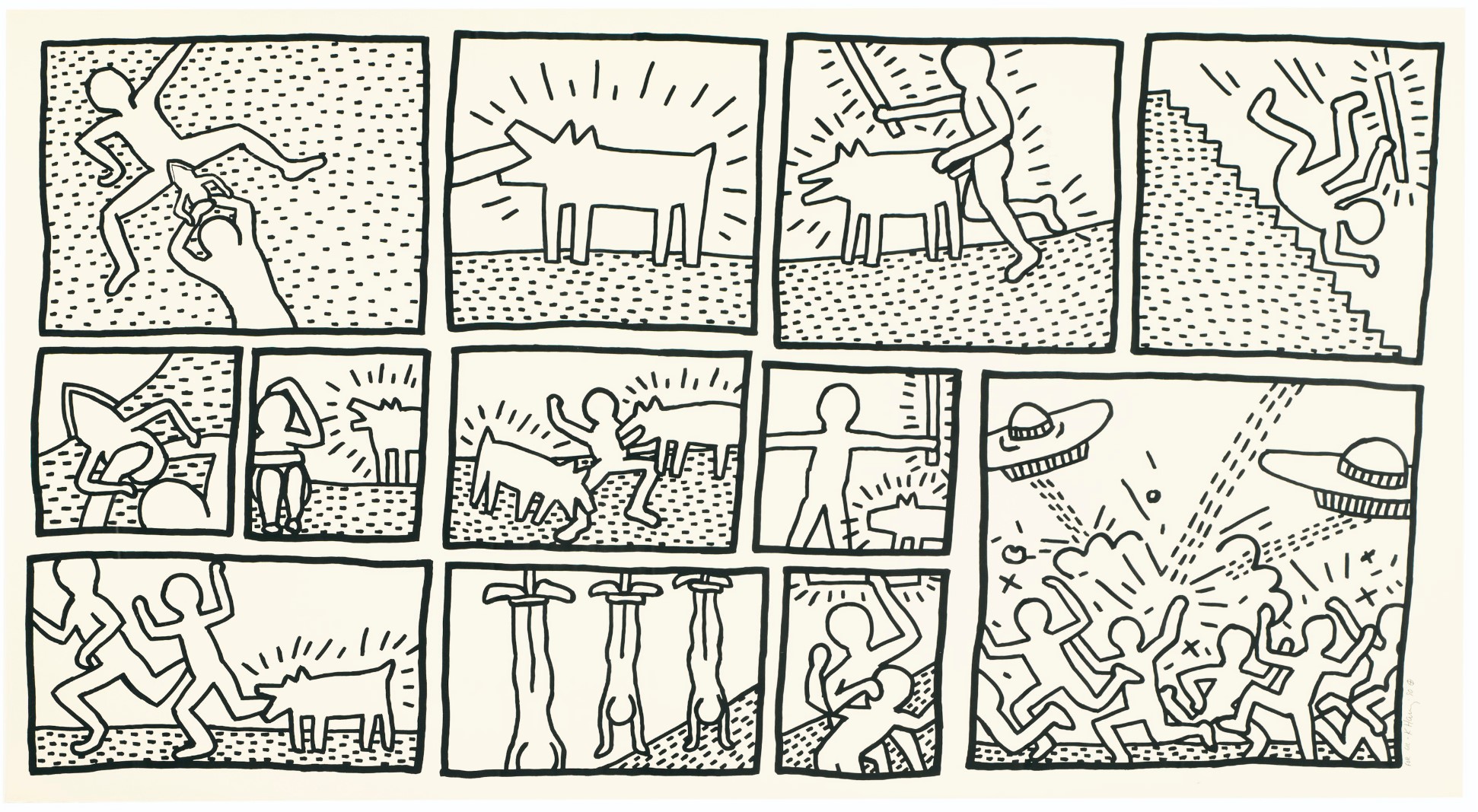
Blueprint Drawing #1
Sheet: 42 1/2 x 79 inches (108×201 cm)
Literature: Littmann pp. 174-175
Blueprint Drawing #2
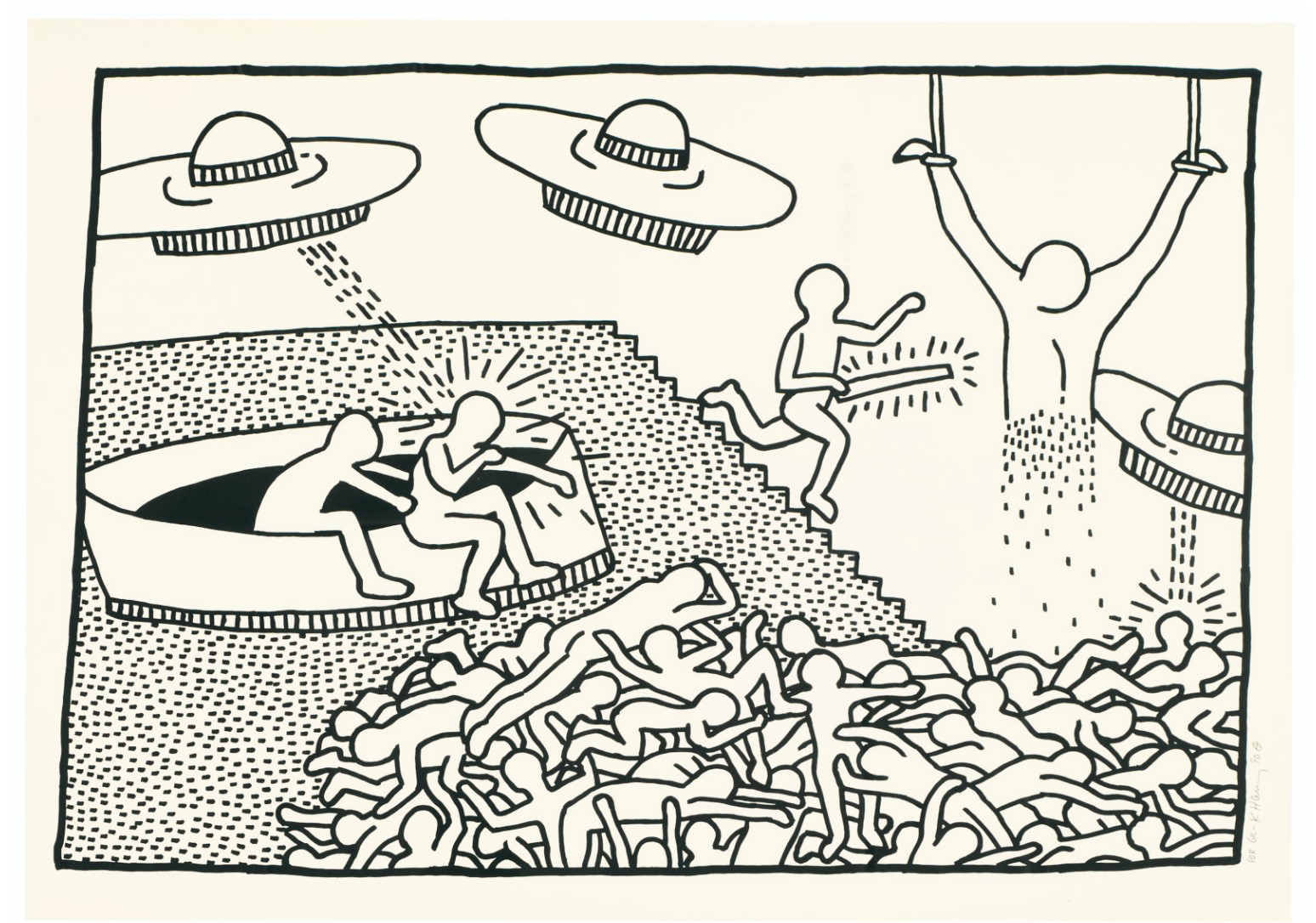
Blueprint Drawing #2
Sheet: 42 1/2 x 60 inches (108 x 152.5 cm)
Literature: Littmann pp. 176
Blueprint Drawing #3
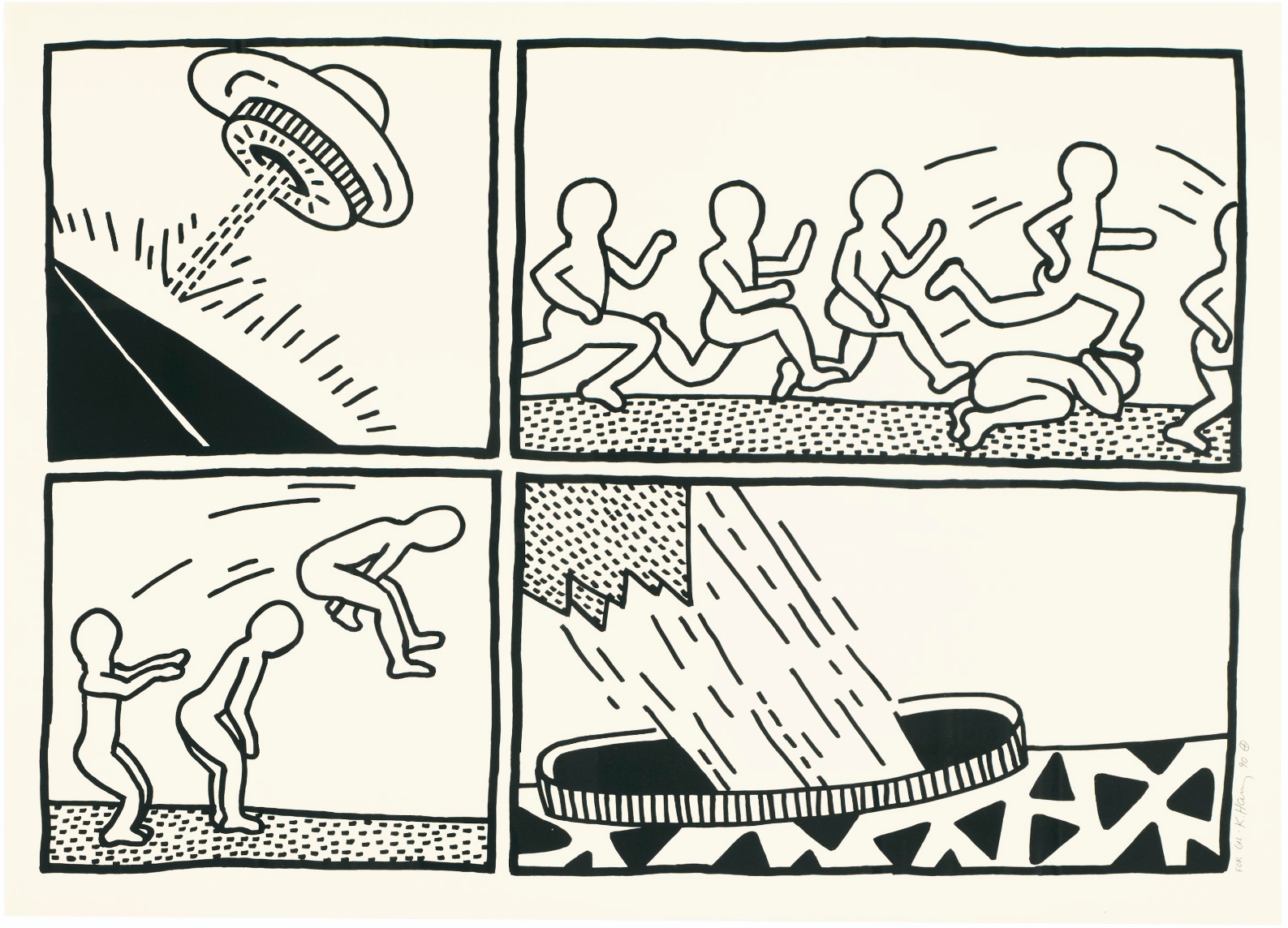
Blueprint Drawing #3
Sheet: 42 1/2 x 59 inches (108×150 cm)
Literature: Littmann p. 176
Blueprint Drawing #4 (L. p.177)
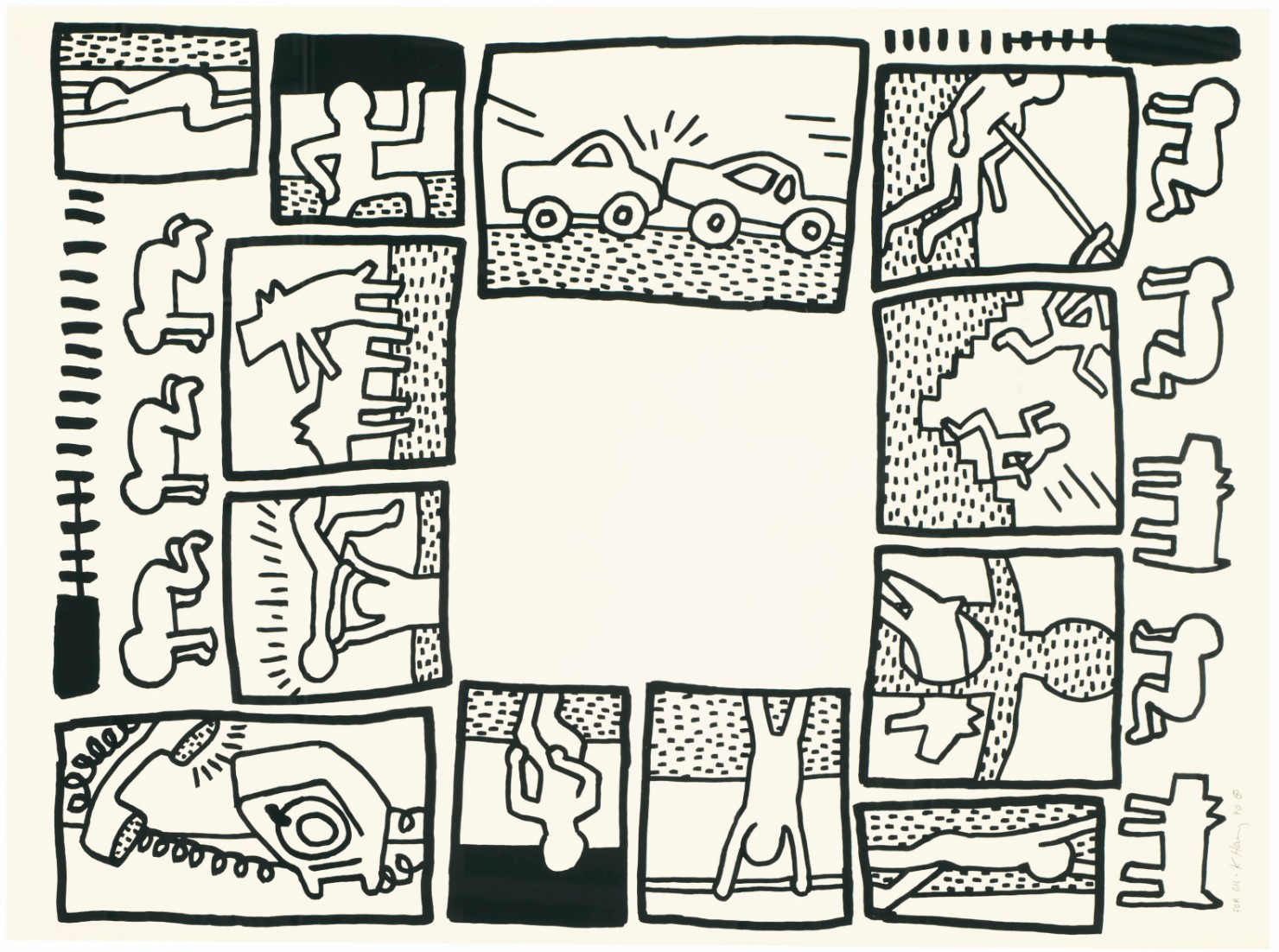
Blueprint Drawing #4
Sheet: 42 1/2 x 57 1/2 inches (108×146 cm)
Literature: Littmann p. 177
Blueprint Drawing #5
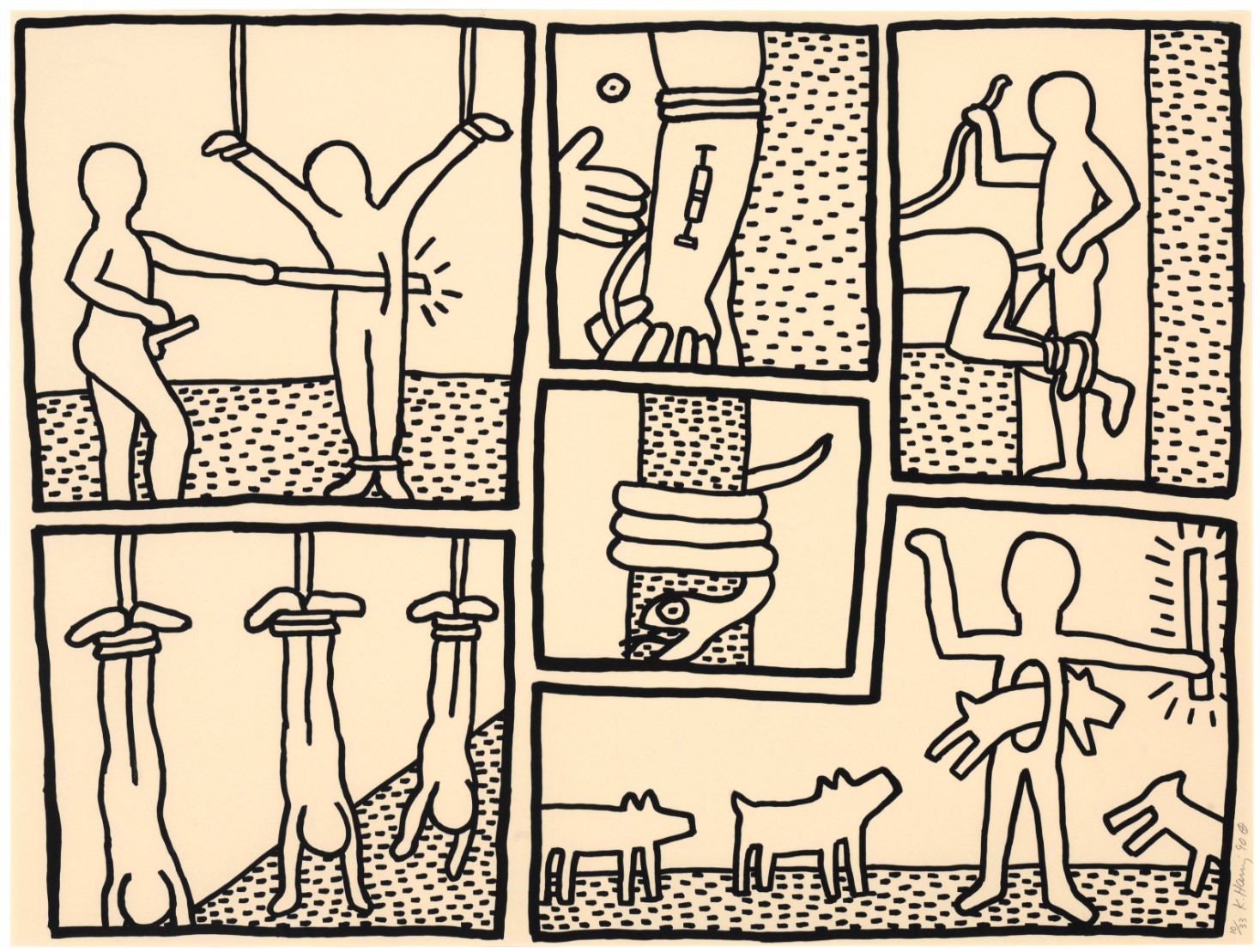
Blueprint Drawing #5
Sheet: 42 1/2 x 54 inches (108×137 cm)
Literature: Littmann p. 177
Blueprint Drawing #6
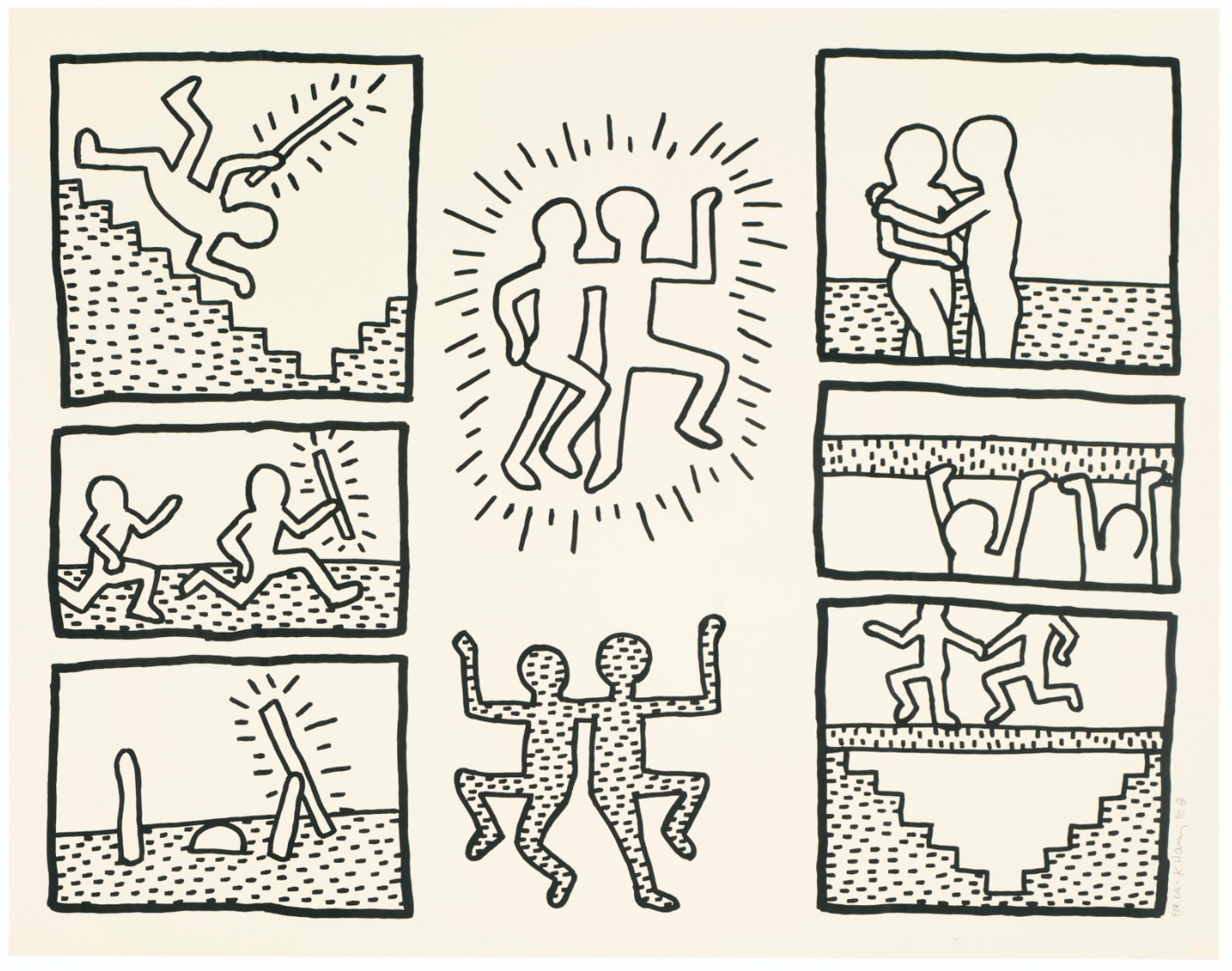
Blueprint Drawing #6
Sheet: 42 1/2 x 54 inches (108×137 cm)
Literature: Littmann p. 178
Blueprint Drawing #7
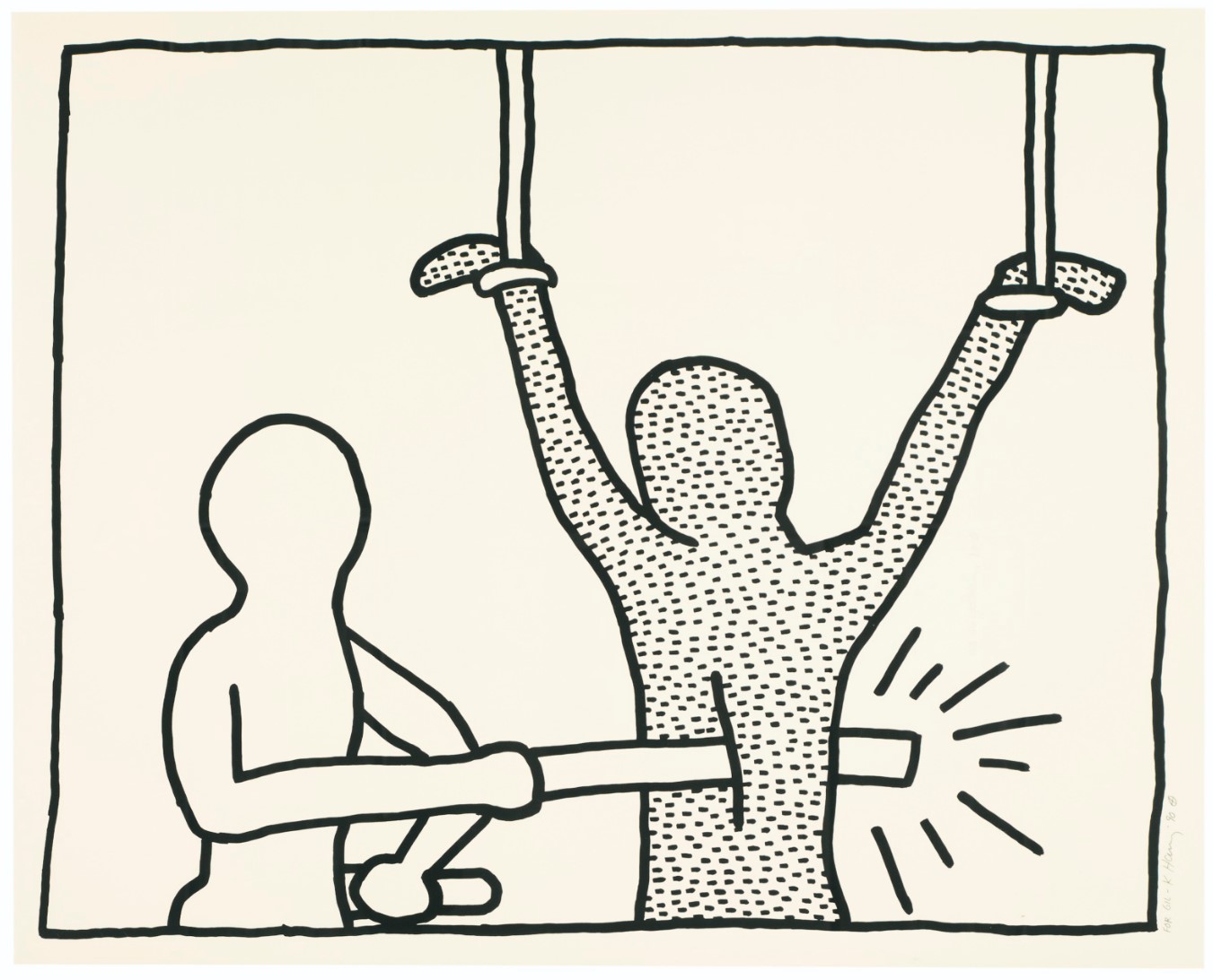
Blueprint Drawing #7
Sheet: 42 1/2 x 53 inches (108 x 134.5 cm)
Literature: Littmann p. 178
Blueprint Drawing #8
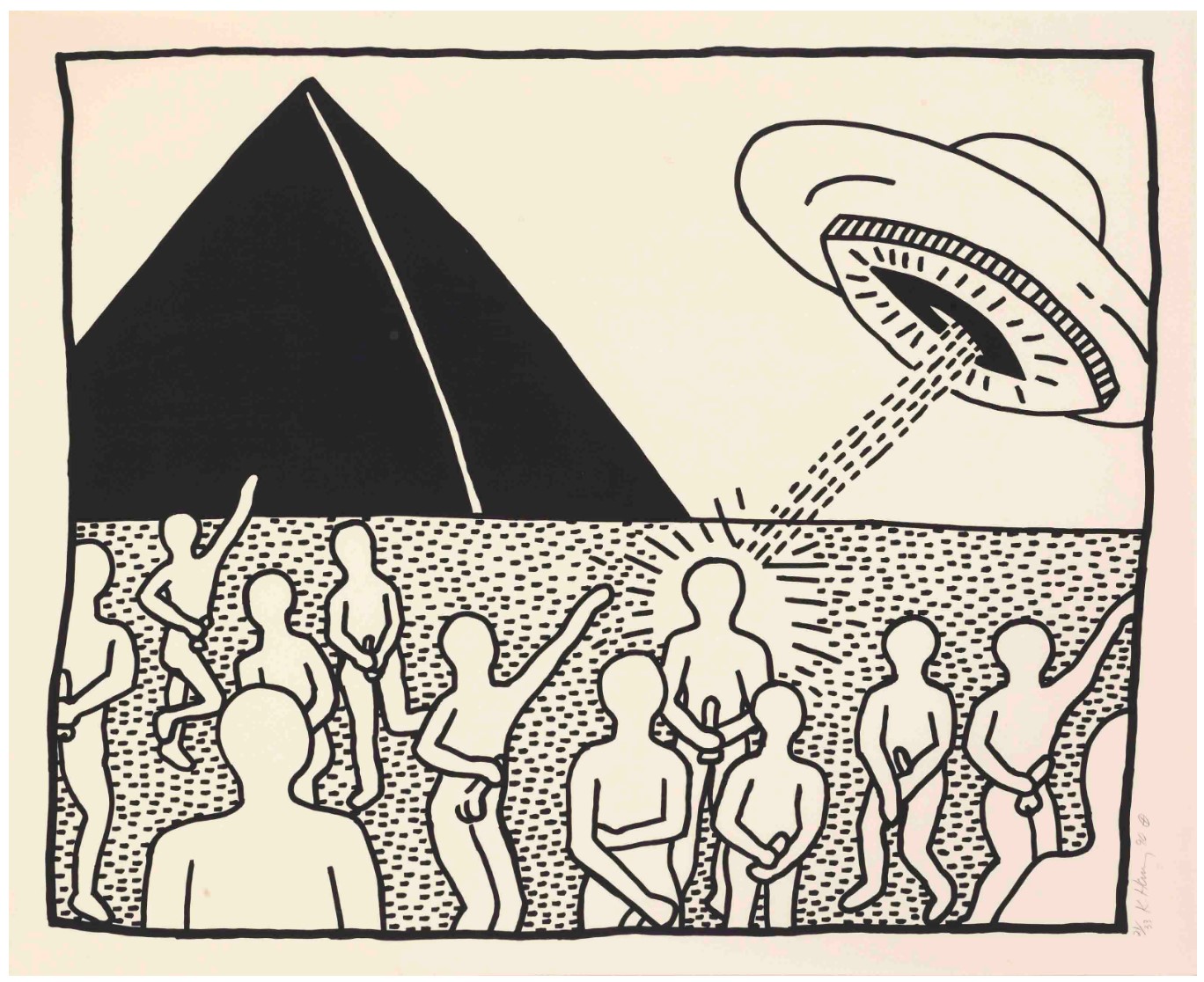
Blueprint Drawing #8
Sheet: 42 1/2 x 52 inches (108 x 134.5 cm)
Literature: Littmann p. 179
Blueprint Drawing #9
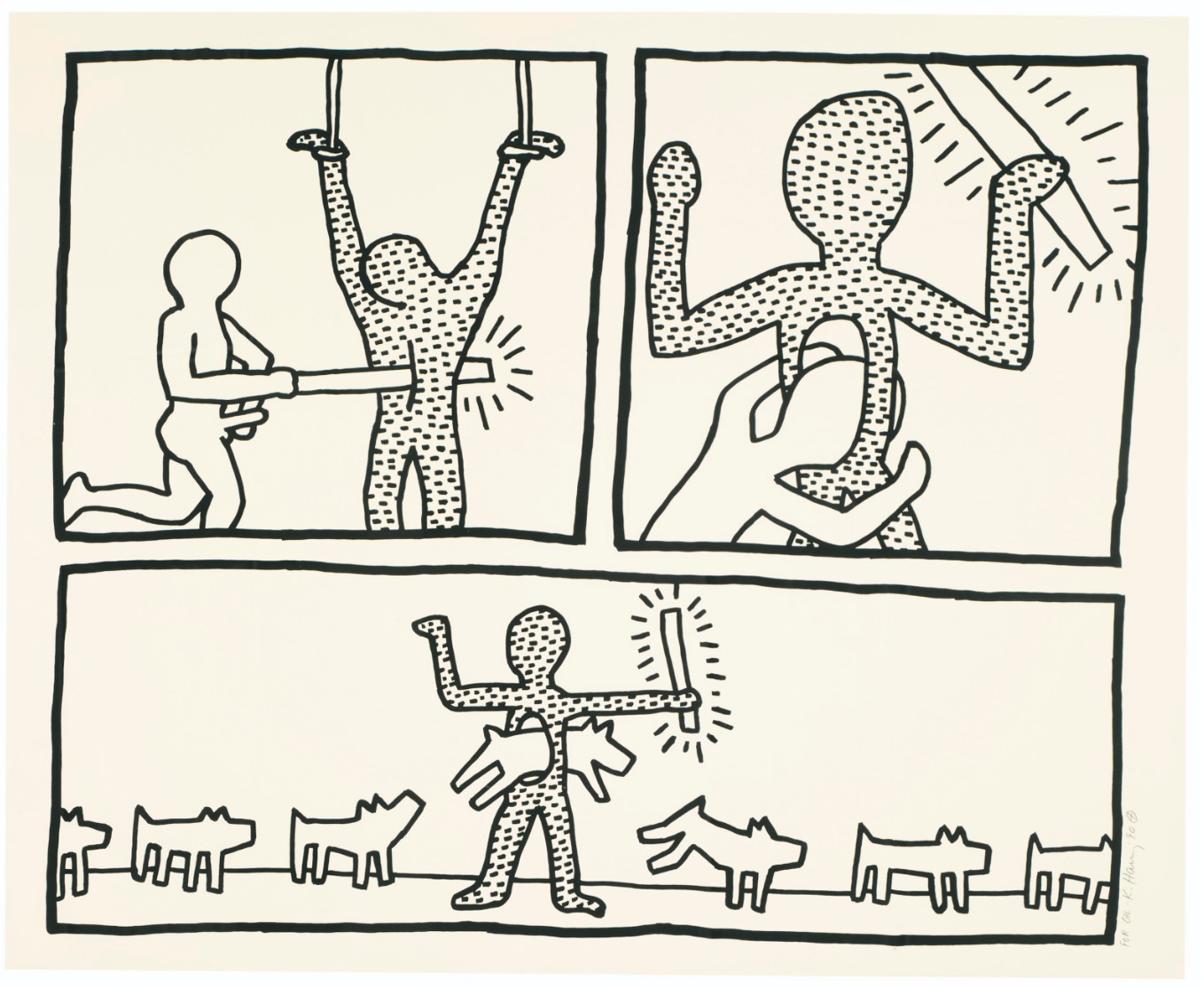
Blueprint Drawing #9
Sheet: 42 1/2 x 52 inches (108×132 cm)
Literature: Littmann p. 179
Blueprint Drawing #10
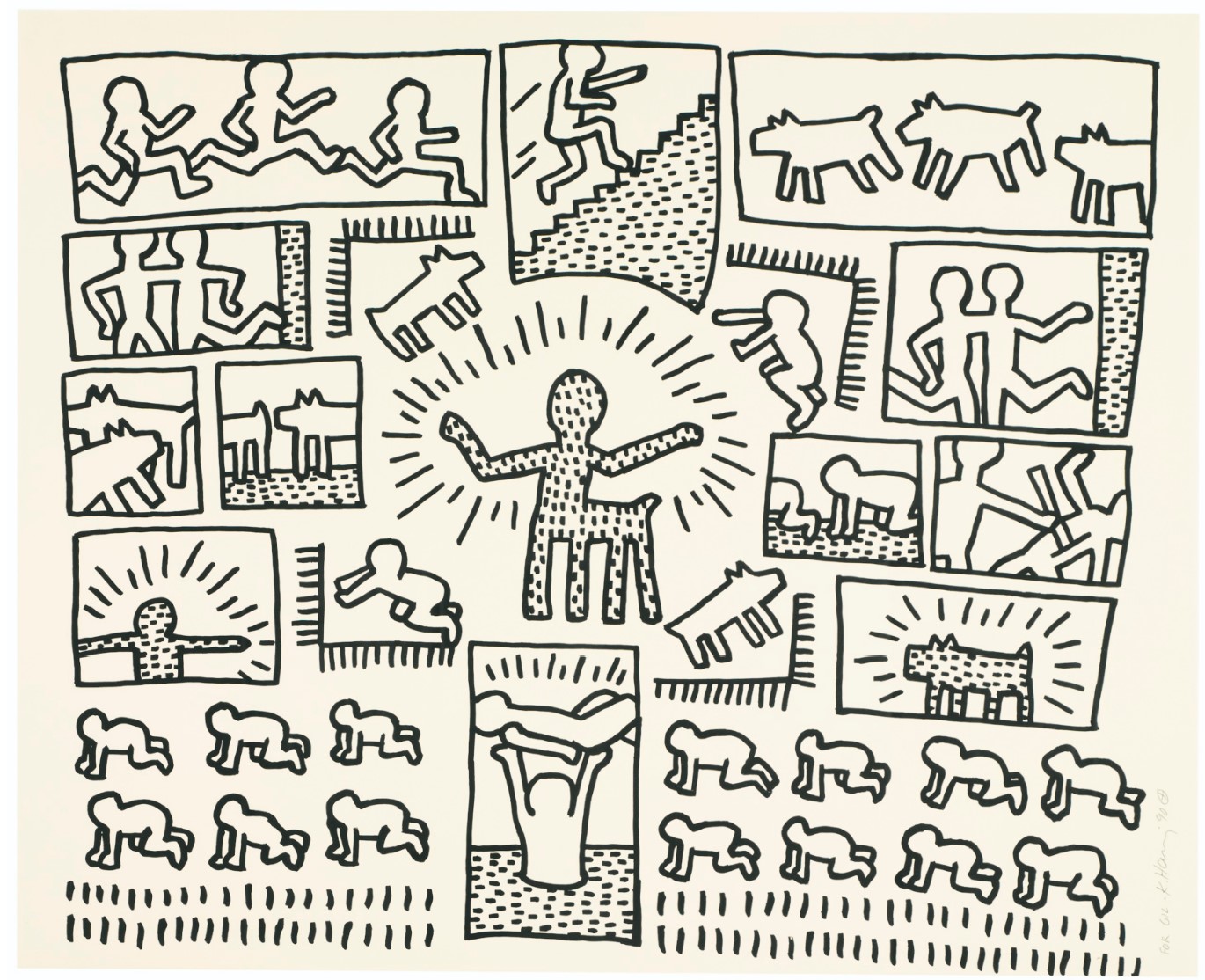
Blueprint Drawing #10
Sheet: 42 1/2 x 52 inches (108×132 cm)
Literature: Littmann p. 180
Blueprint Drawing #11
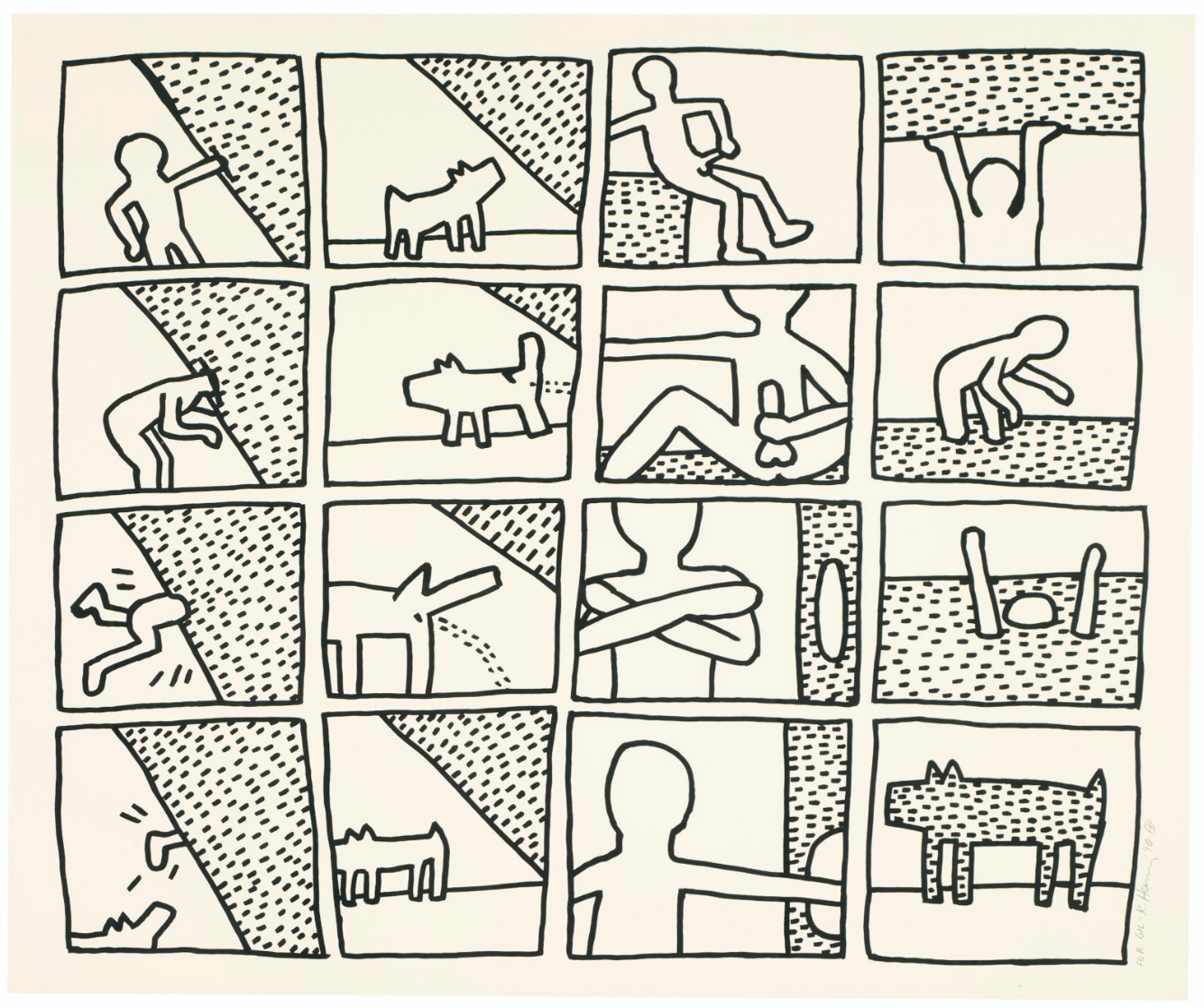
Blueprint Drawing #11
Sheet: 42 1/2 x 51 inches (108 x 122.5 cm)
Literature: Littmann p. 180
Blueprint Drawing #12
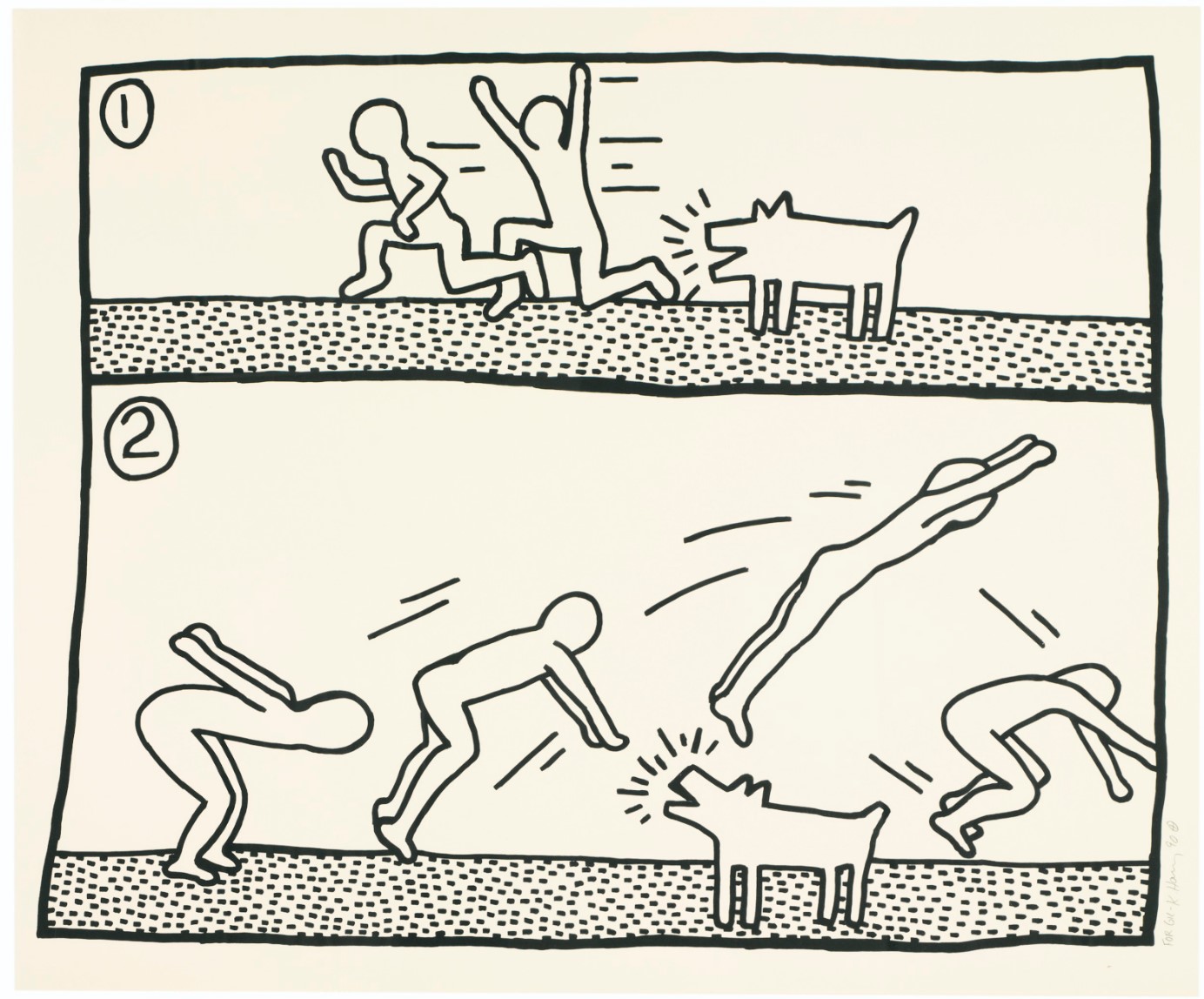
Blueprint Drawing #12
Sheet: 42 1/2 x 51 inches (108 x 129.5 cm)
Literature: Littmann p. 181
Blueprint Drawing #13
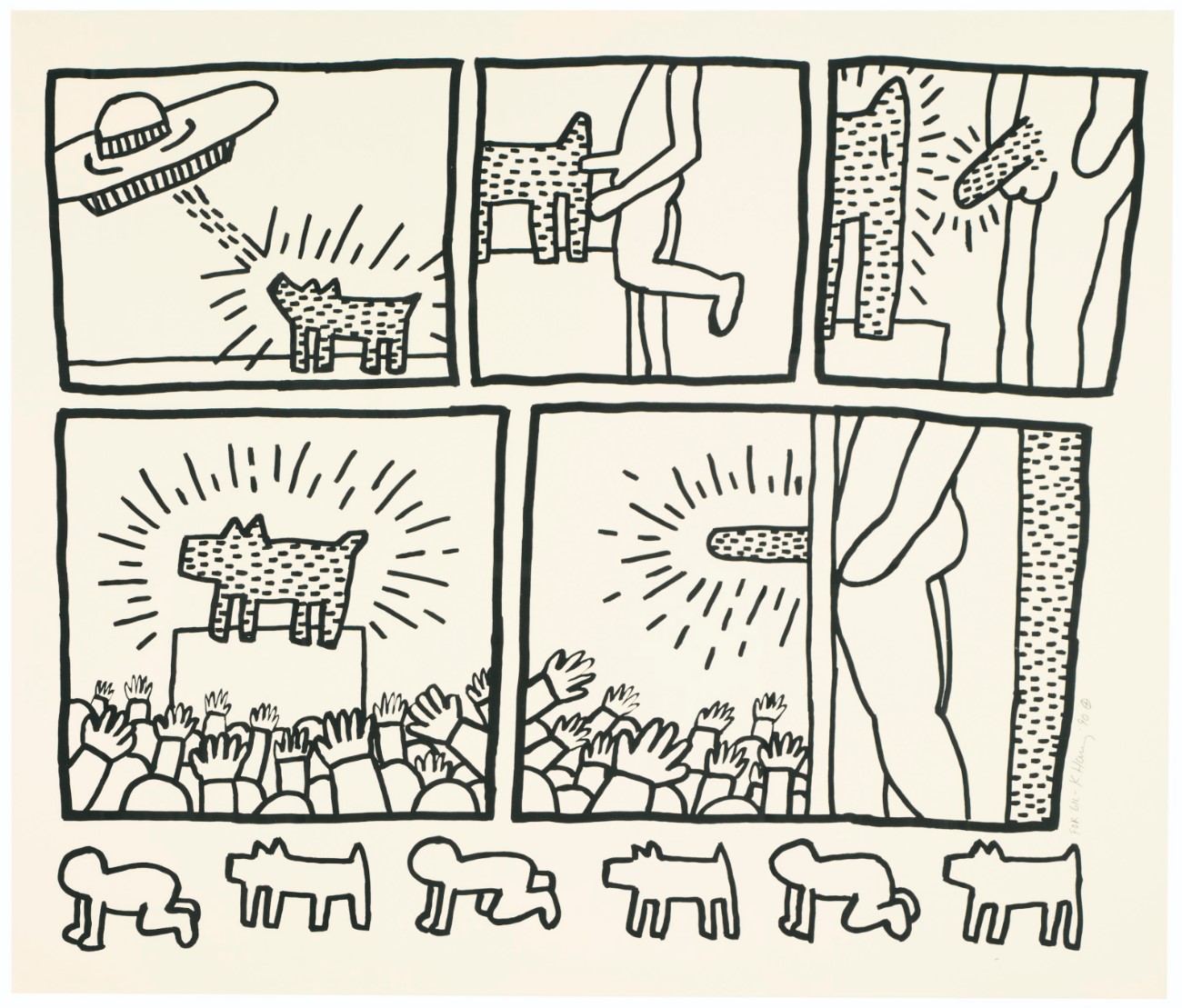
Blueprint Drawing #13
Sheet: 42 1/2 x 50 inches (108×127 cm)
Literature: Littmann p. 181
Blueprint Drawing #14
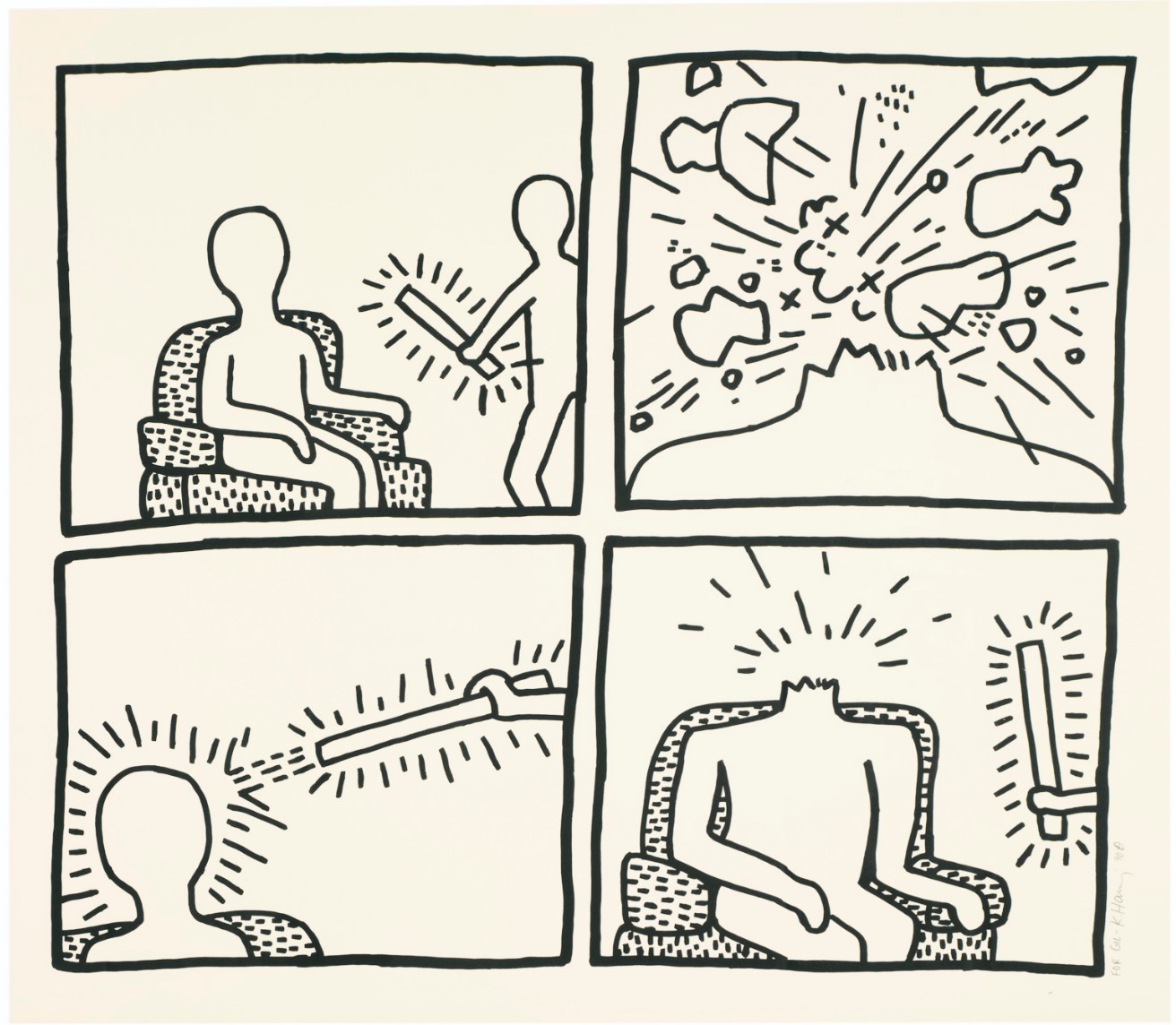
Blueprint Drawing #14
Sheet: 42 1/2 x 48 1/2 inches (108×123 cm)
Literature: Littmann p. 182
Blueprint Drawing #15
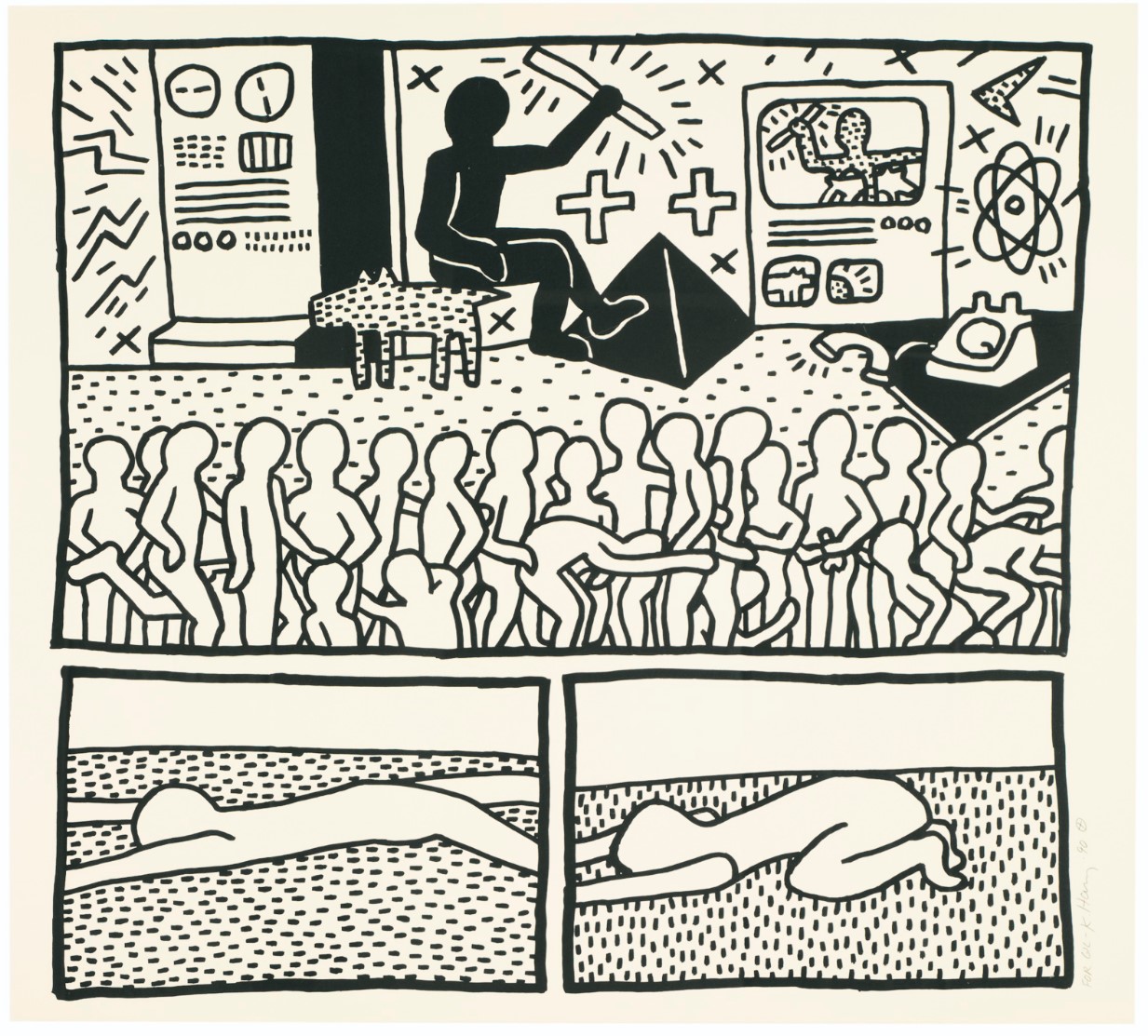
Blueprint Drawing #15
Sheet: 42 1/2 x 47 inches (108 x 119.5 cm)
Literature: Littmann p. 182
Blueprint Drawing #16
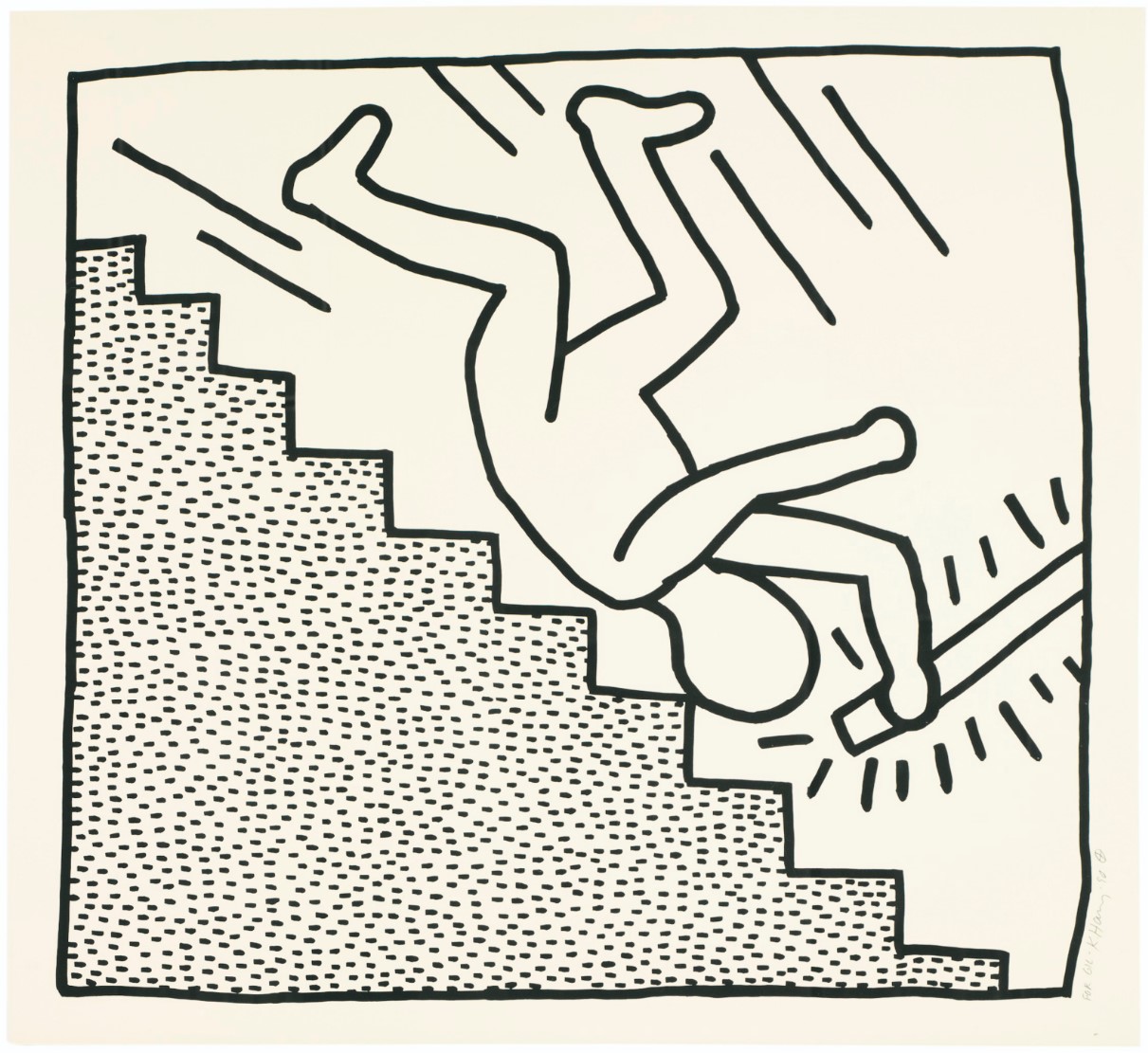
Blueprint Drawing #16
Sheet: 42 1/2 x 46 1/2 inches (108×118 cm)
Literature: Littmann p. 183
Blueprint Drawing #17
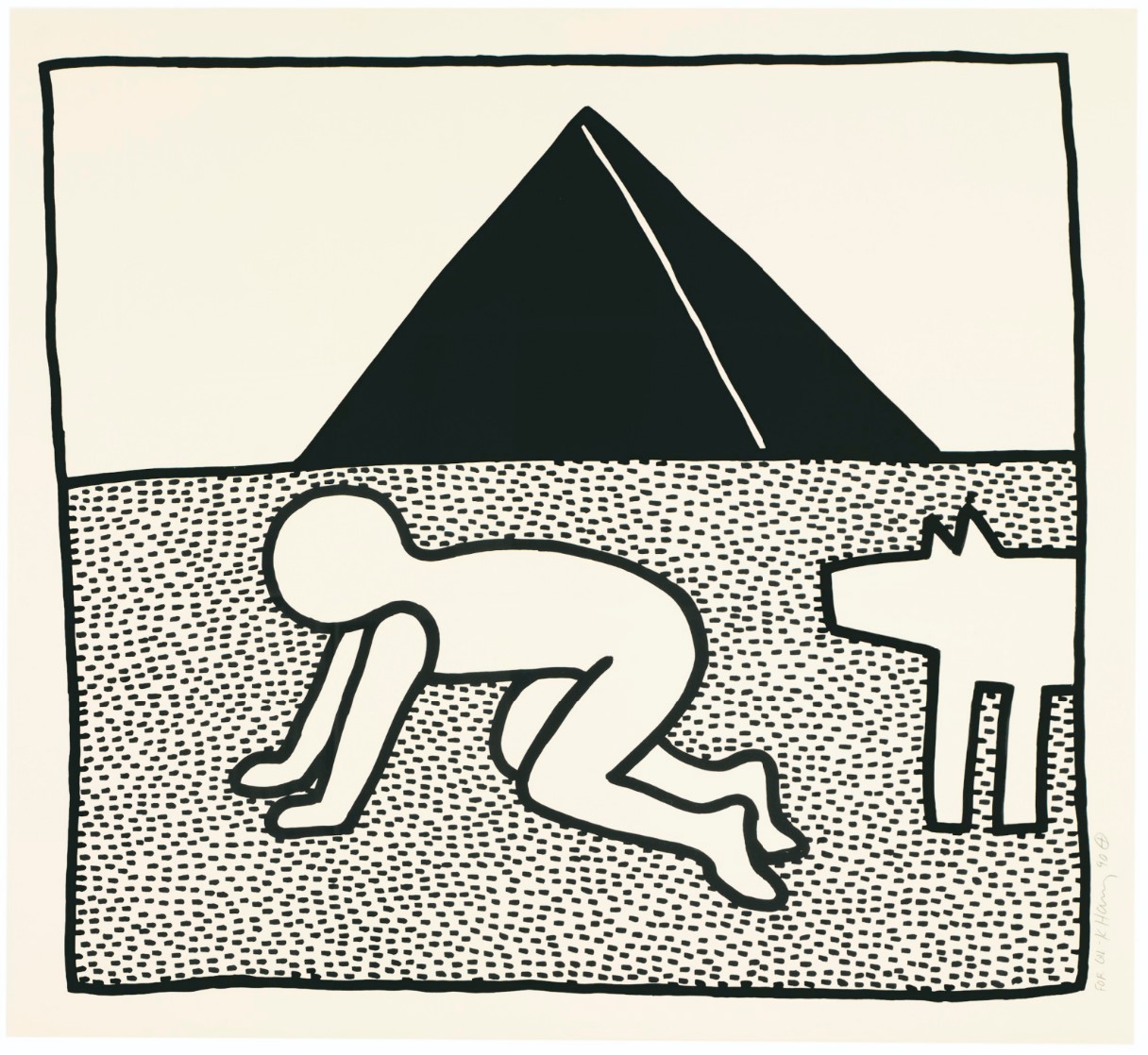
Blueprint Drawing #17
Sheet: 42 1/2 x 46 1/2 inches (109×118 cm)
Literature: Littmann p. 183
Best Buddies
1 Print
Edition: 200 + 30 AP
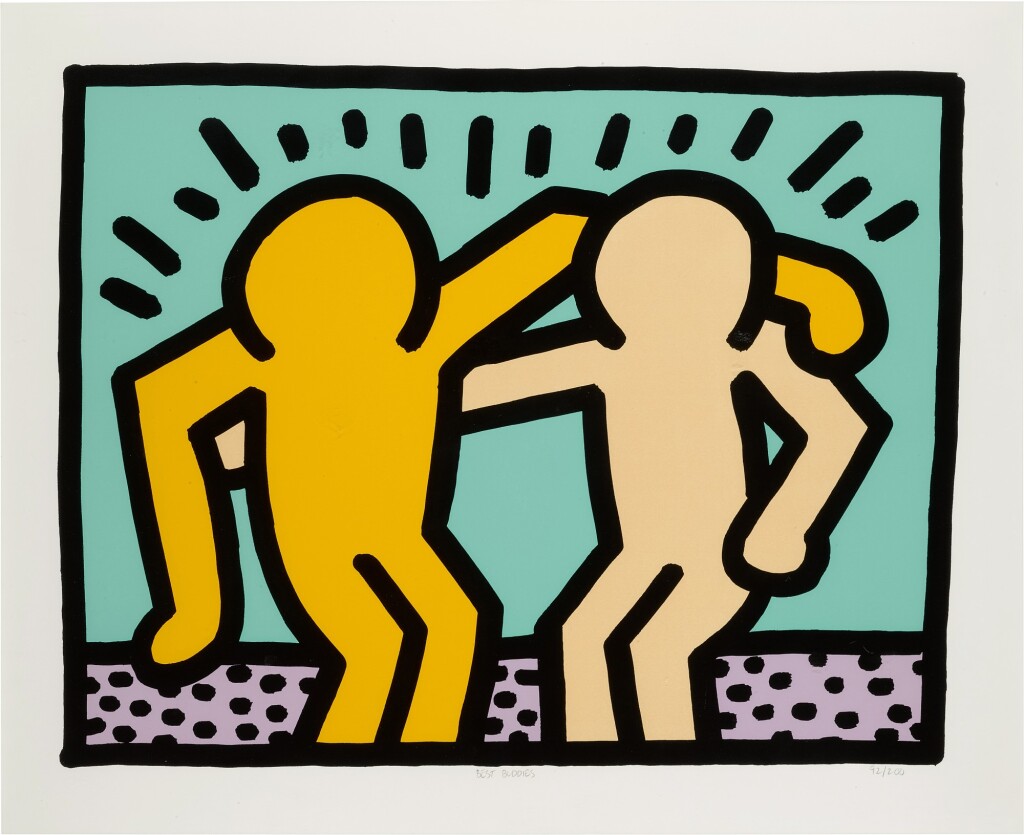
Best Buddies, 1990
Screen-print in colors on wove paper
Sheet: 26×32 inches (66 x 81.5 cm)
Edition: 200 + 30 AP
Publisher: Durham Press
Literature: Littmann pp. 184-185
Keith Haring completed his final print series, “Best Buddies”, just 10 days before dying from AIDS-related complications in 1990. The “Best Buddies” motif, which first appeared in Haring’s work in 1987 depicts two figures hugging, with rays emanating from their embrace. Like many of Haring’s iconic symbols, “Best Buddies” is purposefully uncomplicated, inviting viewers to create their own interpretation of the scene. Haring’s figures have no specified race, gender, or sexual orientation, and they instead appear as anonymous emblems of universal love and acceptance.