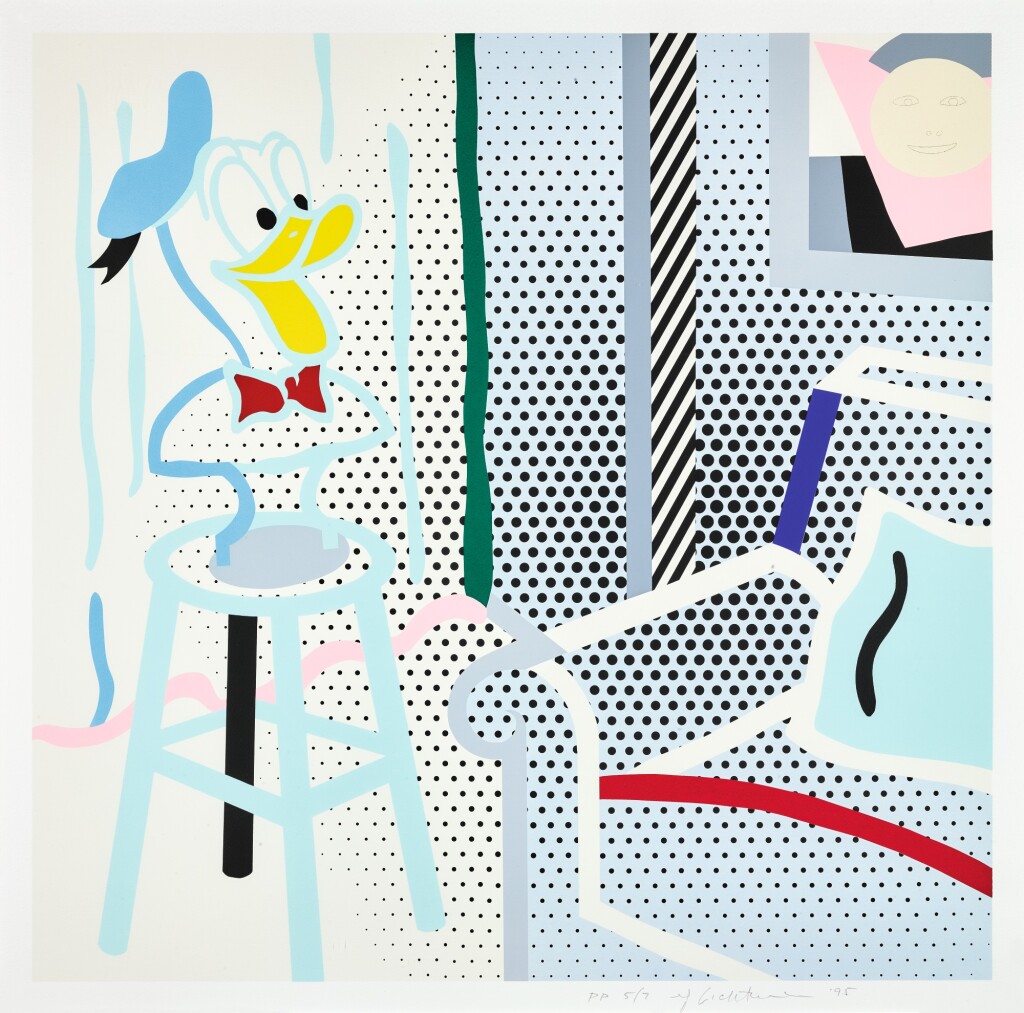
Virtual Interior: Portrait of a Duck
Medium: Screenprint on 300-g/m² textured white Somerset paper
Year: 1995
Image: 28 1/4 x 28 1/2 inches (71.5 x 72.5 cm)
Sheet: 35 3/4 x 35 1/2 inches (90.7 x 90.4 cm)
Edition: 60
Artist’s Proofs: 20 AP
Printer’s Proofs: 7 PP
Publisher: The Walt Disney Company, Burbank, California
Printer: Noblet Serigraphie, Inc., New York
Literature: Corlett 294
Roy Lichtenstein Catalogue Raisonne: RLCR 4447
Signed dated and numbered in pencil
The project was undertaken by the artist as a favor to friend Michael Ovitz during the latter’s tenure as president of the Walt Disney Company, in exchange for donations made by Disney to the Association to Benefit Children, New York; Hale House for Children, New York; and the New York Foundling Hospital.
Virtual Interior (Portrait of a Duck) is a late print by Roy Lichtenstein that reconfigures the artist’s ongoing interrogation of space, image, and mediation. It depicts a stylized domestic interior composed of graphic fragments: a chair, a patterned background, and, strikingly, what appears to be the bust of a cartoon duck wearing a bow tie. The elements sit within a flattened picture plane, interconnected not by narrative coherence, but by visual rhythm and thematic resonance.
The composition is both playful and calculated. Lichtenstein’s familiar devices, Ben-Day dots, flat color fields, clean outlines, are here orchestrated to suggest an imagined interior that feels at once recognizable and dislocated. The duck is significant on several registers: as an echo of Lichtenstein’s earliest engagements with cartoon figures and as a lightly ironic pivot point, suggesting the threshold between everyday life and its reproduced image. In this “virtual” room, objects do not inhabit space so much as represent it, signaling that interior experience in Lichtenstein’s late work is always already mediated.
The print was published by The Walt Disney Company, a detail that deepens the work’s commentary on reproduction and pop culture. Lichtenstein’s image, borrowing but not quoting cartoon tropes, enters into an unusual publishing relationship with one of the principal stewards of the very imagery he transformed into fine art. This juxtaposition underscores the central tension of Lichtenstein’s practice: works that look “commercial” yet operate within high-art systems.
At the heart of the work is an ironic twist characteristic of Lichtenstein’s mature stance: a print that evokes interiority and iconic figures remains, at every turn, a surface of signs. There is no physical room to inhabit, no reflective surface to see oneself in, only the suggestion of these through graphic terms. The result is a lucid reflection on the limits and potentials of image-making: a “virtual” space that never resolves into lived reality.
Auction Results
Bonhams New-York: 9 May 2023
Estimated: USD 12,000 – 18,000
USD 25,500
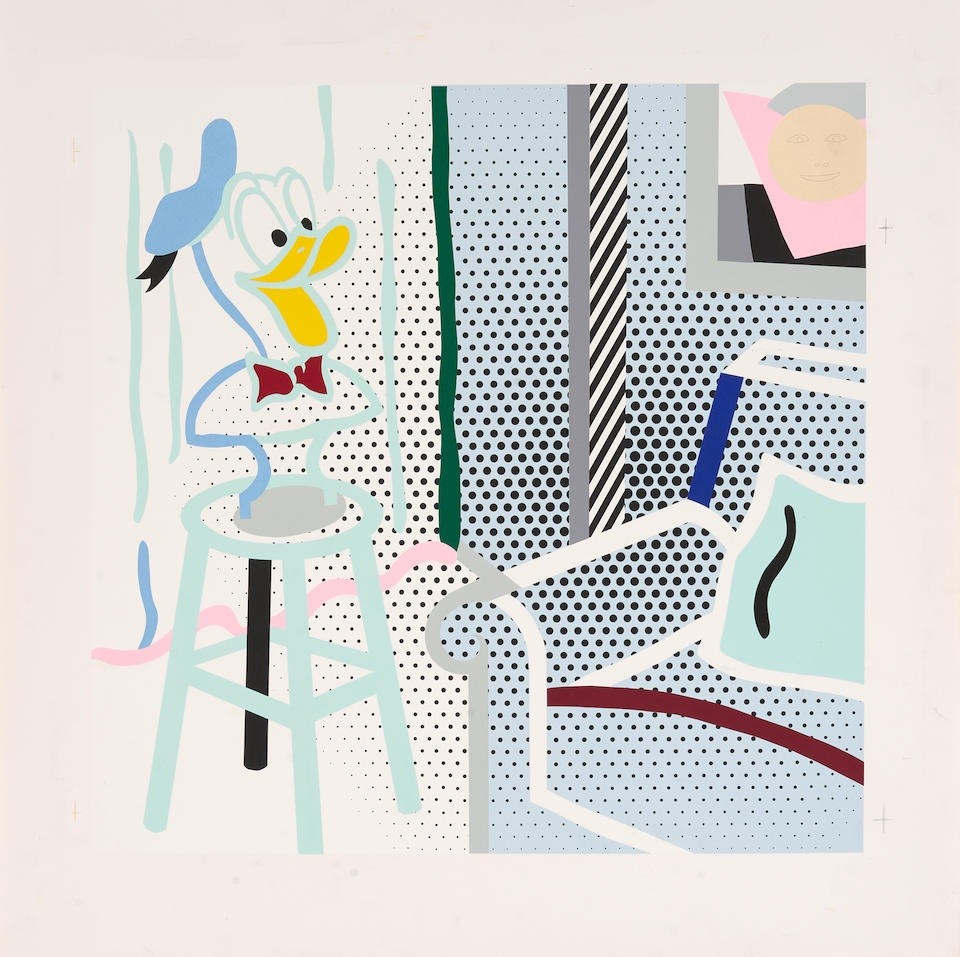
Screen-print in colors on Somerset textured paper, a proof (aside from the edition of 60)
Sotheby’s London: 19 March 2020
Estimated: GBP 24,000 – 34,000
GBP 43,750 / USD 51,240
ROY LICHTENSTEIN (1923 – 1997)
VIRTUAL INTERIOR: PORTRAIT OF A DUCK (C. 294), 1995
Screen-print in colors
Signed in pencil, dated, numbered PP 5/7
(a printer’s proof aside from the edition of 60)
Sotheby’s New-York: 27 April 2018
Estimated: USD 20,000 – 30,000
USD 47,500
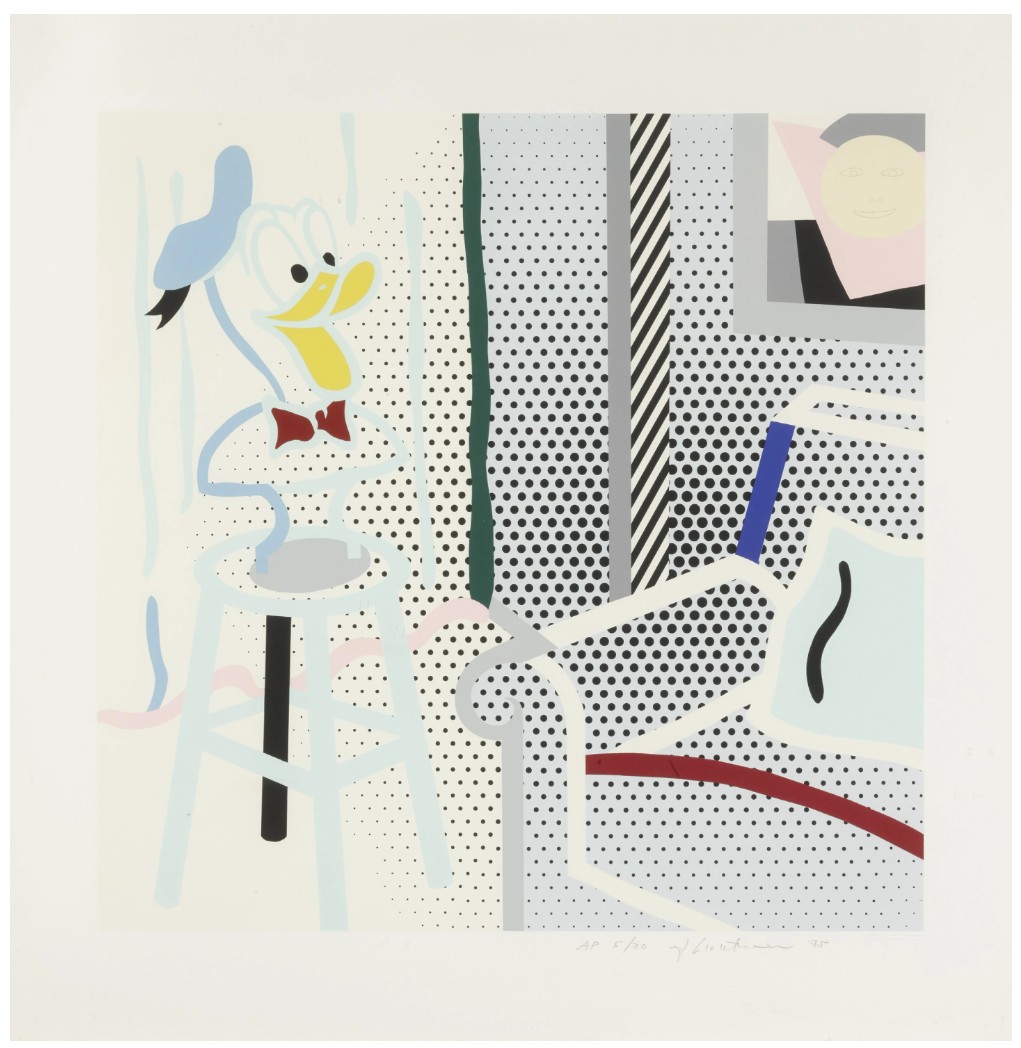
ROY LICHTENSTEIN
Virtual Interior: Portrait of a Duck (C. 294), 1995
Screenprint in colors on Somerset wove paper
Signed in pencil, dated and inscribed ‘AP 5/20’
An artist’s proof aside from the numbered edition of 60