
Jonas Wood has established himself as one of the most distinctive painters of his generation, known for his highly stylized depictions of interiors, still lifes, and landscapes. His work is immediately recognizable for its flattened perspective, bold outlines, and intricate patterns, which transform familiar subjects into complex, almost decorative compositions. Blending references from modern art, personal imagery, and domestic life, Wood constructs a visual language that is both intimate and formally rigorous. His paintings operate at the intersection of observation and invention, where everyday objects are reorganized into carefully structured pictorial systems.
Introduction
Jonas Wood was born in 1977 in Boston, Massachusetts. He studied psychology at Hobart and William Smith Colleges before pursuing art at the University of Washington and later earning an MFA from the University of Washington in 2002. Wood is admired for his depictions of ordinary environments, such as domestic interiors and landscapes, to which he applies an array of formal techniques to create viewpoints that are at odds with the viewer’s expectations. Over the past decade and a half Wood has carved out his own distinctive and critically lauded aesthetic that is embedded in a rich network of art-historical reference. His painterly style is a playful yet rigorous interrogation of the traditional representational challenge of capturing three-dimensional forms on the flat picture plane; by flattening shapes and exaggerating forms, he achieves gently unsettling yet highly stimulating canvases.
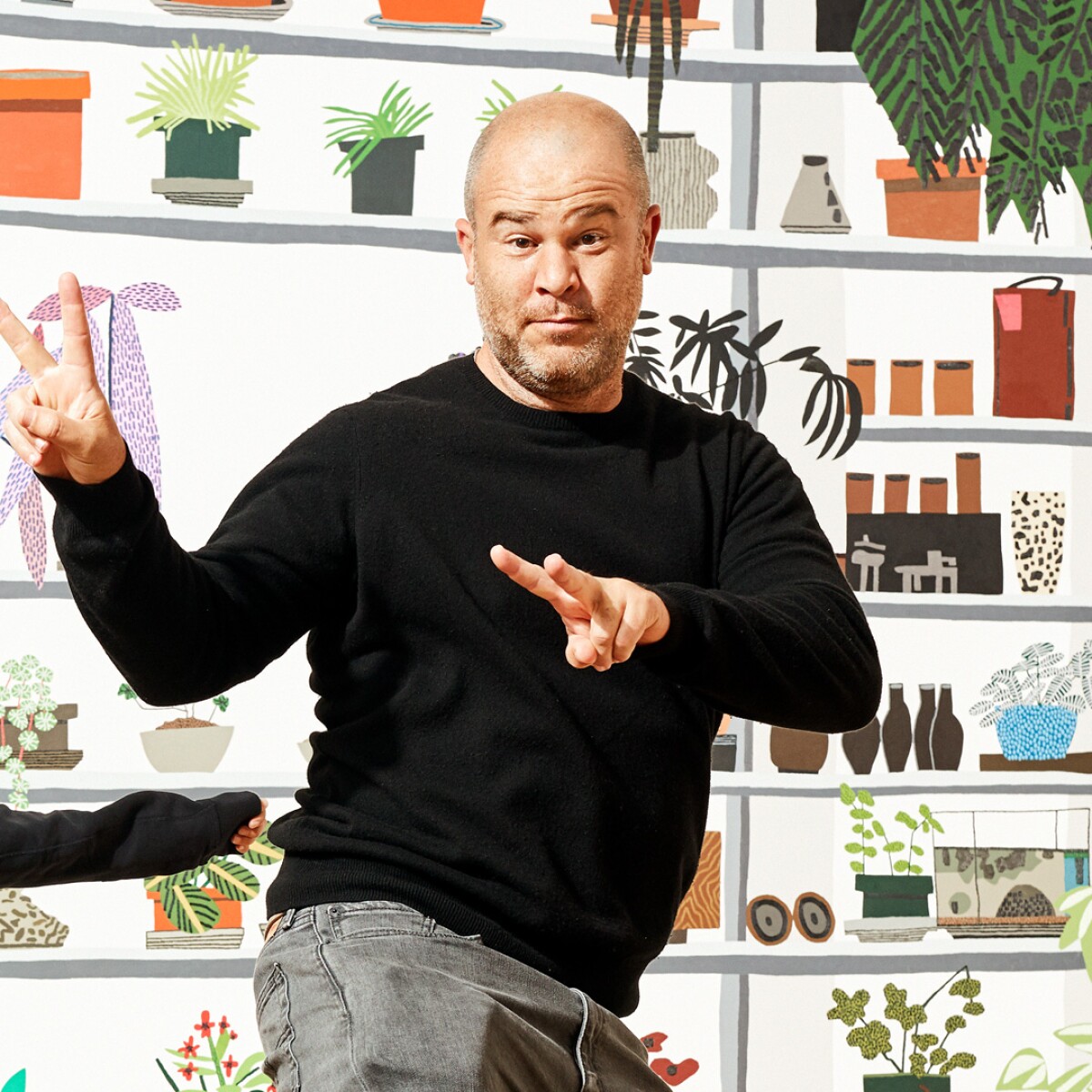
He moved to Los Angeles, where he continues to live and work. Early in his career, Wood developed a practice rooted in close observation of his immediate environment—his home, studio, and personal surroundings. This autobiographical dimension remains central to his work, even as it has evolved in scale and complexity.
Artistic Practice and Technique
Wood works primarily in painting, drawing, and printmaking. His technique is characterized by a deliberate flattening of space, where perspective is compressed and multiple viewpoints coexist within a single composition. His process often begins with photographs or collaged source material, which he reinterprets through drawing before translating them into paintings. The resulting compositions are highly constructed, with each element carefully positioned.
Color and pattern play a central role. Surfaces are often filled with repeating motifs—textiles, foliage, ceramics—that create a tension between figure and ground. This interplay destabilizes spatial depth, encouraging the viewer to read the painting as both image and pattern. Despite their apparent simplicity, Wood’s works are the result of a meticulous process of editing and reconstruction.
Lovingly depicting the domestic spaces he inhabits and their denizens, Wood makes references to those that came before without direct appropriation. Using a flattened perspective that often recalls source photographs and collage sketches, Wood flirts with abstraction while still remaining grounded in the traditions of still life and historical tableaus. By immersing himself in the history of art, he continues the visual conversations set up by his forebearers and pushes them into the twenty-first century.
Major Series and Bodies of Work
Interior Paintings
Wood’s interior scenes form one of the foundational bodies of his practice. These works depict domestic spaces, living rooms, studios, and personal environments, filled with furniture, artworks, plants, and decorative objects.
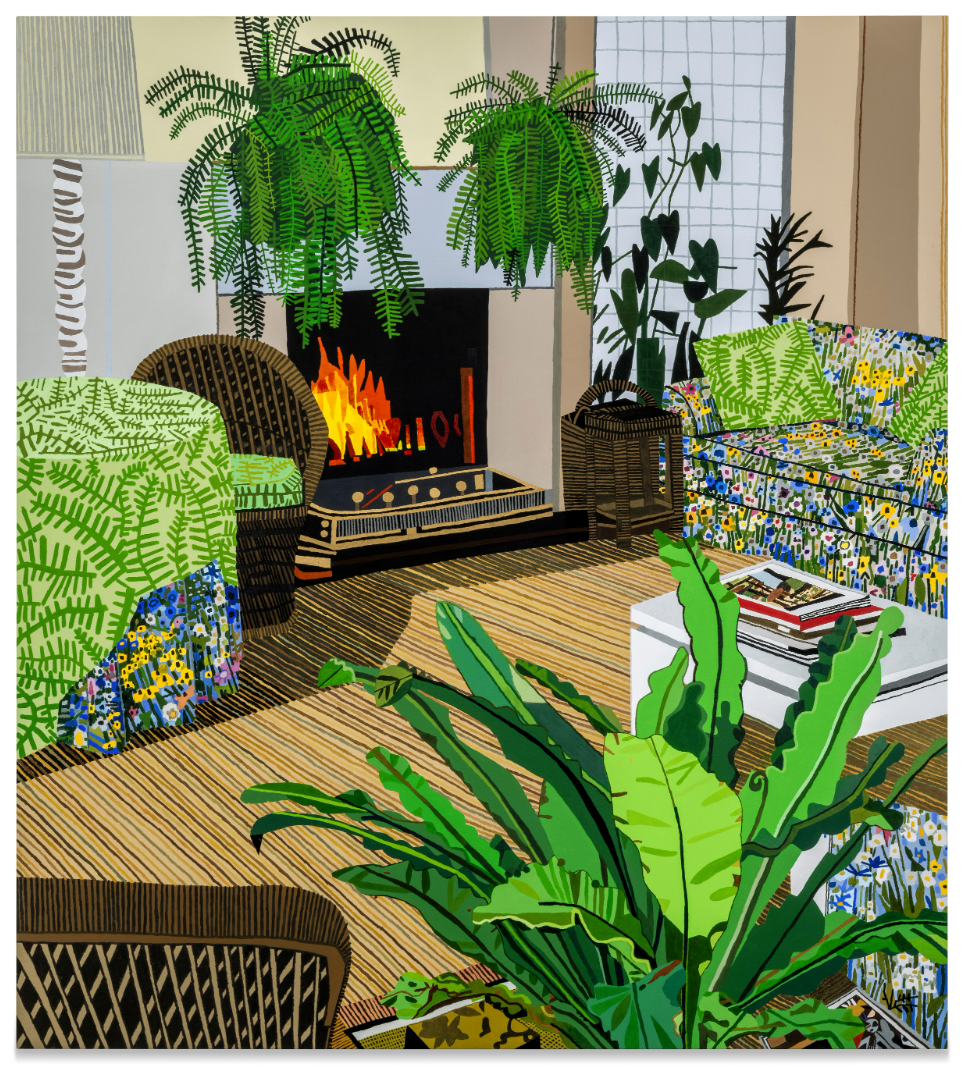
Rather than adhering to a single-point perspective, Wood fragments space into multiple viewpoints. Walls tilt, planes overlap, and scale shifts subtly across the composition. This destabilization of space creates a dynamic tension between structure and distortion. These interiors often function as portraits of lived environments. They frequently incorporate references to artworks by other artists, embedding art history within the domestic sphere and reinforcing the autobiographical dimension of his practice.
Potted Plants
Wood’s potted plant paintings are among his most iconic and widely recognized works. These compositions isolate plants—often large, leafy species—rendered with bold outlines and intricate patterning.
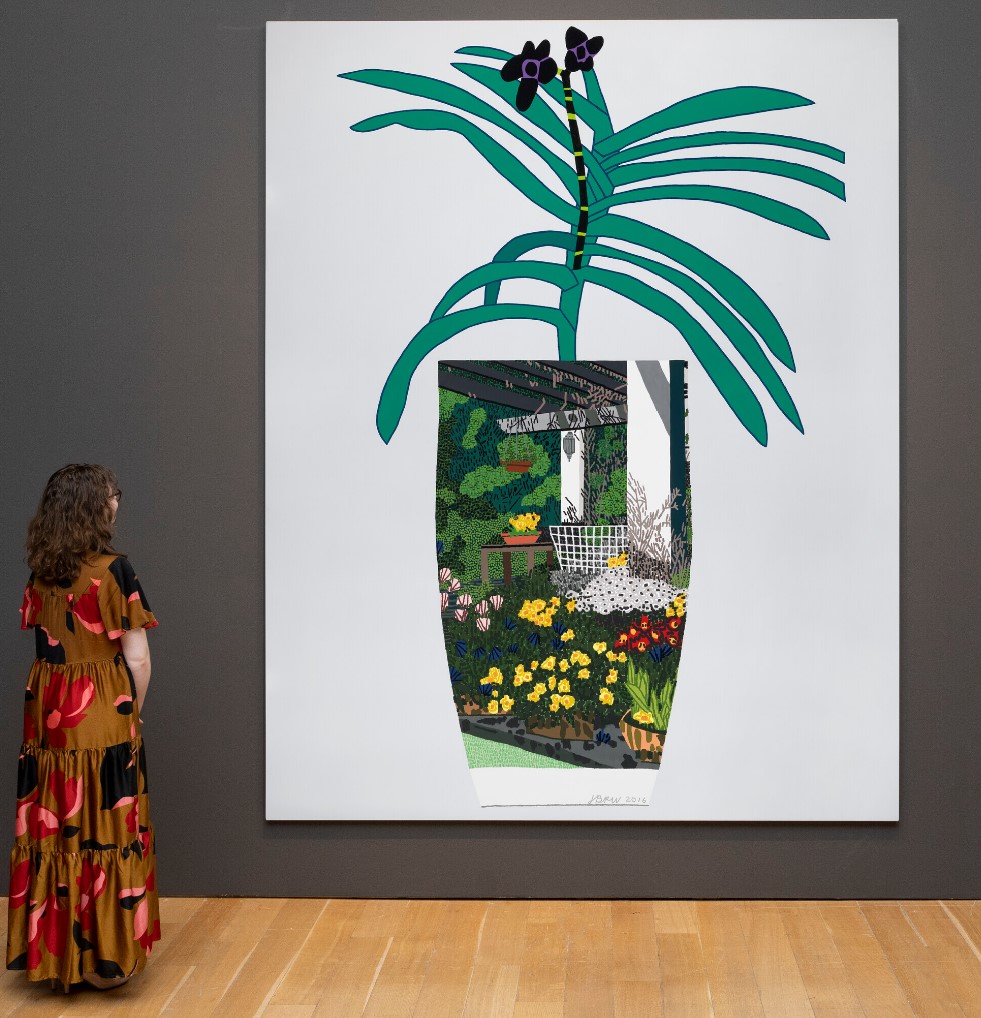
The leaves become structural elements, filling the canvas with repeated shapes and rhythms. At times, the plant overwhelms the container, creating a tension between organic growth and compositional control. These works blur the boundary between still life and abstraction. While rooted in observation, they operate as highly constructed visual systems, where pattern and repetition dominate over naturalism.
Pot Paintings (Ceramics and Fish Pots)
The pot paintings represent one of Wood’s most conceptually sophisticated bodies of work. Focusing on ceramic vessels, these compositions often feature pots decorated with internal imagery—faces, patterns, or animals—creating a layered structure of representation. In the case of the fish pots, stylized fish motifs are painted directly onto the surface of the vessel. This introduces a recursive dynamic: the painting depicts an object that itself contains an image. The result is a subtle collapse between object and image, surface and content.
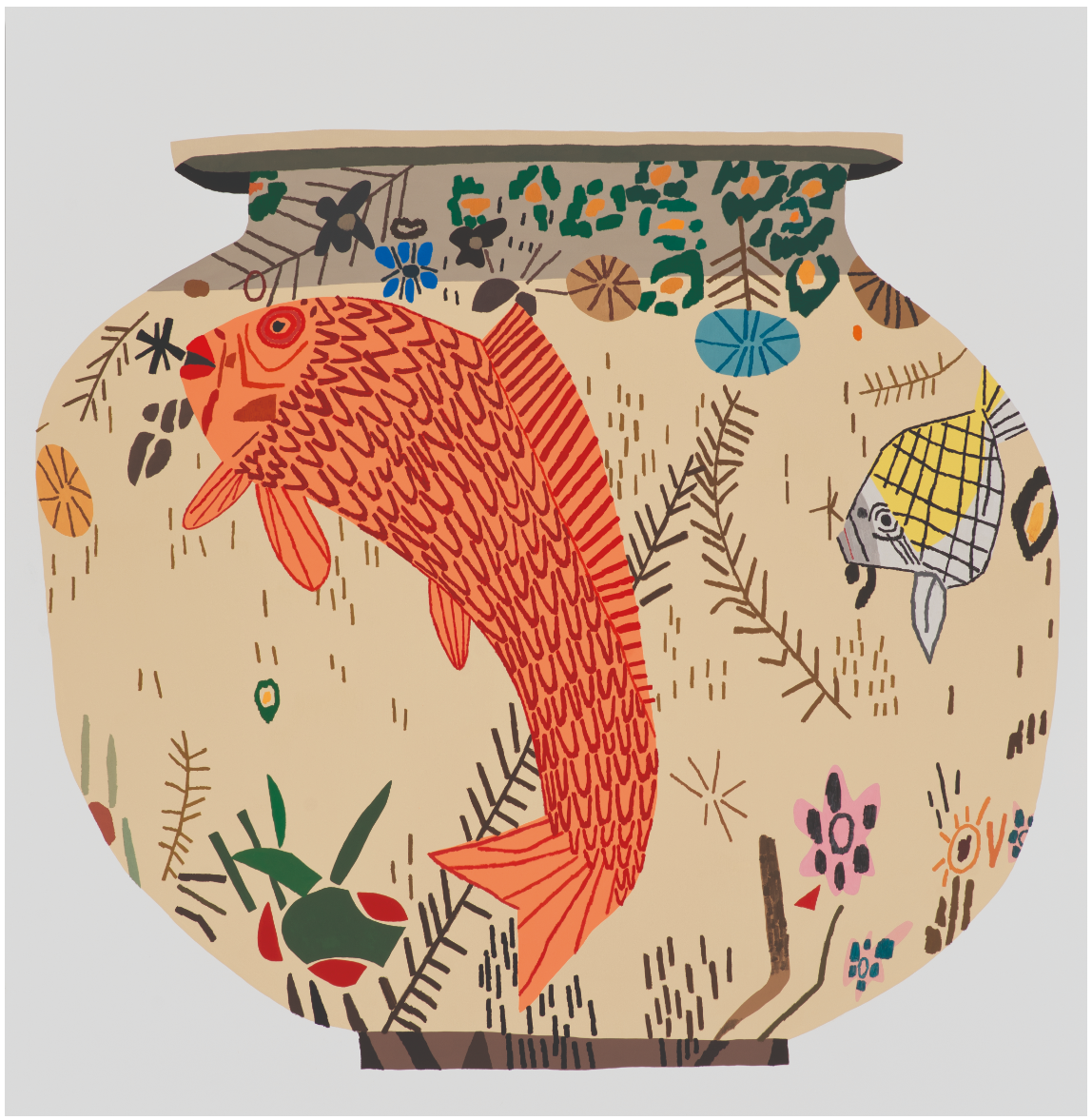
Formally, these works allow Wood to explore the relationship between curvature and flatness. While the pot suggests volume, it is rendered within a flattened pictorial space, creating a tension between three-dimensional form and two-dimensional design. These works are particularly sought after in the market due to their clarity, iconic quality, and strong visual identity.
Clippings
The Clippings series marks a significant evolution in Wood’s practice, introducing collage as both a process and a conceptual framework. Derived from cut-out images, often sourced from books, magazines, or personal archives, these works translate collage compositions into painting. The resulting images retain the fragmented logic of their construction, with elements assembled rather than traditionally composed.
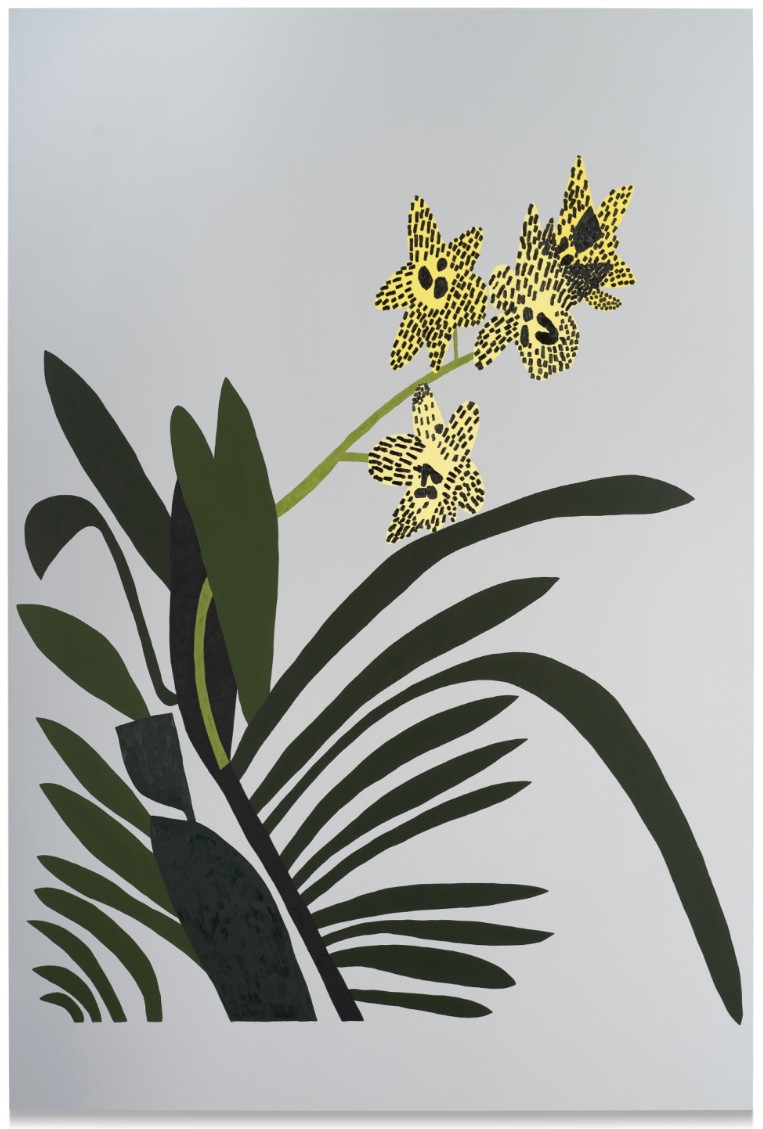
This approach introduces a new kind of spatial complexity. Different visual registers coexist within the same composition, and the boundaries between elements are both emphasized and destabilized. The Clippings works highlight Wood’s interest in mediation and image construction, reinforcing the idea that his paintings are not direct observations but carefully assembled visual systems.
Notepad Drawings and Paintings
The Notepad series occupies a unique position within Wood’s practice, emphasizing immediacy and process. Executed on or referencing lined notebook paper, these works retain a sense of spontaneity and directness. The format introduces a graphic structure—horizontal lines—that interacts with the imagery, reinforcing the interplay between system and expression.
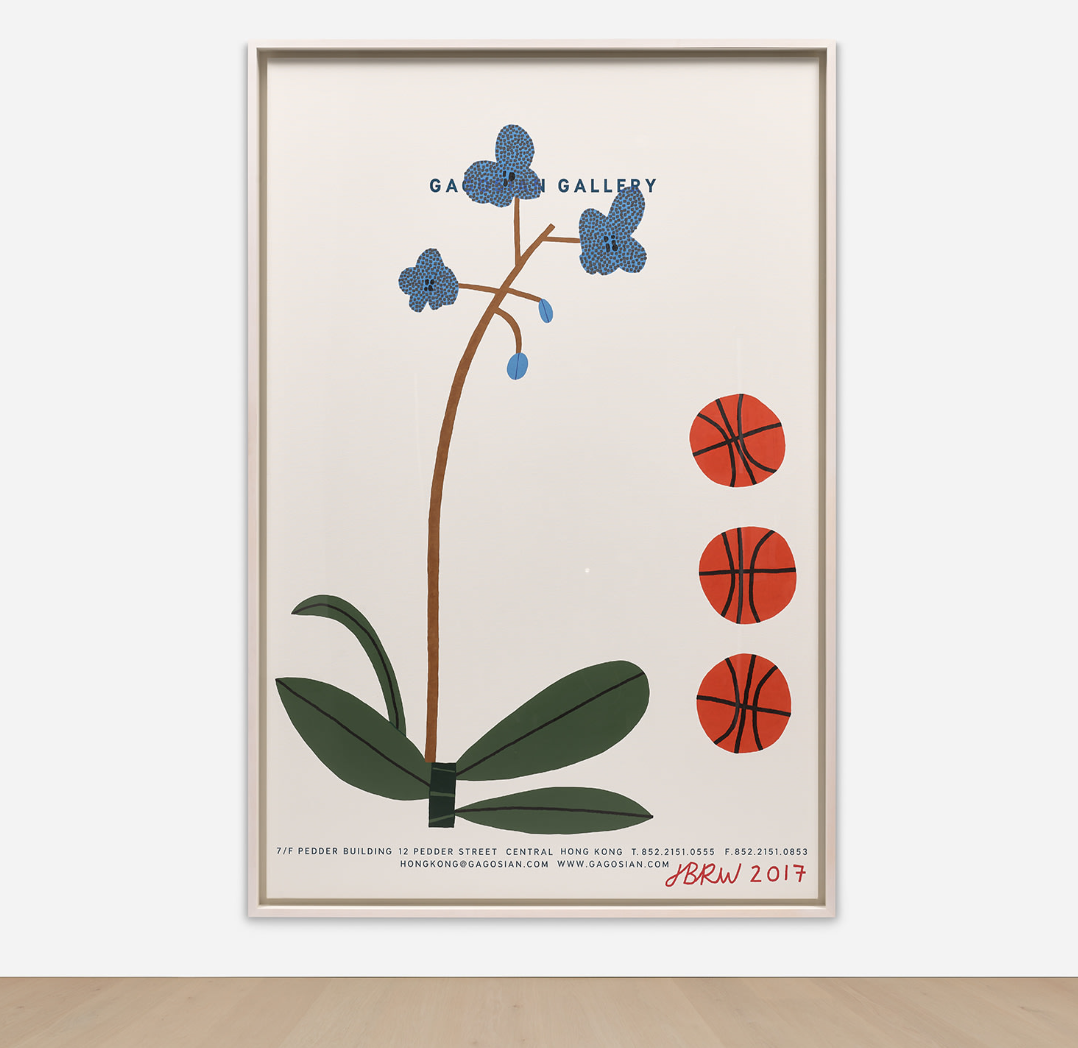
These works often feel more intimate and diaristic, capturing ideas in a more immediate form. At the same time, they maintain the core elements of Wood’s language: flattening, pattern, and compositional clarity. They provide insight into the artist’s thinking process, functioning as both independent works and conceptual extensions of his larger paintings.
Portraits
Wood’s portraits depict family members, friends, and fellow artists, integrating them into his broader visual system. Rather than isolating the figure, he embeds it within patterned environments, dissolving the distinction between subject and setting. Identity becomes inseparable from context, reinforcing the structural logic of his compositions.
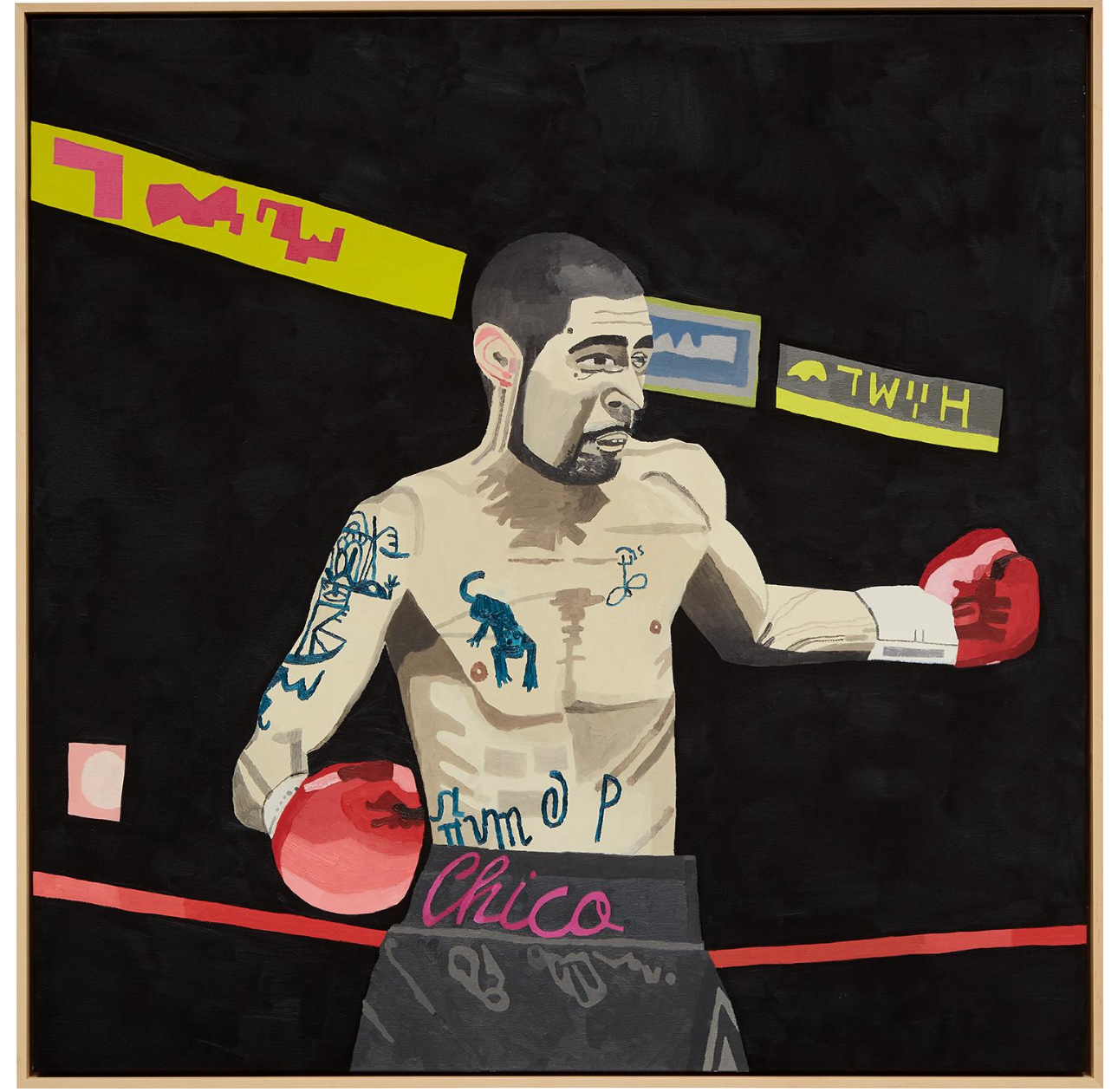
These works maintain a balance between stylization and recognition, capturing likeness while adhering to his formal vocabulary.
Sports and Basketball Works
Wood’s engagement with basketball imagery reflects a personal interest translated into his visual language.
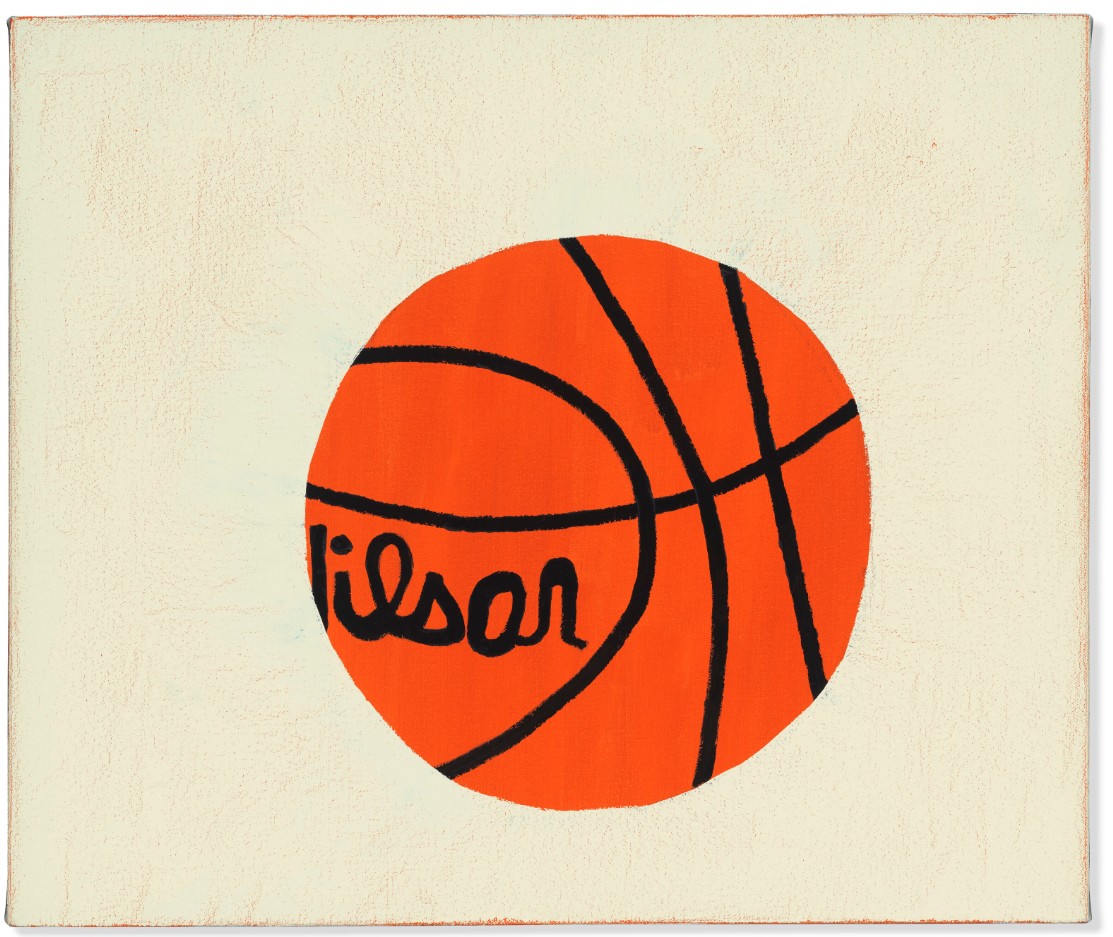
These works introduce movement and spatial dynamics distinct from his interiors and still lifes. Courts, players, and game-related imagery are flattened and reorganized, creating compositions that emphasize structure over action. They expand the thematic scope of his work while maintaining its formal coherence.
Landscape and Architecture
In more recent works, Wood has explored landscape and architectural subjects, extending his investigation of space beyond the interior. These compositions retain his characteristic flattening of perspective, with buildings and natural elements arranged into layered, constructed environments. The emphasis remains on structure and pattern rather than illusionistic depth.
Prints and Works on Paper
Printmaking plays a significant role in Wood’s practice, with lithographs, etchings, and woodcuts translating his visual language into a graphic medium. These works often revisit key motifs—plants, interiors, pots—and allow for variations in color and composition. They have become highly sought after, contributing to the accessibility and dissemination of his work.
Themes, Meaning and Influences
Wood’s work explores the relationship between perception and construction. By flattening space and emphasizing pattern, he challenges traditional notions of perspective and representation. At the same time, his subject matter remains deeply personal. His paintings are rooted in lived experience—his home, his relationships, his surroundings—yet they are transformed into formal compositions that transcend autobiography. This duality—between intimacy and abstraction—is central to his practice.
Wood’s work engages with a range of art historical influences, including modernist painters such as Henri Matisse, David Hockney, and Alex Katz. The emphasis on flatness, color, and pattern reflects a dialogue with these traditions. At the same time, his use of photographic sources and collage aligns his work with contemporary image-making practices. He operates within a lineage that bridges modernism and contemporary painting.
“Matisse, Picasso, Braque, Calder, Monet, Vuillard, Bonnard, van Gogh, Stuart Davis, and Hockney have all been very real influences to me. When I was a young child, my family would speak about these artists as examples of greatness in painting. I guess even then I took them seriously because these are the artists I ended up fashioning my studio practice after.”
Inspired by the disjointed planes of Cubism as well as the boldly stylized interiors of Vincent van Gogh, Henri Matisse and David Hockney, Wood utilizes photography to compose his canvases before overlaying varying perspectives to create a cohesive whole; he produces an image whose boundary between representational space and abstraction is obscured. Currently based in Los Angeles, Wood has continued to develop his stylistic technique of creating paintings that appear simultaneously flat and dimensional, an effect that critics have attributed to his graphic, illustrative compositions in tandem with unmodulated planes of color. Wood takes the stillness of his home and everyday life as his subject and enlarges decorative elements into significant subjects in their own rite.
Institutional Recognition and Exhibitions
Jonas Wood has achieved significant institutional recognition, with exhibitions at major museums including the Hammer Museum, the Dallas Museum of Art, and the Museum of Contemporary Art Chicago.
Testament to the importance of the artist, his work is held in the permanent collections of many institutions, including Albright-Knox Art Gallery, New York; Hammer Museum, Los Angeles; Metropolitan Museum of Art, New York; and the Whitney Museum of American Art, New York.
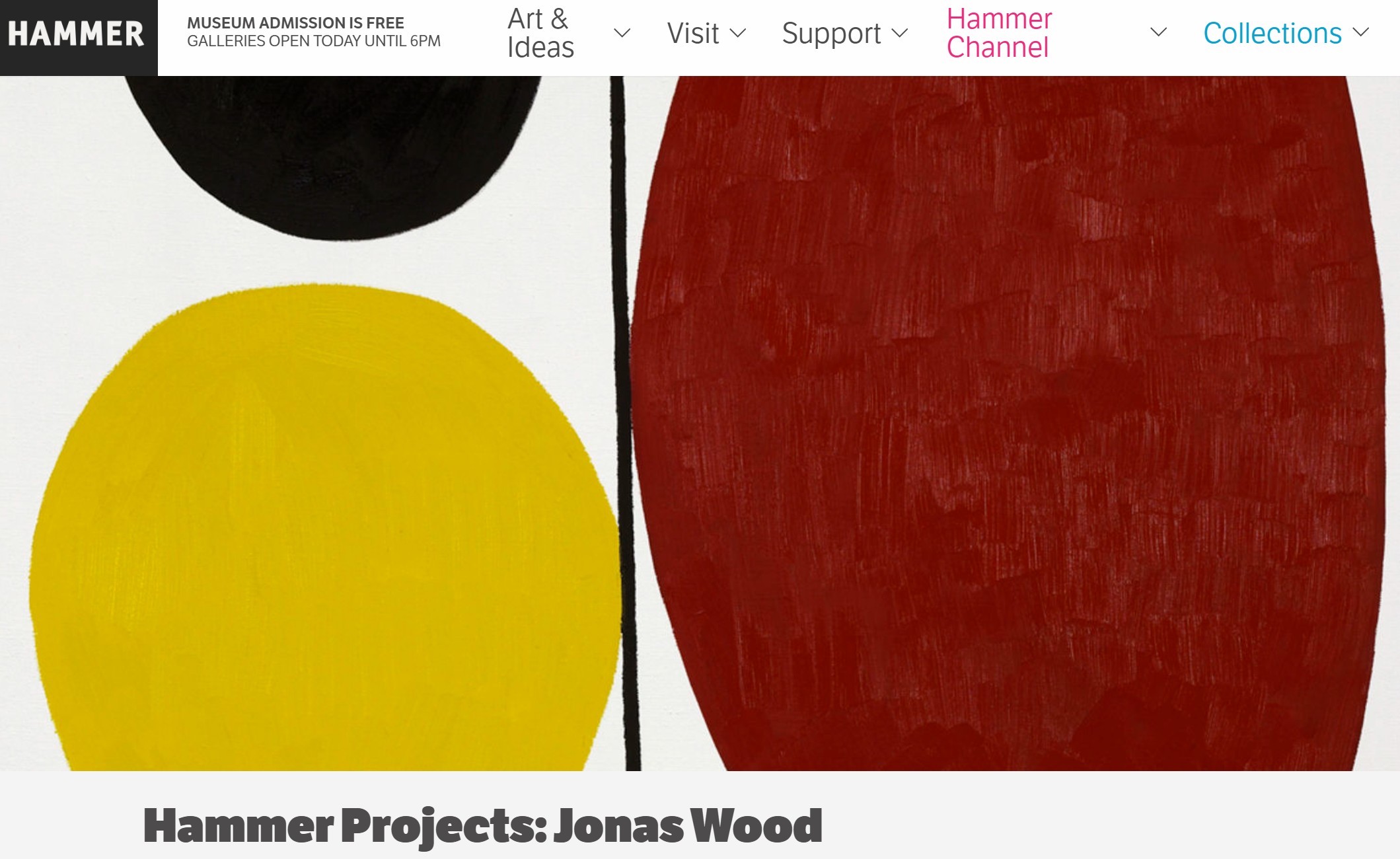
Hammer Projects: Jonas Wood | Hammer Museum (ucla.edu)

Following his first solo museum exhibition in 2010, Wood received a number of public commissions, including murals for the High Line, New York (Shelf Still Life, 2014), and the facades of LAXART, Los Angeles in 2014, and the Museum of Contemporary Art, Los Angeles (Still Life with Two Owls (MOCA), 2016).
Gallery Representation
Wood is represented by leading galleries, including Gagosian and David Kordansky Gallery, both of which have played a central role in his career.
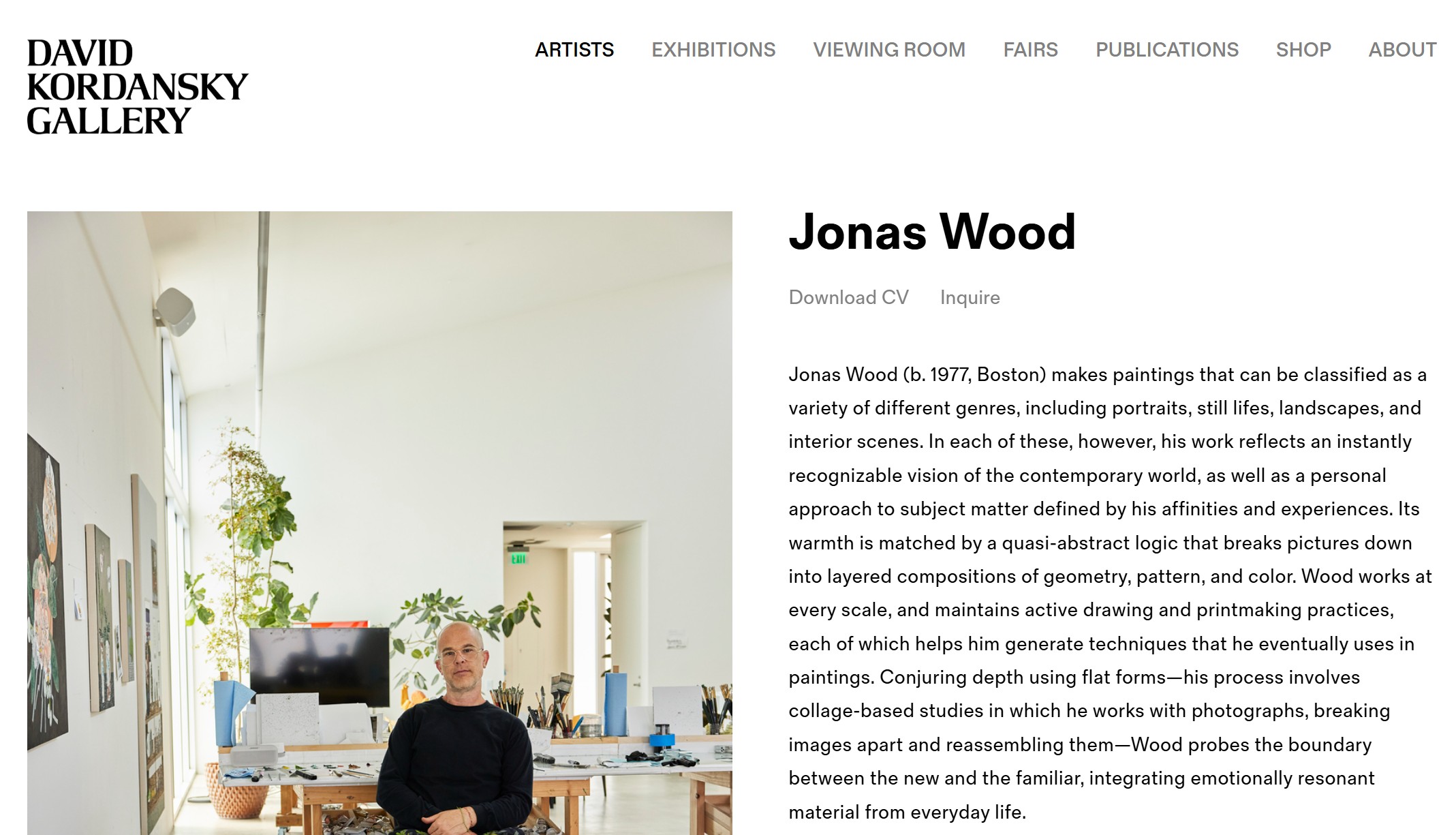
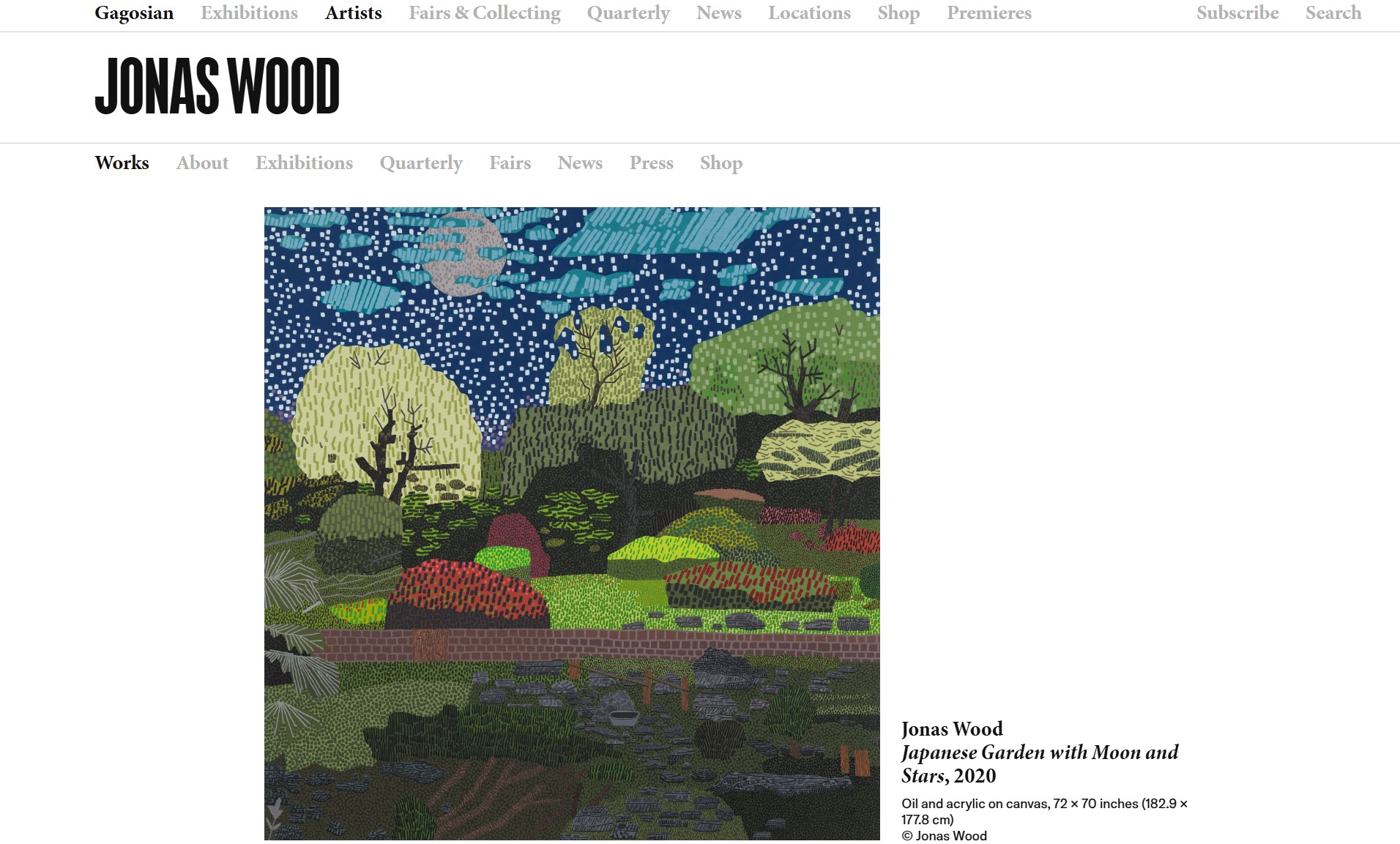
Jonas Wood has redefined the possibilities of figurative painting through a language that is both accessible and formally sophisticated. By transforming everyday subjects into complex visual systems, he has created a body of work that resonates across audiences. His practice demonstrates that representation can be both personal and structural, intimate and analytical. In doing so, Wood has secured a central position within contemporary painting, contributing to its ongoing evolution in the 21st century.
PART I: SUMMARY
Auction Market Overview
2025 AUCTION STATISTICS
Turnover: USD 2,662,344
-65.6% vs. 2024
# Lots sold: 17
Sell-Through Rate: 70%
MARKET SEGMENTATION
USA (55%) / Hong-Kong (39%) / UK (6%)
Highest Price Achieved at Auction:
Two Tables with Floral Pattern, 2013
Christie’s New-York: 11 May 2021
USD 6,510,000
Jonas Wood’s market has developed strongly over the past decade, with consistent demand across both primary and secondary markets. His paintings, particularly large-scale interiors and plant works, command high prices and are widely collected. His prints and works on paper have also become highly sought after, contributing to a broad and active collector base.
Auction Summary
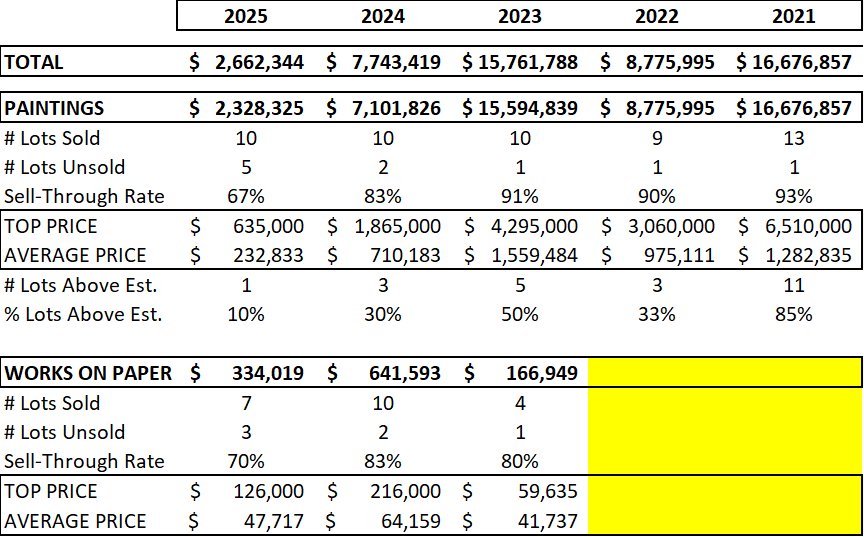
2025 Auction Highlights
10 lots sold at auction in 2025 for a total turnover of USD 2,328,325. With 5 lots failing to sell, the sell-through rate is 67%. The highest price has been achieved by Clipping A4, a painting dated 2013, that sold at Sotheby’s in New-York, on 16 May 2025 for USD 635,000.
2025 Top 3 Lots
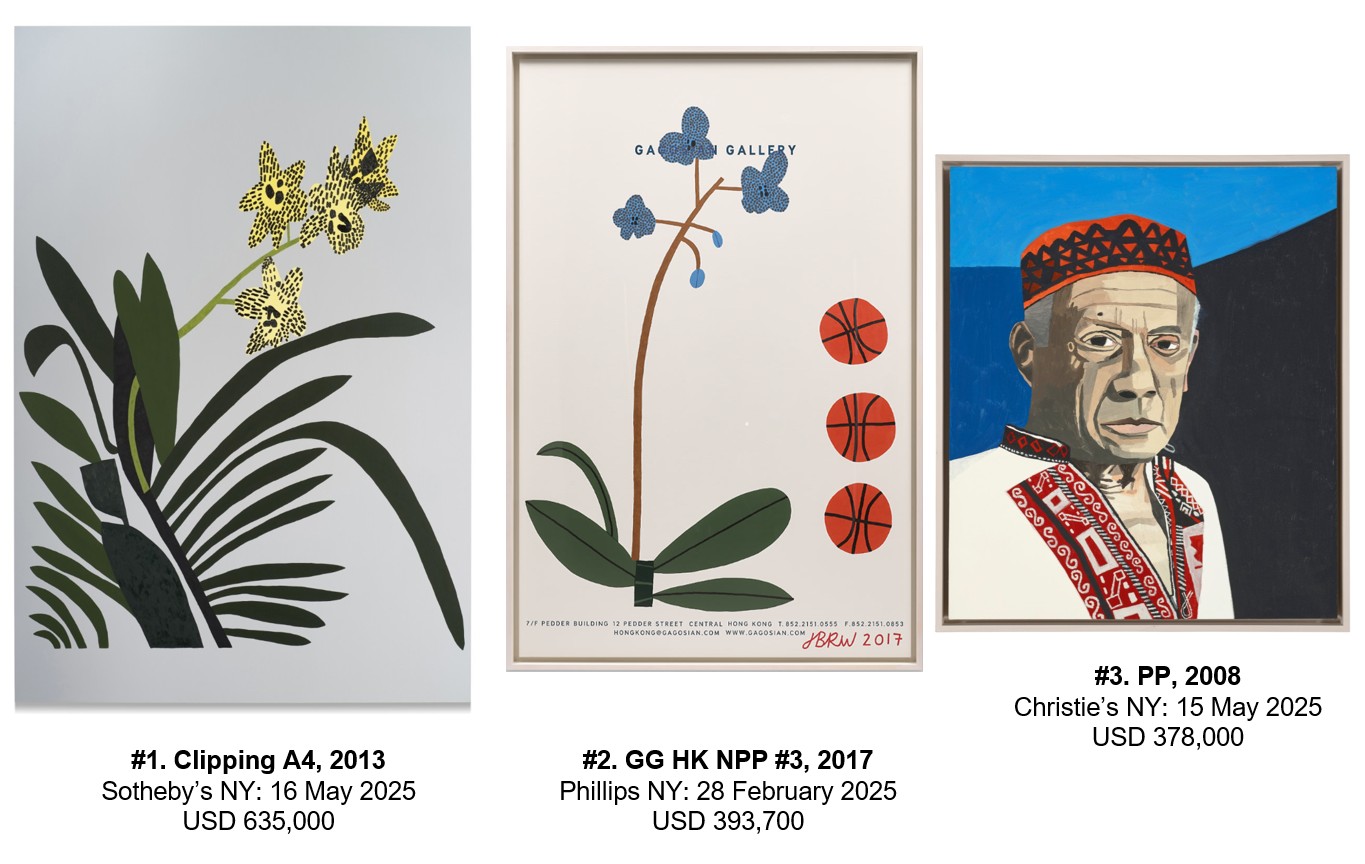
1 lot sold for more than USD 500,000, representing 27.3% of the total turnover of 2025. 6 lots sold for more than USD 100,000, generating a cumulative turnover of USD 2,118,700, representing 91% of the total turnover of 2025.
Furthermore, 7 Works on Paper sold at auction for a total turnover of USD 334,019. With 3 lots failing to sell, the sell-through rate is 70%. The highest price was achieved by New Sun Porch, a drawing dated 2010 that sold at Christie’s in New-York, on 27 February 2025, for USD 126,000.
2025 Top 3 Lots
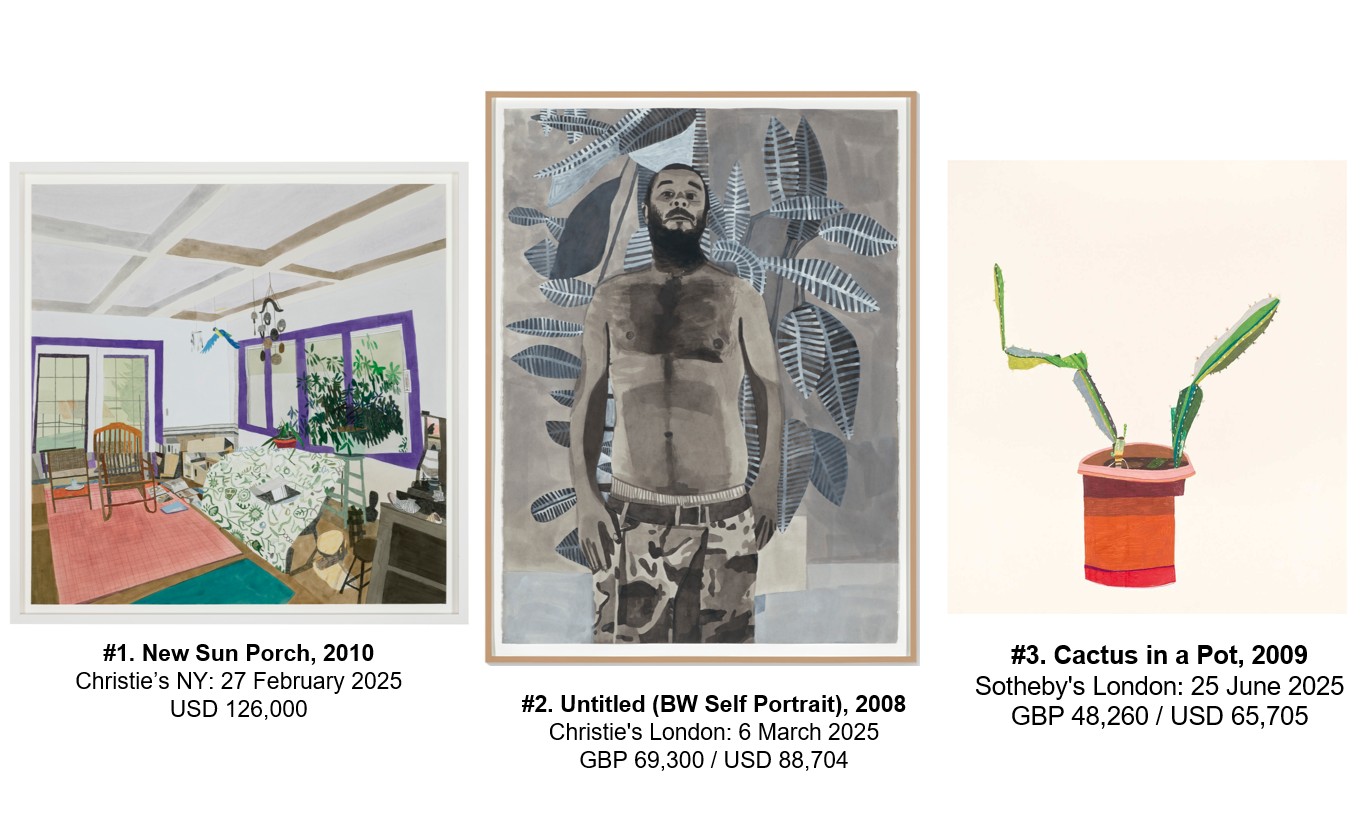
This is the only lot that sold for more than USD 100,000 representing 37.7% of the total turnover for 2025.
2024 Auction Highlights
10 lots sold at auction in 2024 for a total turnover of USD 7,101,826. With 2 lots failing to sell, the sell-through rate is 83%. One lot was withdrawn on 14 May 2024, at Sotheby’s in New-York. The highest price has been achieved at Christie’s in New-York on 21 November 2024, when Still Life with Cat and Fruit, a painting dated 2020, sold for USD 1,865,000.
2024 Top 3 Lots
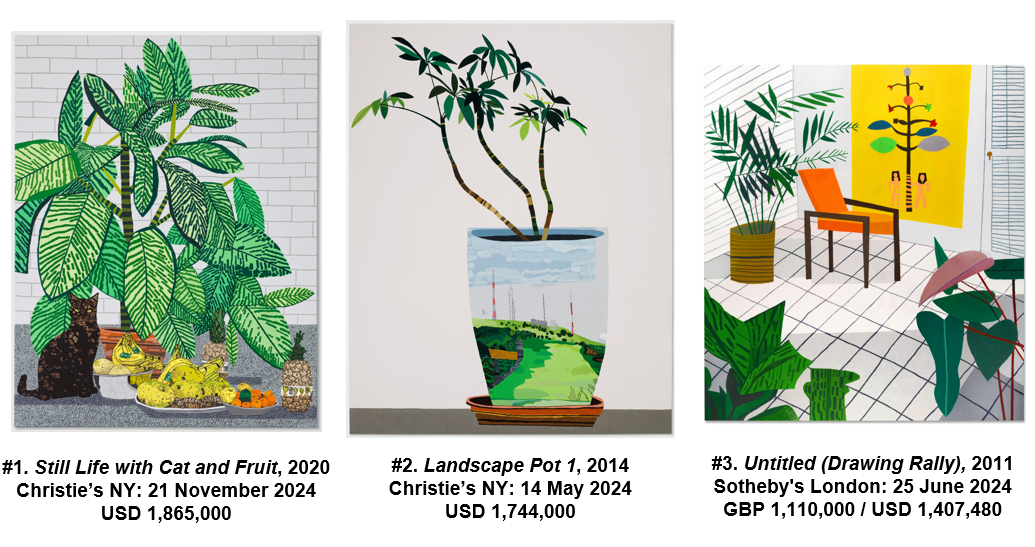
3 lots sold for more than USD 1 million, generating a cumulative turnover of USD 5,016,480, representing 70.6% of the total for 2024.
2023 Auction Highlights
10 lots sold at auction in 2023 for a total turnover of USD 15,594,839. With only 1 lot failing to sell, the sell-through rate is 91%. The highest price in 2023 was achieved at Sotheby’s in New-York on 15 November 2023, when Interior with Fireplace dated 2012 sold for USD 4,295,000.
2023 Top 3 Lots
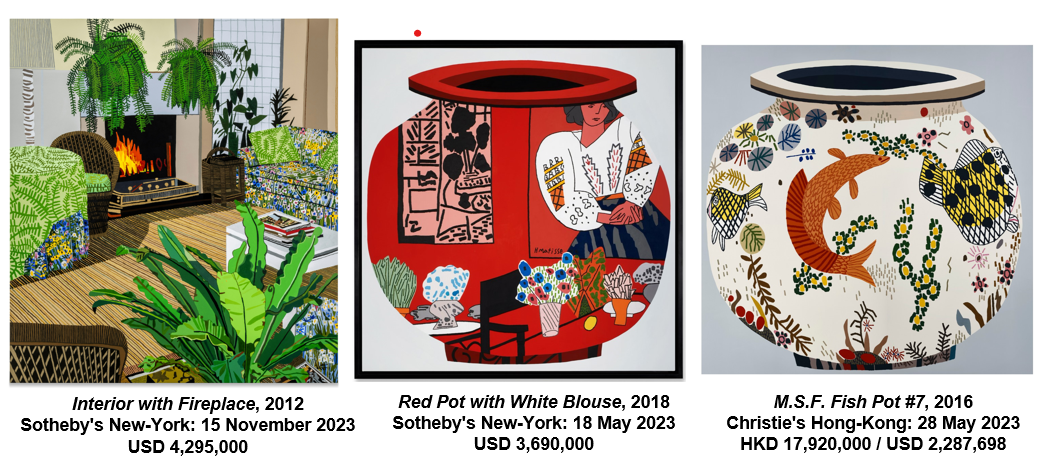
5 lots sold over USD 1 million for a cumulative turnover of USD 14,092,099 representing 90.4% of the total turnover for 2023.
2022 Auction Highlights
9 lots sold at auction in 2022 for a total turnover of USD 8,775,995. The highest price paid in 2022 of USD 3,060,000 was achieved at Christie’s in New-York on 10 May 2022 for Green Landscape Pot, a painting dated 2016.
2022 Top 3 Lots
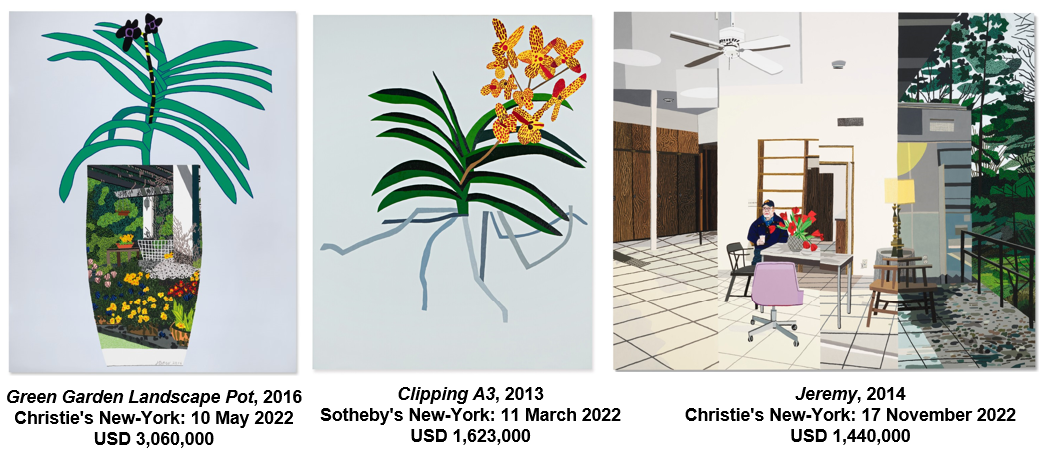
3 lots sold over USD 1 million, generating a cumulative turnover of USD 6,123,000, representing 69.8% of the total turnover of 2022.
2021 Auction Highlights
13 lots sold at auction in 2021 for a total turnover of USD 16,676,857. With only 1 lot failing to sell, the sell-through rate is 93%. A new auction record was set for Jonas Wood on 11 May 2021 at Christie’s in New-York, when Two Tables with Floral Pattern, a painting dated 2013 sold for USD 6,510,000.
2021 Top 3 Lots
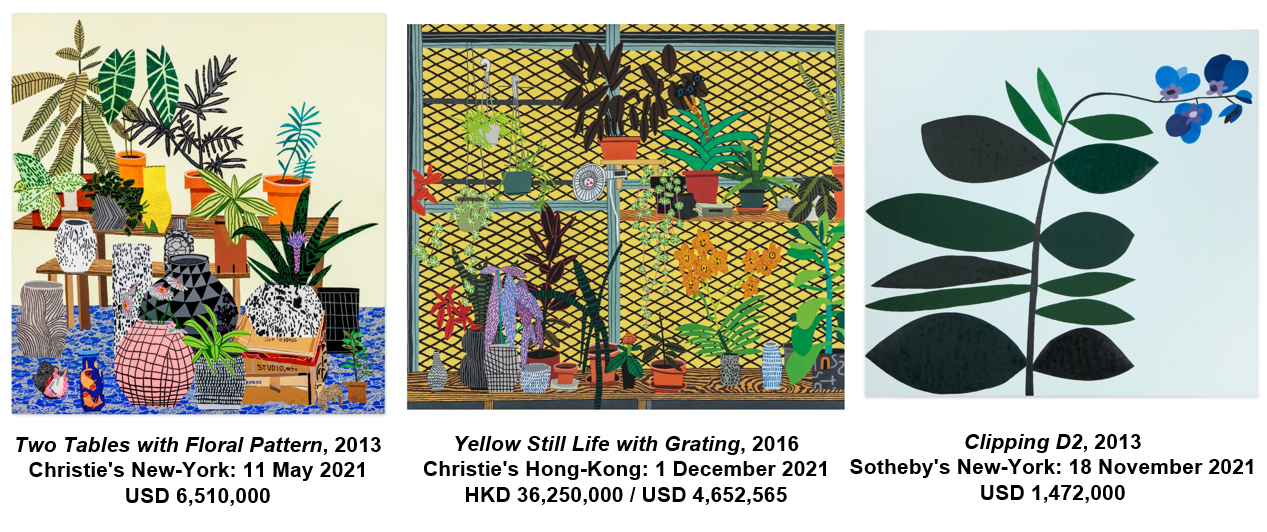
4 lots sold over USD 1 million for a cumulative turnover of USD 14,104,565, representing 84.6% of the total turnover for 2021.
Top Lots
#1. Two Tables with Floral Pattern, 2013
Christie’s New-York: 11 May 2021
Estimated: USD 2,000,000 – 4,000,000
USD 6,510,000
JONAS WOOD (B. 1977) (christies.com)
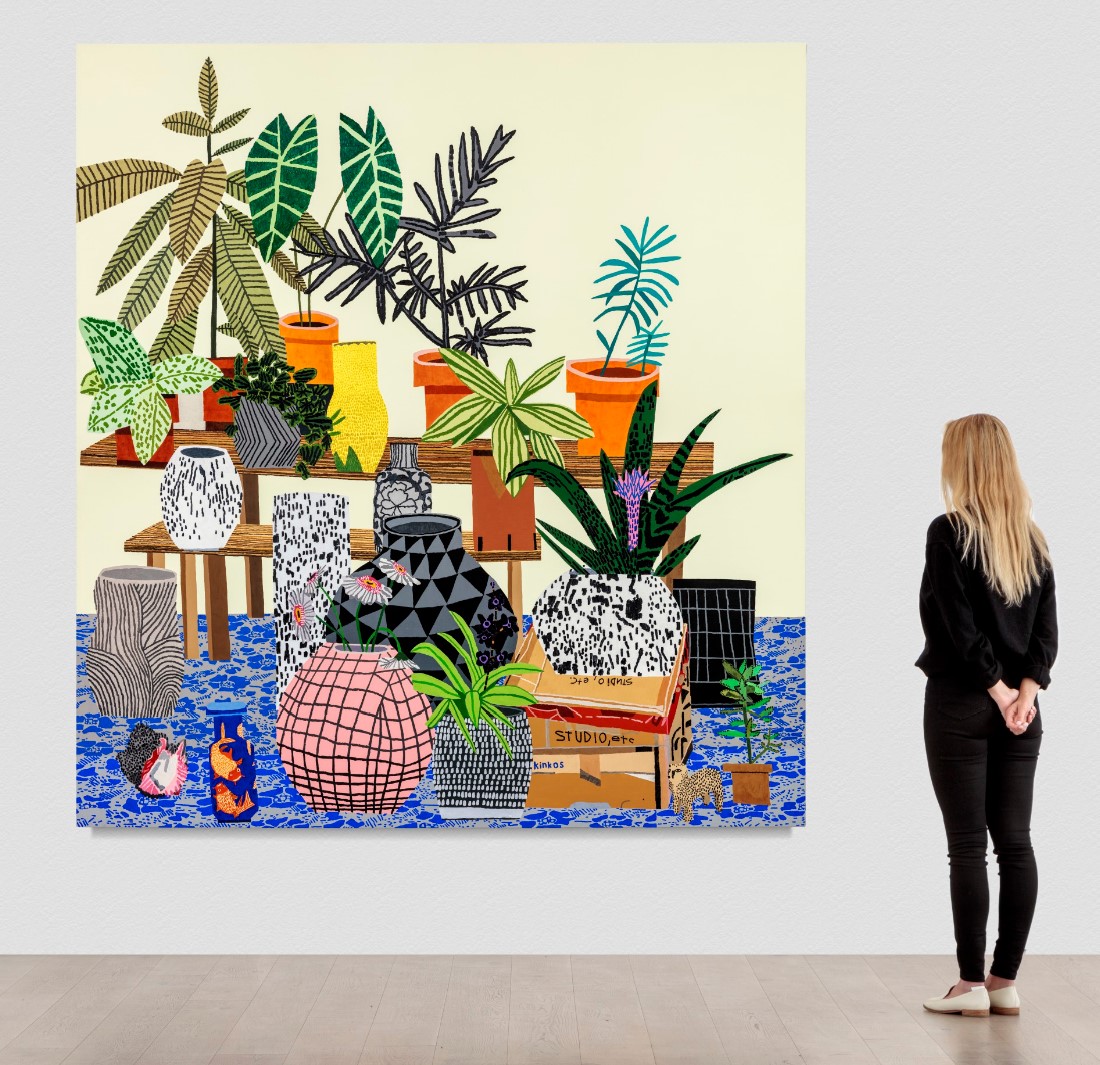
JONAS WOOD (B. 1977)
Two Tables with Floral Pattern, 2013
Oil and acrylic on canvas
100×93 inches (254 x 236.2 cm)
Signed with the artist’s initials, titled and dated ‘TWO TABLES WITH FLORAL PATTERN JBRW 2013’ (on the reverse)
#2. Japanese Garden 3, 2019
Christie’s New-York: 15 May 2019
Estimated: USD 500,000 – 700,000
USD 4,928,000
Jonas Wood (b. 1977) (christies.com)
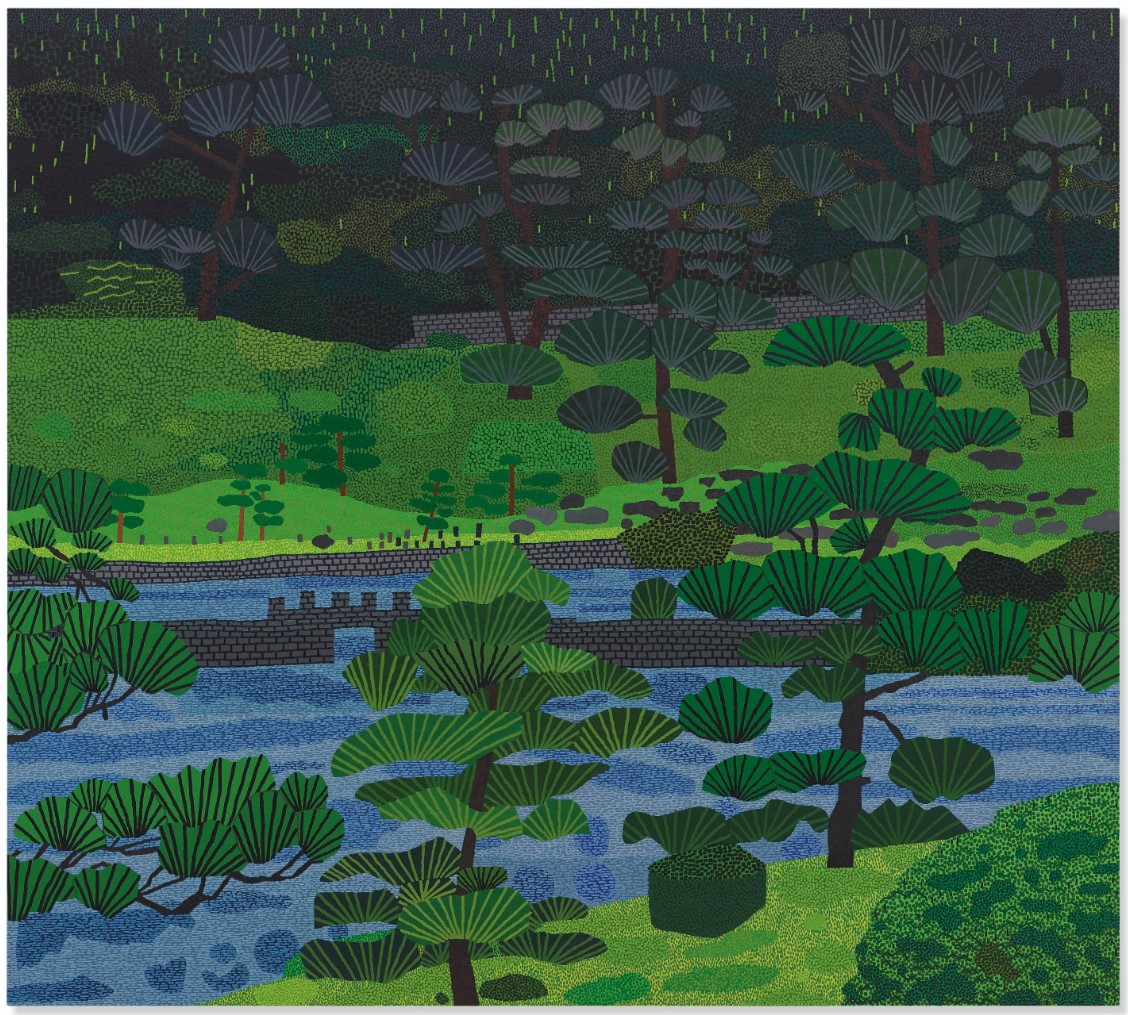
JONAS WOOD (b. 1977)
Japanese Garden 3, 2019
Oil and acrylic on canvas
88×98 inches (223.5 x 248.9 cm)
Signed with the artist’s initials, titled and dated ‘JAPANESE GARDEN 3 JBRW 2019’ (on the reverse)
#3. Yellow Still Life with Grating, 2016
Christie’s Hong-Kong: 1 December 2021
Estimated: HKD 12,000,000 – 18,000,000
HKD 36,250,000 / USD 4,652,565
JONAS WOOD (B. 1977) (christies.com)
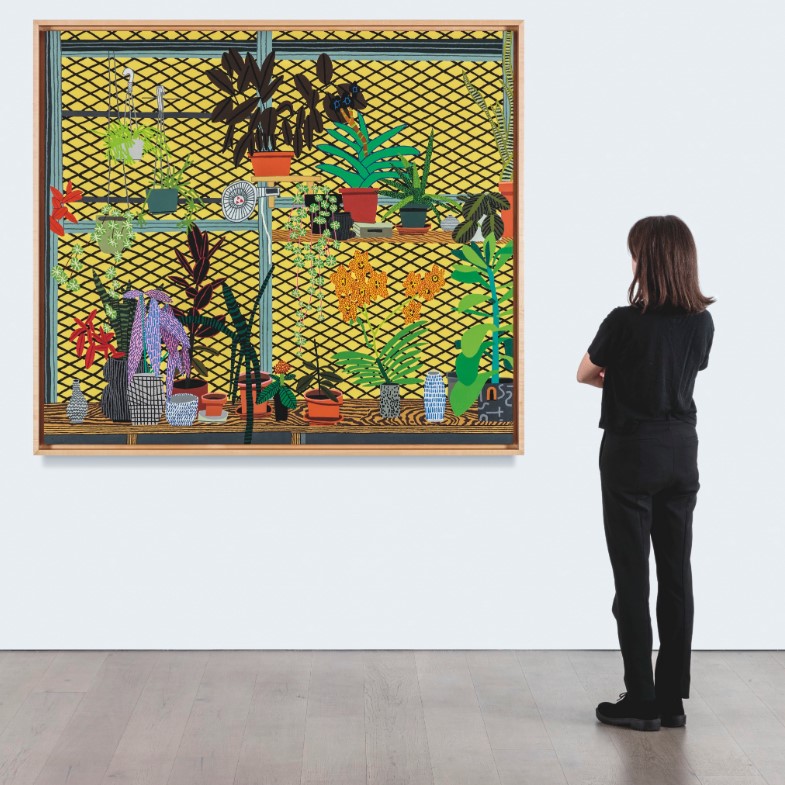
JONAS WOOD (B. 1977)
Yellow Still Life with Grating, 2016
Oil and acrylic on canvas
60×68 inches (152.4 x 172.7 cm)
Signed, titled, and dated ‘YELLOW STILL LIFE WITH GRATING GRATING JBPW 2016’ (on the reverse)
#4. Interior with Fireplace, 2012
Sotheby’s New-York: 15 November 2023
Estimated: USD 2,000,000 – 3,000,000
USD 4,295,000
Interior with Fireplace | The Now Evening Auction | 2023 | Sotheby’s (sothebys.com)
JONAS WOOD (b. 1977)
Interior with Fireplace, 2012
Oil and acrylic on canvas
102 x 92 1/4 inches (259.1 x 234.3 cm)
Initialed, titled and dated 2012 (on the reverse)
#5. Red Pot with White Blouse, 2018
Sotheby’s New-York: 18 May 2023
Estimated: USD 2,500,000 – 3,500,000
USD 3,690,000
Red Pot with White Blouse | The Now Evening Auction | 2023 | Sotheby’s (sothebys.com)
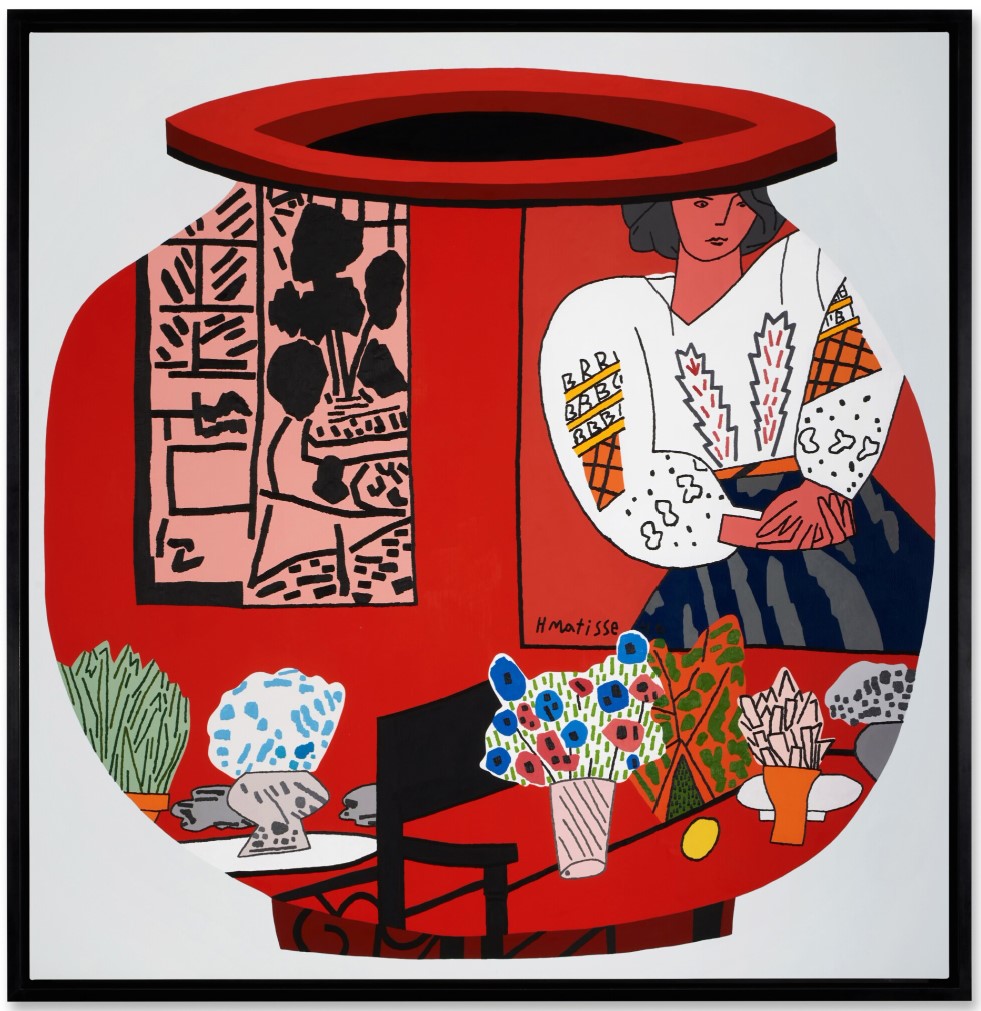
JONAS WOOD (b. 1977)
Red Pot with White Blouse, 2018
Oil and acrylic on canvas
72×70 inches (182.9 x 177.8 cm)
Initialed, titled and dated 2018 (on the reverse)
#6. M.S.F. Fish Pot #5, 2015
Christie’s New-York: 16 May 2019
Estimated: USD 900,000 – 1,200,000
USD 3,375,000
Jonas Wood (b. 1977) (christies.com)
JONAS WOOD (b. 1977)
M.S.F. Fish Pot #5, 2015
Oil and acrylic on canvas
76×74 inches (193×188 cm)
Signed with the artist’s initials, titled and dated ‘M.S.F. FISH POT #5 JBRW 2015’ (on the reverse)
#7. Green Garden Landscape Pot, 2016
Christie’s New-York: 10 May 2022
Estimated: USD 2,500,000 – 3,500,000
USD 3,060,000
JONAS WOOD (B. 1977) (christies.com)
JONAS WOOD (B. 1977)
Green Garden Landscape Pot, 2016
Oil and acrylic on canvas
118×93 inches (299.7 x 236.2 cm)
Signed with the artist’s initials and dated ‘JBRW 2016’ (lower edge)
Signed again with the artist’s initials
Titled and dated again ‘JBRW 2016 GREEN GARDEN LANDSCAPE POT’ (on the reverse)
#8. Maritime Hotel Pot with Aloe, 2014
Christie’s New-York: 19 May 2018
Estimated: USD 550,000 – 750,000
USD 2,292,500
Jonas Wood (b. 1977) (christies.com)
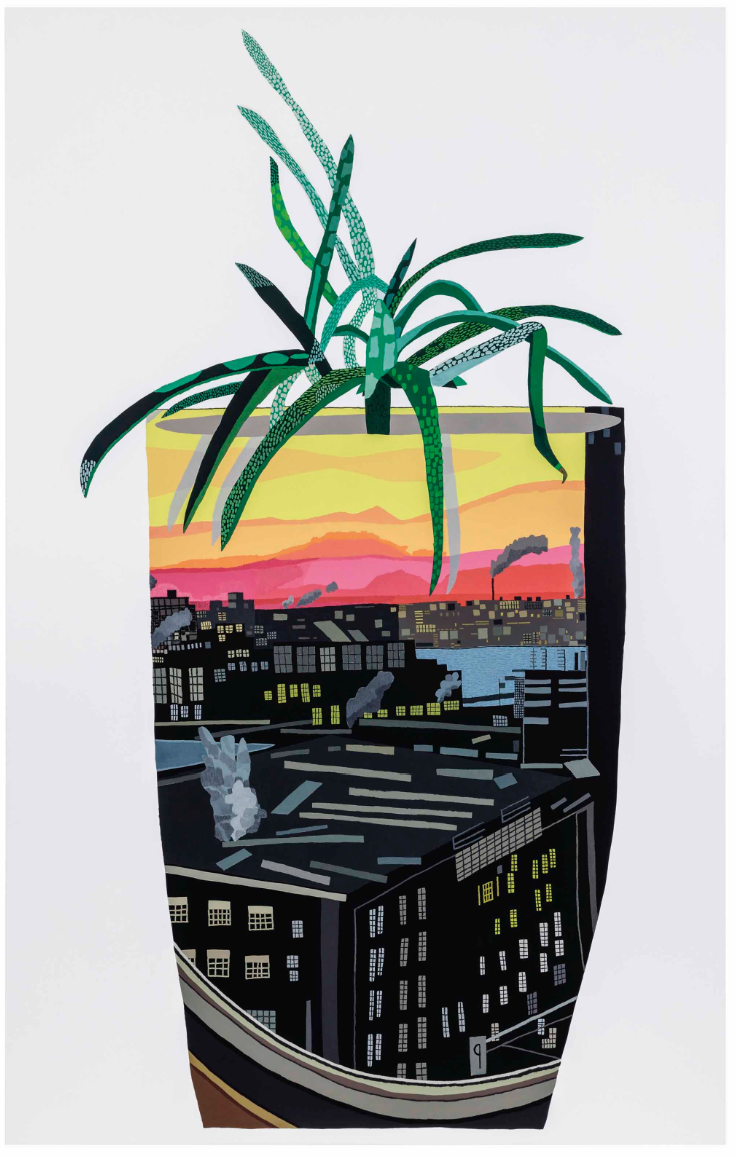
Jonas Wood (b. 1977)
Maritime Hotel Pot with Aloe, 2014
Oil and acrylic on canvas
120×76 inches (304.8 x 193 cm)
Signed with the artist’s initials, titled and dated ‘MARITIME HOTEL POT WITH ALOE JBRW 2014’ (on the reverse)
#9. M.S.F. Fish Pot #7, 2016
Christie’s Hong-Kong: 28 May 2023
Estimated: HKD 12,500,000 – 18,500,000
HKD 17,920,000 / USD 2,287,698
JONAS WOOD (B. 1977) (christies.com)
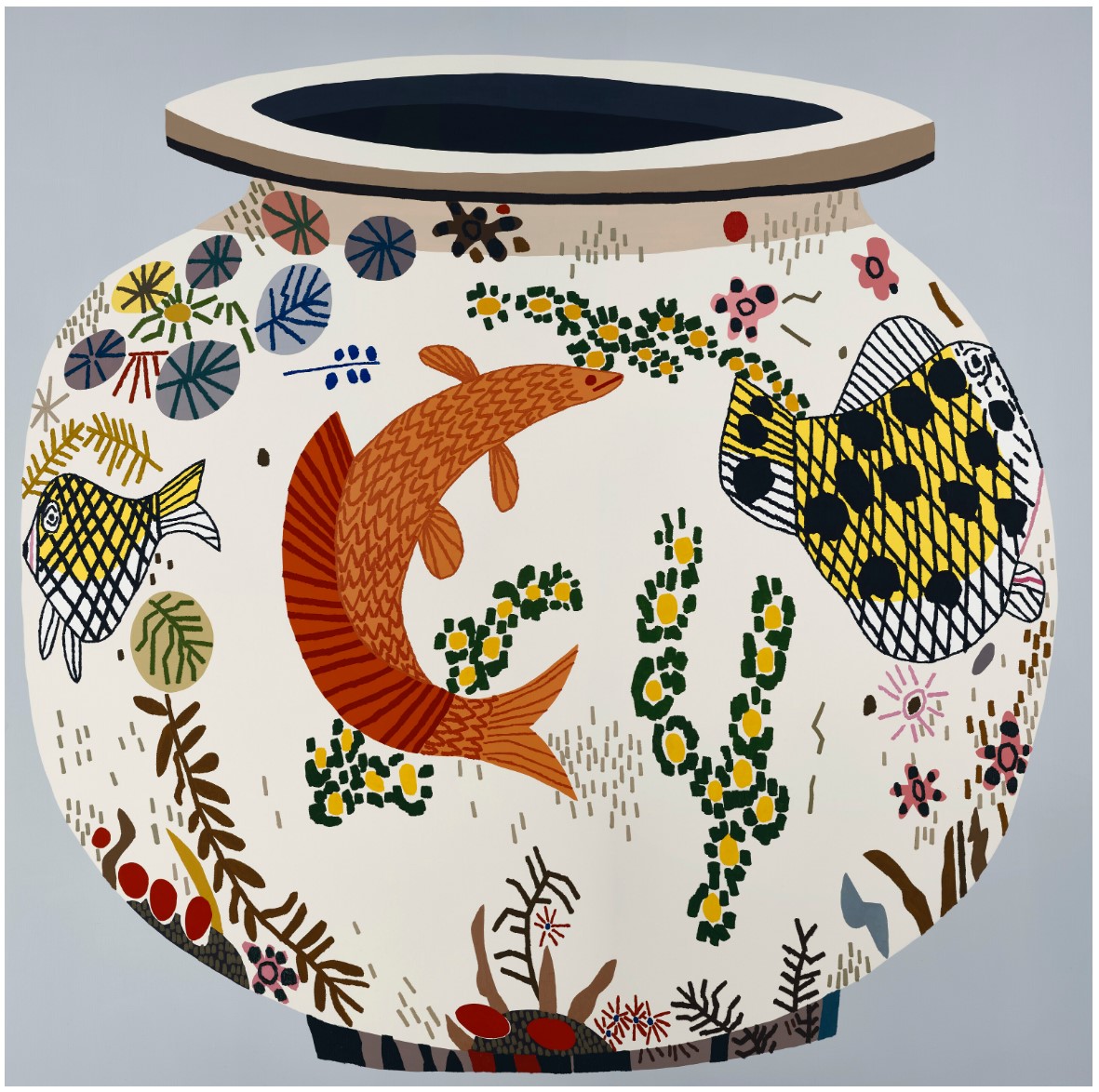
JONAS WOOD (B. 1977)
M.S.F. Fish Pot #7, 2016
Oil and acrylic on canvas
72×72 inches (182.8 x 182.8 cm)
Signed with the artist’s initials, titled and dated ‘JBRW 2016 M.S.F. FISH POT #7’ (on the reverse)
PART II: AUCTION RESULTS
2026 Auction Results
PRELIMINARY AUCTION RESULTS
As of 15 June 2026
#1. French Open Four, 2012
Sotheby’s New-York: 15 May 2026
Estimated: USD 400,000 – 600,000
USD 896,000
Jonas Wood | French Open Four | Contemporary Day Auction | 2026 |
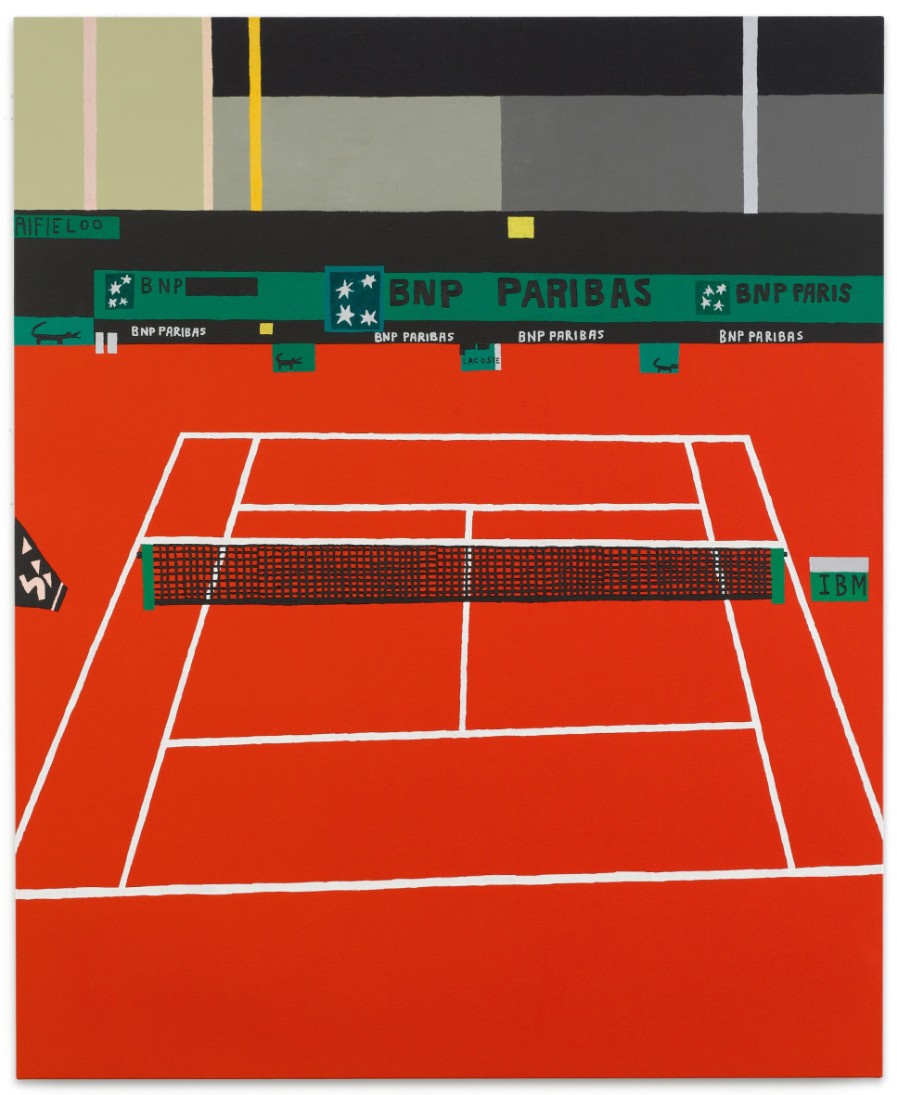
JONAS WOOD (b. 1977)
French Open Four, 2012
Oil and acrylic on linen
62 x 50-1/8 inches (157.5 x 127.3 cm)
Signed with the artist’s initials, titled and dated 2012 (on the reverse)
#2. Clipping J1, 2015
Property from an Ambassadorial Collection
Sotheby’s New-York: 15 May 2026
Estimated: USD 500,000 – 700,000
USD 640,000
Jonas Wood | Clipping J1 | Contemporary Day Auction | 2026 | Sotheby’s
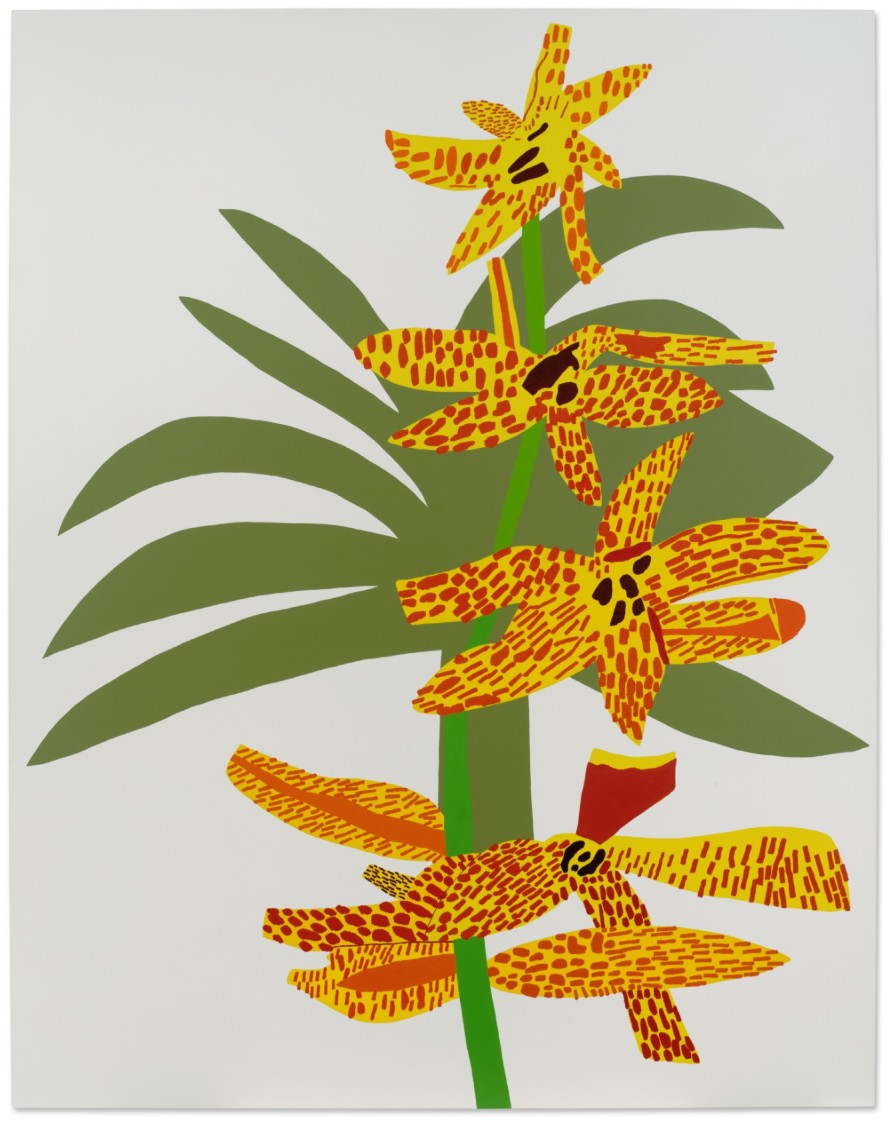
JONAS WOOD (b. 1977)
Clipping J1, 2015
Oil and acrylic on canvas
87-1/2 x 69 inches (222.2 x 175.3 cm)
Signed with the artist’s initials, titled and dated 2015 (on the reverse)
#3. Untitled (Self Portrait with Green Hat), 2009
Phillips New-York: 21 May 2026
Estimated: USD 300,000 – 500,000
USD 322,500
Jonas Wood Modern & Contemporary Art: Afternoon Session
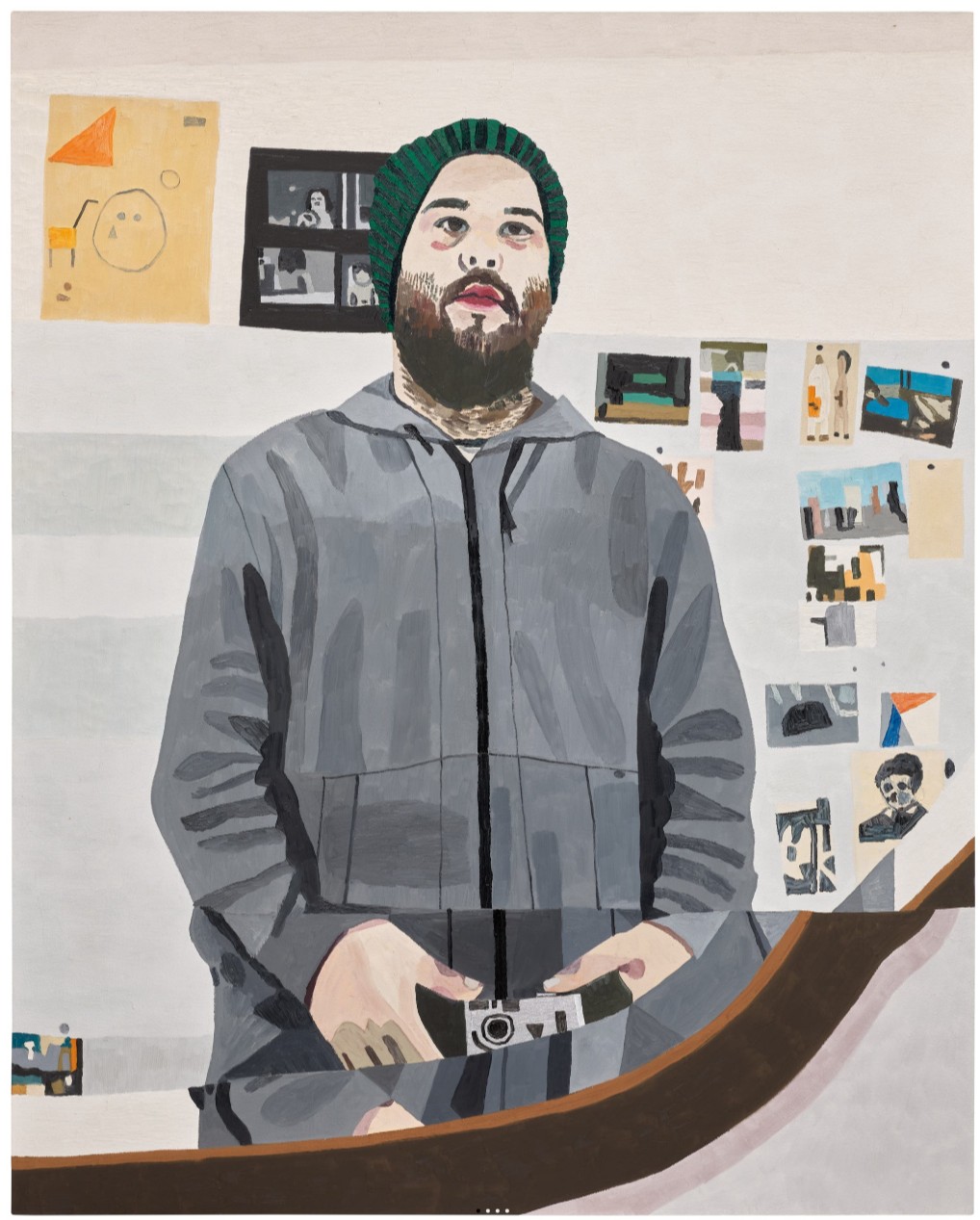
JONAS WOOD
Untitled (Self Portrait with Green Hat), 2009
Oil on canvas
50×40 inches (127 x 101.6 cm)
Signed with the artist’s initials, titled and dated
“JBRW 2009 UNTITLED (SELF PORTRAIT WITH GREEN HAT)”
on the reverse
USD 100,000
#4. Untitled (Silver Dots), 2010
LA Modern: 25 February 2026
Estimated: USD 60,000 – 80,000
USD 57,150
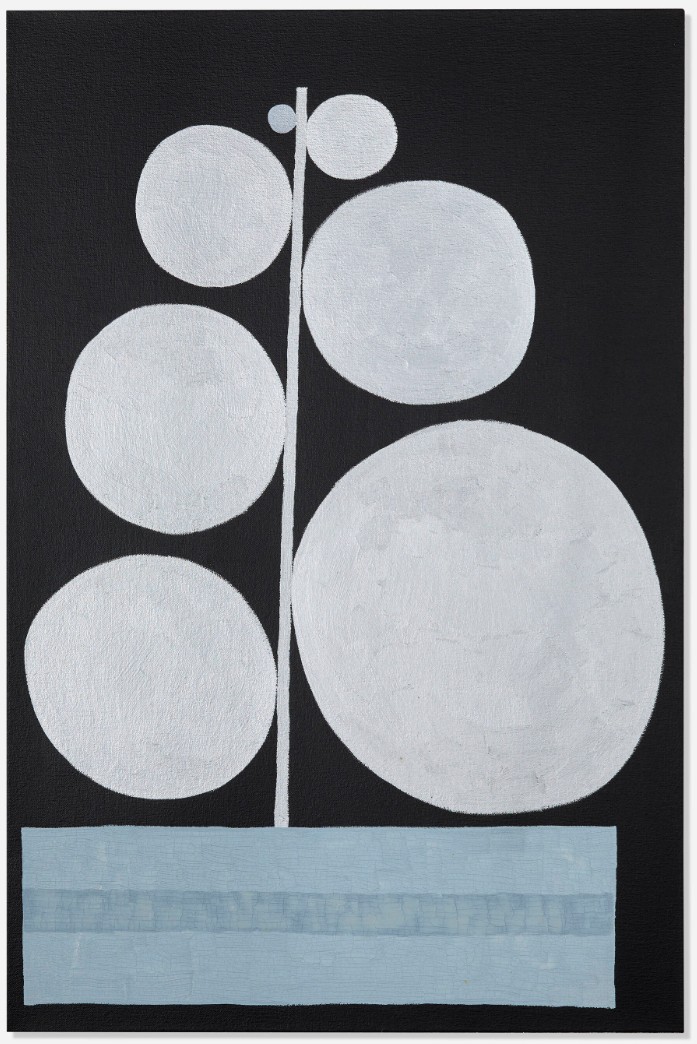
JONAS WOOD (b.1977)
Untitled (Silver Dots), 2010
Oil and acrylic on canvas
36×24 inches (91×61 cm)
Signed, titled, dated and inscribed to verso ‘Untitled (Silver Dots) JBRW 2010 TM’
#5. Untitled (Pale), 2008
Christie’s New-York: 26 February 2026
Estimated: USD 40,000 – 60,000
USD 53,340
JONAS WOOD (B. 1977), Untitled (Pale) | Christie’s
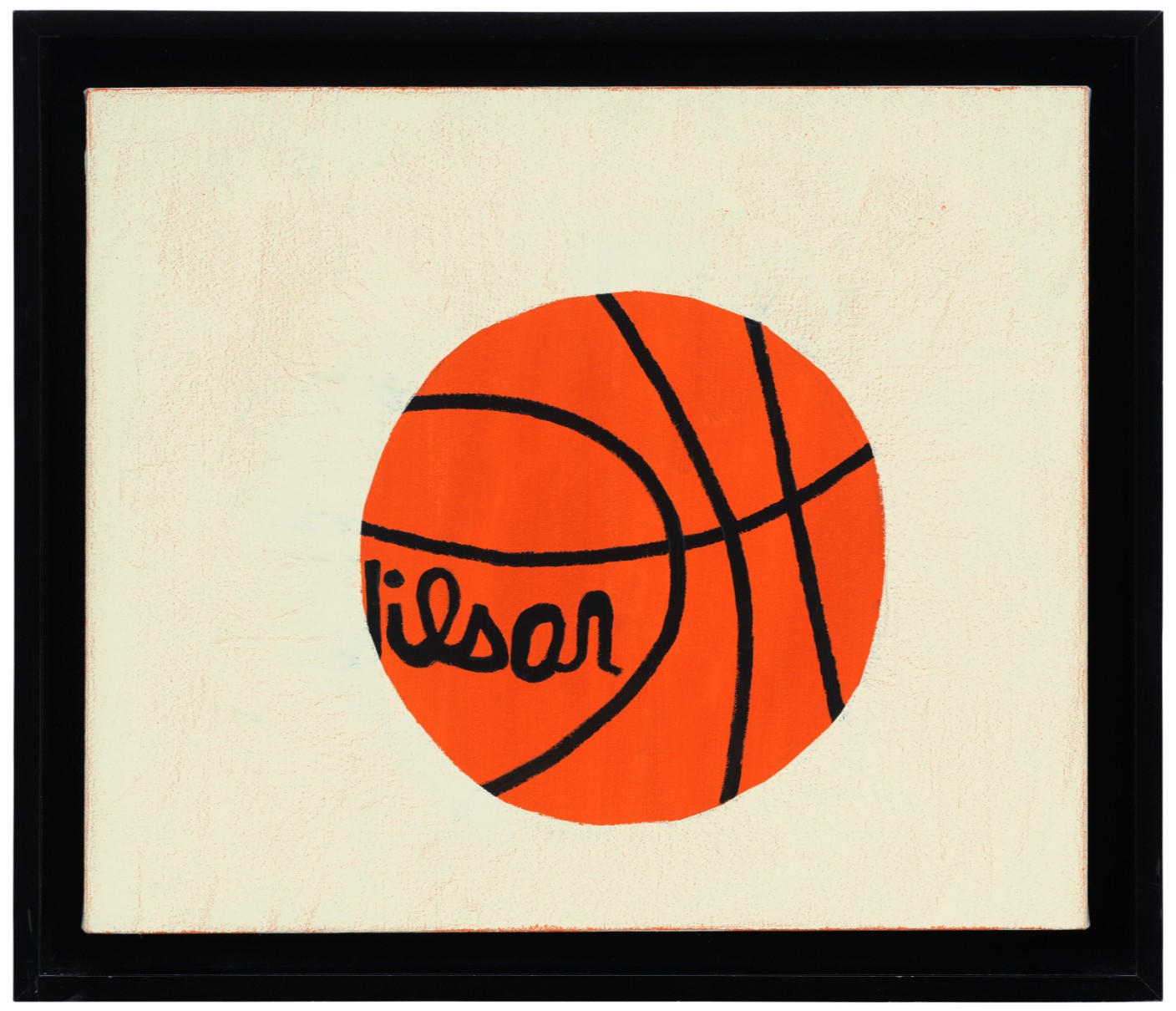
JONAS WOOD (B. 1977)
Untitled (Pale), 2008
Oil on canvas
16-1/8 x 19-1/8 inches (41 x 48.6 cm)
Signed with the artist’s initials, titled and dated ‘JBRW 2008 UNTITLED (PALE)’ (on the reverse)
Lots Passed
GG HK NPP #3, 2017
Christie’s New-York: 21 May 2026
Estimated: USD 350,000 – 450,000
JONAS WOOD (B. 1977), GG HK NPP #3 | Christie’s
REPEAT SALE
Phillips New-York: 28 February 2025
Estimated: USD 500,000 – 700,000
USD 393,700
READ MORE IN FOCUS SECTION
Jonas Wood – New Now: Modern & Cont… Lot 28 February 2025 | Phillips
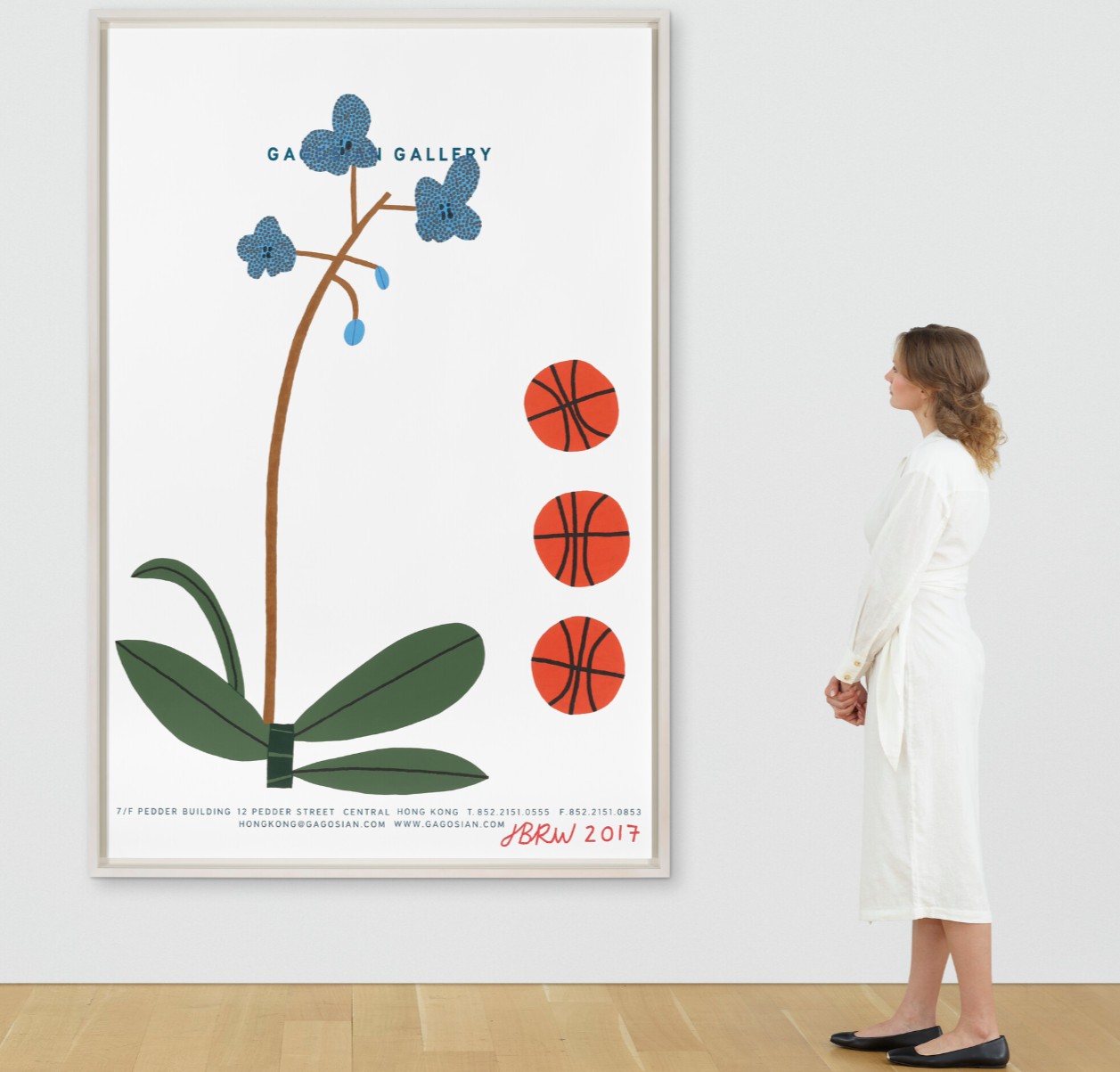
JONAS WOOD (B. 1977)
GG HK NPP #3, 2017
Oil, acrylic and screenprint on canvas
93-1/4 x 61-1/8 inches (236.9 x 155.3 cm)
Signed with the artist’s initials and dated ‘JBRW 2017’ (lower right)
2025 Auction Results
FOR PAINTINGS ONLY
10 lots sold at auction in 2025 for a total turnover of USD 2,328,325. With 5 lots failing to sell, the sell-through rate is 67%. The highest price has been achieved by Clipping A4, a painting dated 2013, that sold at Sotheby’s in New-York, on 16 May 2025 for USD 635,000.
2025 Top 3 Lots
1 lot sold for more than USD 500,000, representing 27.3% of the total turnover of 2025. 6 lots sold for more than USD 100,000, generating a cumulative turnover of USD 2,118,700, representing 91% of the total turnover of 2025.
XXXXXXXXXXX
#1. Clipping A4, 2013
Sotheby’s New-York: 16 May 2025
Estimated: USD 700,000 – 1,000,000
USD 635,000
READ MORE IN FOCUS SECTION
Clipping A4 | Contemporary Day Auction | 2025 | Sotheby’s
JONAS WOOD (b. 1977)
Clipping A4, 2013
Oil and acrylic on canvas
108 1/2 x 73 inches (275.6 x 185.4 cm)
Signed twice, titled and dated 2013 (on the reverse)
USD 500,000
#2. GG HK NPP #3, 2017
Phillips New-York: 28 February 2025
Estimated: USD 500,000 – 700,000
USD 393,700
READ MORE IN FOCUS SECTION
Jonas Wood – New Now: Modern & Cont… Lot 28 February 2025 | Phillips
JONAS WOOD
GG HK NPP #3, 2017
Screenprint, oil and acrylic on canvas
93 1/4 x 61 1/8 in. (236.9 x 155.3 cm)
Signed with the artist’s initials and dated “JBRW 2017” lower right
Signed with the artist’s initials, titled and dated “JBRW 2017 GG HK NPP #3 JBRW 2017” on the overlap
#3. PP, 2008
Christie’s New-York: 15 May 2025
Estimated: USD 400,000 – 600,000
USD 378,000
JONAS WOOD (B. 1977), PP | Christie’s
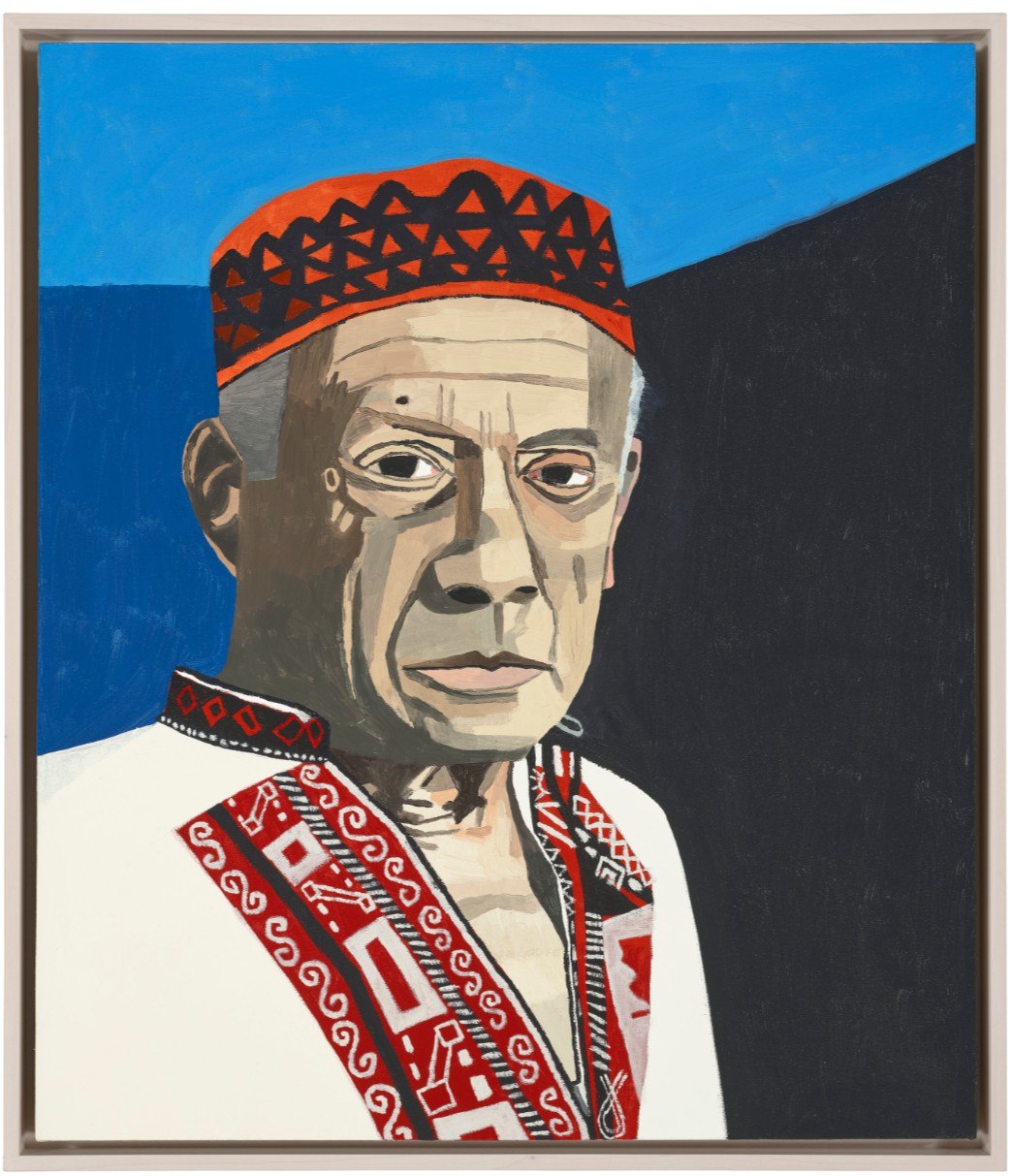
JONAS WOOD (B. 1977)
PP, 2008
Oil on linen
29 1/8 x 25 inches (74 x 63.5 cm)
Signed twice with the artist’s initials, titled and dated twice ‘PP JBRW 2008 JBRW 2008’ (on the reverse)
#4. Black Plant with Grey Orchid, 2011
Christie’s New-York: 20 November 2025
Estimated: USD 250,000 – 350,000
USD 279,400
JONAS WOOD (B. 1977), Black Plant with Grey Orchid | Christie’s
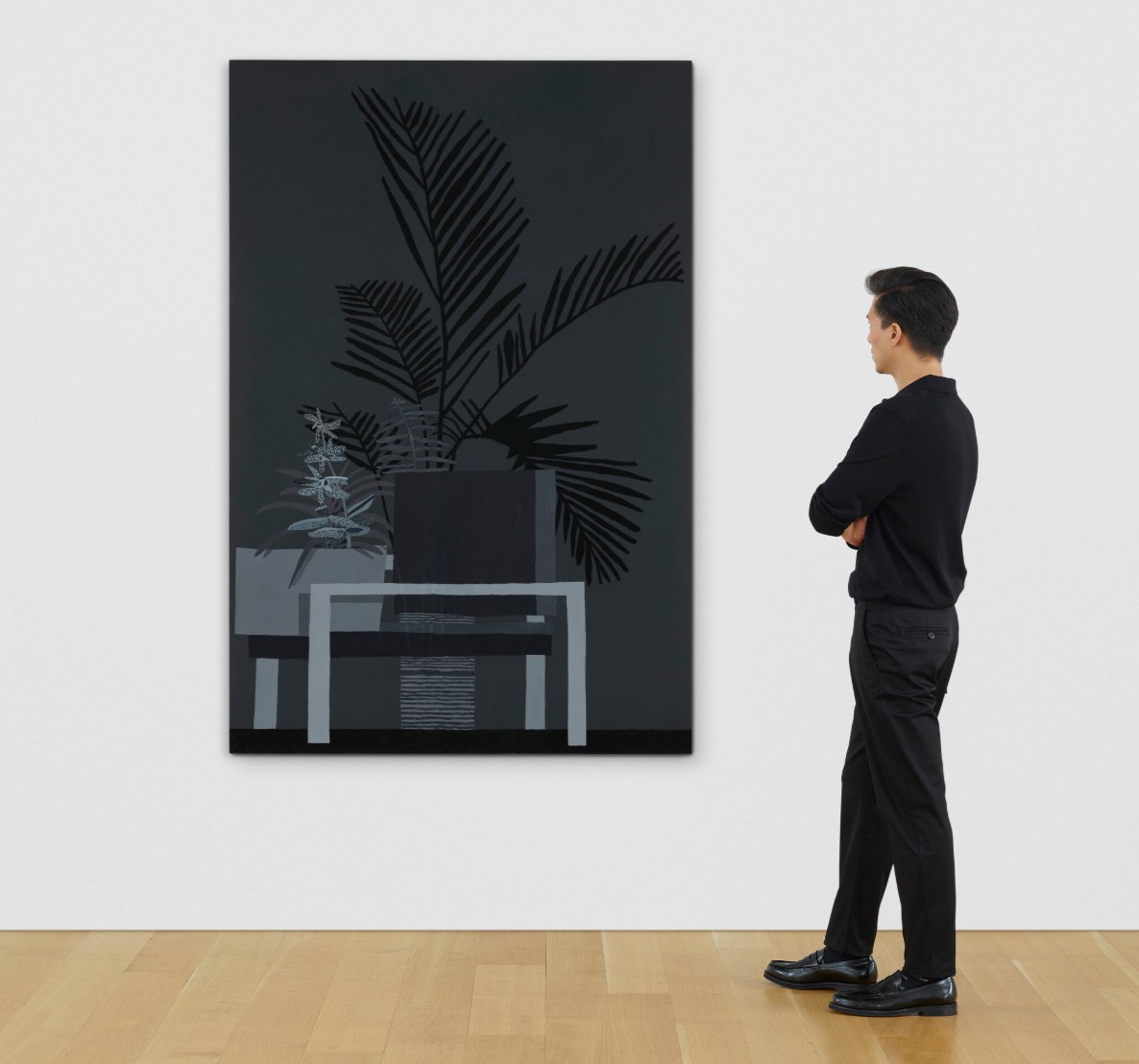
JONAS WOOD (B. 1977)
Black Plant with Grey Orchid, 2011
Oil and acrylic on linen
72×48 inches (182.9 x 121.9 cm)
Signed with the artist’s initials, inscribed, titled and dated
‘BLACK PLANT WITH GREY ORCHID JBRW 2011 PENI$’
(on the reverse)
#5. BW Parrot Pattern, 2012
Christie’s New-York: 27 February 2025
Estimated: USD 300,000 – 500,000
USD 252,000
JONAS WOOD (B. 1977), BW Parrot Pattern | Christie’s
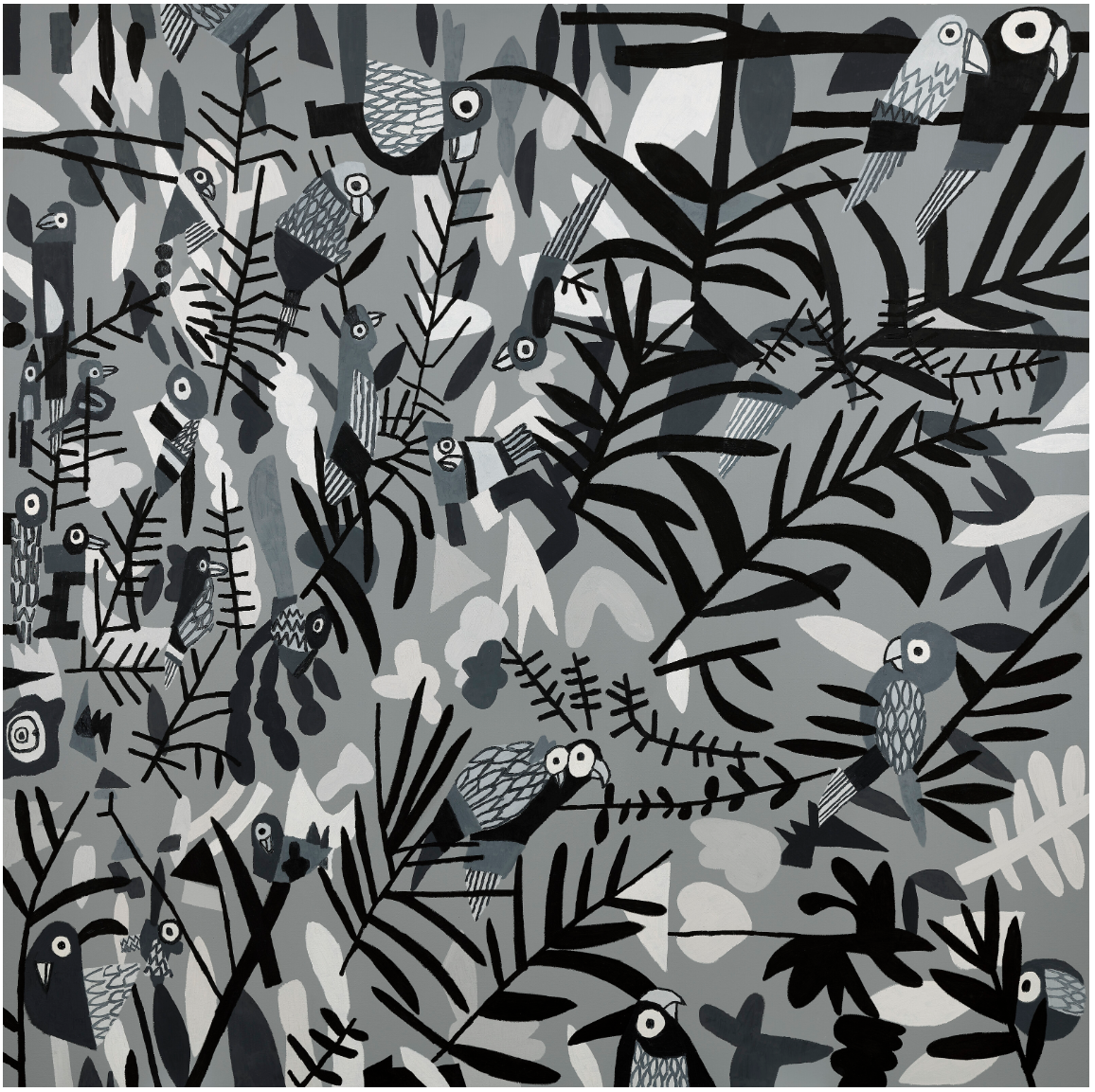
JONAS WOOD (B. 1977)
BW Parrot Pattern, 2012
Oil and acrylic on canvas
65×65 inches (165.1 x 165.1 cm)
Signed with the artist’s initials, titled and dated ‘BW PARROT PATTERN JBRW 2012’ (on the reverse)
#6. Untitled (Pacific Standard Time), 2011
Estimated: USD 150,000 – 200,000
USD 180,600
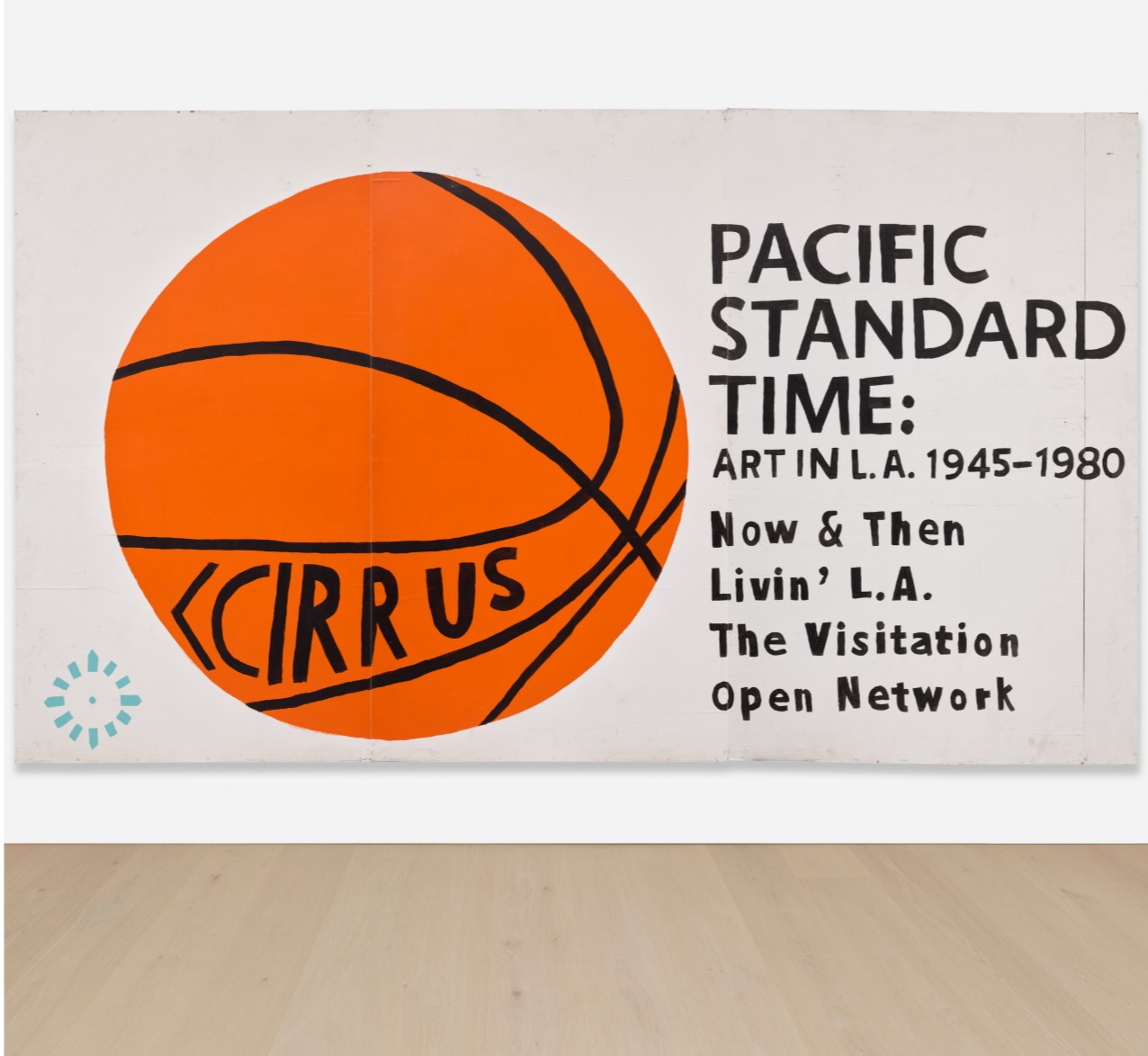
(ii) 87 3/4 x 48 inches (222.9 x 121.9 cm)
(iii) 87 7/8 x 55 1/4 inches (223.2 x 140.3 cm)
Overall: 87 7/8 x 151 1/2 inches (223.2 x 384.8 cm)
USD 100,000
#7. Untitled (MG 78), 2008
Estimated: KRW 110,000,000 – 700,000,000
KRW 126,500,000 / USD 91,585
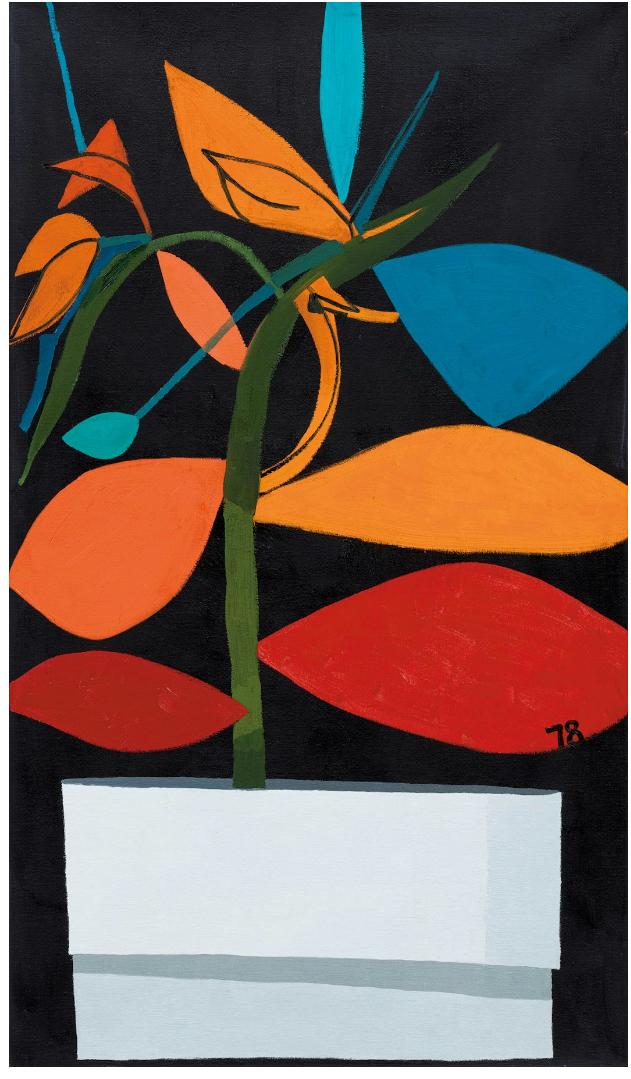
Untitled (MG 78), 2008
Oil on linen
36×21 inches (91.4 x 53.3 cm)
Signed, titled and dated on the reverse
#8. Untitled (Silver Leaves), 2010
Christie’s New-York: 30 September 2025
Estimated: USD 30,000 – 50,000
USD 60,960
JONAS WOOD (B. 1977), Untitled (Silver Leaves) | Christie’s
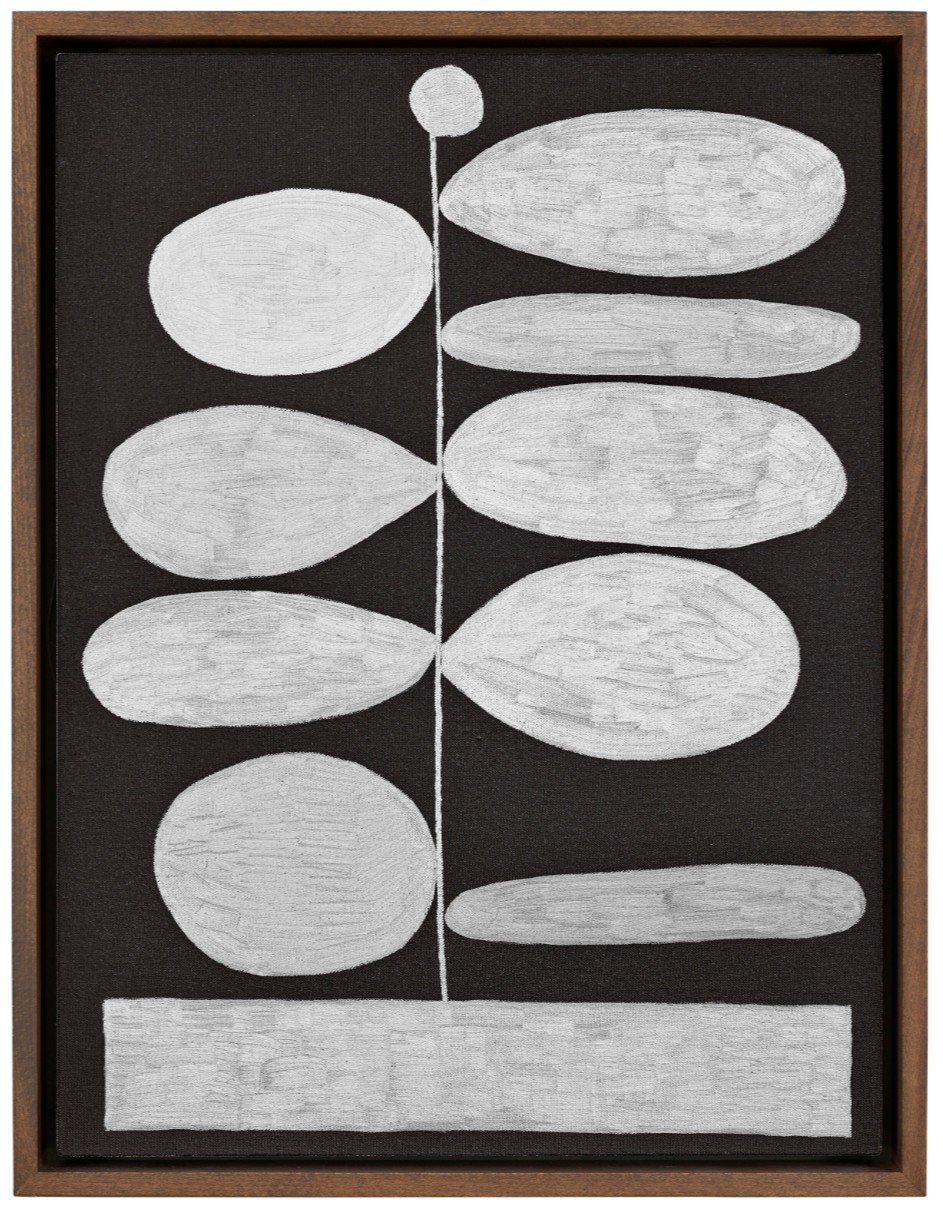
JONAS WOOD (B. 1977)
Untitled (Silver Leaves), 2010
Oil and acrylic on canvas
24×18 inches (61 x 45.8 cm)
Signed with the artist’s initials
Titled and dated ‘JBRW 2010 UNTITLED (SILVER LEAVES)’ (on the reverse)
#9. Small Ball 2, 2008
Estimated: USD 40,000 – 60,000
USD 44,100
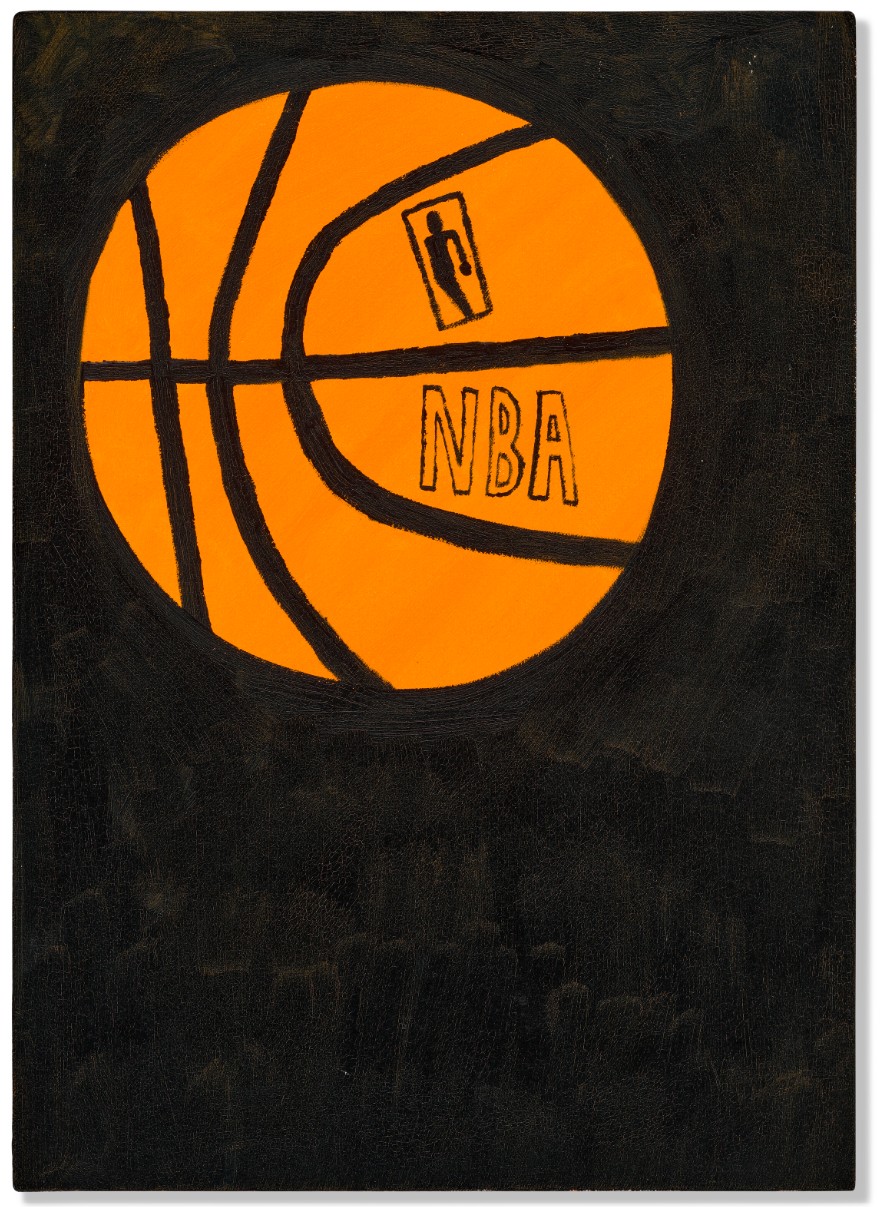
Small Ball 2, 2008
Oil on canvas
18 1/4 x 13 inches (46.4 x 33 cm)
Signed with the artist’s initials, titled and dated ‘JBRW 2008 SMALL BALL 2’ (on the reverse)
#10. Untitled, 2003
Estimated: HKD 80,000 – 200,000
HKD 101,600 / USD 12,980
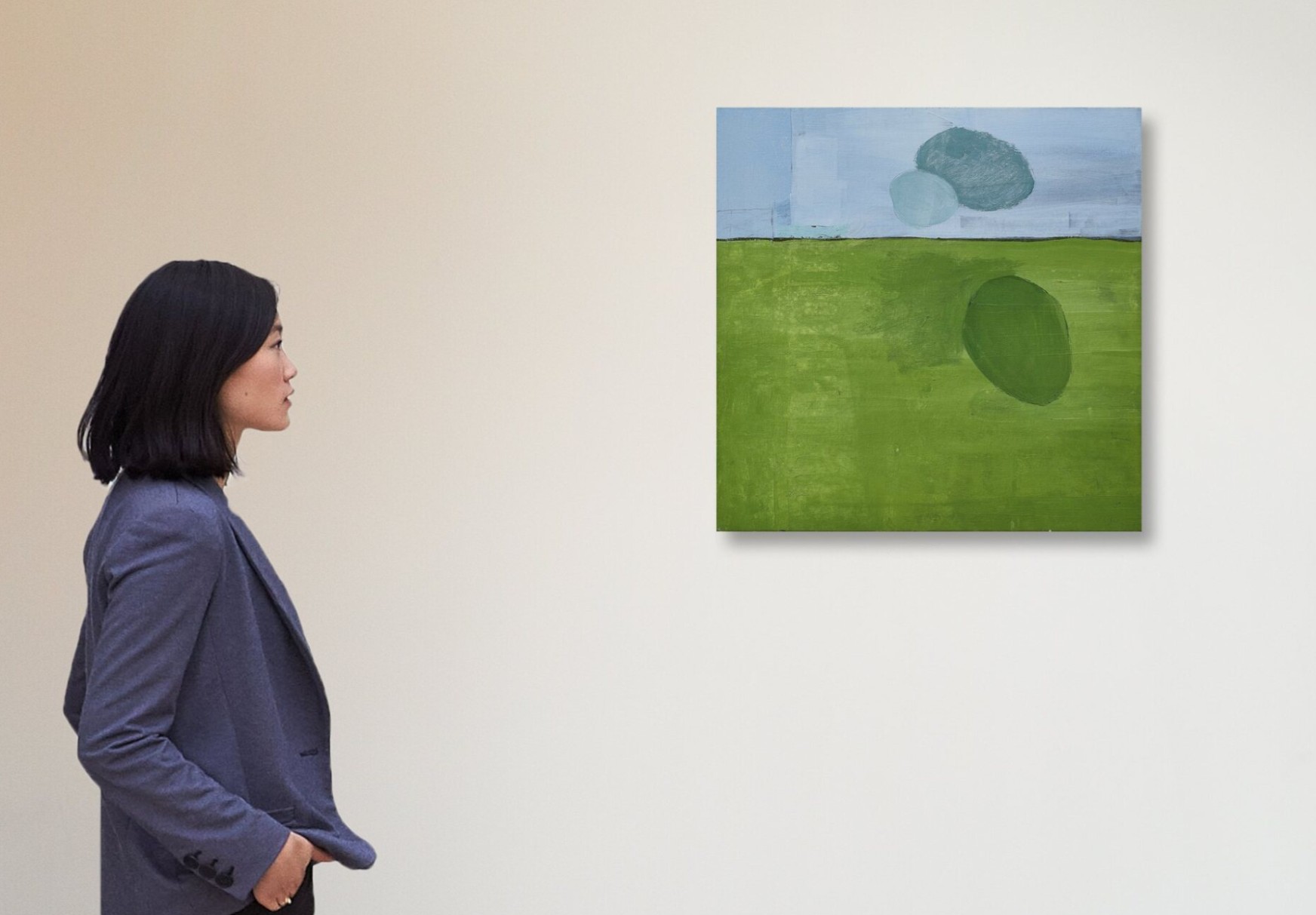
JONAS WOOD (b. 1977)
Untitled, 2003
Oil on canvas mounted on wood
21×21 inches (53 x 53.2 cm)
Lots Passed
GG London NPP #1, 2017
Phillips New-York: 21 November 2025
Estimated: USD 300,000 – 400,000
PASSED
Jonas Wood Modern & Contemporary Art Day Sale, Afternoon Session
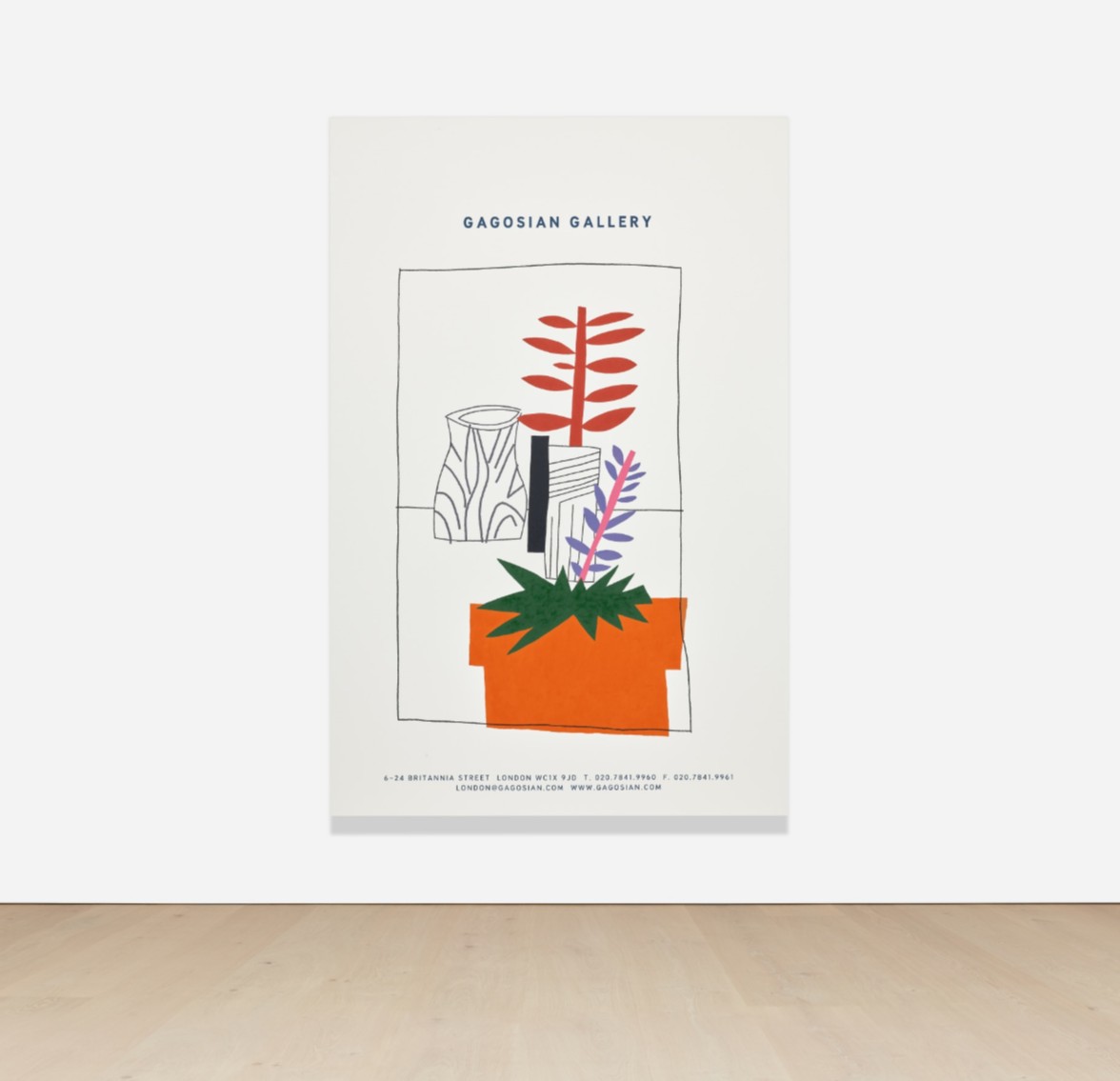
Screenprint and oil on canvas
93×61 inches (236.2 x 154.9 cm)
Signed with the artist’s initials, titled and dated
“JBRW 2017 GG London NPP #1 JBRW 2017”
on the overlap
Red on Black Collage, 2009
Estimated: USD 100,000 – 150,000
PASSED
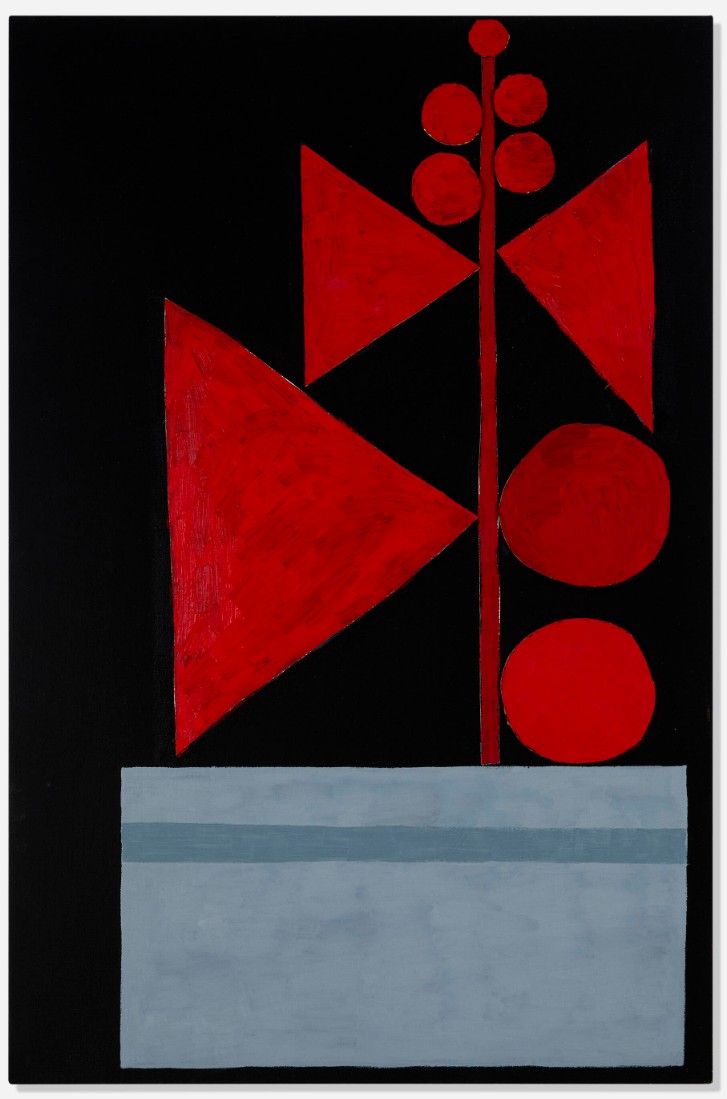
Red on Black Collage, 2009
Oil, cardboard, linen and canvas on linen
44×29 inches (112×74 cm)
Signed, titled and dated to verso ‘Red on Black Collage JBRW 2009’
Clipping D3, 2013
Sotheby’s New-York: 26 September 2025
Estimated: USD 500,000 – 700,000
PASSED
Clipping D3 | Contemporary Curated | 2025 | Sotheby’s
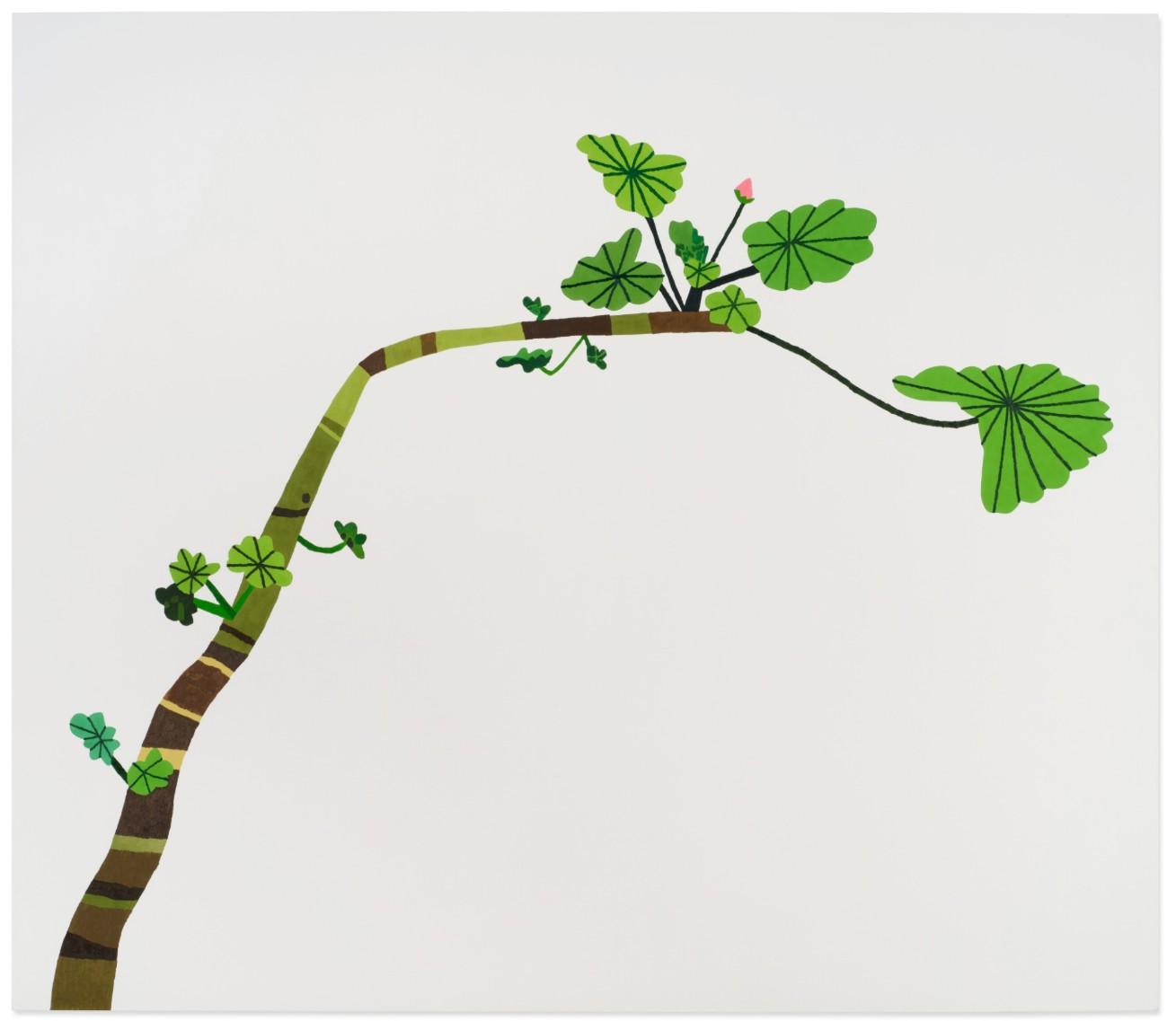
JONAS WOOD (b. 1977)
Clipping D3, 2013
Oil and acrylic on canvas
87×100 inches (221×254 cm)
Signed, titled and dated 2013 (on the reverse)
Punch and Judy, 2015
Phillips Hong-Kong: 27 May 2025
Estimated: HKD 3,300,000 – 5,000,000
PASSED
Jonas Wood Modern & Contemporary Art: Evening & Day Sale
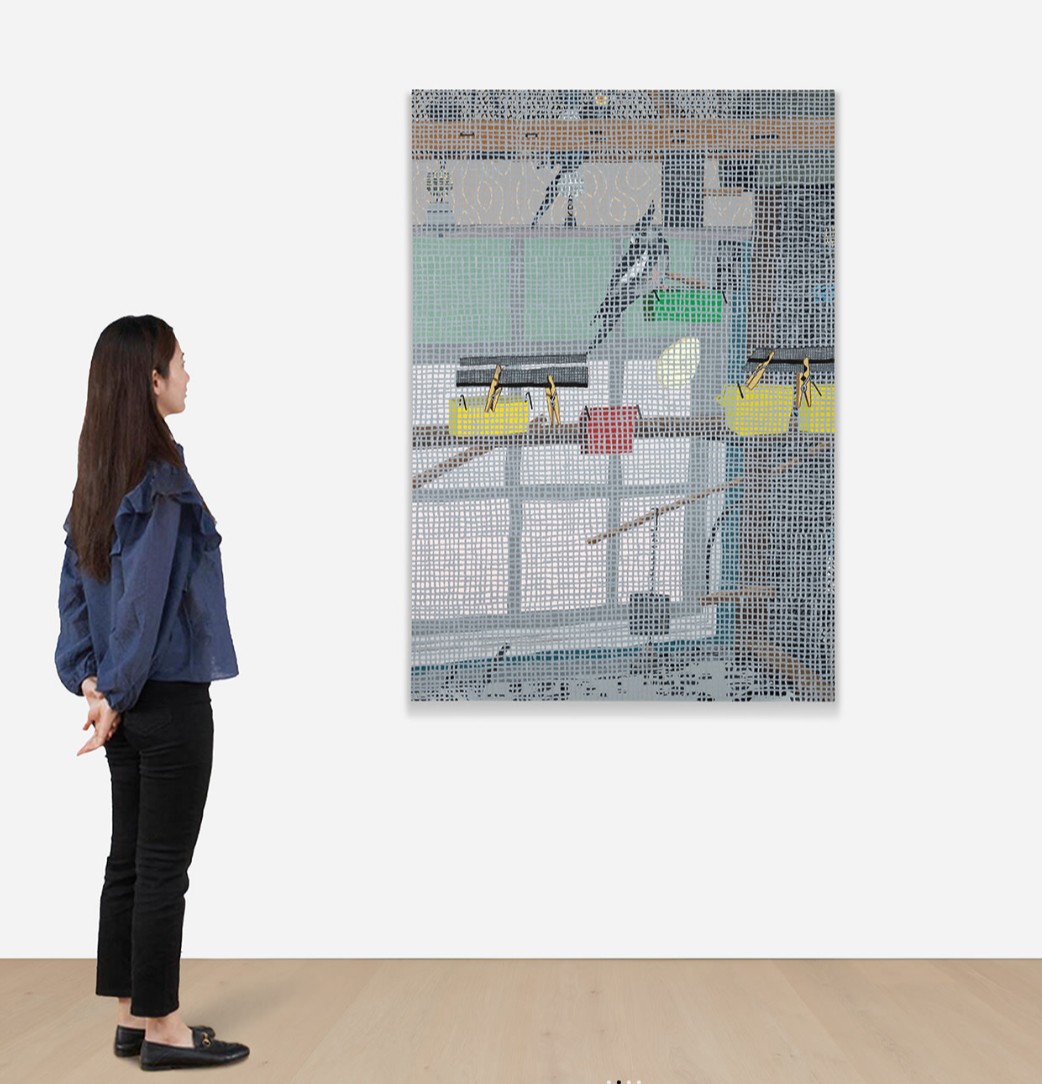
Oil and acrylic on linen
54 7/8 x 37 7/8 inches (139.7 x 96.5 cm)
Signed, titled and dated ‘”PUNCH AND JUDY” JBRW 2015’ on the reverse
DKG NPP #2, 2017
Christie’s Shanghai: 3 April 2025
Estimated: CNY 2,200,000 – 3,200,000
PASSED
JONAS WOOD (B. 1977), DKG NPP #2 | Christie’s
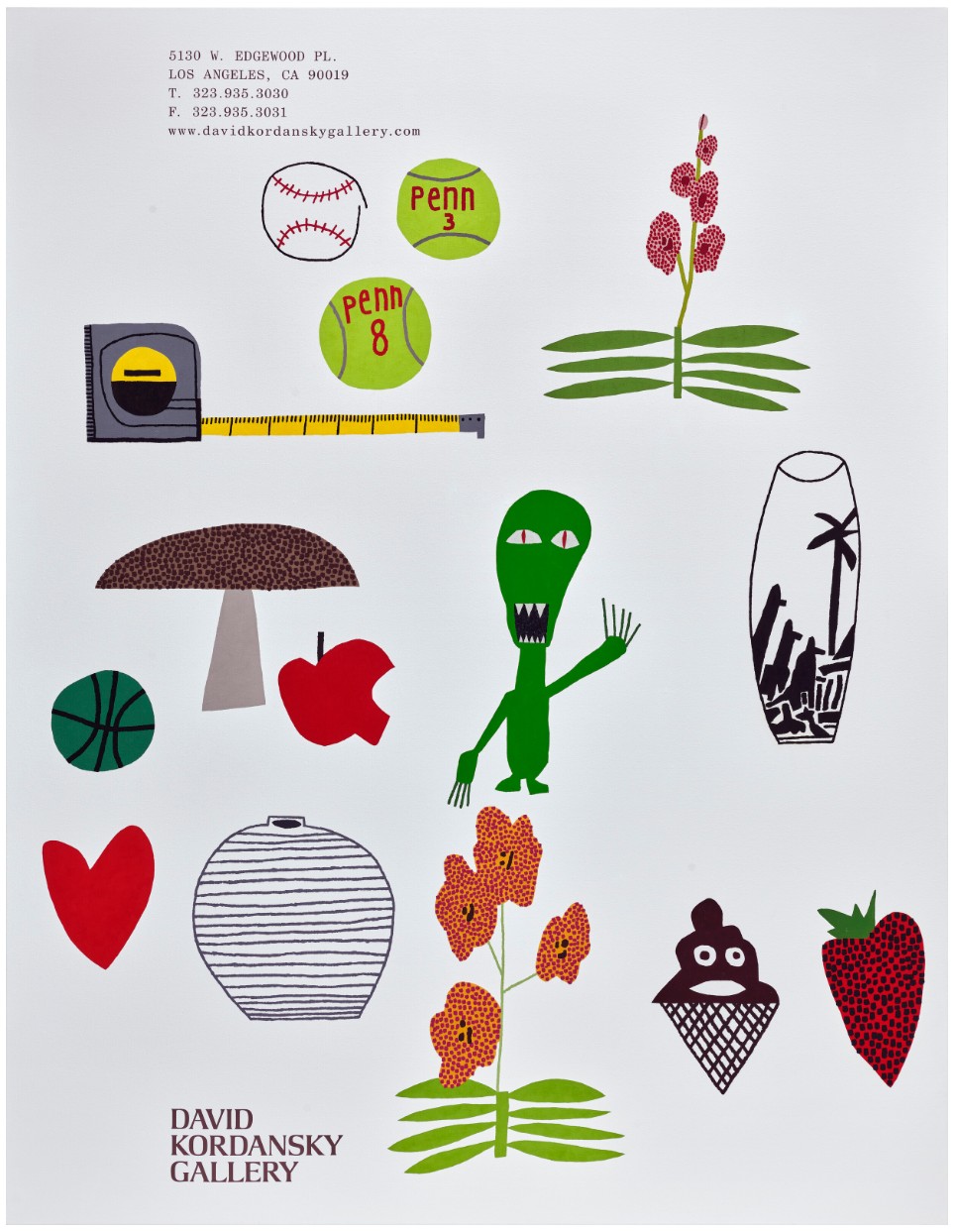
JONAS WOOD (B. 1977)
DKG NPP #2, 2017
Screenprint, oil and acrylic on canvas
80×62 inches (203.2 x 157.5 cm)
Signed and dated twice, titled ‘JBRW 2017 DKG NPP #2 JBRW 2017’ (on the overlap)
2024 Auction Results
FOR PAINTINGS ONLY
10 lots sold at auction in 2024 for a total turnover of USD 7,101,826. With 2 lots failing to sell, the sell-through rate is 83%. One lot was withdrawn on 14 May 2024, at Sotheby’s in New-York. The highest price has been achieved at Christie’s in New-York on 21 November 2024, when Still Life with Cat and Fruit, a painting dated 2020, sold for USD 1,865,000.
2024 Top 3 Lots
3 lots sold for more than USD 1 million, generating a cumulative turnover of USD 5,016,480, representing 70.6% of the total for 2024.
XXXXXXXXXX
#1. Still Life with Cat and Fruit, 2020
Christie’s New-York: 21 November 2024
Estimated: USD 700,000 – 1,000,000
USD 1,865,000
JONAS WOOD (B. 1977), Still Life with Cat and Fruit | Christie’s
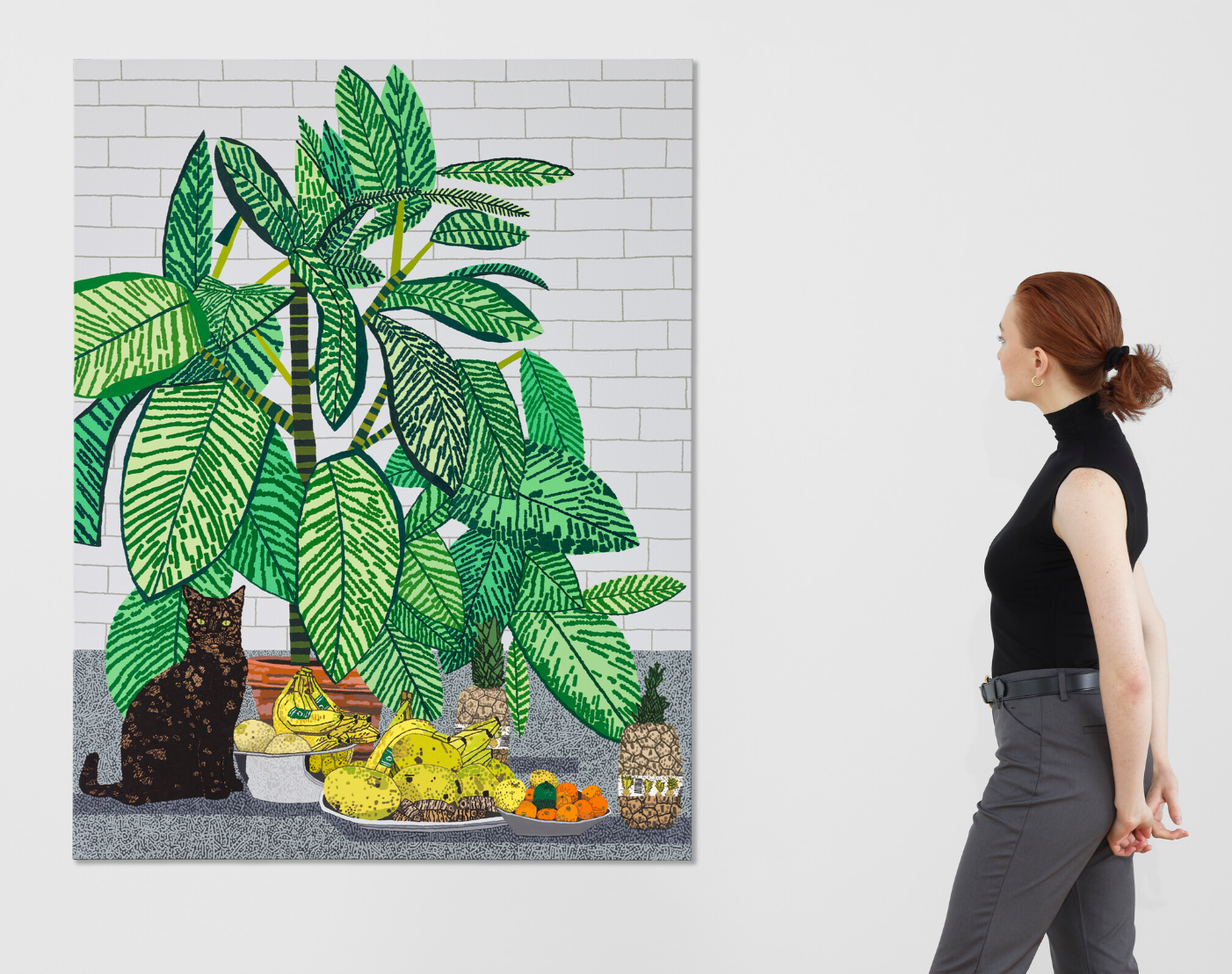
JONAS WOOD (B. 1977)
Still Life with Cat and Fruit, 2020
Oil and acrylic on canvas
58×45 inches (147.3 x 114.3 cm)
Signed, titled and dated ‘STILL LIFE WITH CAT AND FRUIT Jonas Wood 2020’ (on the reverse)
#2. Landscape Pot 1, 2014
Christie’s New-York: 14 May 2024
Estimated: USD 2,200,000 – 2,800,000
USD 1,744,000
JONAS WOOD (B. 1977), Landscape Pot 1 | Christie’s (christies.com)

JONAS WOOD (B. 1977)
Landscape Pot 1, 2014
Oil on canvas
118×93 inches (299.7 x 236.2 cm)
Signed twice with the artist’s initials, titled and dated ‘LANDSCAPE POT 1 JBRW 2014’ (on the reverse)
#3. Untitled (Drawing Rally), 2011
Sotheby’s London: 25 June 2024
Estimated: GBP 1,000,000 – 1,500,000
GBP 1,110,000 / USD 1,407,480
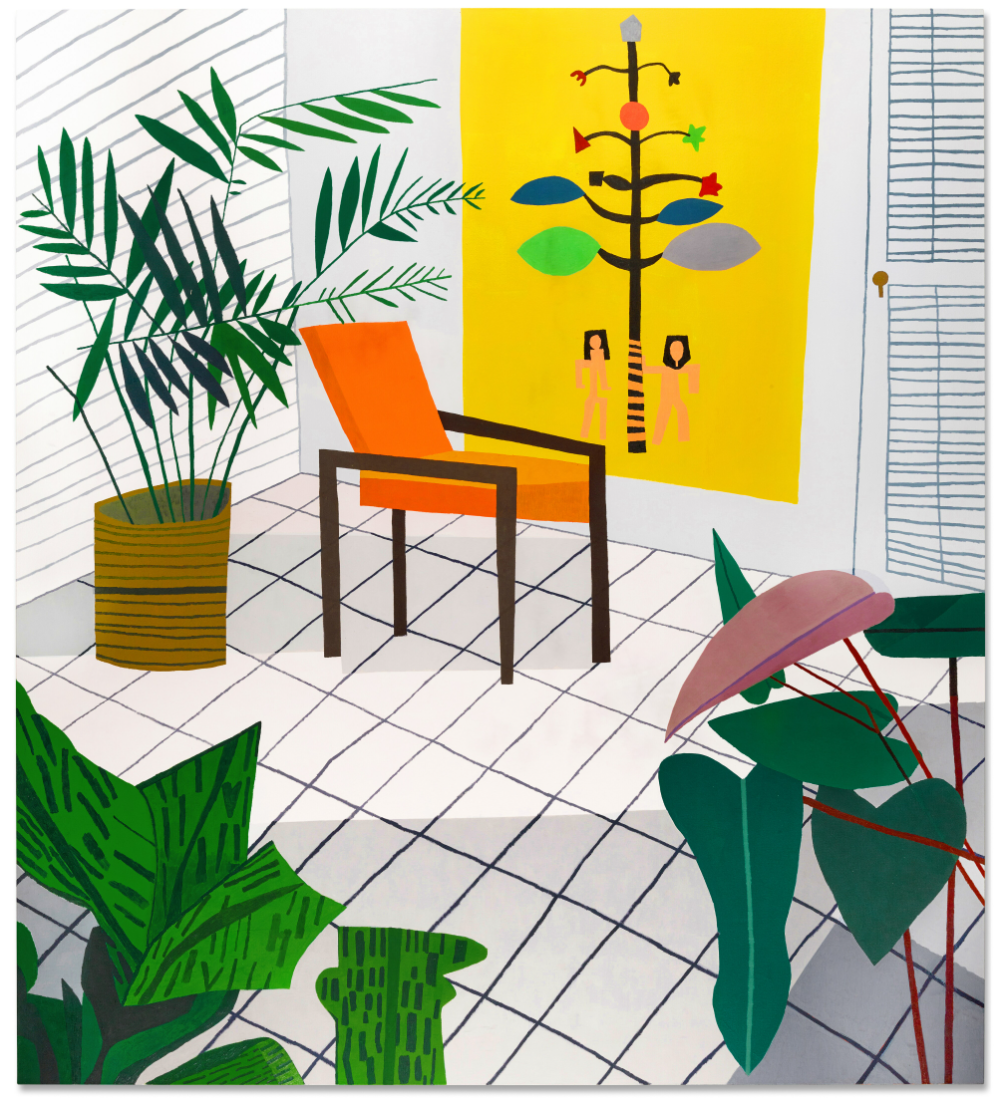
JONAS WOOD (b. 1977)
Untitled (Drawing Rally), 2011
Oil and acrylic on canvas
98 x 88 1/4 inches (249×224 cm)
Signed, titled and dated 2011 (on the reverse)
USD 1 million
#4. SK Dino Pot #2, 2015
Christie’s New-York: 13 March 2024
Estimated: USD 700,000 – 1,000,000
USD 756,000
JONAS WOOD (B. 1977), SK Dino Pot #2 | Christie’s (christies.com)
JONAS WOOD (B. 1977)
SK Dino Pot #2, 2015
Oil and acrylic on canvas
90×68 inches (228.6 x 172.7 cm)
Signed with the artist’s initials, titled and dated ‘SK DINO POT #2 JBRW 2015’ (on the reverse)
#5. Untitled (Pollock with Night Bloom), 2012
Christie’s New-York: 17 May 2024
Estimated: USD 300,000 – 500,000
USD 478,800

JONAS WOOD (B. 1977)
Untitled (Pollock with Night Bloom), 2012
Oil and acrylic on canvas
65×30 inches (165.1 x 76.2 cm)
Signed with the artist’s initials, titled and dated ‘JBRW 2012 UNTITLED (POLLOCK WITH NIGHT BLOOM)’
(on the reverse)
#6. Wimbledon 1, 2011
Phillips Hong-Kong: 31 May 2024
Estimated: HKD 2,000,000 – 4,000,000
HKD 2,032,000 / USD 260,146
https://www.phillips.com/detail/jonas-wood/HK010124/8
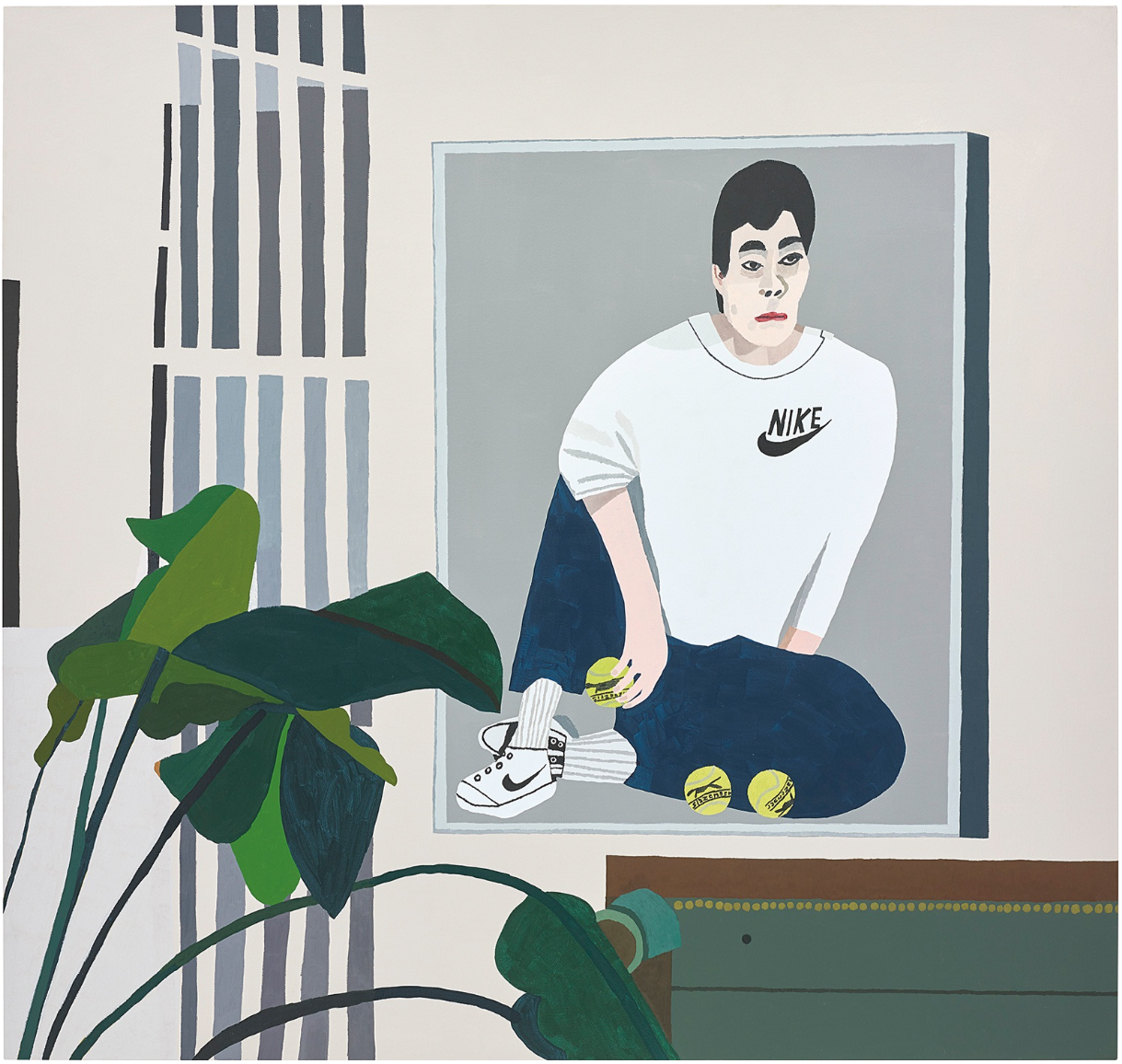
JONAS WOOD
Wimbledon 1, 2011
Oil and acrylic on canvas
70 1/8 x 74 inches (178×188 cm)
Signed with the artist’s initials, dated and titled ‘JBRW 2011 “Wimbledon I”‘ on the reverse
#7. Studio Plant, 2007
Christie’s New-York: 22 November 2022
Estimated: USD 150,000 – 200,000
USD 176,400
JONAS WOOD (B. 1977), Studio Plant | Christie’s
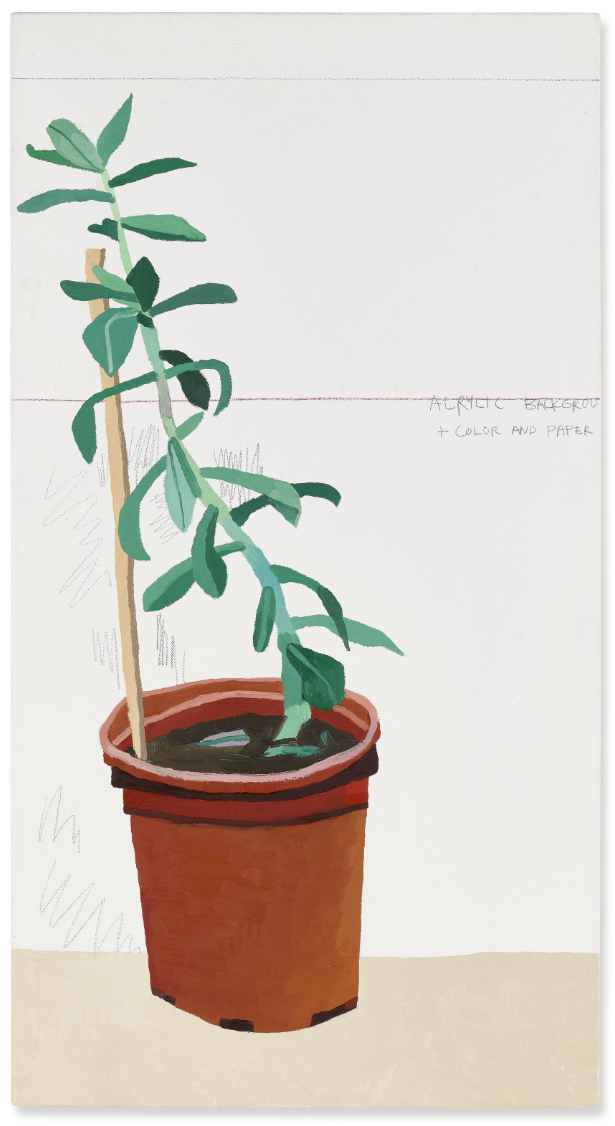
JONAS WOOD (B. 1977)
Studio Plant, 2007
Oil and colored pencil on canvas
28 1/4 x 15 1/4 inches (71.8 x 38.7 cm)
Signed with the artist’s initials, titled and dated ‘JBRW 07 STUDIO PLANT’ (on the reverse)
#8. Ptolemy and Robot, 2013
Sotheby’s New-York: 21 November 2024
Estimated: USD 120,000 – 180,000
USD 156,000
Ptolemy and Robot | Contemporary Day Auction | 2024 | Sotheby’s
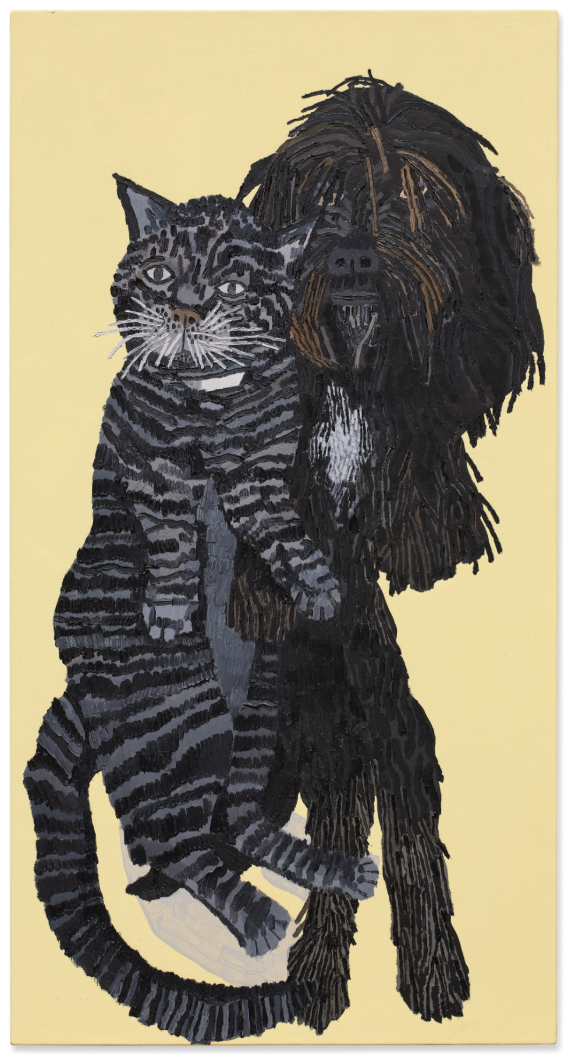
JONAS WOOD (b. 1977)
Ptolemy and Robot, 2013
Oil and acrylic on linen
35 x 18 1/2 inches (88.9 x 47 cm)
signed, titled and dated 2013 (on the reverse)
#9. Paul Gibson, 2008
Sotheby’s New-York: 21 November 2024
Estimated: USD 80,000 – 120,000
USD 132,000
Paul Gibson | Contemporary Day Auction | 2024 | Sotheby’s
REPEAT SALE
Phillips Hong-Kong: 7 June 2021
Estimated: HKD 1,000,000 – 2,000,000
HKD 1,134,000 / USD 146,149
Jonas Wood – 20th Century & Contempora… Lot 191 June 2021 | Phillips
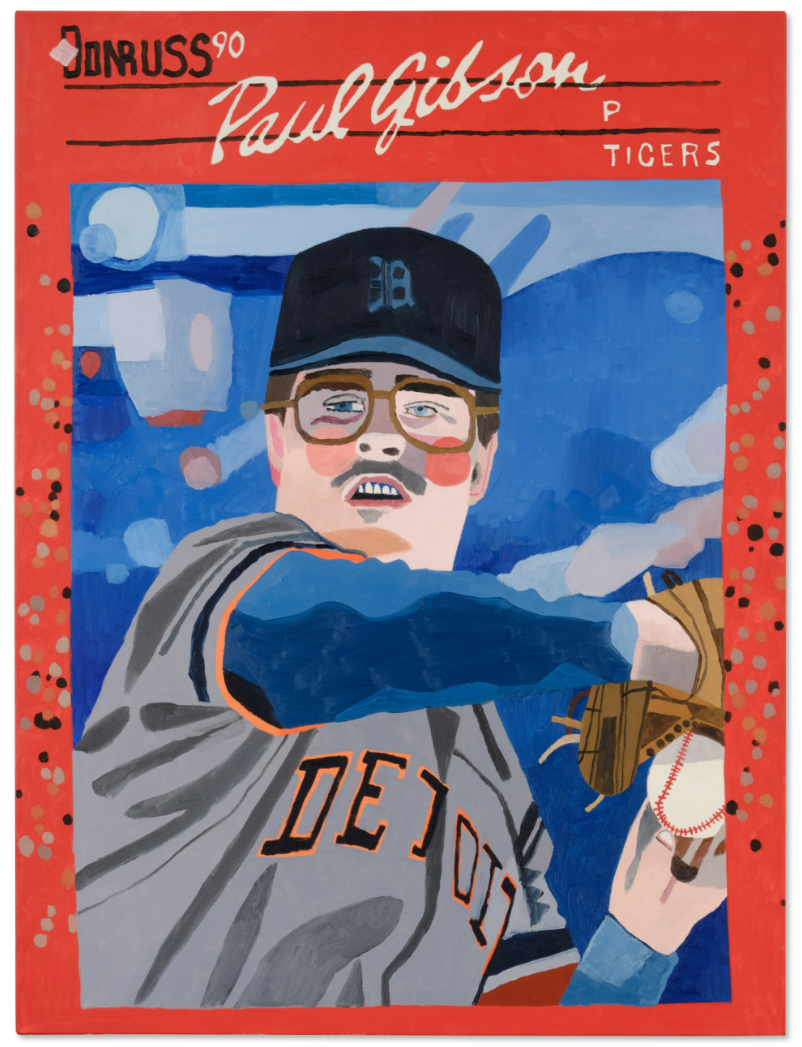
JONAS WOOD (b. 1977)
Paul Gibson, 2008
Oil on canvas
40×30 inches (101.6 x 76.2 cm)
Signed twice, titled and dated 2008 (on the reverse)
#10. Floating Orange Ball, 2014
Christie’s New-York: 22 November 2022
Estimated: USD 60,000 – 80,000
USD 126,000
JONAS WOOD (B. 1977), Floating Orange Ball | Christie’s
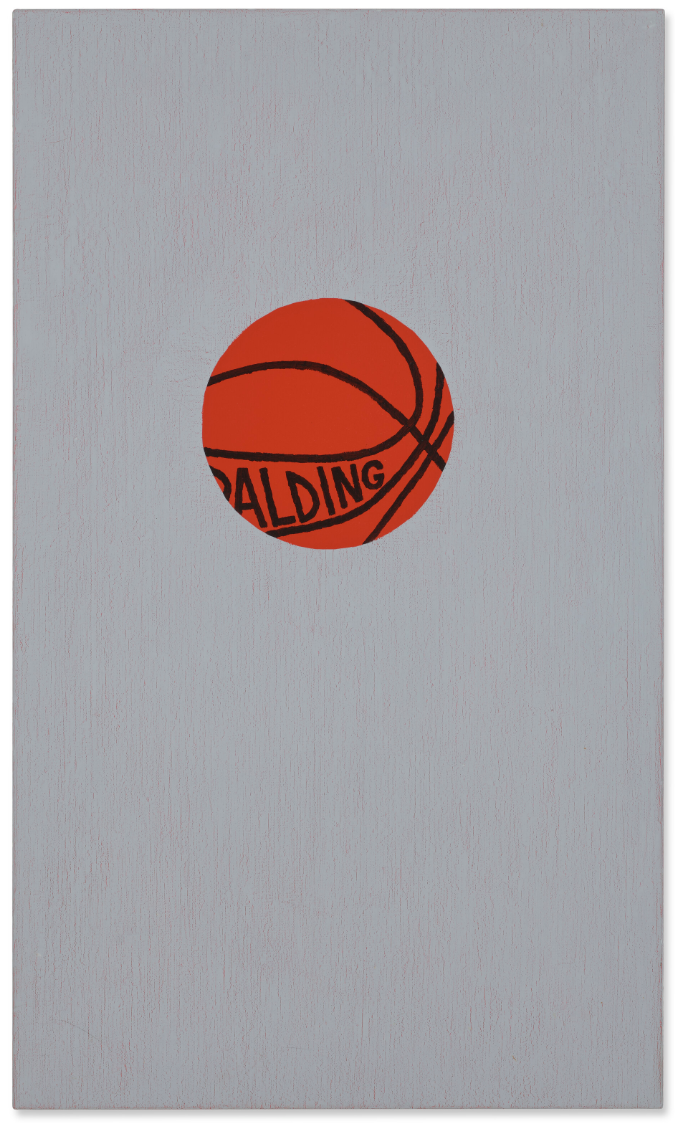
JONAS WOOD (B. 1977)
Floating Orange Ball, 2014
Oil and acrylic on linen
44×26 inches (111.8 x 66 cm)
Signed with the artist’s initials, titled and dated ‘FLOATING ORANGE BALL JBRW 2014’ (on the reverse)
Lots Passed
Untitled (Silver Leaves), 2010
Christie’s London: 27 June 2024
Estimated: GBP 50,000 – 70,000
PASSED
https://www.christies.com/en/lot/lot-6492308
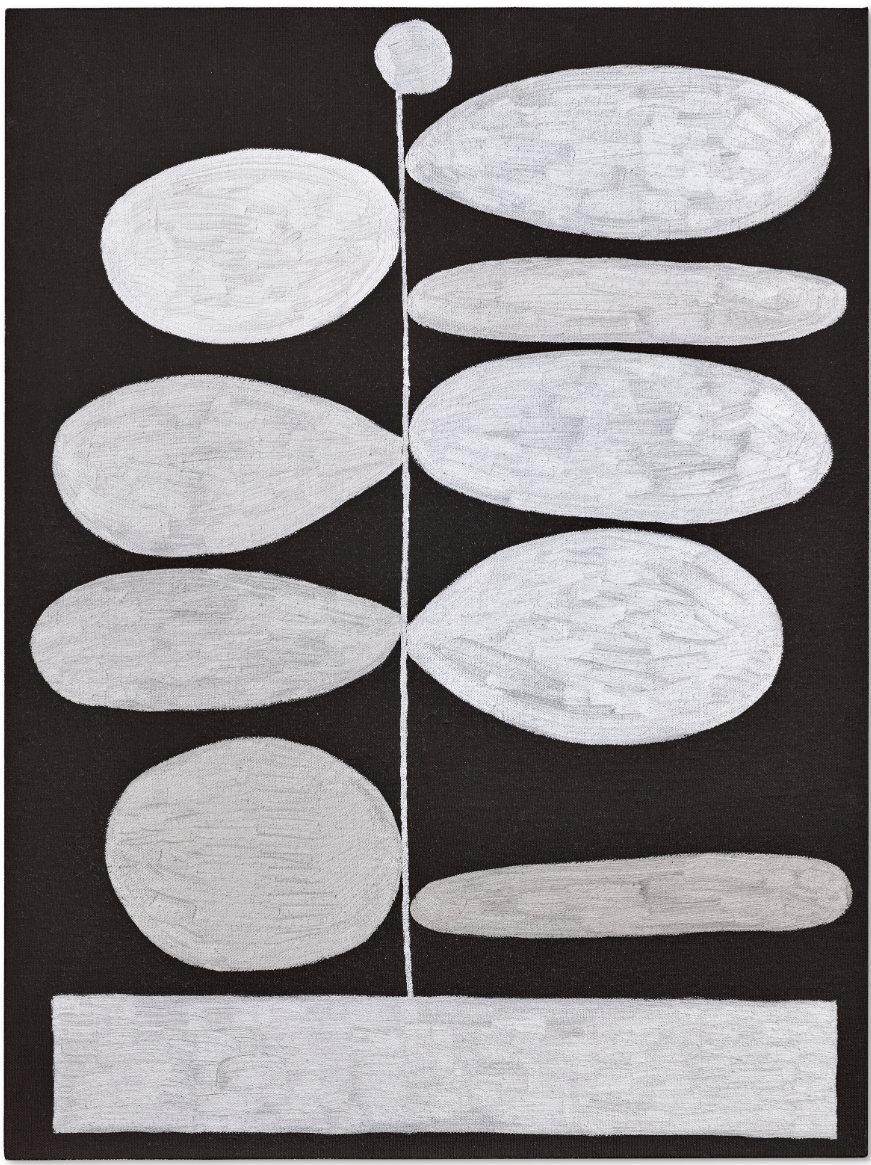
JONAS WOOD (B. 1977)
Untitled (Silver Leaves), 2010
Oil and acrylic on linen
24×18 inches (61 x 45.8 cm)
Signed with the artist’s initials, titled and dated ‘JBRW 2010 UNTITLED (SILVER LEAVES)’ (on the reverse)
Untitled (Raffi), 2006
Sotheby’s New-York: 1 March 2024
Estimated: USD 400,000 – 600,000
PASSED
Untitled (Raffi) | Contemporary Curated | 2024 | Sotheby’s (sothebys.com)
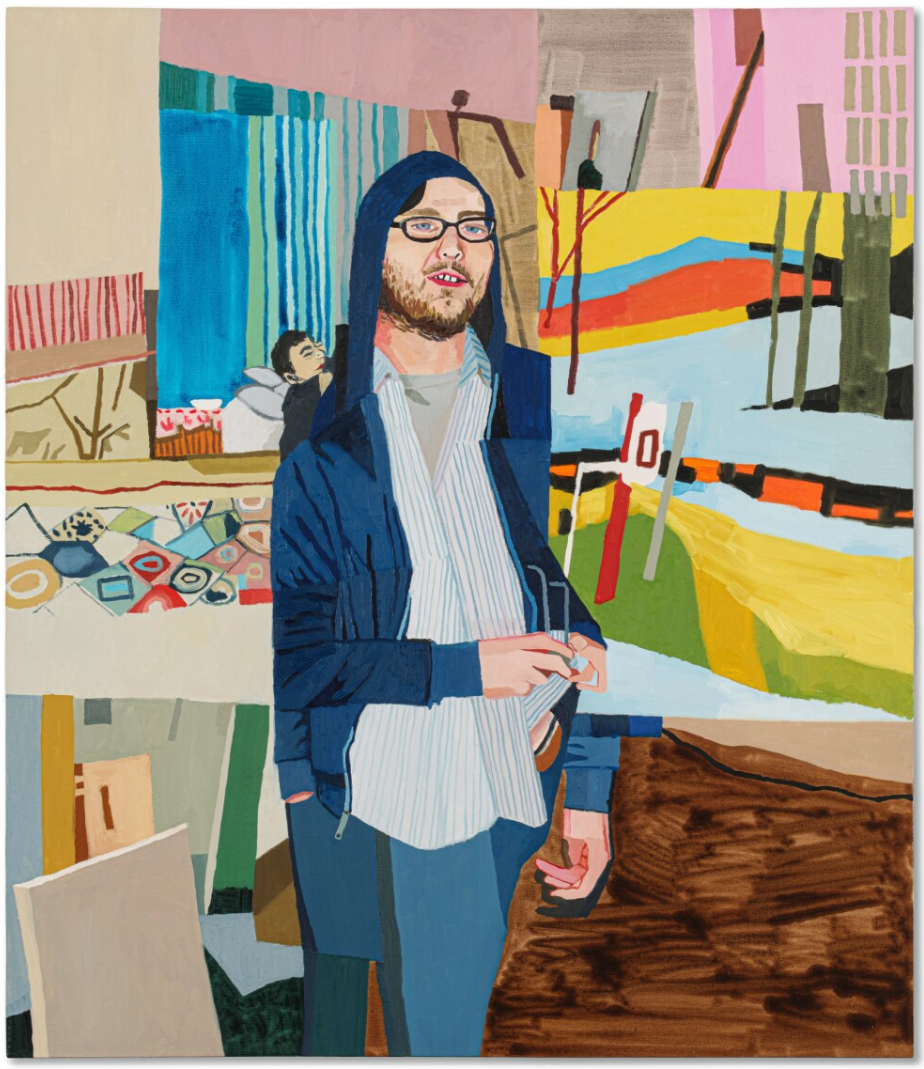
JONAS WOOD (b. 1977)
Untitled (Raffi), 2006
Oil on canvas
52×44 inches (132.1 x 113.9 cm)
Signed with the initials JBRW, titled and dated 2006 (on the overlap)
2023 Auction Results
FOR PAINTINGS ONLY
10 lots sold at auction in 2023 for a total turnover of USD 15,594,839. With only 1 lot failing to sell, the sell-through rate is 91%. The highest price in 2023 was achieved at Sotheby’s in New-York on 15 November 2023, when Interior with Fireplace dated 2012 sold for USD 4,295,000.
2023 Top 3 Lots
5 lots sold over USD 1 million for a cumulative turnover of USD 14,092,099 representing 90.4% of the total turnover for 2023.
XXXXXXXXXX
#1. Interior with Fireplace, 2012
Sotheby’s New-York: 15 November 2023
Estimated: USD 2,000,000 – 3,000,000
USD 4,295,000
Interior with Fireplace | The Now Evening Auction | 2023 | Sotheby’s (sothebys.com)
JONAS WOOD (b. 1977)
Interior with Fireplace, 2012
Oil and acrylic on canvas
102 x 92 1/4 inches (259.1 x 234.3 cm)
Initialed, titled and dated 2012 (on the reverse)
#2. Red Pot with White Blouse, 2018
Sotheby’s New-York: 18 May 2023
Estimated: USD 2,500,000 – 3,500,000
USD 3,690,000
Red Pot with White Blouse | The Now Evening Auction | 2023 | Sotheby’s (sothebys.com)
JONAS WOOD (b. 1977)
Red Pot with White Blouse, 2018
Oil and acrylic on canvas
72×70 inches (182.9 x 177.8 cm)
Initialed, titled and dated 2018 (on the reverse)
#3. M.S.F. Fish Pot #7, 2016
Christie’s Hong-Kong: 28 May 2023
Estimated: HKD 12,500,000 – 18,500,000
HKD 17,920,000 / USD 2,287,698
JONAS WOOD (B. 1977)
M.S.F. Fish Pot #7, 2016
Oil and acrylic on canvas
72×72 inches (182.8 x 182.8 cm)
Signed with the artist’s initials, titled and dated ‘JBRW 2016 M.S.F. FISH POT #7’ (on the reverse)
#4. M.S.F. Fish Pot #4, 2014
Sotheby’s Hong-Kong: 5 October 2023
Estimated: HKD 9,500,000 – 14,000,000
HKD 15,575,000 / USD 1,989,490
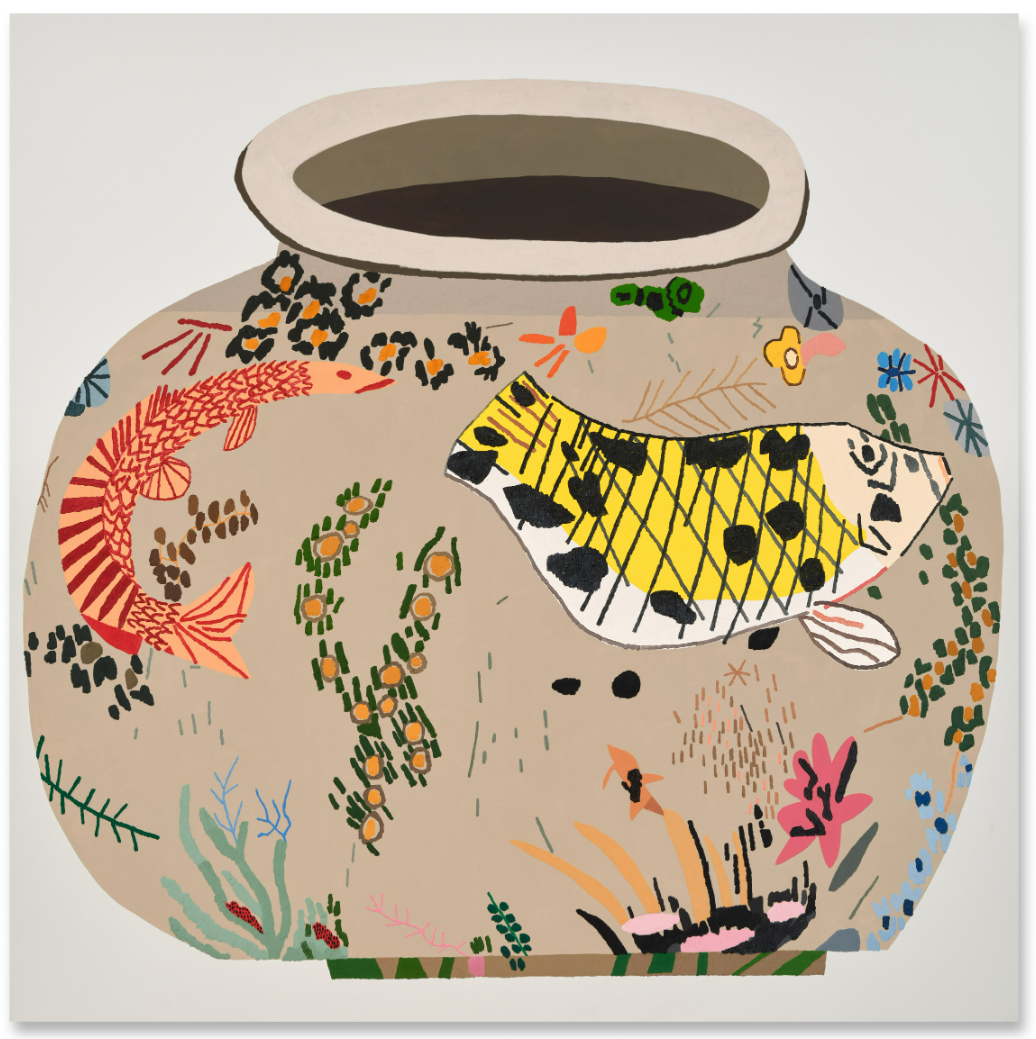
JONAS WOOD (b. 1977)
M.S.F. Fish Pot #4, 2014
Oil and acrylic on canvas
65×65 inches (165.1 x 165.1 cm)
Titled and signed on the reverse
#5. Calais Drive 2, 2012
Sotheby’s Hong-Kong: 5 April 2023
Estimated: HKD 12,000,000 – 20,000,000
HKD 14,365,000 / USD 1,829,960
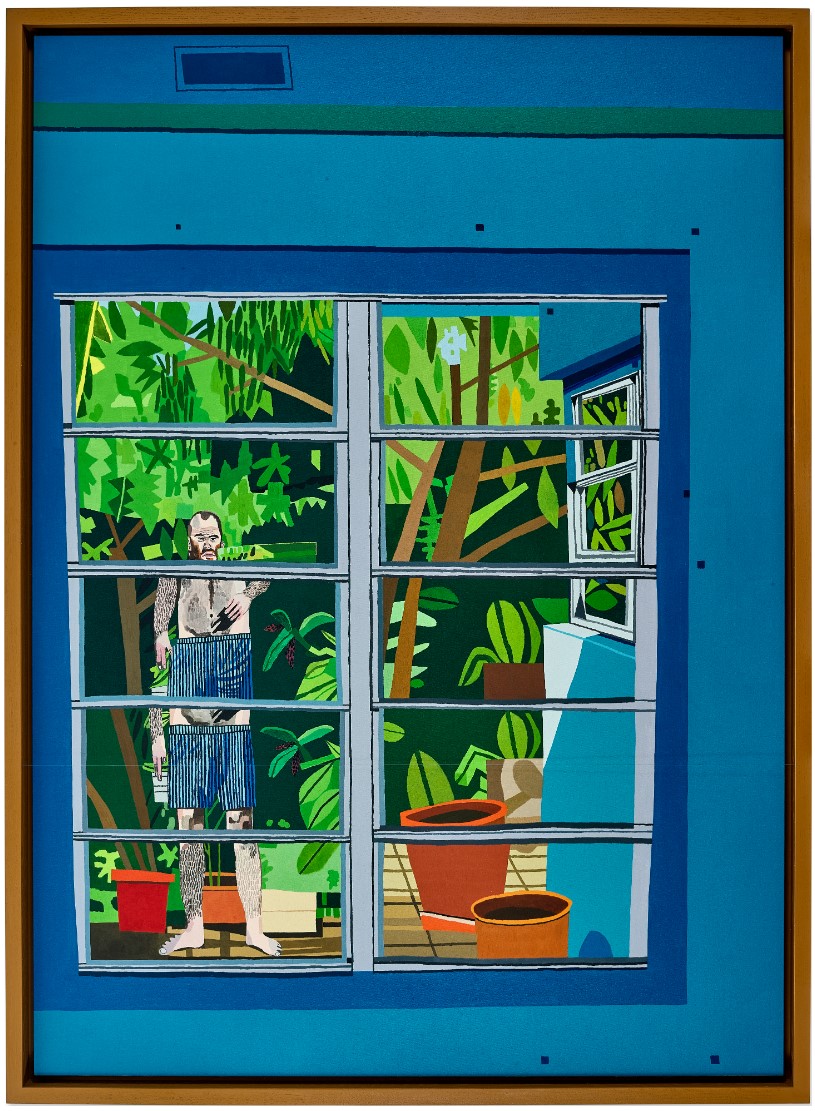
JONAS WOOD (b. 1977)
Calais Drive 2, 2012
Oil and acrylic on canvas
100×72 inches (254×183 cm)
Signed, titled and dated 2012 on the reverse
#6. Untitled (Take 2), 2009
Sotheby’s London: 1 March 2023
Estimated: GBP 350,000 – 450,000
GBP 609,600 / USD 733,660
Untitled (Take 2) | The Now Evening Auction | | Sotheby’s (sothebys.com)
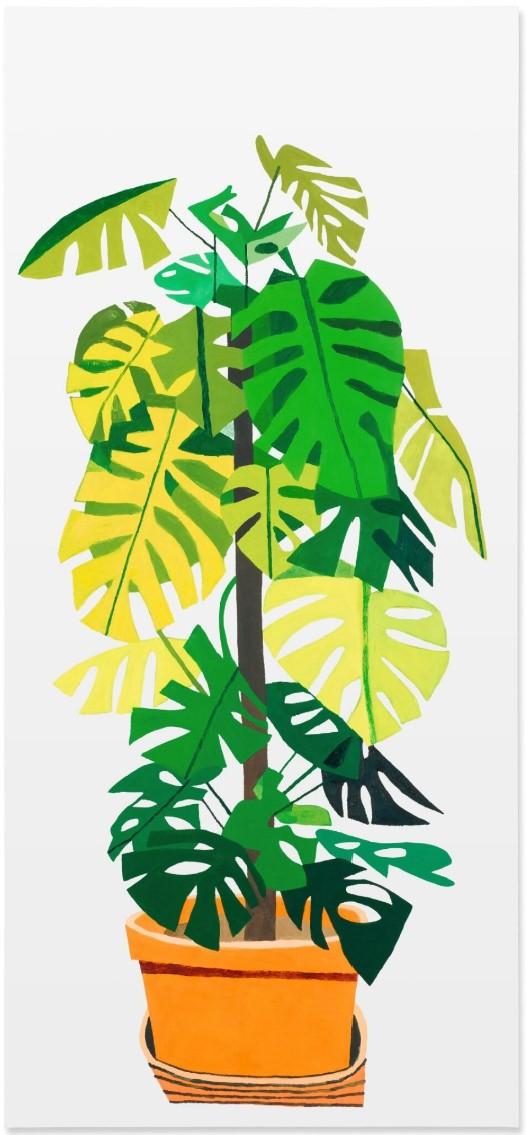
JONAS WOOD (b. 1977)
Untitled (Take 2), 2009
Oil on canvas
213×97 cm (83 7/8 x 38 1/4 inches)
Signed JBRW, titled Untitled (Take 2) and dated 2009 (on the reverse)
#7. GG HK NPP #1, 2017
Christie’s New-York: 12 May 2023
Estimated: USD 450,000 – 650,000
USD 478,800
JONAS WOOD (B. 1977) (christies.com)
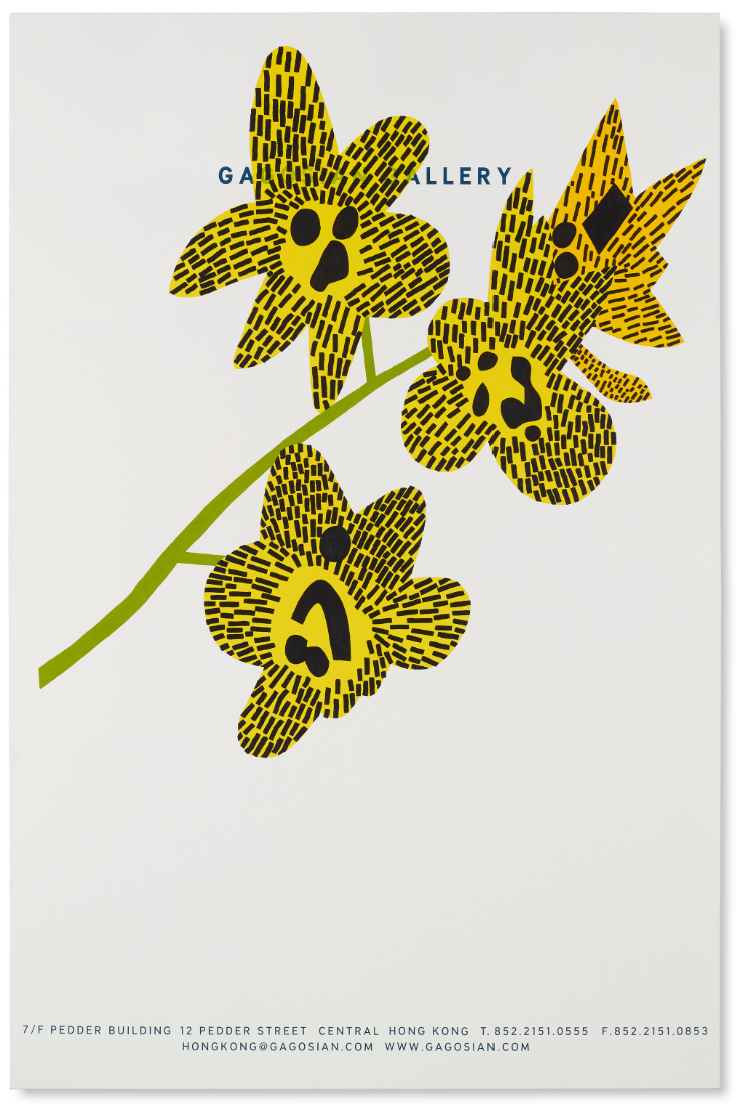
JONAS WOOD (B. 1977)
GG HK NPP #1, 2017
Oil and screenprint on canvas
93×61 inches (236.2 x 155 cm)
Signed twice with the artist’s initials, titled and dated twice ‘JBRW 2017 GG HK NPP #1 JBRW 2017’ (on the overlap)
#8. Untitled (3 Shio Pots), 2010
Sotheby’s New-York: 13 October 2023
Estimated: GBP 100,000 – 150,000
GBP 107,950 / USD 131,518
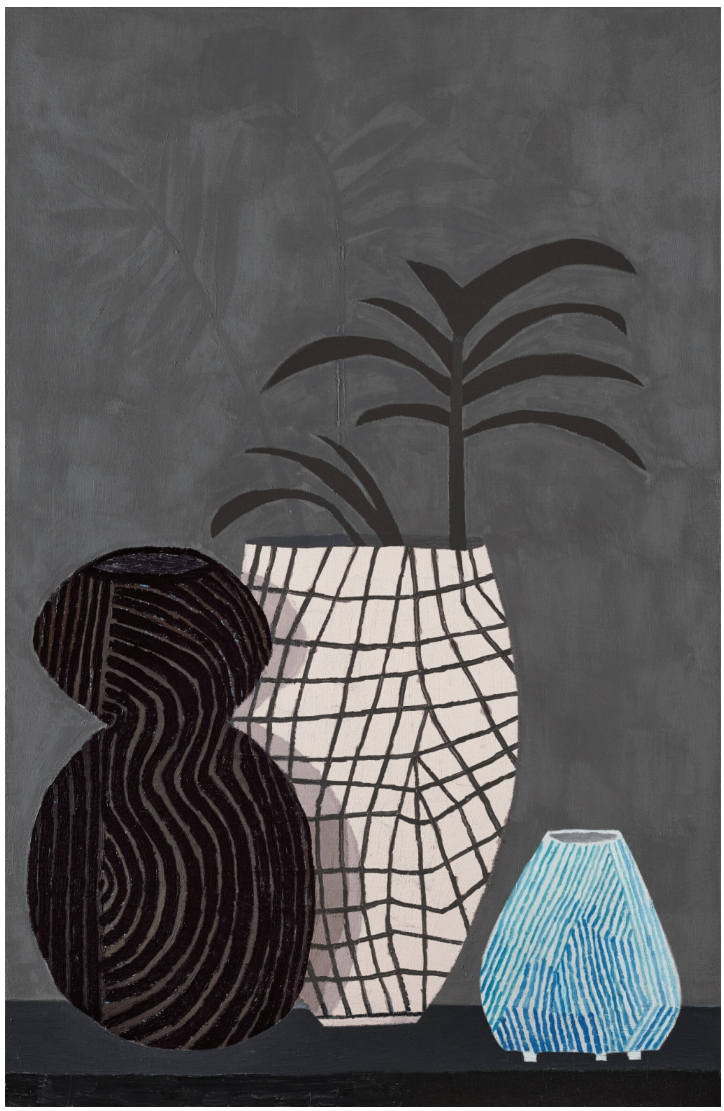
JONAS WOOD (b. 1977)
Untitled (3 Shio Pots), 2010
Oil on canvas
34 1/8 x 22 1/4 inches (86.6 x 56.4 cm)
Signed with the artist’s initials, titled and dated 2010 (on the reverse)
#9. Baby Blue, 2009
Christie’s New-York: 29 September 2023
Estimated: USD 100,000 – 150,000
USD 126,000
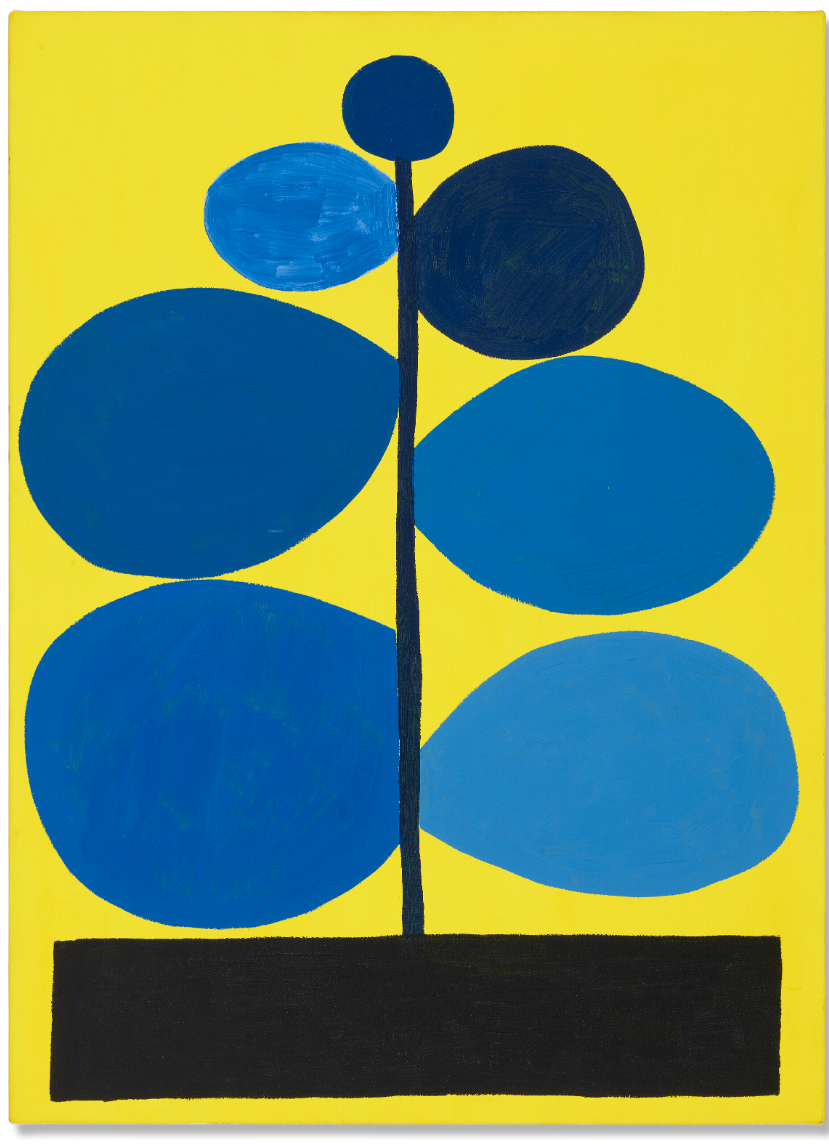
JONAS WOOD (B. 1977)
Baby Blue, 2009
Oil on canvas
30×22 inches (76.2 x 55.9 cm)
Signed, titled and dated ‘Jonas Wood 2009 BABY BLUE’ (on the reverse)
#10. NB2, 2009
LA Modern: 19 October 2023
Estimated: USD 20,000 – 30,000
USD 32,760
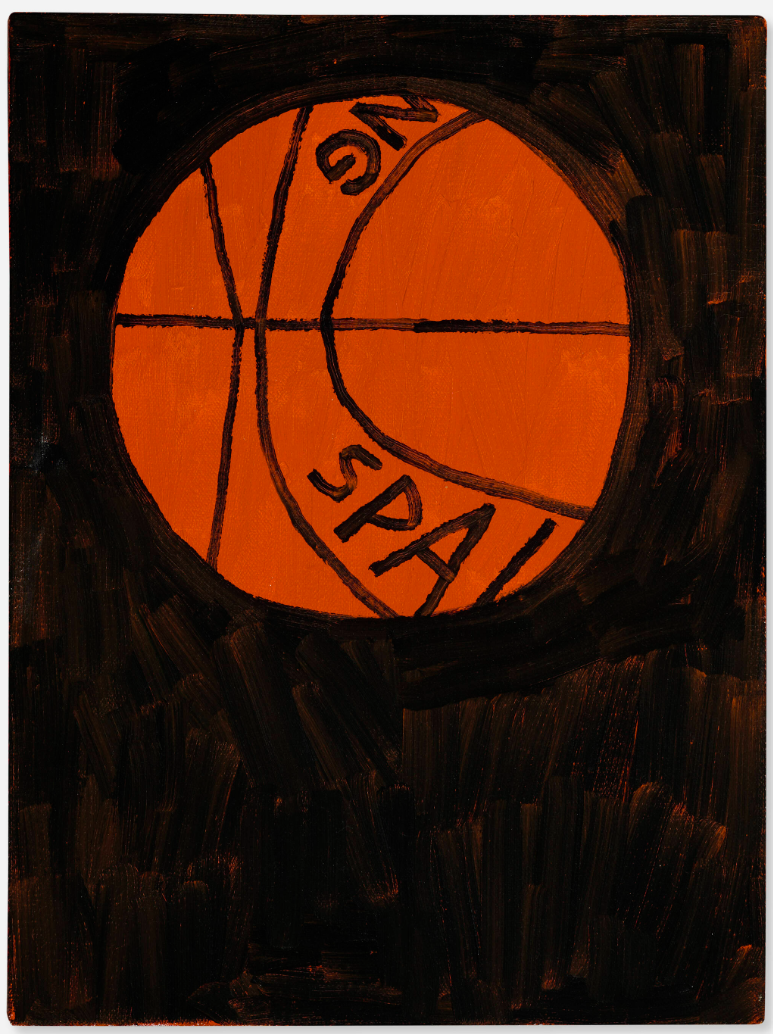
JONAS WOOD (b. 1977)
NB2, 2009
Oil on linen
20×15 inches (51×38 cm)
Signed, titled and dated to verso ‘Jonas Wood 2009 NB2’
2022 Auction Results
FOR PAINTINGS ONLY
9 lots sold at auction in 2022 for a total turnover of USD 8,775,995. The highest price paid in 2022 of USD 3,060,000 was achieved at Christie’s in New-York on 10 May 2022 for Green Landscape Pot, a painting dated 2016.
2022 Top 3 Lots
3 lots sold over USD 1 million, generating a cumulative turnover of USD 6,123,000, representing 69.8% of the total turnover of 2022.
XXXXXXXXXXX
#1. Green Garden Landscape Pot, 2016
Christie’s New-York: 10 May 2022
Estimated: USD 2,500,000 – 3,500,000
USD 3,060,000
JONAS WOOD (B. 1977) (christies.com)
JONAS WOOD (B. 1977)
Green Garden Landscape Pot, 2016
Oil and acrylic on canvas
118×93 inches (299.7 x 236.2 cm)
Signed with the artist’s initials and dated ‘JBRW 2016’ (lower edge)
Signed again with the artist’s initials
Titled and dated again ‘JBRW 2016 GREEN GARDEN LANDSCAPE POT’ (on the reverse)
#2. Clipping A3, 2013
Sotheby’s New-York: 11 March 2022
Estimated: USD 1,200,000 – 1,800,000
USD 1,623,000
Clipping A3 | Contemporary Curated | | Sotheby’s (sothebys.com)
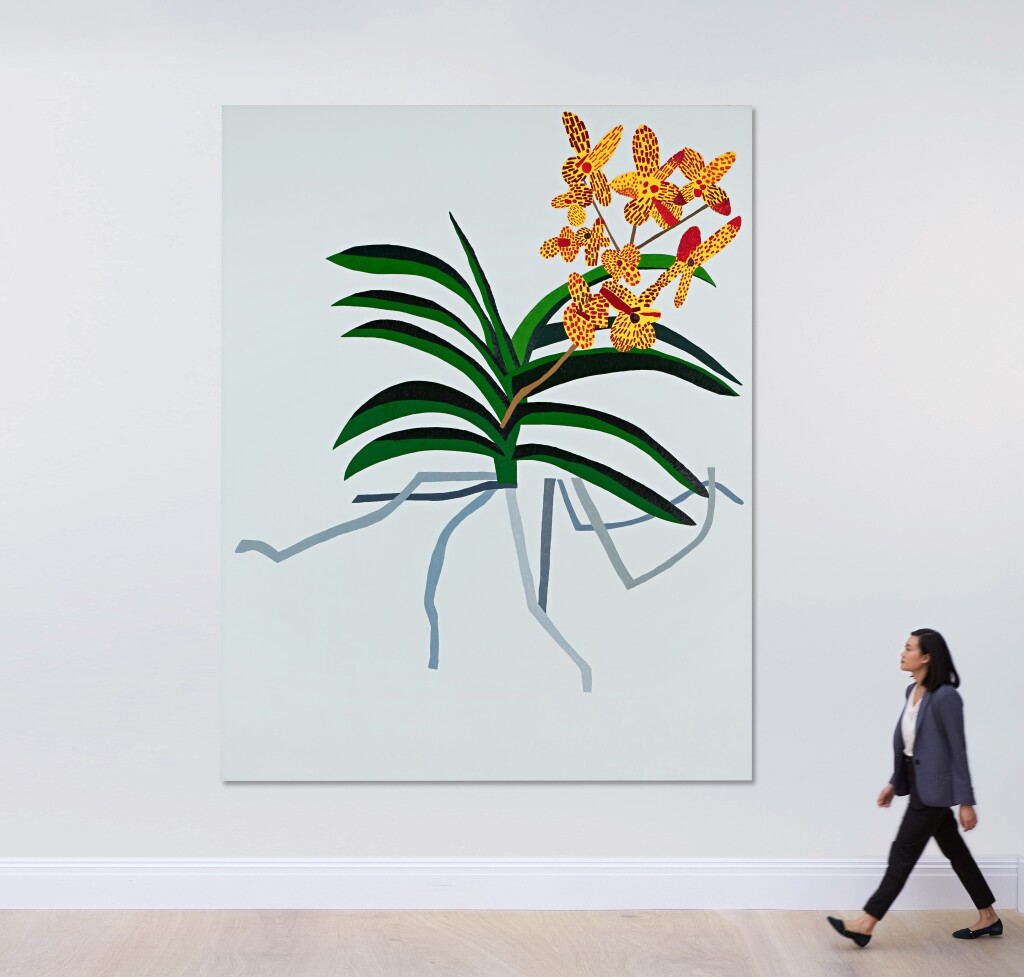
JONAS WOOD (b. 1977)
Clipping A3, 2013
Oil and acrylic on canvas
118×93 inches (299.7 x 236.2 cm)
Signed with the initials JBPW, titled CLIPPING A3 and dated 2013 (on the verso)
#3. Jeremy, 2014
Christie’s New-York: 17 November 2022
Estimated: USD 1,000,000 – 1,500,000
USD 1,440,000
JONAS WOOD (B. 1977) (christies.com)
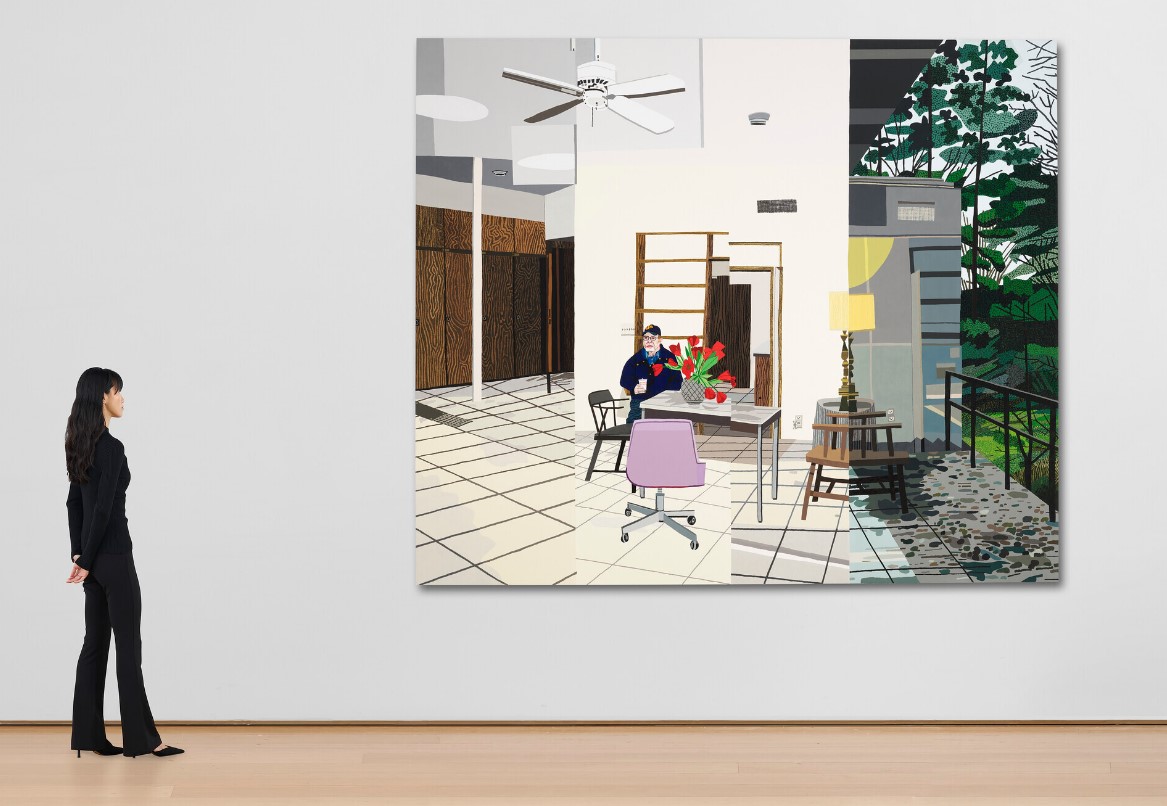
JONAS WOOD (B. 1977)
Jeremy, 2014
Oil and acrylic on canvas
112×132 inches (284.5 x 335.3 cm)
Signed with the artist’s initials, titled and dated ‘JEREMY JBRW 2014’ (on the reverse)
USD 1 million
#4. Clipping A2, 2013
Sotheby’s New-York: 16 November 2022
Estimated: USD 500,000 – 700,000
USD 756,000
Clipping A2 | The Now Evening Auction | | Sotheby’s (sothebys.com)
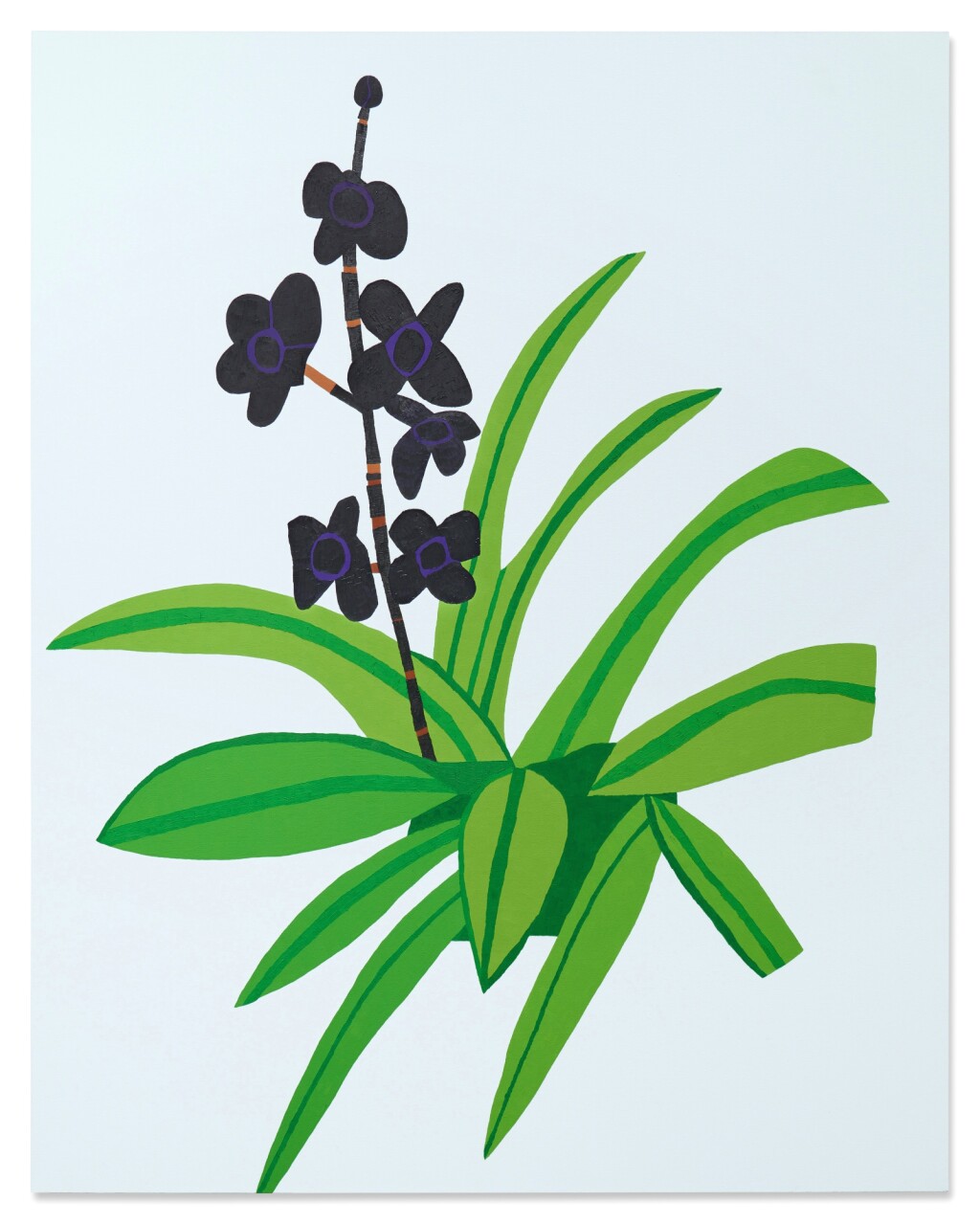
JONAS WOOD (b. 1977)
Clipping A2, 2013
Oil and acrylic on canvas
118×93 inches (299.7 x 236.2 cm)
Initialed JBRW, titled Clipping A2 and dated 2013 (on the reverse)
#5. Wood Grain Pot with Night Bloom, 2015
Sotheby’s London: 14 October 2022
Estimated: GBP 800,000 – 1,200,000
GBP 642,600 / USD 720,405
Wood Grain Pot with Night Bloom | The Now Evening Auction | 2022 | Sotheby’s (sothebys.com)
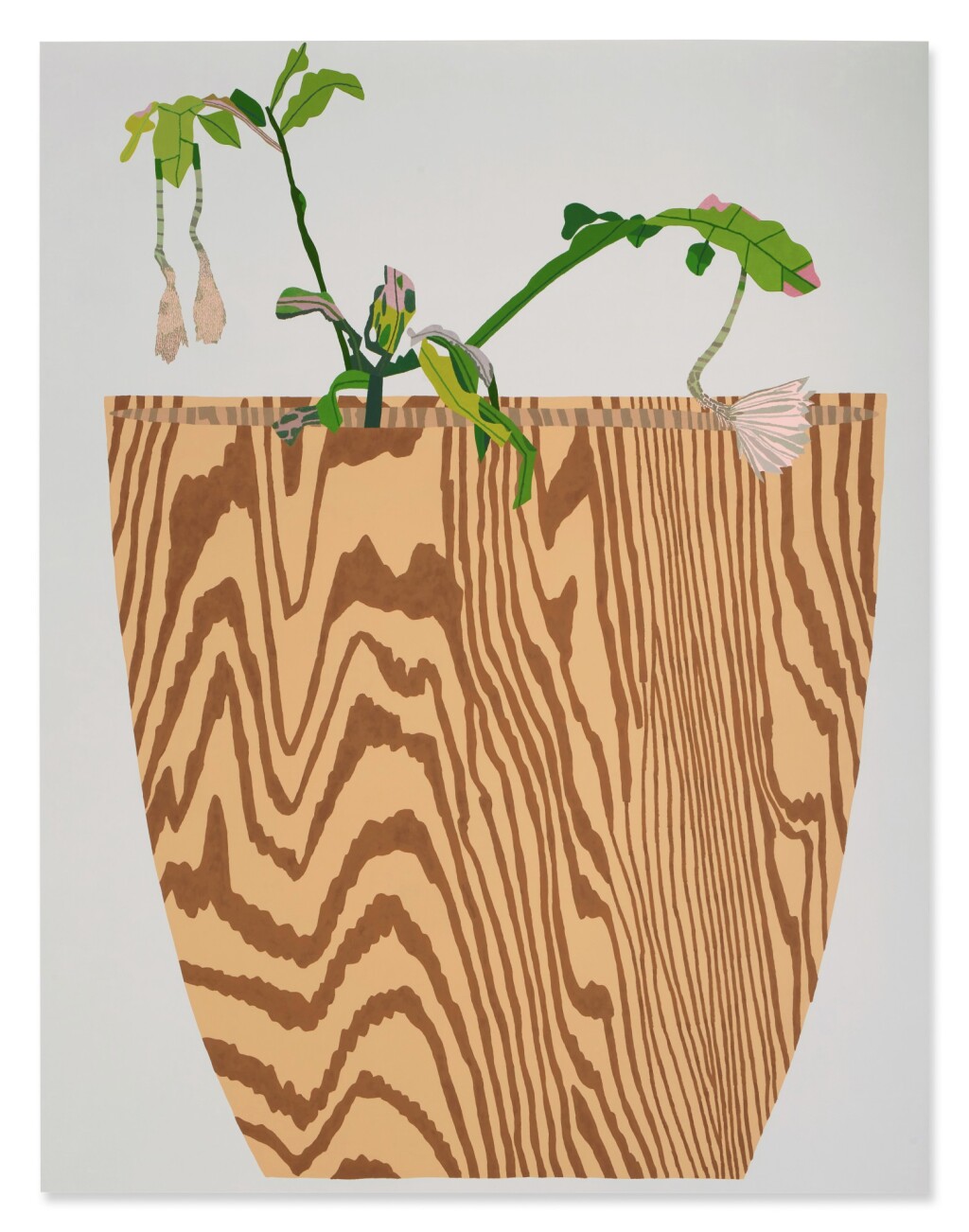
JONAS WOOD (b. 1977)
Wood Grain Pot with Night Bloom, 2015
Oil and acrylic on canvas
118×90 inches (299.7 x 228.6 cm)
Signed JBPW, titled Wood Grain Pot with Night Bloom and dated 2015 (on the reverse)
#6. Shio Still Life in Black and White, 2011
Sotheby’s New-York: 20 May 2022
Estimated: USD 500,000 – 700,000
USD 567,000
Shio Still Life in Black and White | Contemporary Day Auction | 2022 | Sotheby’s (sothebys.com)
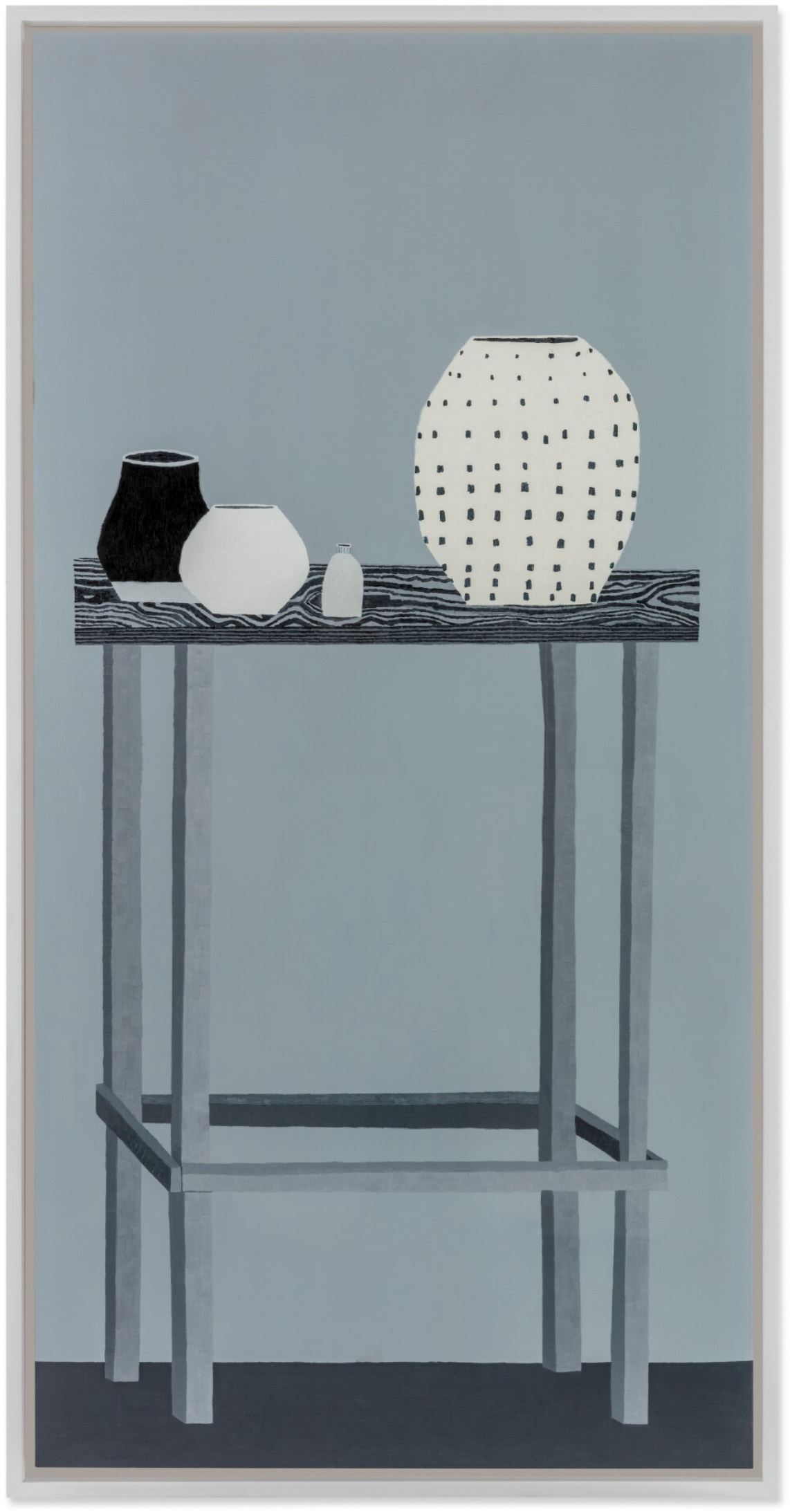
JONAS WOOD (b. 1977)
Shio Still Life in Black and White, 2011
Acrylic on canvas
96×42 inches (243.8 x 106.7 cm)
Signed, titled twice and dated 2011 (on the reverse)
#7. Robot Living Stone, 2021
Christie’s New-York: 22 September 2022
Estimated: USD 100,000 – 150,000
USD 239,400
JONAS WOOD (B. 1977) (christies.com)
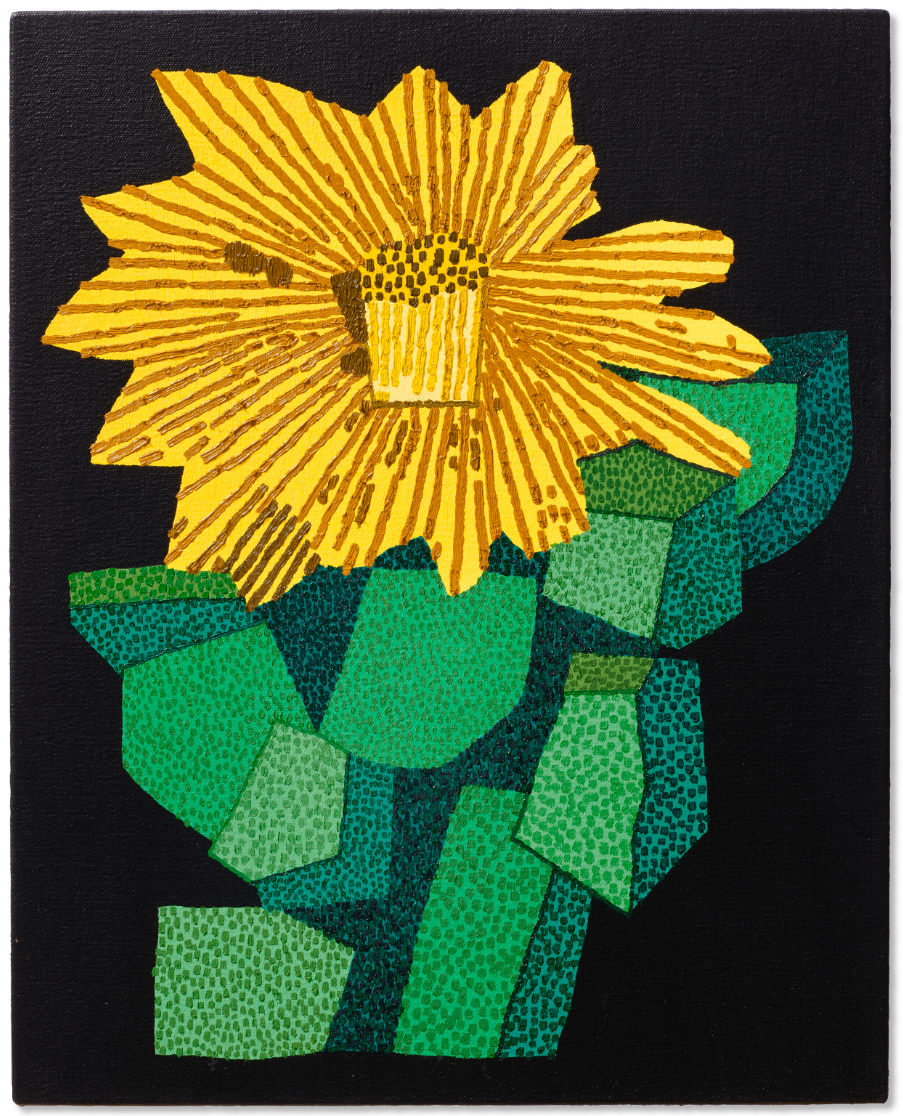
JONAS WOOD (B. 1977)
Robot Living Stone, 2021
Oil and acrylic on canvas
20 x 16 1/8 inches (50.8 x 41 cm)
Signed with the artist’s initials, titled and dated ‘ROBOT LIVING STONE JBRW 2021’ (on the reverse)
#8. Anthony Davis, 2012
Sotheby’s Hong-Kong: 28 April 2022
Estimated: HKD 1,200,000 – 2,200,000
HKD 1,638,000 / USD 209,760
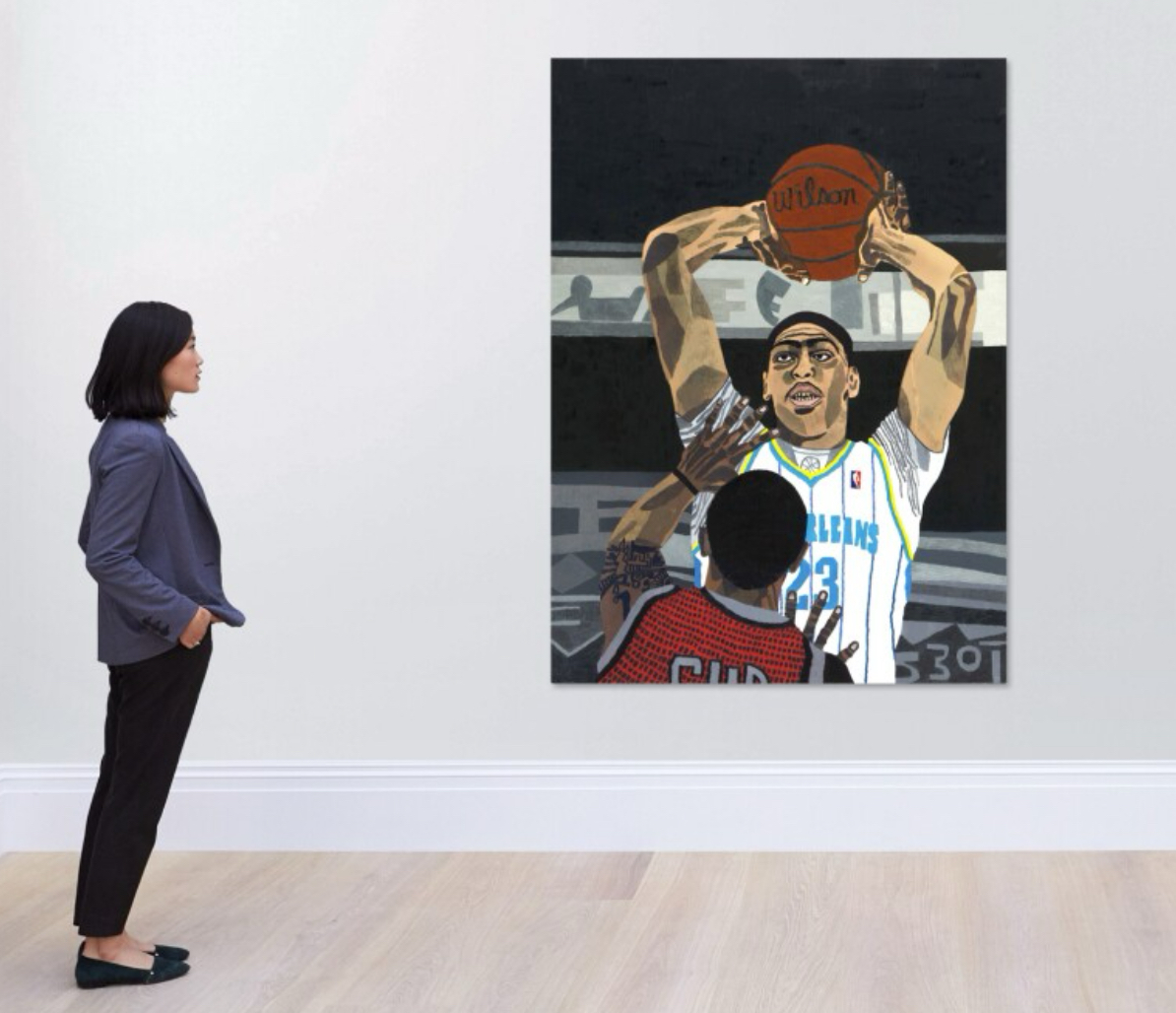
JONAS WOOD (b. 1977)
Anthony Davis, 2012
Oil and acrylic on linen
58×42 inches (147.3 x 106.7 cm)
Signed, titled and dated 2012 on the reverse
#9. Chico, 2008
Phillips Hong-Kong: 30 November 2022
Estimated: HKD 900,000 – 1,200,000
HKD 1,260,000 / USD 161,435
Jonas Wood – 20th Century & Contem… Lot 120 November 2022 | Phillips
JONAS WOOD
Chico, 2008
Oil on linen
48×48 inches (121.9 x 121.9 cm)
Signed with the artist’s initials, titled and dated ‘”CHICO” JBRW 2008’ on the reverse
2021 Auction Results
FOR PAINTINGS ONLY
13 lots sold at auction in 2021 for a total turnover of USD 16,676,857. With only 1 lot failing to sell, the sell-through rate is 93%. A new auction record was set for Jonas Wood on 11 May 2021 at Christie’s in New-York, when Two Tables with Floral Pattern, a painting dated 2013 sold for USD 6,510,000.
2021 Top 3 Lots
4 lots sold over USD 1 million for a cumulative turnover of USD 14,104,565, representing 84.6% of the total turnover for 2021.
XXXXXXXXXXX
#1. Two Tables with Floral Pattern, 2013
Christie’s New-York: 11 May 2021
Estimated: USD 2,000,000 – 4,000,000
USD 6,510,000
JONAS WOOD (B. 1977) (christies.com)
JONAS WOOD (B. 1977)
Two Tables with Floral Pattern, 2013
Oil and acrylic on canvas
100×93 inches (254 x 236.2 cm)
Signed with the artist’s initials, titled and dated ‘TWO TABLES WITH FLORAL PATTERN JBRW 2013’ (on the reverse)
#2. Yellow Still Life with Grating, 2016
Christie’s Hong-Kong: 1 December 2021
Estimated: HKD 12,000,000 – 18,000,000
HKD 36,250,000 / USD 4,652,565
JONAS WOOD (B. 1977) (christies.com)
JONAS WOOD (B. 1977)
Yellow Still Life with Grating, 2016
Oil and acrylic on canvas
60×68 inches (152.4 x 172.7 cm)
Signed, titled, and dated ‘YELLOW STILL LIFE WITH GRATING GRATING JBPW 2016’ (on the reverse)
#3. Clipping D2, 2013
Sotheby’s New-York: 18 November 2021
Estimated: USD 800,000 – 1,200,000
USD 1,472,000
Clipping D2 | The Now Evening Auction | | Sotheby’s (sothebys.com)
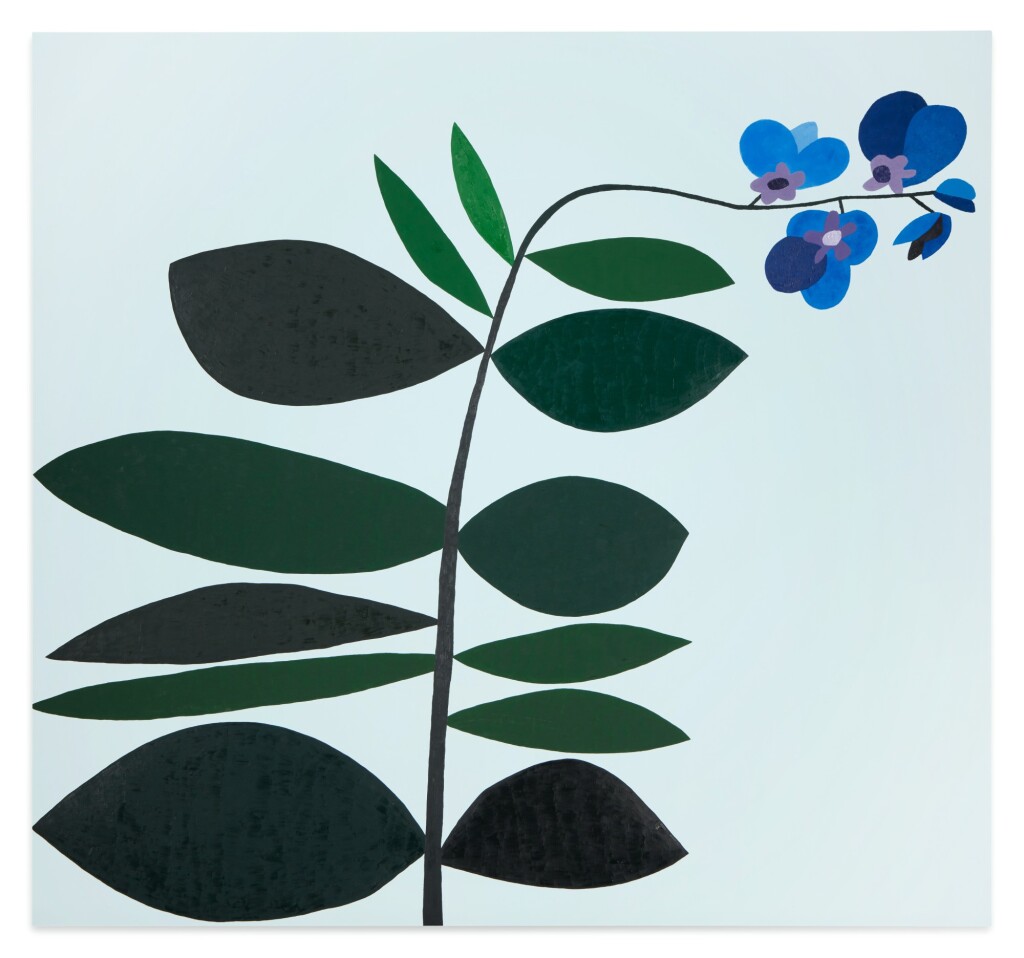
JONAS WOOD (b. 1977)
Clipping D2, 2013
Oil and acrylic on canvas
93 1/8 x 100 1/8 inches (236.5 x 254.3 cm)
Signed JBPW, titled and dated 2013 (on the reverse)
#4. Clipping F1, 2013
Christie’s New-York: 14 May 2021
Estimated: USD 500,000 – 700,000
USD 1,470,000
JONAS WOOD (B. 1977) (christies.com)
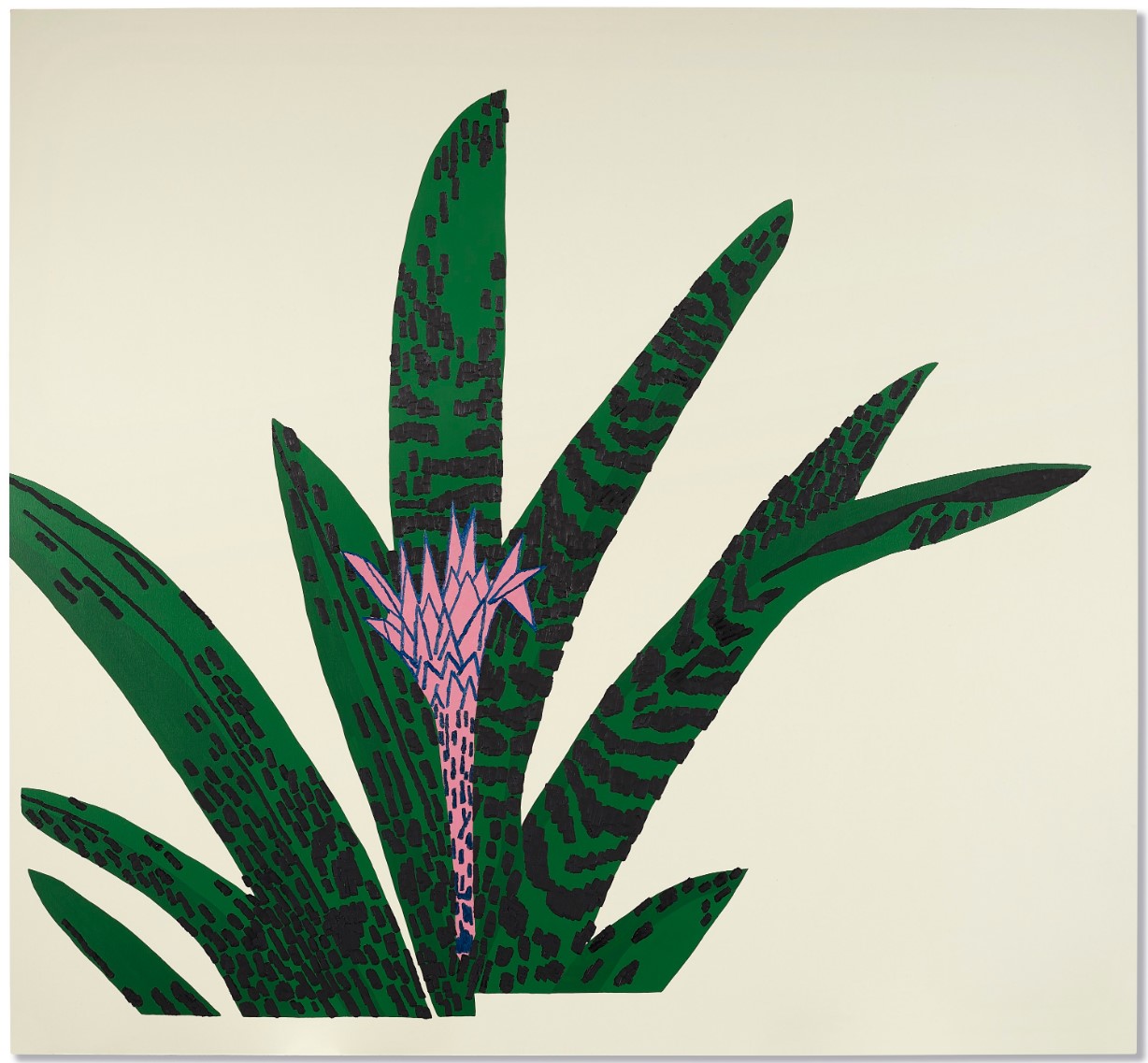
JONAS WOOD (B. 1977)
Clipping F1, 2013
Oil and acrylic on canvas
93 x 100 1/8 inches (236.2 x 254.3 cm)
Signed with the artist’s initials, titled and dated ‘CLIPPING F1 JBRW 2013’ (on the reverse)
#5. Mini Purple Bball Orchid, 2021
Christie’s New-York: 12 November 2021
Estimated: USD 200,000 – 300,000
USD 870,000
JONAS WOOD (B. 1977) (christies.com)
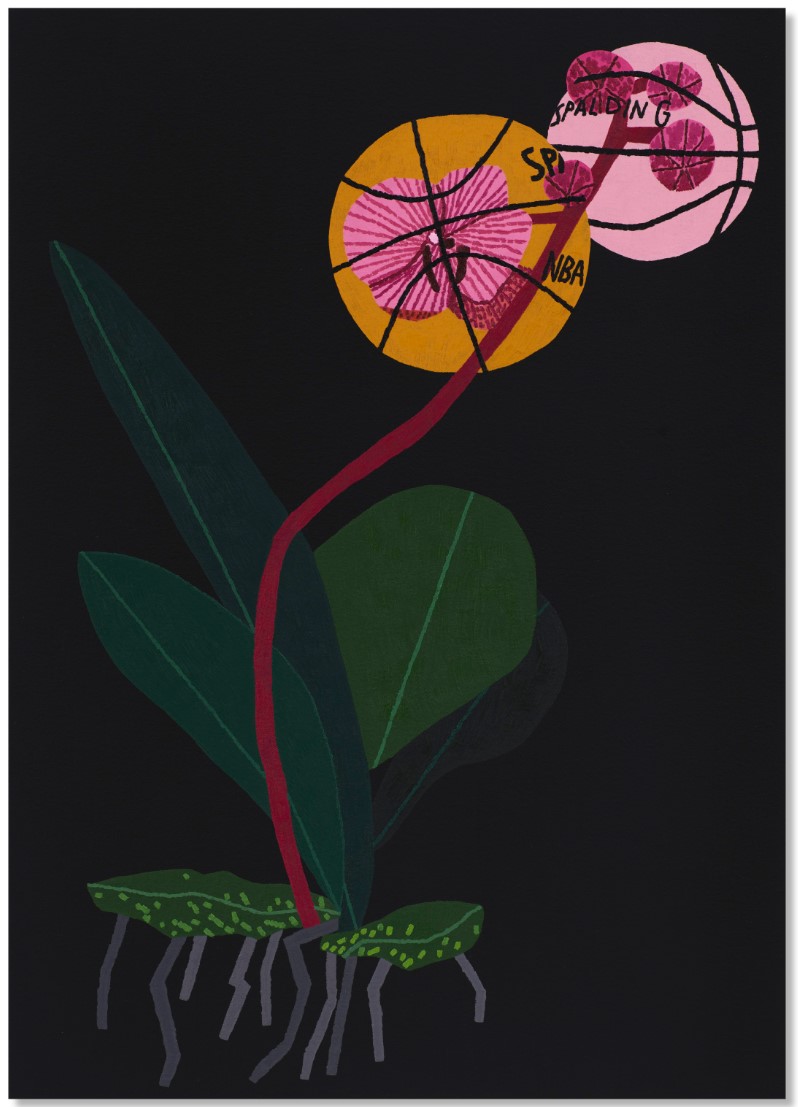
JONAS WOOD (B. 1977)
Mini Purple Bball Orchid, 2021
Oil and acrylic on canvas
28×20 inches (71.1 x 50.8 cm)
Signed with the artist’s initials, titled and dated ‘MINI PURPLE B BALL ORCHID JBRW 2021’
(on the reverse)
#6. Yellow Crate, 2006
Phillips London: 9 December 2021
Estimated: GBP 150,000 – 200,000
GBP 327,600 / USD 432,075
Jonas Wood – New Now London Lot 17 December 2021 | Phillips
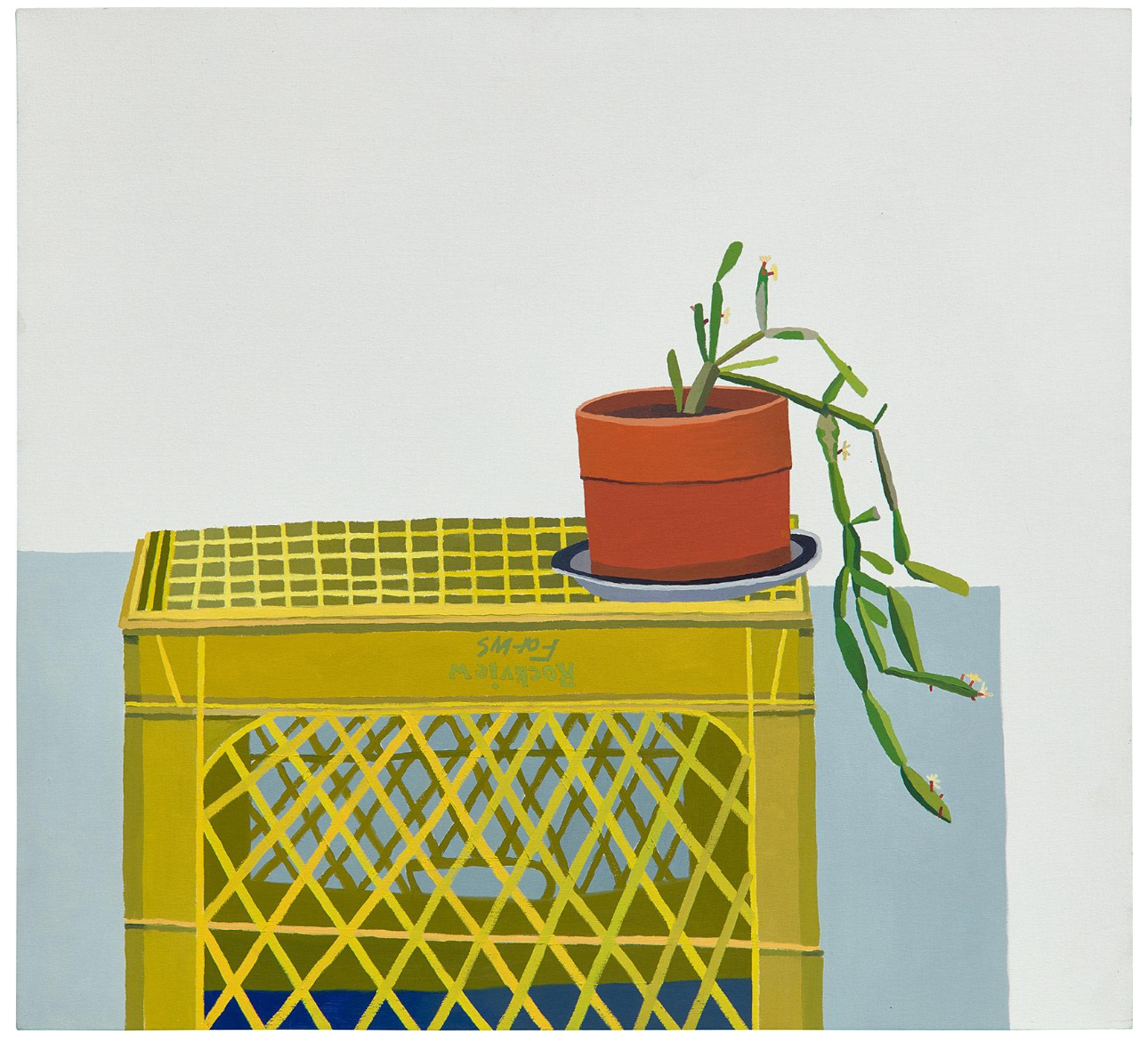
JONAS WOOD
Yellow Crate, 2006
Oil on canvas
32 1/2 x 36 1/2 inches (82.6 x 92.7 cm)
Signed with the artist’s initials and dated ‘JBRW 2006’ on the overlap
#7. Untitled (Blue with Triangles), 2009
Sotheby’s Hong-Kong: 10 October 2021
Estimated: USD 1,500,000 – 2,500,000
HKD 3,150,000 / USD 404,650
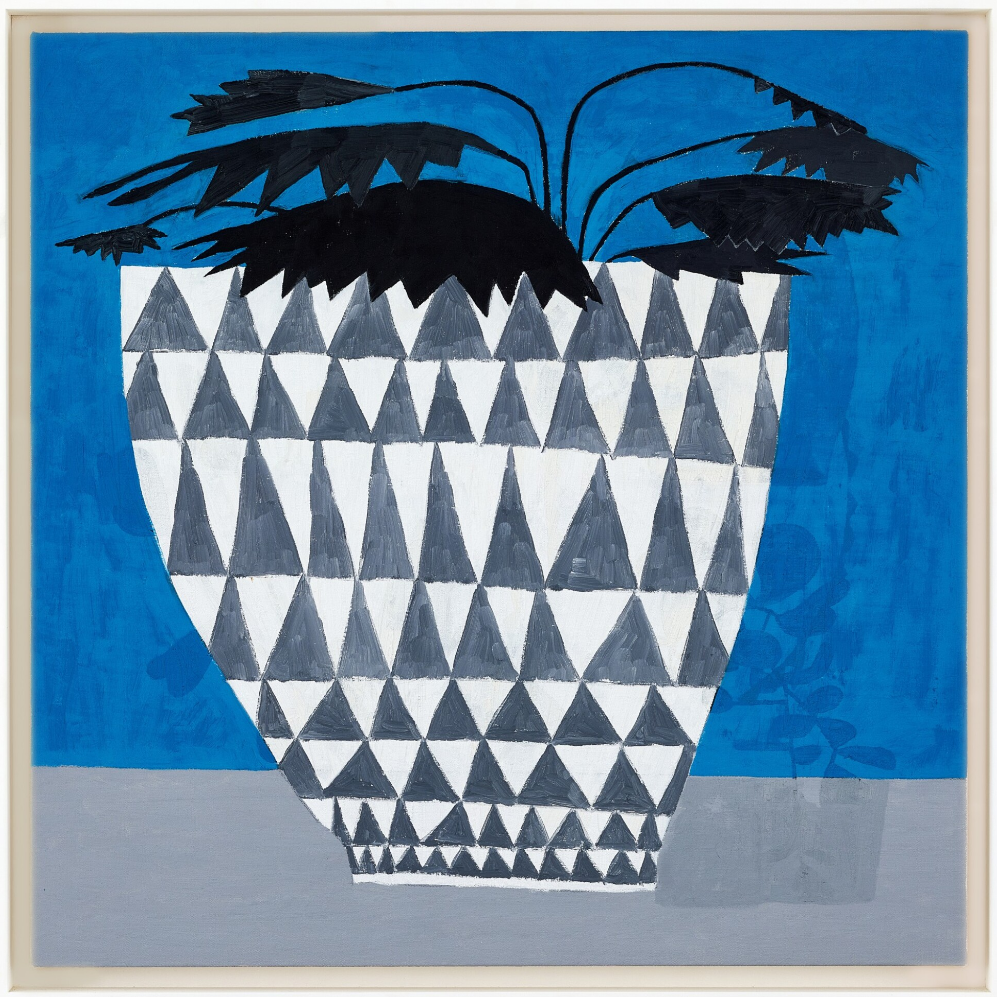
JONAS WOOD
Untitled (Blue with Triangles), 2009
Oil on canvas
32×32 inches (81.4 x 81.4 cm)
Signed, titled and dated 2009 on the reverse
#8. Couch Pattern, 2012
Christie’s New-York: 12 November 2021
Estimated: USD 120,000 – 180,000
USD 275,000
JONAS WOOD (B. 1977) (christies.com)
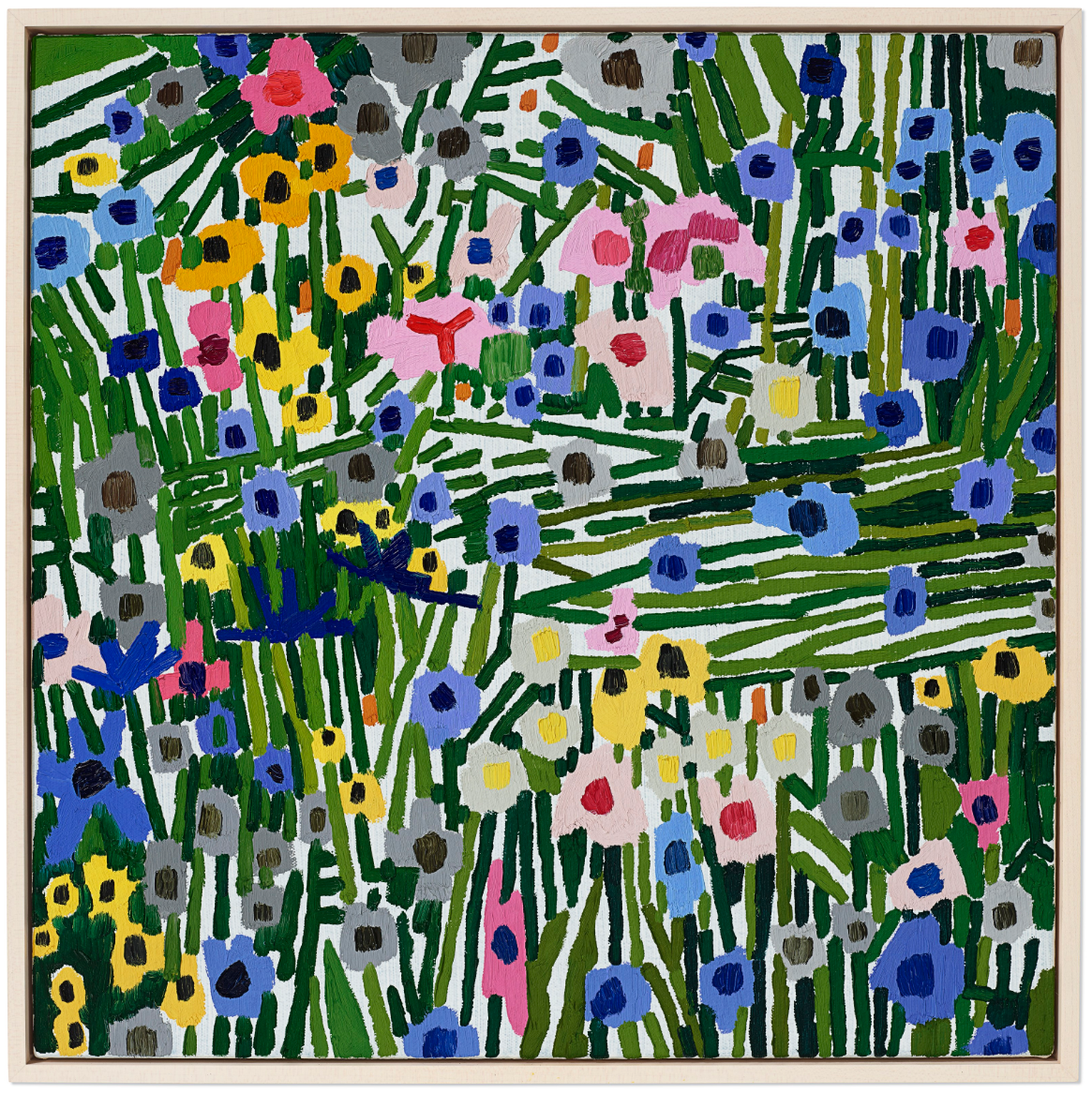
JONAS WOOD (B. 1977)
Couch Pattern, 2012
Oil and acrylic on canvas
18×18 inches (45.7 x 45.7 cm)
Signed with the artist’s initials, titled and dated ‘COUCH PATTERN JBRW 2012’ (on the reverse)
#9. Rosy Pattern, 2012
Christie’s New-York: 12 November 2021
Estimated: USD 100,000 – 150,000
USD 225,000
JONAS WOOD (B. 1977) (christies.com)
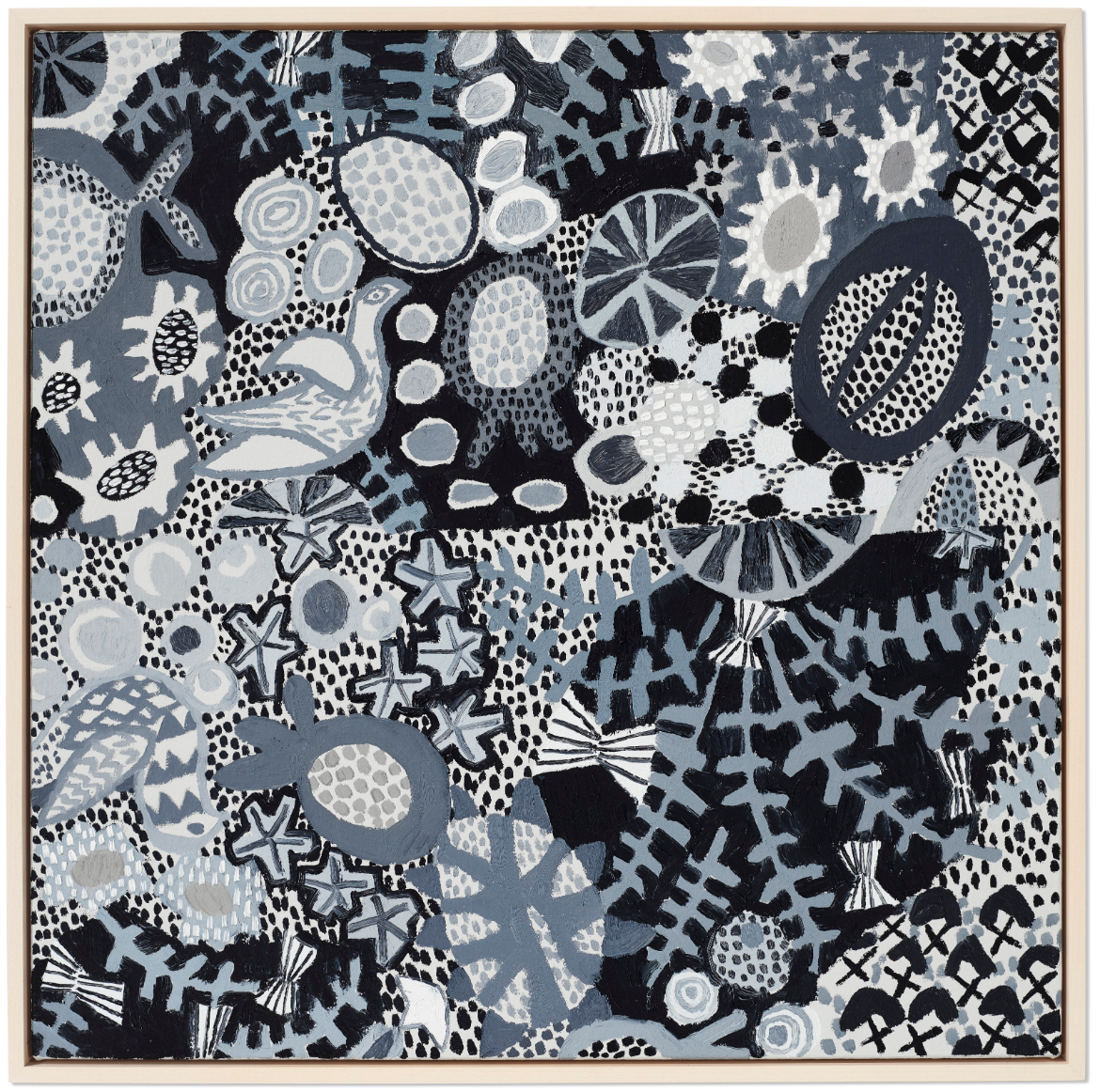
JONAS WOOD (B. 1977)
Rosy Pattern, 2012
Oil and acrylic on canvas
20×20 inches (50.8 x 50.8 cm)
Signed with the artist’s initials, titled and dated ‘ROSY PATTERN JBRW 2012’ (on the reverse)
#10. Manny, 2009
Sotheby’s New-York: 12 March 2021
Estimated: USD 120,000 – 180,000
USD 151,200
Manny | Contemporary Curated | 2021 | Sotheby’s (sothebys.com)
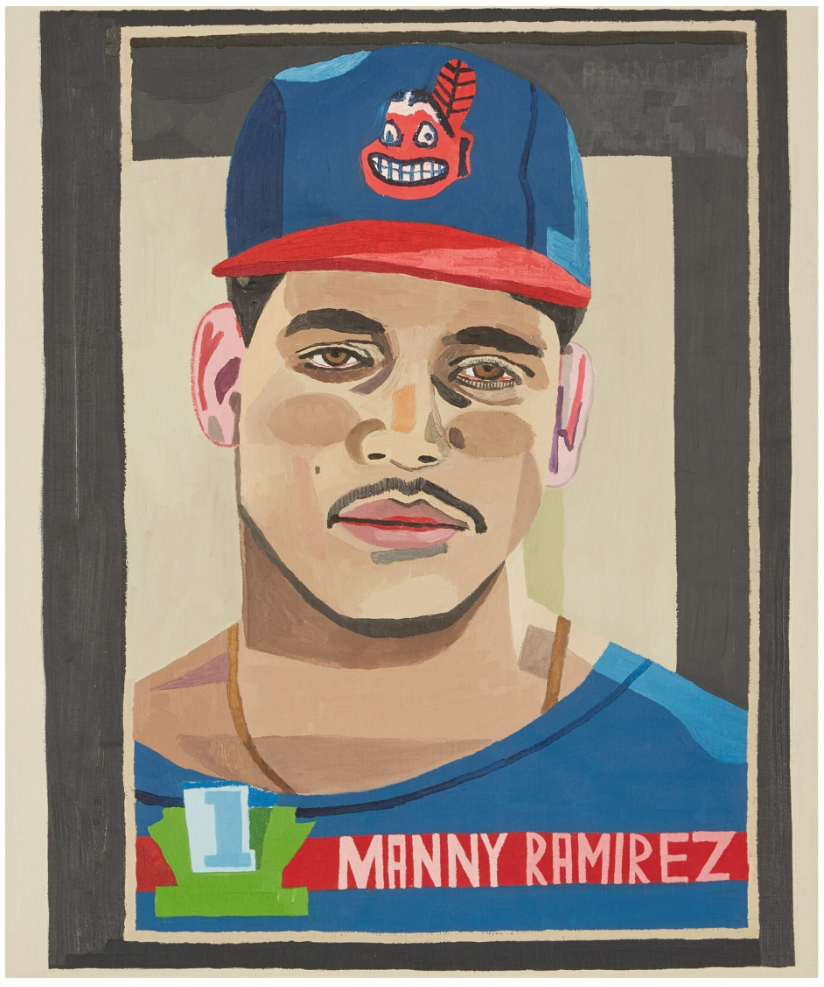
JONAS WOOD (b. 1977)
Manny, 2009
Oil on canvas
24×20 inches (61×51 cm)
Signed and dated 2009 twice and titled on the reverse
#11. Paul Gibson, 2008
Phillips Hong-Kong: 7 June 2021
Estimated: HKD 1,000,000 – 2,000,000
HKD 1,134,000 / USD 146,150
Jonas Wood – 20th Century & Contempora… Lot 191 June 2021 | Phillips
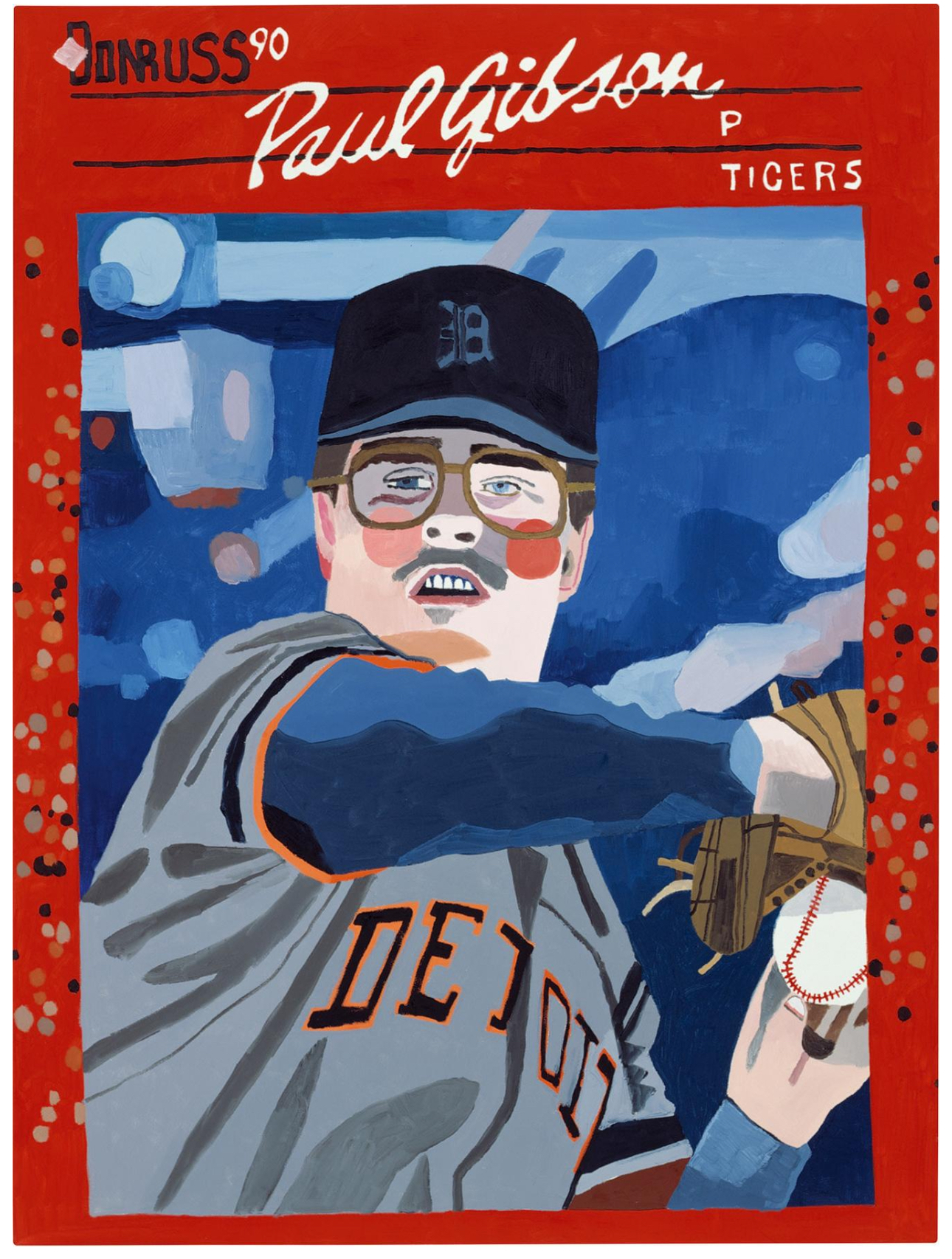
JONAS WOOD
Paul Gibson, 2008
Oil on canvas
40×30 inches (101.6 x 76.2 cm)
Signed, dated and titled ‘JBRW 2008 “PAUL GIBSON” JONAS WOOD’ on the reverse
PART III: FOCUS
Clippings
Clipping J1, 2015
Property from an Ambassadorial Collection
Sotheby’s New-York: 15 May 2026
Estimated: USD 500,000 – 700,000
USD 640,000
Jonas Wood | Clipping J1 | Contemporary Day Auction | 2026 | Sotheby’s
JONAS WOOD (b. 1977)
Clipping J1, 2015
Oil and acrylic on canvas
87-1/2 x 69 inches (222.2 x 175.3 cm)
Signed with the artist’s initials, titled and dated 2015 (on the reverse)
Lusciously unfolding across a monumental canvas, Jonas Wood’s Clipping J1 exemplifies the aesthetic project that has distinguished the artist among his contemporaries. Executed in 2015, the present work belongs to the celebrated Clipping series, where Wood sought to isolate botanical forms from the intimate world of his domestic interiors and granted them a new, monumental autonomy. Geometric, stylized, and arrestingly sharp, Clipping J1 captures the artist’s signature deployment of an array of formal techniques to create viewpoints deliberately at odds with the viewer’s expectations.
“I wanted it to feel like this plant was so much larger than a person that it would sort of engulf the viewer.”
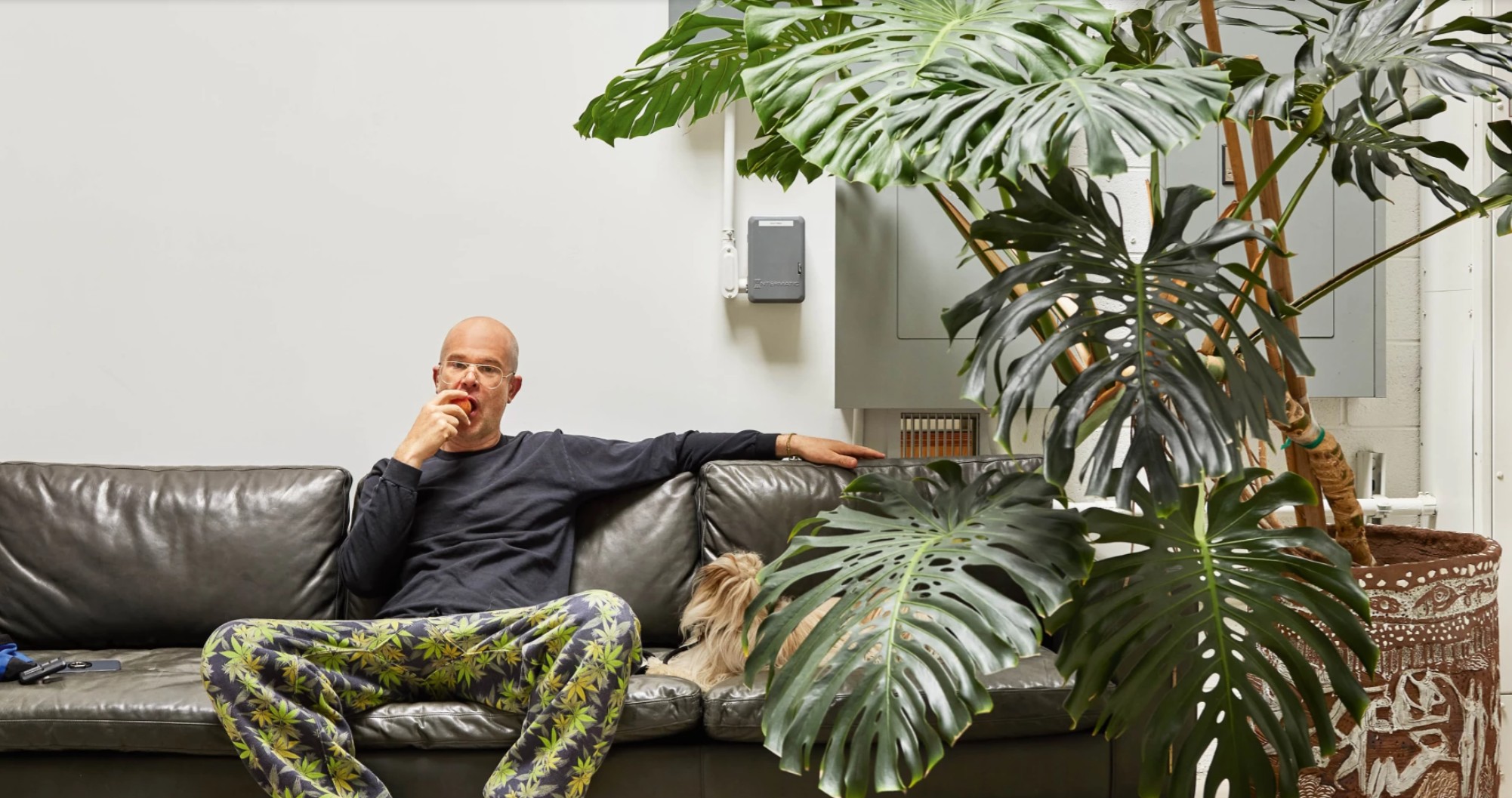
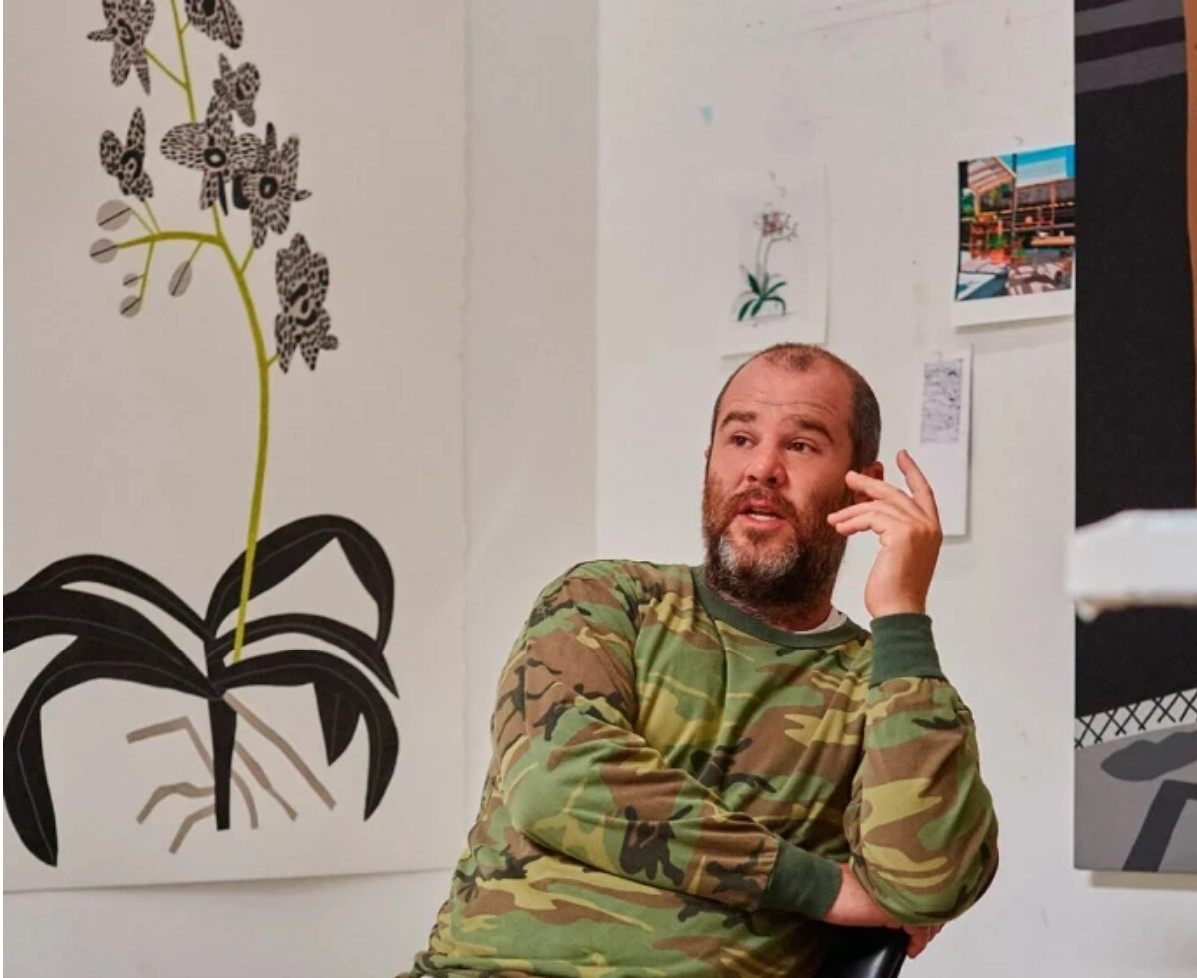
Jonas Wood in his studio, Los Angeles, 2024. Image © Laure Joliet
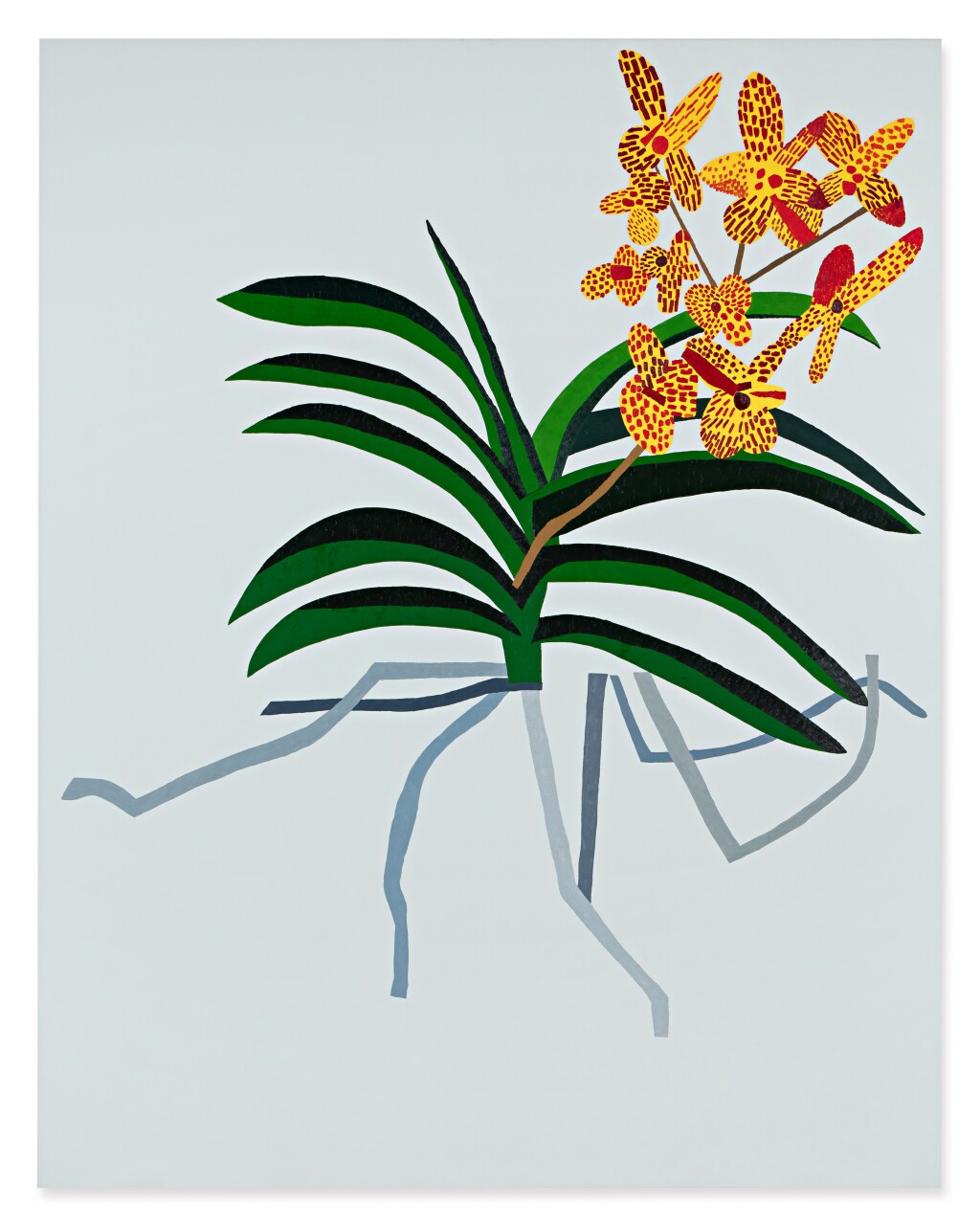
Begun in 2013, the Clippings crystallize Wood’s singular artistic approach. Drawn from the potted plants and foliage that populate his Los Angeles home, the series title alludes both to the act of botanical trimming and to Wood’s own recursive process of excerpting and reworking imagery from his previous paintings. Marked distinctly by their mosaic-like reconfiguration onto immense solid-colored canvas, Wood extracts the plant from its original setting so that it assumes a commanding pictorial presence. In Clipping J1, a vibrant orchid rises against a pale gray ground with extraordinary clarity and poise. Broad green leaves arc across the canvas in sweeping, flattened bands, while the flowers flare outward in vivid yellow, animated by dense vermillion flecks. Wood’s handling is at once spare and exacting. Yet for all its reduction, Clipping J1 never relinquishes its descriptive power. The painting effortlessly oscillates between representation and abstraction, preserving the orchid’s delicacy even as it becomes a bold orchestration of shape, color, and scale.
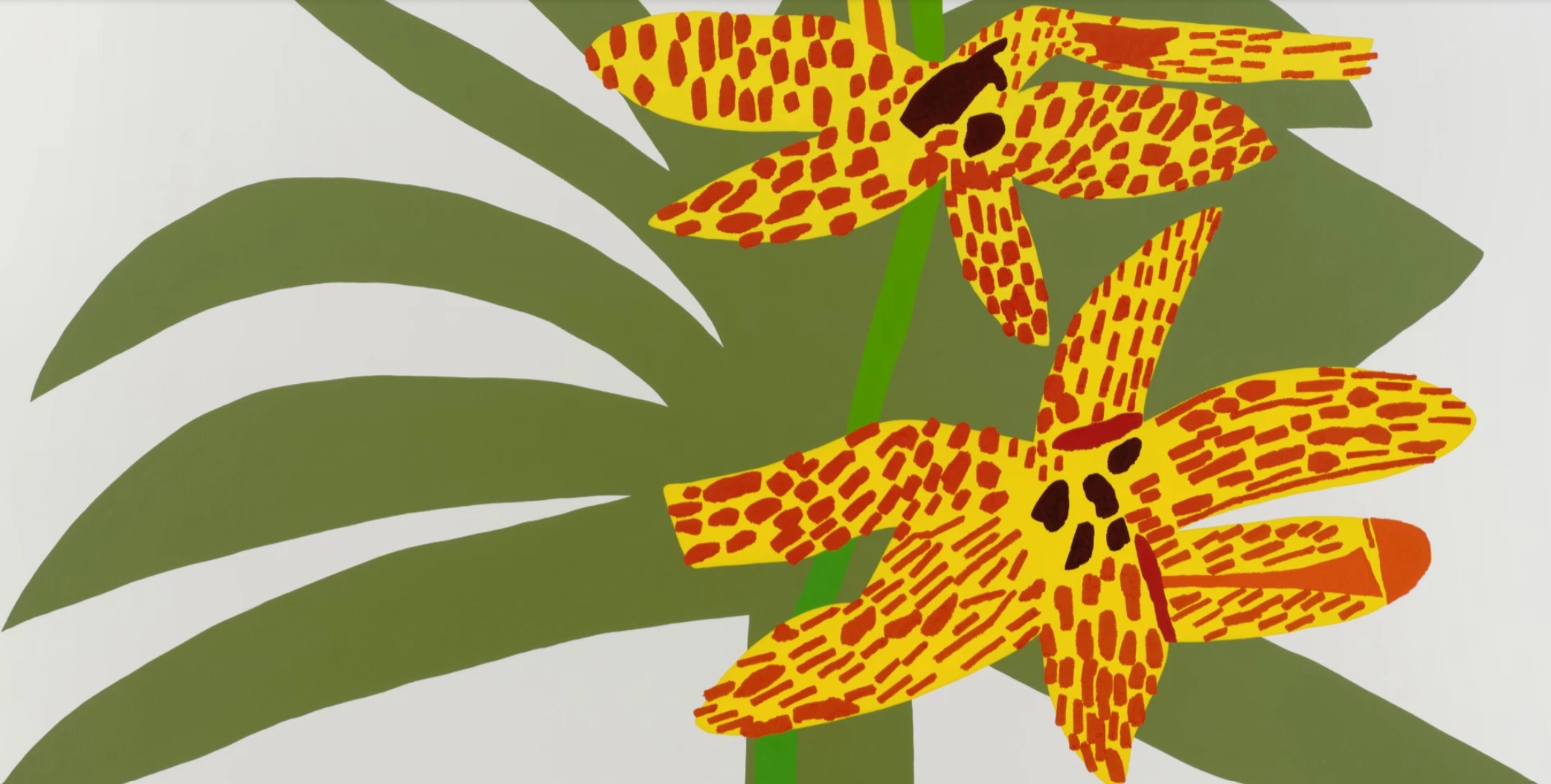
In Clipping J1, exuberant orchids and foliage are rendered with vivid pattern and saturated color, yet held within the artist’s signature flatness and spacious reserve. The negative space becomes an active device, emphasizing the collage-like construction of the image. This method recalls Henri Matisse’s late cut-outs, in which painted paper forms were cut, rearranged, and reconfigured into compositions of striking economy and vitality. Discussing the overlaps between Matisse and Wood, art historian Ken D. Allan states: “In 1908 Henri Matisse explained, ‘The entire arrangement of my picture is expressive…Composition is the art of arranging in a decorative manner the diverse elements at the painter’s disposal to express his feelings.’ Wood’s return to such questions allows us to see that painting’s delivery of visual pleasure has a history—a history that Wood’s work surely continues.” (Ken D. Allan in conversation with Hans Ulrich Obrist in: Exh. Cat., Dallas, Dallas Museum of Art, Jonas Wood, 2019, pp. 22-23)
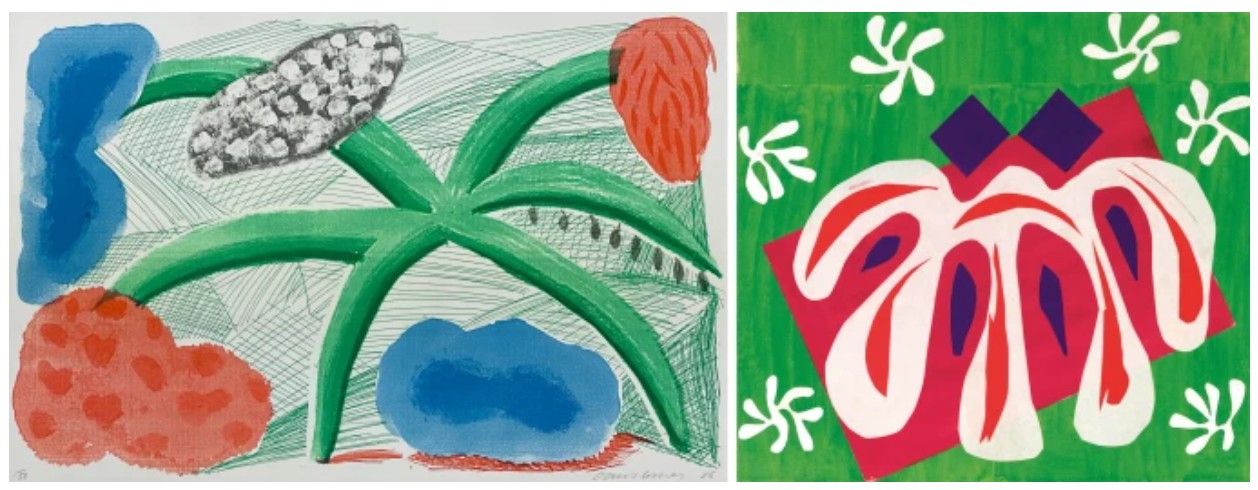
LEFT: David Hockney, Landscape With A Plant, 1986. © Archeus / Post-Modern Ltd.
RIGHT: Henri Matisse. Two Masks (The Tomato) (Deux Masques [La Tomate]), 1947. © 2014 Succession H. Matisse / Artists Rights Society (ARS), New York.
Enlarged to a monumental scale, the orchid is transformed from an intimate domestic detail into an image of almost architectural presence. What might ordinarily be glanced at in passing is here slowed down, isolated, and reimagined with total conviction. This ability to monumentalize the familiar lies at the heart of Wood’s practice. His subjects are drawn from the fabric of daily life, yet in his hands they assume singular motifs, rigorously edited, becoming the site of maximum visual impact. In Clipping J1, Wood transforms the orchid into something at once decorative and structural, intimate and iconic, coolly graphic yet deeply sensuous.
“I wanted it to feel like this plant was so much larger than a person that it would sort of engulf the viewer.”
With a commanding scale, radiant palette, and distilled formal intelligence, Clipping J1 stands as a radiating example of the Clippings series through which Wood expanded the possibilities of contemporary still life. Synthesizing the defining concerns of his practice, the present work offers a compelling expression of his visual language, poised between observed reality and abstract construction.
Clipping D3, 2013
Sotheby’s New-York: 26 September 2025
Estimated: USD 500,000 – 700,000
PASSED
Clipping D3 | Contemporary Curated | 2025 | Sotheby’s
JONAS WOOD (b. 1977)
Clipping D3, 2013
Oil and acrylic on canvas
87×100 inches (221×254 cm)
Signed, titled and dated 2013 (on the reverse)
Jonas Wood’s paintings draw on the spaces and objects of his daily life, translating them into bold, flattened forms. For over twenty years, his work has been defined by strong color and geometric shapes, qualities exemplified in Clipping D3 (Pink Geranium), where an ordinary plant becomes a stylized composition that blurs the line between representation and abstraction. Wood’s style draws on influences from Picasso, Matisse, and Hockney, evident in his use of flat, graphic space and unexpected perspectives. His plant clippings in particular highlight this tension between representation and abstraction, turning everyday subjects into patterned, decorative compositions. Likening Wood’s singular artistic project to Henri Matisse’s, art historian Ken D. Allan states: “In 1908 Henri Matisse explained, ‘The entire arrangement of my picture is expressive…Composition is the art of arranging in a decorative manner the diverse elements at the painter’s disposal to express his feelings.’ Wood’s return to such questions allows us to see that painting’s delivery of visual pleasure has a history—a history that Wood’s work surely continues.” (Ken D. Allan, in conversation with Hans Ulrich Obrist in: Exh. Cat., Dallas Museum of Art, Jonas Wood, 2019, pp. 22-23). Balancing figuration and abstraction, Clipping D3 (Pink Geranium) demonstrates Wood’s ability to draw on art history while creating work that feels distinctly contemporary.
Clipping A4, 2013
Sotheby’s New-York: 16 May 2025
Estimated: USD 700,000 – 1,000,000
USD 635,000
Clipping A4 | Contemporary Day Auction | 2025 | Sotheby’s
JONAS WOOD (b. 1977)
Clipping A4, 2013
Oil and acrylic on canvas
108 1/2 x 73 inches (275.6 x 185.4 cm)
Signed twice, titled and dated 2013 (on the reverse)
With its monumental scale and distilled graphic clarity, Clipping A4 from 2013 stands as a striking example of Jonas Wood’s celebrated Clippings series—a body of work that fuses personal nostalgia with formal innovation. Rendered in oil and acrylic on canvas, the painting captures a single potted orchid against a luminous silver-gray ground. The flower’s electric yellow blossoms, speckled with rich black patterning, explode with visual energy, while the dark green foliage offers an elegant counterbalance in silhouette. In Clipping A4, Wood demonstrates his distinctive ability to transform intimate subject matter into compositions of formal rigor and chromatic boldness.
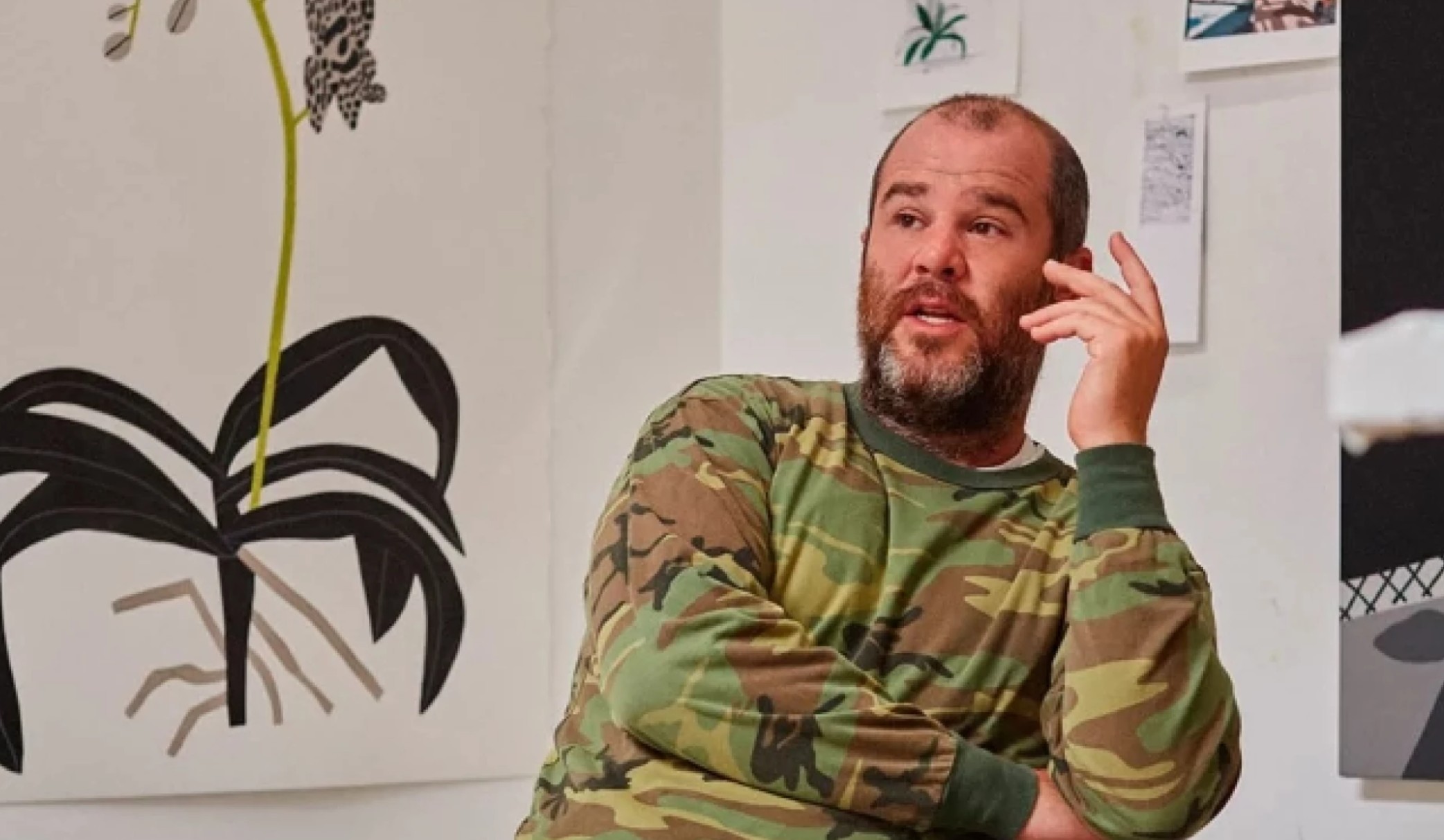
JONAS WOOD IN HIS STUDIO. PHOTO © STEVEN TAYLOR
Began in 2013, the Clipping paintings originate from photographs of potted plants taken in and around his studio and home. These images are then collaged, traced, and translated into richly layered compositions that oscillate between flatness and depth, figuration and abstraction. Across the series, each plant is rendered as a self-contained icon, isolated against a uniform background. As Wood has explained, “they become portraits” — portraits not only of the plants themselves, but of a specific visual and emotional memory. The artist’s longstanding interest in cataloguing his surroundings, often through subjects like domestic interiors, sports memorabilia, and ceramics, finds a distilled and poetic form in these portraits of botanical life.
“I wanted it to feel like this plant was so much larger than a person that it would sort of engulf the viewer.”
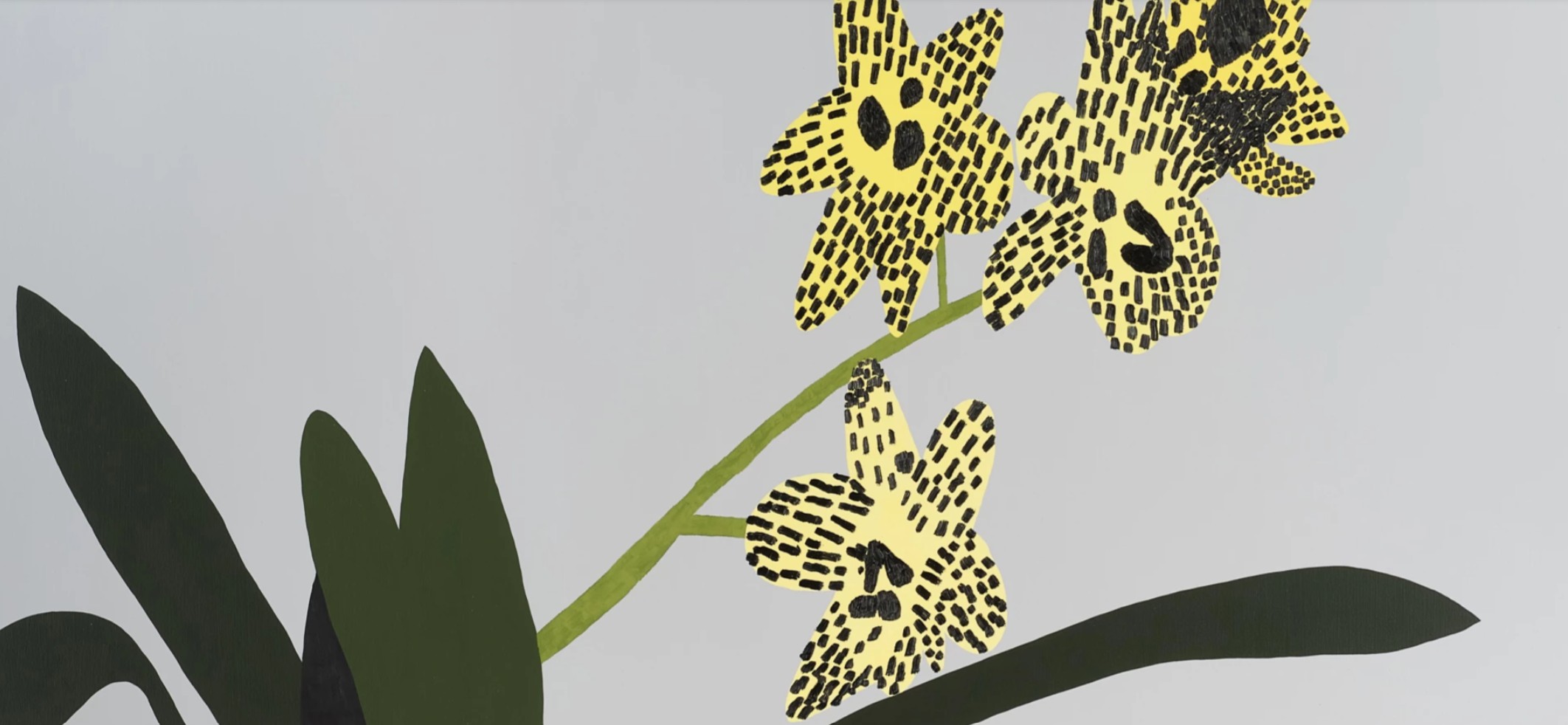
In Clipping A4, Wood depicts a yellow Oncidium orchid—a species known for its fluttering, almost butterfly-like petals and dotted patterns. Wood abstracts this natural exuberance into a sharp interplay of form and color: the blossom’s intricate textures are rendered in punctuated black marks atop a high-chroma yellow, while the stem and leaves are composed of deep greens verging on black. The plant’s arching stem bisects the vertical canvas, guiding the eye upward through the dense foliage and into the airier bloom, a gesture that instills the work with a sense of upward momentum and quiet dynamism. The flat, metallic silver ground creates a luminous void, against which the plant takes on a sculptural presence. This stark contrast imbues the composition with a near-graphic quality, evoking both botanical illustration and modernist poster design. The artist’s foray into depictions of plants and still lifes are very much connected to it’s art historical tradition, something which on a personal level was deeply entrenched in the artist’s life from a young age. Jonas Wood’s grandfather was a collector and amateur painter, and from him Wood inherited several works which includes a gouache by Alexander Calder and a print by Henri Matisse, two figures from whom Wood has said to have drawn much inspiration. Stylistically, Wood’s work seems to combine a play on interiors and dimensionality directly linked to that of Matisse’s, and a turn to abstraction of forms that the artist has recognized as stemming from a fascination with Alexander Calder’s oeuvre.
“I took some of the [Calder] sculptures I saw in books and tried to make them match this plant aesthetic that I was building.”
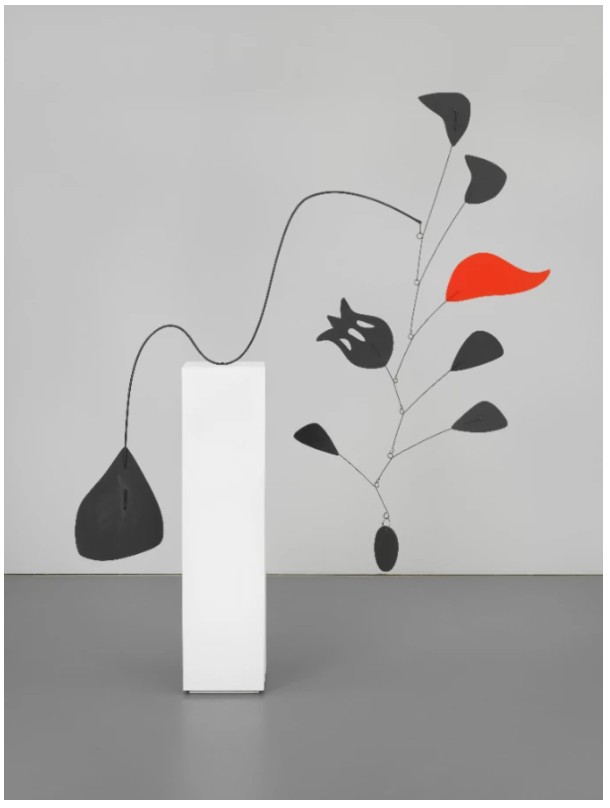
ALEXANDER CALDER, POMEGRANATE, 1949
IMAGE © Whitney Museum of American Art / Licensed by Scala / Art Resource, NEW YORK
ART © 2022 CALDER FOUNDATION, NEW YORK / ARTISTS RIGHTS SOCIETY (ARS), NEW YORK
Indeed, the influence of modernist precedents is palpable throughout Wood’s oeuvre, and particularly in Clipping A4. The flat planes of color, emphasis on silhouette, and serial format recall the strategies of Henri Matisse, Ellsworth Kelly, and David Hockney. But Wood’s approach is resolutely his own, inflected by a contemporary sensibility rooted in photography, digital collage, and memory. His use of line and color does not aim for illusionism; instead, it reimagines the subject through the lens of drawing and design. In doing so, Wood opens a new avenue for painterly figuration in the 21st century, one that is as indebted to Pop Art and graphic design as it is to art historical tradition.
The Clippings series marks a pivotal moment in Wood’s practice, offering a contemplative counterpoint to the densely detailed interior scenes and sports imagery for which he is also known. By isolating a single subject within a vast field of negative space, these works heighten our attention to the formal properties of line, shape, and hue. They are, in a sense, exercises in visual reduction and amplification—where simplicity becomes a means of profound focus. The result is a meditative quietude, intensified by the sheer scale of works like Clipping A4, which envelops the viewer and invites close inspection.
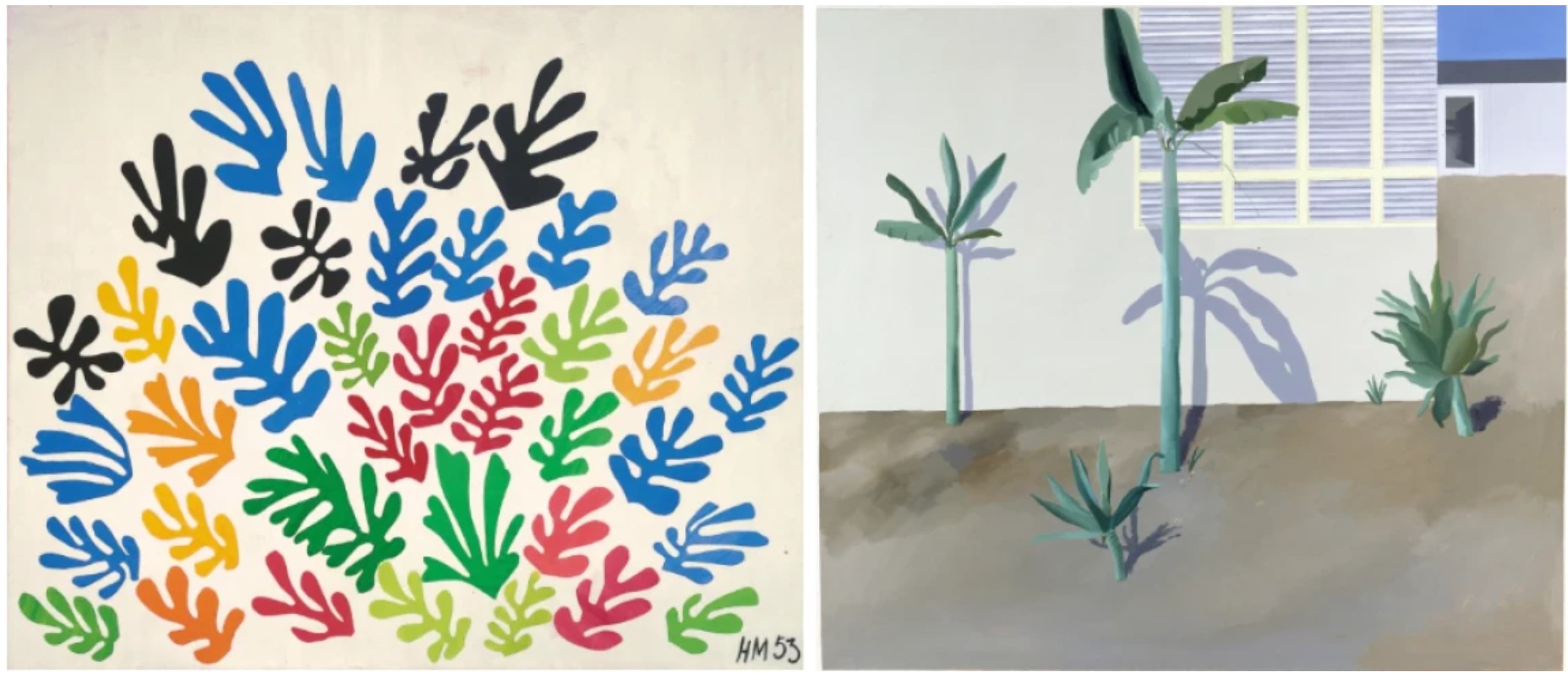
Left: HENRI MATISSE, LA GERBE, 1953. IMAGE © LOS ANGELES COUNTY MUSEUM OF ART, LOS ANGELES / ART RESOURCE, NY. ART © SUCCESSION H. MATISSE / ARTISTS RIGHTS SOCIETY (ARS), NEW YORK. Right: David Hockney, Hollywood Garden, 1966. Image © Hamburger Kusnthalle / Art Resource, NY. Art © 2022 David Hockney
In this regard, Clipping A4 is notable for its particular clarity and balance. The composition is taut yet generous: the curvature of the leaves and the thrust of the stem establish a rhythmic counterpoint, while the floating yellow blossoms punctuate the space with levity. The painting’s palette, limited but highly saturated, underscores the push-and-pull between naturalistic reference and stylized depiction. The orchid is both recognizable and abstract, tenderly observed and coolly rendered. This duality lies at the heart of Wood’s aesthetic project: to bridge the deeply personal and the formally precise. As Jonas Wood’s reputation continues to ascend, Clipping A4 stands as a compelling statement of his enduring fascination with the world around him—transformed through the distillation of memory, drawing, and design. With its towering scale, luminous palette, and elegant formal restraint, it encapsulates the artist’s singular contribution to the lineage of contemporary painting. It is a work that quietly commands attention, inviting repeated viewing and rewarding sustained contemplation.
Clipping A2, 2013
Sotheby’s New-York: 16 November 2022
Estimated: USD 500,000 – 700,000
USD 756,000
Clipping A2 | The Now Evening Auction | | Sotheby’s (sothebys.com)
JONAS WOOD (b. 1977)
Clipping A2, 2013
Oil and acrylic on canvas
118×93 inches (299.7 x 236.2 cm)
Initialed JBRW, titled Clipping A2 and dated 2013 (on the reverse)
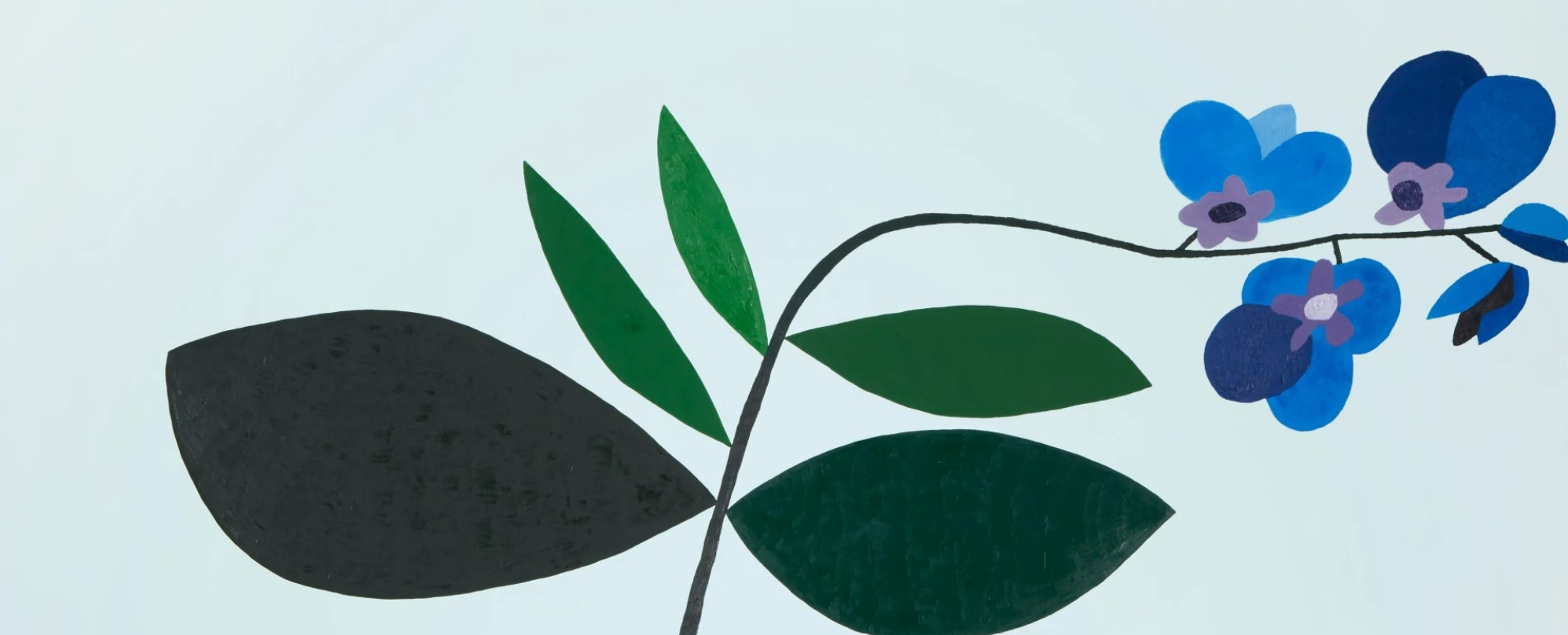
A towering display of the his unique artistic vernacular, Clipping A2 dwarfs the viewer in its vibrant rendering of a flowering orchid, pulling them into the larger-than-life world of Jonas Wood. Geometric and saturated, yet aesthetically sharp, the present work encapsulates the familiar style and iconography of Jonas Wood’s lexicon, taking quotidian objects and snapshots and translating them into highly stylized, blockish forms on a large scale. Clipping A2 emerges as one of the first in Wood’s series of “Clippings”, marked distinctly by their mosaic-like reconfiguration of potted plants, transposed onto immense solid-colored canvas. Prominently illustrated in a book of Wood’s Clippings from 2013-2015 and exhibited in his first major solo museum exhibition at The Dallas Museum of Art in 2019, Clipping A2 is a standout representation of the plant motif in Wood’s larger body of work.
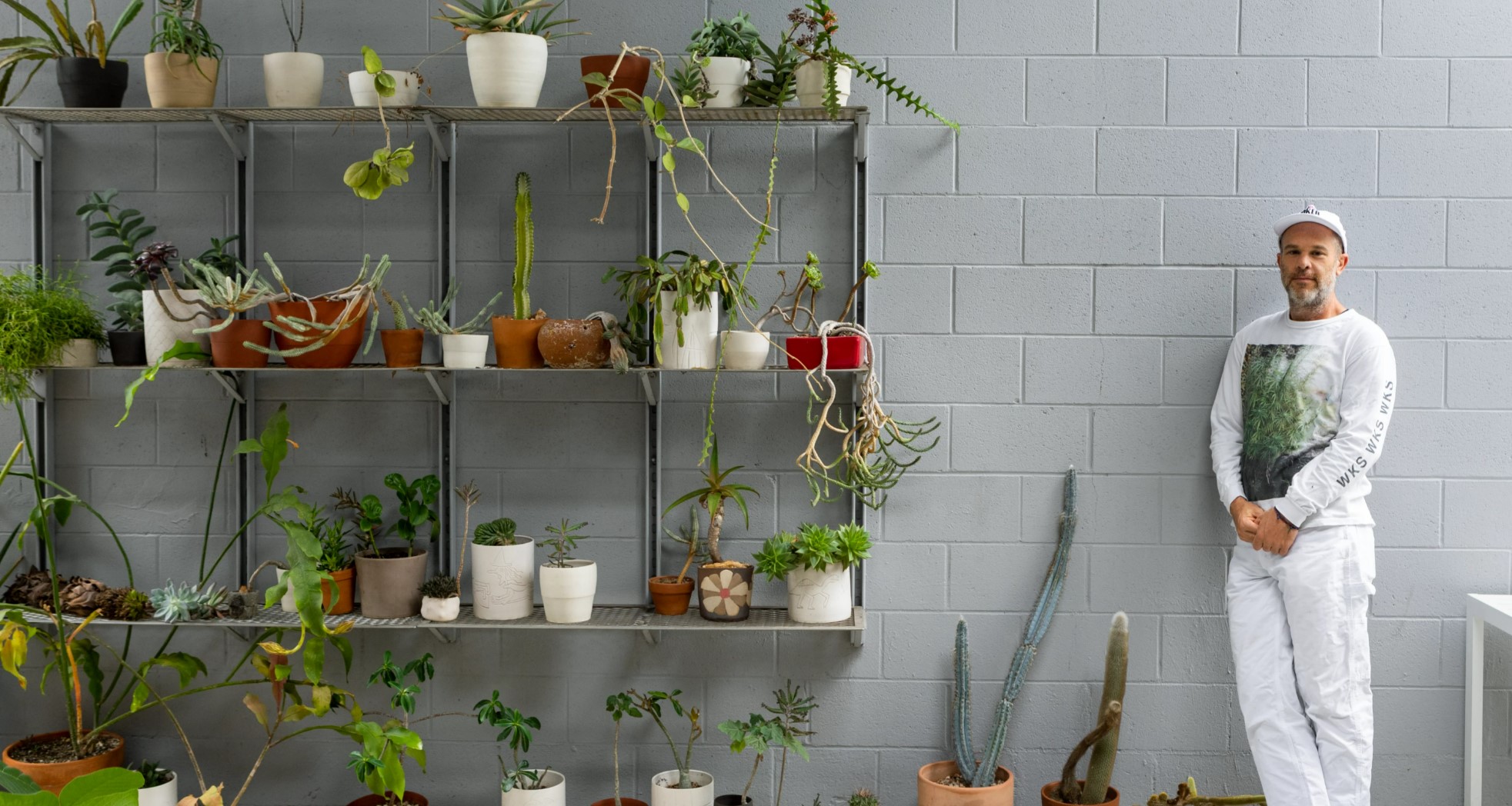
Initiated in 2013, the Clippings testify to Wood’s unique artistic practice, taking individual elements from his own paintings and giving them a platform of their own. Inspired by the potted plants and foliage in his Los Angeles home, the title of the series references not only the subject matter of clipped plants from a garden itself, but also his artistic process, which involves recycling images from previous work and re-presenting them. In Clipping A2, Wood has uprooted a flowering orchid from its initial home in Small Black Flowers of 2012 and transposed it directly onto a blank canvas. Wood’s captivating use of stark colors and flat amorphic shapes jump out from the vast expanse of negative space, isolating the plant of its present work with its own composition liberated from the denser canvas of Small Black Flowers. Here, blocky, two-toned leaves bend and drape toward the bottom of the canvas: a rising stock of deeply saturated, flowering blossoms cuts through the stark white background, while the foliage stems seemingly from the canvas itself, suspended in the surrounding atmosphere.
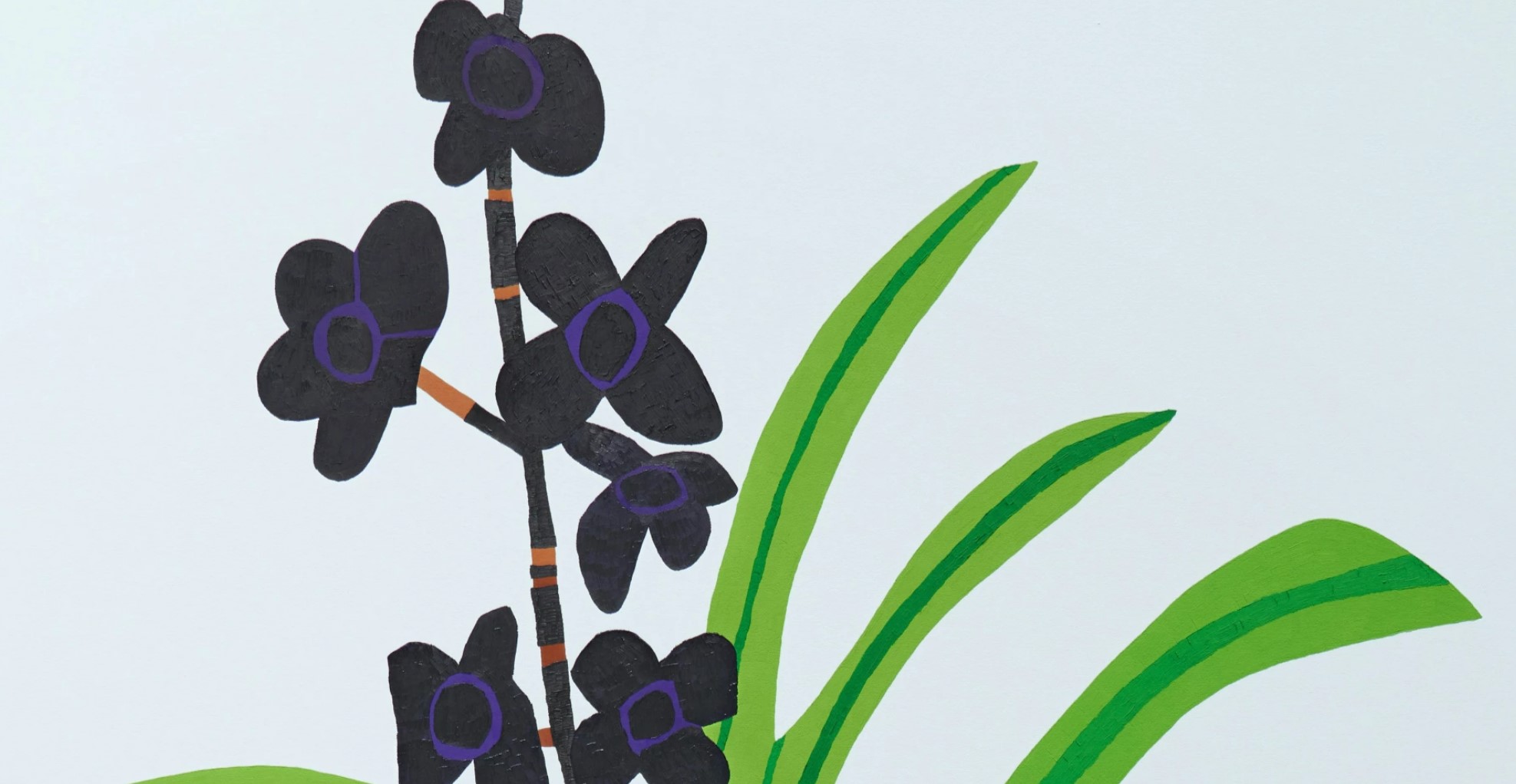
Wood’s Clippings are exemplary of the artist’s signature painterly process. Flattened against the picture plane, Wood’s Clippings act as self-contained renderings akin to a television screen or photograph. Working from reference materials such as photographs or, in this case, previously completed works, the artist has described the beginning stages of his painting process akin to that of collage-making:
“Step one, in many ways, is like editing or manipulating some photos or making a photo collage and then deciding if it can translate to the next step. I’m all about scissors and glue, very limited computer stuff. Sometimes I stretch and distort things, but most of the time I cut and paste until I’m happy.”
Clipping A3, 2013
Sotheby’s New-York: 11 March 2022
Estimated: USD 1,200,000 – 1,800,000
USD 1,623,000
Clipping A3 | Contemporary Curated | | Sotheby’s (sothebys.com)
JONAS WOOD (b. 1977)
Clipping A3, 2013
Oil and acrylic on canvas
118×93 inches (299.7 x 236.2 cm)
Signed with the initials JBPW, titled CLIPPING A3 and dated 2013 (on the verso)
Towering and impressing the viewer through a play of multi-dimensionality, Jonas Wood’s Clipping A3 illustrates the artist’s signature deployment of an array of formal techniques to create viewpoints that are at odds with the viewer’s expectations. Wood’s plants and clippings are are the quintessence of his painterly lexicon– that is, figurative paintings that take form amidst abstraction, and vice versa. The red and yellow orchid stems through a partial area across the negative space of the large-scale canvas, a gesture making us, as Matisse did in the 20th century with his interiors, more aware of vertical space as Clipping A3 recalls a houseplant placed on a shelf or table.
With this we become acutely aware of Wood’s manipulation of perspective, at once alluding while collapsing Renaissance ideals of the practice. Blocky leaves give way to vibrantly-hued blossoms and are flanked by roots which expand out into the composition in opposite soft tones of white and gray. With it’s grand scale and geometric nature, the work is a standout representation of the plant motif in Wood’s larger body of work.
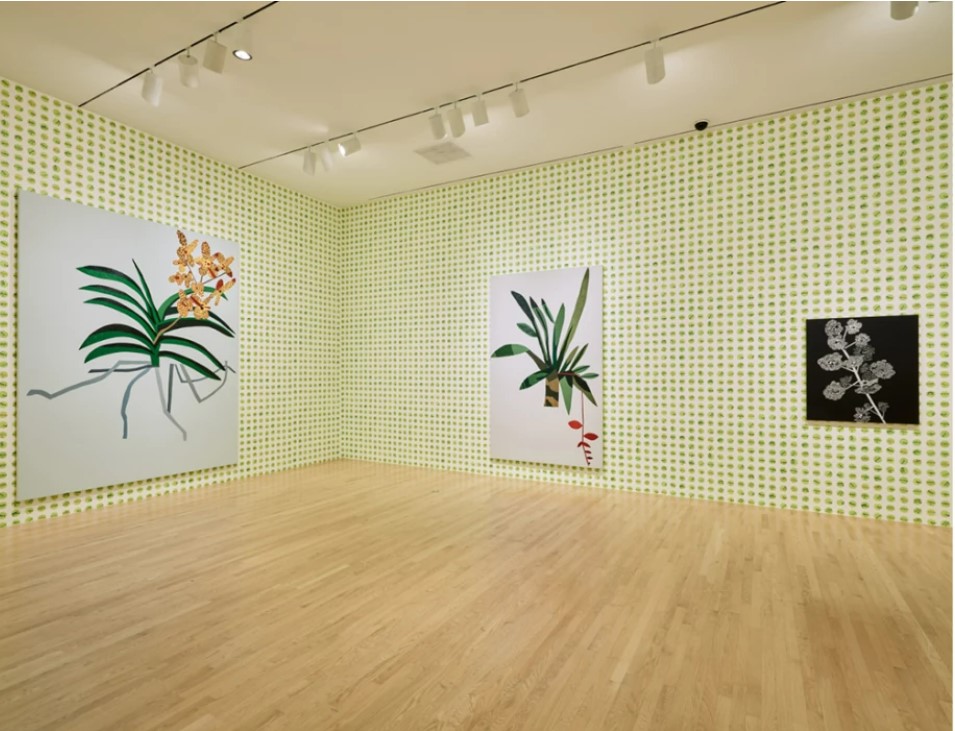
THE PRESENT WORK INSTALLED IN JONAS WOOD AT THE DALLAS MUSEUM OF ART IN 2019
The interplay of representational space and abstracted form in Clipping A3 is exemplified by the orchid’s geometric composition; flattened against the picture plane, the work acts as a self-contained rendering akin to a television screen or photograph. Working from reference materials that includes photographs and clippings, the artist has explained his beginning stages of his painting as based on a process akin to collage-making.
Clipping D2, 2013
Sotheby’s New-York: 18 November 2021
Estimated: USD 800,000 – 1,200,000
USD 1,472,000
Clipping D2 | The Now Evening Auction | | Sotheby’s (sothebys.com)
JONAS WOOD (b. 1977)
Clipping D2, 2013
Oil and acrylic on canvas
93 1/8 x 100 1/8 inches (236.5 x 254.3 cm)
Signed JBPW, titled and dated 2013 (on the reverse)
Harkening back to the visual motifs and physical spaces that have defined him, Jonas Wood’s work evokes the complexities and comforts of the artist’s past and present surroundings. Directly depicting the interiors, people, and objects around him, Jonas offers an acute portrayal of his direct environment. Stark coloring and flat amorphic shapes have been hallmarks of his work for the last two decades, and Clipping D2 (Blue Orchid) exemplifies his ability to manipulate everyday objects in his work, translating the three-dimensional objects into highly stylized, blockish forms. This interplay of representational space and abstracted form, a key characteristic of the artist’s work, is exemplified by the orchid’s geometric composition; flattened against the picture plane, the work acts as a self-contained rendering akin to a television screen or photograph. The towering blue orchid stretches across the negative space of the large-scale canvas, a swarm of blocky leaves flanking the stem to culminate in a flurry of vibrantly hued blossoms. With its grand scale and geometric nature, the work is a standout representation of the plant motif in Wood’s larger body of work.
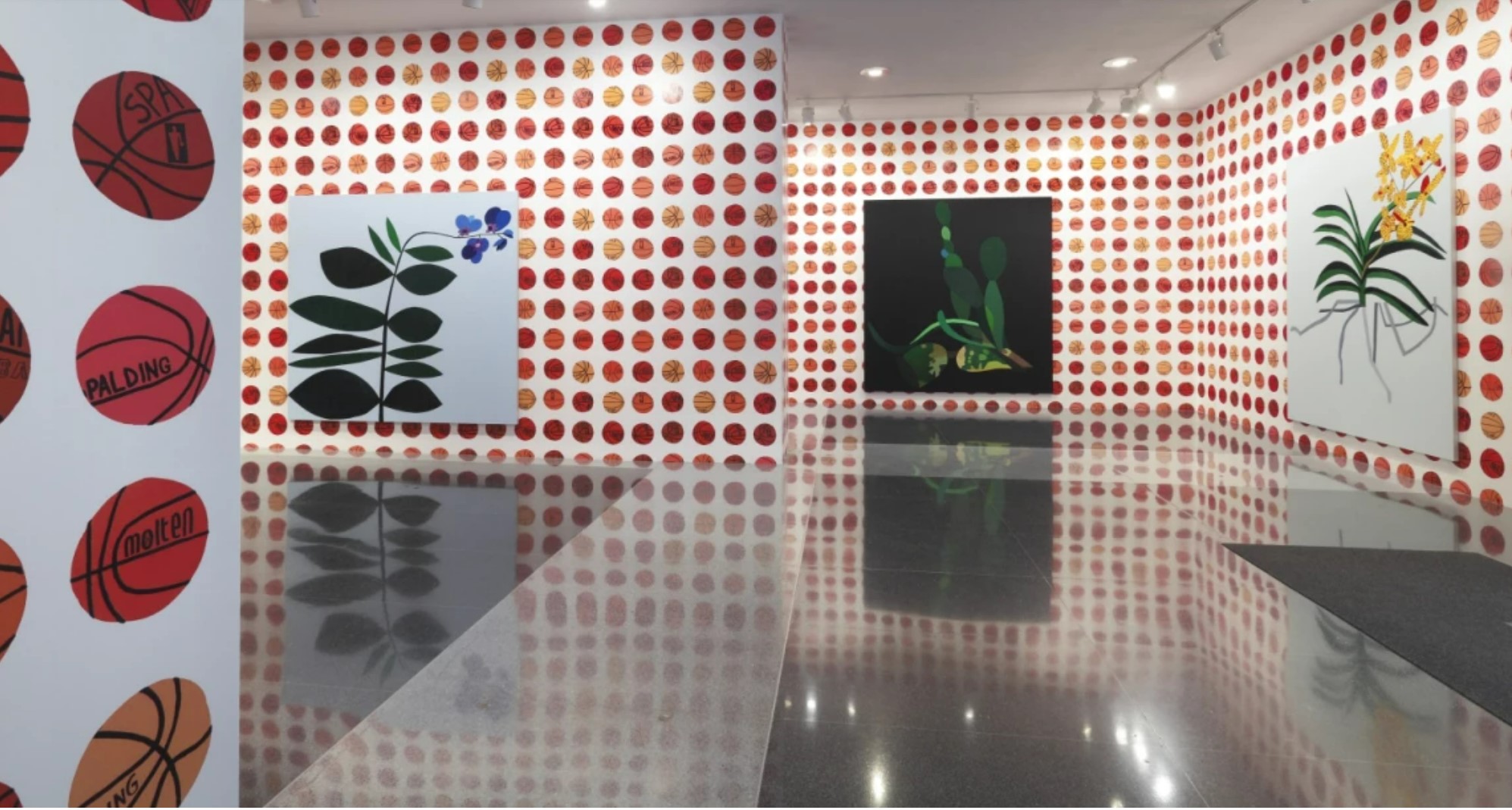
THE PRESENT WORK INSTALLED IN JONAS WOOD CLIPPINGS AT LEVER HOUSE IN 2013 – 2014.
Not only is the present work evocative of Matisse’s cutouts in appearance, but in process. In the last decade of Matisse’s life, the artist began cutting up gouache-painted paper into a wide range of shapes and re-arranging them into new compositions. Wood’s approach is similar: working from a personal archive of photographs and found imagery, he makes preliminary sketches and studies of his subjects and creates initial collages by cutting and pasting. The images are then filtered through various layers of drawing until he arrives at his final composition.
“I’ll take a picture of the painting and print it out on drawing paper, get the colored pencils and try to figure [it] out. I’m less of a de Kooning and more like Lichtenstein so it’s a compositional decision.”
Swerving from representational still life to abstraction and standing at a nuanced threshold at which representation disintegrates to pure color and form, Clipping D2 (Blue Orchid) epitomizes Jonas Wood’s aesthetic project, and sees the artist drawing heavily upon the art of his forebears to create a work that is resolutely modern.
Clipping F1, 2013
Christie’s New-York: 14 May 2021
Estimated: USD 500,000 – 700,000
USD 1,470,000
JONAS WOOD (B. 1977) (christies.com)
JONAS WOOD (B. 1977)
Clipping F1, 2013
Oil and acrylic on canvas
93 x 100 1/8 inches (236.2 x 254.3 cm)
Signed with the artist’s initials, titled and dated ‘CLIPPING F1 JBRW 2013’ (on the reverse)
“Matisse, Picasso, Braque, Calder, Monet, Vuillard, Bonnard, van Gogh, Stuart Davis, and Hockney have all been very real influences to me. When I was a young child, my family would speak about these artists as examples of greatness in painting. I guess even then I took them seriously because these are the artists I ended up fashioning my studio practice after.”
Fish Pots
M.S.F. Fish Pot #4, 2014
Sotheby’s Hong-Kong: 5 October 2023
Estimated: HKD 9,500,000 – 14,000,000
HKD 15,575,000 / USD 1,989,490
JONAS WOOD (b. 1977)
M.S.F. Fish Pot #4, 2014
Oil and acrylic on canvas
65×65 inches (165.1 x 165.1 cm)
Titled and signed on the reverse
Amongst the most recognizable paintings in contemporary art today, Jonas Wood’s monumental canvases depicting colorful ceramic pots invoke the trailblazing compositions of David Hockney and Henri Matisse in their striking chromatic brilliance and stylistic figuration. With works from this series now residing within esteemed institutions including The Broad, Los Angeles; Museum of Modern Art, New York; and the Metropolitan Museum of Art, New York, among others, M.S.F. Fish Pot #4 belongs to a highly sought after and regarded series by the artist. Executed in 2014 and exhibited at the artist’s Gagosian Hong Kong exhibition Jonas Wood and Shio Kusaka: Blackwelder, the present work is a masterful fusion of artistic influence and personal significance, transforming the humble pot into a riff on the traditional idea of the painting-as-window. Reprising the popular fish motif that has inspired artists for centuries, M.S.F. Fish Pot #4 takes inspiration from Wood’s own extensive collection of ceramic art, as well as his own working relationship with his wife, and ceramicist, Shio Kusaka.
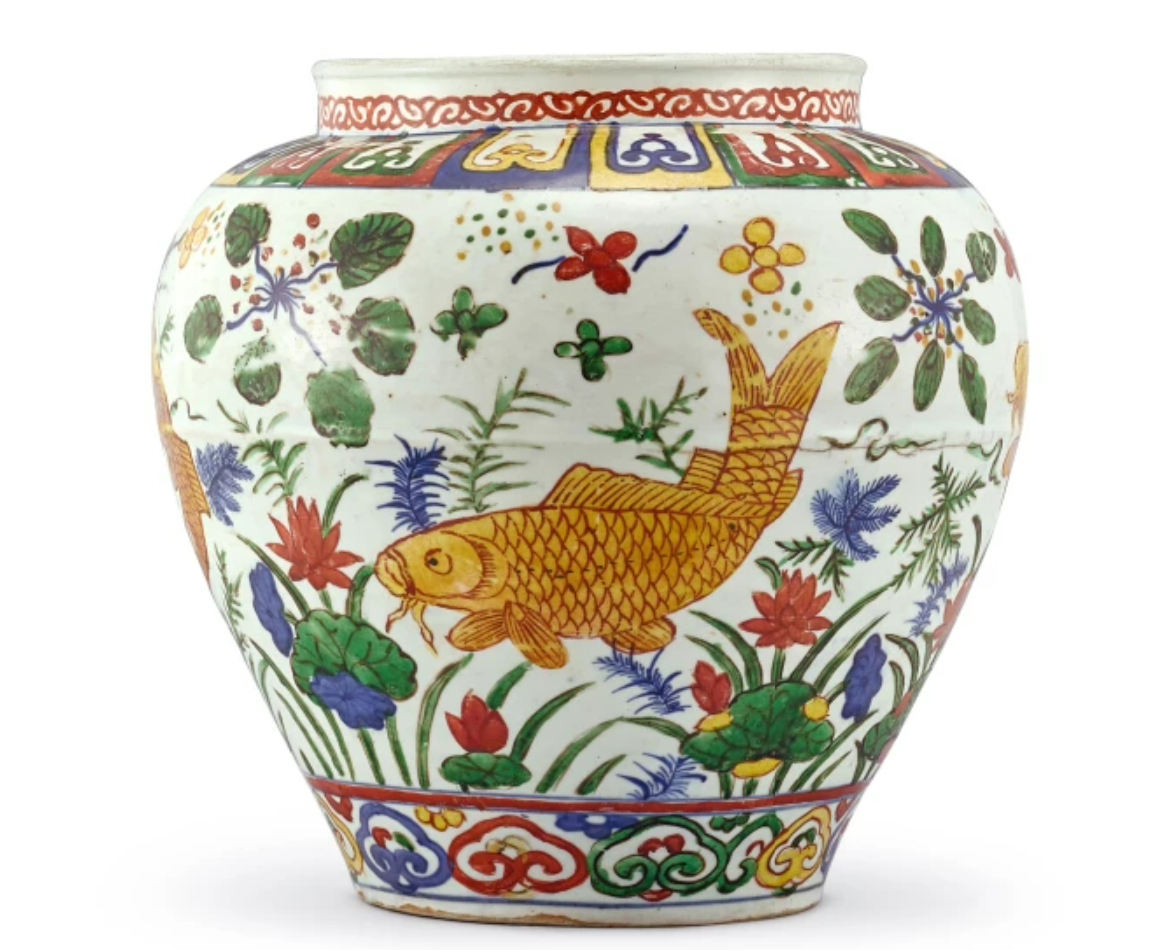
A RARE WUCAI ‘FISH’ JAR MARK AND PERIOD OF JIAJING
Intimate yet expansive, familiar yet foreign, Wood’s M.S.F. Fish Pot #4 is large in scale and theatrical in scope. Taking a three-dimensional pot as his subject before flattening it to accommodate for the two-dimensional oil painting medium, Wood accentuates his collage-like style and propensity for spatial distortion. Sharing a studio with Kusaka, ceramic vessels are often showcased in Wood’s oeuvre.
“When I met my wife, Shio Kusaka, who is a ceramicist, I started looking at vessels. I became interested in the Greek pots. Like basketball cards, they have a shape and a form, and they have images that are very flat, graphic, and simple. Basically, there are cartoons on the sides of the pots that tell stories”
M.S.F. Fish Pot #4 is a testament to their artistic processes, diffusing references from Wood’s family, memories and personal art collection.
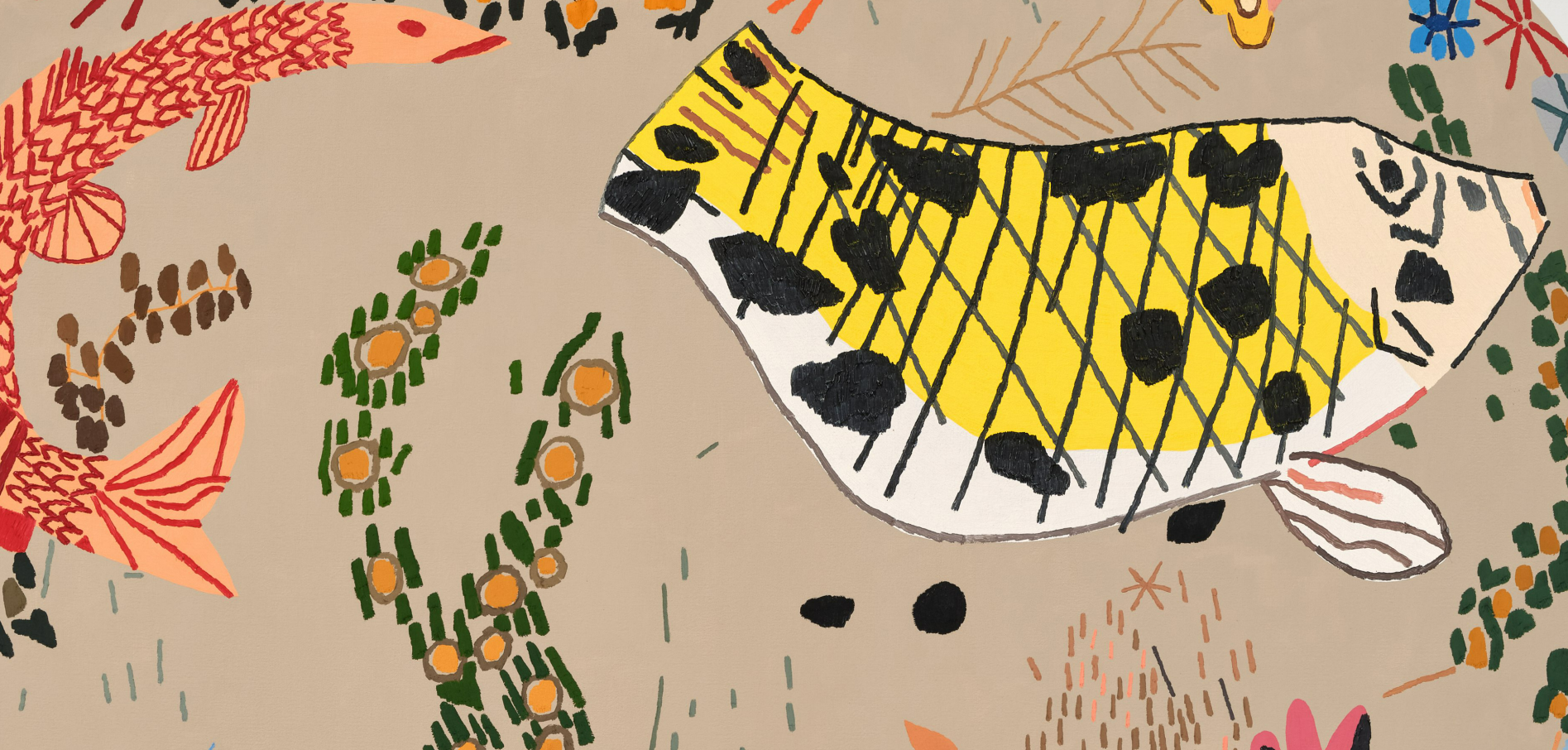
Adorned with fish and various aquatic motifs, M.S.F. Fish Pot #4 presents a fantastical tableau rendered with graphic detail and vibrant color. Set against a pale grey background, Koi fish illustrate the round ceramic vessel, a window into the underwater world of a fishpond which abruptly ends at the extremities of the pot. Toying with the perception of space, volume, flatness, and depth, Wood creates a precarious dichotomy between the flatness of the image and the imagined dimensionality of a real ceramic pot.
M.S.F. Fish Pot #7, 2016
Christie’s Hong-Kong: 28 May 2023
Estimated: HKD 12,500,000 – 18,500,000
HKD 17,920,000 / USD 2,287,698
JONAS WOOD (B. 1977) (christies.com)
JONAS WOOD (B. 1977)
M.S.F. Fish Pot #7, 2016
Oil and acrylic on canvas
72×72 inches (182.8 x 182.8 cm)
Signed with the artist’s initials, titled and dated ‘JBRW 2016 M.S.F. FISH POT #7’ (on the reverse)
M.S.F. Fish Pot #5, 2015
Christie’s New-York: 16 May 2019
Estimated: USD 900,000 – 1,200,000
USD 3,375,000
Jonas Wood (b. 1977) (christies.com)
JONAS WOOD (b. 1977)
M.S.F. Fish Pot #5, 2015
Oil and acrylic on canvas
76×74 inches (193×188 cm)
Signed with the artist’s initials, titled and dated ‘M.S.F. FISH POT #5 JBRW 2015’ (on the reverse)
M.S.F. Fish Pot #5, is a striking example of Jonas Wood’s signature confined brilliance and use of composite imagery sourced from Wood’s personal collection of ceramic art. A monumental painting, M.S.F. Fish Pot #5 is derived from Wood’s study of artists Michael and Magdalena Suarez Frimkess, a husband-and-wife ceramic team working in L.A., whose work inhabits Wood’s Culver City studio. Similar to Wood’s body of work, the Frimkesses oeuvre spans many genres- pottery, mythology, and pop to name a few. This exploration of the Frimkesses collaborations not only serves to memorialize Wood’s paramount adoration for their art, but also directly references the collaborative working relationship between Wood and his wife, ceramic artist Shio Kusaka. The Koi fish and their domestic habitat often recur in Wood’s work. They prove ideal forms, juxtaposing the magnificent with restraint. Set against a pale gray background, M.S.F. Fish Pot #5 depicts a round ceramic pot filling the composition. The surface of the vessel is adorned with intricate and playful aquatic imagery. The marine life illustrated on the pot serves as a window into a fervent anemone, dominated by the majestic red-orange Koi fish swimming amongst the sea grass and flowers. The spirited score ends abruptly at the parameters of the vessel. Combining this lively underwater scene with both the flatness of the image and the perceived dimensionality of a real ceramic vessel creates a precarious dichotomy that grasps at two competing depictions of space.
Other Pots
Landscape Pot 1, 2014
Christie’s New-York: 14 May 2024
Estimated: USD 2,200,000 – 2,800,000
USD 1,744,000
JONAS WOOD (B. 1977), Landscape Pot 1 | Christie’s (christies.com)

JONAS WOOD (B. 1977)
Landscape Pot 1, 2014
Oil on canvas
118×93 inches (299.7 x 236.2 cm)
Signed twice with the artist’s initials, titled and dated ‘LANDSCAPE POT 1 JBRW 2014’ (on the reverse)
Jonas Wood’s monumental Landscape Pot 1 is an extraordinary painting within a painting, an example of the artist’s unparalleled, signature ability to deftly merge the two traditional genres of still life and landscape within his own renowned contemporary style. Standing nearly ten feet tall it is larger than life, and yet it is also an intimate canvas that offers up a personal reflection on the modern human condition. A meticulously rendered sculptural houseplant emerges from a pot emblazoned with a quotidian scene: a hill populated by cell phone or electrical towers, the kinds one might see during a hike in Los Angeles, or indeed, in Tokyo. It is an unexpected subject, one that emits an alluring beauty as we wonder where this place could be, and why it is important. Blueish-gray clouds preside over the scene while taking shape across the circumference of the vessel. As Wood often isolates his pots and their landscapes against a uniform background, we can linger on and appreciate the details that he includes. Delicate features emerge, like the bands of green and brown on the plant’s stem that, like the rings of a tree, mark the passage of time. Notably in this particular composition, the pot sits off center, expanding our perception of the space and allowing for the possibility of growth. In a similar vein, the direction of the plant mirrors the slope of the landscape, both inviting us in.
Wood is known for including everyday objects from his studio in his paintings and making them monumental objects of desire. Landscape Pot 1 is the outcome of a longstanding dialogue between the artist, and his wife, the ceramic artist Shio Kusaka.
“When I met [her], I started looking at vessels. I became interested in the Greek pots. Like basketball cards, they have a shape and a form, and they have images that are very flat, graphic, and simple. Basically, there are cartoons on the sides of the pots that tell stories.”
In Wood’s and Kusaka’s respective practices, their individual forms, subjects, and motifs make their way back and forth organically. They have been compared to some of art history’s most famous artist couples.

Jonas Wood and Shio Kusaka at Gagosian Gallery, Central, 2015 (present lot illustrated). Photo: Dickson Lee / South China Morning Post via Getty Images. Artwork: © Jonas Wood; © Shio Kusaka.
In addition to Kusaka, Wood cites David Hockney, Alex Katz, Pierre Bonnard, and Henri Matisse as inspirations. Matisse even makes his way as a direct appropriation in Wood’s work in paintings like Matisse Pot 7 (2016). Like the great modernists, Wood’s oeuvre is self-referential as he constantly reuses imagery to new ends.
“I wanted to paint the landscape pots so they were intentionally unrealistic. They were all filtered into an even looser organization of information that would represent this landscape pot as opposed to trying to paint the perfect landscape on a pot. Because I was recycling the imagery from previous works, it was like painting a painting in a painting.”

Shio Kusaka, (dinosaur 24), 2014. © Shio Kusaka
One of the artist’s most striking paintings from his ongoing examination of potted plants, Landscape Pot 1 epitomizes Wood’s unmistakable style while continuing to push his work in novel directions. It towers above us, and yet is not removed from us, since we might imagine what daily memories we too would memorialize in paint. We can feel that love in Landscape Pot 1 with Wood’s tender application of paint, as well as his evocation of a memory all his own.
SK Dino Pot #2, 2015
Christie’s New-York: 13 March 2024
Estimated: USD 700,000 – 1,000,000
USD 756,000
JONAS WOOD (B. 1977), SK Dino Pot #2 | Christie’s (christies.com)
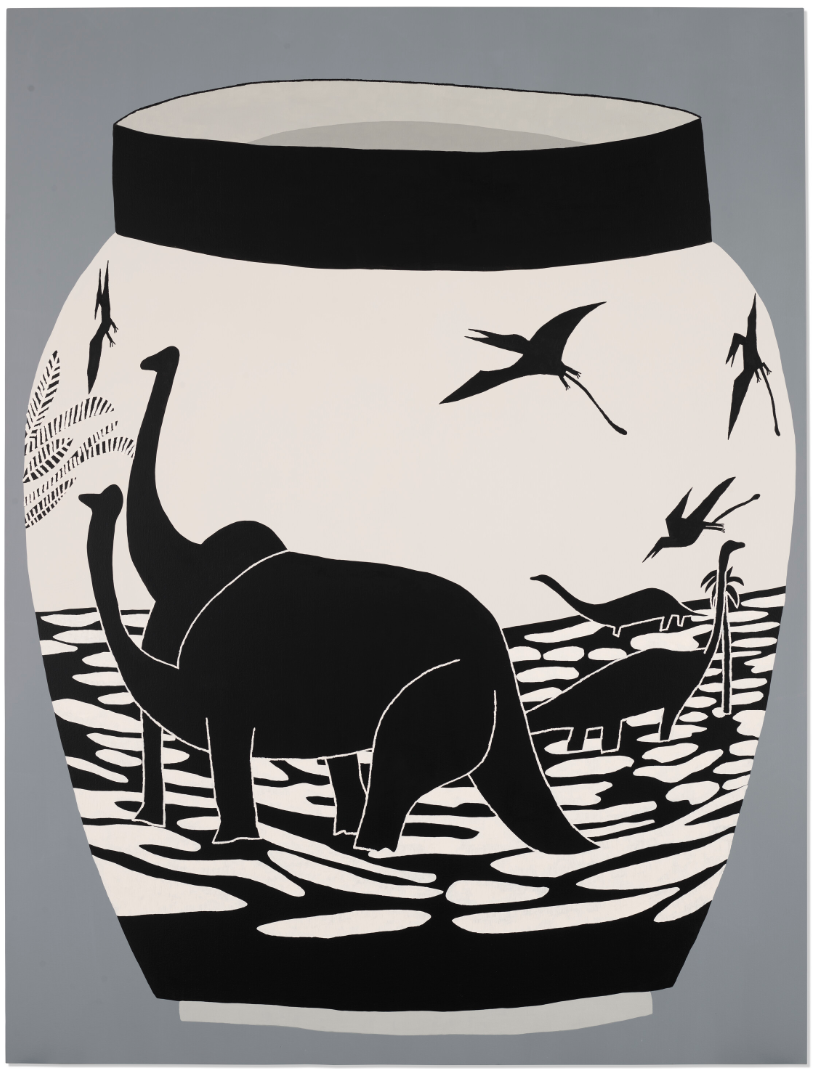
JONAS WOOD (B. 1977)
SK Dino Pot #2, 2015
Oil and acrylic on canvas
90×68 inches (228.6 x 172.7 cm)
Signed with the artist’s initials, titled and dated ‘SK DINO POT #2 JBRW 2015’ (on the reverse)
Known for his exuberant exploration of the intimate on a monumental scale, Jonas Wood is one of the most sought-after artists today. Working in the lineage of still-life and domestic interiors but with a palpably fresh and singular flair, he is often compared to the likes of David Hockney, Henri Matisse and Pierre Bonnard. Wood’s epic paintings of quotidian objects—plants, pots, basketballs, dogs—command both attention and reverence. The present lot is no exception. Standing over seven feet tall, SK Dino Pot #2 features a vessel that all but consumes the canvas in a powerfully contrasted monochromatic palette. Rendered on a flat gray background, a prehistoric scene unfolds across the face of the rounded vessel. As perhaps unexpected protagonists, the dinosaurs loping across the landscape may at first appear as imagined embellishments on the vessel’s surface, but in this case, Jonas Wood was painting faithfully from life. SK Dino Pot #2 is inspired by the alluring works in ceramic created by the artist’s wife, artist Shio Kusaka, with whom Wood shares a deep interest in the history of ceramics. Indeed, Kusaka’s ceramic work figures prominently in many of Wood’s canvases.
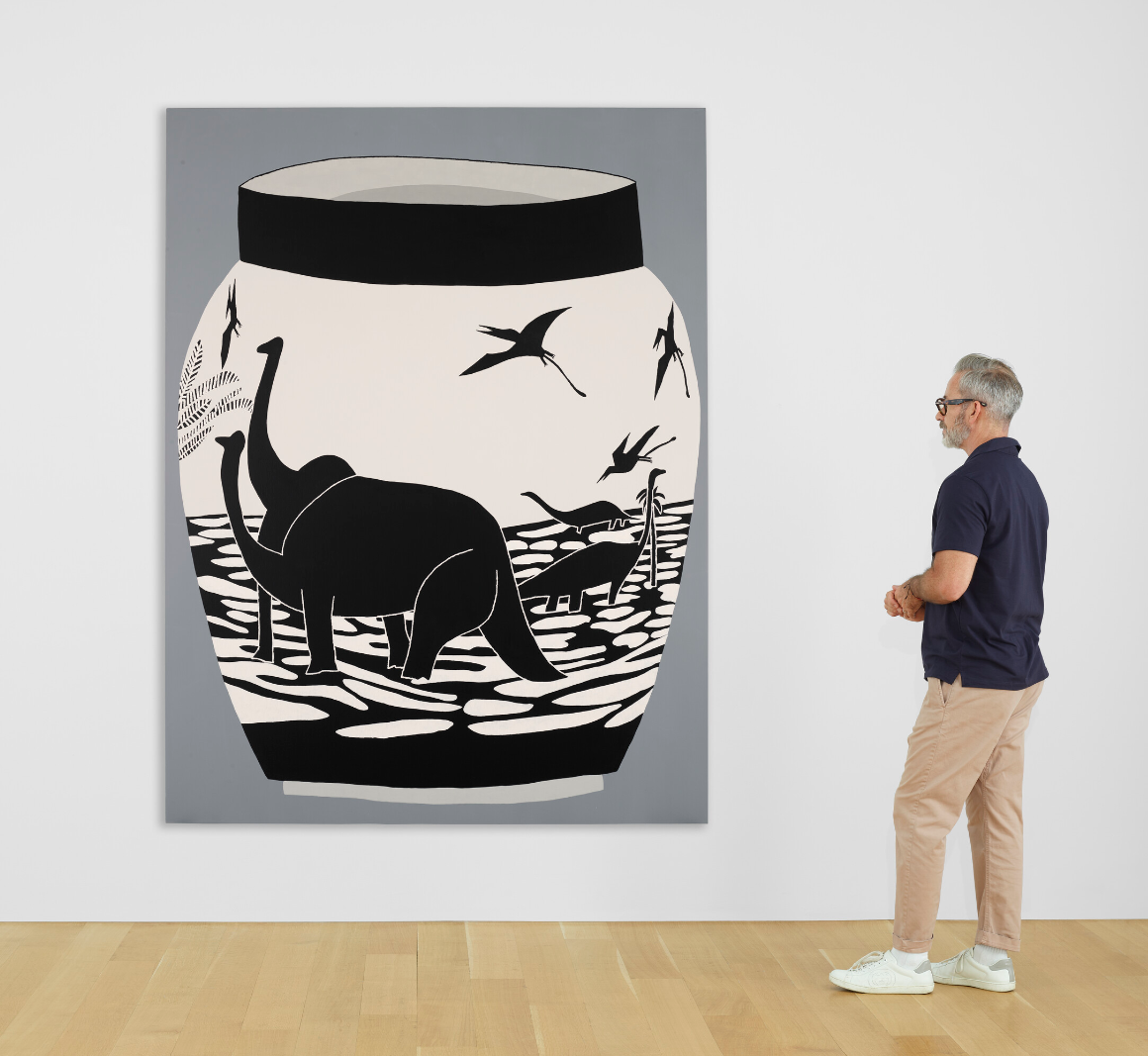
Towing the line between the elegant and the playful, SK Dino Pot #2 is deceivingly sophisticated – a touchstone of Wood’s oeuvre. Despite his methodically flat approach, Wood conjures dimensionality seemingly out of thin air. While the outline of the vessel encroaches on the edges of the canvas, creating a slightly claustrophobic effect, Wood simultaneously creates an airy atmosphere within the interior dinosaur landscape. All of these juxtapositions—light and dark, open and compressed, small and large—are powerful tools in Wood’s arsenal, which come together with masterful balance in SK Dino Pot #2. Iconically Jonas Wood, the present lot illustrates the artist’s remarkable ability to transform mundane subjects into entrancing and visually dynamic compositions, melding a meticulous technical approach to form and composition with an undying sense of playfulness. By fusing classical influences with his bold, modern style, Wood reinvigorates the genre, creating works such as SK Dino Pot #2, which effortlessly capture the essence of both the timeless and the contemporary.
Red Pot with White Blouse, 2018
Sotheby’s New-York: 18 May 2023
Estimated: USD 2,500,000 – 3,500,000
USD 3,690,000
Red Pot with White Blouse | The Now Evening Auction | 2023 | Sotheby’s (sothebys.com)
JONAS WOOD (b. 1977)
Red Pot with White Blouse, 2018
Oil and acrylic on canvas
72×70 inches (182.9 x 177.8 cm)
Initialed, titled and dated 2018 (on the reverse)
Drenched in saturated scarlet, Red Pot with White Blouse is Jonas Wood’s homage to artist Henri Matisse, whose flattening of space and graphic application has remained one of Wood’s chief artistic influences. The work is a Matisse painting within another Matisse painting, superimposed on a pot, and graphed back into Wood’s idiosyncratic style. Wood’s pot paintings are highly regarded and sought-after and reside within the collections of esteemed institutions including The Broad, Los Angeles; Museum of Modern Art, New York; and the Metropolitan Museum of Art, New York, among others. Red Pot with White Blouse epitomizes Jonas Wood’s masterful fusion of artistic influence and personal significance, transforming the humble pot into a riff on the traditional idea of painting-as-window.
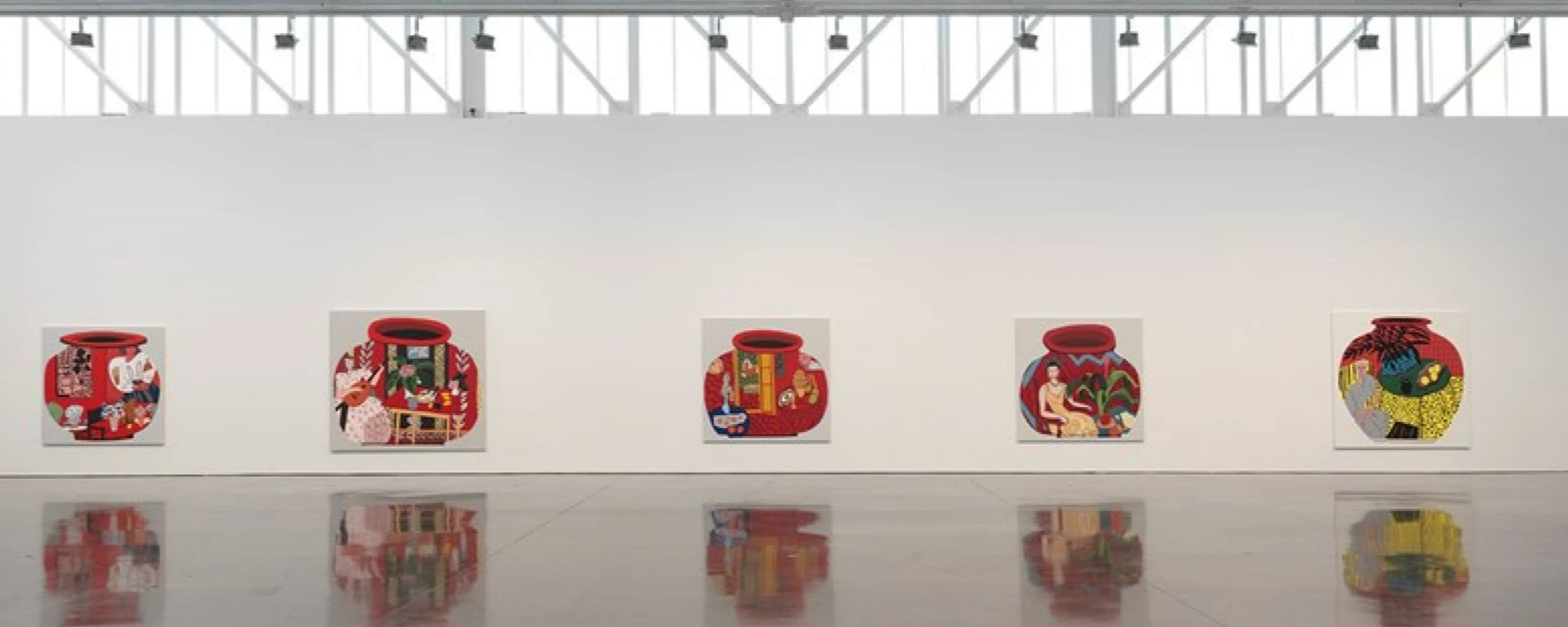
In Red Pot with White Blouse, Wood takes a three-dimensional pot – a key recurring symbol which reflects the influence of his wife Shio Kusaka’s celebrated ceramic practice – and flattens it to accommodate the two-dimensional oil painting medium, accentuating his collage-like style and propensity for spatial distortion. On the surface of the pot, Wood places Matisse’s La Blouse Roumaine, a charming portrait of a woman rendered with graphic detail and vibrant color, as a tableau within Matisse’s Large Red Interior. This act, along with the striking color, simplified forms, and lack of visual depth equally evokes The Red Studio, Matisse’s depiction of his workroom outside of Paris filled with paintings and sculptures, even a plate, all of his own making. Emphasizing both the malleability of image and a lack of fixation on it, the pastiche of images in Red Pot with White Blouse functions like a kind of slippage: Matisse’s meta-inclusion of his own paintings are turned into yet another work by the same artist.
Still Lifes and Potted Plants
Still Life with Cat and Fruit, 2020
Christie’s New-York: 21 November 2024
Estimated: USD 700,000 – 1,000,000
USD 1,865,000
JONAS WOOD (B. 1977), Still Life with Cat and Fruit | Christie’s
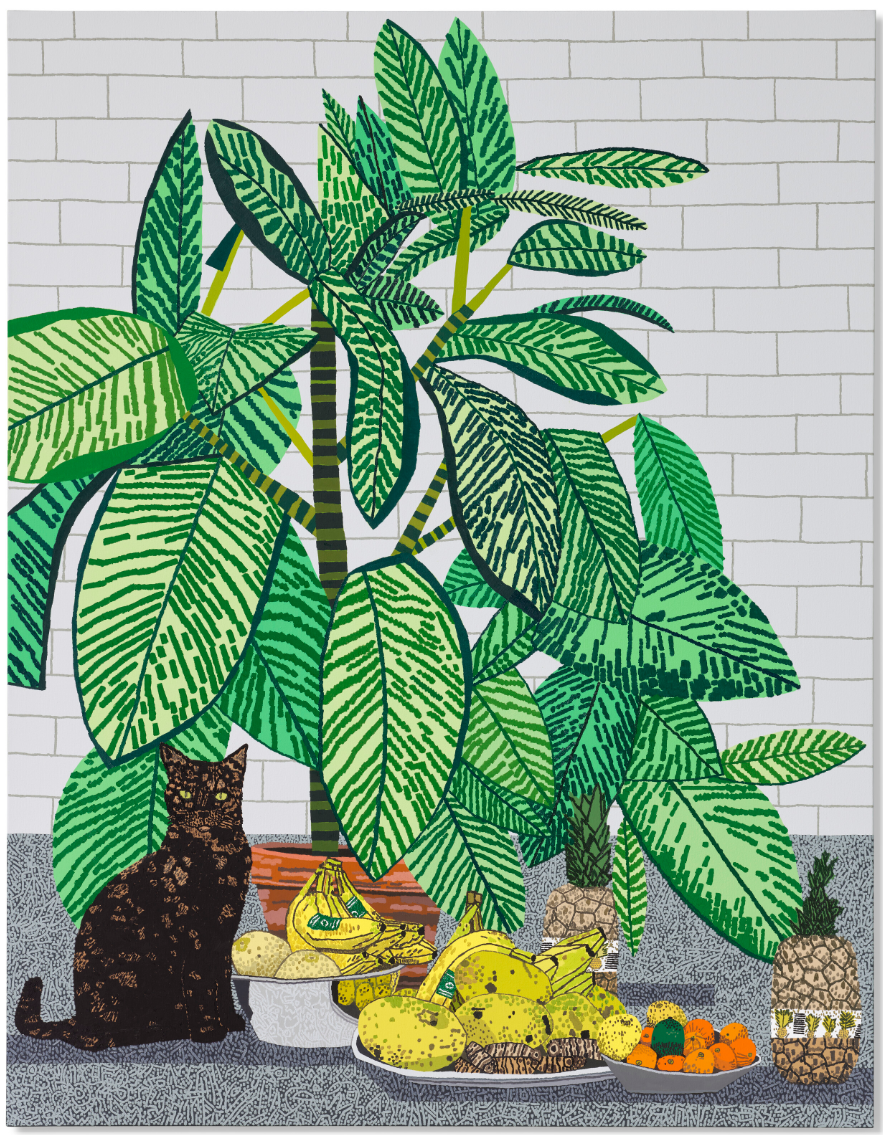
JONAS WOOD (B. 1977)
Still Life with Cat and Fruit, 2020
Oil and acrylic on canvas
58×45 inches (147.3 x 114.3 cm)
Signed, titled and dated ‘STILL LIFE WITH CAT AND FRUIT Jonas Wood 2020’ (on the reverse)
Blurring the line between bold abstraction and traditional figurative painting, Jonas Wood has a skill for transforming the quotidian into extraordinary portrayals of artistic lineage. A striking example of his interior scenes, Still Life with Cat and Fruit sees the painter’s detail-oriented process on full display. Sharp edges and an abundance of color push Wood’s work into the realm of Pop, but his reliance on art historical reference and a deep understanding of genre scenes create a singular style that bridges that gap between the canvases of old and contemporary techniques.
Often depicting the objects, people, and locales closest to him, Wood allows for a reimagining of the intimate moments in our everyday lives. Set against a simple backdrop of white tile and a speckled blue and black countertop, Wood’s still life is filled with dazzling patterning that buzzes the eye and creates an electric dynamism in an otherwise ubiquitous subject. The titular feline and bowls of fruit are rendered in flat panels of color and black outlines reminiscent of the heavily stylized ukiyo-e woodblocks of Edo period Japan.
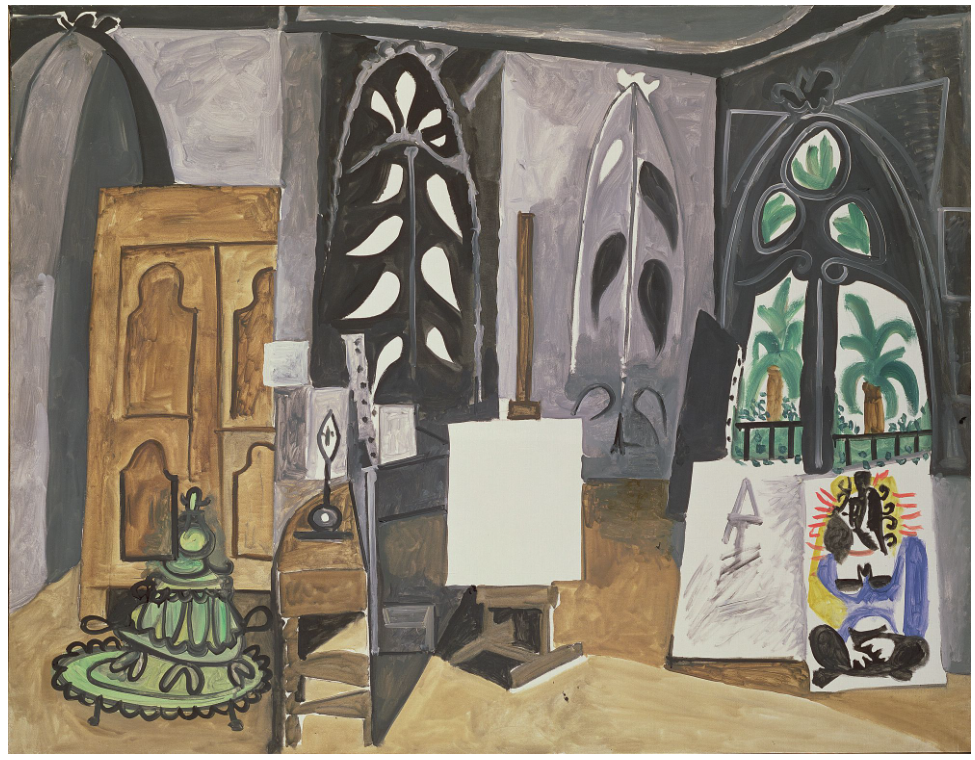
Pablo Picasso, The Studio at La Californie, 1956. Musée Picasso, Paris. © 2024 Estate of Pablo Picasso / Artists Rights Society (ARS), New York. Photo: Musee Picasso, Paris, France / Peter Willi / Bridgeman Images.
A potted plant dominates much of the canvas as its striped leaves splay out in various directions. Acting as a canopy to the rest of the subjects, this foliage is typical of Wood’s output and speaks to his interest in depicting his personal experience of the world.
“Of all the possible things I could paint, the thing that interests me is something that I can get close enough to in order to paint it honestly. The painters whose work means the most to me—that’s what they were painting. It was their loved ones or the stuff that was in their house. It was always this hyperpersonal thing to me.”
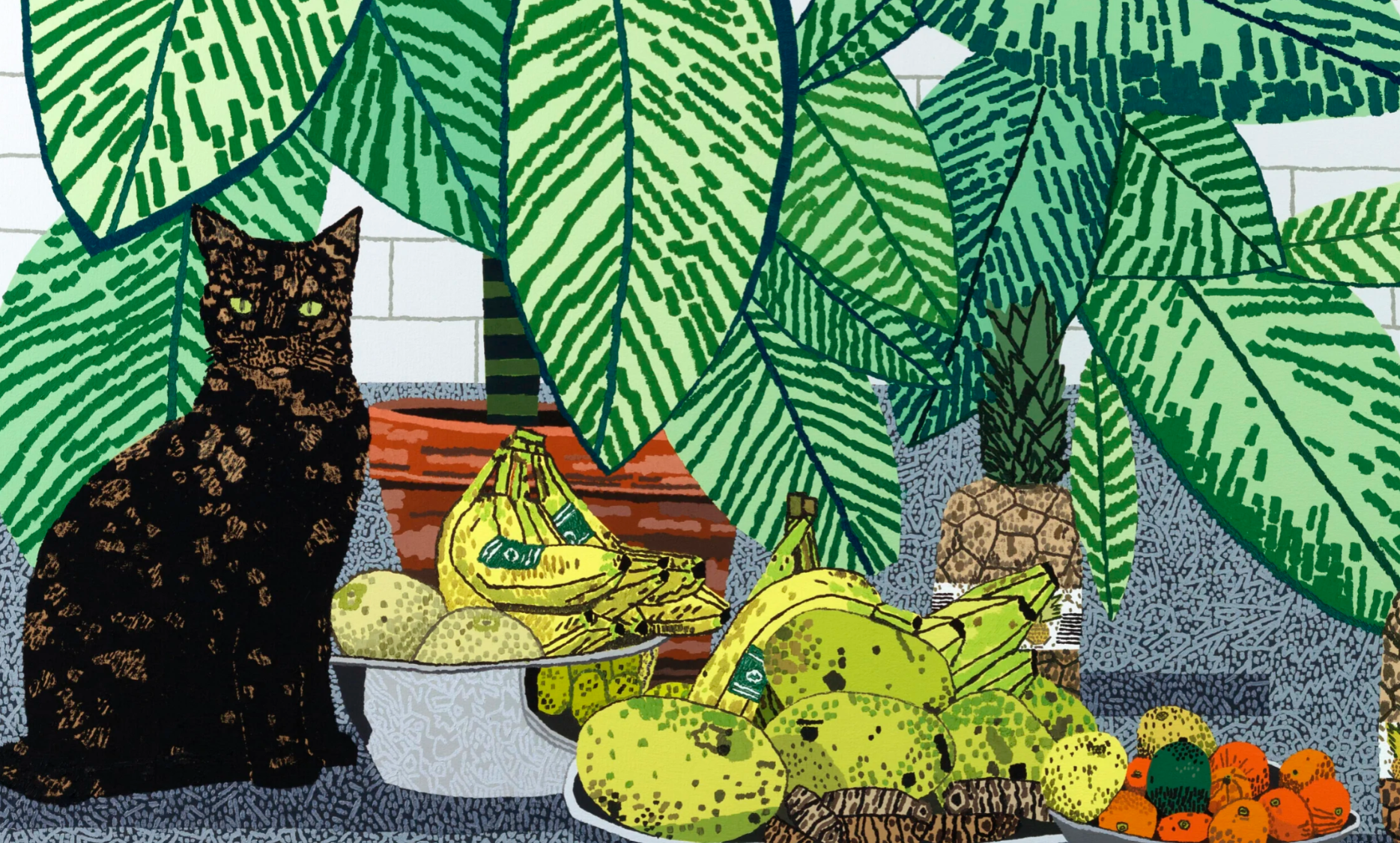
The artist’s attention to detail is revealed in the meticulous depictions of each spot and crease in the bananas, mangoes, and oranges, as well as the mottled surfaces and branded stickers of two pineapples. The cat, itself made up of a dark black void marked with brindle patches, connects directly with the viewer through its two searing eyes. By including this living animal, Wood allows for a more active entry point into his work. Instead of a scene that sits quietly while he paints it, the cat introduces a temporal element not always seen in the painter’s oeuvre.
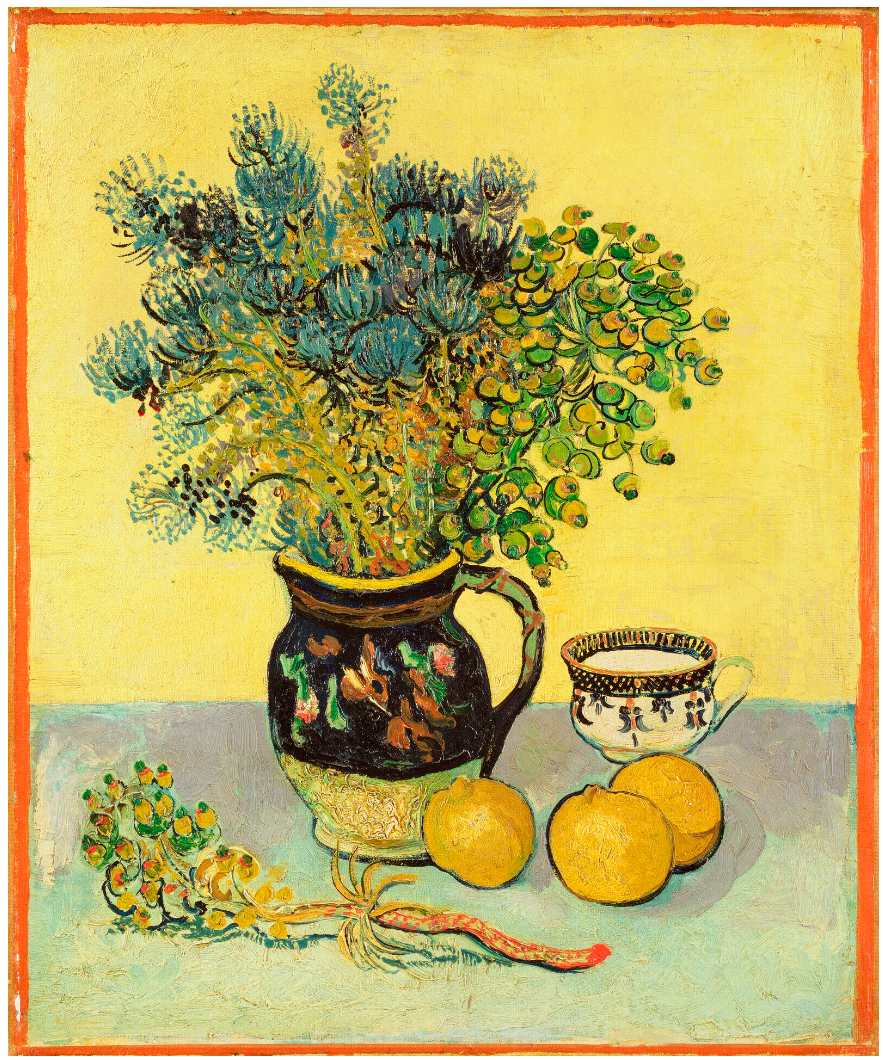
Vincent van Gogh, Nature morte, 1888. Barnes Foundation, Philadelphia.
Photo: © Barnes Foundation / Bridgeman Images.
Though works like Still Life with Cat and Fruit are decidedly of the moment, they pull from a rich history of representational painting. In particular, Wood has noted his indebtedness to the work of David Hockney. Depicting his subjects with the same kind of cool California approach to bright color and even light, Wood also recognizes his predecessor’s inspirations.
“The thing about Hockney or Alex Katz or Lucian Freud or any of those people that I’m super into, they were into those modern painters, too. So I get to look at Matisse or Picasso through their work.”
By consciously establishing an artistic lineage, Wood is able to create concrete connections between the centuries. In so doing, works like the present example become representations of painting’s evolution as well as potent illustrations of artistic influence.
Untitled (3 Shio Pots), 2010
Sotheby’s New-York: 13 October 2023
Estimated: GBP 100,000 – 150,000
GBP 107,950
Untitled (3 Shio Pots) | Contemporary Day Auction | 2023 | Sotheby’s (sothebys.com)
JONAS WOOD (b. 1977)
Untitled (3 Shio Pots), 2010
Oil on canvas
34 1/8 x 22 1/4 inches (86.6 x 56.4 cm)
Signed with the artist’s initials, titled and dated 2010 (on the reverse)
An intricate study celebrating the multidisciplinary skills of painting and ceramics, Jonas Wood’s Untitled (3 Shio Pots) from 2010, features beautifully rendered stoneware vessels atop a table, replete with subtle yet wholly dynamic silhouettes and shadows that bring this scene to life. The present work’s predominantly monochromatic palette is punctuated by an accent of bright blue and the sharp angles of the exotic plant, causing the viewer’s eye to dart across the composition. The vases depicted are made by artist and Wood’s wife Shio Kusaka. Currently based in Los Angeles and sharing a studio, the two cultural practitioners often work in tandem, motifs migrating from Kusaka’s ceramic vessels to Wood’s paintings and back again. A tranquil and exquisite painting of an almost animated quality, the present work epitomizes the most celebrated qualities of the artist’s oeuvre.
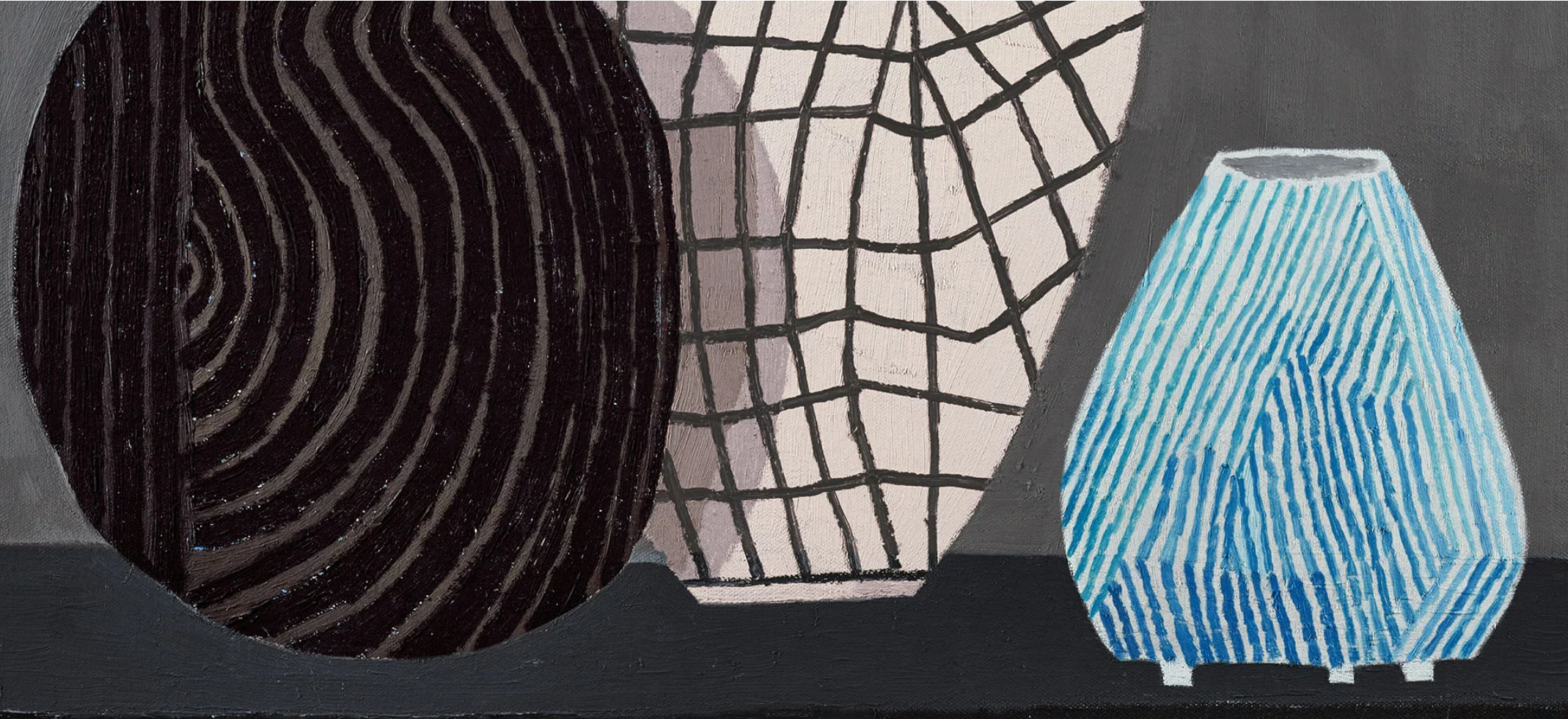
Extending an art historical tradition of scenes from everyday life, Wood references the infamous domestic interiors of Pierre Bonnard, David Hockney, and Henri Matisse. Translating the three-dimensional realm into stylised colour and line, Wood’s graphic works combine art historical reference with objects, interiors, and people from his own life. Indeed the present work is a key example of Wood’s masterful ability to fuse artistic influence with personal significance.
Baby Blue, 2009
Christie’s New-York: 29 September 2023
Estimated: USD 100,000 – 150,000
USD 126,000
JONAS WOOD (B. 1977) (christies.com)
JONAS WOOD (B. 1977)
Baby Blue, 2009
Oil on canvas
30×22 inches (76.2 x 55.9 cm)
Signed, titled and dated ‘Jonas Wood 2009 BABY BLUE’ (on the reverse)
Untitled (Take 2), 2009
Sotheby’s London: 1 March 2023
Estimated: GBP 350,000 – 450,000
GBP 609,600 / USD 733,660
Untitled (Take 2) | The Now Evening Auction | | Sotheby’s (sothebys.com)
JONAS WOOD (b. 1977)
Untitled (Take 2), 2009
Oil on canvas
213×97 cm (83 7/8 x 38 1/4 inches)
Signed JBRW, titled Untitled (Take 2) and dated 2009 (on the reverse)
A towering display of his unique artistic vernacular, Untitled (Take 2) depicts a vibrant and towering monstera plant emerging from a terracotta pot, encompassing the viewer in the larger-than-life world of Jonas Wood. Anatomical and saturated while simultaneously geometric and aesthetically sharp, the present work encapsulates the familiar style and iconography of Jonas Wood’s lexicon, translating quotidian objects into highly stylized, blockish forms on a large scale. Executed in 2009, Untitled (Take 2) draws on and unites many of the most important and celebrated elements of Wood’s oeuvre, thus epitomizing the artist’s aesthetic project with serene vibrance on a monumental scale.
Green Garden Landscape Pot, 2016
Christie’s New-York: 10 May 2022
Estimated: USD 2,500,000 – 3,500,000
USD 3,060,000
JONAS WOOD (B. 1977) (christies.com)
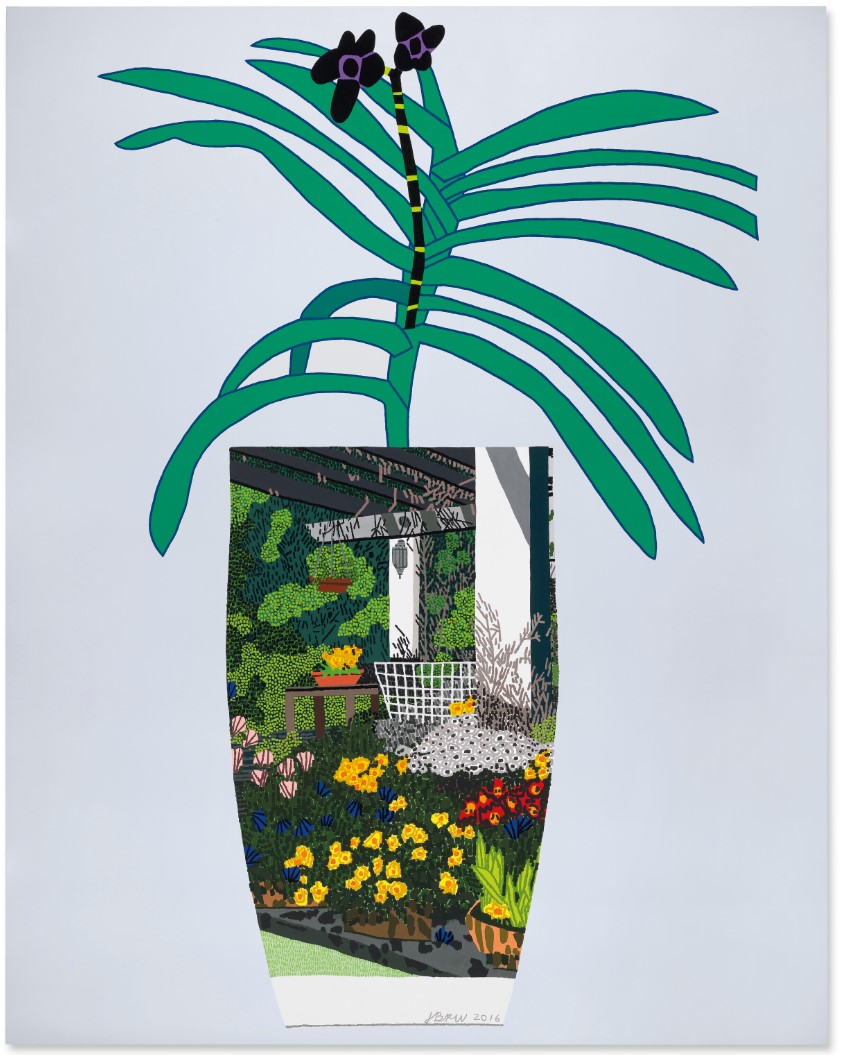
JONAS WOOD (B. 1977)
Green Garden Landscape Pot, 2016
Oil and acrylic on canvas
118×93 inches (299.7 x 236.2 cm)
Signed with the artist’s initials and dated ‘JBRW 2016’ (lower edge)
Signed again with the artist’s initials
Titled and dated again ‘JBRW 2016 GREEN GARDEN LANDSCAPE POT’ (on the reverse)
Blurring the line between the intimate and the monumental, Jonas Wood’s dynamic oeuvre is bristling with vivid colors, sharp lines, and a careful reinvestigation of art history and the everyday. Exploring the conjunction between the quotidian and the historical, the painter has quickly become one of the most sought after artists of recent years. From the much-lauded Landscape Pots series, Green Garden Landscape Pot is a visually compelling canvas that marries representation with abstraction and challenges the viewer’s perception of space. Its seemingly simple composition opens wide upon extended looking to reveal a dexterity and finesse telling of the artist’s exhaustive study of art history and its relationship to domestic life. Combining Wood’s spare still life images, or Clippings, with his more inclusive scenes of home and garden, works like Green Garden Landscape Pot set the artist up for a new stage in his visual investigations.
Rendered on a flat gray background, a large potted plant stretches nearly the entire height of the canvas. On the vessel’s surface, Wood sets out a detailed garden scene with iris, daffodils, and black-eyed susans popping up cheerfully amidst thick green foliage. A white trellis and a small table are set toward the back near two white columns that suggest a larger structure nearby. The pot contains this scene within strict walls, and itself acts as both a representative object and a window into another world. The splay of green tendrils and two dainty black and purple flowers extend from the illusion of three dimensions, but the reality is that the edges of the vessel are as flat and sharp as the even background upon which it rests. It is almost as if Wood cut out the garden scene from a larger image and fashioned it into a collaged urn for the jaunty vegetation.
“Painting the landscape pots wasn’t necessarily about painting well; it wasn’t about creating an image that was relatable to the viewer, or about painting in a more realistic way. I wanted to paint the landscape pots so they were intentionally unrealistic. They were all filtered into an even looser organization of information that would represent this landscape pot as opposed to trying to paint the perfect landscape on a pot. Because I was recycling the imagery from previous works, it was like painting a painting in a painting.”
In the present example and the rest of the series, Wood establishes conflicting planes of illusionistic reality that push and pull at each other. Like the contradiction inherent in the flatness of a photographic media versus its internal visual depth, each Landscape Pot can be looked at and looked into. Both a flat surface and an entrance for the eyes to explore, the vessel plays with traditional notions of the picture plane and asks us to think about multiple vantages at once. There is often a sense of calm that permeates Wood’s canvases, even when they become massive in scale and tend toward abstraction. The artist is known for his intimate tableaus and still lifes that often incorporate houseplants, ceramics made by his wife the renowned ceramicist Shio Kusaka, and interior scenes dappled with California light streaming through windows. Creating this personal iconography over the years, Wood paints subjects as ordinary as planters and basketballs, but actively uses this imagery to explore the bounds of his artform rather than sticking to the traditional notions of still life or interior scenes. Green Garden Landscape Pot is a prime example of this inquiry as he transforms the everyday into a catalyst for his ever-evolving practice.
Wood Grain Pot with Night Bloom, 2015
Sotheby’s London: 14 October 2022
Estimated: GBP 800,000 – 1,200,000
GBP 642,600 / USD 720,405
Wood Grain Pot with Night Bloom | The Now Evening Auction | 2022 | Sotheby’s (sothebys.com)
JONAS WOOD (b. 1977)
Wood Grain Pot with Night Bloom, 2015
Oil and acrylic on canvas
118×90 inches (299.7 x 228.6 cm)
Signed JBPW, titled Wood Grain Pot with Night Bloom and dated 2015 (on the reverse)
An intricate study of the pot’s textural pattern juxtaposed by the bright green leaves and blooming flowers of the exotic plant which droop over its side, Jonas Wood’s Wood Grain Pot with Night Bloom is a tranquil and exquisite painting of an almost animated quality that epitomizes the most celebrated qualities of the artist’s oeuvre. Executed in 2015, the present work was included in Wood’s first solo exhibition in London. Translating the three-dimensional world around him into flat color and line, Wood’s graphic works combine art historical reference with objects, interiors, and people from his own life. From the domestic interiors of Pierre Bonnard, David Hockney, and Henri Matisse to the ceramic and stoneware vessels made by his wife Shio Kusaka, the present work is a key example of Wood’s masterful ability to fuse artistic influence with personal significance.
Mini Purple Bball Orchid, 2021
Christie’s New-York: 12 November 2021
Estimated: USD 200,000 – 300,000
USD 870,000
JONAS WOOD (B. 1977) (christies.com)
JONAS WOOD (B. 1977)
Mini Purple Bball Orchid, 2021
Oil and acrylic on canvas
28×20 inches (71.1 x 50.8 cm)
Signed with the artist’s initials, titled and dated ‘MINI PURPLE B BALL ORCHID JBRW 2021’
(on the reverse)
Untitled (Blue with Triangles), 2009
Sotheby’s Hong-Kong: 10 October 2021
Estimated: USD 1,500,000 – 2,500,000
HKD 3,150,000 / USD 404,650
JONAS WOOD
Untitled (Blue with Triangles), 2009
Oil on canvas
32×32 inches (81.4 x 81.4 cm)
Signed, titled and dated 2009 on the reverse
Boston-born Jonas Wood is best known for his brightly colored, graphic works that depict portraits, still lifes, landscapes, and interior scenes. Executed in 2009, Untitled (Blue with Triangles) is an eye-catching example of his favored motif of the plotted plant, and his flattened, collage-like amalgamation of geometry, pattern, and color. Indeed, during his student years at the University of Washington, the artist experimented with collage using montaged photographs of his friends and their surroundings, the influence of which can be seen in the pictorial flattening of the present work. Wood draws on a variety of references from art history, and his use of bright colors and choice of subject matter reveals a certain indebtedness to the works of David Hockney and Alex Katz. Epitomizing the artist’s preoccupation with ceramic vases and potted plants, the present work immediately commands the viewer’s attention, absorbing their gaze into the patchwork of triangles that covers the vessel, standing out against the monochromatic blue of the background.
Maritime Hotel Pot with Aloe, 2014
Christie’s New-York: 19 May 2018
Estimated: USD 550,000 – 750,000
USD 2,292,500
Jonas Wood (b. 1977) (christies.com)
Jonas Wood (b. 1977)
Maritime Hotel Pot with Aloe, 2014
Oil and acrylic on canvas
120×76 inches (304.8 x 193 cm)
Signed with the artist’s initials, titled and dated ‘MARITIME HOTEL POT WITH ALOE JBRW 2014’ (on the reverse)
Maritime Hotel Pot with Aloe is a stunning example of the artist’s signature style that fuses visual references to mid-20th century David Hockney and an eye for subverted space typical of Henri Matisse. Blending the traditional still life with scenes of an urban landscape, the ‘Landscape Pots’ like Maritime Hotel Pot with Aloe create a push and pull between intimate space and scenic vista, between illusionistic representation and abstracted reality. This combination of intimate settings and grand scale mark Wood as one of the most innovative representational painters working today. Set against a pale gray ground, a skinny aloe plant springs forth from a large pot. The surface of the vessel is adorned with an intricate image that depicts darkened buildings receding into a blazing sunset. Painted primarily in black and gray, each structure is alight with the grid patterns of multi-pane windows, some offering the pale yellow of an incandescent bulb and others dark for the evening. In the distance, columns of smoke and steam rise from chimneys while a small patch of blue signifies the presence of water. Above it all, a gradient of red, pink, orange and yellow leads the eye upward into the aloe’s tendrils. At the base, a curved line sweeps across the image. The leaves of the aloe plant cast faint shadows on this scene and confuse the illusionary depth of the piece.
Yellow Crate, 2006
Phillips London: 9 December 2021
Estimated: GBP 150,000 – 200,000
GBP 327,600 / USD 432,075
Jonas Wood – New Now London Lot 17 December 2021 | Phillips
JONAS WOOD
Yellow Crate, 2006
Oil on canvas
32 1/2 x 36 1/2 inches (82.6 x 92.7 cm)
Signed with the artist’s initials and dated ‘JBRW 2006’ on the overlap
Bold, brightly colored, and capturing the graphic quality that the artist has become so well-known for, Yellow Crate is highly representative of Los Angeles-based artist Jonas Wood’s idiosyncratic approach to the tradition of still-life painting. Isolated against a sparse background and featuring a single houseplant in a simple terracotta pot whose slender, hanging stems introduce an element of natural geometry to the composition, Yellow Crate foregrounds questions of pattern, form, and color in its presentation of a deceptively simple scene of everyday life. Intimately tied to the domestic and the personal, Yellow Crate highlights Wood’s tendency to draw on his own life and immediate surroundings for his subject matter. Moving between art-historical and highly personal references, Wood’s compositions frequently feature pots designed by his wife, the ceramic artist Shio Kusaka, arranged amongst the other material traces of interiors, objects, friends, and heroes that make up the rich fabric of his life.
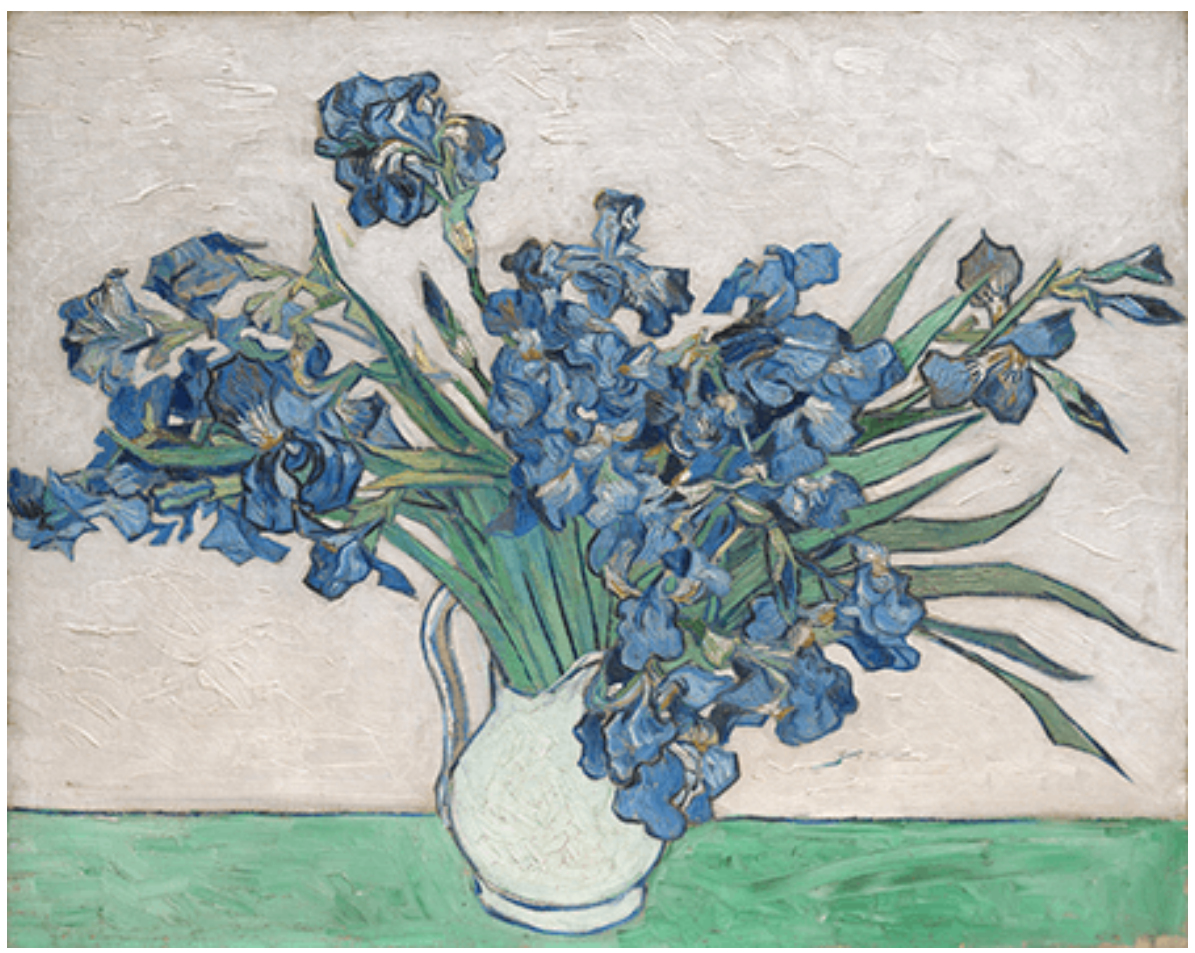
Vincent van Gogh, Irises, 1890, Image: Metropolitan Museum of Art, New York, Gift of Adele R. Levy, 1958
Growing up surrounded by his grandfather’s impressive art collection, Wood absorbed these influences at a young age, the flattened forms, chromatic relationships, and attention to rhythmic pattern here visually recalling the spatial arrangements of Henri Matisse and Vincent Van Gogh alongside the sensually saturated and distinctly Californian palette of David Hockney. In his unique blend of realism and abstraction Wood renders the familiar strange, combining these carefully studied art-historical references with the deeply personal, reinterpreting both in his uniquely contemporary and instantly recognizable visual vocabulary. Yellow Crate is also characteristic of Wood’s working practice more broadly. Having collected his source material – usually photographs or drawings of his immediate environment – Wood then begins to layer his forms, moving from abstract blocks of color and acrylic underlayers to more patterned elements overpainted in oil, flattening both the figure and the spatial environment in the process.
Yellow Still Life with Grating, 2016
Christie’s Hong-Kong: 1 December 2021
Estimated: HKD 12,000,000 – 18,000,000
HKD 36,250,000 / USD 4,652,565
JONAS WOOD (B. 1977) (christies.com)
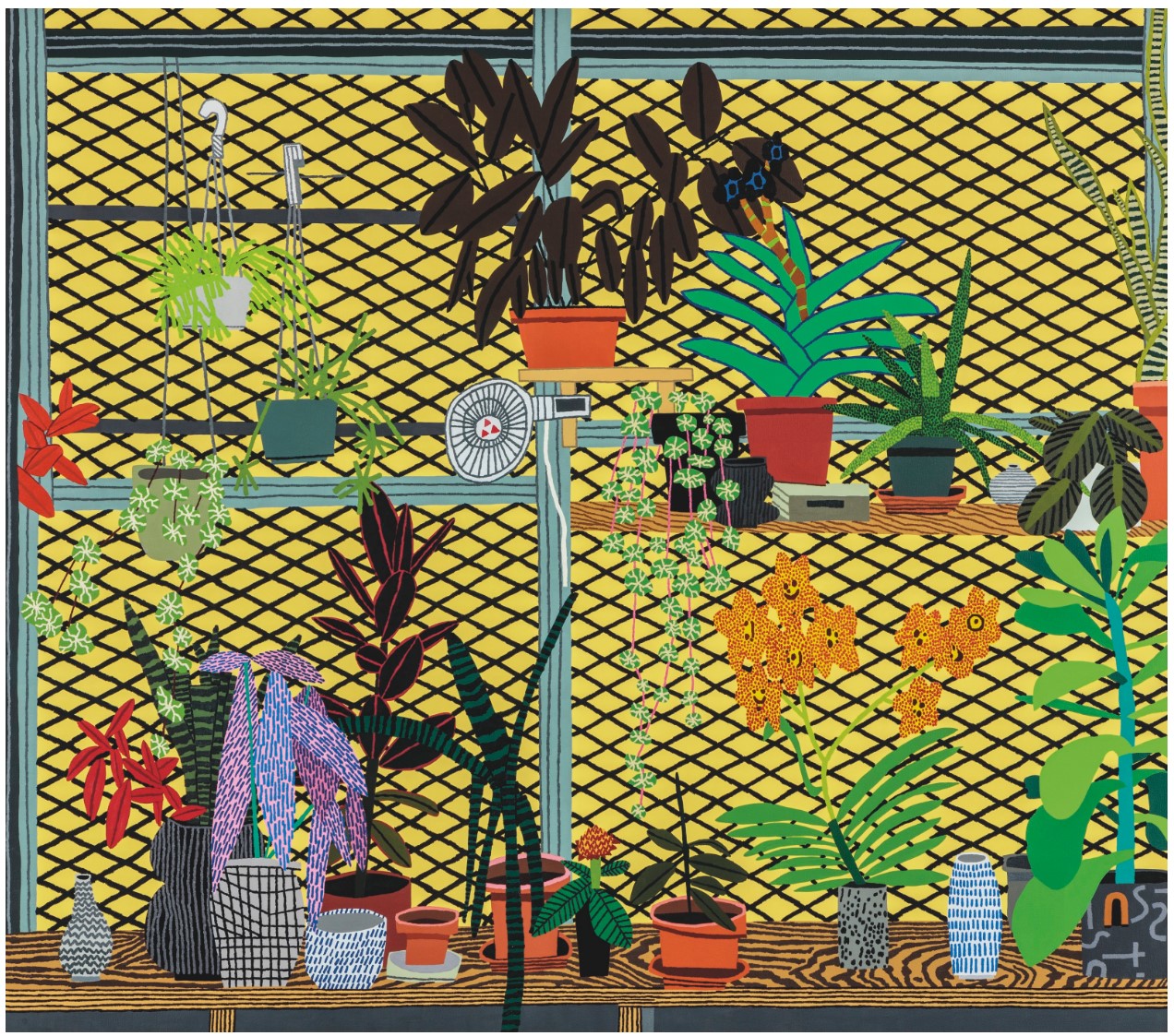
JONAS WOOD (B. 1977)
Yellow Still Life with Grating, 2016
Oil and acrylic on canvas
60×68 inches (152.4 x 172.7 cm)
Signed, titled, and dated ‘YELLOW STILL LIFE WITH GRATING GRATING JBPW 2016’ (on the reverse)
Yellow Still Life with Grating is a carefully and intentionally constructed image. In order to arrive at his final composition, Wood builds up the painterly layers like an architect (his father designed buildings), often beginning with a photograph of compositional forms that capture his attention and then creating a collage from multiple photographs, before producing a drawing of this new configuration. Next he paints in the background, before focusing his attention on the foreground elements in exacting detail, making final adjustments as he does so.
The nuanced combinations of patterns, shapes, colors, and subjects have become Wood’s own personal iconography, but he is always looking to improve his ability to maintain balance and visual intrigue in his work. Yellow Still Life with Grating alludes to pronkstilleven, or ostentatious still life in Dutch, a popular genre in 16th and 17th century Netherland that depicts a diversity of objects, fruits and flowers. Adapting the tradition to contemporary visual language, Yellow Still Life with Grating reflects the earthly pleasure of a modern being and induces a deeper meditation on the true meaning of life.
Two Tables with Floral Pattern, 2013
Christie’s New-York: 11 May 2021
Estimated: USD 2,000,000 – 4,000,000
USD 6,510,000
JONAS WOOD (B. 1977) (christies.com)
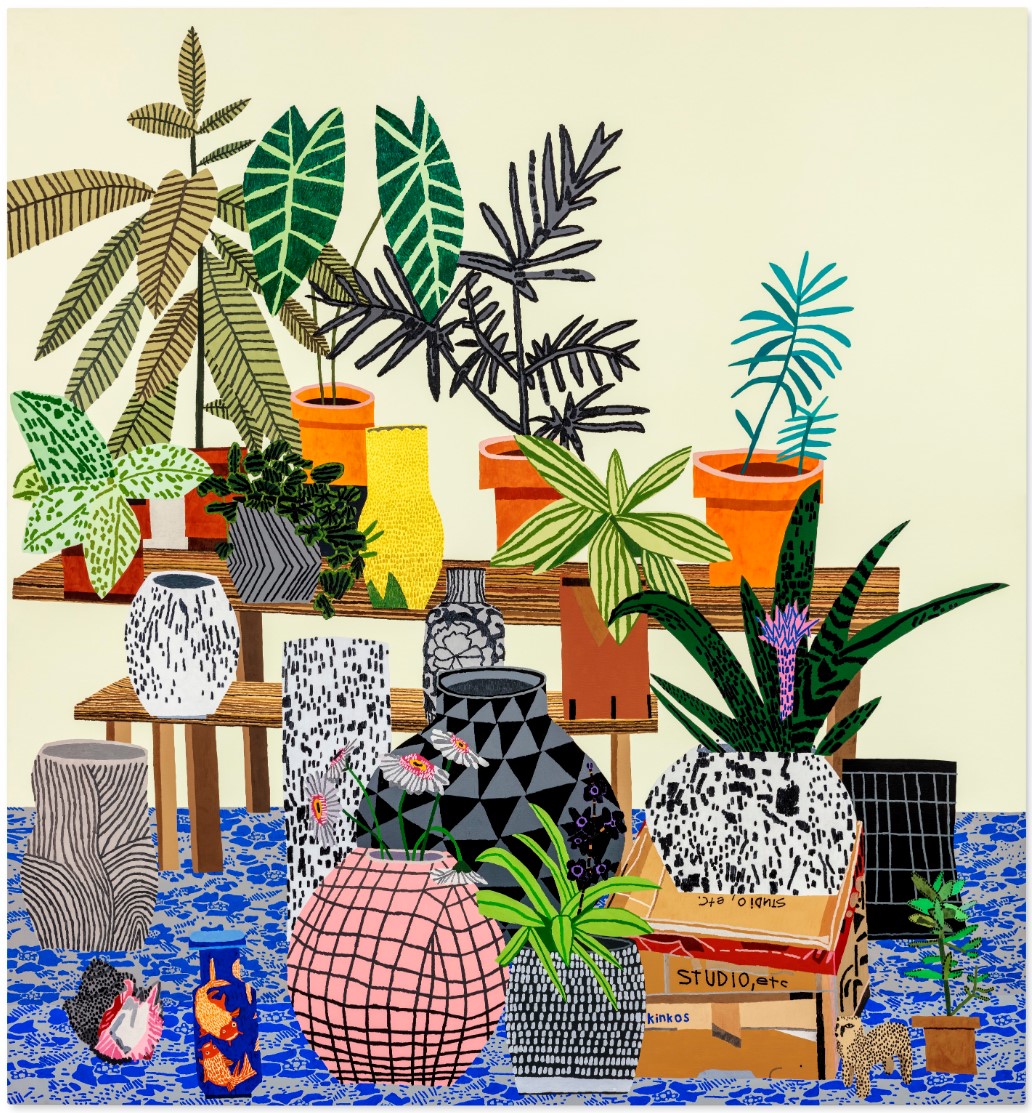
JONAS WOOD (B. 1977)
Two Tables with Floral Pattern, 2013
Oil and acrylic on canvas
100×93 inches (254 x 236.2 cm)
Signed with the artist’s initials, titled and dated ‘TWO TABLES WITH FLORAL PATTERN JBRW 2013’ (on the reverse)
Arranged against a soft light-filled background, a forest of houseplants rises from various pots, and vases. Some sit in basic terracotta containers while others sprout from elaborately patterned ceramics. Two tables in the background, seemingly composed of dark, raw wood, hold nearly a dozen leafy denizens while the remainder rest on a blue carpet resplendent with the floral pattern noted in the work’s title. One pot in particular, a white and black speckled vessel with a flowering green and pink bromeliad protruding from the opening, rests on a cardboard box marked “STUDIO, etc”. Below this, the blue text of the bygone Kinko’s logo peeks, naming this pedestal as a repurposed copy paper box that has seen many uses in its simple life. These intimate compositions speak to the artist’s interest in the history of art as well as the complacency of the everyday.
“Of all the possible things I could paint, the thing that interests me is something that I can get close enough to in order to paint it honestly. The painters whose work means the most to me—that’s what they were painting. It was their loved ones or the stuff that was in their house. It was always this hyperpersonal thing to me”
Though they occupy the area between abstraction and figuration, Wood’s compositions represent real things in real spaces. Many of the ceramics he paints exist in his house. His wife, noted artist Shio Kusaka, is a constant source of inspiration for the painter, and her ceramic work figures prominently in many of his canvases.
Wood’s paintings are carefully and intentionally constructed images. In order to arrive at his final composition, Wood builds up the painterly layers like an architect (his father designed buildings), often beginning with a photograph of compositional forms that capture his attention and then creating a collage from multiple photographs, before producing a drawing of this new configuration. Next he paints in the background, before focusing his attention on the foreground elements in exacting detail, making final adjustments as he does so. As well as formal concerns, he also adds nods to art history. The artist is equally inspired by still-life arrangements in his home as he is by the paintings of Matisse’s studio. The faux-woodgrain of the titular tables in Two Tables with Floral Pattern is reminiscent of Cubist collage and trompe l’oeil, while the graphic sensibilities of each leaf would be equally at home in the jungles of Rousseau. The nuanced combinations of patterns, shapes, colors, and subjects have become Wood’s own personal iconography, but he is always looking to improve his ability to maintain balance and visual intrigue in his work. Though the collection of pots and plants may look random at first, Two Tables with Floral Pattern is a methodically-plotted composition that uses simple objects to chart a course through layers of influence.
Interiors
Untitled (Drawing Rally), 2011
Sotheby’s London: 25 June 2024
Estimated: GBP 1,000,000 – 1,500,000
GBP 1,110,000 / USD 1,407,480
JONAS WOOD (b. 1977)
Untitled (Drawing Rally), 2011
Oil and acrylic on canvas
98 x 88 1/4 inches (249×224 cm)
Signed, titled and dated 2011 (on the reverse)
Rendered with graphic patterning and bold perspective, Untitled (Drawing Rally) from 2011 is a vibrant exemplar of Jonas Wood’s renowned corpus of potted flora in an intimate domestic space. Employing artistic tropes of flattened colors and spatial distortion recalling French Modernist painting, Wood lends this quiet still life a striking playfulness. Through the visual framework of outstretched plant leaves, the viewer is drawn into the room to experience an illusion of depth created by Wood’s radically simplified articulation of pattern; a space expertly constructed as if it extended beyond the edges of the canvas. Adapted from a 2009 ink and pencil drawing of the same scene, and later translated into an editioned silk scarf, the present work features many of the artist’s favored motifs. With intricately detailed brushwork and bright planes of color set on an immense scale, Untitled (Drawing Rally) presents a fresh take on contemporary life where the seemingly mundane is elevated to the extraordinary.
Executed in 2011, Untitled (Drawing Rally) employs many of the artist’s best-known techniques and symbols. His painterly style is a playful yet rigorous interrogation of the traditional representational challenge of capturing three-dimensional forms on the flat picture plane.. Untitled (Drawing Rally) is a particularly arresting example: the entirely monochromatic room is depicted with stark linearity, lending added visual potency to the boldly-hued plants, chair, and painting. Centered on the empty chair, this domestic scene gestures at portraiture, the implied absent presence referencing similar imagery from throughout art history, from Diego Velasquez to Vincent Van Gogh to David Hockney. Set on an impressive, enveloping scale, each vivid element becomes its own spectacle, resulting in a composition which draws the viewer’s eye in an endless circle.
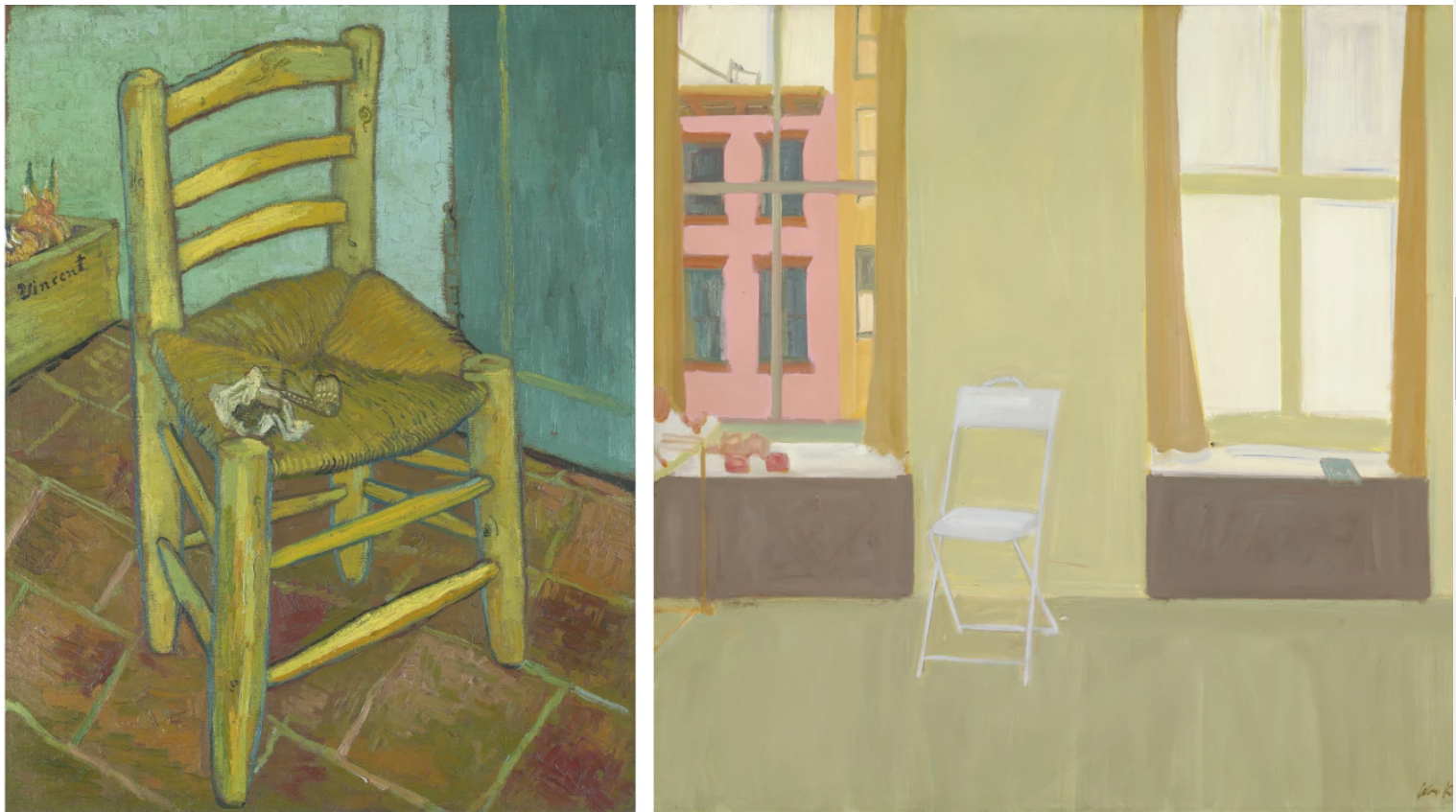
VINCENT VAN GOGH, VINCENT’S CHAIR, 1888 / NATIONAL GALLERY, LONDON / IMAGE: © BRIDGEMAN IMAGES
ALEX KATZ, FOLDING CHAIR, 1959 / NATIONAL GALLERY OF ART, WASHINGTON, D.C. / ARTWORK: © ALEX KATZ/VAGA AT ARS, NY AND DACS, LONDON 2024
Wood’s visual vernacular is marked by a photo-based approach. Like Henri Matisse’s late process of cutting gouache-painted paper into a wide range of shapes and rearranging them into new compositions, Wood works from a personal archive of photographs and found imagery, making sketches and studies before creating preliminary collages. The cut-and-pasted preparatory studies are then filtered through various layers of drawing until he arrives at his final composition.
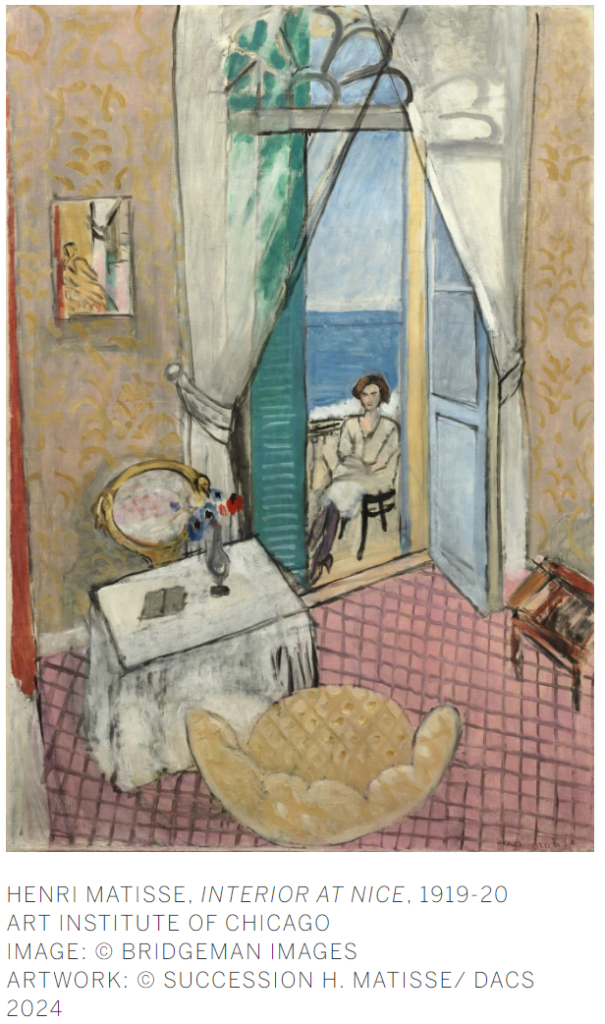
This fragmentary method is, in essence, a synthesized perception of time and space; as a result, the final works vibrate with an energetic rhythm and fantastical harmony. Here, a depiction of Adam and Eve – one of the most iconic scenes in the Western canon – is juxtaposed with Wood’s own signature plants, a frequent motif inspired by the potted plants and foliage in his Los Angeles home and studio. Geometric and saturated, yet aesthetically sharp, the assembled imagery encapsulates the familiar style and iconography of Jonas Wood’s lexicon, taking quotidian objects and snapshots and translating them into highly stylized, blockish forms on a large scale. Blurring the line between reality and fiction, familiar objects and simplified scenery appear to be a somewhat faithful portrayal of an ordinary interior, yet this distorted translation evokes an imagined realm.
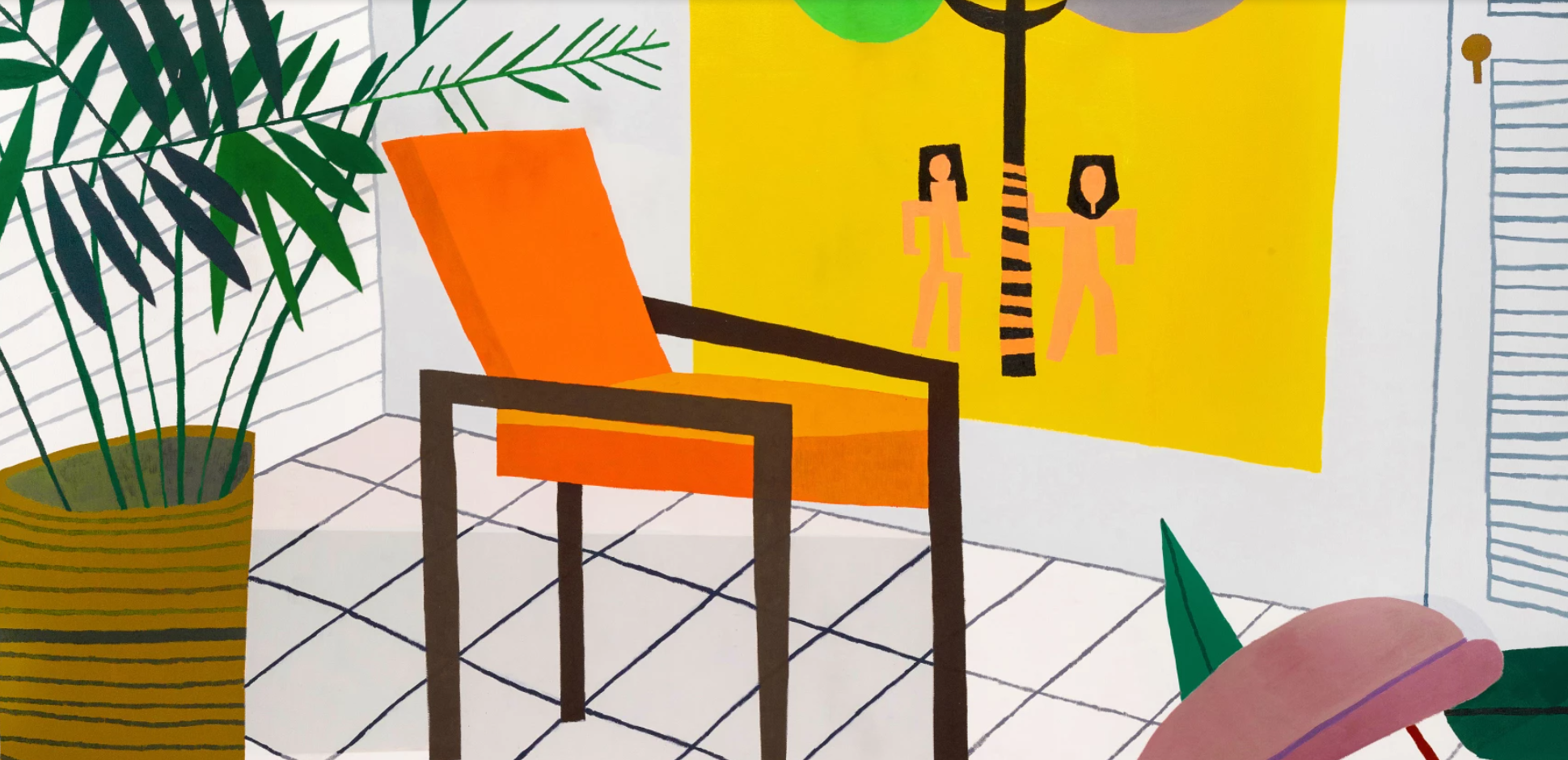
Over the past two decades, Wood has carved out his own distinctive and critically lauded aesthetic that is embedded in a rich network of art-historical reference. The impact of Cubism is evident in his work’s conflation of multiple perspectives, while his focus on the quotidian as well as the cheerful gaiety of his palette invokes the language of Pop art, evoking in particular David Hockney’s domesticated landscapes and gardens. Amongst these influences, the present work is further ingrained in the Modernist style, with expressive mark-making and patterning akin to the interiors of Henri Matisse, in particular works like Interior at Nice (1919), with its starkly rendered angular space, cross-hatched flooring, and horizontal window shutters.
“Hockney was a big, big influence on me. He has that Renaissance ability to paint from life but he’s also an inventor,” says Wood. “But I love Picasso and Braque and Matisse and Vuillard… And the thing about Hockney or Alex Katz or Lucian Freud or any of those people that I’m super into, they were into those modern painters, too. So I get to look at Matisse or Picasso through their work”
Evincing his depth of art historical knowledge and frequent sampling from his contemporaries, Wood combines these myriad references into a rich tapestry of personal and canonical allusion.
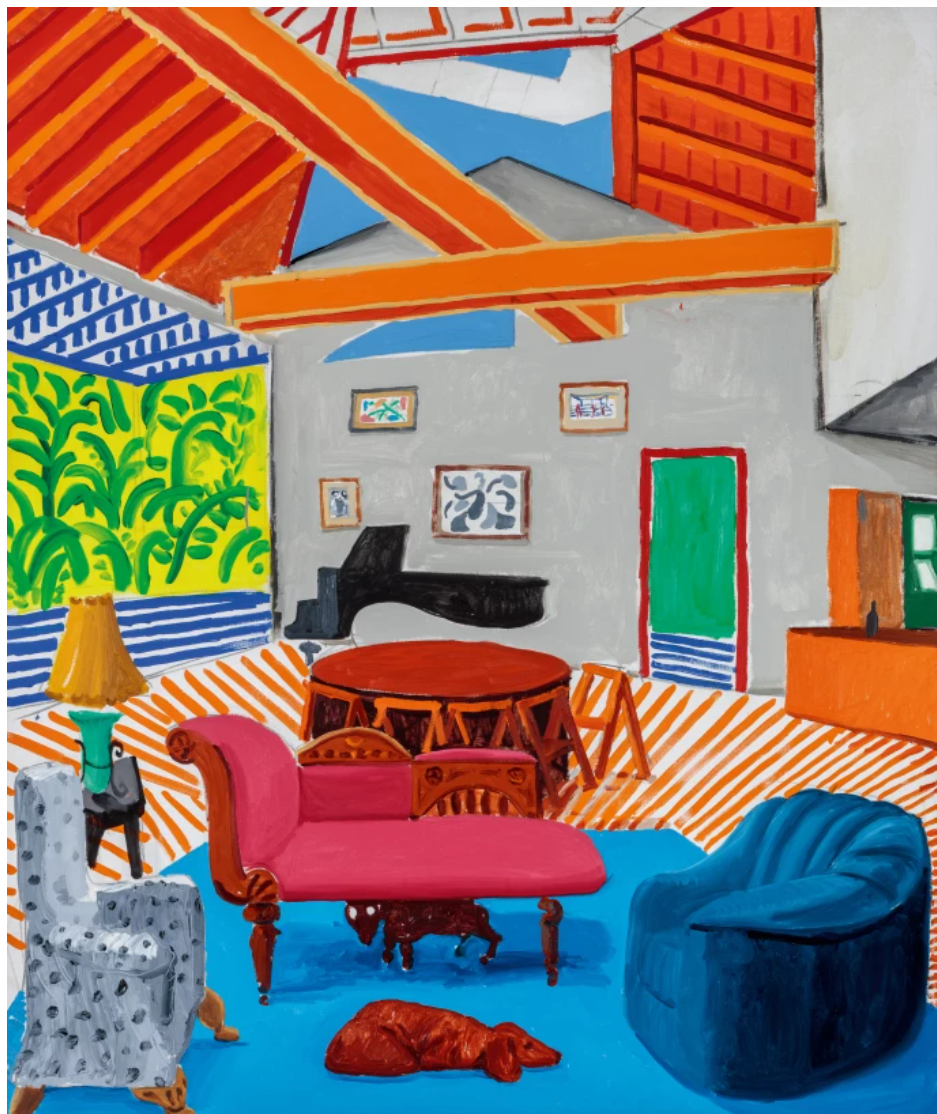
DAVID HOCKNEY, MONTCALM INTERIOR WITH 2 DOGS, 1988
Although Untitled (Drawing Rally) is a painting of everyday life, its manipulation and experimentation with the perception of space, volume, flatness, and depth expands its scope, aligning it with the most iconic elements of Wood’s unique visual language. Indeed, the present work represents such a quintessential expression of Wood’s signature style that the artist specifically chose Untitled (Drawing Rally) to be illustrated on a limited-edition foulard, one of which was worn by his wife, ceramic artist Shio Kusaka, to celebrate their anniversary. Oscillating between figurative still-life and abstraction, balanced at the nuanced threshold at which representation disintegrates into sheer pattern of form and color, the present work epitomizes the very best of Wood’s oeuvre.
Wimbledon 1, 2011
Phillips Hong-Kong: 31 May 2024
Estimated: HKD 2,000,000 – 4,000,000
HKD 2,032,000 / USD 260,146
https://www.phillips.com/detail/jonas-wood/HK010124/8
JONAS WOOD
Wimbledon 1, 2011
Oil and acrylic on canvas
70 1/8 x 74 inches (178×188 cm)
Signed with the artist’s initials, dated and titled ‘JBRW 2011 “Wimbledon I”‘ on the reverse
Jonas Wood’s art has a captivating ability to disorient our perception of reality. With a quiet presence, his paintings often delve into detached scenes set in ubiquitous domestic interiors. However, beneath their seeming humbleness and simplicity, Wood’s paintings are charged with layers of experiences and memories. Executed in 2011, Wimbledon 1 is a lovable work that presents a refreshing and intriguing vignette, inviting viewers to momentarily escape into Wood’s tranquil domestic corner devoid of human presence. At first glance, it may appear to be a portrait of a resting tennis player. The full-bodied figure, dressed in sports attire with protruding Nike logos on both his sweatshirt and shoes, is holding one of three tennis balls, who takes up the center of the composition. However, upon closer inspection, one realizes that this figure is a portrait hung within a larger interior.
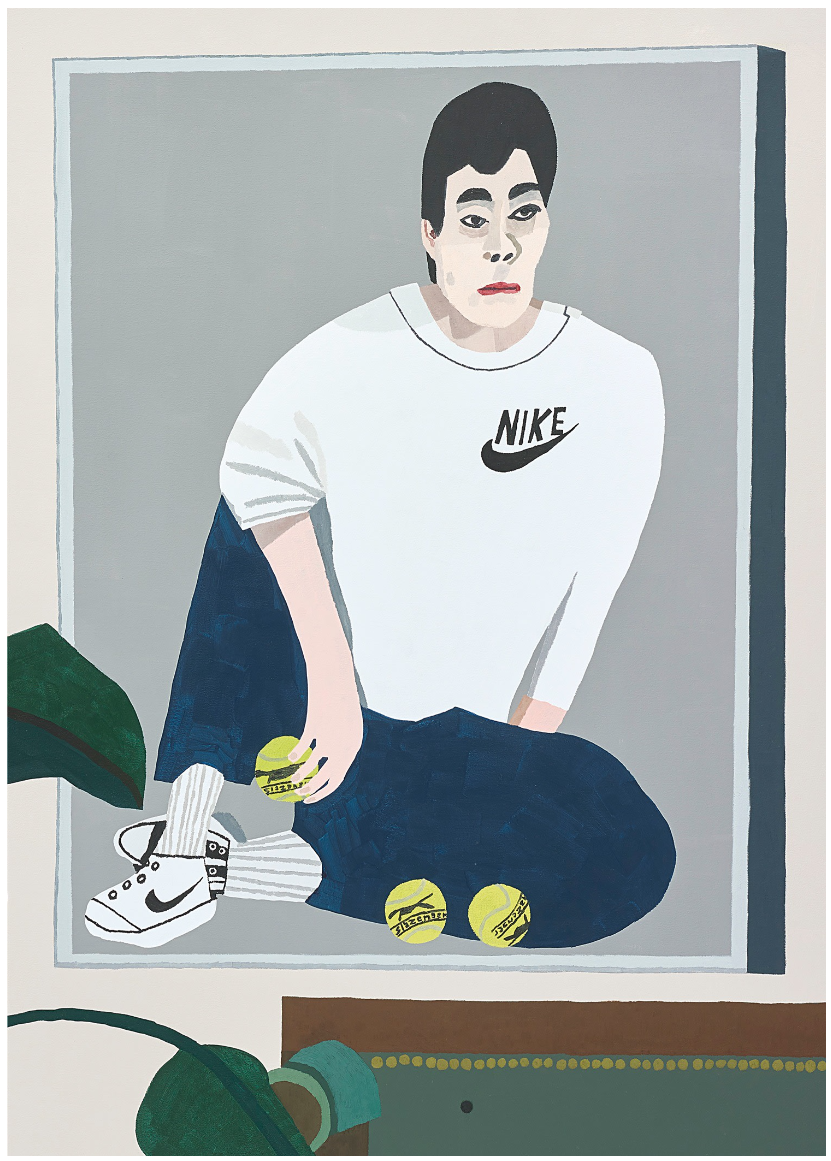
This realization creates a sense of unease that prompts us to re-evaluate the distorted space in which we are situated. The pronounced linear angles shaping the interior emphasize the absence of human presence, while a second frame discreetly placed on the left margin suggests that we are observing a specific area within a larger setting. Although the composition draws our attention to the imposing figure of the tennis player, the presence of several plant branches with large green leaves in the lower left foreground, partially obscuring the portrait, prevents us from delving further into the interior. Wood’s graphic design language and use of clear-cut geometric shapes contribute to the flattening of the space. The only indication of depth is a rigid shadow cast by the hung painting on its right side, suggesting that the viewer approaches the scene from a rightward angle. Within this single, flat composition, Wood evokes a complex narrative that straddles multiple timelines and invites different interpretation: Are we faced with the portrait of a tennis player? Or is it to be merely understood as a decorated interior?
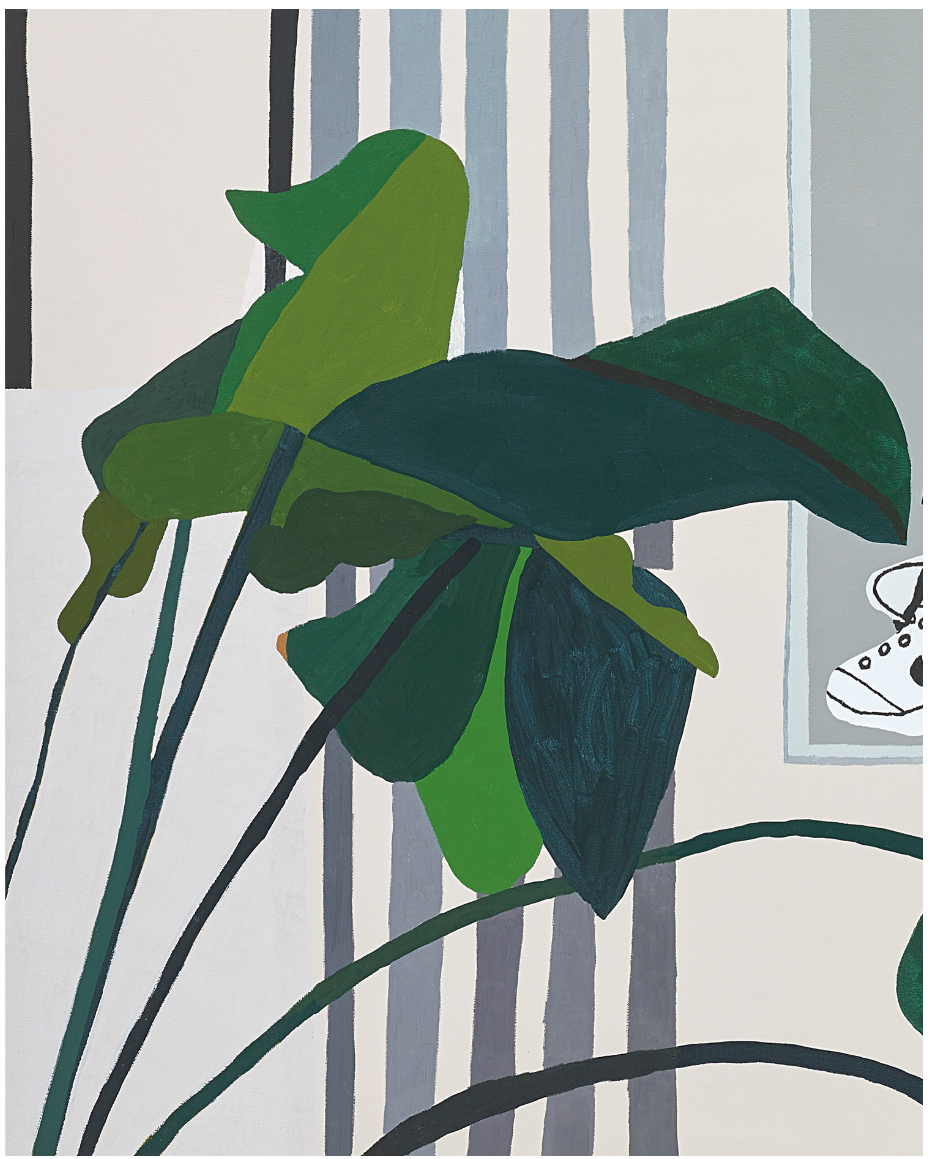
Wimbledon 1 is one of two works of very similar iterations in Wood’s oeuvre, both titled ‘Wimbledon’ and numbered 1 and 2 respectively, and certainly a nod to the artist being a huge sports fan. In his own words, he describes how his earlier tennis court series came about:
“I began to paint tennis courts, which came from photographs of turning the lights off and taking pictures of my TV during tennis matches and loving how it looked. In the tennis courts, it’s more about composition, abstraction, and repetition. The floating […] tennis balls, or anything else makes me happy.”
The present lot can be seen as an extension of his tennis court series, in which he subtly refers to the official Slazenger tennis balls used in the world-famous British tennis championship Wimbledon, replicating them meticulously here as three balls, close to the figure in the portrait hung on the wall. His later iteration of Wimbledon 2 sees slight alterations made, with minor changes in the objects and linear perspectives, most evident in the addition of a tennis racket and sweatshirt by well-known sports label Prince. Both works are a testament to Wood’s strength in the flattening of compositions in a most-instantly recognizable aesthetic. Wood’s unique inclusion of a portrait within the painting enables him to transcend the boundaries of representation and delve into the conceptual realm. His distinct graphic style imparts a fictional quality to the scene, suggesting a speculative and surreal undertone. In this way, Wood’s approach shares similarities with renowned figurative artists in art history, including that of Henri Matisse, Alex Katz, and David Hockney, who all have similarly explored the subject of daily life through transformed shapes and vibrant color palettes, evoking a surreal interpretation of reality. By acknowledging these predecessors as his artistic inspirations, Wood situates himself within an art-historical lineage that seeks to capture the deeper inner quality underlying contemporary life.
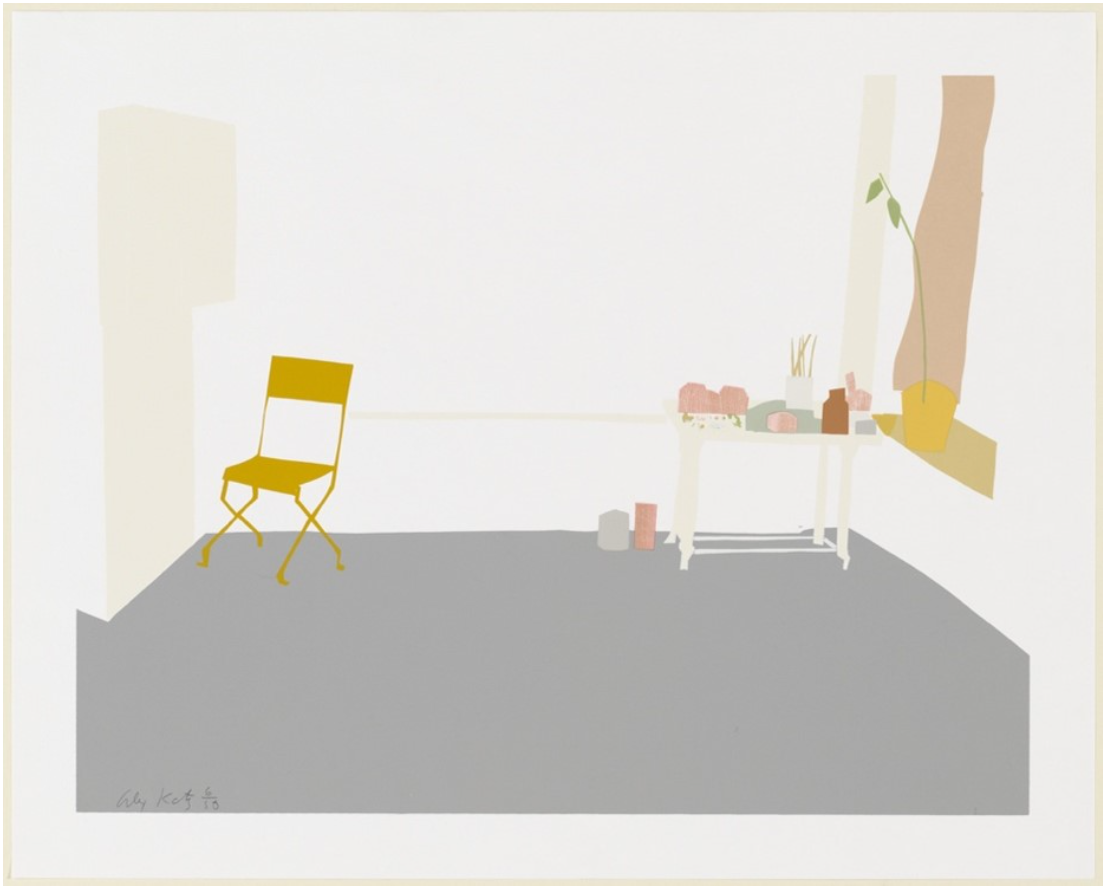
Alex Katz, Gray Interior, 1968, Museum of Modern Art, New York.
Artwork: © 2024 Alex Katz / Licensed by VAGA at Artists Rights Society (ARS), New York
In Wimbledon 1, the artist skillfully creates a balanced ecosystem of his own experiences and subtle sources of inspiration. Subjects engaged in Wimbledon 1 —portraits, interiors, sports, and plants—are not only recurring themes that dominate Wood’s oeuvre, but also hold deep significance within the artist’s everyday life. These personal connections are intricately layered and translated through Wood’s unique artistic process. Prior to painting, Wood uses a camera to capture everyday scenes from various perspectives as reference images. These photographs then serve as a foundation for him to reconstruct and abstract the imagery into layered composition on canvas. The resulting artworks, exemplified by Wimbledon 1, exist in a constant interplay between depth and surface. They carry profound personal and art-historical significance while establishing an ongoing dialogue between the present and the past, the here and the there.
Interior with Fireplace, 2012
Sotheby’s New-York: 15 November 2023
Estimated: USD 2,000,000 – 3,000,000
USD 4,295,000
Interior with Fireplace | The Now Evening Auction | 2023 | Sotheby’s (sothebys.com)
JONAS WOOD (b. 1977)
Interior with Fireplace, 2012
Oil and acrylic on canvas
102 x 92 1/4 inches (259.1 x 234.3 cm)
Initialed, titled and dated 2012 (on the reverse)
Rife with bold patterning and compelling perspective, Jonas Wood’s Interior with Fireplace is a vibrant exemplar of the artist’s signature hallmark of overflowing flora in an intimate domestic space. Employing artistic tropes of flattened colors and spatial distortion recalling French Post-Impressionist painting, Wood lends this quiet still life a striking whimsical flair. Through the careful placement of potted plants and outstretched leaves within the sun-drenched scene, the viewer is invited into the room to experience the illusion of depth created by Wood’s exaggerated stems, expertly layered within the space as if expanding to the very edges of the canvas. With intricately detailed brushwork and bright planes of color, Interior with Fireplace presents a fresh take on contemporary life where the seemingly mundane is elevated to the extraordinary.
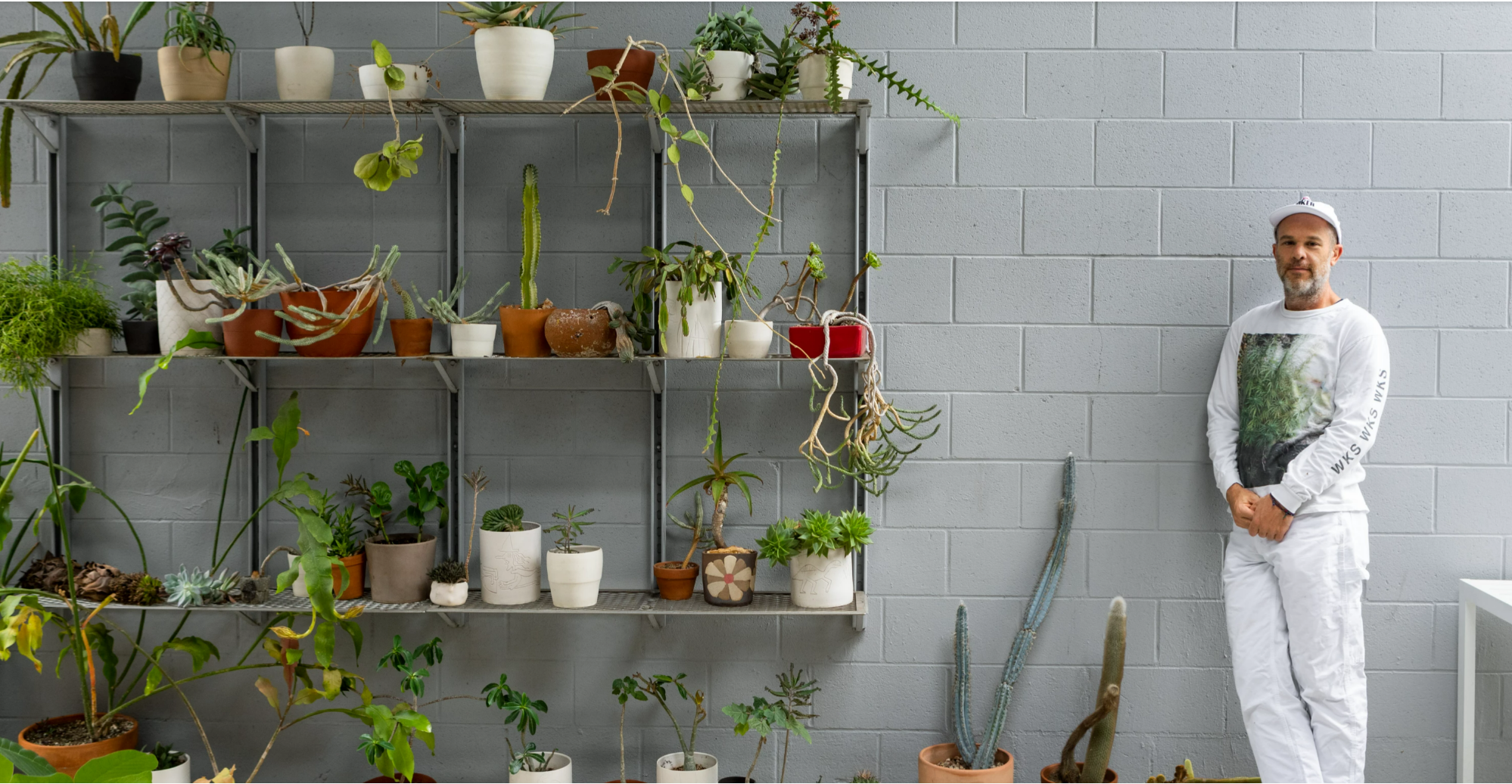
JONAS WOOD IN HIS LOS ANGELES STUDIO, 2021. IMAGE © LAURE JOLIET.
Executed in 2012, Interior with Fireplace employs all the artist’s best-known techniques and symbols in one of Wood’s celebrated depictions of the home. His painterly style is a playful yet rigorous interrogation of the traditional representational challenge of capturing three-dimensional forms on the flat picture plane, generating highly stimulating, illusory canvases. Interior with Fireplace is a particularly palpable example, where contrasting textures of fabric pillows and couches overlap wicker furniture, and lush greenery bursts from a profusion of pots. Wood even goes so far as to mimic plant life in manmade objects: the base of a floor lamp closely resembles the trunk of a birch tree, and a lively fire mirrors the spiky peaks of a bird of paradise. Set upon a thin-grained wood floor, each vivid element becomes an unending spectacle, resulting in a composition which commands the eye and allures at every turn.
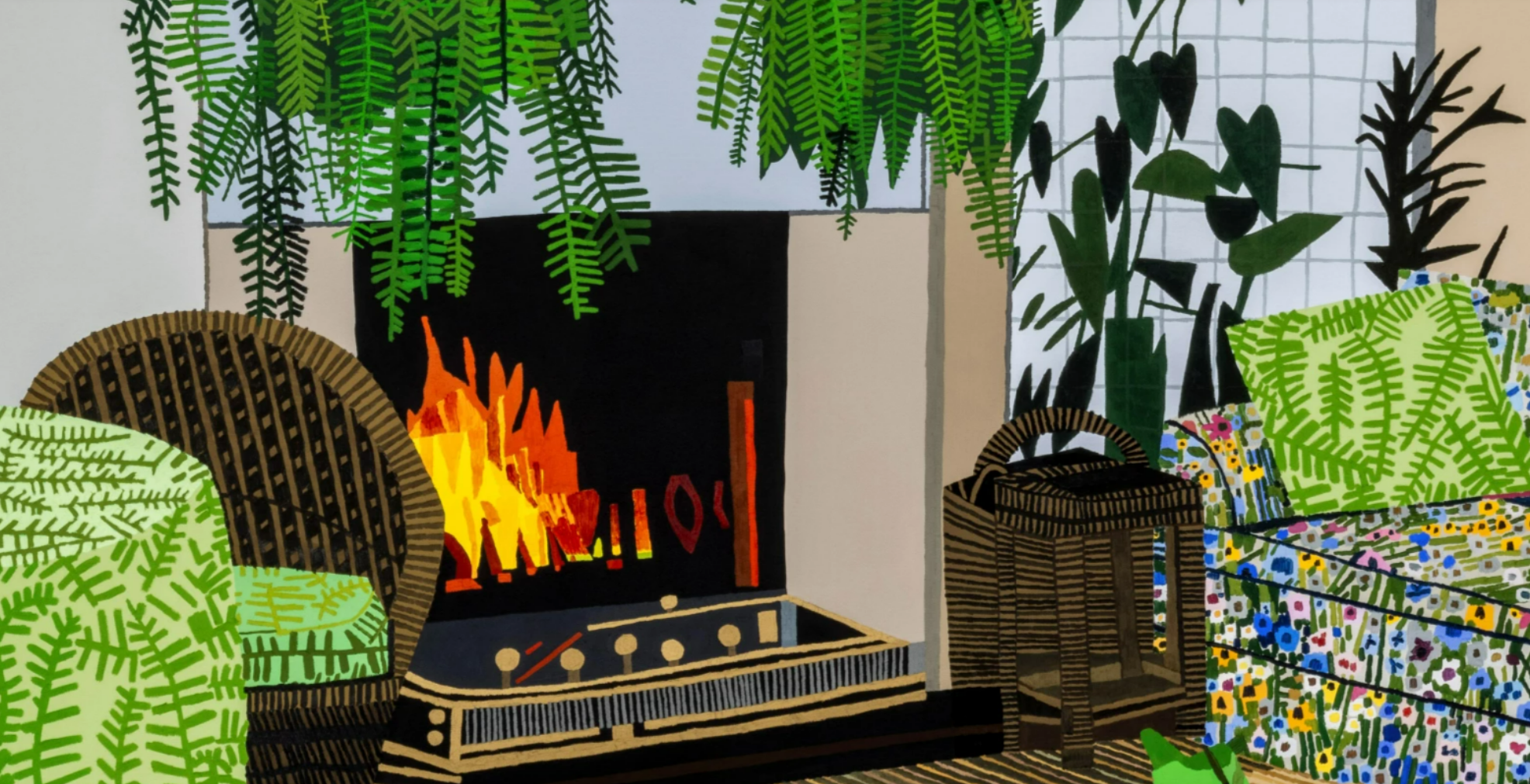
Wood’s visual vernacular is marked by a photo-based approach. Similar to Henri Matisse’s late process of cutting gouache-painted paper into a wide range of shapes and rearranging them into new compositions, Wood works from a personal archive of photographs and found imagery, making sketches and studies before creating preliminary collages. The cut-and-pasted images are then filtered through various layers of drawing until he arrives at his final composition. This fragmentary method is, in essence, a synthesized perception of time and space; as a result, the final works vibrate with an energetic rhythm and fantastical harmony.
Calais Drive 2, 2012
Sotheby’s Hong-Kong: 5 April 2023
Estimated: HKD 12,000,000 – 20,000,000
HKD 14,365,000 / USD 1,829,960
JONAS WOOD (b. 1977)
Calais Drive 2, 2012
Oil and acrylic on canvas
100×72 inches (254×183 cm)
Signed, titled and dated 2012 on the reverse
Working from a digital archive of collected images which he looks through often, Jonas Wood begins tracing, drawing, and arranging the composition for each of his paintings, with Calais Drive 2 from 2012 being a prime example of the artist’s unique visual vernacular. As demonstrated in the Wood’s used of vibrant color pallet and the psychological complexity of his work,
“Matisse, Picasso, Braque, Calder, Monet, Vuillard, Bonnard, van Gogh, Stuart Davis, and Hockney have all been very real influences to me. When I was a young child, my family would speak about these artists as examples of greatness in painting. I guess even then I took them seriously because these are the artists I ended up fashioning my studio practice after.”
Jeremy, 2014
Christie’s New-York: 17 November 2022
Estimated: USD 1,000,000 – 1,500,000
USD 1,440,000
JONAS WOOD (B. 1977) (christies.com)
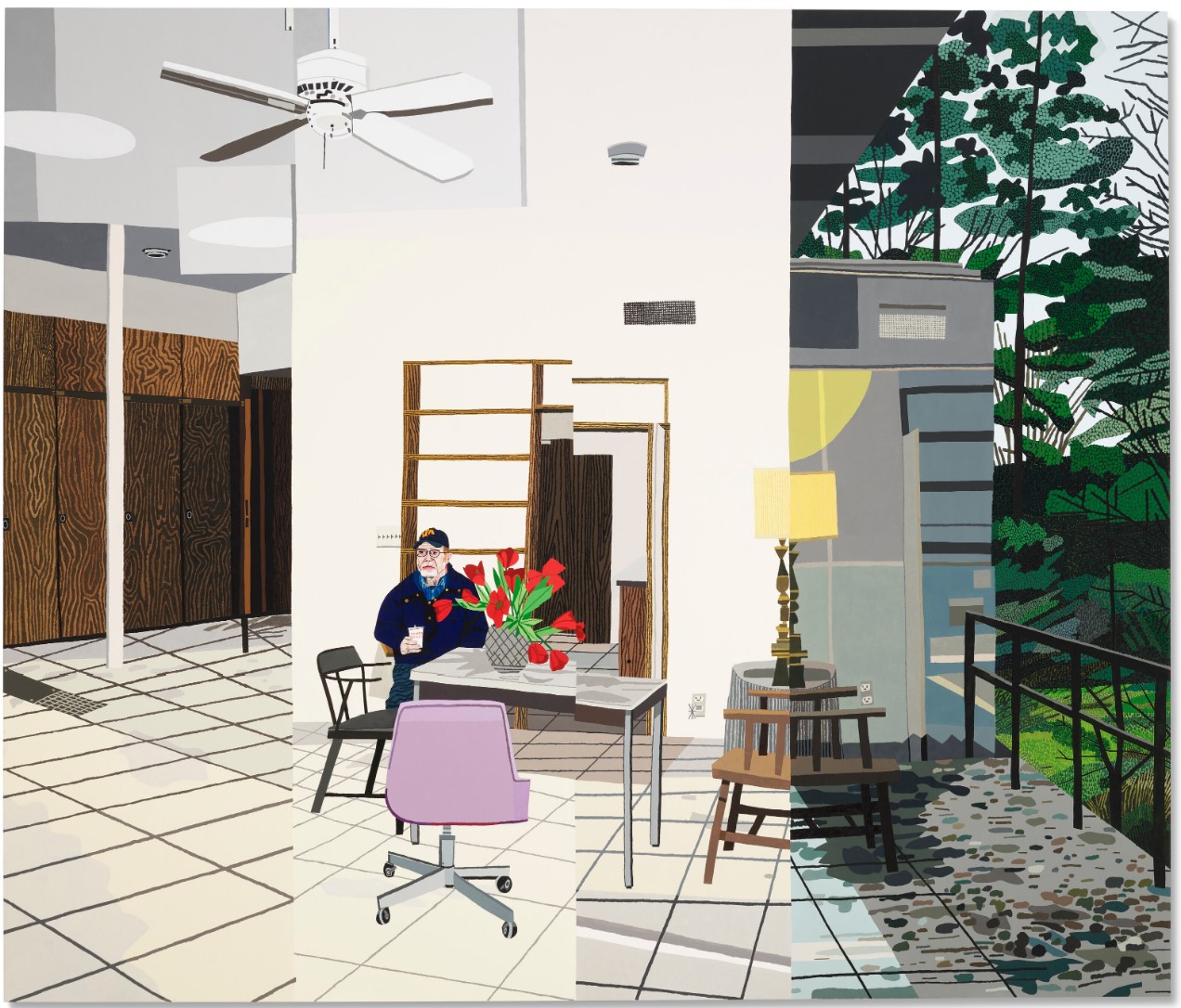
JONAS WOOD (B. 1977)
Jeremy, 2014
Oil and acrylic on canvas
112×132 inches (284.5 x 335.3 cm)
Signed with the artist’s initials, titled and dated ‘JEREMY JBRW 2014’ (on the reverse)
Portraits
Chico, 2008
Phillips Hong-Kong: 30 November 2022
Estimated: HKD 900,000 – 1,200,000
HKD 1,260,000 / USD 161,435
Jonas Wood – 20th Century & Contem… Lot 120 November 2022 | Phillips
JONAS WOOD
Chico, 2008
Oil on linen
48×48 inches (121.9 x 121.9 cm)
Signed with the artist’s initials, titled and dated ‘”CHICO” JBRW 2008’ on the reverse
Born in Boston in 1977, Los-Angeles based contemporary artist Jonas Wood has garnered worldwide acclaim for instantly recognizable, boldly colored, graphic works. Completed a year after the death of American professional lightweight boxer Diego Corrales, more commonly known as “Chico”, Jonas Wood’s Chico from 2008 is a quintessential embodiment of the artist’s style of portraiture, commemorating the glorified and inspiring boxer in a moment of strength. This work is featured in the artist’s 2008 eponymous exhibition at Anton Kern Gallery, which marked his second solo show in New York.
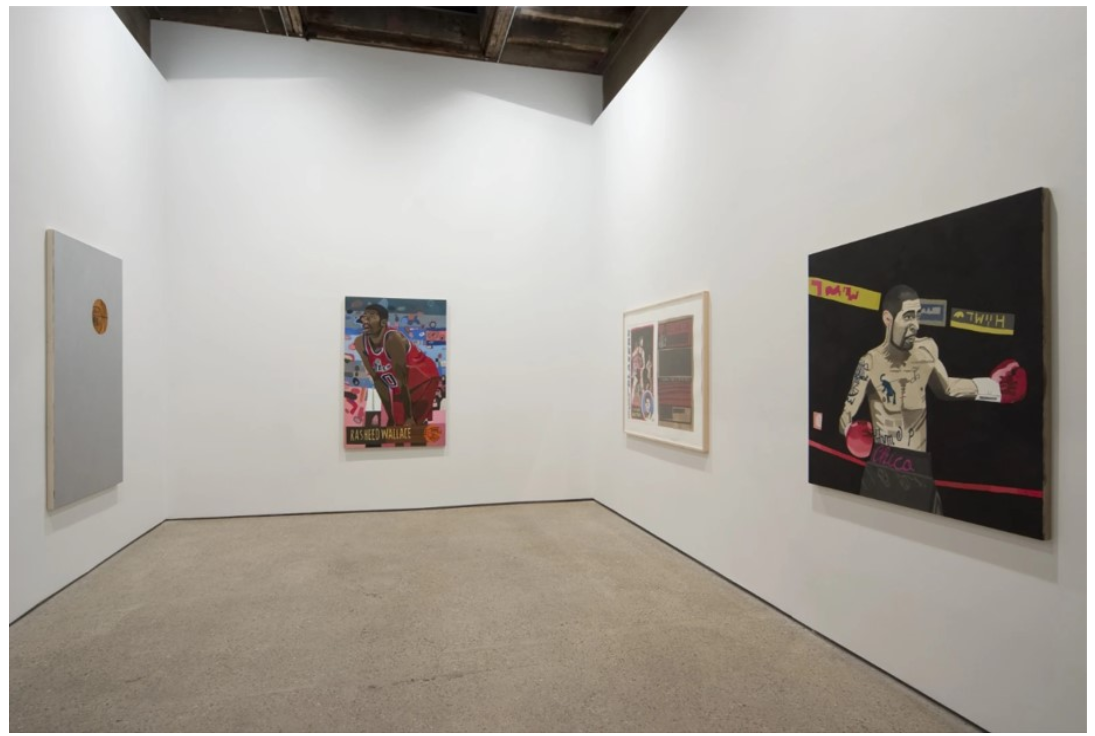
The present work (far right) exhibited at New York, Anton Kern Gallery, Jonas Wood, 20 November – 23 December 2008
Image Courtesy of Anton Kern Gallery
Expertly navigating techniques of fragmentation, flattened dimension, and highly stylized geometric abstraction, Wood imbues Chico with an emotional depth that belies the flatness of the composition. Freezing the motion of his protagonist, Wood depicts the boxer with his arm drawn back in preparation for a final punch. Popping off the more pared down background, ‘Chico’ is rendered with vibrant red, pink and yellow accents which serve to heighten the intensity of the boxer’s physique. At the same time, soft tonal variations of grey shadows both enhance the physical strain of his movement and outline the intense, determined demeanor expressed by his face. His bright red gloves, iconic tattoo, and hot pink lettering on his shorts that spell out his name, all work to transport viewers into the audience of a boxing arena, as we watch on in anticipation of the outcome.
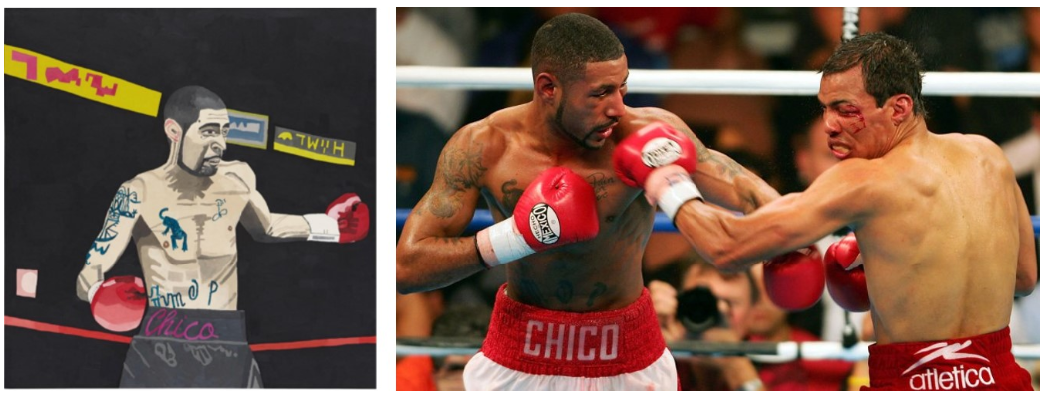
Working from archival imagery and photographs, the scene in Chico is likely taken from the boxer’s legendary fight with José Luis Castillo for their lightweight title fight on 7 May 2005, where Chico turned the tide of the game against all odds and won the fight in the tenth round, after being knocked down twice in the round.
This fight has become an inspiration of persistence, with some regarding him as a modern gladiator. The boxer’s life is just as theatrical as the visual impact of work, as he died on the two-year anniversary of his greatest fight in a tragic motorcycle crash. The present lot is not only a classic example of Wood’s individualized aesthetic, now instantly recognizable within realm of contemporary portraiture, but also his personal homage to this talented and inspirational athlete, whose legacy lives on.
Anthony Davis, 2012
Sotheby’s Hong-Kong: 28 April 2022
Estimated: HKD 1,200,000 – 2,200,000
HKD 1,638,000 / USD 209,760
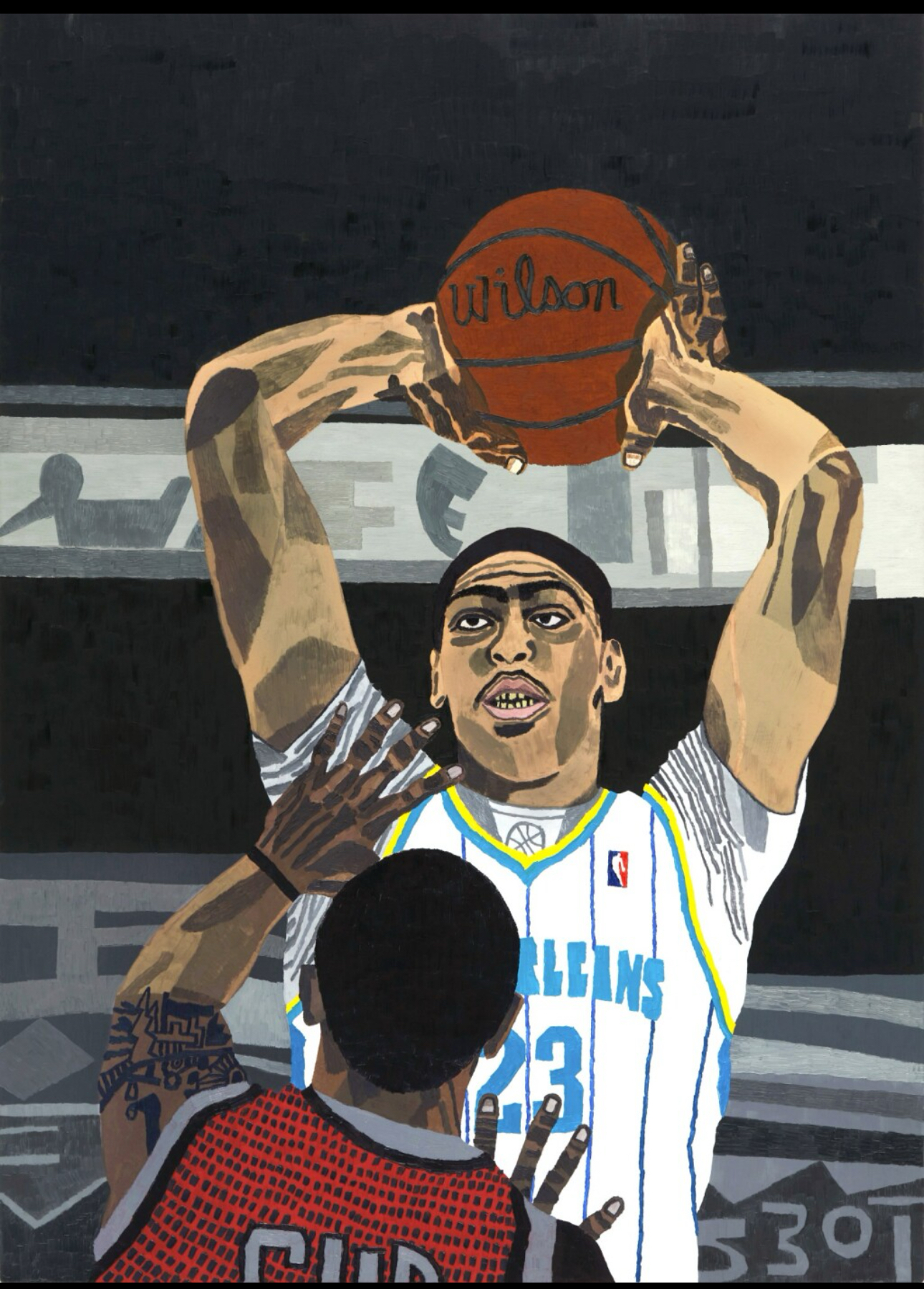
JONAS WOOD (b. 1977)
Anthony Davis, 2012
Oil and acrylic on linen
58×42 inches (147.3 x 106.7 cm)
Signed, titled and dated 2012 on the reverse
Executed in Jonas Wood’s signature graphic and patterned style, Anthony Davis (2012) is an impressive portrait painting by the artist, a highly expressive and engaging work. While his still lifes and paintings of potted plants have earned the artist critical and popular acclaim, the artist has demonstrated a long-term interest in painting sports stars and sports imagery, as exemplified here in this painting of American professional basketball player, Anthony Davis. In an interview with Korean Vogue in 2017, the artist was asked who his heroes were, answering:
“I like a lot of basketball players, I like athletes in general. I love Roger Federer,…, I like to watch a lot of sports, I like competition, I like emotions when somebody wins and how hard it is to win, and how much they practice. I think I relate to it differently because you don’t really win prizes and awards making art, but you practice a lot to get better.”
Paul Gibson, 2008
Phillips Hong-Kong: 7 June 2021
Estimated: HKD 1,000,000 – 2,000,000
HKD 1,134,000 / USD 146,150
Jonas Wood – 20th Century & Contempora… Lot 191 June 2021 | Phillips
JONAS WOOD
Paul Gibson, 2008
Oil on canvas
40×30 inches (101.6 x 76.2 cm)
Signed, dated and titled ‘JBRW 2008 “PAUL GIBSON” JONAS WOOD’ on the reverse
One of the most iconic and recognizable artists of our generation, Los Angeles-based contemporary painter Jonas Wood draws upon a ‘visual diary’ of the everyday, creating rich and densely composed landscapes, still lifes and interiors that elevate the mundane to the extraordinary. Stressing the importance of painting for himself rather than for an audience, Wood’s paintings fuse bright Fauvist colors and offbeat Japanese ukiyo-e-esque compositions with an array of Pop culture references.
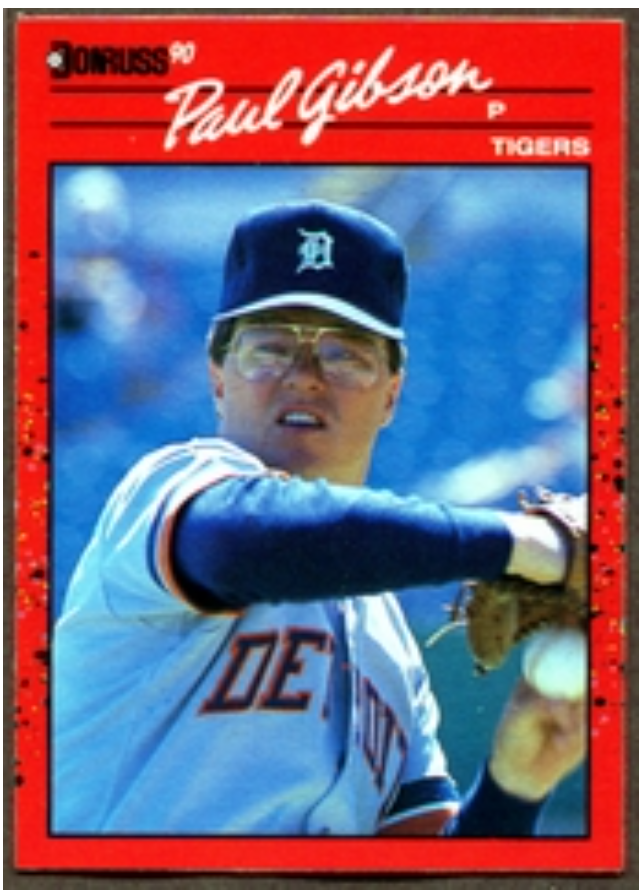
1990 Paul Gibson Baseball Card, Detroit Tigers
One particular innovation in Wood’s practice is the use of images mediated through other media, a playful twist seen in his first sport paintings, based on portraits of athletes sourced from the cards Wood collected as a child. Paul Gibson is based on a collectable baseball card of Paul Marshall Gibson, Jr. a American former professional baseball pitcher who played for the Detroit Tigers between 1988 and 1992. Wood’s love of portraiture drew him to sports cards, whose bold typography and abstract backgrounds dovetailed perfectly with his brand of off-kilter realism. Rigorously structured to play with our perception of depth, Paul Gibson corroborates Wood’s indebtedness to Paul Cézanne’s deconstruction of pictorial space and the fracturing of forms that manifested in the avant-garde Cubist realities of Pablo Picasso and Georges Braque.
Manny, 2009
Sotheby’s New-York: 12 March 2021
Estimated: USD 120,000 – 180,000
USD 151,200
Manny | Contemporary Curated | 2021 | Sotheby’s (sothebys.com)
JONAS WOOD (b. 1977)
Manny, 2009
Oil on canvas
24×20 inches (61×51 cm)
Signed and dated 2009 twice and titled on the reverse
Sports has always played an outsize role in Jonas Wood’s work. His love of portraiture drew him to sports cards, whose bold typography and abstract backgrounds are elements that Wood it known to experiment with. The athletes’ highly recognizable faces dominate the portraits. Wood himself has admitted however, that above the cultural connotations associated with these personalities, what drew him to this subject matter was the nature in which their images were captured in sports-related merchandise. Typically depicted in mid-motion or with emotive expressions, their representations create dynamic and iconic portraits. Manny is based on a 1992 Pinnacle Baseball Rookie card of Manny Ramirez, two years before he became an All-Star. During his 7 years with the Indians, Ramirez set the Indians’ single-season RBIs record with 165 RBIs, celebrating successes continuously over his 19 season career in the major baseball league. Throughout his career Ramirez experiences numerous hardships, overcame them and ultimately become one of the best offensive tandems in baseball history together with teammate David Ortiz.

The work is a compelling example from the artist’s celebrated sports card series, in which Wood absorbs and re-contextualizes the format of the cheap and mass-produced popular culture memorabilia, imbuing his chosen images with an elevated stature. In the present work, Wood eradicated frivolous details such as lettering and more subtle areas of varied tonality, in order to bring enhanced and defined contours of Ramirez’ features. The stark contrast between areas of light and shadow is employed in such a way that further emphasizes the graphic stylization of his subject matter, comparable to the work of David Hockney. Similarly, the choice of subject matter places Wood firmly in the trajectory of American Pop as he absorbs the format of this particular type of memorabilia, enlarging it and imbuing it with renewed permanence through his painting. Pop Art notions of materiality and iconography are thus brought to the fore in Wood’s decision to raise the status of his chosen image, from a cheap and mass produced card to a resounding and permanent ode to the baseball player. As a result, Wood’s work acts as a pertinent contribution to the discourse around notions of image hierarchy – a topic so central to post-modern theory.
Notepads Series
GG HK NPP #3, 2017
Phillips New-York: 28 February 2025
Estimated: USD 500,000 – 700,000
USD 393,700
Jonas Wood – New Now: Modern & Cont… Lot 28 February 2025 | Phillips
JONAS WOOD
GG HK NPP #3, 2017
Screenprint, oil and acrylic on canvas
93 1/4 x 61 1/8 in. (236.9 x 155.3 cm)
Signed with the artist’s initials and dated “JBRW 2017” lower right
Signed with the artist’s initials, titled and dated “JBRW 2017 GG HK NPP #3 JBRW 2017” on the overlap
Jonas Wood’s GG HK NPP #3, 2017 exemplifies the artist’s ability to transform the mundane into the monumental. Part of his celebrated Notepads series, the work magnifies a simple piece of hotel or office stationery into a striking large-scale composition, reframing everyday materials as sites of artistic inquiry. Nearly eight feet tall, the painting merges personal iconography, commercial branding, and art-historical influences into a singular, playful aesthetic. The Gagosian Gallery letterhead and business information, silk-screened across the canvas, frame a carefully arranged still life: an isolated orchid, rendered in Wood’s signature flattened perspective, and three floating basketballs, their bold orange forms punctuating the composition. Balancing the visual language of Pop Art with the decorative abstraction of Henri Matisse, GG HK NPP #3 extends Wood’s ongoing exploration of sports culture, still-life painting, and contemporary notions of branding and authorship.
Wood’s Notepads originated from a habitual practice of sketching on hotel and office stationery, a casual exercise that evolved into a conceptual framework for large-scale paintings. Works from the series were first presented in Ed Ruscha | Jonas Wood: Notepads, Holograms, and Books at Gagosian Gallery in 2017, a dual exhibition examining the intersection of language, image, and materiality. While Wood’s engagement with printed matter aligns with Ruscha’s take on Pop aesthetics, their approaches diverge: whereas Ruscha explores the nature of language through a shifting interplay of abstraction and figuration, Wood moves between the portable and the monumental, bridging traditions of print and paint. He not only preserves the physicality of the notepad but also its intended purpose, using it as both subject and substrate.
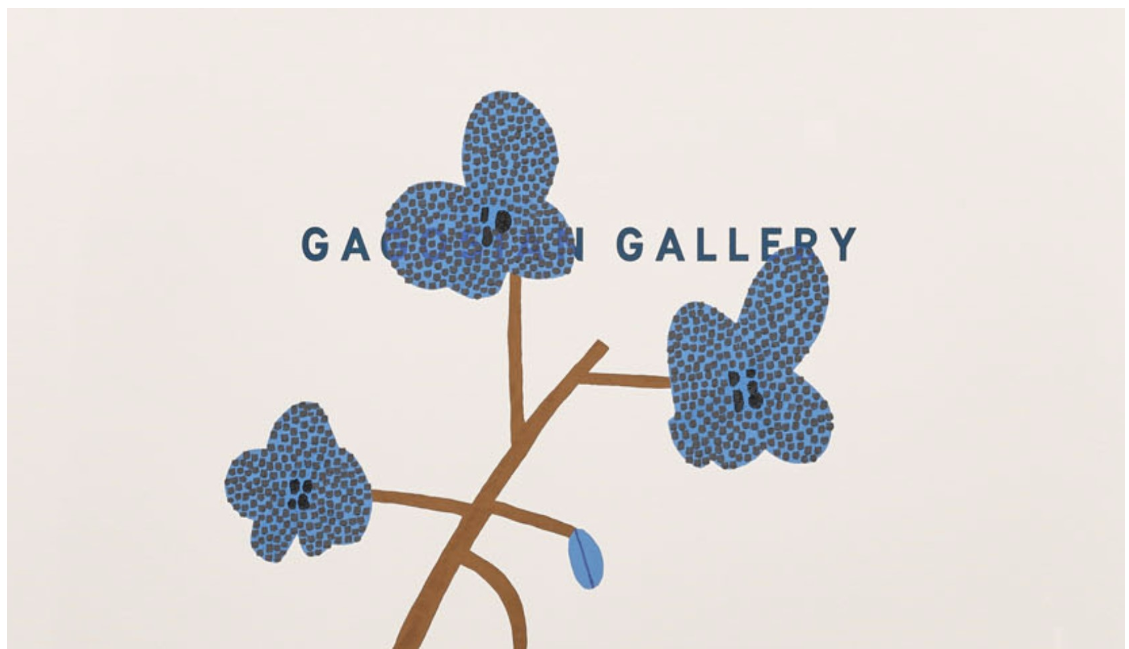
In GG HK NPP #3, the Gagosian Gallery letterhead and business information are fully integrated into the painting’s design—not as incidental details but as active compositional elements. In other works from the series, Wood silk-screened his own typographic emblem, Wood Kusaka Studios—a circle-and-spoke logo he designed for the studio he shares with his wife and fellow artist, Shio Kusaka—asserting his authorship and directly referencing the conditions of the works’ creation. The Notepads “straddle private and commercial zones,” transforming everyday objects and autobiographical content into something monumental while subtly acknowledging the institutional frameworks that shape contemporary painting. By incorporating corporate identity into his compositions, Wood underscores the dual role of a gallery as both an artistic space and a commercial entity. GG HK NPP #3 mines this tension, embedding institutional branding within an intimate act of image-making.
“I started to realize that the way I painted was almost an accumulation of different printing methods.”
What distinguishes the Notepads within Wood’s painted output is their direct integration of his printmaking practice. Printmaking has become increasingly central to his work, leading him to establish a print shop in conjunction with master printer Jacob Samuel to maximize his flexibility within the medium. Since 2016, the two have been actively collaborating on prints published by WKS Editions.
“I realized that drawing had always informed my painting; then I saw how collage had informed my painting. But once printmaking entered the equation, that also started informing my painting, and vice versa. Even when thinking about the process of making a painting, I started taking cues from printmaking and putting them back into paintings.”
The Notepads are perhaps the clearest example of this transference—not just inspired by printmaking techniques but incorporating screen-printing directly onto the fabric surface of the paintings.
“In the last year and a half I made giant notepad paintings where we actually silkscreened the notepad logos onto the canvas, and of course, there are artists like Christopher Wool and Laura Owens who are making paintings that have vast amounts of silkscreen prints on them. So that’s really exciting. I mean, I don’t know how far it will go with me, but I definitely think that as I’ve learned more about printmaking, it’s informed my practice.”
“Matisse, Picasso, Braque, Calder… and Hockney have all been very real influences to me. When I was a young child, my family would speak about these artists as examples of greatness in painting. I guess even then I took them seriously because these are the artists I ended up fashioning my studio practice after.”
The orchid at the center of GG HK NPP #3 continues Wood’s longstanding fascination with plant life, an interest that took root after his move to Los Angeles, where he encountered flora unfamiliar to his East Coast origins. His depictions of plants—whether within interiors, as standalone still lifes, or in fragmented Clippings compositions—are deeply tied to his exploration of pattern, shape, and abstraction. In GG HK NPP #3, the orchid—stripped of its natural background—becomes emblematic, flattened into a silhouette reminiscent of Matisse’s cut-outs. Its stippled blue petals and bold outlines heighten its abstraction, aligning it with Wood’s distinctive visual lexicon. This process of decontextualization—removing an element from its natural surroundings and placing it in a structured, artificial space—underscores his interest in the intersection of representation and stylization.
“Even isolating parts of plants, the idea of something being clipped, I was riffing on the way that plants are shown in a horticulture book.”
This idea is further clarified in the present painting, where Wood renders not just the orchid in bloom but also its buds—capturing both ephemerality and the mutability of time. His engagement with Nature Morte evokes a world simultaneously alive, dying, and already dead. Anna Katherine Brodbeck, curator of Wood’s first major museum survey at the Dallas Museum of Art in 2019, highlights the “missing subject notable in Wood’s still lifes,” noting how his work shifts toward psychological interiority. “[T]he very name “still life”… points to the essential lifelessness of these objects—suggesting human use but ultimately divorced from it,” Brodbeck explains. Wood reinforces this stasis through his shallow sense of space, creating a claustrophobic planarity.
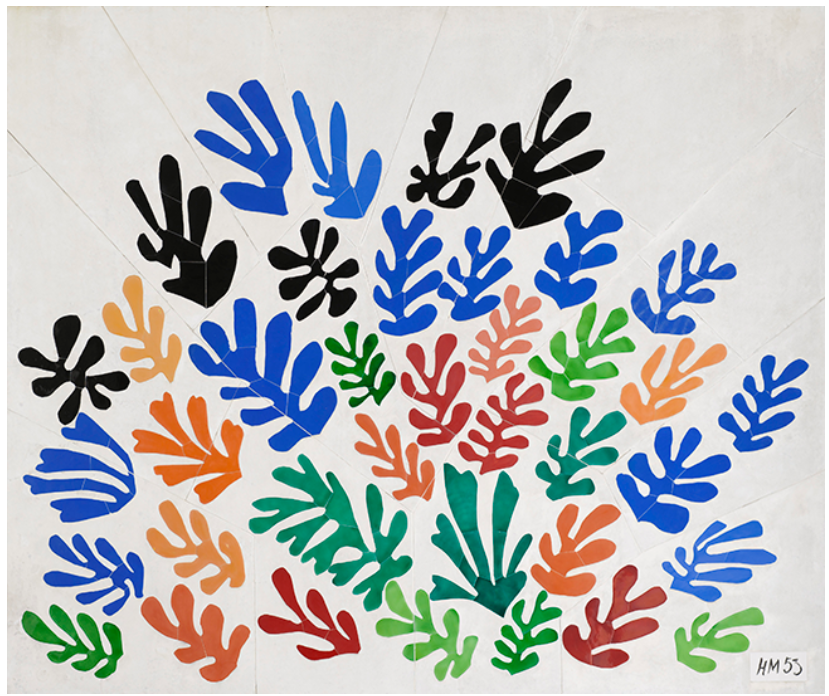
Henri Matisse, La Gerbe, 1953. Los Angeles County Museum of Art, California. Image: 2025 Museum Associates/LACMA/Art Resource NY/Scala, Florence
“[W]hen I saw all the plants in Southern California, compared to the ones I was used to from growing up on the East Coast, it was a mind-blowing experience. It was like plants on acid from the Flintstones. Being able to start drawing and painting these things was really about the environment of Southern California.”
Beyond the manipulated space of Cubism and the flatness of Matisse, one of Wood’s most direct influences is David Hockney. Like Hockney, Wood draws from the California landscape, using bold juxtapositions that lend both artists’ works their beguiling yet uneasy sense of space. Reflecting on perspective and pattern, Wood notes a key parallel: a shared interest in multiple viewpoints, pattern as a spatial device, and color that is “both irrational and rational at the same time.’” As he puts it, “Hockney veers into the extreme abstract, but still holds onto the thread of representation.” This tension—between rational design and irrational color, between branded space and freehand imagery, and along the boundary of the new and the unfamiliar—defines GG HK NPP #3. The painting exists in a liminal space: a still life that is also a conceptual exercise, a branded document that becomes a site for artistic reinvention.
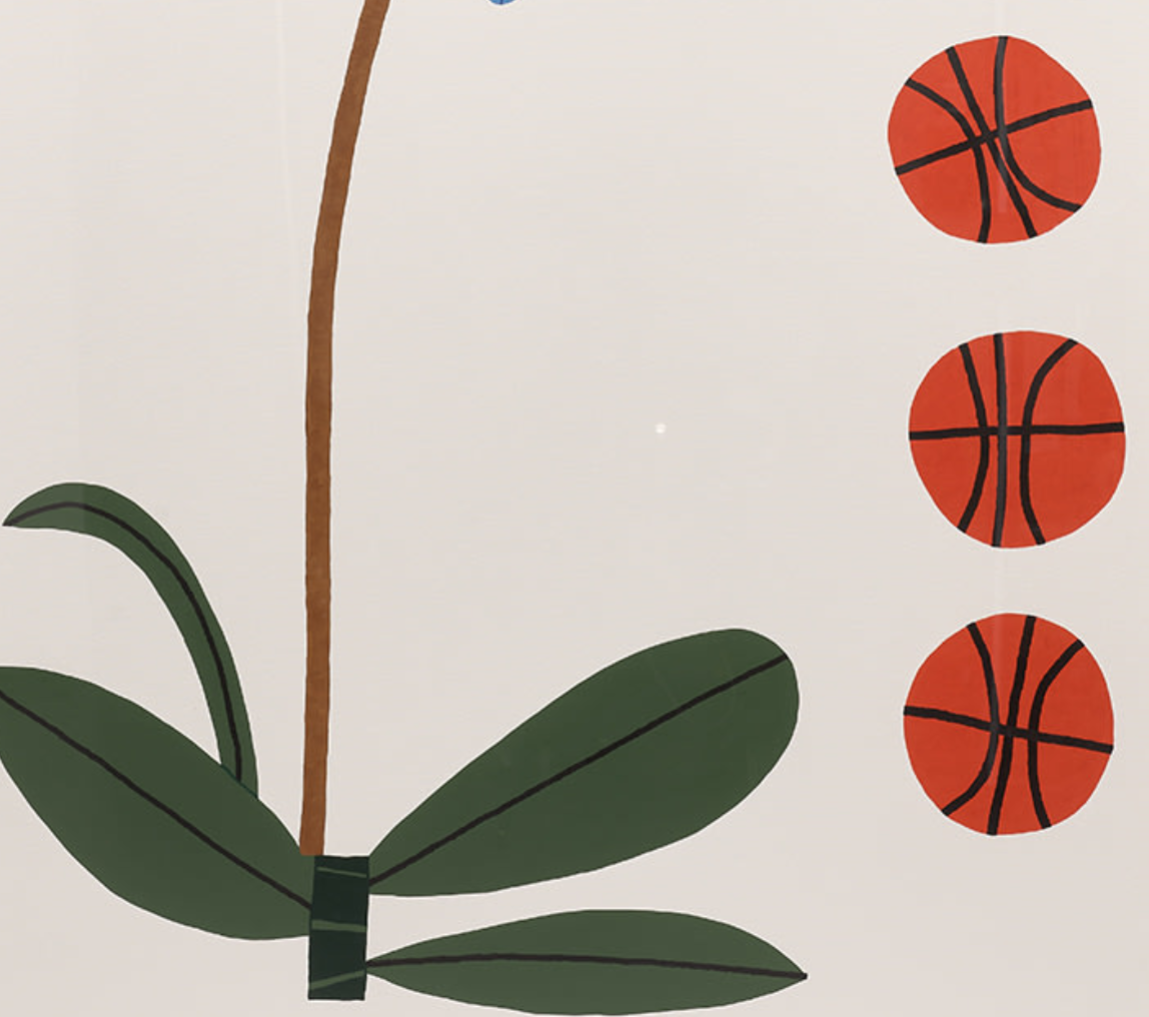
Opposite the orchid, three basketballs hover in linear formation, introducing a contrasting geometry that reinforces the painting’s structured composition. Basketball has been a recurring motif in Wood’s work, reflecting both personal attachment and a broader engagement with its visual language. He began drawing isolated basketballs in the mid-2000s, pinning them to his studio wall before incorporating them into paintings. “They have all these built-in components that I connect with painting, like stripes, colors, shapes, and simplification,” he explains. This fascination expanded to depictions of courts and arenas, where Wood reduced sporting environments to geometric color fields, devoid of players, referees, and spectators. Across his portraits of sports stars, quasi-abstract stadium-scapes, and isolated basketball motifs, these scenes exist outside the logic of competition. Instead, Wood emphasizes color, texture, and shape, refining these elements into a symbolic visual language that oscillates between representation and abstraction.
“I work from photos. I collect photos, ones I’ve taken or I’ve appropriated or that other people have sent to me. And then I either make a collage of those things or work directly from photos.”
This method lends his paintings a sense of accumulated memory, where objects—whether plants, basketballs, or interiors—recur across works, shifting contexts while maintaining their essential forms. In GG HK NPP #3, the basketballs are stripped of their expected function. No court, no players, no motion. Floating in a weightless space, the stark orange spheres exist in an ambiguous state, both instantly recognizable and strangely surreal, at once a reference to the sport and an autonomous design element.
GG London NPP #1, 2017
Phillips New-York: 21 November 2025
Estimated: USD 300,000 – 400,000
PASSED
Jonas Wood Modern & Contemporary Art Day Sale, Afternoon Session
Screenprint and oil on canvas
93×61 inches (236.2 x 154.9 cm)
Signed with the artist’s initials, titled and dated
“JBRW 2017 GG London NPP #1 JBRW 2017”
on the overlap
Bright, bold and playful, Jonas Wood’s GG London NPP #1, 2017, exemplifies the artist’s signature graphic style through his refined use of line and selective color. The present work belongs to Wood’s celebrated Notepads series, first exhibited alongside the work of Ed Ruscha at Gagosian’s Ed Ruscha | Jonas Wood: Notepads, Holograms and Books in 2017. Like Ruscha, his fellow Angeleno, Wood explores typography and text, enlarging emblemed notepads, such as Gagosian’s London letterhead, to serve as the background for his paintings. The stationery acts as a framing device, echoed by a hand-drawn rectangle that delineates the image area. The letterhead’s formality contrasts with the whimsical imperfection of the potted plants that characterize Wood’s oeuvre.
Cleverly manipulating scale and context, GG London NPP #1 elevates a format typically reserved for casual sketches. The letterhead background, silkscreened and expanded to nearly eight feet high, provides a monumental surface for the fully realized composition. Within the plants and patterned vessels, Wood’s overlapping forms reflect the layered visual language of silkscreen, aligning him with painters such as Andy Warhol and Roy Lichtenstein. Yet, rather than appropriating media imagery, Wood translates this technique into his own visual idiom.
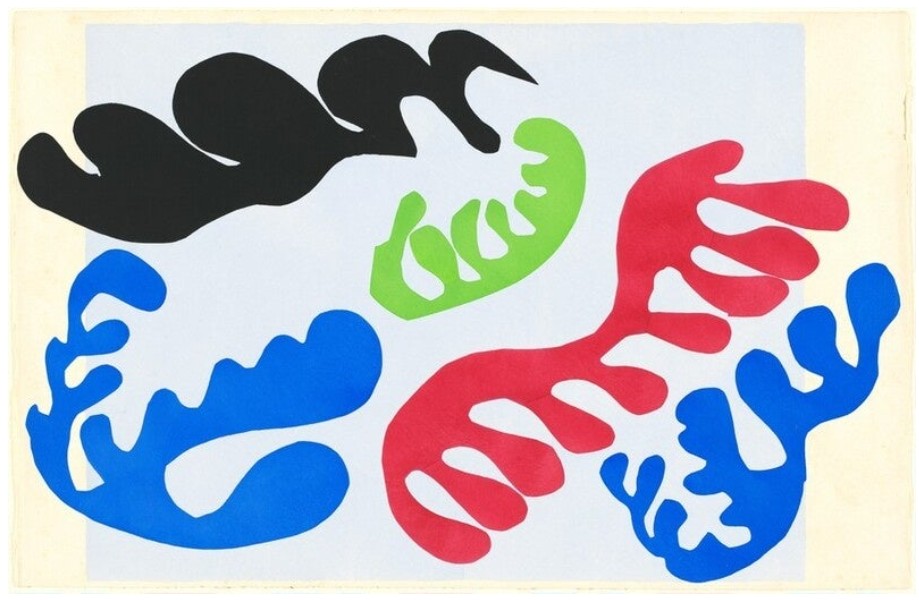
Henri Matisse, The Lagoon, 1947. National Gallery of Art, Washington, D.C..
Image: National Gallery of Art, Washington, D.C., Gift of Mr. and Mrs. Andrew S. Keck, 1980.8.19
Balancing the vitality of a sketch with the scale of a major painting, GG London NPP #1 fuses gestural simplicity with vivid planar color. His stylized flora recalls the organic forms and bold contours of Calder’s mobiles and Henri Matisse’s cut-outs, such as The Lagoon, 1947. Like Matisse, Wood begins with paper collages that serve as studies for his final canvases. Drawing on motifs from domestic life—particularly potted plants inspired by the ceramics of his wife, Shio Kusaka—Wood transforms everyday subjects into refined meditations on shape, color, and space. Merging a minimalist sensibility with an affection for the quotidian, his work finds elegance in the familiar.
Other Series
Untitled (Pacific Standard Time), 2011
Estimated: USD 150,000 – 200,000
USD 180,600
(ii) 87 3/4 x 48 inches (222.9 x 121.9 cm)
(iii) 87 7/8 x 55 1/4 inches (223.2 x 140.3 cm)
Overall: 87 7/8 x 151 1/2 inches (223.2 x 384.8 cm)
Jonas Wood’s Untitled (Pacific Standard Time), painted in 2011, serves as both artwork and archival artifact – an emblematic contribution to the exhibition Once Emerging, Now Emerging: Now and Then, organized by Cirrus Gallery in conjunction with the Getty’s landmark initiative Pacific Standard Time: Art in L.A., 1945–1980. This ambitious research and exhibition program, supported by the Getty Foundation, brought together over 60 Southern California institutions to explore the region’s pivotal role in shaping postwar American art. At the heart of this initiative was a desire to recover and reassess the often-overlooked histories of artists and art spaces that defined Los Angeles’s cultural landscape – including Cirrus Gallery and Cirrus Editions, which played a foundational role in the city’s printmaking renaissance.
In this work, Wood reimagines one of his signature motifs – a basketball – replacing the commercial “Spalding” branding with the word “Cirrus,” rendered in bold, graphic clarity. The exhibition title appears alongside it, painted directly onto board in latex, creating a visual language that is at once archival and painterly, conceptual and tactile. The basketball – a recurring symbol in Wood’s oeuvre – serves as a surrogate for autobiography, pop culture and personal memory, making it an apt vehicle for this tribute to Los Angeles’s layered art history.
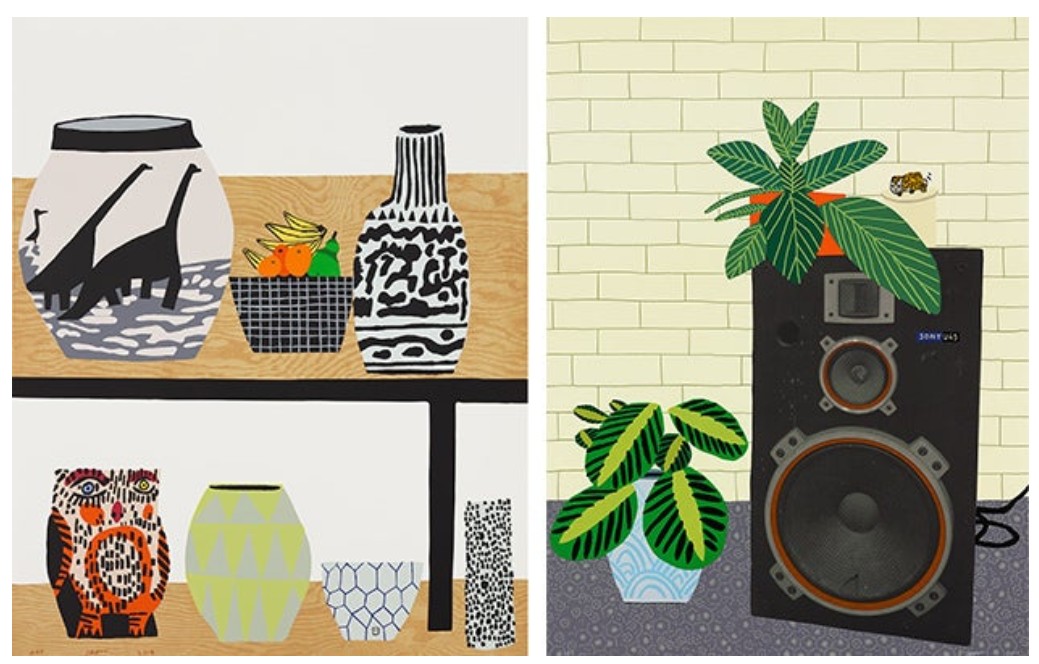
[Left] Jonas Wood, Speaker Still Life, 2019. Artwork: © Jonas Wood
[Right] Jonas Wood, Shelf Still Life, 2018. Artwork: © Jonas Wood
Cirrus Editions, with which Wood has maintained an ongoing collaborative relationship, has been a central node in the development of L.A.’s printmaking scene since its founding by Jean Milant in 1970. The workshop became a hub for artists such as Ed Ruscha, Bruce Nauman, and Judy Chicago, and has remained committed to expanding the conceptual and material possibilities of the print medium. Wood’s engagement with Cirrus positions him within this legacy, linking his own practice to a broader lineage of West Coast experimentation and innovation.
Executed with the flattened, Matisse-like color planes and Pop-adjacent sensibility for which Wood is celebrated, Untitled (Pacific Standard Time) operates simultaneously as a standalone painting and as a commemorative artifact. It celebrates not only a specific exhibition but also the broader scholarly and curatorial effort to cement Los Angeles’s rightful place in the postwar art historical canon.
Works on Paper
2025 Auction Results
7 lots sold at auction for a total turnover of USD 334,019. With 3 lots failing to sell, the sell-through rate is 70%. The highest price was achieved by New Sun Porch, a drawing dated 2010 that sold at Christie’s in New-York, on 27 February 2025, for USD 126,000.
2025 Top 3 Lots
This is the only lot that sold for more than USD 100,000 representing 37.7% of the total turnover for 2025.
XXXXXXXXXXX
#1. New Sun Porch, 2010
Christie’s New-York: 27 February 2025
Estimated: USD 120,000 – 180,000
USD 126,000
WORK ON PAPER
JONAS WOOD (B. 1977), New Sun Porch | Christie’s
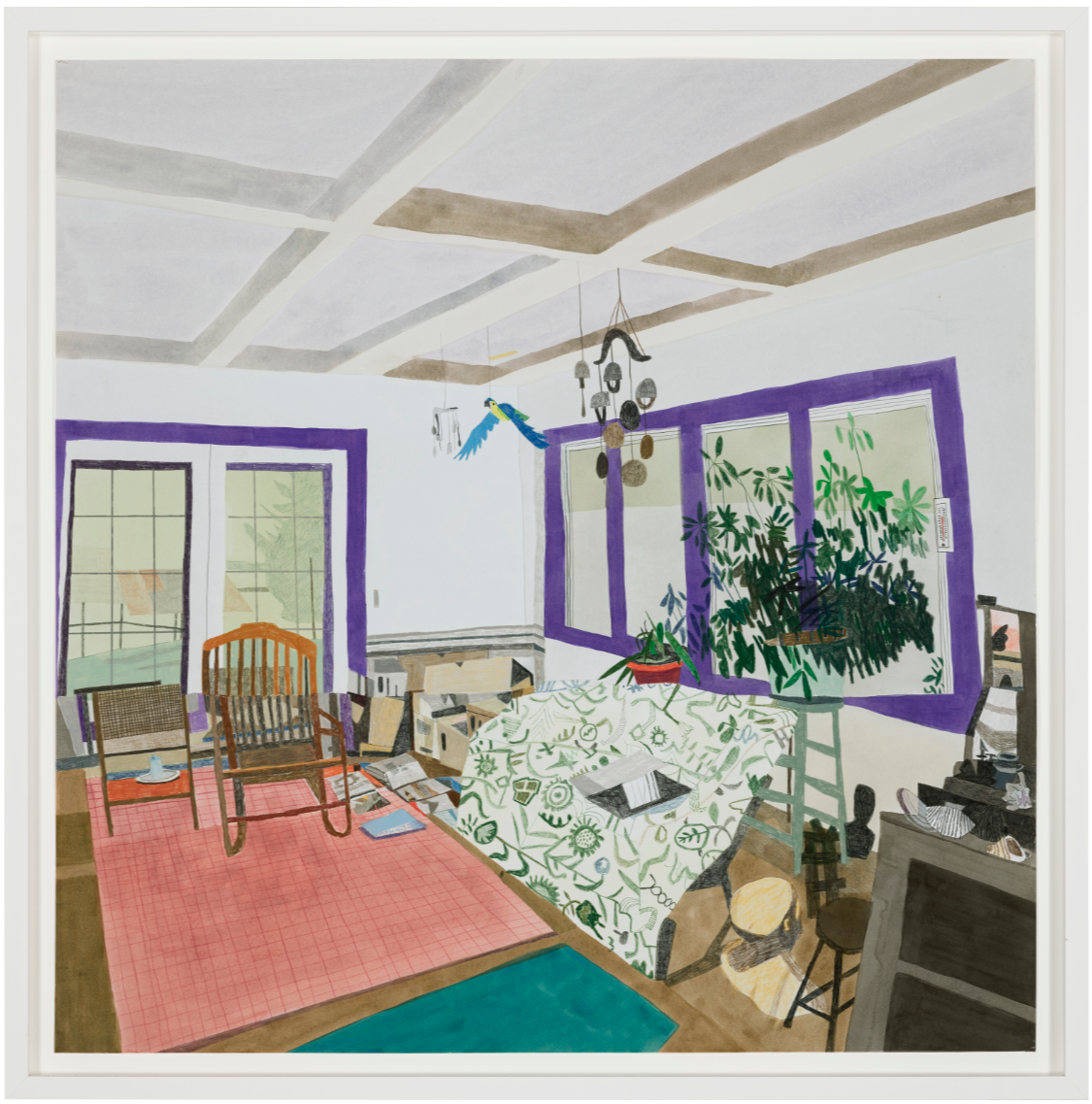
JONAS WOOD (B. 1977)
New Sun Porch, 2010
Gouache and colored pencil on paper
40 1/4 x 39 7/8 inches (102.2 x 101.3 cm)
Signed with the artist’s initials, titled and dated ‘NEW SUNPORCH JBPW 2010’ (on the reverse)
USD 100,000
#2. Untitled (BW Self Portrait), 2008
Christie’s London: 6 March 2025
Estimated: GBP 60,000 – 80,000
GBP 69,300 / USD 88,704
WORK ON PAPER
JONAS WOOD (B. 1977), Untitled (BW Self Portrait) | Christie’s
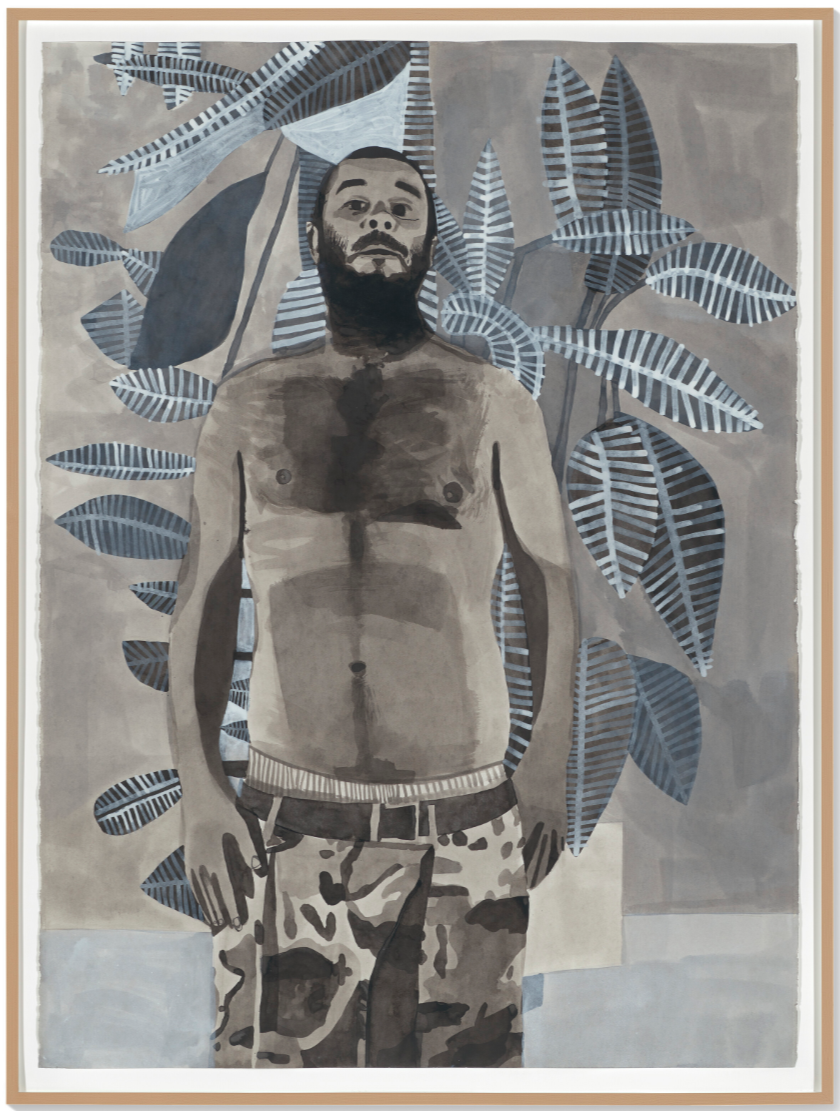
JONAS WOOD (B. 1977)
Untitled (BW Self Portrait), 2008
Ink and gesso on paper
56 1/4 x 41 3/8 inches (143×105 cm)
#3. Cactus in a Pot, 2009
Sotheby’s London: 25 June 2025
Estimated: GBP 40,000 – 60,000
GBP 48,260 / USD 65,705
WORK ON PAPER
Cactus in a Pot | Contemporary Day Auction | 2025 | Sotheby’s
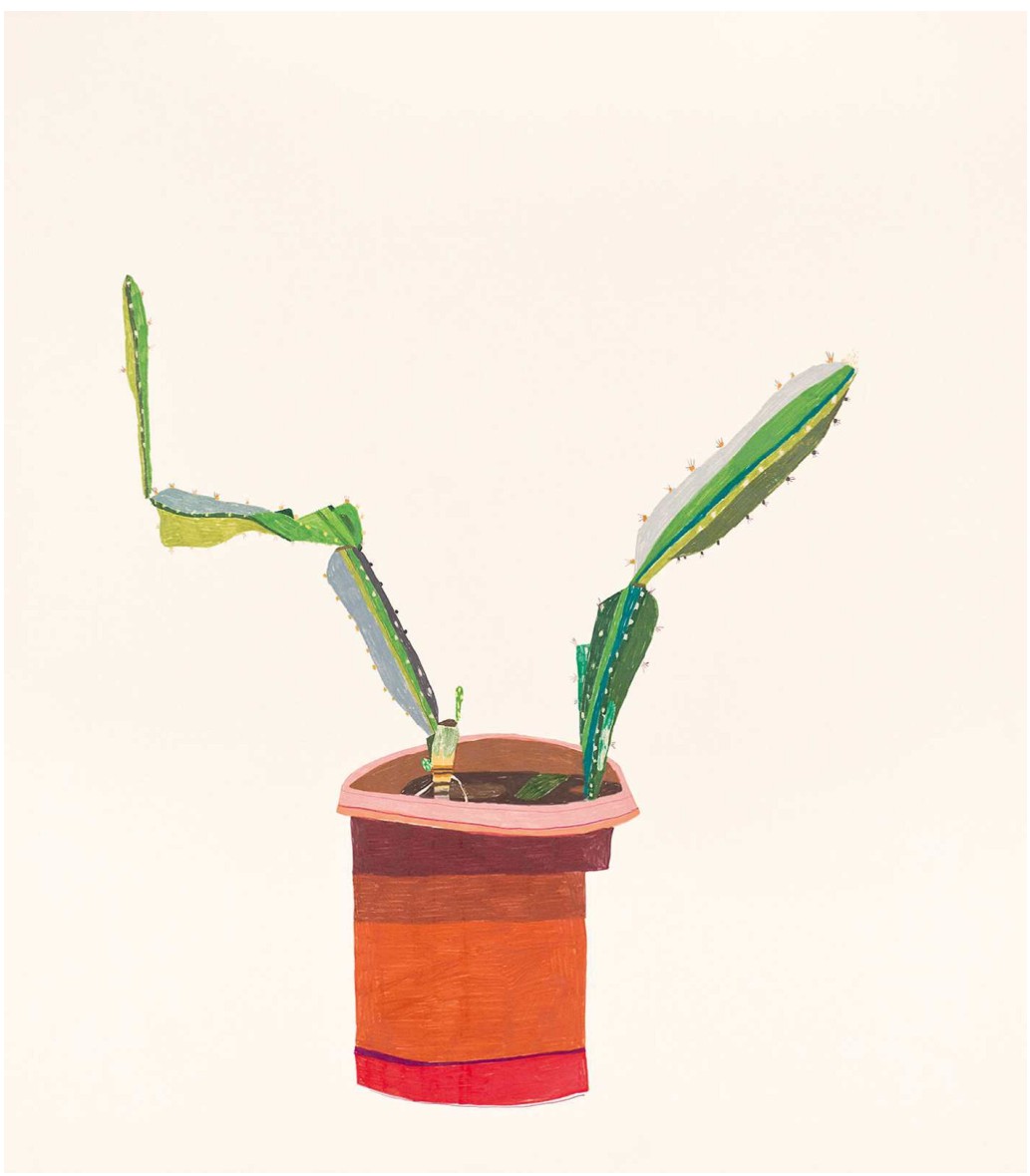
JONAS WOOD (b. 1977)
Cactus in a Pot, 2009
Colored pencil on paper
41×36 inches (104.1 x 91.4 cm)
Signed, titled and dated 2009 (on the verso)
#4. Untitled, 2010
The Personal Collection of Jean Milant
Bonhams LA online: 23 September 2025
Estimated: USD 10,000 – 15,000
USD 21,760
WORK ON PAPER
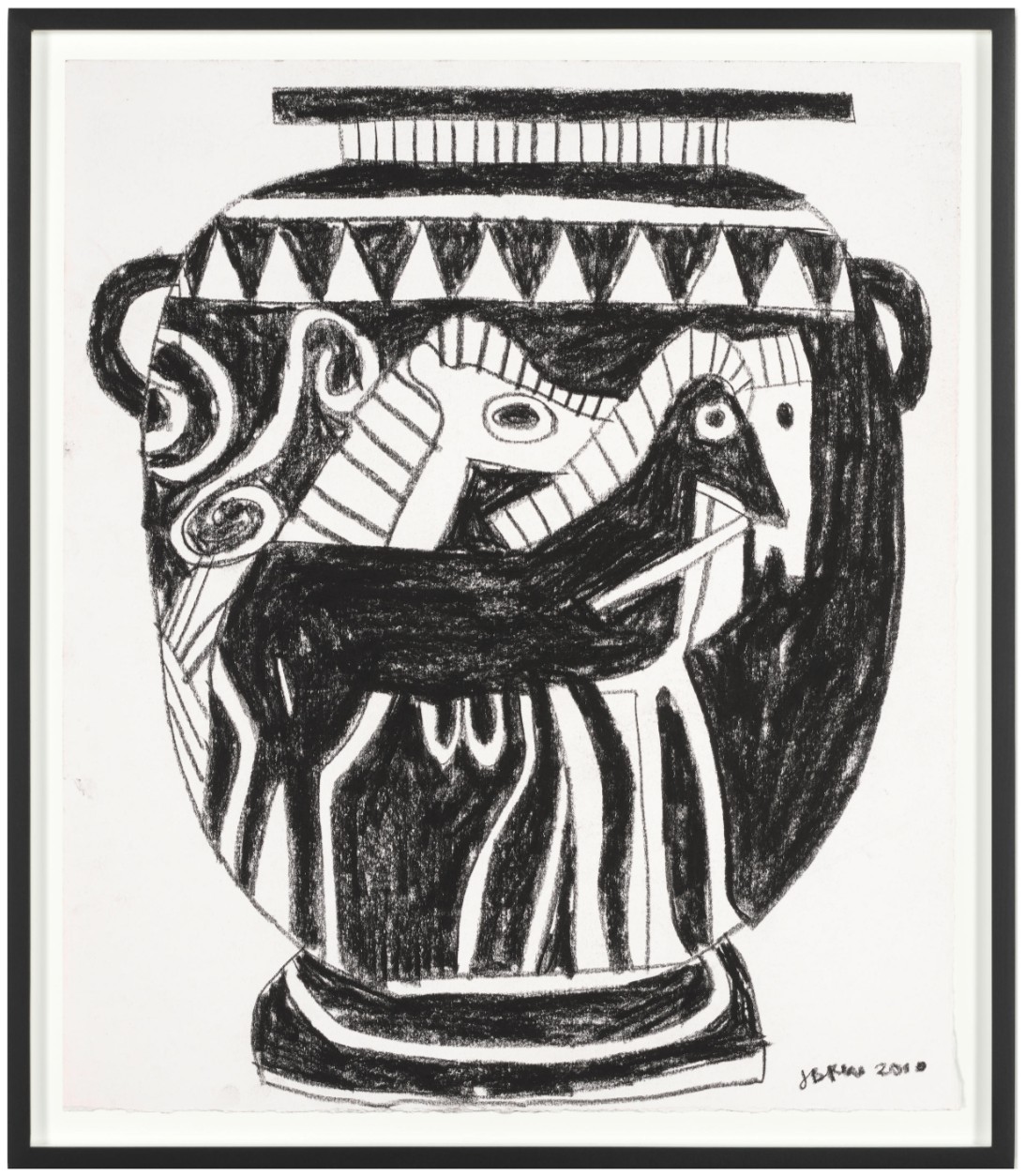
Conté crayon on paper
22 1/2 x 19 1/2 inches (57.2 x 49.5 cm)
Signed with the artist’s initials and dated ‘JBRW 2010’ (lower right)
#5. B-ball 12, 2008
Sotheby’s New-York: 1 October 2025
Estimated: USD 18,000 – 25,000
USD 19,050
WORK ON PAPER
B-ball 12 | Contemporary Discoveries | 2025 | Sotheby’s
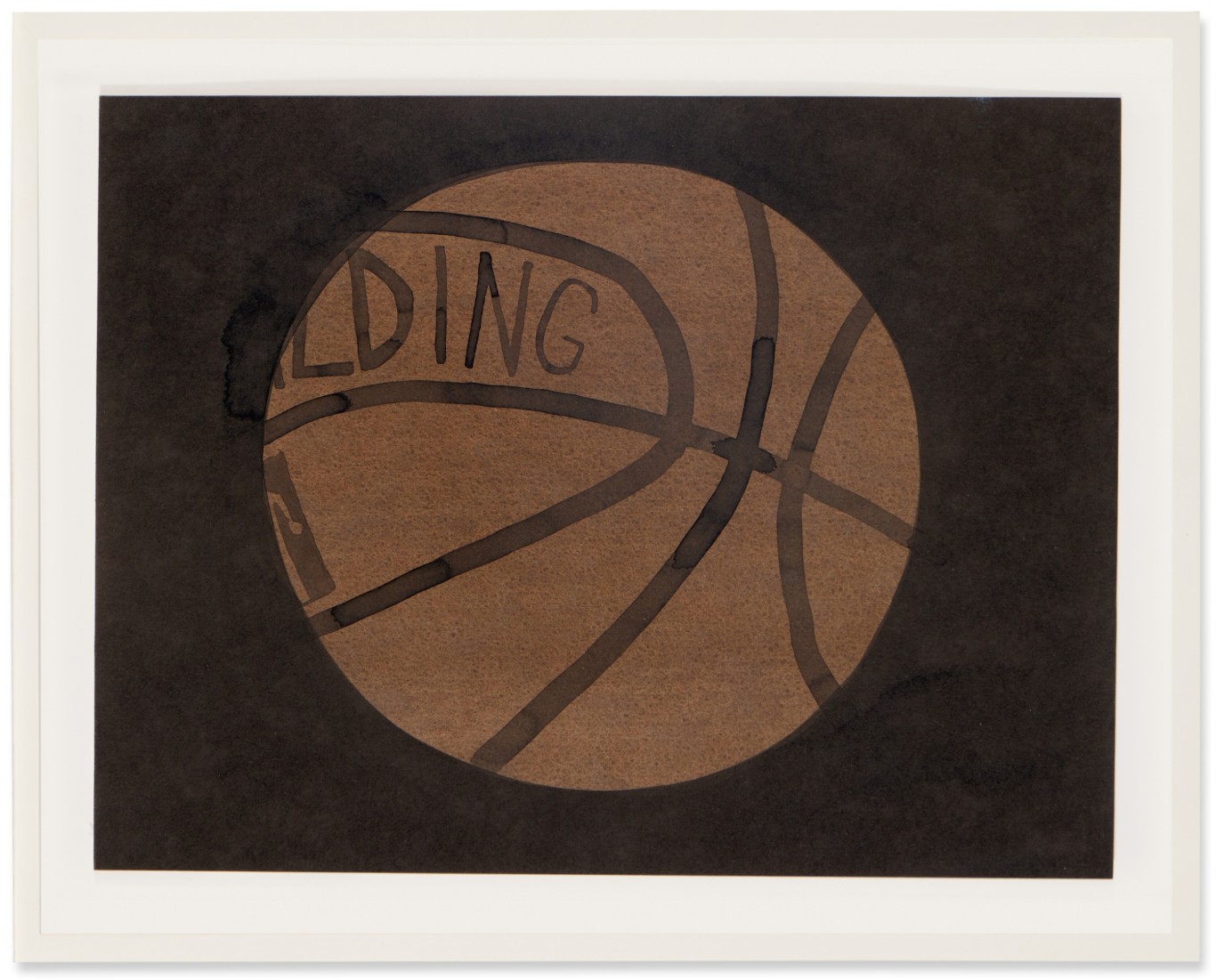
JONAS WOOD (b. 1977)
B-ball 12, 2008
Acrylic and ink on paper
12 1/8 x 16 inches (31.1 x 40.6 cm)
Signed, titled and dated 2008 (on the verso)
#6. Untitled, 2010
The Personal Collection of Jean Milant
Bonhams LA online: 23 September 2025
Estimated: USD 10,000 – 15,000
USD 12,800
WORK ON PAPER
Bonhams : JONAS WOOD (B. 1977) Untitled, 2010
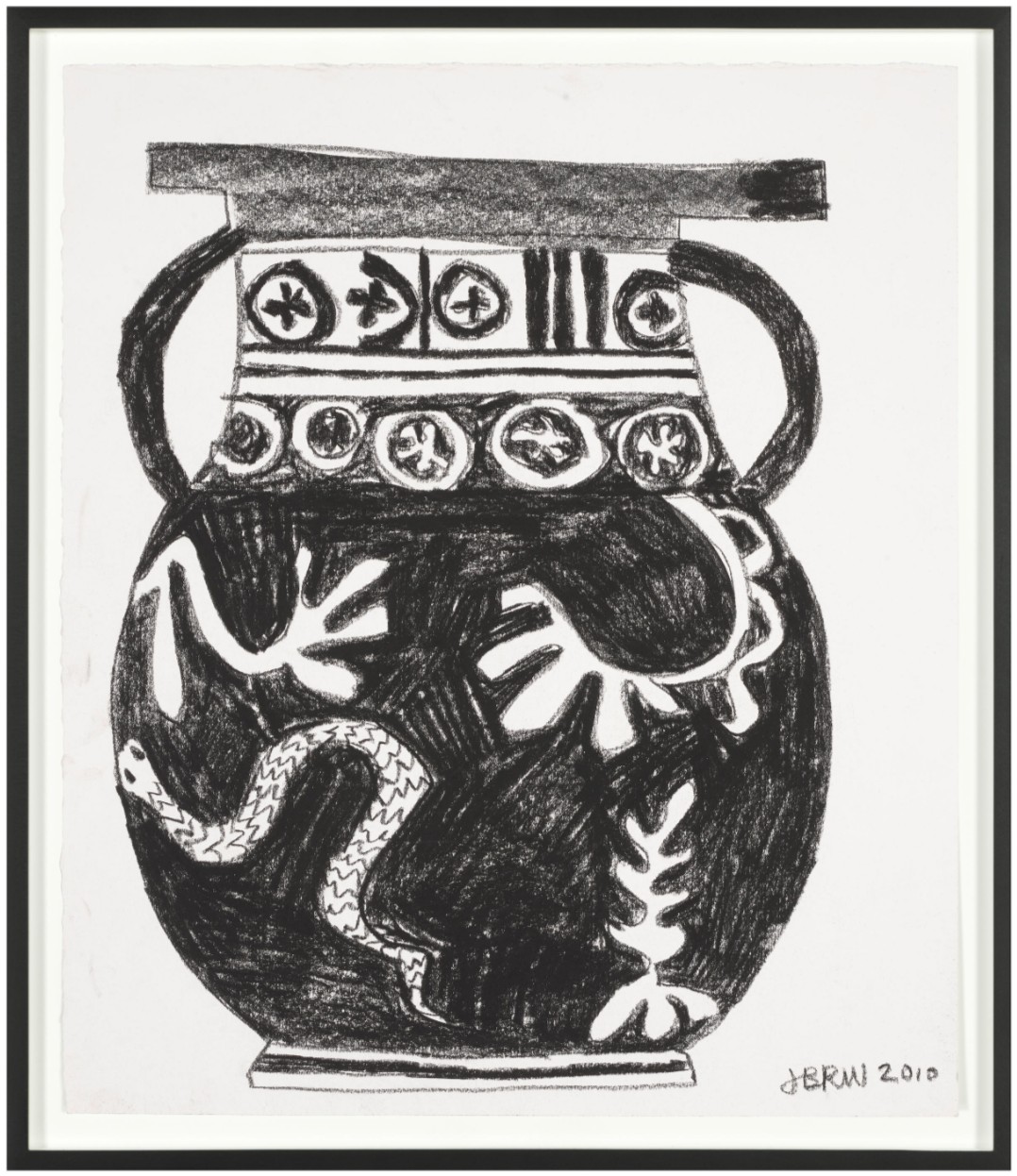
Conté crayon on paper
22 1/4 x 19 inches (56.5 x 48.3 cm)
Signed with the artist’s initials and dated ‘JBRW 2010’ (lower right)
#7. Untitled, 2011
Bonhams LA online: 23 September 2025
Estimated: USD 9,000 – 14,000
USD 10,240
WORK ON PAPER
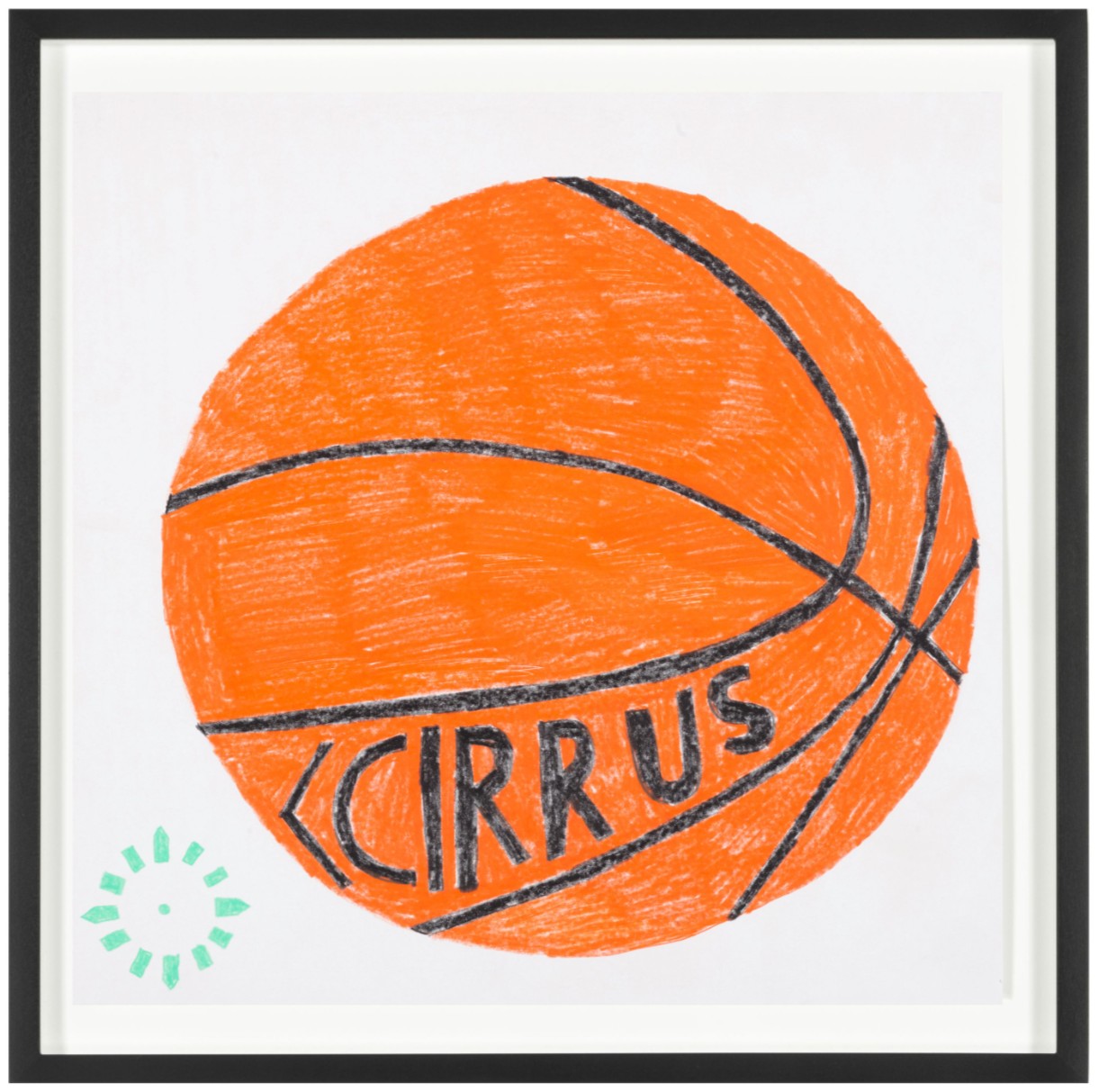
JONAS WOOD (B. 1977)
Untitled, 2011
Wax crayon on paper
14×14 inches (35.6 x 35.6 cm)
Signed with the artist’s initials, dedicated and dated ‘Jean @ Cirrus JBRW 2011’ (on the reverse)
Lots Passed
Untitled, 2009
Christie’s New-York: 30 September 2025
Estimated: USD 80,000 – 120,000
WORK ON PAPER
PASSED
JONAS WOOD (B. 1977), Untitled | Christie’s
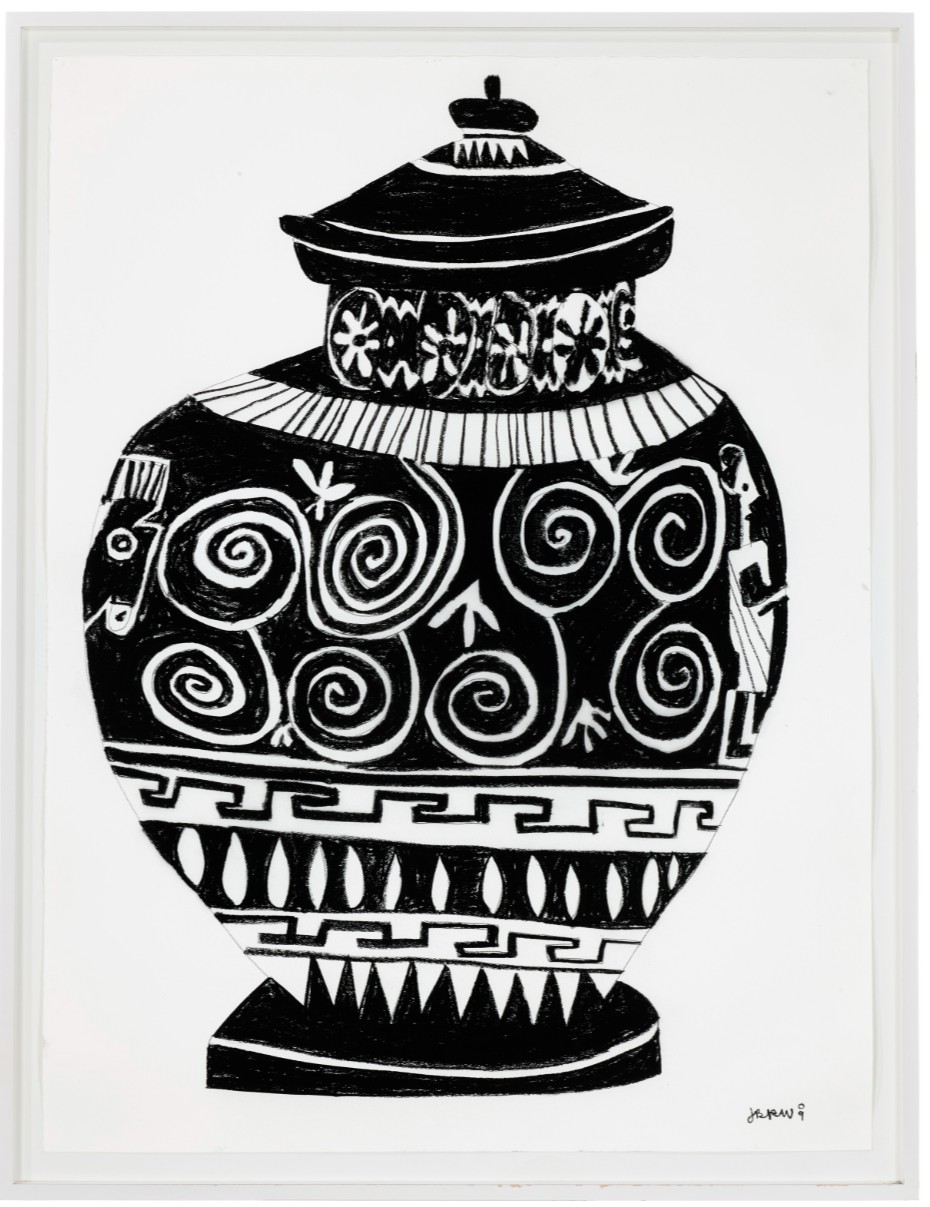
JONAS WOOD (B. 1977)
Untitled, 2009
Charcoal on paper
39 1/2 x 29 5/8 inches (100.3 x 75.2 cm)
Signed with the artist’s initials and dated ‘JBPW 09’ (lower right)
TV Room 1, 2007
K Auction Seoul: 19 March 2025
Estimated: KRW 150,000,000 – 220,000,000
PASSED
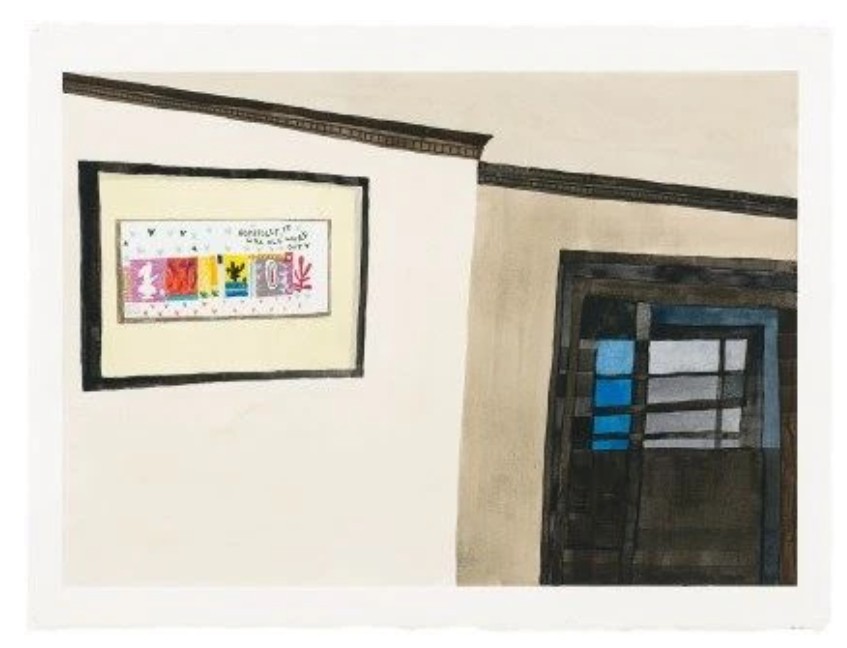
JONAS WOOD
TV Room 1, 2007
Gouache and colored pencil on paper
22 7/8 x 30 3/8 inches (57.8 x 76.8 cm)
Flask, 2008
Phillips New-York: 28 February 2025
Estimated: USD 20,000 – 30,000
WORK ON PAPER
PASSED
Jonas Wood – New Now: Modern & Con… Lot 149 February 2025 | Phillips
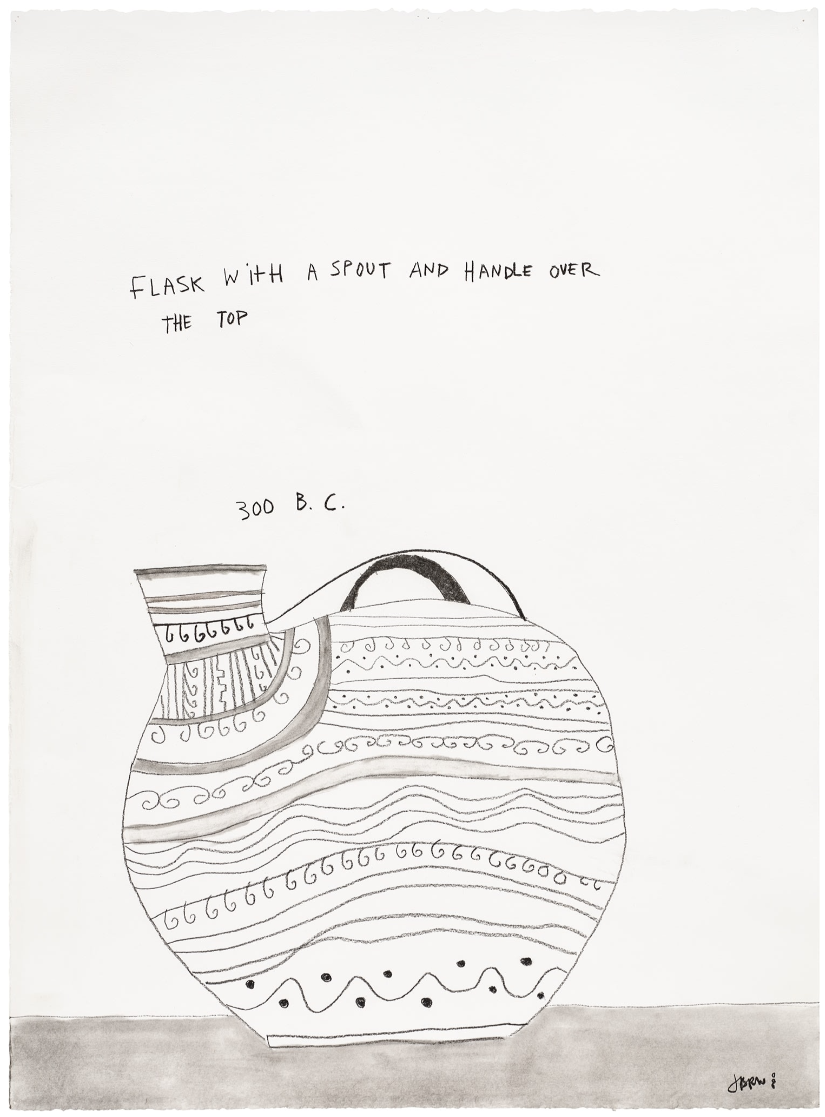
JONAS WOOD
Flask, 2008
Charcoal on paper
30×22 inches (76.2 x 55.9 cm)
Signed with the artist’s initials and dated “JBRW 08” lower right
Signed with the artist’s initials, titled and dated “FLASK JBRW 2008” on the reverse
2024 Auction Results
10 lots sold at auction in 2024 for a total turnover of USD 641,593.
#1. Augusta’s Photo Shoot, 2009
Sotheby’s New-York: 21 November 2024
Estimated: USD 250,000 – 350,000
USD 216,000
Augusta’s Photo Shoot | Contemporary Day Auction | 2024 | Sotheby’s
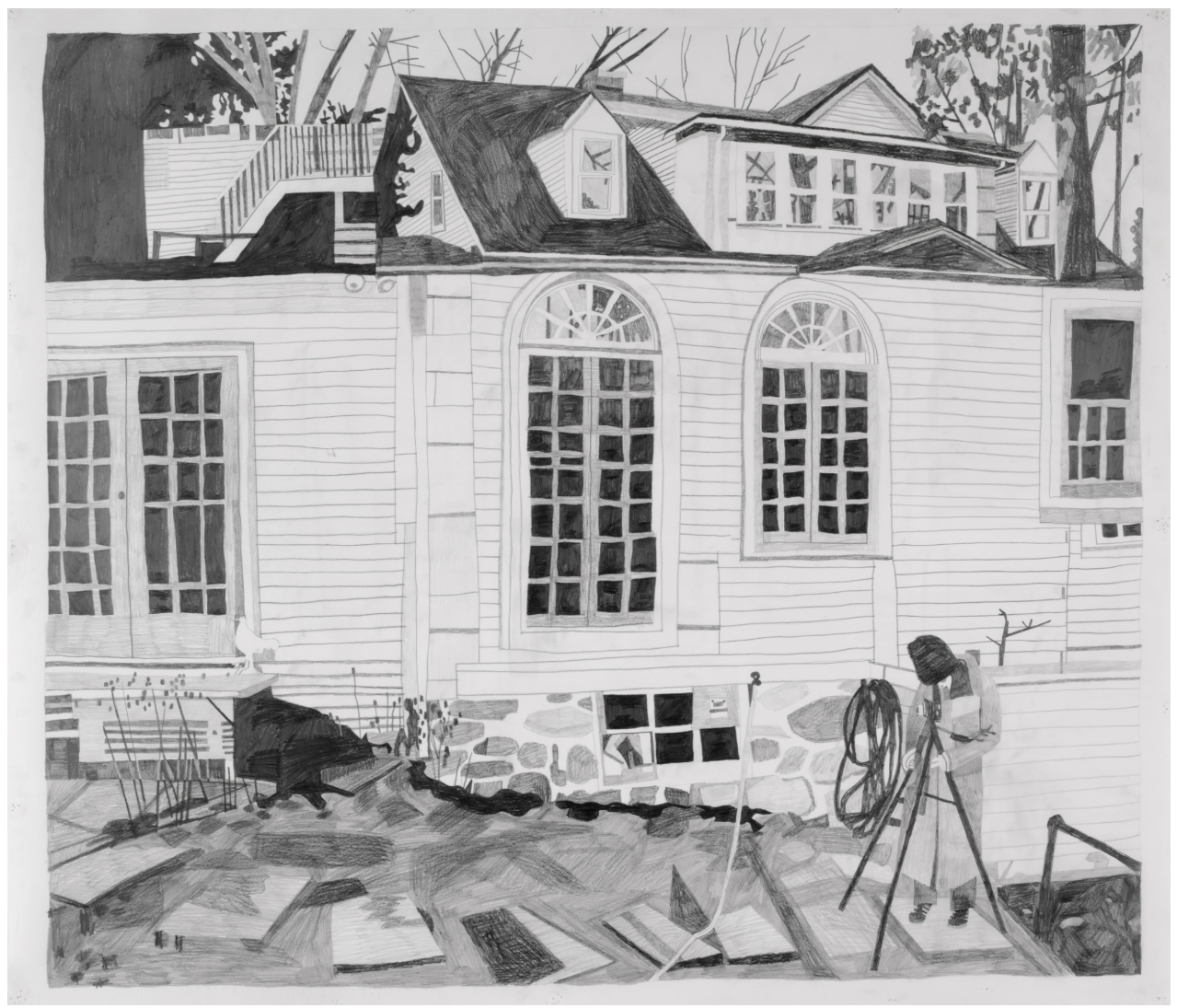
JONAS WOOD (b. 1977)
Augusta’s Photo Shoot, 2009
Graphite on paper
40 1/2 x 47 inches (102.9 x 119.4 cm)
Signed, titled and dated 2009 (on the verso)
#2. Big BW 2, 2009
Sotheby’s New-York: 14 May 2024
Estimated: USD 80,000 – 120,000
USD 120,650
Big BW 2 | Contemporary Day Auction | 2024 | Sotheby’s (sothebys.com)
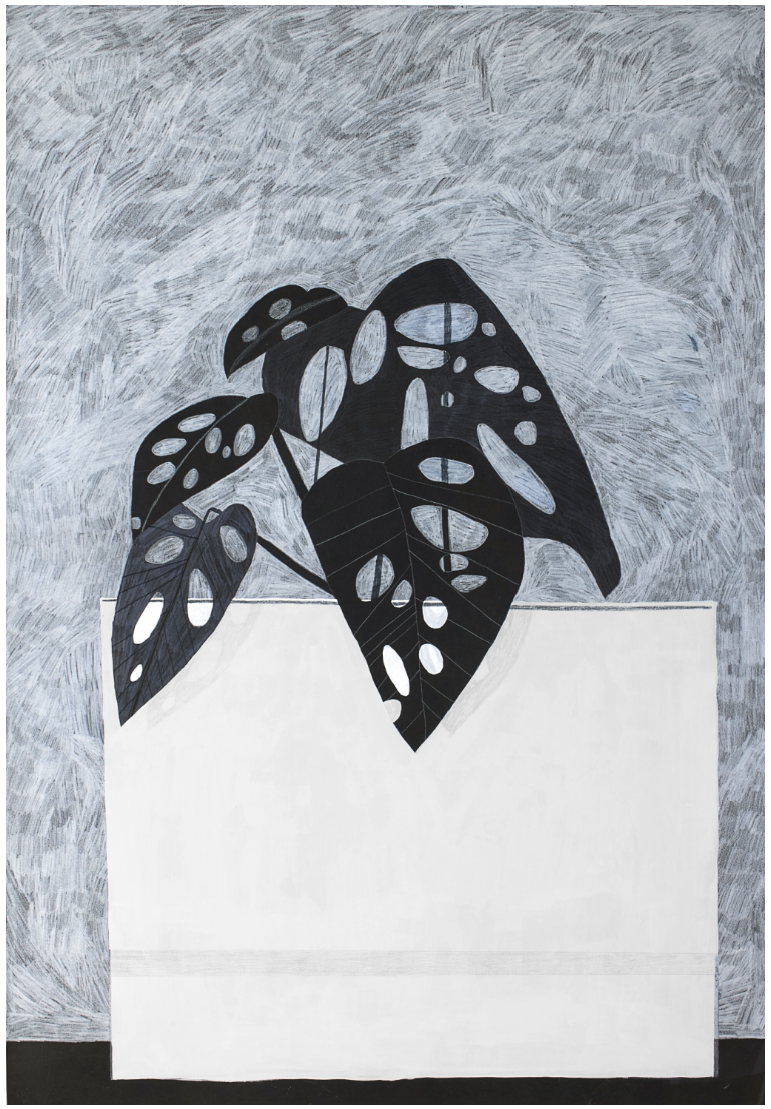
JONAS WOOD (b. 1977)
Big BW 2, 2009
Acrylic, colored pencil and ink on paper
60×41 inches (152.4 x 104.1 cm)
Signed with the artist’s initials and dated 2009 (on the verso)
USD 100,000
#3. Bullets (mini), 2007
Phillips New-York: 15 May 2024
Estimated: USD 50,000 – 70,000
USD 63,500
Jonas Wood – Modern & Contemporary Art … Lot 408 May 2024 | Phillips
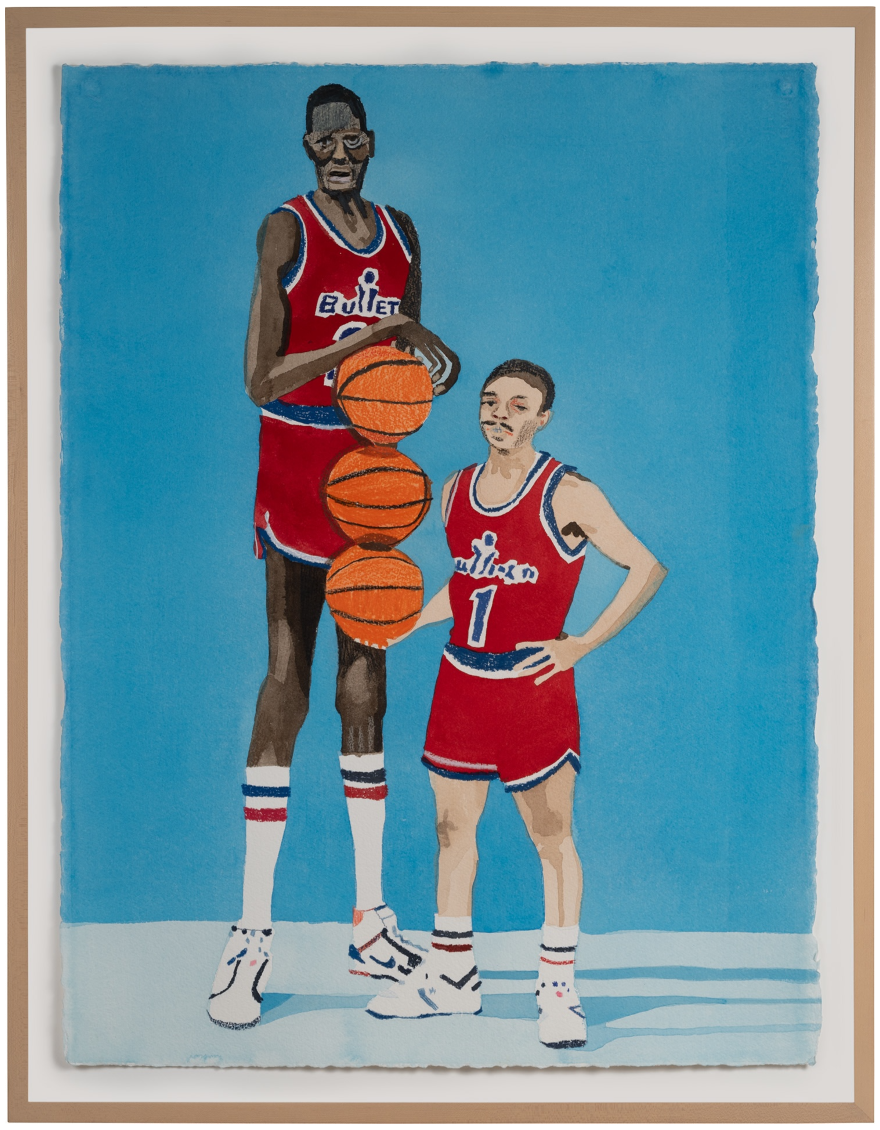
JONAS WOOD
Bullets (mini), 2007
Gouache and colored pencil on paper
30 x 22 1/2 inches (76.2 x 57.2 cm)
Signed with the artist’s initials, titled and dated “JBRW 2007 BULLETS (MINI” on the reverse
#4. 65, 2008
Sotheby’s New-York: 21 November 2024
Estimated: USD 20,000 – 30,000
USD 45,600
65 | Contemporary Day Auction | 2024 | Sotheby’s
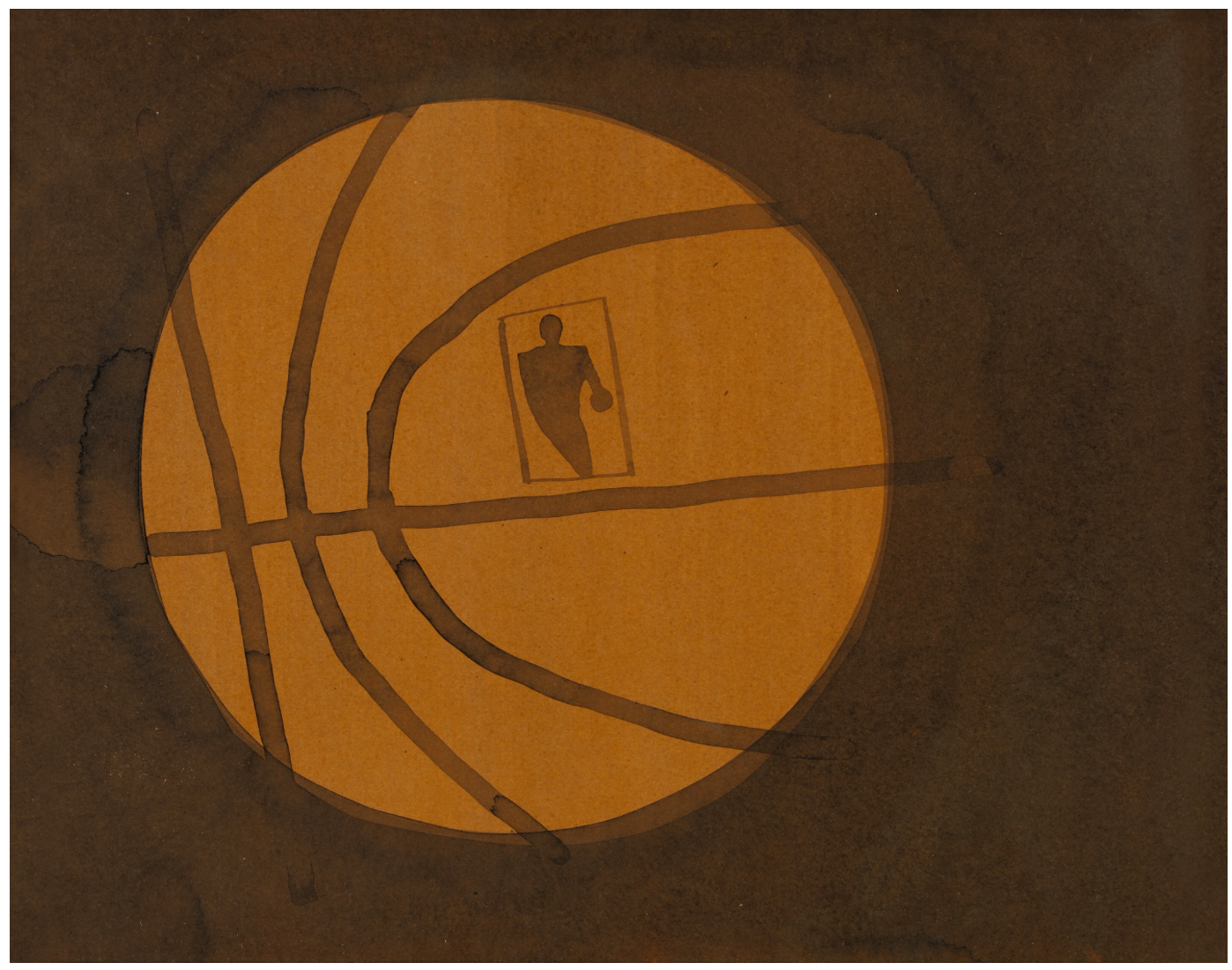 JONAS WOOD (b. 1977)
65, 2008
Acrylic and ink on paper
13 x 16 1/2 inches (33 x 41.9 cm)
Signed, titled and dated 2008 (on the verso)
#5. Untitled, 2009
Phillips New-York: 20 November 2024
Estimated: USD 50,000 – 70,000
USD 38,100
Jonas Wood – Modern & Contemporary… Lot 374 November 2024 | Phillips
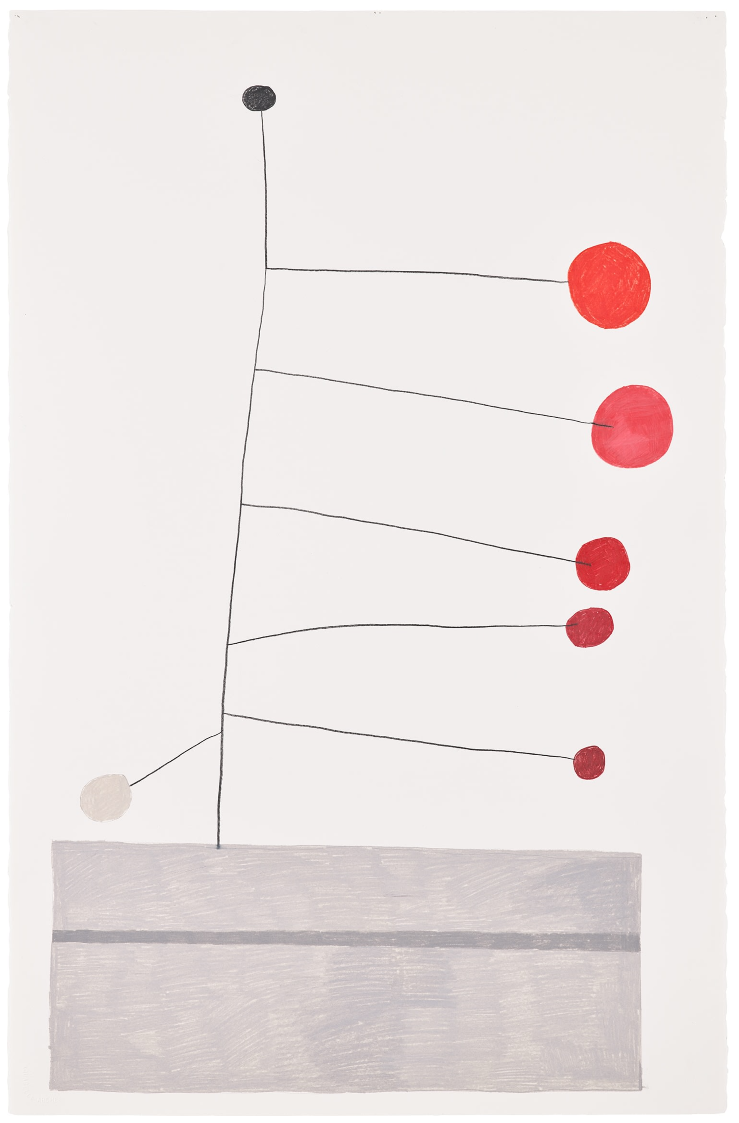
JONAS WOOD
Untitled, 2009
Colored pencil on paper
40 1/8 x 26 inches (101.9 x 66 cm)
Signed with the artist’s initials, inscribed and dated “Hot 1 JBRW 2009” on the reverse
#6. Basketball, 2008
Sotheby’s New-York: 16 July 2024
Estimated: USD 20,000 – 30,000
USD 36,000
Basketball | Contemporary Discoveries | 2024 | Sotheby’s
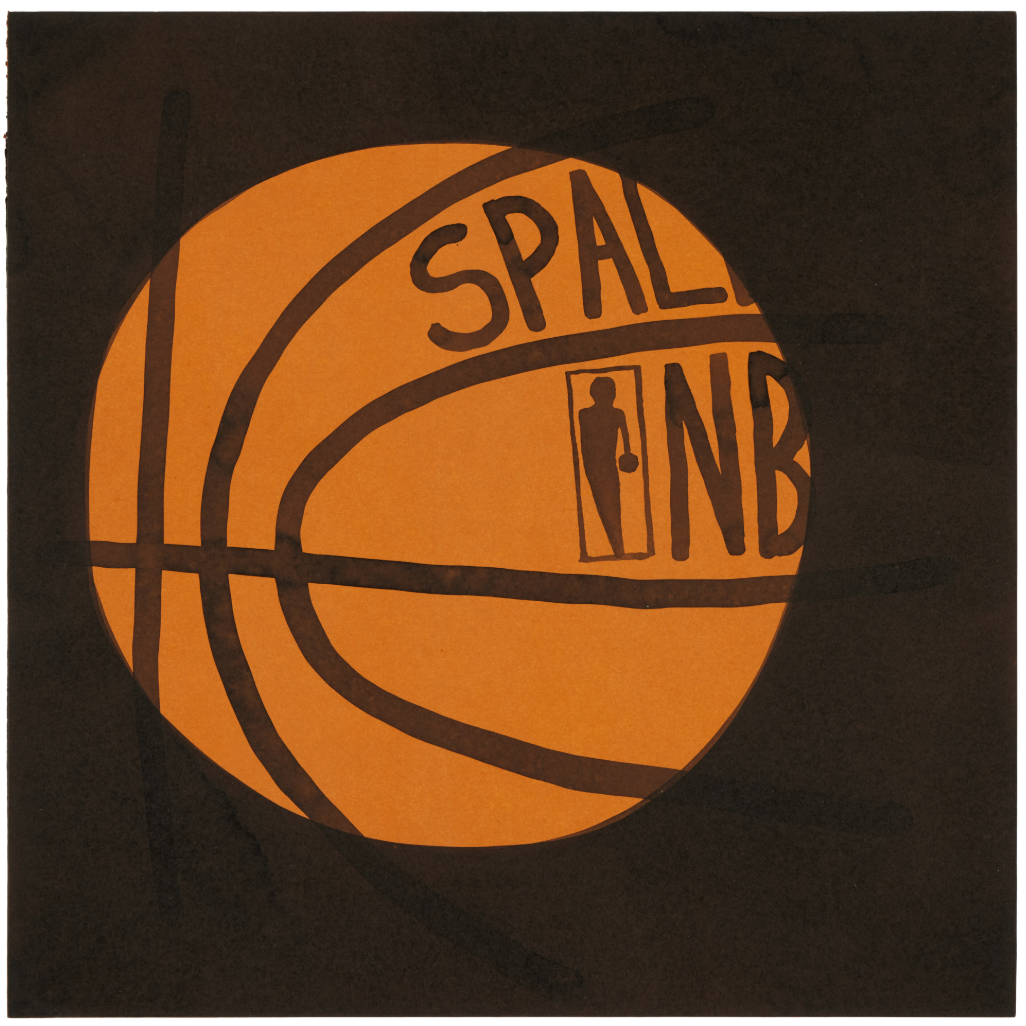
JONAS WOOD (b. 1977)
Basketball, 2008
Acrylic and ink on paper
13×13 inches (33×33 cm)
Signed with the artist’s initials JBRW, titled, dated 2008 and variously inscribed (on the verso)
#7. B-ball 2, 2008
Sotheby’s Paris: 24 April 2024
Estimated: EUR 15,000 – 20,000
EUR 33,020 / USD 35,340
B-ball 2 | Art Moderne et Contemporain Day Auction | 2024 | Sotheby’s (sothebys.com)
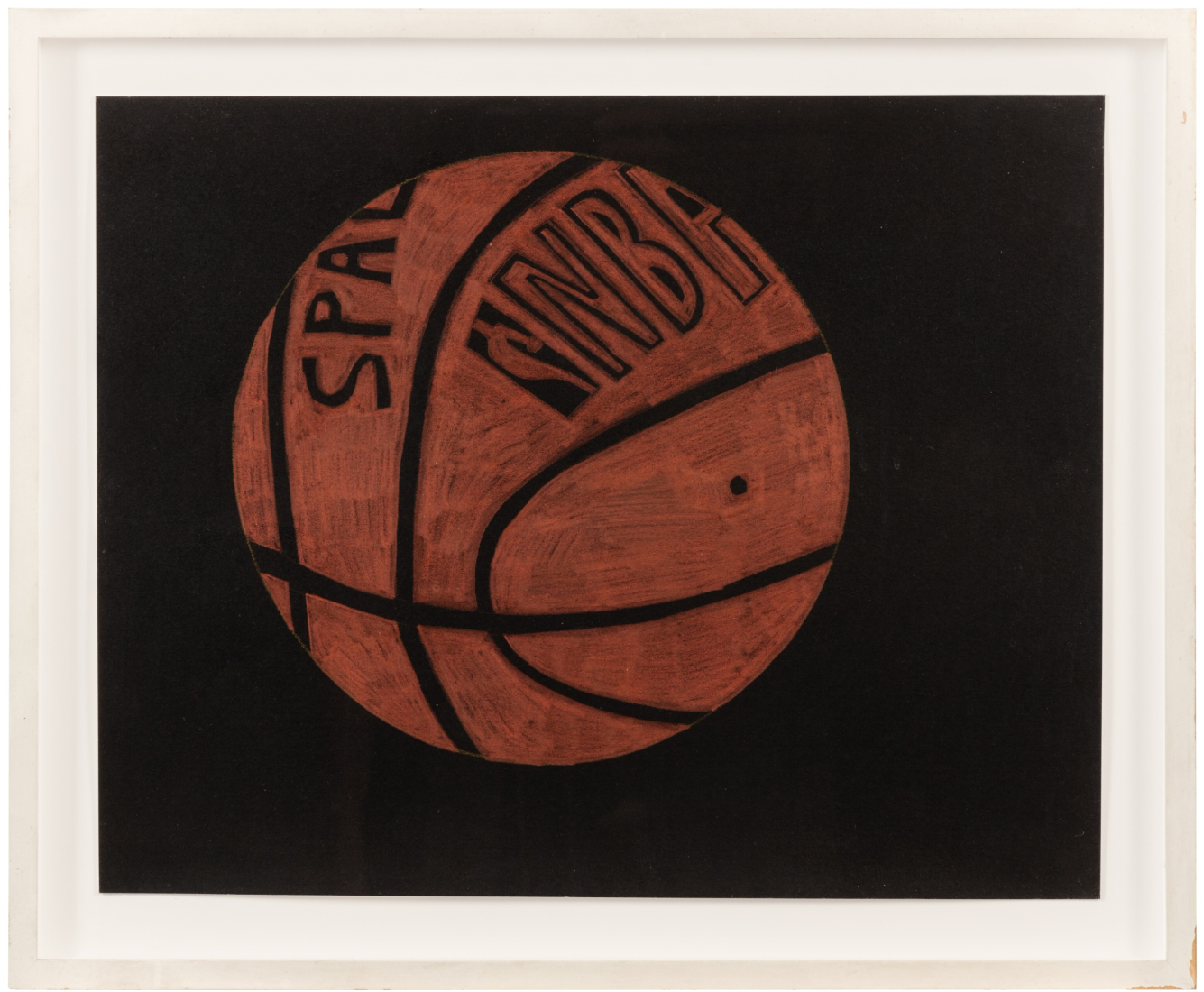
JONAS WOOD (b. 1977)
B-ball 2, 2008
Ink and colored pencil on paper
11 5/8 x 14 7/8 inches (29.4 x 37.8 cm)
#8. B-ball 9, 2008
Christie’s London: 15 October 2024
Estimated: GBP 15,000 – 20,000
GBP 23,940 / USD 31,275
JONAS WOOD (B. 1977), B-ball 9 | Christie’s
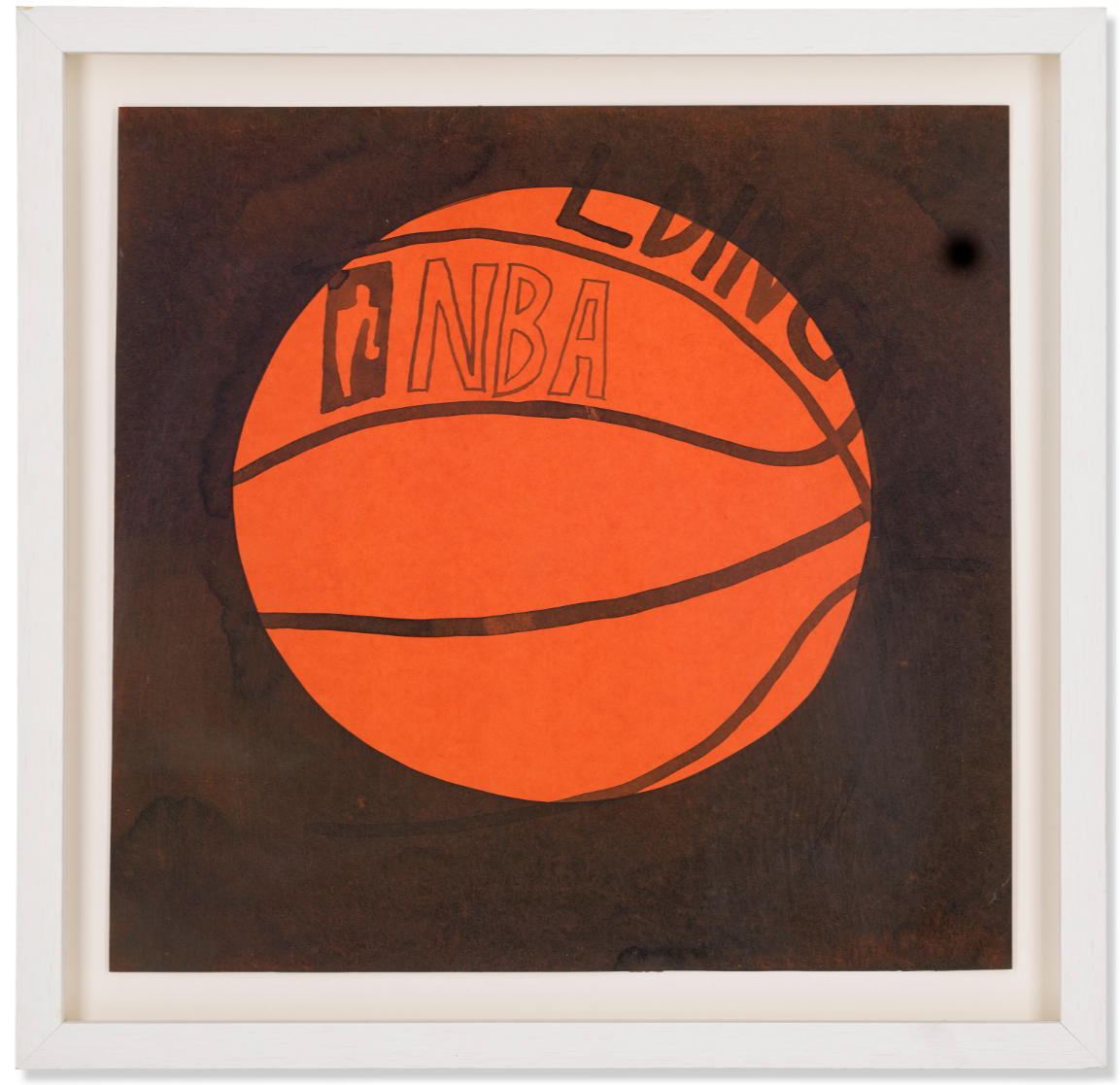
JONAS WOOD (B. 1977)
B-ball 9, 2008
Acrylic and ink on paper
155/8 x 15 inches (39.7 x 38.1 cm)
#9. B-ball 23, 2008
Sotheby’s Paris: 5 July 2024
Estimated: EUR 15,000 – 20,000
EUR 22,800 / USD 24,650
https://www.sothebys.com/en/buy/auction/2024/modern-contemporary-discoveries/b-ball-23
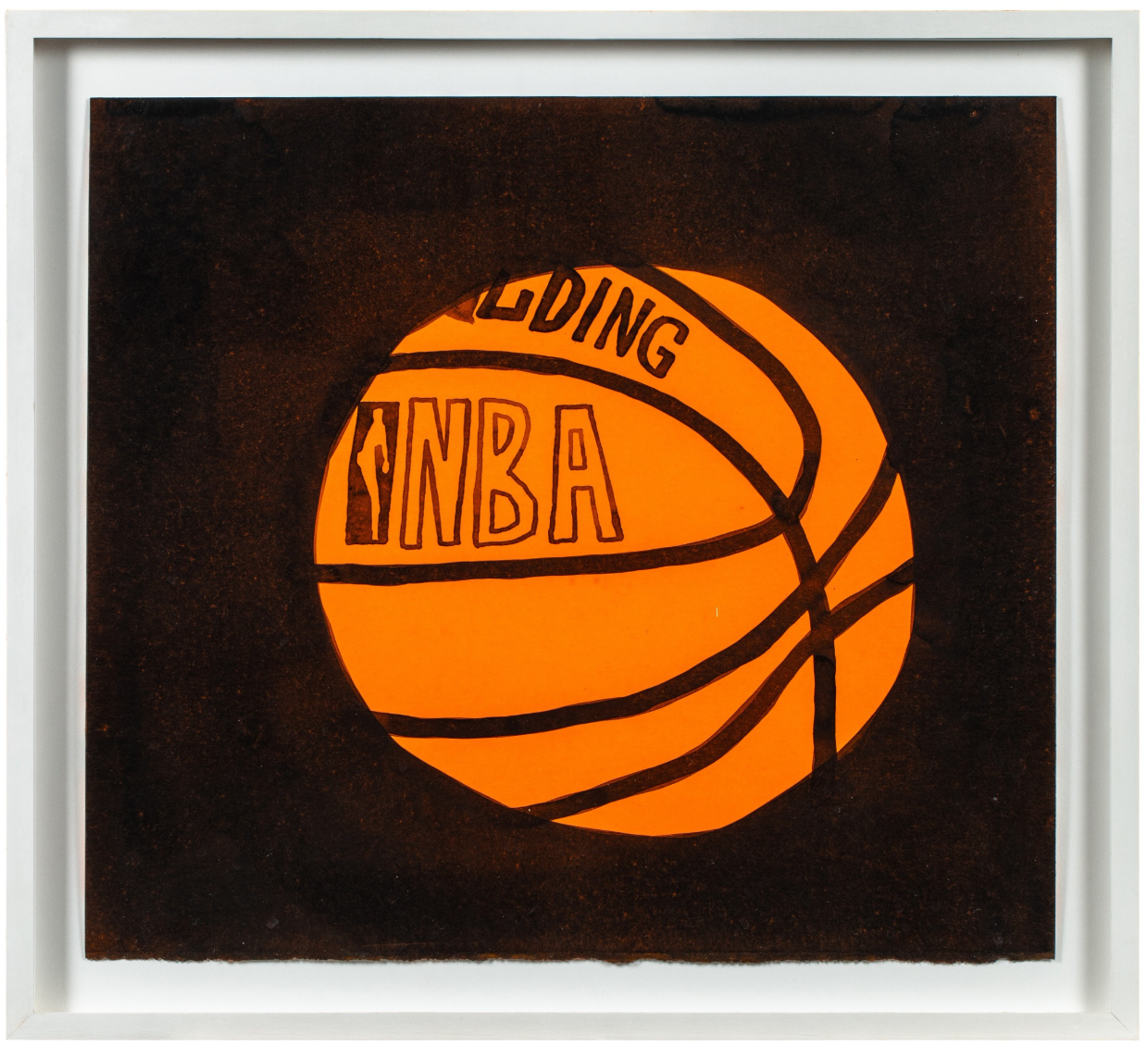
JONAS WOOD (b. 1977)
B-ball 23, 2008
Acrylic and ink on paper
13 1/2 x 15 inches (34.2 x 38.1 cm)
2023 Auction Results
4 lots sold at auction in 2023 for a total turnover of USD 166,949.
#1. Untitled, 2003
SBI Art Auction: 11 March 2023
Estimated: JPY 7,000,000 – 12,000,000
JPY 8,050,000 / USD 59,635
WORK ON PAPER
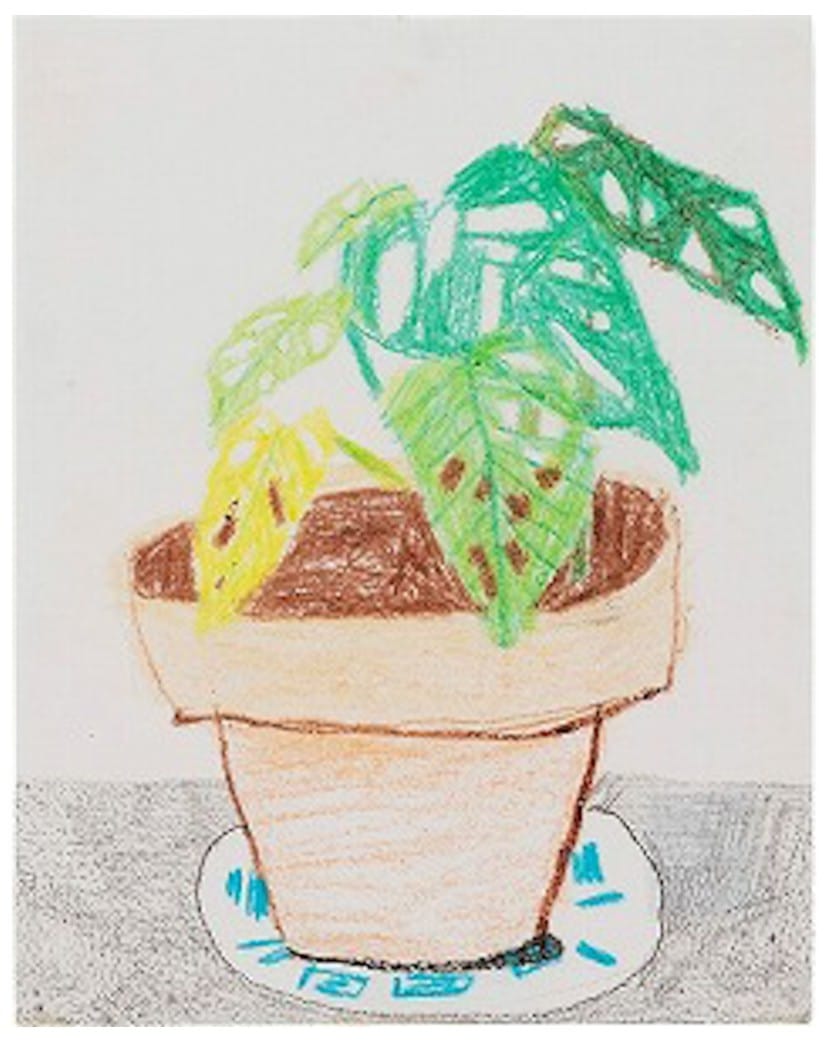
JONAS WOOD
Untitled, 2003
Crayon on paper
9 3/4 x 8 inches (24.8 × 20.3 cm)
Signed and dated on the reverse
#2. Downstairs Bathroom 2, 2009
Sotheby’s London: 2 March 2023
Estimated: GBP 40,000 – 60,000
GBP 46,990 / USD 56,514
WORK ON PAPER
Downstairs Bathroom 2 | Modern & Contemporary Day Auction | 2023 | Sotheby’s (sothebys.com)
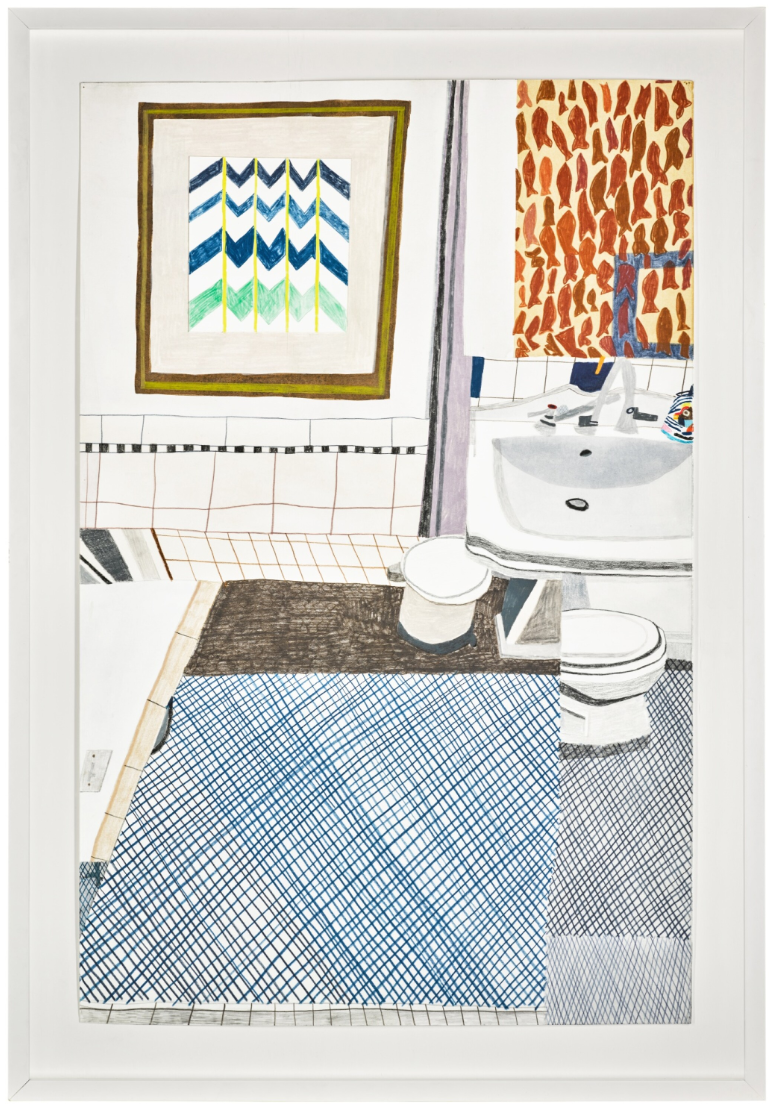
JONAS WOOD (b. 1977)
Downstairs Bathroom 2, 2009
Gouache, colored pencil and paper collage on paper
33 3/4 x 22 1/8 inches (85.7 x 56.2 cm)
Signed, titled and dated 2009 on the reverse
#3. Ball, 2008
Phillips New-York: 8 March 2023
Estimated: USD 20,000 – 30,000
USD 25,400
WORK ON PAPER
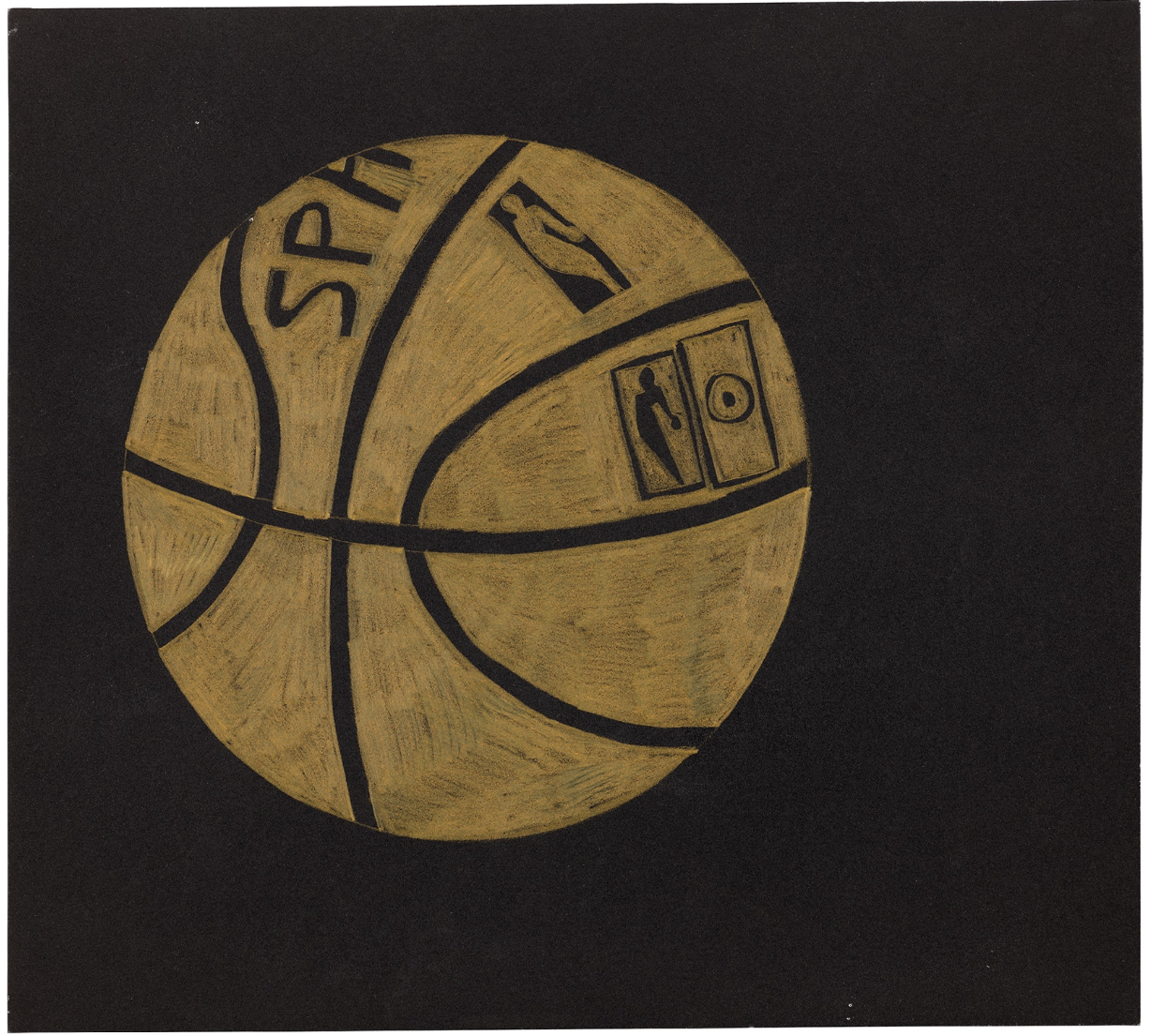
JONAS WOOD
Ball, 2008
Gouache and colored pencil on paper
13 1/2 x 15 1/8 inches (34.3 x 38.4 cm)
Signed with the artist’s initials, titled and dated “JBRW 2008 BALL” on the reverse
#4. Untitled (Tilted White), 2011
Sotheby’s New-York: 3 October 2023
Estimated: USD 20,000 – 30,000
USD 25,400
WORK ON PAPER
Untitled (Tilted White) | Contemporary Discoveries | 2023 | Sotheby’s (sothebys.com)
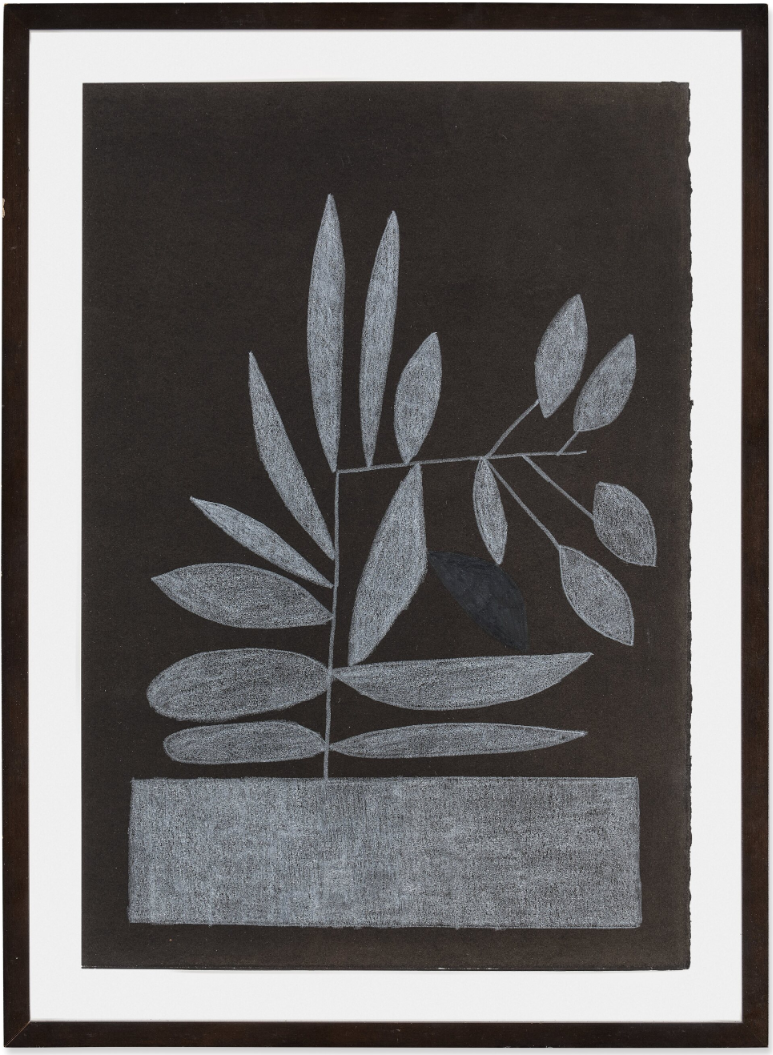
JONAS WOOD (b. 1977)
Untitled (Tilted White), 2011
Ink and colored pencil on paper
14 1/2 x 9 7/8 inches (36.8 x 25.1 cm)
2022 Auction Results
Untitled (Silver Dots Draw), 2010
Christie’s London: 1 July 2022
Estimated: GBP 60,000 – 80,000
GBP 69,300
JONAS WOOD (B. 1977) (christies.com)
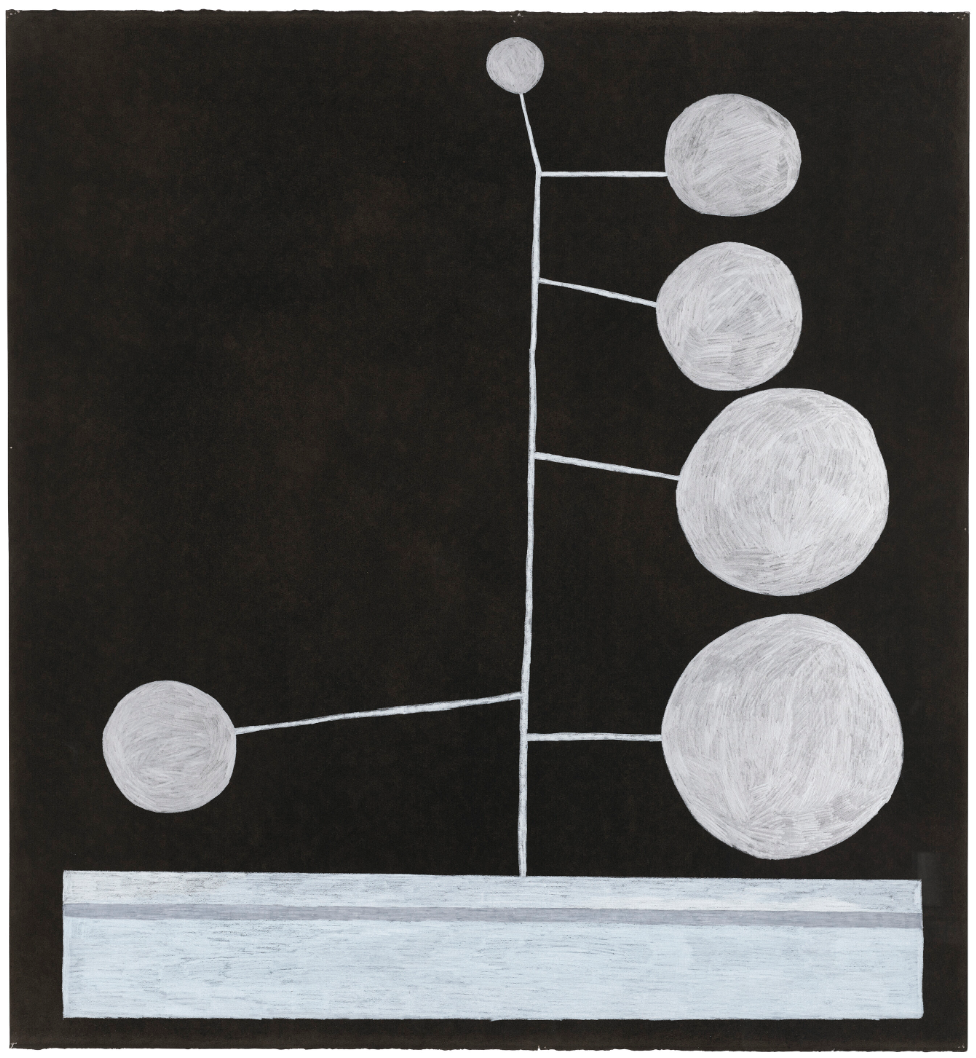
JONAS WOOD (B. 1977)
Untitled (Silver Dots Draw), 2010
Ink, silver and colored pencil on paper
41×38 inches (104 x 96.3 cm)
Signed, titled and dated ‘UNTITLED (SILVER DOTS DRAW) JWood 2010’ (on the reverse)
Night Bloom 2, 2012
Phillips New-York: 19 May 2022
Estimated: USD 100,000 – 150,000
USD 123,480
Jonas Wood – 20th Century & Contemporar… Lot 314 May 2022 | Phillips
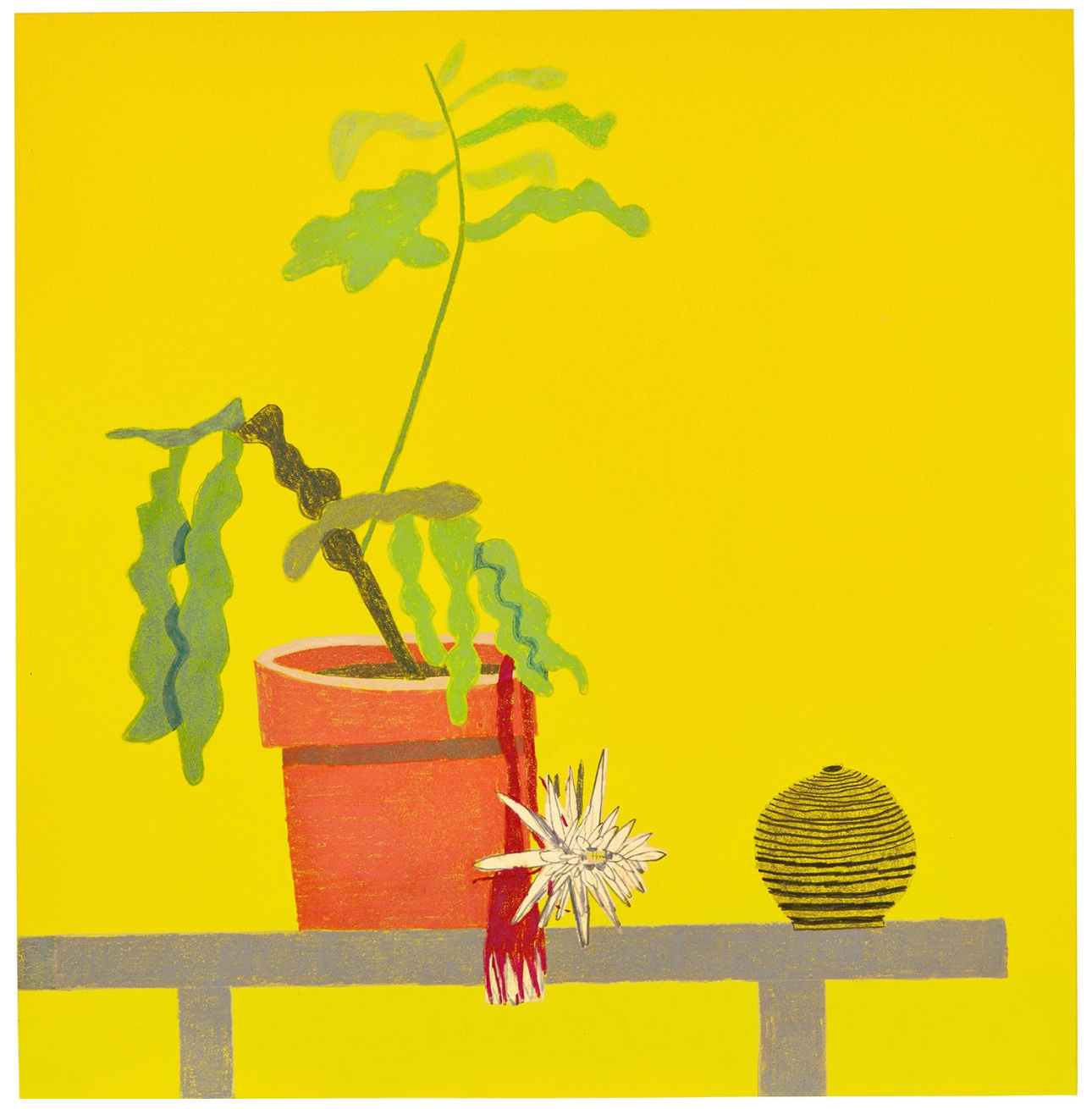
JONAS WOOD
Night Bloom 2, 2012
Gouache and colored pencil on paper
20 1/2 x 20 1/8 inches (52.1 x 51.1 cm)
Signed with the artist’s initials, titled and dated “NIGHT BLOOM 2 JBRW 2012” on the reverse
Executed in 2012, Jonas Wood’s Night Bloom 2 is an exuberant painting on paper that perfectly encapsulates the LA-based artist’s celebrated idiom. Wood is perhaps best known for focusing on the everyday spaces of his studio and garden, and the present work in particular exemplifies his fascination with floral still-lifes. As in the painting Night Bloom Still Life, 2015, which is held in the collection of the Whitney Museum of American Art, New York, Wood here depicts a potted plant next to a striped ceramic vessel made by his wife, ceramist Shio Kusaka. Imbued with art historical references ranging from Henri Matisse to David Hockney, Night Bloom 2 above all offers an intimate snapshot–a celebration of the small domestic pleasures.
Prints
WORK IN PROGRESS
Four Majors, 2018
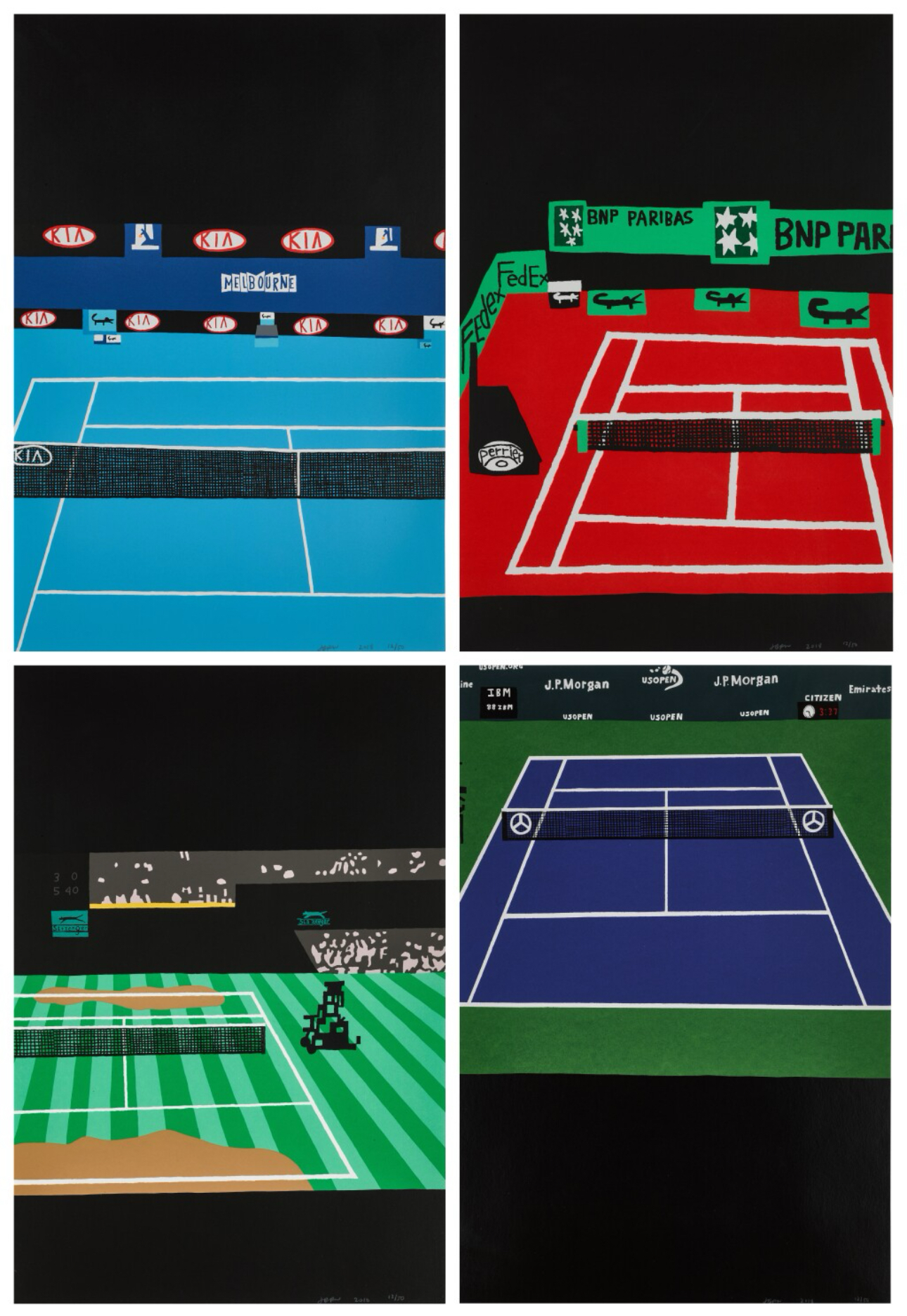
Four Majors
The complete set of four screenprints in colors
Medium: Screenprint in colors on Coventry rag paper
Year: 2018
Sheet: 19×13 inches (48.4 x 33.1 cm)
Edition: 50
Artist’s Proofs: 10 AP
Publisher: WKS Editions, Los Angeles, and Karma, New York
Signed, dated and numbered in pencil
1. Melbourne
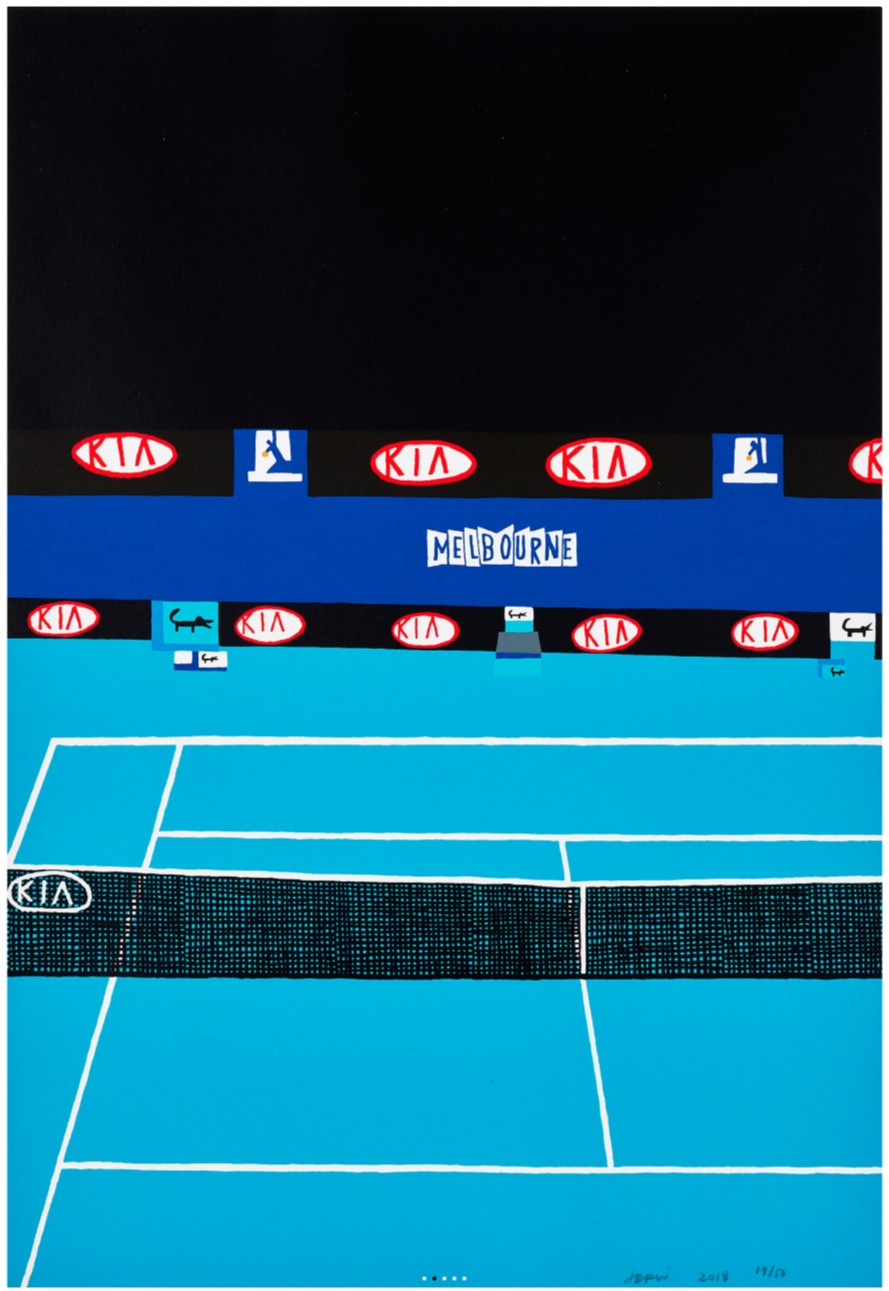
2. Paris
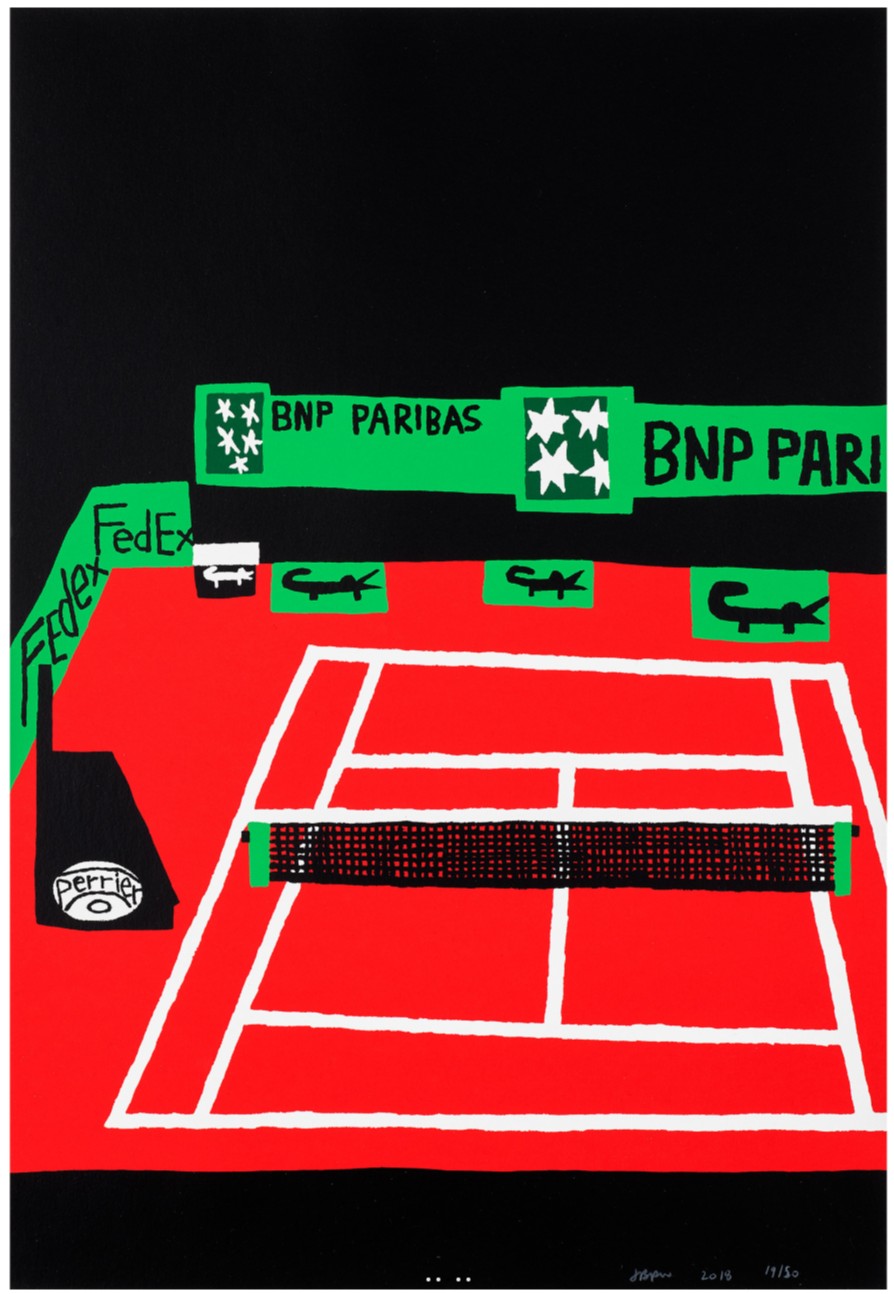
3. London
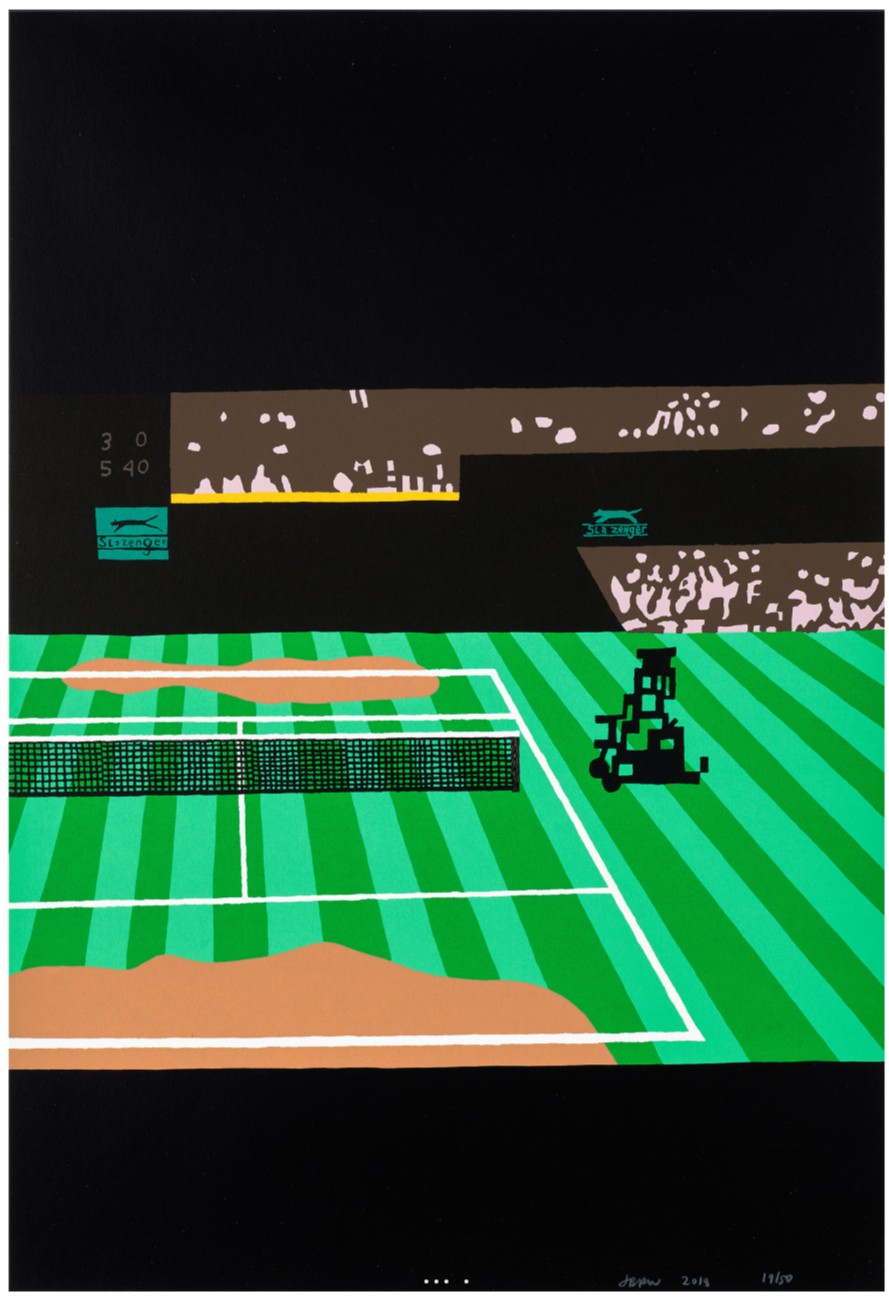
4. New-York
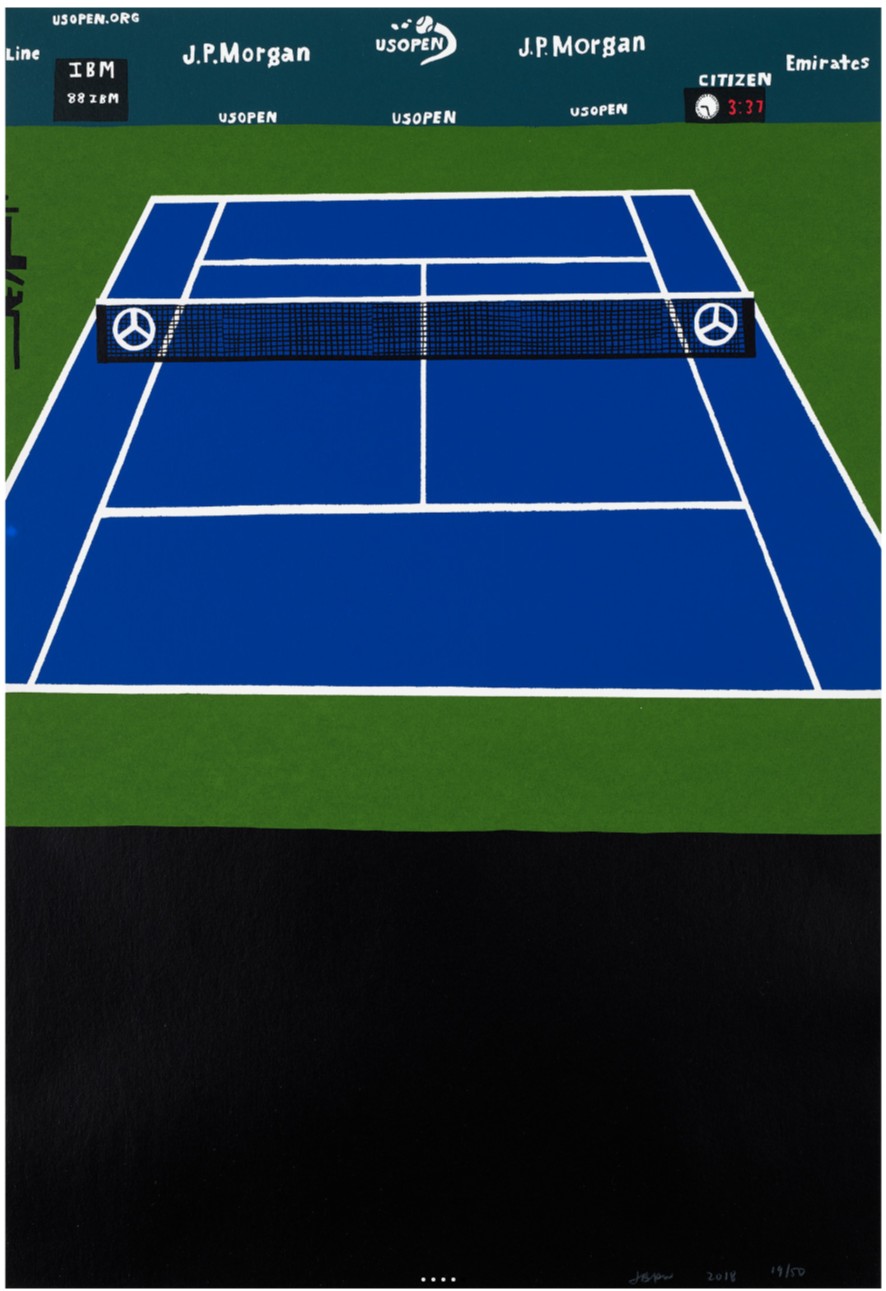
“I watch all the tennis majors and started taking photographs of the TV a while back. These images led me to make drawings and paintings. I think of them as color studies, abstract paintings with few details.”
Jonas Wood’s Four Majors (2018) is a quartet of screenprints depicting iconic tennis courts from the international tournaments in Melbourne, Paris, London, and New York. Rendered in bold, flat colours and simplified geometric forms, the courts simultaneously evoke their real-world locations while dissolving into striking abstractions. The saturated hues – bright blue hardcourt, red clay, and verdant grass – are juxtaposed with stark black voids, creating dynamic visual puzzles. Logos and court lines ground each scene in specificity, while their flattened, graphic treatment gives way to a playful ambiguity, turning physical spaces into imagined compositions. This interplay between reality and abstraction is a recurring theme in Wood’s work. His process often begins with cutting and collaging found images.
“I’m a clipper,” Wood explains, “I have a lot of photos on my computer. I have books and magazines I’ve collected.”
He has amassed a rich archive of inspiration – also including postcards from friends, Instagram screenshots, and interior design magazines – which he clips and combines in new compositions. Wood frequently deconstructs and reconfigures this source material, forging new scenes that blur past and present, real and imagined.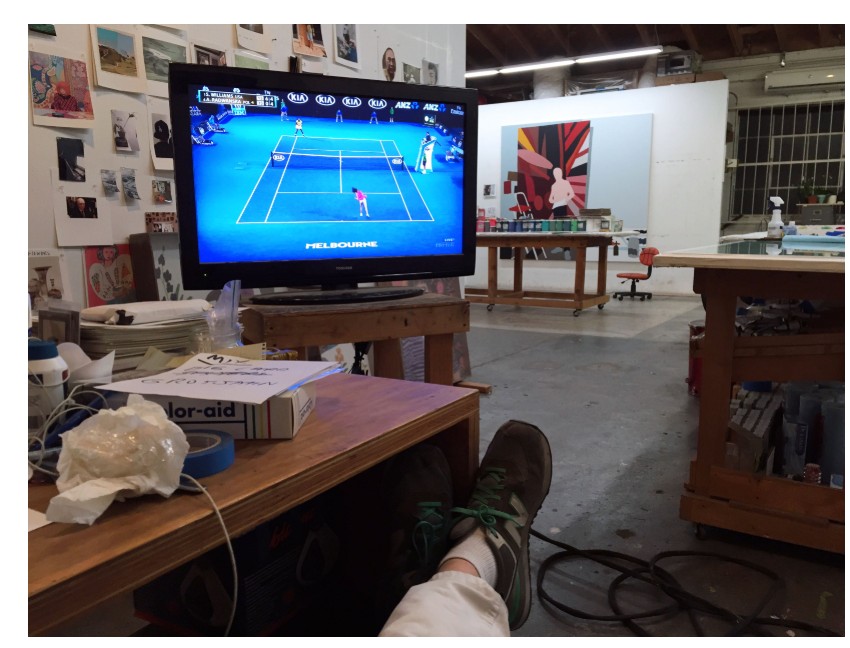
Photograph taken by Jonas Wood, capturing tennis on the television in his studio, 2016. Image: © Wood Kusaka Studios
“I’ve made many works that are pieced together from disparate found images but look like straight, unmanipulated found images.
And there are works that are from straight found images but look like I made the whole thing up.
I like that you don’t know where the work is coming from, if I orchestrated it or if I straight appropriated it.”
Wood has noted that this tension between the recognizable and the invented is particularly central to his tennis court works, the source for which was photographs he took of the TV screen while watching tennis. In Four Majors, the familiar settings morph into abstract geometric puzzles – playful studies in color and form, far from straightforward depictions of sport.
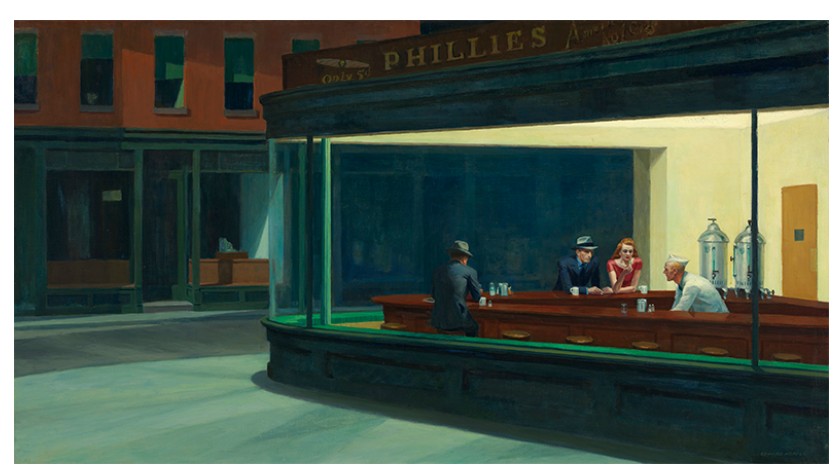
Edward Hopper, Nighthawks, 1942, The Art Institute of Chicago. Image: The Art Institute of Chicago / Art Resource, NY/ Scala, Florence
Wood’s attuned use of color and composition to blur reality, memory, and imagination in Four Majors recalls the work of Edward Hopper. Hopper similarly drew inspiration from the everyday to craft striking and, at times, unnerving vignettes of ordinary life. Alike Hopper, in Four Majors Wood reduces human presence, removing the players and crowds of spectators. The result is an atmosphere akin to a set stage, waiting in anticipation of bright lights, a cast of actors, and the director yelling “action”. Furthermore, similarly to Hopper’s scenes, Wood’s tennis courts distil the essence of a place into highly considered arrangements. Wood’s use of flat, Pop-inspired colour blocks and skewed perspectives creates an uncanny effect, rendering the courts both familiar and disorienting. This creates a trompe-l’œil effect that plays with depth, scale, color, and vantage point, leaving viewers with an evocative yet enigmatic impression – one that leads us to question whether our sense of familiarity with the scene is real or imagined.
Source: Phillips
Auction Results
Phillips London: 24 January 2025
Estimated: GBP 40,000 – 60,000
GBP 139,700 / USD 172,575
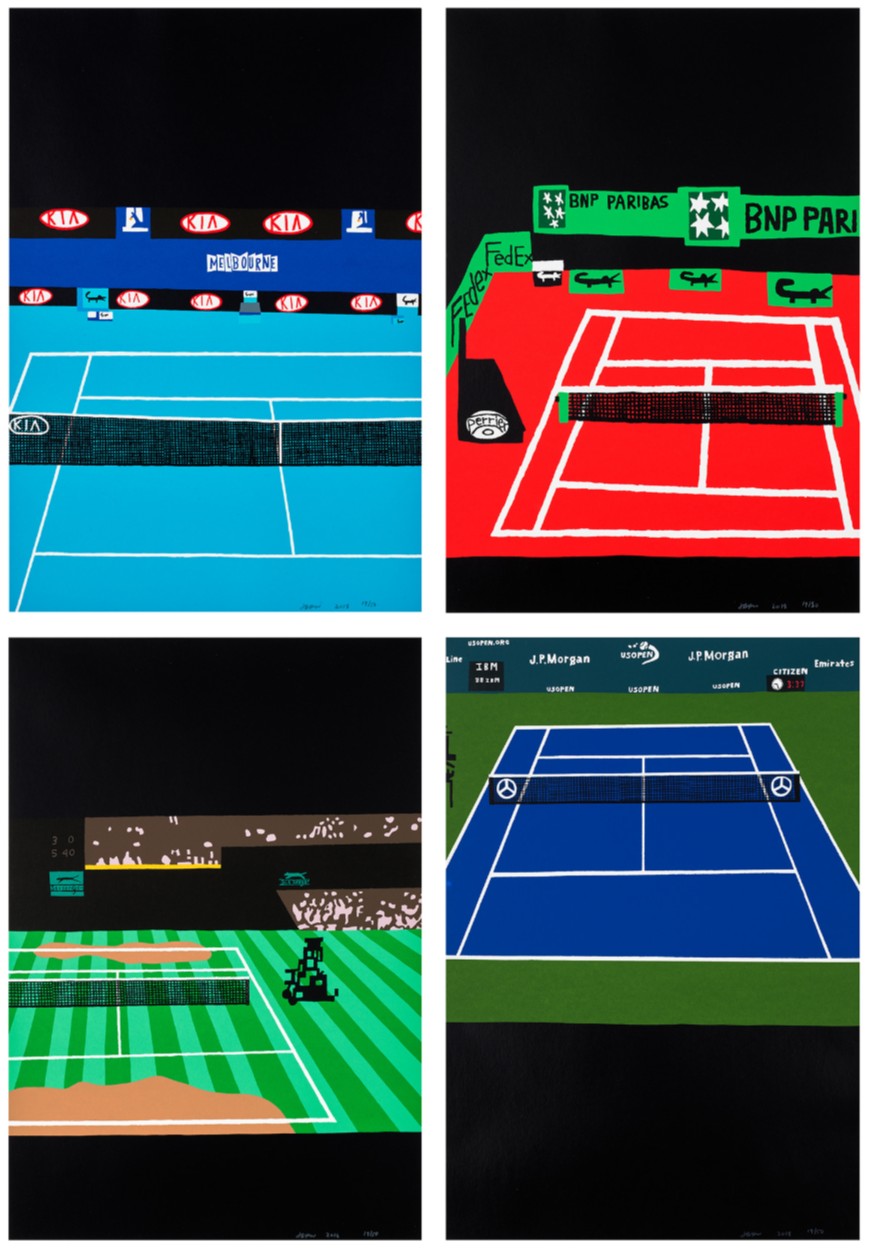
All signed with initials, dated and numbered 19/50 in pencil
Sotheby’s London: 26 September 2023
Estimated: GBP 40,000 – 60,000
GBP 88,900 / USD 108,565
JONAS WOOD (b. 1977)
Four Majors, 2018
The complete set, comprising four screenprints in colors on Coventry rag paper
Each sheet: 19×13 inches (48.4 x 33.1 cm)
Each signed in pencil, dated and numbered 12/50
This set is number 12 from the edition of 50 plus ten artist’s proofs
Co-published by WKS Editions, Los Angeles, and Karma, New York
Fish Pot, Matisse Pot 4, Snoopy Pot
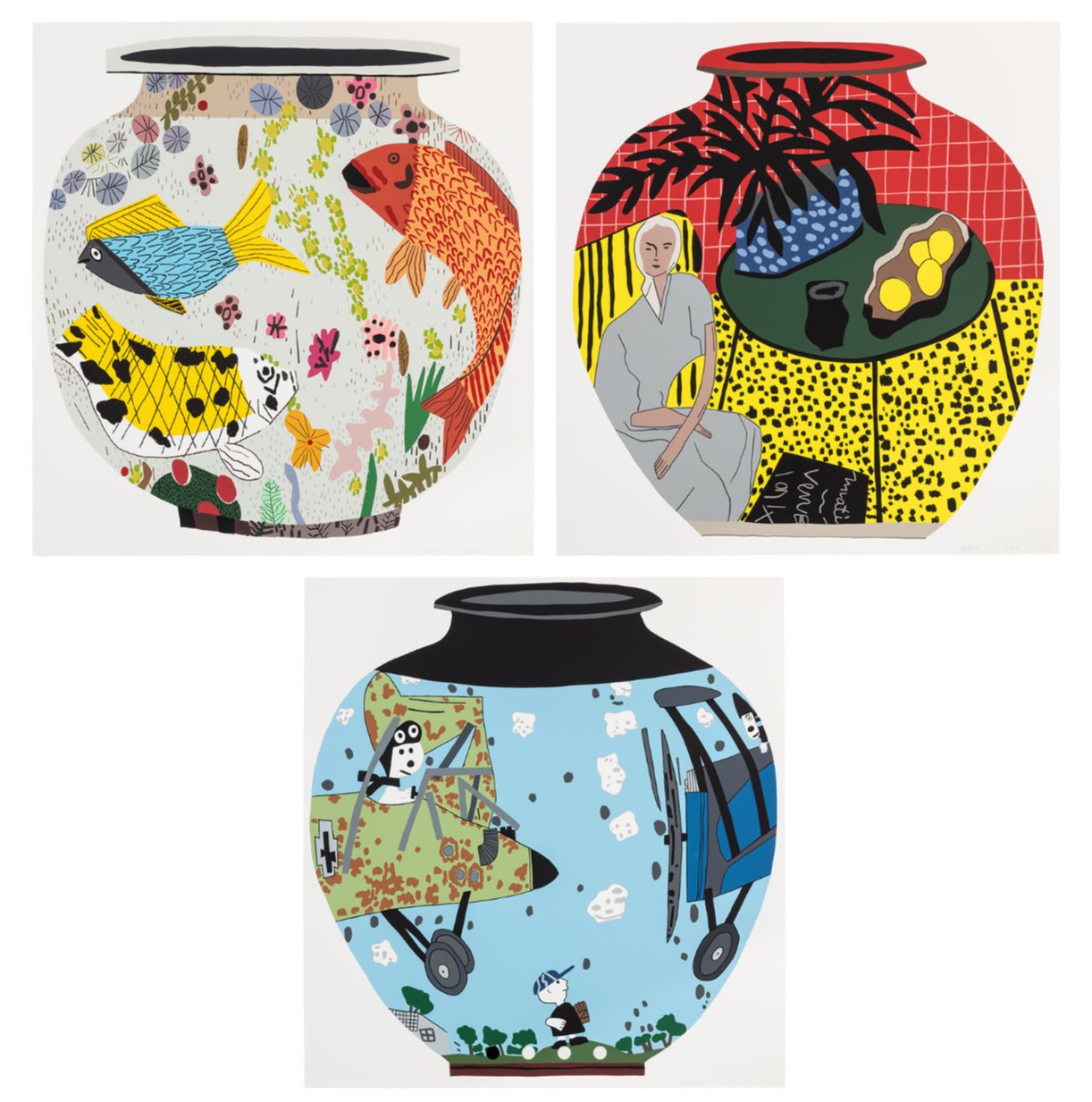
Fish Pot, Matisse Pot 4, and Snoopy Pot
Medium: screenprint in colors on Rising Museum Board
Edition: 50
Artist’s Proofs: 10/20/10 AP respectfively
Publisher: WKS Editions, Los Angeles
1. Fish Pot
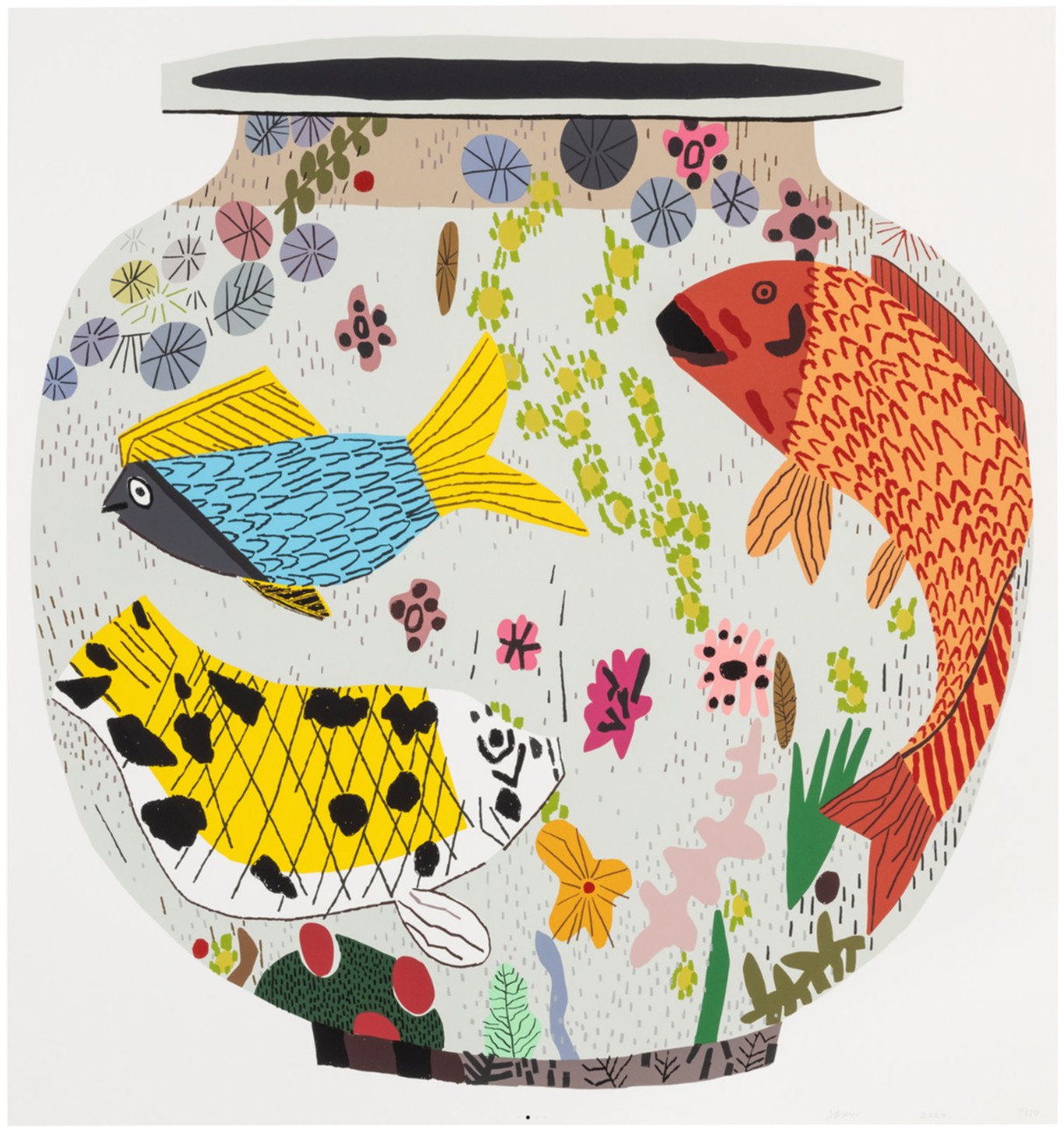
2. Matisse Pot 4
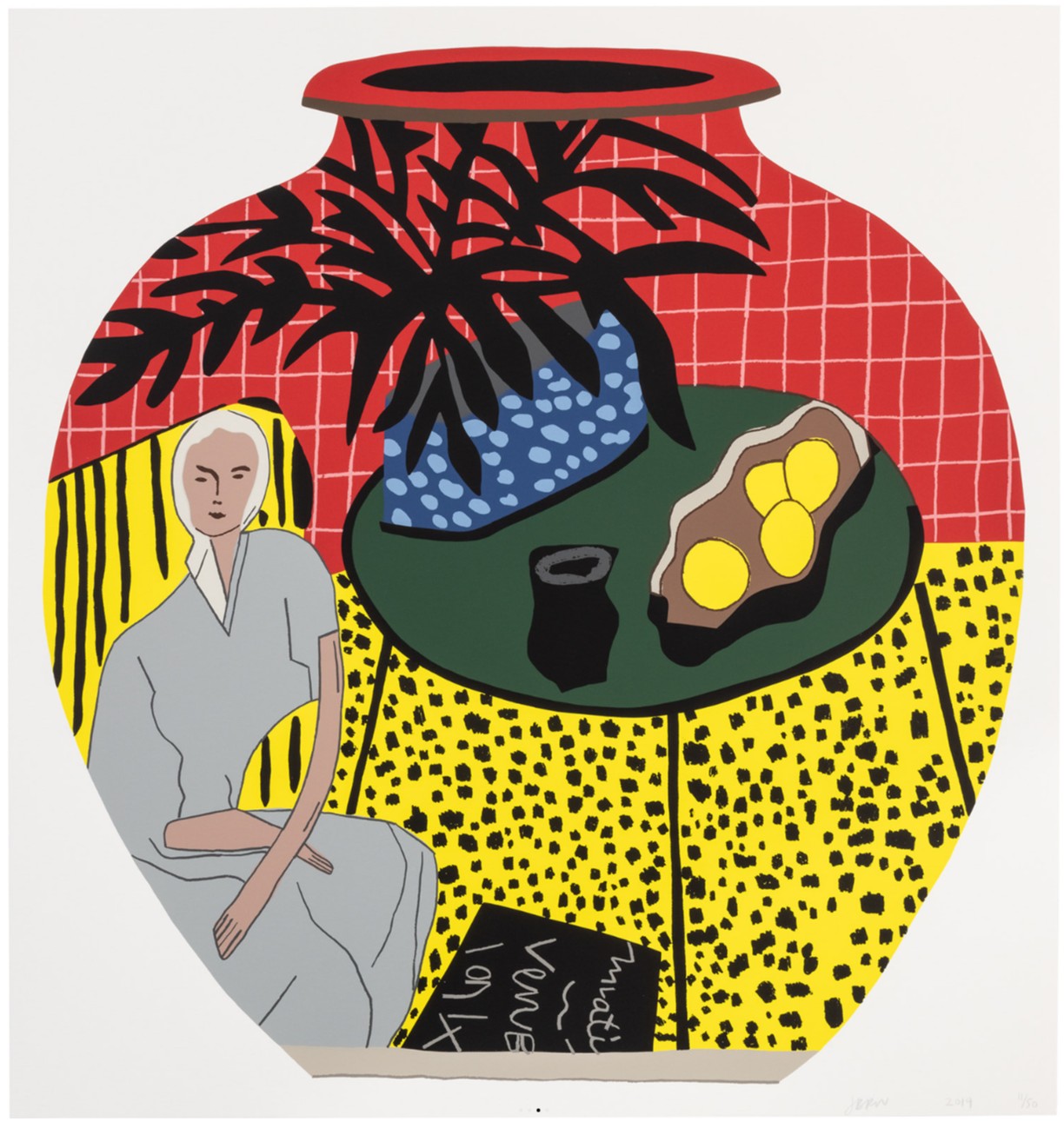
3. Snoopy Pot
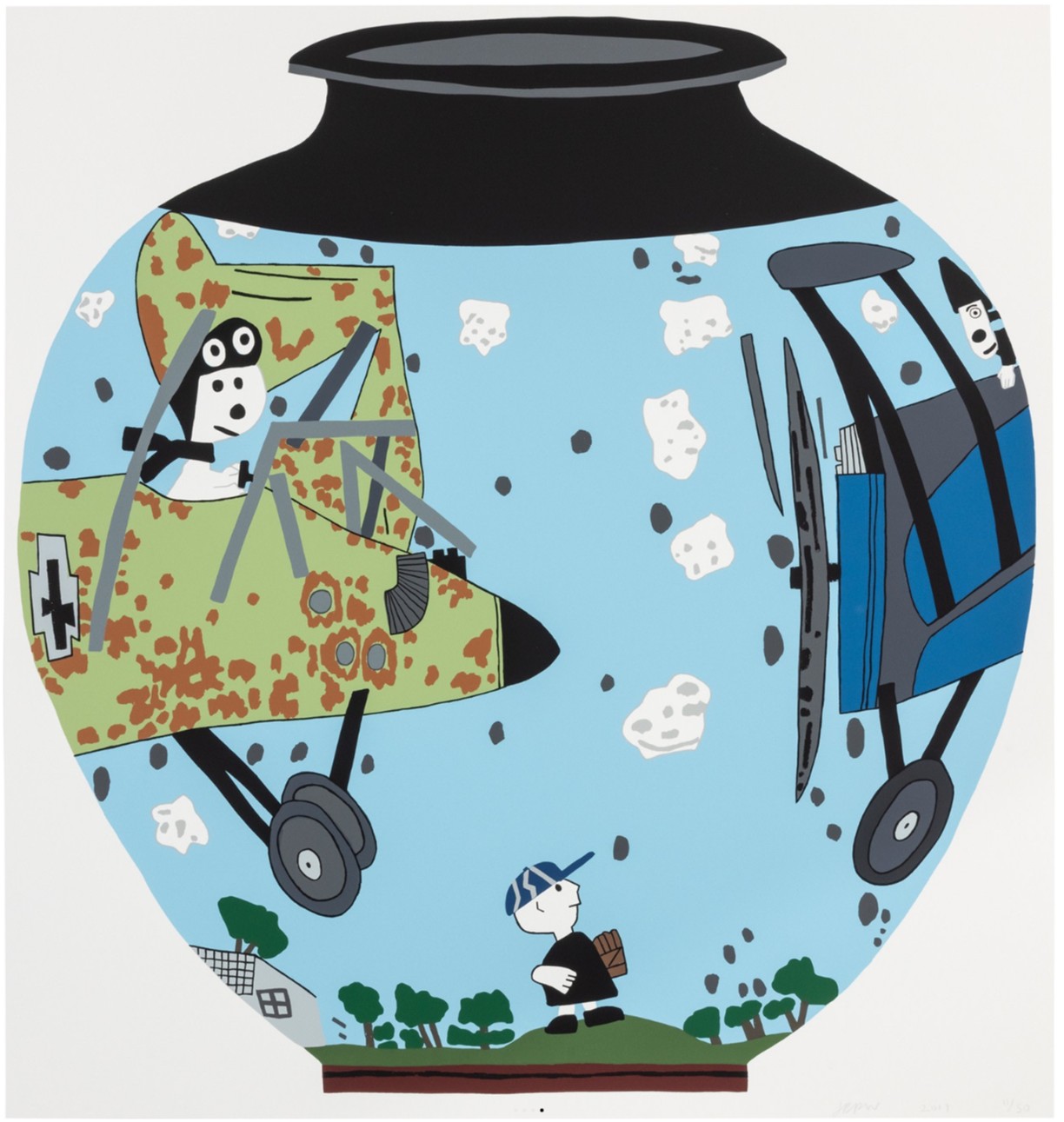
Jonas Wood grew up surrounded by the greats. His artistically inclined family counted works by Matisse, Picasso, and Calder amongst their impressive personal art collection. Interacting with such prolific and influential artists in the intimacy of his home, Wood developed an attachment to their aesthetic elements, which are reflected in many of his later works. Drawing on the imagery of these Modern masters and experiences from his own life, Wood assembles photocollages which become the basis for his paintings and prints. Printmaking has become increasingly entwined with the artist’s practice and in order to maximize his flexibility and freedom to create within the medium, Wood established his own studio, Wood Kusaka Studios, in collaboration with master printer, Jacob Samuel.
“Repainting a Matisse painting, or a Picasso painting – all these things just seem natural to me. I’m not trying to remake those things, I’m trying to make them in my own way because I’m so turned on by them.”
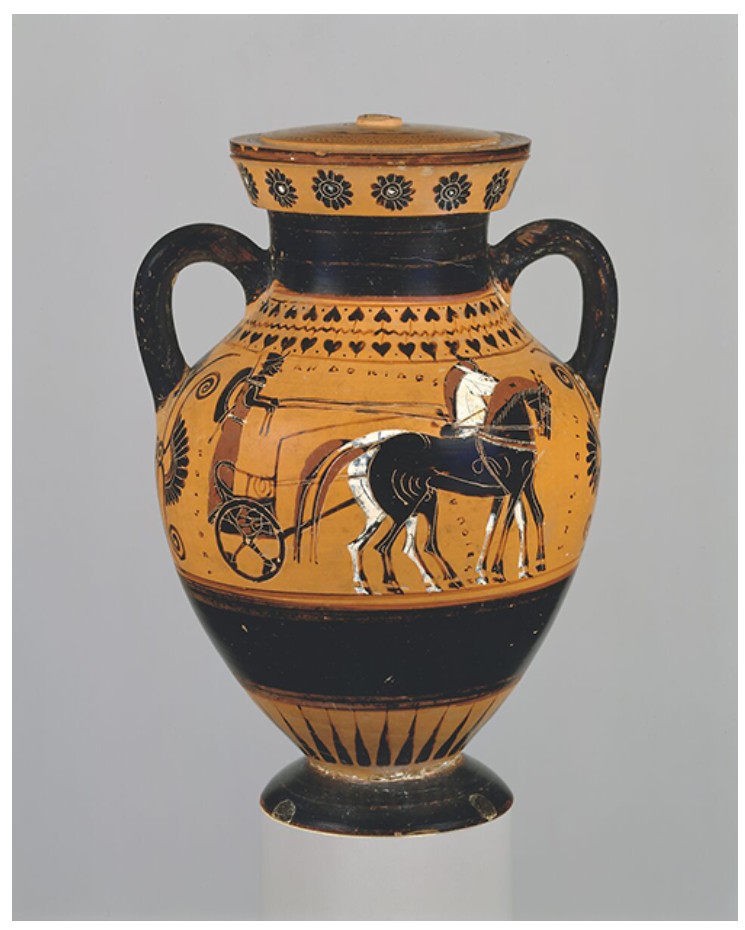
Terracotta amphora (jar) signed by Andokides, ca. 540 BCE, The Metropolitan Museum of Art, New York. Image: © The Metropolitan Museum of Art, Gift of Mr. and Mrs. Christos G. Bastis, in honor of Carlos A. Picón, 1999
Even closer to home, Wood’s incorporation of ceramic vessels into his body of work stems from his collaborative working relationship with his wife, ceramic artist Shio Kusaka.
“When I met my wife, Shio Kusaka, who is a ceramicist, I started looking at vessels. I became interested in the Greek pots. Like basketball cards, they have a shape and a form, and they have images that are very flat, graphic, and simple. Basically, there are cartoons on the sides of the pots that tell stories.”
Recalling this interpretation, Snoopy Pot features Snoopy and Charlie Brown from the Peanuts comics, unifying these memorable characters with ancient pottery through the graphic narrative that they convey.
Matisse Pot 3
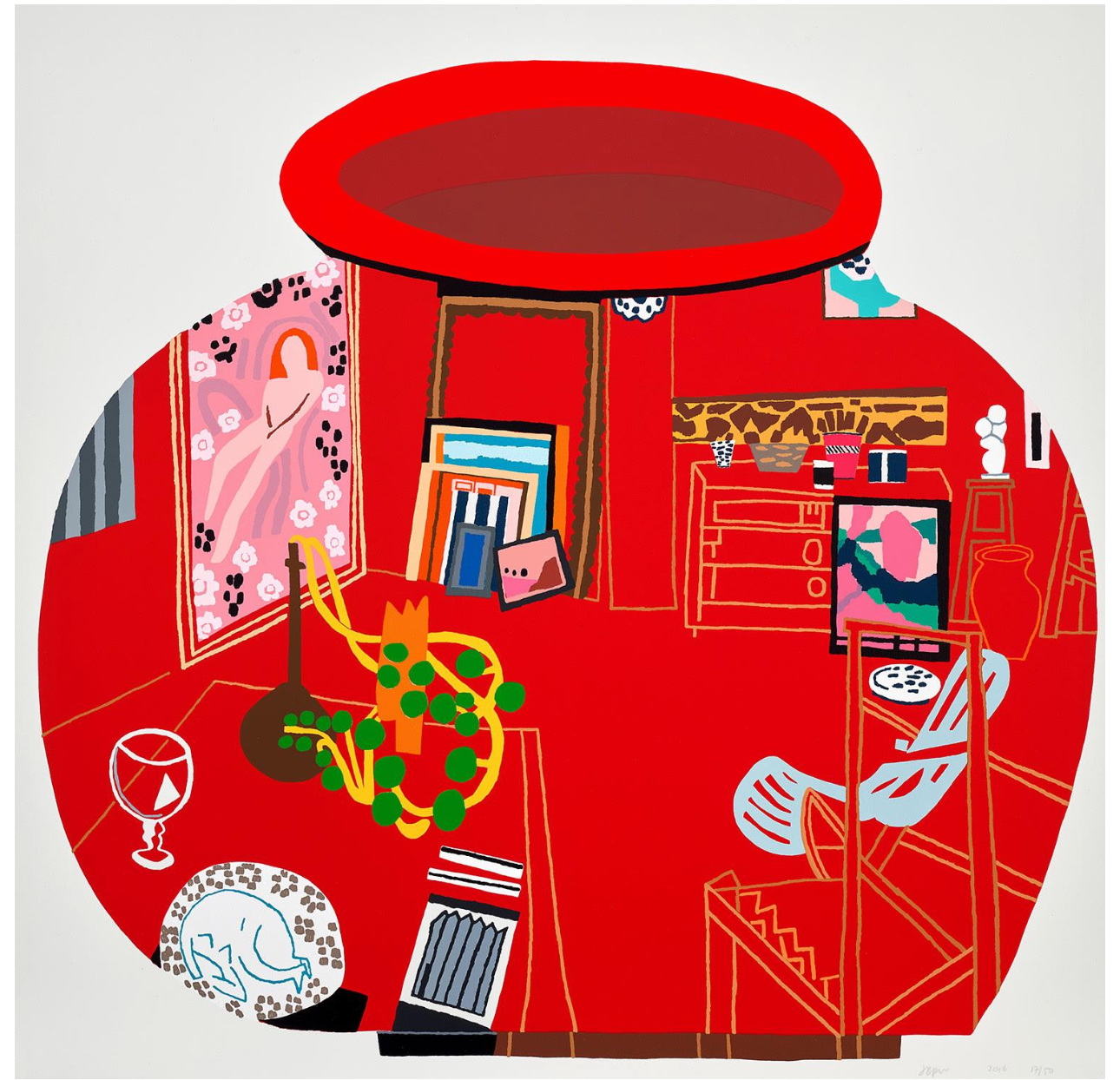
Matisse Pot 4 expands upon the artist’s initial Matisse Pots series published between 2017-2018, which presented interior scenes appropriated from Henri Matisse’s instantly recognizable paintings, unexpectedly framed within two-dimensional ceramics. Drawing inspiration from Matisse’s oeuvre, Wood embraces fauvist color and fluid lines in the fourth iteration of the series to animate the artist’s vibrant interior scenes and the presence of a female muse, bridging the generational divide between the two artists. Inspired by the imagery and motifs of Matisse, the evocative nature of the interior makes it easy to image this scene effortlessly fitting into the roster of early twentieth century canvases painted by Matisse in the South of France. Along the base of the vessel is yet another nod to the late artist. A black book with flowing cursive script spells out “Matisse Verve,” a reference to the modernist Parisian art magazine in circulation between 1937 and 1960. The inaugural issue from 1937 was published with cover artwork from Matisse, and Verve Vol. IX No. 35/36 paid homage to the artist in 1958 following his death in 1954 by titling the issue The Last Works of Henri Matisse and featuring 40 lithographs of Matisse’s work, along with text by Pierre Reverdy and Georges Duthuit, both prominent French art critics of the time.
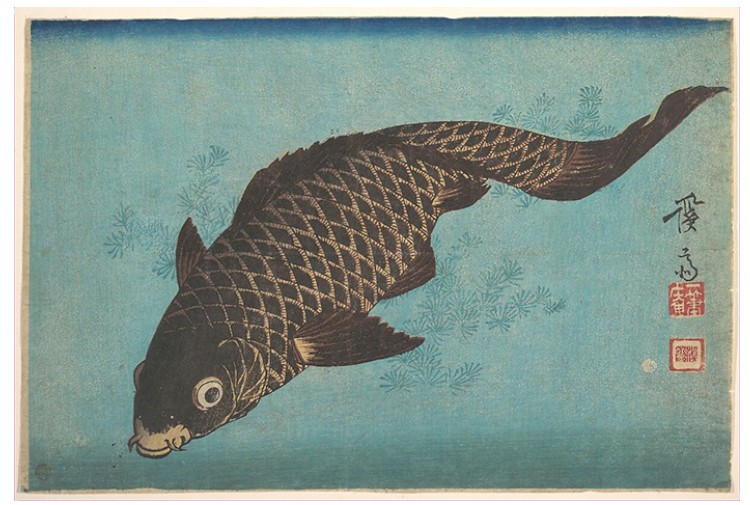
Keisai Eisen, Koi, 1842, The Metropolitan Museum of Art, New York. © The Metropolitan Museum of Art, Rogers Fund, 1917
In Fish Pot, Wood revisits koi fish and their habitats, which have become a reoccurring pictorial theme throughout his work. Most notably, they featured in his series of a monumental paintings created from 2014-2015, some of which were featured in his 2015 joint show with his wife Shio Kusaka at KARMA in New York. Rendered with Wood’s signature flatness and playful abstraction, the koi fish and fellow aquatic creatures float through the fantastical ceramic habitat, the artist playing with the visual distortion of a glass fish bowl. Much like Japanese woodblock artists of the Edo period, Wood captures the streamlined swishing movement of these fish in within the confines of the medium, illuminating his ability to transport traditional genres of art into a contemporary dialogue, playfully challenging the canonical separations of medium and artistic movements.
Source: Phillips
Auction Results
Phillips Hong-Kong: 14 June 2024
Estimated: HKD 400,000 – 600,000
HKD 635,000 / USD 81,385
The complete set of three screenprints in colors on Rising Museum Board
Christie’s New-York: 17 May 2024
Estimated: USD 60,000 – 80,000
USD 126,000
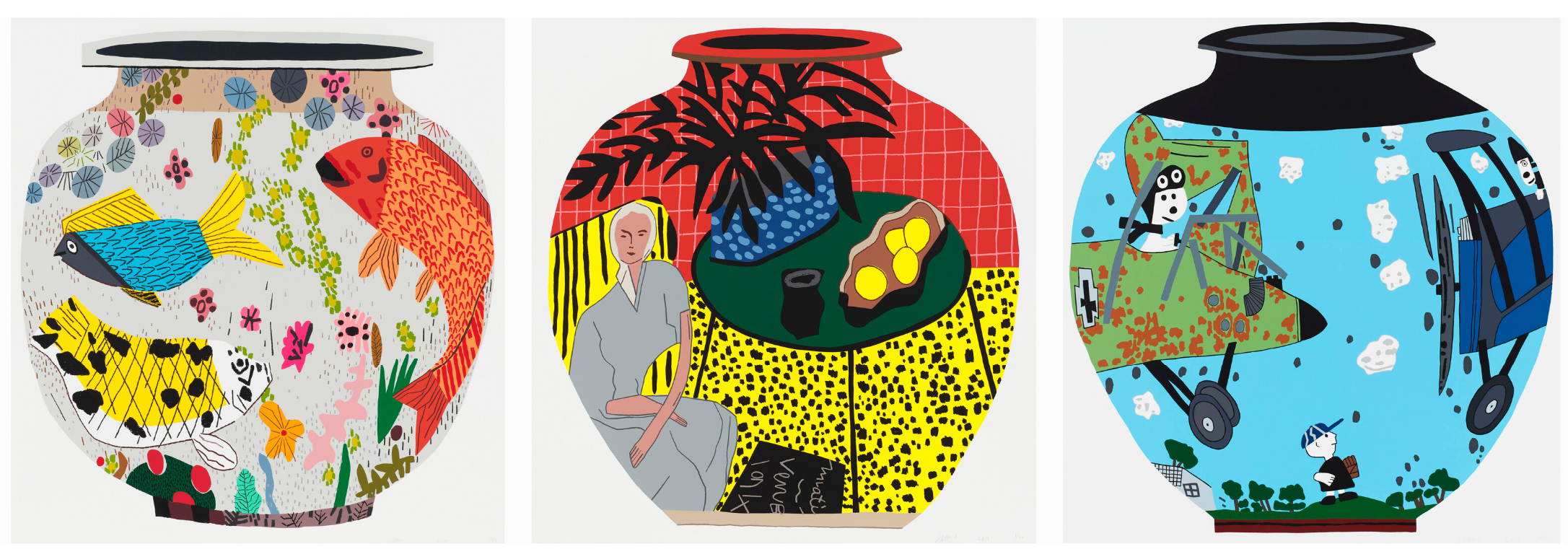
JONAS WOOD (B. 1977)
Fish Pot; Matisse Pot 4; Snoopy Pot [3 works]
Screenprint in colors on Rising museum board
Each sheet: 34×32 inches (86.4 x 81.3 cm)
(i) Fish Pot, 2020
Signed with the artist’s initials, numbered and dated ‘JBRW 2020 47/50’ (lower right)
This work is number 47 from an edition of 50 plus 10 artist’s proofs
(ii) Matisse Pot 4, 2019
Signed with the artist’s initials, numbered and dated ‘JBRW 2019 47/50’ (lower right)
This work is number 47 from an edition of 50 plus 20 artist’s proofs
(iii) Snoopy Pot, 2019
Signed with the artist’s initials, numbered and dated ‘JBRW 2019 47/50’ (lower right)
This work is number 47 from an edition of 50 plus 10 artist’s proofs
Estimated: USD 50,000 – 70,000
USD 63,500
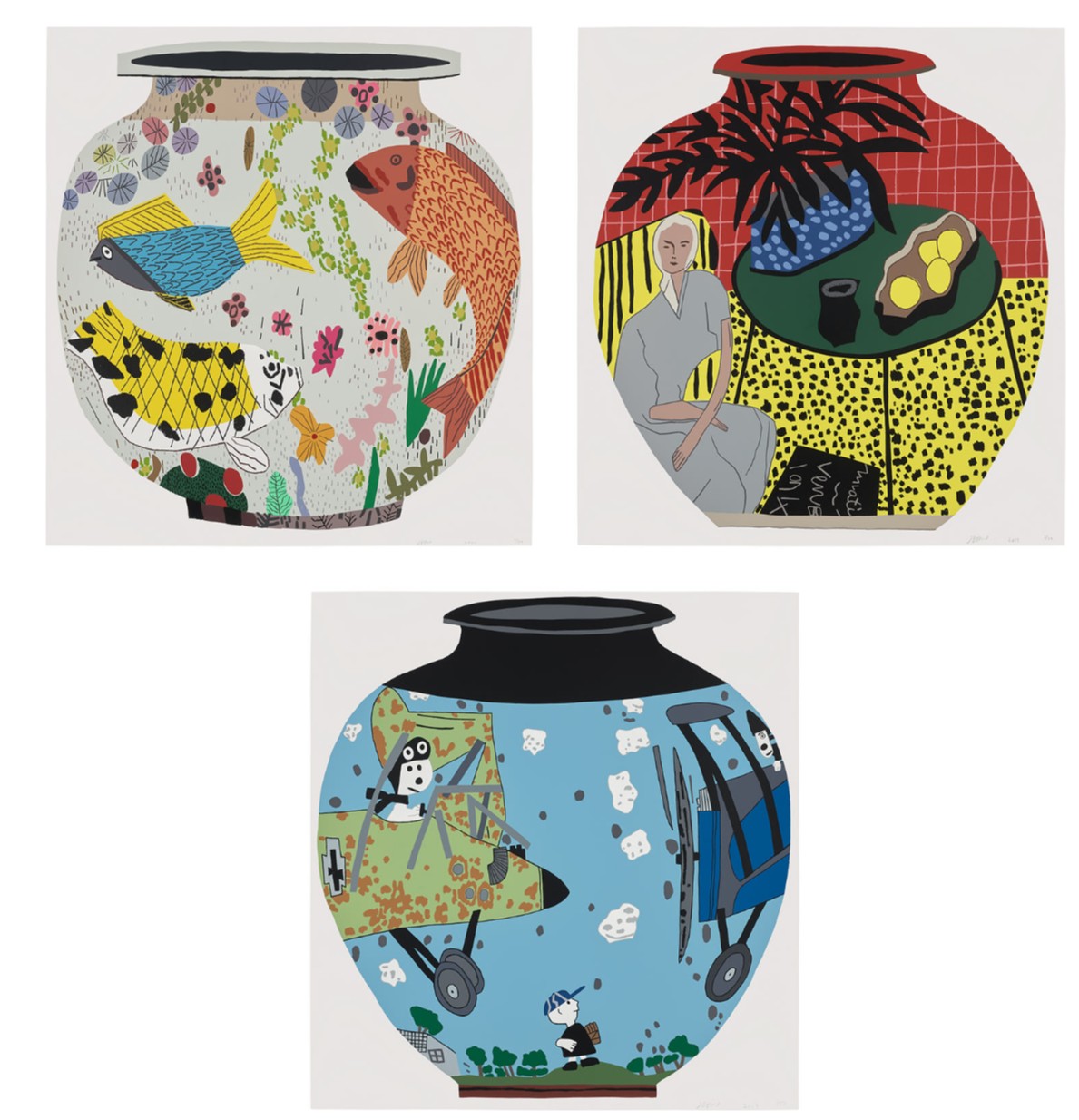
The complete set of three screenprints in colors on Rising Museum Board
All signed with initials, dated and numbered 1/50 in pencil
Other Prints
B-ball 22, B-ball 29, B-ball 36 [Three Works], 2008
Christie’s New-York: 17 May 2024
Estimated: USD 70,000 – 100,000
USD 88,200
JONAS WOOD (B. 1977), B-ball 22, B-ball 29, B-ball 36 [Three Works] | Christie’s (christies.com)
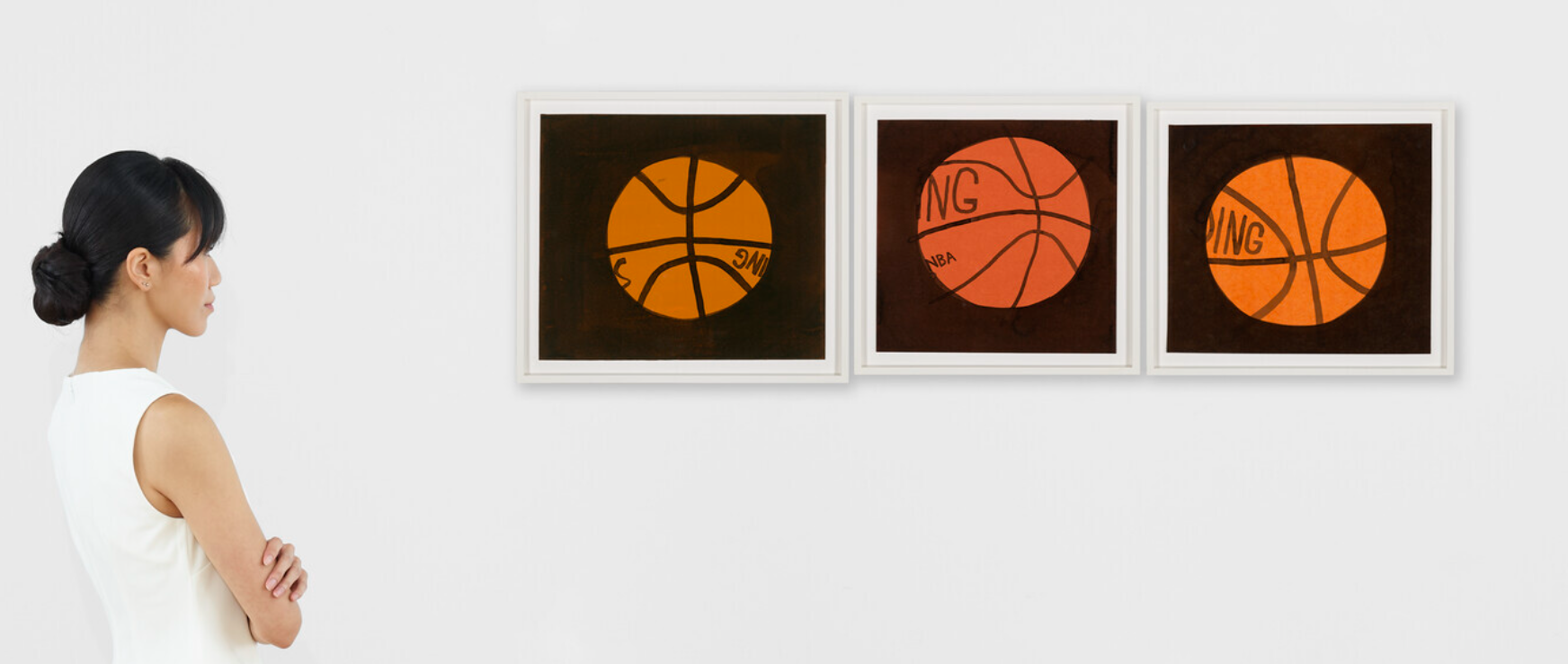
JONAS WOOD (B. 1977)
B-ball 22, B-ball 29, B-ball 36 [Three Works], 2008
Acrylic and ink on paper
Varying sizes
Largest size: 14 3/8 x 16 7/8 inches (36.8 x 42.9 cm)
(i) B-ball 22
Signed with the artist’s initials, titled and dated ‘JBRW 2008 B-BALL 22’ (on the reverse)
(ii) B-ball 29
Signed with the artist’s initials, titled and dated ‘JBRW 2008 B-BALL 29’ (on the reverse)
(iii) B-ball 36
Signed with the artist’s initials, titled and dated ‘JBRW 2008 B-BALL 36’ (on the reverse)
Sotheby’s London: 26 September 2023
Estimated: GBP 10,000 – 15,000
GBP 21,590
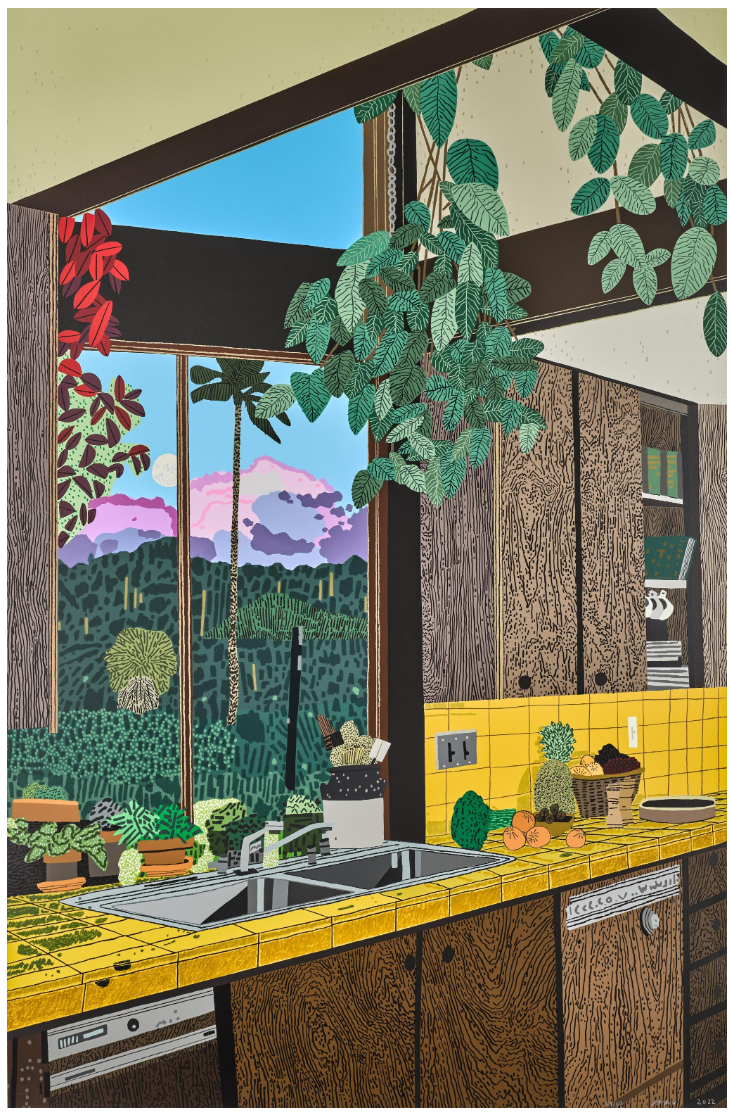
JONAS WOOD (b. 1977)
Kitchen Interior, 2022
Screenprint in colors on Rising Museum Board
Sheet: 48 1/4 x 31 1/2 inches (122.5 x 80 cm)
Signed in white pencil, dated and numbered 59/60
This impression is number 59 from the edition of 60 plus 14 artist’s proofs
Published by WKS Editions, Los Angeles
Phillips London: 22 September 2023
Estimated: GBP 10,000 – 15,000
GBP 12,700
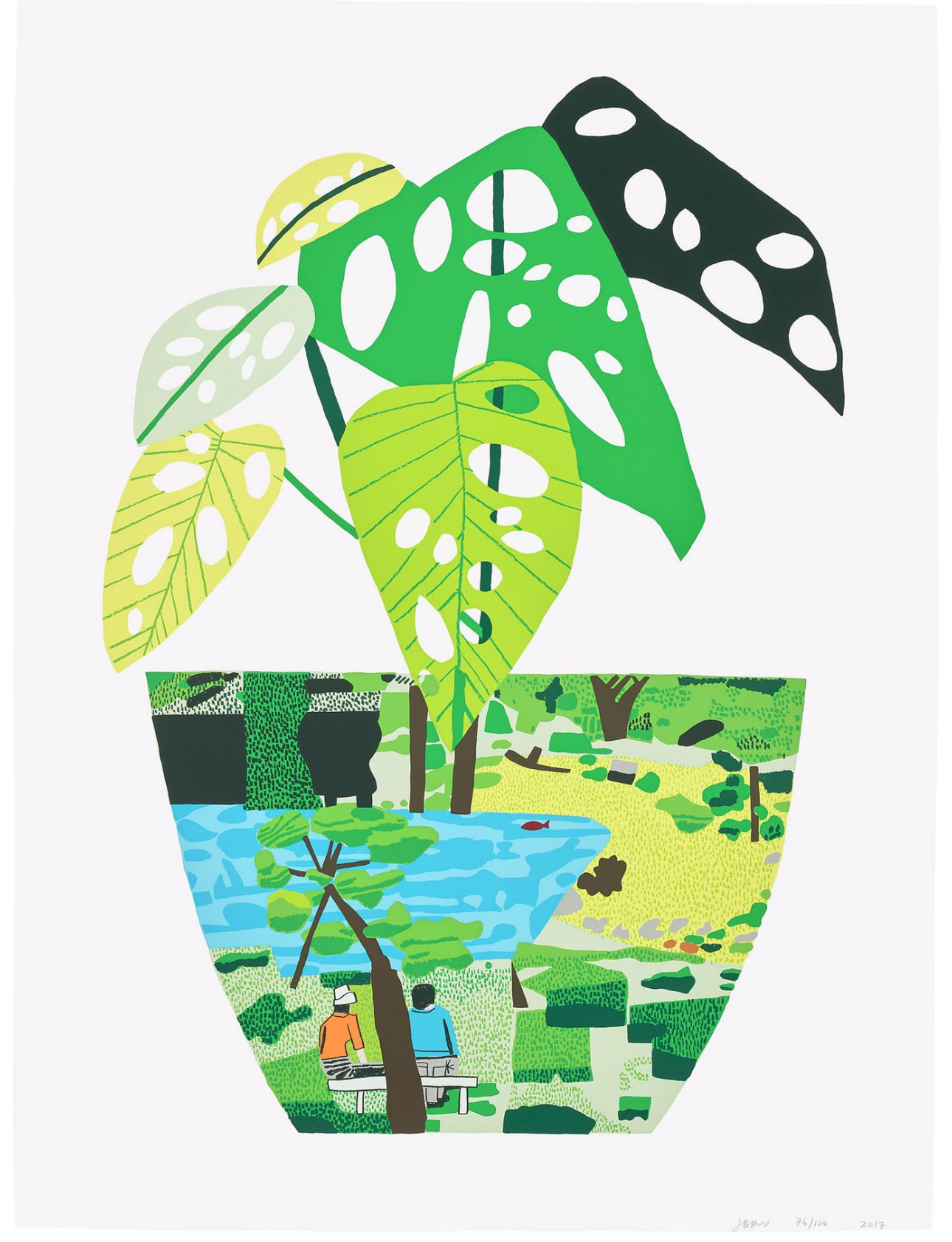
JONAS WOOD
Landscape Pot with Plant, 2017
Screenprint in colors on Somerset Satin paper
Image: 33 1/4 x 23 5/8 inches (84.5 x 60 cm)
Sheet: 39 3/8 x 29 1/2 inches (100×75 cm)
Signed with initials, dated and numbered 76/100 in pencil (there were also 20 artist’s proofs)
Published by Counter Editions, London
Phillips London: 8 June 2023
Estimated: GBP 20,000 – 30,000
GBP 21,590
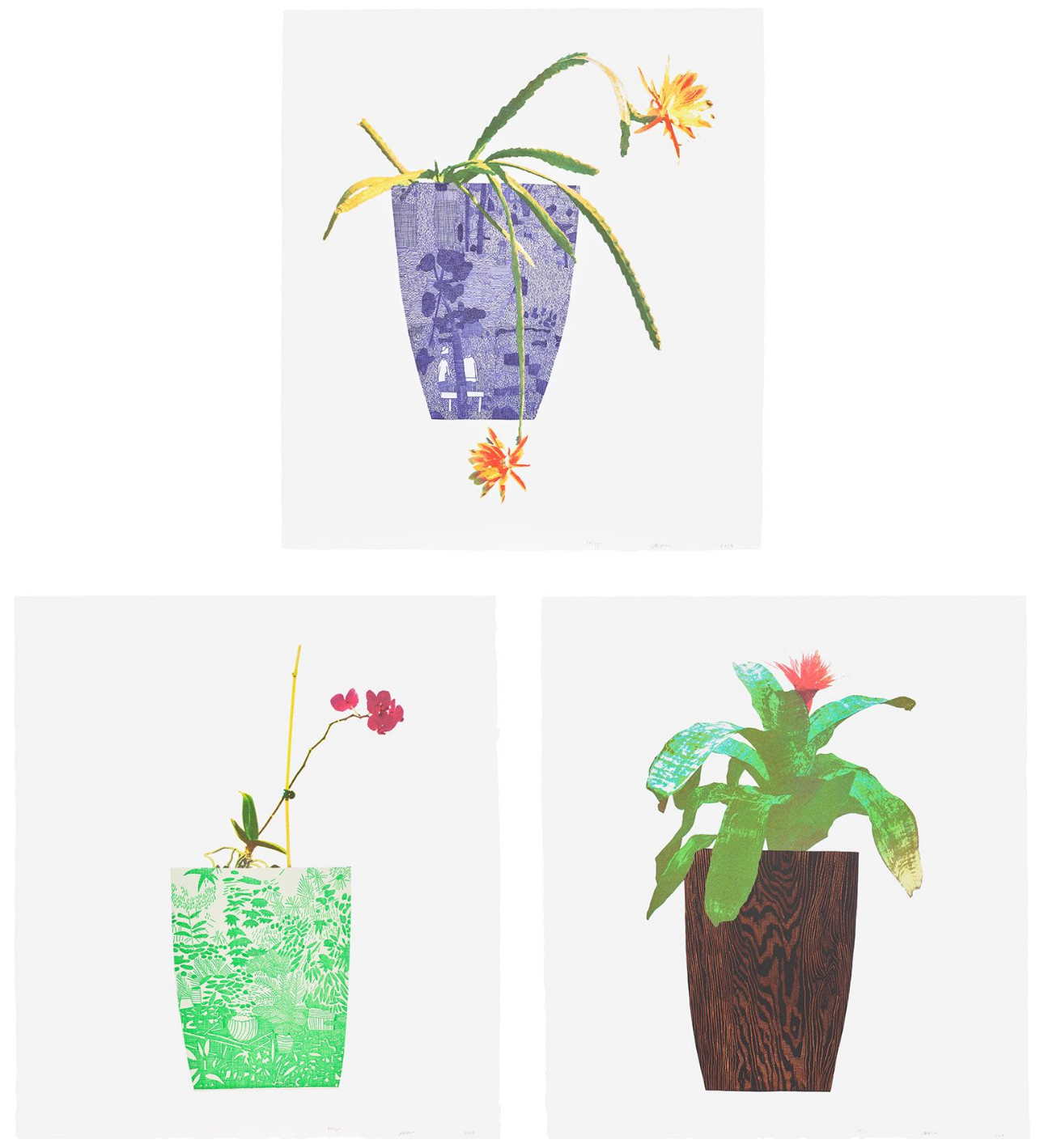
JONAS WOOD
Three Landscape Pots: Night Bloom, Orchid, and Bromeliad, 2019
The complete set of three etchings with collage and photolithography in colors on handmade paper
Largest Image: 15 1/2 x 13 3/8 inches (39.5 x 34 cm)
All Sheets: 18 3/4 x 16 3/4 inches (47.5 x 42.4 cm)
All signed, dated and numbered 20/35 in pencil (there were also 20 artist’s proofs)
Published by Pace Prints, New York
Phillips London: 15 June 2022
Estimated: GBP 12,000 – 18,000
GBP 40,320
JONAS WOOD
Matisse Pot 3, 2017-18
Screenprint in colors on Rising Museum board
Sheet: 27 1/2 x 28 inches (70 x 71.2 cm)
Signed, dated and numbered 17/50 in pencil (there were also 10 artist’s proofs)
Published by WKS (Wood Kusaka Studios), Los Angeles