
Japanese artist and designer Takashi Murakami’s visual ecosystem is among the most recognizable. Murakami’s “Superflat” style is an unmistakable combination of anime, Nihonga painting, and pop art satire that animates their 2D paintings. In his Superflat world, smiling flowers, jellyfish eyes, and Murakami’s own alter ego, Mr. DOB, synergize fine and pop art references together. The artist’s work ranges across mediums: creating sculptures, prints, paintings, NFTs, and collectibles featuring his iconic cast of characters. But amongst the vivid colors and pop art behemoths lies sharp references to the fallout of post-war Japan and the expansion of Western culture. Regardless of medium, Murakami’s works are clever reflections of the globalized world, dystopian enough to feel familiar again.
Introduction
Takashi Murakami was born in Tokyo in 1962 and belongs to the generation shaped by postwar reconstruction, economic acceleration, and the explosion of manga and anime culture. He trained at the Tokyo University of the Arts in the highly codified tradition of nihonga, earning a doctoral degree before deliberately redirecting that academic discipline toward contemporary practice.
In the mid-1990s, time spent in New York exposed Murakami to a Western art world fluent in appropriation, branding, and institutional spectacle. Rather than imitate it, he returned to Japan with a sharpened understanding of how image economies function. By the early 2000s, he had built not only a body of work but a structure: Kaikai Kiki, his studio enterprise, which operates simultaneously as production facility, management platform, publishing arm, and incubator for younger artists. Murakami is not simply an artist who paints; he designs systems. His practice operates at the intersection of art history, consumer culture, and corporate logic—without pretending those spheres are separate.
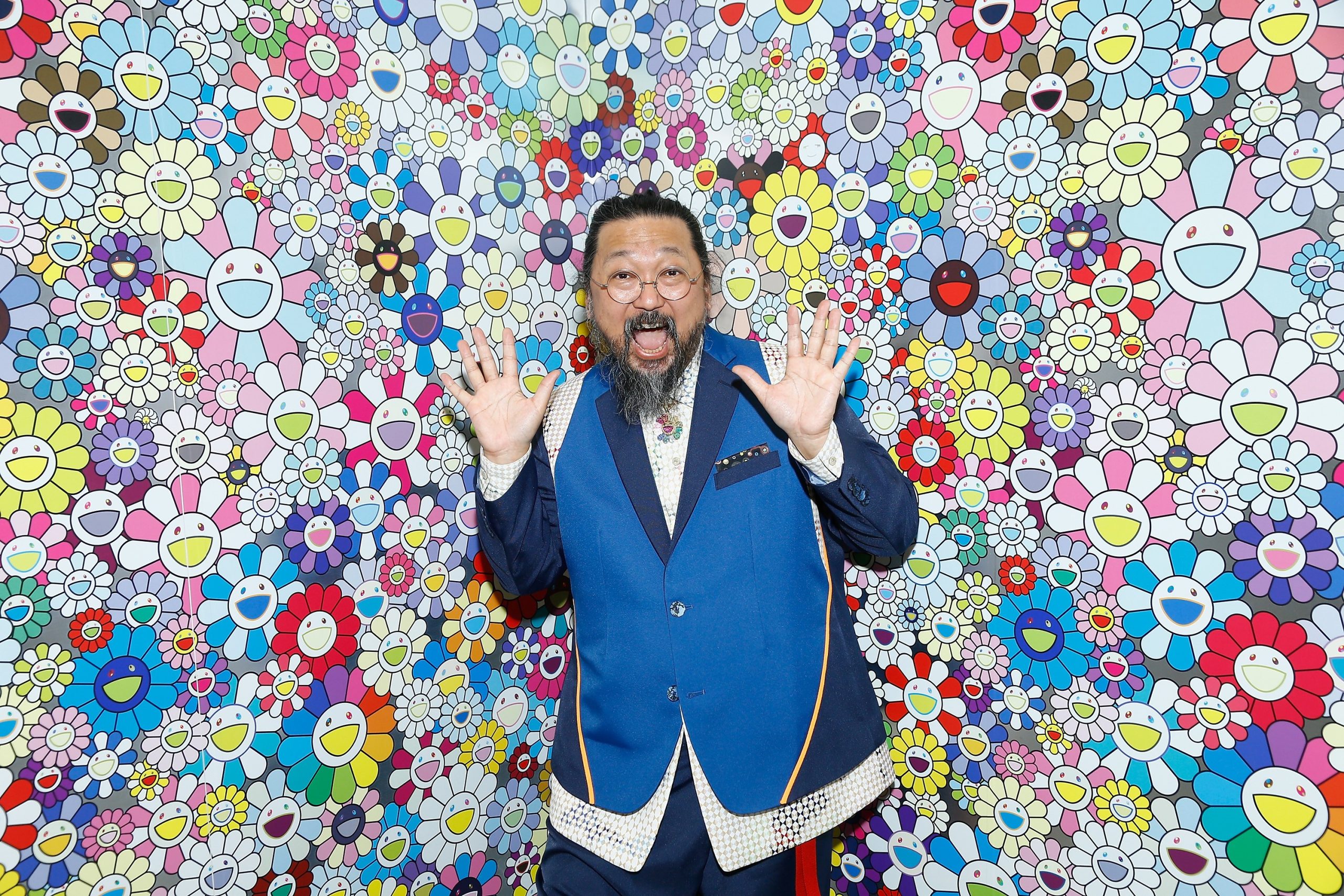
Technique: Discipline Meets Industrial Finish
Murakami’s surfaces are immaculate. Crisp outlines, hyper-saturated color, mirror-like polish—everything appears engineered rather than gestural. This precision stems from his nihonga training, which emphasizes layering, control, and finish. Unlike Western traditions that often celebrate visible brushwork, Murakami’s aesthetic suppresses evidence of the hand. Yet behind the visual “flatness” lies a highly complex production method. Large-scale canvases and sculptures are developed through carefully coordinated studio processes at Kaikai Kiki. The studio functions like a contemporary workshop—structured, efficient, technically sophisticated—allowing Murakami to execute monumental works with consistency and conceptual clarity.
He moves fluidly across painting, sculpture, installation, and editioned prints. Whether a massive multi-panel canvas or a small-format lithograph, the visual language remains cohesive. Murakami understands reproducibility not as dilution, but as amplification.
Superflat: A Theory and a Cultural Diagnosis
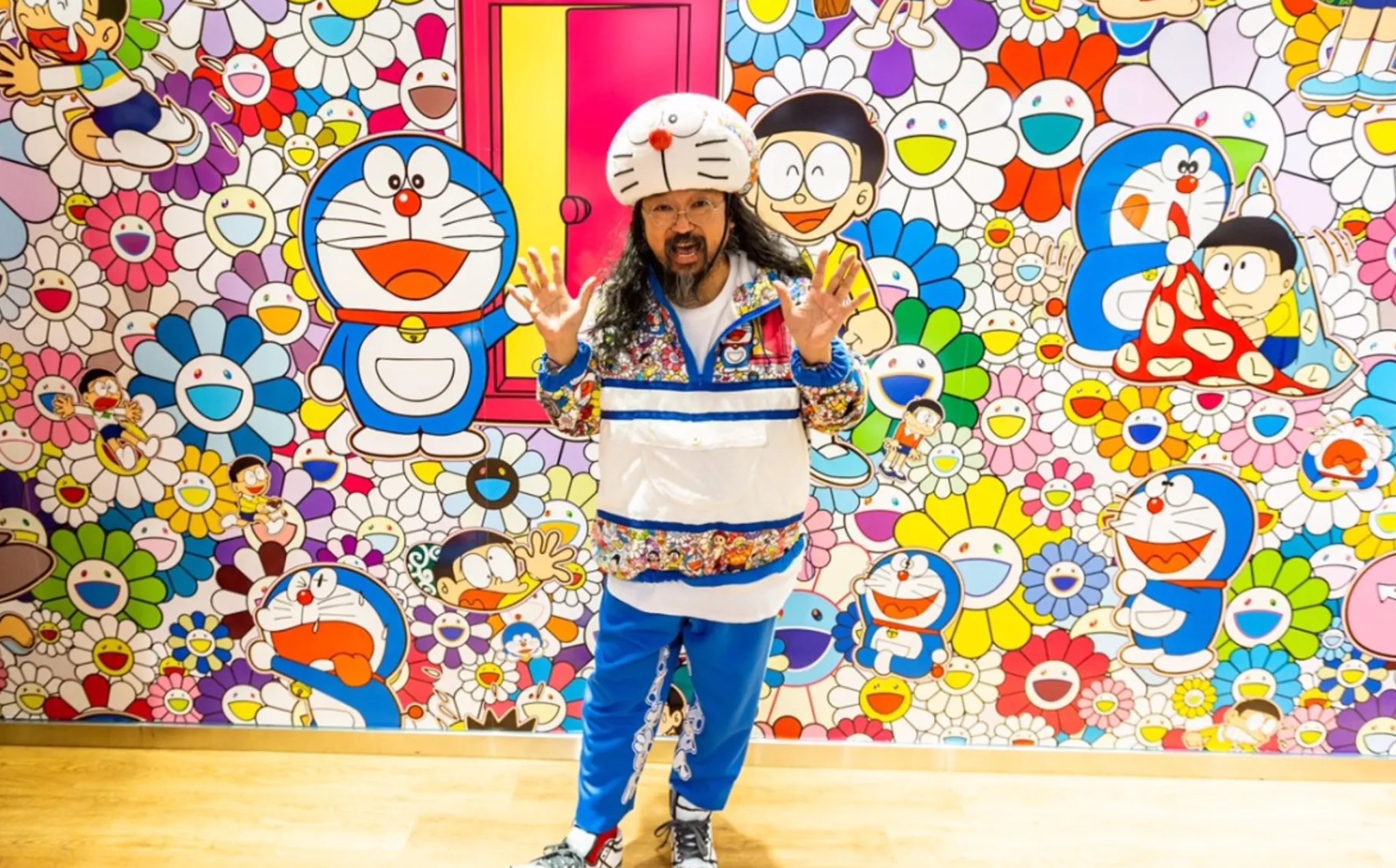
In 2000, Murakami articulated the concept of Superflat, a term that defines both his aesthetic and his critique of contemporary culture. Superflat describes the visual flatness of Japanese manga and anime traditions, but it also refers to a broader collapse of hierarchies: high and low art, sacred and commercial, museum object and merchandise. In Murakami’s framework, postwar Japan—and by extension global consumer society—exists in a flattened field where images circulate faster than meaning.
This theory positions Japanese visual culture as historically image-driven and contour-based, from Edo woodblock prints to contemporary animation. Murakami connects this lineage to late capitalism’s most powerful tool: branding. In his work, art and brand coexist without apology. Rather than deny commerce, he integrates it. Superflat is therefore both celebration and critique—an embrace of image culture that quietly exposes its psychological depthlessness.
Major Series and Motifs
Mr. DOB
Mr. DOB, introduced in the early 1990s, is Murakami’s foundational character. Built from pop-culture DNA—rounded forms, logo-like clarity, cartoon features—DOB shifts between cute and monstrous. The character evolves across paintings, sculptures, and prints, becoming both mascot and alter ego. DOB announces Murakami’s core strategy: serial imagery that functions like popular culture, yet retains painterly ambition. Works such as the large-scale triptych 727 demonstrate his early synthesis of Japanese compositional memory and contemporary character design.
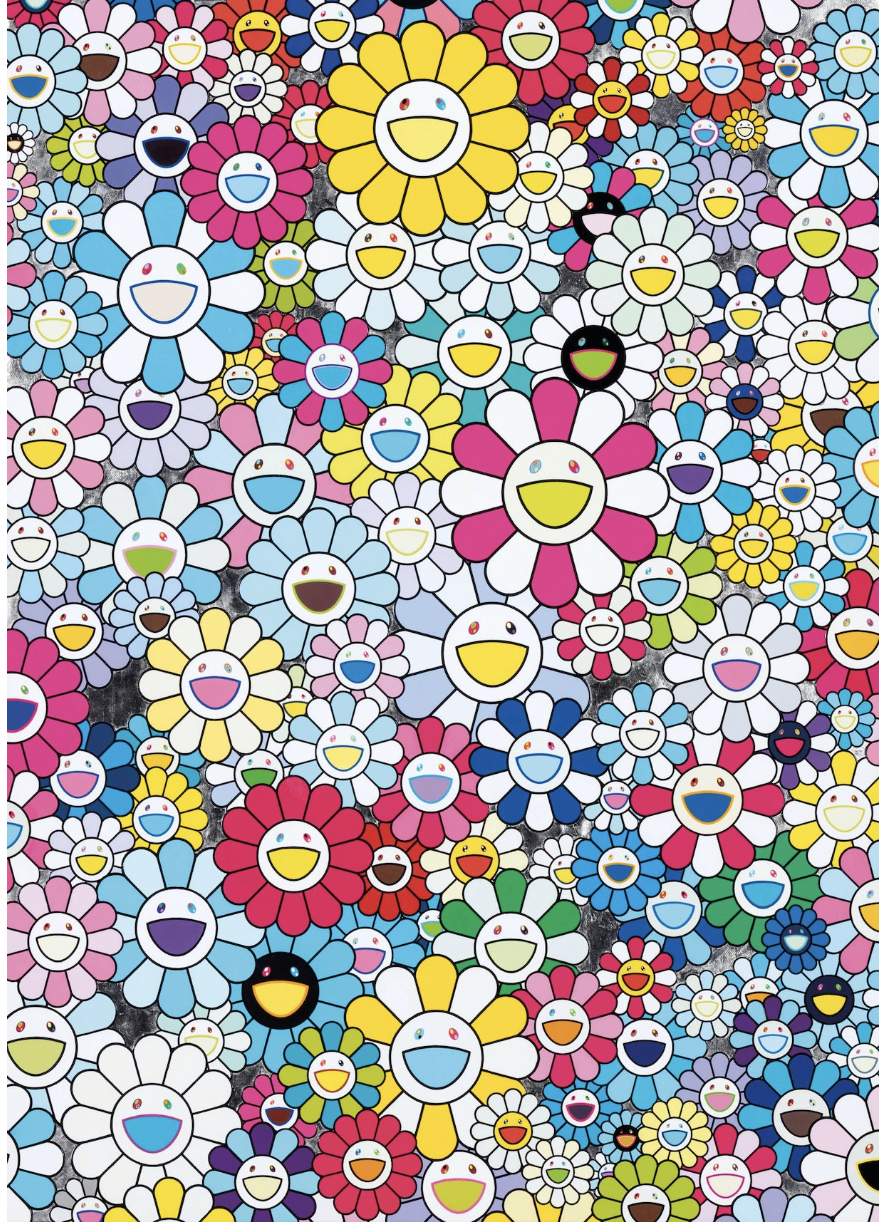
Smiling Flowers and Flower Balls
Murakami’s smiling flowers have become among the most recognizable images in contemporary art. At first glance, they radiate uncomplicated joy—bright petals, cheerful faces, rhythmic repetition. Look longer, and the smile begins to feel rehearsed. The perfection is slightly excessive. The happiness, perhaps, defensive. These works operate on dual registers: visual delight and subtle unease. They echo Japan’s postwar culture of resilience, suggesting a collective instinct to mask trauma with aesthetic optimism. Murakami uses repetition not merely for decoration, but to build immersive psychological environments.
Kaikai & Kiki
Kaikai and Kiki are twin characters that extend Murakami’s universe. Their names also title his studio enterprise, reinforcing the fusion of artwork and infrastructure. These figures draw loosely on folkloric and mythic traditions, yet are unmistakably contemporary in design. Through them, Murakami manufactures a new kind of folklore—one calibrated for a global audience raised on cartoons, gaming, and digital interfaces.
The 500 Arhats and Post-Disaster Painting
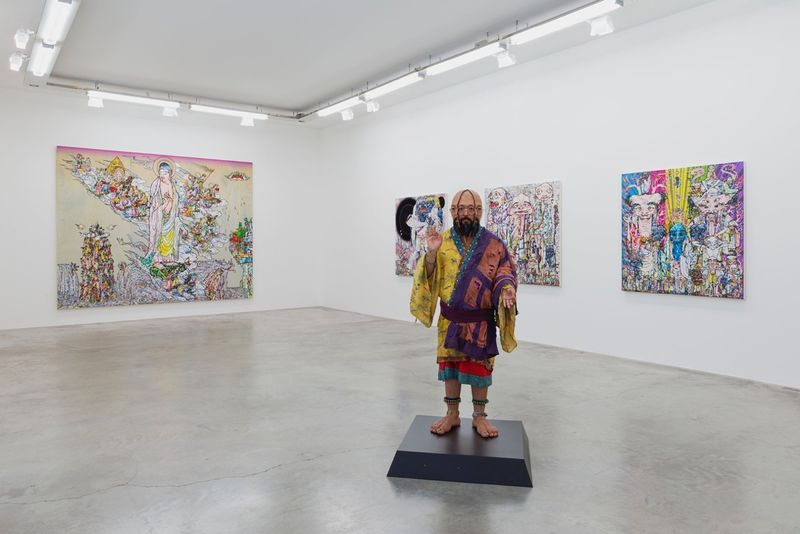
Murakami’s most ambitious paintings often emerge from moments of crisis. Following the 2011 Tōhoku earthquake and Fukushima disaster, he produced monumental works such as The 500 Arhats, a vast composition referencing Buddhist iconography. In these paintings, exuberant color and cartoon-like forms frame themes of catastrophe, mourning, and spiritual endurance. The decorative surface becomes a vehicle for historical weight. Murakami demonstrates that spectacle and seriousness are not mutually exclusive; one can carry the other.
Skulls, Mushrooms, and Expanding Iconography
Recurring motifs such as skulls, mushrooms, or jellyfish-like forms constitute a flexible visual alphabet. They allow Murakami to oscillate between humor and darkness without changing language. Across decades, this vocabulary has expanded into a fully realized fictional universe—coherent, iterative, and adaptable.
Museum Exhibitions and Institutional Recognition
Murakami’s institutional trajectory reflects his canonical status. Early solo exhibitions in Japan positioned him as a pivotal figure bridging traditional aesthetics and contemporary culture.
The major retrospective ©MURAKAMI, first organized by the Museum of Contemporary Art, Los Angeles in 2007, marked a decisive moment, framing him as a structural force in contemporary art rather than merely a pop phenomenon.
His exhibition at the Palace of Versailles in 2010 inserted his brightly colored forms into one of Europe’s most historically charged settings, generating debate and reinforcing his capacity to operate within and against institutional heritage.
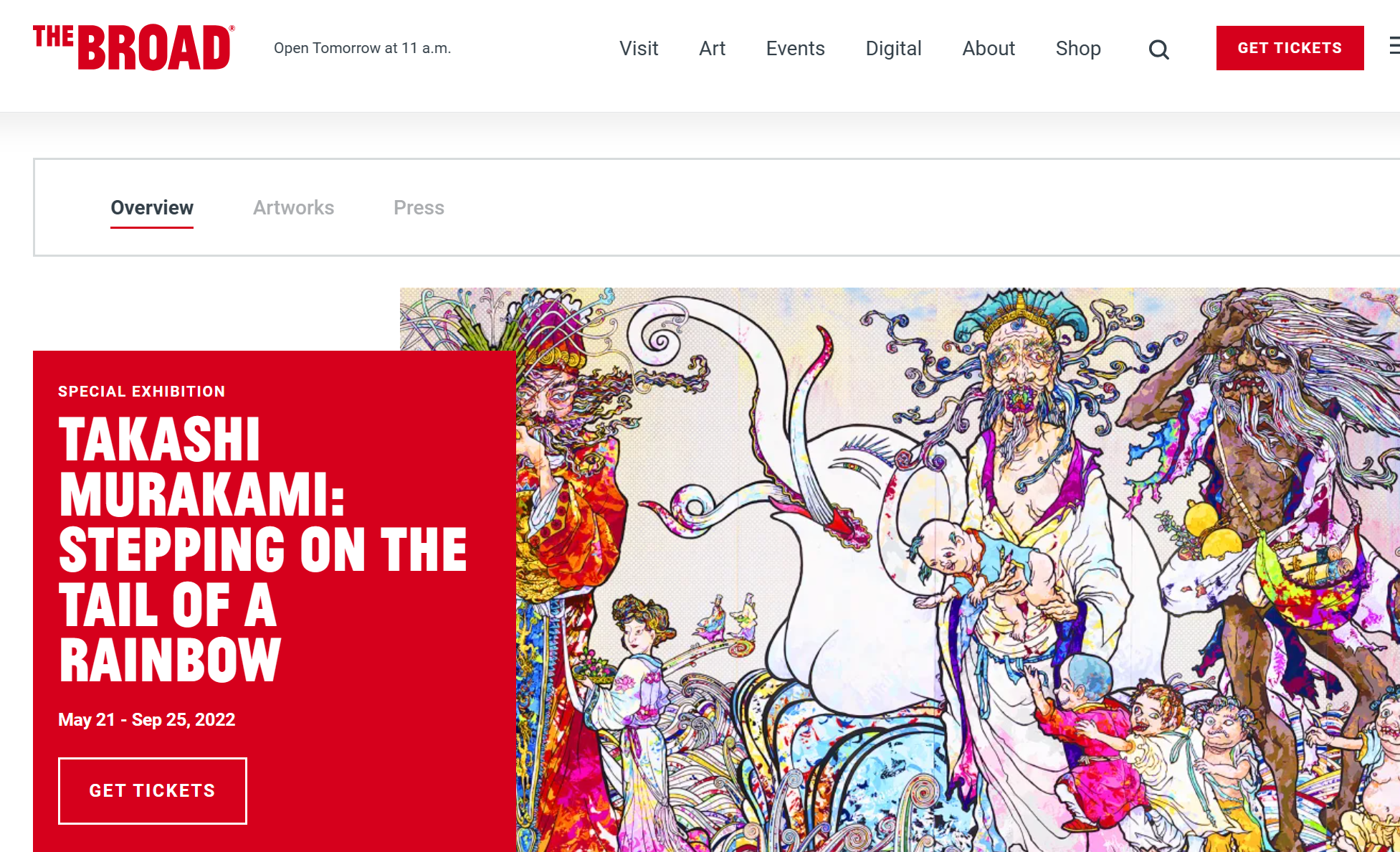
More recent large-scale exhibitions—such as Takashi Murakami: Stepping on the Tail of a Rainbow at The Broad and its expanded presentation at the Cleveland Museum of Art—have emphasized the depth of his engagement with historical trauma, spirituality, and cultural memory.
Public Collections
Murakami’s works are held in major public collections worldwide, including the Museum of Modern Art in New York, the Centre Pompidou in Paris, LACMA in Los Angeles, and numerous international institutions. His presence in these collections confirms his integration into the global art historical canon.
The Broad, Los Angeles, CA, USA; Museum of Contemporary Art, Los Angeles, CA, USA; San Francisco Museum of Modern Art, CA, USA; Marciano Art Foundation, Los Angeles, CA, USA; Museum of Fine Arts, Boston, Boston, MA, USA; Museum of Modern Art, New York, NY, USA; Walker Art Center, Minneapolis, MN, USA; The Modern, Fort Worth, TX, USA; Vancouver Art Gallery, Vancouver BC, Canada; Queensland Museum, Brisbane, Australia; Louis Vuitton Foundation, Paris, France; Pinault Collection, Paris, France; Vanhaerents Art Collection, Brussels, Belgium; Garage Museum of Contemporary Art, Moscow, Russia Guggenheim, Abu Dhabi, UAE; Qatar Museums Authority, Doha, Qatar; Samsung Museum of Art, Seoul, Korea
Gallery Representation
Murakami is represented internationally by two major blue-chip galleries: Gagosian and Perrotin.
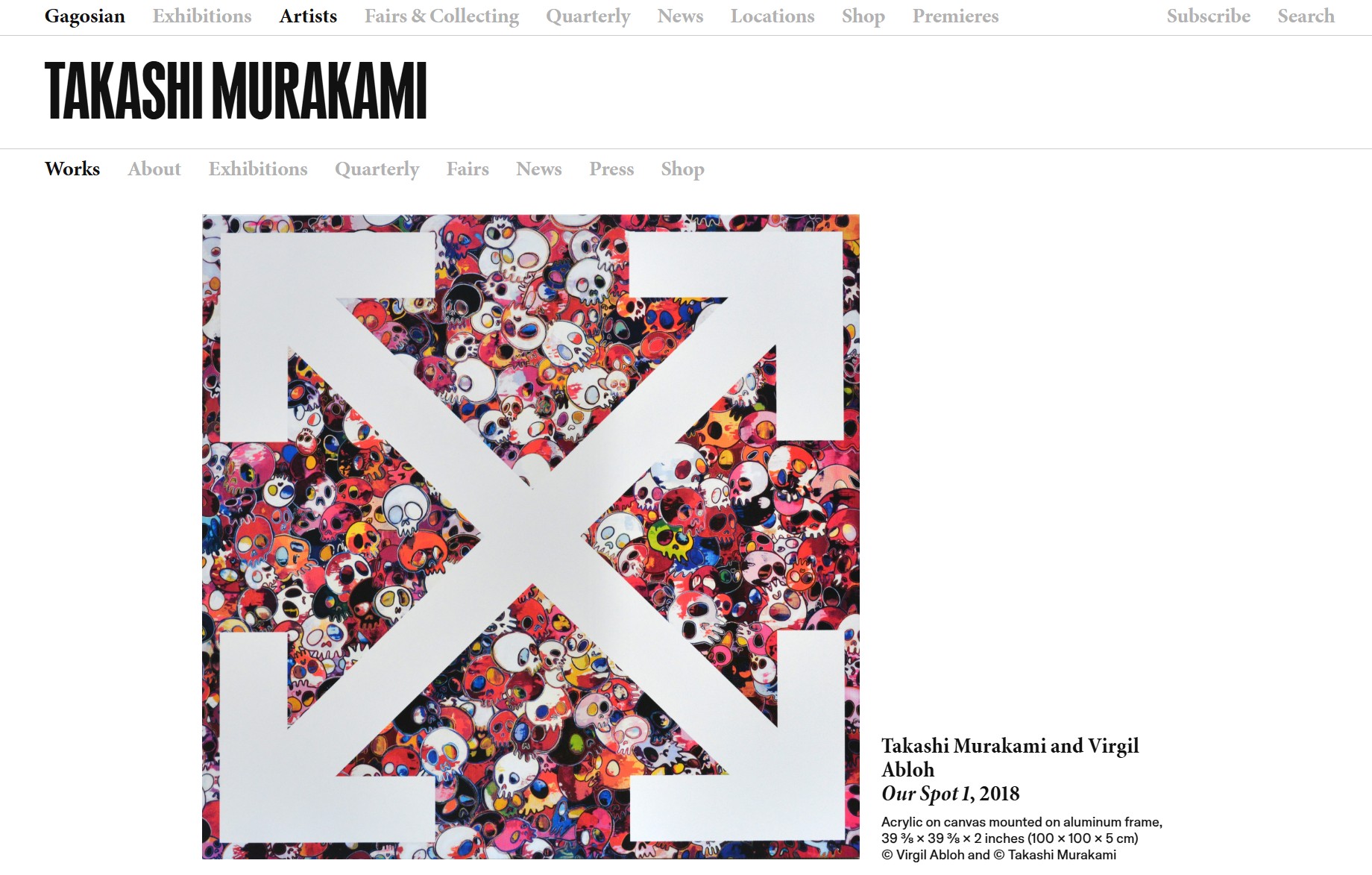
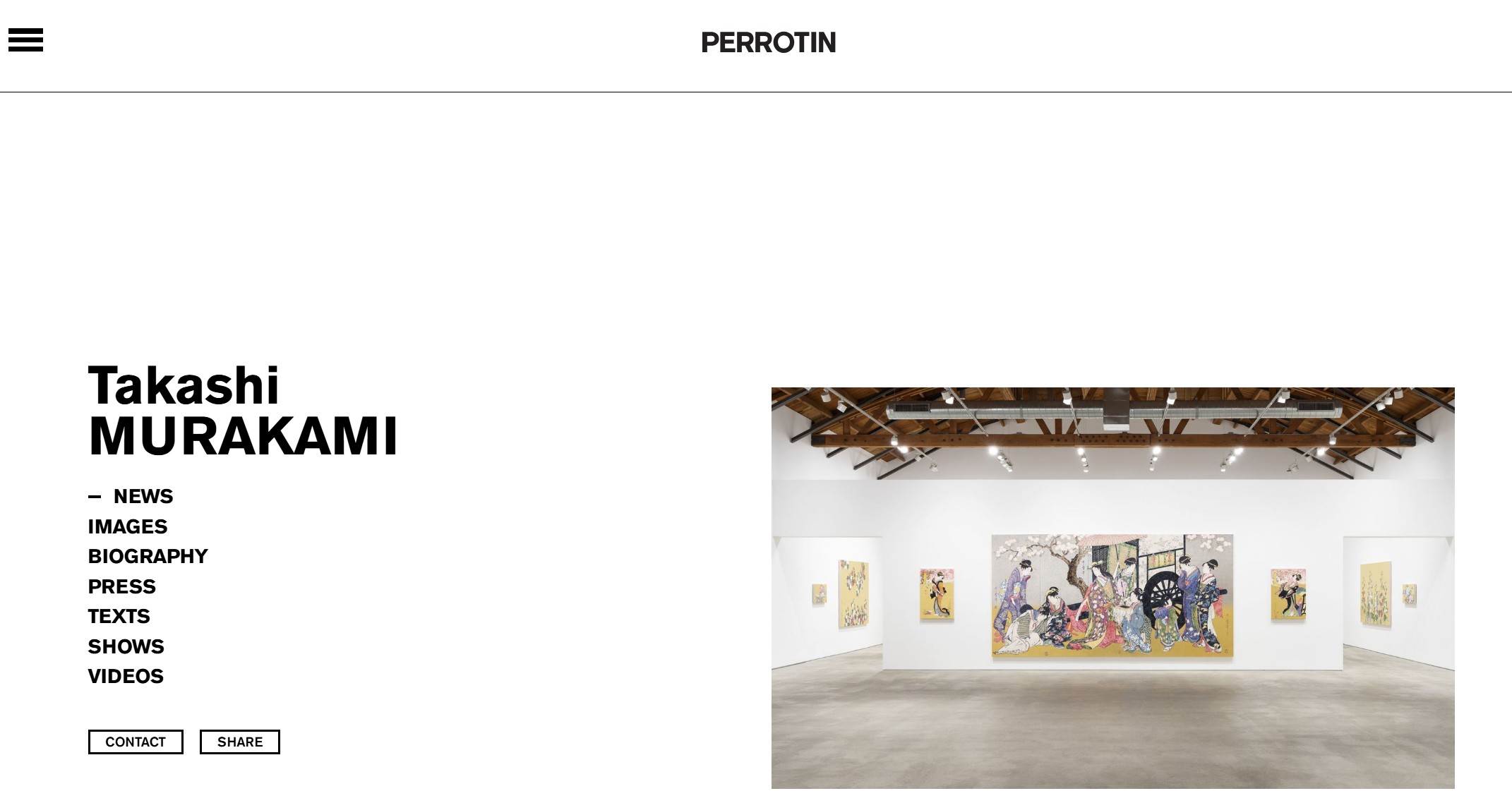
These partnerships provide global exhibition platforms across New York, Paris, London, Hong Kong, and beyond.
Parallel to this, his company Kaikai Kiki operates as both studio and gallery platform, supporting emerging artists while maintaining strict oversight over production and distribution. Murakami’s control over his ecosystem is deliberate: authorship extends beyond the image to include circulation.
Legacy and Market Position
Takashi Murakami occupies a singular position in contemporary art. He has fused Japanese art history, manga aesthetics, luxury branding, and museum ambition into a unified system. He demonstrated that contemporary art can function at industrial scale without abandoning conceptual rigor. Where Andy Warhol predicted the age of mass image reproduction, Murakami refined it through the lens of Japanese visual culture and globalized production. His works perform exceptionally across primary and secondary markets, with strong demand for large-scale paintings, sculptural works, and editioned prints. Yet market success alone does not define his importance.
Murakami’s true contribution lies in structure: he redefined what it means to be an artist in the 21st century—simultaneously creator, theorist, producer, brand architect, and cultural diagnostician. The smile is bright. The surface is flat. The system beneath is anything but.
PART I: SUMMARY
Auction Market Overview
2025 AUCTION STATISTICS
(Paintings and Sculptures)
Turnover: USD 10,118,346
+63.1% vs. 2024
# Lots sold: 27
Sell-Through Rate: 84%
MARKET SEGMENTATION
Hong-Kong (54.7%) / New-York (31.3%) / London (12.1%)
Paintings (47.5%) / Sculpture (51.8%)
(By value)
Highest Price achieved at Auction:
USD 15,161,000
Auction Summary
2025 Auction Highlights
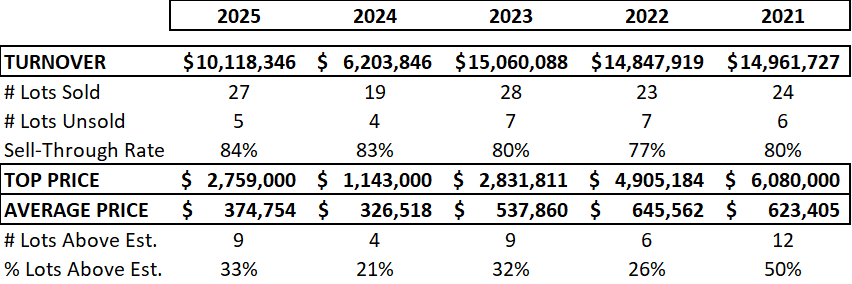
27 lots sold at auction in 2025 for a total turnover of USD 10,118,346. With 5 lots failing to sell, the sell-through rate is 84%. Of note, several lots were withdrawn at Phillips in Hong-Kong in September 2025. The highest price was achieved by the iconic Miss Ko² (Project Ko²), a sculpture dated 1997, that sold at Christie’s in New-York, on 19 November 2025 for USD 2,759,000.
2025 Top 3 Lots
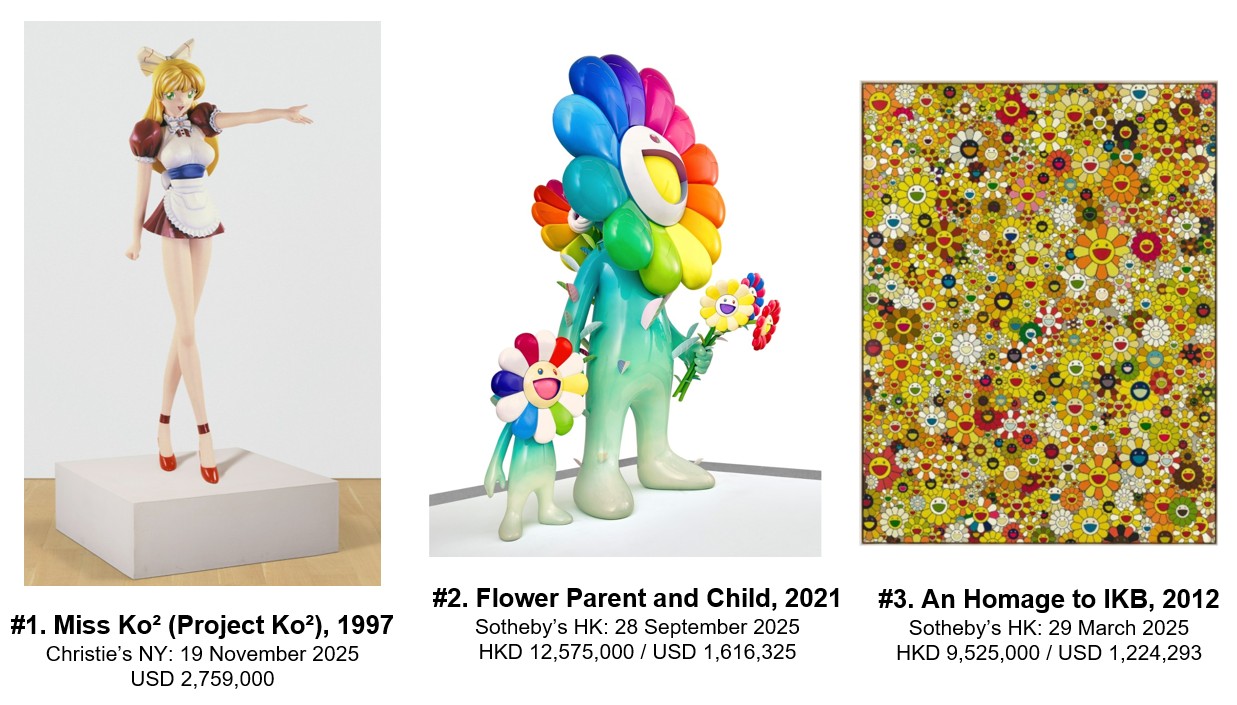
4 lots sold for more than USD 1 million, generating a cumulative turnover of USD 6,742,290, representing 66.6% of the total turnover of 2025 so far.
2024 Auction Highlights
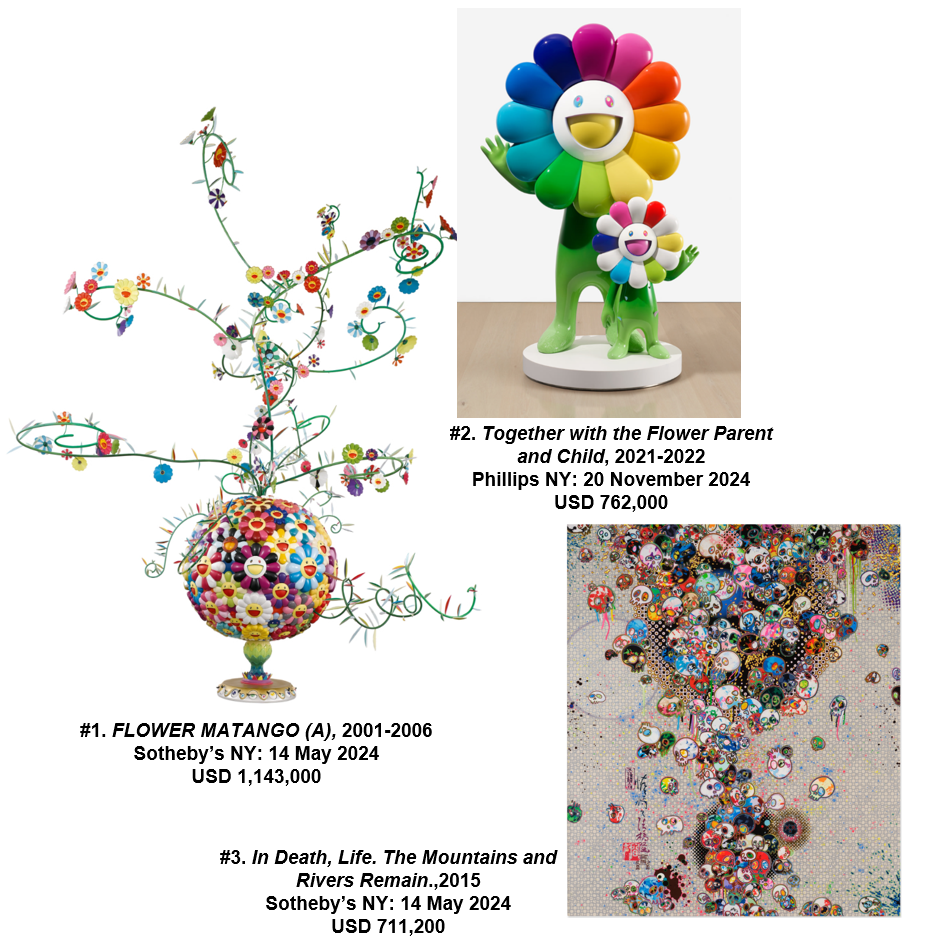
19 lots sold at auction in 2024 for a total turnover of USD 6,203,846. With 4 lots failing to sell, the sell-through rate is 83%. The highest price paid was achieved at Sotheby’s New-York on 14 May 2024 when FLOWER MATANGO (A), sold for USD 1,143,000.
2024 Top 3 Lots
2023 Auction Highlights
28 lots sold at auction in 2023 for a total turnover of USD 15,060,088. With 7 lots unsold, the sell-through rate is 80%. 5 lots are sculptures, the remaining 23 lots are paintings.
2023 Top 3 Lots
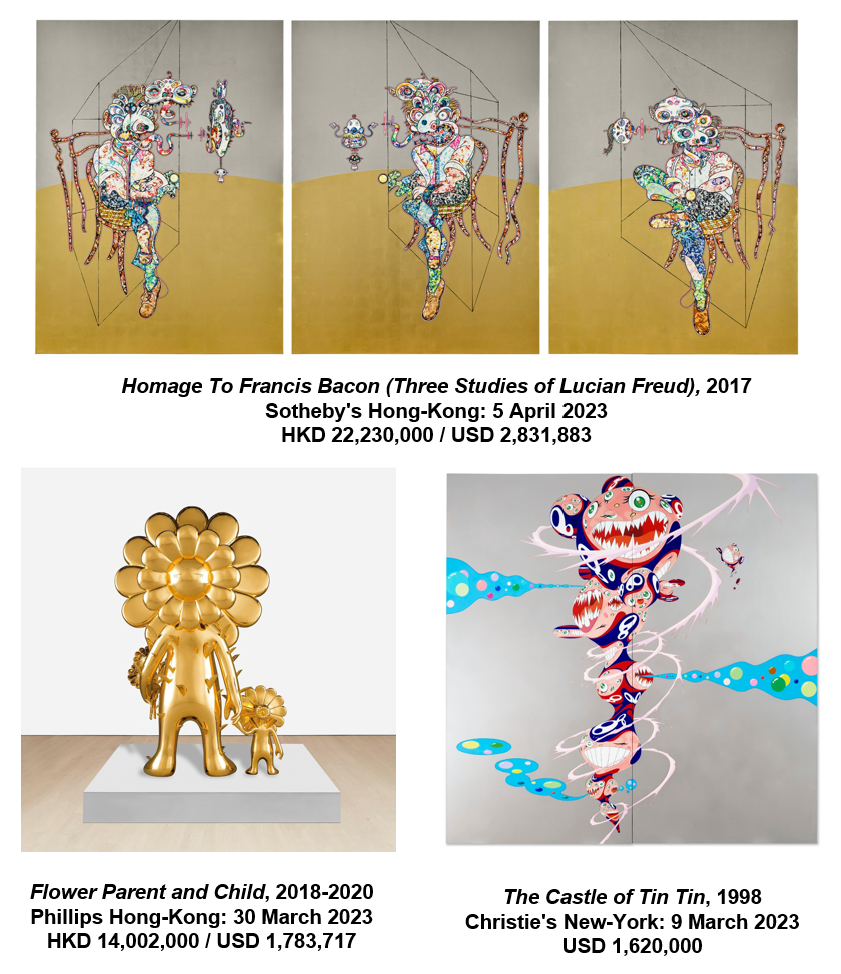
4 lots sold for over USD 1 million, generating a cumulative turnover of USD 7,603,026, contributing 50.5% to the total turnover for 2023. 3 of those lots, including the top lot of this auction year sold in Hong-Kong.
2022 Auction Highlights
23 lots sold at auction in 2022 for a total turnover of USD 14,847,919. With 7 lots failing to sell, the sell-through rate is 77%.
2022 Top 3 Lots
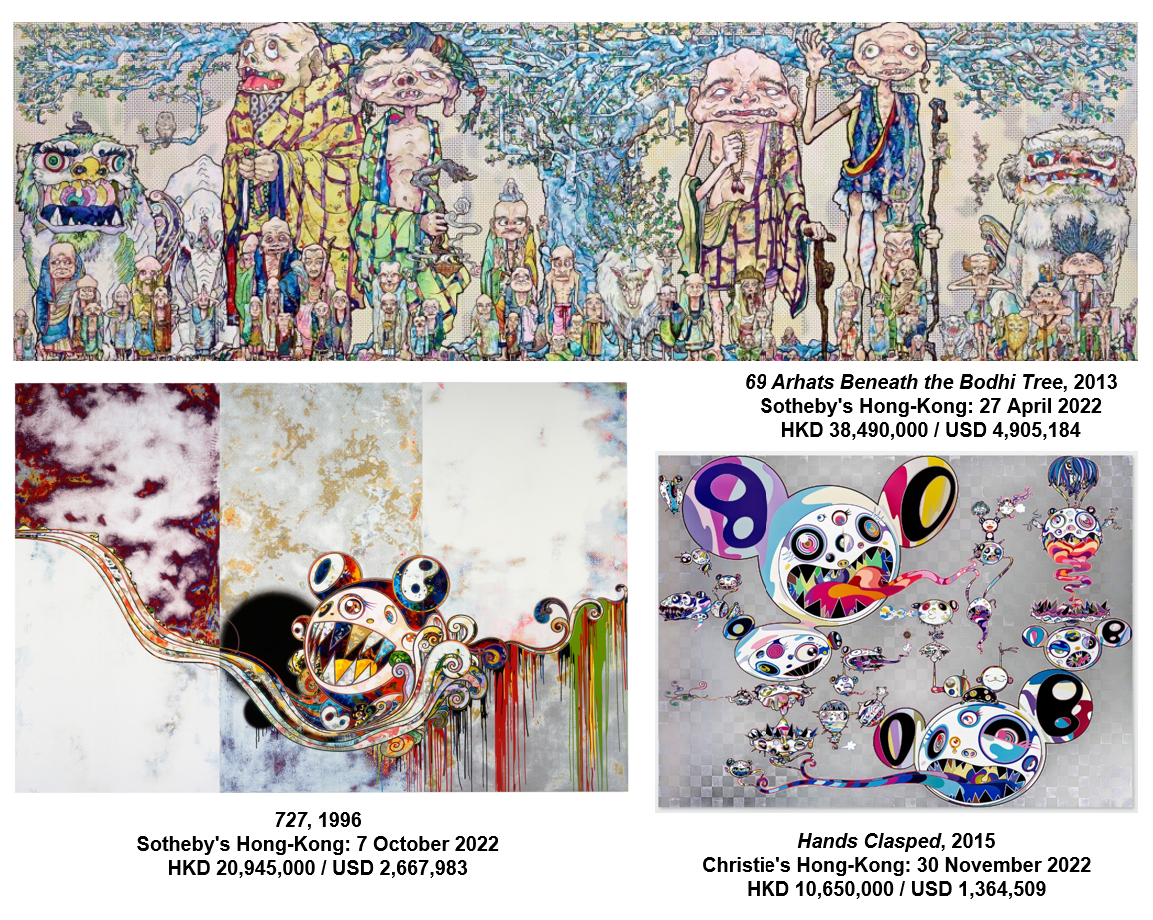
3 lots sold over USD 1 million, for a cumulative turnover of USD 8,937,676, contributing 60.2% of the total turnover for 2022.
2021 Auction Highlights
24 lots sold at auction in 2021 for a total turnover of USD 14,961,727. With 6 lots unsold, the sell-through rate is 80%. Only 2 lots sold above USD 1 million for a cumulative turnover of USD 7,174,968, representing 48% of the total turnover for 2021.
2021 Top 3 Lots
Top Lots
#1. My Lonesome Cow boy
Sotheby’s New-York: 24 May 2008
Estimated: USD 3,000,000 – 4,000,000
USD 15,161,000
(#9) Takashi Murakami (sothebys.com)
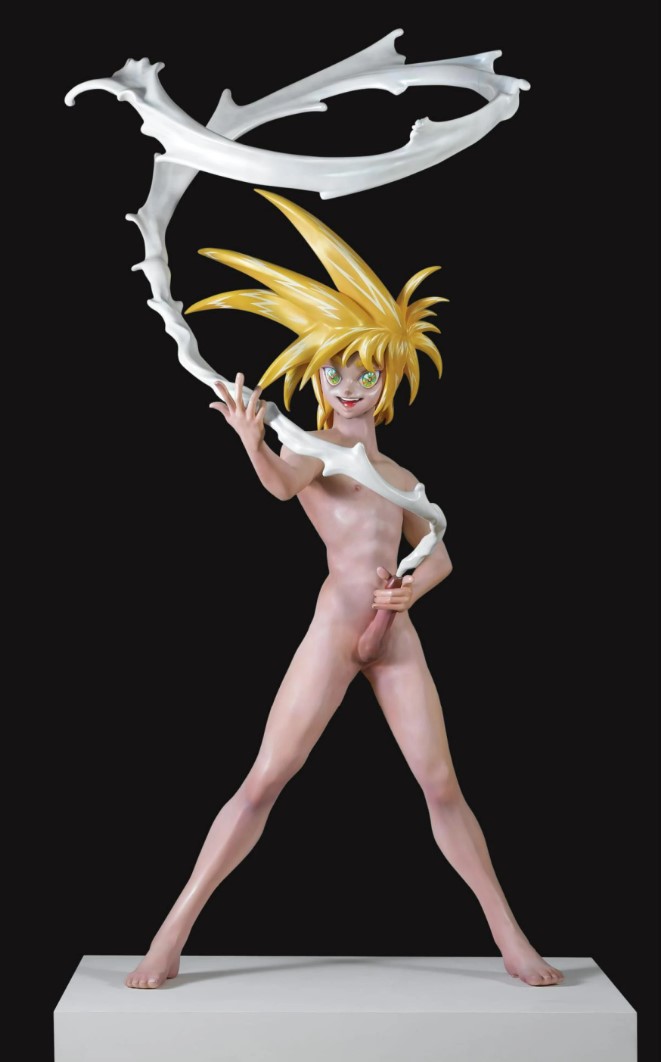 TAKASHI MURAKAMI
My Lonesome Cowboy, 1998
Oil, acrylic, fiberglass, and iron
254 x 116.8 x 91.4 cm (100x46x36 inches)
This work is from an edition of 3 plus 2 artist’s proofs.
Signed, dated 1998 and numbered 4 APII on the interior of the head
USD 10 million
#2. Miss Ko2
Phillips New-York: 8 November 2010
Estimated: USD 4,000,000 – 6,000,000
USD 6,802,500
Takashi Murakami – Carte Blanche Lot 10 November 2010 | Phillips
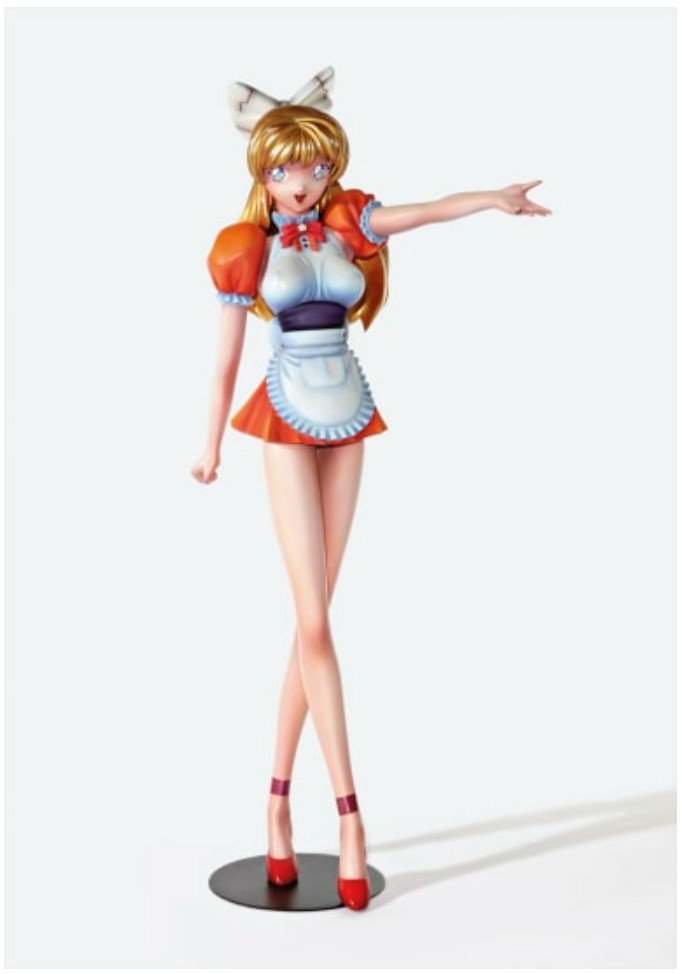
TAKASHI MURAKAMI (B. 1962)
Miss ko², 1997
Oil paint, acrylic, synthetic resin, fiberglass, and iron.
72 x 25 x 32 1/2 in. (182.9 x 63.5 x 82.6 cm)
This work is from an edition of 3 plus 1 AP
#3. Red Demon and Blue Demon with 48 Arhats, 2013
Phillips New-York: 23 June 2021
Estimated: USD 3,500,000 – 4,500,000
USD 6,080,000
Takashi Murakami – 20th Century & Conte… Lot 25 June 2021 | Phillips
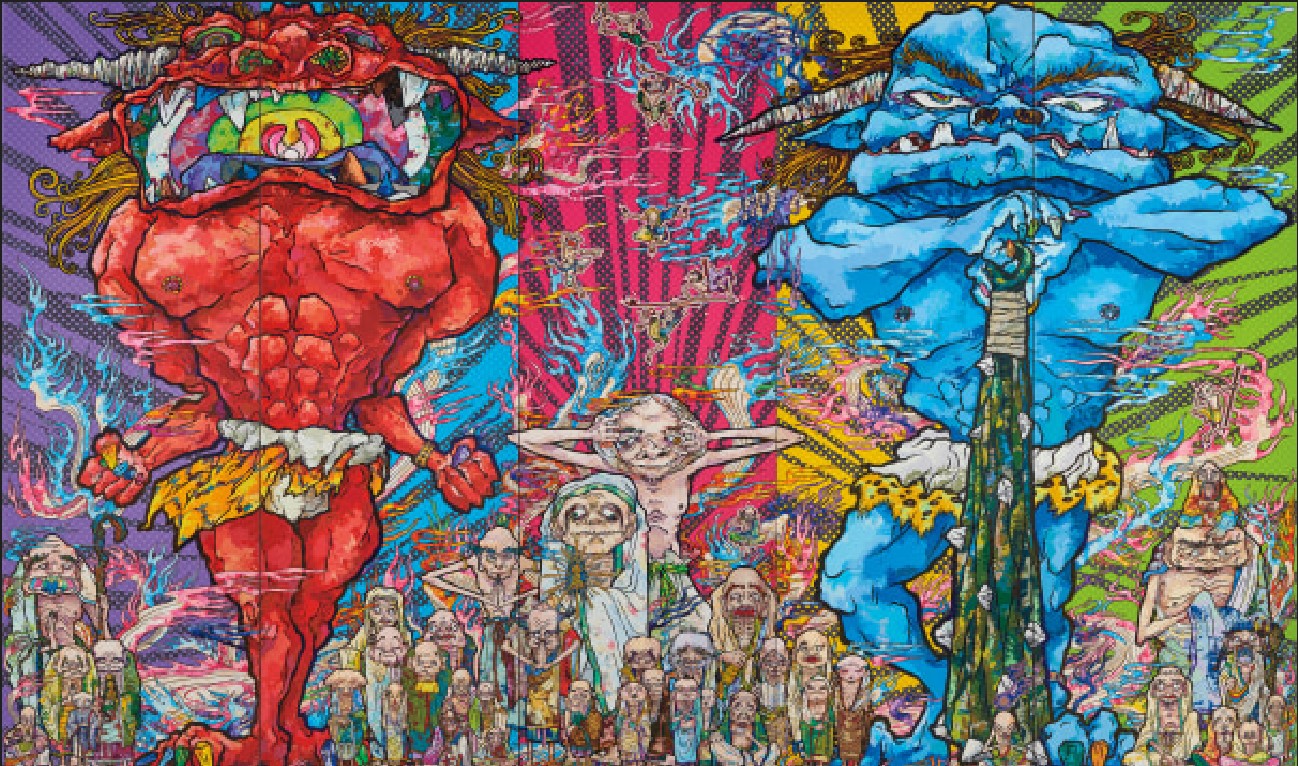
TAKASHI MURAKAMI
Red Demon and Blue Demon with 48 Arhats, 2013
Acrylic, gold and platinum leaf on canvas mounted on board, in 5 parts
300×500 cm (118.2 x 196.9 inches)
Signed and dated “TAKASHI 2013” on the overlap of the left panel
#4. Tan Tan Bo, 2001
Christie’s New-York: 15 November 2018
Estimated: USD 5,000,000 – 8,000,000
USD 5,037,500
Takashi Murakami (b. 1962) (christies.com)
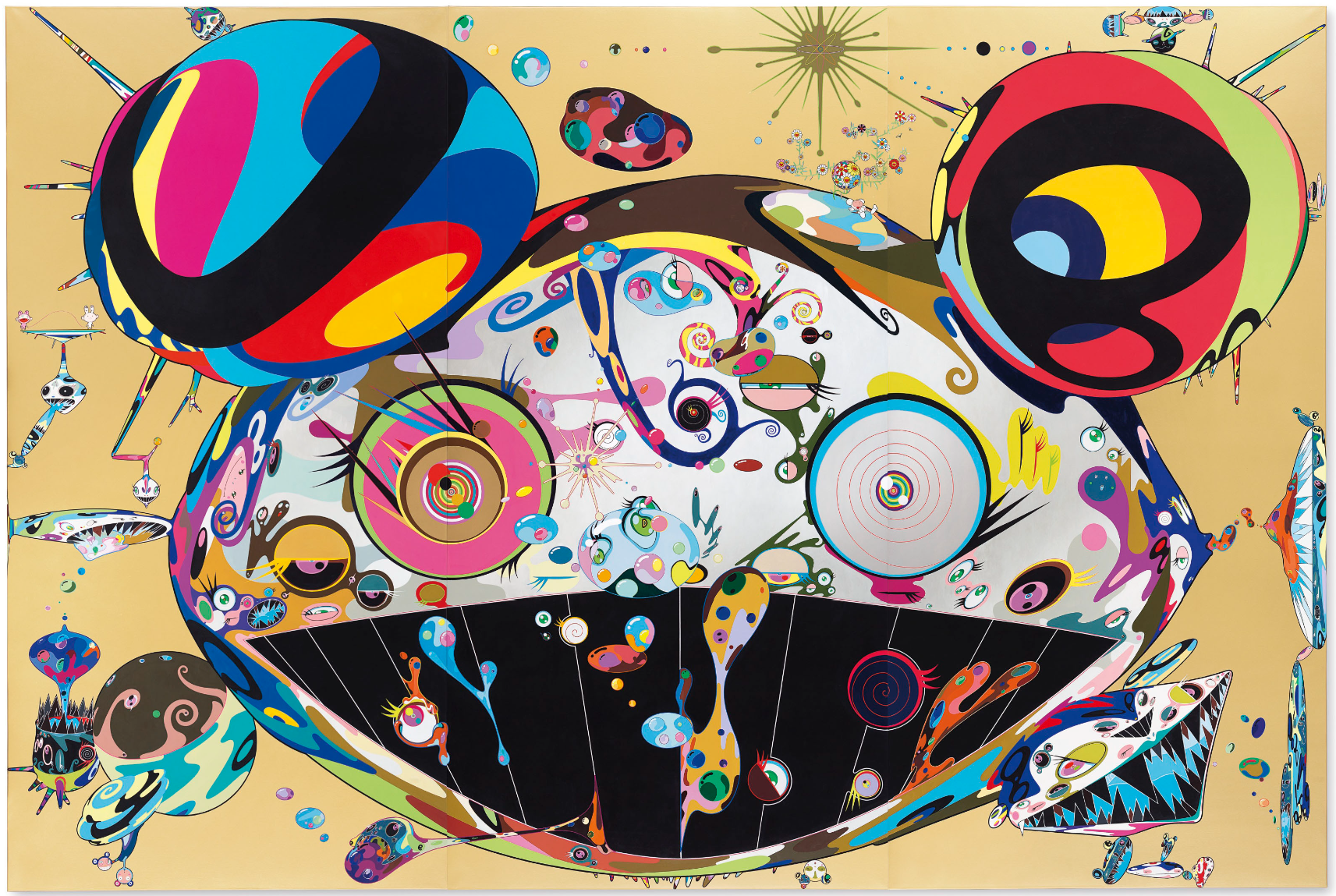
TAKASHI MURAKAMI (b. 1962)
Tan Tan Bo, 2001
Acrylic on canvas mounted on board, in three parts
overall: 360X540 cm (141 3/4 x 212 5/8 inches)
USD 5 million
#5. 69 Arhats Beneath the Bodhi Tree, 2013
Sotheby’s Hong-Kong: 27 April 2022
Estimated: HKD 23,000,000 – 30,000,000
HKD 38,490,000 / USD 4,905,184
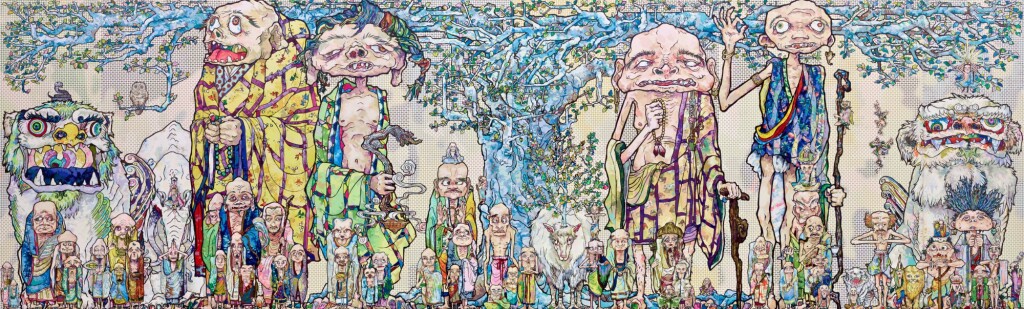
TAKASHI MURAKAMI (B. 1962)
69 Arhats Beneath the Bodhi Tree, 2013
Acrylic, gold and platinum leaf on canvas mounted on board, in 10 parts
Each: 300×100 cm (118.1 x 39.4 inches)
Overall: 300×1,000 cm (118.1 x 393.7 inches)
#6. The Castle of Tin Tin, 1998
Sotheby’s New-York: 13 November 2012
Estimated: USD 4,000,000 – 6,000,000
USD 4,226,500
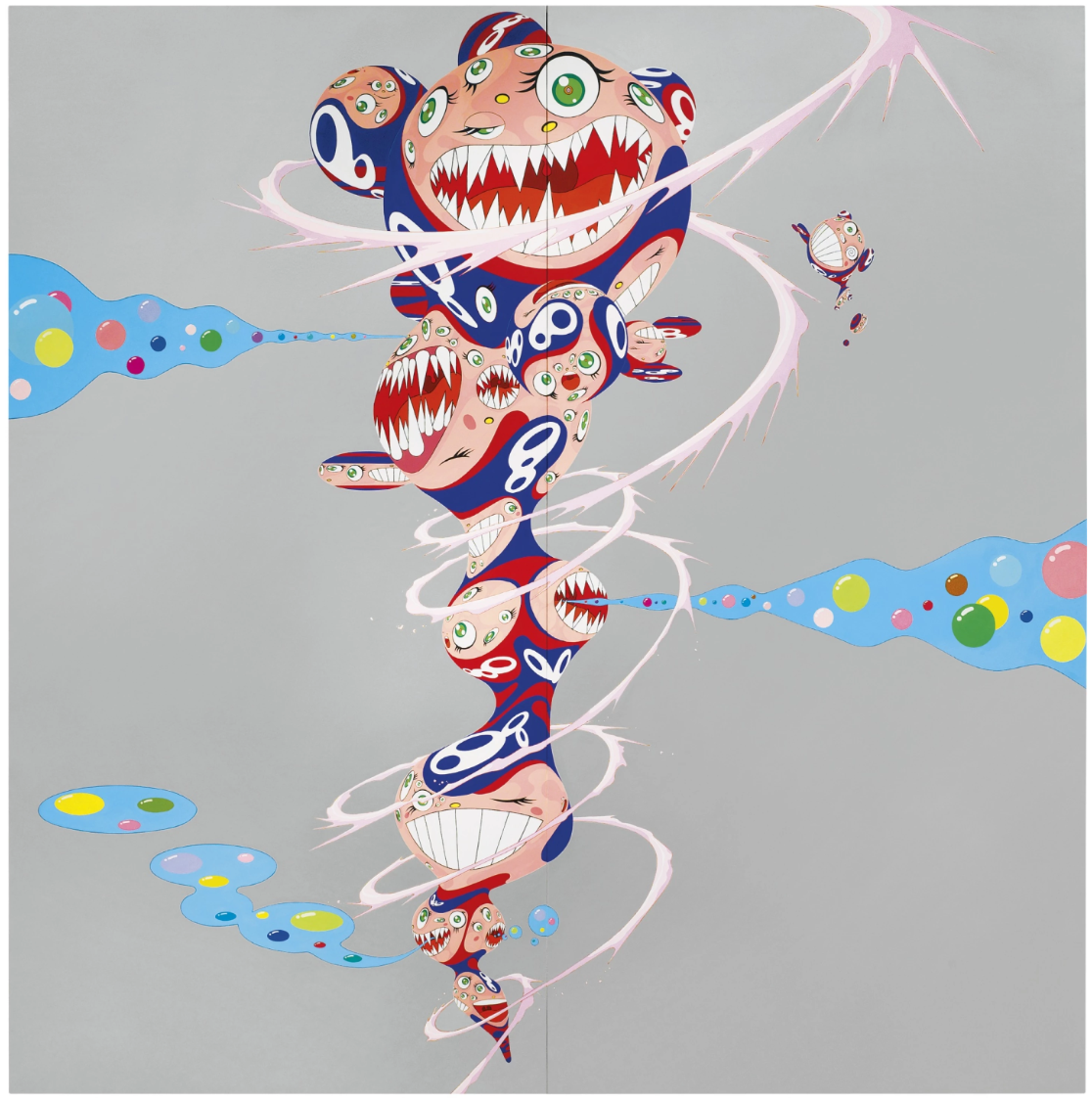
TAKASHI MURAKAMI
The Castle of Tin Tin, 1998
Acrylic on canvas mounted on panel, in two parts
300×300 cm (118 1/8 x 118 1/8 inches)
(c) 2003 Takashi Murakami/Kaikai Kiki Co., Ltd. All Rights Reserved
#7. Kaikai Kiki, 2005
Christie’s London: 14 October 2010
Estimated: GBP 400,000 – 600,000
GBP 1,945,250 / USD 3,115,390
Takashi Murakami (b. 1962) (christies.com)
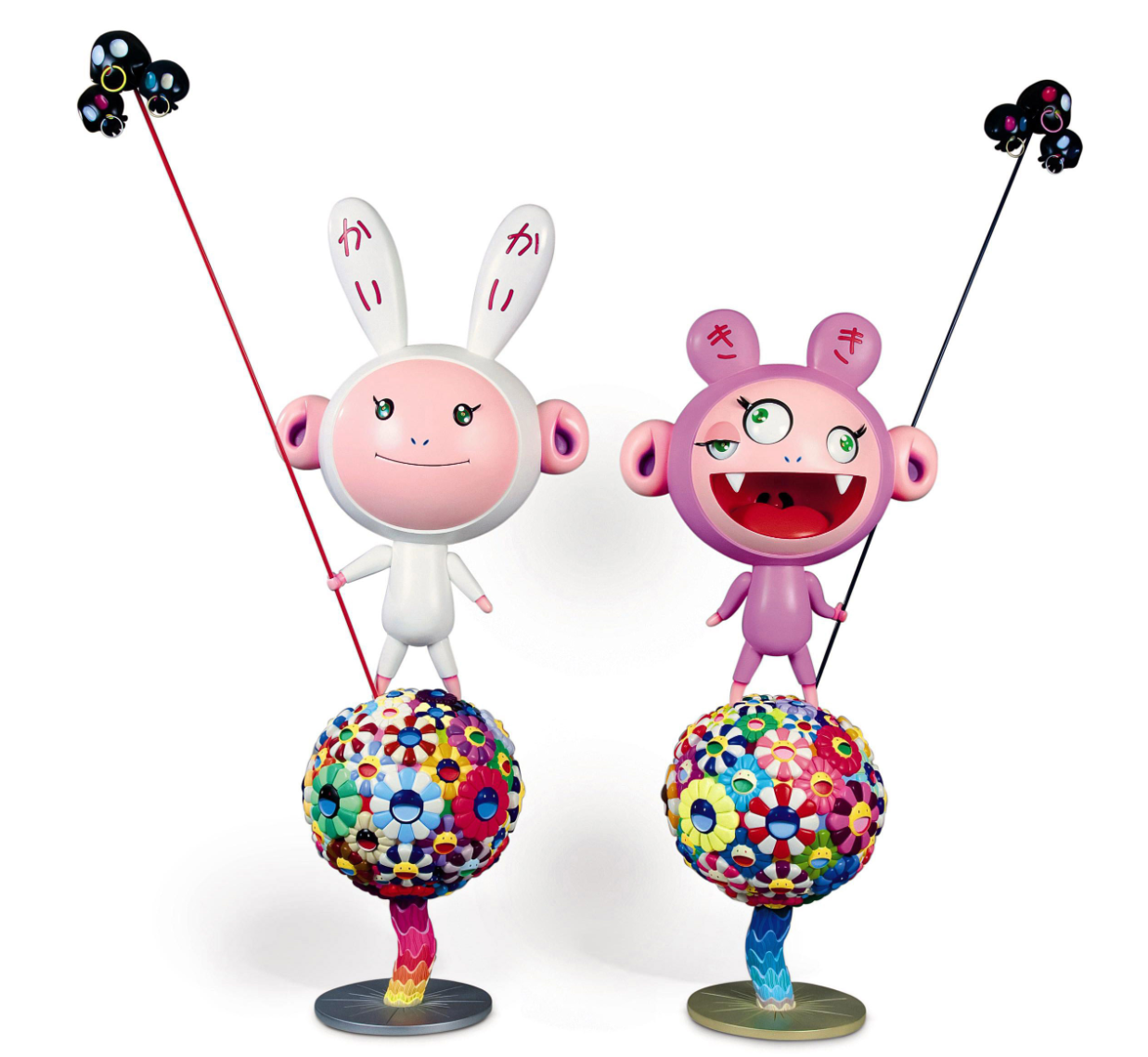
TAKASHI MURAKAMI (b. 1962)
Kaikai Kiki, 2005
Oil, acrylic, synthetic resins, fiberglass and inox, in two parts
Kaikai: 210 x 105.5 x 66 cm (82 3/4 x 41 1/2 x 26 inches)
Kiki: 212.5 x 102 x 50.5 cm (83 7/8 x 40 1/4 x 19 3/4 inches)
This work is number five from an edition of five
#8. Miss Ko2 Original (Project Ko2), 1997
Sotheby’s New-York: 14 November 2019
Estimated: USD 2,000,000 – 3,000,000
USD 3,080,000
sothebys.com/en/search?query=takashi murakami MIIS KO2&tab=objects
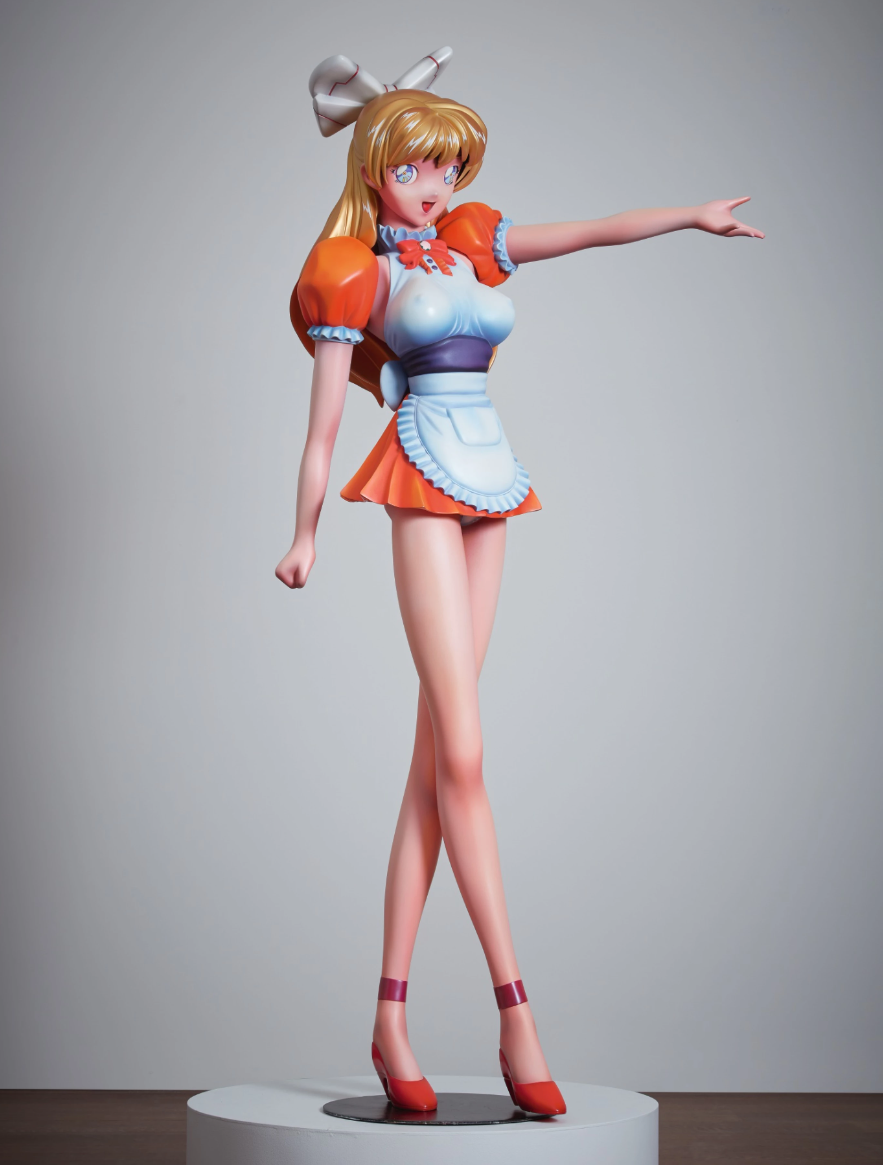
TAKASHI MURAKAMI
Miss Ko2 Original (Project Ko2), 1997
Fiberglass, iron, synthetic resin, oil paint, and acrylic
182.9 x 63.5 x 82.6 cm (72 x 25 x 32 1/2 inches)
Signed, numbered 024/5
Inscribed with the names of the contributing assistants on the interior of the torso
This work is number 3 from an edition of 3 plus one artist’s proof
USD 3 million
#9. Miss Ko2, 1997
Sotheby’s Hong-Kong: 2 April 2017
Estimated: HKD 15,000,000 – 20,000,000
HKD 22,900,000 / USD 2,946,870
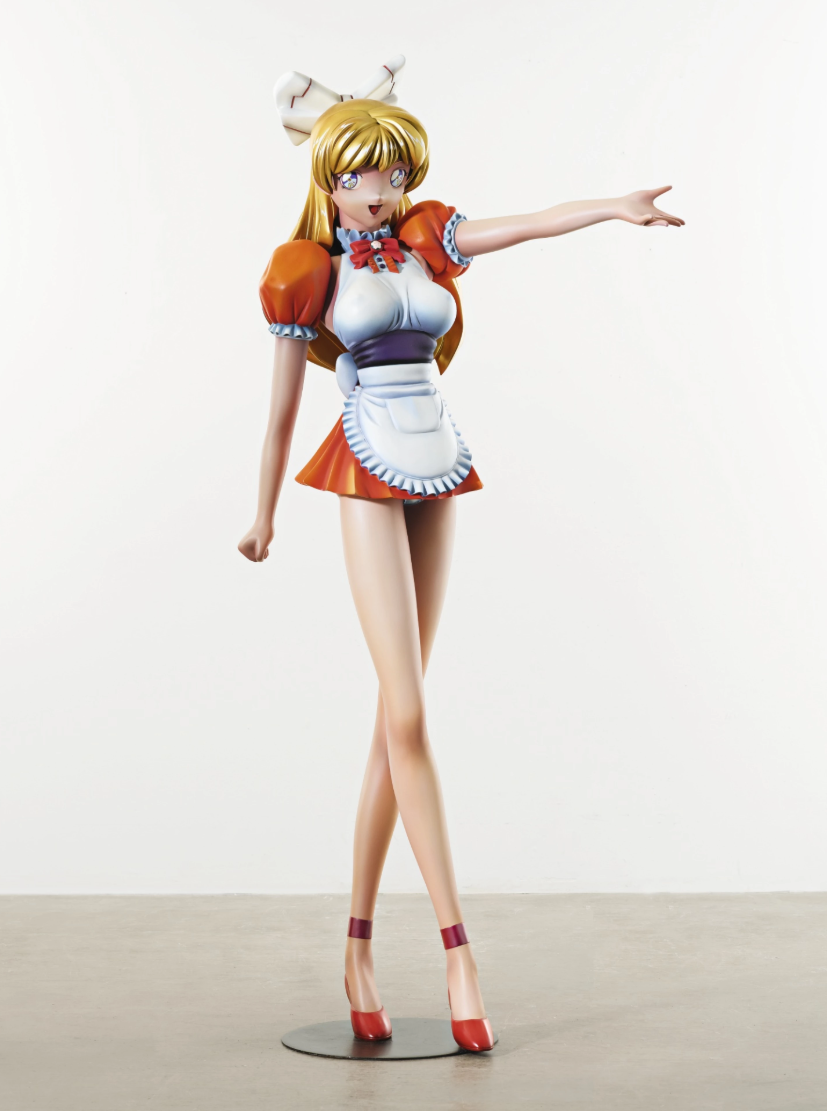
TAKASHI MURAKAMI
Miss Ko2, 1997
Fiberglass, iron, synthetic resin, oil paint and acrylic
182.9 x 63.5 x 82.6 cm (72 x 25 x 32 1/2 inches)
Edition: 3/3
This work is from an edition of 3 plus one artist’s proof
Signed in English and inscribed with the names of the assistants who contributed to the execution of the work
#10. Homage To Francis Bacon (Three Studies of Lucian Freud), 2017
Sotheby’s Hong-Kong: 5 April 2023
Estimated: HKD 18,000,000 – 28,000,000
HKD 22,230,000 / USD 2,831,883
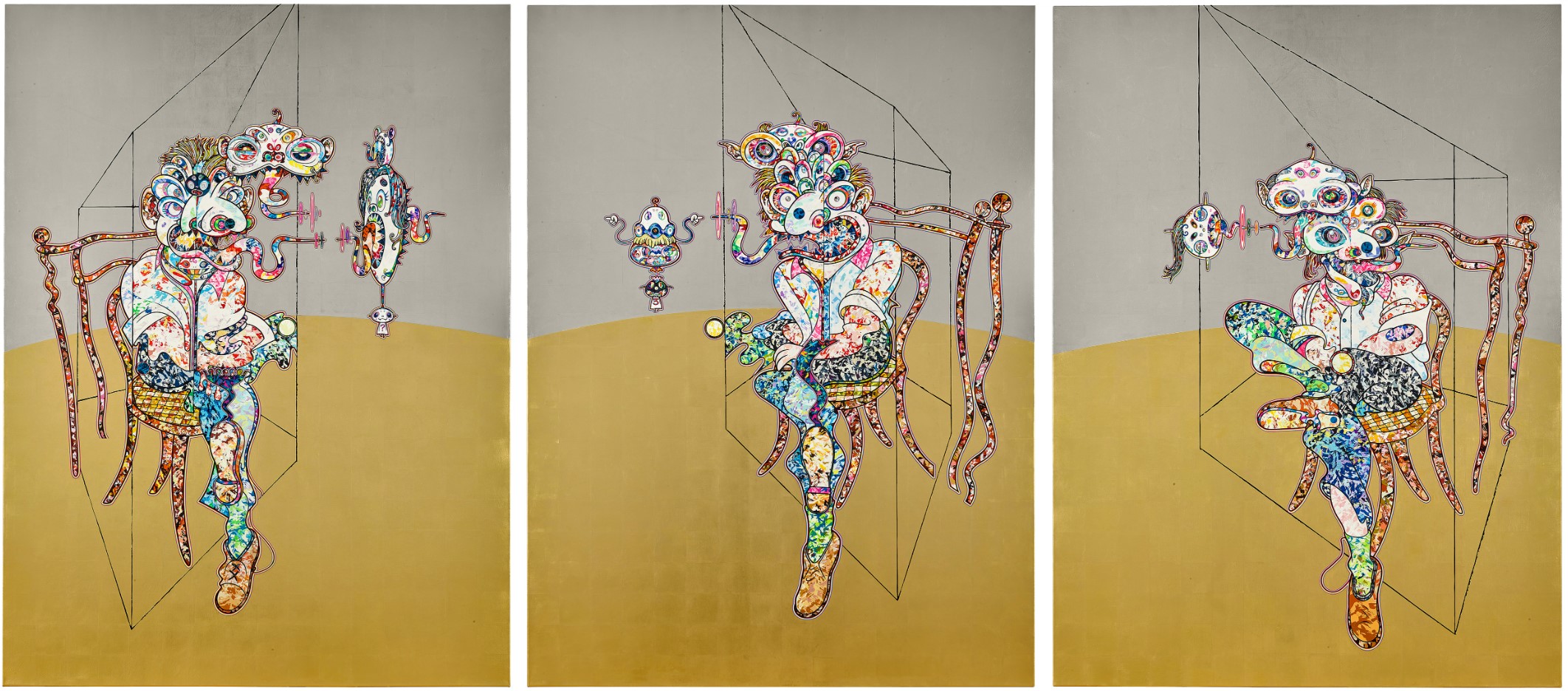
TAKASHI MURAKAMI (b. 1962)
Homage To Francis Bacon (Three Studies of Lucian Freud), 2017
Acrylic, gold leaf and platinum leaf on canvas mounted on aluminum, in 3 parts
Each: 197.8 x 147.5 cm (77 7/8 x 58 1/8 inches)
Overall: 197.8 x 442.5 cm (77 7/8 x 174 1/4 inches)
Signed and dated 2017 on the overlap of the second panel
#11. DOB in the Strange Forest (Blue DOB), 1999
Christie’s New-York: 8 November 2011
Estimated: USD 2,500,000 – 3,500,000
USD 2,770,500
Takashi Murakami (b. 1962) (christies.com)
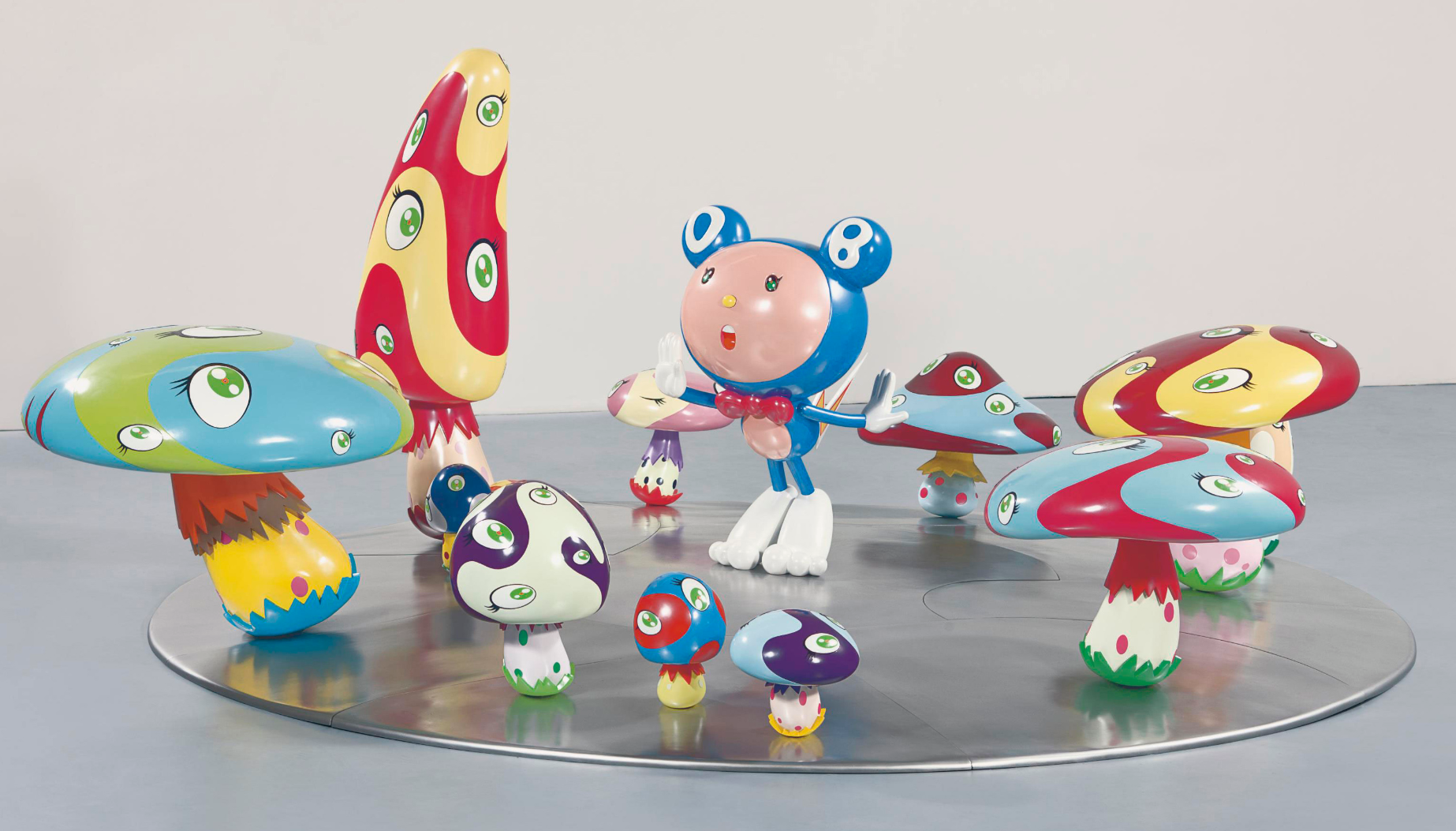
TAKASHI MURAKAMI (b. 1962)
DOB in the Strange Forest (Blue DOB), 1999
Fiber-reinforced plastic, resin, fiberglass, acrylic and iron
152.4 x 386 x 347.9 cm (60 x 152 x 137 inches)
Signed, inscribed and dated ‘Takashi Murakami ’99’ (on the underside of DOB)
This work is from an edition of three plus two artist’s proofs
#12. 727, 1996
Sotheby’s Hong-Kong: 7 October 2022
Estimated: HKD 18,000,000 – 25,000,000
HKD 20,945,000 / USD 2,667,983
Takashi Murakami 村上隆 | 727 | Contemporary Evening Auction | 2022 | Sotheby’s
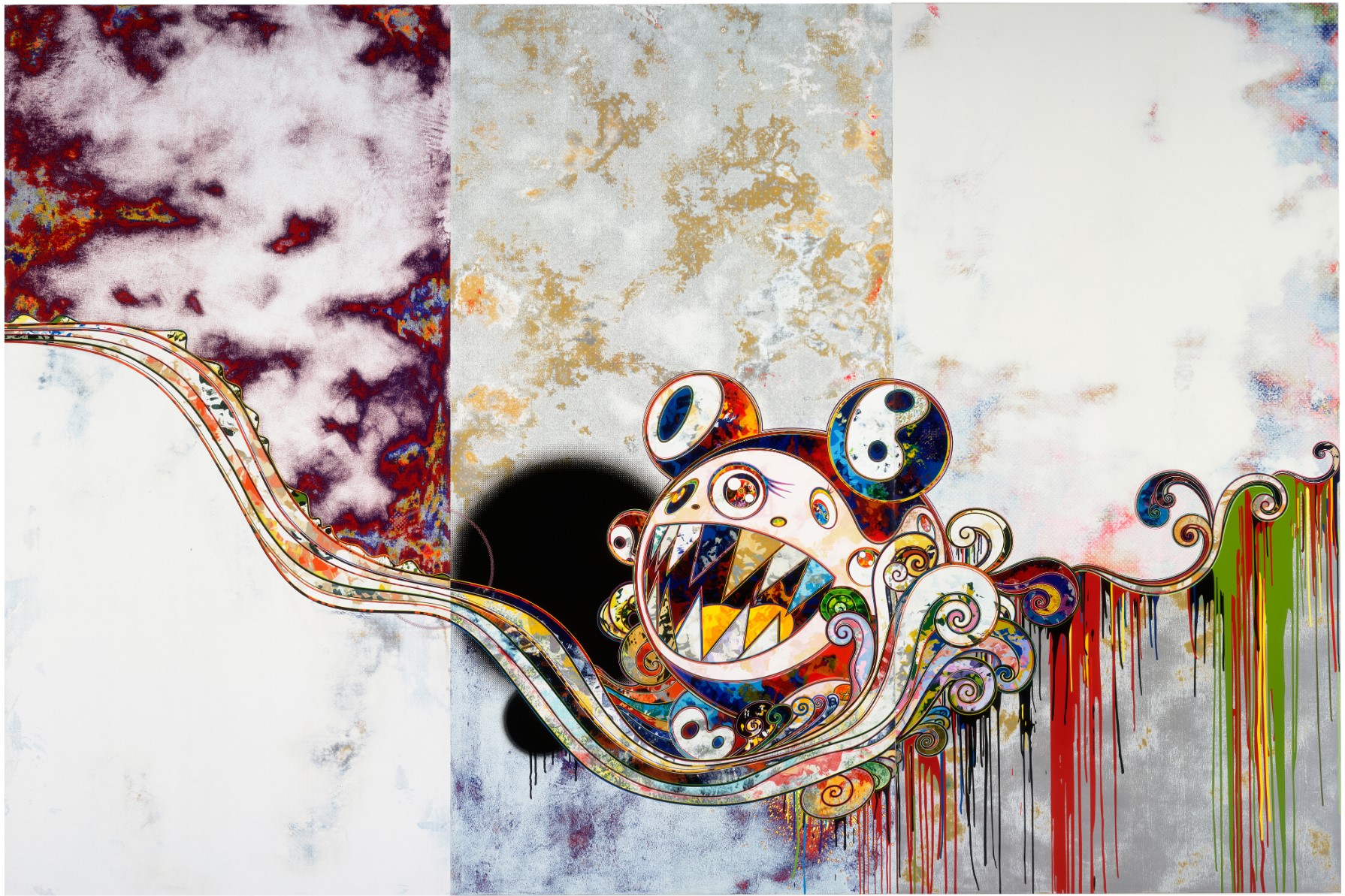
TAKASHI MURAKAMI (B. 1962)
727, 1996
Acrylic on canvas mounted on board, in 3 parts
Each: 300.5 x 150 cm (118.2 x 59 inches)
Overall: 300.5 x 450 cm (118.2 x 177.2 inches)
Signed and titled 727 on the overlap
#13. The World of Sphere (diptych), 2003
Sotheby’s Hong-Kong: 5 October 2013
Estimated: HKD 16,000,000 – 24,000,000
HKD 19,160,000 / USD 2,470,820
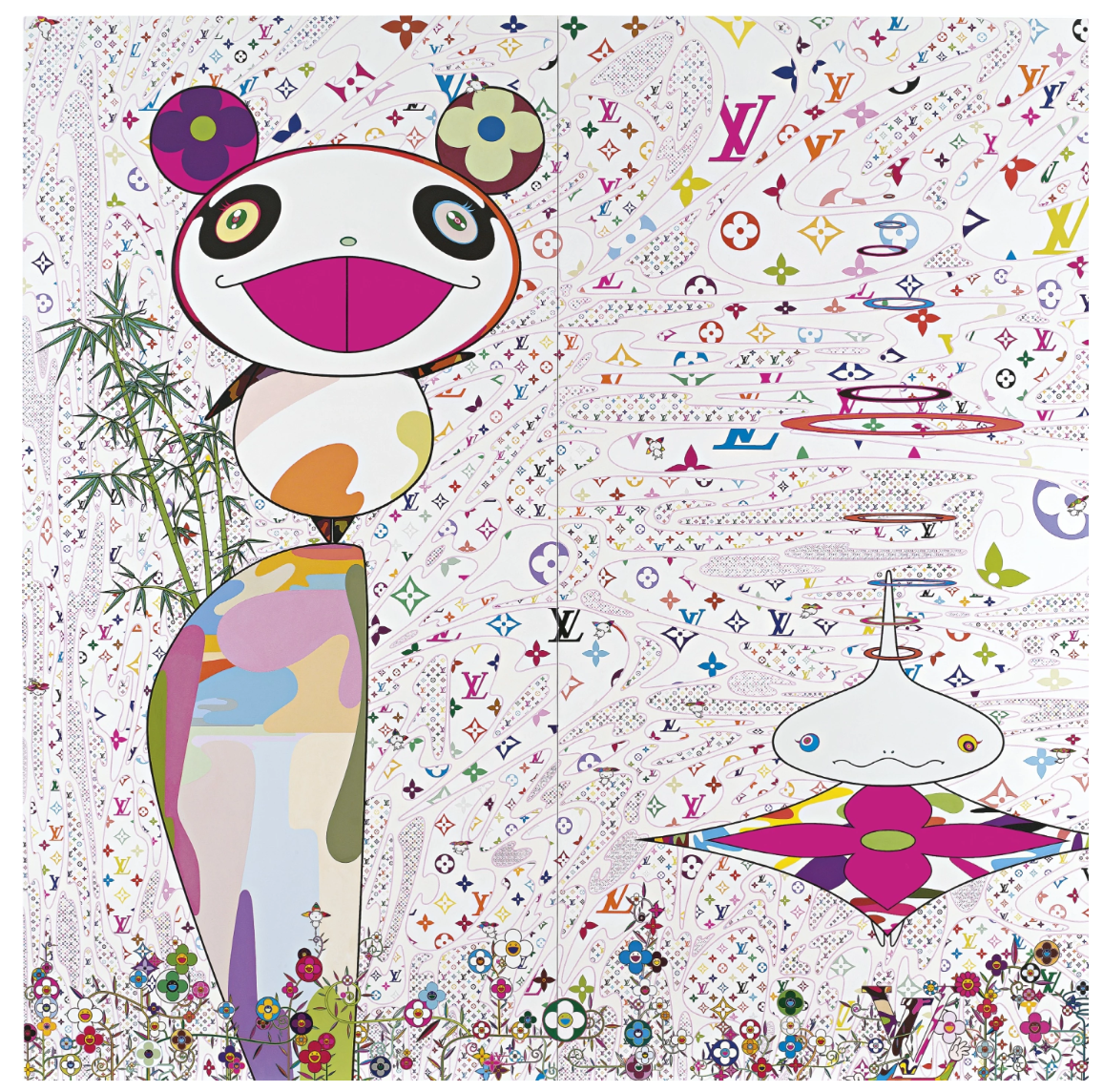
TAKASHI MURAKAMI
The World of Sphere (diptych), 2003
Acrylic on canvas mounted on board
350×350 cm (137 3/4 x 137 3/4 inches)
Signed in English, dated 03 and marked with 8 artist seals on the reverse
PART II: AUCTION RESULTS
2026 Upcoming Lots
2026 Auction Results
Blue Signal, 2017
PROPERTY FROM A DISTINGUISHED PRIVATE ASIAN COLLECTION
Sotheby’s Singapore: 25 January 2026
Estimated: SGD 970,000 – 1,900,000
SGD 1,333,500 / USD 1,048,195
Takashi Murakami 村上隆 | Blue Signal 藍色信號 | Modern & Contemporary Art | 2026 | Sotheby’s
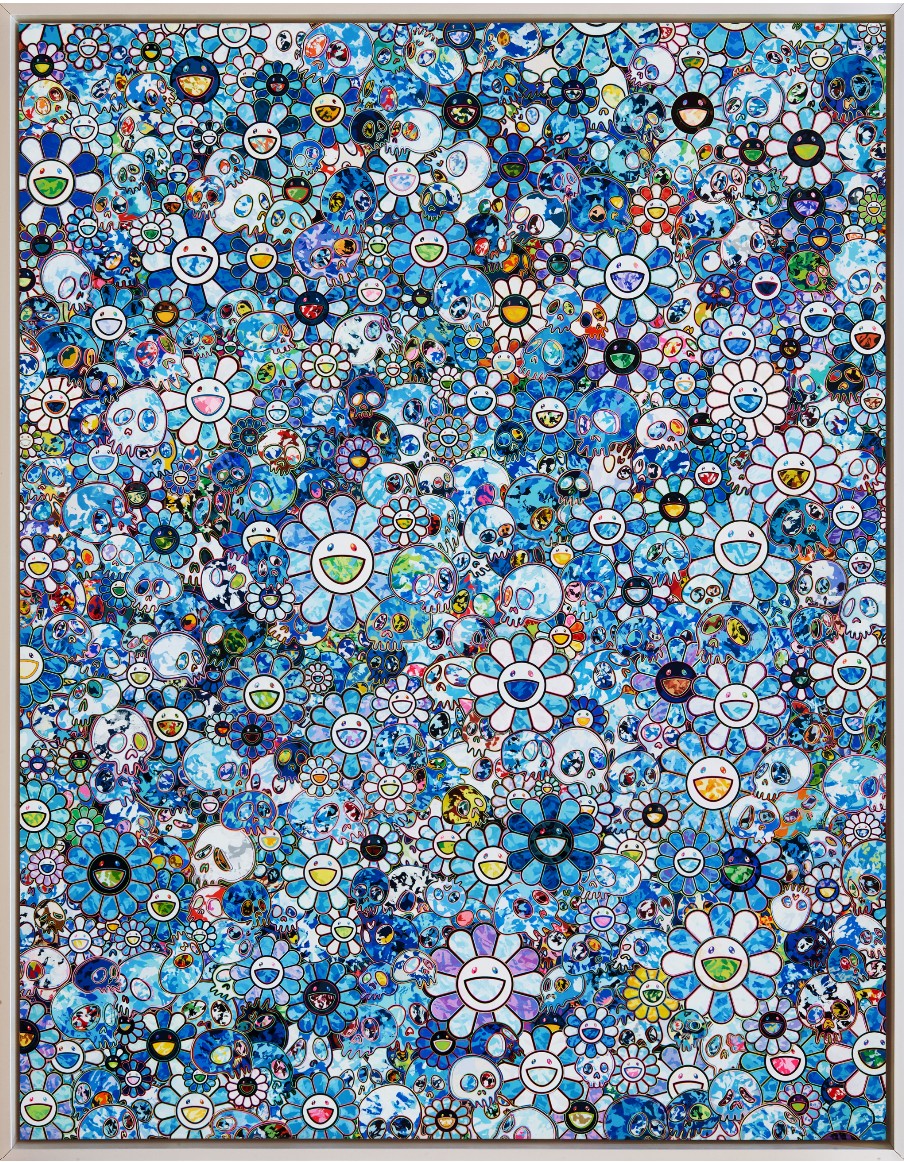
TAKASHI MURAKAMI (b. 1962)
Blue Signal, 2017
Acrylic on canvas mounted on aluminum frame
199.5 x 153.1 cm (78-1/2 x 60-1/4 inches)
Signed and dated 2017 (on the reverse)
© 2017 Takashi Murakami/Kaikai Kiki Co., Ltd. All Rights Reserved
USD 1 million
A Sketch of Anywhere Door (Dokodemo Door), 2019
Christie’s Hong-Kong: 27 March 2026
Estimated: HKD 4,000,000 – 6,000,000
HKD 5,715,000 / USD 729,885
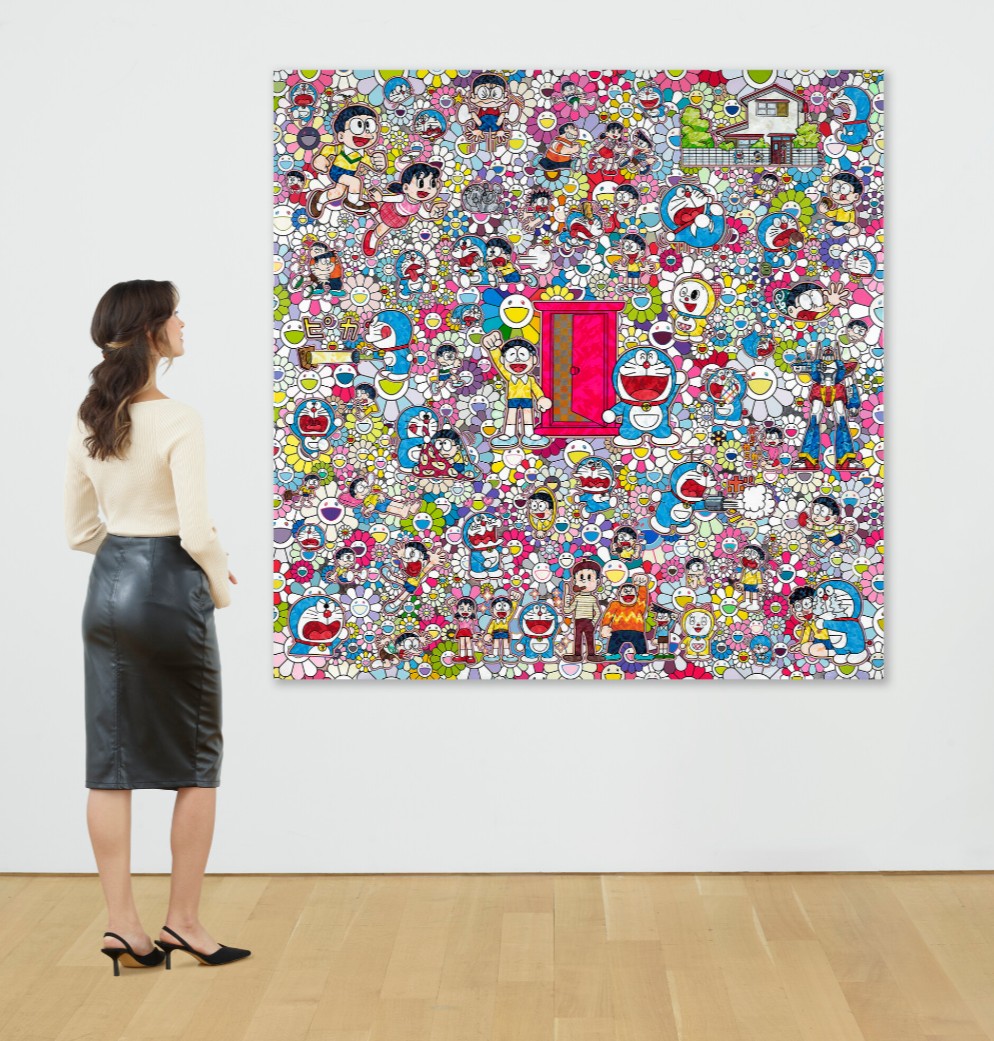
TAKASHI MURAKAMI (B. 1962)
A Sketch of Anywhere Door (Dokodemo Door) and an Excellent Day, 2019
Acrylic, platinum leaf and gold leaf on canvas mounted on aluminum frame
180×180 cm (70-7/8 x 70-7/8 inches)
Signed and dated ‘TAKASHI 2019’ (on the overlap)
©︎2019 Takashi Murakami/Kaikai Kiki Co., Ltd. All Rights Reserved
And Then x 6 (Platinum & White: The Superflat Method), 2012
Christie’s Hong-Kong: 28 March 2026
Estimated: HKD 1,200,000 – 2,200,000
HKD 1,905,000 / USD 243,295
TAKASHI MURAKAMI (B. 1962), And Then x 6 (Platinum & White: The Superflat Method) | Christie’s
REPEAT SALE
Phillips Hong-Kong: 24 November 2019
Estimated: HKD 3,800,000 – 5,000,000
HKD 4,950,000 / USD 634,590
Takashi Murakami 20th Century & Contemporary Art Evening Sale
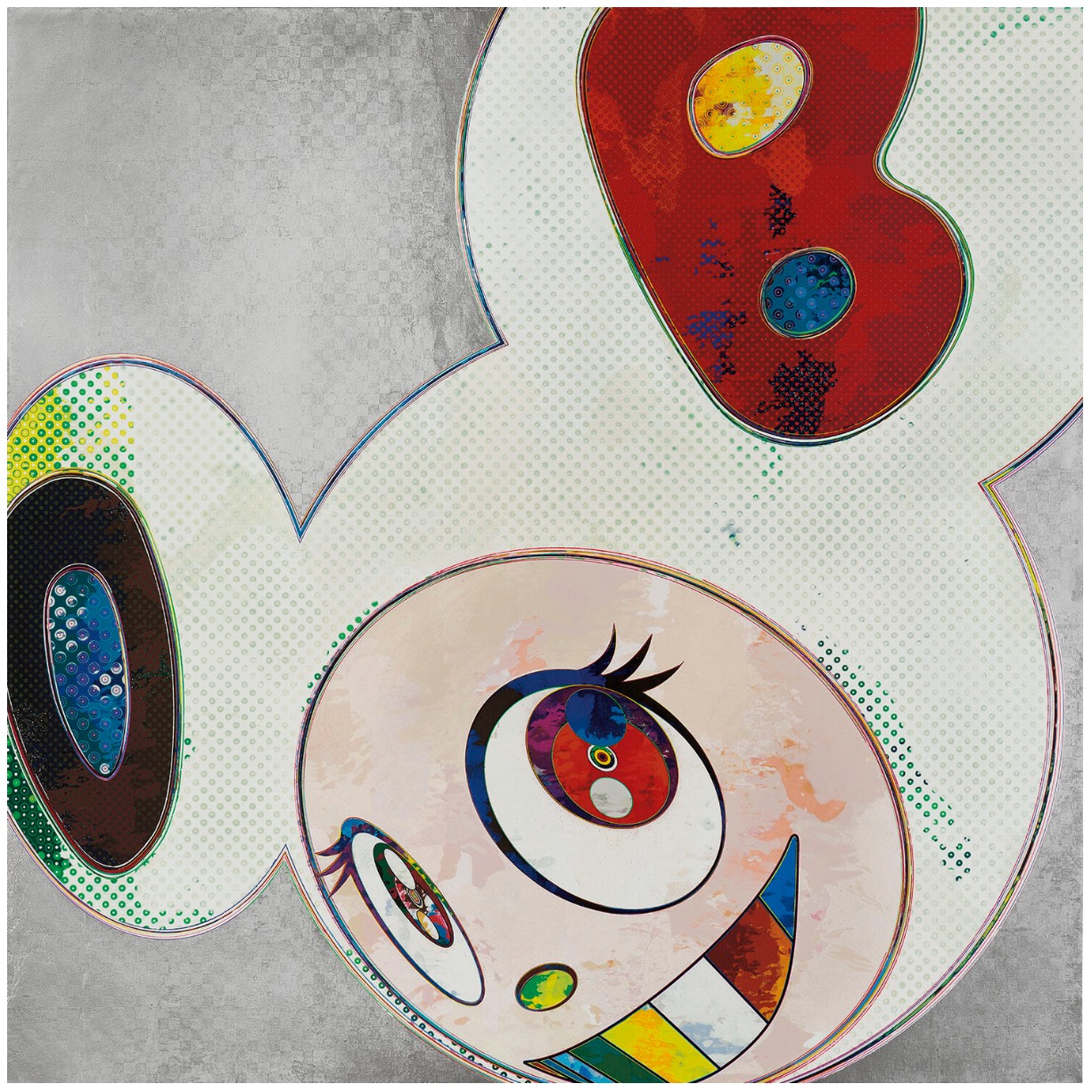
TAKASHI MURAKAMI (B. 1962)
And Then x 6 (Platinum & White: The Superflat Method), 2012
Acrylic and platinum leaf on canvas mounted on board
100.5 x 100 cm (39-5/8 x 39-3/8 inches)
Signed and dated ‘TAKASHI 2012’ (on the overlap)
DOB Jagged, 2018
Estimated: JPY 25,000,000 – 35,000,000
JPY 27,600,000 / USD 172,830
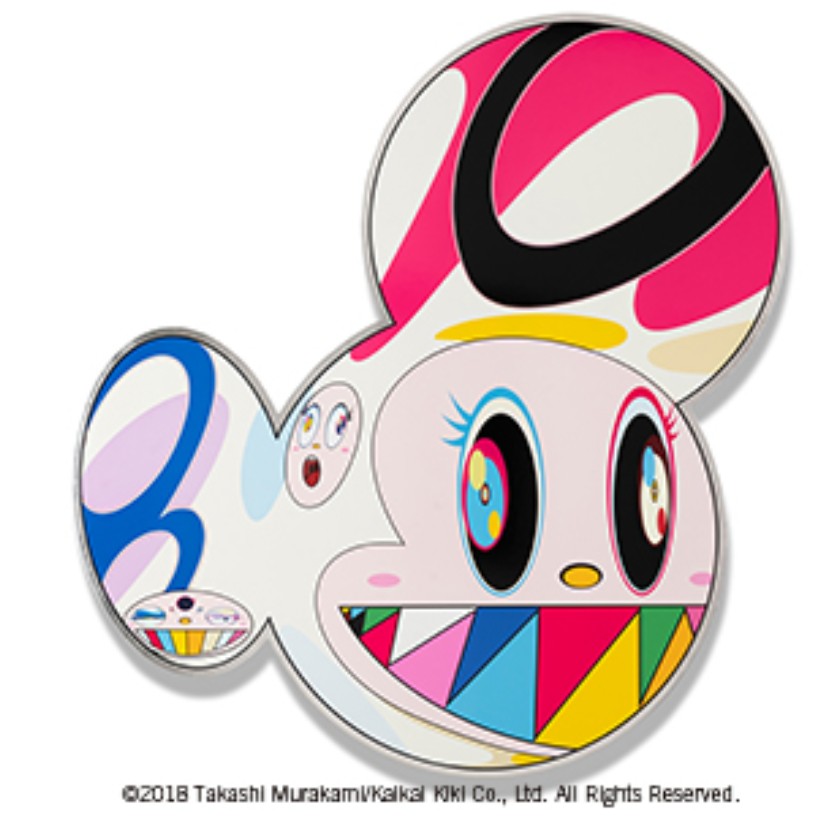
DOB Jagged, 2018
Acrylic and platinum leaf on canvas mounted on wood panel
150x150x5 cm (59x59x2 inches)
Signed and dated on the reverse
USD 100,000
Murakami.Flower #8321 Many-layered Flower, 2022
Phillips New-York: 28 February 2026
Estimated: USD 80,000 – 120,000
USD 96,750
Takashi Murakami Modern & Contemporary Art

TAKASHI MURAKAMI
Murakami.Flower #8321 Many-layered Flower, 2022
Acrylic on canvas mounted on aluminum frame
60.3 x 60.3 cm (23 3/4 x 23 3/4 inches)
Signed with the artist’s initials and monogram and dated “TM 2022” on the overlap
Variously inscribed on the stretcher
Untitled (Mr. Dob – Magenta), 2020-2021
Sotheby’s Hong-Kong: 30 March 2026
Estimated: HKD 300,000 – 500,000
HKD 332,800 / USD 42,505
Takashi Murakami 村上隆 | Untitled (Mr. Dob – Magenta) 無題(Mr. Dob – 桃紅色)
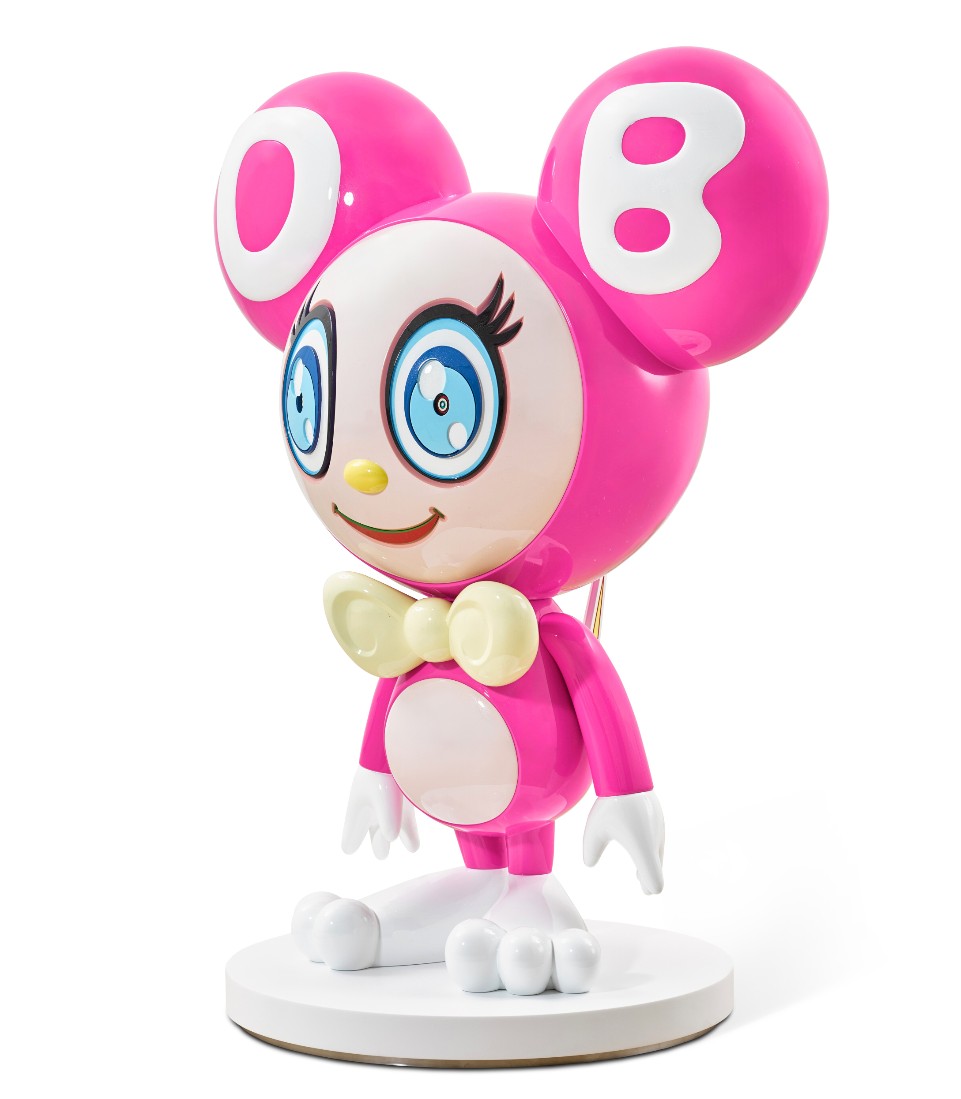
TAKASHI MURAKAMI (b. 1962)
Untitled (Mr. Dob – Magenta), 2020-2021
FRP, urethane paint, stainless steel and wood
Overall: 89x67x37 cm (35 x 26-3/8 x 14-5/8 inches)
Signed, numbered 2/20 and dated 2020 – 2021 (on the underside)
This work is number 2 from an edition of 20
© 2020-2021 Takashi Murakami./Kaikai Kiki Co., Ltd. All Rights Reserved
Untitled (Mr. Dob – Multicolor), 2020
Sotheby’s Hong-Kong: 30 March 2026
Estimated: HKD 300,000 – 500,000
HKD 332,800 / USD 42,505
Takashi Murakami 村上隆 | Untitled (Mr. Dob – Multicolour) 無題(Mr. Dob –
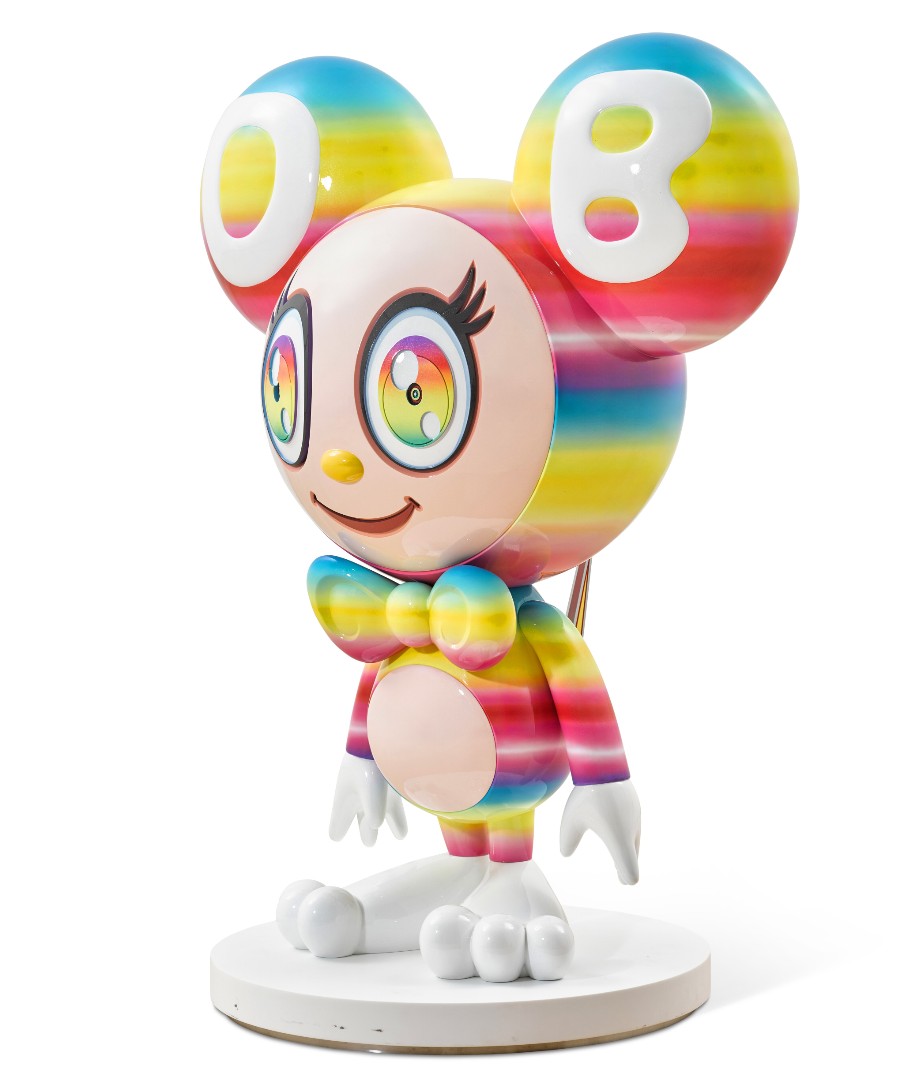
TAKASHI MURAKAMI (b. 1962)
Untitled (Mr. Dob – Multicolor), 2020
FRP, urethane paint, stainless steel and wood
Overall: 89x67x37 cm (35 x 26-3/8 x 14-5/8 inches)
Signed, numbered 2/20 and dated 2020 – 2021 (on the underside)
This work is number 4 from an edition of 20
© 2020-2021 Takashi Murakami./Kaikai Kiki Co., Ltd. All Rights Reserved
Lots Passed
Flower of Joy – Violet, 2007
Christie’s London: 7 March 2026
Estimated: GBP 50,000 – 70,000
PASSED
TAKASHI MURAKAMI (B. 1962), Flower of Joy – Violet | Christie’s
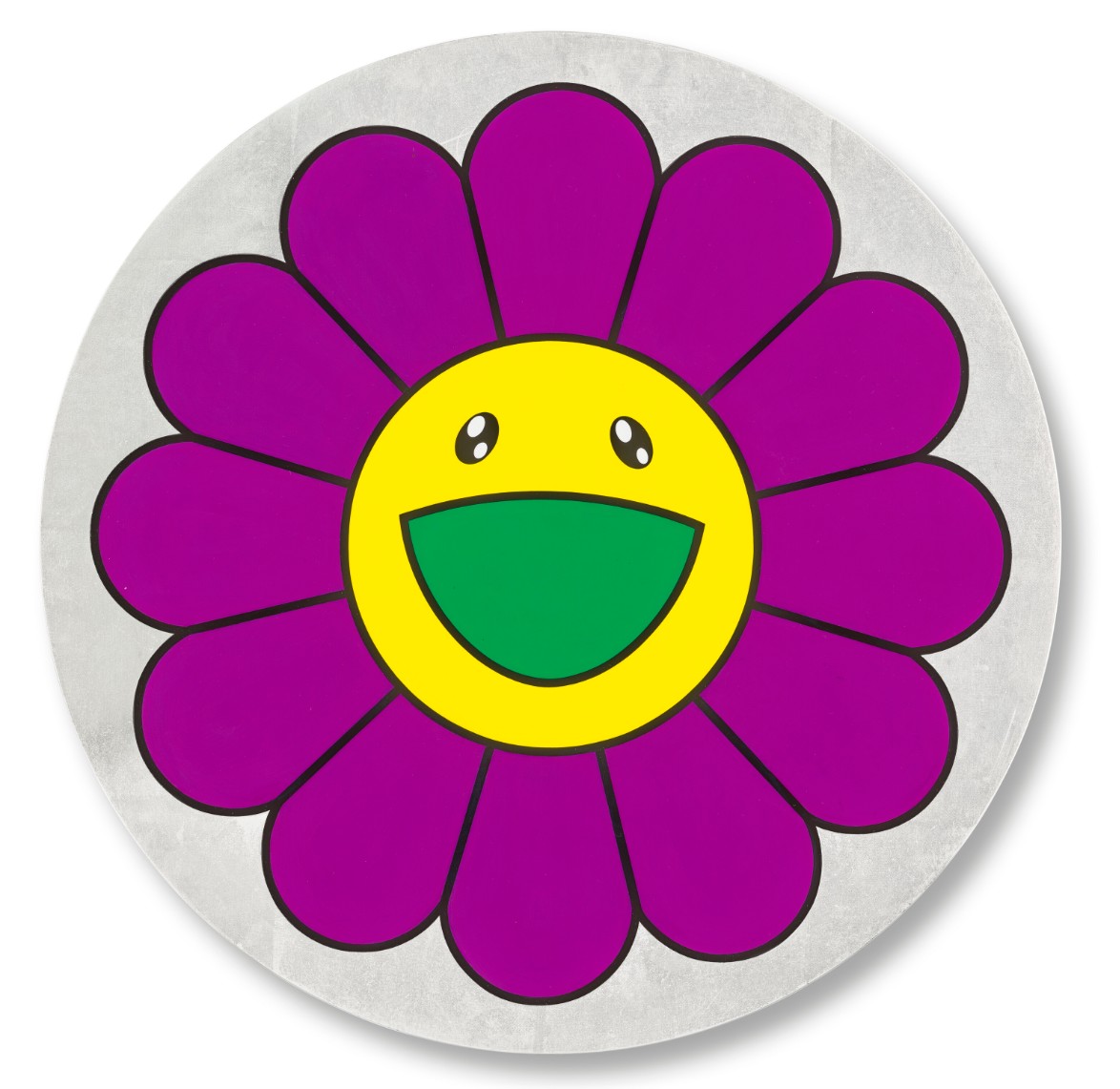
TAKASHI MURAKAMI (B. 1962)
Flower of Joy – Violet, 2007
Acrylic and platinum leaf on canvas mounted on board
40 x 40 x 5.1 cm (15-3/4 x 15-3/4 x 2 inches)
Signed and dated ‘Takashi 07’ (on the reverse)
Kyoto Ensō, 2018
Christie’s New-York: 26 February 2026
Estimated: USD 70,000 – 100,000
PASSED
TAKASHI MURAKAMI (B. 1962) & VIRGIL ABLOH (1980-2021), Kyoto Ensō | Christie’s
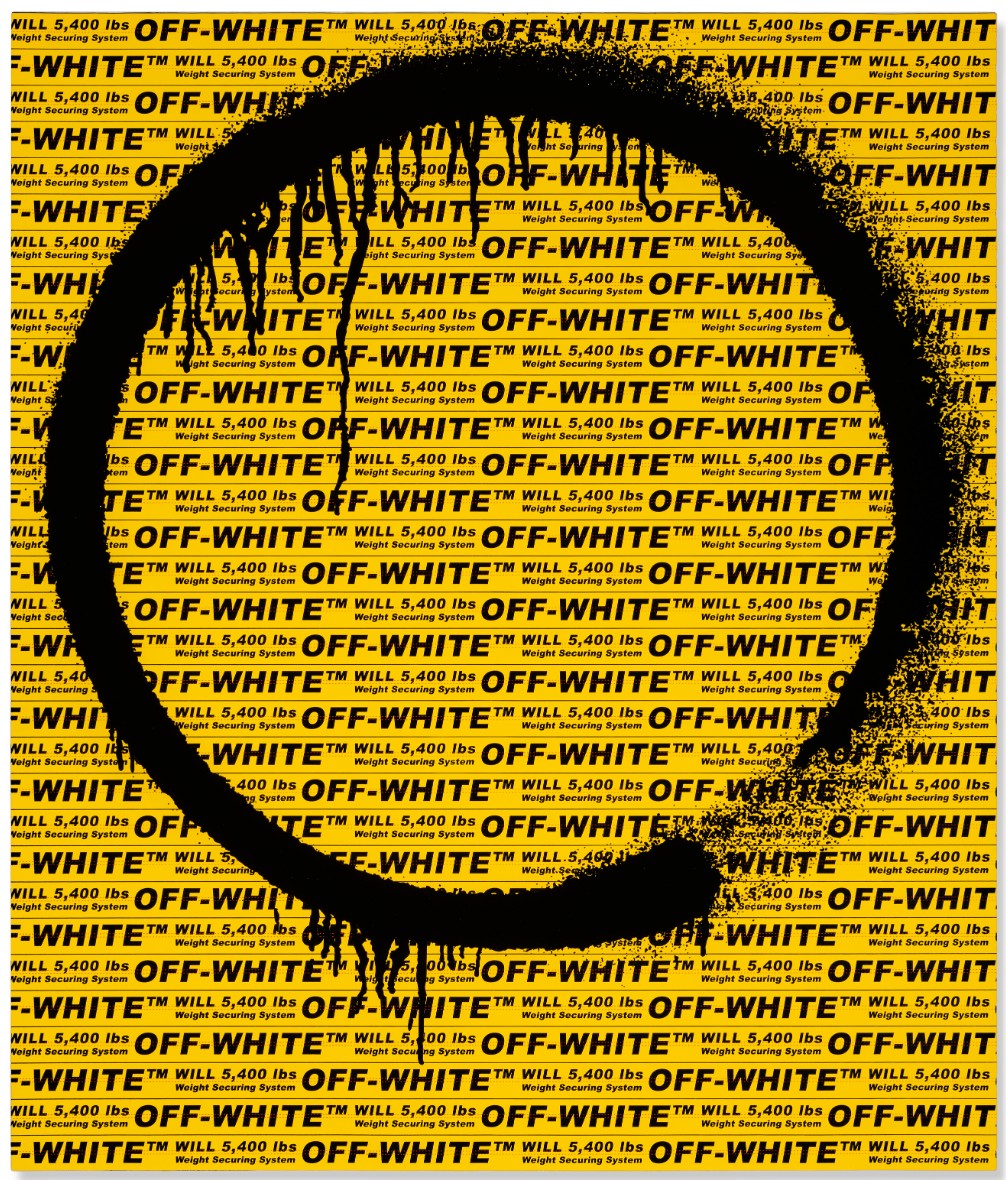
TAKASHI MURAKAMI (B. 1962) & VIRGIL ABLOH (1980-2021)
Kyoto Ensō, 2018
Acrylic on canvas mounted on aluminum
141×120 cm (55-1/2 x 47-1/4 inches)
Signed and dated by each artist ‘”VIRGIL” 2018 TAKASHI 2018’ (on the overlap)
2025 Auction Results
27 lots sold at auction in 2025 for a total turnover of USD 10,118,346. With 5 lots failing to sell, the sell-through rate is 84%. Of note, several lots were withdrawn at Phillips in Hong-Kong in September 2025. The highest price was achieved by the iconic Miss Ko² (Project Ko²), a sculpture dated 1997, that sold at Christie’s in New-York, on 19 November 2025 for USD 2,759,000.
2025 Top 3 Lots
4 lots sold for more than USD 1 million, generating a cumulative turnover of USD 6,742,290, representing 66.6% of the total turnover of 2025 so far.
#1. Miss Ko² (Project Ko²), 1997
Christie’s New-York: 19 November 2025
Estimated: USD 1,800,000 – 2,500,000
USD 2,759,000
READ MORE IN FOCUS SECTION
TAKASHI MURAKAMI (B. 1962), Miss Ko² (Project Ko²) | Christie’s
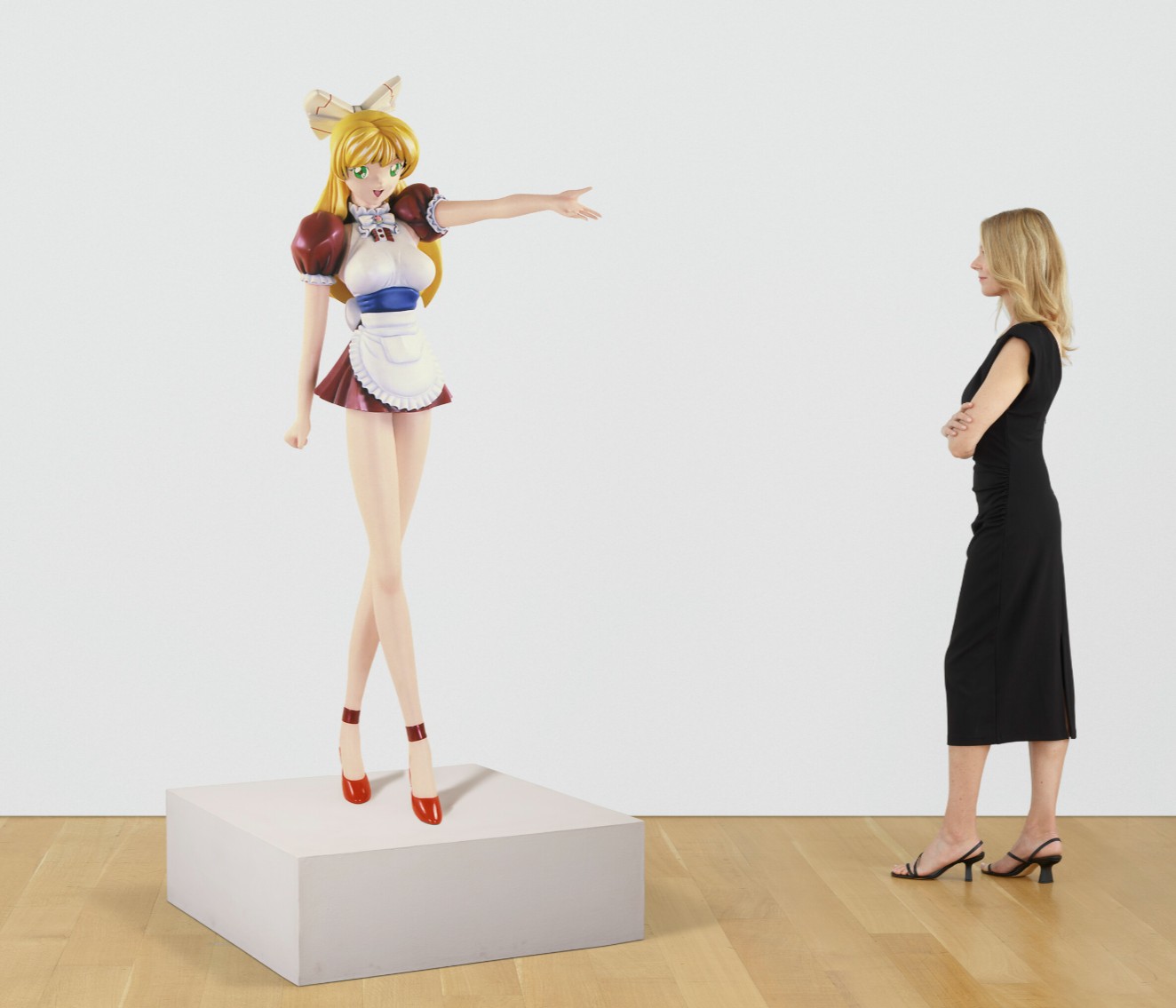
TAKASHI MURAKAMI (B. 1962)
Miss Ko² (Project Ko²), 1997
Fiberglass, iron, acrylic and oil paint
182.9 x 63.5 x 76.2 cm (72x25x30 inches)
This work is number one from an edition of three plus one artist’s proof
#2. Flower Parent and Child, 2021
Sotheby’s Hong-Kong: 28 September 2025
Estimated: HKD 8,000,000 – 16,000,000
HKD 12,575,000 / USD 1,616,325
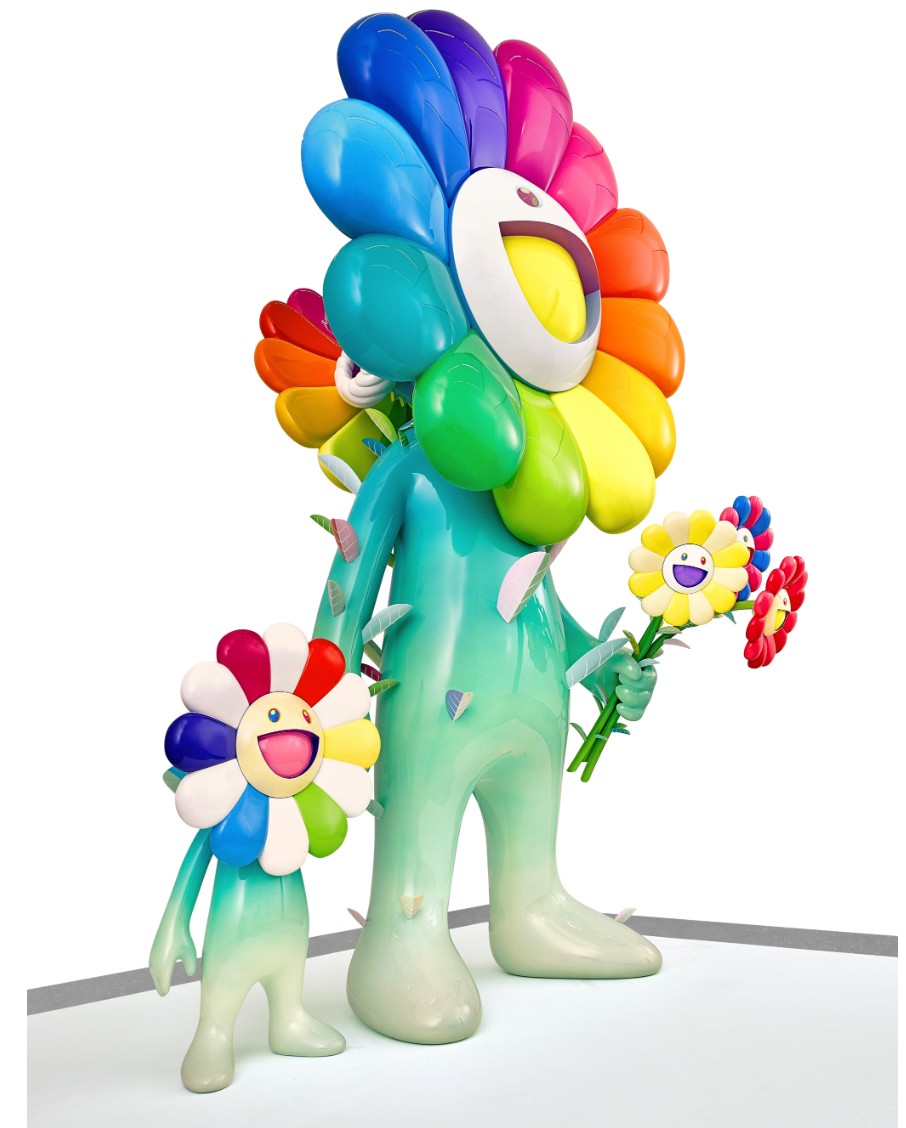
TAKASHI MURAKAMI (b. 1962)
Flower Parent and Child, 2021
Fiber reinforced plastic, urethane paint, stainless steel, wood base
Flower parent: 252x147x94 cm (100 3/8 x 57 7/8 x 37 inches)
Child: 78x46x48 cm (70 3/4 x 18 1/8 x 18 7/8 inches)
Flower bouquet: dimensions variable
Wood base: 15x196x178 cm. (5 7/8 x 77 1/4 x 70 1/8 inches)
Signed, doodled, inscribed color 2 ED, and dated 2021 on the neck base of Flower Parent
© 2021 Takashi Murakami./Kaikai Kiki Co., Ltd. All Rights Reserved.
#3. An Homage to IKB, 1957 E, 2012
Sotheby’s Hong-Kong: 29 March 2025
Estimated: HKD 5,500,000 – 10,000,000
HKD 9,525,000 / USD 1,224,293
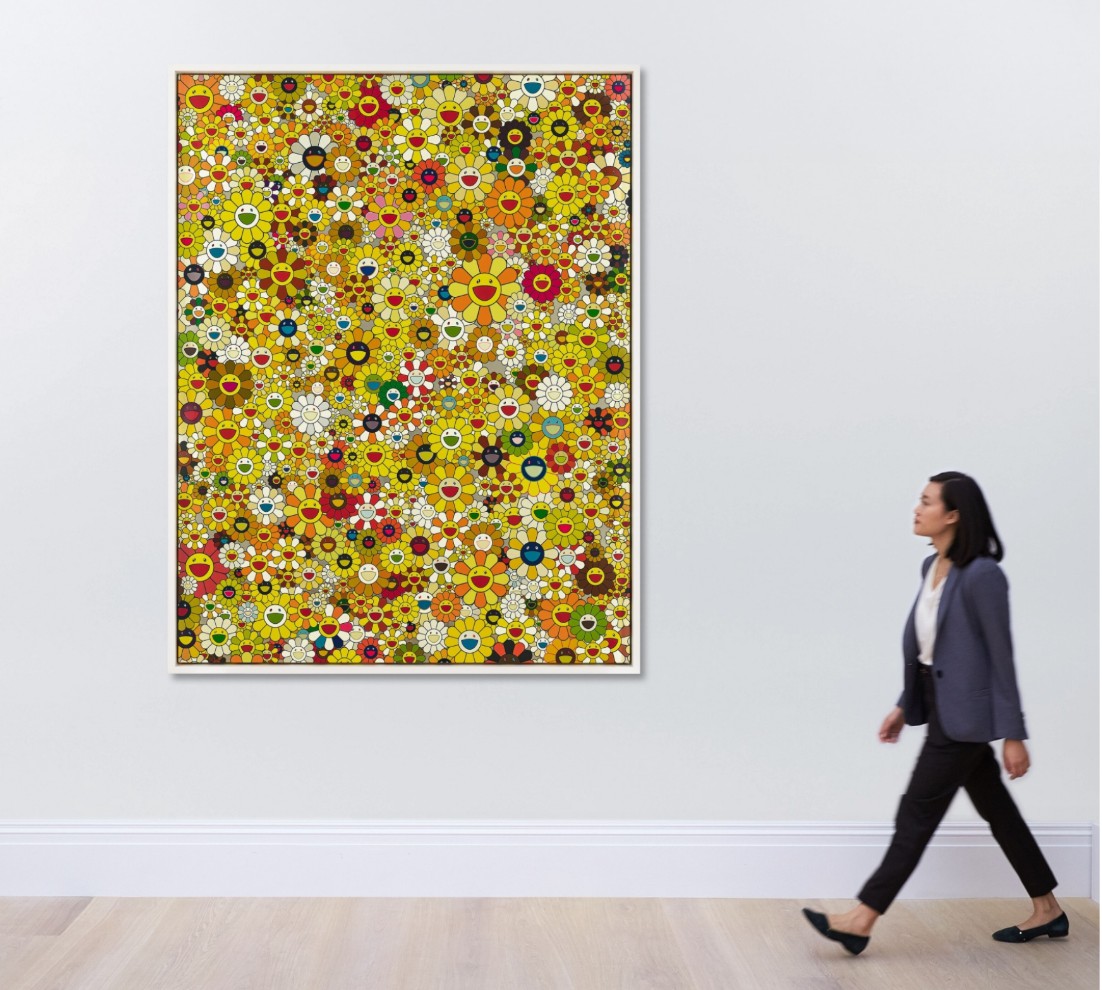
TAKASHI MURAKAMI (b. 1962)
An Homage to IKB, 1957 E, 2012
Acrylic on canvas mounted on board
199×153 cm (78 3/8 x 60 1/4 inches)
Signed and dated 2012 (on the overlap)
© 2012 Takashi Murakami/Kaikai Kiki Co., Ltd. All Rights Reserved
#4. The Double Helix, Reversal, 2001
Christie’s Hong-Kong: 26 September 2025
Estimated: HKD 8,000,000 – 12,000,000
HKD 8,890,000 / USD 1,142,675
TAKASHI MURAKAMI (B. 1962), The Double Helix, Reversal | Christie’s
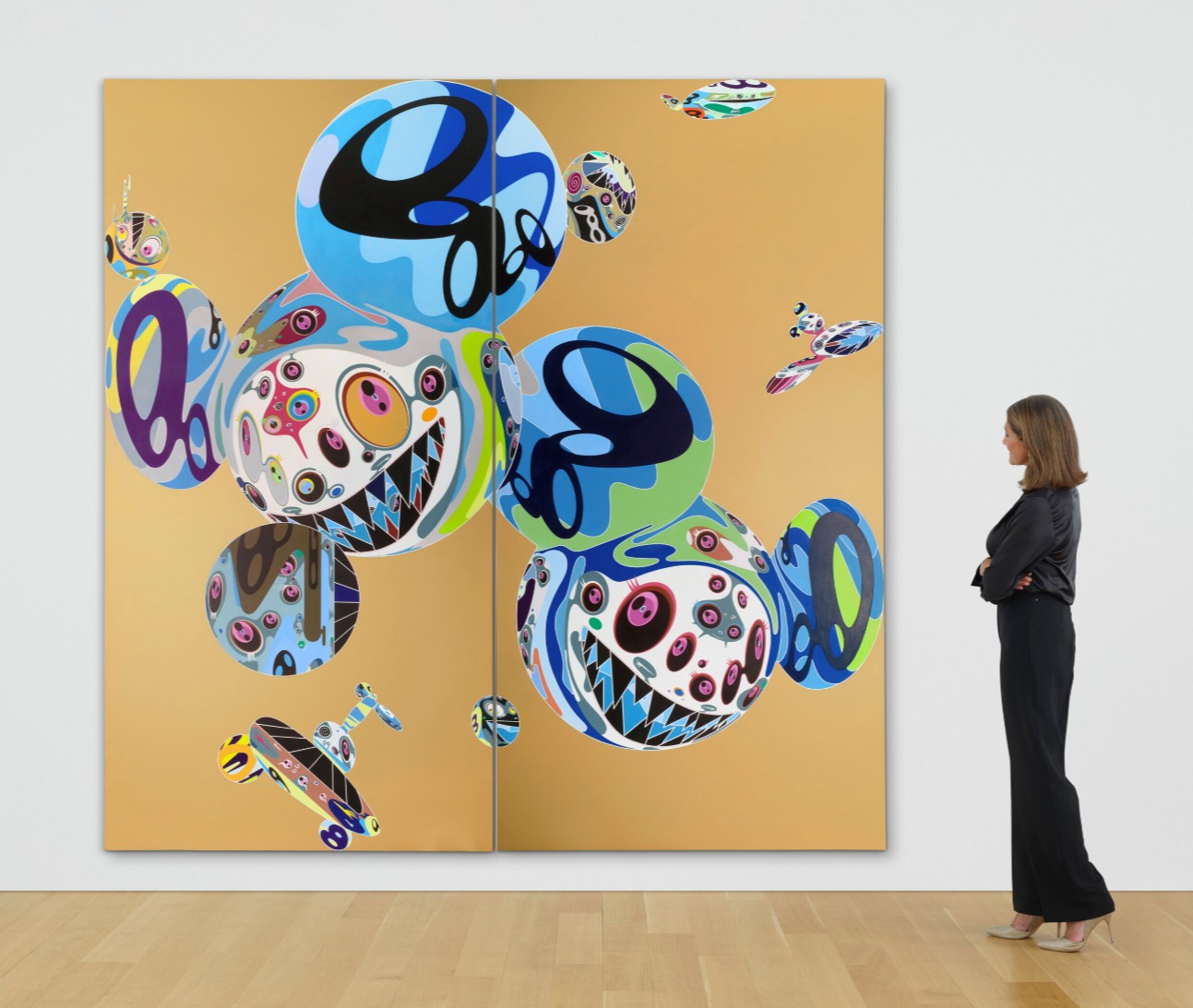
TAKASHI MURAKAMI (B. 1962)
The Double Helix, Reversal, 2001
Acrylic on canvas mounted on wood (diptych)
each: 300×150 cm (118 1/8 x 59 inches)
Overall: 300×300 cm (118 1/8 x 118 1/8 inches)
Signed and dated ‘Takashi 01’ (on the reverse of the left panel)
USD 1 million
#5. Panda, 2003
Sotheby’s London: 5 March 2025
Estimated: GBP 300,000 – 400,000
GBP 546,100 / USD 699,008
Panda | Contemporary Day Auction | 2025 | Sotheby’s
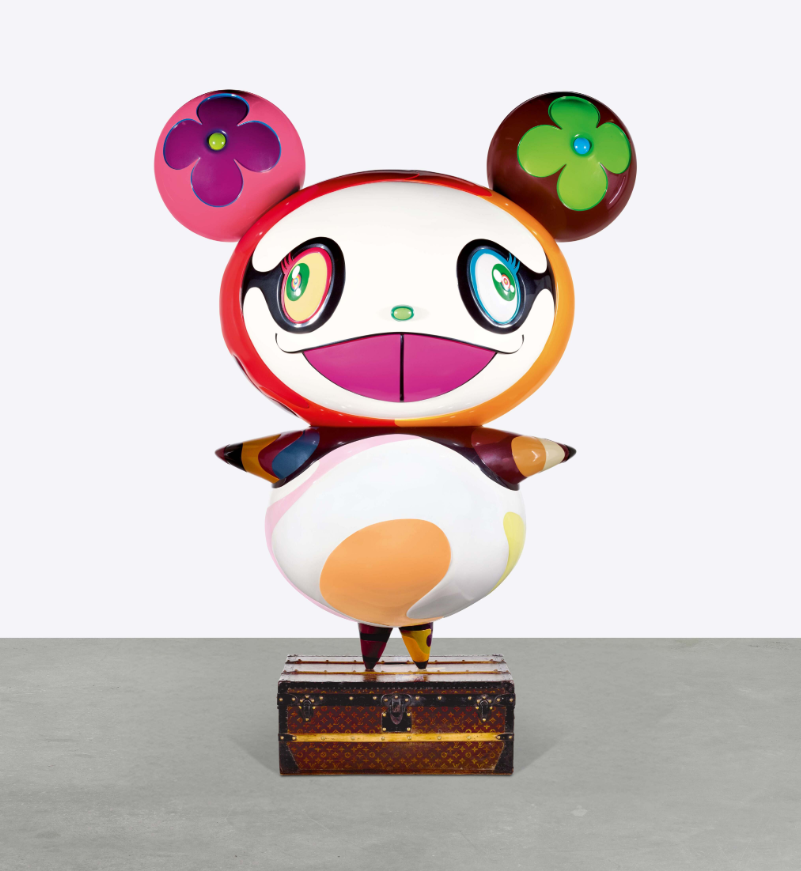
TAKASHI MURAKAMI (b. 1962)
Panda, 2003
Fiberglass with antique Louis Vuitton trunk
Overall: 231x163x113 cm (91 x 61 1/8 x 44 1/2 inches)
Signed, numbered 3/3 and variously inscribed (on the underside of the left ear)
This work is number 3 from an edition of 3, each with a unique Louis Vuitton trunk
USD 500,000
#6. Flower Sparkles!, 2021
Sotheby’s Hong-Kong: 28 September 2025
Estimated: HKD 3,000,000 – 5,000,000
HKD 3,556,000 / USD 457,070
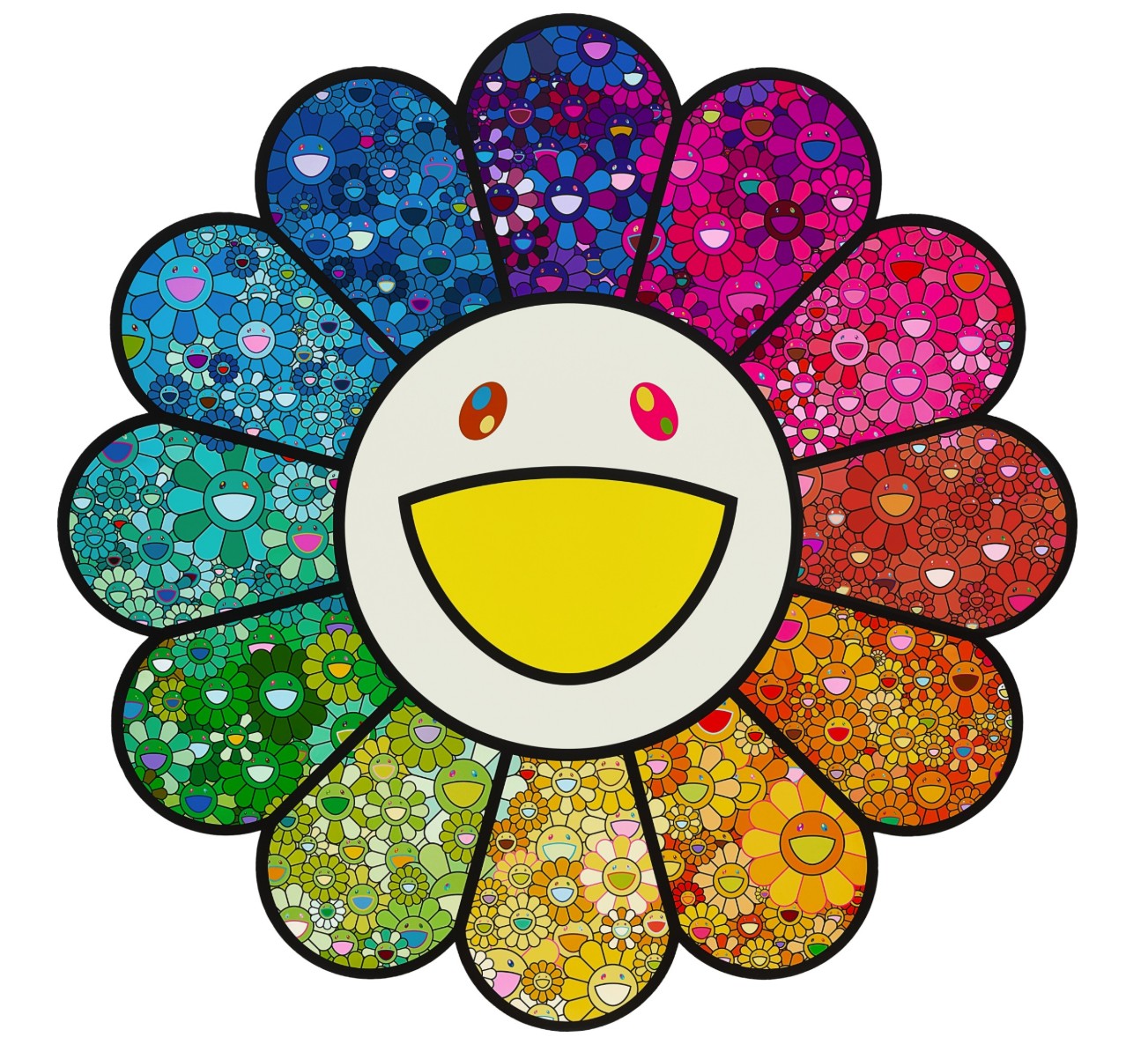
TAKASHI MURAKAMI (b. 1962)
Flower Sparkles!, 2021
Acrylic on canvas mounted on wood panel
150×150 cm (59×59 inches)
Signed and dated 2021 (on the reverse)
© 2021 Takashi Murakami/Kaikai Kiki Co., Ltd. All Rights Reserved
#7. Blackbeard (White), 2003
Sotheby’s London: 17 October 2025
Estimated: GBP 150,000 – 200,000
GBP 317,500 / USD 425,450
Blackbeard (White) | Contemporary Day Auction | 2025 | Sotheby’s
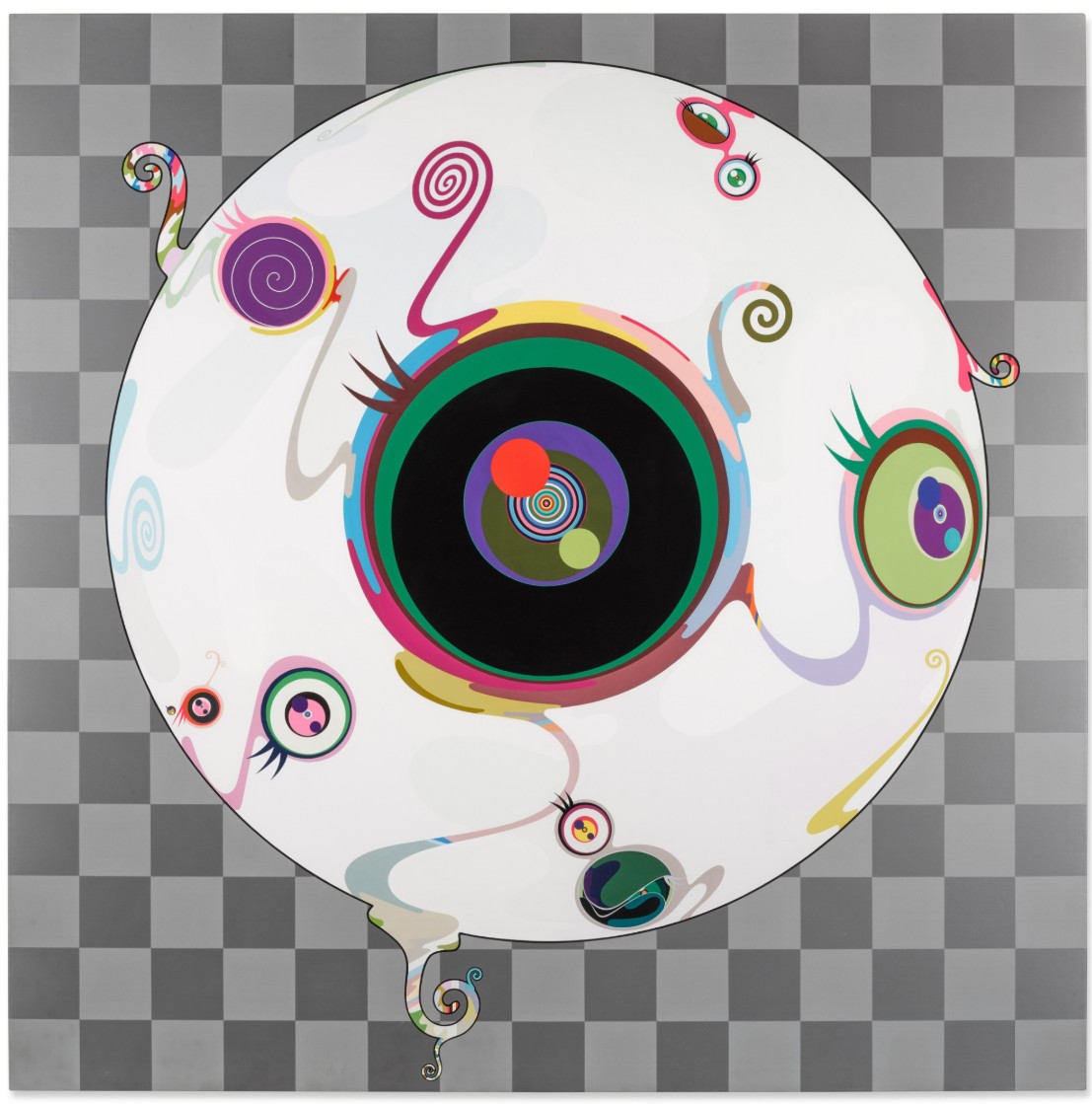
TAKASHI MURAKAMI (b. 1962)
Blackbeard (White), 2003
Acrylic on canvas mounted on panel
150×150 cm (59×59 inches)
Signed, signed with the artist’s monogram, dated 03 and variously inscribed (on the reverse)
#8. AND THEN (Platinum), 2006
Sotheby’s New-York: 16 May 2025
Estimated: USD 250,000 – 350,000
USD 279,400
AND THEN (Platinum) | Contemporary Day Auction | 2025 | Sotheby’s
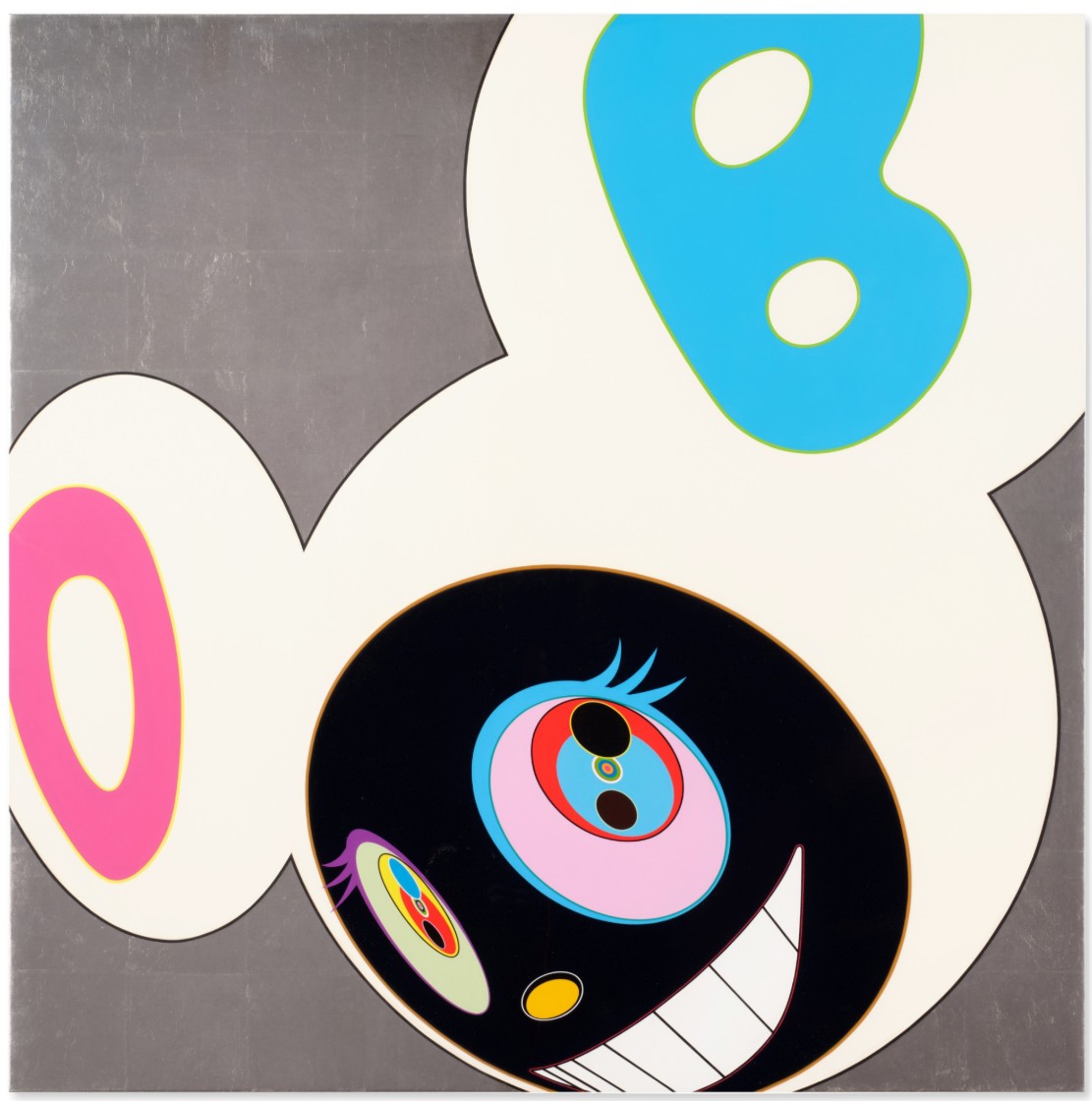
TAKASHI MURAKAMI (b. 1962)
AND THEN (Platinum), 2006
Acrylic and platinum leaf on canvas mounted on wood
100×100 cm (39 3/8 x 39 3/8 inches)
Signed and variously inscribed (on the reverse)
#9. Untitled (In Collaboration with MADSAKI), 2017
Christie’s Hong-Kong: 27 September 2025
Estimated: HKD 800,000 – 1,500,000
HKD 1,651,000 / USD 212,230
TAKASHI MURAKAMI (B. 1962), Untitled (In Collaboration with MADSAKI) | Christie’s
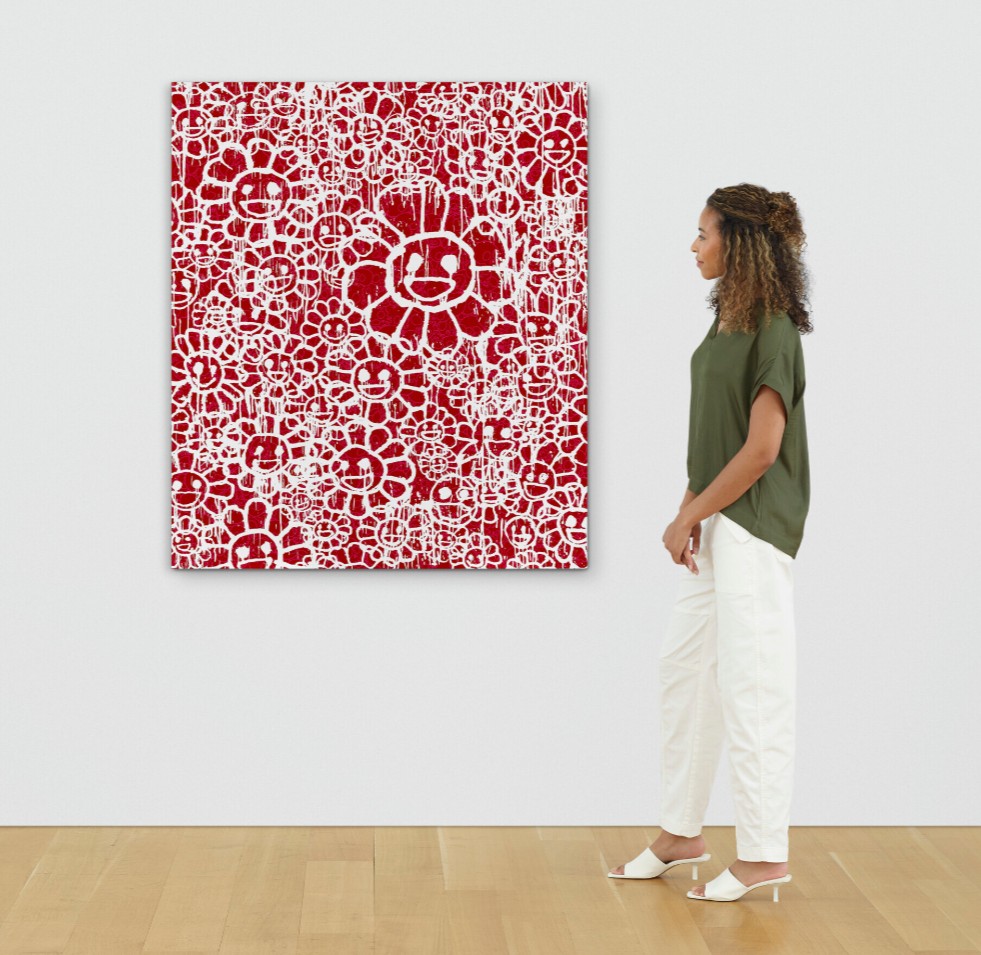
TAKASHI MURAKAMI (B. 1962)
Untitled (In Collaboration with MADSAKI), 2017
Acrylic on canvas
141.5 x 120 cm (55 3/4 x 47 1/4 inches)
Signed and dated ‘TAKASHI 2017.’ (on the overlap)
USD 200,000
#10. Doraemon: Time with Friends, 2019
Estimated: HKD 1,500,000 – 2,500,000
HKD 1,134,000 / USD 145,758
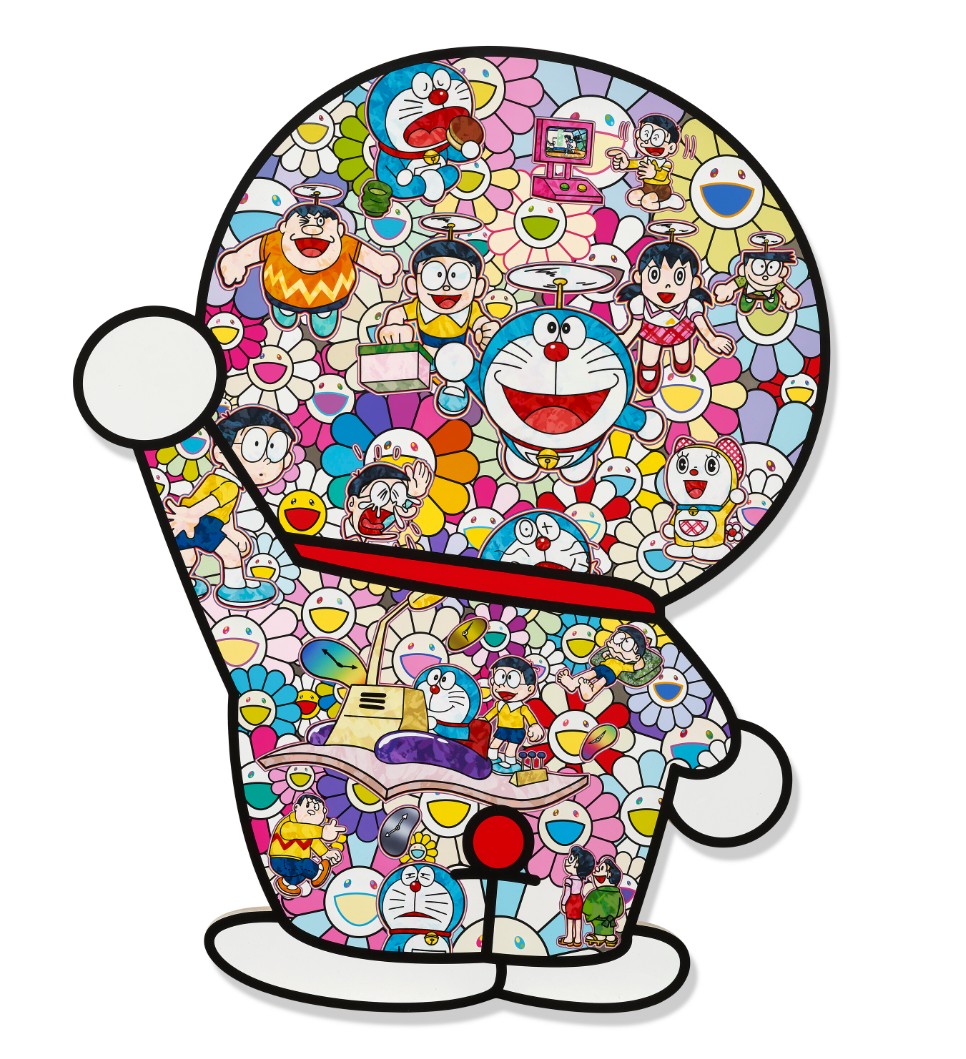
TAKASHI MURAKAMI (B. 1962)
Doraemon: Time with Friends, 2019
Acrylic, platinum leaf and gold leaf on canvas mounted on wood panel
120 x 93.6 cm (47 1/4 x 36 7/8 inches)
Signed with the artist’s signature and dated ‘2019’ (on the reverse)
#11. Flower Ball, 2015
China Guardian Hong-Kong: 8 October 2025
Estimated: HKD 900,000 – 1,500,000
HKD 1,080,000 / USD 138,780
Auction | China Guardian (HK) Auctions Co., Ltd.
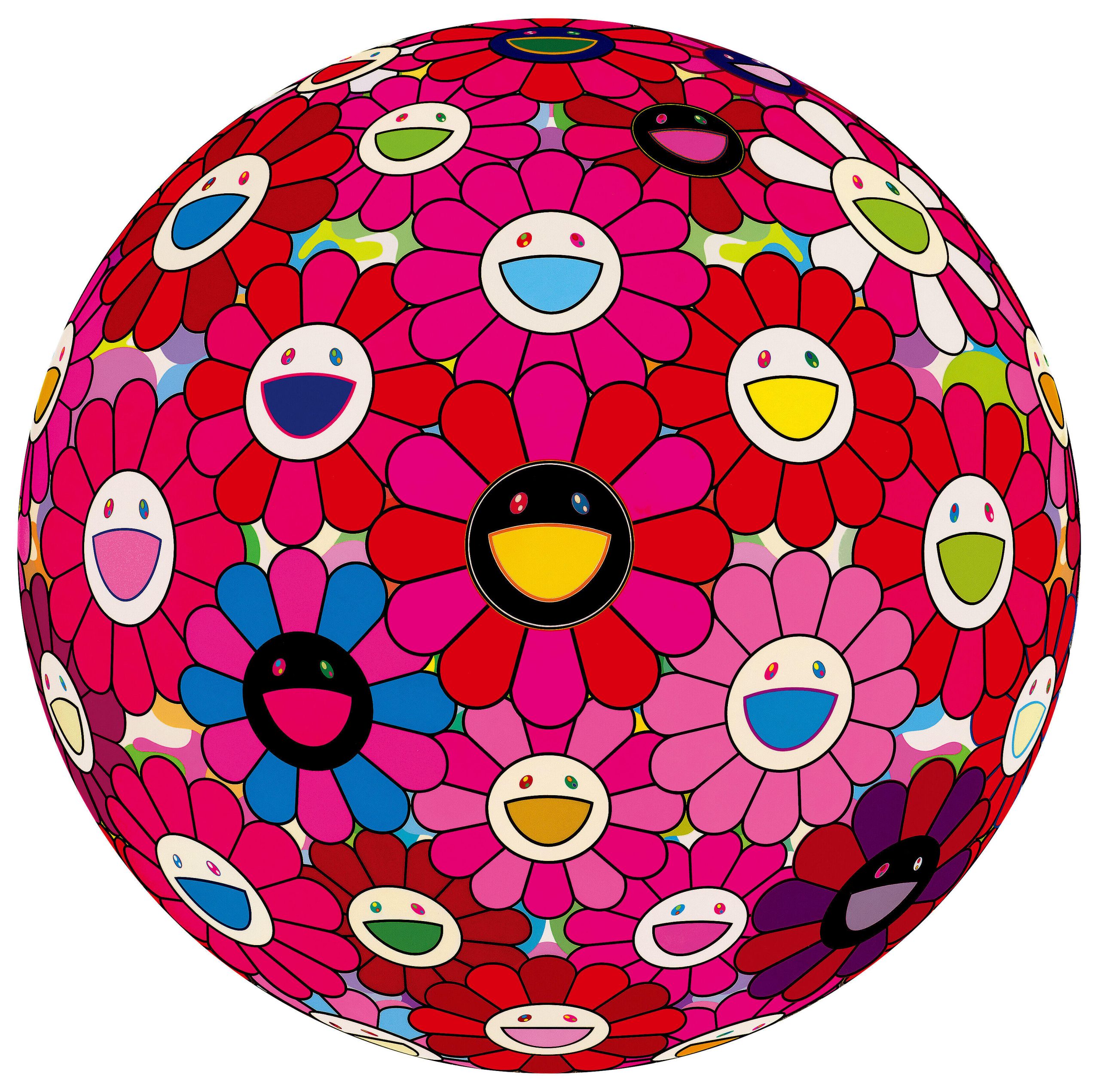
TAKASHI MURAKAMI (b. 1962)
Flower Ball, 2015
Acrylic and silver leaf on canvas mounted on board
Diameter: 100 cm (39 3/8 inches)
Signed in English and dated on the reverse
#12. Untitled, 2019
Christie’s Hong-Kong: 27 September 2025
Estimated: HKD 500,000 – 800,000
HKD 952,500 / USD 122,430
TAKASHI MURAKAMI (B. 1962), Untitled | Christie’s
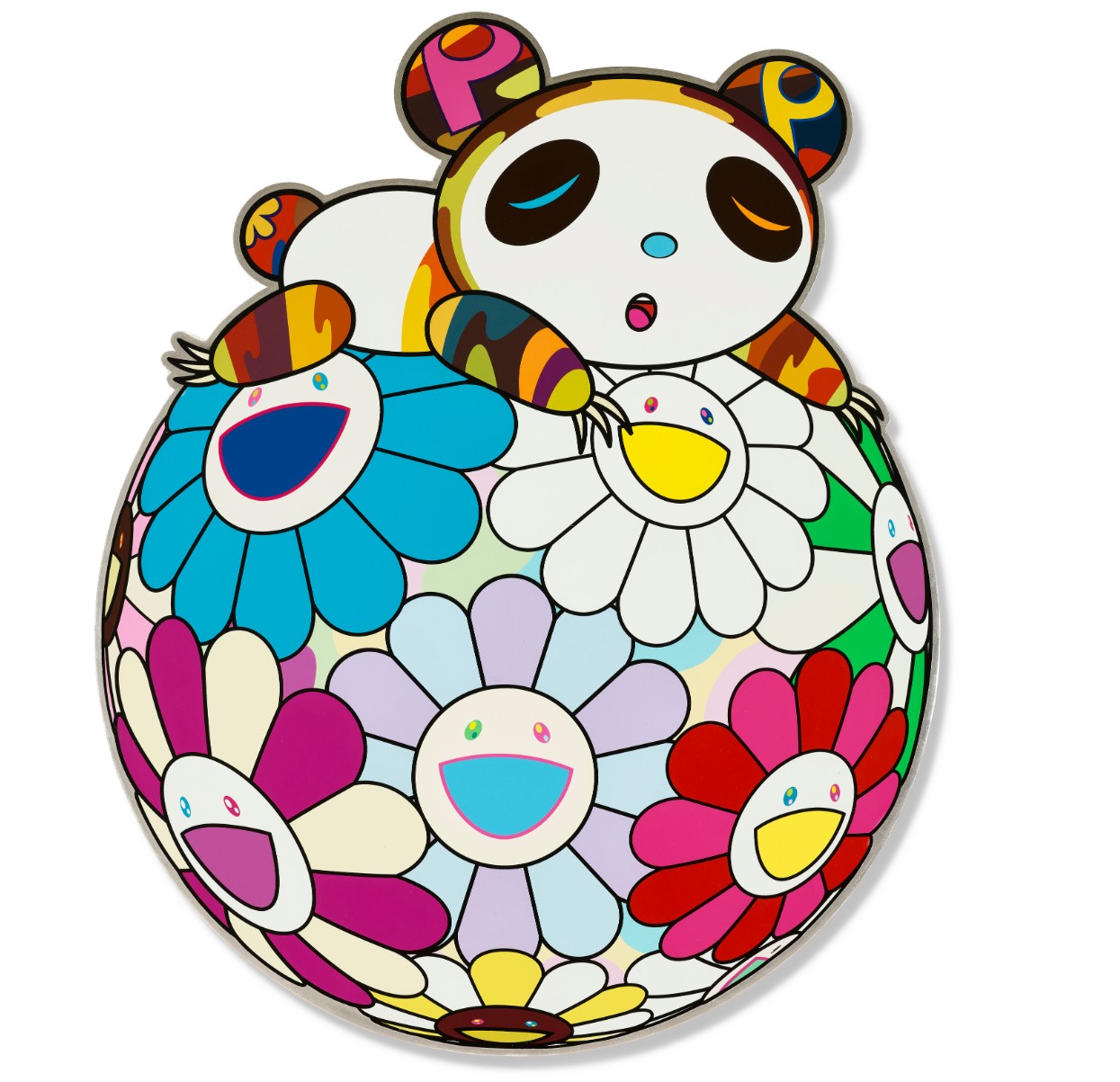
TAKASHI MURAKAMI (B. 1962)
Untitled, 2019
Acrylic on canvas mounted on wood panel
78.3 x 63.4 cm (30 7/8 x 25 inches)
Signed with the artist’s signature and dated ‘2019’ (on the reverse)
#13. Monogramouflage, 2008
Christie’s Hong-Kong: 29 March 2025
Estimated: HKD 700,000 – 900,000
HKD 882,000 / USD 113,368
TAKASHI MURAKAMI (B. 1962), Monogramouflage | Christie’s
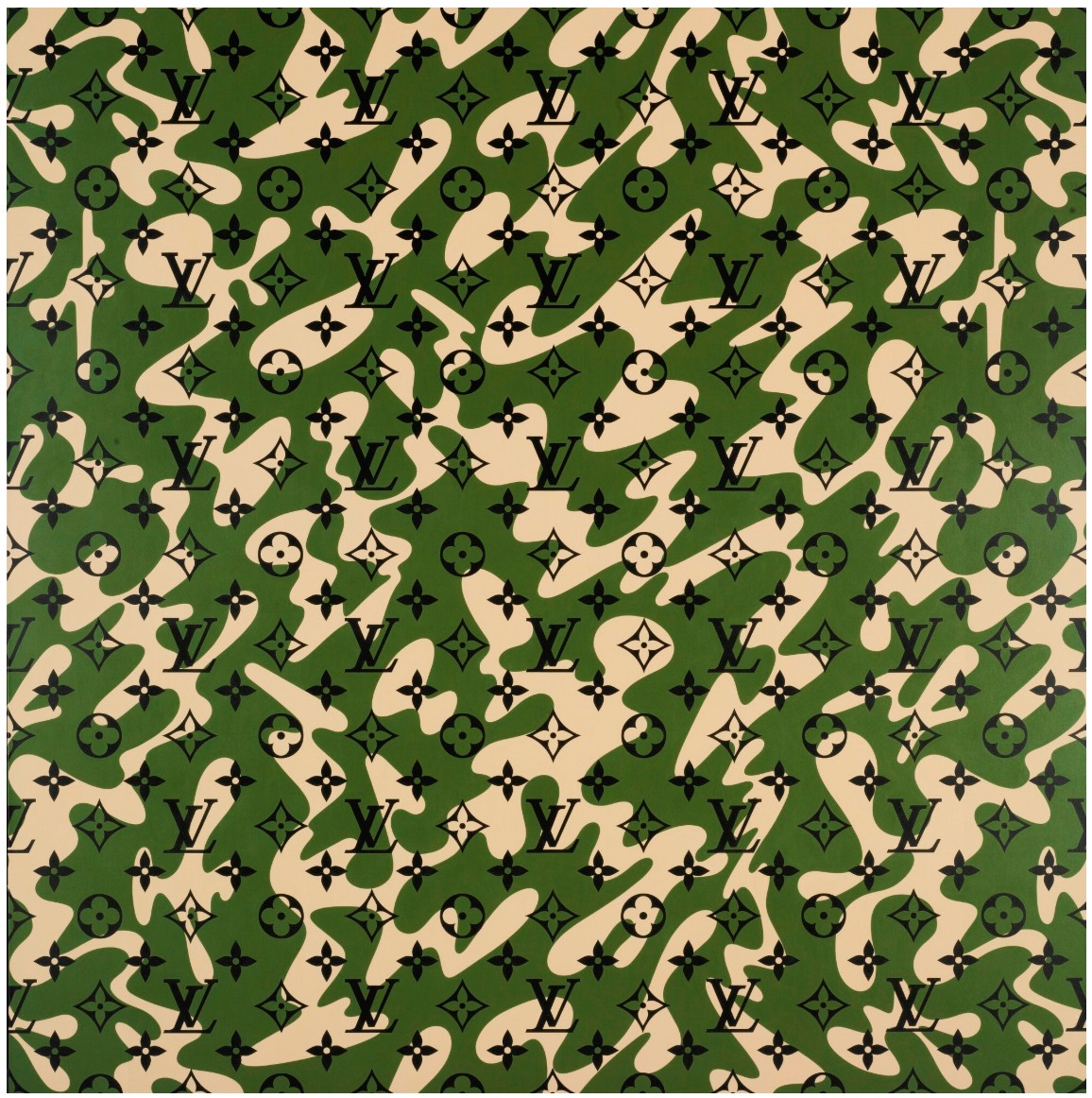
TAKASHI MURAKAMI (B. 1962)
Monogramouflage, 2008
Acrylic on canvas mounted on aluminum frame
180.3 x 180.3 cm (71×71 inches)
Signed with the artist’s signature and dated ’08’ (on the stretcher)
#14. I HATE DEATH: Red, 2014
SBI Art Auction: 23 May 2025
Estimated: JPY 12,000,000 – 18,000,000
JPY 14,375,000 / USD 100,840
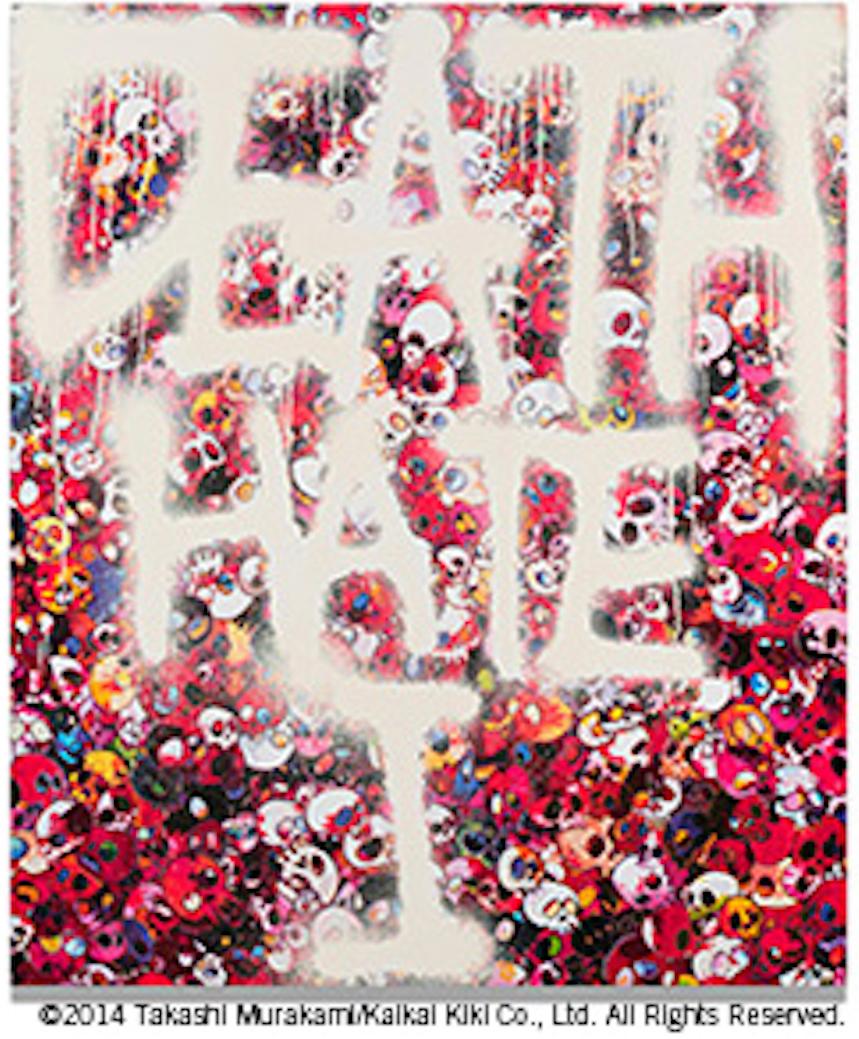
MURAKAMI Takashi
I HATE DEATH: Red, 2014
Acrylic on canvas
141×120 cm (55 1/2 x 47 1/4 inches)
Signed and dated on the reverse
USD 100,000
#15. Ensō: Memento Mori Blue on Red, 2015
Christie’s Hong-Kong: 30 May 2025
Estimated: HKD 500,000 / 800,000
HKD 756,000 / USD 96,570
TAKASHI MURAKAMI (B. 1962), Ensō: Memento Mori Blue on Red | Christie’s
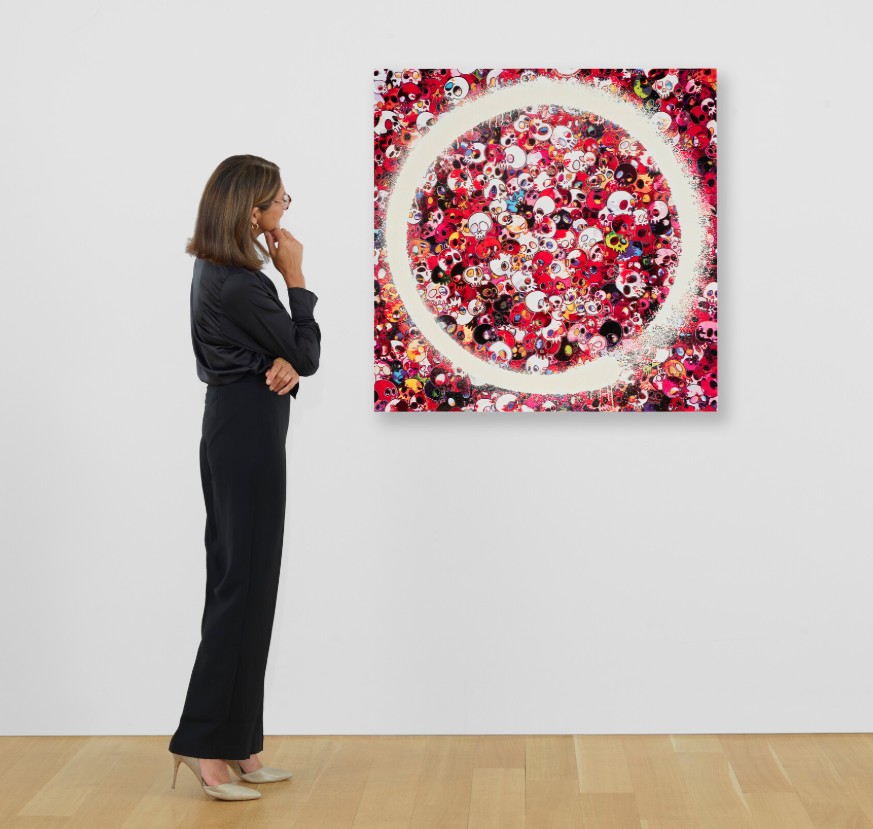
TAKASHI MURAKAMI (B. 1962)
Ensō: Memento Mori Blue on Red, 2015
Acrylic on canvas mounted on aluminum frame
100×100 cm (39 3/8 x 39 3/8 inches)
Signed and dated ‘Takashi 2015’ (on the overlap)
#16. Murakami.Flower #6463 Meander, 2022
Phillips London: 7 March 2025
Estimated: GBP 60,000 – 80,000
GBP 63,500 / USD 81,280
Takashi Murakami – Modern & Contempor… Lot 195 March 2025 | Phillips

TAKASHI MURAKAMI
Murakami.Flower #6463 Meander, 2022
Acrylic on canvas
60.3 x 60.3 cm (23 3/4 x 23 3/4 inches)
Signed and dated ‘Takashi Murakami 2022’ on the overlap
#17. Eye Love SUPERFLAT, 2003
Phillips Hong-Kong: 27 May 2025
Estimated: HKD 200,000 – 400,000
HKD 609,600 / USD 78,360
Takashi Murakami Modern & Contemporary Art: Evening & Day Sale
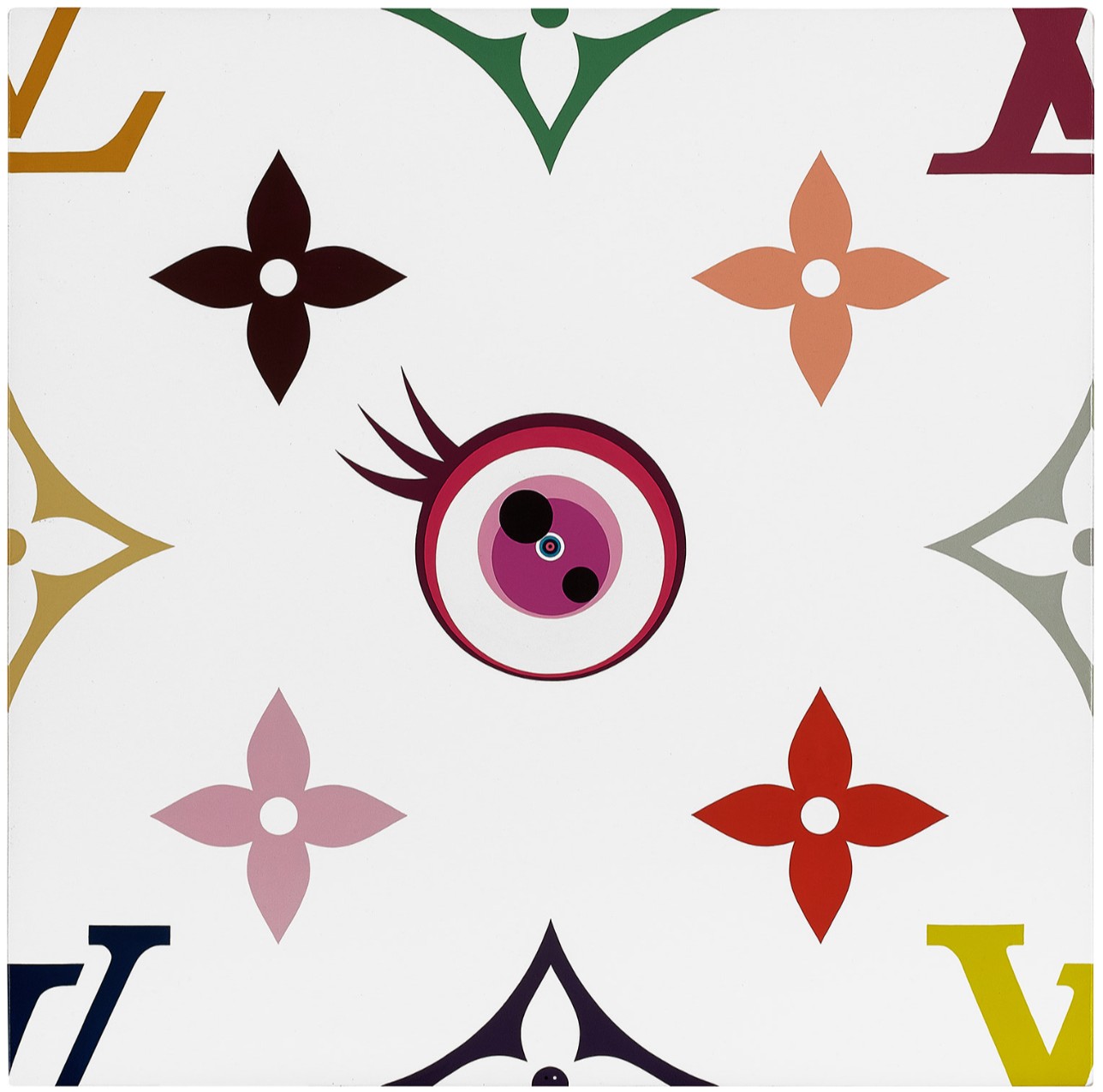
Acrylic on canvas
40×40 cm (15 3/4 x 15 3/4 inches)
#18. Magician, 1996
Christie’s Hong-Kong: 28 November 2025
Estimated: HKD 300,000 – 500,000
HKD 508,000 / USD 65,305
TAKASHI MURAKAMI (B. 1962), Magician | Christie’s
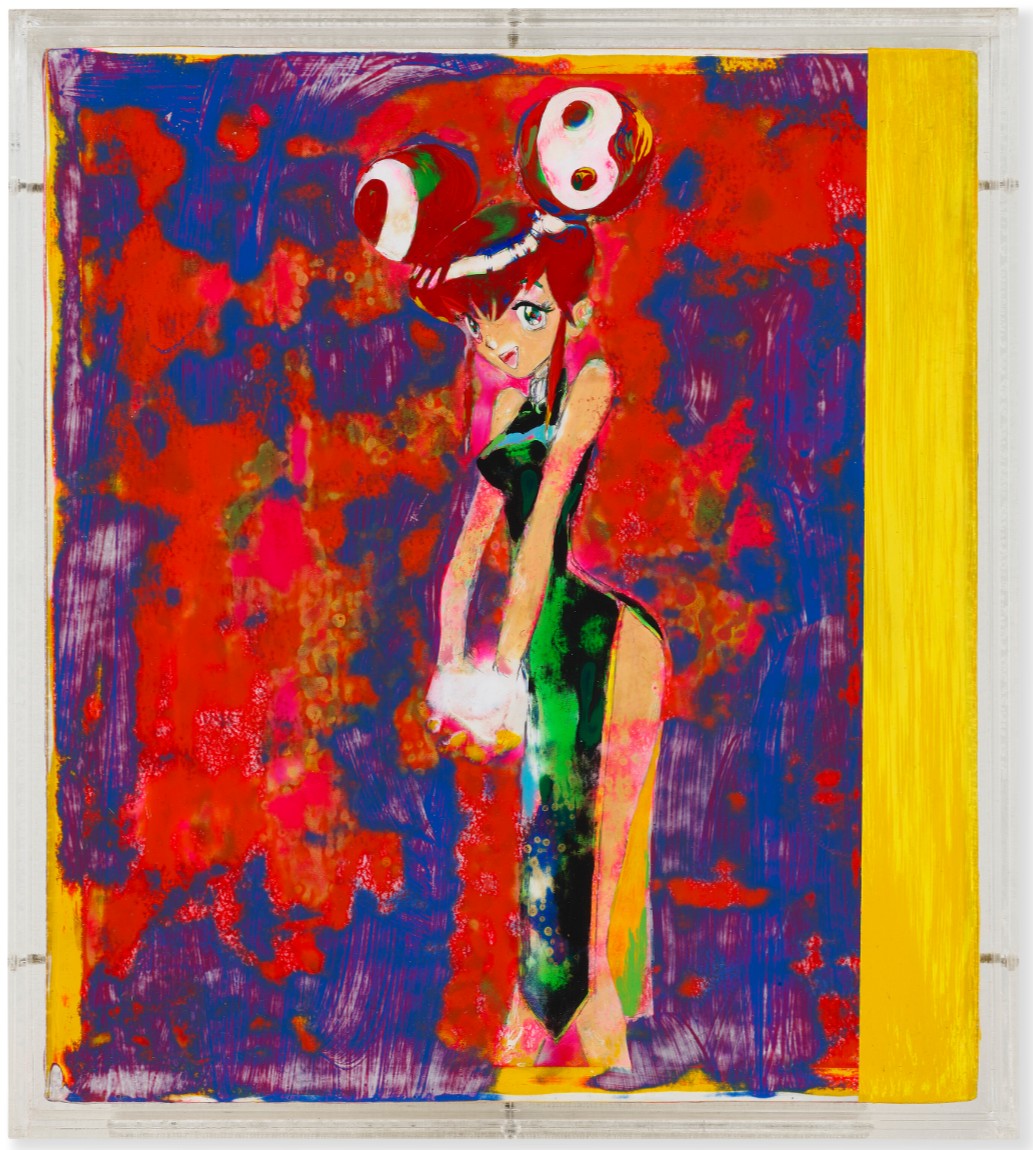
TAKASHI MURAKAMI (B. 1962)
Magician, 1996
Acrylic on board
31 x 27.3 cm. (12 1/4 x 10 3/4 inches)
Signed, dated and titled in Japanese ‘TAKASHI ’96’ (on the reverse)
#19. Murakami.Flower #6006 Patch, 2022
Sotheby’s New-York: 19 November 2025
Estimated: USD 60,000 – 80,000
USD 63,500
Murakami.Flower #6006 Patch | Contemporary Day Auction | 2025 | Sotheby’s

TAKASHI MURAKAMI (b. 1962)
Murakami.Flower #6006 Patch, 2022
Acrylic on canvas mounted on aluminum frame
60×60 cm (23 5/8 x 23 5/8 inches)
Signed and dated 2022 (on the overlap)
#20. Jellyfish Eyes × e-ma Flower Stand Happy Rainbow, 2013
Phillips Hong-Kong: 28 September 2025
Estimated: HKD 180,000 – 280,000
HKD 335,400 / USD 43,115
Takashi Murakami Modern & Contemporary Art Day Sale
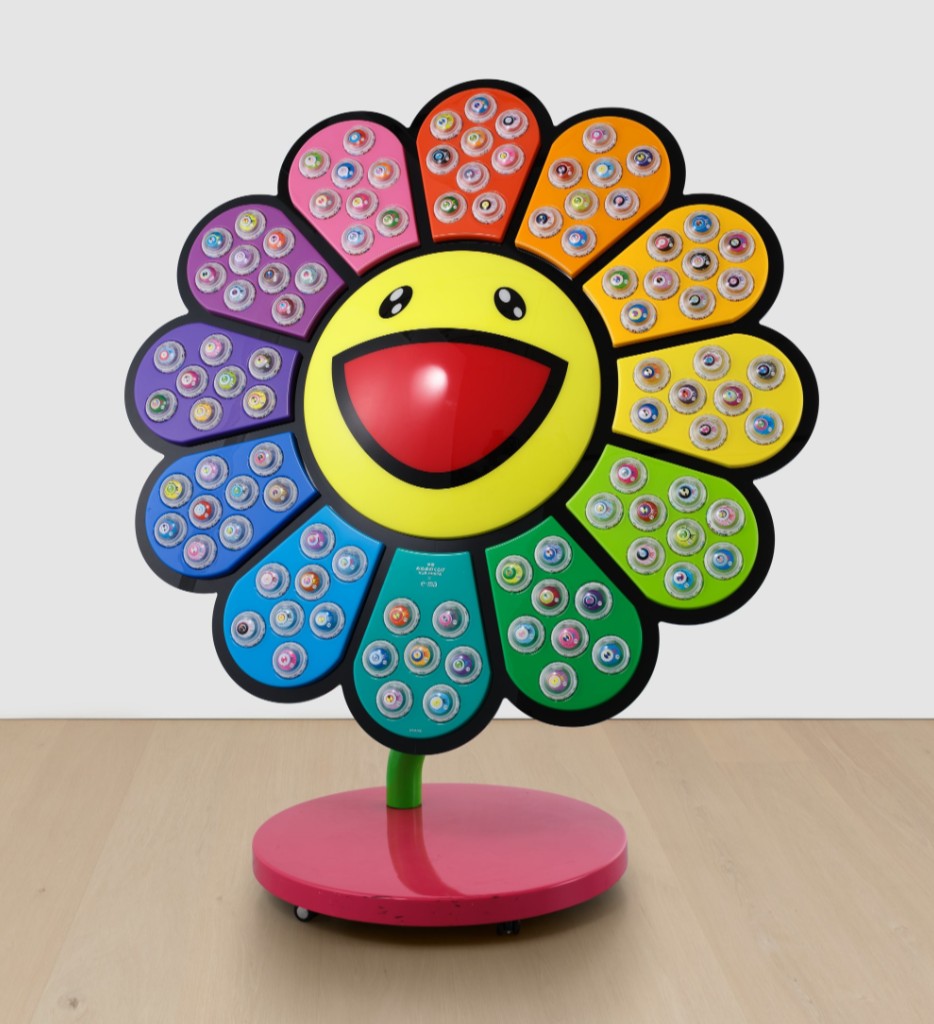
TAKASHI MURAKAMI
Jellyfish Eyes × e-ma Flower Stand Happy Rainbow, 2013
Fabricated plastic flower and 100 candy cases on a painted metal stand with 5 wheels
164x143x75 cm (64 5/8 x 56 1/4 x 29 1/2 inches)
Printed with the title and numbered ‘“Jellyfish Eyes e-ma ” [in Japanese] 14/30′
On a metal plaque affixed to the reverse
Manufactured by Mikakuto Co., Ltd
This work is number 14 from an edition of 30
Created in commemoration of the release of Takashi Murakami’s film “Jellyfish Eyes”
#21. My Lonesome Cowboy, 1997
Mainichi Auction Tokyo: 27 June 2025
Estimated: JPY 500,000 – 700,000
JPY 6,210,000 / USD 42,910
WORK ON PAPER
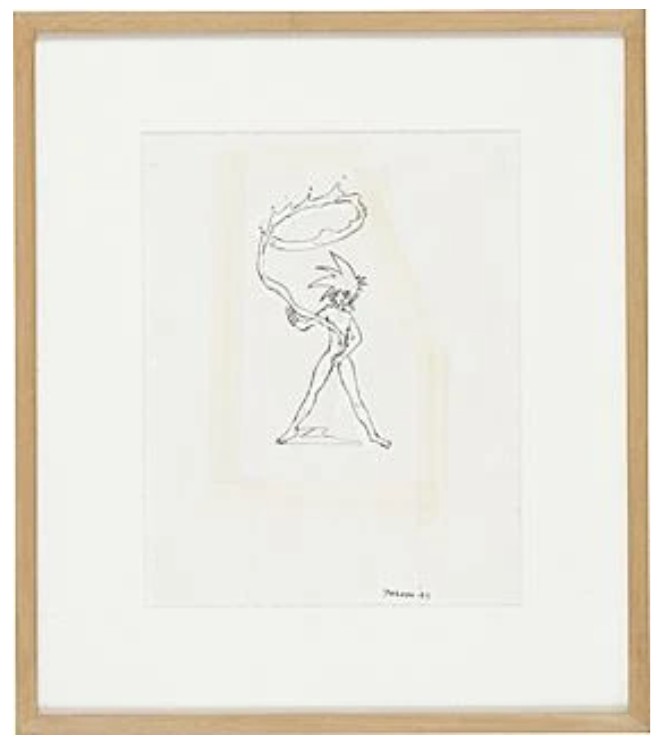
TAKASHI MURAKAMI
My Lonesome Cowboy, 1997
Ink on paper
27.7 x 21.5 cm (10 7/8 x 8 1/2 inches)
Signed
#22. Untitled (Mr. Dob – Yellow), 2020
Sotheby’s Hong-Kong: 27 November 2025
Estimated: HKD 260,000 – 400,000
HKD 330,200 / USD 42,455
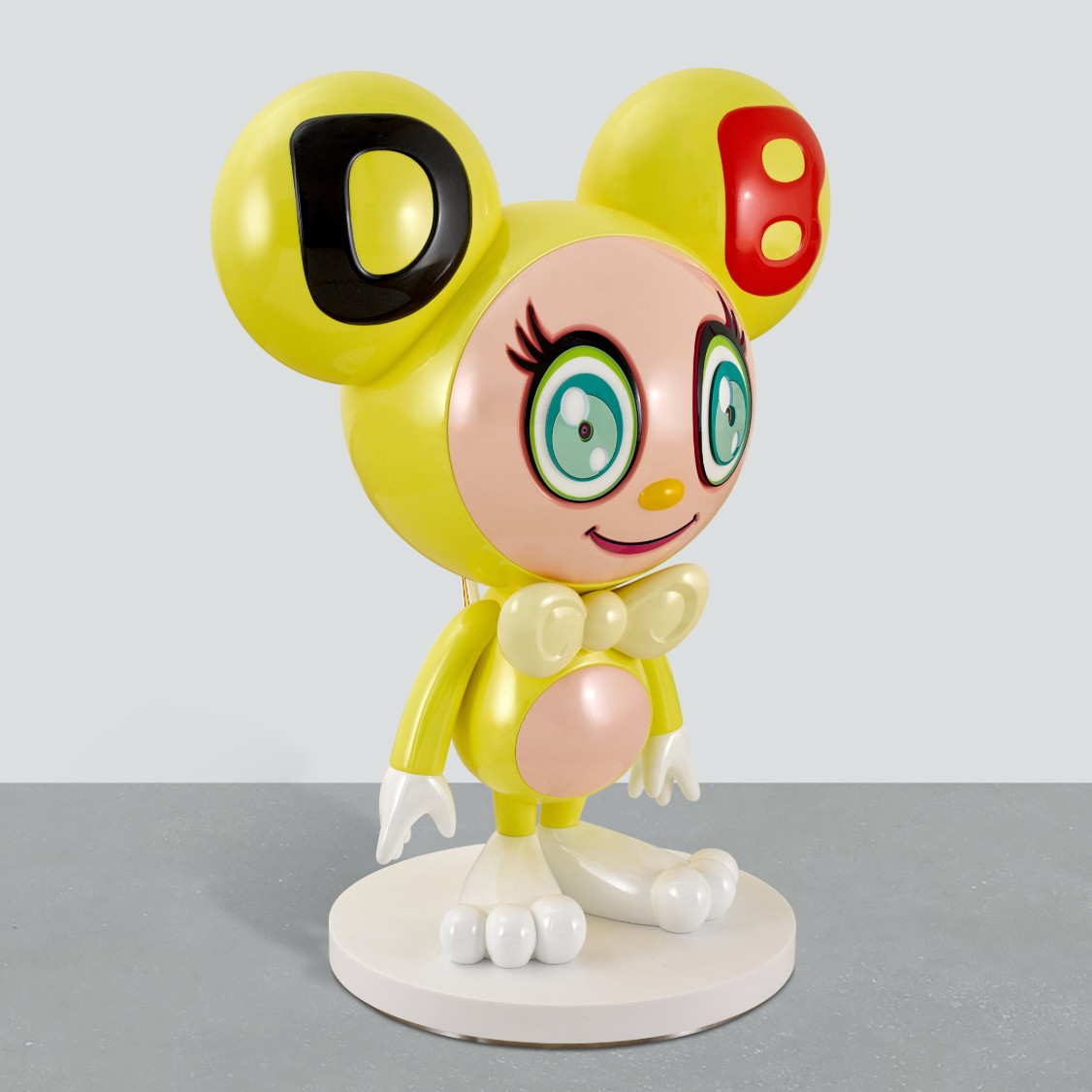
TAKASHI MURAKAMI (b. 1962)
Untitled (Mr. Dob – Yellow), 2020
FRP, urethane paint, stainless steel and wood
83x68x38 cm (32 3/4 x 26 3/4 x 15 inches)
Signed, numbered 2/5 and dated 2020-2021 (on the underside)
This work is number 2 from an edition of 5
© 2020 Takashi Murakami./Kaikai Kiki Co., Ltd. All Rights Reserved
#23. Murakami.Flower #2481 Super Zombie, 2022
Christie’s online: 16 December 2025
Estimated: USD 60,000 – 80,000
USD 40,640
TAKASHI MURAKAMI (B. 1962), Murakami.Flower #2481 Super Zombie | Christie’s
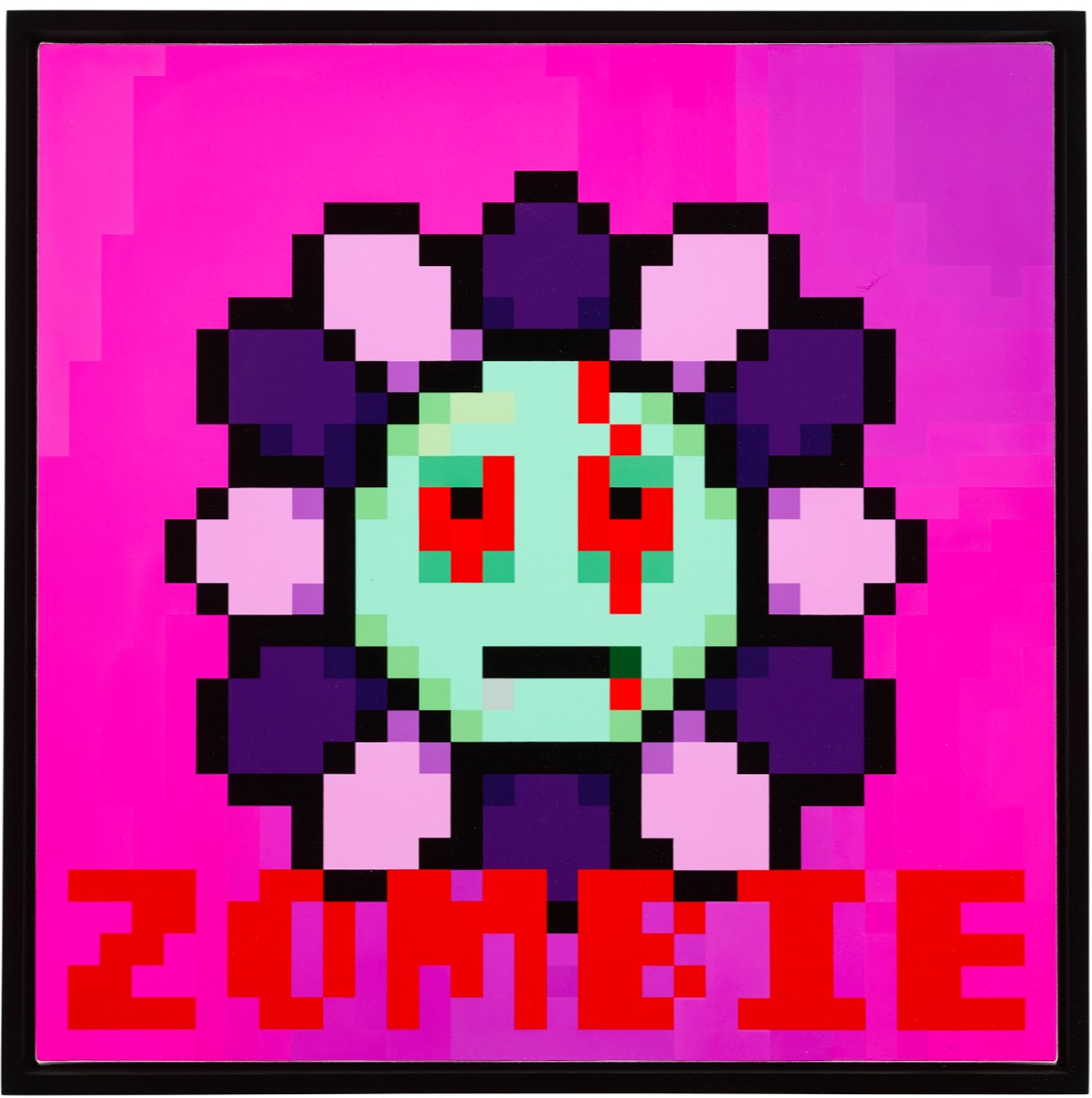
TAKASHI MURAKAMI (B. 1962)
Murakami.Flower #2481 Super Zombie, 2022
Acrylic on canvas
60.3 x 60.3 cm (23 3/4 x 23 3/4 inches)
signed and dated ‘TAKASHI 2022’ (on the overlap)
This work is unique and accompanied by a non-fungible token
#24. Mr. DOB (Monochrome), 2020 – 2021
SBI Art Auction: 23 May 2025
Estimated: JPY 7,000,000 – 13,000,000
JPY 6,900,000 / USD 48,405
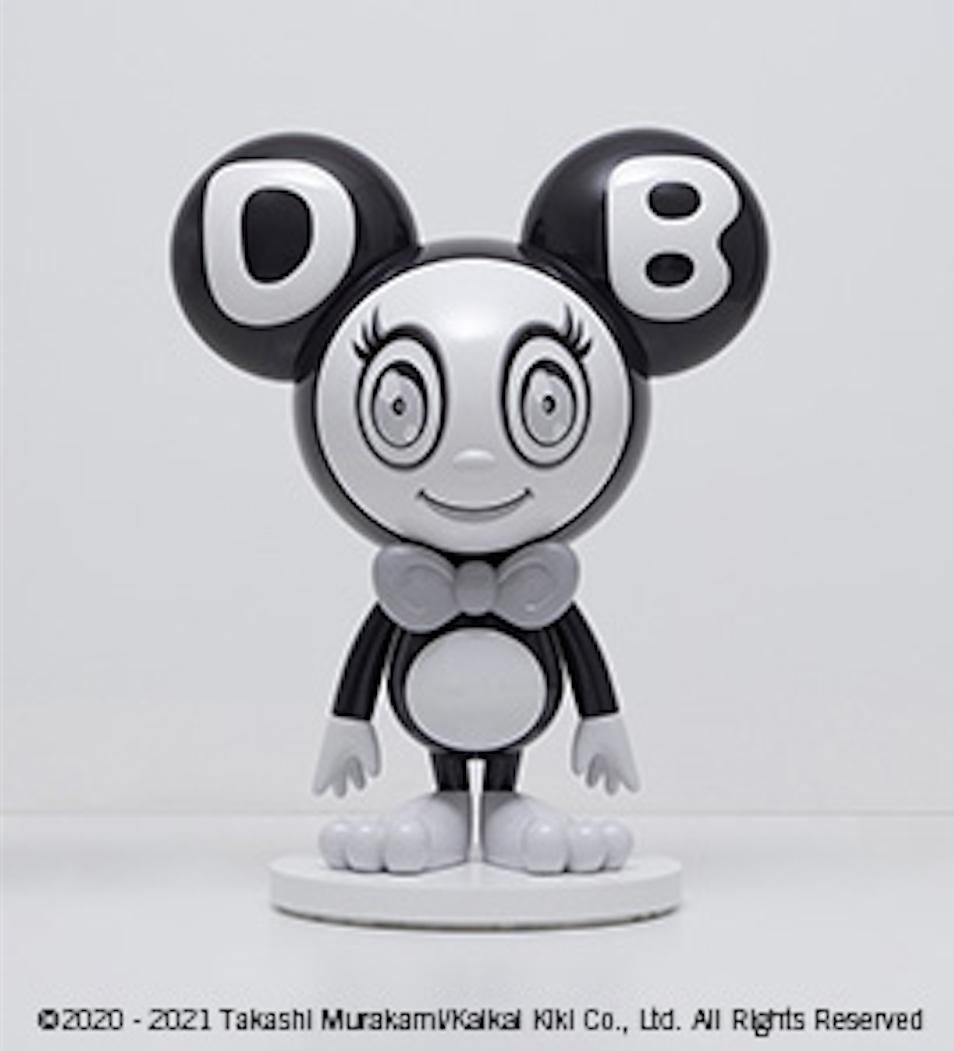
TAKASHI MURAKAMI
Mr. DOB (Monochrome), 2020 – 2021
FRP, urethane paint, stainless steel, wood
87.1 x 68.8 x 47 cm (34 1/4 x 27 1/8 x 18 1/2 inches)
Signed, dated and numbered with drawing on the bottom
From an edition of 5
#25. Untitled, 2020
Poly Hong-Kong: 7 October 2025
Estimated: HKD 230,000 – 350,000
HKD 276,000 / USD 35,465
Untitled|Poly Auction Hong Kong
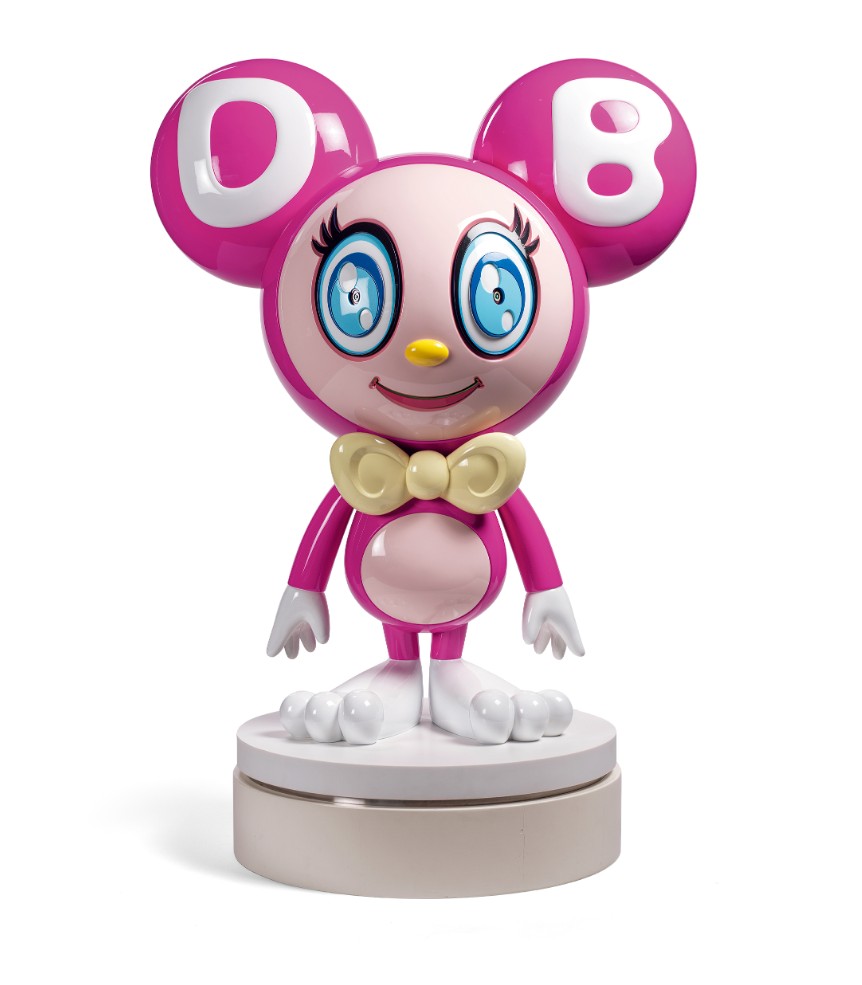
TAKASHI MURAKAMI
Untitled, 2020
FRP, urethane paint, stainless steel and wood sculpture
68.5 x 38.5 x 84 cm (27x15x33 inches)
Edition: 8/20 + AP 2 + SP 2
#26. Dobozite², 1995
Bonhams online: 31 July 2025
Estimated: USD 3,000 – 5,000
USD 28,160
WORK ON PAPER
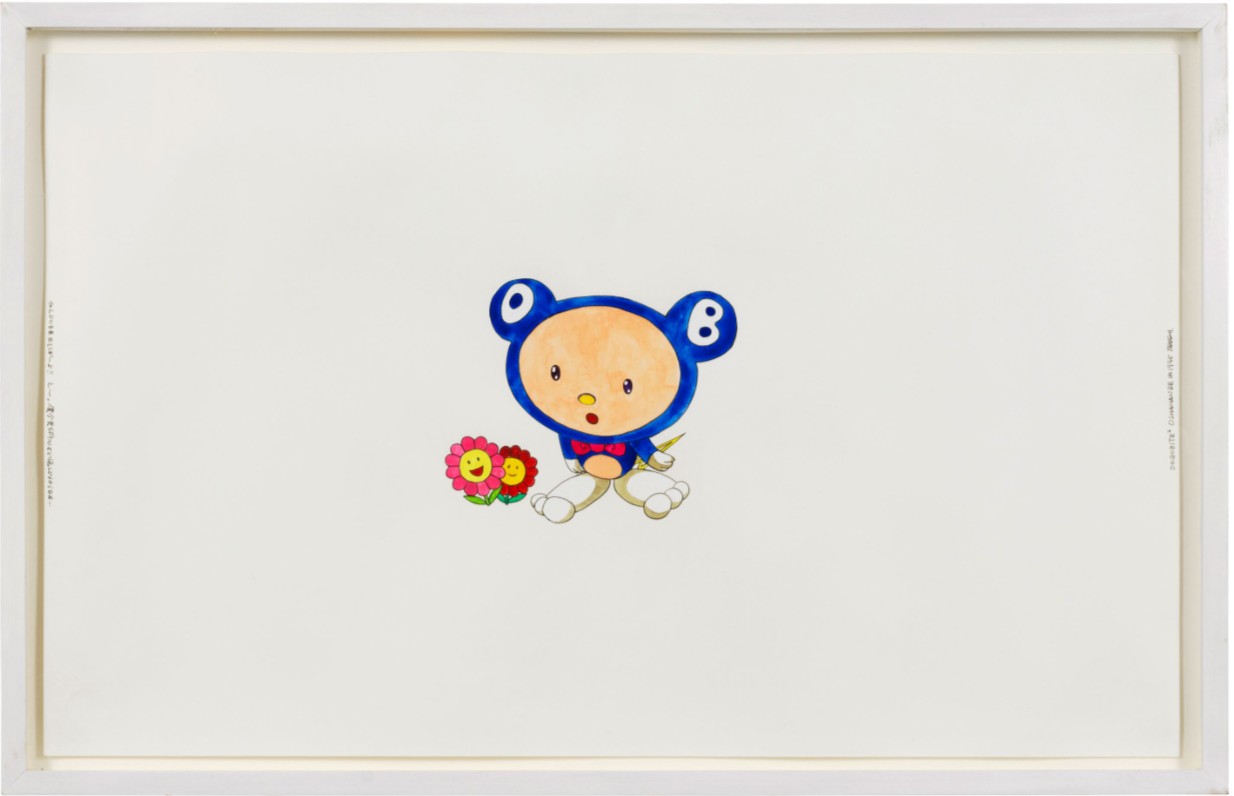
TAKASHI MURAKAMI (B.1962)
Dobozite², 1995
Watercolor and ink on paper
36.2 x 58.4 cm (14 1/4 x 23 inches)
Signed, inscribed and dated ‘Dobozite² Oshamanbe in 1995 Takashi’ (right vertical edge)
Variously inscribed in Japanese (left vertical edge)
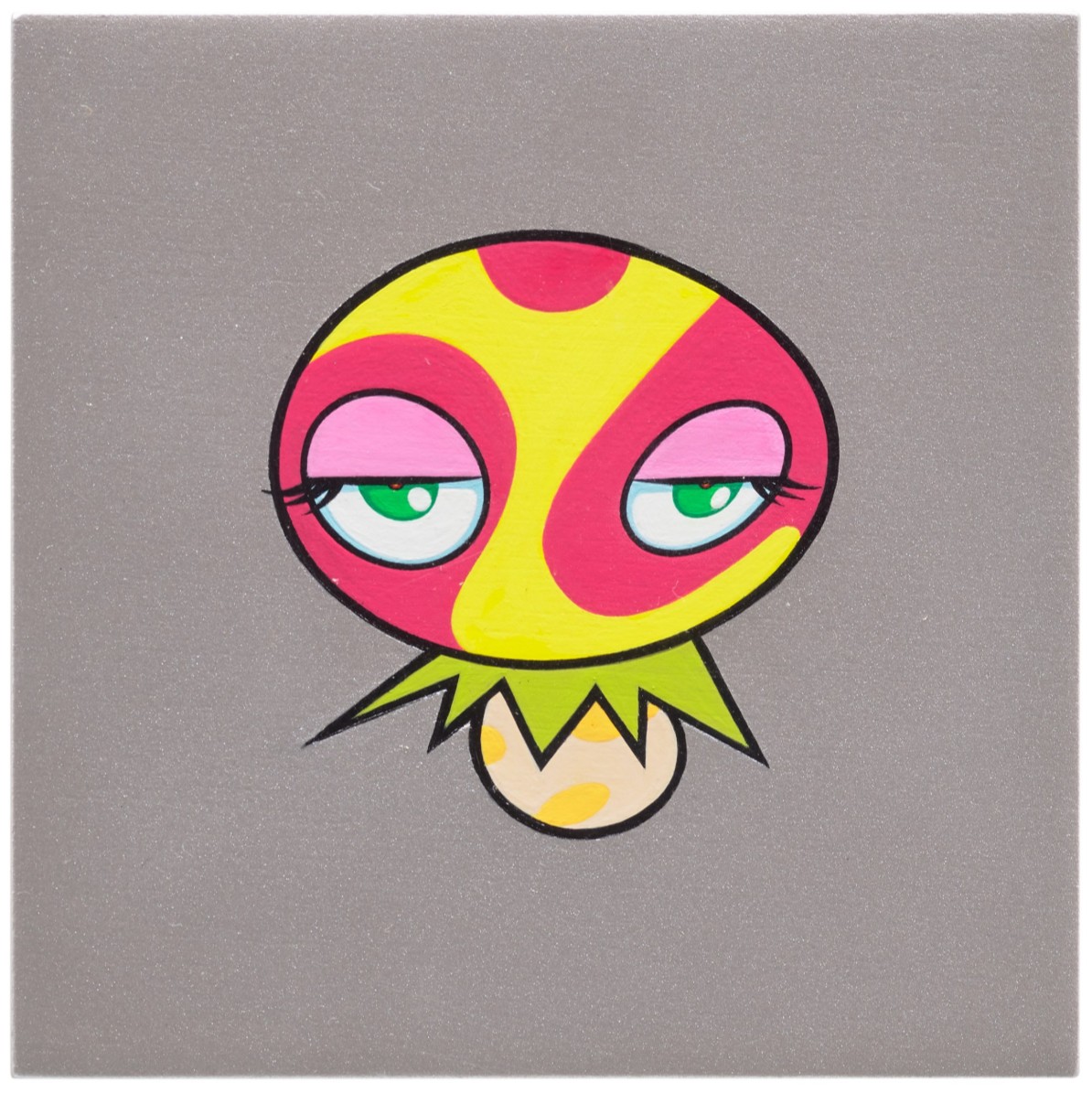
#27. Kinoko4, 2002
Estimated: GBP 15,000 – 20,000
GBP 11,610 / USD 15,555
Lots Passed
DOB DOB, 1996
Phillips online: 16 December 2025
Estimated: USD 20,000 – 30,000
PASSED
Takashi Murakami Modern & Contemporary Art: Online Auction, New York
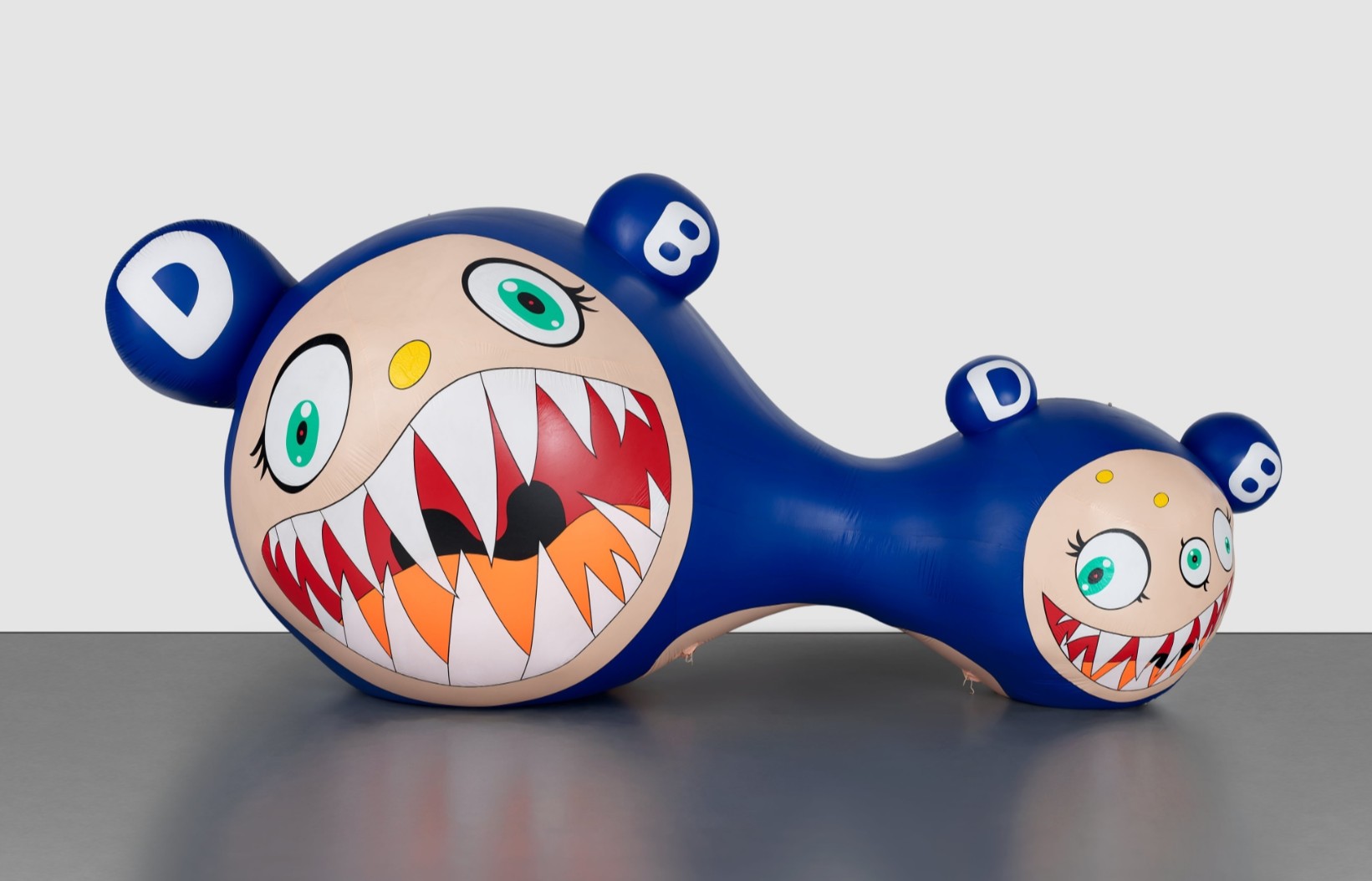
Vinyl chloride and helium
307.3 x 713.7 x 325.1 cm (121x281x128 inches)
Ensō: Beyond the Universe of Total Darkness, 2016
Phillips Hong-Kong: 11 December 2025
Estimated: HKD 300,000 – 500,000
PASSED
Takashi Murakami Modern & Contemporary Art: Online Auction, Hong Kong
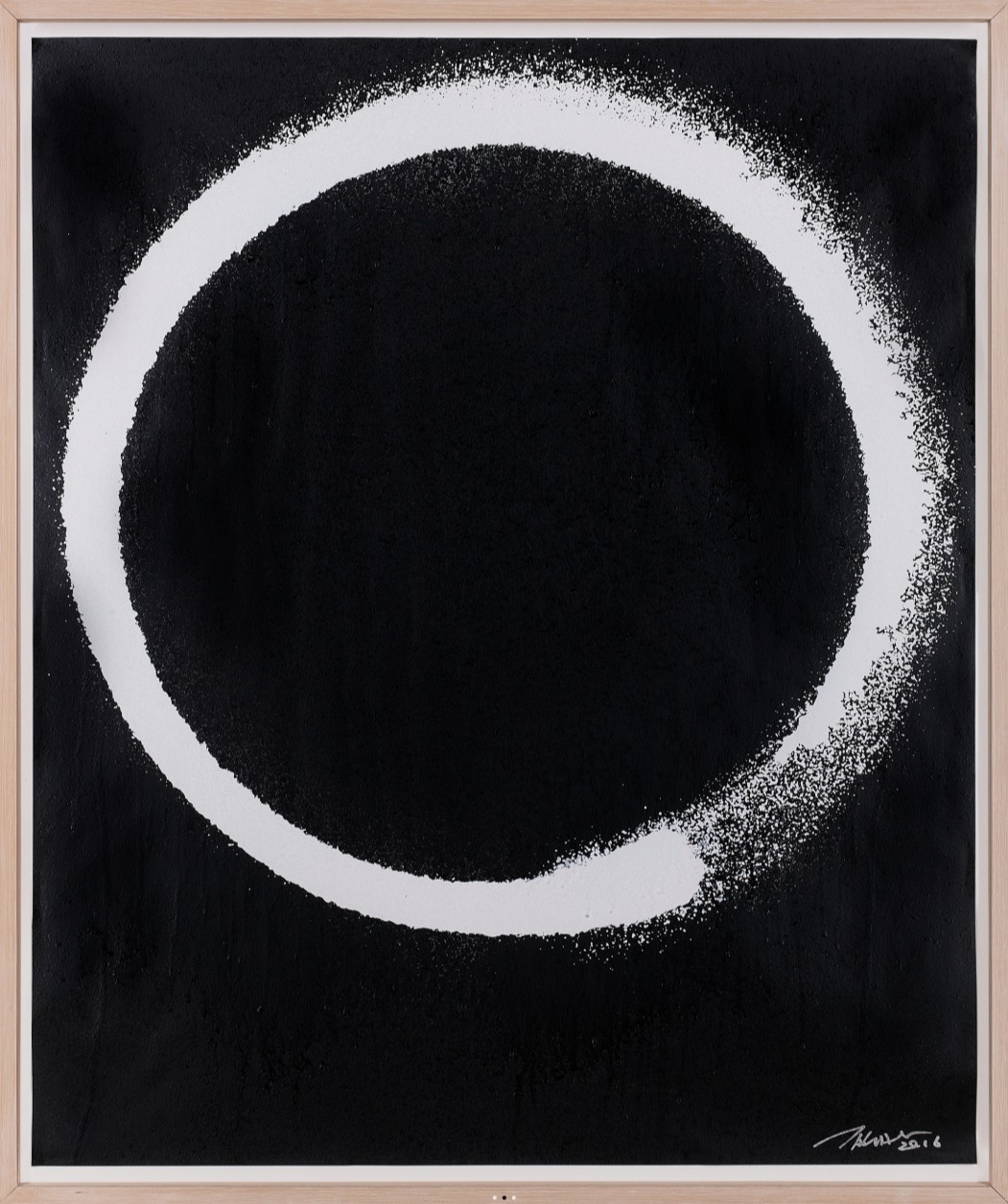
Acrylic on Kraft paper
84×70 cm (33 1/8 x 27 1/2 inches)
Signed and dated ‘Takashi 2016’ lower right
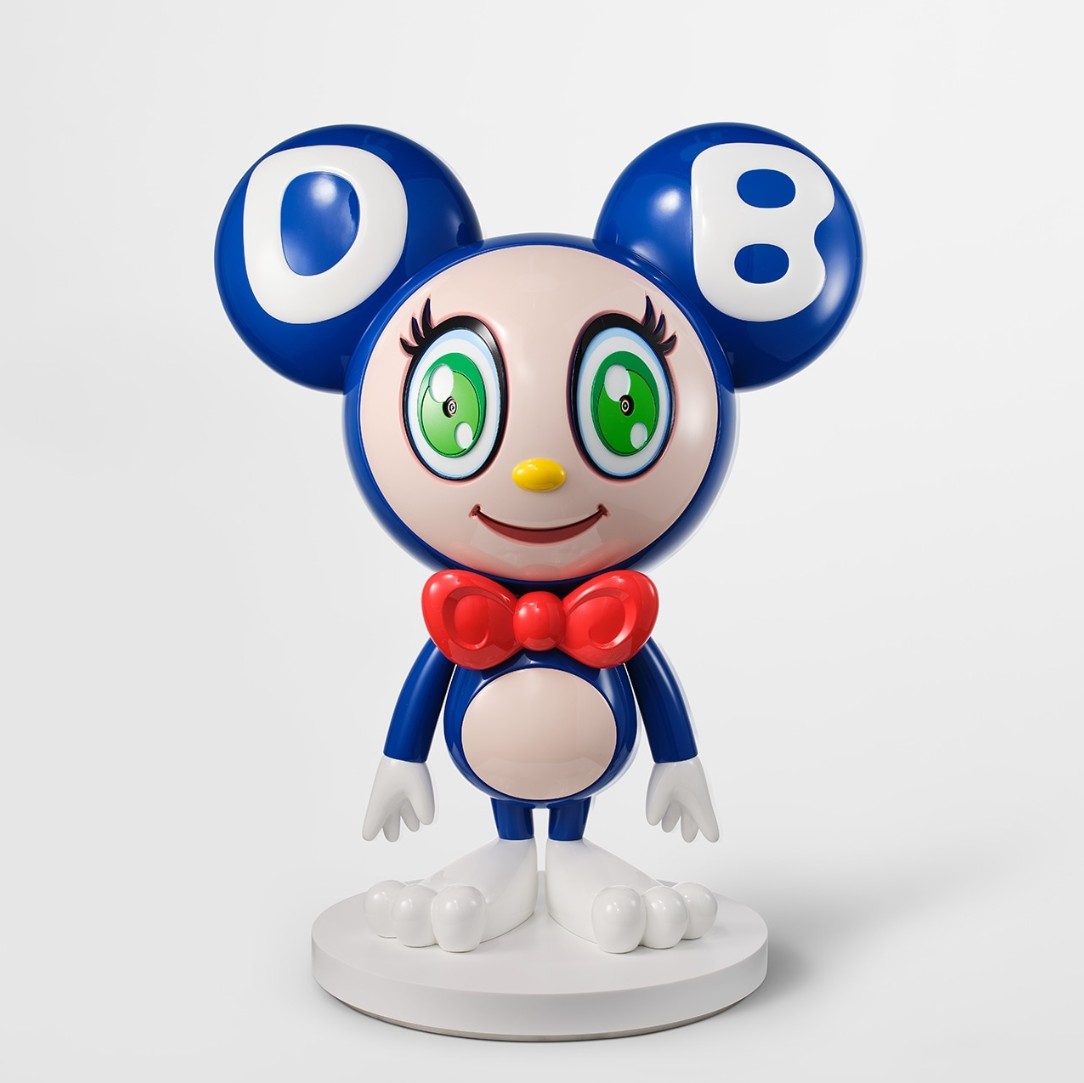
Mr. DOB, 2020
Phillips Hong-Kong: 29 March 2025
Estimated: HKD 500,000 – 700,000
PASSED
Takashi Murakami New Now: Modern & Contemporary Art and Design
Flower: Soul to Soul, 2018
Sotheby’s Singapore: 18 January 2025
Estimated: SGD 85,000 – 170,000
PASSED
Takashi Murakami 村上隆 | Flower: Soul to Soul 花:靈魂之交 | Modern & Contemporary Art | 2025 | Sotheby’s
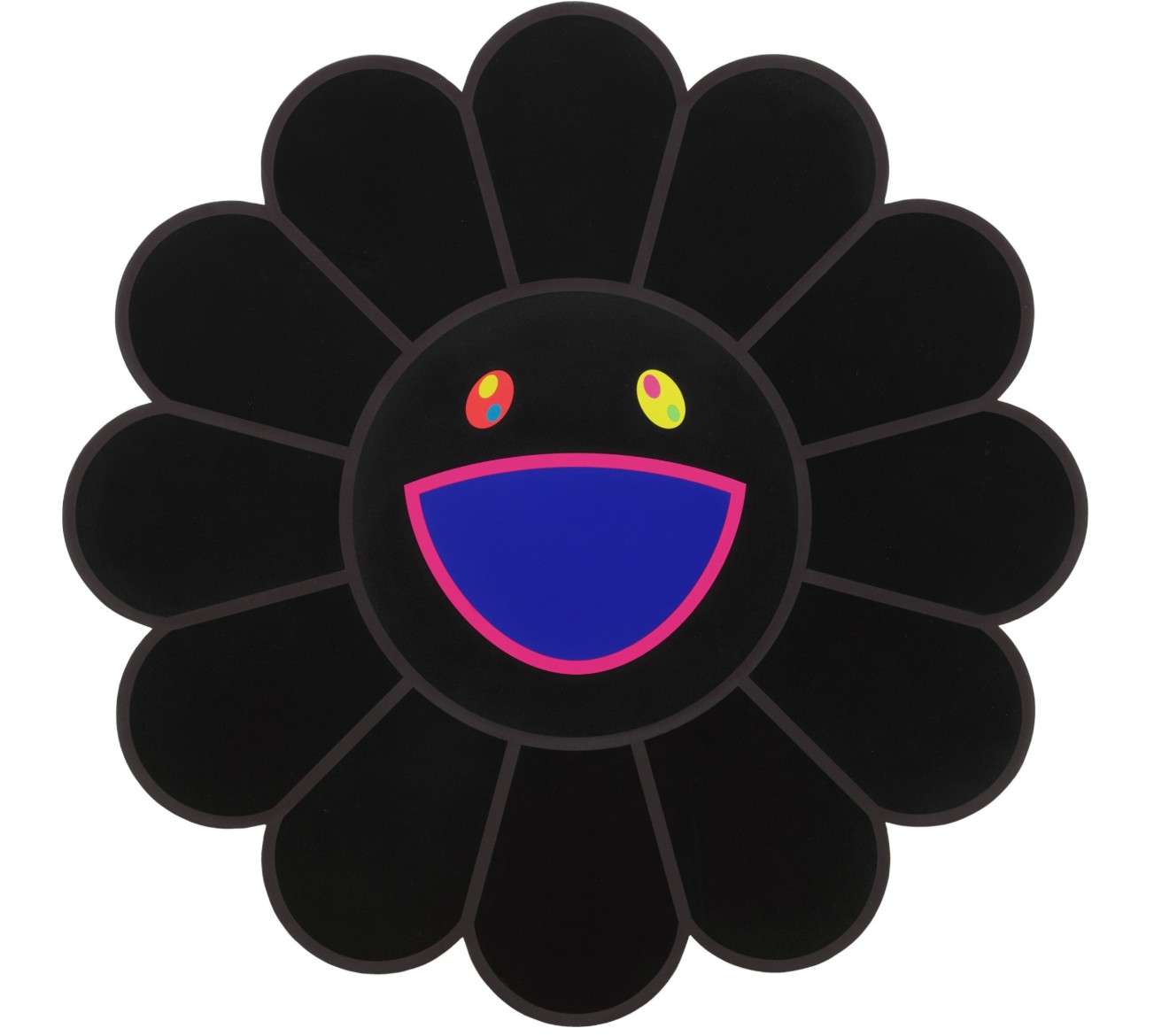
TAKASHI MURAKAMI (b. 1962)
Flower: Soul to Soul, 2018
Acrylic on canvas mounted on board
Diameter: 26 inches (66 cm)
Signed with artist signature and dated 2018 (on the reverse)
© 2018 Takashi Murakami/Kaikai Kiki Co., Ltd. All Rights Reserved
Lots Withdrawn
I stare into your eye, 2020
Phillips Hong-Kong: 28 September 2025
Estimated: HKD 3,500,000 – 5,500,000
WITHDRAWN
Takashi Murakami Modern & Contemporary Art Day Sale

Doraemon Sitting Up: Everywhere Door (Dokodemo Door), 2018
Phillips Hong-Kong: 27 September 2025
Estimated: HKD 1,500,000 – 2,000,000
WITHDRAWN
Takashi Murakami Modern & Contemporary Art Evening Sale
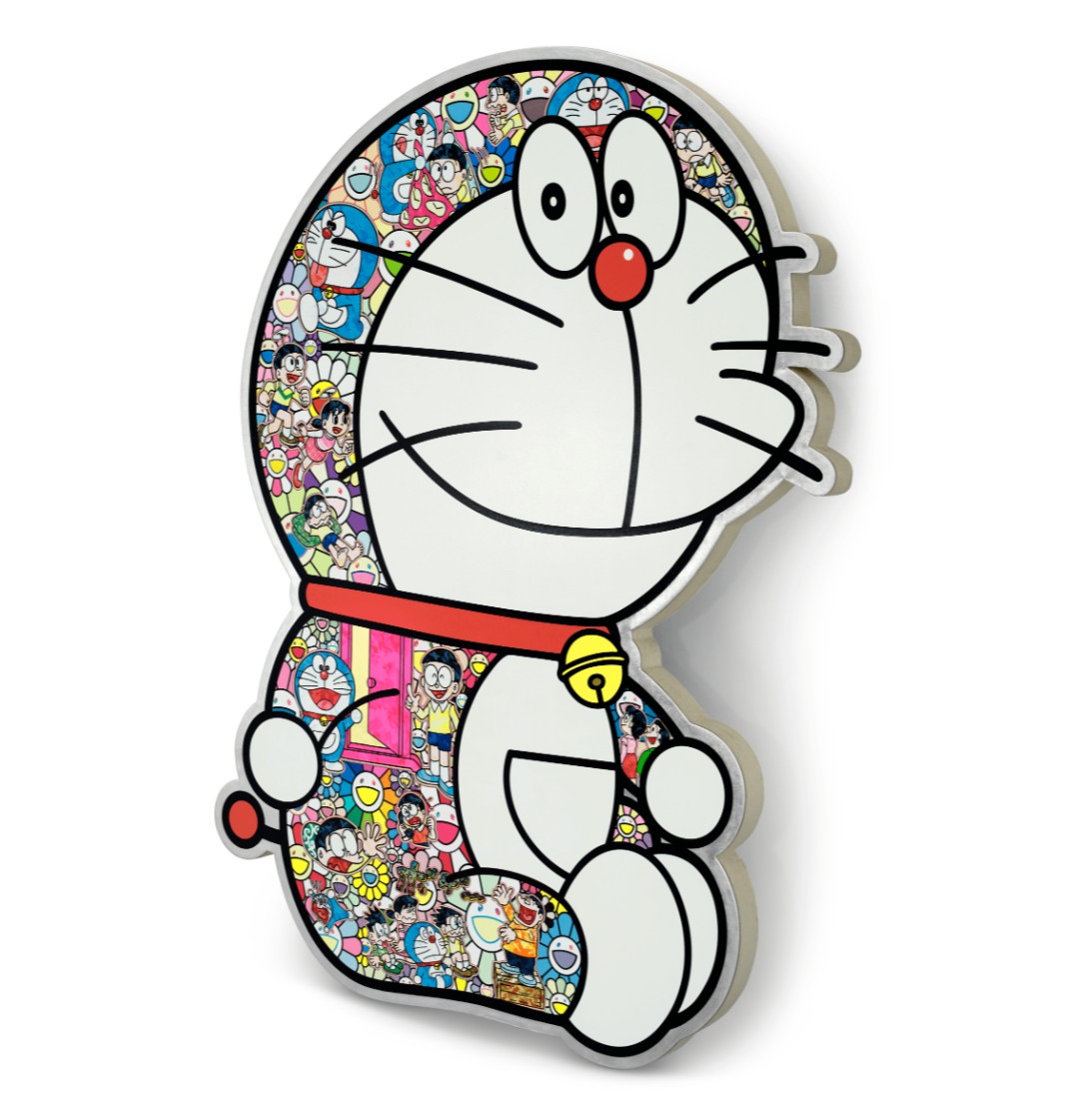
Signed and dated ‘Takashi 2018’ on the reverse
2024 Auction Results
19 lots sold at auction in 2024 for a total turnover of USD 6,203,846. With 4 lots failing to sell, the sell-through rate is 83%. The highest price paid was achieved at Sotheby’s New-York on 14 May 2024 when FLOWER MATANGO (A), sold for USD 1,143,000.
2024 Top 3 Lots
#1. FLOWER MATANGO (A), 2001-2006
Sotheby’s New-York: 14 May 2024
Estimated: USD 1,000,000 – 1,500,000
USD 1,143,000
Flower Matango (A) | Contemporary Day Auction | 2024 | Sotheby’s (sothebys.com)

TAKASHI MURAKAMI (b. 1962)
FLOWER MATANGO (A), 2001-2006
Oil, acrylic, fiberglass and iron
550x300x250 cm (216 1/2 x 118 1/8 x 98 1/2 inches)
This work is a unique variant
USD 1 million
#2. Together with the Flower Parent and Child, 2021-2022
Phillips New-York: 20 November 2024
Estimated: USD 400,000 – 600,000
USD 762,000
Takashi Murakami – Modern & Contem… Lot 323 November 2024 | Phillips
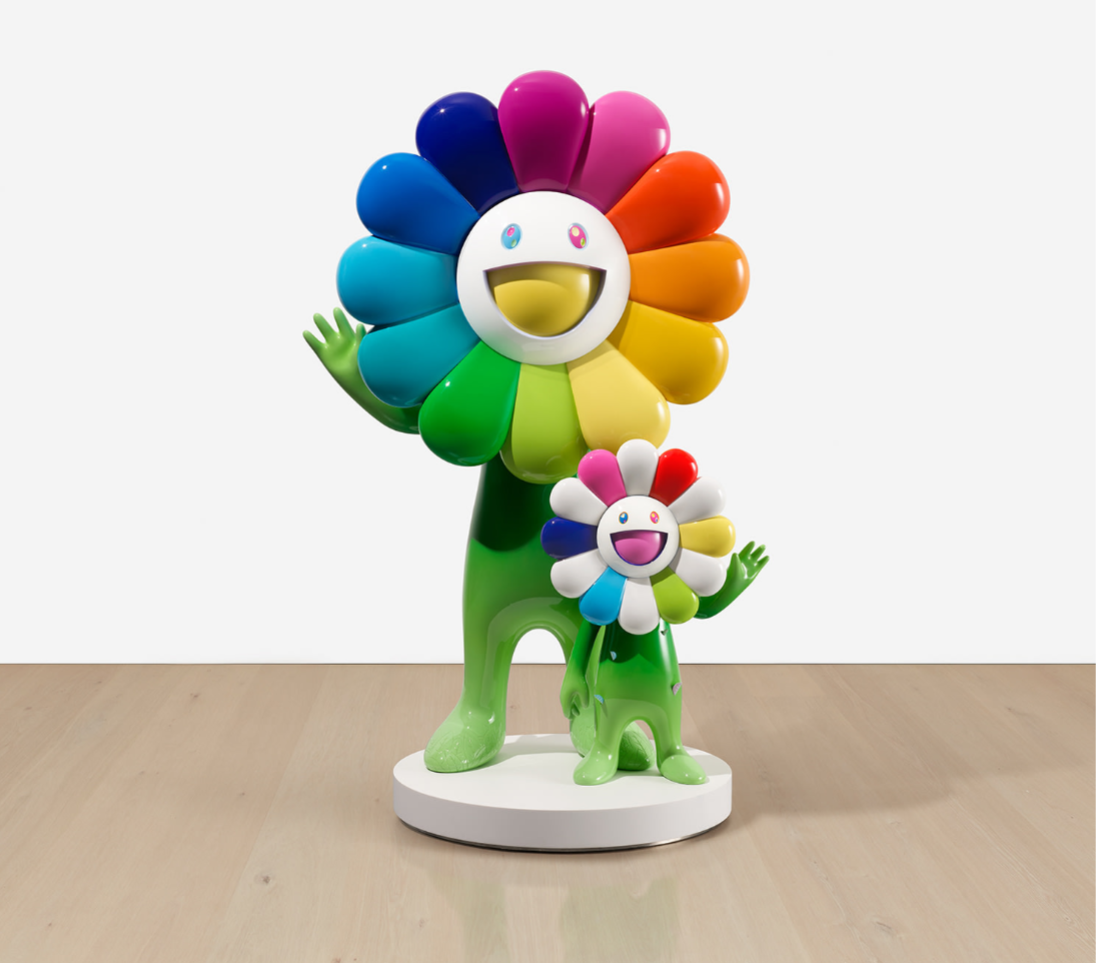
TAKASHI MURAKAMI
Together with the Flower Parent and Child, 2021-2022
FRP, urethane paint, stainless steel and wood
Sculpture: 196.9 x 123.2 cm (77 1/2 x 48 1/2 inches)
Base: 89.9 x 89.9 x 9.5 cm (35 3/8 x 35 3/8 x 3 3/4 inches)
Signed, titled, inscribed and dated “TAKASHI 2021–2022 FRP 1/5” on the interior of the larger flower element
This work is a unique variant from an edition of 5 plus 1 artist’s proof
#3. In Death, Life. The Mountains and Rivers Remain.,2015
Estimated: USD 350,000 – 450,000
USD 711,200

TAKASHI MURAKAMI (b. 1962)
In Death, Life. The Mountains and Rivers Remain.,2015
Acrylic and gold leaf on canvas
141×120 cm (55 1/2 x 47 1/4 inches)
Signed and dated 2015 (on the overlap); variously inscribed (on the stretcher)
USD 500,000
#4. Me and Kaikai and Kiki, 2009
Christie’s Hong-Kong: 26 September 2024
Estimated: HKD 3,200,000 – 5,200,000
HKD 3,528,000 / USD 453,499
TAKASHI MURAKAMI (B. 1962), Me and Kaikai and Kiki | Christie’s (christies.com)
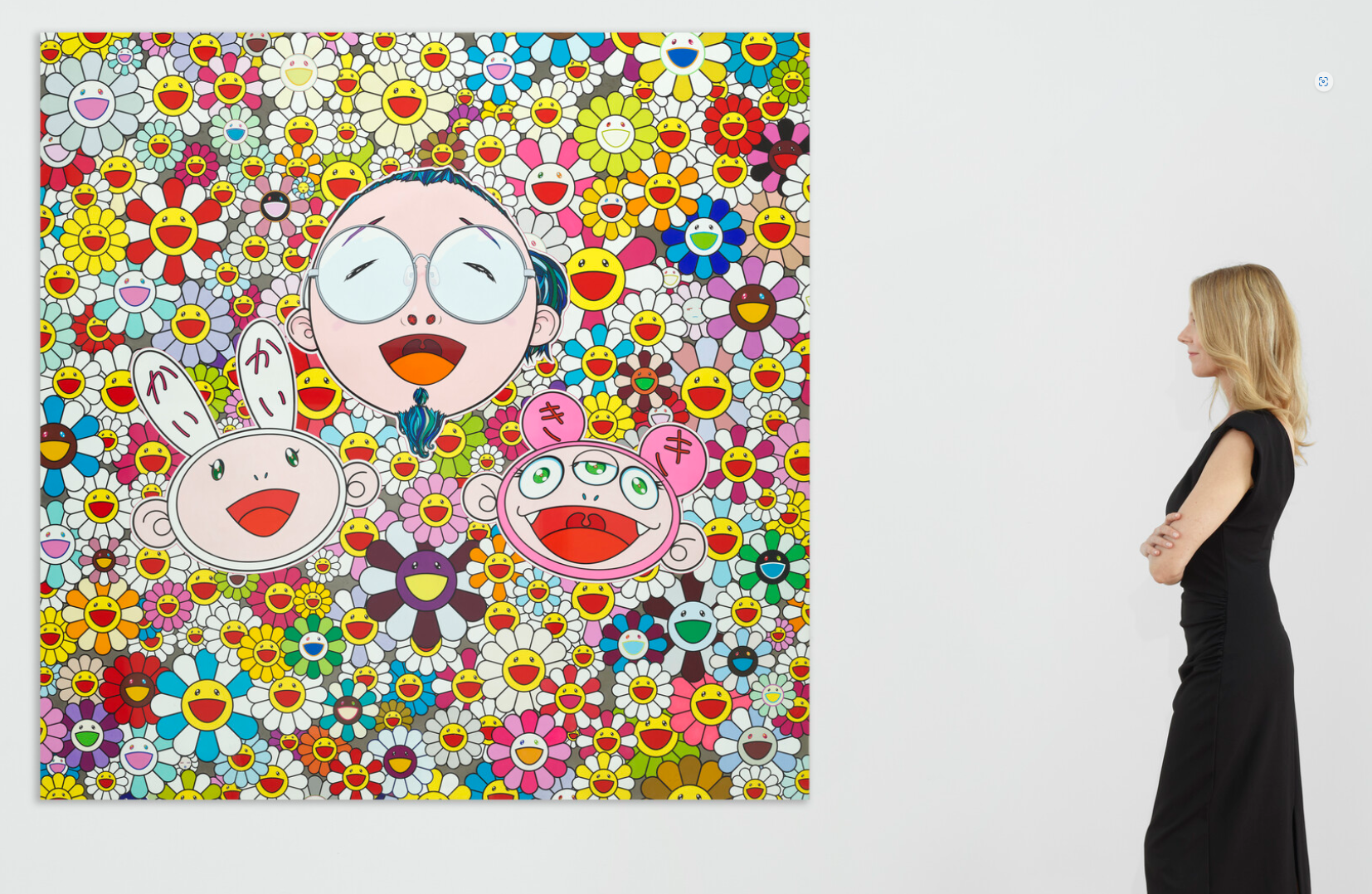
TAKASHI MURAKAMI (B. 1962)
Me and Kaikai and Kiki, 2009
Acrylic and platinum leaf on canvas
160.3 x 160.3 cm (63 1/8 x 63 1/8 inches)
Signed with the artist’s signature and dated ’09’ (on the stretcher)
#5. Panda & Panda Cubs, 2015
Christie’s Hong-Kong: 9 November 2024
Estimated: HKD 2,200,000 – 3,200,000
HKD 3,276,000 / USD 421,530
TAKASHI MURAKAMI (B. 1962), Panda & Panda Cubs | Christie’s
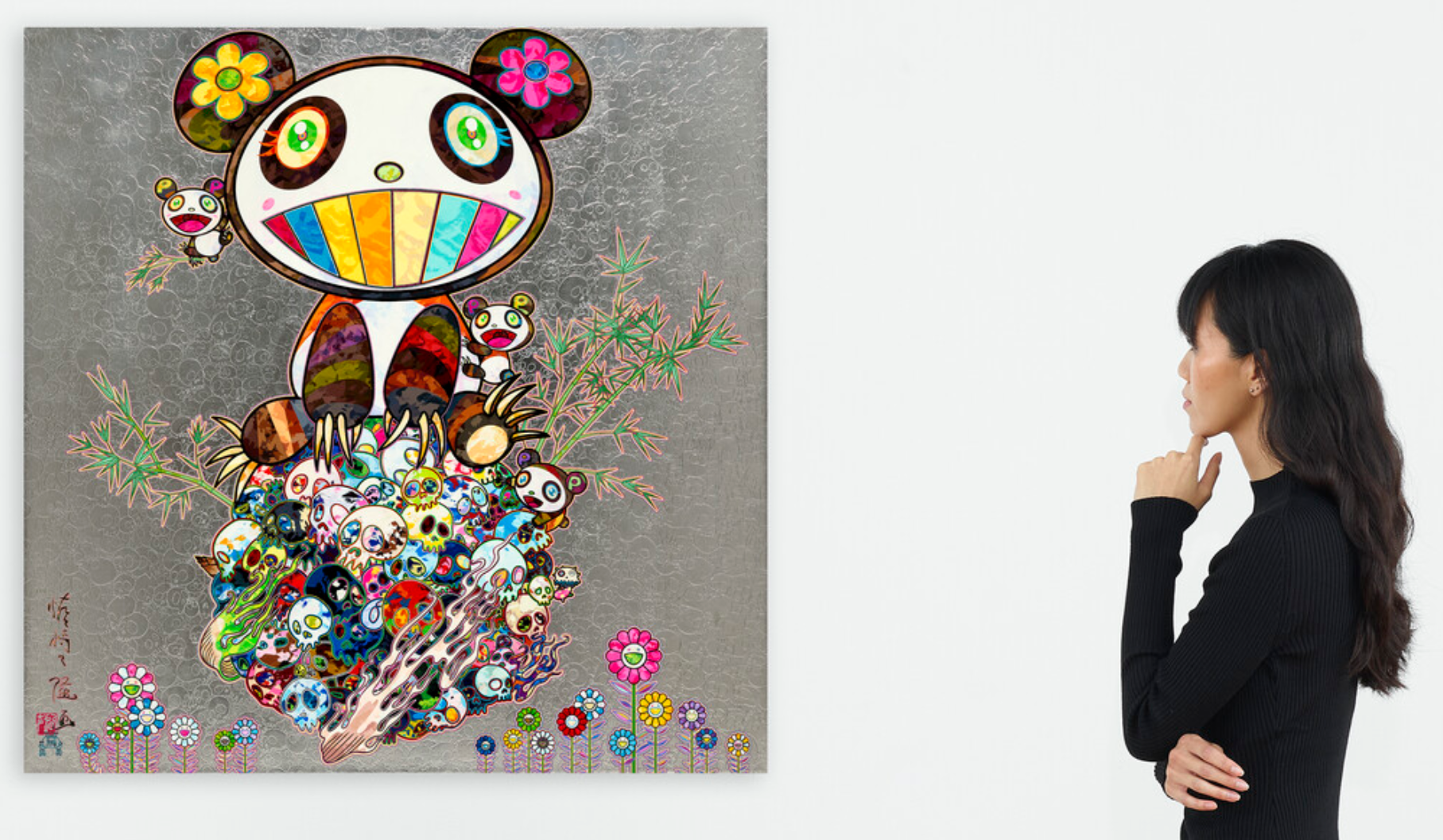
TAKASHI MURAKAMI (B. 1962)
Panda & Panda Cubs, 2015
Acrylic and platinum leaf on canvas mounted on aluminum frame
100×100 cm (39 3/8 x 39 3/8 inches)
Signed and dated ‘TAKASHI 2015’ (on the overlap)
#6. An Homage to Mangold
K Auction: 24 April 2024
Estimated: KRW 460,000,000 – 700,000,000
KRW 529,000,000 / USD 385,640
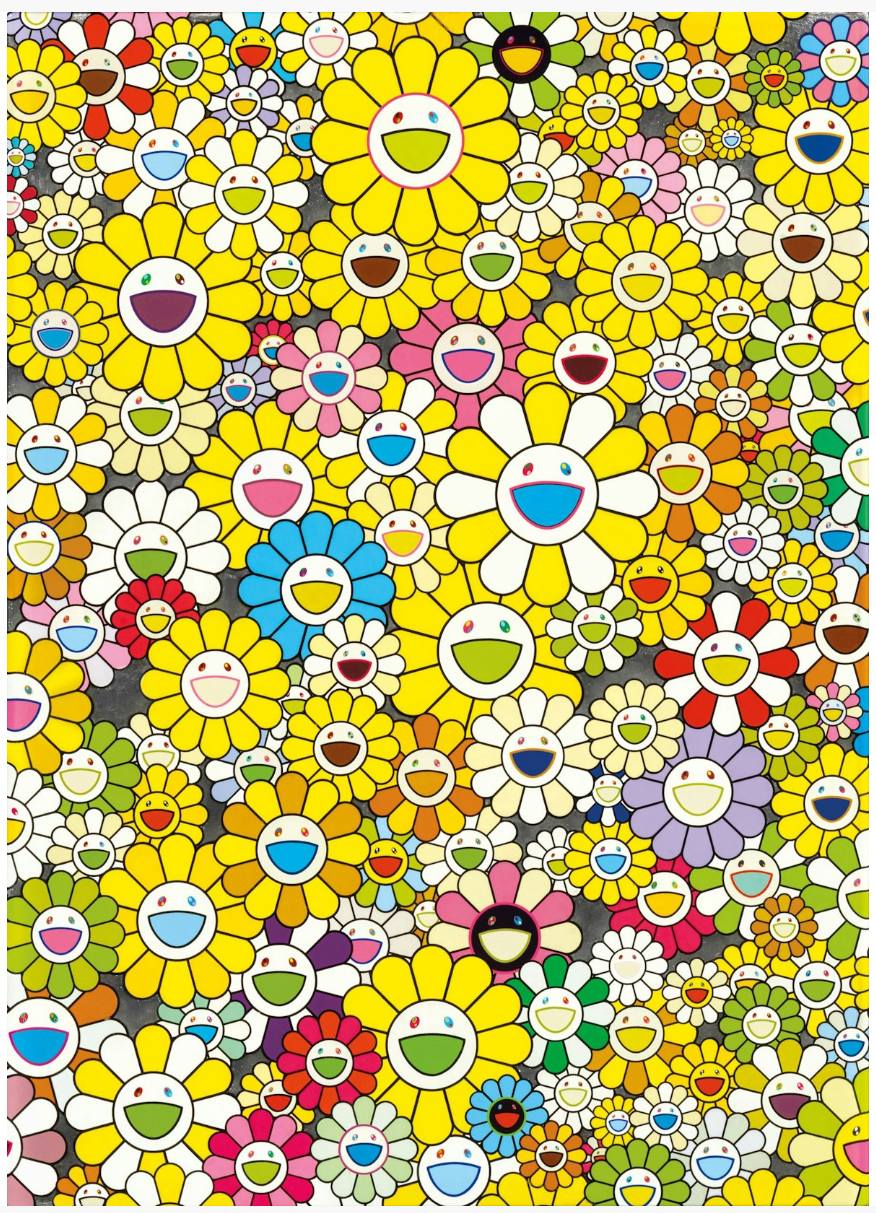
TAKASHI MURAKAMI
An Homage to Mangold
Acrylic and platinum leaf on canvas, acrylic frame
78×56 cm (30×22 inches)
Signed and dated on the reverse
#7. Doraemon Yay!, 2019
Sotheby’s Hong-Kong: 11 November 2024
Estimated: HKD 2,800,000 – 3,800,000
HKD 2,880,000 / USD 370,380
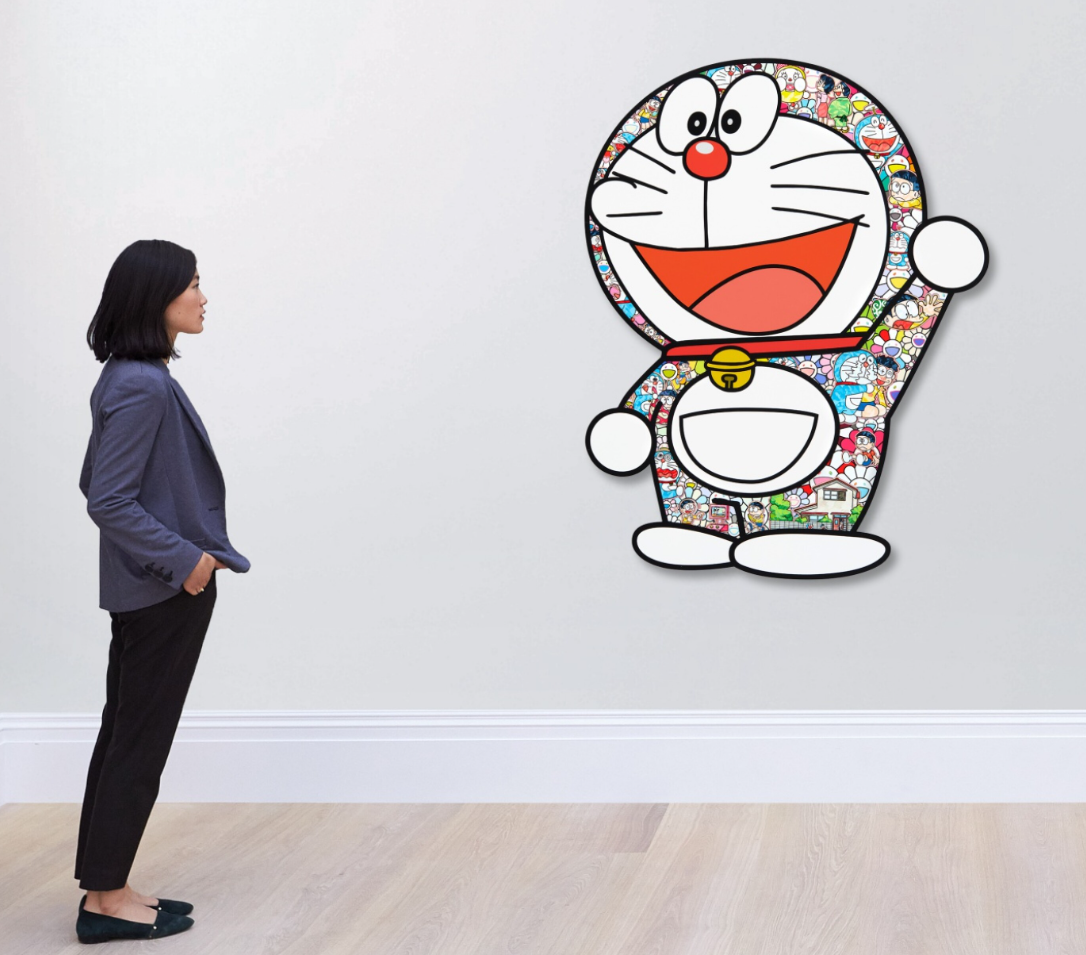
TAKASHI MURAKAMI (b. 1962)
Doraemon Yay!, 2019
Acrylic and platinum leaf on canvas mounted on wood panel
119.2 x 93 cm (46 7/8 x 36 5/8 inches)
Signed and dated 2019 (on the reverse)
#8. And Then x 6 (Marine Blue: The Superflat Method), 2013
Sotheby’s Hong-Kong: 6 April 2024
Estimated: HKD 2,200,000 – 3,500,000
HKD 2,794,000 / USD 357,198

TAKASHI MURAKAMI (b. 1962)
And Then x 6 (Marine Blue: The Superflat Method), 2013
Acrylic on canvas mounted on aluminum frame
100×100 cm (39 3/8 x 39 3/8 inches)
Signed and dated 2013 on the overlap; variously inscribed on the stretcher
#9. Cherry Blossoms and Pandas, 2021
Phillips London: 11 October 2024
Estimated: GBP 180,000 – 250,000
GBP 228,600 / USD 298,585
Takashi Murakami – Modern & Contemp… Lot 140 October 2024 | Phillips
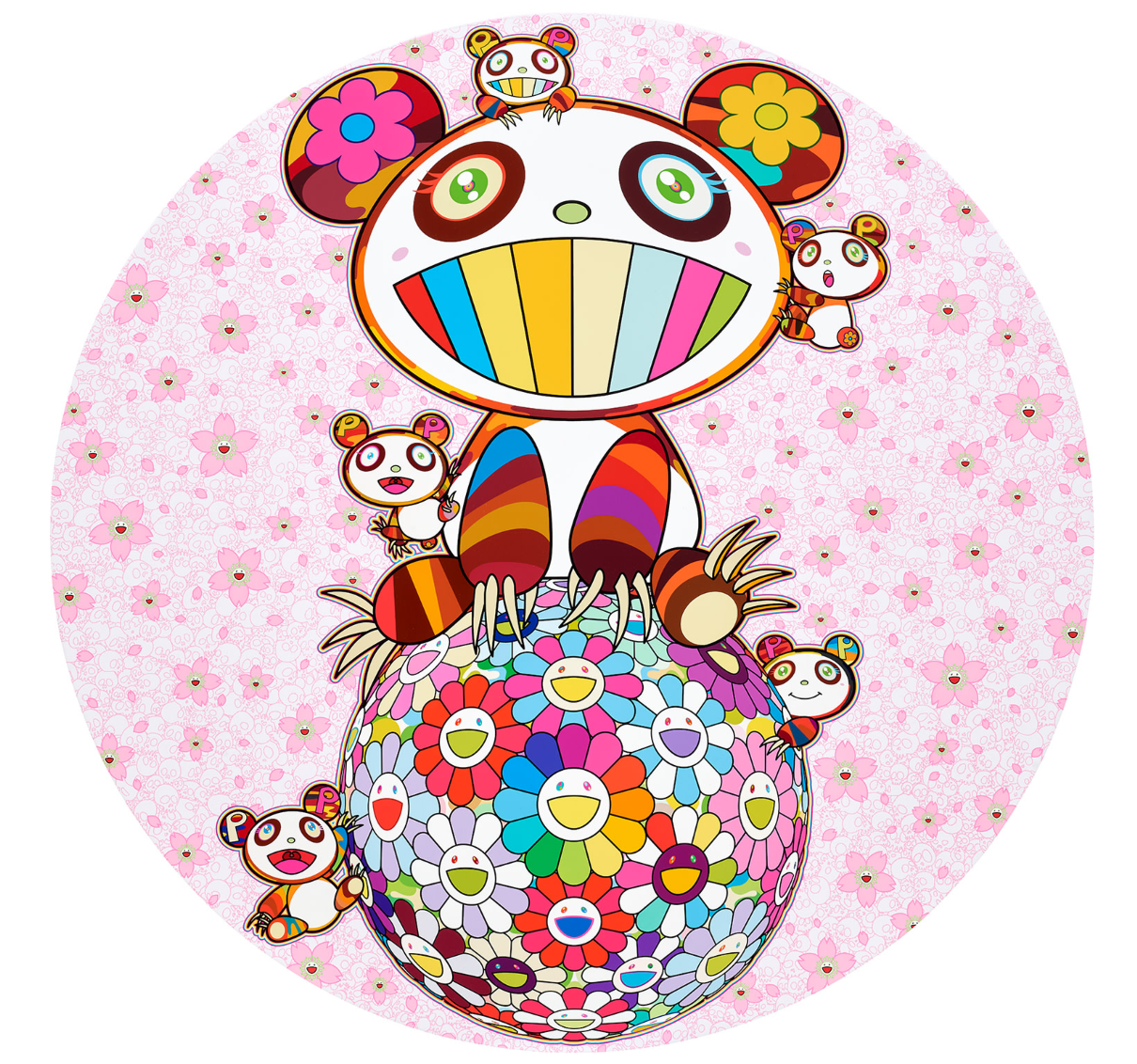
TAKASHI MURAKAMI
Cherry Blossoms and Pandas, 2021
Acrylic on canvas laid down on panel
100×100 cm (39 3/8 x 39 3/8 inches)
Signed with the artist’s initials and dated ‘TM 2021’ on the stretcher
#10. Eye Love SUPERFLAT, 2003
Sotheby’s Hong-Kong: 11 November 2024
Estimated: HKD 2,000,000 – 3,000,000
HKD 2,160,000 / USD 277,785
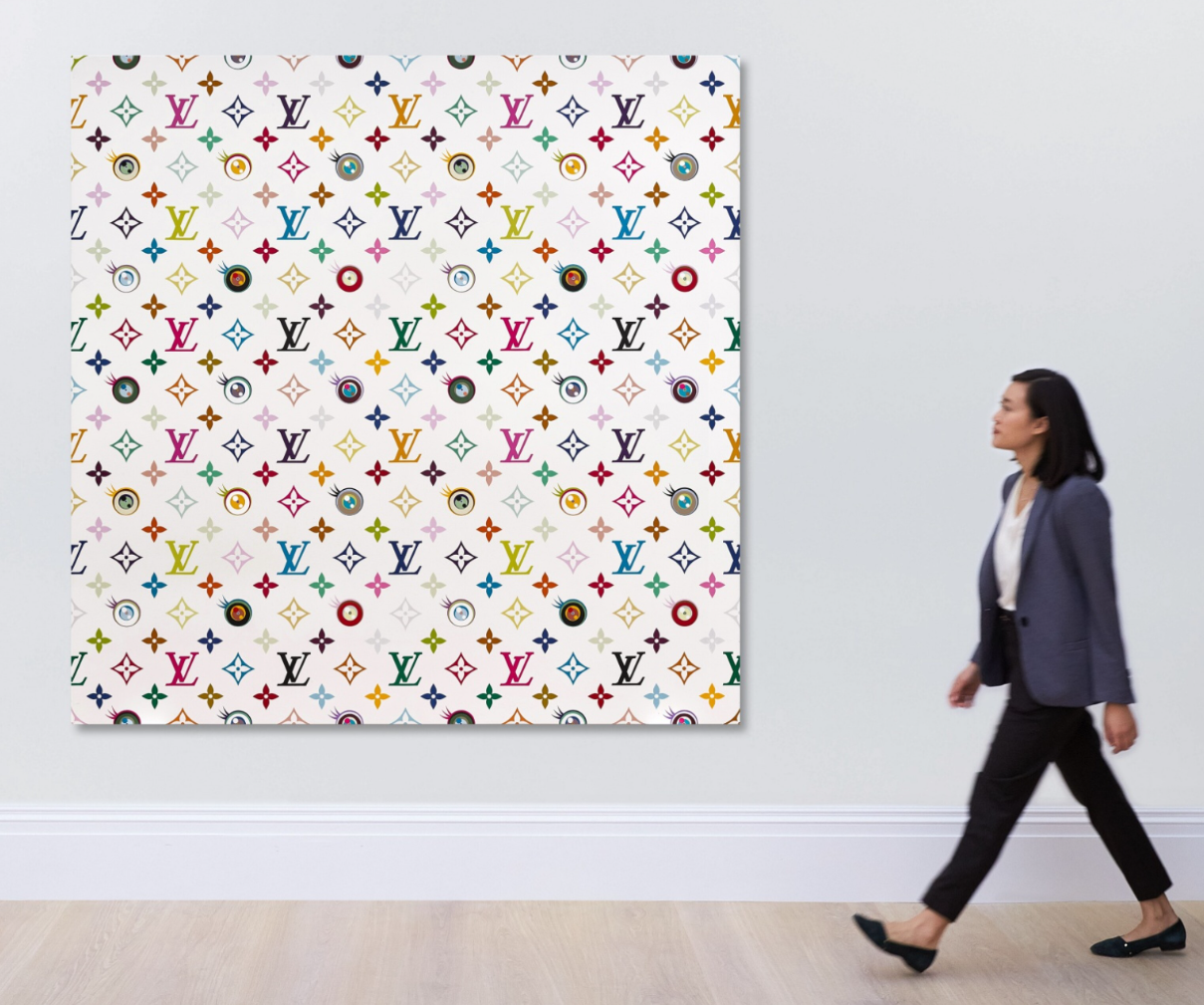
TAKASHI MURAKAMI (b. 1962)
Eye Love SUPERFLAT, 2003
Acrylic on canvas mounted on wood
180×180 cm (70 7/8 x 70 7/8 inches)
Signed, dated 03 and variously inscribed (on the reverse)
#11. DOB Jump, 1999
Christie’s Paris: 17 October 2024
Estimated: EUR 150,000 – 200,000
EUR 189,000 / USD 205,240
Takashi Murakami (né en 1962), DOB Jump | Christie’s
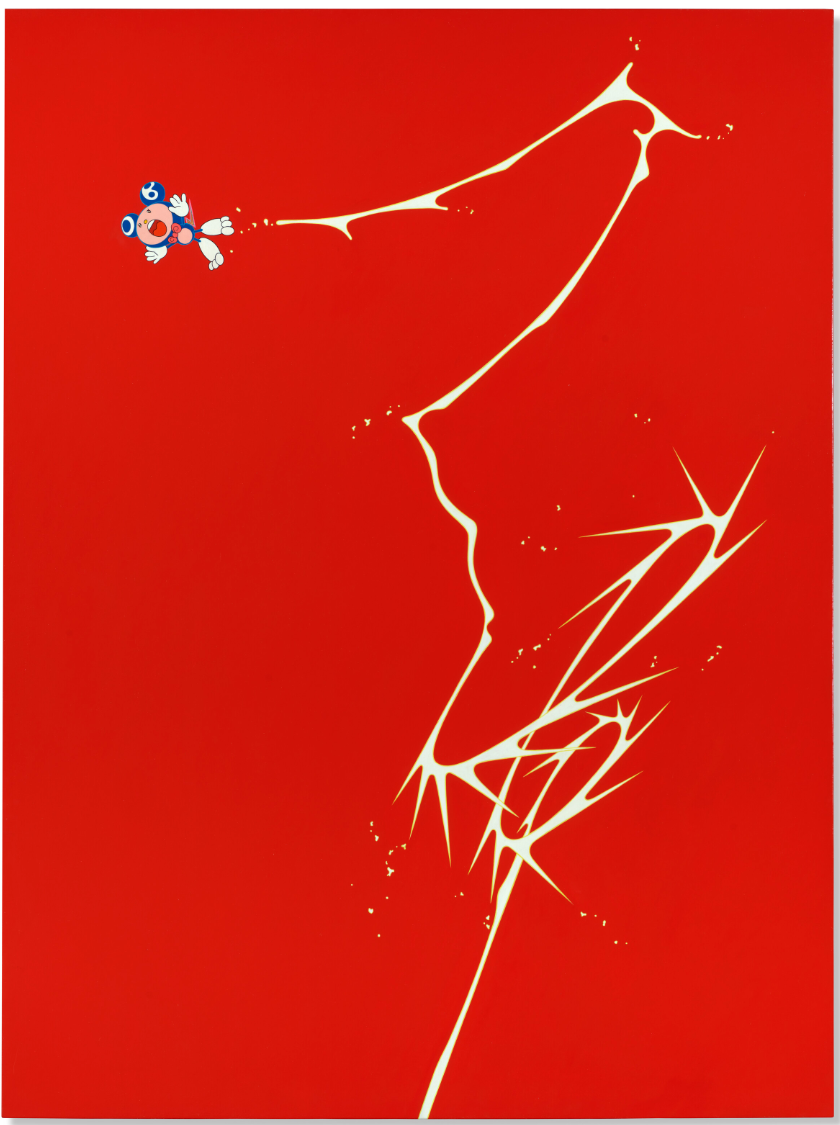
TAKASHI MURAKAMI (Born 1962)
DOB Jump, 1999
Acrylic on canvas mounted on panel
120×90 cm (42 7/8 x 35 3/8 inches)
Signed and dated ‘Takashi 99’ (on the reverse)
#12. Ensō: Earthly Desire, 2015
Christie’s London: 10 October 2024
Estimated: GBP 60,000 – 80,000
GBP 113,400 / USD 148,170
TAKASHI MURAKAMI (B. 1962), Ensō: Earthly Desire | Christie’s
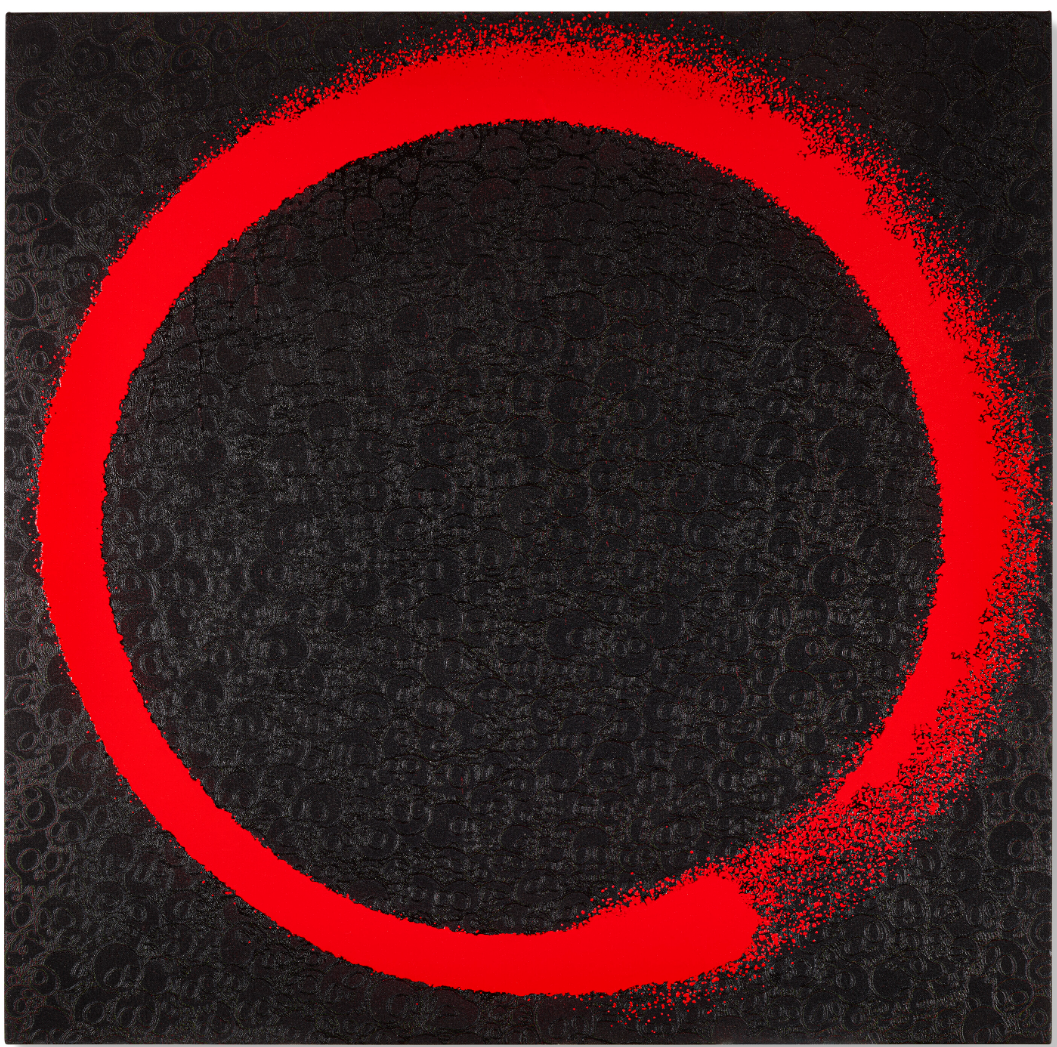
TAKASHI MURAKAMI (B. 1962)
Ensō: Earthly Desire, 2015
Acrylic on canvas
100×100 cm (39 3/8 x 39 3/8 inches)
Signed and dated ‘Takashi 2015’ (on the overlap)
#13. Flowers of Hope, 2019
Phillips Hong-Kong: 4 October 2024
Estimated: HKD 1,000,000 – 2,000,000
HKD 1,143,000 / USD 147,190
Takashi Murakami – New Now: Modern &… Lot 21 October 2024 | Phillips
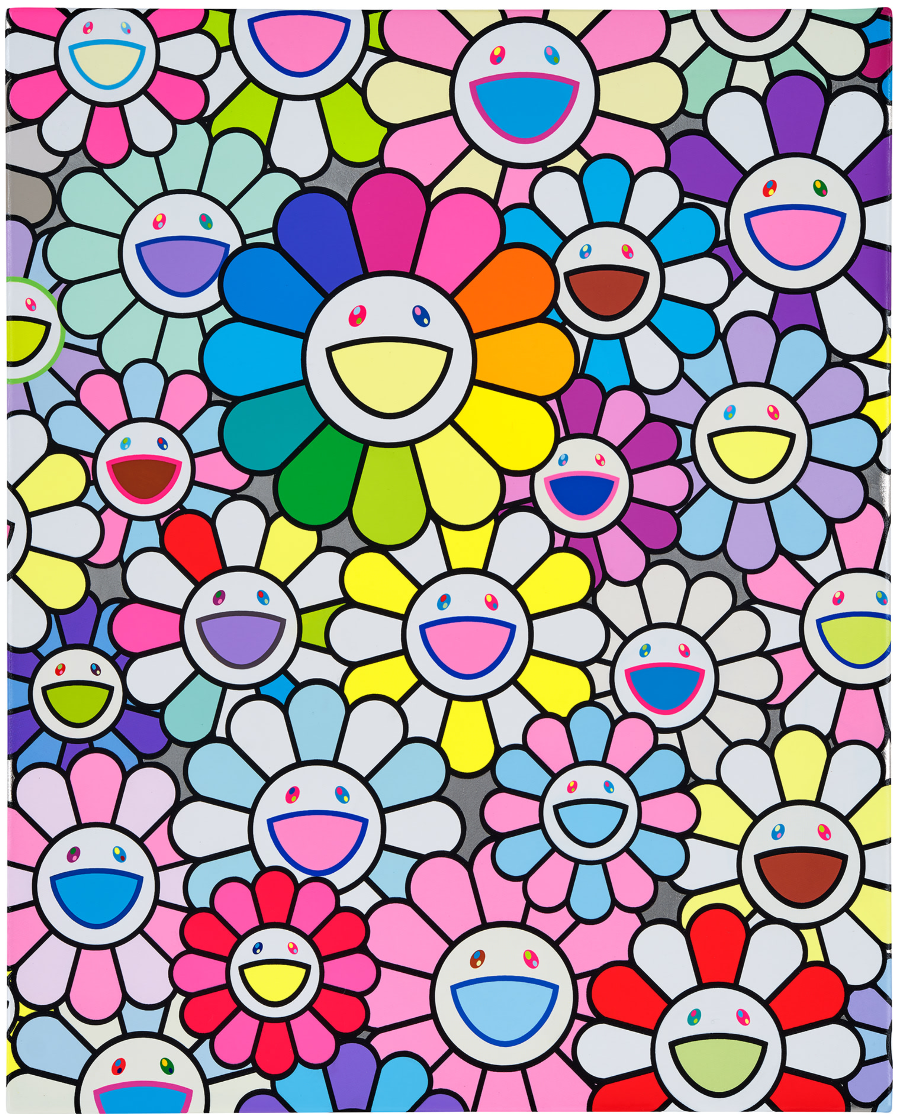
TAKASHI MURAKAMI
Flowers of Hope, 2019
Acrylic and platinum leaf on canvas mounted on aluminum frame
41.7 x 33.5 cm (16 3/8 x 13 1/4 inches)
Signed and dated ’TAKASHI 2019′ on the reverse
#14. Monogramouflage treillis, 2008
SBI Art Auction: 9 March 2024
Estimated: JPY 18,000,000 – 28,000,000
JPY 20,125,000 / USD 136,126
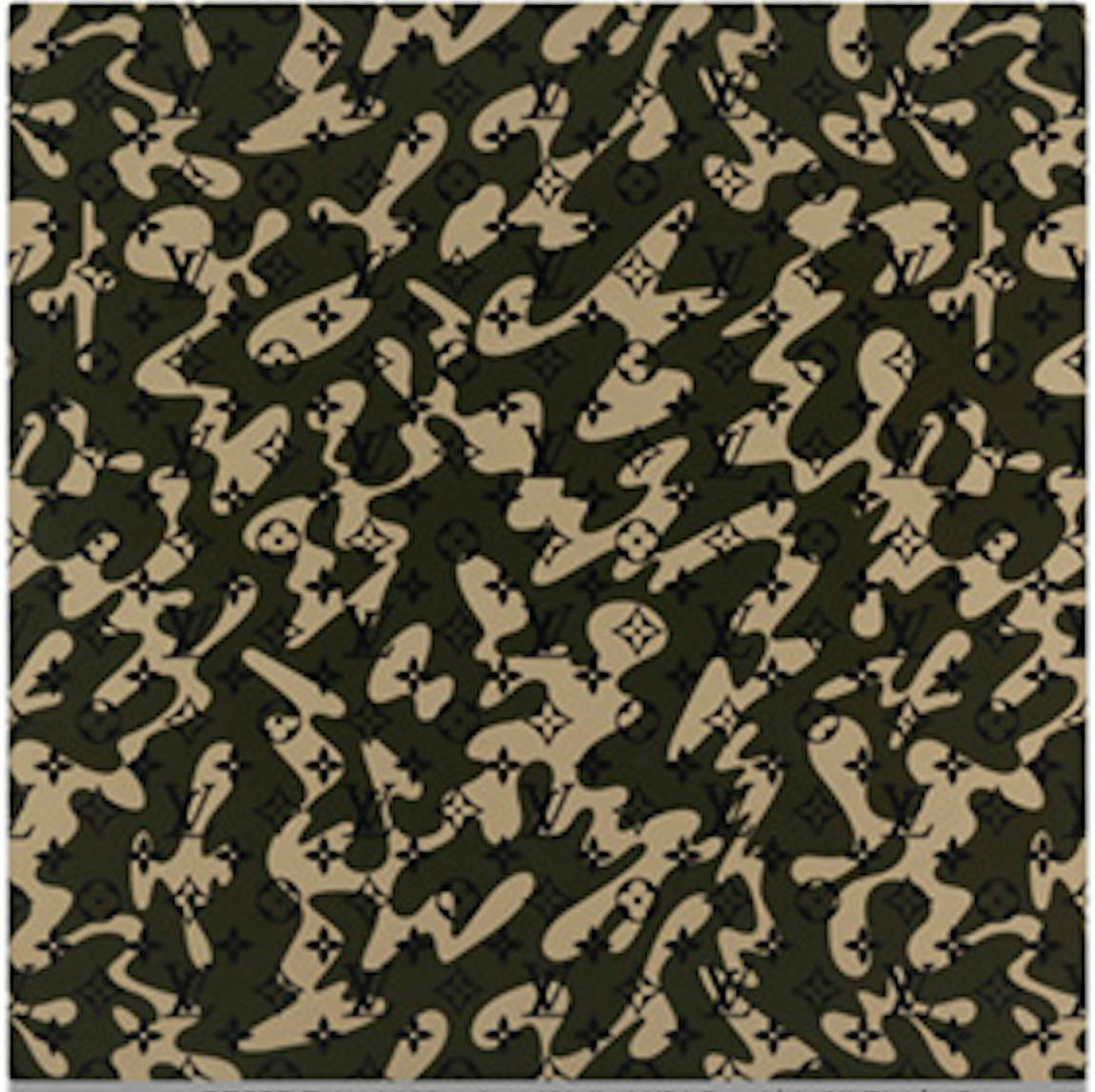
TAKASHI MURAKAMI
Monogramouflage treillis, 2008
Acrylic on canvas
71×71 inches (180.3 x 180.3 cm)
Signed and dated on the stretcher
#15. Untitled, 2016
Phillips Hong-Kong: 29 March 2024
Estimated: HKD 800,000 – 1,200,000
HKD 762,000 / USD 97,418
Takashi Murakami – New Now Hong Kong Lot 29 March 2024 | Phillips
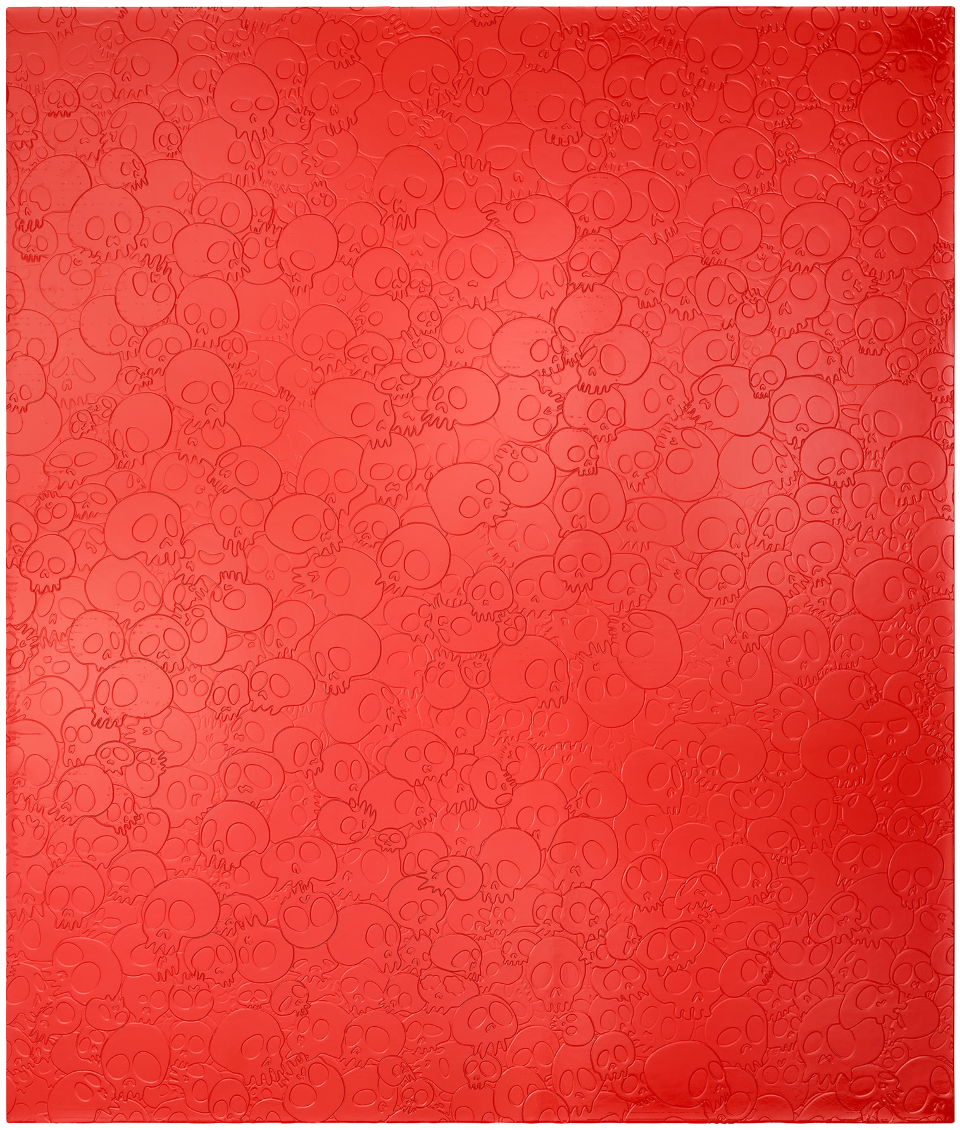
TAKASHI MURAKAMI
Untitled, 2016
Acrylic on canvas mounted on aluminum frame
141×120 cm (55 1/2 x 47 1/4 inches)
Signed and dated ’Takasm 2016′ on the overlap
#16. Flower: Pink Pink Pink, 2018
Sotheby’s Hong-Kong: 11 November 2024
Estimated: HKD 650,000 – 850,000
HKD 720,000 / USD 92,595
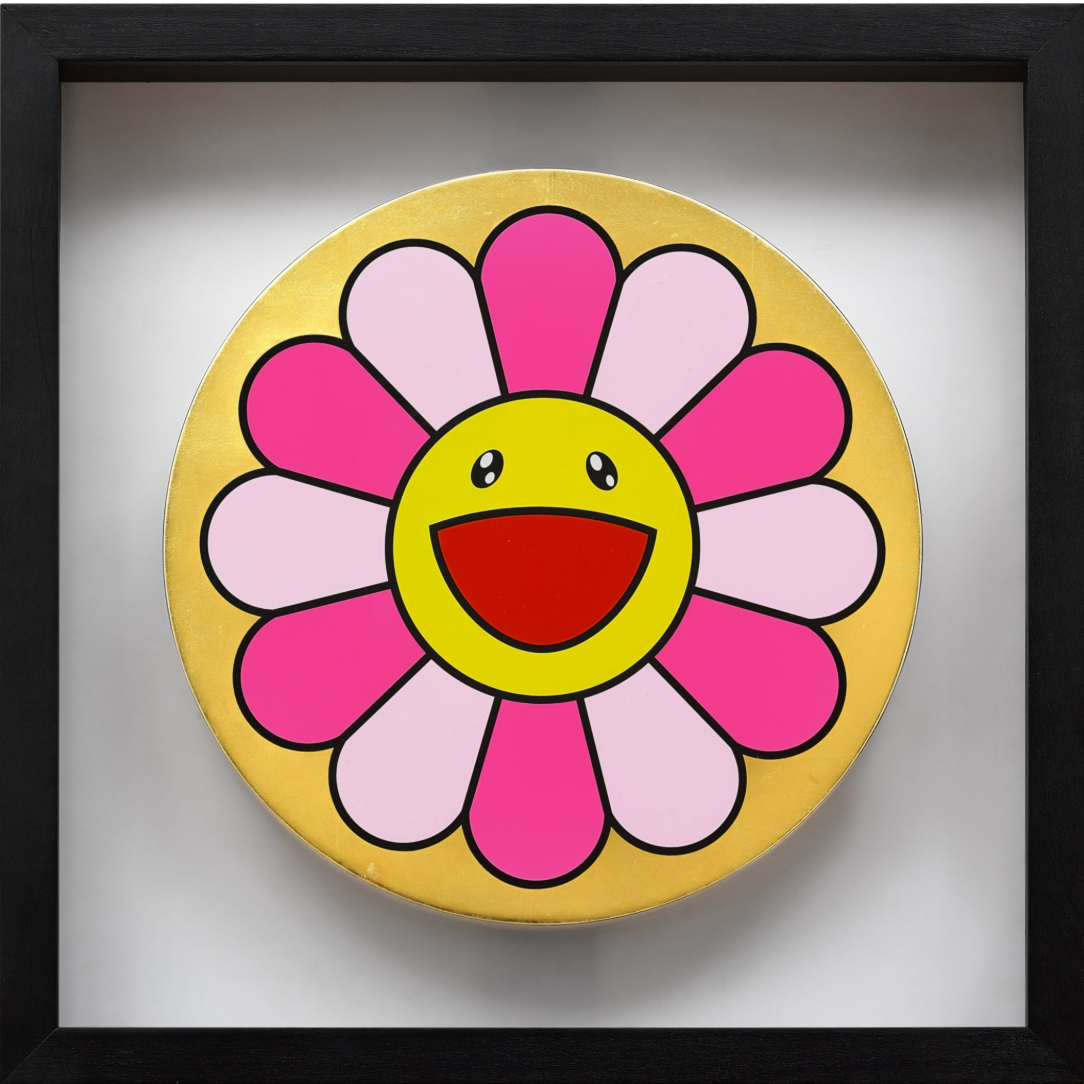
TAKASHI MURAKAMI (b. 1962)
Flower: Pink Pink Pink, 2018
Acrylic and gold leaf on canvas
Diameter: 40 cm (15 3/4 inches)
Signed and dated 2018 (on the reverse)
#17. Feeling Hollow, 2015
Phillips London: 11 October 2024
Estimated: GBP 60,000 – 80,000
GBP 63,500 / USD 82,940
Takashi Murakami – Modern & Contemp… Lot 184 October 2024 | Phillips
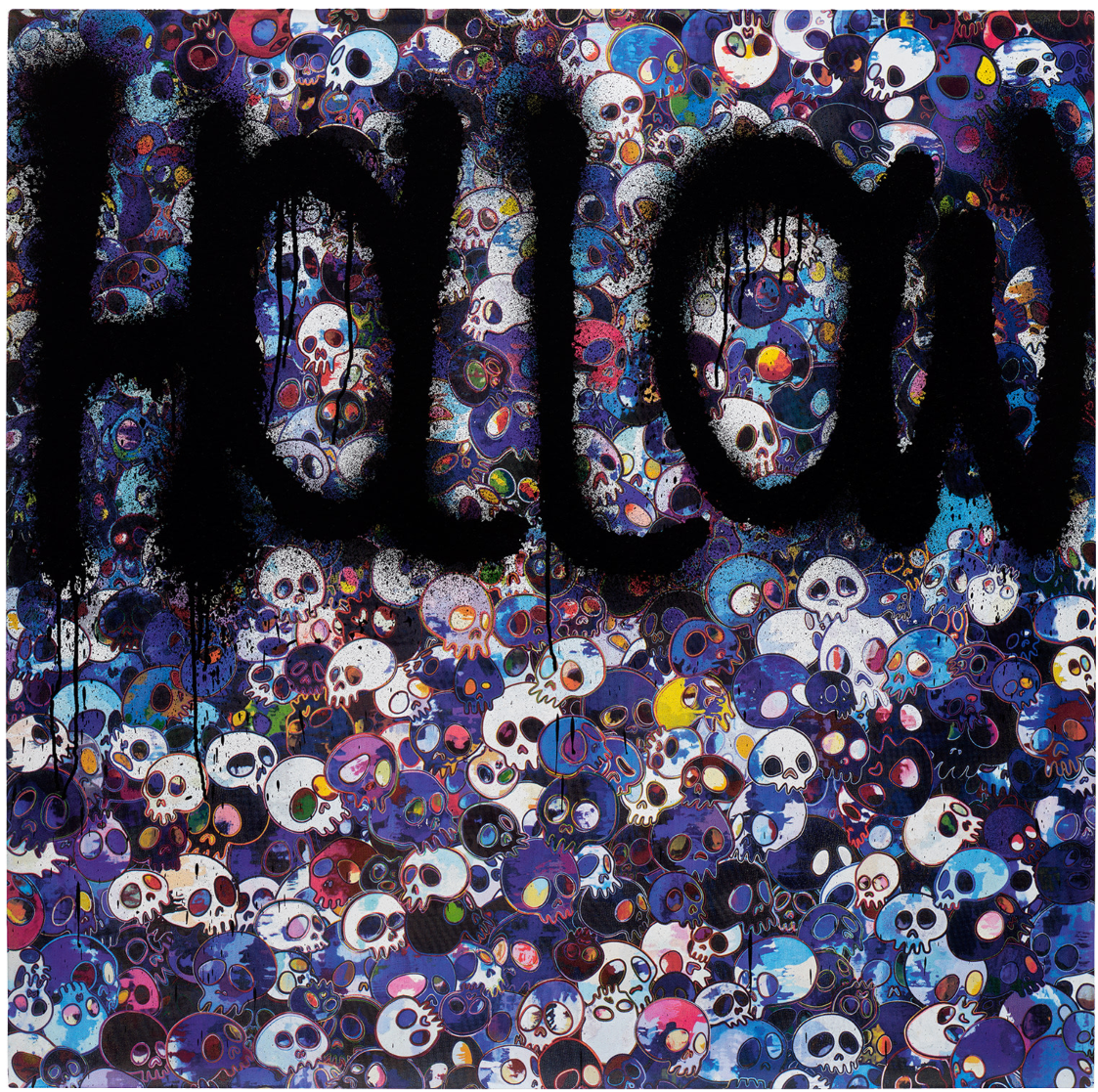
TAKASHI MURAKAMI
Feeling Hollow, 2015
Acrylic and platinum leaf on canvas laid down on aluminium
100×100 cm (39 3/8 x 39 3/8 inches)
Signed and dated ‘TAKASHI 2015’ on the overlap
#18. Untitled, 2020
Phillips Hong-Kong: 29 March 2024
Estimated: HKD 650,000 – 850,000
HKD 635,000 / USD 81,181
Takashi Murakami – New Now Hong Kong Lot 28 March 2024 | Phillips
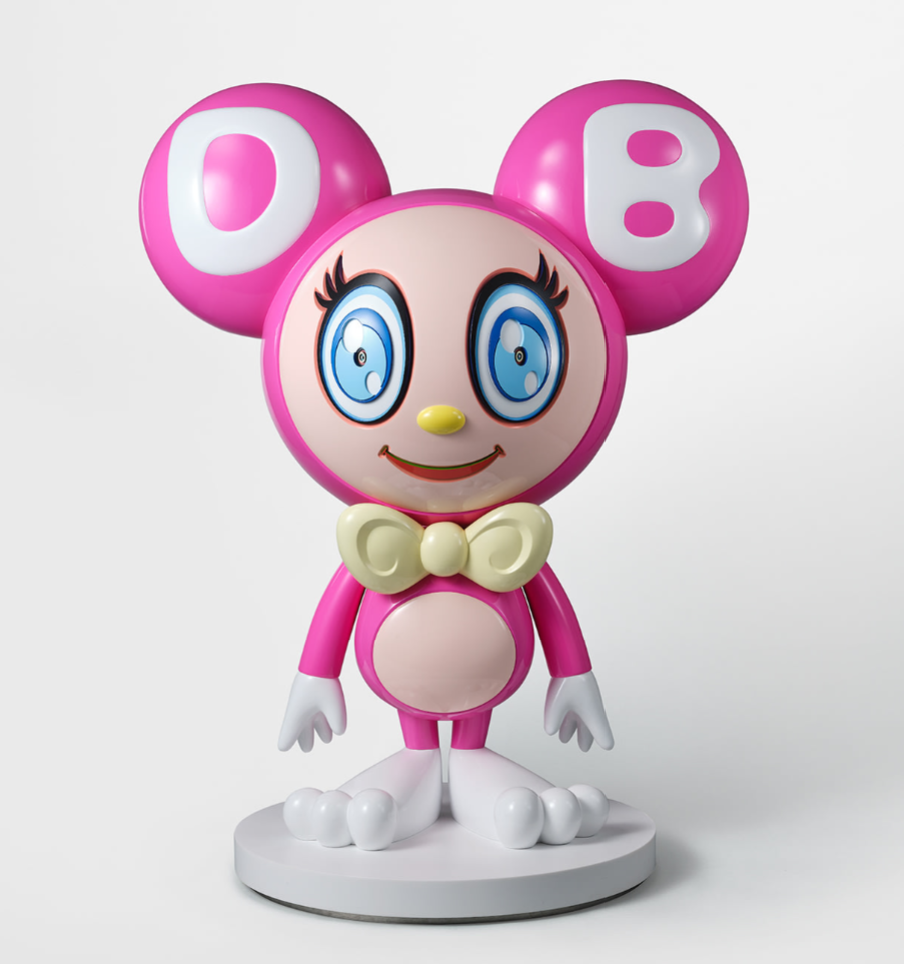
TAKASHI MURAKAMI
Untitled, 2020
FRP, urethane paint, stainless steel, wood
87.1 x 68.8 x 47 cm (34 1/4 x 27 1/8 x 18 1/2 inches)
This work is number 11 from an edition of 20 plus 1 artist’s proof and 2 special proofs
#19. Untitled, 2016
Phillips Hong-Kong: 1 June 2024
Estimated: HKD 200,000 – 300,000
HKD 254,000 / USD 32,490
Takashi Murakami – Modern & Contempora… Lot 168 June 2024 | Phillips
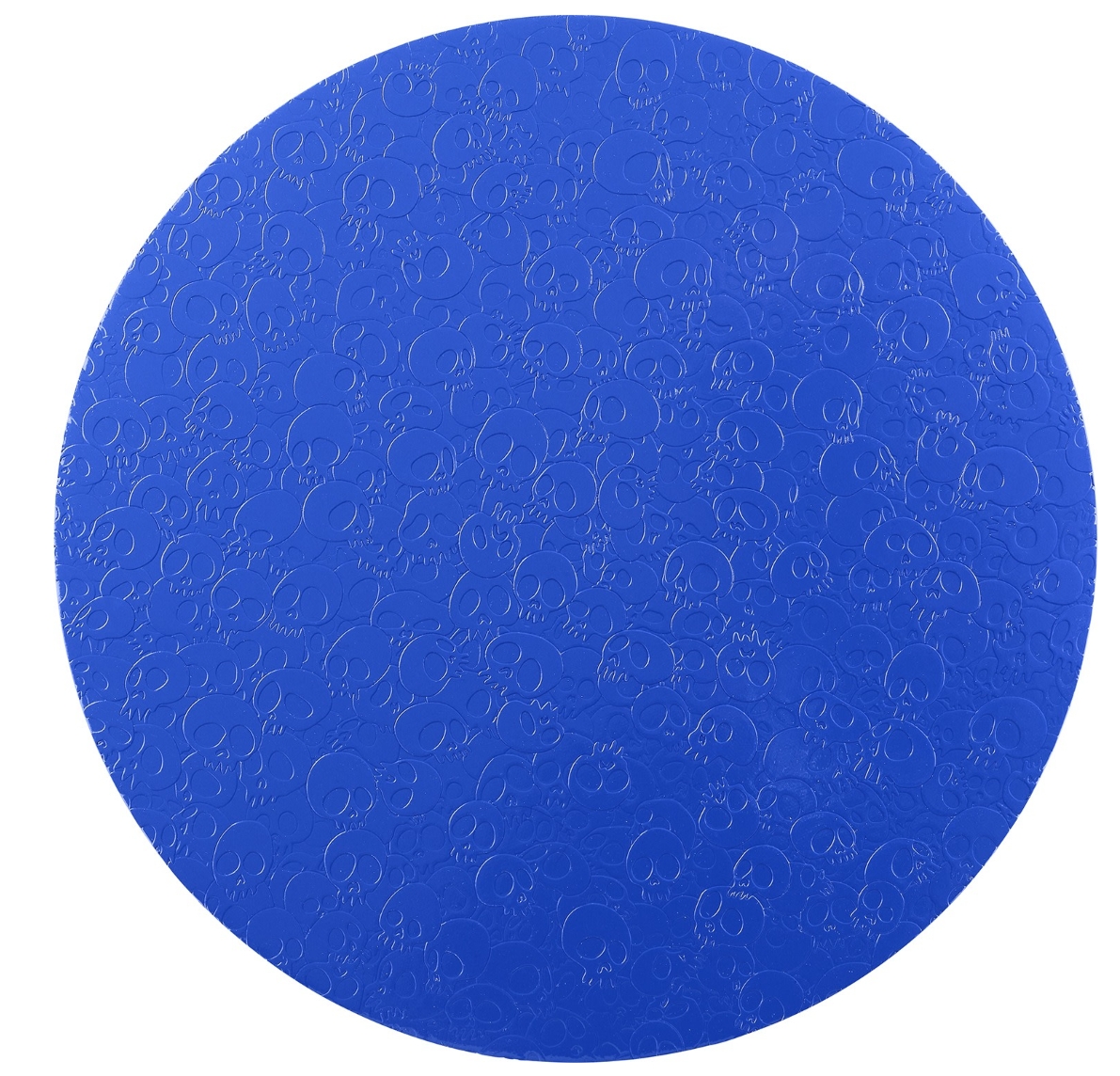
TAKASHI MURAKAMI
Untitled, 2016
Acrylic on canvas mounted onto wood panel
Diameter: 40 cm (15 3/4 inches)
Signed and dated ’TAKASHI 2016′ on the reverse
2023 Auction Results
28 lots sold at auction in 2023 for a total turnover of USD 15,060,088. With 7 lots unsold, the sell-through rate is 80%. 5 lots are sculptures, the remaining 23 lots are paintings.
2023 Top 3 Lots
4 lots sold for over USD 1 million, generating a cumulative turnover of USD 7,603,026, contributing 50.5% to the total turnover for 2023. 3 of those lots, including the top lot of this auction year sold in Hong-Kong.
#1. Homage To Francis Bacon (Three Studies of Lucian Freud), 2017
Sotheby’s Hong-Kong: 5 April 2023
Estimated: HKD 18,000,000 – 28,000,000
HKD 22,230,000 / USD 2,831,883
TAKASHI MURAKAMI (b. 1962)
Homage To Francis Bacon (Three Studies of Lucian Freud), 2017
Acrylic, gold leaf and platinum leaf on canvas mounted on aluminum, in 3 parts
Each: 197.8 x 147.5 cm (77 7/8 x 58 1/8 inches)
Overall: 197.8 x 442.5 cm (77 7/8 x 174 1/4 inches)
Signed and dated 2017 on the overlap of the second panel
#2. Flower Parent and Child, 2018-2020
Phillips Hong-Kong: 30 March 2023
Estimated: HKD 15,500,000 – 23,500,000
HKD 14,002,000 / USD 1,783,717
Takashi Murakami – 20th Century & Cont… Lot 14 March 2023 | Phillips
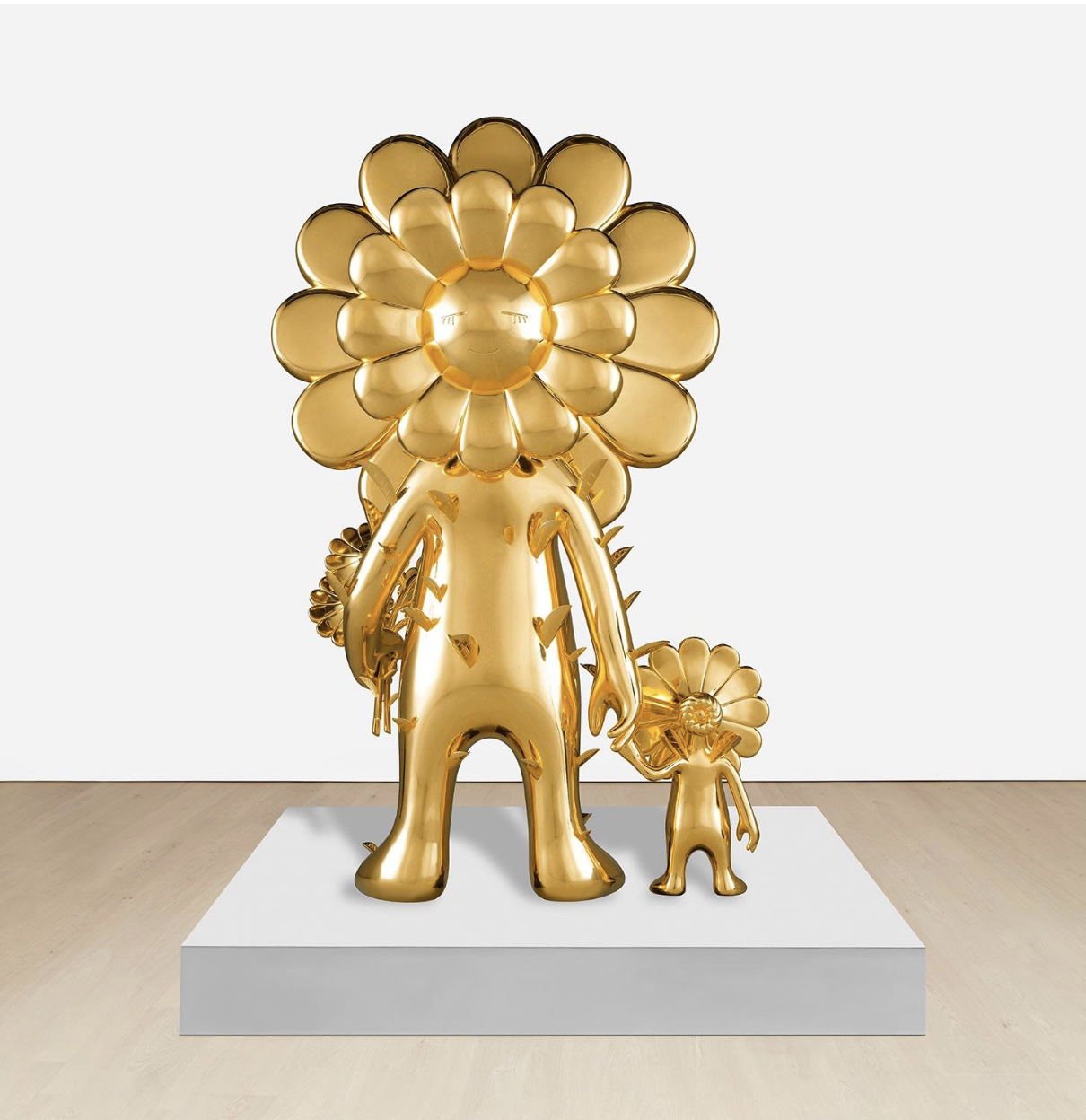
TAKASHI MURAKAMI
Flower Parent and Child, 2018-2020
Gold leaf on bronze
248.5 x 152.3 x 115.3 cm (97 7/8 x 59 7/8 x 45 3/8 inches)
Signed and dated ‘TAKASHI 2020’
#3. The Castle of Tin Tin, 1998
Christie’s New-York: 9 March 2023
Estimated: USD 1,200,000 – 2,500,000
USD 1,620,000
TAKASHI MURAKAMI (B. 1962), The Castle of Tin Tin | Christie’s
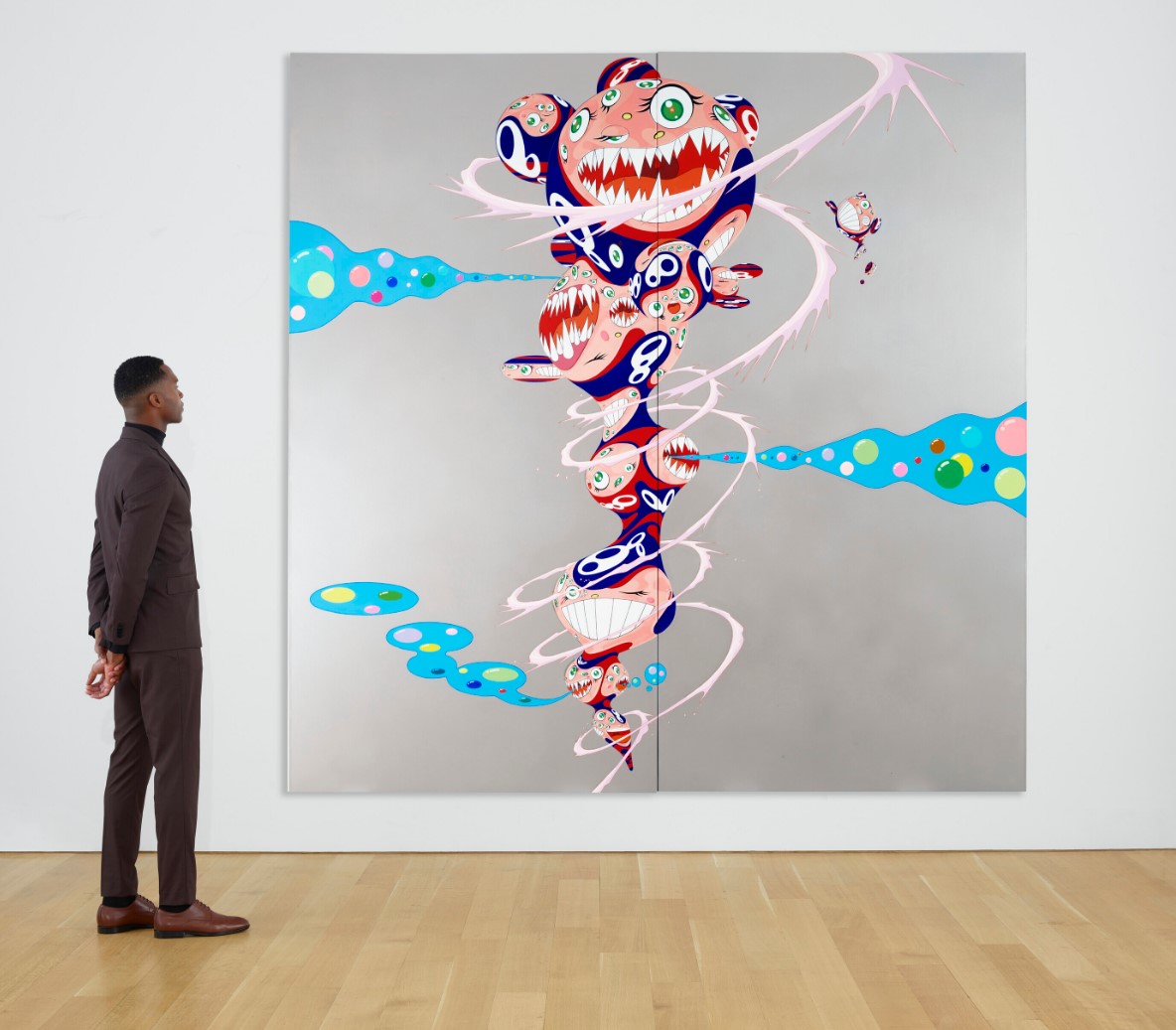
TAKASHI MURAKAMI (B. 1962)
The Castle of Tin Tin, 1998
Acrylic on canvas mounted on panel (diptych)
118×118 inches (299.7 x 299.7 cm)
#4. I’ve been to the Top of the Hill, 2014
Sotheby’s Hong-Kong: 5 April 2023
Estimated: HKD 7,000,000 – 9,400,000
HKD 10,735,000 / USD 1,367,533
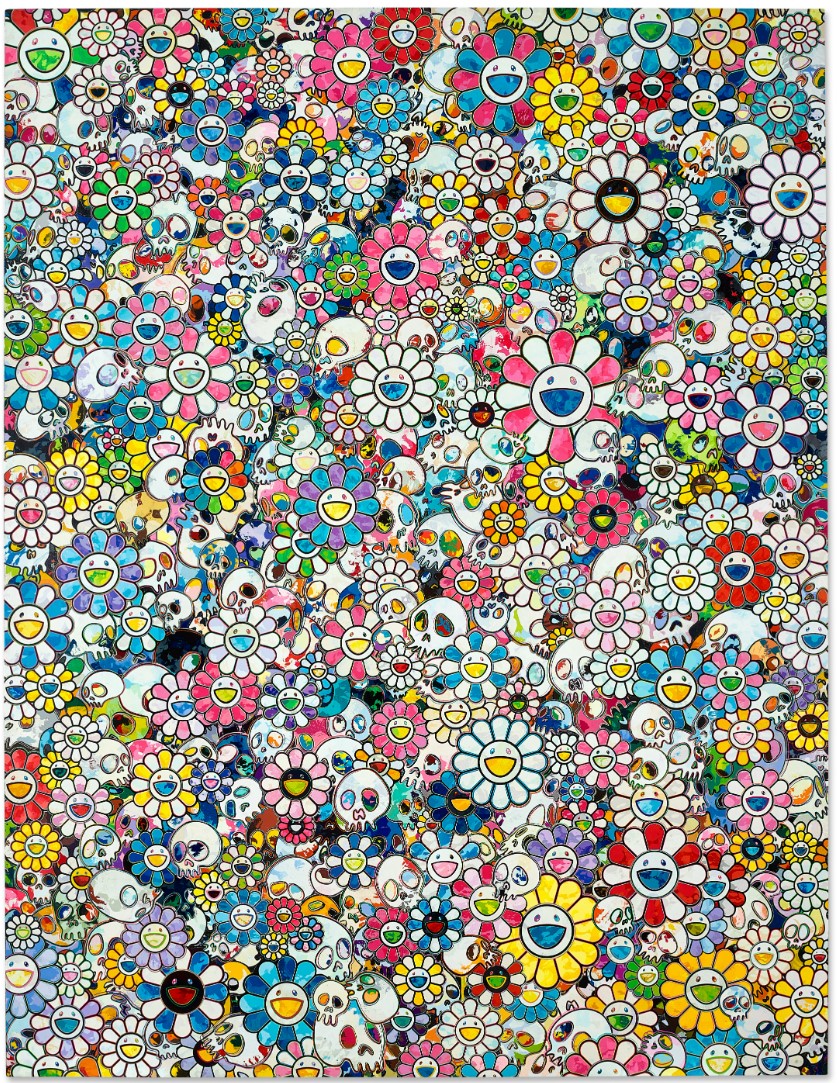
TAKASHI MURAKAMI (b. 1962)
I’ve been to the Top of the Hill, 2014
Acrylic on canvas on aluminum frame
199×153 cm (78 3/8 x 60 1/4 inches)
Signed and dated 2014 on the overlap
USD 1 million
#5. Time Bokan – Pink, 2001
Christie’s New-York: 18 May 2023
Estimated: USD 300,000 – 500,000
USD 756,000
TAKASHI MURAKAMI (B. 1962), Time Bokan – Pink | Christie’s
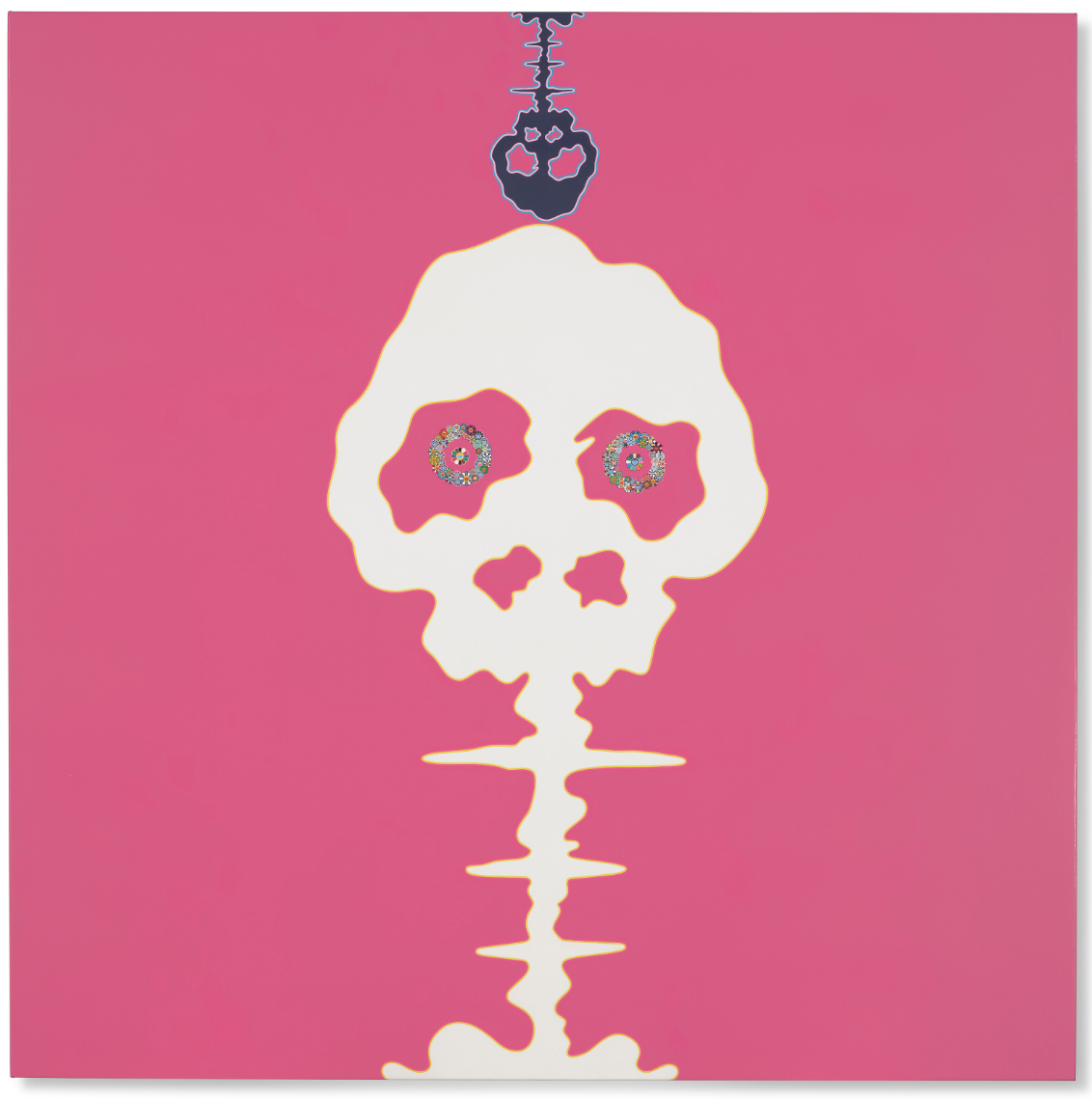
TAKASHI MURAKAMI (B. 1962)
Time Bokan – Pink, 2001
Acrylic and canvas mounted on panel
180×180 cm (70 7/8 x 70 7/8 inches)
#6. Kōrin: Tranquility, 2015
Christie’s New-York: 18 May 2023
Estimated: USD 500,000 – 700,000
USD 630,000
TAKASHI MURAKAMI (B. 1962), Kōrin: Tranquility | Christie’s
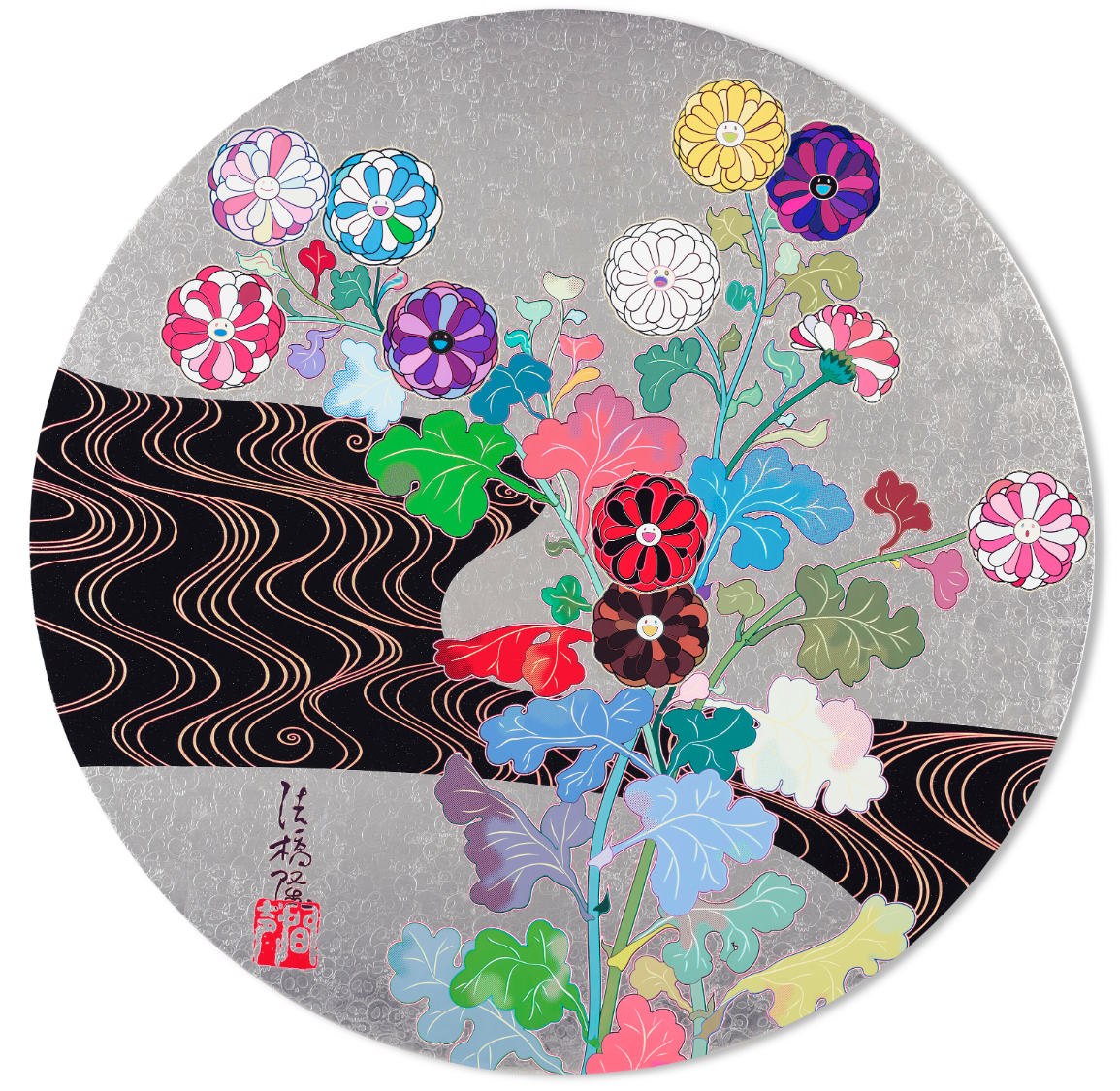
TAKASHI MURAKAMI (B. 1962)
Kōrin: Tranquility, 2015
Acrylic and platinum and gold leaf on canvas mounted on panel
Diameter: 150 cm (59 inches)
Signed and dated ‘Takashi 2015’ (on the reverse)
#7. NGC2371-2 (Gemini Nebula), 2009
Sotheby’s Hong-Kong: 6 April 2023
Estimated: HKD 2,000,000 – 3,000,000
HKD 4,826,000 / USD 614,769
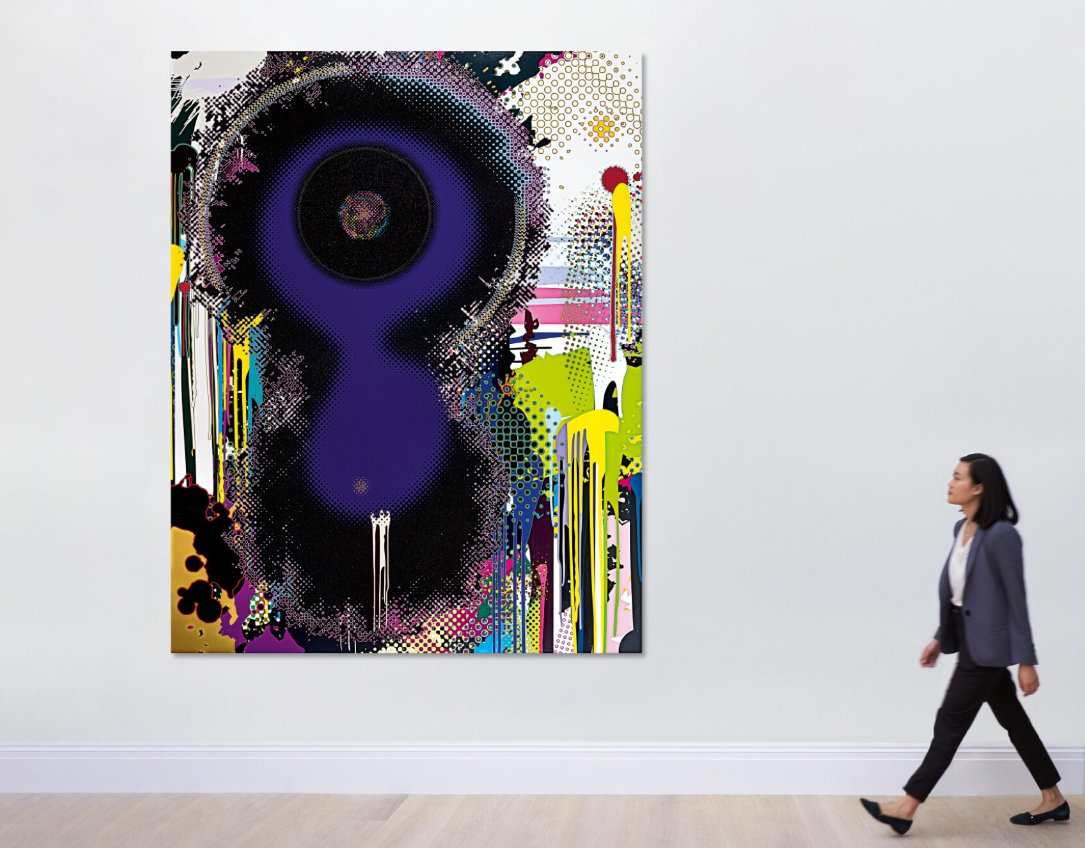
TAKASHI MURAKAMI (b. 1962)
NGC2371-2 (Gemini Nebula), 2009
Acrylic, platinum leaf and gold leaf on canvas, mounted on aluminum frame
300.5 x 234.5 cm (118 1/4 x 92 3/8 inches)
Signed and dated 09 on the turnover edge
#8. Doraemon Yay!, 2019
Sotheby’s Hong-Kong: 6 April 2023
Estimated: HKD 2,800,000 – 3,800,000
HKD 4,318,000 / USD 550,056
Takashi Murakami 村上隆 | Doraemon Yay! 多啦A夢耶! | Contemporary Day Auction | 2023 | Sotheby’s
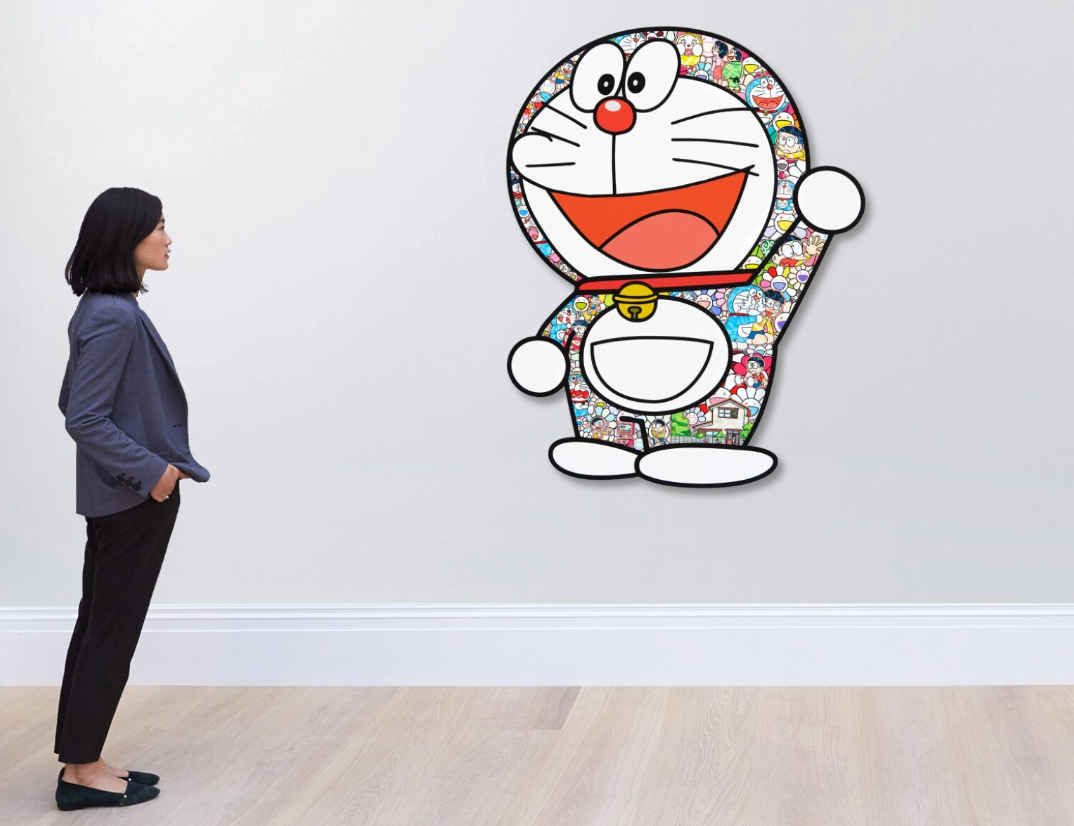
TAKASHI MURAKAMI (b. 1962)
Doraemon Yay!, 2019
Acrylic and platinum leaf on canvas mounted on wood panel
119.2 x 93 cm (46 7/8 x 36 5/8 inches)
Signed and dated 2019 on the reverse
#9. I open wide my eyes but see no scenery. I fix my gaze upon my heart, 20o7
Christie’s New-York: 18 May 2023
Estimated: USD 800,000 – 1,200,000
USD 529,200
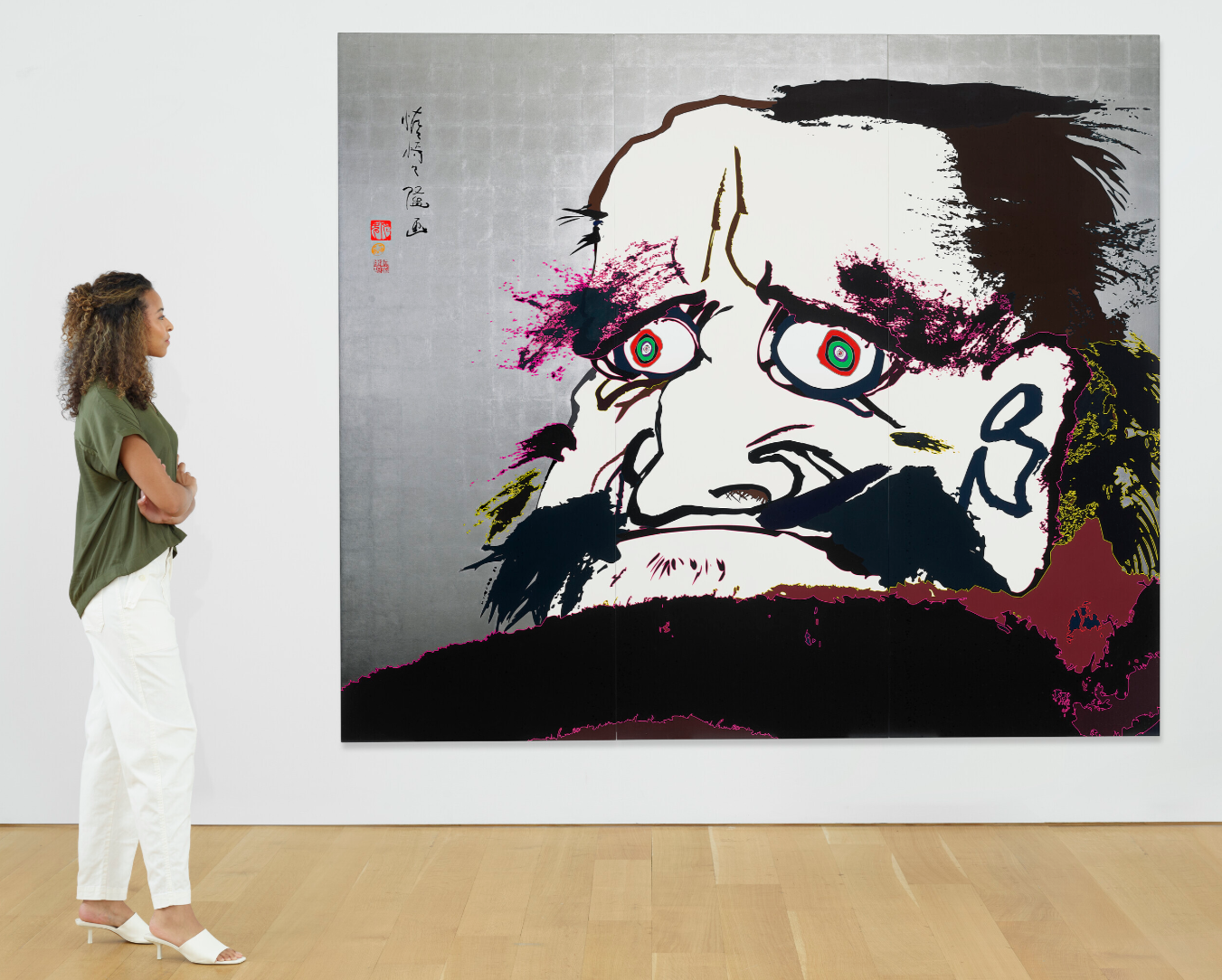
TAKASHI MURAKAMI (B. 1962)
I open wide my eyes but see no scenery. I fix my gaze upon my heart, 20o7
Acrylic and platinum leaf on canvas mounted on panel, triptych
242.6 x 282 cm (95 1/2 x 111 inches)
Signed ‘Takashi’ (on the reverse of the center panel)
#10. The Emperor’s New Clothes, 2005
Sotheby’s New-York: 19 May 2023
Estimated: USD 500,000 – 700,000
USD 508,000
The Emperor’s New Clothes | Contemporary Day Auction | 2023 | Sotheby’s
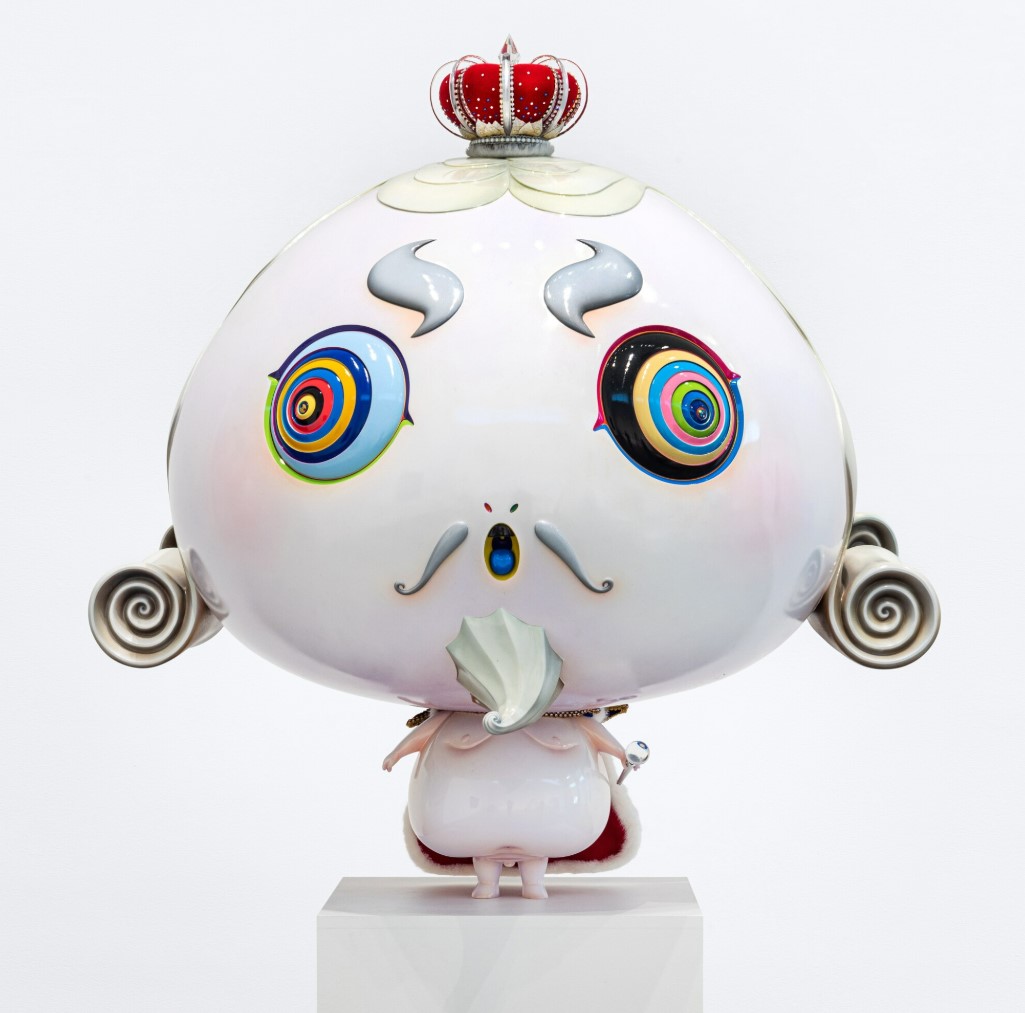
TAKASHI MURAKAMI (b. 1962)
The Emperor’s New Clothes, 2005
Oil, resin and lacquer on fiberglass, velvet with gold embroidery, fur, rhinestones, fabric and acrylic
113 x 113 x 97.8 cm (44.5 x 44.5 x 38.5 inches)
This work is number 1 from an edition of 2 unique color variants plus 1 artist’s proof
#11. Zen Enzo: Mugen, 2016
China Guardian: 6 April 2023
Estimated: HKD 800,000 – 1,200,000
HKD 3,360,000 / USD 428,020
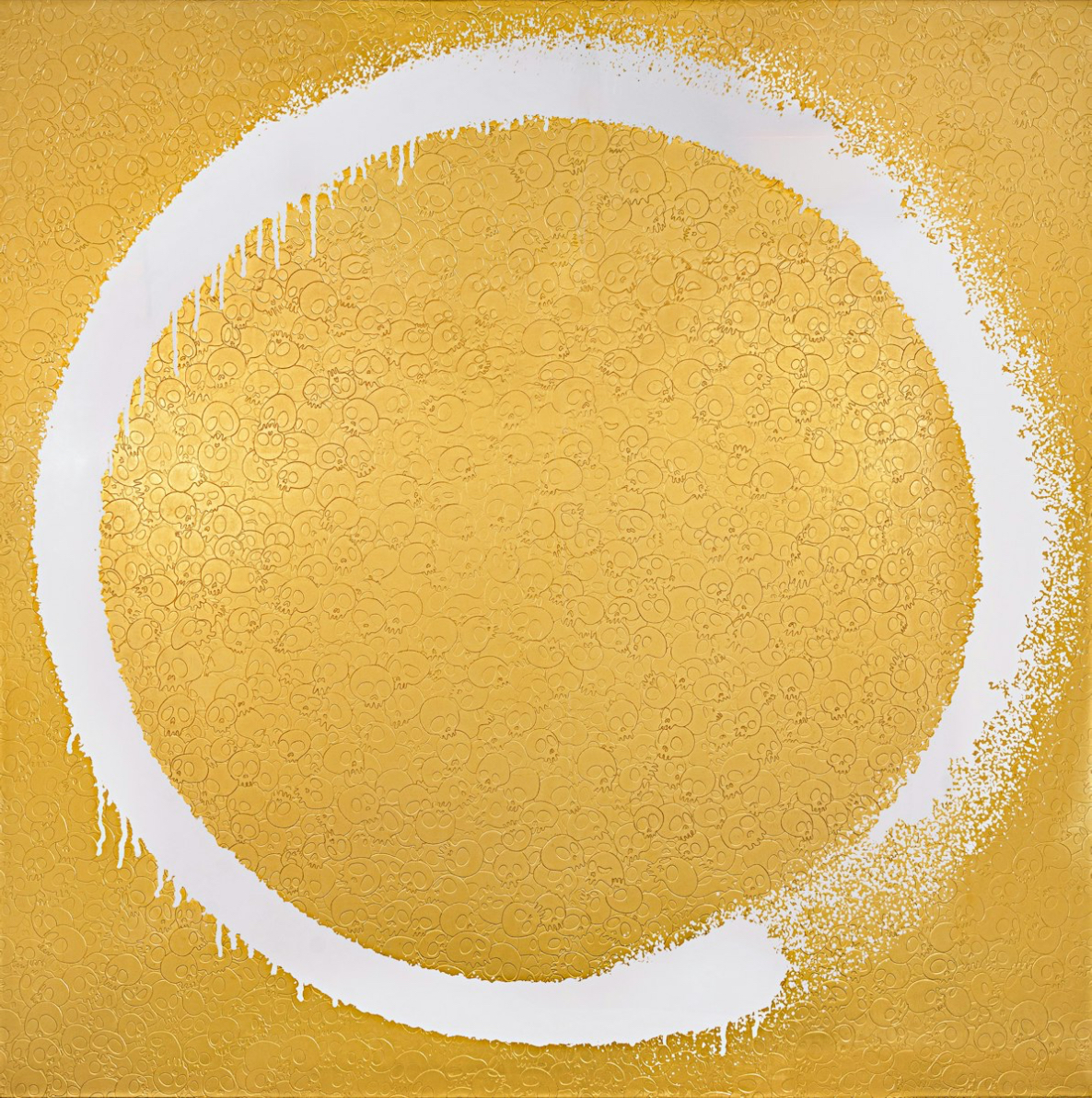
TAKASHI MURAKAMI
Zen Enzo: Mugen, 2016
Acrylic and gold leaf on canvas
180×180 cm (71×71 inches)
#12. Cherries, 2005
Phillips Hong-Kong: 31 March 2023
Estimated: HKD 2,500,000 – 3,500,000
HKD 3,302,000 / USD 420,642
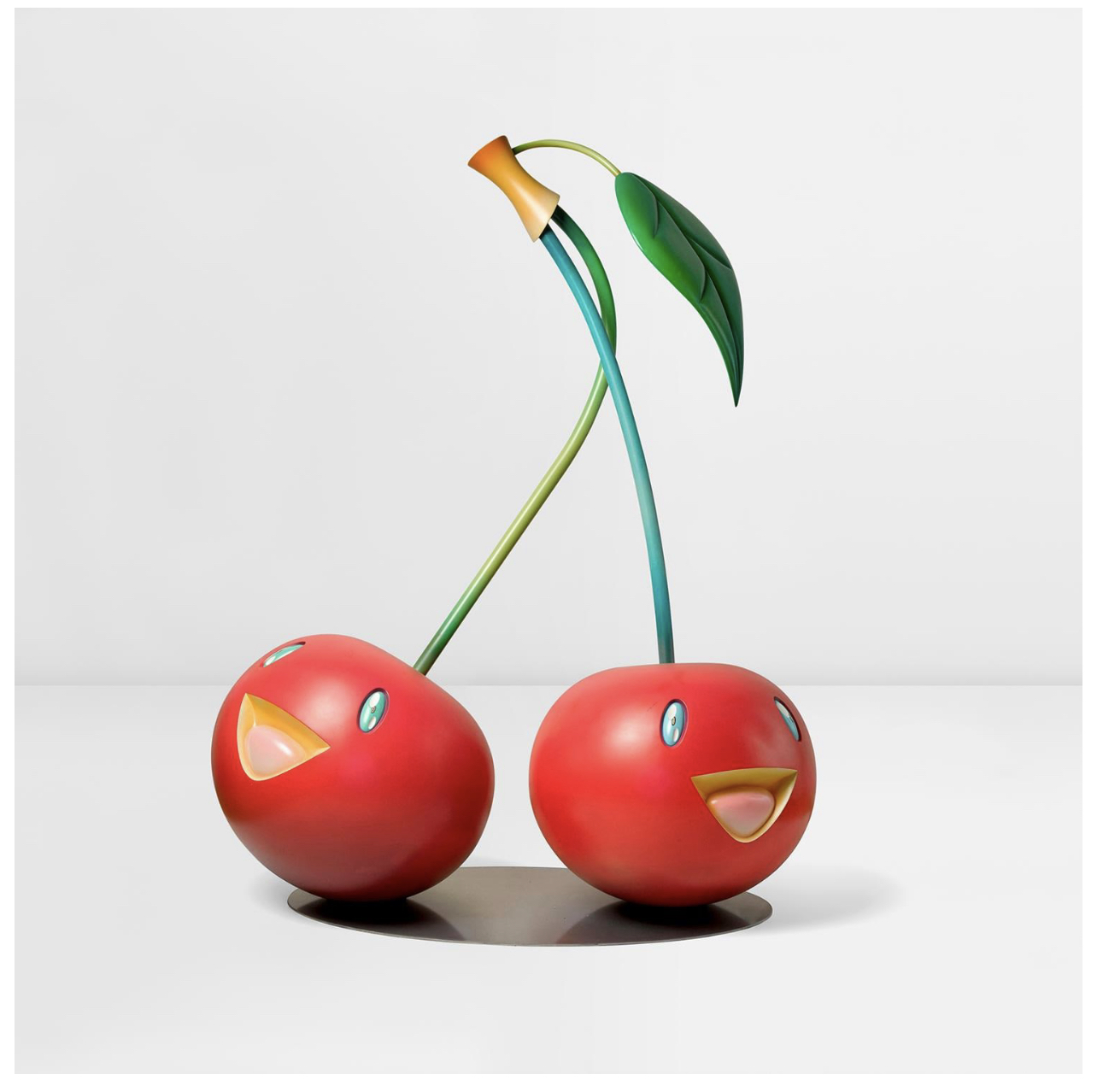
TAKASHI MURAKAMI
Cherries, 2005
FRP, steel, acrylic and urethane paint
200x100x71 cm (78 3/4 x 39 3/8 x 27 7/8 inches)
This work is number 1 from an edition of 5 plus 2 artist’s proofs
Signed, dated and numbered ‘TAKASHI 05 1/5’ on the inside rim of the top of stem
#13. And then, and then, and then, and then and then / Super Blue DOB, 2006
Christie’s Hong-Kong: 29 May 2023
Estimated: HKD 2,200,000 – 4,000,000
HKD 3,150,000 / USD 402,386
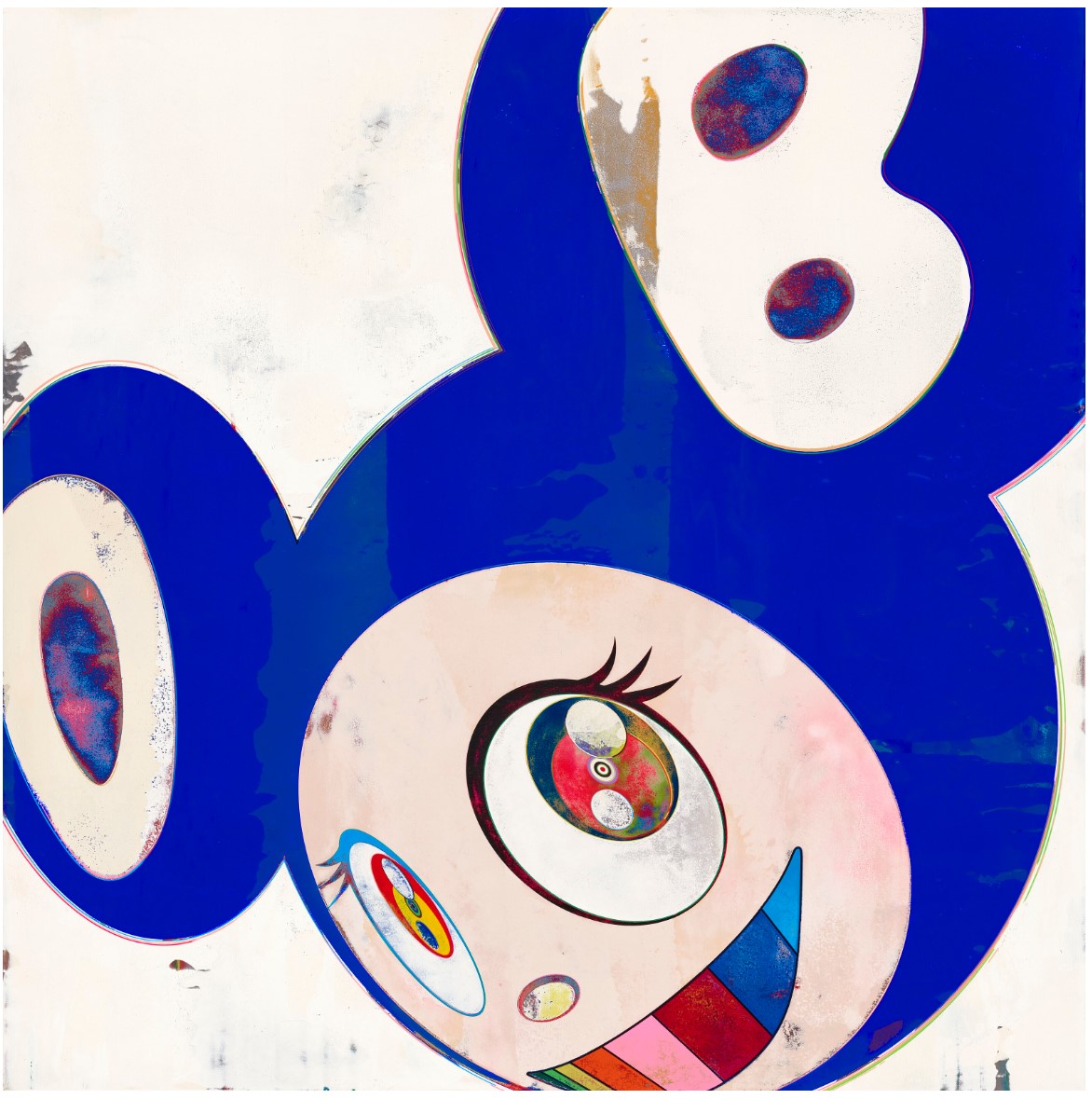
TAKASHI MURAKAMI (B. 1962)
And then, and then, and then, and then and then / Super Blue DOB, 2006
Acrylic on canvas laid on board
100.7 x 100.2 cm (39 5/8 x 39 3/8 inches)
Signed and dated ‘Takashi 06’ (on the reverse)
#14. And then 1000 (A Deep Ocean of Ultramarine), 2013
Sotheby’s Hong-Kong: 5 October 2023
Estimated: HKD 2,200,000 – 3,500,000
HKD 2,921,000 / USD 372,999
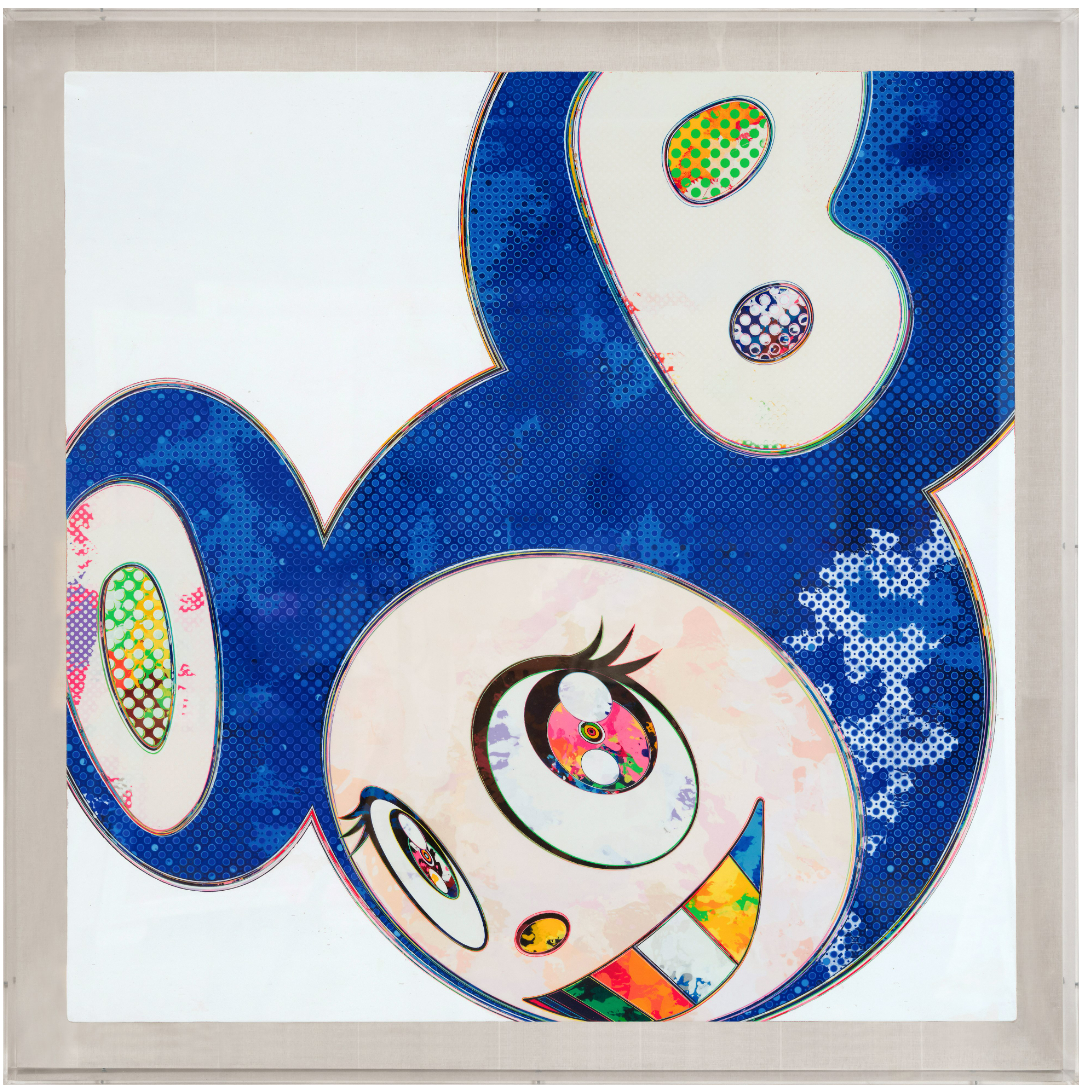
TAKASHI MURAKAMI (b. 1962)
And then 1000 (A Deep Ocean of Ultramarine), 2013
Acrylic on canvas
100×100 cm (39 3/8 x 39 3/8 inches)
#15. Thinking Matter (Red), 2016
Christie’s London: 14 October 2023
Estimated: GBP 250,000 – 350,000
GBP 264,600 / USD 320,843
Takashi Murakami (christies.com)
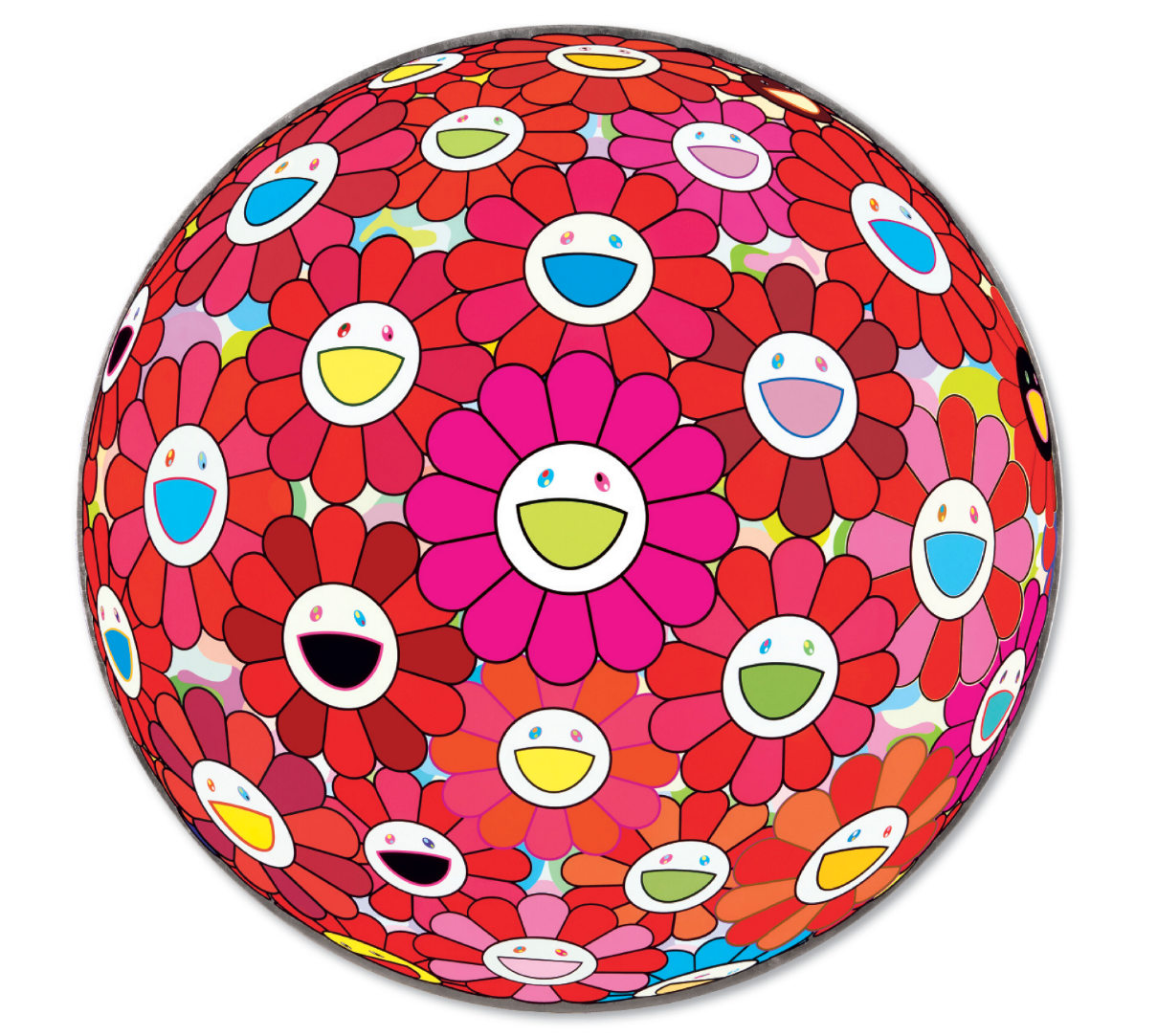
TAKASHI MURAKAMI (B. 1962)
Thinking Matter (Red), 2016
Acrylic and platinum leaf on canvas laid on panel
Diameter: 150.5 cm (59 1/4 inches)
Signed and dated ‘TAKASHI 2016’ (on the reverse)
#16. Time Machine, 2019
Christie’s Hong-Kong: 29 November 2023
Estimated: HKD 2,000,000 – 4,000,000
HKD 2,394,000 / USD 307,351
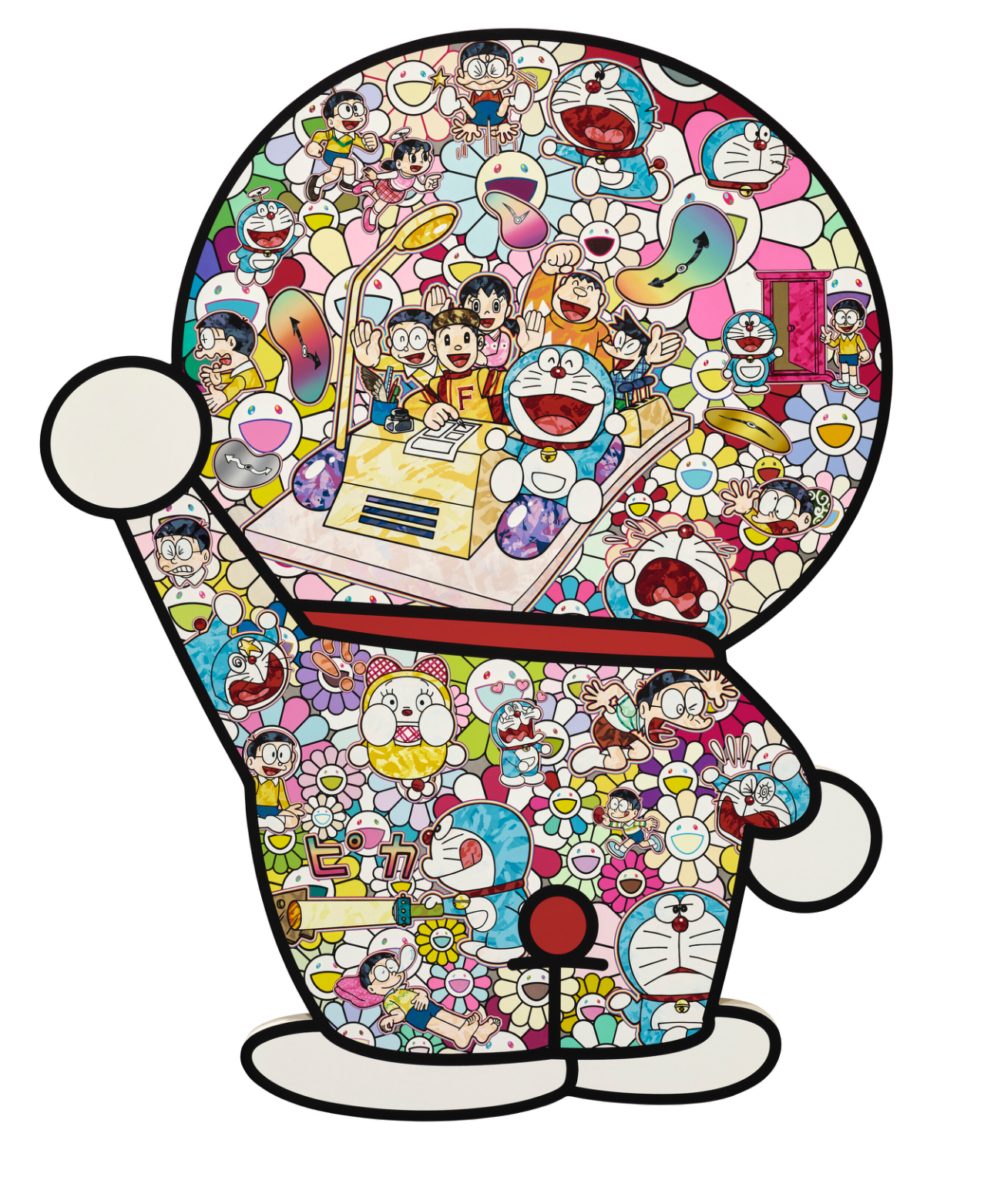
TAKASHI MURAKAMI (B. 1962)
Time Machine, 2019
Acrylic and platinum leaf and gold leaf on canvas mounted on wood panel
120 x 93.6 cm (47 1/4 x 36 7/8 inches)
Signed with the artist’s signature and dated ‘2019’ (on the reverse)
#17. Time Bokan – Black + Moss Green, 2006
Christie’s New-York: 29 September 2023
Estimated: USD 300,000 – 500,000
USD 258,300
TAKASHI MURAKAMI (B. 1962) (christies.com)
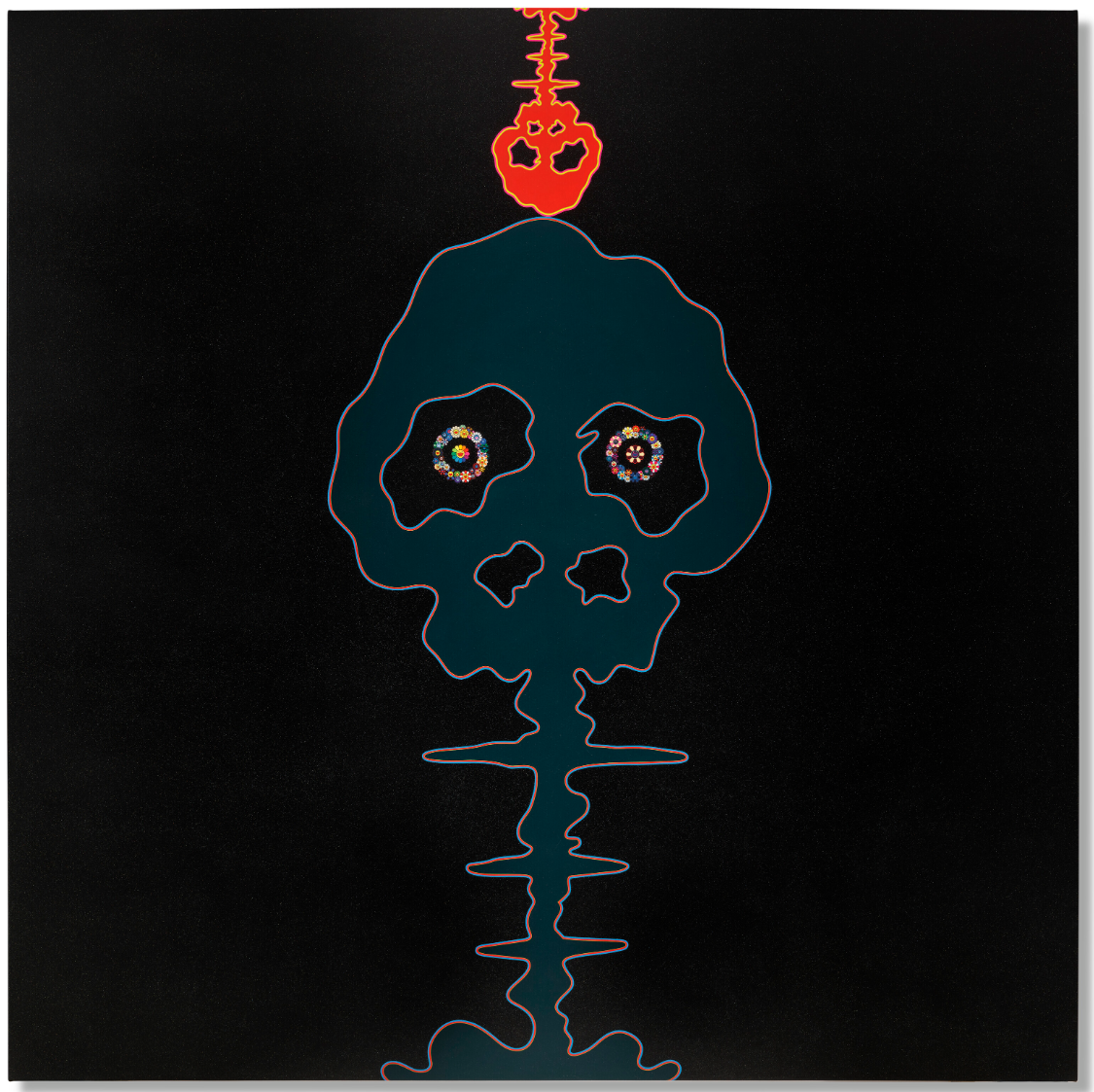
TAKASHI MURAKAMI (B. 1962)
Time Bokan – Black + Moss Green, 2006
Acrylic on canvas mounted on panel
180×180 cm (71×71 inches)
Signed and dated ‘TAKASHI 06’ (on the reverse); stamped (on the reverse)
#18. And then x6 (White: the superflat method, blue and yellow ears), 2013
Artcurial Paris: 7 June 2023
Estimated: EUR 200,000 – 300,000
EUR 223,040 / USD 238,673
Contemporary Art – Evening Sale | Sale n°4308 | Lot n°141 | Artcurial
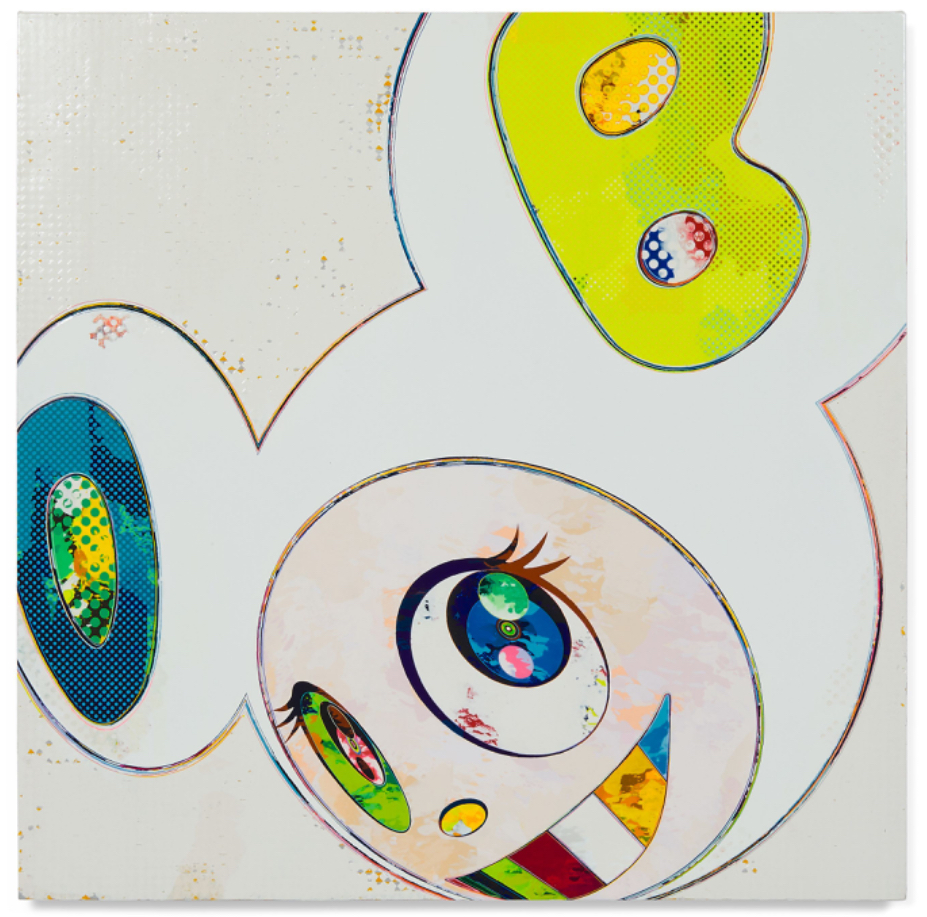
TAKASHI MURAKAMI (Born 1962)
And then x6 (White: the superflat method, blue and yellow ears), 2013
Acrylic on canvas mounted on aluminum frame
100×100 cm
Signed and dated on the overlap
#19. Eye Love Superflat, 2006
Sotheby’s London: 28 June 2023
Estimated: GBP 60,000 – 80,000
GBP 152,400 / USD 192,545
Eye Love Superflat | Modern & Contemporary Day Auction | 2023 | Sotheby’s (sothebys.com)
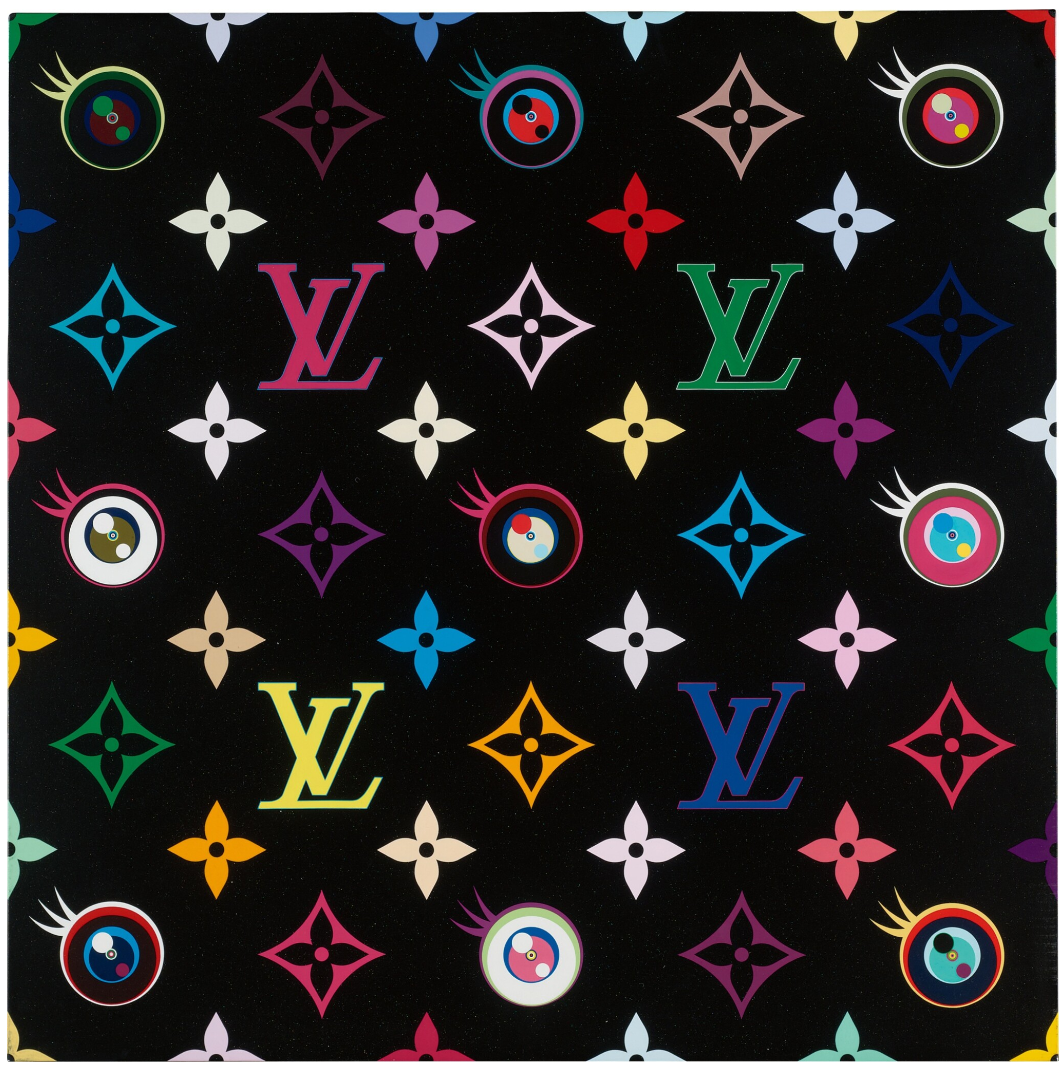
TAKASHI MURAKAMI (b. 1962)
Eye Love Superflat, 2006
Acrylic on canvas mounted on board
100×100 cm (39 3/8 x 39 3/8 inches)
Signed, dated 06 and variously inscribed on the reverse
#20. Lying on the Grasslands, Pondering Death and the Ends of the Universe: Jet Black, 2016
Heritage Auctions: 25 July 2023
Estimated: USD 150,000 – 250,000
USD 156,250
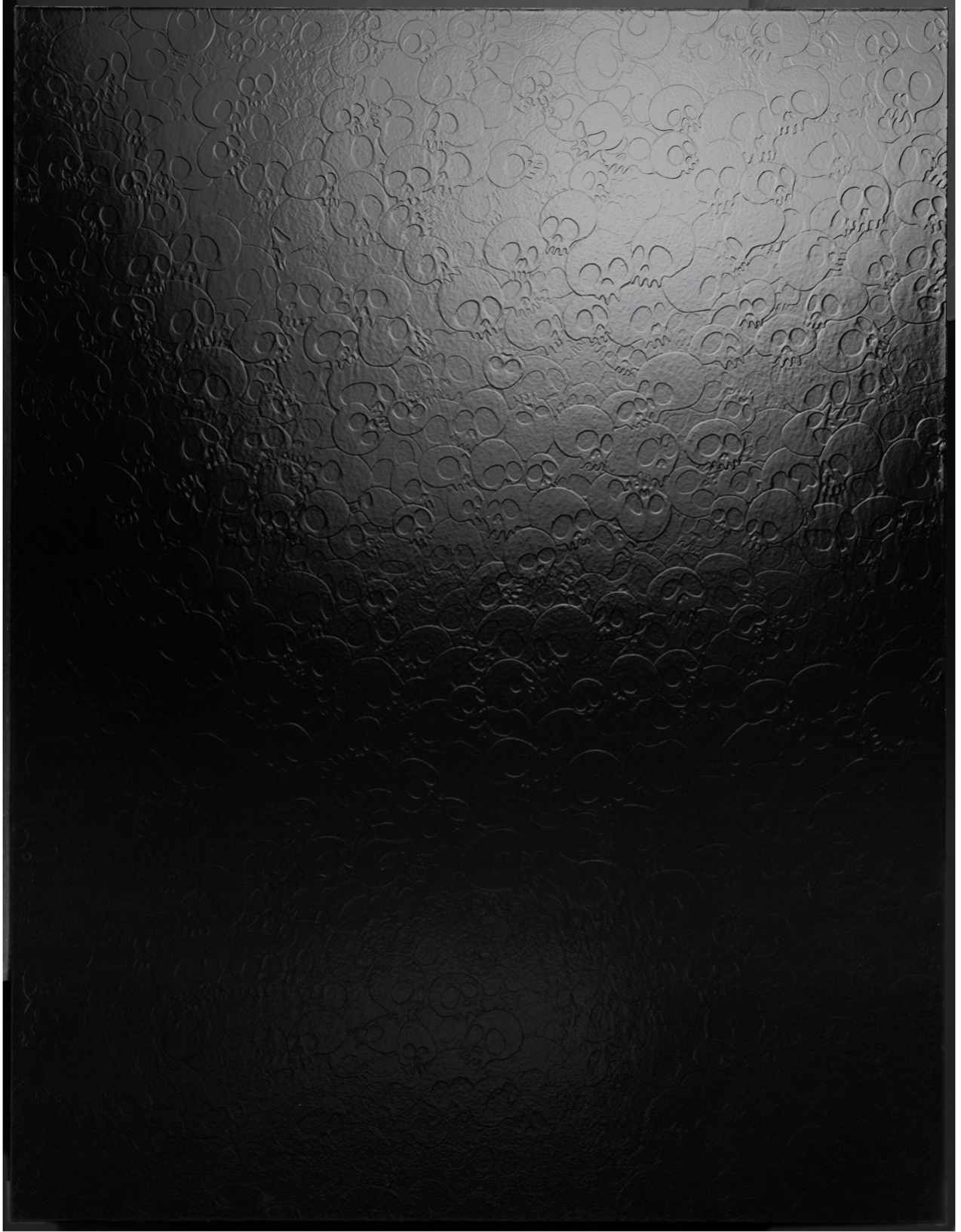
TAKASHI MURAKAMI (b. 1962)
Lying on the Grasslands, Pondering Death and the Ends of the Universe: Jet Black, 2016
Acrylic on canvas
199.4 x 153.0 cm (72 1/2 x 60 1/4 inches)
Signed and dated on reverse: Takashi 2016
#21. Eye Love Superflat (in two parts), 2004
Sotheby’s Paris: 22 June 2023
Estimated: EUR 100,000 – 150,000
EUR 127,000 / USD 139,101
Eye Love Superflat (in two parts) | Une Collection à 360° | 2023 | Sotheby’s (sothebys.com)
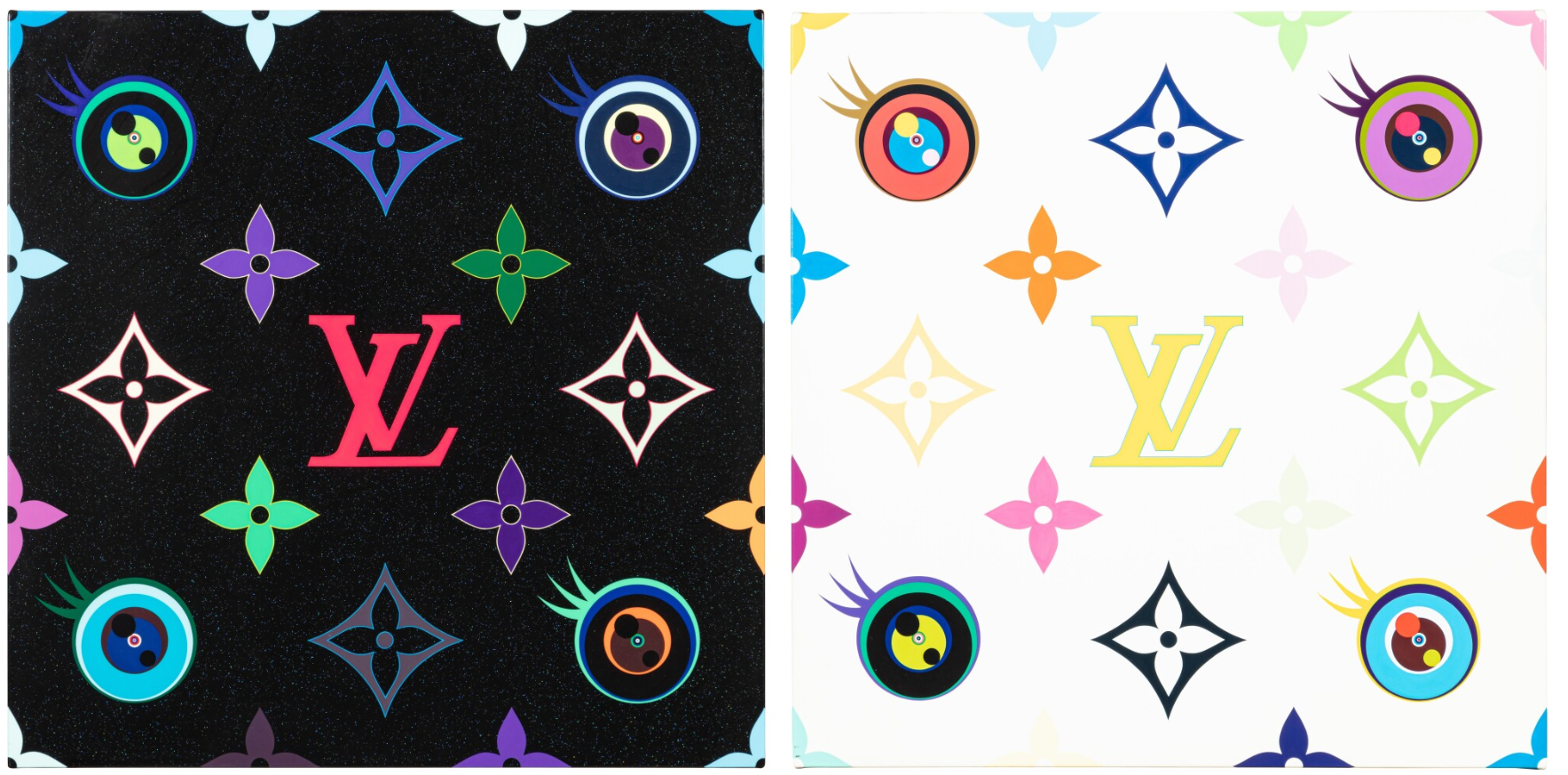
TAKASHI MURAKAMI (b. 1962)
Eye Love Superflat (in two parts), 2004
Acrylic on canvas laid down on wood, in 2 parts
Each: 60×60 cm (23 5/8 x 23 5/8 inches
Black panel: signed and inscribed LV on the reverse
White panel: signed, dated 04 and inscribed LV on the reverse
#22. Koumokkun (costume), 2003
Sotheby’s Hong-Kong: 6 April 2023
Estimated: HKD 800,000 – 1,200,000
HKD 1,016,000 / USD 129,425
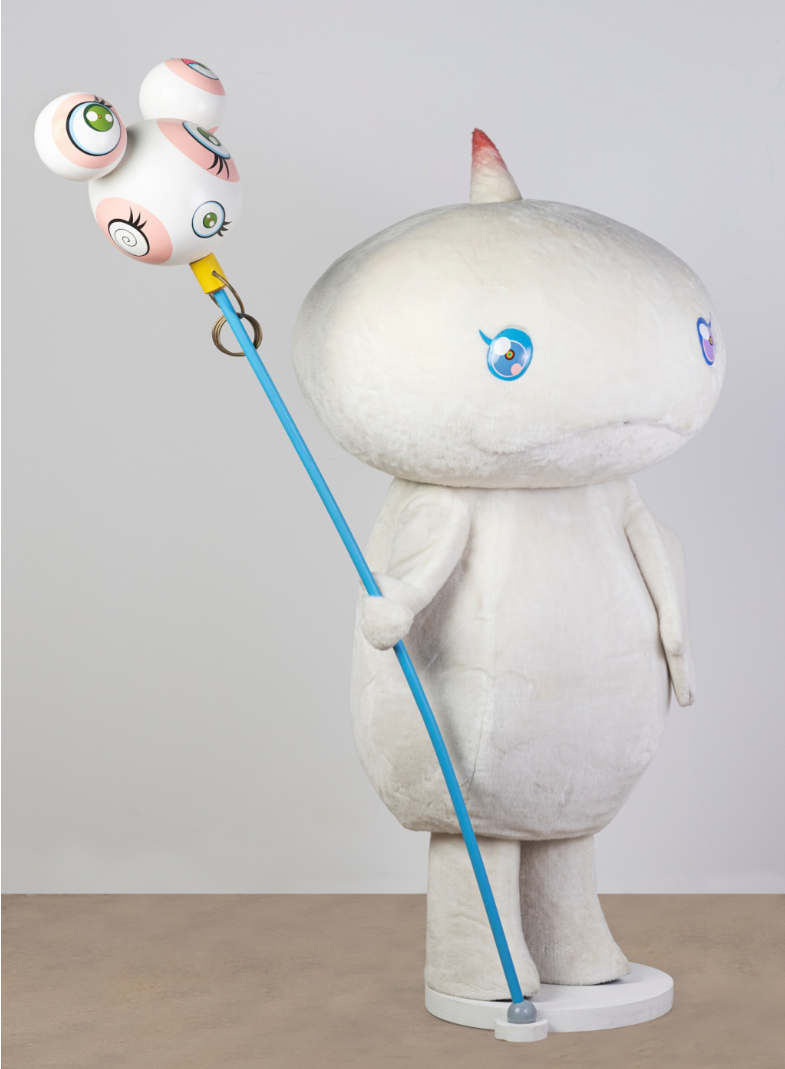
TAKASHI MURAKAMI (b. 1962)
Koumokkun (costume), 2003
Fabric, fiberglass and metal
213.4 x 91.4 cm (84×36 inches)
This work is a unique variant
#23. Pom & Me, 2013
Christie’s Hong-Kong: 29 November 2023
Estimated: HKD 600,000 – 800,000
HKD 882,000 / USD 112,995
TAKASHI MURAKAMI (B. 1962) (christies.com)
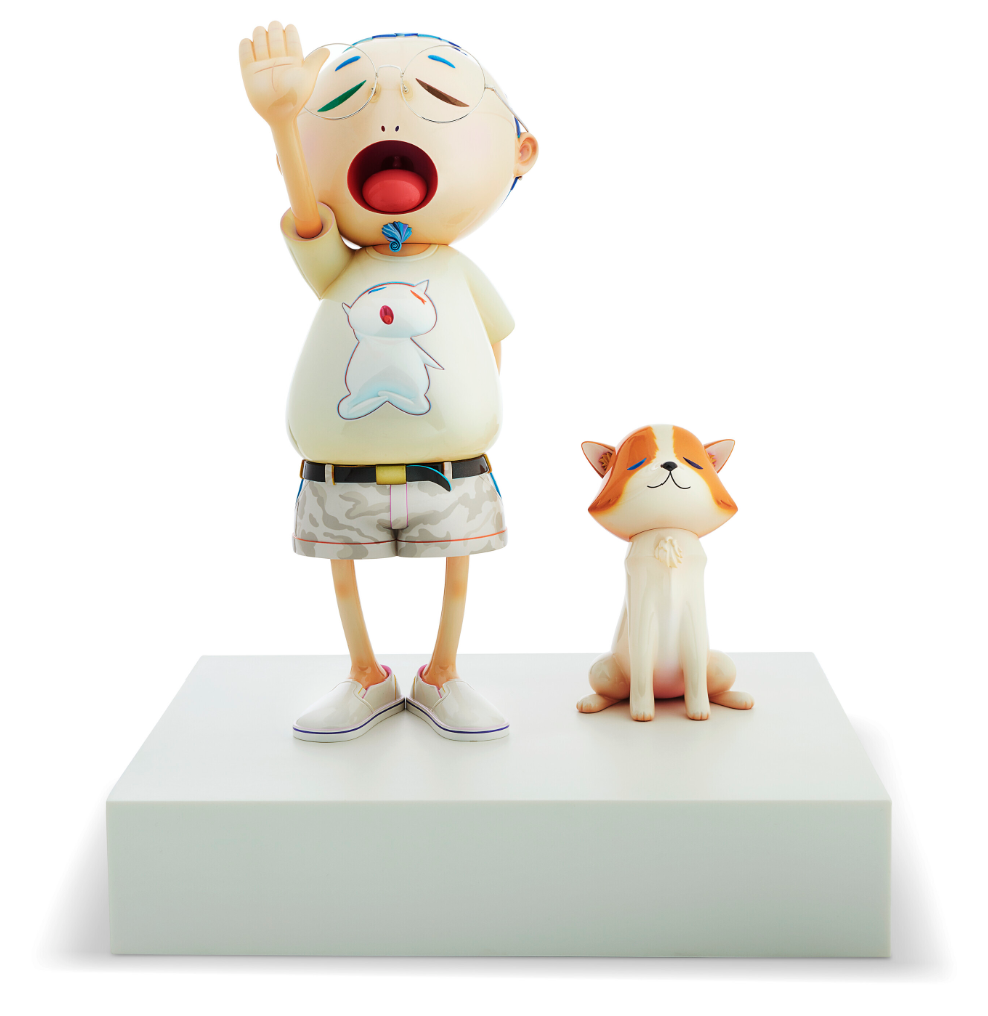
TAKASHI MURAKAMI (B. 1962)
Pom & Me, 2013
Carbon fiber, acrylic and pedestal in Corian
Overall: 44.8 (H) 37.7 x 31.6 cm (17 2/3 x 14 4/5 x 12 2/5 inches)
Signed with the artist’s signature and dated ‘2013’ (on the underside)
Edition: 4⁄5 and 2 APs
#24. Untitled, 1991
SBI Art Auction Tokyo: 28 October 2023
Estimated: JPY 1,500,000 – 2,500,000
JPY 15,525,000 / USD 103,730
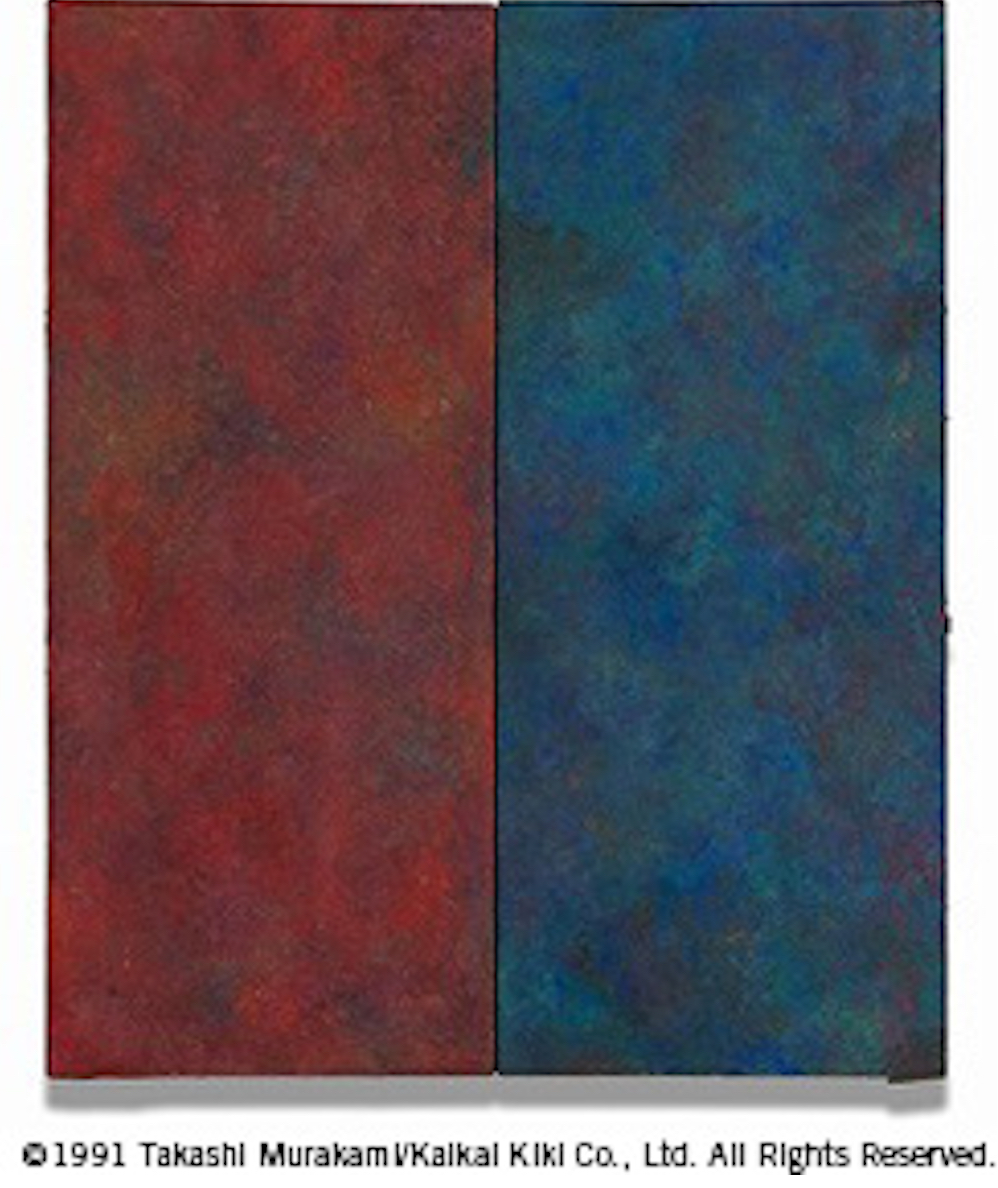
TAKASHI MURAKAMI
Untitled, 1991
Mineral pigments on Japanese paper mounted on wood panel, in 2 parts
Overall size: 60×50 cm (23 5/8 x 19 5/8 inches)
Signed and dated on the reverse
#25. Eka Danpi (“Eka’s Amputation”) – Red Daruma, 2007
Sotheby’s New-York: 19 May 2023
Estimated: USD 120,000 – 180,000
USD 82,550
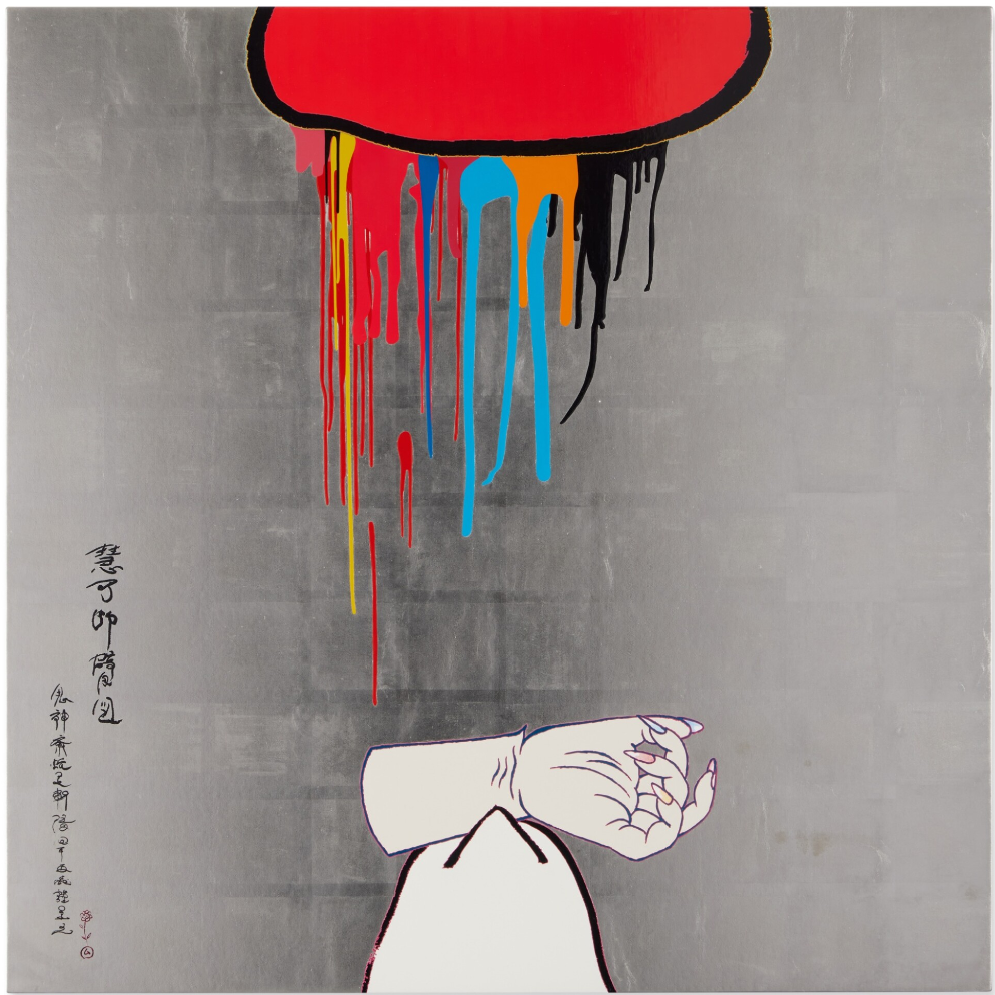
TAKASHI MURAKAMI (b. 1962)
Eka Danpi (“Eka’s Amputation”) – Red Daruma, 2007
Acrylic and platinum leaf on canvas mounted on board
100.3 x 100.3 cm (39 1/2 x 39 1/2 inches)
Inscribed in Japanese (left edge); signed and dated 07 (on the reverse)
#26. Chaos, 1998
Sotheby’s Paris: 22 June 2023
Estimated: EUR 60,000 – 80,000
EUR 69,850 / USD 76,506
Chaos | Une Collection à 360° | 2023 | Sotheby’s (sothebys.com)
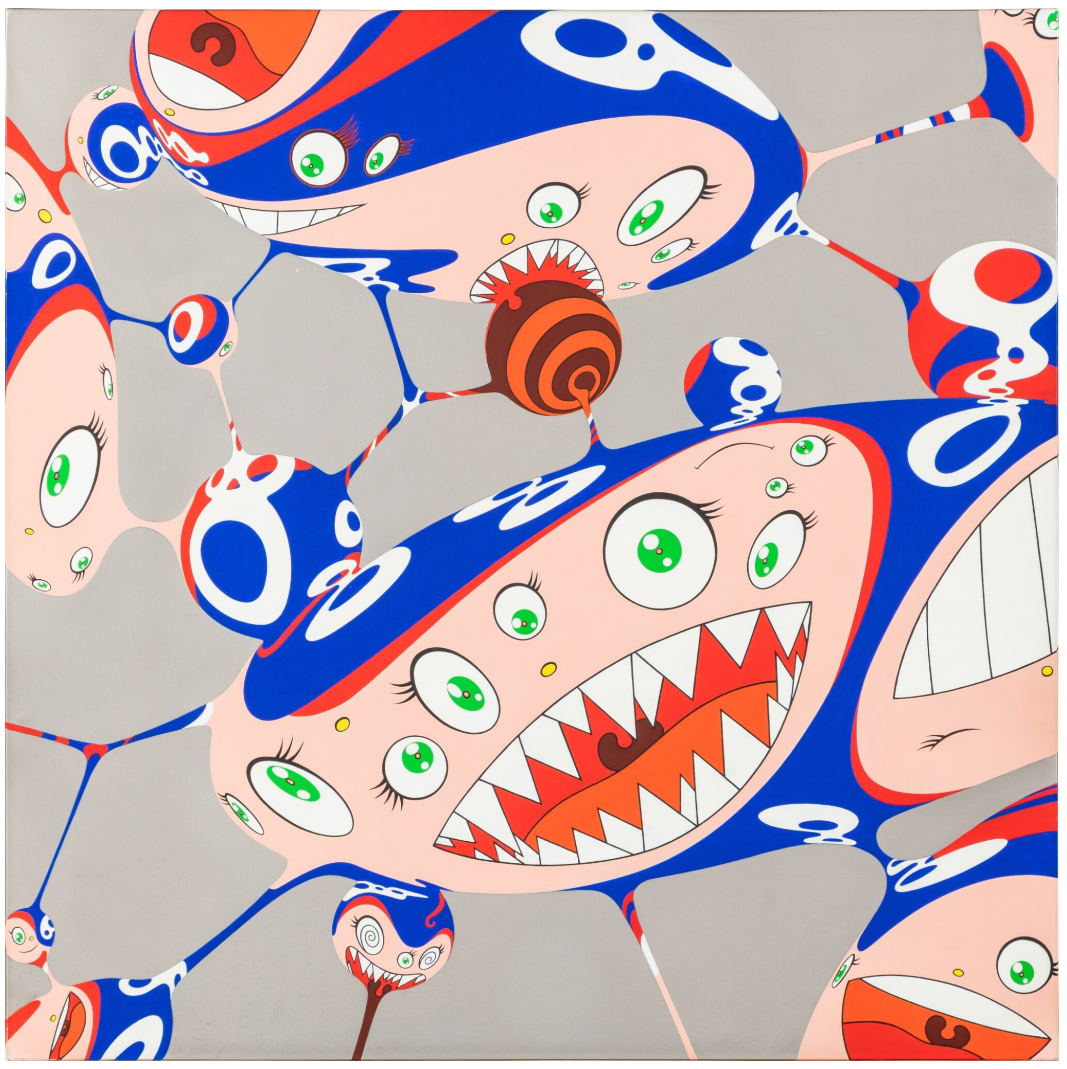
TAKASHI MURAKAMI (b. 1962)
Chaos, 1998
Acrylic on canvas laid down on board
40×40 cm (15 3/4 x 15 3/4 inches)
Signed, inscribed and dated 98 on the reverse
#27. Rose II, 1995
Christie’s New-York: 10 March 2023
Estimated: USD 80,000 – 120,000
USD 75,600
TAKASHI MURAKAMI (B. 1962), Rose II | Christie’s (christies.com)
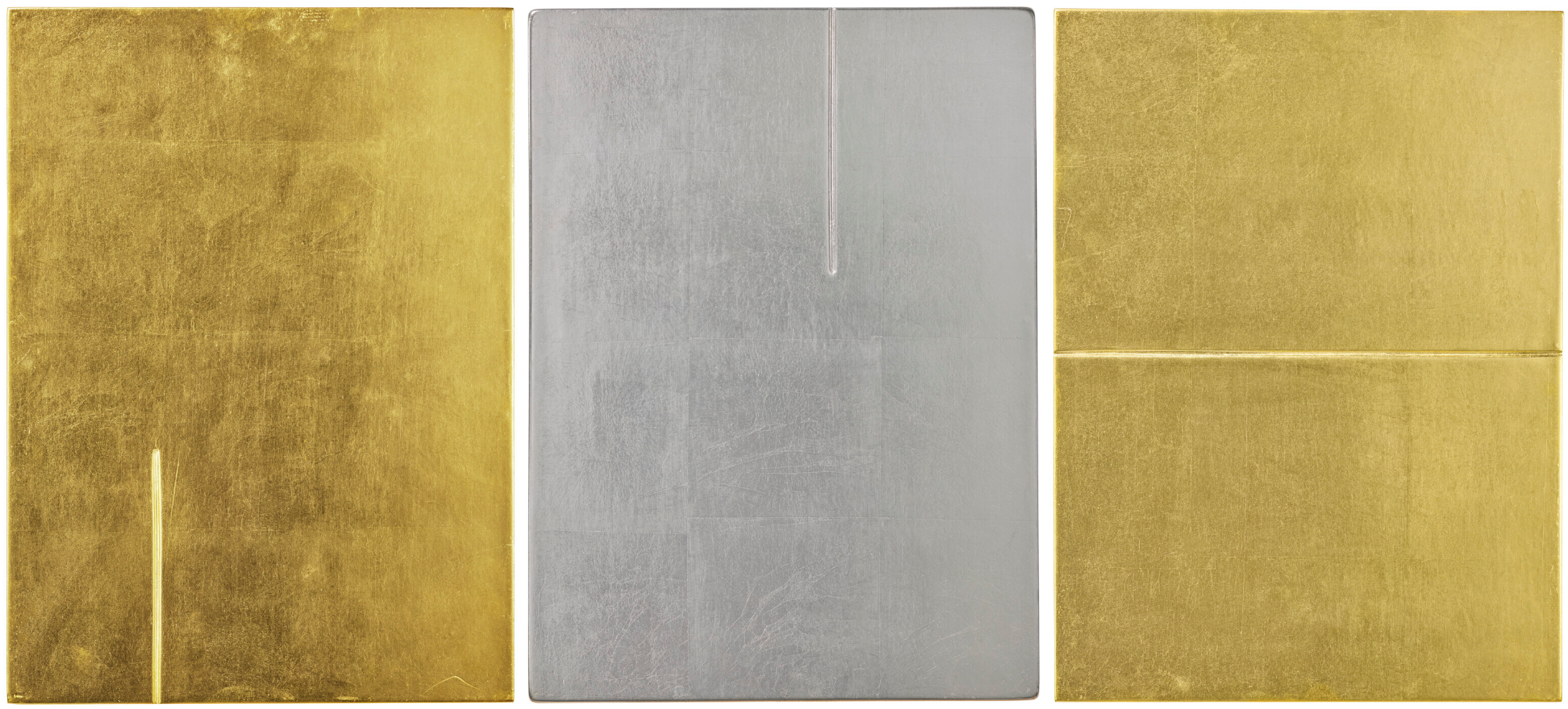
TAKASHI MURAKAMI (B. 1962)
Rose II, 1995
Gold on wood, lacquer, in three parts
Each: 40.6 x 29.8 cm (16 x 11 3/4 inches)
Signed, dated and inscribed ‘TAKASHI MURAKAMI 1995 HIROPON’
(on the reverse of each panel); embossed ‘TAKASHI’ (on the reverse of each panel)
#28. Untitled, 2016
Phillips Hong-Kong: 31 March 2023
Estimated: HKD 200,000 – 300,000
HKD 406,400 / USD 51,770
Takashi Murakami – 20th Century & Con… Lot 158 March 2023 | Phillips
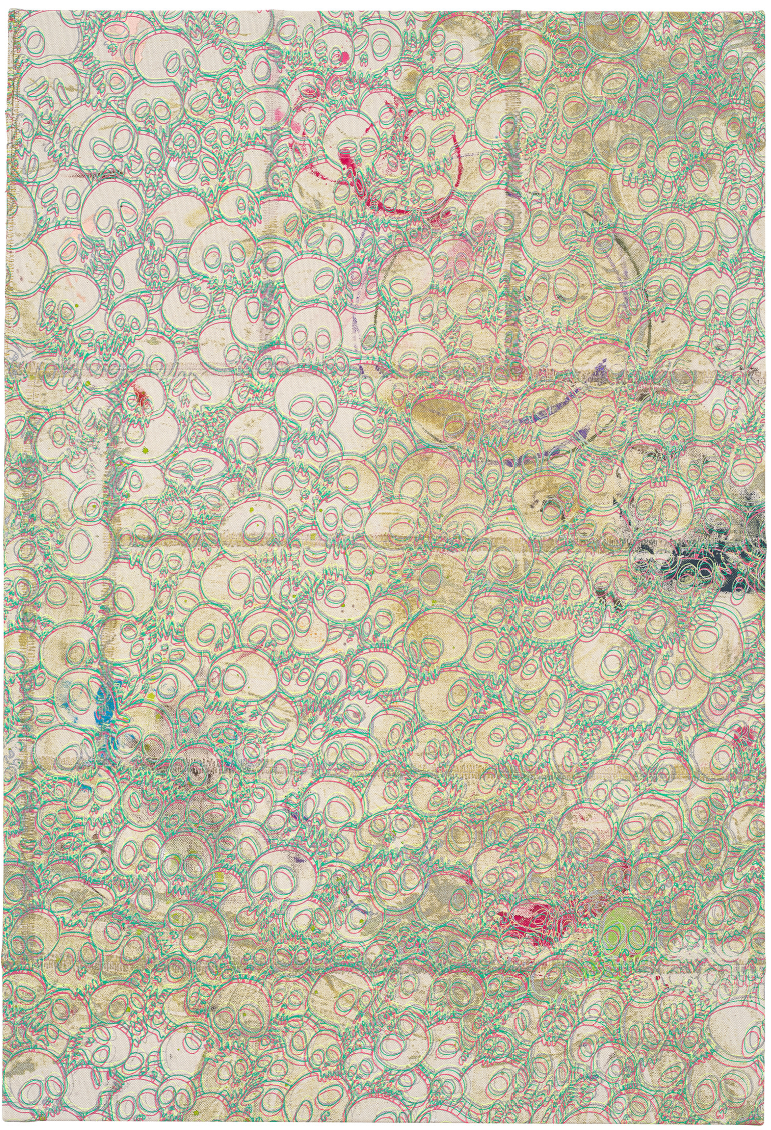
TAKASHI MURAKAMI
Untitled, 2016
Acrylic on canvas mounted on aluminum frame
86.2 x 59 cm (33 7/8 x 23 1/4 inches)
Signed and dated ‘TAKASHI 2016’ on the overlap
2o22 Auction Results
23 lots sold at auction in 2022 for a total turnover of USD 14,847,919. With 7 lots failing to sell, the sell-through rate is 77%. 2022 Top 3 Lots
3 lots sold over USD 1 million, for a cumulative turnover of USD 8,937,676, contributing 60.2% of the total turnover for 2022.
#1. 69 Arhats Beneath the Bodhi Tree, 2013
Sotheby’s Hong-Kong: 27 April 2022
Estimated: HKD 23,000,000 – 30,000,000
HKD 38,490,000 / USD 4,905,184
TAKASHI MURAKAMI (B. 1962)
69 Arhats Beneath the Bodhi Tree, 2013
Acrylic, gold and platinum leaf on canvas mounted on board, in 10 parts
Each: 300×100 cm (118.1 x 39.4 inches)
Overall: 300×1,000 cm (118.1 x 393.7 inches)
#2. 727, 1996
Sotheby’s Hong-Kong: 7 October 2022
Estimated: HKD 18,000,000 – 25,000,000
HKD 20,945,000 / USD 2,667,983
Takashi Murakami 村上隆 | 727 | Contemporary Evening Auction | 2022 | Sotheby’s
TAKASHI MURAKAMI (B. 1962)
727, 1996
Acrylic on canvas mounted on board, in 3 parts
Each: 300.5 x 150 cm (118.2 x 59 inches)
Overall: 300.5 x 450 cm (118.2 x 177.2 inches)
Signed and titled 727 on the overlap
#3. Hands Clasped, 2015
Christie’s Hong-Kong: 30 November 2022
Estimated: HKD 12,000,000 – 18,000,000
HKD 10,650,000 / USD 1,364,509
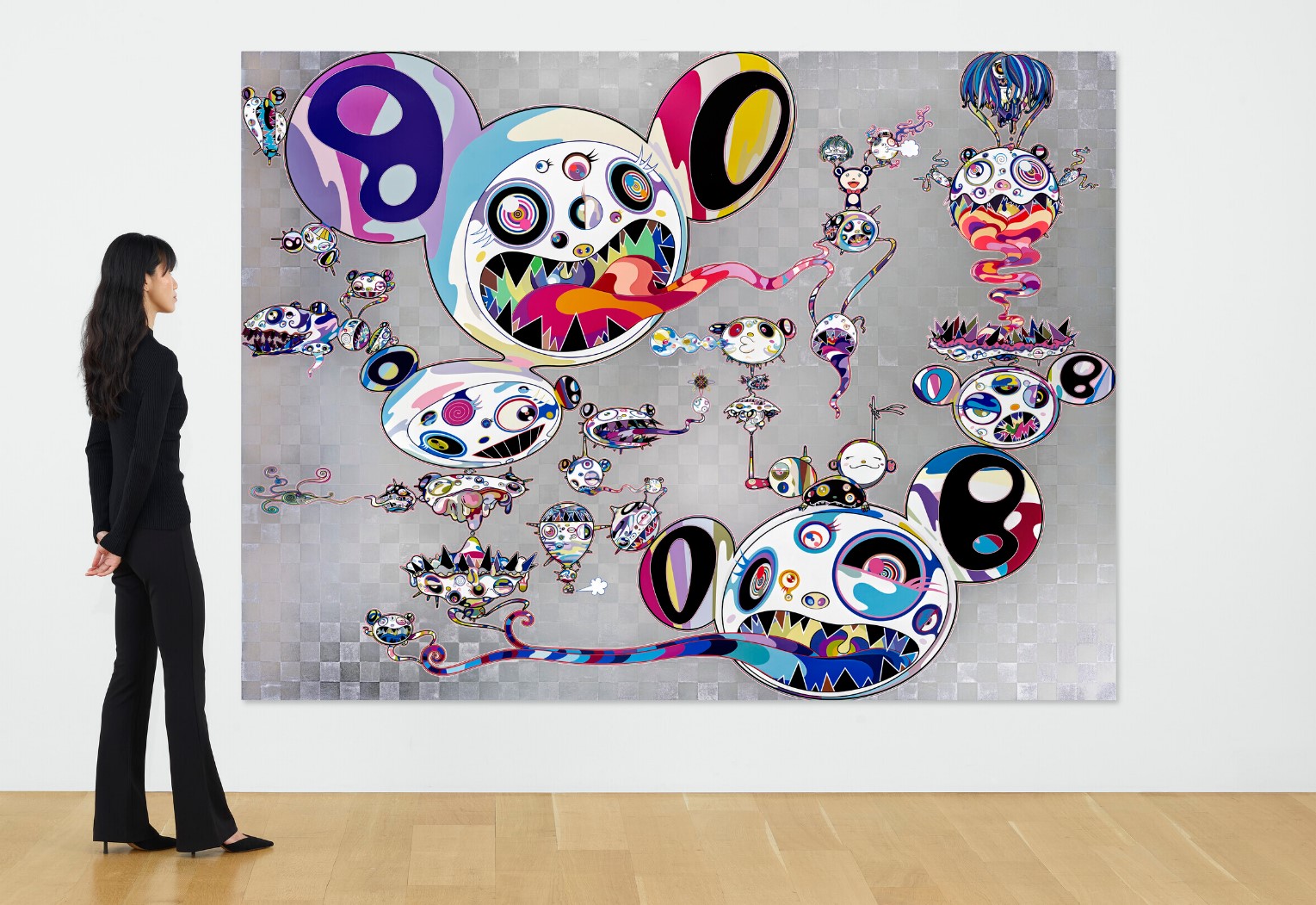
TAKASHI MURAKAMI (B. 1962)
Hands Clasped, 2015
Acrylic and platinum leaf on canvas mounted on aluminum frame
180.2 x 240.3 cm (70.9 x 94.7 inches)
Signed and dated ‘TAKASHI 2015’ (on the overlap)
#4. Peaked Cap, 2002
Estimated: TWD 20,000,000 – 38,000,000
TWD 22,800,000 / USD 776,038
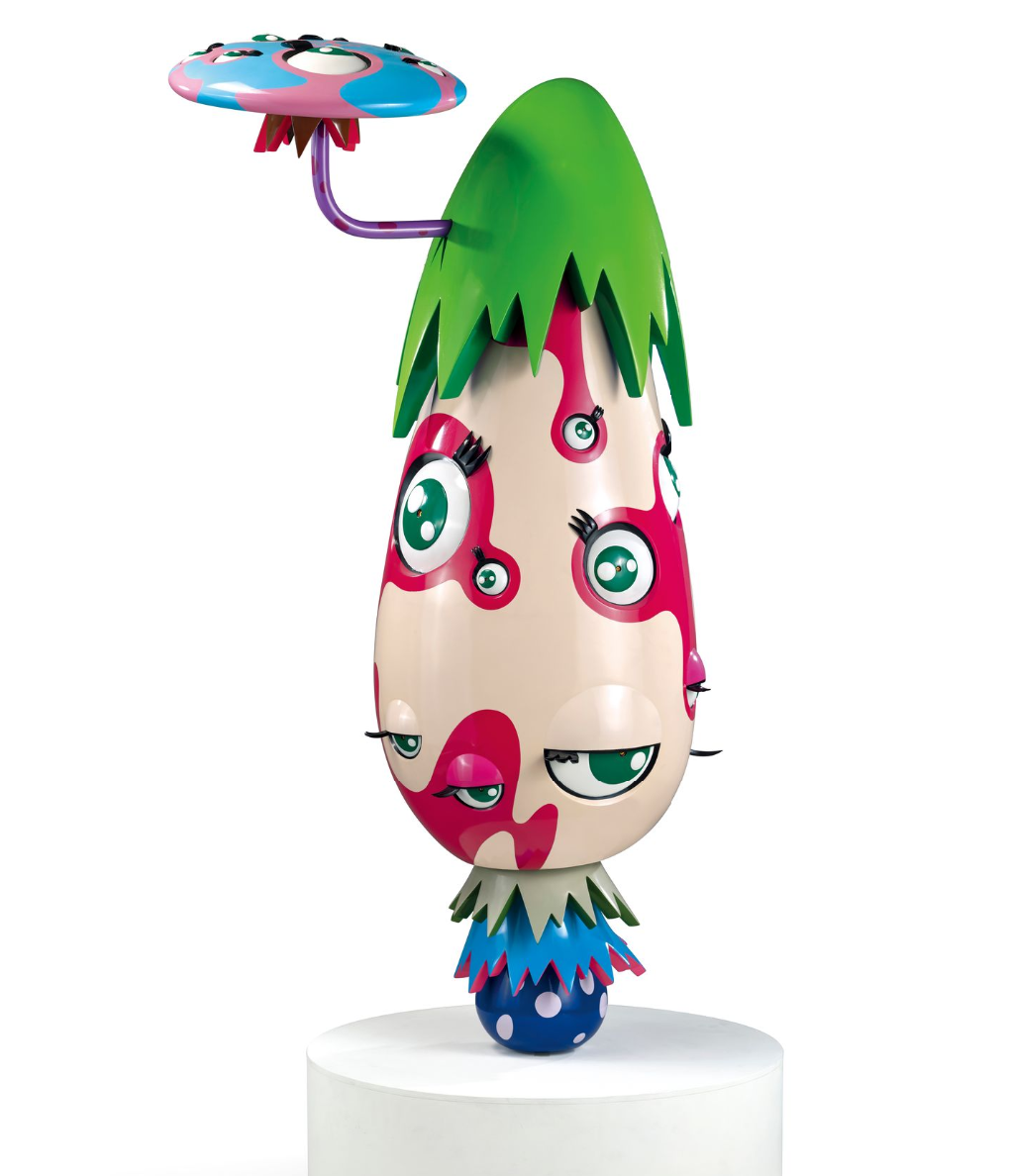
TAKASHI MURAKAMI
Peaked Cap, 2002
Fiberglass, steel, epoxy and paint
90 (L) x 80 (W) x 185 (H) cm (with base)
Edition 5/5
#5. Magic Ball I (Positive), 1999
Sotheby’s New-York: 17 November 2022
Estimated: USD 600,000 – 800,000
USD 567,000
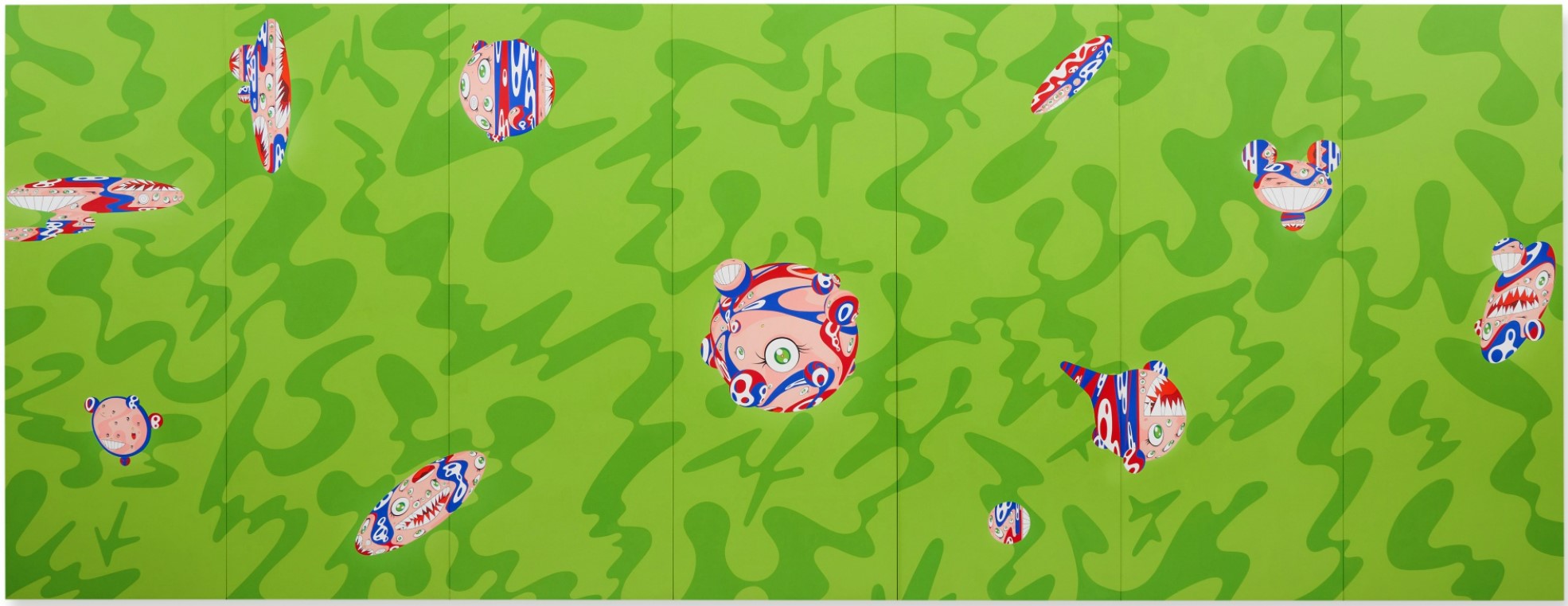
TAKASHI MURAKAMI (B. 1962)
Magic Ball I (Positive), 1999
Acrylic on canvas mounted on board, in 7 parts
Each: 239.7 x 90.2 cm (94.4 x 35.5 inches)
Overall: 239.7 x 631.4 cm (94.4 by 248.5 inches)
#6. An Homage To Yves Klein, 2013
K Auction: 21 December 2022
Estimated: KRW 600,000,000 – 700,000,000
KRW 600,000,000 (Hammer) / USD 569,963
TAKASHI MURAKAMI
An Homage To Yves Klein, 2013
Acrylic and platinum leaf on canvas
78 x 56.3 cm (30.7 x 22.2 inches)
Signed and dated on the reverse
#7. Sage, 2014
Phillips London: 14 October 2022
Estimated: GBP 400,000 – 600,000
GBP 478,800 / USD 536,771
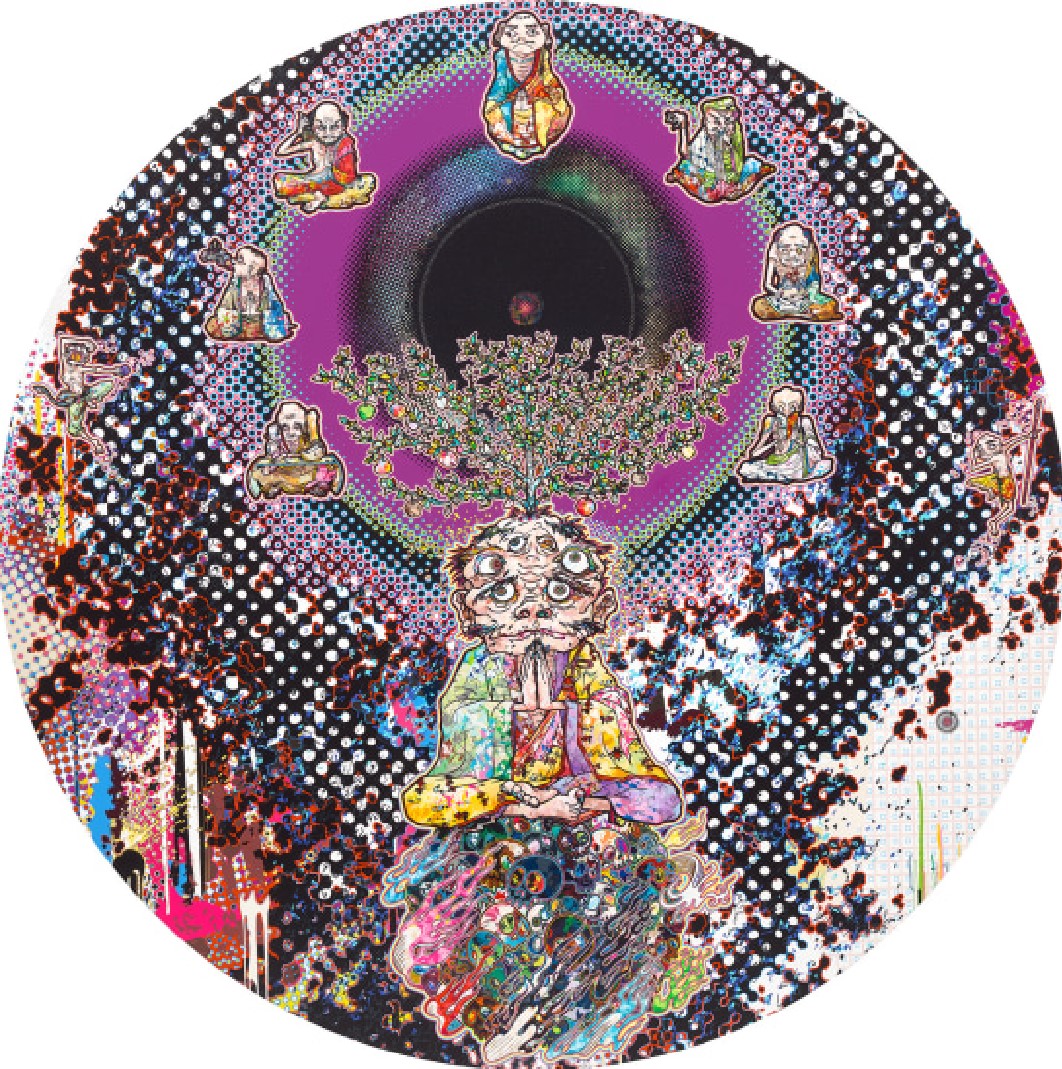
TAKASHI MURAKAMI
Sage, 2014
Acrylic, gold leaf and platinum leaf on canvas mounted on wood panel
Diameter: 200 cm (78.7 inches)
Signed and dated ‘Takashi 2014’ on the reverse
#8. Cherries, 2005
Bonhams New-York: 16 November 2022
Estimated: USD 400,000 – 600,000
USD 529,575
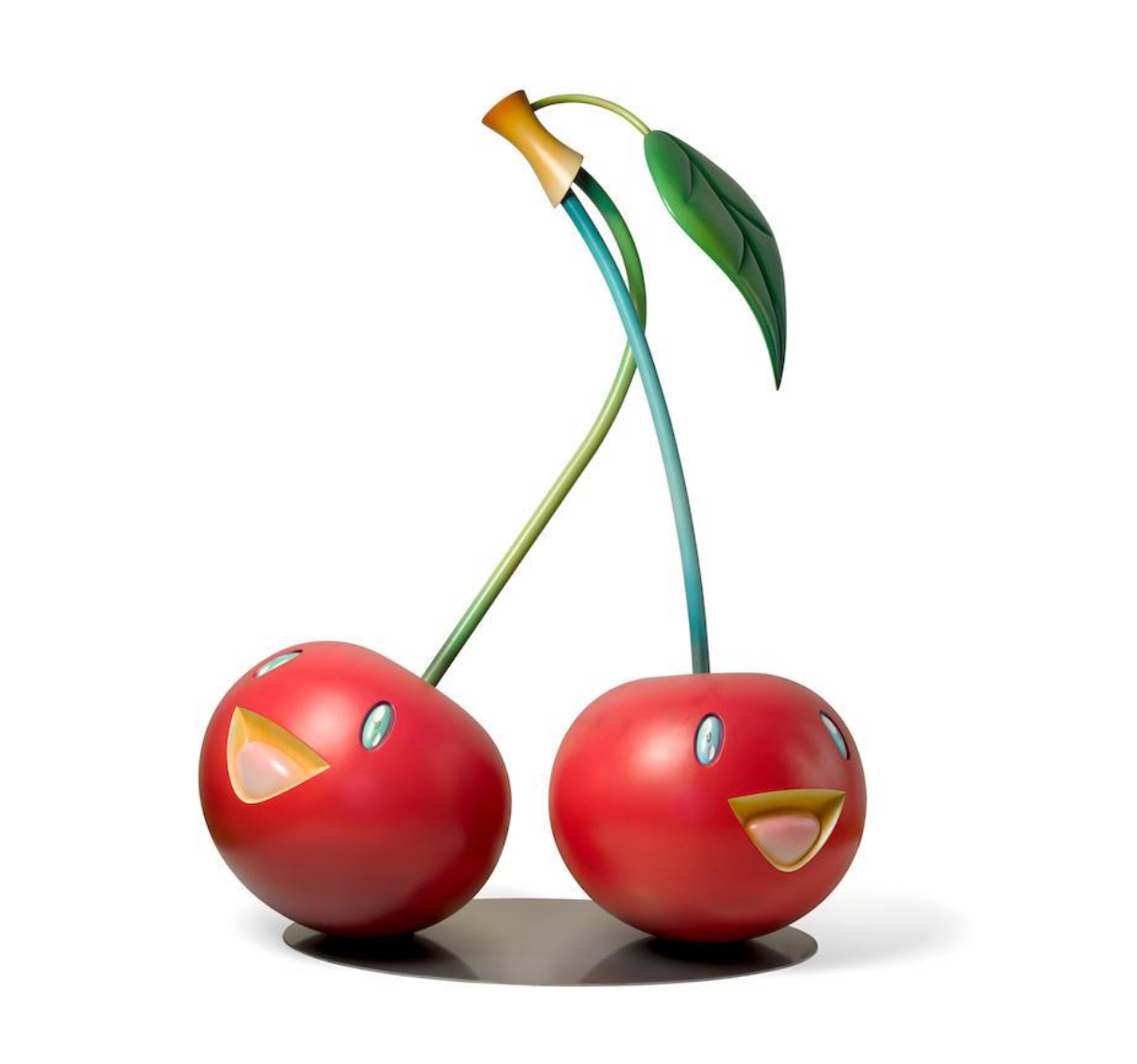
FRP, Steel, Acrylic, Urethane paint
200 x 100.3 x 71.1 cm (78 3/4 x 39 1/2 x 28 inches)
This work is number five from an edition of five with two artist’s proofs
#9. Colorful Flower: Happy, 2019
Seoul Auction: 26 July 2022
Estimated: KRW 450,000,000 – 700,000,000
KRW 470,000,000 (Hammer) / USD 430,057

TAKASHI MURAKAMI
Colorful Flower: Happy, 2019
Acrylic on canvas mounted on wood panel
120×120 cm (47.2 x 47.2 inches)
#10. AND THEN (Ichimatsu Pattern), 2006
Sotheby’s Hong-Kong: 28 April 2022
Estimated: HKD 3,000,000 – 5,000,000
HKD 3,150,000 / USD 401,458
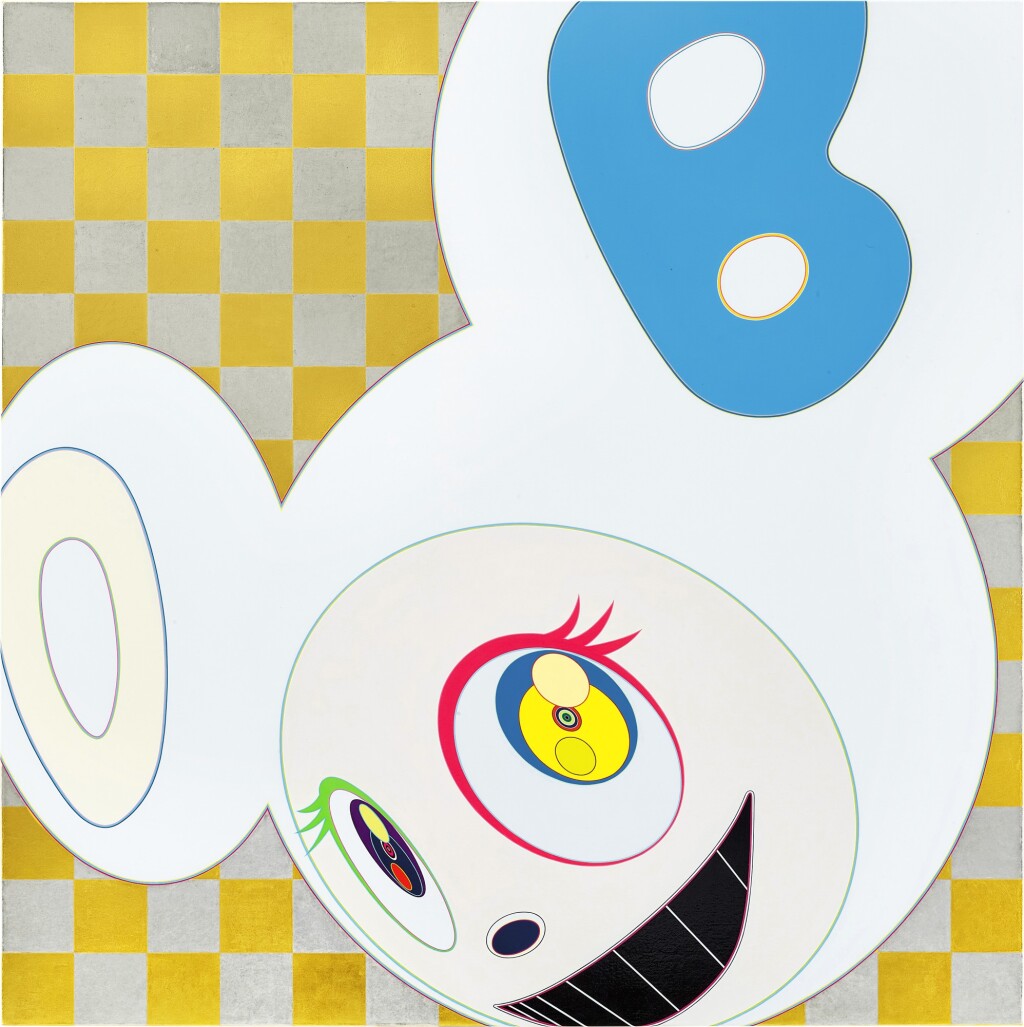
TAKASHI MURAKAMI (B. 1962)
AND THEN (Ichimatsu Pattern), 2006
Acrylic on canvas mounted on board
100×100 cm (39.4 x 39.4 inches)
Signed, dated 06, doodled and inscribed variously on the reverse
#11. Multicolor Flowers, 2012
Sotheby’s New-York: 17 November 2022
Estimated: USD 200,000 – 300,000
USD 315,000
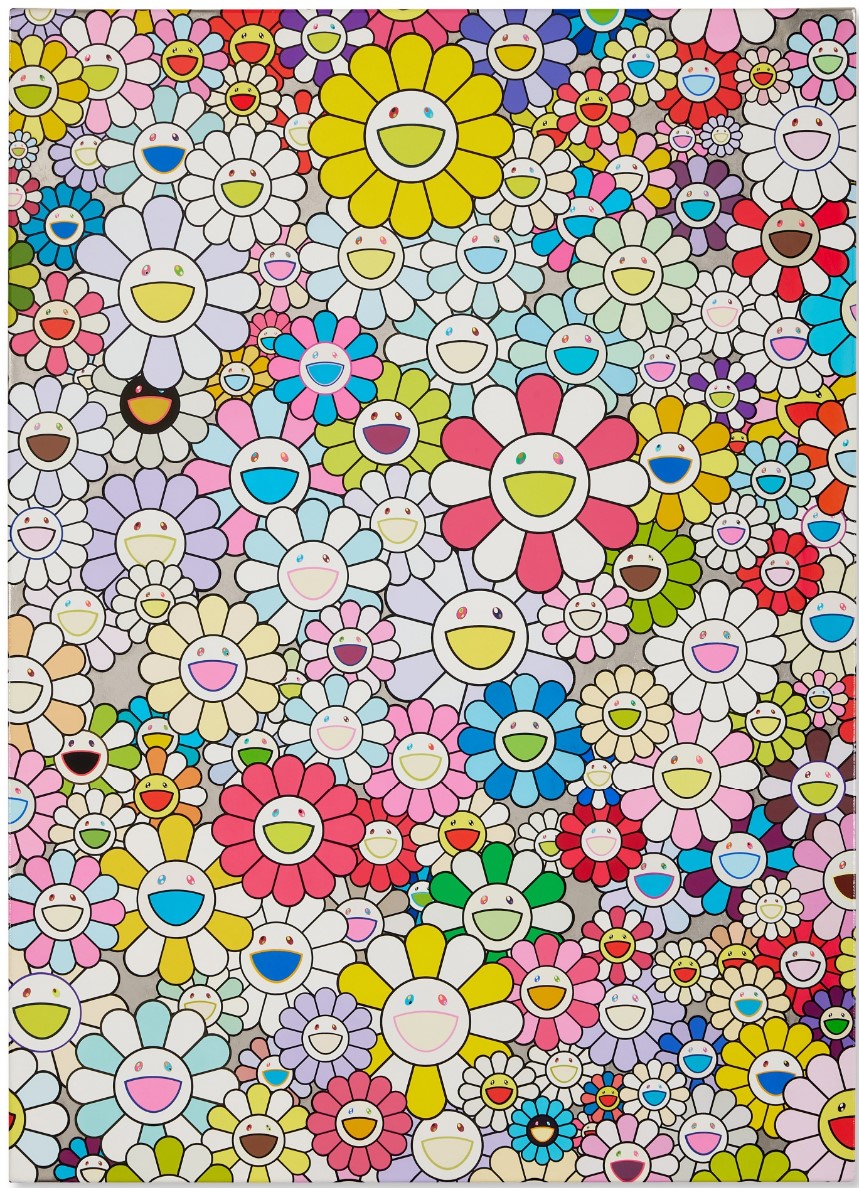
TAKASHI MURAKAMI (B. 1962)
Multicolor Flowers, 2012
Acrylic and platinum leaf on canvas
78.7 x 56.2 cm (31 x 22.2 inches)
Signed TAKASHI, dated 2012 and inscribed in Japanese (on the overlap)
#12. Untitled, 2018
SBI Art Auction: 19 October 2022
Estimated: JPY 40,000,000 – 70,000,000
JPY 46,000,000 / USD 311,918
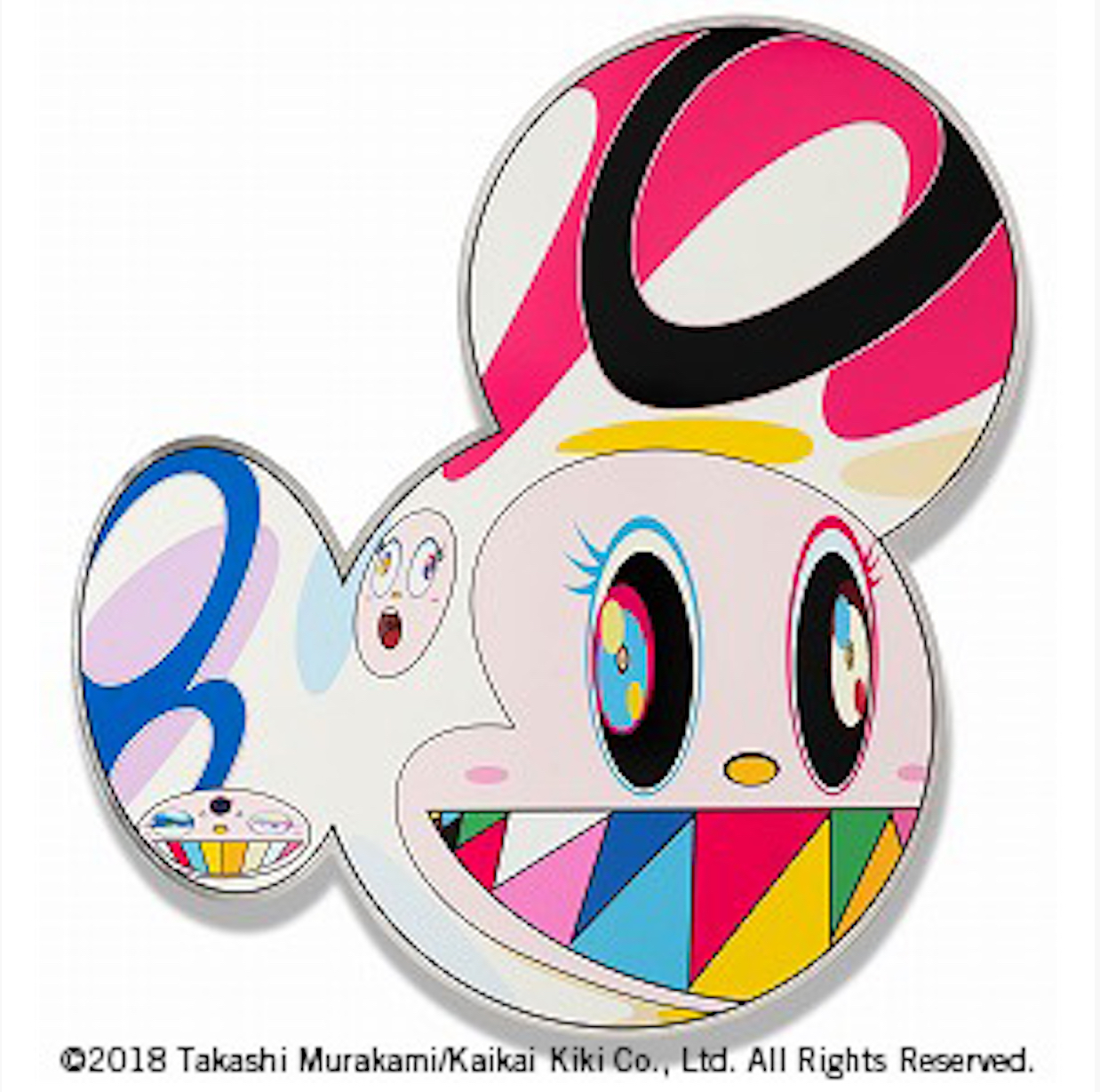
TAKASHI MURAKAMI
Untitled, 2018
Acrylic and platinum leaf on canvas mounted on wood panel
150.5 × 151.2 × 5.1 cm (59 1/4 × 59 1/2 × 2 inches)
Signed and dated on the reverse
#13. Enso Blue, 2016
Heritage Auctions: 28 July 2022
Estimated: USD 150,000 – 200,000
USD 300,000
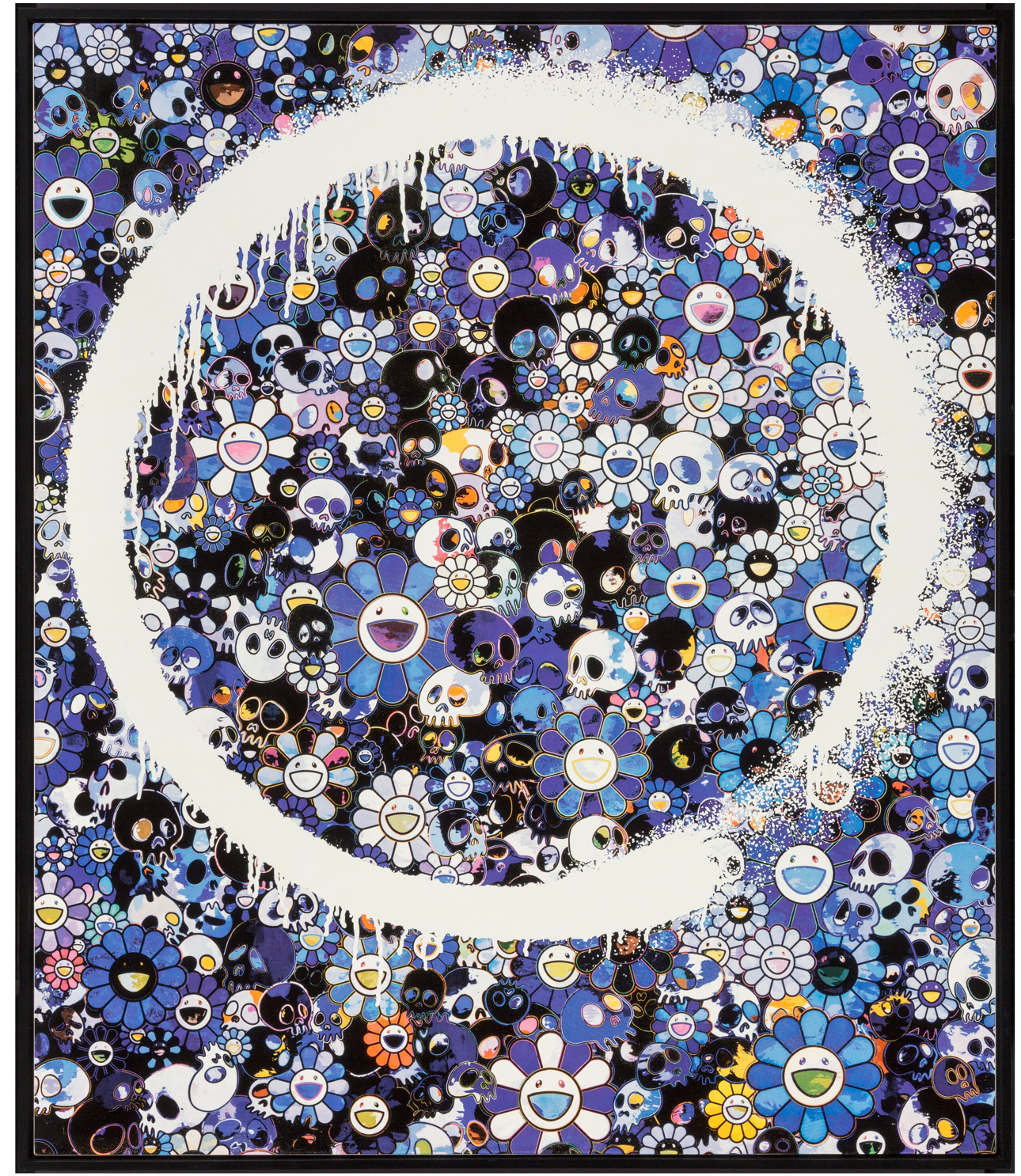
TAKASHI MURAKAMI (b. 1962)
Enso Blue, 2016
Acrylic on canvas
141×120 cm (55 1/2 x 47 1/4 inches)
Signed, dated, and titled in ink to upper edge on reverse
#14. Mukaiau DOB, 2002
Sotheby’s New-York: 30 September 2022
Estimated: USD 250,000 – 350,000
USD 252,000
Mukaiau DOB | Contemporary Curated | 2022 | Sotheby’s (sothebys.com)
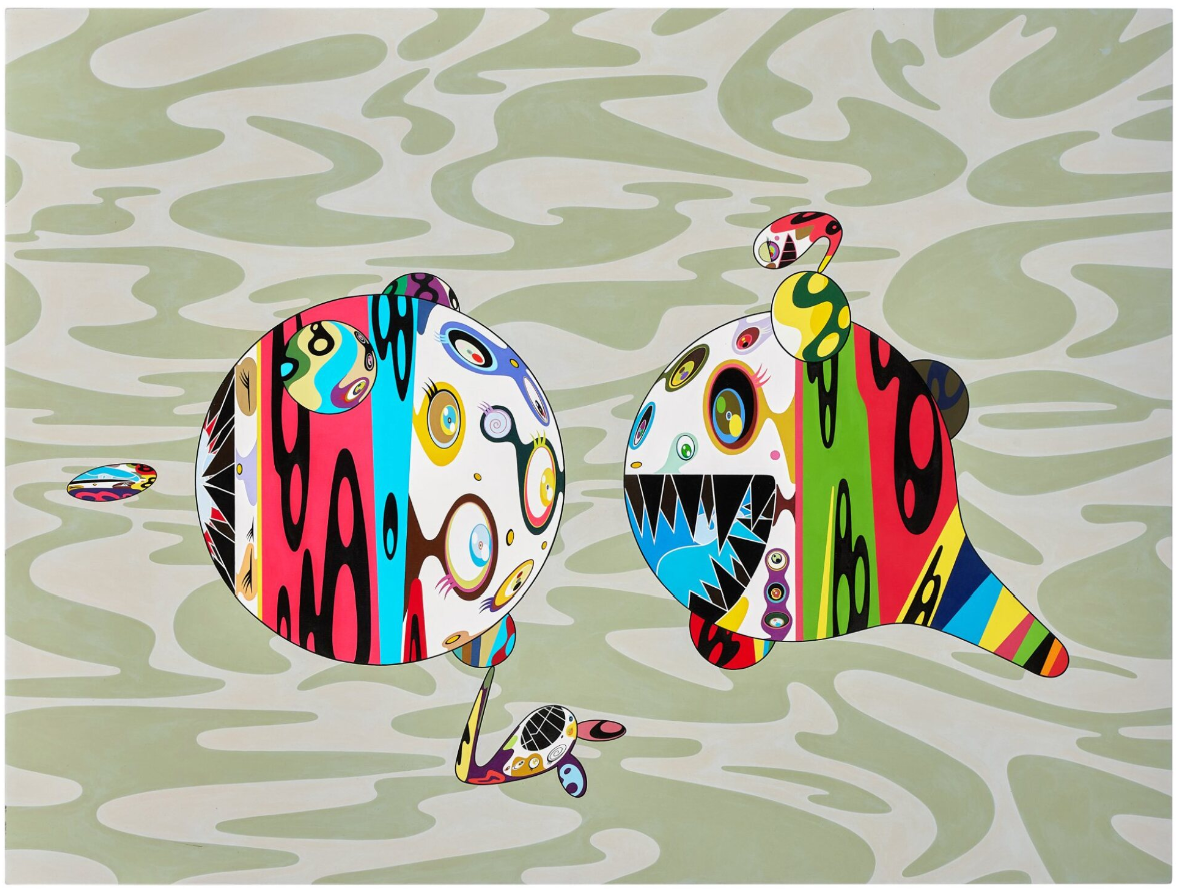
TAKASHI MURAKAMI (b. 1962)
Mukaiau DOB, 2002
Acrylic on canvas mounted on panel
100 x 133.5 cm (39 3/8 x 52 1/2 inches)
Variously inscribed (on the verso)
#15. Koumok-Kun, 2003
Sotheby’s New-York: 11 March 2022
Estimated: USD 250,000 – 350,000
USD 189,000
Koumok-Kun | Contemporary Curated | 2022 | Sotheby’s (sothebys.com)
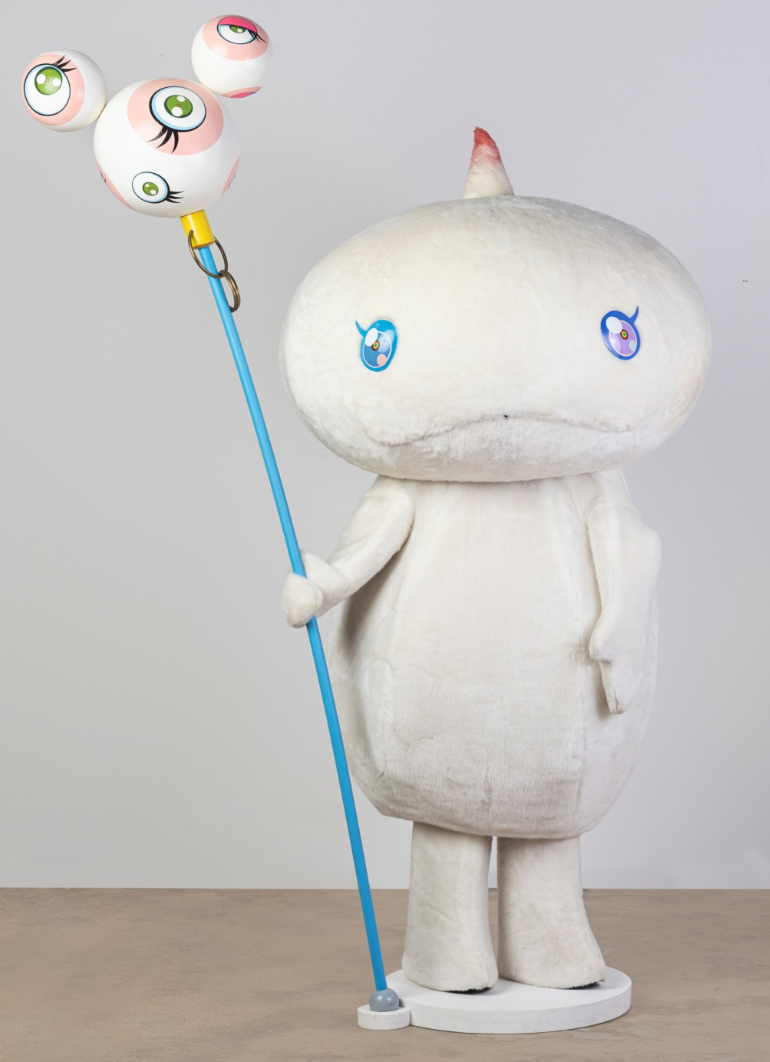
TAKASHI MURAKAMI (b. 1962)
Koumok-Kun, 2003
Fabric, fiberglass and metal
213.4 x 91.4 cm (84×36 inches)
This work is a unique variant
#16. Vegetable Vender, 2002
Sotheby’s New-York: 30 September 2022
Estimated: USD 200,000 – 300,000
USD 176,400
Vegetable Vender | Contemporary Curated | 2022 | Sotheby’s (sothebys.com)
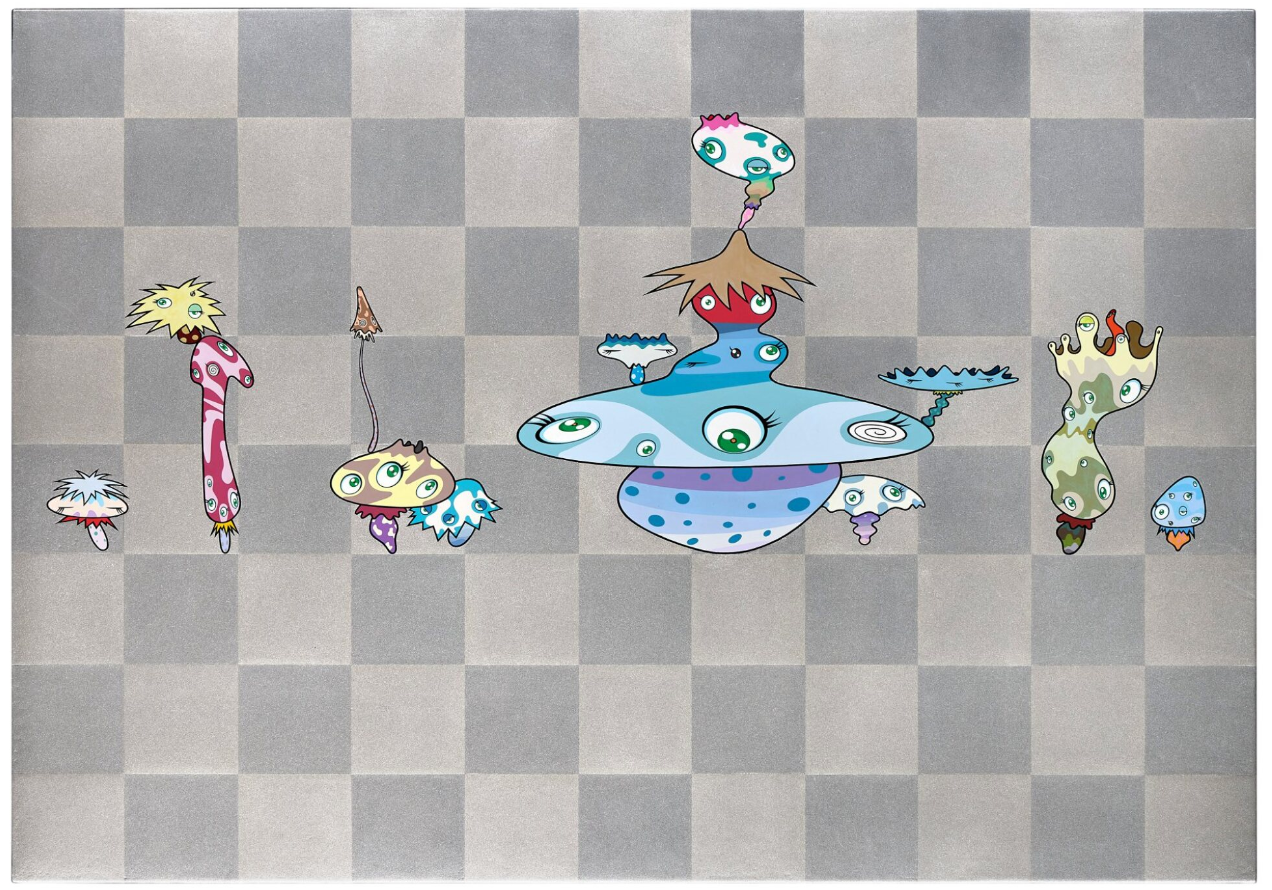
TAKASHI MURAKAMI (b. 1962)
Vegetable Vender, 2002
Acrylic on canvas mounted on board
69.9 x 99.7 cm (27 1/2 x 39 1/4 inches)
Signed and variously inscribed (on the verso)
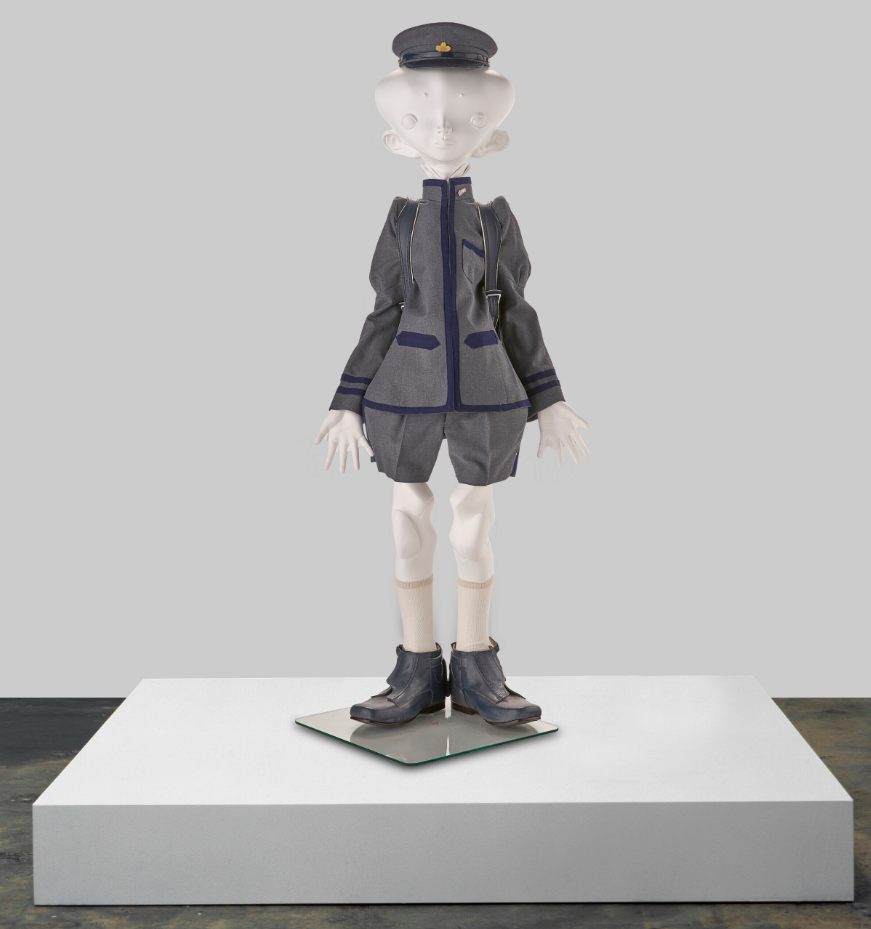
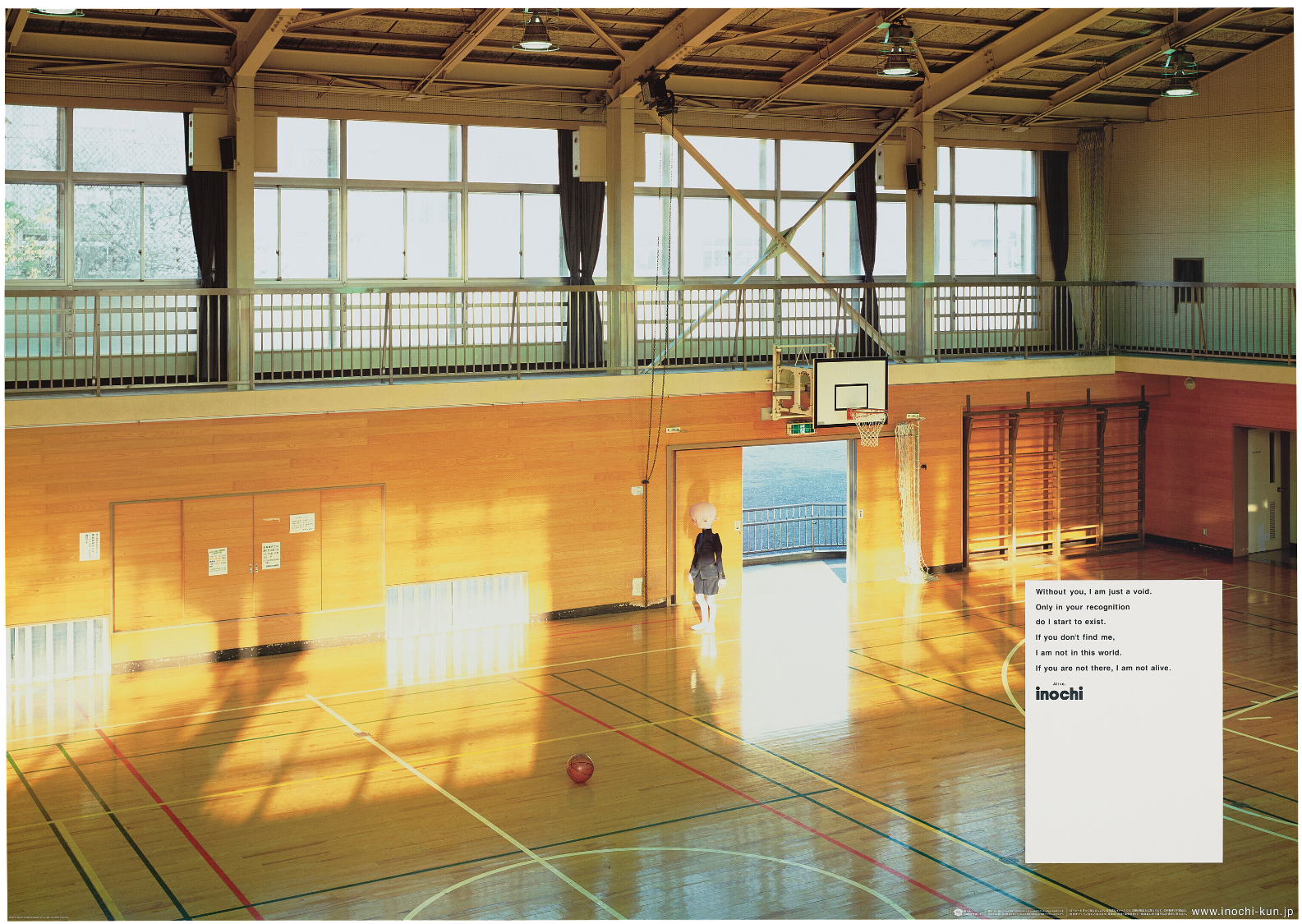
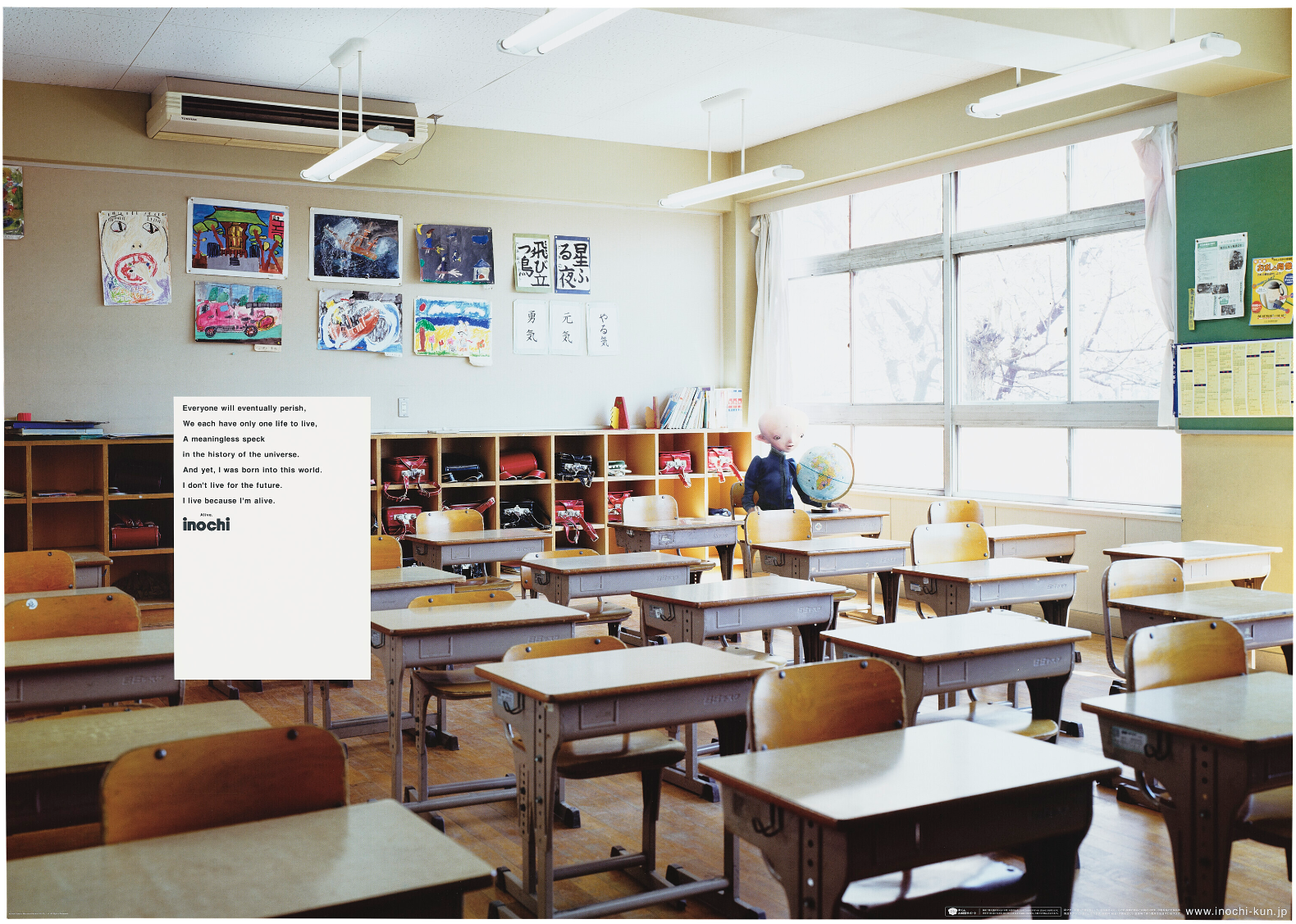
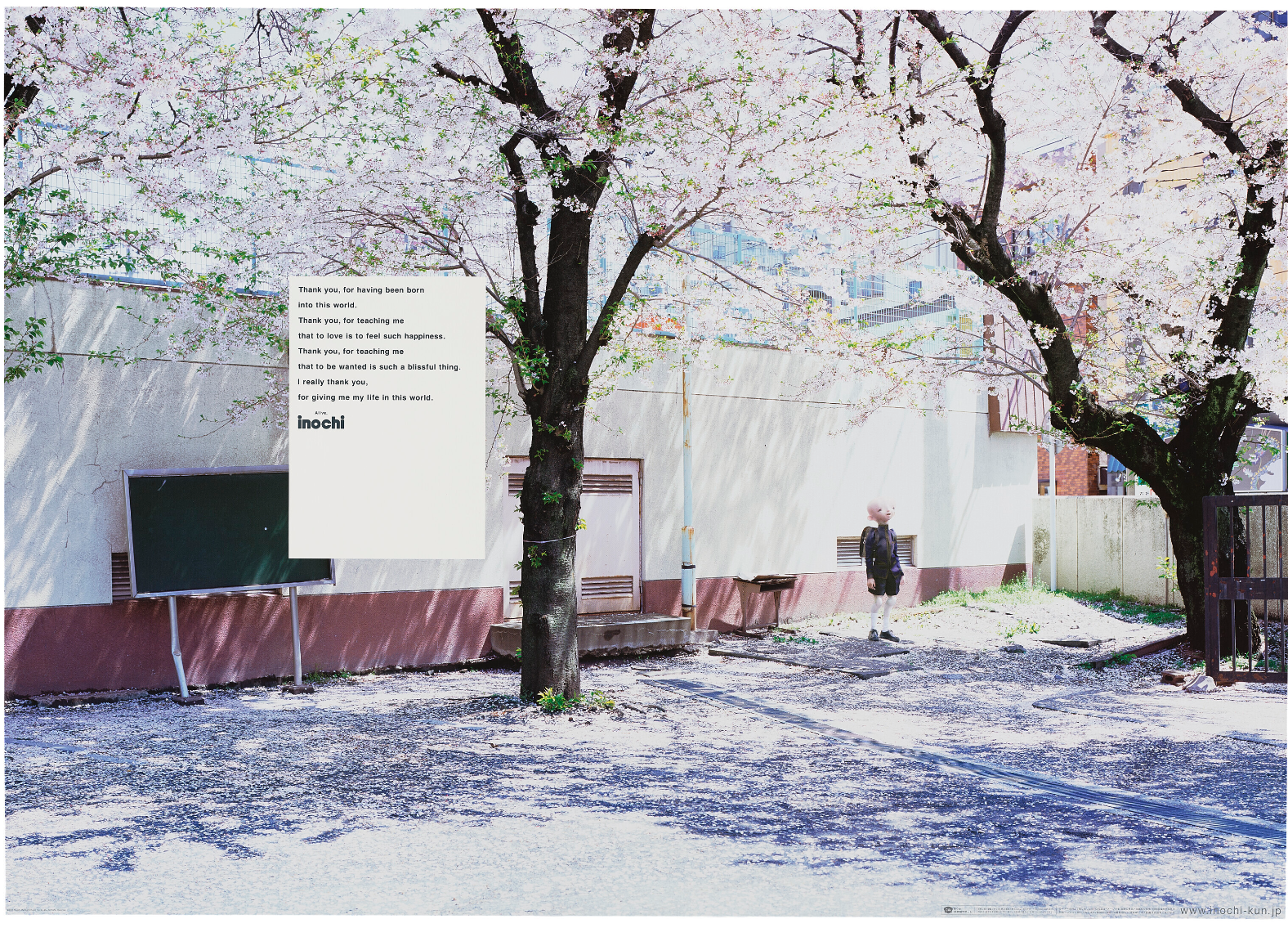
Inochi, 2004
Christie’s New-York: 18 November 2022
Estimated: USD 150,000 – 200,000
USD 126,000
TAKASHI MURAKAMI (B. 1962), Inochi | Christie’s (christies.com)
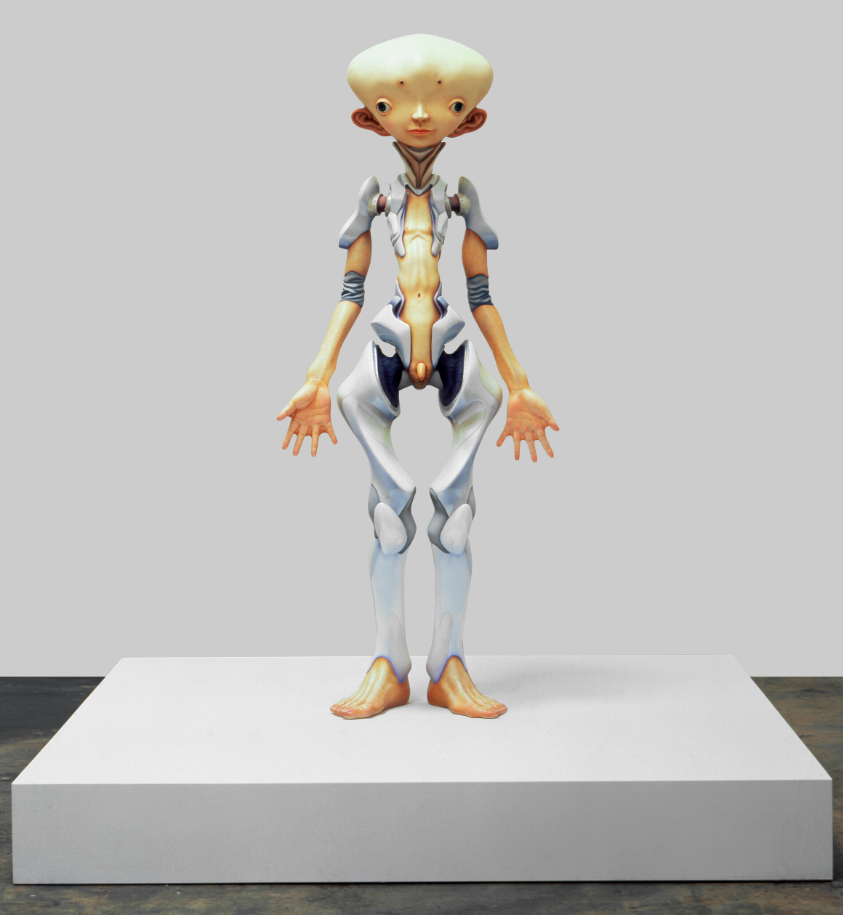
TAKASHI MURAKAMI (B. 1962)
Inochi, 2004
FRP, steel and lacquer, accompanied by FRP mannequin, uniform, six posters and 35mm film transferred to DVD
Inochi figure: 140 x 58.4 x 29.2 cm (55 x 24 1/2 x 14 1/2 inches)
Mannequin with uniform: 140 x 58.4 x 29.2 cm (55 x 24 1/2 x 14 1/2 inches)
Posters, each: 103.1 x 145.4 cm (40 5/8 x 57 1/4 inches)
Film: 5 minutes 28 seconds
This work is number one from an edition of three
#18. Enso: Zen, Soul, 2015
Christie’s New-York: 29 September 2022
Estimated: USD 120,000 – 180,000
USD 113,400
TAKASHI MURAKAMI (B. 1962) (christies.com)
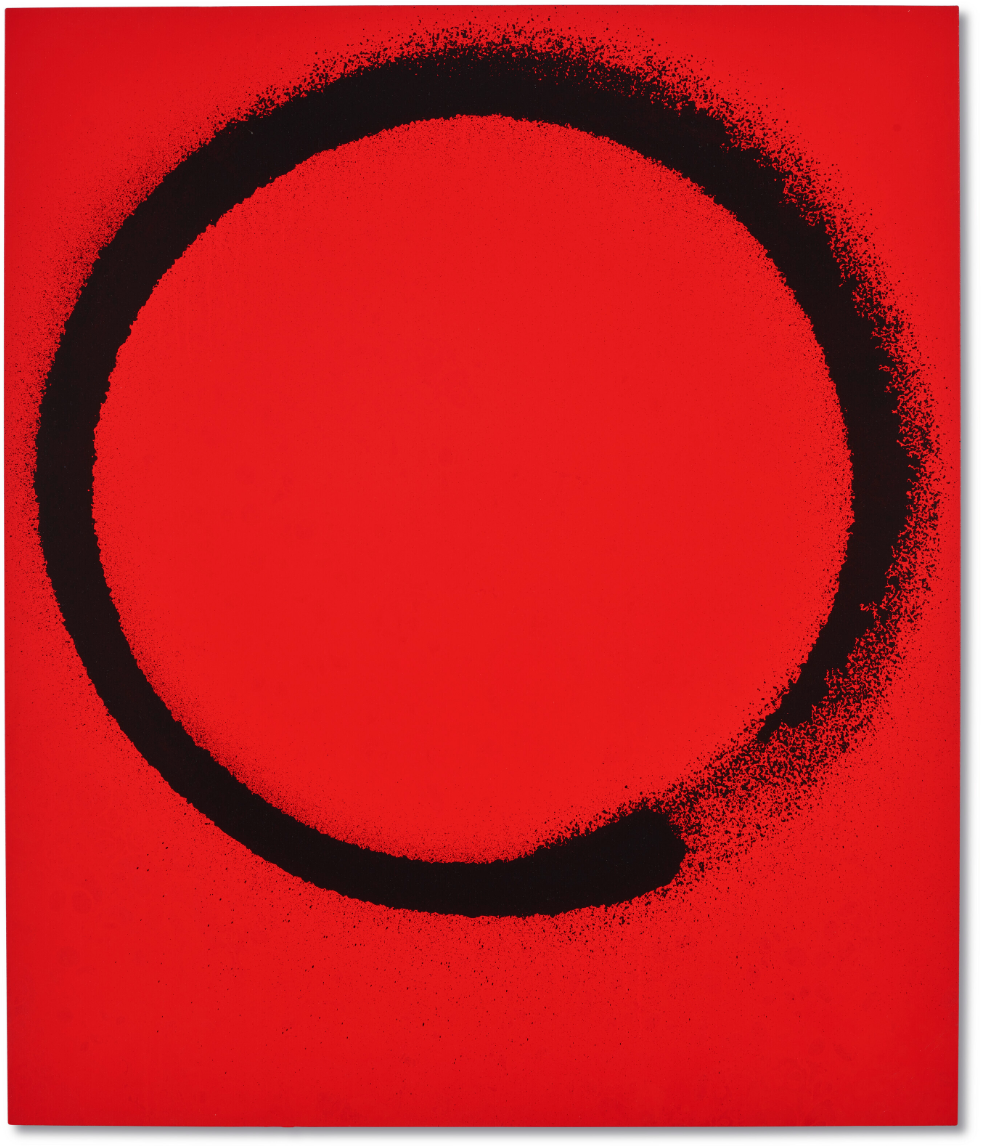
TAKASHI MURAKAMI (B. 1962)
Enso: Zen, Soul, 2015
Acrylic on canvas mounted on aluminum frame
141×121 cm (55 1/2 x 47 5/8 inches)
Signed and dated ‘TAKASHI 2015’ (on the overlap)
#19. Untitled, 2016
Christie’s London: 14 October 2022
Estimated: GBP 60,000 – 80,000
GBP 81,900 / USD 91,816
TAKASHI MURAKAMI (B. 1962), Untitled | Christie’s (christies.com)
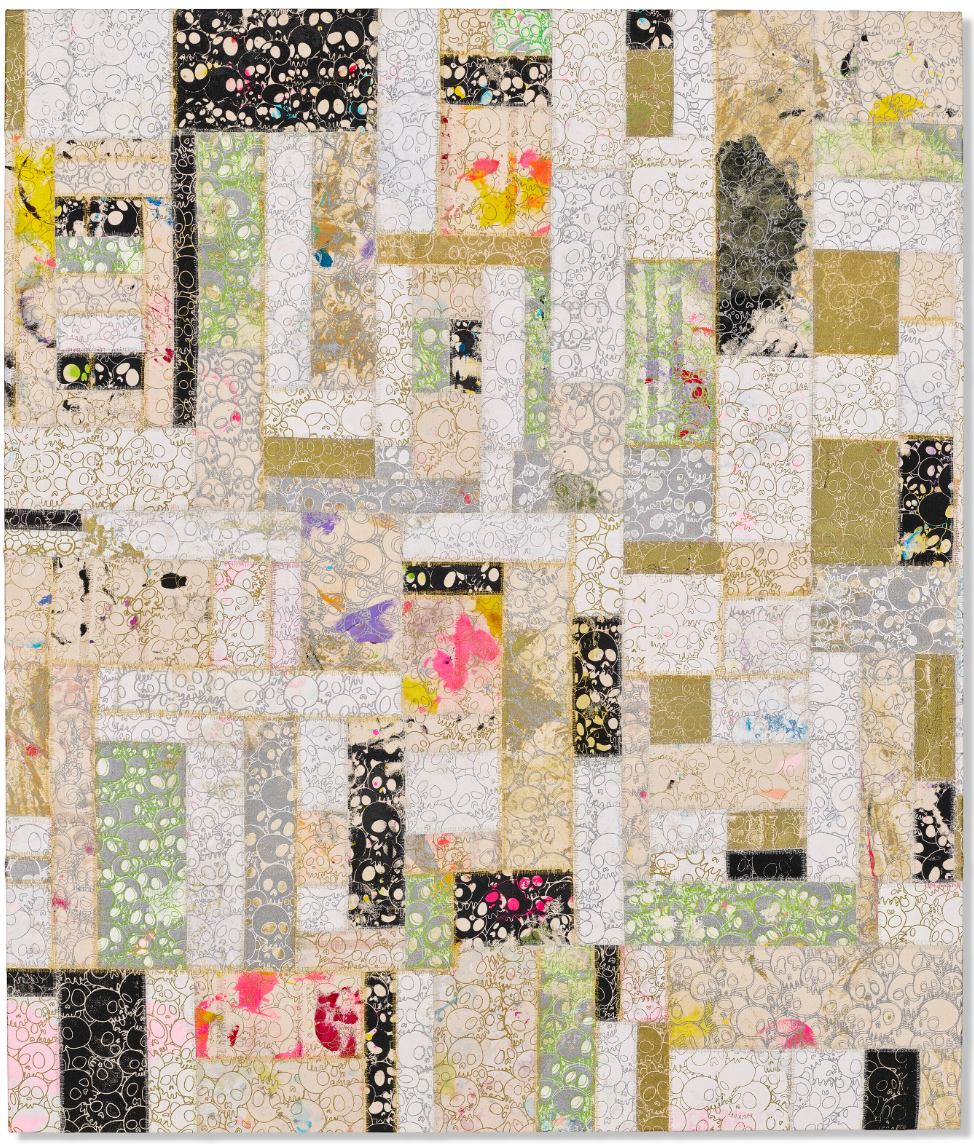
TAKASHI MURAKAMI (B. 1962)
Untitled, 2016
Acrylic on sewn canvas
141.2 x 120.4 cm (55 5/8 x 47 3/8 inches)
Signed and dated ‘TAKASHI 2016’ (on the overlap)
#20. Murakami.Flower 6758 Water Surface and Skull Face, 2022
Christie’s New-York: 18 November 2022
Estimated: USD 60,000 – 80,000
USD 75,600

TAKASHI MURAKAMI (B. 1962)
Murakami.Flower 6758 Water Surface and Skull Face, 2022
Acrylic on canvas
60.3 x 60.3 cm (23 3/4 x 23 3/4 inches)
Signed and dated ‘TAKASHI 2022’ (on the overlap)
#21. Eye Love Monogram, 2005
Sotheby’s London: 28 April 2022
Estimated: GBP 30,000 – 40,000
GBP 60,480 / USD 75,223
Eye Love Monogram | Contemporary Curated | 2022 | Sotheby’s (sothebys.com)
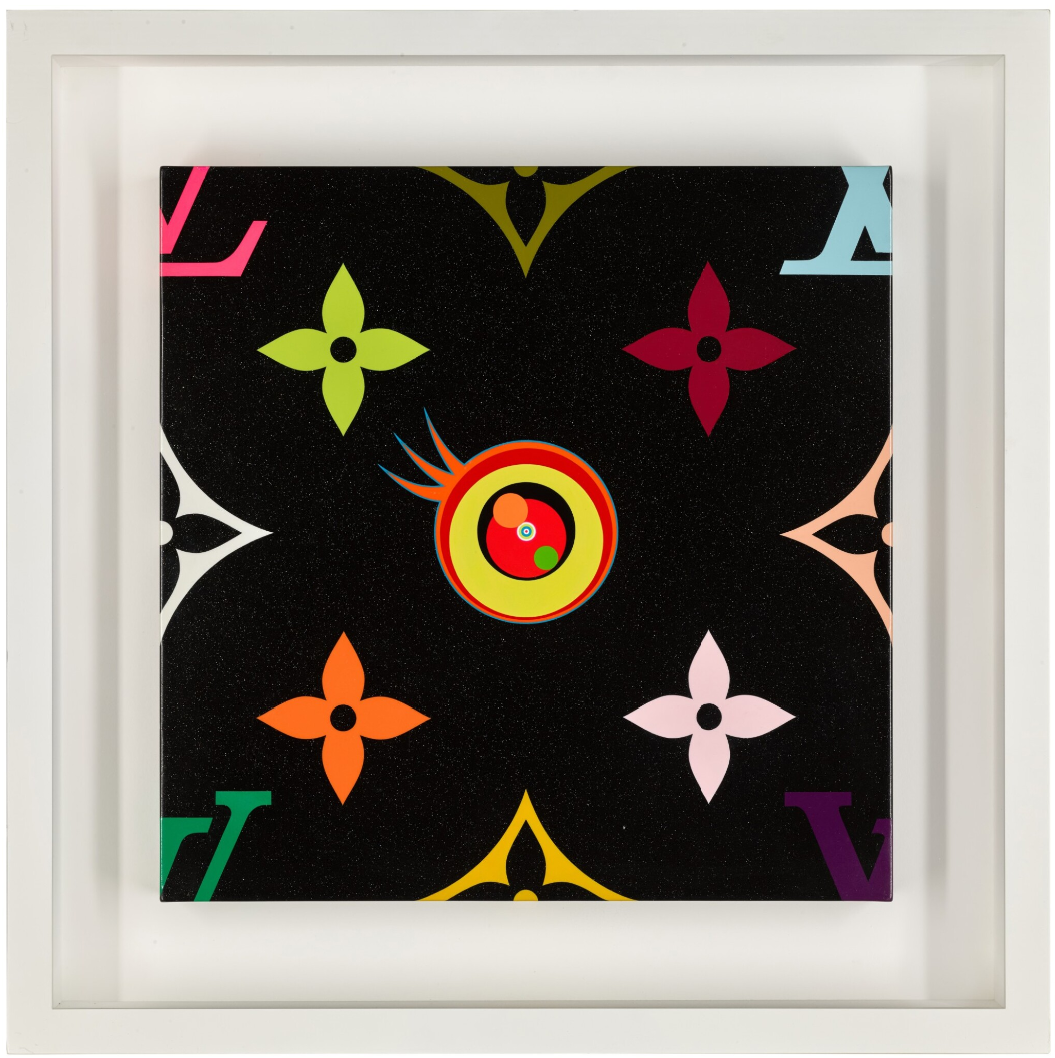
TAKASHI MURAKAMI (b. 1962)
Eye Love Monogram, 2005
Acrylic on canvas
39.8 x 39.3 cm (15 5/8 x 15 1/2 inches)
Signed and dated 05 on the reverse
#22. Enso: 2am – Sadhana Begins, 2016
Sotheby’s New-York: 15 December 2022
Estimated: USD 50,000 – 70,000
USD 56,700
Enso: 2am – Sadhana, Begins | Contemporary Discoveries | 2022 | Sotheby’s (sothebys.com)
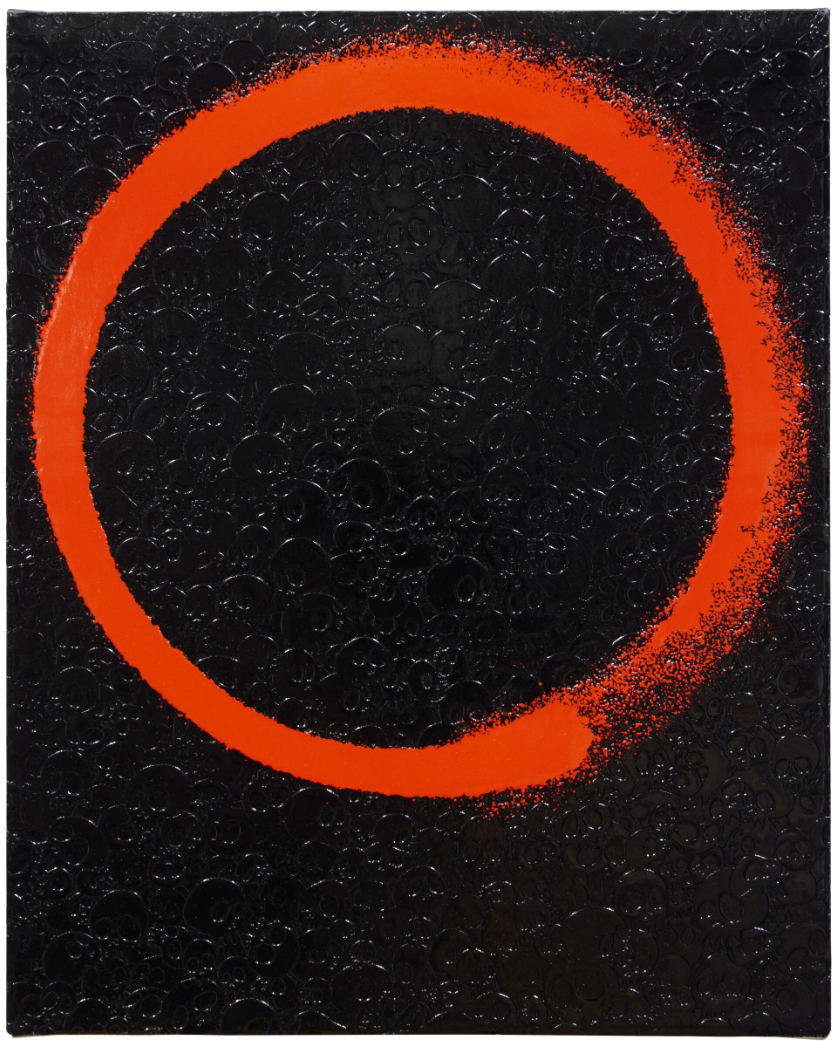
TAKASHI MURAKAMI (b. 1962)
Enso: 2am – Sadhana Begins, 2016
Acrylic on canvas
41.9 x 33.7 cm (16 1/2 x 13 1/4 inches)
Signed Takashi, titled Enso and dated 2016 (on the reverse)
#23. Untitled, 2016
Phillips Hong-Kong: 30 November 2022
Estimated: HKD 300,000 – 500,000
HKD 302,400 / USD 38,744
Takashi Murakami – 20th Century & … Lot 160 November 2022 | Phillips
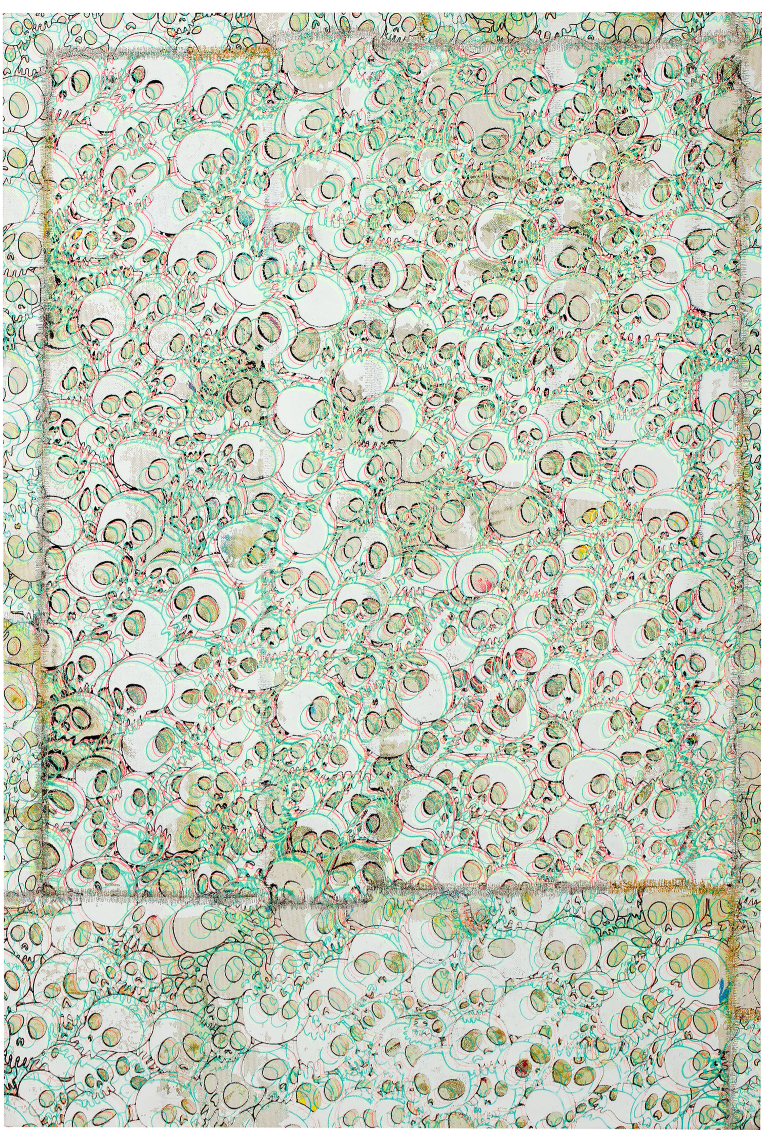
TAKASHI MURAKAMI
Untitled, 2016
Acrylic on sewn canvas
85.5 x 58.3 cm (33 5/8 x 22 7/8 inches)
Signed and dated ‘TAKASHI 2016’ on the overlap
2021 Auction Results
24 lots sold at auction in 2021 for a total turnover of USD 14,961,727. With 6 lots unsold, the sell-through rate is 80%.
2021 Top 3 Lots
Only 2 lots sold above USD 1 million for a cumulative turnover of USD 7,174,968, representing 48% of the total turnover for 2021.
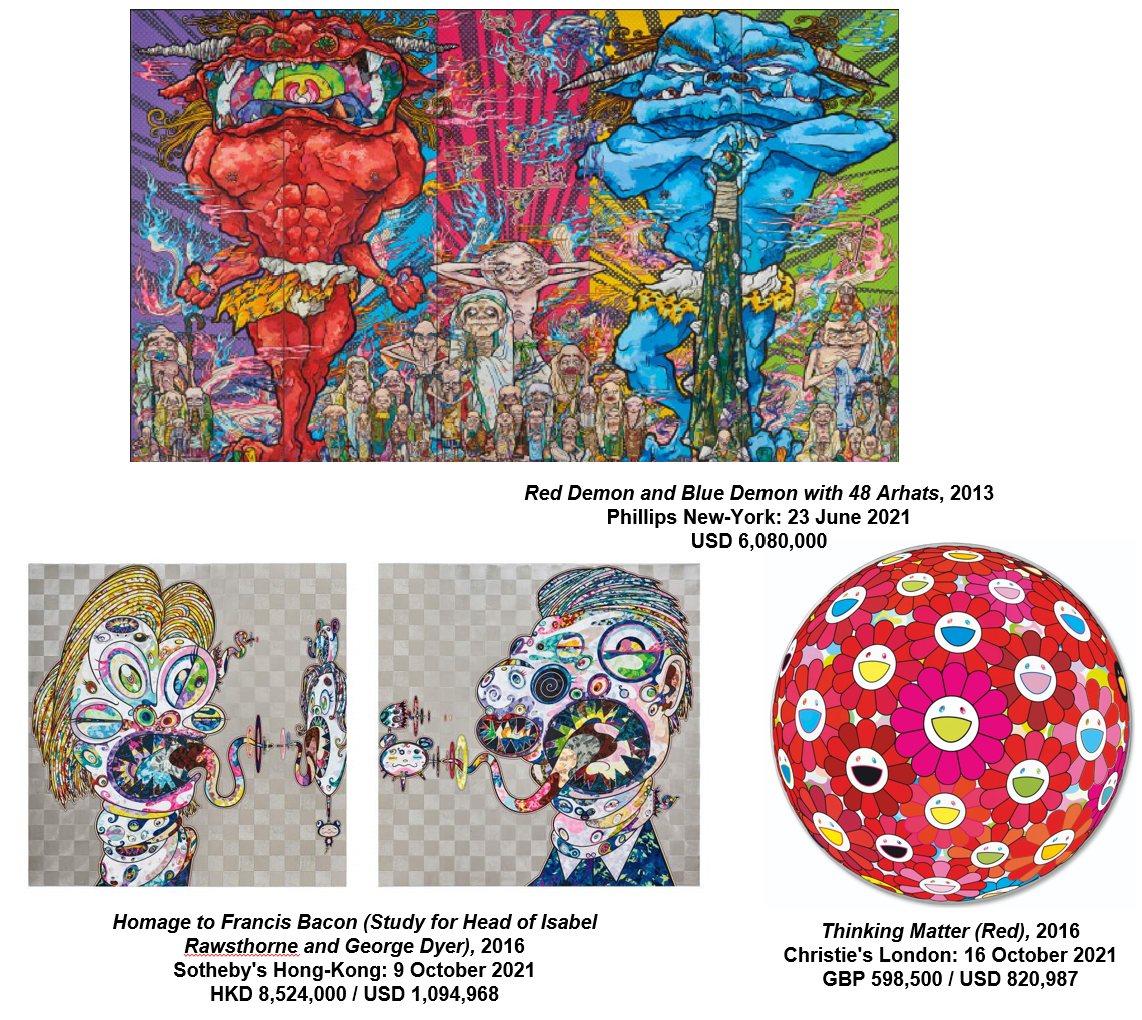
#1. Red Demon and Blue Demon with 48 Arhats, 2013
Phillips New-York: 23 June 2021
Estimated: USD 3,500,000 – 4,500,000
USD 6,080,000
READ MORE IN FOCUS SECTION
Takashi Murakami 20th Century & Contemporary Art Evening Sale
TAKASHI MURAKAMI
Red Demon and Blue Demon with 48 Arhats, 2013
Acrylic, gold and platinum leaf on canvas mounted on board, in 5 parts
300×500 cm (118.2 x 196.9 inches)
Signed and dated “TAKASHI 2013” on the overlap of the left panel
#2. Homage to Francis Bacon (Study for Head of Isabel Rawsthorne and George Dyer), 2016
Sotheby’s Hong-Kong: 9 October 2021
Estimated: HKD 5,000,000 – 7,000,000
HKD 8,524,000 / USD 1,094,968
READ MORE IN FOCUS SECTION
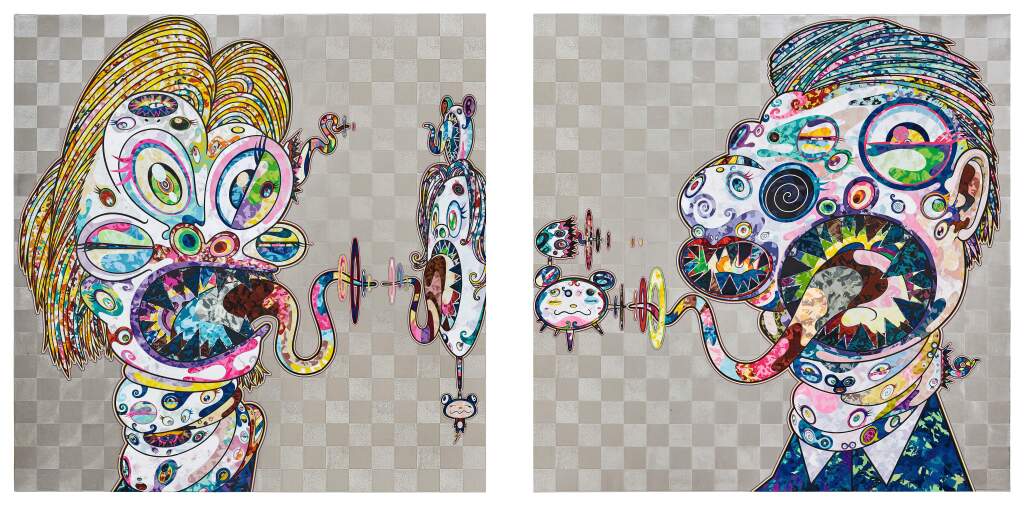
TAKASHI MURAKAMI (B. 1962)
Homage to Francis Bacon (Study for Head of Isabel Rawsthorne and George Dyer), 2016
Acrylic and platinum leaf on canvas mounted on aluminum frame
Each: 100x100x5 cm (39.4 x 39.4 x 2 inches)
Overall: 100x200x5 cm (39.4 x 78.7 x 2 inches)
Both signed and dated 2016 on the turnover edge
#3. Thinking Matter (Red), 2016
Christie’s London: 16 October 2021
Estimated: GBP 250,000 – 350,000
GBP 598,500 / USD 820,987
READ MORE IN FOCUS SECTION
TAKASHI MURAKAMI (B. 1962) (christies.com)
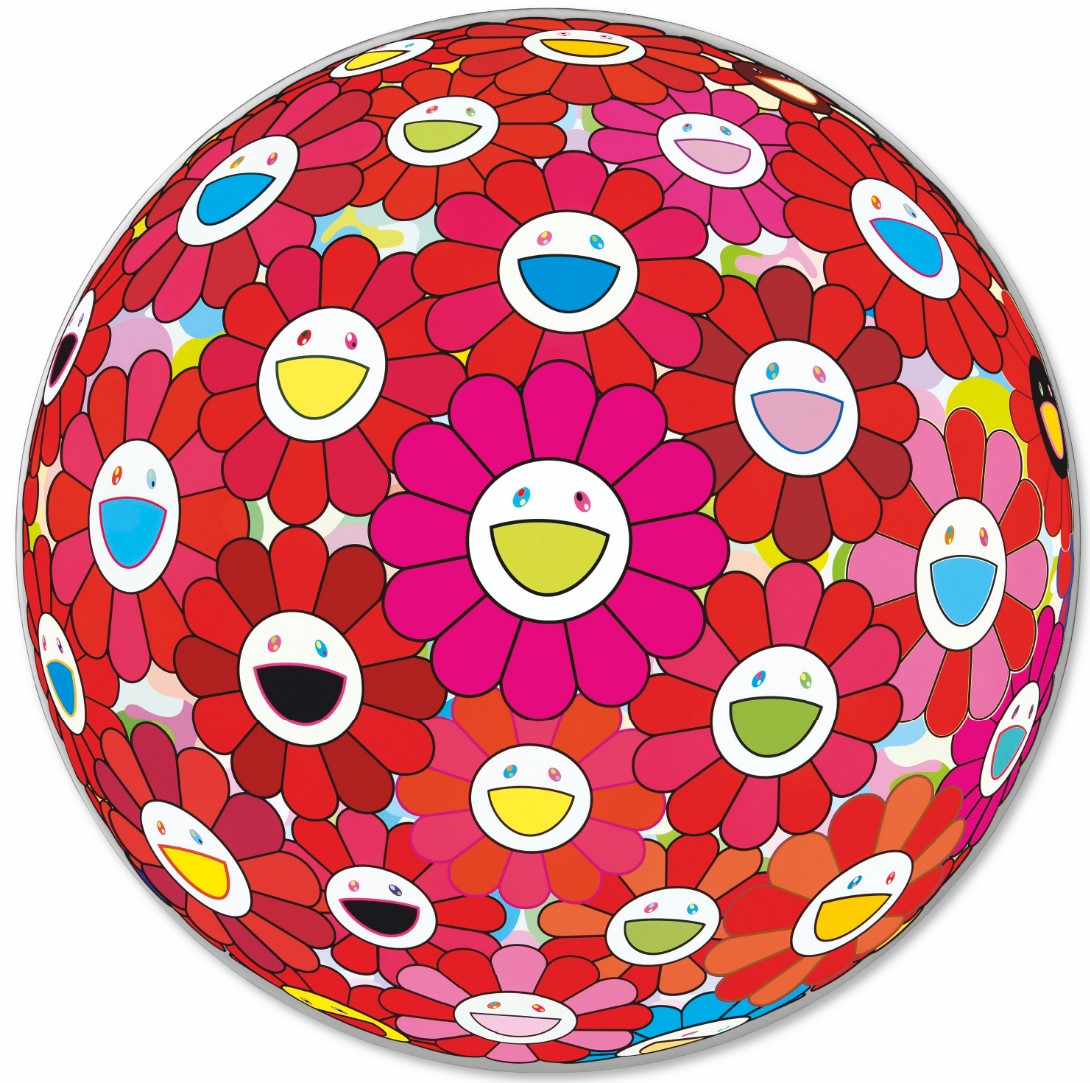
TAKASHI MURAKAMI (B. 1962)
Thinking Matter (Red), 2016
Acrylic and platinum leaf on canvas, laid on panel
Diameter: 150.5 cm (59.2 inches)
Signed and dated ‘TAKASHI 2016’ (on the reverse)
#4. Flower Ball (Kindergarten Days), 2002
Sotheby’s Hong-Kong: 18 June 2021
Estimated: HKD 3,000,000 – 5,000,000
HKD 5,257,000 / USD 677,204
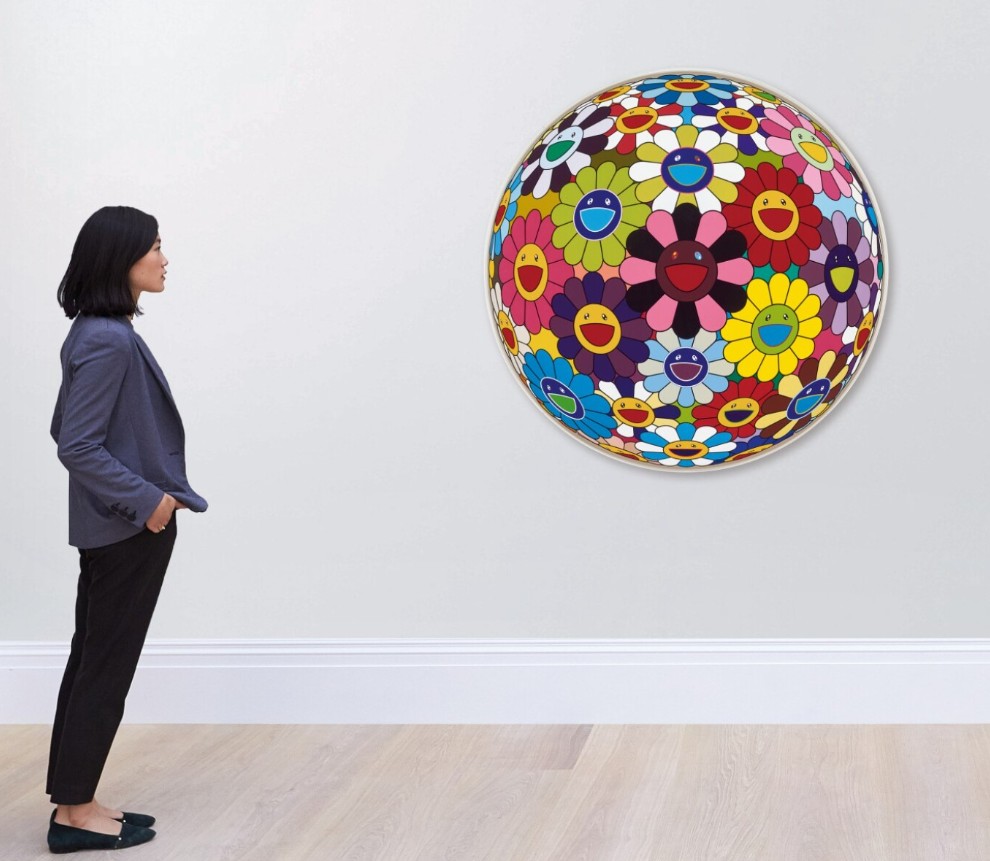
TAKASHI MURAKAMI (B. 1962)
Flower Ball (Kindergarten Days), 2002
Acrylic on canvas mounted on board
Diameter: 100 cm (39.4 inches)
Signed and dated 02 on the reverse
#5. Ponchi-kun Gold, 2010
Sotheby’s Hong-Kong: 9 October 2021
Estimated: HKD 4,000,000 – 6,000,000
HKD 5,015,000 / USD 644,212
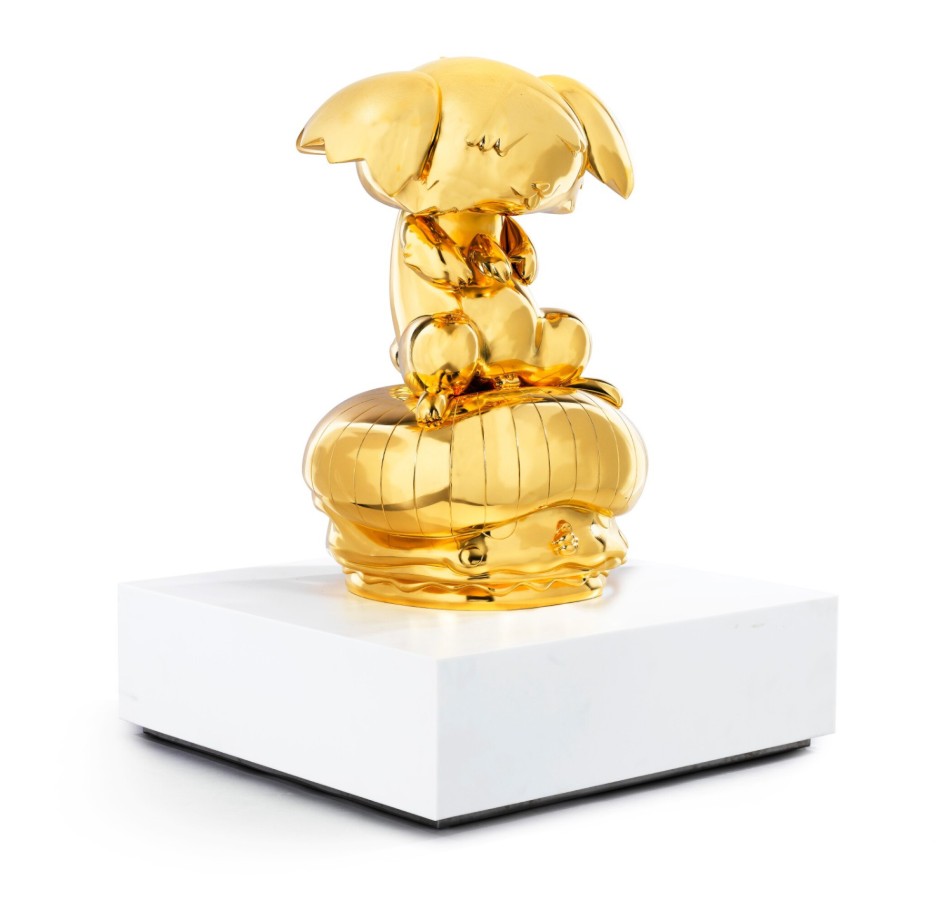
TAKASHI MURAKAMI (b. 1962)
Ponchi-kun Gold, 2010
Aluminum, gold leaf, Corian base
108x74x72 cm (42 1/2 x 29 1/8 x 28 3/8 inches)
#6. Doraemon Sitting Up: Weeping Some, Laughing Some, 2020
Sotheby’s Hong-Kong: 19 April 2021
Estimated: HKD 2,800,000 – 3,800,000
HKD 4,410,000 / USD 567,845
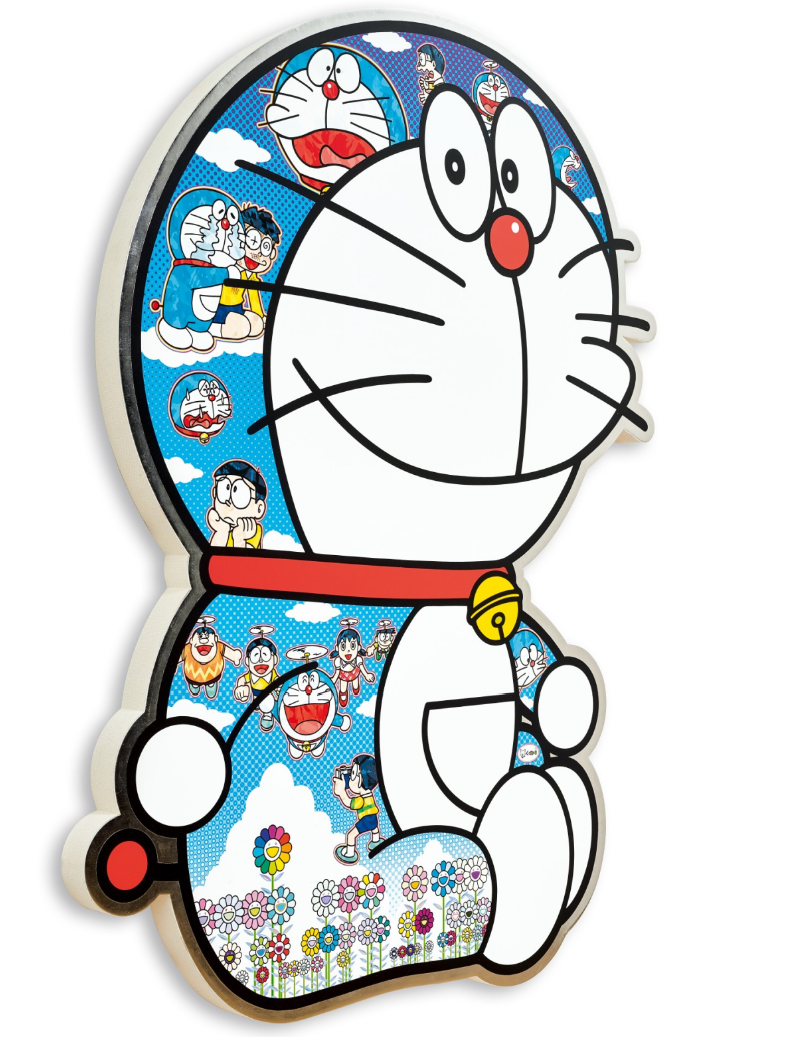
TAKASHI MURAKAMI (b. 1962)
Doraemon Sitting Up: Weeping Some, Laughing Some, 2020
Acrylic and platinum leaf on canvas mounted on wood panel
122.9 x 94 x 4.8 cm (48 3/8 x 37 x 1 1/8 inches)
Signed and dated 2020 on the reverse
#7. Smooth Nightmare, 2001
Sotheby’s London: 29 June 2021
Estimated: GBP 350,000 – 450,000
GBP 402,200 / USD 556,832
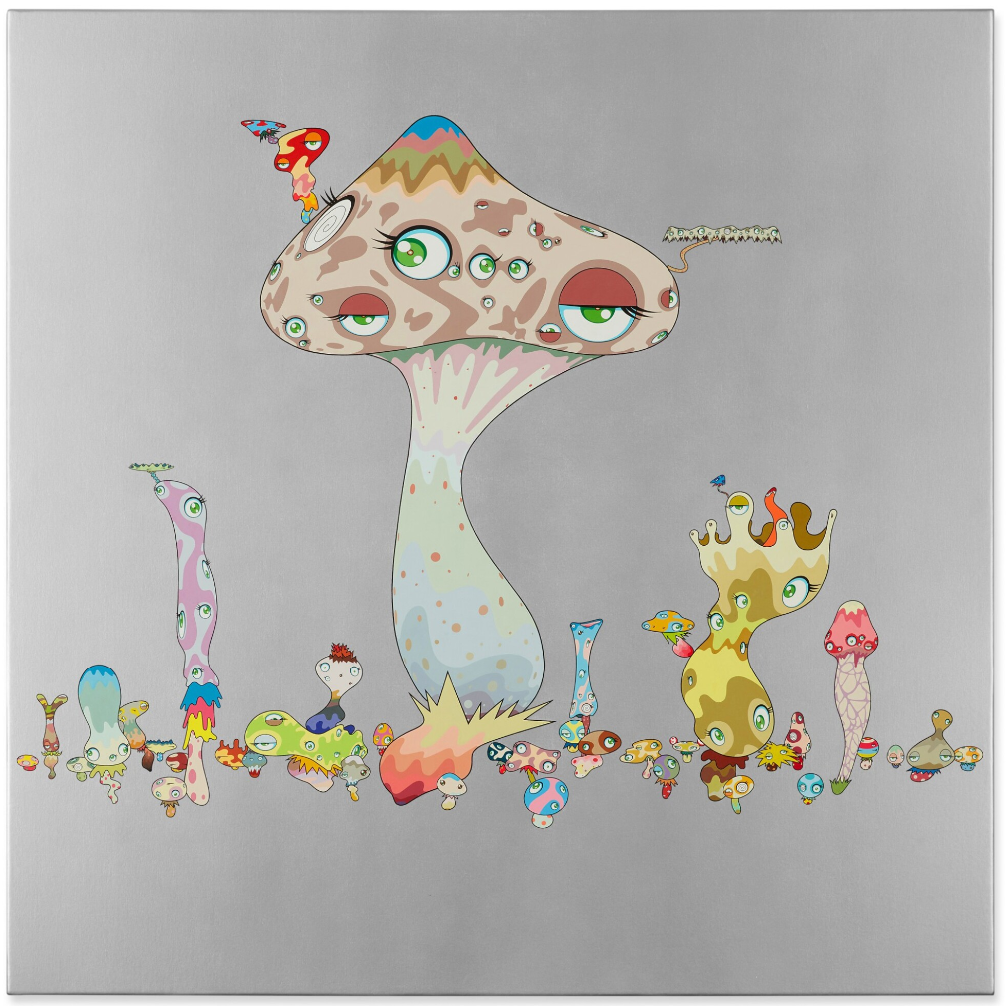
TAKASHI MURAKAMI (b. 1962)
Smooth Nightmare, 2001
Acrylic on canvas mounted on board
160×160 cm (63×63 inches)
Signed, dated 01, and variously inscribed on the reverse
#8. Enso: Exponentially Expanding Universe, 2015
Christie’s London: 25 March 2021
Estimated: GBP 120,000 – 180,000
GBP 362,500 / USD 497,324
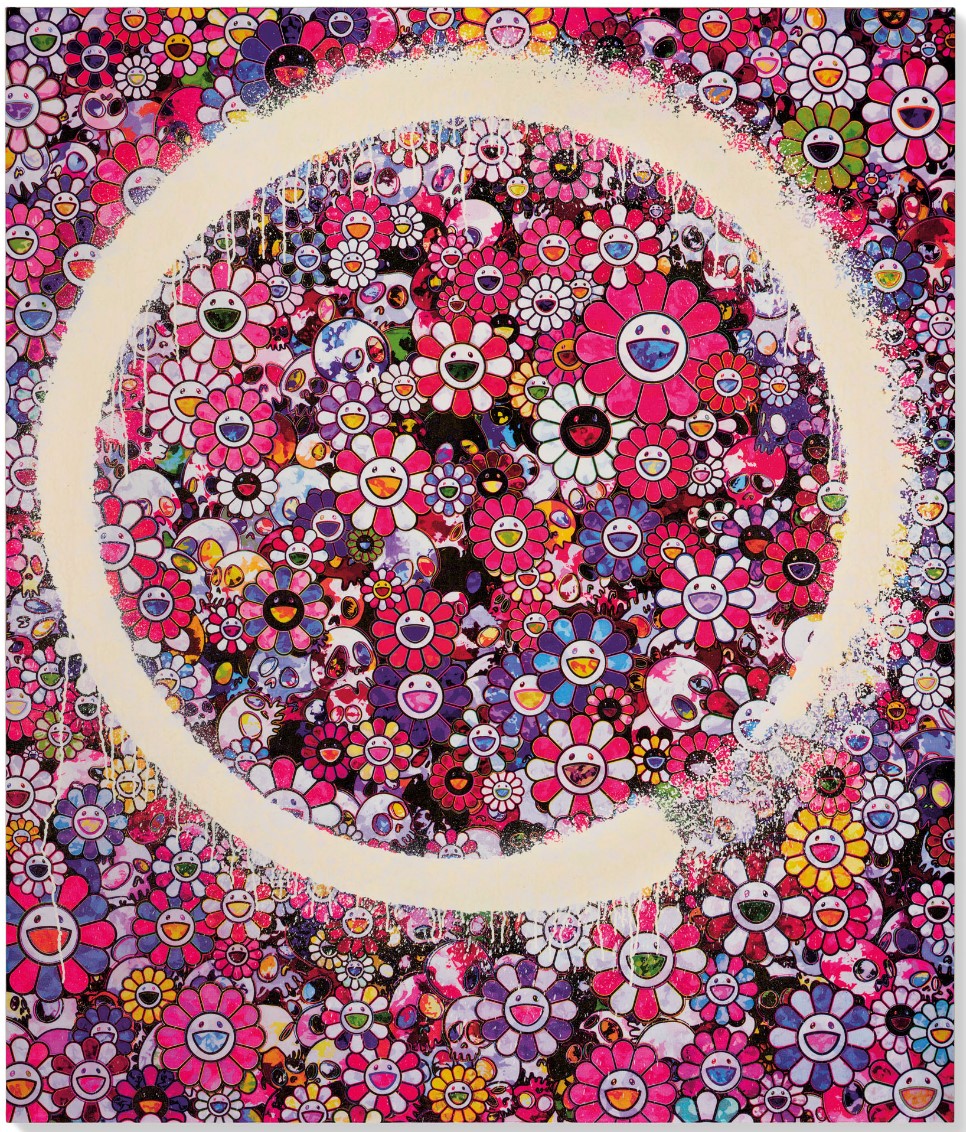
TAKASHI MURAKAMI (B. 1962)
Enso: Exponentially Expanding Universe, 2015
Acrylic on canvas
141×120 cm (55.1 x 47.2 inches)
Signed and dated ‘TAKASHI 2015’ (on the overlap)
#9. Enso: The Sound of the Bell of Paired Sal Trees, 2015
Phillips Hong-Kong: 7 June 2021
Estimated: HKD 1,500,000 – 2,200,000
HKD 3,150,000 / USD 405,969
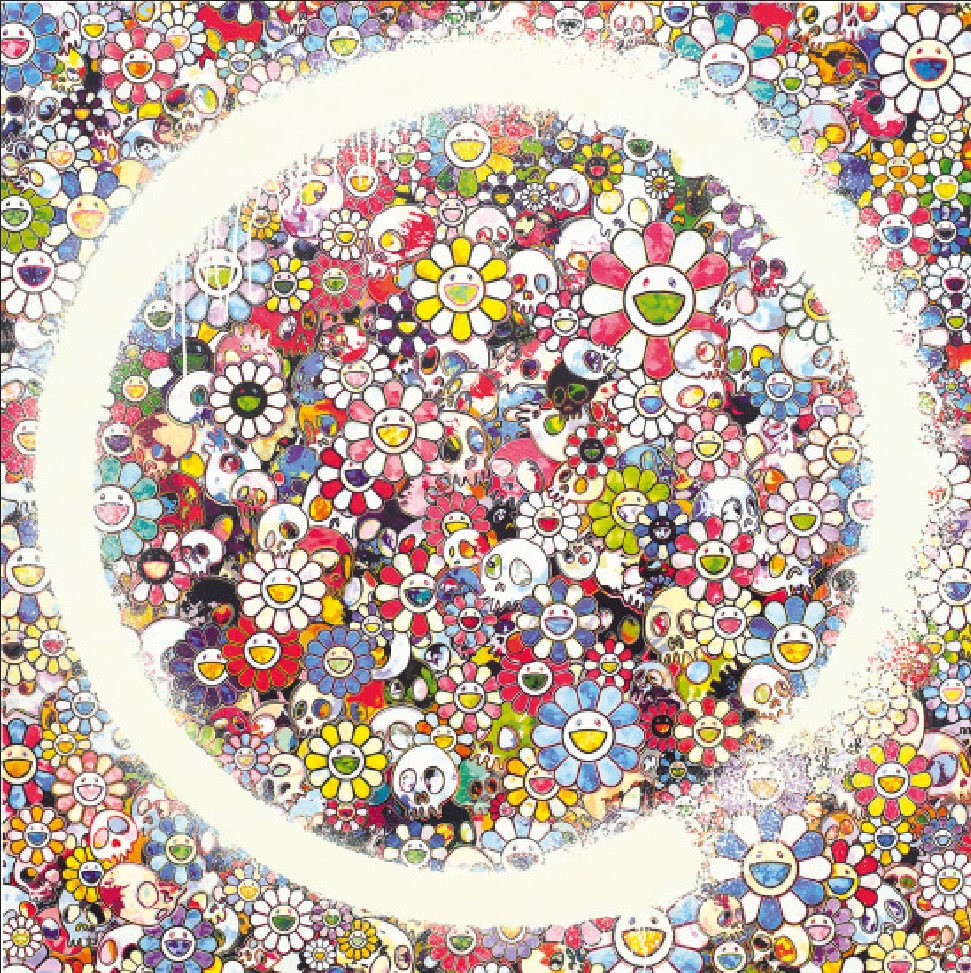
TAKASHI MURAKAMI
Enso: The Sound of the Bell of Paired Sal Trees, 2015
Acrylic on canvas mounted on aluminum frame
100×100 cm (39.4 x 39.4 inches)
Signed and dated ‘Takashi 2015’ on the overlap
#10. Contemplating Dark Matter, 2014
Sotheby’s New-York: 13 May 2021
Estimated: USD 300,000 – 500,000
USD 403,200
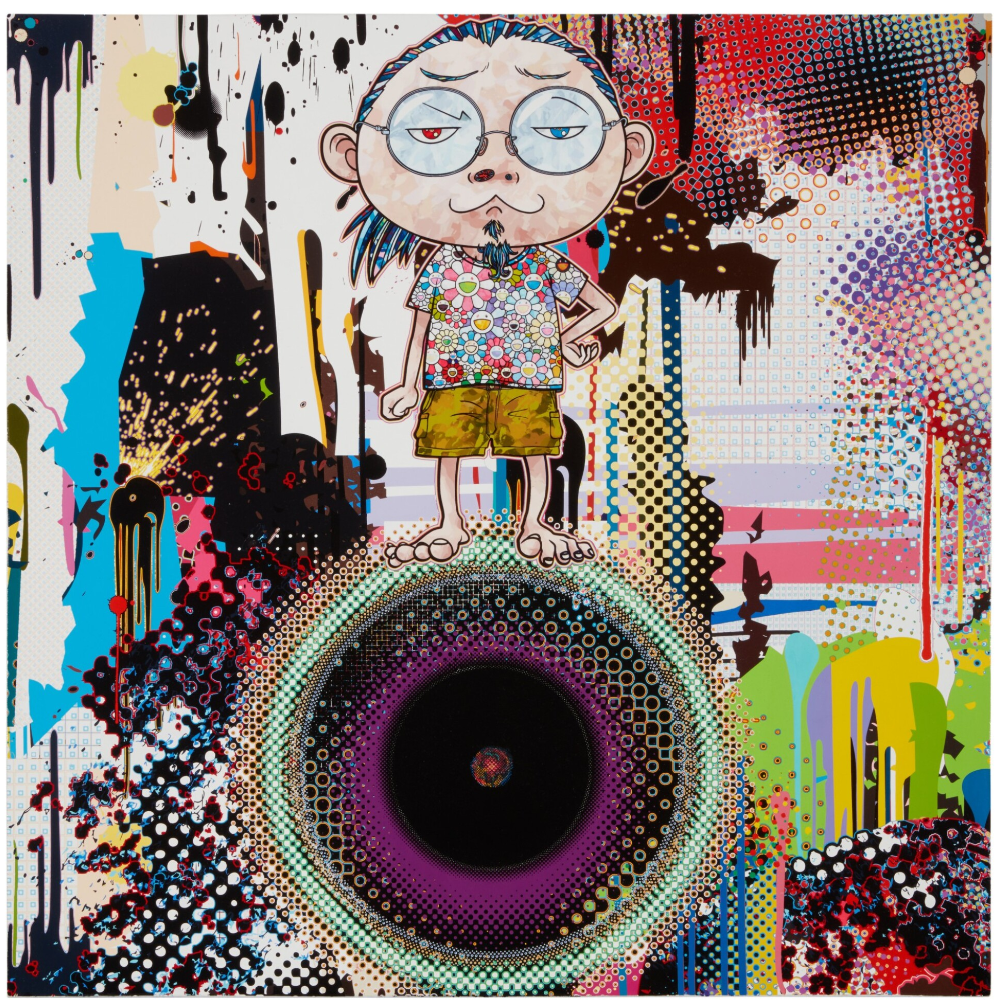
TAKASHI MURAKAMI (b. 1962)
Contemplating Dark Matter, 2014
Acrylic, gold and platinum leaf on canvas
100.3 x 100.3 cm (39 1/2 x 39 1/2 inches)
Signed and dated 2014 on the overlap
#13. Ensō: In the Fog, 2015
Phillips Hong-Kong: 29 November 2021
Estimated: HKD 1,500,000 – 2,500,000
HKD 2,394,000 / USD 306,954
Takashi Murakami – 20th Century & … Lot 256 November 2021 | Phillips
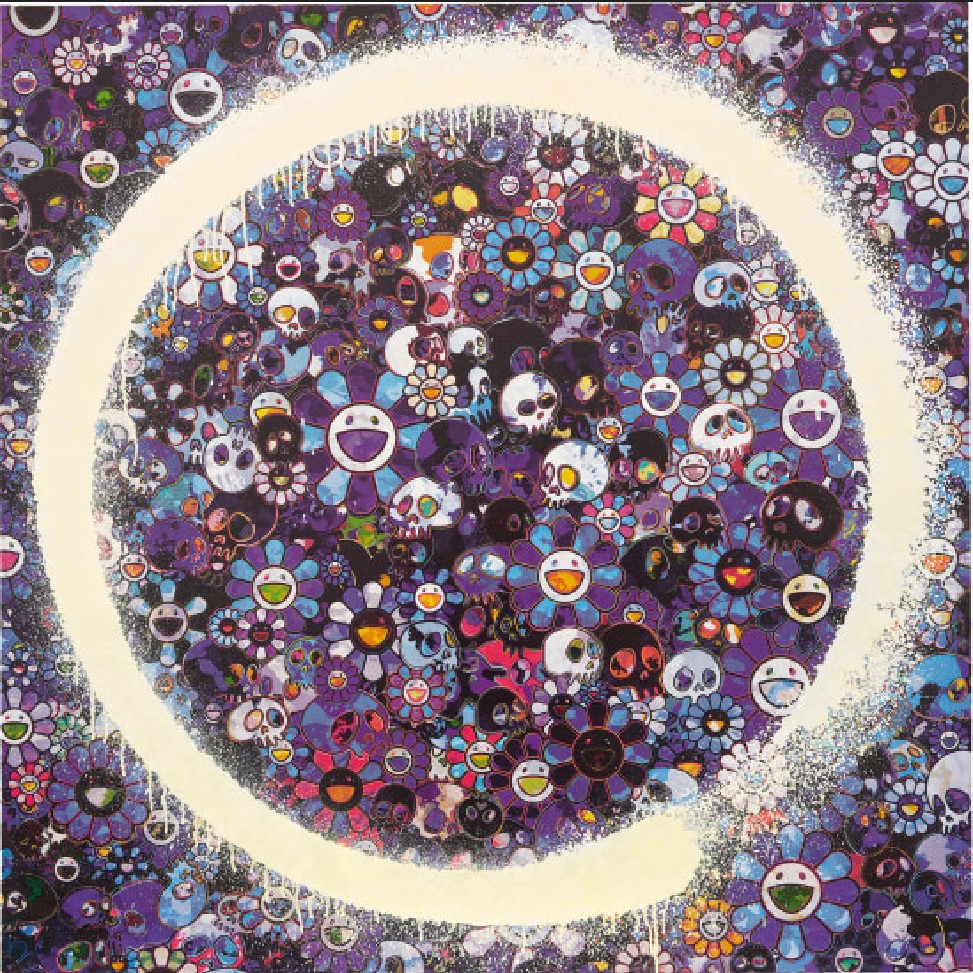
TAKASHI MURAKAMI
Ensō: In the Fog, 2015
Acrylic on canvas mounted on aluminium frame
100×100 cm (39.4 x 39.4 inches)
Signed and dated ‘Takashi 2015’ on the overlap
#16. To be titled (EN-SO Flowers & Skulls Blue), 2015
Phillips New-York: 18 November 2021
Estimated: USD 150,00 – 250,000
USD 277,200
Takashi Murakami – 20th Century & … Lot 366 November 2021 | Phillips
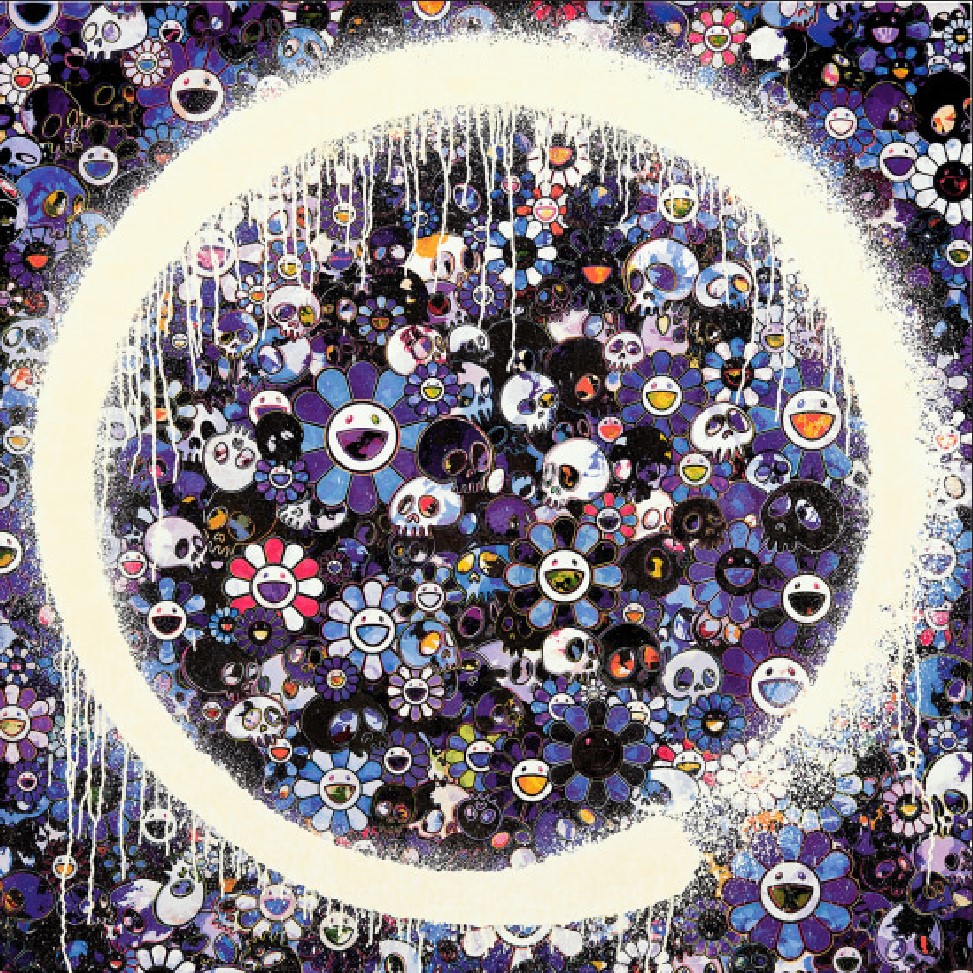
TAKASHI MURAKAMI
To be titled (EN-SO Flowers & Skulls Blue), 2015
Acrylic on canvas
100×100 cm (39.4 x 39.4 inches)
Signed and dated “TAKASHI 2015” on the overlap
PART III: FOCUS
Mr DOB
The smiling, happy and playful figure of Mr DOB is the artist’s principal protagonist and trademark Pop character. Fusing East and West, DOB was born from a simulation of language and cartoon imagery; part 1970s Japanese comic book humor and American Walt Disney. Essentially, DOB has become Murakami’s house brand, developing over time in Murakami’s work and appearing in various different forms and contexts: as an inflatable balloon, in films, on clothing and as a character in other compositions.
Untitled, 2020
Phillips Hong-Kong: 29 March 2024
Estimated: HKD 650,000 – 850,000
HKD 635,000 / USD 81,181
Takashi Murakami – New Now Hong Kong Lot 28 March 2024 | Phillips
TAKASHI MURAKAMI
Untitled, 2020
FRP, urethane paint, stainless steel, wood
87.1 x 68.8 x 47 cm (34 1/4 x 27 1/8 x 18 1/2 inches)
This work is number 11 from an edition of 20 plus 1 artist’s proof and 2 special proofs
Widely celebrated for his vibrant and whimsical artworks and having solidified his position in the global art world, Takashi Murakami is an artist that needs no introduction. Renowned as the founder of the Superflat movement, the artist is best known for his flat aesthetic – referencing the flattened imagery in traditional Japanese Nihonga painting and 2D visuals such as anime and manga. Transcending beyond the confines of a canvas, Untitled is presented in 3D form, bringing to life the unique persona and qualities of Murakami’s much-admired subject.
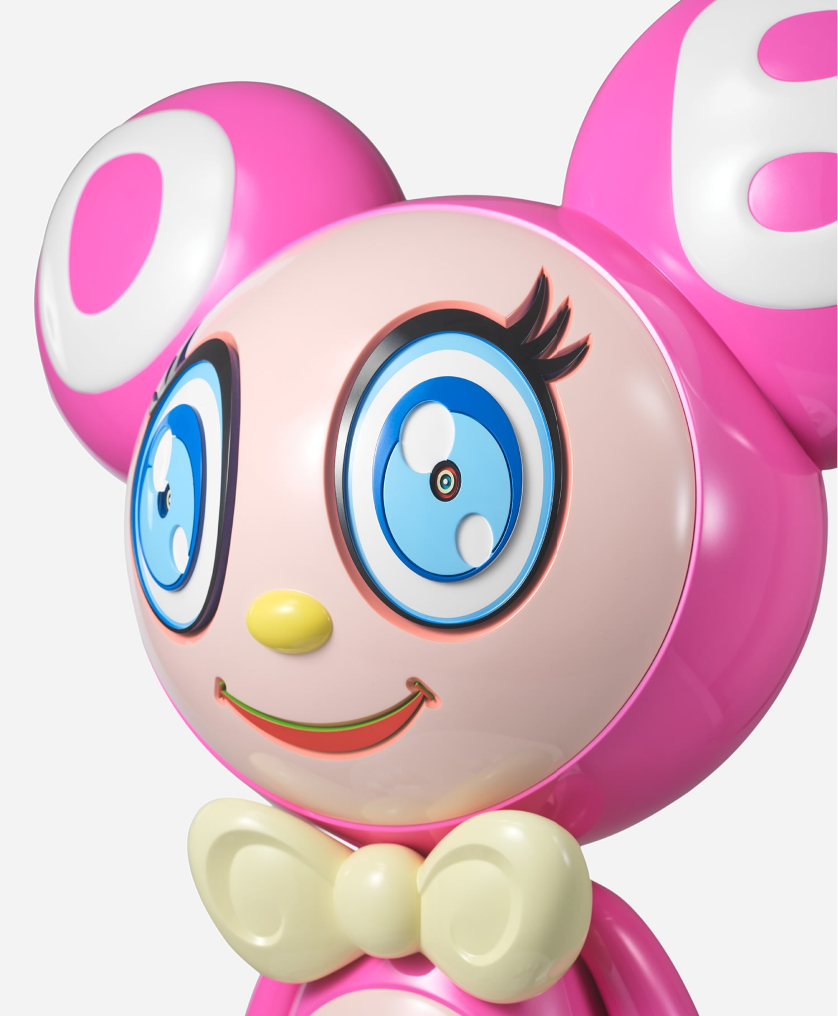
Standing in a rigid posture, as if frozen in time, Mr. DOB in Untitled evokes a sense of discomfort and unconsciousness. Gazing directly at the viewer with his hypnotic blue eyes and unsettling wide grin, Mr. DOB provokes contemplation and reflects Murakami’s dissenting opinions on today’s consumer society. Polished to perfection, its glistening surface encourages observers to circumambulate the work. Physically manifesting the alphabets D, O, and B, they are printed on the ears of the figure and utilize the circular shape of his visage as a reference to his name. Having made its first appearance in 1994, his name hails from the Japanese expression dobojite, which translates to “why” in Japanese slang – addressing the artist’s confrontation of the largely Western dominated art world. In viewing Murakami’s works, his transgression of high art obscures the commercial with the sublime, setting the artist as an innovator of a revolutionary method that outlines the audience’s understanding of a globalized contemporary culture.
As seen in the present work, Mr. DOB has become a central character to feature in the artist’s paintings and sculptures, becoming synonymous with Murakami’s oeuvre. Holding a playful and recurring presence in Murakami’s practice, the character symbolizes an amalgamation of Japanese pop culture, consumerism, as well as his own interpretation of contemporary society. Inspired by iconic cartoon characters such as Mickey Mouse, Doraemon, and Sonic the Hedgehog, Mr. DOB has further come to serve as an alter-ego for Murakami himself – embodying the complexities and nuances of his ever-evolving artistic identity. In 2019, the present work was included in the artist’s solo exhibition Baka at Galerie Perrotin in Paris – a major show that was dedicated to Murakami’s ubiquitous self-invented Mr. DOB. The pink colored editions of Untitled are also more limited than the ones that are executed in other colors.
And then 1000 (A Deep Ocean of Ultramarine), 2013
Sotheby’s Hong-Kong: 5 October 2023
Estimated: HKD 2,200,000 – 3,500,000
HKD 2,921,000 / USD 372,999
TAKASHI MURAKAMI (b. 1962)
And then 1000 (A Deep Ocean of Ultramarine), 2013
Acrylic on canvas
100×100 cm (39 3/8 x 39 3/8 inches)
Takashi Murakami’s pristinely emblematic And then 1000 (A Deep Ocean of Ultramarine) from 2013 is a striking and brazen depiction of the most celebrated protagonist of the artist’s extraordinary oeuvre, the eponymous DOB. A wonderfully dramatic portrayal of this legendary character, this painting represents the most perfectly concentrated manifestation of Murakami’s unprecedented construction and deconstruction of a radically new Pop identity. Within an apparently enigmatic appearance, here DOB embodies a carefully composed hybrid humanoid that encases manifold dualities that prove enduringly relevant. Murakami’s DOB incorporates the innocent and the monstrous, the traditional and the unprecedented, the conventional and the transgressive, the meticulously handmade and the technically fabricated, high and low culture, and directly contrasting social mores. Immortalizing Murakami’s signature character in deep ultramarine against an almost luminous white ground, the present work represents the culmination of over 20 years of evolution, through which the artist perpetually reinvents his image and explores the realm of branding and its dichotomous relationship with high art and cultural tradition.
Immaculately rendered in the artist’s archetypal Superflat aesthetic, this irresistibly intriguing presence precisely fills the square composition with its dark blue contours, its multiplied all-seeing and implicitly all-knowing eyes, rapaciously glinting teeth and capital DOB initials. Through its sheer formal appearance, Murakami’s hero inevitably appropriates the monumental cultural legacy of Walt Disney’s Mickey Mouse, arguably the single most potent symbol of the animated visual culture that has become so integral to quotidian experience in our era. In the present work the artist has created an anthropomorphic alter ego, a constantly evolving character that embodies all the complexities and nuances of Murakami’s multi-faceted personal, artistic and corporate identities. As epitomized by And then 1000 (A Deep Ocean of Ultramarine), DOB stands as a celebrated and influential icon that effectively uses past imagery and contemporary consumer imagery to define the zeitgeist of our digital age.
And then, and then, and then, and then and then / Super Blue DOB, 2006
Christie’s Hong-Kong: 29 May 2023
Estimated: HKD 2,200,000 – 4,000,000
HKD 3,150,000 / USD 402,386
TAKASHI MURAKAMI (B. 1962) (christies.com)
TAKASHI MURAKAMI (B. 1962)
And then, and then, and then, and then and then / Super Blue DOB, 2006
Acrylic on canvas laid on board
100.7 x 100.2 cm (39 5/8 x 39 3/8 inches)
Signed and dated ‘Takashi 06’ (on the reverse)
The Castle of Tin Tin, 1998
Christie’s New-York: 9 March 2023
Estimated: USD 1,200,000 – 2,500,000
USD 1,620,000
TAKASHI MURAKAMI (B. 1962) (christies.com)
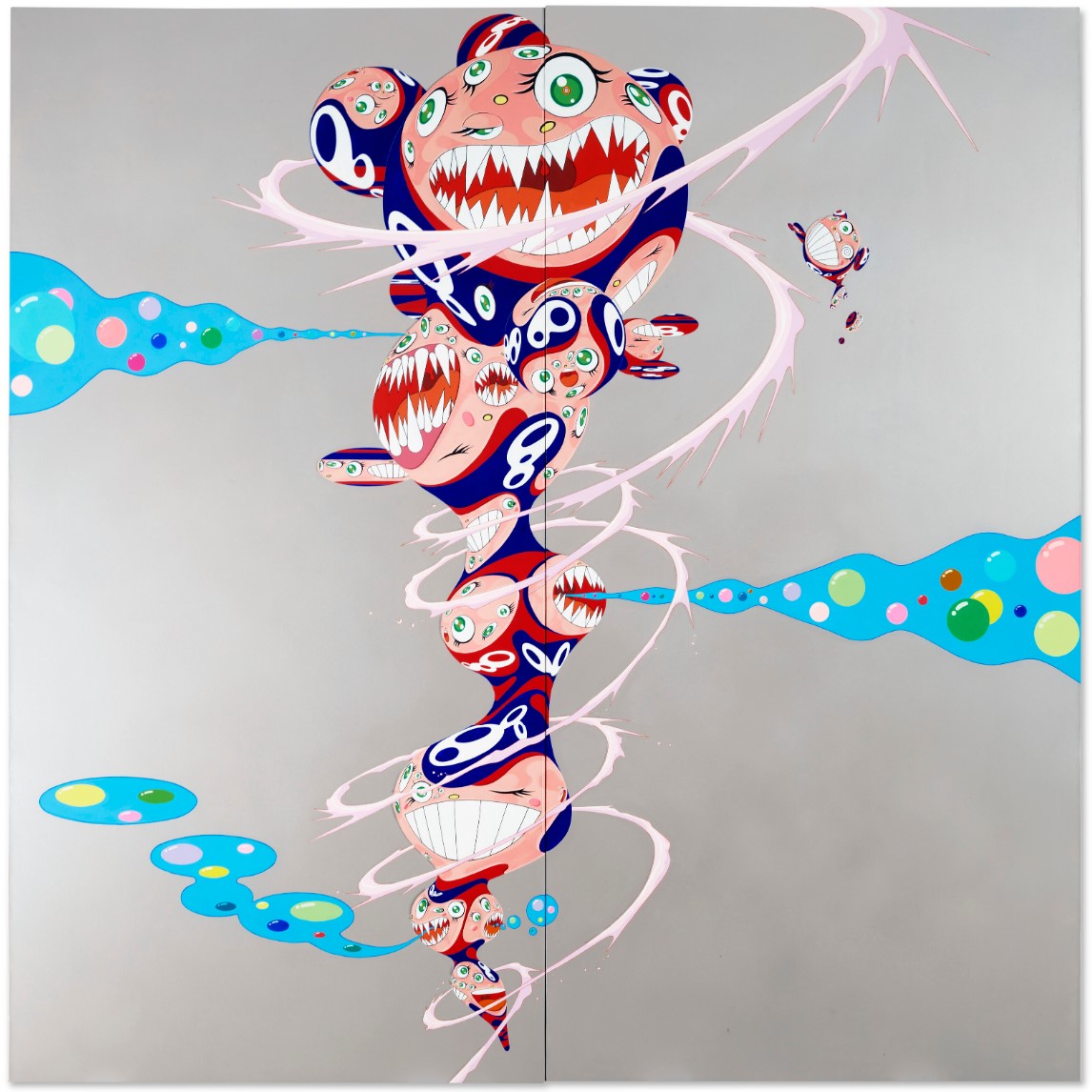
TAKASHI MURAKAMI (B. 1962)
The Castle of Tin Tin, 1998
Acrylic on canvas mounted on panel (diptych)
118×118 inches (299.7 x 299.7 cm)
Hands Clasped, 2015
Christie’s Hong-Kong: 30 November 2022
Estimated: HKD 12,000,000 – 18,000,000
HKD 10,650,000 / USD 1,364,509
TAKASHI MURAKAMI (B. 1962) (christies.com)
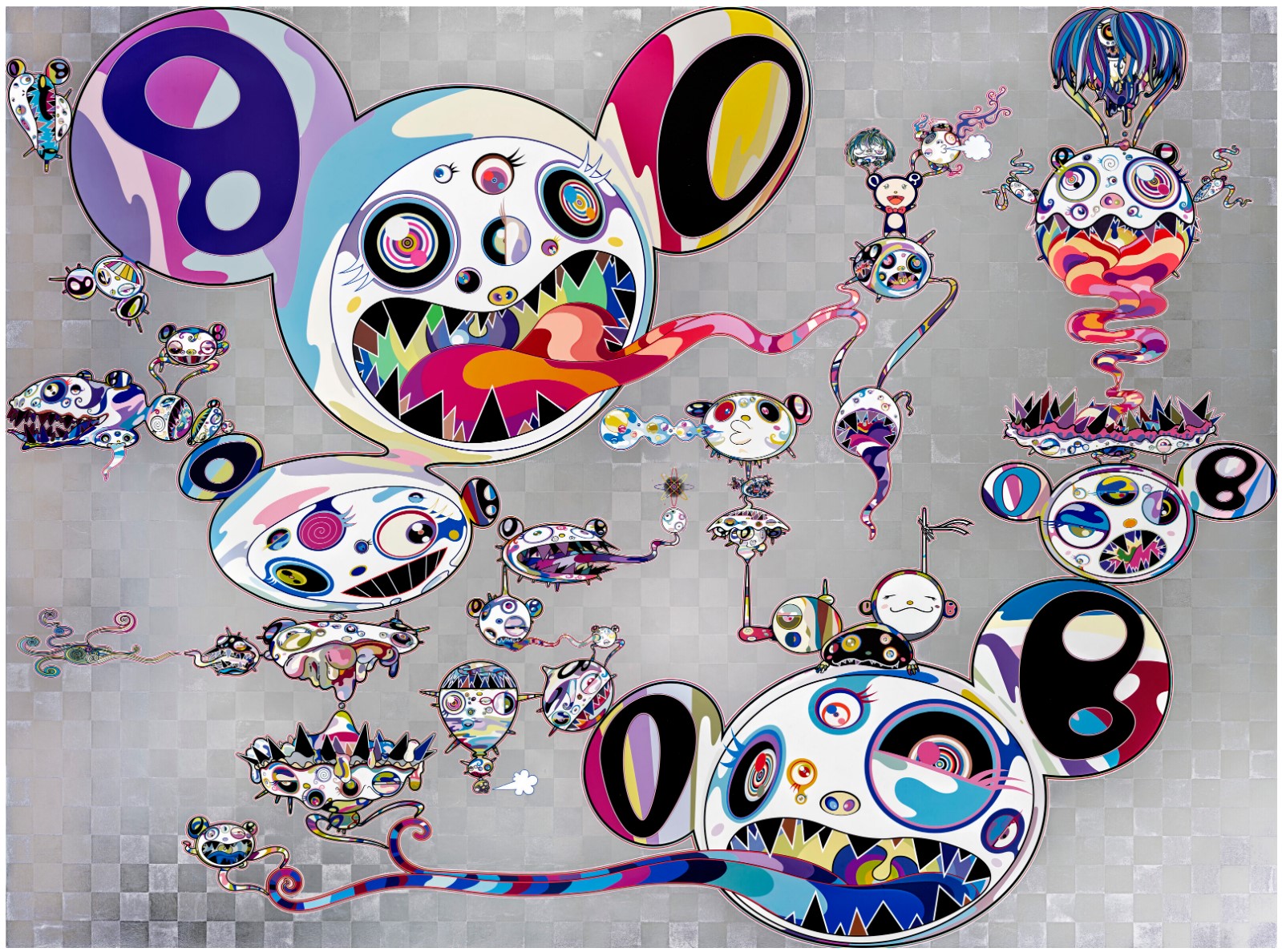
TAKASHI MURAKAMI (B. 1962)
Hands Clasped, 2015
Acrylic and platinum leaf on canvas mounted on aluminum frame
180.2 x 240.3 cm (70.9 x 94.7 inches)
Signed and dated ‘TAKASHI 2015’ (on the overlap)
Magic Ball I (Positive), 1999
Sotheby’s New-York: 17 November 2022
Estimated: USD 600,000 – 800,000
USD 567,000
Magic Ball I (Positive) | Contemporary Day Auction | 2022 | Sotheby’s (sothebys.com)
TAKASHI MURAKAMI (B. 1962)
Magic Ball I (Positive), 1999
Acrylic on canvas mounted on board, in 7 parts
Each: 239.7 x 90.2 cm (94.4 x 35.5 inches)
Overall: 239.7 x 631.4 cm (94.4 by 248.5 inches)
727, 1996
Sotheby’s Hong-Kong: 7 October 2022
Estimated: HKD 18,000,000 – 25,000,000
HKD 20,945,000 / USD 2,667,983
Takashi Murakami 村上隆 | 727 | Contemporary Evening Auction | 2022 | Sotheby’s (sothebys.com)
TAKASHI MURAKAMI (B. 1962)
727, 1996
Acrylic on canvas mounted on board, in 3 parts
Each: 300.5 x 150 cm (118.2 x 59 inches)
Overall: 300.5 x 450 cm (118.2 x 177.2 inches)
Signed and titled 727 on the overlap
Significantly, an early example of this work 727 from 1996 is part of the Museum of Modern Art’s permanent collection, and its imagery was used as the cover of the Exhibition Catalogue for the Museum of Contemporary Art, Los Angeles’ 2007–2008 exhibition, ©MURAKAMI, testament to the significance of this work within the artist’s celebrated oeuvre. Murakami returned to this imagery again later in his career, as seen in the present work and similar graffiti-esque paintings exhibited in his solo show at Perrotin Gallery, Paris, Learning The Magic of Painting, in 2016, and today it represents one of the artist’s most iconic works.
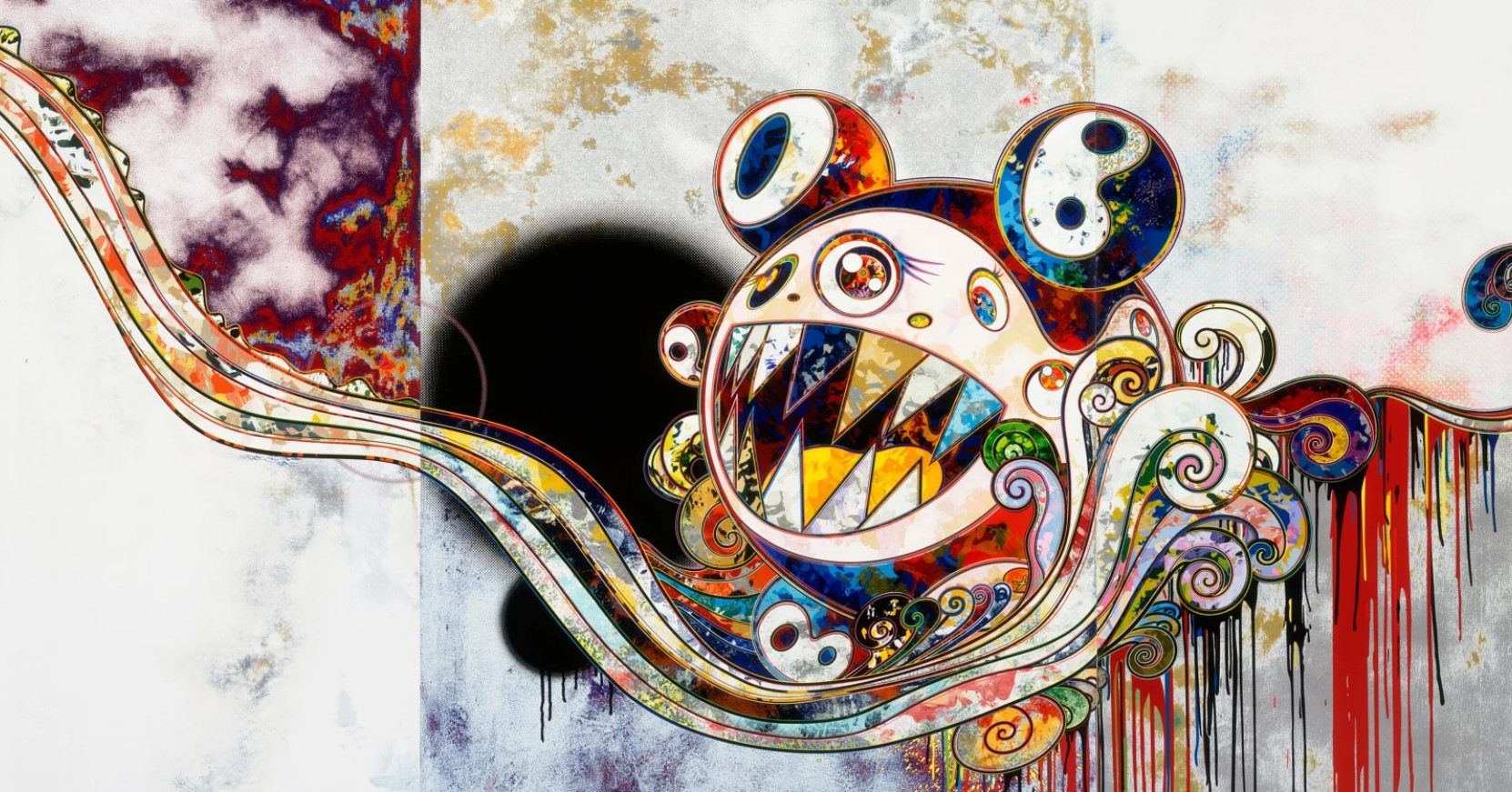
In 727, a stylized wave crashes against a background punctuated with a punk-like chromatic palette of fluorescent reds, greens and blues. Mr. DOB, among the first of Murakami’s pantheon of characters inspired by the anime and manga culture that emerged in Japan’s postwar era, surfs this wave in the center of the composition, his glittering eyes shining and teeth bared in a curious expression of glee. Drawing inspiration from the Japanese subculture of otaku, 727 is replete with strange perversions of cuteness and violence, which Murakami uses to craft a subtle critique of Japan’s pervasive commercial culture and the West’s invasive influence upon it.
Mukaiau DOB, 2002
Sotheby’s New-York: 30 September 2022
Estimated: USD 250,000 – 350,000
USD 252,000
Mukaiau DOB | Contemporary Curated | 2022 | Sotheby’s (sothebys.com)
TAKASHI MURAKAMI (b. 1962)
Mukaiau DOB, 2002
Acrylic on canvas mounted on panel
100 x 133.5 cm (39 3/8 x 52 1/2 inches)
Variously inscribed (on the verso)
A vibrant and playful example of Takashi Murakami’s kaleidoscopic graphic style, Mukaiau DOB from 2002 illustrates the artist’s most celebrated character, Mr. DOB. Inspired by iconic cartoon characters such as Mickey Mouse, Sonic the Hedgehog, and Doraemon, ‘Mr. DOB’ has become the subject of numerous paintings, sculptures, and alternate forms since its original inception, becoming the most widely represented subject in Murakami’s oeuvre and achieving an international celebrity that attests to the cultural idioms that preside over Murakami’s practice. Over the years, DOB has come to serve as an alter-ego for Murakami himself, a constantly evolving character who embodies all the complexities and nuances of an elaborate and ever-changing artistic identity. As the title suggests, two iterations of the character stand opposite the other in the present work– Japanese word “mukaiau” means to face each other – creating a scene of confrontation and recognition amongst two versions of Murakami’s alter-ego.
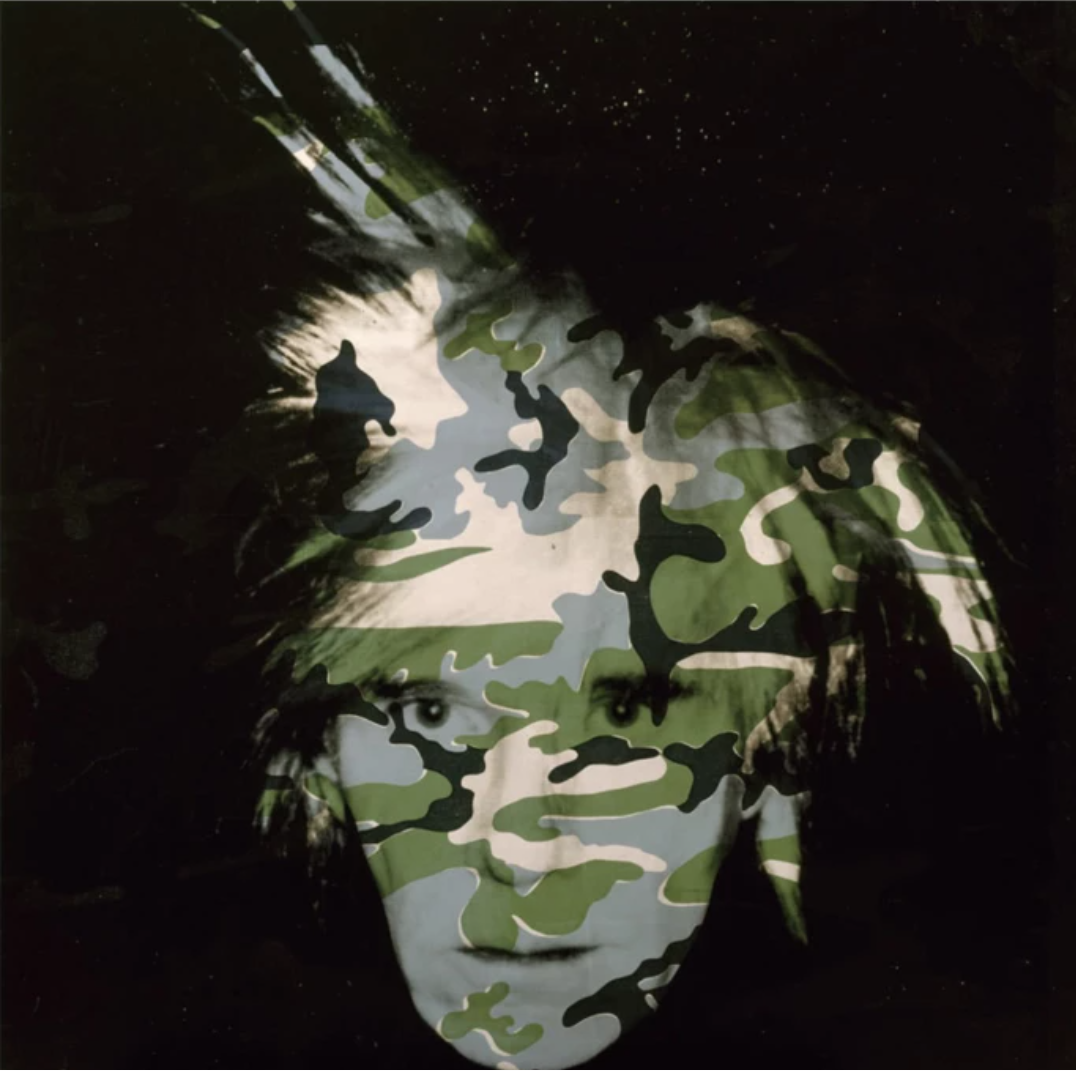
ANDY WARHOL, SELF PORTRAIT, 1986, IMAGE © THE METROPOLITAN MUSEUM OF ART, NEW YORK
ART © 2022 ANDY WARHOL FOUNDATION FOR THE VISUAL ARTS / ARTISTS RIGHTS SOCIETY (ARS), NEW YORK
Murakami’s signature “Superflat” visual practice, which merges Japanese tradition with Western pop culture, has established him as one of the most influential and acclaimed creatives to emerge from East Asia in the post-war era. His mutated yet whimsical figures take cues from Japanese manga and anime subculture, thus invoking a legacy of American Pop art originally defined by the likes of Andy Warhol, Jeff Koons, and Roy Lichtenstein that is still uniquely his own. As a response to the literal and metaphorical flattening of Japanese culture that resulted from the Atomic bombing of Hiroshima and Nagasaki in 1945 and the Western scrutiny that followed thereafter, Murakami creates a childlike and metamorphic aesthetic tailored to his own culturally dislocated generation. His transgression of high art blurs the commercial with the sublime, thus cementing Murakami as an innovator of a novel and beguiling visionary method that defines our understanding of a globalized contemporary culture.
AND THEN (Ichimatsu Pattern), 2006
Sotheby’s Hong-Kong: 28 April 2022
Estimated: HKD 3,000,000 – 5,000,000
HKD 3,150,000 / USD 401,458
TAKASHI MURAKAMI (B. 1962)
AND THEN (Ichimatsu Pattern), 2006
Acrylic on canvas mounted on board
100×100 cm (39.4 x 39.4 inches)
Signed, dated 06, doodled and inscribed variously on the reverse
Flowers
For Murakami, flowers are an enduring fascination which he first began obsessively sketching while preparing for the entrance exams at Tokyo’s National University of Fine Arts. After graduation, he spent almost a decade working at a preparatory school where he taught his students to draw flowers.
“At the beginning, to be frank, I didn’t like flowers, but as I continued teaching in the school, my feelings changed: their smell, their shape—it all made me feel almost physically sick, and at the same time I found them very “cute.” Each one seemed to have its own feelings, its own personality … And these days, now that I draw flowers rather frequently, that sensation has come back very vividly. I find them just as pretty, just as disturbing. At the same time there is this strength in them; it is the same image of strength I find when drawing the human face.”
Blue Signal, 2017
PROPERTY FROM A DISTINGUISHED PRIVATE ASIAN COLLECTION
Sotheby’s Singapore: 25 January 2026
Estimated: SGD 970,000 – 1,900,000
SGD 1,333,500 / USD 1,048,195
Takashi Murakami 村上隆 | Blue Signal 藍色信號 | Modern & Contemporary Art | 2026 | Sotheby’s
TAKASHI MURAKAMI (b. 1962)
Blue Signal, 2017
Acrylic on canvas mounted on aluminum frame
199.5 x 153.1 cm (78-1/2 x 60-1/4 inches)
Signed and dated 2017 (on the reverse)
© 2017 Takashi Murakami/Kaikai Kiki Co., Ltd. All Rights Reserved
Fresh to auction, Blue Signal is a remarkable piece that embodies the artist’s signature style. It was featured among 60 pieces in his significant 2019 exhibition at Tai Kwun Contemporary in Hong Kong, where visitors were enveloped by an immersive display of his iconic floral imagery. The smiling flower, which Murakami first introduced in 1995, has grown into a widely recognized emblem of his art. This motif represents a vibrant convergence of contemporary art, fashion, and culture, encapsulating a lively yet profound essence. For Murakami, the smiling flower serves as a poignant reminder of the collective trauma endured by the Japanese people following the bombings of Hiroshima and Nagasaki in 1945. The artist notes that each flower possesses its own emotions and characteristics, composing a scene that evokes a sense of discomfort and reflects the menacing presence of an approaching crowd.
Executed in Murakami’s distinctive “Superflat” style, Untitled incorporates traditional Nihonga techniques to weave together elements of pop culture, anime, and otaku influences within a flattened visual framework. This innovative approach emphasizes the interplay between high art and commercialism present in Murakami’s body of work. In 2025, Murakami marked a significant achievement with his inaugural solo exhibition at The Broad Museum in Los Angeles, which later traveled to the Cleveland Museum of Art, showcasing the broad spectrum of his artistic endeavors. Additionally, commemorating two decades since the first Louis Vuitton x Takashi Murakami collaboration in 2003, a new collection launched in 2025, featuring 200 fashion collectibles that highlight Murakami’s most iconic creations, including the beloved smiling flowers. This collaboration sparked renewed interest and conversation within both the luxury and art sectors, reaffirming Murakami’s influential position in contemporary culture.
Flower Ball, 2015
China Guardian Hong-Kong: 8 October 2025
Estimated: HKD 900,000 – 1,500,000
HKD 1,080,000 / USD 138,780
Auction | China Guardian (HK) Auctions Co., Ltd.
TAKASHI MURAKAMI (b. 1962)
Flower Ball, 2015
Acrylic and silver leaf on canvas mounted on board
Diameter: 100 cm (39 3/8 inches)
Signed in English and dated on the reverse
Japan’s “Neo-Pop” pioneer Takashi Murakami remains avant-garde royalty in his sixties. As Tokyo University of the Arts’ first doctorate graduate in Nihonga (Japanese painting), he mastered classical traditions like Ukiyo-e and Rinpa; raised during otaku culture’s rise, he equally embraced anime’s populist appeal. Fusing these opposites through bold vision, his iconic motifs distil Japan’s cultural essence. Murakami’s works grace Museum of Modern Art in New York, Museum of Contemporary Art Chicago, and The National Museum of Modern Art, Tokyo, among others. Collaborations with Louis Vuitton have embedded his aesthetic into global daily life. His 1996 “Superflat” manifesto and 2003 “Kawaii” theory birthed doll-like yet cryptically layered art. Since 1995, his smiling “Sunflower” has epitomized this visual language.
Inspired by classical Setsugetsuka motifs, Murakami’s Sunflowers reject traditional purity. Their cartoonish grins radiate fearless optimism. Flower Ball‘s scarlet-and-rose palette draws from Japanese folklore (warding off evil spirits) and Buddhism (life’s rebirth). To Murakami, crimson blooms hymn renewal—their smiles inviting viewers into euphoric worlds. Rendered in Renaissance Tondo style (circular format defying rectangular perspective). The spherical bulge generates elastic tension, challenging perception with hypnotic rhythm.
“People see 3D forms, yet I use no shading. Foreground petals loom large; those near edges shrink—creating spatial illusion distinct from Western art.”
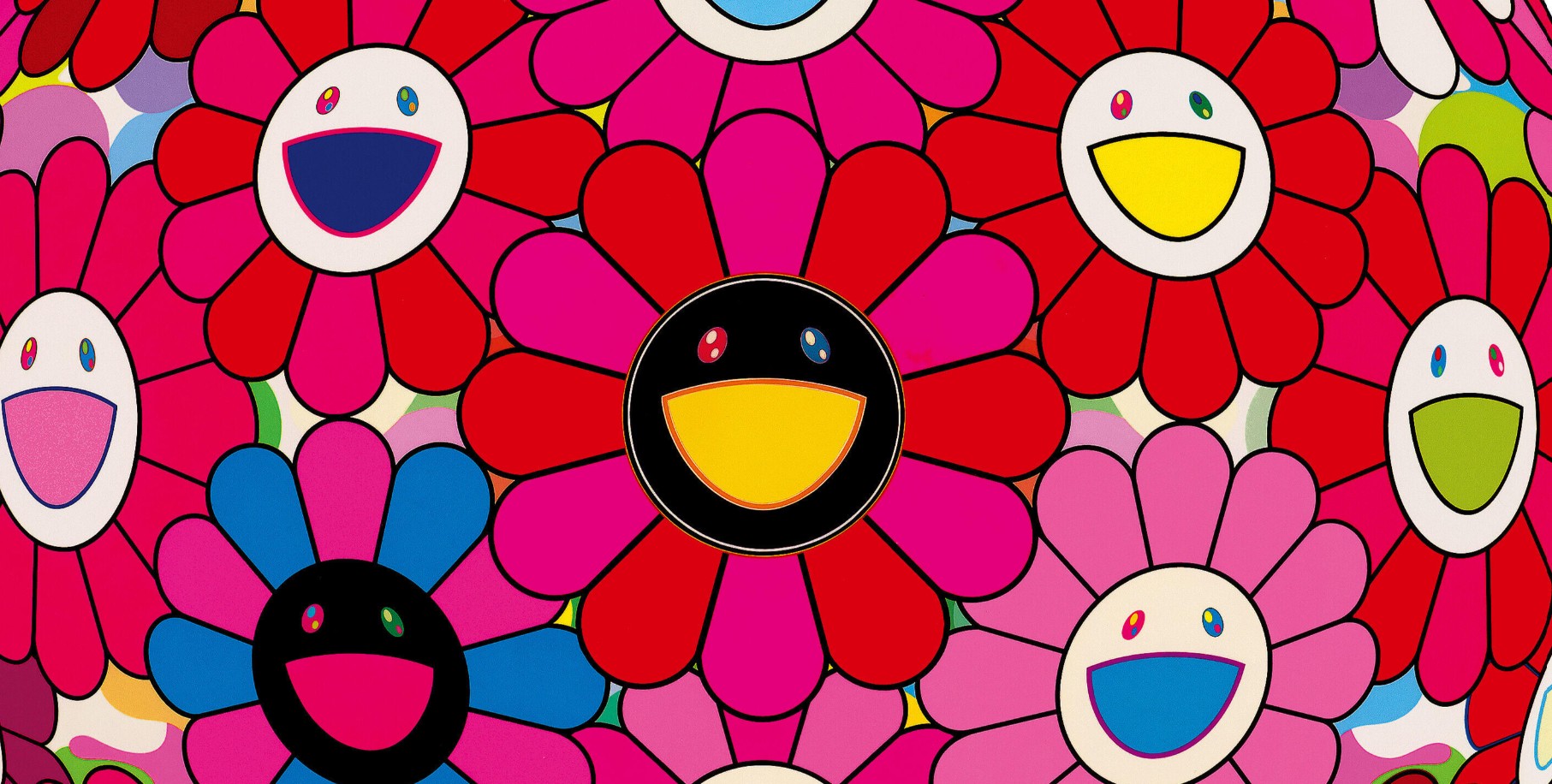
Flower Ball critiques the Western perspective while honoring Japanese heritage. Its lacquer-smooth finish and silver-leafed edges echo Byōbu (folding screen) grandeur. Production mirrors Ukiyo-e woodblock techniques: black outlines define each bloom; stencils guide hand-painted blocks of pure color. Low-saturation camouflage backgrounds offset the vivid flowers, achieving flatness with striking depth. This precision transcends mere craftsmanship, it embodies the modern “craftmanship spirit” of Murakami’s Kaikai Kiki studio. Their vast image database catalogues every petal’s exact hue and curve. Flower Ball required relentless refinement to achieve flawless visual harmony, maximizing kawaii allure.
“At a preparatory school, I taught students to paint flowers for nine years… Initially, I disliked flowers, but as I continued teaching, my perception shifted… Each blossom seemed to possess its own emotions and personality… simultaneously beautiful and unsettling, yet harboring a certain power; this mirrored the very force I discovered when painting human faces.”
Behind Flower Ball‘s brilliance lies profound cultural resonance. As Murakami revealed to The New York Times (2005), the smiling flowers mirror Japan’s collective trauma of atomic bombings of Hiroshima and Nagasaki. Post-war manga/anime culture, he contends, formed a psychological “utopian fantasy” masking pain —yet its “obsession with peace, intense introspection, extreme sentimentality, and sharp insight fuel futuristic creation.” Weaving unease into floral smiles, Murakami transforms “blossoms” into “multitudes”: a metaphor for societal rebirth. As he states, “Disaster compels flowers to shift from whimsy to solemnity; they must bear reconstruction’s hope.” Gazing upon this floral orb, one witnesses resilience forged in ashes—a vibrant phoenix-force veiled beneath radiant joy.
Flower Sparkles!, 2021
Sotheby’s Hong-Kong: 28 September 2025
Estimated: HKD 3,000,000 – 5,000,000
HKD 3,556,000 / USD 457,070
TAKASHI MURAKAMI (b. 1962)
Flower Sparkles!, 2021
Acrylic on canvas mounted on wood panel
150×150 cm (59×59 inches)
Signed and dated 2021 (on the reverse)
© 2021 Takashi Murakami/Kaikai Kiki Co., Ltd. All Rights Reserved
Flower Sparkles! blossoms as a paragon of Murakami’s Superflat philosophy – his visionary synthesis of high art, commercial culture, Eastern tradition, and Western modernism. The present work is an exceptional example from Murakami’s most iconic motif: the smiling flower. First introduced in 1995, these cheerful blossoms have become emblematic of Murakami’s global identity and are repeated, recontextualized, and reinvented across his oeuvre. The surface of Flower Sparkles! is populated by dazzling chromatic blooms, their petals arranged in kaleidoscopic harmony, their faces beaming with irrepressible joy. The work’s composition exemplifies the artist’s approach to flatness: its depth compressed, its perspective destabilized, its serial repetition producing an image at once decorative and conceptually charged. The flower, in Murakami’s hands, is never merely botanical – it is symbolic, cultural, and psychological.
“I spent nine years working in a preparatory school, where I taught the students to draw flowers […] At the beginning, to be frank, I didn’t like flowers, but as I continued teaching in the school, my feelings changed: their smell, their shape – it all made me feel almost physically sick, and at the same time I found them very “cute”. Each one seems to have its own feelings, its own personality.”
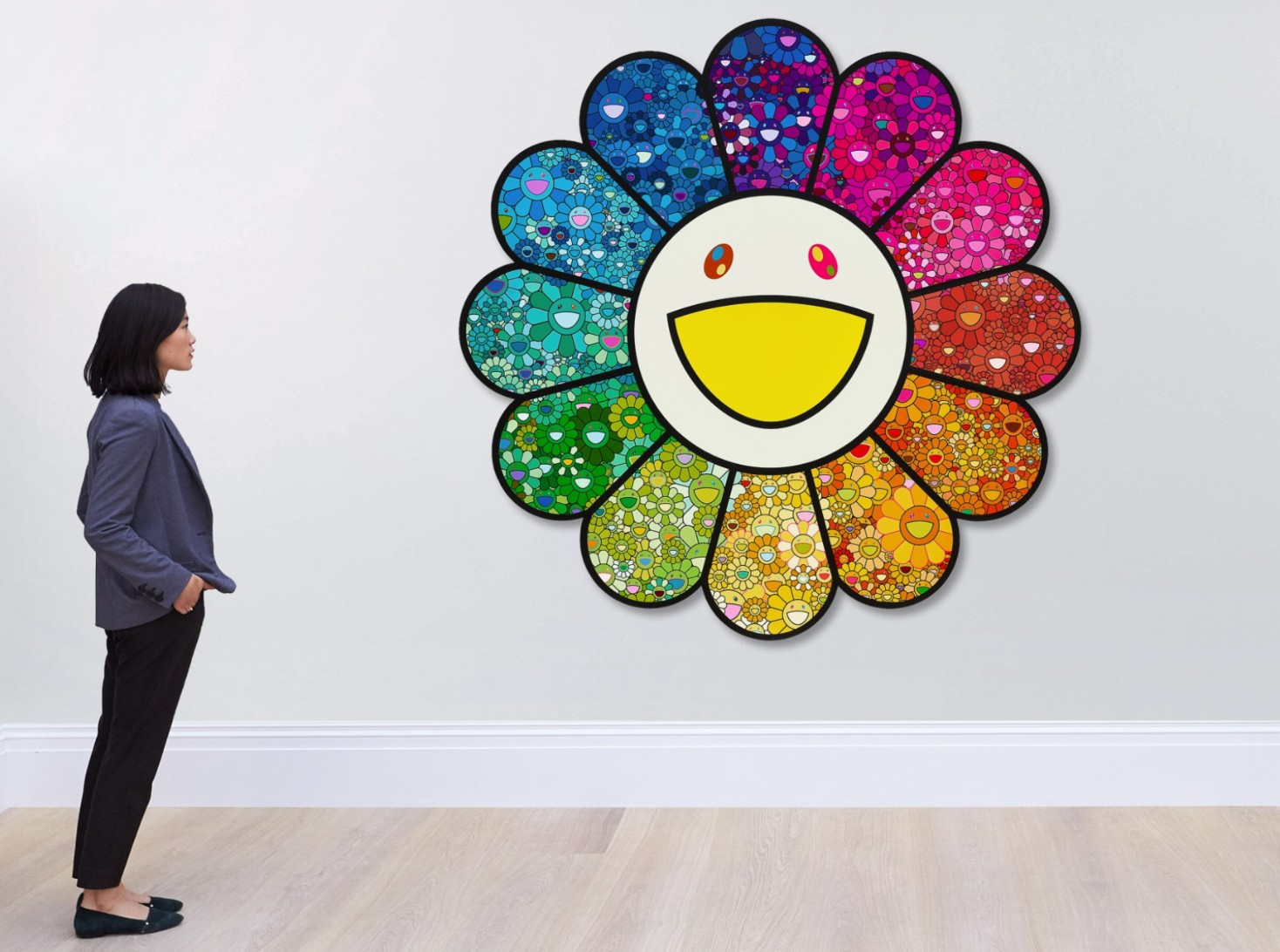
Trained in the rigorous traditions of Nihonga at Tokyo University of the Arts, Murakami sought to address what he perceived as their lack of resonance in a contemporary world defined by mass media. Out of this dissatisfaction emerged Superflat, a concept and aesthetic framework that dissolves hierarchies: between fine art and commercial design, between the institution and the market, merging disciplines into a cohesive visual experience. Murakami appropriates a central theme of Western modernism – the flatness of the pictorial surface, famously described by critic Clement Greenberg as the essence of modern painting – while infusing it with a distinctly Japanese sensibility, producing a work that is both culturally hybrid and visually striking. Here, this plurality is vividly on display: the purity of Edo-period ukiyo-e woodblock prints finds resonance alongside the bold repetition of Pop Art – recalling Warhol’s Flowers, Kusama’s polka dots, Koon’s balloon forms, and the graphic immediacy of Keith Haring, while also echoing the serial logic of Minimalism. At the same time, Murakami acknowledges a personal debt to American abstraction.
“There was a time when I really wanted to be a painter who could paint abstract paintings. I was imitating American expressionism or minimalism, and I was studying them and imitating them.”
Yet Murakami’s achievement is not imitation but inversion. Whereas 19th-century European painters such as Van Gogh, Monet, Gauguin incorporated Japanese motifs into Western painting, Murakami reverses the dynamic. Through works such as Flower Sparkles!, Japanese popular culture — anime, manga, kawaii aesthetics — becomes the lens through which Western modernism is reinterpreted and reabsorbed. His flowers are not delicate Impressionist motifs but mass-cultural emblems, multiplied, standardized, commodified, and yet infused with a distinctly Japanese sensibility that embraces cuteness (kawaii) alongside existential unease. Beyond its painterly qualities, the work belongs to a larger cultural project. The artist has famously extended his flowers into the cultural sphere at large and brought his iconic flowers to collaborations with Louis Vuitton, Supreme, Hublot, and Pharrell Williams, without compromising their artistic statements. In this, Murakami recalls his stated ambition:
“What you need to know is that I want to (a) approach the great accomplishments of Walt Disney, (b) add to that Duchamp’s humor and Warhol’s devilishness, and (c) do as Steve Jobs did and build a creative business that cannot be copied.”
By transforming the simple flower into a radiant field of sparkling delight, Flower Sparkles! crystallizes the artist’s enduring vision: that the playful and the profound, the decorative and the philosophical, the local and the global, coexist seamlessly in a single, radiant canvas. It is a work that embodies joy while asking deeper questions about how culture is made, consumed, and circulated in the twenty-first century. Both universally accessible and deeply rooted in Japanese aesthetics, Flower Sparkles! is a consummate example of Murakami’s ambition to create an art that cannot be confined — an art, as he has said, “that cannot be copied”.
Flowers of Hope, 2019
Phillips Hong-Kong: 4 October 2024
Estimated: HKD 1,000,000 – 2,000,000
HKD 1,143,000 / USD 147,190
Takashi Murakami – New Now: Modern &… Lot 21 October 2024 | Phillips
TAKASHI MURAKAMI
Flowers of Hope, 2019
Acrylic and platinum leaf on canvas mounted on aluminum frame
41.7 x 33.5 cm (16 3/8 x 13 1/4 inches)
Signed and dated ’TAKASHI 2019′ on the reverse
Radiating a highly spirited charm, Takashi Murakami’s Flowers of Hope exemplifies the artist’s ability to bridge the worlds of high art and popular culture. In this piece, Murakami continues his exploration of the kawaii aesthetic, a concept deeply rooted in Japanese culture that signifies cuteness and innocence. The flowers, with their wide, gleaming smiles and twinkling eyes, epitomize pure happiness, inviting viewers into a vibrant, joyful world. The present lot is a spectacle of colors, each hue carefully chosen to enhance the overall sense of joy and playfulness. The flowers, rendered in a harmonious palette, create a dynamic and engaging composition, with the artist’s signature motifs filling the canvas. The central flower, larger and more detailed, serves as the focal point, also being the only one rendered in colors of the rainbow. Surrounding it are smaller flowers, each with its own unique expression and colors, contributing to a sense of interconnectedness and unity of the work as a whole.
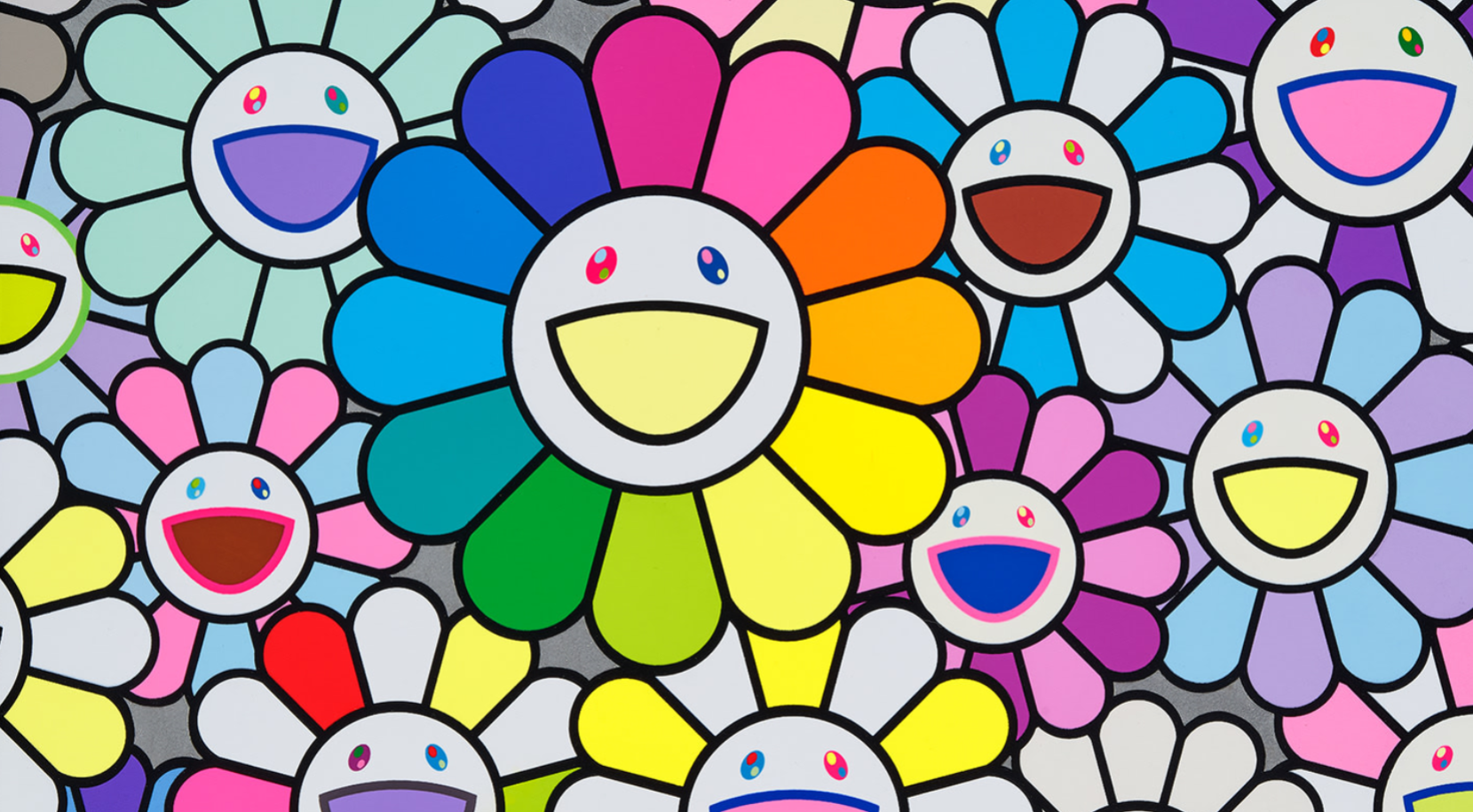
The composition of the present lot is both symmetrical and dynamic, showcasing Murakami’s mastery of balancing the artwork. The reflective surface of the platinum leaf background adds a shimmering quality, making the flowers appear to float and dance as the viewer moves around the work. This interactive element demands engagement, inviting viewers to immerse themselves in the work and experience the full scope of its visual and emotional impact. Educated at the Tokyo University of the Arts, Murakami’s background in traditional Japanese painting, or Nihonga, is evident in his meticulous brush technique and flat, two-dimensional aesthetics. This approach, central to his Superflat theory, rejects the illusion of depth, instead celebrating the flatness of the picture plane—a hallmark of both traditional Japanese art and contemporary manga and anime in the popular culture.
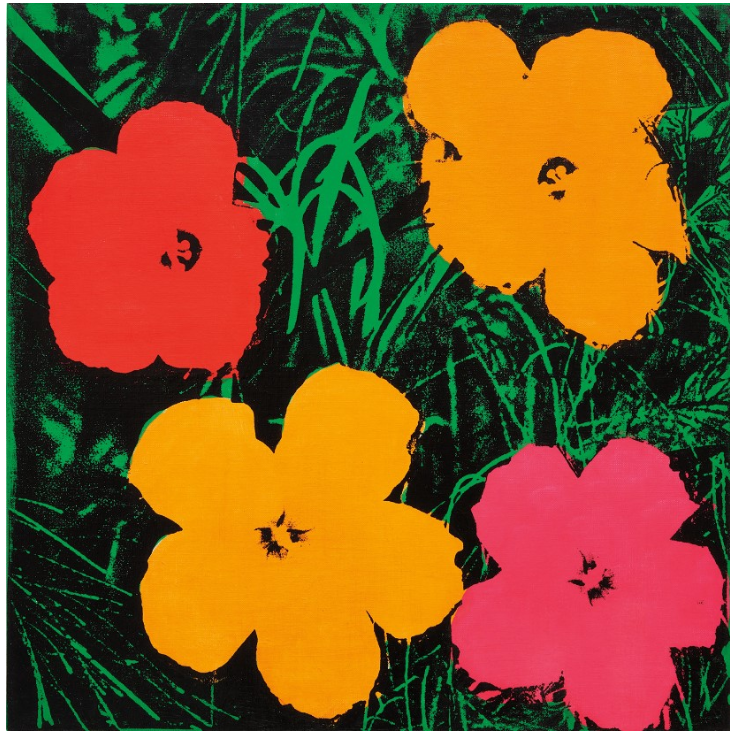
Andy Warhol, Flowers, 1964, Sold at Phillips 20th Century and Contemporary Art Evening Sale, London Auction 20 October 2020. Artwork: © 2024 The Andy Warhol Foundation for the Visual Arts, Inc. / Artists Rights Society (ARS), New York
In comparison with Murakami’s Flowers of Hope, Andy Warhol’s Flowers also fuses the traditional subject of still life flowers with the pop art sensibility, in a highly innovative medium. Both artists use vibrant and flat colors to express the commercial aesthetic to challenge the boundaries of high art, employing a repetitive floral motif to evoke a sense of ubiquity on the image. The flowers are their allusions to themes of impermanence and commercialism, hinting at deeper cultural undertones. In his essay ‘Earth in My Window,’ Murakami reflects on post-war Japanese society and the rise of kawaii culture as a coping mechanism for the nation’s collective grief. He argues that this preoccupation with cuteness and anti-aging has become a pervasive cultural phenomenon of Japan, offering a utopian vision of a society that is comfortable, happy, and free from any traumas. This underlying emotional depth adds a layer of complexity to Flowers of Hope, making it not only visually captivating but also intellectually stimulating with a cultural weight. The present lot is a radiant celebration of life, happiness, innovation and the enduring power of art to heal and inspire. Takashi Murakami’s ability to blend traditional Nihonga with contemporary pop culture creates works that are both visually stunning and profoundly meaningful. This piece stands as a proof to Murakami’s status as one of the most innovative and influential artists of our time, a visionary whose work continues to captivate and uplift audiences around the world.
Time Machine, 2019
Christie’s Hong-Kong: 29 November 2023
Estimated: HKD 2,000,000 – 4,000,000
HKD 2,394,000 / USD 307,351
TAKASHI MURAKAMI (B. 1962) (christies.com)
TAKASHI MURAKAMI (B. 1962)
Time Machine, 2019
Acrylic and platinum leaf and gold leaf on canvas mounted on wood panel
120 x 93.6 cm (47 1/4 x 36 7/8 inches)
Signed with the artist’s signature and dated ‘2019’ (on the reverse)
“The highlight of this work is how my ‘flowers’, with its grammar of contemporary art, can be adjacent to the grammar of manga from Doraemon.”
Thinking Matter (Red), 2016
Christie’s London: 14 October 2023
Estimated: GBP 250,000 – 350,000
GBP 264,600 / USD 320,843
Takashi Murakami (christies.com)
TAKASHI MURAKAMI (B. 1962)
Thinking Matter (Red), 2016
Acrylic and platinum leaf on canvas laid on panel
Diameter: 150.5 cm (59 1/4 inches)
Signed and dated ‘TAKASHI 2016’ (on the reverse)
Exuberant and cheerful, Murakami’s Thinking Matter (Red) teems with a mass of beaming flower heads. Rendered in acrylic and platinum leaf on canvas laid on panel, the painting bursts with vibrant color and jubilation, and across its shimmering surface, pink and cherry-red petals bunch and blossom. Forming a spectacle of ornate pattern, the circular canvas evokes the composition of a tondo mosaic or a kaleidoscopic lens. Stretching one and a half meters in diameter, the painting immerses the viewer within its fantastical bouquet, offering a vivid sensory experience. Offering Murakami the perfect vehicle to synthesize his interests in Japanese visual culture, the flowers denote a plethora of imagery—from 17th and 18th century decorative arts, to kawaii, manga, and anime film.
Murakami first began obsessively sketching flowers while preparing for the entrance exams at Tokyo’s National University of Fine Arts. After graduation, he spent almost a decade working at a preparatory school where he taught his students to draw flowers. ‘At the beginning,’ he remembers, ‘to be frank, I didn’t like flowers, but as I continued teaching in the school, my feelings changed: their smell, their shape—it all made me feel almost physically sick, and at the same time I found them very “cute.” Each one seemed to have its own feelings, its own personality … And these days, now that I draw flowers rather frequently, that sensation has come back very vividly. I find them just as pretty, just as disturbing. At the same time there is this strength in them; it is the same image of strength I find when drawing the human face. So I thought that if the opportunity arose, I would pretty much like to make a work in which I would represent them as if in a “crowd scene,” in the manner of these scenes of moving crowds that you see in films’ (T. Murakami, quoted in Takashi Murakami Kaikai Kiki, exh. cat. Fondation Cartier/Serpentine Gallery, Paris and London 2002, p. 84). Undoubtedly his most iconic motif, here, anthropomorphic flowers multiply and propagate across the canvas surface in a mesmeric, undulating display of magenta, scarlet and rose.
I’ve been to the Top of the Hill, 2014
Sotheby’s Hong-Kong: 5 April 2023
Estimated: HKD 7,000,000 – 9,400,000
HKD 10,735,000 / USD 1,367,533
TAKASHI MURAKAMI (b. 1962)
I’ve been to the Top of the Hill, 2014
Acrylic on canvas on aluminum frame
199×153 cm (78 3/8 x 60 1/4 inches)
Signed and dated 2014 on the overlap
Smiling flowers represent the very hallmark and signature motif of Takashi Murakami’s extraordinary and ambitious artistic enterprise. I’ve Been to the Top of the Hill (2014) is a meticulously rendered example of the artist’s characteristic style: each of the densely layered smiling flowers are hand painted with immaculate precision to deliver a sense of digital-like perfection. Dominated by a rich array of red and pink hues punctuated by a glowing mixture of spectral shades and neon highlights, the present work is immediately impactful and a visually stunning paradigm of the multi-layered yet obsessively flat production of Takashi Murakami. These smiling flowers are usually depicted taking up the entirety of Murakami’s compositions, yet within the present work, colourful, tightly layered skulls construct a macabre millefiori amongst the saccharine florae. In including these sculls, Murakami examines the theme of mortality that has been explored throughout the art historical canon, from seventeenth century Dutch vanitas paintings to Andy Warhol’s famed 1976 series of silkscreened Skulls. Insidiously camouflaged within the profusion of kitsch smiling flower faces, these deathly skulls comingle with jubilant yet inherently unsettling effects.
An Homage To Yves Klein, 2013
K Auction: 21 December 2022
Estimated: KRW 600,000,000 – 700,000,000
KRW 600,000,000 (Hammer) / USD 569,963
TAKASHI MURAKAMI
An Homage To Yves Klein, 2013
Acrylic and platinum leaf on canvas
78 x 56.3 cm (30.7 x 22.2 inches)
Signed and dated on the reverse
Multicolor Flowers, 2012
Sotheby’s New-York: 17 November 2022
Estimated: USD 200,000 – 300,000
USD 315,000
Multicolor Flowers | Contemporary Day Auction | 2022 | Sotheby’s (sothebys.com)
TAKASHI MURAKAMI (B. 1962)
Multicolor Flowers, 2012
Acrylic and platinum leaf on canvas
78.7 x 56.2 cm (31 x 22.2 inches)
Signed TAKASHI, dated 2012 and inscribed in Japanese (on the overlap)
An iconic work by the artist, Takashi Murakami’s Multicolored Flowers of 2012 represents the very hallmark and signature motif of the artist’s extraordinary and ambitious artistic enterprise. The glorious saturation of beaming flower-faces comprise a kaleidoscopic cascade. In Multicolored Flowers, the artist’s technical ingenuity and mastery over medium is evidenced in each hand painted flower that displays with immaculate precision and symmetry. The present work is dominated by the outpour of vibrant pinks, dazzling yellows and rich blues, and sweet magentas. Rooted in the ancient Eastern practice of decorative flower painting on traditional lacquered panels, Multicolored Flowers engenders a new expression of Japanese high art. Flawlessly executed in a luscious color palette of vibrant pastel hues contrasted against a shimmering platinum, the present work employs the artist’s trademark motif of a smiling flower, rendered with a two dimensionality that recalls the influence of traditional Eastern painting practices. Originally trained in Japanese painting technique, nihonga, Murakami fuses Eastern artistic styles of traditional painting and contemporary Anime or Manga cartoons with a Western pop-art approach.
Colorful Flower: Happy, 2019
Seoul Auction: 26 July 2022
Estimated: KRW 450,000,000 – 700,000,000
KRW 470,000,000 (Hammer) / USD 430,057
TAKASHI MURAKAMI
Colorful Flower: Happy, 2019
Acrylic on canvas mounted on wood panel
120×120 cm (47.2 x 47.2 inches)
Thinking Matter (Red), 2016
Christie’s London: 16 October 2021
Estimated: GBP 250,000 – 350,000
GBP 598,500 / USD 820,987
TAKASHI MURAKAMI (B. 1962) (christies.com)
TAKASHI MURAKAMI (B. 1962)
Thinking Matter (Red), 2016
Acrylic and platinum leaf on canvas, laid on panel
Diameter: 150.5 cm (59.2 inches)
Signed and dated ‘TAKASHI 2016’ (on the reverse)
A mosaic of beaming flowers fills Takashi Murakami’s dizzying Thinking Matter (Red). Painted in 2016, and acquired by the present owner that year, the work exudes joy and delight. Using a palette of pink and cherry red, Murakami’s dense arrangement bursts from the round canvas. The twinkling flowers seem a riotous medley of jubilation. Beyond its grinning surface, however, Thinking Matter (Red) is replete with associations. The flowers themselves exemplify the idea of kawaii, the Japanese culture of cuteness, while simultaneously nodding towards the Edo period’s Rinpa School, whereby artists represented flora and fauna in highly decorative and patterned imagery. The circular form of the painting itself plays on the Renaissance tondo, but the vertiginous, twinkling flowers offer no perspectival depth, instead collapsing all notions of space and gravity.
Flower Ball (Kindergarten Days), 2002
Sotheby’s Hong-Kong: 18 June 2021
Estimated: HKD 3,000,000 – 5,000,000
HKD 5,257,000 / USD 677,204
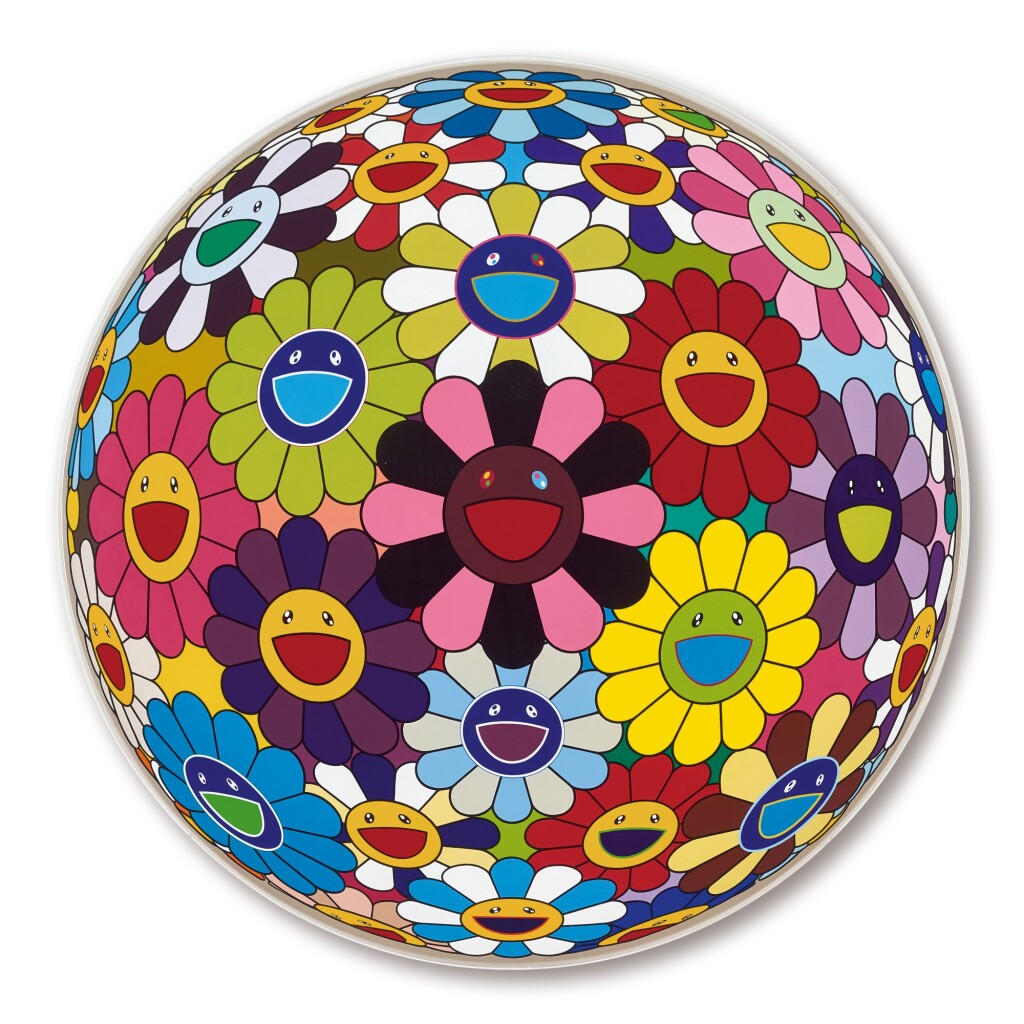
TAKASHI MURAKAMI (B. 1962)
Flower Ball (Kindergarten Days), 2002
Acrylic on canvas mounted on board
Diameter: 100 cm (39.4 inches)
Signed and dated 02 on the reverse
Arhats
Murakami’s Arhats paintings draw upon the legends of the arhats as well as on famous artistic precedents that represent the religious subject, including Kano Kazunobu’s distinguished Five Hundred Arhats that dates back to the late Edo Period (19th century) and Nagasawa Rosetsu’s miniature Five Hundred Arhats from 1798. The arhats are the enlightened disciples of Buddha, those who have attained nirvana. Arhats reject all worldly passions, existing instead to disseminate the teachings of the Buddha. The representation of arhats is a common motif in traditional East Asian art, as seen in Chinese, Korean and Japanese art in particular, typically pictured in groups of 500, sixteen and eighteen. The figure of the arhat became a subject of renewed interest in the Edo period in Japan, as witnessed by Kano Kazunobu’s famous 100 scrolls.
Sage, 2014
Phillips London: 14 October 2022
Estimated: GBP 400,000 – 600,000
GBP 478,800 / USD 536,771
Takashi Murakami – 20th Century & Co… Lot 36 October 2022 | Phillips
TAKASHI MURAKAMI
Sage, 2014
Acrylic, gold leaf and platinum leaf on canvas mounted on wood panel
Diameter: 200 cm (78.7 inches)
Signed and dated ‘Takashi 2014’ on the reverse
With works teeming with smiling sunflowers, manga characters, and fashion icons, Japanese artist Takashi Murakami’s visual style is immediately recognizable in its eclectic combinations of historical, contemporary and futuristic references. Stemming from a wider series of pieces reflecting his own cultural roots, Murakami’s Sage is rich in symbolism, its glittering, psychedelic composition combining acrylic, gold, and platinum leaf. First shown in a 2015 exhibition presented by Blum & Poe in Ibiza, the work exemplifies Murakami’s drastic change in style and subject in the early 2010s, having shifted from an aesthetically driven, ‘Superflat’ practice towards a more esoteric, reflective artistic expression. Visually sumptuous, Sage represents the largest tondo format work by the artist to have come to auction.
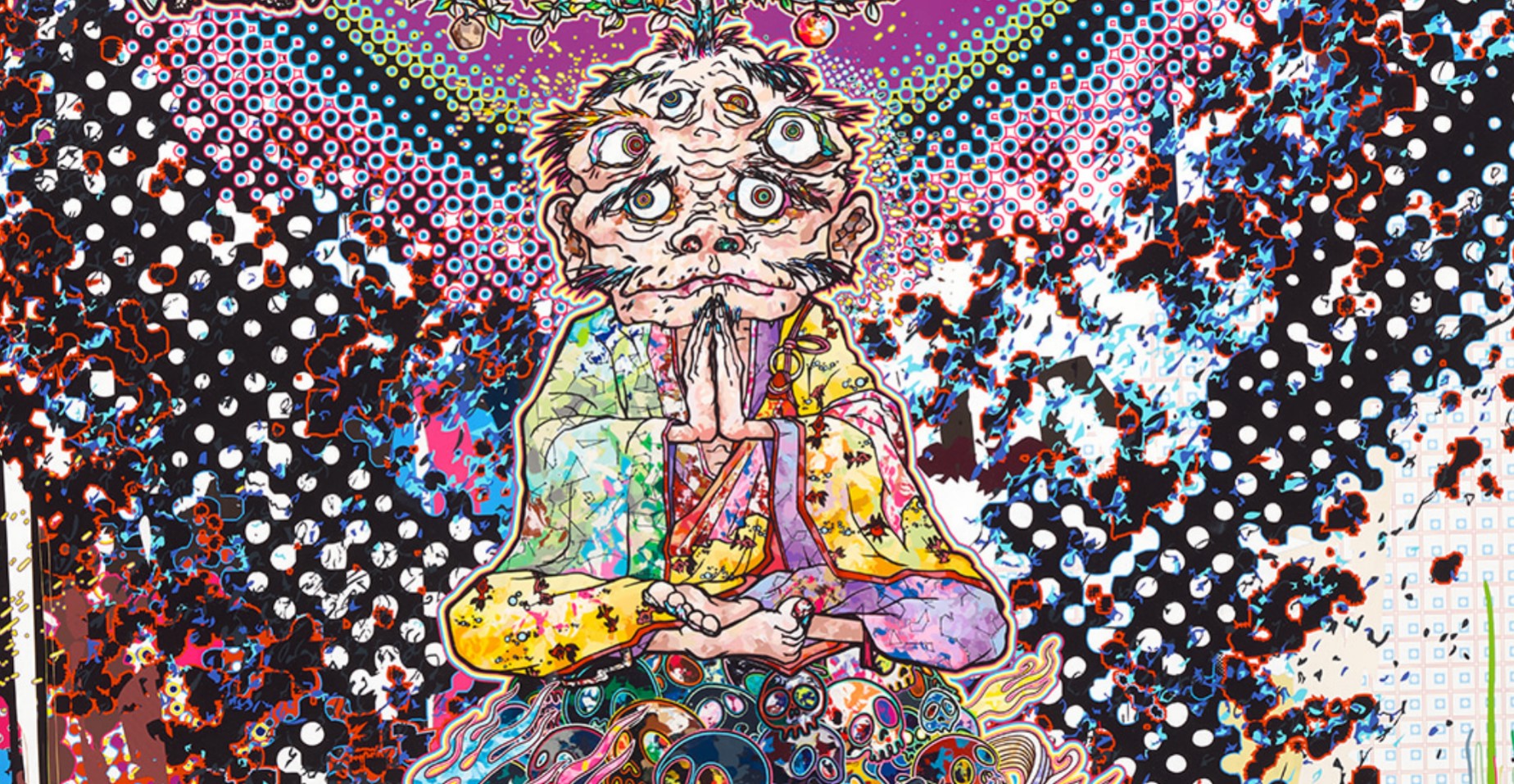
Recalling the graphic style of Japanese manga drawing, at the center of the composition sits a mystical, cross-legged figure atop a pile of skulls, his technicolor robes in keeping with the glistening polka dot details and supercharged palette of the piece. The central figure’s head, dominated by six, symmetrically arranged eyes is crowned with a tree, itself encircled by seven smaller floating figures, all rendered in a similarly animated visual language. Despite these more contemporary pop culture references however, the title of the work identifies this mystical figure as a Sage, a sacred character in Japanese folklore whose wisdom transcends the temporal, revealing spiritual truth and guidance to others. Drawing inspiration from Eastern religious iconography, the Sage is shown here in seated posture and dressed in traditional robes, a burnished psychedelic halo behind him that recalls depictions of the Buddha, the smaller figures then recontextualised as Arhats – his enlightened disciples. Amalgamating various sources central to Buddhist thought, the composition at once evokes the Seven Stages of Buddha and the enlightenment of Buddha beneath the Bodhi Tree.
69 Arhats Beneath the Bodhi Tree, 2013
Sotheby’s Hong-Kong: 27 April 2022
Estimated: HKD 23,000,000 – 30,000,000
HKD 38,490,000 / USD 4,905,184
TAKASHI MURAKAMI (B. 1962)
69 Arhats Beneath the Bodhi Tree, 2013
Acrylic, gold and platinum leaf on canvas mounted on board, in 10 parts
Each: 300×100 cm (118.1 x 39.4 inches)
Overall: 300×1,000 cm (118.1 x 393.7 inches)
Executed in 2013, 69 Arhats Beneath the Bodhi Tree is an extraordinary work by Takashi Murakami, the largest of his Arhats paintings to ever be offered at auction. A response to the devastation caused by the Great East Japan Earthquake and Tsunami in 2011, 69 Arhats Beneath the Bodhi Tree follows Murakami’s internationally acclaimed, The 500 Arhats (2012), a vast multi-media work portraying wizened arhats—enlightened followers of Buddha—amongst mythical monsters and creatures. Rendered in his signature “Superflat” style which incorporates elements of traditional Japanese painting, ukiyo-e (woodblock prints from the Edo period), anime, and the kawaii aesthetic, 69 Arhats Beneath the Bodhi Tree and his Arhats paintings mark a significant turning point in the artist’s oeuvre, demonstrating Murakami’s sincere engagement with themes of religion and mortality in the wake of the 2011 national disaster. In 2015, the work was a highlight of Blum & Poe’s solo exhibition for Murakami at Lune Rouge Ibiza, where it was flanked by two striking red and blue demon sculptures who watched over the cycles of human karma pictured within the highly-stylized, graphic canvas.
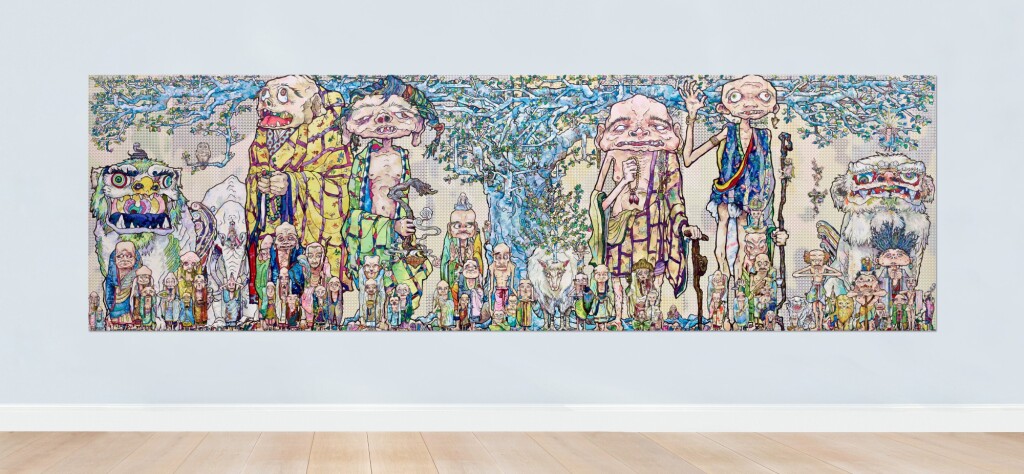
Each of the intricately illustrated 69 Arhats are unique in their appearance, facing the viewer head-on. Differing in size and scale, the arhats litter the canvas, some bare chested, others partially covered in chromatic cloth of different patterns and textures. There is a distinct harmony and unity achieved through the symmetry of the work, with the arhats flanked by two lion-like figures, and dominated by the four large-scale spiritual followers of Buddha that stand either side of the Bodhi tree in pairs. With this work, Murakami presents the viewer with a visual feast, the canvas saturated with layers of symbols, images and colour for the viewer to devour. The Bodhi tree itself is loaded with spiritual significance, as it was at the Bodhi Tree where Siddhartha found enlightenment and became Buddha. By including this “Tree of Awakening” in his 21st Century interpretation of the traditional Japanese arhat paintings, a rare inclusion in his series, Murakami presents the viewer with a new site of meditation, urging self-reflection and introspection.
Red Demon and Blue Demon with 48 Arhats, 2013
Phillips New-York: 23 June 2021
Estimated: USD 3,500,000 – 4,500,000
USD 6,080,000
Takashi Murakami 20th Century & Contemporary Art Evening Sale
TAKASHI MURAKAMI
Red Demon and Blue Demon with 48 Arhats, 2013
Acrylic, gold and platinum leaf on canvas mounted on board, in 5 parts
300×500 cm (118.2 x 196.9 inches)
Signed and dated “TAKASHI 2013” on the overlap of the left panel
Executed in 2013, Takashi Murakami’s Red Demon and Blue Demon with 48 Arhats showcases the striking graphic style that has cemented the artist’s status as one of the most prominent figures in fine art and pop culture alike. Exhibiting Murakami’s studied fusion of cultural influences in remarkable detail, Red Demon and Blue Demon with 48 Arhats fuses Buddhist divinity, Edo period printmaking, and contemporary kawaii culture to create a monumental artistic accomplishment on an audacious scale. The present work featured in the artist’s major exhibition, Murakami by Murakami, at the Astrup Fearnley Museet, Oslo, in 2017.
Following the 2011 Tōhoku earthquake in Japan and the resulting Fukushima nuclear disaster, Murakami’s animated embrace of Japanese culture took a strikingly inward and esoteric turn. Doubling down on the cultural associations of his work following the cataclysmic event, Murakami began incorporating more pronounced Buddhist imagery into his compositions. Here, Murakami set two epically scaled supernatural beings in confrontation of his viewer across five chromatic panels, rendered in a graphic style that belies the artist’s penchant for graffiti and pop culture precedents, including the stylized Ben-day dots recalling Roy Lichtenstein’s radical appropriations. Standing in their wake are the 48 arharts, disciples of Buddha who have attained insight into the true nature of existence and are trusted with spreading the teachings of Buddhism as a nomadic spiritual guide. Murakami first incorporated these benevolent travelling healers in his monumental work The 500 Arhats, completed following the disaster in 2012. Since then, arhats have factored prominently into Murakami’s work.
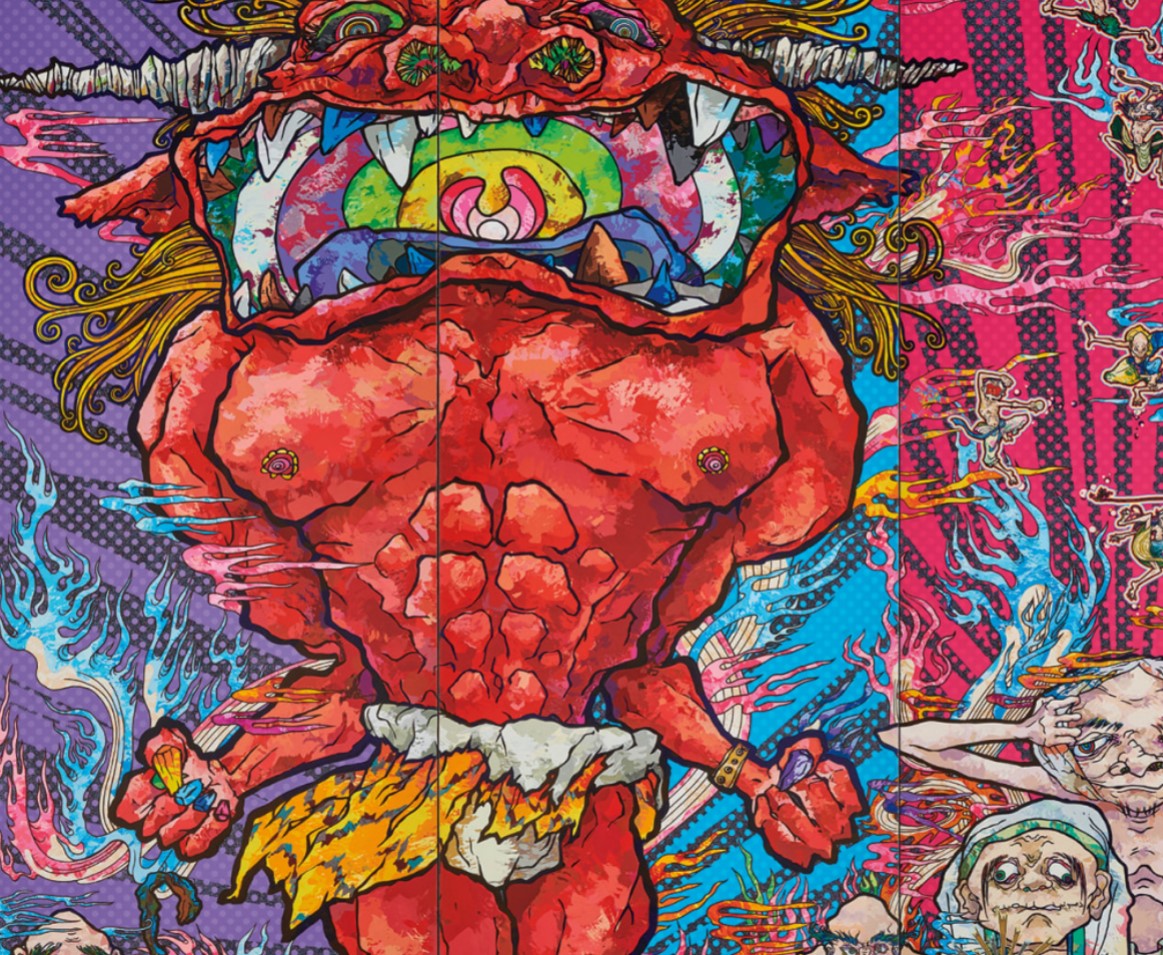
Coupled with the two large demons—themselves figures borrowed from Japanese mythology, liminal creatures generally indifferent to mankind but who could be protective or destructive according to the intentions and nature of those approaching—who forcefully occupy the center of the composition, the arhats represent Murakami’s interest in sharing this culture with an international audience. Furthering the present work’s connection with the traditional highly stylized Japanese iconography is his fusion of his superflat graphic style with traditional media such as gold leaf, highlighting the cultural depth of Murakami’s work and fusing traditional figures with contemporary relevance.
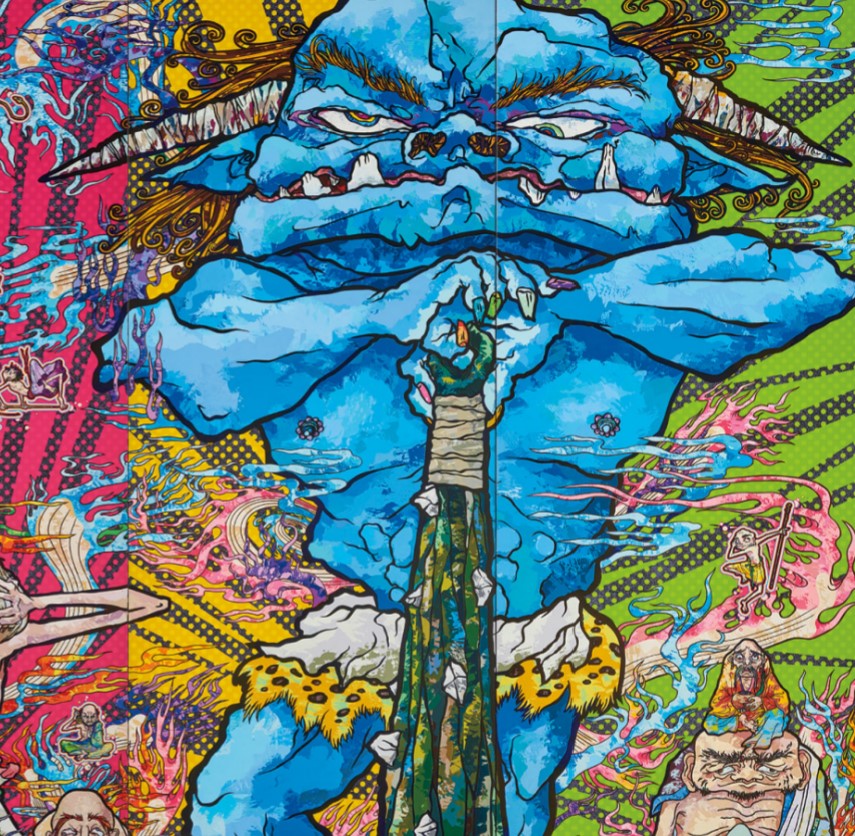
Murakami’s work has garnered considerable international acclaim not least for its immediately recognizable aesthetic. Joining influences from traditional Japanese painting, sci-fi, anime, and the international artistic vanguard, Murakami has forged a lively style that unites elements of Eastern and Western artmaking. A lifelong a fan of anime and manga, Murakami attended the Tokyo University of the Arts to acquire the drafting skills necessary to become an animator, but eventually shifted his studies to Nihonga, an academic style of painting incorporating traditional Japanese conventions, techniques, and subjects. Eventually becoming discontented with the insular world of academia, Murakami again pivoted and began creating art that slyly lamented the ubiquity of Western influences in the Japanese avant-garde of the time. Seeking artistic individuation in an otherwise uniform environment, Murakami pioneered an internationally recognized style that is uniquely and gleefully rooted in Japanese culture. The result is a body of work that is equally influenced by the academic art he studied in Tokyo and the pop culture he enjoyed as a child. Indeed, Red Demon and Blue Demon with 48 Arhats exhibits Murakami’s unrelenting engagement with the historical culture of his homeland.
Enso
Paying true homage to Japanese tradition, the ensō paintings are the result of an artistic and spiritual epiphany for the artist. The ensō is the prerequisite to every act of creation, a moment when the mind is free to let the body create, and can result only from quiet and persistent spiritual practice. Traditionally traced in one fluid, masterful stroke of the brush, painting the ensō is not for the timid of heart or mind. Murakami executes the ensō in his unique style, using spray paint over his signature accumulations of flowers and skulls.
Zen Enzo: Mugen, 2016
China Guardian: 6 April 2023
Estimated: HKD 800,000 – 1,200,000
HKD 3,360,000 / USD 428,020
TAKASHI MURAKAMI
Zen Enzo: Mugen, 2016
Acrylic and gold leaf on canvas
180×180 cm (71×71 inches)
Enso: Zen, Soul, 2015
Christie’s New-York: 29 September 2022
Estimated: USD 120,000 – 180,000
USD 113,400
TAKASHI MURAKAMI (B. 1962) (christies.com)
TAKASHI MURAKAMI (B. 1962)
Enso: Zen, Soul, 2015
Acrylic on canvas mounted on aluminum frame
141×121 cm (55 1/2 x 47 5/8 inches)
Signed and dated ‘TAKASHI 2015’ (on the overlap)
Ensō: In the Fog, 2015
Phillips Hong-Kong: 29 November 2021
Estimated: HKD 1,500,000 – 2,500,000
HKD 2,394,000 / USD 306,954
Takashi Murakami – 20th Century & … Lot 256 November 2021 | Phillips
TAKASHI MURAKAMI
Ensō: In the Fog, 2015
Acrylic on canvas mounted on aluminium frame
100×100 cm (39.4 x 39.4 inches)
Signed and dated ‘Takashi 2015’ on the overlap
The subject of the present lot is one of the most famous motifs in Zen painting, the ensō (‘circle’) that symbolizes emptiness, unity and infinity in Zen Buddhism. Murakami has also painted the great figures of Zen Buddhism: Daruma the Great, the founder of Zen; the severed hand of the monk Eka (Huike), a sacrifice to his master Daruma (Bodhidharma) whom he later succeeded; and The 500 Arhats, a 100-meter long painting representing the 500 wise followers of Buddha who attained enlightenment by overcoming their greed, hatred and delusions, and destroyed their karmic residue from previous lives. Paying true homage to Japanese tradition, the ensō paintings are the result of an artistic and spiritual epiphany for the artist. The ensō is the prerequisite to every act of creation, a moment when the mind is free to let the body create, and can result only from quiet and persistent spiritual practice. Traditionally traced in one fluid, masterful stroke of the brush, painting the ensō is not for the timid of heart or mind. Murakami executes the ensō in his unique style, using spray paint over his signature accumulations of flowers and skulls.
To be titled (EN-SO Flowers & Skulls Blue), 2015
Phillips New-York: 18 November 2021
Estimated: USD 150,00 – 250,000
USD 277,200
Takashi Murakami – 20th Century & … Lot 366 November 2021 | Phillips
TAKASHI MURAKAMI
To be titled (EN-SO Flowers & Skulls Blue), 2015
Acrylic on canvas
100×100 cm (39.4 x 39.4 inches)
Signed and dated “TAKASHI 2015” on the overlap
Enso: The Sound of the Bell of Paired Sal Trees, 2015
Phillips Hong-Kong: 7 June 2021
Estimated: HKD 1,500,000 – 2,200,000
HKD 3,150,000 / USD 405,969
Takashi Murakami – 20th Century & Cont… Lot 159 June 2021 | Phillips
TAKASHI MURAKAMI
Enso: The Sound of the Bell of Paired Sal Trees, 2015
Acrylic on canvas mounted on aluminum frame
100×100 cm (39.4 x 39.4 inches)
Signed and dated ‘Takashi 2015’ on the overlap
Enso: Exponentially Expanding Universe, 2015
Christie’s London: 25 March 2021
Estimated: GBP 120,000 – 180,000
GBP 362,500 / USD 497,324
TAKASHI MURAKAMI (B. 1962) (christies.com)
TAKASHI MURAKAMI (B. 1962)
Enso: Exponentially Expanding Universe, 2015
Acrylic on canvas
141×120 cm (55.1 x 47.2 inches)
Signed and dated ‘TAKASHI 2015’ (on the overlap)
Sculptures
Miss Ko² (Project Ko²), 1997
Christie’s New-York: 19 November 2025
Estimated: USD 1,800,000 – 2,500,000
USD 2,759,000
TAKASHI MURAKAMI (B. 1962), Miss Ko² (Project Ko²) | Christie’s
TAKASHI MURAKAMI (B. 1962)
Miss Ko² (Project Ko²), 1997
Fiberglass, iron, acrylic and oil paint
182.9 x 63.5 x 76.2 cm (72x25x30 inches)
This work is number one from an edition of three plus one artist’s proof
Standing six feet tall, Takashi Murakami’s Miss Ko2 (Project Ko2) is the artist’s first life-size sculpture, representing the radical reinvention of his artistic project and ushering in his famed fluid period. Miss Ko2 has taken up a totemic position in Murakami’s oeuvre, capturing the seismic moment in which his revolutionary Superflat movement catapulted into the third dimension. Here, we witness Murakami developing this theory, wherein he envisions the dissolution between distinctions vis-à-vis high art and low culture in Japan, made irrelevant in the postwar context as all creative forms were metaphorically flattened into exaggerated caricatures of sexuality and emotion corrupted by a predominant Western cultural influence. Murakami mimetically critiques the infusion of Western culture into Japanese society and the hypereroticized excesses of the otaku—or geek—subculture. Miss Ko2 magisterially weaves his deep understanding of Japanese society and its traditional artforms into an artwork aping consumerist society.
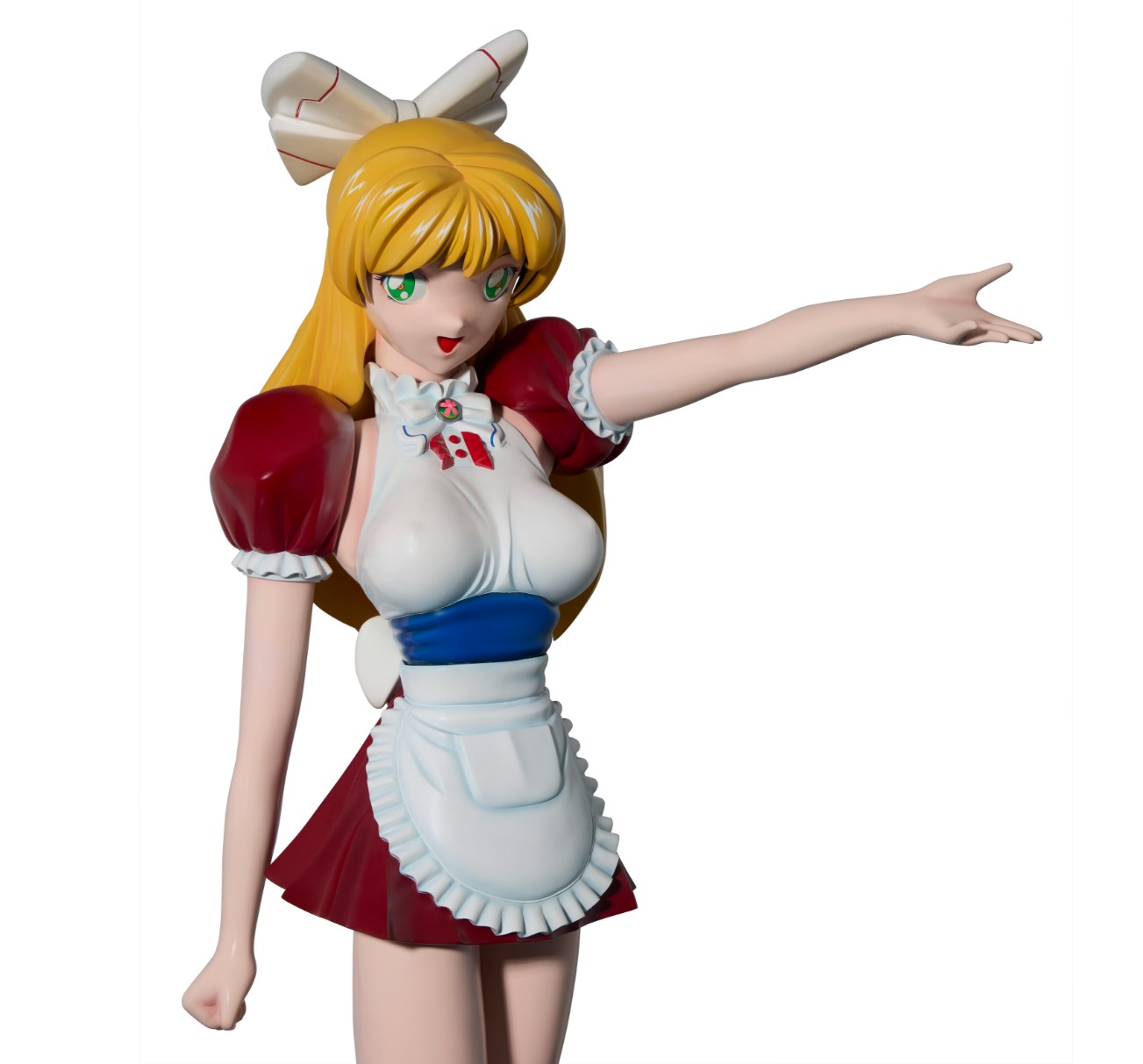
To create Miss Ko2, Murakami appropriated the character Yuka Takeuchi from the exuberant Japanese fighting video game Variable Geo. She wears an eroticized version of the popular waitress’ uniform of Anna Millers, an American pie restaurant chain then prevalent in Japan.
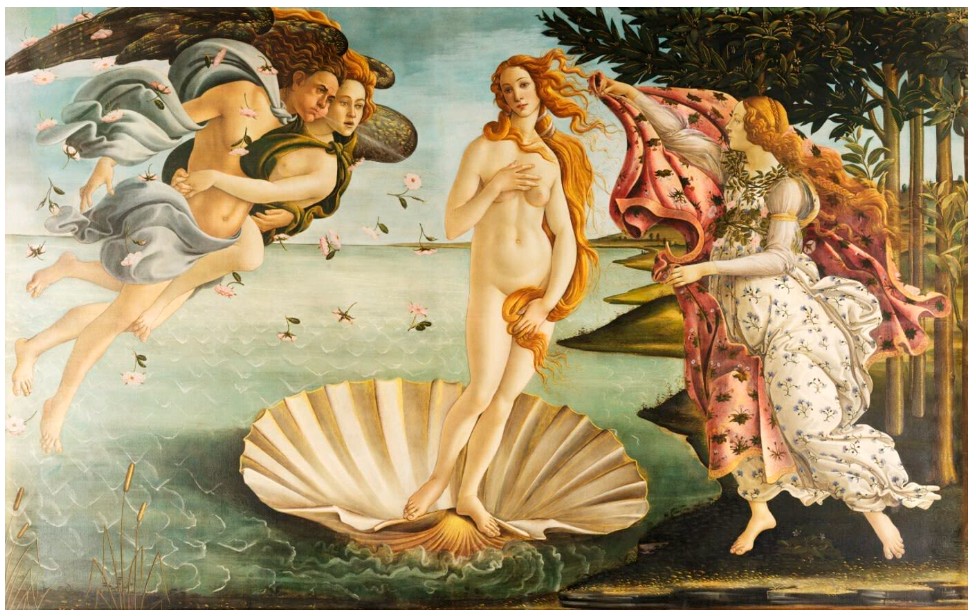
Sandro Boticelli, The Birth of Venus, 1480. Galleria Stampe e Disegni degli Uffizi, Florence.
These aspects made it a perfect subject for appropriation, exemplifying Murakami’s conception of Superflat. By expanding this character into a life-size scale, the artist made legible the absurdity of the otaku subculture. As Murakami writes,
“The very idea of making a life-size figure character was taboo within the otaku community. Figure culture began in response to a desire to somehow call the beloved characters of manga and anime forth into the real world, to have them at one’s fingertips. At the root of the figure character was their clear functionality as pornographic statues.”
While paralleling the appropriative strategies of Western artists, including Richard Prince and Jeff Koons, Murakami is simultaneously channeling the traditional Japanese artistic tradition of Mitate, the repurposing of existing objects, where the artist creates something new by adding subtle touches of originality.
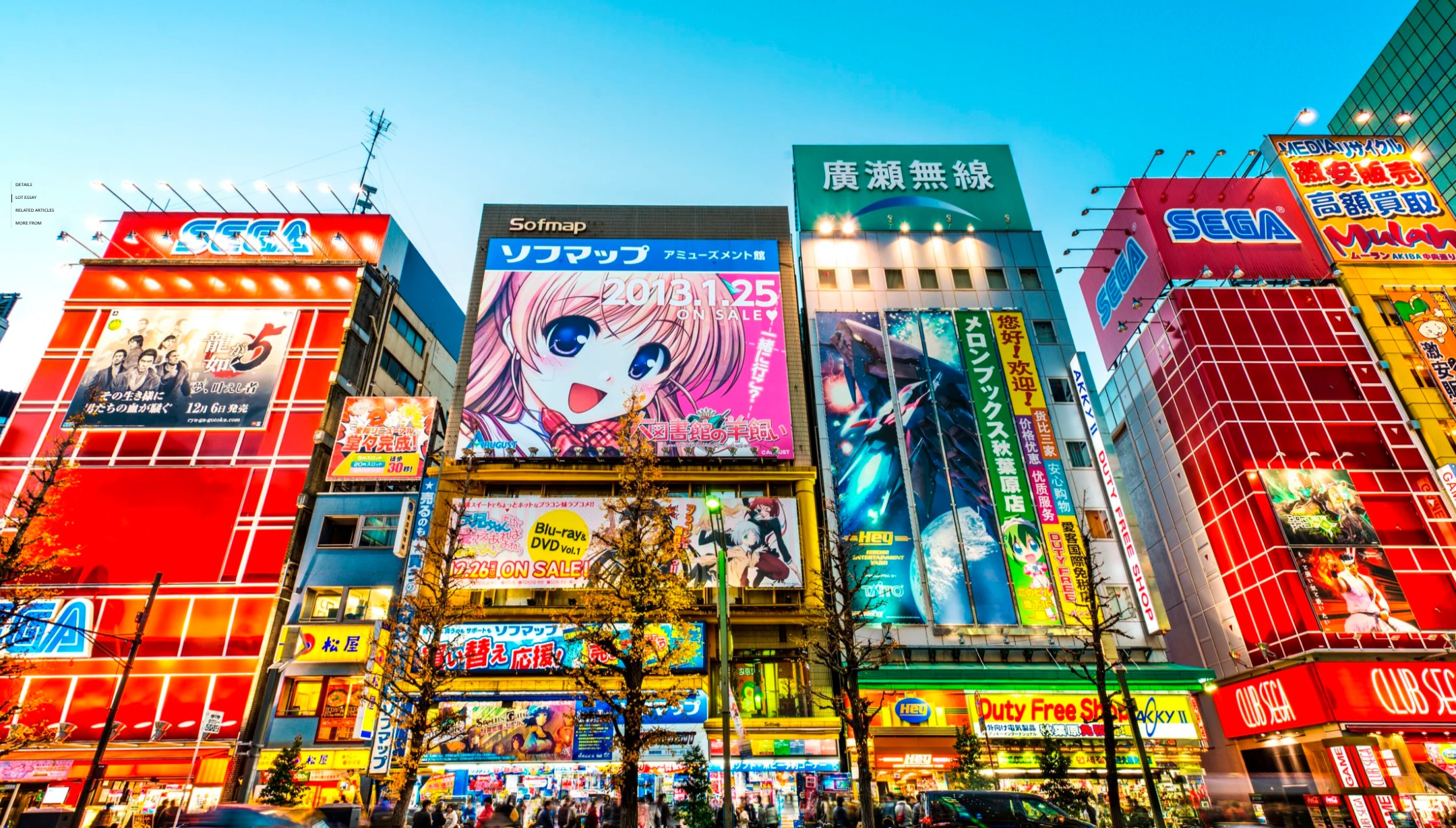
Akihabara district, Tokyo, 2013. Photo: Alamy Stock Photo.
Miss Ko2 was able to depict how, within the milieu of the late 1990s, cultural categories of low and high were destabilized as the consumer economy absorbed high art. Using similar strategies of imitating mass culture found in Koons’s simulationisms and the appropriative approach of Prince, Murakami successfully parodies the West while confronting the inherent problems he saw with Japanese society. His Miss Ko2 figure wears a fetishized uniform of an overseas (American) company which had come to dominate Japanese cultural expression, while her life-size scale simultaneously critiques the fetishized obsession with figurines in the Japanese otaku fandom. The sculpture’s revealing bust, slender arms, and anatomically inconceivable proportions—slender arms, anime-doll face, and impossibly long, crossed legs—capture in realistic scale the absurdity of the feminine figurine ideal held by sections of Japanese society. The multilayered valiances held within the sculpture extend through to the work’s very name. Ko can mean child, girl, young woman, or even a fish egg in Japanese, while it also frequently constitutes a part of a female given name. Thus, Miss Ko2, pronounced Miss Ko Ko, can be interpreted with layered simultaneous meanings.
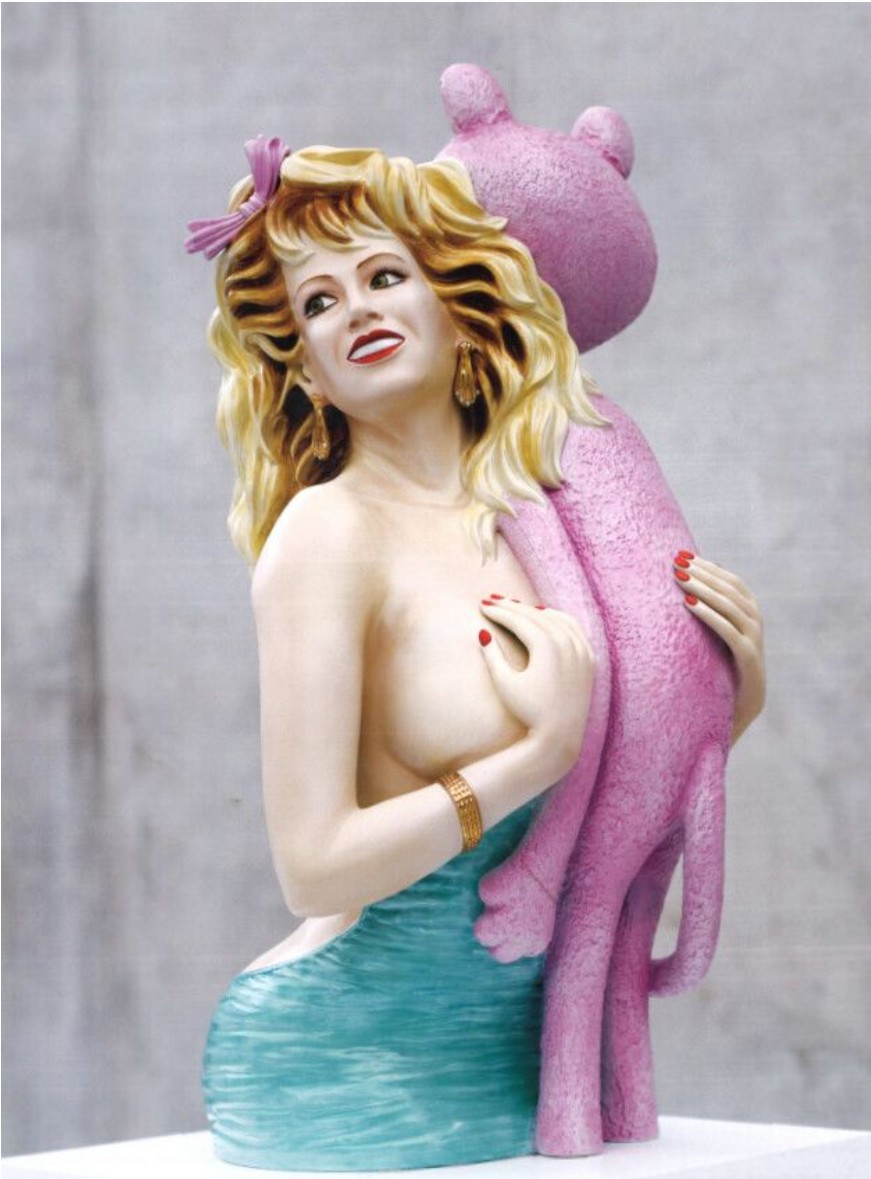
Jeff Koons, Pink Panther, 1988, The Museum of Modern Art, New York. © Jeff Koons
Miss Ko2 was the first of Murakami’s life-size fiberglass figurines, providing the template for celebrated works such as Hiropon (1997), and My Lonesome Cowboy (1997), of which examples of both reside in the Pinault Collection. The foundational importance of Miss Ko2 for Murakami’s broader oeuvre is demonstrated in the work’s extensive exhibition history, appearing in the artist’s celebrated retrospectives at the Museum of Contemporary Art of Tokyo, the Museum of Contemporary Art, Los Angeles, the Brooklyn Museum of Art, the Guggenheim Museum, Bilbao, and most spectacularly at Murakami Versailles, where the sculpture was placed in the Salon de Guerre, right at the entrance to the palace’s famed Hall of Mirrors and below an extravagant marble portrait of King Louis XIV. Her position at the precipice of French imperial power, with her outstretched left hand positioned as if beckoning the viewer into the Hall of Mirrors to view the remainder of Murakami’s work, poignantly recapitulates Miss Ko2’s singular importance within the artist’s vaunted oeuvre, representing the inaugural inception of his universally influential Superflat movement.
Panda, 2003
Sotheby’s London: 5 March 2025
Estimated: GBP 300,000 – 400,000
GBP 546,100 / USD 699,008
Panda | Contemporary Day Auction | 2025 | Sotheby’s
TAKASHI MURAKAMI (b. 1962)
Panda, 2003
Fiberglass with antique Louis Vuitton trunk
Overall: 231x163x113 cm (91 x 61 1/8 x 44 1/2 inches)
Signed, numbered 3/3 and variously inscribed (on the underside of the left ear)
This work is number 3 from an edition of 3, each with a unique Louis Vuitton trunk
Undeniably joyful and fantastically whimsical, Takashi Murakami’s larger-than-life sculptural work Panda explores the boundaries between fine art and commercial product, high culture and luxury fashion. The artist’s transgression of traditional Japanese high art is profoundly present throughout his visual practice as a whole, for Murakami is as much mega-celebrity, curator, designer and brand manager as he is an artist. This ground-breaking marriage between high art and commercial culture has its foundation in Murakami’s commercially successful 2002 collaboration with the illustrious fashion house Louis Vuitton, when the brand’s then-creative director Marc Jacobs invited Murakami to reinvigorate Vuitton’s accessories line. This collaboration is central to the present work, as the adorable, cartoon-like panda stands en pointe atop a vintage Louis Vuitton monogrammed trunk. In January 2025, Louis Vuitton and Murakami celebrated the 20th anniversary of their collaboration, by releasing a re-edition collection featuring over 200 items adorned with Murakami’s signature colourful motifs. To coincide with this release, pop-up stores were set up in key cities worldwide and Murakami’s art was integrated into immersive installations at major cultural and fashion hubs globally.
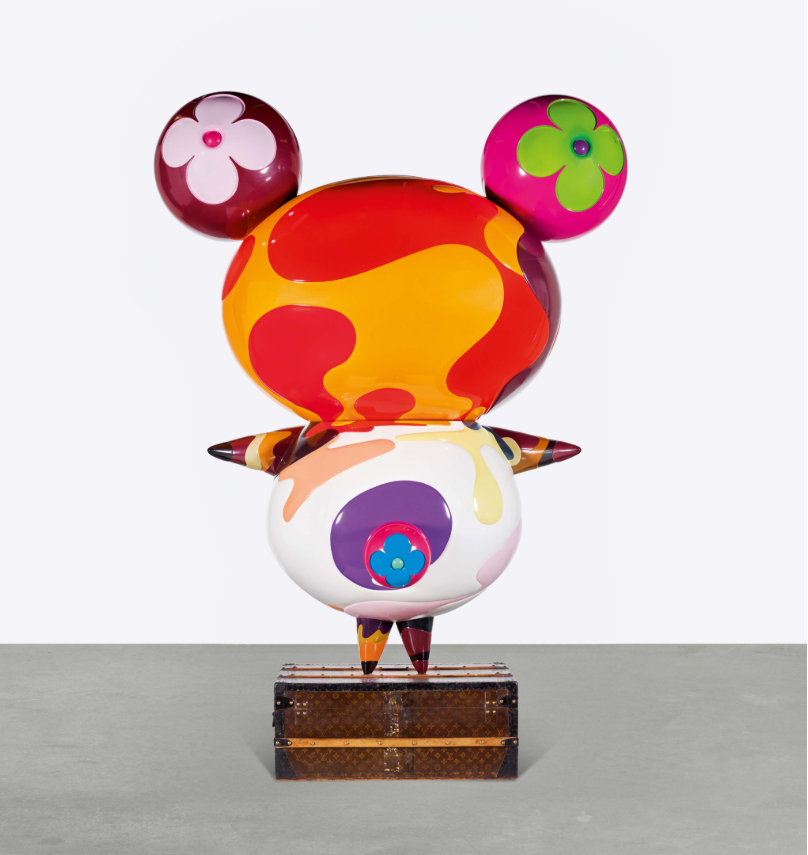
Here, Murakami pays homage to the brand’s distinguished history as a Parisian luggage company, as well as to their visionary branding that has evolved around a storyline of travelling on a surreal journey through time – ideas of which Murakami touches upon throughout the collaboration. The artist’s project with Vuitton in 2002 was received with controversy, for Murakami himself asserts, “Japanese people accept that art and commerce will be blended; and in fact, they are surprised by the rigid and pretentious Western hierarchy of ‘high art’. In the West, it certainly is dangerous to blend the two because people will throw all sorts of stones. But that’s okay – I’m ready with my hard hat” (the artist quoted in: Exh. Cat., Doha, Al Riwaq, Murakami: Ego, 2012, p. 228). Executed only one year after Murakami’s first project with Vuitton, Panda stands defiantly against convention, and delivers a powerful critique on the merging of high art and luxury fashion.
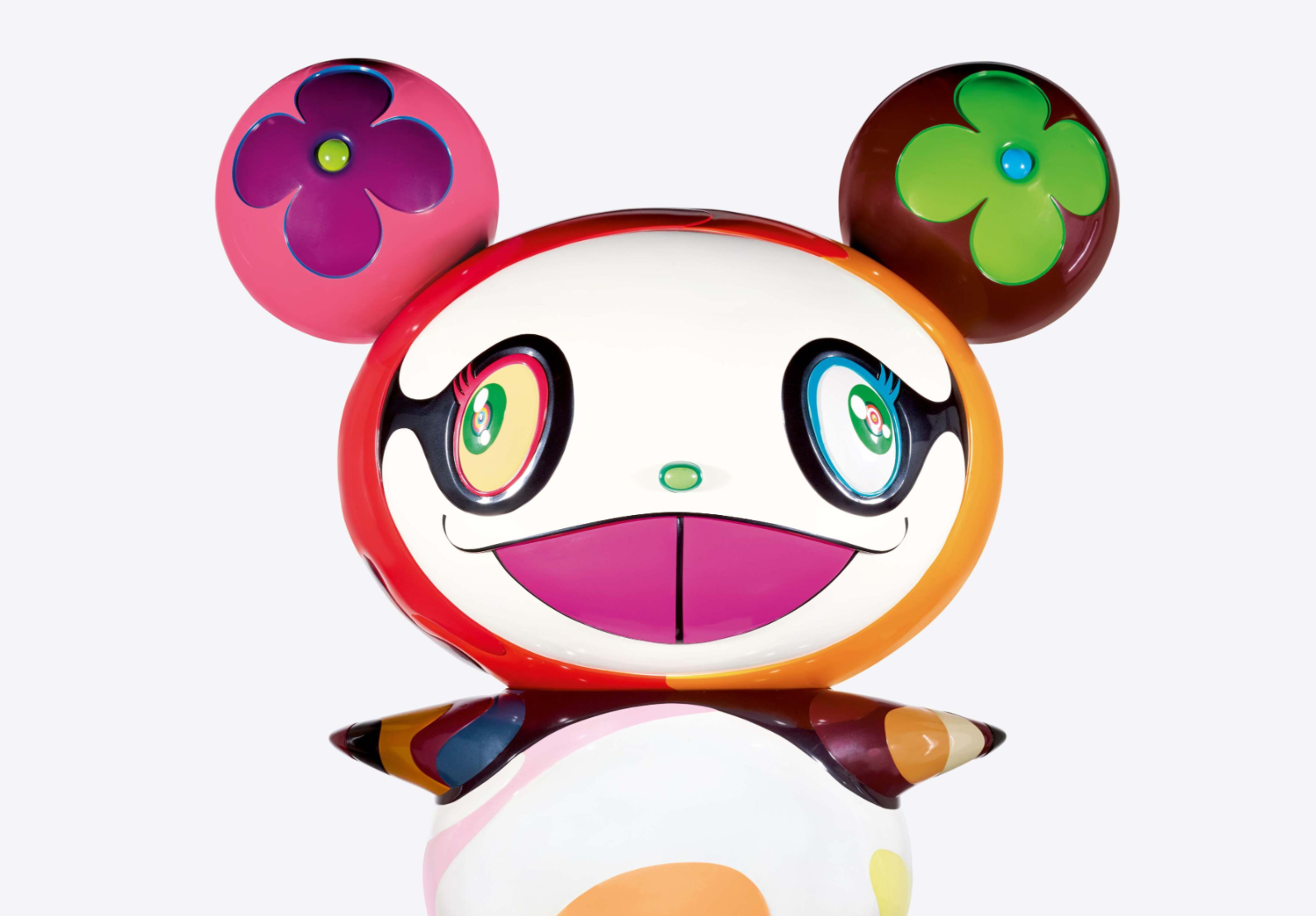
Murakami’s panda – known as Panda Geant within the artist’s vibrant, Louis Vuitton monogrammed world – first featured in the animation Superflat Monogram, which Murakami created in collaboration with the fashion house in 2003. In the short film, a young girl’s daydream is disrupted by the sight of a giant, towering panda. As she gazes up at the creature, he bends forward and consumes her, after which the girl quickly finds herself thrust into a whimsical adventure inside the panda’s body. The animation presents a nihonga and kawaii-inspired version of Alice in Wonderland, in which the little girl journeys through an enchanting time machine of swirling, multicoloured Louis Vuitton logos, which are juxtaposed against the artist’s trademark iconography of cherry blossoms – a traditional symbol in Japanese culture. Panda Geant makes a bold appearance within this psychedelic universe, as the girl spots him magically standing atop a small leather Louis Vuitton trunk. Thus the present work fantastically brings Murakami’s animation to life, as here the artist’s audience can view the playful character and its vintage Vuitton case in the round and in larger than life size.
While Murakami’s charming panda became an identifiable mascot for the Louis Vuitton brand around the time of the 2002 collaboration, the character also became a crucial signifier for the artist, and one that would recur throughout Murakami’s wider oeuvre. Indeed, Panda Geant is deeply encoded within the aesthetics of the Murakami brand, for the character – whether rendered in fiberglass or stamped on a leather handbag – indefinitely lies at the intersection between high art and commerce. Murakami’s Panda is therefore undoubtedly reminiscent of the work of Jeff Koons and KAWS, as for both artists, the kitsch, the commercial and the prosaic are powerfully transformed.
Significantly however, there is a deeper side to Murakami’s practice in his postmodern conception of Superflat, which not only explores the flattening and superficiality of traditional Japanese aesthetics, but also remarks on the flat and shallow nature of consumer culture – the latter of which Murakami seems to equally celebrate and critically exploit. Superflat has become a cultural phenomenon that spans all spheres of commercial culture in both the East and West. Indeed, yet another vital impulse in Murakami’s work is his profound effort to marry Eastern and Western aesthetics and taste: “Gradually, Murakami has erased the distinction between himself and the cultural position he inhabits. The complex iconography he has built may have been extracted from Japanese entertainment, but these images have become Murakami’s own icons – or better yet, avatars – which he uses to negotiate the relationship between East and West” (Gary Carrion-Murayari quoted in: Ibid., p. 119). Panda therefore couples a beguiling cuteness with a profound understanding of contemporary culture in both Japan and the West, in turn presenting a spectacular example of Murakami’s visionary practice – one that interprets and defines the cultural spirit of our time.
Together with the Flower Parent and Child, 2021-2022
Phillips New-York: 20 November 2024
Estimated: USD 400,000 – 600,000
USD 762,000
Takashi Murakami – Modern & Contem… Lot 323 November 2024 | Phillips
TAKASHI MURAKAMI
Together with the Flower Parent and Child, 2021-2022
FRP, urethane paint, stainless steel and wood
Sculpture: 196.9 x 123.2 cm (77 1/2 x 48 1/2 inches)
Base: 89.9 x 89.9 x 9.5 cm (35 3/8 x 35 3/8 x 3 3/4 inches)
Signed, titled, inscribed and dated “TAKASHI 2021–2022 FRP 1/5” on the interior of the larger flower element
This work is a unique variant from an edition of 5 plus 1 artist’s proof
Takashi Murakami’s Together with the Flower Parent and Child, 2021–22, brings the artist’s signature flower motif into three dimensions. The adorable, cartoon-inspired flower parent and child wave their hands and don hyperbolic smiles. The whimsical, rainbow-hued petals of the artist’s flower figures are instantly recognizable, having transcended the world of art into fashion and pop culture. Figures such as the present example recur throughout Murakami’s universe, inspired by sources ranging from manga and kawaii cultures to Nihonga Japanese painting. Murakami is generally acknowledged to be the father of the highly popular style and artistic theory known as Superflat. At the origin of this movement are the flat aesthetics of Japanese traditional art and the more recent trend of 2D graphics, which includes anime and manga. The mixture of these two visual expressions has led to the contemporary hybrid Superflat style, which pays homage to the past and the present of Japanese art and culture. In the present, life-sized sculpture, flowers draw influence from the Nihonga period while simultaneously taking on the contemporary pop aesthetics and kawaii cuteness.
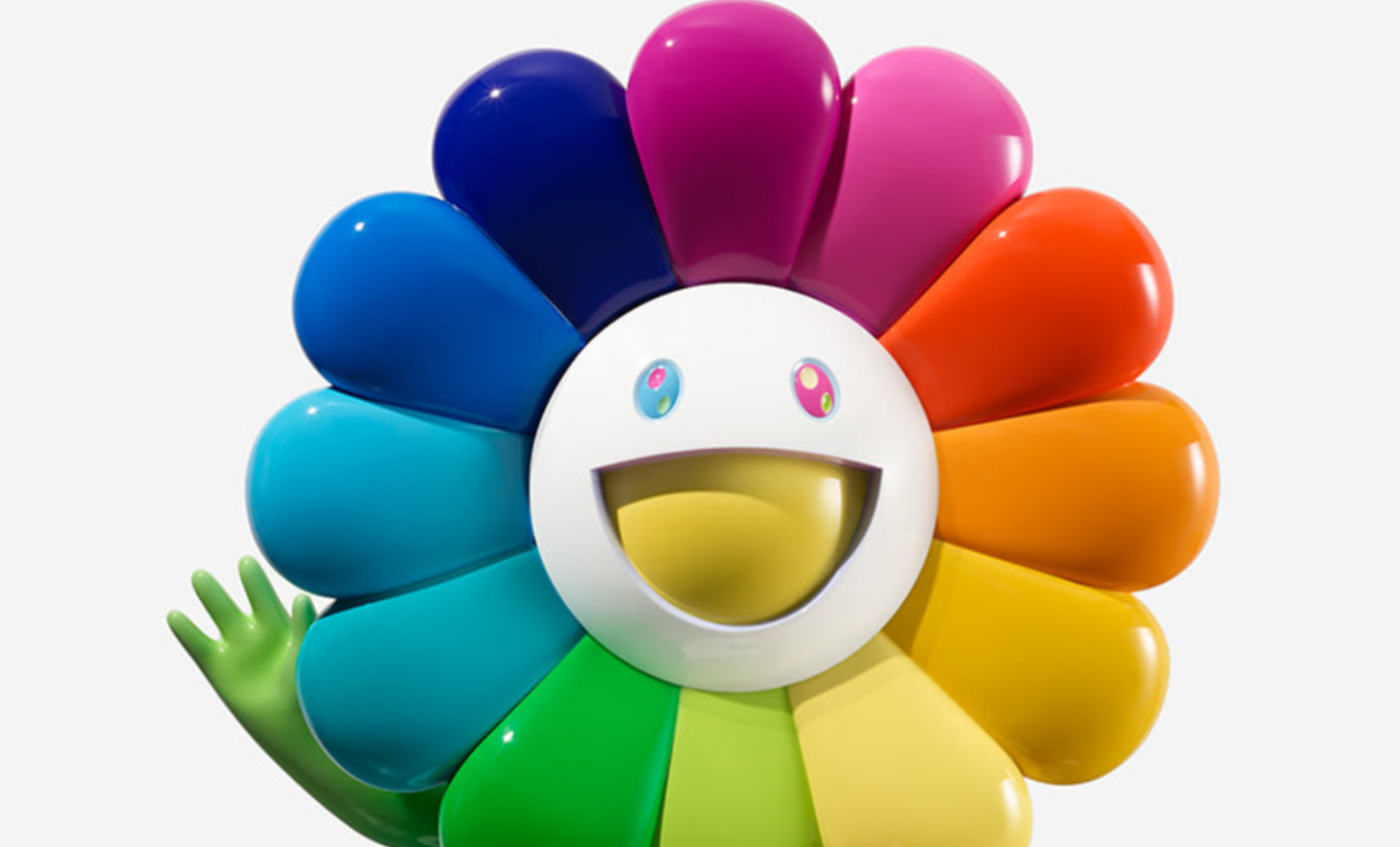
Calling his figures ‘Parent’ and ‘Child’, Murakami avoids gender specificity, allowing the flower characters to embody the roles universally. While nodding to the traditional art historical subject of mother and child, Murakami’s work redefines the motif by personifying cartoon flowers. While anthropomorphized, the figures remain at once abstracted within the realm of a shiny and smooth-edged cartoon. Even though the figures are clearly artificial, it’s impossible not to return their endearing smiles with one’s own joyous grin.
“My concept is, anytime we do the honest thing, we get the win… People find it very difficult to find their honest desire.”
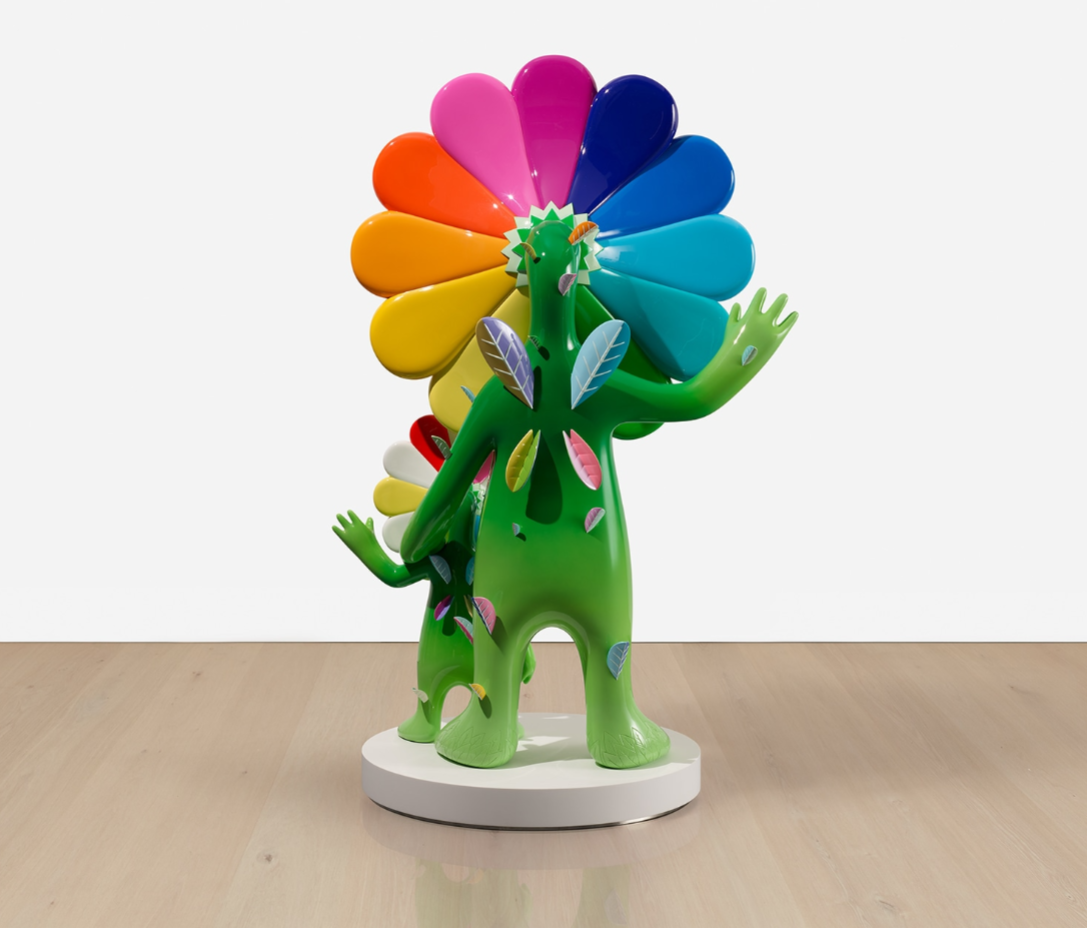
Murakami is a pioneer of fusing popular, cartoonish imagery with high art, distinctly influencing contemporary aesthetics and promoting the careers of artists such as MR and Madsaki through his business entity Kaikai Kiki. Through Kaikai Kiki, itself a crucial component of the artist’s practice, Murakami manages and sells the work of younger artists. While on the surface a cute artistic style, Murakami’s Superflat is also a tongue-in-cheek social critique. In his 2005 essay “Earth in My Window,” Murakami contrasts the contemporary prosperity of Japan with the horrific traumas experienced only decades earlier during World War II. Seeing Japanese itself as now “Superflat,” Murakami declares,
“From social mores to art and culture, everything is super two-dimensional. Kawaii (cute) culture has become a living entity that pervades everything.”
The cheery figures indirectly respond to these painful histories, a light-hearted counteraction in attempt to move beyond communal grief. Murakami’s embrace of the aesthetic brilliantly serves to question the pervasive spread of childlike imagery in the second half of the 20th century.
FLOWER MATANGO (A), 2001-2006
Sotheby’s New-York: 14 May 2024
Estimated: USD 1,000,000 – 1,500,000
USD 1,143,000
Flower Matango (A) | Contemporary Day Auction | 2024 | Sotheby’s (sothebys.com)
TAKASHI MURAKAMI (b. 1962)
FLOWER MATANGO (A), 2001-2006
Oil, acrylic, fiberglass and iron
550x300x250 cm (216 1/2 x 118 1/8 x 98 1/2 inches)
This work is a unique variant
Grandiose yet garish, elegant yet powerful, Flower Matango (A) stands as a masterpiece of visual splendor, epitomizing Takashi Murakami’s era-defining practice. Situated at the core of the sculpture is Murakami’s iconic flower ball, replete with smiling psychedelic daisies rendered in intricate 3D relief, each flower distinguished by a candy-colored hue assigned through a unique serial number. Sprouting from the top of the sphere is an elaborate configuration of nimbly and intricately intertwining vines and tendrils whose paths – in adherence to Bézier curves – were generated by advanced computer graphic software, epitomizing the high level of craftsmanship in Murakami’s practice and his tenacious commitment to engineering precision.

Visually associative of referents as diverse as Ikebana flower arrangements and baby crib mobiles, the whimsical monstrosity of Flower Matango (A) takes direct titular reference from the 1963 Japanese horror film Matango, which featured monsters with mushroom-shaped heads in reference to the atomic bombings of Hiroshima and Nagasaki. A testament to the power of Murakami’s irreverently provocative oeuvre that merges high and low art and culture. another version of Flower Mantango was exhibited within the gilded halls of the Palace of Versailles in Paris in 2009. By engaging in socio-cultural scrutiny via a signature kawaii aesthetic, Flower Matango (A) is positioned at the very apex of Murakami’s practice and iconography.

JEFF KOONS, LARGE VASE OF FLOWERS, 1991. PRIVATE COLLECTION. ART © JEFF KOONS STUDIO
VAN GOGH, SUNFLOWERS, 1889. VAN GOGH MUSEUM, AMSTERDAM. ART © VAN GOGH MUSEUM, AMSTERDAM
One of the most renowned artists of his generation, Murakami is widely acclaimed for orchestrating an artistic empire descended from the Warholian art-business model. In a complex negotiation between the mass market, Japanese historical tradition and the avant-garde of the contemporary art world, Murakami’s work is subtly yet acutely politically oriented. Cloaked beneath the signature barrage of beaming faces, a studied cultural project is at work that merges pre-modern Japanese tradition with the contemporary sub-culture of otaku, eroding cultural hierarchies and binary divisions in the wake of Japan’s post-war cultural identity. In forging an aesthetic grounded in the special effects of animé and manga, Murakami presents a vision of the culturally dislocated Japanese generation nurtured by the political custody of the US after World War II. Exposed to the American capitalist model, the resulting economic prosperity was considered to have cultured a ‘limited freedom’ of postwar Japanese democracy. In turn, this fostered a culture seen to lack self-reflective tradition or spiritual depth – the ultimate embodiment of which is the indigenous comic book sub-culture of otaku. Emblematically present within the excessive and almost fetishistic detail and childlike appeal of Murakami’s open-mouthed flowers is the very quintessence of the artist’s response to such cultural conditions, conceptually unified under the umbrella term ‘Superflat’.

Reflective of the flattened social structure and erasure of political identity in the nuclear fall-out of the atomic bomb, Murakami’s otaku inspired art takes on infantile cultural conditions as the vehicle to develop and globally proliferate a new and manifestly Japanese art. In orchestrating a multivalent commercialized artistic venture which has famously entailed teaming up with Louis Vuitton and celebrities such as Kanye West, Murakami wields the mainstream corporate brand as a megaphone to establish and legitimate his otaku inspired practice. Moreover, by taking on aspects of Surrealism, evocative of the Kitsch aesthetic of Jeff Koons, Murakami’s practice is firmly rooted within the contemporary canon of Western art. However, within this stream of referents that constitute the artist’s search for a cultural voice, Murakami masterfully bridges the gulf between the new representational aesthetics and the greater pre-modern classical tradition indigenous to Japan.

CIRCLE OF KANO MITSUNOBU, FLOWERS AND GRASSES OF THE FOUR SEASONS, LATE 16TH CENTURY
METROPOLITAN MUSEUM OF ART, NEW YORK
Smiling flowers are uniquely emblematic within Murakami’s globalised artistic mission and mature visual lexicon; as a photograph of the artist dressed as one of his smiling flowers for Macy’s Thanksgiving Day Parade in New York substantiates, the cutesy animé inspired floral motif denotes a trademark of Murakami’s public persona. With Murakami’s emblematic flowers featured prominently in recent solo exhibitions, including Takashi Murakami: Lineage of Eccentrics at the Museum of Fine Arts, Boston (2017-18), the present work is exemplary of the artist’s graphically dynamic oeuvre. According to Murakami, the employment of flowers as an endlessly repeated motif stems from a period of intense daily study of the flower itself.
“I spent nine years working in a preparatory school, where I taught the students to draw flowers… At the beginning, to be frank, I didn’t like flowers, but as I continued teaching in the school, my feelings changed: their smell, their shape – it all made me feel almost physically sick, and at the same time I found them very ‘cute’. Each one seemed to have its own feelings, its own personality. My dominant feeling was one of unease, but I liked that sensation. And these days, now that I draw flowers rather frequently, that sensation has come back very vividly. I find them just as pretty, just as disturbing… So I thought that if the opportunity arose, I would very much like to make a work in which I would represent them as if in a ‘crowd scene’.”
While the proliferation of cheerful, polychromatic faces in Flower Matango (A) evokes the experience of psychedelia, the flowers’ anthropoid eyes furthermore generate the uncanny illusion of being watched from within. Regarding the propagation of multiple eyes in his works, Murakami states: “In the case of my works, these eyes that are looking at them [the viewers] from multiple angles also refuse to determine a focal point.” The artist continues: “I realized that by lining up a multitude of eyes you can create a very simple code that means the spectator really does feel he is being watched […] Compared to the classical technique of representation using ‘one-point’ perspective, my Superflat idea does not really correspond to traditional Western perspective, but to the introduction of a ‘multiplicity of points’. By [depicting] a large number of eyes I disturb the perspective, or rather, I diversify it’” (the artist cited in: Ibid., p. 81-83). Anointed the “Emperor of Signs” by Alison Gingeras, Murakami’s fanatical repetition and attention to detail is symptomatic of a tautological necessity to at once secure and deny significatory meaning. Infused with an abundance of referents, Murakami’s trademark smiling flowers lie at the heart of an agenda of Japanese identity politics. Herein lies the cultural strategy of Murakami’s artistic project of postcolonial re-territorialisation: by forging a dialectic between mass and sub culture, cultural alterity and westernized dominance, orient and occident, Murakami’s hybridized art not only put Japanese otaku on the map of the contemporary world but used it to reference and embody the overwhelming phenomenon of cultural collisions occurring all over the world.
Pom & Me, 2013
Christie’s Hong-Kong: 29 November 2023
Estimated: HKD 600,000 – 800,000
HKD 882,000 / USD 112,995
TAKASHI MURAKAMI (B. 1962) (christies.com)
TAKASHI MURAKAMI (B. 1962)
Pom & Me, 2013
Carbon fiber, acrylic and pedestal in Corian
Overall: 44.8 (H) 37.7 x 31.6 cm (17 2/3 x 14 4/5 x 12 2/5 inches)
Signed with the artist’s signature and dated ‘2013’ (on the underside)
Edition: 4⁄5 and 2 APs
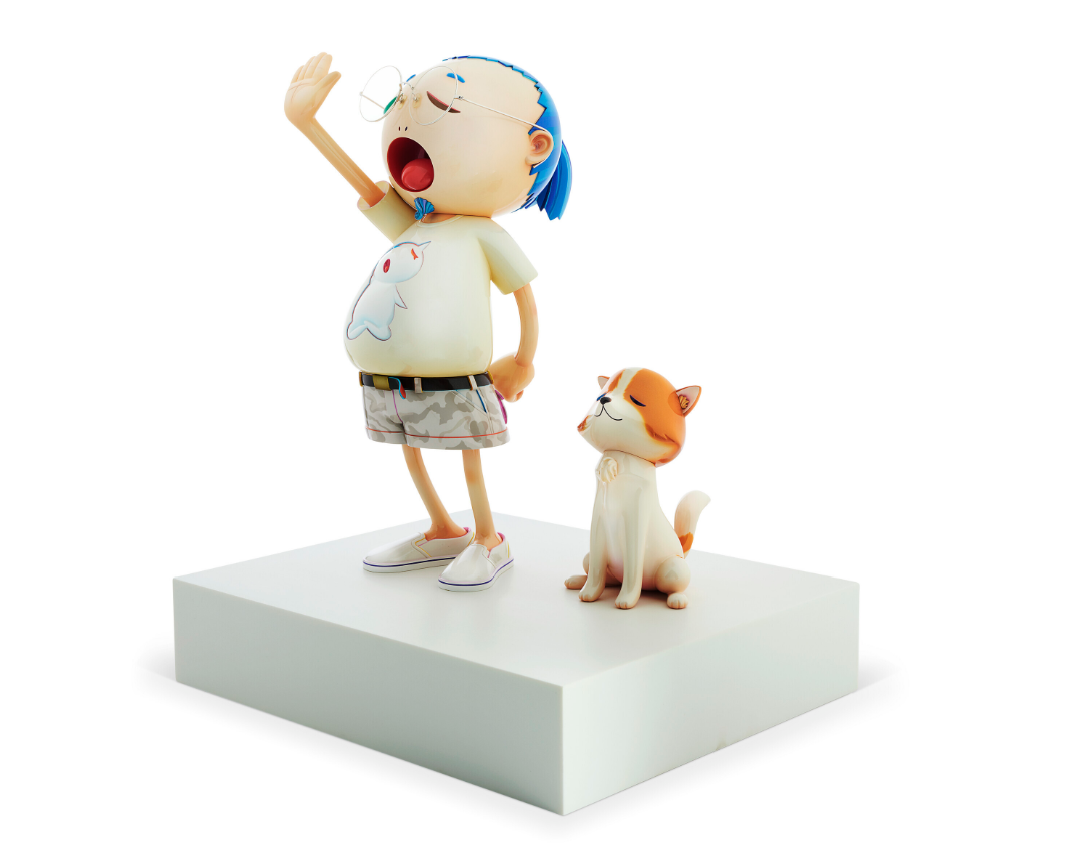
The Emperor’s New Clothes, 2005
Sotheby’s New-York: 19 May 2023
Estimated: USD 500,000 – 700,000
USD 508,000
The Emperor’s New Clothes | Contemporary Day Auction | 2023 | Sotheby’s (sothebys.com)
TAKASHI MURAKAMI (b. 1962)
The Emperor’s New Clothes, 2005
Oil, resin and lacquer on fiberglass, velvet with gold embroidery, fur, rhinestones, fabric and acrylic
113 x 113 x 97.8 cm (44.5 x 44.5 x 38.5 inches)
This work is number 1 from an edition of 2 unique color variants plus 1 artist’s proof
Delightfully inspired by the Hans Christian Andersen fairy tale of the same name, The Emperor’s New Clothes, executed in 2005 is a notable example of Takashi Murakami’s iconic original characters from his imaginative oeuvre, which playfully engage the viewer.
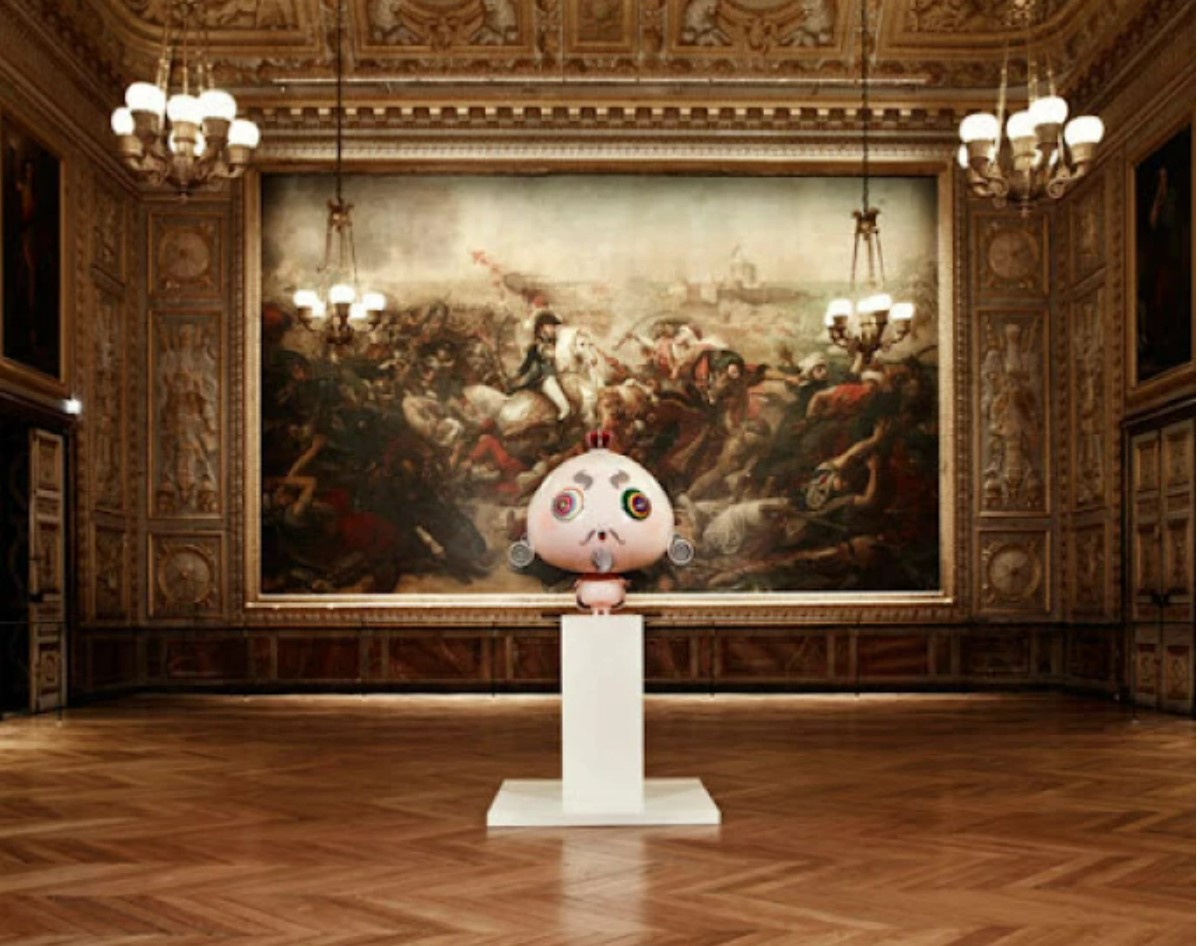
AN EXAMPLE OF THE EMPEROR’S NEW CLOTHES INSTALLED IN CHATEAU DE VERSAILLES, FRANCE, 2010.
The figure holds the viewer’s gaze with a playful expression of surprise, curling sheets of hair, and characteristic Murakami eyes which hypnotically swirl with bright paint. Drawn from traditional Japanese origins, Murakami intelligently blurs the boundaries between high art and commercial culture in a visual feast of vivid colors and exaggerated forms. “Gradually, Murakami has erased the distinction between himself and the cultural position he inhabits. The complex iconography he has built may have been extracted from Japanese entertainment, but these images have become Murakami’s own icons – or better yet, avatars – which he uses to negotiate the relationship between East and West.” (Gary Carrion-Murayari quoted in Exh. Cat., Doha, Al Riwaq, Murakami: Ego, 2012, p. 119) Embedded in the visual language of kawaii, The Emperor’s New Clothes charms with overt whimsy and childlike nostalgia.
Cherries, 2005
Phillips Hong-Kong: 31 March 2023
Estimated: HKD 2,500,000 – 3,500,000
HKD 3,302,000 / USD 420,642
Takashi Murakami – 20th Century & Cont… Lot 30 March 2023 | Phillips
TAKASHI MURAKAMI
Cherries, 2005
FRP, steel, acrylic and urethane paint
200x100x71 cm (78 3/4 x 39 3/8 x 27 7/8 inches)
This work is number 1 from an edition of 5 plus 2 artist’s proofs
Signed, dated and numbered ‘TAKASHI 05 1/5’ on the inside rim of the top of stem
A master cultural synthesizer of our time, Takashi Murakami was named by Time magazine as one of the world’s most influential icons. Celebrated as multi-hyphenate icons and leaders of contemporary consumer culture, Murakami uses pop culture as a springboard to transform contemporary art, attracting new audiences and building a stronger bridge between art and the general public, fashion, and subculture. Known for blurring the lines between high art and popular visual culture, and for challenging the divide between artistic practice and commercial enterprise, Murakami’s colorful sculptures and paintings, such as Cherries, belie the sharp, subversive intelligence of their creator.
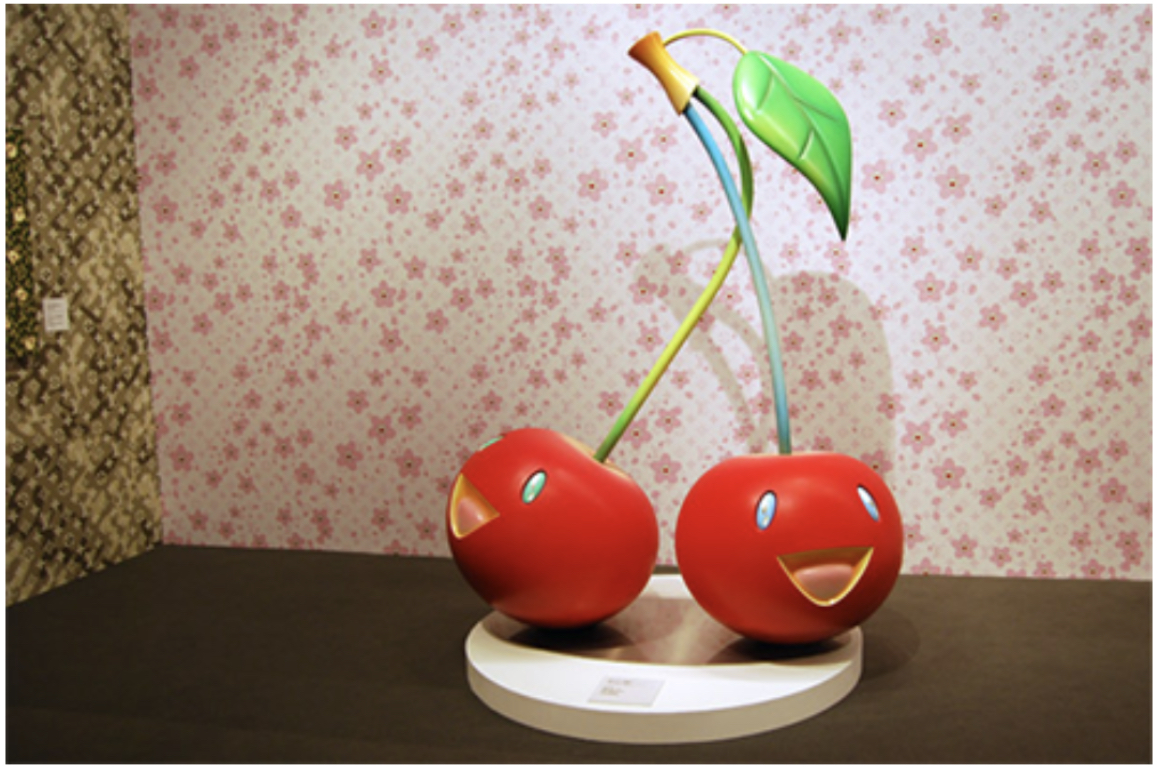
With its irresistible charm and a sly provocativeness, Cherries shows Murakami to be an artist skilled at navigating the realm of the surreal. The traditionally sexual connotations of cherry fruit are undermined by the disarming, candy-colored smiles of Murakami’s Cherries, offering a joyfully surreal encounter for viewers. In the midst of his deep dive into otaku culture during the mid-1990s, Murakami realized the greater relatable appeal and potential of kawaii (cuteness), and thus re-oriented his art from confrontation to cuteness. He created a strange, imaginary world of iconic characters including Mr. DOB, Kaikai, Kiki and enchanted mushrooms, eyes, and flowers.
Flower Parent and Child, 2018-2020
Phillips Hong-Kong: 30 March 2023
Estimated: HKD 15,500,000 – 23,500,000
HKD 14,002,000 / USD 1,783,717
Takashi Murakami – 20th Century & Cont… Lot 14 March 2023 | Phillips
TAKASHI MURAKAMI
Flower Parent and Child, 2018-2020
Gold leaf on bronze
248.5 x 152.3 x 115.3 cm (97 7/8 x 59 7/8 x 45 3/8 inches)
Signed and dated ‘TAKASHI 2020’
Dazzling in its incandescent splendor, Takashi Murakami’s Flower Parent and Child is masterfully produced in gilded gold leaf. Demonstrating a profound understanding of a globalized contemporary culture, Murakami is widely recognized as an innovator and cultural synthesizer of our time. Exemplifying the artist’s wholly unique visual lexicon, Flower Parent and Child presents an original response to the conditions and sensibilities of a contemporary era.
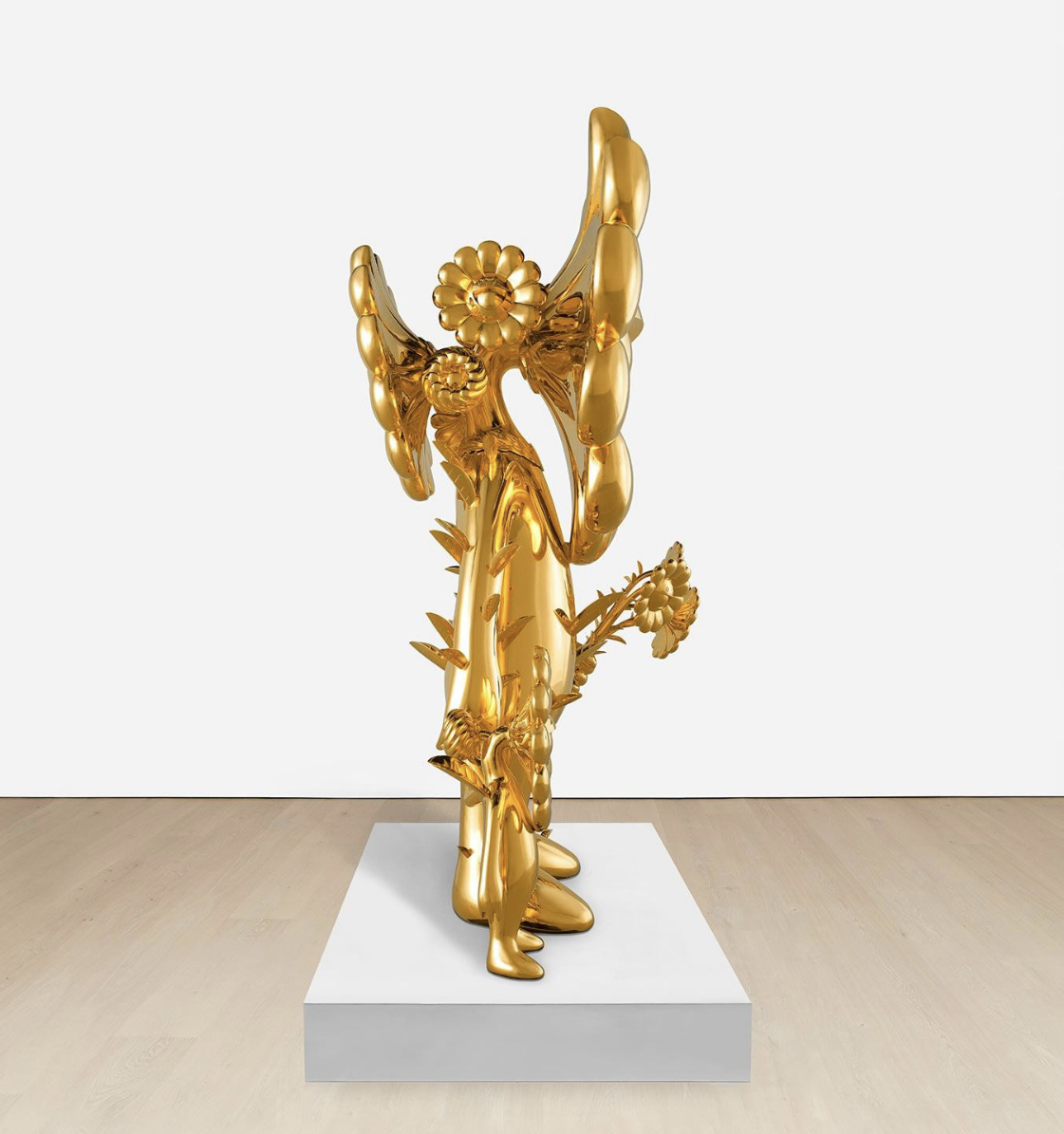
Flower Parent and Child features a smooth and seductive surface that is resplendently reflective. Murakami’s most iconic motif – the flower, takes on the role of a parent and child, holding hands and standing in synchronicity. Later recreated as a 10 metre tall public sculpture in Roppongi, Tokyo, Murakami had envisioned that families would move around to take in the full scope of Flower Parent and Child. Full of intricacy in its gold leaf texture and decorated on all sides, the sculpture is designed to be viewed from all angles, providing compositional complexity that is impossible to absorb in one glance. Demanding movement from its viewer, the current sculpture is a conversational piece that allows families to find resonance through an interactive experience, as they mirror the family bond shown in the work.
Cherries, 2005
Bonhams New-York: 16 November 2022
Estimated: USD 400,000 – 600,000
USD 529,575
FRP, Steel, Acrylic, Urethane paint
200 x 100.3 x 71.1 cm (78 3/4 x 39 1/2 x 28 inches)
This work is number five from an edition of five with two artist’s proofs
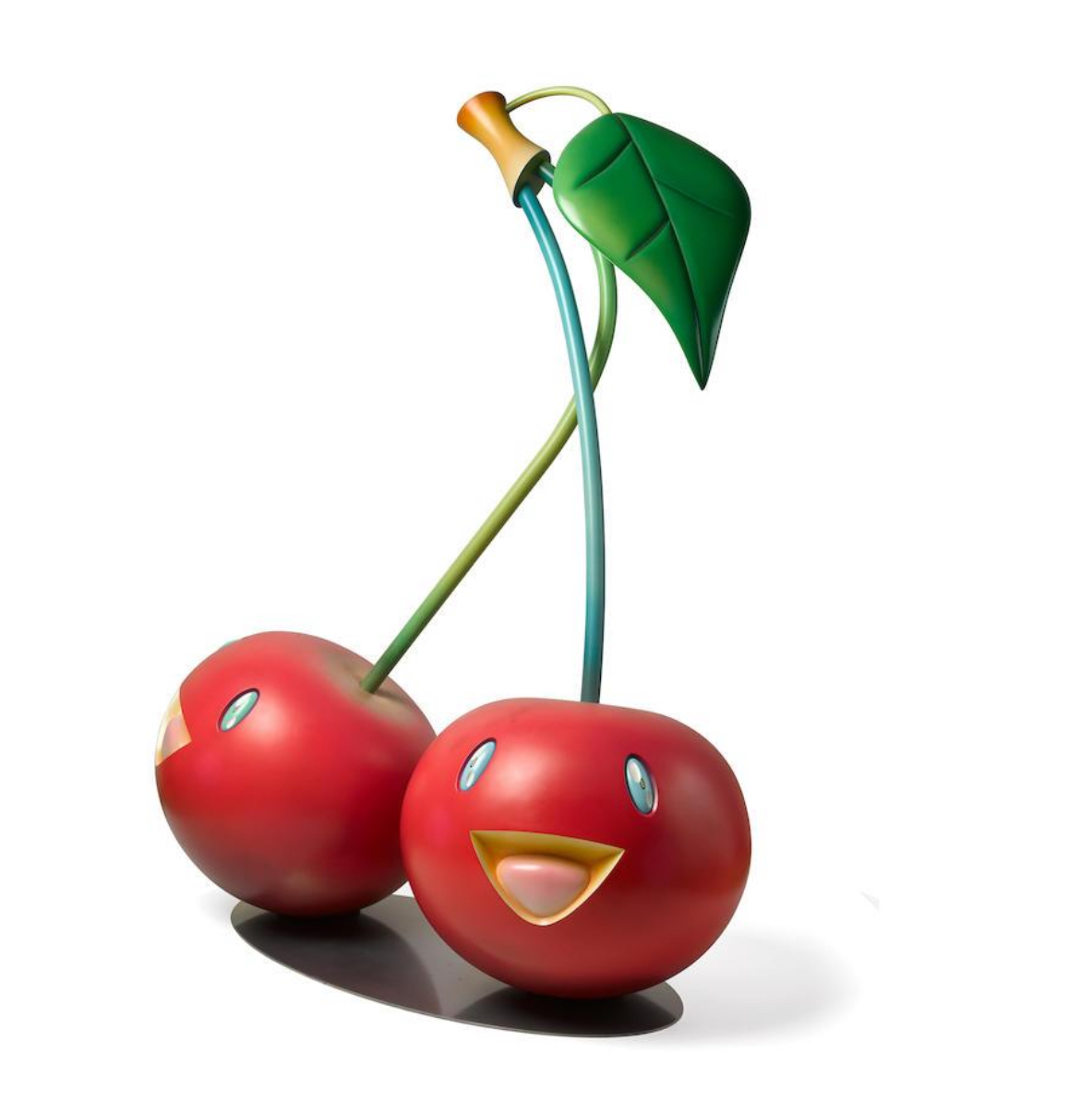
From Cherries to Bears to Flowers, Murakami’s colorful motifs exude a sense of carefree joy. The toy-like quality of his art lends itself well to commerce, specifically merchandising. His partnership with revered French luxury fashion house Louis Vuitton, which saw his cherries motif printed onto wallets, purses, bags, and luggage, was described by Vogue as “the defining fashion collaboration of the noughties“. While it’s simplistic to regard Murakami as the ‘Japanese Warhol’, it’s his repetition and the interest in merging art and commerce along the lines of mass production that so mirror Andy. Murakami continues to be a cultural force with forays into digital art and music. In 2022, he presented his first solo exhibition at The Broad, titled Takashi Murakami: Stepping on the Tail of a Rainbow. Murakami has exhibited at the Guggenheim Museum Bilbao, MoMA PS1, Mori Art Museum, Garage Museum of Contemporary Art, Brooklyn Museum, Museum für Moderne Kunst, and the Museum of Contemporary Art Chicago, among others. He lives and works in Tokyo, Japan.
Peaked Cap, 2002
Estimated: TWD 20,000,000 – 38,000,000
TWD 22,800,000 / USD 776,038
TAKASHI MURAKAMI
Peaked Cap, 2002
Fiberglass, steel, epoxy and paint
90 (L) x 80 (W) x 185 (H) cm (with base)
Edition 5/5
Can “anime” become art? The most influential Japanese Neo-Pop artist of the 20th century, Takashi Murakami, has successfully revealed the subculture of Japanese otaku, elevating anime and game characters indulged by the otaku onto an artistic level and directly pointing toward the unbearably vulgar social phenomena in Japanese popular culture. The “superflat” art style created by Murakami combines elements and images derived from Japaneseanime. Themes in his works originate from the lifestyle, commercialism and sexual fantasy of “the otaku,”bringing about many representative figures that have swept the world, such as teenage beauties, smiling flowers, and mushroom dolls. With bright and bold colors as well as adorable styles, his works are filled with a sense of “naivety,” which perfectly matches the gorgeous and enchanting otaku aesthetics in postmodern pop culture. “Peaked Cao” combines Murakami’s two representative elements: “mushrooms” and “eyes.” While images of mushrooms in rainbow colors look appealing, they symbolize the mushroom clouds that indicate war, frustration and death, from when Japan was devastated by the atomic bombs dropped by the U.S. A variety of mushrooms are often covered with long-lashes, big eyes or even countless eyes. Such a style was inspired by the manga artist Murakami has adored since childhood, Shigeru Mizuki. The Eyeball Father in Mizuki’s GeGeGe no Kitarō is Murakami’s favorite cartoon character.
Ponchi-kun Gold, 2010
Sotheby’s Hong-Kong: 9 October 2021
Estimated: HKD 4,000,000 – 6,000,000
HKD 5,015,000 / USD 644,212
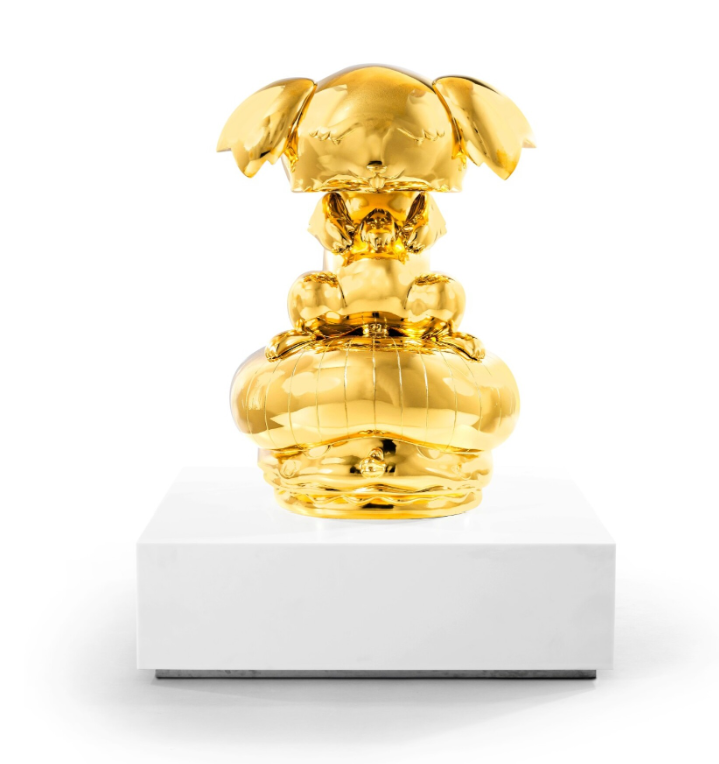
TAKASHI MURAKAMI (b. 1962)
Ponchi-kun Gold, 2010
Aluminum, gold leaf, Corian base
108x74x72 cm (42 1/2 x 29 1/8 x 28 3/8 inches)
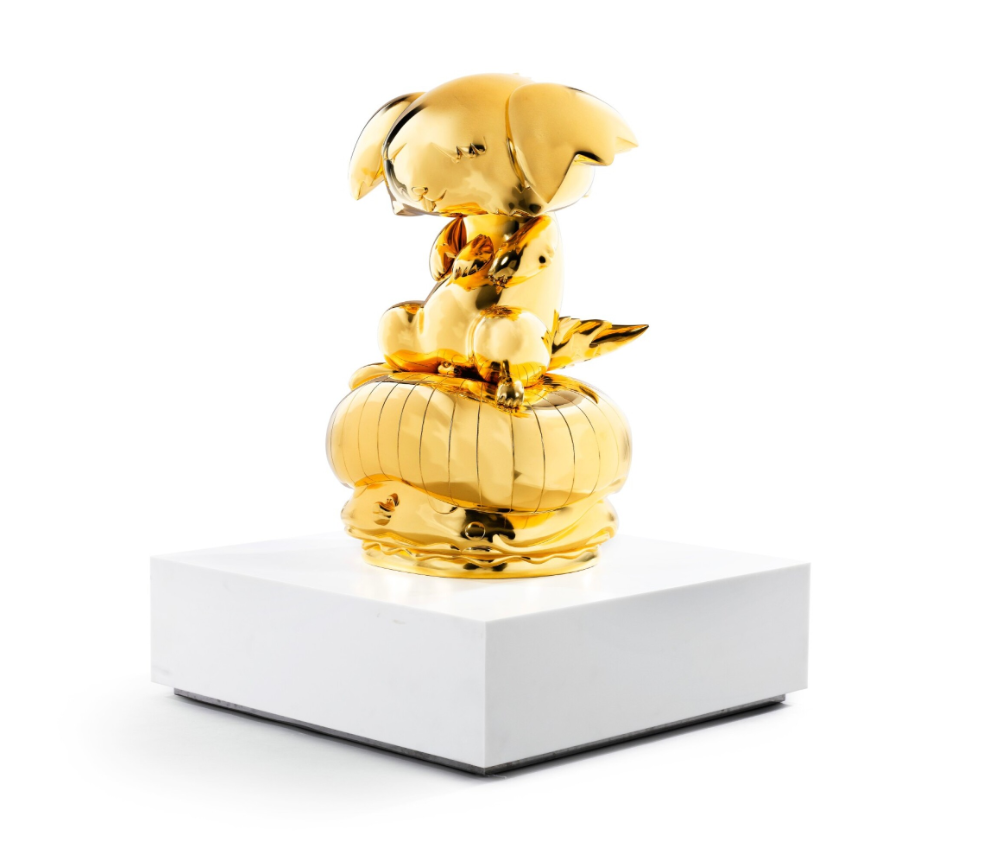
Miss Ko2 Original (Project Ko2), 1997
Sotheby’s New-York: 14 November 2019
Estimated: USD 2,000,000 – 3,000,000
USD 3,080,000
sothebys.com/en/search?query=takashi murakami MIIS KO2&tab=objects
TAKASHI MURAKAMI
Miss Ko2 Original (Project Ko2), 1997
Fiberglass, iron, synthetic resin, oil paint, and acrylic
182.9 x 63.5 x 82.6 cm (72 x 25 x 32 1/2 inches)
Signed, numbered 024/5
Inscribed with the names of the contributing assistants on the interior of the torso
This work is number 3 from an edition of 3 plus one artist’s proof
One of Takashi Murakami’s most recognizable characters, Miss Ko2 Original (Project Ko2) is a larger-than-life example of the artist’s trademark fusion of a Japanese pop aesthetic with Western cultural ideals. The exaggerated dimensions of this parodic sex symbol offer testament to the outsized cultural phenomenon that Murakami’s irreverently provocative output has become. Merging high and low culture to form his revolutionary “Superflat” philosophy, Murakami here offers a critical take on the psychologically conflicted relationship between East and West that engendered otaku, a Japanese “geek” subculture obsessed with the fantasy worlds of animation and comics. This voluptuous waitress, the first of his life-size adaptations of characters such as Hiropon and My Lonesome Cowboy, has been exhibited at such prominent institutions as the Los Angeles Museum of Contemporary Art and the Palace of Versailles, underscoring the important role she plays in the artist’s oeuvre. Carrying extraordinary critical and cultural currency, Miss Ko2 Original (Project Ko2) is positioned firmly at the apex of Murakami’s ubiquitous iconography. A sleekly painted, cartoonishly proportioned figure, Miss Ko2 Original (Project Ko2) is begotten by such predecessors as Hans Bellmer’s Surrealist dolls, Charles Ray’s monumental Big Ladies, and Jeff Koons’s Pink Panther. The Playboy Bunny-like model, dressed in a miniskirt, schoolgirl tie, and cherry red heels, holds out a welcoming hand, apparently eager to serve viewers a glimpse of her emphatically sexualized curves and impossibly long limbs. Though this style of female figuration is common in otaku drawings and small figurines, Murakami was the first to produce it on such a monumental scale, bringing its problematic distortion into acute focus. With Miss Ko2 Original (Project Ko2), he subverts the seductiveness of manga and anime imagery by inflating and further amplifying the sexuality of these characters. The resulting super-human figure unmasks and conquers the voyeuristic nature of otaku fantasy by actualizing it in the extreme.
DOB in the Strange Forest (Blue DOB), 1999
Christie’s New-York: 8 November 2011
Estimated: USD 2,500,000 – 3,500,000
USD 2,770,500
Takashi Murakami (b. 1962) (christies.com)
TAKASHI MURAKAMI (b. 1962)
DOB in the Strange Forest (Blue DOB), 1999
Fiber-reinforced plastic, resin, fiberglass, acrylic and iron
152.4 x 386 x 347.9 cm (60 x 152 x 137 inches)
Signed, inscribed and dated ‘Takashi Murakami ’99’ (on the underside of DOB)
This work is from an edition of three plus two artist’s proofs
Like the central character in Takashi Murakami’s colorful tableaux, DOB in the Strange Forest (Blue DOB) presents the viewer with a complex concoction of entertainment-value, visual stimulation, and social commentary. DOB, one of Murakami’s favorite and most enduring characters, stands forlornly surrounded by the watchful eyes of a menacing collection of multi-colored “magic” mushrooms. In a thinly veiled reference to the ubiquitous nature of contemporary drug culture, the clear hallucinogenic references are reinforced by psychedelic swirls of rich pigment that envelop every square inch of the surface of the mushrooms. DOB stands in the middle of this circle, right hand held aloft as though commanding an end to this multicolored nightmare. Yet the figure also conveys a sense of innocence, as if it had wandered into an enchanted forest filled with unknown creatures peering out from the undergrowth. Mixed into this audacious tableau are clear references to anime, which has engulfed modern Japan, and which builds on the country’s preeminent graphic tradition.
Miss Ko2
Phillips New-York: 8 November 2010
Estimated: USD 4,000,000 – 6,000,000
USD 6,802,500
Takashi Murakami – Carte Blanche Lot 10 November 2010 | Phillips
TAKASHI MURAKAMI (B. 1962)
Miss ko², 1997
Oil paint, acrylic, synthetic resin, fiberglass, and iron.
72 x 25 x 32 1/2 in. (182.9 x 63.5 x 82.6 cm)
This work is from an edition of 3 plus 1 AP
Miss ko2 is the first large-scale sculpture Murakami ever made of a character inspired by the fantasy world of otaku, the obsessive Japanese subculture of anime, manga and video games. It immediately preceded his other celebrated sculptures of this kind, most notably Hiropon and My Lonesome Cowboy. The celebration of otaku is a major theme in Murakami’s work.
DOB in the Strange Forest (Blue DOB), 1999
Christie’s New-York: 8 November 2011
Estimated: USD 2,500,000 – 3,500,000
USD 2,770,500
Takashi Murakami (b. 1962) (christies.com)
TAKASHI MURAKAMI (b. 1962)
DOB in the Strange Forest (Blue DOB), 1999
Fiber-reinforced plastic, resin, fiberglass, acrylic and iron
152.4 x 386 x 347.9 cm (60 x 152 x 137 inches)
Signed, inscribed and dated ‘Takashi Murakami ’99’ (on the underside of DOB)
This work is from an edition of three plus two artist’s proofs
Like the central character in Takashi Murakami’s colorful tableaux, DOB in the Strange Forest (Blue DOB) presents the viewer with a complex concoction of entertainment-value, visual stimulation, and social commentary. DOB, one of Murakami’s favorite and most enduring characters, stands forlornly surrounded by the watchful eyes of a menacing collection of multi-colored “magic” mushrooms. In a thinly veiled reference to the ubiquitous nature of contemporary drug culture, the clear hallucinogenic references are reinforced by psychedelic swirls of rich pigment that envelop every square inch of the surface of the mushrooms. DOB stands in the middle of this circle, right hand held aloft as though commanding an end to this multicolored nightmare. Yet the figure also conveys a sense of innocence, as if it had wandered into an enchanted forest filled with unknown creatures peering out from the undergrowth. Mixed into this audacious tableau are clear references to anime, which has engulfed modern Japan, and which builds on the country’s preeminent graphic tradition.
Kaikai Kiki, 2005
Christie’s London: 14 October 2010
Estimated: GBP 400,000 – 600,000
GBP 1,945,250 / USD 3,115,390
Takashi Murakami (b. 1962) (christies.com)
TAKASHI MURAKAMI (b. 1962)
Kaikai Kiki, 2005
Oil, acrylic, synthetic resins, fiberglass and inox, in two parts
Kaikai: 210 x 105.5 x 66 cm (82 3/4 x 41 1/2 x 26 inches)
Kiki: 212.5 x 102 x 50.5 cm (83 7/8 x 40 1/4 x 19 3/4 inches)
This work is number five from an edition of five
Carrying the same name as Takashi Murakamis’ company, Kaikai and Kiki stare out at us, holding black skull-tipped lances and functioning as manic guardians as though sprung into three dimensions, larger than life, direct from a cartoon. As the final work from the edition of five realised, the present work embodies the culmination of Murakami’s highly attuned technical skill perfected since the work’s inception in 2000. Fashioned and dressed to sculptural perfection from a combination of Inox (a form of stainless steel), resin and paint, the attention to detail is extraordinary. Murakami originally created Kaikai Kiki in 2000, as ‘acolytes’ for his Oval Buddha, but over the years they have become a force in their own right, featuring in his paintings and films as well. The words Kaikai Kiki were coined from the phrase Kikikaikai, a term used in the book History of Japanese Painting (Honcho Gashi, compiled by Kano Sansetsu and Kano Eino) to describe the work of the 16th Century Japanese painter, Kano Eitoku who was known as the genious of the Kano style. The ears of Murakami’s characters bear Japanese lettering stating these terms, which have their origins in the descriptions awarded to Kano’s work as kikikaikai, ‘bizarre, yet refined,’ and ‘delicate yet bold’, and in the hopes that these figures will emanate these complex dichotomies. Indeed, they have become such an integral part of Murakami’s pantheon of cutesy yet mutated cartoonish characters that he renamed his company after them. Murakami’s blend of contemporary cartoon culture references the styles of anime and Manga, as is clear in the rendering of Kaikai Kiki.
Francis Bacon
Homage To Francis Bacon (Three Studies of Lucian Freud), 2017
Sotheby’s Hong-Kong: 5 April 2023
Estimated: HKD 18,000,000 – 28,000,000
HKD 22,230,000 / USD 2,831,883
TAKASHI MURAKAMI (b. 1962)
Homage To Francis Bacon (Three Studies of Lucian Freud), 2017
Acrylic, gold leaf and platinum leaf on canvas mounted on aluminum, in 3 parts
Each: 197.8 x 147.5 cm (77 7/8 x 58 1/8 inches)
Overall: 197.8 x 442.5 cm (77 7/8 x 174 1/4 inches)
Signed and dated 2017 on the overlap of the second panel
Takashi Murakami’s best work stages an intricate negotiation between past and present, orient and occident, high culture and mass consumerism. He now irrefutably stands as one of the most internationally acclaimed artists of the Twenty-First Century and Homage To Francis Bacon (Three Studies of Lucian Freud) perfectly exemplifies his eclectic oeuvre. Across the entirety of this visually dense and chromatically brilliant painting, Murakami combines artistic precedents so that the panel takes as much influence from the monolith of western art, Francis Bacon, as it does from the ancient Eastern practice of decorative flower painting and the formidable landscape paintings of Edo-period masters. Known for his “Superflat” theory of art that emphasizes the flatness of Japanese visual culture, Murakami has risen to global prominence for his diverse oeuvre that draws upon elements from pop culture, history and fine art. An avid admirer of Irish-born British figurative painter, Francis Bacon, Murakami first paid tribute to the mid-twentieth century master in 2003. Since then, he has created multiple iterations of Bacon’s compositions, strikingly reappropriating one of the 20th century’s most admired compositions in the present work; Francis Bacon’s Three Studies of Lucian Freud from 1969.
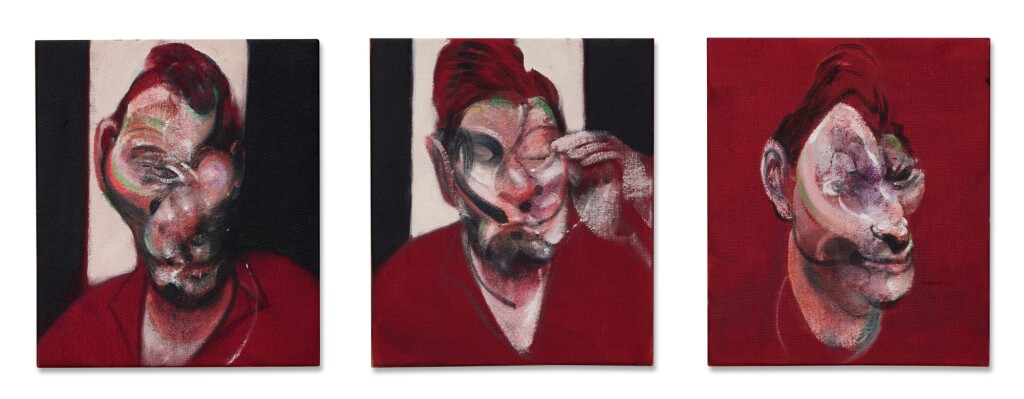
FRANCIS BACON (1909-1992), Three Studies for Portrait of Lucian Freud, 1964
The masterpiece triptych Three Studies of Lucian Freud (1969) marks the epic culmination of Francis Bacon’s relationship with fellow painter and chronicler of the human condition, Lucian Freud. Glowing in a palette of sunshine yellow and carried out in Bacon’s celebrated triptych format, the towering, life-size painting pulses with vitality. Bacon masterfully captures the psychological depths of his sitters, gesturally applying tonal layers of pink to achieve luminous portraits composed of swirling contours. Animated yet muted, Bacon accomplishes a distinct aura of pensive rumination in his work. Indeed, the portrayals are deeply personal, commemorating one of Bacon’s most profound personally and professional relationships during his lifetime.
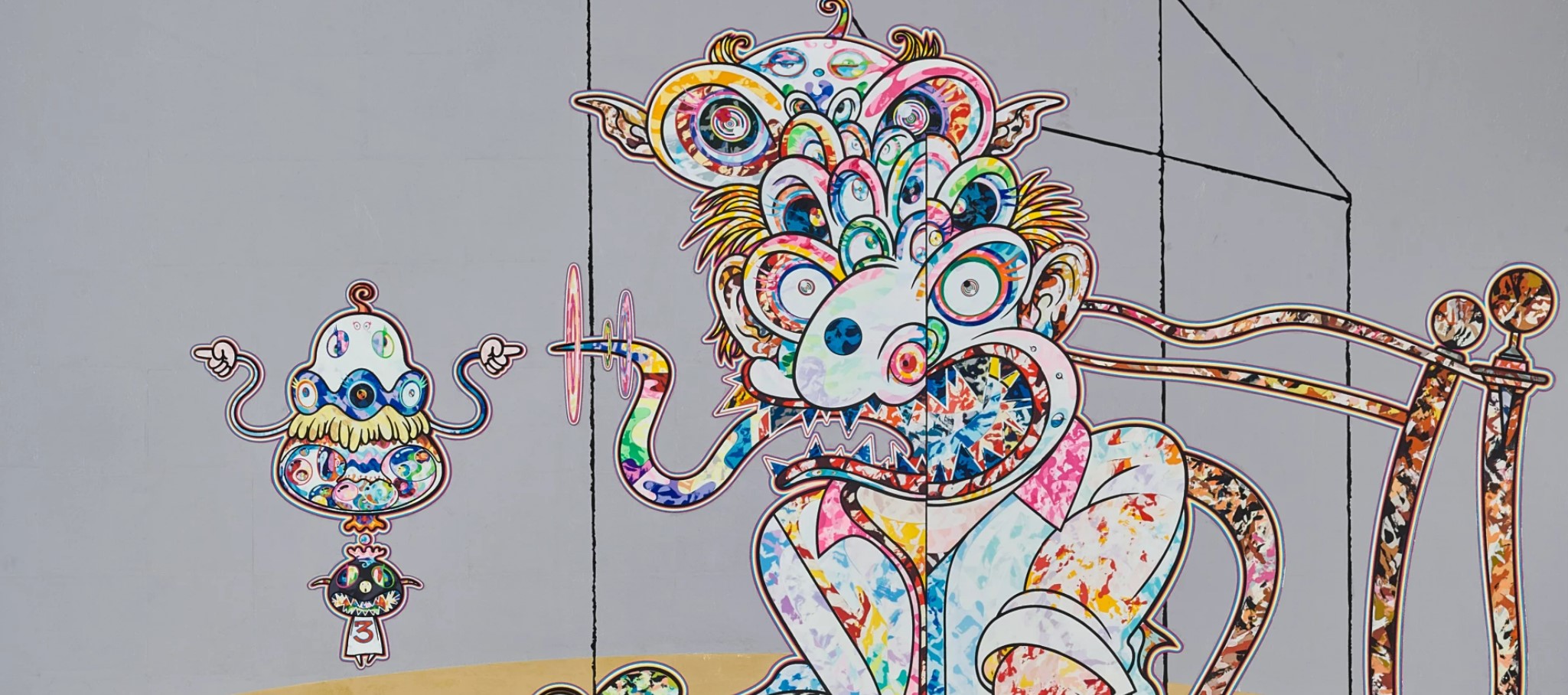
A golden masterpiece, Murakami further developed Bacon’s palette in his treatment of the background. In line with other works from Murakami’s oeuvre, the present work stands as a self-conscious integration of the pre-modern era of Japanese arts and crafts. In its incorporation of metallic leaf as a decorative ground for his portrait, the present work is directly related to such examples as the famous eighteenth-century screen by Kôrin Ogata. Echoing the repetition of Ogata’s painted iris motif composed against a ground of gold leaf across several highly lacquered panels, Murakami’s integration of an expertly applied and flawless gold ground substantiates the fundamentally classical arts and crafts aspect of the artist’s ‘Superflat’ manifesto. As seen in Homage To Francis Bacon (Three Studies of Lucian Freud), metamorphosis is ever apparent in Murakami’s work. In his reformulation of Bacon’s original triptych portrait, Murakami reconfigures his predecessor’s iconic composition in the guise of his own unique artistic vision. At each layer of the painting, both physically and psychologically, an ongoing process of transfiguration occurs. Thus, Homage To Francis Bacon (Three Studies of Lucian Freud) surpasses its surface of tribute and imitation, ultimately using comparison and amalgamation to question and explore complex Japanese identity politics in the unsettled post-war world.
Homage to Francis Bacon (Study for Head of Isabel Rawsthorne and George Dyer), 2016
Sotheby’s Hong-Kong: 9 October 2021
Estimated: HKD 5,000,000 – 7,000,000
HKD 8,524,000 / USD 1,094,968
TAKASHI MURAKAMI (B. 1962)
Homage to Francis Bacon (Study for Head of Isabel Rawsthorne and George Dyer), 2016
Acrylic and platinum leaf on canvas mounted on aluminum frame
Each: 100x100x5 cm (39.4 x 39.4 x 2 inches)
Overall: 100x200x5 cm (39.4 x 78.7 x 2 inches)
Both signed and dated 2016 on the turnover edge
Executed in 2016, Homage to Francis Bacon (Study for the Head of Isabel Rawsthorne and George Dyer) exemplifies Takashi Murakami’s audacious conflation of high and commercial art, investigating prescient societal and philosophical themes using his signature bold manga aesthetic. Known for his “Superflat” theory of art that emphasizes the flatness of Japanese visual culture, Murakami has risen to global prominence for his diverse oeuvre that draws upon elements from pop culture, history and fine art. An avid admirer of Irish-born British figurative painter, Francis Bacon, Murakami first paid tribute to the mid-twentieth century master in 2003. Since then, he has created multiple iterations of Bacon’s Studies of George Dyer and Isabel Rawsthorn, as strikingly encapsulated in the present work. In the same way Murakami pays homage to Bacon, Bacon recalls the work of famous Renaissance painter, Piero della Francesca, who masterfully depicted marriage portraits in the form of diptychs, exemplified by the widely renowned, Portraits of the Duke and Duchess of Urbino (1465-1472).
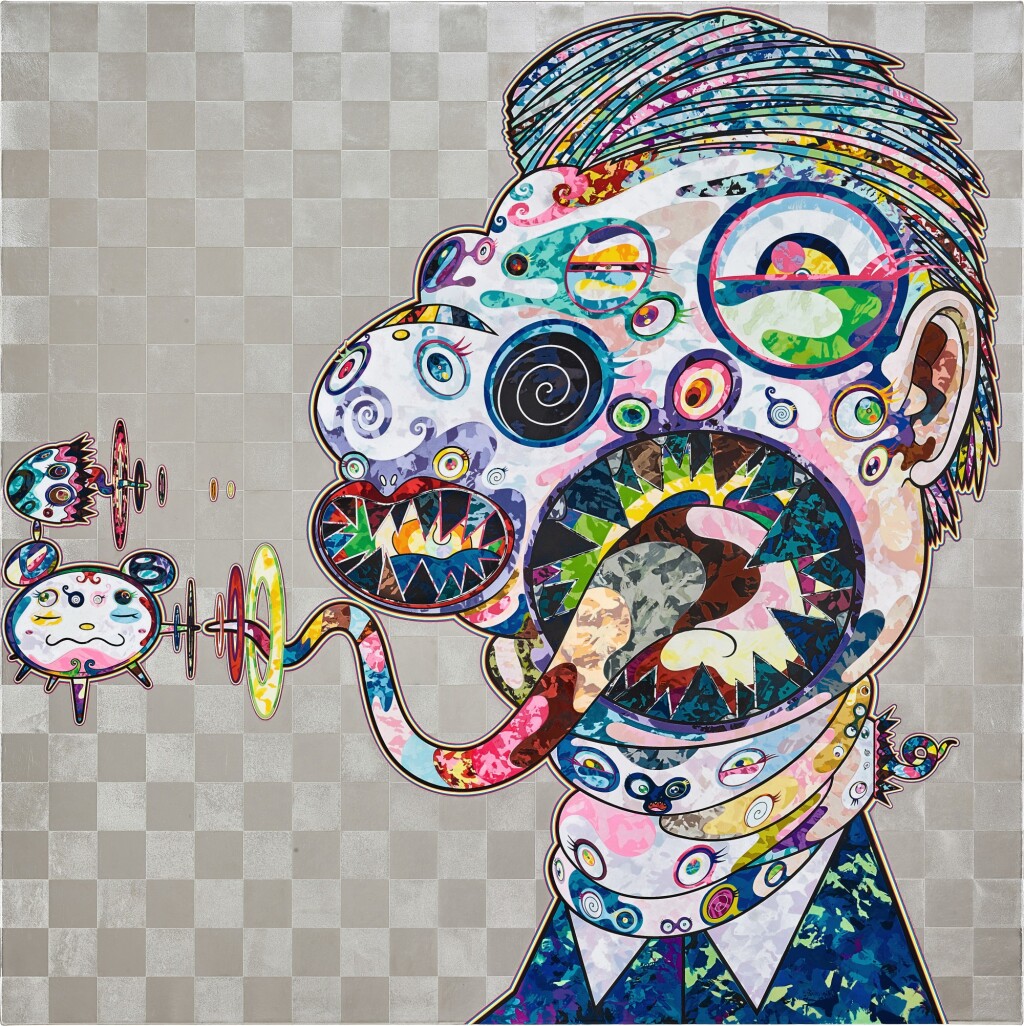
As seen in Bacon’s original Study for Head of Isabel Rawsthorne and George Dyer, executed in 1967, the dual protagonists are placed before a sumptuous backdrop of deep emerald green. Bacon masterfully captures the psychological depths of his sitters, gesturally applying tonal layers of pink to achieve luminous portraits composed of swirling contours. Animated yet muted, Bacon accomplishes a distinct aura of pensive rumination in his work. Indeed, the portrayals are deeply personal, commemorating two of Bacon’s most profound relationships during his lifetime. As the individual images magnetically conjoin in diptych format, the work quietly implies Bacon’s intimate presence in the space that exists between them.
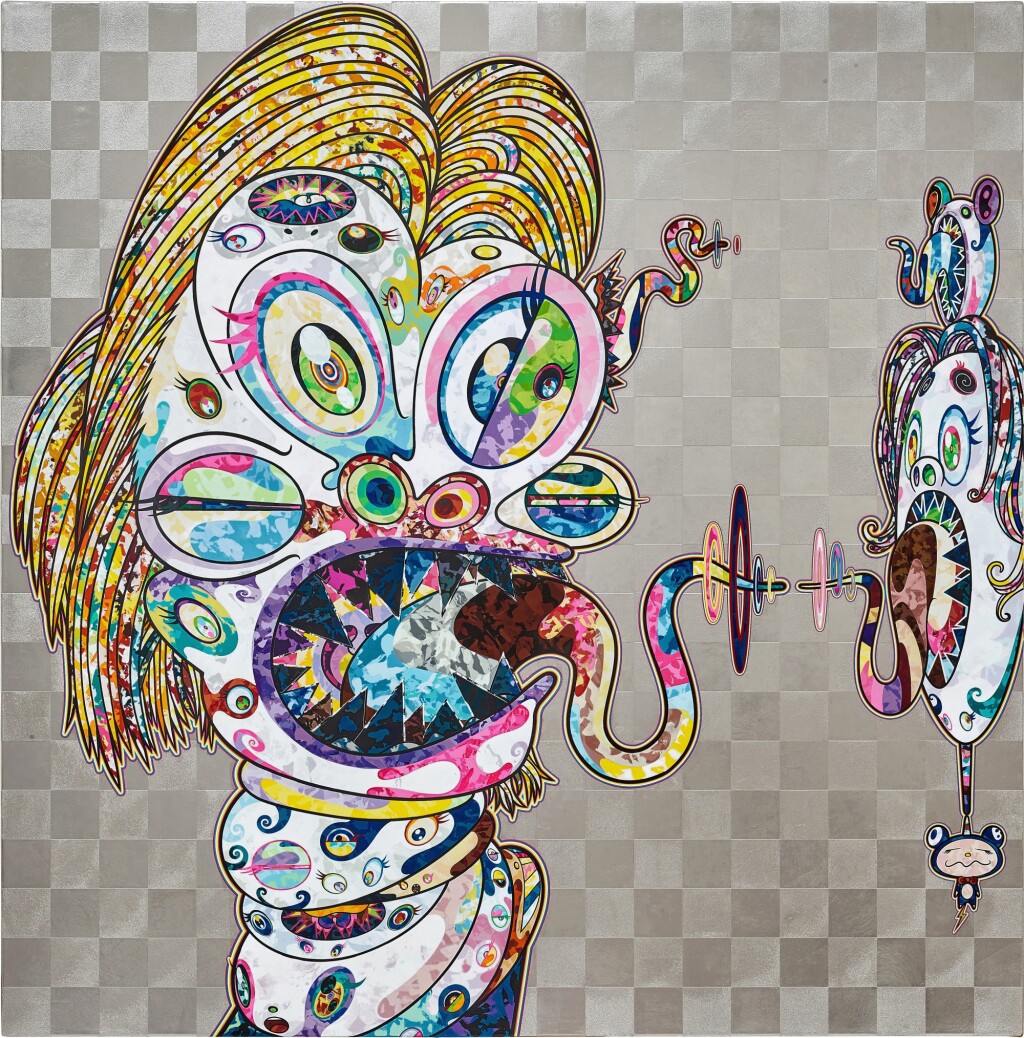
Enthralled by Bacon’s exquisite study of Isabel Rawsthorne and George Dyer, Murakami has often recalled the work of the figurative master using his “Superflat” aesthetic, incorporating his signature alter ego, Mr. DOB, into the form of the sitter. However, this dazzling work differs from the artist’s past iterations of Bacon’s Rawsthorne and Dyer, pushing the transformation and evolution of his Mr. DOB character further than ever before. While the two modified figures of Homage to Francis Bacon appear deformed, they are more anthropomorphic than cartoonish when compared to the previous tributes, a sincere nod to Bacon and his raw, visceral artistic approach to painting. The idea of the artist’s hand or presence can be similarly observed in Murakami’s rendition, with the artist maintaining his striking, signature flat, manga-inspired aesthetic. As such, Murakami’s two dimensionality, which can be observed throughout Japanese visual history, completely opposes Bacon’s application of near-sculptural brushstrokes. Further, Murakami boldly replaces Bacon’s dark palette, instead playing with bright color and hints of vibrant neon on a silver metallic surface, mixing playfulness with unexpected undertones of foreboding and contemplation.
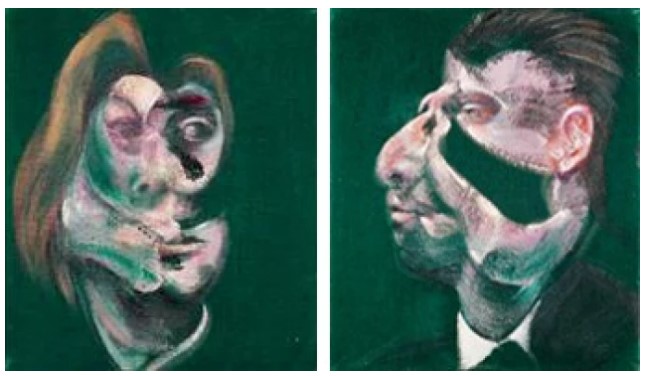
FRANCIS BACON, DIPTYCH: STUDY FOR HEAD OF ISABEL RAWSTHORNE; STUDY FOR HEAD OF GEORGE DYER, 1967© THE ESTATE OF FRANCIS BACON. ALL RIGHTS RESERVED, DACS/ARTIMAGE 2021
Beyond the visual surface of flattened pictorial planes, Murakami’s “Superflat” aesthetic also metaphorically refers to Japanese society’s increasing shift towards rampant consumerism in the postwar world. These hidden thematic implications draw out a plethora of cultural comparisons and dichotomies that Murakami consistently investigates throughout his celebrated, era-defining oeuvre. One of the key contradictions which Murakami explores in Homage to Francis Bacon, is the distinction between what is traditionally considered high and low culture. In his work, the artist merges the realms of fine art with contrasting pop and manga aesthetics, typically associated with commercial art. Further, in his choice to appropriate a Western artist, Murakami fuses aesthetics and ideas from the East and the West. This multifaceted juxtaposition teases out other political and cultural explorations, diving into the themes of Otherness and Westernized dominance in the context of the aftermath of the Second World War.
As seen in Homage to Francis Bacon, metamorphosis is ever apparent in Murakami’s work. In his 2016 reformulation of Bacon’s original dual portrait, Murakami reconfigures his predecessor’s iconic diptych in the guise of his own unique artistic vision. At each layer of the painting, both physically and psychologically, an ongoing process of transfiguration occurs. Thus, Homage to Francis Bacon surpasses its surface of tribute and imitation, ultimately using comparison and amalgamation to question and explore complex Japanese identity politics in the unsettled post-war world. Murakami powerfully pioneers a critical perspective on art, life, and society, forging a completely novel branch of Japanese art.
Yves Klein
An Homage to IKB, 1957 E, 2012
Sotheby’s Hong-Kong: 29 March 2025
Estimated: HKD 5,500,000 – 10,000,000
HKD 9,525,000 / USD 1,224,293
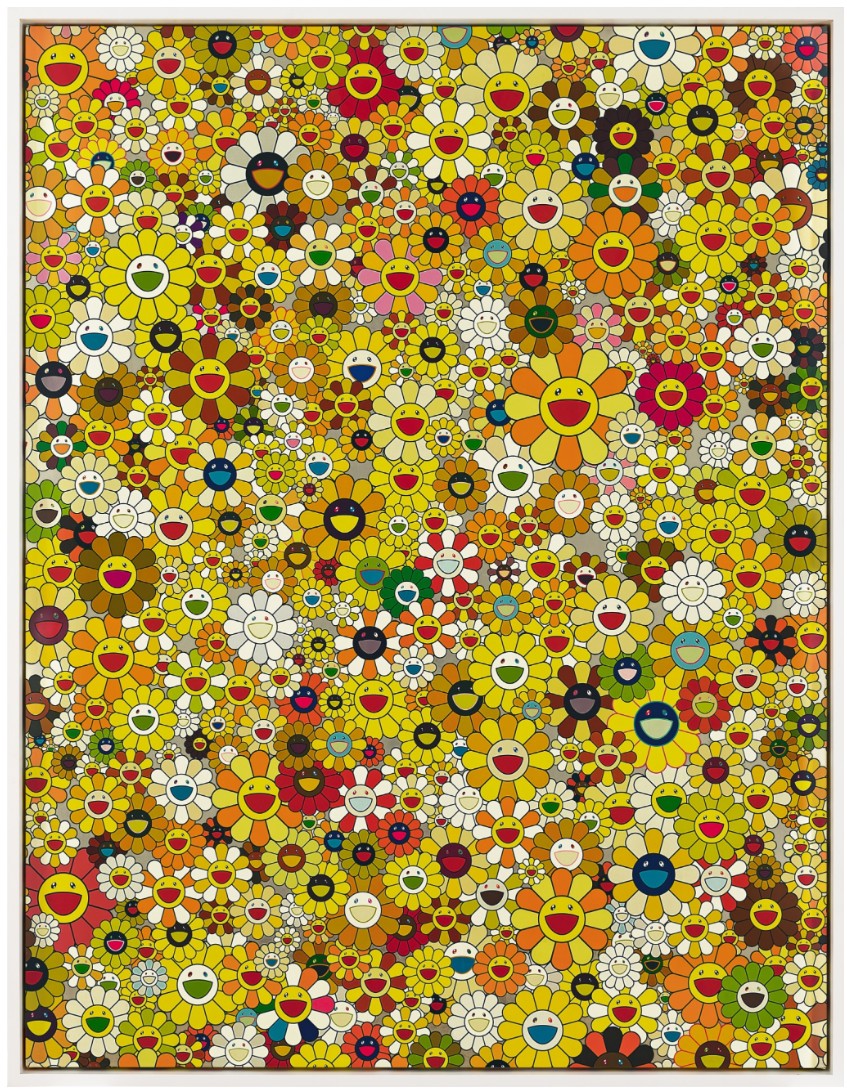
TAKASHI MURAKAMI (b. 1962)
An Homage to IKB, 1957 E, 2012
Acrylic on canvas mounted on board
199×153 cm (78 3/8 x 60 1/4 inches)
Signed and dated 2012 (on the overlap)
© 2012 Takashi Murakami/Kaikai Kiki Co., Ltd. All Rights Reserved
Smiling flowers represent the hallmark and signature motif of Takashi Murakami’s extraordinary and ambitious artistic enterprise. An Homage to Monogold 1960 E (2012) is a meticulously rendered example of the artist’s characteristic style: each of the densely layered smiling flowers is hand painted with immaculate precision to deliver a sense of digital-like perfection. Dominated by a rich array of chrome yellow and orange hues punctuated by a glowing mixture of spectral shades and neon highlights, the present work is immediately impactful and a visually stunning paradigm of the multi-layered yet obsessively flat production of Takashi Murakami. An Homage to Monogold 1960 E is part of a series of paintings paying tribute to Yves Klein’s monochromatic works which have influenced Murakami’s oeuvre since the early 1990s. The present work, as eluded by its title and vivid yellow palette, pays direct homage to Klein’s first Monogolds, which were created in the early 1960s, using delicate gold leaves in their composition. However, instead of Klein’s monochromatic surface, Murakami’s painting is made up of countless flowers in various colours.
The smiling flower, Murakami’s worldly recognized motif, was first created in 1995. This motif is instantly recognizable and considered to be the intersection of today’s art, fashion, and culture. Entrenched in the ancient Eastern practice of decorative flower painting on traditional lacquered panels, Murakami engenders a new expression for Japanese high-art that encompasses the mythology, craft and skill of Japan’s past with the pervasive and highly commercial visual culture that has developed in Japan since the Second World War. Trained in the traditional Japanese art movement of Nihonga, the artist has also found inspiration in everything from manga and anime to Buddhist forms and iconography. His practice invokes an artistic plurality disconcertingly underscored by the profound impairment of Japanese culture in the aftermath of the Second World War. Murakami confronts the literal and metaphoric “flattening” of Japanese culture—heralded by the atomic bombing of Hiroshima and Nagasaki in 1945 and exacerbated by the dominance of Western surveillance and influence thereafter—in his oeuvre, united by the term Superflat. An Homage to Monogold 1960 E perfectly synthesizes the artist’s Superflat series and his spiritual and cultural interests.
Time Bokan
Time Bokan – Black + Moss Green, 2006
Christie’s New-York: 29 September 2023
Estimated: USD 300,000 – 500,000
USD 258,300
TAKASHI MURAKAMI (B. 1962) (christies.com)
TAKASHI MURAKAMI (B. 1962)
Time Bokan – Black + Moss Green, 2006
Acrylic on canvas mounted on panel
180×180 cm (71×71 inches)
Signed and dated ‘TAKASHI 06’ (on the reverse); stamped (on the reverse)
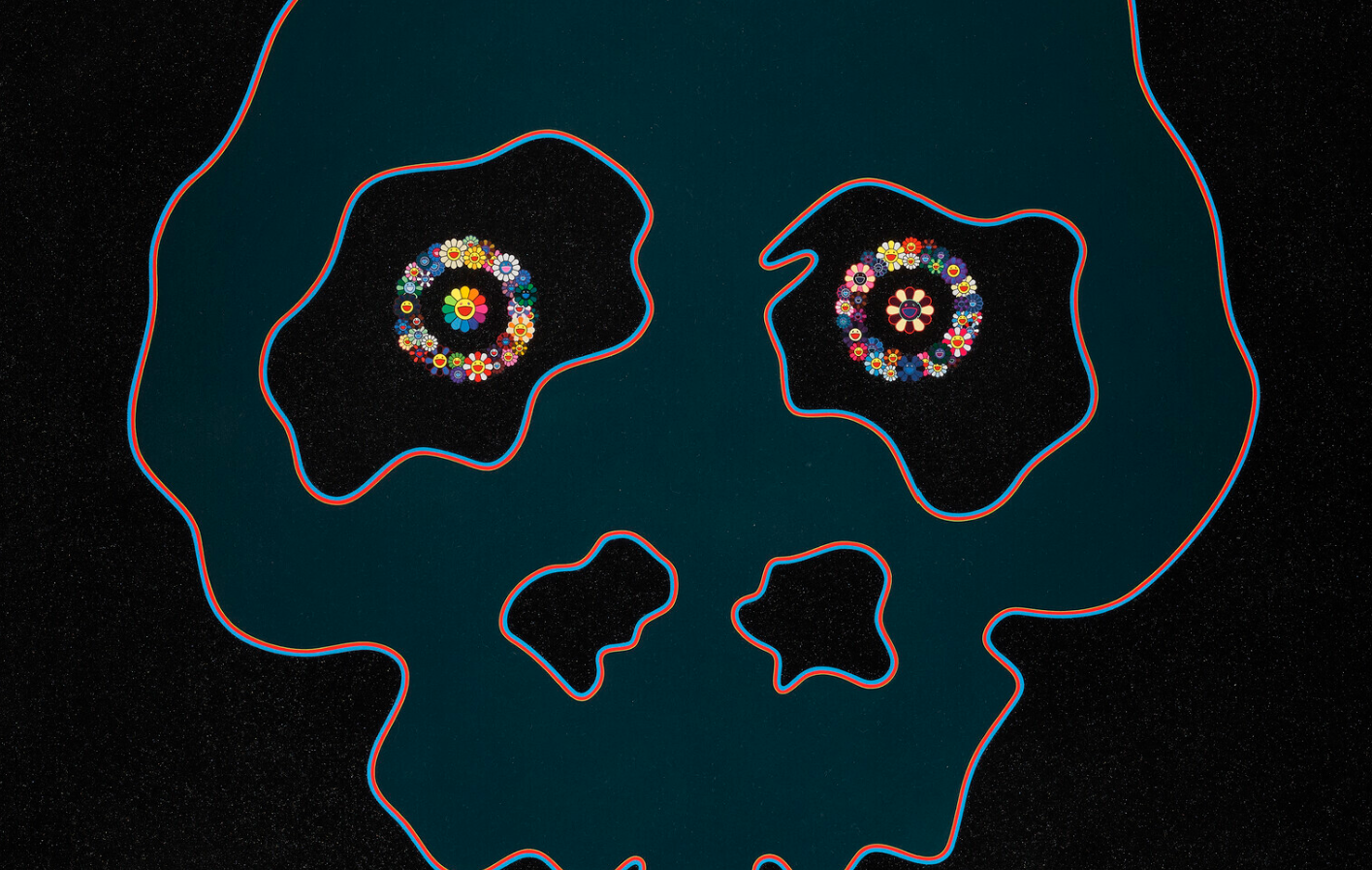
Our eyes are then drawn to the upper edge of the composition, where we see a bright orange skeleton. Its vibrant orange hue stands in stark contrast to the dark, black expanse of the background and the moss green skeleton, creating a Pop Art-esque effect that disrupts the visual continuity. As the viewer’s gaze shifts to this smaller skeleton, curiosity arises, prompting contemplation about its purpose within the narrative. Unlike the moss green skeleton with its floral eyes, the smaller skeleton’s eyes remain blank, devoid of any iconic Murakami flowers. This intentional absence of floral motifs sets it apart, hinting at a different significance and role in the artistic narrative. The skeleton’s striking yellow outline imparts a sense of fantasy and even hints at a possible parental connection to the larger skeleton. It seems to be a predecessor, an ancestral figure from which the larger one may have emerged. The brilliance of its bright color creates an illusion of depth, despite being confined to the two-dimensional realm of the picture. The effect is such that it almost appears to pop out of the composition, as if bridging the gap between the two-dimensional sphere of the artwork’s surface the and three-dimensional world in which it exists. This optical illusion draws the viewer deeper into the artwork, blurring the line between the real and the imagined.
Time Bokan – Pink, 2001
Christie’s New-York: 18 May 2023
Estimated: USD 300,000 – 500,000
USD 756,000
TAKASHI MURAKAMI (B. 1962) (christies.com)
TAKASHI MURAKAMI (B. 1962)
Time Bokan – Pink, 2001
Acrylic and canvas mounted on panel
180×180 cm (70 7/8 x 70 7/8 inches)
Doraemon
Doraemon Yay!, 2019
Sotheby’s Hong-Kong: 6 April 2023
Estimated: HKD 2,800,000 – 3,800,000
HKD 4,318,000 / USD 550,056

TAKASHI MURAKAMI (b. 1962)
Doraemon Yay!, 2019
Acrylic and platinum leaf on canvas mounted on wood panel
119.2 x 93 cm (46 7/8 x 36 5/8 inches)
Signed and dated 2019 on the reverse
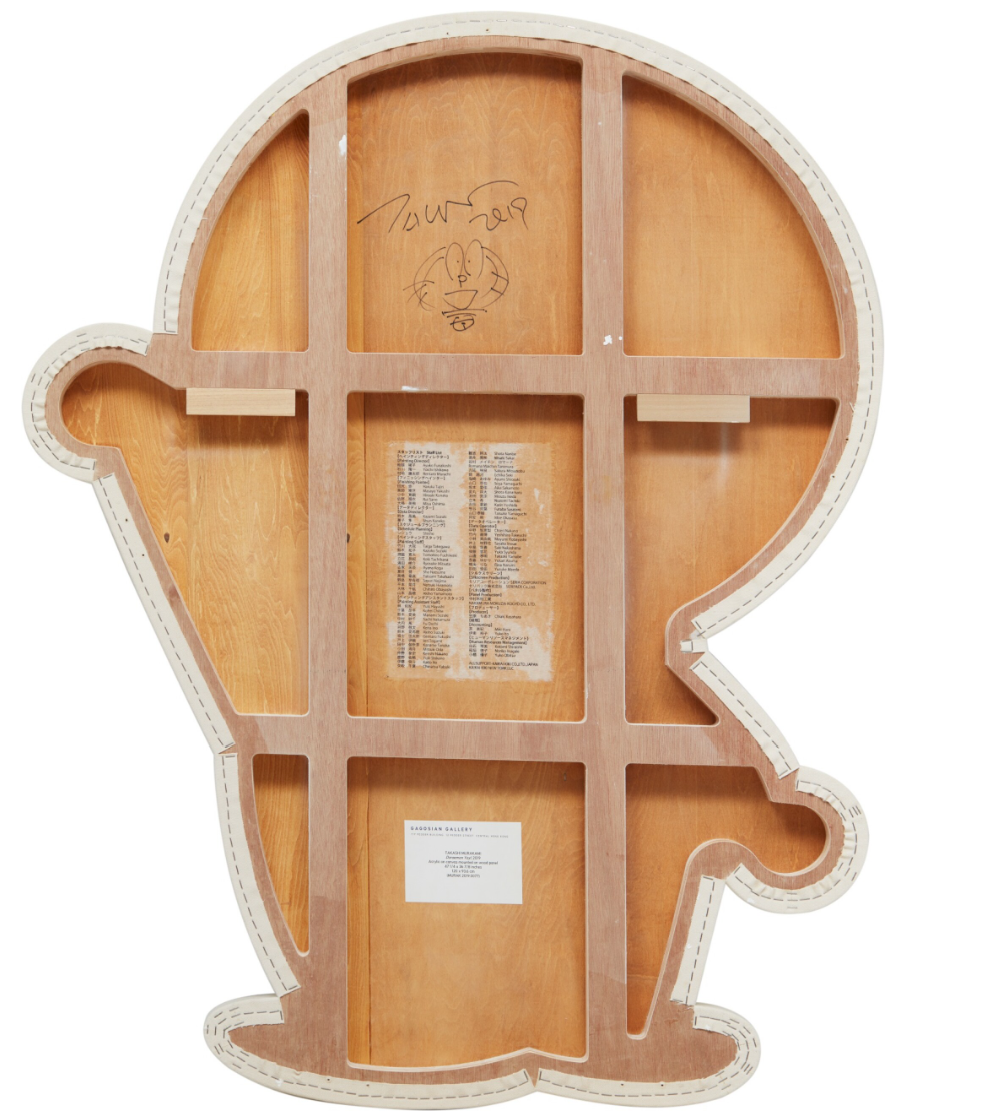
Doraemon Sitting Up: Weeping Some, Laughing Some, 2020
Sotheby’s Hong-Kong: 19 April 2021
Estimated: HKD 2,800,000 – 3,800,000
HKD 4,410,000

TAKASHI MURAKAMI (b. 1962)
Doraemon Sitting Up: Weeping Some, Laughing Some, 2020
Acrylic and platinum leaf on canvas mounted on wood panel
122.9 x 94 x 4.8 cm (48 3/8 x 37 x 1 1/8 inches)
Signed and dated 2020 on the reverse
Doraemon Sitting Up: Weeping Some, Laughing Some by Takashi Murakami is a unique shaped canvas featuring the classic Japanese manga series Doraemon. Murakami’s fixation with Doraemon dates back to his landmark 2005 exhibition Little Boy; in the catalogue, Murakami interpreted Doraemon against the context of Japan’s recent history, comparing the plight of the character Nobita to the overall sentiment of postwar Japan. Shortly after Little Boy, Murakami was asked to contribute to Doraemon creator Fujiko F. Fujio’s Please Make Your Own Doraemon exhibition. Later in 2017, Murakami created the main visual for The Doraemon Exhibition Tokyo at the Mori Arts Center Gallery in Tokyo, and also designed collaborative T-shirts with Uniqlo featuring the Doraemon character. A self-described manga geek, Murakami’s aesthetic brings together high and low art, fusing the motifs and philosophies of traditional masters and commercial artwork – manga and anime in particular.
The cheerful and iconic Doraemon Sitting Up: Weeping Some, Laughing Some represents a consummate expression of Takashi Murakami’s artistic enterprise executed in line with his meticulously exacting standards: flawlessly rendered with digital-like perfection, the piece is an immediately impactful paradigm of the historically multi-layered yet fetishistically flat production of Murakami.
One of the most acclaimed postwar Asian artists to have reached superstar status in the international art world, Murakami is celebrated for his era-defining oeuvre that merged contemporary pop culture with fine art. First introducing his revolutionary ‘Superflat’ philosophy in the 1990s, Murakami’s works draw on everything from anime and manga to Buddhist forms and iconography to Pop and Abstract Expressionism, while his highly organized production methods fused art and commercial enterprise in a way that took Andy Warhol’s vision to a new level. While trained in the Japanese art of Nihonga, a highly regimented and traditional form of art, Murakami’s wholly unique and contemporary aesthetic moves seamlessly amongst diverse roles as artist, producer, theorist, curator, designer, businessman and celebrity, rendering him an unprecedented phenomenon in the global cultural scene. With his numerous collaborations with luxury brands such as Louis Vuitton, Murakami’s hybridized art not only put Japanese pop culture onto the global map of contemporary art but uses it to reference and embody the overwhelming phenomenon of cultural collisions occurring all over the world.
Other Series
Blackbeard (White), 2003
Sotheby’s London: 17 October 2025
Estimated: GBP 150,000 – 200,000
GBP 317,500 / USD 425,450
Blackbeard (White) | Contemporary Day Auction | 2025 | Sotheby’s
TAKASHI MURAKAMI (b. 1962)
Blackbeard (White), 2003
Acrylic on canvas mounted on panel
150×150 cm (59×59 inches)
Signed, signed with the artist’s monogram, dated 03 and variously inscribed (on the reverse)
Takashi Murakami’s 2003 painting Blackbeard (White) is an exceptional example of his highly celebrated and iconic Superflat works. Through a brilliantly innovative combination of otaku and manga iconographic lexica, Murakami seamlessly melds a host of wide-ranging art historical traditions from ancient Japanese culture to American Pop of the 1960s. This composition, featuring multiple eyes spinning around each other in colorful hyperactive psychedelic swirls, is one of the most immediately recognizable trademarks of Murakami’s influential oeuvre. In contrasting a monochrome, checkered background with his signature eye motifs – or ‘Jellyfish Eyes’ he draws on imagery of the worlds of Yokai, traditional Japanese monsters, as well as from manga comic graphics, animation and computer games.
“We want to see the newest things. That is because we want to see the future, even if only momentarily. It is the moment in which, even if we don’t completely understand what we have glimpsed, we are nonetheless touched by it. This is what we have come to call art.”
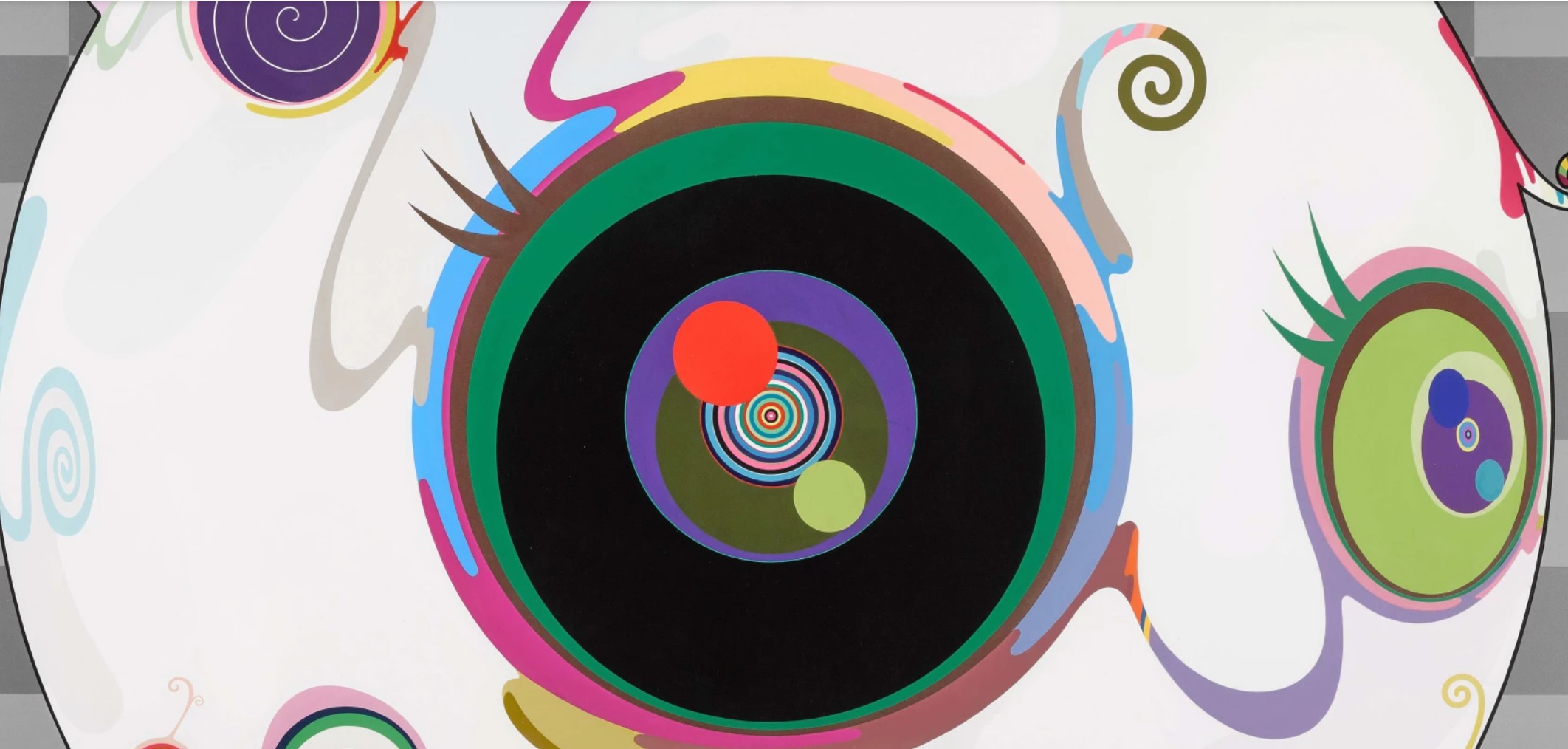
The artist’s fascination with the eye lies in its unique ability to visually communicate whereby one simultaneously sees and is seen. In Blackbeard (White), Murakami’s multiplied ‘Jellyfish Eye’ motifs immediately return our gaze. This double role has fascinated artists for centuries and continues a millennia-old artistic tradition that explores the direct visual connection between the viewer and the viewed. From Velazquez’ Portrait of Pope Innocent X to Duchamp’s Rotoreliefs and Magritte’s The False Mirror, artists have repeatedly employed the iconography of the eye as the implicit portal to hidden truths.
“The image of the eye arouses the sensation of being watched. This sensation often involves a feeling of uneasiness, or even obsessional fear. This is why the Surrealists used the motif of the eye so much in their works…I discovered that the presence of eyes as a motif incites spectators to interact with the work.. Thus I was able to combine two important elements of pictorial language – “design” and “dialogue” – in my work…I place this eye motif in places where I want the spectators’ gaze to pass and, eventually, stop.”
Blackbeard (White) can be considered the ultimate manifestation of Murakami’s Superflat philosophy, which draws on the flat picture planes of traditional Japanese painting from the Edo period as well as the visual forms of modern-day animated films and contemporary culture. By combining these visual traditions and correlating their shared emphasis on flatness, Murakami dismantles the distinction between high and low culture.
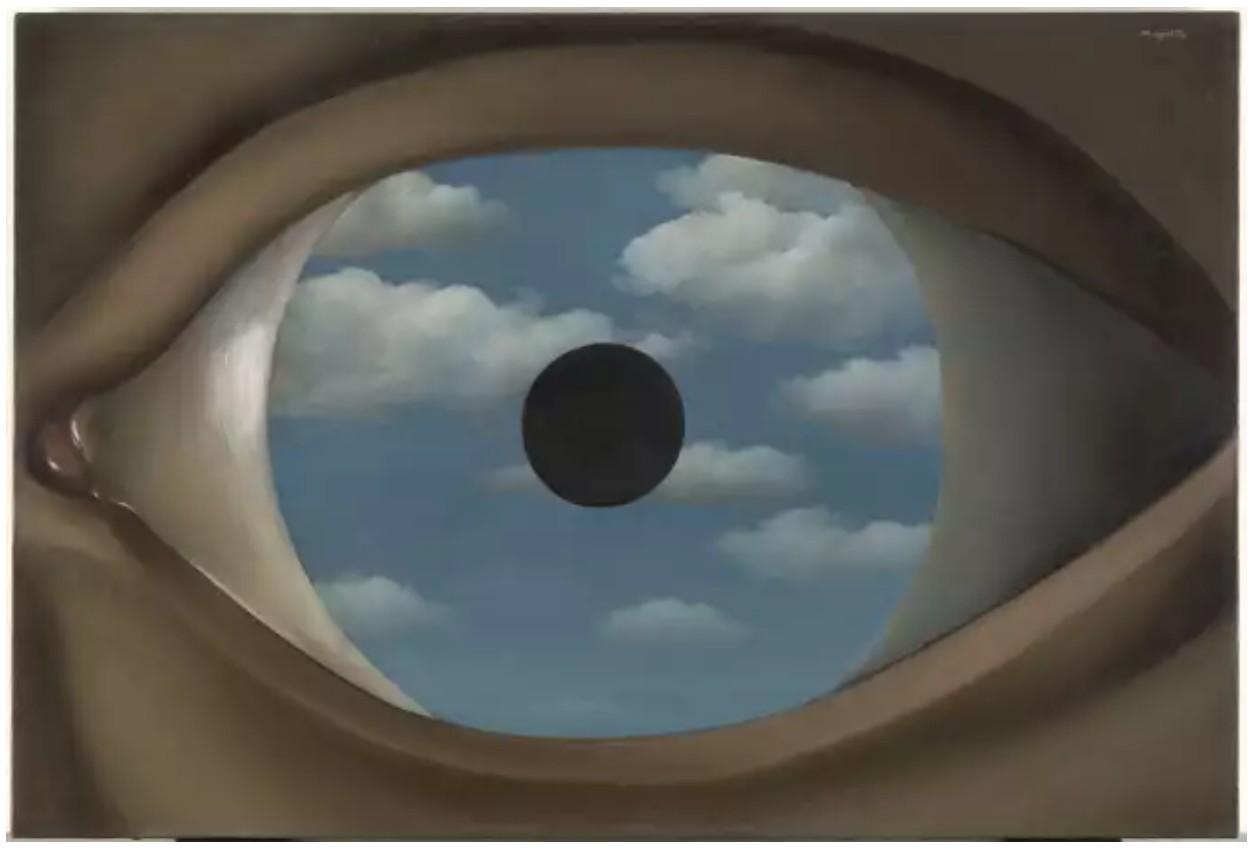
Rene Magritte, The False Mirror (Le Faux Miroir), 1928
Image: © Digital image, The Museum of Modern Art, New York/Scala, Florence
Artwork: © ADAGP, Paris and DACS, London 2025
While resolutely opposed to his art being interpreted as derivative from American Pop Art, Murakami’s paintings show undeniable echoes of Pop Art. Forty years prior to the execution of this painting, Pop artists like Andy Warhol and Roy Lichtenstein revolutionized western artistic practices by adopting commercial imagery from mass media, newspaper advertisements and comic strips as the subjects of their paintings. In the present work, Murakami similarly draws on otaku culture, the emergent celebration of ‘geek’ culture that stems from animated movies (anime), science fiction and manga, and embodies a certain kawaii (cuteness) quality that is derived from the world of Walt Disney and of cartoon characters developed in the United States in the early 1950s, as well as Japanese variations such as Hello Kitty and Pokemon. With its vibrant colours, immaculately flat surface, and interplay of historical and contemporary references, Blackbeard (White) inevitably encapsulates Murakami’s distinctive fusion of tradition and popular culture. At once playful and historical, the present work reflects Murakami’s unique and sophisticated engagement with both historical sources and global popular culture.
Kōrin: Tranquility, 2015
Christie’s New-York: 18 May 2023
Estimated: USD 500,000 – 700,000
USD 630,000
TAKASHI MURAKAMI (B. 1962) (christies.com)
TAKASHI MURAKAMI (B. 1962)
Kōrin: Tranquility, 2015
Acrylic and platinum and gold leaf on canvas mounted on panel
Diameter: 150 cm (59 inches)
Signed and dated ‘Takashi 2015’ (on the reverse)
I open wide my eyes but see no scenery. I fix my gaze upon my heart, 20o7
Christie’s New-York: 18 May 2023
Estimated: USD 800,000 – 1,200,000
USD 529,200
TAKASHI MURAKAMI (B. 1962) (christies.com)
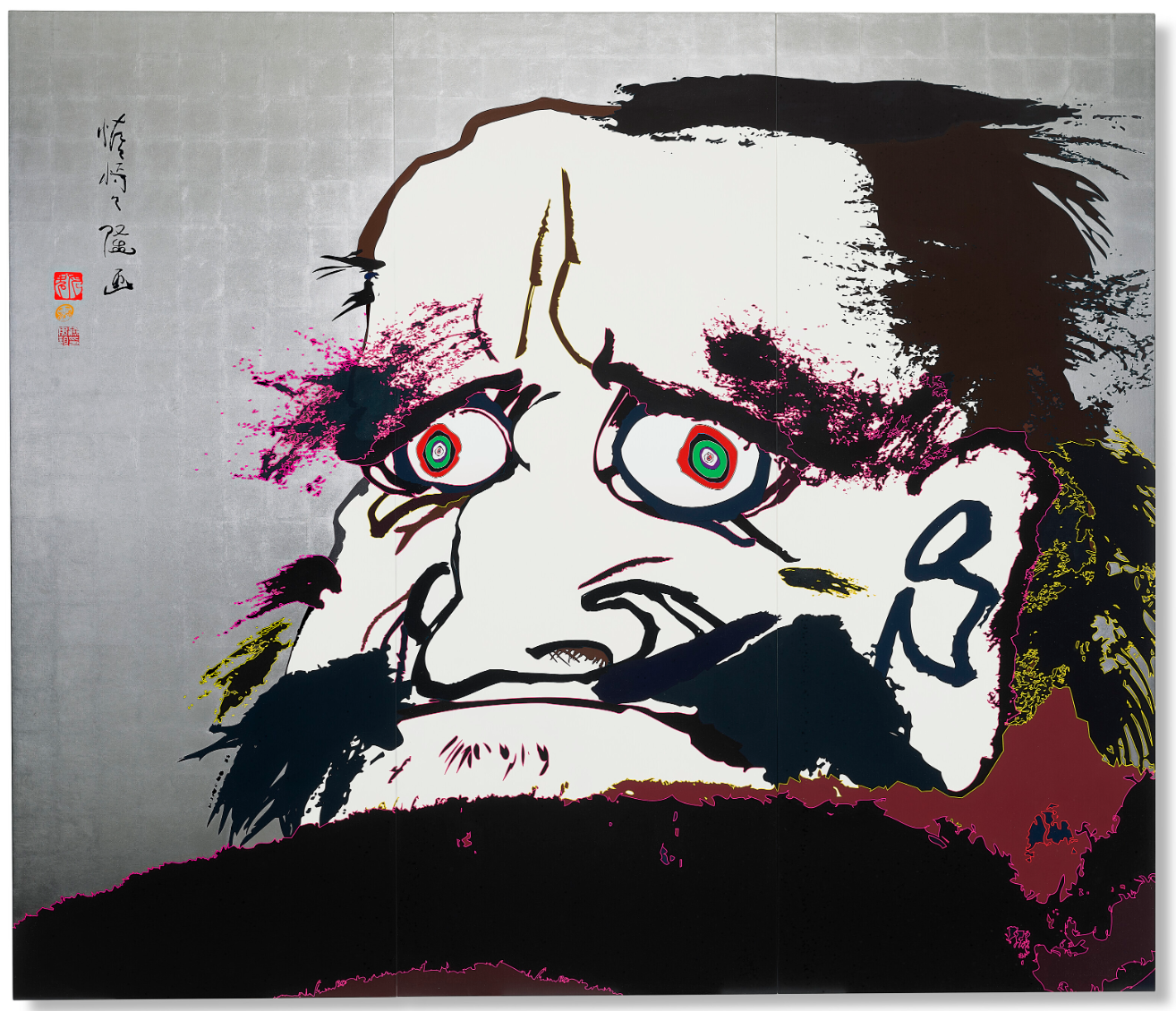
TAKASHI MURAKAMI (B. 1962)
I open wide my eyes but see no scenery. I fix my gaze upon my heart, 20o7
Acrylic and platinum leaf on canvas mounted on panel, triptych
242.6 x 282 cm (95 1/2 x 111 inches)
Signed ‘Takashi’ (on the reverse of the center panel)
A striking example of Takashi Murakami’s indebtedness to historical art forms, I open wide my eyes but see no scenery. I fix my gaze upon my heart. is a monumental composition that combines contemporary forms and practices with a marked tribute to traditional methods and the artists that came before. Adding the likeness of a Buddhist monk to his cast of characters that includes Mr. DOB and the spritely Kaikai and KiKi, Murakami further conflates the realms of popular culture and high art. Sifting through the visual world, Murakami goes “back into his catalogue of motifs and references, chew(s) them up, and spit(s) them back out in a newly reimagined form,” observes curator Michael Darling (M. Darling, Takashi Murakami: The Octopus Eats its Own Leg, Chicago, 2017, p.22). Parsing Japanese and Western traditions through his own particular lens, Murakami has built up a visual vocabulary that borrows equally from art history and the commercial realm.
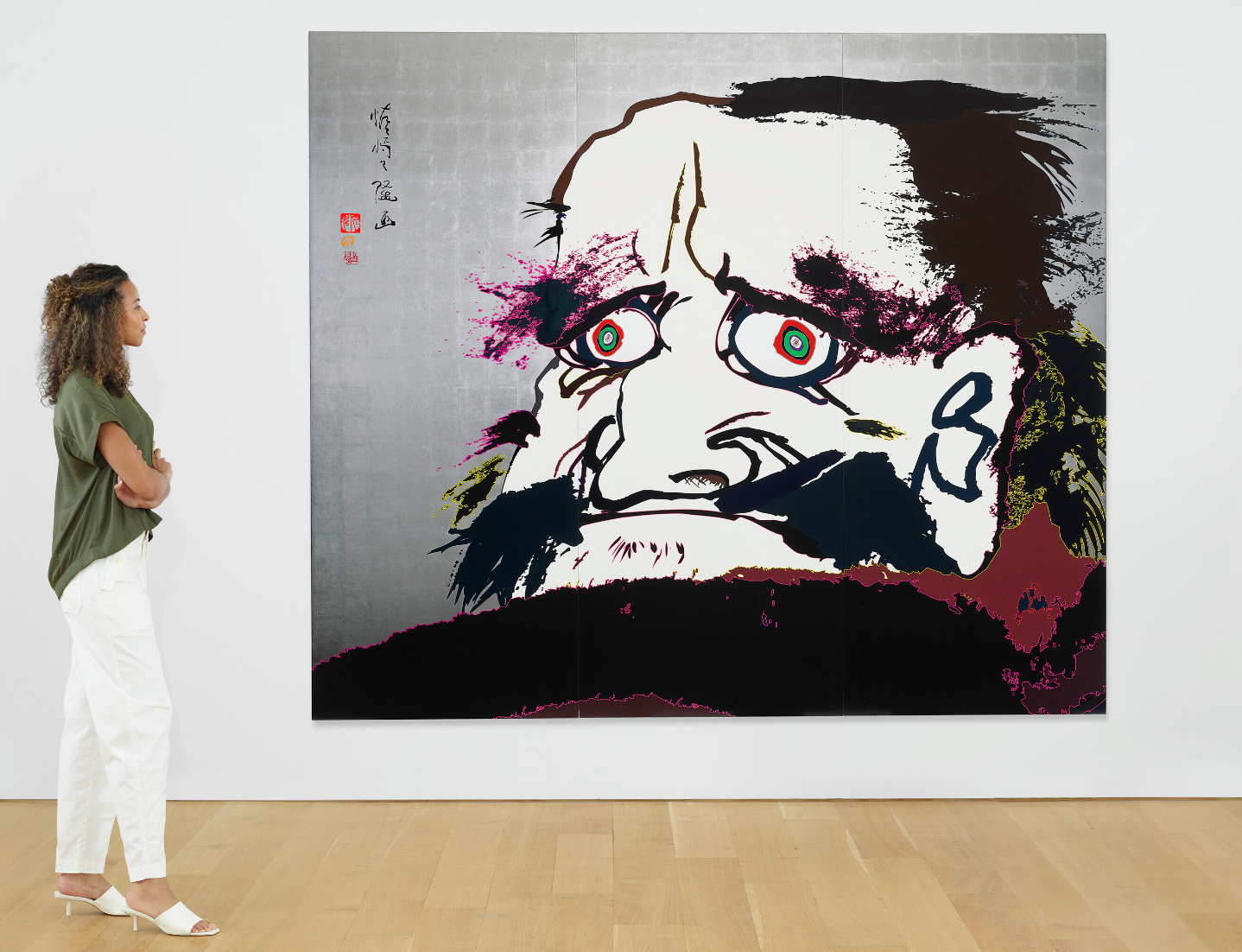
First debuted at the artist’s 2007 gallery exhibition in New York, the present example is one of four large-scale paintings that depict a stylized rendering of Daruma, the sixth-century Indian monk who brought Zen Buddhism to China. Traditionally shown in ink paintings with exaggerated and almost grotesque features, the monk is rendered here in the expressive, free style of brush painting yet is also supplemented with flairs of color and cartoon-like elements that have become Murakami’s signature. The entire composition on three panels is overwhelmed by a monstrous head with bulging eyes that sport hypnotic pupils in red and green. Around the edges of the subject’s bushy eyebrows and unruly hair, colorful flecks that resemble digital artifacts mix with the deep black. The face is visually separated from the rest of the painting which gives the entire work a flat, graphic quality. Composed of delicately applied platinum leaf squares, the faint grid that results is reminiscent of traditional Japanese screens and artworks with similar aesthetics. Often referred to as the Warhol of Japan, the silver background also recalls the iconic Silver Liz paintings of Andy Warhol from the early 1960s.
NGC2371-2 (Gemini Nebula), 2009
Sotheby’s Hong-Kong: 6 April 2023
Estimated: HKD 2,000,000 – 3,000,000
HKD 4,826,000 / USD 614,769
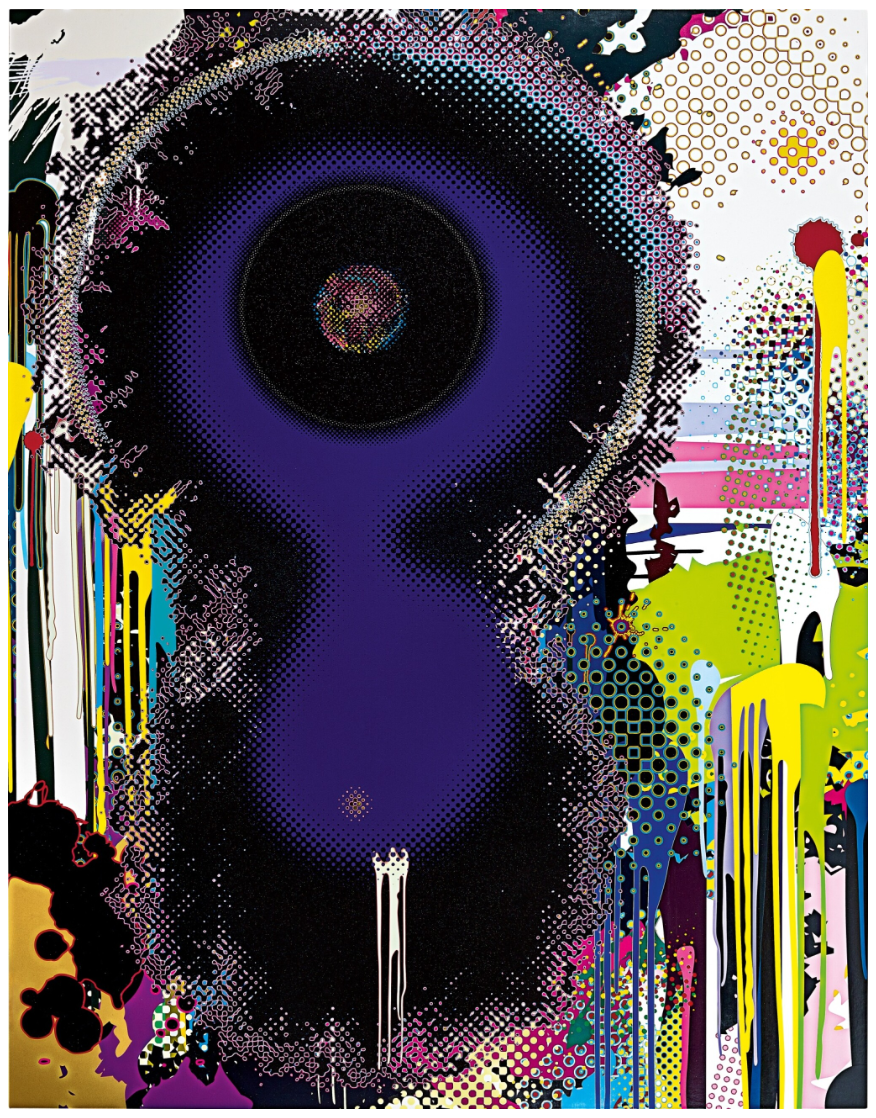
TAKASHI MURAKAMI (b. 1962)
NGC2371-2 (Gemini Nebula), 2009
Acrylic, platinum leaf and gold leaf on canvas, mounted on aluminum frame
300.5 x 234.5 cm (118 1/4 x 92 3/8 inches)
Signed and dated 09 on the turnover edge
Playful and Carefree, 2010
Christie’s New-York: 12 November 2021
Estimated: USD 250,000 – 350,000
USD 187,500
TAKASHI MURAKAMI (B. 1962) (christies.com)
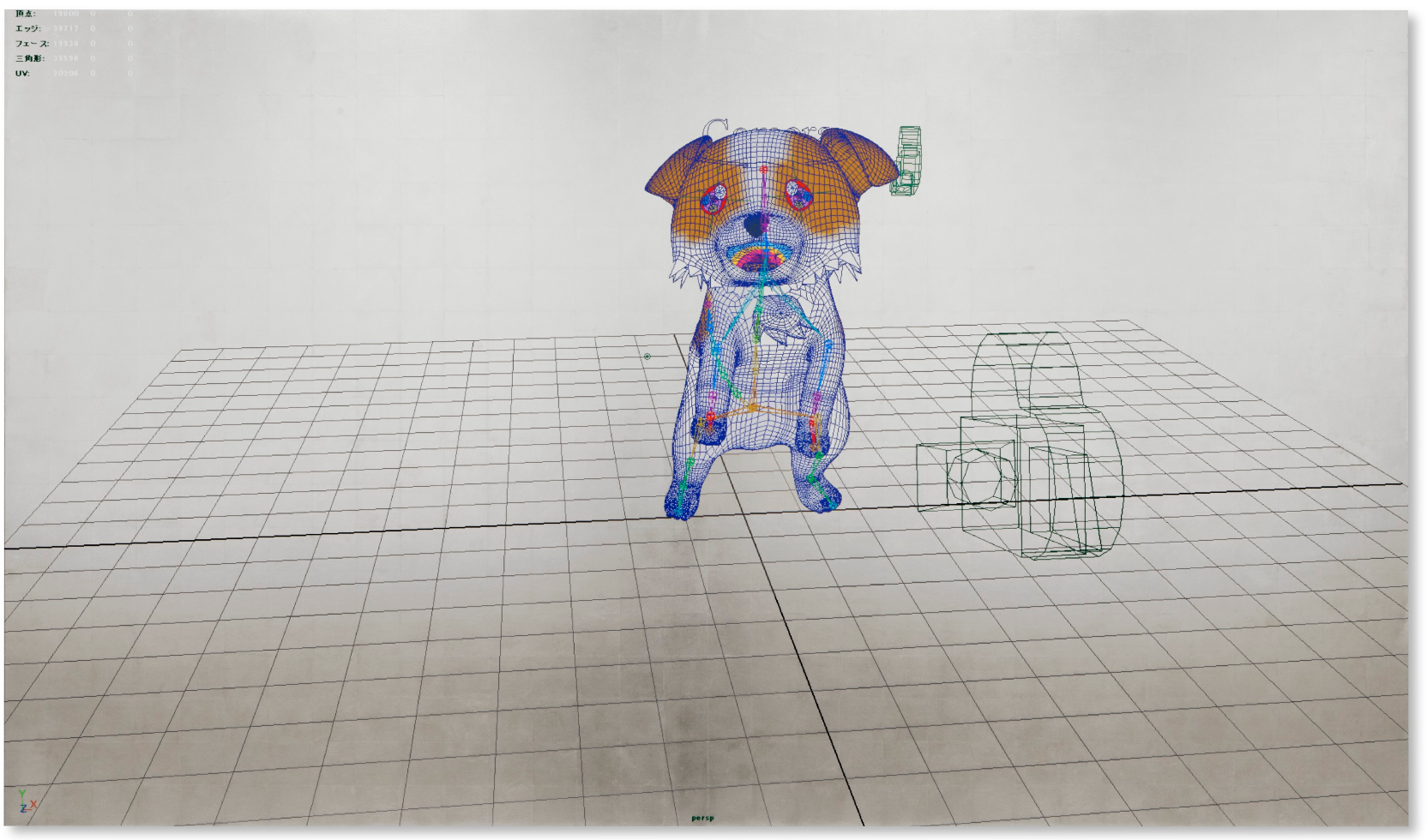
TAKASHI MURAKAMI (B. 1962)
Playful and Carefree, 2010
Acrylic and platinum leaf on canvas
200.7 x 343.5 cm (79 x 135 1/4 inches)
Signed and dated ‘TAKASHI 2010’ (on the overlap)
Smooth Nightmare, 2001
Sotheby’s London: 29 June 2021
Estimated: GBP 350,000 – 450,000
GBP 402,200 / USD 556,832
TAKASHI MURAKAMI (b. 1962)
Smooth Nightmare, 2001
Acrylic on canvas mounted on board
160×160 cm (63×63 inches)
Signed, dated 01, and variously inscribed on the reverse
Presenting a sensory psychedelic deluge of intricately rendered quasi-woodland creatures, Smooth Nightmare is a consummate expression of Takashi Murakami’s imitable creative spirit. Executed in 2001, only a year after the artist had summarised his revolutionary artistic vision and ‘Superflat’ manifesto, the present work merges a contemporary Pop and Manga aesthetic with principals from the pre-modern era of Japanese culture. Immediately impactful this piece is a paradigm of Murakami’s historically multi-layered yet fetishistically ‘flat’ production; with it’s a seamless surface perfection and archetypal iconography, Smooth Nightmare is positioned at the very apex of the artist’s critically acclaimed and breakthrough body of work.
HIERONYMUS BOSCH, THE GARDEN OF EARTHLY DELIGHTS, OR THE PAINTING OF THE ARBUTUS (DETAIL), 1500 – 1505
MUSEO NACIONAL DEL PRADO, MADRID / IMAGE: © MUSEO NACIONAL DEL PRADO © PHOTO MNP / SCALA, FLORENCE 2021
At the base of a looming many-eyed mushroom, a panoply of playful woodland creatures engage in a procession along the bottom edge of the composition. The palette and design of the present work, its vivid pools of colour with hints of neon, playfully nods to the mushroom’s place in the history of psychedelics. As well as conferring a hallucinogenic effect, the prominence of eyes in this piece has an autobiographical connotation: as a child Murakami admired the work of the Japanese manga artist Shigeru Mizuki, in particular a character named ‘Hyakume’ (meaning Hundred Eyes). Featured on the front cover of the artist’s Superflat manifesto in 2000, eyes are a talismanic icon for Murakami. First created as an accessory to Murakami’s most important character and alter-ego, Mr. DOB, mushrooms gradually became more prevalent in the artist’s practice. Murakami was inspired to create his mushrooms in a fortuitous way; while visiting a museum devoted to the art of the Japanese painter Yumeji Takehisa, who is renowned in Japan for his depictions of beautiful women, Murakami was fascinated by a number of hand towels Takehisa had designed in the early Twentieth Century following a more Western style.
SALVADOR DALI, SLEEP, C. 1937 / PRIVATE COLLECTION / IMAGE: © BRIDGEMAN IMAGES
ARTWORK: © SALVADOR DALI, FUNDACIÓ GALA-SALVADOR DALÍ, DACS 2021
Entrenched in the ancient Eastern practice of decorative painting on traditional lacquered panels, Murakami engenders a new expression for Japanese contemporary art that combines the mythology, craft and skill of Japan’s past with the pervasive commercial aesthetic and seamless-factory-produced appeal that proliferated following the Second World War. In forging an aesthetic grounded in the special effects of animé and manga, the artist invented a style of high-art for the culturally dislocated Japanese generation, a generation that had matured under the political custody of the United States after World War II. Exposed to the American capitalist model, Japanese culture underwent a negation of traditional heritage in the post-war era. This in turn fostered an impoverished culture that lacked self-reflective tradition or spiritual depth; what emerged in its place was a youth-led comic-book subculture known as otaku. Emblematically present within the excessive almost fetishistic detail and two-dimensional childlike appeal of Murakami’s creature clad composition, Smooth Nightmare is the very quintessence of the artist’s response to such cultural conditions. While Murakami remains strongly affiliated with Japan’s manga and animé driven otaku subculture, he also makes visual references to the school of Nihonga, which he studied extensively at University. Nihonga was formed at the end of the Nineteenth Century in response to the influx of techniques that came as a result of the Westernisation of Japan and the rise of the Westernised school of art called Yoga. Nihonga, on the other hand, accepted contemporary subject matters whilst retaining the traditional techniques of Japanese painting. This traditional school emphasised the importance of outline and flat backgrounds, both of which are crucial elements in Murakami’s own distinctive style. The decorative background and lack of perspective in Smooth Nightmare can thus be seen as an allusion to fifteenth-century Japanese gold leaf screens, such as those by Kôrin Ogata. It is here that the notion of the ‘screen’ takes on a richly multivalent cultural significance. Within the sheer painted perfection of Smooth Nightmare, Murakami ingeniously compresses a multitude of visual codes into a singular stratum of meticulously hand-painted works that possess a computer-graphic flawlessness.
Contemplating Dark Matter, 2014
Sotheby’s New-York: 13 May 2021
Estimated: USD 300,000 – 500,000
USD 403,200
Contemplating Dark Matter | Contemporary Art Day Auction | 2021 | Sotheby’s (sothebys.com)
TAKASHI MURAKAMI (b. 1962)
Contemplating Dark Matter, 2014
Acrylic, gold and platinum leaf on canvas
100.3 x 100.3 cm (39 1/2 x 39 1/2 inches)
Signed and dated 2014 on the overlap
Collaboration with Virgil Abloh
WORK IN PROGRESS
FLOWER, 2018
Phillips Hong-Kong: 28 September 2025
Estimated: HKD 1,200,000 – 2,200,000
HKD 1,677,000 / USD 215,570
Takashi Murakami & Virgil Abloh Modern & Contemporary Art Day Sale
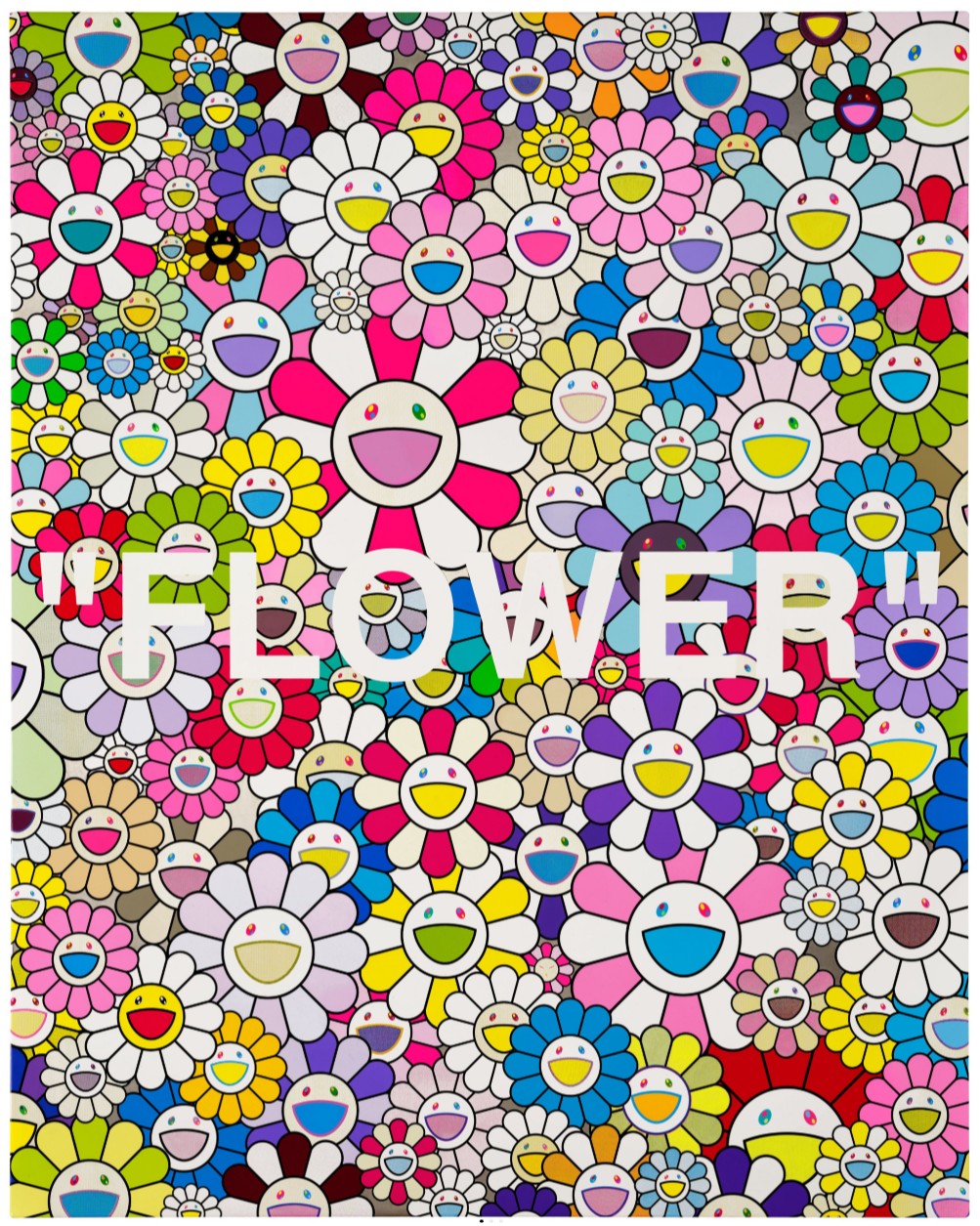
Acrylic and platinum leaf on canvas mounted on aluminum frame
126.5 x 100 cm (49 3/4 x 39 3/8 inches)
Signed and dated ‘”VIRGIL” © 2018 TAKASHI 2018’ on the overlap
FLOWER, 2018
Estimated: HKD 550,000 – 750,000
HKD 1,143,000 / USD 145,855
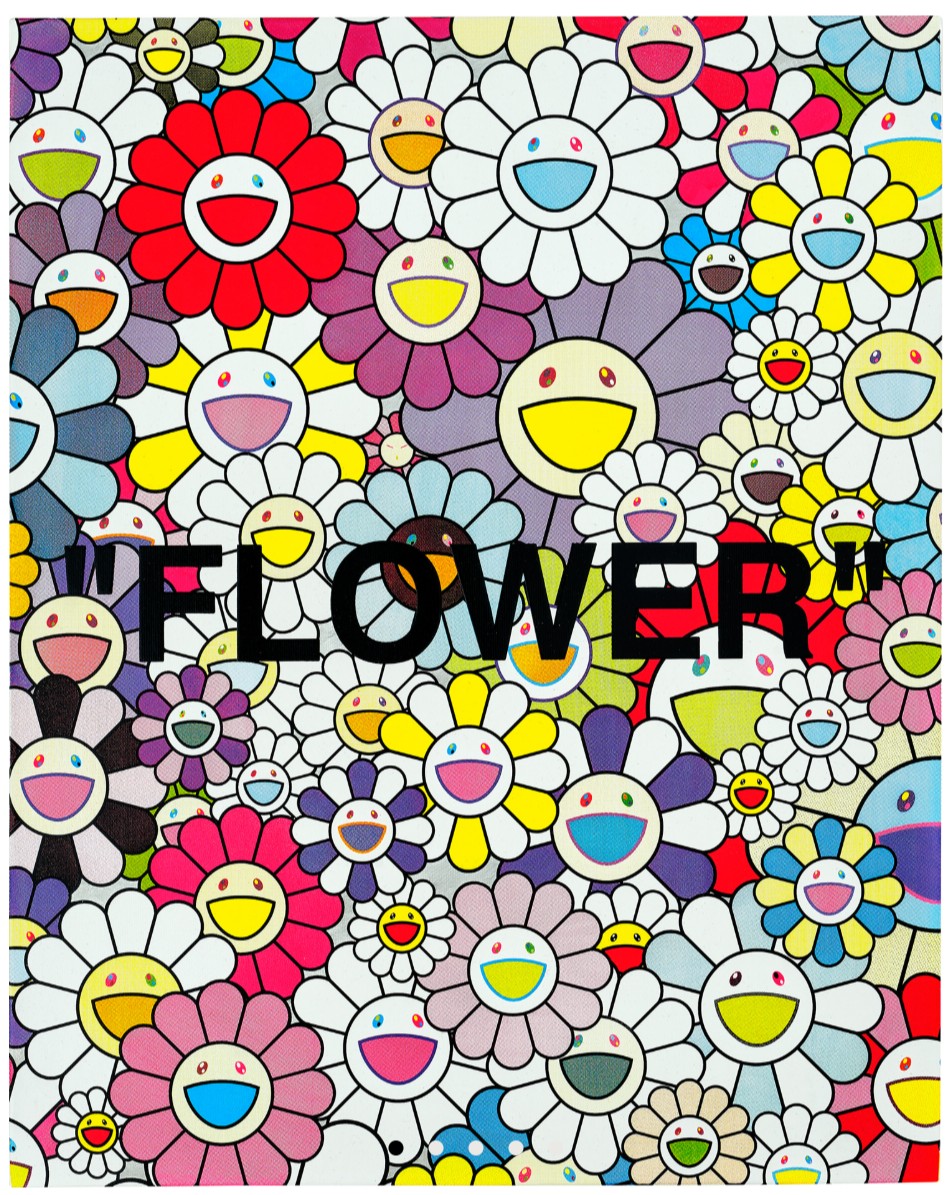
Acrylic and platinum leaf on canvas mounted on aluminum frame
57.7 x 46 cm (22 3/4 x 18 1/8 inches)
Signed and dated ‘“VIRGIL” © 2018 Takashi 2018’ on the overlap
Memento Mori: Neon Color Off-White, 2018
Sotheby’s New-York: 9 March 2023
Estimated: USD 80,000 – 120,000
USD 95,250
Memento Mori: Neon Color Off-White | Contemporary Curated | 2023 | Sotheby’s (sothebys.com)
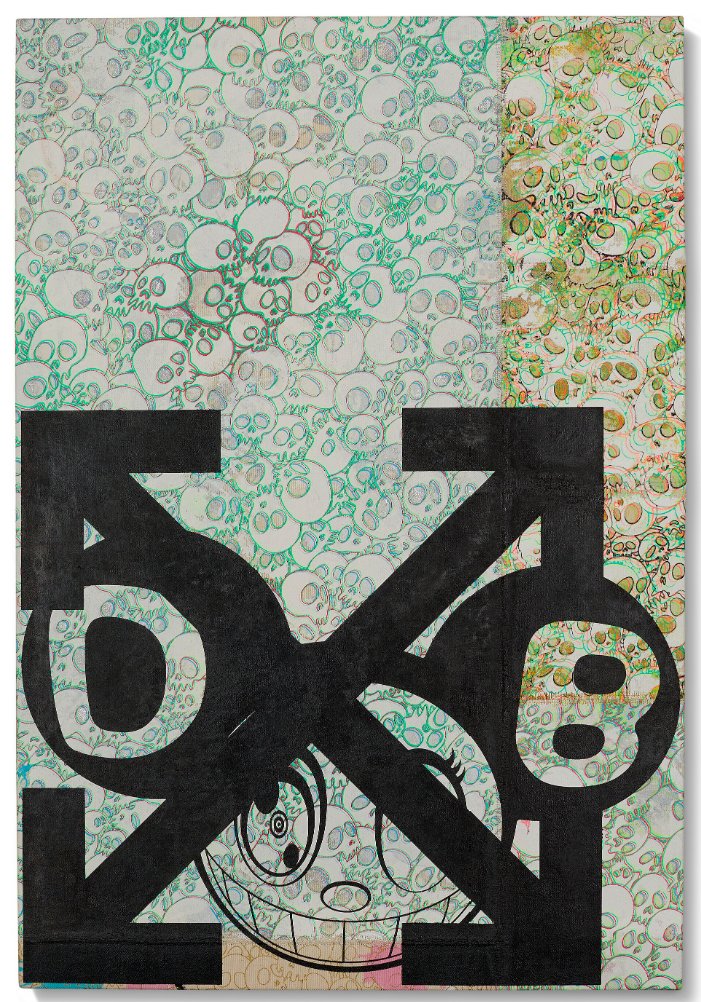
TAKASHI MURAKAMI (b. 1962) and VIRGIL ABLOH (1980-2021)
Memento Mori: Neon Color Off-White, 2018
Acrylic on canvas
83.2 x 65 cm (33 x 25 5/8 inches)
Signed “VIRGIL” © and dated 2018 (on the overlap)
Signed Takashi and dated 2018 (on the overlap)
DOB and Arrows: Patchwork Skulls, 2018
Christie’s New-York: 13 May 2022
Estimated: USD 60,000 – 80,000
USD 126,000
TAKASHI MURAKAMI (B. 1962) AND VIRGIL ABLOH (1980-2021) (christies.com)
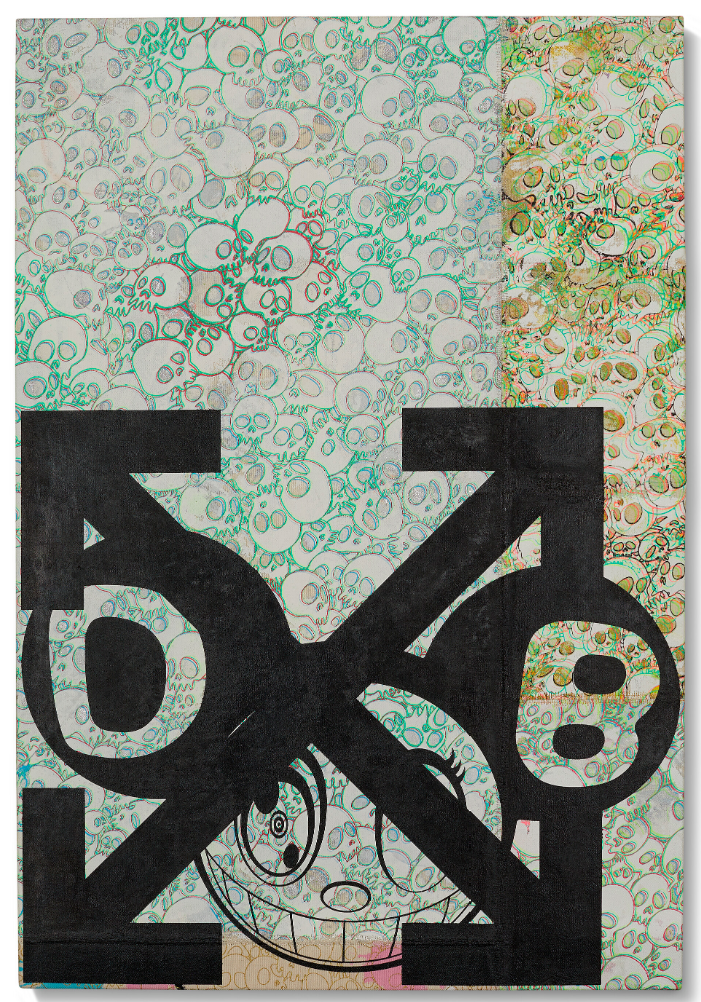
TAKASHI MURAKAMI (B. 1962) AND VIRGIL ABLOH (1980-2021)
DOB and Arrows: Patchwork Skulls, 2018
Acrylic on canvas
85.7 x 58.4 cm (33 3/4 x 23 inches)
Signed and dated ‘”VIRGIL” TAKASHI 2018’ (on the overlap)