
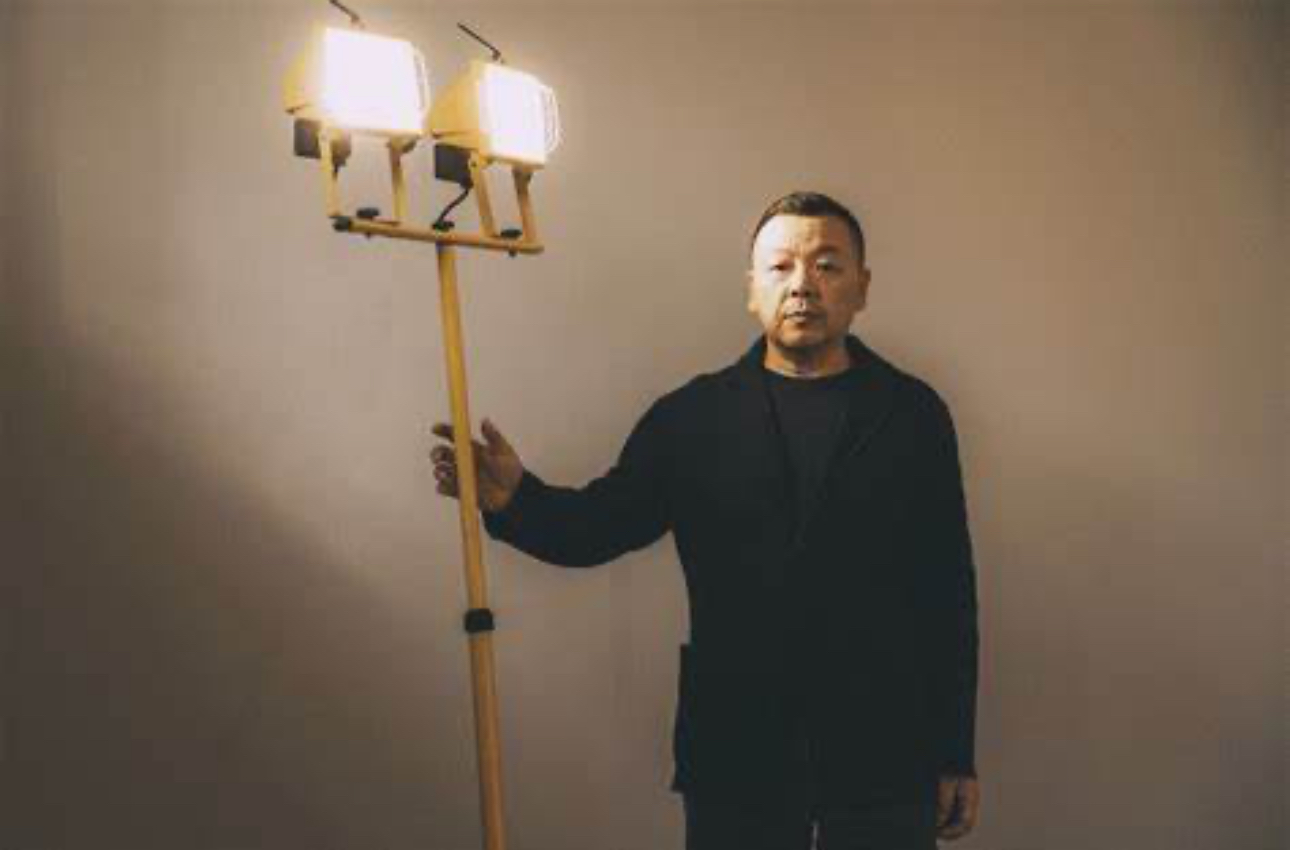
Whimsical and theatrical are words that come to mind when approaching Liu Ye’s bewildering yet charming oeuvre. Born in 1964, Liu Ye grew up in an artistic family: his father wrote children’s fairy tales and his mother was a language teacher. During the Cultural Revolution his parents hid all their books, which Liu Ye found and read in secret, spending quiet hours enthralled by illustrations from foreign lands. At some point the family moved to Qianmen, close to Tiananmen.
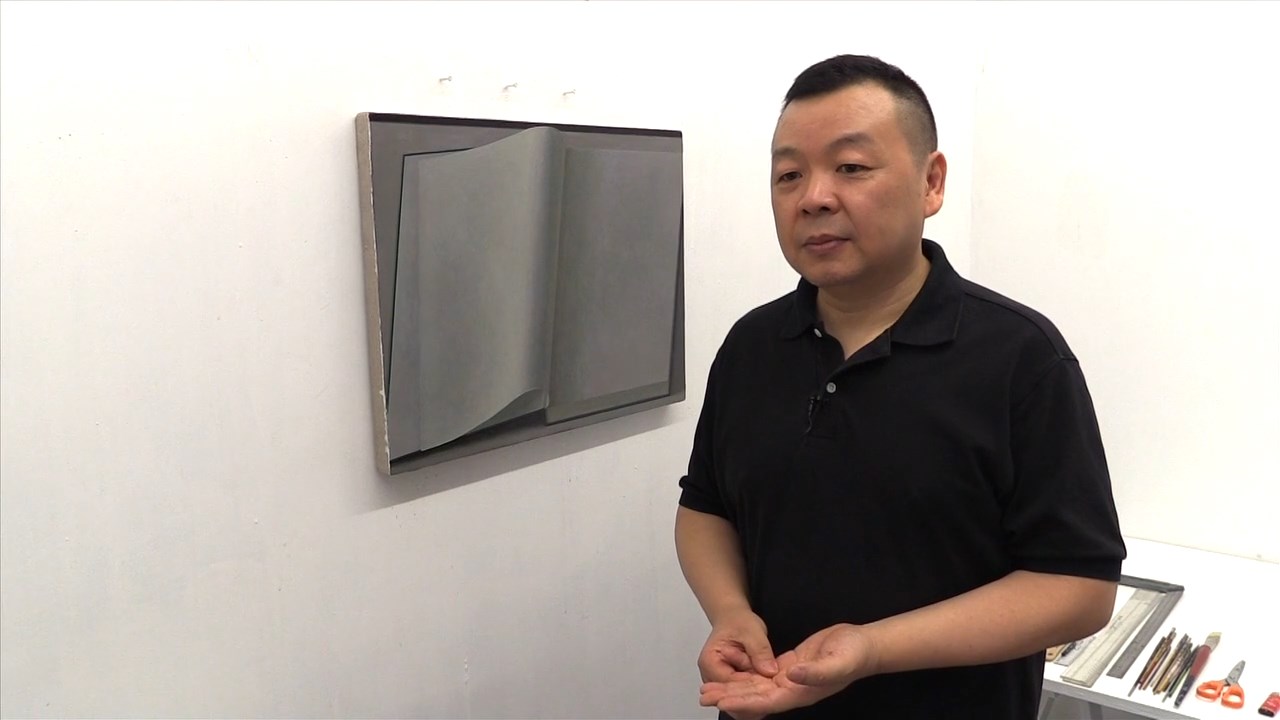
After the Cultural Revolution, Liu Ye enrolled first in the vocational Beijing College of Art and Design in 1980 and then the Central Academy of Fine Arts (CAFA) in Beijing in 1986. At the CAFA, one of his teachers was Zhou Lingzhao, who painted the first portrait of Mao Zedong that hung in front of Tiananmen. Like a lot of artists of his generation, Liu Ye received a strict, orthodox education with a limited exposure to Western art that was nevertheless transformative. His first influences at the time included Paul Klee and René Magritte, whose works he learned about through printed materials. In the watershed year of 1989, Liu Ye was in his third year at the CAFA, but left for Germany at the end of the year where he remained until 1994. Later in the decade, Liu Ye was an artist-in-residence at the Rijksakademie, Amsterdam. During his time in Europe, Liu Ye’s influences were diverse, ranging from works from the early Renaissance, Jan van Eyck in particular, to Johannes Vermeer, Giorgio Morandi, Balthus, Giorgio de Chirico, Piet Mondrian, Klee, and Magritte, amongst many others. Digesting a plethora of styles and techniques, Liu Ye honed his technical capabilities and refined his own unique whimsical surrealist style.
As one of the most prominent representatives of Chinese contemporary art, Liu Ye’s artistic style is steeped in Modernism. His main focus is on exploring the possibility of visual elements such as colors, character modelling, and architectural features in contemporary painting. His works are filled with symbols that have specific meanings — they are concerned with the most fundamental human emotions and the exploration of the intrinsic value of art itself.
Liu Ye studied abroad in Berlin, Germany in the 1990s. Works created during this European period employ a sober palette with richly expressive brushwork. They are reminiscent of works by Western masters such as Balthus and Giorgio de Chirico. Upon his return to China in 1995, Liu gradually shifted to a more vibrant palette. The use of highly saturated primary colors of red, yellow, and blue, as well as the adorable character in his artistic language during this period formed the basis of his unique depiction style — this evocative fairytale construct gives voice to the artist’s unique worldview. In the early 21st century, Liu Ye underwent another major artistic transformation in terms of subject matter and depiction style — the sailor boy that appeared in his early works was replaced by a wide variety of female characters, such as short-hair girl, female teacher, mermaid, female adolescent angel, and the like.
The works of Liu Ye straddle both the emotive and the rational with their fairy tales’ imageries and philosophical exactitude in execution. Shuttling between these two opposites gives his paintings a whimsical yet composed character. Liu Ye’s father was a writer of children’s literature, and his fondness for the fantasy realm sowed the seeds in Liu Ye’s young mind. The artist considers the land of fairytales his personal refuge where his soul and childhood memories reside. For this reason, the young boy figure is a quintessential motif that frequently appears in his works throughout his career.
Practical Information
Liu Ye
Chinese (Born 1964)
Category: Contemporary Art
Public Collections
Liu’s paintings are held in numerous prominent collections, including but not limited to that of the Long Museum in Shanghai, the M+ Sigg Collection in Hong Kong, and the Today Art Museum in Beijing.
Museum Exhibitions
The artist was recently the subject of an international solo exhibition, titled Liu Ye: Storytelling. It was first presented at Prada Rong Zhai in Shanghai (2018-2019), then travelled to the Fondazione Prada in Milan (2020-2021).
Gallery Representation
David Zwirner
Liu Ye – Artworks & Biography | David Zwirner
PART I: SUMMARY
Auction Market Overview
2025 AUCTION STATISTICS
Turnover: USD 13,306,128
+90.5% vs. 2024
# Lots sold: 13
Sell-Through Rate: 93%
MARKET SEGMENTATION
91% of lots sold in Hong-Kong
Highest Price Achieved at Auction:
CNY 57,500,000 / USD 7,983,120
(18 November 2023)
Auction Summary
2025 Auction Highlights
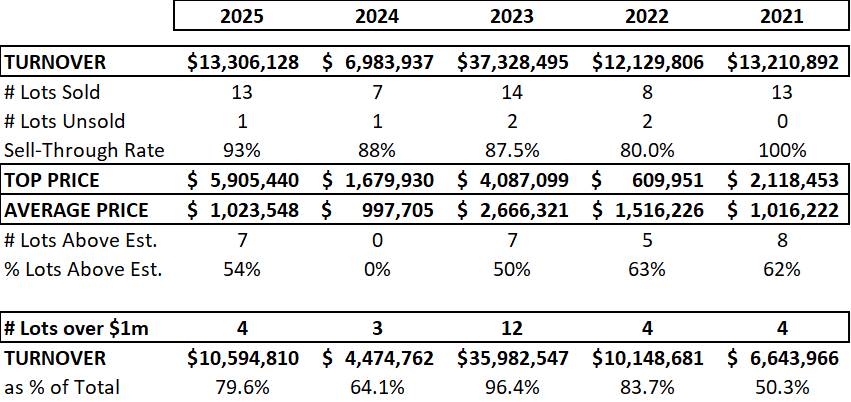
13 lots sold at auction in 2025 for a total turnover of USD 13,306,128. With one lot failing to sell, the sell-through rate is 93%. The highest price was achieved by Eileen Chang, a portrait of the famous woman literary genius, a painting dated 2024, that sold at China Guardian, in Beijing, on 13 May 2025, for CNY 42,550,000 (USD 5,905,440).
2025 Top 3 Lots
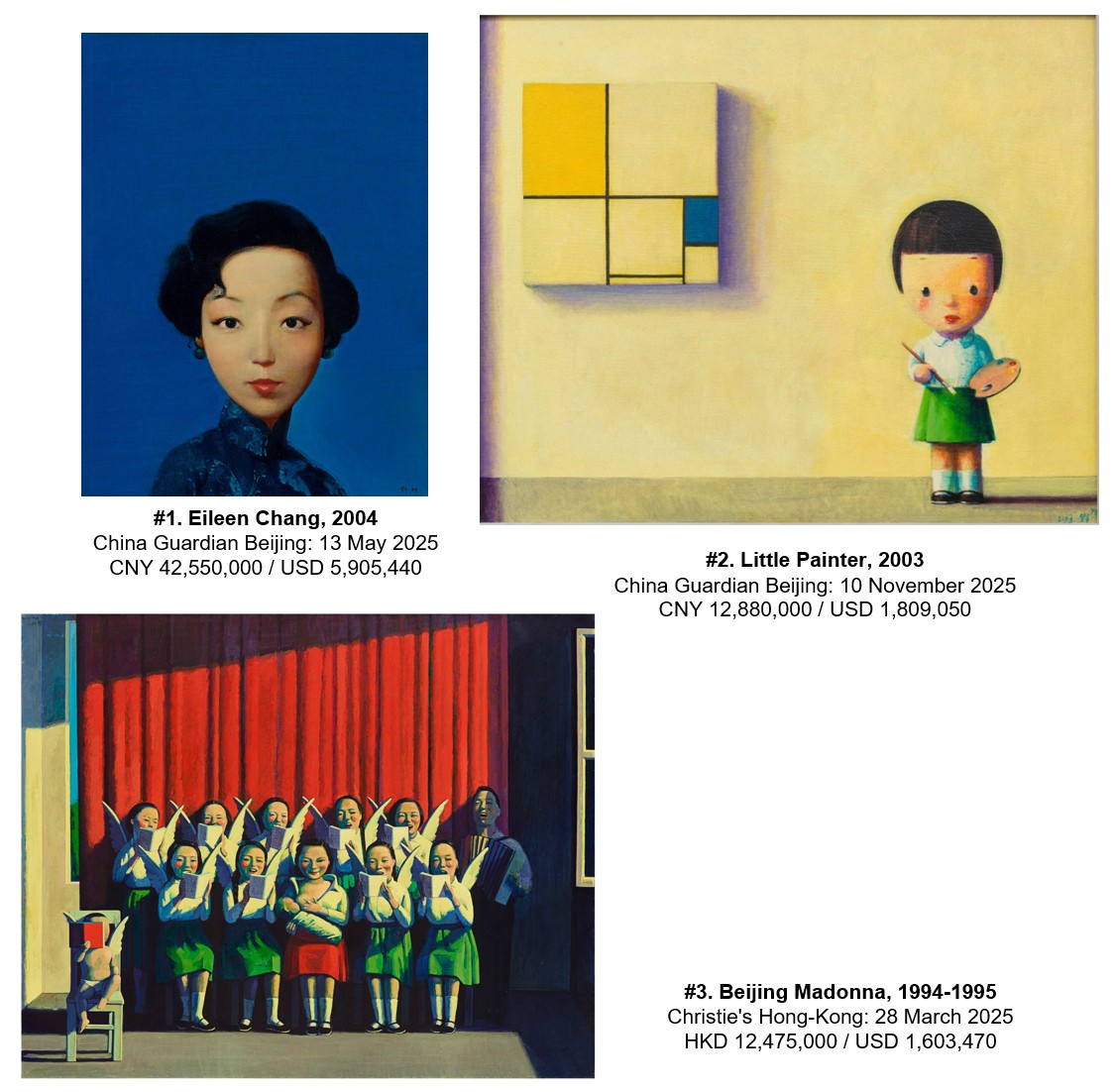
4 lots sold for more than USD 1 million, generating a cumulative turnover of USD 10,594,810, representing 79.6% of the total turnover for 2025.
2024 Auction Highlights
7 lots sold at auction in 2024 for a total turnover of USD 6,983,937. With 1 lot failing to sell, the sell-through rate is 88%. The highest price has been achieved at Christie’s in Hong-Kong, on 26 September 2024, when Painter and Model, a painting dated 2010, sold for HKD 13,080,000 (USD 1,679,930).
2024 Top 3 Lots
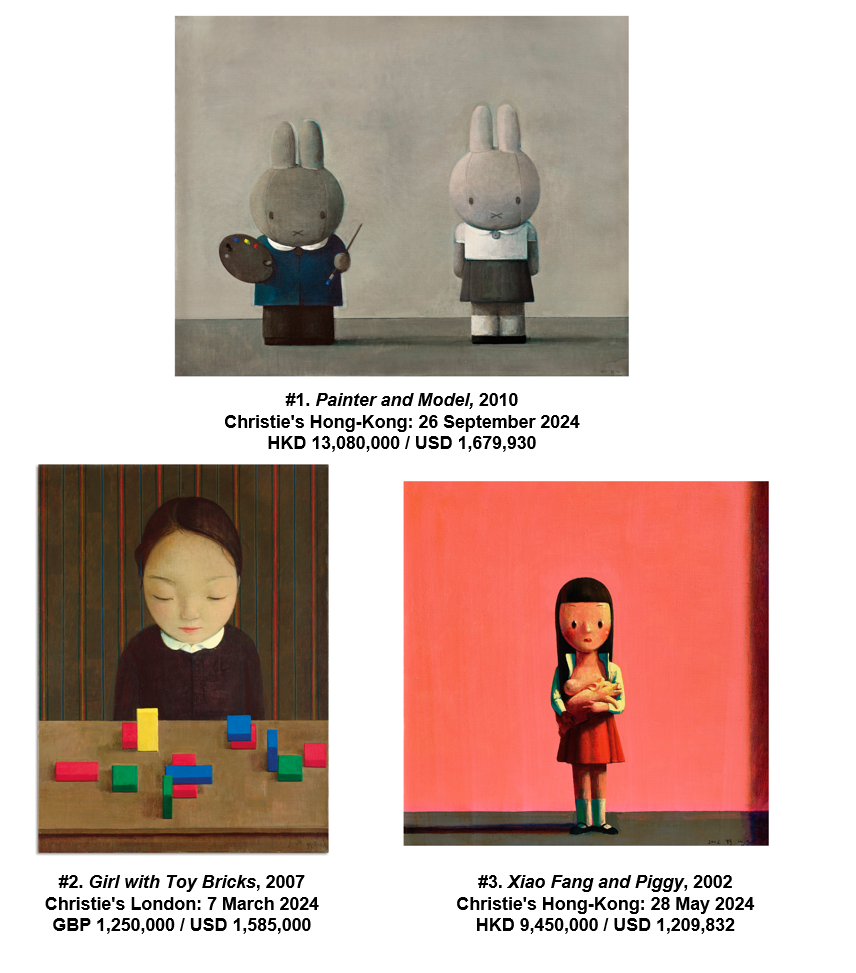
3 lots sold for more than USD 1 million, generating a cumulative turnover of USD 4,474,762, representing 64% of the total for 2024.
2023 Auction Highlights
14 lots sold at auction in 2023 for a total turnover of USD 37,328,495. With 2 lots unsold, the sell-through rate is 87.5%. The highest price was achieved at China Guardian, in Beijing, on 18 November 2023, by Bright Avenue, a painting dated 1995, sold for CNY 57,500,000 (USD 7,983,120).
2023 Top 3 Lots
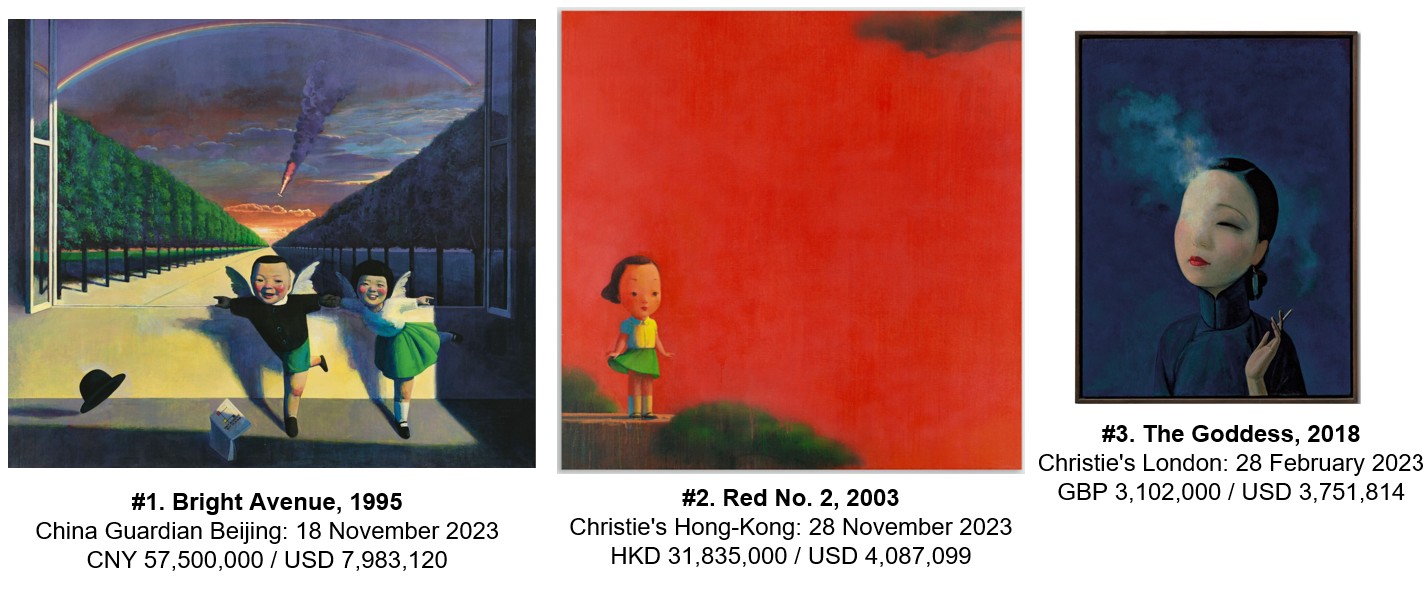
12 lots sold for more than USD 1 million, generating a cumulative turnover of USD 35,982,547, representing 96.2% of the total turnover for 2023. All lots sold in Asia except one that sold in London.
2022 Auction Highlights
8 lots sold at auction in 2022 for a total turnover of USD 12,129,806. With 2 lots failing to sell, the sell-through rate is 80%. The highest price has been achieved by a painting dated 1998, The Sailors with Red Flag, that sold at Christie’s in Hong-Kong on 26 May 2022 for HKD 37,650,000 (USD 4,796,239).
Nota Bene: this does not include lots sold at auction in Mainland China.
2022 Top 3 Lots
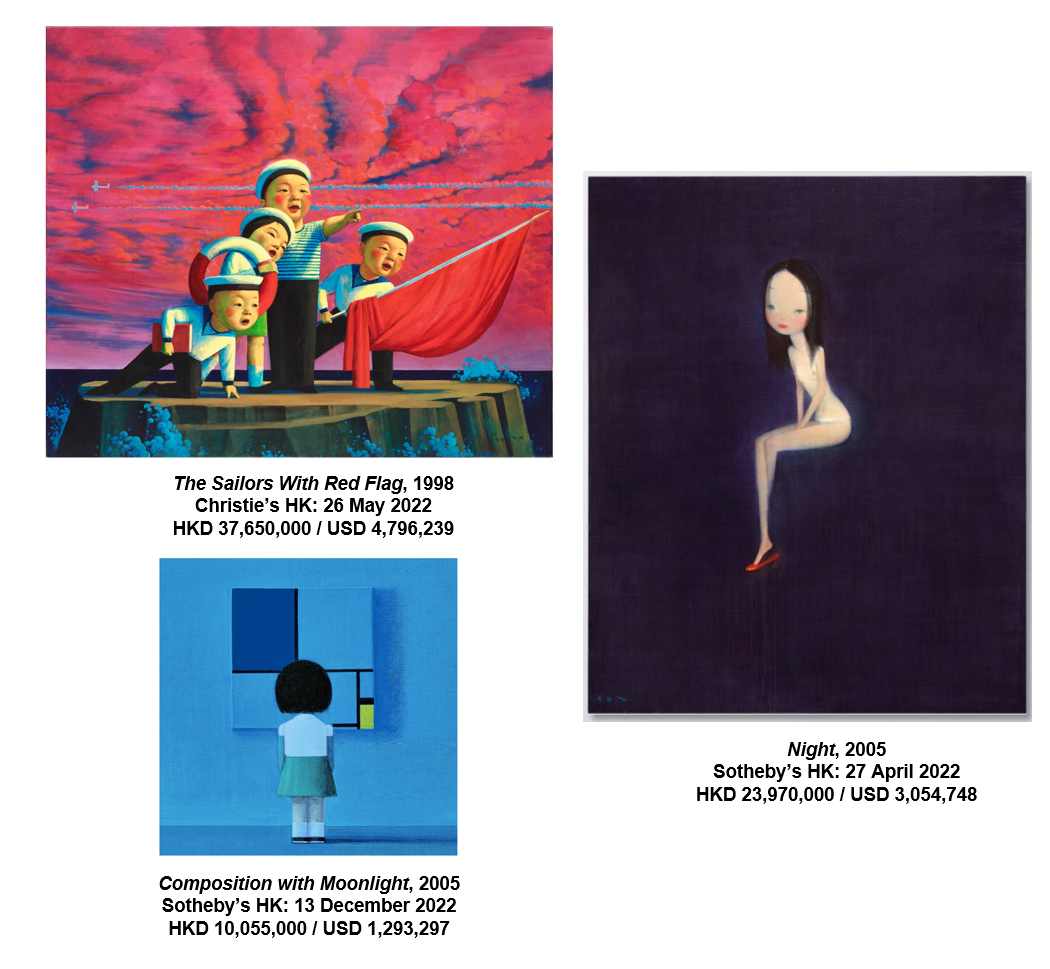
4 lots sold for more than USD 1 million, generating a cumulative turnover of USD 10,148,681, representing 83.7% of the total turnover for 2022.
2021 Auction Highlights
13 lots sold at auction in 2021 for a total turnover of USD 13,210,892. With no lot failing to sell, the sell-through rate is 100%. The highest price has been achieved at Christie’s in Hong-Kong on 24 May 2021, when Bird, a painting dated 2007, sold for HKD 16,450,000 (USD 2,118,453).
2021 Top 3 Lots
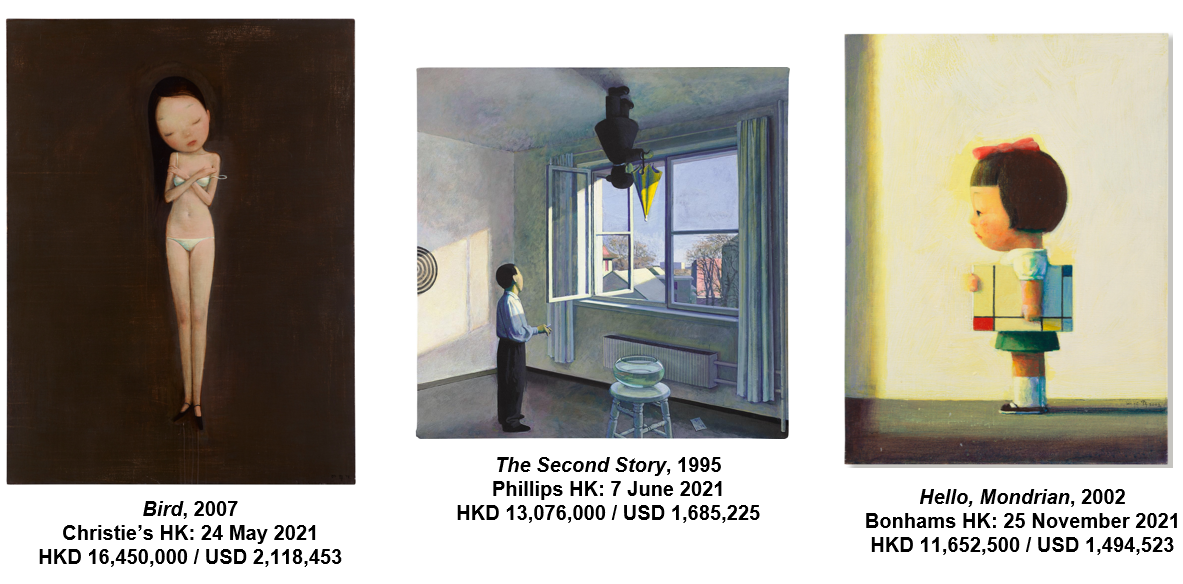
4 lots sold for more than USD 1 million, generating a cumulative turnover of USD 6,643,966, representing 50.3% of the total turnover for 2021. All lots sold in Hong-Kong.
Top Lots
#1. Bright Avenue, 1995
China Guardian Beijing: 18 November 2023
Estimated: CNY 50,000,000 – 60,000,000
CNY 57,500,000 / USD 7,983,120
NEW AUCTION RECORD FOR LIU YE
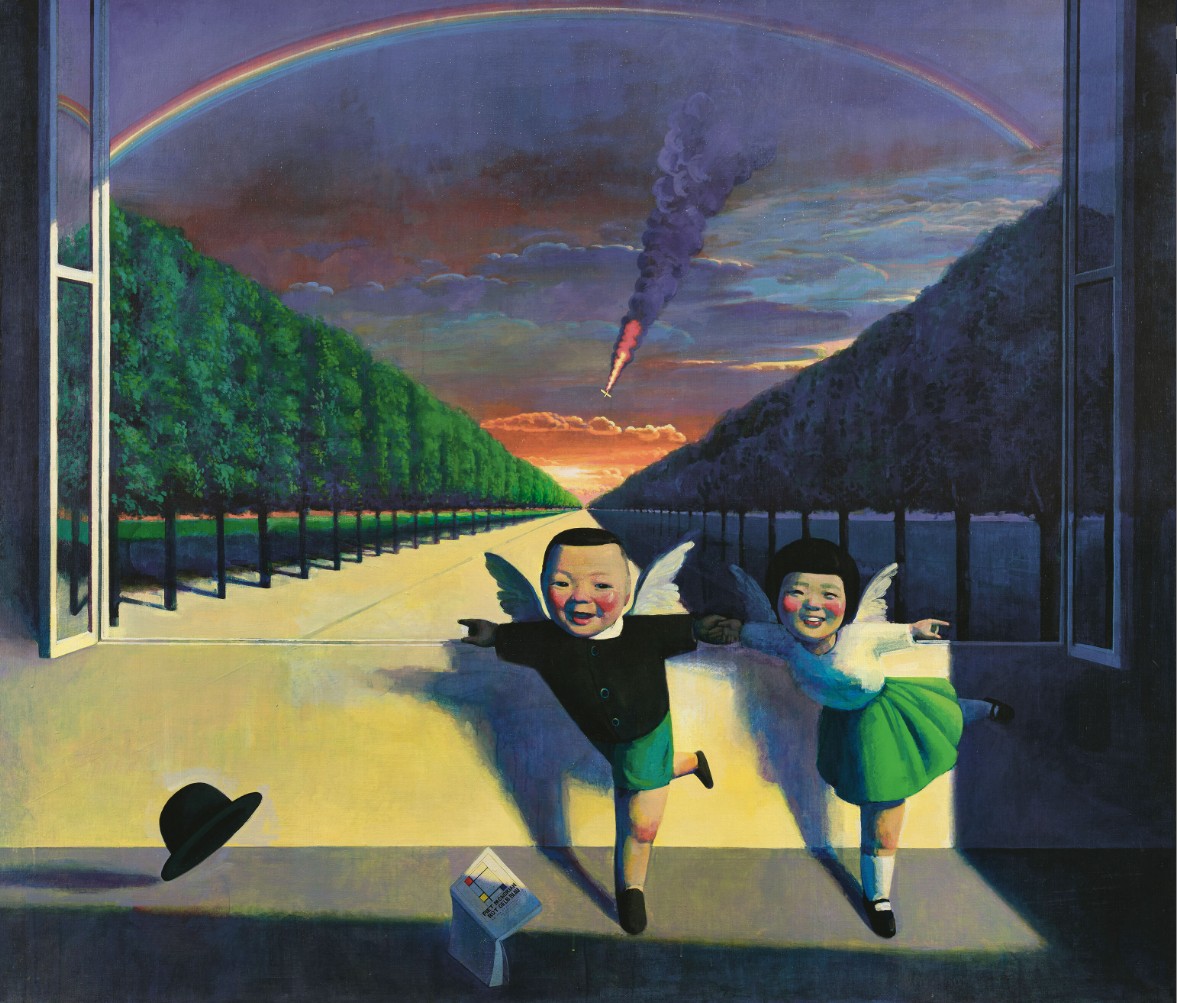
LIU YE (b.1964)
Bright Avenue, 1995
Acrylic and oil on canvas
170×200 cm (67 x 78.7 inches)
Signed and titled and dated in Chinese on the reverse
#2. Smoke
Sotheby’s Hong-Kong: 6 October 2019
Estimated: HKD 25,000,000 – 35,000,000
HKD 52,182,000 / USD 6,656,122
(#1108) LIU YE | Smoke (sothebys.com)
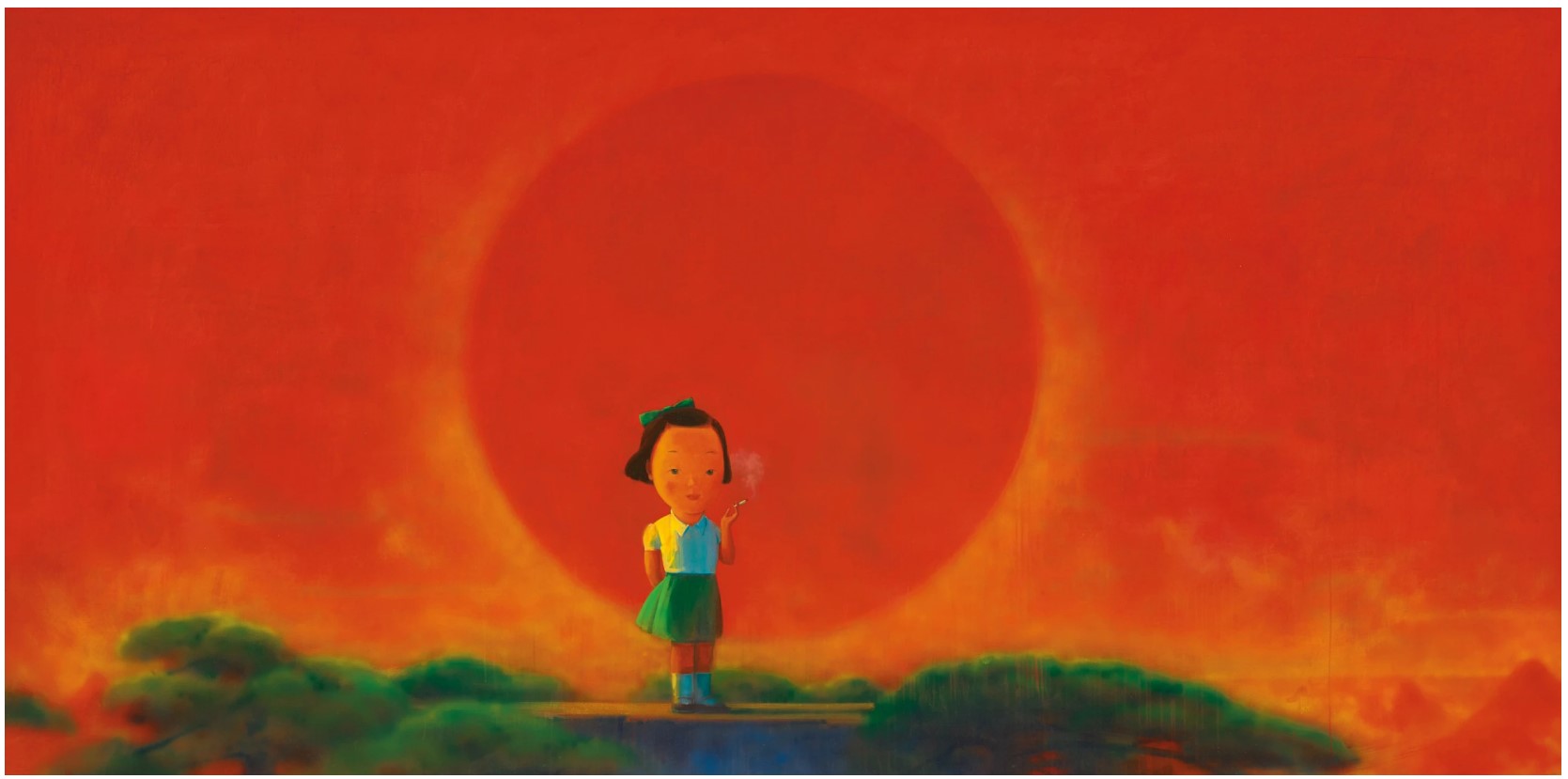
LIU YE
Smoke, 2001-2002
Acrylic on canvas
178 x 356.5 cm (70 x 140 3/8 inches)
Signed in Chinese and Pinyin, and dated 2001-02
#3. Leave me in the dark
Sotheby’s Hong-Kong: 9 July 2020
Estimated: HKD 25,000,000 – 35,000,000
HKD 45,348,000 / USD 5,851,279
(#1125) LIU YE | Leave Me in the Dark (sothebys.com)
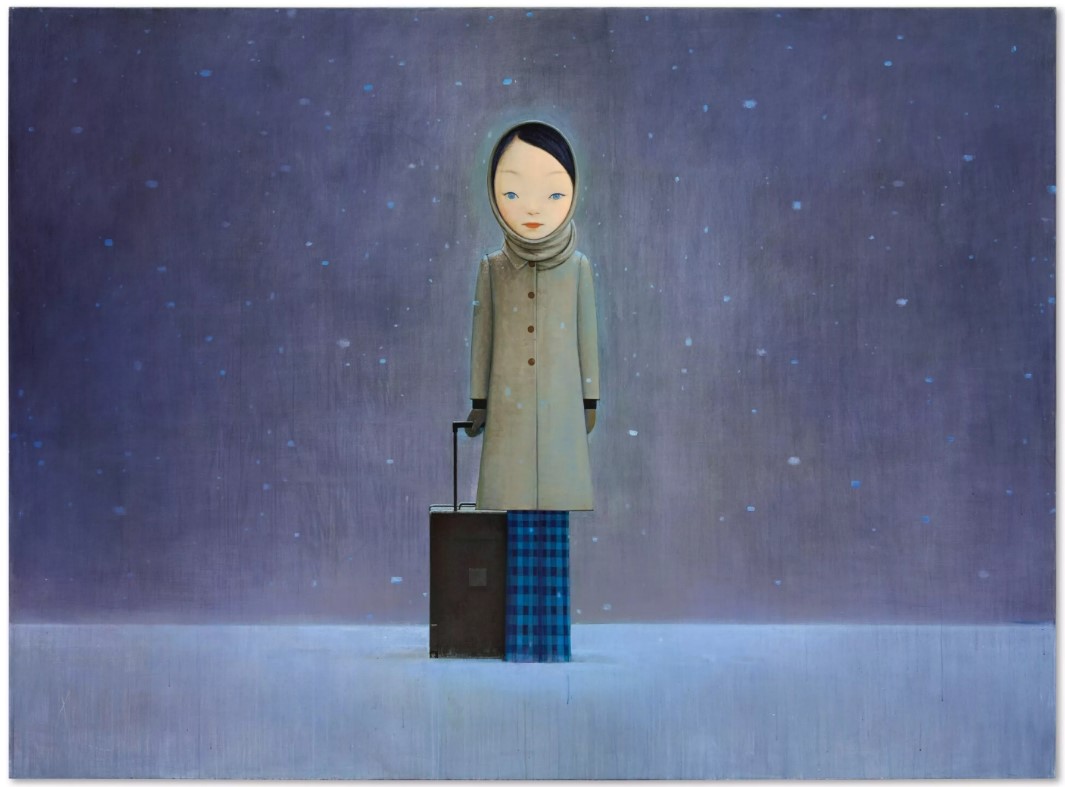
LIU YE
Leave Me in the Dark, 2008
Acrylic on canvas
219.7 x 299.7 cm (86 1/2 x 118 inches)
Signed in Chinese and Pinyin on the reverse
#4. Eileen Chang, 2004
China Guardian Beijing: 13 May 2025
Estimated: CNY 9,000,000 – 12,000,000
CNY 42,550,000 / USD 5,905,440
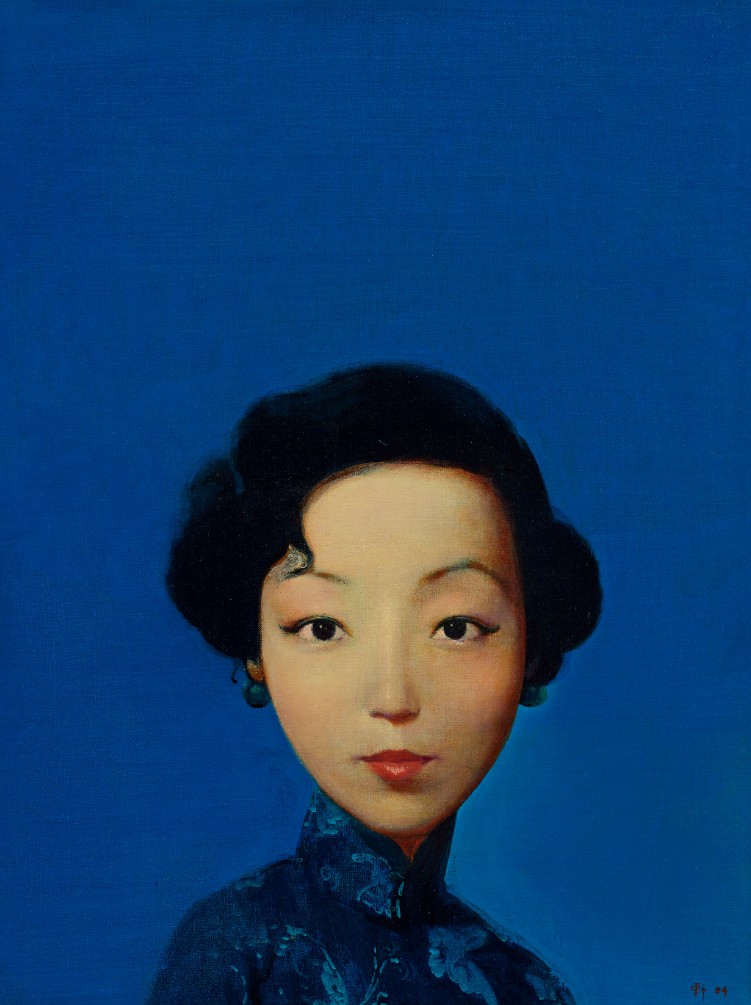
LIU YE (b.1964)
Eileen Chang, 2004
Oil on canvas
60×45 cm (23.6 x 17.7 inches)
Signed in Chinese and dated
#5. Sword
Sotheby’s Hong-Kong: 5 October 2013
Estimate on Request
HKD 42,680,000 / USD 5,503,901
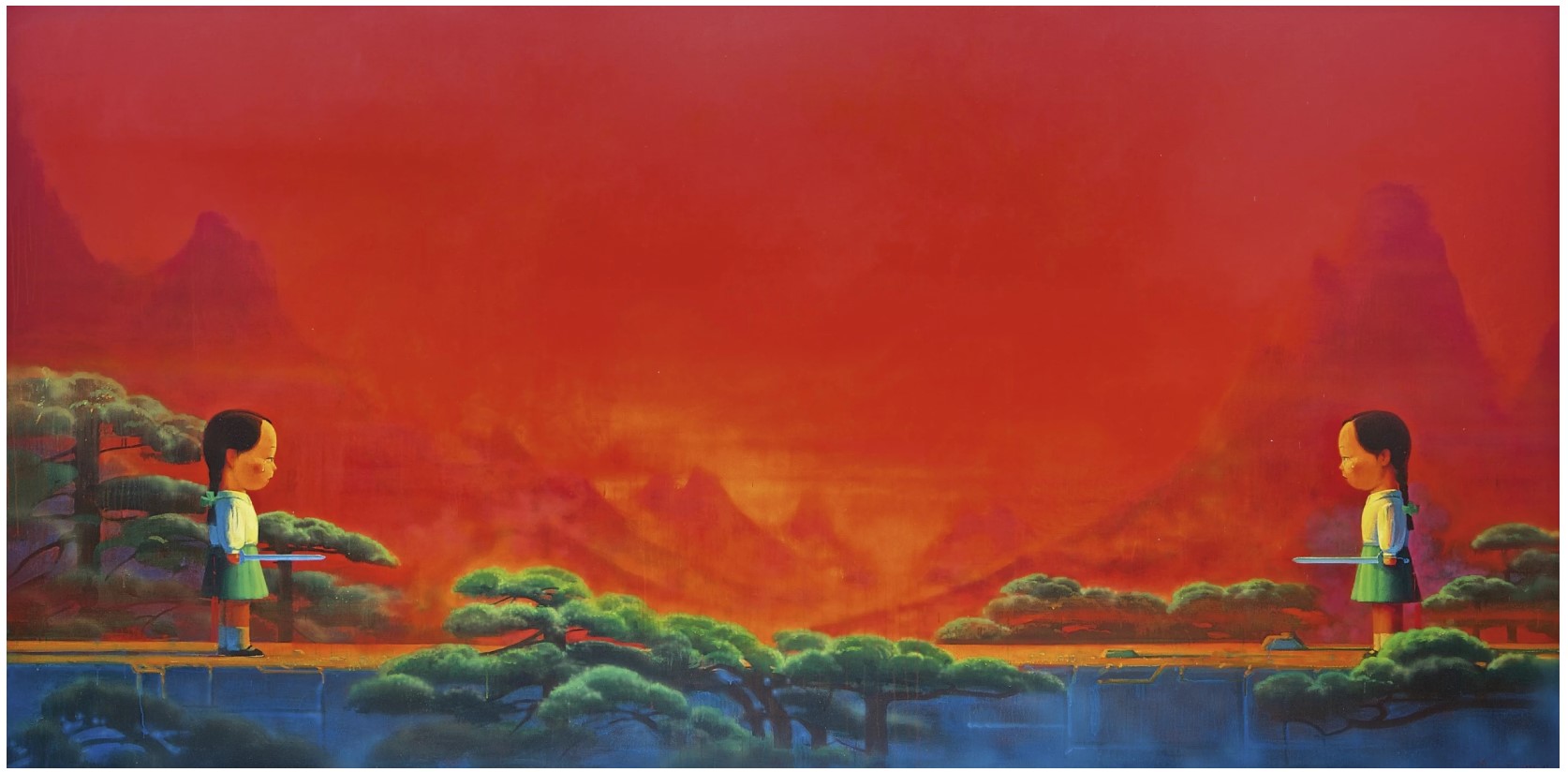
LIU YE
Sword, 2001
Oil and acrylic on canvas
180×360 cm (70 7/8 x 141 3/4 inches)
Signed in Chinese and Pinyin and dated 2001-02
Signed and titled in Chinese and dated 2001 on the reverse
#6. The Sailors With Red Flag, 1998
Christie’s Hong-Kong: 26 May 2022
Estimated: HKD 19,000,000 – 25,000,000
HKD 37,650,000 / USD 4,796,239
LIU YE (B. 1964) (christies.com)
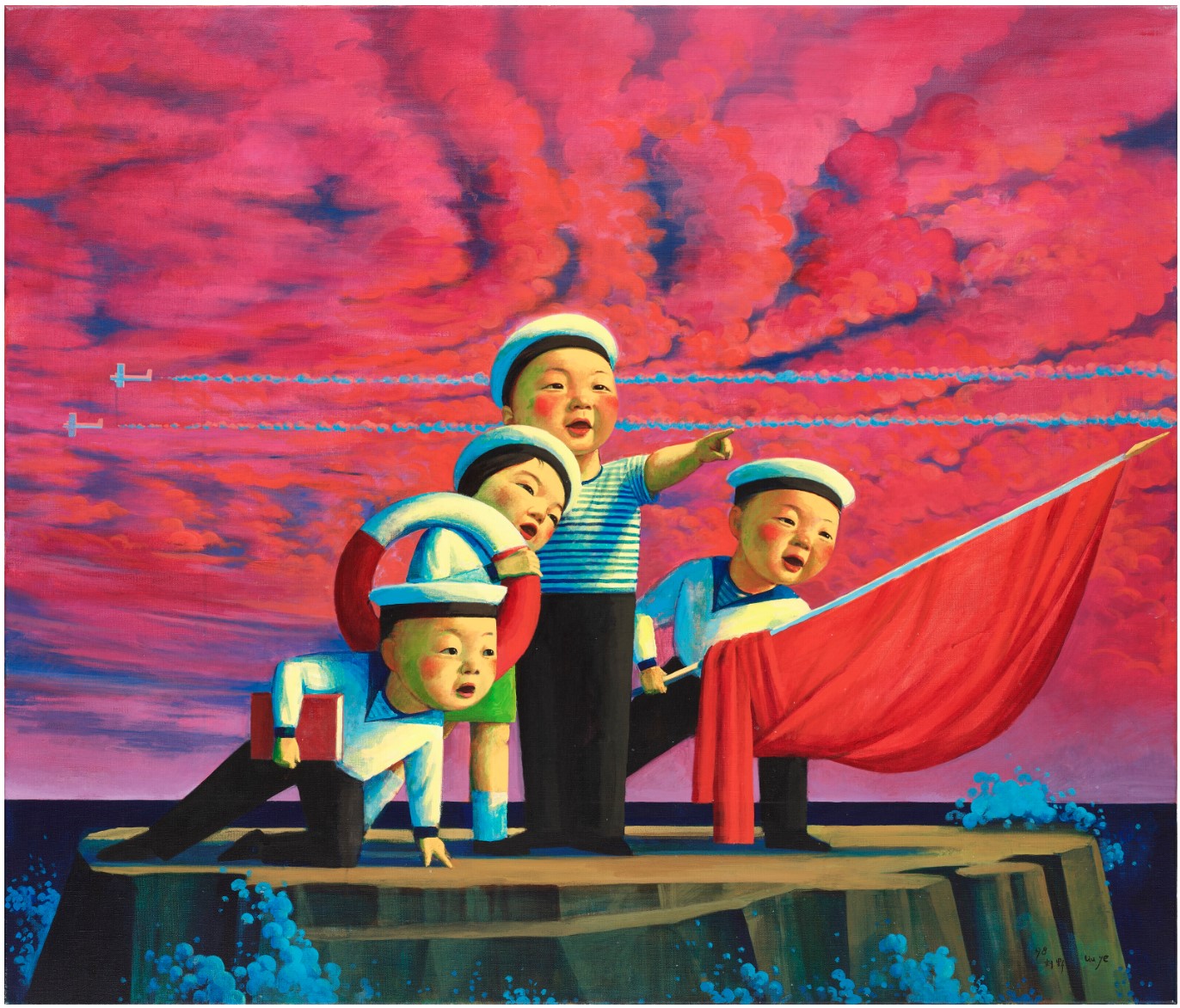
LIU YE (B. 1964)
The Sailors With Red Flag, 1998
Acrylic on canvas
120×140 cm (47 1/4 x 55 1/8 inches)
Signed in Chinese, signed and dated ‘liu ye 98’ (lower right)
#7. Red No. 2, 2003
Christie’s Hong-Kong: 28 November 2023
Estimated: HKD 26,00,000 – 36,00,000
HKD 31,835,000 / USD 4,087,099
21391-liu-ye-red-no-2 (christies.com)
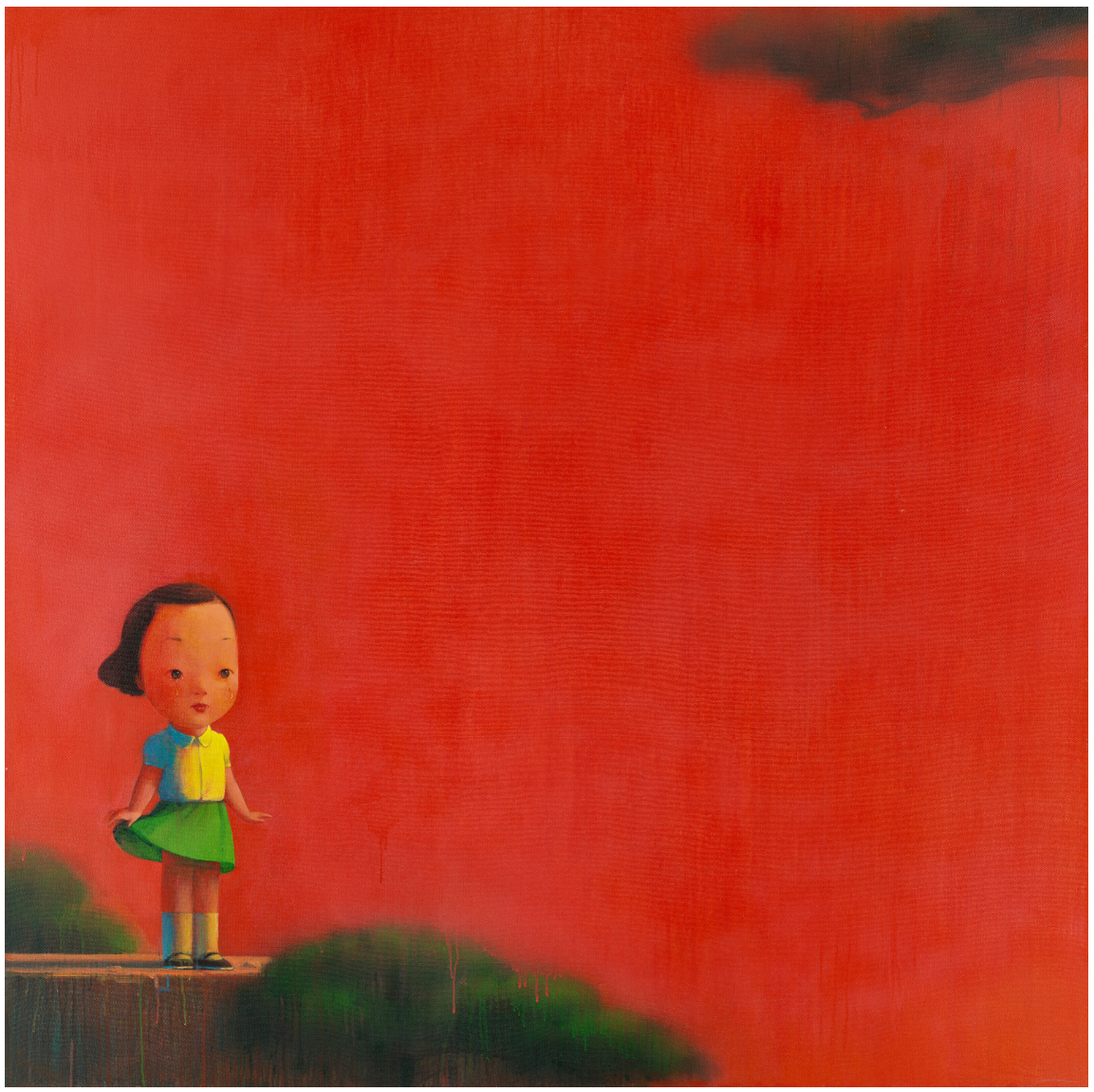
LIU YE (B. 1964)
Red No. 2, 2003
Acrylic on canvas
195×195 cm (76 3/4 x 76 3/4 inches.)
Signed and dated ‘2003 Liu ye’, signed again in Chinese (lower left)
#8. The Goddess, 2018
Christie’s London: 28 February 2023
Estimated: GBP 800,000 – 1,200,000
GBP 3,102,000 / USD 3,751,814
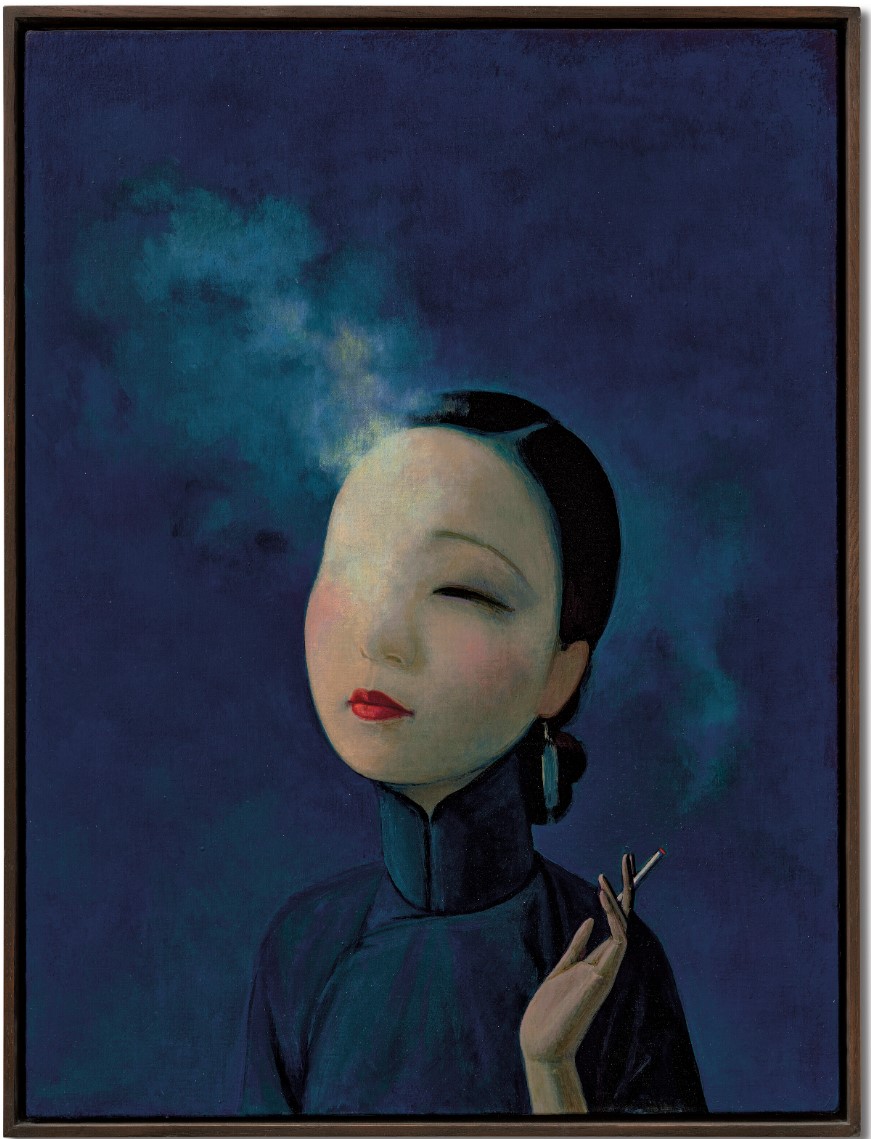
LIU YE (B. 1964)
The Goddess, 2018
Acrylic on canvas
23 5/8 x 17 3/4 inches (60.1 x 45 cm)
Signed, titled and dated (on the reverse)
#9. Choir of Angels (Red), 1999
Phillips Hong-Kong: 8 July 2020
Estimated: HKD 20,000,000 – 40,000,000
HKD 27,750,000 / USD 3,580,582
Liu Ye – 20th Century & Contemporary Art… Lot 7 July 2020 | Phillips
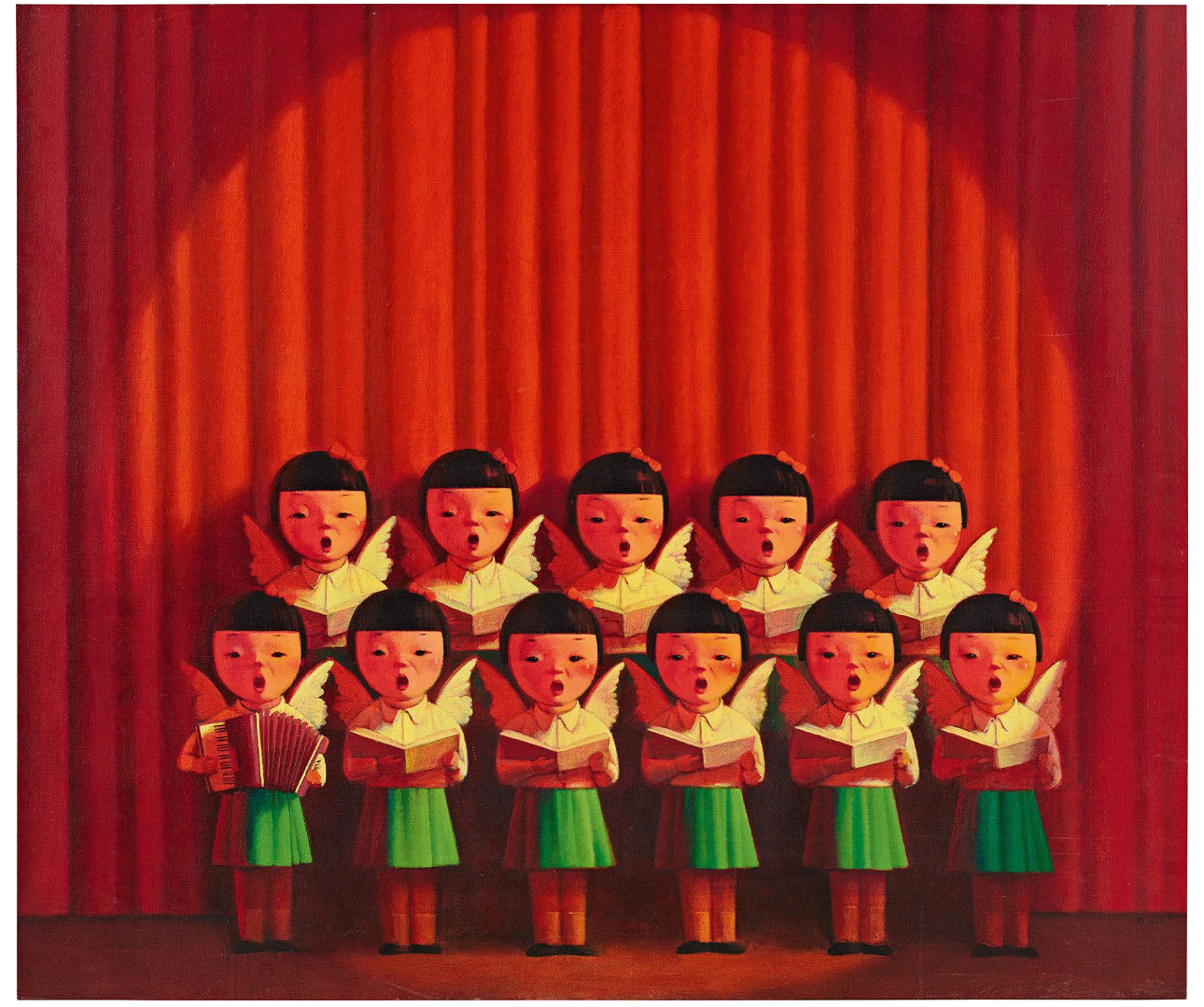
LIU YE
Choir of Angels (Red), 1999
Oil on canvas
169.1 x 199.2 cm (66 5/8 x 78 3/8 in)
Signed and dated ‘Ye [in Chinese] liu ye 99’ lower right
#10. She Isn’t Afraid of Mondrian, 1995
Phillips Hong-Kong: 24 November 2019
Estimated: HKD 18,000,000 – 28,000,000
HKD 26,550,000 / USD 3,392,776
Liu Ye – 20th Century & Contemporary… Lot 7 November 2019 | Phillips
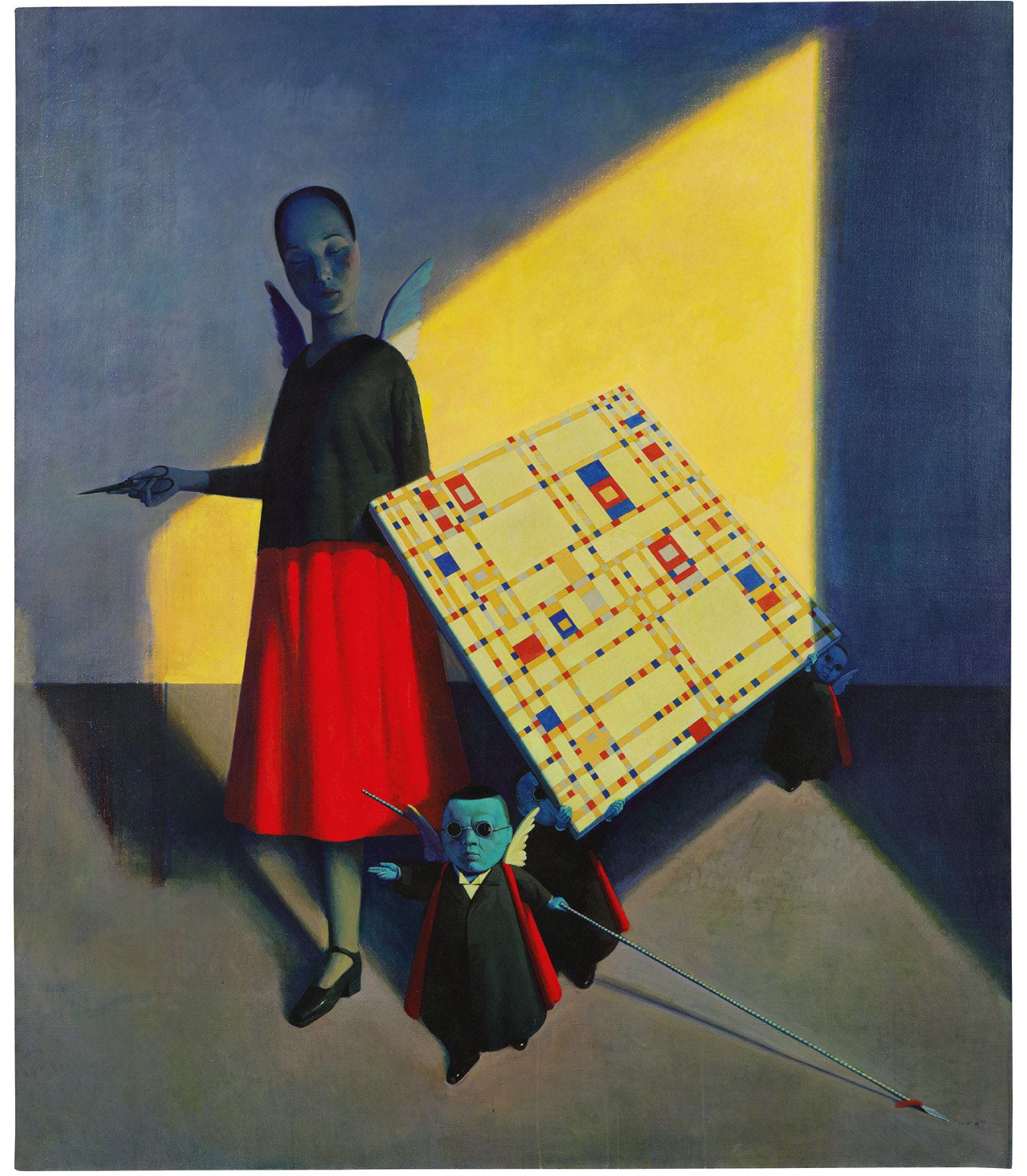
LIU YE
She Isn’t Afraid of Mondrian, 1995
Acrylic and oil on canvas
200×170 cm (78 3/4 x 66 7/8 inches)
Signed and dated ‘liu ye ye [in Chinese] 95’ lower right
#11. Night, 2005
Sotheby’s Hong-Kong: 27 April 2022
Estimated: HKD 15,000,000 – 25,000,000
HKD 23,970,000 / USD 3,054,748
Liu Ye 劉野 | Night 夜 | Contemporary Evening Auction | 2022 | Sotheby’s (sothebys.com)
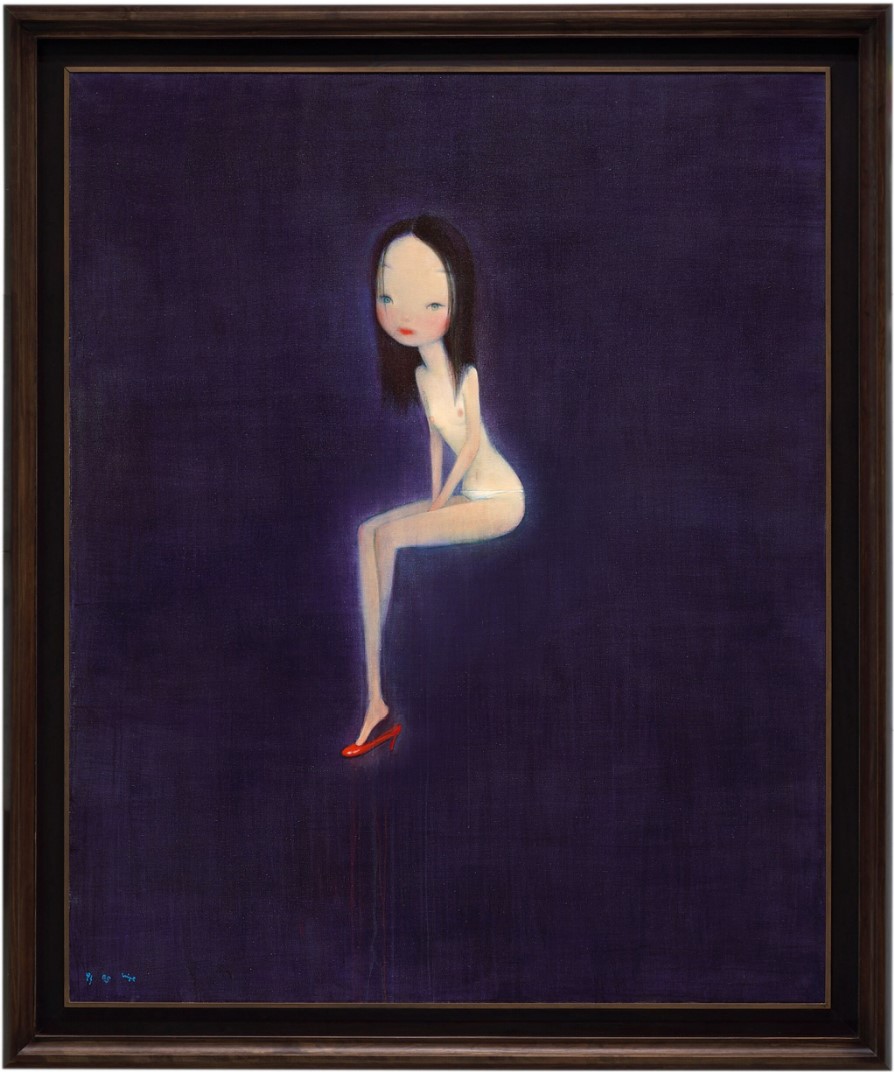
LIU YE (b. 1964)
Night, 2005
Acrylic on canvas
220×180 cm (86 5/8 x 70 7/8 inches)
Signed in Chinese and Pinyin and dated 05
PART II: AUCTION RESULTS
2026 Upcoming Lots
COMING SOON
2025 Auction Results
13 lots sold at auction in 2025 for a total turnover of USD 13,306,128. With one lot failing to sell, the sell-through rate is 93%. The highest price was achieved by Eileen Chang, a portrait of the famous woman literary genius, a painting dated 2024, that sold at China Guardian, in Beijing, on 13 May 2025, for CNY 42,550,000 (USD 5,905,440).
2025 Top 3 Lots
4 lots sold for more than USD 1 million, generating a cumulative turnover of USD 10,594,810, representing 79.6% of the total turnover for 2025.
#1. Eileen Chang, 2004
China Guardian Beijing: 13 May 2025
Estimated: CNY 9,000,000 – 12,000,000
CNY 42,550,000 / USD 5,905,440
LIU YE (b.1964)
Eileen Chang, 2004
Oil on canvas
60×45 cm (23.6 x 17.7 inches)
Signed in Chinese and dated
#2. Little Painter, 2003
China Guardian Beijing: 10 November 2025
Estimated: CNY 4,500,000 – 6,500,000
CNY 12,880,000 / USD 1,809,050
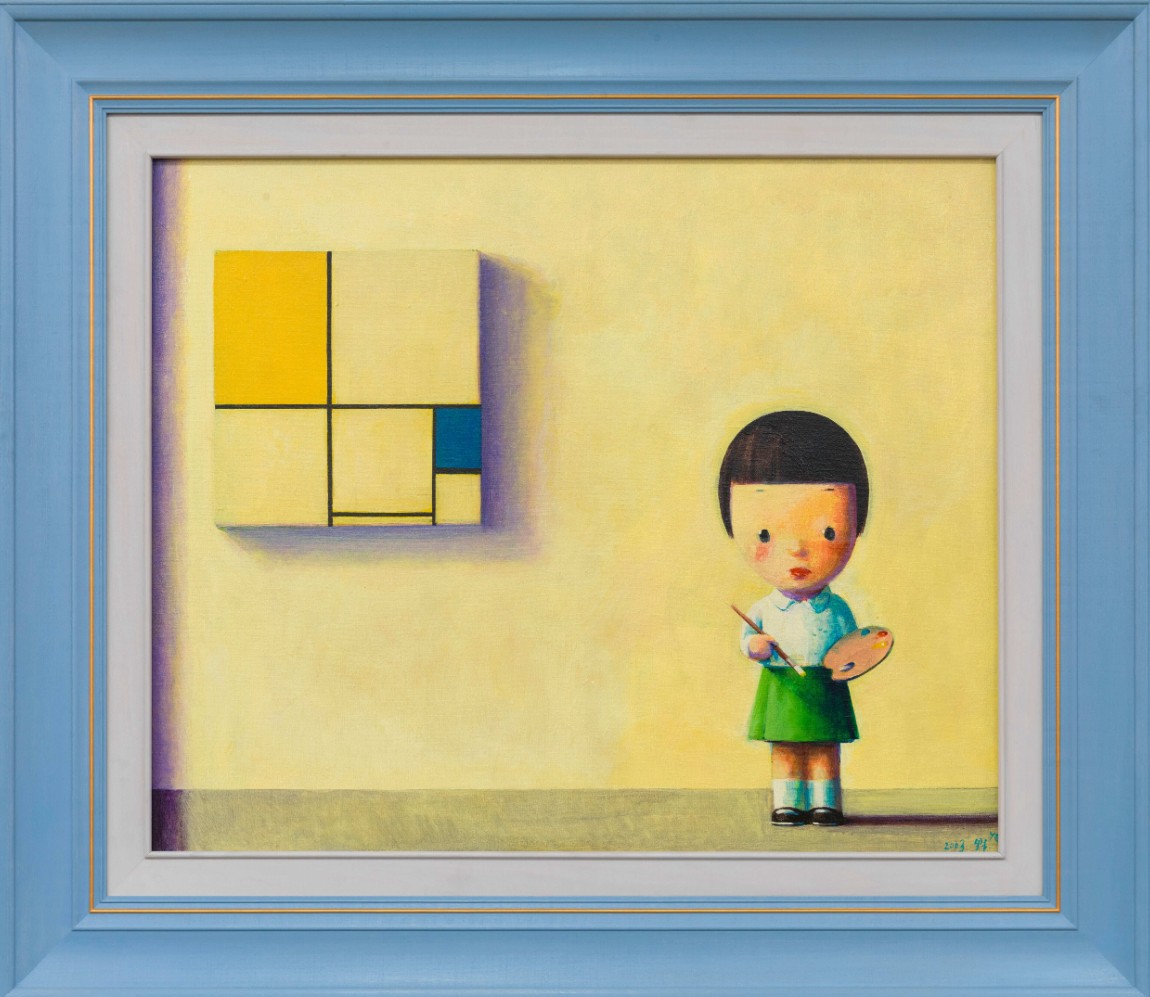
LIU YE (b.1964)
Little Painter, 2003
Acrylic on canvas
65×80 cm (25.6 x 31.5 inches)
Signed in Chinese and dated
#3. Beijing Madonna, 1994-1995
Christie’s Hong-Kong: 28 March 2025
Estimated: HKD 12,000,000 – 18,000,000
HKD 12,475,000 / USD 1,603,470
LIU YE (B. 1964), Beijing Madonna | Christie’s
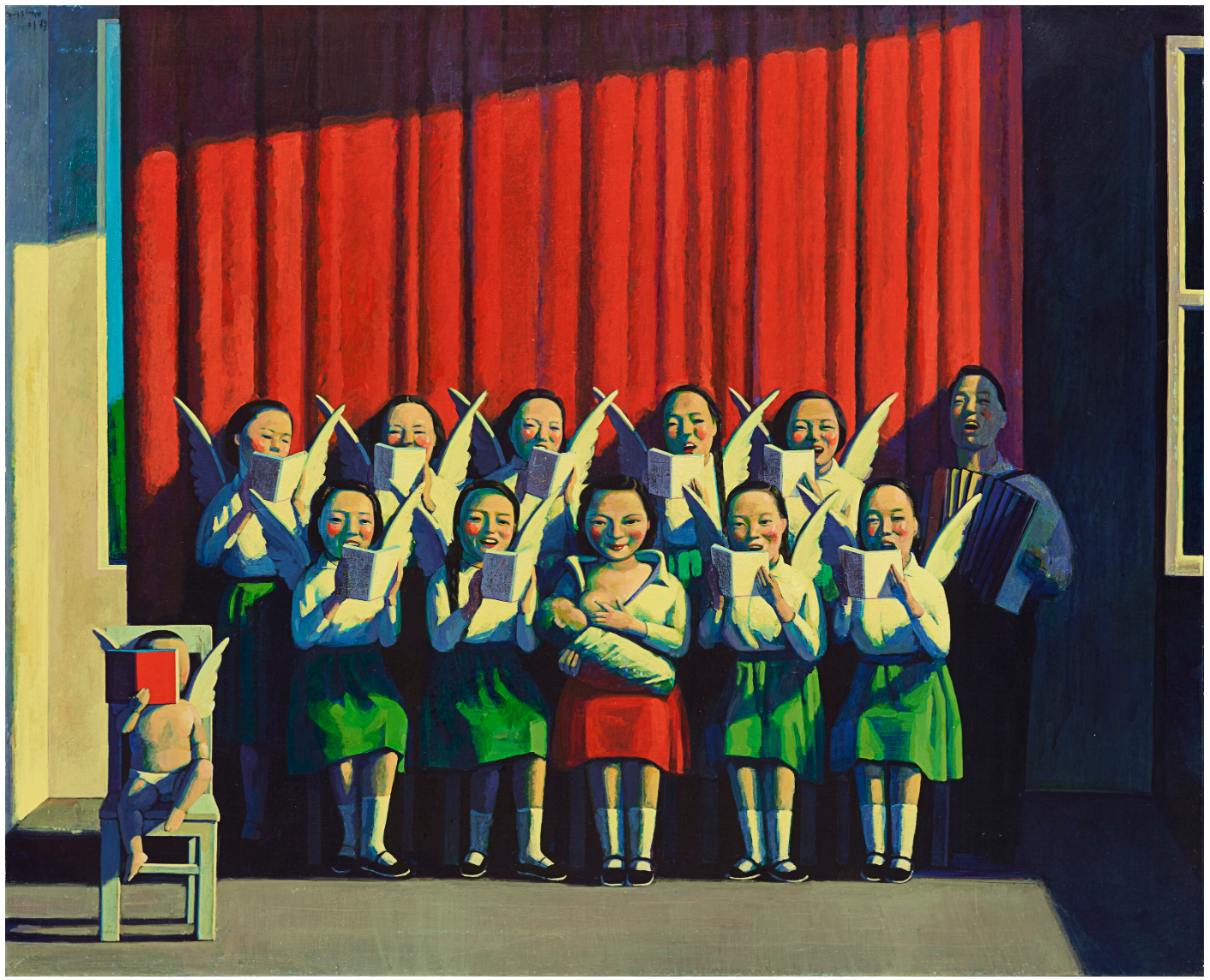
LIU YE (B. 1964)
Beijing Madonna, 1994-1995
Acrylic and oil on canvas
80×100 cm (31 1/2 x 39 3/8 inches)
Signed, signed again in Chinese, and dated ’94-95 Liu ye’ (upper left)
#4. Little Navy, 2000
China Guardian Beijing: 13 May 2025
Estimated: CNY 8,000,000 – 12,000,000
CNY 9,200,000 / USD 1,276,850
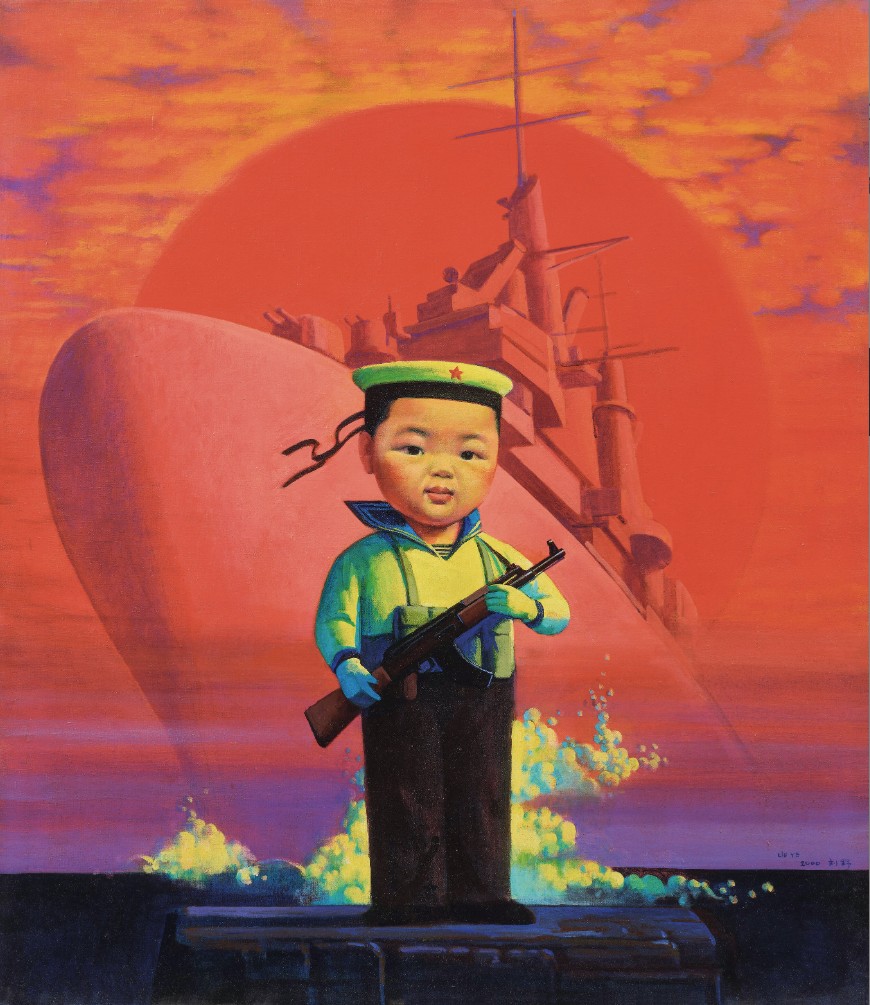
LIU YE (b.1964)
Little Navy, 2000
Oil on canvas
105×91 cm (41.3 x 35.8 inches)
Signed in Chinese and English and dated on the reverse
USD 1 million
#5. Xiao Hong and Plum Blossom, 2003
Sotheby’s Hong-Kong: 28 September 2025
Estimated: HKD 6,000,000 – 8,000,000
HKD 7,366,000 / USD 946,785
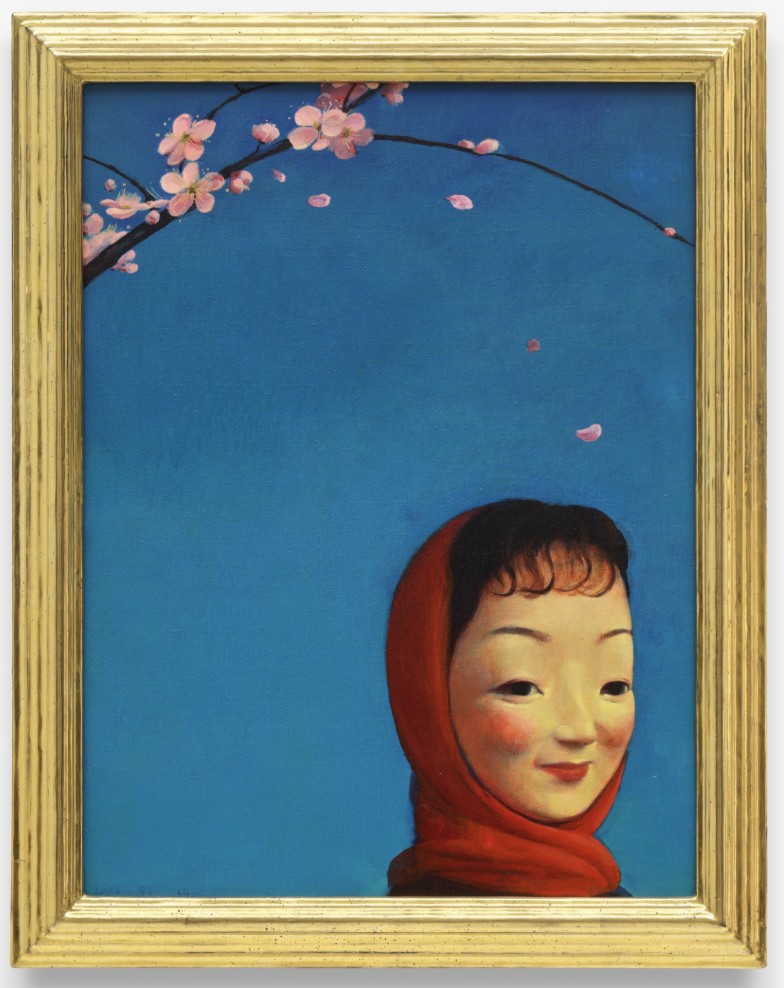
LIU YE (b. 1964)
Xiao Hong and Plum Blossom, 2003
Acrylic and oil on canvas
60×45 cm (23 5/8 x 17 3/4 inches)
Signed in Chinese and Pinyin, and dated 2003 (lower left)
#6. Uncle Lei Feng, 2003
Sotheby’s Hong-Kong: 29 September 2025
Estimated: HKD 2,500,000 – 3,500,000
HKD 3,556,000 / USD 457,070
Liu Ye 劉野 | Uncle Lei Feng 雷鋒叔叔 | Modern & Contemporary Day Auction | 2025 | Sotheby’s
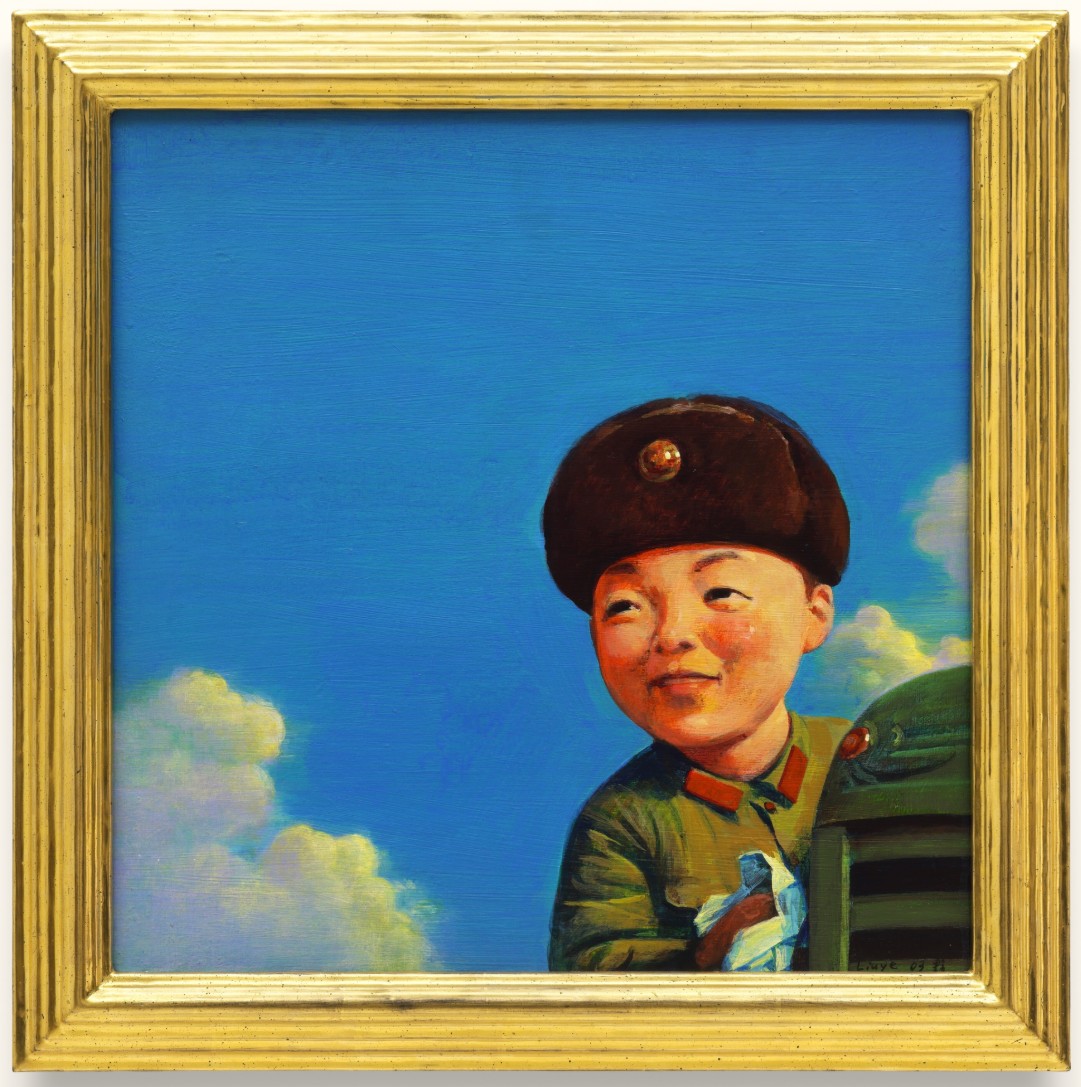
LIU YE (b. 1964)
Uncle Lei Feng, 2003
Acrylic on canvas
45.3 x 45.3 cm (17 7/8 x 17 7/8 inches)
Signed and dated 03 (lower right)
#7. Young Girl and Lacoste, 2005
Christie’s Shanghai: 3 April 2025
Estimated: CNY 1,800,000 – 2,800,000
CNY 2,268,000 / USD 312,070
LIU YE (B. 1964), Young Girl and Lacoste | Christie’s
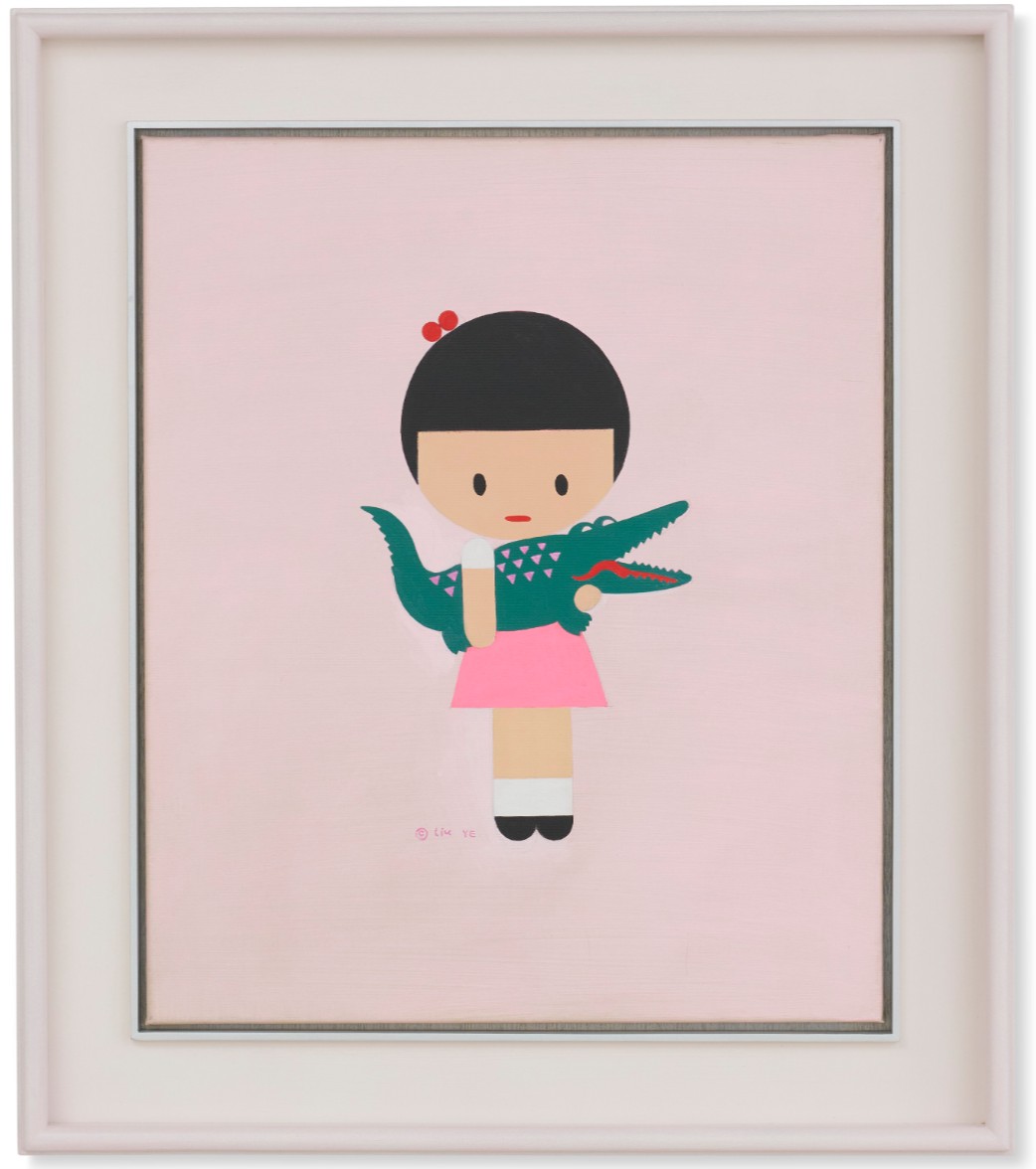
LIU YE (B. 1964)
Young Girl and Lacoste, 2005
Acrylic on canvas
60×50 cm (23 5/8 x 19 5/8 inches)
Signed ‘©LIU YE’ (lower left)
#8. Young Boy and Lacoste, 2005
Christie’s Hong-Kong: 29 March 2025
Estimated: HKD 1,500,000 – 2,500,000
HKD 2,268,000 / USD 291,517
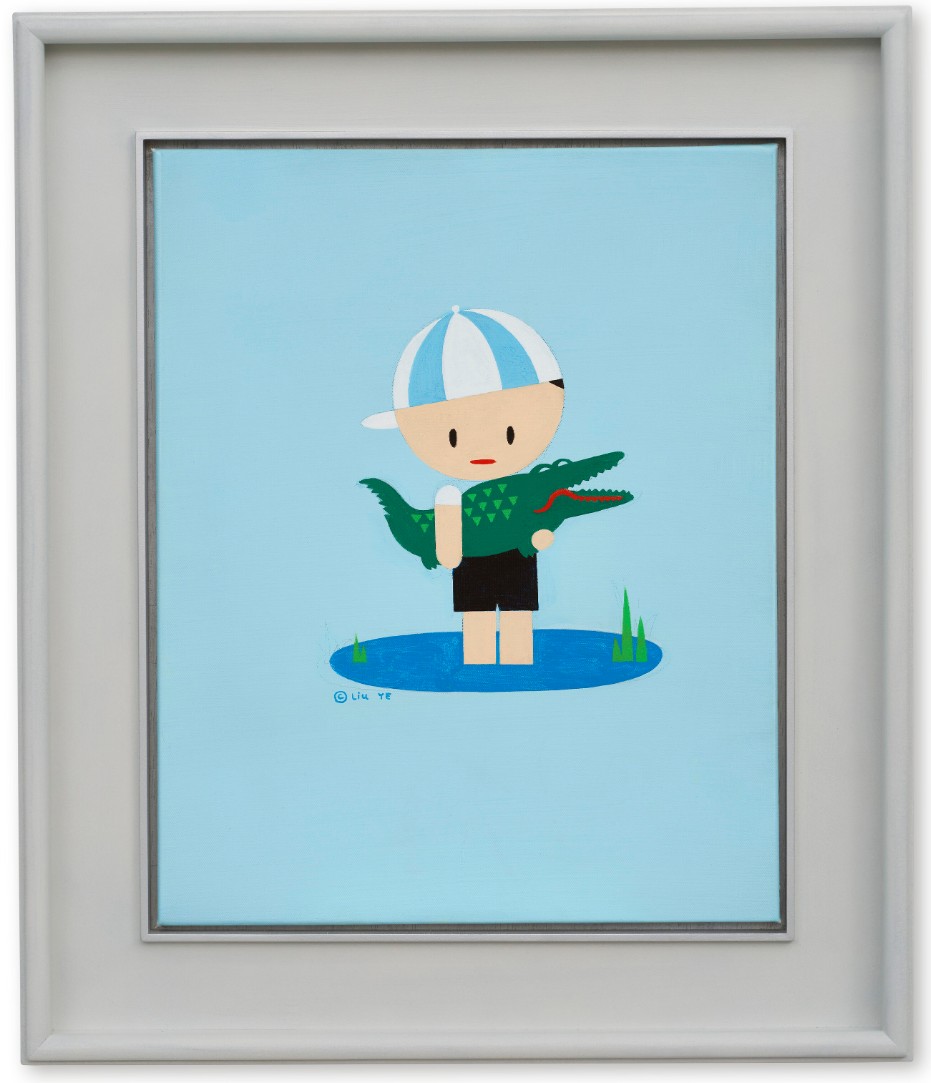
Young Boy and Lacoste, 2005
Acrylic and pencil on canvas
50×40 cm (19 5/8 x 15 3/4 inches)
Signed ‘©LIU YE’ (lower left)
#9. Girl with Mondrian, 2004
Sotheby’s Hong-Kong: 30 March 2025
Estimated: HKD 700,000 – 1,000,000
HKD 2,032,000 / USD 261,183
WORK ON PAPER
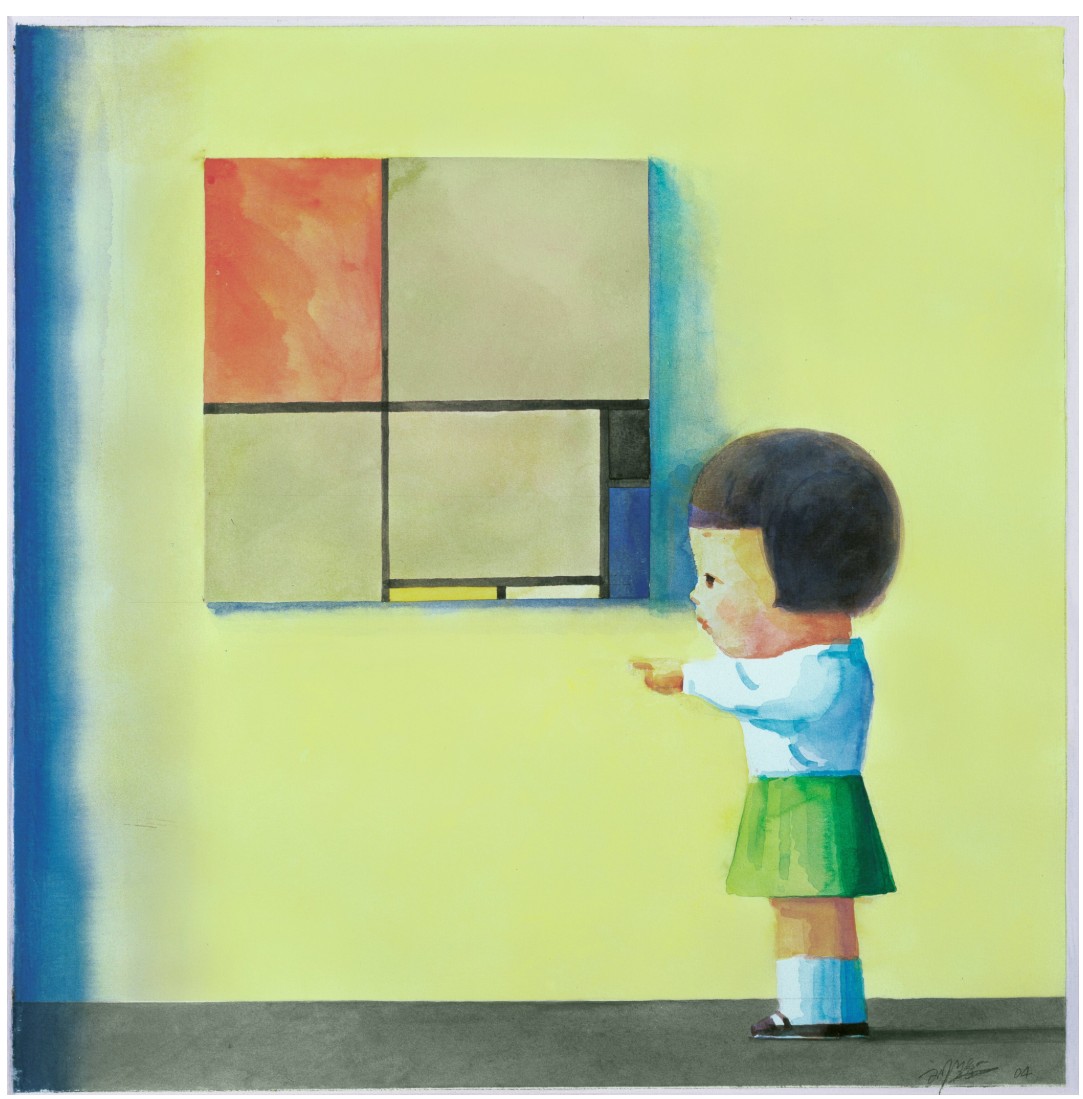
LIU YE (b. 1964)
Girl with Mondrian, 2004
Watercolor on paper
50 x 52.5 cm (19 3/4 x 20 5/8 inches)
Signed in English and Chinese and dated 04 (lower right)
#10. Miffy and Mondrian, 2014
Christie’s Hong-Kong: 26 September 2025
Estimated: HKD 800,000 – 1,200,000
HKD 1,651,000 / USD 212,210
WORK ON PAPER
LIU YE (B. 1964), Miffy and Mondrian | Christie’s
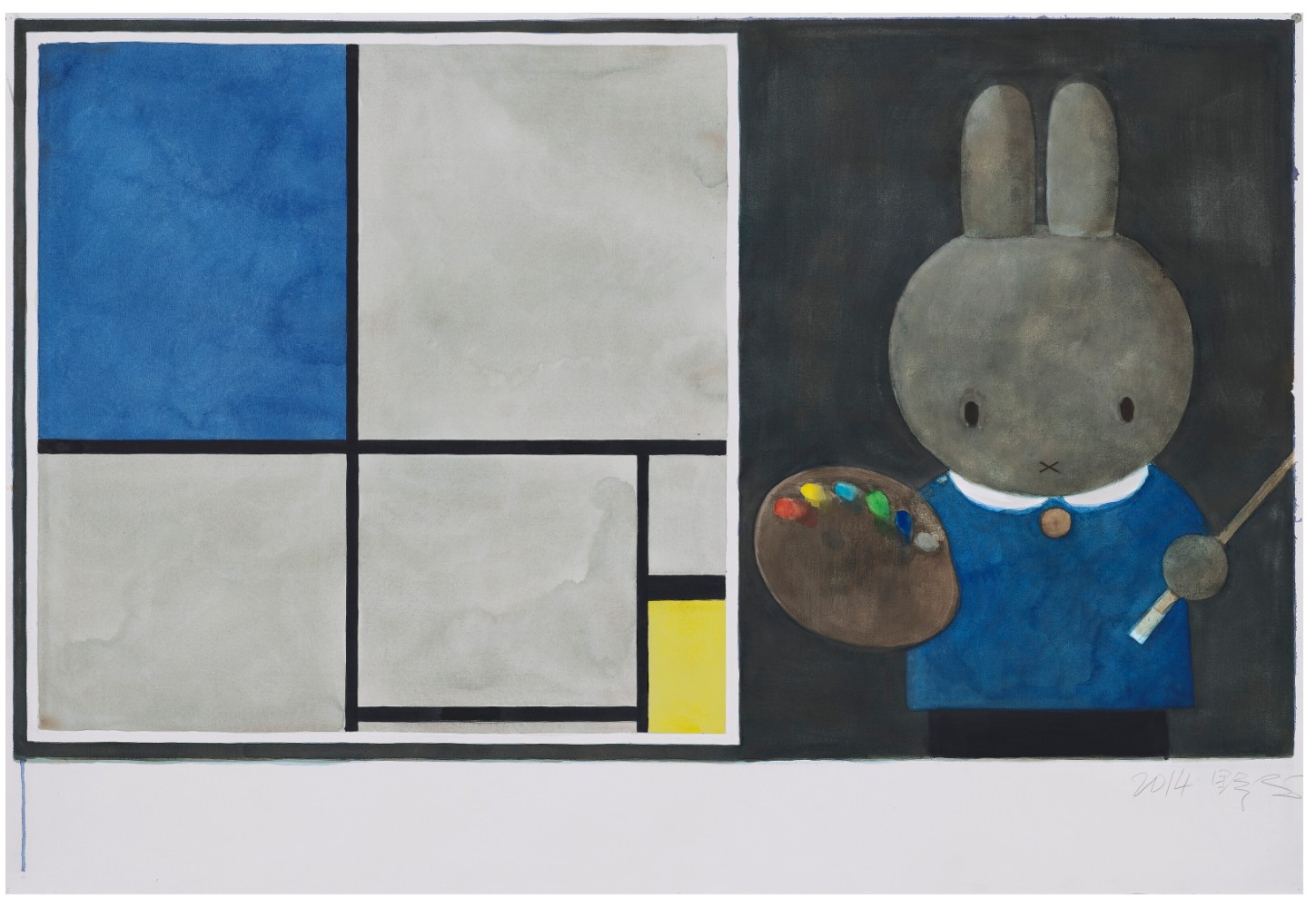
LIU YE (B. 1964)
Miffy and Mondrian, 2014
Watercolor and pencil on paper
76 x 111.5 cm (29 7/8 x 43 7/8 inches)
Signed in Chinese and dated ‘2014’ (lower right)
#11. Portrait of Eileen Chang, 2004
China Guardian Beijing: 10 November 2025
Estimated: CNY 550,000 – 750,000
CNY 862,500 / USD 121,140
WORK ON PAPER
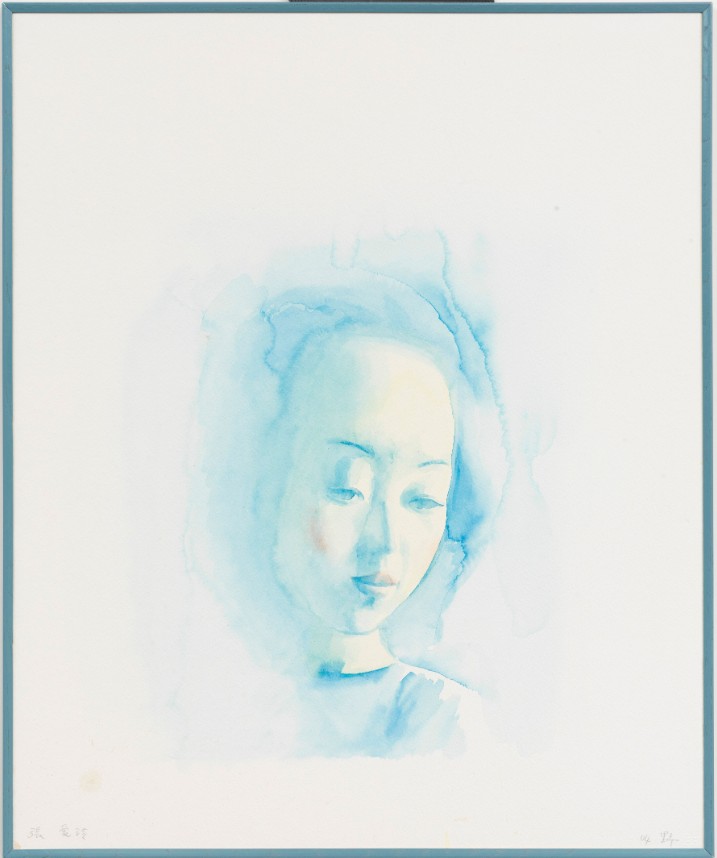
LIU YE (b.1964)
Portrait of Eileen Chang, 2004
Watercolor on paper
81.5 x 66.5 cm (32 x 26.2 inches)
Signed in Chinese and dated
#12. Snow, 2007
Christie’s online: 28 November 2025
Estimated: HKD 200,000 – 400,000
HKD 444,500 / USD 57,105
WORK ON PAPER
LIU YE (B. 1964), Snow | Christie’s
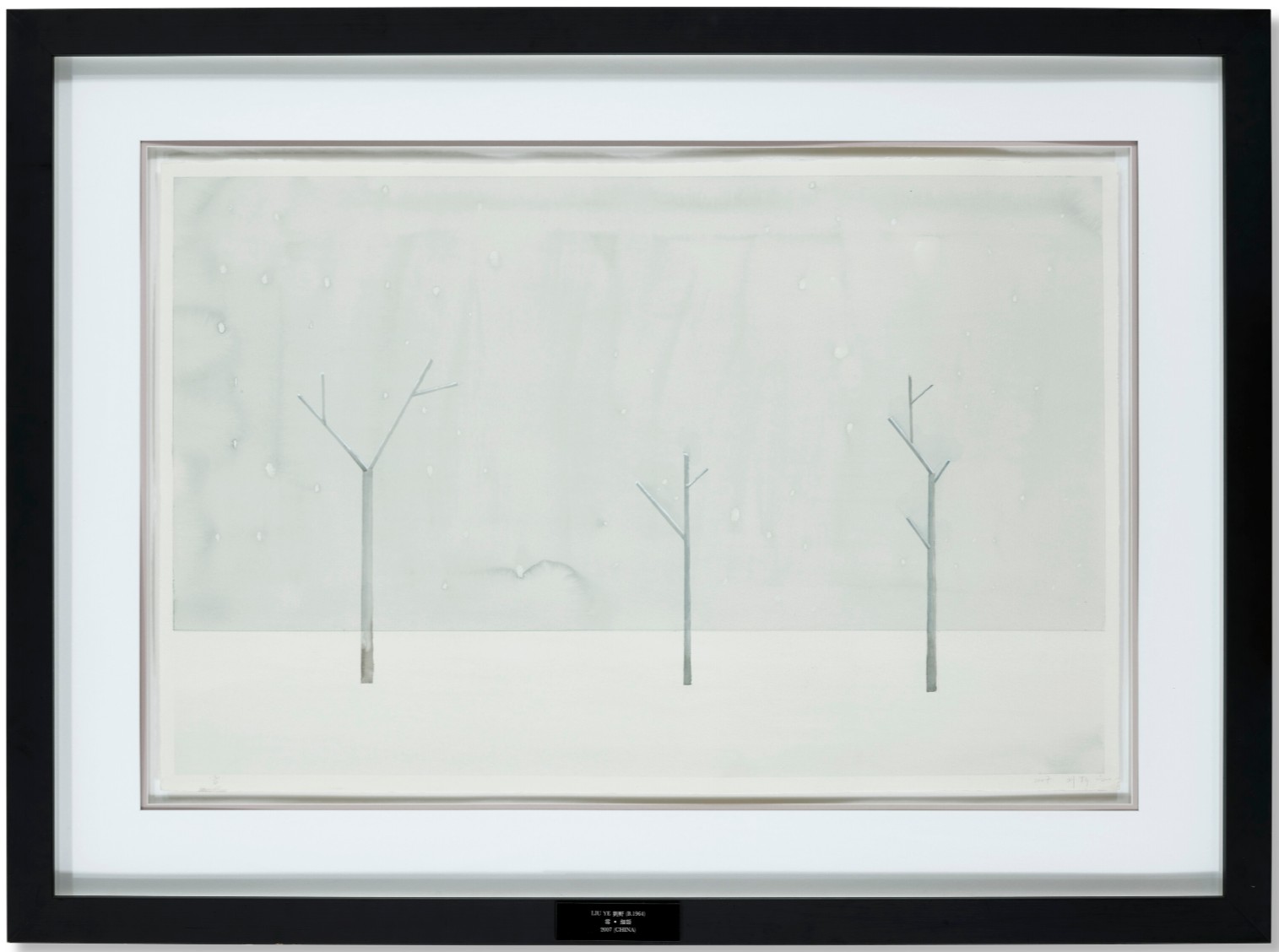
LIU YE (B. 1964)
Snow, 2007
Watercolor on paper
66.5 x 101 cm (26 1/8 x 39 3/4 inches)
Signed in Chinese, signed in artist’s signature, titled and dated ‘2007’ (bottom edge)
#13. Christian Anderson (after Albert Küchler), 2003
Sotheby’s Hong-Kong: 30 March 2025
Estimated: HKD 300,000 – 600,000
HKD 406,400 / USD 52,235
WORK ON PAPER
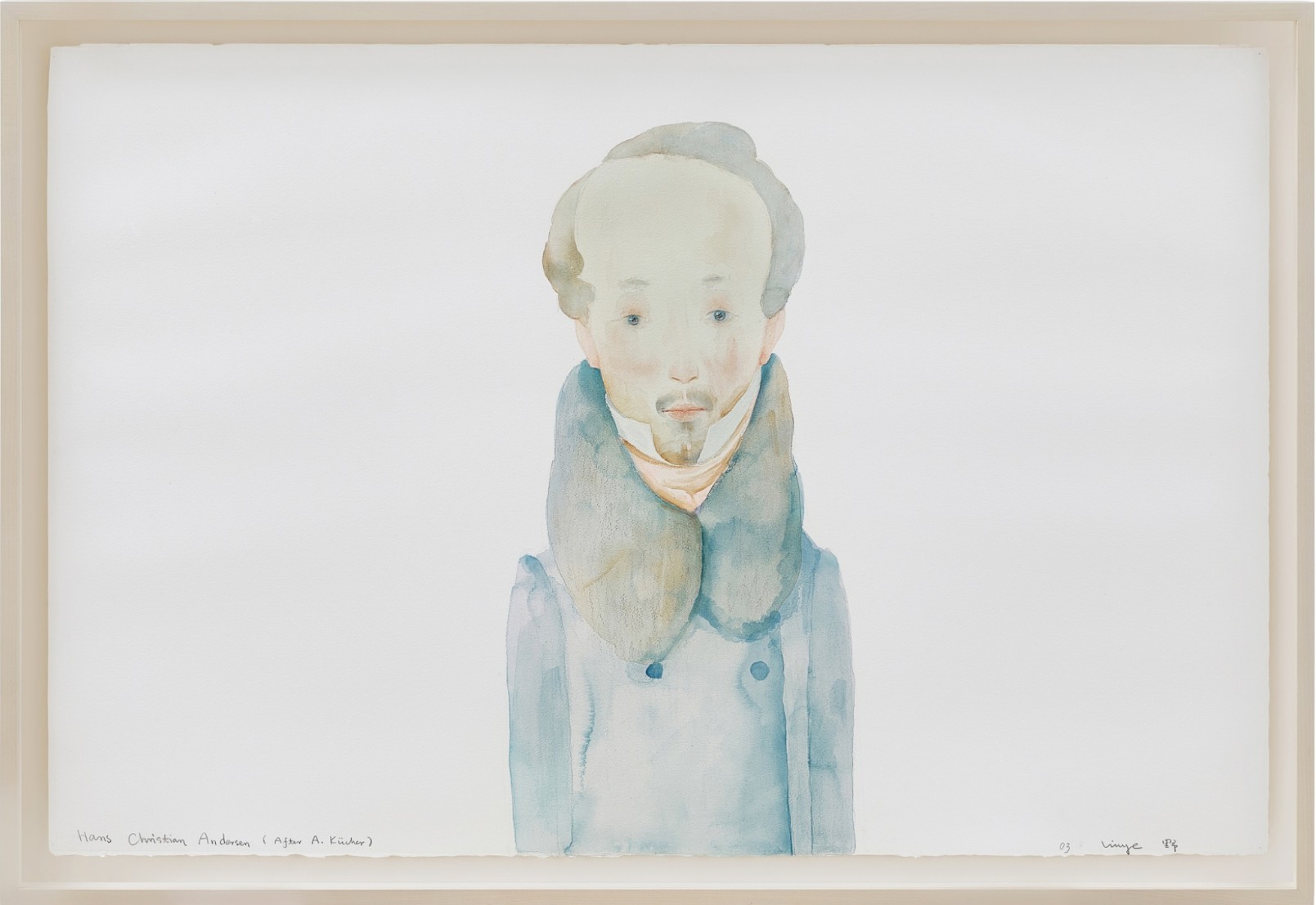
LIU YE (b. 1964)
Christian Anderson (after Albert Küchler), 2003
Watercolor on paper
67×100 cm (26 3/8 x 39 3/8 inches)
Signed in English and Chinese, titled and dated 2003 (lower edge)
2024 Auction Results
7 lots sold at auction in 2024 for a total turnover of USD 6,983,937. With 1 lot failing to sell, the sell-through rate is 88%. The highest price has been achieved at Christie’s in Hong-Kong, on 26 September 2024, when Painter and Model, a painting dated 2010, sold for HKD 13,080,000 (USD 1,679,930).
2024 Top 3 Lots
3 lots sold for more than USD 1 million, generating a cumulative turnover of USD 4,474,762, representing 64% of the total for 2024.
#1. Painter and Model, 2010
Christie’s Hong-Kong: 26 September 2024
Estimated: HKD 11,000,000 – 18,000,000
HKD 13,080,000 / USD 1,679,930
LIU YE (B. 1964), Painter and Model | Christie’s (christies.com)
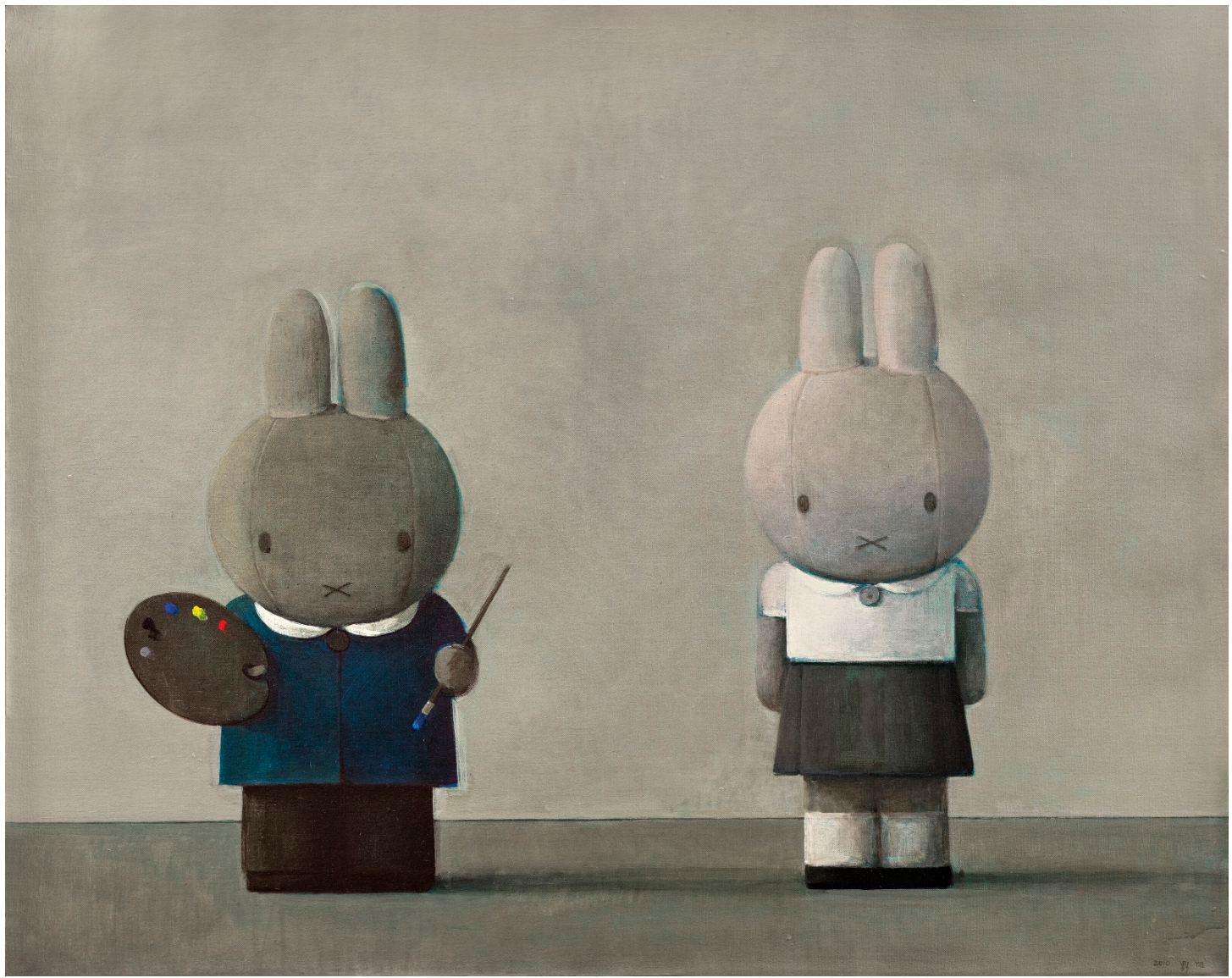
LIU YE (B. 1964)
Painter and Model, 2010
Acrylic on canvas
80×100 cm (31 1/2 x 39 3/8 inches)
Signed in Chinese, signed and dated ‘YE 2010’ (lower right)
#2. Girl with Toy Bricks, 2007
Christie’s London: 7 March 2024
Estimated: GBP 1,000,000 – 1,500,000
GBP 1,250,000 / USD 1,585,000
LIU YE (B. 1964), Girl with Toy Bricks | Christie’s (christies.com)
LIU YE (B. 1964)
Girl with Toy Bricks, 2007
Acrylic on canvas
80×60 cm (31 1/2 x 23 5/8 inches)
Signed, signed in Chinese and dated ‘Ye 2007’ (lower right)
Signed, signed in Chinese and stamped with the title and date ‘GRIL [sic] WITH TOY BRICKS 07 liu ye’
(on the reverse)
#3. Xiao Fang and Piggy, 2002
Christie’s Hong-Kong: 28 May 2024
Estimated: HKD 8,000,000 – 12,000,000
HKD 9,450,000 / USD 1,209,832
Xiao Fang and Piggy (christies.com)

LIU YE (B. 1964)
Xiao Fang and Piggy, 2002
Acrylic on canvas
60×60 cm (23 5/8 x 23 5/8 inches)
Signed in Chinese, signed again, and dated ‘2002 Liu Ye’ (lower right)
USD 1 million
#4. Girl and Piggy, 1999
Estimated: GBP 800,000 – 1,200,000
GBP 749,300 / USD 981,583
LIU YE
Girl and Piggy, 1999
Acrylic on linen
62×52 cm (24 3/8 x 20 1/2 inches)
Signed [in Pinyin] and dated ‘Liu.YE 1999’ lower right
#5. Mondrian, Hello, 2002
Phillips Hong-Kong: 25 November 2024
Estimated: HKD 6,000,000 – 9,000,000
HKD 7,366,000 / USD 946,360
Liu Ye – Modern & Contemporary Art E… Lot 5 November 2024 | Phillips
LIU YE
Mondrian, Hello, 2002
Acrylic on canvas
60×45 cm (23 5/8 x 17 3/4 inches)
Signed and dated ‘Ye [in Chinese] 2002 Liu Ye’ lower left
#6. Untitled, 1997
Christie’s Hong-Kong: 29 May 2024
Estimated: HKD 3,000,000 – 5,000,000
HKD 4,032,000 / USD 516,195
LIU YE (B. 1964), Untitled | Christie’s (christies.com)

LIU YE (B. 1964)
Untitled, 1997
Acrylic and oil on canvas
120×140 cm (47 1/4 x 55 1/8 inches)
Signed in Chinese, signed again and dated ’97 liu ye’ (lower left)
#7. Beijing Madonna, 1997
Phillips online: 3 May 2024
Estimated: HKD 400,000 – 600,000
HKD 508,000 / USD 65,036
https://www.phillips.com/detail/liu-ye/HK090124/5
LIU YE
Beijing Madonna, 1997
Watercolor on paper
Signed and dated ‘Liy Ye 97’ lower right
2023 Auction Results
14 lots sold at auction in 2023 for a total turnover of USD 37,328,495. With 2 lots unsold, the sell-through rate is 87.5%. The highest price was achieved at China Guardian, in Beijing, on 18 November 2023, by Bright Avenue, a painting dated 1995, sold for CNY 57,500,000 (USD 7,983,120).
2023 Top 3 Lots
12 lots sold for more than USD 1 million, generating a cumulative turnover of USD 35,982,547, representing 96.2% of the total turnover for 2023. All lots sold in Asia except one that sold in London.
#1. Bright Avenue, 1995
China Guardian Beijing: 18 November 2023
Estimated: CNY 50,000,000 – 60,000,000
CNY 57,500,000 / USD 7,983,120
LIU YE (b.1964)
Bright Avenue, 1995
Acrylic and oil on canvas
170×200 cm (67 x 78.7 inches)
Signed and titled and dated in Chinese on the reverse
#2. Red No. 2, 2003
Christie’s Hong-Kong: 28 November 2023
Estimated: HKD 26,00,000 – 36,00,000
HKD 31,835,000 / USD 4,087,099
21391-liu-ye-red-no-2 (christies.com)
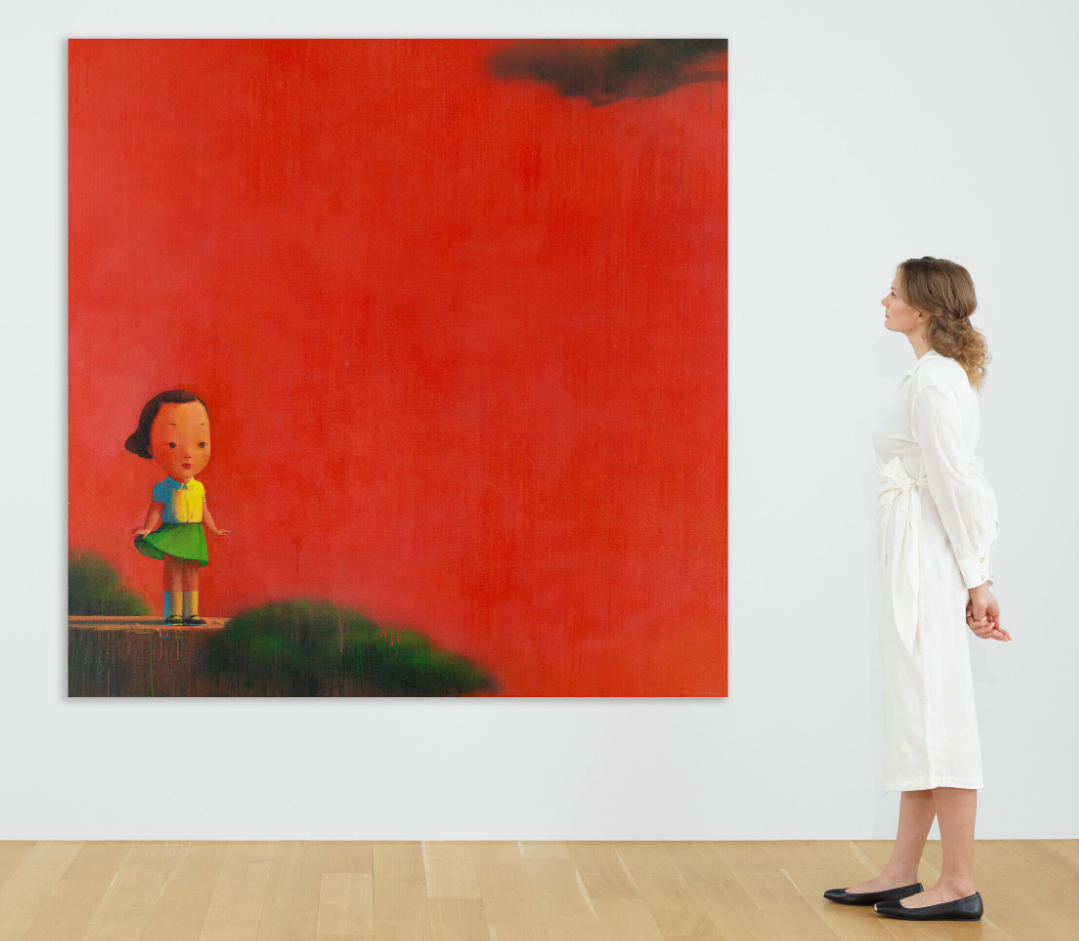
LIU YE (B. 1964)
Red No. 2, 2003
Acrylic on canvas
195×195 cm (76 3/4 x 76 3/4 inches.)
Signed and dated ‘2003 Liu ye’, signed again in Chinese (lower left)
#3. The Goddess, 2018
Christie’s London: 28 February 2023
Estimated: GBP 800,000 – 1,200,000
GBP 3,102,000 / USD 3,751,814
LIU YE (B. 1964)
The Goddess, 2018
Acrylic on canvas
60×45 cm (23 5/8 x 17 3/4 inches)
Signed, titled and dated (on the reverse)
#4. Ruan Lingyu No.1, 2002
China Guardian Beijing: 18 November 2023
Estimated: CNY 10,000,000 – 12,000,000
CNY 20,930,000 / USD 2,905,855
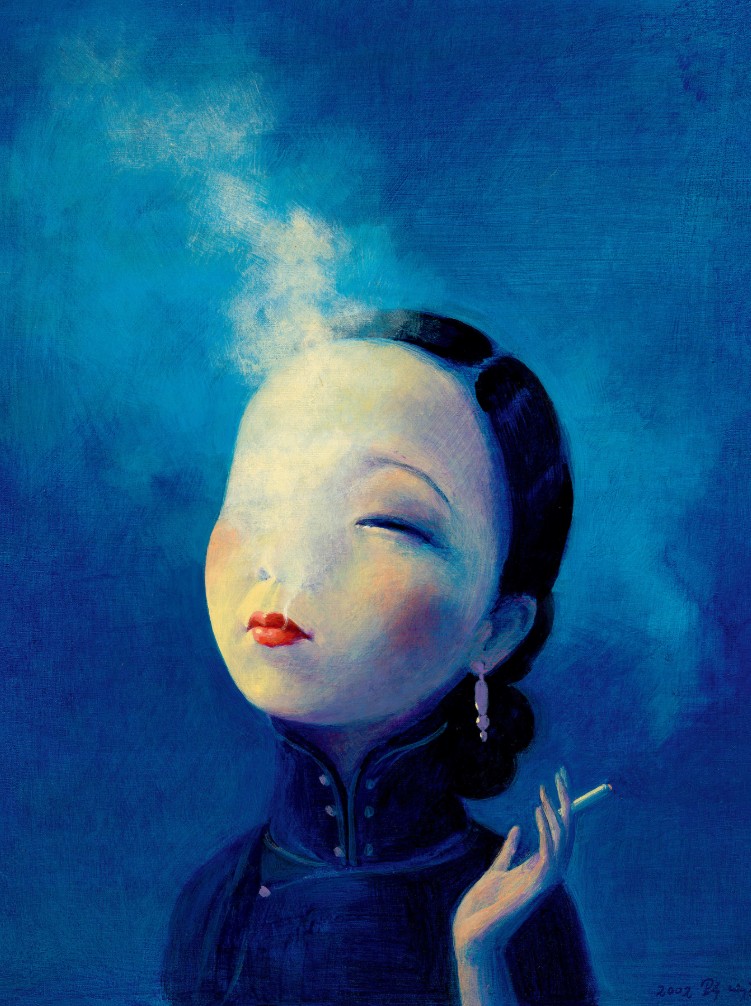
LIU YE (b.1964)
Ruan Lingyu No.1, 2002
Acrylic on canvas
60×45 cm (23.6 x 17.7 inches)
Dated, signed in Chinese and English
#5. Mondrian, Dick Bruna and I, 2003
China Guardian Beijing: 13 June 2023
Estimated: CNY 18,000,000 – 22,000,000
CNY 20,700,000 / USD 2,891,755
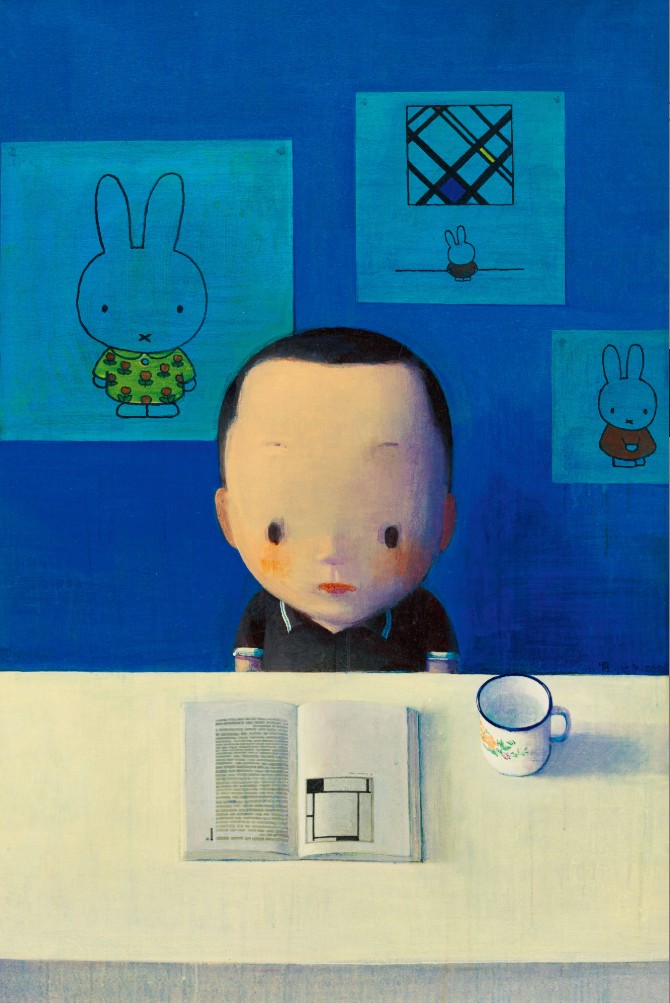
LIU YE (b.1964)
Mondrian, Dick Bruna and I, 2003
Acrylic on canvas
120×80 cm (47.2 x 31.5 inches)
Signed in Chinese and English and dated
#6. She and Mondrian, 2003
Sotheby’s Hong-Kong: 5 October 2023
Estimated: HKD 17,000,000 – 22,000,000
HKD 22,230,000 / USD 2,838,815
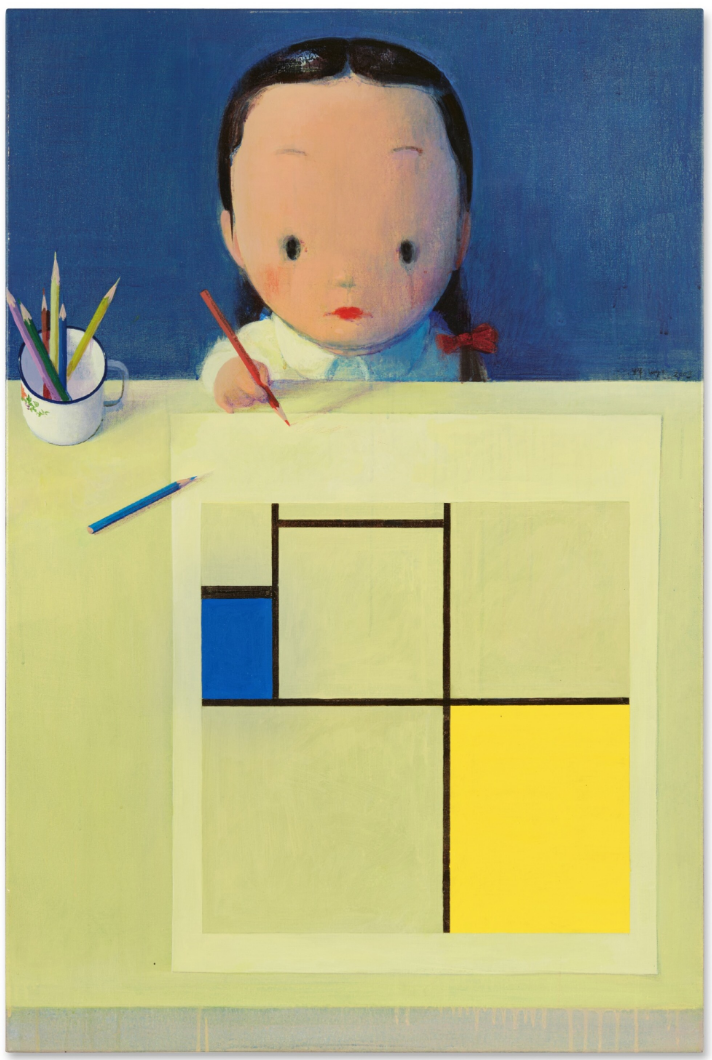
LIU YE (b. 1964)
She and Mondrian, 2003
Acrylic on canvas
120×80 cm (47 1/4 x 31 1/2 inches)
signed in Chinese and Pinyin and dated 2003
#7. The End of Baroque, 1998
Phillips Hong-Kong: 6 October 2023
Estimated: HKD 18,000,000 – 28,000,000
HKD 22,230,000 / USD 2,838,815
Liu Ye – 20th Century & Contemporary… Lot 10 October 2023 | Phillips
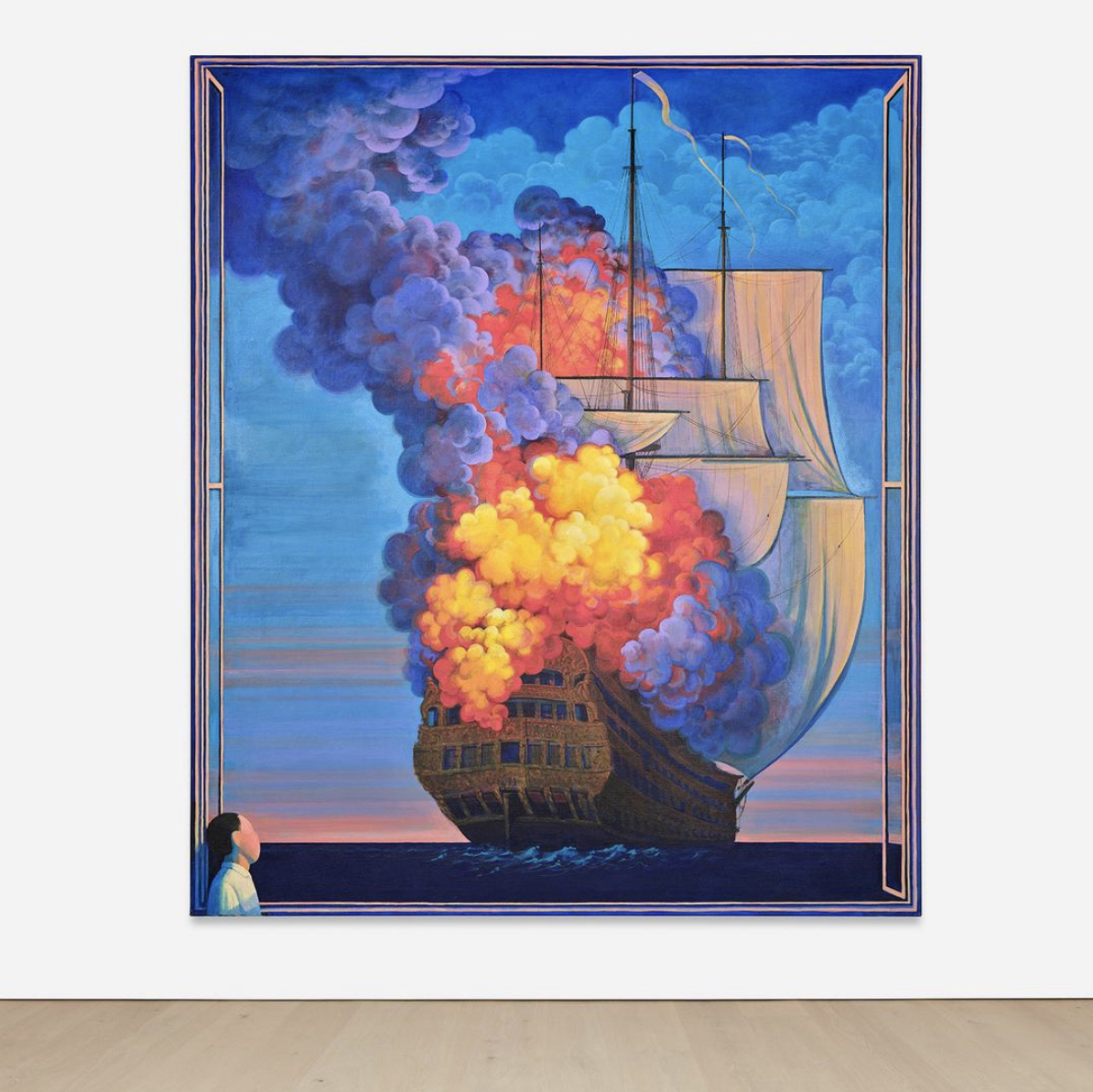
LIU YE
The End of Baroque, 1998
Acrylic on canvas
200×170 cm (78 3/4 x 66 7/8 inches)
Signed and dated ‘98 Liu Ye’ upper left
#8. A View of My Teacher’s Back, 2004
Sotheby’s Hong-Kong: 5 April 2023
Estimated: HKD 12,000,000 – 18,000,000
HKD 22,230,000 / USD 2,831,883
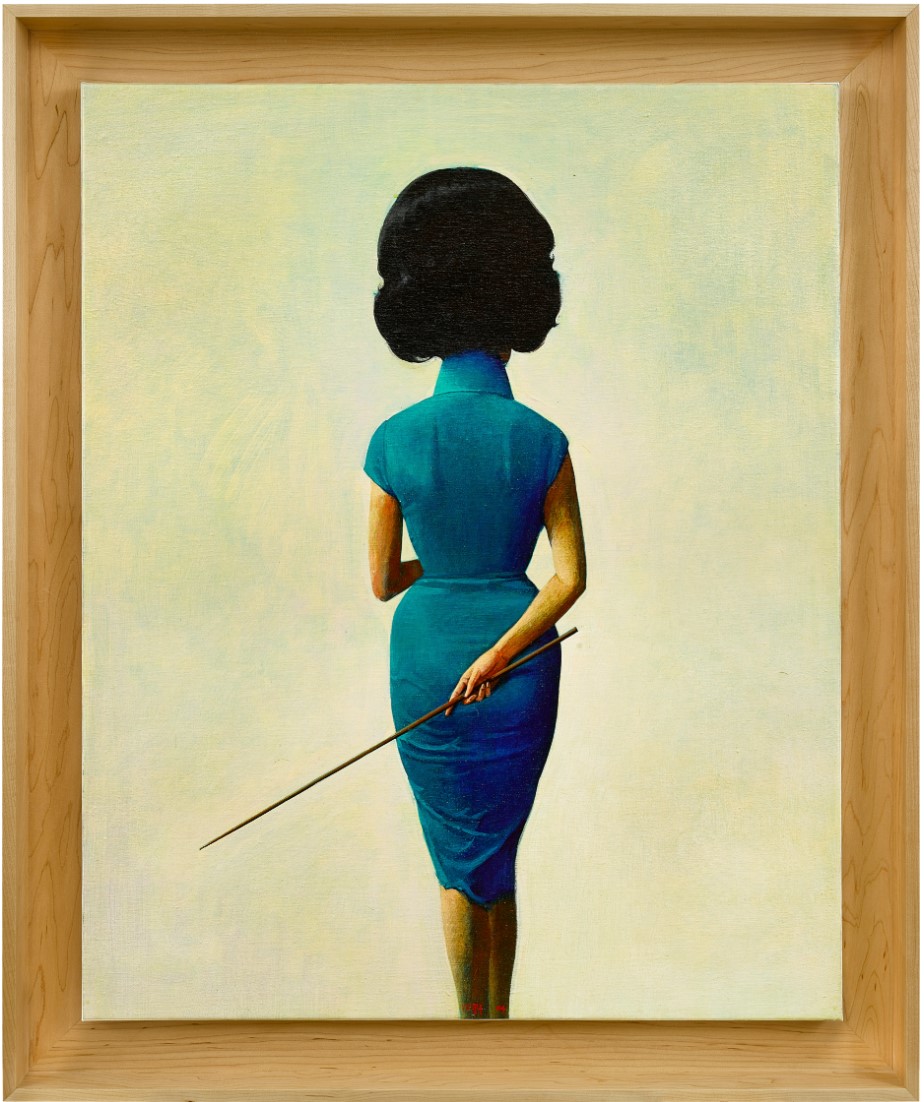
LIU YE (b. 1964)
A View of My Teacher’s Back, 2004
Acrylic on canvas
80×65 cm (31 1/2 x 25 5/8 inches)
Signed in Pinyin and Chinese and dated 04
#9. Room of the Sea, 2000
Christie’s Hong-Kong: 28 May 2023
Estimated: HKD 8,000,000 – 15,000,000
HKD 14,290,000 / USD 1,824,286
LIU YE (B. 1964), Room of the Sea | Christie’s (christies.com)
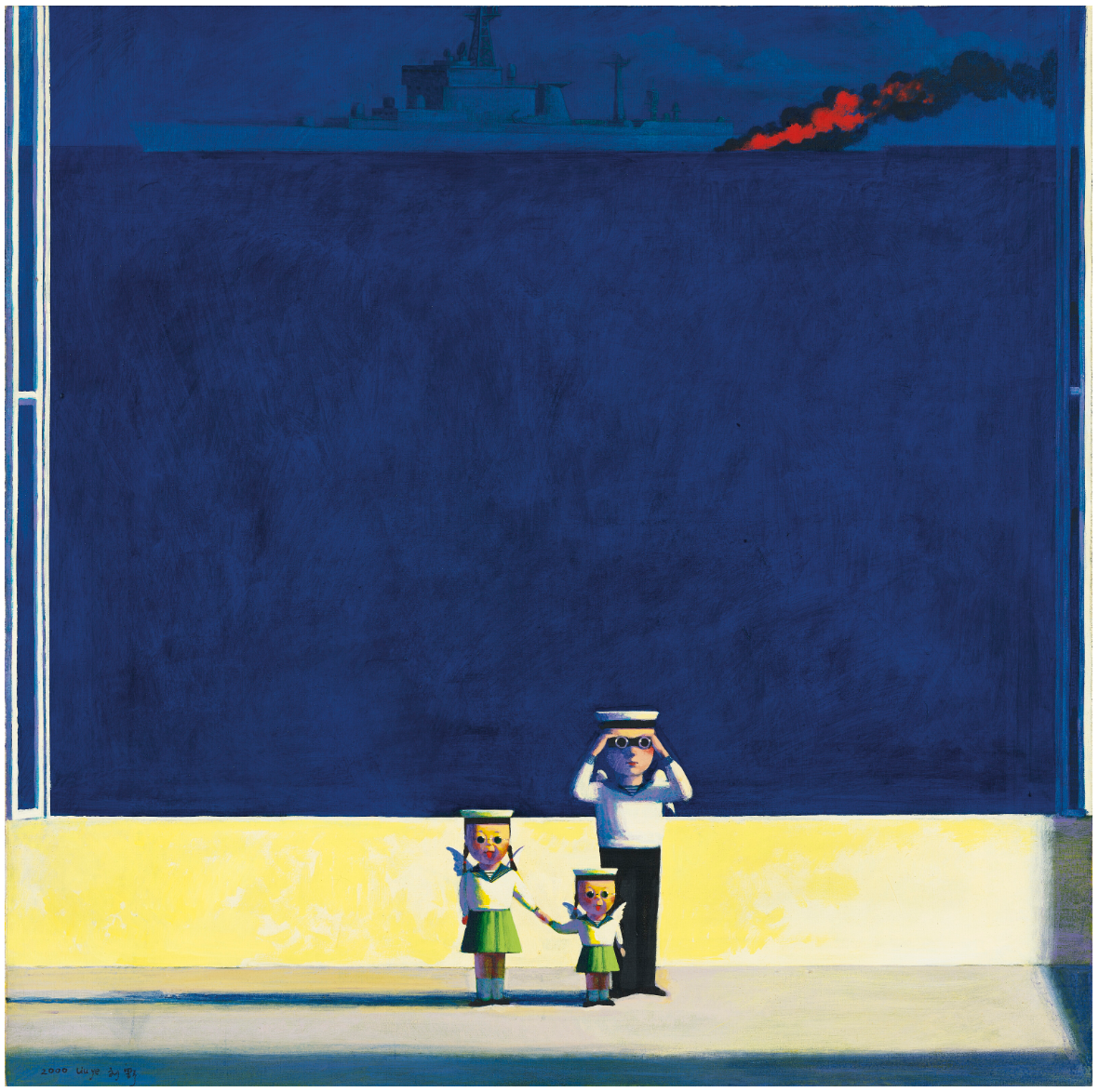
LIU YE (B. 1964)
Room of the Sea, 2000
Acrylic and oil on canvas
90×90 cm (35 3/8 x 35 3/8 inches)
Signed in Chinese; signed again and dated ‘2000 Liu Ye’ (lower left)
#10. Wind, 2004
Christie’s Hong-Kong: 24 September 2023
Estimated: HKD 9,000,000 – 15,000,000
HKD 11,870,000 / USD 1,517,844
LIU YE (B. 1964) (christies.com)
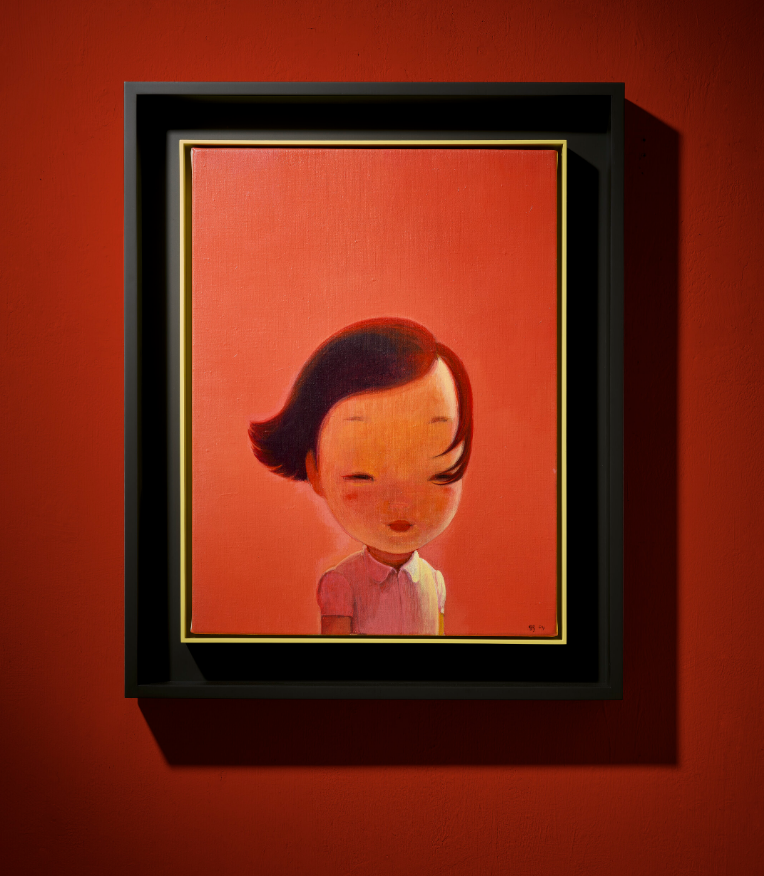
LIU YE (B. 1964)
Wind, 2004
Acrylic on canvas
60 x 45.3 cm (23 5/8 x 17 7/8 inches)
Signed in Chinese and dated ‘04’ (lower right)
Stamped ‘WIND 2004 LIU YE’ (on the reverse)
#11. Boogie Woogie, Little Girl, 2005
Christie’s Hong-Kong: 29 November 2023
Estimated: HKD 6,000,000 – 9,000,000
HKD 10,055,000 / USD 1,290,899
LIU YE (B. 1964) (christies.com)
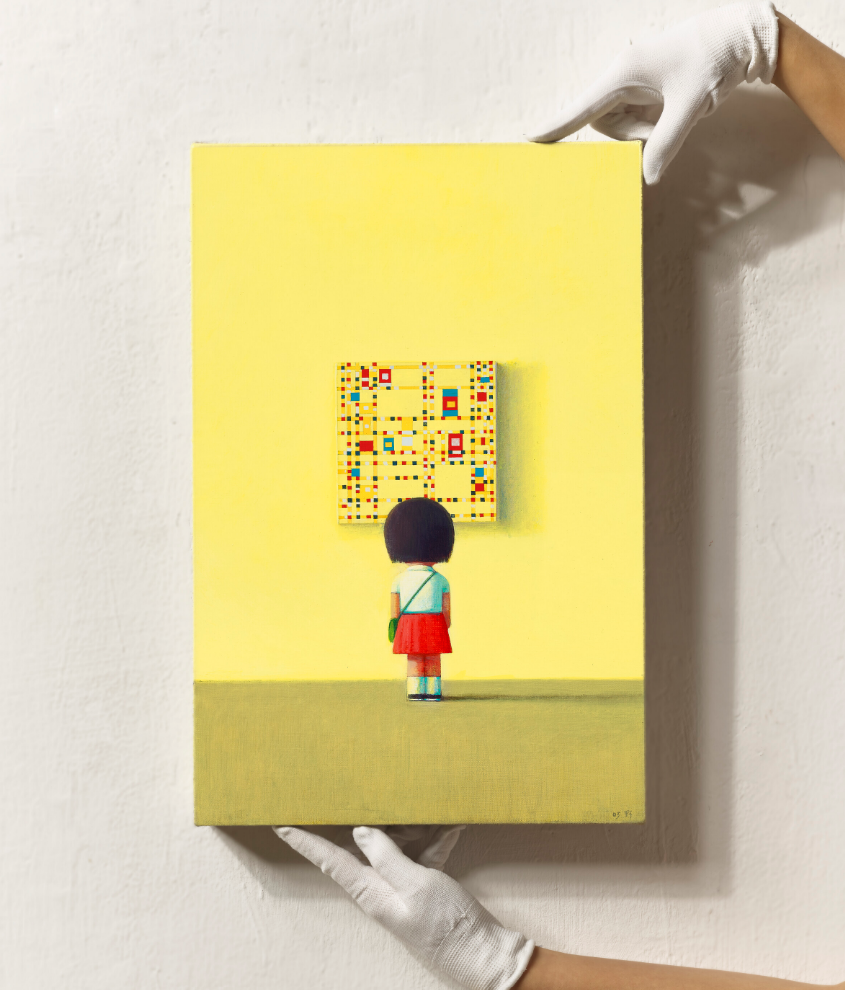
LIU YE (B. 1964)
Boogie Woogie, Little Girl, 2005
Acrylic on canvas
43 x 28.5 cm. (16 7/8 x 11 1/4 inches)
Signed in Chinese and dated ’05’ (lower right)
Stamped ‘LITTLE GRIL BOOGIE WOOGIE 2005 LIU YE’ (on the reverse)
#12. Composition with Moonlight, 2005
Sotheby’s Singapore: 2 July 2023
Estimated: SGD 1,200,000 – 1,500,000
SGD 1,651,000 / USD 1,220,883
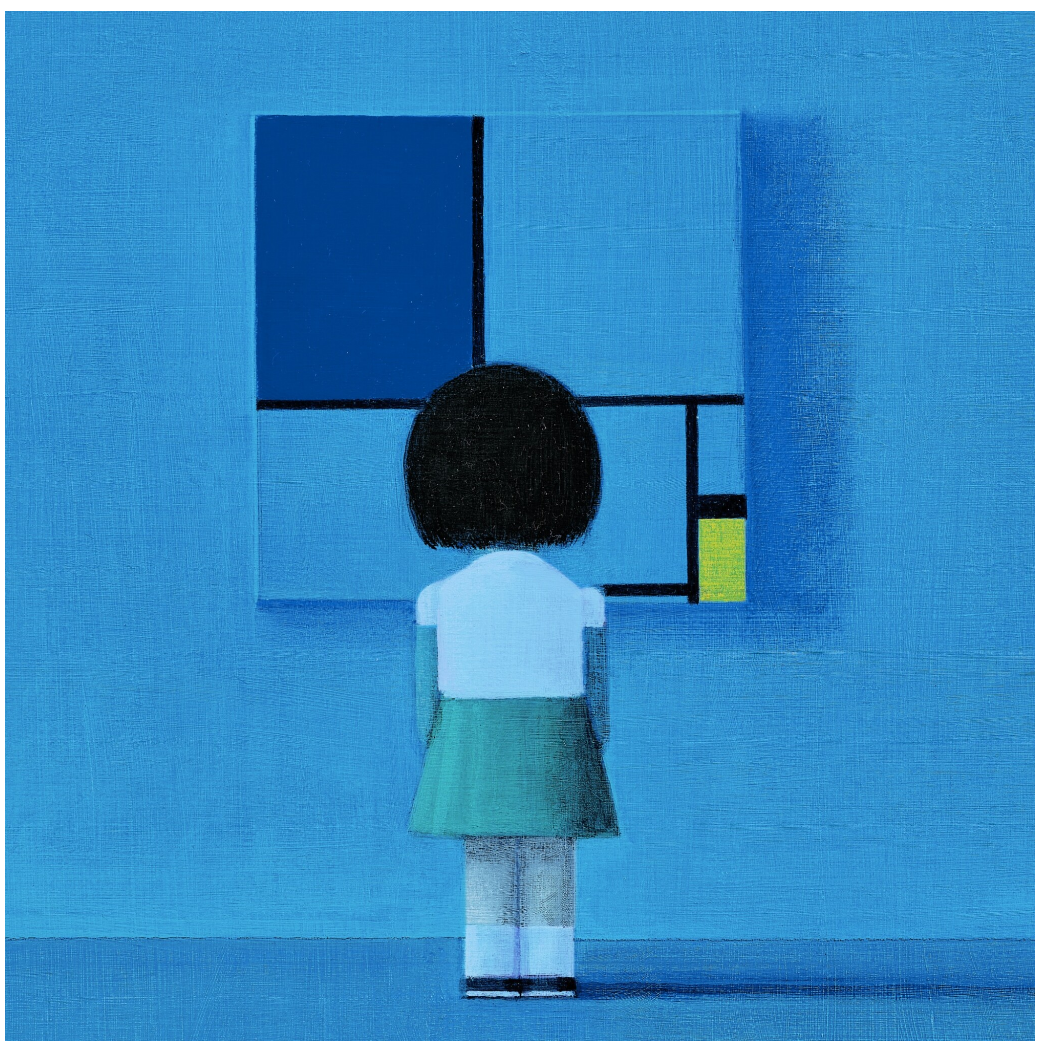
LIU YE (b. 1964)
Composition with Moonlight, 2005
Acrylic on canvas
45×45 cm (17 3/4 x 17 3/4 inches)
Signed Liu Ye and dated 05 (lower right)
Initialed in Chinese and Pinyin, titled COMPOSITION IN MOONLIGHT and dated 05 (on the verso)
USD 1 million
#13. Flagship No. 1, 1997
Phillips Hong-Kong: 30 March 2023
Estimated: HKD 4,000,000 – 6,000,000
HKD 6,985,000 / USD 889,820
Liu Ye – 20th Century & Contemporary A… Lot 33 March 2023 | Phillips
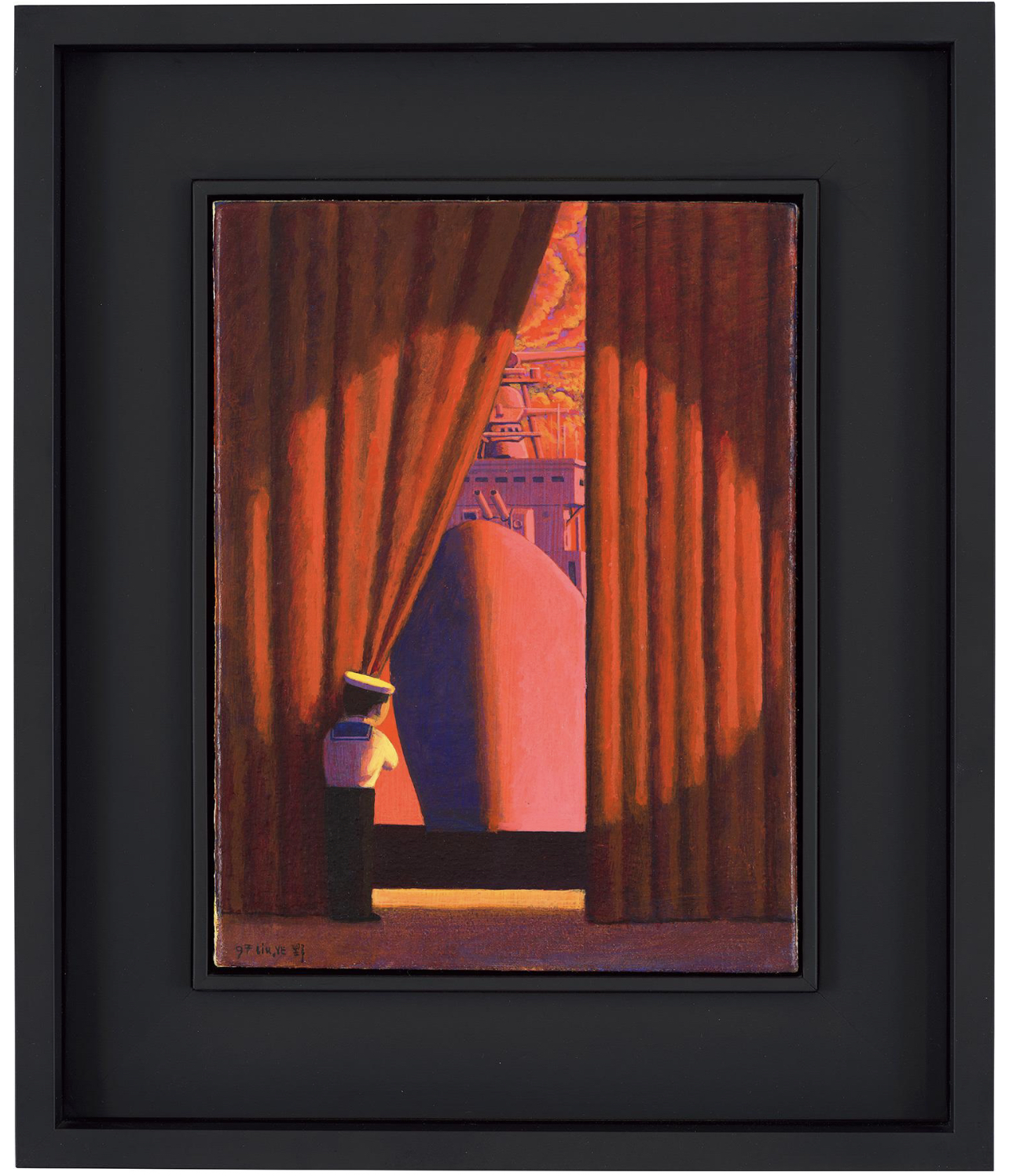
LIU YE
Flagship No. 1, 1997
Acrylic and oil on canvas
29.2 x 22.2 cm (11 1/2 x 8 3/4 inches)
Signed and dated ’97 Liu Ye Ye [in Chinese]’ lower left
#14. Hey!, 2000
Phillips Hong-Kong: 26 November 2023
Estimated: HKD 3,000,000 – 5,000,000
HKD 3,456,000 / USD 456,128
Liu Ye – New Now & Design Hong Kong Lot 38 November 2023 | Phillips
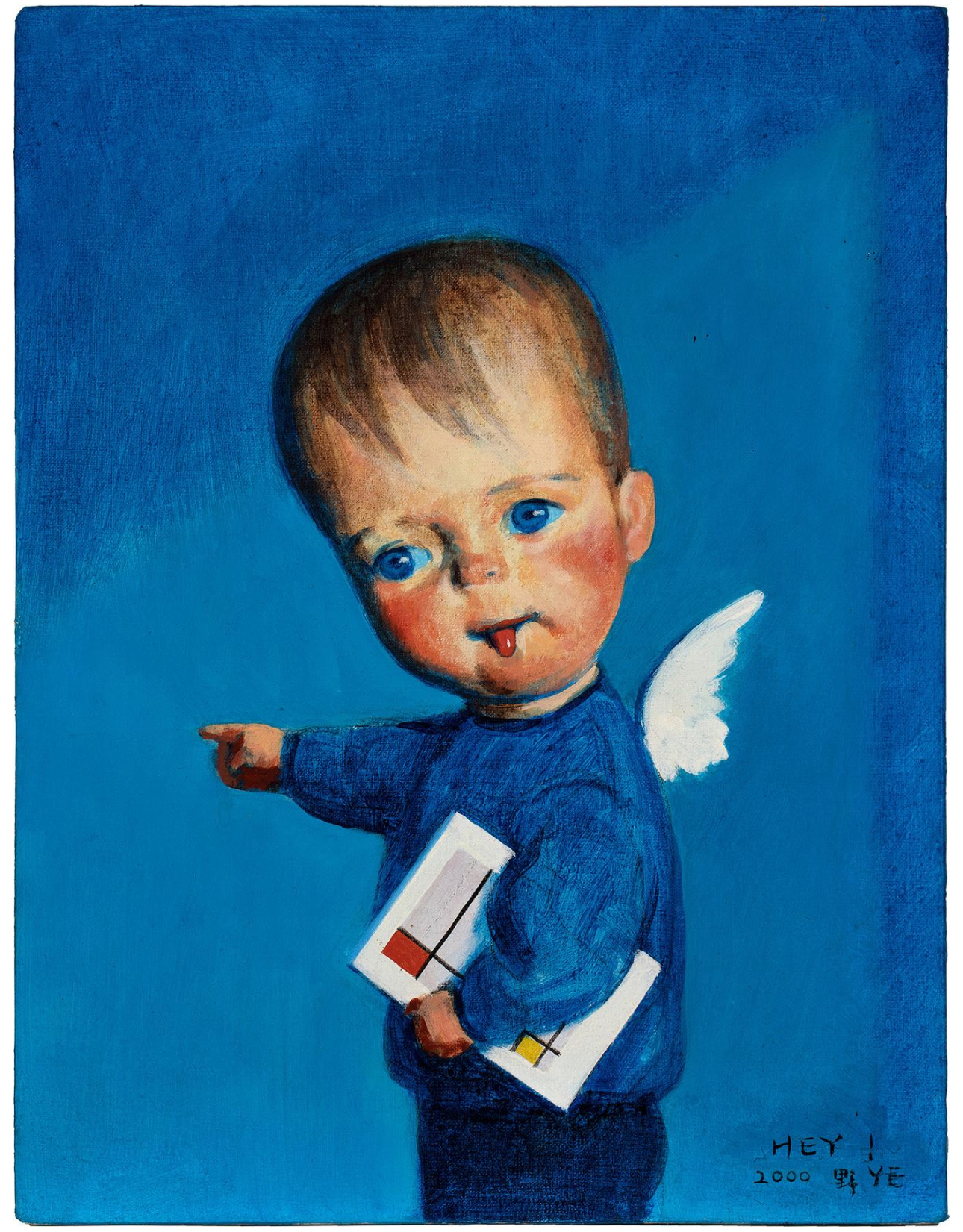
LIU YE
Hey!, 2000
Oil on canvas
35.3 x 27.3 cm (13 7/8 x 10 3/4 inches)
Signed, titled and dated ‘”HEY!” 2000 YE [in Chinese and English]’ lower right
2022 Auction Results
8 lots sold at auction in 2022 for a total turnover of USD 12,129,806. With 2 lots failing to sell, the sell-through rate is 80%. The highest price has been achieved by a painting dated 1998, The Sailors with Red Flag, that sold at Christie’s in Hong-Kong on 26 May 2022 for HKD 37,650,000 (USD 4,796,239).
Nota Bene: this does not include lots sold at auction in Mainland China.
2022 Top 3 Lots
4 lots sold for more than USD 1 million, generating a cumulative turnover of USD 10,148,681, representing 83.7% of the total turnover for 2022.
#1. The Sailors with Red Flag, 1998
Christie’s Hong-Kong: 26 May 2022
Estimated: HKD 19,000,000 – 25,000,000
HKD 37,650,000 / USD 4,796,239
LIU YE (B. 1964) (christies.com)
LIU YE (B. 1964)
The Sailors With Red Flag, 1998
Acrylic on canvas
120×140 cm (47 1/4 x 55 1/8 inches)
Signed in Chinese, signed and dated ‘liu ye 98’ (lower right)
#2. Night, 2005
Sotheby’s Hong-Kong: 27 April 2022
Estimated: HKD 15,000,000 – 25,000,000
HKD 23,970,000 / USD 3,054,748
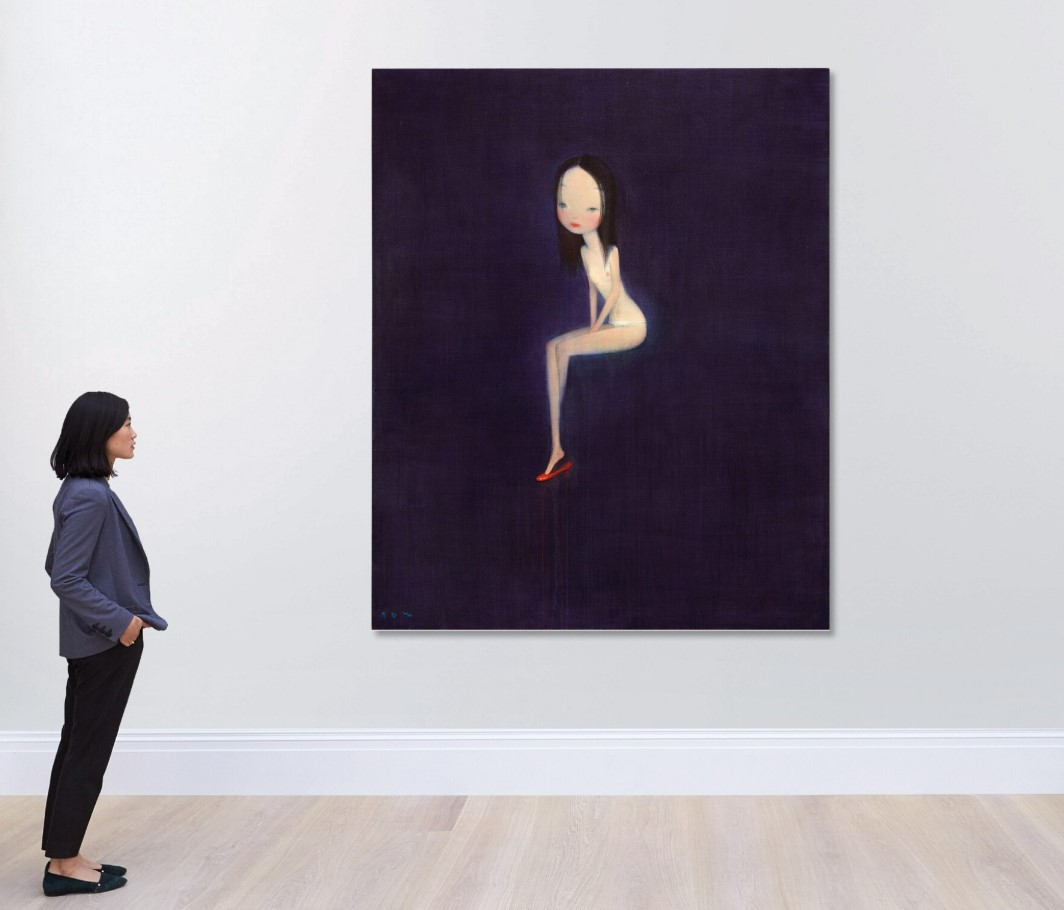
LIU YE (b. 1964)
Night, 2005
Acrylic on canvas
220×180 cm (86 5/8 x 70 7/8 inches)
Signed in Chinese and Pinyin and dated 05
#3. Composition with Moonlight
Sotheby’s Hong-Kong: 13 December 2022
Estimated: HKD 7,000,000 – 9,000,000
HKD 10,055,000 / USD 1,293,297
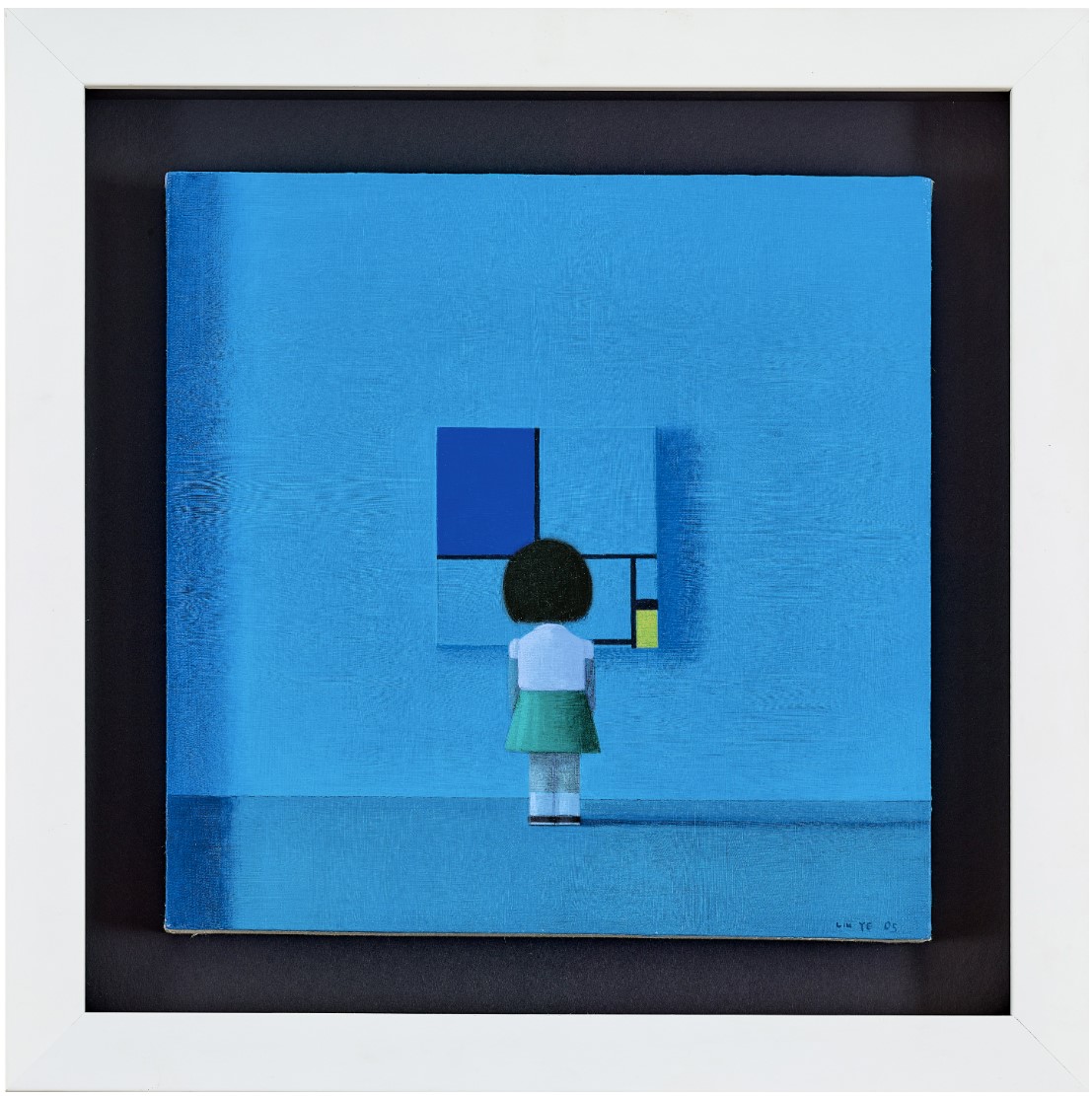
LIU YE (b. 1964)
Composition with Moonlight
Acrylic on canvas
45×45 cm (17 3/4 x 17 3/4 inches)
Signed in Pinyin and dated 05; initialed in Chinese and Pinyin
Titled in English and dated 05 on the reverse
#4. Little Painter, 2009-2010
Christie’s Hong-Kong: 1 December 2022
Estimated: HKD 4,000,000 – 6,000,000
HKD 7,812,000 / USD 2,004,397
LIU YE (B. 1964) (christies.com)
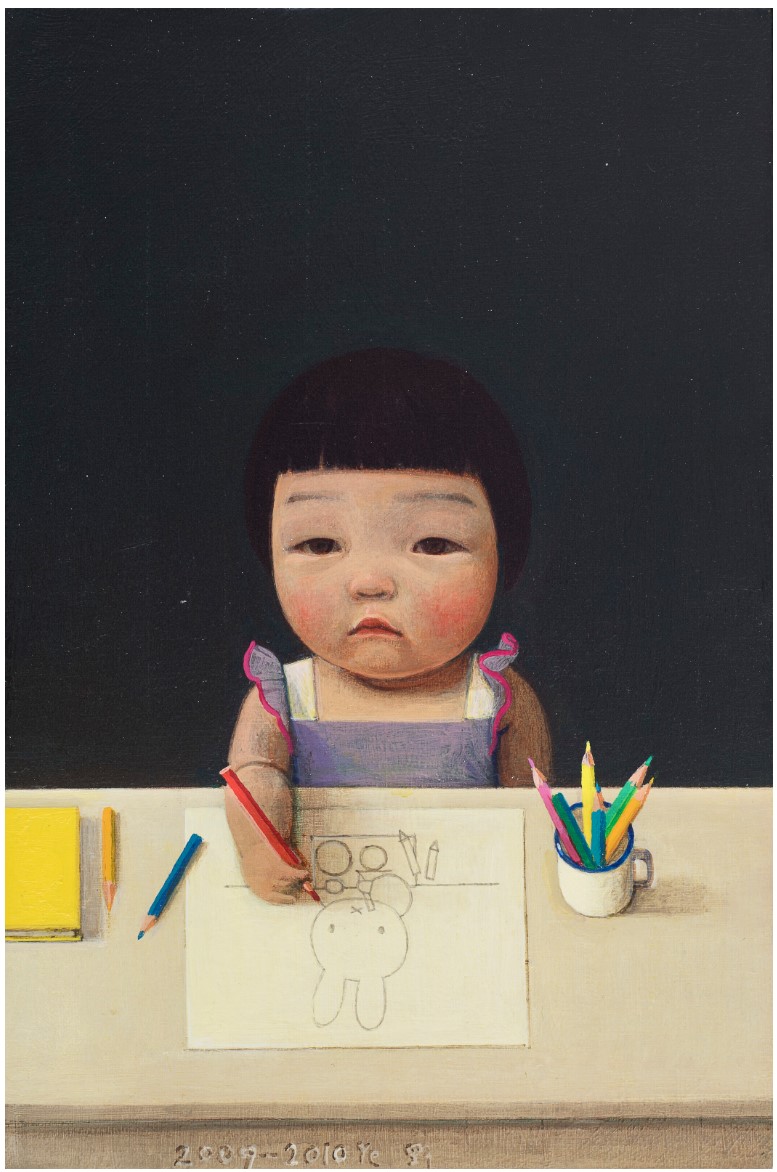
LIU YE (B. 1964)
Little Painter, 2009-2010
Acrylic on canvas
30×20 cm (11 3/4 x 7 7/8 inches)
Signed in Chinese, signed again and dated ‘Ye 2009 – 2010’ (lower middle)
#6. Taking Off II, 2003
Phillips Hong-Kong: 21 June 2022
Estimated: HKD 3,500,000 – 5,500,000
HKD 4,788,000 / USD 609,951
Liu Ye – 20th Century & Contemporary A… Lot 160 June 2022 | Phillips
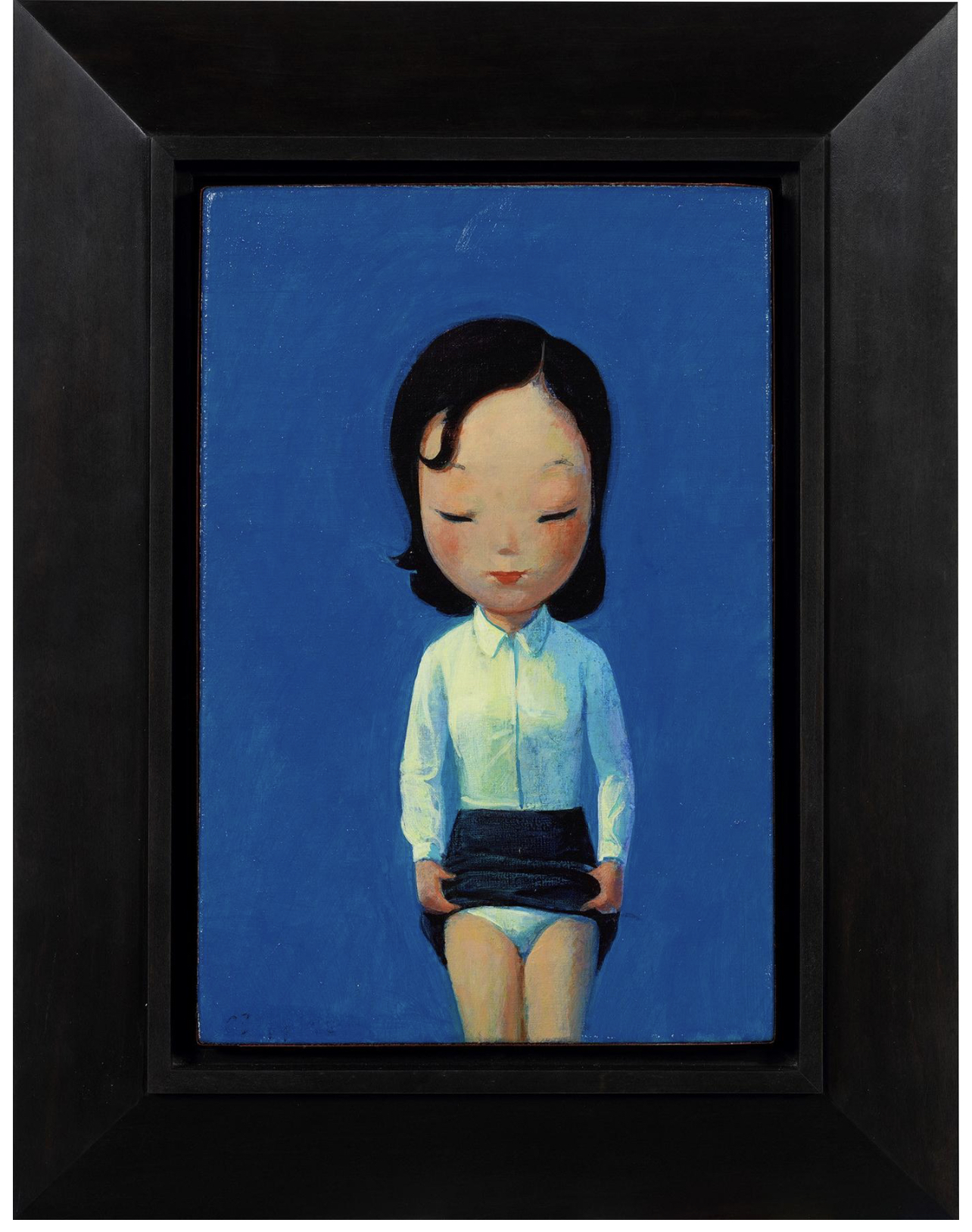
LIU YE (b. 1964)
Taking Off II, 2003
Acrylic on canvas
30×20 cm (11 3/4 x 7 7/8 inches)
Signed and dated ‘liu ye 2003 Ye [in Chinese]’ on the reverse
#7. Boy With Red Glass, 1998
Phillips Hong-Kong: 21 June 2022
Estimated: HKD 2,800,000 – 4,800,000
HKD 3,276,000 / USD 417,335
Liu Ye – 20th Century & Contemporary A… Lot 161 June 2022 | Phillips
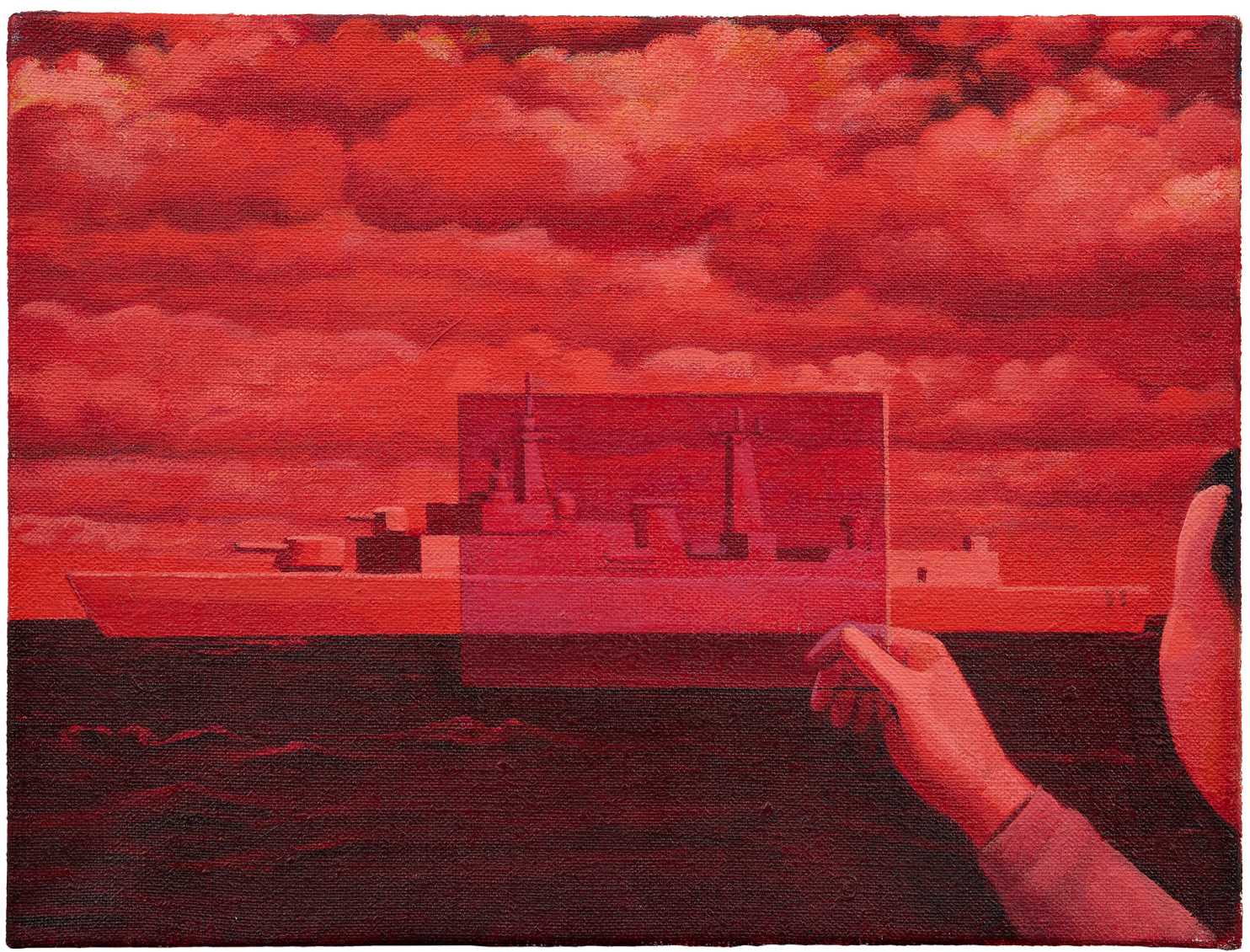
LIU YE
Boy With Red Glass, 1998
Acrylic on canvas
22×29 cm (8 5/8 x 11 3/8 inches)
Signed and dated ”98 liuye’ on the overlap
#8. Mondrian with Dutch Coins, 1998
Sotheby’s Hong-Kong: 28 April 2022
Estimated: HKD 500,000 – 700,000
HKD 1,512,000 / USD 192,699
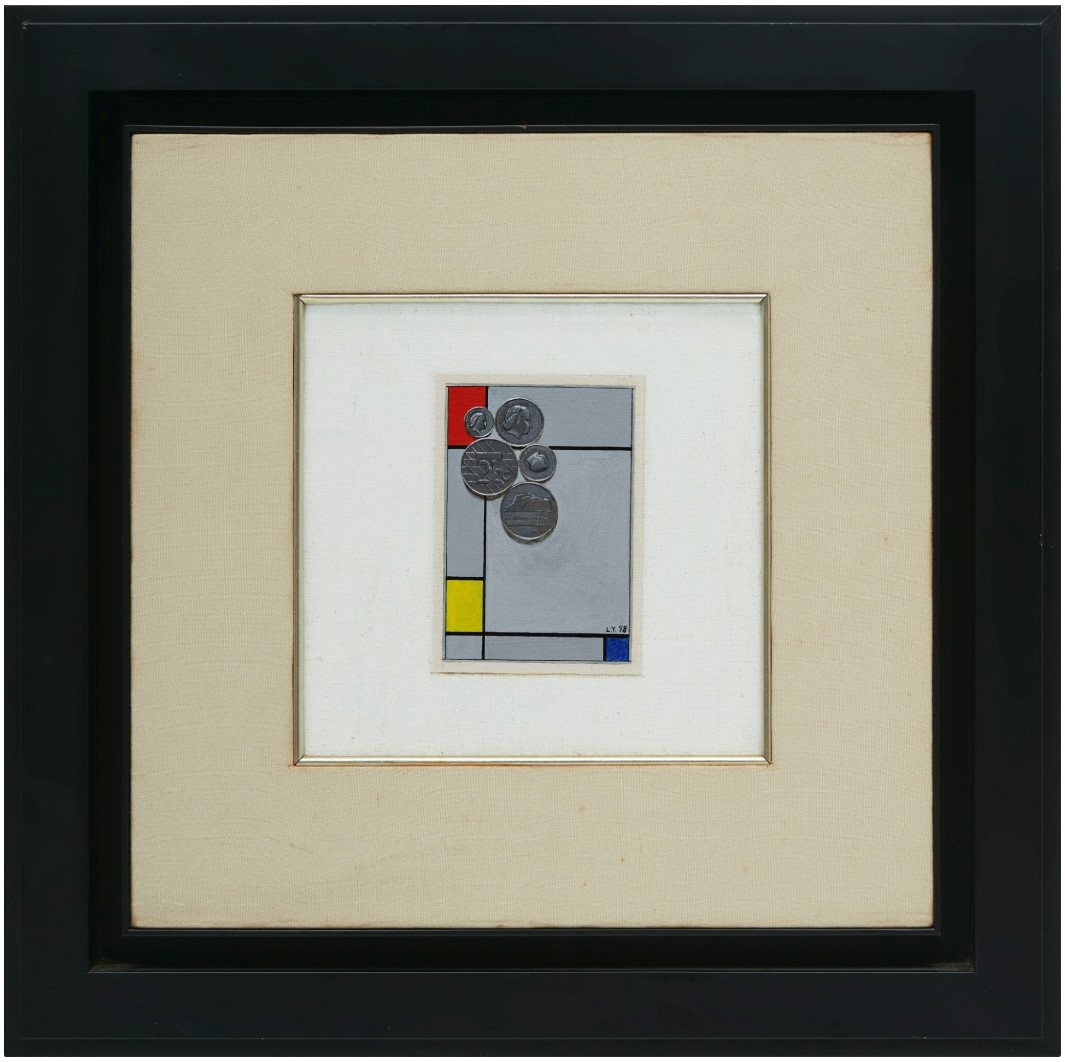
LIU YE (b. 1964)
Mondrian with Dutch Coins, 1998
Oil on canvas
24×24 cm (9 1/2 x 9 1/2 inches)
Signed and dated 98
2021 Auction Results
13 lots sold at auction in 2021 for a total turnover of USD 13,210,892. With no lot failing to sell, the sell-through rate is 100%. The highest price has been achieved at Christie’s in Hong-Kong on 24 May 2021, when Bird, a painting dated 2007, sold for HKD 16,450,000 (USD 2,118,453).
2021 Top 3 Lots
4 lots sold for more than USD 1 million, generating a cumulative turnover of USD 6,643,966, representing 50.3% of the total turnover for 2021. All lots sold in Hong-Kong.
#1. Bird, 2007
Christie’s Hong-Kong: 24 May 2021
Estimated: HKD 10,000,000 – 15,000,000
HKD 16,450,000 / USD 2,118,453
LIU YE (B. 1964) (christies.com)
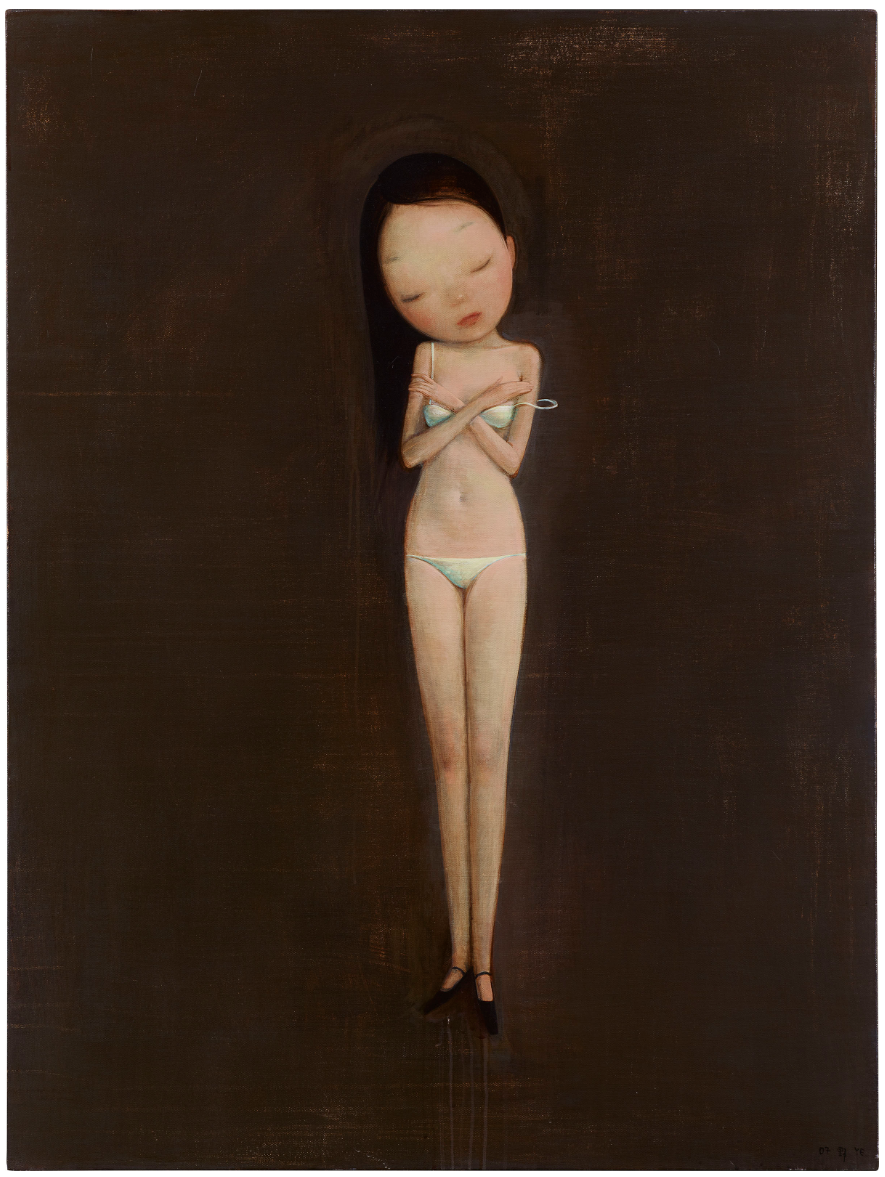
LIU YE (B. 1964)
Bird, 2007
Acrylic on canvas
120×90 cm (47 1/4 x 35 1/2 inches)
Dated and signed ‘07 YE’ and signed in Chinese (lower right)
#2. The Second Story, 1995
Phillips Hong-Kong: 7 June 2021
Estimated: HKD 4,500,000 – 6,500,000
HKD 13,076,000 / USD 1,685,225
Liu Ye – 20th Century & Contemporary A… Lot 195 June 2021 | Phillips
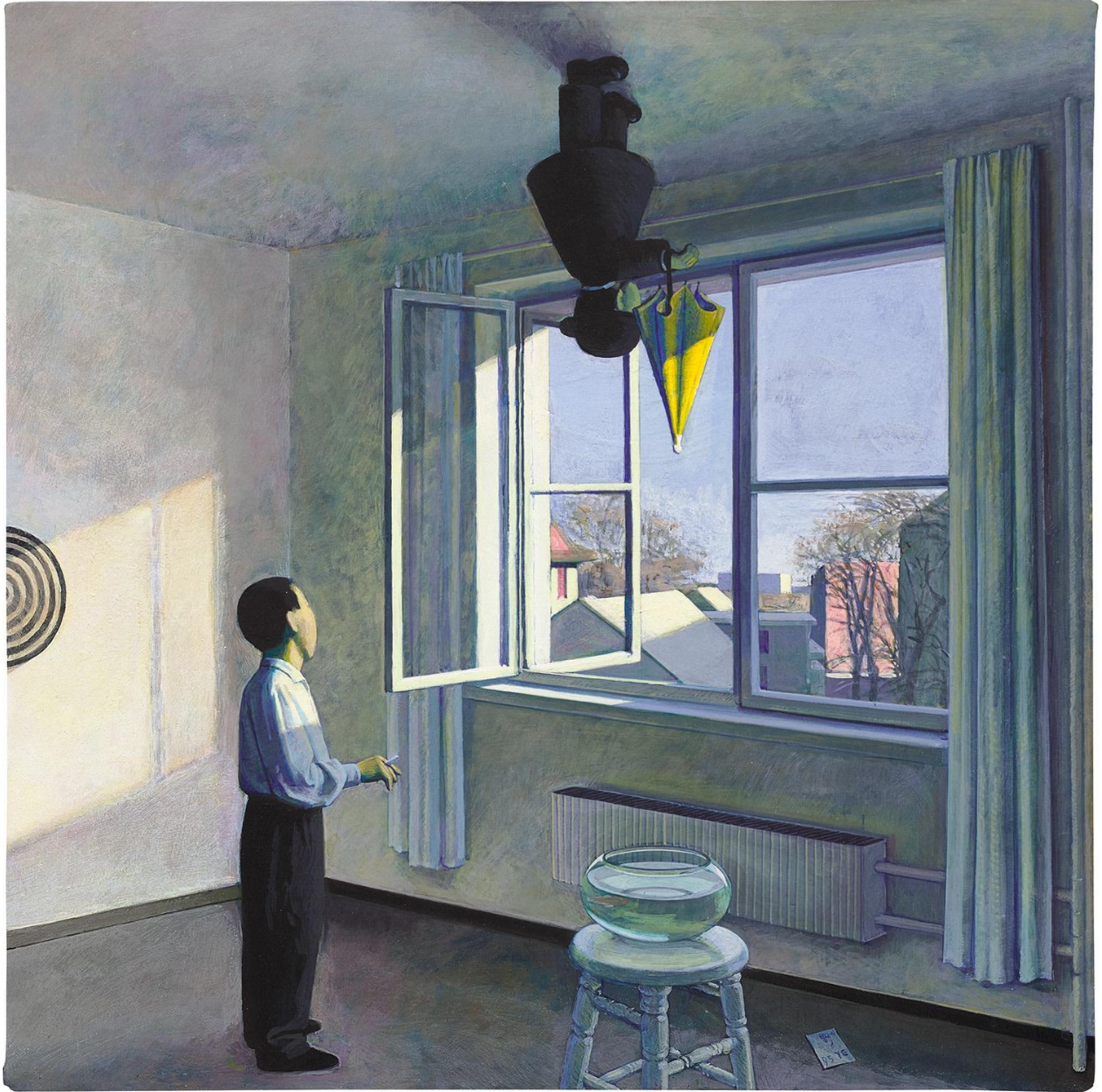
LIU YE
The Second Story, 1995
Oil on canvas
45×45 cm (17 3/4 x 17 3/4 inches)
Signed and dated ‘ 95 YE [in Chinese and Pinyin]’ lower right
#3. Hello, Mondrian, 2002
Bonhams Hong-Kong: 25 November 2021
Estimated: HKD 8,000,000 – 12,000,000
HKD 11,652,500 / USD 1,494,523
Bonhams : Liu Ye (B. 1964) Hello, Mondrian
Acrylic on canvas
60.2 x 45.2 cm (23 11/16 x 17 13/16 inches)
Signed in Chinese and Pinyin and dated 2002 on the lower right
#4. Hope No. 1, 2000
Christie’s Hong-Kong: 24 May 2021
Estimated: HKD 4,800,000 – 6,800,000
HKD 10,450,000 / USD 1,345,765
Liu Ye (b. 1964) (christies.com)
LIU YE (b. 1964)
Hope No. 1, 2000
Acrylic on canvas
45×38 cm (17 3/4 x 11 inches)
Signed and dated ‘Liu Ye 2000’ (lower right)
USD 1 million
#5. Yellow and Blue for M, 1995
Poly Auction Hong-Kong: 21 April 2021
Estimated: HKD 6,000,000 – 8,000,000
HKD 7,440,000 / USD 958,318
Yellow and Blue for M|Poly Auction Hong Kong
Yellow and Blue for M, 1995
#6. I am a Painter, 2007
Christie’s Hong-Kong: 2 December 2021
Estimated: HKD 3,500,000 – 5,500,000
HKD 7,450,000 / USD 955,937
Bonhams : Liu Ye (B. 1964) Hello, Mondrian
LIU YE (B. 1964)
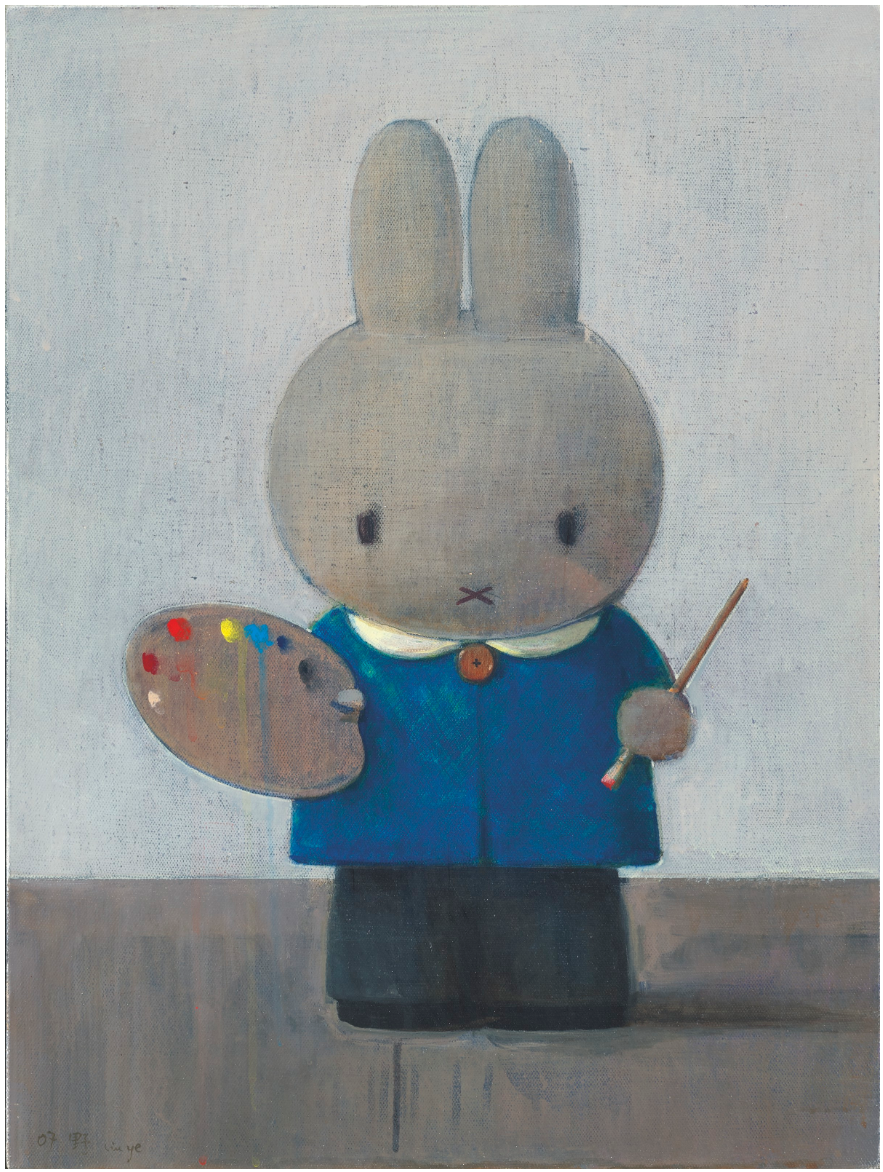
I am a Painter, 2007
Acrylic on canvas
59.5 x 45 cm (23 5/8 x 17 3/4 inches)
Signed in Chinese; signed and dated ‘07 Liu Ye’ (lower left)
#7. She is so Beautiful, 2000
Bonhams Hong-Kong: 25 November 2021
Estimated: HKD 5,000,000 – 7,000,000
HKD 6,252,000 / USD 801,931
Bonhams : Liu Ye (B. 1964) She is so Beautiful
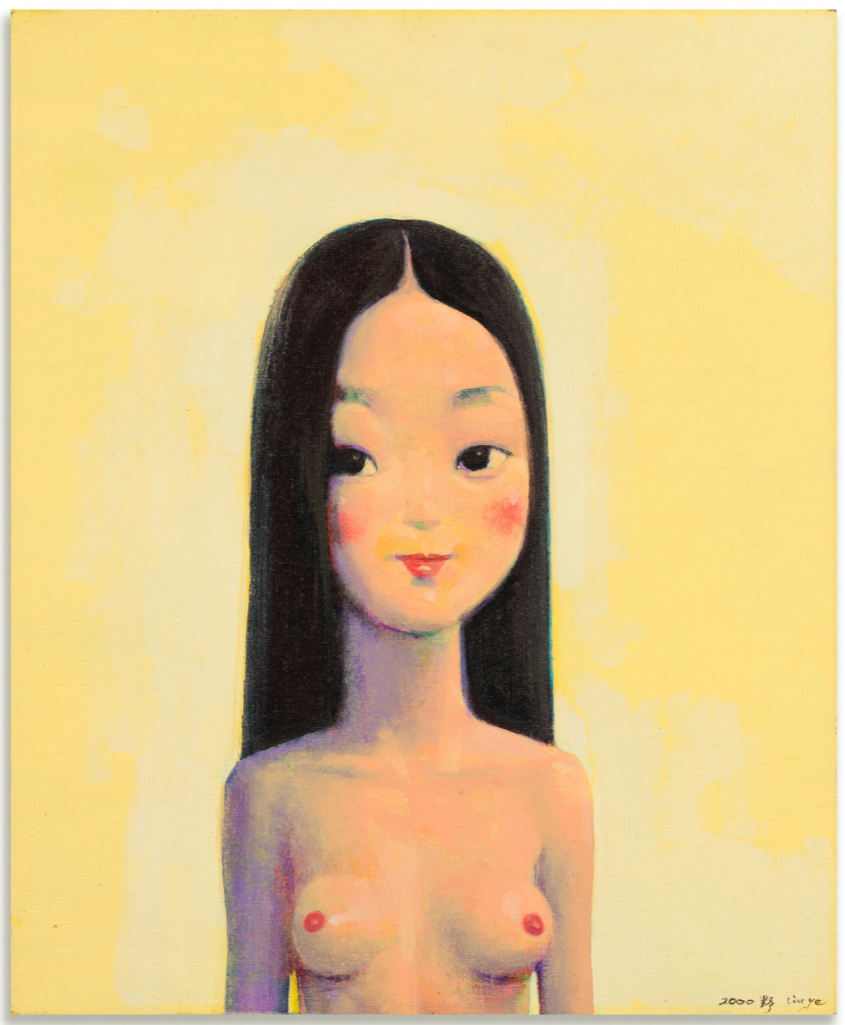
Acrylic on canvas
46×38 cm (18 1/8 x 14 15/16 inches)
Signed in Chinese and Pinyin and dated 2000 on the lower right
#8. Angel, 2002
Christie’s Hong-Kong: 2 December 2021
Estimated: HKD 3,500,000 – 5,500,000
HKD 6,850,000 / USD 878,948
LIU YE (B. 1964) (christies.com)
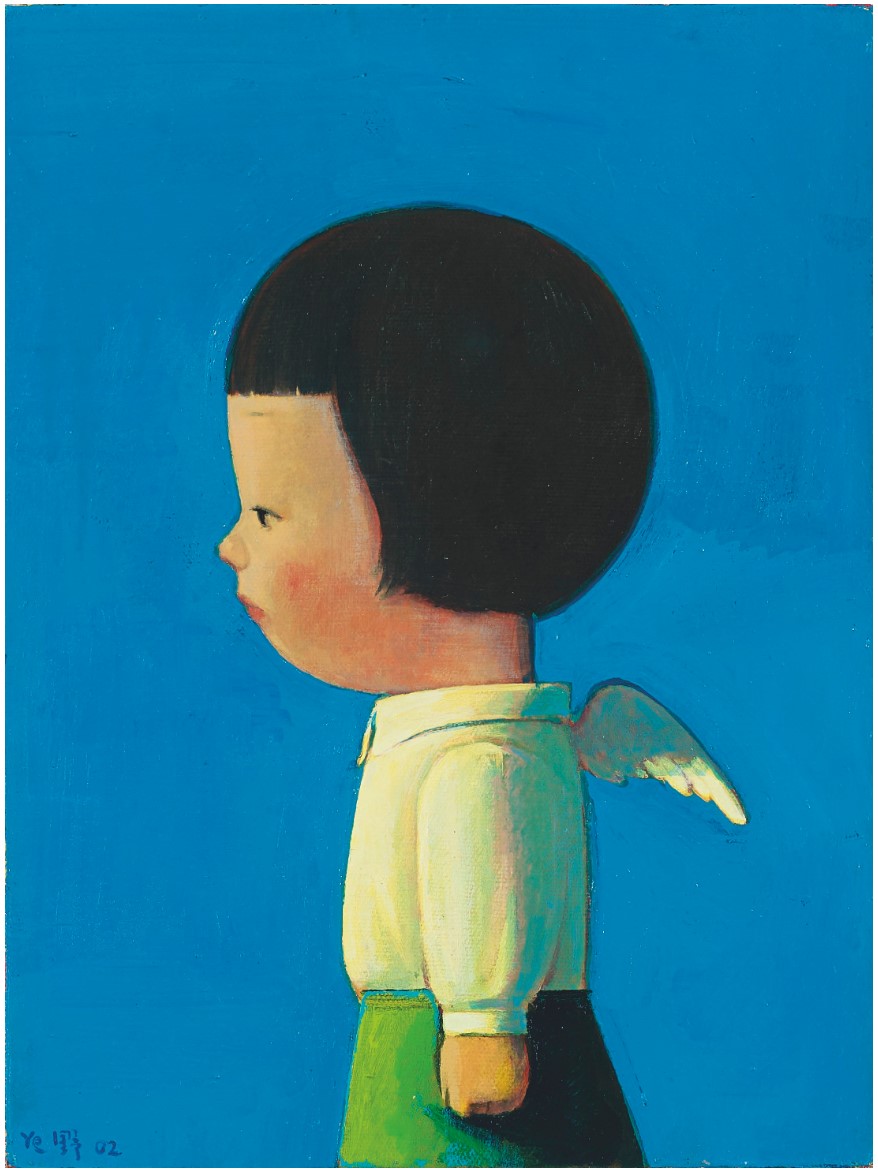
LIU YE
Angel, 2002
Acrylic on canvas
40×30 cm (15 3/4 x 11 3 /4 inches)
Signed in Chinese, signed and dated ‘Ye 02’ (lower left)
Signed and titled in Chinese, signed and dated ‘liu ye 02’ (on the reverse)
#9. Flagship No. 2, 1997
Phillips Hong-Kong: 30 November 2021
Estimated: HKD 2,000,000 – 3,000,000
HKD 5,922,000 / USD 759,532
Liu Ye – 20th Century & Contemporar… Lot 37 November 2021 | Phillips
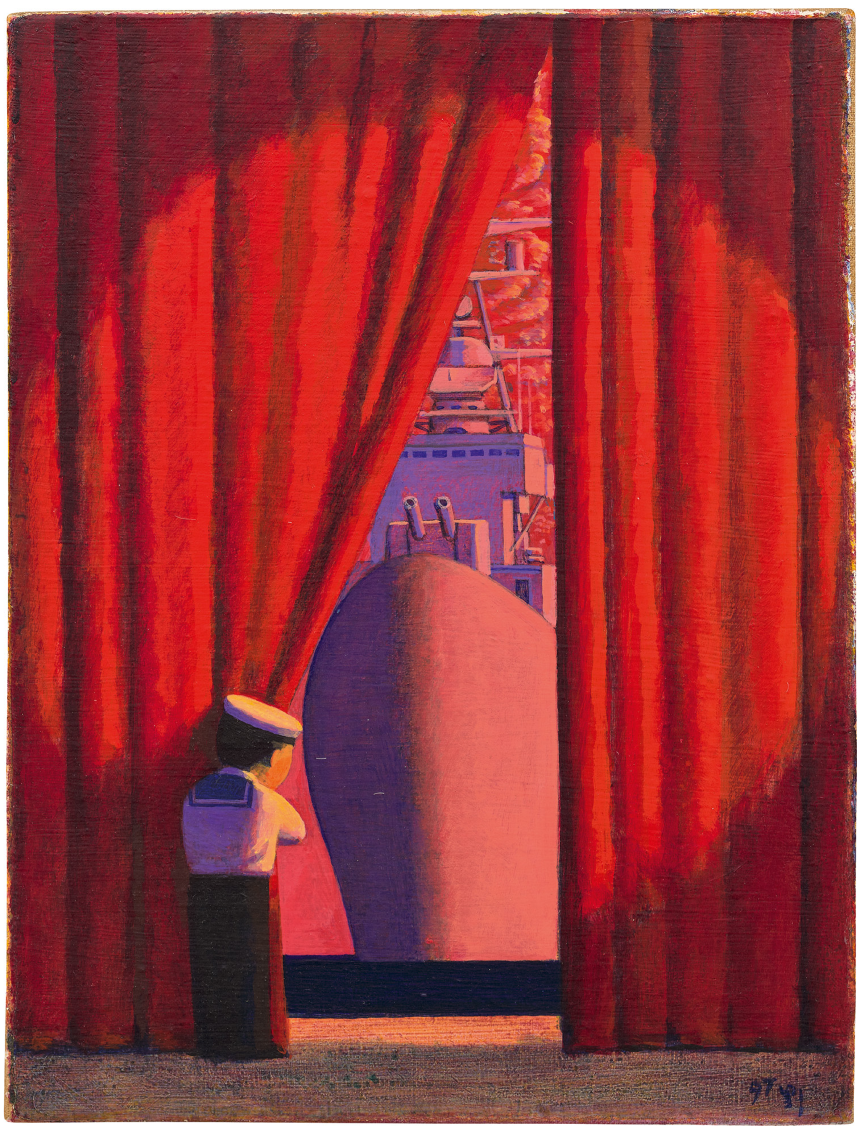
LIU YE
Flagship No. 2, 1997
Acrylic and oil on canvas
29×22 cm (11 3/8 x 8 5/8 inches)
Signed and dated ’97 Ye [in Chinese]’ lower right
#10. Summer, 2005
Christie’s Hong-Kong: 25 May 2021
Estimated: HKD 3,000,000 – 5,000,000
HKD 5,625,000 / USD 724,619
LIU YE (B. 1964) (christies.com)
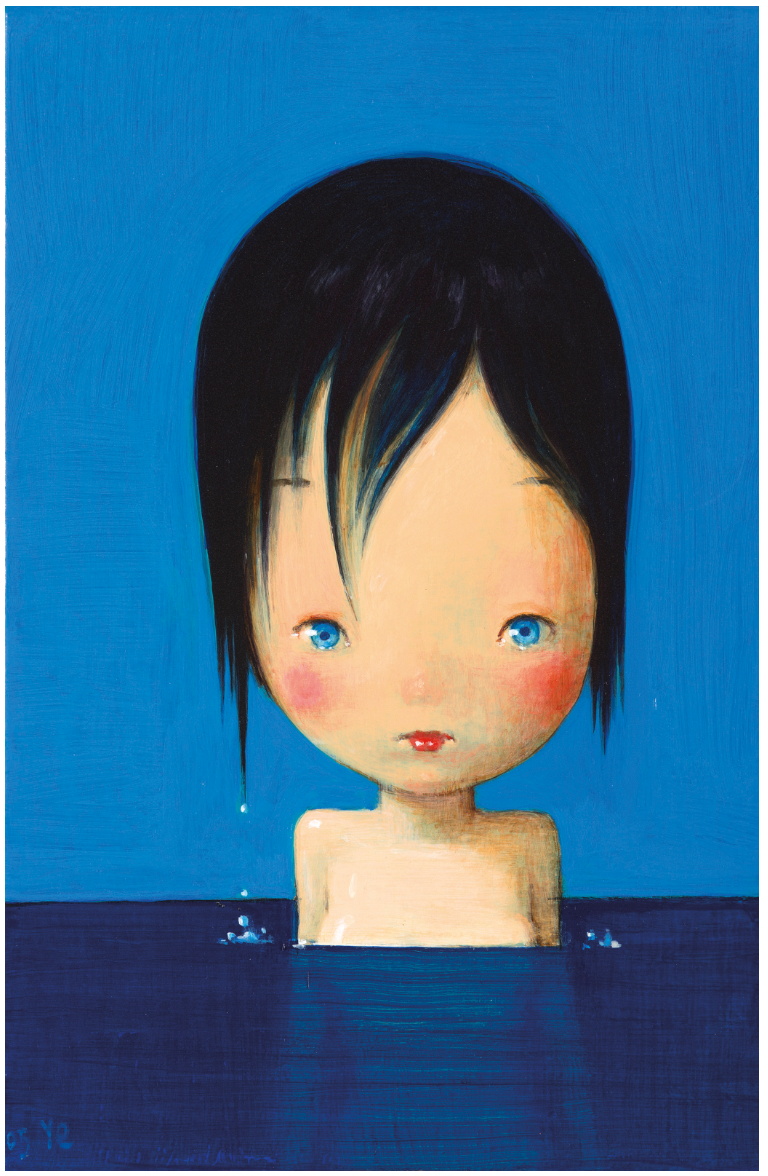
LIU YE (B. 1964)
Summer, 2005
Acrylic on canvas
30×20 cm (11 3/4 x 7 7/8 inches)
Signed and dated ‘05 Ye’ (lower left)
#11. The Window, 1998
Sotheby’s Hong-Kong: 19 April 2021
Estimated: HKD 2,000,000 – 3,000,000
HKD 5,015,000 / USD 645,746
Liu Ye 劉野 | The Window 窗 | Contemporary Art Evening Sale | 2021 | Sotheby’s (sothebys.com)
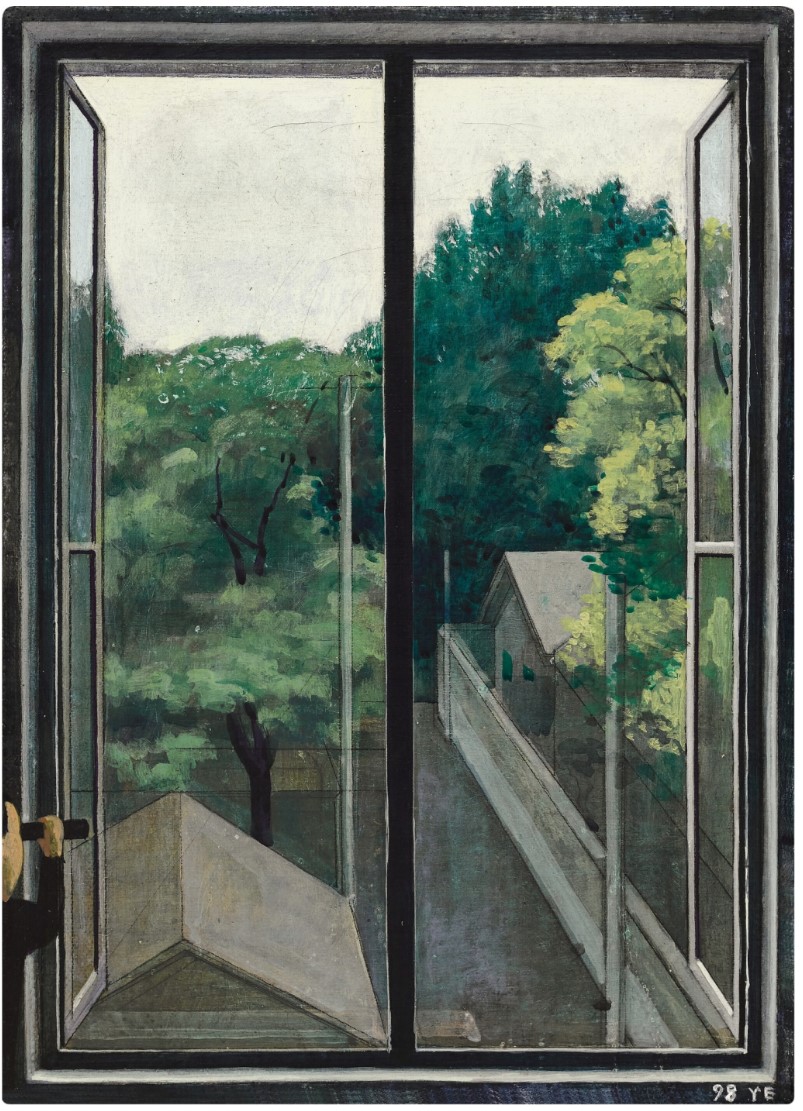
LIU YE (b. 1964)
The Window, 1998
Acrylic on canvas
35×25 cm (13 3/4 x 9 7/8 inches
Signed and dated 98
#12. Untitled, 1993
Phillips Hong-Kong: 30 November 2021
Estimated: HKD 3,000,000 – 5,000,000
HKD 3,780,000 / USD 484,808
Liu Ye – 20th Century & Contemporar… Lot 39 November 2021 | Phillips
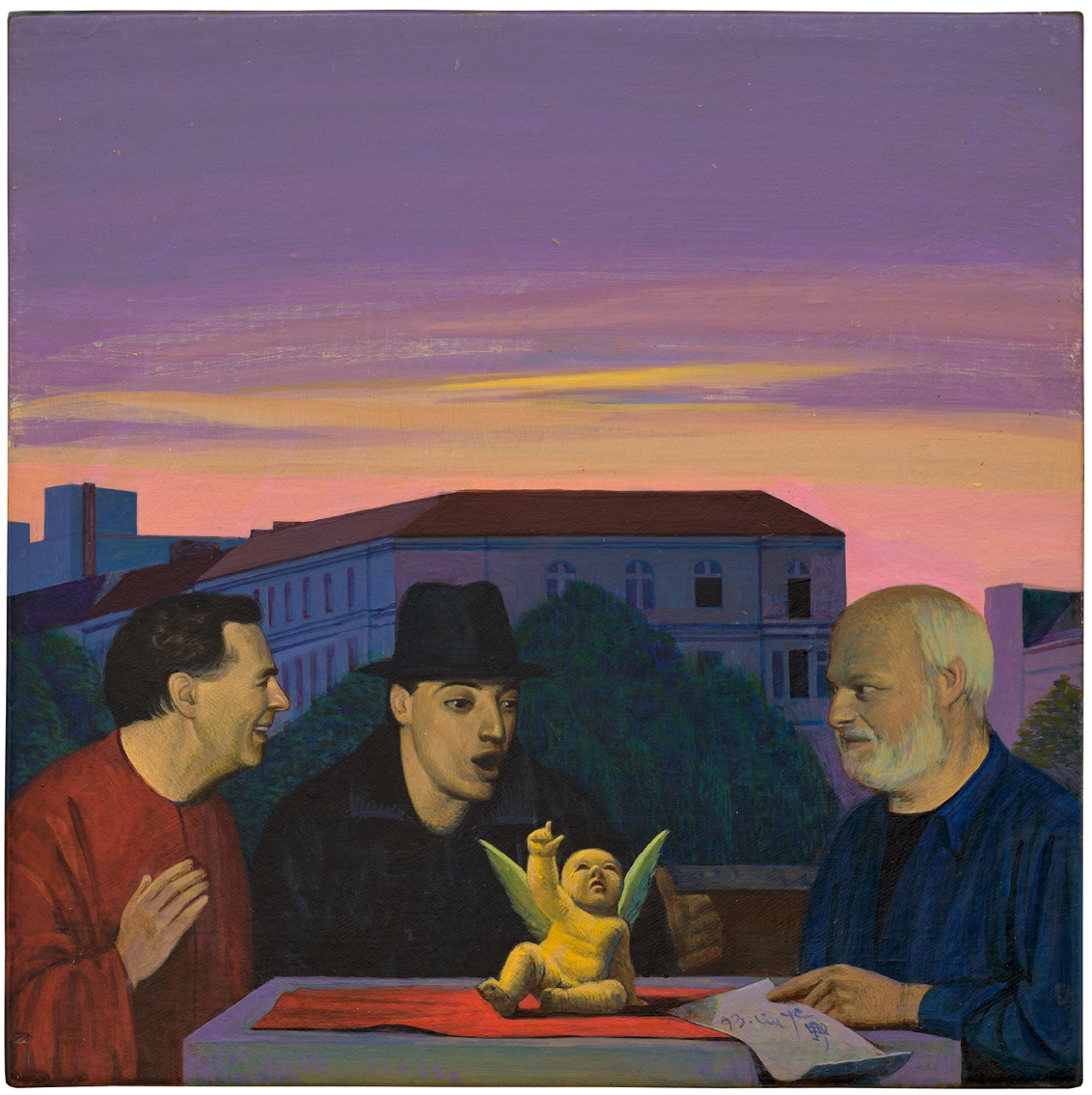
LIU YE
Untitled, 1993
Acrylic and oil on canvas
24×24 cm (9 1/2 x 9 1/2 inches)
Signed and dated ’93. liu ye [in Pinyin and Chinese]’ lower right
#13. Untitled, 1998
Sotheby’s Hong-Kong: 18 June 2021
Estimated: HKD 2,000,000 – 3,000,000
HKD 2,772,000 / USD 357,087
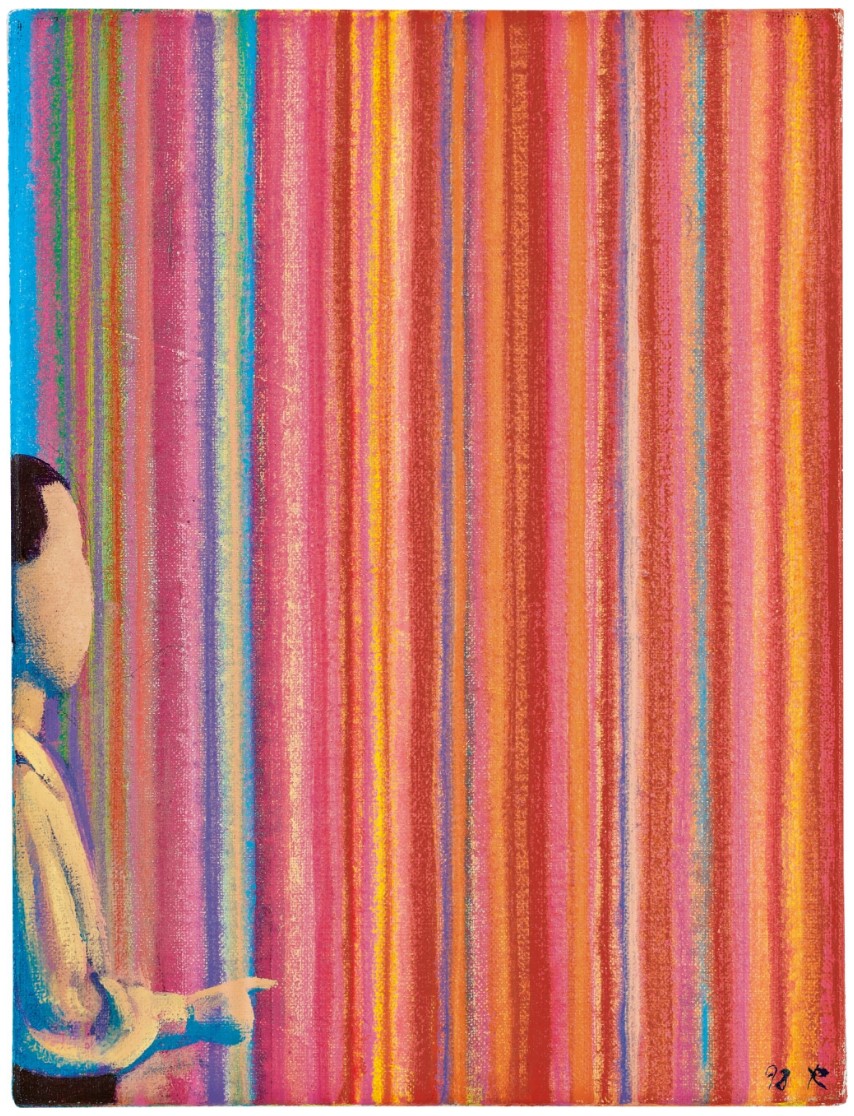
LIU YE (b. 1964)
Untitled, 1998
Acrylic on canvas
29×22 cm (11 3/8 x 8 5/8 inches)
Signed in Pinyin and dated 98
Signed in Chinese and Pinyin and dated 98 on the reverse
PART III: FOCUS
Mondrian
To understand the core of Liu Ye’s creative genius, one must first understand Piet Mondrian. The Dutch master of abstraction has become an iconic symbol in Liu Ye’s paintings. The reduced yet rigorously executed lines and geometric shapes in Mondrian’s compositions deeply inspired Liu Ye and subsequently guided his artistic as well as spiritual pursuits — it is one of the most important visual elements in his works. Mondrian defines the fundamental objective of abstract art as establishing order and equilibrium. To him, abstraction is a pursuit for a pure state of formalistic aesthetics that banishes any trace of representation. A supremely harmonious composition can be achieved by only using the simplest vertical and, horizontal lines, and the three primary colors. Transcending Mondrian’s principles on points, lines, planes, and volume, Liu Ye masterfully constructs compositions that captivate viewers with their atmospheric quietude.
Mondrian, Hello, 2002
Phillips Hong-Kong: 25 November 2024
Estimated: HKD 6,000,000 – 9,000,000
HKD 7,366,000 / USD 946,360
Liu Ye – Modern & Contemporary Art E… Lot 5 November 2024 | Phillips
LIU YE
Mondrian, Hello, 2002
Acrylic on canvas
60×45 cm (23 5/8 x 17 3/4 inches)
Signed and dated ‘Ye [in Chinese] 2002 Liu Ye’ lower left
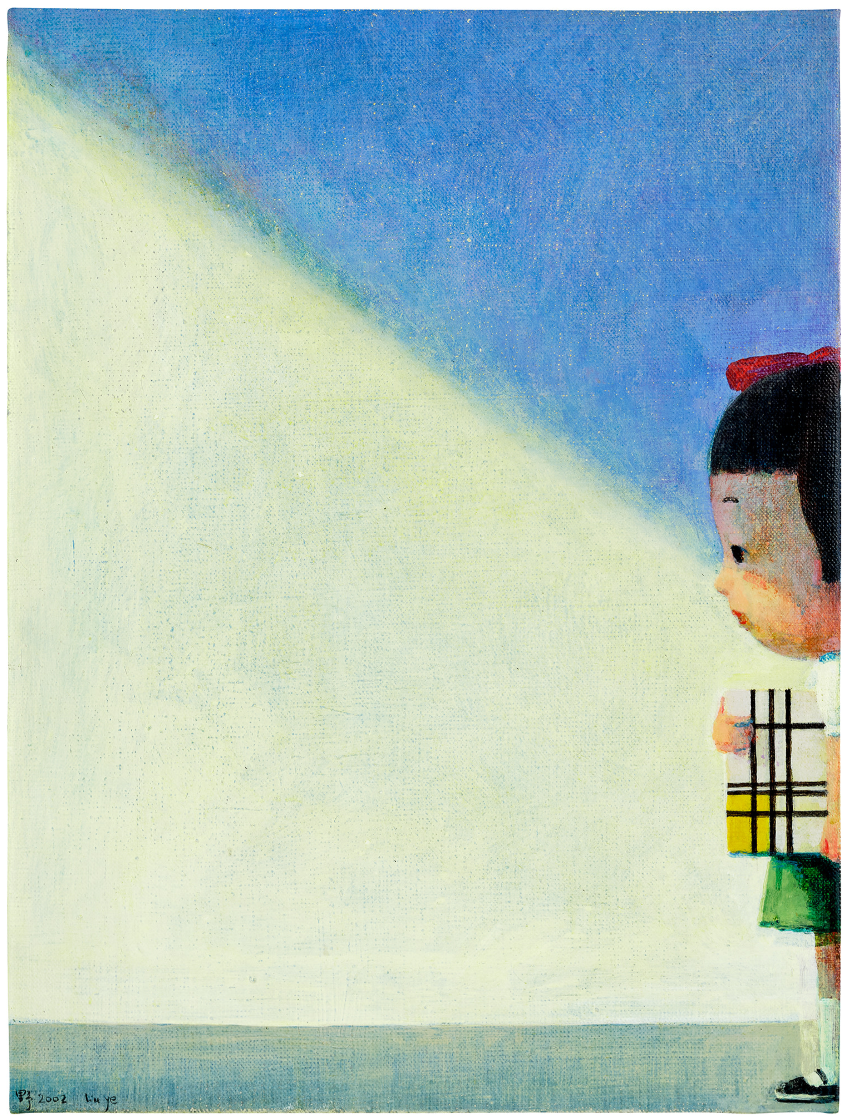
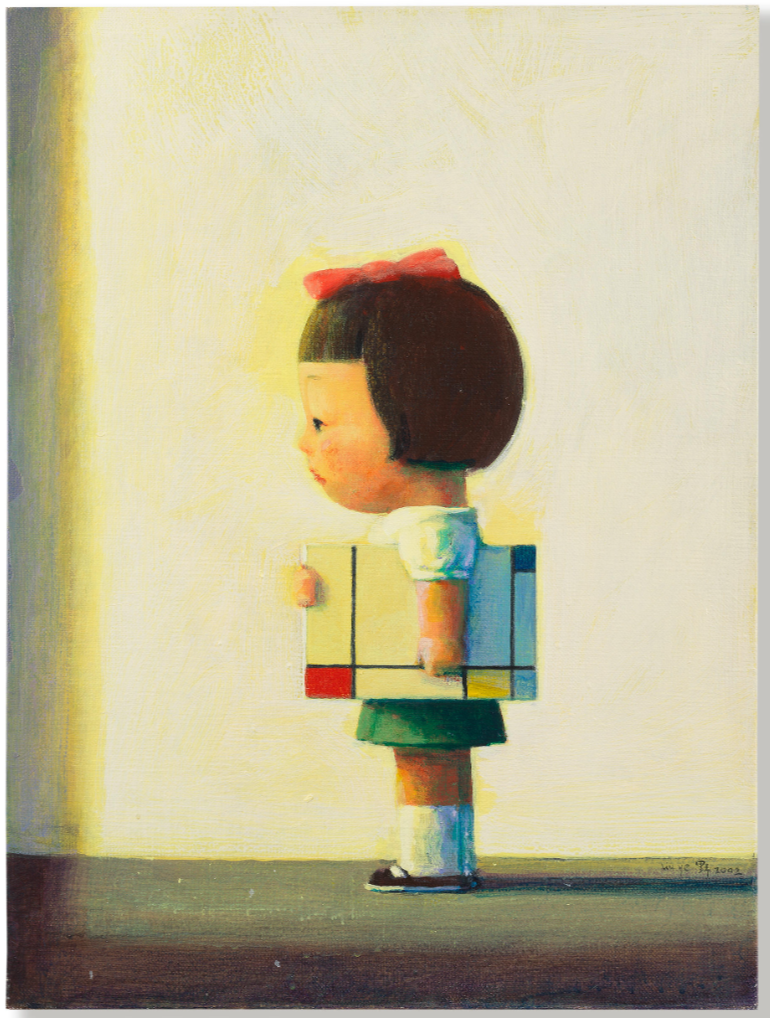
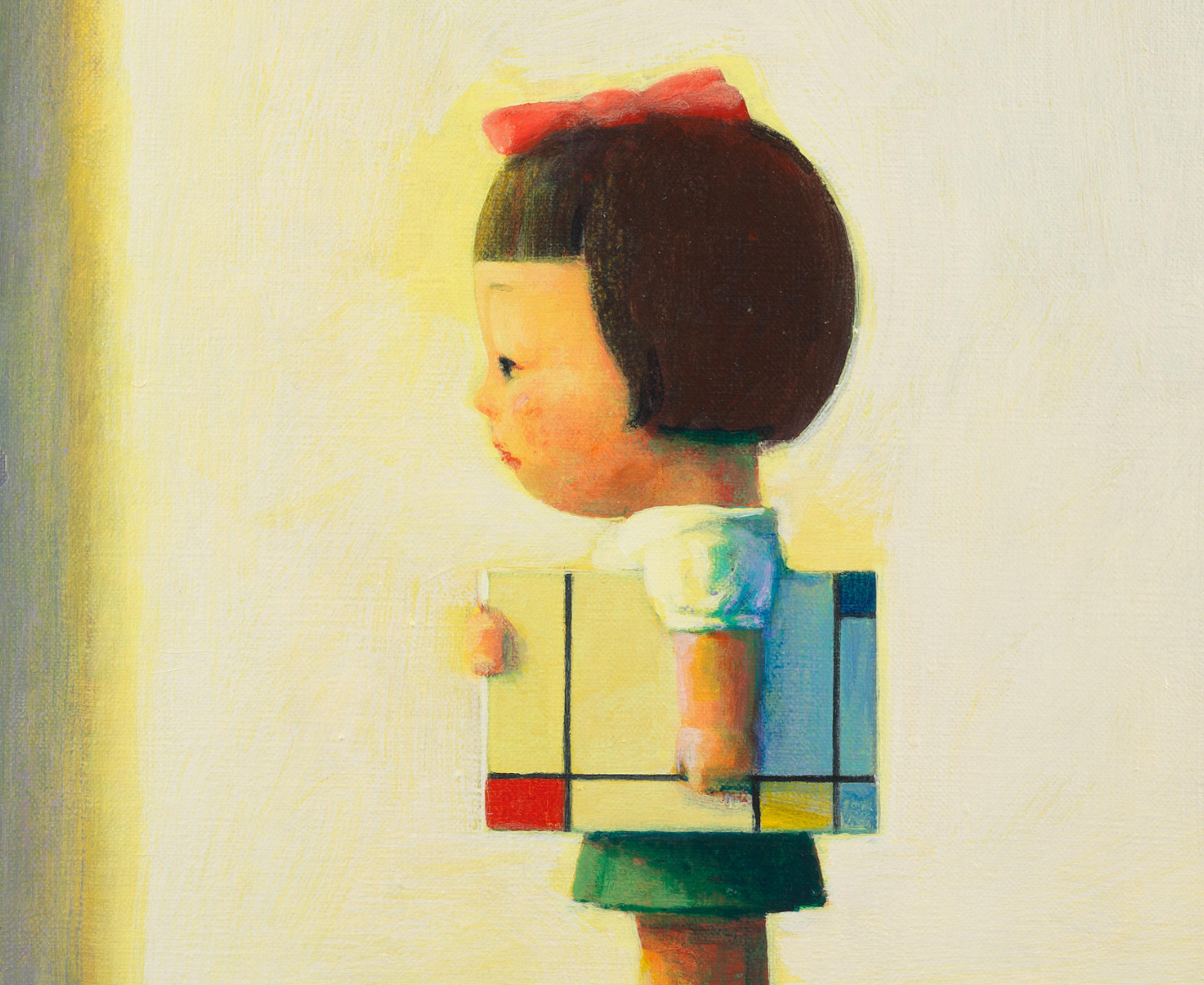
The profile of a young girl with a bob haircut and a straight fringe, one of the artist’s recurring figures, stands at the far bottom right corner against a vast background of blue and pale yellow in Mondrian, Hello. Her gaze is transfixed towards the left, where a beam of light emanates from above, highlighting the rosy blush on her plump cheeks and brings attention to the Mondrian book she has in her hands as though she is a devout follower of geometric abstraction. The contour of her silhouette is instantly arresting and the manipulation of space through light and shadow to divide the painting geometrically congruently evokes scenes of Piero della Francesca’s diptych of Federico da Montefeltro and Battista Sforza with his two figures in profile, an angle that ensured a good likeness and a faithful representation, Johannes Vermeer’s treatment of light in The Milkmaid, or indeed René Magritte’s elusive Not to Be Reproduced in front of a mirror all come to mind. Fresh to auction and painted in 2002, it is one of 40 works from Liu Ye’s body of work featuring Mondrian motifs, signifying the creation of a unique tableau, poised between two worlds: a place that is apparently real and credibly, removed from reality, that would dominate Liu’s work for the next decade.
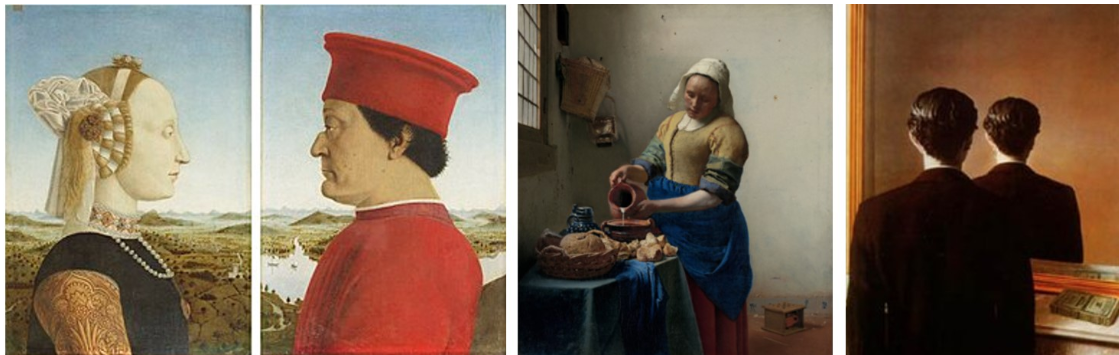
(i) Piero della Francesca, Diptych of Federico da Montefeltro and Battista Sforza, c. 1473-75 / Image: Scala, Florence
(ii) Johannes Vermeer, The Milkmaid, c. 1657-1658 / Image: Rijksmuseum, Amsterdam, Purchased with the support of the Vereniging Rembrandt
(iii) Rene Magritte, Not to Be Reproduced (La reproduction interdite), 1947 / Image: Boijmans Van Beuningen / Artwork: © 2024 C. Herscovici / Artists Rights Society (ARS), New York
Liu Ye first encountered the work of Dutch painter Piet Mondrian while enrolled at the Industrial Design Department of the School of Arts and Crafts in Beijing from the age of fifteen to nineteenth. Describing the school as a secondhand Bauhaus, his teachers were sent abroad to study the Bauhaus theory before the Cultural Revolution and brought back methodologies of European modernism, in turn exposing Liu to graphic composition, constructivism, Wassily Kandinsky and Piet Mondrian of course, who would eventually become a recurring source of inspiration for him. Initially viewing the Dutch painter as a designer, it was only until Liu’s six-month long artist residency at the Rijksakademie in Amsterdam in 1998 that he finally formed a direct acquaintance with Mondrian’s work. As a pioneer of the abstract geometric form and a leading figure in the De Stijl movement, Mondrian was committed to distilling the visual world into its most basic elements in pursuit of a universal aesthetic language that aimed to achieve harmony and balance.
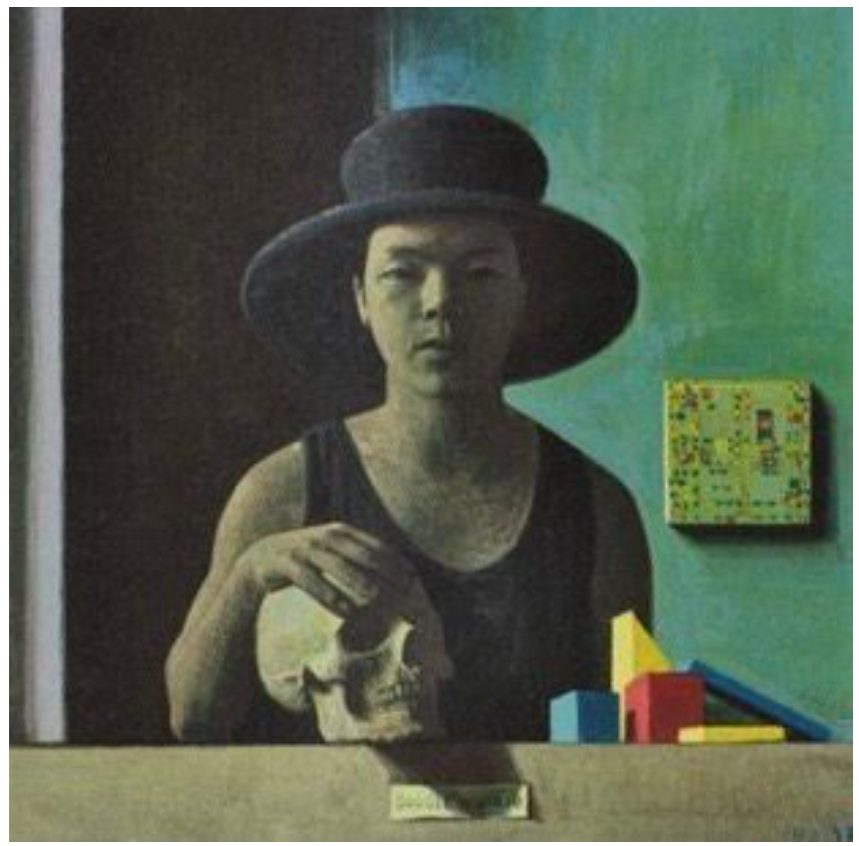
First appearance of a Mondrian motif seen in Boogie Woogie (Self Portrait), 1992
An early recurrent reference to paintings by Mondrian, with its rigorous straight lines and balanced quadrilateral compositions, appeared in Liu Ye’s artwork early on in his career. It can first be found in Liu’s Boogie Woogie (Self Portrait) created in 1992, only the second year of his creative pursuits. Brooklyn (1994) announced the theme of a dual aspect, with the Mondrian painting depicted incredibly precisely as an actual painting standing on an easel situated in an imaginary situation and exemplifying its uncanny character of the small boy– the artist himself – sat reading, feet immersed in a bowl and a child’s hat appearing to flat above his head. Liu Ye’s insertion of Mondrian’s paintings into his own tableaux permeated his artworks throughout and influenced his artistic development in the post-2000s.
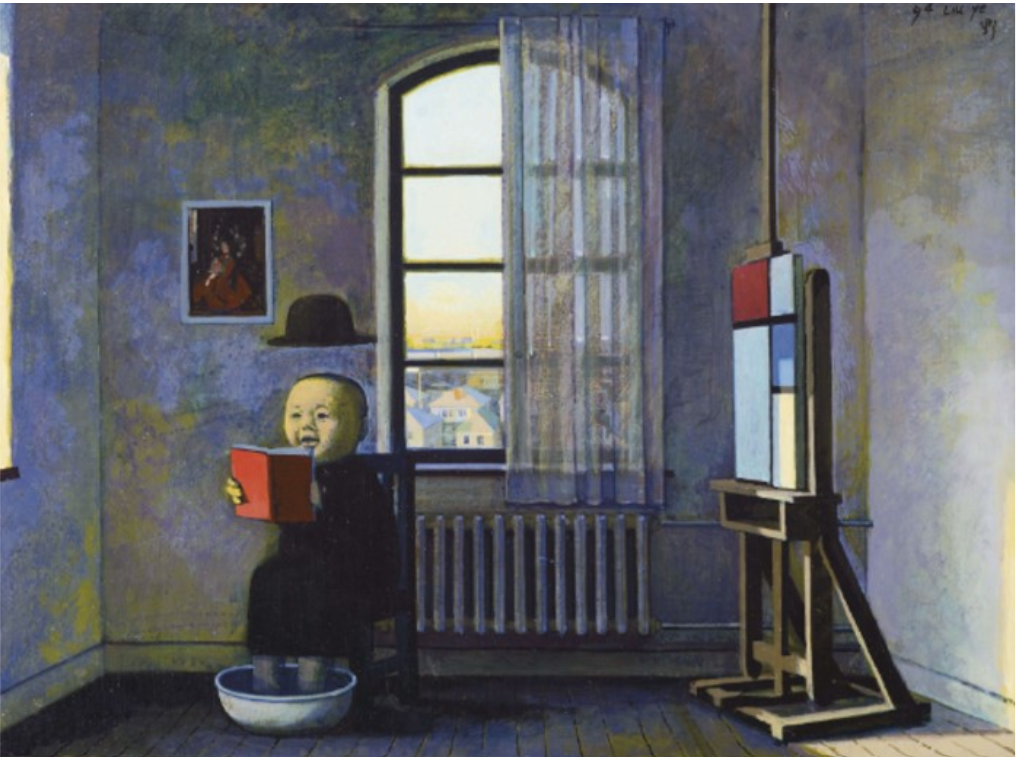
Brooklyn, 1994
This influence taken from the modern master is far from simple, Liu’s delineation of the canvas and heightened geometrical partitioning in Mondrian, Hello with the diagonal shadow right through the centre of the painting form a sense of balance and correspondence. Completed with the girl holding onto the Mondrian painting to the bottom right, these elements form an equilibrium. Liu Ye completed four Mondrian-inspired canvases in the year of 2002, with all paintings possessing a similar sense of order and featuring the same motifs of the young girl with one or two Mondrian paintings – two of which had yellow as the base tone (as seen in Yellow and Hello, Mondrian) and one had blue as the base tone (as seen in Blue). Only in the present lot, Mondrian, Hello, that shows a combination of both yellow and blue tones employed by Liu, which despite its simplicity, is a testament to a more compact approach to line and form.
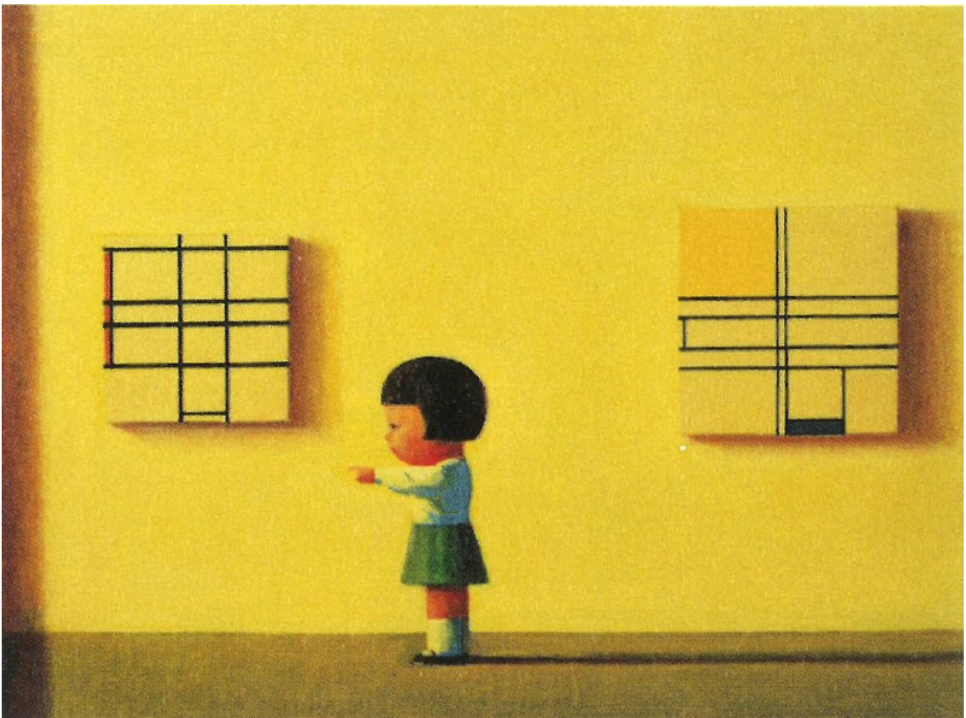
Liu Ye, Yellow, 2002
Among Liu’s myriads of sources, from early Renaissance paintings to a range of modern artists, Mondrian certainly occupied a special place among these disparate figures. The Dutch painter’s steadfast commitment to abstract painting and the self-contained formal rigour of his work have been both profoundly inspiring and somewhat intimidating for Liu. In his own words, he had long admired nonfigurative painting. However, in relation to his own creations, he has hesitated to fully embrace it, reluctant to abandon his parallel dedication to depiction and narrative of figurative painting. As such, Mondrian can be seen, in Liu’s eyes, a father figure: to be respected yet feared, admired yet challenged.
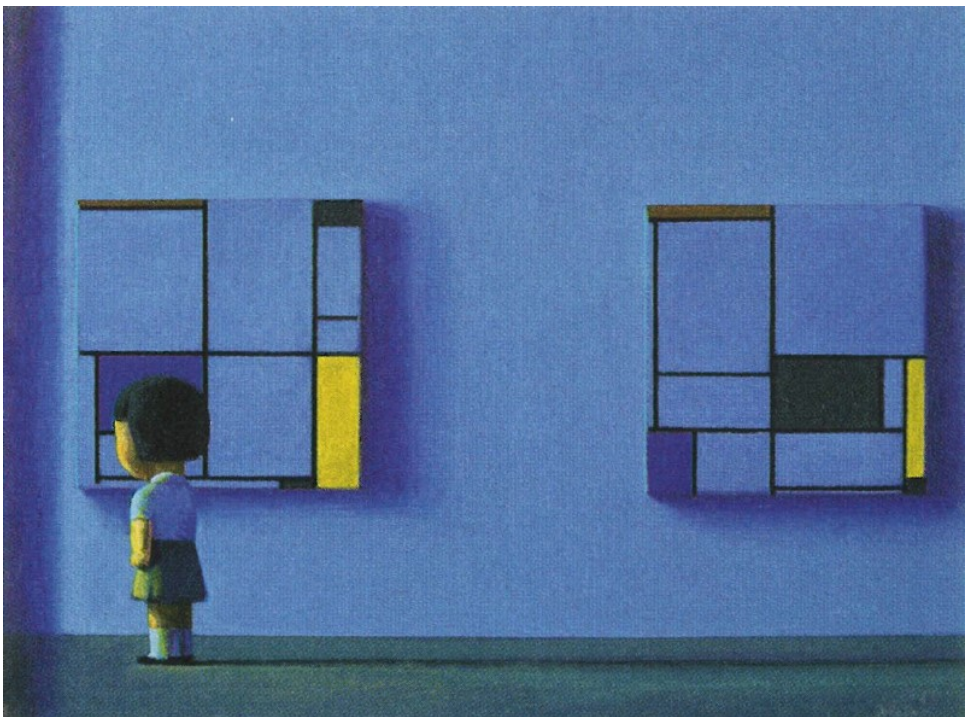
Liu Ye, Blue, 2002
Born in Beijing in 1964 and growing up against the backdrop of the Cultural Revolution, Liu Ye spent most of his childhood living a censored and audited life in the countryside with his father but found freedom in the form of story books hidden by his parents. Born to a father who was a children’s playwright, Liu had the luxury of accessing a big black chest of Western children’s books under his bed. Encouraged perhaps by his father’s admiration for Western culture, and possibly tempted by a lingering sense of the forbidden nature of such material, Liu grew away from traditional Chinese art and conjured up an entire iconography of distinctive figures that were reminiscent of illustrations found in the books he grew up with.
With a particular love for Oscar Wilde’s The Picture of Dorian Gray –which tells the story of an artist becoming infatuated with the youth of the subject of his full-length portrait; thereby selling his soul to ensure that the portrait, rather than himself, will age and fade– the story lays the seeds for Liu’s artistic style in the years to come and is the very reason why Liu never fails to plant upon his characters a sense of eternal childlike innocence, with their rotund face, ruddy cheeks and short statures – the cartoonish features of cherubic children. The ‘putto’ character is an image of Liu’s own childhood, and the autobiographical character of his art becomes more apparent throughout the years, while retaining a cryptic mode of presentation as if echoing Wilde’s pronouncement on the nature of art.
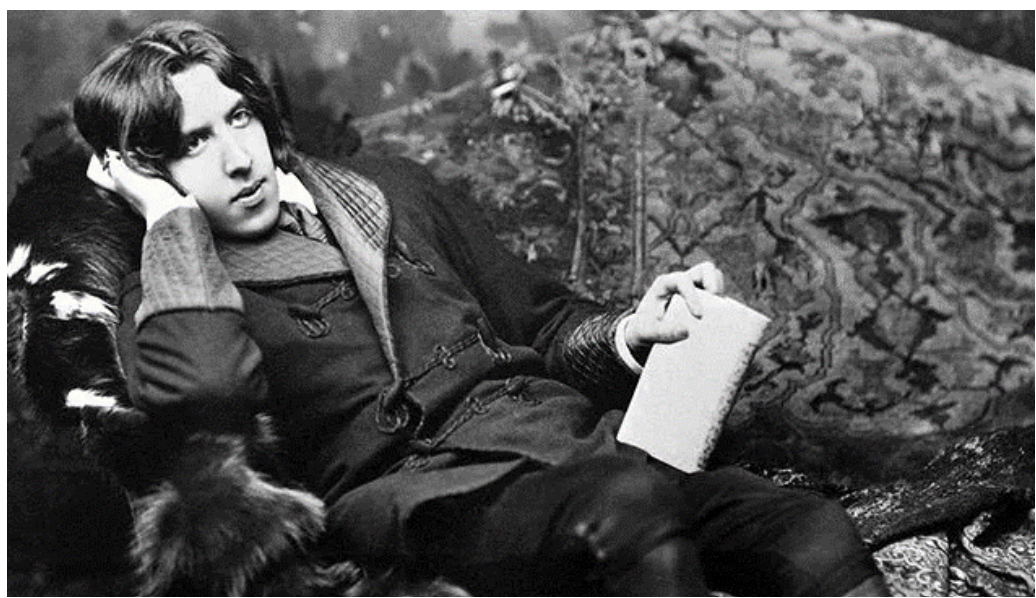
Oscar Wilde relaxing on the divan during his lecture trip through America, 1882
Through his distinctive autobiographical characters, the tableaux that Liu Ye creates is seen to have a dual aspect – drawing on observation and memory and rooted in reality and from that fusion, a domain of subjective reality emerges, accessible and impenetrable all at once. The invented space allows for personal exploration and expression while remaining guarded to an extent and the pictorial device of a child proved to be incredibly effective. In the guise of his many selves – whether as a young boy, a young girl, an adolescent sailor, or Miffy – these became a wider symbol evoking all of humanity.
Girl with Toy Bricks, 2007
Christie’s London: 7 March 2024
Estimated: GBP 1,000,000 – 1,500,000
GBP 1,250,000 / USD 1,585,000
LIU YE (B. 1964), Girl with Toy Bricks | Christie’s (christies.com)
LIU YE (B. 1964)
Girl with Toy Bricks, 2007
Acrylic on canvas
80×60 cm (31 1/2 x 23 5/8 inches)
Signed, signed in Chinese and dated ‘Ye 2007’ (lower right)
Signed, signed in Chinese and stamped with the title and date ‘GRIL [sic] WITH TOY BRICKS 07 liu ye’ (on the reverse)
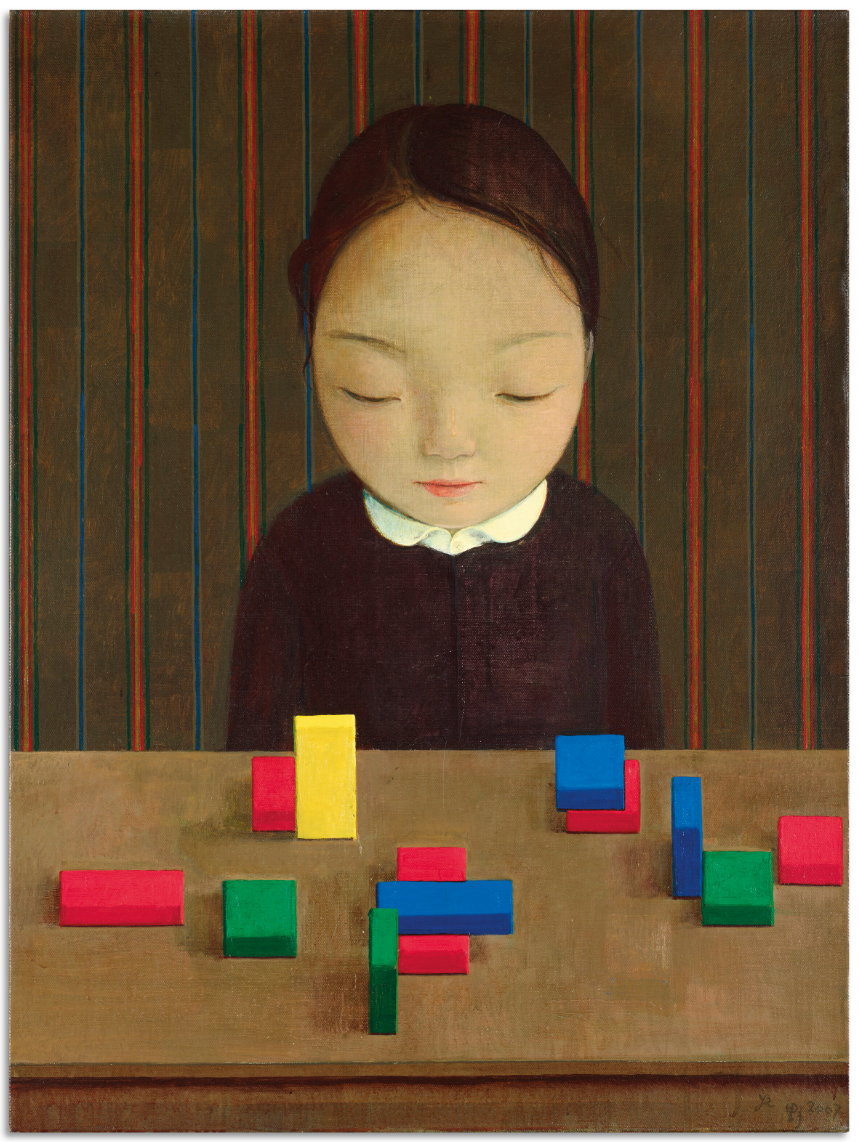
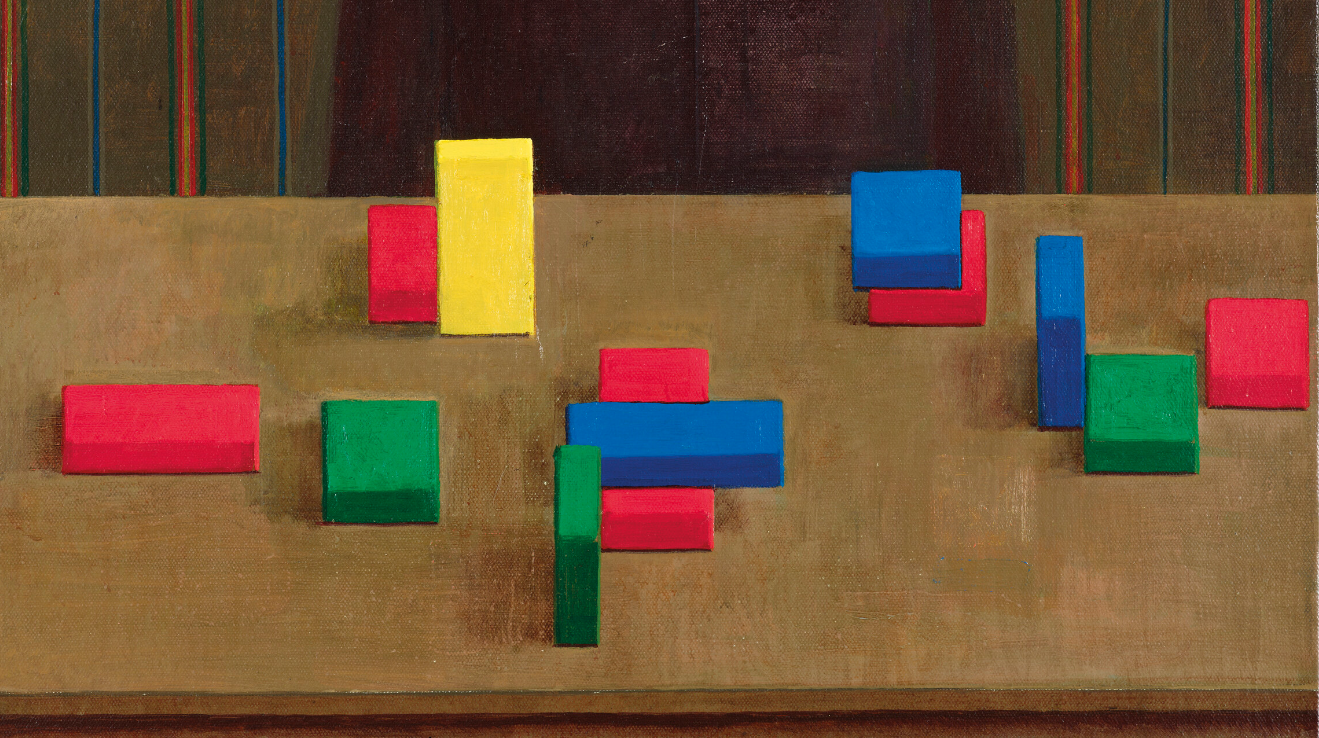
Featuring a seated girl in a simplistic and tranquil interior setting, Girl with Toy Bricks (2007) is a captivating work that exemplifies the maturation of Liu Ye’s narrative flair and painterly virtuosity during the 2000s. Its meticulous and distilled composition, akin to poetry, forms a maze rife with visual clues that seduces the viewer to enter the composition from different angles. With her eyes cast downwards, the girl contemplates a table of colorful blocks assembled in various configurations, as if watching a play. Like one of Vermeer’s reading women, her state of mind seems to traverse the confined space in which she is situated. Her surroundings, meanwhile—at once ordinary and intimate—are rationalized in an array of geometrical forms and lines that camouflage the work’s deeper emotional resonance.
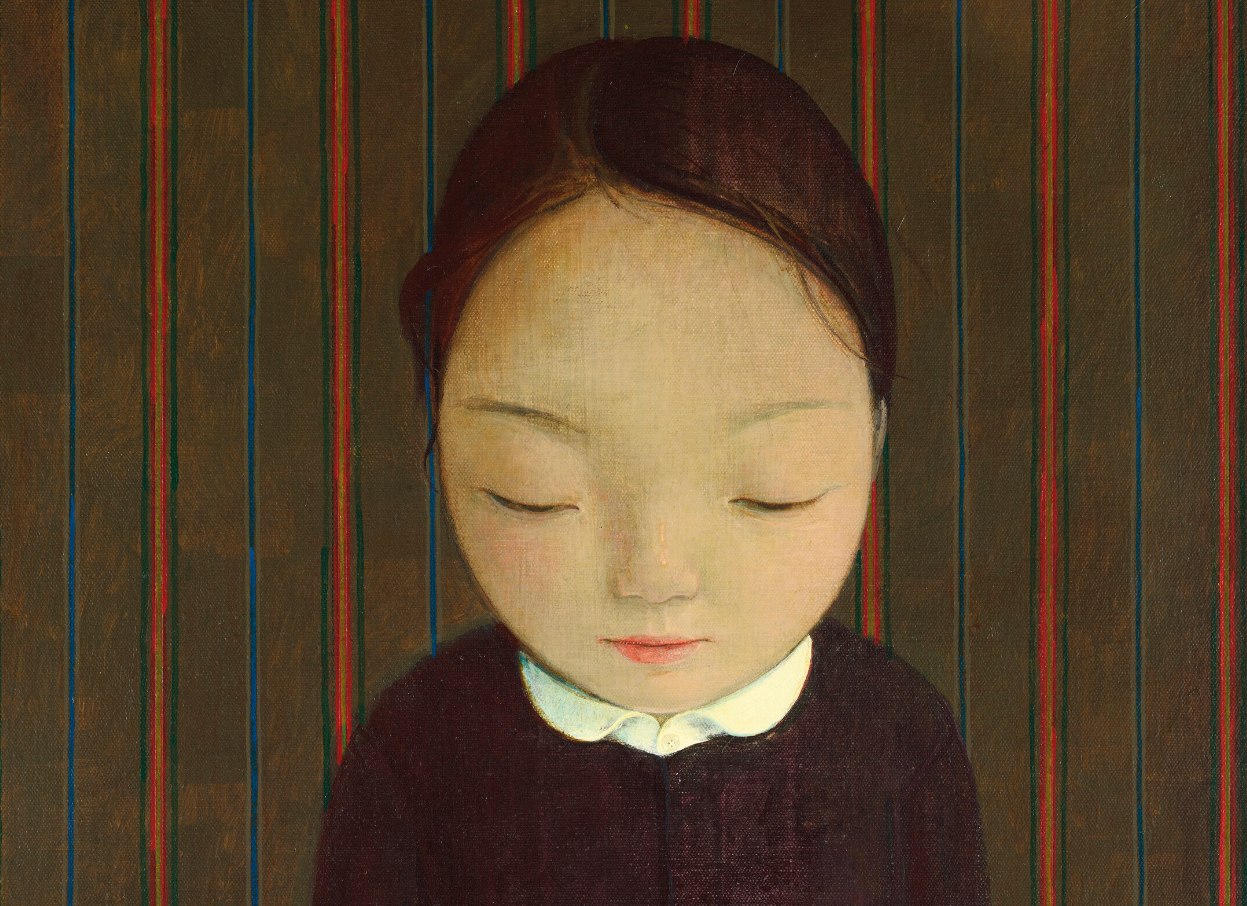
Liu Ye initially studied industrial design for four years at the Beijing College of Art and Design in the 1980s before enrolling at the Central Academy of Fine Arts and subsequently the Hochschule der Kunst in Berlin. He was greatly influenced by the aesthetic and philosophy of the Bauhaus, which fundamentally informs his vocabulary and sets him apart from the majority of contemporary Chinese artists of his generation. Painted in 2007, Girl with Toy Bricks marks a pivotal moment in which Liu Ye parted with Modernism and began to engage with more classical ideas. Though continuing the simplified narratives that previously dominated his work, here the artist introduces a much darker palette, imbuing the painting with a deep solemnity. The oval face of his protagonist, eclipsed beneath the dimmed light, possesses a faded lustre found in precious stone that evokes the passage of time.
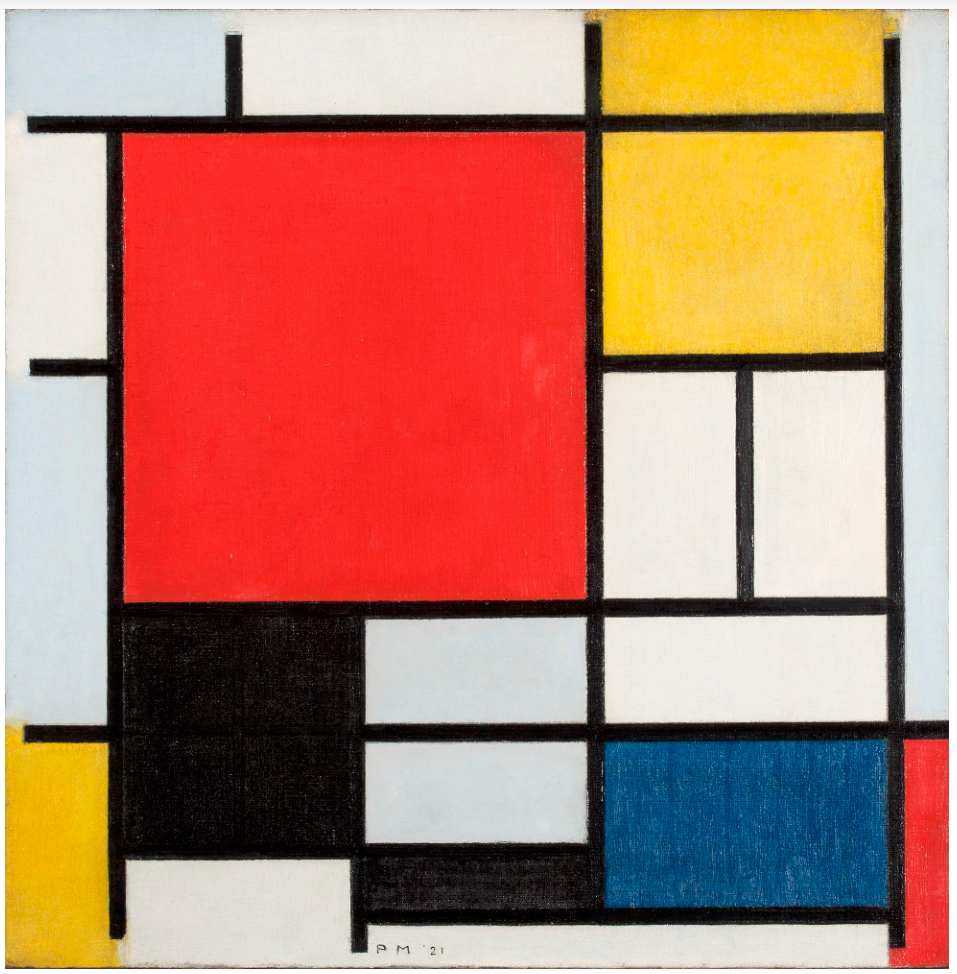
Piet Mondrian, Composition with large red plane, yellow, black, gray and blue, 1921. Kunstmuseum Den Haag, The Hague. Photo: © Kunstmuseum den Haag / © Mondrian/Holtzman Trust / Bridgeman Images.
Reference to the work of Piet Mondrian, formerly a didactic citation in most of Liu Ye’s works, has been reinvented here in a playful format of toy blocks—a witty touch that evinces the artist’s gradual internalization of abstract principles. The humanity of the Old Masters combines with the emotional rhythms of abstraction. Aside from its nod to Mondrian, the work’s vertical linear backdrop also chimes with the serene compositions of Agnes Martin.
Boogie Woogie, Little Girl, 2005
Christie’s Hong-Kong: 29 November 2023
Estimated: HKD 6,000,000 – 9,000,000
HKD 10,055,000 / USD 1,290,899
LIU YE (B. 1964) (christies.com)
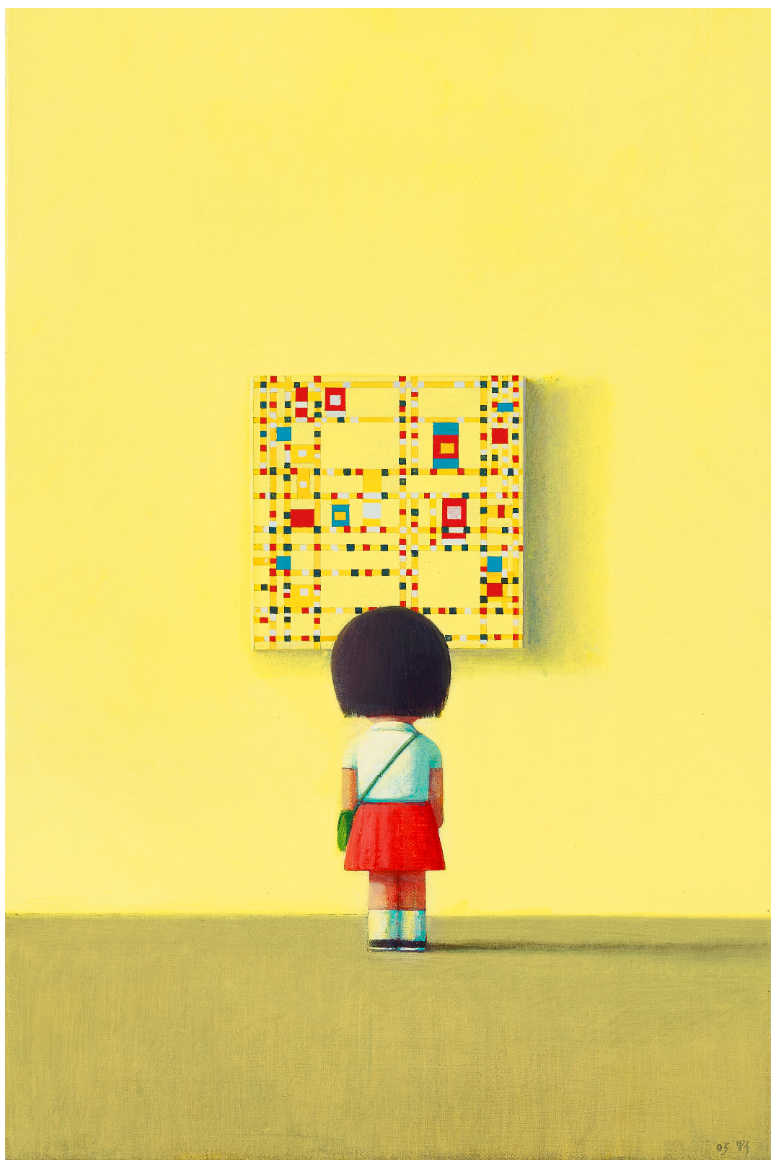
LIU YE (B. 1964)
Boogie Woogie, Little Girl, 2005
Acrylic on canvas
43 x 28.5 cm. (16 7/8 x 11 1/4 inches)
Signed in Chinese and dated ’05’ (lower right)
Stamped ‘LITTLE GRIL BOOGIE WOOGIE 2005 LIU YE’ (on the reverse)
“For me, I also see a lot of naivety and very emotional elements in Mondrian’s paintings. But at the same time, its rigor, just like in architecture, also influences me a lot. So I think that naivety and rigor are not two contradictory elements, they can be combined together.”
Hey!, 2000
Phillips Hong-Kong: 26 November 2023
Estimated: HKD 3,000,000 – 5,000,000
HKD 3,456,000 / USD 456,128
Liu Ye – New Now & Design Hong Kong Lot 38 November 2023 | Phillips
LIU YE
Hey!, 2000
Oil on canvas
35.3 x 27.3 cm (13 7/8 x 10 3/4 inches)
Signed, titled and dated ‘”HEY!” 2000 YE [in Chinese and English]’ lower right
Painted in 2000, Hey! has remained in private hands since its execution and was initially commissioned for the same family who still holds it today. The work not only recalls Liu’s continued interest in portraiture and his recurring motif of celestial beings, but also reflects his extensive knowledge of Western cultural history. Upon graduating from Beijing’s Central Academy of Fine Arts in 1990, Liu Ye continued his studies for another four years at Berlin’s Universität der Künste, and later took up a six-month residency at the Rijksakademie in Amsterdam in 1998. It was around this time where the current work was conceptualized and created. In Amsterdam, Liu’s immersion in European paintings exposed him to the stable compositions and naturalism of the Renaissance, as well as the theatricality and highly ornate language of Baroquism.
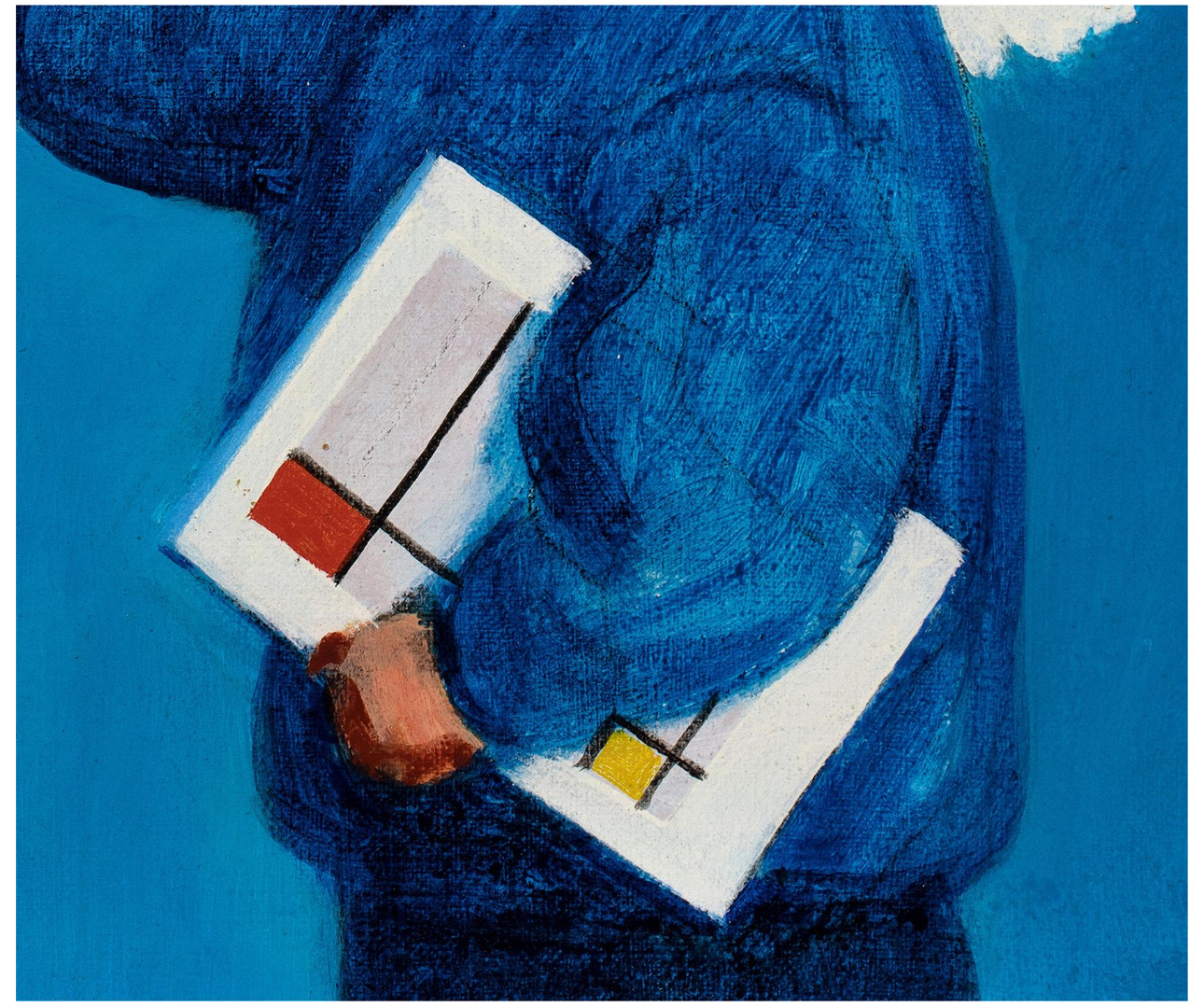
In the present work, a young child with rosy cheeks looks out at the audience and sticks out their tongue out playfully as their hand points into the distance. Placing them within a monochrome background, there is an endearing air of juvenility that emits from the minimalistic composition, which tightens the viewer’s focus on the sitter, both invoking and destabilizing traditional conventions of European portraiture. The lone wing on the protagonist’s back references the motif of putto (cherubs) often found in 15th to 17th century European art, masterfully combining the youthful realism of the Renaissance with the playfulness commonly seen in the Baroque period.
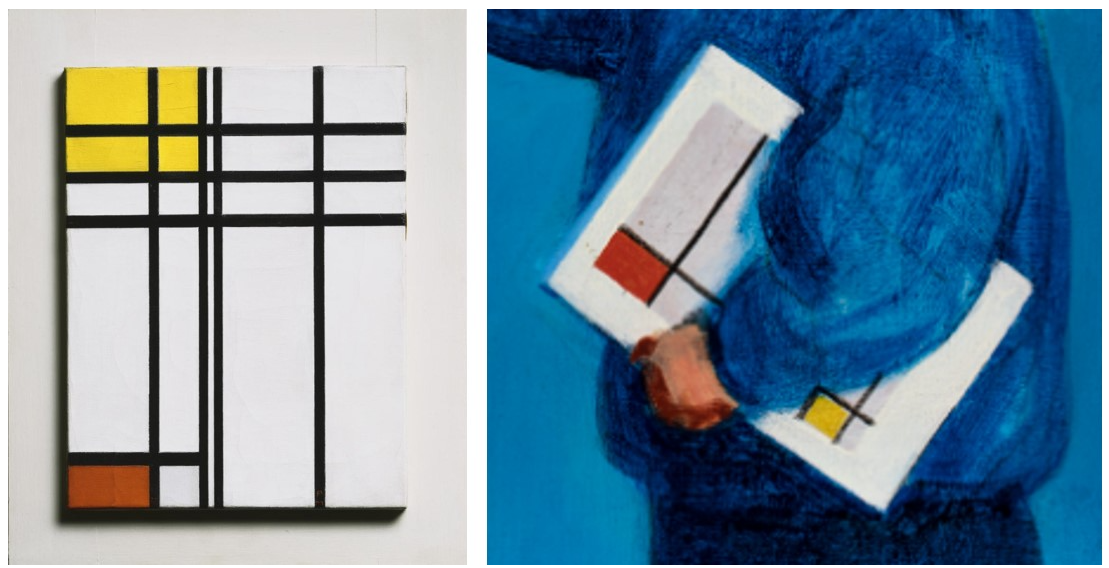
Left: Piet Mondrian, Opposition of Lines, Red and Yellow, 1937 / Collection of the Philadelphia Museum of Art
Image: Philadelphia Museum of Art, A. E. Gallatin Collection, 1952, 1952-61-90 / Right: Detail of the present lot
A supernatural being that does not exist in real life, cherubs could also be seen as an extension of Liu’s own childhood memories. The son of a famous children’s playwright, he had access to a trove of story books despite the ban on Western books at the time and was deeply inspired by the works of authors such as Hans Christian Andersen. By employing the fictive concept of angel wings, it gives the depicted scene a fairy-tale like allure. But unlike his previous forays into black humor under the guise of fantasy, the present work is imbued with a sense of innocence despite its connections to reality. During his time in Europe, Liu also became fascinated with modern artists and movements including Italian Metaphysical Art and Surrealism. Notably, he cites his greatest inspiration to be Piet Mondrian, famous for his abstract geometric paintings that pioneered the De Stijl movement.
“The appearance of Mondrian’s paintings within my own paintings is spiritual. His paintings are so simply conceived with the most basic colours and vertical and horizontal lines. I also wish to address the question of simplicity.”
Beyond the physical inclusion of famed artworks however, Liu pays homage to Mondrian in subtler ways, as his captivation with the Dutch artist translates seamlessly onto canvas through the use of a well-balanced composition and an emphasis on geometric alignment. This is seen where the artist deliberately places the child in the center of the work, with their extended arm in parallel to the horizontal edges. The background is also separated diagonally by a rhombus of light, creating a sense of equilibrium that stems from the emphasis on strict linear preoccupation.
She and Mondrian, 2003
Sotheby’s Hong-Kong: 5 October 2023
Estimated: HKD 17,000,000 – 22,000,000
HKD 22,230,000 / USD 2,838,815
LIU YE (b. 1964)
She and Mondrian, 2003
Acrylic on canvas
120×80 cm (47 1/4 x 31 1/2 inches)
signed in Chinese and Pinyin and dated 2003
triking in palette and captivating in composition, She and Mondrian (2003) is a quintessential and defining Liu Ye painting from the artist’s Golden Era – without question amongst the best of his prolific and accomplished practice. The painting features a plenitude of some of the most iconic visual traits and motifs that Liu Ye is celebrated for: the mysterious young girls, a recurring character in Liu Ye’s oeuvre; a work by the Dutch master Piet Mondrian placed within the composition; and finally the strong compositional framework which has come to define the artist’s most celebrated compositions. Painted in 2003, She and Mondrian belongs to a series of two works featuring the artist’s signature pictorial ode to the Dutch master Piet Mondrian, and a desk behind which sits the figure of a young child. An important source of inspiration to Liu Ye, the blue and yellow work inspired by Mondrian which spreads out across the long desk can be seen throughout the artist’s work, including the equally spellbinding Mondrian in the Morning (2000) which may have remained in the artist’s own private collection to this day. Housed as part of important international collections, She and Mondrian was, significantly, featured at Schoeni Art Gallery in Beijing and Hong Kong in 2003 and 2004. Combining in equal parts Western and Chinese influences, and striking a sublime balance between figure, foreground and background, She and Mondrian manifests the consummately unique surrealist whimsicality that so powerfully defines Liu Ye’s oeuvre.
“Everything I paint is someone or something I love. A lot of my sources come from the movies…Or my source might be another artwork, like Miffy or Mondrian’s work. Very few are from reality. Reality isn’t very interesting. I’m afraid of reality.”
Ranking among Liu Ye’s most important and enduring motifs, works by Mondrian have featured in the artist’s compositions since the early 1990s. Here, the powerful lines and strong, structural quality of Mondrian’s blue and yellow compositions are rendered on the hazy yellow desk, the boundary between compositions blurring. The young girl sits with colored pencils, implying the significance of Mondrian as a source of inspiration for the artist. Echoing the aesthetics of Mondrian, Liu Ye’s commitment to pure planes of color is in full display, the yellow imparting a warm glow against the rich blue of the background.
“Mondrian elevates art to a new level. Even though he advocated rationalism, to me, his paintings were very sensuous and spiritual.”
Enamoured by Mondrian, and in choosing a large scale canvas which he almost rarely uses for the present work, Liu emphasises the significance of this painting.
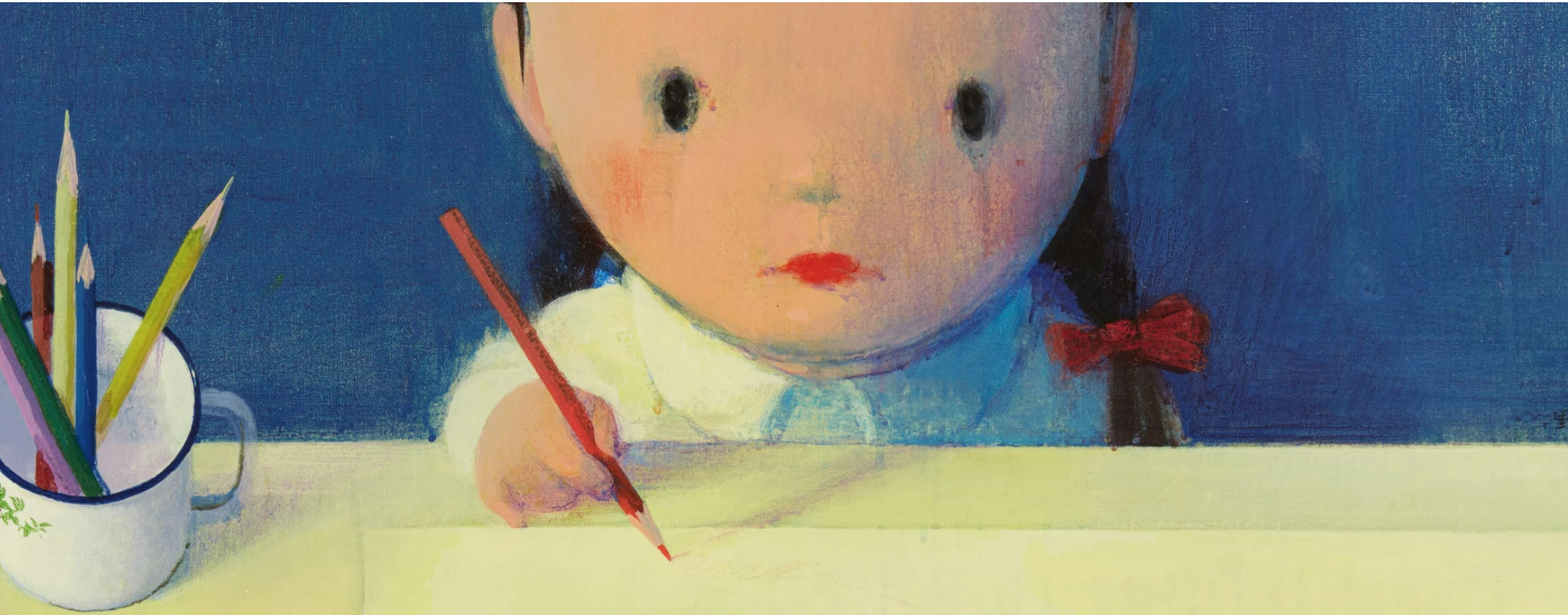
Carefully orchestrated to Mondrian’s aesthetic, the strong verticals of Liu Ye’s homage are offset by the horizontal of the desk, the powerful lines of blue and yellow mincing the structural qualities of the Dutch painter. This flatly painted expanse of the blue background heralds what the critic Zhu Zhu describes as the artist’s Golden Era of painting; “This simplified handling of background lies somewhere between Mondrian’s abstraction and the spatial composition of traditional Chinese painting” (Zhu Zhu, ‘An Aged Childhood’, in Liu Ye, Bern 2007, p. 72). Constructed within a simple two dimensional composition, a strong contrast between the serenity of the blue and vibrant yellow bring upon an intense stimuli, one that is reminiscent of the visual effects brought along by Mark Rothko’s pure-colour abstract paintings. As with many works by Liu Ye, She and Mondrian displays an irresolvable tension between an imagined and fantastical narrative, and the representation of allegorical objects consciously chosen by the artist, arranged in a compositional rigor that comprises of the arti’s transparent layers of soft colors found in his later works.
Composition with Moonlight, 2005
Sotheby’s Singapore: 2 July 2023
Estimated: SGD 1,200,000 – 1,500,000
SGD 1,651,000 / USD 1,220,883
REPEAT SALE
Sotheby’s Hong-Kong: 13 December 2022
Estimated: HKD 7,000,000 – 9,000,000
HKD 10,055,000 / USD 1,293,297
LIU YE (b. 1964)
Composition with Moonlight, 2005
Acrylic on canvas
45×45 cm (17 3/4 x 17 3/4 inches)
Signed Liu Ye and dated 05 (lower right)
Initialled in Chinese and Pinyin, titled COMPOSITION IN MOONLIGHT and dated 05 (on the verso)
Imbued with an intrinsic mystery and ambiguity, Composition with Moonlight, 2005, pays homage not only to Piet Mondrian but also to a multitude of art historical and cultural references. As the only painting of this composition executed in blue depicting Liu Ye’s signature little girl facing a Mondrian, the present work is a rare and iconic example of the artist’s distinctive oeuvre. Having previously made a study on paper, RGB-Blue created in 2001, and a subsequent iteration on canvas, Blue from 2002, the present work is the culminating opus of Liu Ye’s work in blue. Ranking among Liu Ye’s most important and enduring motifs, works by Mondrian have featured in the artist’s compositions since the early 1990s. Here, Mondrian’s Composition No. II with Blue and Yellow (1930) hangs on the otherwise bare, blue wall, which, along with the powerful lines and structural quality of Composition with Moonlight, plays homage to the Dutch painter. Returning to this composition after conducting his larger study in yellow, Mondrian in the Morning, in 2000, the present work’s delicate size and blue hue imparts a silent power and dreamlike quality, the nocturnal counterpart to this previous iteration. Echoing the aesthetics of Mondrian, Liu Ye’s commitment to pure planes of colour is in full display, the blue imparting a sense of contemplative stillness to the composition. Drawing on both his childhood memories in China and his early education in Europe, the artist’s carefully balanced, methodical compositions such as the present work play on perspective and ways of seeing. Transcending traditional Eastern and Western art-historical categories, Liu’s various points of inspiration have produced a body of work which as at once rich in historical allusions and singularly his own.
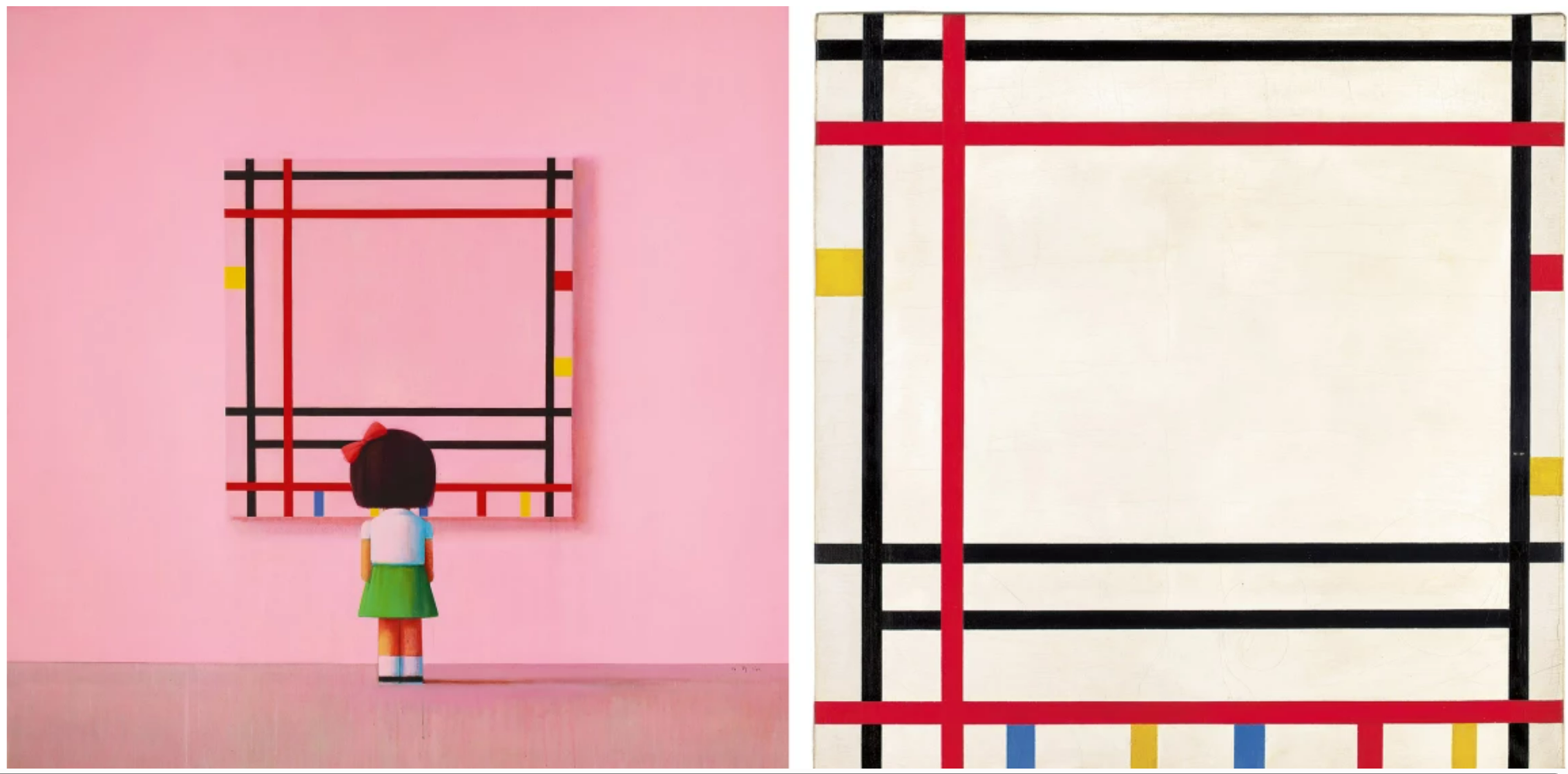
LEFT: LIU YE, BOOGIE WOOGIE, LITTLE GIRL IN NEW YORK, 2006, 210 BY 210 CM; 82⅞ BY 82⅞ IN., SOLD BY SOTHEBY’S HONG KONG IN APRIL 2019 FOR HK$22.9 MILLION (US$2.9 MILLION).
Simple and inward looking, the picture plane of Composition with Moonlight focuses on Liu Ye’s signature little girl and the Mondrian. As far back as the Berlin period, Liu has depicted himself in childhood, the artist using his own memories of childhood to fashion his dreamlike compositions. His father was a famous Beijing based children’s playwright, and he himself felt a fascination with the world of fairy-tales; “I have always felt that every moment of my life is lived in a fairy-tale world” (Liu Ye quoted in Hatje Cantz, Liu Ye Catalogue Raisonné 1991-2015, Germany 2015, p.20). It was in the 2000s that Liu began to increasingly use female figures as his subjects, with a little girl dressed in student clothing placed in the foreground of the present work. Describing Mondrian as almost like a father figure, who, in his love and respect for him, he must sometimes work against, the little girl’s green skirt provides the means by which Liu Ye expresses his pictorial independence: “I know for Mondrian it was only red, yellow, blue, white, black, grey – just six colours. Never green. But I made a painting of a girl in a green skirt, standing in front of a Mondrian painting, because Mondrian hated green, I think Mondrian’s colour is too doctrinaire.” (Liu Ye quoted in Zhu Zhu and Hans Ulrich Obrist Eds., Liu Ye: The Book Paintings, New York City 2021, pp. 172).
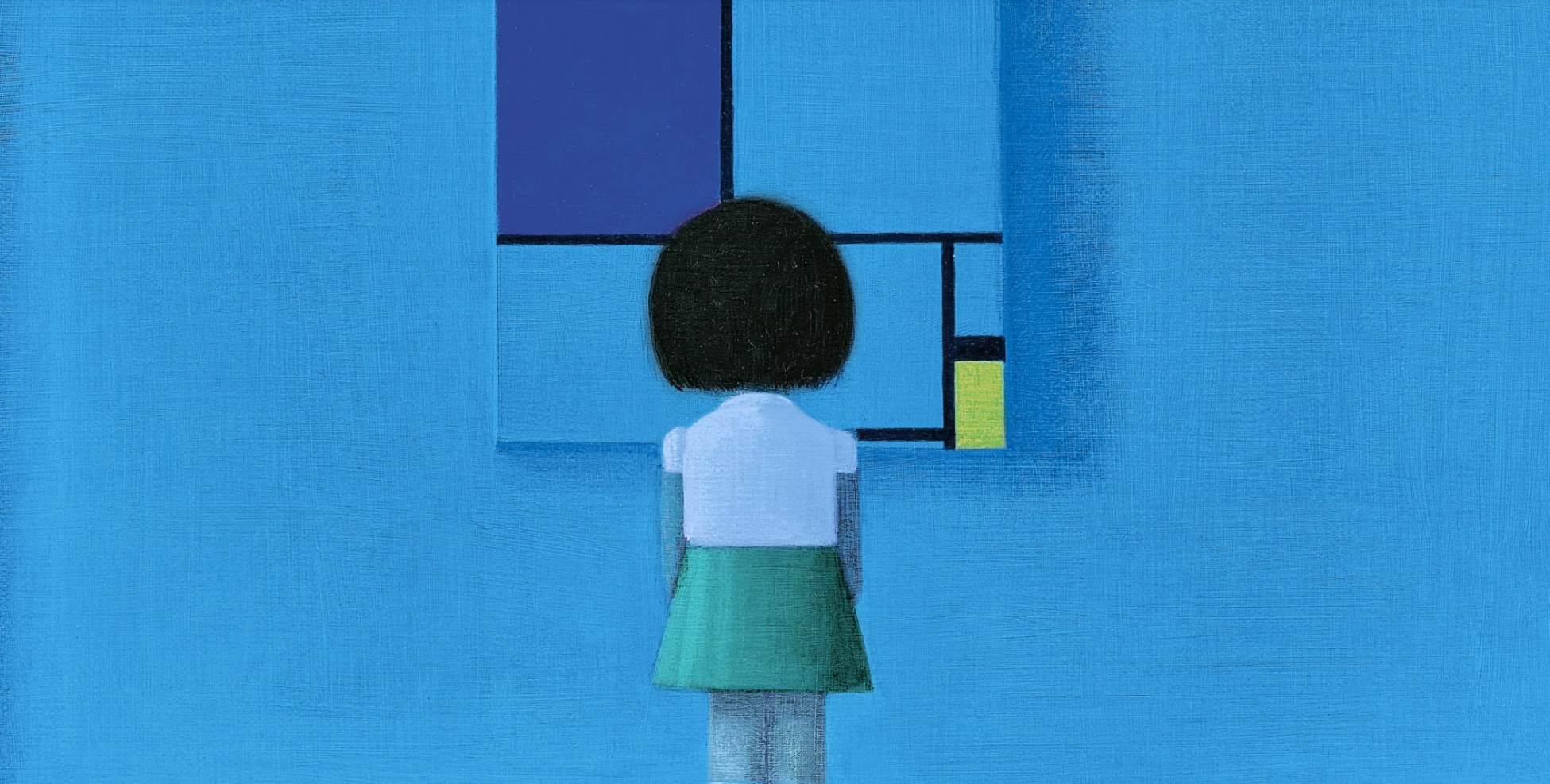
Such spare handling of the background falls somewhere between the abstraction of Mondrian and the leaving of white space in traditional Chinese landscapes, the geometrically segmented relation of walls to floor making it appear as if the Mondrian painting were passing beyond its frame and extending infinitely into the real world. It was around 2003 that this paring down of Liu’s canvases began, heralding the initiation of the artist’s Golden era. Compared to the artist’s previous work, Composition with Moonlight has filtered out obviously animated treatments, achieving instead a firmness of structure in Liu’s emphasis on a flat daubing technique, producing a more planar effect on the composition. Within this context, the little girl figure, childlike and wooden, depicted in the composition’s foreground functions not just as a narrative device but provides a structural quality with her physical shape and colours.
“Everything I paint is someone or something I love. A lot of my sources come from the movies…Or my source might be another artwork, like Miffy or Mondrian’s work. Very few are from reality. Reality isn’t very interesting. I’m afraid of reality.”
Liu’s intuitive fascination and instinctive appropriation of art historical images has led over the course of his career to the creation of many works which can be viewed as collages or parodies, yet his images have an expressive ambiguity that is entirely his own. The aspect of Mondrian’s structural qualities, with its emphasis on visual theories like balance and geometrical partitioning of space, utilised by Liu are punctuated by his subtle engagement with the Renaissance notion of painting as a window to the world. This ongoing dialogue with the artists he admired is characteristic of much of the artist’s work, a kind of intertextual game which is utterly unique. The art historical lineage of the window can be traced back to the first theoretical text written about art in Europe, a treatise on linear perspective and the purpose of art: “First of all, on the surface which I am going to paint, I draw a rectangle of whatever size I want, which I regard as an open window through which the subject to be painted is seen.” (Leon Battista Alberti, On Painting and On Sculpture: The Latin Texts of “De Pittura” and “De Statua”, trans. Cecil Grayson, London 1972, pp. 55). A metaphorical portal into liminal spaces, the window has long been employed throughout the canon of art history to invoke a dialogue between perceptual and intellectual vision, with Liu particularly engaging with the trope of the romantic image of a figure seen before an open window gazing into the space beyond, seen in Balthus’s Girl at a Window, 1957 and Caspar David Friedrich’s, Germany’s most renowned Romantic painter, Woman at a Window, 1822. In the present work, the Mondrian painting functions as an allegorical window, while the composition itself, carefully orchestrated, invokes a window frame.
Imbued with an intrinsic mystery and ambiguity, Composition with Moonlight, 2005, pays homage not only to Piet Mondrian but also to a multitude of art historical and cultural references. As the only painting of this composition executed in blue depicting Liu Ye’s signature little girl facing a Mondrian, the present work is a rare and iconic example of the artist’s distinctive oeuvre. Having previously made a study on paper, RGB-Blue created in 2001, and a subsequent iteration on canvas, Blue from 2002, the present work is the culminating opus of Liu Ye’s work in blue. Ranking among Liu Ye’s most important and enduring motifs, works by Mondrian have featured in the artist’s compositions since the early 1990s.
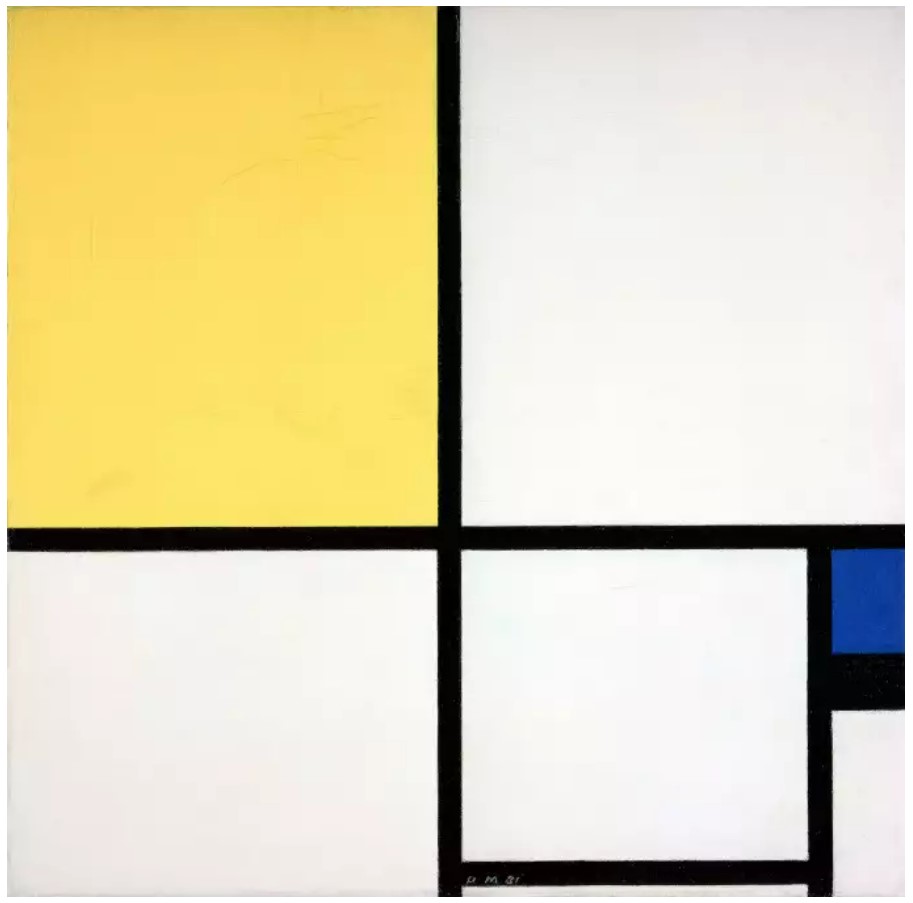
PIET MONDRIAN, COMPOSITION NO. II WITH YELLOW AND BLUE, 1931
COLLECTION OF CISNEROS FOUNDATION, CARACAS © 2022. SCALA, FLORENCE
Here, Mondrian’s Composition No. II with Blue and Yellow (1930) hangs on the otherwise bare, blue wall, which, along with the powerful lines and structural quality of Composition with Moonlight, plays homage to the Dutch painter. Returning to this composition after conducting his larger study in yellow, Mondrian in the Morning, in 2000, the present work’s delicate size and blue hue imparts a silent power and dreamlike quality, the nocturnal counterpart to this previous iteration. Echoing the aesthetics of Mondrian, Liu Ye’s commitment to pure planes of colour is in full display, the blue imparting a sense of contemplative stillness to the composition. Drawing on both his childhood memories in China and his early education in Europe, the artist’s carefully balanced, methodical compositions such as the present work play on perspective and ways of seeing. Transcending traditional Eastern and Western art-historical categories, Liu’s various points of inspiration have produced a body of work which as at once rich in historical allusions and singularly his own.
“I know for Mondrian it was only red, yellow, blue, white, black, grey – just six colors. Never green. But I made a painting of a girl in a green skirt, standing in front of a Mondrian painting, because Mondrian hated green, I think Mondrian’s color is too doctrinaire.”
Hello, Mondrian, 2002
Bonhams Hong-Kong: 25 November 2021
Estimated: HKD 8,000,000 – 12,000,000
HKD 11,652,500 / USD 1,494,523
Bonhams : Liu Ye (B. 1964) Hello, Mondrian
Acrylic on canvas
60.2 x 45.2 cm (23 11/16 x 17 13/16 inches)
Signed in Chinese and Pinyin and dated 2002 on the lower right
Liu Ye is not merely inserting Mondrian’s works into his paintings. On the contrary, he is infusing Mondrian’s theory on equilibrium and geometric abstraction into his practice. In Hello, Mondrian, the shadow of the girl and the bottom edge of the wall form horizontal lines that resonate with the vertical shadow on the left edge of the painting — a sense of unifying balance is thus achieved. This treatment of using light and shadow to divide the picture geometrically is akin to the manipulation of space in Johannes Vermeer’s The Milkmaid. Liu Ye’s strong desire for compositional order came from the industrial design training that he received when he was in his teens. Drafting had cultivated a restrained and patient side in his practice. This rational thinking would later manifest itself as the superior sense of precision and attention to detail in his works. Other than the geometric format, Liu Ye’s love for primary colors was also inspired by Mondrian. The artist recalls his earliest memory of using the primary colors of red, yellow, and blue was when he was drawing as a child: red represents the sun and the flag; yellow represents sunflowers and sunrays; blue represents the sea and the sky. This color scheme would later be refined and enriched as demonstrated in Hello, Mondrian — as the three primary colors interact with each other and shadows are cast on the forms, more nuanced and denser shades are created. As a result, the flatness of the composition encourages the viewer to indulge in pure colour abstraction. Within the orderly composition, the rich colors are further intensified to create a heightened sense of tension. This powerful undercurrent behind coolness is very much in the vein of Mondrian’s ideal of beauty. Both artists champion a sober and rational aesthetic that enhances the pure expressiveness of colors.
She Isn’t Afraid of Mondrian, 1995
Phillips Hong-Kong: 24 November 2019
Estimated: HKD 18,000,000 – 28,000,000
HKD 26,550,000 / USD 3,392,776
Liu Ye – 20th Century & Contemporary… Lot 7 November 2019 | Phillips
LIU YE
She Isn’t Afraid of Mondrian, 1995
Acrylic and oil on canvas
200×170 cm (78 3/4 x 66 7/8 inches)
Signed and dated ‘liu ye ye [in Chinese] 95’ lower right
She Isn’t Afraid of Mondrian is steeped in iconography and hidden meaning: ruminating on the work, the artist revealed that an artistic debate arose between his then-partner and himself, and the scene which unfurls is a direct allusion to this particular memory. The metaphorical result of this debate can be identified in the characters in the painting: the female figure’s face remains half-concealed in shadow, and the autobiographical cherubs stomp resolutely forward with Mondrian’s Broadway Boogie Woogie in tow, as if trying to drag it away from the group. The four figures are illuminated by a diagonal projection of light, as if to highlight these contradictory movements held in delicate tension. The spotlight projected upon this motley crew potently evokes the same sense of conspiratorial disquietude as the light illuminating the coterie of three in Edward Hopper’s Conference at Night, captured discussing some unknown plan in the fading evening glow. It also directly mirrors the large slab of light that unveils the unsuspecting sleeper in Balthus’ The Room, thanks to a mischievous character thrusting open a set of curtains. In this sense, the dazzling amber light in She Isn’t Afraid of Mondrian is layered in its connotations, calling to mind motifs of secrecy and mischievousness.
Sailors
The End of Baroque, 1998
Phillips Hong-Kong: 6 October 2023
Estimated: HKD 18,000,000 – 28,000,000
HKD 22,230,000 / USD 2,838,815
Liu Ye – 20th Century & Contemporary… Lot 10 October 2023 | Phillips
LIU YE
The End of Baroque, 1998
Acrylic on canvas
200×170 cm (78 3/4 x 66 7/8 inches)
Signed and dated ‘98 Liu Ye’ upper left
The image of a ship ablaze, with its billowing smoke piling into a sky dyed orange by flames against a setting sun engulfs us in Liu Ye’s monumental The End of Baroque. Its size is formidable and rare: less than 30 works of such height have come to auction, and none of this scale has been seen on the market this year. The potency of this lone ship at sea is instantly arresting and powerful and evokes scenes of Rembrandt’s (hitherto lost) depiction of Christ on a raft amid turbulent waters, various paintings of hulking Dutch warships, René Magritte’s elusive The Seducer floating among clouds, or indeed J. M. W. Turner’s vermilion canvases of explosions, fires, and battles all come to mind. The visual lexicon of this work is undeniably rich and layered, as with the rest of Liu’s creations. Inexplicably, the view is surrealistically framed by white windows that swing out towards the vista outside. To our bottom left is a solitary figure who looks on, unperturbed by this seascape, surreal and catastrophically beautiful. Painted in 1998, a few years after the artist’s return to his native China, and the same year in which Liu Ye spent time training at Amsterdam’s Royal Academy of Fine Arts, The End of Baroque signals the close of an era and the dawn of new beginnings.
Flagship No. 1, 1997
Phillips Hong-Kong: 30 March 2023
Estimated: HKD 4,000,000 – 6,000,000
HKD 6,985,000 / USD 889,820
Liu Ye – 20th Century & Contemporary A… Lot 33 March 2023 | Phillips
LIU YE
Flagship No. 1, 1997
Acrylic and oil on canvas
29.2 x 22.2 cm (11 1/2 x 8 3/4 inches)
Signed and dated ’97 Liu Ye Ye [in Chinese]’ lower left
Whimsical and theatrical are words that come to mind when approaching Liu Ye’s bewildering yet charming oeuvre. As one of the most important living contemporary Chinese artists, Liu Ye’s most recent solo exhibition—fittingly entitled Storytelling—took place at the Fondazione Prada in Milan in 2020-2021, the second leg of an exhibition that began in Shanghai in 2018. The present work, Flagship No.1, the first piece from a series exploring astounding scenes in which tiny sailors peel back hefty velvet stage curtains to reveal hulking warships, was part of this thought-provoking show in Italy. Having remained in private hands for nearly a decade, Flagship No. 1 rejoins the auction stage this season as a signature work by the artist.
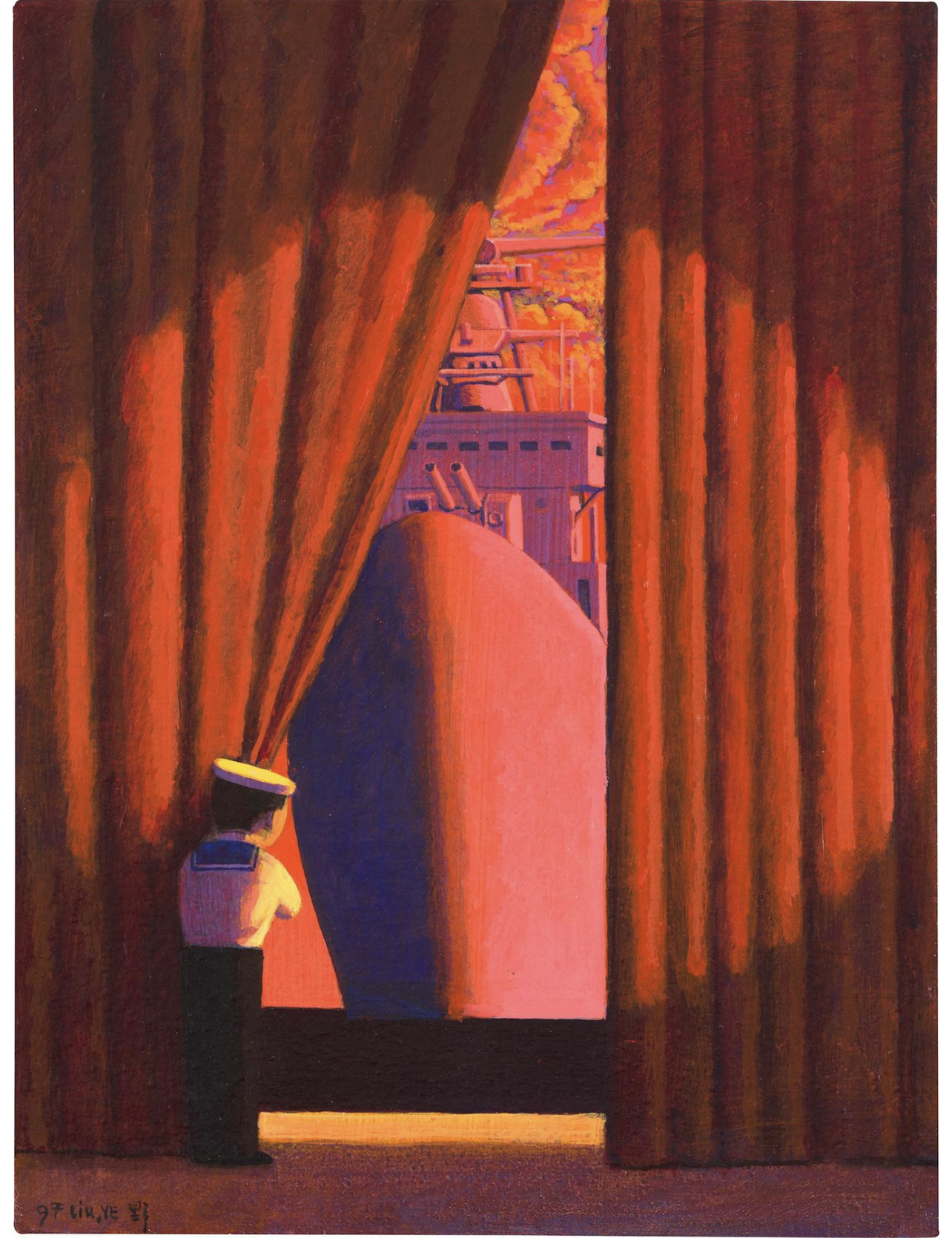
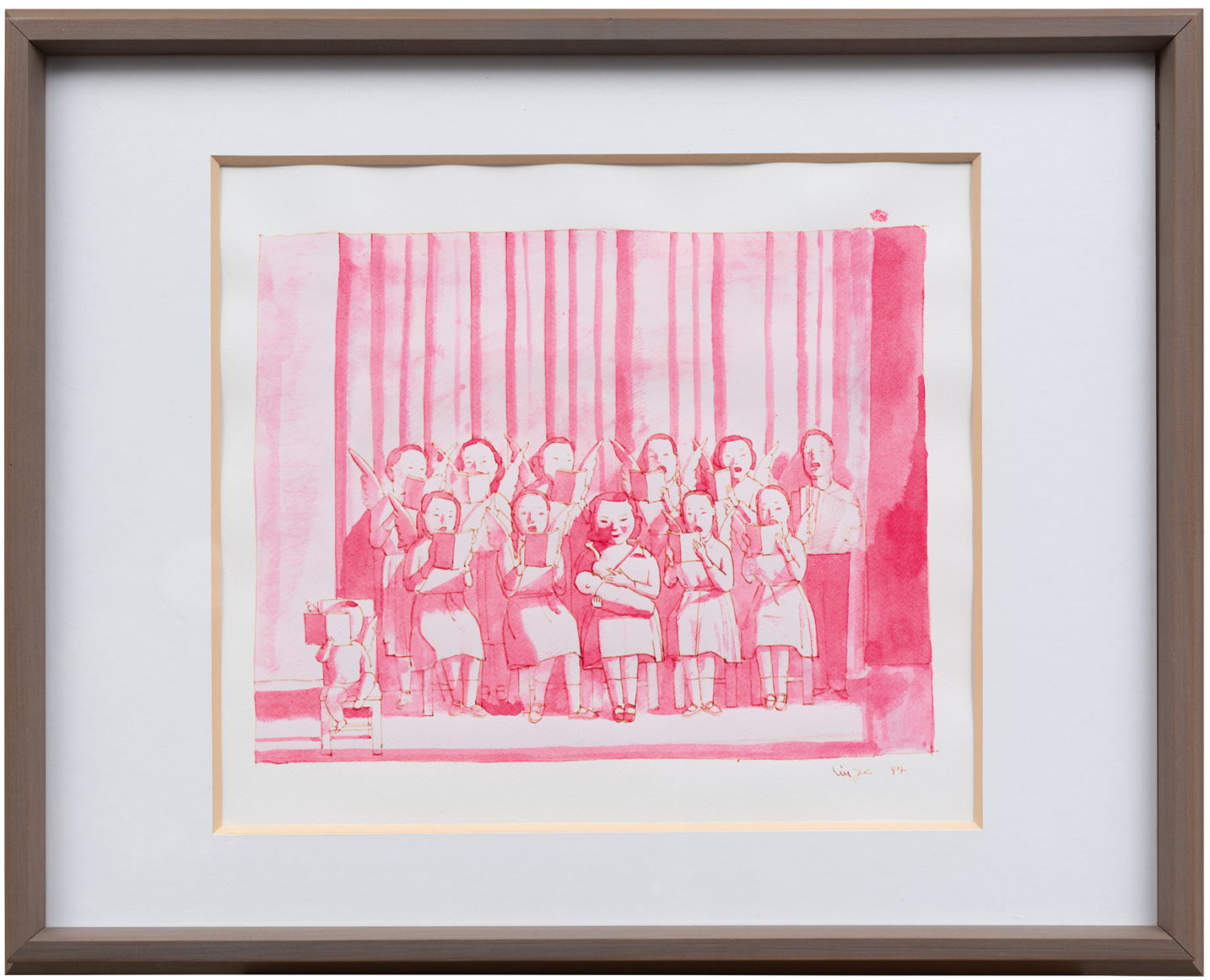
For all its angled perfection however, Flagship No. 1 powerfully evokes the dreamy influences of Surrealism, at deliberately great odds with the rigidity and compositional equipoise the painting demands. Liu’s use of the curtain in the present work invokes a device employed by the great Surrealist René Magritte, but also artists from a longer art-historical lineage, such as the Old Masters: as can be seen in Rembrandt’s The Holy Family with a Curtain, the curtain serves as a powerful trompe-l’oeil, drawing the viewer into the depths of its composition, signaling the artifice of the scene we are witnessing, and yet also showcasing great skill in rendering drapery. The overall effect is one that recalls a stage and make-belief, juxtaposing with the verisimilitude of the Virgin Mother and Child.
Hope No. 1, 2000
Christie’s Hong-Kong: 24 May 2021
Estimated: HKD 4,800,000 – 6,800,000
HKD 10,450,000 / USD 1,345,765
Liu Ye (b. 1964) (christies.com)
LIU YE (b. 1964)
Hope No. 1, 2000
Acrylic on canvas
45×38 cm (17 3/4 x 11 inches)
Signed and dated ‘Liu Ye 2000’ (lower right)
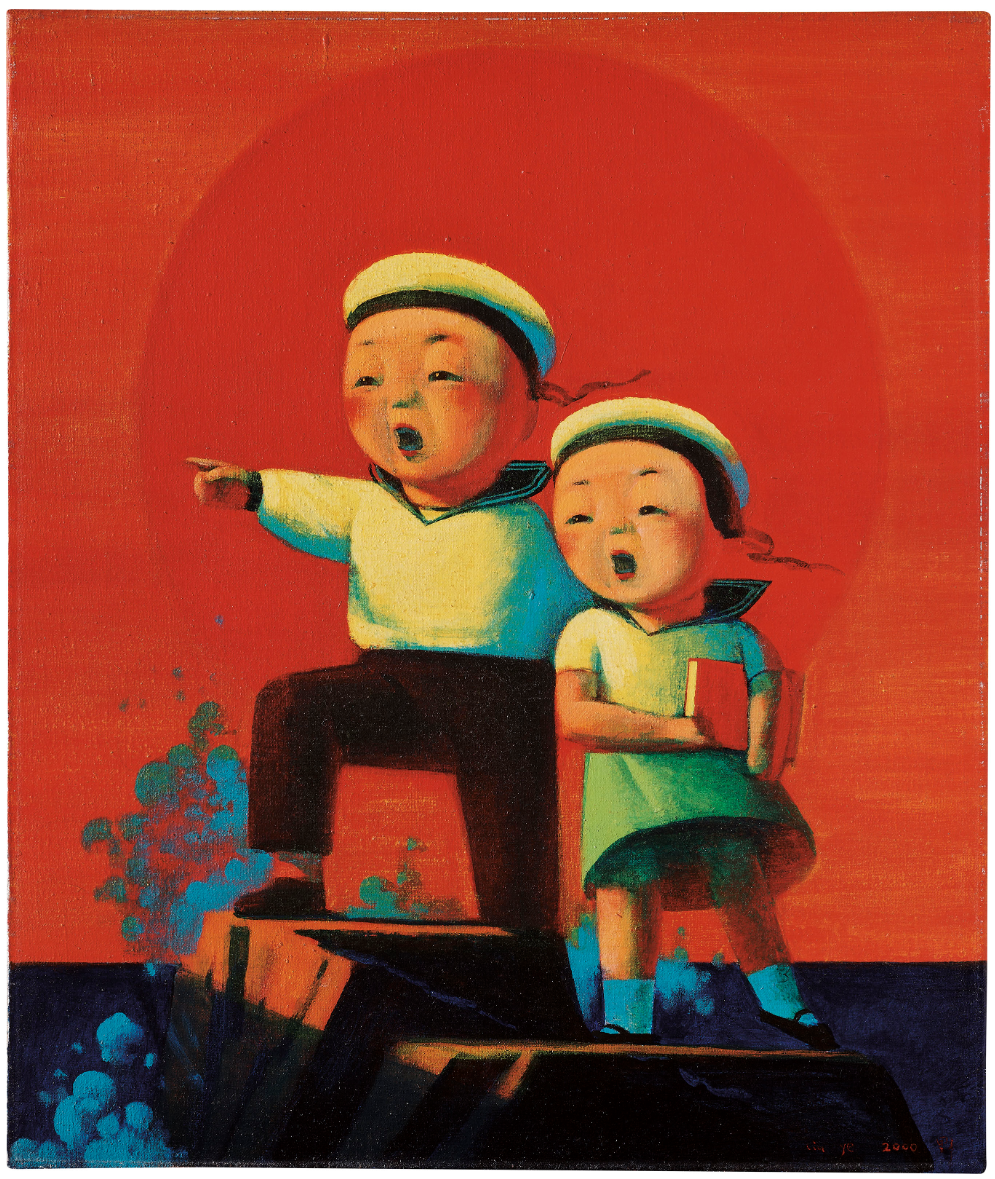
The way in which Liu Ye uses the color red differs from other Chinese artists who focus on its political connotations. To him, the color red is an important part of his childhood visual experience. It is a vehicle as well as an instrument of nostalgia. This treatment of the color red highlights Liu Ye’s emphasis on individualized feelings and experiences. The artist contemplates and responds to social phenomena from the point of view of an individual. Such perspective is an extension of his concern for the human condition and personalized sentiments. The characters in Hope No. 1 are to a degree inspired by the traditional Chinese children modelling in Ming dynasty painter Chen Hongshou’s artworks. At the same time, they are also drawn from the self-portraits that Liu Ye painted when he was studying in Germany. The cherub face of the boy in the painting bears a striking resemblance to the artist. His interest in using children’s stories as themes is strongly demonstrated in this work. Sporting sailor outfits in light green, the boy points to the left side of the canvas while the girl holds a red book in her hand. It is evident that their round faces, stocky statures and rosy cheeks are influenced by the representation style of cartoons. Similarly, seen in Liu Ye’s rendering of Eileen Chang and Qi Baishi, such portrayals give his subjects a sense of innocence. To the artist, cartoon as an art form is as important as other traditional artistic disciplines. It utilizes the most basic and accessible mode of communication to convey sophisticated morals that bring viewers inner peace and noble ideals. Liu Ye extolled the spiritual power of cartoons and once said that “artists such as Dick Bruna from the Netherlands and Hayao Miyazaki from Japan are as great as Leonardo da Vinci. If we examine Hope No. 1 without its representational elements, the work can be considered an abstract painting — it is composed of a crimson circle, a rectangle in a lighter shade of red, and a long rectangle in blue at the bottom. Such geometric compositions are a direct influence of Mondrian’s compositions. Yet, with his masterful placement of representational details such as the figures in the foreground, crashing waves that splash into the sky, and the weighty rocks that provide a solid foundation for the figures, Liu Ye orchestrates a fantastic visual drama by manipulating the tension between representation and abstraction. As a result, the viewer’s gaze is compelled to rationalize abstract color planes as representational elements and the visual complexity of Hope No. 1 is heightened.
Girls
Xiao Hong and Plum Blossom, 2003
Sotheby’s Hong-Kong: 28 September 2025
Estimated: HKD 6,000,000 – 8,000,000
HKD 7,366,000 / USD 946,785
LIU YE (b. 1964)
Xiao Hong and Plum Blossom, 2003
Acrylic and oil on canvas
60×45 cm (23 5/8 x 17 3/4 inches)
Signed in Chinese and Pinyin, and dated 2003 (lower left)
Famed for his whimsical paintings that often feature young girls in ambiguous settings, Xiao Hong and Plum Blossom is an exquisite example from Liu Ye’s deeply enchanting and hypnotic oeuvre. Executed in 2003, it stems from a series of portraits of famous Chinese cultural figures Liu Ye painted in the early 2000s, alongside other notable examples, including the novelist and writer Eileen Chang, the actress Ruan Lingyu, and the singer Zhou Xuan. Along with Ruan Lingyu (2002) and Zhou Xuan (2003), the present work was exhibited at Liu Ye’s seminal solo show at the Schoeni Art Gallery in Beijing in 2003. The protagonist of the present work recalls Xiao Hong (1911-1942), a Chinese writer whose novels explored her deep connection to her community and the sharing of emotions and experiences with the people around her. Her life story was elaborated in recent biopics titled Falling Flowers (2012) and The Golden Era (2014). By pairing his protagonist with the flowers of the Chinese plum, a tree that symbolizes endurance as it is the first tree to bloom in early Spring despite the cold, Liu makes a compelling reference to the writer’s resolute character during the most adverse times in life, as well as her astounding achievement in pioneering feminism in Chinese contemporary literature.
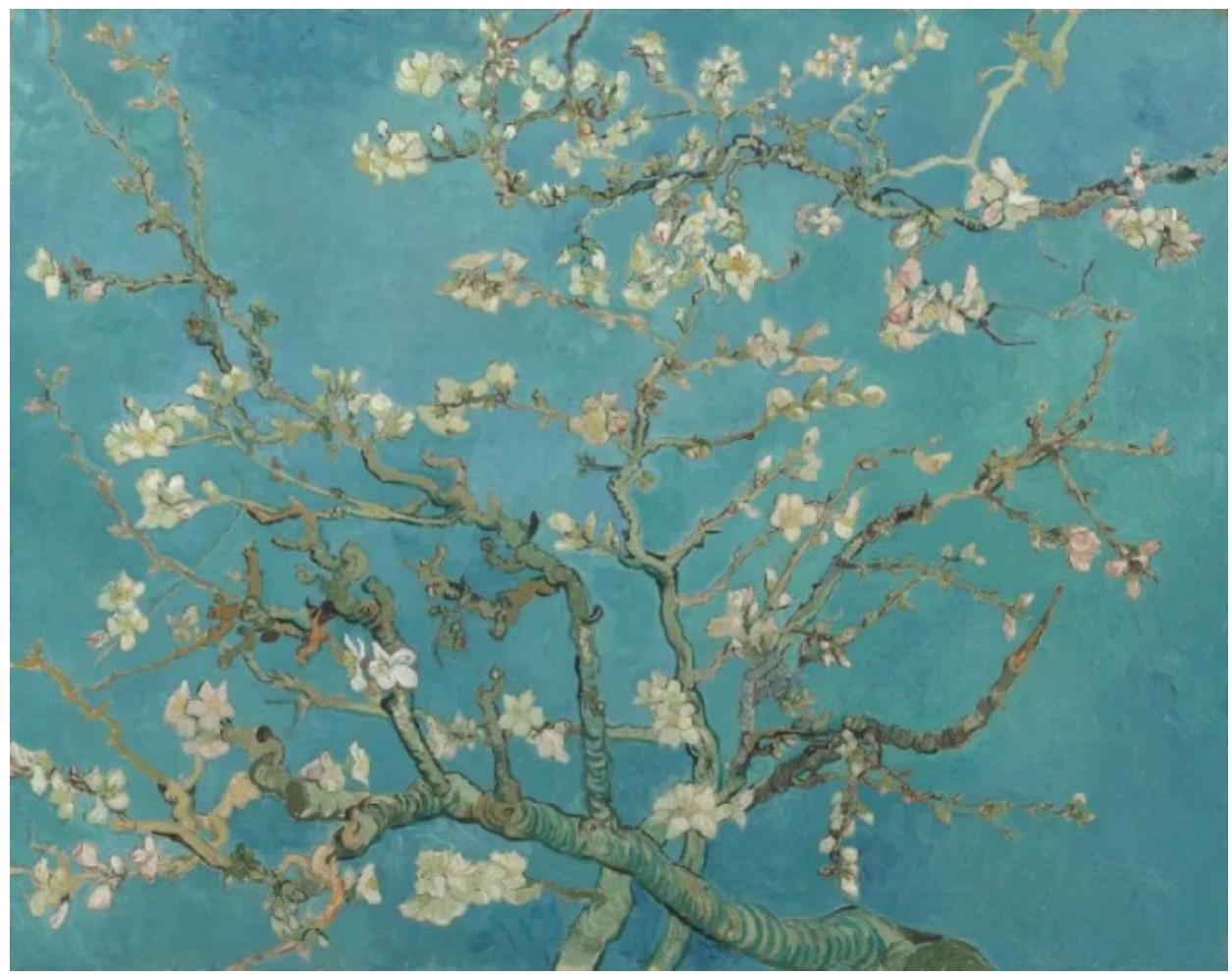
Vincent Van Gogh, Almond Blossom, 1890, Van Gogh Museum, Amsterdam
Liu Ye’s stark arrangement of the composition, with the protagonist and plum blossom tree positioned at polar diagonal opposites, is reminiscent of the dramatic and close-cropped compositions frequently used in Japanese Ukiyo-e prints. The absence of a horizon and the gently upward-glancing perspective find resemblance with Vincent Van Gogh’s Almond Blossoms. This playful spatial maneuvering, with the protagonist seemingly passing by the viewer while they admire the blooming branch, elevates the viewer’s role in experiencing the painting beyond that of a mere observer of a narrative, to one that actively participates.
Girl and Piggy, 1999
Estimated: GBP 800,000 – 1,200,000
GBP 749,300 / USD 981,583
LIU YE
Girl and Piggy, 1999
Acrylic on linen
62×52 cm (24 3/8 x 20 1/2 inches)
Signed [in Pinyin] and dated ‘Liu.YE 1999’ lower right
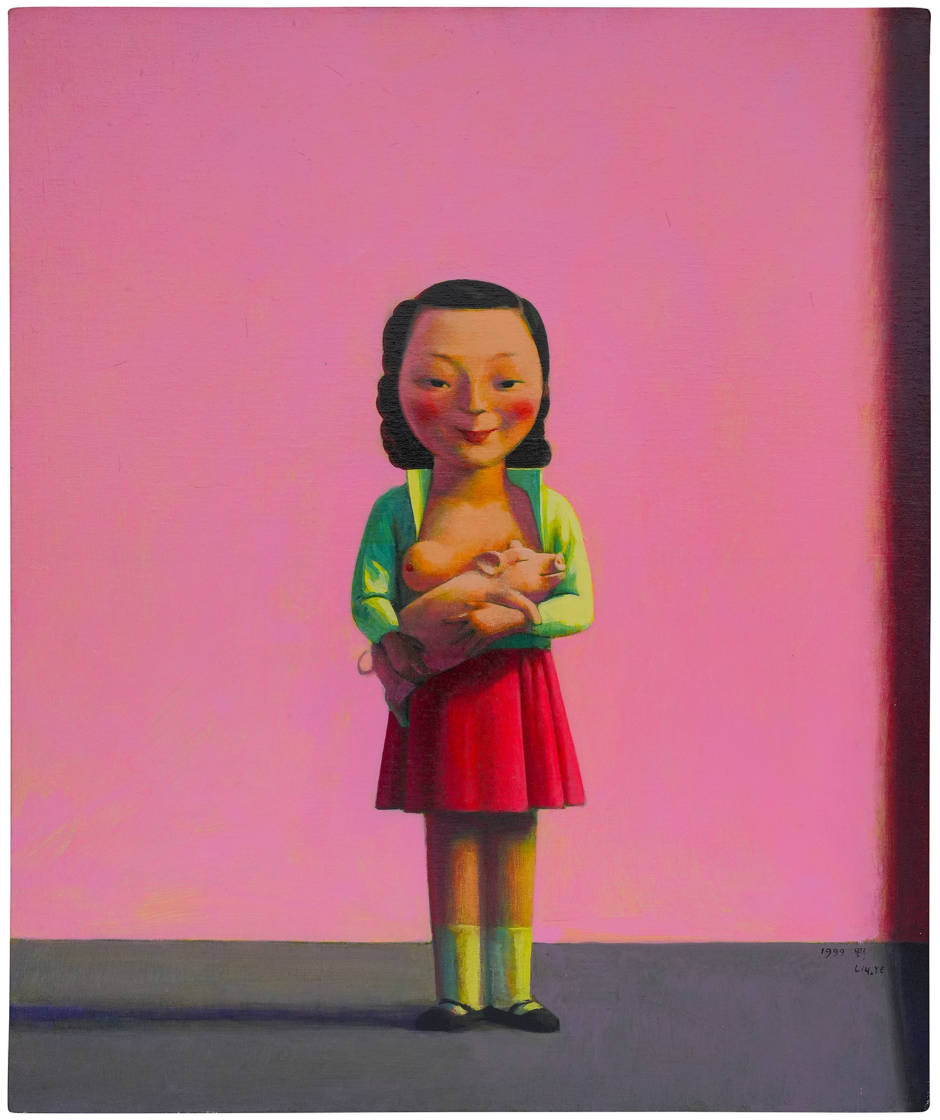
Standing silently in an otherwise empty, brightly-hued space, the protagonist at the center of Girl and Piggy has a remarkable sense of gravity, mesmerizing viewers with her steady gaze and enigmatic smile. Utterly captivating, the strangely serene and highly stylized character holds a small pig to her bare chest in a disarmingly familiar gesture of maternal care, a dreamlike tableau typical of contemporary Chinese artist Liu Ye. Inspired in part by a childhood love of fairy tales and informed by both the visual culture of revolutionary era China and the artist’s formative early artistic training in Europe, Liu Ye’s bright, bold, and balanced compositions are populated with symbols and motifs from his own personal iconographic universe. Richly allusive and untethered from the bounds of time and place, these works provoke a thrilling sense of mystery and imaginative freedom in the viewer. In the arrangement of the central figure and her adoption of a pose typically associated with the Western art historical tradition of the Vigo Lactans or ‘Nursing Madonna’ we can also begin to trace the depth of Liu Ye’s engagement with the rich traditions of early Northern European painting, and his adoption of these motifs into his own, highly idiosyncratic visual vocabulary. Both the nursing Madonna and the pig motif have reappeared across Liu Ye’s work, although their symbology and personal significance for the artist remains mysterious. Auspicious creatures in Chinese culture, pigs are typically associated with wealth, happiness, and good fortune, and are noted for their close relationship to humans as domesticated creatures. Although more typically associated with gluttony and unmannered behaviors in Western contexts, the pig has also been a prominent character within European folklore, notably in the well-known Romanian fairy tale ‘The Enchanted Pig’ in which a Princess submits to prophesy in marrying a pig, to find he is in fact a prince cursed to occupy the animal’s form by day.
“The pig in Chinese tradition is a lucky animal, even if a little stupid, since it symbolizes the abundance of money and an abundance of food […] At first this appears a materialistic juxtaposition with the Pope, symbol of Christianity with its vows of poverty and selflessness until one recalls the opulence of the Catholic Church.”
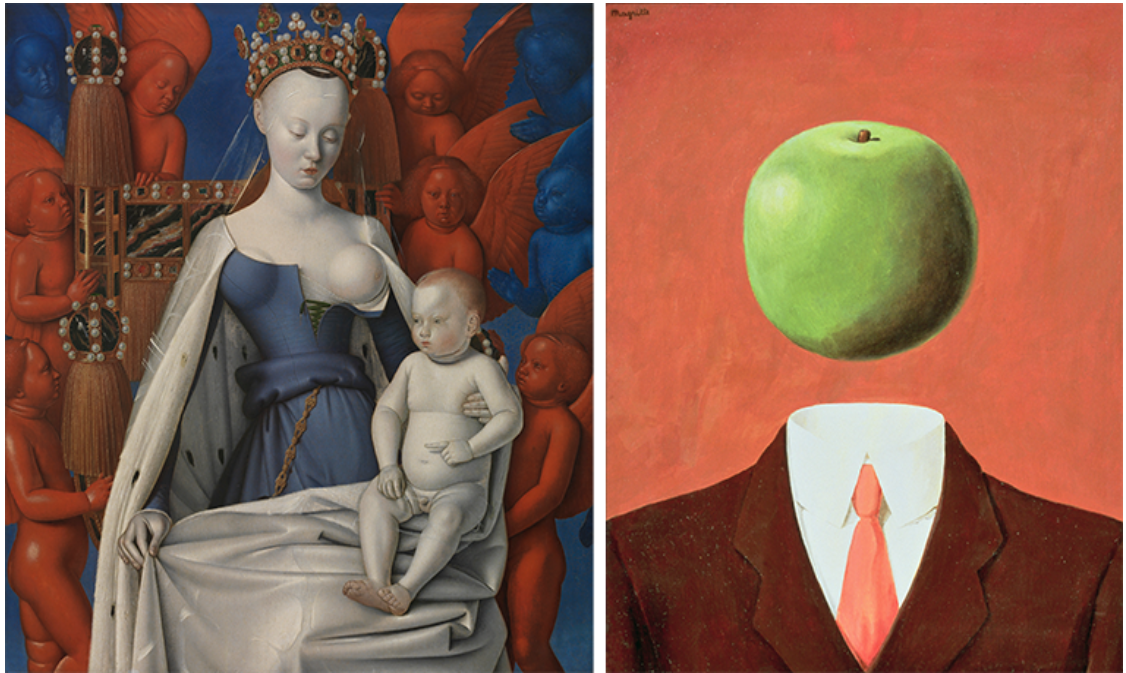
Left: Jean Fouquet, Virgin and Child Surrounded by Angels, circa 1452, right wing of the diptych, Royal Museum of Fine Arts, Antwerp
Right: René Magritte, Abstract Idea, 1966, Tokyo Fuji Art Museum. Image: Tokyo Fuji Art Museum / Bridgeman Images, Artwork: © ADAGP, Paris and DACS, London 2024
While in its Western art historical contexts the nursing Madonna is understood to represent divine love and the sacrifice of the Son of God, its unexpected evocation here in relation to a small piglet strikes a note of humorous absurdity that seems more in keeping with Surrealism’s stark juxtaposition of visual signifiers and the fertile possibilities for new, associative meanings generated by these unexpected combinations. Liu Ye had ample exposure to such works during his four-year studies at the Hochschule der Künste in Berlin, and it is worth noting that the present work was executed in 1999, shortly after he completed a six-month residency at the Rijksakademie in Amsterdam. Acknowledging the importance of these experiences in developing his distinctive visual language, Liu Ye has explained: ‘In my earlier days, my art was more about the imaginary. At that time, I was influenced by Italian Metaphysical Art and Surrealism; René Magritte is one of my favorite artists.’ Balancing compositional serenity with narrative ambiguity, Girl and Piggy is a paradigmatic example of Liu Ye’s celebrated oeuvre, playfully exploring the disjunction between outward appearance and our interior, often contradictory states of being. Animated by bold, brightly-hued colors and a wealth of privately symbolic motifs, Girl and Piggy exemplifies the artist’s broader project and the perceptive description of how ‘Complexity and richness can be described in simple and concise language.’
Xiao Fang and Piggy, 2002
Christie’s Hong-Kong: 28 May 2024
Estimated: HKD 8,000,000 – 12,000,000
HKD 9,450,000 / USD 1,209,832
Xiao Fang and Piggy (christies.com)
LIU YE (B. 1964)
Xiao Fang and Piggy, 2002
Acrylic on canvas
60×60 cm (23 5/8 x 23 5/8 inches)
Signed in Chinese, signed again, and dated ‘2002 Liu Ye’ (lower right)
One of the five paintings Liu Ye created with the piglet motif between 1999 and 2002, Xiao Fang and Piggy is an exemplar of the artist’s humorous and multivalent visual language. Forging an ambiguous, unrealistic visual language of his own that is at once cartoonish and naïve, Liu breaks away from the collective practice of his generation of contemporary Chinese art. Liu’s pictorial world is loaded with personal motifs and cultural mythologies as the artist strives to convey multi-layered content using distilled and concise visual lexicons. Against the fleshy pink background stands the protagonist, Xiao Fang who is cradling a piglet with a slipped breast—a posture that calls to mind the iconic religious motif of Madonna and Child—only with a baffling twist of a classical mythology into an erotic reverie.

Leonardo da Vinci, Lady with an Ermine, ca.1489. The National Museum in Krakow, Poland.
In the present work, the luminous palette and delicate layers of paint handling are teamed with the caricatured protagonist and humorous motif of the slipped breast—a scene reminiscent of an earlier work Madonna with Naughty Child (2000) by the artist, in which young soldier-angels are depicted playing their musical instruments in an otherworldly panorama. Here, the visual boldly proposes a biological nurturing scene between the two but also unlocks a multitude of interpretations. The piglet, on the one hand, could be recalling an early childhood memory of the Pig Monster ‘Zhu Bajie’ from the novel Journey to the West that Liu’s grandma used to read him almost every day as a bedtime story. On the other hand, the pig is an auspicious animal that embodies wealth, abundance, and prosperity in broader Chinese culture. In Xiao Fang and Piggy, Liu subtly blends childhood memory apropos of the wider cultural milieu.
Deeply influenced by literature as a child, Liu grew up in a literati family where his father was an author of children’s books and his mother was a language teacher. From his father’s hidden chest of banned books, the future artist took a liking to Vladimir Nabokov’s Lolita, a venerated classic of the postmodern era. Juvenile female figures eventually became an inspiration to Liu Ye, and a recurring subject for his paintings since the early 2000s. The girl in the present work carries an adolescent look, her facial features—lightly illustrated in a few strokes—are in the fashion of the immortal Miffy. Such character, in allegory to Lolita’s protagonist, entices the viewer into an enthralling, paradoxical world with its evocative, sensual appearance.

Leonardo da Vinci, Madonna and Child (Madonna Litta), 1490. State Hermitage Museum, St Petersburg.
Painted in 2002, Xiao Fang and Piggy also marked the artist’s turn towards minimalism. Various inspirations and references, once obvious in his earlier works, are now subtly hinted at. Liu’s strong admiration for Piet Mondrian and the use of Mondrian’s balancing lines and forms are augmented simply in the present work. Instead of a direct citation of Mondrian’s work, Liu invokes similar non-abstract compositions with representational devices—the oddly perpendicular shows, pin-straight hair, limbs, and flat background—to map out his version of grids and panes. The influences of Renaissance theatrical painting are also evident in possibly the most subtle form in the shadowing on the left edge, which frames the work and puts Xiao Fang on Liu Ye’s stage.
A View of My Teacher’s Back, 2004
Sotheby’s Hong-Kong: 5 April 2023
Estimated: HKD 12,000,000 – 18,000,000
HKD 22,230,000 / USD 2,831,883
LIU YE (b. 1964)
A View of My Teacher’s Back, 2004
Acrylic on canvas
80×65 cm (31 1/2 x 25 5/8 inches)
Signed in Pinyin and Chinese and dated 04
Famed for his whimsical paintings that often feature young girls in ambiguous settings, A View of My Teacher’s Back is a masterwork of Liu Ye’s deeply enchanting and hypnotic oeuvre. Along with My Teacher II/ Yellow (2001), a piece held at the momentous Sigg Collection at M+ Museum in Hong Kong, the present work hails from the artist’s series of teacher paintings. Unlike the (thoroughly) more eroticized figure of My Teacher II/ Yellow however, A View of My Teacher’s Back is an enigmatic work shrouded in tantalizing fantasy, offering a unique glimpse into the perceptions of beauty and femininity that defines Liu Ye’s acclaimed oeuvre. Executed in 2004, the present piece is a rare work and the only example from the series to feature a woman with her back to the viewer, Liu Ye’s teacher now turned from us, brandishing her whip behind her back.
The Goddess, 2018
Christie’s London: 28 February 2023
Estimated: GBP 800,000 – 1,200,000
GBP 3,102,000 / USD 3,751,814
LIU YE (B. 1964)
The Goddess, 2018
Acrylic on canvas
60×45 cm (23 5/8 x 17 3/4 inches)
Signed, titled and dated (on the reverse)
An icon of contemporary Chinese art, The Goddess stands among Liu Ye’s most celebrated works. Painted in 2018, it featured in the artist’s major exhibition at the Prada Rong Zhai, Shanghai, that year, subsequently travelling to the Fondazione Prada in Milan. From a deep midnight blue background emerges the Chinese silent film star Ruan Lingyu, her face veiled by a screen of smoke. Her lips glow bright red against the darkness, matching the burning embers of the cigarette in her hand. The painting takes its title from the celebrated 1934 film that represents Ruan’s best-known work. The following year, the young actress would tragically take her own life at the age of just twenty-four, driven to suicide by relentless tabloid scrutiny. 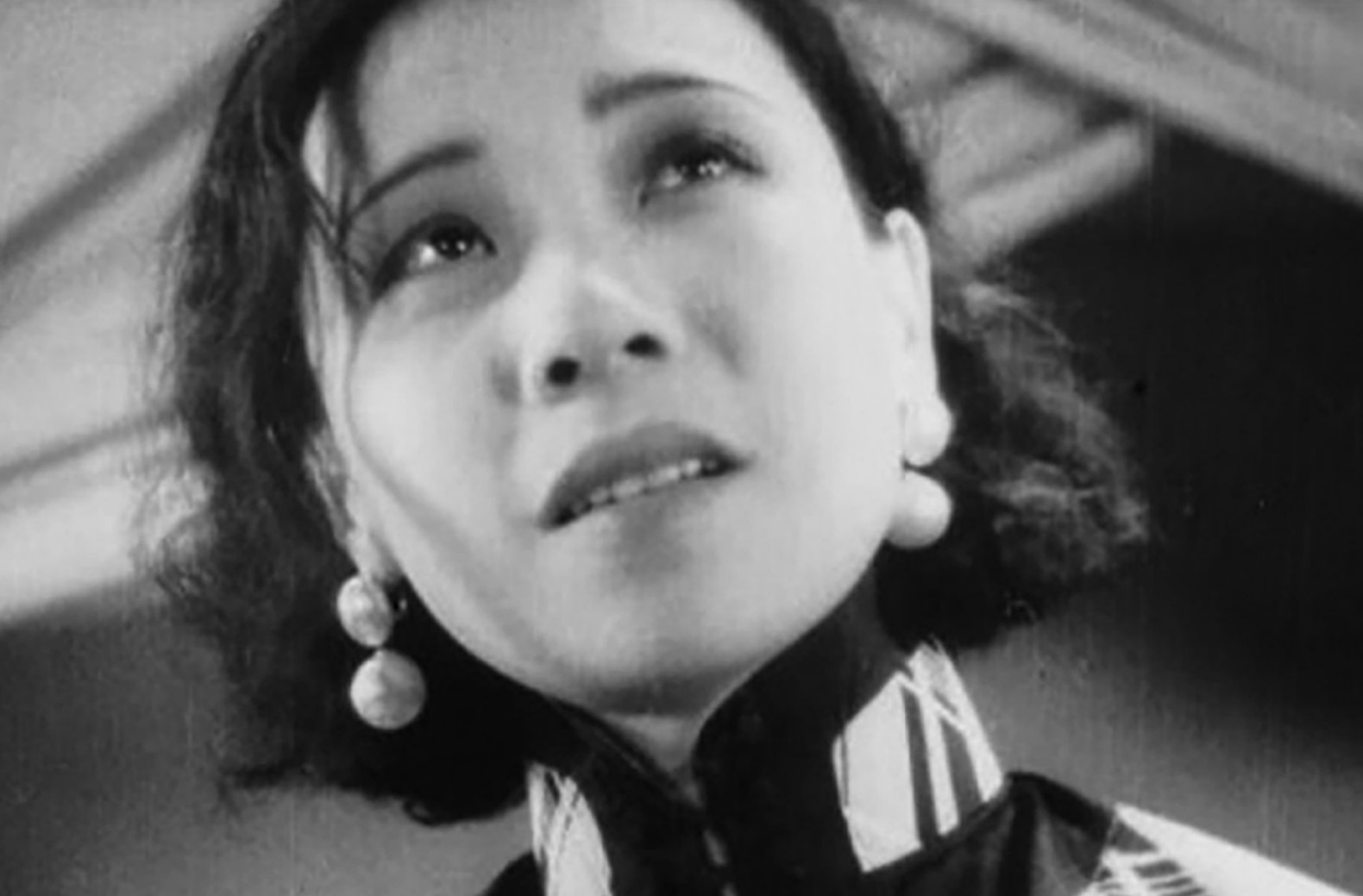
Echoing Andy Warhol’s depictions of Marilyn Monroe and Liz Taylor, Ruan has become a recurring subject for Liu, taking her place within his cast of celebrated Chinese women. Reflecting the artist’s love of cinema and storytelling, the work also demonstrates the dialogue between Eastern and Western culture that fuels his practice, replete with echoes of Vermeer, Balthus and German Expressionism.
Night, 2005
Sotheby’s Hong-Kong: 27 April 2022
Estimated: HKD 15,000,000 – 25,000,000
HKD 23,970,000 / USD 3,054,748
Liu Ye 劉野 | Night 夜 | Contemporary Evening Auction | 2022 | Sotheby’s (sothebys.com)
LIU YE (b. 1964)
Night, 2005
Acrylic on canvas
220×180 cm (86 5/8 x 70 7/8 inches)
Signed in Chinese and Pinyin and dated 05
Described by the critic Zhu Zhu as “an unforgettable piece in his erotic girls series”, Night by Liu Ye is a bewitching masterwork from the artist’s golden age of painting (Zhu Zhu, “Only One Gram”, in Christoph Noe, ed., Liu Ye: Catalogue Raisonné 1991-2015, Ostfildern, 2015, p. 25). Executed in 2005, Night is one of the most mesmerising, significant examples of his paintings of isolated female protagonists, a favoured motif of the artist’s refined oeuvre. Night is the typification of the shift in Liu’s aesthetic and subject, with his female nude depicted against a luminous, monochrome background, a signature element of his pared down portraits from around 2003 onwards. Testament to the visual power of the work, Night has frequently been identified as a landmark painting in the artist’s oeuvre, admired and written about by art critics Zhu Zhu and Karen Smith amongst others. Further, the work has not only been exhibited in Temptations at Sperone Westwater Gallery in New York, but it has also been shown in Liu Ye at Kunstmuseum Bern in 2007 and Red & Blue – Liu Ye at My Humble House Art Gallery in Taipei in 2014.
With her large head, wide yet downcast eyes, and slender form, the figure in Night appears to float in the night sky. Pictured in the nude apart from her underwear and red shoe that hangs precariously from her toes, the female protagonist appears to blush a deep shade of rouge, gazing out at the viewer with bashful eyes from under locks of her loose, jet-black hair. However, Liu’s odalisque is unique to the artist, not only blending visual precedents but also emanating a distinct naive innocence through her rounded face and inward disposition. Utterly arresting, there is a levity and a magical quality to the painting, achieved by Liu’s allusion to a chair that is not there. Instead, the protagonist floats, like a “bolt of flesh-coloured lightning” (Ibid.) that dominates the image. Lighting up the night sky, her delicate pearly skin is achieved through Liu’s deft application of paint. Night is at once serene and brimming with youthful vitality, and the sublime portrayal of the figure has led Zhu to claim: “if we liken this to the development of narrative in fiction, then this painting is equivalent to the climactic stage” (Ibid, p. 26)—the pinnacle of Liu’s portrayal of the female nude within his oeuvre. Liu Ye’s unique artistic vision sets him apart from the “Chinese avant-garde”, forging his own path through the amalgamation of various art historical and cultural references, irrespective of geographical boundaries or national framework. Born in 1964, Liu studied at the China School of Arts and Crafts before studying at the Berlin University of Arts in Germany, where he lived between 1990 and 1994.
Taking Off II, 2003
Phillips Hong-Kong: 21 June 2022
Estimated: HKD 3,500,000 – 5,500,000
HKD 4,788,000 / USD 609,951
Liu Ye – 20th Century & Contemporary A… Lot 160 June 2022 | Phillips
LIU YE (b. 1964)
Taking Off II, 2003
Acrylic on canvas
30×20 cm (11 3/4 x 7 7/8 inches)
Signed and dated ‘liu ye 2003 Ye [in Chinese]’ on the reverse
Executed in 2003, the present piece is a rare work that is the second painting of an intimately scaled duo, both titled Taking Off . Having not appeared at auction before, Taking Off II offers viewers a unique glimpse into the perceptions of beauty and femininity that defines Liu’s acclaimed oeuvre. Taking Off II is an alluring portrait of a woman dressed in smart attire, slowly lifting the hem of her skirt with her eyes cast downwards like two slithers of a moon. Daring in its sensuousness, the present work should not be interpreted as a fetishized fantasy of the female form. On the contrary, it should be understood solely as Liu’s desire to perfectly preserve and illustrate human beauty through painting, as espoused by Johannes Vermeer, whom Liu has cited as a major influence on his works. Indeed, his visual rhetoric brings to mind the works of the Dutch Old Master, permeated with a subtle stillness and enticing aura of mystery. Liu’s paintings conjure up an undisturbed air of juvenility as well, the subject matter often revolving around youthful figures and childlike imagery– a conceptual choice which stems from his father, who was a writer of children’s literature. Fascinated in capturing the fleetingness of innocence, Liu’s paintings are familiarly evocative of days gone by, appropriately provocative without losing their delicate gentleness.
She is so Beautiful, 2000
Bonhams Hong-Kong: 25 November 2021
Estimated: HKD 5,000,000 – 7,000,000
HKD 6,252,000 / USD 801,931
Bonhams : Liu Ye (B. 1964) She is so Beautiful
Acrylic on canvas
46×38 cm (18 1/8 x 14 15/16 inches)
Signed in Chinese and Pinyin and dated 2000 on the lower right
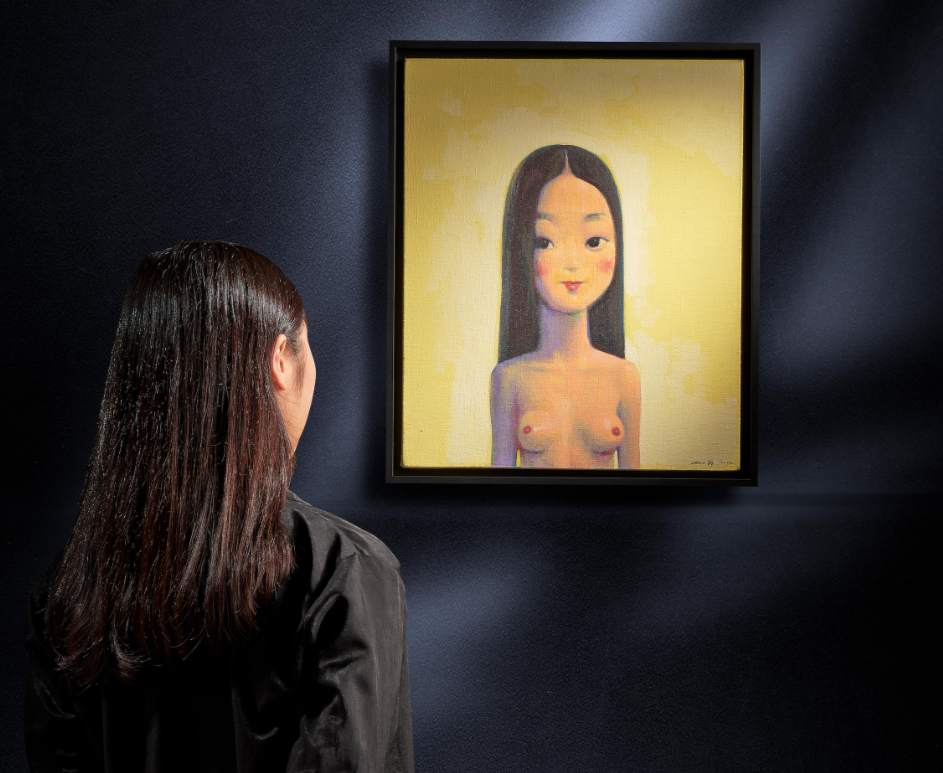
She is so Beautiful speaks to Liu Ye’s understanding of beauty and his emotional reaction to it. The face of the female figure in the painting is refreshingly elegant. Its oval shape exudes an amiable personality. The openness of her wide-set eyebrows as well as the clarity of her black irises conveys a sense of warmth and tenderness. Her mouth and nose are diminutively sized and delicate. The contour of her face is gentle without any angularity. Overall, the subject projects a sense of internal peace. The subtle blush on her cheeks complements the strong vermillion on her lips, and her skin glows in a classically soft tone. The warmth of her palette radiates femininity and tranquility. The subject’s expression is placid and demure. The slightly upturned corners of her mouth suggest a smile. Introverted yet at ease, her mature composure is tinged with the sweetness of youth. The curves of her shoulders and breasts contrast with the straight lines of her swan neck and raven hair to create an impeccable sense of figurative beauty. The upper half of the figure commands the entire painting surface. The centre part of her hair draws a straight line down the ridge of her nose and follows the median of her sternum and stomach. Her perfectly smooth hair drapes on her narrow shoulders, the lines continue down her arms and outside of the canvas. The symmetry of this work conveys a graceful sense of openness and balance.
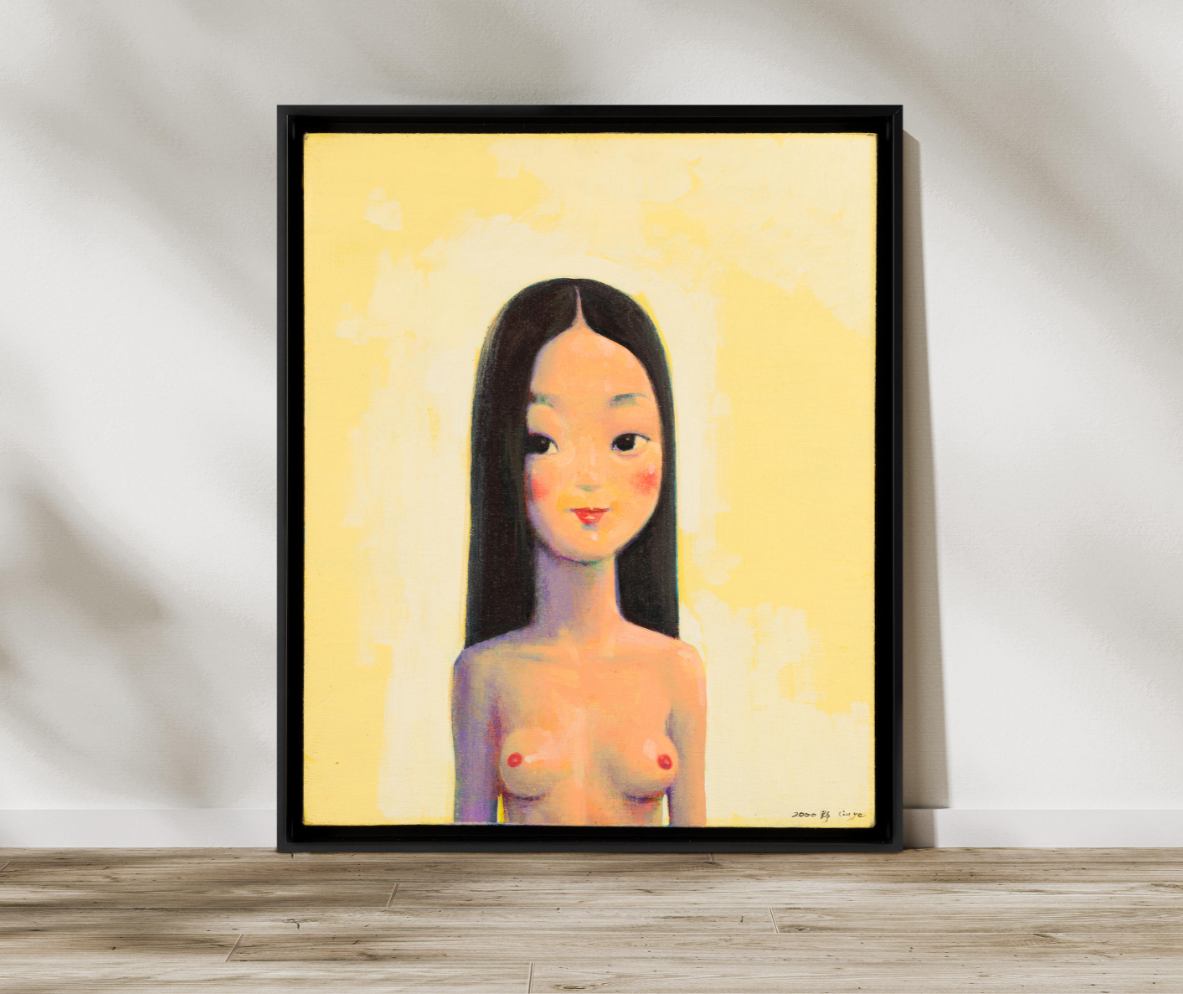
Liu Ye is not projecting his own fantasies on the female gender, nor is he trying to visualize his obsession with the female body. To him, they are the medium on which the artist can manifest the ideals of human beauty. The style employed in She is so Beautiful is lyrical and exquisitely rendered. It highlights the graceful and ethereal aspects of the subject. It is a kind of beauty that is subdued and unblemished. This treatment is reminiscent of Botticelli’s iconic depiction of Venus. And like the Roman goddess who is the embodiment of love and beauty, the woman whom Liu Ye depicts symbolizes the coming of truth, goodness, and beauty. With innocence and empathy, she seeks to resonate with the viewers’ sense of beauty within their collective memories. The direct and natural use of warm tones translates to a much more intuitive use of colors. Both artists utilized the most primordial hues to paint directly on the canvas. The way in which these basic tones synergies with each other heightens the emotive power of the pictures. Such guileless yet powerful brilliance is comparable to sunlight itself poured onto the canvases. Between 2002 and 2006, Liu Ye painted a series of female nude portraits. In these works, the figures either avert their gazes or turn their torsos away from the viewers and cover themselves with their hands — a certain degree of bashfulness is unmistakable. The way in which the figure in She is so Beautiful so candidly faces the viewers frontally is exceptional. Her lean torso and arms are perfectly posed, and her subtly visible collarbones indicate an ideal level of litheness. The superior physique of this young woman exudes a sense of irresistible allure that inspires admiration from the viewers.
Bird, 2007
Christie’s Hong-Kong: 24 May 2021
Estimated: HKD 10,000,000 – 15,000,000
HKD 16,450,000 / USD 2,118,453
LIU YE (B. 1964) (christies.com)
LIU YE (B. 1964)
Bird, 2007
Acrylic on canvas
120×90 cm (47 1/4 x 35 1/2 inches)
Dated and signed ‘07 YE’ and signed in Chinese (lower right)
In Bird, created between 2006-2007, Liu Ye positioned a woman floating weightlessly in a deep-brownish empty space. Her body radiates with a translucent and porcelain-like texture. Liu creates a sense of ambiguity about the persona’s age through juxtaposing conflicting visual signifiers, such as the innocent face, exposed fetishized body in lingerie and alluring makeups. The head proportion is distortedly exaggerated and brings a child-like quality to the figure; while at the same time, the peachy lips, rosy cheeks and model-like long limbs and curvy figure are all cues that suggest she has reached a certain age of maturity. The downcast eyes with her slender arms in a self-hugging position eludes the strong desire to be comforted and loved. The color of the Earth— brown is applied throughout the background of the painting. Full of fertility; it emanates a comforting and nurturing ground for the floating nymphet. This also resembles the old masters painter Johannes Vermeer’s use of brown to plan out his composition to captivate light, colour and texture. Liu Ye evokes a surrealist, theatrical sensibility amongst the lulling enactment of this young girl’s monologue in an unknown space, up to the viewer’s interpretation.
“Actually, there’s a tension in my paintings between the desire to be abstract and the need to borrow from the concrete to convey meaning.”
The mixing of adult and childlike themes is trademark of Liu Ye’s work, and displays the artist’s interest in exploring challenging, contradictory subjects. Liu Ye’s father was a literature writer of children’s books. From an early age, Liu Ye was exposed to Hans Christian Andersen’s fairy tales, and classic stories such as Cinderella and Thumbelina. Yet the darkness of these classic stories also made an impact on the artist – as he addresses adult themes such as sex, death and violence.
Summer, 2005
Christie’s Hong-Kong: 25 May 2021
Estimated: HKD 3,000,000 – 5,000,000
HKD 5,625,000 / USD 724,619
LIU YE (B. 1964) (christies.com)
LIU YE (B. 1964)
Summer, 2005
Acrylic on canvas
30×20 cm (11 3/4 x 7 7/8 inches)
Signed and dated ‘05 Ye’ (lower left)
“I don’t impose a meaning onto my audience, everyone should have their own interpretation. I hope my painting is like a container in which viewers can decide themselves what to put in.”
Red
Red No. 2, 2003
Christie’s Hong-Kong: 28 November 2023
Estimated: HKD 26,00,000 – 36,00,000
HKD 31,835,000 / USD 4,087,099
21391-liu-ye-red-no-2 (christies.com)
LIU YE (B. 1964)
Red No. 2, 2003
Acrylic on canvas
195×195 cm (76 3/4 x 76 3/4 inches.)
Signed and dated ‘2003 Liu ye’, signed again in Chinese (lower left)
Red permeates the entirety of Liu Ye’s Red No. 2 and a teary-eyed, Lolita-like little girl stands at the edge of a cliff, looking sorrowfully into the horizon. The present work is the second in Liu’s iconic series of three red square paintings of the same size from 2003, recalling modern abstract masters Richter’s and Rothko’s exploration of the multifaceted character of the bold color. As noted by critic Zhu Zhu, 2003 marked the beginning of Liu’s golden era. More significantly, Red No. 2 is the only painting in the series that shows the little girl’s full profile, setting an intimate tone wherein she seems to communicate with the viewer directly. Reminiscent of Vladimir Nabokov’s Lolita, Liu’s little girl is a guise for stolen innocence. Further, the solid red background is of particular importance: it signifies passion, departing from the intimation of Cultural Revolution propaganda in Liu’s earlier Sailor series from the 1990s. Red No. 2 is therefore at once an attestation to the artist’s stylistic maturity and a window into his complex inner world that meanders between melancholy and passion.
Like many of his contemporaries, Liu was deeply affected by the growing pains that overshadowed the social and political atmosphere at the turn of the century. The artist thus found solace in his childhood memories of reading forbidden books hidden by his children’s playwright father and language teacher mother during the tumultuous 1960s and 1970s. The Lolita-like little girl became a refuge for his inner child and is a remarkable example of his stylistic shift in the early 2000s. Female figures began to take center stage in his paintings in succinct settings in 2003, shifting from the iterations of his star protagonist of the sailor boy in theatrical settings from the 1990s. Like the sailor boy who was an allegorical symbol of boyhood, the little girl in Liu’s composition embodies his childhood memories that transpired as adult desires. Liu’s female figures began as a cipher for a girlfriend, but like his other children’s subjects, they eventually became ambiguous embodiments of the intrinsic dilemmas of humanity. The artist once further expressed that every work is a self-portrait. Given this, the little girl in Red No. 2 is at once a reflection of the self and a projection of collective sensibilities.
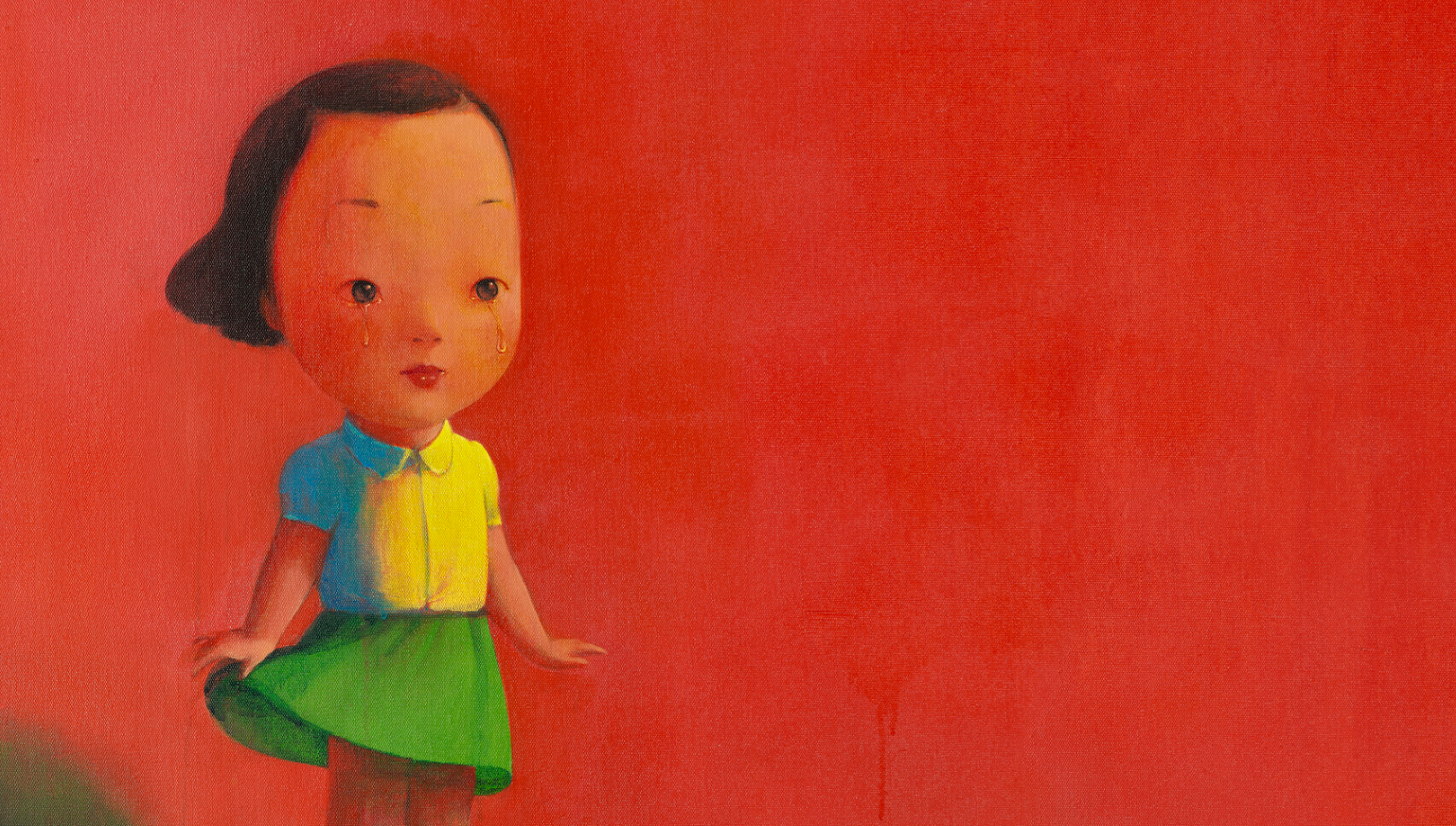
Red carries particular importance within Liu’s oeuvre. In the present work, the mass of red caresses the little girl’s figure, harkening back to the chiaroscuro effect of Van Eyck paintings. The color seemingly extends from the canvas to embrace the viewer. Yet, the cool undertone exudes a solemn ambience, corresponding with the little girl’s melancholic facial expression. Wispy, dark green cedar trees populate the meagre corners of the painting, reminiscent of the rendering of negative space in Song dynasty ink paintings. Despite the apparent stillness of the red background, the little girl’s streams of delicate tears are frozen in the frame, while her short bob and bright green dress are captured swaying in the air, as if blown by a soft breeze. Another example with similar compositional components is Gun (2001-2002, M+ Sigg Collection, Hong Kong). Red elicits instant allusions to the collective memory of the Cultural Revolution, However, as stated in one of Liu’s interviews, he has no interest in filling his works with political overtones. Rather, it is how the personal emotion can be amplified through his pictorial world that matters—red, is thus a vessel of one’s nostalgia, or maybe, a time capsule among us.
Wind, 2004
Christie’s Hong-Kong: 24 September 2023
Estimated: HKD 9,000,000 – 15,000,000
HKD 11,870,000 / USD 1,517,844
LIU YE (B. 1964) (christies.com)
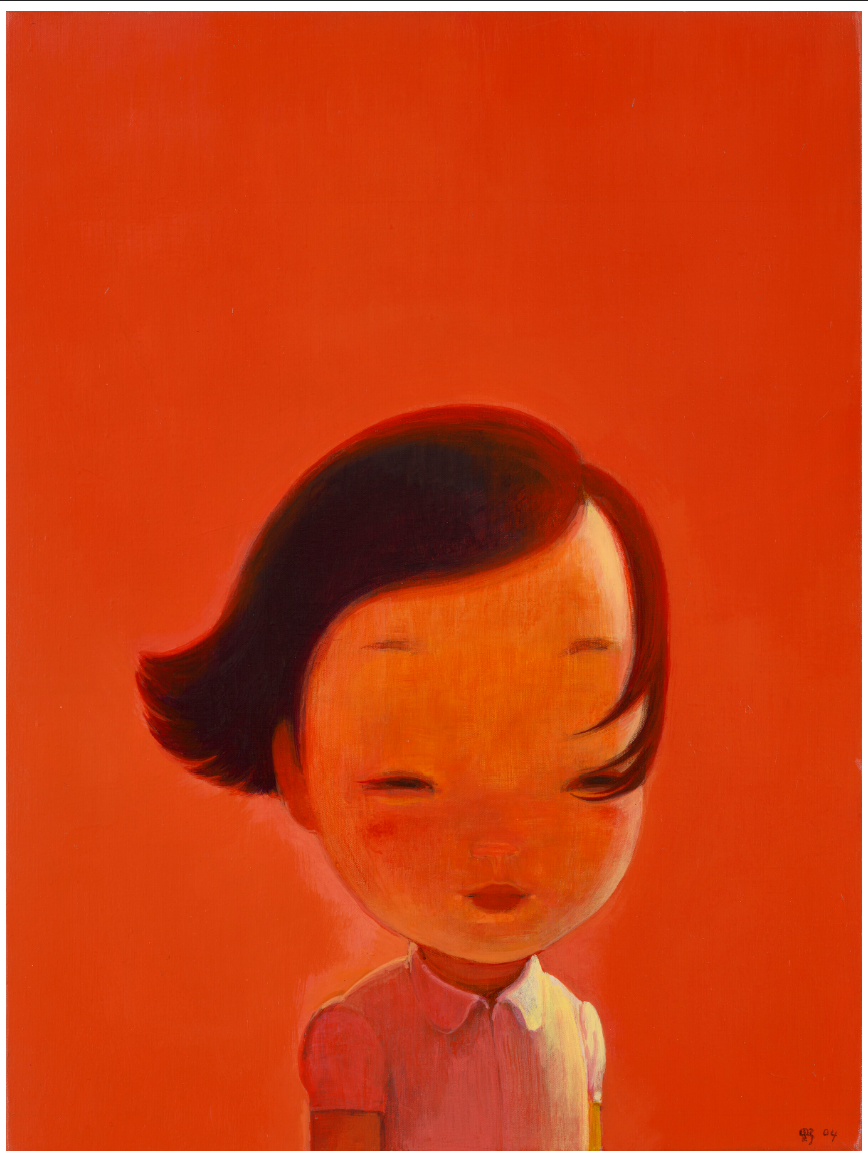
LIU YE (B. 1964)
Wind, 2004
Acrylic on canvas
60 x 45.3 cm (23 5/8 x 17 7/8 inches)
Signed in Chinese and dated ‘04’ (lower right)
Stamped ‘WIND 2004 LIU YE’ (on the reverse)
Boy With Red Glass, 1998
Phillips Hong-Kong: 21 June 2022
Estimated: HKD 2,800,000 – 4,800,000
HKD 3,276,000 / USD 417,335
Liu Ye – 20th Century & Contemporary A… Lot 161 June 2022 | Phillips
LIU YE
Boy With Red Glass, 1998
Acrylic on canvas
22×29 cm (8 5/8 x 11 3/8 inches)
Signed and dated ”98 liuye’ on the overlap
Chinese artist Liu Ye is known for his nuanced approach when rendering the painted image. His methodical and balanced compositions reference a diverse range of art historical, cultural, and personal sources, bringing about works that transcend time and space, evoking distinct conceptual and emotional perceptions. Synthesizing fantasy and reality, Boy With Red Glass was painted in 1998, a pivotal style defining period in the artist’s career. Having returned to Beijing in the mid-1990s from Berlin, Liu took some time adjusting to the changes that took place in China throughout his absence. During this time, the economic development that was going on led to tremendous societal and psychological changes amongst the people, and these coincided with Liu’s explorations of his own creative visual repertoire.
“I grew up in a world that was covered up in red:
the red sun, the red flag and red scarves.”
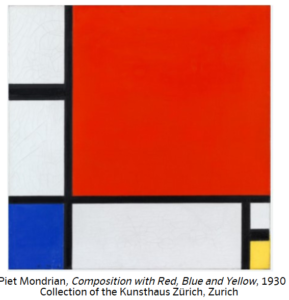
Depicted in this work is a world steeped in red, a color that has layers of meanings to Liu: a hue associated with his childhood, a unique Chinese symbol referencing Communist China in a modern time gone-by. The present work depicts a scene rendered from behind a red lens, featuring a glimpse of a young boy, possibly a sailor– one of Liu’s widely recognized avatars of his whimsical and tongue-in-cheek fairy tale paintings. He is holding a piece of tinted red glass, through which a flagship that is passing by in the distance can be seen. The placement of the glass is right in the center of the ship, simultaneously the center of the work. This square-on-square composition immediately recalls Liu’s fascination with the work by renowned Dutch modernist painter Piet Mondrian. Liu’s continuous dialogue with Mondrian’s artistic approach can be seen here fused with his own. The subtle reference of using a red square glass as a composition-dividing device, creating “a view within a view” illusion, transports the viewer into an altered reality.
The most expensive painting ever sold at auction was Smoke, a painting dated 2001-2002, that sold at Sotheby’s in Hong-Kong on 6 October 2019 for HKD 51,182,000 (USD 6,656,122).
Smoke
Sotheby’s Hong-Kong: 6 October 2019
Estimated: HKD 25,000,000 – 35,000,000
HKD 52,182,000 / USD 6,656,122
(#1108) LIU YE | Smoke (sothebys.com)
LIU YE
Smoke, 2001-2002
Acrylic on canvas
178 x 356.5 cm (70 x 140 3/8 inches)
Signed in Chinese and Pinyin, and dated 2001-02
Ranking among the ultimate paragons of Liu Ye’s oeuvre, the monumental Smoke is the first painting from a trinity of epic crimson-hued horizontal canvases from 2001-2002, the second of which resides in the esteemed M+ Sigg Collection and the third in an eminent private collection after fetching the artist’s auction record in 2013. Unique to the present work is the looming red sun emblazoned upon the center, edging out all notions of time and space, evoking René Magritte’s celebrated image of Le Banquet and its ambiguous treatment of night and day. There is an ancient rhyme chanted by mariners at sea: “Red sky at morning, sailors take warning; red sky at night, sailors delight”. The concept is an established wisdom; however, in the intoxicating crimson cosmos of Liu Ye’s Smoke, the distinctions between night and day, sunrise and sunset, and fear or euphoria, are rendered moot. Instead, the scorching saturation of fiery color aspires towards the absolute freedom of reductive abstraction. Emanating a rich alchemy of tonal ranges, the riveting red sky in Smoke evokes a mythic state of genesis. The ambiguity is compounded by the cryptically nonchalant expression on the little girl’s face, her piercing yet unrevealing gaze, and finally the faintly foreboding wisp of smoke spiraling from the incongruous cigarette. Instantly commanding in its audaciously provocative color tone, and progressively enthralling with exquisitely executed detail, Smoke is a magnum opus imbued at once with the timeless poeticism unique to Liu Ye’s art as well as the searing weight of an entire generation’s history.
Sword
Sotheby’s Hong-Kong: 5 October 2013
Estimate on Request
HKD 42,680,000 / USD 5,503,901
LIU YE
Sword, 2001
Oil and acrylic on canvas
180×360 cm (70 7/8 x 141 3/4 inches)
Signed in Chinese and Pinyin and dated 2001-02
Signed and titled in Chinese and dated 2001 on the reverse
Liu Ye’s paintings are simple yet succinct summaries of the issues he faces in everyday life, his critical stance unfolding in humorous, drôle little details. Which is perhaps why, when one glimpses Sword one is immediately taken aback; unaccustomed to the sorrow the piece exudes. The painting is from a series of three works of the same size, all painted between 2001 to 2002. Both the other works, Smoke and Gun, are unavailable from the market; the former kept in a private collection, while the latter is currently held in M+ Sigg museum collection, allowing the spotlight to fall on Sword, a piece that far surpasses its companions in its poignancy and vivid nostalgia. Its ability to capture the same surrealist whimsicality that has become tantamount to the artist’s work, while combining in equal parts Western and Chinese influences, allows this piece to stand out in all of its exceptional rarity. Sword depicts two identical little girls on opposite sides of a canyon of sorts. Their background is a great expanse of vermilion, with green shrubs edging into the canvas. The arresting view is filled with an underlying sense of danger; as can be felt through the vague outline of portentous hills, and the icy blues of the cliffs below. Thrust into this canvas of peril are the two round-faced little girls, in both their hands are clasped long swords. They stare defiantly at one another, one solitary tear rolling down each of their cheeks. The composition of the painting plays an important role in representing its sadness. Heavily reminiscent of landscape painting trends from the Song Dynasty, Sword projects the same principles from the time period. In general, Song art was governed by Daoist ideologies that saw humanity for all its frivolity, emphasising the insignificance of mankind in the face of nature and the cosmos at large through vast canvases of landscape, such as can be seen in works like Xia Gui’s Pure and Remote View of Streams and Mountains. Yet perhaps in contrast to this, the Southern Song period also developed a consciousness for the minutiae of the human condition; and where people were exclusively depicted, paintings portrayed intimate scenes of human life. These pieces were set against sparse backgrounds, allowing the focus of the painting to fall on the characters themselves. One can see the beginnings of this technique in Spinning Wheel, a piece by Wang Juzheng, an artist who lived during the latter part of the Northern Song, just as Southern Song interests were emerging.
Choir of Angels (Red), 1999
Phillips Hong-Kong: 8 July 2020
Estimated: HKD 20,000,000 – 40,000,000
HKD 27,750,000 / USD 3,580,582
Liu Ye – 20th Century & Contemporary Art… Lot 7 July 2020 | Phillips
LIU YE
Choir of Angels (Red), 1999
Oil on canvas
169.1 x 199.2 cm (66 5/8 x 78 3/8 in)
Signed and dated ‘Ye [in Chinese] liu ye 99’ lower right
Chorus is one of Liu Ye’s earliest paintings and part of his iconic ‘red curtain’ series, which was executed shortly after his return from Europe to China. The ‘red curtain’ paintings nod to the carefully balanced, methodical compositions of René Magritte and Georgio de Chirico, which saw objects and scenes depicted in a realistic yet unsettling manner. Their preference for Classically-inspired forms and volumes (see for example the fluted columns in de Chirico’s The Disquieting Muses, 1916) echo the modelling and theatricality of Liu Ye’s red curtain motif. The unique composition of the present lot features eleven cherubic singers, which was later rendered in shades of blue and re-created into lithography by Liu Ye in the early 2000s. The curtain is a double-edged symbol: it acts to reveal, immediately recalling to mind Balthus’ The Room (within Liu’s oeuvre for example, please see the warship in Untitled, 1997-8) and yet its primary function is to conceal. In this scene, the emotionless singing cherubs are arranged neatly to project a sense of order and discipline so unusual among a group of boisterous children that this harmonious imagery appears to be deceiving. Speaking of the persistent human desire to question reality and appearances, Magritte explained: ‘We are surrounded by curtains. We only perceive the world behind a curtain of semblance. At the same time, an object needs to be covered in order to be recognized at all’ (no citation available). Rich in evocative mystery, the curtain becomes an enduring motif in Liu’s works to create a profound sense of spatial and temporal dislocation, the interplay of truth and illusion teases with preconditioned perceptions of reality and conventional ways of seeing.
Other Series
Angel, 2002
Christie’s Hong-Kong: 2 December 2021
Estimated: HKD 3,500,000 – 5,500,000
HKD 6,850,000 / USD 878,948
LIU YE (B. 1964) (christies.com)
LIU YE
Angel, 2002
Acrylic on canvas
40×30 cm (15 3/4 x 11 3 /4 inches)
Signed in Chinese, signed and dated ‘Ye 02’ (lower left)
Signed and titled in Chinese, signed and dated ‘liu ye 02’ (on the reverse)
Untitled, 1998
Sotheby’s Hong-Kong: 18 June 2021
Estimated: HKD 2,000,000 – 3,000,000
HKD 2,772,000 / USD 357,087
LIU YE (b. 1964)
Untitled, 1998
Acrylic on canvas
29×22 cm (11 3/8 x 8 5/8 inches)
Signed in Pinyin and dated 98
Signed in Chinese and Pinyin and dated 98 on the reverse
An exquisite and entrancing gem, Liu Ye’s Untitled exudes a rich aura of fantasy, imagination and theatrical power. Presented on a diminutively sized canvas, the work features a painting within a painting, while the young protagonist, a subtle self-portrait, is positioned at the edge of the canvas, almost completely out of sight. The meticulously delineated vertical lines stretch across the entire canvas, occupying the entire pictorial space. Unlike other works that directly incorporate Mondrian paintings within their compositions, or in the later Bamboo and Books series where Liu Ye’s gradual exclusion of narrative foregrounded the primacy of the geometric line, Untitled presents viewers with a gently compelling tension and interaction between figuration and abstraction. In its inimitable pictorial strategy the present work alludes to a multitude of art historical styles; as Bernhard Fibicher observes: “In his work Liu Ye strives to combine the imagination and sensibility of the fairytale with the strictly rational thinking of philosophy, to obtain a synthesis of eastern art (in his paintings we can trace Chinese but also Japanese influences) and western role models (Mondrian, Barnett Newman etc.) in strict and at the same time playful visual findings”.
The Second Story, 1995
Phillips Hong-Kong: 7 June 2021
Estimated: HKD 4,500,000 – 6,500,000
HKD 13,076,000
Liu Ye – 20th Century & Contemporary A… Lot 195 June 2021 | Phillips
LIU YE
The Second Story, 1995
Oil on canvas
45×45 cm (17 3/4 x 17 3/4 inches)
Signed and dated ‘ 95 YE [in Chinese and Pinyin]’ lower right
Painted during the first year of his return to Beijing after studying in Berlin, The Second Story flies between reality and Surrealism, paying tribute to Magritte and some of Liu Ye’s most formative influences. Two men stand in a large, open-windowed room on the upper story of a house, a depiction of Liu Ye’s Beijing studio in the 1990s and its environs in an alley near Xidan. A goldfish bowl sits atop a stool, an allusion to the artist’s fondness for raising goldfish at the time, and the paper on the floor carries the artist’s signature. Light pours in through the window, gently illuminating the space with an intimacy reminiscent of Vermeer’s richly atmospheric interior portraits.
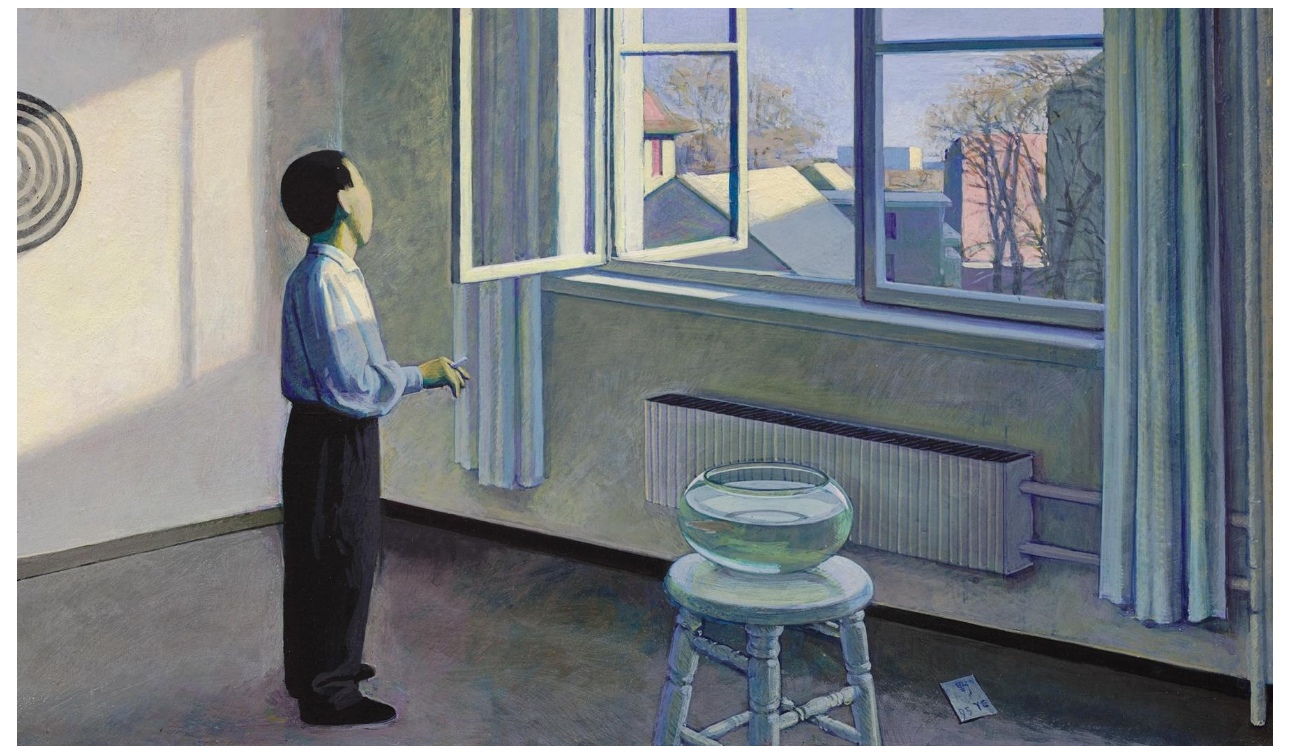
Standing in the foreground of this surreal tableau is a taller man clad in shirt and slacks, a self-portrait of Liu Ye himself, with feet firmly planted on the ground. He watches, somewhat warily, a diminutive bowler-hatted man standing on the ceiling. The ‘villain’ to the artist’s sober protagonist, he gazes out the windows to the rooftops beyond. Carrying an unopened yellow umbrella and wearing Magritte’s most iconic motif, the bowler hat uniform of the Belgian fonctionnaire, the silhouette was used by Magritte as a cipher for the generic, bourgeois everyman of his day and was often deployed as an alternative symbol for the artist himself.
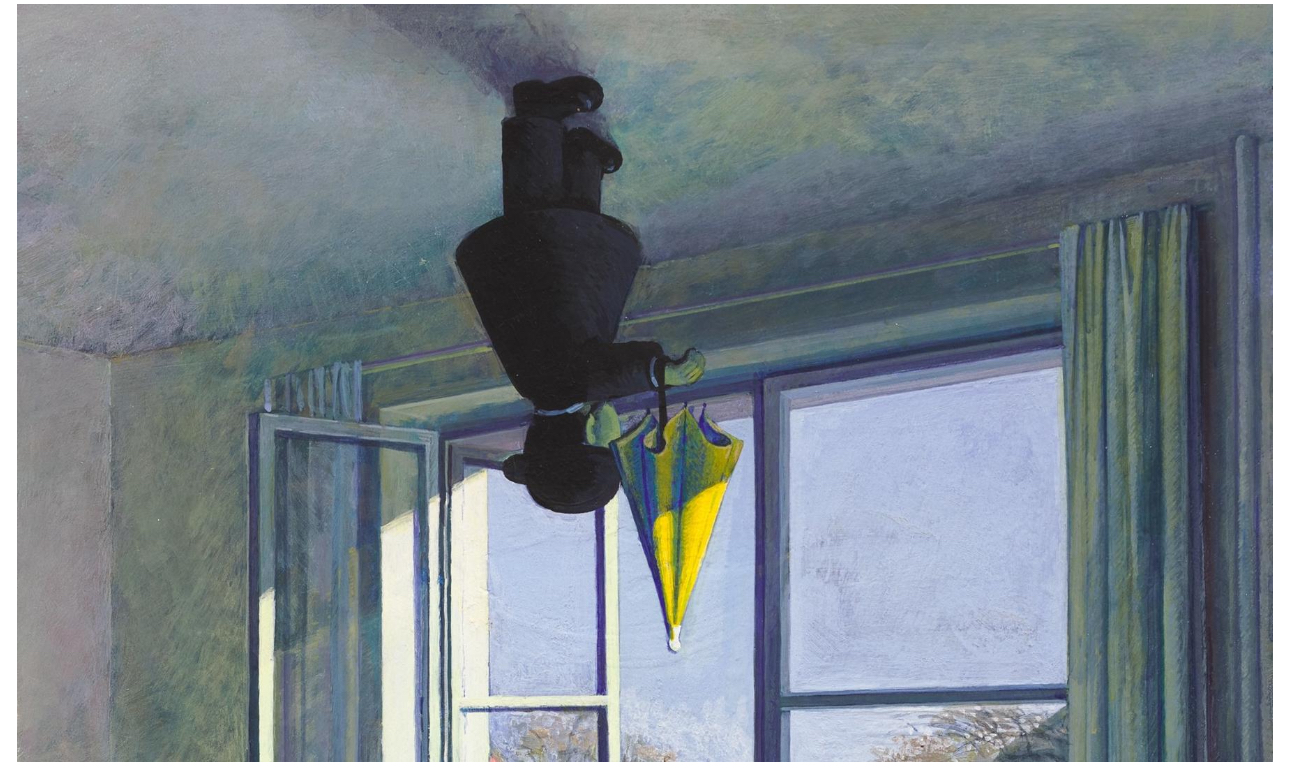
A mute struggle between the artist and his disruptive alter-ego plays out, the second instalment of the narrative which began with The First Story (painted by Liu Ye in 1994). Both works utilize the same subversive humor and absurdity, featuring the same protagonist waging endless silent war with himself, a juxtaposition between a man and the desires of his unconscious mind, which remain tantalizingly out of reach. Sigmund Freud’s The Interpretation of Dreams (1899) famously introduced his theory of the unconscious with respect to dream interpretation. Dreams, according to Freud, are formed as the result of two mental processes: the first process involves unconscious forces that construct a wish which is expressed in the dream, and the second is the process of censorship that forcibly distorts it. In The First Story Magritte-esque bowler-hatted cherubs with the face of the artist roll into the room atop stones, disrupting the interaction between the artist, wearing a Mao suit popularized by Chinese party cadres and symbolic of national sovereignty, and an anonymous female on the opposite side of the room. Gazing into the distance through binoculars and clad only in a striped Western business shirt, she rests in the contrapposto pose of Graeco-Roman classical sculpture.
The Window, 1998
Sotheby’s Hong-Kong: 19 April 2021
Estimated: HKD 2,000,000 – 3,000,000
HKD 5,015,000 / USD 645,746
Liu Ye 劉野 | The Window 窗 | Contemporary Art Evening Sale | 2021 | Sotheby’s (sothebys.com)
LIU YE (b. 1964)
The Window, 1998
Acrylic on canvas
35×25 cm (13 3/4 x 9 7/8 inches
Signed and dated 98
The window has an enduring presence in art history. A metaphorical portal into liminal spaces, the image of the window presents instantaneous drama, romance, fantasy and longing, and has oft been employed to invoke a dialogue between perceptual and intellectual vision, and between the realistic world and the imagined or ‘painted’ realms. An utterly exquisite and entrancing gem of a painting, Liu Ye’s charming The Window fully embodies and epitomizes the trope of painting as window. The borders of the canvas functions simultaneously as the frame of a depicted window, which is rendered in straight-on perspective in severe, clinically executed lines. The pristine geometry of the window opens into a backyard blooming with lush trees – notably, this is the view from the artist’s studio, featuring the pointed rooftop present in other works featuring a similar view. The young protagonist, a subtle self-portrait, is positioned almost completely out of sight – only a sliver of the side of his face, one arm, and the ubiquitous black binoculars are in view. Presented on a diminutively sized canvas, Liu Ye’s bold composition of a frame within a frame speaks volumes, diffracting multiple views of conceptual and imagined reality, and exuding a rich aura of fantasy and theatrical power.

LIU YE, THE BROKEN MIRROR, 1992, ACRYLIC AND OIL ON CANVAS, 35 BY 35 CM. 13¾ BY 13¾ IN. ©️ LIU YE CATALOGUE RAISONNÉ 1991-2015
Liu Ye has painted windows since his early days in Germany. In Atelier from 1991, the first work included in the artist’s catalogue raisonee, light from the outside pours through tall windows to illuminate the eccentric interior scene; in The Broken Mirror from 1992, the elegant angles and cascading lines of opened windows occupy half of the painting’s entire composition. Gradually these windows became substituted by paintings by Mondrian, whose stark geometry aligned perfectly with Liu Ye’s modus operandi. For the first and only time, The Window sees Liu Ye employing the entire pictorial space for the motif, with the meticulously delineated window enclosing the expanse of the canvas, setting the foundation for the unique perspectival view. Imbued with mystery and ambiguity, The Window pays homage not only to Mondrian but a multitude of art historical and cultural references; amongst many others, there are echoes of Barnett Newman in the vertical cut through the center of the painting. Bernhard Fibicher observes: “In his work Liu Ye strives to combine the imagination and sensibility of the fairytale with the strictly rational thinking of philosophy, to obtain a synthesis of eastern art (in his paintings we can trace Chinese but also Japanese influences) and western role models (Mondrian, Barnett Newman etc.) in strict and at the same time playful visual findings”. A sublime synthesis of East and West, tradition and contemporaneity, The Window manifests as a quietly theatrical conceptual prism, drawing our worldly vision into fantastical realms of fairytales and dreams.
Leave me in the dark
Sotheby’s Hong-Kong: 9 July 2020
Estimated: HKD 25,000,000 – 35,000,000
HKD 45,348,000 / USD 5,851,279
(#1125) LIU YE | Leave Me in the Dark (sothebys.com)
LIU YE
Leave Me in the Dark, 2008
Acrylic on canvas
219.7 x 299.7 cm (86 1/2 x 118 inches)
Signed in Chinese and Pinyin on the reverse
A mesmerizing vision suffused with stillness and mystery, Leave Me in the Dark from 2008 is an epic masterpiece – one of only four monumental single-panel canvases featuring a figure created by Liu Ye. The other three include Smoke and Sword, the two works that currently hold the top two auction records for Liu Ye, as well as Gun, which resides in the M+ Sigg Collection. Whereas the other three were created in the early 2000s, Leave Me in the Dark was created in 2008 and demonstrates a marked shift: gone are the cherubs, cheeky sailors and little girls rendered against deep red backgrounds; in their place, a lone female traveler emerges like an exquisite apparition from the icy depths of a snowy night. After creating the present painting, Liu Ye returned to the motif in 2009 and 2010 in much smaller dimensions, demonstrating the importance of this incipient piece within the artist’s oeuvre. The enthralling painting is imbued with conundrums: first, while rendered in a straight-on perspective in a rigid geometric framework, a soft dimensionality pervades; second, in spite of its immersive dimensions, weightlessness permeates; and third, while the tableau is stark, minimal, wholly stripped of narrative, it exudes a rich aura of drama and fantasy. Seamlessly combining figuration and abstraction without comprising either, Leave Me in the Dark is a superior paradigm imbued with the timeless poeticism unique to Liu Ye’s art.