Christie’s
20th/21st Century London Evening Sale
28 June 2023
20th/21st Century: London Evening Sale (christies.com)
Auction Statistics
Total: GBP 63,824,100
# Lots: 66 Lots
# Lots sold: 61
Sell-Through Rate: 92.4%
————
Top Lot: GBP 8,015,000
21 Lots sold above GBP 1 million
Revenues: GBP 47,992,200 (75.2 % of total)
25 Lots sold Above Estimates: 37%
27 Lots sold Within Estimates: 40%
9 Lots sold Below Estimates: 13%
5 Lots unsold: 7%
2 Lots withdrawn: 3%
Top 3 Lots
#1. Paul Signac
Christie’s London: 28 June 2023
Estimated: GBP 5,500,000 – 8,000,000
GBP 8,015,000
PAUL SIGNAC (1863-1935) (christies.com)

PAUL SIGNAC (1863-1935)
Calanque des Canoubiers (Pointe de Bamer), Saint-Tropez, 1896
Oil on canvas
65.3 x 81.3 cm (25 3/4 x 32 inches)
Signed and dated ‘P Signac 96’ (lower left)
#2. Jean-Michel Basquiat
Christie’s London: 28 June 2023
Estimated: GBP 4,500,000 – 6,500,000
GBP 6,462,500
Jean-Michel Basquiat (christies.com)
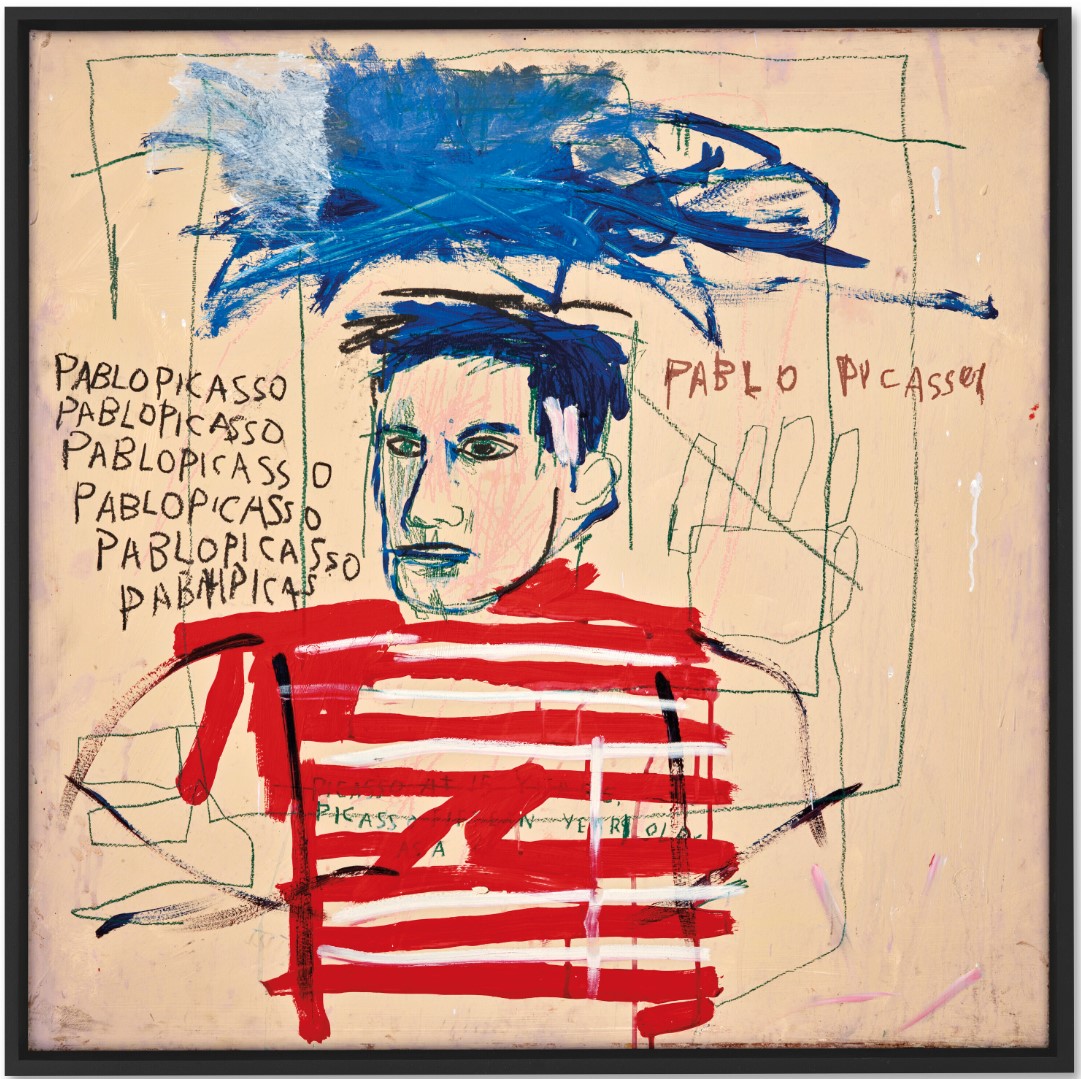
JEAN-MICHEL BASQUIAT (1960-1988)
Untitled (Pablo Picasso), 1984
Acrylic and oilstick on metal
35 5/8 x 35 5/8 inches (90.5 x 90.5 cm)
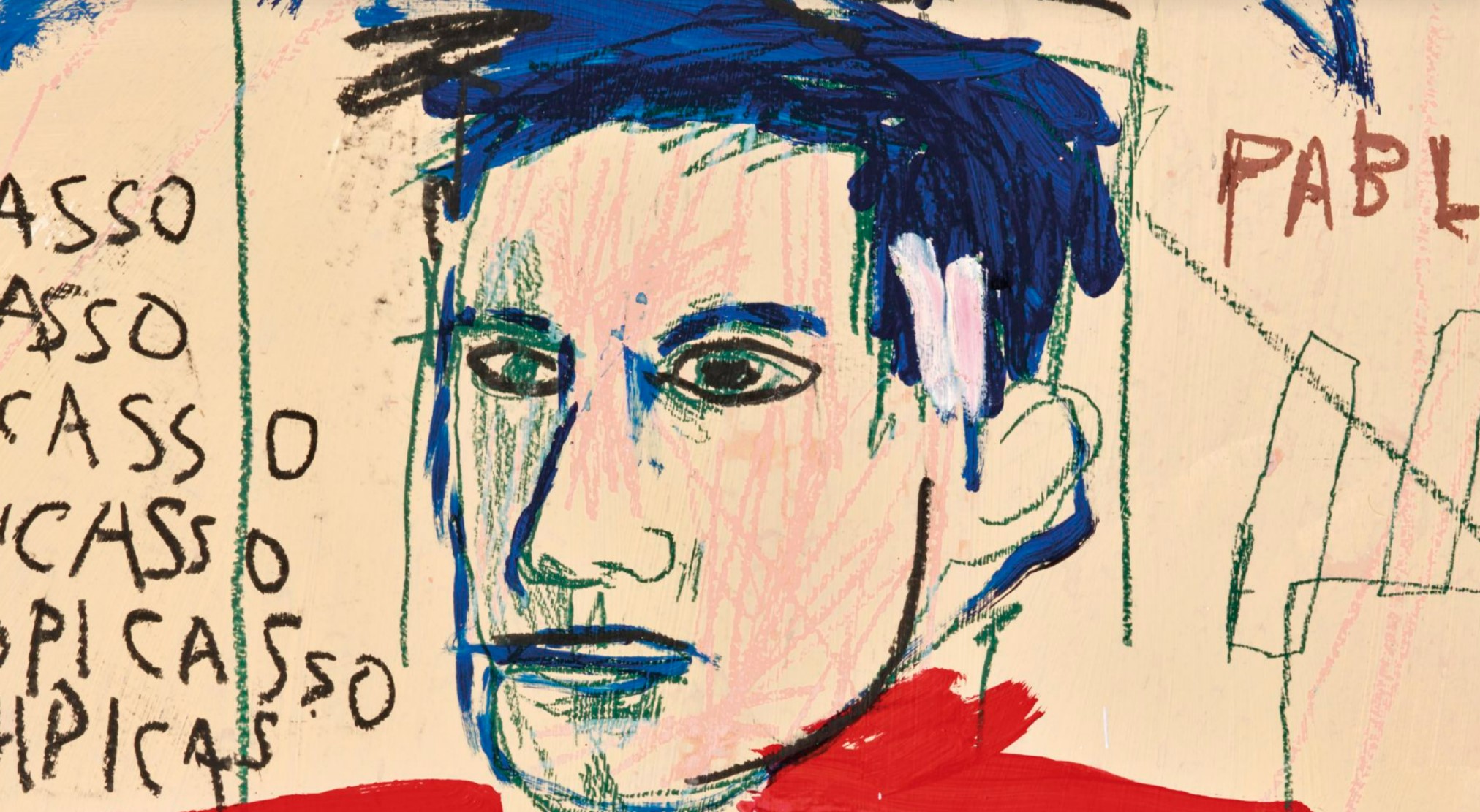
Included in the 2017-2018 retrospective Basquiat: Boom for Real at the Barbican Gallery, London, Untitled (Pablo Picasso) (1984) is a bold tribute from one twentieth-century titan to another. Painted and drawn in oil, acrylic and oilstick on a square metal panel, Basquiat’s Picasso emerges in vivid color. His trademark striped shirt is a stack of red and white brushstrokes, bright against the buff-colored backdrop. Delicate black and green oilstick shades his features; pink scrawls bring out the paleness of his skin. Thickets of blue highlight his hair and burst in a storm-cloud above his head, as if picturing the buzz of his mind. The word ‘FAMOUS’ can be glimpsed amid the blue. ‘PABLO PICASSO’ is written seven times like an incantation, and the legend ‘PICASSO AT 15 YEARS / PICASSO AS A FIFTEEN YEAR OLD’ can be seen, partly obscured, on his chest. Basquiat conflates timelines, depicting a youthful Picasso in the iconic Breton-striped guise of his older self. The work is also something of a self-portrait. Basquiat—aged just twenty-three when he made this picture—identifies implicitly with his hero, who also showed extraordinary talent from a young age. Revealing his complex relationships with fame, ambition and Western art history at large, Basquiat considers his own future place among the masters.
Basquiat acknowledged Picasso as one of his most important influences. He recalled Guernica (1937), which was on display at MoMA in New York until 1981, being his favorite artwork as a child. By 1985, he had a small Picasso oil painting in his own collection. Perhaps the first bona fide artist celebrity of the modern era—charismatic, regal and frequently photographed—Picasso was a model in his stardom as well as in his prodigious artistic output.
“Since I was 17, I thought I might be a star… I’d think about all my heroes, Charlie Parker, Jimi Hendrix … I had a romantic feeling of how people had become famous.”
His works often memorialized these Black heroes, including boxers, baseball players, and musicians. He blurred their identities with his own. The field of modern painting, however, provided few Black precedents. Basquiat wanted to make his mark in an overwhelmingly white arena.
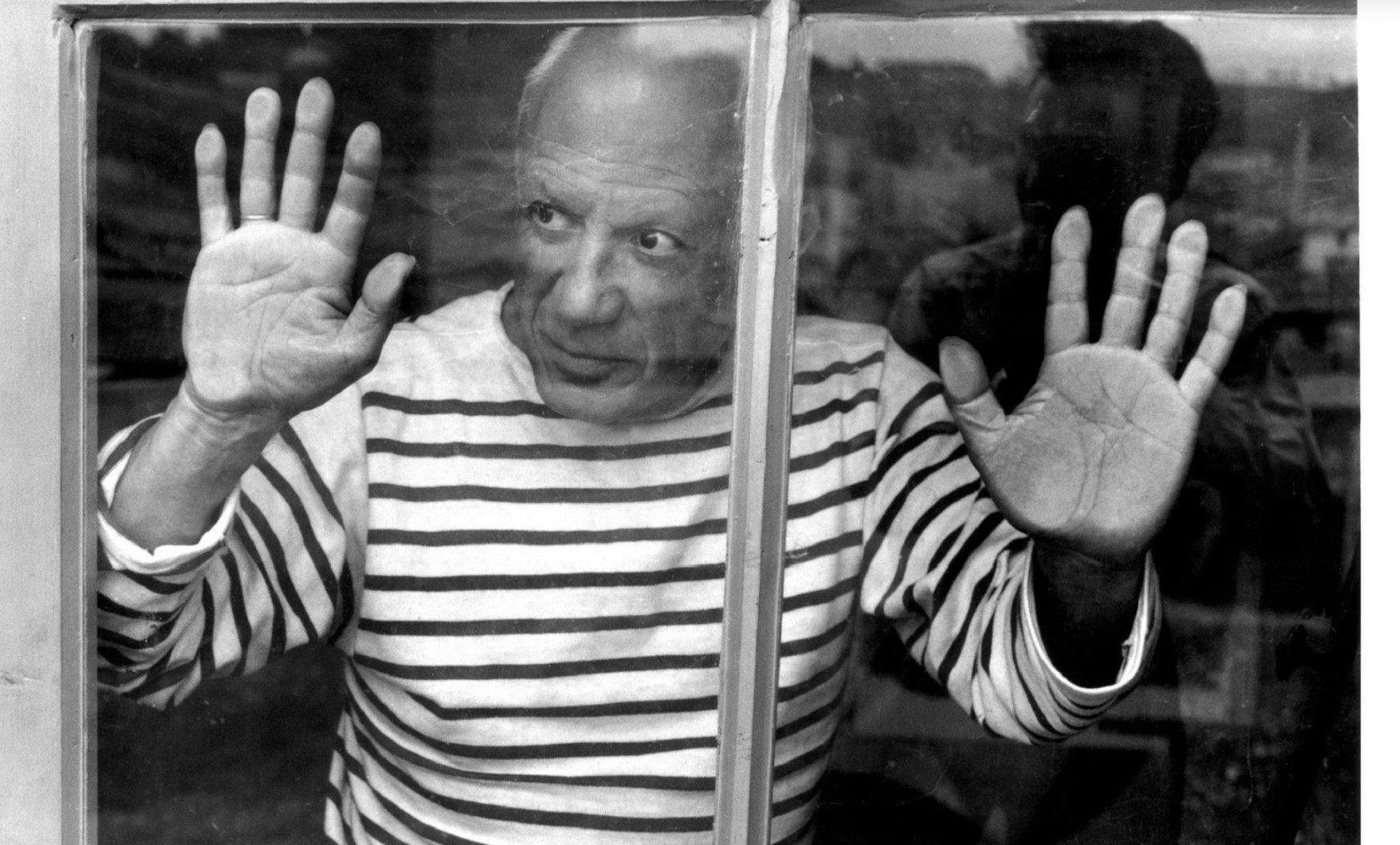
Basquiat’s young-old Picasso appears to have been based on two different visual sources, likely found in one of his books about the artist. The face derives from a portrait of Picasso taken in 1896, when he was fifteen years old. The Breton shirt became part of Picasso’s image much later, and was immortalized in a famous photoshoot by Robert Doisneau in 1952. Bringing aspects of these two eras into a single persona, Basquiat develops the theme of a work on paper he made in the same year, titled Young Picasso. There, the artist’s youthful and older faces are drawn side by side. The watchful ‘YOUNG PICASSO’ is finely featured in ochre, while the livid red visage of ‘OLD PICASSO’ has been scribbled out. In the present work, the young face is shaded with even greater care, as if Basquiat is trying out one of Picasso’s more naturalistic styles for himself. But it is also heavier than in the drawing. His features are overlaid by dark lines, squaring off the jaw and opening the mouth into a slight grimace. With the cloud of fame hovering over him, this hybrid Picasso seems older than his years, and troubled by the premonition of his greatness.
#3. Cecily Brown
Christie’s London: 28 June 2023
Estimated: GBP 3,000,000 – 5,000,000
GBP 3,549,000
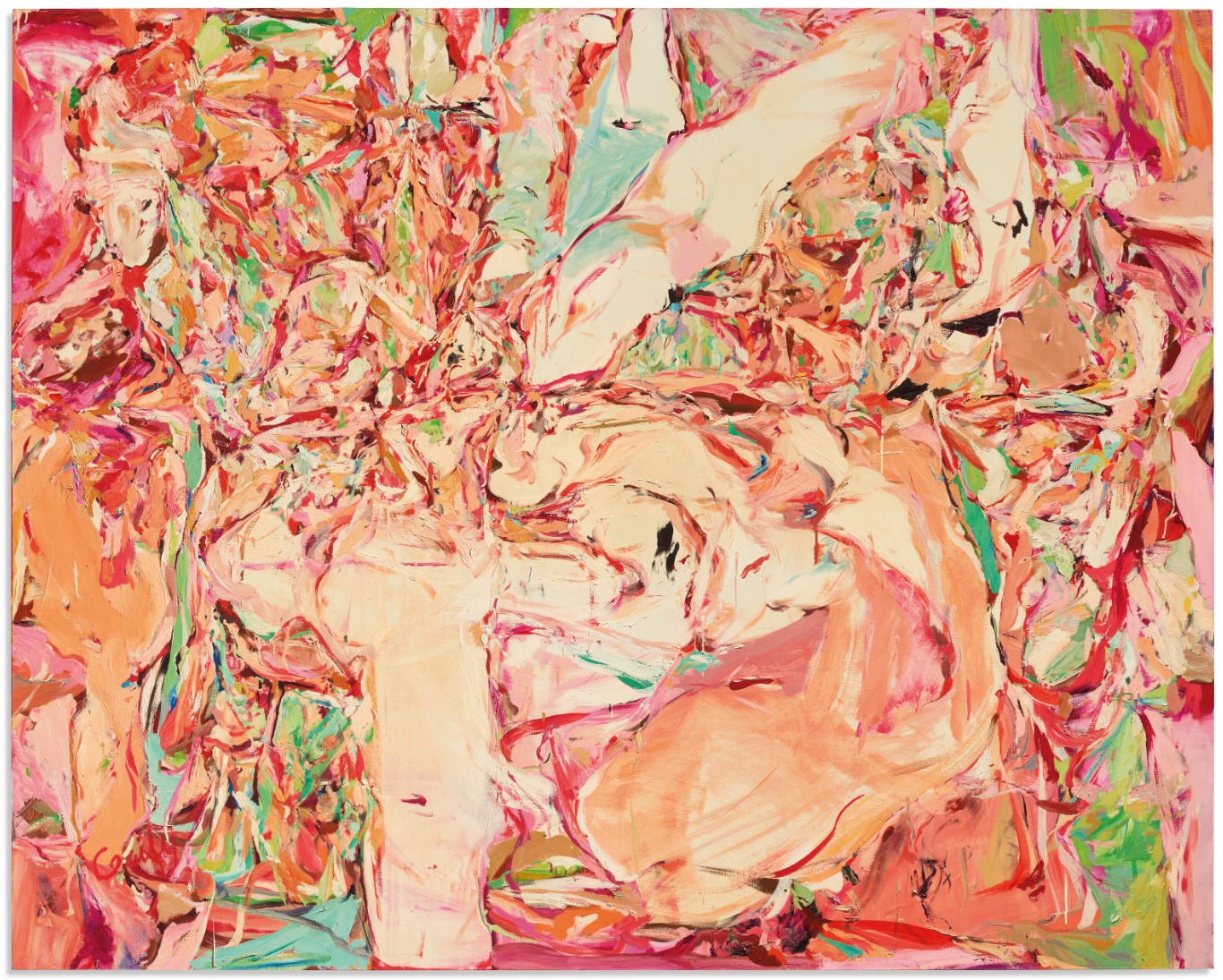
CECILY BROWN (B. 1969)
Kiss Me Stupid, 1999
Oil on linen
60×75 inches (152.4 x 190.5 cm)
Signed ‘Cecily’ (lower left)
Signed and dated ‘Cecily Brown 1999’ (on the stretcher)
Signed and dated ‘Cecily Brown 99’ (on the reverse)
A monumental spectacle spanning almost two metres in width, Kiss Me Stupid is a dazzling large-scale painting by Cecily Brown. Painted in 1999, two years after she made her solo debut in New York, the work captures the flourishing of her exuberant, sensual abstract language at a pivotal moment in her career. Its palette is extraordinary: electric tones of green, pink, red and blue collide in kaleidoscopic formations, scattered across the surface like fireworks. Flesh-toned impasto and sinuous ribbons of colour are tangled together in a joyful, bacchanalian dance; echoes of art history flit across their mercurial forms. Brown manipulates her pigment in rich, tactile layers, toying mercilessly with the boundary between abstraction and figuration. Like many of the artist’s canvases from this period, the work is elusively titled after a Hollywood movie: the 1964 comedy Kiss Me, Stupid, starring Dean Martin and Kim Novak. Near-cinematic in scope, it takes its place alongside major canvases from this year, including examples held in the Broad, Los Angeles, Tate, London and the Buffalo AKG Art Museum, New York.
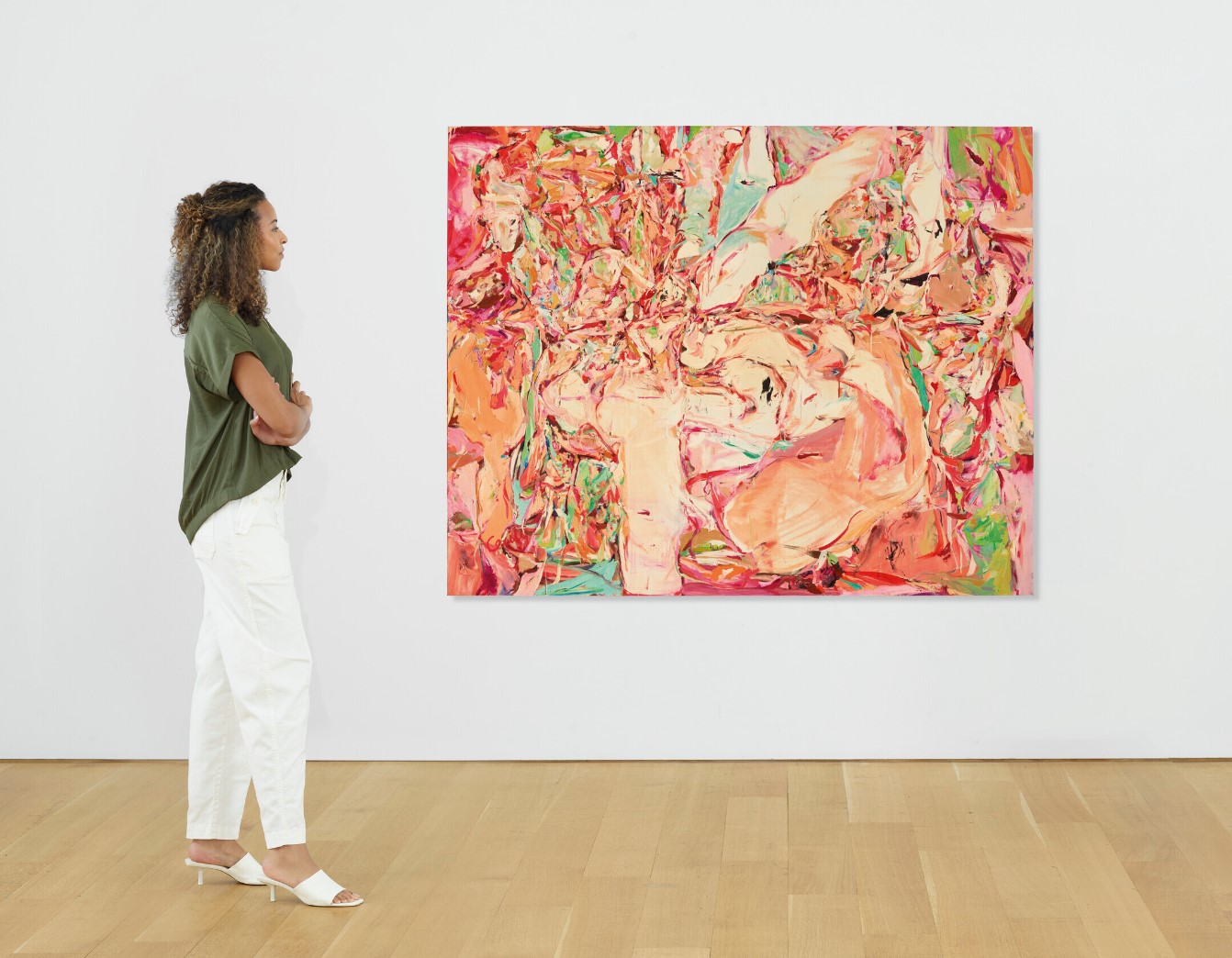
Brown is currently the subject of a major exhibition at the Metropolitan Museum of Art, New York: her first fully-fledged museum survey in the city that she made her home. The paintings on display—among them majestic canvases including Father of the Bride (1999), Carnival and Lent (2006-2008) and The Picnic (2006)—capture the full breadth of the artist’s virtuosic technique. In an interview published in the exhibition catalogue, Brown compares the act of painting to ‘a sort of performance’. ‘With the very large paintings’, she explains, ‘… [t]here are big, looping strokes, you’re going up and down ladders, going back and forth, using the whole surface all the time, really using your body. In the end, what the painting becomes is a record of your movements. It really is very close to dance’ (C. Brown, quoted in A. Eaker, ‘Window, Mirror, Stage: A Conversation with Cecily Brown’, in Cecily Brown: Death and the Maid, exh. cat. Metropolitan Museum of Art, New York 2023, p. 104). This approach is evident in Kiss Me Stupid, whose wild, ecstatic surface quivers with the trace of the artist’s touch.
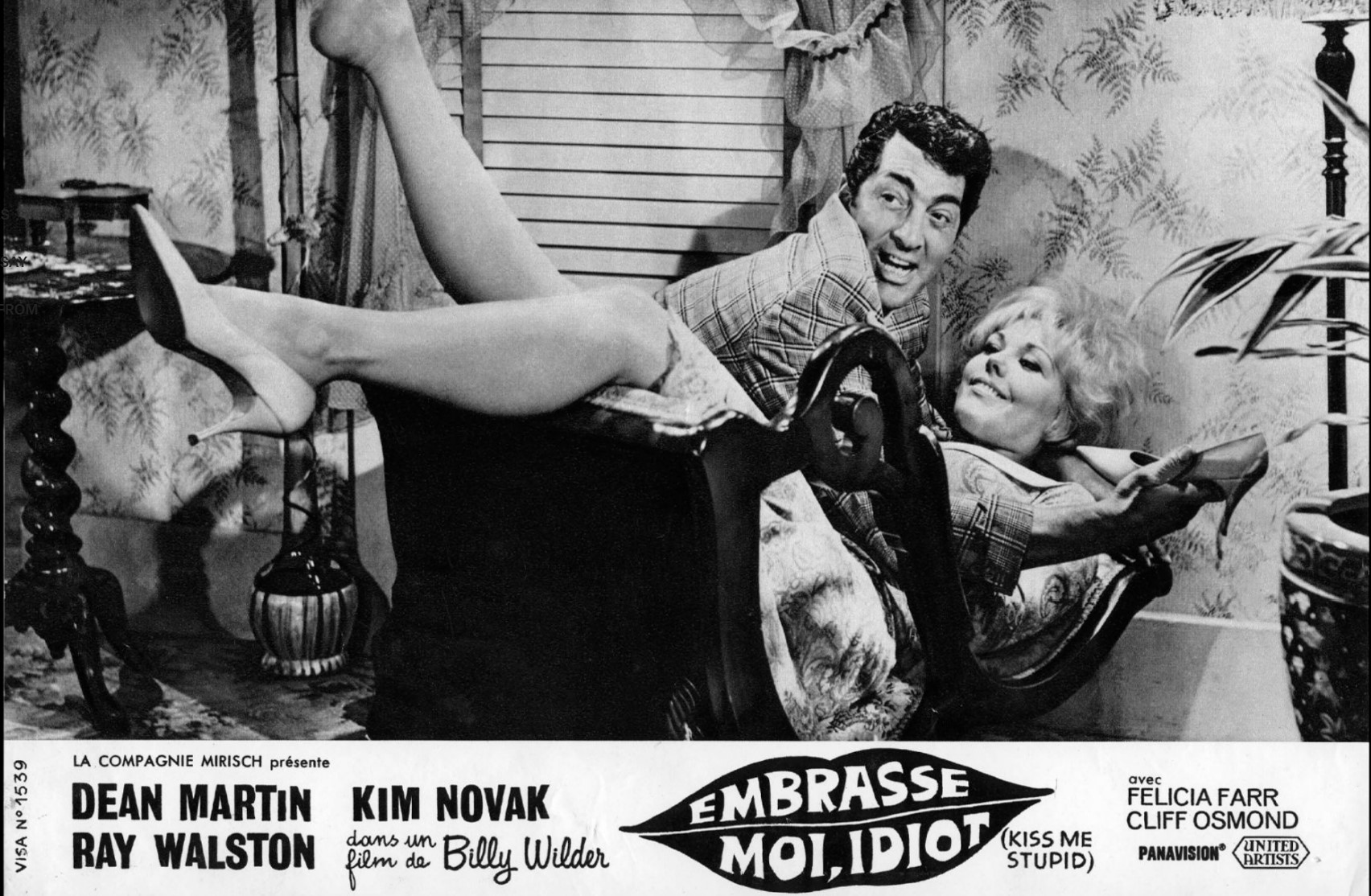
The work also captures Brown’s dialogue with cinema. The films of Hollywood’s Golden Age would lend their titles to a number of canvases during this period: Tender is the Night, Trouble in Paradise, No Room for the Groom and others quiver with strains of romantic nostalgia. Kiss Me, Stupid, a risqué comedy, had originally been written with Marilyn Monroe in mind for the lead role. Any sense of narrative connection to the painting, however, is enigmatic. For Brown, these films were not explicit visual sources: instead, their titles were selected for their poetic resonance, each a kind of hook that prompted chains of visual association. Nonetheless, a sense of cinematic experience pervades the painting, its flickering surface conjuring the illusory dynamism of the silver screen. Forms and colors scramble and merge, as if cut and spliced at speed. Paint takes center stage as the leading lady, alive with thrilling new revelations.
Other Highlights
Yayoi Kusama
Christie’s London: 28 June 2023
Estimated: GBP 1,500,000 – 2,000,000
GBP 1,734,000
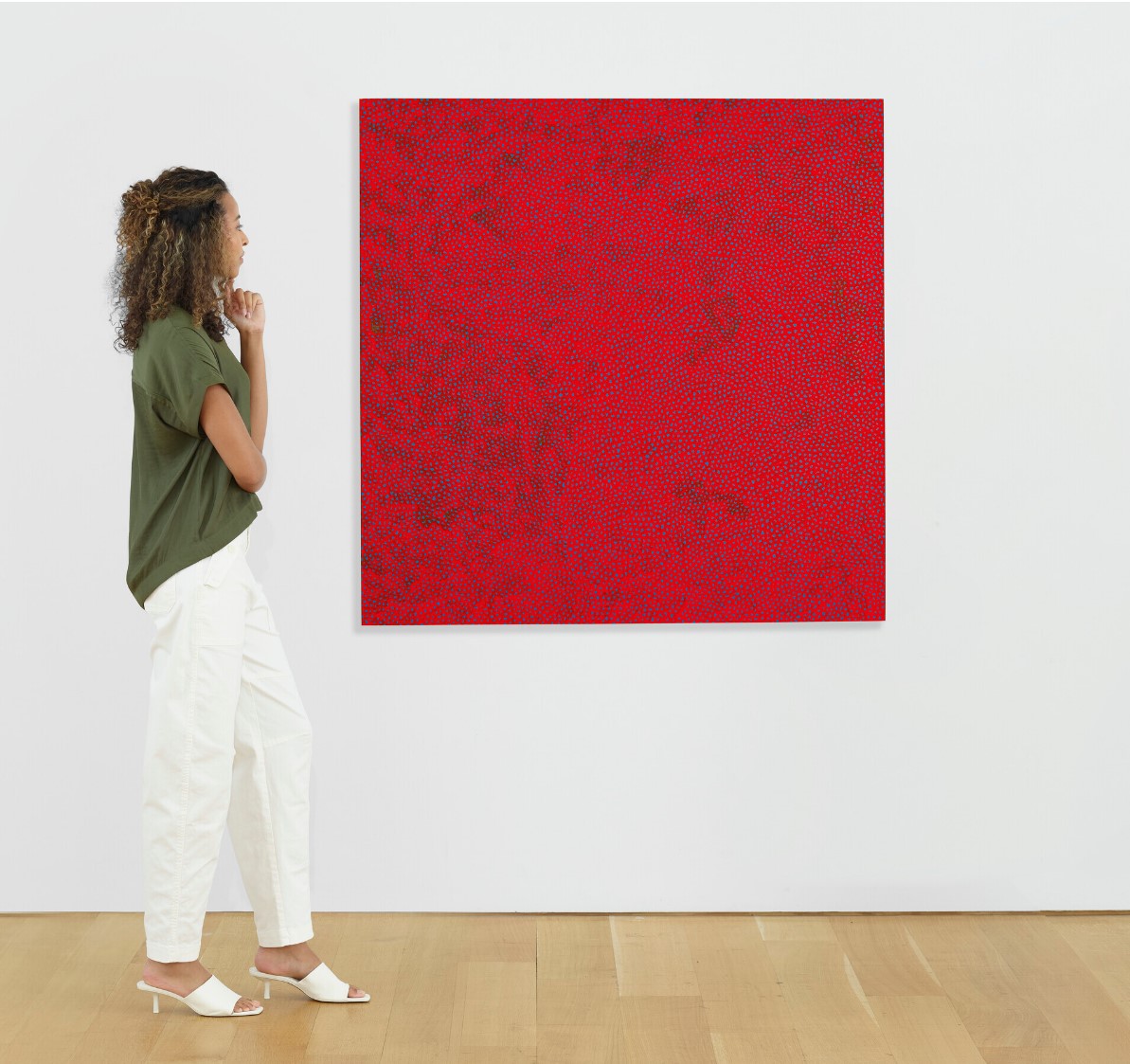
YAYOI KUSAMA (B. 1929) (christies.com)
YAYOI KUSAMA (B. 1929)
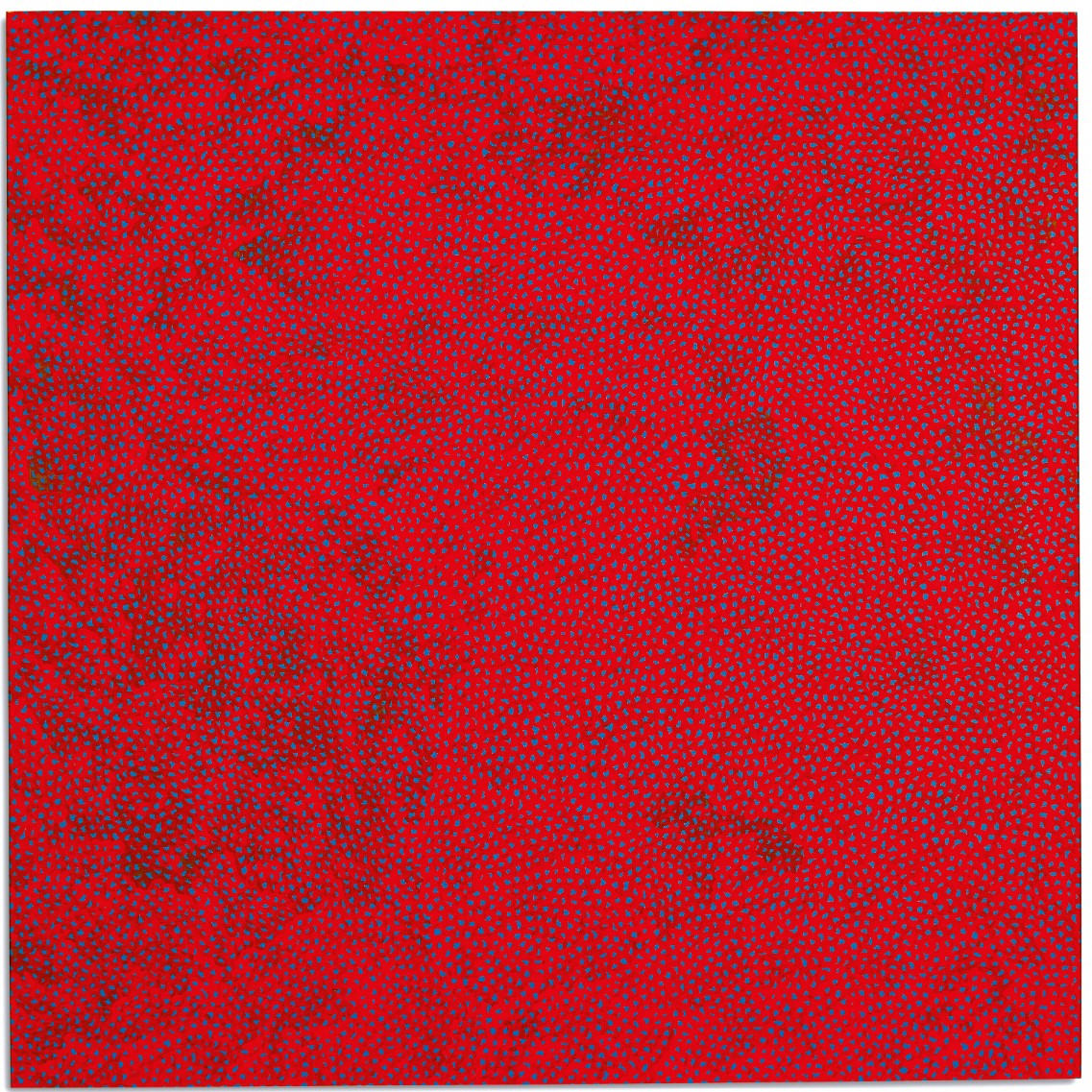
INFINITY-NETS (OOAXT), 2008
Acrylic on canvas
130.3 x 130.3 cm (51 1/4 x 51 1/4 inches)
Signed twice, titled and dated ‘OOAXT INFINITY-NETS YAYOI KUSAMA Yayoi Kusama 2008’
(on the reverse)
With its scintillating web of dots undulating across a shimmering expanse of red, the present work is a majestic example of Yayoi Kusama’s Infinity Nets. Wrought from delicate, scalloped strands of impasto, these works stands among the defining achievements of the artist’s oeuvre, each a hymn to the unfathomable void of human existence. Here, skeins of red paint are woven across a blue backdrop, creating an amorphous cloud of color and texture that fades from deep crimson to pink and purple. Tiny azure dots gleam through the surface, like microscopic patches of sky. Commenced during her early years in New York during the late 1950s, Kusama’s Infinity Nets offered unique responses to many of the same questions posed by Abstract Expressionism and Minimalism. At the same time, these works were deeply personal, functioning as an outlet for the obsessive visions of dots and webs that had plagued Kusama since childhood. Her first hallucination, notably, was dominated by the color red: here, almost seven decades later, it continues to haunt her world.
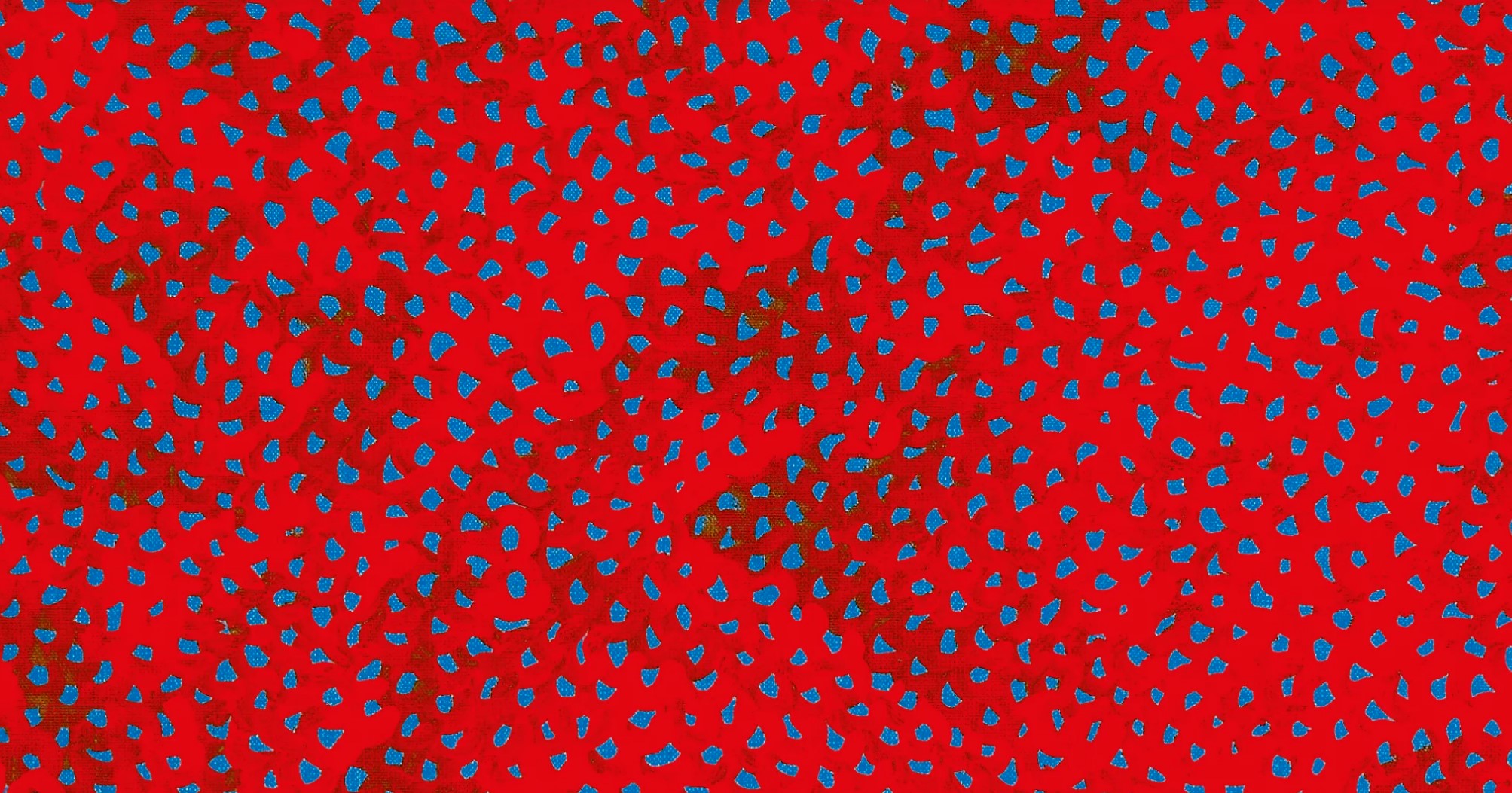
Kusama was born in Japan in 1929. During a childhood full of emotional turmoil, she found solace in art. At the age of ten, she began experiencing visions: vast fields of dots and flashes of light that would multiply before her eyes, covering herself and her surroundings.
“My room, my body, the entire universe was filled with [patterns], my self was eliminated, and I had returned and been reduced to the infinity of eternal time and the absolute of space. This was not an illusion but reality.”
The Infinity Nets, ultimately, had their origins here. During her time in New York, Kusama began to immerse herself in these paintings. Despite their success in both America and Europe—Donald Judd, Lucy Lippard and Frank Stella were early admirers—the artist continued to battle personal demons during these years. The meditative act of hand-painting these webs of color, often for hours on end without eating or sleeping, brought her great comfort.
By the time Kusama moved to New York in 1957, the concept of infinity was beginning to spark the imagination of many artists. In the aftermath of the Second World War, figures such as Barnett Newman and Mark Rothko had reconceived painting as a means of transcending the material world. In France, Yves Klein would attempt his seminal ‘leap into the void’; later, in Poland, the artist Roman Opałka would set out on a lifelong quest to paint the numbers one to infinity. Klein and Rothko, along with artists such as Lucio Fontana and Piero Manzoni, were among Kusama’s early exhibition partners. Others would place her Infinity Nets in the context of Minimalism, their serial, repetitive forms stripped of all external reference. Elsewhere, they prompted comparison with the dizzying illusions of Op Art. The present work, with its richly marbled chromatic surface, might even be seen to chime with the opulent abstract canvases of Gerhard Richter, which similarly captured a sense of interminable depth.
Caroline Walker
Christie’s London: 28 June 2023
Estimated: GBP 150,000 – 200,000
GBP 441,000
Caroline Walker (christies.com)
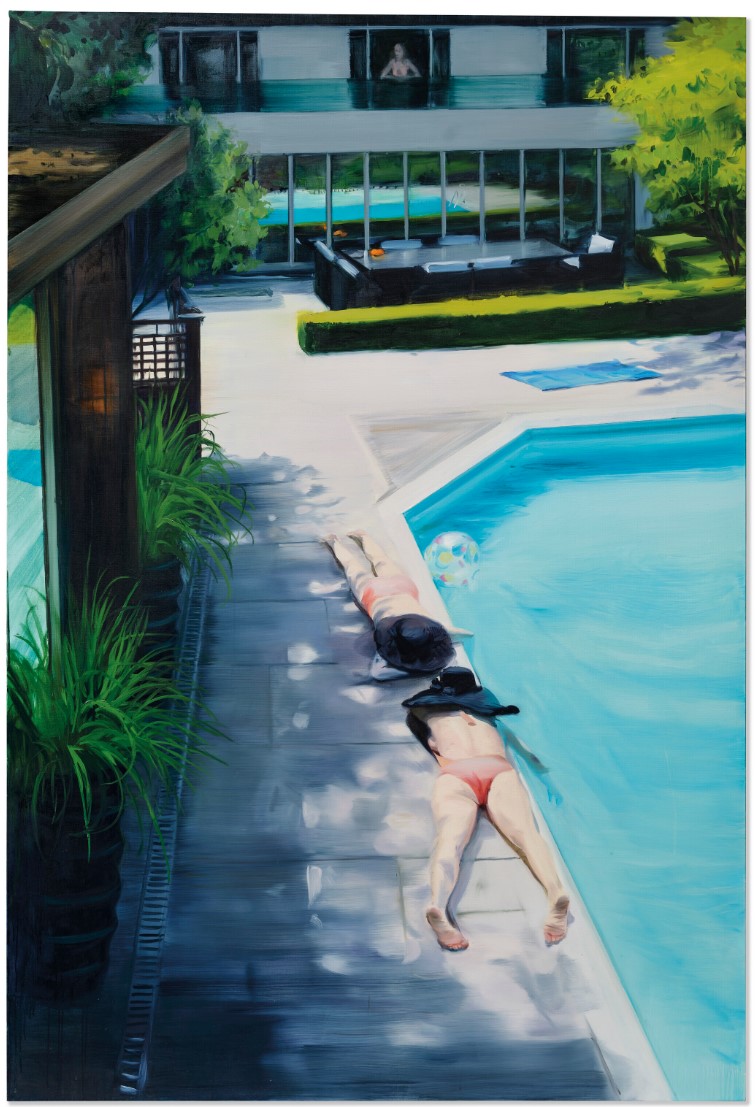
CAROLINE WALKER (B. 1982)
Recreation Pavilion, 2013
Oil on linen
110 1/8 x 74 3/4 inches (279.6 x 190 cm)
Signed, titled and dated ”RECREATION PAVILION’ Caroline Walker 2013′ (on the reverse)
Included in Caroline Walker’s seminal exhibition In Every Dream Home at Pitzhanger Manor and Gallery, the present work is an extraordinary large-scale painting from the series of the same name. Spanning almost three metres in height, it depicts two women sunbathing by a swimming pool, their faces concealed beneath their wide-brimmed hats. Multiple windows reflect the sparkling blue waters, while a shadowy figure observes the spectacle from the upper floor of the house. Taking its title from the 1973 Roxy Music song ‘In Every Dream Home a Heartache’, the exhibition marked Walker’s solo institutional debut, and propelled her to public acclaim. The paintings, set in and around an idyllic property, offered disquieting snapshots of seemingly picture-perfect lives. Featuring a recurring cast of anonymous, bikini-clad women, the series cemented the subtle interrogation of female roles that would go on to define Walker’s practice. Shrouded in cinematic suspense and psychological ambiguity, Recreation Pavilion captures the virtuosic ambition of her early oeuvre: voyeurism, aspiration and seduction combine in a scene of crystalline poise, saturated with formal and narrative tension.
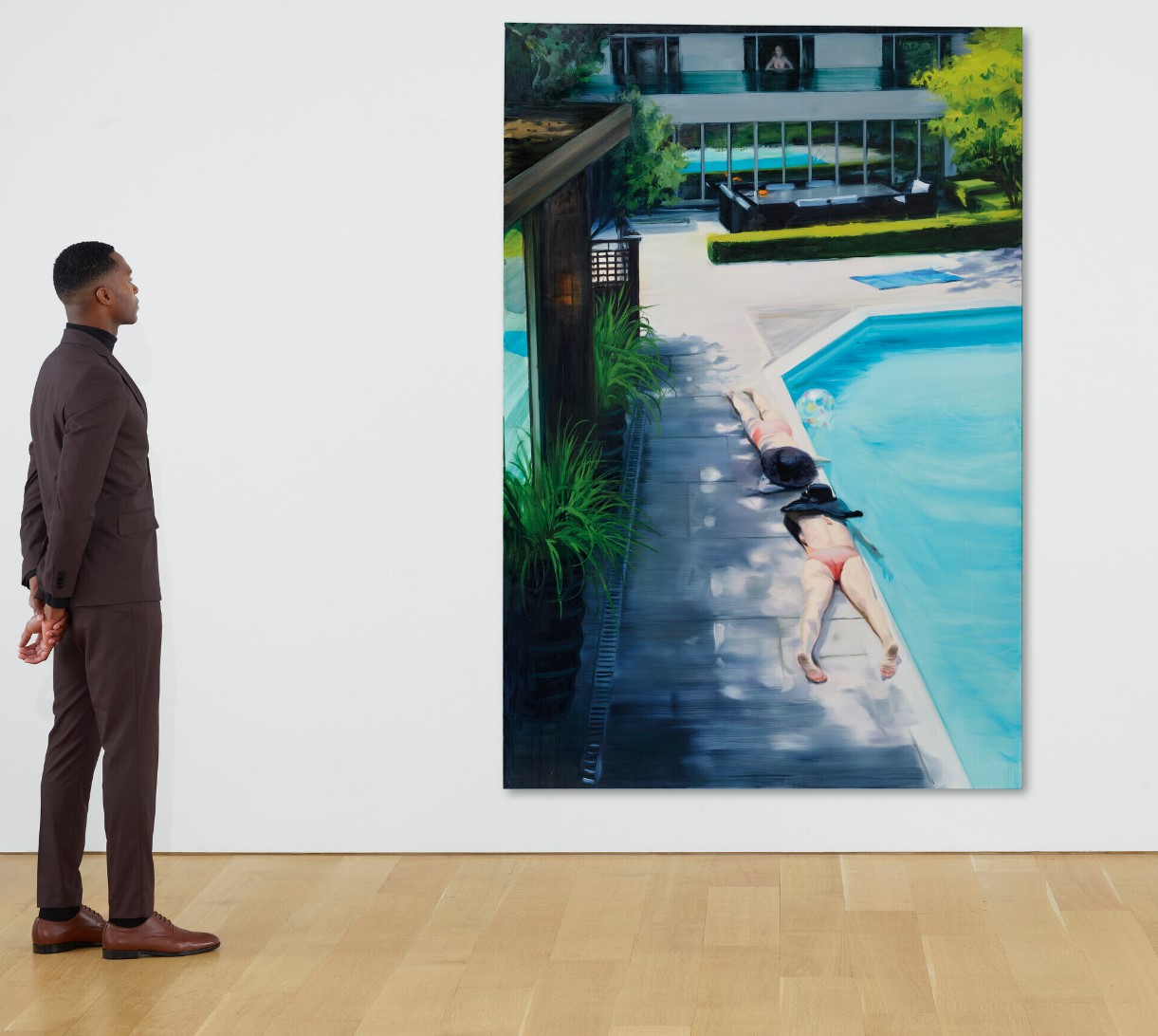
Fascinated by the unseen lives of women, Walker uses props, lighting and deft spatial manipulation to draw us into her subjects’ interior worlds. In Every Dream Home marked the early flourishing of these techniques, exploiting the sharp lines of Modernist architecture and the distortive properties of water and glass.
“I’d been exploring the notion of the ‘Grand Design’ house and became interested in the idea of dream homes, and what might go on in them. We could be looking at a villa in Dubai, LA, Buenos Aires or just a back garden in London.”
The setting for the series, where Walker conducted photoshoots in preparation, was deliberately intended to be ambiguous: many scenes, including the present, are captured from different angles throughout. Here, Walker’s staging disorients the viewer further, offsetting lush figuration with near-abstract geometries. Doublings, shadows and reflections confound our gaze, ensnaring us in a world of enigma and dreamlike illusion.
Pierre Soulages
Christie’s London: 28 June 2023
Estimated: GBP 750,000 – 1,000,000
GBP 1,153,200
PIERRE SOULAGES (1919-2022) (christies.com)
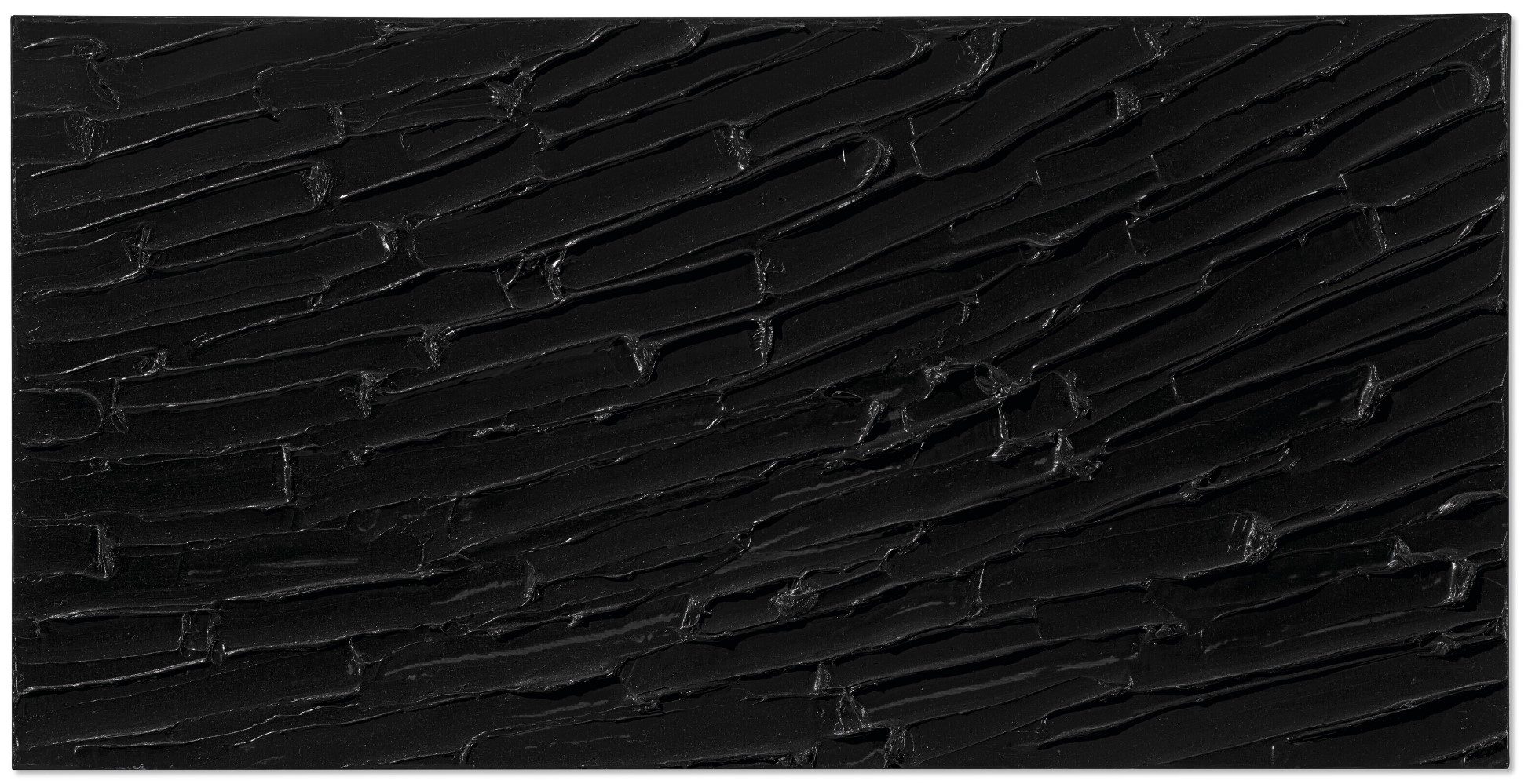
PIERRE SOULAGES (1919-2022)
Peinture 91 x 181 cm, 26 décembre 2014
Acrylic on canvas
91×181 cm (35 3/4 x 71 1/4 inches)
Signed, titled and dated ‘SOULAGES “peinture 91 x 181 cm” 26-12-2014’ (on the reverse)
With its gleaming expanse of black paint raked into rhythmic, reflective splendor, Peinture 91 x 181 cm, 26 décembre 2014 is a spectacular outrenoir painting by Pierre Soulages. Soulages coined the term outrenoir, which translates roughly as ‘beyond black’, in 1979 to describe the new realm he had entered with his all-black canvases. By using paint in a complex range of textures and densities—whether matt, lustrous, coarse, smooth, swept into broad planes or finely striated—he created interactive paintings that were not simply monochrome but full of visual life, constantly changing with ambient light and the position of the viewer. To make the present work, he sculpted thick acrylic paint into a longitudinal field of glossy diagonal strokes. The banks, furrows and ridges, which surge upwards from left to right, were formed by dragging a home-made scraping tool through the pigment. The work’s variegated, scintillating surface transcends blackness to become an experience of light. It was painted in 2014, two days after the artist’s ninety-fifth birthday. The Musée Soulages, a museum in Rodez dedicated to his life’s work, opened that same year.
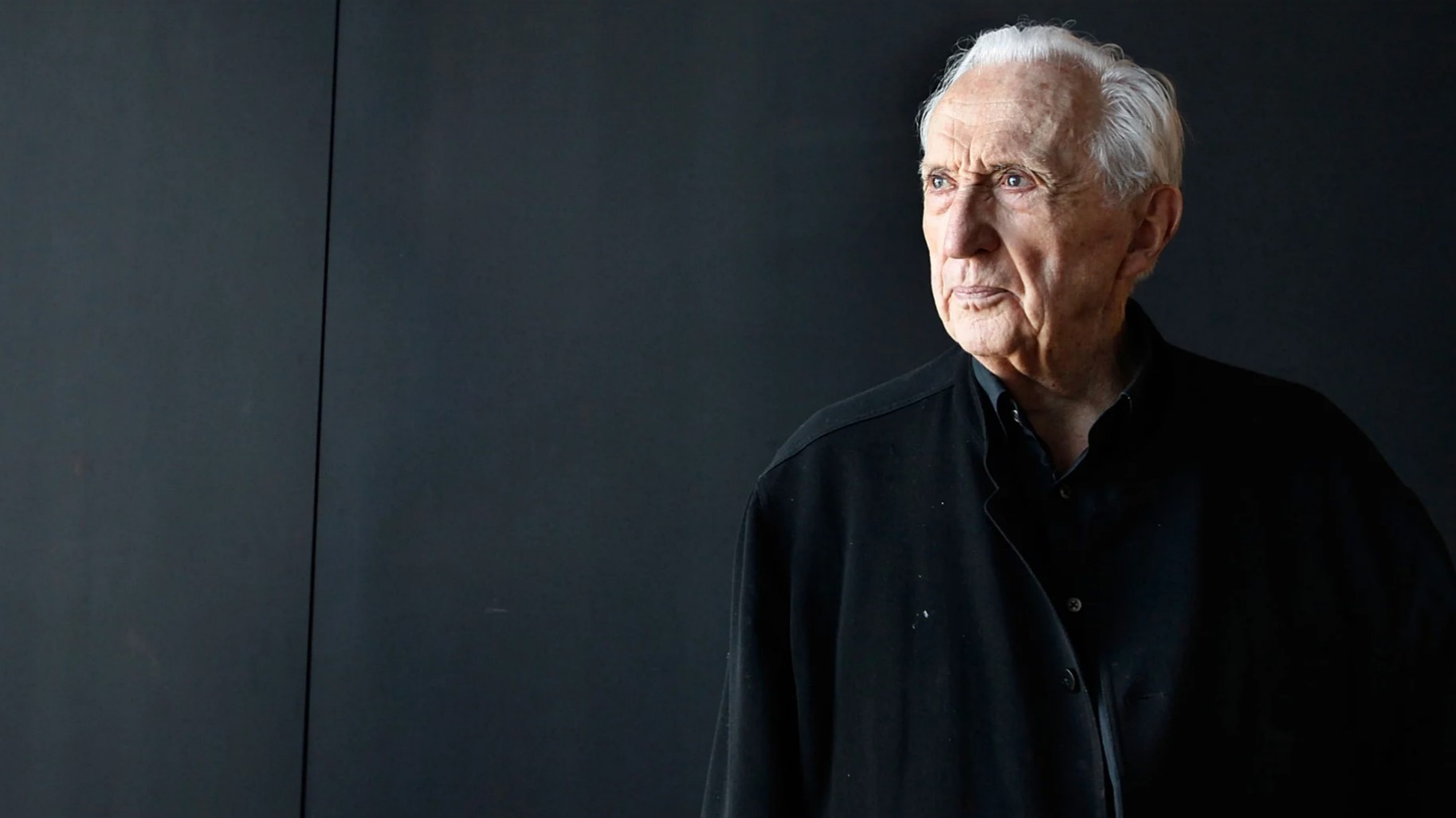
Soulages was born in Rodez, in the south of France, in 1919. He was inspired from a young age by the timeless power of ancient art, including prehistoric cave paintings and the abbey-church of Sainte-Foy de Conques near his hometown. Standing beneath Sainte-Foy’s huge, shadowy barrel vault gave him what he called his ‘first artistic experience’, and inspired him to become a painter.
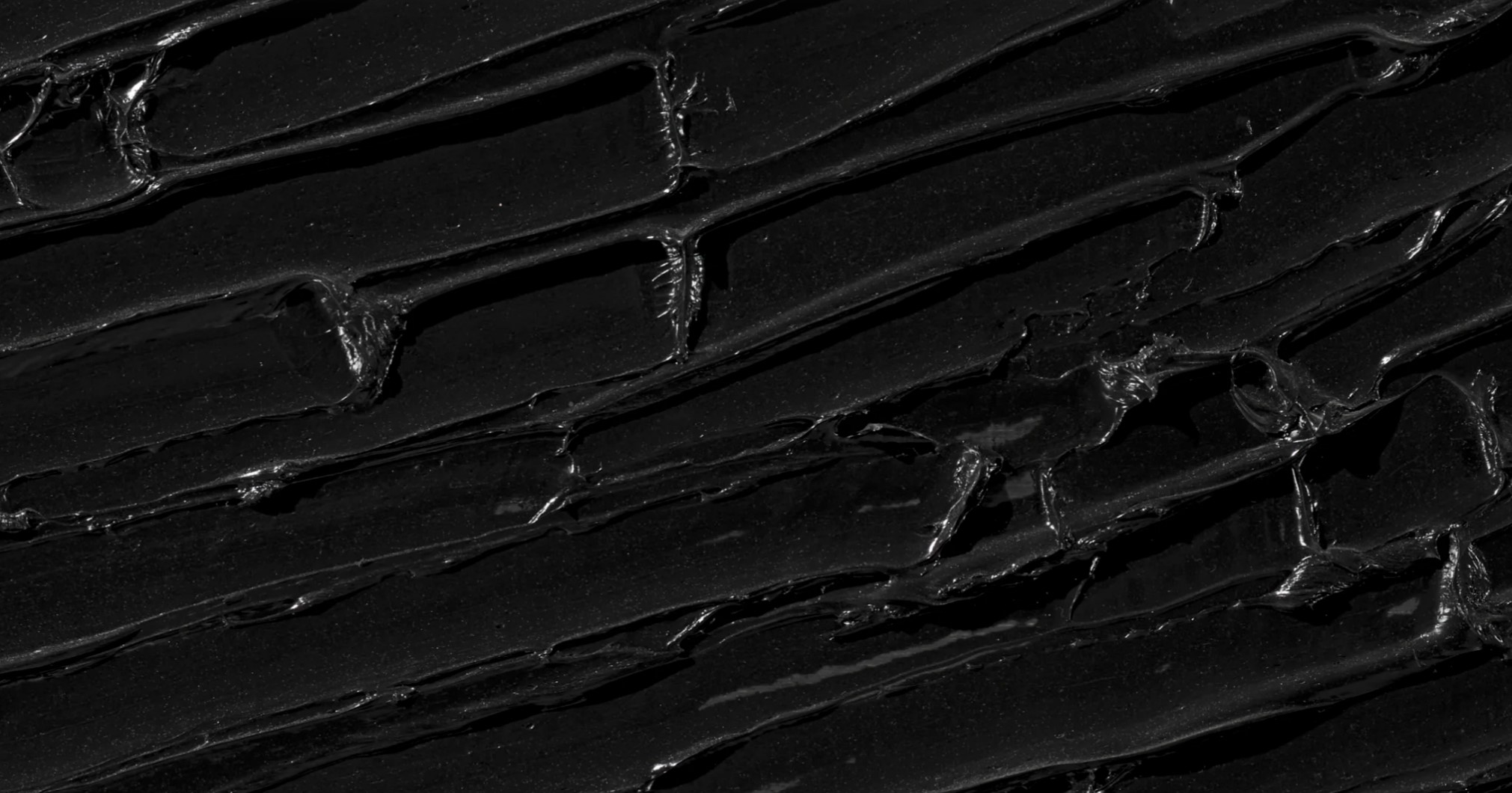
Soulages rose to prominence on both sides of the Atlantic in the decades after the Second World War. His paintings were always distinguished by their sensitivity to light and darkness. Initially working in a bold, calligraphic Informel mode, he experimented with chiaroscuro effects and interlocking beams of paint, arriving by the 1960s at complex, diaphanous works created by the building up and scraping-away of pigment. It was this turn towards the matter of paint itself—the matière—that led to the breakthrough of the outrenoirs in 1979. He continued to explore their potential until his death, at the age of 102, in 2022. From 2004 onwards he used acrylic paint rather than oil, taking advantage of its quick-drying properties to shape increasingly dynamic and reflective surfaces, often at monumental scale. The present work exemplifies the grandeur of these late works. As with all his paintings, it alludes to no outside meaning. Its factual title of date and dimensions fixes it as an object in time. Nonetheless, as the light of the external world dances across its surface, it is created anew with each viewer’s encounter.
David Hockney
Christie’s London: 28 June 2023
Estimated: GBP 1,200,000 – 1,800,000
GBP 2,339,000
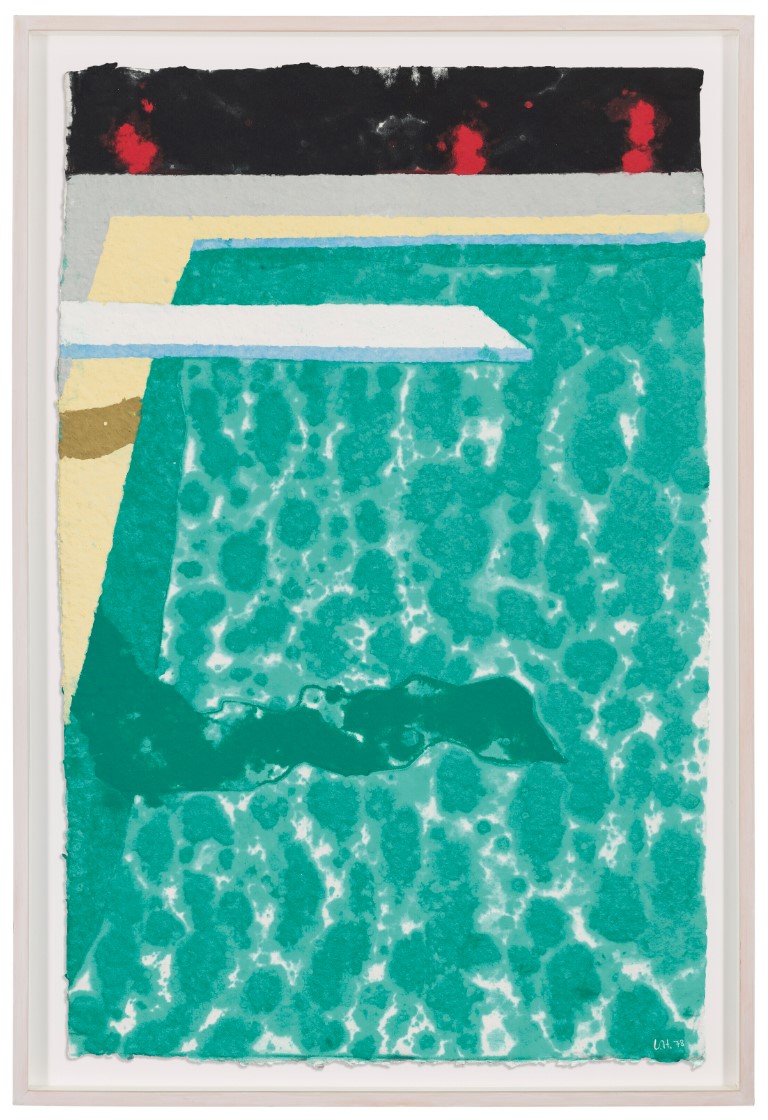
DAVID HOCKNEY (B. 1937)
Green Pool with Diving Board and Shadow (Paper Pool 3), 1978
Colored pressed paper pulp
50 3/4 x 32 5/8 inches (128.8 x 82.8 cm)
Signed with the artist’s initials and dated ‘D.H. 78’ (lower right)
Signed and numbered ‘3 K David Hockney’ (on the reverse)
With its turquoise waters bathed in the sparkling light of a summer’s day, Green Pool with Diving Board and Shadow (Paper Pool 3) is an exquisite work from David Hockney’s celebrated series of Paper Pools. Dating from a pivotal moment in his career, this extraordinary series united the artist’s most iconic subject with a radical new technique. Hockney had first fallen in love with sun-kissed swimming pools while living in Los Angeles during the 1960s. In 1978, he moved back to California once more, stopping off en route from England to stay with the graphic designer Kenneth Tyler in upstate New York. Inspired by Tyler’s magnificent swimming pool, Hockney began a new series of works using handmade pulped paper. Tactile and absorbent, this new medium brought the artist closer than ever before to capturing the shifting, elusive properties of water. In the present work, piercing aquamarine hues glisten with dappled, liquid light: the flat waters of his 1967 masterpiece A Bigger Splash (Tate, London) are finally brought to life.
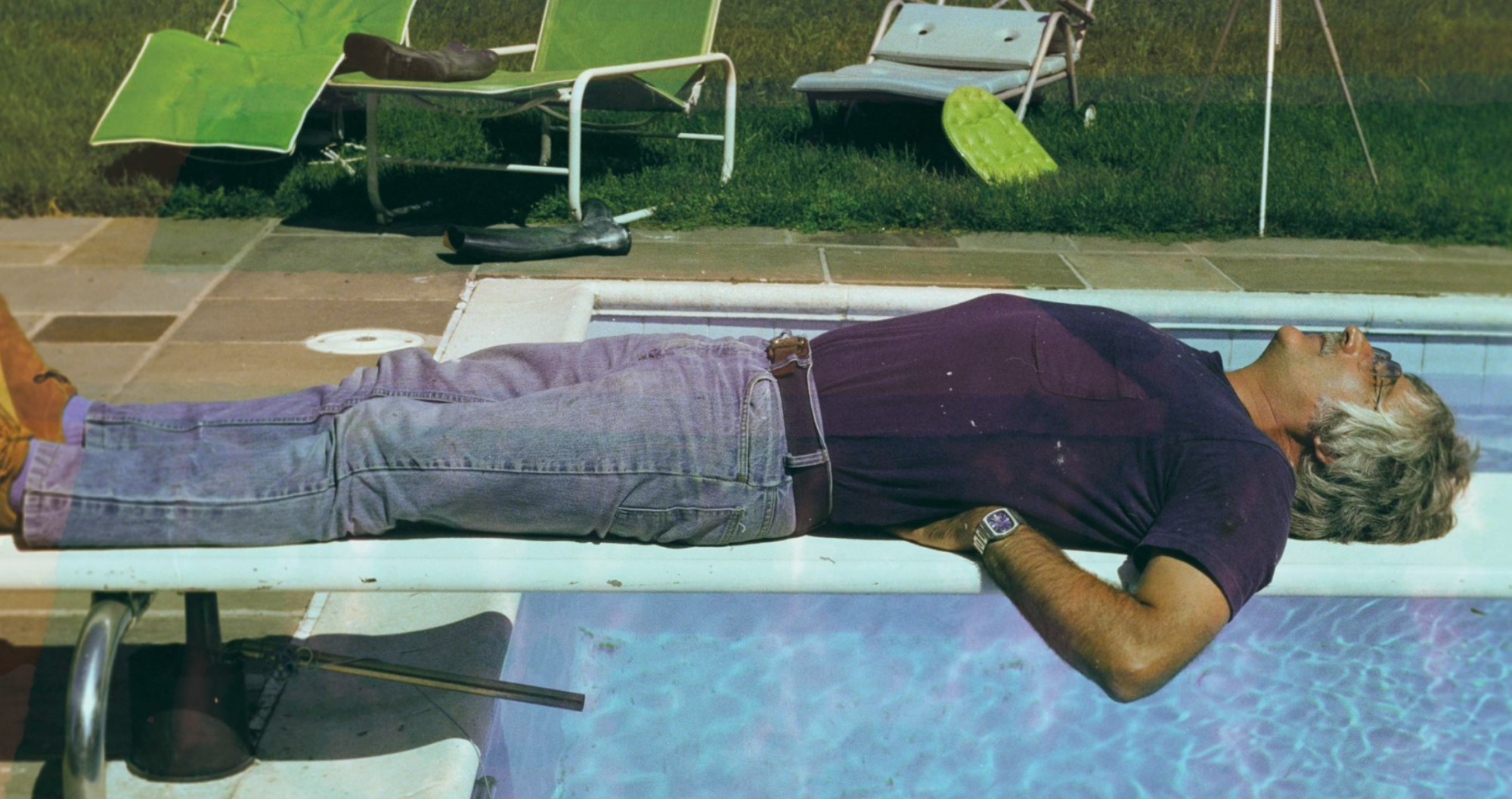
Widely exhibited, and with variations held in institutions including the Walker Art Center, Minneapolis and the National Gallery of Australia, Green Pool with Diving Board and Shadow is the third image in the series of twenty-nine that make up the Paper Pools. Together, these works represent a unique and distinctive chapter in Hockney’s life. Tyler was the founder of the celebrated Tyler Graphics studio, and had first met the artist while running Gemini Ltd in California. At the time of Hockney’s visit in 1978 he had recently opened a new workshop outside New York City. Tyler had previously introduced artists such as Ellsworth Kelly and Kenneth Noland to the paper pulping technique, and encouraged Hockney to experiment with it. The artist was instantly intrigued by the process, and even more so by its results.
“The paper is very beautiful, the surface, there is no such thing as a flat color, and they are very subtle at times. They are like paintings, which is why I stayed.”
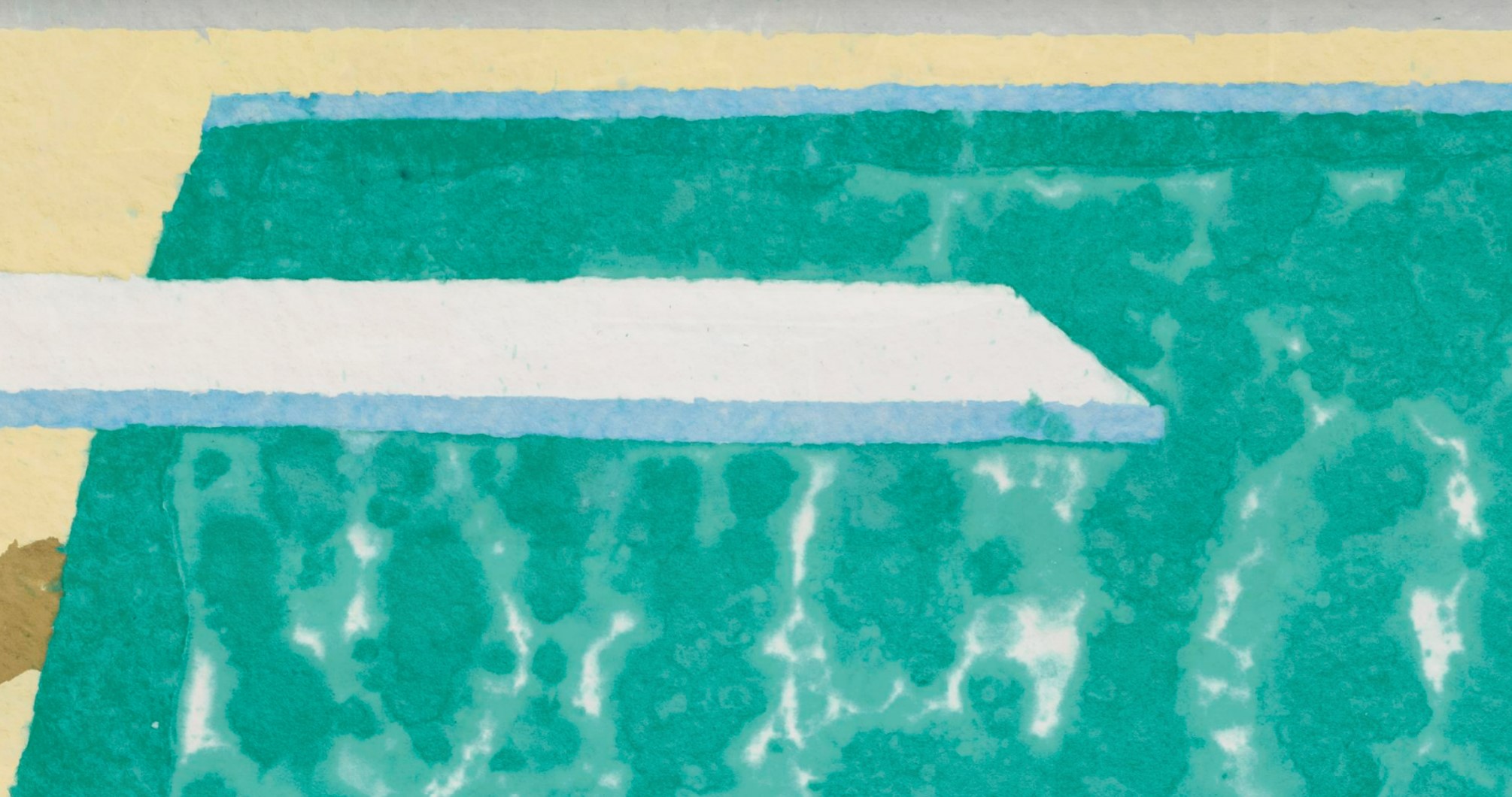
Part of Hockney’s attraction to paper pulping was that it was—in itself—a watery medium. During his time at Tyler’s studio he became intimately connected to the process. After capturing the pool in Polaroids and full-scale outline drawings, he created a series of metal moulds which were positioned over still-wet sheets of newly handmade paper. Into the moulds, he poured wet pulped rags which had been immersed in different dyes, using the metal frames to manipulate his lines like drawing. After the moulds were removed, the pulp-laden sheets were squeezed and flattened, before being finished by hand. Water, itself, had literally become part of the art. The results, as demonstrated here, were dynamic and liquescent, the distressed edges of the paper lapping at the borders of the work like waves.
“Every time that you look at the surface, you look through it,
you look under it.”
In Green Pool with Diving Board and Shadow, we are instantly transported to the sun-drenched, glassy waters of a Stateside summer, and enveloped within their cool depths.
Andy Warhol
Christie’s London: 28 June 2023
Estimated: GBP 1,500,000 – 2,000,000
GBP 2,097,000
ANDY WARHOL (1928-1987) (christies.com)

ANDY WARHOL (1928-1987)
Knives, 1982
Acrylic and silkscreen ink on canvas
70 1/8 x 52 1/8 inches (178 x 132.4 cm)
Signed, stamped twice with the Andy Warhol Art Authentication Board, Inc. stamp
Numbered and dated ‘Andy Warhol 82 A114.995’ (on the overlap)
Held in the same private collection for almost twenty-five years, Knives (1982) is a monumental work from one of Andy Warhol’s most important late series. Over a backdrop of brightly-painted blocks of colour, an image of three knives is silkscreened twice in stark black ink. Their silhouettes are dynamically arranged. One doubled knife aligns with the chromatic grid, handle and blade split between quadrants of green and orange. Another overlaps diagonally, slicing across the picture at forty-five degrees. The work might almost be mistaken for a bold abstract composition. It takes on a sharp edge of menace, however, as the knives’ forms become clear. Photographed by Warhol, they are both charged symbols and real objects: the screenprint captures the woodgrain of their handles, fingerprints on their blades, and the manufacturer’s ‘high carbon no stain’ assurance stamped into the metal. Created towards the end of Warhol’s life, the knife pictures were made alongside his iconic Gun and Cross works, and witness his complex engagement with mortality. The present work debuted in Andy Warhol: Guns, Knives, Crosses, Warhol’s first solo show in post-Franco Spain, at Madrid’s Galería Fernando Vijande in 1982.

With the Knives, as with the Skull and Hammer and Sickle series of the 1970s, Warhol used his own Polaroid photographs as the basis for his silkscreens. This process allowed him to stage the objects in careful still-life displays in his studio, fine-tuning their formal and emblematic impact. Initially he had wanted to photograph unusual, handmade or exotic daggers. His friend Chris Stein—the guitarist of the band Blondie—lent some samples from his collection. Unsatisfied with the resulting pictures, Warhol sent his assistant to a Bowery restaurant supply store to instead buy some ordinary eight-inch kitchen knives. The choice of these more mundane utensils heightens the Pop jolt of the final work. Far from exotic, they are as everyday and universal as Warhol’s Coca-Cola bottles or Campbell’s Soup cans. Their implied violence is domestic. At the same time, Warhol makes them grand and imposing, even—in an echo that would have been heightened by the Cross works in the 1982 exhibition—evoking objects of worship.
In 1968, Warhol had survived an assassination attempt by the writer Valerie Solanas. His injuries were life-changing, and the last two decades of his work increasingly shadowed by death. His Skulls of 1976 reimagined the vanitas still-life on a vast scale; he furthered the memento mori theme with his Self-Portrait with Skull two years later. The Guns and Knives were completed in the reflective years of the early 1980s, at the same time as Warhol was looking back on his career in his Reversal and Retrospective series. For an artist who had endured real bodily violence, there was perhaps a catharsis in confronting these weapons of violence, printing and reprinting them as impersonal patterns of colour and form. They push to the limit Warhol’s deadpan claim that ‘The more you look at the same exact thing, the more the meaning goes away and the better and emptier you feel’ (A. Warhol, in P. Hackett (ed.), POPism: The Warhol Sixties, Orlando 1980, p. 50).
The Technicolor beauty of Warhol’s work, however, had been laced with the macabre long before his own brush with mortality. He made his 1962 portraits of Marilyn Monroe in the weeks immediately following her death, and silkscreened Jackie Kennedy’s image after her husband was assassinated one year later. He paid keen attention to the ghoulish obsessions of the print media, where starlets and plane accidents alike made front-page news. His 1960s Death and Disaster series, which depicted electric chairs and fatal car crashes, were unflinchingly morbid. For Warhol, the danger and glamour of the American dream always went hand in hand. The present work captures this duality, its vivid rainbow hues cut through with a razor-sharp thrill of darkness.
BANKSY
Christie’s London: 28 June 2023
Estimated: GBP 600,000 – 800,000
GBP 1,008,000

BANKSY
Dorothy I Don’t Think…, 2011
Spray paint on lino flooring laid on board
100×80 cm (39 3/8 x 31 1/2 inches)
Signed ‘BANKSY’ (lower right); signed and dated ‘BANKSY 11’ (on the reverse)
Held in the same private collection since it was acquired directly from the artist in 2011, Dorothy I Don’t Think … crackles with Banksy’s deadpan conceptual wit. Rare for its inclusion of the artist’s signature on both the front and reverse, the work depicts Dorothy—played by Judy Garland—and her dog Toto from the 1939 film The Wizard of Oz. Below runs the phrase ‘I don’t think we’re on canvas anymore’: a pun on Dorothy’s iconic line ‘I’ve a feeling we’re not in Kansas anymore’. Canvas, indeed, has vanished: instead the image is spray-painted on a slab of lino floor, underscored by a series of red dots. An earlier version of the work was included in Banksy’s infamous exhibition Banksy versus Bristol Museum (2009), in which he replaced the contents of the museum’s collection with his own works. In this iteration, which became the poster image for the show, the picture appeared on a sheet of paper suspended freely from the centre of an empty frame.
Banksy’s dismissal of the canvas—the sacred site of painting—is bound up with his long-standing attack on art’s institutions and histories. He came to prominence at the turn of the millennium as a graffiti artist, fuelled by a belief that art should live on the streets, and among the people. In 2002, he began a series of pranks upon museums, inserting his own irreverent creations into their hallowed halls. Over the following years he would vandalise canvases he found in car boot sales, and produce his own versions of famous paintings. His exhibition in Bristol was, in many ways, the culmination of these early initiatives. Underpinning them all was a common conviction: that the meaning of art did not reside in the fibres of the painted canvas. Instead, it lived and breathed in its interaction with the world around it. Just as Dorothy had exposed the Wizard of Oz as a fraud, so too did Banksy seek to dispel the smoke and mirrors of art’s false promises.
Spray paint and stencils had been Banksy’s signature medium since he was a teenager. They were the weapons of his guerrilla warfare, allowing him to work quickly and without detection by the authorities. By 2011, Banksy’s graffiti had delivered powerful social, cultural and political messages across the world, haunting sites from London’s Southbank to the West Bank barrier wall. While the present work makes reference to this practice, it also enters into subversive dialogue with the ghosts of art history. Dorothy’s face, with her tinted eyeshadow and lipstick, echoes Andy Warhol’s portraits of Marilyn Monroe and Liz Taylor—and, indeed, of Garland herself. The dry humour of the work’s text conjures the Joke paintings of Richard Prince, while its use of lino flooring evokes Jean-Michel Basquiat’s use of doors and other urban detritus as supports. For Dorothy and Toto, there was ‘no place like home’. Here, Banksy delights in wrenching art from its comfort zone, thrusting it against its will into the spaces of everyday life.
Javier Calleja
Christie’s London: 28 June 2023
Estimated: GBP 400,000 – 600,000
GBP 567,000
JAVIER CALLEJA (B. 1971) (christies.com)

JAVIER CALLEJA (B. 1971)
Such a Perfect Day, 2020
Acrylic on canvas
250.2 x 200.1 cm (98 1/2 x 76 3/4 inches)
Signed, titled and dated ‘Javier Calleja SUCH A PERFECT DAY 2020’ (on the turnover edge)
Spanning more than two metres in height, Such a Perfect Day is a monumental work by the Spanish artist Javier Calleja. Against a blue backdrop, his wide-eyed protagonist beams out at the viewer, the work’s title inscribed on his t-shirt. His exaggerated hair and features are instantly recognisable, epitomising the whimsical, graphic language that has propelled Calleja to prominence over the past decade. Conceived as extensions of himself, Calleja’s cast of boyish characters capture a complex range of emotions. Here, as in many of his works, his subject’s eyes glisten with water, as though a smile has just broken through after crying. Painted in 2020, Such a Perfect Day belongs to a group of works completed and exhibited following the first COVID-19 lockdown. While many reflected a sense of instability and uncertainty, the present work is full of hope and optimism, its subject gleaming like a beacon against a cloudless sky.

Born and based in Málaga, Calleja is currently the subject of his largest solo show to date at the city’s Centro Cultural Fundacion Unicaja. Over the years he has exhibited widely throughout Europe, America and Asia, cultivating a practice that spans painting, drawing, sculpture and installation. His works invite comparison with the those of Yoshitomo Nara, whose insouciant, childlike figures were an important influence. Elsewhere, he has drawn inspiration from the works of artists including Philip Guston, Alex Katz, Mark Rothko and Rene Magritte: the present work, with its caricatured mop of hair, conjures fleeting echoes of the latter’s floating clouds. Calleja also reads widely, often incorporating fragments of literary text into his subjects’ t-shirts. Many draw upon the work of Samuel Beckett; others are derived from snippets of overheard conversation, or the artist’s own imagination.
Damien Hirst
Christie’s London: 28 June 2023
Estimated: GBP 250,000 – 350,000
GBP 535,500-
DAMIEN HIRST (B. 1965) (christies.com)

DAMIEN HIRST (B. 1965)
Love Will Never Die, 1999
Butterflies and household gloss on canvas
Diameter: 84 inches (213.4 cm)
With its tiny iridescent forms splayed against a circular red backdrop, Love Will Never Die (1999) is an arresting early example of Damien Hirst’s butterfly paintings. Both disquieting and mesmerising, its delicate winged creatures are ensnared within a crimson void, preserved for eternity in a glowing painterly tomb. Within a practice dedicated to exploring themes of life and death, the butterfly paintings stand among Hirst’s most conceptually incisive works. Operating in counterpoint with his fly paintings, as well as the formaldehyde vitrines that had won him the Turner Prize in 1995, they offer visions of hope and beauty in the face of mortality. Here, his butterflies are frozen in time, as radiant and bewitching as when they were alive. Artificially spared from their inevitable decay, they fly in the face of death, sublimated by paint and reborn as art.

Butterflies have always been a central medium for Hirst. Executed in a variety of colours, formats and scales, the paintings evolved from his seminal installation In and Out of Love (1991). Many—including the present—would explicitly riff upon its title. For the exhibition, which marked his first solo show in London, Hirst transformed the gallery interior into a butterfly breeding ground. ‘I had white paintings with shelves on and the paintings had live pupae for butterflies glued on them’, he recalls. ‘The pupae hatched from the paintings and flew around, so it was like an environment for butterflies … Then downstairs I had another table which had ashtrays on it and canvases with dead butterflies stuck in the paint.’ Reflecting the dark, comedic sensibility of Hirst’s early practice, the spectacle also struck a profound chord with the artist. Even in death, he explained, the butterfly ‘still has this really optimistic beauty of a wonderful thing’ (D. Hirst, quoted in Damien Hirst: The Agony and the Ecstasy, exh. cat. Museo Archeologico Nazionale di Napoli, Naples 2004, pp. 74-77, 83).
Post-War and Contemporary Art Day Sale
29 June 2023
Post-War and Contemporary Art Day Sale (christies.com)
Auction Statistics
Total: GBP 12,634,020
# Lots: 158
# Lots sold: 142
Sell-Through Rate: 89.9%
———
Top Lot: GBP 504,000
Top 10 Lots: GBP 3,3,824,100 (30.3%)
Top 3 Lots
#1. Ben Sledsens
Christie’s London: 29 June 2023
Estimated: GBP 60,000 – 80,000
GBP 504,000
BEN SLEDSENS (B. 1991) (christies.com)

BEN SLEDSENS (B. 1991)
Throwing Dice, 2016
Oil, acrylic and spray paint on canvas
78 3/4 x 74 3/4 inches (210.2 x 190 cm)
Signed with the artist’s initials ‘B.S.’ (lower right)
“My paintings are built up in a narrative with an open beginning and end. For me, it is very important that the viewer can compose his own story and recognize himself in the characters. The works seem to take place in an alternative universe, a kind of utopia, where fantasy collides with my daily life with a strong nod to certain elements and themes from art history. For my subjects I always look for things that I love and that inspire me, which makes my work very personal. I also like to play with certain archetypes, which I appropriate for myself and place within my universe and visual language.”
#2. Yayoi Kusama
Christie’s London: 29 June 2023
Estimated: GBP 250,000 – 350,000
GBP 504,000
YAYOI KUSAMA (B. 1929) (christies.com)

YAYOI KUSAMA (B. 1929)
Pumpkin, 1993
Acrylic on canvas
16 x 22.8 cm (6 1/4 x 9 inches)
Signed, titled in Japanese and dated ‘YAYOI KUSAMA 1993’ (on the reverse)
Held in the same private collection since its creation in 1993, the present work depicts Yayoi Kusama’s career-defining subject: the pumpkin. In her signature two-tone color palette, Kusama has painted a luminous yellow squash, ribbons of blue-black polka dots tracing its fleshy, plump surface. Behind the pumpkin is a pattern of energetic, interlocking lines, recalling Kusama’s webbed ‘Infinity Nets’. Both abstract and figurative, the pumpkin takes on a cosmic, hallucinatory presence. Its ribbed, dotted surface animates it into three dimensions, leading it to dance and swell before the viewer’s eyes.
“I love pumpkins … because of their humorous form, warm feeling, and a human-like quality and form. My desire to create works of pumpkins still continues. I have enthusiasm as if I were still a child.”
Painted in 1993, Pumpkin was created at a pivotal time for Kusama, during which she rose to increasing fame in both the United States and Europe. During that year, she was selected to represent Japan at the 45th edition of the Venice Biennale, and for her exhibition she presented a group of yellow pumpkin sculptures in one of her mirrored Infinity Rooms. Following the Biennale, she continued to develop her pumpkin motif across a range of media, in sizes from the miniature to the monumental. Kusama’s fascination with pumpkins stems back to her childhood, when, during a trip to her grandparents’ plant nursery, she became fascinated with a pumpkin the size of a man’s head. Struck by its bulbous form, she made some initial sketches in the neo-traditional Japanese style of Nihonga, but soon put the subject aside. She did not revisit it until 1975, following her return to Japan after fifteen years in New York. Her fascination with the subject intensified over the ensuing decades, its frequent, almost obsessive repetition in her works echoing the hallucinations she had experienced since her youth. Through the humble fruit, she finds wonder in everyday life: a spirit that also fuels her obsessive, all-over polka dots, webs and nets. Bringing together some of her most personal motifs, Pumpkin is a glorious example of the fantastical, timeless beauty that lies at the core of Kusama’s practice.
#3. Tony Cragg
Christie’s London: 29 June 2023
Estimated: GBP 250,000 – 350,000
GBP 478,800
TONY CRAGG (B. 1949) (christies.com)

TONY CRAGG (B. 1949)
Untitled, 2008
Stainless steel
133 7/8 x 39 3/8 x 35 3/8 inches (340x100x90 cm)
Incised with the artist’s signature ‘Cragg’
Stamped with the foundry mark ‘Kayser Dusseldorf’ and date ‘2008’ (lower edge)
This work is one of three unique versions
Towering over three metres in height, Untitled (2008) is a monumental example of Tony Cragg’s ongoing fascination with the material world. Cragg presents us with a towering vortex of stainless steel, its gravity-defying form governed by a turbulent centrifugal force. The sculpture is part of a broad series he calls Rational Beings, which explore the tension between the rational, mathematical structures that build biological life and our emotive responses to organic form. Amongst its twisting mass, the work takes on a palpable anthropomorphic presence, its billowing surface morphing into an amalgamation of human features and faces. Indeed, by manipulating his material in this way, Cragg engages in a contemporary reimagination of the classical bust. As if caught between physical states, the work revels in its metamorphic character, skilfully sculpting the space around it in an act of biomorphic transformation. The work’s mirror-polished metal also incorporates the reflection of the viewer, making their own likeness a shifting part of the work’s surface.
Other Highlights
Salman Toor
Christie’s London: 29 June 2023
Estimated: GBP 200,000 – 300,000
GBP 352,800
SALMAN TOOR (b. 1983) (christies.com)

SALMAN TOOR (b. 1983)
Takeout, 2020
Oil on canvas
25×25 inches (63.5 x 63.5 cm)
Signed, titled and dated ‘Salman Toor ’20 TAKEOUT’ (on the overlap)
Painted in 2020, the same year as Salman Toor’s first major institutional solo show at the Whitney Museum of American Art, New York, Takeout is a magnificent example of his intimate and fleeting painterly narratives. Rendered in rich, tactile brushstrokes, the work depicts a male couple sitting on a living room sofa, legs crossed as they eat Chinese takeout off their laps. They appear relaxed and content, one absently reaching for a round of noodles whilst the other holds his chopsticks up to his lips. Meanwhile, a period drama streams on the television behind them, two Victorian maids broadcast in high resolution across their screen. Clad in casual and contemporary clothing—ripped jeans, neon yellow sports socks, a black shaggy jacket—the sitters establish a dialogue with their 19th-century companions, the rugged beanie of the figure on the left complementing their white flounced bonnets. A glorious pastiche of past and present, and populated with objects inspired by his everyday surroundings—a Buddhist bust, a houseplant, a bottle of hot sauce—Takeout is a wonderful example of Toor’s unique and masterful chronicling of contemporary life.
Andy Warhol
Christie’s London: 29 June 2023
Estimated: GBP 200,000 – 300,000
GBP 264,600
ANDY WARHOL (1928-1987) (christies.com)

ANDY WARHOL (1928-1987)
Flowers, 1964
Acrylic and silkscreen ink on canvas
8×8 inches (20.3 x 20.3 cm)
Signed and dated ‘Andy Warhol 64’ (on the overlap)
Ablaze in glorious chromium yellow, Flowers (1964) is a vivid example of one of Andy Warhol’s most iconic and conceptually potent series. In a riposte to the romantic art-historical associations of flower painting, Warhol’s blossoms are flattened, condensed and mechanically repeated. Refined to four flat silhouettes, they glow brightly as they hover among shadowy blades of grass. The image stems from a photograph of hibiscus blooms published in the June 1964 issue of Modern Photography magazine, which was printed in four different variants to illustrate an article on a Kodak colour processor: a serial readymade which lent itself to the Warholian treatment. Creating his Flowers silkscreens on a variety of scales—all of them square, so that the canvases could be hung in grid formation on gallery walls—Warhol amplified the photograph’s implication that nature had become another packaged product in the age of consumer technology. The present Flowers, which Warhol consigned to Ileana Sonnabend in Paris in early 1965, are on an eight-by-eight-inch canvas, with the intimate presence of a devotional icon. They are artificial, luminous and beguiling.
Keith Haring
Christie’s London: 29 June 2023
Estimated: GBP 180,000 – 250,000
GBP 264,600
KEITH HARING (1958-1990) (christies.com)

KEITH HARING (1958-1990)
King and Queen, 1987-1988
Enamel on steel
50 x 39 1/2 x 39 1/2 inches (127 x 100.3 x 100.3 cm)
This work is number three from an edition of three
Executed between 1987 and 1988, King and Queen is a magnificent example of the figurative steel cut-outs that Keith Haring created during the final years of his career. Rendered in jet-black enamel on steel, two freestanding figures embrace in a complex dance of positive and negative space. The taller figure’s body rises in a concertina, perforated with three holes and encircled by its partner’s arms. The lower figure’s head emerges on a stem from the first figure’s body, swooping through a hole in its own midsection. Featured in his posthumous retrospective at the Museo d’Arte Contemporanea, Castello di Rivoli in 1994, King and Queen sees Haring’s idiomatic urban figures translated into three dimensions.
“Sculpture has a kind of power that a painting doesn’t have. You can’t burn it. It would survive a nuclear blast probably. It has this permanent, real feeling that will exist much, much longer than I will ever exist, so it’s a kind of immortality.”

Haring’s official debut as a sculptor took place in October 1985 when, encouraged by his gallerist Tony Shafrazi to ‘put [his] alphabet in the landscape, out there in the real world’, he exhibited a series of vividly lacquered steel figures at Shafrazi and Leo Castelli’s galleries in New York (T. Shafrazi, quoted in Keith Haring: Sculptures, Paintings and Works on Paper, exh. cat. Ben Brown Fine Arts, London 2005, p. 22). Haring wanted the exhibition to emulate the atmosphere of a school playground, and invited groups of children to play with and climb over his sculptures. Complementing his works on canvas and paper, Haring developed his sculptural practice further over the next five years, his increasingly large cut-outs offering a materialisation of the characters he had first depicted across the walls and subway ads of New York City. By the time he created the present work, in which he abandons color for a simpler, more pared-back design, Haring was employing the medium with supreme confidence. One of few works to carry a formal title, King and Queen is a majestic example of the autonomous three-dimensional language that came to define Haring’s late practice.
Caroline Walker
Christie’s London: 29 June 2023
Estimated: GBP 80,000 – 120,000
GBP 239,400
CAROLINE WALKER (B. 1982) (christies.com)

CAROLINE WALKER (B. 1982)
Oasis, 2015
Oil on paper
41 3/8 x 56 3/8 inches (105 x 143.2 cm)
Signed and dated ‘Caroline Walker 2015′ (on the reverse)
Signed, titled and dated ”OASIS’ Caroline Walker 2015′ (on the backing board)
Painted during her first trip to Los Angeles in August 2015, Oasis is a splendid example of Caroline Walker’s intimate and atmospheric portrayals of women. Set in a luxurious Palm Springs home, and rendered in a luminously saturated color palette, the work presents two female figures lying on sun loungers, a masseuse quietly attending to one of them. Framing the foreground is a close-up depiction of a tree trunk, rock and shrub; a glorious field of palm trees populate the hilly backdrop, the rose-tinted sky above floods the scene in glorious twilight. Leisurely and intimate, the work captures a quiet moment of domestic bliss, presenting a snapshot of her protagonists’ private, glamorous lives. Laced with narrative ambiguity and near-cinematic suspense, Oasis is a magnificent example of the voyeuristic tension that has come to define Walker’s practice.
BANKSY
Christie’s London: 29 June 2023
Estimated: GBP 200,000 – 300,000
GBP 195,300

BANKSY
Heavy Weaponry (On Multi-Coloured Background), 2009
Spray-paint and acrylic on board, in artist’s frame
59.4 x 70 x 5.5 cm (23 3/8 x 27 1/2 x 2 1/8 inches)
Signed ‘BANKSY’ (lower right); signed and dated ‘BANKSY 09’ (on the reverse)
This work is from a varied series
Presented in an artist’s frame, Heavy Weaponry (On Multi-Coloured Background) is a striking example of Banksy’s satirical and socially-charged compositions. Executed in 2009, it is closely related to another version that featured in his landmark exhibition Banksy vs the Bristol Museum that same year. Rendered in his instantly-recognizable hand-cut stencil technique, the work depicts an elephant charging across the picture plane with a missile strapped to its back. Behind the animal, brightly-coloured stripes recall a television error screen. Capturing the anti-war sentiment that has fueled some of Banksy’s best-known images, the motif of the armed elephant has recurred throughout his practice. First depicted in spray paint on fiberboard in 1998—against a colorful barcode labelled ‘Heavy Weaponry’—it was reimagined on canvas in 2000, spray-painted onto weathered iron in 2001, and depicted over another work, titled Radar Rat, on cardboard in 2002. Replete with biting humor and dark irony, the present work offers a refinement of Banksy’s original spray-painted motif, returning for the first time to the colorful background introduced a decade earlier.
With its elephant protagonist seemingly resigned to its fate, Heavy Weaponry condemns humankind’s propensity for destruction. In its bold, absurdist depiction of military drudgery, the work demonstrates the witty social and political commentary through which Banksy has sought to condemn mass violence. His seminal Love Is In The Air, painted on the West Bank barrier wall, railed against the need for conflict; so too did images such as ‘Bomb Hugger’ and Happy Choppers, which became poster images for protests against military action in the Middle East in 2003. In Heavy Weaponry, as in many of his other works, Banksy uses an animal as a stand-in for the people, here drawing a parallel between the ‘heaviness’ of the elephant and the gigantic missile strapped to its back. Elsewhere, works such as Monkey Detonator and Laugh Now had used monkeys to lampoon abuses of power, humorously satirising our disregard for nature and the world around us. This rebellious, anti-establishment ethos permeates the present work, offering a powerful riposte to modern warfare.
Sotheby’s
The Now Evening Auction
27 June 2023
The Now Evening Auction | 2023 | Sotheby’s (sothebys.com)
George Condo
Sotheby’s London: 27 June 2023
Estimated: GBP 900,000 – 1,300,000
GBP 1,318,500
Harlequin’s Diary | The Now Evening Auction | 2023 | Sotheby’s (sothebys.com)
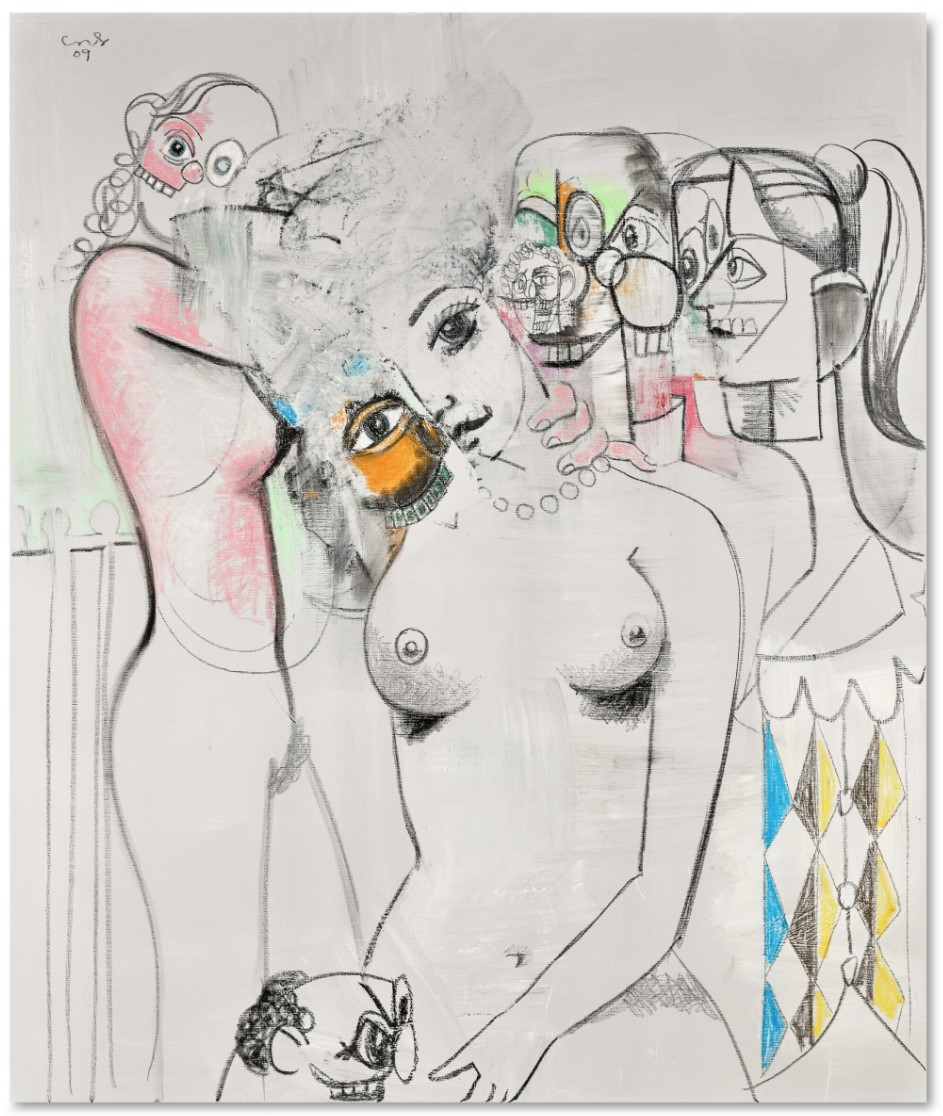
GEORGE CONDO (b. 1957)
Harlequin’s Diary, 2009
Acrylic, charcoal and pastel on linen, in artist’s frame
50×42 inches (127 x 106.7 cm)
Signed and dated 09 (upper left)
Executed in 2009, Harlequin’s Diary, is an exceptional paradigm of the George Condo’s lifelong engagement with distorting the human form. Master of both brush and hand, Condo deftly combines the hard-edged linear qualities of drawing with the sumptuous, loose nature of painting to create a hybrid composition where watery sections of paint collide with calculated charcoal lines. The present work illuminates a group portrait that is at once abstracted and fractured, as faces and forms morph into one another in a geometric maze. The diamond-patterned costume of the harlequin is evident in the lower right quadrant of the composition in bright shots of yellow and blue. The trope of the harlequin conflates Condo’s appreciation for the history of art (Picasso and Cézanne’s harlequins are a pivotal reference point here) with a flair for theatrical comedy and slapstick. From Condo’s dazzling Cubist colour-block passages in Harlequin’s Diary, the fractured outlines of heads and nude torsos emerge, taunting the viewer’s grasp the figurative truth within this densely abstracted compositional landscape.
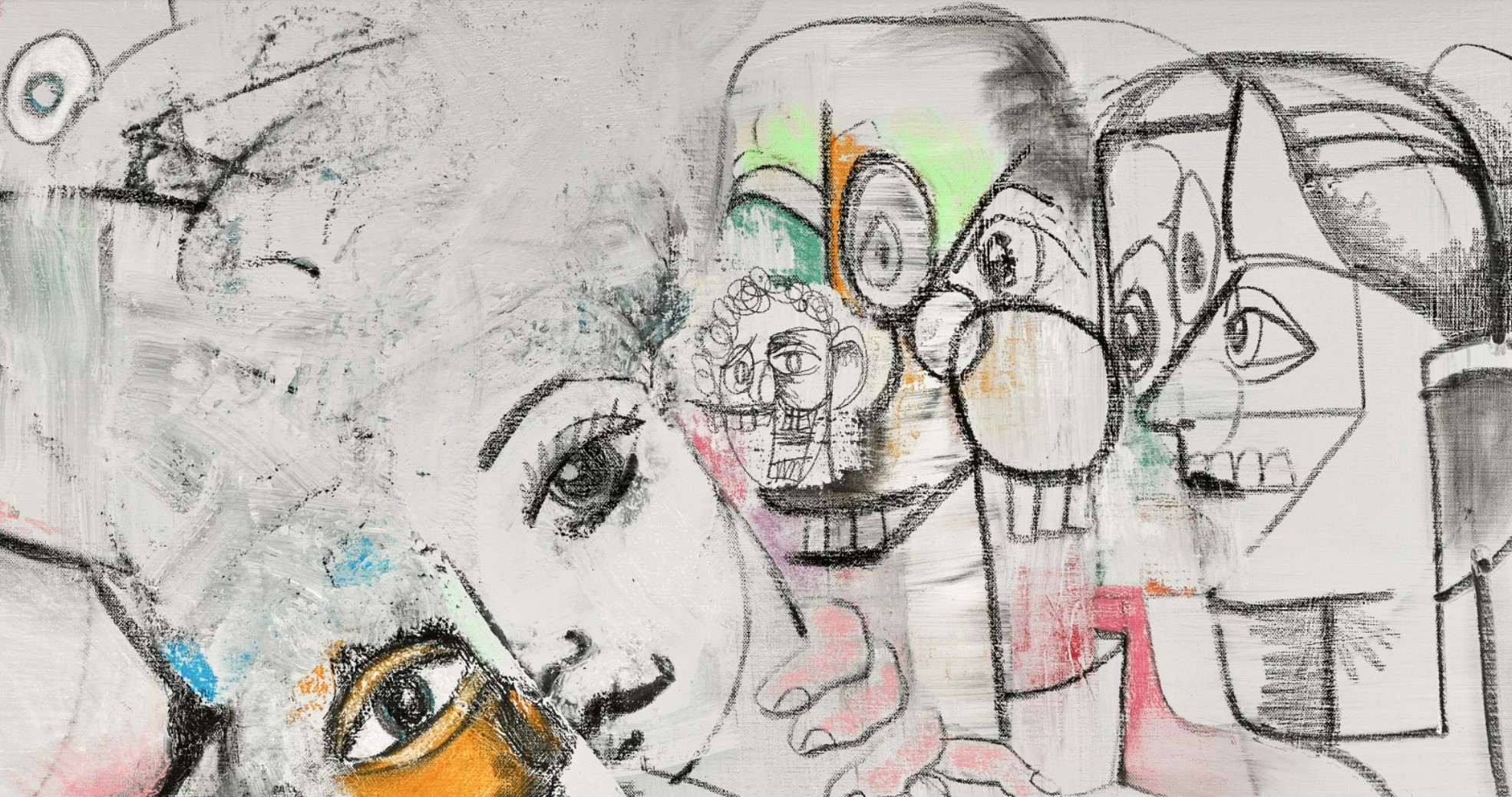
Juxtaposed against a glistening grey ground, this explosive synthesis of colour and form evocatively recalls Pablo Picasso’s masterful Cubist facture: Yet, where Picasso radically shattered the picture plane to explore multiple viewpoints in the same moment, Condo ruptures his compositions to reveal the multifaceted and kaleidoscopic complexities of human emotion and personality through his aptly self-termed mode of ‘psychological cubism’.
“I try to depict a character’s train of thoughts simultaneously – hysteria, joy, sadness, desperation. If you could see these things at once that would be like what I’m trying to make you see in my art.”
The figure of the harlequin fits perfectly in this theatrical description of a character’s psychology. From the 16th century the harlequin character has taken the role of a mischievous clown, a melancholic trickster who is also a loyal servant of the court. Harlequin’s Diary is a striking manifestation not only of Condo’s ability to blur the boundaries between drawing and painting, but also exemplifies his great interest in negating the boundaries between comedy and tragedy, and exploring a vast range of emotions via chaotically fractured abstraction. Fully departing from his early style of portraiture that relied heavily on an Old Master sensibility of dark baroque backgrounds and ample brownish tones, the present work is a fresh realization of Condo’s recent output.
Caroline Walker
Sotheby’s London: 27 June 2023
Estimated: GBP 200,000 – 300,000
GBP 457,200
Red Sky Morning | The Now Evening Auction | 2023 | Sotheby’s (sothebys.com)

CAROLINE WALKER (b. 1982)
Red Sky Morning, 2013
Oil on linen
200×280 cm (78 3/4 x 110 1/4 inches)
Signed, titled and dated 2013 (on the reverse)
Caroline Walker’s Red Sky Morning belongs to a series of paintings exhibited in her first institutional solo exhibition, In Every Dream Home, in London’s Pitzhanger Manor Gallery. As is characteristic of Walker’s now instantly recognisable style, the present work is a voyeuristic glimpse into the fictional days of her unnamed inhabitants, executed with a sense of cinematic desolation. Set against a striking pink sunrise, a silhouette of a modern domestic interior emerges, revealing a woman in the foreground who appears to be tending to an undiscernible object in the shadow. Traces of domestic life are dotted around the room, with a bunch of bananas left on the round glass table, and a chair which seems to have been left un-tucked. Beyond the glass window, there is a bottle set on the outdoor table, perhaps left from the previous night out on the terrace.

CAROLINE WALKER IN HER STUDIO WITH THE PRESENT WORK, 2013
IMAGE: © MARTIN NEWMAN, MIRRORPIX
ARTWORK: © CAROLINE WALKER
Architecture and interior design play an important role in Walker’s paintings, and in the present work, the modern furniture and large, floor-to-ceiling windows create a dramatic and distinctively modernist, domestic scene. Walker has long been interested in the notion of the “Grand Design,” the idea of dream homes and who resides in them. For the exhibition, In Every Dream Home, where the present painting was first shown, Walker was specifically inspired by the story of the Pitzhanger Manor, which was designed by the architect as a dream home for John Soane and his family. Taking on the notion of the perfect house and fictional characters residing in them, each canvas is a modernist dreamscape, populated by Walker’s imagination. Speaking of the mid-century modern design and architecture, Walker said: “I like the way that kind of architecture split up the space of the canvas. And also it blurs the line between public and private because of these huge plate-glass windows… So much of my work has always reflected my interest in a voyeuristic gaze, or those boundaries between public behaviour and private space, or between private behaviour in public space” (Caroline Walker quoted in: Caroline Walker and Marco Livingstone, Picture Window – Caroline Walker, London, 2018, p. 249). Indeed, Walker’s inclination towards modernist architecture in the present work is part of her investigation of female identity in relation to location. Often depicted alone, isolated within the confines of a private space, Walker’s female subject is compositionally in dialogue with their surroundings.
Adrian Ghenie
Sotheby’s London: 27 June 2023
Estimated: GBP 1,000,000 – 1,500,000
GBP 1,253,624

ADRIAN GHENIE (b. 1977)
Untitled, 2019
Oil on canvas
230×170 cm (92×68 inches)
Adrian Ghenie’s Untitled from 2019 is an important example demonstrating the artist’s ability to capture psychological intensity. Ghenie’s meteoric rise to fame has seen the artist become one of the leading painters of his generation, his work marked by a combination of blurred, rough textures and chiaroscuro tones which are at times shapeless, but elsewhere sharply outlined with the artist’s almost photograph definition. Depicting a mass of vulnerable limbs ambiguously placed on the vivid red couch, Untitled is painted in sweeps of crimson, canary yellow and amber, swirling and pulsating to illuminate the artist’s energetic handing of paint. Aiming at a sensual, intuitive perception of figuration, Ghenie’s combining of chaos and order affects the viewer on a physiological and visceral level.
Modern and Contemporary Evening Auction
Face to Face: A Celebration of Portraiture
27 June 2023
Auction Statistics
Total: GBP 190,320,940
# Lots: 60 Lots
# Lots withdrawn: 1 Lot
# Lots sold: 50
Sell-Through Rate: 84.7%
————
Top Lot: GBP 85,305,800
32 Lots sold above GBP 1 million
Revenues: GBP 180,789,590 (95% of total)
———
18 Lots sold Above Estimates: 31%
29 Lots sold Within Estimates: 49%
2 Lots sold Below Estimates: 3%
11 Lots unsold/withdrawn/EOR: 17%
Top 3 Lots
#1. Gustav Klimt
Sotheby’s London: 27 June 2023
Estimates on Request
GBP 85,305,800

GUSTAV KLIMT (1862 – 1918)
Dame mit Fächer (Lady with a Fan), 1917-1918
Oil on canvas
100.2 x 100.2 cm (39 1/2 x 39 1/2 inches)
Gustav Klimt’s beguiling representations of women have made him the most celebrated painter of the female portrait in the early twentieth century. Klimt’s women constitute the most important group of works in his oeuvre and are among the truly iconic images of Modern Art. The exquisite Dame mit Fächer belongs among the very best of his work and within a group of paintings that Klimt produced in the years directly before his death in 1918 and which might be considered the realisation of his mature artistic vision. It combines rich patterns and oriental motifs with the delicate and luminous human touch that makes Klimt’s portraits so sought-after. Technically accomplished, it reveals the artist exploring a new approach to colour and form whilst retaining the remarkable expressivity that elevates his portraiture above that of his contemporaries. As contemporary critic Bertha Zuckerkandl wrote of his women, it is ‘a sublime extract of the female type […] captured in pure style’ (quoted in The Women of Klimt, Schiele and Kokoschka (exhibition catalogue), Belvedere, Vienna, 2015-16, p. 61).

This transcendental notion of womanhood – the éternal féminin – had a long heritage, inspiring generations of artists and some of the most celebrated works ever painted. Klimt embraces this ideal whilst modernising it. His women are beautiful, and the unnamed portraits in particular are archetypal, yet his depictions are full of complexity and nuance. His women convey character and independence, whilst their bodies suggest passivity; their noli me tangere countenances create distance, yet the suppleness of their skin evokes a latent eroticism. These are contradictions that in many respects encapsulate the position of women in fin de siècle Viennese society. As society changed, with more radical elements encouraging equality among the sexes – and even discussion of female desire – representation of women centred on a Madonna/whore paradox in which women could only be saint or sinner. Klimt’s art – modern both in form and sensibility – eschewed such dichotomies.
#2. Lucian Freud
Sotheby’s London: 27 June 2023
Estimated: GBP 8,000,000 – 12,000,000
GBP 9,586,700

LUCIAN FREUD (1922 – 2011)
Night Interior, 1968-69
Oil on canvas
50.8 x 50.8 cm (20×20 inches)
Beautiful and full of emotive depth, Night Interior is an astonishing and defining image in Lucian Freud’s oeuvre. Depicting Penny Cuthbertson naked and resting in the artist’s Paddington studio, Freud captures the delicate poise of her turned head and the sinuous curves of her body through a virtuoso of looping, arching brushstrokes to deliver a painting full of impulse and exacting, spectacular detail. In the present work Cuthbertson appears relaxed and serene, her head tilted to one side, slightly away from the painter, her eyes shut, dreaming. Indeed, the viewer glimpses an intimate moment of privacy within the glowing light of Freud’s studio. In this entrancing portrait, Freud captures an intensely private moment, and in doing so he succeeds in grasping the pure essence of humanity, a feat which lies at the core of his greater repertoire. Between 1966 and 1970 Freud executed seven portraits of Cuthbertson, his most important sitter of the period. This group of portraits comes to a magnificent conclusion in the present work, the very final painting of her. In his celebrated autobiography on Freud, William Feaver writes that this group of works were, “transformative, there was a dawning assurance in the way she presented herself and the way he painted her, there on the floor, first awake then sleeping, confidently relaxed, her skin lustrous, her status as a ‘nude’ no big deal… she was the practiced accomplice, inured to posing casually” (William Feaver, The Lives of Lucian Freud: Youth 1922-68, London 2022, p. 596). As an instantly recognisable work within Freud’s celebrated canon of portraiture, Night Interior exemplifies the artist’s exacting technique and sensational attention to detail.

This painting is an exquisite testament to the superlative power of Freud’s preoccupation with the single-figure portrait – a fascination that spanned over seven decades and lies at the very heart of his oeuvre. Freud’s fascination with the portrait was restricted solely to those closest to him and his everyday life in places he was familiar with. Indeed, he once said that “I work from people that interest me, and that I care about and think about, in rooms that I live and know” (Lucian Freud quoted in: John Russell, Lucian Freud, London, 1974, p. 13). Night Interior powerfully encompasses everything about Freud in one painting: the artist, the model, and the studio; his entire environment is here summed up in striking detail. As critic and author Sebastian Smee has written: “Freud’s portraits do not presume to know their subjects definitively… Instead, they do something far more subversive and, in the end, moving. Even as he scrutinises his models with the utmost intensity, Freud powerfully registers their unknowability. In doing so, he grants them a depth of human freedom; this in turn provokes an impulse in the viewer to accord them a genuine, a believable reality” (Sebastian Smee, Lucian Freud, London 2005, p. 7). Painted with exceptional prowess, Night Interior is at once tender and meditative, intimate and contemplative.
#3. Cy Twombly
Sotheby’s London: 27 June 2023
Estimated: GBP 8,000,000 – 12,000,000
GBP 8,962,540

CY TWOMBLY (1928 – 2011)
Untitled, 1970
Oil based house paint and wax crayon on canvas
61 x 74 3/4 inches (155×190 cm)
Signed and dated 1970 (on the reverse)
Belonging to the artist’s iconic series of ‘Blackboard’ paintings created between 1968 and 1971, Cy Twombly’s Untitled of 1970 reflects a period of great convergence in post-war art. The titanic modes of Abstract Expressionism, Minimalism, and Pop art proposed competing philosophies for the grand trajectory of progressive innovation; herein Twombly’s reverberating and now iconic loops atop expressive grounds refract these overlapping spheres of influence. Many works in this series comparable in scale and execution belong to the world’s most renowned museums and institutions, including: The Museum of Contemporary Art, Los Angeles; The Menil Collection, Houston; The Solomon R. Guggenheim Museum, New York; and the Benesse House Museum, Naoshima. However, unlike every other ‘Blackboard’ painting that bears white loops on a grey ground, the rare umber and dark grey marks here juxtapose frenetic mark-making with a sense of calm serenity also evocative of the drawings of the High Renaissance.

In the present work seven majestic horizontal bands of loops increase in volume and expressive abandon as the artist progressed down the length of the canvas –Twombly’s lassoed lines herein lose regularity and control. A seemingly frenzied dispersion of graphic mark-making is in fact the result of finely-honed technical precision: the march of elliptical repetitions is expertly rendered to achieve an irresistibly hypnotic urgency. This stark, graphic linearity cascades across a highly seductive pale ground rendered through a forceful assault of brushwork. The variegated tonal architecture of light grisaille hues functions like geological strata, having trapped within its oil layers the shadows of drips, smears and strokes. With all the rough, fractured rawness of street graffiti, in these works Twombly presented an entirely novel visual language that innovatively explores both the most elementary and the most sophisticated concerns posed by the genesis of creativity.
Other Highlights
Jean-Michel Basquiat
Sotheby’s London: 27 June 2023
Estimated: GBP 3,500,000 – 5,500,000
GPB 4,050,000

JEAN-MICHEL BASQUIAT (1960 – 1988)
Big Snow, 1984
Acrylic and oilstick on canvas
66 1/4 x 60 1/8 inches (168.3 x 152.8 cm)
Signed, titled and dated 1984 (on the reverse)
Bursts of popping, punchy, fast-paced, slap-dash imagery whirl across the sleek and snowy-white canvas of Jean-Michel Basquiat’s painting, Big Snow. Executed in 1984, the work pays homage to the great sporting legend Jesse Owens, who brought home four gold medals in the controversial 1936 Olympic Games in Nazi-era Berlin. Capturing Basquiat’s imagination with his gritty determinism in the face of adversity, Owens came to represent, for both the artist and the world at large, the prevailing of goodness over evil. Yet, as an African American athlete, Owens also symbolised for Basquiat the outdated, oppressive, and ongoing obstacles still surrounding race and inequality in 1980s America. Examining Basquiat’s iconography, his friend the artist Francesco Clemente would later state: “The athlete becomes an emblem for the prolonged repression and exploitation of African Americans and evokes commodification, commerce and modern slavery” (Francesco Clemente cited in: Exh. Cat., Ontario, Art Gallery of Ontario, Jean-Michel Basquiat: Now’s the Time, 2015, p. 16). Basquiat was deeply interested in athletic games, and famous African American sporting personalities – from sprinters, boxers and baseball players – frequently populate his canvases. As much celebratory tributes as poignant reflections on the pitfalls of contemporary society, paintings such as the present contend with some of the most profound themes explored throughout Basquiat’s tragically curtailed yet tremendously prolific career: race and racism, high art and ‘low’, history and mythology, celebrity and the marginalised, exuberance and the ephemerality of mortal existence. With its vibrant, energetic and impulsive iconography, Big Snow encapsulates Basquiat’s unique pictorial lexicon which wavers between the vivaciously dynamic and the quietly unsettling.

In January 1983, in the year before Big Snow was executed, Basquiat went on an excursion to St. Moritz to visit his art dealer and friend, Bruno Bischofberger. Inspired by the sparkling, snow-filled Alps that surrounded him, Basquiat painted a number of works during this time that were evocative of the white and wintery scenes he encountered there. Basquiat was introduced to Andy Warhol by Bischofberger in 1982, and subsequently the two artists began to collaborate together. In the same year that Big Snow was created, the duo painted a vibrant large-scale canvas entitled Olympics. In both paintings, the five iconic Olympic rings are similarly rendered in vivid hues against the bright, white, snowy expanse of each backdrop. They allude, at once, to the Winter Olympics which had been twice hosted in St. Moritz in 1928 and 1948, the aforementioned Berlin Olympics of 1936, and the 1984 Summer Olympics which were held in Los Angeles, California, the very year these works were produced. Ever the purveyors and chroniclers of their contemporary moment, it is of little wonder that both Basquiat and Warhol were drawn to this pertinent and globally significant event. Basquiat was particularly captivated by the dynamism and vigour of the sporting world, and felt a great affiliation to boxing which dated back to his childhood when he would watch matches with his father, Gerard Basquiat. As his father recalled, “I was a big fan of boxing, and when he was a kid, there would be fights on television every Friday” (Gerard Basquiat cited in: ibid., p. 15). Countless of Basquiat’s paintings make both visual and textual reference to famous boxers of the time, from Cassius Clay and Joe Frazier, to Sugar Ray Robinson and Jersey Joe Walcott. The latter, a professional boxer who competed from 1930 to 1953 and held the world heavyweight title from 1951 to 1952, is honoured at the bottom left of the present work with a humorous, comic-strip-like caricature of a head which, having just been thwacked with a boxing glove (‘BLIP!’), is surrounded by dizzying, cartoonish stars.

JEAN-MICHEL BASQUIAT, BROOK BARTLETT AND BRUNO BISCHOFBERGER AT THE CRESTA CLUBHOUSE IN ST. MORITZ ON 30 JANUARY 1983
IMAGE: © CHRISTINA BISCHOFBERGER, COURTESY GALERIE BRUNO BISCHOFBERGER, MÄNNEDORF-ZURICH, SWITZERLAND
The spiraling green line in Big Snow zips across the picture plane like a ski track through soft plumes of snow. As if traversing space and time, it reads as a metaphorical link between the different sporting events and heroes represented and alluded to in the work. In this merging and coalescing of different temporalities, Basquiat seems to hint at a contemporary world still plagued by stiflingly outmoded attitudes towards race, as in the 1930s. In spite of his own meteoric rise to fame and fortune in the 1980s, Basquiat encountered a great deal of discrimination during his lifetime. At the height of his success, he would famously walk around in paint splattered Armani suits, wads of cash bulging from his pockets, and yet nevertheless experienced deep-rooted racism due to the color of his skin. As Keith Haring recalled, “Being black and a kid and having dreadlocks, he couldn’t even get a taxi. But he could spend $10,000 in his pocket” (Keith Haring cited in: Michael Wines, ‘Jean-Michel Basquiat: Hazards of Sudden Success and Fame’, The New York Times, 27 September 1988, online). For Basquiat, this poignant paradox was nowhere better illustrated than in the arena of sports, where many African American athletes rose to stardom but were frequently exploited for their commodity value. Considering this dichotomy, curator Dieter Buchhart notes, “At a time when black Americans were still lynched for hitting white men, the physical victories of black men over their white counterparts were powerful moments in the African American consciousness. In Basquiat’s visual vocabulary, the boxing match thus serves as a synonym for the ‘race war’ between black and white” (Dieter Buchhart, ‘Against All Odds’ in: op. cit., p. 15). This is powerfully demonstrated in an Untitled painting from 1983, housed in the collection of the Museum Boijmans Van Beuningen, Rotterdam, which depicts a boxing champion, arms spread wide in a pose of victory. A halo encircles his head, while his face is ambiguously masked by a white, skull-like façade, provocatively insinuating the ongoing race struggle in America at the time.
Gerhard Richter
Sotheby’s London: 27 June 2023
Estimated: GBP 2,000,000 – 3,000,000
GPB 3,194,000

GERHARD RICHTER (b. 1932)
Abstraktes Bild, 1994
Oil on canvas
71×61 cm (28×24 inches)
Signed, titled, dated 1994 and numbered 801-4 (on the reverse)
Gerhard Richter’s abstract paintings of the 1990s stand among the most accomplished of his career. Simultaneously revealing and concealing exquisite chromatic layers, Abstrkates Bild of 1994 bespeaks Richter’s mastery of the squeegee method, an approach to creating non-referential pure abstractions that are resplendent in colour and conceptually complex. Articulated in breathtaking tonal shades of red, green, white and punctuated with bursts of yellow, Abstraktes Bild exhibits an extraordinary breadth of colour and miraculously scraped-back vibrancy. Embodying a masterpiece of scaled down proportions, Abstraktes Bild delivers a superlative equilibrium between illusion and allusion, erasure and construction, veiling and revealing.

Since the very outset of his career during the early 1960s, Gerhard Richter has called into question the conceptual underpinnings of painting and representation. Now considered the greatest artist living today, Richter’s career long conceptual project has ushered in the practice of painting as a legitimate critical dialogue firmly established in the Post-Modern canon. Navigating a systematic trajectory of incredibly disparate but thematically related painterly approaches, at once including his formative Photo Paintings, Stadtbilder, Colour Charts, and the monochrome Grau Paintings, Richter’s career represents a cumulative inquiry into representation and abstraction in paint as marked by the stamp of our increasingly media saturated contemporary age. Positioned at the vanguard of this continuing project are the Abstrakte Bilder. As forcefully illustrated by the present work, Richter’s exploration into the field of abstraction stands distinct from both the formal and chromatic sparseness of minimalism, and the impassioned or emotive gestures of abstract expressionism. Rather, evoking the aesthetic blur of photography and immaculate cibachrome lamina of the print, Richter’s semi-automated procedure of repeatedly drawing tract-like layers of paint across the canvas with the squeegee incites a harmonic yet compositionally discordant painterly equilibrium. Achieved via a balance of contingency and agency, these works represent fraught palimpsests of Richter’s battle with painting as an independent autonomous entity.
Jean-Michel Basquiat
Sotheby’s London: 27 June 2023
Estimated: GBP 1,200,000 – 1,800,000
GBP 1,681,500

JEAN-MICHEL BASQUIAT (1960 – 1988)
Untitled, 1982
Oilstick and marker pen on paper
22 1/4 x 30 1/8 inches (56.5 x 76.5 cm)
Jean-Michel Basquiat’s Untitled of 1982 is a masterful example of the artist’s instinctive and revered ability as a draughtsman. Typical of Basquiat’s works on paper, Untitled explodes with urgency in the repetitive mark-making, variance of colour and the frenetic economy of its composition. Here a pirate-like character brandishes a sword and stands tall; wearing a crown of thorns and sanctified by a halo, he is accompanied by a rudimentary sea-faring vessel. Herein, this piece includes one of the artist’s most iconic and well-known tropes – the warrior-like figure which dominates many of Basquiat’s most important large-scale works on canvas. Undeniably heroic, this is the kind of archetypal portrayal that forms the very cornerstone of Basquiat’s oeuvre. Calling upon an iconographic history of Christian imagery from Christ wearing the crown of thorns to the golden halos of hallowed saints and celestial beings, Basquiat assimilates an eminent art historical canon in an expression of contemporary popular culture and black identity. The figures that typically populate Basquiat’s work are those he feels motivated to ennoble and elevate – his heroes and himself. Channelling the influence of cartoons and television, Untitled fuses popular culture references with Basquiat’s idiosyncratic figuration in which art historical influence and Pop culture forge an important dialogue on contemporary representation.

Conjuring allusions to the graceful scrawls and scribbles of Cy Twombly – an artist for whom he held a deep admiration – the glimpses of Basquiat’s graphic forms invoke a sort of proto-handwriting: a primitive kind of expression that strives toward resolution and legibility but is suspended in a perpetual territory of formal symbolism, akin to our contemporary reading of pre-historic mark-making. Phoebe Hoban captures this notion saying that, “Basquiat’s work, like that of most of his peers, was based on appropriation… the images he appropriated whether they were from the Bible or a chemistry textbook – became part of his original vocabulary… Basquiat combined and recombined these idiosyncratic symbols throughout his career: the recursive references to anatomy, black culture, television and history are his personal hieroglyphics.” (Phoebe Hoban, Basquiat: A Quick Killing in Art, New York 1998, p. 332) The young artist sampled from everyday life, art history, and a variety of cultural and socio-political semiotics oftentimes separating and isolating signs and texts, each containing layered histories. This diverse lexicon served as both image and a chronicle of language itself, overheard and spoken, a voice which visualized the slogans and jargon of the moment.
Elizabeth Peyton
Sotheby’s London: 27 June 2023
Estimated: GBP 500,000 – 700,000
GBP 349,250

ELIZABETH PEYTON (b. 1965)
Angela, 2017
Oil on board
17×14 inches (43.2 x 35.6 cm)
Signed, titled and dated 2017 (on the reverse)
Executed in 2017, Angela exemplifies Elizabeth Peyton’s transfixing investigation into the genre of portraiture. Looking directly at the viewer with a relaxed gaze and a gentle smile, Peyton’s depiction of Angela Merkel portrays the well-known political leader with a softness and warmth that is distinctive to her celebrated style. Previously shown at her 2019 exhibition at the National Portrait Gallery, Elizabeth Peyton: Aire and Angels, where selected works from the Gallery’s collection were shown alongside Peyton’s paintings, the present portrait follows in the lineage of historical portraiture of political leaders.
Modern and Contemporary Day Auction
28 June 2023
Modern & Contemporary Day Auction | 2023 | Sotheby’s (sothebys.com)
Auction Statistics
Total: GBP 16,297,360
# Lots: 138 Lots
# Lots sold: 98 Lots
Sell-Through Rate: 71%
Top 3 Lots
#1. Claude Monet
Sotheby’s London: 28 June 2023
Estimated: GBP 1,200,000 – 1,800,000
GBP 1,923,500
Marine | Modern & Contemporary Day Auction | 2023 | Sotheby’s (sothebys.com)

CLAUDE MONET (1840 – 1926)
Marine, 1882
Oil on canvas
53.8 x 65.3 cm (21 1/4 x 25 3/4 inches)
Stamped Claude Monet indistinctly (lower right)
Stamped Claude Monet (on the reverse)
The seventh Impressionist exhibition, held in Paris in March 1882, was a critical and commercial triumph. Claude Monet exhibited 35 paintings and was hailed as a contemporary great by the hundreds of visitors who poured through the gallery doors. Buoyed by this success, Claude Monet arrived with his family at Pourville on the Normandy Coast in June and produced a range of works imbued with a palpable sense of renewed purpose and artistic confidence. Among scenes featuring boats, fishermen’s nets and beach-goers, Monet produced four distinctive oil paintings, which radically verged on near-abstraction. In these paintings, form and figure disintegrate almost entirely, and sea melds into sky in a bold medley of striated color. Of the four paintings, Marine bears the closest comparison to Marine (La mer à Pourville) in the permanent collection of the Philadelphia Museum of Art.
Andy Warhol
Sotheby’s London: 28 June 2023
Estimated: GBP 150,000 – 200,000
GBP 368,300
Flowers | Modern & Contemporary Day Auction | 2023 | Sotheby’s (sothebys.com)

ANDY WARHOL (1928 – 1987)
Flowers, 1964
Acrylic and silkscreen ink on canvas
5×5 inches (12.7 x 12.7 cm)
Signed and dedicated Drue 75 LOVE on the overlap
With dream-like azure blossoms gleaming against the ink black foliage beneath, the present Flowers composition belongs to one of Andy Warhol’s most celebrated and beloved series, the Flower Paintings of 1964. Since their execution, Warhol’s Flower Paintings have pervaded a global consciousness as the totemic standard of classic American Pop; their imagery acting as talismanic metaphor for a generation that changed not only artistic but also social and political topographies in a supremely transformative decade. Unlike the artist’s legendary subjects of that period concerned principally with consumerism, celebrity, death and disasters, the Flowers corpus was a significant departure towards a more abstract and philosophically charged motif.
Ewa Juszkiewicz
Sotheby’s London: 28 June 2023
Estimated: GBP 80,000 – 120,000
GBP 203,200
Untitled | Modern & Contemporary Day Auction | 2023 | Sotheby’s (sothebys.com)

Ewa Juszkiewicz (b. 1984)
Untitled
Oil on linen
50.8 x 40.4 cm (20 x 15 7/8 inches)
Signed twice, titled and dated 2018 on the reverse
Investigating the role of the female sitter in contemporary portraiture, the present Untitled work from 2018 is a superb portrait from Juszkiewicz’s celebrated oeuvre. Set against a muted background, the present work depicts a woman wearing a white dress adorned by a delicate white bow, and looking towards the viewer, as suggested by her posture and the positioning of her head. The gaze is however obscured by the erasure of her face, with the back of the sitter’s head taking the central place within the composition instead. Juszkiewicz’s treatment, and indeed destruction, of traditional modes of portraiture suggest a subversion of the notion of the female sitter as passive subject of the male gaze. By concealing her sitter’s face, Juszkiewicz is not only magnifying the lack of agency of the female sitter throughout the art historical canon of portraiture, but also denying the contemporary viewer any glimpse of conventional beauty or aesthetic norm. Through this conscious unmasking of the face, the viewer must turn to contextual details to piece the work together, such as the luxurious textiles, garments and hairdo, which become key signs and symbolic markers for the essence of the feminine. Juszkiewicz deconstructs the historical narrative and places it firmly within the surreal and often grotesque, challenging the viewer and foregrounding the way in which female identity is distorted and constructed.
Phillips
20th Century to Now
20th Century to Now: London Auction June 2023 | Phillips
Elizabeth Peyton
Phillips London: 30 June 2023
Estimated: GBP 400,000 – 600,000
GBP 488,950
Elizabeth Peyton – 20th Century to Now Lot 11 June 2023 | Phillips

ELIZABETH PEYTON
Prince Harry, September 1998
Oil on board
26.1 x 21.1 cm (10 1/4 x 8 1/4 inches)
Signed, titled and dated ‘Prince Harry, September 1998 Elizabeth Peyton, Elizabeth Peyton 1998’
on the reverse
For American artist Elizabeth Peyton, the zeitgeist of our past and present historical moments are most accurately conveyed through the individual. Her luminous, small-scale portraits are intimately penetrating in their fixation on presence and have portrayed a broad spectrum of historical and popular figures from Napoleon Bonaparte to Kurt Cobain over the years. Making a compelling case for portraiture’s survival and importance in our own hyper-visual digital age, Peyton powerfully demonstrates how ‘people contain their time in their face’. Taking as her subject primarily people whom she either admires or feels an affinity with, Peyton’s work evidences the deep connection she forges with them, her languorous brushstrokes of luminous colour offering us a decluttered, phenomenological approach to the portrait which favours psyche and character over the tropes of naturalistic depiction. So humanizing in their effect and revolutionary in their aesthetic at a time when notions of beauty and grace had been written out of the conversation, Laura Hoptman contends that ‘there is no doubt that the creation and reception of Peyton’s paintings in the 1990s utterly changed the contemporary art landscape.’ii
‘‘There is no separation for me between people I know through their music or photos and some I know personally. The way I perceive them is very similar, in that there’s no difference between certain qualities that I find inspiring in them.’’
Prince Harry, September 1998 comes from one of her most iconic periods of work, when she captured the ethos at the turn of the 20th century through her depiction of popular figures from mediated images, drawing on ‘lives that are played out in the public arena of the mass media.’iii A subject which she has returned to time and again, the present work brilliantly illustrates the consciousness of the young prince on the cusp of adolescence, anxiously arriving at Eton for his first day of school – an intensely private, family moment that was made public through the nation’s press. Working from this original paparazzi photograph, Peyton focuses her attention closely on the young Prince’s face, restoring a humanising intimacy and fragility to this mass-reproduced and widely circulated image.
On this richly painted surface of luminous tones, Harry’s blood-red lips are powerfully affecting; sapping colour from his bleached cheeks, they draw on notions of composure and restraint as fundamental to Royal life, emphasised further in the young Prince’s expression here and in the knowledge of the recent, tragic loss of his mother. Peyton, with uttermost sincerity and compassion, depicts a young man caught in the passage between childhood and adulthood, private pain and public voyerism, depicting a singular moment when – for a split second – ‘the fickle nature of fame and celebrity appear temporarily arrested.’iv