Christie’s
20/21st Century Evening Sale
13 October 2022
GBP 72,533,850 (USD 81,974,928)
47 Lots Sold
Top Lot: GBP 20,899,500
Sell-Through: 100%
WHITE GLOVE SALE
47 Lots
Above estimates: 20 Lots (42%)
Within estimates: 15 Lots (31%)
Below estimates: 12 Lots (25%)
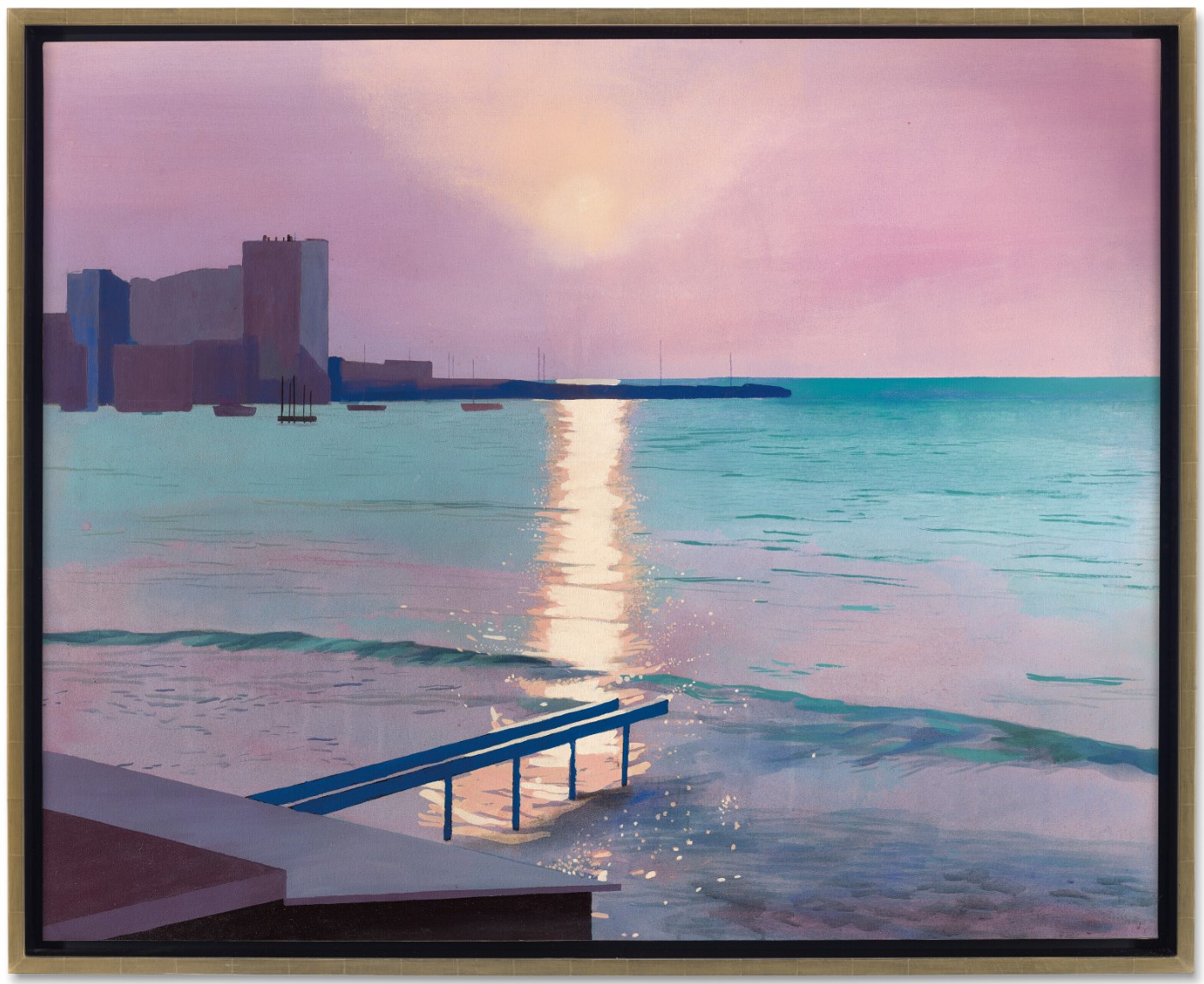
DAVID HOCKNEY
Early Morning, Sainte-Maxime, 1968-1969
Acrylic on canvas
48 1/8 x 60 1/8 inches (122.1 x 152.6 cm)
Estimated GBP 7,000,000 – 10,000,000
GBP 20,899,500
A sublime, radiant tribute to the South of France, Early Morning, Sainte-Maxime is a virtuosic tour de force dating from a unique moment in David Hockney’s early practice. Rendered in exquisite detail, it captures a majestic sunrise over the French Riviera, its glass-like waters bathed in the sparkling light of a new day. A fiery orb hangs low against a deliquescent pink and violet sky, casting a dazzling reflection that glistens like liquid gold. The sea, dotted with tiny luminous flecks, is awash with tones of purple, azure and aquamarine; in the distance, boats and buildings are dramatically silhouetted against the sky, while a midnight blue jetty slices through the foreground, the entire surface shimmering as it catches the light. Painted at the height of Hockney’s romance with Peter Schlesinger, the work’s poetic vista speaks to a time of both personal contentment and professional triumph. Situated between his seminal Californian swimming pool paintings and the ground-breaking ‘naturalism’ of his double portraits, its spectacular sweeping reflection seems not only to echo the gestural drama of his 1967 masterpiece A Bigger Splash (Tate, London), but also to foreshadow the glimmering waters of his poignant tribute to Schlesinger Portrait of an Artist (Pool with Two Figures) (1972). Included in Hockney’s first retrospective at the Whitechapel Art Gallery, London in 1970, and unseen in public for over three decades, it is a work of rare, near-cinematic beauty that—in both subject and style—ushers in a thrilling new dawn.
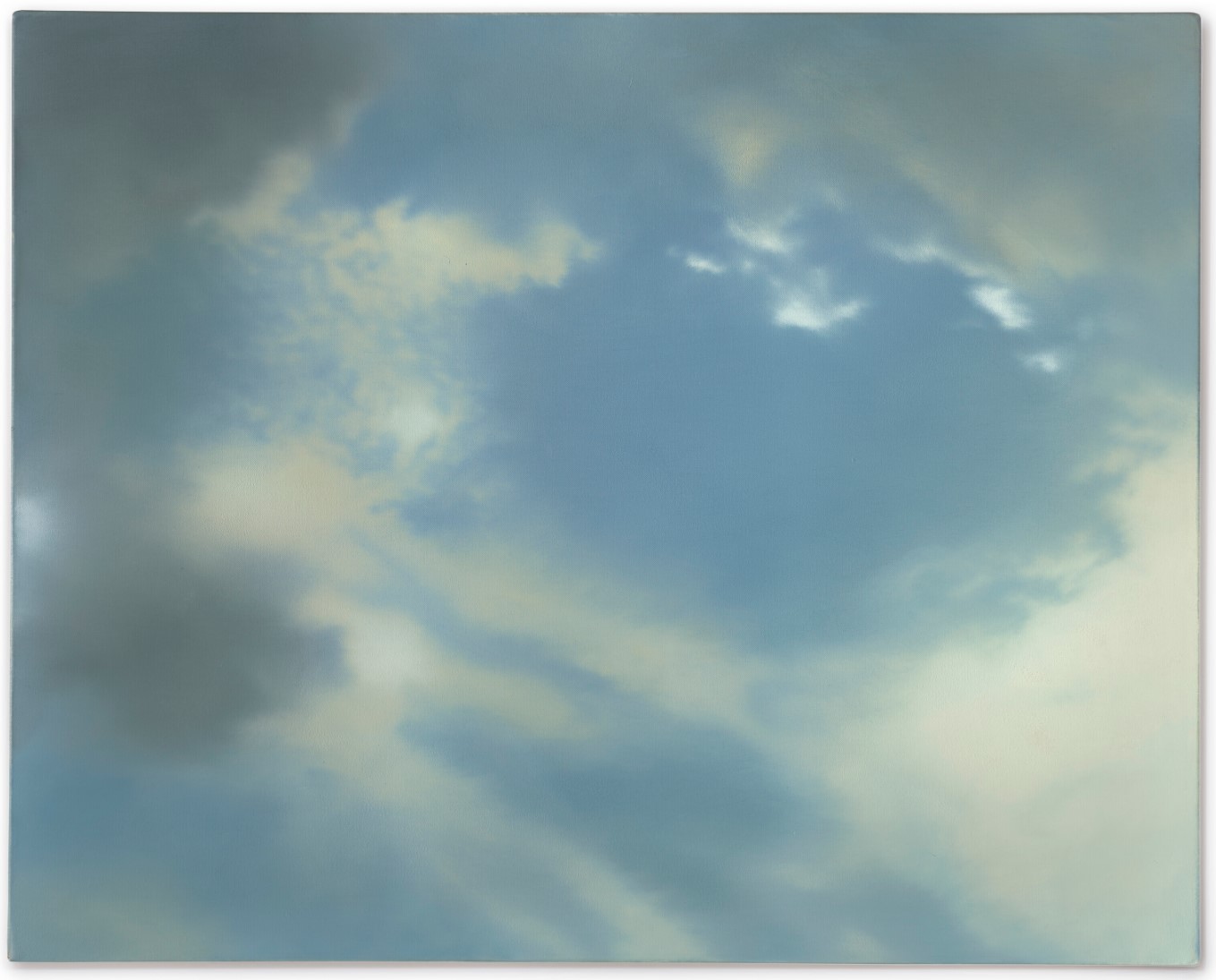
GERHARD RICHTER
Wolkenstudie (grün-blau) (Study for Clouds (Green-blue)), 1971
Oil on canvas
31 1/2 x 39 3/8 inches (80×100 cm)
Estimated GBP 6,000,000 – 8,000,000
GBP 11,167,000
Held in the same private collection for four decades, and never before seen in public, Wolkenstudie (grün-blau) (Study for Clouds (Green-blue) (1971) is a rare masterwork from Gerhard Richter’s celebrated series of cloudscapes. An extraordinary feat of technical and conceptual virtuosity, it poses as a sublime window onto the outside world: an exquisite, photorealist vision of deep green and blue sky tinged with radiant golden beams. With meticulous brushstrokes, the artist captures the diaphanous play of light and shadow across his celestial vista, creating a profound illusion of infinite depth. Simultaneously evoking and subverting the language of Romanticism, Richter’s cloudscapes played a pivotal role in his journey from photo-painting to abstraction, asking vital questions about painting’s purpose at a time when its future seemed uncertain. The present work stands among the most accomplished paintings in the series, taking its place alongside examples held in the Museum Folkwang, Essen, the National Gallery of Canada, Ottawa and the Kunst- und Ausstellungshalle der Bundesrepublik Deutschland, Bonn.
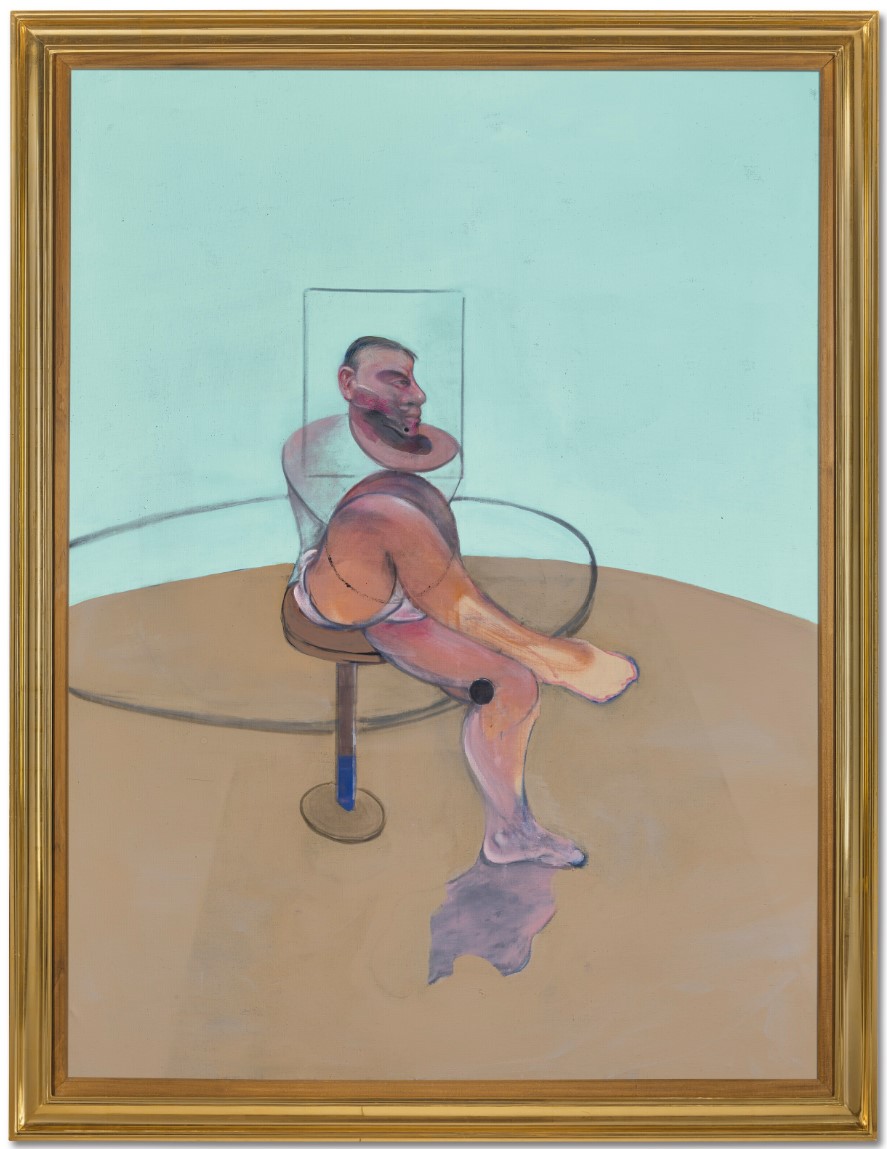
FRANCIS BACON
Painting 1990, 1990
Oil on canvas
78 x 58 1/8 inches (198 x 147.5 cm)
Estimated GBP 7,000,000 – 9,000,000
GBP 7,102,250
Painted just over a year before Francis Bacon’s death, Painting 1990 is a poignant and majestic work that stands among the artist’s last great canvases. Rendered in the stark, distilled painterly language that came to define his extraordinary late output, it is a radiant tribute to the vitality of the human form, its central figure aglow with the visceral dynamism of living flesh. According to Martin Harrison, author of the artist’s catalogue raisonné, Bacon’s subject is a hybrid vision. The face, framed like a portrait within a portrait, resembles José Capelo: the artist’s last significant love and muse, and the man he was visiting in Madrid when he died. The figure’s cross-legged pose, meanwhile, is hauntingly reminiscent of the artist’s former lover George Dyer—who tragically died in 1971—as well as his subsequent companion John Edwards. Both their forms populated Bacon’s art throughout the 1970s and 1980s: the present work, indeed, is the last in his oeuvre to feature this iconic posture. It is a powerful testament to those he loved—and had loved—and a vivid summation of his art.
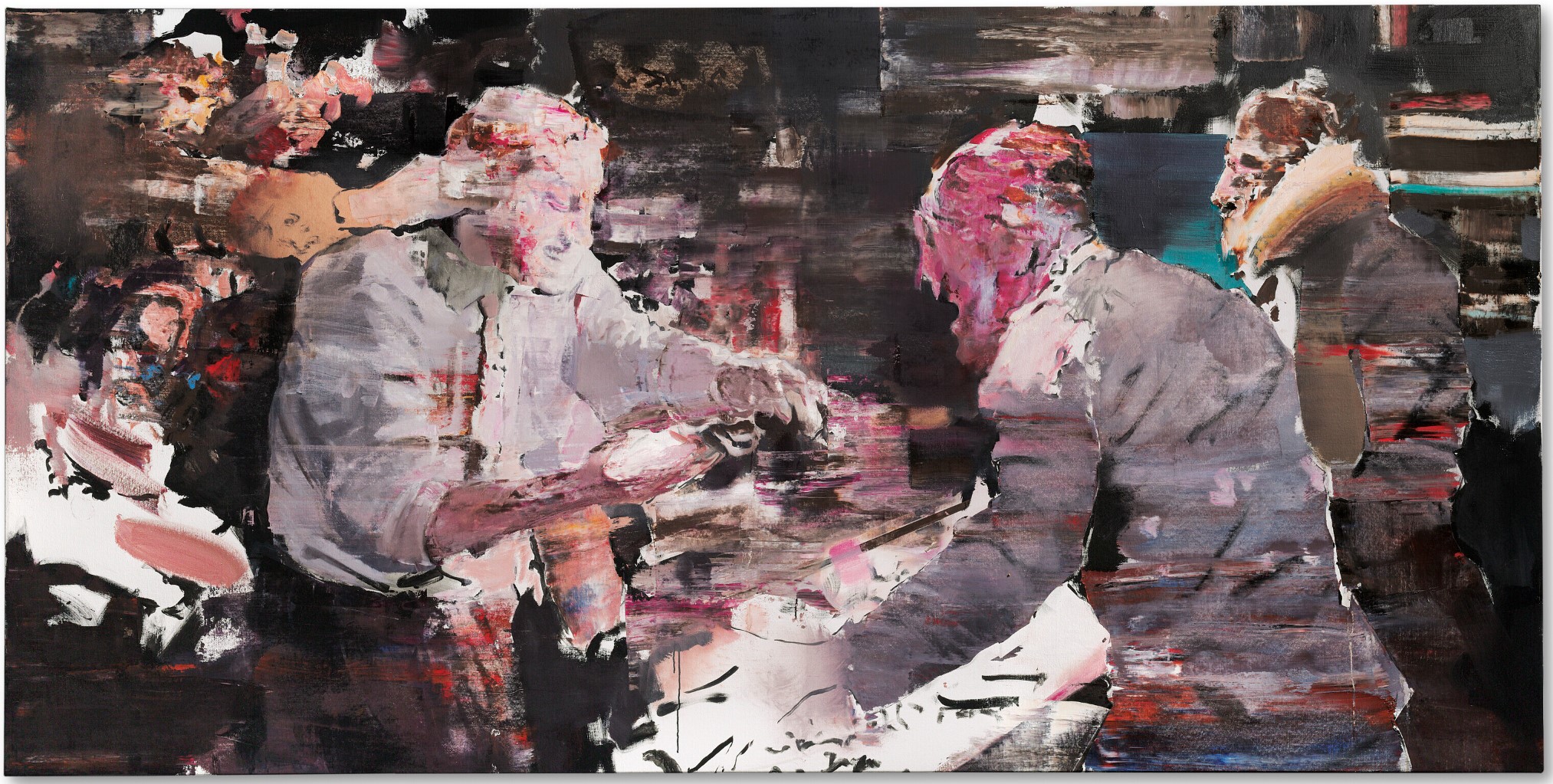
ADRIAN GHENIE
Turning Point 1, 2009
Oil on canvas
59 1/4 x 118 1/4 inches (150.5 x 300.5 cm)
Estimated GBP 2,200,000 – 2,800,000
GBP 2,682,000
A panoramic vision spanning three meters across, Turning Point 1 (2009) is a masterpiece of painterly and cinematic drama by Adrian Ghenie. Amid a maelstrom of marbled paint—red, turquoise and magenta flash through the chiaroscuro darkness—three figures face one another. The nature of their activity is lost amid the stuttering veils of pigment: they could be diplomats, gamblers at a table, or drinkers at a bar. The man in shirt-sleeves to the left wears a delirious grin, while the face and shoulders of the central figure are encrusted with florid paint. His obscured profile seems to echo one of Ghenie’s artist-heroes, Vincent van Gogh; the silhouette to the right recalls that of the Dadaist genius Marcel Duchamp. Relating closely to Ghenie’s iconic ‘Pie Fight’ works, which retool the slapstick of silent film to explore dark historical themes, the painting is based on a deleted scene from Stanley Kubrick’s 1963 movie Dr. Strangelove.
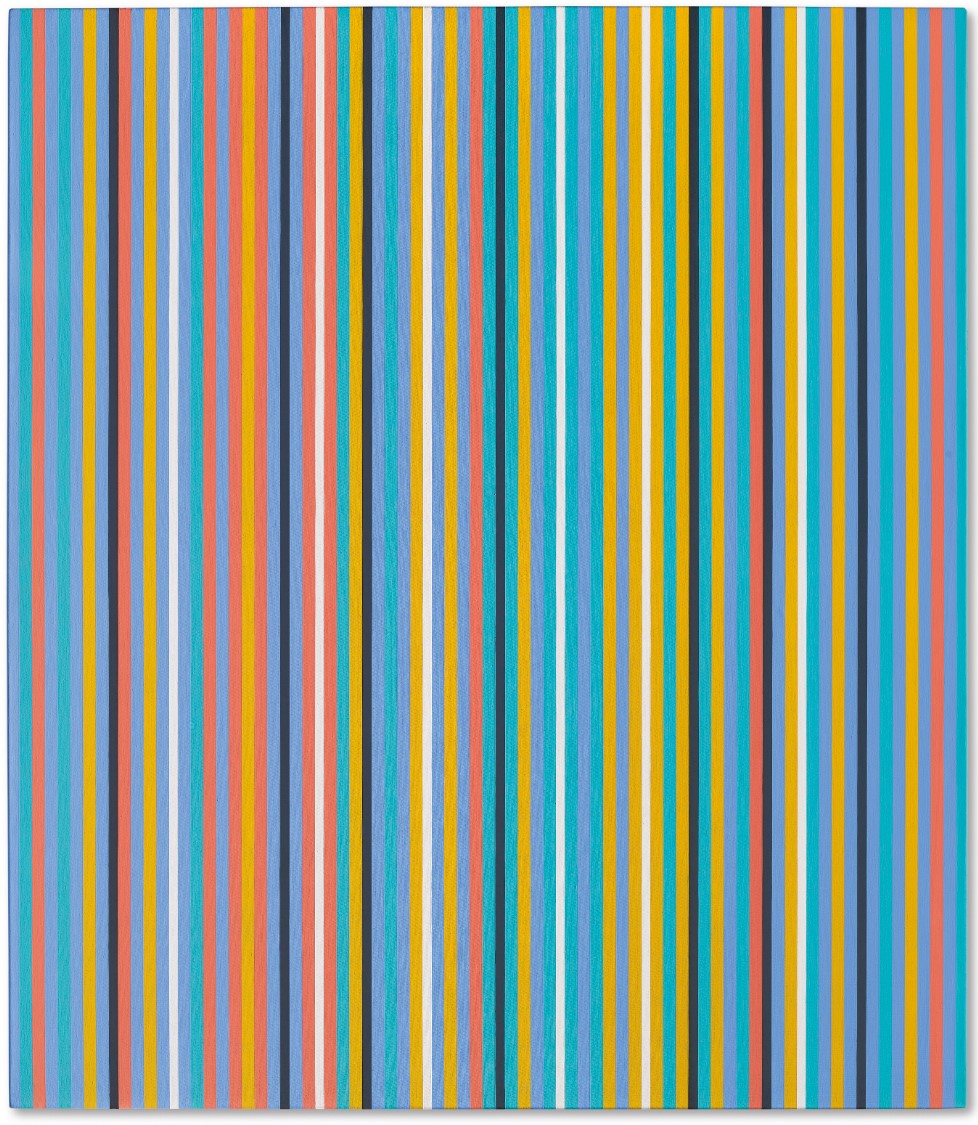
BRIDGET RILEY
Praise I, 1981-82
Oil on linen
65 x 56 1/2 inches (165.1 x 143.4 cm)
Estimated: GBP 1,200,000 – 1,800,000
GBP 2,202,500
Adazzling optical spectacle painted between 1981 and 1982, Praise I is a majestic large-scale work that stems from the revolutionary first phase of Bridget Riley’s career-defining ‘Egyptian palette’. Inspired by a trip to visit the tombs of the Pharaohs in the winter of 1979-1980, these works not only marked the artist’s return to her iconic stripes, but also introduced a set of colours that would give rise to some of her most distinctive paintings. The Egyptians, she noted, used a single chromatic spectrum, comprising turquoise, blue, red, yellow, green, black and white. Back in her studio, Riley mixed her own version of this palette, applying the colors in vertical bands of varying width. The presence of black, in particular, came to define the initial flurry of works created between 1981 and 1982: as Praise I demonstrates, it lends the surface a scintillating rhythmic quality, slicing through the luminous vibrations of the neighboring tones like a musical pulse. Nearly half of the works of this particular type are held in museums worldwide, including Tate, London, the Staatliche Museen zu Berlin, Nationalgalerie, the Kunsthaus Zurich and the Iwaki City Art Museum, Japan.
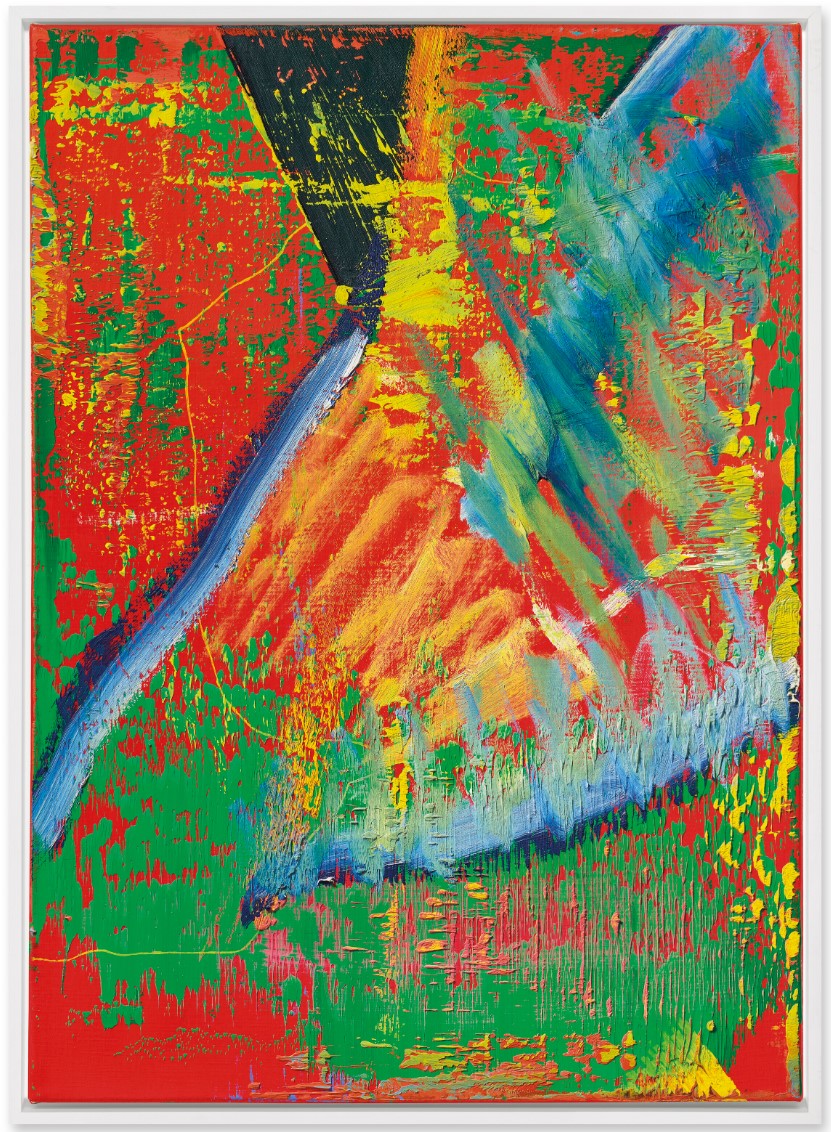
GERHARD RICHTER
Zacharopoulos, 1983
Oil on canvas
27 3/4 x 19 3/4 inches (70.4 x 50.3 cm)
Estimated: GBP 1,200,000 – 1,800,000
GBP 1,962,000
In Zacharopoulos (1983), leaf greens, bright yellows and blues clash before a blazing vermillion ground. With its incandescent streaks and stuttering veils of color—some dragged across the surface using the artist’s signature squeegee technique, and others blurred by rhythmic, feathery brushstrokes—it a superb example of his early-1980s abstract paintings, which stand among the most vibrant and striking of his decades-long career. ‘Before Richter began painting Abstract Pictures’, Robert Storr has written, ‘most people would not have thought of him as a colorist … Since then, it is hard to think of him as anything other than one of the great colorists of late twentieth-century painting’ (R. Storr, Gerhard Richter: Doubt and Belief in Painting, New York 2003, p. 112). The present painting is named for the art historian and theorist Denys Zacharopoulos: a noted scholar of Richter’s work who served as co-director of documenta IX in Kassel (1992) and curator of the French Pavilion at the 48th Venice Biennale (1999), among other exhibitions, and has taught as Professor in the Academies of Fine Arts in Geneva, Vienna, and Amsterdam.
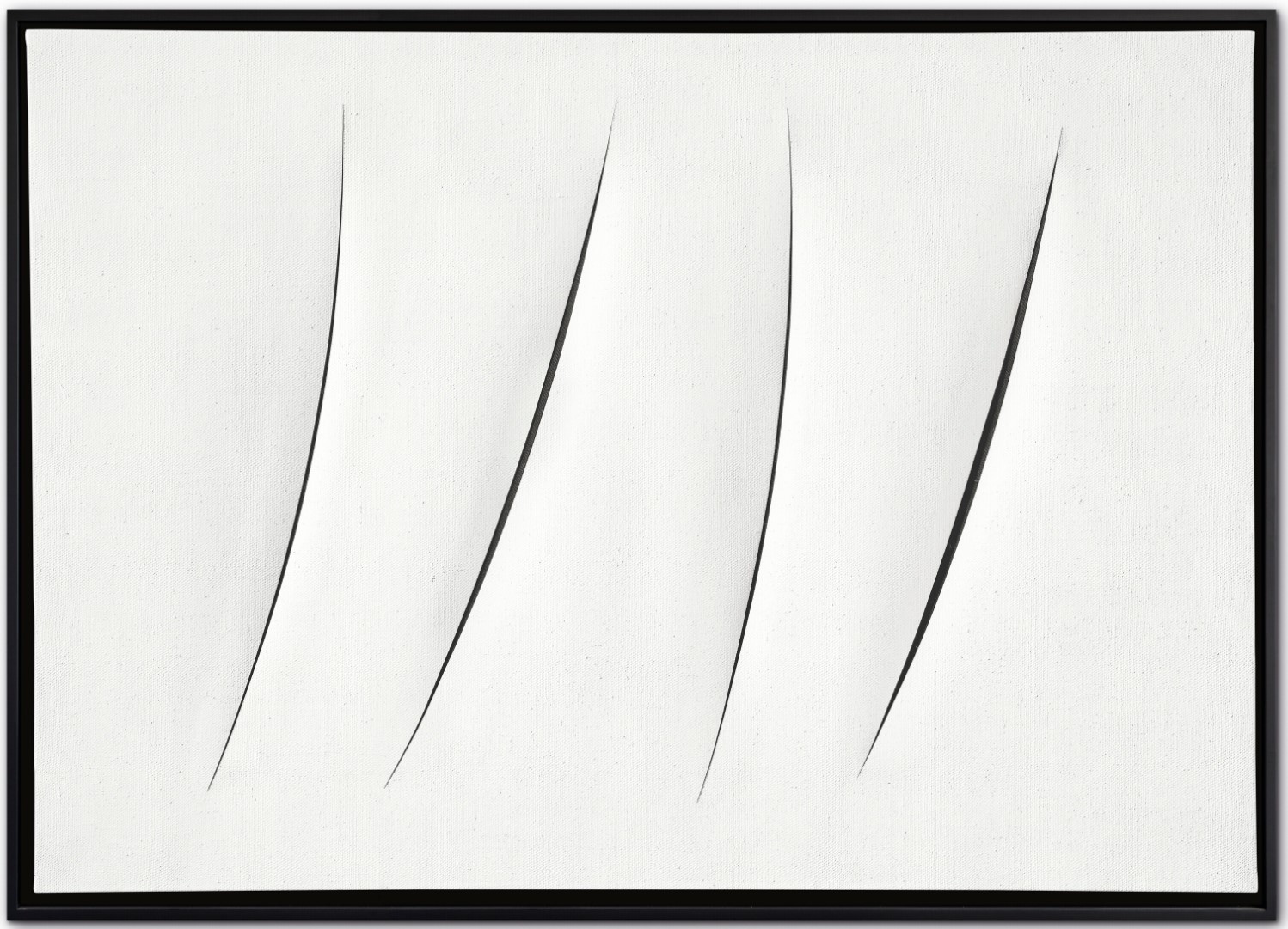
LUCIO FONTANA
Concetto spaziale, Attese, 1961
Waterpaint on canvas
25 5/8 x 36 1/4 inches (65×92 cm)
Estimated GBP 1,000,000 – 1,500,000
GBP 1,842,000
Executed in 1961—the year of Lucio Fontana’s solo American debut, and of Yuri Gagarin’s seminal journey into outer space—Concetto spaziale, Attese is a pure and elegant example of the artist’s celebrated tagli. Acquired from the pioneering Galerie Ad Libitum in Antwerp, an important centre for the international avant-garde during the 1960s and 1970s, the work’s four pristine strokes slice rhythmically through the immaculate white surface of the canvas, revealing the dark void. Begun three years earlier, following his early series of buchi (‘holes’), the tagli marked the culmination of his artistic philosophies. Seeking to match the spirit of the Space Age in art, Fontana’s iconoclastic slashing gesture broke new ground, opening up the unknown territory behind the canvas, and sealing time, movement and energy in its wake. The simplicity and purity of white took center stage in this practice, later immortalized in his prize-winning installation Ambiente Spaziale at the 1966 Venice Biennale. Other white tagli with four cuts are held in collections including Buffalo AKG Art Museum and the Fondazione Lucio Fontana.
NICOLAS PARTY
Landscape, 2016
Pastel on canvas
47 1/4 x 27 3/8 inches (120 x 69.5 cm)
Estimated GBP 500,000 – 700,000
GBP 1,482,000
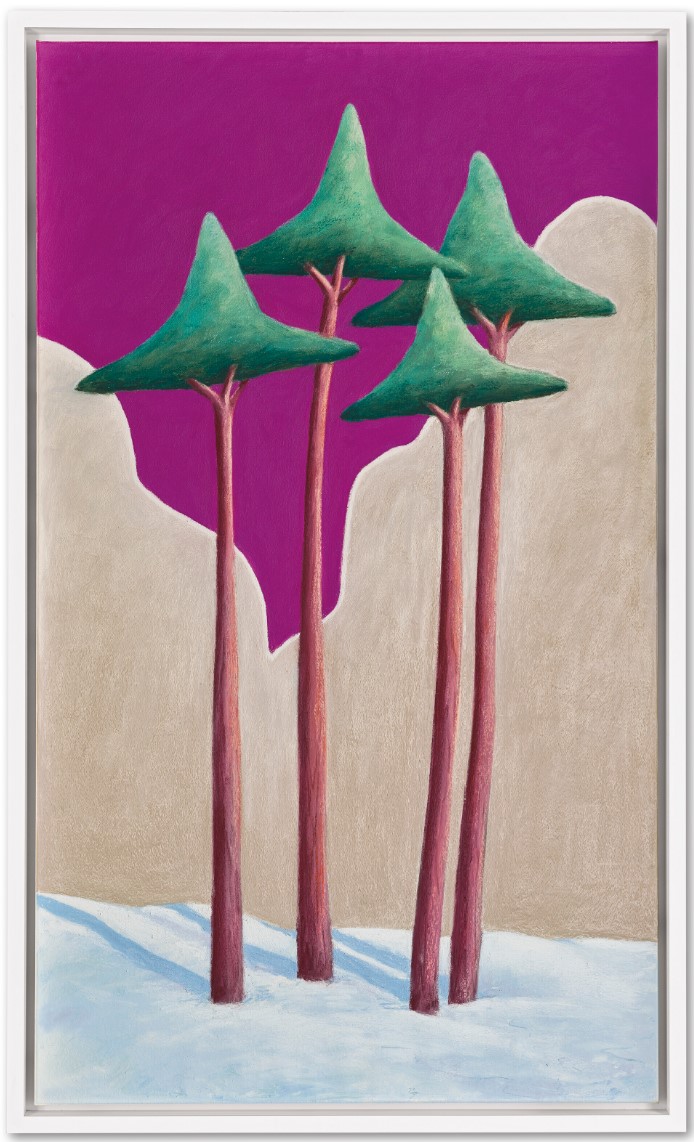
Spanning more than a meter in height, the present work is a sumptuous example of Nicolas Party’s celebrated pastel landscapes. Taking their place alongside his portraits and still lifes, these vivid, otherworldly visions represent a vital strand within his practice, drawing together the legacies of Surrealism, biomorphic abstraction and European landscape painting. Here, four sinuous trees shoot up from a pale, icy ground, each crowned by a deep green canopy. Mountainous forms loom large in the background, silhouetted against a deep purple sky. Party’s use of pastel is focused and precise, his colors and contours wrought with an almost painterly intensity. Executed in 2016, the work demonstrates his enduring interest in the natural world: a theme showcased in his 2017 exhibition sunrise, sunset at the Hirshhorn Museum and Sculpture Garden, Washington, D.C., and more recently explored in a series of works dedicated specifically to trees.
CHRISTINA QUARLES
Even in tha Evenin’, 2019
Acrylic on canvas
52×50 inches (132×127 cm)
Estimated: GBP 400,000 – 600,000
GBP 856,800
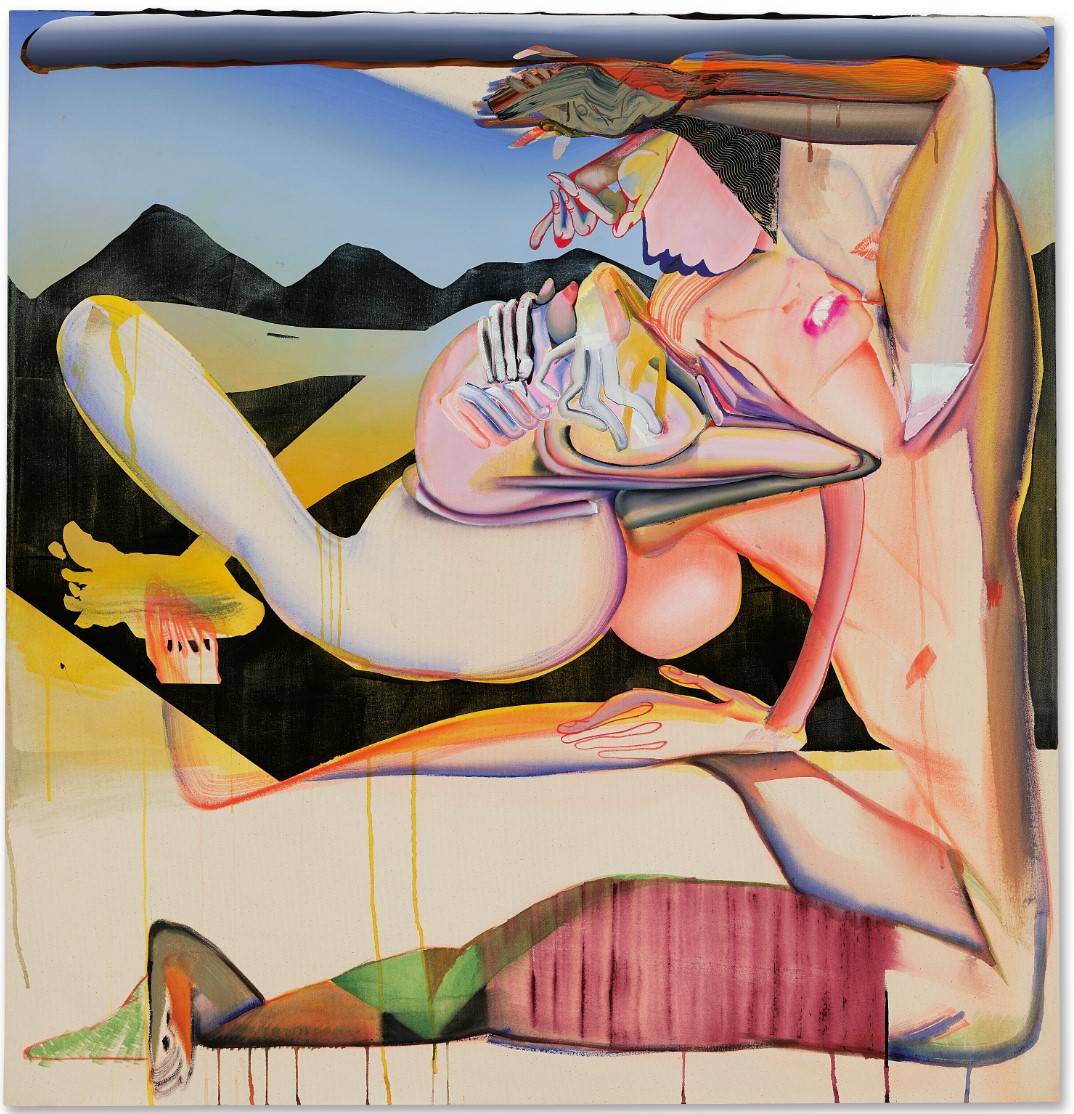
Bodies and limbs grasp and entwine one another across Christina Quarles’ Even in tha Evenin’, a vivid large-scale canvas from 2019. Quarles draws upon her own experience as a queer, multiracial woman to create polymorphous paintings that explore sensual, shifting states of identity. At least three figures seem to be involved in the present work: one contorts backwards at a right angle as if bounded by the edges of the picture, while a second leans back to meet it in a twisted embrace. A pile-up of hands meet on its arching abdomen, gripping breasts and interlacing fingers. Faces variously described—including a dilute grimace worthy of Francis Bacon, a pink profile in silhouette, and a face whose mouth appears to be an actual lipstick kiss—are framed by the figures’ raised arms. Ranging from slick impasto to sinuous washes of pink and purple and contoured shadings of neon hue, Quarles’ pigment is by turns translucent and opaque, delicate and strident, deployed in a dazzling diversity of techniques. She uses vinyl stencils to mask off some areas—creating a crisp-edged mountainous backdrop—and lets other passages rain drips down the raw canvas. One wedge of black is scored into wavy striations using a comb.
YAYOI KUSAMA
Cosmos (THOPS), 2008
Urethane resin on canvas
76 3/8 x 76 3/8 inches (194×194 cm)
Estimated GBP 300,000 – 500,000
GBP 831,600
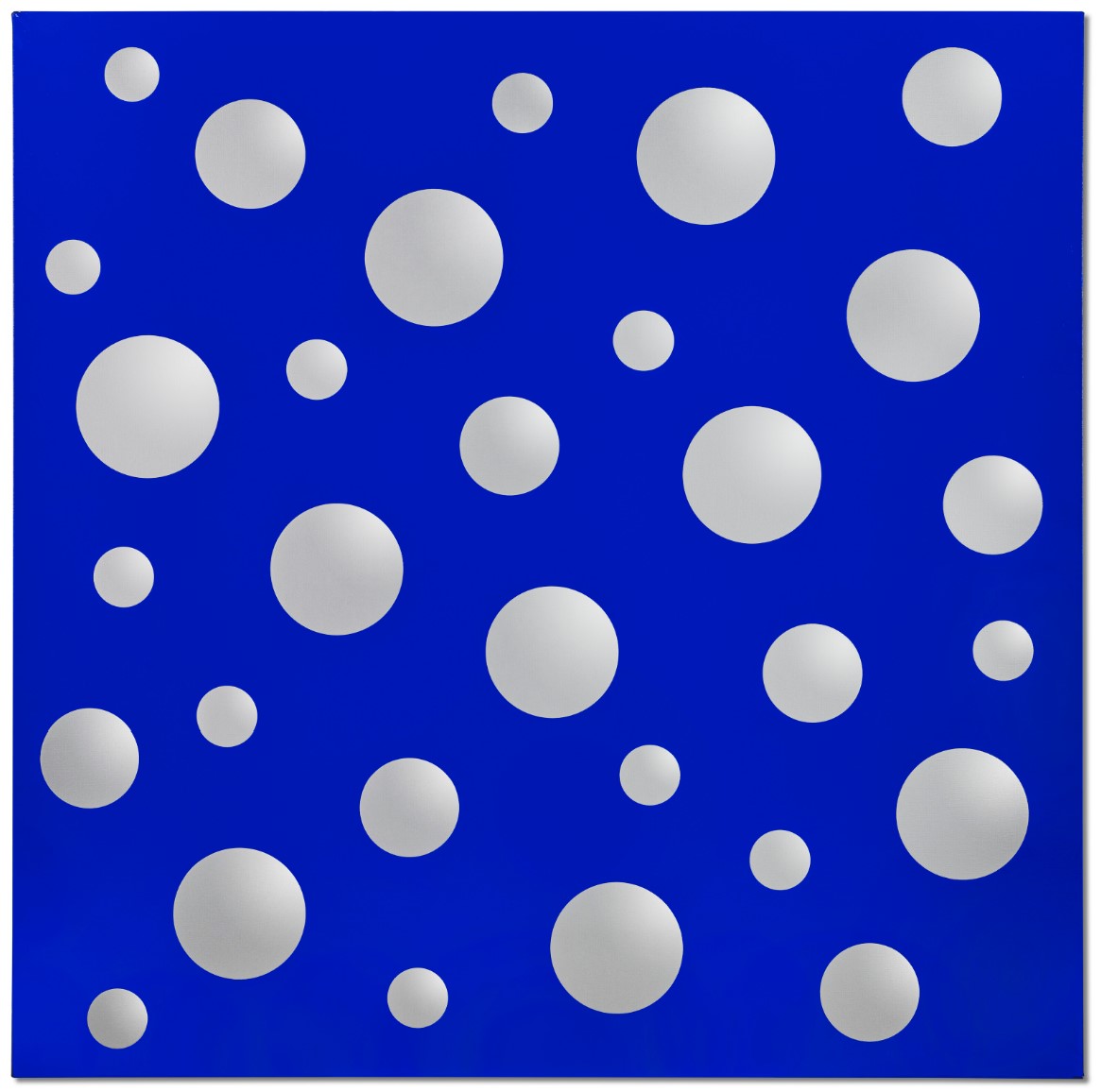
With its dynamic dance of silver discs amid a celestial expanse of cobalt blue, Cosmos (THOPS) (2008) is a mesmerizing example of the polka-dot motif that is among Yayoi Kusama’s most iconic themes. Where the dots in her first ‘Infinity Net’ paintings proliferated in dense webs of impastoed surface, later works such as the present see them expand in size and condense to a serene regularity, bespeaking a tranquil state of contemplation. At almost two meters in width and height, the present canvas offers a hypnotic vista of bold shape and color. The surface’s seamless perfection was achieved used urethane resin paint—a hard, glossy pigment that Kusama also uses in many of her large-scale sculptures. Rather than following any rigid system, the metallic circles are arranged organically, their three discrete sizes creating a mutual pulsation as if each holds its own gravitational field. While driven partly by the memory of phantasmagoric visions she suffered during her childhood, Kusama’s dots ultimately go beyond the biographical, evoking vast, unfathomable forces that lie outside the limits of human imagination. The present work was created during a triumphant period in the new millennium, shortly after she was awarded the 2006 Praemium Imperiale for Painting, Japan’s most prestigious international art prize.
YOSHITOMO NARA
Girl with a Knife, 1999
Acrylic, graphite, colored pencil and crayon on paper
20 1/8 x 14 1/8 inches (51×36 cm)
Estimated GBP 250,000 – 350,000
GBP 882,000
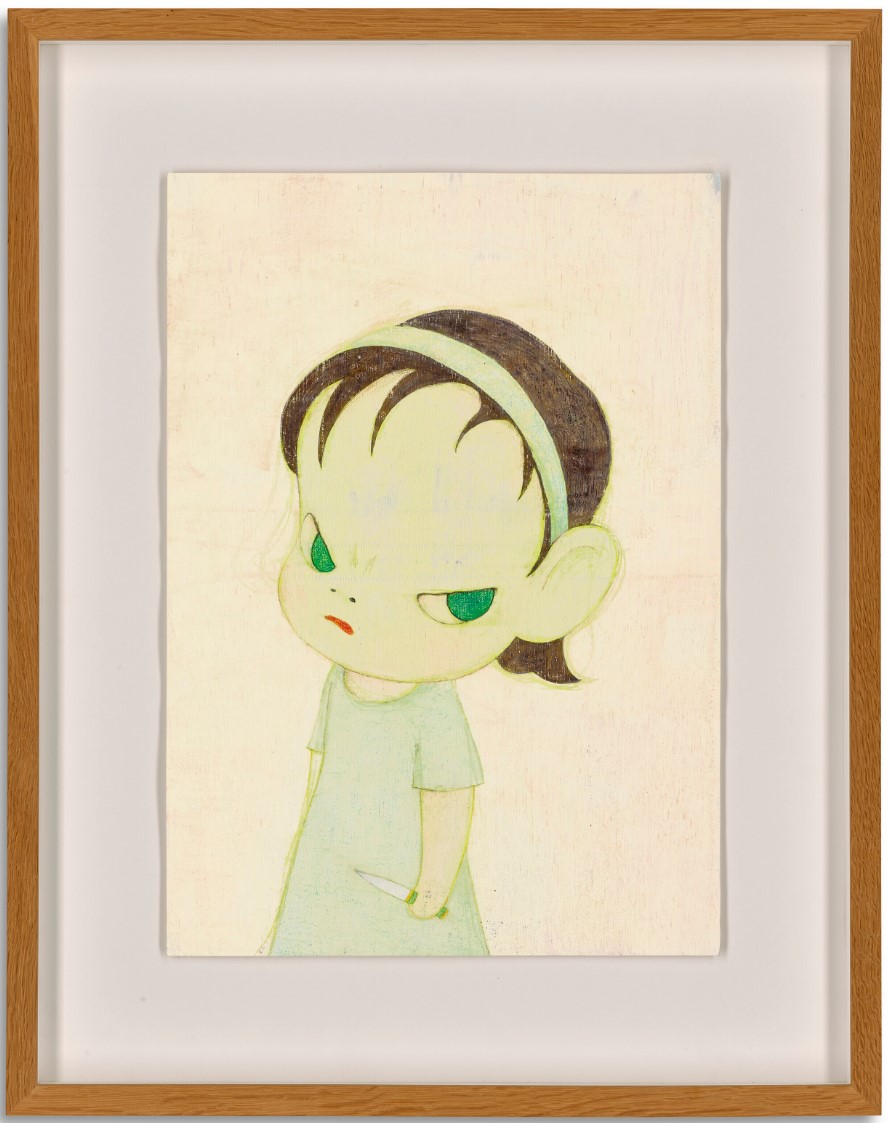
Executed in 1999, and acquired that year, Girl with a Knife is a bold iteration of one of Yoshitomo Nara’s most important motifs. Upon a pale ground, a little girl stands with a blade in her hand, her bright green eyes aglow with an almost neon luminescence. Created a pivotal moment in his early career, shortly before he returned from Cologne to his native Japan, the work captures the graphic, punk-inspired aesthetic that would propel him to fame over the next few years. His cast of children, with distinctive exaggerated features, would become global icons, often styled as tiny rebels carrying miniature weapons. The knife, in particular, would become a key image for Nara, after featuring in his seminal 1991 painting The Girl with the Knife in her Hand (promised gift to the San Francisco Museum of Modern Art). Exquisitely rendered in pencil, crayon and acrylic, the present work is a sumptuous example of his drawings: a fundamental strand of his practice, and which formed a major part of his first international touring retrospective this year. The show completed its second leg at the Yuz Museum, Shanghai, this September, marking Nara’s solo debut in mainland China.
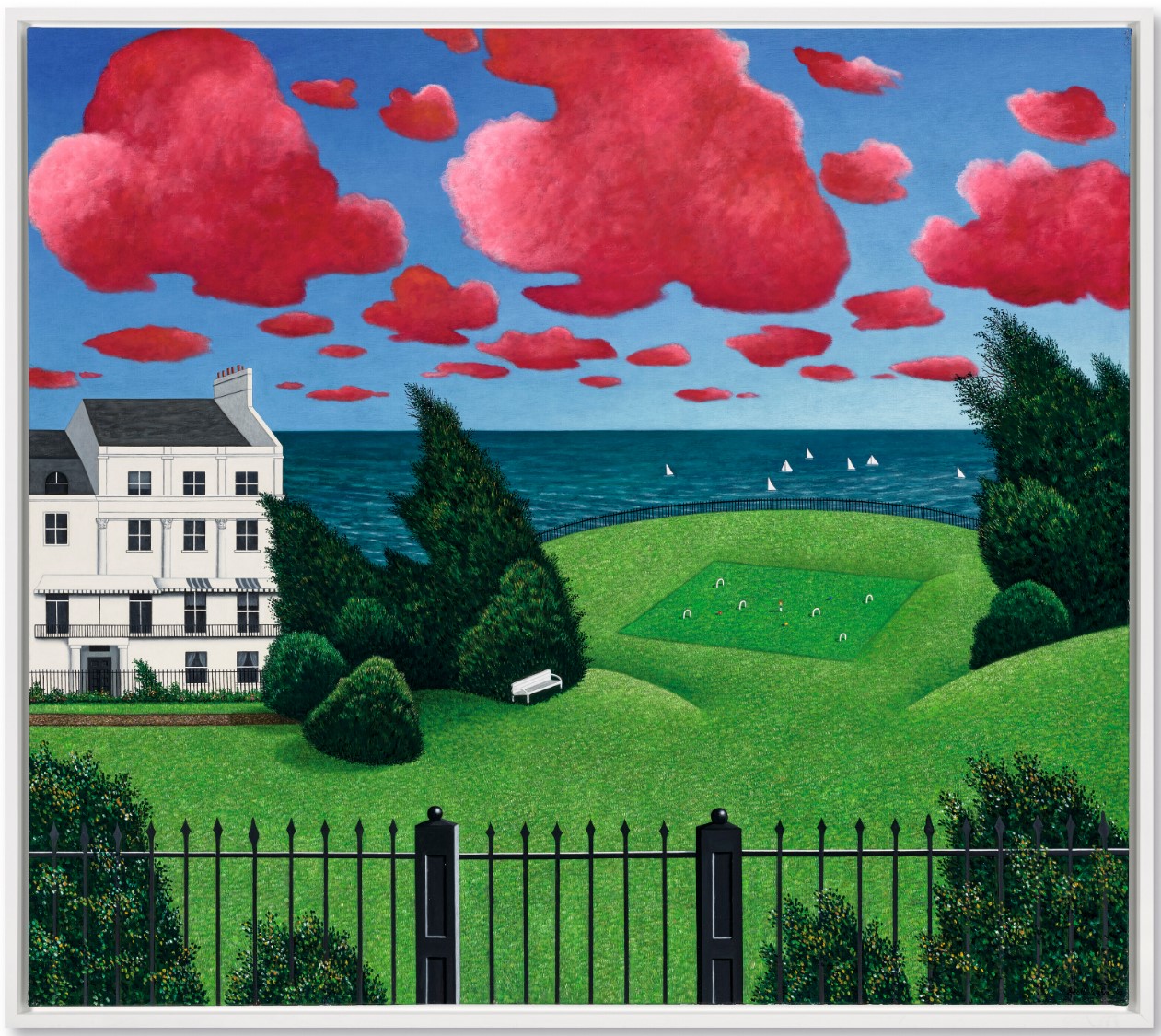
SCOTT KAHN
Croquet, 1992
Oil on linen
36 1/8 x 32 inches (91.8 x 81.4 cm)
Estimated GBP 100,000 – 150,000
GBP 793,800
Acquired directly from the artist in 1996, Croquet (1992) is a visionary landscape by Scott Kahn. The work was painted during a period in which Kahn was living in a sea-view flat in Brighton, East Sussex, and depicts the easternmost house on the historic Lewes Crescent: one of these grand Victorian mansions, with a secret tunnel to the seafront, is said to have inspired Lewis Carroll to write Alice’s Adventures in Wonderland. The building sits to the left of a garden of rolling green lawns, whose every blade has been picked out with obsessive attention. At the centre, framed by dark, windswept trees, is an abandoned croquet game. An empty white bench faces away from the pitch. Beyond is the sea—painted with shimmering waves, and a cluster of white boats that echo the croquet hoops below—and a vast blue sky filled with dramatic, otherworldly red clouds. A wrought-iron gate in the foreground places us at a remove from the scene, heightening its tenor of surreal mystery.
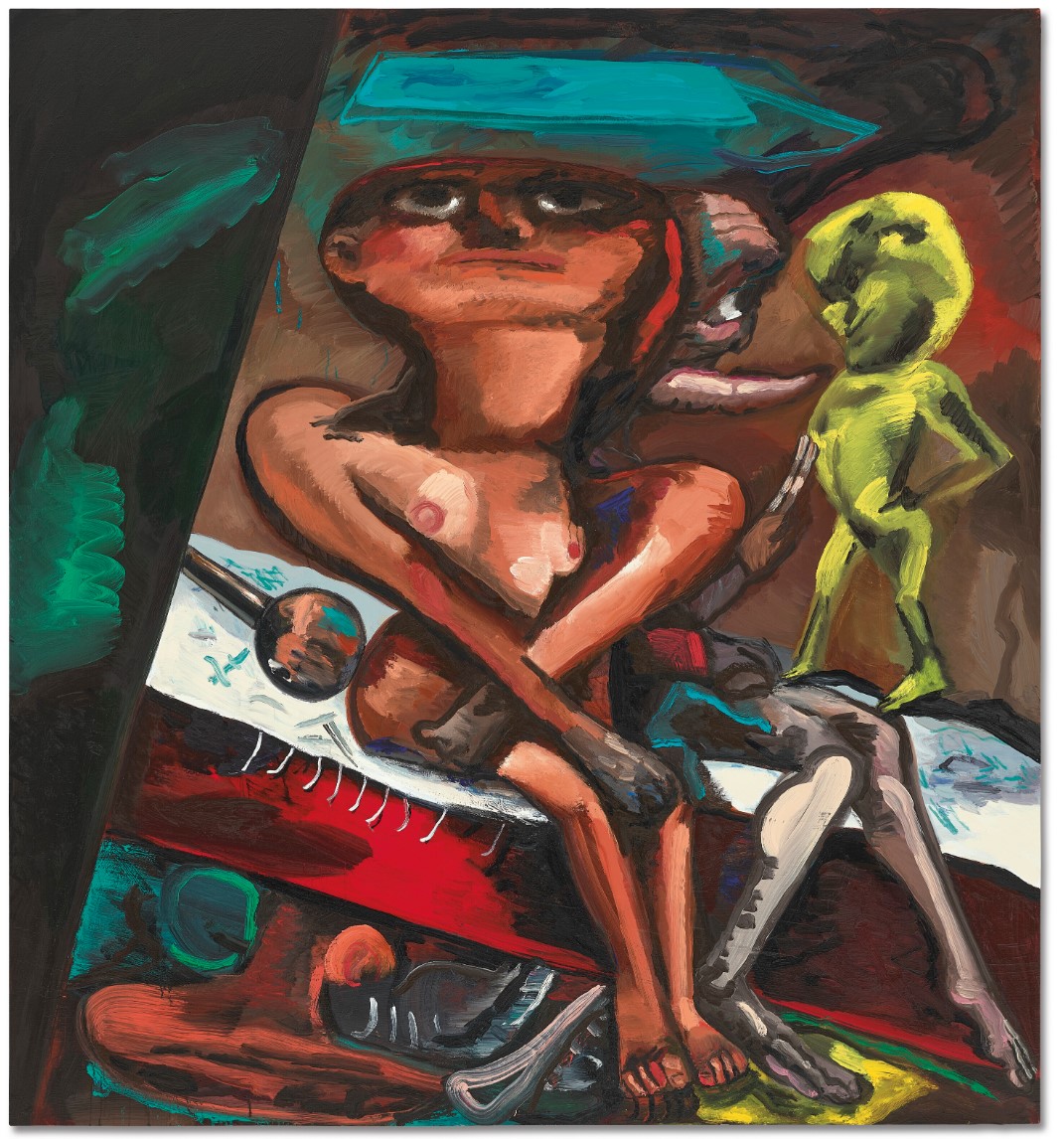
DANA SCHUTZ
Forever 21, 2019
Oil on canvas
91×84 inches (231×213 cm)
Estimated: GBP 600,000 – 800,000
GBP 781,200
Stretching over two meters in height, Dana Schutz’s Forever 21 (2019) is a striking, boldly lit meditation on contemporary online life. At its center sits a nude young woman on a bed, her arms crossed in a close echo of Edvard Munch’s famed Symbolist painting Puberty (1894-1895). She stares upwards, eyes wide, at a turquoise panel which illuminates the surrounding darkness with an eerie glow. A hand-mirror on the bed reflects her gaze from the panel above. Beside her sits an older woman, who is engaged in dispute with a mean-looking goblin of bright yellow hue. The artist has explained that all three figures are avatars of the same person, and that the painting depicts a woman who is jealous of her own online presence: the turquoise glow is a phone screen. The fast-fashion retailer Forever 21 was given its name because its founder believed 21 was the most enviable age. Schutz uses the slogan to sharpen a modern-day vanitas that portrays the perils of gazing too long at your own image. With its saturated palette and dramatic, tightly interlocking composition, the work exemplifies Schutz’s ability to conjure masterful paintings from the most unexpected ideas.
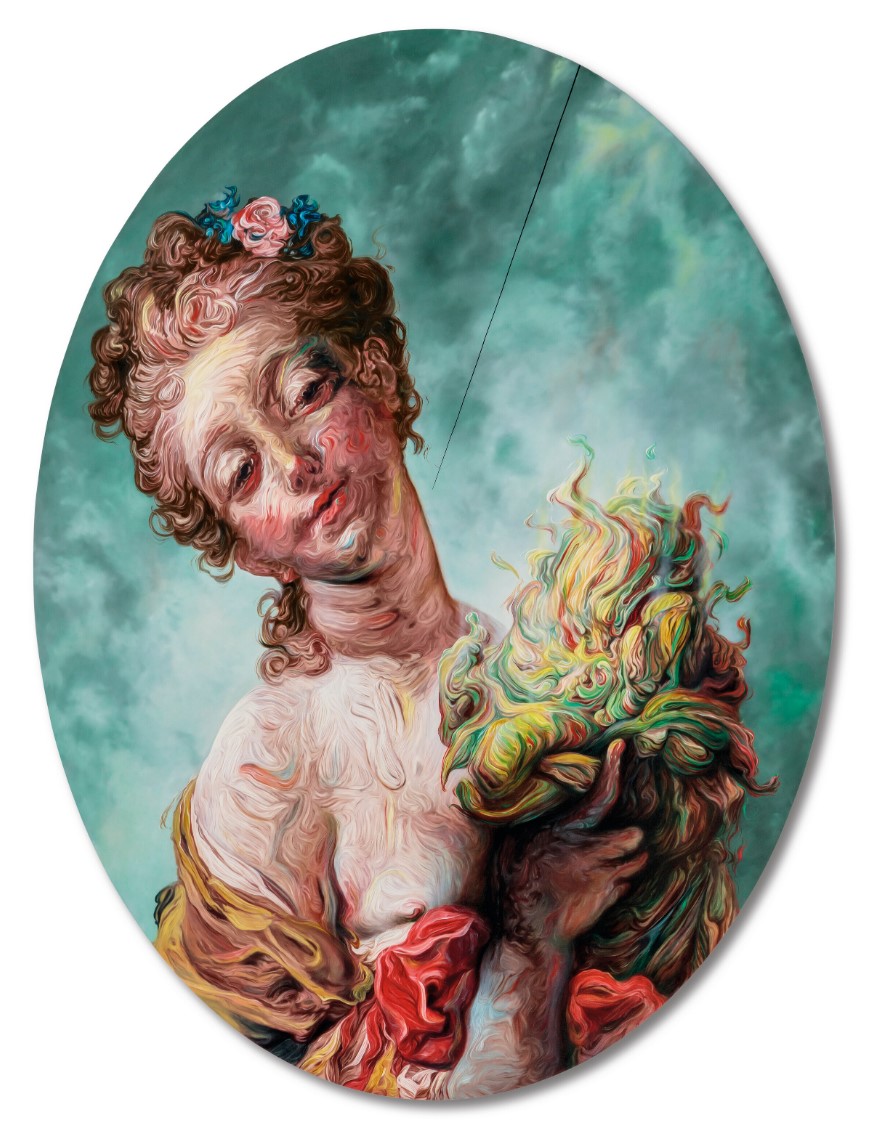
GLENN BROWN
Tart Wit, Wise Humor, 2007
Oil on panel
57 x 42 3/4 inches (144.8 x 108.6 cm)
Estimated: GBP 500,000 – 700,000
GBP 718,200
Included in Glenn Brown’s landmark touring exhibition that opened at Tate Liverpool in 2009, Tart Wit, Wise Humor is a sumptuous example of his wry historical appropriations. With exquisite, photorealist strands of pigment, the artist translates Jean-Honoré Fragonard’s eighteenth-century painting Venus and Cupid into a vision of surreal wonder. Subtly compressing the original work’s oval format, Brown embellishes his subject with immaculate curlicues of hyperreal color: her flesh is marbled with ribbons of pink and red, swirling like a galaxy. The folds of her clothes and the curls in her hair are reborn with crisp clarity, while the infant in her hands is transformed into an abstract, rainbow-colored mass. As is typical of Brown’s practice, his adaptation is infused with sly subversions, from the dark shadows that linger round her face, to the sharp, needle-like line that slices through the picture plane towards her neck. Yet a comic wit prevails tellingly, Brown’s title is taken from an article published in the January 1991 edition of Artforum, in which the scholar Donald Kuspit examines the fundamentally humorous spirit of the avant-garde. It is a text that speaks pertinently to Brown’s practice, where the halls of art history become playgrounds for postmodern pranks.
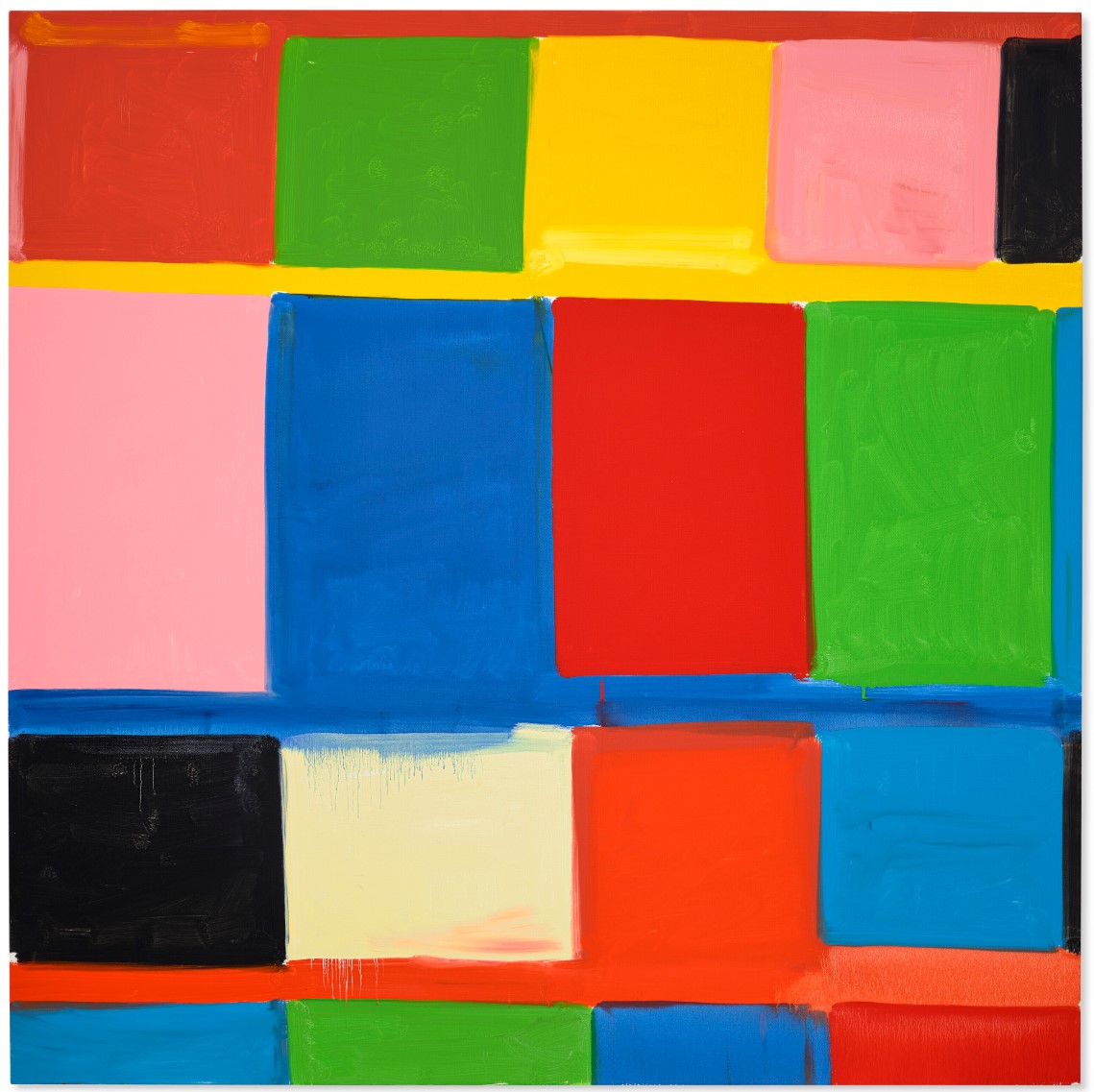
STANLEY WHITNEY
Memory Garden, 2020
Oil on linen
72×72 inches (182.9 x 182.9 cm)
Estimated GBP 400,000 – 600,000
GBP 705,600
Rendered on an immersive 72-by-72-inch scale—among Stanley Whitney’s larger formats—Memory Garden is a glowing instance of his celebrated chromatic language. Painted in 2020, it offers a veritable symphony of color, articulated in the loose square grid that represents his signature structure. Bricks of blush pink, forest green and azure blue quiver alongside black, yellow and red, each of the four rows divided by a horizontal-colored strip. Whitney paints each block with gestural, intuitive brushwork, allowing light to seep through the structure and edges to bleed into one another’s territory. Currently the subject of a major exhibition at the Palazzo Tiepolo Passi, mounted to coincide with the 2022 Venice Biennale, Whitney combines influences ranging from art history and architecture to experimental jazz, underpinned by a deep sensitivity to the complexities of colour. He stands today at the forefront of contemporary abstraction, with his first museum retrospective scheduled for 2024 at the Buffalo AKG Art Museum.
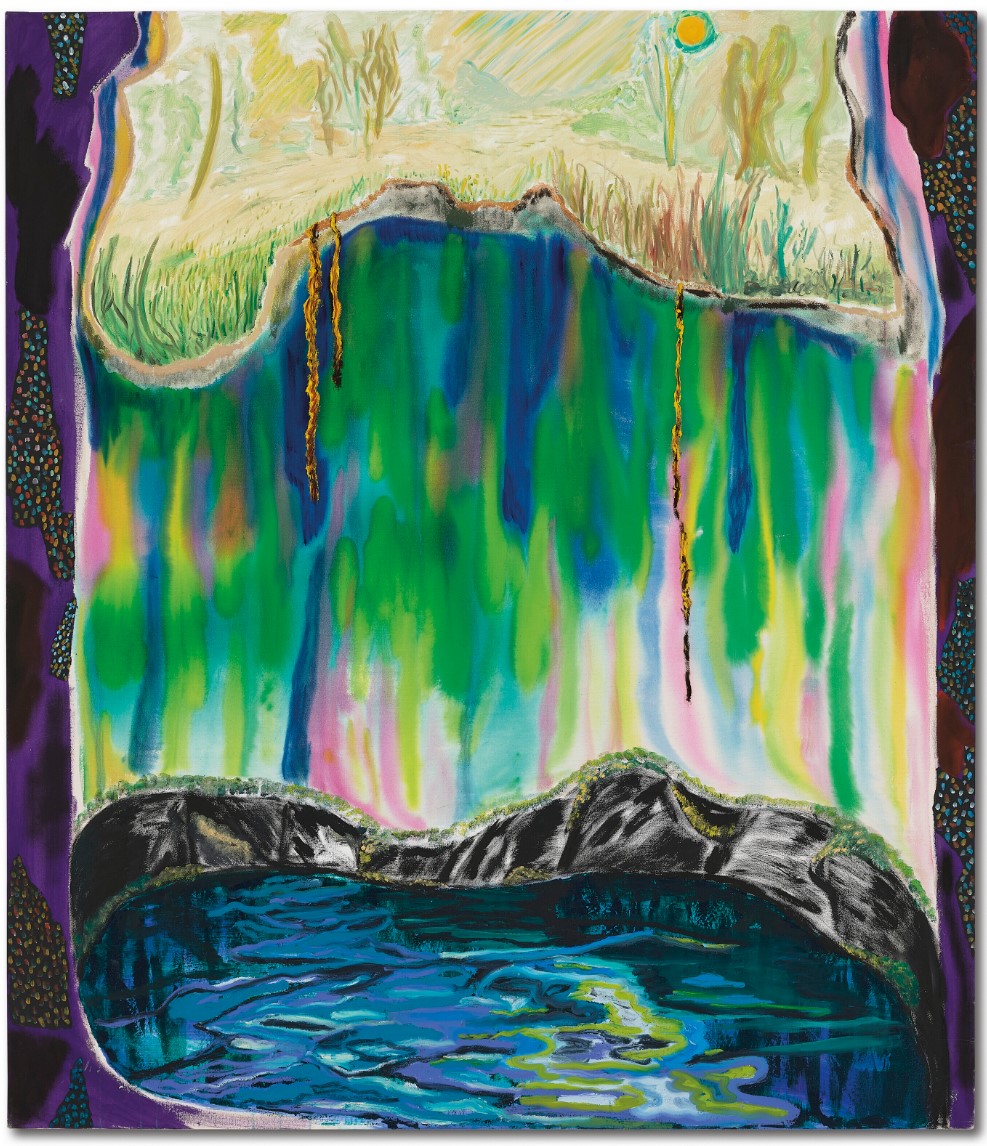
SHARA HUGHES
Looking Out, 2016
Oil, acrylic, flashe and dye on canvas
60×52 inches (152.4 x 132 cm)
Estimated GBP 250,000 – 350,000
GBP 252,000
Painted to accompany the 2017 production of Antonín Dvořák’s Rusalka at the Metropolitan Opera, New York, Looking Out (2016) is a sublime, atmospheric painting by Shara Hughes. Rusalka is a tragic fairytale that echoes Hans Christian Andersen’s The Little Mermaid: a water nymph, Rusalka, falls in love with a prince and must sacrifice her voice to join him in the human world. Hughes made nine paintings for the show, which she titled Lamenting, Sighing, Weeping after the first lines sung by Ježibaba, the witch who grants Rusalka her mortality. Picturing Rusalka’s view from her lake towards the human realm, Looking Out vividly captures the opera’s magic and melancholy. At the painting’s upper edge is a vista of trees and meadows, flooded with bright sunlight; at the bottom is a dark pool bounded by a rocky shore, reflecting the colours above in its rippling surface. The two worlds are separated by an aurora borealis of cascading greens, yellows, blues and pinks, which Hughes created by staining dyes directly into the canvas, recalling the techniques of Morris Louis or Helen Frankenthaler. This luminous veil divides the mortal and immortal spheres; tendrils of golden impasto drip tantalisingly down from the upper world, but the two ultimately cannot meet. The scene is framed by dark, glittering purple borders to left and right, which conjure the presence of parted stage curtains.
Post-War and Contemporary Art Day Sale
14 October 2022
GBP 16,044,948
USD 17,924,613
168 Lots Sold
Sell-Through: 91.3%
184 Lots
Above estimates: 62 Lots (33%)
Within estimates: 67 Lots (36%)
Below estimates: 39 Lots (21%)
Unsold: 16 Lots (8%)
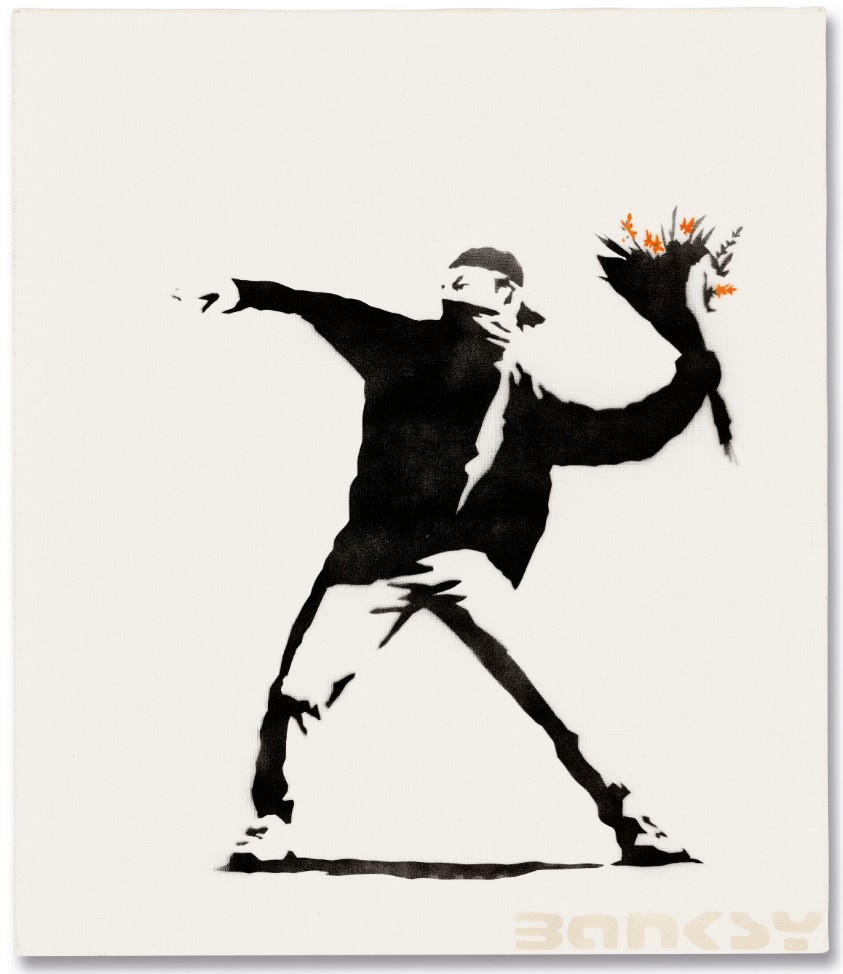
BANKSY
Love is in the Air, 2002
Spray paint on canvas
21×18 inches (53.4 x 45.7 cm)
This work is from a series
Estimated: GBP 500,000 – 700,000
GBP 567,500
One of Banksy’s best-known and most celebrated images, Love is in the Air is an early iteration of his seminal ‘flower thrower’ motif. The work dates from 2002: three years before it appeared in large-scale mural form on the side of a garage near the newly-erected West Bank barrier wall. Offering a poignant response to the Israeli-Palestinian conflict, it was this image that cemented Banksy’s position on the international stage, establishing him both as an artist and as an activist. The masked rebel—armed not with a weapon but rather with a bunch of flowers—has since become a twenty-first-century icon, representing a universal image of peace and reconciliation. Over time, moreover, the figure has come to operate as an avatar for Banksy himself, encapsulating the mode of anonymous, non-violent insurgence that defines the artist’s urban interventions. The present example’s flowers are enlivened with delicate, fiery orange petals. Reproduced on the cover of Banksy’s seminal 2005 book Wall and Piece, the work shares its title with the hit 1978 disco single by John Paul Young, injecting its message with a characteristic note of tongue-in-cheek wit. As the conflict continues—and as fresh conflicts unfold across the globe—the image endures, offering a beacon of hope to those whose lives have been overturned by war.
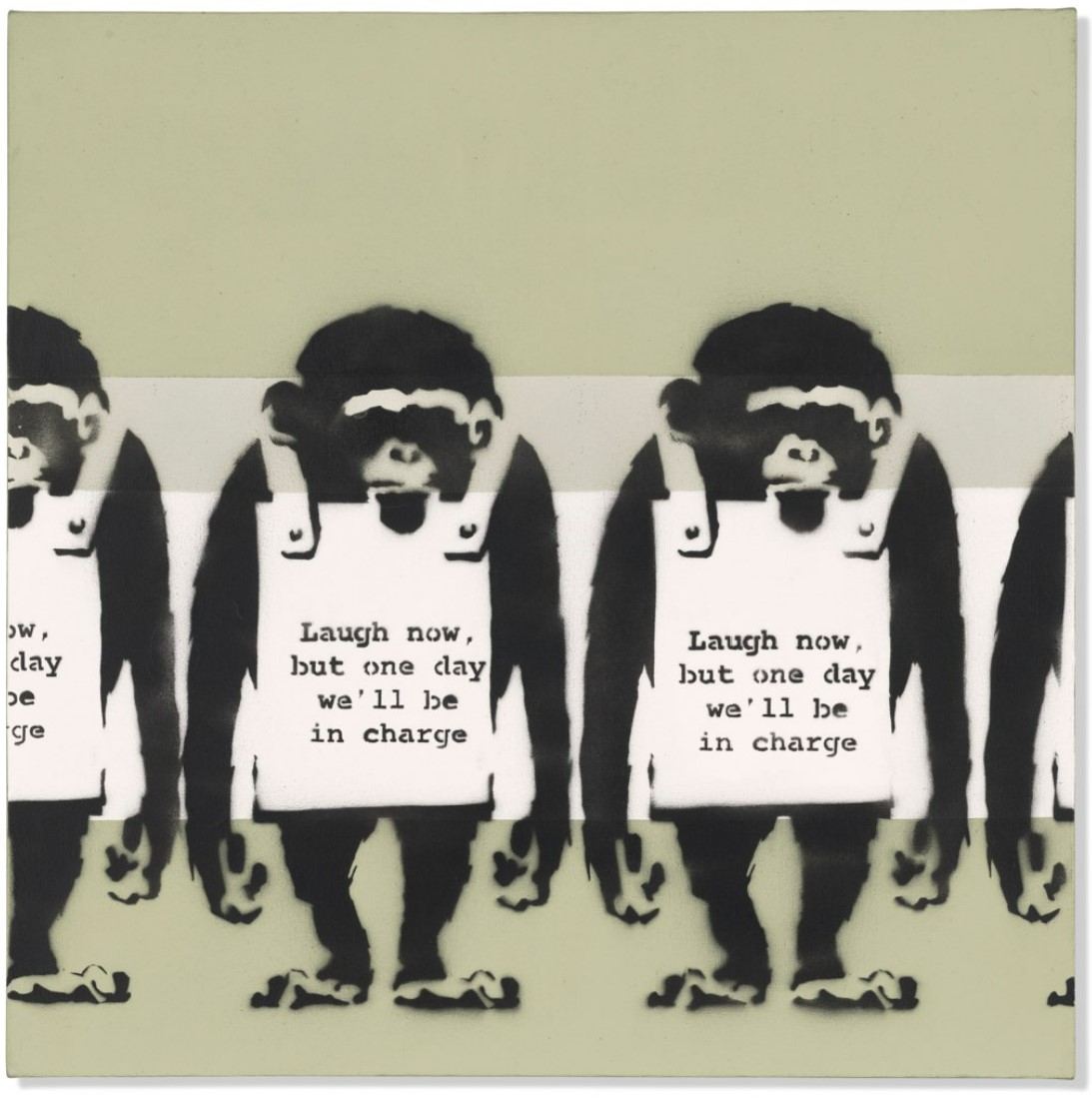
BANKSY
Laugh Now, 2000
Acrylic and spray paint on canvas
24 1/8 x 24 inches (61.2 x 61 cm)
This work is unique in its format
Estimated: GBP 400,000 – 600,000
GBP 529,200
Created in 2000 and held in the same collection ever since, Laugh Now is an irreverent, iconic image by Banksy, the art world’s most famous provocateur. Unique in format, this painting is one of the first depictions of a subject which would become central to the artist’s oeuvre: four forlorn monkeys each wearing a sandwich board that reads ‘Laugh now but one day we’ll be in charge’. The work was included in one of Banksy’s earliest exhibitions, held in 2000 under a railway bridge on Rivington Street in London’s Shoreditch neighborhood. It was shown alongside a similar work which had been painted directly onto the side of a building. Modest in form yet nevertheless forthright, Laugh Now announces a new, outspoken voice.
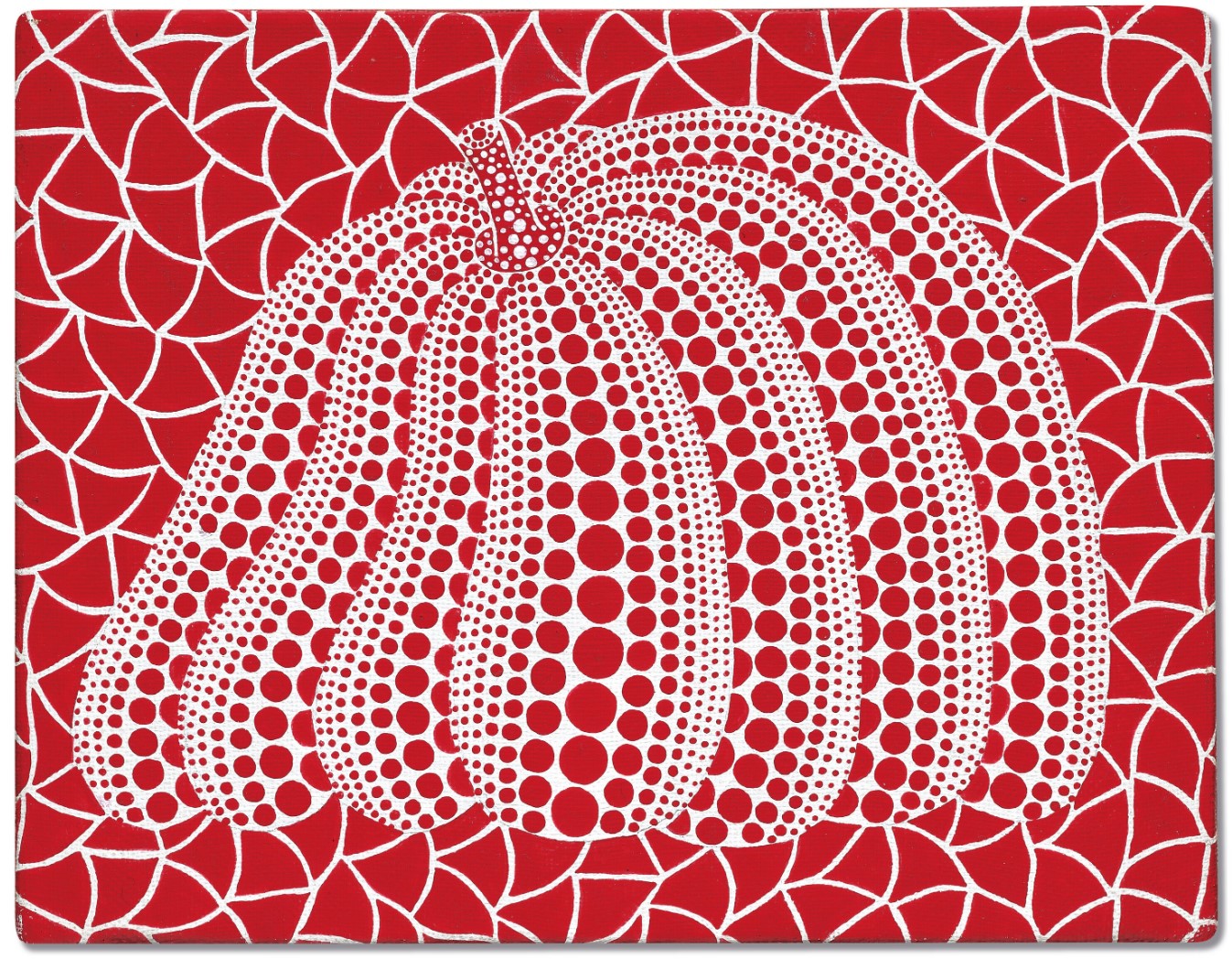
YAYOI KUSAMA
Pumpkin A, B, C, 2003
Acrylic on canvas
5 1/2 x 7 1/8 inches (14×18 cm)
Estimated: GBP 250,000 – 350,000
GBP 453,600 / USD 512,641
Painted in 2003, Pumpkin A, B, C, is a joyful example of Yayoi Kusama’s most beloved image. Rendered in crimson and white, the fruit swells outward, ripe and weighty; across its protuberant, voluminous flesh, Kusama has dotted a seemingly infinite number of immaculate red circles. The artist’s fascination with pumpkins began when she was a child in Matsumoto, Japan. Her parents owned a seed farm and nursery, and she spent much of her upbringing playing amongst the lush vegetation. ‘The first time I ever saw a pumpkin’, Kusama recalled, ‘was when I was in elementary school and went with my grandfather to visit a big seed-harvesting ground. Here and there along a path between fields of zinnias, periwinkles, and nasturtiums I caught glimpses of the yellow flowers and baby fruit of pumpkin vines. I stopped to lean in for a closer look, and there it was: a pumpkin the size of a man’s head … It immediately began speaking to me in the most animated manner’ (Y. Kusama, quoted in Yayoi Kusama | Pumpkins, exh. cat. Victoria Miro, London 2014, n.p.). She came to love pumpkins for their ‘humorous form, warm feeling, and a human-like quality’, delighting in their rounded and decidedly individual shapes.
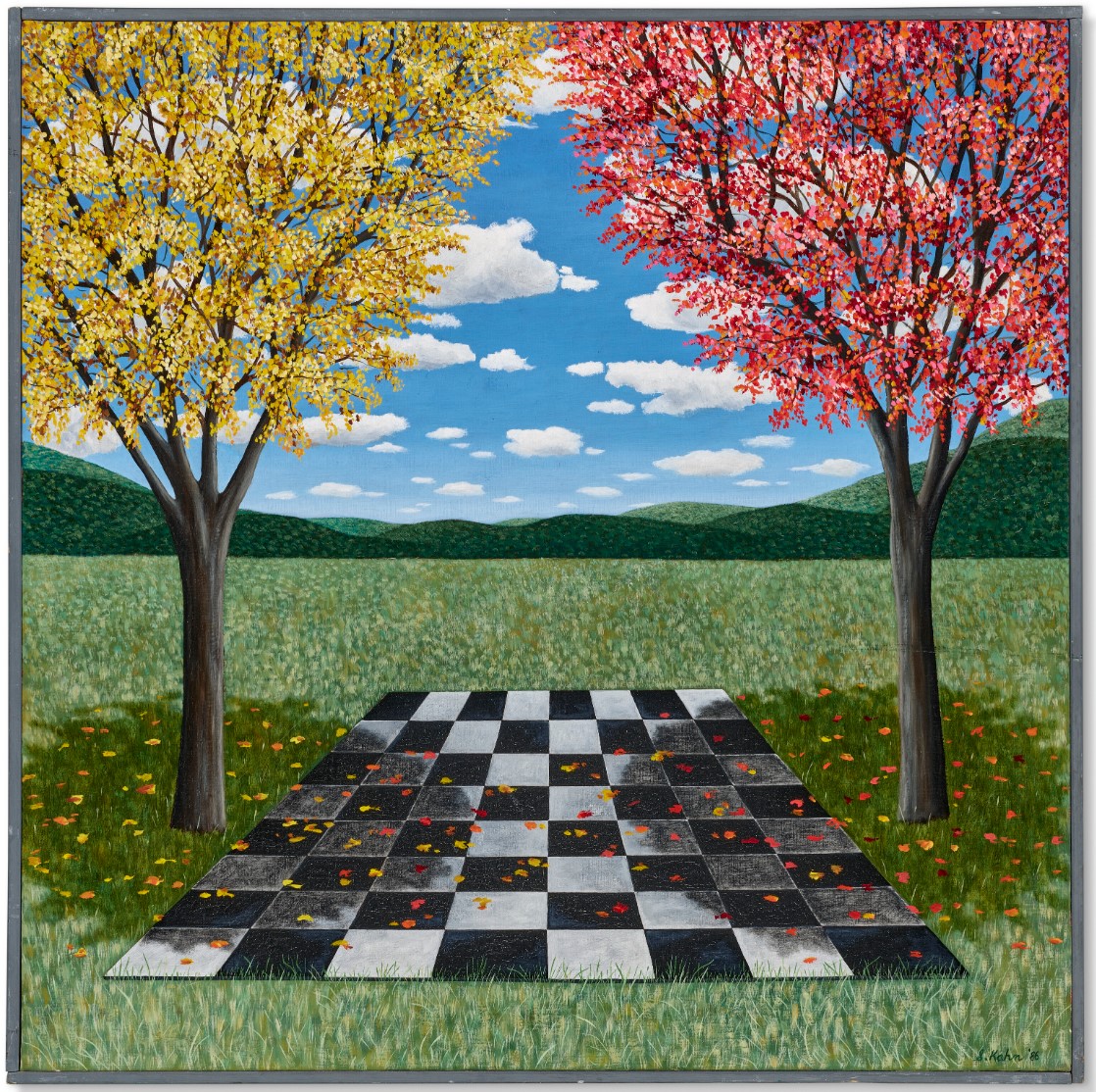
SCOTT KAHN
Landscape with Tile Floor, 1986
Oil on linen, in artist’s frame
20 1/4 x 20 1/4 inches (52.2 x 52.2 cm)
Estimated: GBP 80,000 – 120,000
GBP 207,900
Scott Kahn paints enigmatic dreamlands. In Landscape with Tile Floor (1986), two trees—one yellow-leaved, the other red—stand tall in the middle of an otherwise empty expanse. Between them rests an oversized chessboard without its chessmen, scattered with brilliant fallen leaves. The painting’s titular chess board—a motif Kahn has returned to repeatedly—is a nod to Surrealism, specifically the games played by artists such as Francis Picabia, Man Ray, and above all, Marcel Duchamp, who ‘needed a good chess game like a baby needs his bottle’ (H. Roché cited in A. Savage, ‘“All artists are not chess players – all chess players are artists”: Marcel Duchamp, Man Ray, Picabia II’, Tate Etc., January 2008). Indeed, Kahn has cited the importance of magical realism to his practice, evoked in the present work through the fantastical representation of space and inexplicable juxtapositions. Devoid of a narrative, Kahn’s paintings are nevertheless rooted in painterly observation—and they illustrate just how ungovernable the subconscious can be.
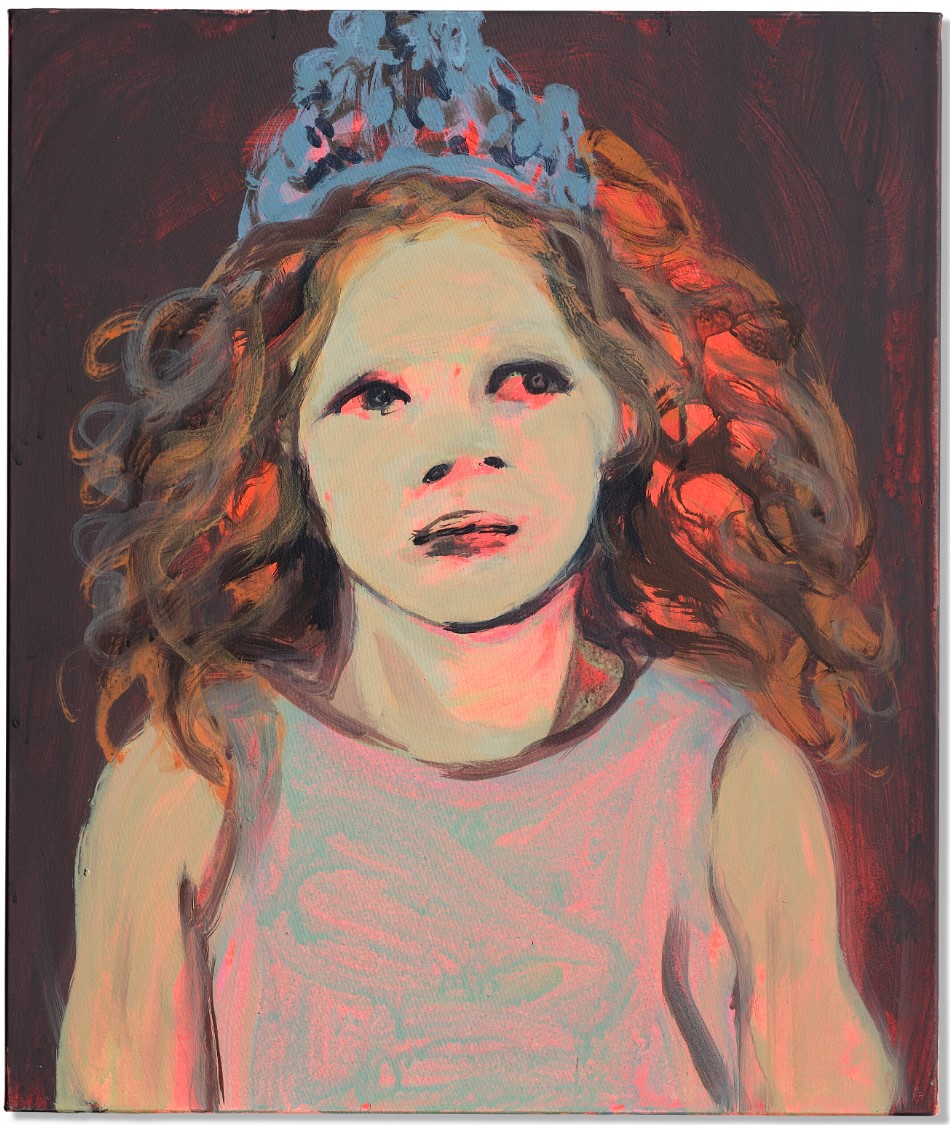
CLAIRE TABOURET
Les Diadèmes (La rousse), 2014
Acrylic on canvas
21 5/8 x 18 1/8 inches (54.8 x 46 cm)
Estimated: GBP 50,000 – 70,000
GBP 138,600
Sotheby’s
The Now Evening Auction
14 October 2022
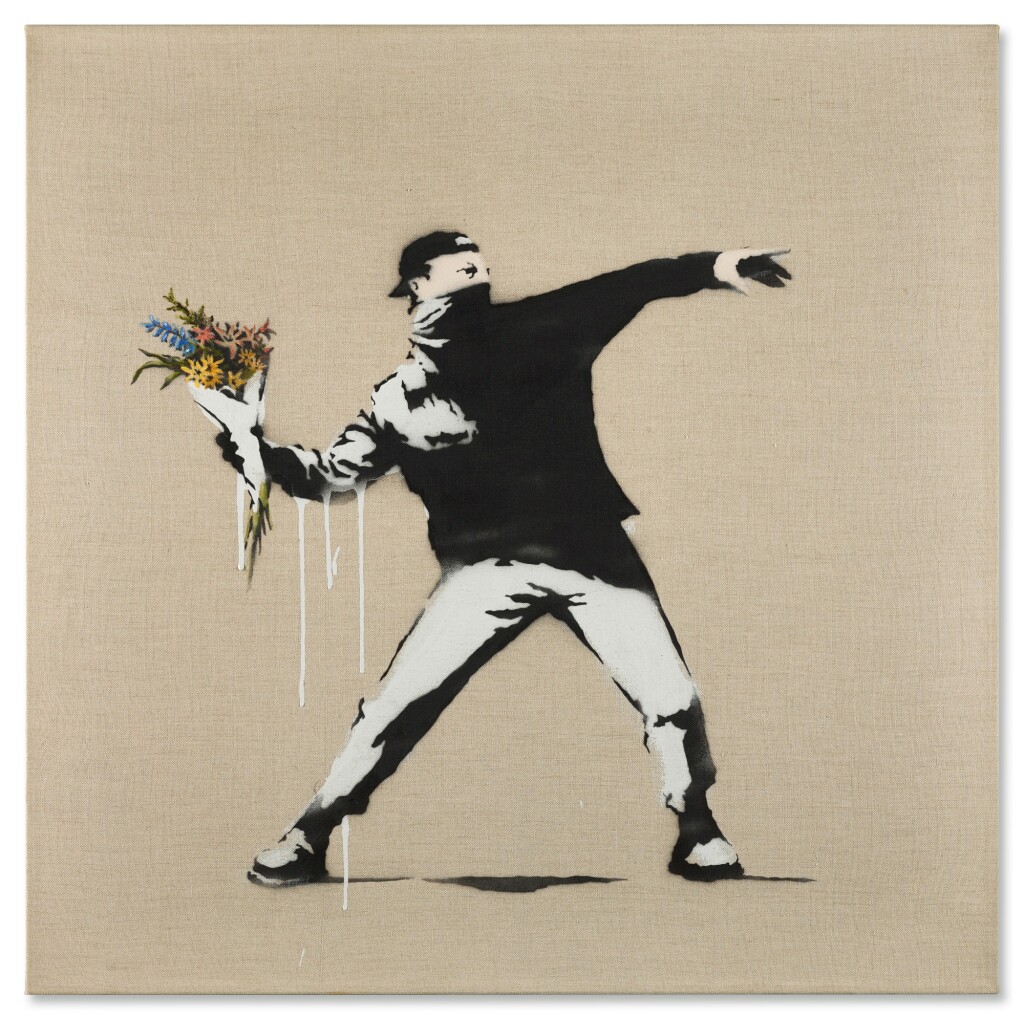
BANKSY
Love Is In The Air, 2006
Spray paint and oil on linen
91.5 x 91.5 cm (36×36 inches)
Estimated: GBP 3,400,000 – 4,000,000
GBP 3,483,500
Love is in the Air is an image that has become synonymous with the artist’s unmistakable graphic style, wry satire and galvanising political commentary. Banksy’s iconic subject adopts the archetypal pose of civil disobedience, preparing to throw a bomb or a Molotov cocktail in the air towards an unseen enemy. Yet, the weapon is replaced with a bouquet of flowers, disarming the image of its connotations of violent unrest and expressing a potent call for peace. This iconic work was notably chosen to be illustrated in Banksy’s only official monograph, Wall and Piece, and the street intervention upon which it is based was chosen for the front cover. In its appreciation we are reminded not only of how effective the concept at the heart of Love is in the Air is, but also of Banksy’s tireless focus on pressing social issues, most pertinently his fervent anti-war activism.
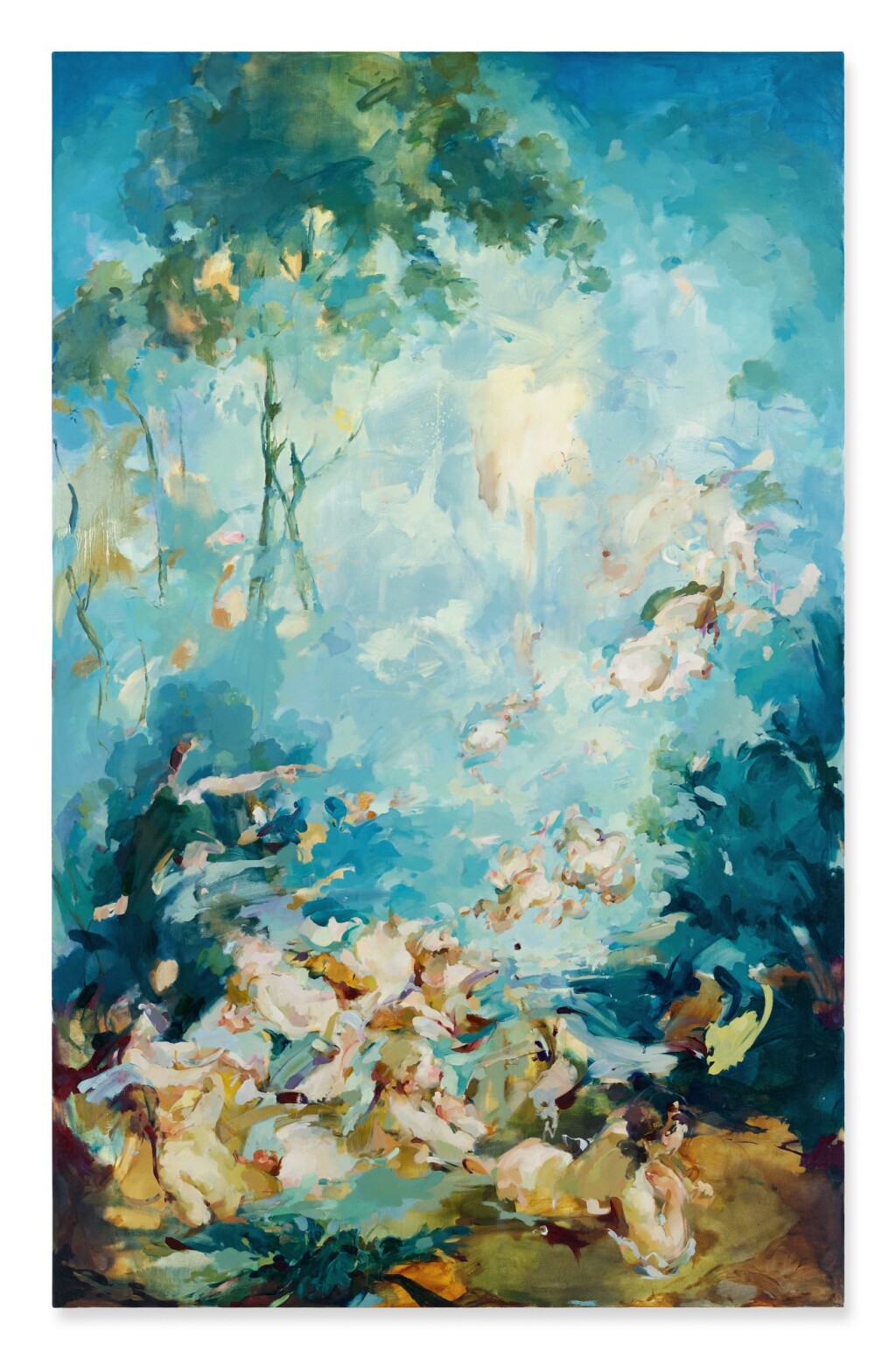
FLORA YUKHNOVICH
Nobody Puts Baby in the Corner, 2018
Oil on linen
270×170 cm (106 ¼ x 67 inches)
Estimated: GBP 500,000 – 700,000
GBP 1,608,000
Navigating the fertile terrain between abstraction and figuration with vivid painterly imagination, Flora Yukhnovich’s Nobody Puts Baby in the Corner masterfully reconciles the visual language of the Rococo with contemporary cultural references to reflect on the origins of entrenched notions of beauty and femininity, altogether re-negotiating their boundaries. The subject of recent solo exhibitions at Victoria Miro in London (Thirst Trap, March 2022) and Blenheim Walk Gallery, Leeds Art University (Flora Yukhnovich: Fête Galante, February – March 2020), Yukhnovich has become one of the most significant painters working today. She is uniquely capable of satisfying a nostalgia for worlds past while toying with the limits between viewer and artwork. In Nobody Puts Baby in the Corner, wryly named after the most famous line of one of the twentieth century’s most famous films Dirty Dancing, thick impasto oil paint covers the vast canvas, creating an immersive portal into the artist’s world. It is this dynamism of application that affords the viewer the sensation of complete envelopment. Luminous shades of teal, blue, green and fleshy hues of pink, brown and cream coalesce, forming an abstract arcadian scene. Concentrated with light hues, the figures in the lower part of the composition are framed by an array of deeper shades, creating the illusion of sunlight and conjuring the sensation of emerging out of a deep, sun-dappled forest.
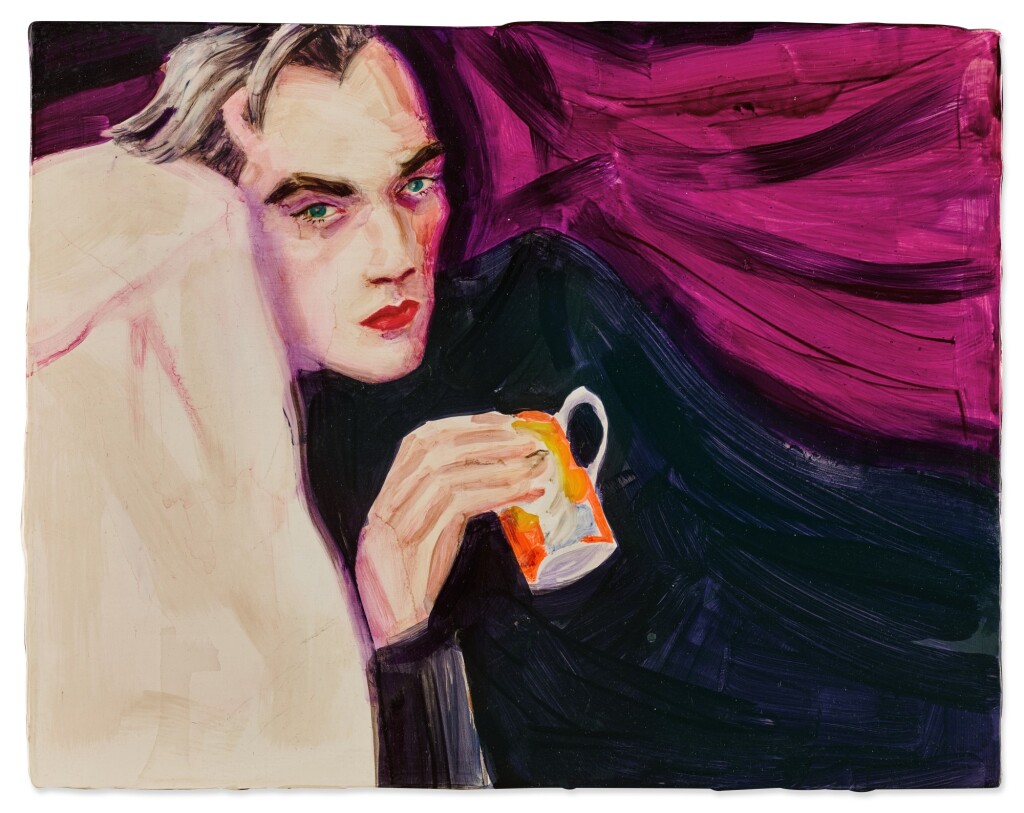
ELIZABETH PEYTON
Martin, 1998
oil on MDF
28.2 x 36 cm (11⅛ x 14⅛ inches)
Estimated: GBP 400,000 – 600,000
GBP 730,800
Transfixing the viewer with a piercing gaze, Martin exemplifies the Elizabeth Peyton’s mastery of portraiture. Executed in 1998, this intimate and vivacious work holds immense visual power within its flurry of bold, fluid brushwork. Ethereally elusive, Peyton captures the dynamism and personality of London gallerist and friend Martin McGeown whom she would go on to paint numerous times. For three decades, Peyton’s practice has been dedicated to stunning portraits of public personalities, historical figures, fictional characters, and fellow artists and friends. Her process of painting bridges the empathic with the analytical. Carving out in brilliant crimsons, shocking purples, and deep mahogany, Peyton enhances the inner vulnerability of her sitter as he looks up to meet our gaze.
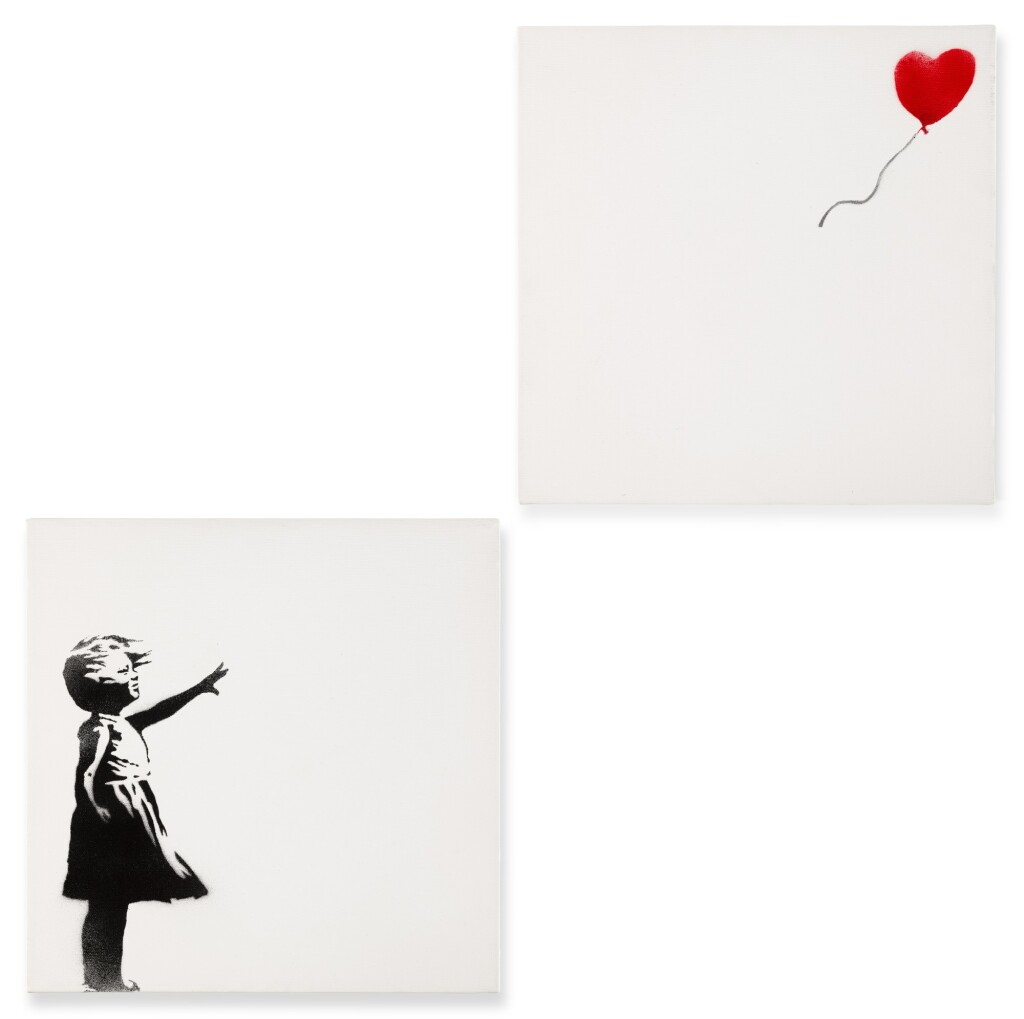
BANKSY
Girl with Balloon Diptych, 2006
Spray paint on canvas, in two parts
Each: 30×30 cm (12×12 inches)
Artist Proof 00/25
Estimated: GBP 1,200,000 – 1,800,000
GBP 882,000
Depicting a small girl reaching out towards a bright red, heart-shaped balloon Girl with Balloon presents the most famous motif of Banksy’s iconic oeuvre. Unclear whether the girl is reaching out to catch the balloon – a vibrant emblem of childhood delight – or has rather let it slip from her fingers, the image is fundamentally ambiguous. Akin to Andy Warhol’s soup cans and Damien Hirst’s spots, the image has appeared and reappeared throughout Banksy’s output and onwards through global visual culture. Composed here in acrylic on canvas in two parts which emphasize the simultaneous separation and connection between girl and balloon, this signature Banksy motif first appeared in 2002 in street murals on the walls of Shoreditch and the South Bank in London. In 2017, Girl with Balloon was voted the nation’s favorite artwork in a poll, beating Turner’s The Fighting Temeraire, Constable’s The Hay Wain, and Hockney’s A Bigger Splash. As an image it is transcendent and immediately recognisable.
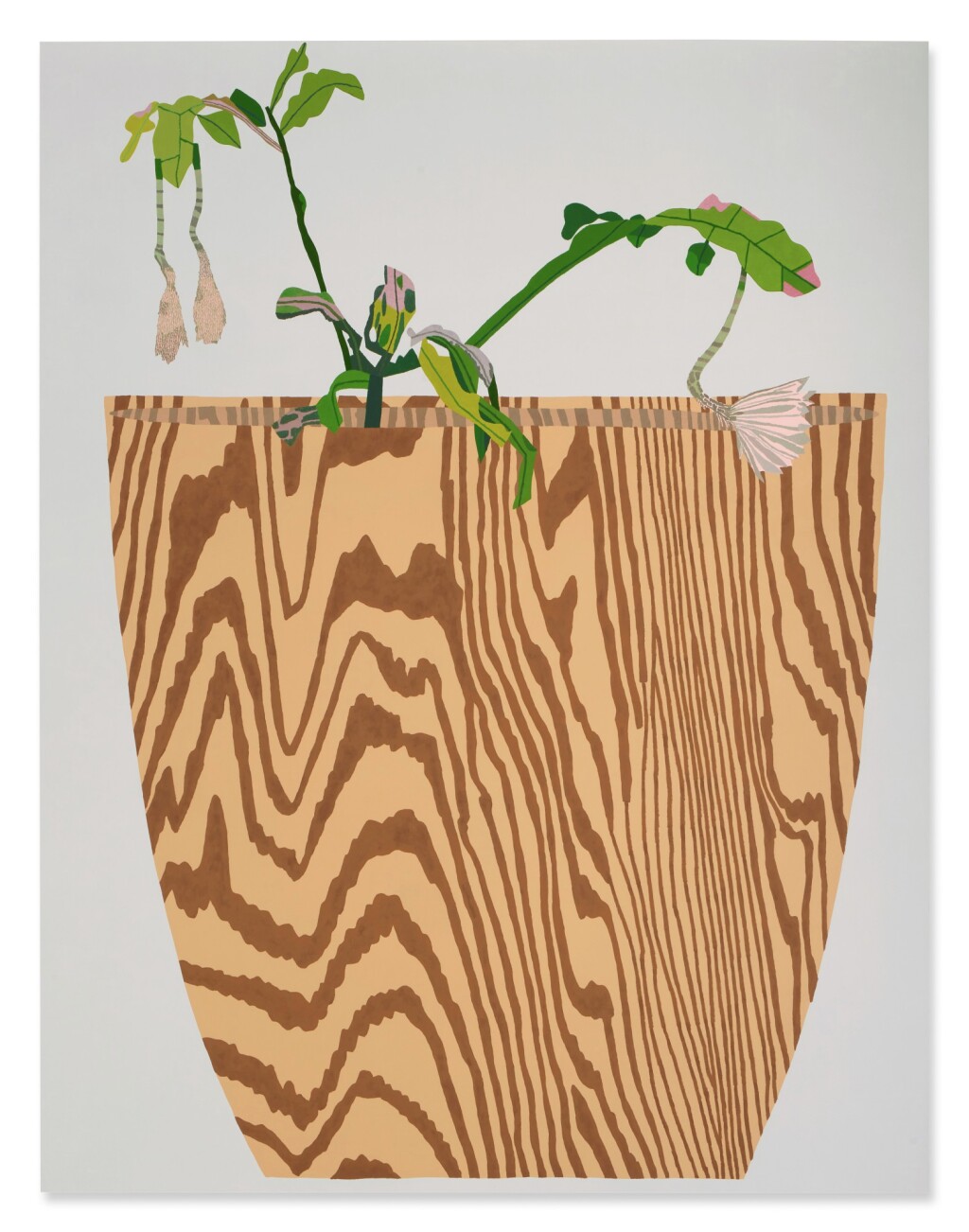
JONAS WOOD
Wood Grain Pot with Night Bloom, 2015
Oil and acrylic on canvas
299.7 x 228.6 cm (118×90 inches)
Estimated: GBP 800,000 – 1,200,000
GBP 642,600
An intricate study of the pot’s textural pattern juxtaposed by the bright green leaves and blooming flowers of the exotic plant which droop over its side, Jonas Wood’s Wood Grain Pot with Night Bloom is a tranquil and exquisite painting of an almost animated quality that epitomizes the most celebrated qualities of the artist’s oeuvre. Executed in 2015, the present work was included in Wood’s first solo exhibition in London. Translating the three-dimensional world around him into flat colour and line, Wood’s graphic works combine art historical reference with objects, interiors, and people from his own life. From the domestic interiors of Pierre Bonnard, David Hockney, and Henri Matisse to the ceramic and stoneware vessels made by his wife Shio Kusaka, the present work is a key example of Wood’s masterful ability to fuse artistic influence with personal significance.
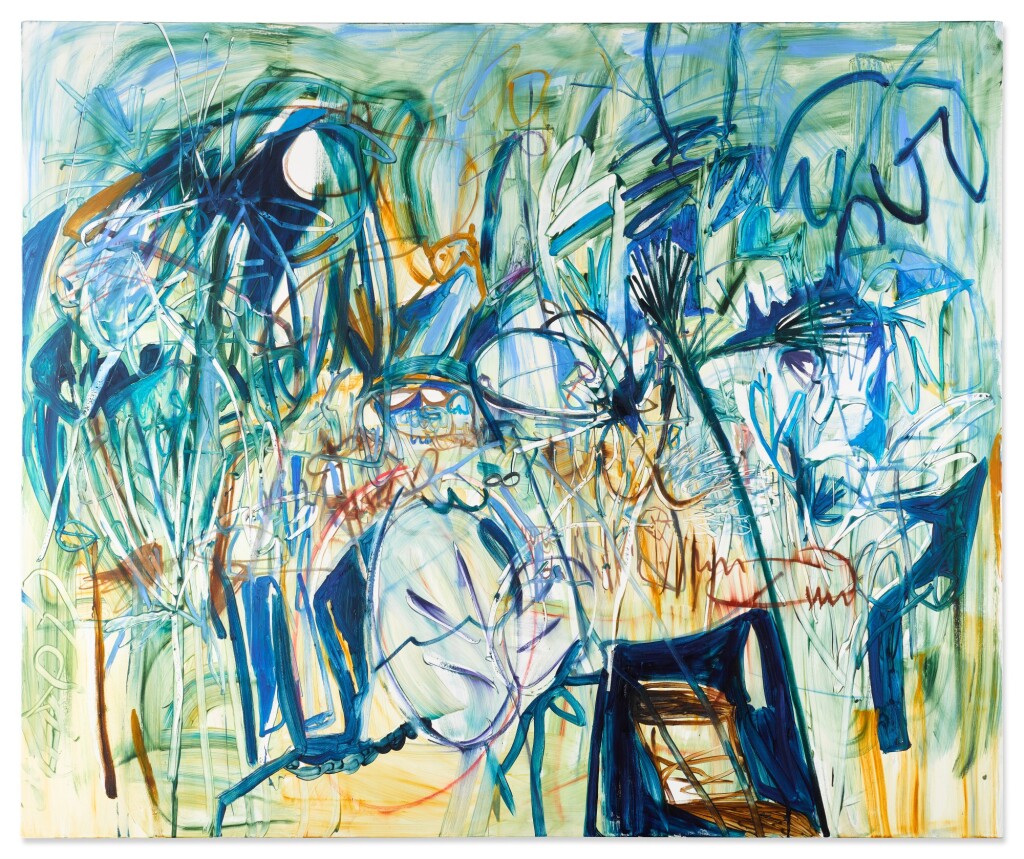
JADE FADOJUTIMI
The Misguided Thrill of Frills, 2017
Oil on canvas
200×240 cm (78 ¼ x 94 ½ inches)
Estimated: GBP 300,000 – 400,000
GBP 554,400
In colliding hues of ultramarine, cobalt, yellow and green, The Misguided Thrill of Frills is a vibrant example of Jadé Fadojutimi’s bold treatment of colour and unique language of abstraction. Executed in 2017, the present work debuted at Pippy Houldsworth Gallery during the artist’s first ever solo exhibition, Heliophobia between December 2017 and January 2018. The painting belongs to an early series of emotional landscapes that explore notions of identity, imagination and play. Chief curator of the Hepworth Wakefield, Andrew Bonacina notes, “As paintings by a Black female artist made as part of a journey of self-understanding, Jadé’s work resonates with the heightened identity politics of the current moment, but it isn’t defined by these concerns. They are emotionally charged, psychological landscapes that mirrors Jadé’s own inner thoughts and emotions but can also reflect our own. Their power is in their abstraction and porousness to a range of ideas and emotions” (Andrew Bonacina quoted in: Alex Needham, “Jadé Fadojutimi Colors Outside the Lines”, W Magazine, 30 November 2021 (online)). A highly anticipated solo exhibition of Fadojutimi’s new large-scale paintings will open at the Hepworth Wakefield in West Yorkshire this September, which follows her first solo museum presentation, Jadé Fadojutimi: Yet, Another Pathetic Fallacy at the Institute of Contemporary Art Miami between November 2021 and April 2022. Fadojutimi is now represented globally by Gagosian, and her recent paintings were a highlight of The Milk of Dreams exhibition at the Central Pavilion at the Venice Biennale this year.
Contemporary Evening Auction
14 October 2022
GBP 85,743,450
33 Lots Sold
Top Lot: GBP 24,300,000
Sell-Through: 97%
33 Lots sold / 1 Lot unsold
34 Lots
Above estimates: 16 (47%)
Within estimates: 9 (26%)
Below estimates: 7 (20%)
Unsold: 1 Lot
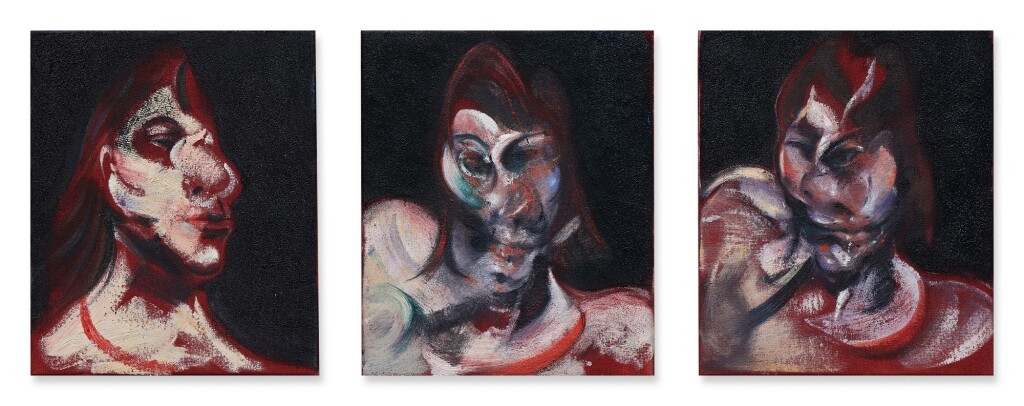
FRANCIS BACON
Three Studies for Portrait of Henrietta Moraes, 1963
Oil on canvas, in three parts
Each: 35.5 x 30.5 cm (14×12 inches)
Estimate upon request
GBP 24,300,000
Painted in 1963, Three Studies for Portrait of Henrietta Moraes is unequivocally one of the finest and most accomplished small portrait triptychs ever created by Francis Bacon. The first named portrait of Henrietta Moraes in Bacon’s oeuvre, and the second ever triptych executed in the iconic 14 by 12 inch canvas format, this is a work of great historical importance and unrivalled execution. Delivering a seamless interlocking of paint and image, these three canvases epitomise the consummate painterly virtuosity and uncompromising power of their creator. In his Catalogue Raisonné entry for this painting, Bacon scholar Martin Harrison praises this very work, identifying it as the artist’s “consummation” of the small portrait triptych, in which “Bacon’s execution has a power, skill and confidence that he scarcely ever surpassed in this format” (Martin Harrison, Ed., Francis Bacon Catalogue Raisonné, Volume III 1958-71, London 2016, p. 733). In a manner unparalleled by any before or since, Bacon had an ability to capture beauty, pathos and violence in a flick of paint, a talent that surpassed a translation of mere form and likeness to deliver something closer to the raw fact of existence. The present work delivers this with aplomb: here we bear witness to a portrait of a legendary Soho Bohemian, a subject whose unconventional, uninhibited lifestyle and gregarious nature is writ large across each canvas. Three Studies for Portrait of Henrietta Moraes was the last picture included in Bacon’s early Catalogue Raisonné, to which its editor Ronald Alley wrote that it was “painted partly from life”; a positing that situates it as one of the final works Bacon executed in this manner, as from 1962 Bacon began principally to rely on photographs of his friends/subjects taken by John Deakin (Ronald Alley and John Rothenstein, Francis Bacon: Catalogue Raisonné and Documentation, London and New York, 1964, p. 155) Reinforced by Bacon’s own proclivity for the peril of life’s roulette wheel, Moraes’s very essence projects forth through a confluence of daring brushwork and imagination: a powerful coalescence of color, texture and form that radiates sheer vitality. Hung upon an armature of disfigured facial features contained by the focused proportions of these three canvases, the present triptych harnesses chaos, chance, beauty, and violence to deliver images of astonishing intensity and carnal grace.
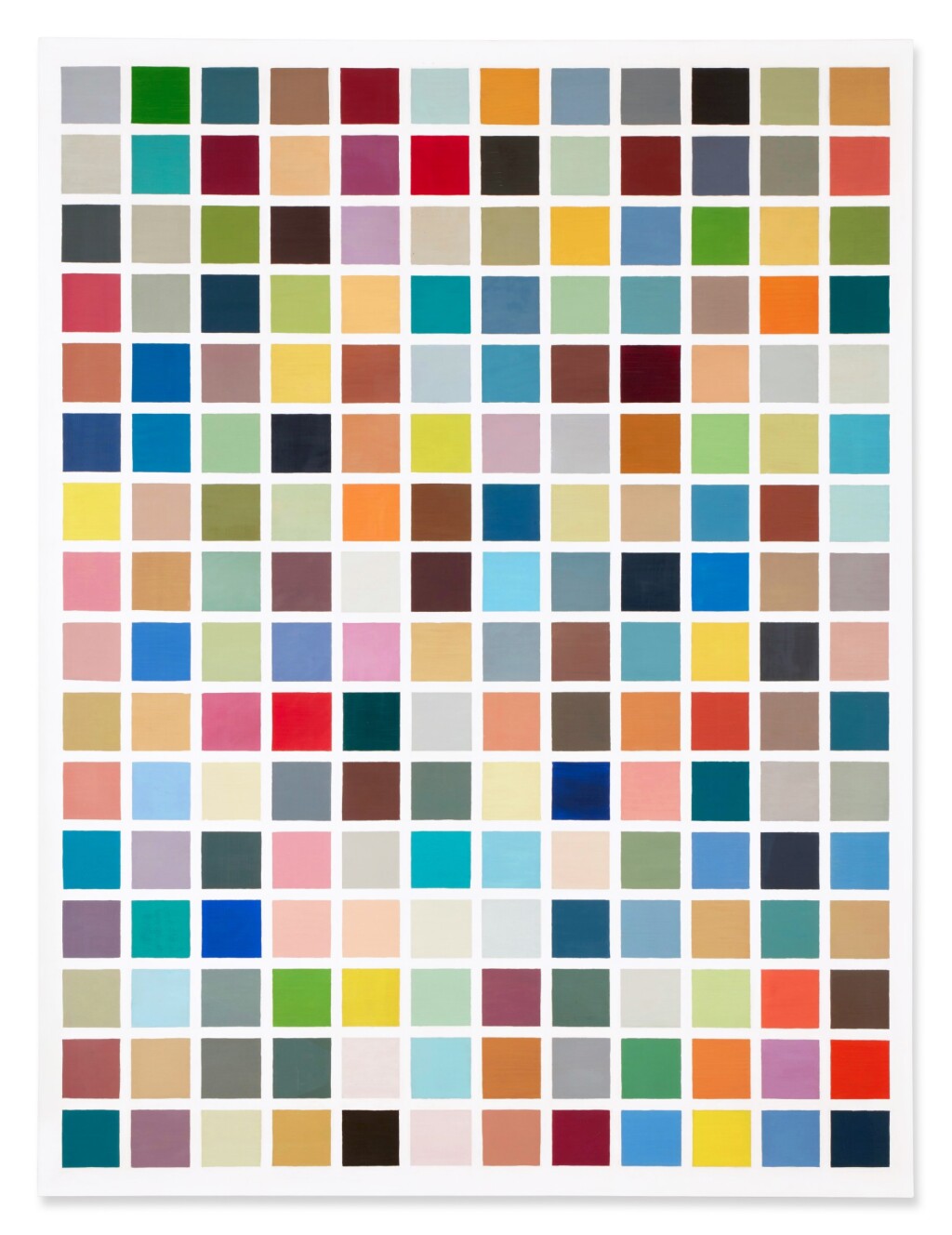
GERHARD RICHTER
192 Farben, 1966
Oil on canvas
200×150 cm (78½ x 59 inches)
Estimated GBP 13,000,000 – 18,000,000
GBP 18,287,800
In 1966, with his Color Chart works, Gerhard Richter succeeded in radically expanding his early oeuvre. It will not be for the last time that, through new motifs, Richter questioned his painterly concept and tests out a new stylistic idiom. In October that year, when asked about the initial impulse of the creation of his Color Charts, he remembered “At the start of January I went to a paint shop (in Dusseldorf) to purchase something, here I saw the usual color sample cards that everyone is familiar with, with crossed out color hues from a collection. Suddenly I had to admit to myself, ‘You cannot do this any better! These are already perfect pictures.’” Above all though, Richter recognized in the color sample cards a pictorial quality, like the quality that he had seen four years earlier in newspapers, magazines and private family albums. For Richter, these motifs were ready-made pictures that served as perfect templates for his painting. Now, the sample cards from the paint shop presented a dramatic first step into the direction of abstraction.
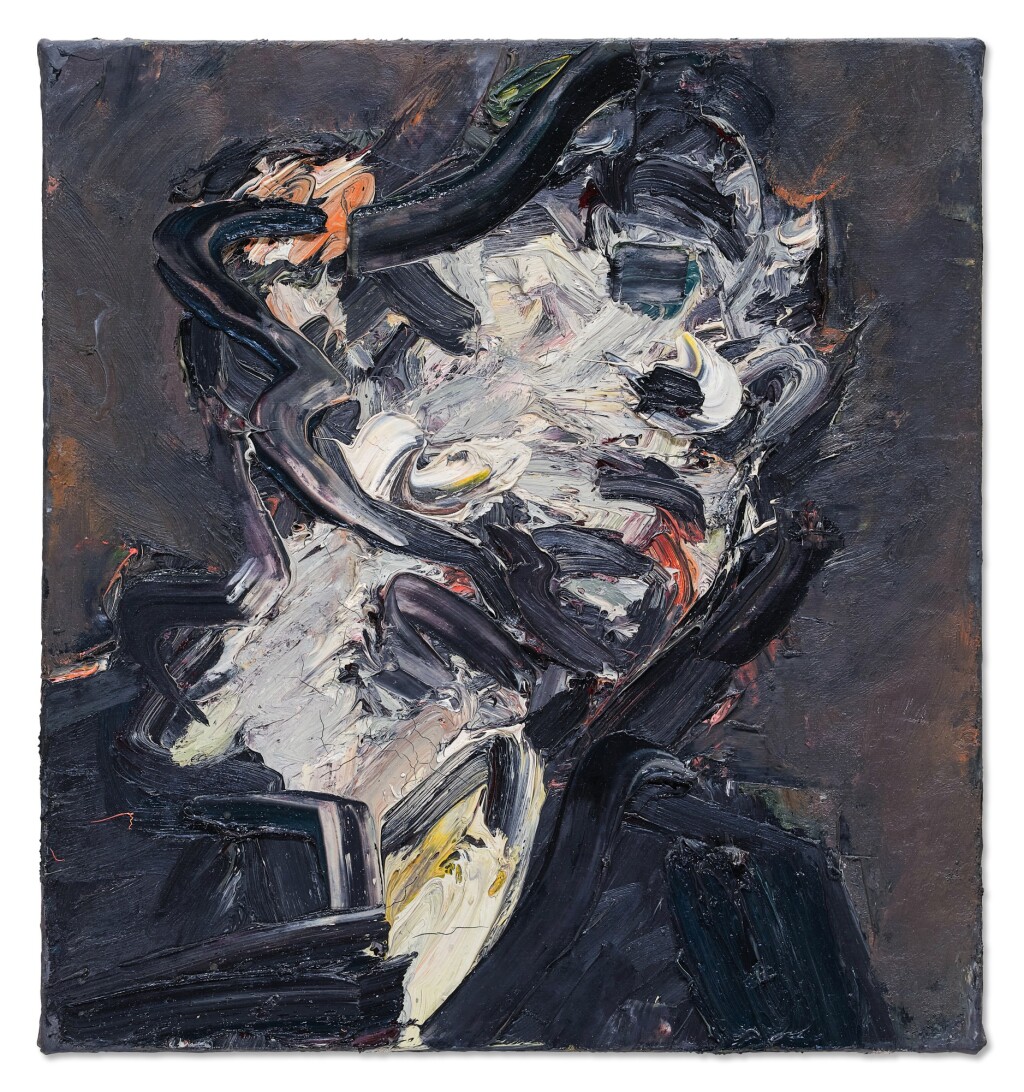
FRANK AUERBACH
Head of J.Y.M., 1984-85
Oil on canvas
66×61 cm (26×24 inches)
Estimated GBP 3,000,000 – 4,000,000
GBP 5,148,800
Executed in the mid-1980s Head of J.Y.M. represents the absolute apex of Frank Auerbach’s critically acclaimed and widely celebrated oeuvre. Imposing in scale for a portrait by the artist and possessing an unrivalled confluence of brushwork and observation, this exceptional painting was chosen for the cover of Robert Hughes’s influential monograph on the artist. Indeed, from a career spanning seven decades, Head of J.Y.M. is a painting of unmatched execution and astounding quality. Famously, Auerbach only depict subjects with whom he is extremely familiar, and Juliet Yardley Mills, referred to by her friends simply as J.Y.M. or Jym, is from a small group of subjects alongside Estella (Stella) Olive West (E.O.W.), his wife Julia, son Jake, and art historian Catherine Lampert among only a handful of others. Of this intimate group, J.Y.M.’s likeness presides over a host of the artist’s most iconic paintings, making her the artist’s most celebrated and recognized sitter. Auerbach completed over seventy portraits and studies of J.Y.M. over four decades, and the present work was executed nearly twenty years into their friendship. Nick-named Jimmie and Frankie, the two forged an extraordinary friendship that resulted in some of Auerbach’s most significant works. Hand-picked by the artist to be included in his 2001 retrospective at the Royal Academy of Art, Paintings and Drawings 1954-2001, the present work undoubtedly carries both personal as well as an art historical importance within Auerbach’s oeuvre.
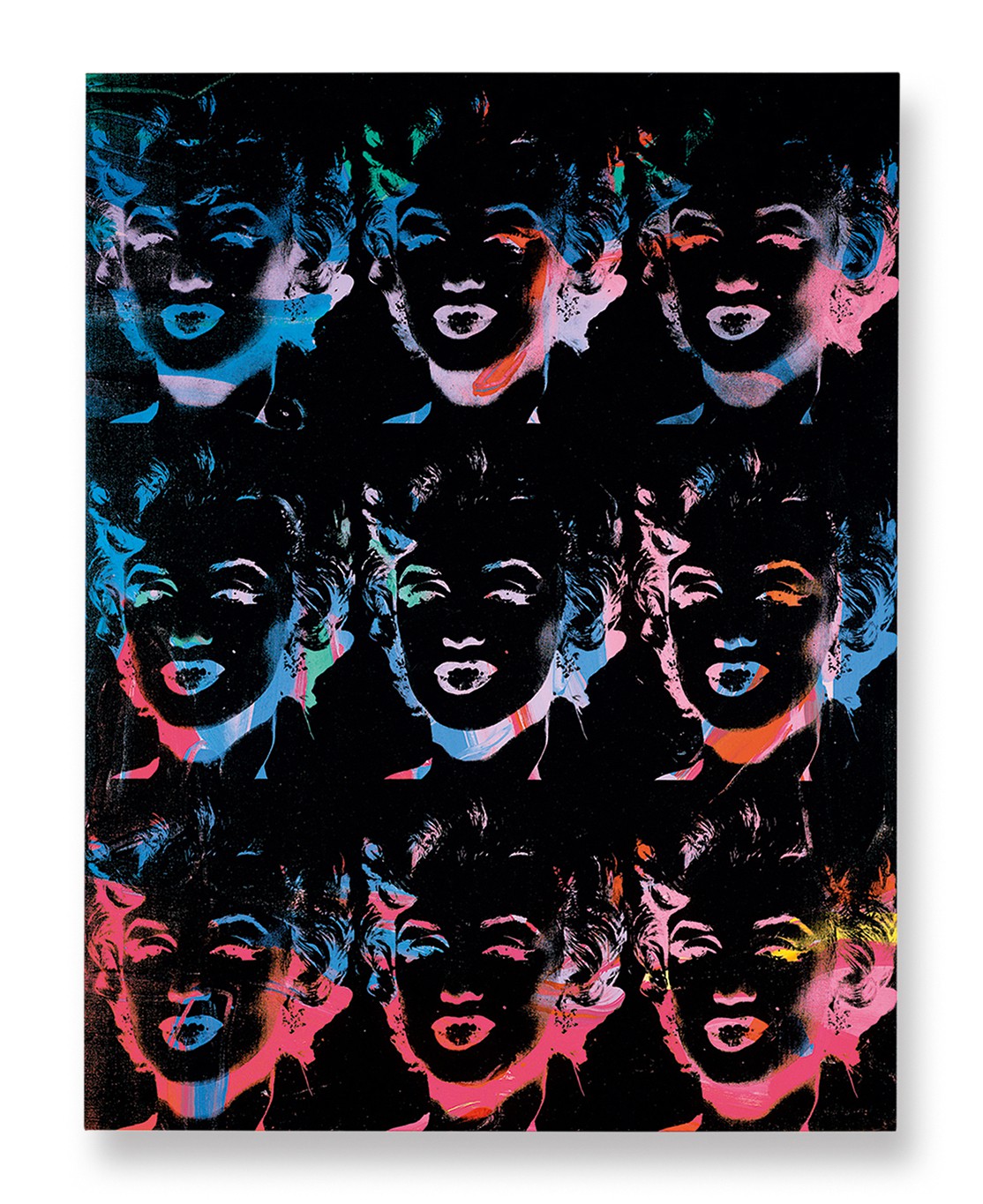
ANDY WARHOL
Nine Multicolored Marilyns (Reversal Series), 1979-86
Acrylic and silkscreen ink on canvas
138 x 106.1 cm (54⅜ x 41¾ inches)
Estimated GBP 6,000,000 – 8,000,000
GBP 5,189,200
Nine Muliticolored Marilyns (Reversal Series) depicts the most instantly recognisable and famous personality of the Twentieth Century and Andy Warhol’s most iconic subject. On the surface of the present work, Marilyn Monroe’s portrait is serially reproduced nine times, her face in dark shadow and illuminated by pscyhadelic and expressively applied hues of vibrant pink and blue. This painting is an outstanding example of Warhol’s deeply reflective and rigorously conceptual Reversal series, which he began in the 1970s. Within a context of the appropriationist strategies of burgeoning artists such as Richard Prince and Cindy Sherman, Warhol began this pivotal body of work by expropriating material from his own infamous repertoire of images, and transforming and updating his classic Pop iconography of the 1960s in a self-referential act of post-modern brilliance. Warhol’s portraits of the previous decade had seeped into a mass visual register of American popular culture and achieved a potent symbolic power to rival the mass media images the artist appropriated to create these works. The impact of Warhol’s depiction of Marilyn Monroe not only registers the timeless quality of her celebrity, but also the symbolic power of Warhol’s own. The Reversal series heralded a seismic return to this “iconographic universe” (Germano Celant, Super Warhol, New York, 2003, p. 10). With a renewed intellectual vigour, Warhol swiftly pivoted away from the notion of Hollywood celebrity and towards a reflection upon his own artistic legacy. By appropriating Warhol the brand, the Reversal series heralded the beginning of a new Warholian dialogue.
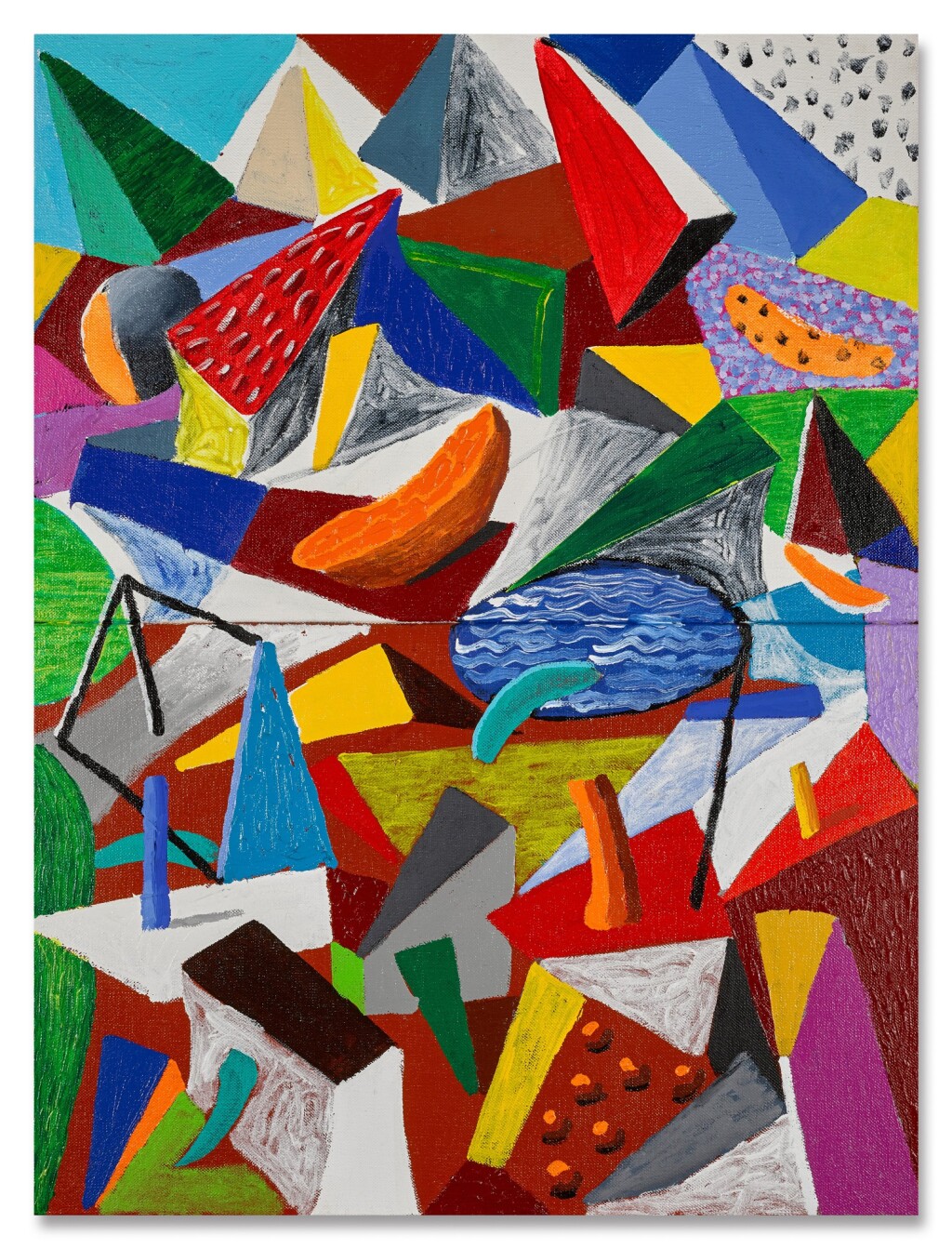
DAVID HOCKNEY
Big Landscape (Medium), 1987-88
Acrylic on two joined canvases
123 x 91.5 cm (48 ⅜ x 36 inches)
Estimated GBP 3,000,000 – 4,000,000
GBP 4,149,000
David Hockney’s Big Landscape (Medium) is a unique, experimental example of the artist’s late 1980s abstract landscape paintings. Painted on and off between 1987-88, the work took form over the course of months, during which the composition expanded, flowing the painting onto another canvas. Reminiscing about this painting, Hockney recalled: “…looking back, I can see that this particular painting led to more new developments in my work than the others from this period… I had put a lot of things in it, rather like notes of what I was going to explore…” (David Hockney quoted in: Nikos Stangos, Ed., That’s the way I see it: David Hockney, London, 1993, pp. 186). Indeed, throughout the composition, various signature motifs of Hockney’s works emerge, such as the abstracted pool in the centre of the canvas, the kaleidoscopic color which recall the brilliant Californian landscapes, and the cubist geometry foreshadowing the Surrealist abstraction that would come to characterize the next phase of his career.
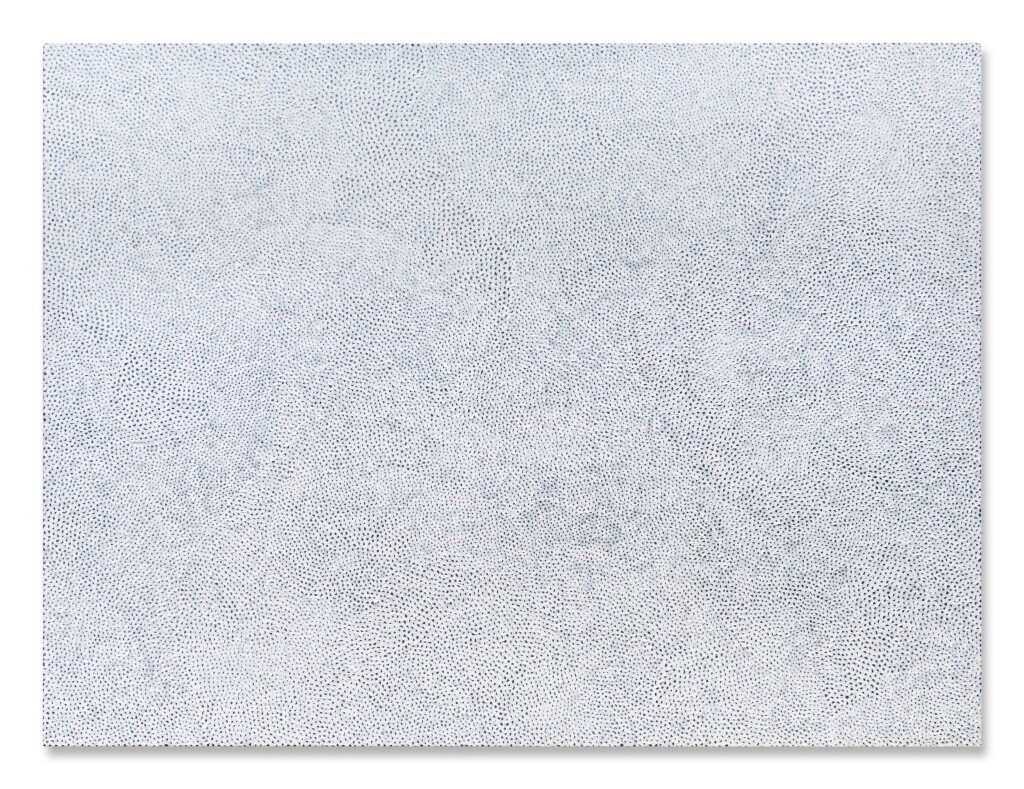
YAYOI KUSAMA
Infinity-Nets (QOTP), 2010
Acrylic on canvas
194×259 cm (76 ⅜ x 102 inches)
Estimated GBP 1,800,000 – 2,500,000
GBP 3,423,000
Infinity-Nets (QOTP) from 2010 is an ethereal, dynamic and imposing example from Yayoi Kusama’s most iconic and consequential series of paintings. Kusama’s radical and singular practice defies categorization, her visual semantics of infinity and repetition spanning painting, performance, video, sculpture and installation. Amongst this diverse body of work, however, it is the Infinity Nets that stand as the most important and enduring iteration of her ground-breaking artistic expression. Produced decades after the first iteration of the series, the white impasto lattice on the surface of the present work swells and ebbs across the picture plane. Here an expansive canvas ground delivers an immersive experience by which we are given a glimpse into Kusama’s fantastical and illusory mind-space. Infinity-Nets (QOTP) continues Kusama’s legendary series, employing the same repetitive and hypnotic mark-making that characterizes the very best of Kusama’s oeuvre.
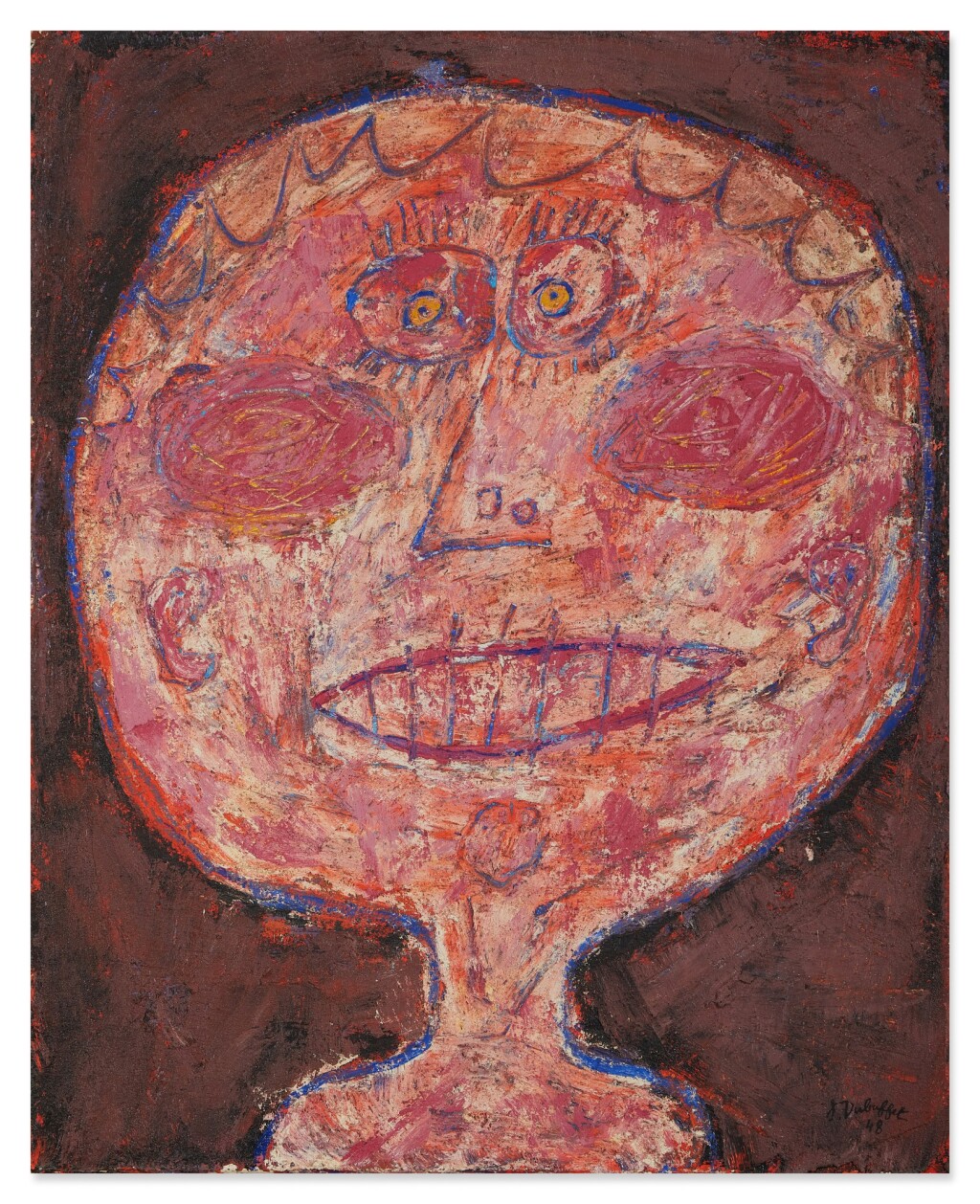
JEAN DUBUFFET
Sourire (Tête hilare II) (Smile (Hilarious Face II)), 1948
Oil on canvas
92×73 cm (36¼ x 28 ¾ inches)
Estimated: GBP 1,700,000 – 2,200,000
GBP 2,707,500
In jubilant hues of pink, crimson, cobalt and orange, Sourire (Tête hilare II) (Smile (Hilarious Face II)) is testament to Jean Dubuffet’s radical art brut style, and his enduring protest against conventional standards of beauty. Belonging to Dubuffet’s Grandes Têtes of the Roses d’Allah series, a cycle of six large-scale portraits executed between May and June 1948, the present work demonstrates the extraordinary range of techniques and media employed by Dubuffet at a pivotal, early moment in his career. The Roses d’Allah paintings are highly textured, their surfaces heavily worked in thick, rough brushstrokes. Drawing upon the visual language of urban graffiti and tribal art, Dubuffet’s quintessential caricatured figuration saw the artist reject traditional portraiture, taking a distinctly ‘anti-art’ position at a moment when the Parisian intelligentsia and the artists they supported were thriving after the end of the traumatic Second World War. Depicting an exuberant, smiling female sitter, the present work underscores the simple hopes and joys of post-war life, and the intimate, every-day moments that were all but impossible during the turbulent years of war. Measuring 92 by 73 centimetres, Sourire (Tête hilare II) ranks among the largest and most resolved iterations of the Roses d’Allah series, comparable only to La Bouche en croissant (1948), a gift from great collector and president of The Whitney Museum of Art, David Solinger to the collection of The Johnson Museum of Art, Cornell University, where the painting now resides. The provenance of Sourire (Tête hilare II) further attests to its importance within Dubuffet’s early output, as it was a formative part of the collection of E.J. Power who in the late 1950s was of one of Britain’s most important, early collectors of contemporary art. Power greatly admired Dubuffet, and acquired over eighty works by the artist between 1955 and 1960, which sat in his collection alongside works by the great American Abstract Expressionists Jackson Pollock, Mark Rothko, Barnett Newman, and Ellsworth Kelly. Encapsulating the distinctive styles of Informel, art brut, and art autre dominant in lively Paris during the late 1940s and prevalent across Dubuffet’s wider oeuvre, Sourire (Tête hilare II) is a radical, painterly triumph.
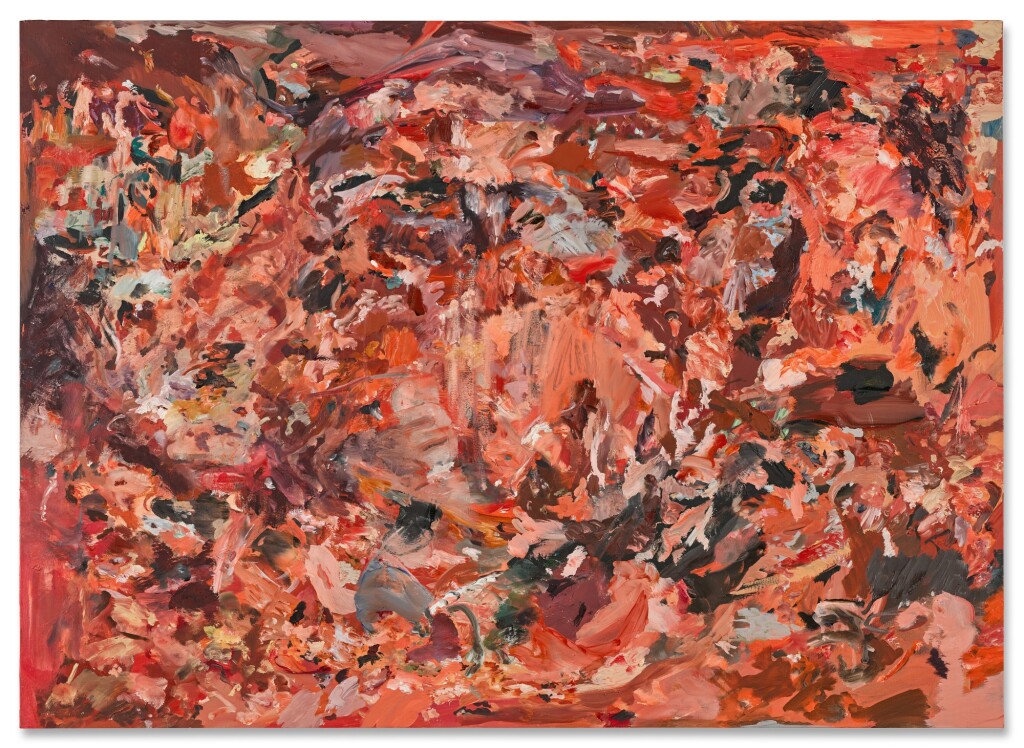
CECILY BROWN
Beautiful Not Realistic, 2008
Oil on linen
78.7 x 109.2 cm (31×43 inches)
Estimated: GBP 600,000 – 800,000
GBP 1,487,000
Suffusing lustful gestures of flesh-toned pigment with mysterious recesses of dark, ambiguous space, Beautiful Not Realistic presents Brown’s expert handling of paint for all its captivating and elusive power. Painting a visceral sense of physical intimacy, Brown’s lush canvases do not portray experience but rather translate it into paint. Executed in 2008, Beautiful Not Realistic dissolves the sensual figures of Brown’s earlier representational schemes into the physical qualities of her chosen medium: paint. Squeezing, smudging, pressing, and smearing viscous gobs of corporeal pigment into the canvas, the vitality and energy of bodily flesh can be felt in every stroke with which Brown has marked the image. For this exceptional work, Brown has not moved away from the figure, but rather into it, using the suggestive power of paint to make viscerally visual those very physical qualities of corporeality.
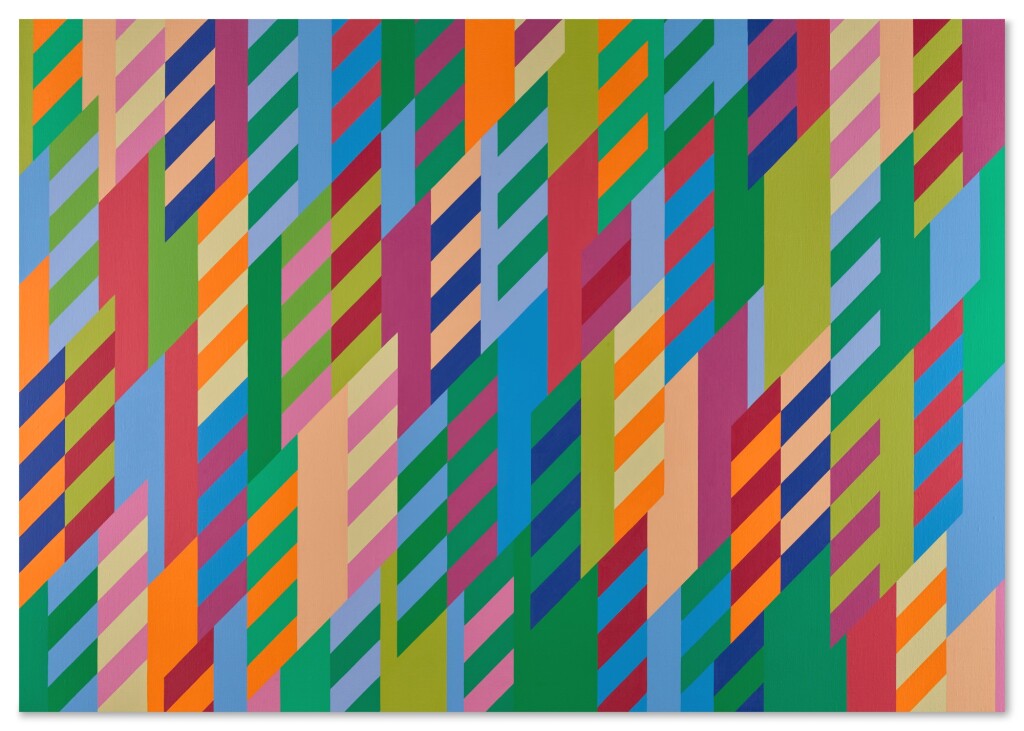
BRIDGET RILEY
Summer Shades, 1994
Oil on canvas
85.2 x 121.7 cm (33 ½ x 47 ⅞ inches)
Estimated: GBP 600,000 – 800,000
GBP 1,063,500
Executed in 1994, Summer Shades is at once mesmeric and measured, as contrasting diagonals of colour coexist within a vibrant compositional field. An outstanding example from a series Bridget Riley began in 1986, the present work is anchored in the relationships between ribbon-like diagonals that deftly convey the artist’s career-long investigation into the perceptual qualities of colour and the visual resolution of sensation and emotion on the surface of a canvas. 1986 marked a crucial turning point in Riley’s practice: She began greatly simplifying the formal oraganisation of her paintings, adopting a diagonal compositional format. In shades evocative of a sun-drenched summer day, the present work is comprised of orange, blue, green, yellow, violet, and vermillion hues that move with clear directionality in fluid diagonal ‘zigs’ across the surface of the canvas. As art historian Michael Bracewell notes of the works in this series, “solidity and fluidity coexist within these bold and muscular paintings, seeming to push to its limit the confluence of directions of visual momentum” (Michael Bracewell, “Introducing the Art of Bridget Riley: An Act of Translation” in: Exh. Cat., London, Hayward Gallery, Bridget Riley, 2019, p. 193). Works from this pivotal series reside in prestigious institutions such as the Tate, London (Nataraja, 1993), and formed a critical part of the recent retrospective Bridget Riley at the Hayward Gallery, London and National Galleries Scotland, Edinburgh between June 2019 and January 2020.
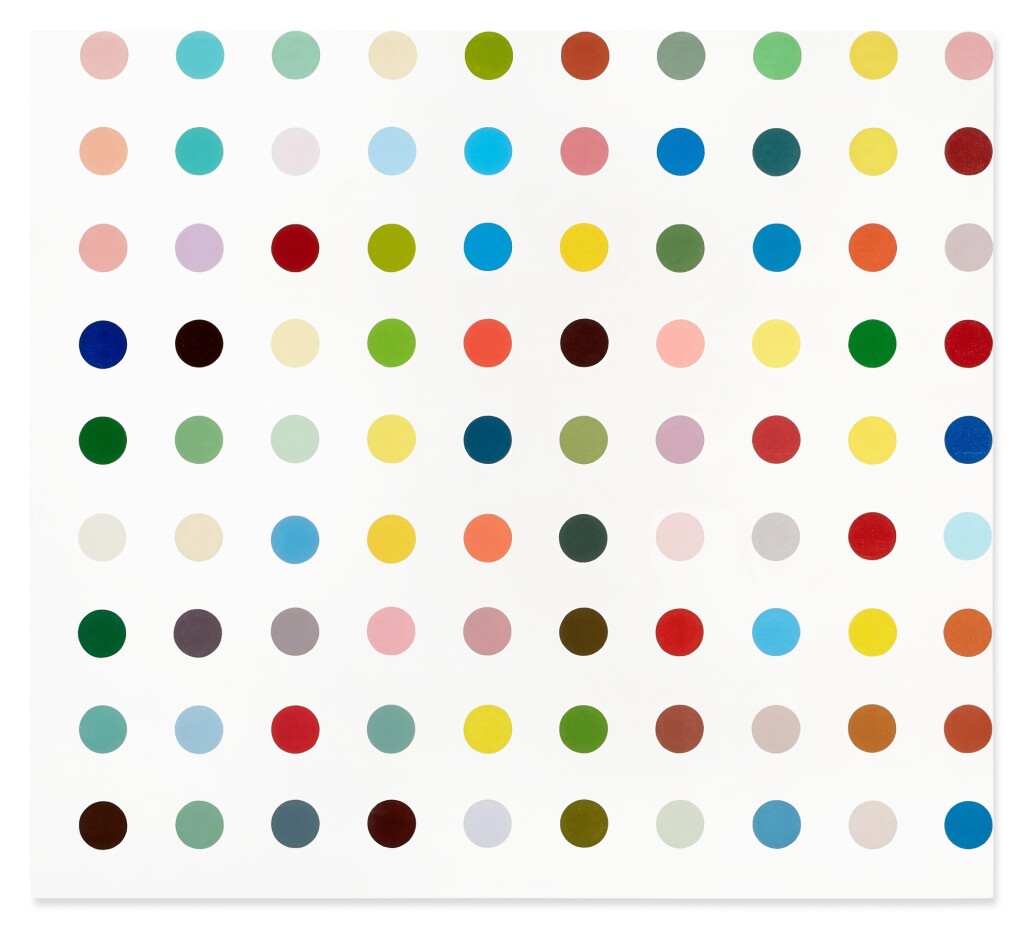
DAMIEN HIRST
Althiazide, 1992
Household gloss on canvas
182.9 x 203.2 cm (72×80 inches)
4-inch spot
Estimated: GBP 600,000 – 800,000
GBP 693,000
Suspended in nine rows and ten columns, the ninety unique-colour circles of Althiazide comprise one of the earliest and most serene of Damien Hirst’s iconic Spot paintings. Each colour sphere is carefully individualized in hue, but together the household gloss-paint discs span the entire chromatic spectrum. This work is a key constituent of the breakthrough series that brought Hirst to international attention and garnered the artist widespread critical acclaim in the early 1990s. The present work’s execution was contemporaneous with the very first Young British Artists show as the Saatchi Gallery in 1992, which led to Hirst’s nomination that year for the coveted Turner Prize.
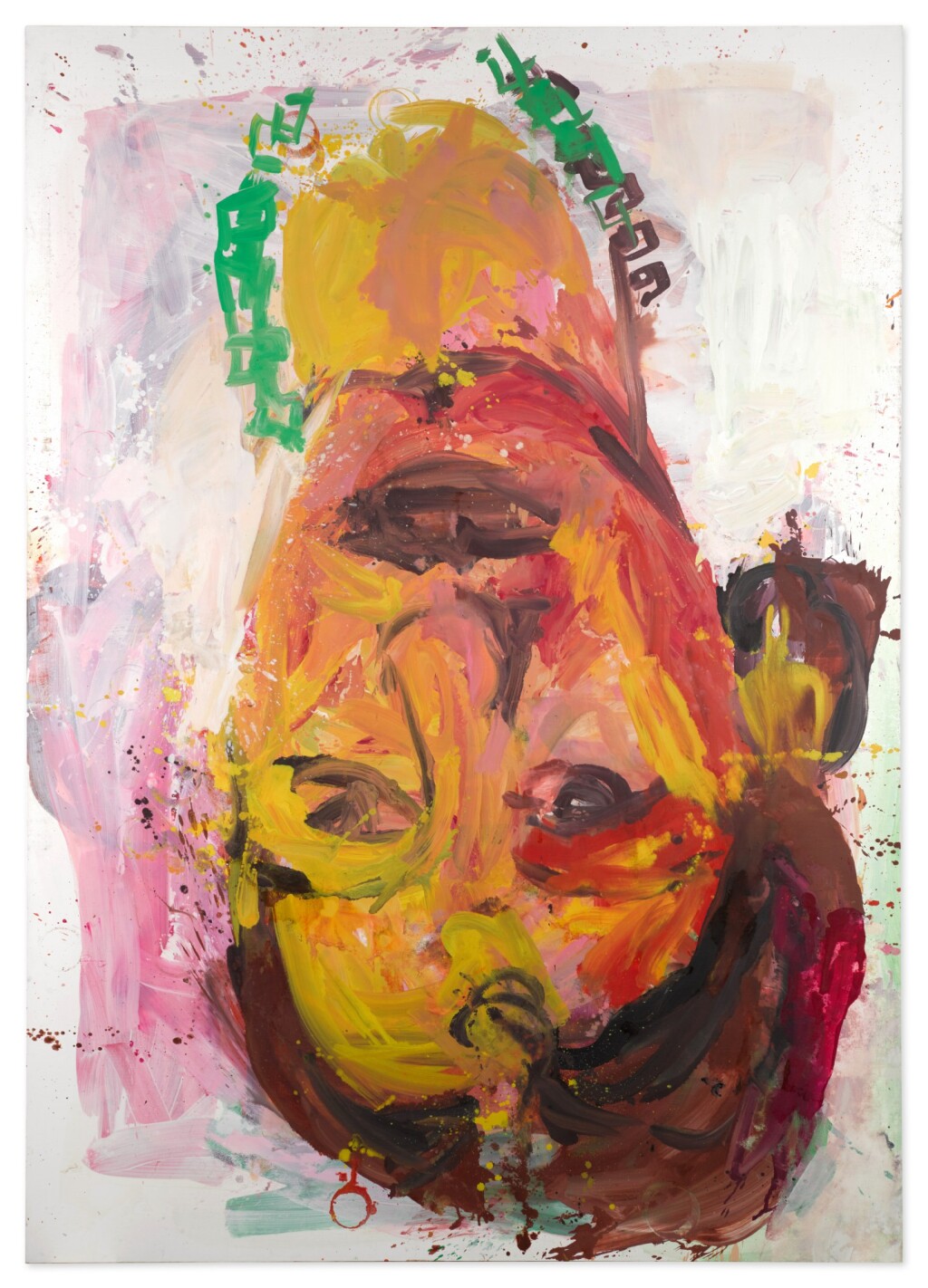
GEORG BASELITZ
Mutter Lilo, 1996
Oil on canvas
289.6 x 204.8 cm (114 x 80 ¾ inches)
Estimated: GBP 600,000 – 800,000
GBP 630,000
Executed in 1996, Mutter Lilo encapsulates Georg Baselitz’s raw, visceral style informed by the complex legacy of the Second World War and, simultaneously, the more playful and serene spirit of his paintings of the 1990s. The present work exhibits an upside-down portrait of Baselitz’s mother, Lieselotte (short Lilo), and belongs to a series of portraits of family members he completed in 1996. Exceptionally affective and prodigious in its proportions, Mutter Lilo is densely depicted in rich maroons, crimson and cardinal reds, warm yellow and cool pinks, her expressive features dominating the entirety of the canvas ground. Included in multiple exhibitions across Germany, this portrait was part of the collection at the Sprengel Museum Hanover for two decades, where it cemented Baselitz as a foundational voice in the revival of German Expressionism and one of the most influential painters of his generation.
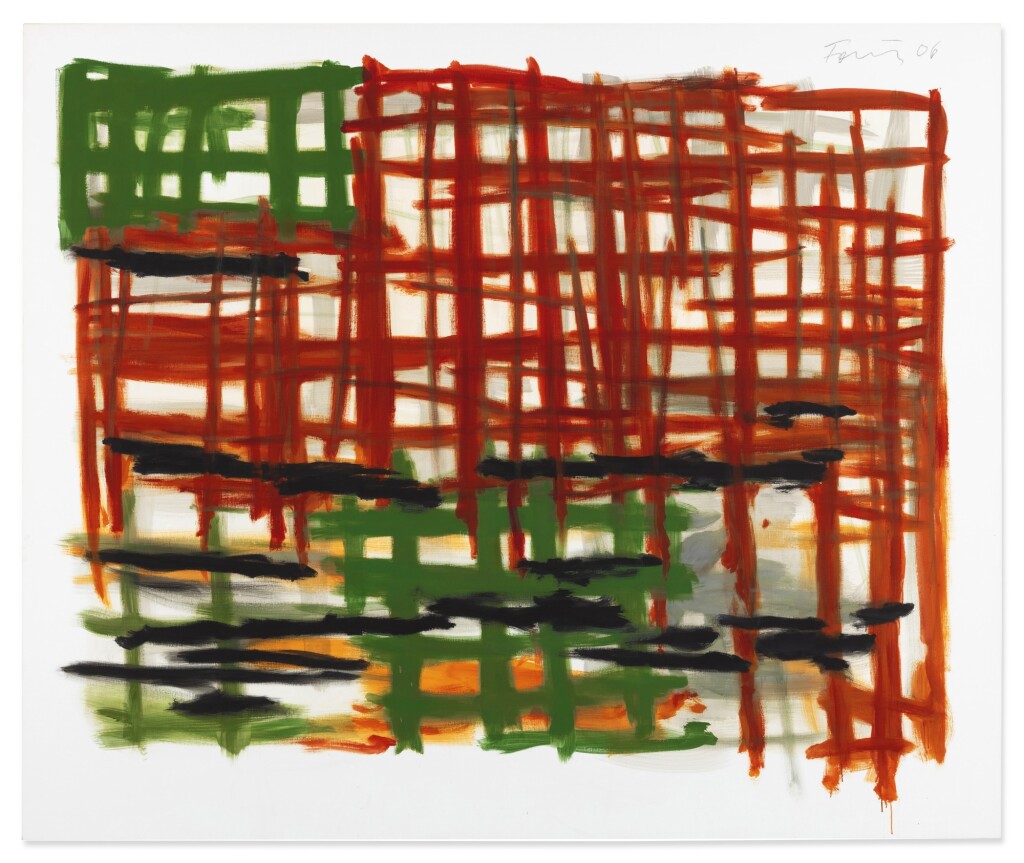
GUNTHER FORG
Untitled, 2006
Acrylic on canvas
200×240 cm (78 ¼ x 94 ½ inches)
Estimated: GBP 280,000 – 350,000
GBP 453,600
Executed in 2006, Untitled is a magnificent example of Günther Förg’s celebrated Gitterbilder or Grid Paintings. An exuberant, criss-crossing network of lines in vibrant hues of red, green, black, grey, and orange, the present work envelopes the viewer in a haze of intoxicating colour. Developed out of his earlier cycle of Fenster-Aquarelle, or Window Watercolors, the Grid Paintings are characterized by a dynamic mesh of vertical and horizontal lines that dance enticingly over the surface of the canvas. “Förg loves the ambiguous, the indecisive, the tightrope walk between roughness and finesse,” writes art historian Florian Steininger, and indeed, at once structured yet loose, open yet confined, the Grid Paintings contend with the dichotomous nature of painting in which material flatness and illusionistic depth converse and collide. (Florian Steininger, “Günther Förg — ‘The Painter’s coat'” in: Exh. Cat., Vienna, Essl Museum, Günther Förg: Back and Forth, 2007, p. 15) Förg’s practice keenly sought to produce “paintings that are reduced to painting itself, to their own essence.” (The Artist cited in: Günther Förg In His Own Words’, Hauser and Wirth, May 2019, online) Articulated on a monumental scale, these works call into question the very act of painting itself.
Phillips
20th Century and Contemporary Art Evening Sale
14 October 2022
GBP 18,835,600
USD 21,042,190
31 Lots Sold
Top Lot: GBP 3,047,500
33 Lots
Above estimates: 16 Lots (48%)
Within estimates: 6 Lots (18%)
Below estimates: 9 Lots (27%)
Unsold: 2 Lots (6%)
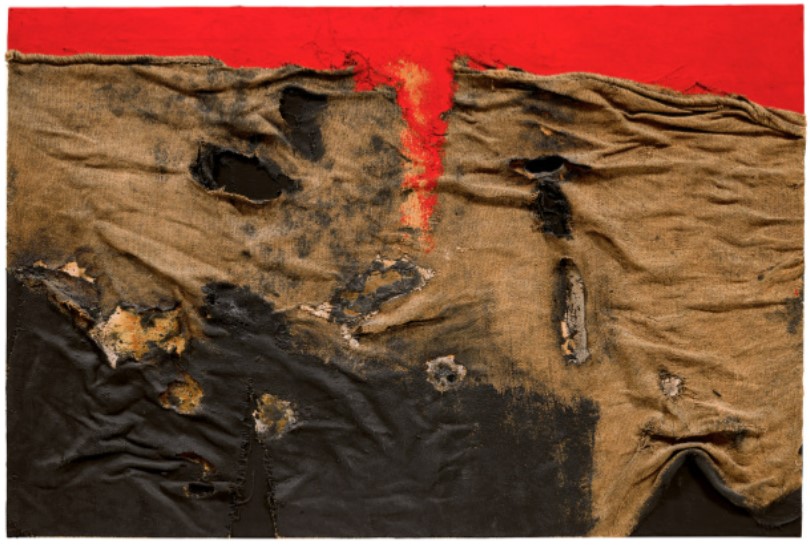 ALBERTO BURRI
Sacco e Rosso, 1956
Burlap, combustion and acrylic on canvas, in artist’s frame
68.2 x 101.5 cm (26 7/8 x 39 7/8 inches)
Estimated: GBP 3,000,000 – 4,000,000
GBP 3,047,500
A defining example of Italian artist Alberto Burri’s iconoclastic practice, and a symbol of the radical experimentation of European post-war art, Sacco e Rosso is a work of exceptional harmony and poignancy, its textures and chromatic variances deeply evocative of the body and the trauma of the 20th century. Undoubtably Burri’s most prized works, the burlap Sacco e Rosso are exceptionally rare. Held in the same collection for over 30 years, the present Sacco e Rosso is one of only 15 such works in existence, one of which is held in the permanent collection of Tate Gallery in London. Emphasising its status as a defining piece of Italian post-war art, the work was once held in the personal collection of renowned art historian and Burri expert Cesare Brandi, and comes to auction with an extensive exhibition history having represented the Sacco e Rosso paintings on an international stage. Combining compositional simplicity and emotive power, Sacco e Rosso speaks lyrically to the incipient poetry residing in everyday objects, especially when combined with more expressive modes of abstraction starting to take shape contemporaneously.
 BANKSY
Sorry The Lifestyle You Ordered Is Currently Out of Stock, 2012
Spray paint on found canvas on graffed board, in artist’s frame
106.7 x 166.4 cm (42 x 65 1/2 inches)
Estimated: GBP 1,200,000 – 1,800,000
GBP 1,837,500
Audacious and provocative, in Sorry The Lifestyle You Ordered Is Currently Out Of Stock guerrilla street artist Banksy collapses high culture and street art, applying the pointed satire of his site-specific graffiti to a direct critique of the connections between the art market, consumer capitalism, and environmental issues. Set within a heavy gilt frame evoking museum walls and Old Master paintings, the work is composed of an appropriated canvas featuring a romantic mountain landscape, defaced with the slogan ‘Sorry The lifestyle you ordered is currently out of stock’ and attached to a densely spraypainted board behind. Uniting these different elements within the work Banksy forges unexpected dialogues between them, communicating his message with characteristic economy and wit.
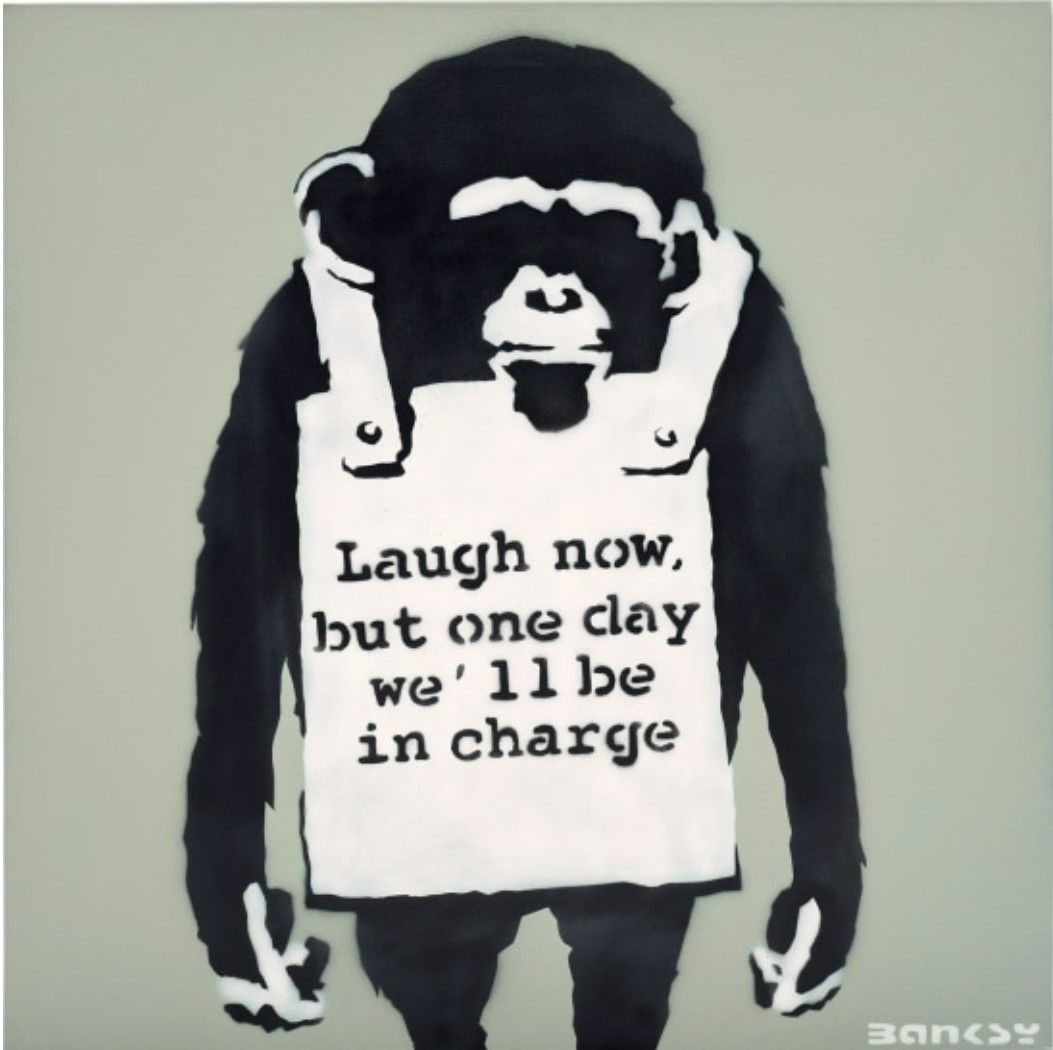
BANKSY
Laugh Now But One Day We’ll Be In Charge, 2002
Spray paint and emulsion on canvas
91×91 cm (35 7/8 x 35 7/8 inches)
This work is number 3 from an edition of 5
Estimated: GBP 1,000,000 – 1,500,000
GBP 1,172,000
Featuring one of notorious guerrilla artist Banksy’s most iconic and enduring images, Laugh Now But One Day We’ll Be In Charge encapsulates the sharp wit and keenly satirical character of Banksy’s work. A nuanced composition, this important early iteration of the Laugh Now works has been executed in combinations of black and white spray paint against an unusual slate-grey ground using the artist’s signature stencil technique. Deceptively simple, the work communicates a powerful message in its stark economy. Although his shoulders slope under the burden of the sandwich board, his set jaw and subtly clenched fists indicate a spirit of defiant resistance in the face of his oppression, signaling an ominous warning of what is to come.
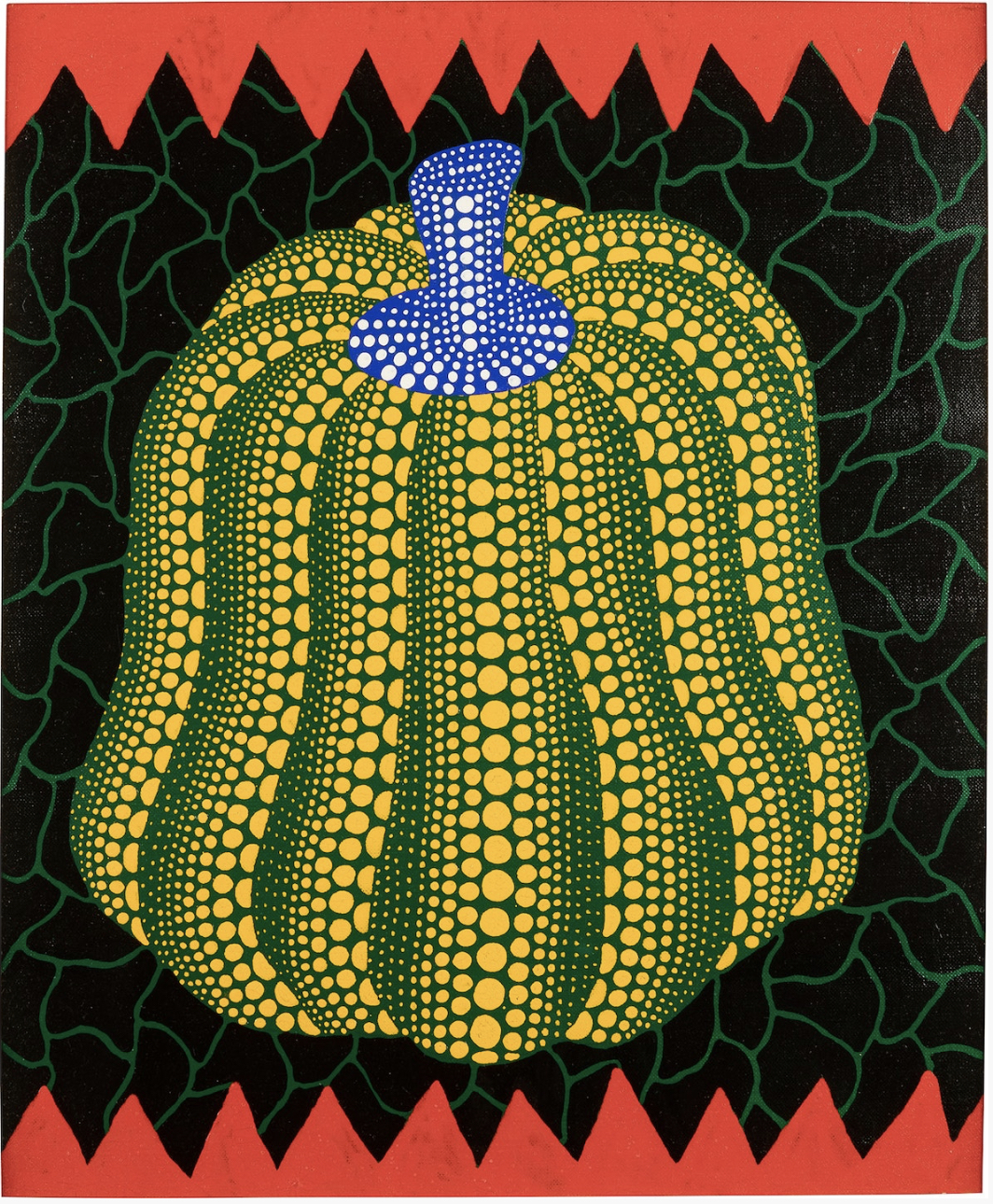
YAYOI KUSAMA
Pumpkin, 1989
Acrylic on canvas
45 x 38.5 cm (17 3/4 x 15 1/8 inches)
Estimated: GBP 700,000 – 1,000,000
GBP 1,135,700
Undoubtedly one of the most iconic motifs of contemporary art and of Japanese artist Yayoi Kusama’s incredible 70 year career, the polka-dot covered pumpkin combines the artist’s compulsive focus on infinity and repetition with a highly personal and self-reflective dimension. Like Andy Warhol’s Soup Cans, Kusama’s bright and brilliantly patterned gourds are so closely connected to the artist that they function as both allegory and mode of self-representation, acting as a universal signature of the artist. Rendered in vibrant hues of rich, golden yellow and deep black most typically associated with the motif, the titular pumpkin is joyously misshapen here, crowned with an unusual blue stalk and set against a vibrant background of tessellating green geometric shapes that draw immediate connections with the artist’s celebrated Infinity Net series. Particularly dynamic, the jagged vermillion border to the top and bottom edges of the canvas frames the gourd, focusing our attention on its capacity for infinite repetition and obliteration.
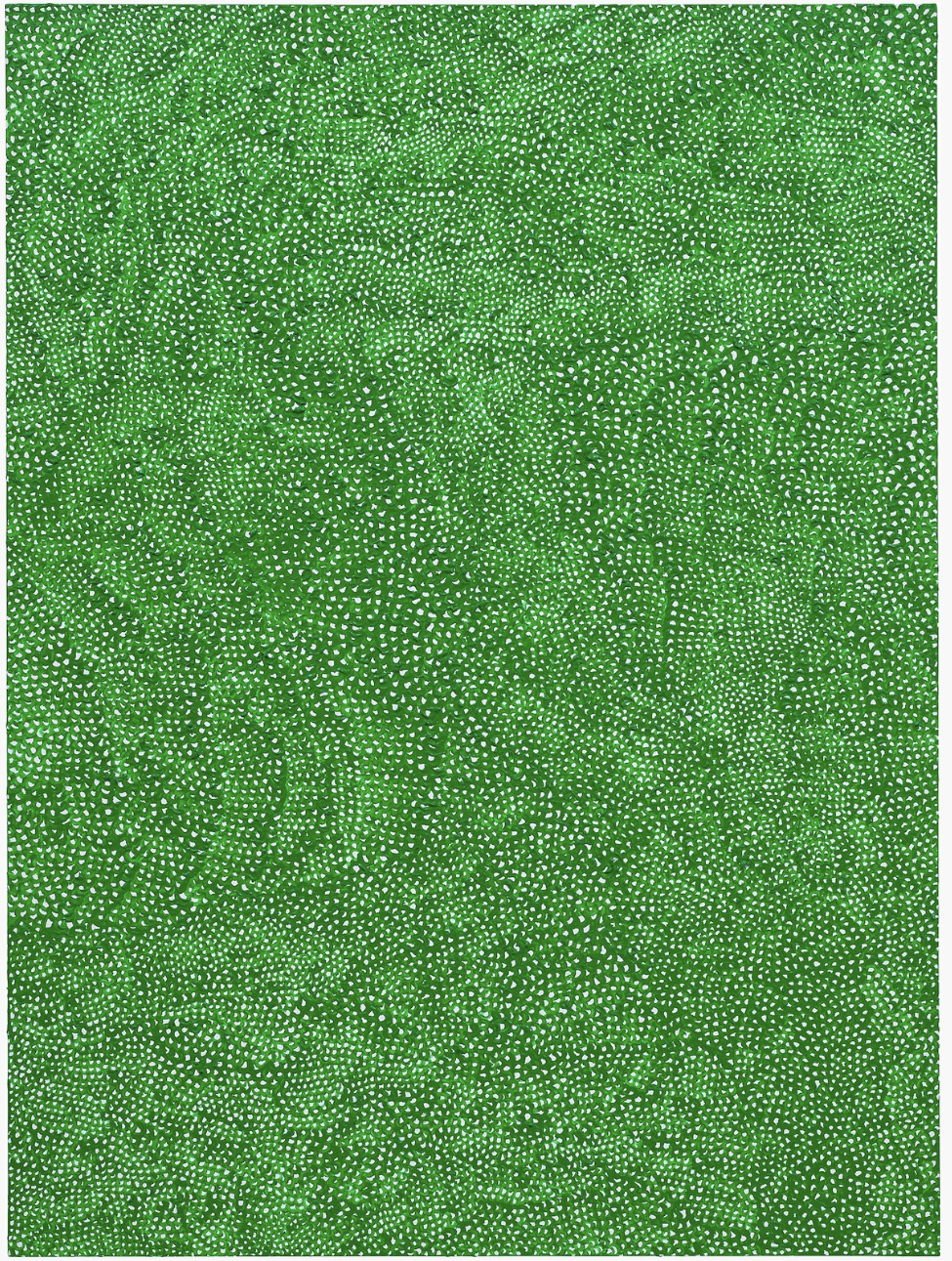
YAYOI KUSAMA
INFINITY-NETS (UAFE), 2016
Acrylic on canvas
131.4 x 97.2 cm (51 3/4 x 38 1/4 inches)
Estimated: GBP 1,000,000 – 1,500,000
GBP 990,500
Unfolding in undulating waves of brilliant emerald green, INFINITY-NETS (UAFE) is a stunning, unusual example of Yayoi Kusama’s iconic series. Painted in 2016, in the same year as the Japanese artist was awarded the prestigious Order of Culture by the Imperial Family, this mature work represents the culmination of Kusama’s life-long fascination with her signature repeating motif and the zenith of her incredible 70 year career. Created over half a century after her first Infinity Net painting, INFINITY-NETS (UAFE) emphasizes the privileged position that the series continues to occupy in Kusama’s pioneering practice, and its role developing a contemporary language of abstraction. Expansive, immersive, and beautifully delicate, the endlessly repeating and scalloped patterns of the present work resonate well beyond the limitations of the canvas, extending through her entire Infinity Net series out to her earliest soft sculptures, obliteration rooms, and provocative performances through to the mirrored environments and Infinity Rooms that are currently the subject of sell-out exhibitions worldwide.
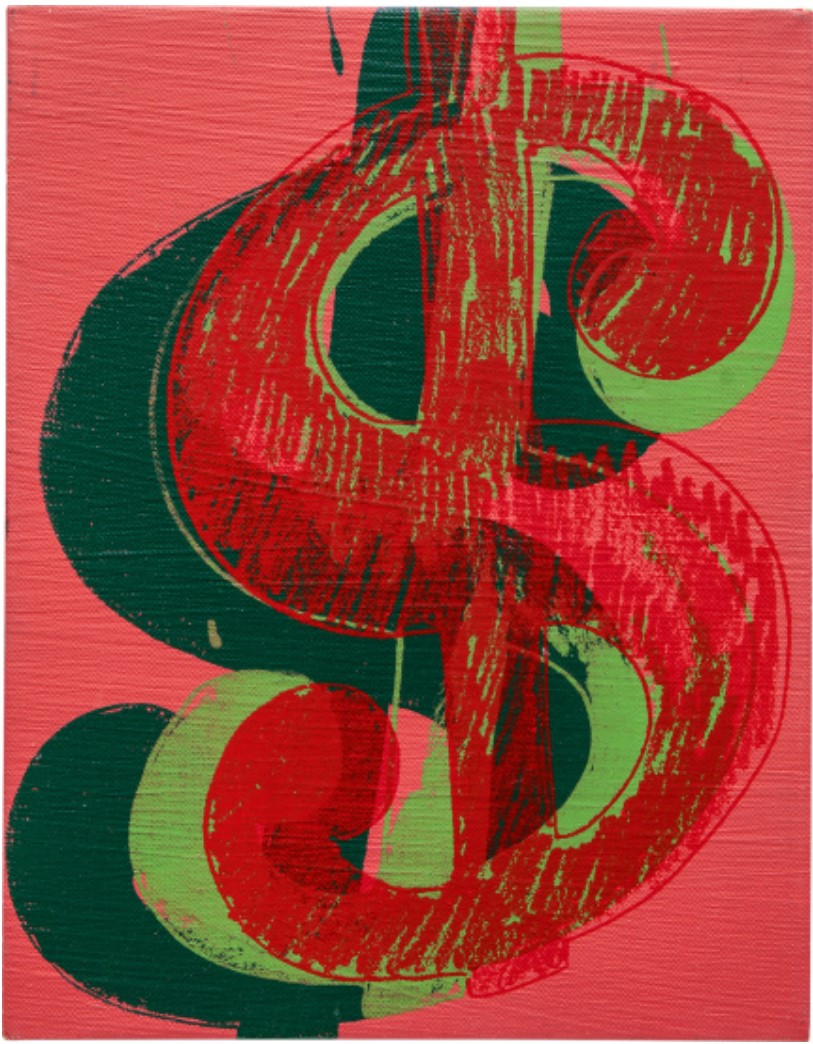 ANDY WARHOL
Dollar Sign, 1982
Acrylic and silkscreen ink on canvas
25.3 x 20.3 cm (9 7/8 x 7 7/8 inches)
Estimated: GBP 500,000 – 600,000
GBP 603,300
Demonstrating Warhol’s keen graphic sensibility, the present work is especially animated by the complex interaction of its layers – the vibrant coral ground offsetting the distinct layers of pine, dollar-bill green, and vermillion overlaid in three rounded, looping ‘S’ curves. Loosely scribbled, this final layer unites the different compositional elements and energizes the entire work. The final, overlaid vermillion dollar sign also draws a compelling visual connection with Warhol’s iconic Campbell Soup works. Central to the Warhol oeuvre, the Dollar Sign and Campbell Soup series both articulate Warhol’s fascination with commodity culture with remarkable directness. While the Campbell Soup and Brillo Box works reference consumer capitalism by invoking the objects, we fetishize, the dollar symbol clarifies the artist’s focus on what drives consumption: money. Stating this so directly, Warhol challenged traditional notions of ivory tower artists and guardians of high culture who sought to separate fine art from commercialism.
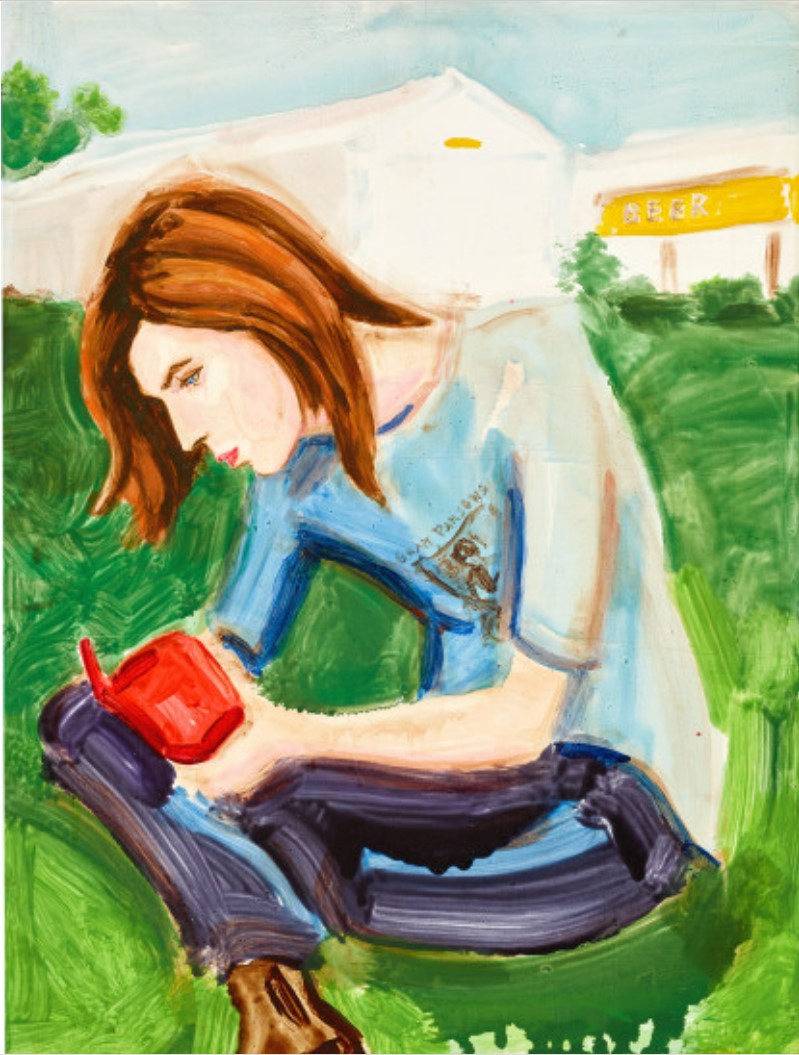
ELIZABETH PEYTON
Evan at the Reading Festival 1993, 1997
Oil on board
30.6 x 23.4 cm (12 x 9 1/4 inches)
Estimated GBP 480,000 – 650,000
GBP 567,000
Lyrically composed with broad, sweeping brushstrokes and a vivid, jewel-bright palette, Evan at the Reading Festival 1993 is a stunningly tender portrait from one of the finest figurative painters of her generation. Working primarily from photographs and printed media, Elizabeth Peyton is best known for her romantic portraits of rock stars, movie icons, and members of European Royalty, although the tone of her small-scale paintings moves far beyond celebrity adoration. Charged with emotion, these works collapse distinctions between realist painting and expressionist verve, and between the public performance of celebrity and the deeply personal relationships that we forge with them.