The May 2022 Impressionist, Modern, Post-War and Contemporary Art Auctions in New-York totaled USD 2,732,198,752 including Christie’s, Sotheby’s, and Phillips evening and day sales, as well as three single owner sales, reaching an historical high. A new world record has been achieved with Blue Sage Shot Marilyn by Andy Warhol sold for close to USD 200 million at Christie’s on 9 May 2022. Auction Houses observed record global bidding
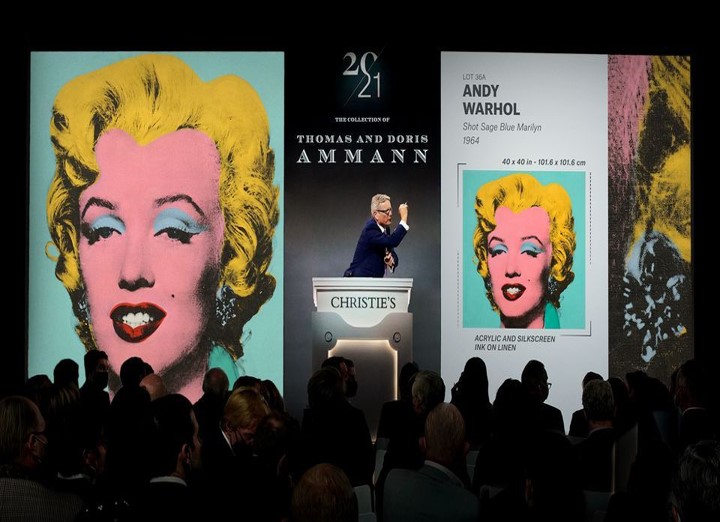
Table of Contents
1. Key Figures
2. Market Shares
3. Top 10 Lots Sold
4. Top 10 Artists by Revenues
5. Selected Artists’ Records
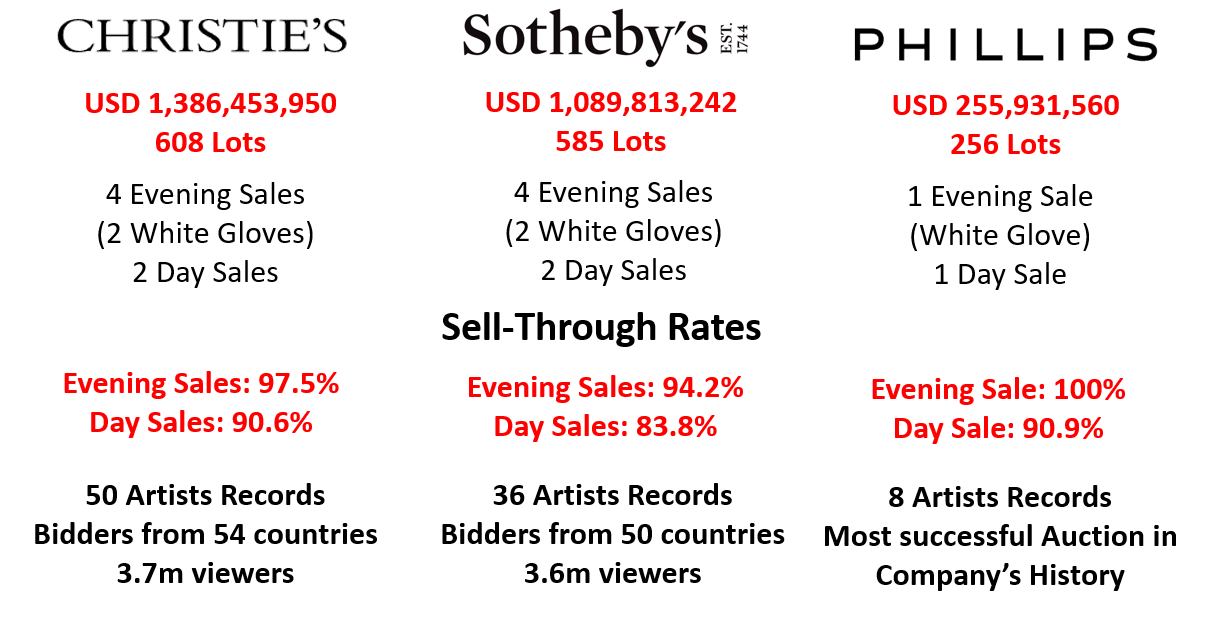
6. Top 10 Performers
7. Christie’s Results
8. Sotheby’s Results
9. Phillips Results
1. Key Figures
The May 2022 Impressionist, Modern, Post-War and Contemporary Art Auctions in New-York totaled USD 2,732,198,752 including Christie’s, Sotheby’s, and Phillips evening and day sales, as well as three single owner sales, reaching an historical high.
Turnover: USD 2,732,198,752
Number of Lots Sold: 1,449 Lots
Price Segmentation
275 Lots sold for over USD 1 million for a cumulative total of USD 2,449,233,080
(89.6% of total value)
55 Lots sold for over USD 10 million for a cumulative total of USD 1,743,142,650
(63.8% of total value)
16 Lots sold for over USD 40 million for a cumulative total of USD 1,030,322,500
(37.7% of total value)
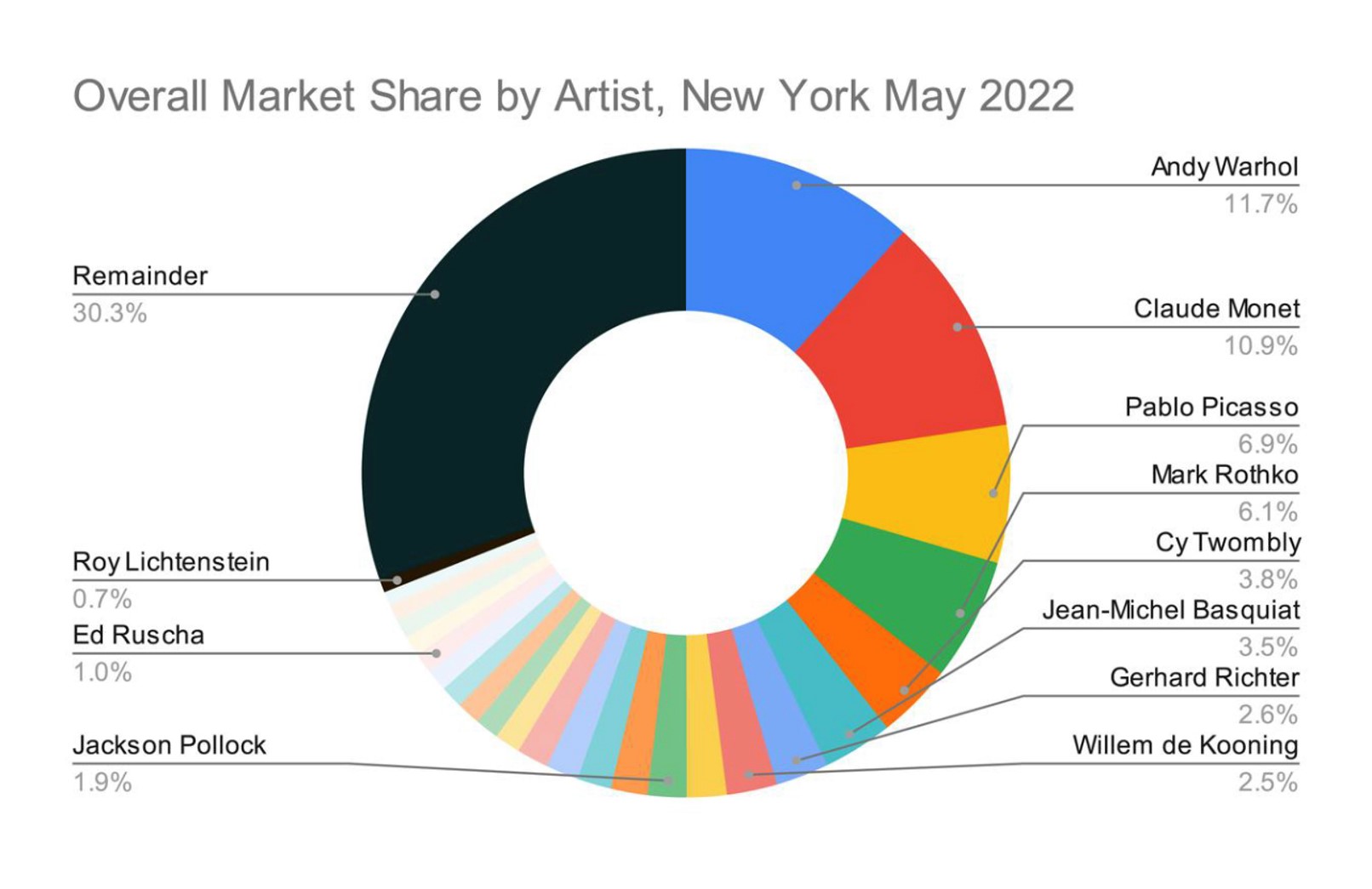
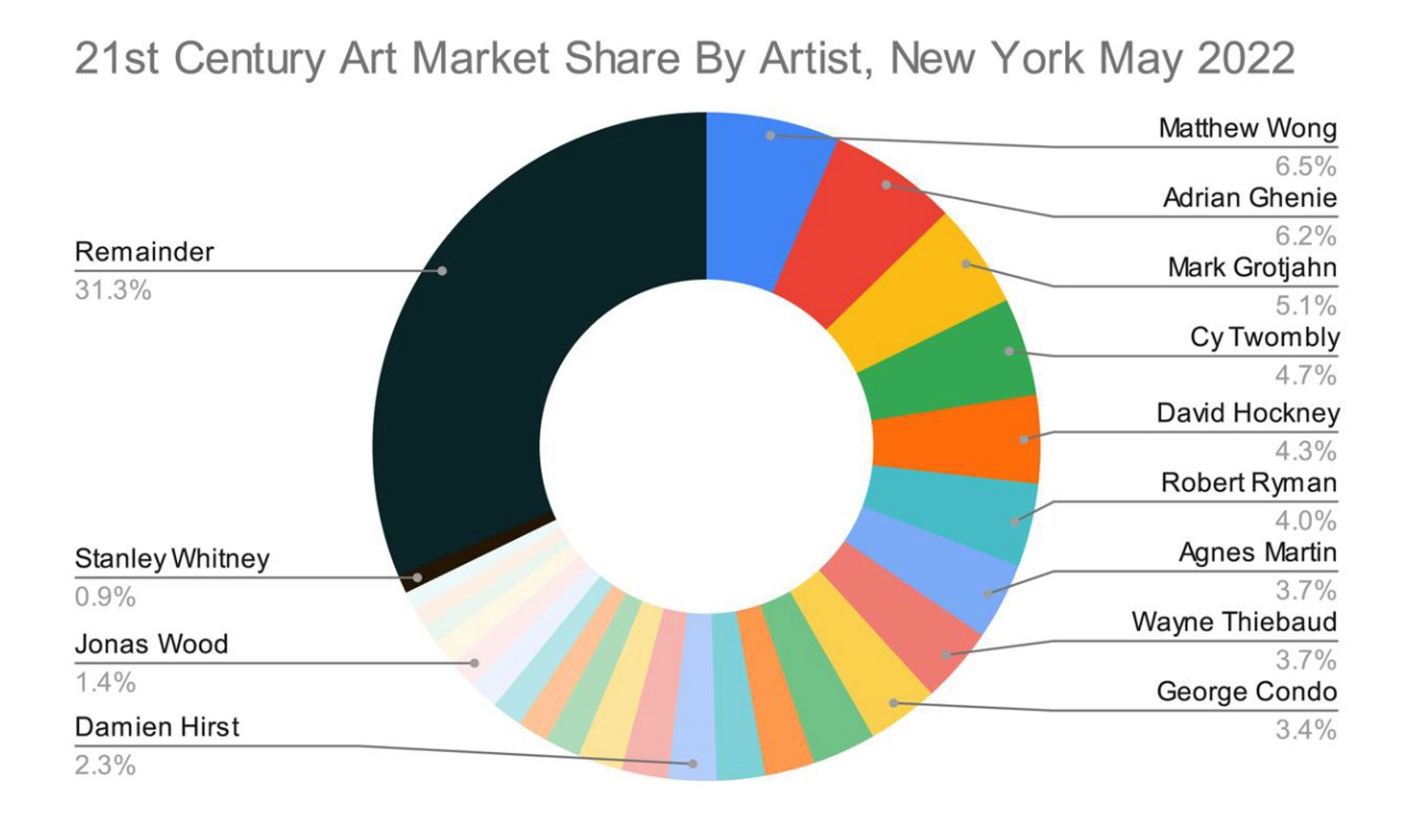
2. Market Shares
Source: Live Art
3. Top 10 Lots
#1. Andy Warhol
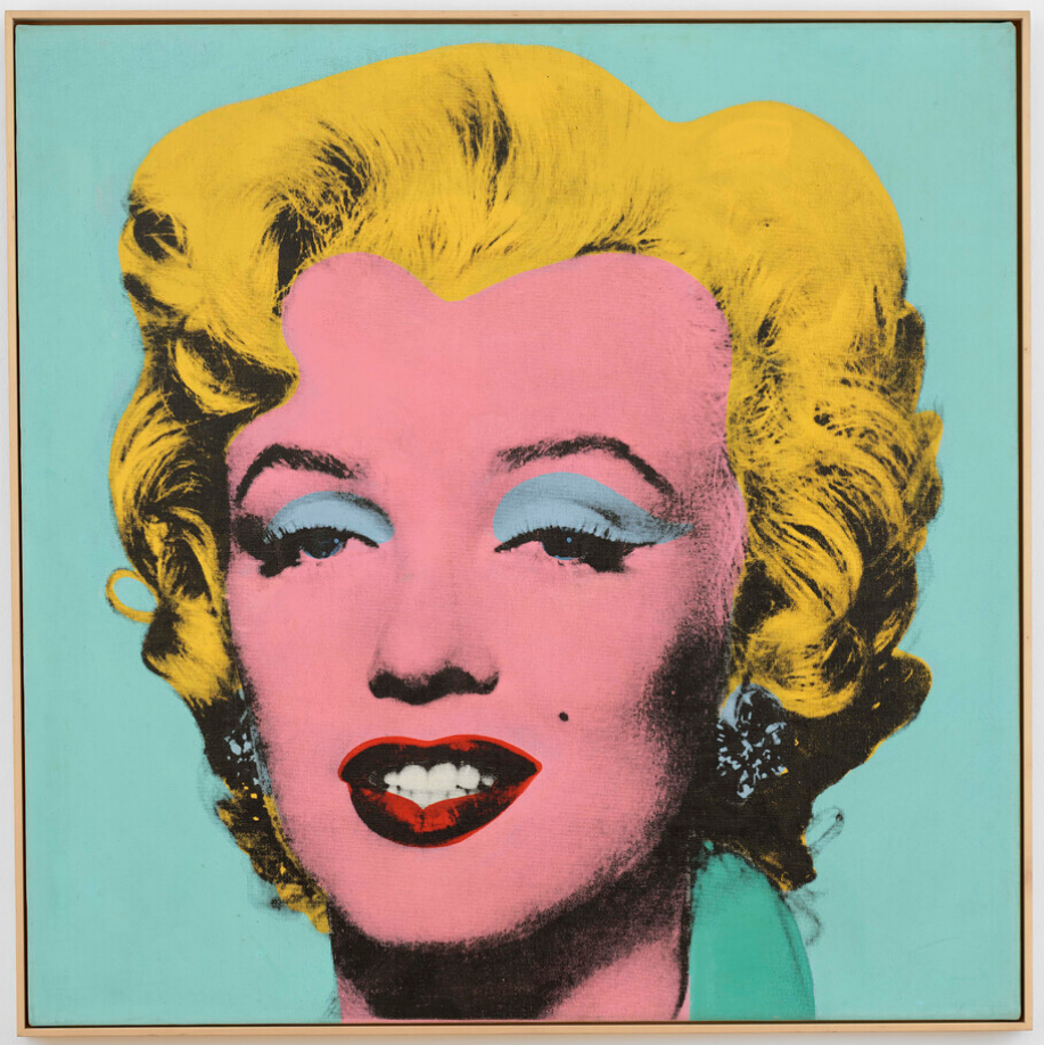
ANDY WARHOL
Shot Sage Blue Marilyn, 1964
Acrylic and silkscreen ink on linen
40×40 inches (101.6×101.6 cm)
USD 195,040,000
#2. Jean-Michel Basquiat
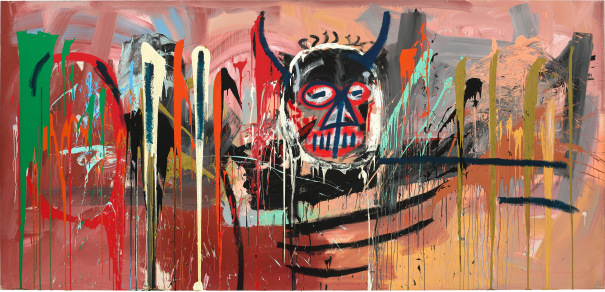
JEAN-MICHEL BASQUIAT
Untitled, 1982
Acrylic and spray-paint on canvas
94×197 inches (239.4 x 501 cm)
Phillips New-York: 18 May 2022
USD 85,000,000
#3. Claude Monet
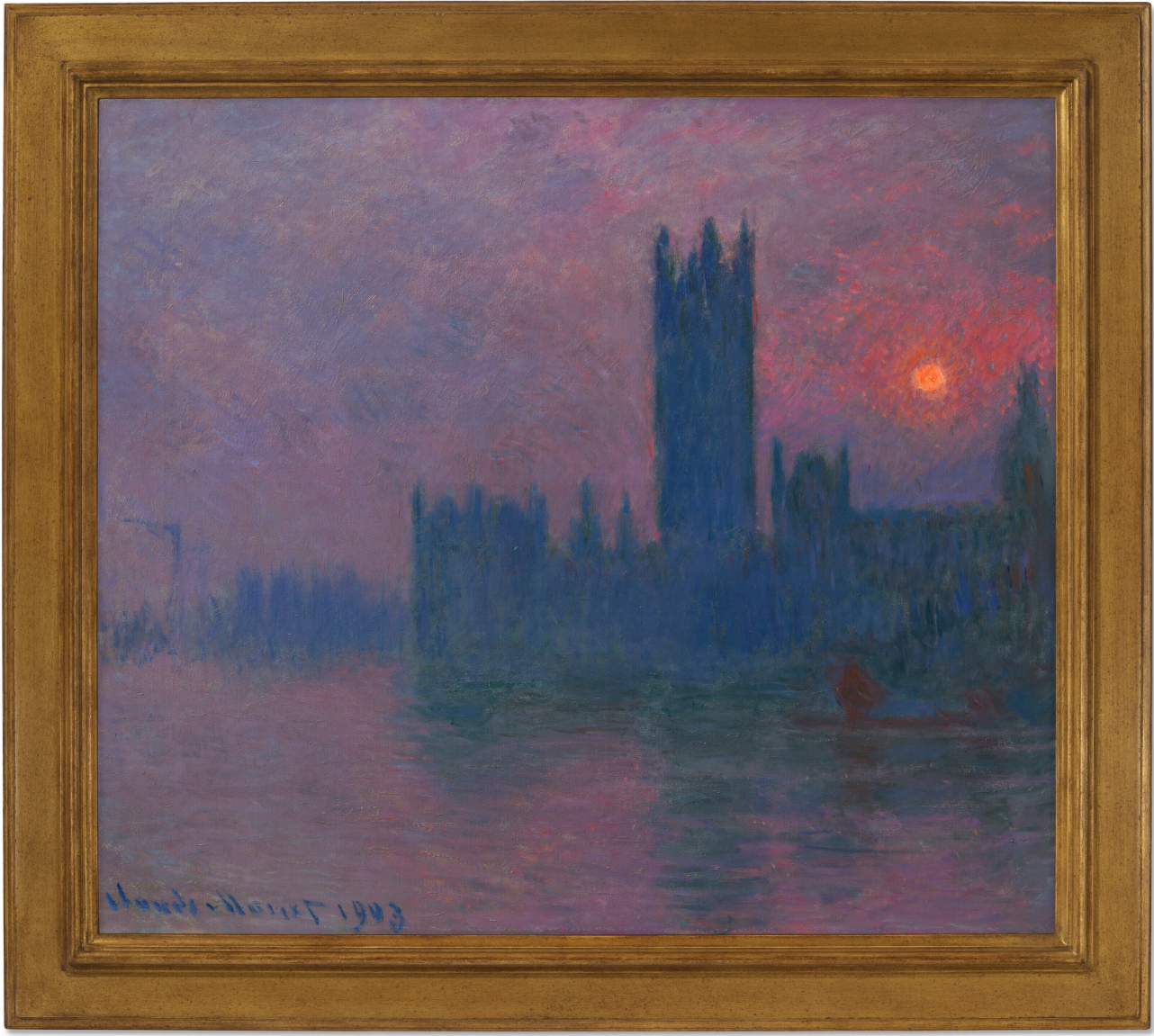
CLAUDE MONET
Le Parlement Soleil Couchant, 1903
Oil on canvas
81.2 x 92 cm (32×36 inches)
Christie’s New-York: 11 May 2022
USD 75,960,000
#4. Pablo Picasso
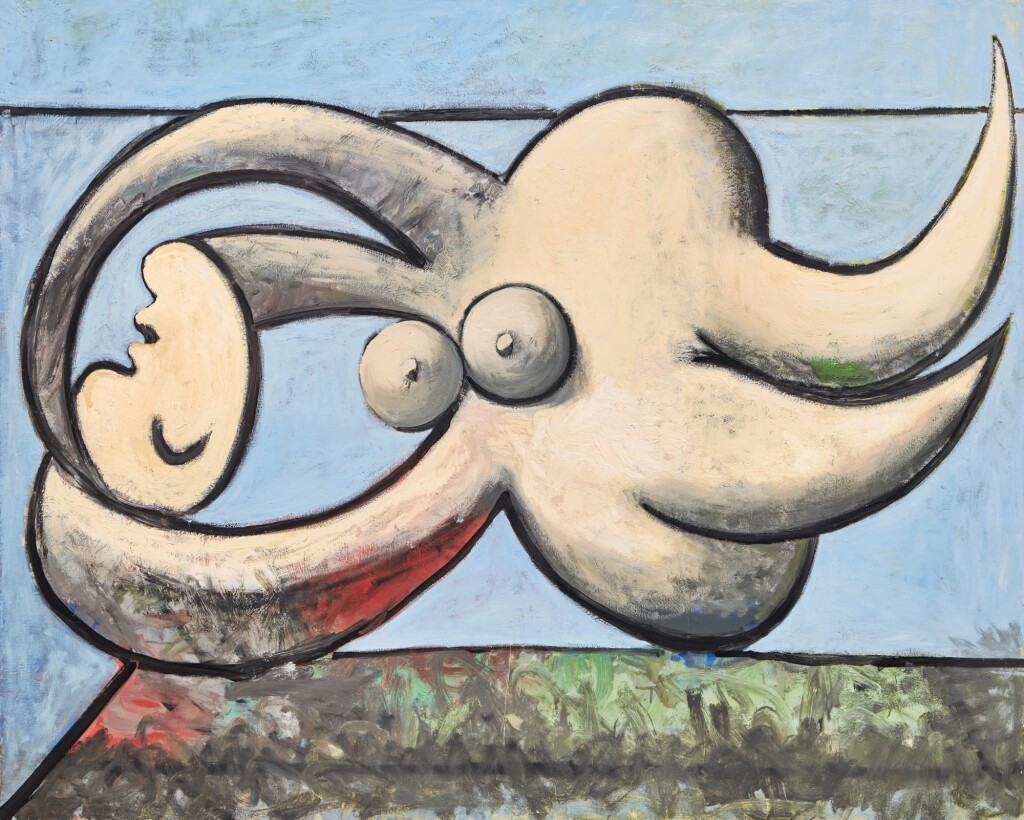
PABLO PICASSO
Femme Nue Couchee, 1932
Oil and Ripolin on canvas
129.9×161.7 cm (51×64 inches)
Sotheby’s New-York: 17 May 2022
USD 67,541,000
#5. Mark Rothko
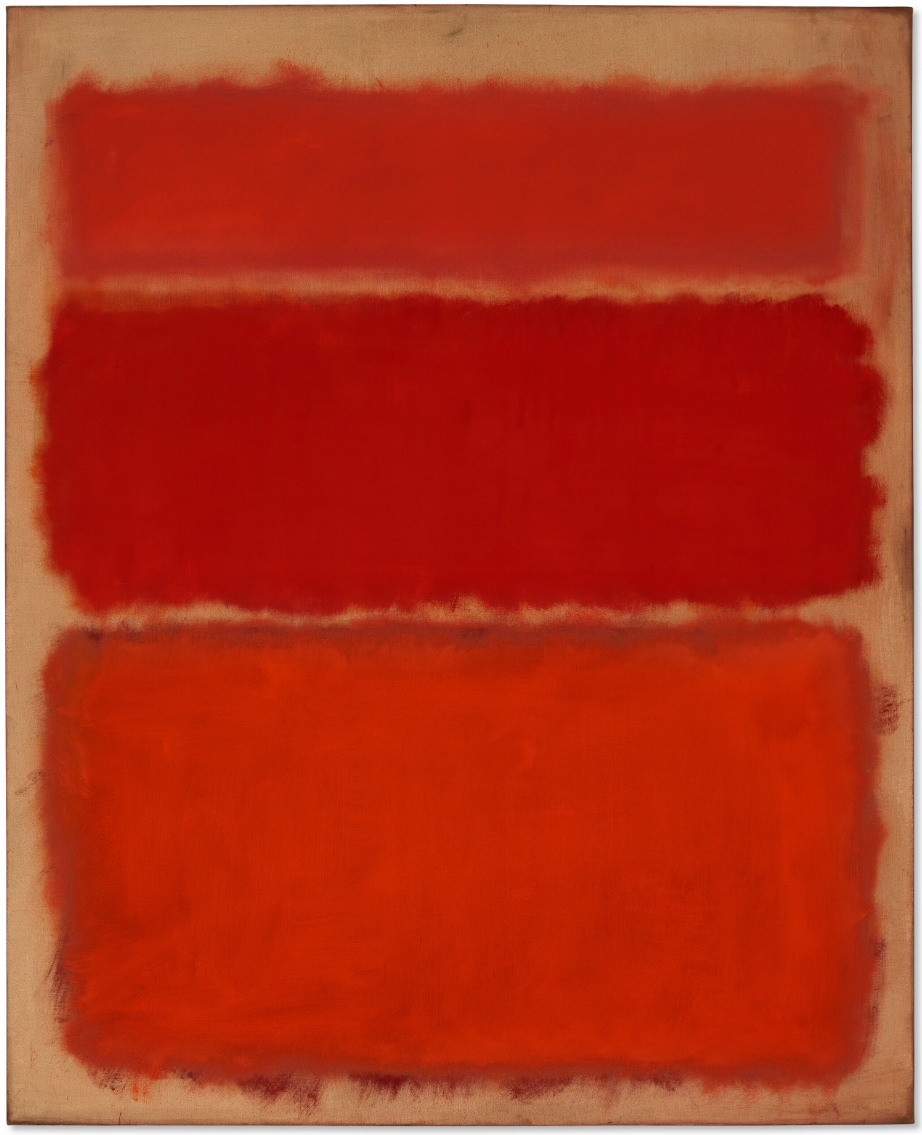
MARK ROTHKO
Untitled (Shades of Red), 1962
Oil on canvas
69×56 inches (175.3×142.2 cm)
Christie’s New-York: 11 May 2022
USD 66,800,000
#6. Claude Monet
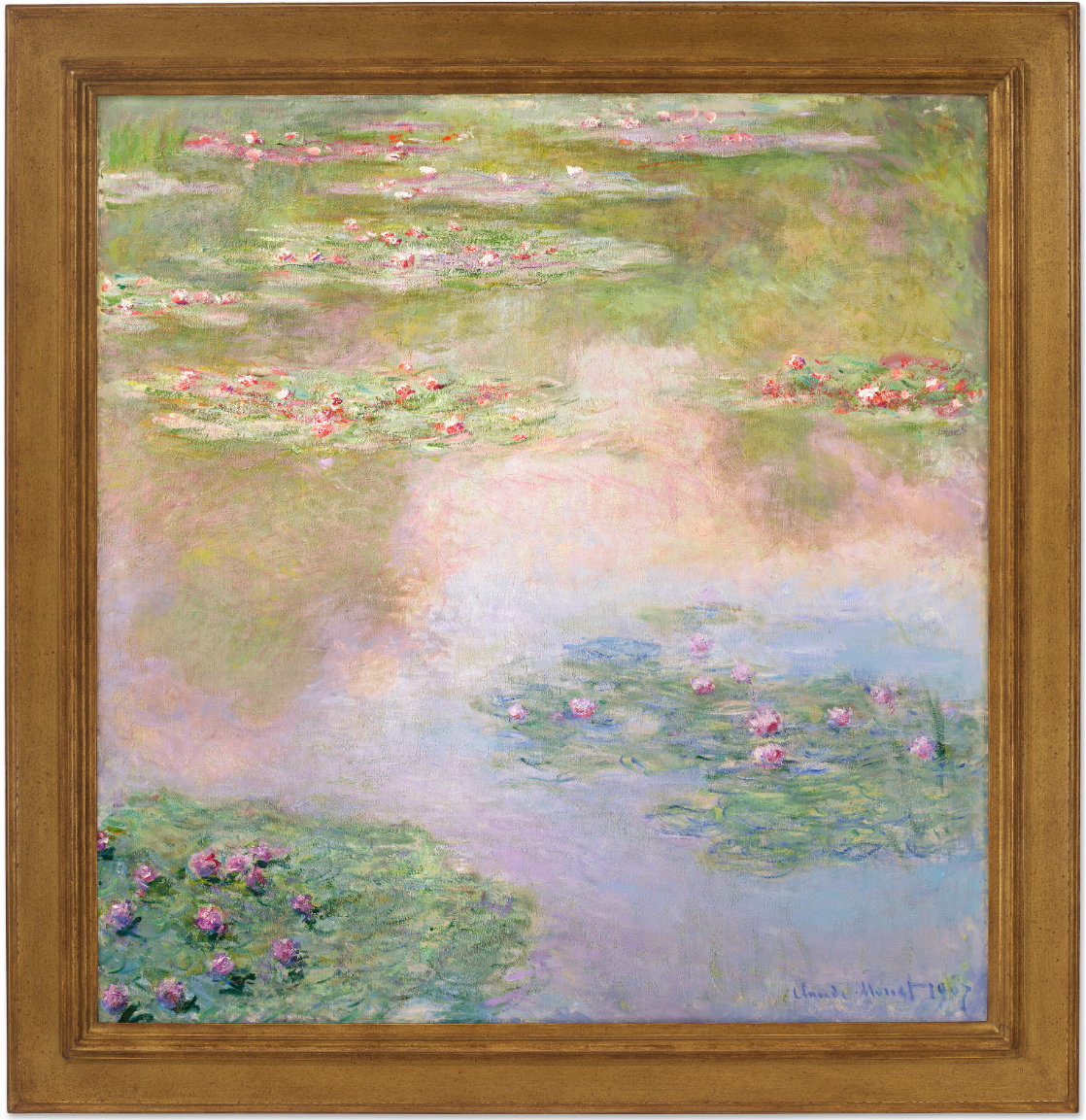
CLAUDE MONET
Nympheas, 1907
Oil on canvas
93.8 x 89.3 cm (37×35 inches)
Christie’s New-York: 11 May 2022
USD 56,495,000
#7. Claude Monet
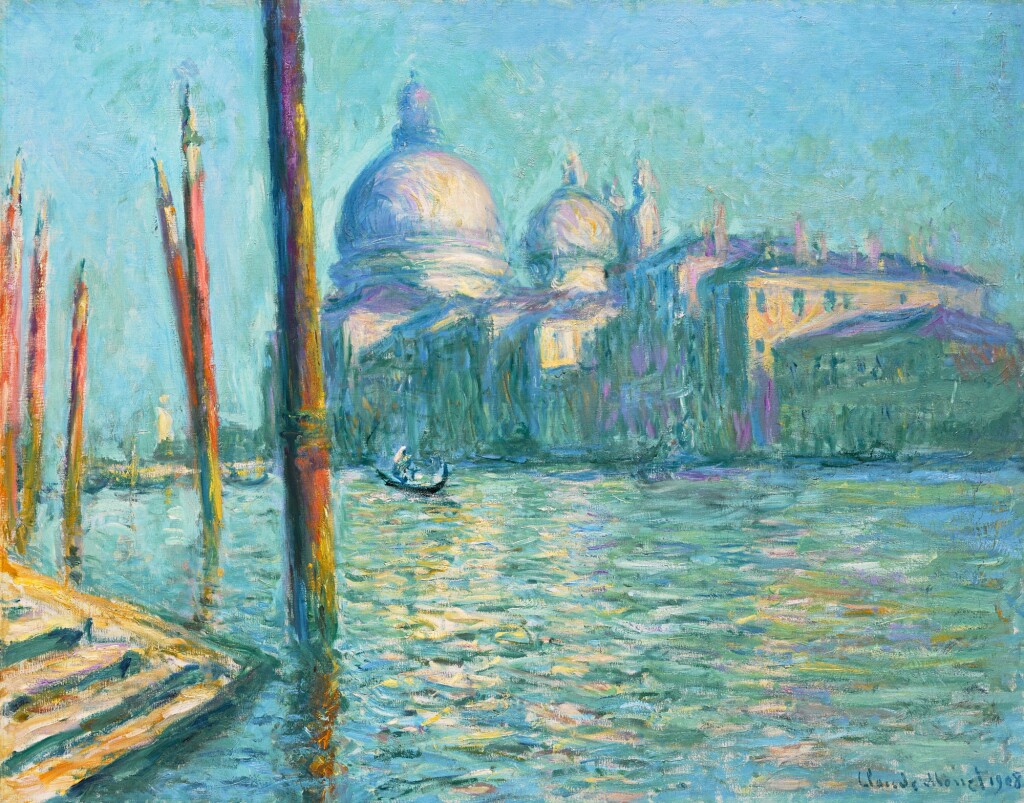
CLAUDE MONET
Le Grand Canal et Santa Maria della Salute, 1908
Oil on canvas
73.5×92.5 cm (29×36.5 inches)
Sotheby’s New-York: 17 May 2022
USD 56,625,500
#8. Jackson Pollock
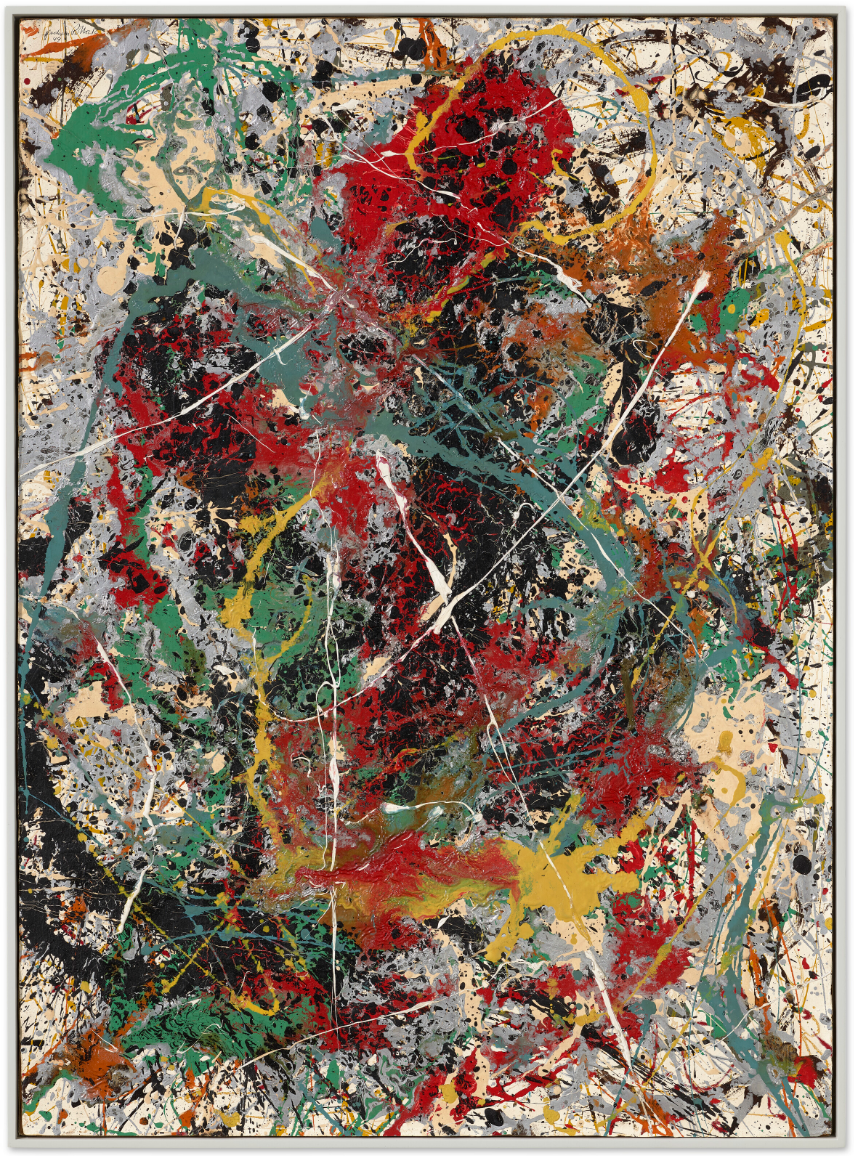
JACKSON POLLOCK
Number 31, 1949
Oil, enamel, aluminum paint and gesso on paper mounted on Masonite
31×22.5 inches (78.7×57.2 cm)
Christie’s New-York: 11 May 2022
USD 54,205,000
#9. Vincent van Gogh
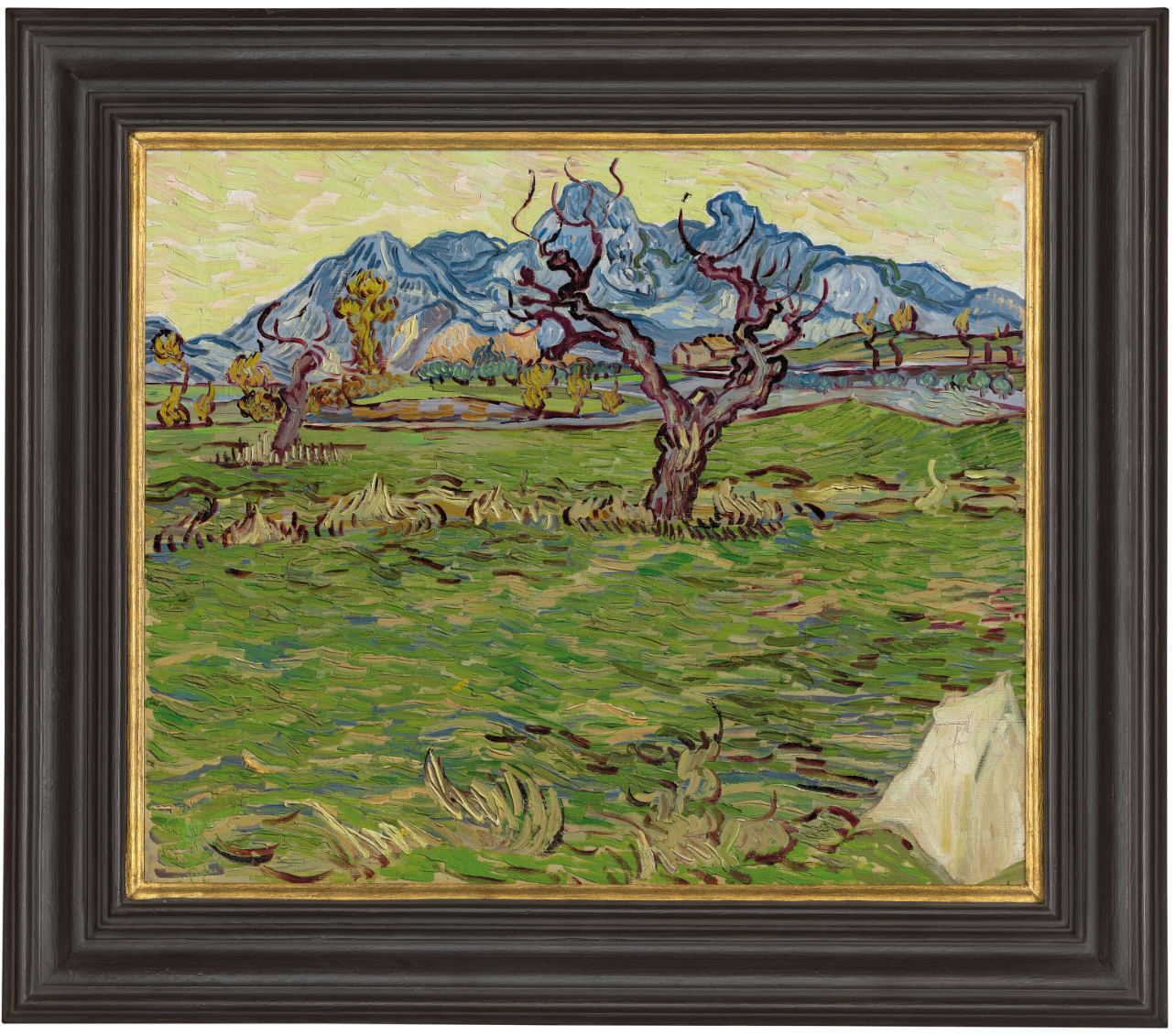
VINCENT VAN GOGH
Champs pres des Alpilles, 1889
Oil on canvas
46.2×55.2 cm (18×22 inches)
Christie’s New-York: 11 May 2022
USD 51,915,000
#10. Mark Rothko
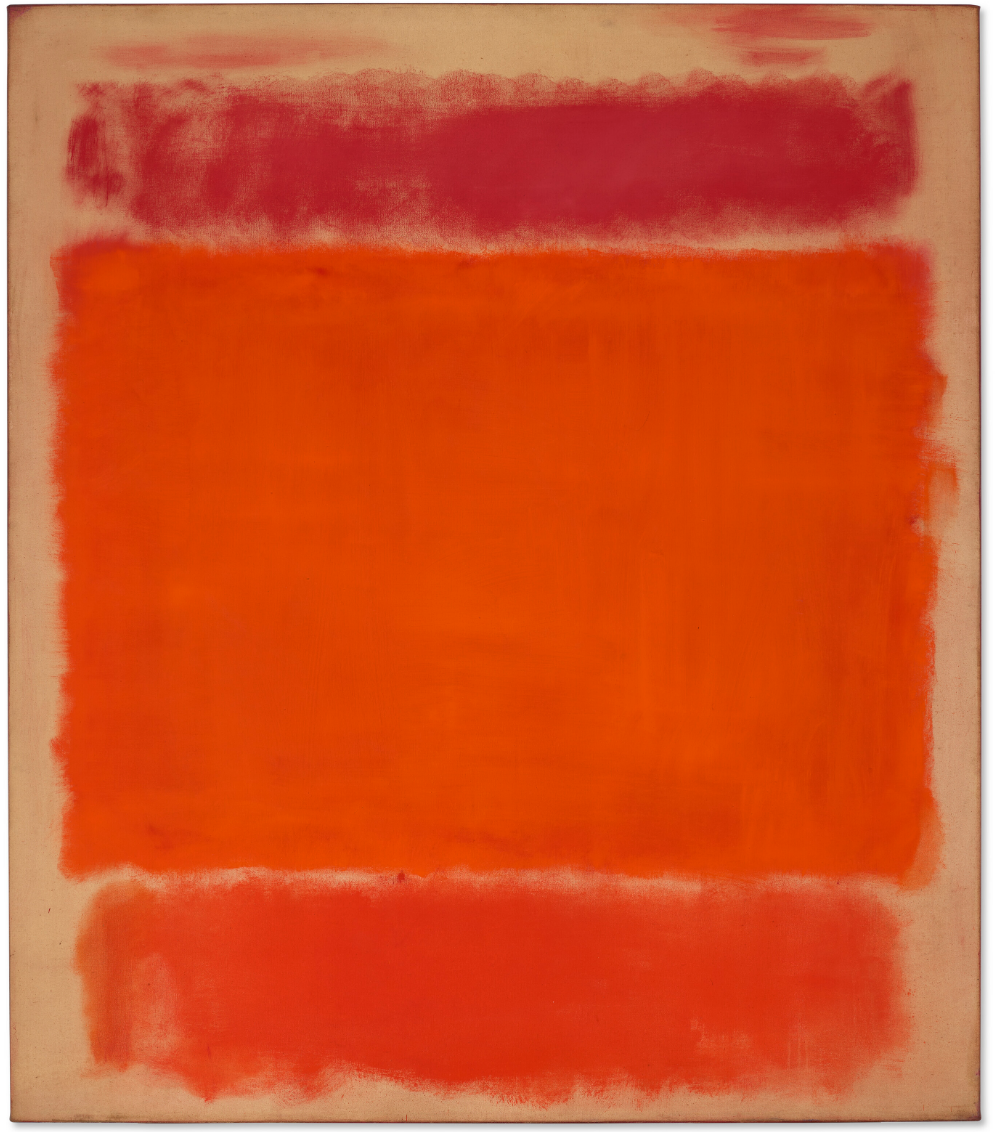
MARK ROTHKO
No. 1, 1962
Oil on canvas
69×60 inches (175.3×152.4 cm)
Christie’s New-York: 11 May 2022
USD 49,625,000
4. Top 10 Artists by Revenue
#1. Andy Warhol
USD 333,281,470
36 Lots
Top Lot: USD 195,040,000
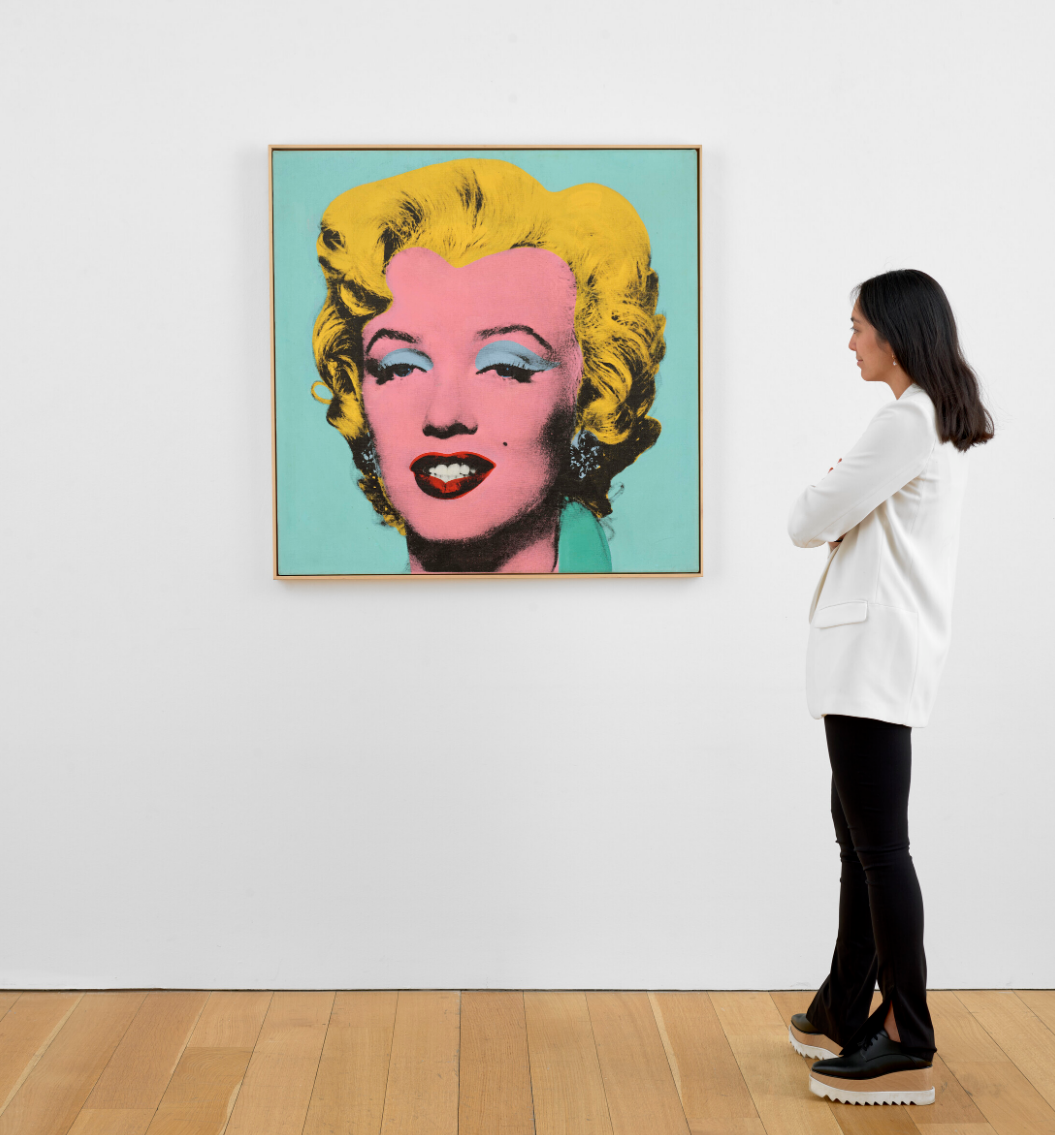
ANDY WARHOL
Shot Sage Blue Marilyn, 1964
Acrylic and silkscreen ink on linen
40×40 inches (101.6×101.6 cm)
Christie’s New-York: 9 May 2022
USD 195,040,000
There are few images in history that have the ability to transcend the time and place of their creation, surpassing even the reputation of their creator or the magnificence of their subject. From the classical beauty of the Venus de Milo and the enigmatic smile of the Mona Lisa, to the sultry Sirens of Picasso’s Les Demoiselles D’Avignon, the beauty of the human figure has inspired artists to extended their creativity to new heights. In the latter half of the twentieth-century, one woman captivated the world with her legendary looks, the Hollywood star Marilyn Monroe. This small town girl rose to become the most famous woman in the world, and today, the myth of Marilyn Monroe is still as potent as ever. This is due to one man: Andy Warhol, his unique ability to capture the humble beauty of a global superstar has seared her likeness onto our collective consciousness.
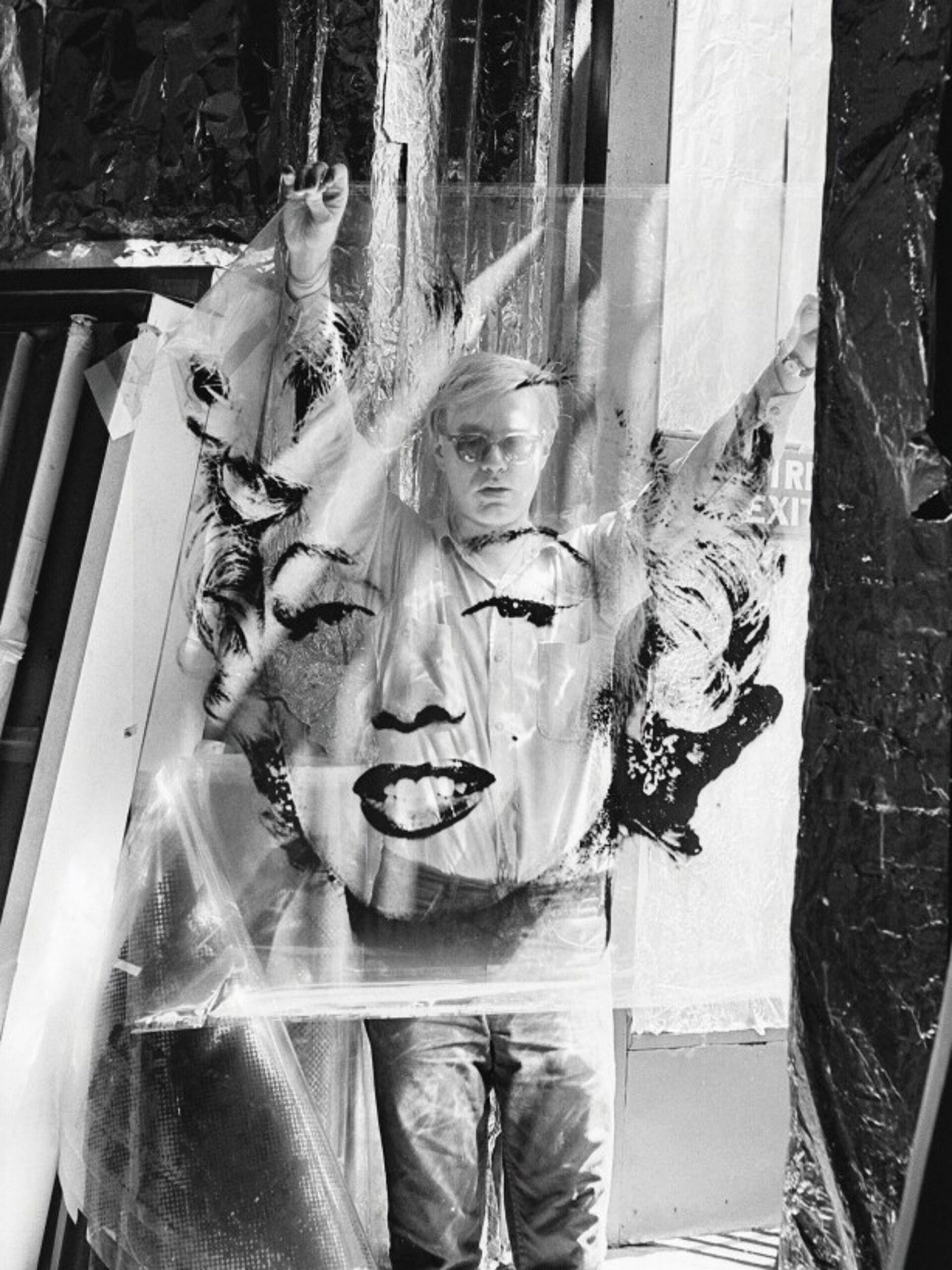
His flawless rendering has become the image of Marilyn Monroe. It represents not only her physical attractiveness, but also her cultural power and enduring legacy. Through this image, she lives on forever as one of the definitive artistic icons of all time, a Mona Lisa for the twentieth-century. Shot Sage Blue Marilyn is Warhol’s ultimate depiction of his ultimate muse; an image that surpasses the transient nature of the actress’s life and the fame she endured. Distinguished by an inner luminosity, the screen idol’s legendary beauty radiates out from the surface of this large-scale painting. Her blond hair, piercing eyes, full-lips, and even her famous beauty spot are all rendered in a clarity and detail that is absent from other examples of Warhol’s famous screening process.
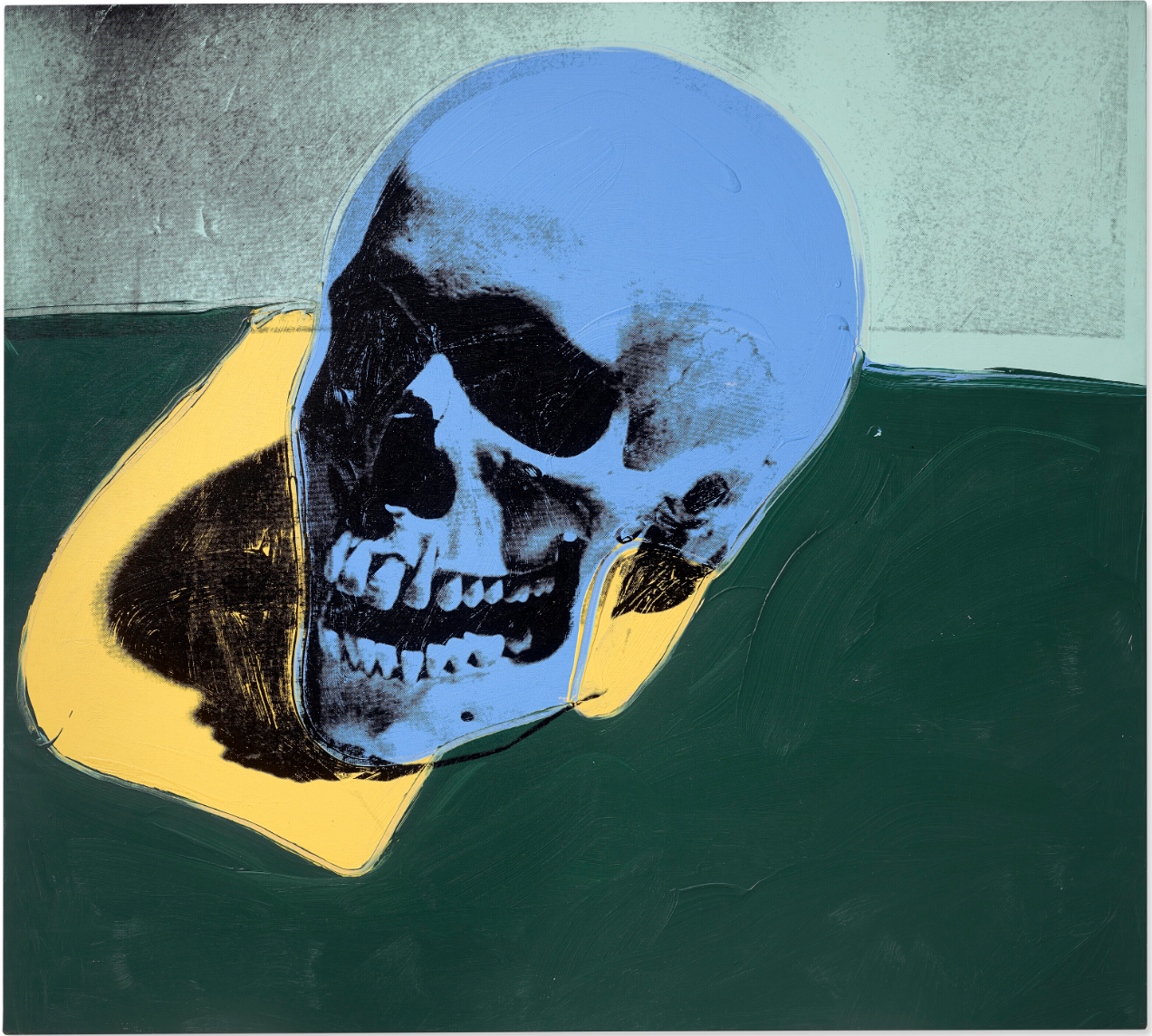
ANDY WARHOL
Skull, 1976
Acrylic and silkscreen ink on canvas
72×80 inches (182.9 x 203.2 cm)
Christie’s New-York, 12 May 2022
USD 24,000,000
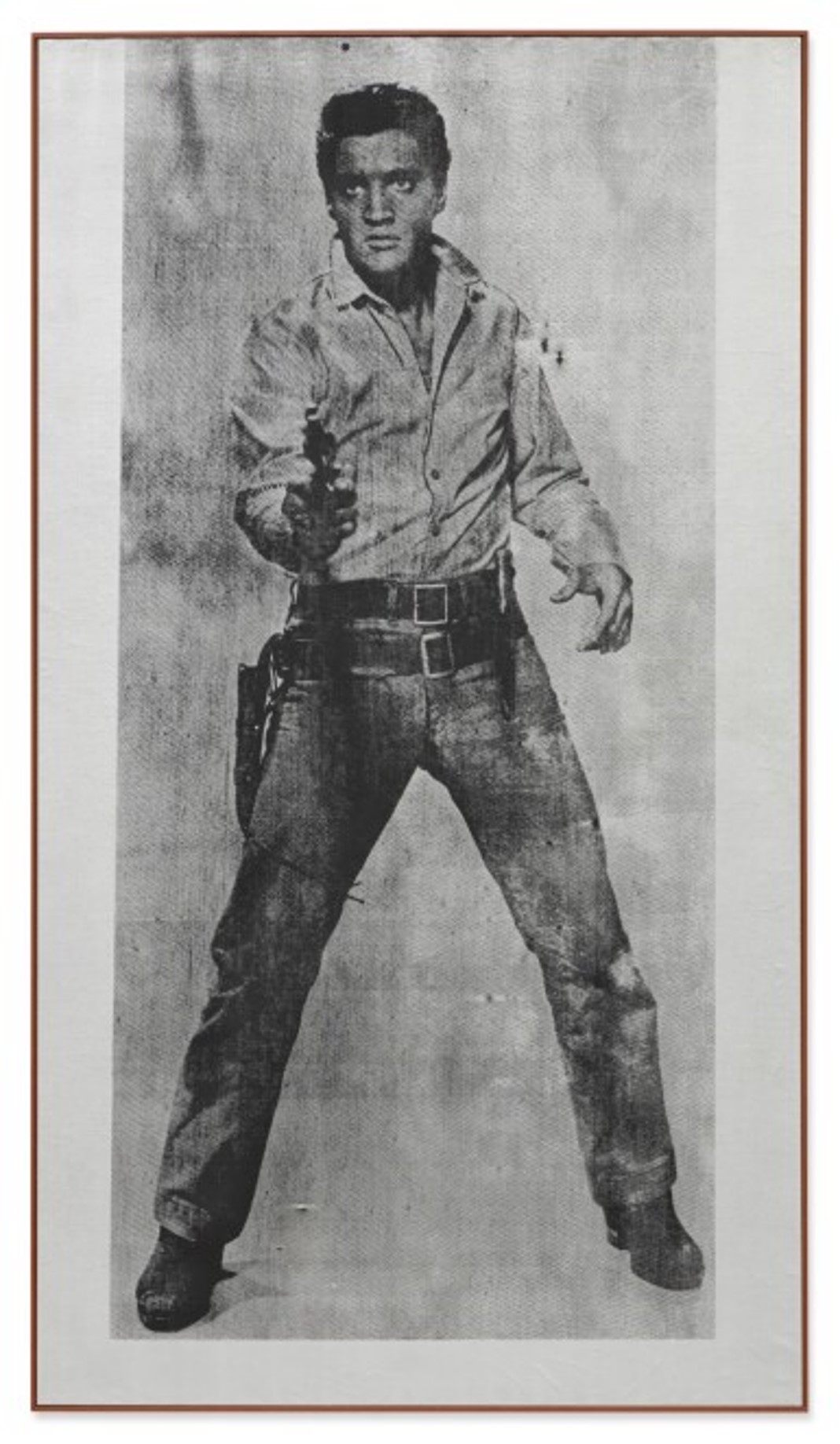
ANDY WARHOL
Elvis, 1963
Silkscreen ink and silver paint on canvas
82 3/4 x 46 1/4 inches (210.2 x 117.5 cm)
Sotheby’s New-York, 19 May 2022
USD 21,581,000
A gleaming visionary force, Andy Warhol’s Elvis embodies the artist’s singular ability to appropriate and manipulate familiar imagery to examine greater cultural currents and moments. Inspired by a publicity shot, Elvis Presley is adorned with a gunslinger for the western film Flaming Star and stands life-size, striking a pose that is instantly recognizable against the silver screen. Shimmering, the silver ground encapsulates the glistening brilliance of Hollywood, distinguished in Elvis by the exceptional silkscreen technique against the surface. In the summer of 1963, Andy Warhol was thirty-four years old and, having perfected his silkscreen technique the previous year, was beginning to transform the landscape of visual culture in America.
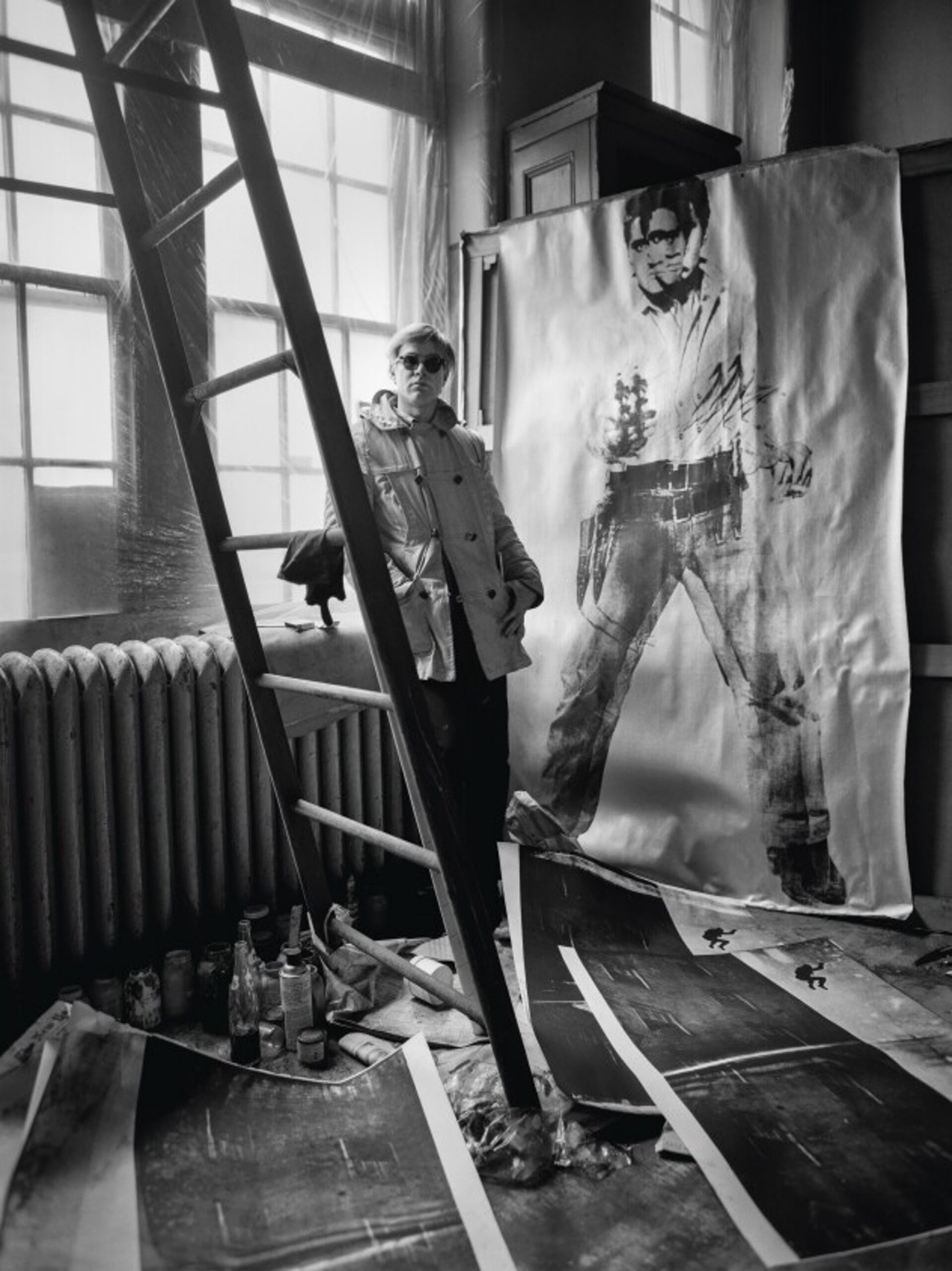
Appropriating the visual vernacular of consumerism, Warhol levelled his silkscreen at subjects he perceived as the most important concerns of contemporary life: icons such as Marilyn Monroe, Jackie Kennedy, Elizabeth Taylor, Marlon Brando, and, of course, Elvis Presley. Elvis was the ultimate subject for Warhol to explore popular culture and fame, a figure whose fame and image dominated the cultural zeitgeist of the 1950s and 1960s. Multiplying readymade images of these icons gleaned from newspapers, magazines and advertising, Warhol turned a mirror onto the contradictions of quotidian existence. With a playful theatricality and painterly illusionistic rendering of space, Elvis typifies Warhol’s career-long fascination with the immortality of celebrity and popular culture.
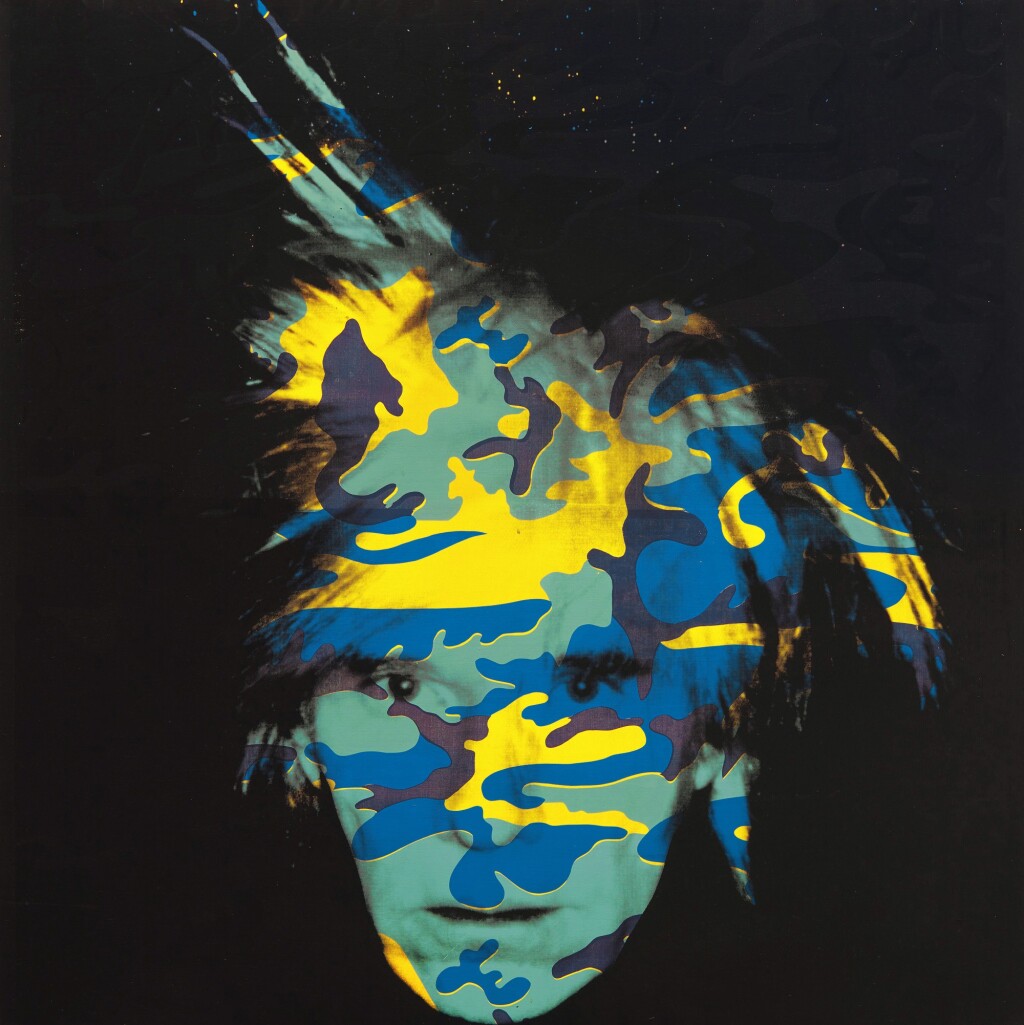
ANDY WARHOL
Self-Portrait, 1986
Acrylic and silkscreen ink on canvas
80×80 inches (203.2 x 203.5 cm)
Sotheby’s New-York, 16 May 2022
USD 18,708,500
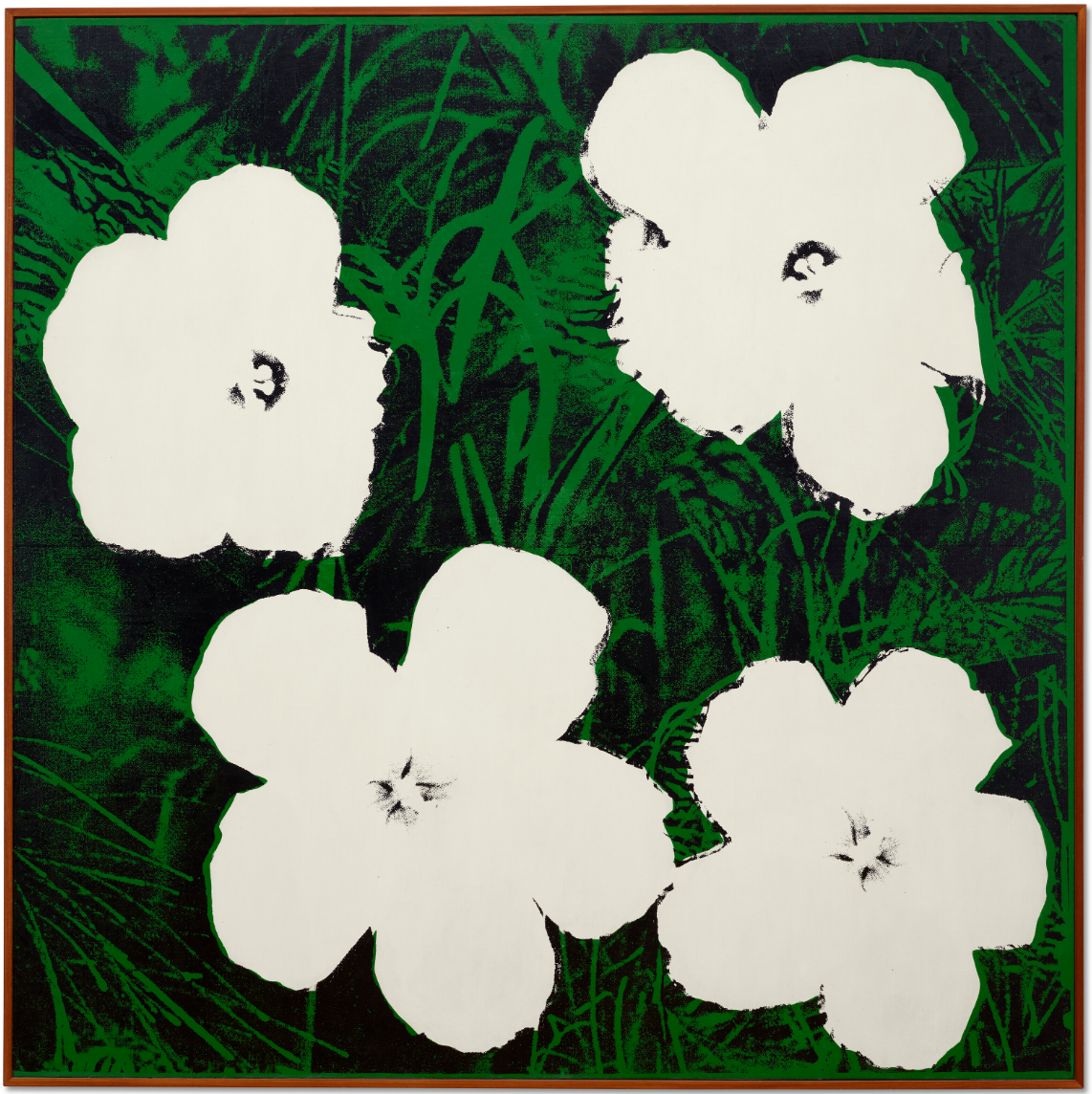
ANDY WARHOL
Flowers, 1964
Acrylic and silkscreen ink on linen
82x 81.5 inches (207.6×207 cm)
USD 15,847,500
#2. Claude Monet
USD 304,974,300
9 Lots
Top Lot: USD 75,960,000
CLAUDE MONET
Le Parlement Soleil Couchant, 1903
Oil on canvas
81.2 x 92 cm (32×36 inches)
Christie’s New-York: 11 May 2022
USD 75,960,000
Claude Monet’s emphatic passion for England’s capital is magnificently displayed in his monumental, landmark series, the Vues de Londres. Started in London in 1899 and completed in Giverny in 1904, this series remains today among his greatest achievements, as he transformed the city into magical, elegiac visions at once timeless and modern. Charing Cross Bridge, Waterloo Bridge, and the Houses of Parliament served as the principal subjects of this seminal group, each landmark a pretext for symphonic, often near abstract combinations of light and color. A host of both subtle and dramatic meteorological conditions, from the soft, gray morning light, to spectacular, fog-filled evening skies filled with pink, purple, and orange by the setting sun, gave rise to a theater of effects that Monet reveled in from his vantage point at the Savoy Hotel and St. Thomas’s Hospital. The largest series of paintings the artist had yet produced, numbering almost a hundred canvases, the Vues de Londres pushed Monet to the extremes of his artistic powers, testing the fundamental Impressionist tenet of capturing the ephemeral, fleeting atmospheric effects of nature. Crowning this series are the nineteen paintings of the Houses of Parliament, of which Le Parlement, soleil couchant is one of the finest. This painting shows the golden orb of the sun, having burnt through the impenetrable cloak of clouds and fog to cast the scene into an atmospheric array of jewel-like violets and lilacs, cobalt and inky blues, and deep pink tones. Dwarfing the tugboat that noiselessly crosses the river, the majestic, windowless silhouette of the Houses of Parliament appears mystical, the rising and falling pattern of towers seemingly both emerging from the sulphurous light and at the same time, dissolving into the expansive, still waters of the Thames, London’s silent witness of epochs past.
CLAUDE MONET
Nympheas, 1907
Oil on canvas
93.8 x 89.3 cm (37×35 inches)
Christie’s New-York: 11 May 2022
USD 56,495,000
During the final two decades of his long career, Monet devoted himself with single-minded focus to painting the hauntingly beautiful water garden that he had designed and cultivated at his home in rural Giverny. In some two hundred canvases, he captured the shifting relationships among water, reflections, and light that continually transformed the surface of his lily pond, the infinity of nature matched only by the prodigious breadth of his own creativity. “His repeated treatment of the reflective surfaces of his pond,” Benedict Leca has written, “and the kaleidoscopic color variations of its flora visible above and beneath mirrored water served as an interminable canvas, where both motif and metaphor of reflection combined directly in the service of self-definition” (Monet in Giverny: Landscapes of Reflection, exh. cat., Cincinnati Art Museum, 2012, p. 41). While these valedictory paintings affirm Monet’s life-long belief in the primacy of vision and experience, they are at once more abstract and more profound than anything he had previously painted—a prescient and visionary art for the new, modern century.
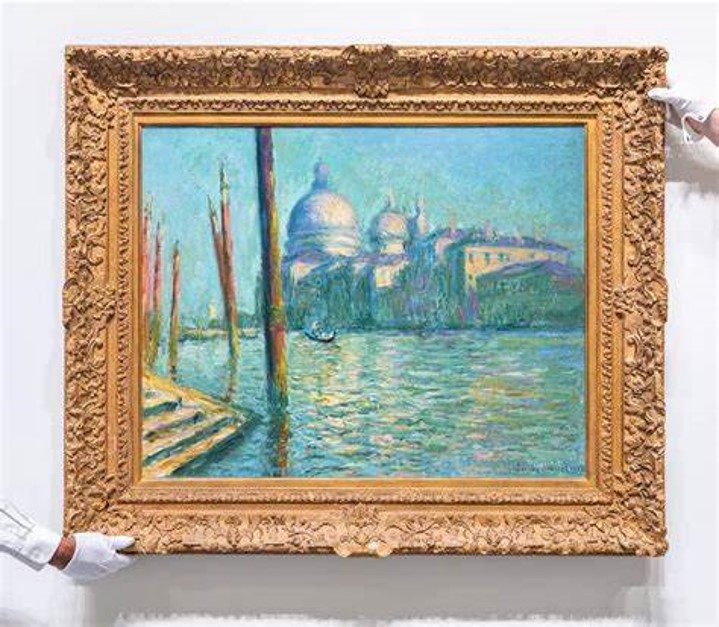
CLAUDE MONET
Le Grand Canal et Santa Maria della Salute, 1908
Oil on canvas
73.5×92.5 cm (29×36.5 inches)
Sotheby’s New-York: 17 May 2022
USD 56,625,500
Le Grand Canal et Santa Maria della Salute is a masterpiece not only from within Claude Monet’s Venice series but also from his entire artistic output. A shimmering, luminescent view of the Grand Canal and Santa Maria della Salute, the present canvas is one of the finest works created during the artist’s Venetian sojourn and presents a daring encapsulation of the traits that make Monet one of the most unique and visionary artistic voices of the twentieth century. Up until almost the day of his and his wife Alice’s departure, Monet dragged his feet in going to Venice. Initially conceived as a vacation from painting, in the past five years Monet had completed roughly one-hundred Nymphéas canvases, within a week of their arrival the artist shifted in tone from finding Venice “too beautiful to paint” to a painting campaign that would result in nearly forty oils created from a number of vantage points throughout the storied city.
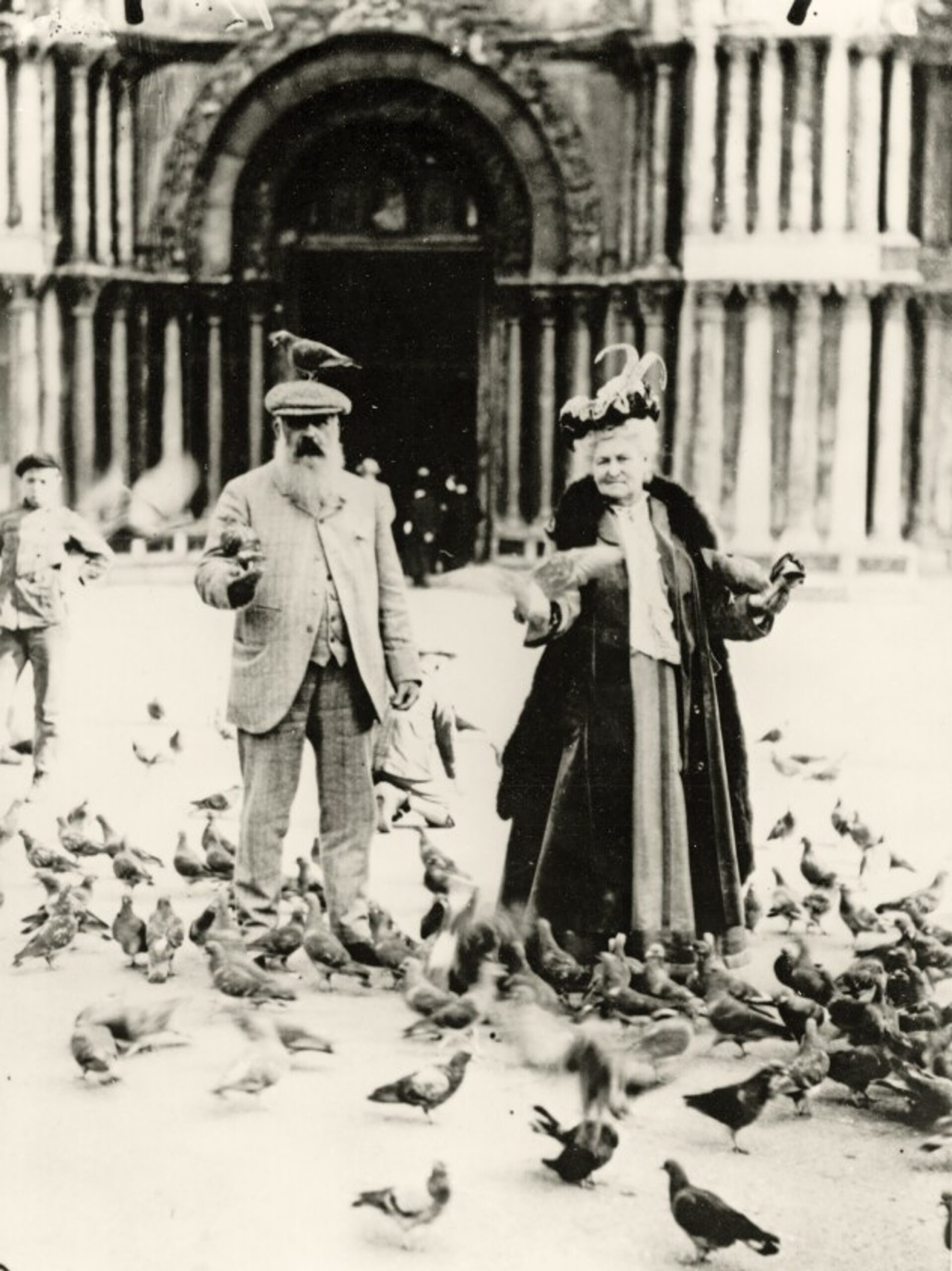
Le Grand Canal et Santa Maria della Salute comes from a discrete group of six canvases painted from the steps of the Palazzo Barbaro looking across and down the Grand Canal towards Santa Maria della Salute. The present work is the finest example of the six views, two of which are held in museum collections and four of which are held privately. Establishing in advance the conditions of observation and the context of his experimentation, Monet used Venice as another pictorial laboratory, gauging changes in the ‘envelope’ (the indefinable Venetian ‘haze’) under identical circumstances.
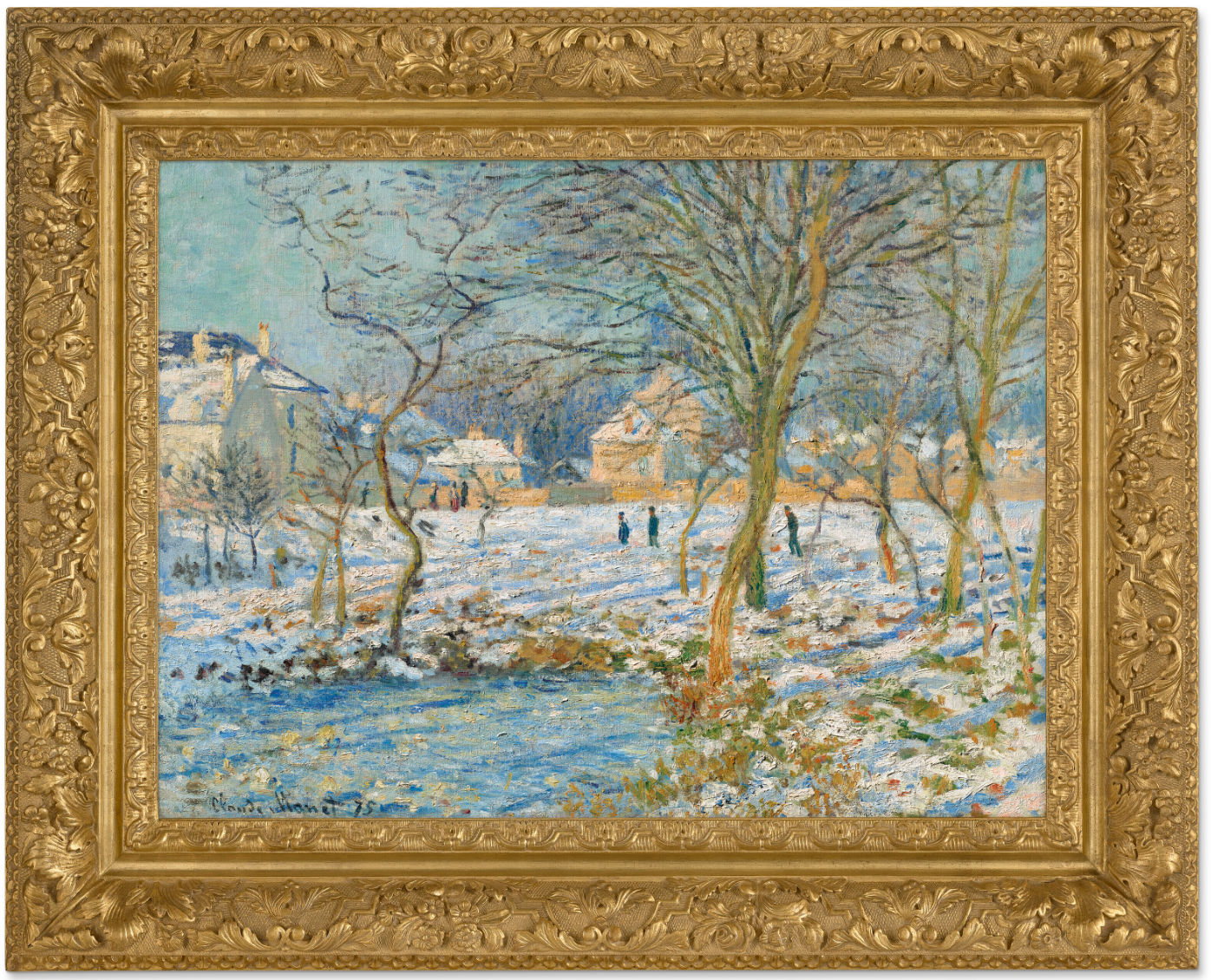
CLAUDE MONET
La mare, effet de neige, 1875
Oil on canvas
60.6 x 81.7 cm (23.9 x 32.2 inches)
Christie’s New-York: 11 May 2022
USD 25,580,000
La mare, effet de neige exemplifies Monet’s experiments with the Impressionist style in the mid-1870s. During this crucial period, the artist used increasingly loose brushwork and thick facture to convey the ephemeral, atmospheric effects of nature. Undeterred by the cold, Monet continued to observe the world around him throughout the unusually snowy winter of 1874-1875. In other works painted that season, Monet painted various forms of snow in Argenteuil—from gentle flurries to heavy snow fall. In the present work, Monet covered his canvas with short daubs of paint to represent the tufts of fresh, white snow that have already begun to melt in the brilliant glow of daylight; linear strokes of blue indicate the long shadows cast by human figures and trees alike.
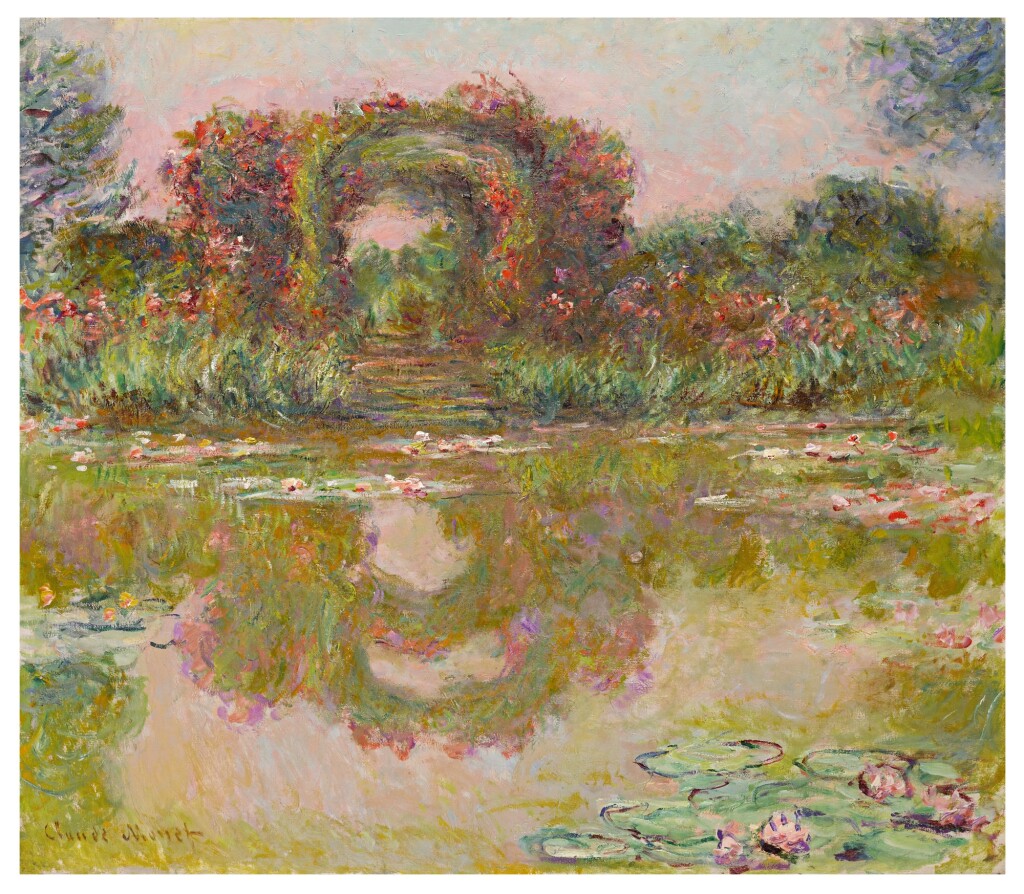
CLAUDE MONET
Les Arceaux de Roses, Giverny, 1913
Oil on canvas
81.5×93.5 cm (32×37 inches)
Sotheby’s New-York: 17 May 2022
USD 23,304,500
Dazzling in its use of color and exploration of the properties of reflection, Les Arceaux de roses, Giverny is one of only five canvases painted by Claude Monet between the summer of 1912 and 1914. Three of these paintings, including the present work, focus on trellises covered in roses, set on the boat landing on the south side of Monet’s water garden. The present work is a stunning symphony of richly applied and worked pigment and by far the most energetic in the series. The other two works painted during this period, both titled La Maison de l’artiste à Giverny, depict a view of Monet’s house and gardens in the immediate vicinity of his front door.
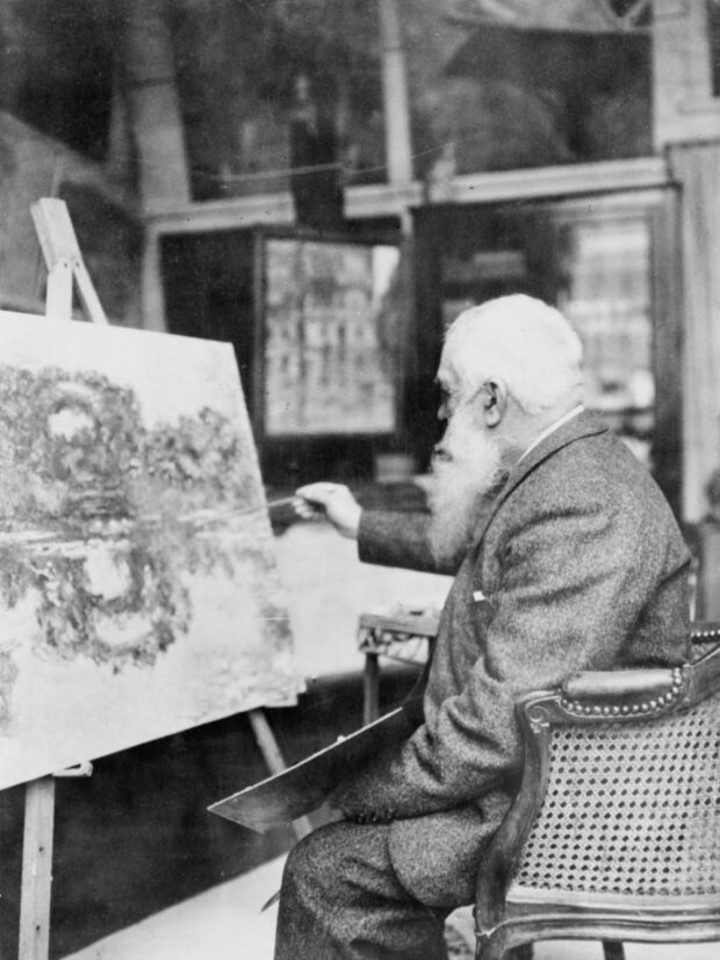
Unique to the present composition is the heightened sense of immediacy as seen in the carefully delineated group of waterlilies in the foreground at right. Crystalline pinks, blues and blue meet in the sky of Les Arceaux de roses, Giverny, lending a lustrous atmosphere to the work. The soft reflection of the flowered arches play along the surface of the water, illuminating the midground in tones of violet and rose. Highlighted by white blossoms throughout the water and the trellis, the work presents a veritable symphony of color to its audience.
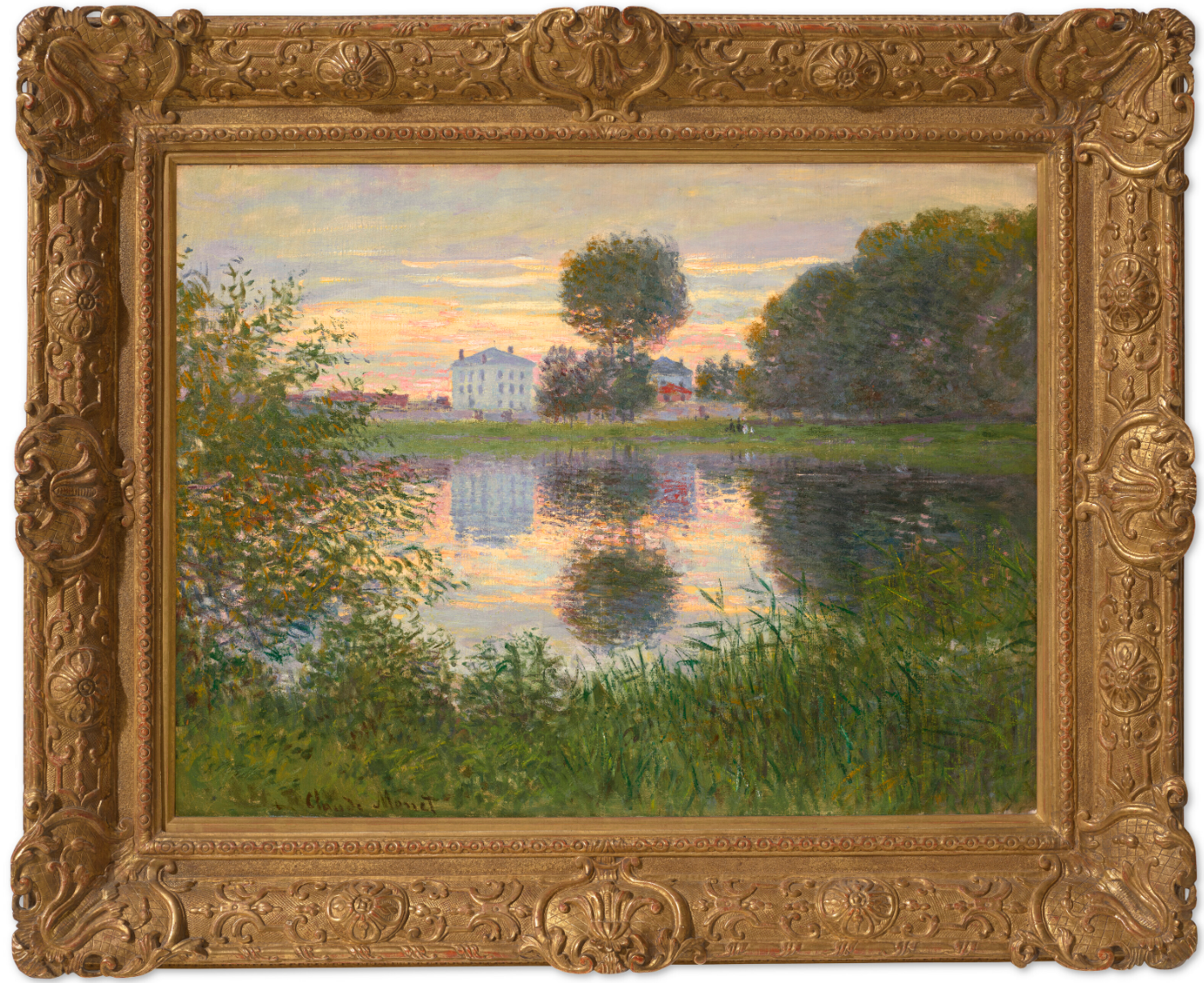
CLAUDE MONET
L’arbre en boule, Argenteuil, 1876
Oil on canvas
60.3 x 80.2 cm (23.7 x 31.5 inches)
Christie’s New-York: 11 May 2022
USD 10,122,500
#3. Pablo Picasso
USD 194,288,500
31 Lots
Top Lot: USD 67,541,000
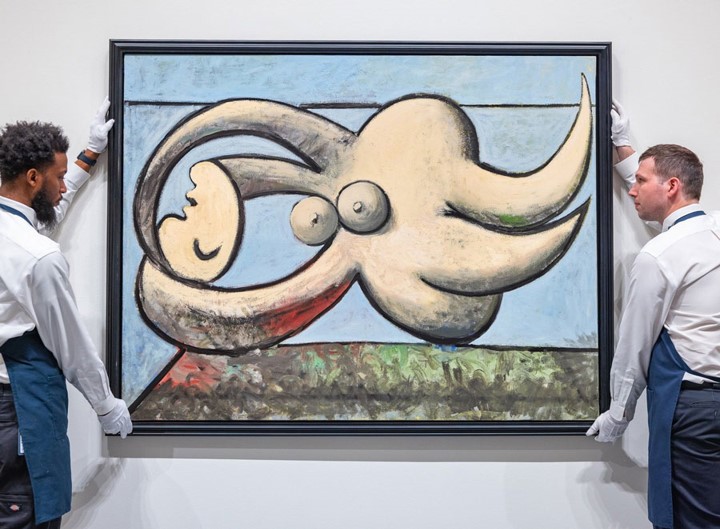
PABLO PICASSO
Femme Nue Couchee, 1932
Oil and Ripolin on canvas
129.9×161.7 cm (51×64 inches)
Sotheby’s New-York: 17 May 2022
USD 67,541,000
Femme nue couchée is one of Picasso’s most monumental and uninhibited portrayals of his muse Marie-Thérèse Walter. A crowning achievement of painterly verve, energy and manipulation of the human form, the present work succinctly synthesizes the artist’s groundbreaking achievements of the late 1920s and early 1930s into one colorful, dynamic canvas. Here, in the seclusion of his new country home in Boisgeloup, the nude figure of Marie-Thérèse reclines in a highly abstracted space, her biomorphic figure imbued with fertility, sexuality and grace. Never before offered at auction, Femme nue couchée is a tour de force of Picasso’s famed 1932 artistic production. The influence of sculpture is visible in the present work in the monumental sculptural force with which the female body is portrayed. At the same time, the psychological state of the sleeping woman resonates in the soft modeling of the figure, creating an atmosphere of reverie and carefree abandon. Seeking to convey his erotic desire, Picasso generates morphological permutations and distortions of the female anatomy. Abandoning any attempt at naturalism, he creates a figure composed of biomorphic forms, a technique that developed from his earlier, Surrealist works. While seemingly divorced from any particular setting—whether that of the wooded landscape around the château or in a more constructed interior studio space—a directly related sketch on a scrap of paper shows a figure in a nearly identical pose below an umbrella and in front of a beach hut, a clear reference to the delights of the summer memories he had established with Marie-Thérèse.
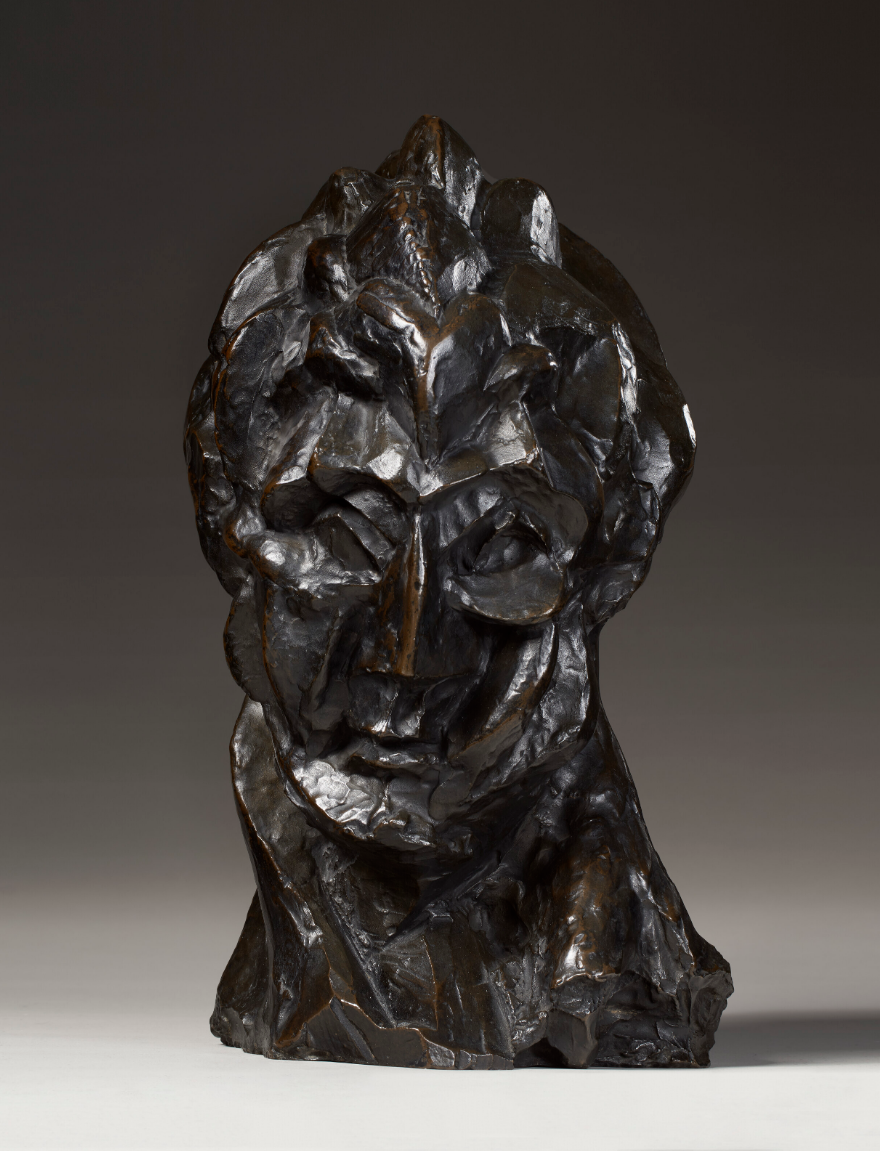
PABLO PICASSO
Tete de Femme (Fernande), 1909
Bronze with dark brown patina
Height: 41.9 cm (16 1/2 inches)
Christie’s New-York, 12 May 2022
USD 48,480,000
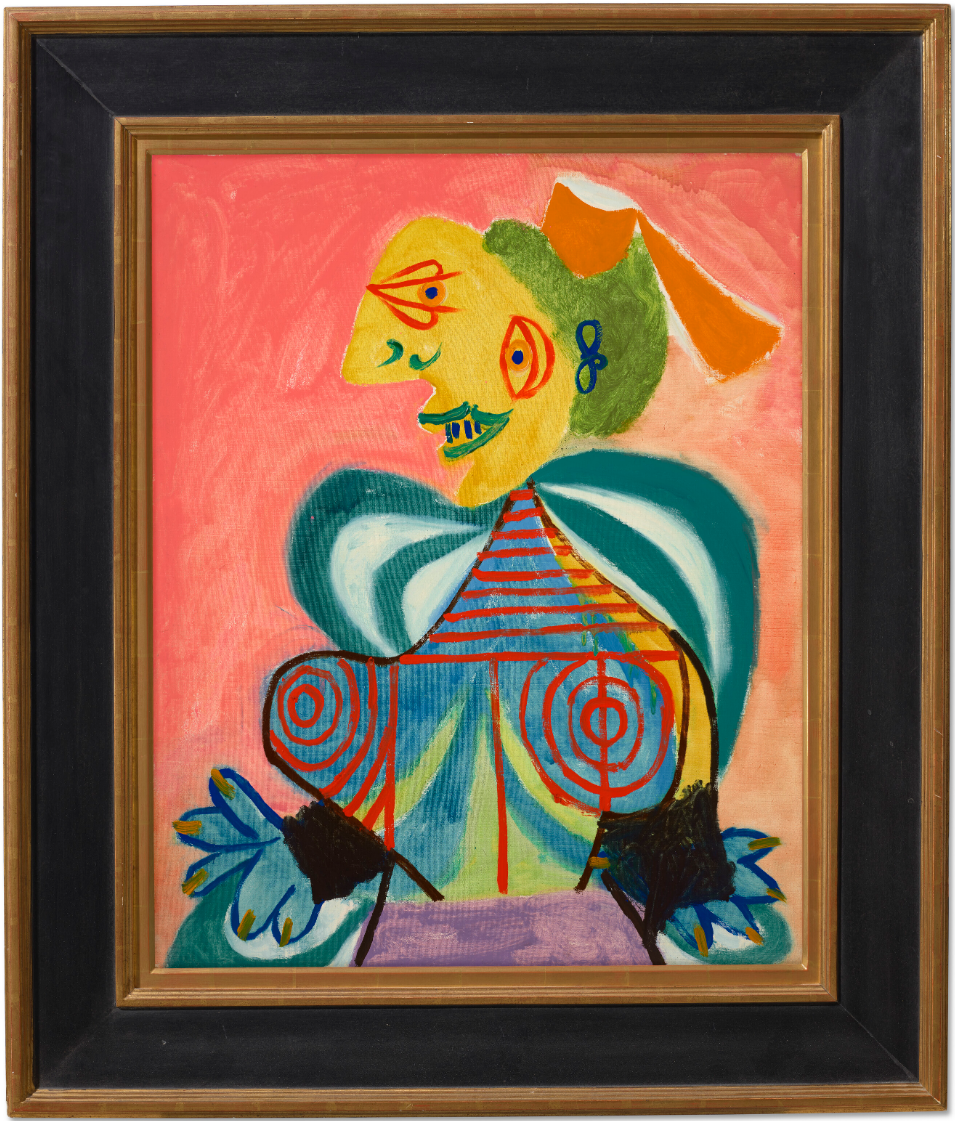
PABLO PICASSO
L’Arlesienne (Lee Miller), 1937
Oil on canvas
81×65 cm (31 7/8 x 25 5/8 inches)
Christie’s New-York, 11 May 2022
USD 13,672,000
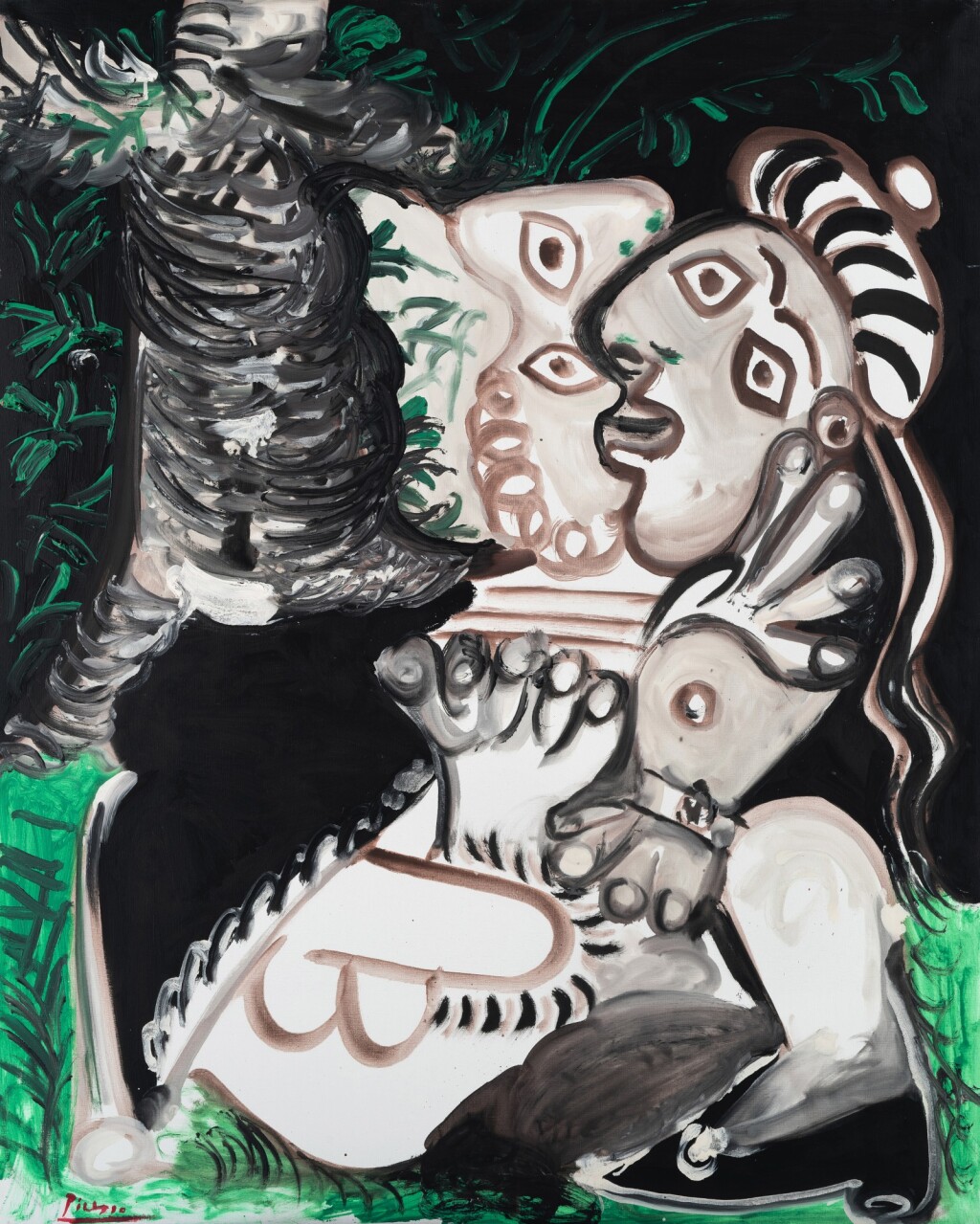
PABLO PICASSO
L’Etreinte, 1969
Oil on canvas
162×130 cm (64×51 inches)
Sotheby’s New-York: 17 May 2022
USD 14,112,500
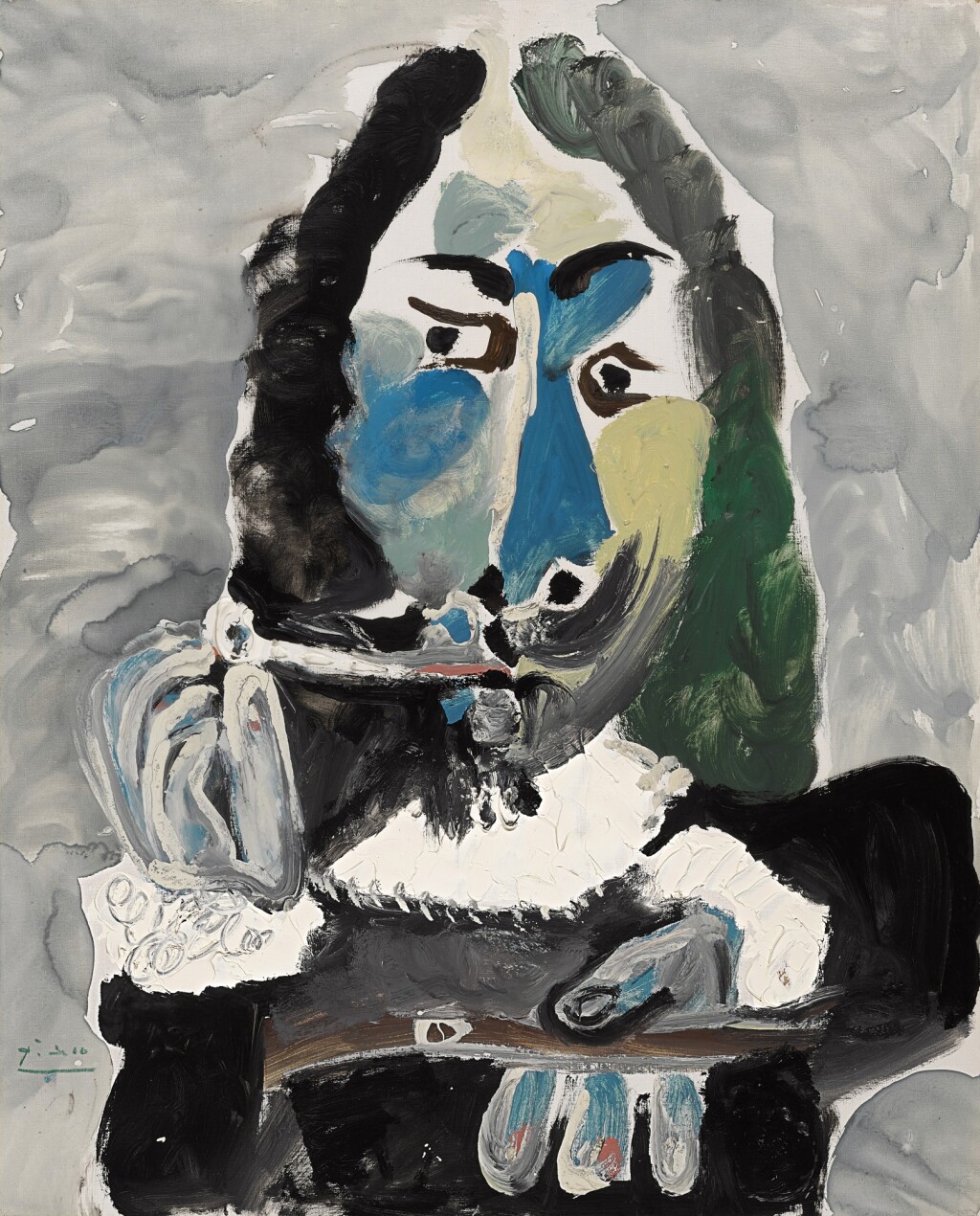
PABLO PICASSO
Mousquetaire a la pipe, buste, 1967
Oil and Ripolin on canvas
99.7 x 80.6 cm (39×32 inches)
Sotheby’s New-York: 17 May 2022
USD 8,482,400
Richly rendered and immediately evocative, Pablo Picasso’s Mousquetaire à la pipe, buste is an exuberant canvas from the artist’s iconic series of Mousquetaire paintings. Initiated in 1967—the year of the present work—Picasso’s large-scale canvases depicting sword-brandishing musketeers are among the great subjects of the artist’s late oeuvre. Exemplifying the inventiveness, dynamism, and rich brushwork which characterize this group, the present work is wholly evocative of the palpable joie de vivre which infuses the very best of the artist’s final decade.
Set against an ethereal ground gray wash, Picasso brings his musketeer to life with vigor and enthusiasm: rendered in bold strokes of black, blue and green pigment and lush swathes of white impasto, his figure is at once stoic and comical, legible while abstracted, historic in appearance yet utterly contemporary in nature. A centerpiece of the collection of Marcia and Stanley Gumberg for over two decades, Mousquetaire à la pipe, buste emerges as a stirring testament to Picasso’s singular mastery, creativity, and enduring energy in the final stage of his legendary career.
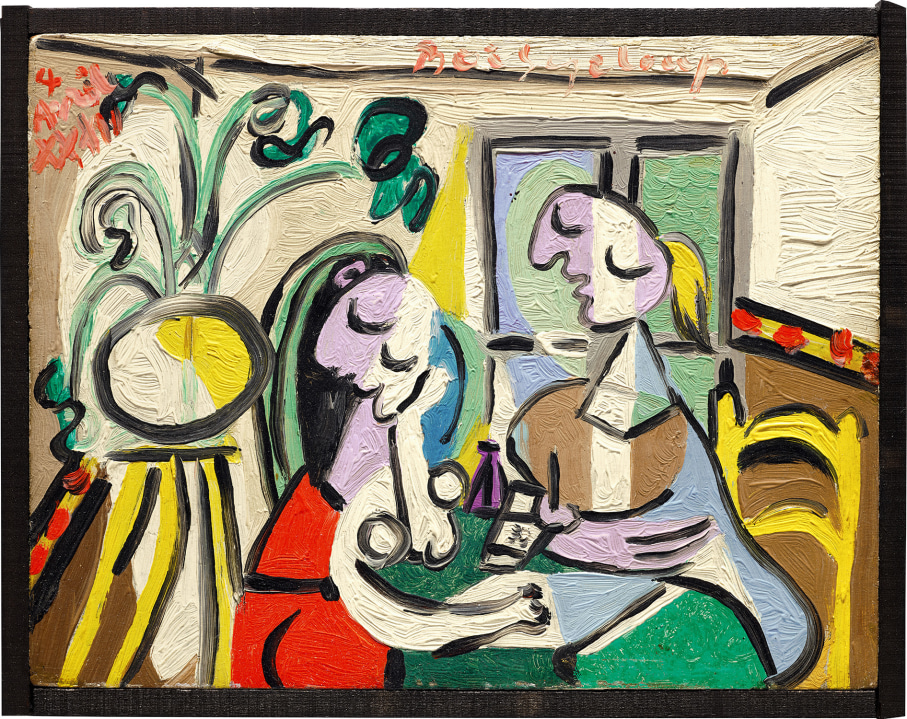
PABLO PICASSO
Figures et Plantes, 1932
Oil on panel
18.4 x 23.8 cm (7×10 inches)
Phillips New-York: 18 May 2022
USD 10,267,000
#4 Mark Rothko
USD 172,868,000
4 Lots
Top Lot: USD 66,800,000
MARK ROTHKO
Untitled (Shades of Red), 1962
Oil on canvas
69×56 inches (175.3×142.2 cm)
Christie’s New-York: 11 May 2022
USD 66,800,000
Painted in 1961, Mark Rothko’s Untitled (Shades of Red) forcefully captures the mysterious and emotional intensity that lies at the very heart of the artist’s work. Haunted by the eternal drama that he believed was an inherent part of the human psyche, Rothko spent his life trying to convey these emotions on canvas, and his floating fields of color became the central elements in many of his most accomplished paintings. One of the most important and influential artists of the twentieth-century, Rothko maintained that his canvases weren’t paintings of an experience, they were the experience, and standing before paintings such as the present example he sought to induce in the viewer a deep emotional, almost spiritual, connection.
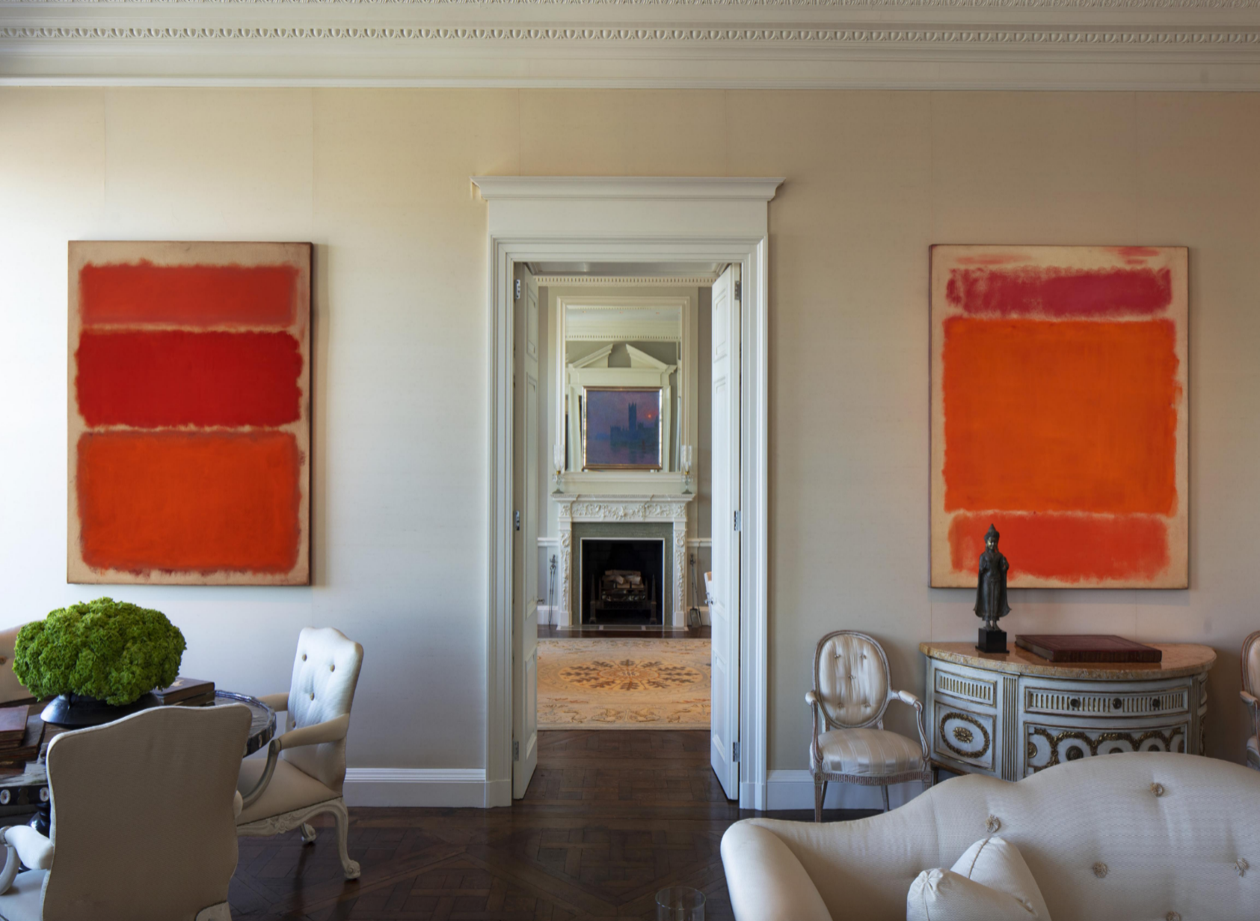
MARK ROTHKO
No. 1, 1962
Oil on canvas
69×60 inches (175.3×152.4 cm)
Christie’s New-York: 11 May 2022
USD 49,625,000
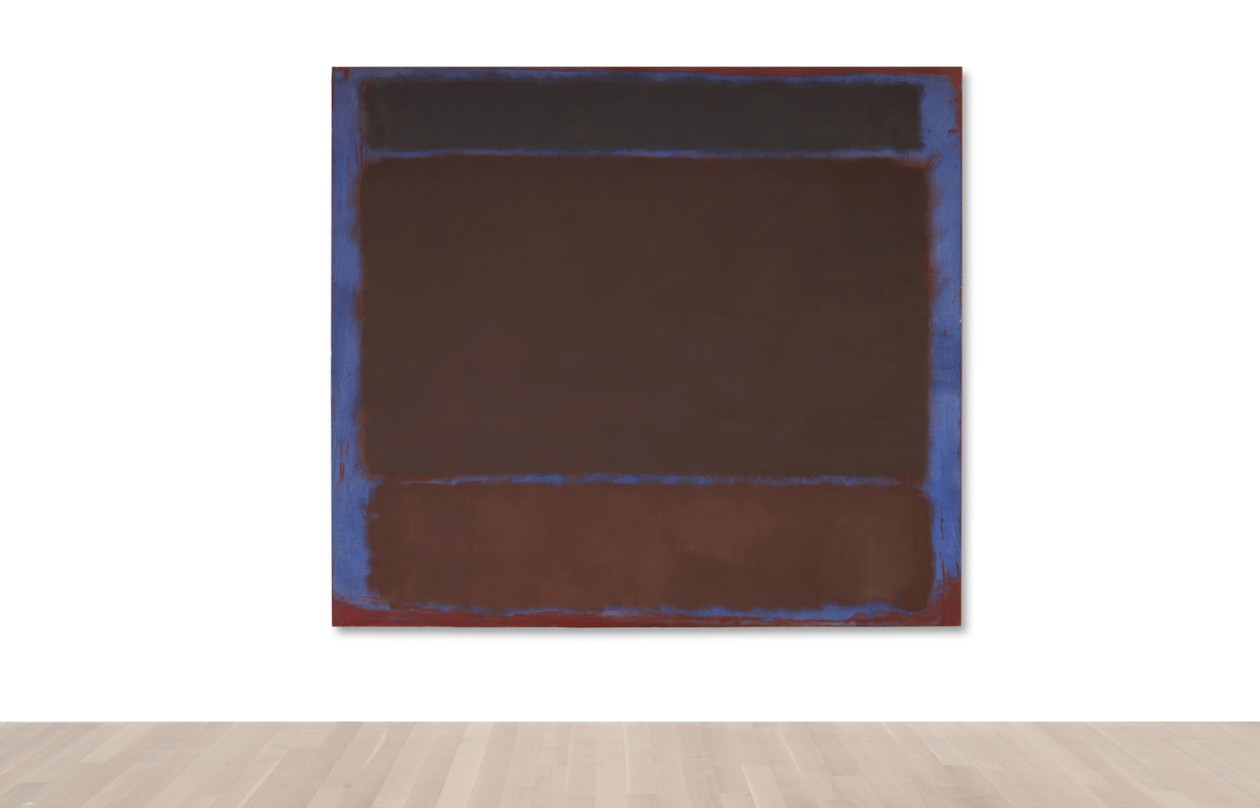
MARK ROTHKO
Untitled, 1960
Oil on canvas
70×74.5 inches (178.4×189.2 cm)
Sotheby’s New-York: 16 May 2022
USD 48,008,000
Powerfully emotive in palette and utterly enveloping in scale, Mark Rothko’s Untitled from 1960 is a masterwork of the legendary artist’s inimitable painterly praxis. One of just 19 paintings on canvas by Rothko from 1960, nearly half of which reside in museum collections, the meditative hues and encompassing scale of the present work represent a pivotal moment within Rothko’s storied career and artistic development. While the artist had already achieved significant international acclaim by the end of the 1950s, it was over the course of the following decade that the artist would push himself to produce the most emotionally provocative, astoundingly intimate, and visually awe-inspiring works of his oeuvre. Upon the surface of Untitled, the three clearly distinct, yet inextricably intertwined, zones of black and maroon pigment imbue the canvas with a tangible magnetic charge. Cast against the rich cobalt field, a velvety expanse of inky black fills the top register of the painting; built up of innumerable washes of hue, its edges mingle gently with the lighter ground on which it floats. Below, a deep maroon rectangle floats above a slightly lighter form, the borders of each color commingling slightly in vaporous whisks of paint at an elegantly executed horizontal axis. Hovering upon the canvas, the three void-like rectangular zones of darker pigment draw one’s gaze inexorably inward, their feathered edges simultaneously seeming to expand and contract; from beneath their hazy borders, the radiant blue ground breaks through like light escaping from a vacuum.
#5. Cy Twombly
USD 106,324,000
7 Lots
Top Lot: USD 38,000,000
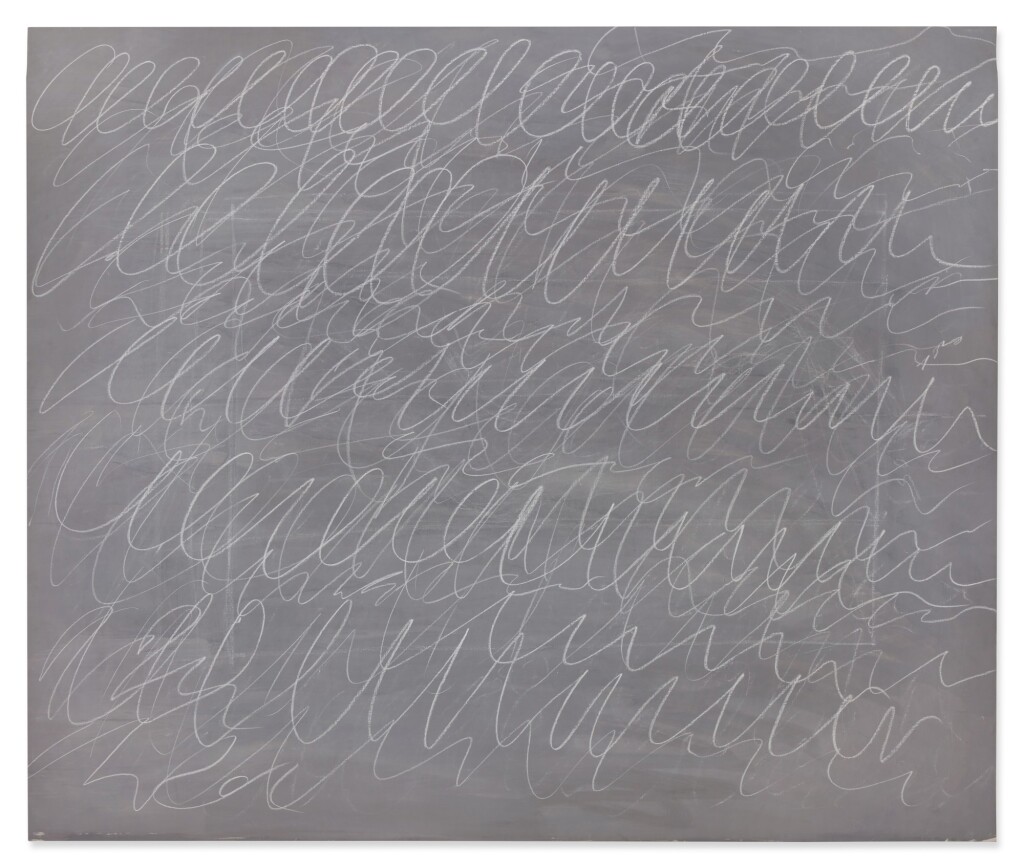
CY TWOMBLY
Untitled, 1969
Oil based house paint and wax crayon on canvas
79×93.5 inches (200 x 237.5 cm)
Sotheby’s New-York: 19 May 2022
USD 38,000,000
Vibrating with lyrical vitality and poetic force, Cy Twombly’s Untitled from 1969 is a marvelously gestural iteration of the artist’s pivotal Blackboard paintings. Captivating in its large scale, the present work is part of a limited number of panoramic canvases from the celebrated series. Illustrating Twombly’s singular ability to mediate urgency and immediacy with control and order, Untitled interrogates our very understanding of mark making while tapping into a primal pursuit of the sublime. Whirling across the canvas, Twombly’s coiled lines, as though electrically charged, magnificently ignite that which lies even most deeply within the human soul. It is thereby that Untitled so triumphantly encapsulates Twombly’s driving force as an artist.
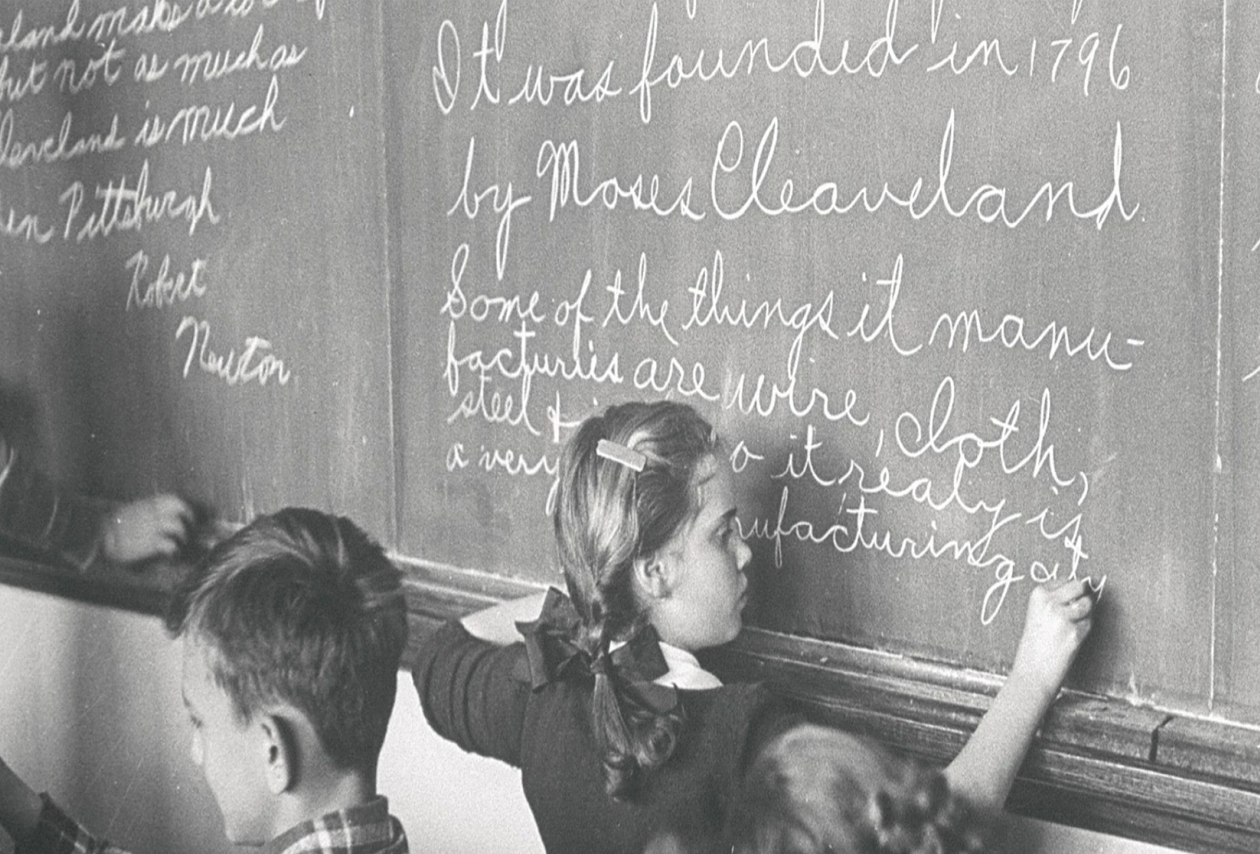
While many of Twombly’s other Blackboard paintings contain distinct strata of loops, the exact number of lines is difficult, if not impossible, to discern in the present work; in rolling currents akin to the aquatic, the white marks of Untitled are erased, overdrawn and intertwined against their smoky gray background. Sensuously, Twombly’s lines reverberate to the very edges of the canvas. While the topmost lines demonstrate a certain level of tight restraint, the lines towards the bottom of the frame begin to loosely unravel; subdued, elegant loops transform into wider, frenetic waves. Such rebellion against linearity and legibility demonstrates Twombly’s genius at its apex—though reminiscent of written language, Twombly’s lines are, here, ultimately more painterly than textual. Within the urgent yet organized chaos of the artist’s inscriptive process, a lyrical form of abstraction begins to emerge.
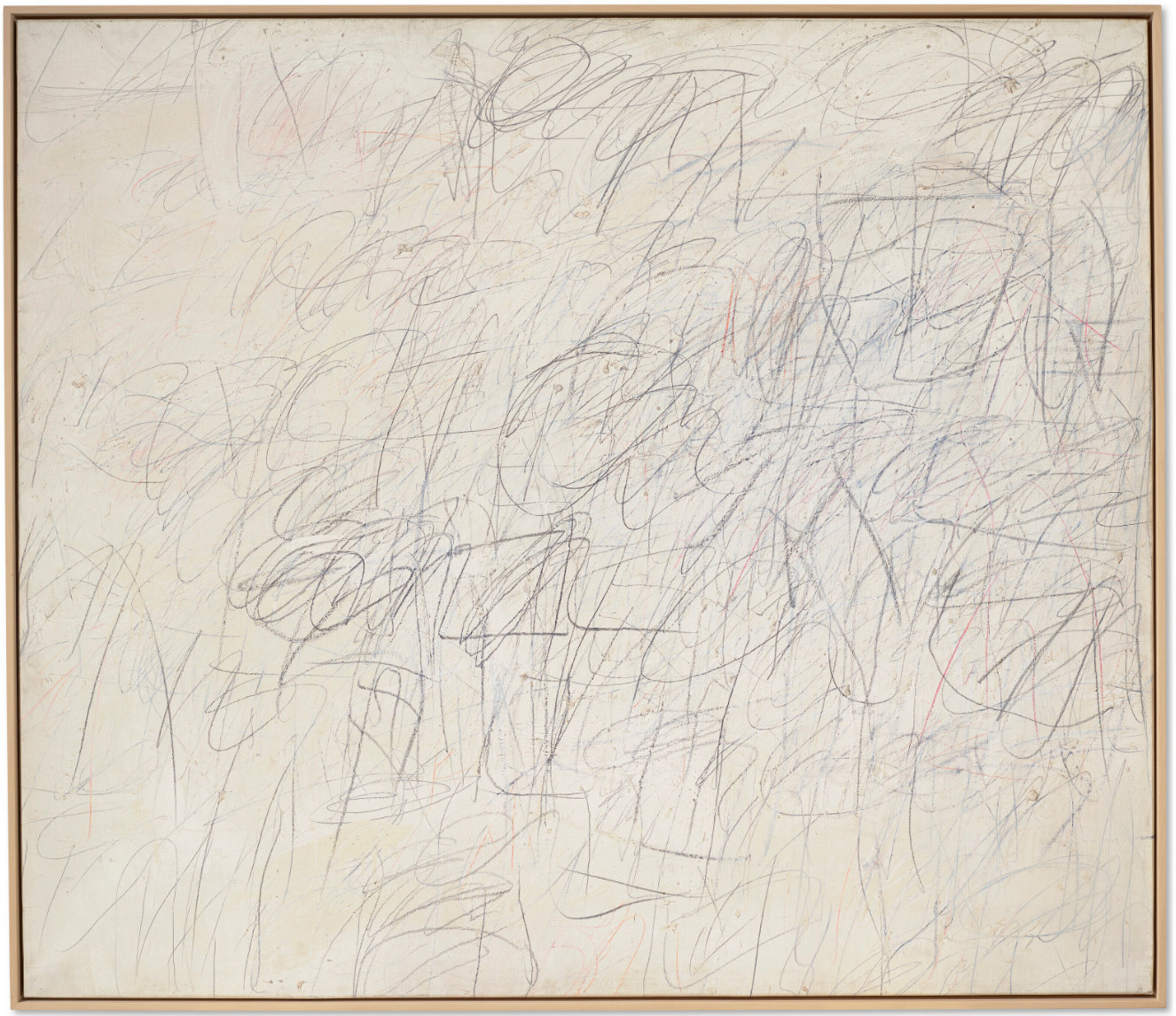
CY TWOMBLY
Untitled, 1955
Oil-based house paint, wax crayon, and colored pencil on canvas
50×58 inches (127×147 cm)
Christie’s New-York: 9 May 2022
USD 21,000,000
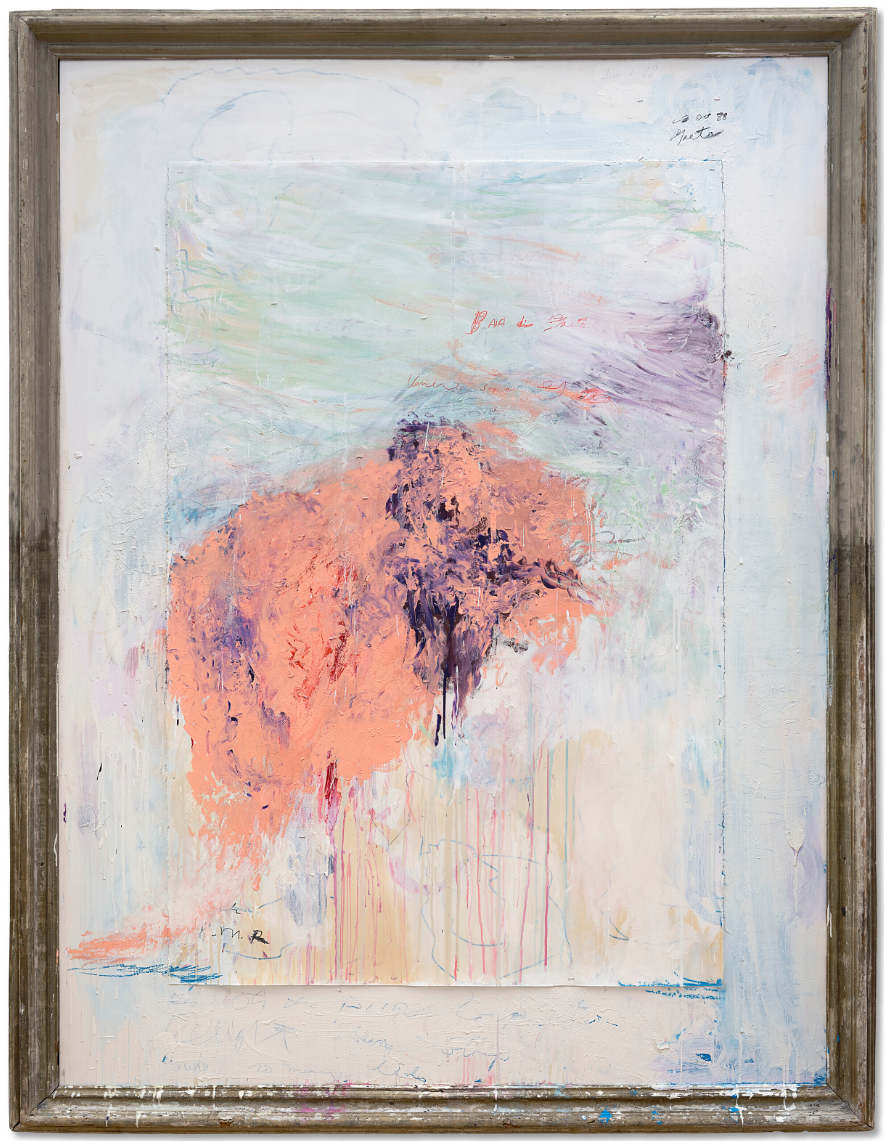
CY TWOMBLY
Venere Sopra Gaeta, 1988
Acrylic, oil-based house paint, wax crayon, and pencil on paper and wooden panel
99×77 inches (251.5×195 cm)
Christie’s New-York: 9 May 2022
USD 16,992,500
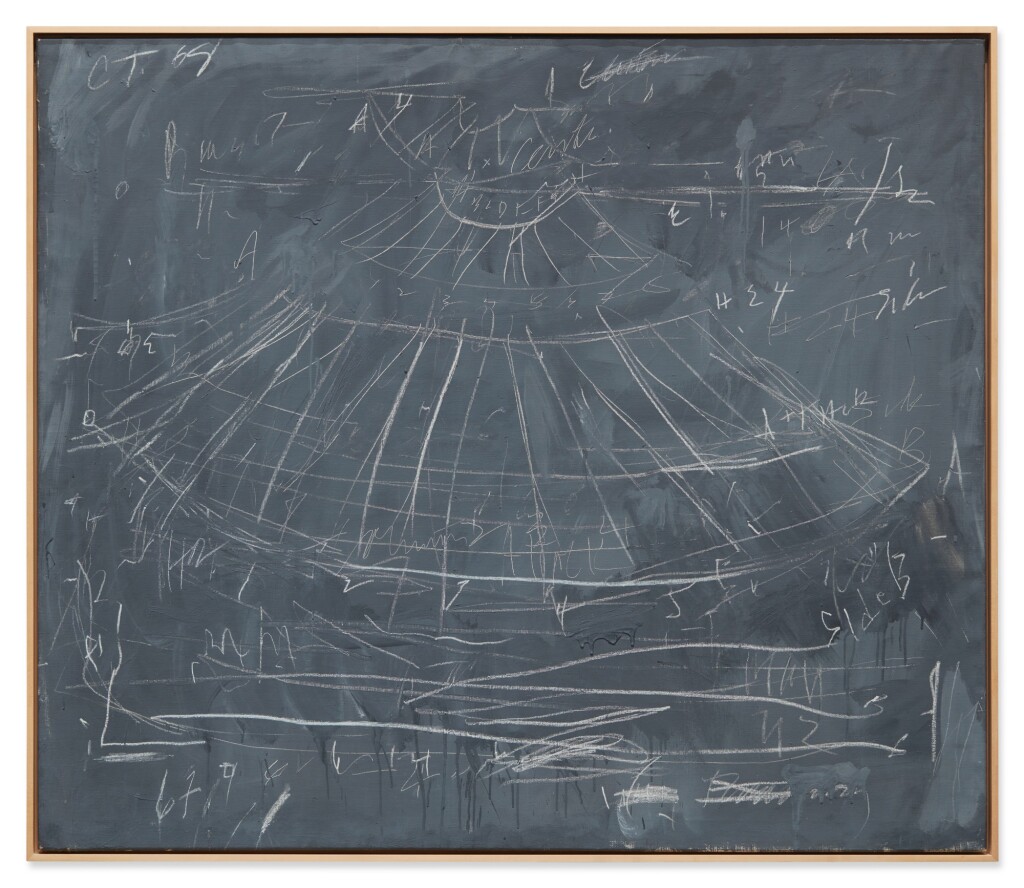
CY TWOMBLY
Synopsis of a Battle, 1968
Oil based house paint and wax crayon on canvas
50.5 x 59 inches (128.3 x 149.2 cm)
Sotheby’s New-York: 16 May 2022
USD 15,261,500
Created in 1968, amidst a period of profound inspiration and intense productivity, Synopsis of a Battle represents an intellectually rigorous yet poetically enthralling masterwork from Cy Twombly’s celebrated series of Blackboard paintings. At once calligraphic and painterly, this magnificent canvas cleverly evokes the chalklike notations of an educational lecture whilst remaining utterly illegible—an allover tapestry of quivering jots, dashes and lines. Set against its slate-gray background, the frenetic notations break free from logical understanding to declare their own autonomy. They are the heraldic symbols of an uncharted new pictorial mode that cleverly bridges the gap between Abstract Expressionism and Minimalism.
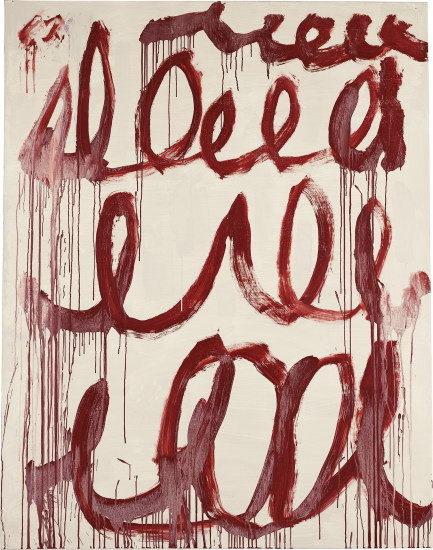
CY TWOMBLY
Untitled, 2006
Acrylic on canvas
85×66 inches (215.6 x 167.6 cm)
Phillips New-York: 18 May 2022
USD 8,206,000
#6. Jean-Michel Basquiat
USD 98,659,000
6 Lots
Top Lot: USD 85,000,000
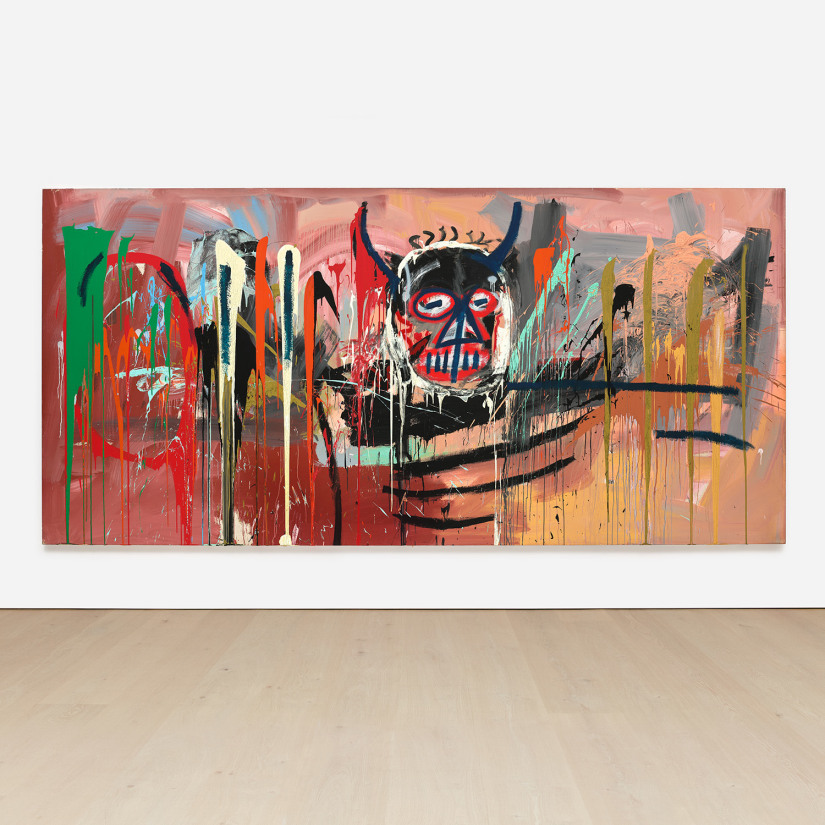
JEAN-MICHEL BASQUIAT
Untitled, 1982
Acrylic and spray-paint on canvas
94×197 inches (239.4×501 cm)
Phillips New-York: 18 May 2022
USD 85,000,000
Coming from the esteemed collection of Japanese entrepreneur Yusaku Maezawa, Untitled is one of Jean-Michel Basquiat’s greatest masterpieces. Its potency and scale mark it as one of his most ambitious works: standing at almost eight feet tall and over 16 feet wide, it is among his largest canvases. Executed in 1982, the watershed year which shot the artist to international stardom, this tour de force is from a small series created in Modena, Italy, where Basquiat visited at the invitation of the dealer Emilio Mazzoli during two periods in the early 1980s. This pivotal chapter, today regarded as one of the most desirable of his career, marked his transition from “SAMO©”, the pseudonym Basquiat used as a street poet and tagger whose nom de plume had begun appearing all over New York’s disintegrating infrastructure in the 1970s, to an art world force to be reckoned with. 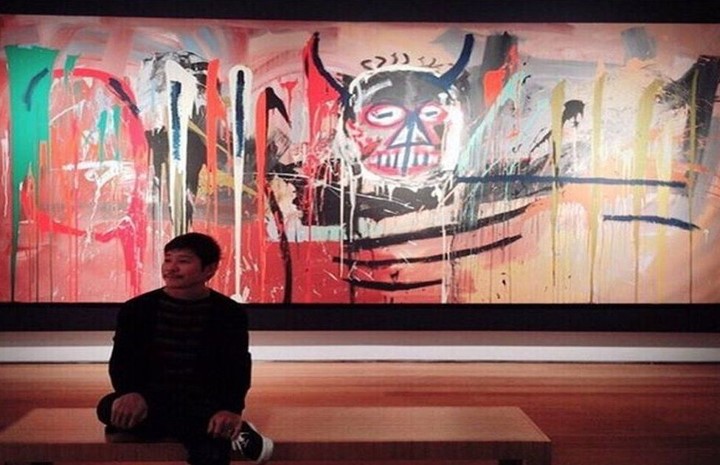
Indeed, Untitled’s vastness is so striking that it, coupled with the artist’s use of spray paint and geometric shapes, is suggestive of a large mural or graffiti-covered city wall—a fusion of street culture with “high art” that reflects a radical shift in his career and approach to art-making.
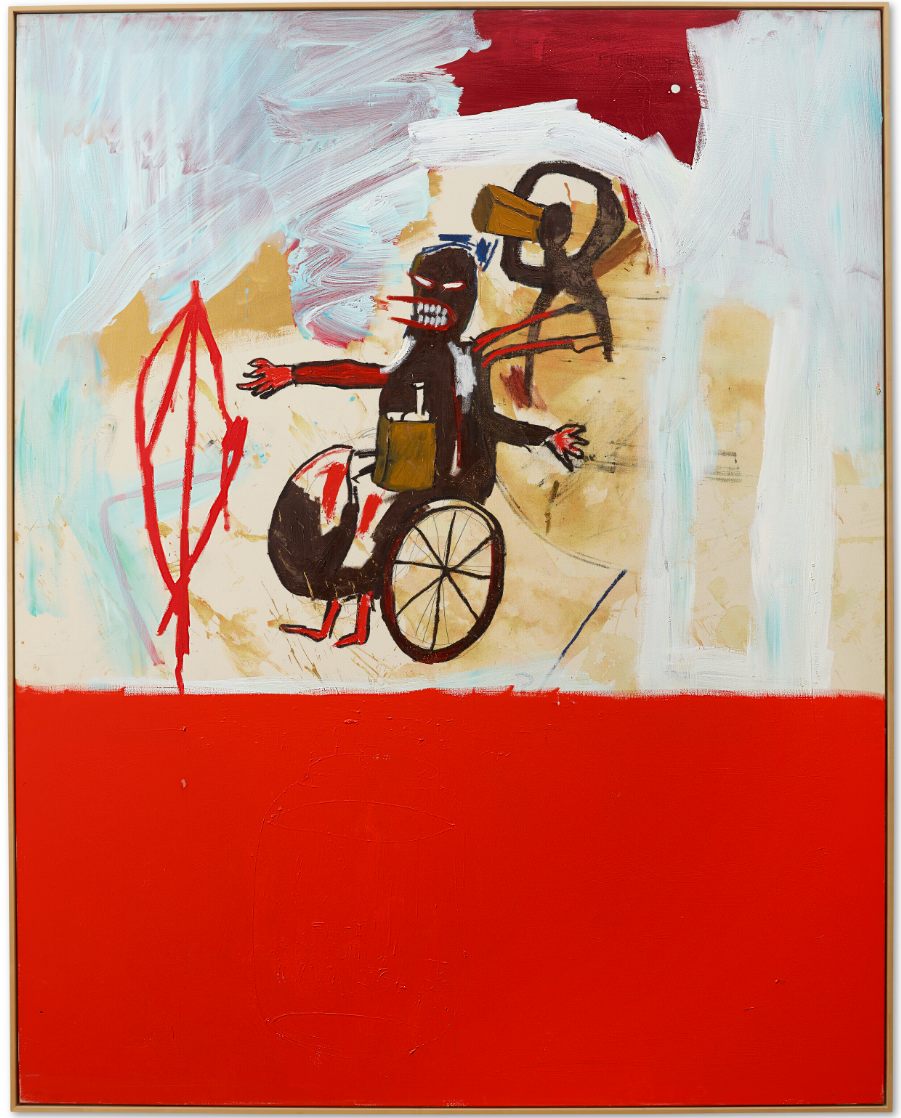
JEAN-MICHEL BASQUIAT
His Blue Sniffing Valet, 1984
Acrylic, oilstick and graphite on canvas
86×68 inches (219×173 cm)
Christie’s New-York: 9 May 2022
USD 7,260,000
#7. Gerhard Richter
USD 73,184,440
15 Lots
Top Lot: USD 36,500,000
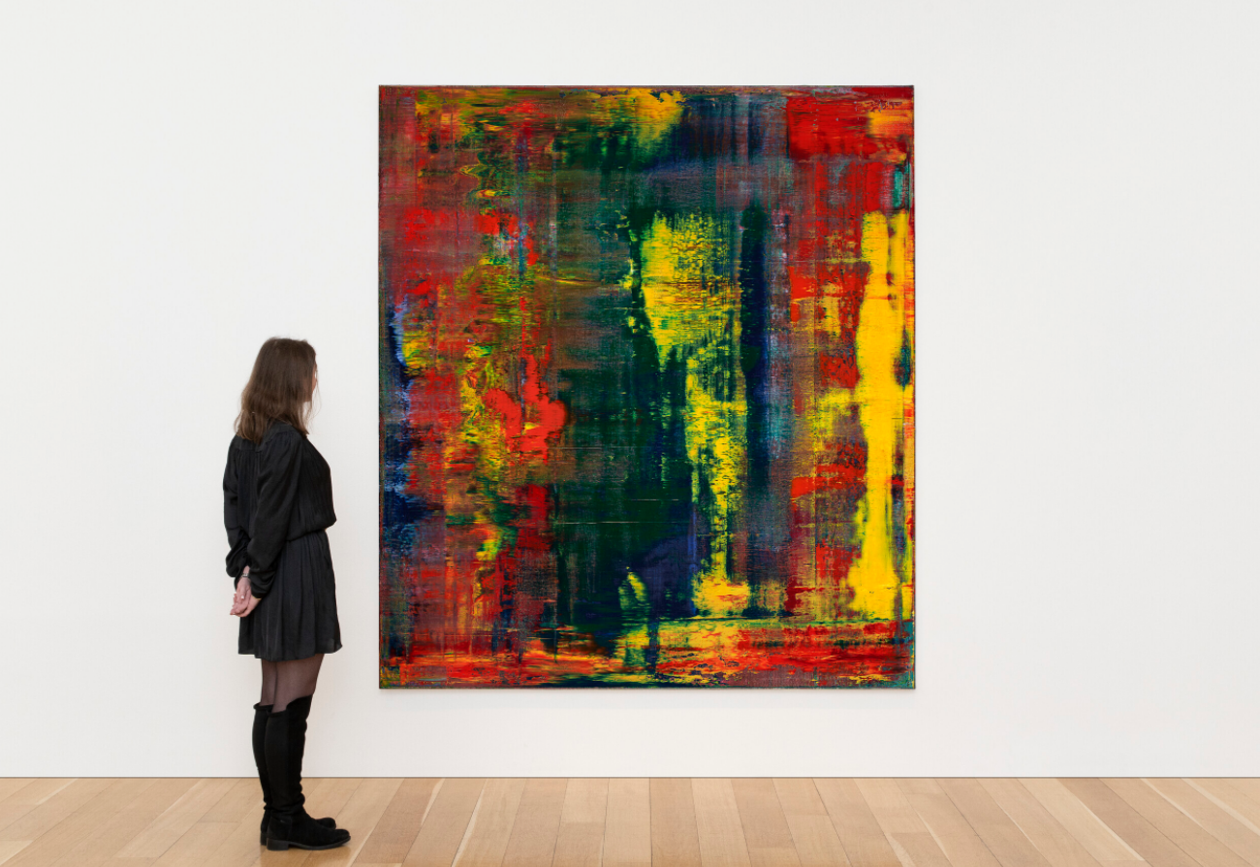
GERHARD RICHTER
Abstraktes Bild, 1994
Oil on canvas
225×200 cm (88.5×79 inches)
USD 36,500,000
Exhibiting a chromatic potency that is unmatched in contemporary painting, Gerhard Richter’s Abstraktes Bilder attest to the timeless and emotive power of color. In the present work, saturated hues of deep red, golden yellows, and rich sapphire blues roil up through the highly active surface to magnificent effect. The culmination of a lifelong investigation into the practice of painting, Abstraktes Bild also encapsulates the artist’s investigations into the formal and conceptual possibilities of painting, his unique technique opening up the composition and disrupting the sanctity of the painted surface. Measuring nearly seven feet square, the viewer becomes enveloped in the dynamism of the kaleidoscopic surface, captivated by the intricate details are myriad of colorful hues. Formerly in the collection of legendary collector Heiner Pietzsch and his wife Ulla, and latterly the legendary guitarist Eric Clapton, Abstraktes Bild is a magnificent example from one of the most celebrated bodies of work of the past fifty years. Painted in 1994, Abstraktes Bild is a sumptuous example of the artist’s comprehensive interrogations of the painted surface. Executed on a monumental scale, in the present work Richter choreographs a prismatic array of jewel-like hues across the surface of the canvas. With careful sweeps of his brush, and even more stringent manipulations of the pigment using his hard-edged plastic squeegee, the artist lays down seams of vibrant, unadulterated color. Passages of primary red, blue and yellow coalesce throughout the composition, resulting in bottomless pools of saturated color. At their edges, where they come into contact with neighboring passages of color, they transition into activated areas that fizz with energy. Like Rothko’s floating fields of pigment, it is here where pigment coalesces with pigment that the visual energy present in the best examples of Richter’s work can most acutely be seen. The arduous process of applying, and then scraping off, consecutive layers of paint results in an intricate surface of infinite detail: thick impasto sits alongside thin veneers of paint that are so gossamer thin as to reveal the texture of the warp and weft of the underlying canvas.
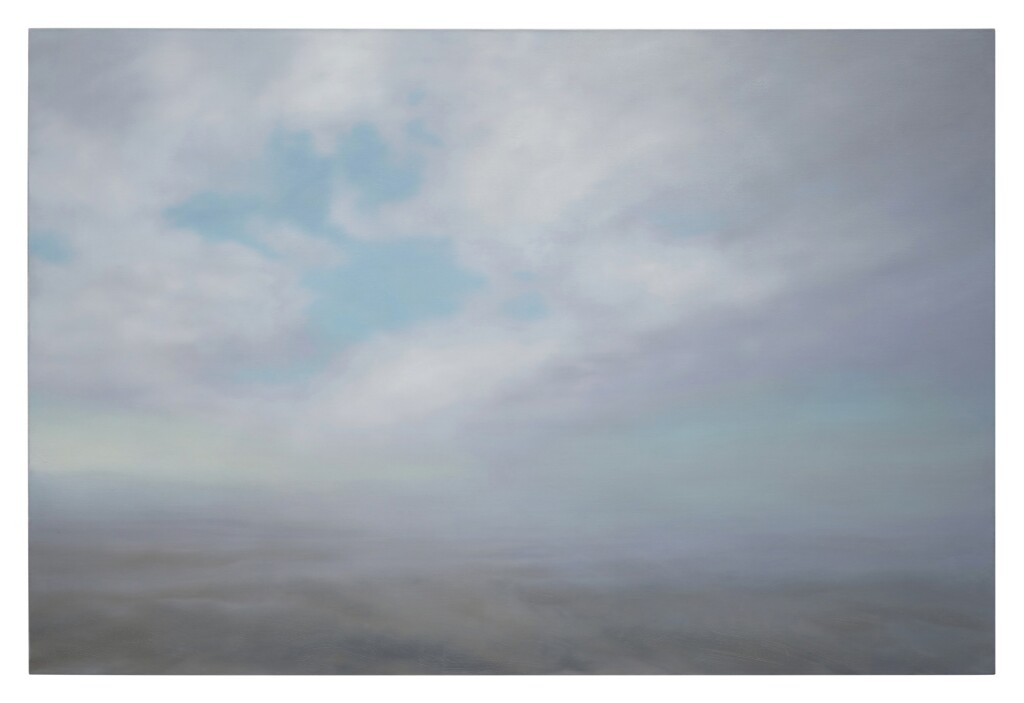
GERHARD RICHTER
Seestuck [Seascape], 1975
Oil on canvas
199.4×300.4 cm (78.5×178 inches)
Sotheby’s New-York: 16 May 2022
USD 30,198,500
Emanating celestial light on a spectacular scale, the divine and immersive beauty of Gerhard Richter’s Seestück [Seascape] is entirely illustrative of the aesthetic and conceptual mastery that have come to define the artist’s revolutionary body of work. Radiating luminescent sunlit hues filtered through a harmonic miasma of soft ephemeral forms, this painting is undeniably indebted to a long and familiar legacy of art historical heritage. Readily evocative of the Romantic and sublime landscapes of Caspar David Friedrich, John Constable’s famous cloud studies, the atmospheric light effects of Turner, as well as drawing on the cloud’s symbolic value as heavenly proxies in Renaissance and Baroque painting, the present work instantly conjures an encompassing transhistorical field of references, whilst remaining resolutely contemporary. Though drawing on a nineteenth century Romantic lineage and inescapably evoking a religiously loaded semiotic legacy, the artist’s fascination with clouds and seascapes extends into an exploration of chance in painting—the ultimate expression of which was later refined from the 1980s onwards via the Abstrakte Bilder. Drawing on his concurrent photography practice, Richter bases his Seascapes on source images from his own archive, but through his remarkable painterly prowess pushes the horizon further into transcendent abstraction.
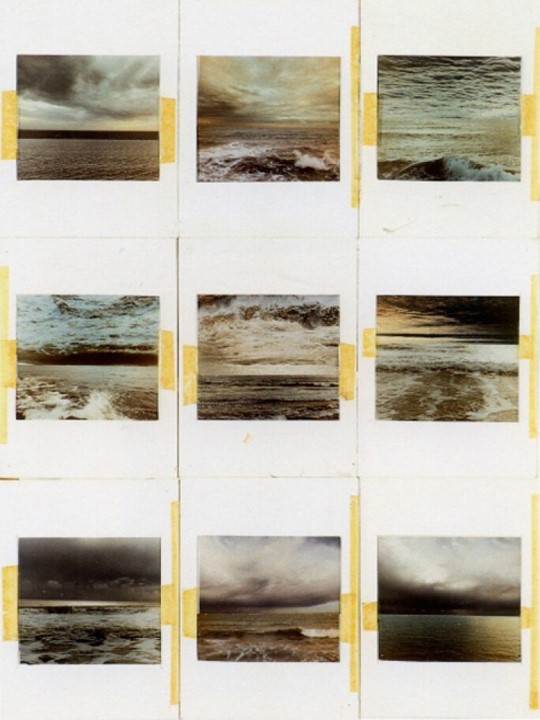
One of only four 2- by 3-meter canvases depicting this subject, all of which were executed in 1975 and are housed in prominent private collections worldwide, including the Froehlich Collection in Stuttgart, this concise group of works straddles the readily drawn schism separating Richter’s abstract works from the hyperreal Photo Paintings. Foregrounding religion, history and artistic inheritance within the complex debate for painting’s legitimacy in the later twentieth century, the Seestück represent one of Richter’s most pluralistic of thematic inquiries, and most astounding of aesthetic investigations.
#8. Willem de Kooning
USD 70,672,250
6 Lots
Top Lot: USD 25,007,500
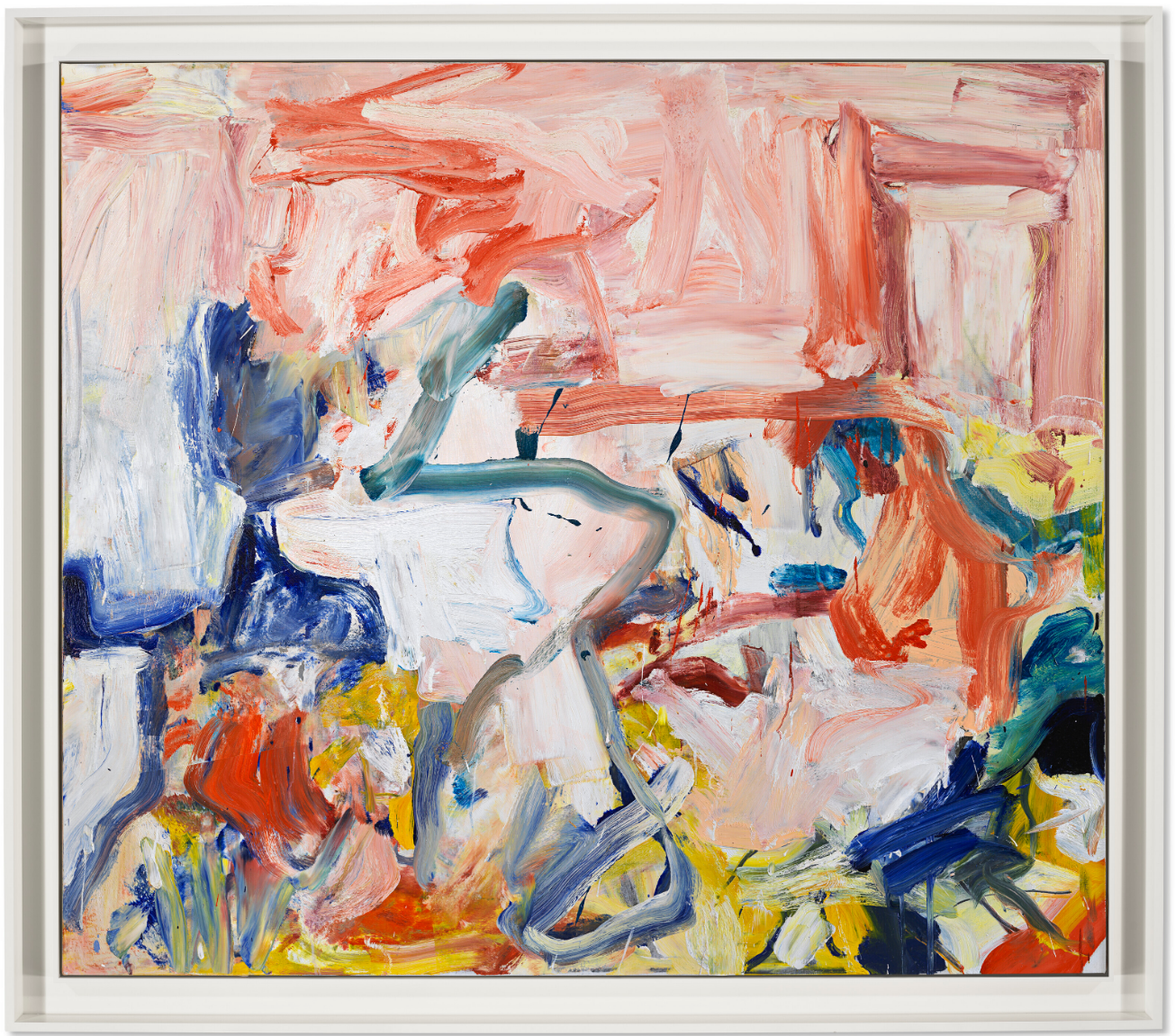
WILLEM DE KOONING
Untitled XXI, 1977
Oil on canvas
70×80 inches (177.8 x 203.2 cm)
Christie’s New-York: 11 May 2022
USD 25,007,500
Held in the same private collection for nearly thirty-five years, Willem de Kooning’s Untitled XXI is a joyous and masterful painting from one of the artist’s most beloved periods. Executed in 1977, a year described by the art critic David Sylvester as de Kooning’s annus mirabilis (his “miraculous year”), the present work is a sumptuous Abstract Expressionist painting that abounds with references to both the female figure and the light-filled landscape surrounding the artist’s studio in East Hampton. De Kooning’s 1977 works are widely celebrated as among the most important of his career, mostly owned by major institutions and leading private collectors. Untitled XXI, compared to his other paintings from this period, is exceptionally radiant and offers a retrospective of sorts, combining in one sublime work de Kooning’s longtime obsession with abstraction, landscape and the figure, all of it rendered in powerful brushstrokes and his signature palette of pinks and cobalt blues.
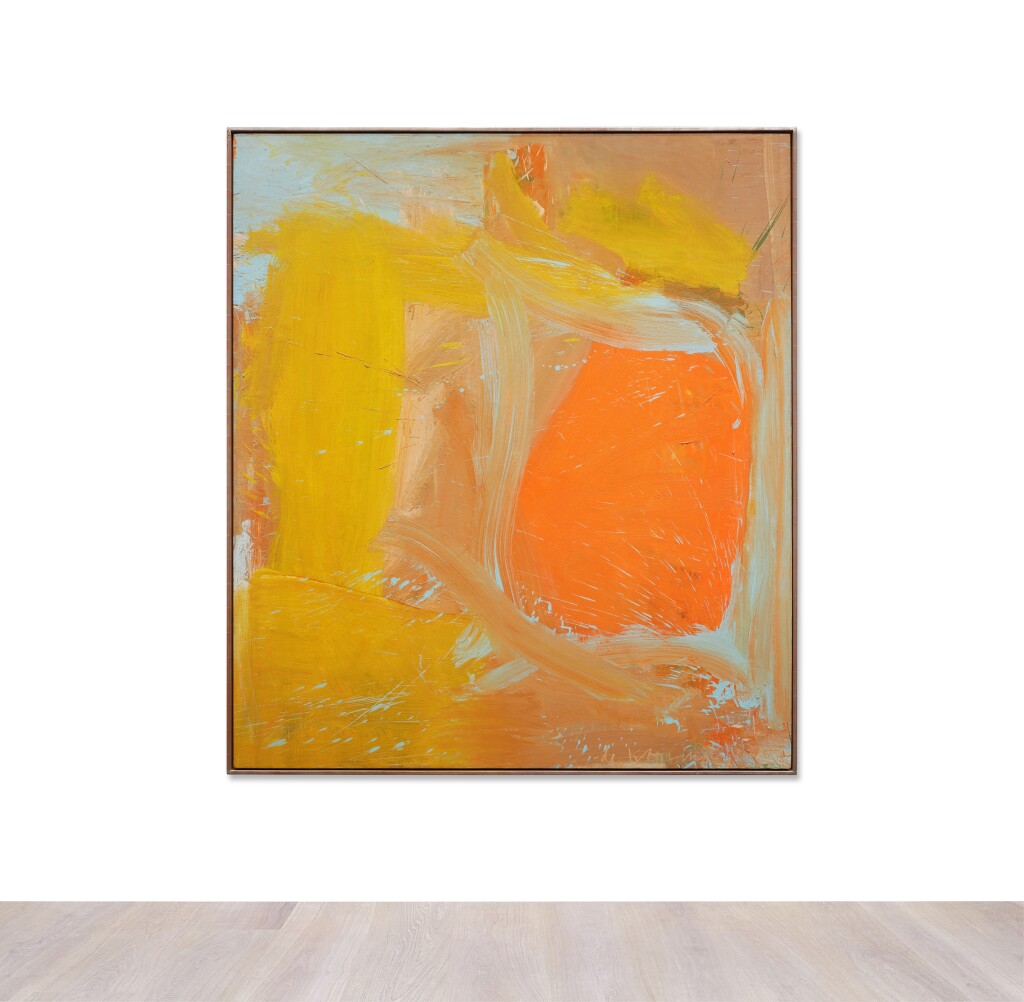
WILLEM DE KOONING
Untitled, 1961
Oil on canvas
80×70 inches (203.2×178.1 cm)
Sotheby’s New-York: 16 May 2022
USD 17,789,300
Broadcasting a churning vista of sumptuous, unadulterated abstraction, Untitled is a remarkable early masterwork from Willem de Kooning’s celebrated artistic oeuvre. Across the expansive surface of the canvas, luscious swathes of rich pigment generate fluid suggestions of organized forms, the component parts of which find harmony through the lyrical choreography of de Kooning’s extraordinary abstract touch. Executed in 1961—the year de Kooning began building his home and studio in Springs, Long Island in preparation for his permanent departure from New York in 1963—Untitled wholly embodies the luminous atmosphere of nature, landscape, and sea which infuses de Kooning’s greatest masterworks from this pivotal moment.
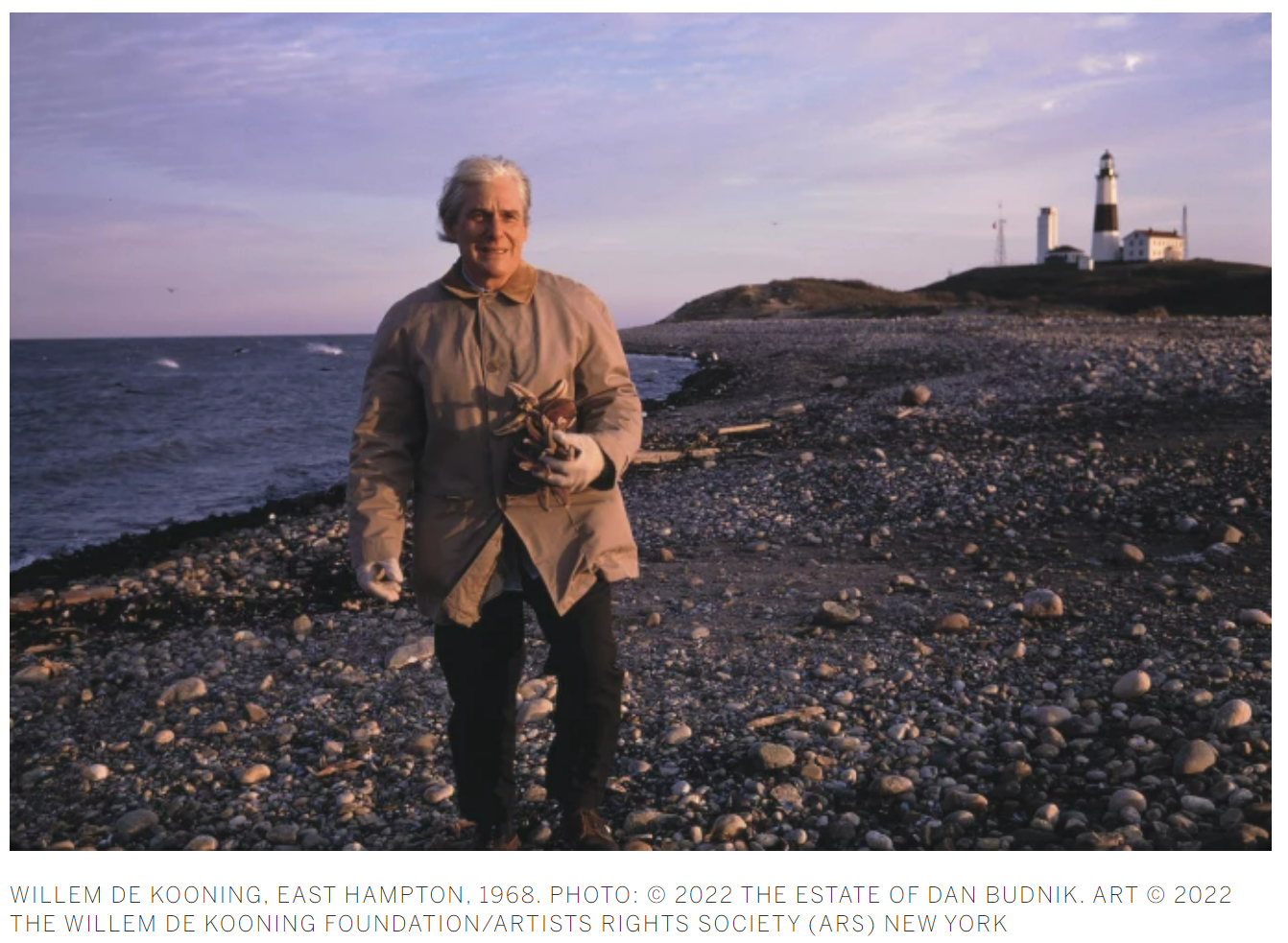
Light, sound and scent beat across every square inch of the present work with an ineffable rhythm, enveloping the viewer in the heady, salty air of East Hampton. For its dazzling fusion of a melodic lyricism with the heroic and muscular mark-making of de Kooning’s expressionism, the incandescent Untitled is a sensory delight and a triumph from this critical period of the artist’s career, one that beautifully links his central appreciation for landscape with the explosive, gestural abstraction of the mid-1970s.
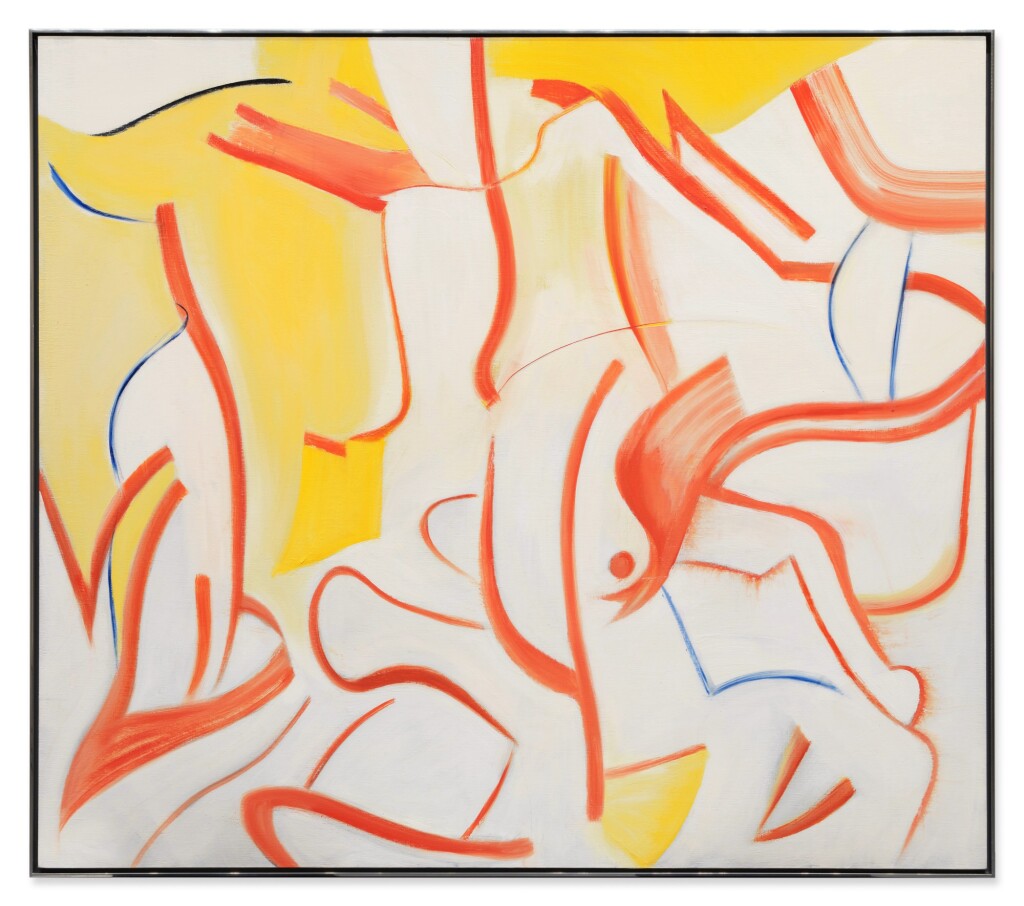
WILLEM DE KOONING
Untitled XIII, 1984
Oil on canvas
70×80 inches (177.8 x 203.2 cm)
Sotheby’s New-York: 16 May 2022
USD 8,999,450
#9. Jackson Pollock
USD 54,772,000
5 Lots
Top Lot: USD 54,205,000
JACKSON POLLOCK
Number 31, 1949
Oil, enamel, aluminum paint and gesso on paper mounted on Masonite
31×22.5 inches (78.7×57.2 cm)
Christie’s New-York: 11 May 2022
USD 54,205,000
An explosive maelstrom of raw color, Jackson Pollock’s Number 31 is one of the richest and most powerful examples of the artist’s celebrated drip technique—a profound icon from a seminal moment in the development of twentieth-century art. Painted in a flurry of brilliant artistic activity toward the end of 1949, Number 31 bears witness to Pollock in full command of his medium. Surrendering his body and mind to be, as he explained it, “literally in the painting,” Pollock orchestrates a lush and elaborate arrangement of vibrant chroma that have been flung, dripped, splattered and swirled onto the surface of this intoxicating work. Pollock painted only thirteen of these drip paintings on paper in 1949—which he then mounted onto Masonite, composition board and canvas—and only eight of them display the gleaming, metallic paint that he employs in Number 31. In November of 1949, Pollock exhibited Number 31, along with others from the series, with his new dealer Betty Parsons. Critics described them as “the best painting he has yet done” (R. M. Coates, The New Yorker, December 3, 1949). Indeed, Number 31 is one of the fullest and most opulent compositions of the group, boasting a sophisticated network of dripped and poured paints in which nearly every square inch of the surface declares the genius of Pollock’s new technique.
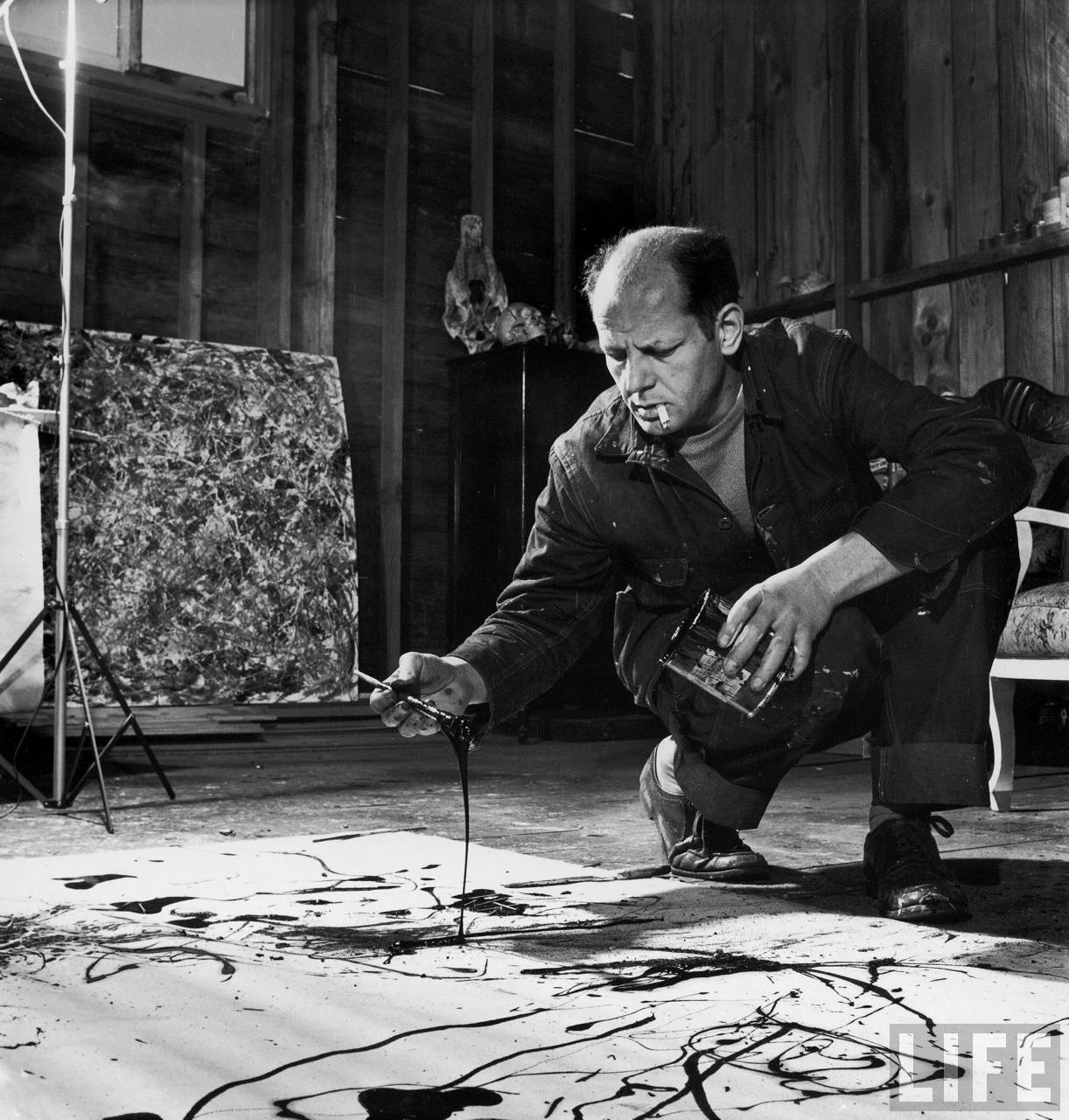
While some of Pollock’s greatest drip paintings are mural-sized, stretching at times to eighteen feet in length, it is in the smaller, more intimate paintings like Number 31 that offer a chance to truly commune with the artist’s work. “Pollock compressed painting to a single gesture and then made the most, a veritable universe, of what remained,” the New York Times art critic Roberta Smith explained. It is in such paintings as Number 31, and others from the series, that “Pollock is seen working at full strength, building his lines into his entrancing, trademark all-over compositions. On such an intimate scale, it is especially easy to grasp the individual shifts in rhythm, gesture, color and paint thickness that orchestrate the final image” (R. Smith, “An Expanded Sense of Pollock’s Vision,” The New York Times, October 22, 1993, p. C26).
5. Selected Artists’ Records
#1. Yayoi Kusama
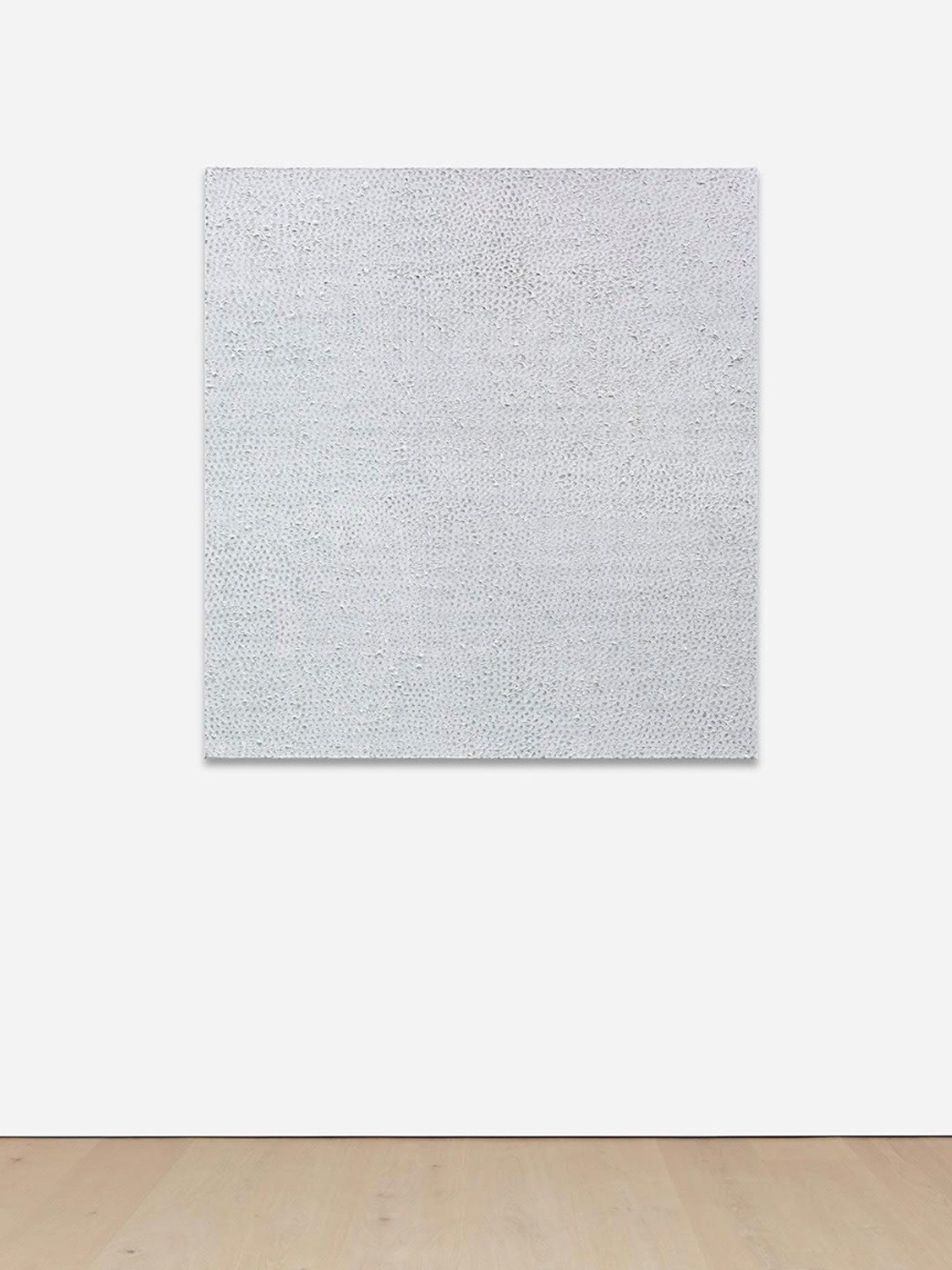
YAYOI KUSAMA
Untitled (Nets), 1959
Oil on canvas
130.8 x 116.5 cm (51.5×46 inches)
Phillips New-York: 18 May 2022
USD 10,496,000
Painted in 1959, Yayoi Kusama’s Untitled (Nets) belongs to the artist’s most coveted and renowned early series of white Infinity Net paintings. Teetering between the singular and infinite, the canvas surface is veiled with an intricate lattice field of small arcs and loops that appears to gently pulse before the viewer’s eyes. Upon a closer look, smooth strokes yield to swells of impasto, their individual renderings infinitely multiplying with poetic gravitas. Untitled (Nets) marks a pivotal moment in the history of post-war abstraction, reflecting the liminal space between the painterly lush of Abstract Expressionism and the reductive aesthetic of Minimalism in which Kusama established her originality within the avant-garde. Evincing the profound impact of Kusama’s early white Infinity Net paintings, many of the artist’s peers went onto acquire them for their personal collections including Donald Judd, Frank Stella, and—in the case of the present work—Uecker. In 1960, Kusama exhibited with Uecker in the seminal Monochrome Malerei show at the Städtisches Museum Schloss Morsbroich in Leverkusen (where she and Rothko were the only artists selected to represent America) and, in 1962, became the only female artist to participate in the highly acclaimed ZERO international group exhibition at the Stedelijk Museum in Amsterdam alongside Uecker, Otto Piene, Lucio Fontana, and Pol Burry. With their hypnotic magnetism and accumulative buzz, Kusama’s early Infinity Nets find a close affinity with Uecker’s protruding-nail reliefs as their respective material elements appear to spiral and converge into infinite spatial realms.
#2. Matthew Wong
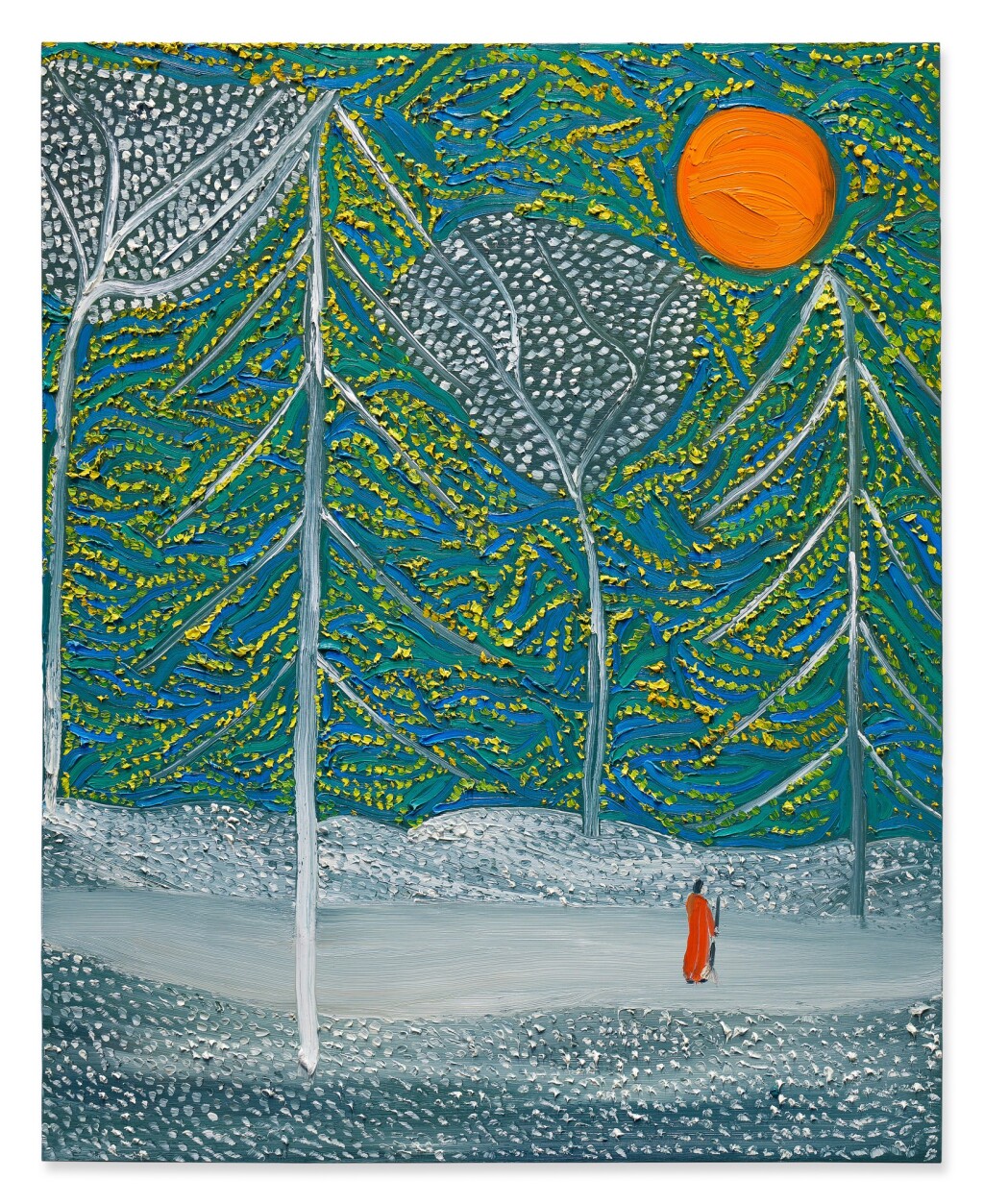
MATTHEW WONG
The Night Watcher, 2018
Oil on canvas
60×48 inches (152.4×122 cm)
Sotheby’s New-York: 19 May 2022
USD 5,897,150
Dizzying and soothing in equal measure, Matthew Wong’s The Night Watcher reveals the range of the artist’s idiosyncratic visual language of texture and color as he captures the serenity of a turquoise forest nightscape in its full kaleidoscopic brilliance. Like Caspar David Friedrich, Vincent Van Gogh, and others of his Romantic and Impressionist forebears, Wong was deeply moved by the natural world, expressing his contemplative fascination with nature through scintillating visions that combine the stylistic grace of Gustav Klimt’s jewel-like paintings and Peter Doig’s fantastical dreamscapes. A self-taught artist, Wong studied the styles of painters such as Vincent Van Gogh, Henri Matisse, and Pierre Bonnard as well as Chinese landscape painting, carefully absorbing them as he clicked through images of art on Instagram or flipped through reference books in local libraries. Wong, an avid daydreamer, painted from raw gestural intuition, elaborating the quick flashes of imagery that his mind recalled often randomly in vague yet lingering glimpses.
#3. Shara Hughes
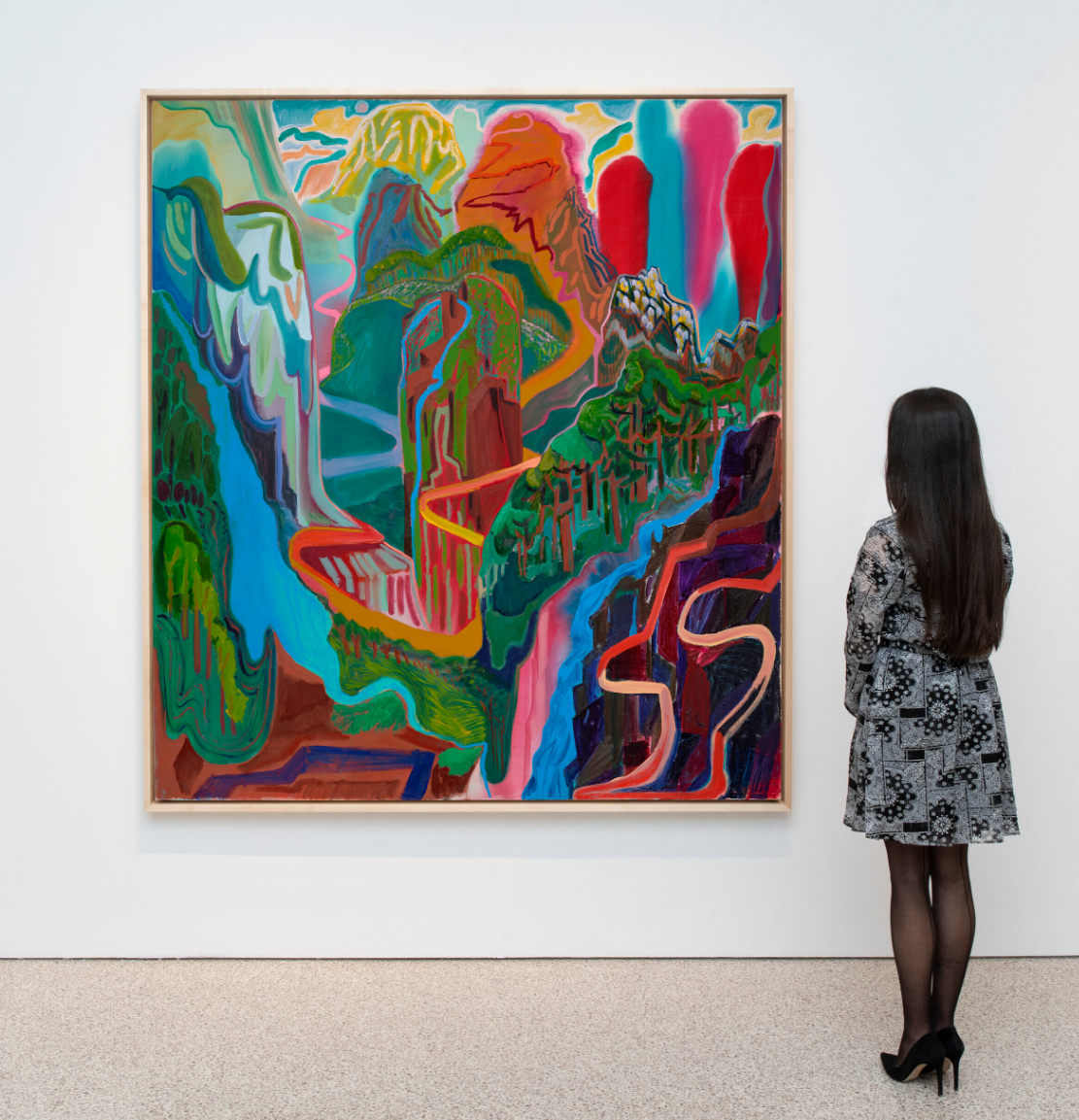
SHARA HUGHES
Spins from Swiss, 2017
Oil and dye on canvas
78×70 inches (198.1 x 177.8 cm)
Christie’s New-York: 10 May 2022
USD 2,940,000
Known for her psychologically-charged tableaus that border on abstraction, Shara Hughes is quickly becoming a formidable force within a new generation of forward-thinking painters. Realized the same year as the artist’s inclusion in the Whitney Biennial, Spins from Swiss is a magnificent example of her whole-hearted transition into landscape painting. Lauded early in her career for interior scenes that mixed personal objects with tumultuous architecture, in 2014 she left the heavy symbolism of these rooms and traveled through the open window into a fantastical outdoor realm.. Feeling a certain restriction in her previous setting, venturing into the time-honored format of the landscape afforded a new freedom and helped push Hughes to the very brink of abstraction. Revealing a mountainous region not unlike the towering forms depicted in traditional Chinese landscape painting, Spins from Swiss offers an elevated view onto a series of winding roads snaking through an impossibly-colored vista. Bleeds and stains of color combine with expressive strokes that morph from pure paint into roads, rivers, and wooded hills.
#4. Anna Weyant
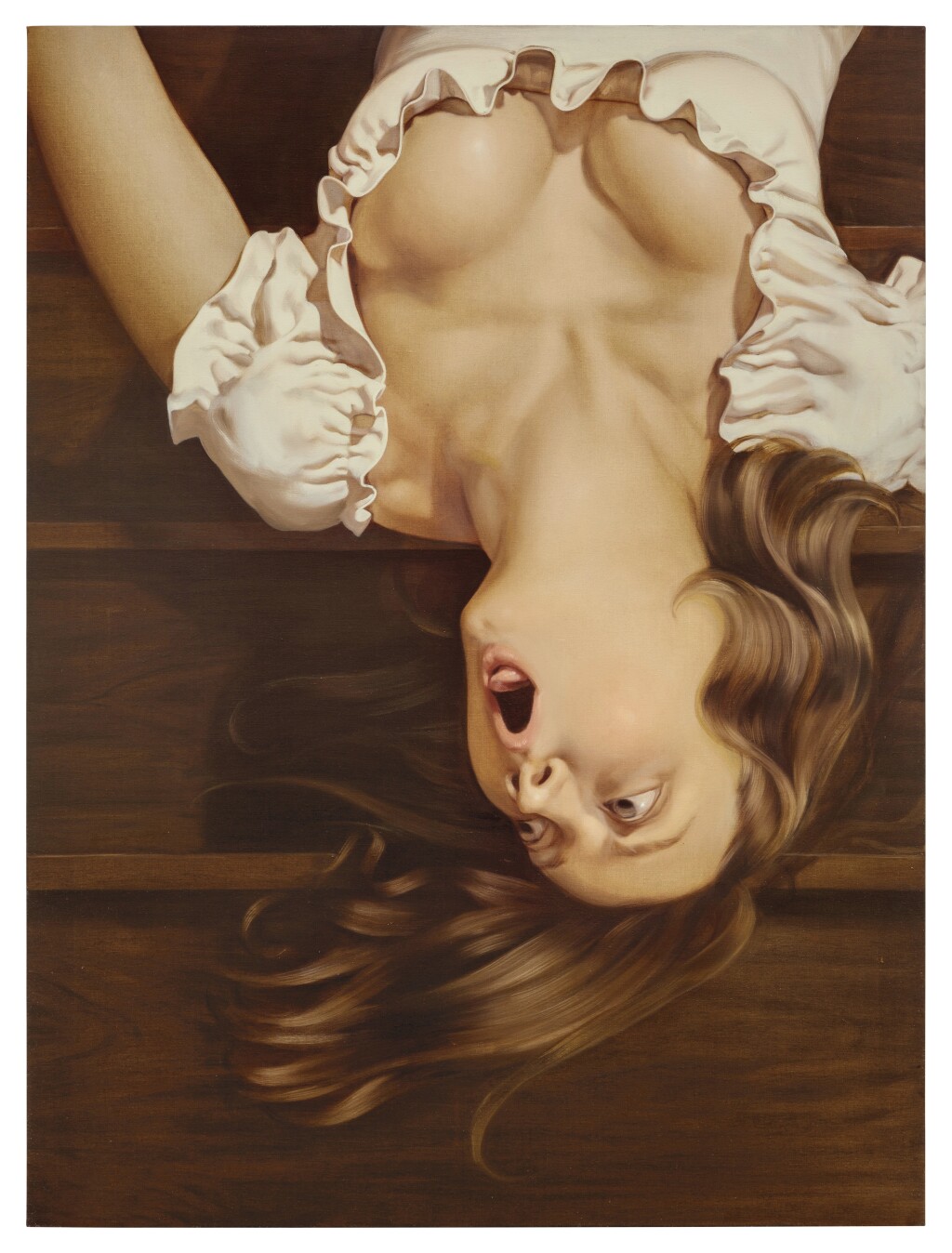
ANNA WEYANT
Falling Woman, 2020
Oil on canvas
48×36 inches (121.9×91.4 cm)
Sotheby’s New-York, 19 May 2022
USD 1,623,000
The youngest artist to be internationally represented by Gagosian Gallery, Weyant is amidst a meteoric rise for her figurative tableaux that are simultaneously infused with playful humor and somber tragedy. Her signature oil paintings illustrate young women undergoing the common experience of striving to maintain appearances while negotiating the inner self-described “low-stakes trauma of girlhood”. Discussing the inspiration for the present work, Weyant describes, “the idea was that artifice can’t prevent you from making a complete fool of yourself. Even in a Balenciaga dress, there’s still a chance you might face-plant down a flight of stairs holding a glass of champagne. I guess embarrassment can be a real equalizer in that way.” Falling Woman thus typifies the macabre comedy that pervades her oeuvre, underscoring the ironic idiosyncrasy of her subjects’ exceedingly meticulous, elegant renderings and the bizarre contexts in which they are presented.
#5. Ewa Juszkiewicz
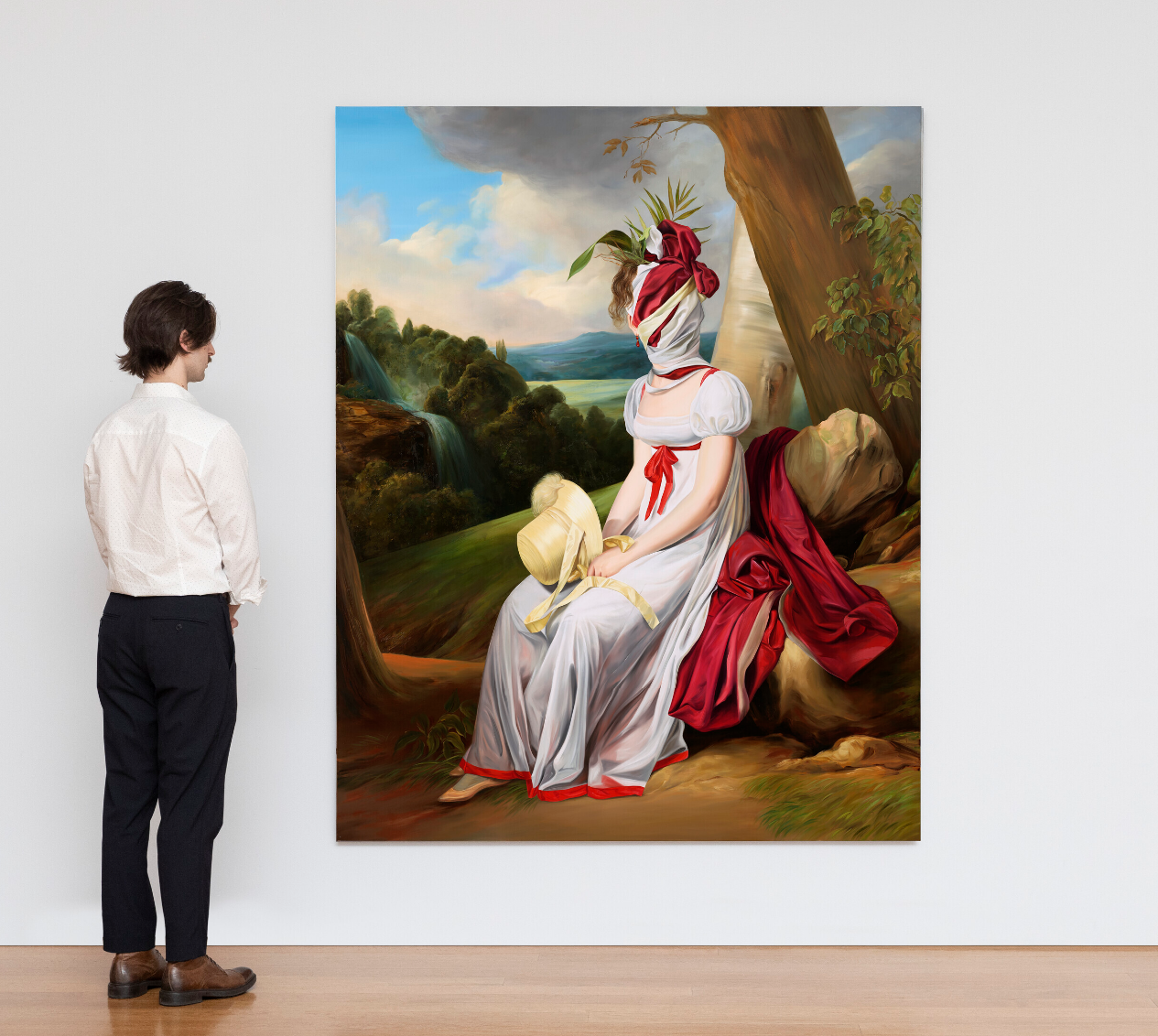
EWA JUSZKIEWICZ
Portrait of a Lady, 2019
200×160 cm (78.6×63 inches)
Christie’s New-York: 9 May 2022
USD 1,560,000
Known for her adept appropriations of historical portrait paintings, Ewa Juszkiewicz’s surreal alterations and biting commentary on the depiction of women have seen the artist become one of the most insightful interrogators of the art historical canon. Portrait of a Lady (After Louis Leopold Boilly) is an exquisite example of the artist’s masterful brushwork and keen questioning of gender and class representations within the realm of eighteenth- and nineteenth-century European painting. By honing in on the system of representation and using it to create something both familiar and strange, the artist is able to lay bare the assumptions one brings to images of women and how this learned classification alters our viewing and understanding of the subjects themselves. Rendered in the classic style of French Neoclassicism, Portrait of a Lady is a near-faithful reproduction of Louis-Léopold Boilly’s 1807 Madame Saint-Ange Chevrier. Boilly’s painting, which is held in the collection of the National Museum in Stockholm, and is typical of the French artist’s society portraits in the early part of the 1800s. A young woman in a bright white dress with an empire waist sits in an idyllic clearing of soft trees and distant waterfalls. Clutching a sunhat, her pale, bare arms are offset by the inclusion of a mulberry red sash and a large cloak of some heavy, velvety material in the same color. All is quiet and proper within Boilly’s composition, but Juszkiewicz takes the recognizable scene and subverts it by replacing the sitter’s head with a mass of contorted fabrics, protruding leaves, and an errant lock of hair. As if the very trappings of society had rebelled to smother the sitter, the textiles completely obscure any individuality Madame Chevrier had shown in her face as the woman is reduced to an anonymous amalgamation of her adornments.
#6. Joel Mesler
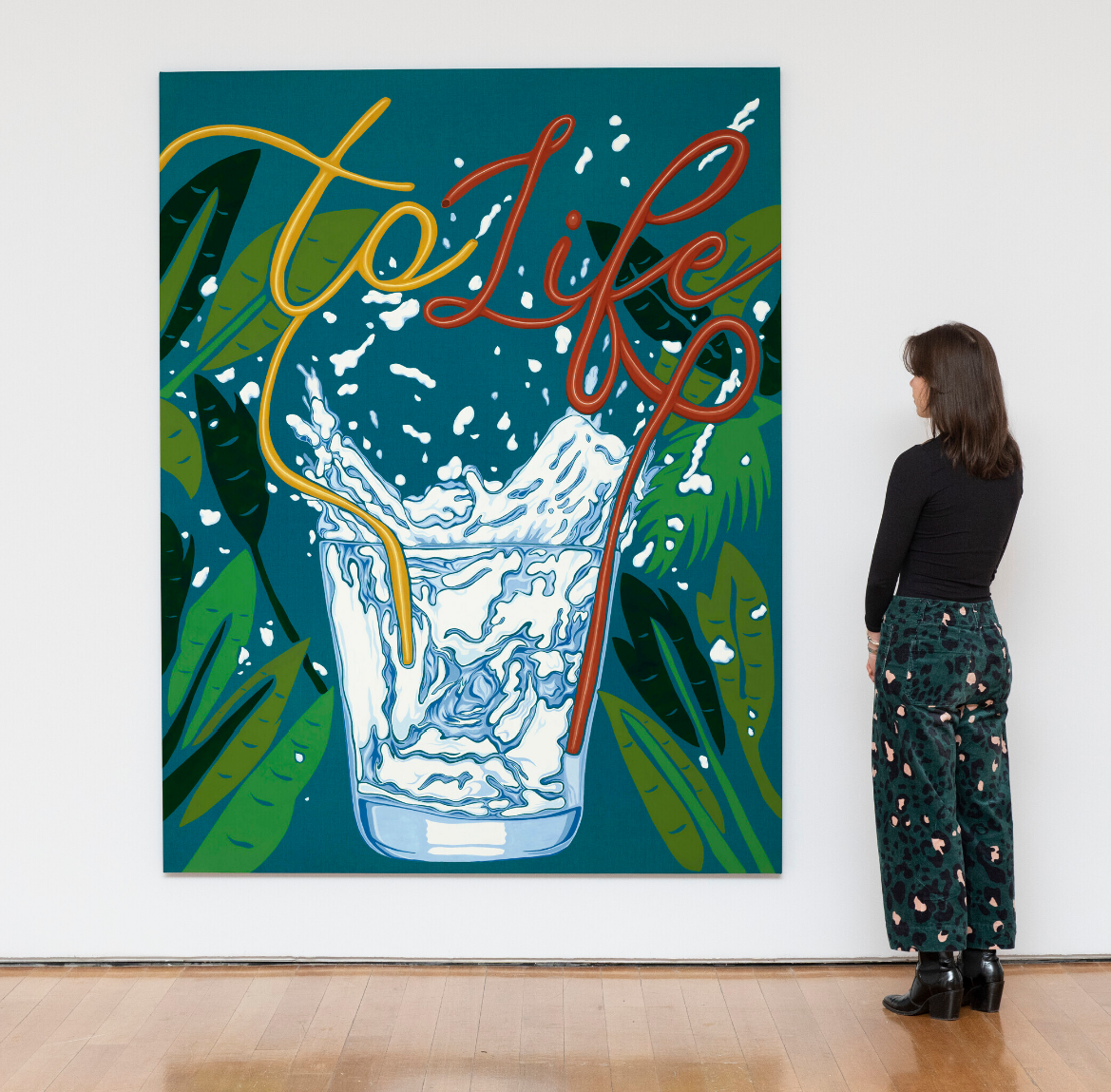
JOEL MESLER
To Life, 2020
Acrylic and pigment on linen
84×65 inches (213.4 x 165.1 cm)
Christie’s New-York, 9 May 2022
USD 907,200
With humor, playfulness, and insight, Joel Mesler distills complex emotions into collage-like scenes, creating a documentary of daily life that is both relatable and his own. He often uses surprising juxtapositions in his imagery to pursue the truth of our complicated times. To Life is a loaded celebration, one that acknowledges our transient and fragile nature. It recalls a central number of the same name from the 1964 musical Fiddler on the Roof, itself a meditation on joy and loss. Honoring the beauty and transience of life in the face of an uncertain future has always been the function of art. The background of To Life is populated by Mesler’s signature banana leaf motifs that were inspired by the wallpaper of the legendary Beverly Hills Hotel in his native Los Angeles. It is reminiscent of the lush imagery of Paul Gauguin or Henri Rousseau, but in the place of figures is text, carefully painted with the blockishness of a neon sign. A generous drink, blue and white like Chinese porcelain, becomes a vortex comprised of Mesler’s layered strokes, and the eye of the storm looks back at us winkingly. Unsurprisingly, Rashid Johnson has noted that Mesler’s “palette is beautiful” (B. Kachka, “How an Art Dealer Became an Up-and-Coming Painter,” New York Times Magazine, June 19, 2018). The strong hues and graphicness are indicative of Mesler’s additional history as a printer. Dancing liquid flies throughout To Life and intermingles with the text and leaves, creating atomized clouds of smoke. Given Mesler’s roots in Los Angeles, Ed Ruscha is an important reference, especially his Liquid Paintings of the 1960s, which present words as flowing, painterly entities. In both the Liquid Paintings and To Life, there is a pleasurable tactility that pulls the viewer into the scene, asking us to raise a glass of our own.
#7. Eric Fischl
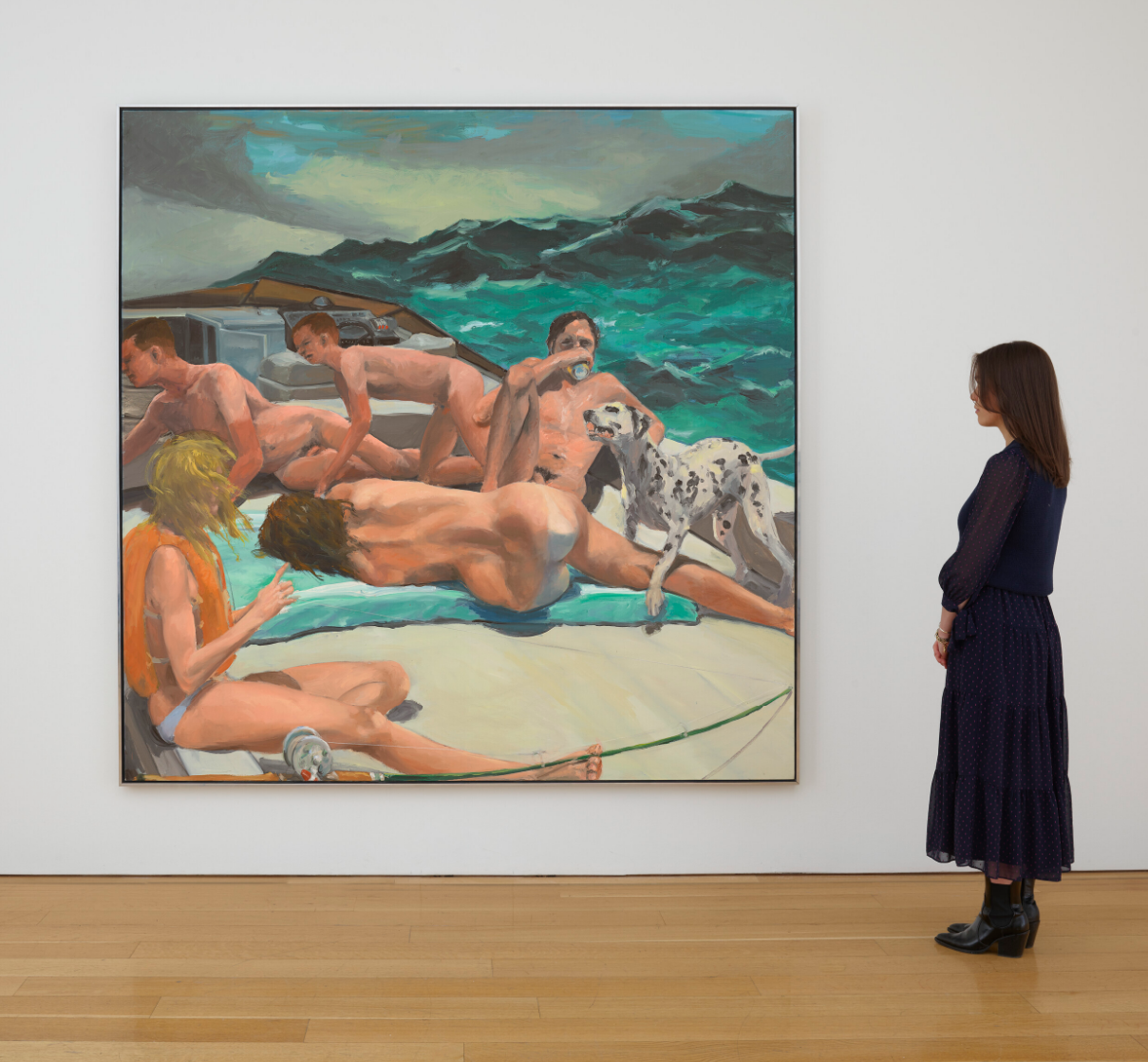
ERIC FISCHL
The Old Man’s Boat and the Old Man’s Dog, 1995
Oil on linen
84×84 inches (213.4 x 213.4 cm)
Christie’s New-York: 9 May 2022
USD 4,140,000
A pivotal painting in the seismic shift towards figuration that took place in the 1980s, The Old Man’s Boat and the Old Man’s Dog is a major canvas from a series inspired by a trip Eric Fischl took to St. Tropez. In this epic work, Fischl eschewed the dominant modes of Abstraction and Conceptual deconstruction of his contemporaries, and introduced the nude figure back into the canon. The resulting tension between the public and the private infuses these representative paintings with a timeliness that also captured the social and cultural change of this era. Featured on the cover of Art in America in November 1984, Fischl’s tableau is pushed to its extremes through his clever use of complex social and visual cues that make the viewer wary of what might be happening when they turn away. Typical of Fischl’s work from the period, this imposing square canvas pits a sense of foreboding directly against sun-drenched leisure activities. The Old Man’s Boat and the Old Man’s Dog depicts five figures and a lively Dalmatian on the top deck of a pleasure craft. Despite the warmth of the foreground, the waves behind the boat are rising in a cerulean crest to meet the darkening gray clouds. Two young men in the background, nude and sporting buzzcuts and tanned forearms, crawl to the left as if looking for something together. A brunette woman, her naked back to us, lounges on a blue blanket or pad while another woman with a shock of wind-tossed blonde hair sits on the edge of the deck in an orange life vest and white bikini. Just right of center, next to the dog and the woman on the mat, a nude man leans back, one leg bent. He takes a slow swig from a can and meets the viewer’s gaze. The directness of his stare leads one to wonder if this is the titular ‘old man’ and if the nearby hound is his. Furthermore, the manner in which Fischl paints this figure and casts him as the only character aware of the audience’s gaze instills a certain sense of apprehension into the entire tableau. “There are times in looking at his [Fischl’s] work when you feel you are less a viewer than a private investigator, wondering about the motivations and actions of the characters in the paintings.
#8. Ouattara Watts
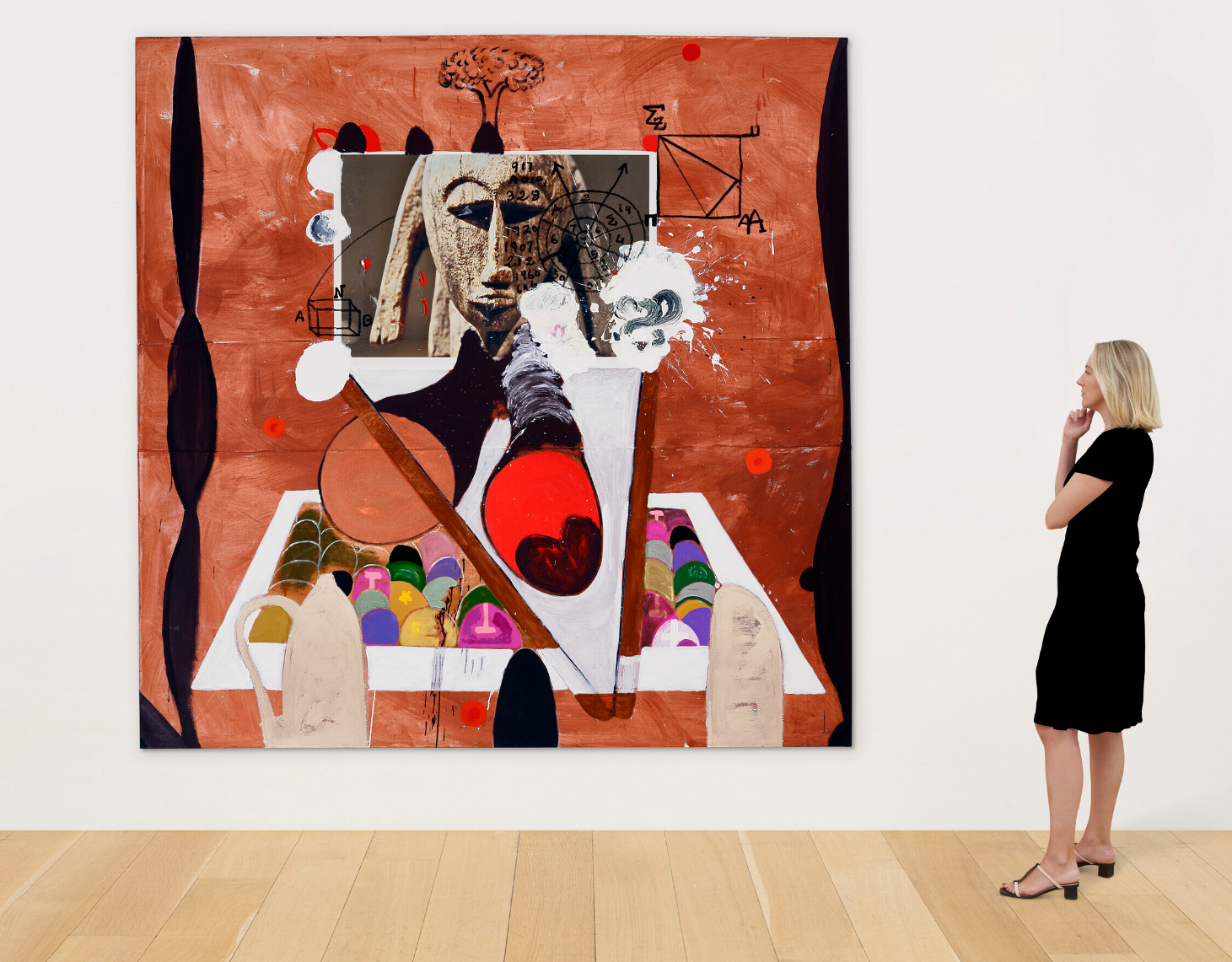
OUATTARA WATTS
Afro Beat, 2011
Acrylic, oil, oilstick, metallic paint, and inkjet on canvas collage on canvas
97×97 inches (246.4×246.4 cm)
Christie’s New-York: 9 May 2022
USD 781,200
A central figure of contemporary African art and its diaspora, Ivory Coast-born, New York-based artist Ouattara Watts has created a singular visual vocabulary informed by artistic rigor, an eye for color and pattern, autobiography, and a penchant for the fantastical. While studying at the renowned École Nationale Supérieure des Beaux-Arts in Paris, Watts met Jean-Michel Basquiat at an opening, and he encouraged Watts to pursue his career in New York. Watts took his advice, and they collaborated briefly before Basquiat’s death. As Basquiat predicted, Watts’s career took off, and he has been a fixture of the international art world ever since. Afro Beat is one of the most visually captivating and conceptually replete works in his five decades of painting, an important mid-career canvas with dense references to Euro-American and African art history alike. A spectacular work at eight square feet, Afro Beat has a pulse of its own that resonates infinitely through time and space. Watts has mounted solo exhibitions at the Kemper Museum, Kansas City (1996), the Hood Museum of Art at Dartmouth College (2004), Magazzino d’Arte Contemporaneo, Rome, curated by Okwui Enwezor, (2004). His work is held in prestigious public collections like the Museum of Modern Art, New York, where his painting is included in the rehang of the permanent collection, the Smithsonian National Museum of African American Art, Washington, D.C., the Tang Museum, Saratoga Springs, and the Hess Art Collection, South Africa. Referring to Afrobeat, a vibrant genre of music fusing popular West African music with American jazz, soul, and funk, Watts’s canvas is equally eclectic. Earth tones with dotted reds form the background, while vertical black columns frame the scene, reminiscent of the floating dreams of Joan Miró. Composed of collaged elements, Afro Beat broadens into a variegated expansion of forms, from a photograph of an African bust to mathematical notations and regimented rows of pigment contained in a levitating square. A humble drawing of a tree emerges from the collaged bust, and from a motionless statue grows new life, just as art is essential to life. Expressionistic splashes of paint coexist with drawn cubes and triangles. Afro Beat is akin to the interconnected concepts on a professor’s chalkboard.
#9. Ernie Barnes
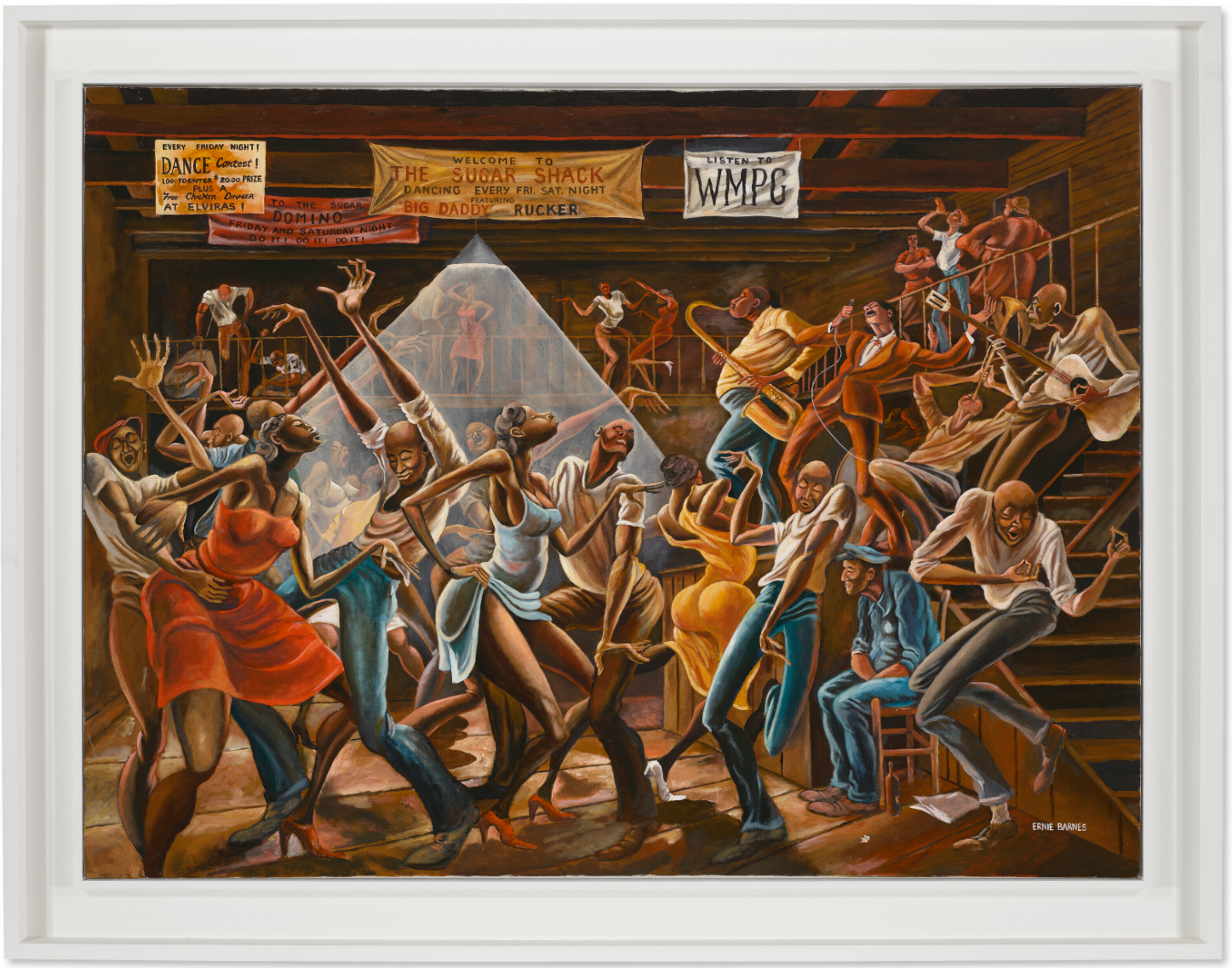
The Sugar Shack, 1976
Acrylic on canvas
36 x 48 inches (91.4 x 121.9 cm)
Christies New-York: 11 May 2022
USD 15,275,000
The Sugar Shack, 1976, by legendary American artist Ernie Barnes stands as a revelatory celebration of the joys to be felt in losing oneself to dance. An upbeat visual rhythm dictates the sway of angled limbs and flapping fabrics, one that synchronizes with the phantom tune radiating from the canvas. The visages of the depicted figures emanate pure, unadulterated bliss, a joy that perhaps echoes that of worshippers caught in the throes of religious ecstasy. With the visualization of such passion, Barnes artfully infuses the painting with both a core of gravity and an embrace of the carefree. The unique enchantment of this work can be located in its ability to envelope the viewer wholly into the heat, song, and energy of the scene it illustrates. To stand before The Sugar Shack is to be transported back in time and across space to the Durham Armory in 1952, an iconic dance hall in segregated North Carolina. The artist snuck into the Armory at age thirteen, engendering a memory of music and movement that would inspire the creation of The Sugar Shack twenty-four years later. On this transformative adolescent experience, Barnes remarked, “It was the first time my innocence met with the sins of dance.”
6. Top 10 Performers
Performance is measured through a Performance Indicator (PI), calculated by dividing the Price Realized (including fees) by the Low Estimate. PI = Price Realized / Low Estimate
Average PI = 2.89
(Evening Sales Only)
92% of Lots Sold have a PI over 1
35.6% of Lots Sold have a PI over 2
11.5% of Lots Sold have a PI over 4
#1. Ernie Barnes
The Sugar Shack, 1976
Acrylic on canvas
36 x 48 inches (91.4 x 121.9 cm)
Christies New-York: 11 May 2022
Estimated: USD 150,000 – 200,000
USD 15,275,000
#2. Ann Craven
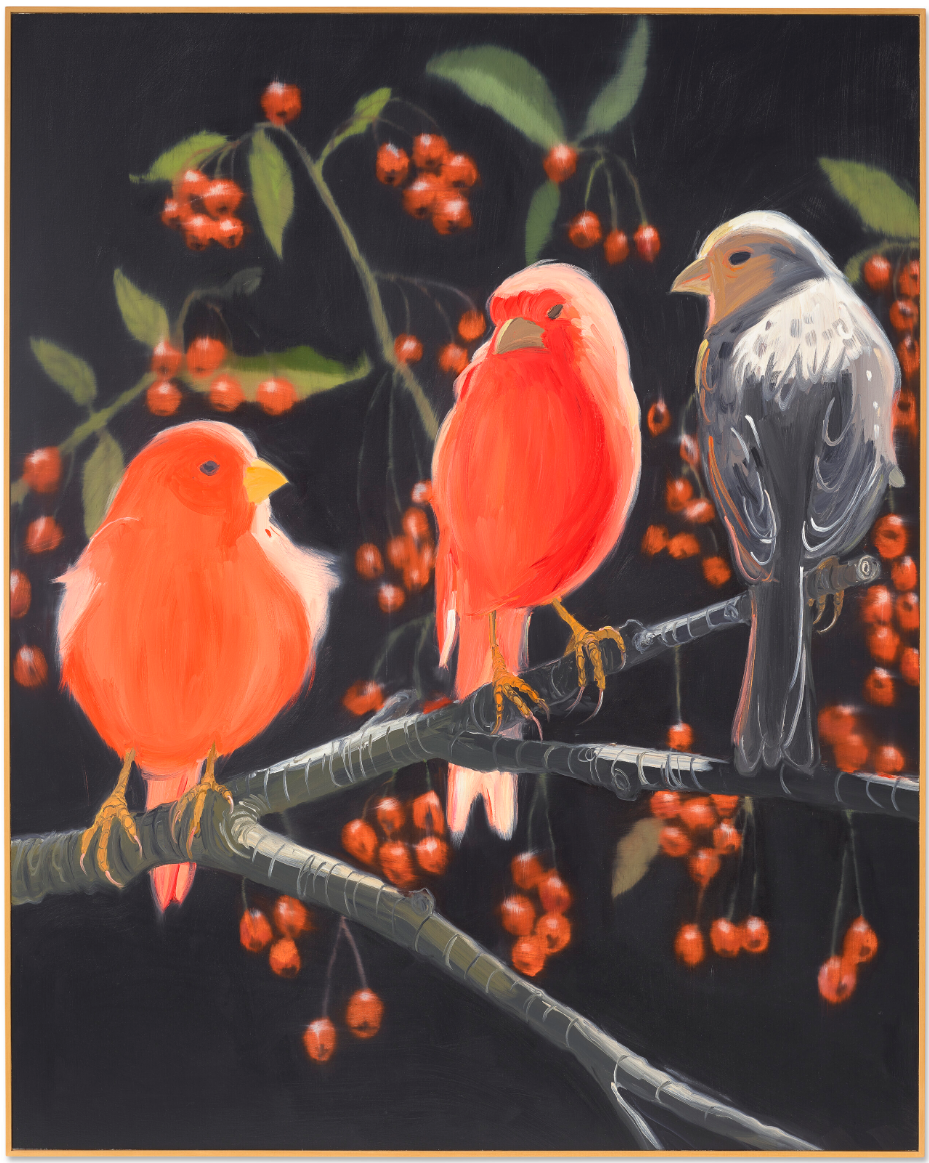
ANN CRAVEN
I wasn’t Sorry, 2003
Oil on canvas
60 x 48 inches (152.4 x 121.9 cm)
Christie’s New-York: 9 May 2022
Estimated: USD 20,000 -30,000
USD 680,400
#3. Francesco Clemente
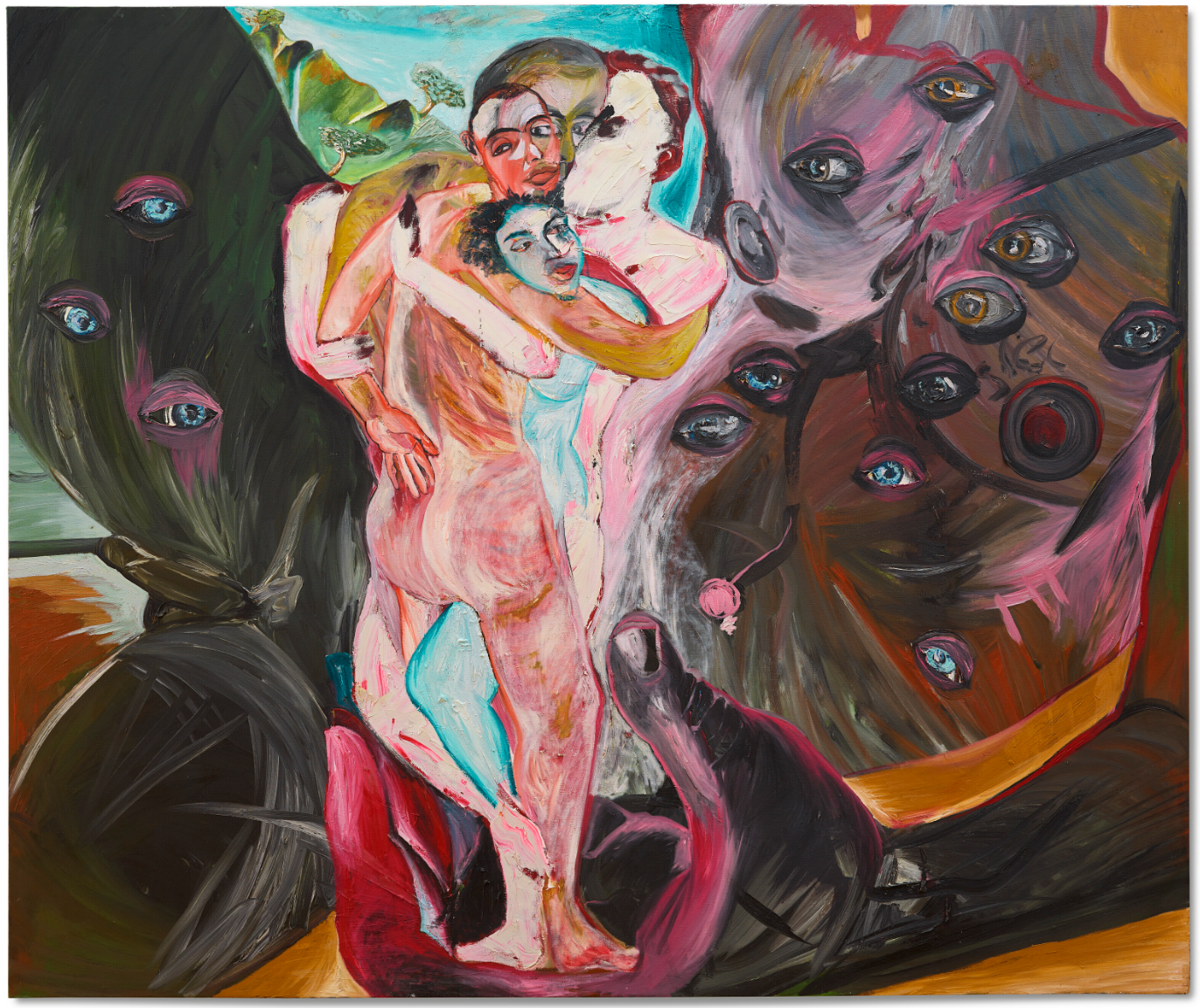
FRANCESCO CLEMENTE
The Fourteen Stations, No. XI, 1981
Oil and wax on linen
78 x 93.7 inches (198 x 238.1 cm)
Christie’s New-York: 9 May 2022
Estimated: USD 80,000 – 120,000
USD 1,860,000
#4. Mike Bildo
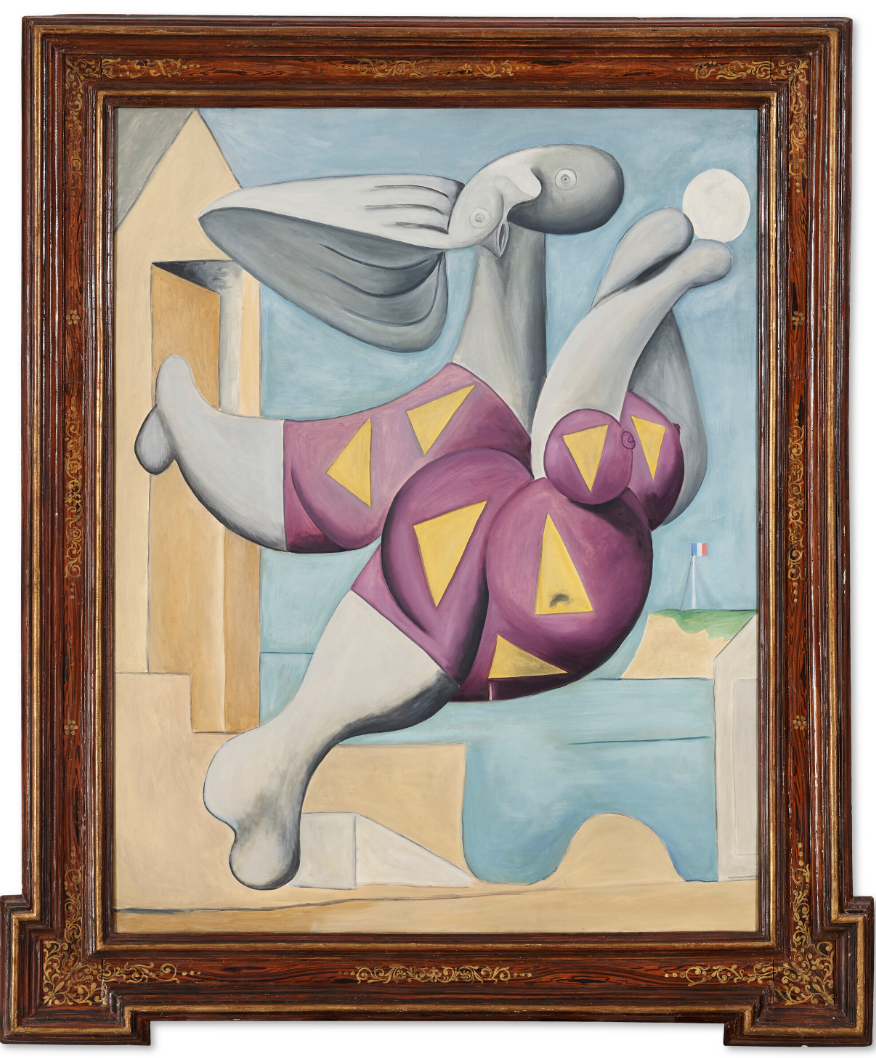
MIKE BILDO
Not Picasso (Bather with Beachball, 1932), 1987
Oil on linen
57.7 x 45.2 inches (146.7 x 114.9 cm)
Christie’s New-York: 9 May 2022
Estimated: USD 60,000 – 80,000
USD 1,260,000
#5. Lucy Bull
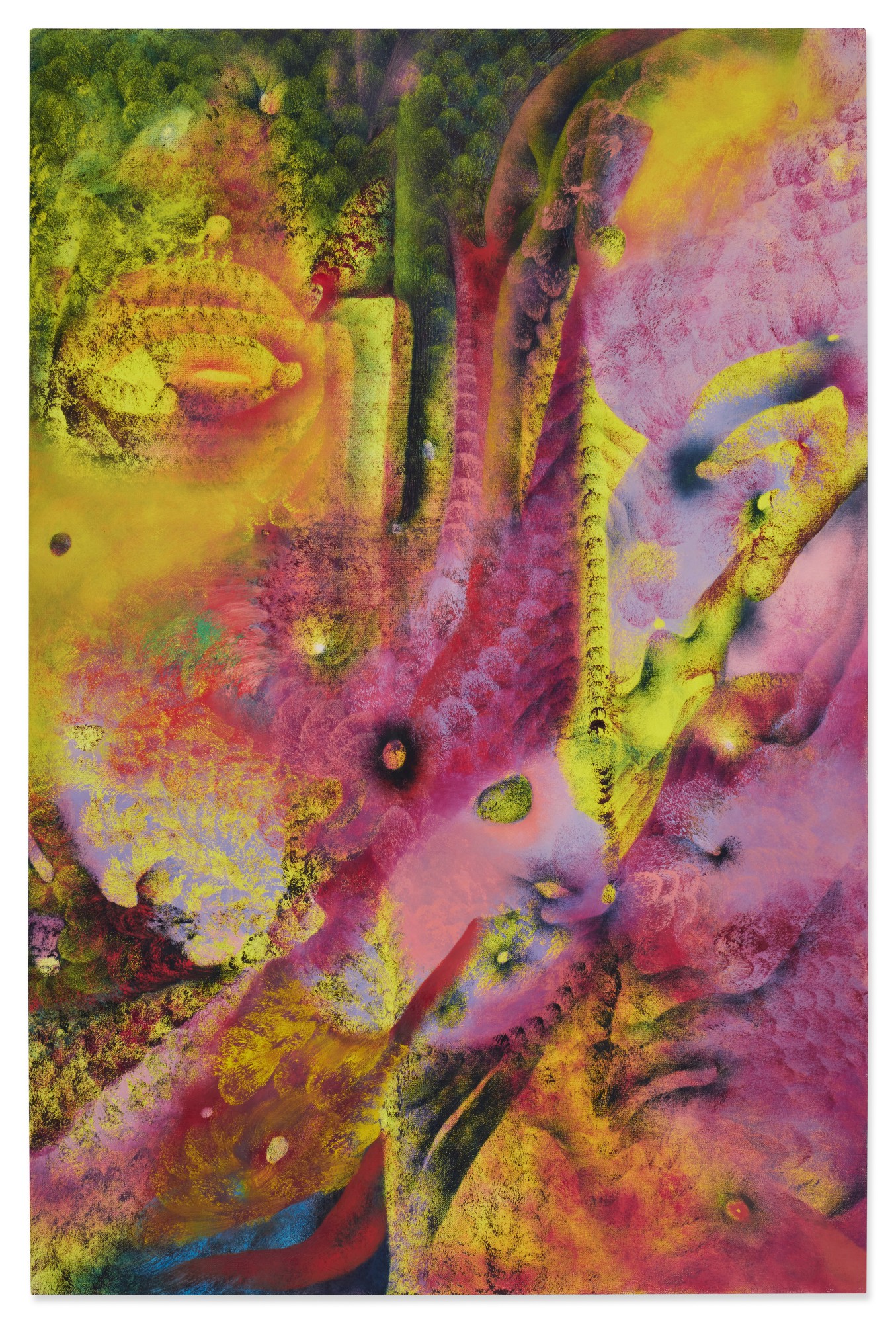
LUCY BULL
Special Guest, 2019
Oil on linen
50×33 inches (127 x 83.8 cm)
Sotheby’s New-York: 19 May 2022
Estimated: USD 60,000 – 80,000
USD 907,200
#6. Simon Leigh
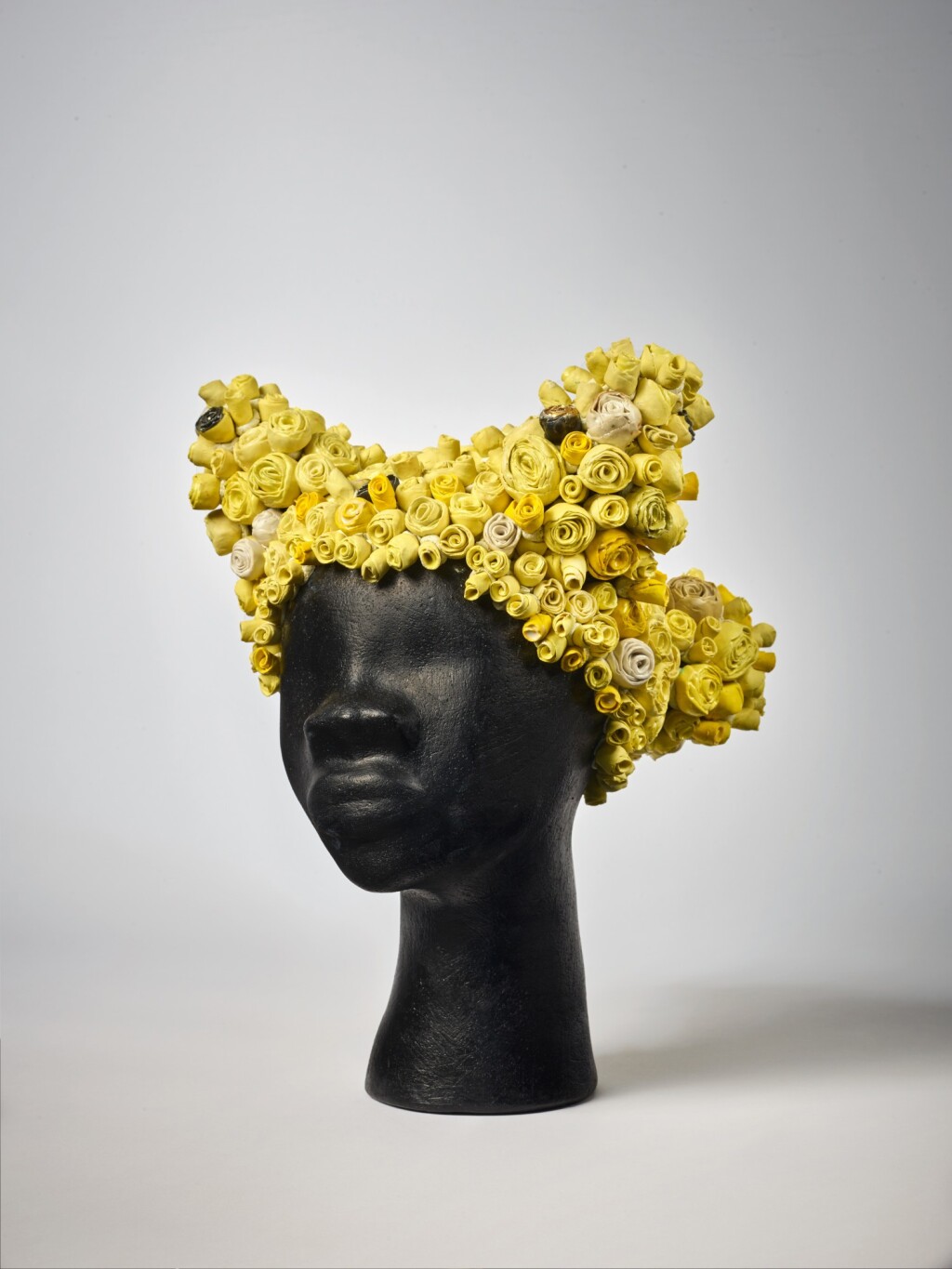
SIMON LEIGH
Birmingham, 2012
India ink and epoxy on terracotta and porcelain
15.2 x 11.5 x 11.5 inches (38.7 x 29.2 x 29.2 cm)
Sotheby’s New-York: 19 May 2022
Estimated: USD 150,000 – 200,000
USD 2,167,500
#7. Anna Weyant
ANNA WEYANT
Falling Woman, 2020
Oil on canvas
48×36 inches (121.9×91.4 cm)
Sotheby’s New-York: 19 May 2022
Estimated: USD 150,000 – 200,000
USD 1,623,000
#8. Lauren Quin
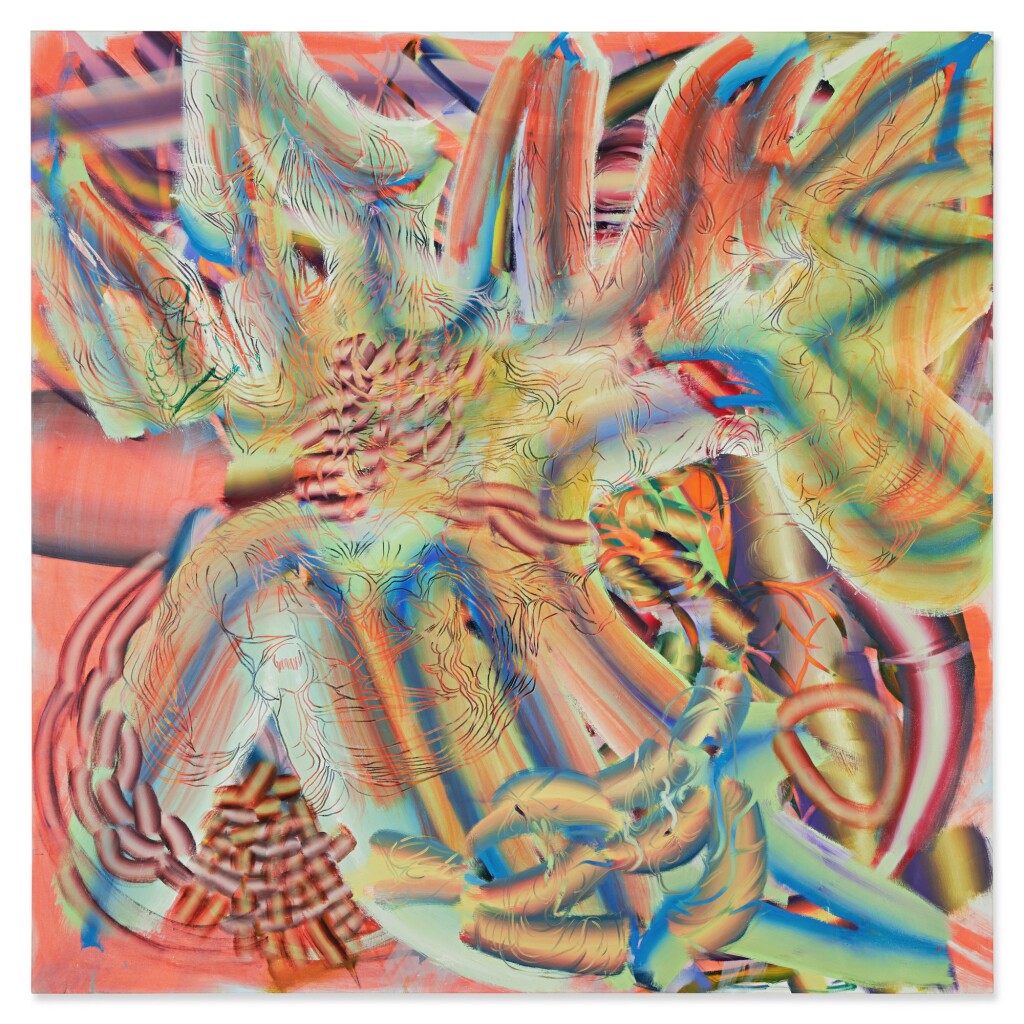
LAUREN QUIN
A Leaft is an Arrow, 2021
Oil on canvas
71.7 x 71.7 inches (182.2 x 182.2 cm)
Sotheby’s New-York: 19 May 2022
Estimated: USD 50,000 – 70,000
USD 529,200
#9. Joel Mesler
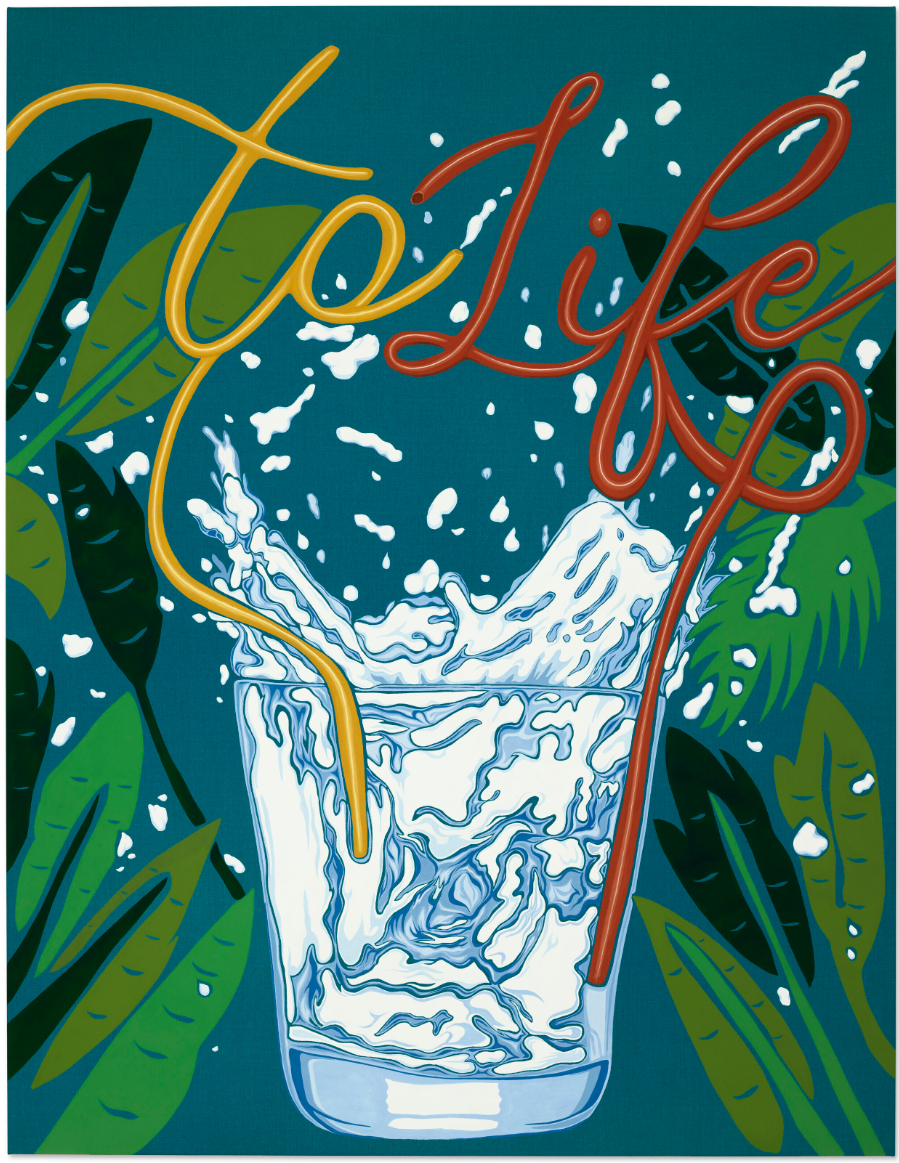
JOEL MESLER
To Life, 2020
Acrylic and pigment on linen
84×65 inches (213.4 x 165.1 cm)
Christie’s New-York, 9 May 2022
Estimated: USD 100,000 – 150,0000
USD 907,200
#10. Outtara Watts
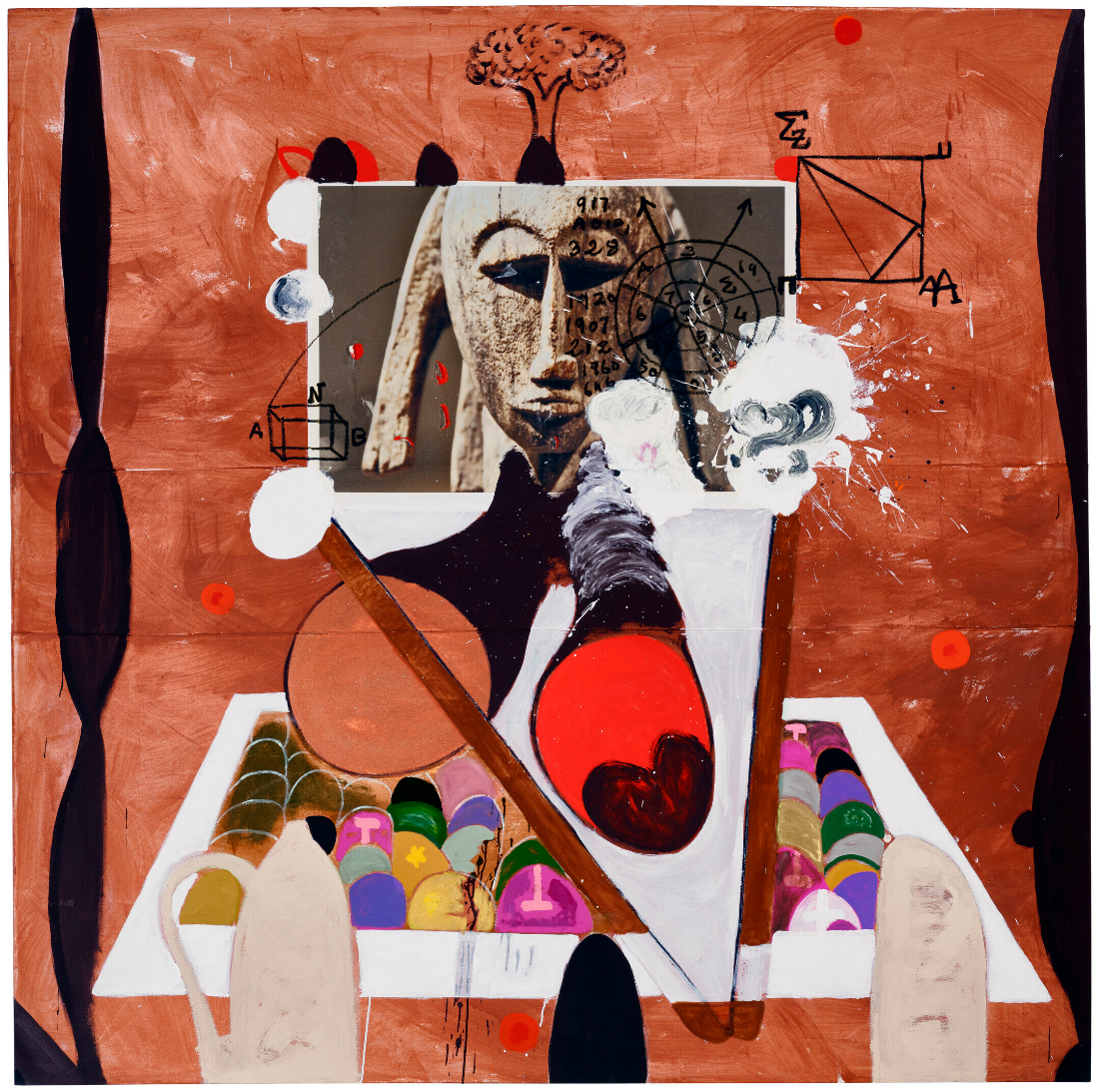
OUATTARA WATTS
Afro Beat, 2011
Acrylic, oil, oilstick, metallic paint, and inkjet on canvas collage on canvas
97×97 inches (246.4×246.4 cm)
Christie’s New-York: 9 May 2022
Estimated: USD 100,000 – 150,000
USD 781,200
7. CHRISTIE’S AUCTION RESULTS
The Collection of Thomas and Doris Ammann Evening Sale
9 May 2022
Turnover: USD 317,806,490
# Lots Sold: 34
Sell-Through Rate: 94.4%
Top Lot: USD 195,040,000
Average Price: USD 9,347,250
Sold Above / Within Estimates: 53% / 31%
ANDY WARHOL
Shot Sage Blue Marilyn, 1964
Acrylic and silkscreen ink on linen
40×40 inches (101.6×101.6 cm)
Christie’s New-York: 9 May 2022
USD 195,040,000
ANDY WARHOL
Flowers, 1964
Acrylic and silkscreen ink on linen
82x 81.5 inches (207.6×207 cm)
Christie’s New-York: 9 May 2022
USD 15,847,500
CY TWOMBLY
Untitled, 1955
Oil-based house paint, wax crayon, and colored pencil on canvas
50×58 inches (127×147 cm)
Christie’s New-York: 9 May 2022
USD 21,000,000
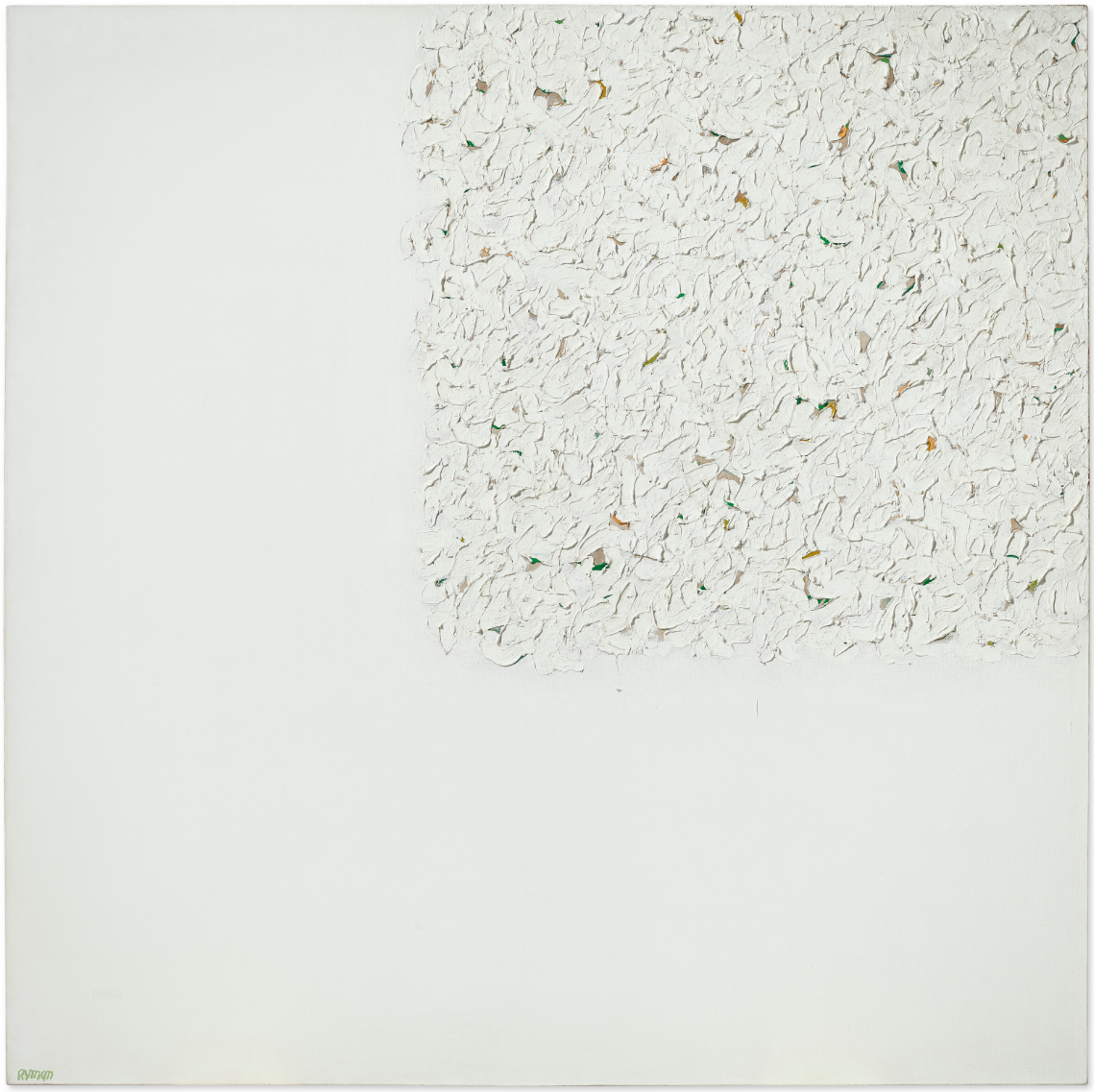
ROBERT RYMAN
Untitled, 1961
Oil on linen
66.5×67 inches (169×169.5 cm)
Christie’s New-York: 9 May 2022
USD 20,141,250
CY TWOMBLY
Venere Sopra Gaeta, 1988
Acrylic, oil-based house paint, wax crayon, and pencil on paper and wooden panel
99×77 inches (251.5×195 cm)
Christie’s New-York: 9 May 2022
USD 16,992,500
JEAN-MICHEL BASQUIAT
His Blue Sniffing Valet, 1984
Acrylic, oilstick and graphite on canvas
86×68 inches (219×173 cm)
Christie’s New-York: 9 May 2022
USD 7,260,000
21st Century Evening Sale
10 May 2022
USD 103,064,200
# Lots Sold: 31
Sell-Through Rate: 100%
Top Lot: USD 36,500,000
Average Price: USD 3,324,652
Sold Above / Within Estimates: 52 % / 18%
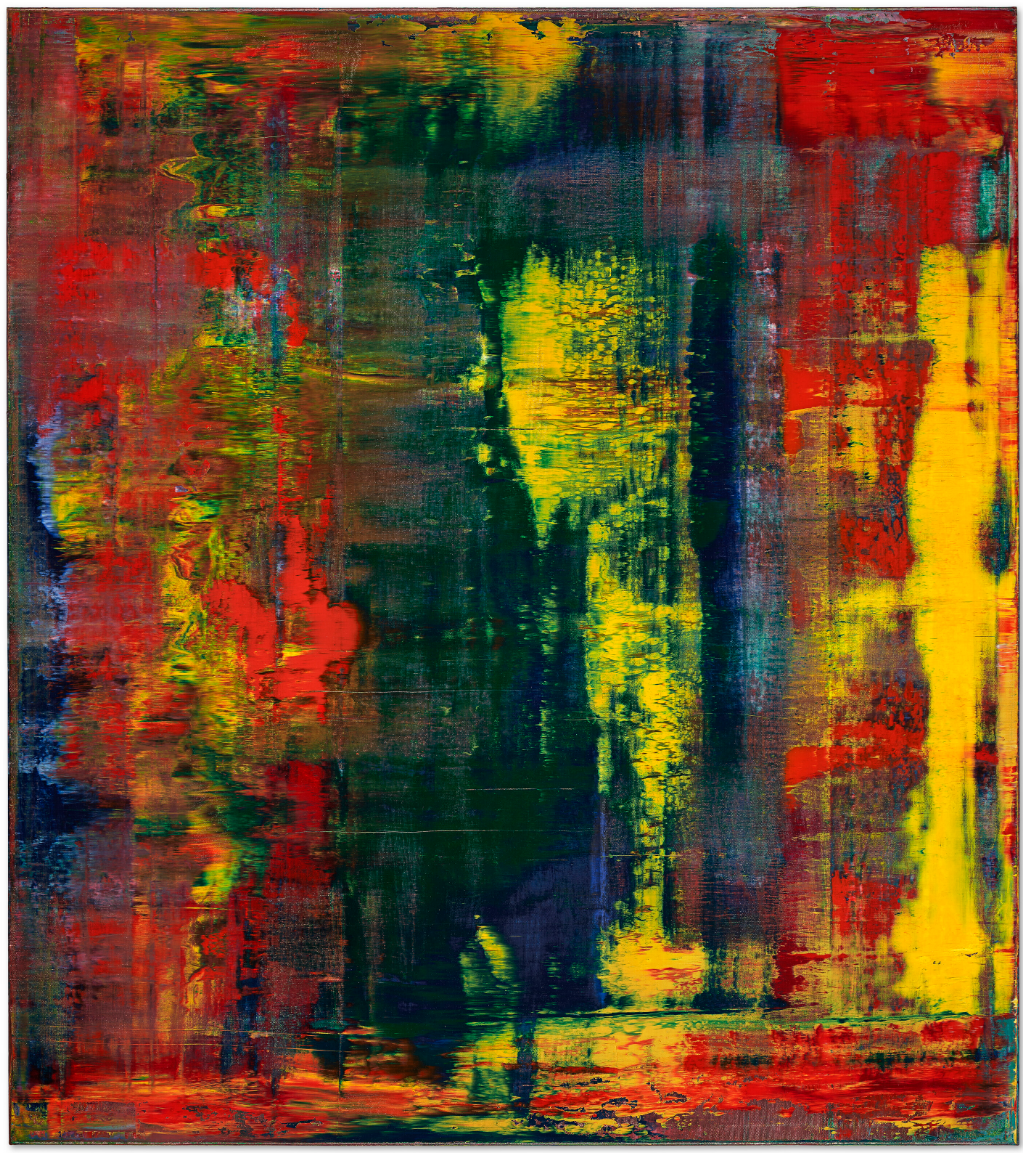
GERHARD RICHTER
Abstraktes Bild, 1994
Oil on canvas
225×200 cm (88.5×79 inches)
Christie’s New-York: 10 May 2022
USD 36,500,000
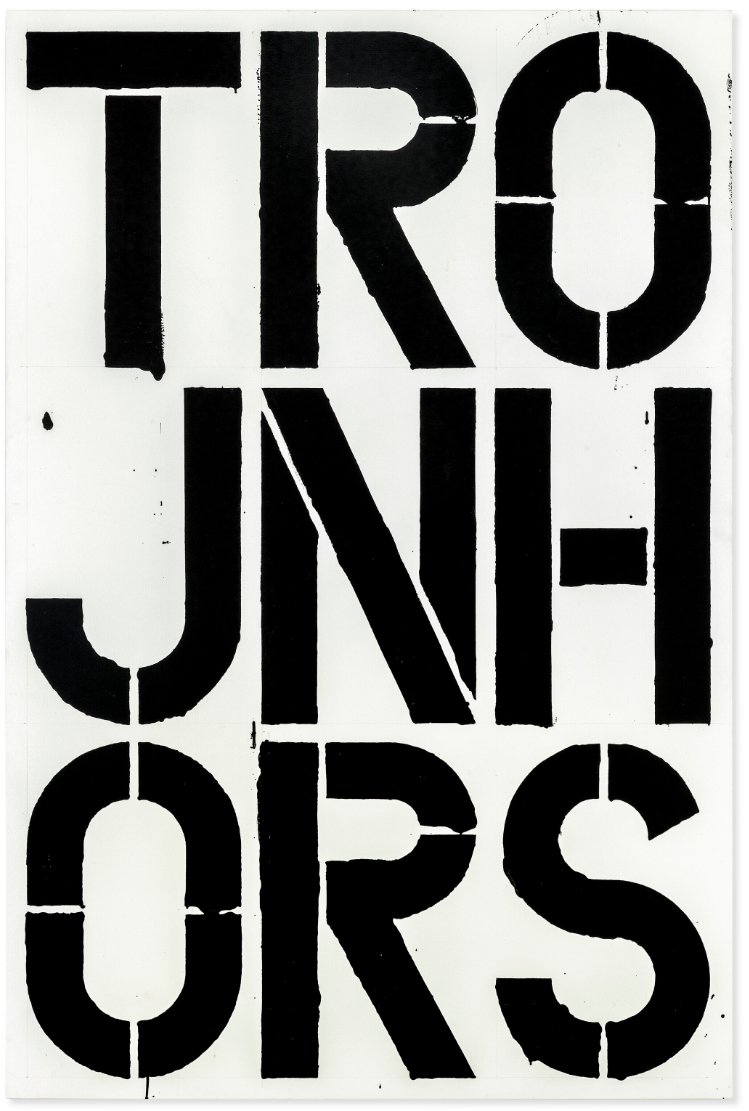
CHRISTOPHER WOOL
Untitled, 1988
Enamel on aluminum
72×48 inches (182.9×121.9 cm)
Christie’s New-York: 10 May 2022
USD 8,405,000
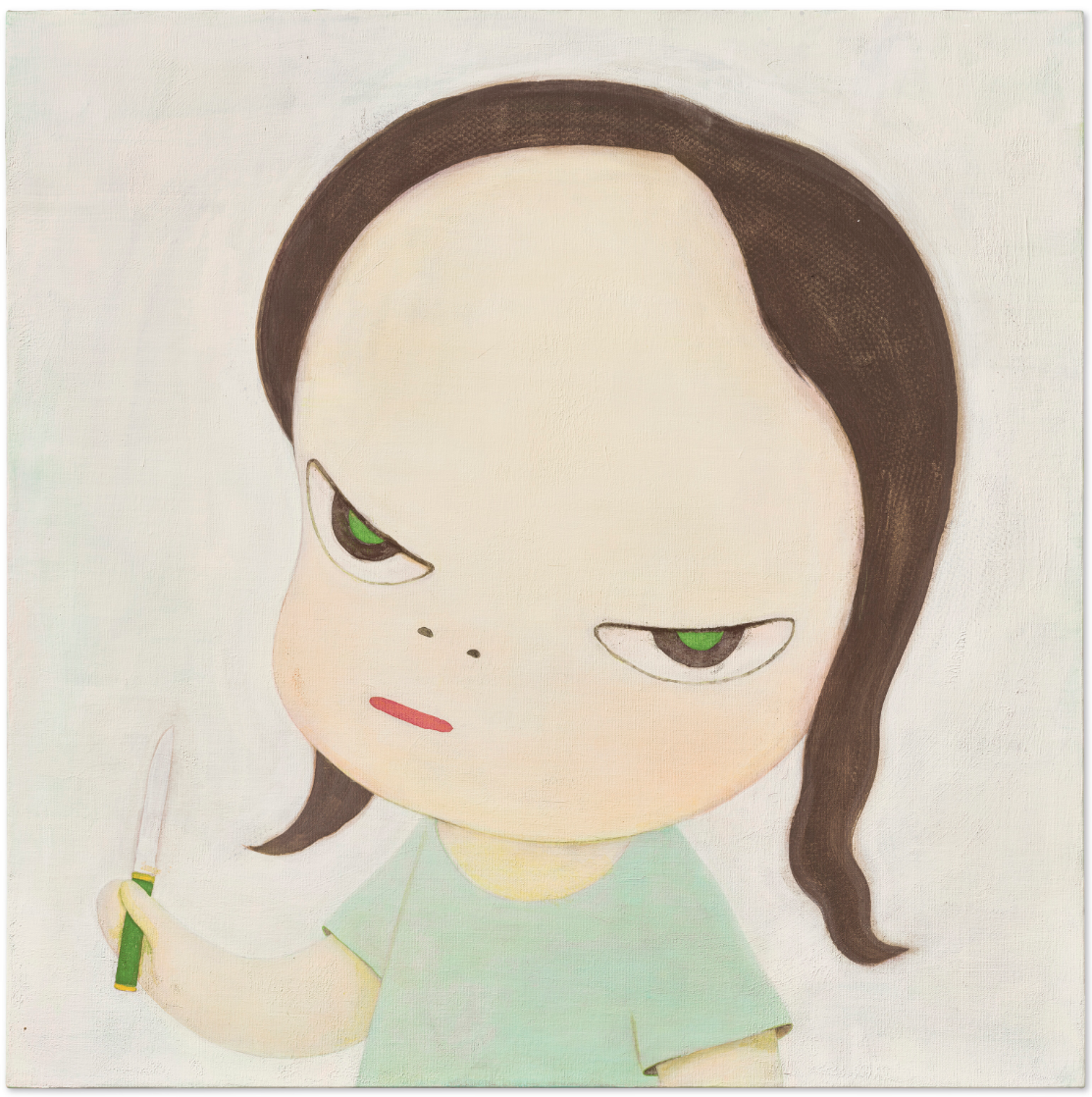
YOSHITOMO NARA
Be Happy, 1995
Acrylic on canvas
76×76 cm (30×30 inches)
Christie’s New-York: 10 May 2022
USD 6,420,000
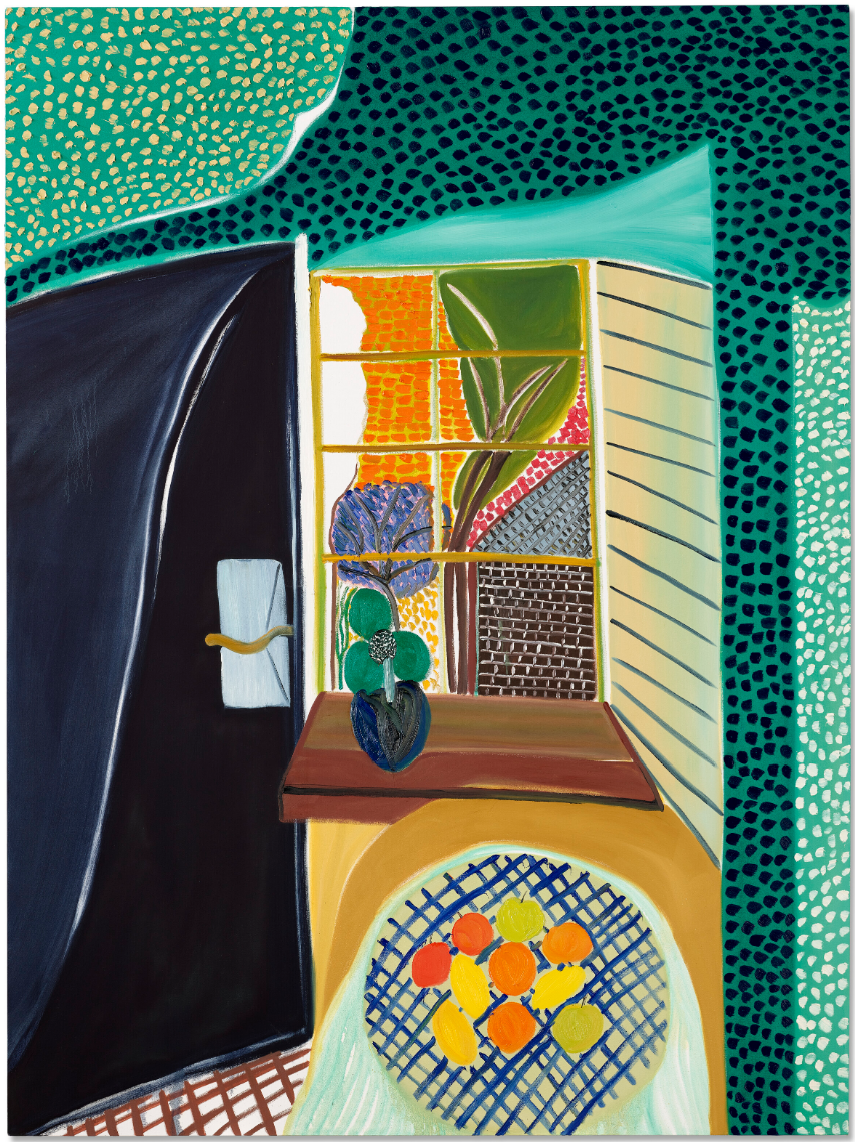
MATTHEW WONG
Green Room, 2017
Oil on canvas
96×72 inches (243.8×182.9 cm)
Christie’s New-York: 10 May 2022
USD 5,340,000
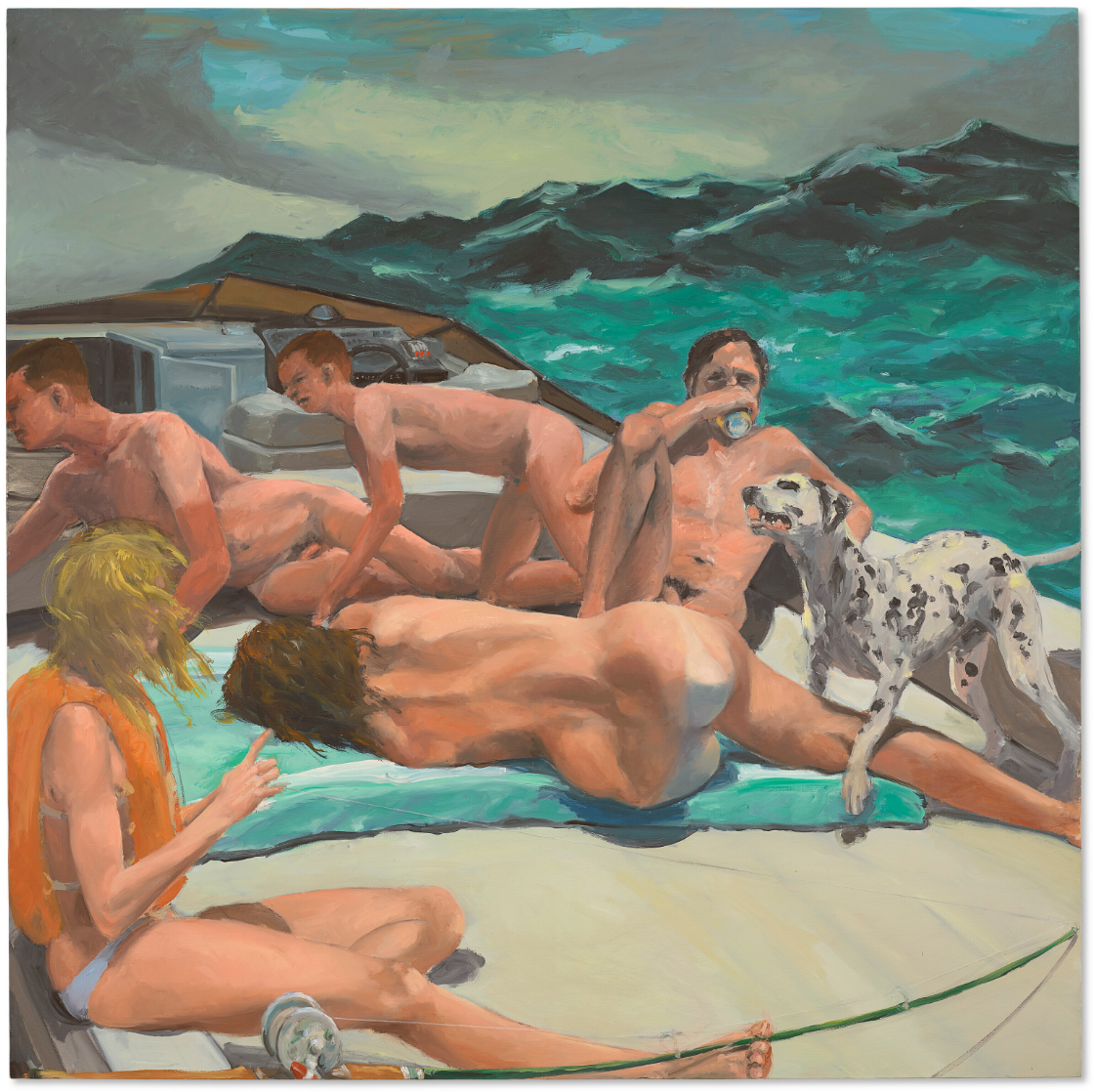
ERIC FISCHL
The Old Man’s Boat and the Old Man’s Dog, 1995
Oil on linen
84×84 inches (213.4 x 213.4 cm)
Christie’s New-York: 10 May 2022
USD 4,140,000
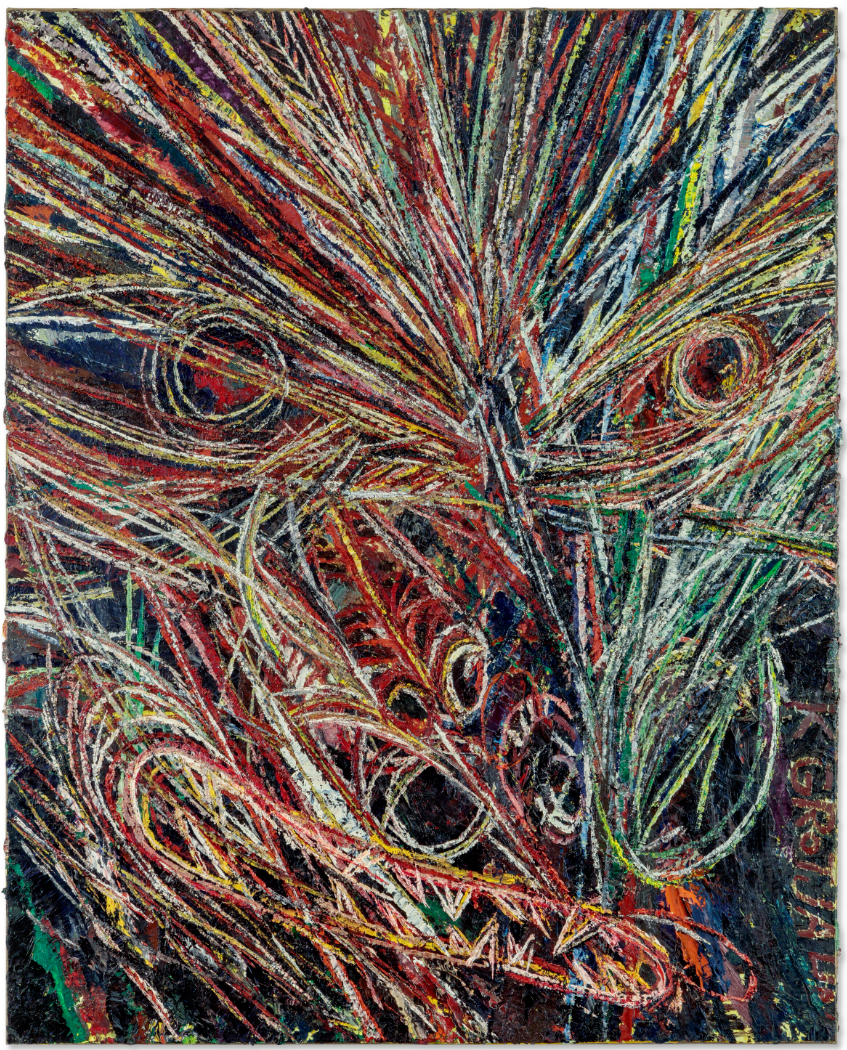
MARK GROTJAHN
Untitled, 2010
Oil on cardboard mounted on linen
60 x 48.5 inches (153 x 123.2 cm)
Christie’s New-York: 10 May 2022
USD 3,540,000
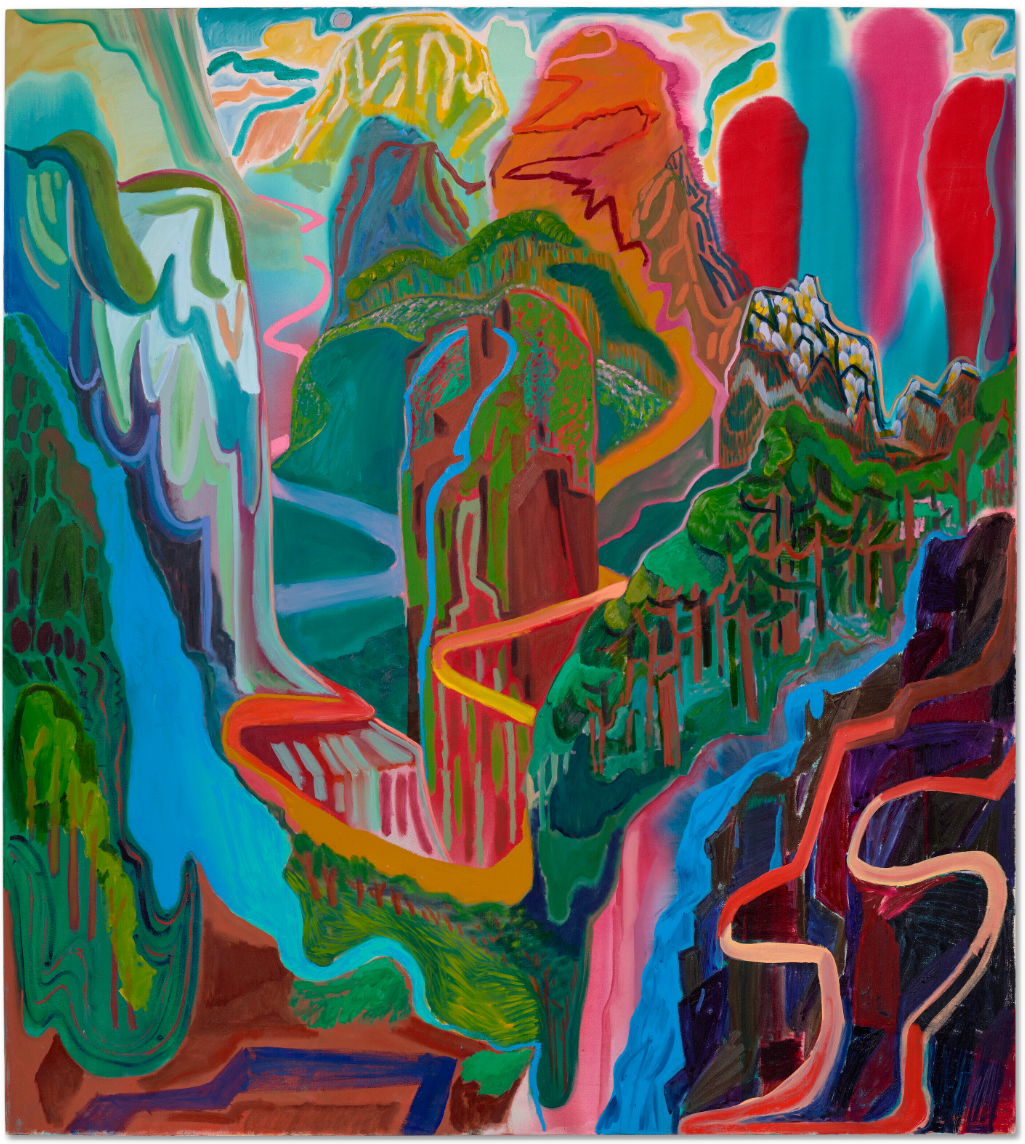
SHARA HUGHES
Spins from Swiss, 2017
Oil and dye on canvas
78×70 inches (198.1 x 177.8 cm)
Christie’s New-York: 10 May 2022
USD 2,940,000
The Collection of Anne H. Bass
11 May 2022
USD 363,087,500
# Lots Sold: 12
Sell-Through Rate: 100%
Top Lot: USD 75,960,000
Average Price: USD 30,257,292
Sold Above / Within Estimates: 67% / 17%
CLAUDE MONET
Le Parlement Soleil Couchant, 1903
Oil on canvas
81.2 x 92 cm (32×36 inches)
Christie’s New-York: 11 May 2022
USD 75,960,000
MARK ROTHKO
Untitled (Shades of Red), 1962
Oil on canvas
69×56 inches (175.3×142.2 cm)
Christie’s New-York: 11 May 2022
USD 66,800,000
CLAUDE MONET
Nympheas, 1907
Oil on canvas
93.8 x 89.3 cm (37×35 inches)
Christie’s New-York: 11 May 2022
USD 56,495,000
MARK ROTHKO
No. 1, 1962
Oil on canvas
69×60 inches (175.3×152.4 cm)
Christie’s New-York: 11 May 2022
USD 49,625,000
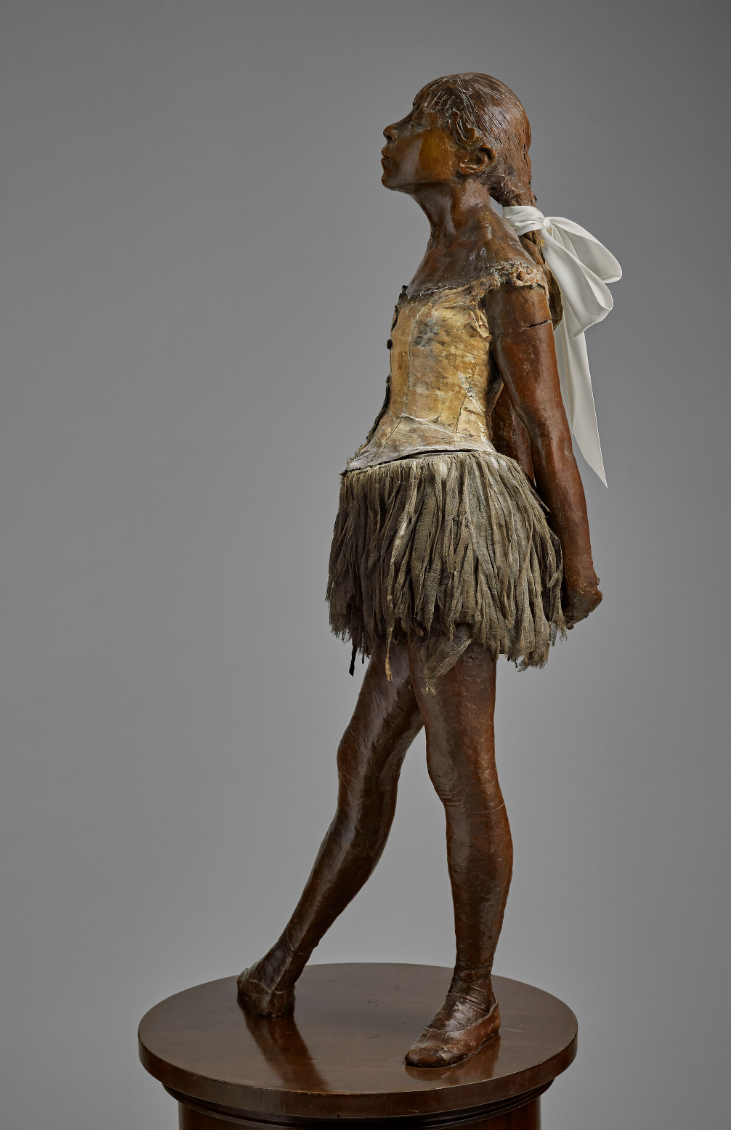
EDGAR DEGAS
Petite Danseuse de quatorze ans, 1927
Bronze with brown patina
Height: 101.2 cm
Christie’s New-York: 11 May 2022
USD 41,610,000
20th Century Evening Sale
11 May 2022
USD 468,174,000
# Lots Sold: 41
Sell-Through Rate: 97.8%
Top Lot: USD 54,205,000
Average Price: USD 11,418,878
Sold Above / Within Estimates: 19% / 43%
JACKSON POLLOCK
Number 31, 1949
Oil, enamel, aluminum paint and gesso on paper mounted on Masonite
31×22.5 inches (78.7×57.2 cm)
Christie’s New-York: 11 May 2022
USD 54,205,000
VINCENT VAN GOGH
Champs pres des Alpilles, 1889
Oil on canvas
46.2×55.2 cm (18×22 inches)
Christie’s New-York: 11 May 2022
USD 51,915,000
PABLO PICASSO
Tete de Femme (Fernande), 1909
Bronze with dark brown patina
Height: 41.9 cm (16 1/2 inches)
Christie’s New-York, 12 May 2022
USD 48,480,000
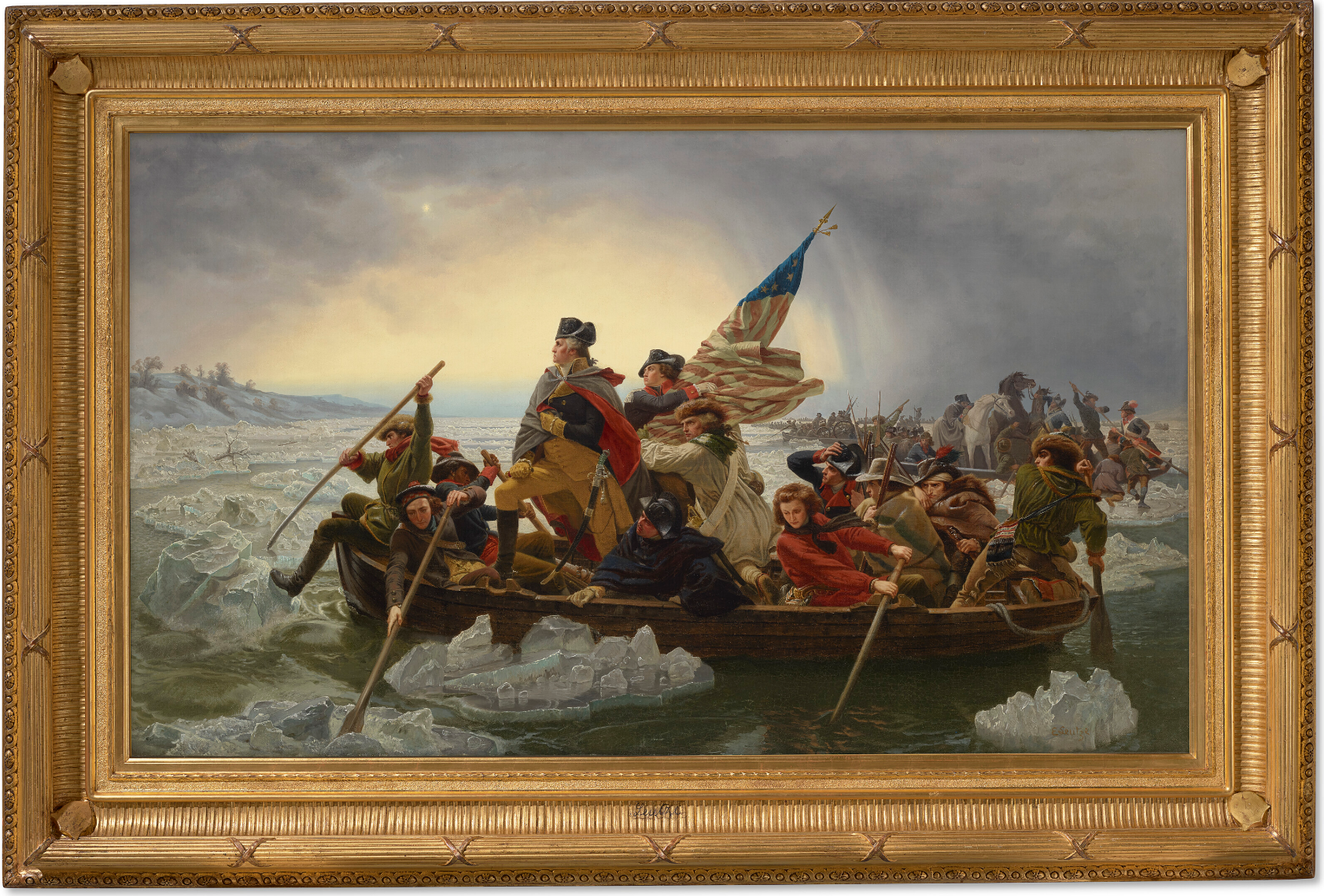
EMANUEL LEUTZE
Washington Crossing the Delaware, 1851
Oil on canvas
40 x 68 inches (101.6 x 172.7 cm)
Christie’s New-York: 11 May 2022
USD 45,045,000
CLAUDE MONET
La mare, effet de neige, 1875
Oil on canvas
60.6 x 81.7 cm (23.9 x 32.2 inches)
Christie’s New-York: 11 May 2022
USD 25,580,000
WILLEM DE KOONING
Untitled XXI, 1977
Oil on canvas
70×80 inches (177.8 x 203.2 cm)
Christie’s New-York: 11 May 2022
USD 25,007,500
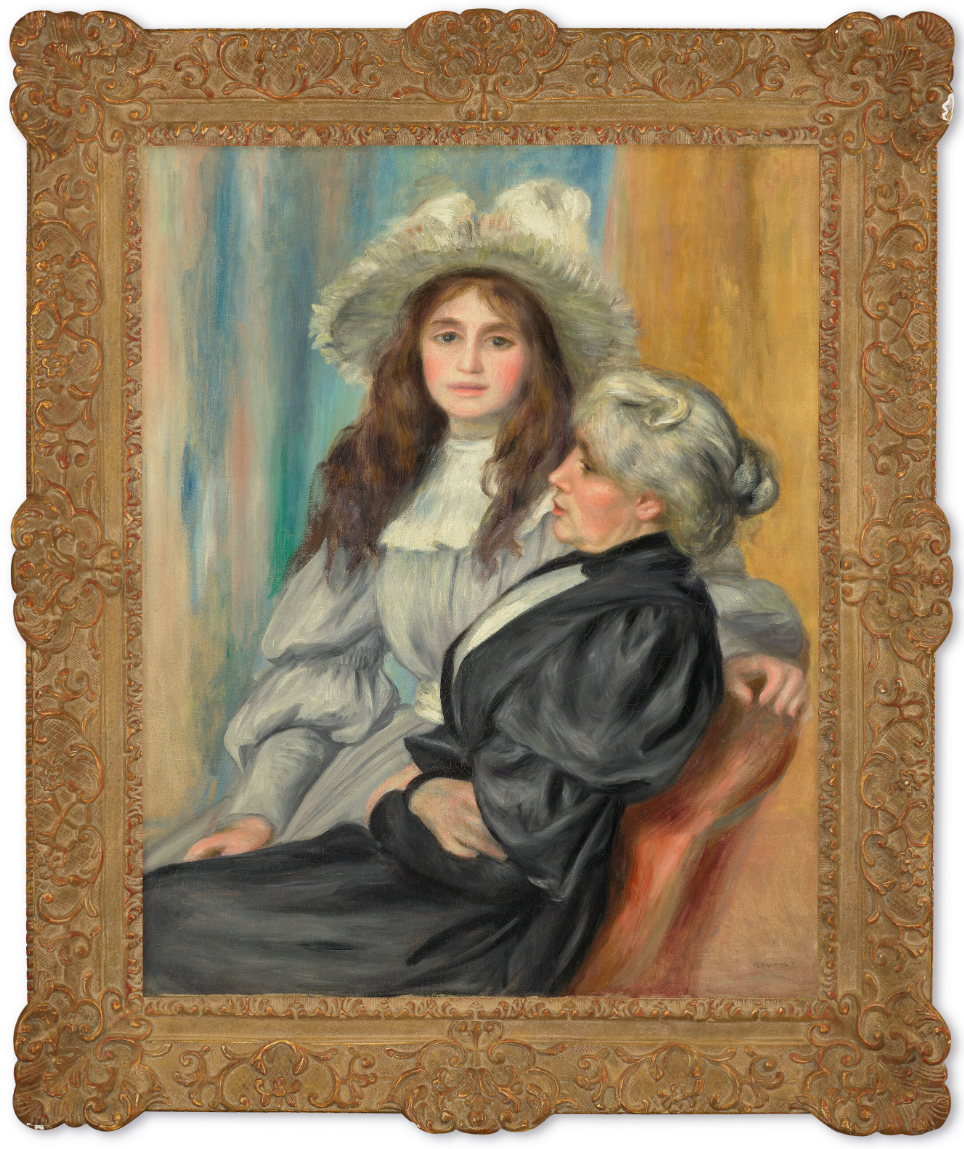
PIERRE-AUGUSTE RENOIR
Berthe Morisot et sa fille, Julie Manet, 1894
Oil on canvas
81.3 x 65.5 cm (32 x 25.7 inches)
Christie’s New-York: 11 May 2022
USD 24,435,000
The Sugar Shack, 1976
Acrylic on canvas
36 x 48 inches (91.4 x 121.9 cm)
Christie’s New-York: 11 May 2022
USD 15,275,000
CLAUDE MONET
L’arbre en boule, Argenteuil, 1876
Oil on canvas
60.3 x 80.2 cm (23.7 x 31.5 inches)
Christie’s New-York: 11 May 2022
USD 10,122,500
8. SOTHEBY’S AUCTION RESULTS
The Macklowe Collection
16 May 2022
USD 246,057,550
# Lots Sold: 30
Sell-Through Rate: 100%
Top Lot: USD 48,008,000
Average Price: USD 8,201,918
Sold Above/Within Estimates: 30%/60%
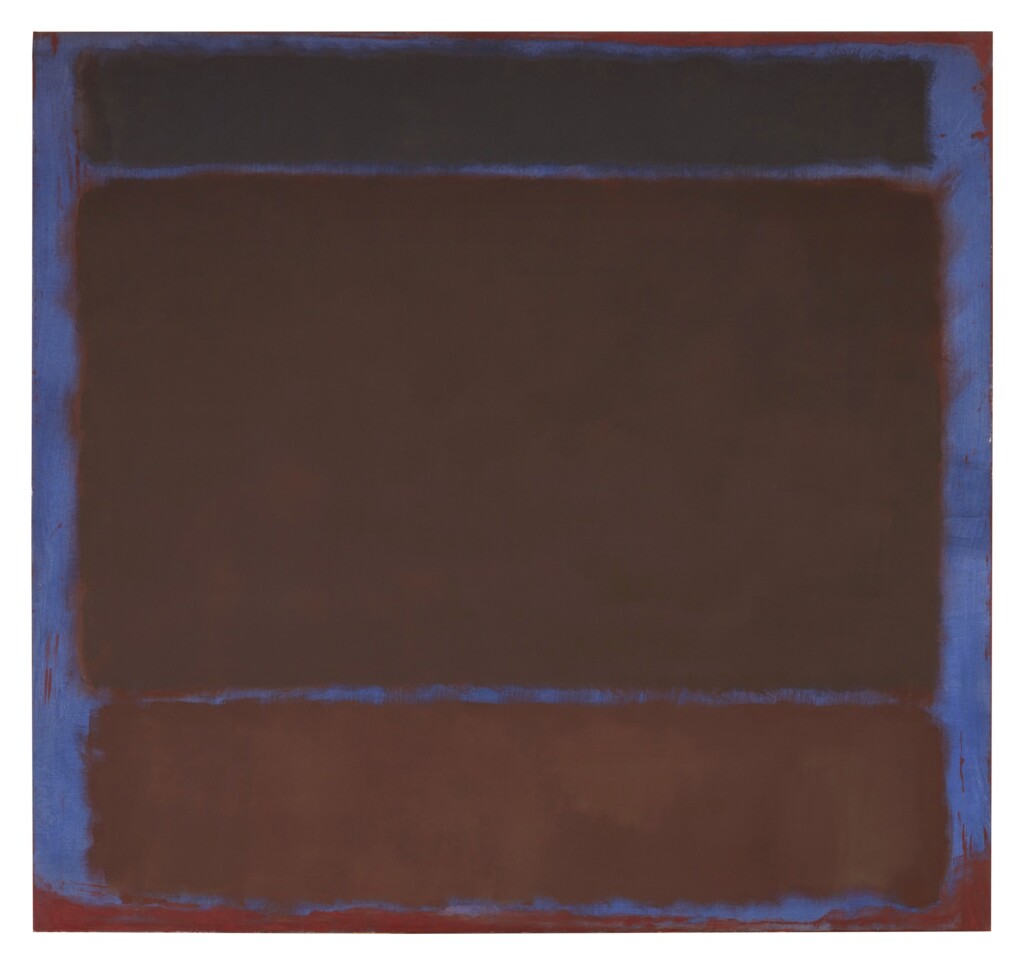
MARK ROTHKO
Untitled, 1960
Oil on canvas
70×74.5 inches (178.4×189.2 cm)
Sotheby’s New-York: 16 May 2022
USD 48,008,000
GERHARD RICHTER
Seestuck [Seascape], 1975
Oil on canvas
199.4×300.4 cm (78.5×178 inches)
Sotheby’s New-York: 16 May 2022
USD 30,198,500
ANDY WARHOL
Self-Portrait, 1986
Acrylic and silkscreen ink on canvas
80×80 inches (203.2×203.5 cm)
Sotheby’s New-York: 16 May 2022
USD 18,708,500
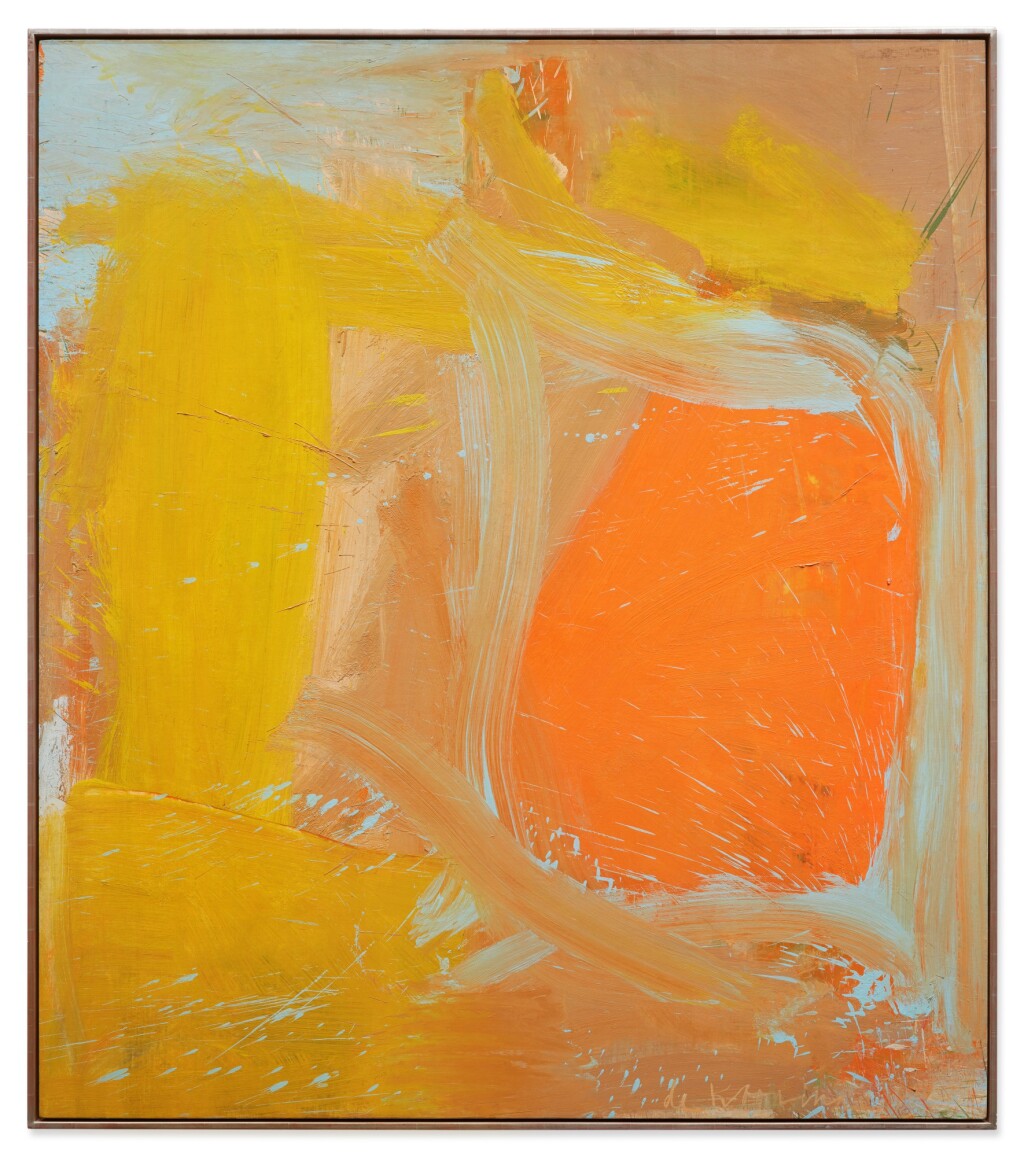
WILLEM DE KOONING
Untitled, 1961
Oil on canvas
80×70 inches (203.2×178.1 cm)
Sotheby’s New-York: 16 May 2022
USD 17,789,300
CY TWOMBLY
Synopsis of a Battle, 1968
Oil based house paint and wax crayon on canvas
50.5 x 59 inches (128.3 x 149.2 cm)
Sotheby’s New-York: 16 May 2022
USD 15,261,500
WILLEM DE KOONING
Untitled XIII, 1984
Oil on canvas
70×80 inches (177.8 x 203.2 cm)
Sotheby’s New-York: 16 May 2022
USD 8,999,450
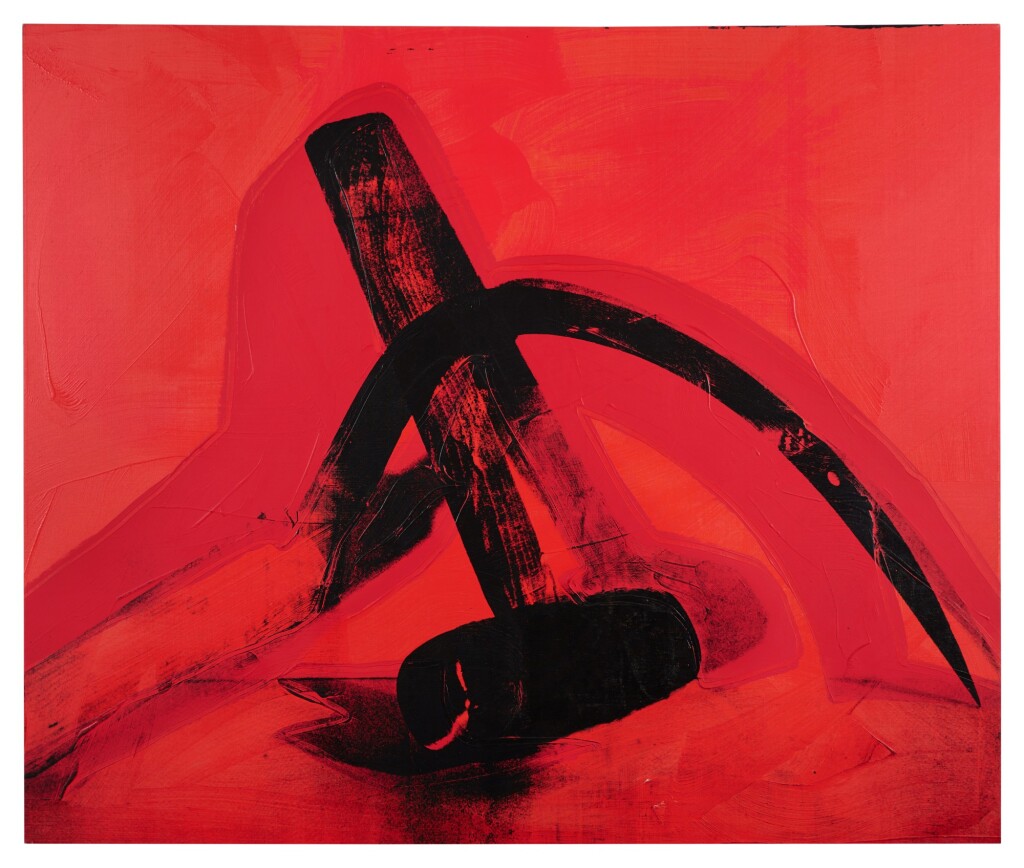
ANDY WARHOL
Hammer and Sickle, 1976
Acrylic and silkscreen ink on canvas
72×86 inches (183.5 x 218.4 cm)
Sotheby’s New-York: 16 May 2022
USD 6,414,200
Modern Evening Auction
17 May 2022
USD 408,368,200
# Lots Sold: 51
Sell-Through Rate: 87.9%
Top Lot: USD 67,541,000
Average Price: USD 8,007,220
Sold Above/Within Estimates: 24% / 38%
PABLO PICASSO
Femme Nue Couchee, 1932
Oil and Ripolin on canvas
129.9×161.7 cm (51×64 inches)
Sotheby’s New-York: 17 May 2022
USD 67,541,000
CLAUDE MONET
Le Grand Canal et Santa Maria della Salute, 1908
Oil on canvas
73.5×92.5 cm (29×36.5 inches)
Sotheby’s New-York: 17 May 2022
USD 56,625,500
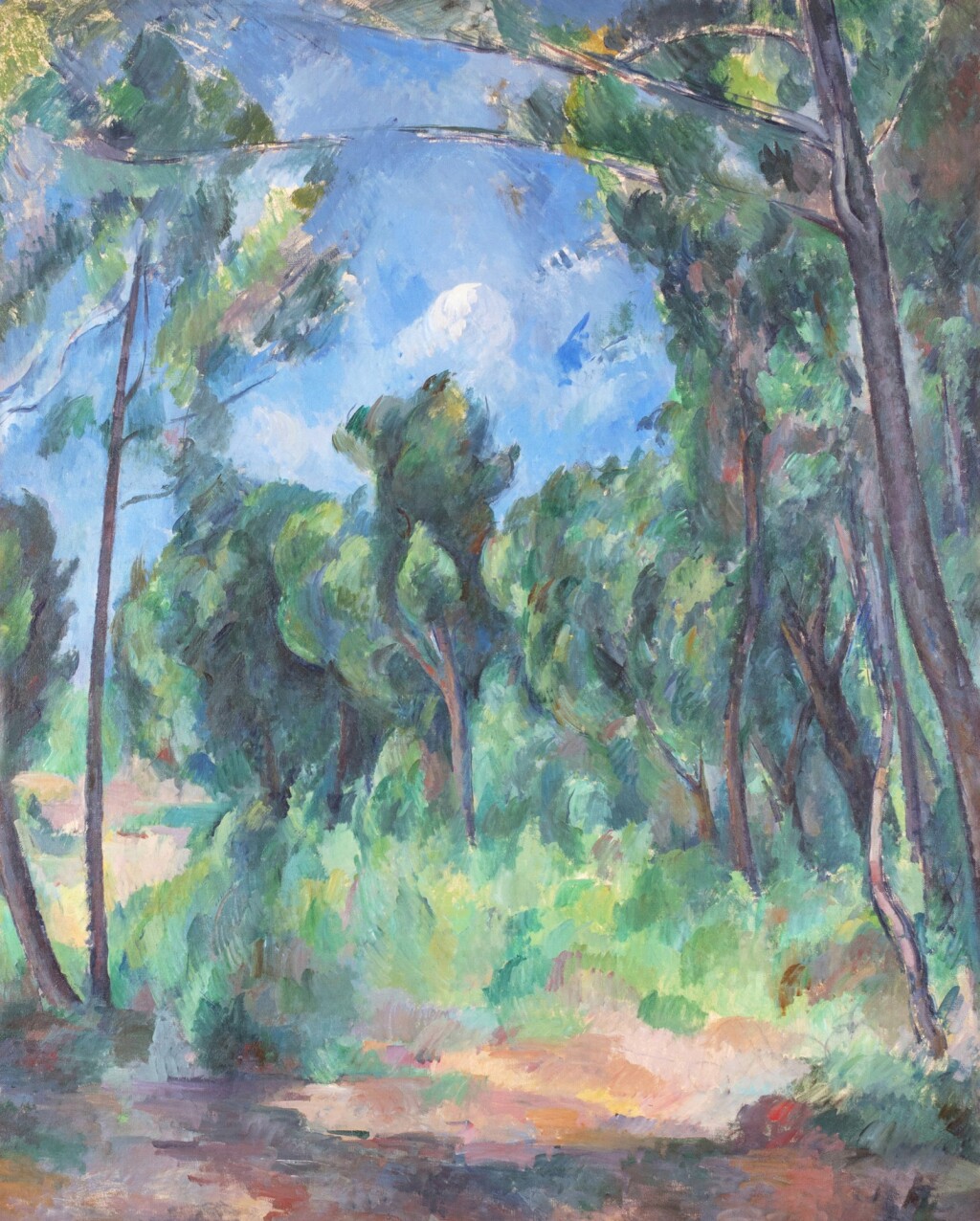
PAUL CEZANNE
Clairiere (The Glade), 1895
Oil on canvas
100.3×81.2 cm (39.5×32 inches)
Sotheby’s New-York: 17 May 2022
USD 41,688,500
CLAUDE MONET
Les Arceaux de Roses, Giverny, 1913
Oil on canvas
81.5×93.5 cm (32×37 inches)
Sotheby’s New-York: 17 May 2022
USD 23,304,500
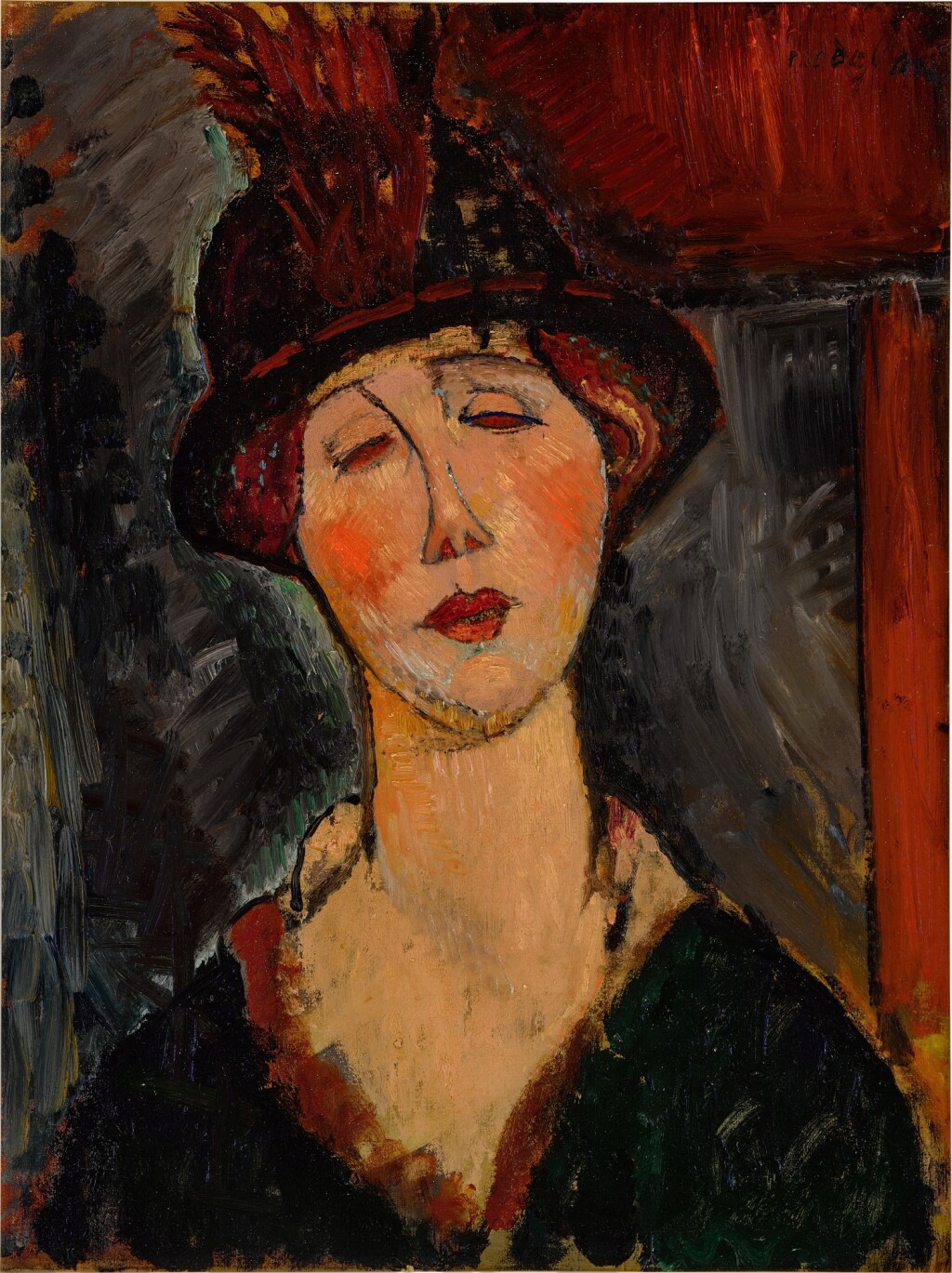
AMEDEO MODIGILIANI
Madame Dorival, 1916
Oil on canvas
61.2 x 46 cm (24×18 inches)
Sotheby’s New-York: 17 May 2022
USD 17,559,500
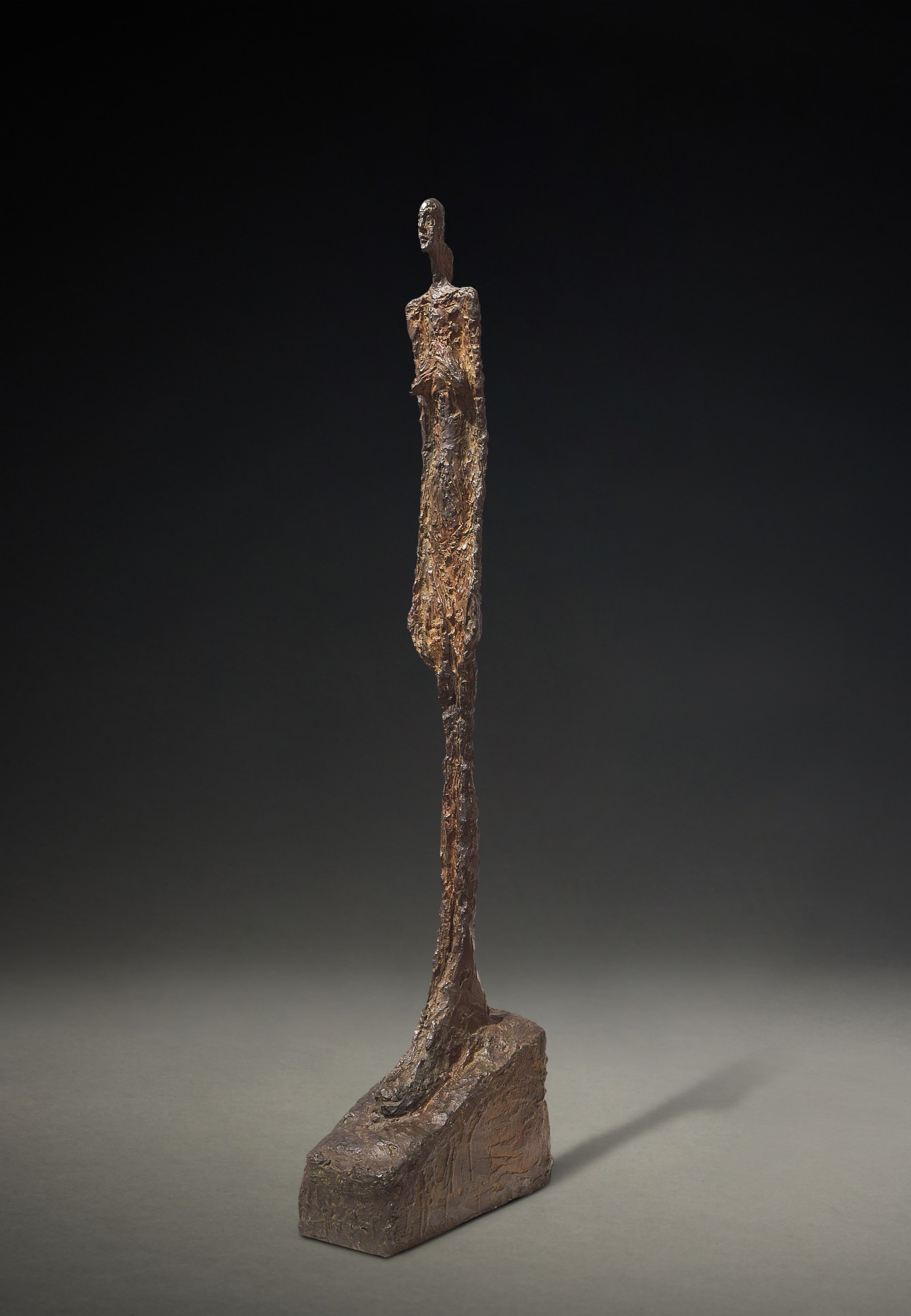
ALBERTO GIACOMETTI
Femme de Venise II, 1976
Bronze 0/6
Height: 122 cm (48 inches)
Sotheby’s New-York: 17 May 2022
USD 17,559,500
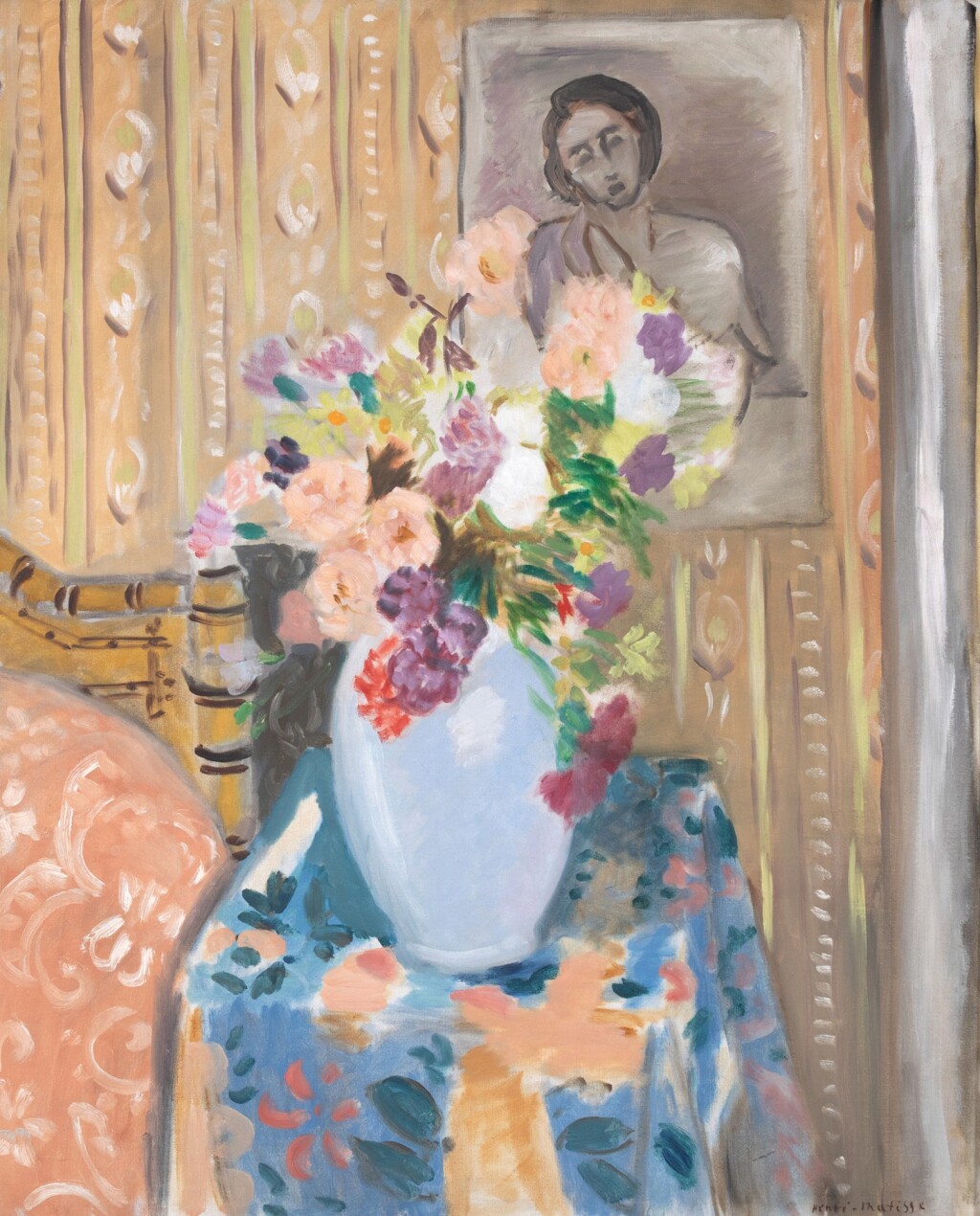
HENRI MATISSE
Fleurs ou Fleurs devant un portrait, 1923
Oil on canvas
100.3×81.2 cm (39.5×32 inches)
Sotheby’s New-York: 17 May 2022
USD 15,261,500
PABLO PICASSO
L’Etreinte, 1969
Oil on canvas
162×130 cm (64×51 inches)
Sotheby’s New-York: 17 May 2022
USD 14,112,500
PABLO PICASSO
Mousquetaire a la pipe, buste, 1967
Oil and Ripolin on canvas
99.7 x 80.6 cm (39×32 inches)
Sotheby’s New-York: 17 May 2022
USD 8,482,400
The Now Evening Auction
19 May 2022
USD 72,930,850
# Lots Sold: 23
Sell-Through Rate: 100%
Top Lot: USD 13,538,000
Average Price: USD 3,170,907
Sold Above / Within Estimates: 65% / 26%
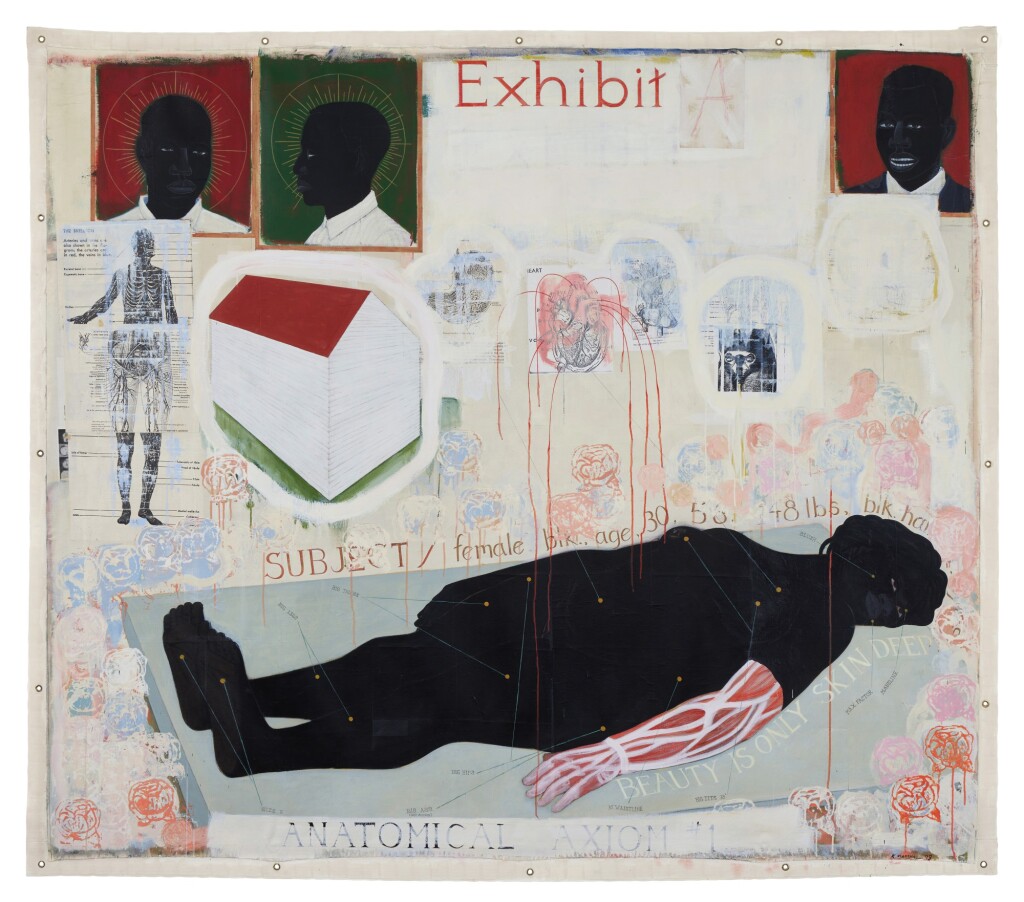
KERRY JAMES MARSHALL
Beauty Examined, 1993
Acrylic and collage on canvas
85×99 inches (214.9×252 cm)
Sotheby’s New-York: 19 May 2022
USD 13,538,000
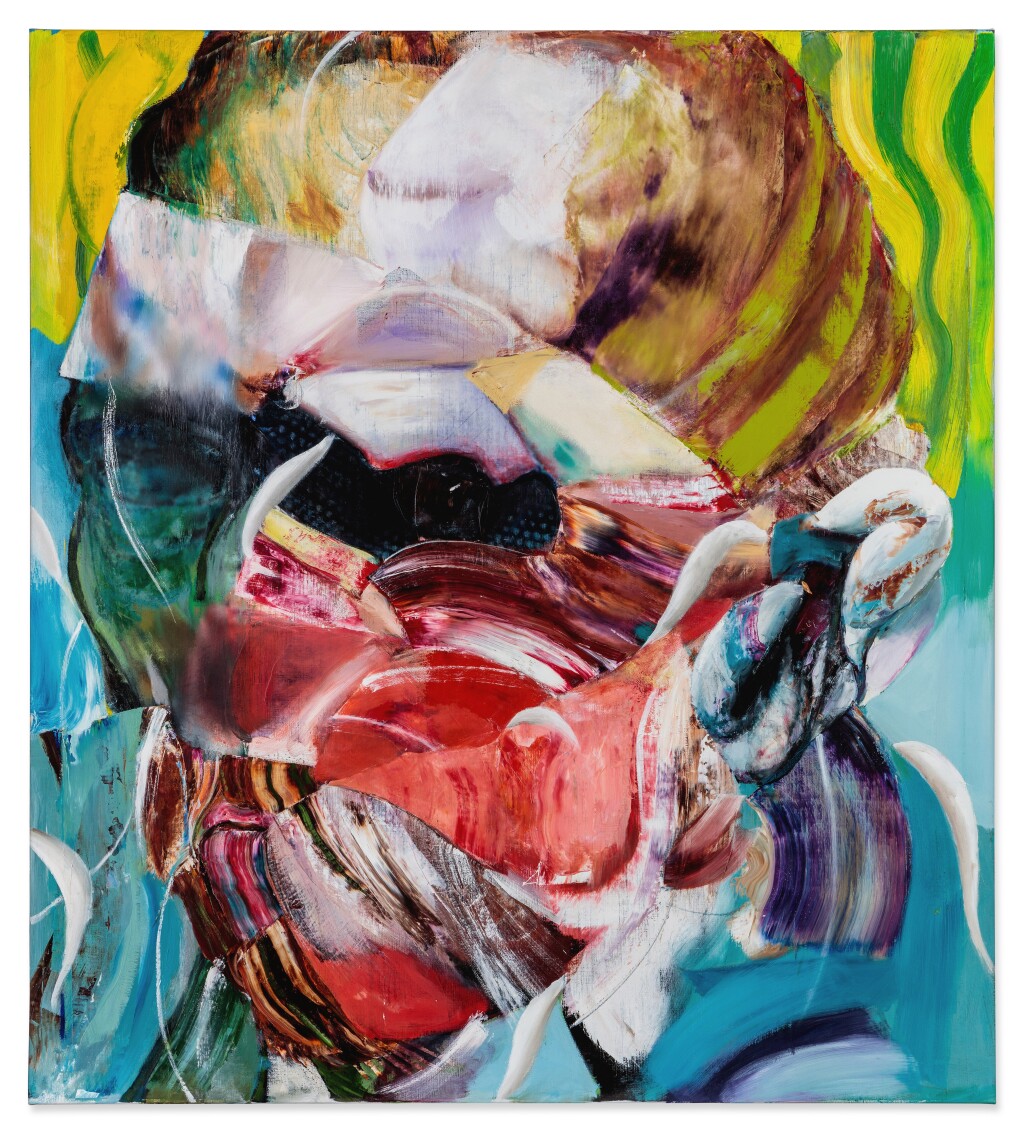
ADRIAN GHENI
Degenerate Art, 2016
Oil on canvas
79×71 inches (200.7×180.3 cm)
Sotheby’s New-York: 19 May 2022
USD 9,286,700
MATTHEW WONG
The Night Watcher, 2018
Oil on canvas
60×48 inches (152.4×122 cm)
Sotheby’s New-York: 19 May 2022
USD 5,897,150
Contemporary Evening Auction
19 May 2022
USD 468,174,000
# Lots Sold: 41
Sell-Through Rate: 97.8%
Top Lot: USD 54,205,000
Average Price: USD 11,418,878
Sold Above / Within Estimates: 19% / 43%
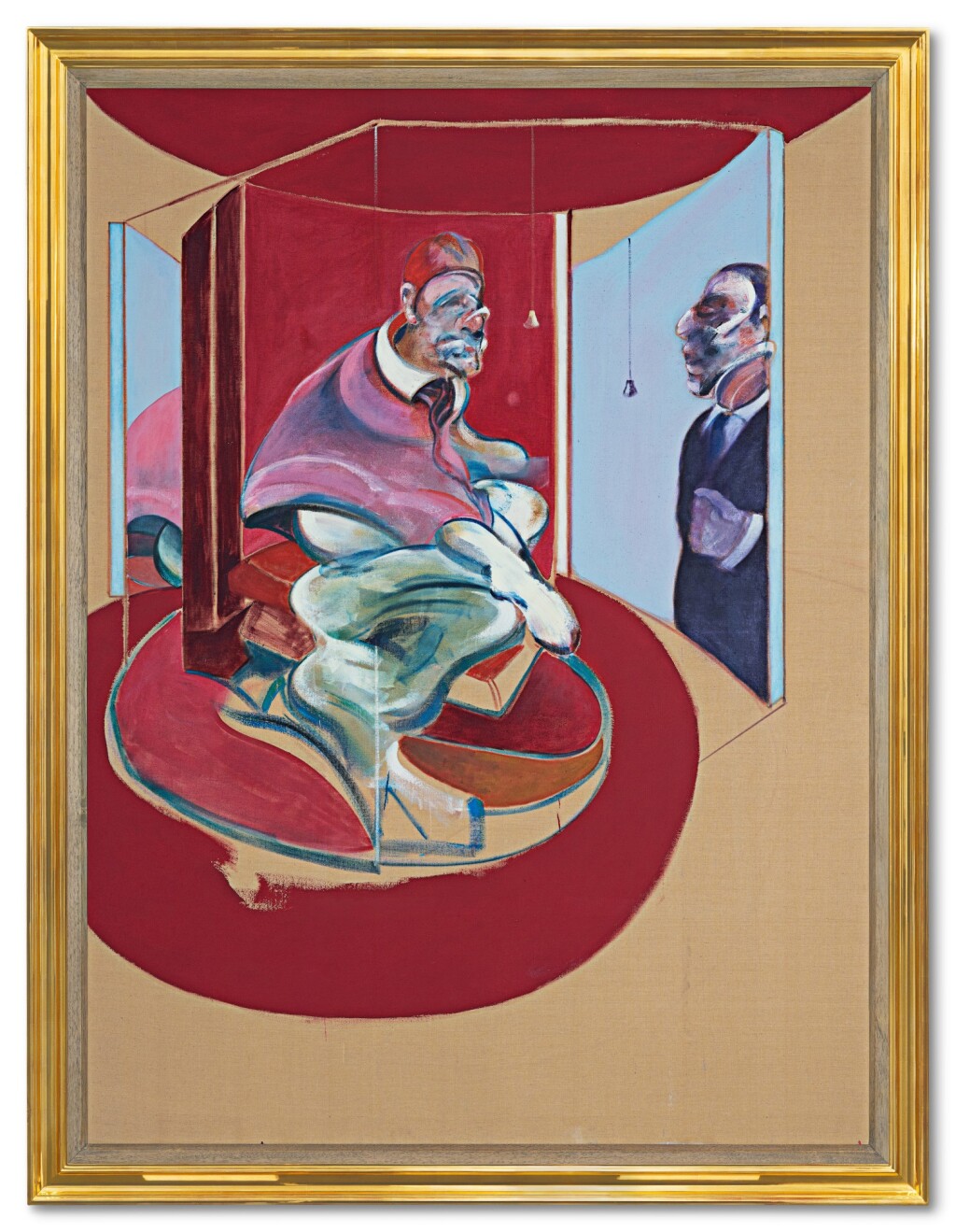
FRANCIS BACON
Study of Red Pope 1962, 2nd version 1971, 1971
Oil on canvas
198×147.5 cm (78×58 inches)
Sotheby’s New-York: 19 May 2022
USD 46,284,500
CY TWOMBLY
Untitled, 1969
Oil based house paint and wax crayon on canvas
79×93.5 inches (200 x 237.5 cm)
Sotheby’s New-York: 19 May 2022
USD 38,000,000
ANDY WARHOL
Elvis, 1963
Silkscreen ink and silver paint on canvas
83×46 inches (210.2×117.5 cm)
Sotheby’s New-York: 19 May 2022
USD 21,581,000
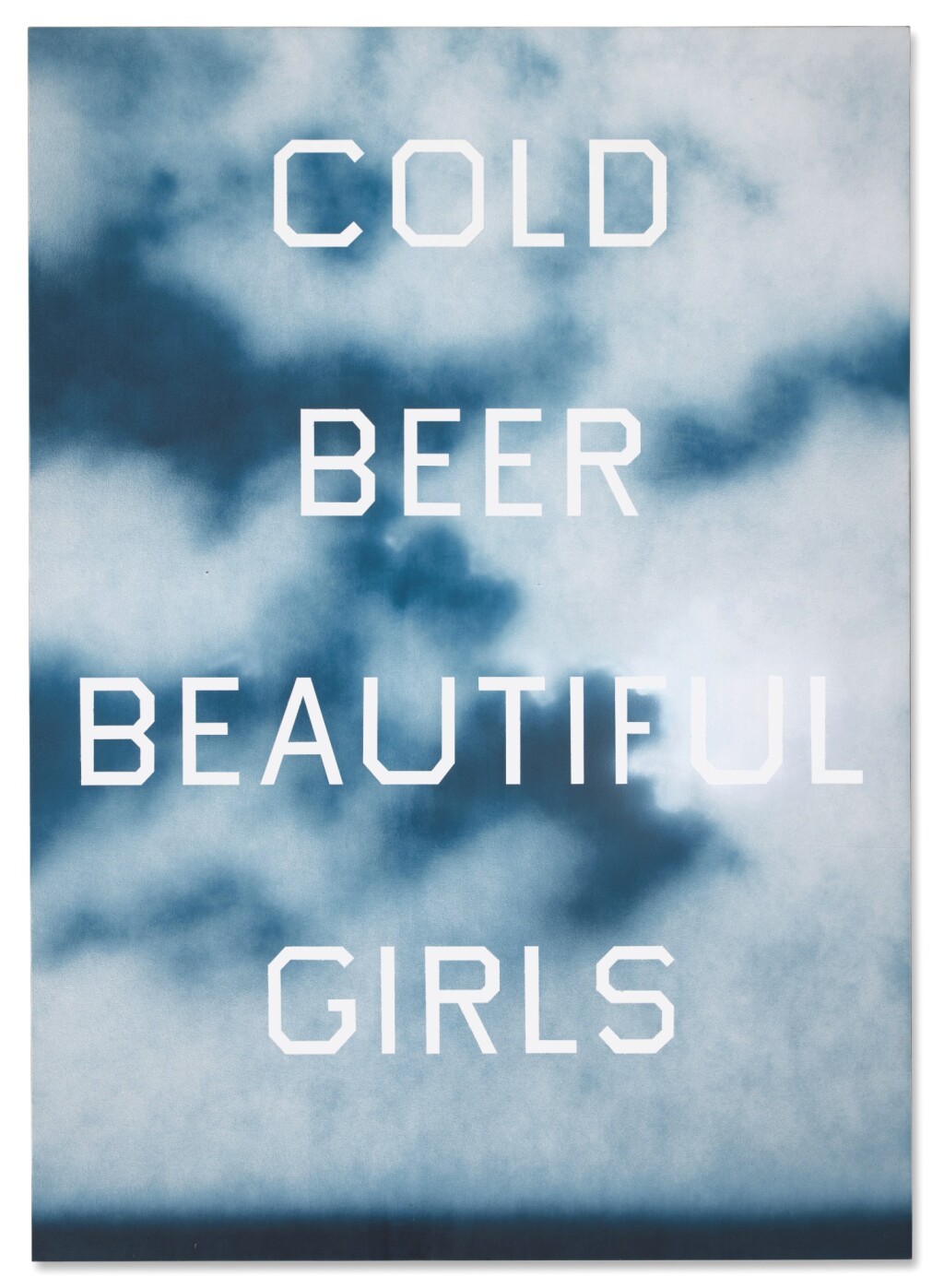
ED RUSCHA
Cold Beer Beautiful Girls, 1993
Acrylic on canvas
84×60 inches (213.4×152.4 cm)
Sotheby’s New-York: 19 May 2022
USD 18,823,400
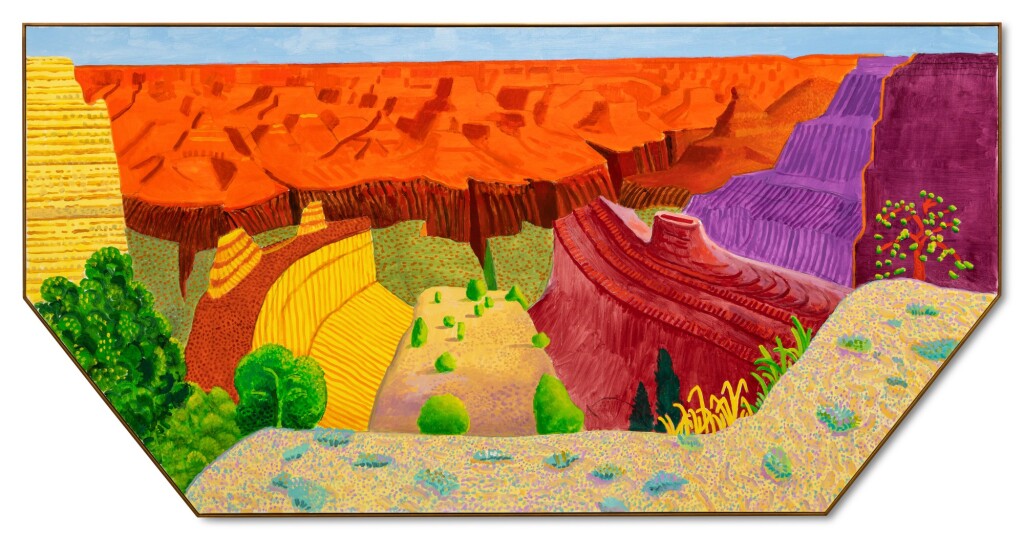
DAVID HOCKNEY
Grand Canyon II, 2017
Acrylic on canvas
48×96 inches (121.9 x 243.8 cm)
Sotheby’s New-York: 19 May 2022
USD 11,034,700
9. PHILLIPS AUCTION RESULTS
20th Century and Contemporary Art Evening Sale
18 May 2022
USD 224,906,950
# Lots Sold: 36
Sell-Through Rate: 100%
Top Lot: USD 85,000,000
Average Price: USD 6,247,415
JEAN-MICHEL BASQUIAT
Untitled, 1982
Acrylic and spray-paint on canvas
94×197 inches (239.4 x 501 cm)
Phillips New-York: 18 May 2022
USD 85,000,000
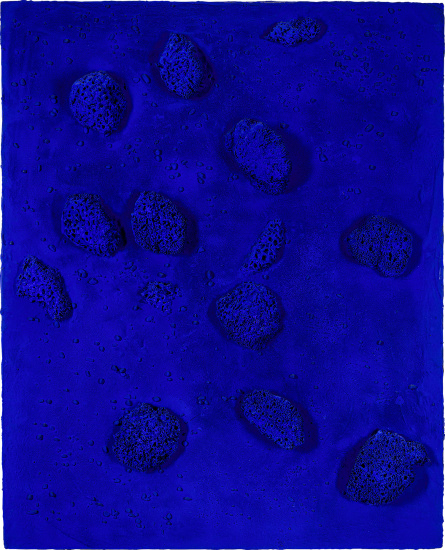
YVES KLEIN
Relief Eponge bleue sans titre (RE 49), 1961
Dry blue pigment and synthetic resin, natural sponges and pebbles on panel
122.6 x 100 cm (48×40 inches)
Phillips New-York: 18 May 2022
USD 19,999,500
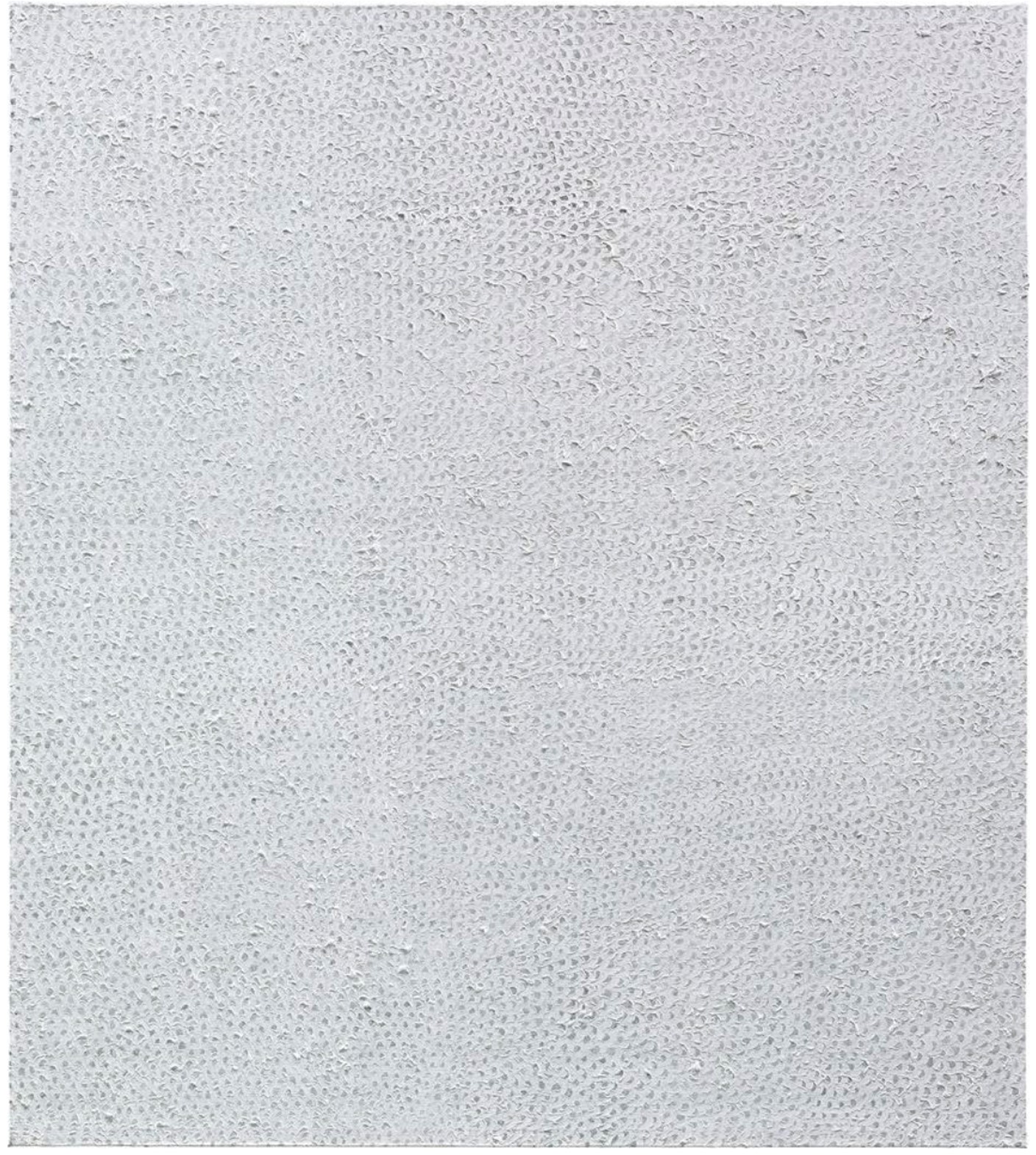
YAYOI KUSAMA
Untitled (Nets), 1959
Oil on canvas
130.8 x 116.5 cm (51.5×46 inches)
Phillips New-York: 18 May 2022
USD 10,496,000
PABLO PICASSO
Figures et Plantes, 1932
Oil on panel
18.4 x 23.8 cm (7×10 inches)
Phillips New-York: 18 May 2022
USD 10,267,000
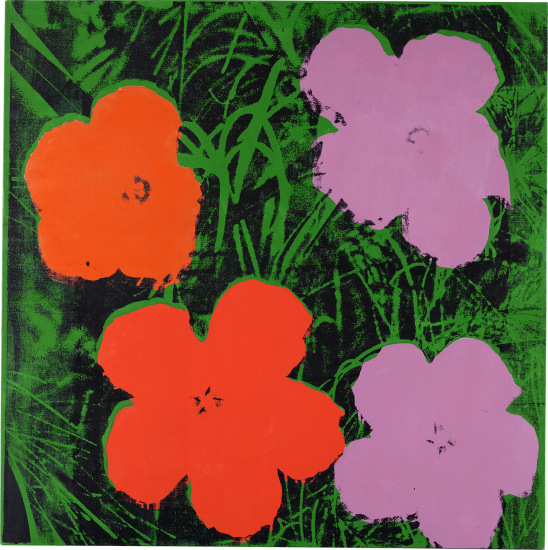
ANDY WARHOL
Flowers, 1964
Acrylic and silkscreen ink on linen
48x48inches (121.9 x 121.9 cm)
Phillips New-York: 18 May 2022
USD 9,351,000
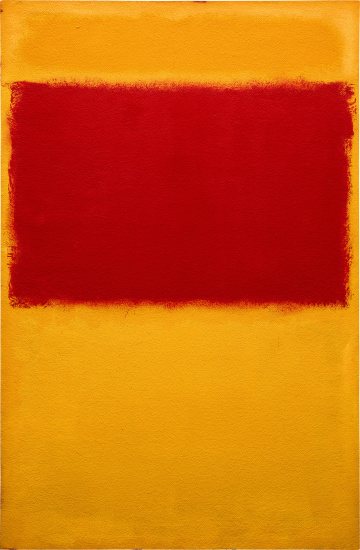
MARK ROTHKO
Untitled, 1959
Oil on paper mounted on Masonite
38×25 inches (96.5 x 63.2 cm)
Phillips New-York: 18 May 2022
USD 8,435,000
CY TWOMBLY
Untitled, 2006
Acrylic on canvas
85×66 inches (215.6 x 167.6 cm)
Phillips New-York: 18 May 2022
USD 8,206,000