WORK IN PROGRESS
Source: Artprice
Table of Contents
1. Key Figures
2. Art Market Geography
3. Art Market Segmentations
4. Competitive Landscape
5. Top 10 Lots of 2022
6. Top 10 Artists by Revenue
7. Contemporary Art
1. Key Figures
Total Auction Revenue:
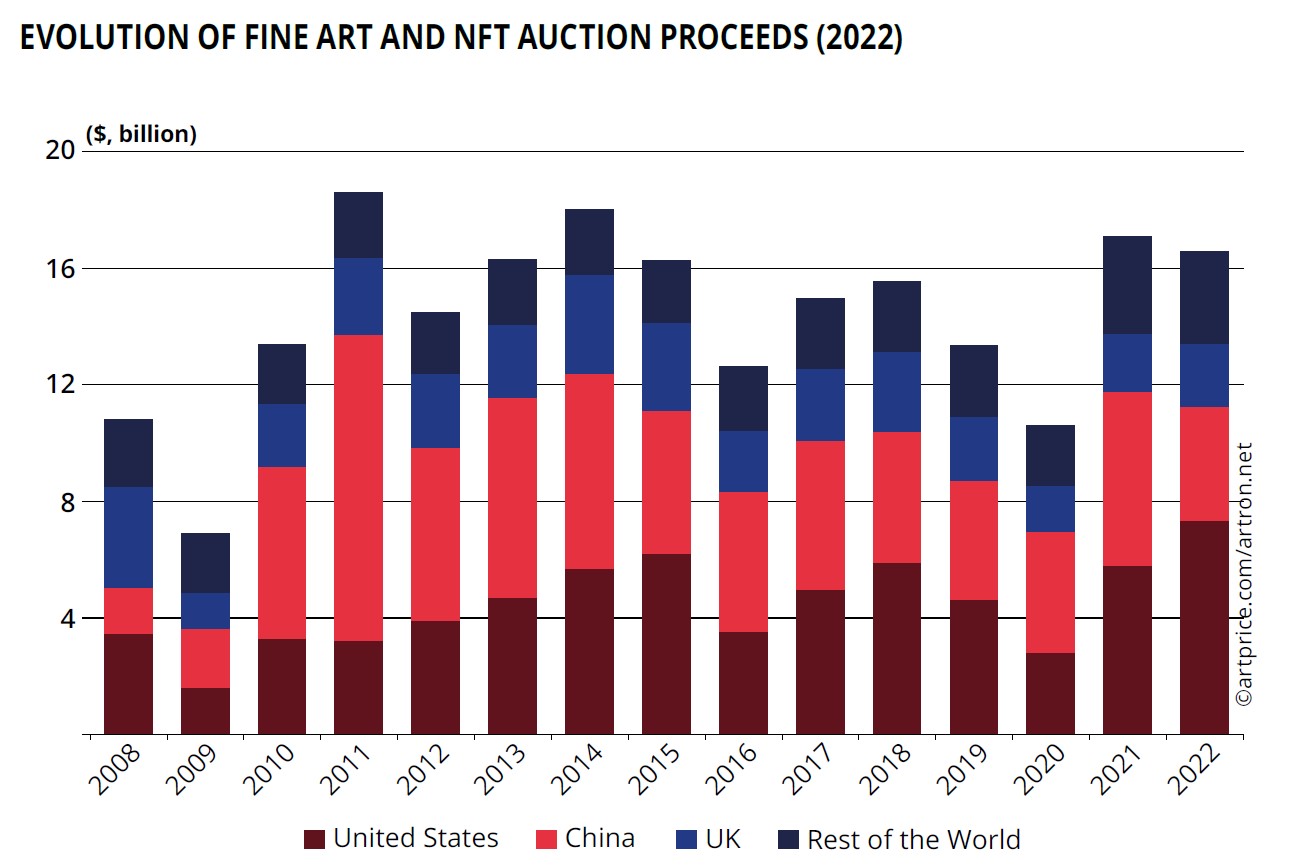
USD 16.5 billion
Despite growing macro-economic and geopolitical tensions, notably with the war in Ukraine, the art market is showing strong resilience, posting its fourth best annual total in history.
Number of Transactions:
704,747
This is an absolute record for the art market, as 704,747 lots were sold in 2022, this is an increase of 4.7% as compared to previous record of 2021. Moreover, for the first time in history, the total number of lots presented at auction, exceeded 1 million in 2022.
Unsold Rate: 35%
This compares to 31% in 2022, which was an historical low, but it is still on average 5 points lower than levels before the pandemic. This represents a healthy art market with artworks that are circulating well.
# Lots sold above $ 1 million:
1,683
Top Auction Sale:
USD 1.62 billion

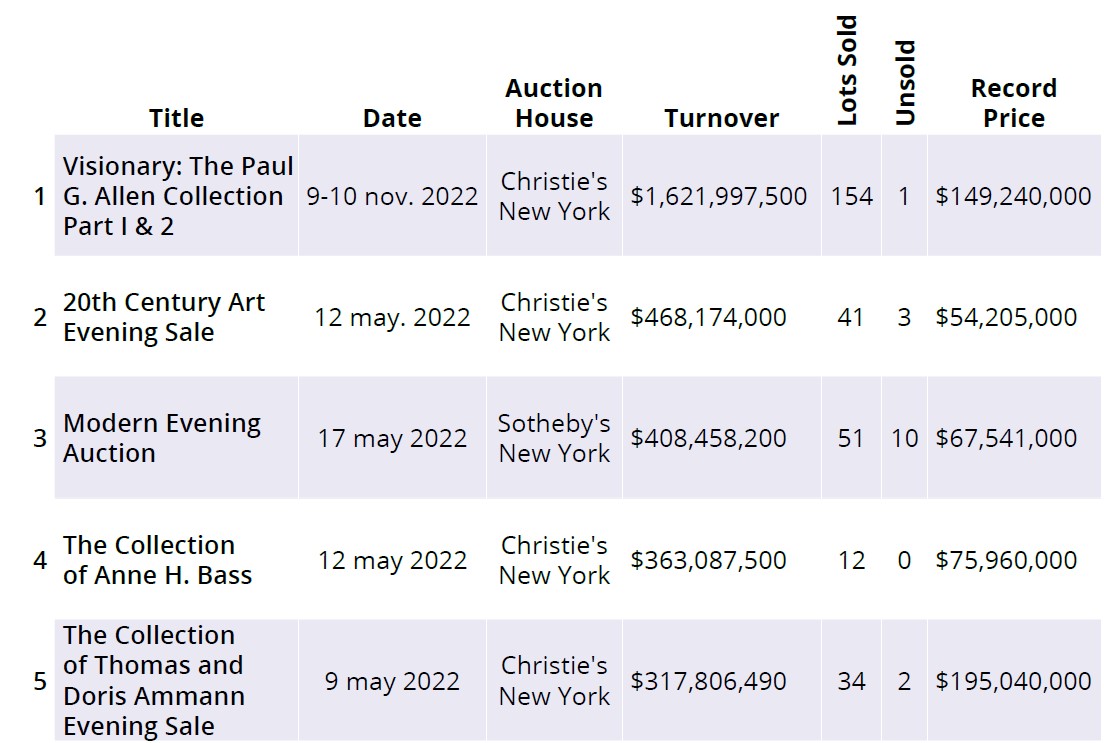
Visionary: The Paul G. Allen Collection (christies.com)
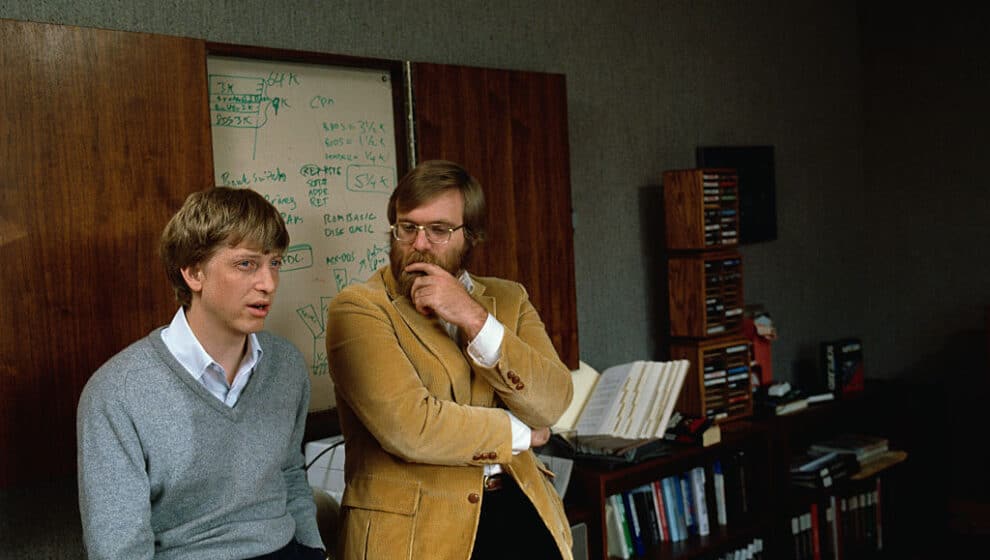
The collection of philanthropist Paul G. Allen, co-founder of Microsoft, includes more than 150 masterpieces spanning 500 years of art history. Reflecting the depth and breadth of Paul G. Allen’s collection, the auctions connect this visionary innovator to a range of ground-breaking artists, joining Paul Cezanne with David Hockney and Georges Seurat with Jasper Johns.
# Lots: 60 Lots
Sell-Through Rate: 100%
Total: USD 1,621,997,500
Top Lot: USD 149,240,000
5 Lots sold over USD 100 million
20 Lots sold over USD 20 million
# Lots sold: 154 (1 unsold)
The top 5 Auction sales in 2022 generated over USD 3 billion in revenues.
2. Art Market Geography
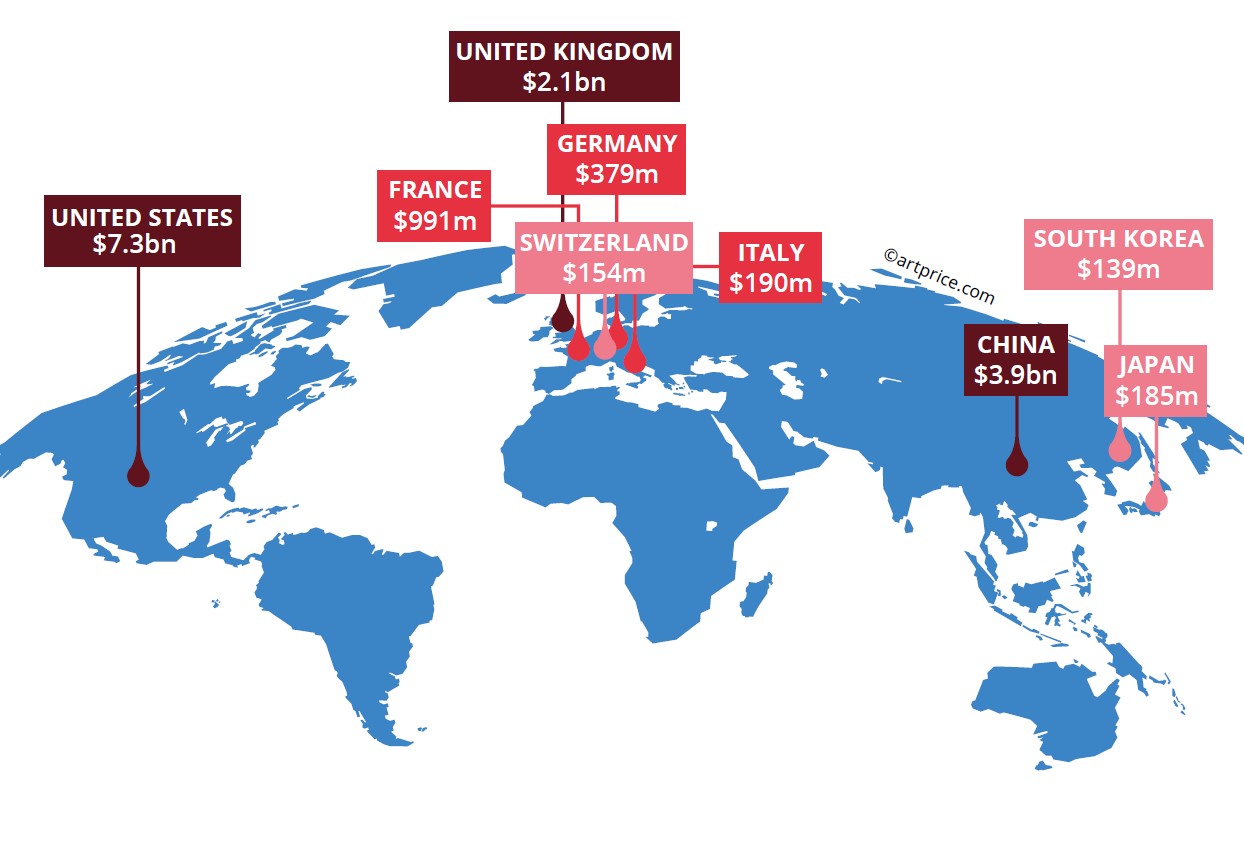
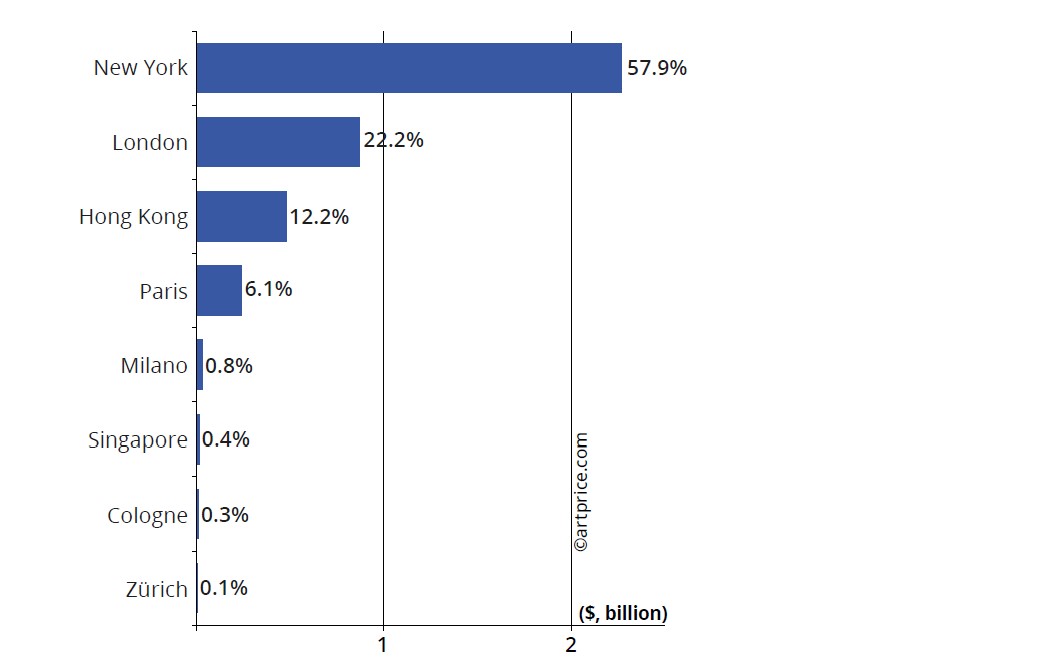
The US, China and the UK accounted for over 80% of total revenues in 2022.
1. The US and China
However 2022 is characterized by a strong reversal of balance between the US and China. Indeed, China posted auction revenues in severe contraction, USD 2 billion less than in 2021, whereas the US posted their high time high auction revenues at USD 7.3 billion, mostly driven by the sale of exceptional private collections such as the Paul G. Allen Collection at Christie’s in November 2022.
2. Europe
In 2022, the UK posted an 8% growth in auction revenues as compared to 2021. At USD 2.1 billion, the UK posted results in line with the levels achieved before the pandemic.
France consolidates its fourth place in the art world, generating revenues just shy of USD 1 billion. This is over 2.5 times the auction total of Germany, that ranks fifth in terms of auction revenues. At USD 379 million, Germany realized its highest annual result in history, with a level that has doubled in the course of the past 10 years.
3. Asia
Hong-Kong consolidated its place as a global hub for the global art market. The three main auction houses together hammered over USD 1 billion in Hong-Kong. Christie’s hammered 8% of its global fine art auction turnover in Hong-Kong, Sotheby’s and Phillips hammered 12% and 13% respectively. 5 results achieved in Hong-Kong were among the top 100 in 2022. Hong-Kong has become the second largest market place for ultra-contemporary art (artists younger than 40).
Seoul in South Korea, and Tokyo in Japan are emerging as two new Asian art market hubs, with strong demand for Asian artists but also for Western artists.
3. Market Segmentation
3.1. Segmentation by Medium
The “Painting” segment has reached its highest ever total in 2022, surpassing USD 10 billion, driven by the sale of major artworks from European Modern Art and US Post-War art.
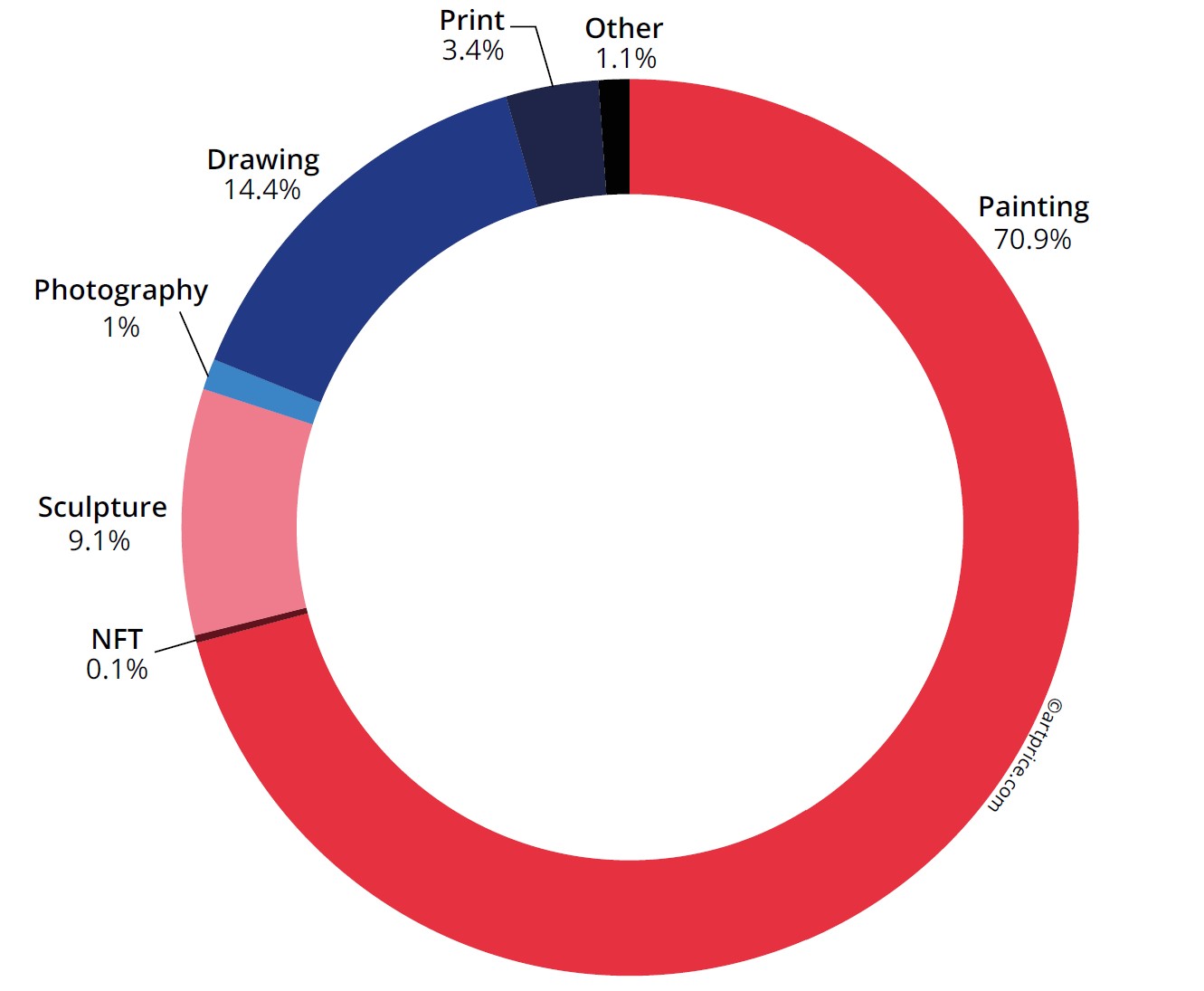
Over the last decade, both volume and turnover from the auction sales of prints have doubled. This segment recorded a turnover well in excess of USD 500 million for the second year in a row.
3.2. Segmentation by Price
The high-end of the market was fueled by the exceptional private collections that got sold in 2022. No less than 24 artworks sold over the USD 50 million threshold in 2022, as compared to a previous record of 15 in 2021.
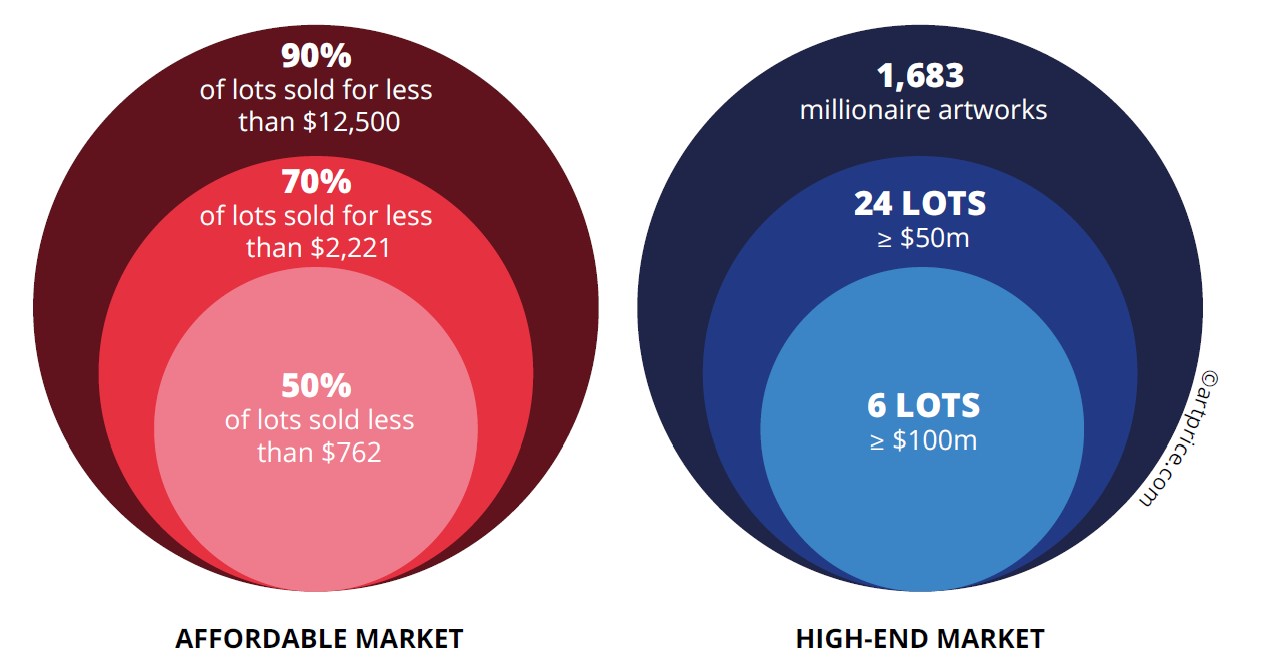
On the other end of the art market, works sold below USD 500 constitute the largest volume of transactions in the market today (41%). More than half of the total number of transactions, almost 400,000 transactions are made of lots sold below USD 1,000. This particular segment is the fastest growing as it has jumped more than 50% as compared to pre-pandemic levels. Indeed, a very large number of new and young collectors are entering the market through this segment.
4. Auction House Competitive Landscape
In 2022, the world’s two leading auction houses, Christie’s and Sotheby’s generated USD 9.7 billion, or 59% of the total global auction market revenues. This duopoly strongly dominate the high-end art market accounting for 90 of the 100 best results for the year.
4.1. Christie’s
With a total auction turnover close to USD 5.8 billion, Christie’s alone generates more than a third of the global auction turnover.
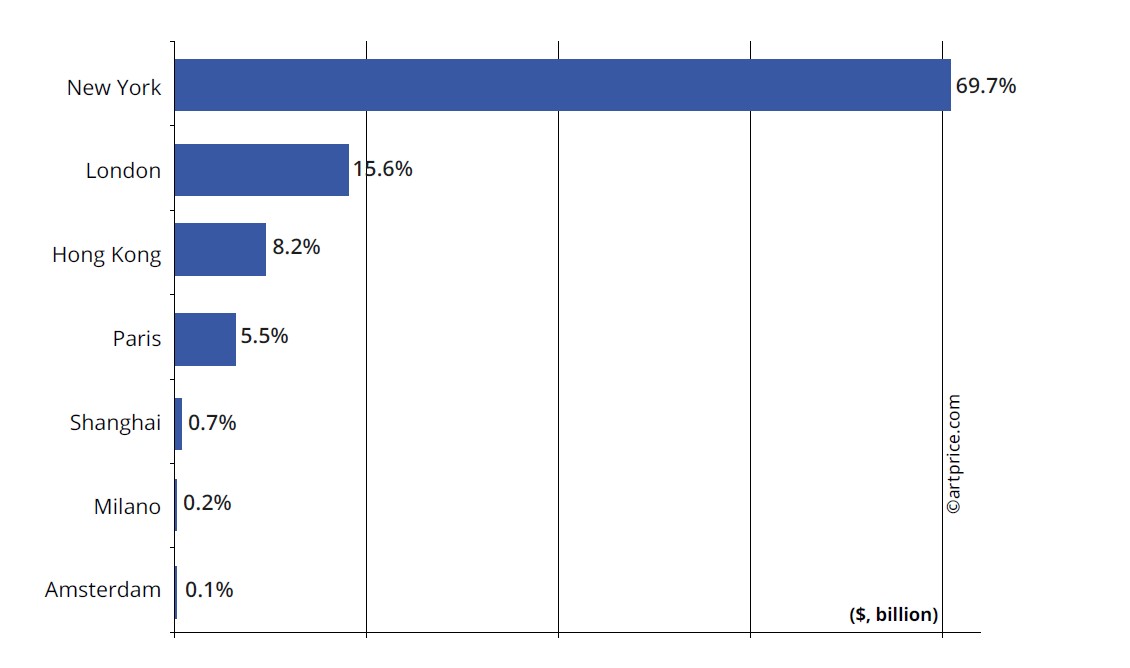
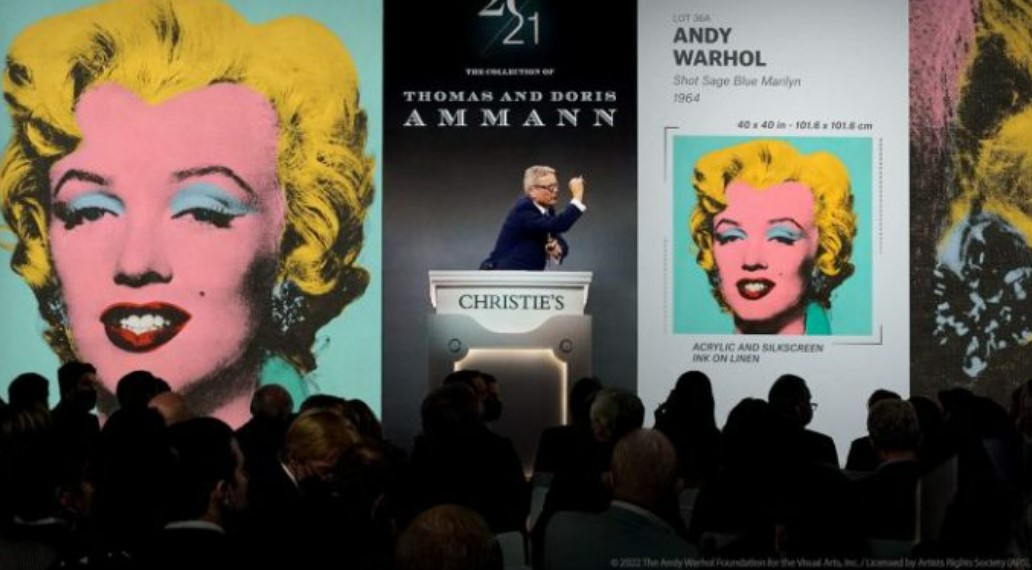
41% of Christie’s global auction turnover in 2022 is derived from the sale of three prestigious private art collections. On May 2022, the sale of the Thomas and Doris Ammann collection generated over USD 441 million, including the new auction record for Andy Warhol with the sale of Shot Blue Sage Marilyn for just over USD 195 million. The sale of the collection of Anne H. Bass generated USD 363 million including USD 66.8 million for the sale of one painting by Mark Rothko.
4.2. Sotheby’s
Sotheby’s generated an auction turnover of USD 3.9 billion in 2022.
4.3. Phillips
Phillips hammered for the second time a global auction turnover in excess of USD 1 billion.
5. Top 10 Lots of 2022
#1. Andy Warhol
Shot Sage Blue Marilyn, 1964
Christie’s New-York: 9 May 2022
USD 195,040,000
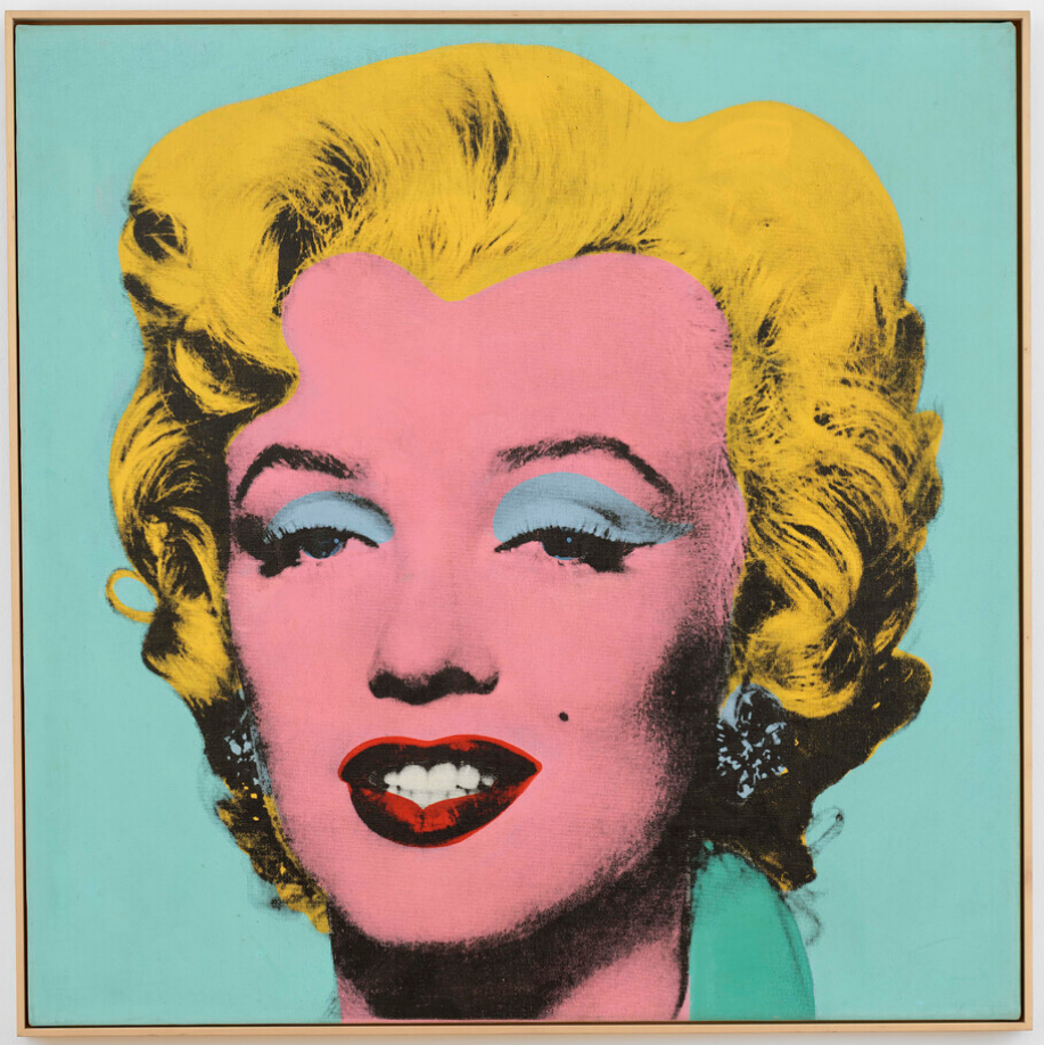
ANDY WARHOL
Shot Sage Blue Marilyn, 1964
Acrylic and silkscreen ink on linen
40×40 inches (101.6×101.6 cm)
There are few images in history that have the ability to transcend the time and place of their creation, surpassing even the reputation of their creator or the magnificence of their subject. From the classical beauty of the Venus de Milo and the enigmatic smile of the Mona Lisa, to the sultry Sirens of Picasso’s Les Demoiselles D’Avignon, the beauty of the human figure has inspired artists to extended their creativity to new heights. In the latter half of the twentieth-century, one woman captivated the world with her legendary looks, the Hollywood star Marilyn Monroe. This small town girl rose to become the most famous woman in the world, and today, the myth of Marilyn Monroe is still as potent as ever. This is due to one man: Andy Warhol, his unique ability to capture the humble beauty of a global superstar has seared her likeness onto our collective consciousness. His flawless rendering has become the image of Marilyn Monroe. It represents not only her physical attractiveness, but also her cultural power and enduring legacy. Through this image, she lives on forever as one of the definitive artistic icons of all time, a Mona Lisa for the twentieth-century. Shot Sage Blue Marilyn is Warhol’s ultimate depiction of his ultimate muse; an image that surpasses the transient nature of the actress’s life and the fame she endured. Distinguished by an inner luminosity, the screen idol’s legendary beauty radiates out from the surface of this large-scale painting. Her blond hair, piercing eyes, full-lips, and even her famous beauty spot are all rendered in a clarity and detail that is absent from other examples of Warhol’s famous screening process.
#2. George Seurat
Les Poseuses, Ensemble (Petite version), 1888
Christie’s New-York: 9 November 2022
USD 149,240,000
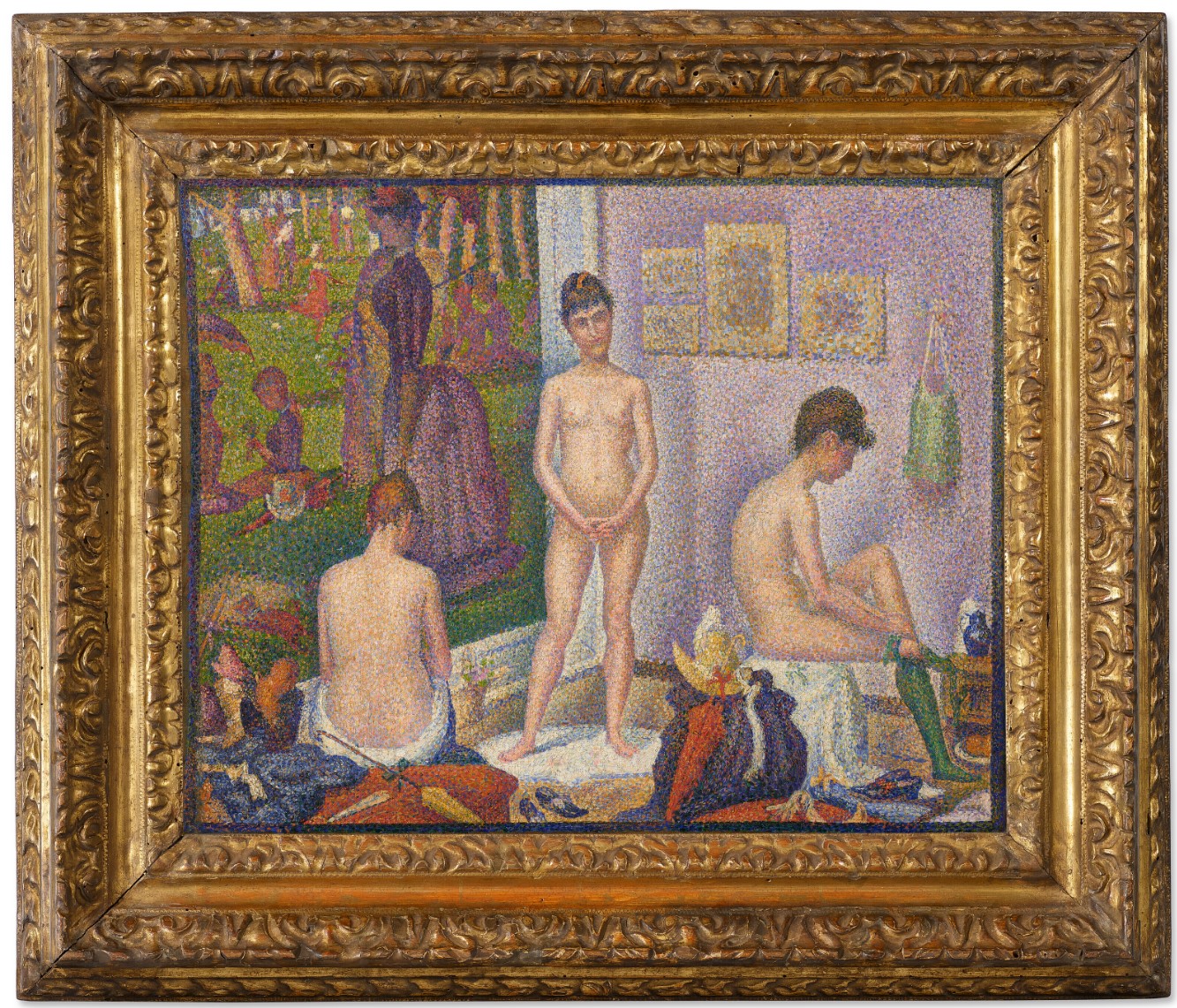
GEORGES SEURAT (1859-1891)
Les Poseuses, Ensemble (Petite version), 1888
Oil on canvas
39.3 x 50 cm (15 1/2 x 19 3/4 inches)
#3. Paul Cezanne
La Montagne Sainte-Victoire, 1888-1890
Christie’s New-York: 9 November 2022
USD 137,790,000
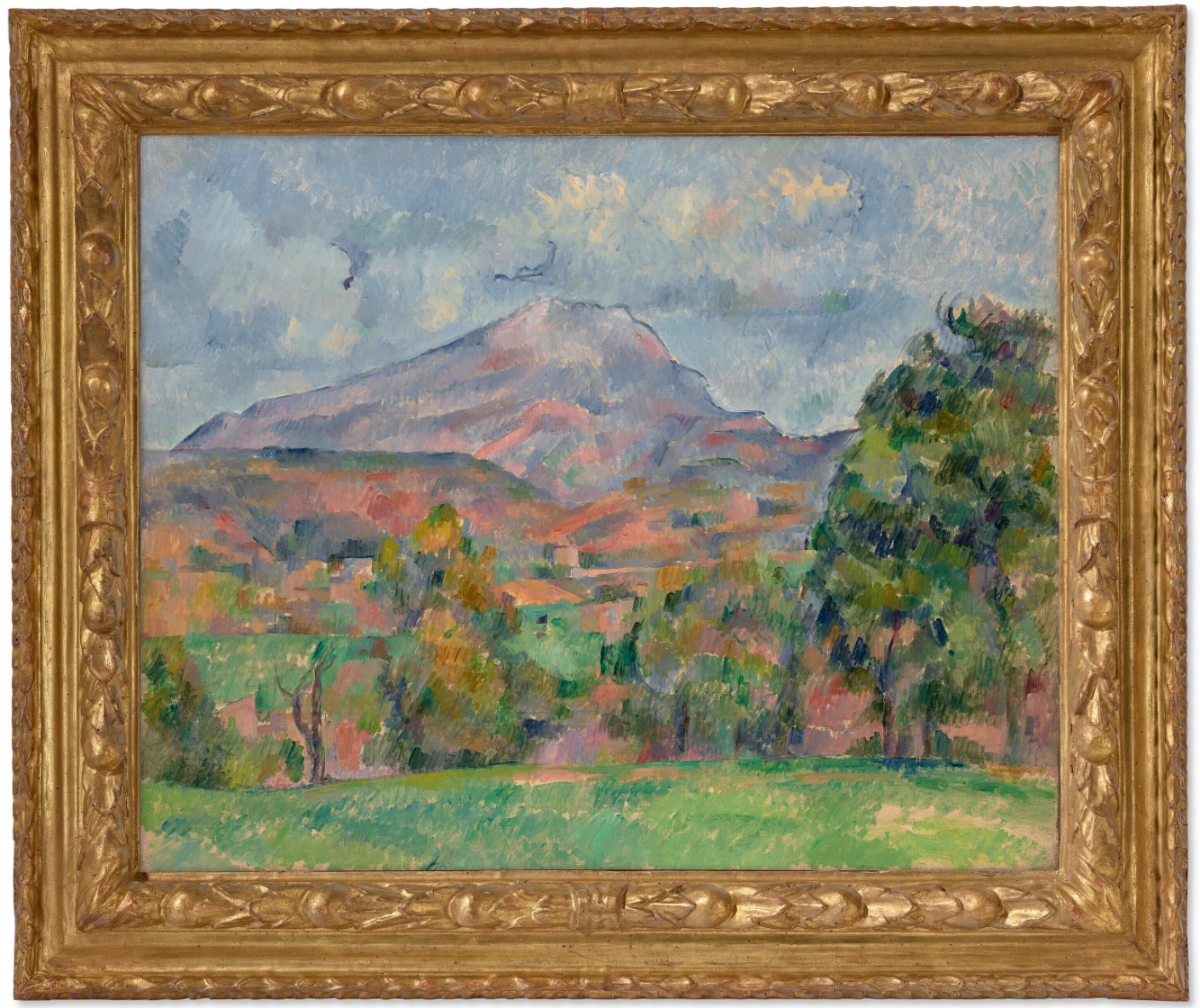
La Montagne Sainte-Victoire, 1888-1890
Oil on canvas
65.2 x 81.2 cm (25 5/8 x 31 7/8 inches)
#4. Vincent van Gogh
Christie’s New-York: 9 November 2022
USD 117,180,000
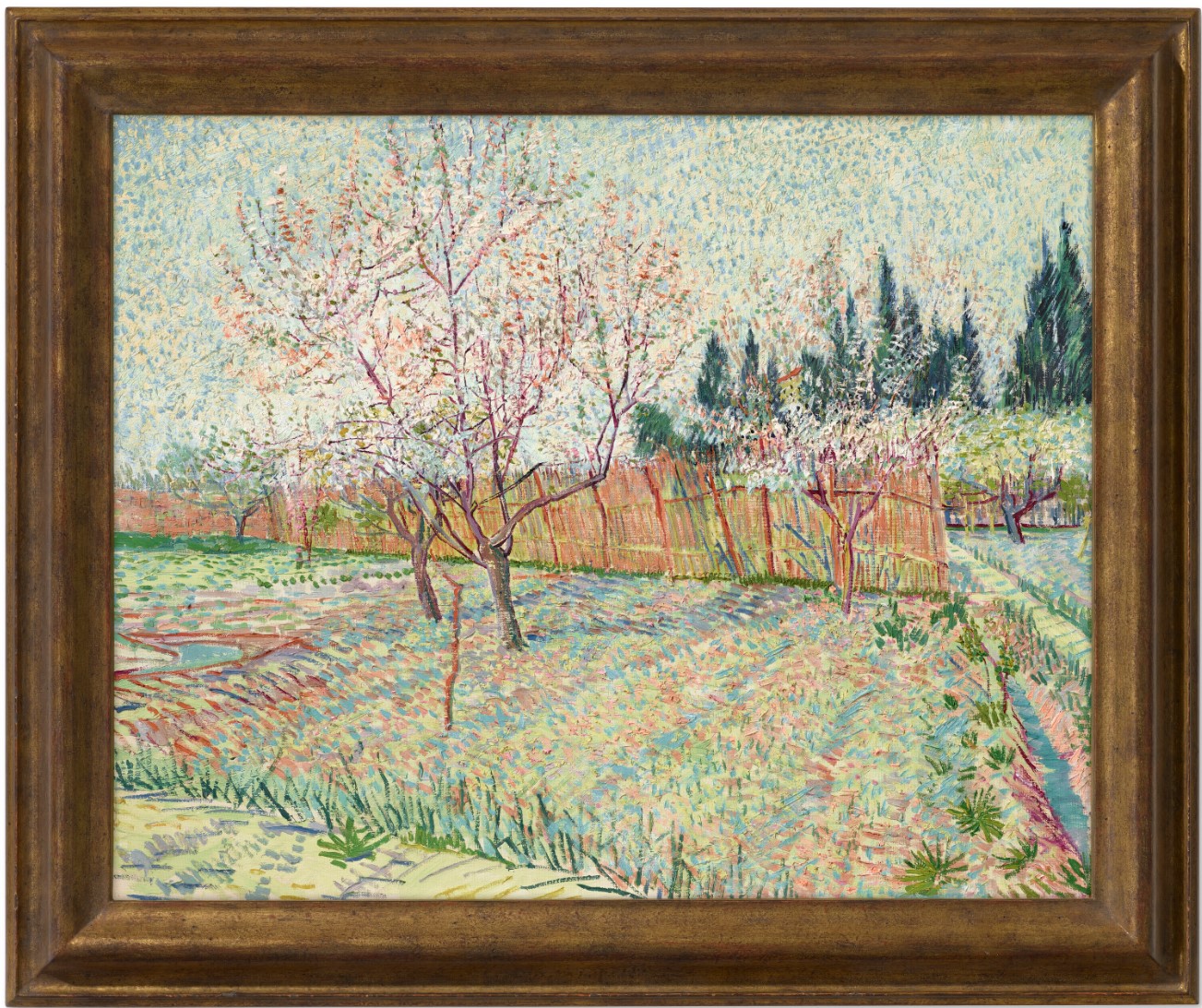
Verger avec cyprès, 1888
Oil on canvas
65.2 x 80.2 cm (25 3/4 x 31 7/8 inches)
#5. Paul Gauguin
Maternité II, 1899
Christie’s New-York: 9 November 2022
USD 105,730,000
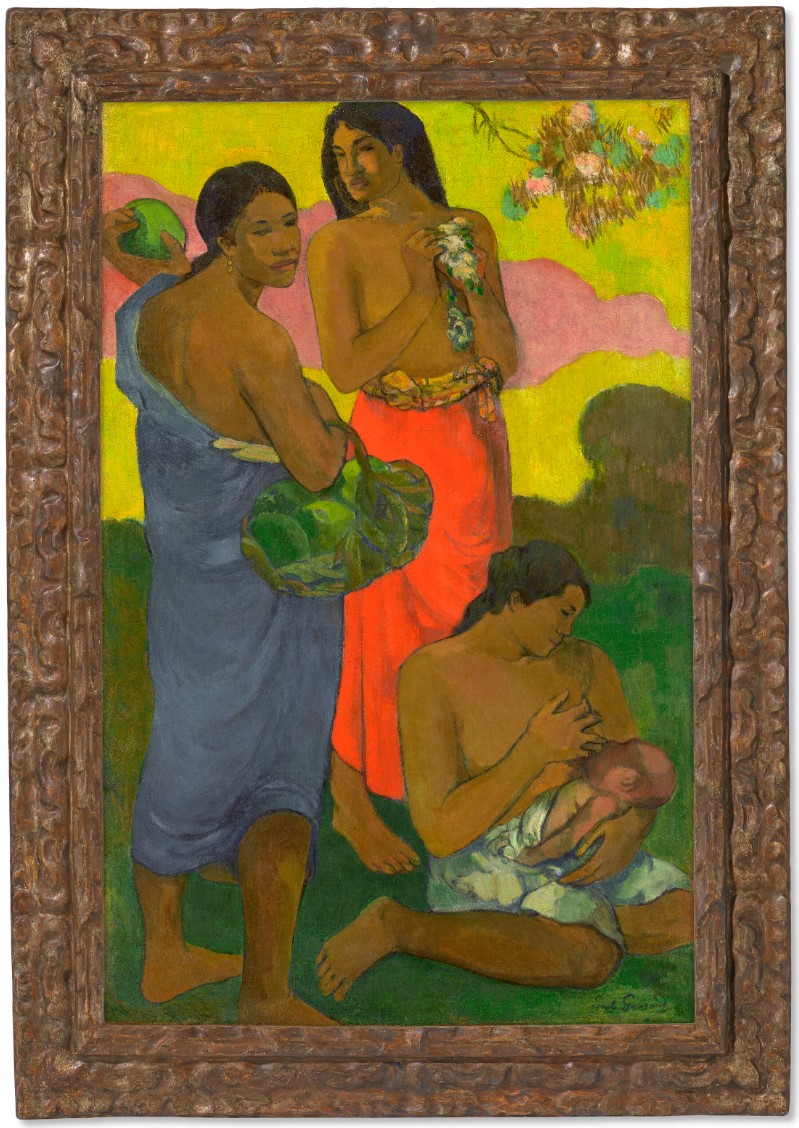
PAUL GAUGUIN (1848-1903)
Maternité II, 1899
Oil on burlap
94.7 x 61 cm (37 1/4 x 24 inches)
The monumental and mysterious Maternité II, painted in 1899, dates from A miraculous moment of Gauguin’s career. It is one of a closely related group of works that depict often classically posed, Tahitian women within paradisical settings—the rest of which are now in museum collections. Here, three women are pictured within a verdant, yet abstracted, Edenic realm. Seated on the ground is a mother nursing her baby. She is flanked, or perhaps protected, by two standing figures, one of whom holds a basket of fruit, the other a chain of flowers, offerings perhaps for their kneeling, Madonna-like companion. They both look outwards to meet the viewer, as if questioning their presence in regarding this quiet, intimate scene of motherhood. Taking the theme of maternity, a subject rich in art historical precedent, Gaugin masterfully transformed this motif into an exotic idyll, both personal and transcendent of a specific time and place. With this work Gauguin offers a timeless vision of femininity and motherhood, a verdant ode to fertility. A reflection of the importance it held for the artist is the fact that he chose to keep it in his possession until his death.
#6. Gustav Klimt
Birch Forest, 1903
Christie’s New-York: 9 November 2022
USD 104,585,000
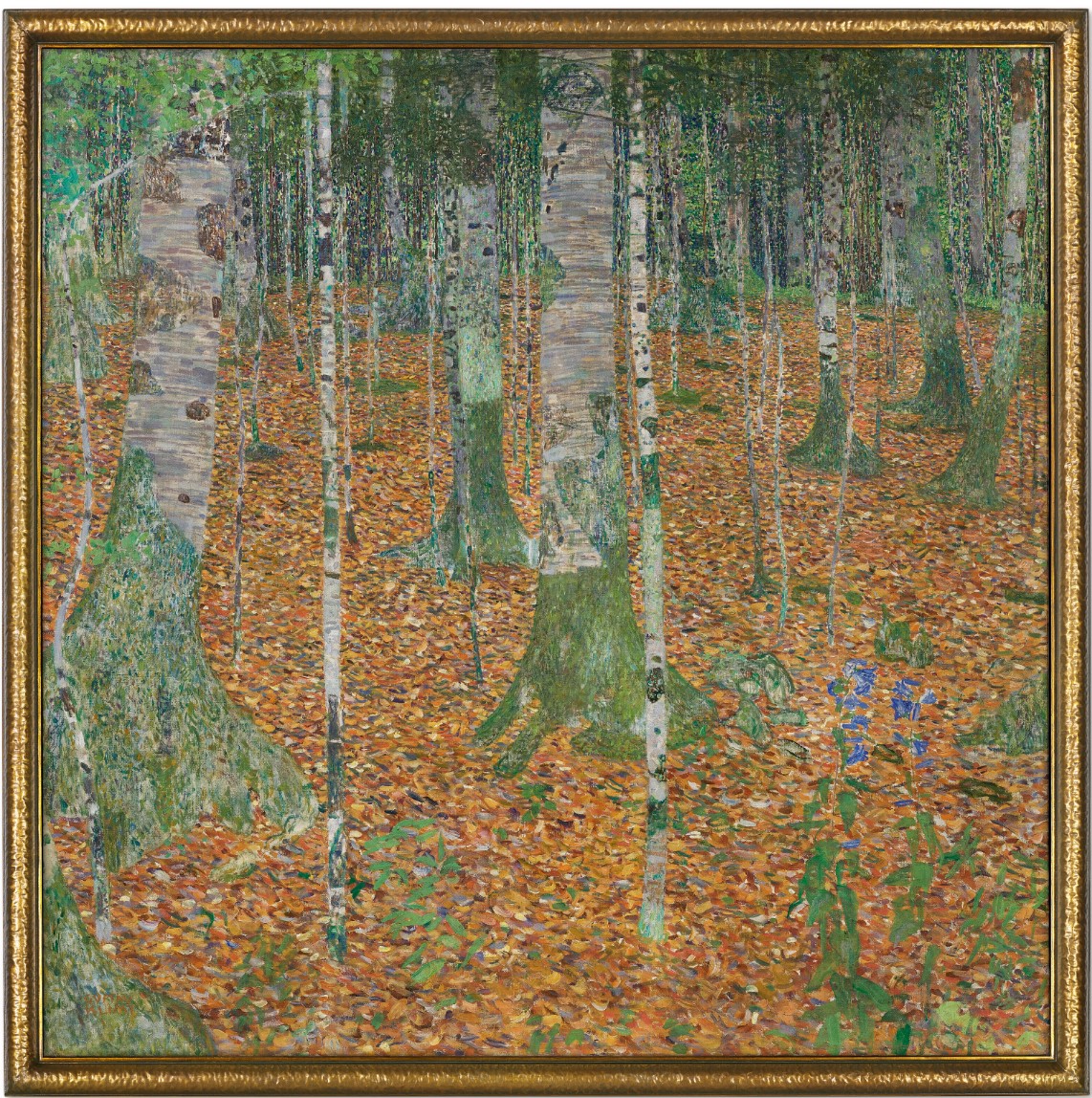
Birch Forest, 1903
Oil on canvas
110.1 x 109.8 cm (43 3/8 x 43 1/4 inches)
I get up early in the morning, usually around 6 am, sometimes earlier sometimes later. If I get up and the weather is fine I go into the nearby forest. I am painting a small beech grove, mixed with a few conifers,” so (Letter to M. Zimmerman, August 1903, quoted in S. Koja, ed., Gustav Klimt: Landscapes, Munich, 2006, p. 27). Filled with the stillness, mystery and timelessness that characterizes the greatest of Klimt’s landscapes, Birch Forest was painted during a retreat in the picturesque village of Litzlberg, situated on Lake Attersee in Austria, in the summer of 1903 . Here, Klimt has pictured a segment of a densely wooded birch forest with exquisite, meticulously rendered detail. The elegant, otherworldly silver trunks ascend, “like columns in a cathedral created by nature,” Johannes Dobai described, from a dappled bronze carpet of fallen leaves (Gustav Klimt Landscapes, London, 1988, p. 17). A multitude of hues, gold, russet, and sage make up this mosaic-like accumulation of strokes, a contrast to the deep green foliage that lines the top of the closely cropped canvas. With his distinctive artistic technique, including his newly adapted pointillist-style brushstrokes, Klimt transformed this quiet corner of a woods into a shimmering vision of subtle color, pattern and light.
#7. Lucian Freud
Large Interior, W11 (after Watteau), 1981-1983
Christie’s New-York: 9 November 2022
USD 86,265,000
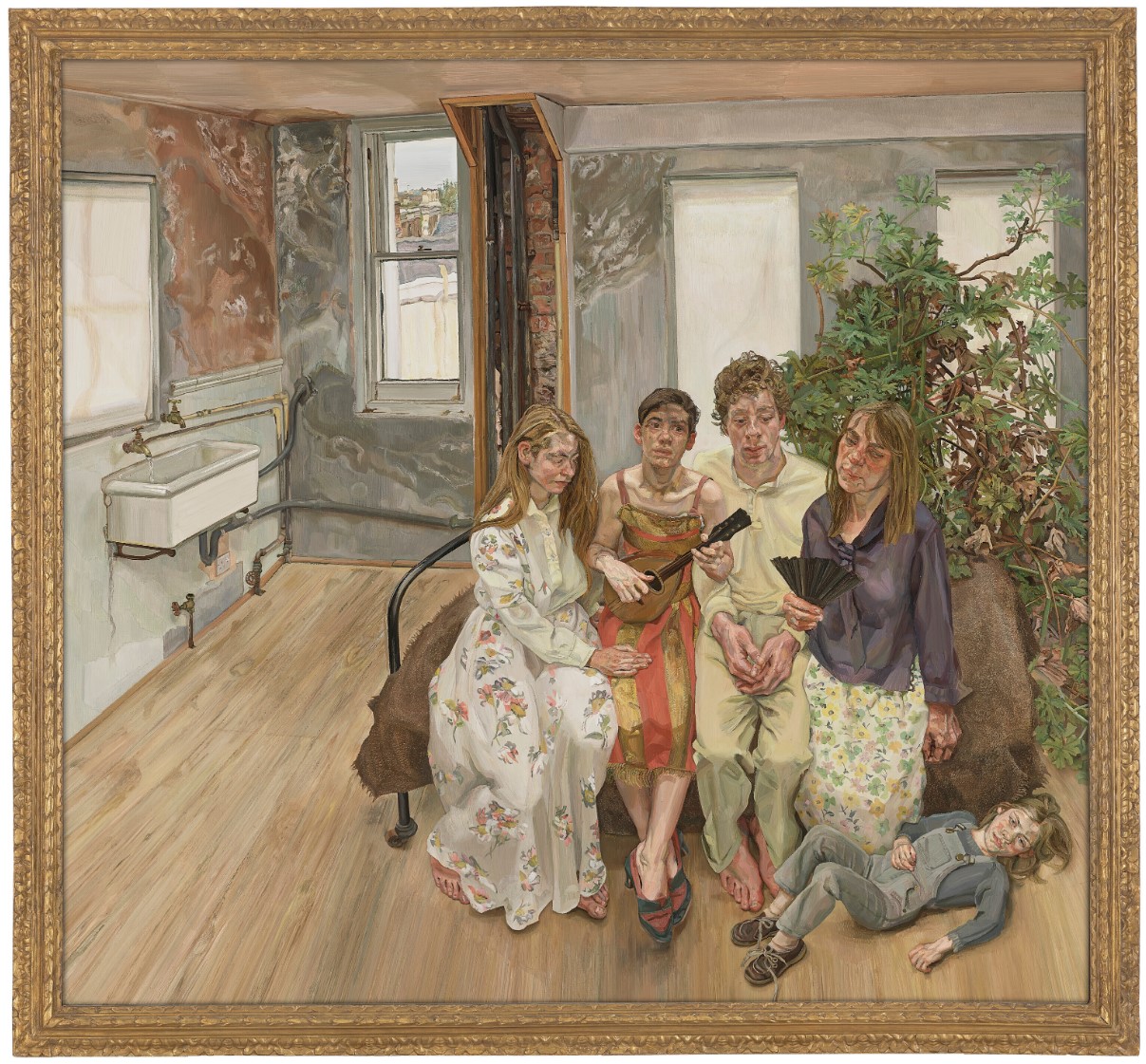
Large Interior, W11 (after Watteau), 1981-1983
Oil on canvas
72 1/4 x 78 inches (185.4 x 198.1 cm.)
#8. Andy Warhol
White Disaster [White Car Crash 19 Times], 1963
Sotheby’s New-York: 16 November 2022
USD 85,350,500
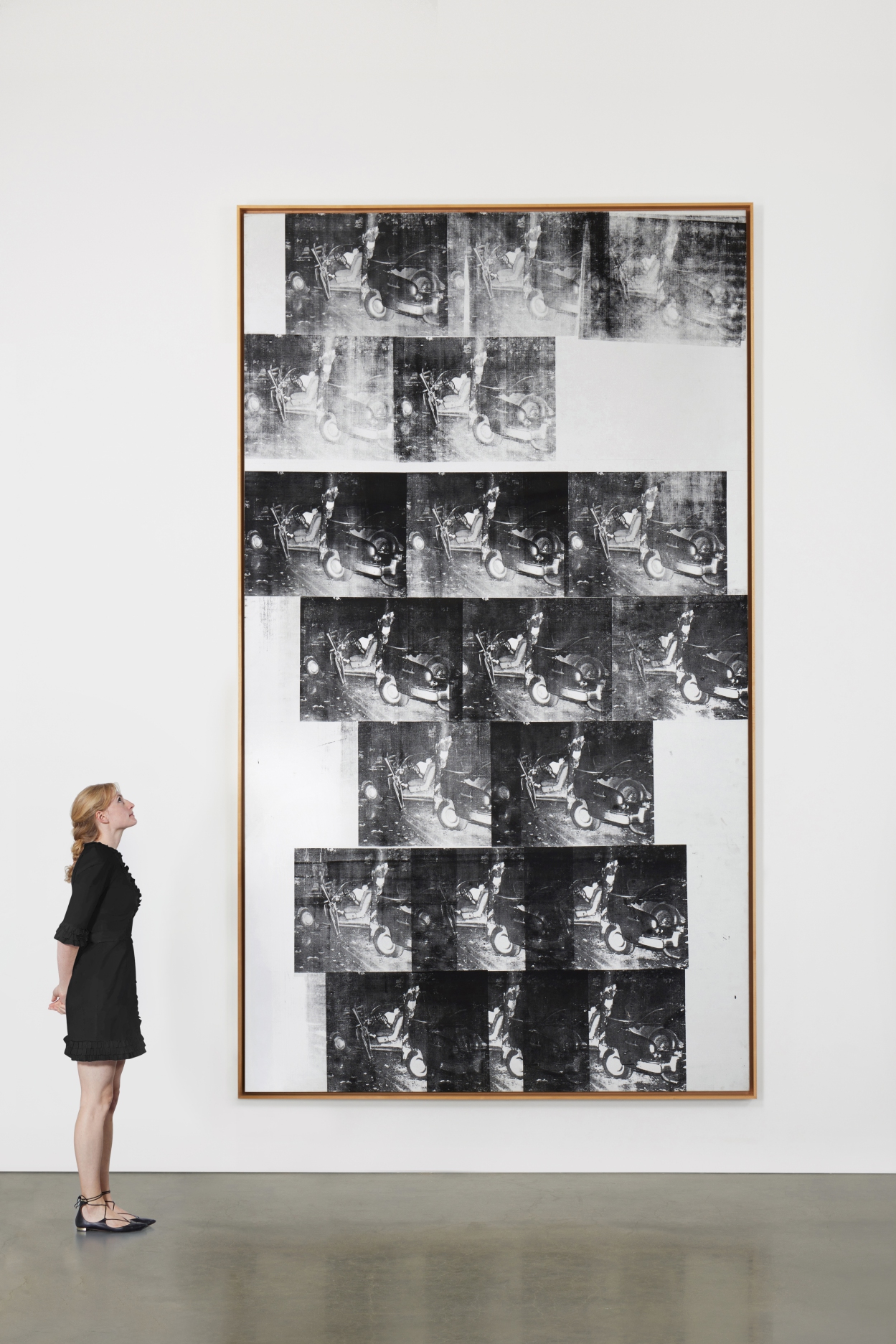
ANDY WARHOL (1928-1987)
White Disaster [White Car Crash 19 Times], 1963
Silkscreen ink and graphite on primed canvas
144 ¾ x 82 ⅞ inches (367.7 x 210.5 cm)
There are exceptionally few works of art that invoke great reverential awe, that impart by their very presence a sublime contemplation of the universal human experience; these are the artworks which come to define their present, and which not only speak to the fundamental concerns of humanity—but memorialize them for eternity. The present work is irrefutably one of these true masterpieces. A monumental altarpiece for the modern age, Andy Warhol’s White Disaster (White Car Crash 19 Times) from 1963 stands amongst the most radical and haunting artistic achievements of the twentieth century. Soaring above the viewer, Warhol’s towering canvas draws the viewer inward with an irresistible magnetism, while the white canvas emits a faintly miraculous glow, as if illuminated from within or perhaps above. Against the pure white, the dark rows of images, stacked and repeated with unerring purpose, draw our gaze ever upward in an experience of ascension: it is there that we are compelled to consider an image that is at once familiar and strange, personal and universal, beautiful yet terrible.
#9. Jean-Michel Basquiat
Untitled, 1982
Phillips New-York: 18 May 2022
USD 85,000,000
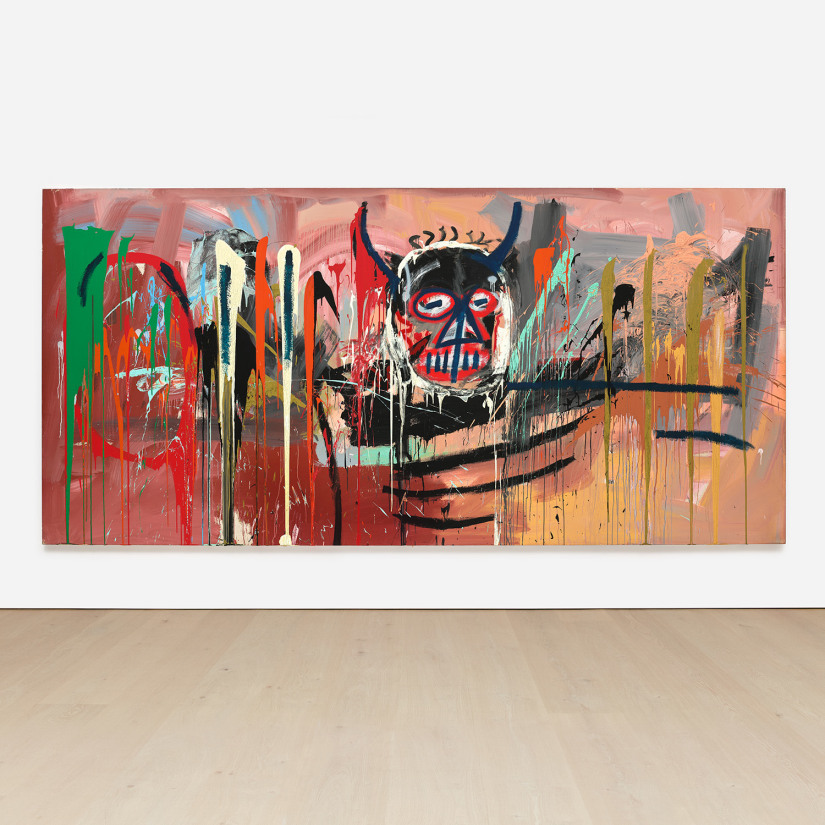
JEAN-MICHEL BASQUIAT
Untitled, 1982
Acrylic and spray-paint on canvas
94×197 inches (239.4×501 cm)
Coming from the esteemed collection of Japanese entrepreneur Yusaku Maezawa, Untitled is one of Jean-Michel Basquiat’s greatest masterpieces. Its potency and scale mark it as one of his most ambitious works: standing at almost eight feet tall and over 16 feet wide, it is among his largest canvases. Executed in 1982, the watershed year which shot the artist to international stardom, this tour de force is from a small series created in Modena, Italy, where Basquiat visited at the invitation of the dealer Emilio Mazzoli during two periods in the early 1980s. This pivotal chapter, today regarded as one of the most desirable of his career, marked his transition from “SAMO©”, the pseudonym Basquiat used as a street poet and tagger whose nom de plume had begun appearing all over New York’s disintegrating infrastructure in the 1970s, to an art world force to be reckoned with. 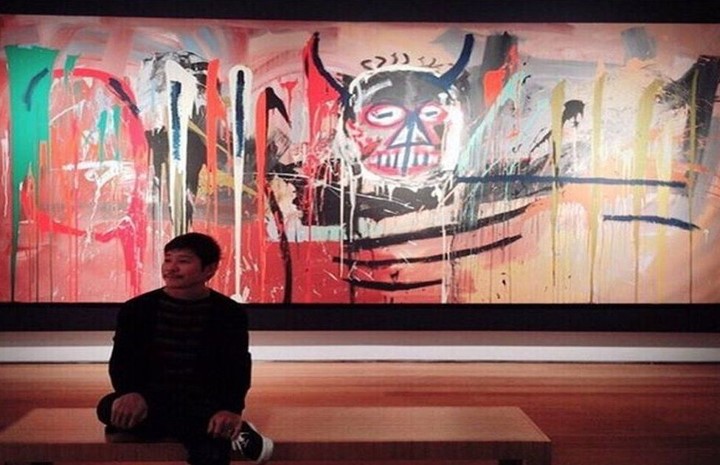
Indeed, Untitled’s vastness is so striking that it, coupled with the artist’s use of spray paint and geometric shapes, is suggestive of a large mural or graffiti-covered city wall—a fusion of street culture with “high art” that reflects a radical shift in his career and approach to art-making.
#10. Rene Magritte
L’Empire des lumieres, 1961
Sotheby’s London: 2 March 2022
GBP 59,422,000
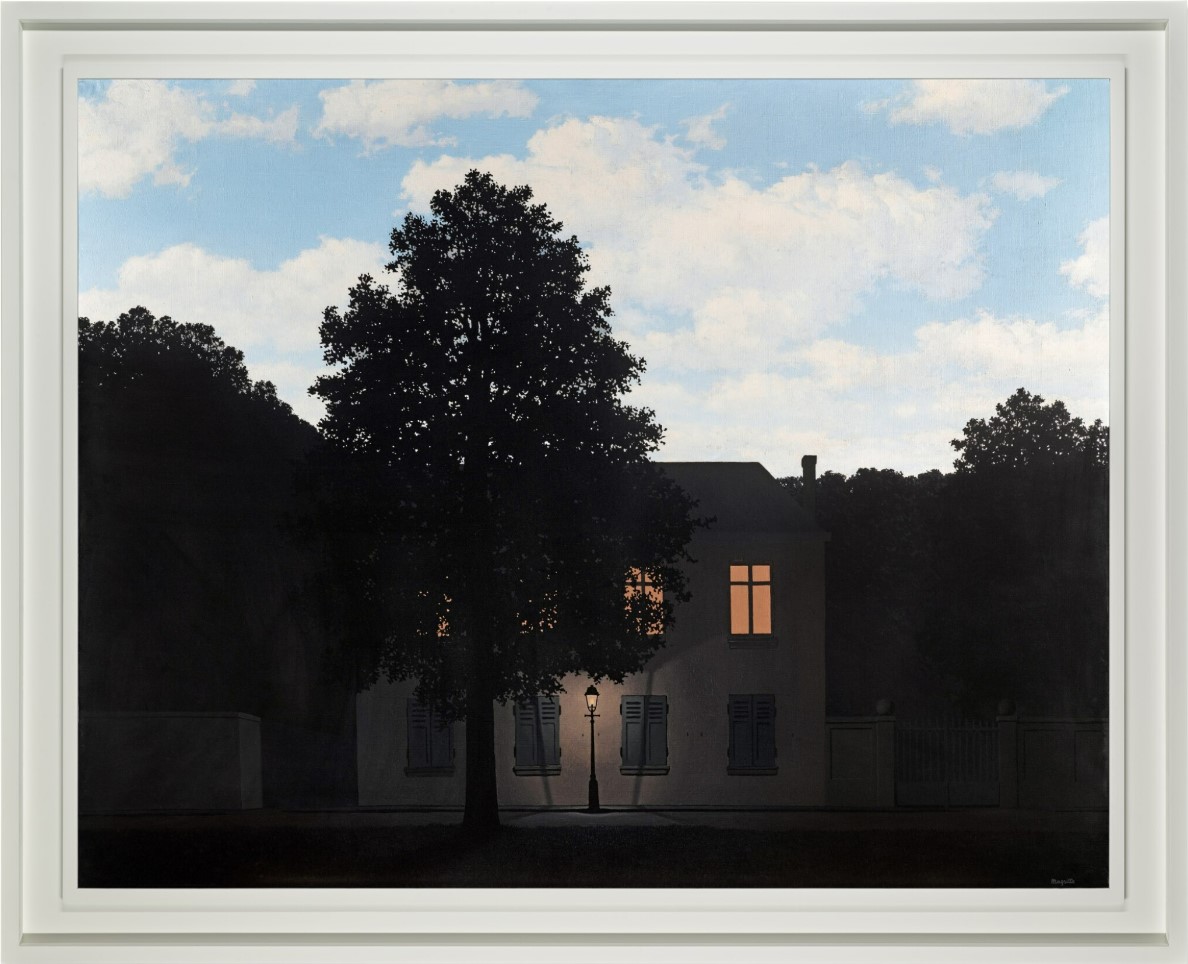
René Magritte (1898 – 1967)
L’empire des lumières, 1961
Oil on canvas
114.5 x 146cm (45 x 57 1/2 inches)
Signed Magritte (lower right); signed Magritte and titled on the reverse
The works from Magritte’s L’empire des lumières ‘series’ are among the most iconic images of twentieth century art. With their luminous combination of a bright blue sky set against an inky, dark night-time street, they combine immense visual impact with a profoundly conceptual approach. Alongside Magritte’s La Trahison des images (Ceci n’est pas une pipe) (fig. 1) and his bowler-hatted men, they are his most important images with an influence that stretches far beyond Surrealist circles. In them, Magritte achieves his most complex and sophisticated exploration of representation and reality. As the composition evolved through the 1950s and into the early 1960s, it would inspire and parallel developments in Conceptual and Pop Art (fig. 2) as well as becoming an archetypal image of twentieth century visual culture. Painted in 1961, the present work is among the largest and most refined iterations of the subject. It was painted by Magritte for his patron and friend Anne-Marie Gillion Crowet and has been in her collection ever since.
6. Top 10 Artists by Revenue
The Top 10 artists generated revenues of over USD 3.1 billion in 2022 through the sale of 7,481 artworks.
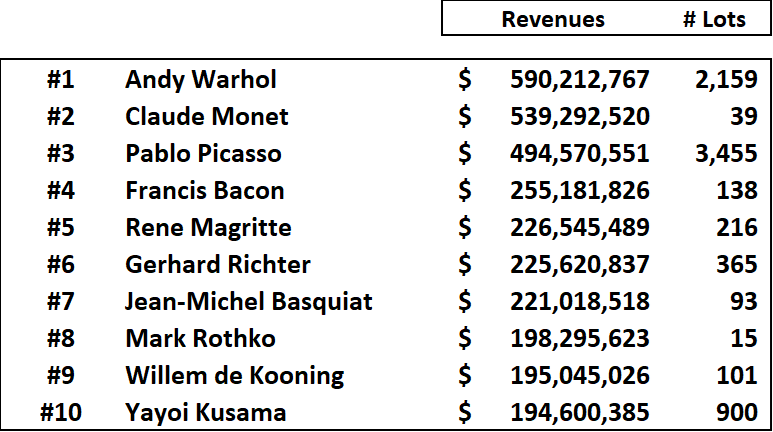
#1. Andy Warhol
Total Revenues: USD 590,212,767
2,159 Lots sold (800 unsold)
Top Lot: USD 195,040,000
NEW AUCTION RECORD FOR THE ARTIST
Andy Warhol is the most sold artist at auction in 2022. With 2,159 sold lots, he is also one of the most prolific artists of the 20th Century together with Pablo Picasso. Andy Warhol was a very prolific print-maker. The market for Warhol prints also developed substantially in 2022.
Shot Sage Blue Marilyn, dated 1962, became the most expensive artwork by a Post-War and Contemporary Artist to ever sell at auction.
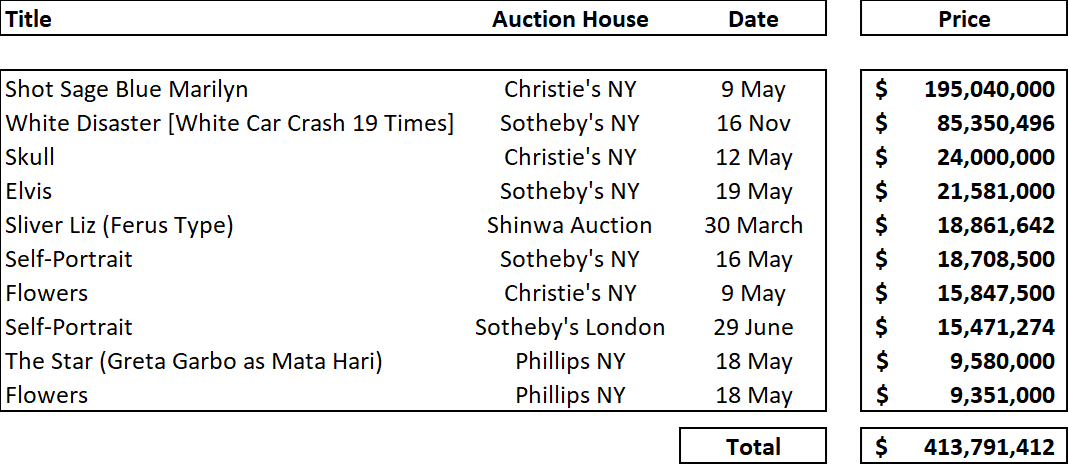
The top 3 lots sold in 2022 represent over 51.5% of total auction revenue for that year, the top 10 lots contribute to 70.1% of auction revenues. 44 artworks by Andy Warhol sold for over USD 1 million in 2022.
Shot Sage Blue Marilyn, 1964
Christie’s New-York: 9 May 2022
USD 195,040,000
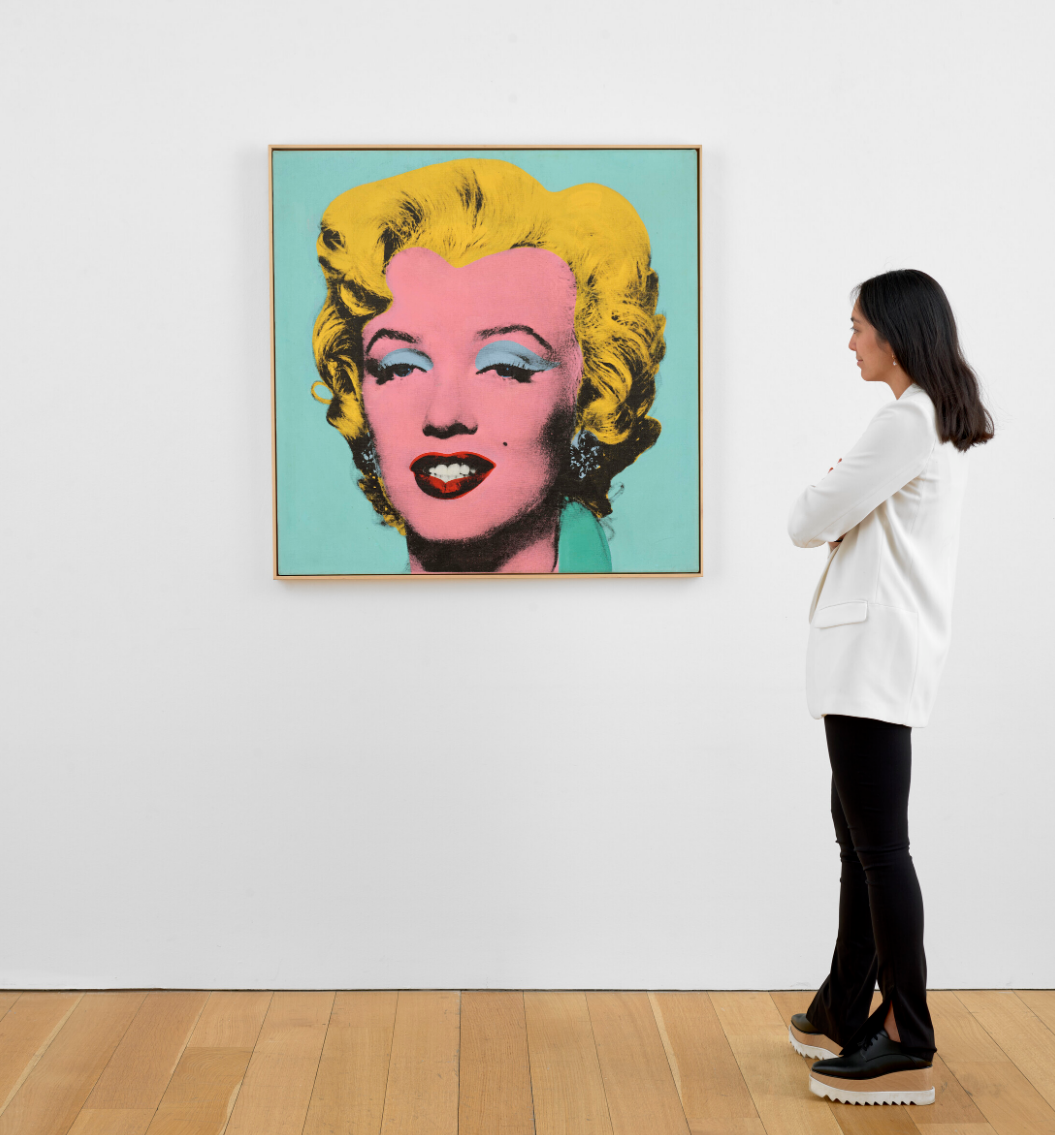
ANDY WARHOL
Shot Sage Blue Marilyn, 1964
Acrylic and silkscreen ink on linen
40×40 inches (101.6 x 101.6 cm)
Shot Sage Blue Marilyn is Warhol’s ultimate depiction of his ultimate muse; an image that surpasses the transient nature of the actress’s life and the fame she endured. Distinguished by an inner luminosity, the screen idol’s legendary beauty radiates out from the surface of this large-scale painting. Her blond hair, piercing eyes, full-lips, and even her famous beauty spot are all rendered in a clarity and detail that is absent from other examples of Warhol’s famous screening process. Here, the flatness and uniformity of previous renderings of her famous locks have been replaced by an expansive sweep of voluminous curls executed with such skill that individual strands are highlighted; even the renegade coils that have escaped her hairdresser’s attention—such as the one just above her real right ear—are perfectly captured by Warhol in consecutive layers of yellow and black paint. Marilyn’s arched eyebrows define generous arcs of blue eyeshadow, which in turn frame her piercing deep blue eyes.
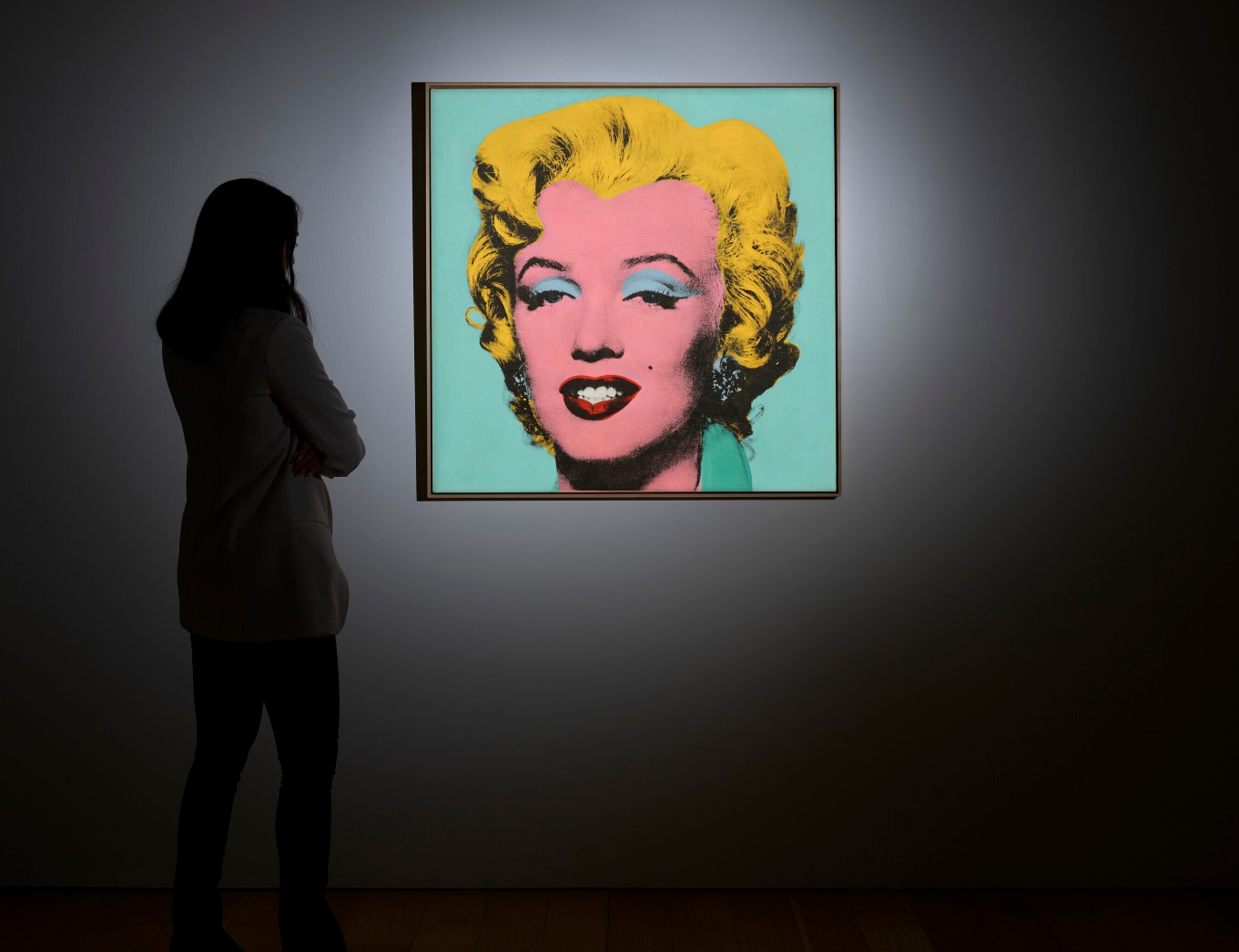
The outline of her red lipstick perfectly hugs the outline of her full red lips and—to her real left—the iconic beauty spot sits proudly on the surface of her cheek. In addition to the obvious facial features, the clarity of Marilyn’s image is enhanced by Warhol’s sophisticated use of chiaroscuro. At her left temple, embracing her cheek and shrouding her neck, soft shadows add a unrivalled degree of depth and plasticity to Warhol’s iconic image.
White Disaster [White Car Crash 19 Times], 1963
Sotheby’s New-York: 16 November 2022
USD 85,350,500
ANDY WARHOL (1928-1987)
White Disaster [White Car Crash 19 Times], 1963
Silkscreen ink and graphite on primed canvas
144 ¾ x 82 ⅞ inches (367.7 x 210.5 cm)
Across 19 overlapping frames, White Disaster (White Car Crash 19 Times) reveals the concerns which lie at the very heart of Warhol’s legendary artistic oeuvre: an unprecedented confrontation of life, death, and celebrity within our mass-media world, and the harrowing necessity of navigating a present in between. Executed in stark black and white pigment, Warhol memorializes a moment of anonymous, yet transformational tragedy. The repeated image, at times starkly crisp and at others hazily blurred, transcends specificity to become hauntingly universal, revealing to us the essential instant, the singular moment, that defines our human narrative. Painted in the 1960s—amongst the most culturally, socially and artistically transformative decades of the last hundred years—White Disaster (White Car Crash 19 Times) captures the dual promise and perils of the modern age, where constant motion can become eternal stillness in a moment. This is a History Painting for the modern era: a vital allegory of existence in the contemporary age that remains as incisive a cultural mirror for today as it was for the moment of its creation.
Skull, 1976
Christie’s New-York, 12 May 2022
USD 25,580,000
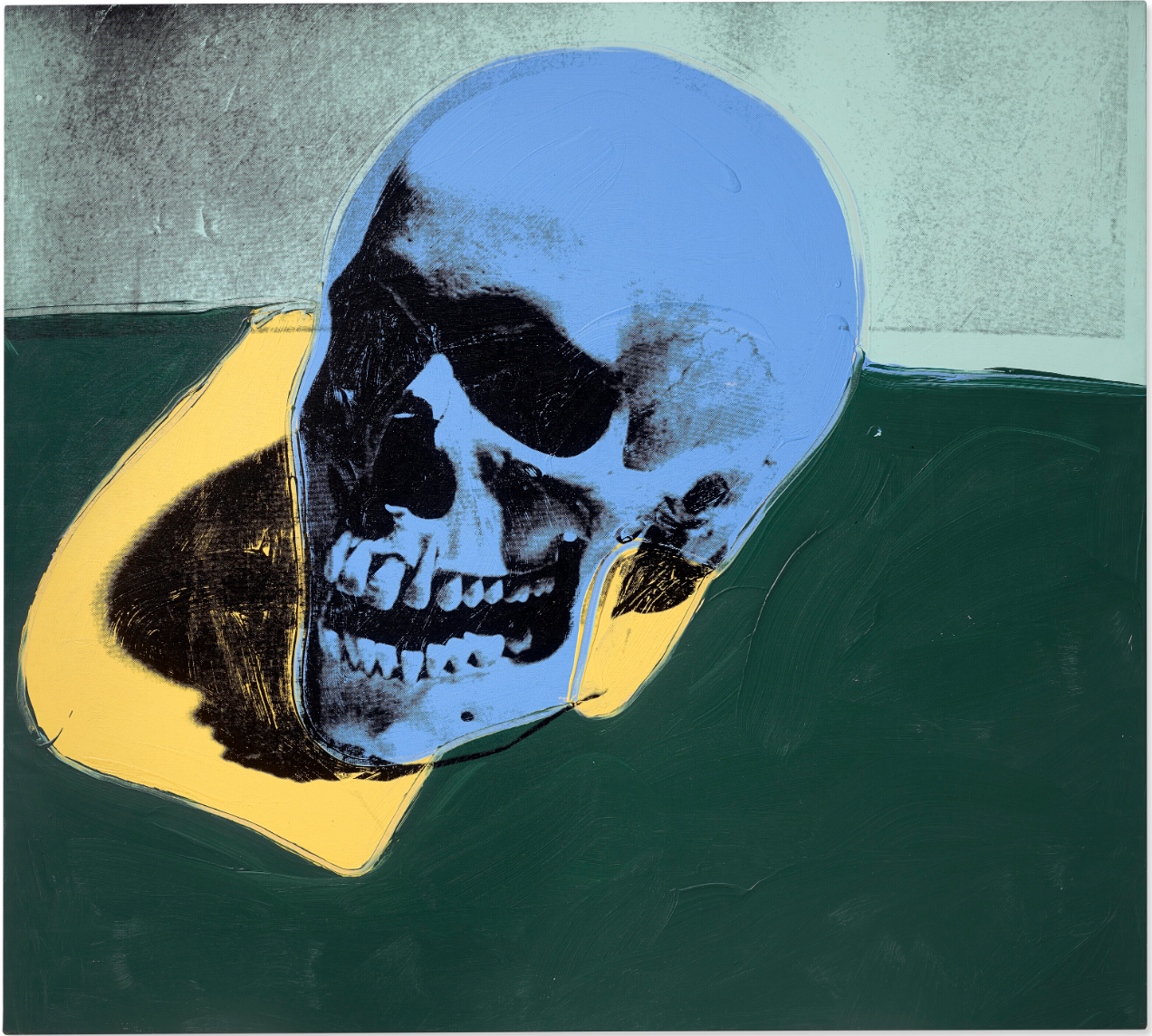
ANDY WARHOL
Skull, 1976
Acrylic and silkscreen ink on canvas
72×80 inches (182.9 x 203.2 cm)
The unequivocal champion of Pop Art, Andy Warhol’s legacy is packed with striking paintings celebrating the celebrity and consumer excesses of the late twentieth century. However, between the Hollywood portraits and iconic soup cans lies a darker, personal side to his oeuvre that touches on mortality and the universality of our shared human experience. Skull is a pivotal example of Warhol’s ability to transcend the surface trappings of capitalist society and delve deeper into his own ideas about death.
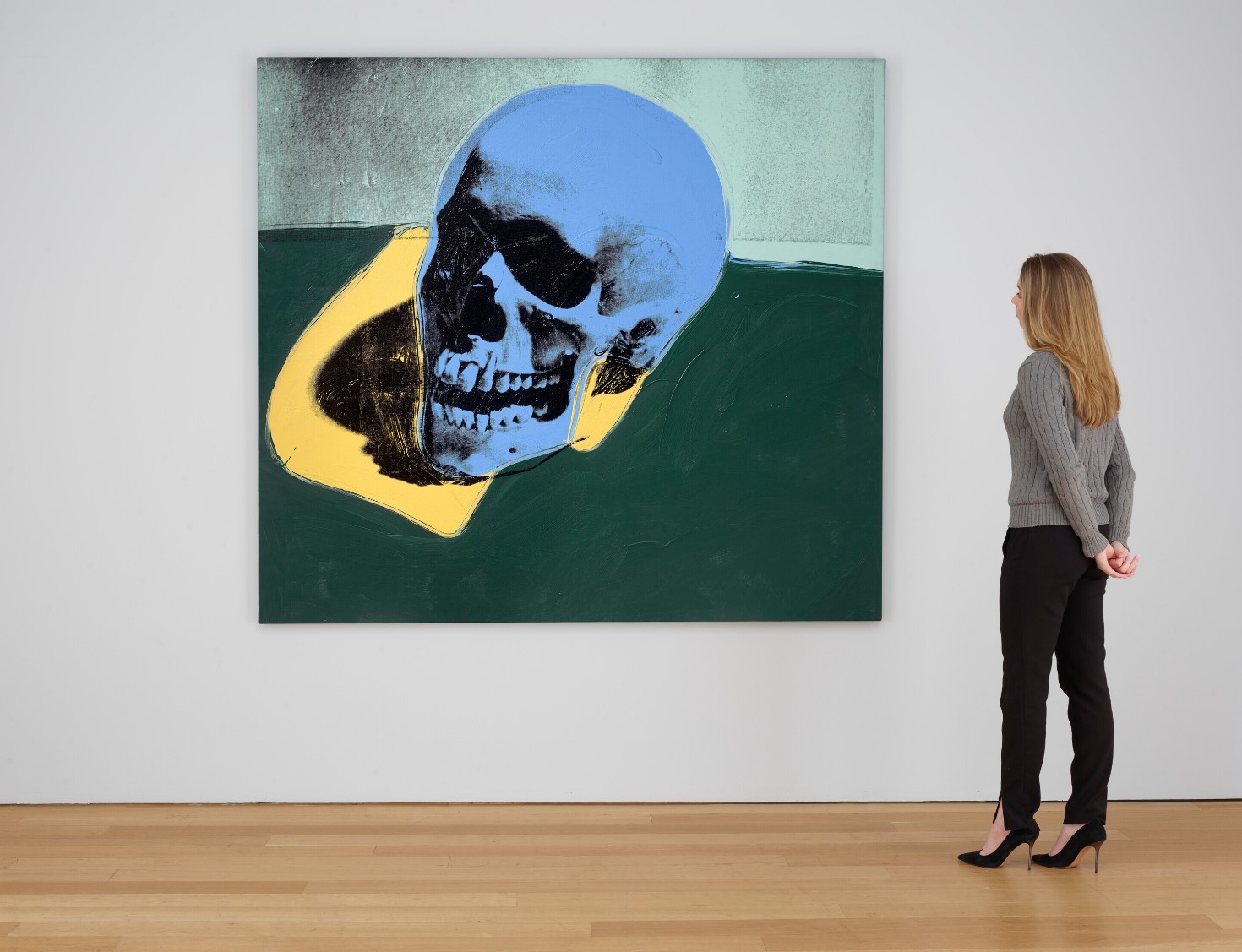
Rendered in stark swathes of color and overlaid with a black screen print, this monumental painting is a striking example of Warhol’s series of the same name. The titular object is highlighted in a powder blue that contrasts with the shocking butter yellow of its shadow. Playing with the color of light and dark areas within his compositions was key to the artist’s practice, and creating fields of pure color where one might expect deep shadow or bright reflection helps to flatten and transform the three-dimensional nature of the source object. Surrounding the blue and yellow center is a field of forest green that stretches up from the bottom of the canvas until it collides with an area of muted chartreuse. Warhol embraces some of his more painterly leanings in this composition, and the discernible, emotive brushwork serves as a counterpoint to the sharp outline of the screened image that makes up the main subject. Each work in the Skull series takes on the same image but is differentiated by Warhol’s painterly incursion. Of course, the juxtaposition of a human element within the screening process is not as flippant as Warhol would have one believe. Pairing the mutable brushstroke of the human artist with the apparently cold production of the silkscreen serves as a catalyst for probing the work’s humanity and Warhol’s own relationship to the subject of death.
Elvis, 1963
Sotheby’s New-York, 19 May 2022
USD 21,581,000
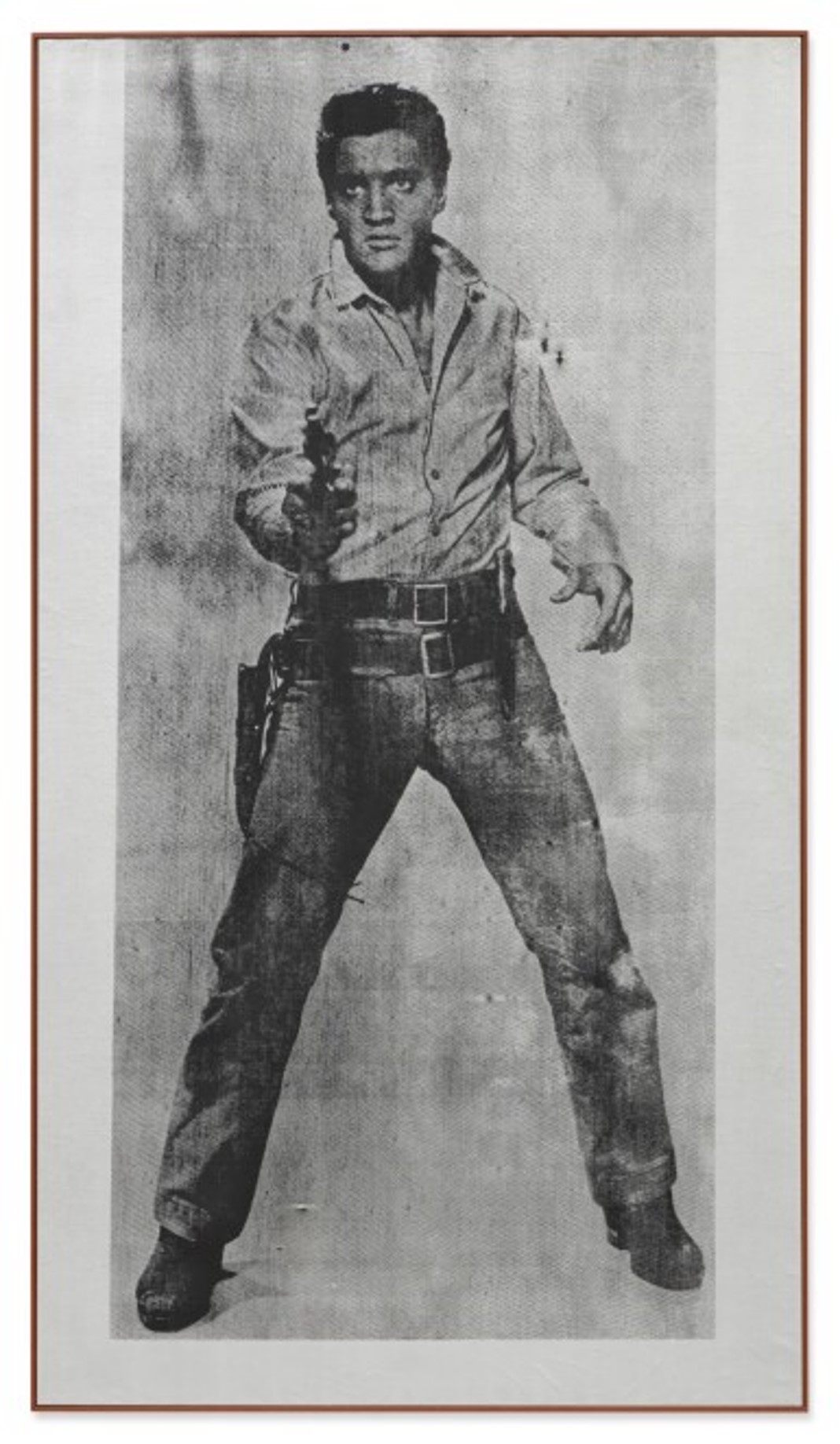
ANDY WARHOL
Elvis, 1963
Silkscreen ink and silver paint on canvas
82 3/4 x 46 1/4 inches (210.2 x 117.5 cm)
A gleaming visionary force, Andy Warhol’s Elvis embodies the artist’s singular ability to appropriate and manipulate familiar imagery to examine greater cultural currents and moments. Inspired by a publicity shot, Elvis Presley is adorned with a gunslinger for the western film Flaming Star and stands life-size, striking a pose that is instantly recognizable against the silver screen. Shimmering, the silver ground encapsulates the glistening brilliance of Hollywood, distinguished in Elvis by the exceptional silkscreen technique against the surface. In the summer of 1963, Andy Warhol was thirty-four years old and, having perfected his silkscreen technique the previous year, was beginning to transform the landscape of visual culture in America.
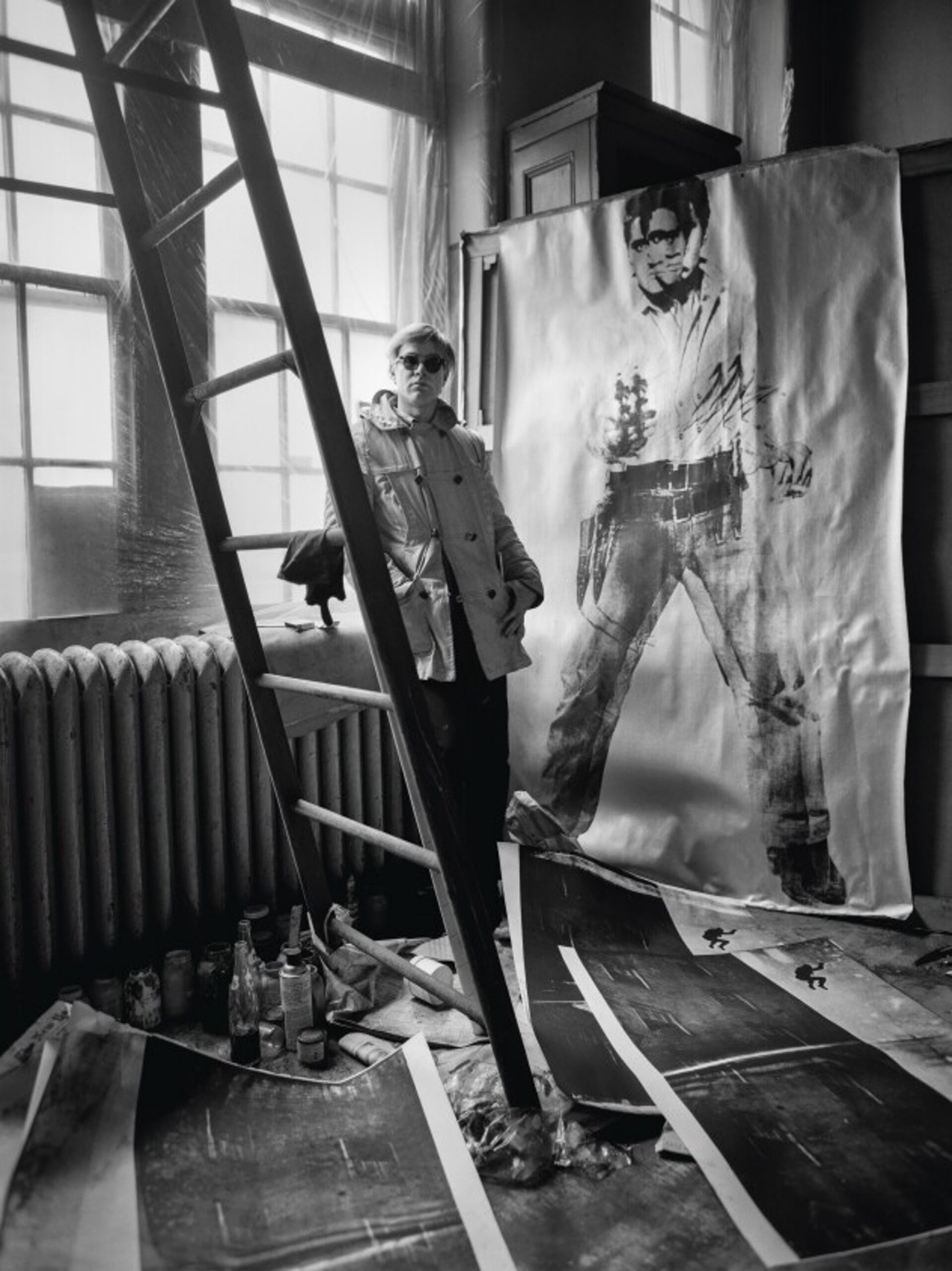
Appropriating the visual vernacular of consumerism, Warhol levelled his silkscreen at subjects he perceived as the most important concerns of contemporary life: icons such as Marilyn Monroe, Jackie Kennedy, Elizabeth Taylor, Marlon Brando, and, of course, Elvis Presley. Elvis was the ultimate subject for Warhol to explore popular culture and fame, a figure whose fame and image dominated the cultural zeitgeist of the 1950s and 1960s. Multiplying readymade images of these icons gleaned from newspapers, magazines and advertising, Warhol turned a mirror onto the contradictions of quotidian existence. With a playful theatricality and painterly illusionistic rendering of space, Elvis typifies Warhol’s career-long fascination with the immortality of celebrity and popular culture.
Self-Portrait, 1986
Sotheby’s New-York, 16 May 2022
USD 18,708,500
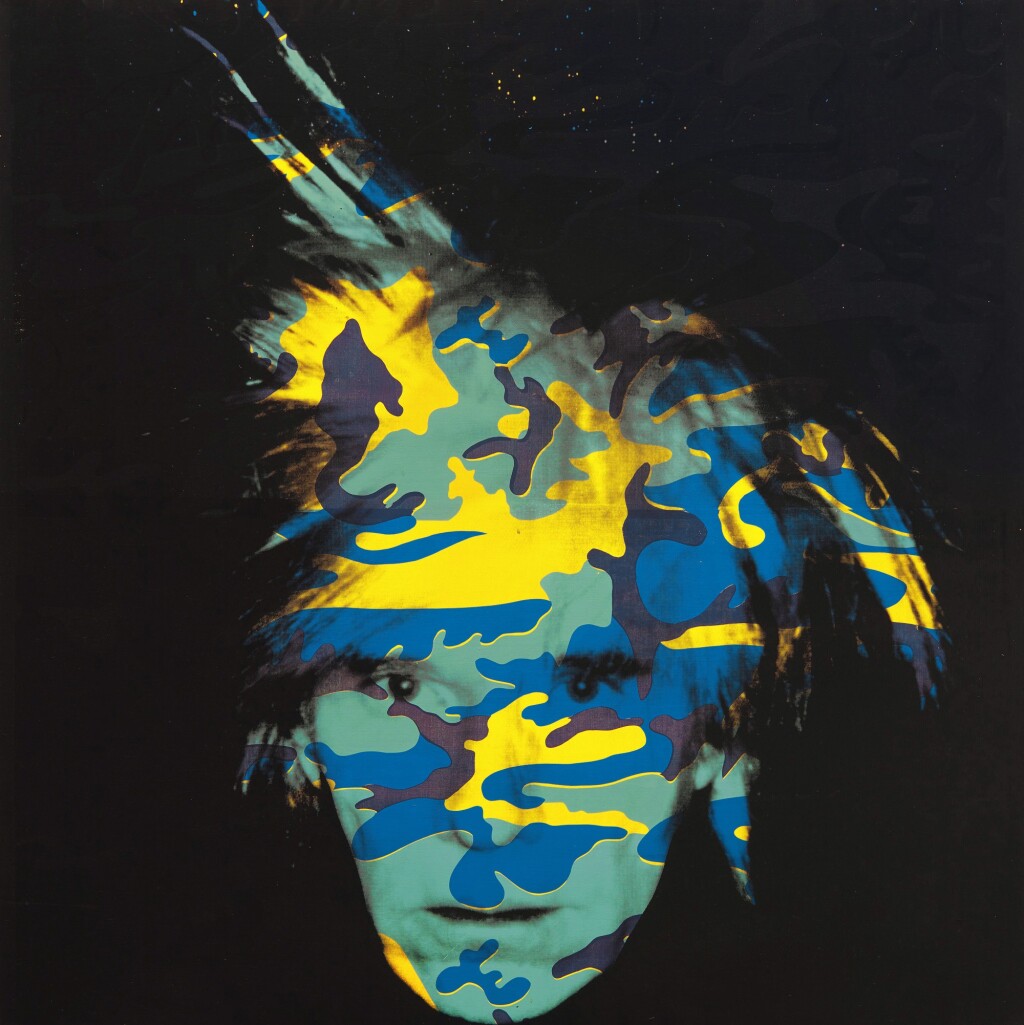
ANDY WARHOL
Self-Portrait, 1986
Acrylic and silkscreen ink on canvas
80×80 inches (203.2 x 203.5 cm)
In his 1986 Self Portrait, Andy Warhol offers himself as a monument to the ages: as Warhol the celebrity, ‘Warhol’ the artistic style, and Warhol the man. As the final major body of work that Warhol produced, painted just months before his untimely death in February of 1987, the 1986 Self Portraits are universally acknowledged as the Pop pioneer’s last great artistic gesture. The present work’s monumental 80-inch format—exceeded only in scale by seven known 108-inch examples—endows it with a unique status as both an engulfing cenotaph and a highly personal encounter. Attesting to the undeniable and universally acknowledged significance of these works, other Fright Wig self portraits of the same 80-inch format grace international museum collections including the Tate Gallery, London; the San Francisco Museum of Modern Art; the Andy Warhol Museum, Pittsburgh; the Baltimore Museum of Art; and the Carnegie Museum of Art, Pittsburgh. The present work is further distinguished for its inclusion in Warhol’s seminal 1986 exhibition of Self Portraits at Anthony d’Offay Gallery in London. Signifying the artist’s ultimate mastery of his long-sustained and famous silkscreen method, the perfected clarity of the transferred image in the present example is arguably unparalleled within his oeuvre. Like an anticipatory elegy, Self Portrait crafts the most iconic vision of the artist who, having been so obsessed with the transience of life and the enduring power of the image, finally faces his own looming mortality. In the present work, Warhol’s visage is presented to the viewer obscured by a veil of camouflage; the silkscreen camouflage overlay makes graphically evident the dichotomy of inner self and public self that pervaded Warhol’s enigmatic persona. This portrait of duality—the knowable and unknowable—is quintessential Warhol.
Flowers, 1964
Christie’s New-York: 9 May 2022
USD 15,847,500
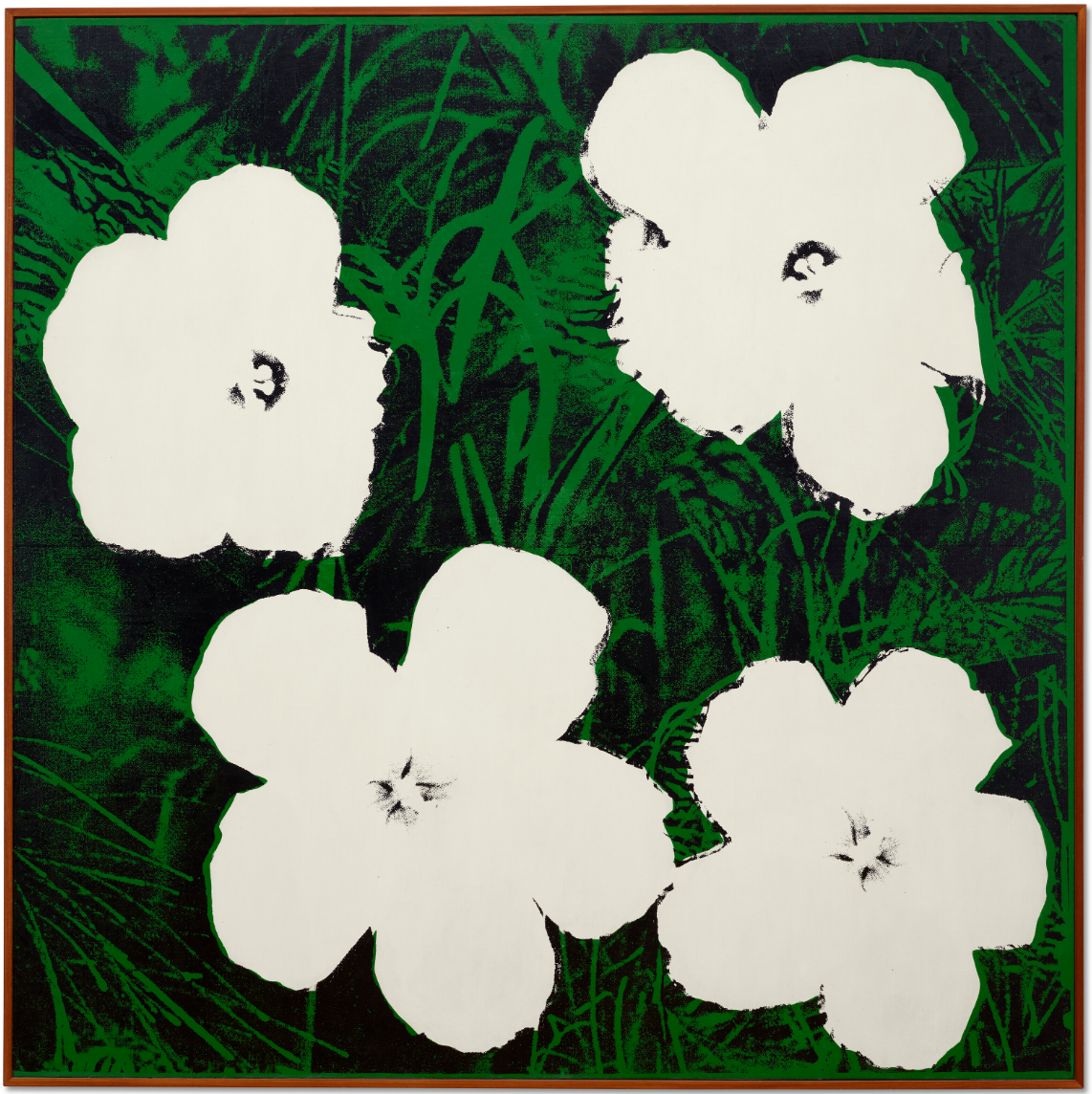
ANDY WARHOL
Flowers, 1964
Acrylic and silkscreen ink on linen
82x 81.5 inches (207.6×207 cm)
With its dazzling arrangement of four white blooms rendered on a spectacular 82 by 82 inch scale, Andy Warhol’s Flowers is a rare and majestic painting from one of the twentieth century’s most iconic bodies of work. Representing the largest square format within Warhol’s original 1964 series, it is one of just nine hand-embellished Flowers of this scale and crop recorded in the artist’s catalogue raisonné—two reside in the Andy Warhol Museum, Pittsburgh, with a further example held in the Hirshhorn Museum and Sculpture Garden, Washington D. C. The work was one of three of this size selected for Warhol’s historic show at Leo Castelli Gallery in 1964: a landmark, sell-out exhibition that would go on to become synonymous with the heyday of American Pop Art.
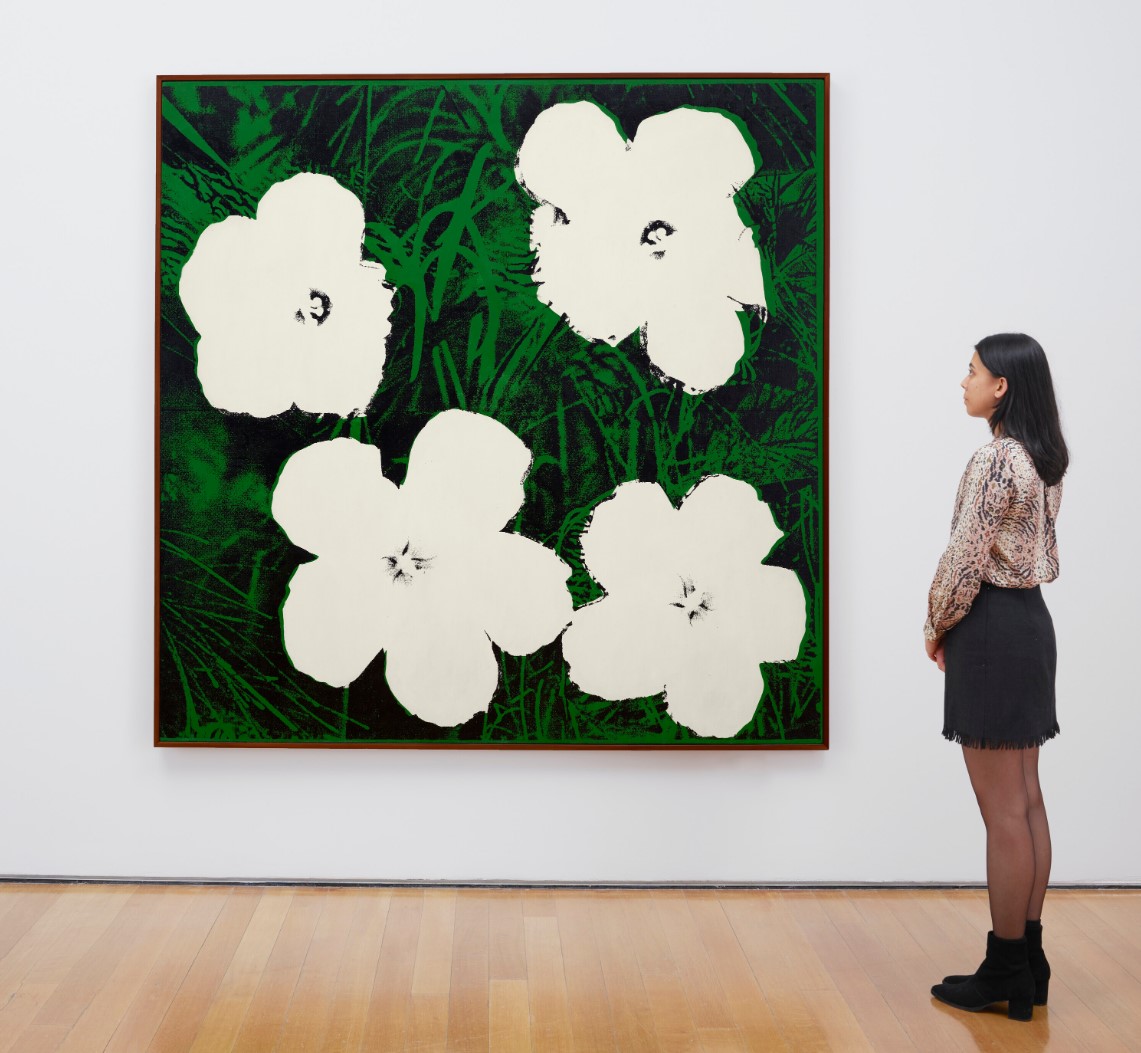
Here, in bold, luminous tones, was an image that spoke to the beauty and tragedy of modern life: a thrilling encounter between humankind and nature, riddled with tantalizing Warholian enigma. The present work is the only example of its scale to feature four white flowers, gleaming brightly like beacons against their deep green roots. Other smaller works with this color scheme are held in collections including the Solomon R. Guggenheim Museum, New York and the Menil Collection, Houston.
Phillips New-York: 18 May 2022
Estimated: USD 8,000,000 – 12,000,000
USD 9,351,000
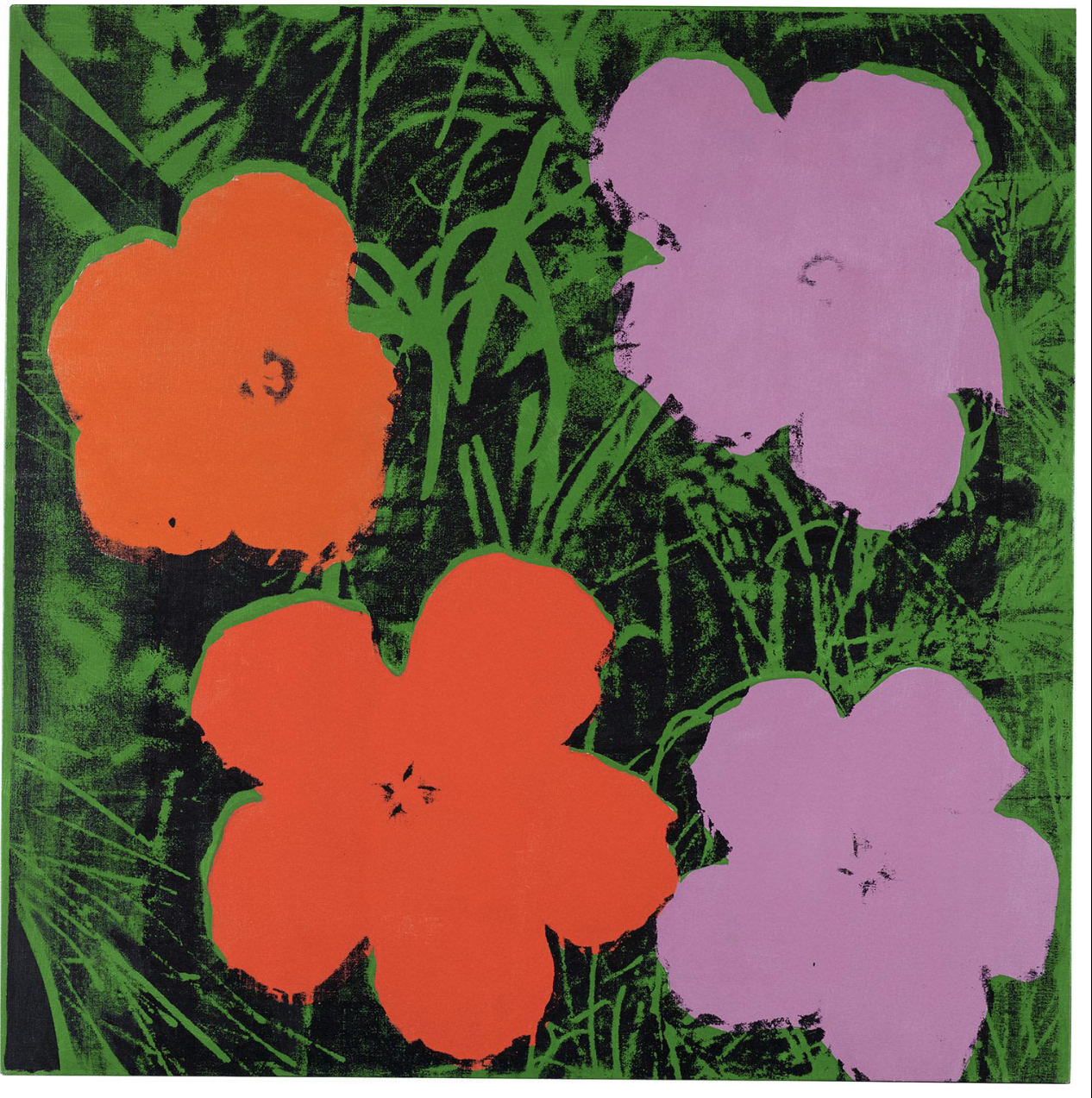
ANDY WARHOL
Flowers, 1964
Acrylic and silkscreen ink on canvas
48 x 47.9 inches (121.9 x 121.6 cm)
An exceptionally vibrant example from one of Andy Warhol’s most iconic series, Flowers radiates bursts of scarlet, cadmium red, and violet against a sea of emerald green. The present work, which was executed among his first Flowers in 1964, signaled a shift from his depictions of timely, instantly-recognizable branding to a more abstracted and timeless imagery—though, of course, still seizing source material mediated by popular culture and print magazines. Embracing a distinctive hyper-flatness that presaged Warhol’s later explorations in wallpaper, this body of work represented the culmination of his iconic Pop aesthetic before announcing his short-lived “retirement” from painting. Electric yet macabre, distinctive but mechanical, the Flowers marked a seminal chapter in Warhol’s career and are iconic relics of 20th century art history.
#2. Claude Monet
Revenues: USD 539,292,520
39 Lots sold (4 unsold)
Top Lot: USD 75,960,000
Claude Monet achieved its highest ever annual total at auction through the sale of only 39 artworks.
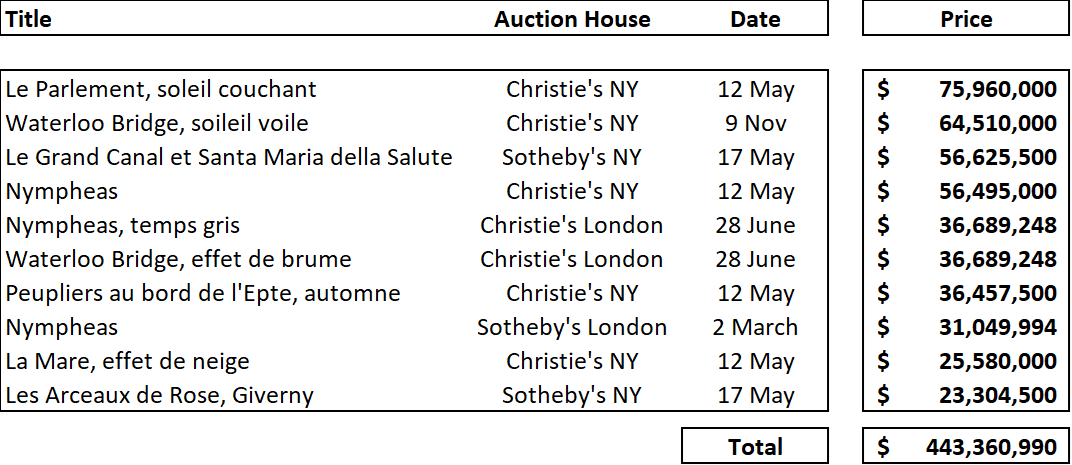
This result was fueled by the sale of major collections in 2022. Indeed, the Anne H. Bass collection had three major artworks from Claude Monet which sold for a total close to USD 170 million.
The top 3 lots contributed to 36.5% of the total auction revenues, whereas the top 10 lots represented just over 82% of total auction revenues for 2022.
Le Parlement Soleil Couchant, 1903
Christie’s New-York: 11 May 2022
USD 75,960,000
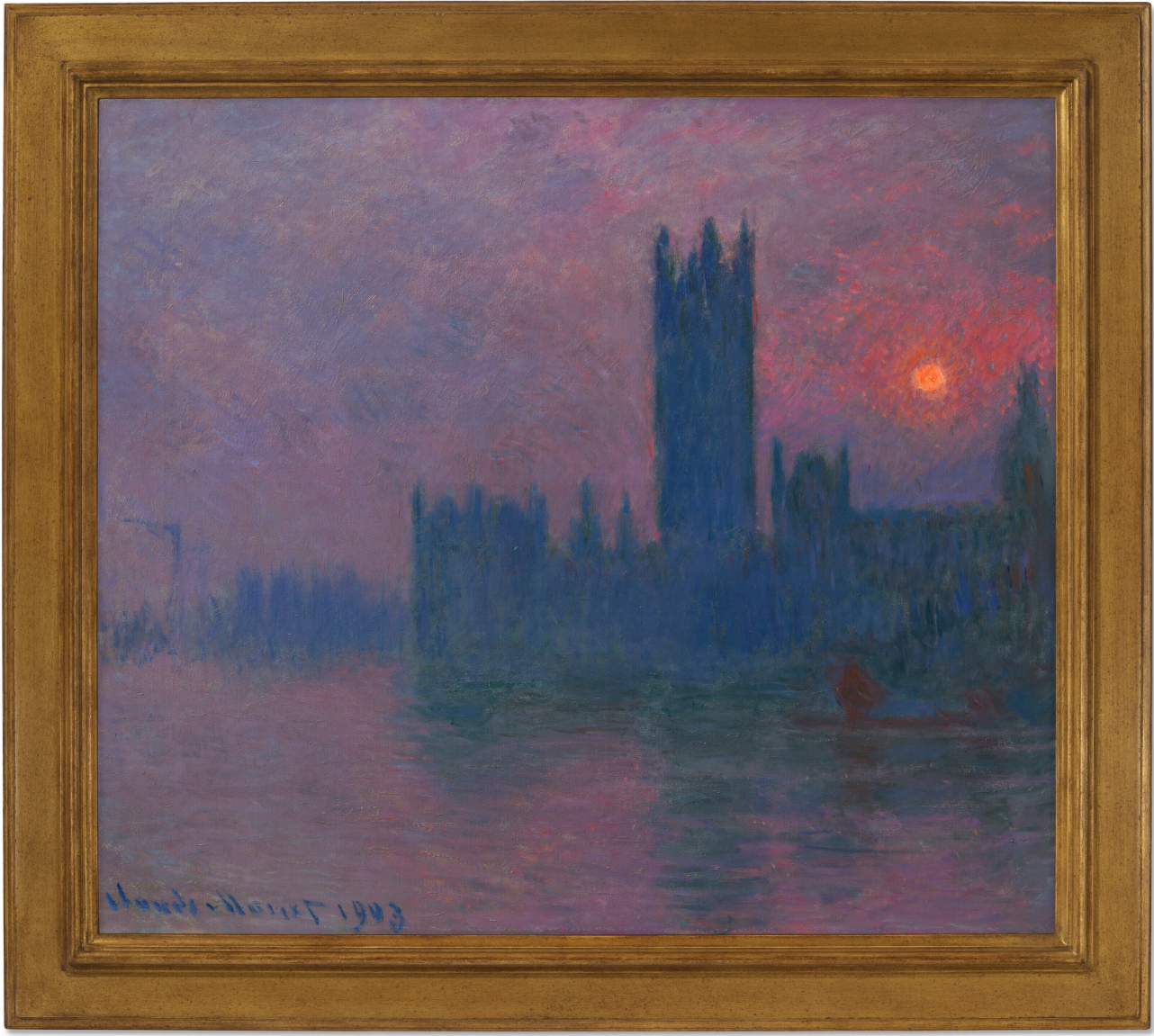
CLAUDE MONET
Le Parlement Soleil Couchant, 1903
Oil on canvas
81.2 x 92 cm (32×36 inches)
Claude Monet’s emphatic passion for England’s capital is magnificently displayed in his monumental, landmark series, the Vues de Londres. Started in London in 1899 and completed in Giverny in 1904, this series remains today among his greatest achievements, as he transformed the city into magical, elegiac visions at once timeless and modern. Charing Cross Bridge, Waterloo Bridge, and the Houses of Parliament served as the principal subjects of this seminal group, each landmark a pretext for symphonic, often near abstract combinations of light and color. A host of both subtle and dramatic meteorological conditions, from the soft, gray morning light, to spectacular, fog-filled evening skies filled with pink, purple, and orange by the setting sun, gave rise to a theater of effects that Monet reveled in from his vantage point at the Savoy Hotel and St. Thomas’s Hospital. The largest series of paintings the artist had yet produced, numbering almost a hundred canvases, the Vues de Londres pushed Monet to the extremes of his artistic powers, testing the fundamental Impressionist tenet of capturing the ephemeral, fleeting atmospheric effects of nature. Crowning this series are the nineteen paintings of the Houses of Parliament, of which Le Parlement, soleil couchant is one of the finest. This painting shows the golden orb of the sun, having burnt through the impenetrable cloak of clouds and fog to cast the scene into an atmospheric array of jewel-like violets and lilacs, cobalt and inky blues, and deep pink tones. Dwarfing the tugboat that noiselessly crosses the river, the majestic, windowless silhouette of the Houses of Parliament appears mystical, the rising and falling pattern of towers seemingly both emerging from the sulphurous light and at the same time, dissolving into the expansive, still waters of the Thames, London’s silent witness of epochs past.
Waterloo Bridge, soleil voilé, 1899-1903
Christie’s New-York: 9 November 2022
USD 64,510,000
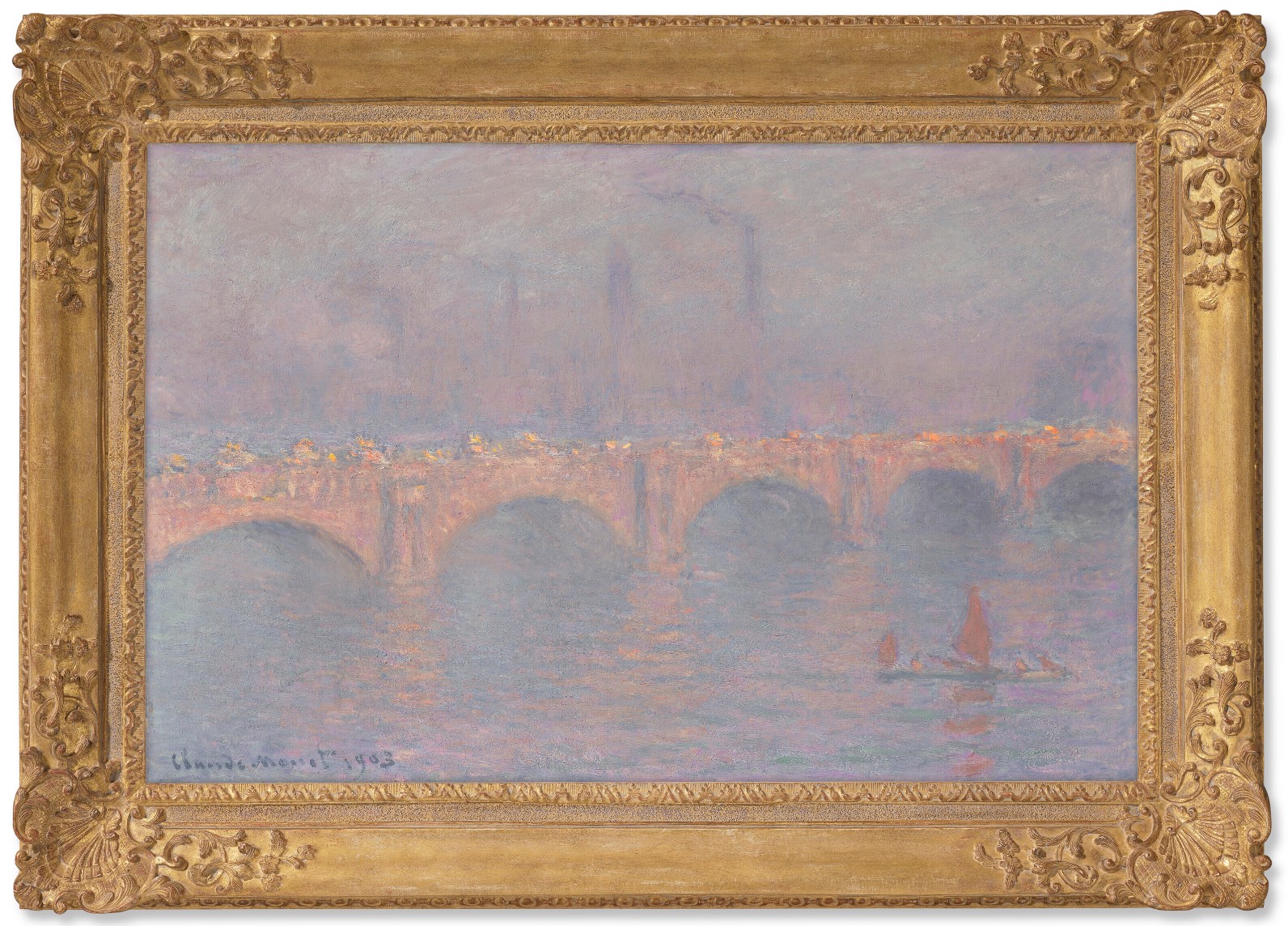
CLAUDE MONET (1840-1926)
Waterloo Bridge, soleil voilé, 1899-1903
Oil on canvas
65.4 x 100 cm (25 3/4 x 39 1/2 inches)
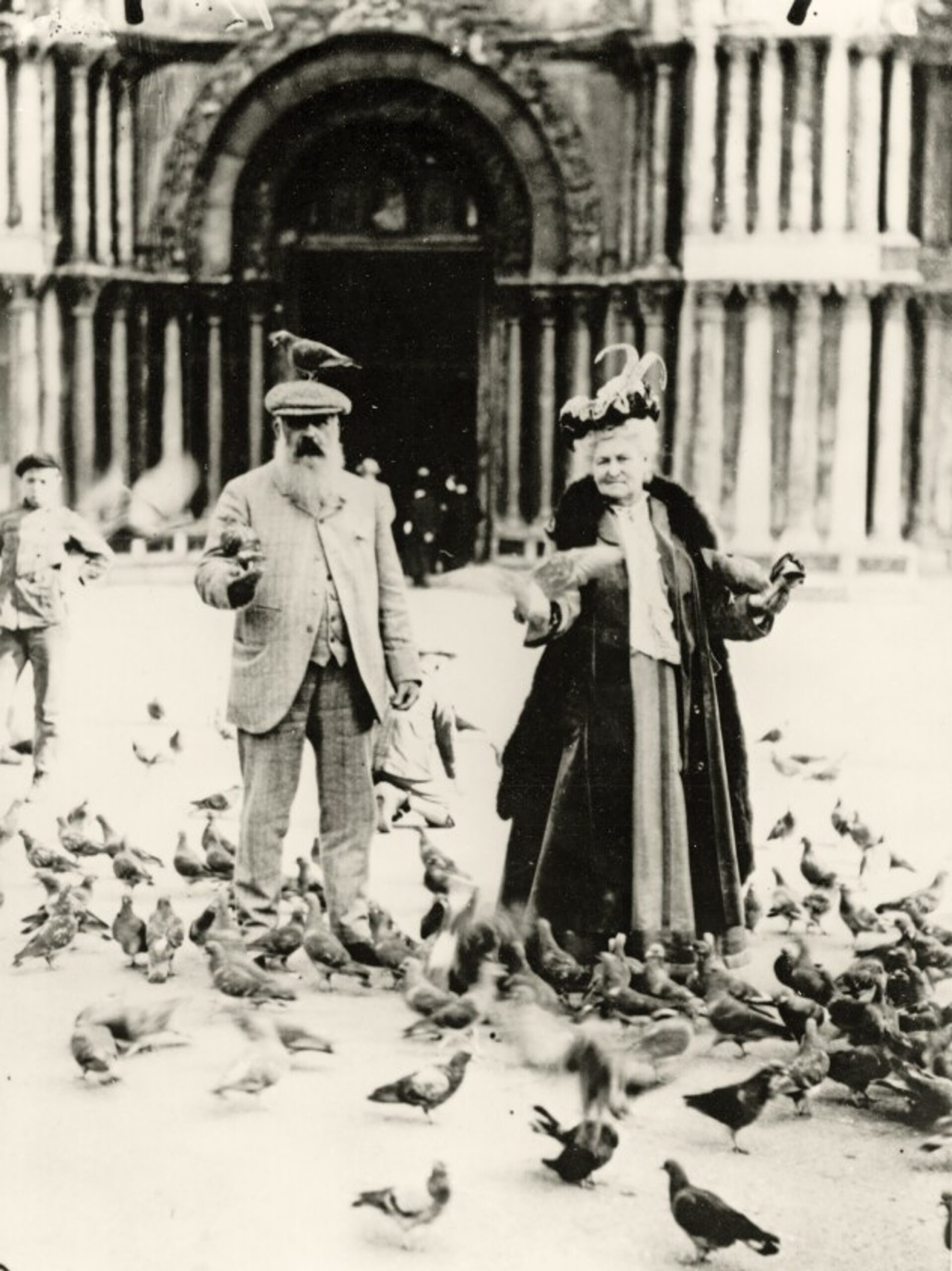
In 1899, Claude Monet began work on what would become the largest body of paintings he had yet produced. The artist had arrived in London on 15 September of this year, accompanied by his wife, Alice, and step-daughter, Germaine Hoschedé. The purpose of this trip was for the family to visit Michel Monet, the son of the artist, who was staying in the capital at the time to improve his English. Monet, however, had long been contemplating a painting campaign in the city, and, though this trip was purportedly a holiday, he had brought his paint supplies with him. Staying on the sixth floor of the fashionable Savoy Hotel, which stood on the banks of the Thames, between Waterloo Bridge and Charing Cross Bridge with views of the Houses of Parliament beyond, Monet was instantly inspired. What was initially supposed to be a month-long holiday became a six-week trip. Leaving his family to sightsee together by day, he converted one of the rooms of their suite into a studio and commenced the great series of works known as the Vues de Londres. From his hotel window, the heart of London stretched before him, the sky frequently filled with the capital’s notorious fog, or by contrast, bathed in the soft autumnal light.
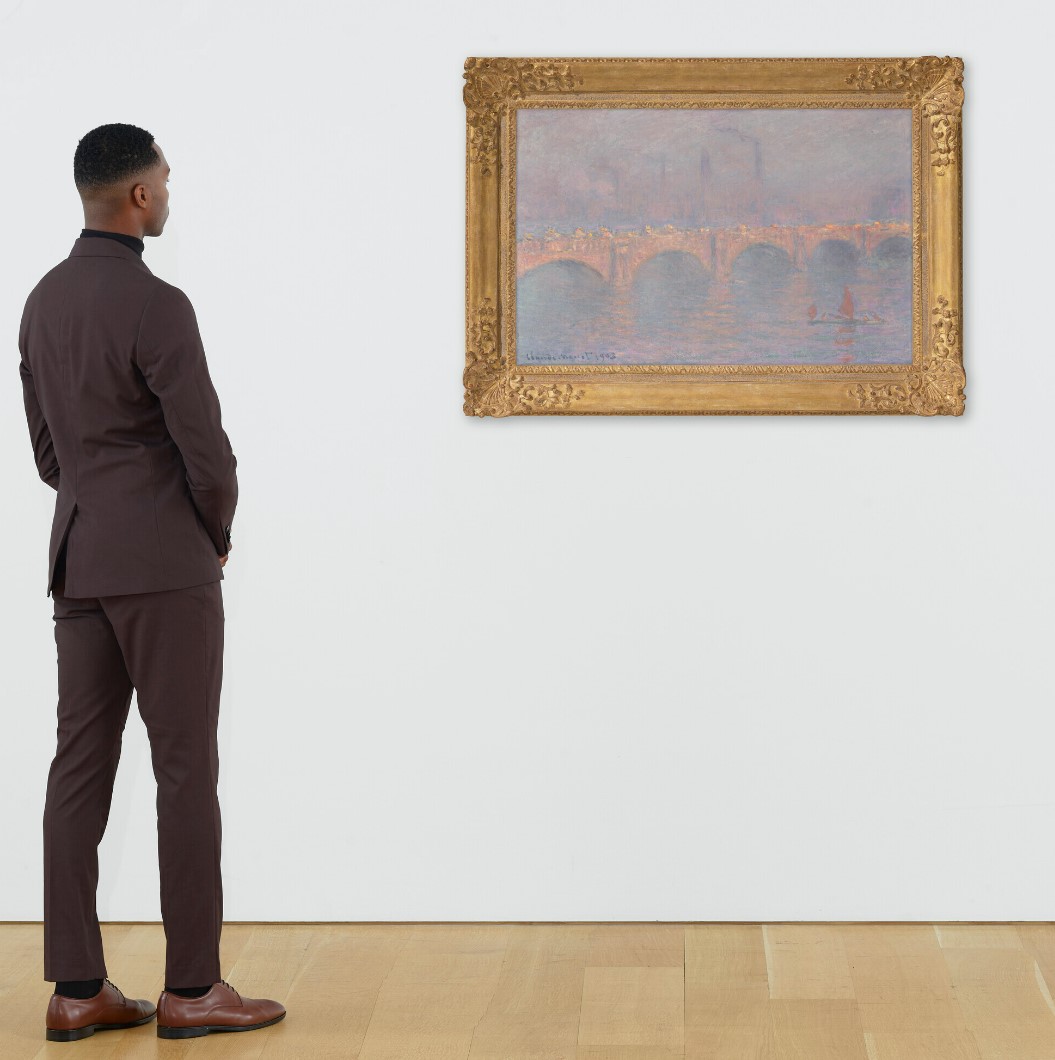
Rendered with a richly worked, multi-layered and multi-hued haze of delicate lilac, blue and violet tones, Waterloo Bridge, soleil voilé captures the river in the afternoon, as the westerly moving sun penetrated the dense atmosphere that had built up over the course of the day to gently light up the wide arches of the bridge. Sky, land and water are painted with the same palette, as Monet transformed the bustling urban cityscape into a delicate harmony of color and light. Specific anecdotal detail has been softened, immersed in the evanescent haze of smoke and fog that Monet loved so much. While a single boat moves silently across the still waters, the reflections of its red sails cascading down the river in bold strokes, a cavalcade of carriages and cars cross the bridge in a glittering procession, their lights gleaming amid the soft blue and lilac world that Monet has conjured.
Le Grand Canal et Santa Maria della Salute, 1908
Sotheby’s New-York: 17 May 2022
USD 56,625,500
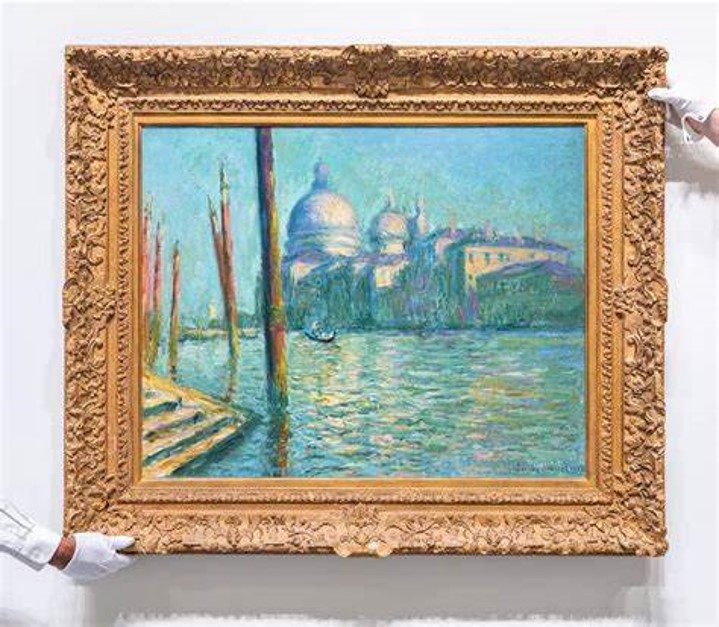
CLAUDE MONET
Le Grand Canal et Santa Maria della Salute, 1908
Oil on canvas
73.5×92.5 cm (29×36.5 inches)
Sotheby’s New-York: 17 May 2022
USD 56,625,500
Le Grand Canal et Santa Maria della Salute is a masterpiece not only from within Claude Monet’s Venice series but also from his entire artistic output. A shimmering, luminescent view of the Grand Canal and Santa Maria della Salute, the present canvas is one of the finest works created during the artist’s Venetian sojourn and presents a daring encapsulation of the traits that make Monet one of the most unique and visionary artistic voices of the twentieth century. Up until almost the day of his and his wife Alice’s departure, Monet dragged his feet in going to Venice. Initially conceived as a vacation from painting, in the past five years Monet had completed roughly one-hundred Nymphéas canvases, within a week of their arrival the artist shifted in tone from finding Venice “too beautiful to paint” to a painting campaign that would result in nearly forty oils created from a number of vantage points throughout the storied city.
Le Grand Canal et Santa Maria della Salute comes from a discrete group of six canvases painted from the steps of the Palazzo Barbaro looking across and down the Grand Canal towards Santa Maria della Salute. The present work is the finest example of the six views, two of which are held in museum collections and four of which are held privately. Establishing in advance the conditions of observation and the context of his experimentation, Monet used Venice as another pictorial laboratory, gauging changes in the ‘envelope’ (the indefinable Venetian ‘haze’) under identical circumstances.
Nympheas, 1907
Christie’s New-York: 11 May 2022
USD 56,495,000
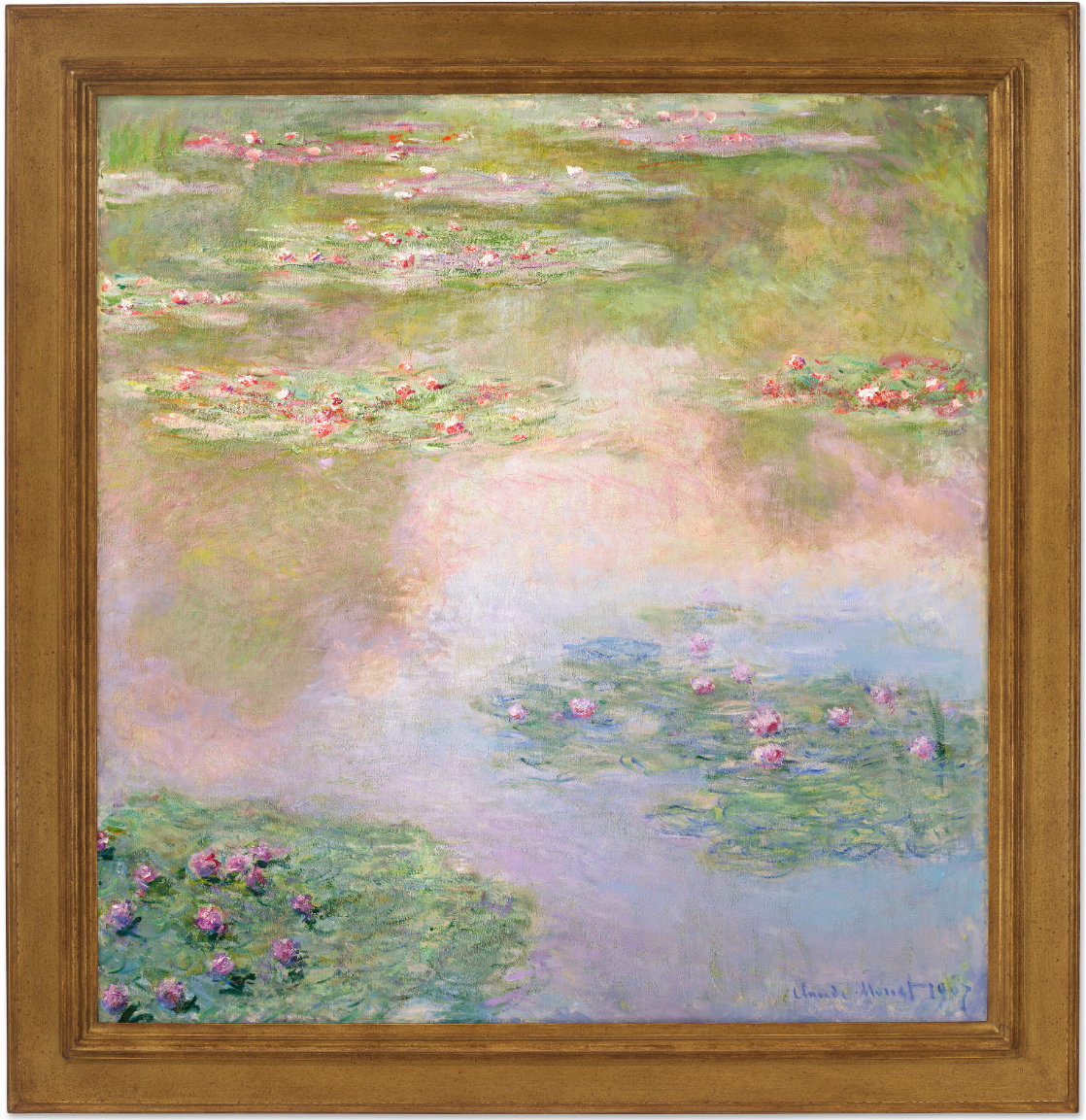
CLAUDE MONET
Nympheas, 1907
Oil on canvas
93.8 x 89.3 cm (37×35 inches)
During the final two decades of his long career, Monet devoted himself with single-minded focus to painting the hauntingly beautiful water garden that he had designed and cultivated at his home in rural Giverny. In some two hundred canvases, he captured the shifting relationships among water, reflections, and light that continually transformed the surface of his lily pond, the infinity of nature matched only by the prodigious breadth of his own creativity. “His repeated treatment of the reflective surfaces of his pond,” Benedict Leca has written, “and the kaleidoscopic color variations of its flora visible above and beneath mirrored water served as an interminable canvas, where both motif and metaphor of reflection combined directly in the service of self-definition” (Monet in Giverny: Landscapes of Reflection, exh. cat., Cincinnati Art Museum, 2012, p. 41). While these valedictory paintings affirm Monet’s life-long belief in the primacy of vision and experience, they are at once more abstract and more profound than anything he had previously painted—a prescient and visionary art for the new, modern century.
Nymphéas, temps gris, 1097
Christie’s London: 28 June 2022
GBP 30,059,500
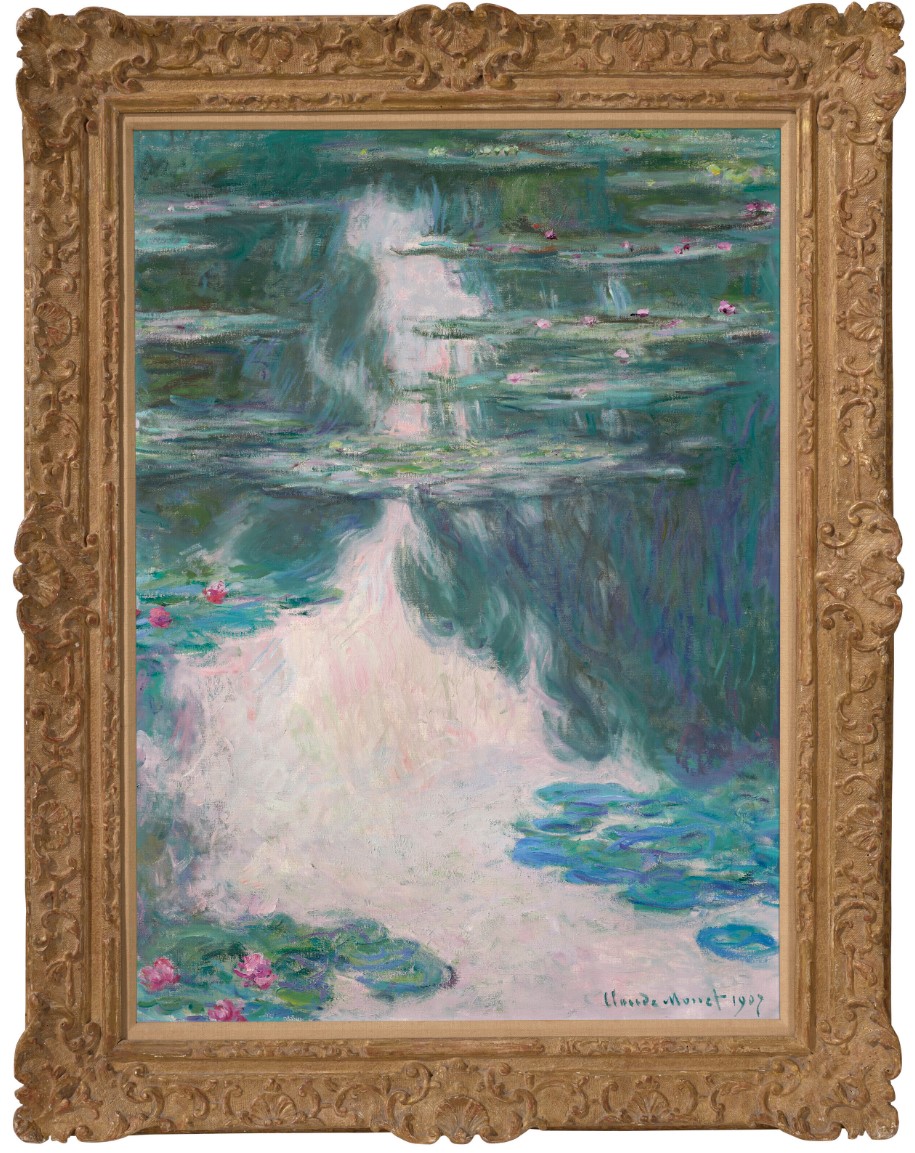
CLAUDE MONET (1840-1926)
Nymphéas, temps gris, 1097
Oil on canvas
100.2 x 73.2 cm (39 1/2 x 28 3/4 inches)
Signed and dated ‘Claude Monet 1907’ (lower right)
Claude Monet’s depictions of the horticultural oasis that he designed and cultivated in Giverny are among the greatest works of his career. Nymphéas, temps gris is one of a small series that Monet painted in a moment of intense creativity in 1907. Here, Monet has employed a rare vertical format to capture the spectacular effects of late afternoon light upon his beloved waterlily pond. Flanked by swirling eddies of vegetation and dramatic reflections, a long stream of light streaks through the height of the canvas, overlaid in places by clusters of lily pads. Using a variety of painterly techniques – gestural brushstrokes, rich impasto for the flowers, and myriad layers of colour in the watery areas – with this vertical canvas, Monet has masterfully captured both the reflections of light on the surface of the pond, and the changing hues in its depths. As a result, this canvas is filled with a majestic visual drama that sets this series apart from others of the same period. Of this rare series of fifteen vertical Nymphéas of 1907, eight are now held in museum collections including the Museum of Fine Arts, Houston, and the Artizon Museum, Tokyo (Wildenstein, nos. 1703-1717). Included in Monet’s celebrated Nymphéas exhibition held at the Galerie Durand-Ruel, Paris in 1909 – the first time he showed solely the water lily paintings – this work has a distinguished provenance. It was initially acquired by the Parisian pharmaceutical magnate and devoted Monet collector, Henri Canonne, who amassed an extensive collection of the artist’s work, particularly focused on his Nymphéas.
Waterloo Bridge, effet de brume, 1899-1904
Christie’s London: 28 June 2022
GBP 30,059,500
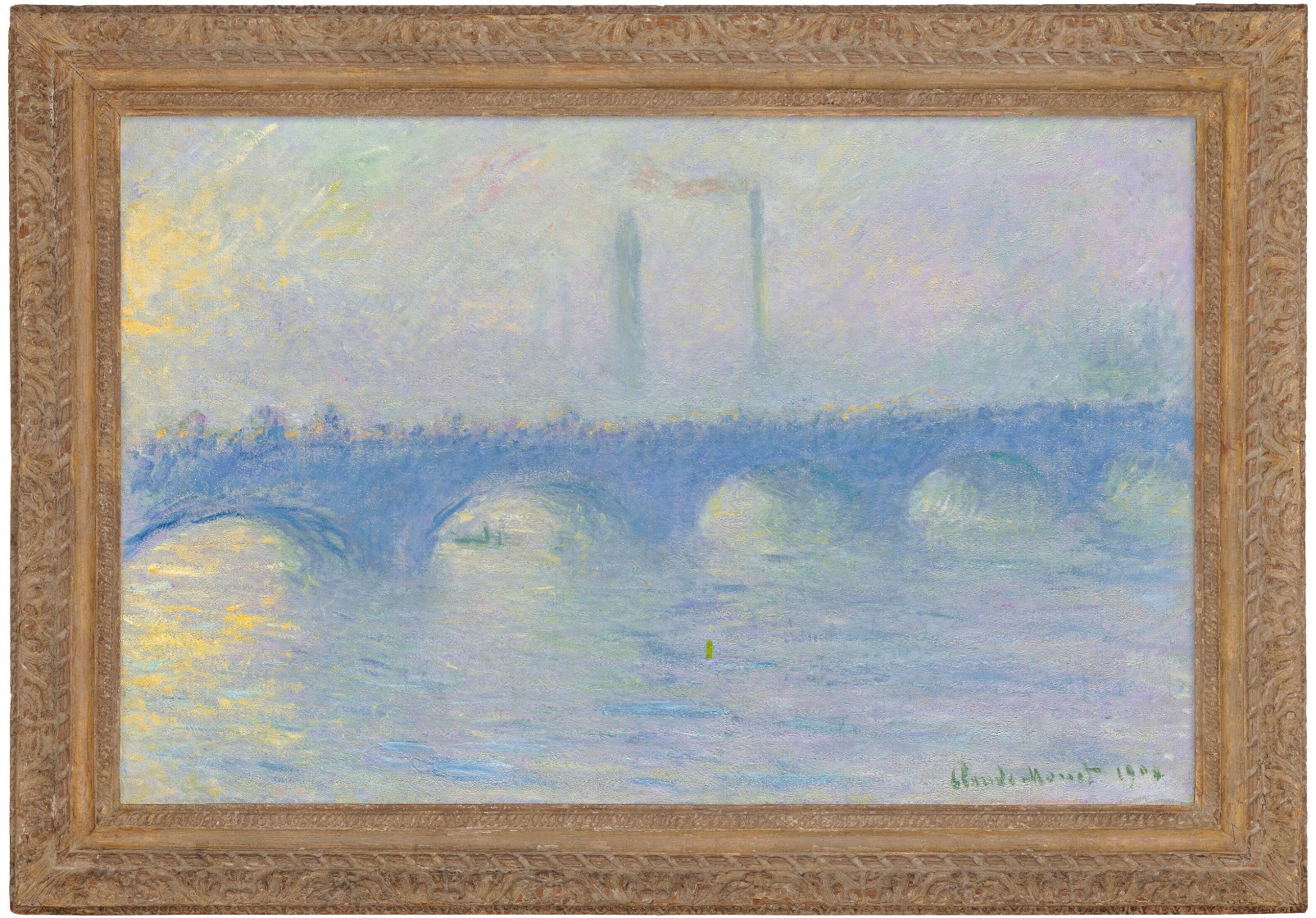
CLAUDE MONET (1840-1926)
Waterloo Bridge, effet de brume, 1899-1904
Oil on canvas
65.2 x 100.7 cm (25 5/8 x 39 5/8 inches)
signed and dated ‘Claude Monet 1904’ (lower right)
Depicting the Thames through an effervescent, sunlit haze, Waterloo Bridge, effet de brume is a key painting from Claude Monet’s monumental, landmark series known as the Vues du Londres (Views of London). Numbering almost a hundred canvases in total, the artist had begun this grand project during the opening years of the twentieth century, focusing on the play of light across the Thames through three principal subjects – Charing Cross Bridge, the Houses of Parliament, and Waterloo Bridge. In contrast to the bustling modernity of the Charing Cross paintings and the solemn grandeur of the Houses of Parliament compositions, Monet’s views of Waterloo Bridge stand as pure meditations on colour, light, and atmosphere, evocatively capturing the shifting character of the famous bridge under a series of different conditions. Comprising over forty views, each subtly different from the next, many of the Waterloo Bridge paintings are now held in renowned museum collections across the world, including the Philadelphia Museum of Art, the Art Institute of Chicago, the National Gallery of Art, Washington, D.C., the Kunsthalle, Hamburg and the National Museum of Western Art in Tokyo.
La mare, effet de neige, 1875
Christie’s New-York: 11 May 2022
USD 25,580,000
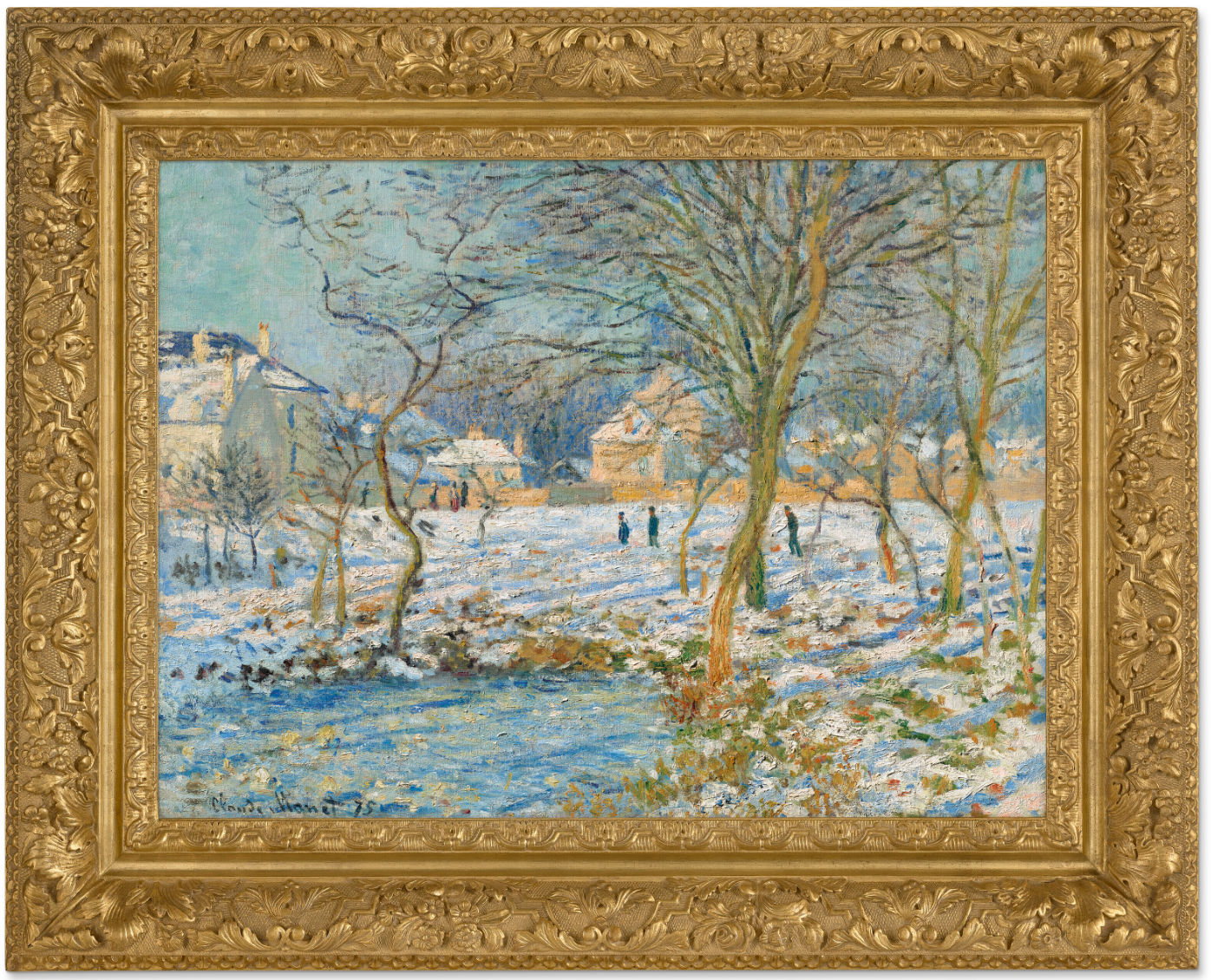
CLAUDE MONET
La mare, effet de neige, 1875
Oil on canvas
60.6 x 81.7 cm (23.9 x 32.2 inches)
La mare, effet de neige exemplifies Monet’s experiments with the Impressionist style in the mid-1870s. During this crucial period, the artist used increasingly loose brushwork and thick facture to convey the ephemeral, atmospheric effects of nature. Undeterred by the cold, Monet continued to observe the world around him throughout the unusually snowy winter of 1874-1875. In other works painted that season, Monet painted various forms of snow in Argenteuil—from gentle flurries to heavy snow fall. In the present work, Monet covered his canvas with short daubs of paint to represent the tufts of fresh, white snow that have already begun to melt in the brilliant glow of daylight; linear strokes of blue indicate the long shadows cast by human figures and trees alike.
Les Arceaux de Roses, Giverny, 1913
Sotheby’s New-York: 17 May 2022
USD 23,304,500
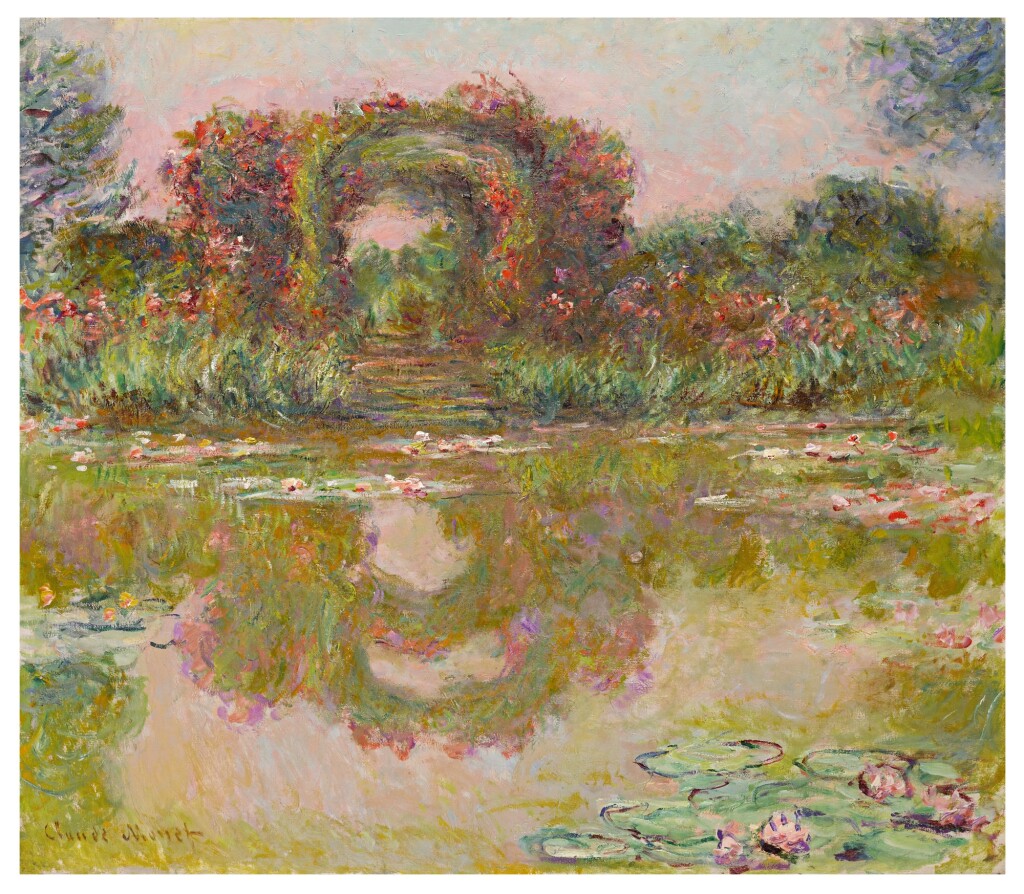
CLAUDE MONET
Les Arceaux de Roses, Giverny, 1913
Oil on canvas
81.5×93.5 cm (32×37 inches)
Dazzling in its use of color and exploration of the properties of reflection, Les Arceaux de roses, Giverny is one of only five canvases painted by Claude Monet between the summer of 1912 and 1914. Three of these paintings, including the present work, focus on trellises covered in roses, set on the boat landing on the south side of Monet’s water garden. The present work is a stunning symphony of richly applied and worked pigment and by far the most energetic in the series. The other two works painted during this period, both titled La Maison de l’artiste à Giverny, depict a view of Monet’s house and gardens in the immediate vicinity of his front door.
Unique to the present composition is the heightened sense of immediacy as seen in the carefully delineated group of waterlilies in the foreground at right. Crystalline pinks, blues and blue meet in the sky of Les Arceaux de roses, Giverny, lending a lustrous atmosphere to the work. The soft reflection of the flowered arches play along the surface of the water, illuminating the midground in tones of violet and rose. Highlighted by white blossoms throughout the water and the trellis, the work presents a veritable symphony of color to its audience.
#3. Pablo Picasso
Revenues: USD 494,570,551
3,455 Lots sold (850 unsold)
Top Lot: USD 67,541,000
2022 was an average year for Pablo Picasso in absence of major works sold at auction. Total revenues for 2022, just shy from USD 500 million, compare to revenues over USD 670 million in 2021 when Picasso was the top sold artist at auction. Indeed the number of artworks valued at over USD 10 million was halved as compared to 2021.
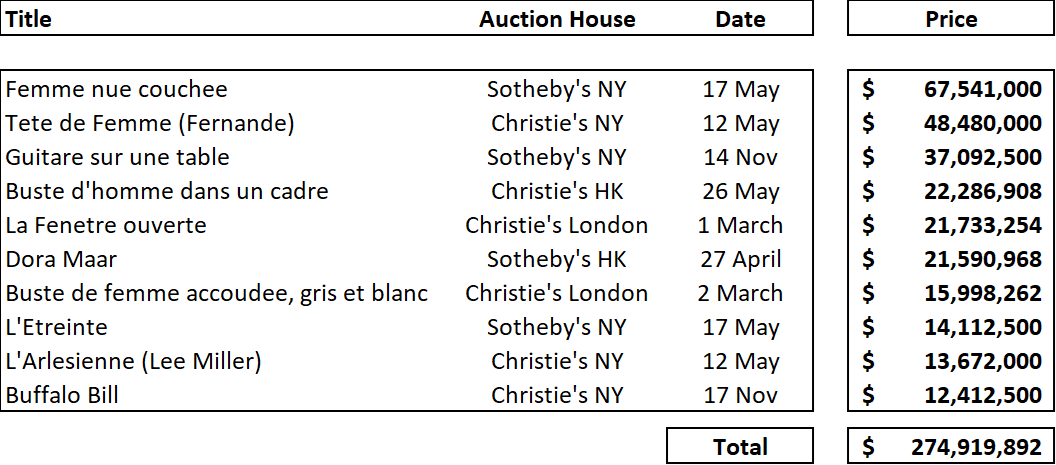
Of note, Head of a Woman broke Picasso’s auction record in the sculpture medium.
Femme Nue Couchee, 1932
Sotheby’s New-York: 17 May 2022
USD 67,541,000
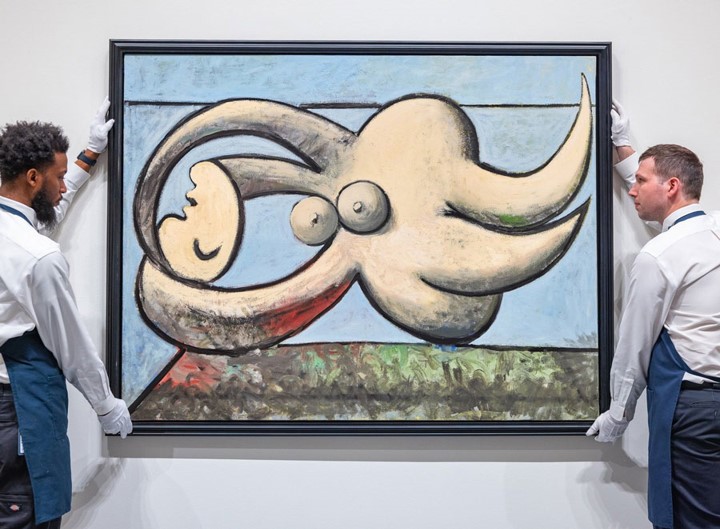
PABLO PICASSO
Femme Nue Couchee, 1932
Oil and Ripolin on canvas
129.9×161.7 cm (51×64 inches)
Femme nue couchée is one of Picasso’s most monumental and uninhibited portrayals of his muse Marie-Thérèse Walter. A crowning achievement of painterly verve, energy and manipulation of the human form, the present work succinctly synthesizes the artist’s groundbreaking achievements of the late 1920s and early 1930s into one colorful, dynamic canvas. Here, in the seclusion of his new country home in Boisgeloup, the nude figure of Marie-Thérèse reclines in a highly abstracted space, her biomorphic figure imbued with fertility, sexuality and grace. Never before offered at auction, Femme nue couchée is a tour de force of Picasso’s famed 1932 artistic production. The influence of sculpture is visible in the present work in the monumental sculptural force with which the female body is portrayed. At the same time, the psychological state of the sleeping woman resonates in the soft modeling of the figure, creating an atmosphere of reverie and carefree abandon. Seeking to convey his erotic desire, Picasso generates morphological permutations and distortions of the female anatomy. Abandoning any attempt at naturalism, he creates a figure composed of biomorphic forms, a technique that developed from his earlier, Surrealist works. While seemingly divorced from any particular setting—whether that of the wooded landscape around the château or in a more constructed interior studio space—a directly related sketch on a scrap of paper shows a figure in a nearly identical pose below an umbrella and in front of a beach hut, a clear reference to the delights of the summer memories he had established with Marie-Thérèse.
Tete de Femme (Fernande), 1909
Christie’s New-York, 12 May 2022
USD 48,480,000
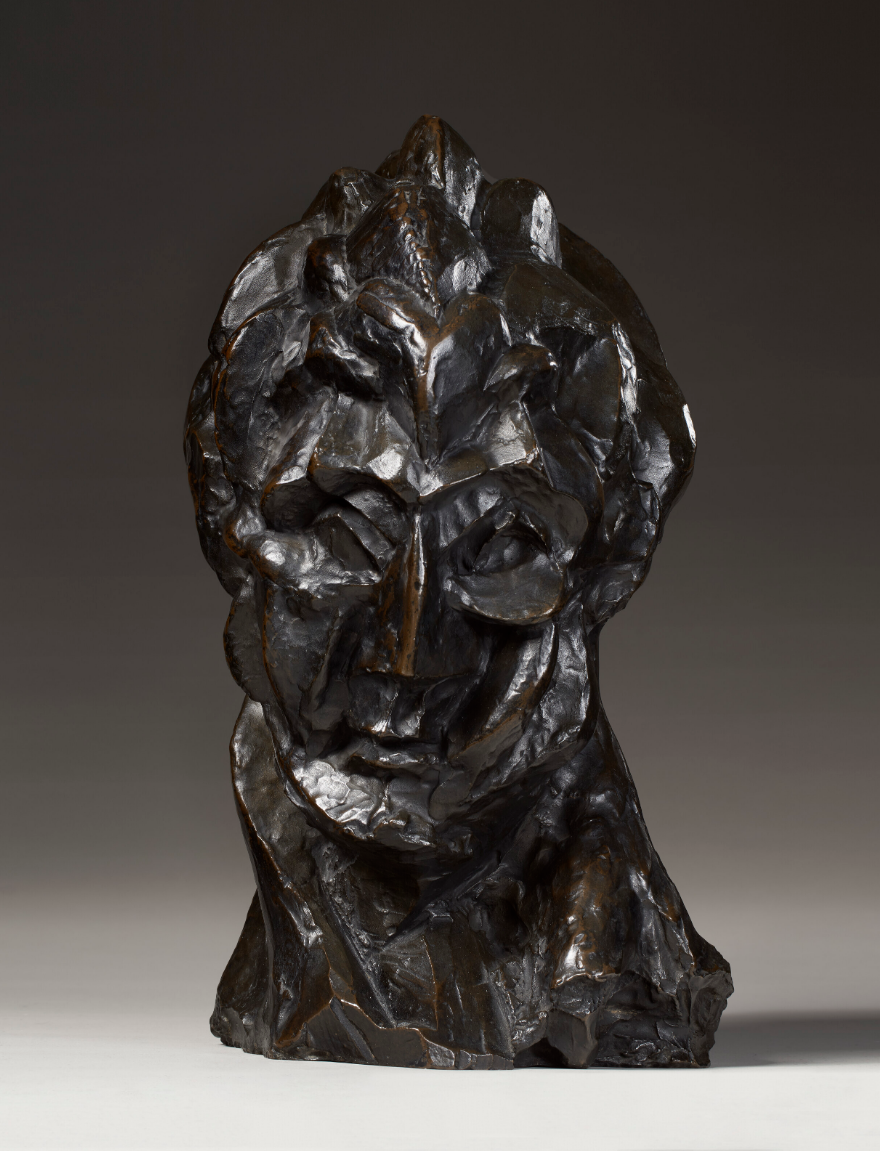
PABLO PICASSO
Tete de Femme (Fernande), 1909
Bronze with dark brown patina
Height: 41.9 cm (16 1/2 inches)
The first major sculpture of Pablo Picasso’s career, Tête de femme (Fernande) stands as an icon of twentieth-century art. Executed in clay in 1909, it not only marks the culmination of an important series of portraits of the artist’s first great love, Fernande Olivier, produced over the course of the summer, but stands as a key moment in the development of Cubism, as the artist’s intense explorations into the nature of pictorial representation were synthesized into three-dimensional form. This work also solidifies the coexistence of painting and sculpture in Picasso’s art. For the rest of his career he would move effortlessly between these two practices, adopting sculpture as he needed in his voracious pursuit of an artistic concept. Taking the distinctive features of Fernande—her wide, deep-set almond-shaped eyes, sturdy neck, and perhaps most importantly, her hair styled into a great wave atop her head—in this work Picasso transformed her into a striking, monumental construction of both geometric and organic faceted forms. The artist captured Fernande with her head tilted slightly downwards, as if in the midst of turning to the side. As result, her neck is rendered as an almost pyramidal form, the activated musculature conveyed with dynamic ridges that thrust upward towards her head. While the work is recognizable as the form of a human head, the play of light across the fragmented construction means that from some angles, certain parts look totally abstract. Though cast in weighty bronze, the originally carved, fragmented forms paradoxically create a sense of shimmering, fleeting movement—as if capturing a momentary reflection caught on her hair, an expression moving across her face, or the stretch of a tendon in her neck.
Guitare sur une table, 1919
Sotheby’s New-York: 14 November 2022
USD 37,000,000
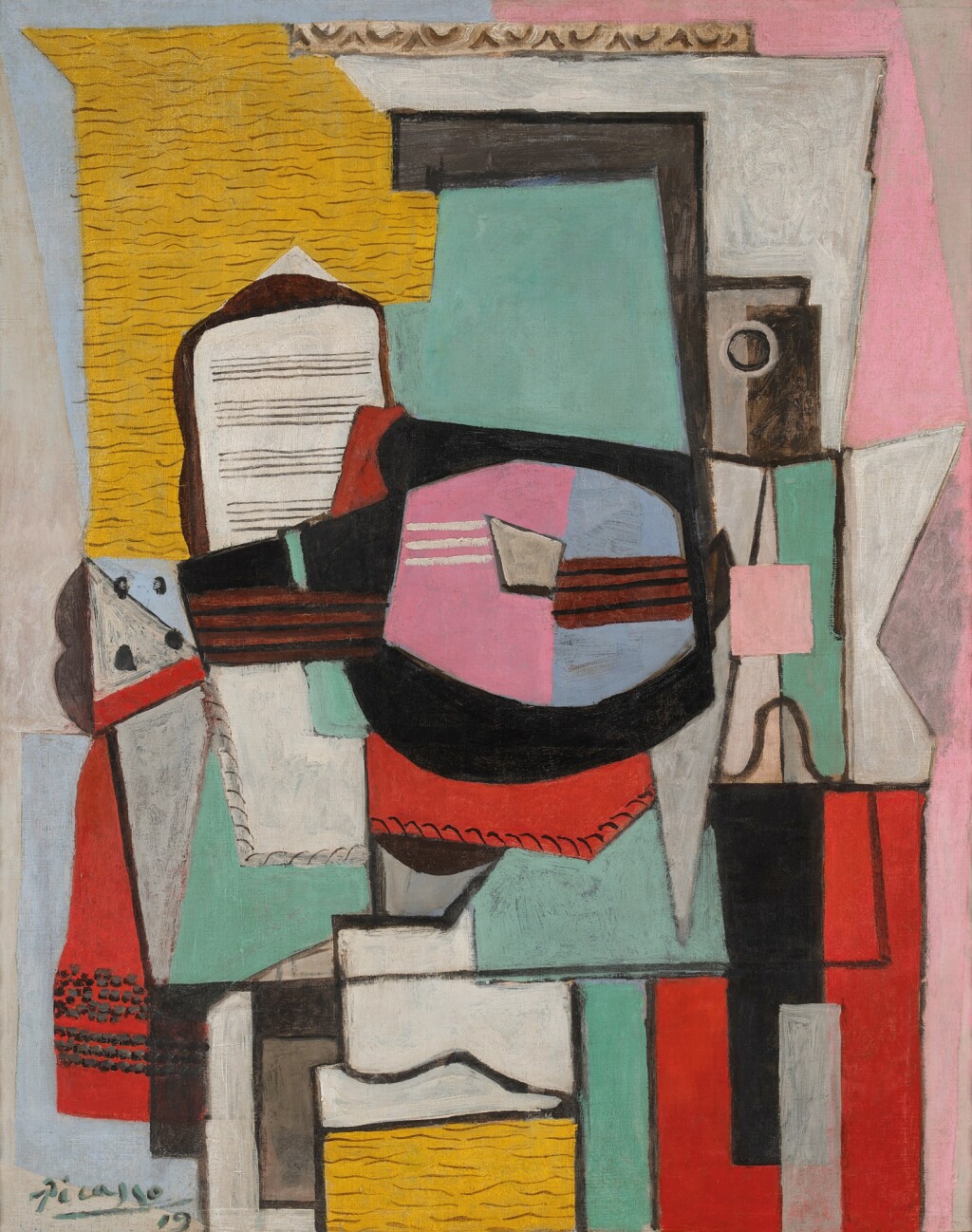
PABLO PICASSO (1881-1973)
Guitare sur une table, 1919
Oil on canvas
100 x 80.7 cm (39 ⅜ x 31 ¾ inches)
A symphonic array of form and pigment, Picasso’s Guitare sur une table from 1919 epitomizes the artist’s bold stylistic evolution in the years following the First World War. Drawing on the Cubist idiom pioneered alongside Braque beginning around 1907-08, Picasso’s still lifes from the subsequent decade reveal a heightened liveliness and levity paired with a dynamic and newfound appreciation of color.
Buste d’homme dans un cadre, 1969
Christie’s Hong-Kong: 26 May 2022
HKD 174,950,000 / USD 22,286,908
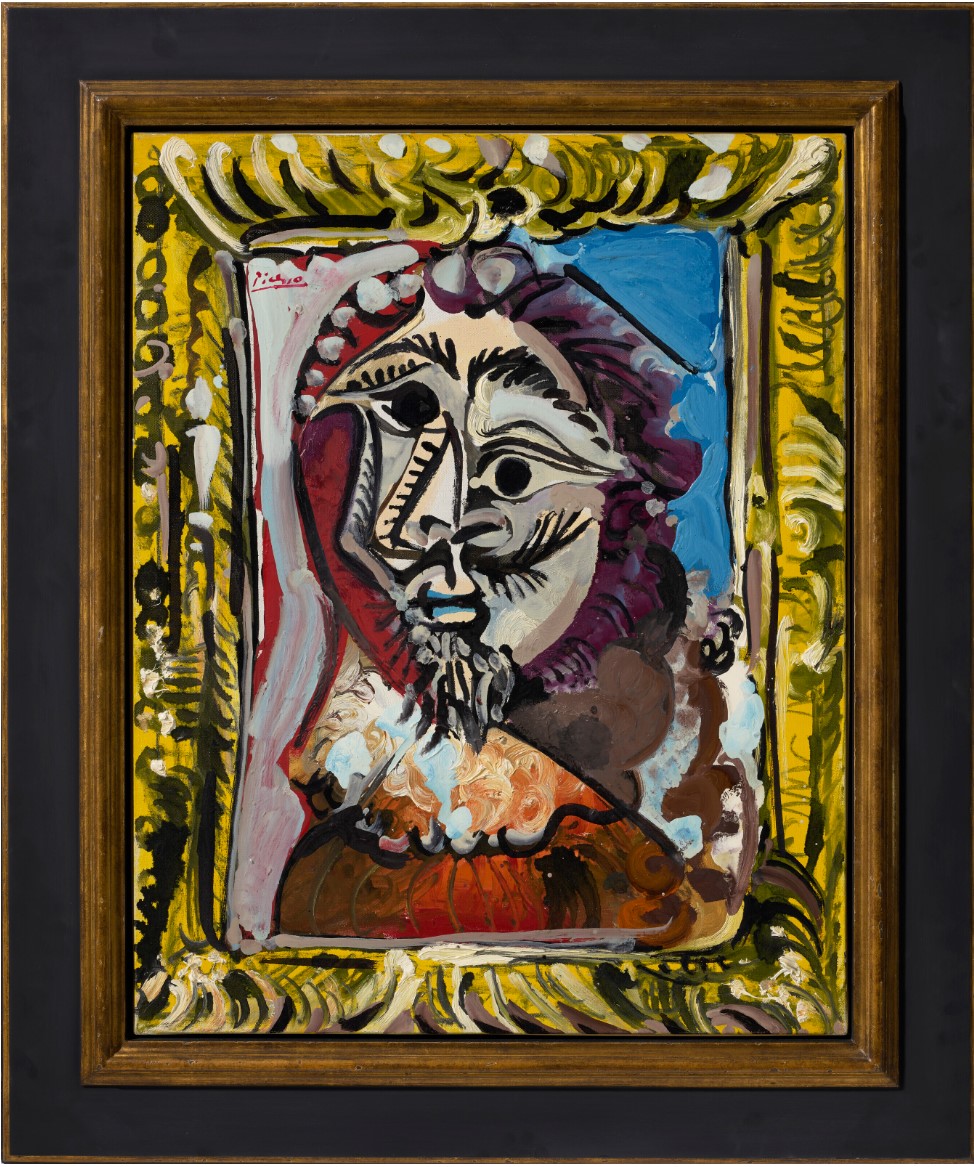
PABLO PICASSO (1881-1973)
Buste d’homme dans un cadre, 1969
Oil on canvas
92×73 cm (36 1/4 x 28 3/4 inches)
Signed ‘Picasso’ (upper left); dated ‘29.3.69.’ (on the reverse)
La fenêtre ouverte, 1929
Christie’s London: 1 March 2022
GBP 16,319,500
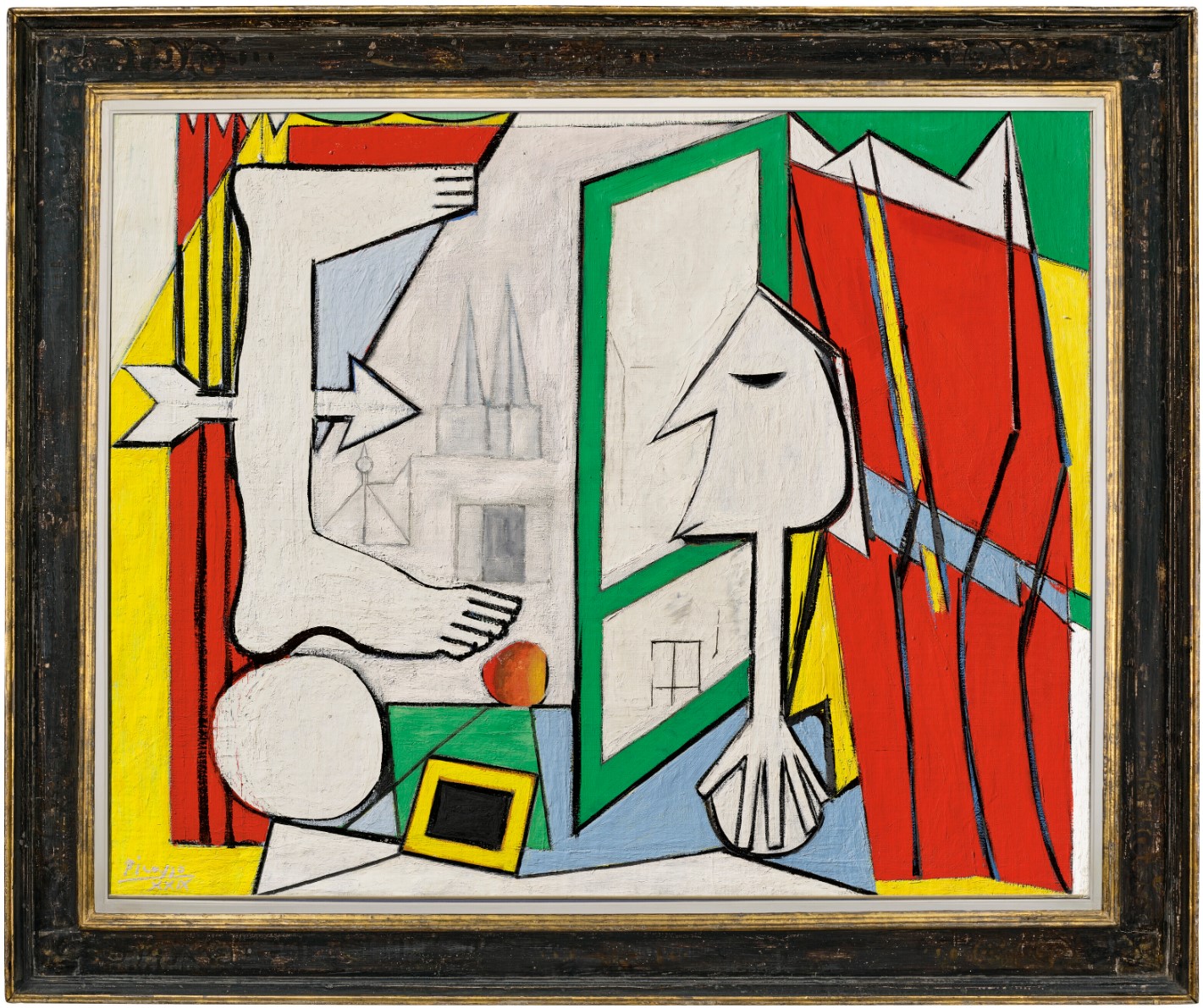
PABLO PICASSO (1881-1973)
La fenêtre ouverte, 1929
Oil on canvas
130.5 x 163.4 cm (51 3/8 x 63 3/8 inches)
Signed and dated ‘Picasso XXIX’ (lower left)
Painted on 22 November 1929, in the midst of a heady moment of creativity, Pablo Picasso’s La fenêtre ouverte is a monumental, surrealist depiction of himself and his new muse and lover, Marie-Thérèse Walter. Having met Marie-Thérèse two years prior, Picasso was completely enraptured by his passionate new love affair. It was not just his personal life that was filled with new inspiration; so his artistic life was at this time infused with a variety of influences. Closely aware and keenly stimulated by the radical developments of the Surrealists, Picasso was also at this moment engaged in an intense sculptural collaboration with Julio González, creating some of the most important works of his career in this medium. Composed with planes of pure, bold colour, La fenêtre ouverte presents a surreal assortment of objects in front of a green-rimmed window that is thrown open. The window opens up onto a vista of Paris, the quintessentially silver Parisian light of a winter’s day casting the view into a veil of white. While the background may be recognisable, in the foreground lies an extraordinary configuration of highly abstracted objects. What appears to be a still life is placed at the front, the objects depicted as if they are slipping off the tipped up table, a device reminiscent of the artist’s cubist still lifes. The coloured orb that balances right at the edge of the window ledge could be interpreted as an apple, a reference perhaps to Adam and Eve in the Garden of Eden, a symbolism that fills the canvas with a sense of temptation.
Dora Maar, 1939
Sotheby’s Hong-Kong: 27 April 2022
HKD 169,420,000 / USD 21,590,968
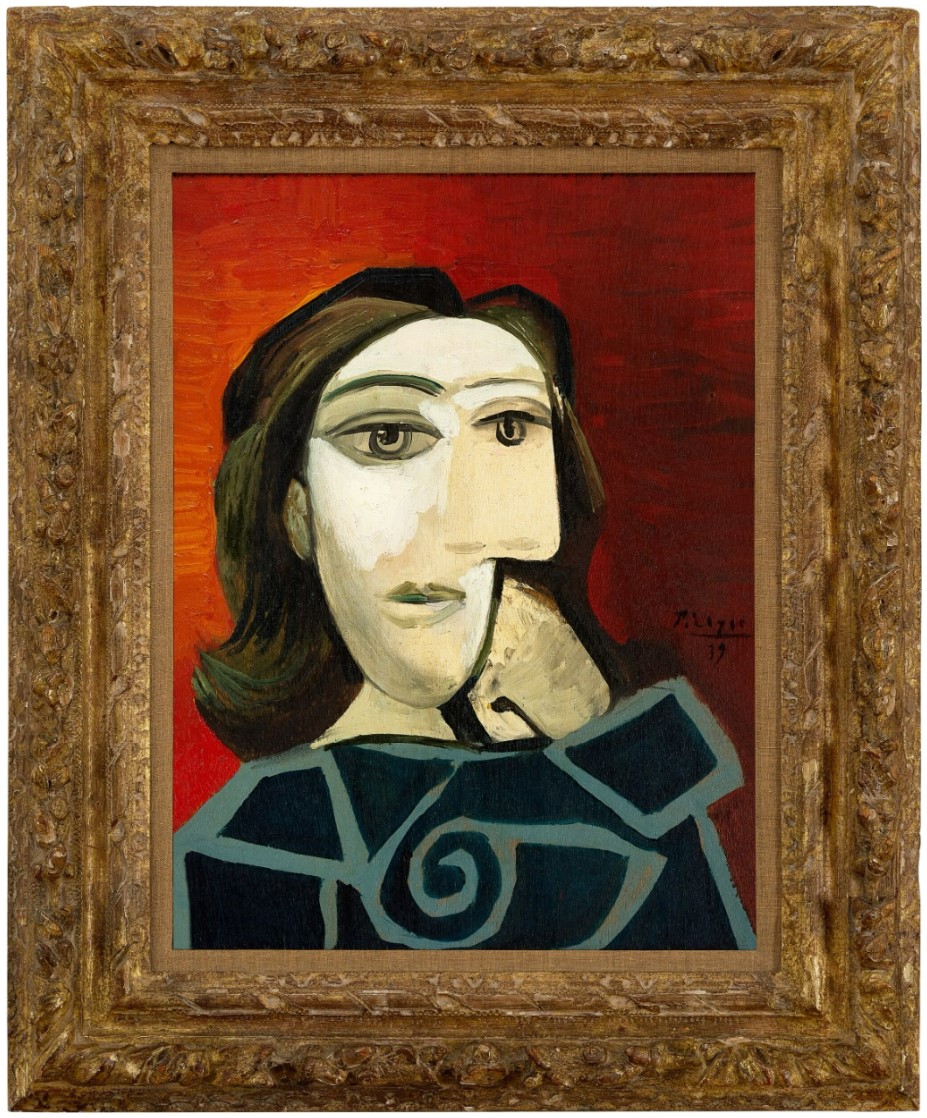
PABLO PICASSO (1881 – 1973)
Dora Maar, 1939
Oil on panel
60 x 45.5 cm (23 5/8 x 17 7/8 inches)
Signed Picasso and dated 39 (center right); dated 27.3.39. on the reverse
Throughout his brilliant career, Pablo Picasso painted portraits of his lovers. In the sensitivity and passion of his brushwork, we witness the changes in his thoughts, style, and worldview throughout different periods. In 1939, as Europe was on the brink of war, Picasso created Dora Maar, depicting a woman in blue against a bold, bright red background. Dora Maar was Picasso’s lover and muse in the 1930s and 1940s. She was a photographer who was 26 years his junior. Maar inspired Picasso’s art with her unique charms and creativity. During their nine-year relationship, Picasso repeatedly painted Maar, including in the renowned Weeping Woman of 1937 (in the collection of the Tate Modern). Indeed, his portraits of Maar, created before and after World War II, are his most dazzling and renowned works of the period. Also dating to 1939 are two oil paintings on board that are very similar to Dora Maar in composition: Portrait de Dora Maar and Tête de femme (Dora Maar), respectively in the collections of the Museo Nacional Centro de Arte Reina Sofia in Madrid and the Guggenheim Museum in New York. In the same series is Portrait de Dora Maar aux yeux blues, an oil painting on monotype on copper that remains in the possession of the Picasso family. Dora Maar is a museum-grade work of supreme value and quality.
L’Arlesienne (Lee Miller), 1937
Christie’s New-York, 11 May 2022
USD 13,672,000
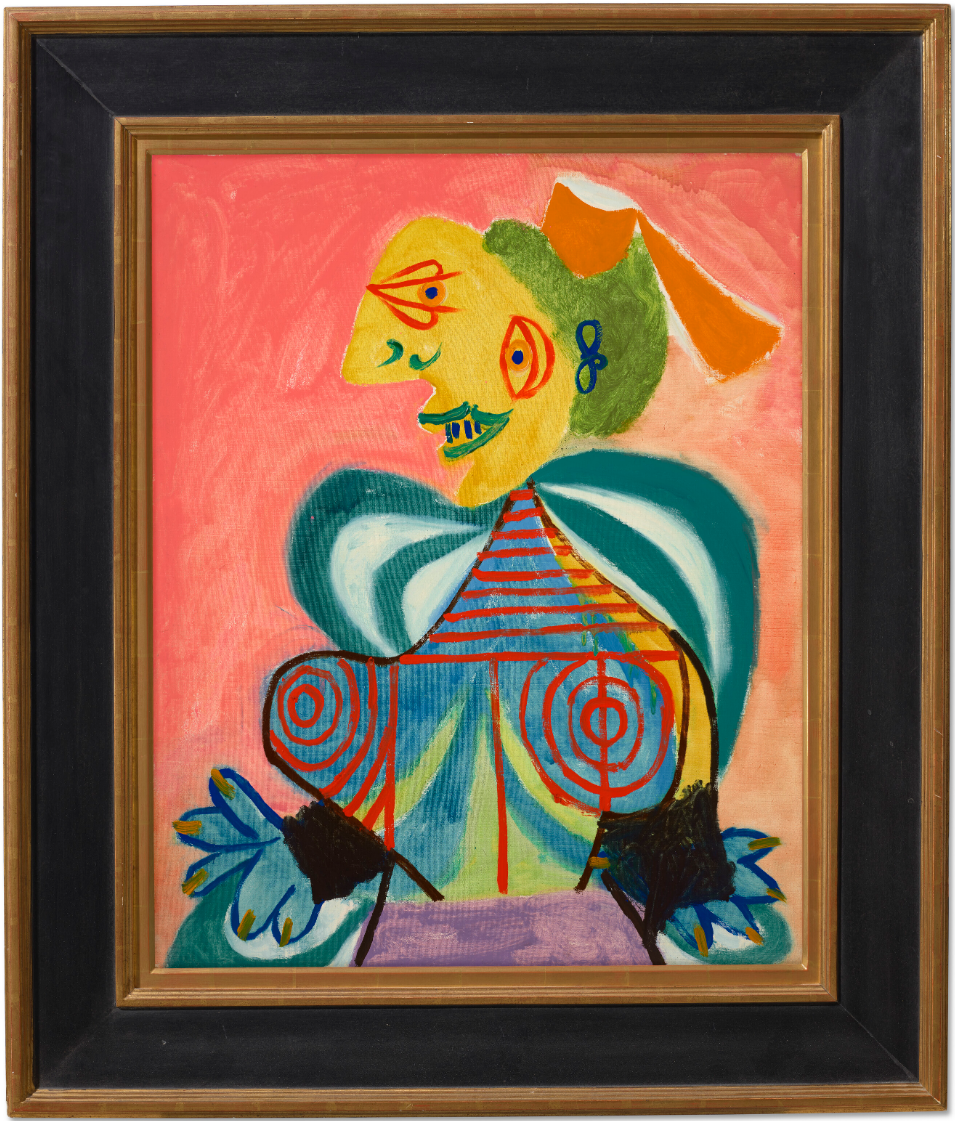
PABLO PICASSO
L’Arlesienne (Lee Miller), 1937
Oil on canvas
81×65 cm (31 7/8 x 25 5/8 inches)
The resplendent figure of Lee Miller is the enthroned protagonist of this vividly colored, exuberant portrait by Pablo Picasso. Painted during a halcyon summer that the artist spent in Mougins in the south of France in 1937, L’Arlésienne (Lee Miller) depicts the celebrated American photographer as an Arlésienne, in the traditional costume of Arles. This was a landmark year for Picasso, which saw the creation of some of his most important works: Guernica (Zervos, vol. 9, no.65; Museo Nacional Centro de Arte Reina Sofía, Madrid) was completed in the spring, while the haunting La femme qui pleure (Zervos, vol. 9, no.73; Tate, London) reached its final iteration in October. Alongside these monumental works, Picasso also painted a dazzling array of portraits: sensuous depictions of Marie-Thérèse Walter; charged portrayals of his new lover and muse, Dora Maar; as well as boldly colored images of those whom he spent time with throughout this prolific year, including Miller. With her wide, smiling eyes and her notorious gap-toothed grin, L’Arlésienne is one of a series of seven portraits of Miller from this summer that reflects her famed beauty as well as the irrepressible vivacity for which she was renowned. With a kaleidoscopic palette of shocking pink, electric green, turquoises, and red, this portrait radiates a glowing light and energy, immersing the viewer in the artist’s fantastical vision of Miller.
L’Etreinte, 1969
Sotheby’s New-York: 17 May 2022
USD 14,112,500
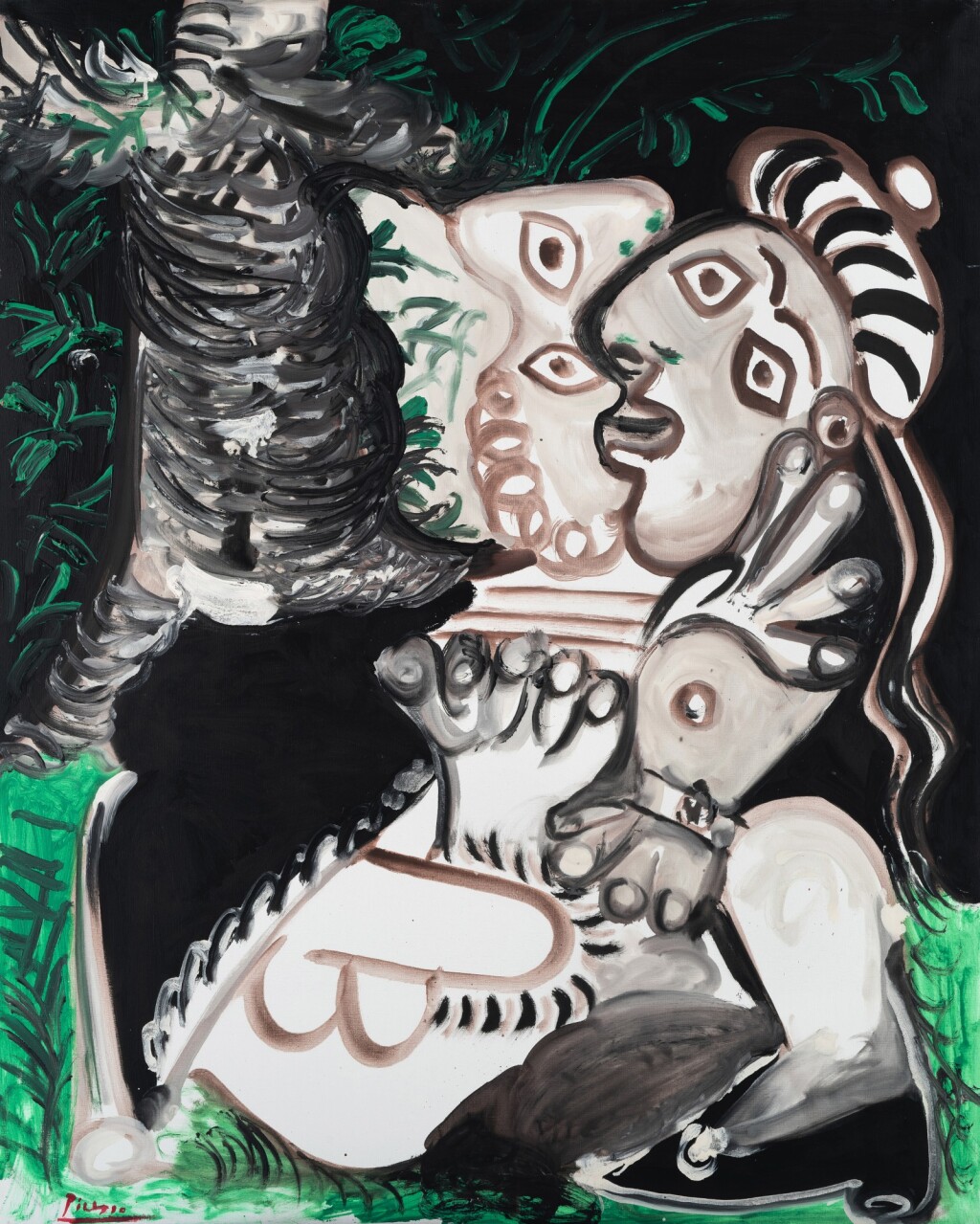
PABLO PICASSO
L’Etreinte, 1969
Oil on canvas
162×130 cm (64×51 inches)
Buffalo Bill, 1911
Christie’s New-York: 17 November 2022
USD 12,412,500
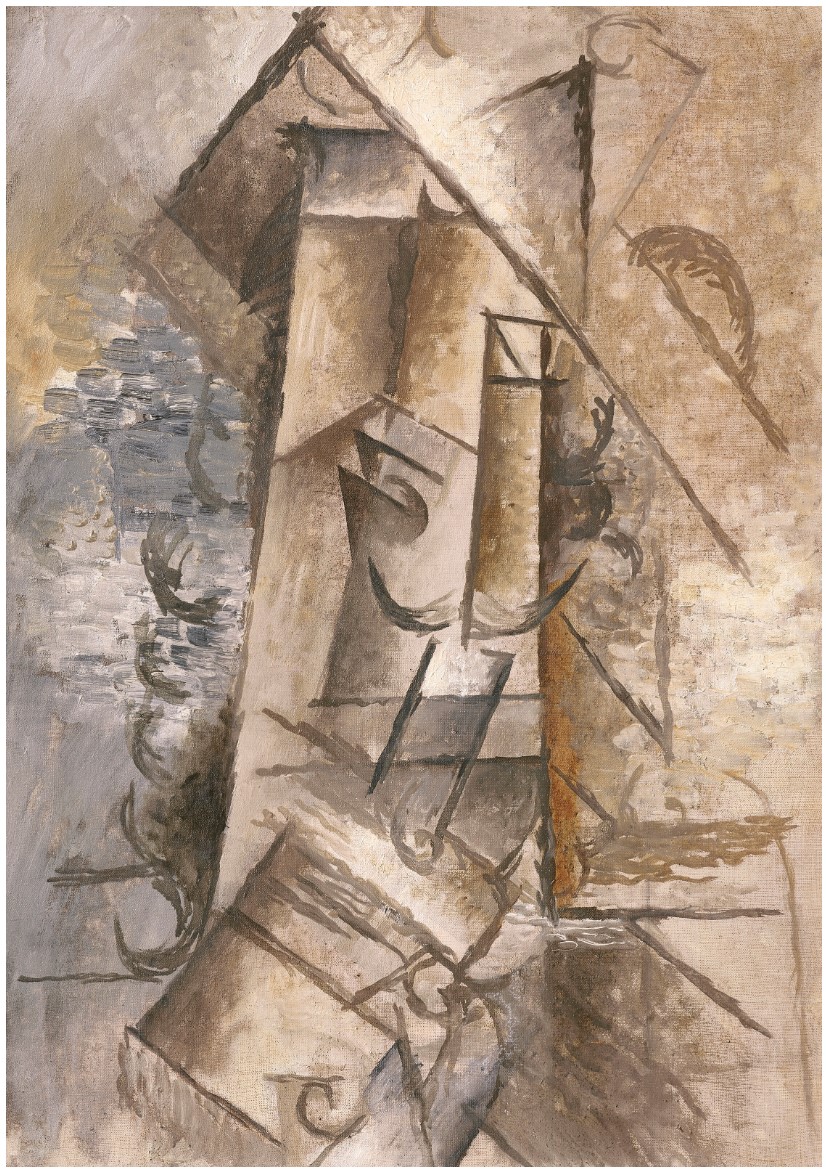
PABLO PICASSO (1881-1973)
Buffalo Bill, 1911
Oil and sand on canvas
46.3 x 33.3 cm (18 1/4 x 13 1/8 inches)
Pablo Picasso painted this portrait of the famed Western performer, Buffalo Bill, in the spring of 1911 during the highpoint of Analytical Cubism—the radical new pictorial language with which he and his cubist comrade, Georges Braque, dismantled every tradition of representation. Not only is this one few male portraits with identified sitters that Picasso painted in the years of pre-war Cubism, but the work provides an insight into the intense artistic friendship and spirit of shared collaboration that existed between Picasso and Braque at this time.
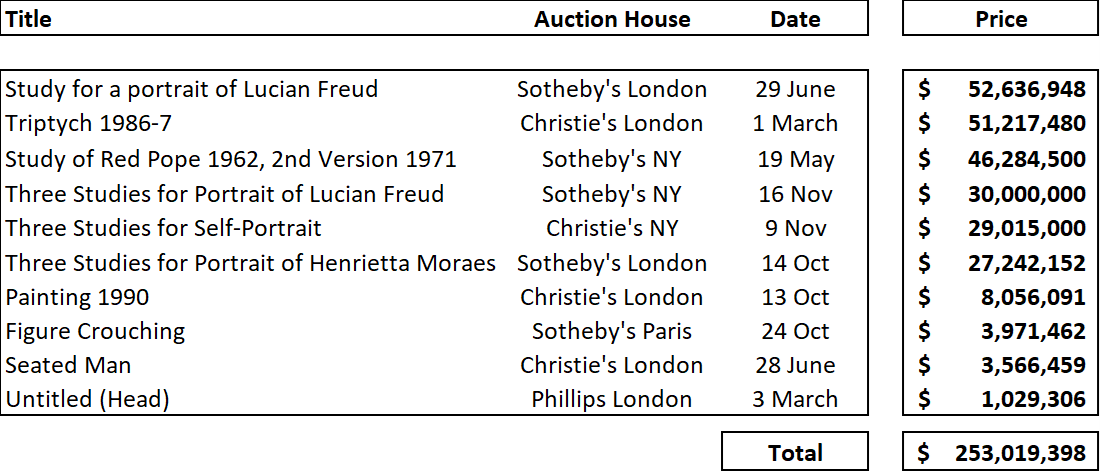
#4. Francis Bacon
Total Revenues: USD 255,181,826
138 Lots sold (31 unsold)
Top Lot: USD 52,545,029
Study for Portrait of Lucian Freud, 1964
Sotheby’s London: 29 June 2022
GBP 43,336,000
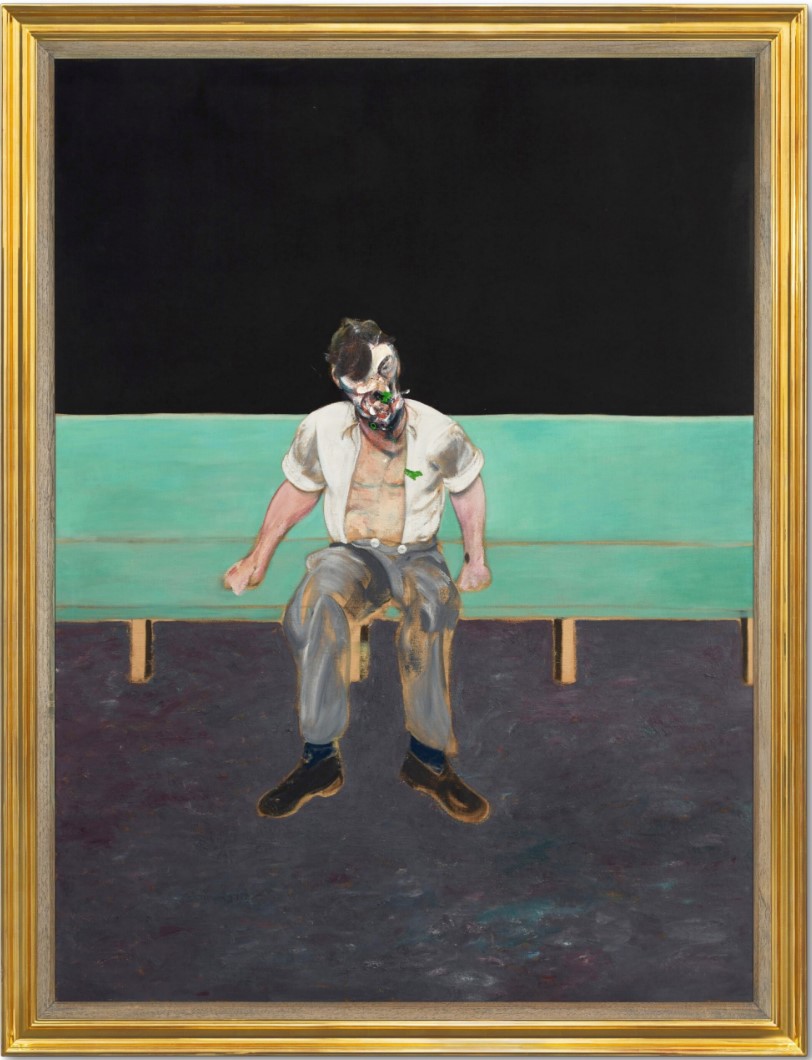
FRANCIS BACON (1909 – 1992)
Study for Portrait of Lucian Freud, 1964
Oil on canvas
198 x 147.5 cm (78×58 inches)
Executed in 1964, Study for Portrait of Lucian Freud exemplifies an iconic pairing of two of the most significant painters within the canon of twentieth-century art. Last seen by the public during a travelling exhibition in Hamburg, Stockholm and Dublin between January and May 1965, the present work is testament to Francis Bacon’s capacity to provoke emotion and capture in paint the complexities of the human psyche. Study for Portrait of Lucian Freud illuminates a powerful dialogue rarely matched in history: The great friendship and epochal rivalry between Bacon and Freud that lasted from 1944 until the apex of their artistic sparring in the mid-1980s. Though their visual styles differed considerably throughout their respective oeuvres, both painters were deeply committed to the human figure. They sat for each other on multiple occasions; Bacon painted Freud fourteen times between 1964 and 1971, in a combination of two small panels, four large panels (one destroyed), two small triptychs, three large triptychs (of which the present work was part) and part of larger compositions. Indeed, the present painting was originally part of one of only three full-length triptychs measuring 1.9 metres in height, depicting a restless Freud in alternating poses within differing architectural spaces. Study for Portrait of Lucian Freud is only comparable in its excellence to Bacon’s masterpieces Double Portrait of Lucian Freud and Frank Auerbach (1964, Moderna Museet, Stockholm), Three Studies for Portrait of Lucian Freud (1966, Private Collection), and Three Studies of Lucian Freud (1969, Private Collection).
Triptych 1986-7, 1986-1987
Christie’s London: 1 March 2022
GBP 40,364,500
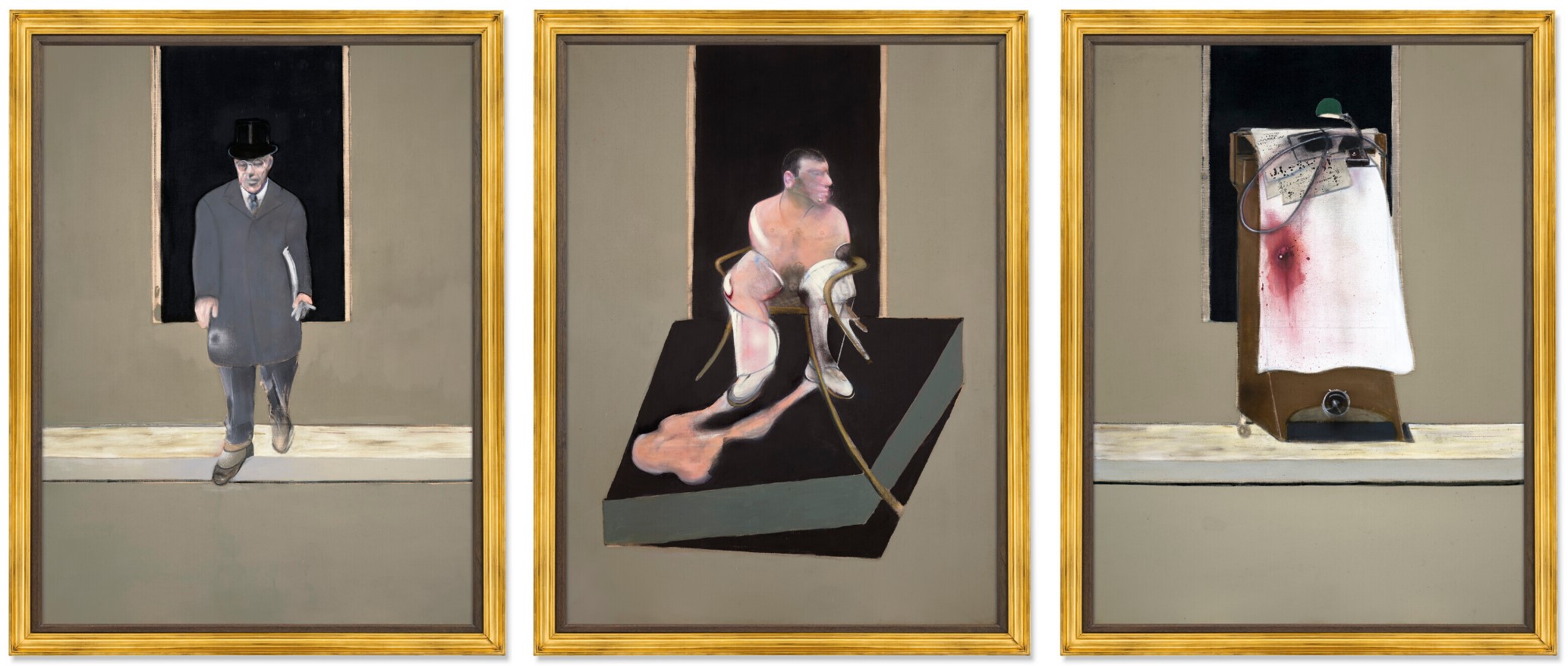
FRANCIS BACON (1909-1992)
Triptych 1986-7, 1986-1987
Oil, pastel, aerosol paint and dry transfer lettering on canvas, in three parts
Each: 78×58 inches (198 x 147.5 cm)
Study of Red Pope 1962, 2nd Version 1971, 1971
Sotheby’s -York: 19 May 2022
USD 46,284,500
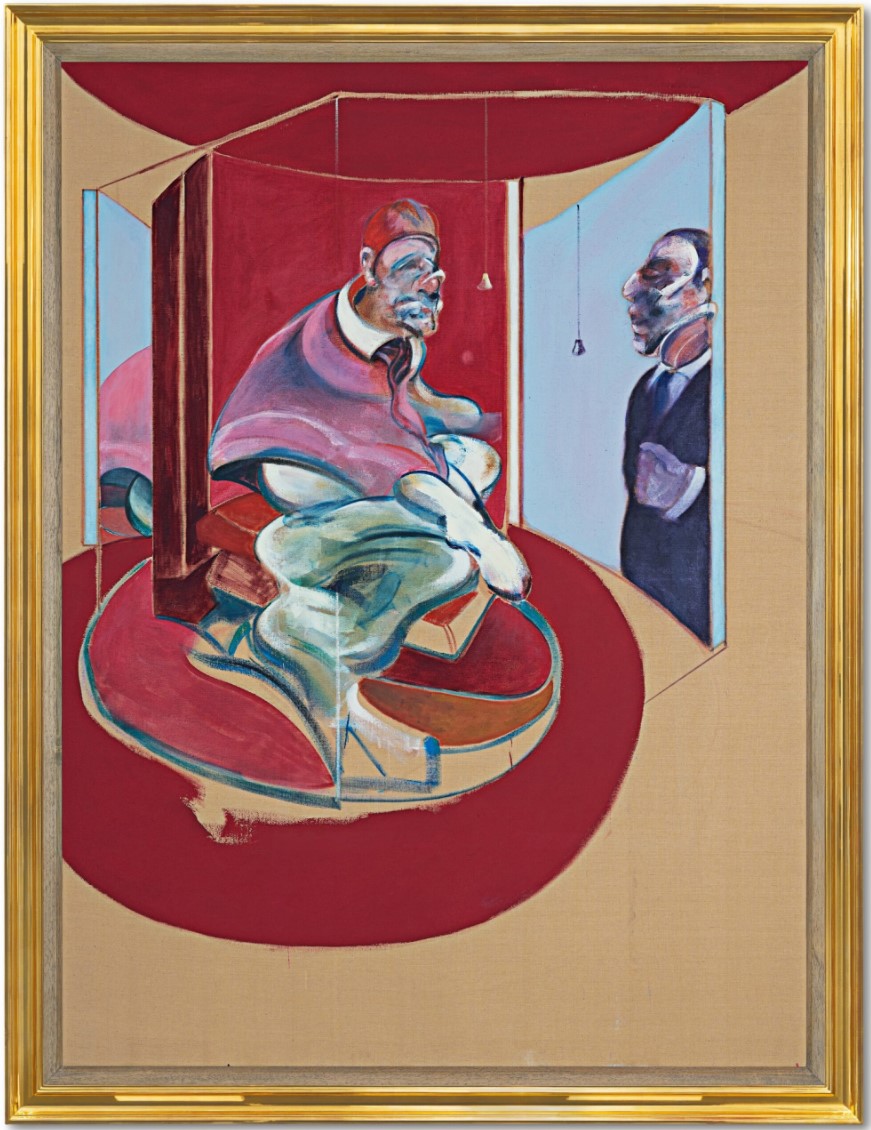
FRANCIS BACON (1909 – 1992)
Study of Red Pope 1962, 2nd Version 1971, 1971
Oil on canvas
78×58 inches (198 x 147.5 cm)
signed Francis Bacon, titled and dated Study of Red Pope 1962, 2nd Version 1971 (on the reverse)
A defining masterpiece and triumphant finale to the artist’s seminal series of Pope paintings, Study of Red Pope 1962, 2nd version 1971 depicts the first and only encounter within Francis Bacon’s oeuvre between his two most important subjects: the Pope raised on a dais, drawn from Diego Velázquez’s Portrait of Pope Innocent X,1650, and George Dyer, the love of Bacon’s life and one of his most celebrated muses. First unveiled at Bacon’s landmark retrospective at the Grand Palais in 1971, a career-defining exhibition and an accolade only previously afforded to Pablo Picasso among living painters, Study of Red Pope 1962, 2nd version 1971 remains a testament to Bacon’s limitless capacity to provoke and capture the most fundamental of human emotions. In the present work, Bacon reworks the composition of his 1962 painting Study from Innocent X, revising the portrait to include his love George Dyer, as if the figure of the Pope, not only the progenitor of Bacon’s practice but a stand-in for authority, the canon, and the father, finds its counterpart in Bacon’s lover, instantly identifiable by his curved nose. On October 26th, 1971, the Francis Bacon retrospective opened to great acclaim, the galleries at the Grand Palais were filled with admirers, yet George Dyer’s presence was tragically absent. Less than thirty-six hours prior, Dyer had taken his own life in their Paris hotel room. Executed shortly before the Retrospective, Study of Red Pope 1962, 2nd version 1971 reveals a haunting premonition of the devastating loss of Bacon’s lifelong love, a singular meeting of his two greatest muses and charts Bacon’s artistic maturation between 1962 and 1971. Having remained in private hands since 1972, the present work’s importance is further attested to by its inclusion in the major retrospective Francis Bacon Books and Painting at the Centre Pompidou in 2019.
Three Studies for Portrait of Lucian Freud, 1964
Sotheby’s New-York: 16 November 2022
USD 30,000,000
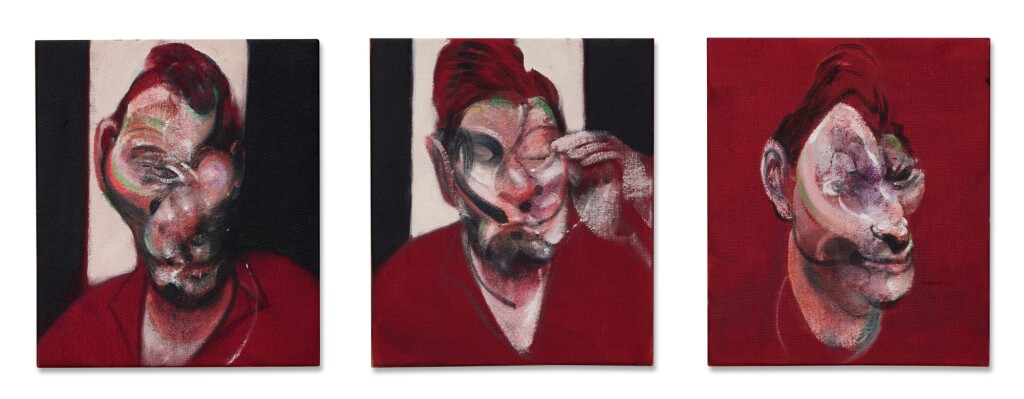
FRANCIS BACON (1909-1992)
Three Studies for Portrait of Lucian Freud, 1964
Oil on canvas, in three parts
Each: 14×12 inches (35.6 x 30.5 cm)
A threefold distortion of Lucian Freud’s effigy in vicious strokes of searing scarlet, Three Studies for Portrait of Lucian Freud from 1964 testifies to a powerful dialogue rarely matched in history: the great friendship and epochal rivalry between Francis Bacon and Lucian Freud, two of Britain’s most celebrated painters. With each loaded brushstroke, Bacon animates and disfigures the head of his friend, conjuring in its restlessness Freud’s uncanny likeness in deep shades of red impasto and active jolts of greens and whites. Bacon executed the present work in 1964 at the height of his prodigious career, debuting it one year later in his major 1965 solo exhibition Francis Bacon, which travelled internationally from the Hamburger Kunstverein, Hamburg to the Moderna Museet, Stockholm and the Municipal Gallery of Modern Art, Dublin.
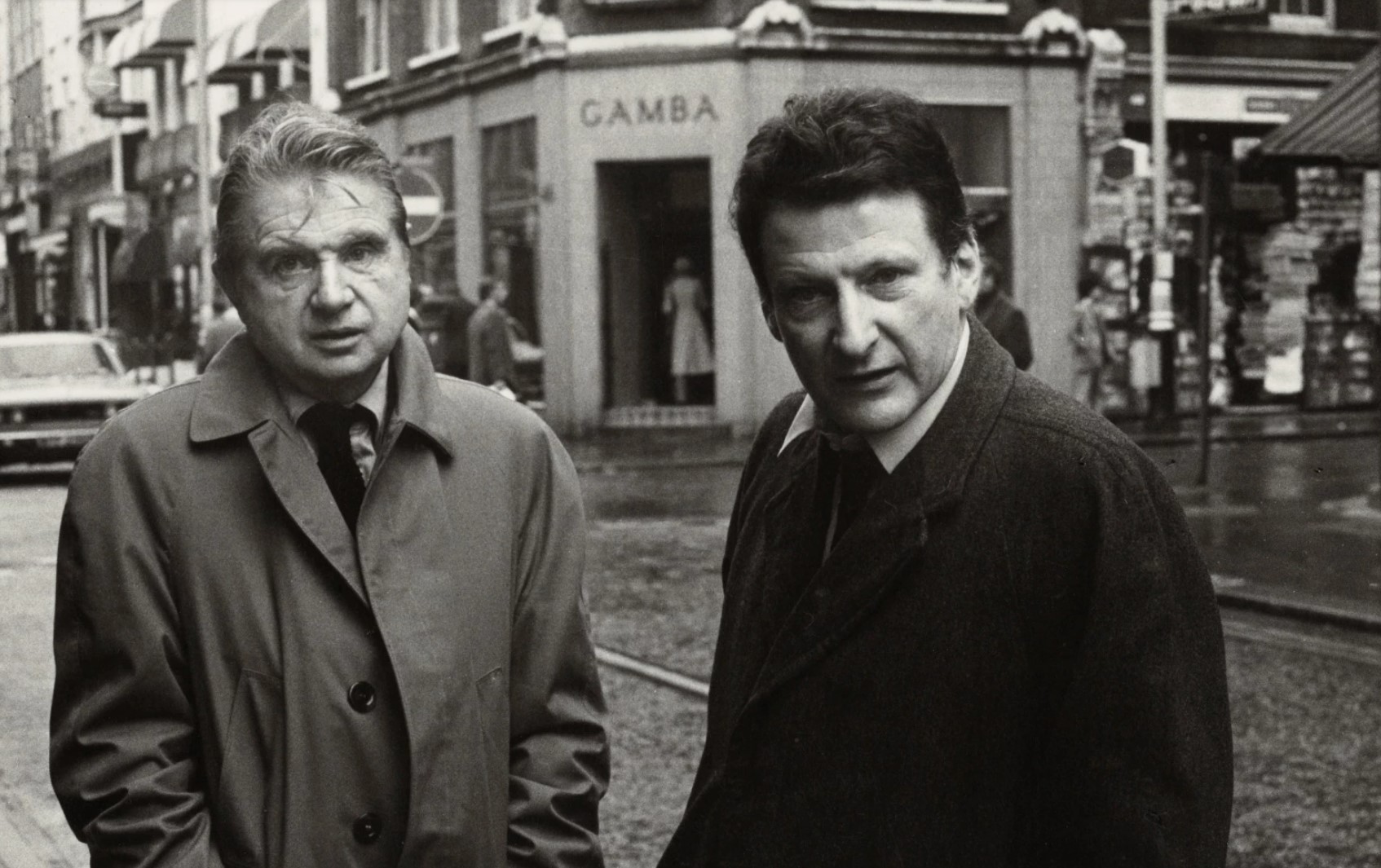
HARRY DIAMOND, FRANCIS BACON; LUCIAN FREUD, 1974. IMAGE © THE NATIONAL PORTRAIT GALLERY, LONDON
The iconic 14×12 inch canvas is of particular significance for Bacon: beginning in 1961, Bacon had employed the 14×12 inch canvas size exclusively for an epic portraiture cycle that depicted his circle of close friends, a project that occupied him for the remainder of his life. A central motif to Bacon, the triptych formed a balanced compositional unit that allowed him to reveal the images of his mind in sequence, resembling a slow panoramic photograph. The first of only five triptychs he created of Lucian Freud, Three Studies for Portrait of Lucian Freud sees Bacon draw upon the profound intimacy that is born of close friendship interwoven with artistic rivalry. In the pastose landscape of Freud’s visage, Bacon achieves the sublime balance between the mythic allure and haunting weight of a person’s selfhood, evincing his inimitable capacity to unveil through paint the deepest complexities of the human psyche.
Three Studies for Self-Portrait, 1979
Christie’s New-York: 9 November 2022
USD 29,015,000
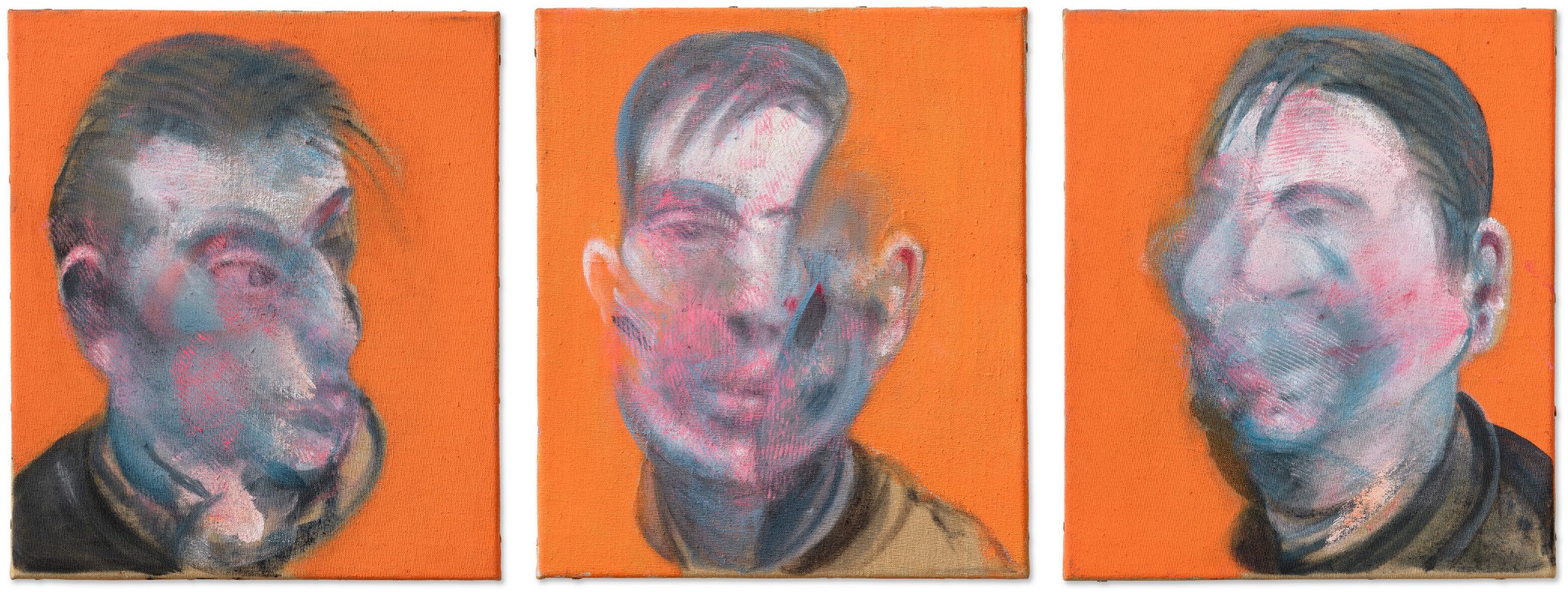
Three Studies for Self-Portrait, 1979
Oil on canvas, in three parts
Each: 14 x 12 inches (35.6 x 30.5 cm)
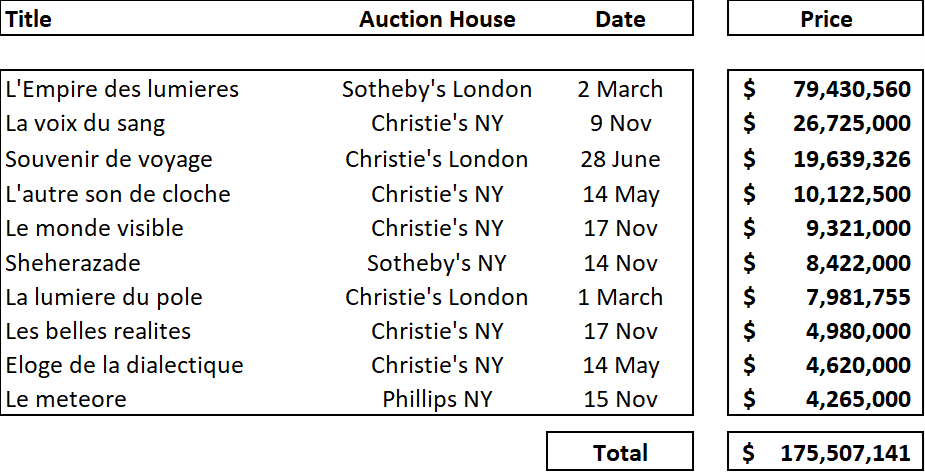
#5. Rene Magritte
Total Revenues: USD 226,545,489
216 Lots sold (131 unsold)
Top Lot: USD 79,353,624
NEW AUCTION RECORD FOR THE ARTIST
Rene Magritte enters the top 10 most sold artists in 2022 notably thanks to a new auction record. He became the most expensive surrealist artists, and prices for his works have been increasing substantially.
L’Empire des lumieres, 1961
Sotheby’s London: 2 March 2022
GBP 59,422,000
René Magritte (1898 – 1967)
L’empire des lumières, 1961
Oil on canvas
114.5 x 146cm (45 x 57 1/2 inches)
Signed Magritte (lower right); signed Magritte and titled on the reverse
The works from Magritte’s L’empire des lumières ‘series’ are among the most iconic images of twentieth century art. With their luminous combination of a bright blue sky set against an inky, dark night-time street, they combine immense visual impact with a profoundly conceptual approach. Alongside Magritte’s La Trahison des images (Ceci n’est pas une pipe) (fig. 1) and his bowler-hatted men, they are his most important images with an influence that stretches far beyond Surrealist circles. In them, Magritte achieves his most complex and sophisticated exploration of representation and reality. As the composition evolved through the 1950s and into the early 1960s, it would inspire and parallel developments in Conceptual and Pop Art (fig. 2) as well as becoming an archetypal image of twentieth century visual culture. Painted in 1961, the present work is among the largest and most refined iterations of the subject. It was painted by Magritte for his patron and friend Anne-Marie Gillion Crowet and has been in her collection ever since.
La voix du sang, 1948
Christie’s New-York: 9 November 2022
USD 26,725,000
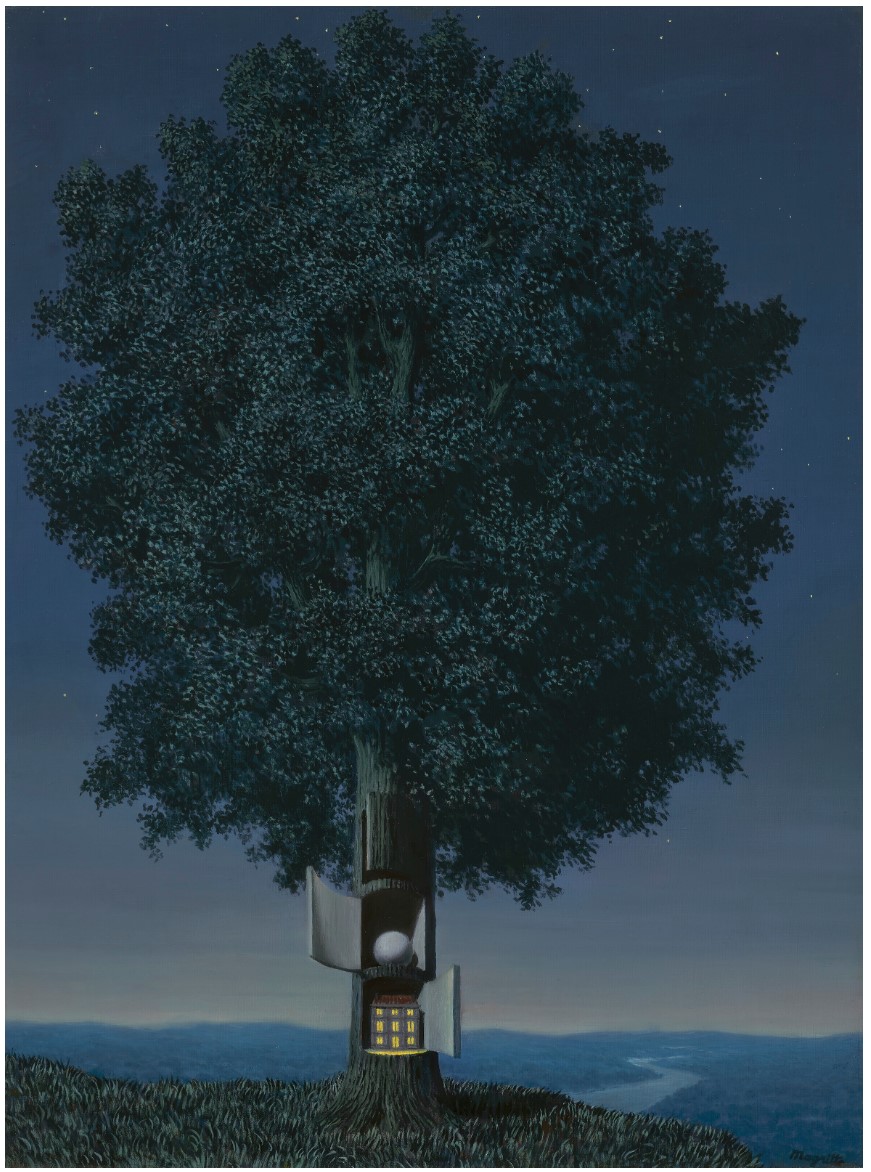
La voix du sang, 1948
oil on canvas
79.1 x 58.6 cm (31 1/8 x 23 1/8 inches)
Christie’s London: 28 June 2022
GBP 16,090,500
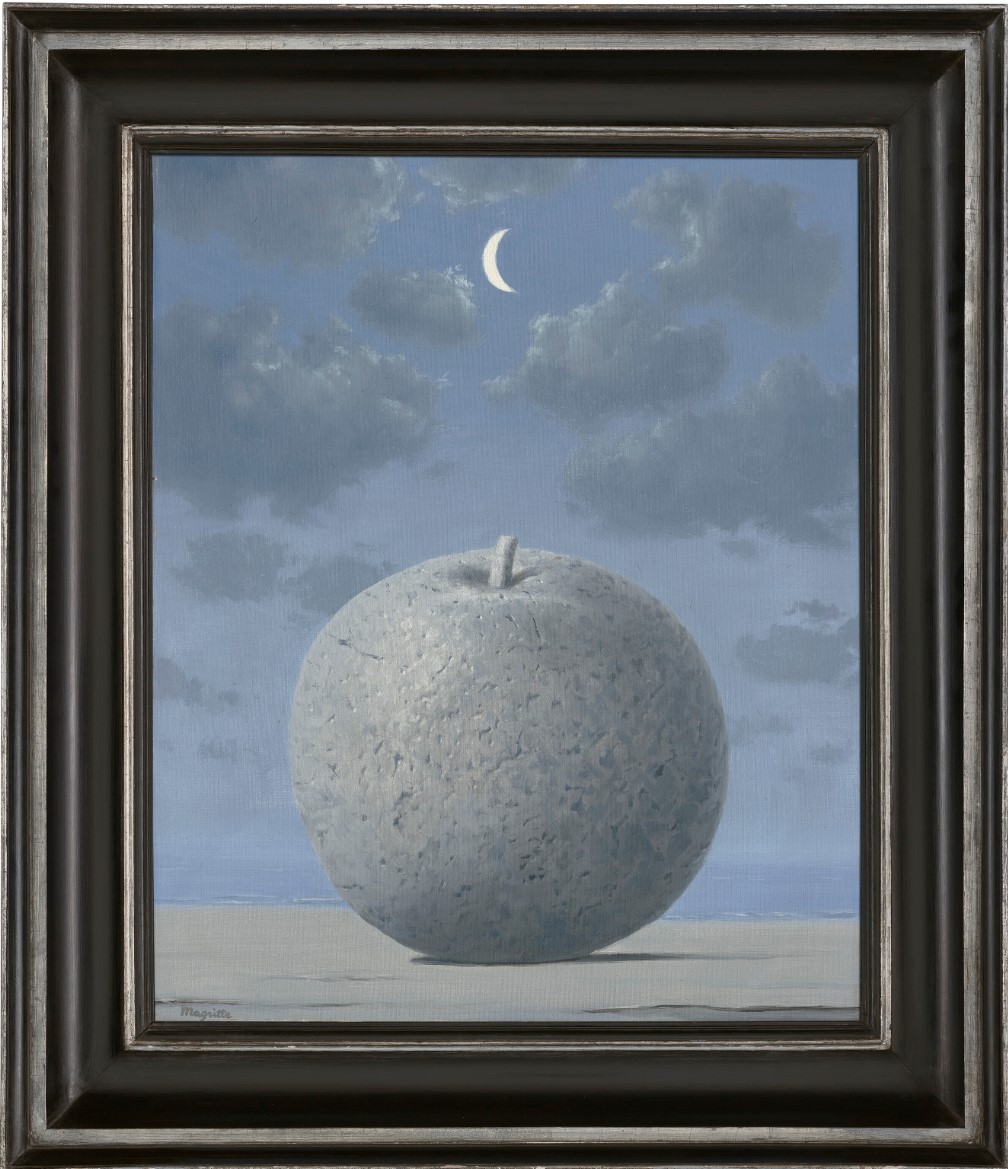
Souvenir de voyage, 1962-1963
Oil on canvas
41.1 x 33.3 cm (16 1/4 x 13 1/8 inches)
Signed ‘Magritte’ (lower left)s
Christie’s New-York: 17 November 2022
USD 9,321,000
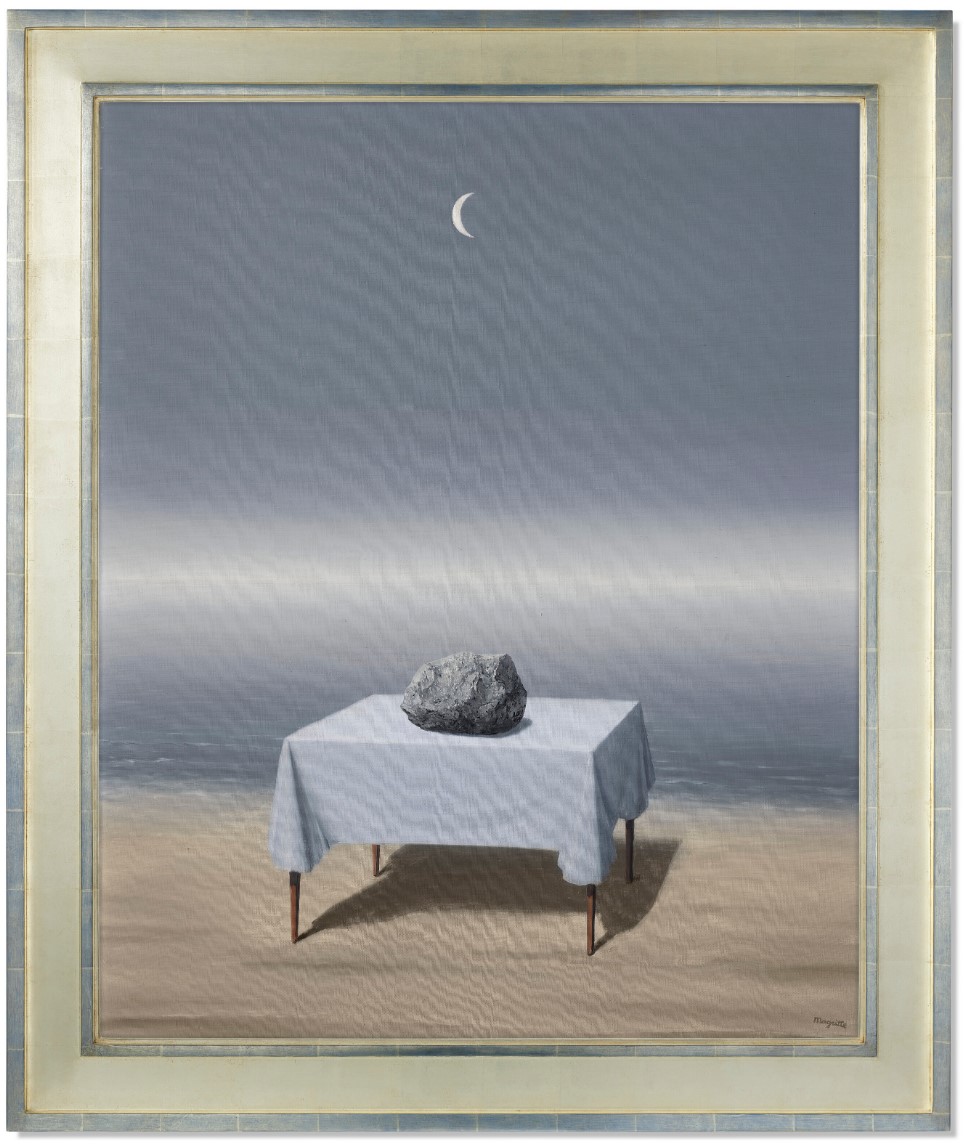
RENE MAGRITTE (1898-1967)
Le monde visible, 1962
Oil on canvas
100.2 x 81.1 cm (39 1/2 x 31 7/8 inches)
Shéhérazade, 1950
Sotheby’s New-York: 14 November 2022
USD 8,422,000
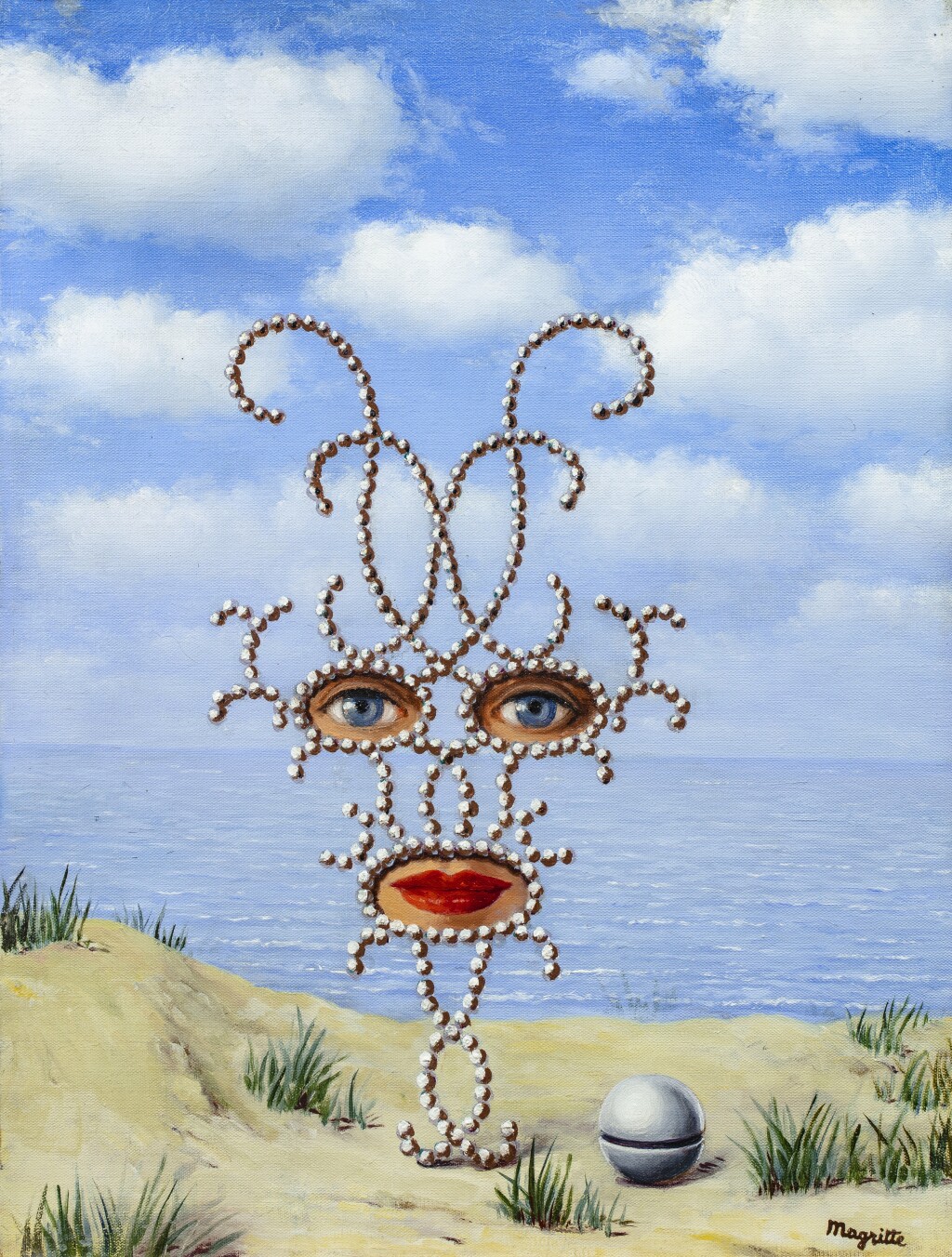
RENE MAGRITTE (1898-1967)
Shéhérazade, 1950
Oil on canvas
40×30 cm (15 ¾ x 11 ⅞ inches)
Featuring one of Magritte’s most iconic images and a quintessential Surrealist portrait, Magritte’s Shéhérazade stands as an integral work amid the lineage of art history. In 1954, Magritte dedicated and gifted to his friend Stéphy Langui, who would later acquiesce to Magritte’s request to paint her, resulting in the 1961 Portrait de Femme (Portrait of Stéphy Langui). Her husband, Emile Langui was a Belgian curator and fervent Socialist and anti-Fascist activist who was involved in the Resistance and later dedicated his life to repatriating looted works, working closely with the Monuments Men. Shéhérazade remained in the Langui collection until Stéphy’s death in the late 1990s; it now comes to auction for the very first time.
#6. Gerhard Richter
Revenues: USD 225,620,837
365 Lots sold (53 unsold)
Top Lot: USD 36,500,000
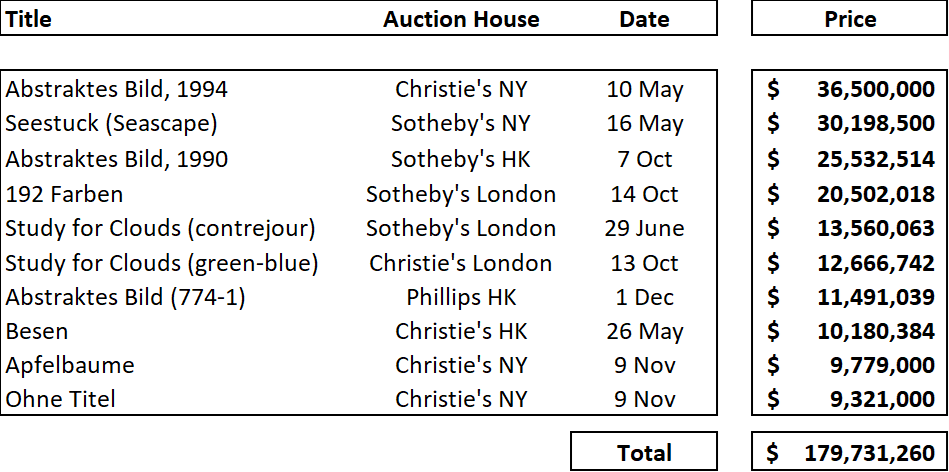
Abstraktes Bild, 1994
Christie’s New-York: 10 May 2022
USD 36,500,000
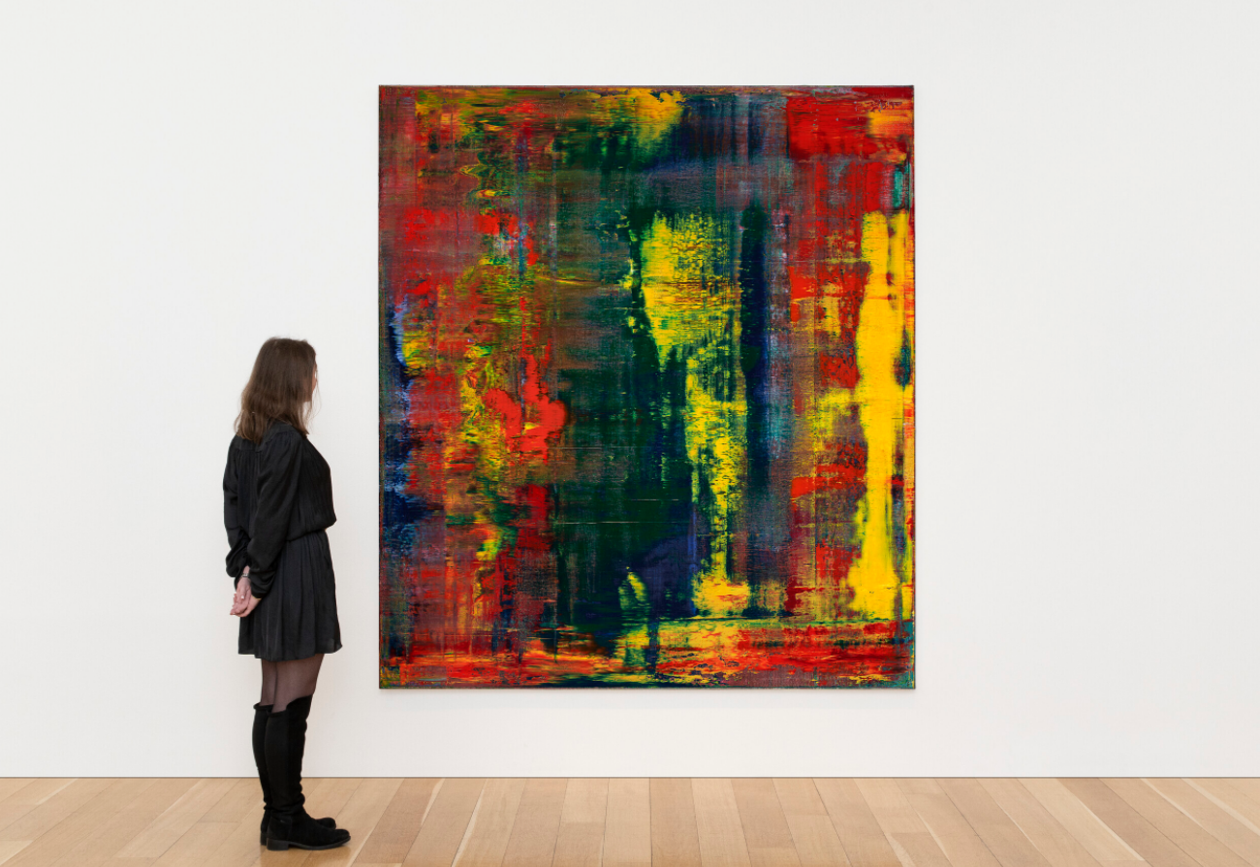
GERHARD RICHTER
Abstraktes Bild, 1994
Oil on canvas
225×200 cm (88.5×79 inches)
Exhibiting a chromatic potency that is unmatched in contemporary painting, Gerhard Richter’s Abstraktes Bilder attest to the timeless and emotive power of color. In the present work, saturated hues of deep red, golden yellows, and rich sapphire blues roil up through the highly active surface to magnificent effect. The culmination of a lifelong investigation into the practice of painting, Abstraktes Bild also encapsulates the artist’s investigations into the formal and conceptual possibilities of painting, his unique technique opening up the composition and disrupting the sanctity of the painted surface. Measuring nearly seven feet square, the viewer becomes enveloped in the dynamism of the kaleidoscopic surface, captivated by the intricate details are myriad of colorful hues. Formerly in the collection of legendary collector Heiner Pietzsch and his wife Ulla, and latterly the legendary guitarist Eric Clapton, Abstraktes Bild is a magnificent example from one of the most celebrated bodies of work of the past fifty years. Painted in 1994, Abstraktes Bild is a sumptuous example of the artist’s comprehensive interrogations of the painted surface. Executed on a monumental scale, in the present work Richter choreographs a prismatic array of jewel-like hues across the surface of the canvas. With careful sweeps of his brush, and even more stringent manipulations of the pigment using his hard-edged plastic squeegee, the artist lays down seams of vibrant, unadulterated color. Passages of primary red, blue and yellow coalesce throughout the composition, resulting in bottomless pools of saturated color. At their edges, where they come into contact with neighboring passages of color, they transition into activated areas that fizz with energy. Like Rothko’s floating fields of pigment, it is here where pigment coalesces with pigment that the visual energy present in the best examples of Richter’s work can most acutely be seen. The arduous process of applying, and then scraping off, consecutive layers of paint results in an intricate surface of infinite detail: thick impasto sits alongside thin veneers of paint that are so gossamer thin as to reveal the texture of the warp and weft of the underlying canvas.
Seestuck [Seascape], 1975
Sotheby’s New-York: 16 May 2022
USD 30,198,500
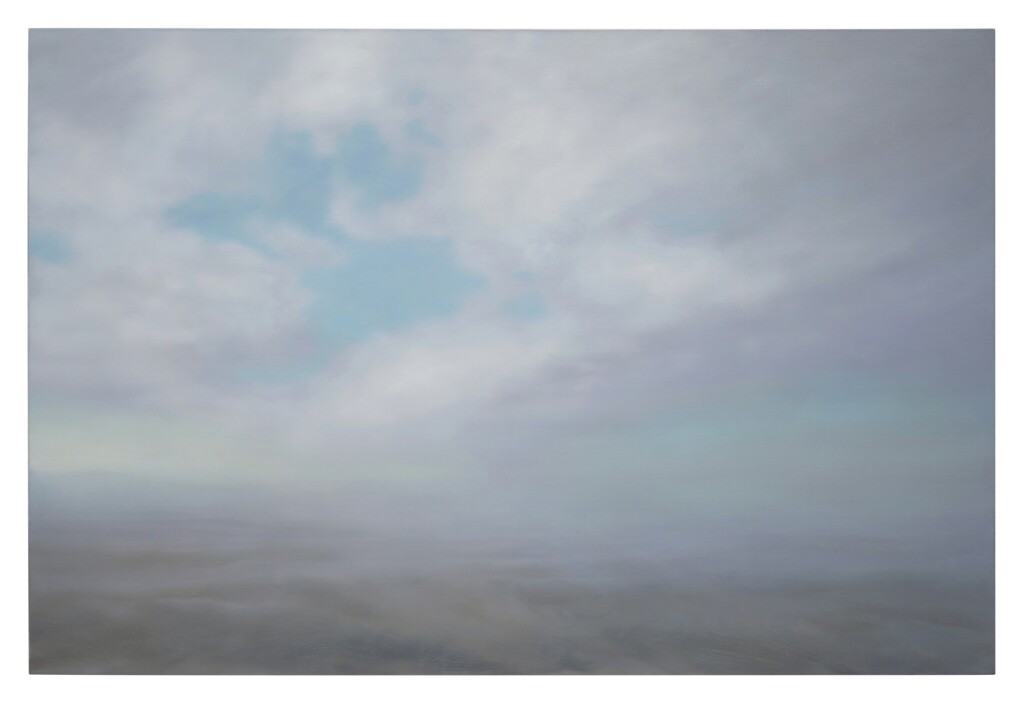
GERHARD RICHTER (b.1932)
Seestück [Seascape], 1975
Oil on canvas
199.4 x 300.4 cm (78 ½ x 118 ¼ inches)
Signed, dated 1975, and numbered 378 on the reverse
Emanating celestial light on a spectacular scale, the divine and immersive beauty of Gerhard Richter’s Seestück [Seascape] is entirely illustrative of the aesthetic and conceptual mastery that have come to define the artist’s revolutionary body of work. Radiating luminescent sunlit hues filtered through a harmonic miasma of soft ephemeral forms, this painting is undeniably indebted to a long and familiar legacy of art historical heritage. Readily evocative of the Romantic and sublime landscapes of Caspar David Friedrich, John Constable’s famous cloud studies, the atmospheric light effects of Turner, as well as drawing on the cloud’s symbolic value as heavenly proxies in Renaissance and Baroque painting, the present work instantly conjures an encompassing transhistorical field of references, whilst remaining resolutely contemporary.
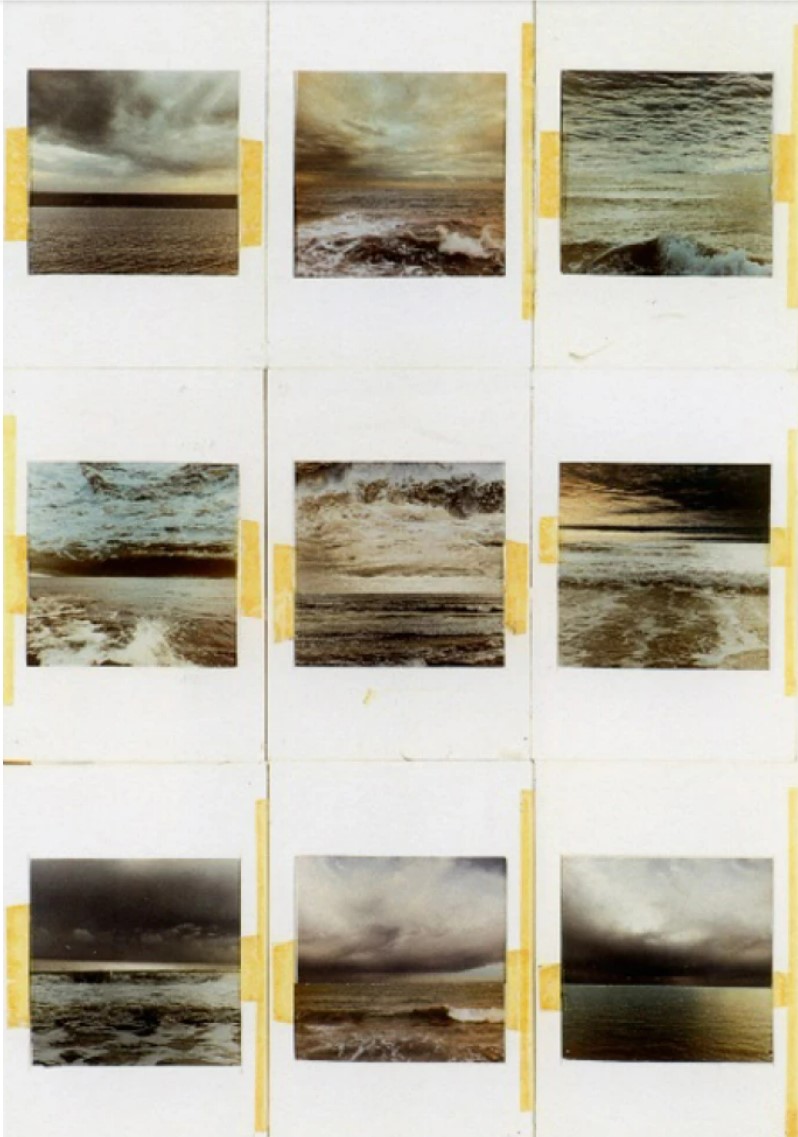
GERHARD RICHTER, SEESTÜCKE (FOTO-COLLAGEN) [SEASCAPES (PHOTO COLLAGE)], 1969. ART © 2022 GERHARD RICHTER, COURTESY GERHARD RICHTER ARCHIVES DRESDEN
Though drawing on a nineteenth century Romantic lineage and inescapably evoking a religiously loaded semiotic legacy, the artist’s fascination with clouds and seascapes extends into an exploration of chance in painting—the ultimate expression of which was later refined from the 1980s onwards via the Abstrakte Bilder. Drawing on his concurrent photography practice, Richter bases his Seascapes on source images from his own archive, but through his remarkable painterly prowess pushes the horizon further into transcendent abstraction. One of only four 2- by 3-meter canvases depicting this subject, all of which were executed in 1975 and are housed in prominent private collections worldwide, including the Froehlich Collection in Stuttgart, this concise group of works straddles the readily drawn schism separating Richter’s abstract works from the hyperreal Photo Paintings. Foregrounding religion, history and artistic inheritance within the complex debate for painting’s legitimacy in the later twentieth century, the Seestück represent one of Richter’s most pluralistic of thematic inquiries, and most astounding of aesthetic investigations.
Abstraktes Bild, 1990
Sotheby’s Hong-Kong: 7 October 2022
HKD 200,443,008 / USD 25,532,514
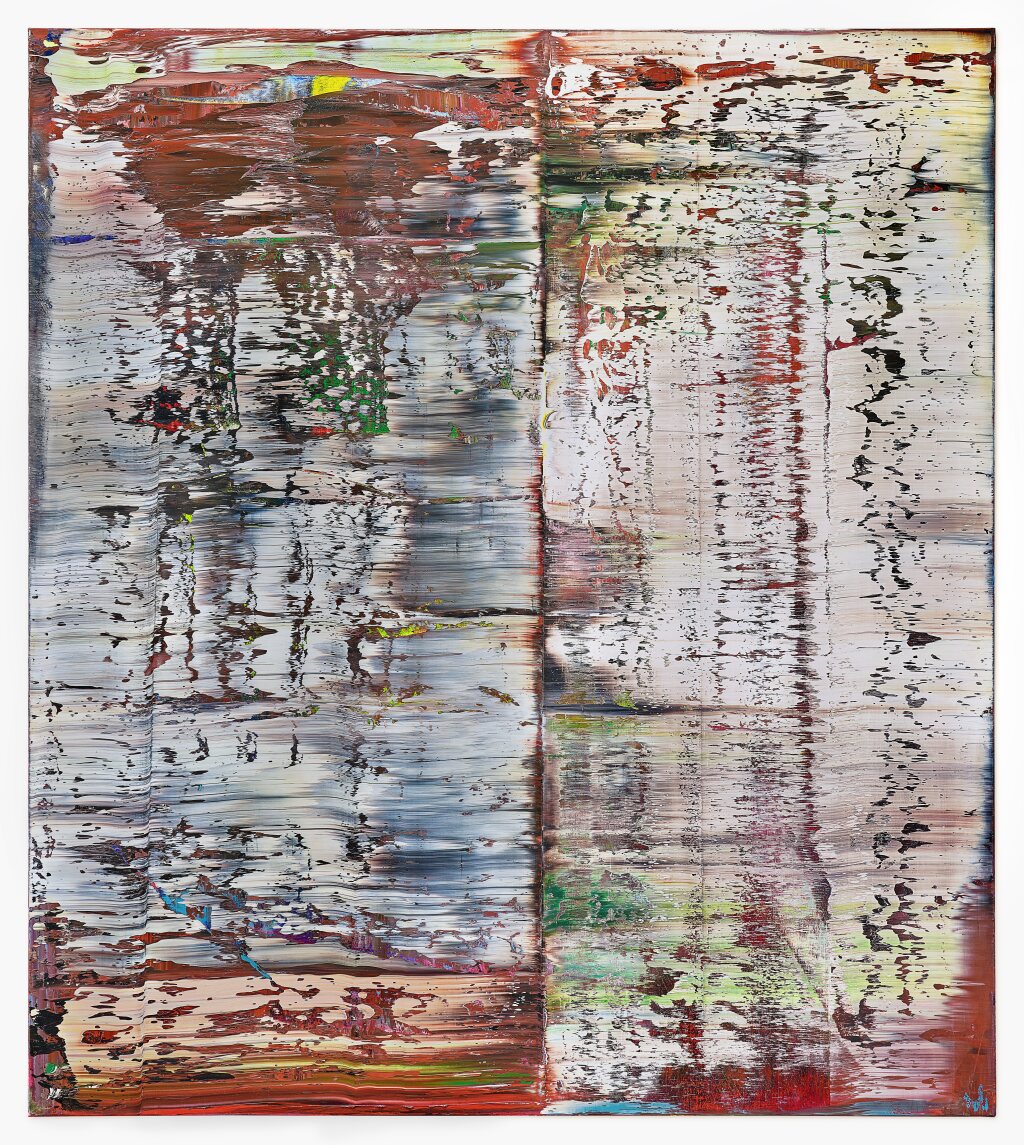
GERHARD RICHTER (b. 1932)
Abstraktes Bild, 1990
Oil on canvas
225×200 cm (88 ⅝ x 78 ¾ inches)
Signed, dated 1990 and numbered 725-1 on the reverse
Abstraktes Bild, executed in 1990, is a breathtaking masterwork of Gerhard Richter’s epic cycle of Abstraktes Bild paintings that the artist has produced since the 1980s. Belonging to the concise 725 series of just five works, which includes examples currently housed in the National Gallery of Victoria, Melbourne (725-3) and on loan at the Kunstmuseum Bonn (725-5), this museum-quality work is a paragon of the artist’s most arresting and seductive language of abstraction. One of Richter’s most stylistically stunning works, it measures in excess of two by two metres, thereby functioning on a monumental scale and enveloping the viewer entirely and irresistibly into its chromatic expanse.
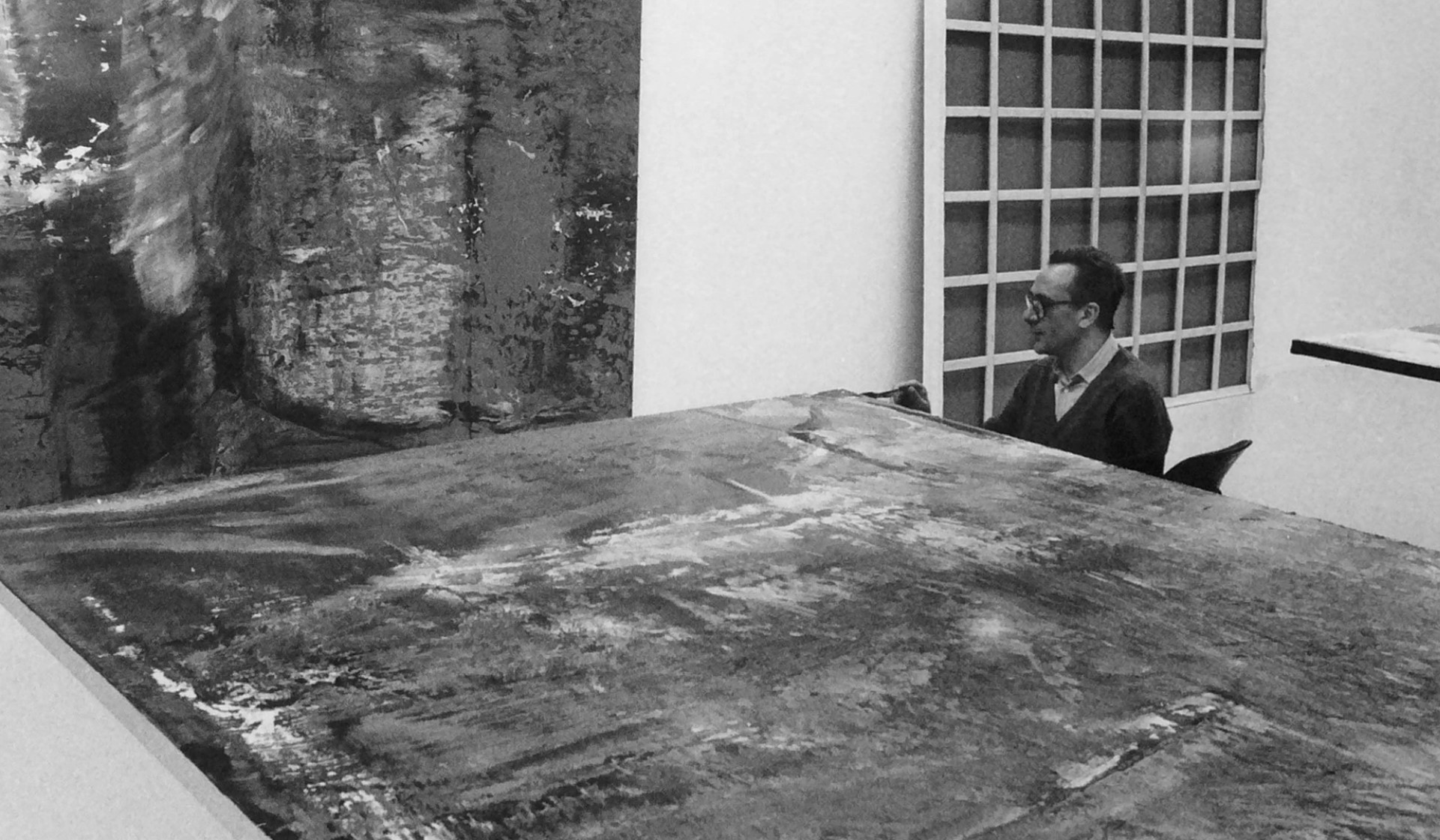
Gerhard Richter’s artistic contribution is internationally considered within the highest tier of this era; his inimitably diverse canon evidencing more than five decades of philosophical enquiry into the core natures of perception and cognition. Indeed, with its poignant critical reflections and groundbreaking advancements, it is undeniable that his output has opened up a wealth of possibilities for the future course of Art History. Since the early 1960s he has considered all genres of painting, delving into and pushing the boundaries of theoretical and aesthetic levels of understanding whilst exploring and challenging the fundamentals of their development. However, his extraordinary odyssey into the realm of abstract painting is often regarded as the culmination of his artistic and conceptual inquiries into the foundations of visual understanding. After decades of exploring the role of painting in relation to competing visual cultures; film and photography; and even painting itself, the emergence of the Abstraktes Bild stands as the crowning achievement of his oeuvre.
192 Farben, 1966
Sotheby’s London: 14 October 2022
GBP 18,297,800 / USD 20,502,018
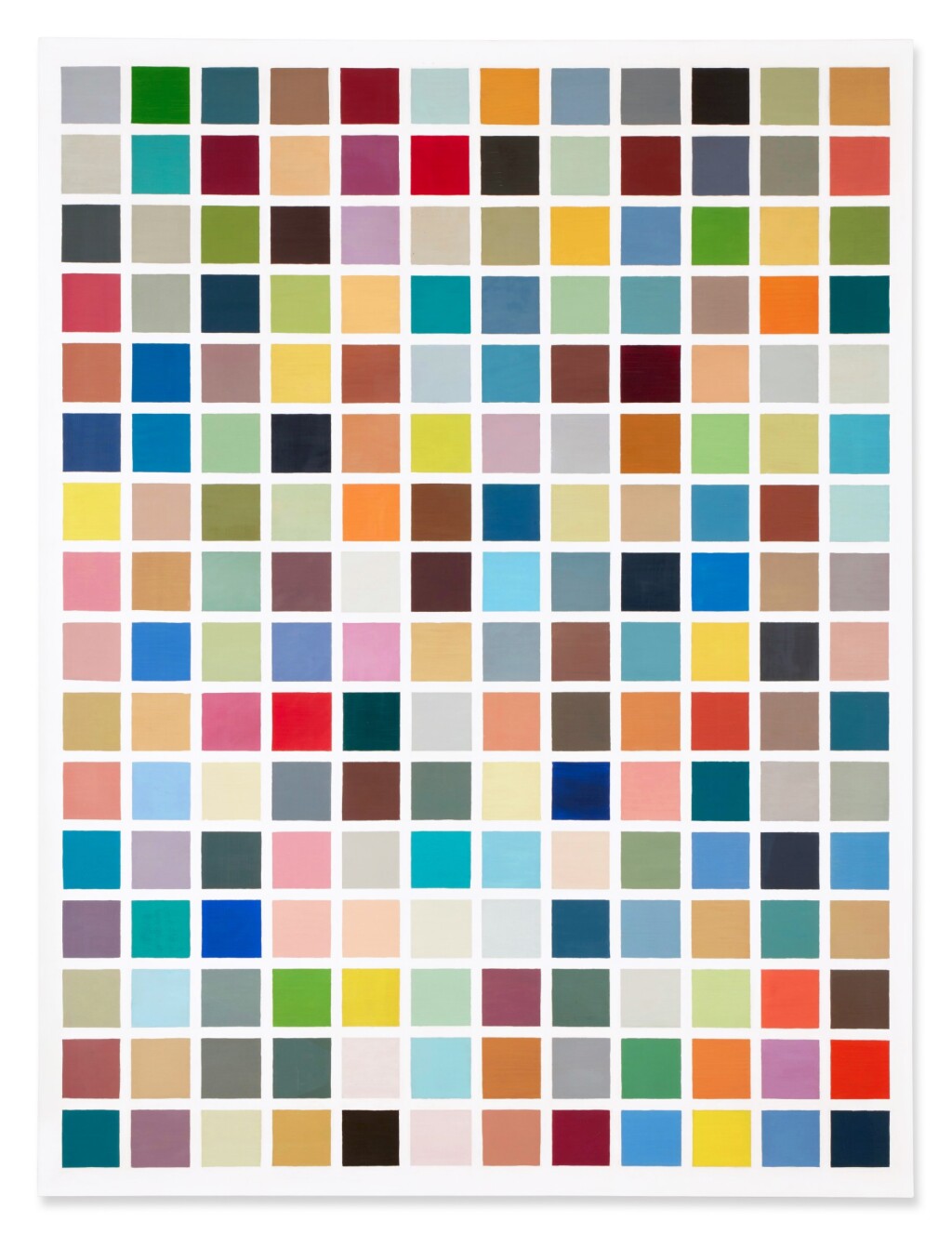
GERHARD RICHTER (b. 1932)
192 Farben, 1966
Oil on canvas
200×150 cm (78 ½ x 59 inches)
Signed Richter, dated I. 66 and variously inscribed (on the reverse)
In 1966, with his Color Chart works, Gerhard Richter succeeded in radically expanding his early oeuvre. It will not be for the last time that, through new motifs, Richter questioned his painterly concept and tests out a new stylistic idiom. Richter recognized in the color sample cards a pictorial quality, like the quality that he had seen four years earlier in newspapers, magazines and private family albums. For Richter, these motifs were ready-made pictures that served as perfect templates for his painting. Now, the sample cards from the paint shop presented a dramatic first step into the direction of abstraction.
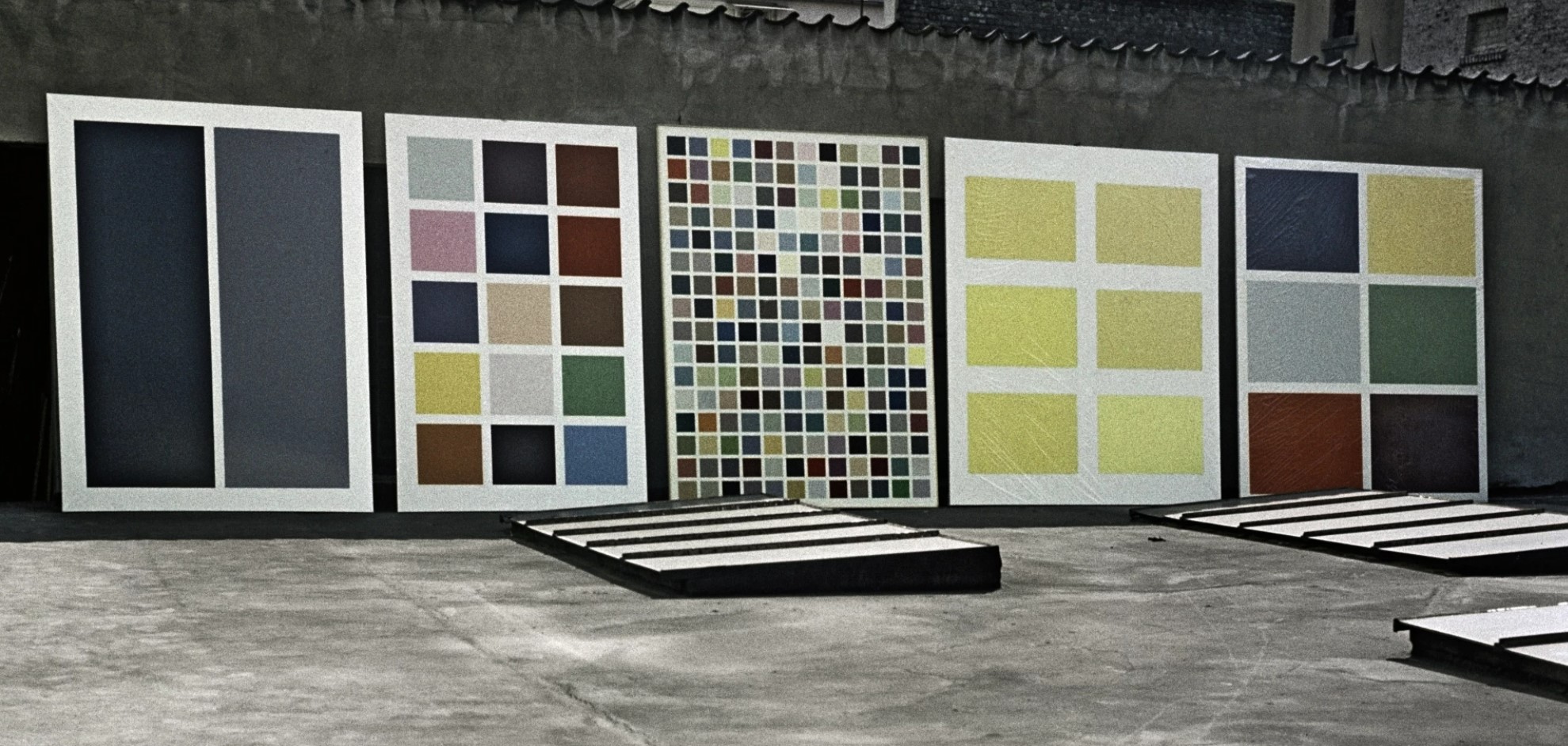
COLOUR CHART PAINTINGS ON THE ROOF OF RICHTER’S DÜSSELDORF STUDIO, 1966
IMAGE/ARTWORK: © GERHARD RICHTER 2022, COURTESY GERHARD RICHTER ARCHIVE DRESDEN
Gerhard Richter painted in 1966, 19 Color Charts in total, and attributed to these the numbers 135-1 to 144/1-10 in his catalogue raisonne. Amongst these belong three large format paintings with differing grey tones (143-1 to 143-3). Since 1970 he revisited the theme of the color charts several more times, expanding this to include up to 1024 different color tones within one composition. In contrast to this, he used merely four different colors in his 2008 series, Quattro Colori. In October 1966 Gerhard Richter opened an exhibition at Friedrich & Dahlem in Munich where he presented only examples of works from his new series of Colour Charts. Not even two years earlier, he had held here his first ever solo exhibition with paintings based on photographic source images. That exhibition had included several, now well known, paintings such as Fußgänger (6), Tote (9), Bomber (13), Stukas (18-1) or Ferrari (22), which today are all in international museum collections. For those visitors of the exhibition who had also been present at the first exhibition at Friedrich & Dahlem, this second exhibition only one and a half years later, must have come as quite a shock. When asked in 1981 about the contemporary reaction, Gerhard Richter vividly and distinctly remembered “the few insiders found it great, Konrad Fischer or gallerist Heiner Friedrich and a few collectors, they also understood. And others simply didn’t, they said ‘what is this nonsense. He is able to paint such lovely photographic paintings.’ But those had also not been that well regarded at the time. To some extent one could have expected this from me, to do something so absurd, as the photorealistic paintings were also so inartistic. For most people these were also not particularly interesting.” Whereas Richter’s gallerist in Munich was so fascinated and enthusiastic about these paintings that he was adamant to open his new gallery in New York with these Color Chart paintings.
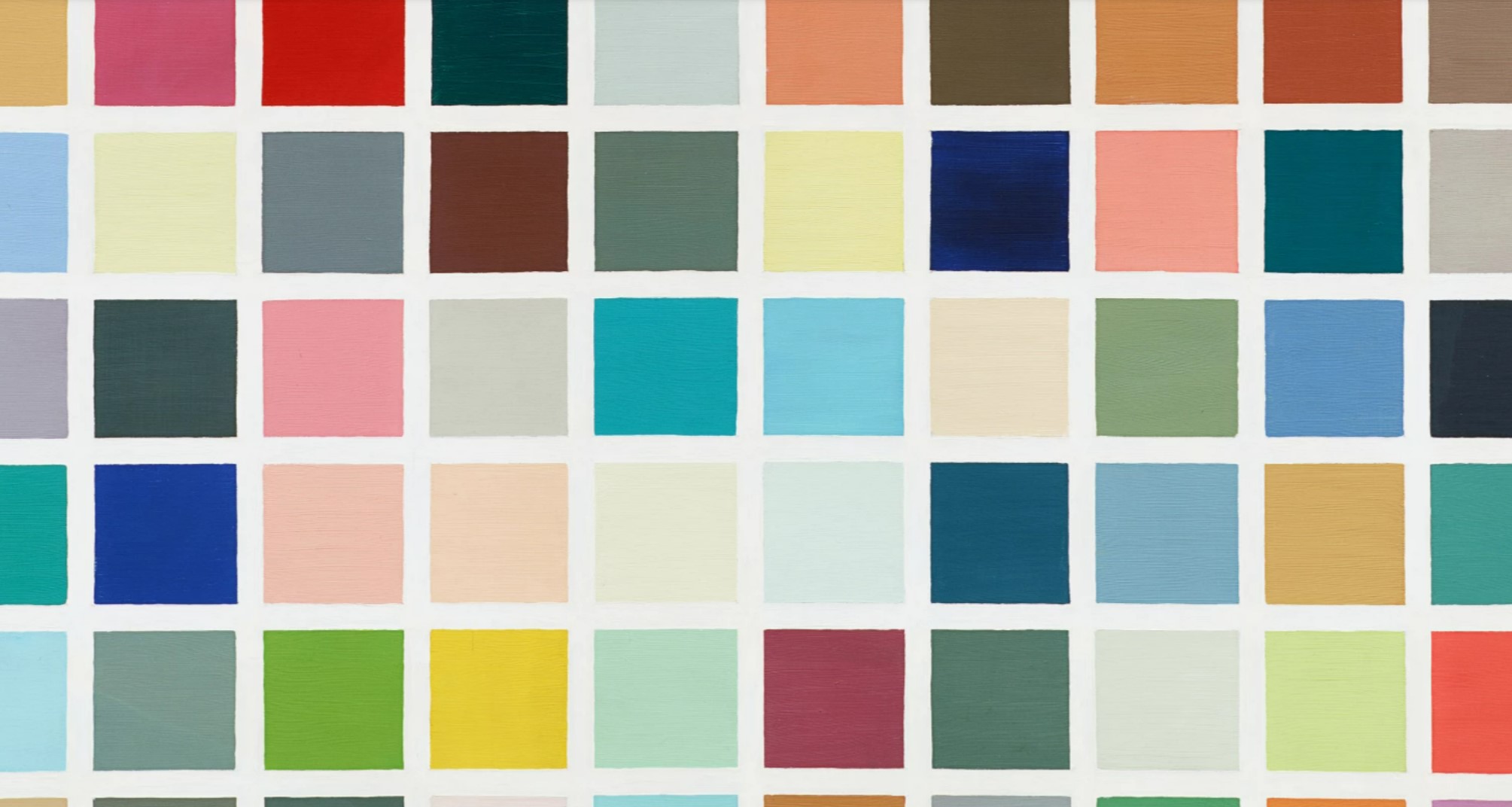
Gerhard Richter attributed the catalogue number 136 to 192 Farben from 1966. Therefore the Colour Chart follows both the smaller and less intensive pictures Zehn Farben and Zwölf Farben numbered 135-1 and 135-2 respectively. This order however does not at all correspond to the evolution of the works. In fact, 192 Farben is the first Colour Chart painted by Richter and therefore this work is the first work with which he introduces this new pictorial concept into his painterly practice. With this knowledge of the chronology, 192 Farben manifests itself as an exceptionally rare and challenging painting by the artist. Richter did in no way carefully approach his new group of works. Instead of using small canvases to test out the new concept he immediately started in a large format on a surface measuring 200 x 150 cm and applied 192 different and subjectively selected colour tones, separated on a quadratic grid by white bands. It was with this same confidence that later in 1976 Richter began his most comprehensive group of works, the Abstract Paintings with the monumental Konstruktion (389) which measures 250 x 300 cm.
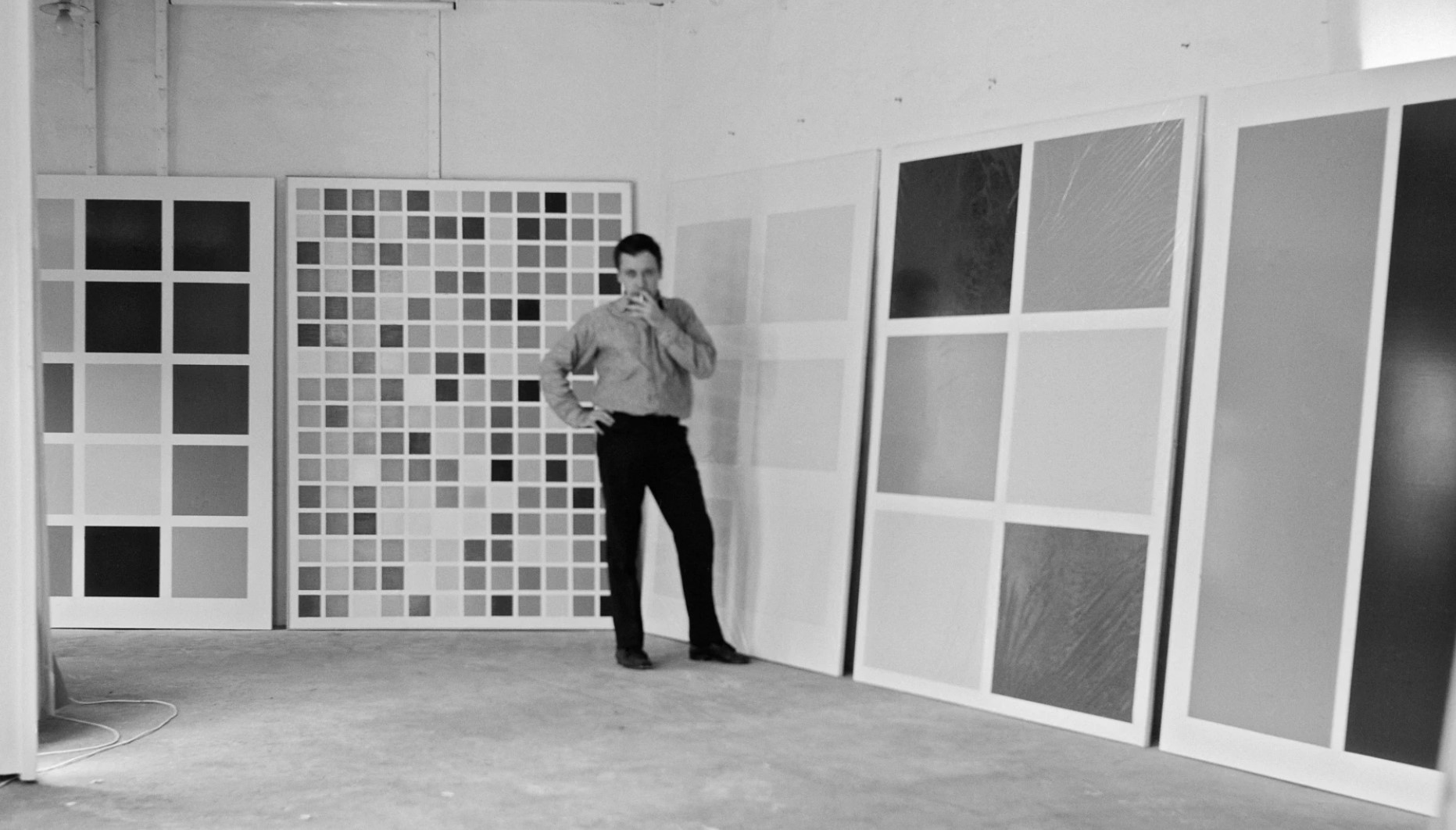
GERHARD RICHTER IN HIS STUDIO, 1966.
IMAGE/ARTWORK: © GERHARD RICHTER 2022, COURTESY GERHARD RICHTER ARCHIVE, DRESDEN
No other Color Chart from 1966 is composed of as many different color tones as the first painting 192 Farben. This painting therefore manifests itself as an exceptionally confident and uncompromising artistic gesture. Richter is unquestioningly positive about the quality and significance of 192 Farben. In no other Color Chart from 1966 is the concept of this group of works as convincingly apparent. Why did Gerhard Richter then not leave this work in the chronological order of its creation in its rightful first place and therewith also prioritizing its significance within this group of works? De facto it was Richter’s specific intention to remove any indication of the evolution within the 1966 Color Chart, which could have led from the first charts executed in oil, to those later works finished in lacquer. 192 Farben formed the basis from which Gerhard Richter tried to free his work from the narrative of photographic motifs, and these in turn serve as the model for his later abstract work. With this painting he rejects the traditional idea of composition in favor’s of a non-hierarchical surface structure. The squares are separated equally across the canvas and the colors follow a random arrangement. In 1966, 192 Farben presented the artist with a decisive way in which pictures can be possible without being restricted by the confines of painterly expressiveness or artistic subjectivity. Later, Richter radicalized this painterly concept, by further withdrawing his artistic identity from the process of painting. He replaced his oil color seen in 192 Farben and in which gestural strokes can still be recognized, with industrial lacquers. In the 1970s he eventually began to increase the number of the applied colors to up to 1024 differing shades, systematically mixing and randomly selecting their order on the pictorial plain. After Richter finally recognized in 1973 that “every color matches wonderfully to each random other” he even stopped applying the white bands between the color fields the following year.
Study for Clouds (Contre-jour), 1970
Sotheby’s London: 29 June 2022
GBP 11,164,000 / USD 13,560,063
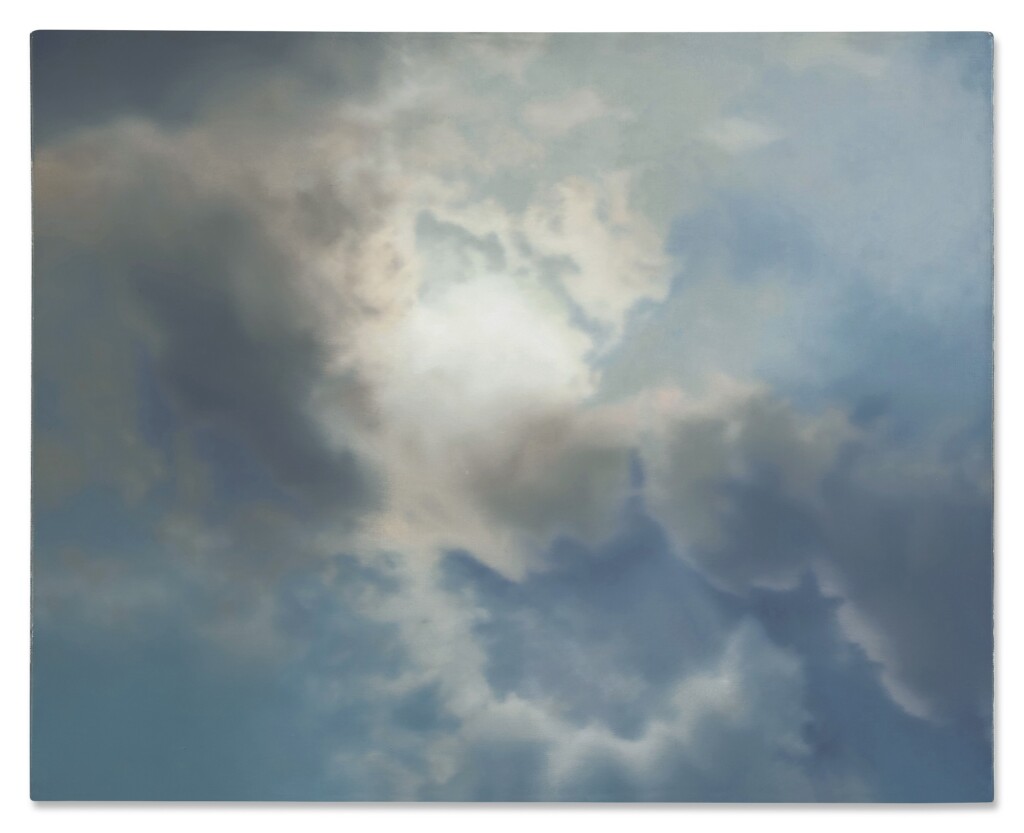
GERHARD RICHTER (b. 1932)
Study for Clouds (Contre-jour), 1970
Oil on canvas
80×100 cm (31 ½ x 39 ⅜ inches)
Signed Richter, dated XI.70 and numbered 276 (on the reverse)
At once dramatic and atmospheric, Study for Clouds (Contre-jour) is an exquisite canvas from Gerhard Richter’s celebrated Wolken series, a corpus of work that powerfully navigates the boundary between painting and photography, abstraction and representation, nature and the sublime. Transcendental in its treatment of light and exacting in its handing of pigment, the present work illuminates Richter’s masterful technique and his profound, career-spanning dialogue with photography, source imagery, and the genre of landscape painting. On the surface of the present work Richter creates a heightened sense of drama as sunlight breaks through heavenly white clouds. Set against a bright blue sky, the sun-drenched clouds are magnificent in their precise rendering. Satisfying his viewer’s longing for a spiritual encounter with the awesome force of nature, Richter draws upon the cloud’s value throughout the art historical canon as a powerful symbol of heavenly proxies. Attesting to its significance within the concise cycle of Wolken paintings, Study for Clouds (Contre-jour) has been illustrated in over sixteen publications and has travelled extensively as part of eight major exhibitions – five across Europe, two in America and two in Asia. The present work was most recently on view as part of the critically-acclaimed retrospective Gerhard Richter: Painting After All at The Metropolitan Museum of Art, New York between March and July 2020. One of the very best iterations of the Cloud paintings, Study for Clouds (Contre-jour) is testament to Richter’s painterly prowess and status as one of the most significant artists of the Twentieth and Twenty-First centuries.
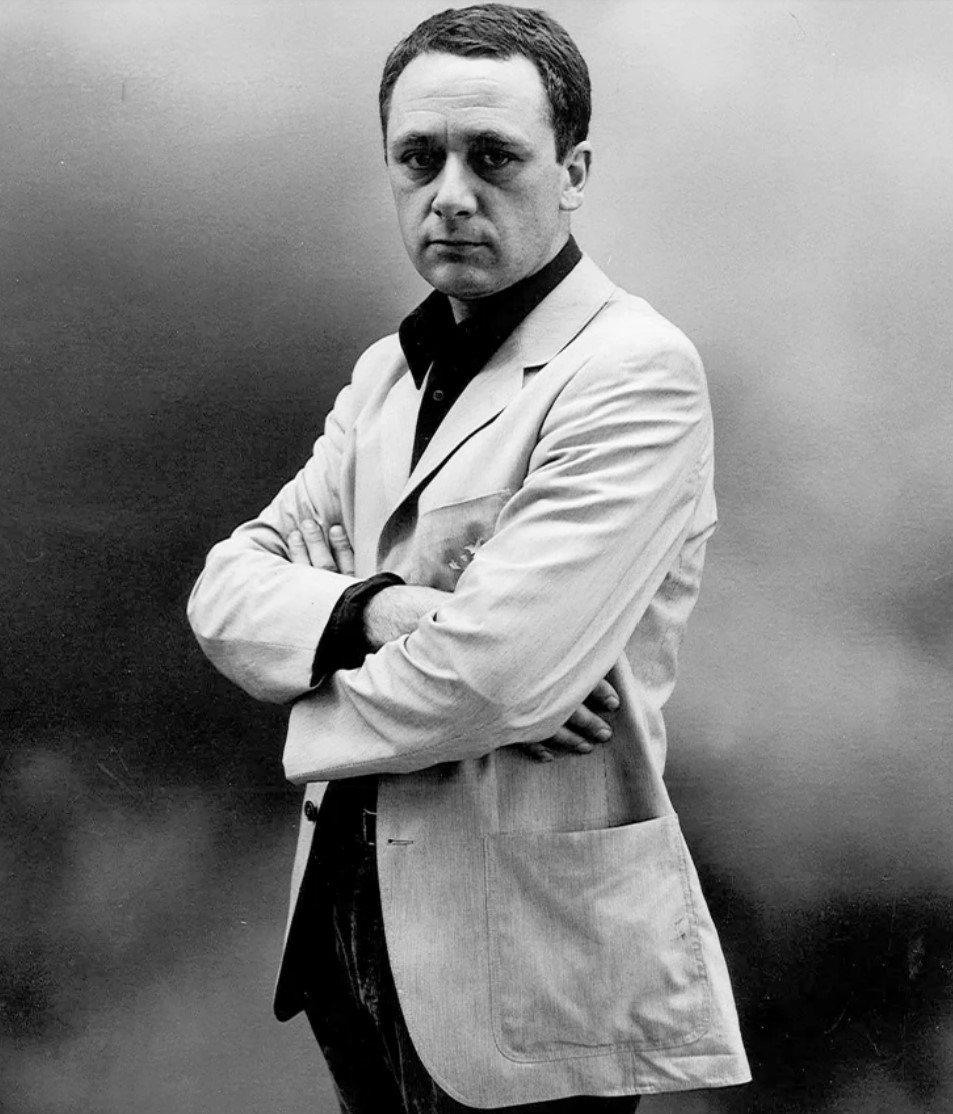
GERHARD RICHTER IN HIS STUDIO, 1970
IMAGE/ ARTWORK: © GERHARD RICHTER 2022
Executed in 1970 and numbered 276 in the artist’s catalogue raisonné, the present work is one of only twenty-two photo-realist Cloud paintings in oil on canvas, six of which are held in prestigious museum collections, including Museum Folkwang, Essen; Fondation Camignac, Paris; National Gallery of Canada, Ottawa; and Kunst-und Ausstellungshalle der Bundesrepublik Deutschland, Bonn. Executed between 1968 and 1979, the series is among Richter’s most celebrated, and marks a significant pre-curser to his photo-realist Kerzen (Candles) and Schädel (Skulls) of the 1980s. Altering the effects of light and weather conditions on cloud formations, Richter renders swirling celestial bodies that are at once divine, transient and untouchable, a source of curiosity across centuries and a subject of profound intrigue to artists throughout the canon of art history. Indeed, whilst remaining resolutely contemporary in its associations with photography and abstraction, Study for Clouds (Contre-jour) is indebted to the art historical tradition of landscape painting and the beloved genre of the cloudscape from the Renaissance and the Baroque periods through to the Nineteenth Century. From Michelangelo’s ethereal clouds on the ceiling of the Sistine Chapel in The Last Judgement (c. 1540), to John Constable’s celebrated cloud studies and Caspar David Friedrich’s romantic vistas in works such as Wanderer Above a Sea of Fog (circa 1817) and Monk by the Sea (1808-1810), the present painting evokes the sublime visual language founded in such pantheistic masterworks. Yet Richter’s photographic, near-scientific approach to the very same subject matter systematically de-romanticizes the great genre of landscape painting. In great contrast to the works of the German Romanticists, Richter’s landscapes are devoid of the human figure, and thus devoid of human emotion or empathy.
Wolkenstudie (grün-blau) (Study for Clouds (Green-blue)), 1971
Christie’s London: 13 October 2022
GBP 11,167,000 / USD 11,666,742
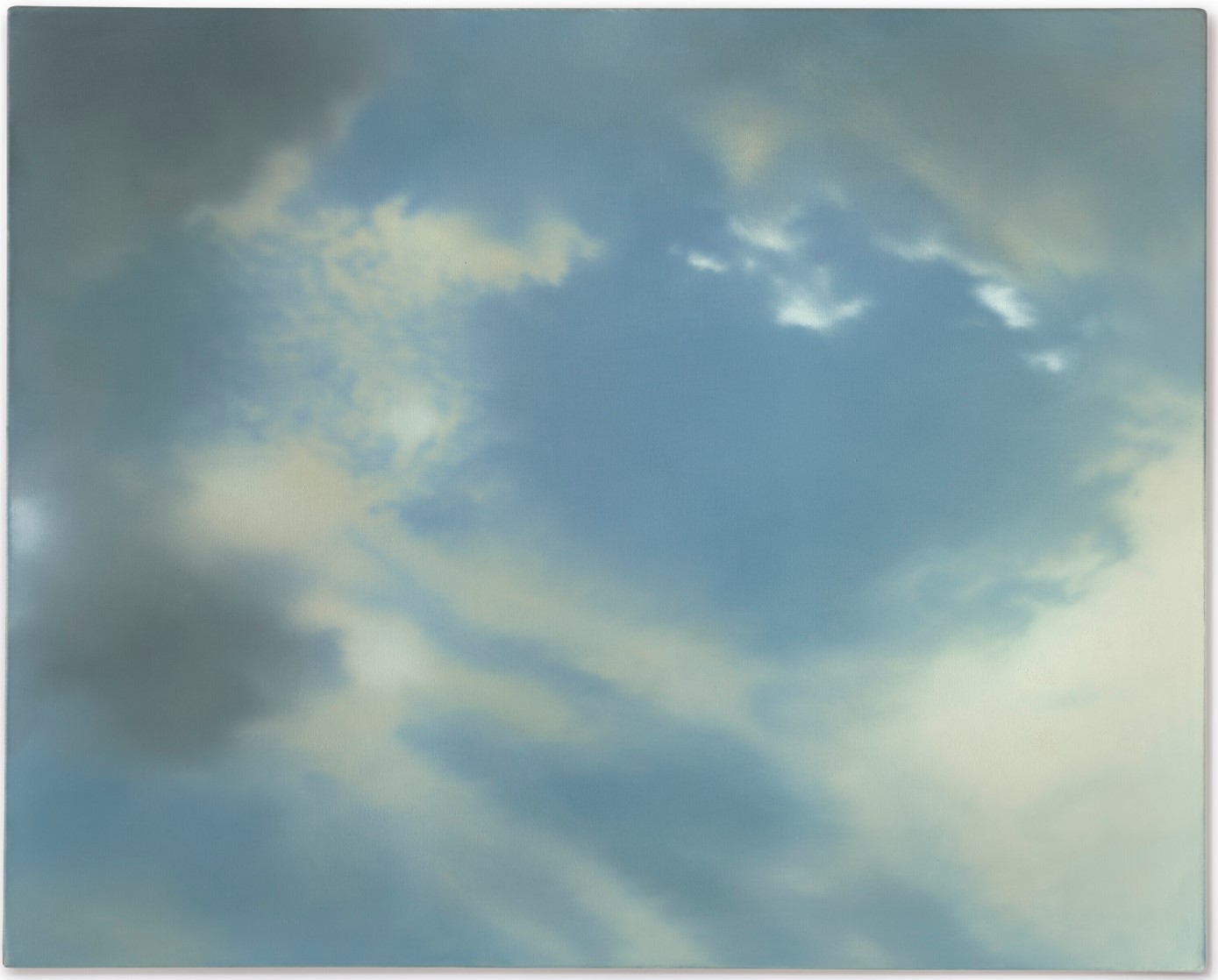
GERHARD RICHTER (B. 1932)
Wolkenstudie (grün-blau) (Study for Clouds (Green-blue)), 1971
Oil on canvas
80×100 cm (31 1/2 x 39 3/8 inches)
Signed and dated ‘Richter 1971’ (on the reverse)
Held in the same private collection for four decades, and never before seen in public, Wolkenstudie (grün-blau) (Study for Clouds (Green-blue) (1971) is a rare masterwork from Gerhard Richter’s celebrated series of cloudscapes. An extraordinary feat of technical and conceptual virtuosity, it poses as a sublime window onto the outside world: an exquisite, photorealist vision of deep green and blue sky tinged with radiant golden beams. 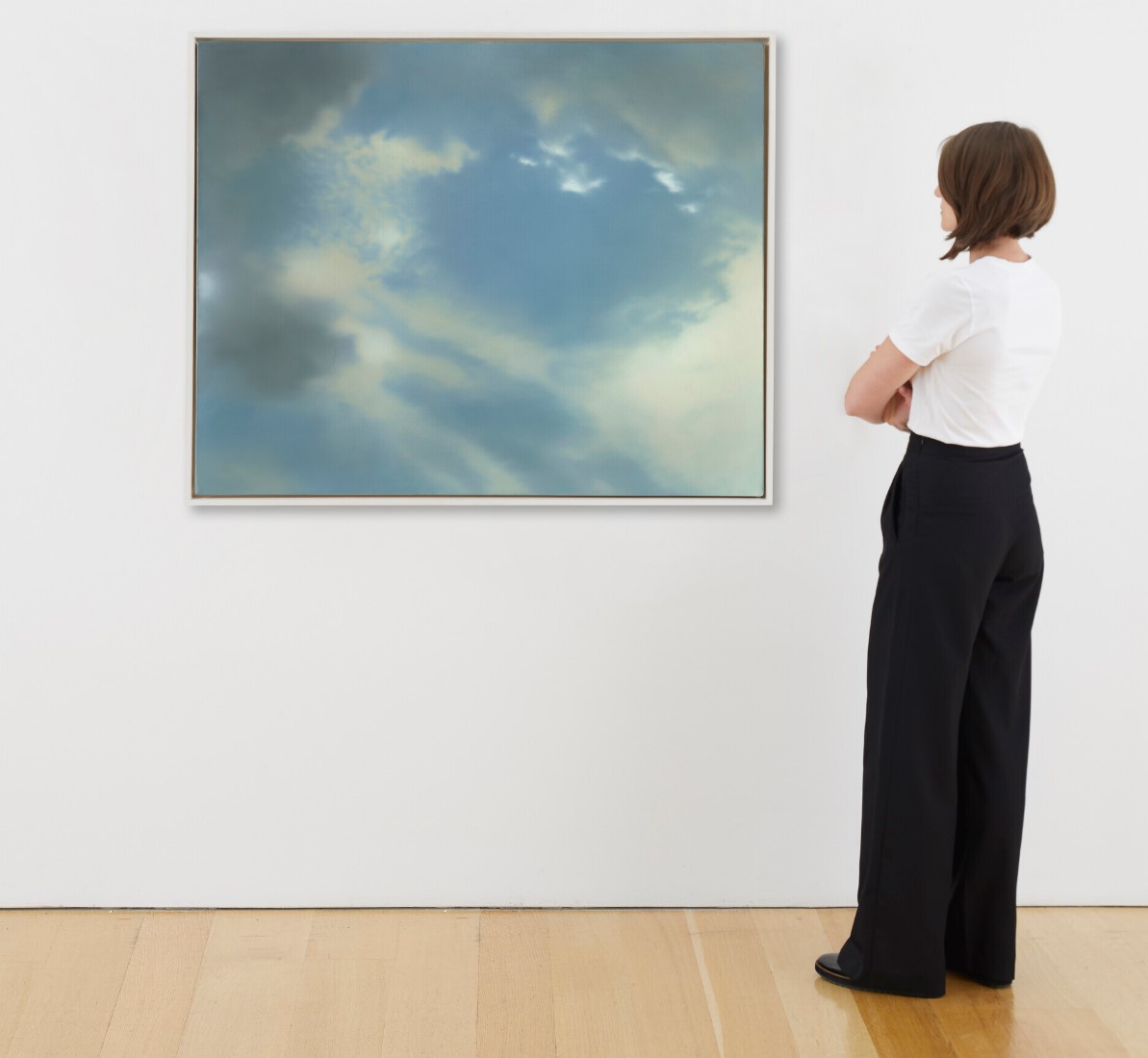
With meticulous brushstrokes, the artist captures the diaphanous play of light and shadow across his celestial vista, creating a profound illusion of infinite depth. Simultaneously evoking and subverting the language of Romanticism, Richter’s cloudscapes played a pivotal role in his journey from photo-painting to abstraction, asking vital questions about painting’s purpose at a time when its future seemed uncertain. The present work stands among the most accomplished paintings in the series, taking its place alongside examples held in the Museum Folkwang, Essen, the National Gallery of Canada, Ottawa and the Kunst- und Ausstellungshalle der Bundesrepublik Deutschland, Bonn.
Abstraktes Bild (774-1), 1992
Phillips Hong-Kong: 1 December 2022
HKD 89,375,000 / USD 11,491,039
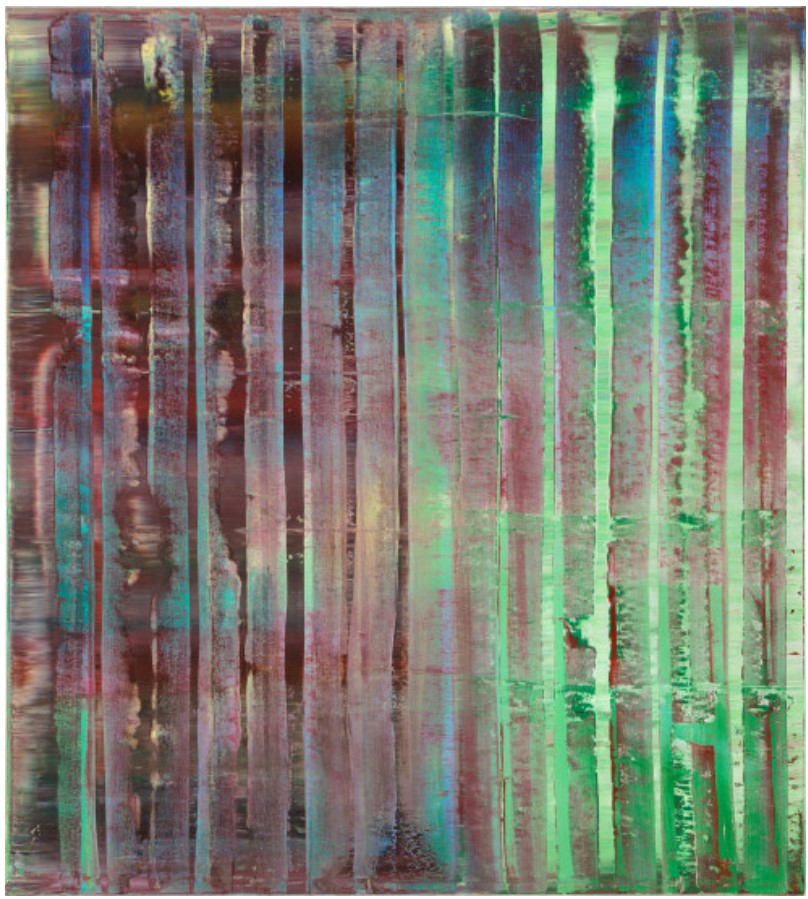
GERHARD RICHTER
Abstraktes Bild (774-1), 1992
Oil on canvas
200 x 180.3 cm (78 3/4 x 70 7/8 inches)
Signed, numbered and dated ‘774-1 RICHTER 1992’ on the reverse
Coming to the auction market for the very first time, Gerhard Richter’s Abstraktes Bild (774-1) is a visually arresting masterpiece that exquisitely exemplifies the artist’s technical and conceptual approach into abstraction. Spatial ambiguity, visual complexity, and tactile materiality all come into play in Abstraktes Bild (774-1), embodying the beauty of marrying spontaneity with orchestration. Created right after Richter’s breakthrough retrospective at London’s Tate Modern in the previous year, Abstraktes Bild (774-1) is representative of a climactic moment within the artist’s career where he garnered unprecedented critical acclaim. There is a domination of primary colours in Abstraktes Bild (774-1) that is reminiscent of bright skies, luscious meadows, and majestic mountainscapes – strokes of bright greens and soft blues melt into a background of deep garnet reds. These colours recall waves of trees and grass as they ripple to the current of the wind. The disconnected strokes of paint, the naturalistic colour scheme, and the reminiscence of sky and land are evocative of Paul Cézanne’s famous paintings of the Saint-Victoire mountains.
Besen, 1984
Christie’s Hong-Kong: 26 May 2022
HKD 79,915,000 / USD 10,180,384
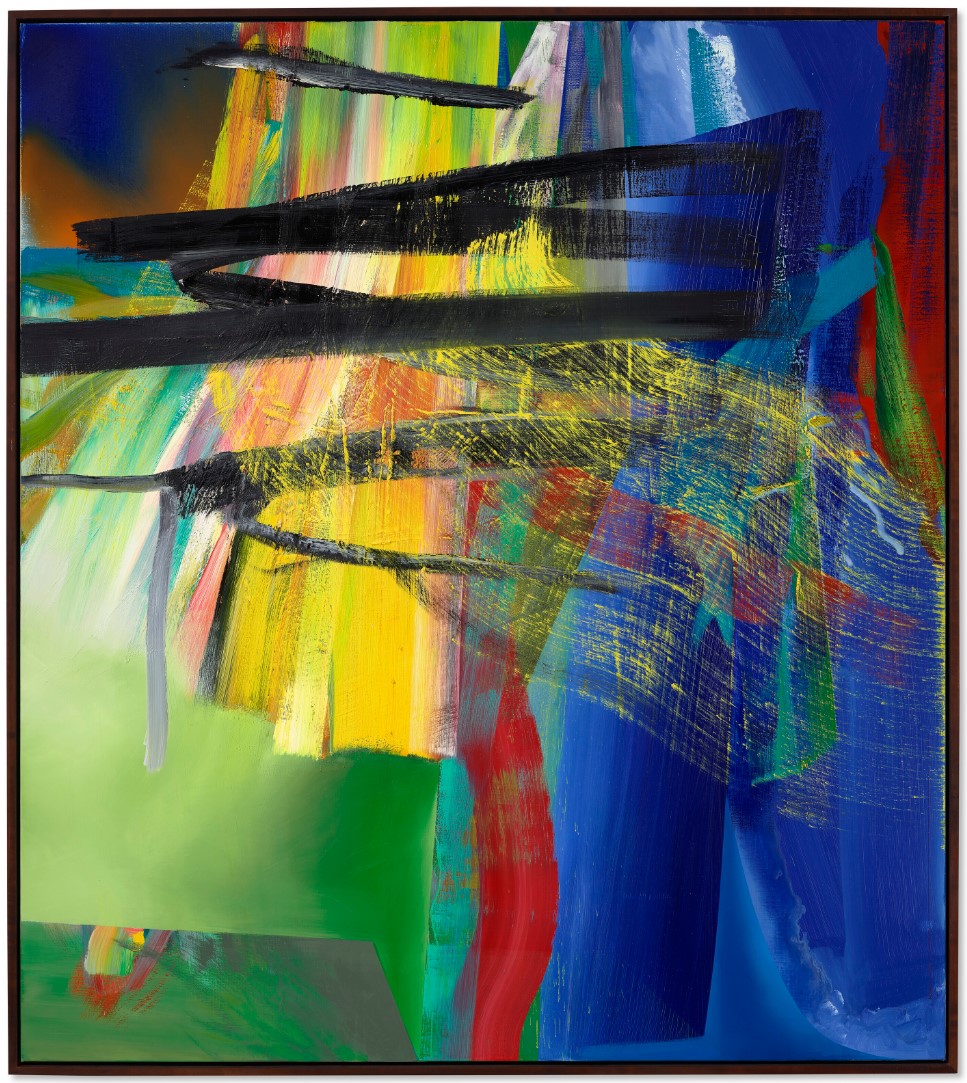
GERHARD RICHTER (B. 1932)
Besen, 1984
Oil on canvas
224.7 x 200 cm (88 1⁄2 x 78 3⁄4 inches)
Signed, dated and inscribed ‘Richter 1984 553-2’ (on the reverse)
Ohne Titel, 1989
Christie’s New-York: 9 November 2022
Visionary: the Paul G. Allen Collection
USD 9,321,000
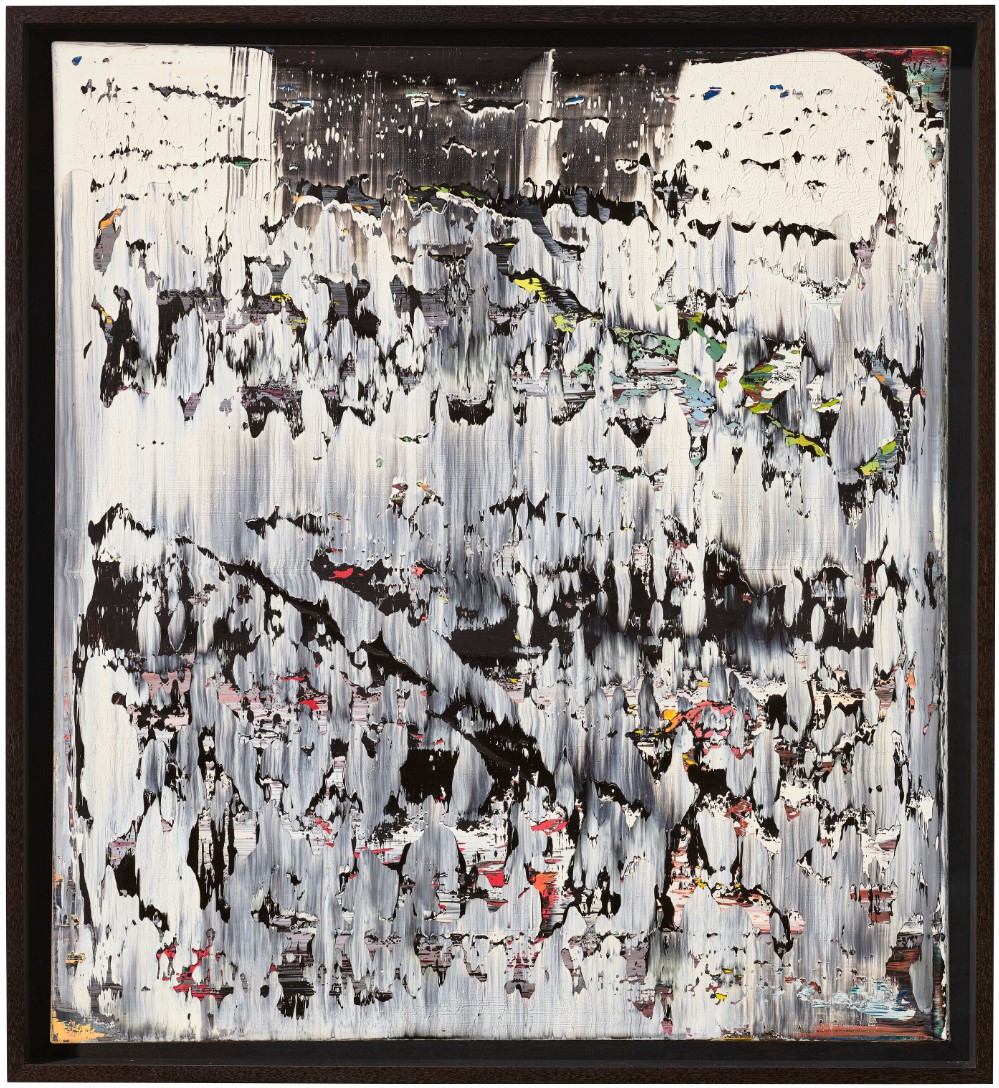
GERHARD RICHTER (B. 1932)
Ohne Titel, 1989
Oil on canvas
112.1 x 102.2 cm (44 1/8 x 40 1/4 inches)
Signed, dated and inscribed ‘687-4 Richter 1989’ (on the reverse)
Dating from a highpoint in Gerhard Richter’s career, Ohne Titel is a dazzling example of the artist’s “abstract paintings.” Richter used these paintings to thoroughly investigate the process of painting, questioning the nature of composition and forging a new path that advanced the conceptual rigor that had been typical of his earlier practice. Painted in 1989, Ohne Titel was exhibited that same year at a major retrospective of the artist’s work at the Museum Boijmans Van Beuningen in Rotterdam. Richter was invited to produce a series of new work that brought together his past and present practice; the result was a series of magnificent grayscale canvases which combined his earlier love of monochrome with his later practice of continually laying down and then subsequently scraping off layers of paint, resulting in the dynamic painterly surface that we can see in the present example. To create these dynamic surfaces, Richter puts down layer upon layer of contrasting colored paint. Just as the surface begins to dry, he drags a hard-edged squeegee across the canvas, challenging the primacy of the painted surface and opening up schisms and pools of rich vibrant color. Here, in Ohne Titel, sparks of vibrant red and shocks of electric blue roil up through the earlier layers of dark and silver pigment. From light to dark, and from high-keyed primary colors through to delicate variations of more organic hues, the painting becomes a bejeweled combination of both color, energy and mystery.
#7. Jean-Michel Basquiat
Total Revenues: USD 221,018,518
93 Lots sold (33 unsold)
Top Lot: USD 85,000,000
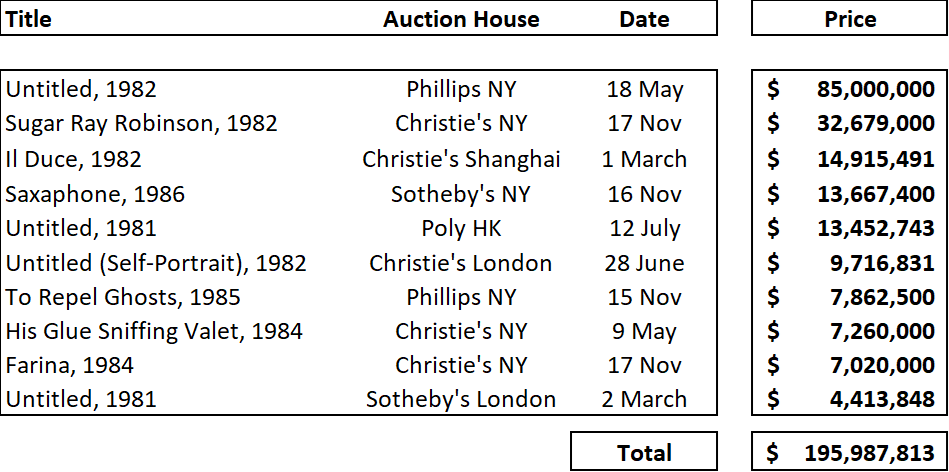
Untitled, 1982
Phillips New-York: 18 May 2022
USD 85,000,000
JEAN-MICHEL BASQUIAT
Untitled, 1982
Acrylic and spray-paint on canvas
94×197 inches (239.4×501 cm)
Coming from the esteemed collection of Japanese entrepreneur Yusaku Maezawa, Untitled is one of Jean-Michel Basquiat’s greatest masterpieces. Its potency and scale mark it as one of his most ambitious works: standing at almost eight feet tall and over 16 feet wide, it is among his largest canvases. Executed in 1982, the watershed year which shot the artist to international stardom, this tour de force is from a small series created in Modena, Italy, where Basquiat visited at the invitation of the dealer Emilio Mazzoli during two periods in the early 1980s. This pivotal chapter, today regarded as one of the most desirable of his career, marked his transition from “SAMO©”, the pseudonym Basquiat used as a street poet and tagger whose nom de plume had begun appearing all over New York’s disintegrating infrastructure in the 1970s, to an art world force to be reckoned with.
Indeed, Untitled’s vastness is so striking that it, coupled with the artist’s use of spray paint and geometric shapes, is suggestive of a large mural or graffiti-covered city wall—a fusion of street culture with “high art” that reflects a radical shift in his career and approach to art-making.
Sugar Ray Robinson, 1982
Christie’s New-York: 17 November 2022
USD 32,679,000
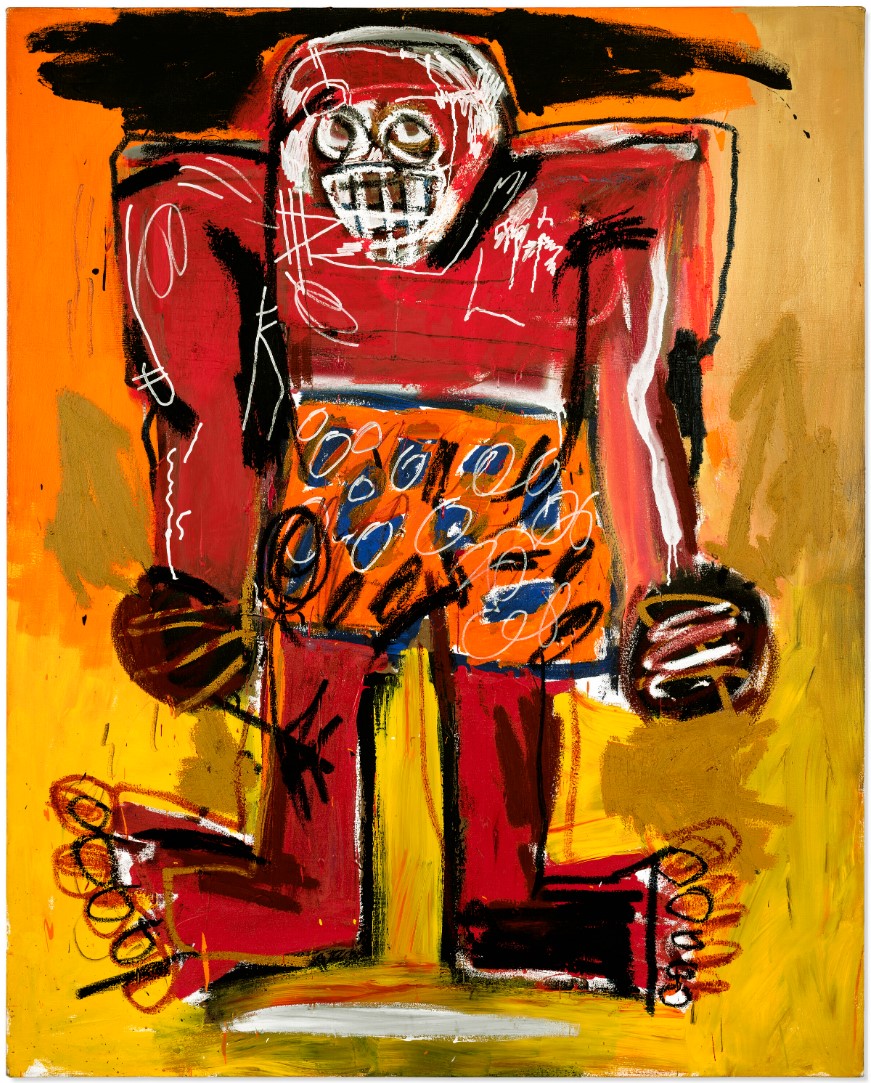
JEAN-MICHEL BASQUIAT (1960-1988)
Sugar Ray Robinson, 1982
Acrylic and oilstick on canvas
59 7/8 x 48 1/4 inches (152.1 x 122.6 cm)
Featuring the imposing figure of one of Jean-Michel Basquiat’s personal heroes, the champion boxer Sugar Ray Robinson, this eponymous portrait is one of the artist’s most audacious portraits. A masterpiece of painterly prowess, this striking canvas combines the artist’s highly expressive brushwork and skillful understanding of color to produce a radical statement that works on many levels. Part celebration, part social critique, Basquiat’s Sugar Ray Robinson displays the artist’s rare ability to produce deeply personal paintings that spoke to a wider audience. As one of the most accomplished sportsmen of his generation, the boxer was not only a personal hero to Basquiat but also a high-profile African American figure at a time of heightened racial tension in the United States. By bringing together politics and paint, Sugar Ray Robinson sits at the pinnacle of Basquiat’s oeuvre. Painted in 1982, the year Basquiat completed his most accomplished and successful works, Sugar Ray Robinson is a triumph of contemporary painting.
Sugar Ray Robinson. Photo: Al Fenn / Getty Images.
Appearing to fight the constraints placed on him by the physical size of the canvas, Jean-Michel Basquiat situates the figure of his hero confidently in the center of the composition. The fighter’s hulking square frame mirrors the dimensions of the picture plane, adding a tension that is matched by the figure’s hunched shoulders. Accent marks indicate Robinson’s muscular physique, his solid arms dangling beside him ending in his famous leather boxing gloves. The rest of the boxer’s frame is rendered in striking red, orange and black hues, a powerful choice that highlights the subject’s imposing figure. The complex construction of the boxer’s face clearly demonstrates how Basquiat constructs his figures; by building up layer upon layer of sparse painterly gestures, the artist produces an immensely emotive expression that manages to convey feelings of strength, aggression, power, and fear, all within the same fierce grimace.
Saxaphone, 1986
Sotheby’s New-York: 16 November 2022
USD 13,667,400
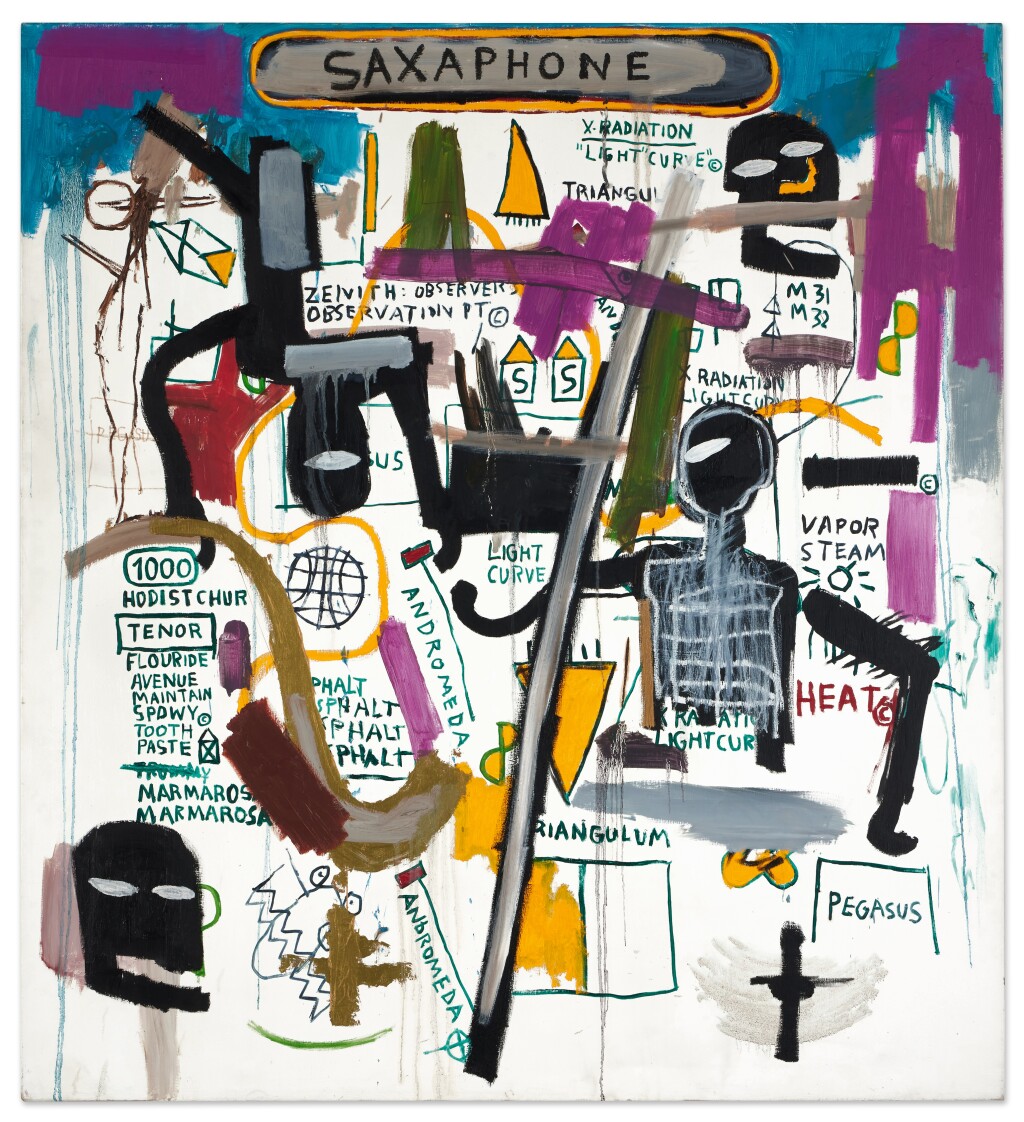
JEAN-MICHEL BASQUIAT (1960-1988)
Saxaphone, 1986
Acrylic and oilstick on canvas
66×60 inches (167.6 x 152.4 cm)
A cacophony of brilliant color, symbol, text, and image, Jean-Michel Basquiat’s Saxaphone of 1986 captures the frenetic and revelatory spirit of musical improvisation and immortalizes Jean-Michel Basquiat’s veneration of legendary jazz saxophonist and composer Charlie Parker. Pictographically represented via a tenor saxophone and a hand, the mystical locus of Parker’s genius is realized through a frenzy of bold, impassioned marks. Replete with the signature iconography, vibrant color, and urban vivacity synonymous with Basquiat’s immortal oeuvre, Saxaphone reveals the artist at the height of his painterly powers, at once celebrating the artist’s passion for jazz and visualizing his personal meditations on the cycles of fame and fortune.
Saxaphone stands among Basquiat’s most iconic “musical” works, alongside such paintings as Charles the First and Horn Players, which rejoice in “the innovative power of black male jazz musicians, whom he reveres as creative father figures.” (bell hooks, “Altars of Sacrifice: Remembering Basquiat”, Outlaw Culture: Resisting Representations, New York 1994, P. 35) Basquiat was an avid listener of jazz and a musician in his own right, and the present work deftly illustrates the relationship between his uniquely improvisational, staccato style of painting and the frenetic alchemy of jazz composition. In both art forms, there is an underlying looping structure that the melody, entrancingly embodied in Saxaphone through Basquiat’s colorful marks and frenetic brushstrokes, floats and skitters atop. In Saxaphone, themes accumulate through multiple references on the surface, emerging as patterns out of gestural brushstrokes, symbols, inventories, lists, and diagrams. Basquiat’s images often have double or triple meanings, many of which are left open to the viewer’s individual interpretation. Rhythms of color and shape emerge within the painting and softly fade out or dissipate in a cacophonous burst, only to emerge again and recombine with new forms in concordant and discordant harmonies. The figures and heads within Saxaphone are composed in a variety of twisting and turning positions, some with their mouths open to indicate a celebration of dance and movement that is further echoed by the brightly colored palette and tight composition. Amidst the flurry of text and symbols emerges a single golden saxophone: the source of inspiration from which the painting gains its slyly misspelled title.
Farina, 1984
Christie’s New-York: 17 November 2022
USD 7,020,000
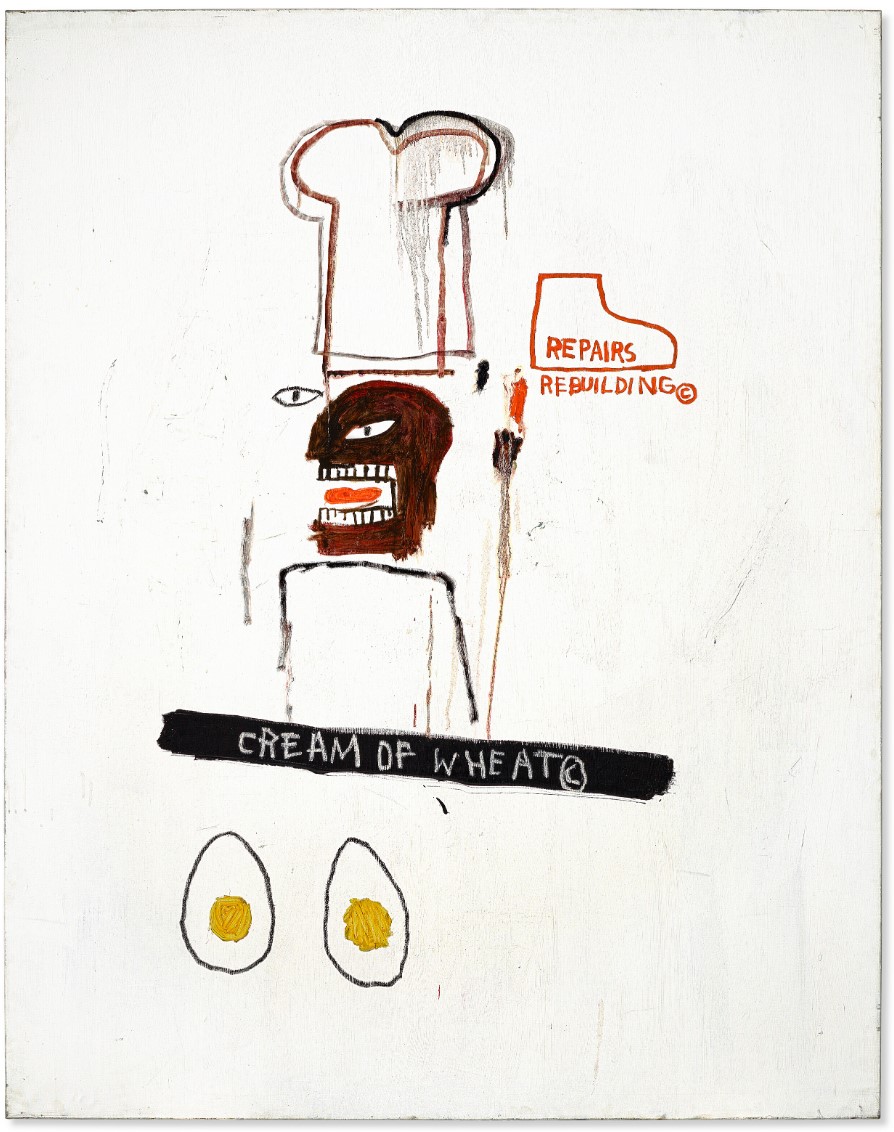
JEAN-MICHEL BASQUIAT (1960-1988)
Farina, 1984
Acrylic and oilstick on canvas
86×68 inches (218.4 x 172.7 cm)
Screaming atop a luminous, textural painted white surface, Jean-Michel Basquiat’s Farina is a cutting example of the artist’s signature visual language, learned eye and radically palpable energy. Painted is the singular figure of a chef amidst what appears to be a rush hour frenzy. In removing this figure from his assumed landscape and throwing him into a contrasting relief with the pure background, the viewer is allowed a rare glimpse at Basquiat’s mastery of energy through figuration. Disjointed eyes, one floating next to its head, arrest the viewer’s gaze and implicate them in his agitation. Fire-licks of red constitute a scorching tongue between the chef’s maniacal grin, and blaze from his raised hand, igniting the painted shoe and adjoined words ‘REPAIRS’ and ‘REBUILDING ©’ above. A second pair of cutting eyes reveal themselves in the two eggs that rest toward the base of the canvas, their glowing yellow yolks perhaps the perfect product of the chef’s mania. Slashing through the chef’s torso is a bold passage of midnight black, atop which the artist has written ‘CREAM OF WHEAT ©’, a nod to the artist’s continued use of the copyright symbol and the ubiquity of aforementioned dish on American breakfast tables. Basquiat’s investigation in the use of a Black chef may also be noted in his Eyes and Eggs, which is presently housed in the permanent collection of The Broad in Los Angeles. Both works exemplify the artist’s fascination with anatomy, with the present example’s hat resembling a femur. The composition of Farina is inherently skeletal, leaning into the artist’s passion for Grey’s Anatomy, an influence that can also be read in his chilling work, Riding with Death. Through the juxtaposition of this elegantly economic range of elements, Basquiat manages to create a web of illusions and allusions that cut to the heart of his art.
His Blue Sniffing Valet, 1984
Christie’s New-York: 9 May 2022
USD 7,260,000
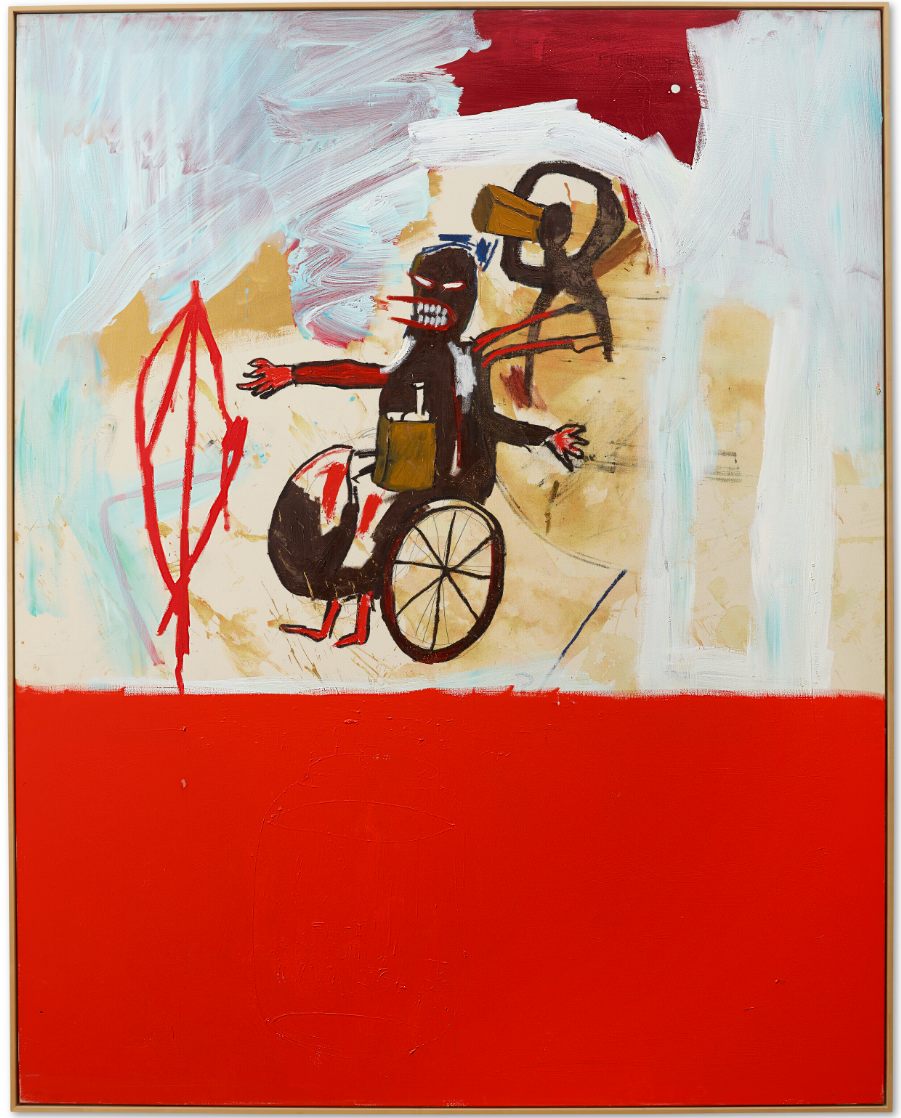
JEAN-MICHEL BASQUIAT
His Blue Sniffing Valet, 1984
Acrylic, oilstick and graphite on canvas
86×68 inches (219×173 cm)
#8. Mark Rothko
Total Revenues: USD 198,295,623
15 Lots (4 unsold)
Top Lot: USD 66,800,000
Untitled (Shades of Red), 1962
Christie’s New-York: 11 May 2022
USD 66,800,000
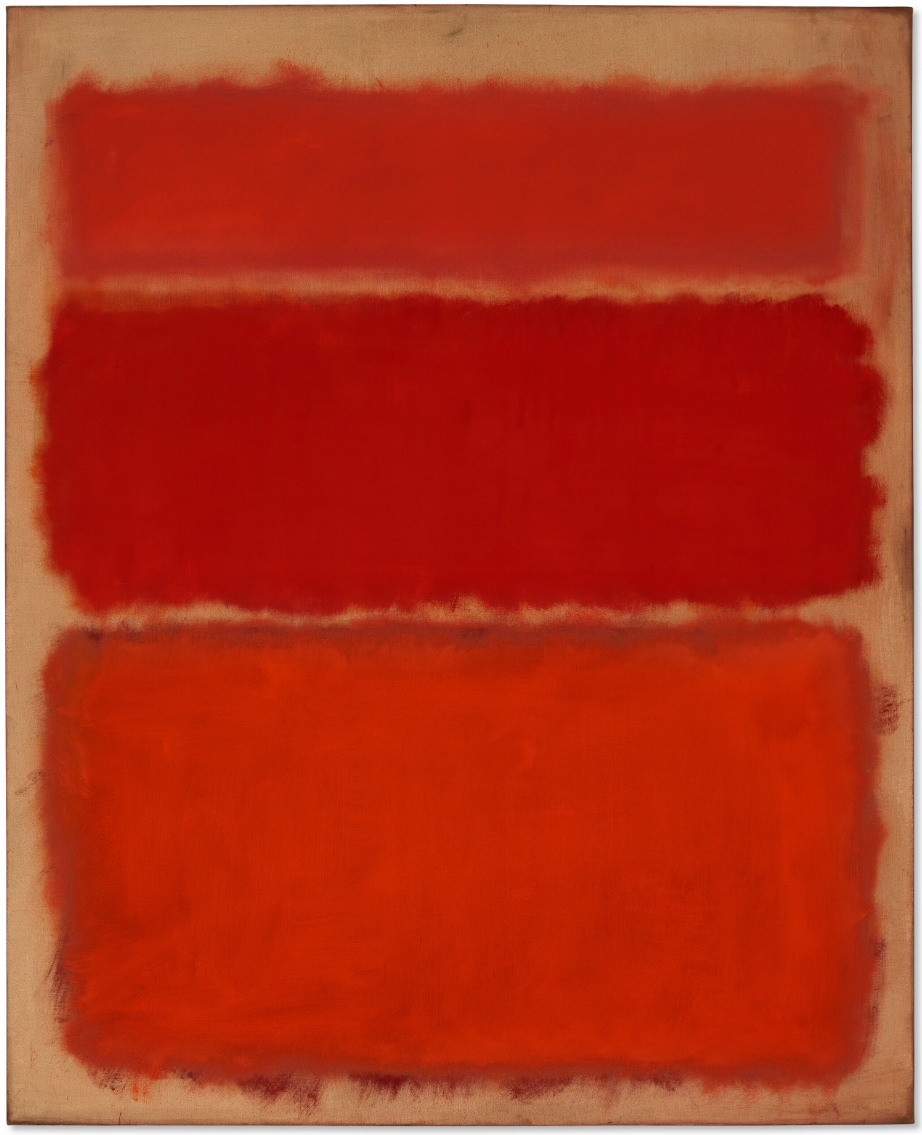
MARK ROTHKO
Untitled (Shades of Red), 1962
Oil on canvas
69×56 inches (175.3×142.2 cm)
Painted in 1961, Mark Rothko’s Untitled (Shades of Red) forcefully captures the mysterious and emotional intensity that lies at the very heart of the artist’s work. Haunted by the eternal drama that he believed was an inherent part of the human psyche, Rothko spent his life trying to convey these emotions on canvas, and his floating fields of color became the central elements in many of his most accomplished paintings. One of the most important and influential artists of the twentieth-century, Rothko maintained that his canvases weren’t paintings of an experience, they were the experience, and standing before paintings such as the present example he sought to induce in the viewer a deep emotional, almost spiritual, connection.
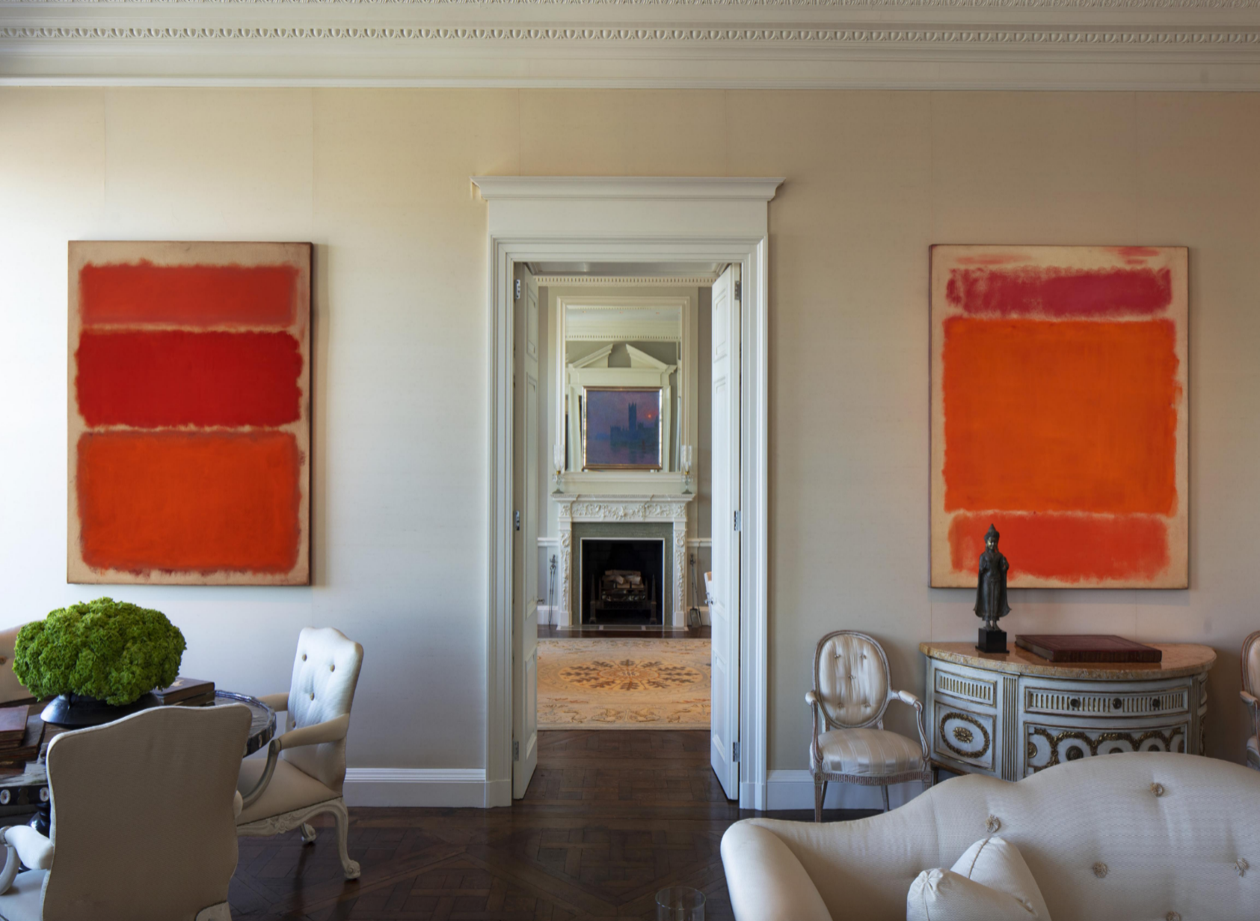
No. 1, 1962
Christie’s New-York: 11 May 2022
USD 49,625,000
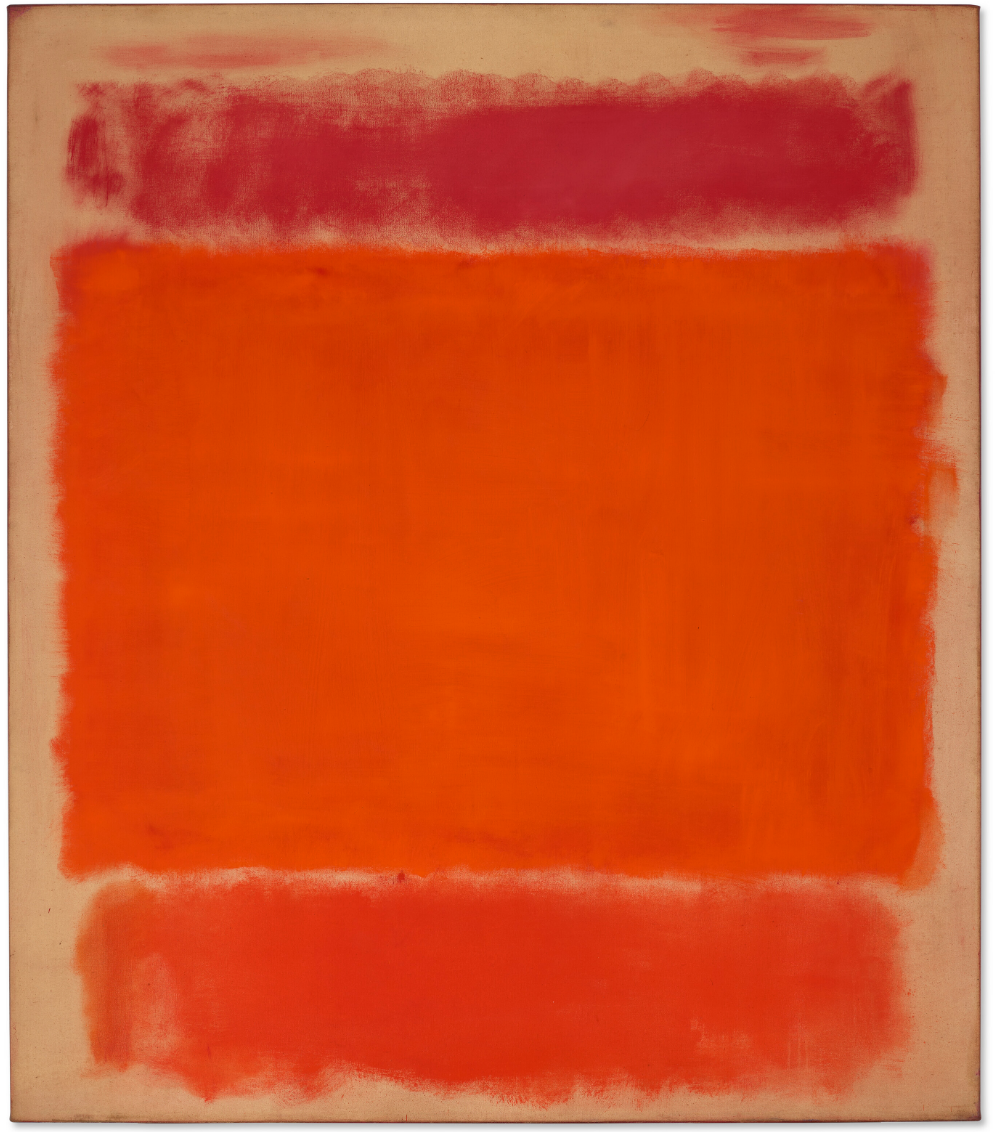
MARK ROTHKO
No. 1, 1962
Oil on canvas
69×60 inches (175.3×152.4 cm)
Untitled, 1960
Sotheby’s New-York: 16 May 2022
USD 48,008,000
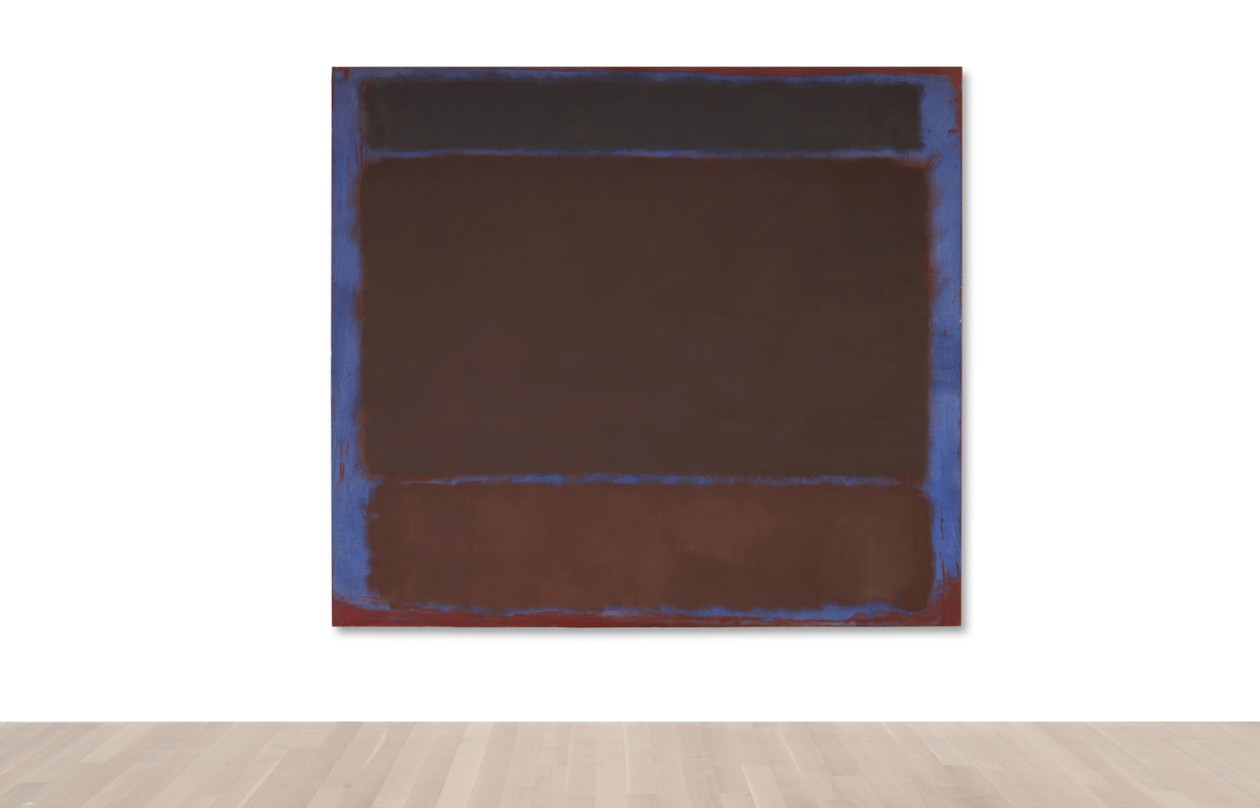
MARK ROTHKO
Untitled, 1960
Oil on canvas
70×74.5 inches (178.4×189.2 cm)
Sotheby’s New-York: 16 May 2022
USD 48,008,000
Powerfully emotive in palette and utterly enveloping in scale, Mark Rothko’s Untitled from 1960 is a masterwork of the legendary artist’s inimitable painterly praxis. One of just 19 paintings on canvas by Rothko from 1960, nearly half of which reside in museum collections, the meditative hues and encompassing scale of the present work represent a pivotal moment within Rothko’s storied career and artistic development. While the artist had already achieved significant international acclaim by the end of the 1950s, it was over the course of the following decade that the artist would push himself to produce the most emotionally provocative, astoundingly intimate, and visually awe-inspiring works of his oeuvre. Upon the surface of Untitled, the three clearly distinct, yet inextricably intertwined, zones of black and maroon pigment imbue the canvas with a tangible magnetic charge. Cast against the rich cobalt field, a velvety expanse of inky black fills the top register of the painting; built up of innumerable washes of hue, its edges mingle gently with the lighter ground on which it floats. Below, a deep maroon rectangle floats above a slightly lighter form, the borders of each color commingling slightly in vaporous whisks of paint at an elegantly executed horizontal axis. Hovering upon the canvas, the three void-like rectangular zones of darker pigment draw one’s gaze inexorably inward, their feathered edges simultaneously seeming to expand and contract; from beneath their hazy borders, the radiant blue ground breaks through like light escaping from a vacuum.
Untitled, 1969
Christie’s New-York: 17 November 2022
USD 17,565,000
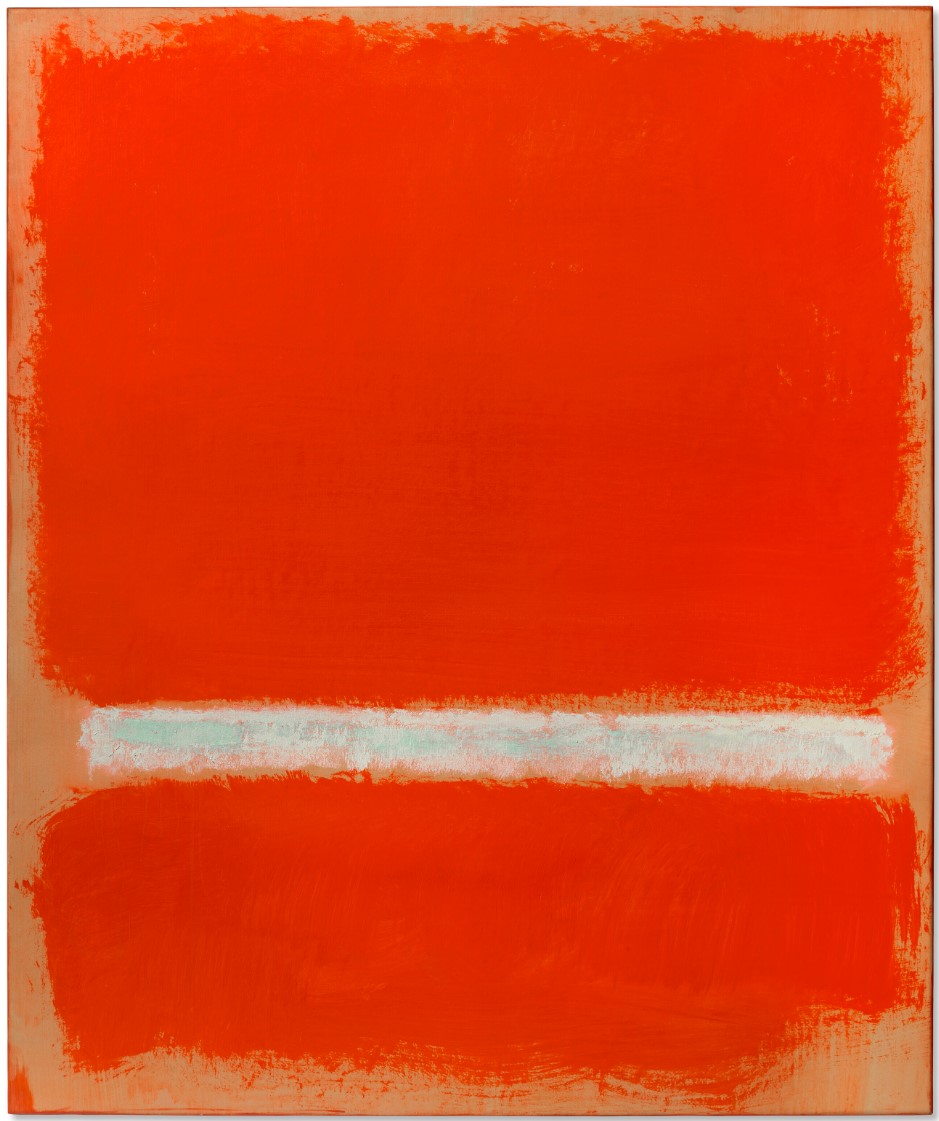
Untitled, 1969
Acrylic on paper laid down on canvas
48 1/2 x 40 1/2 inches (123.2 x 102.9 cm)
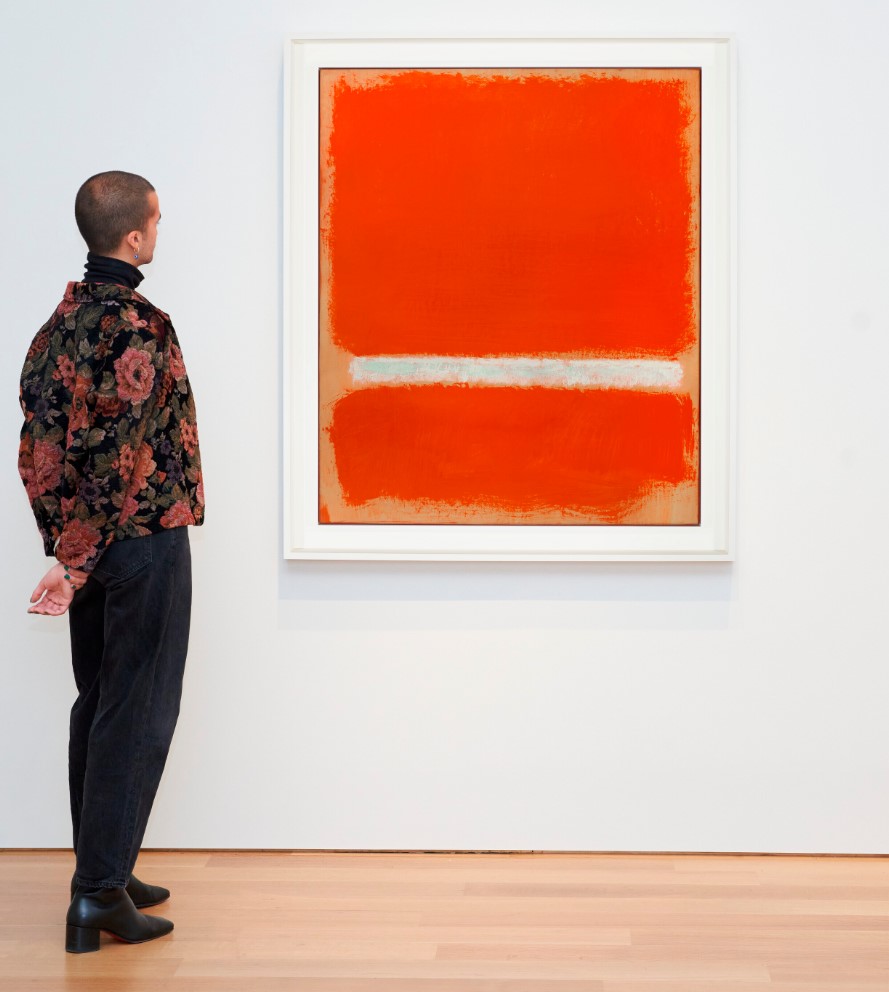
Untitled, 1968
Sotheby’s New-York: 14 November 2022
USD 6,241,850
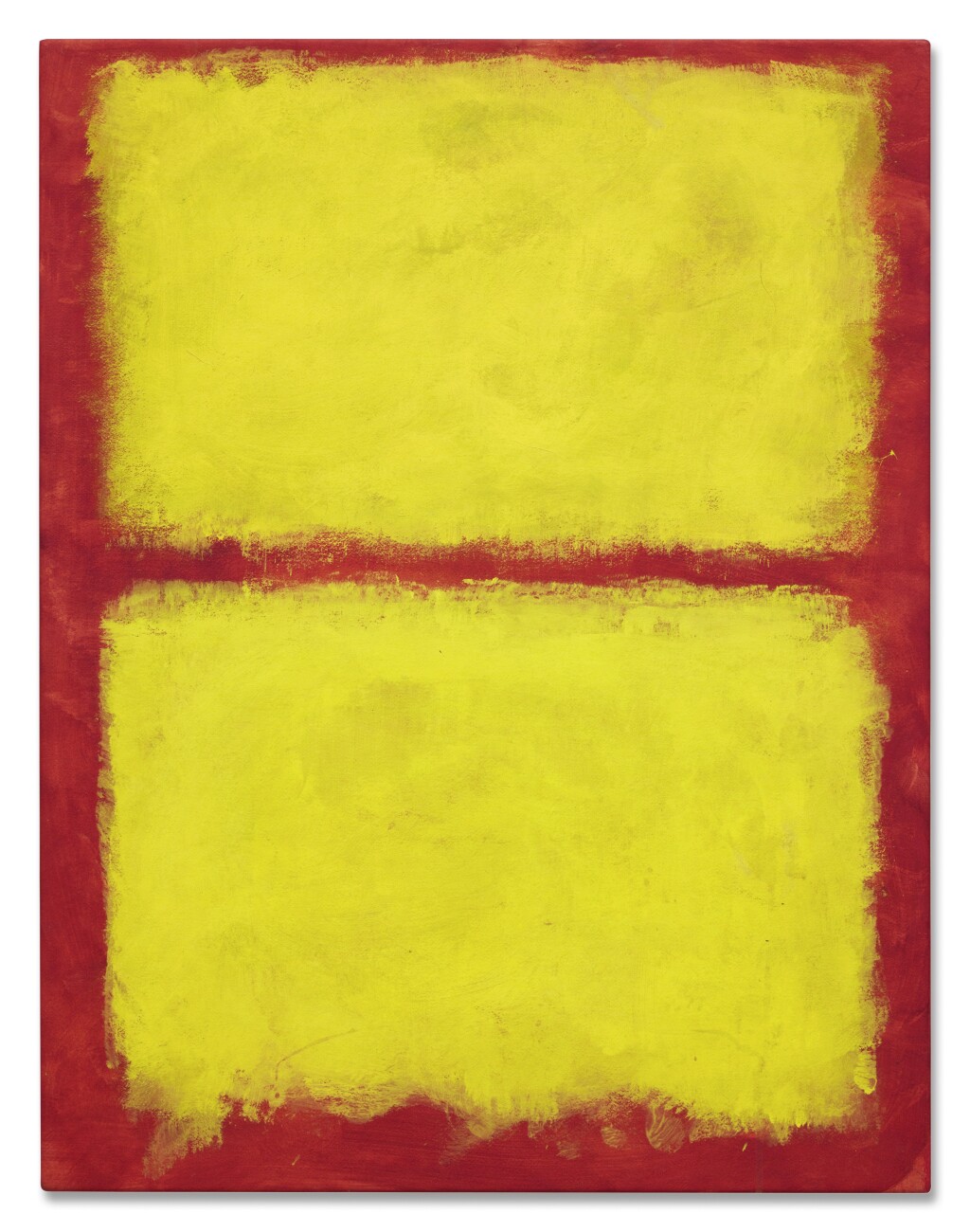
MARK ROTHKO (1903-1970)
Untitled, 1968a
Acrylic on paper laid on panel
33 ½ x 25 ¾ inches (85 x 65.5 cm)
Vibrating with an irrepressible chromatic energy, Untitled from 1968 encapsulates the themes and aims at the very heart of Mark Rothko’s painterly project. Concentrating the remarkable potency of his best-known canvases onto an intimate scale, Rothko here demonstrates his complete mastery of media and hue. A rare, exquisitely vibrant example from a period often characterized by a decidedly somber palette, Untitled exemplifies Rothko’s work in a medium that bore an increasingly profound significance in the twilight years of his career when, tirelessly seeking to broaden the horizons of his artistic practice, he focused his energies upon exploring the absolute limits of painting on paper. Although he created works on paper throughout the entirety of his career, the present example reflects the climax of the evolution of his output on paper.
#9. Willem de Kooning
Total Revenues: USD 195,045,026
101 Lots (30 unsold)
Top Lot: USD 34,794,500
Untitled, circa 1979
Sotheby’s New-York: 16 November 2022
USD 34,794,500
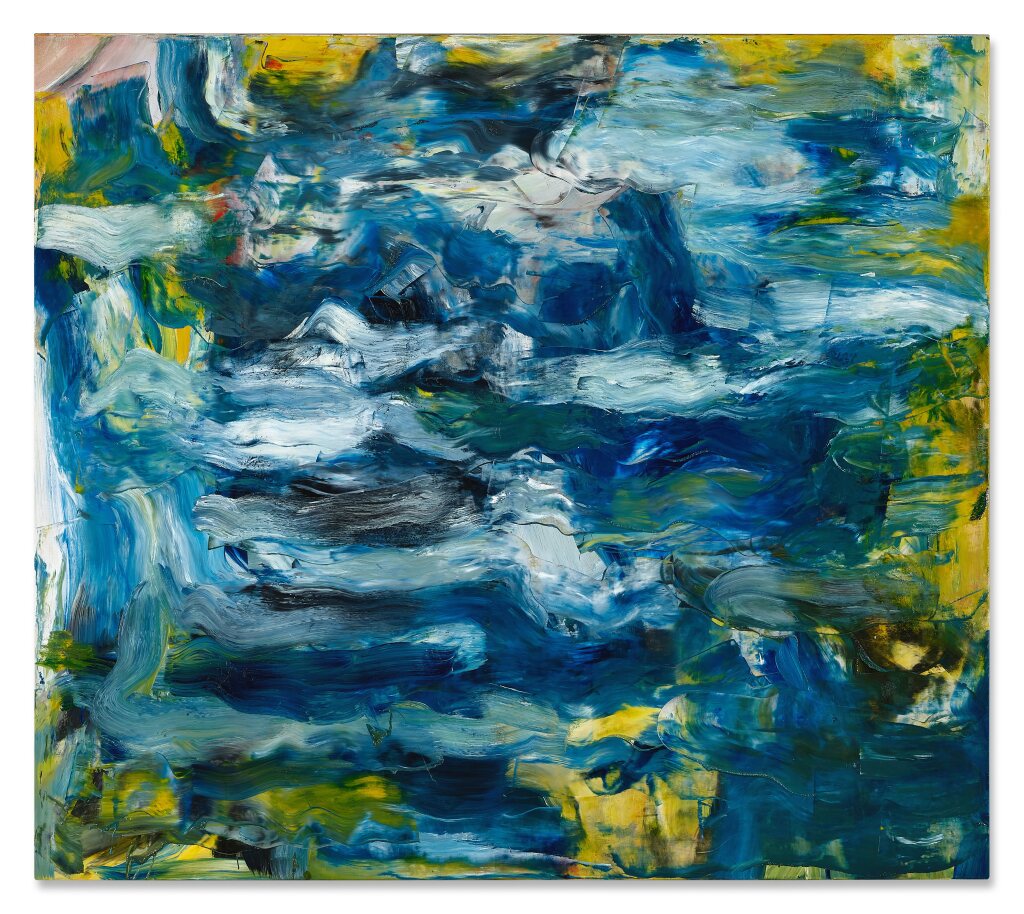
WILLEM DE KOONING (1904-1997)
Untitled, circa 1979
Oil on canvas
70 x 79 ½ inches (177.8 x 201.9 cm)
Through the lush impasto and exceptional handling of paint, de Kooning creates a surface which appears freshly created. To achieve this effect, de Kooning masterfully employed many tools and techniques, including brushes and scrapers, producing the densely rich and textured surface of Untitled. The lustrous, aqueous texture of Untitled is complemented and emphasized by its oceanic palette, as de Kooning fuses color and gesture. Focusing his energy on the quality of paint application and the composition of his surface, de Kooning thinned his oil paint with combinations of water, kerosene, benzene or safflower oil to add fluidity to the paint, facilitating a more rapid stroke. Using unorthodox methods of applying and removing paint with spatulas and knives, particularly the taper’s knife, de Kooning defined his composition through motion, energy and action, allowing a variety of planes of pigment to coalesce in and out of each other across the canvas.
Collage, 1950
Sotheby’s New-York: 14 November 2022
USD 33,645,500
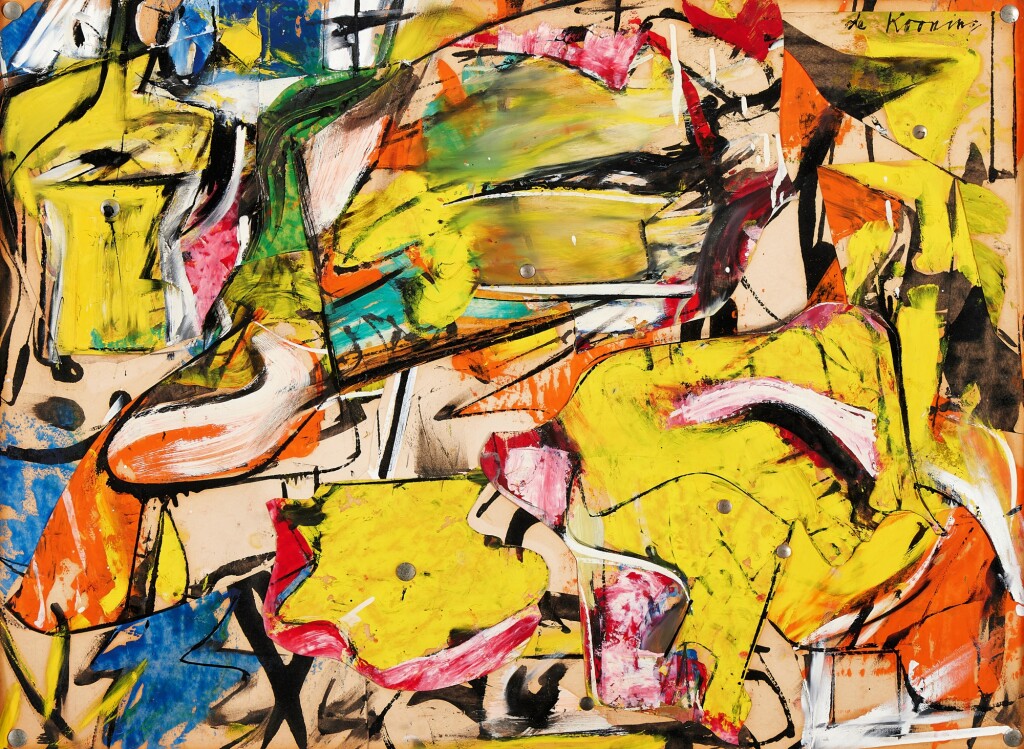
WILLEM DE KOONING (1904-1997)
Collage, 1950
Oil and lacquer with thumbtacks on paper
22×30 inches (55.9 x 76.2 cm)
An irrepressibly vibrant and exquisitely rare jewel, Collage from 1950 declares a moment of pivotal importance within Willem de Kooning’s legendary oeuvre. Bursting forth in a chromatic eruption of compositional dynamism across every inch of the intimately scaled surface, Collage is immediately recognizable as a quintessential example of the artist’s mature abstract mode. And yet, with its richly textured surface, built up in layers of paper, paint, charcoal, and even scattered silver thumbtacks, Collage is wholly unique for its manifest inclusion of the elements that define its eponymous mode of production. Throughout the 1940s and 50s, de Kooning would often use a collage method to plan his compositions of juxtaposed forms, tracing the shapes onto paper and arranging them in various ways across a painting’s surface; here, however, he did not remove these layered elements, preserving the traces of a method that defines his most significant canvases from this period. Asheville (1948, The Phillips Collection, Washington, D.C.), Attic (1949, The Metropolitan Museum of Art, New York), and Excavation (1950, The Art Institute of Chicago) all evince this mode, their surfaces characterized by jumps, breaks, and visual ruptures between passages that mimic collage.
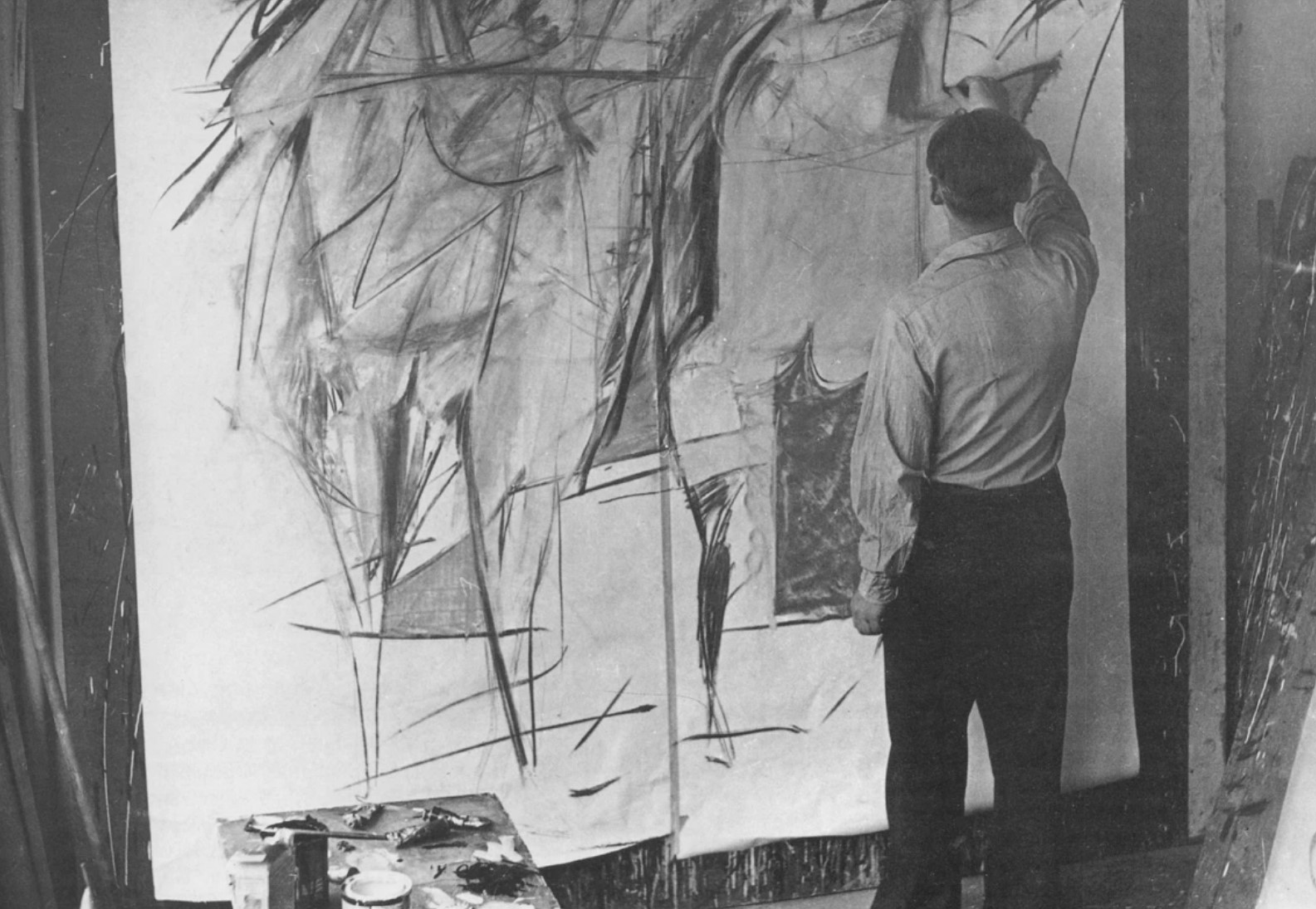
Offering its viewer an archaeological survey of the creative strata that accumulated to form de Kooning’s extraordinary aesthetic, Collage acts as a kind of Rosetta Stone, deciphering the arc of his painterly practice at this critical juncture in his career. From within the pulsing net of sensuous lines and glowing jewel-toned hues, de Kooning’s trademark oscillation between abstraction and figuration emerges; in the upper left, two eyes top a female form with a silver tack for a navel, while in the lower right, de Kooning’s recurring motif of the window emerges from the fiery orange and stark white pigment.
Montauk II, 1969
Sotheby’s New-York: 16 November 2022
USD 12,663,500
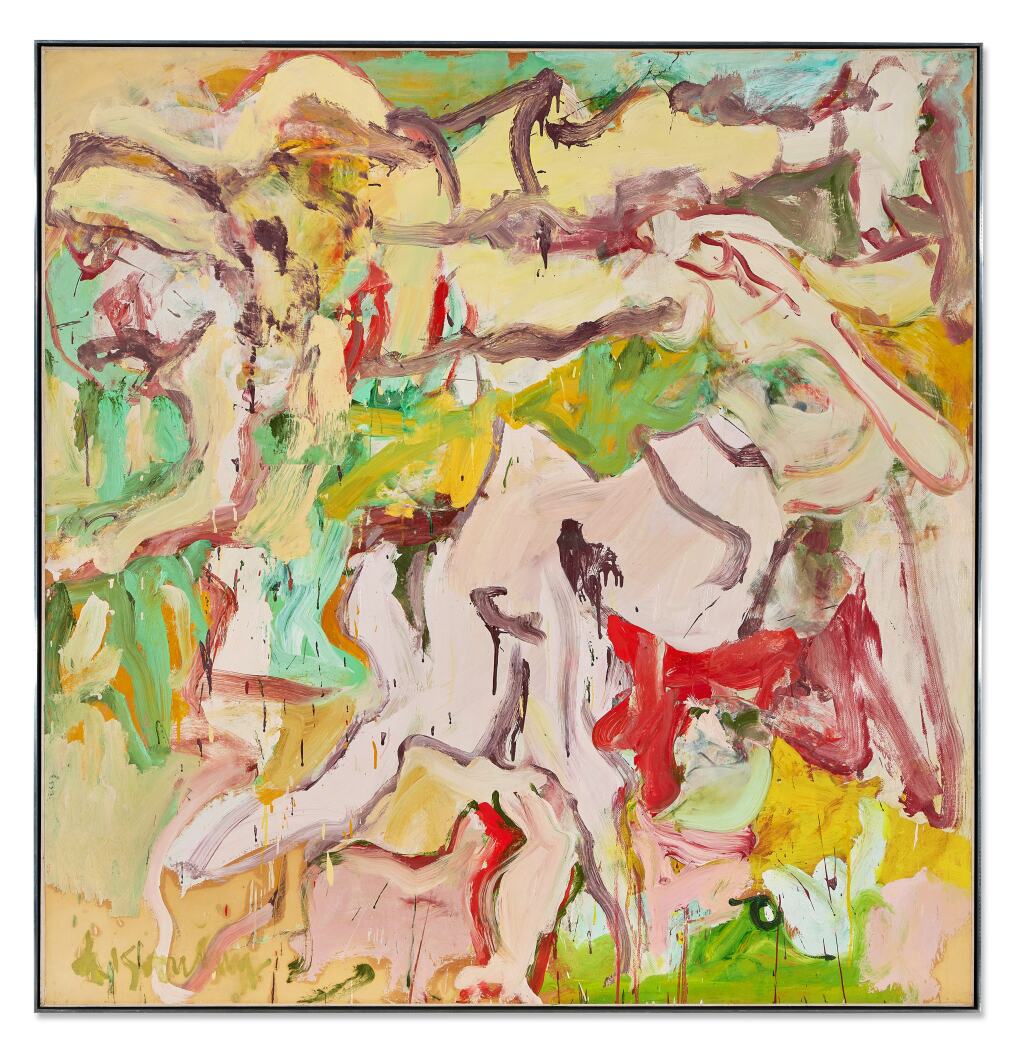
WILLEM DE KOONING (1904-1997)
Montauk II, 1969
Oil on paper mounted on canvas
72 ½ x 70 ¼ inches (184.2 x 178.4 cm)
Enveloping the viewer in churning layers of vivid hues, Montauk II beams with the sun-drenched brilliance of Willem de Kooning’s beloved East Hampton. In 1962, de Kooning began building his home and studio there, permanently moving to the area in 1963, not far from Montauk. Montauk II epitomizes the spirit of the artist’s coastal refuge, where the transition from the densely populous city streets to the tranquility of nature and its nostalgic similarities with the Netherlandish landscape of his youth inspired a refreshed course of experimentation in the artist’s practices. Following his move, de Kooning’s palette shifted to reflect the nature of his surroundings. This transition is exemplified in the palette of Montauk II, in which de Kooning captures the subtle hues of an end-of-day summer light reflecting across the local beaches; the canvas resounds with the artist’s virtuosic capacity for rendering sensory delight and atmospheric potency in oil paint. Of the five known paintings titled Montauk I-IV that de Kooning executed in 1969, two are held in important international collections. Montauk I is in the collection of the Wadsworth Atheneum in Hartford, Connecticut, and Montauk IV is held in the collection of the Stedelijk Museum in Amsterdam. Montauk II is distinguished by its exceptional coloration, composition and painterly dynamism, resulting in a remarkable exhibition and publication history.
The Hat Upstairs, 1987
Sotheby’s New-York: 16 November 2022
USD 10,665,500
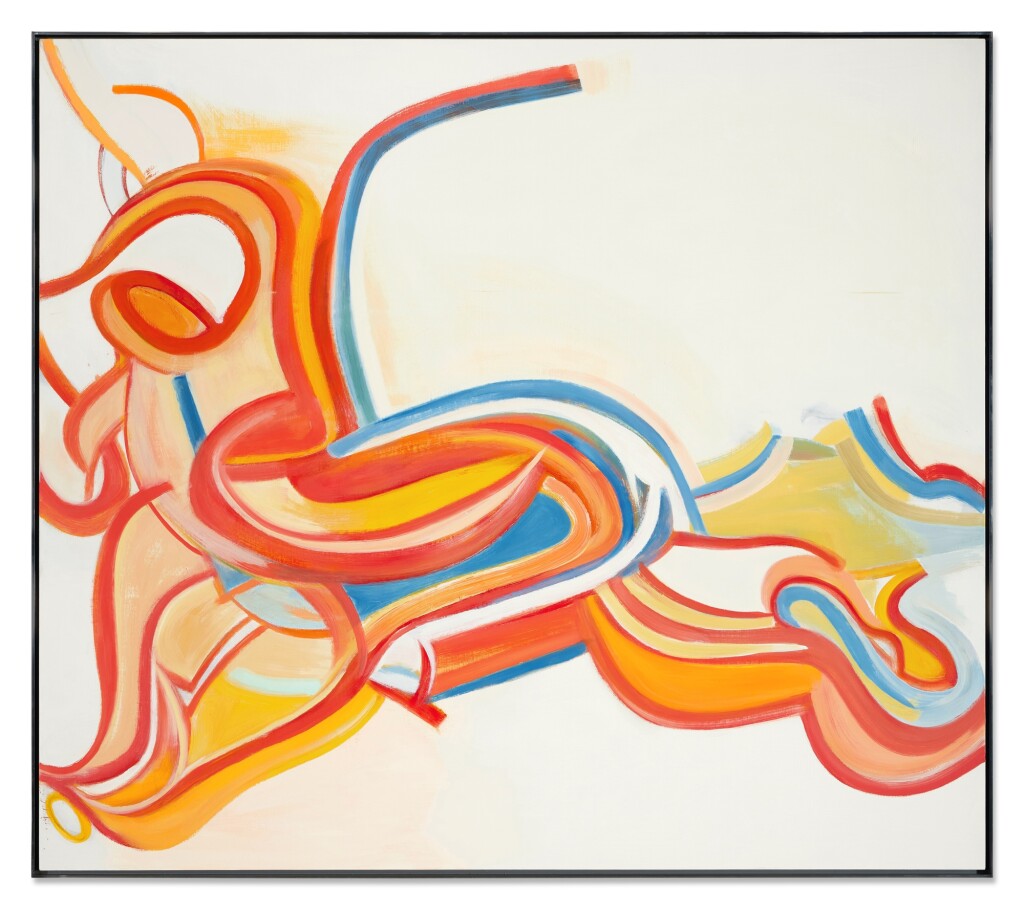
WILLEM DE KOONING (1904-1997)
The Hat Upstairs, 1987
Oil on canvas
77×88 inches (195.6 x 223.5 cm)
Painted in 1987, The Hat Upstairs singularly embodies the vibrancy, lyrical abstraction and deft painterly intention of de Kooning’s final decade, which is now celebrated as the artist’s “Late Period.” The Hat Upstairs is anunparalleled masterwork from this period, a triumphant apotheosis of his abstract vernacular; de Kooning floats ribbons of hues that elegantly coalesce with chromatic vibrancy and a buoyant dynamism.
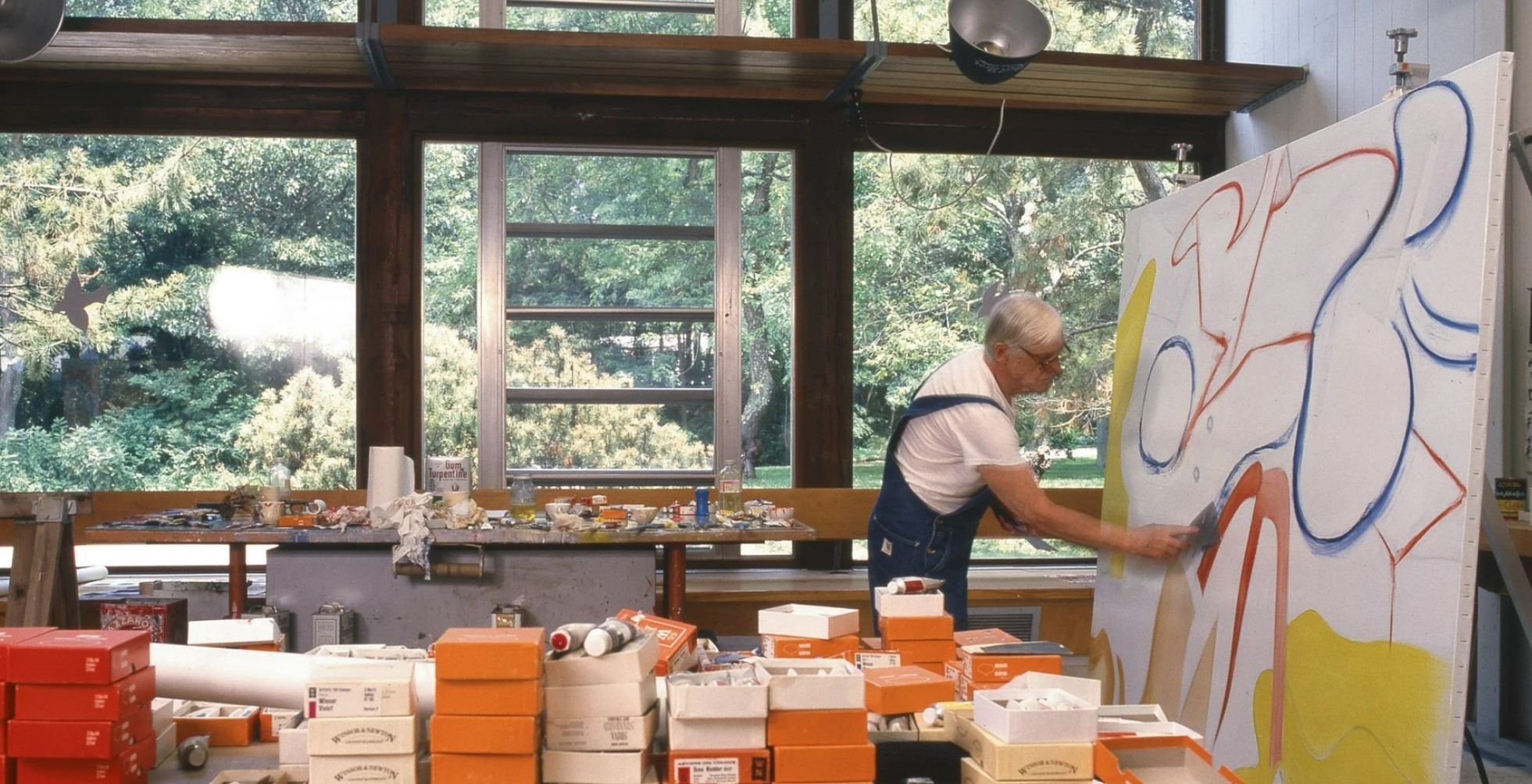
The present work belongs to a mature corpus of lyrical abstract works de Kooning began in 1981, which occupied his practice for the remainder of his life. The Hat Upstairs is an exceptional example of this body of work, with the saturated pigment forming melodic lines and forms that counterbalance like music across the surface. The present work recalls the female form or rolling landscapes permeating the artist’s entire oeuvre through the sumptuous curvatures which swell across the monumental canvas in unrestrained yet deliberate loops of unadulterated color. Although de Kooning’s works from the 1980s are often referred to as one period, in fact, the decade is marked by considerable experimentation in each year. Exuding a breathtaking, poetic elegance, The Hat Upstairs is a masterpiece borne from the radical experimentation within de Kooning’s legendary practice: here, he crystallizes his career-long investigations into line, color, and form to embody the visceral interplay between strength and sensuality, delicacy and mass.
Untitled, 1985
Christie’s New-York: 17 November 2022
USD 9,321,000
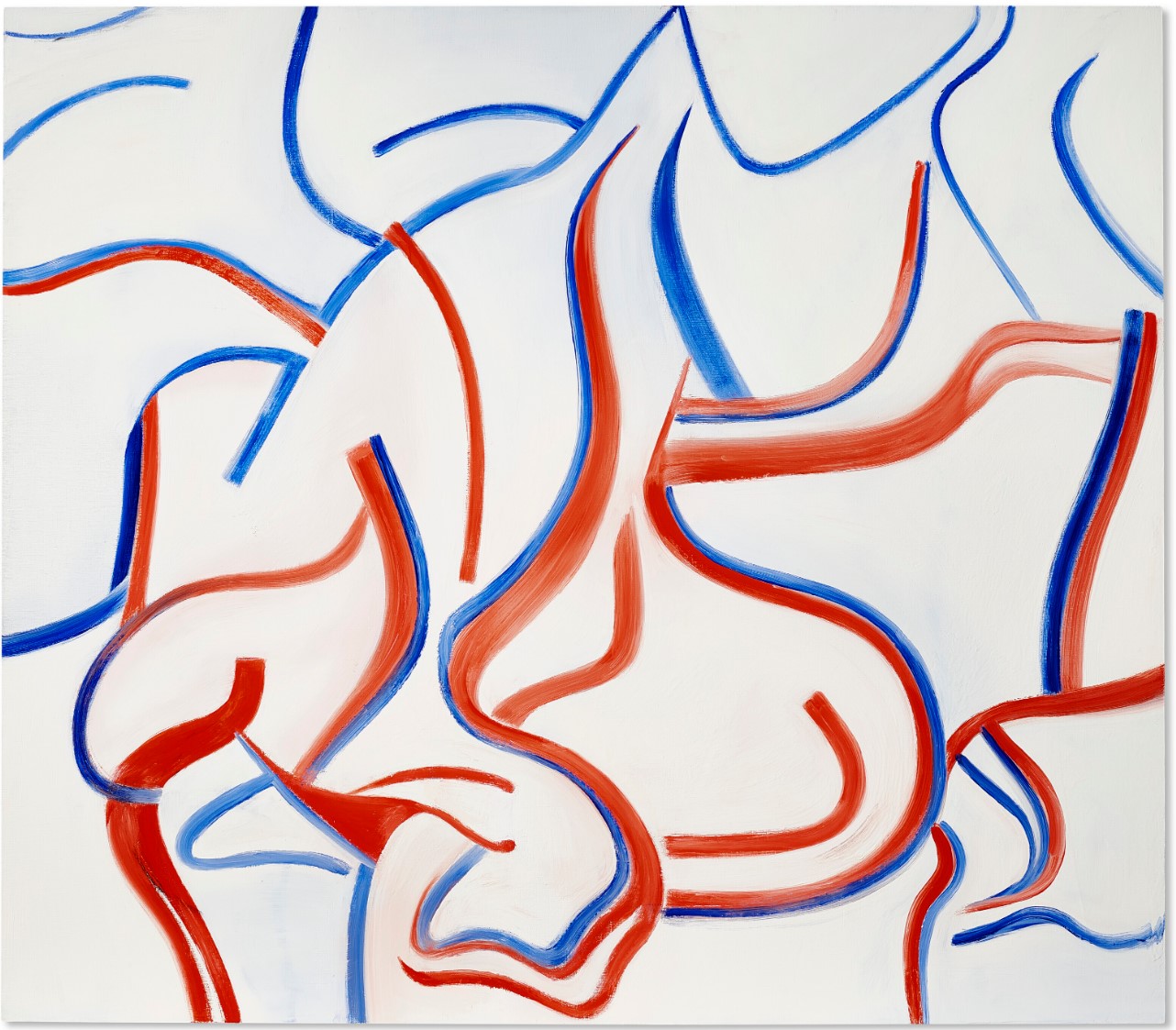
WILLEM DE KOONING (1904-1997)
Untitled, 1985
Oil on canvas
70×80 inches (177.8 x 203.2 cm)
Painted in 1985, Willem de Kooning’s Untitled is a vivacious, large-scale example of his late style, brimming with floating ribbons of color that flicker and dance across a luminous white background. Now in his eighties, de Kooning was painting some of his most lyrical and elegant paintings yet. “I am becoming freer,” he said. “I think you can do miracles with what you have if you accept it” (W. de Kooning, quoted in M. Stephens and A. Swann, De Kooning: An American Master, New York, 2005, p. 603). This era witnessed a stripping away of extraneous materials, leaving only two primary colors—red and blue—set against glowing, almost incandescent, white grounds. Untitled attests to these lean but brilliant late paintings, featuring a host of colorful ribbon-forms, some of which nestle alongside each other, while others roam free, only to fold in on themselves, suggesting the curvature of womanly bodies and flesh.
De Kooning orchestrates a powerful, late-in-life masterpiece in Untitled, which bustles with dancing lines and evokes the airy and elegant joie-de-vivre of this late, great series. With a calm hand, the artist paints lean blue lines, which converge in peaks and tapered points along the upper edge, conjuring up icy vistas and cold mountain snow. Throughout the main register, these crisp blue ribbon-forms are then paired with thicker, denser red ones. These nestle alongside the blue, varying in thickness and width, at times breaking off from a single line to form two thinner ones (in one case, a line which begins its life as red ends up turning blue as it arcs and whips around). These color ribbons have a potent, graphic “snap” when viewed against the optical white background. The artist has given some of them several applications of paint, making them wider, darker, and more emphatic. He has also used the palette knife to scrape down parts of the surface, rendering the painting’s “skin” light and airy. Subtle pink passages linger beneath the white surface, barely perceptible at first, but adding a sensual warmth to the otherwise cool white tones. Overall, the painting feels on the cusp of movement, ready to fold and bend upon itself at any minute.
#10. Yayoi Kusama
Revenues: USD 194,600,385
900 Lots (119 unsold)
Top Lot: USD 10,496,000
NEW AUCTION RECORD FOR THE ARTIST
Yayoi Kusama remains the only female artist in the Top 10 most sold artists in 2022.
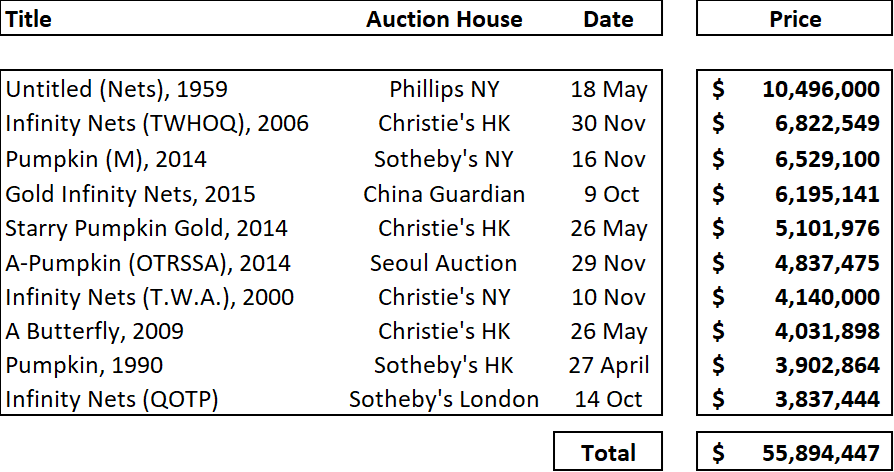
Untitled (Nets), 1961
Phillips New-York: 18 May 2022
USD 10,496,000
Untitled (Nets), 1959
Oil on canvas
130.8×116.5 cm (51.5×46 inches)
Painted in 1959, Yayoi Kusama’s Untitled (Nets) belongs to the artist’s most coveted and renowned early series of white Infinity Net paintings. Teetering between the singular and infinite, the canvas surface is veiled with an intricate lattice field of small arcs and loops that appears to gently pulse before the viewer’s eyes. Upon a closer look, smooth strokes yield to swells of impasto, their individual renderings infinitely multiplying with poetic gravitas.
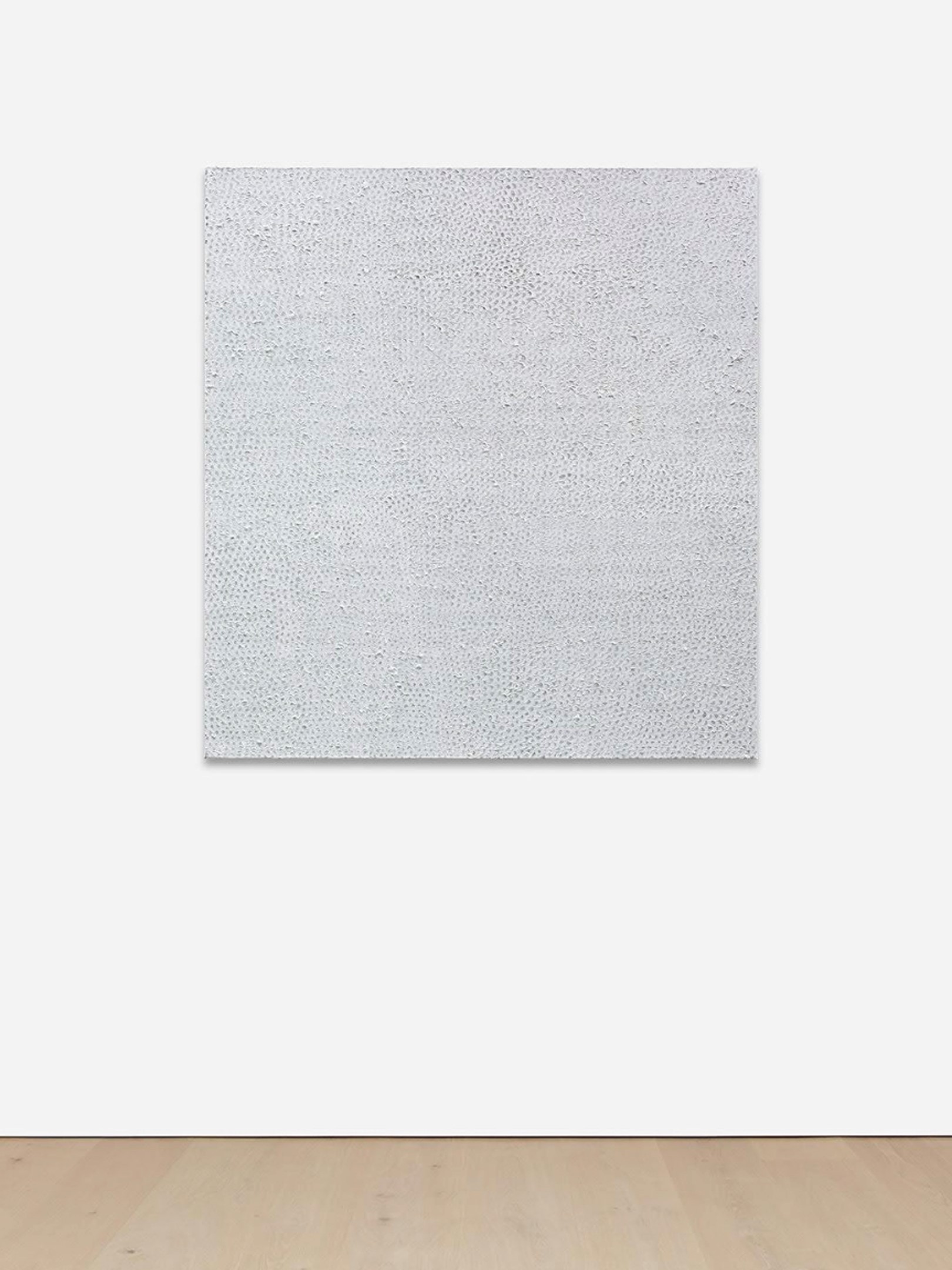
Untitled (Nets) marks a pivotal moment in the history of post-war abstraction, reflecting the liminal space between the painterly lush of Abstract Expressionism and the reductive aesthetic of Minimalism in which Kusama established her originality within the avant-garde. Evincing the profound impact of Kusama’s early white Infinity Net paintings, many of the artist’s peers went onto acquire them for their personal collections including Donald Judd, Frank Stella, and—in the case of the present work—Uecker. In 1960, Kusama exhibited with Uecker in the seminal Monochrome Malerei show at the Städtisches Museum Schloss Morsbroich in Leverkusen (where she and Rothko were the only artists selected to represent America) and, in 1962, became the only female artist to participate in the highly acclaimed ZERO international group exhibition at the Stedelijk Museum in Amsterdam alongside Uecker, Otto Piene, Lucio Fontana, and Pol Burry. With their hypnotic magnetism and accumulative buzz, Kusama’s early Infinity Nets find a close affinity with Uecker’s protruding-nail reliefs as their respective material elements appear to spiral and converge into infinite spatial realms.
Infinity Nets (TWHOQ), 2006
Christie’s Hong-Kong: 30 November 2022
HKD 53,250,000 / USD 6,822,549
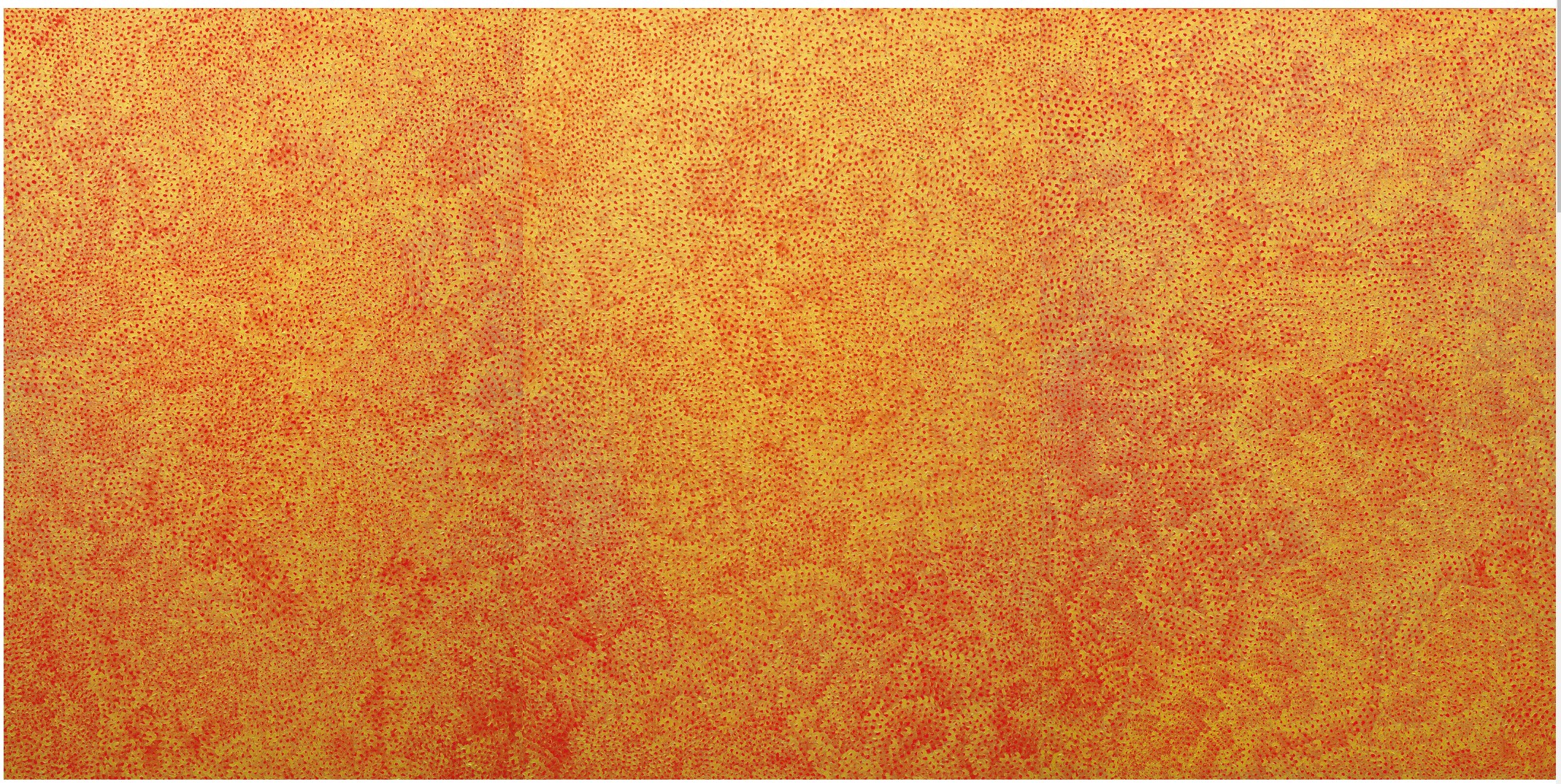
YAYOI KUSAMA (B. 1929)
Infinity Nets (TWHOQ), 2006
Acrylic on canvas (triptych)
Each: 194 x 130.3 cm (76 3/8 x 51 1/4 inches) (3)
Overall: 194 x 390.9 cm (76 3/8 x 153 7/8 inches)
During her septuagenarian years, Yayoi Kusama painted the monumental triptych Infinity Nets (TWHOQ) rendered in countless nets, an iconic motif she continues to depict over six decades of her artistic career. Vigorously executed, these glimmering gold loops of pigment create negative spaces around the vermilion dots, forming an undulating net field that mesmerizes the infinite expanse of shimmering ocean waves—a sight that fixated in the artist’s mind when she first flew to Seattle in 1957.
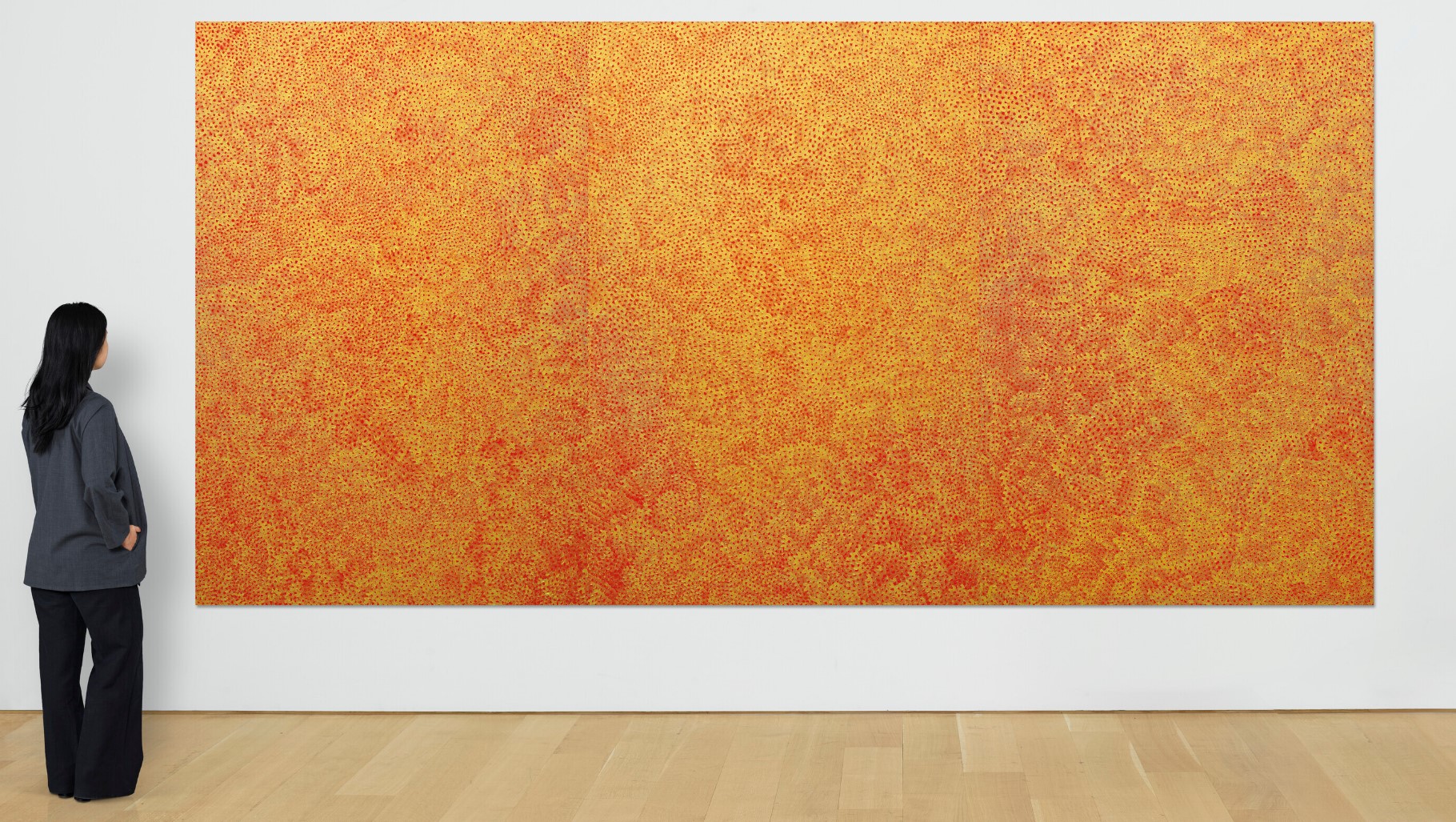
Reminiscing an image of the ocean, Infinity Nets (TWHOQ) choreographs a vigorous living field with cosmic depth and creates layers of transformative spaces across three canvases. The cloud-like, organic oscillating nets contrast with her early Nets painting like Infinity Nets Yellow (1960), which Judd would refer to as ‘shallow in space’ and ‘close to the surface’. The present work was included in Kusama’s acclaimed 2013 retrospective KUSAMA YAYOI, A Dream I Dreamed, which toured internationally at the Museum of Contemporary Art, Shanghai, Seoul Arts Center, and the National Taiwan Museum of Fine Arts, Taichung, among others. Its radiant colors of gold and vermilion mesmerizes a regenerative power of the universe that never ceases to fascinate Kusama, spelling a reach to eternity with the warmth of the sun.
Pumpkin (M), 2014
Sotheby’s New-York: 16 November 2022
Estimated: USD 3,500,000 – 7,500,000
USD 6,529,100
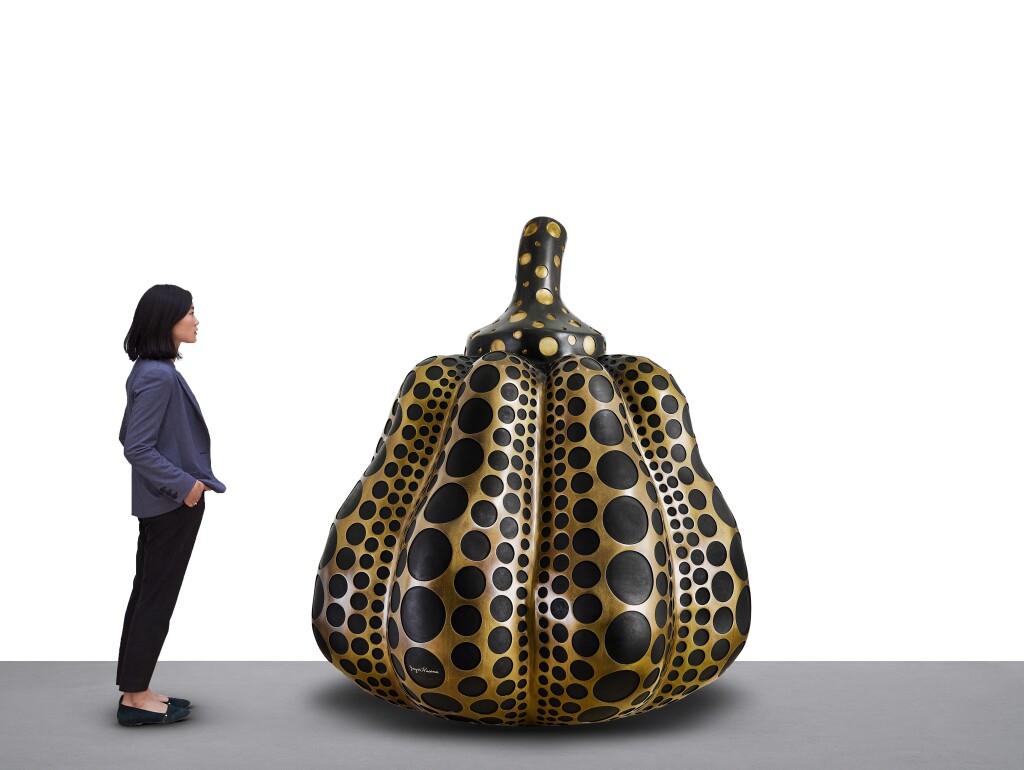
YAYOI KUSAMA (b. 1929)
Pumpkin (M), 2014
Bronze
187x182x182 cm (73 ⅝ x 71 ⅝ x 71 ⅝ inches)
Incised Yayoi Kusama
The present work is number 8 from an edition of 8.
Virtuosic and resplendent in its paradigmatic dot-covered pumpkin motif, Kusama’s Pumpkin (M) is an exceptional free-standing bronze sculpture whose iconic and idiosyncratic striations of multi-sized polka dots meticulously encase the pumpkin from stem to base in an effusive and sophisticated pattern. Few subjects are as central to the artist’s widely commemorated oeuvre as the kabocha is to Kusama, whose profound connection to the pumpkin memorializes early childhood experiences visiting her family’s seed nursery, and can be traced back to a burgeoning, meditative practice of painting pumpkins during her early artist residency in Kyoto. The present work casts the archetypal pumpkin in bronze on a monumental scale, whose dynamic patterns induce a rhythmic, enthralling and lively optical sensation through strategically and expertly placed larger dots towards the center of the curvaceous pumpkin, and smaller dots that slither towards the top and bottom of the gourd and gather towards the creases of the pumpkin’s skin. As with many of her earlier Fiberglass and urethane pumpkins, Kusama reverses the color patterning between the stem and the body of the pumpkin, and carefully endows the top of the pumpkin’s upward-turned stem with numerous small dots, leaving no element of the pumpkin without an intricate, repetitive design. Weaving an intricate balance between the matured pumpkin’s organic form, and the profoundly delicate and seemingly boundless idiosyncratic ribbons of dots, Pumpkin (M) is the paradigm of the artist’ unequivocally consummate and impeccable oeuvre.
Starry Pumpkin Gold, 2014
Christie’s Hong-Kong: 25 May 2022
HKD 40,050,000 / USD 5,101,976
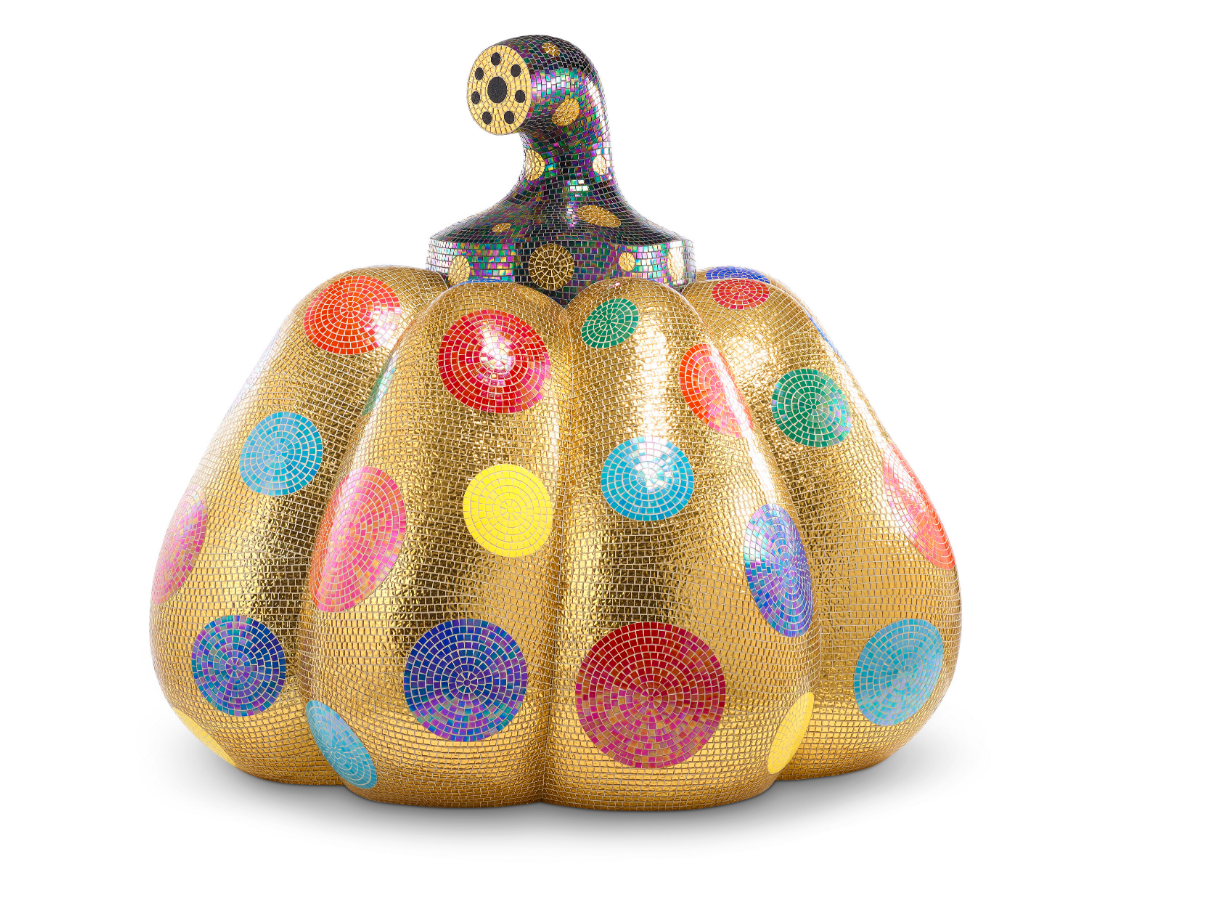
YAYOI KUSAMA
Starry Pumpkin Gold, 2014
Fiberglass-reinforced plastic and tile sculpture
185 (H) x 214 x 214 cm (72.9 x 84.2 x 84.2 inches)
A monumental sculpture of radiating brilliance, Yayoi Kusama’s Starry Pumpkin Gold marks the height of the artist’s lifelong artistic pursuit. Standing at almost two meters tall, its immense presence and mesmerizing glimmer transform the fruit into a holy treasure, charging dynamism into its force field. Golden tiles and kaleidoscopic dots coat the artist’s most quintessential subject, channeling a blazing intensity and whimsical rhythm that distinguish Starry Pumpkin Gold from Kusama’s other pumpkin iterations. It is indeed a magnificent work of museum caliber and extreme scarcity—the third glittering monumental pumpkin to ever be auctioned and one of the largest to have appeared so far.
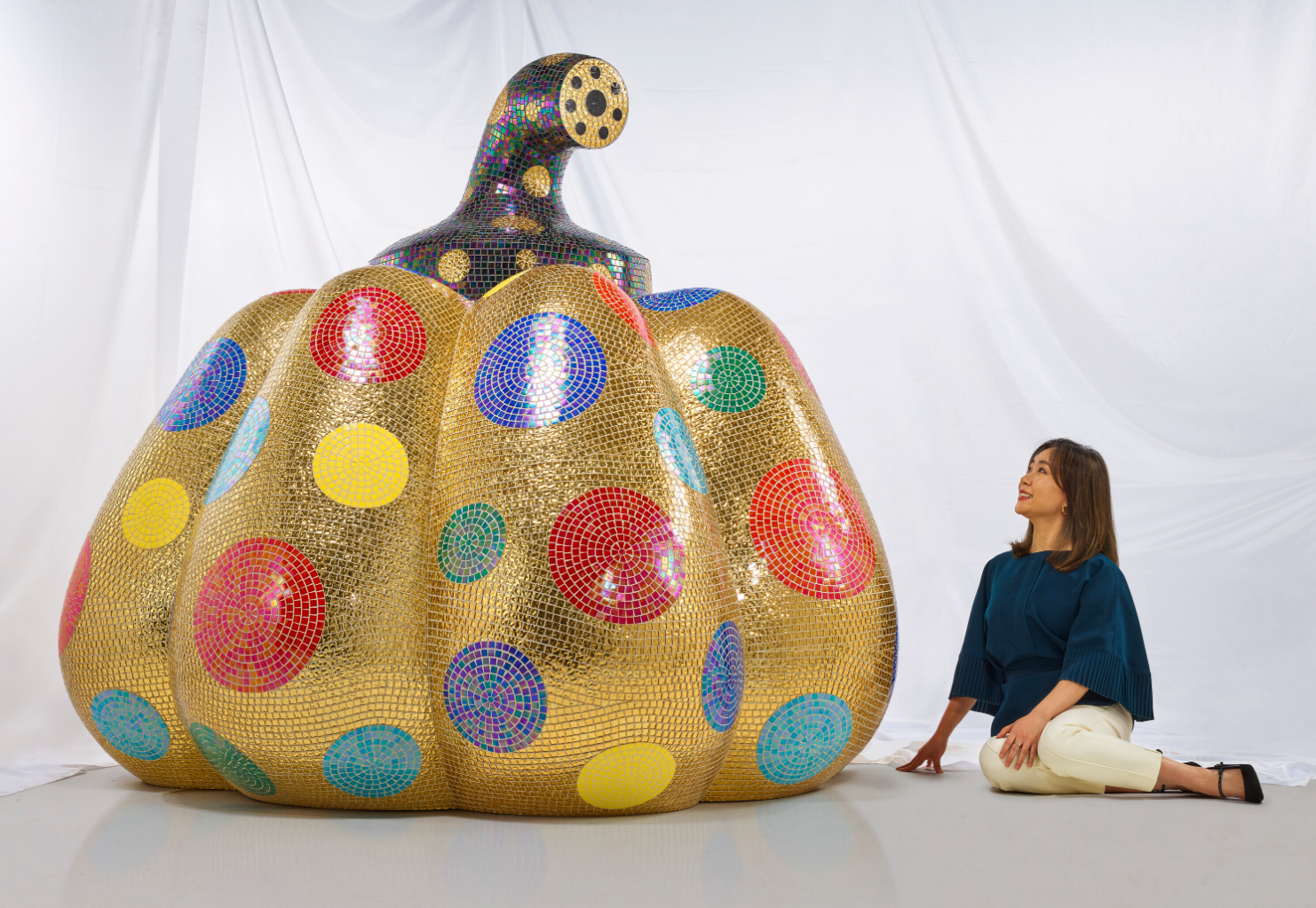
A few iterations of Starry Pumpkin Gold have witnessed international fanfare in museums and exhibitions worldwide. In 2021, the New York Botanical Garden hosted ‘Kusama: Cosmic Nature’, a large-scale sculpture and installation exhibition dedicated to Kusama’s fascination with nature. Its centerpiece—a golden mosaic pumpkin featuring red dots—prominently sat amongst blooming daffodils, flaunting Kusama’s characteristic flair. In Tokyo, the Yayoi Kusama Museum’s Starry Pumpkin with pink tiles overlooks the cityscape. The sculpture’s saturated colors establish an alternative reality but at the same time, echoes the city’s vibrancy. Kusama’s mosaic pumpkin sculptures are the most venerated museum-caliber works, witnesses to the artist’s exhaustive craftsmanship and legendary vision. The larger-than-life pillar is a creation of utmost rarity, with only two mosaic pumpkins previously appearing in auction.
A-Pumpkin (OTRSSA), 2014
Seoul Auction: 29 November 2022
Estimated: KRW 8,000,000,000 – 18,000,000,000
KRW 6,419,999,700 / USD 4,837,475
(HAMMER)
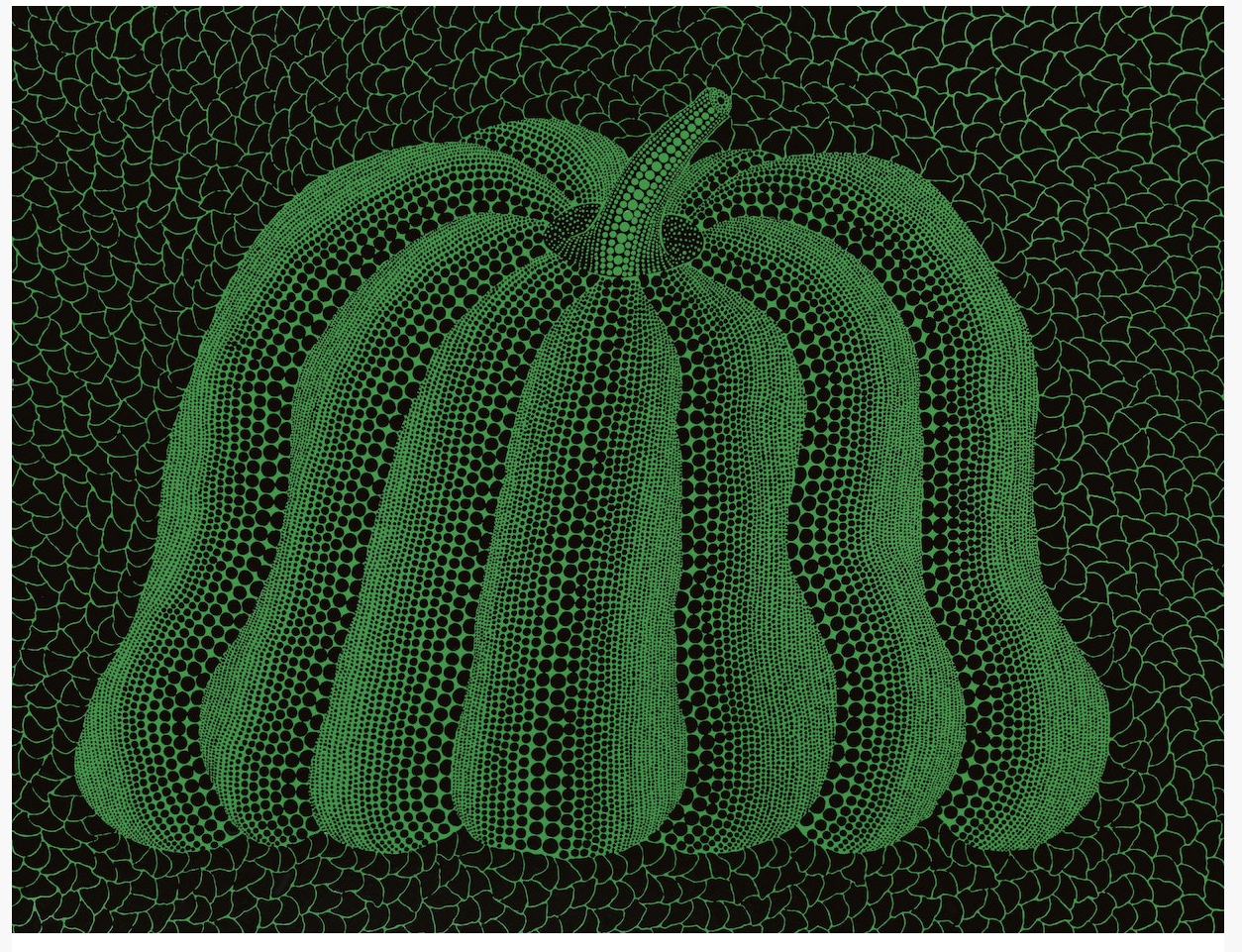
A-Pumpkin (OTRSSA), 2014
Acrylic on canvas
112 x 145.5 cm (44.1 x 57.3 inches)
Infinity Nets (T.W.A), 2000
Christie’s New-York: 10 November 2022
Visionary: The Paul G. Allen Collection
USD 4,140,000
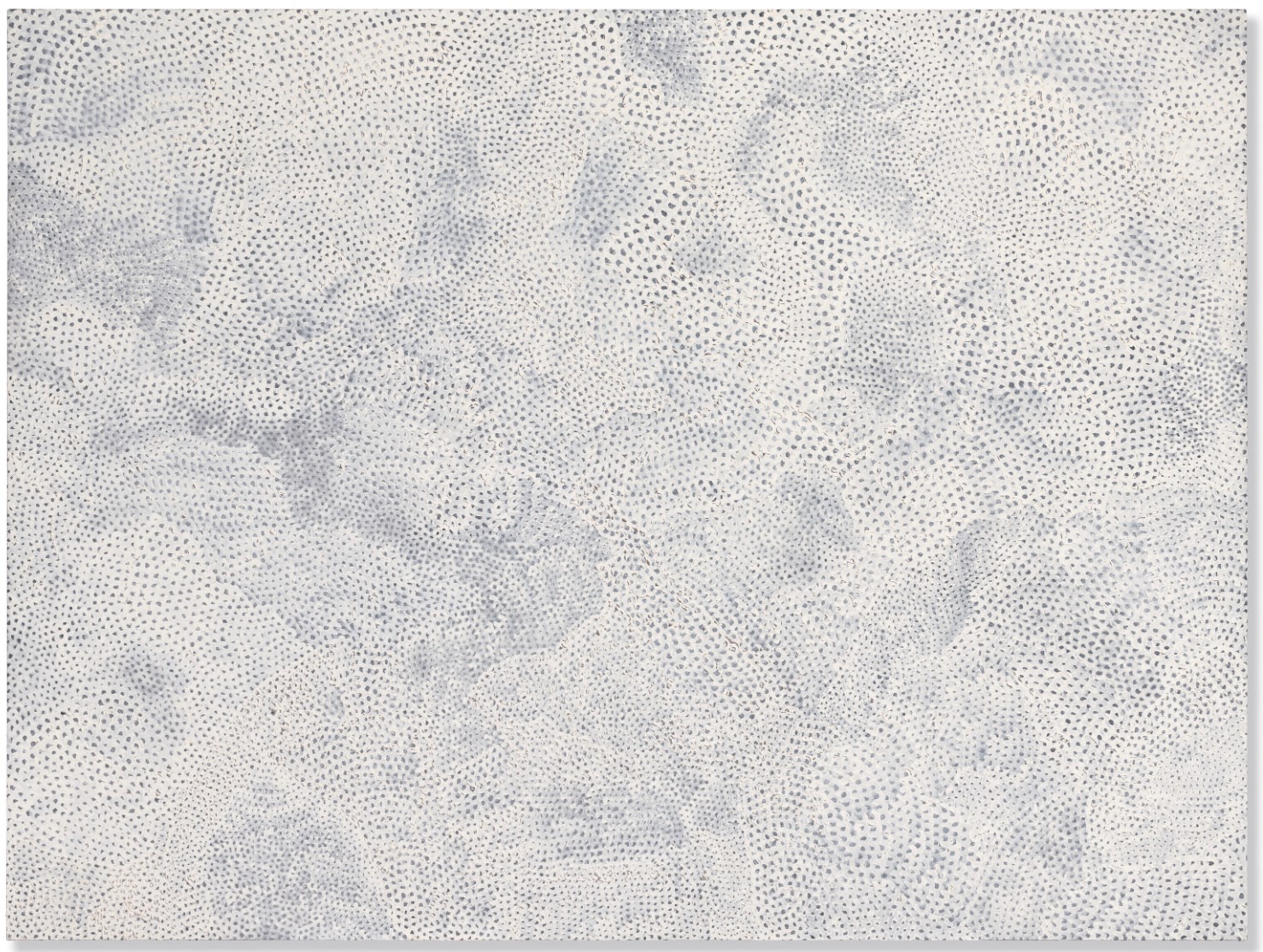
Infinity Nets (T.W.A), 2000
Acrylic on canvas
193.7 x 259.1 cm (76.2 x 102 inches)
Signed, titled and dated ‘Yayoi Kusama 2000 Infinity Nets (T.W.A)’ (on the reverse)
With its billowing clouds of ethereal loops and swirls, Yayoi Kusama’s Infinity Nets (T.W.A) is the physical manifestation of the artist’s overarching imagination. Working continuously for hours at a time, Kusama’s expansive canvases become an exploration of both infinite space and immeasurable time. These reflections create boundless and highly personal works, ones with no beginning and no end. In the present work, her brush casts an endless array of pale nets across the surface of this large-scale canvas, displaying the artists’ inner emotions and where her imagination is actualized in an expressive, peaceful motion.
Sotheby’s Hong-Kong: 27 April 2022
HKD 30,625,000 / USD 3,902,864
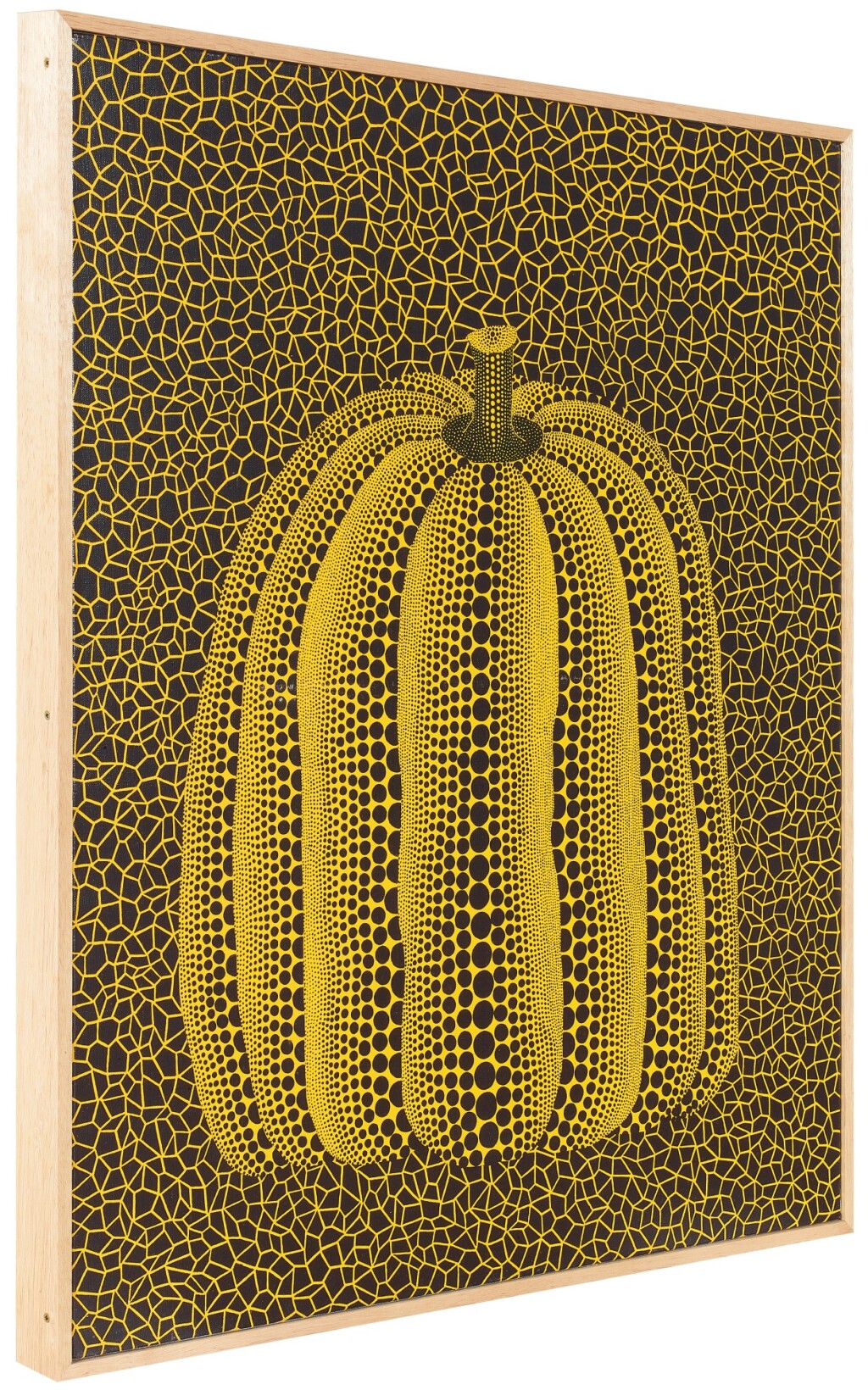
YAYOI KUSAMA
Pumpkin, 1990
Acrylic on canvas
72.5 x 60.5 cm (28.5 x 23.9 inches)
Executed in 1990, Pumpkin is a spellbinding, flawlessly executed archetype from Yayoi Kusama’s oeuvre – a testament to her astonishing dedication to creation, technique, and a singular artistic vision. Full and symmetrical, the pumpkin of the present work is a splendid example of her most favored motif. In the background, Kusama’s all-over scaled tessellations – an iconic iteration of the artist’s most distinctive infinity net motif employed often within her pumpkin paintings – are so tightly and dexterously woven that the canvas hums with the rhythmic intensity of the pattern. The pumpkin itself, anthropomorphic and brilliantly luminous, presents the legendary artist at the height of her powers: each gleaming circle shimmers and vibrates; each meticulously crafted row of multi-striated dots throbs and slithers fluidly down the body of the gourd.